window.__IS_SSR__=true
window.__INITIAL_STATE__={
"attachmentsReducer": {
"audio_0": {
"type": "attachments",
"id": "audio_0",
"imgSizes": {
"kqedFullSize": {
"file": "https://ww2.kqed.org/news/wp-content/themes/KQED-unified/img/audio_bgs/background0.jpg"
}
}
},
"audio_1": {
"type": "attachments",
"id": "audio_1",
"imgSizes": {
"kqedFullSize": {
"file": "https://ww2.kqed.org/news/wp-content/themes/KQED-unified/img/audio_bgs/background1.jpg"
}
}
},
"audio_2": {
"type": "attachments",
"id": "audio_2",
"imgSizes": {
"kqedFullSize": {
"file": "https://ww2.kqed.org/news/wp-content/themes/KQED-unified/img/audio_bgs/background2.jpg"
}
}
},
"audio_3": {
"type": "attachments",
"id": "audio_3",
"imgSizes": {
"kqedFullSize": {
"file": "https://ww2.kqed.org/news/wp-content/themes/KQED-unified/img/audio_bgs/background3.jpg"
}
}
},
"audio_4": {
"type": "attachments",
"id": "audio_4",
"imgSizes": {
"kqedFullSize": {
"file": "https://ww2.kqed.org/news/wp-content/themes/KQED-unified/img/audio_bgs/background4.jpg"
}
}
},
"placeholder": {
"type": "attachments",
"id": "placeholder",
"imgSizes": {
"thumbnail": {
"file": "https://cdn.kqed.org/wp-content/uploads/2024/12/KQED-Default-Image-816638274-2000x1333-1-160x107.jpg",
"width": 160,
"height": 107,
"mimeType": "image/jpeg"
},
"medium": {
"file": "https://cdn.kqed.org/wp-content/uploads/2024/12/KQED-Default-Image-816638274-2000x1333-1-800x533.jpg",
"width": 800,
"height": 533,
"mimeType": "image/jpeg"
},
"medium_large": {
"file": "https://cdn.kqed.org/wp-content/uploads/2024/12/KQED-Default-Image-816638274-2000x1333-1-768x512.jpg",
"width": 768,
"height": 512,
"mimeType": "image/jpeg"
},
"large": {
"file": "https://cdn.kqed.org/wp-content/uploads/2024/12/KQED-Default-Image-816638274-2000x1333-1-1020x680.jpg",
"width": 1020,
"height": 680,
"mimeType": "image/jpeg"
},
"1536x1536": {
"file": "https://cdn.kqed.org/wp-content/uploads/2024/12/KQED-Default-Image-816638274-2000x1333-1-1536x1024.jpg",
"width": 1536,
"height": 1024,
"mimeType": "image/jpeg"
},
"fd-lrg": {
"file": "https://cdn.kqed.org/wp-content/uploads/2024/12/KQED-Default-Image-816638274-2000x1333-1-1536x1024.jpg",
"width": 1536,
"height": 1024,
"mimeType": "image/jpeg"
},
"fd-med": {
"file": "https://cdn.kqed.org/wp-content/uploads/2024/12/KQED-Default-Image-816638274-2000x1333-1-1020x680.jpg",
"width": 1020,
"height": 680,
"mimeType": "image/jpeg"
},
"fd-sm": {
"file": "https://cdn.kqed.org/wp-content/uploads/2024/12/KQED-Default-Image-816638274-2000x1333-1-800x533.jpg",
"width": 800,
"height": 533,
"mimeType": "image/jpeg"
},
"post-thumbnail": {
"file": "https://cdn.kqed.org/wp-content/uploads/2024/12/KQED-Default-Image-816638274-2000x1333-1-672x372.jpg",
"width": 672,
"height": 372,
"mimeType": "image/jpeg"
},
"twentyfourteen-full-width": {
"file": "https://cdn.kqed.org/wp-content/uploads/2024/12/KQED-Default-Image-816638274-2000x1333-1-1038x576.jpg",
"width": 1038,
"height": 576,
"mimeType": "image/jpeg"
},
"xxsmall": {
"file": "https://cdn.kqed.org/wp-content/uploads/2024/12/KQED-Default-Image-816638274-2000x1333-1-160x107.jpg",
"width": 160,
"height": 107,
"mimeType": "image/jpeg"
},
"xsmall": {
"file": "https://cdn.kqed.org/wp-content/uploads/2024/12/KQED-Default-Image-816638274-2000x1333-1-672x372.jpg",
"width": 672,
"height": 372,
"mimeType": "image/jpeg"
},
"small": {
"file": "https://cdn.kqed.org/wp-content/uploads/2024/12/KQED-Default-Image-816638274-2000x1333-1-672x372.jpg",
"width": 672,
"height": 372,
"mimeType": "image/jpeg"
},
"xlarge": {
"file": "https://cdn.kqed.org/wp-content/uploads/2024/12/KQED-Default-Image-816638274-2000x1333-1-1020x680.jpg",
"width": 1020,
"height": 680,
"mimeType": "image/jpeg"
},
"full-width": {
"file": "https://cdn.kqed.org/wp-content/uploads/2024/12/KQED-Default-Image-816638274-2000x1333-1-1920x1280.jpg",
"width": 1920,
"height": 1280,
"mimeType": "image/jpeg"
},
"guest-author-32": {
"file": "https://cdn.kqed.org/wp-content/uploads/2025/01/KQED-Default-Image-816638274-1333x1333-1-160x160.jpg",
"width": 32,
"height": 32,
"mimeType": "image/jpeg"
},
"guest-author-50": {
"file": "https://cdn.kqed.org/wp-content/uploads/2025/01/KQED-Default-Image-816638274-1333x1333-1-160x160.jpg",
"width": 50,
"height": 50,
"mimeType": "image/jpeg"
},
"guest-author-64": {
"file": "https://cdn.kqed.org/wp-content/uploads/2025/01/KQED-Default-Image-816638274-1333x1333-1-160x160.jpg",
"width": 64,
"height": 64,
"mimeType": "image/jpeg"
},
"guest-author-96": {
"file": "https://cdn.kqed.org/wp-content/uploads/2025/01/KQED-Default-Image-816638274-1333x1333-1-160x160.jpg",
"width": 96,
"height": 96,
"mimeType": "image/jpeg"
},
"guest-author-128": {
"file": "https://cdn.kqed.org/wp-content/uploads/2025/01/KQED-Default-Image-816638274-1333x1333-1-160x160.jpg",
"width": 128,
"height": 128,
"mimeType": "image/jpeg"
},
"detail": {
"file": "https://cdn.kqed.org/wp-content/uploads/2025/01/KQED-Default-Image-816638274-1333x1333-1-160x160.jpg",
"width": 160,
"height": 160,
"mimeType": "image/jpeg"
},
"kqedFullSize": {
"file": "https://cdn.kqed.org/wp-content/uploads/2024/12/KQED-Default-Image-816638274-2000x1333-1.jpg",
"width": 2000,
"height": 1333
}
}
},
"news_12033583": {
"type": "attachments",
"id": "news_12033583",
"meta": {
"index": "attachments_1716263798",
"site": "news",
"id": "12033583",
"found": true
},
"title": "The REI store in Berkeley on March 28, 2025.",
"publishDate": 1743192464,
"status": "inherit",
"parent": 12084465,
"modified": 1779297031,
"caption": "The REI store in Berkeley on March 28, 2025. REI’s Berkeley employees claim the company has stalled contract negotiations and harmed unionized workers by excluding them from bonuses and pay raises.",
"credit": "Martin do Nascimento/KQED",
"altTag": null,
"description": null,
"imgSizes": {
"medium": {
"file": "https://cdn.kqed.org/wp-content/uploads/sites/10/2025/03/250328-REI-LABOR-DISPUTE-MD-10-KQED-800x533.jpg",
"width": 800,
"height": 533,
"mimeType": "image/jpeg"
},
"large": {
"file": "https://cdn.kqed.org/wp-content/uploads/sites/10/2025/03/250328-REI-LABOR-DISPUTE-MD-10-KQED-1020x680.jpg",
"width": 1020,
"height": 680,
"mimeType": "image/jpeg"
},
"thumbnail": {
"file": "https://cdn.kqed.org/wp-content/uploads/sites/10/2025/03/250328-REI-LABOR-DISPUTE-MD-10-KQED-160x107.jpg",
"width": 160,
"height": 107,
"mimeType": "image/jpeg"
},
"1536x1536": {
"file": "https://cdn.kqed.org/wp-content/uploads/sites/10/2025/03/250328-REI-LABOR-DISPUTE-MD-10-KQED-1536x1024.jpg",
"width": 1536,
"height": 1024,
"mimeType": "image/jpeg"
},
"post-thumbnail": {
"file": "https://cdn.kqed.org/wp-content/uploads/sites/10/2025/03/250328-REI-LABOR-DISPUTE-MD-10-KQED-672x372.jpg",
"width": 672,
"height": 372,
"mimeType": "image/jpeg"
},
"twentyfourteen-full-width": {
"file": "https://cdn.kqed.org/wp-content/uploads/sites/10/2025/03/250328-REI-LABOR-DISPUTE-MD-10-KQED-1038x576.jpg",
"width": 1038,
"height": 576,
"mimeType": "image/jpeg"
},
"full-width": {
"file": "https://cdn.kqed.org/wp-content/uploads/sites/10/2025/03/250328-REI-LABOR-DISPUTE-MD-10-KQED-1920x1280.jpg",
"width": 1920,
"height": 1280,
"mimeType": "image/jpeg"
},
"kqedFullSize": {
"file": "https://cdn.kqed.org/wp-content/uploads/sites/10/2025/03/250328-REI-LABOR-DISPUTE-MD-10-KQED.jpg",
"width": 2000,
"height": 1333
}
},
"isLoading": false,
"fetchFailed": false
},
"news_12037105": {
"type": "attachments",
"id": "news_12037105",
"meta": {
"index": "attachments_1716263798",
"site": "news",
"id": "12037105",
"found": true
},
"title": "The Federal Courthouse in Oakland on Aug. 16, 2023.",
"publishDate": 1745345804,
"status": "inherit",
"parent": 12037103,
"modified": 1745345829,
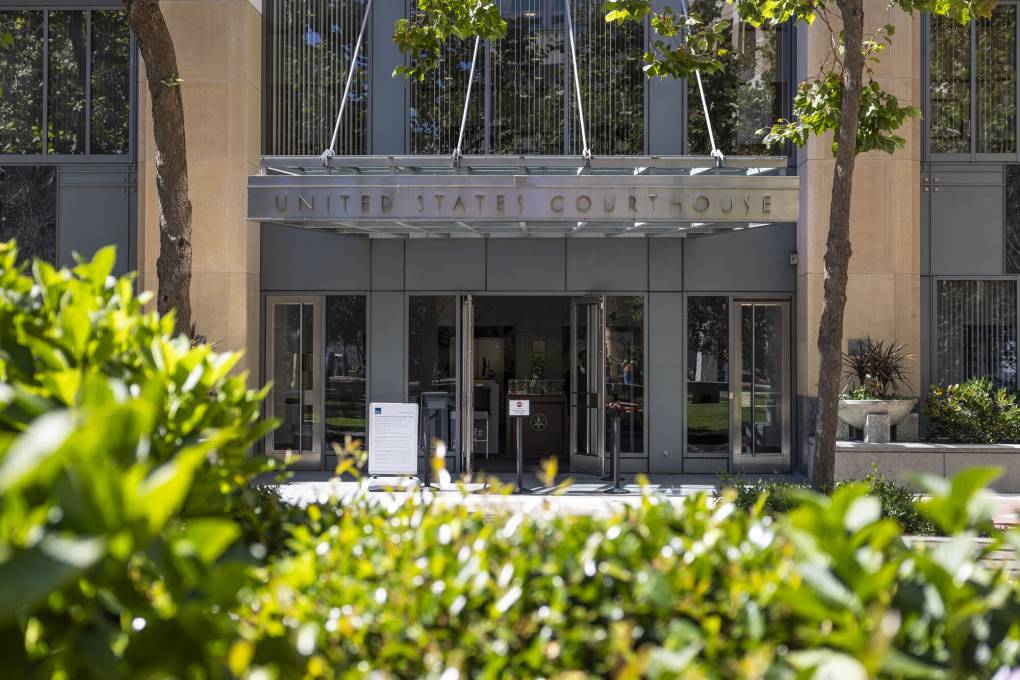
"caption": "The Federal Courthouse in Oakland on Aug. 16, 2023.",
"credit": "Martin do Nascimento/KQED",
"altTag": null,
"description": null,
"imgSizes": {
"medium": {
"file": "https://cdn.kqed.org/wp-content/uploads/sites/10/2025/04/230816-Dublin-Womens-Prison-Suit-MD-01_qed-800x533.jpg",
"width": 800,
"height": 533,
"mimeType": "image/jpeg"
},
"large": {
"file": "https://cdn.kqed.org/wp-content/uploads/sites/10/2025/04/230816-Dublin-Womens-Prison-Suit-MD-01_qed-1020x680.jpg",
"width": 1020,
"height": 680,
"mimeType": "image/jpeg"
},
"thumbnail": {
"file": "https://cdn.kqed.org/wp-content/uploads/sites/10/2025/04/230816-Dublin-Womens-Prison-Suit-MD-01_qed-160x107.jpg",
"width": 160,
"height": 107,
"mimeType": "image/jpeg"
},
"1536x1536": {
"file": "https://cdn.kqed.org/wp-content/uploads/sites/10/2025/04/230816-Dublin-Womens-Prison-Suit-MD-01_qed-1536x1024.jpg",
"width": 1536,
"height": 1024,
"mimeType": "image/jpeg"
},
"post-thumbnail": {
"file": "https://cdn.kqed.org/wp-content/uploads/sites/10/2025/04/230816-Dublin-Womens-Prison-Suit-MD-01_qed-672x372.jpg",
"width": 672,
"height": 372,
"mimeType": "image/jpeg"
},
"twentyfourteen-full-width": {
"file": "https://cdn.kqed.org/wp-content/uploads/sites/10/2025/04/230816-Dublin-Womens-Prison-Suit-MD-01_qed-1038x576.jpg",
"width": 1038,
"height": 576,
"mimeType": "image/jpeg"
},
"full-width": {
"file": "https://cdn.kqed.org/wp-content/uploads/sites/10/2025/04/230816-Dublin-Womens-Prison-Suit-MD-01_qed-1920x1280.jpg",
"width": 1920,
"height": 1280,
"mimeType": "image/jpeg"
},
"kqedFullSize": {
"file": "https://cdn.kqed.org/wp-content/uploads/sites/10/2025/04/230816-Dublin-Womens-Prison-Suit-MD-01_qed.jpg",
"width": 2000,
"height": 1333
}
},
"isLoading": false,
"fetchFailed": false
},
"news_12037371": {
"type": "attachments",
"id": "news_12037371",
"meta": {
"index": "attachments_1716263798",
"site": "news",
"id": "12037371",
"found": true
},
"title": "California Housing",
"publishDate": 1745446139,
"status": "inherit",
"parent": 12037346,
"modified": 1745446206,
"caption": "A housing development in the hills of Antioch, California, on March 4, 2013.",
"credit": "iStock/Getty Images Plus",
"altTag": null,
"description": null,
"imgSizes": {
"medium": {
"file": "https://cdn.kqed.org/wp-content/uploads/sites/10/2025/04/AntiochHousingDevelopmentGetty-800x533.jpg",
"width": 800,
"height": 533,
"mimeType": "image/jpeg"
},
"large": {
"file": "https://cdn.kqed.org/wp-content/uploads/sites/10/2025/04/AntiochHousingDevelopmentGetty-1020x680.jpg",
"width": 1020,
"height": 680,
"mimeType": "image/jpeg"
},
"thumbnail": {
"file": "https://cdn.kqed.org/wp-content/uploads/sites/10/2025/04/AntiochHousingDevelopmentGetty-160x107.jpg",
"width": 160,
"height": 107,
"mimeType": "image/jpeg"
},
"1536x1536": {
"file": "https://cdn.kqed.org/wp-content/uploads/sites/10/2025/04/AntiochHousingDevelopmentGetty-1536x1024.jpg",
"width": 1536,
"height": 1024,
"mimeType": "image/jpeg"
},
"post-thumbnail": {
"file": "https://cdn.kqed.org/wp-content/uploads/sites/10/2025/04/AntiochHousingDevelopmentGetty-672x372.jpg",
"width": 672,
"height": 372,
"mimeType": "image/jpeg"
},
"twentyfourteen-full-width": {
"file": "https://cdn.kqed.org/wp-content/uploads/sites/10/2025/04/AntiochHousingDevelopmentGetty-1038x576.jpg",
"width": 1038,
"height": 576,
"mimeType": "image/jpeg"
},
"full-width": {
"file": "https://cdn.kqed.org/wp-content/uploads/sites/10/2025/04/AntiochHousingDevelopmentGetty-1920x1280.jpg",
"width": 1920,
"height": 1280,
"mimeType": "image/jpeg"
},
"kqedFullSize": {
"file": "https://cdn.kqed.org/wp-content/uploads/sites/10/2025/04/AntiochHousingDevelopmentGetty.jpg",
"width": 2000,
"height": 1333
}
},
"isLoading": false,
"fetchFailed": false
},
"news_12037309": {
"type": "attachments",
"id": "news_12037309",
"meta": {
"index": "attachments_1716263798",
"site": "news",
"id": "12037309",
"found": true
},
"title": "240204-Storm-19-BL_qed",
"publishDate": 1745437127,
"status": "inherit",
"parent": 12037304,
"modified": 1745439383,
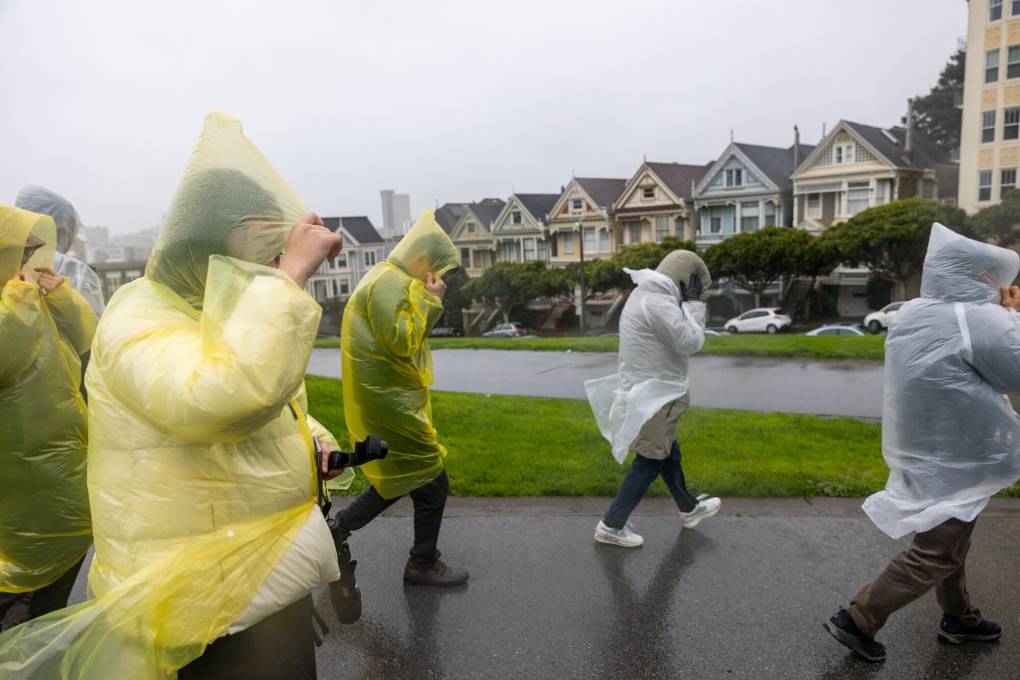
"caption": "A group of tourists walks through Alamo Square Park during a storm in San Francisco on Feb. 4, 2024.",
"credit": "Beth LaBerge/KQED",
"altTag": null,
"description": null,
"imgSizes": {
"medium": {
"file": "https://cdn.kqed.org/wp-content/uploads/sites/10/2025/04/240204-Storm-19-BL_qed-800x533.jpg",
"width": 800,
"height": 533,
"mimeType": "image/jpeg"
},
"large": {
"file": "https://cdn.kqed.org/wp-content/uploads/sites/10/2025/04/240204-Storm-19-BL_qed-1020x680.jpg",
"width": 1020,
"height": 680,
"mimeType": "image/jpeg"
},
"thumbnail": {
"file": "https://cdn.kqed.org/wp-content/uploads/sites/10/2025/04/240204-Storm-19-BL_qed-160x107.jpg",
"width": 160,
"height": 107,
"mimeType": "image/jpeg"
},
"1536x1536": {
"file": "https://cdn.kqed.org/wp-content/uploads/sites/10/2025/04/240204-Storm-19-BL_qed-1536x1024.jpg",
"width": 1536,
"height": 1024,
"mimeType": "image/jpeg"
},
"post-thumbnail": {
"file": "https://cdn.kqed.org/wp-content/uploads/sites/10/2025/04/240204-Storm-19-BL_qed-672x372.jpg",
"width": 672,
"height": 372,
"mimeType": "image/jpeg"
},
"twentyfourteen-full-width": {
"file": "https://cdn.kqed.org/wp-content/uploads/sites/10/2025/04/240204-Storm-19-BL_qed-1038x576.jpg",
"width": 1038,
"height": 576,
"mimeType": "image/jpeg"
},
"full-width": {
"file": "https://cdn.kqed.org/wp-content/uploads/sites/10/2025/04/240204-Storm-19-BL_qed-1920x1280.jpg",
"width": 1920,
"height": 1280,
"mimeType": "image/jpeg"
},
"kqedFullSize": {
"file": "https://cdn.kqed.org/wp-content/uploads/sites/10/2025/04/240204-Storm-19-BL_qed.jpg",
"width": 2000,
"height": 1333
}
},
"isLoading": false,
"fetchFailed": false
},
"news_12037100": {
"type": "attachments",
"id": "news_12037100",
"meta": {
"index": "attachments_1716263798",
"site": "news",
"id": "12037100",
"found": true
},
"title": "DSC06392_qed",
"publishDate": 1745344975,
"status": "inherit",
"parent": 12037097,
"modified": 1745345003,
"caption": "Oakland Unified School District Superintendent Kyla Johnson-Trammell delivers a speech to the media with the OUSD's response to an ongoing teacher's strike on May 4, 2023.",
"credit": "Aryk Copley for KQED",
"altTag": null,
"description": null,
"imgSizes": {
"medium": {
"file": "https://cdn.kqed.org/wp-content/uploads/sites/10/2025/04/DSC06392_qed-800x533.jpg",
"width": 800,
"height": 533,
"mimeType": "image/jpeg"
},
"large": {
"file": "https://cdn.kqed.org/wp-content/uploads/sites/10/2025/04/DSC06392_qed-1020x680.jpg",
"width": 1020,
"height": 680,
"mimeType": "image/jpeg"
},
"thumbnail": {
"file": "https://cdn.kqed.org/wp-content/uploads/sites/10/2025/04/DSC06392_qed-160x107.jpg",
"width": 160,
"height": 107,
"mimeType": "image/jpeg"
},
"1536x1536": {
"file": "https://cdn.kqed.org/wp-content/uploads/sites/10/2025/04/DSC06392_qed-1536x1024.jpg",
"width": 1536,
"height": 1024,
"mimeType": "image/jpeg"
},
"post-thumbnail": {
"file": "https://cdn.kqed.org/wp-content/uploads/sites/10/2025/04/DSC06392_qed-672x372.jpg",
"width": 672,
"height": 372,
"mimeType": "image/jpeg"
},
"twentyfourteen-full-width": {
"file": "https://cdn.kqed.org/wp-content/uploads/sites/10/2025/04/DSC06392_qed-1038x576.jpg",
"width": 1038,
"height": 576,
"mimeType": "image/jpeg"
},
"full-width": {
"file": "https://cdn.kqed.org/wp-content/uploads/sites/10/2025/04/DSC06392_qed-1920x1280.jpg",
"width": 1920,
"height": 1280,
"mimeType": "image/jpeg"
},
"kqedFullSize": {
"file": "https://cdn.kqed.org/wp-content/uploads/sites/10/2025/04/DSC06392_qed.jpg",
"width": 2000,
"height": 1333
}
},
"isLoading": false,
"fetchFailed": false
},
"news_12036985": {
"type": "attachments",
"id": "news_12036985",
"meta": {
"index": "attachments_1716263798",
"site": "news",
"id": "12036985",
"found": true
},
"title": "250421-BARBARA LEE PRESSER-MD-03-KQED",
"publishDate": 1745271018,
"status": "inherit",
"parent": 12036919,
"modified": 1745274844,
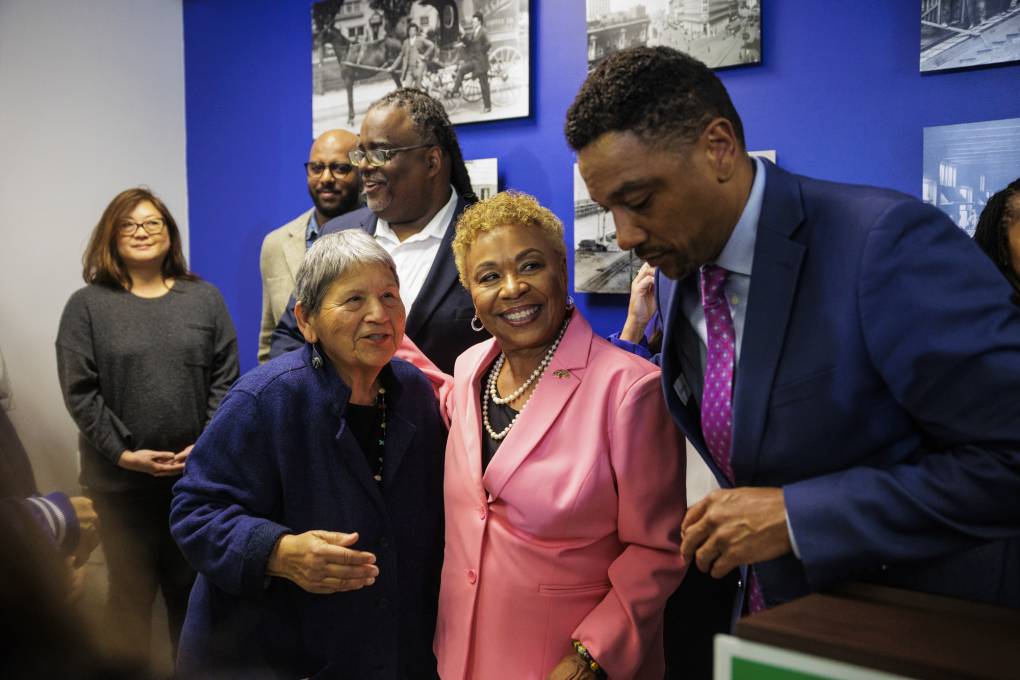
"caption": "Oakland Mayor-Elect Barbara Lee greets supporters at a press conference in Oakland on April 21, 2025.",
"credit": "Martin do Nascimento/KQED",
"altTag": null,
"description": null,
"imgSizes": {
"medium": {
"file": "https://cdn.kqed.org/wp-content/uploads/sites/10/2025/04/250421-BARBARA-LEE-PRESSER-MD-03-KQED-800x533.jpg",
"width": 800,
"height": 533,
"mimeType": "image/jpeg"
},
"large": {
"file": "https://cdn.kqed.org/wp-content/uploads/sites/10/2025/04/250421-BARBARA-LEE-PRESSER-MD-03-KQED-1020x680.jpg",
"width": 1020,
"height": 680,
"mimeType": "image/jpeg"
},
"thumbnail": {
"file": "https://cdn.kqed.org/wp-content/uploads/sites/10/2025/04/250421-BARBARA-LEE-PRESSER-MD-03-KQED-160x107.jpg",
"width": 160,
"height": 107,
"mimeType": "image/jpeg"
},
"1536x1536": {
"file": "https://cdn.kqed.org/wp-content/uploads/sites/10/2025/04/250421-BARBARA-LEE-PRESSER-MD-03-KQED-1536x1024.jpg",
"width": 1536,
"height": 1024,
"mimeType": "image/jpeg"
},
"post-thumbnail": {
"file": "https://cdn.kqed.org/wp-content/uploads/sites/10/2025/04/250421-BARBARA-LEE-PRESSER-MD-03-KQED-672x372.jpg",
"width": 672,
"height": 372,
"mimeType": "image/jpeg"
},
"twentyfourteen-full-width": {
"file": "https://cdn.kqed.org/wp-content/uploads/sites/10/2025/04/250421-BARBARA-LEE-PRESSER-MD-03-KQED-1038x576.jpg",
"width": 1038,
"height": 576,
"mimeType": "image/jpeg"
},
"full-width": {
"file": "https://cdn.kqed.org/wp-content/uploads/sites/10/2025/04/250421-BARBARA-LEE-PRESSER-MD-03-KQED-1920x1280.jpg",
"width": 1920,
"height": 1280,
"mimeType": "image/jpeg"
},
"kqedFullSize": {
"file": "https://cdn.kqed.org/wp-content/uploads/sites/10/2025/04/250421-BARBARA-LEE-PRESSER-MD-03-KQED.jpg",
"width": 2000,
"height": 1333
}
},
"isLoading": false,
"fetchFailed": false
},
"news_12036987": {
"type": "attachments",
"id": "news_12036987",
"meta": {
"index": "attachments_1716263798",
"site": "news",
"id": "12036987",
"found": true
},
"title": "Oakland Mayor-Elect Barbara Lee holds a press conference on April 21, 2025.",
"publishDate": 1745271035,
"status": "inherit",
"parent": 12060018,
"modified": 1760661552,
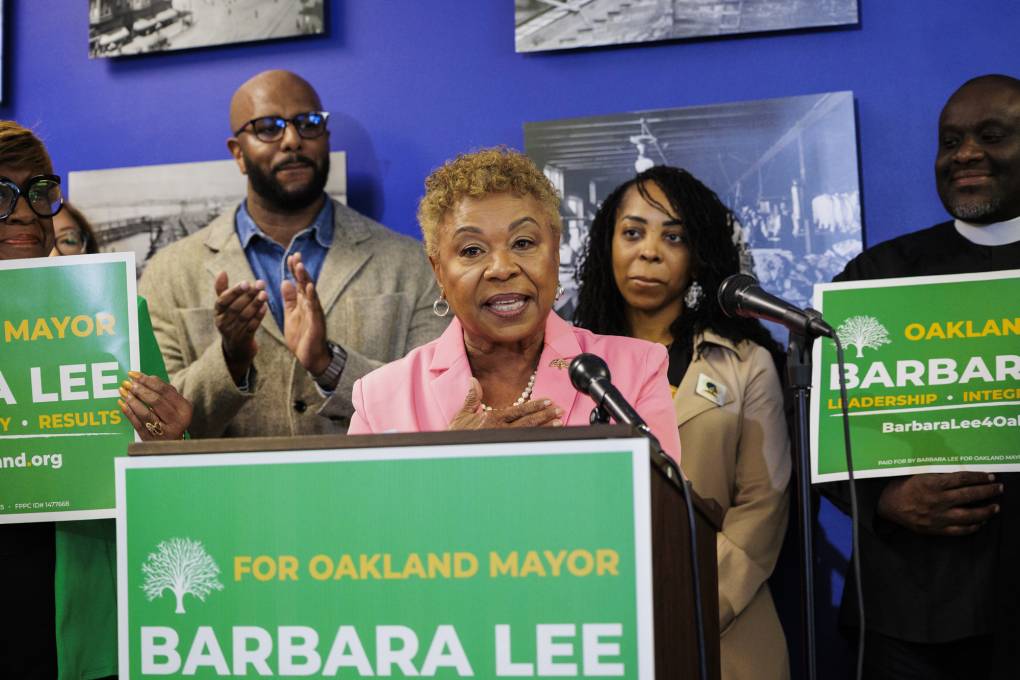
"caption": "Oakland Mayor-elect Barbara Lee holds a press conference in Oakland on April 21, 2025.",
"credit": "Martin do Nascimento/KQED",
"altTag": null,
"description": null,
"imgSizes": {
"medium": {
"file": "https://cdn.kqed.org/wp-content/uploads/sites/10/2025/04/250421-BARBARA-LEE-PRESSER-MD-05-KQED-800x533.jpg",
"width": 800,
"height": 533,
"mimeType": "image/jpeg"
},
"large": {
"file": "https://cdn.kqed.org/wp-content/uploads/sites/10/2025/04/250421-BARBARA-LEE-PRESSER-MD-05-KQED-1020x680.jpg",
"width": 1020,
"height": 680,
"mimeType": "image/jpeg"
},
"thumbnail": {
"file": "https://cdn.kqed.org/wp-content/uploads/sites/10/2025/04/250421-BARBARA-LEE-PRESSER-MD-05-KQED-160x107.jpg",
"width": 160,
"height": 107,
"mimeType": "image/jpeg"
},
"1536x1536": {
"file": "https://cdn.kqed.org/wp-content/uploads/sites/10/2025/04/250421-BARBARA-LEE-PRESSER-MD-05-KQED-1536x1024.jpg",
"width": 1536,
"height": 1024,
"mimeType": "image/jpeg"
},
"post-thumbnail": {
"file": "https://cdn.kqed.org/wp-content/uploads/sites/10/2025/04/250421-BARBARA-LEE-PRESSER-MD-05-KQED-672x372.jpg",
"width": 672,
"height": 372,
"mimeType": "image/jpeg"
},
"twentyfourteen-full-width": {
"file": "https://cdn.kqed.org/wp-content/uploads/sites/10/2025/04/250421-BARBARA-LEE-PRESSER-MD-05-KQED-1038x576.jpg",
"width": 1038,
"height": 576,
"mimeType": "image/jpeg"
},
"full-width": {
"file": "https://cdn.kqed.org/wp-content/uploads/sites/10/2025/04/250421-BARBARA-LEE-PRESSER-MD-05-KQED-1920x1280.jpg",
"width": 1920,
"height": 1280,
"mimeType": "image/jpeg"
},
"kqedFullSize": {
"file": "https://cdn.kqed.org/wp-content/uploads/sites/10/2025/04/250421-BARBARA-LEE-PRESSER-MD-05-KQED.jpg",
"width": 2000,
"height": 1333
}
},
"isLoading": false,
"fetchFailed": false
},
"news_12037008": {
"type": "attachments",
"id": "news_12037008",
"meta": {
"index": "attachments_1716263798",
"site": "news",
"id": "12037008",
"found": true
},
"title": "250421-SFUSDCentralCuts-11-BL_qed",
"publishDate": 1745274467,
"status": "inherit",
"parent": 12036914,
"modified": 1745274477,
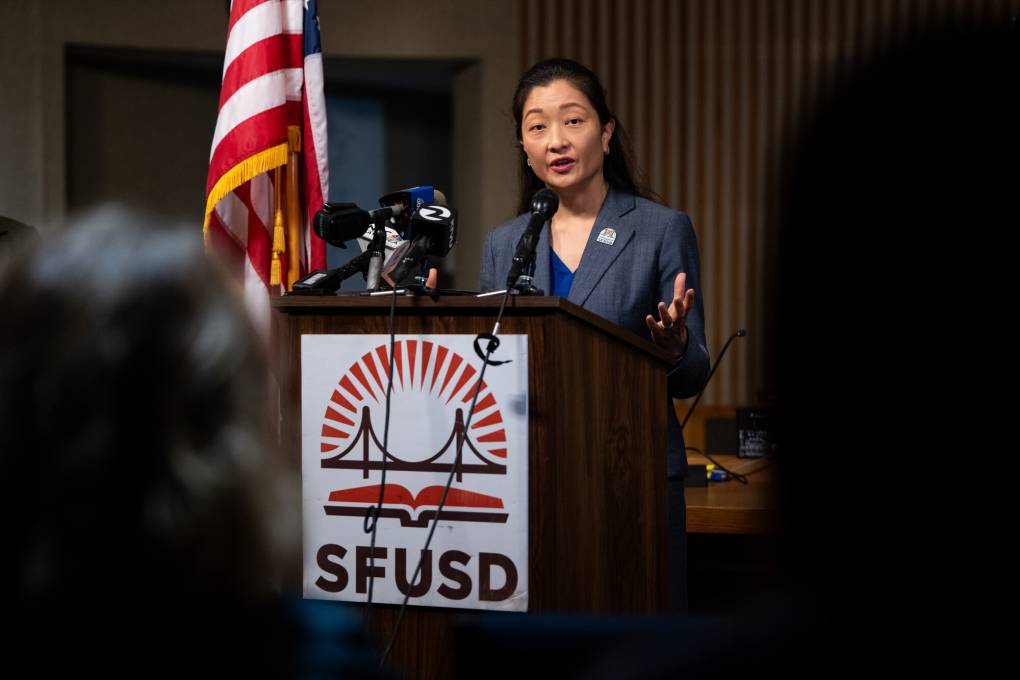
"caption": "San Francisco Unified School District Superintendent Dr. Maria Su speaks during a press conference at the school district offices in San Francisco on April 21, 2025.",
"credit": "Beth LaBerge/KQED",
"altTag": null,
"description": null,
"imgSizes": {
"medium": {
"file": "https://cdn.kqed.org/wp-content/uploads/sites/10/2025/04/250421-SFUSDCentralCuts-11-BL_qed-800x533.jpg",
"width": 800,
"height": 533,
"mimeType": "image/jpeg"
},
"large": {
"file": "https://cdn.kqed.org/wp-content/uploads/sites/10/2025/04/250421-SFUSDCentralCuts-11-BL_qed-1020x680.jpg",
"width": 1020,
"height": 680,
"mimeType": "image/jpeg"
},
"thumbnail": {
"file": "https://cdn.kqed.org/wp-content/uploads/sites/10/2025/04/250421-SFUSDCentralCuts-11-BL_qed-160x107.jpg",
"width": 160,
"height": 107,
"mimeType": "image/jpeg"
},
"1536x1536": {
"file": "https://cdn.kqed.org/wp-content/uploads/sites/10/2025/04/250421-SFUSDCentralCuts-11-BL_qed-1536x1024.jpg",
"width": 1536,
"height": 1024,
"mimeType": "image/jpeg"
},
"post-thumbnail": {
"file": "https://cdn.kqed.org/wp-content/uploads/sites/10/2025/04/250421-SFUSDCentralCuts-11-BL_qed-672x372.jpg",
"width": 672,
"height": 372,
"mimeType": "image/jpeg"
},
"twentyfourteen-full-width": {
"file": "https://cdn.kqed.org/wp-content/uploads/sites/10/2025/04/250421-SFUSDCentralCuts-11-BL_qed-1038x576.jpg",
"width": 1038,
"height": 576,
"mimeType": "image/jpeg"
},
"full-width": {
"file": "https://cdn.kqed.org/wp-content/uploads/sites/10/2025/04/250421-SFUSDCentralCuts-11-BL_qed-1920x1280.jpg",
"width": 1920,
"height": 1280,
"mimeType": "image/jpeg"
},
"kqedFullSize": {
"file": "https://cdn.kqed.org/wp-content/uploads/sites/10/2025/04/250421-SFUSDCentralCuts-11-BL_qed.jpg",
"width": 2000,
"height": 1333
}
},
"isLoading": false,
"fetchFailed": false
},
"news_12036953": {
"type": "attachments",
"id": "news_12036953",
"meta": {
"index": "attachments_1716263798",
"site": "news",
"id": "12036953",
"found": true
},
"title": "250421-PopeReax-05-BL_qed",
"publishDate": 1745264889,
"status": "inherit",
"parent": 12036912,
"modified": 1745264901,
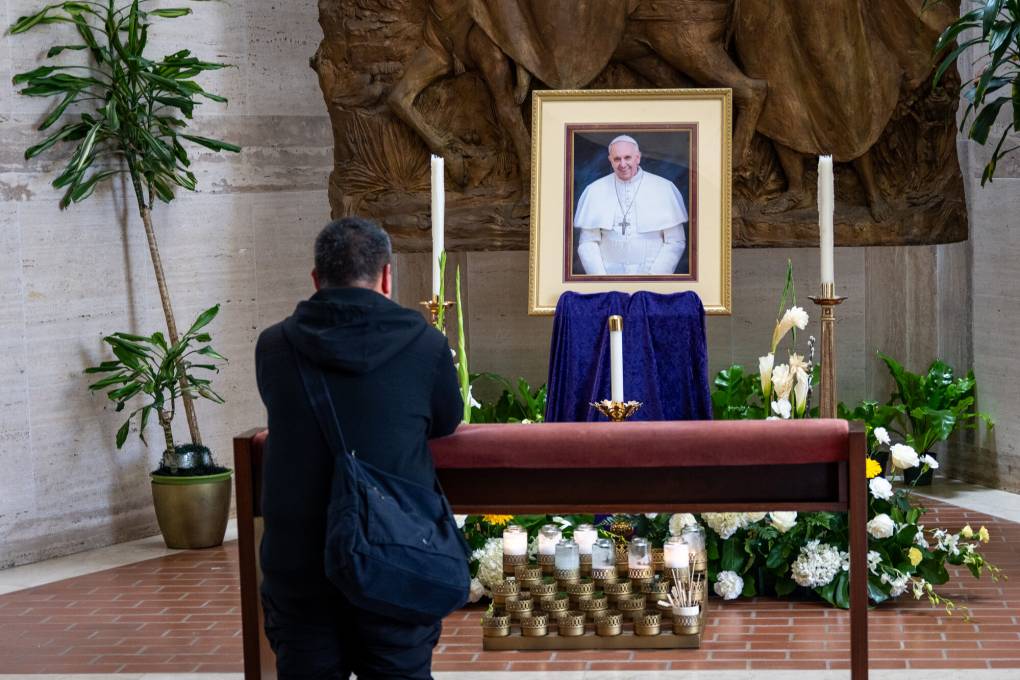
"caption": "A parishioner kneels in front of a portrait of Pope Francis at the Cathedral of Saint Mary of the Assumption in San Francisco on April 21, 2025.",
"credit": "Beth LaBerge/KQED",
"altTag": null,
"description": null,
"imgSizes": {
"medium": {
"file": "https://cdn.kqed.org/wp-content/uploads/sites/10/2025/04/250421-PopeReax-05-BL_qed-800x533.jpg",
"width": 800,
"height": 533,
"mimeType": "image/jpeg"
},
"large": {
"file": "https://cdn.kqed.org/wp-content/uploads/sites/10/2025/04/250421-PopeReax-05-BL_qed-1020x680.jpg",
"width": 1020,
"height": 680,
"mimeType": "image/jpeg"
},
"thumbnail": {
"file": "https://cdn.kqed.org/wp-content/uploads/sites/10/2025/04/250421-PopeReax-05-BL_qed-160x107.jpg",
"width": 160,
"height": 107,
"mimeType": "image/jpeg"
},
"1536x1536": {
"file": "https://cdn.kqed.org/wp-content/uploads/sites/10/2025/04/250421-PopeReax-05-BL_qed-1536x1024.jpg",
"width": 1536,
"height": 1024,
"mimeType": "image/jpeg"
},
"post-thumbnail": {
"file": "https://cdn.kqed.org/wp-content/uploads/sites/10/2025/04/250421-PopeReax-05-BL_qed-672x372.jpg",
"width": 672,
"height": 372,
"mimeType": "image/jpeg"
},
"twentyfourteen-full-width": {
"file": "https://cdn.kqed.org/wp-content/uploads/sites/10/2025/04/250421-PopeReax-05-BL_qed-1038x576.jpg",
"width": 1038,
"height": 576,
"mimeType": "image/jpeg"
},
"full-width": {
"file": "https://cdn.kqed.org/wp-content/uploads/sites/10/2025/04/250421-PopeReax-05-BL_qed-1920x1280.jpg",
"width": 1920,
"height": 1280,
"mimeType": "image/jpeg"
},
"kqedFullSize": {
"file": "https://cdn.kqed.org/wp-content/uploads/sites/10/2025/04/250421-PopeReax-05-BL_qed.jpg",
"width": 1999,
"height": 1333
}
},
"isLoading": false,
"fetchFailed": false
},
"news_11953000": {
"type": "attachments",
"id": "news_11953000",
"meta": {
"index": "attachments_1716263798",
"site": "news",
"id": "11953000",
"found": true
},
"title": "RS66293_230613-SFMarinFoodPantry-04-BL-KQED",
"publishDate": 1686846407,
"status": "inherit",
"parent": 11953447,
"modified": 1761767303,
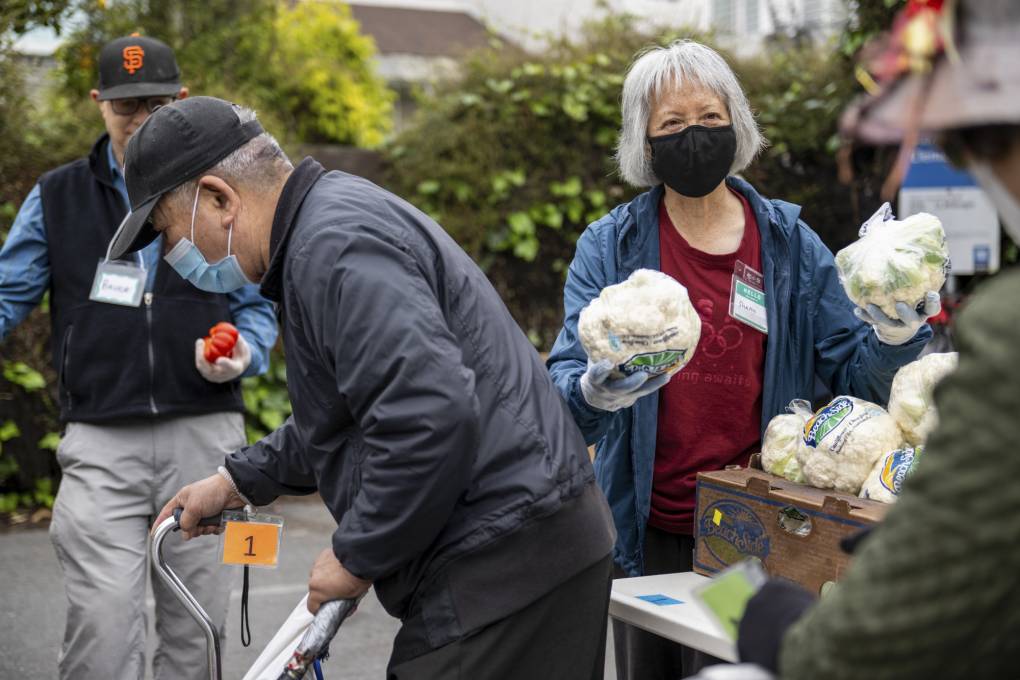
"caption": "Volunteers distribute food items at a San Francisco-Marin Food Bank pop-up pantry in the Richmond District of San Francisco on June 13, 2023. Volunteers at the food distribution events often help set up, build grocery bags, distribute food, check in participants, manage the line and help with other tasks as needed.",
"credit": "Beth LaBerge/KQED",
"altTag": "A woman with gray hair wearing a black face mask holds out cauliflower heads as a man using a can walks past in a paved outdoor area.",
"description": null,
"imgSizes": {
"medium": {
"file": "https://cdn.kqed.org/wp-content/uploads/sites/10/2023/06/RS66293_230613-SFMarinFoodPantry-04-BL-KQED-800x533.jpg",
"width": 800,
"height": 533,
"mimeType": "image/jpeg"
},
"large": {
"file": "https://cdn.kqed.org/wp-content/uploads/sites/10/2023/06/RS66293_230613-SFMarinFoodPantry-04-BL-KQED-1020x680.jpg",
"width": 1020,
"height": 680,
"mimeType": "image/jpeg"
},
"thumbnail": {
"file": "https://cdn.kqed.org/wp-content/uploads/sites/10/2023/06/RS66293_230613-SFMarinFoodPantry-04-BL-KQED-160x107.jpg",
"width": 160,
"height": 107,
"mimeType": "image/jpeg"
},
"1536x1536": {
"file": "https://cdn.kqed.org/wp-content/uploads/sites/10/2023/06/RS66293_230613-SFMarinFoodPantry-04-BL-KQED-1536x1024.jpg",
"width": 1536,
"height": 1024,
"mimeType": "image/jpeg"
},
"post-thumbnail": {
"file": "https://cdn.kqed.org/wp-content/uploads/sites/10/2023/06/RS66293_230613-SFMarinFoodPantry-04-BL-KQED-672x372.jpg",
"width": 672,
"height": 372,
"mimeType": "image/jpeg"
},
"twentyfourteen-full-width": {
"file": "https://cdn.kqed.org/wp-content/uploads/sites/10/2023/06/RS66293_230613-SFMarinFoodPantry-04-BL-KQED-1038x576.jpg",
"width": 1038,
"height": 576,
"mimeType": "image/jpeg"
},
"full-width": {
"file": "https://cdn.kqed.org/wp-content/uploads/sites/10/2023/06/RS66293_230613-SFMarinFoodPantry-04-BL-KQED-1920x1280.jpg",
"width": 1920,
"height": 1280,
"mimeType": "image/jpeg"
},
"kqedFullSize": {
"file": "https://cdn.kqed.org/wp-content/uploads/sites/10/2023/06/RS66293_230613-SFMarinFoodPantry-04-BL-KQED.jpg",
"width": 2000,
"height": 1333
}
},
"isLoading": false,
"fetchFailed": false
},
"news_11937356": {
"type": "attachments",
"id": "news_11937356",
"meta": {
"index": "attachments_1716263798",
"site": "news",
"id": "11937356",
"found": true
},
"parent": 11937317,
"imgSizes": {
"twentyfourteen-full-width": {
"file": "https://ww2.kqed.org/app/uploads/sites/10/2023/01/RS34026_112018_AW_AlamedaCountyFood-Bank_05-qut-1038x576.jpg",
"width": 1038,
"mimeType": "image/jpeg",
"height": 576
},
"thumbnail": {
"file": "https://ww2.kqed.org/app/uploads/sites/10/2023/01/RS34026_112018_AW_AlamedaCountyFood-Bank_05-qut-160x107.jpg",
"width": 160,
"mimeType": "image/jpeg",
"height": 107
},
"post-thumbnail": {
"file": "https://ww2.kqed.org/app/uploads/sites/10/2023/01/RS34026_112018_AW_AlamedaCountyFood-Bank_05-qut-672x372.jpg",
"width": 672,
"mimeType": "image/jpeg",
"height": 372
},
"kqedFullSize": {
"file": "https://ww2.kqed.org/app/uploads/sites/10/2023/01/RS34026_112018_AW_AlamedaCountyFood-Bank_05-qut.jpg",
"width": 1920,
"height": 1280
},
"large": {
"file": "https://ww2.kqed.org/app/uploads/sites/10/2023/01/RS34026_112018_AW_AlamedaCountyFood-Bank_05-qut-1020x680.jpg",
"width": 1020,
"mimeType": "image/jpeg",
"height": 680
},
"1536x1536": {
"file": "https://ww2.kqed.org/app/uploads/sites/10/2023/01/RS34026_112018_AW_AlamedaCountyFood-Bank_05-qut-1536x1024.jpg",
"width": 1536,
"mimeType": "image/jpeg",
"height": 1024
},
"medium": {
"file": "https://ww2.kqed.org/app/uploads/sites/10/2023/01/RS34026_112018_AW_AlamedaCountyFood-Bank_05-qut-800x533.jpg",
"width": 800,
"mimeType": "image/jpeg",
"height": 533
}
},
"publishDate": 1673144077,
"modified": 1673416130,
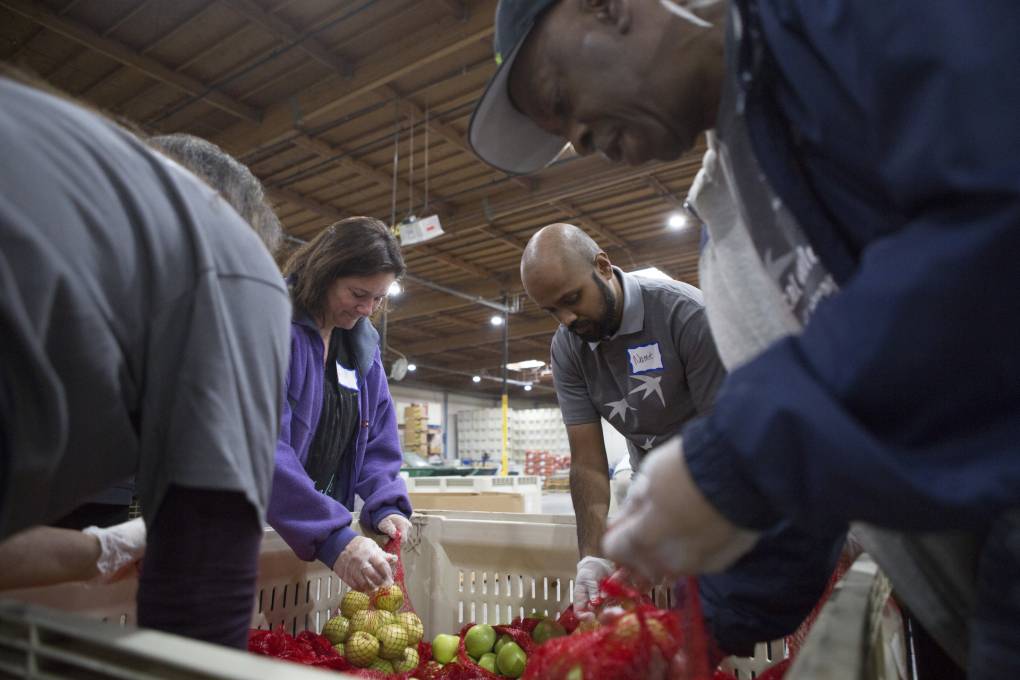
"caption": "Volunteers from Bank of the West and Boys Team Charity sort apples from the produce bins at the Alameda County Community Food Bank on Nov. 20, 2018.",
"description": null,
"title": "RS34026_112018_AW_AlamedaCountyFood Bank_05-qut",
"credit": "Anne Wernikoff/KQED",
"status": "inherit",
"altTag": "Four people sort apples in a food bank.",
"isLoading": false,
"fetchFailed": false
},
"news_12036276": {
"type": "attachments",
"id": "news_12036276",
"meta": {
"index": "attachments_1716263798",
"site": "news",
"id": "12036276",
"found": true
},
"title": "Barbara Lee takes the stage during her election night party on April 15, 2025.",
"publishDate": 1744827358,
"status": "inherit",
"parent": 12036247,
"modified": 1744834970,
"caption": "Barbara Lee takes the stage at her election night party on April 15, 2025.",
"credit": "Aryk Copley for KQED",
"altTag": null,
"description": null,
"imgSizes": {
"medium": {
"file": "https://cdn.kqed.org/wp-content/uploads/sites/10/2025/04/250415-OAKLAND-MAYORAL-RESULTS-AC-06-KQED-800x534.jpg",
"width": 800,
"height": 534,
"mimeType": "image/jpeg"
},
"large": {
"file": "https://cdn.kqed.org/wp-content/uploads/sites/10/2025/04/250415-OAKLAND-MAYORAL-RESULTS-AC-06-KQED-1020x680.jpg",
"width": 1020,
"height": 680,
"mimeType": "image/jpeg"
},
"thumbnail": {
"file": "https://cdn.kqed.org/wp-content/uploads/sites/10/2025/04/250415-OAKLAND-MAYORAL-RESULTS-AC-06-KQED-160x107.jpg",
"width": 160,
"height": 107,
"mimeType": "image/jpeg"
},
"1536x1536": {
"file": "https://cdn.kqed.org/wp-content/uploads/sites/10/2025/04/250415-OAKLAND-MAYORAL-RESULTS-AC-06-KQED-1536x1025.jpg",
"width": 1536,
"height": 1025,
"mimeType": "image/jpeg"
},
"post-thumbnail": {
"file": "https://cdn.kqed.org/wp-content/uploads/sites/10/2025/04/250415-OAKLAND-MAYORAL-RESULTS-AC-06-KQED-672x372.jpg",
"width": 672,
"height": 372,
"mimeType": "image/jpeg"
},
"twentyfourteen-full-width": {
"file": "https://cdn.kqed.org/wp-content/uploads/sites/10/2025/04/250415-OAKLAND-MAYORAL-RESULTS-AC-06-KQED-1038x576.jpg",
"width": 1038,
"height": 576,
"mimeType": "image/jpeg"
},
"full-width": {
"file": "https://cdn.kqed.org/wp-content/uploads/sites/10/2025/04/250415-OAKLAND-MAYORAL-RESULTS-AC-06-KQED-1920x1281.jpg",
"width": 1920,
"height": 1281,
"mimeType": "image/jpeg"
},
"kqedFullSize": {
"file": "https://cdn.kqed.org/wp-content/uploads/sites/10/2025/04/250415-OAKLAND-MAYORAL-RESULTS-AC-06-KQED.jpg",
"width": 2000,
"height": 1334
}
},
"isLoading": false,
"fetchFailed": false
}
},
"audioPlayerReducer": {
"postId": "stream_live",
"isPaused": true,
"isPlaying": false,
"pfsActive": false,
"pledgeModalIsOpen": true,
"playerDrawerIsOpen": false,
"liveAudioPlayStartedAt": 0,
"liveAudioPlayContext": ""
},
"authorsReducer": {
"gmarzorati": {
"type": "authors",
"id": "227",
"meta": {
"index": "authors_1716337520",
"id": "227",
"found": true
},
"name": "Guy Marzorati",
"firstName": "Guy",
"lastName": "Marzorati",
"slug": "gmarzorati",
"email": "gmarzorati@KQED.org",
"display_author_email": true,
"staff_mastheads": [
"news"
],
"title": "Correspondent",
"bio": "Guy Marzorati is a correspondent on KQED's California Politics and Government Desk, based in San Jose. A graduate of Santa Clara University, Guy joined KQED in 2013. He reports on state and local politics and produces KQED's digital voter guide.",
"avatar": "https://secure.gravatar.com/avatar/e7038b8dbfd55b104369b76b1cd0b9de?s=600&d=blank&r=g",
"twitter": "guymarzorati",
"facebook": null,
"instagram": null,
"linkedin": null,
"sites": [
{
"site": "",
"roles": [
"editor"
]
},
{
"site": "news",
"roles": [
"editor"
]
},
{
"site": "science",
"roles": [
"editor"
]
},
{
"site": "forum",
"roles": [
"editor"
]
},
{
"site": "elections",
"roles": [
"editor"
]
},
{
"site": "liveblog",
"roles": [
"editor"
]
}
],
"headData": {
"title": "Guy Marzorati | KQED",
"description": "Correspondent",
"ogImgSrc": "https://secure.gravatar.com/avatar/e7038b8dbfd55b104369b76b1cd0b9de?s=600&d=blank&r=g",
"twImgSrc": "https://secure.gravatar.com/avatar/e7038b8dbfd55b104369b76b1cd0b9de?s=600&d=blank&r=g"
},
"isLoading": false,
"link": "/author/gmarzorati"
},
"matthewgreen": {
"type": "authors",
"id": "1263",
"meta": {
"index": "authors_1716337520",
"id": "1263",
"found": true
},
"name": "Matthew Green",
"firstName": "Matthew",
"lastName": "Green",
"slug": "matthewgreen",
"email": "mgreen@kqed.org",
"display_author_email": false,
"staff_mastheads": [],
"title": "KQED Editor/Reporter",
"bio": "Matthew Green is a digital media producer for KQED News. He previously produced \u003ca href=\"http://www.kqed.org/lowdown\">The Lowdown\u003c/a>, KQED’s multimedia news education blog. Matthew's written for numerous Bay Area publications, including the Oakland Tribune and San Francisco Chronicle. He also taught journalism classes at Fremont High School in East Oakland.\r\n\r\nEmail: mgreen@kqed.org; Twitter: @MGreenKQED",
"avatar": "https://secure.gravatar.com/avatar/3bf498d1267ca02c8494f33d8cfc575e?s=600&d=blank&r=g",
"twitter": "MGreenKQED",
"facebook": null,
"instagram": null,
"linkedin": null,
"sites": [
{
"site": "news",
"roles": []
},
{
"site": "lowdown",
"roles": []
},
{
"site": "science",
"roles": []
},
{
"site": "education",
"roles": []
},
{
"site": "quest",
"roles": []
},
{
"site": "liveblog",
"roles": []
}
],
"headData": {
"title": "Matthew Green | KQED",
"description": "KQED Editor/Reporter",
"ogImgSrc": "https://secure.gravatar.com/avatar/3bf498d1267ca02c8494f33d8cfc575e?s=600&d=blank&r=g",
"twImgSrc": "https://secure.gravatar.com/avatar/3bf498d1267ca02c8494f33d8cfc575e?s=600&d=blank&r=g"
},
"isLoading": false,
"link": "/author/matthewgreen"
},
"carlysevern": {
"type": "authors",
"id": "3243",
"meta": {
"index": "authors_1716337520",
"id": "3243",
"found": true
},
"name": "Carly Severn",
"firstName": "Carly",
"lastName": "Severn",
"slug": "carlysevern",
"email": "csevern@kqed.org",
"display_author_email": false,
"staff_mastheads": [
"news"
],
"title": "Senior Editor, Audience News ",
"bio": "Carly is KQED's Senior Editor of Audience News on the Digital News team, and has reported for the California Report Magazine, Bay Curious and KQED Arts. She's formerly the host of \u003ca href=\"http://ww2.kqed.org/pop/category/the-cooler/\" rel=\"noopener noreferrer\">The Cooler\u003c/a> podcast.",
"avatar": "https://secure.gravatar.com/avatar/54037bf5c128fe678f0ef26cec97a93f2e7f220a22d7285703328f12c42c1b1d?s=600&d=blank&r=g",
"twitter": "teacupinthebay",
"bluesky": null,
"facebook": null,
"instagram": null,
"linkedin": null,
"sites": [
{
"site": "",
"roles": [
"editor"
]
},
{
"site": "arts",
"roles": [
"editor"
]
},
{
"site": "news",
"roles": [
"administrator"
]
},
{
"site": "pop",
"roles": [
"editor"
]
},
{
"site": "futureofyou",
"roles": [
"editor"
]
},
{
"site": "about",
"roles": [
"administrator"
]
},
{
"site": "mindshift",
"roles": [
"editor"
]
},
{
"site": "bayareabites",
"roles": [
"editor"
]
},
{
"site": "stateofhealth",
"roles": [
"editor"
]
},
{
"site": "science",
"roles": [
"editor"
]
},
{
"site": "food",
"roles": [
"contributor"
]
},
{
"site": "forum",
"roles": [
"editor"
]
},
{
"site": "perspectives",
"roles": [
"administrator"
]
},
{
"site": "liveblog",
"roles": [
"editor"
]
}
],
"headData": {
"title": "Carly Severn | KQED",
"description": "Senior Editor, Audience News ",
"ogImgSrc": "https://secure.gravatar.com/avatar/54037bf5c128fe678f0ef26cec97a93f2e7f220a22d7285703328f12c42c1b1d?s=600&d=blank&r=g",
"twImgSrc": "https://secure.gravatar.com/avatar/54037bf5c128fe678f0ef26cec97a93f2e7f220a22d7285703328f12c42c1b1d?s=600&d=blank&r=g"
},
"isLoading": false,
"link": "/author/carlysevern"
},
"fjhabvala": {
"type": "authors",
"id": "8659",
"meta": {
"index": "authors_1716337520",
"id": "8659",
"found": true
},
"name": "Farida Jhabvala Romero",
"firstName": "Farida",
"lastName": "Jhabvala Romero",
"slug": "fjhabvala",
"email": "fjhabvala@kqed.org",
"display_author_email": true,
"staff_mastheads": [
"news"
],
"title": "KQED Contributor",
"bio": "Farida Jhabvala Romero is a Labor Correspondent for KQED. She previously covered immigration. Farida was \u003ca href=\"https://www.ccnma.org/2022-most-influential-latina-journalists\">named\u003c/a> one of the 10 Most Influential Latina Journalists in California in 2022 by the California Chicano News Media Association. Her work has won awards from the Society of Professional Journalists (Northern California), as well as a national and regional Edward M. Murrow Award for the collaborative reporting projects “Dangerous Air” and “Graying California.” Before joining KQED, Farida worked as a producer at Radio Bilingüe, a national public radio network. Farida earned her master’s degree in journalism from Stanford University.",
"avatar": "https://secure.gravatar.com/avatar/f9f022d4e2609741874222a1e9d41f48fea74011aa7c615eef91d9a50c944ebe?s=600&d=blank&r=g",
"twitter": "FaridaJhabvala",
"bluesky": null,
"facebook": null,
"instagram": null,
"linkedin": "https://www.linkedin.com/in/faridajhabvala/",
"sites": [
{
"site": "news",
"roles": [
"editor"
]
},
{
"site": "stateofhealth",
"roles": [
"author"
]
},
{
"site": "liveblog",
"roles": [
"author"
]
}
],
"headData": {
"title": "Farida Jhabvala Romero | KQED",
"description": "KQED Contributor",
"ogImgSrc": "https://secure.gravatar.com/avatar/f9f022d4e2609741874222a1e9d41f48fea74011aa7c615eef91d9a50c944ebe?s=600&d=blank&r=g",
"twImgSrc": "https://secure.gravatar.com/avatar/f9f022d4e2609741874222a1e9d41f48fea74011aa7c615eef91d9a50c944ebe?s=600&d=blank&r=g"
},
"isLoading": false,
"link": "/author/fjhabvala"
},
"ahall": {
"type": "authors",
"id": "11490",
"meta": {
"index": "authors_1716337520",
"id": "11490",
"found": true
},
"name": "Alex Hall",
"firstName": "Alex",
"lastName": "Hall",
"slug": "ahall",
"email": "ahall@kqed.org",
"display_author_email": false,
"staff_mastheads": [
"news"
],
"title": "KQED Enterprise & Accountability Reporter",
"bio": "Alex Hall is KQED's Enterprise and Accountability Reporter. She previously covered the Central Valley for five years from KQED's bureau in Fresno. Before joining KQED, Alex was an investigative reporting fellow at Wisconsin Public Radio and the Wisconsin Center for Investigative Journalism. She has also worked as a bilingual producer for NPR's investigative unit and freelance video producer for Reuters TV on the Latin America desk. She got her start in journalism in South America, where she worked as a radio producer and Spanish-English translator for CNN Chile. Her documentary and investigation into the series of deadly COVID-19 outbreaks at Foster Farms won a national Edward R. Murrow award and was named an Investigative Reporters & Editors award finalist. Alex's reporting for Reveal on the Wisconsin dairy industry's reliance on undocumented immigrant labor was made into a film, Los Lecheros, which won a regional Edward R. Murrow award for best news documentary.",
"avatar": "https://secure.gravatar.com/avatar/04c28ad4a7caa7ac2ef39c655c4030c993a3f331481d1da4799bb76ea85b9afa?s=600&d=blank&r=g",
"twitter": "@chalexhall",
"bluesky": null,
"facebook": null,
"instagram": null,
"linkedin": null,
"sites": [
{
"site": "news",
"roles": [
"editor"
]
},
{
"site": "liveblog",
"roles": [
"author"
]
}
],
"headData": {
"title": "Alex Hall | KQED",
"description": "KQED Enterprise & Accountability Reporter",
"ogImgSrc": "https://secure.gravatar.com/avatar/04c28ad4a7caa7ac2ef39c655c4030c993a3f331481d1da4799bb76ea85b9afa?s=600&d=blank&r=g",
"twImgSrc": "https://secure.gravatar.com/avatar/04c28ad4a7caa7ac2ef39c655c4030c993a3f331481d1da4799bb76ea85b9afa?s=600&d=blank&r=g"
},
"isLoading": false,
"link": "/author/ahall"
},
"kdebenedetti": {
"type": "authors",
"id": "11913",
"meta": {
"index": "authors_1716337520",
"id": "11913",
"found": true
},
"name": "Katie DeBenedetti",
"firstName": "Katie",
"lastName": "DeBenedetti",
"slug": "kdebenedetti",
"email": "kdebenedetti@kqed.org",
"display_author_email": false,
"staff_mastheads": [
"news",
"science"
],
"title": "KQED Contributor",
"bio": "Katie DeBenedetti is a digital reporter covering daily news for the Express Desk. Prior to joining KQED as a culture reporting intern in January 2024, she covered education and city government for the Napa Valley Register.",
"avatar": "https://secure.gravatar.com/avatar/6e31073cb8f7e4214ab03f42771d0f45?s=600&d=blank&r=g",
"twitter": null,
"facebook": null,
"instagram": null,
"linkedin": null,
"sites": [
{
"site": "news",
"roles": [
"author"
]
},
{
"site": "science",
"roles": [
"author"
]
},
{
"site": "liveblog",
"roles": [
"author"
]
}
],
"headData": {
"title": "Katie DeBenedetti | KQED",
"description": "KQED Contributor",
"ogImgSrc": "https://secure.gravatar.com/avatar/6e31073cb8f7e4214ab03f42771d0f45?s=600&d=blank&r=g",
"twImgSrc": "https://secure.gravatar.com/avatar/6e31073cb8f7e4214ab03f42771d0f45?s=600&d=blank&r=g"
},
"isLoading": false,
"link": "/author/kdebenedetti"
},
"emanoukian": {
"type": "authors",
"id": "11925",
"meta": {
"index": "authors_1716337520",
"id": "11925",
"found": true
},
"name": "Elize Manoukian",
"firstName": "Elize",
"lastName": "Manoukian",
"slug": "emanoukian",
"email": "emanoukian@KQED.org",
"display_author_email": false,
"staff_mastheads": [
"news"
],
"title": "Digital News Editor",
"bio": "Elize Manoukian is an award-winning audio producer and Senior Editor on the Express Desk, KQED's digital news platform. Her work has appeared on KPFA, Interlochen Public Radio, Oregon Public Broadcast, the New York Daily News, LA Times and the San Diego Union-Tribune.",
"avatar": "https://secure.gravatar.com/avatar/4525f1a8e46ccb30933b32653d9772064cfefe3fa655eb45b3b3a80341f6bdad?s=600&d=blank&r=g",
"twitter": null,
"bluesky": null,
"facebook": null,
"instagram": null,
"linkedin": null,
"sites": [
{
"site": "arts",
"roles": [
"editor"
]
},
{
"site": "news",
"roles": [
"editor"
]
},
{
"site": "science",
"roles": [
"editor"
]
}
],
"headData": {
"title": "Elize Manoukian | KQED",
"description": "Digital News Editor",
"ogImgSrc": "https://secure.gravatar.com/avatar/4525f1a8e46ccb30933b32653d9772064cfefe3fa655eb45b3b3a80341f6bdad?s=600&d=blank&r=g",
"twImgSrc": "https://secure.gravatar.com/avatar/4525f1a8e46ccb30933b32653d9772064cfefe3fa655eb45b3b3a80341f6bdad?s=600&d=blank&r=g"
},
"isLoading": false,
"link": "/author/emanoukian"
},
"ffenzi": {
"type": "authors",
"id": "11926",
"meta": {
"index": "authors_1716337520",
"id": "11926",
"found": true
},
"name": "Francesca Fenzi",
"firstName": "Francesca",
"lastName": "Fenzi",
"slug": "ffenzi",
"email": "ffenzi@kqed.org",
"display_author_email": false,
"staff_mastheads": [
"news"
],
"title": "Producer, Forum",
"bio": "Francesca Fenzi is a journalist and audio producer focused on making news media as transparent, participatory, and community-driven as possible. Since joining KQED's \u003cem>Forum\u003c/em> team in 2022, she's produced both local and statewide hours of the live public affairs show, and has reported other radio, podcast, and digital content for KQED News. She previously managed \u003ca href=\"https://discord.gg/kqed\">KQED's digital community on Discord\u003c/a> – connecting listeners with journalists, subject matter experts, and each other online.",
"avatar": "https://secure.gravatar.com/avatar/fcda5bbce7779d32c08ad4ff83a25f7a?s=600&d=blank&r=g",
"twitter": null,
"bluesky": null,
"facebook": null,
"instagram": null,
"linkedin": null,
"sites": [
{
"site": "",
"roles": [
"editor"
]
},
{
"site": "news",
"roles": [
"editor"
]
},
{
"site": "about",
"roles": [
"editor"
]
},
{
"site": "forum",
"roles": [
"editor"
]
}
],
"headData": {
"title": "Francesca Fenzi | KQED",
"description": "Producer, Forum",
"ogImgSrc": "https://secure.gravatar.com/avatar/fcda5bbce7779d32c08ad4ff83a25f7a?s=600&d=blank&r=g",
"twImgSrc": "https://secure.gravatar.com/avatar/fcda5bbce7779d32c08ad4ff83a25f7a?s=600&d=blank&r=g"
},
"isLoading": false,
"link": "/author/ffenzi"
}
},
"pagesReducer": {
"news_category_local": {
"type": "terms",
"id": "news_28250",
"meta": {
"index": "terms_1716263798",
"site": "news",
"id": "28250",
"score": 12.940618
},
"featImg": null,
"name": "Local",
"description": null,
"taxonomy": "category",
"headData": {
"twImgId": null,
"twTitle": null,
"ogTitle": null,
"ogImgId": null,
"twDescription": null,
"description": null,
"title": "Local Archives | KQED News",
"ogDescription": null
},
"ttid": 28267,
"slug": "local",
"isLoading": false,
"title": "Local",
"pageMeta": {
"site": "news",
"WpPageTemplate": "page-topic-editorial",
"currentPage": 119
},
"blocks": [
{
"blockName": "kqed/post-list",
"attrs": {
"layout": "cardArticle2",
"query": "posts/news?category=local",
"seeMore": false,
"paginated": true,
"page": 119
}
},
{
"blockName": "kqed/ad"
}
]
}
},
"pfsSessionReducer": {},
"postsReducer": {
"stream_live": {
"type": "live",
"id": "stream_live",
"audioUrl": "https://streams.kqed.org/kqedradio",
"title": "Live Stream",
"excerpt": "Live Stream information currently unavailable.",
"link": "/radio",
"featImg": "",
"label": {
"name": "KQED Live",
"link": "/"
}
},
"stream_kqedNewscast": {
"type": "posts",
"id": "stream_kqedNewscast",
"audioUrl": "https://www.kqed.org/.stream/anon/radio/RDnews/newscast.mp3?_=1",
"title": "KQED Newscast",
"featImg": "",
"label": {
"name": "88.5 FM",
"link": "/"
}
},
"news_12037284": {
"type": "posts",
"id": "news_12037284",
"meta": {
"index": "posts_1716263798",
"site": "news",
"id": "12037284",
"score": null,
"sort": [
1745492429000
]
},
"guestAuthors": [],
"slug": "frustrated-berkeley-rei-workers-accuse-co-op-union-busting-straying-from-values",
"title": "Frustrated Berkeley REI Workers Accuse Co-Op of Union Busting, Straying From Values",
"publishDate": 1745492429,
"format": "standard",
"headTitle": "Frustrated Berkeley REI Workers Accuse Co-Op of Union Busting, Straying From Values | KQED",
"labelTerm": {
"site": "news"
},
"content": "\u003cp>When the REI store in \u003ca href=\"https://www.kqed.org/news/tag/berkeley\">Berkeley\u003c/a> voted to unionize in 2022, Michael Robin envisioned the company hammering out solutions during negotiations over top employee priorities, such as more consistent scheduling.\u003c/p>\n\u003cp>The avid hiker knew that bargaining a first contract often took longer than a year, but he expected the two sides to reach an agreement on how to reduce turnover and improve jobs, he said. After all, many outdoor enthusiasts like him applied to work at REI because of its progressive values.\u003c/p>\n\u003cp>Almost three years later, Robin and other frustrated employees say the company has stalled efforts to reach a contract and harmed unionized workers by excluding them from bonuses and pay raises to erode union support, a claim the company denies.\u003c/p>\n\u003cp>[ad fullwidth]\u003c/p>\n\u003cp>“It definitely feels like retribution, like punishment,” said Robin, who has helped customers select footwear at the Berkeley store for nearly four years. “REI is not living up to its values, not treating us with the respect we deserve. It’s really sad why a company that has a deep history of doing the right thing isn’t doing that.”\u003c/p>\n\u003cp>The outdoor specialty retailer has yet to sign a legally binding agreement with any of its 11 stores that have voted to unionize over the past three years. A federal labor board is reviewing dozens of claims that the company violated labor laws, including by illegally terminating and intimidating workers. Growing dissatisfaction has also led some employees at the Berkeley store and another location to take steps to decertify the United Food and Commercial Workers as their union representative.\u003c/p>\n\u003cfigure id=\"attachment_12033589\" class=\"wp-caption aligncenter\" style=\"max-width: 2000px\">\u003cimg loading=\"lazy\" decoding=\"async\" class=\"size-full wp-image-12033589\" src=\"https://cdn.kqed.org/wp-content/uploads/sites/10/2025/03/250328-REI-LABOR-DISPUTE-MD-04-KQED-1.jpg\" alt=\"\" width=\"2000\" height=\"1333\" srcset=\"https://cdn.kqed.org/wp-content/uploads/sites/10/2025/03/250328-REI-LABOR-DISPUTE-MD-04-KQED-1.jpg 2000w, https://cdn.kqed.org/wp-content/uploads/sites/10/2025/03/250328-REI-LABOR-DISPUTE-MD-04-KQED-1-800x533.jpg 800w, https://cdn.kqed.org/wp-content/uploads/sites/10/2025/03/250328-REI-LABOR-DISPUTE-MD-04-KQED-1-1020x680.jpg 1020w, https://cdn.kqed.org/wp-content/uploads/sites/10/2025/03/250328-REI-LABOR-DISPUTE-MD-04-KQED-1-160x107.jpg 160w, https://cdn.kqed.org/wp-content/uploads/sites/10/2025/03/250328-REI-LABOR-DISPUTE-MD-04-KQED-1-1536x1024.jpg 1536w, https://cdn.kqed.org/wp-content/uploads/sites/10/2025/03/250328-REI-LABOR-DISPUTE-MD-04-KQED-1-1920x1280.jpg 1920w\" sizes=\"auto, (max-width: 2000px) 100vw, 2000px\">\u003cfigcaption class=\"wp-caption-text\">Michael Robin sits outside his home in Oakland on March 28, 2025. \u003ccite>(Martin do Nascimento/KQED)\u003c/cite>\u003c/figcaption>\u003c/figure>\n\u003cp>National Labor Relations Board investigators have issued at least four complaints against REI, finding sufficient evidence to pursue charges that the consumer cooperative failed to bargain in good faith. Agency attorneys \u003ca href=\"https://www.kqed.org/news/12032259/rei-punished-unionized-workers-in-berkeley-by-holding-back-raises-labor-board-alleges\">allege that the consumer cooperative unlawfully discontinued\u003c/a> annual merit pay increases and Summit Pay bonuses for hundreds of unionized store workers nationwide, while continuing to give the benefits to non-union employees.\u003c/p>\n\u003cp>U.S. private-sector workers have the right to use their collective voice to improve job conditions without retaliation, while employers are required to bargain in good faith. However, labor experts said weaknesses in these federal protections, which do not financially penalize violations, allow anti-union employers to undermine workers’ rights, often with little or no accountability.\u003c/p>\n\u003cp>Mary Beth Laughton, who recently became REI’s CEO after leading the activewear retailer Athleta, and Chris Carr, who chairs the company’s board of directors, declined an interview with KQED through the company’s press office. Another REI board member, Michael McAfee, who directs PolicyLink, an Oakland-based nonprofit research institute that aims to advance an equitable economy, also declined to comment.[aside postID=news_12032259 hero='https://cdn.kqed.org/wp-content/uploads/sites/10/2025/03/REIDublinGetty-1020x680.jpg'] In a statement, an REI spokesperson said negotiating a first contract is a complex process that takes time, but the company is fully engaged and has presented new proposals on merit and Summit pay. Union representatives counter that, while a first contract is negotiated, REI was required to continue providing the same benefits to workers as before they unionized.\u003c/p>\n\u003cp>“REI remains committed to the bargaining process and to negotiating in good faith with stores that have chosen union representation,” the statement read. “Reaching a contract requires both parties to come to a mutual agreement. It’s a two-way process — not something REI can decide or finalize on its own.”\u003c/p>\n\u003cp>Robin and other Berkeley workers, who have attended many of the 36 bargaining sessions, believe the company is intentionally delaying a deal. REI doesn’t send bargaining representatives who are authorized to decide on proposals to make significant progress at meetings, the workers said.\u003c/p>\n\u003cp>Instead, outside attorneys hired by the company discuss issues for a fraction of the day before leaving, the employees added. They note that the firm hired by REI for bargaining and to defend against unfair labor practice charges, Morgan Lewis, also represents SpaceX in a case challenging the constitutionality of the NLRB, a 90-year-old agency.\u003c/p>\n\u003cp>The longer negotiations take, the less likely workers will achieve a first deal, as many get discouraged or move on, said Patricia Campos-Medina, who directs the Worker Institute at Cornell University’s School of Industrial and Labor Relations.\u003c/p>\n\u003cfigure id=\"attachment_12033582\" class=\"wp-caption aligncenter\" style=\"max-width: 2000px\">\u003cimg loading=\"lazy\" decoding=\"async\" class=\"size-full wp-image-12033582\" src=\"https://cdn.kqed.org/wp-content/uploads/sites/10/2025/03/250328-REI-LABOR-DISPUTE-MD-09-KQED.jpg\" alt=\"\" width=\"2000\" height=\"1333\" srcset=\"https://cdn.kqed.org/wp-content/uploads/sites/10/2025/03/250328-REI-LABOR-DISPUTE-MD-09-KQED.jpg 2000w, https://cdn.kqed.org/wp-content/uploads/sites/10/2025/03/250328-REI-LABOR-DISPUTE-MD-09-KQED-800x533.jpg 800w, https://cdn.kqed.org/wp-content/uploads/sites/10/2025/03/250328-REI-LABOR-DISPUTE-MD-09-KQED-1020x680.jpg 1020w, https://cdn.kqed.org/wp-content/uploads/sites/10/2025/03/250328-REI-LABOR-DISPUTE-MD-09-KQED-160x107.jpg 160w, https://cdn.kqed.org/wp-content/uploads/sites/10/2025/03/250328-REI-LABOR-DISPUTE-MD-09-KQED-1536x1024.jpg 1536w, https://cdn.kqed.org/wp-content/uploads/sites/10/2025/03/250328-REI-LABOR-DISPUTE-MD-09-KQED-1920x1280.jpg 1920w\" sizes=\"auto, (max-width: 2000px) 100vw, 2000px\">\u003cfigcaption class=\"wp-caption-text\">The REI store in Berkeley on March 28, 2025. \u003ccite>(Martin do Nascimento/KQED)\u003c/cite>\u003c/figcaption>\u003c/figure>\n\u003cp>Employer \u003ca href=\"https://www.ilr.cornell.edu/news/research/bronfenbrenner-outlines-employer-anti-union-efforts-congress\">opposition\u003c/a> and unfair labor practices make it difficult for some workers to ever win a collective bargaining agreement, according to researchers. In a 2009 study, data from 1,000 organized units certified by the NLRB (meaning employers did not voluntarily recognize them) found that \u003ca href=\"https://www.epi.org/publication/union-first-contract-fact-sheet/\">52% failed to reach a contract\u003c/a> within a year, and 30% still had no deal after three years. Research published in 2023 suggests an even smaller proportion is successful.\u003c/p>\n\u003cp>“Delaying actually getting to a collective bargaining agreement is a strategy by corporations to kill the will of workers to stay as members of the union,” Campos-Medina said. “That’s what Starbucks has done in their campaign, that’s what Amazon has done with the Amazon labor union. They won that election years ago, and they still don’t have a contract.”\u003c/p>\n\u003cp>Amazon signed \u003ca href=\"https://www.americanprogressaction.org/article/lessons-from-italian-unions-historic-agreement-with-amazon/\">contract deals\u003c/a> with unions in other countries, such as Italy, where labor laws are stronger, she pointed out. Proposed \u003ca href=\"https://democrats-edworkforce.house.gov/imo/media/doc/protecting_the_right_to_organize_act_of_2025_fact_sheet.pdf\">reforms\u003c/a> to the U.S. National Labor Relations Act, such as mandating mediation or arbitration if disputes are not settled within a reasonable time, are unlikely to pass in the current Republican-controlled Congress, Campos-Medina said. [aside postID=news_12034860 hero='https://cdn.kqed.org/wp-content/uploads/sites/10/2023/03/RS16535_IMG_0443.JPG-1020x680.jpg']At the Berkeley REI store, some employees petitioned the NLRB on April 16 to hold an election to decertify UFCW Local 5 as their representative. A store in Indianapolis made a similar request in February. The agency temporarily blocked the Indianapolis petition and is expected to do so in Berkeley until it resolves unfair labor practice charges at both locations, according to union and company representatives.\u003c/p>\n\u003cp>REI has asked the NLRB to let the Indianapolis decertification to proceed, arguing the union filed an unfair labor practice charge days after the workers’ petition solely to delay the election and remain as their representatives.\u003c/p>\n\u003cp>“We stand by our firm belief that our employees should always have a voice — whether that’s in choosing to be represented by a union or choosing to no longer be,” an REI spokesperson said. “Our focus remains on supporting every employee and building a workplace where people are heard, valued, and proud to be part of the co-op.”\u003c/p>\n\u003cp>The labor conflict comes as President Donald Trump left the five-member NLRB without a quorum to issue final decisions on cases where employers and unions are accused of illegal labor practices by removing a Democratic board member and failing to fill two other board vacancies.\u003c/p>\n\u003cp>The Trump administration also \u003ca href=\"https://www.kqed.org/news/12034478/federal-workers-fired-thousands-california-wants-hire-them\">moved to mass fire federal employees\u003c/a> and invalidate labor contracts covering about a million government workers. Sharon Block, a former NLRB member during the Obama and Biden administrations, said that a growing culture in corporate America that determines it makes business sense to flout labor laws is reinforced by the president’s actions.\u003c/p>\n\u003cfigure id=\"attachment_12033581\" class=\"wp-caption aligncenter\" style=\"max-width: 2000px\">\u003cimg loading=\"lazy\" decoding=\"async\" class=\"size-full wp-image-12033581\" src=\"https://cdn.kqed.org/wp-content/uploads/sites/10/2025/03/250328-REI-LABOR-DISPUTE-MD-08-KQED.jpg\" alt=\"\" width=\"2000\" height=\"1333\" srcset=\"https://cdn.kqed.org/wp-content/uploads/sites/10/2025/03/250328-REI-LABOR-DISPUTE-MD-08-KQED.jpg 2000w, https://cdn.kqed.org/wp-content/uploads/sites/10/2025/03/250328-REI-LABOR-DISPUTE-MD-08-KQED-800x533.jpg 800w, https://cdn.kqed.org/wp-content/uploads/sites/10/2025/03/250328-REI-LABOR-DISPUTE-MD-08-KQED-1020x680.jpg 1020w, https://cdn.kqed.org/wp-content/uploads/sites/10/2025/03/250328-REI-LABOR-DISPUTE-MD-08-KQED-160x107.jpg 160w, https://cdn.kqed.org/wp-content/uploads/sites/10/2025/03/250328-REI-LABOR-DISPUTE-MD-08-KQED-1536x1024.jpg 1536w, https://cdn.kqed.org/wp-content/uploads/sites/10/2025/03/250328-REI-LABOR-DISPUTE-MD-08-KQED-1920x1280.jpg 1920w\" sizes=\"auto, (max-width: 2000px) 100vw, 2000px\">\u003cfigcaption class=\"wp-caption-text\">Hiking and camping books in Michael Robin’s home in Oakland on March 28, 2025. \u003ccite>(Martin do Nascimento/KQED)\u003c/cite>\u003c/figcaption>\u003c/figure>\n\u003cp>“It’s an incredibly hard time for working people,” said Block, who directs Harvard Law School’s Center for Labor and a Just Economy. “We’re seeing these assaults, not just on their collective bargaining rights, but some of the basic labor standards that sort of undergird decent work in this country.”\u003c/p>\n\u003cp>REI was founded in 1938 as a consumer cooperative by mountaineering friends in Seattle to purchase quality outdoor gear at better prices. The company has since grown to employ more than 15,000 people at 185 stores in the U.S., generating \u003ca href=\"https://www.rei.com/newsroom/article/rei-co-op-releases-2023-impact-report-and-financials-reporting-3-76-billion-in-revenue\">$3.76 billion\u003c/a> in net sales in 2023.\u003c/p>\n\u003cp>REI issues discounts and other perks to its 24 million members, who pay $30 for a lifetime membership. The co-op has been beloved for its mission to expand access to the outdoors, \u003ca href=\"https://www.rei.com/newsroom/article/rei-cooperative-action-fund-announces-fall-grantees\">funneling\u003c/a> millions of dollars per year to nonprofits, and its reputation as a \u003ca href=\"https://www.rei.com/newsroom/article/rei-co-op-makes-fortune-100-best-companies-to-work-for-list-for-21st-consecutive-year\">great place to work\u003c/a>. However, observers said that, as a business, it must also navigate intense pressures from Amazon and big-box competitors such as Walmart and Target. In recent years, the company has laid off \u003ca href=\"https://www.king5.com/article/money/business/rei-layoffs-over-400-employees/281-d8ade65f-a005-4341-9603-8888bffec215\">hundreds of employees\u003c/a>.\u003c/p>\n\u003cp>“The co-op is a really special place, one that is focused on serving not just our employees, members and customers, but on supporting the outdoor community and organizations that foster outdoor equity,” Carr, REI’s board chair and a former Starbucks and ExxonMobil executive, said in \u003ca href=\"https://www.rei.com/about-rei/board-of-directors\">a video\u003c/a>. “I’m eager to help evolve our products and services to help us reach more future members.”\u003c/p>\n\u003cp>Employees like Jules Geritz, who has worked at the Berkeley store for nearly 12 years, said the company’s fierce pushback to the union and delays to a first contract have been stressful for workers, making some afraid of retaliation if they speak up.\u003c/p>\n\u003cfigure id=\"attachment_12033590\" class=\"wp-caption aligncenter\" style=\"max-width: 2000px\">\u003cimg loading=\"lazy\" decoding=\"async\" class=\"size-full wp-image-12033590\" src=\"https://cdn.kqed.org/wp-content/uploads/sites/10/2025/03/250328-REI-LABOR-DISPUTE-MD-07-KQED-1.jpg\" alt=\"\" width=\"2000\" height=\"1333\" srcset=\"https://cdn.kqed.org/wp-content/uploads/sites/10/2025/03/250328-REI-LABOR-DISPUTE-MD-07-KQED-1.jpg 2000w, https://cdn.kqed.org/wp-content/uploads/sites/10/2025/03/250328-REI-LABOR-DISPUTE-MD-07-KQED-1-800x533.jpg 800w, https://cdn.kqed.org/wp-content/uploads/sites/10/2025/03/250328-REI-LABOR-DISPUTE-MD-07-KQED-1-1020x680.jpg 1020w, https://cdn.kqed.org/wp-content/uploads/sites/10/2025/03/250328-REI-LABOR-DISPUTE-MD-07-KQED-1-160x107.jpg 160w, https://cdn.kqed.org/wp-content/uploads/sites/10/2025/03/250328-REI-LABOR-DISPUTE-MD-07-KQED-1-1536x1024.jpg 1536w, https://cdn.kqed.org/wp-content/uploads/sites/10/2025/03/250328-REI-LABOR-DISPUTE-MD-07-KQED-1-1920x1280.jpg 1920w\" sizes=\"auto, (max-width: 2000px) 100vw, 2000px\">\u003cfigcaption class=\"wp-caption-text\">Michael Robin’s hiking poles and backpack in his home in Oakland on March 28, 2025. \u003ccite>(Martin do Nascimento/KQED)\u003c/cite>\u003c/figcaption>\u003c/figure>\n\u003cp>“There’s something that is frankly gross about proselytizing those sorts of values while restricting and doing everything you can to stand against employees who truly mean well and care about the company,” said Geritz, 41, a senior sales specialist. “It was definitely a rude awakening.”\u003c/p>\n\u003cp>At the Berkeley store, 76 non-management employees make an average of $24.25 an hour, slightly higher than at other retailers. Wage increases are important, but workers’ top demands focus on having enough available hours to qualify for company benefits, according to union representatives.\u003c/p>\n\u003cp>Many employees juggle two jobs or go to school, making a more regular work schedule a priority to help them plan ahead. Others are calling for improvements to ensure fair discipline and promotions, and a greater voice in safety issues, such as warehouse shoe boxes that employees said have fallen from stacks on several coworkers’ heads.\u003c/p>\n\u003cp>“We are not asking for anything crazy,” Robin, 67, said at his one-story home in Oakland, where shelves display hiking guidebooks along with Joni Mitchell and jazz CDs. Stacks of posters with green letters reading “Fair Contract Now” lay on top of boxes near his dining table.\u003c/p>\n\u003cp>“Holding REI to its own values is one of the things people are asking for, helping us grow and helping us get outdoors,” said Robin, who shopped at REI for decades before working for the company. “When I don’t have either enough vacation time or can’t afford to go spend a week at a national park, it’s like, ‘Well, how can I go and live the life outdoors if I’m selling all this stuff, but I can’t go do it?’”\u003c/p>\n\u003cfigure id=\"attachment_12033579\" class=\"wp-caption aligncenter\" style=\"max-width: 2000px\">\u003cimg loading=\"lazy\" decoding=\"async\" class=\"size-full wp-image-12033579\" src=\"https://cdn.kqed.org/wp-content/uploads/sites/10/2025/03/250328-REI-LABOR-DISPUTE-MD-06-KQED.jpg\" alt=\"\" width=\"2000\" height=\"1333\" srcset=\"https://cdn.kqed.org/wp-content/uploads/sites/10/2025/03/250328-REI-LABOR-DISPUTE-MD-06-KQED.jpg 2000w, https://cdn.kqed.org/wp-content/uploads/sites/10/2025/03/250328-REI-LABOR-DISPUTE-MD-06-KQED-800x533.jpg 800w, https://cdn.kqed.org/wp-content/uploads/sites/10/2025/03/250328-REI-LABOR-DISPUTE-MD-06-KQED-1020x680.jpg 1020w, https://cdn.kqed.org/wp-content/uploads/sites/10/2025/03/250328-REI-LABOR-DISPUTE-MD-06-KQED-160x107.jpg 160w, https://cdn.kqed.org/wp-content/uploads/sites/10/2025/03/250328-REI-LABOR-DISPUTE-MD-06-KQED-1536x1024.jpg 1536w, https://cdn.kqed.org/wp-content/uploads/sites/10/2025/03/250328-REI-LABOR-DISPUTE-MD-06-KQED-1920x1280.jpg 1920w\" sizes=\"auto, (max-width: 2000px) 100vw, 2000px\">\u003cfigcaption class=\"wp-caption-text\">Michael Robin handles a stack of pro-union posters in his home in Oakland on March 28, 2025. \u003ccite>(Martin do Nascimento/KQED)\u003c/cite>\u003c/figcaption>\u003c/figure>\n\u003cp>Robin said that he has lost more than $3,000 in income from missed REI bonuses and wage increases, at a time when he’s working to save for retirement. His wife is currently unemployed, and the couple dipped into savings to pay for necessary home repairs, he said.\u003c/p>\n\u003cp>“Down to one income, and a not very large income working in retail, is a strain,” he said. “I need my savings. I need retirement income.”\u003c/p>\n\u003cp>Robin and Geritz said they feel hopeful after the company recently withdrew its endorsement of Trump’s pick to lead the U.S. Department of the Interior this month, following member protests. CEO Laughton said the co-op erred by signing onto an outdoor-recreation industry group \u003ca href=\"https://recreationroundtable.org/news/outdoor-recreation-roundtable-supports-nomination-of-governor-doug-burgum-for-secretary-of-the-interior/\">letter\u003c/a> backing former North Dakota Gov. Doug Burgum in January. Burgum has since fired more than 1,000 park rangers and other employees and moved to open federally managed lands to oil drilling and coal mining.\u003c/p>\n\u003cp>“Many of you shared your disappointment and your frustration with that decision, and I hear you. Let me be clear, signing that letter was a mistake,” Laughton, who began her term on March 31, said in a \u003ca href=\"https://www.instagram.com/reel/DIO150OpLsE/?igsh=NTc4MTIwNjQ2YQ%3D%3D\">video\u003c/a>. “I’m here today to apologize to our members on behalf of REI, to retract our endorsement of Doug Burgum and to take full accountability for how we move forward.”\u003c/p>\n\u003cp>Union workers are intensifying their efforts to engage customers and the public to pressure the co-op to change course. They are urging REI members, who can elect the company’s board of directors, to reject all candidates by voting “withhold” in elections that end on May 1.\u003c/p>\n\u003cp>Berkeley store workers are also organizing a community hearing, highlighting workers’ testimony, on Saturday, which East Bay Rep. Lateefah Simon, D-CA-12, is planning to attend.\u003c/p>\n\u003cp>“We need to see that follow-through at REI,” Simon, one of dozens of congressional members who signed \u003ca href=\"https://budzinski.house.gov/posts/budzinski-calls-on-rei-to-bargain-in-good-faith-with-workers\">a letter \u003c/a>calling on the outdoor retailer to negotiate in good faith, said in a statement. “I am committed to ensuring workers at the Berkeley REI and across California’s 12th Congressional District are supported and have the right to unionize.”\u003c/p>\n\u003cp>[ad floatright]\u003c/p>\n",
"blocks": [],
"excerpt": "REI’s Berkeley employees claim the company has stalled contract negotiations and harmed unionized workers by excluding them from bonuses and pay raises.",
"status": "publish",
"parent": 0,
"modified": 1745612702,
"stats": {
"hasAudio": false,
"hasVideo": false,
"hasChartOrMap": false,
"iframeSrcs": [],
"hasGoogleForm": false,
"hasGallery": false,
"hasHearkenModule": false,
"hasPolis": false,
"paragraphCount": 38,
"wordCount": 2313
},
"headData": {
"title": "Frustrated Berkeley REI Workers Accuse Co-Op of Union Busting, Straying From Values | KQED",
"description": "REI’s Berkeley employees claim the company has stalled contract negotiations and harmed unionized workers by excluding them from bonuses and pay raises.",
"ogTitle": "",
"ogDescription": "",
"ogImgId": "",
"twTitle": "",
"twDescription": "",
"twImgId": "",
"schema": {
"@context": "https://schema.org",
"@type": "NewsArticle",
"headline": "Frustrated Berkeley REI Workers Accuse Co-Op of Union Busting, Straying From Values",
"datePublished": "2025-04-24T04:00:29-07:00",
"dateModified": "2025-04-25T13:25:02-07:00",
"image": "https://cdn.kqed.org/wp-content/uploads/2020/02/KQED-OG-Image@1x.png",
"isAccessibleForFree": "True",
"publisher": {
"@type": "NewsMediaOrganization",
"@id": "https://www.kqed.org/#organization",
"name": "KQED",
"logo": "https://cdn.kqed.org/wp-content/uploads/2020/02/KQED-OG-Image@1x.png",
"url": "https://www.kqed.org",
"sameAs": [
"https://www.facebook.com/KQED",
"https://twitter.com/KQED",
"https://www.instagram.com/kqed/",
"https://www.tiktok.com/@kqedofficial",
"https://www.linkedin.com/company/kqed",
"https://www.youtube.com/channel/UCeC0IOo7i1P_61zVUWbJ4nw"
]
}
}
},
"audioUrl": "https:// https://traffic.omny.fm/d/clips/0af137ef-751e-4b19-a055-aaef00d2d578/ffca7e9f-6831-4[…]f-aaef00f5a073/a129fc4e-36b9-4bc7-a7da-b2ca00feda0e/audio.mp3",
"sticky": false,
"nprStoryId": "kqed-12037284",
"templateType": "standard",
"featuredImageType": "standard",
"excludeFromSiteSearch": "Include",
"articleAge": "0",
"path": "/news/12037284/frustrated-berkeley-rei-workers-accuse-co-op-union-busting-straying-from-values",
"audioTrackLength": null,
"parsedContent": [
{
"type": "contentString",
"content": "\u003cdiv class=\"post-body\">\u003cp>\u003cp>When the REI store in \u003ca href=\"https://www.kqed.org/news/tag/berkeley\">Berkeley\u003c/a> voted to unionize in 2022, Michael Robin envisioned the company hammering out solutions during negotiations over top employee priorities, such as more consistent scheduling.\u003c/p>\n\u003cp>The avid hiker knew that bargaining a first contract often took longer than a year, but he expected the two sides to reach an agreement on how to reduce turnover and improve jobs, he said. After all, many outdoor enthusiasts like him applied to work at REI because of its progressive values.\u003c/p>\n\u003cp>Almost three years later, Robin and other frustrated employees say the company has stalled efforts to reach a contract and harmed unionized workers by excluding them from bonuses and pay raises to erode union support, a claim the company denies.\u003c/p>\n\u003cp>\u003c/p>\u003c/div>",
"attributes": {
"named": {},
"numeric": []
}
},
{
"type": "component",
"content": "",
"name": "ad",
"attributes": {
"named": {
"label": "fullwidth"
},
"numeric": [
"fullwidth"
]
}
},
{
"type": "contentString",
"content": "\u003cdiv class=\"post-body\">\u003cp>\u003c/p>\n\u003cp>“It definitely feels like retribution, like punishment,” said Robin, who has helped customers select footwear at the Berkeley store for nearly four years. “REI is not living up to its values, not treating us with the respect we deserve. It’s really sad why a company that has a deep history of doing the right thing isn’t doing that.”\u003c/p>\n\u003cp>The outdoor specialty retailer has yet to sign a legally binding agreement with any of its 11 stores that have voted to unionize over the past three years. A federal labor board is reviewing dozens of claims that the company violated labor laws, including by illegally terminating and intimidating workers. Growing dissatisfaction has also led some employees at the Berkeley store and another location to take steps to decertify the United Food and Commercial Workers as their union representative.\u003c/p>\n\u003cfigure id=\"attachment_12033589\" class=\"wp-caption aligncenter\" style=\"max-width: 2000px\">\u003cimg loading=\"lazy\" decoding=\"async\" class=\"size-full wp-image-12033589\" src=\"https://cdn.kqed.org/wp-content/uploads/sites/10/2025/03/250328-REI-LABOR-DISPUTE-MD-04-KQED-1.jpg\" alt=\"\" width=\"2000\" height=\"1333\" srcset=\"https://cdn.kqed.org/wp-content/uploads/sites/10/2025/03/250328-REI-LABOR-DISPUTE-MD-04-KQED-1.jpg 2000w, https://cdn.kqed.org/wp-content/uploads/sites/10/2025/03/250328-REI-LABOR-DISPUTE-MD-04-KQED-1-800x533.jpg 800w, https://cdn.kqed.org/wp-content/uploads/sites/10/2025/03/250328-REI-LABOR-DISPUTE-MD-04-KQED-1-1020x680.jpg 1020w, https://cdn.kqed.org/wp-content/uploads/sites/10/2025/03/250328-REI-LABOR-DISPUTE-MD-04-KQED-1-160x107.jpg 160w, https://cdn.kqed.org/wp-content/uploads/sites/10/2025/03/250328-REI-LABOR-DISPUTE-MD-04-KQED-1-1536x1024.jpg 1536w, https://cdn.kqed.org/wp-content/uploads/sites/10/2025/03/250328-REI-LABOR-DISPUTE-MD-04-KQED-1-1920x1280.jpg 1920w\" sizes=\"auto, (max-width: 2000px) 100vw, 2000px\">\u003cfigcaption class=\"wp-caption-text\">Michael Robin sits outside his home in Oakland on March 28, 2025. \u003ccite>(Martin do Nascimento/KQED)\u003c/cite>\u003c/figcaption>\u003c/figure>\n\u003cp>National Labor Relations Board investigators have issued at least four complaints against REI, finding sufficient evidence to pursue charges that the consumer cooperative failed to bargain in good faith. Agency attorneys \u003ca href=\"https://www.kqed.org/news/12032259/rei-punished-unionized-workers-in-berkeley-by-holding-back-raises-labor-board-alleges\">allege that the consumer cooperative unlawfully discontinued\u003c/a> annual merit pay increases and Summit Pay bonuses for hundreds of unionized store workers nationwide, while continuing to give the benefits to non-union employees.\u003c/p>\n\u003cp>U.S. private-sector workers have the right to use their collective voice to improve job conditions without retaliation, while employers are required to bargain in good faith. However, labor experts said weaknesses in these federal protections, which do not financially penalize violations, allow anti-union employers to undermine workers’ rights, often with little or no accountability.\u003c/p>\n\u003cp>Mary Beth Laughton, who recently became REI’s CEO after leading the activewear retailer Athleta, and Chris Carr, who chairs the company’s board of directors, declined an interview with KQED through the company’s press office. Another REI board member, Michael McAfee, who directs PolicyLink, an Oakland-based nonprofit research institute that aims to advance an equitable economy, also declined to comment.\u003c/p>\u003c/div>",
"attributes": {
"named": {},
"numeric": []
}
},
{
"type": "component",
"content": "",
"name": "aside",
"attributes": {
"named": {
"postid": "news_12032259",
"hero": "https://cdn.kqed.org/wp-content/uploads/sites/10/2025/03/REIDublinGetty-1020x680.jpg",
"label": ""
},
"numeric": []
}
},
{
"type": "contentString",
"content": "\u003cdiv class=\"post-body\">\u003cp> In a statement, an REI spokesperson said negotiating a first contract is a complex process that takes time, but the company is fully engaged and has presented new proposals on merit and Summit pay. Union representatives counter that, while a first contract is negotiated, REI was required to continue providing the same benefits to workers as before they unionized.\u003c/p>\n\u003cp>“REI remains committed to the bargaining process and to negotiating in good faith with stores that have chosen union representation,” the statement read. “Reaching a contract requires both parties to come to a mutual agreement. It’s a two-way process — not something REI can decide or finalize on its own.”\u003c/p>\n\u003cp>Robin and other Berkeley workers, who have attended many of the 36 bargaining sessions, believe the company is intentionally delaying a deal. REI doesn’t send bargaining representatives who are authorized to decide on proposals to make significant progress at meetings, the workers said.\u003c/p>\n\u003cp>Instead, outside attorneys hired by the company discuss issues for a fraction of the day before leaving, the employees added. They note that the firm hired by REI for bargaining and to defend against unfair labor practice charges, Morgan Lewis, also represents SpaceX in a case challenging the constitutionality of the NLRB, a 90-year-old agency.\u003c/p>\n\u003cp>The longer negotiations take, the less likely workers will achieve a first deal, as many get discouraged or move on, said Patricia Campos-Medina, who directs the Worker Institute at Cornell University’s School of Industrial and Labor Relations.\u003c/p>\n\u003cfigure id=\"attachment_12033582\" class=\"wp-caption aligncenter\" style=\"max-width: 2000px\">\u003cimg loading=\"lazy\" decoding=\"async\" class=\"size-full wp-image-12033582\" src=\"https://cdn.kqed.org/wp-content/uploads/sites/10/2025/03/250328-REI-LABOR-DISPUTE-MD-09-KQED.jpg\" alt=\"\" width=\"2000\" height=\"1333\" srcset=\"https://cdn.kqed.org/wp-content/uploads/sites/10/2025/03/250328-REI-LABOR-DISPUTE-MD-09-KQED.jpg 2000w, https://cdn.kqed.org/wp-content/uploads/sites/10/2025/03/250328-REI-LABOR-DISPUTE-MD-09-KQED-800x533.jpg 800w, https://cdn.kqed.org/wp-content/uploads/sites/10/2025/03/250328-REI-LABOR-DISPUTE-MD-09-KQED-1020x680.jpg 1020w, https://cdn.kqed.org/wp-content/uploads/sites/10/2025/03/250328-REI-LABOR-DISPUTE-MD-09-KQED-160x107.jpg 160w, https://cdn.kqed.org/wp-content/uploads/sites/10/2025/03/250328-REI-LABOR-DISPUTE-MD-09-KQED-1536x1024.jpg 1536w, https://cdn.kqed.org/wp-content/uploads/sites/10/2025/03/250328-REI-LABOR-DISPUTE-MD-09-KQED-1920x1280.jpg 1920w\" sizes=\"auto, (max-width: 2000px) 100vw, 2000px\">\u003cfigcaption class=\"wp-caption-text\">The REI store in Berkeley on March 28, 2025. \u003ccite>(Martin do Nascimento/KQED)\u003c/cite>\u003c/figcaption>\u003c/figure>\n\u003cp>Employer \u003ca href=\"https://www.ilr.cornell.edu/news/research/bronfenbrenner-outlines-employer-anti-union-efforts-congress\">opposition\u003c/a> and unfair labor practices make it difficult for some workers to ever win a collective bargaining agreement, according to researchers. In a 2009 study, data from 1,000 organized units certified by the NLRB (meaning employers did not voluntarily recognize them) found that \u003ca href=\"https://www.epi.org/publication/union-first-contract-fact-sheet/\">52% failed to reach a contract\u003c/a> within a year, and 30% still had no deal after three years. Research published in 2023 suggests an even smaller proportion is successful.\u003c/p>\n\u003cp>“Delaying actually getting to a collective bargaining agreement is a strategy by corporations to kill the will of workers to stay as members of the union,” Campos-Medina said. “That’s what Starbucks has done in their campaign, that’s what Amazon has done with the Amazon labor union. They won that election years ago, and they still don’t have a contract.”\u003c/p>\n\u003cp>Amazon signed \u003ca href=\"https://www.americanprogressaction.org/article/lessons-from-italian-unions-historic-agreement-with-amazon/\">contract deals\u003c/a> with unions in other countries, such as Italy, where labor laws are stronger, she pointed out. Proposed \u003ca href=\"https://democrats-edworkforce.house.gov/imo/media/doc/protecting_the_right_to_organize_act_of_2025_fact_sheet.pdf\">reforms\u003c/a> to the U.S. National Labor Relations Act, such as mandating mediation or arbitration if disputes are not settled within a reasonable time, are unlikely to pass in the current Republican-controlled Congress, Campos-Medina said. \u003c/p>\u003c/div>",
"attributes": {
"named": {},
"numeric": []
}
},
{
"type": "component",
"content": "",
"name": "aside",
"attributes": {
"named": {
"postid": "news_12034860",
"hero": "https://cdn.kqed.org/wp-content/uploads/sites/10/2023/03/RS16535_IMG_0443.JPG-1020x680.jpg",
"label": ""
},
"numeric": []
}
},
{
"type": "contentString",
"content": "\u003cdiv class=\"post-body\">\u003cp>At the Berkeley REI store, some employees petitioned the NLRB on April 16 to hold an election to decertify UFCW Local 5 as their representative. A store in Indianapolis made a similar request in February. The agency temporarily blocked the Indianapolis petition and is expected to do so in Berkeley until it resolves unfair labor practice charges at both locations, according to union and company representatives.\u003c/p>\n\u003cp>REI has asked the NLRB to let the Indianapolis decertification to proceed, arguing the union filed an unfair labor practice charge days after the workers’ petition solely to delay the election and remain as their representatives.\u003c/p>\n\u003cp>“We stand by our firm belief that our employees should always have a voice — whether that’s in choosing to be represented by a union or choosing to no longer be,” an REI spokesperson said. “Our focus remains on supporting every employee and building a workplace where people are heard, valued, and proud to be part of the co-op.”\u003c/p>\n\u003cp>The labor conflict comes as President Donald Trump left the five-member NLRB without a quorum to issue final decisions on cases where employers and unions are accused of illegal labor practices by removing a Democratic board member and failing to fill two other board vacancies.\u003c/p>\n\u003cp>The Trump administration also \u003ca href=\"https://www.kqed.org/news/12034478/federal-workers-fired-thousands-california-wants-hire-them\">moved to mass fire federal employees\u003c/a> and invalidate labor contracts covering about a million government workers. Sharon Block, a former NLRB member during the Obama and Biden administrations, said that a growing culture in corporate America that determines it makes business sense to flout labor laws is reinforced by the president’s actions.\u003c/p>\n\u003cfigure id=\"attachment_12033581\" class=\"wp-caption aligncenter\" style=\"max-width: 2000px\">\u003cimg loading=\"lazy\" decoding=\"async\" class=\"size-full wp-image-12033581\" src=\"https://cdn.kqed.org/wp-content/uploads/sites/10/2025/03/250328-REI-LABOR-DISPUTE-MD-08-KQED.jpg\" alt=\"\" width=\"2000\" height=\"1333\" srcset=\"https://cdn.kqed.org/wp-content/uploads/sites/10/2025/03/250328-REI-LABOR-DISPUTE-MD-08-KQED.jpg 2000w, https://cdn.kqed.org/wp-content/uploads/sites/10/2025/03/250328-REI-LABOR-DISPUTE-MD-08-KQED-800x533.jpg 800w, https://cdn.kqed.org/wp-content/uploads/sites/10/2025/03/250328-REI-LABOR-DISPUTE-MD-08-KQED-1020x680.jpg 1020w, https://cdn.kqed.org/wp-content/uploads/sites/10/2025/03/250328-REI-LABOR-DISPUTE-MD-08-KQED-160x107.jpg 160w, https://cdn.kqed.org/wp-content/uploads/sites/10/2025/03/250328-REI-LABOR-DISPUTE-MD-08-KQED-1536x1024.jpg 1536w, https://cdn.kqed.org/wp-content/uploads/sites/10/2025/03/250328-REI-LABOR-DISPUTE-MD-08-KQED-1920x1280.jpg 1920w\" sizes=\"auto, (max-width: 2000px) 100vw, 2000px\">\u003cfigcaption class=\"wp-caption-text\">Hiking and camping books in Michael Robin’s home in Oakland on March 28, 2025. \u003ccite>(Martin do Nascimento/KQED)\u003c/cite>\u003c/figcaption>\u003c/figure>\n\u003cp>“It’s an incredibly hard time for working people,” said Block, who directs Harvard Law School’s Center for Labor and a Just Economy. “We’re seeing these assaults, not just on their collective bargaining rights, but some of the basic labor standards that sort of undergird decent work in this country.”\u003c/p>\n\u003cp>REI was founded in 1938 as a consumer cooperative by mountaineering friends in Seattle to purchase quality outdoor gear at better prices. The company has since grown to employ more than 15,000 people at 185 stores in the U.S., generating \u003ca href=\"https://www.rei.com/newsroom/article/rei-co-op-releases-2023-impact-report-and-financials-reporting-3-76-billion-in-revenue\">$3.76 billion\u003c/a> in net sales in 2023.\u003c/p>\n\u003cp>REI issues discounts and other perks to its 24 million members, who pay $30 for a lifetime membership. The co-op has been beloved for its mission to expand access to the outdoors, \u003ca href=\"https://www.rei.com/newsroom/article/rei-cooperative-action-fund-announces-fall-grantees\">funneling\u003c/a> millions of dollars per year to nonprofits, and its reputation as a \u003ca href=\"https://www.rei.com/newsroom/article/rei-co-op-makes-fortune-100-best-companies-to-work-for-list-for-21st-consecutive-year\">great place to work\u003c/a>. However, observers said that, as a business, it must also navigate intense pressures from Amazon and big-box competitors such as Walmart and Target. In recent years, the company has laid off \u003ca href=\"https://www.king5.com/article/money/business/rei-layoffs-over-400-employees/281-d8ade65f-a005-4341-9603-8888bffec215\">hundreds of employees\u003c/a>.\u003c/p>\n\u003cp>“The co-op is a really special place, one that is focused on serving not just our employees, members and customers, but on supporting the outdoor community and organizations that foster outdoor equity,” Carr, REI’s board chair and a former Starbucks and ExxonMobil executive, said in \u003ca href=\"https://www.rei.com/about-rei/board-of-directors\">a video\u003c/a>. “I’m eager to help evolve our products and services to help us reach more future members.”\u003c/p>\n\u003cp>Employees like Jules Geritz, who has worked at the Berkeley store for nearly 12 years, said the company’s fierce pushback to the union and delays to a first contract have been stressful for workers, making some afraid of retaliation if they speak up.\u003c/p>\n\u003cfigure id=\"attachment_12033590\" class=\"wp-caption aligncenter\" style=\"max-width: 2000px\">\u003cimg loading=\"lazy\" decoding=\"async\" class=\"size-full wp-image-12033590\" src=\"https://cdn.kqed.org/wp-content/uploads/sites/10/2025/03/250328-REI-LABOR-DISPUTE-MD-07-KQED-1.jpg\" alt=\"\" width=\"2000\" height=\"1333\" srcset=\"https://cdn.kqed.org/wp-content/uploads/sites/10/2025/03/250328-REI-LABOR-DISPUTE-MD-07-KQED-1.jpg 2000w, https://cdn.kqed.org/wp-content/uploads/sites/10/2025/03/250328-REI-LABOR-DISPUTE-MD-07-KQED-1-800x533.jpg 800w, https://cdn.kqed.org/wp-content/uploads/sites/10/2025/03/250328-REI-LABOR-DISPUTE-MD-07-KQED-1-1020x680.jpg 1020w, https://cdn.kqed.org/wp-content/uploads/sites/10/2025/03/250328-REI-LABOR-DISPUTE-MD-07-KQED-1-160x107.jpg 160w, https://cdn.kqed.org/wp-content/uploads/sites/10/2025/03/250328-REI-LABOR-DISPUTE-MD-07-KQED-1-1536x1024.jpg 1536w, https://cdn.kqed.org/wp-content/uploads/sites/10/2025/03/250328-REI-LABOR-DISPUTE-MD-07-KQED-1-1920x1280.jpg 1920w\" sizes=\"auto, (max-width: 2000px) 100vw, 2000px\">\u003cfigcaption class=\"wp-caption-text\">Michael Robin’s hiking poles and backpack in his home in Oakland on March 28, 2025. \u003ccite>(Martin do Nascimento/KQED)\u003c/cite>\u003c/figcaption>\u003c/figure>\n\u003cp>“There’s something that is frankly gross about proselytizing those sorts of values while restricting and doing everything you can to stand against employees who truly mean well and care about the company,” said Geritz, 41, a senior sales specialist. “It was definitely a rude awakening.”\u003c/p>\n\u003cp>At the Berkeley store, 76 non-management employees make an average of $24.25 an hour, slightly higher than at other retailers. Wage increases are important, but workers’ top demands focus on having enough available hours to qualify for company benefits, according to union representatives.\u003c/p>\n\u003cp>Many employees juggle two jobs or go to school, making a more regular work schedule a priority to help them plan ahead. Others are calling for improvements to ensure fair discipline and promotions, and a greater voice in safety issues, such as warehouse shoe boxes that employees said have fallen from stacks on several coworkers’ heads.\u003c/p>\n\u003cp>“We are not asking for anything crazy,” Robin, 67, said at his one-story home in Oakland, where shelves display hiking guidebooks along with Joni Mitchell and jazz CDs. Stacks of posters with green letters reading “Fair Contract Now” lay on top of boxes near his dining table.\u003c/p>\n\u003cp>“Holding REI to its own values is one of the things people are asking for, helping us grow and helping us get outdoors,” said Robin, who shopped at REI for decades before working for the company. “When I don’t have either enough vacation time or can’t afford to go spend a week at a national park, it’s like, ‘Well, how can I go and live the life outdoors if I’m selling all this stuff, but I can’t go do it?’”\u003c/p>\n\u003cfigure id=\"attachment_12033579\" class=\"wp-caption aligncenter\" style=\"max-width: 2000px\">\u003cimg loading=\"lazy\" decoding=\"async\" class=\"size-full wp-image-12033579\" src=\"https://cdn.kqed.org/wp-content/uploads/sites/10/2025/03/250328-REI-LABOR-DISPUTE-MD-06-KQED.jpg\" alt=\"\" width=\"2000\" height=\"1333\" srcset=\"https://cdn.kqed.org/wp-content/uploads/sites/10/2025/03/250328-REI-LABOR-DISPUTE-MD-06-KQED.jpg 2000w, https://cdn.kqed.org/wp-content/uploads/sites/10/2025/03/250328-REI-LABOR-DISPUTE-MD-06-KQED-800x533.jpg 800w, https://cdn.kqed.org/wp-content/uploads/sites/10/2025/03/250328-REI-LABOR-DISPUTE-MD-06-KQED-1020x680.jpg 1020w, https://cdn.kqed.org/wp-content/uploads/sites/10/2025/03/250328-REI-LABOR-DISPUTE-MD-06-KQED-160x107.jpg 160w, https://cdn.kqed.org/wp-content/uploads/sites/10/2025/03/250328-REI-LABOR-DISPUTE-MD-06-KQED-1536x1024.jpg 1536w, https://cdn.kqed.org/wp-content/uploads/sites/10/2025/03/250328-REI-LABOR-DISPUTE-MD-06-KQED-1920x1280.jpg 1920w\" sizes=\"auto, (max-width: 2000px) 100vw, 2000px\">\u003cfigcaption class=\"wp-caption-text\">Michael Robin handles a stack of pro-union posters in his home in Oakland on March 28, 2025. \u003ccite>(Martin do Nascimento/KQED)\u003c/cite>\u003c/figcaption>\u003c/figure>\n\u003cp>Robin said that he has lost more than $3,000 in income from missed REI bonuses and wage increases, at a time when he’s working to save for retirement. His wife is currently unemployed, and the couple dipped into savings to pay for necessary home repairs, he said.\u003c/p>\n\u003cp>“Down to one income, and a not very large income working in retail, is a strain,” he said. “I need my savings. I need retirement income.”\u003c/p>\n\u003cp>Robin and Geritz said they feel hopeful after the company recently withdrew its endorsement of Trump’s pick to lead the U.S. Department of the Interior this month, following member protests. CEO Laughton said the co-op erred by signing onto an outdoor-recreation industry group \u003ca href=\"https://recreationroundtable.org/news/outdoor-recreation-roundtable-supports-nomination-of-governor-doug-burgum-for-secretary-of-the-interior/\">letter\u003c/a> backing former North Dakota Gov. Doug Burgum in January. Burgum has since fired more than 1,000 park rangers and other employees and moved to open federally managed lands to oil drilling and coal mining.\u003c/p>\n\u003cp>“Many of you shared your disappointment and your frustration with that decision, and I hear you. Let me be clear, signing that letter was a mistake,” Laughton, who began her term on March 31, said in a \u003ca href=\"https://www.instagram.com/reel/DIO150OpLsE/?igsh=NTc4MTIwNjQ2YQ%3D%3D\">video\u003c/a>. “I’m here today to apologize to our members on behalf of REI, to retract our endorsement of Doug Burgum and to take full accountability for how we move forward.”\u003c/p>\n\u003cp>Union workers are intensifying their efforts to engage customers and the public to pressure the co-op to change course. They are urging REI members, who can elect the company’s board of directors, to reject all candidates by voting “withhold” in elections that end on May 1.\u003c/p>\n\u003cp>Berkeley store workers are also organizing a community hearing, highlighting workers’ testimony, on Saturday, which East Bay Rep. Lateefah Simon, D-CA-12, is planning to attend.\u003c/p>\n\u003cp>“We need to see that follow-through at REI,” Simon, one of dozens of congressional members who signed \u003ca href=\"https://budzinski.house.gov/posts/budzinski-calls-on-rei-to-bargain-in-good-faith-with-workers\">a letter \u003c/a>calling on the outdoor retailer to negotiate in good faith, said in a statement. “I am committed to ensuring workers at the Berkeley REI and across California’s 12th Congressional District are supported and have the right to unionize.”\u003c/p>\n\u003cp>\u003c/p>\u003c/div>",
"attributes": {
"named": {},
"numeric": []
}
},
{
"type": "component",
"content": "",
"name": "ad",
"attributes": {
"named": {
"label": "floatright"
},
"numeric": [
"floatright"
]
}
},
{
"type": "contentString",
"content": "\u003cdiv class=\"post-body\">\u003cp>\u003c/p>\n\u003c/div>\u003c/p>",
"attributes": {
"named": {},
"numeric": []
}
}
],
"link": "/news/12037284/frustrated-berkeley-rei-workers-accuse-co-op-union-busting-straying-from-values",
"authors": [
"8659"
],
"categories": [
"news_34551",
"news_28250",
"news_8"
],
"tags": [
"news_129",
"news_27626",
"news_19904",
"news_20482"
],
"featImg": "news_12033583",
"label": "news"
},
"news_12037103": {
"type": "posts",
"id": "news_12037103",
"meta": {
"index": "posts_1716263798",
"site": "news",
"id": "12037103",
"score": null,
"sort": [
1745452248000
]
},
"guestAuthors": [],
"slug": "former-oakland-youth-nonprofit-head-accused-of-pocketing-gifts-set-to-plead-guilty",
"title": "Former Oakland Youth Nonprofit Head Pleads Guilty to Stealing More Than $500,000",
"publishDate": 1745452248,
"format": "standard",
"headTitle": "Former Oakland Youth Nonprofit Head Pleads Guilty to Stealing More Than $500,000 | KQED",
"labelTerm": {
"site": "news"
},
"content": "\u003cp>\u003cem>Updated 4 p.m. Wednesday\u003c/em>\u003c/p>\n\u003cp>The former executive director of an \u003ca href=\"https://www.kqed.org/news/tag/east-oakland\">East Oakland\u003c/a> youth boxing program pleaded guilty Wednesday in federal court to one count of mail fraud and one count of tax evasion in connection with embezzling at least $549,000 from the organization, a figure significantly higher than had been previously reported.\u003c/p>\n\u003cp>The theft included a substantial donation presented by \u003ca href=\"https://www.kqed.org/news/12029450/steph-curry-surprised-oakland-youth-gym-with-50000-its-leader-kept-the-cash-feds-say\">Steph and Ayesha Curry\u003c/a>.\u003c/p>\n\u003cp>Shortly after taking the helm at the East Oakland Boxing Association in late 2016, Solomon Howard — whose legal name is Howard Solomon — became an authorized signatory on the organization’s Wells Fargo bank accounts and began transferring funds and donations into personal and business accounts he controlled at other banks, according to court documents and the plea agreement.\u003c/p>\n\u003cp>Howard, 38, used the embezzled funds and donations to pay for expenses that had no connection to his job — including a vacation rental, a new car and more than $100,000 of Amazon purchases — and falsely reported them as “program supplies” and other generic expenses, \u003ca href=\"https://cdn.kqed.org/wp-content/uploads/sites/10/2025/03/SolomonHowardCharges.pdf\" target=\"_blank\" rel=\"noopener\">according to federal charges (PDF)\u003c/a> filed in February.\u003c/p>\n\u003cp>[ad fullwidth]\u003c/p>\n\u003cp>On Wednesday, Howard acknowledged that he transferred the money without informing EOBA’s board or anyone else affiliated with the organization. He also admitted to tax evasion by failing to report the embezzled funds as income on his tax filings from 2017 through 2021, and by misstating expenses associated with two purported businesses he claimed were operating at a loss — causing an estimated $287,000 in tax losses to the IRS, according to court filings.\u003c/p>\n\u003cp>Howard is scheduled to be sentenced Aug. 14 by U.S. District Judge Yvonne Gonzalez Rogers. He faces a maximum sentence of 20 years in prison, a $250,000 fine or twice the gross gain from the fraud, and must pay at least $549,132 in restitution to the EOBA.\u003c/p>\n\u003cp>Howard’s attorney, Randy Sue Pollock, declined to comment.\u003c/p>\n\u003cfigure id=\"attachment_11960197\" class=\"wp-caption aligncenter\" style=\"max-width: 2560px\">\u003ca href=\"https://cdn.kqed.org/wp-content/uploads/sites/10/2023/09/AP23247692842290-scaled.jpg\">\u003cimg loading=\"lazy\" decoding=\"async\" class=\"size-full wp-image-11960197\" src=\"https://cdn.kqed.org/wp-content/uploads/sites/10/2023/09/AP23247692842290-scaled.jpg\" alt='A man and a woman stand on a stage speaking with a huge banner behind the that says, \"Eat. Learn. Play.\"' width=\"2560\" height=\"1707\" srcset=\"https://cdn.kqed.org/wp-content/uploads/sites/10/2023/09/AP23247692842290-scaled.jpg 2560w, https://cdn.kqed.org/wp-content/uploads/sites/10/2023/09/AP23247692842290-800x533.jpg 800w, https://cdn.kqed.org/wp-content/uploads/sites/10/2023/09/AP23247692842290-1020x680.jpg 1020w, https://cdn.kqed.org/wp-content/uploads/sites/10/2023/09/AP23247692842290-160x107.jpg 160w, https://cdn.kqed.org/wp-content/uploads/sites/10/2023/09/AP23247692842290-1536x1024.jpg 1536w, https://cdn.kqed.org/wp-content/uploads/sites/10/2023/09/AP23247692842290-2048x1365.jpg 2048w, https://cdn.kqed.org/wp-content/uploads/sites/10/2023/09/AP23247692842290-1920x1280.jpg 1920w\" sizes=\"auto, (max-width: 2560px) 100vw, 2560px\">\u003c/a>\u003cfigcaption class=\"wp-caption-text\">Golden State Warriors’ star Stephen Curry (right) speaks next to his wife, Ayesha Curry, during a charity event at Stanford Golf Course in Stanford, Aug. 28, 2023. The Currys are major philanthropists in the Bay Area, and their Eat. Learn. Play. Foundation supports youth in Oakland, the Bay Area and beyond. \u003ccite>(Jeff Chiu/AP Photo)\u003c/cite>\u003c/figcaption>\u003c/figure>\n\u003cp>Howard also admitted to pocketing a $50,000 check that the Currys \u003ca href=\"https://www.facebook.com/watch/?v=2377252442587352\">presented to him in 2019\u003c/a> as part of an episode of Ellen DeGeneres’ show, “Ellen’s Greatest Night of Giveaways.”\u003c/p>\n\u003cp>In the episode, Howard described the East Oakland Boxing Association as an after-school program “focused on keeping young folks off the streets and engaged in more holistic wellness activity.” He said it serves kids in “essentially kind of the forgotten part of Oakland, where a lot of poverty, crime, violence and negative activities happen.”\u003c/p>\n\u003cp>At the end of the episode, the Currys delivered a box-truck full of supplies and revealed the surprise check, donated by the show.\u003c/p>\n\u003cp>“Hopefully it goes a long way, man,” Steph Curry told Howard as the two men hugged.\u003c/p>\n\u003cp>“This was a devastating moment for our community but one that EOBA had been preparing for,” the organization said in a statement shortly after the charges were announced.\u003c/p>\n\u003cp>[aside postID=news_12029450 hero='https://cdn.kqed.org/wp-content/uploads/sites/10/2025/03/BoxingGetty-1020x701.jpg']\u003c/p>\n\u003cp>Founded in 1987, \u003ca href=\"https://www.eoba.org/youth-programs\">EOBA\u003c/a> offers boxing lessons to children and young adults, and provides a range of other youth development programming, including gardening, cooking and academic support. Most participants come from lower-income backgrounds.\u003c/p>\n\u003cp>“The kids that come to this program, they already don’t have much,” said Dawna Williams, EOBA’s interim executive director. That makes it that much harder to understand how “somebody [could] take it from them, what somebody entrusted us with.”\u003c/p>\n\u003cp>Williams said she was on the organization’s board of directors in 2021 when she began to notice numerous accounting irregularities. When she questioned Howard about it, he was suspiciously evasive, she said.\u003c/p>\n\u003cp>“We were met with lots of excuses and things like that,” she said. “And that was just like, ‘Oh no, something’s not right here. Something is really off.’”\u003c/p>\n\u003cp>As the board continued its probe, Howard abruptly laid off his entire staff of about nine people and then resigned, Williams said.\u003c/p>\n\u003cp>“He terminated everyone to kind of cover his tracks, I think,” she said. “We hired an independent accounting expert to come in and review our books, because he had also terminated the bookkeeper.”\u003c/p>\n\u003cp>“It was like a DOGE moment here,” she added, referring to Elon Musk’s Department of Government Efficiency.[aside postID=news_12030525 hero='https://cdn.kqed.org/wp-content/uploads/sites/10/2025/03/GettyImages-55804139_qed-1020x676.jpg']Williams said the board contacted the IRS in 2021, which referred the case to the U.S. Attorney’s Office.\u003c/p>\n\u003cp>“I knew that we could not allow somebody to do this to the kids and do this to the people who trusted us with this funding,” she said. “We knew that we had to find justice here. However long it took, whatever it took, we had to find justice.”\u003c/p>\n\u003cp>Since leaving EOBA, Howard has become a “transformational life coach,” \u003ca href=\"https://www.linkedin.com/in/solomonhoward/\">according to his LinkedIn profile\u003c/a>.\u003c/p>\n\u003cp>“He needs to have his day in court. And hopefully he makes some level of restitution,” Williams said. “I don’t think he’s remorseful at all.”\u003c/p>\n\u003cp>She said EOBA has since taken steps to ensure this will never happen again, including using an external bookkeeper and requiring multiple signatures on all checks.\u003c/p>\n\u003cp>\u003c/p>\n\u003cp>“The small mom-and-pop nonprofits, they do need to have someone who is professionally there to manage their books and have some level of oversight,” she said. “I’m happy for us to have that oversight. That just keeps us on our Ps and Qs, [so] this will never happen again for us.”\u003c/p>\n\n",
"blocks": [],
"excerpt": "The former executive director of the East Oakland Boxing Association admitted to stealing far more than what was previously reported. The theft included a $50,000 donation presented by Steph and Ayesha Curry. ",
"status": "publish",
"parent": 0,
"modified": 1745458614,
"stats": {
"hasAudio": false,
"hasVideo": false,
"hasChartOrMap": false,
"iframeSrcs": [],
"hasGoogleForm": false,
"hasGallery": false,
"hasHearkenModule": false,
"hasPolis": false,
"paragraphCount": 28,
"wordCount": 1023
},
"headData": {
"title": "Former Oakland Youth Nonprofit Head Pleads Guilty to Stealing More Than $500,000 | KQED",
"description": "The former executive director of the East Oakland Boxing Association admitted to stealing far more than what was previously reported. The theft included a $50,000 donation presented by Steph and Ayesha Curry. ",
"ogTitle": "",
"ogDescription": "",
"ogImgId": "",
"twTitle": "",
"twDescription": "",
"twImgId": "",
"schema": {
"@context": "https://schema.org",
"@type": "NewsArticle",
"headline": "Former Oakland Youth Nonprofit Head Pleads Guilty to Stealing More Than $500,000",
"datePublished": "2025-04-23T16:50:48-07:00",
"dateModified": "2025-04-23T18:36:54-07:00",
"image": "https://cdn.kqed.org/wp-content/uploads/2020/02/KQED-OG-Image@1x.png",
"isAccessibleForFree": "True",
"publisher": {
"@type": "NewsMediaOrganization",
"@id": "https://www.kqed.org/#organization",
"name": "KQED",
"logo": "https://cdn.kqed.org/wp-content/uploads/2020/02/KQED-OG-Image@1x.png",
"url": "https://www.kqed.org",
"sameAs": [
"https://www.facebook.com/KQED",
"https://twitter.com/KQED",
"https://www.instagram.com/kqed/",
"https://www.tiktok.com/@kqedofficial",
"https://www.linkedin.com/company/kqed",
"https://www.youtube.com/channel/UCeC0IOo7i1P_61zVUWbJ4nw"
]
}
}
},
"sticky": false,
"nprStoryId": "kqed-12037103",
"templateType": "standard",
"featuredImageType": "standard",
"excludeFromSiteSearch": "Include",
"articleAge": "0",
"path": "/news/12037103/former-oakland-youth-nonprofit-head-accused-of-pocketing-gifts-set-to-plead-guilty",
"audioTrackLength": null,
"parsedContent": [
{
"type": "contentString",
"content": "\u003cdiv class=\"post-body\">\u003cp>\u003cp>\u003cem>Updated 4 p.m. Wednesday\u003c/em>\u003c/p>\n\u003cp>The former executive director of an \u003ca href=\"https://www.kqed.org/news/tag/east-oakland\">East Oakland\u003c/a> youth boxing program pleaded guilty Wednesday in federal court to one count of mail fraud and one count of tax evasion in connection with embezzling at least $549,000 from the organization, a figure significantly higher than had been previously reported.\u003c/p>\n\u003cp>The theft included a substantial donation presented by \u003ca href=\"https://www.kqed.org/news/12029450/steph-curry-surprised-oakland-youth-gym-with-50000-its-leader-kept-the-cash-feds-say\">Steph and Ayesha Curry\u003c/a>.\u003c/p>\n\u003cp>Shortly after taking the helm at the East Oakland Boxing Association in late 2016, Solomon Howard — whose legal name is Howard Solomon — became an authorized signatory on the organization’s Wells Fargo bank accounts and began transferring funds and donations into personal and business accounts he controlled at other banks, according to court documents and the plea agreement.\u003c/p>\n\u003cp>Howard, 38, used the embezzled funds and donations to pay for expenses that had no connection to his job — including a vacation rental, a new car and more than $100,000 of Amazon purchases — and falsely reported them as “program supplies” and other generic expenses, \u003ca href=\"https://cdn.kqed.org/wp-content/uploads/sites/10/2025/03/SolomonHowardCharges.pdf\" target=\"_blank\" rel=\"noopener\">according to federal charges (PDF)\u003c/a> filed in February.\u003c/p>\n\u003cp>\u003c/p>\u003c/div>",
"attributes": {
"named": {},
"numeric": []
}
},
{
"type": "component",
"content": "",
"name": "ad",
"attributes": {
"named": {
"label": "fullwidth"
},
"numeric": [
"fullwidth"
]
}
},
{
"type": "contentString",
"content": "\u003cdiv class=\"post-body\">\u003cp>\u003c/p>\n\u003cp>On Wednesday, Howard acknowledged that he transferred the money without informing EOBA’s board or anyone else affiliated with the organization. He also admitted to tax evasion by failing to report the embezzled funds as income on his tax filings from 2017 through 2021, and by misstating expenses associated with two purported businesses he claimed were operating at a loss — causing an estimated $287,000 in tax losses to the IRS, according to court filings.\u003c/p>\n\u003cp>Howard is scheduled to be sentenced Aug. 14 by U.S. District Judge Yvonne Gonzalez Rogers. He faces a maximum sentence of 20 years in prison, a $250,000 fine or twice the gross gain from the fraud, and must pay at least $549,132 in restitution to the EOBA.\u003c/p>\n\u003cp>Howard’s attorney, Randy Sue Pollock, declined to comment.\u003c/p>\n\u003cfigure id=\"attachment_11960197\" class=\"wp-caption aligncenter\" style=\"max-width: 2560px\">\u003ca href=\"https://cdn.kqed.org/wp-content/uploads/sites/10/2023/09/AP23247692842290-scaled.jpg\">\u003cimg loading=\"lazy\" decoding=\"async\" class=\"size-full wp-image-11960197\" src=\"https://cdn.kqed.org/wp-content/uploads/sites/10/2023/09/AP23247692842290-scaled.jpg\" alt='A man and a woman stand on a stage speaking with a huge banner behind the that says, \"Eat. Learn. Play.\"' width=\"2560\" height=\"1707\" srcset=\"https://cdn.kqed.org/wp-content/uploads/sites/10/2023/09/AP23247692842290-scaled.jpg 2560w, https://cdn.kqed.org/wp-content/uploads/sites/10/2023/09/AP23247692842290-800x533.jpg 800w, https://cdn.kqed.org/wp-content/uploads/sites/10/2023/09/AP23247692842290-1020x680.jpg 1020w, https://cdn.kqed.org/wp-content/uploads/sites/10/2023/09/AP23247692842290-160x107.jpg 160w, https://cdn.kqed.org/wp-content/uploads/sites/10/2023/09/AP23247692842290-1536x1024.jpg 1536w, https://cdn.kqed.org/wp-content/uploads/sites/10/2023/09/AP23247692842290-2048x1365.jpg 2048w, https://cdn.kqed.org/wp-content/uploads/sites/10/2023/09/AP23247692842290-1920x1280.jpg 1920w\" sizes=\"auto, (max-width: 2560px) 100vw, 2560px\">\u003c/a>\u003cfigcaption class=\"wp-caption-text\">Golden State Warriors’ star Stephen Curry (right) speaks next to his wife, Ayesha Curry, during a charity event at Stanford Golf Course in Stanford, Aug. 28, 2023. The Currys are major philanthropists in the Bay Area, and their Eat. Learn. Play. Foundation supports youth in Oakland, the Bay Area and beyond. \u003ccite>(Jeff Chiu/AP Photo)\u003c/cite>\u003c/figcaption>\u003c/figure>\n\u003cp>Howard also admitted to pocketing a $50,000 check that the Currys \u003ca href=\"https://www.facebook.com/watch/?v=2377252442587352\">presented to him in 2019\u003c/a> as part of an episode of Ellen DeGeneres’ show, “Ellen’s Greatest Night of Giveaways.”\u003c/p>\n\u003cp>In the episode, Howard described the East Oakland Boxing Association as an after-school program “focused on keeping young folks off the streets and engaged in more holistic wellness activity.” He said it serves kids in “essentially kind of the forgotten part of Oakland, where a lot of poverty, crime, violence and negative activities happen.”\u003c/p>\n\u003cp>At the end of the episode, the Currys delivered a box-truck full of supplies and revealed the surprise check, donated by the show.\u003c/p>\n\u003cp>“Hopefully it goes a long way, man,” Steph Curry told Howard as the two men hugged.\u003c/p>\n\u003cp>“This was a devastating moment for our community but one that EOBA had been preparing for,” the organization said in a statement shortly after the charges were announced.\u003c/p>\n\u003cp>\u003c/p>\u003c/div>",
"attributes": {
"named": {},
"numeric": []
}
},
{
"type": "component",
"content": "",
"name": "aside",
"attributes": {
"named": {
"postid": "news_12029450",
"hero": "https://cdn.kqed.org/wp-content/uploads/sites/10/2025/03/BoxingGetty-1020x701.jpg",
"label": ""
},
"numeric": []
}
},
{
"type": "contentString",
"content": "\u003cdiv class=\"post-body\">\u003cp>\u003c/p>\n\u003cp>Founded in 1987, \u003ca href=\"https://www.eoba.org/youth-programs\">EOBA\u003c/a> offers boxing lessons to children and young adults, and provides a range of other youth development programming, including gardening, cooking and academic support. Most participants come from lower-income backgrounds.\u003c/p>\n\u003cp>“The kids that come to this program, they already don’t have much,” said Dawna Williams, EOBA’s interim executive director. That makes it that much harder to understand how “somebody [could] take it from them, what somebody entrusted us with.”\u003c/p>\n\u003cp>Williams said she was on the organization’s board of directors in 2021 when she began to notice numerous accounting irregularities. When she questioned Howard about it, he was suspiciously evasive, she said.\u003c/p>\n\u003cp>“We were met with lots of excuses and things like that,” she said. “And that was just like, ‘Oh no, something’s not right here. Something is really off.’”\u003c/p>\n\u003cp>As the board continued its probe, Howard abruptly laid off his entire staff of about nine people and then resigned, Williams said.\u003c/p>\n\u003cp>“He terminated everyone to kind of cover his tracks, I think,” she said. “We hired an independent accounting expert to come in and review our books, because he had also terminated the bookkeeper.”\u003c/p>\n\u003cp>“It was like a DOGE moment here,” she added, referring to Elon Musk’s Department of Government Efficiency.\u003c/p>\u003c/div>",
"attributes": {
"named": {},
"numeric": []
}
},
{
"type": "component",
"content": "",
"name": "aside",
"attributes": {
"named": {
"postid": "news_12030525",
"hero": "https://cdn.kqed.org/wp-content/uploads/sites/10/2025/03/GettyImages-55804139_qed-1020x676.jpg",
"label": ""
},
"numeric": []
}
},
{
"type": "contentString",
"content": "\u003cdiv class=\"post-body\">\u003cp>Williams said the board contacted the IRS in 2021, which referred the case to the U.S. Attorney’s Office.\u003c/p>\n\u003cp>“I knew that we could not allow somebody to do this to the kids and do this to the people who trusted us with this funding,” she said. “We knew that we had to find justice here. However long it took, whatever it took, we had to find justice.”\u003c/p>\n\u003cp>Since leaving EOBA, Howard has become a “transformational life coach,” \u003ca href=\"https://www.linkedin.com/in/solomonhoward/\">according to his LinkedIn profile\u003c/a>.\u003c/p>\n\u003cp>“He needs to have his day in court. And hopefully he makes some level of restitution,” Williams said. “I don’t think he’s remorseful at all.”\u003c/p>\n\u003cp>She said EOBA has since taken steps to ensure this will never happen again, including using an external bookkeeper and requiring multiple signatures on all checks.\u003c/p>\n\u003cp>\u003c/p>\n\u003cp>“The small mom-and-pop nonprofits, they do need to have someone who is professionally there to manage their books and have some level of oversight,” she said. “I’m happy for us to have that oversight. That just keeps us on our Ps and Qs, [so] this will never happen again for us.”\u003c/p>\n\n\u003c/div>\u003c/p>",
"attributes": {
"named": {},
"numeric": []
}
}
],
"link": "/news/12037103/former-oakland-youth-nonprofit-head-accused-of-pocketing-gifts-set-to-plead-guilty",
"authors": [
"1263"
],
"categories": [
"news_34167",
"news_28250",
"news_8"
],
"tags": [
"news_1386",
"news_33130",
"news_18538",
"news_17626",
"news_17725",
"news_18066",
"news_19954",
"news_34054",
"news_34078",
"news_18016"
],
"featImg": "news_12037105",
"label": "news"
},
"news_12037346": {
"type": "posts",
"id": "news_12037346",
"meta": {
"index": "posts_1716263798",
"site": "news",
"id": "12037346",
"score": null,
"sort": [
1745446327000
]
},
"guestAuthors": [],
"slug": "east-bay-developers-charged-bribery-alleged-antioch-housing-scheme",
"title": "East Bay Developers Charged With Bribery in Alleged Antioch Housing Scheme",
"publishDate": 1745446327,
"format": "standard",
"headTitle": "East Bay Developers Charged With Bribery in Alleged Antioch Housing Scheme | KQED",
"labelTerm": {
"site": "news"
},
"content": "\u003cp>Federal prosecutors this week announced bribery and conspiracy charges against the owners of an East Bay housing development firm, alleging they offered an \u003ca href=\"https://www.kqed.org/news/tag/antioch\">Antioch\u003c/a> city council member thousands of dollars to help approve a residential project in the city.\u003c/p>\n\u003cp>At least the alleged bribe was proffered in a reusable cup.\u003c/p>\n\u003cp>\u003ca href=\"https://cdn.kqed.org/wp-content/uploads/sites/10/2025/04/Indictment-25-90-YGR.pdf\">According to the indictment\u003c/a>, David Sanson, 60, and his 33-year-old son, Trent Sanson, met on several occasions with the unnamed council member in June 2024. The owners of Concord-based DeNova Homes first offered $10,000 and then tried to sweeten the deal with an additional $5,000 in cash stuffed inside a travel coffee mug branded with the company’s logo.\u003c/p>\n\u003cp>[ad fullwidth]\u003c/p>\n\u003cp>The alleged transaction by the father-son duo came after a city of Antioch planning agency opposed approval of DeNova’s proposed 533-unit Aviano housing development, saying the company had not completed all required public infrastructure improvements.\u003c/p>\n\u003cp>The indictment describes a video-recorded meeting on June 12 between Trent Sanson, a Walnut Creek resident, and the council member, during which Sanson allegedly asked the council member to place a motion on the City Council agenda to approve the next phase of the project. He said his father, who now lives in Montana, was willing to pay $10,000 in exchange for the favor.\u003c/p>\n\u003cfigure id=\"attachment_12037277\" class=\"wp-caption aligncenter\" style=\"max-width: 1018px\">\u003cimg loading=\"lazy\" decoding=\"async\" class=\"wp-image-12037277 size-full\" src=\"https://cdn.kqed.org/wp-content/uploads/sites/10/2025/04/Federal-indicment-Anticoh.jpg\" alt=\"\" width=\"1018\" height=\"398\" srcset=\"https://cdn.kqed.org/wp-content/uploads/sites/10/2025/04/Federal-indicment-Anticoh.jpg 1018w, https://cdn.kqed.org/wp-content/uploads/sites/10/2025/04/Federal-indicment-Anticoh-800x313.jpg 800w, https://cdn.kqed.org/wp-content/uploads/sites/10/2025/04/Federal-indicment-Anticoh-160x63.jpg 160w\" sizes=\"auto, (max-width: 1018px) 100vw, 1018px\">\u003cfigcaption class=\"wp-caption-text\">Evidence from a federal indictment shows a travel mug with the DeNova Homes logo containing $5,000 in cash, which was allegedly given to an unnamed Antioch council member in 2024 in exchange for favorable treatment with development projects in the city. \u003ccite>(Courtesy of Northern District of California court records)\u003c/cite>\u003c/figcaption>\u003c/figure>\n\u003cp>“You’re not going to see anything directly, but Dave will be doing something for you,” Trent Sanson allegedly told the council member during that first meeting, adding that his father would likely give $5,000 in cash and another $5,000 as a donation to a political action committee or as an independent expenditure.\u003c/p>\n\u003cp>Several weeks earlier, the council member had received a text from Trent Sanson requesting the meeting to discuss the project. The council member notified the FBI in advance, and agents set up the clandestine video recording.\u003c/p>\n\u003cp>When reached for comment, former Antioch City Councilmember Mike Barbanica, who was on the Council last year, declined to say whether he was the official who reported the alleged bribe.[aside postID=news_12031189 hero='https://cdn.kqed.org/wp-content/uploads/sites/10/2025/03/250303-ANTIOCHPOLICE-11-BL-KQED-1020x680.jpg']“I’ve always had a policy that if there’s an active investigation, I don’t comment on it,” he told KQED, adding that elected officials had an obligation to “do business correctly, do business the right way.”\u003c/p>\n\u003cp>In a statement to KQED, Winston Chan, David Sanson’s attorney, referred to his client as “a respected business leader and philanthropist” with a 30-year track record of building homes in Northern California. Without providing specific details or evidence, he said David Sanson had been “trapped into a web of deceit” orchestrated by “a controversial local politico, whose own suspect personal motivations we look forward to exposing.”\u003c/p>\n\u003cp>“We are reviewing the government’s allegations closely and caution against any rush to judgment based on mere allegations that present a one-sided story. We are confident the facts will show that Dave is innocent,” Chan said.\u003c/p>\n\u003cp>He continued: “It’s incredibly disappointing that Dave’s reputation — built on a decades-long career of creating opportunities for residents of cities like Antioch, that have struggled for years to keep up with housing needs and other challenges — is being dragged through the mud.”\u003c/p>\n\u003cp>A representative for DeNova Homes, which has been building housing developments in cities across the Bay Area for 35 years, \u003ca href=\"https://www.sfchronicle.com/politics/article/bay-area-housing-developers-charged-bribery-20289384.php\">told the \u003cem>San Francisco Chronicle\u003c/em>\u003c/a> that the company was not implicated in the case and said that David Sanson is no longer involved in the company’s leadership or daily operations.\u003c/p>\n\u003cp>David Sanson is still listed on \u003ca href=\"https://www.denovahomes.com/about/management/\">the company’s site\u003c/a> as a founder and “Chief Executive Officer Emeritus.” There is no mention of his son.\u003c/p>\n\u003cp>\u003c/p>\n",
"blocks": [],
"excerpt": "A Concord-based housing developer and his son allegedly offered thousands of dollars to an unnamed Antioch city council member last year, according to a federal indictment.\r\n",
"status": "publish",
"parent": 0,
"modified": 1745451421,
"stats": {
"hasAudio": false,
"hasVideo": false,
"hasChartOrMap": false,
"iframeSrcs": [],
"hasGoogleForm": false,
"hasGallery": false,
"hasHearkenModule": false,
"hasPolis": false,
"paragraphCount": 15,
"wordCount": 710
},
"headData": {
"title": "East Bay Developers Charged With Bribery in Alleged Antioch Housing Scheme | KQED",
"description": "A Concord-based housing developer and his son allegedly offered thousands of dollars to an unnamed Antioch city council member last year, according to a federal indictment.\r\n",
"ogTitle": "",
"ogDescription": "",
"ogImgId": "",
"twTitle": "",
"twDescription": "",
"twImgId": "",
"schema": {
"@context": "https://schema.org",
"@type": "NewsArticle",
"headline": "East Bay Developers Charged With Bribery in Alleged Antioch Housing Scheme",
"datePublished": "2025-04-23T15:12:07-07:00",
"dateModified": "2025-04-23T16:37:01-07:00",
"image": "https://cdn.kqed.org/wp-content/uploads/2020/02/KQED-OG-Image@1x.png",
"isAccessibleForFree": "True",
"publisher": {
"@type": "NewsMediaOrganization",
"@id": "https://www.kqed.org/#organization",
"name": "KQED",
"logo": "https://cdn.kqed.org/wp-content/uploads/2020/02/KQED-OG-Image@1x.png",
"url": "https://www.kqed.org",
"sameAs": [
"https://www.facebook.com/KQED",
"https://twitter.com/KQED",
"https://www.instagram.com/kqed/",
"https://www.tiktok.com/@kqedofficial",
"https://www.linkedin.com/company/kqed",
"https://www.youtube.com/channel/UCeC0IOo7i1P_61zVUWbJ4nw"
]
}
}
},
"sticky": false,
"nprStoryId": "kqed-12037346",
"templateType": "standard",
"featuredImageType": "standard",
"excludeFromSiteSearch": "Include",
"articleAge": "0",
"path": "/news/12037346/east-bay-developers-charged-bribery-alleged-antioch-housing-scheme",
"audioTrackLength": null,
"parsedContent": [
{
"type": "contentString",
"content": "\u003cdiv class=\"post-body\">\u003cp>\u003cp>Federal prosecutors this week announced bribery and conspiracy charges against the owners of an East Bay housing development firm, alleging they offered an \u003ca href=\"https://www.kqed.org/news/tag/antioch\">Antioch\u003c/a> city council member thousands of dollars to help approve a residential project in the city.\u003c/p>\n\u003cp>At least the alleged bribe was proffered in a reusable cup.\u003c/p>\n\u003cp>\u003ca href=\"https://cdn.kqed.org/wp-content/uploads/sites/10/2025/04/Indictment-25-90-YGR.pdf\">According to the indictment\u003c/a>, David Sanson, 60, and his 33-year-old son, Trent Sanson, met on several occasions with the unnamed council member in June 2024. The owners of Concord-based DeNova Homes first offered $10,000 and then tried to sweeten the deal with an additional $5,000 in cash stuffed inside a travel coffee mug branded with the company’s logo.\u003c/p>\n\u003cp>\u003c/p>\u003c/div>",
"attributes": {
"named": {},
"numeric": []
}
},
{
"type": "component",
"content": "",
"name": "ad",
"attributes": {
"named": {
"label": "fullwidth"
},
"numeric": [
"fullwidth"
]
}
},
{
"type": "contentString",
"content": "\u003cdiv class=\"post-body\">\u003cp>\u003c/p>\n\u003cp>The alleged transaction by the father-son duo came after a city of Antioch planning agency opposed approval of DeNova’s proposed 533-unit Aviano housing development, saying the company had not completed all required public infrastructure improvements.\u003c/p>\n\u003cp>The indictment describes a video-recorded meeting on June 12 between Trent Sanson, a Walnut Creek resident, and the council member, during which Sanson allegedly asked the council member to place a motion on the City Council agenda to approve the next phase of the project. He said his father, who now lives in Montana, was willing to pay $10,000 in exchange for the favor.\u003c/p>\n\u003cfigure id=\"attachment_12037277\" class=\"wp-caption aligncenter\" style=\"max-width: 1018px\">\u003cimg loading=\"lazy\" decoding=\"async\" class=\"wp-image-12037277 size-full\" src=\"https://cdn.kqed.org/wp-content/uploads/sites/10/2025/04/Federal-indicment-Anticoh.jpg\" alt=\"\" width=\"1018\" height=\"398\" srcset=\"https://cdn.kqed.org/wp-content/uploads/sites/10/2025/04/Federal-indicment-Anticoh.jpg 1018w, https://cdn.kqed.org/wp-content/uploads/sites/10/2025/04/Federal-indicment-Anticoh-800x313.jpg 800w, https://cdn.kqed.org/wp-content/uploads/sites/10/2025/04/Federal-indicment-Anticoh-160x63.jpg 160w\" sizes=\"auto, (max-width: 1018px) 100vw, 1018px\">\u003cfigcaption class=\"wp-caption-text\">Evidence from a federal indictment shows a travel mug with the DeNova Homes logo containing $5,000 in cash, which was allegedly given to an unnamed Antioch council member in 2024 in exchange for favorable treatment with development projects in the city. \u003ccite>(Courtesy of Northern District of California court records)\u003c/cite>\u003c/figcaption>\u003c/figure>\n\u003cp>“You’re not going to see anything directly, but Dave will be doing something for you,” Trent Sanson allegedly told the council member during that first meeting, adding that his father would likely give $5,000 in cash and another $5,000 as a donation to a political action committee or as an independent expenditure.\u003c/p>\n\u003cp>Several weeks earlier, the council member had received a text from Trent Sanson requesting the meeting to discuss the project. The council member notified the FBI in advance, and agents set up the clandestine video recording.\u003c/p>\n\u003cp>When reached for comment, former Antioch City Councilmember Mike Barbanica, who was on the Council last year, declined to say whether he was the official who reported the alleged bribe.\u003c/p>\u003c/div>",
"attributes": {
"named": {},
"numeric": []
}
},
{
"type": "component",
"content": "",
"name": "aside",
"attributes": {
"named": {
"postid": "news_12031189",
"hero": "https://cdn.kqed.org/wp-content/uploads/sites/10/2025/03/250303-ANTIOCHPOLICE-11-BL-KQED-1020x680.jpg",
"label": ""
},
"numeric": []
}
},
{
"type": "contentString",
"content": "\u003cdiv class=\"post-body\">\u003cp>“I’ve always had a policy that if there’s an active investigation, I don’t comment on it,” he told KQED, adding that elected officials had an obligation to “do business correctly, do business the right way.”\u003c/p>\n\u003cp>In a statement to KQED, Winston Chan, David Sanson’s attorney, referred to his client as “a respected business leader and philanthropist” with a 30-year track record of building homes in Northern California. Without providing specific details or evidence, he said David Sanson had been “trapped into a web of deceit” orchestrated by “a controversial local politico, whose own suspect personal motivations we look forward to exposing.”\u003c/p>\n\u003cp>“We are reviewing the government’s allegations closely and caution against any rush to judgment based on mere allegations that present a one-sided story. We are confident the facts will show that Dave is innocent,” Chan said.\u003c/p>\n\u003cp>He continued: “It’s incredibly disappointing that Dave’s reputation — built on a decades-long career of creating opportunities for residents of cities like Antioch, that have struggled for years to keep up with housing needs and other challenges — is being dragged through the mud.”\u003c/p>\n\u003cp>A representative for DeNova Homes, which has been building housing developments in cities across the Bay Area for 35 years, \u003ca href=\"https://www.sfchronicle.com/politics/article/bay-area-housing-developers-charged-bribery-20289384.php\">told the \u003cem>San Francisco Chronicle\u003c/em>\u003c/a> that the company was not implicated in the case and said that David Sanson is no longer involved in the company’s leadership or daily operations.\u003c/p>\n\u003cp>David Sanson is still listed on \u003ca href=\"https://www.denovahomes.com/about/management/\">the company’s site\u003c/a> as a founder and “Chief Executive Officer Emeritus.” There is no mention of his son.\u003c/p>\n\u003cp>\u003c/p>\n\u003c/div>\u003c/p>",
"attributes": {
"named": {},
"numeric": []
}
}
],
"link": "/news/12037346/east-bay-developers-charged-bribery-alleged-antioch-housing-scheme",
"authors": [
"1263"
],
"categories": [
"news_34167",
"news_28250",
"news_8"
],
"tags": [
"news_19122",
"news_17626",
"news_18352",
"news_1775"
],
"featImg": "news_12037371",
"label": "news"
},
"news_12037304": {
"type": "posts",
"id": "news_12037304",
"meta": {
"index": "posts_1716263798",
"site": "news",
"id": "12037304",
"score": null,
"sort": [
1745437393000
]
},
"guestAuthors": [],
"slug": "rain-bay-areas-dry-april-storms-back-forecast",
"title": "Where’s the Rain? After Bay Area’s Dry April, Storms Are Back in the Forecast",
"publishDate": 1745437393,
"format": "standard",
"headTitle": "Where’s the Rain? After Bay Area’s Dry April, Storms Are Back in the Forecast | KQED",
"labelTerm": {
"site": "news"
},
"content": "\u003cp>After an unusually \u003ca href=\"https://www.kqed.org/news/12033807/bay-area-forecast-changes-2-days-rain-beautiful-weekend\">dry April\u003c/a>, Northern California could get its first significant rainfall of the month — and last of the season — this weekend.\u003c/p>\n\u003cp>The National Weather Service is forecasting cool temperatures and light showers late this week, after much of the month has teased summertime temperatures.\u003c/p>\n\u003cp>“This will bring a bit of moisture to the area,” said Rachel Kennedy, a meteorologist with the weather service’s Bay Area office. “Not a whole lot of rain, but a little bit of rain as we’re starting to move into the end of our rainy season.”\u003c/p>\n\u003cp>[ad fullwidth]\u003c/p>\n\u003cp>The Bay Area has seen \u003ca href=\"https://www.kqed.org/news/12035963/april-showers-drop-rain-snow-possible-thunderstorms-bay-area\">only three days of rainfall\u003c/a>, totaling less than half an inch, in most places so far this month. Rainfall on Friday and Saturday could add up to a quarter-inch to April’s total, especially around the Santa Lucia and Santa Cruz mountains in the South Bay, Kennedy said.\u003c/p>\n\u003cp>Temperatures will start to slide down to the mid-60s inland and the high 50s closer to the coast on Tuesday, thanks to low cloud cover developing over Point Reyes and moving south through the Bay Area.\u003c/p>\n\u003cfigure id=\"attachment_12035965\" class=\"wp-caption aligncenter\" style=\"max-width: 1999px\">\u003cimg loading=\"lazy\" decoding=\"async\" class=\"size-full wp-image-12035965\" src=\"https://cdn.kqed.org/wp-content/uploads/sites/10/2025/04/241122-StormHitsBayArea-27-BL_qed.jpg\" alt=\"\" width=\"1999\" height=\"1333\" srcset=\"https://cdn.kqed.org/wp-content/uploads/sites/10/2025/04/241122-StormHitsBayArea-27-BL_qed.jpg 1999w, https://cdn.kqed.org/wp-content/uploads/sites/10/2025/04/241122-StormHitsBayArea-27-BL_qed-800x533.jpg 800w, https://cdn.kqed.org/wp-content/uploads/sites/10/2025/04/241122-StormHitsBayArea-27-BL_qed-1020x680.jpg 1020w, https://cdn.kqed.org/wp-content/uploads/sites/10/2025/04/241122-StormHitsBayArea-27-BL_qed-160x107.jpg 160w, https://cdn.kqed.org/wp-content/uploads/sites/10/2025/04/241122-StormHitsBayArea-27-BL_qed-1536x1024.jpg 1536w, https://cdn.kqed.org/wp-content/uploads/sites/10/2025/04/241122-StormHitsBayArea-27-BL_qed-1920x1280.jpg 1920w\" sizes=\"auto, (max-width: 1999px) 100vw, 1999px\">\u003cfigcaption class=\"wp-caption-text\">A person walks on Haight Street in the rain in San Francisco on Nov. 22, 2024, during a storm bringing heavy rain and strong winds to the Bay Area. \u003ccite>(Beth LaBerge/KQED)\u003c/cite>\u003c/figcaption>\u003c/figure>\n\u003cp>On Friday, chances for rain begin, with the weather service forecasting about a 45% likelihood of precipitation. Beginning Friday evening and extending through the end of rainfall on Saturday, there will be slim chances for thunderstorms.\u003c/p>\n\u003cp>After a dreary weekend, the clouds could part on the Bay Area’s \u003ca href=\"https://www.kqed.org/news/12033983/late-storms-boost-californias-snowpack-hitting-a-3-year-streak-not-seen-in-decades\">rainy season\u003c/a> for good, according to Kennedy, who said the region is headed for a big shift in the weather pattern at the start of next week.\u003c/p>\n\u003cp>“If this isn’t our full-on last hurrah, it’s going to be one of the last ones,” Kennedy said. “We may see a storm or two in early May, but we are not currently expecting that.”[aside postID=news_12036237 hero='https://cdn.kqed.org/wp-content/uploads/sites/10/2025/04/JupiterGetty-1020x673.jpg']The weather service expects a prolonged ridge to develop over the West Coast next Monday and Tuesday and extend through much of May, reducing the chance of any more rainfall this spring, Kennedy said.\u003c/p>\n\u003cp>The relatively dry April topped off a mixed bag of a rainy season across the region, she said.\u003c/p>\n\u003cp>“We were in a La Niña winter, and in a La Niña winter, we do tend to see a very north and south split between areas that are above normal precipitation and areas that are below,” she said. “That’s pretty well represented in our area since we fall pretty much on the border of that split.”\u003c/p>\n\u003cp>The North Bay saw rainfall totals up to 130% of their annual average, while San Francisco and the East Bay fell slightly short of their typical amounts. Some outliers in the South Bay hills, including the Santa Lucias and Santa Cruz mountains, got significant rainfall, but Kennedy said there’s a drop-off moving south into inland Monterey and San Benito counties.\u003c/p>\n\u003cp>“Our precipitation totals are much, much lower. We have sites that are 43% of normal, 50%, 57%,” she told KQED.\u003c/p>\n\u003cp>With the return of summer weather comes an increased risk, since California’s traditional fire season is around the corner.\u003c/p>\n\u003cp>“The long-term forecasts in the Climate Prediction Center do show us trending warmer and then drier throughout our summer months, which generally is just something that we’re a little concerned with and keeping an eye on for fire season,” Kennedy said. “Especially in those areas in the interior of the Central Coast, which did not see a lot of rain this winter.”\u003c/p>\n\u003cp>\u003c/p>\n",
"blocks": [],
"excerpt": "Northern California is forecast to get its first significant rainfall of the month — and last of the season — this weekend.",
"status": "publish",
"parent": 0,
"modified": 1745440560,
"stats": {
"hasAudio": false,
"hasVideo": false,
"hasChartOrMap": false,
"iframeSrcs": [],
"hasGoogleForm": false,
"hasGallery": false,
"hasHearkenModule": false,
"hasPolis": false,
"paragraphCount": 16,
"wordCount": 660
},
"headData": {
"title": "Where’s the Rain? After Bay Area’s Dry April, Storms Are Back in the Forecast | KQED",
"description": "Northern California is forecast to get its first significant rainfall of the month — and last of the season — this weekend.",
"ogTitle": "",
"ogDescription": "",
"ogImgId": "",
"twTitle": "",
"twDescription": "",
"twImgId": "",
"schema": {
"@context": "https://schema.org",
"@type": "NewsArticle",
"headline": "Where’s the Rain? After Bay Area’s Dry April, Storms Are Back in the Forecast",
"datePublished": "2025-04-23T12:43:13-07:00",
"dateModified": "2025-04-23T13:36:00-07:00",
"image": "https://cdn.kqed.org/wp-content/uploads/2020/02/KQED-OG-Image@1x.png",
"isAccessibleForFree": "True",
"publisher": {
"@type": "NewsMediaOrganization",
"@id": "https://www.kqed.org/#organization",
"name": "KQED",
"logo": "https://cdn.kqed.org/wp-content/uploads/2020/02/KQED-OG-Image@1x.png",
"url": "https://www.kqed.org",
"sameAs": [
"https://www.facebook.com/KQED",
"https://twitter.com/KQED",
"https://www.instagram.com/kqed/",
"https://www.tiktok.com/@kqedofficial",
"https://www.linkedin.com/company/kqed",
"https://www.youtube.com/channel/UCeC0IOo7i1P_61zVUWbJ4nw"
]
}
}
},
"sticky": false,
"nprStoryId": "kqed-12037304",
"templateType": "standard",
"featuredImageType": "standard",
"excludeFromSiteSearch": "Include",
"articleAge": "0",
"path": "/news/12037304/rain-bay-areas-dry-april-storms-back-forecast",
"audioTrackLength": null,
"parsedContent": [
{
"type": "contentString",
"content": "\u003cdiv class=\"post-body\">\u003cp>\u003cp>After an unusually \u003ca href=\"https://www.kqed.org/news/12033807/bay-area-forecast-changes-2-days-rain-beautiful-weekend\">dry April\u003c/a>, Northern California could get its first significant rainfall of the month — and last of the season — this weekend.\u003c/p>\n\u003cp>The National Weather Service is forecasting cool temperatures and light showers late this week, after much of the month has teased summertime temperatures.\u003c/p>\n\u003cp>“This will bring a bit of moisture to the area,” said Rachel Kennedy, a meteorologist with the weather service’s Bay Area office. “Not a whole lot of rain, but a little bit of rain as we’re starting to move into the end of our rainy season.”\u003c/p>\n\u003cp>\u003c/p>\u003c/div>",
"attributes": {
"named": {},
"numeric": []
}
},
{
"type": "component",
"content": "",
"name": "ad",
"attributes": {
"named": {
"label": "fullwidth"
},
"numeric": [
"fullwidth"
]
}
},
{
"type": "contentString",
"content": "\u003cdiv class=\"post-body\">\u003cp>\u003c/p>\n\u003cp>The Bay Area has seen \u003ca href=\"https://www.kqed.org/news/12035963/april-showers-drop-rain-snow-possible-thunderstorms-bay-area\">only three days of rainfall\u003c/a>, totaling less than half an inch, in most places so far this month. Rainfall on Friday and Saturday could add up to a quarter-inch to April’s total, especially around the Santa Lucia and Santa Cruz mountains in the South Bay, Kennedy said.\u003c/p>\n\u003cp>Temperatures will start to slide down to the mid-60s inland and the high 50s closer to the coast on Tuesday, thanks to low cloud cover developing over Point Reyes and moving south through the Bay Area.\u003c/p>\n\u003cfigure id=\"attachment_12035965\" class=\"wp-caption aligncenter\" style=\"max-width: 1999px\">\u003cimg loading=\"lazy\" decoding=\"async\" class=\"size-full wp-image-12035965\" src=\"https://cdn.kqed.org/wp-content/uploads/sites/10/2025/04/241122-StormHitsBayArea-27-BL_qed.jpg\" alt=\"\" width=\"1999\" height=\"1333\" srcset=\"https://cdn.kqed.org/wp-content/uploads/sites/10/2025/04/241122-StormHitsBayArea-27-BL_qed.jpg 1999w, https://cdn.kqed.org/wp-content/uploads/sites/10/2025/04/241122-StormHitsBayArea-27-BL_qed-800x533.jpg 800w, https://cdn.kqed.org/wp-content/uploads/sites/10/2025/04/241122-StormHitsBayArea-27-BL_qed-1020x680.jpg 1020w, https://cdn.kqed.org/wp-content/uploads/sites/10/2025/04/241122-StormHitsBayArea-27-BL_qed-160x107.jpg 160w, https://cdn.kqed.org/wp-content/uploads/sites/10/2025/04/241122-StormHitsBayArea-27-BL_qed-1536x1024.jpg 1536w, https://cdn.kqed.org/wp-content/uploads/sites/10/2025/04/241122-StormHitsBayArea-27-BL_qed-1920x1280.jpg 1920w\" sizes=\"auto, (max-width: 1999px) 100vw, 1999px\">\u003cfigcaption class=\"wp-caption-text\">A person walks on Haight Street in the rain in San Francisco on Nov. 22, 2024, during a storm bringing heavy rain and strong winds to the Bay Area. \u003ccite>(Beth LaBerge/KQED)\u003c/cite>\u003c/figcaption>\u003c/figure>\n\u003cp>On Friday, chances for rain begin, with the weather service forecasting about a 45% likelihood of precipitation. Beginning Friday evening and extending through the end of rainfall on Saturday, there will be slim chances for thunderstorms.\u003c/p>\n\u003cp>After a dreary weekend, the clouds could part on the Bay Area’s \u003ca href=\"https://www.kqed.org/news/12033983/late-storms-boost-californias-snowpack-hitting-a-3-year-streak-not-seen-in-decades\">rainy season\u003c/a> for good, according to Kennedy, who said the region is headed for a big shift in the weather pattern at the start of next week.\u003c/p>\n\u003cp>“If this isn’t our full-on last hurrah, it’s going to be one of the last ones,” Kennedy said. “We may see a storm or two in early May, but we are not currently expecting that.”\u003c/p>\u003c/div>",
"attributes": {
"named": {},
"numeric": []
}
},
{
"type": "component",
"content": "",
"name": "aside",
"attributes": {
"named": {
"postid": "news_12036237",
"hero": "https://cdn.kqed.org/wp-content/uploads/sites/10/2025/04/JupiterGetty-1020x673.jpg",
"label": ""
},
"numeric": []
}
},
{
"type": "contentString",
"content": "\u003cdiv class=\"post-body\">\u003cp>The weather service expects a prolonged ridge to develop over the West Coast next Monday and Tuesday and extend through much of May, reducing the chance of any more rainfall this spring, Kennedy said.\u003c/p>\n\u003cp>The relatively dry April topped off a mixed bag of a rainy season across the region, she said.\u003c/p>\n\u003cp>“We were in a La Niña winter, and in a La Niña winter, we do tend to see a very north and south split between areas that are above normal precipitation and areas that are below,” she said. “That’s pretty well represented in our area since we fall pretty much on the border of that split.”\u003c/p>\n\u003cp>The North Bay saw rainfall totals up to 130% of their annual average, while San Francisco and the East Bay fell slightly short of their typical amounts. Some outliers in the South Bay hills, including the Santa Lucias and Santa Cruz mountains, got significant rainfall, but Kennedy said there’s a drop-off moving south into inland Monterey and San Benito counties.\u003c/p>\n\u003cp>“Our precipitation totals are much, much lower. We have sites that are 43% of normal, 50%, 57%,” she told KQED.\u003c/p>\n\u003cp>With the return of summer weather comes an increased risk, since California’s traditional fire season is around the corner.\u003c/p>\n\u003cp>“The long-term forecasts in the Climate Prediction Center do show us trending warmer and then drier throughout our summer months, which generally is just something that we’re a little concerned with and keeping an eye on for fire season,” Kennedy said. “Especially in those areas in the interior of the Central Coast, which did not see a lot of rain this winter.”\u003c/p>\n\u003cp>\u003c/p>\n\u003c/div>\u003c/p>",
"attributes": {
"named": {},
"numeric": []
}
}
],
"link": "/news/12037304/rain-bay-areas-dry-april-storms-back-forecast",
"authors": [
"11913"
],
"categories": [
"news_34165",
"news_28250",
"news_8"
],
"tags": [
"news_1386",
"news_34945",
"news_18538",
"news_29278",
"news_19204",
"news_18352",
"news_6615",
"news_5930",
"news_3286",
"news_465",
"news_3958",
"news_38",
"news_721",
"news_21285",
"news_3"
],
"featImg": "news_12037309",
"label": "news"
},
"news_12037097": {
"type": "posts",
"id": "news_12037097",
"meta": {
"index": "posts_1716263798",
"site": "news",
"id": "12037097",
"score": null,
"sort": [
1745361758000
]
},
"guestAuthors": [],
"slug": "oakland-schools-poised-part-ways-with-superintendent-state-oversight-ends",
"title": "Oakland Schools Poised to Part Ways With Superintendent Just as State Oversight Ends",
"publishDate": 1745361758,
"format": "standard",
"headTitle": "Oakland Schools Poised to Part Ways With Superintendent Just as State Oversight Ends | KQED",
"labelTerm": {
"site": "news"
},
"content": "\u003cp>Oakland’s school board is prepared to part ways with its superintendent of schools \u003ca href=\"https://www.kqed.org/news/12035005/oakland-school-board-may-replace-superintendent-despite-contract-extension\">before the end of her term\u003c/a> during a vote Wednesday night, according to a board member.\u003c/p>\n\u003cp>The news comes as the embattled \u003ca href=\"https://www.kqed.org/news/tag/oakland-unified-school-district\">Oakland Unified School District\u003c/a>, which Superintendent Kyla Johnson-Trammell took over on the brink of financial insolvency in 2017, is set to take final steps to exit state receivership this summer following 22 years of state debt and oversight.\u003c/p>\n\u003cp>“This should be a celebration, but at the same meeting now the school board is trying to force out the leader who got us to this point,” board member Mike Hutchinson told KQED.\u003c/p>\n\u003cp>[ad fullwidth]\u003c/p>\n\u003cp>An item on the board’s closed-session agenda Wednesday night involves the final steps necessary to separate from Johnson-Trammell, according to Hutchinson. The move would follow discussions about Johnson-Trammell’s employment at board meetings over the last month, which had raised conflicting reports about \u003ca href=\"https://www.kqed.org/news/12035569/is-the-oakland-school-board-ousting-the-superintendent-depends-on-which-board-member-you-ask\">whether she was being pushed out early\u003c/a>.\u003c/p>\n\u003cp>Johnson-Trammell signed a three-year contract extension in August that would have had her oversee the district until the end of the 2026–2027 school year, though she had always planned to step back from heading its day-to-day operations this spring.\u003c/p>\n\u003cp>In a statement sent by the district after news of the superintendent’s potential departure initially broke earlier this month, Board President Jennifer Brouhard said that discussion of ousting Johnson-Trammell was “premature.” She did not respond to a request for comment Tuesday.\u003c/p>\n\u003cfigure id=\"attachment_12017852\" class=\"wp-caption aligncenter\" style=\"max-width: 2000px\">\u003cimg loading=\"lazy\" decoding=\"async\" class=\"size-full wp-image-12017852\" src=\"https://cdn.kqed.org/wp-content/uploads/sites/10/2024/12/20241211-OUSDMergerVote-JY-033.jpg\" alt=\"\" width=\"2000\" height=\"1332\" srcset=\"https://cdn.kqed.org/wp-content/uploads/sites/10/2024/12/20241211-OUSDMergerVote-JY-033.jpg 2000w, https://cdn.kqed.org/wp-content/uploads/sites/10/2024/12/20241211-OUSDMergerVote-JY-033-800x533.jpg 800w, https://cdn.kqed.org/wp-content/uploads/sites/10/2024/12/20241211-OUSDMergerVote-JY-033-1020x679.jpg 1020w, https://cdn.kqed.org/wp-content/uploads/sites/10/2024/12/20241211-OUSDMergerVote-JY-033-160x107.jpg 160w, https://cdn.kqed.org/wp-content/uploads/sites/10/2024/12/20241211-OUSDMergerVote-JY-033-1536x1023.jpg 1536w, https://cdn.kqed.org/wp-content/uploads/sites/10/2024/12/20241211-OUSDMergerVote-JY-033-1920x1279.jpg 1920w\" sizes=\"auto, (max-width: 2000px) 100vw, 2000px\">\u003cfigcaption class=\"wp-caption-text\">The Oakland Unified School District Board listens to public comment during a meeting at La Escuelita Elementary School in Oakland, on Wednesday, Dec. 11, 2024. Students, families, educators, and community members raised their concerns about a proposed merger of their schools. \u003ccite>(Juliana Yamada/KQED)\u003c/cite>\u003c/figcaption>\u003c/figure>\n\u003cp>Johnson-Trammell, an Oakland native and a former student and teacher in Oakland Unified classrooms, \u003ca href=\"https://www.kqed.org/news/11611940/meet-the-homegrown-superintendents-from-san-francisco-and-oakland\">took the helm of the district\u003c/a> amid a financial crisis — a position she has come to know well during her eight-year tenure. All of it has been under the watchful eye of the state since the district was bailed out of bankruptcy by California in 2003.\u003c/p>\n\u003cp>Between declaring bankruptcy and the start of Johnson-Trammell’s term, the district had nine different superintendents or state administrators.\u003c/p>\n\u003cp>“In the eight years since, [Johnson-Trammell] has led the district, and installed the systems that are digging us out of those financial challenges,” OUSD said in a statement Tuesday announcing its exit from receivership.[aside postID=news_12036400 hero='https://ww2.kqed.org/app/uploads/sites/10/2019/02/Screen-Shot-2019-02-21-at-9.20.34-AM-1020x550.png']“Since she became superintendent … Johnson-Trammell has had fiscal vitality and organizational resilience as two of her top priorities for the district, and that has led us to where we are today,” the district’s statement continued. “She understood from personal experience in Oakland how financial instability undermines our efforts toward student success.”\u003c/p>\n\u003cp>Johnson-Trammell’s first budget as superintendent required $9 million in cuts. Since then, the district’s budget has been squeezed by continued enrollment declines, a \u003ca href=\"https://www.kqed.org/news/12013739/oakland-school-board-spurns-campus-closures-plans-merge-some-schools-instead\">higher-than-advisable number of small schools\u003c/a> and significantly \u003ca href=\"https://www.kqed.org/news/11949458/oakland-teachers-strike-ends-as-union-reaches-agreement-with-school-district\">increasing teacher wages.\u003c/a>\u003c/p>\n\u003cp>Although the district said Tuesday that it has made considerable progress toward fiscal stability, recent budget planning \u003ca href=\"https://www.kqed.org/news/12023461/ousd-on-track-run-out-of-cash-after-avoiding-hard-decisions-scathing-letter-says\">hasn’t been smooth sailing\u003c/a>.\u003c/p>\n\u003cp>In December, the district certified its first negative budget in more than 20 years, indicating it could run out of cash to pay its bills in the next two years.\u003c/p>\n\u003cp>Hutchinson said the district would be in a bad spot if it loses Johnson-Trammell, whose top budget staff could leave with her.\u003c/p>\n\u003cp>“We know other senior staff will follow her out the door without a plan in place or replacement in place,” Hutchinson said.\u003c/p>\n\u003cfigure id=\"attachment_11904318\" class=\"wp-caption aligncenter\" style=\"max-width: 2000px\">\u003cimg loading=\"lazy\" decoding=\"async\" class=\"wp-image-11904318 size-full\" src=\"https://cdn.kqed.org/wp-content/uploads/sites/10/2022/02/IMG_7844-2-scaled-e1745361588134.jpeg\" alt=\"A bald man in a light blue hoodie stands for a portrait. Behind him a scattered crowd stands on blacktop at Prescott School.\" width=\"2000\" height=\"1473\">\u003cfigcaption class=\"wp-caption-text\">Mike Hutchinson, former Oakland school board director, stands on the blacktop of Prescott School in West Oakland during a rally on Feb. 5, 2022. \u003ccite>(Annelise Finney/KQED)\u003c/cite>\u003c/figcaption>\u003c/figure>\n\u003cp>An independent audit of the district’s finances, another step toward exiting receivership, found that the district is operating about 30 more school sites than is fiscally responsible and needs to increase its administrative efficiency. Still, it credited Johnson-Trammell and her budget team’s sustained leadership as the primary reason for the district’s progress.\u003c/p>\n\u003cp>Hutchinson worries that losing this stable team, without qualified candidates ready to take over, could make the district’s independence short-lived.\u003c/p>\n\u003cp>“We could potentially leave receivership on June 30th and get put right back in on July 1st if we don’t have a superintendent and leadership in place that [can] manage our decisions going forward,” he said.\u003c/p>\n\u003cp>OUSD still has a deficit of $70 million for the current academic year. It’s whittled down next year’s deficit, which was projected in December at $95 million, to $12 million after factoring in a laundry list of \u003ca href=\"https://www.kqed.org/news/12017719/oaklands-school-merger-plan-stalled-districts-huge-deficit-remains\">service cuts\u003c/a> and \u003ca href=\"https://www.kqed.org/news/12029001/oakland-school-board-approves-over-100-layoffs-a-day-after-similar-vote-in-sf\">layoffs\u003c/a>. Those will be reflected in the budget presented later this spring, by whoever steps in as interim superintendent should Johnson-Trammell leave.\u003c/p>\n\u003cp>School sites’ discretionary funds, individual supplies and community agency contracts, and capacity for overtime pay are all on the chopping block after the board approved a significant menu of cuts presented by Chief Budget Officer Lisa Grant-Dawson in the fall.\u003c/p>\n\u003cp>While these cuts reduced next year’s expected shortfall, the district is still planning to spend more than it brings in each month. Nearly half of the projected savings from the budget-balancing solutions will be one-time savings, so further cuts will likely be necessary in the future.\u003c/p>\n\u003cp>\u003c/p>\n",
"blocks": [],
"excerpt": "The Oakland school board is prepared to vote on the final steps to separate from Superintendent Kyla Johnson-Trammell, according to a board member.",
"status": "publish",
"parent": 0,
"modified": 1745363320,
"stats": {
"hasAudio": false,
"hasVideo": false,
"hasChartOrMap": false,
"iframeSrcs": [],
"hasGoogleForm": false,
"hasGallery": false,
"hasHearkenModule": false,
"hasPolis": false,
"paragraphCount": 22,
"wordCount": 958
},
"headData": {
"title": "Oakland Schools Poised to Part Ways With Superintendent Just as State Oversight Ends | KQED",
"description": "The Oakland school board is prepared to vote on the final steps to separate from Superintendent Kyla Johnson-Trammell, according to a board member.",
"ogTitle": "",
"ogDescription": "",
"ogImgId": "",
"twTitle": "",
"twDescription": "",
"twImgId": "",
"schema": {
"@context": "https://schema.org",
"@type": "NewsArticle",
"headline": "Oakland Schools Poised to Part Ways With Superintendent Just as State Oversight Ends",
"datePublished": "2025-04-22T15:42:38-07:00",
"dateModified": "2025-04-22T16:08:40-07:00",
"image": "https://cdn.kqed.org/wp-content/uploads/2020/02/KQED-OG-Image@1x.png",
"isAccessibleForFree": "True",
"publisher": {
"@type": "NewsMediaOrganization",
"@id": "https://www.kqed.org/#organization",
"name": "KQED",
"logo": "https://cdn.kqed.org/wp-content/uploads/2020/02/KQED-OG-Image@1x.png",
"url": "https://www.kqed.org",
"sameAs": [
"https://www.facebook.com/KQED",
"https://twitter.com/KQED",
"https://www.instagram.com/kqed/",
"https://www.tiktok.com/@kqedofficial",
"https://www.linkedin.com/company/kqed",
"https://www.youtube.com/channel/UCeC0IOo7i1P_61zVUWbJ4nw"
]
}
}
},
"sticky": false,
"nprStoryId": "kqed-12037097",
"templateType": "standard",
"featuredImageType": "standard",
"excludeFromSiteSearch": "Include",
"articleAge": "0",
"path": "/news/12037097/oakland-schools-poised-part-ways-with-superintendent-state-oversight-ends",
"audioTrackLength": null,
"parsedContent": [
{
"type": "contentString",
"content": "\u003cdiv class=\"post-body\">\u003cp>\u003cp>Oakland’s school board is prepared to part ways with its superintendent of schools \u003ca href=\"https://www.kqed.org/news/12035005/oakland-school-board-may-replace-superintendent-despite-contract-extension\">before the end of her term\u003c/a> during a vote Wednesday night, according to a board member.\u003c/p>\n\u003cp>The news comes as the embattled \u003ca href=\"https://www.kqed.org/news/tag/oakland-unified-school-district\">Oakland Unified School District\u003c/a>, which Superintendent Kyla Johnson-Trammell took over on the brink of financial insolvency in 2017, is set to take final steps to exit state receivership this summer following 22 years of state debt and oversight.\u003c/p>\n\u003cp>“This should be a celebration, but at the same meeting now the school board is trying to force out the leader who got us to this point,” board member Mike Hutchinson told KQED.\u003c/p>\n\u003cp>\u003c/p>\u003c/div>",
"attributes": {
"named": {},
"numeric": []
}
},
{
"type": "component",
"content": "",
"name": "ad",
"attributes": {
"named": {
"label": "fullwidth"
},
"numeric": [
"fullwidth"
]
}
},
{
"type": "contentString",
"content": "\u003cdiv class=\"post-body\">\u003cp>\u003c/p>\n\u003cp>An item on the board’s closed-session agenda Wednesday night involves the final steps necessary to separate from Johnson-Trammell, according to Hutchinson. The move would follow discussions about Johnson-Trammell’s employment at board meetings over the last month, which had raised conflicting reports about \u003ca href=\"https://www.kqed.org/news/12035569/is-the-oakland-school-board-ousting-the-superintendent-depends-on-which-board-member-you-ask\">whether she was being pushed out early\u003c/a>.\u003c/p>\n\u003cp>Johnson-Trammell signed a three-year contract extension in August that would have had her oversee the district until the end of the 2026–2027 school year, though she had always planned to step back from heading its day-to-day operations this spring.\u003c/p>\n\u003cp>In a statement sent by the district after news of the superintendent’s potential departure initially broke earlier this month, Board President Jennifer Brouhard said that discussion of ousting Johnson-Trammell was “premature.” She did not respond to a request for comment Tuesday.\u003c/p>\n\u003cfigure id=\"attachment_12017852\" class=\"wp-caption aligncenter\" style=\"max-width: 2000px\">\u003cimg loading=\"lazy\" decoding=\"async\" class=\"size-full wp-image-12017852\" src=\"https://cdn.kqed.org/wp-content/uploads/sites/10/2024/12/20241211-OUSDMergerVote-JY-033.jpg\" alt=\"\" width=\"2000\" height=\"1332\" srcset=\"https://cdn.kqed.org/wp-content/uploads/sites/10/2024/12/20241211-OUSDMergerVote-JY-033.jpg 2000w, https://cdn.kqed.org/wp-content/uploads/sites/10/2024/12/20241211-OUSDMergerVote-JY-033-800x533.jpg 800w, https://cdn.kqed.org/wp-content/uploads/sites/10/2024/12/20241211-OUSDMergerVote-JY-033-1020x679.jpg 1020w, https://cdn.kqed.org/wp-content/uploads/sites/10/2024/12/20241211-OUSDMergerVote-JY-033-160x107.jpg 160w, https://cdn.kqed.org/wp-content/uploads/sites/10/2024/12/20241211-OUSDMergerVote-JY-033-1536x1023.jpg 1536w, https://cdn.kqed.org/wp-content/uploads/sites/10/2024/12/20241211-OUSDMergerVote-JY-033-1920x1279.jpg 1920w\" sizes=\"auto, (max-width: 2000px) 100vw, 2000px\">\u003cfigcaption class=\"wp-caption-text\">The Oakland Unified School District Board listens to public comment during a meeting at La Escuelita Elementary School in Oakland, on Wednesday, Dec. 11, 2024. Students, families, educators, and community members raised their concerns about a proposed merger of their schools. \u003ccite>(Juliana Yamada/KQED)\u003c/cite>\u003c/figcaption>\u003c/figure>\n\u003cp>Johnson-Trammell, an Oakland native and a former student and teacher in Oakland Unified classrooms, \u003ca href=\"https://www.kqed.org/news/11611940/meet-the-homegrown-superintendents-from-san-francisco-and-oakland\">took the helm of the district\u003c/a> amid a financial crisis — a position she has come to know well during her eight-year tenure. All of it has been under the watchful eye of the state since the district was bailed out of bankruptcy by California in 2003.\u003c/p>\n\u003cp>Between declaring bankruptcy and the start of Johnson-Trammell’s term, the district had nine different superintendents or state administrators.\u003c/p>\n\u003cp>“In the eight years since, [Johnson-Trammell] has led the district, and installed the systems that are digging us out of those financial challenges,” OUSD said in a statement Tuesday announcing its exit from receivership.\u003c/p>\u003c/div>",
"attributes": {
"named": {},
"numeric": []
}
},
{
"type": "component",
"content": "",
"name": "aside",
"attributes": {
"named": {
"postid": "news_12036400",
"hero": "https://ww2.kqed.org/app/uploads/sites/10/2019/02/Screen-Shot-2019-02-21-at-9.20.34-AM-1020x550.png",
"label": ""
},
"numeric": []
}
},
{
"type": "contentString",
"content": "\u003cdiv class=\"post-body\">\u003cp>“Since she became superintendent … Johnson-Trammell has had fiscal vitality and organizational resilience as two of her top priorities for the district, and that has led us to where we are today,” the district’s statement continued. “She understood from personal experience in Oakland how financial instability undermines our efforts toward student success.”\u003c/p>\n\u003cp>Johnson-Trammell’s first budget as superintendent required $9 million in cuts. Since then, the district’s budget has been squeezed by continued enrollment declines, a \u003ca href=\"https://www.kqed.org/news/12013739/oakland-school-board-spurns-campus-closures-plans-merge-some-schools-instead\">higher-than-advisable number of small schools\u003c/a> and significantly \u003ca href=\"https://www.kqed.org/news/11949458/oakland-teachers-strike-ends-as-union-reaches-agreement-with-school-district\">increasing teacher wages.\u003c/a>\u003c/p>\n\u003cp>Although the district said Tuesday that it has made considerable progress toward fiscal stability, recent budget planning \u003ca href=\"https://www.kqed.org/news/12023461/ousd-on-track-run-out-of-cash-after-avoiding-hard-decisions-scathing-letter-says\">hasn’t been smooth sailing\u003c/a>.\u003c/p>\n\u003cp>In December, the district certified its first negative budget in more than 20 years, indicating it could run out of cash to pay its bills in the next two years.\u003c/p>\n\u003cp>Hutchinson said the district would be in a bad spot if it loses Johnson-Trammell, whose top budget staff could leave with her.\u003c/p>\n\u003cp>“We know other senior staff will follow her out the door without a plan in place or replacement in place,” Hutchinson said.\u003c/p>\n\u003cfigure id=\"attachment_11904318\" class=\"wp-caption aligncenter\" style=\"max-width: 2000px\">\u003cimg loading=\"lazy\" decoding=\"async\" class=\"wp-image-11904318 size-full\" src=\"https://cdn.kqed.org/wp-content/uploads/sites/10/2022/02/IMG_7844-2-scaled-e1745361588134.jpeg\" alt=\"A bald man in a light blue hoodie stands for a portrait. Behind him a scattered crowd stands on blacktop at Prescott School.\" width=\"2000\" height=\"1473\">\u003cfigcaption class=\"wp-caption-text\">Mike Hutchinson, former Oakland school board director, stands on the blacktop of Prescott School in West Oakland during a rally on Feb. 5, 2022. \u003ccite>(Annelise Finney/KQED)\u003c/cite>\u003c/figcaption>\u003c/figure>\n\u003cp>An independent audit of the district’s finances, another step toward exiting receivership, found that the district is operating about 30 more school sites than is fiscally responsible and needs to increase its administrative efficiency. Still, it credited Johnson-Trammell and her budget team’s sustained leadership as the primary reason for the district’s progress.\u003c/p>\n\u003cp>Hutchinson worries that losing this stable team, without qualified candidates ready to take over, could make the district’s independence short-lived.\u003c/p>\n\u003cp>“We could potentially leave receivership on June 30th and get put right back in on July 1st if we don’t have a superintendent and leadership in place that [can] manage our decisions going forward,” he said.\u003c/p>\n\u003cp>OUSD still has a deficit of $70 million for the current academic year. It’s whittled down next year’s deficit, which was projected in December at $95 million, to $12 million after factoring in a laundry list of \u003ca href=\"https://www.kqed.org/news/12017719/oaklands-school-merger-plan-stalled-districts-huge-deficit-remains\">service cuts\u003c/a> and \u003ca href=\"https://www.kqed.org/news/12029001/oakland-school-board-approves-over-100-layoffs-a-day-after-similar-vote-in-sf\">layoffs\u003c/a>. Those will be reflected in the budget presented later this spring, by whoever steps in as interim superintendent should Johnson-Trammell leave.\u003c/p>\n\u003cp>School sites’ discretionary funds, individual supplies and community agency contracts, and capacity for overtime pay are all on the chopping block after the board approved a significant menu of cuts presented by Chief Budget Officer Lisa Grant-Dawson in the fall.\u003c/p>\n\u003cp>While these cuts reduced next year’s expected shortfall, the district is still planning to spend more than it brings in each month. Nearly half of the projected savings from the budget-balancing solutions will be one-time savings, so further cuts will likely be necessary in the future.\u003c/p>\n\u003cp>\u003c/p>\n\u003c/div>\u003c/p>",
"attributes": {
"named": {},
"numeric": []
}
}
],
"link": "/news/12037097/oakland-schools-poised-part-ways-with-superintendent-state-oversight-ends",
"authors": [
"11913"
],
"categories": [
"news_18540",
"news_28250",
"news_8"
],
"tags": [
"news_34186",
"news_18352",
"news_20013",
"news_27626",
"news_19904",
"news_34054",
"news_4281",
"news_1826",
"news_3366"
],
"featImg": "news_12037100",
"label": "news"
},
"news_12036921": {
"type": "posts",
"id": "news_12036921",
"meta": {
"index": "posts_1716263798",
"site": "news",
"id": "12036921",
"score": null,
"sort": [
1745326841000
]
},
"guestAuthors": [],
"slug": "lee-takes-the-flats-taylor-wins-the-hills-but-labor-unions-deliver-the-city",
"title": "Lee Takes the Flats, Taylor Wins the Hills — but Labor Unions Deliver the City",
"publishDate": 1745326841,
"format": "standard",
"headTitle": "Lee Takes the Flats, Taylor Wins the Hills — but Labor Unions Deliver the City | KQED",
"labelTerm": {
"site": "news"
},
"content": "\u003cp>The geographic divide was stark.\u003c/p>\n\u003cp>Former U.S. Rep. \u003ca href=\"https://www.kqed.org/news/tag/barbara-lee\">Barbara Lee\u003c/a> took Oakland’s flatlands while her opponent, former Oakland City Councilmember \u003ca href=\"https://www.kqed.org/news/tag/loren-taylor\">Loren Taylor\u003c/a>, conquered the wealthier hills.\u003c/p>\n\u003cp>Much like he had in his failed bid for mayor two years ago, Taylor dominated in nearly all precincts located on even the slightest hint of a physical slope, in many of the whitest and less dense areas of Oakland, like the Upper Rockridge and Montclair neighborhoods.\u003c/p>\n\u003cp>[ad fullwidth]\u003c/p>\n\u003cp>But that couldn’t compete with Lee’s steadfast backing in the flatlands — including lower-income neighborhoods in West Oakland and East Oakland — that helped the progressive stalwart eke out a win over her moderate opponent in the race to finish out the term of ousted former Mayor \u003ca href=\"https://www.kqed.org/news/tag/sheng-thao\">Sheng Thao\u003c/a>.\u003c/p>\n\u003cp>Lee, whose term is set to begin in mid-May, will be \u003ca href=\"https://www.kqed.org/news/12036919/barbara-lee-pledges-to-unite-oakland-in-first-remarks-as-mayor-elect\">Oakland’s first Black woman mayor\u003c/a>.\u003c/p>\n\u003cfigure id=\"attachment_12036276\" class=\"wp-caption aligncenter\" style=\"max-width: 2000px\">\u003ca href=\"https://cdn.kqed.org/wp-content/uploads/sites/10/2025/04/250415-OAKLAND-MAYORAL-RESULTS-AC-06-KQED.jpg\">\u003cimg loading=\"lazy\" decoding=\"async\" class=\"size-full wp-image-12036276\" src=\"https://cdn.kqed.org/wp-content/uploads/sites/10/2025/04/250415-OAKLAND-MAYORAL-RESULTS-AC-06-KQED.jpg\" alt=\"\" width=\"2000\" height=\"1334\" srcset=\"https://cdn.kqed.org/wp-content/uploads/sites/10/2025/04/250415-OAKLAND-MAYORAL-RESULTS-AC-06-KQED.jpg 2000w, https://cdn.kqed.org/wp-content/uploads/sites/10/2025/04/250415-OAKLAND-MAYORAL-RESULTS-AC-06-KQED-800x534.jpg 800w, https://cdn.kqed.org/wp-content/uploads/sites/10/2025/04/250415-OAKLAND-MAYORAL-RESULTS-AC-06-KQED-1020x680.jpg 1020w, https://cdn.kqed.org/wp-content/uploads/sites/10/2025/04/250415-OAKLAND-MAYORAL-RESULTS-AC-06-KQED-160x107.jpg 160w, https://cdn.kqed.org/wp-content/uploads/sites/10/2025/04/250415-OAKLAND-MAYORAL-RESULTS-AC-06-KQED-1536x1025.jpg 1536w, https://cdn.kqed.org/wp-content/uploads/sites/10/2025/04/250415-OAKLAND-MAYORAL-RESULTS-AC-06-KQED-1920x1281.jpg 1920w\" sizes=\"auto, (max-width: 2000px) 100vw, 2000px\">\u003c/a>\u003cfigcaption class=\"wp-caption-text\">Barbara Lee takes the stage at her election night party on April 15, 2025. \u003ccite>(Aryk Copley for KQED)\u003c/cite>\u003c/figcaption>\u003c/figure>\n\u003cp>“I saw an opportunity to unite our community,” she said Monday in her first press conference since winning the election.\u003c/p>\n\u003cp>The race became an \u003ca href=\"https://www.politico.com/news/2025/04/06/barbara-lee-tight-oakland-mayors-race-00270119\">unexpectedly tight contest\u003c/a> between Lee and Taylor, who offered disparate visions of how to tackle the myriad financial and public safety challenges the city faces.\u003c/p>\n\u003cp>Lee, 78, is a hometown hero who represented Oakland for nearly three decades, gaining national recognition as one of Congress’ most progressive voices.\u003c/p>\n\u003cp>Backed by most of the City Council, the interim mayor and labor unions, Lee pledged during her campaign to rescue City Hall from its morass of bitterness and dysfunction, offering an array of progressive policies to address public safety, homelessness and Oakland’s budget crisis.\u003c/p>\n\u003cp>Although considered the heavy favorite when she \u003ca href=\"https://www.kqed.org/news/12020556/barbara-lee-launches-campaign-for-oakland-mayor-after-contentious-recall\">entered the race in January\u003c/a>, just weeks after leaving Congress, Lee trailed Taylor \u003ca href=\"https://www.kqed.org/news/12035332/polls-close-in-oakland-with-some-voters-conflicted-over-choice-for-mayor\">in early returns\u003c/a>. But she pulled ahead by some 5,000 votes in the latest ranked choice tally released Friday, \u003ca href=\"https://www.kqed.org/news/12036555/barbara-lee-takes-decisive-lead-over-loren-taylor-in-oakland-mayoral-election\">gaining a 53% to 47% lead\u003c/a>.\u003c/p>\n\u003cp>[aside postID=news_12036919 hero='https://cdn.kqed.org/wp-content/uploads/sites/10/2025/04/250421-BARBARA-LEE-PRESSER-MD-05-KQED-1020x680.jpg']\u003c/p>\n\u003cp>“I will govern with the same leadership I’ve engaged in my entire career: with transparency, integrity and accountability; with unwavering focus on the results you expect and deserve; with an ability to bring together people who do not always agree but believe in a better Oakland,” Lee said Monday in her first remarks as mayor-elect.\u003c/p>\n\u003cp>Taylor was largely backed by business and tech interests and had strong support from proponents of Thao’s recall campaign (which he supported and Lee opposed). He gained unexpected traction by casting himself as a tough-on-crime moderate from outside the political establishment who had the acumen to “fix” a “broken” city.\u003c/p>\n\u003cp>Ultimately, Taylor was unable to win over Oakland’s vast flatlands, where progressive politics still dominate and unions continue to wield influence.\u003c/p>\n\u003cp>“The flats really did align more with her ideological view of the world,” said John Whitehurst, a longtime political consultant in Oakland. “The flats of Oakland are some of the most progressive areas in America. And so, Barbara Lee spoke for them.”\u003c/p>\n\u003cp>Whitehurst said Lee, \u003ca href=\"https://rollcall.com/2024/03/06/rep-barbara-lee-defeated-in-california-senate-primary/\">who ran unsuccessfully for a U.S. Senate seat\u003c/a> last year, might have fallen short in Oakland as well if not for the strong backing of \u003ca href=\"https://barbaralee4oakland.com/endorsements\">powerful labor groups in the city\u003c/a> — including SEIU Local 1021, the Alameda Labor Council and the Oakland firefighters union — and their aggressive canvassing operations in working class communities.\u003c/p>\n\u003cp>\u003c!-- iframe plugin v.4.3 wordpress.org/plugins/iframe/ -->\u003cbr>\n\u003ciframe loading=\"lazy\" title=\"Oakland's mayor's race results by precinct \" aria-label=\"Map\" id=\"datawrapper-chart-3yZRg\" src=\"https://datawrapper.dwcdn.net/3yZRg/1/\" scrolling=\"no\" frameborder=\"0\" style=\"border: none;\" width=\"800\" height=\"870\" data-external=\"1\" class=\"iframe-class\">\u003c/iframe>\u003c/p>\n\u003cp>Justin Berton, who served as an aide to former Mayor Libby Schaaf, said Lee was disadvantaged by Thao’s failure to broaden Oakland’s progressive tent.\u003c/p>\n\u003cp>“This election showed that Loren Taylor had incredibly strong support in the hills, where people voted for him over Sheng Thao in 2022,” he said.\u003c/p>\n\u003cp>But Taylor was unable to parlay that support in the liberal strongholds that soured on Thao last year, Berton added.\u003c/p>\n\u003cp>“One thing that comes with support from unions that Barbara Lee had was an aggressive ground campaign,” he said. “So that’s knocking on doors, doing get-out-the-vote drives over weekends. That’s a very powerful organizing mechanism.”\u003c/p>\n\u003cp>Berton said Lee has a tough job ahead of her, but one that could be “a golden opportunity.”\u003c/p>\n\u003cp>“When you have the support she showed in the flats and across the city, and you have this opportunity to win more support in the hills, it can become a unified city as she has promised,” he said.\u003c/p>\n\u003cp>\u003c/p>\n",
"blocks": [],
"excerpt": "Barbara Lee’s backing in flatland neighborhoods, including West Oakland, Uptown and Fruitvale, helped her become Oakland’s next mayor.",
"status": "publish",
"parent": 0,
"modified": 1745351984,
"stats": {
"hasAudio": false,
"hasVideo": false,
"hasChartOrMap": true,
"iframeSrcs": [
"https://datawrapper.dwcdn.net/3yZRg/1/"
],
"hasGoogleForm": false,
"hasGallery": false,
"hasHearkenModule": false,
"hasPolis": false,
"paragraphCount": 25,
"wordCount": 788
},
"headData": {
"title": "Lee Takes the Flats, Taylor Wins the Hills — but Labor Unions Deliver the City | KQED",
"description": "Barbara Lee’s backing in flatland neighborhoods, including West Oakland, Uptown and Fruitvale, helped her become Oakland’s next mayor.",
"ogTitle": "",
"ogDescription": "",
"ogImgId": "",
"twTitle": "",
"twDescription": "",
"twImgId": "",
"schema": {
"@context": "https://schema.org",
"@type": "NewsArticle",
"headline": "Lee Takes the Flats, Taylor Wins the Hills — but Labor Unions Deliver the City",
"datePublished": "2025-04-22T06:00:41-07:00",
"dateModified": "2025-04-22T12:59:44-07:00",
"image": "https://cdn.kqed.org/wp-content/uploads/2020/02/KQED-OG-Image@1x.png",
"isAccessibleForFree": "True",
"publisher": {
"@type": "NewsMediaOrganization",
"@id": "https://www.kqed.org/#organization",
"name": "KQED",
"logo": "https://cdn.kqed.org/wp-content/uploads/2020/02/KQED-OG-Image@1x.png",
"url": "https://www.kqed.org",
"sameAs": [
"https://www.facebook.com/KQED",
"https://twitter.com/KQED",
"https://www.instagram.com/kqed/",
"https://www.tiktok.com/@kqedofficial",
"https://www.linkedin.com/company/kqed",
"https://www.youtube.com/channel/UCeC0IOo7i1P_61zVUWbJ4nw"
]
}
}
},
"sticky": false,
"nprStoryId": "kqed-12036921",
"templateType": "standard",
"featuredImageType": "standard",
"excludeFromSiteSearch": "Include",
"articleAge": "0",
"path": "/news/12036921/lee-takes-the-flats-taylor-wins-the-hills-but-labor-unions-deliver-the-city",
"audioTrackLength": null,
"parsedContent": [
{
"type": "contentString",
"content": "\u003cdiv class=\"post-body\">\u003cp>\u003cp>The geographic divide was stark.\u003c/p>\n\u003cp>Former U.S. Rep. \u003ca href=\"https://www.kqed.org/news/tag/barbara-lee\">Barbara Lee\u003c/a> took Oakland’s flatlands while her opponent, former Oakland City Councilmember \u003ca href=\"https://www.kqed.org/news/tag/loren-taylor\">Loren Taylor\u003c/a>, conquered the wealthier hills.\u003c/p>\n\u003cp>Much like he had in his failed bid for mayor two years ago, Taylor dominated in nearly all precincts located on even the slightest hint of a physical slope, in many of the whitest and less dense areas of Oakland, like the Upper Rockridge and Montclair neighborhoods.\u003c/p>\n\u003cp>\u003c/p>\u003c/div>",
"attributes": {
"named": {},
"numeric": []
}
},
{
"type": "component",
"content": "",
"name": "ad",
"attributes": {
"named": {
"label": "fullwidth"
},
"numeric": [
"fullwidth"
]
}
},
{
"type": "contentString",
"content": "\u003cdiv class=\"post-body\">\u003cp>\u003c/p>\n\u003cp>But that couldn’t compete with Lee’s steadfast backing in the flatlands — including lower-income neighborhoods in West Oakland and East Oakland — that helped the progressive stalwart eke out a win over her moderate opponent in the race to finish out the term of ousted former Mayor \u003ca href=\"https://www.kqed.org/news/tag/sheng-thao\">Sheng Thao\u003c/a>.\u003c/p>\n\u003cp>Lee, whose term is set to begin in mid-May, will be \u003ca href=\"https://www.kqed.org/news/12036919/barbara-lee-pledges-to-unite-oakland-in-first-remarks-as-mayor-elect\">Oakland’s first Black woman mayor\u003c/a>.\u003c/p>\n\u003cfigure id=\"attachment_12036276\" class=\"wp-caption aligncenter\" style=\"max-width: 2000px\">\u003ca href=\"https://cdn.kqed.org/wp-content/uploads/sites/10/2025/04/250415-OAKLAND-MAYORAL-RESULTS-AC-06-KQED.jpg\">\u003cimg loading=\"lazy\" decoding=\"async\" class=\"size-full wp-image-12036276\" src=\"https://cdn.kqed.org/wp-content/uploads/sites/10/2025/04/250415-OAKLAND-MAYORAL-RESULTS-AC-06-KQED.jpg\" alt=\"\" width=\"2000\" height=\"1334\" srcset=\"https://cdn.kqed.org/wp-content/uploads/sites/10/2025/04/250415-OAKLAND-MAYORAL-RESULTS-AC-06-KQED.jpg 2000w, https://cdn.kqed.org/wp-content/uploads/sites/10/2025/04/250415-OAKLAND-MAYORAL-RESULTS-AC-06-KQED-800x534.jpg 800w, https://cdn.kqed.org/wp-content/uploads/sites/10/2025/04/250415-OAKLAND-MAYORAL-RESULTS-AC-06-KQED-1020x680.jpg 1020w, https://cdn.kqed.org/wp-content/uploads/sites/10/2025/04/250415-OAKLAND-MAYORAL-RESULTS-AC-06-KQED-160x107.jpg 160w, https://cdn.kqed.org/wp-content/uploads/sites/10/2025/04/250415-OAKLAND-MAYORAL-RESULTS-AC-06-KQED-1536x1025.jpg 1536w, https://cdn.kqed.org/wp-content/uploads/sites/10/2025/04/250415-OAKLAND-MAYORAL-RESULTS-AC-06-KQED-1920x1281.jpg 1920w\" sizes=\"auto, (max-width: 2000px) 100vw, 2000px\">\u003c/a>\u003cfigcaption class=\"wp-caption-text\">Barbara Lee takes the stage at her election night party on April 15, 2025. \u003ccite>(Aryk Copley for KQED)\u003c/cite>\u003c/figcaption>\u003c/figure>\n\u003cp>“I saw an opportunity to unite our community,” she said Monday in her first press conference since winning the election.\u003c/p>\n\u003cp>The race became an \u003ca href=\"https://www.politico.com/news/2025/04/06/barbara-lee-tight-oakland-mayors-race-00270119\">unexpectedly tight contest\u003c/a> between Lee and Taylor, who offered disparate visions of how to tackle the myriad financial and public safety challenges the city faces.\u003c/p>\n\u003cp>Lee, 78, is a hometown hero who represented Oakland for nearly three decades, gaining national recognition as one of Congress’ most progressive voices.\u003c/p>\n\u003cp>Backed by most of the City Council, the interim mayor and labor unions, Lee pledged during her campaign to rescue City Hall from its morass of bitterness and dysfunction, offering an array of progressive policies to address public safety, homelessness and Oakland’s budget crisis.\u003c/p>\n\u003cp>Although considered the heavy favorite when she \u003ca href=\"https://www.kqed.org/news/12020556/barbara-lee-launches-campaign-for-oakland-mayor-after-contentious-recall\">entered the race in January\u003c/a>, just weeks after leaving Congress, Lee trailed Taylor \u003ca href=\"https://www.kqed.org/news/12035332/polls-close-in-oakland-with-some-voters-conflicted-over-choice-for-mayor\">in early returns\u003c/a>. But she pulled ahead by some 5,000 votes in the latest ranked choice tally released Friday, \u003ca href=\"https://www.kqed.org/news/12036555/barbara-lee-takes-decisive-lead-over-loren-taylor-in-oakland-mayoral-election\">gaining a 53% to 47% lead\u003c/a>.\u003c/p>\n\u003cp>\u003c/p>\u003c/div>",
"attributes": {
"named": {},
"numeric": []
}
},
{
"type": "component",
"content": "",
"name": "aside",
"attributes": {
"named": {
"postid": "news_12036919",
"hero": "https://cdn.kqed.org/wp-content/uploads/sites/10/2025/04/250421-BARBARA-LEE-PRESSER-MD-05-KQED-1020x680.jpg",
"label": ""
},
"numeric": []
}
},
{
"type": "contentString",
"content": "\u003cdiv class=\"post-body\">\u003cp>\u003c/p>\n\u003cp>“I will govern with the same leadership I’ve engaged in my entire career: with transparency, integrity and accountability; with unwavering focus on the results you expect and deserve; with an ability to bring together people who do not always agree but believe in a better Oakland,” Lee said Monday in her first remarks as mayor-elect.\u003c/p>\n\u003cp>Taylor was largely backed by business and tech interests and had strong support from proponents of Thao’s recall campaign (which he supported and Lee opposed). He gained unexpected traction by casting himself as a tough-on-crime moderate from outside the political establishment who had the acumen to “fix” a “broken” city.\u003c/p>\n\u003cp>Ultimately, Taylor was unable to win over Oakland’s vast flatlands, where progressive politics still dominate and unions continue to wield influence.\u003c/p>\n\u003cp>“The flats really did align more with her ideological view of the world,” said John Whitehurst, a longtime political consultant in Oakland. “The flats of Oakland are some of the most progressive areas in America. And so, Barbara Lee spoke for them.”\u003c/p>\n\u003cp>Whitehurst said Lee, \u003ca href=\"https://rollcall.com/2024/03/06/rep-barbara-lee-defeated-in-california-senate-primary/\">who ran unsuccessfully for a U.S. Senate seat\u003c/a> last year, might have fallen short in Oakland as well if not for the strong backing of \u003ca href=\"https://barbaralee4oakland.com/endorsements\">powerful labor groups in the city\u003c/a> — including SEIU Local 1021, the Alameda Labor Council and the Oakland firefighters union — and their aggressive canvassing operations in working class communities.\u003c/p>\n\u003cp>\u003c!-- iframe plugin v.4.3 wordpress.org/plugins/iframe/ -->\u003cbr>\n\u003ciframe loading=\"lazy\" title=\"Oakland's mayor's race results by precinct \" aria-label=\"Map\" id=\"datawrapper-chart-3yZRg\" src=\"https://datawrapper.dwcdn.net/3yZRg/1/\" scrolling=\"no\" frameborder=\"0\" style=\"border: none;\" width=\"800\" height=\"870\" data-external=\"1\" class=\"iframe-class\">\u003c/iframe>\u003c/p>\n\u003cp>Justin Berton, who served as an aide to former Mayor Libby Schaaf, said Lee was disadvantaged by Thao’s failure to broaden Oakland’s progressive tent.\u003c/p>\n\u003cp>“This election showed that Loren Taylor had incredibly strong support in the hills, where people voted for him over Sheng Thao in 2022,” he said.\u003c/p>\n\u003cp>But Taylor was unable to parlay that support in the liberal strongholds that soured on Thao last year, Berton added.\u003c/p>\n\u003cp>“One thing that comes with support from unions that Barbara Lee had was an aggressive ground campaign,” he said. “So that’s knocking on doors, doing get-out-the-vote drives over weekends. That’s a very powerful organizing mechanism.”\u003c/p>\n\u003cp>Berton said Lee has a tough job ahead of her, but one that could be “a golden opportunity.”\u003c/p>\n\u003cp>“When you have the support she showed in the flats and across the city, and you have this opportunity to win more support in the hills, it can become a unified city as she has promised,” he said.\u003c/p>\n\u003cp>\u003c/p>\n\u003c/div>\u003c/p>",
"attributes": {
"named": {},
"numeric": []
}
}
],
"link": "/news/12036921/lee-takes-the-flats-taylor-wins-the-hills-but-labor-unions-deliver-the-city",
"authors": [
"1263"
],
"categories": [
"news_28250",
"news_8",
"news_13"
],
"tags": [
"news_22185",
"news_34377",
"news_35116",
"news_34054",
"news_34661",
"news_210",
"news_17968"
],
"featImg": "news_12036985",
"label": "news"
},
"news_12036919": {
"type": "posts",
"id": "news_12036919",
"meta": {
"index": "posts_1716263798",
"site": "news",
"id": "12036919",
"score": null,
"sort": [
1745275086000
]
},
"guestAuthors": [],
"slug": "barbara-lee-pledges-to-unite-oakland-in-first-remarks-as-mayor-elect",
"title": "Barbara Lee Pledges to Unite Oakland as She Lays Out Plan for First 100 Days",
"publishDate": 1745275086,
"format": "standard",
"headTitle": "Barbara Lee Pledges to Unite Oakland as She Lays Out Plan for First 100 Days | KQED",
"labelTerm": {
"site": "news"
},
"content": "\u003cp>Former East Bay Rep. \u003ca href=\"https://www.kqed.org/news/tag/barbara-lee\">Barbara Lee\u003c/a>, who Oakland voters chose as the city’s next mayor, promised to continue to represent “all of Oakland” on Monday in her first press conference since winning the election.\u003c/p>\n\u003cp>“I will govern with the same leadership I’ve engaged in my entire career: with transparency, integrity and accountability; with unwavering focus on the results you expect and deserve; with an ability to bring together people who do not always agree but believe in a better Oakland,” Lee said.\u003c/p>\n\u003cp>Lee, whose term is set to begin in mid-May, will be Oakland’s first Black woman mayor. She inherits a city in financial and political turmoil, and marked by sharp economic and geographic divides.\u003c/p>\n\u003cp>“I saw an opportunity to unite our community,” Lee told the crowd.\u003c/p>\n\u003cp>[ad fullwidth]\u003c/p>\n\u003cp>According to Lee’s website, her plan for her \u003ca href=\"https://static1.squarespace.com/static/677831d7ee817b16ccf67e54/t/67f45f71ea17a13614fd83b2/1744068466138/100Days.Plan.Final.pdf\">first 100 days in office\u003c/a> includes gathering the CEOs of the 10 largest Oakland employers to develop public-private initiatives to encourage economic growth, prosecuting illegal dumping — an issue that has confounded politicians and roiled residents for years — as well as auditing city contracts and addressing the city’s homelessness crisis.\u003c/p>\n\u003cp>Lee spoke at the Oakland Chamber of Commerce, which represents the city’s businesses and endorsed her in the race.\u003c/p>\n\u003cfigure id=\"attachment_12036982\" class=\"wp-caption aligncenter\" style=\"max-width: 2000px\">\u003ca href=\"https://cdn.kqed.org/wp-content/uploads/sites/10/2025/04/250421-BARBARA-LEE-PRESSER-MD-01-KQED.jpg\">\u003cimg loading=\"lazy\" decoding=\"async\" class=\"size-full wp-image-12036982\" src=\"https://cdn.kqed.org/wp-content/uploads/sites/10/2025/04/250421-BARBARA-LEE-PRESSER-MD-01-KQED.jpg\" alt=\"\" width=\"2000\" height=\"1333\" srcset=\"https://cdn.kqed.org/wp-content/uploads/sites/10/2025/04/250421-BARBARA-LEE-PRESSER-MD-01-KQED.jpg 2000w, https://cdn.kqed.org/wp-content/uploads/sites/10/2025/04/250421-BARBARA-LEE-PRESSER-MD-01-KQED-800x533.jpg 800w, https://cdn.kqed.org/wp-content/uploads/sites/10/2025/04/250421-BARBARA-LEE-PRESSER-MD-01-KQED-1020x680.jpg 1020w, https://cdn.kqed.org/wp-content/uploads/sites/10/2025/04/250421-BARBARA-LEE-PRESSER-MD-01-KQED-160x107.jpg 160w, https://cdn.kqed.org/wp-content/uploads/sites/10/2025/04/250421-BARBARA-LEE-PRESSER-MD-01-KQED-1536x1024.jpg 1536w, https://cdn.kqed.org/wp-content/uploads/sites/10/2025/04/250421-BARBARA-LEE-PRESSER-MD-01-KQED-1920x1280.jpg 1920w\" sizes=\"auto, (max-width: 2000px) 100vw, 2000px\">\u003c/a>\u003cfigcaption class=\"wp-caption-text\">Oakland Mayor-Elect Barbara Lee arrives at a press conference on April 21, 2025. \u003ccite>(Martin do Nascimento/KQED)\u003c/cite>\u003c/figcaption>\u003c/figure>\n\u003cp>Kevin Jenkins, Oakland’s interim mayor, said Lee was aggressive about taking action on the 10-point plan. Jenkins called illegal dumping and the high number of unsheltered residents “a moral crisis” facing the city.\u003c/p>\n\u003cp>Lee convened a transition team co-chaired by Oakland residents, including Alameda County labor leader Keith Brown and Barbara Leslie, president and CEO of the Oakland Chamber of Commerce, who stood beside her at the conference.\u003c/p>\n\u003cp>“Voters of Oakland, regardless of who they voted for, have spoken loudly and they want our government to work better,” Leslie said. “Oaklanders have chosen Congresswoman Lee, Mayor-elect Lee, as a leader who can steady our city, one who can collaborate with business and labor and community on behalf of all of Oakland.”\u003c/p>\n\u003cp>Brown emphasized Lee’s commitment to workers and acknowledged widespread public dissatisfaction with the city’s status quo.\u003c/p>\n\u003cp>“The people of Oakland have placed their trust in Mayor-elect Lee to stabilize the city,” Brown said. “This is a new beginning — let’s get to work.”\u003c/p>\n\u003cp>[aside postID=news_12036555 hero='https://cdn.kqed.org/wp-content/uploads/sites/10/2025/04/250415-OAKLAND-MAYORAL-RESULTS-AC-06-KQED-1020x680.jpg']\u003c/p>\n\u003cp>Without using names, Lee thanked the other candidates in the race, including her main contender, former Oakland Councilmember \u003ca href=\"https://www.kqed.org/news/tag/loren-taylor\">Loren Taylor\u003c/a>. Despite Lee’s strong name recognition, Taylor’s campaign gained steady momentum, driven in part by voter frustration over public safety in the historically progressive city and financial backing from outside groups that favored his more moderate approach.\u003c/p>\n\u003cp>It was a contentious competition, with supporters of Lee and Taylor \u003ca href=\"https://www.kqed.org/news/12033381/fake-news-oakland-election-ads-raise-concerns-over-misleading-headlines\">using mailers and websites to launch attacks\u003c/a>. Taylor conceded Saturday morning.\u003c/p>\n\u003cp>Taylor and Lee topped the field of 10 candidates running to complete the term of former Mayor \u003ca href=\"https://www.kqed.org/news/tag/sheng-thao\">Sheng Thao\u003c/a>, who was recalled in November. In 2022, Taylor led the race for mayor for more than a week after Election Day before Thao emerged as the winner.\u003c/p>\n\u003cp>Lee has captured 53% of the vote, compared to 47% for Taylor. The totals include voters who picked Lee or Taylor as an alternate preference on their ranked-choice ballot. Taylor \u003ca href=\"https://www.kqed.org/news/12035332/polls-close-in-oakland-with-some-voters-conflicted-over-choice-for-mayor\">held a narrow advantage\u003c/a> after the initial results were released Tuesday. Against Lee, however, Taylor struggled to gain traction in neighborhoods below Interstate 580.\u003c/p>\n\u003cp>\u003c!-- iframe plugin v.4.3 wordpress.org/plugins/iframe/ -->\u003cbr>\n\u003ciframe loading=\"lazy\" title=\"Oakland's mayor's race results by precinct \" aria-label=\"Map\" id=\"datawrapper-chart-3yZRg\" src=\"https://datawrapper.dwcdn.net/3yZRg/1/\" scrolling=\"no\" frameborder=\"0\" style=\"border: none;\" width=\"800\" height=\"870\" data-external=\"1\" class=\"iframe-class\">\u003c/iframe>\u003c/p>\n\u003cp>Alameda County’s Registrar of Voters has until May 15 to certify the results.\u003c/p>\n\u003cp>For Lee, 78, becoming mayor is the latest chapter in a decades-long political career, including roles as a legislator in California and a member of Congress. In 2001, Lee made national headlines as the lone vote against a Congressional bill authorizing the Iraq War.\u003c/p>\n\u003cp>The city faces a looming $129 million \u003ca href=\"https://www.kqed.org/news/12015103/oakland-is-at-risk-of-financial-insolvency-is-bankruptcy-on-the-table\">budget shortfall\u003c/a>, and by June 30 must eliminate an additional $280 million deficit projected over the next two years. The long-awaited \u003ca href=\"https://www.kqed.org/news/12036060/oakland-pushes-coliseum-sale-next-year-delaying-funds-again\">Oakland Coliseum\u003c/a> sale, announced as a budget remedy by Thao, has been delayed until 2026, leaving questions about local leaders’ commitments to East Oakland.\u003c/p>\n\u003cfigure id=\"attachment_12036985\" class=\"wp-caption aligncenter\" style=\"max-width: 2000px\">\u003cimg loading=\"lazy\" decoding=\"async\" class=\"wp-image-12036985 size-full\" src=\"https://cdn.kqed.org/wp-content/uploads/sites/10/2025/04/250421-BARBARA-LEE-PRESSER-MD-03-KQED.jpg\" alt=\"\" width=\"2000\" height=\"1333\" srcset=\"https://cdn.kqed.org/wp-content/uploads/sites/10/2025/04/250421-BARBARA-LEE-PRESSER-MD-03-KQED.jpg 2000w, https://cdn.kqed.org/wp-content/uploads/sites/10/2025/04/250421-BARBARA-LEE-PRESSER-MD-03-KQED-800x533.jpg 800w, https://cdn.kqed.org/wp-content/uploads/sites/10/2025/04/250421-BARBARA-LEE-PRESSER-MD-03-KQED-1020x680.jpg 1020w, https://cdn.kqed.org/wp-content/uploads/sites/10/2025/04/250421-BARBARA-LEE-PRESSER-MD-03-KQED-160x107.jpg 160w, https://cdn.kqed.org/wp-content/uploads/sites/10/2025/04/250421-BARBARA-LEE-PRESSER-MD-03-KQED-1536x1024.jpg 1536w, https://cdn.kqed.org/wp-content/uploads/sites/10/2025/04/250421-BARBARA-LEE-PRESSER-MD-03-KQED-1920x1280.jpg 1920w\" sizes=\"auto, (max-width: 2000px) 100vw, 2000px\">\u003cfigcaption class=\"wp-caption-text\">Oakland Mayor-Elect Barbara Lee greets supporters following a press conference in Oakland on April 21, 2025. \u003ccite>(Martin do Nascimento/KQED)\u003c/cite>\u003c/figcaption>\u003c/figure>\n\u003cp>And the city is still \u003ca href=\"https://www.kqed.org/news/12022612/ex-oakland-mayor-sheng-thao-3-others-charged-with-bribery-sprawling-corruption-probe\">reeling from a political scandal\u003c/a> that ensnared Thao and others, and a crisis of confidence over public safety, which led to the recalls of Thao and former Alameda County District Attorney \u003ca href=\"https://www.kqed.org/news/tag/pamela-price\">Pamela Price\u003c/a> last year.\u003c/p>\n\u003cp>In her speech, Lee also positioned the city as a liberal bastion against policies by President Donald Trump that threaten immigrants and the city’s LGBT+ community, while noting she would work with the administration when necessary.\u003c/p>\n\u003cp>“I hope that we stay unified in pushing back and resisting what’s going to be devastating for Oakland,” Lee said. “That’s going to be up to us.”\u003c/p>\n\u003cp>\u003cem>KQED’s \u003c/em>\u003ca href=\"https://www.kqed.org/author/vrancano\">\u003cem>Vanessa Rancaño\u003c/em>\u003c/a>\u003cem> contributed to this story\u003c/em>.\u003c/p>\n\u003cp>\u003c/p>\n",
"blocks": [],
"excerpt": "Lee, whose term is set to begin in mid-May, will be Oakland’s first Black woman mayor. \r\n",
"status": "publish",
"parent": 0,
"modified": 1745341250,
"stats": {
"hasAudio": false,
"hasVideo": false,
"hasChartOrMap": true,
"iframeSrcs": [
"https://datawrapper.dwcdn.net/3yZRg/1/"
],
"hasGoogleForm": false,
"hasGallery": false,
"hasHearkenModule": false,
"hasPolis": false,
"paragraphCount": 26,
"wordCount": 897
},
"headData": {
"title": "Barbara Lee Pledges to Unite Oakland as She Lays Out Plan for First 100 Days | KQED",
"description": "Lee, whose term is set to begin in mid-May, will be Oakland’s first Black woman mayor. \r\n",
"ogTitle": "",
"ogDescription": "",
"ogImgId": "",
"twTitle": "",
"twDescription": "",
"twImgId": "",
"schema": {
"@context": "https://schema.org",
"@type": "NewsArticle",
"headline": "Barbara Lee Pledges to Unite Oakland as She Lays Out Plan for First 100 Days",
"datePublished": "2025-04-21T15:38:06-07:00",
"dateModified": "2025-04-22T10:00:50-07:00",
"image": "https://cdn.kqed.org/wp-content/uploads/2020/02/KQED-OG-Image@1x.png",
"isAccessibleForFree": "True",
"publisher": {
"@type": "NewsMediaOrganization",
"@id": "https://www.kqed.org/#organization",
"name": "KQED",
"logo": "https://cdn.kqed.org/wp-content/uploads/2020/02/KQED-OG-Image@1x.png",
"url": "https://www.kqed.org",
"sameAs": [
"https://www.facebook.com/KQED",
"https://twitter.com/KQED",
"https://www.instagram.com/kqed/",
"https://www.tiktok.com/@kqedofficial",
"https://www.linkedin.com/company/kqed",
"https://www.youtube.com/channel/UCeC0IOo7i1P_61zVUWbJ4nw"
]
}
}
},
"sticky": false,
"nprStoryId": "kqed-12036919",
"templateType": "standard",
"featuredImageType": "standard",
"excludeFromSiteSearch": "Include",
"articleAge": "0",
"path": "/news/12036919/barbara-lee-pledges-to-unite-oakland-in-first-remarks-as-mayor-elect",
"audioTrackLength": null,
"parsedContent": [
{
"type": "contentString",
"content": "\u003cdiv class=\"post-body\">\u003cp>\u003cp>Former East Bay Rep. \u003ca href=\"https://www.kqed.org/news/tag/barbara-lee\">Barbara Lee\u003c/a>, who Oakland voters chose as the city’s next mayor, promised to continue to represent “all of Oakland” on Monday in her first press conference since winning the election.\u003c/p>\n\u003cp>“I will govern with the same leadership I’ve engaged in my entire career: with transparency, integrity and accountability; with unwavering focus on the results you expect and deserve; with an ability to bring together people who do not always agree but believe in a better Oakland,” Lee said.\u003c/p>\n\u003cp>Lee, whose term is set to begin in mid-May, will be Oakland’s first Black woman mayor. She inherits a city in financial and political turmoil, and marked by sharp economic and geographic divides.\u003c/p>\n\u003cp>“I saw an opportunity to unite our community,” Lee told the crowd.\u003c/p>\n\u003cp>\u003c/p>\u003c/div>",
"attributes": {
"named": {},
"numeric": []
}
},
{
"type": "component",
"content": "",
"name": "ad",
"attributes": {
"named": {
"label": "fullwidth"
},
"numeric": [
"fullwidth"
]
}
},
{
"type": "contentString",
"content": "\u003cdiv class=\"post-body\">\u003cp>\u003c/p>\n\u003cp>According to Lee’s website, her plan for her \u003ca href=\"https://static1.squarespace.com/static/677831d7ee817b16ccf67e54/t/67f45f71ea17a13614fd83b2/1744068466138/100Days.Plan.Final.pdf\">first 100 days in office\u003c/a> includes gathering the CEOs of the 10 largest Oakland employers to develop public-private initiatives to encourage economic growth, prosecuting illegal dumping — an issue that has confounded politicians and roiled residents for years — as well as auditing city contracts and addressing the city’s homelessness crisis.\u003c/p>\n\u003cp>Lee spoke at the Oakland Chamber of Commerce, which represents the city’s businesses and endorsed her in the race.\u003c/p>\n\u003cfigure id=\"attachment_12036982\" class=\"wp-caption aligncenter\" style=\"max-width: 2000px\">\u003ca href=\"https://cdn.kqed.org/wp-content/uploads/sites/10/2025/04/250421-BARBARA-LEE-PRESSER-MD-01-KQED.jpg\">\u003cimg loading=\"lazy\" decoding=\"async\" class=\"size-full wp-image-12036982\" src=\"https://cdn.kqed.org/wp-content/uploads/sites/10/2025/04/250421-BARBARA-LEE-PRESSER-MD-01-KQED.jpg\" alt=\"\" width=\"2000\" height=\"1333\" srcset=\"https://cdn.kqed.org/wp-content/uploads/sites/10/2025/04/250421-BARBARA-LEE-PRESSER-MD-01-KQED.jpg 2000w, https://cdn.kqed.org/wp-content/uploads/sites/10/2025/04/250421-BARBARA-LEE-PRESSER-MD-01-KQED-800x533.jpg 800w, https://cdn.kqed.org/wp-content/uploads/sites/10/2025/04/250421-BARBARA-LEE-PRESSER-MD-01-KQED-1020x680.jpg 1020w, https://cdn.kqed.org/wp-content/uploads/sites/10/2025/04/250421-BARBARA-LEE-PRESSER-MD-01-KQED-160x107.jpg 160w, https://cdn.kqed.org/wp-content/uploads/sites/10/2025/04/250421-BARBARA-LEE-PRESSER-MD-01-KQED-1536x1024.jpg 1536w, https://cdn.kqed.org/wp-content/uploads/sites/10/2025/04/250421-BARBARA-LEE-PRESSER-MD-01-KQED-1920x1280.jpg 1920w\" sizes=\"auto, (max-width: 2000px) 100vw, 2000px\">\u003c/a>\u003cfigcaption class=\"wp-caption-text\">Oakland Mayor-Elect Barbara Lee arrives at a press conference on April 21, 2025. \u003ccite>(Martin do Nascimento/KQED)\u003c/cite>\u003c/figcaption>\u003c/figure>\n\u003cp>Kevin Jenkins, Oakland’s interim mayor, said Lee was aggressive about taking action on the 10-point plan. Jenkins called illegal dumping and the high number of unsheltered residents “a moral crisis” facing the city.\u003c/p>\n\u003cp>Lee convened a transition team co-chaired by Oakland residents, including Alameda County labor leader Keith Brown and Barbara Leslie, president and CEO of the Oakland Chamber of Commerce, who stood beside her at the conference.\u003c/p>\n\u003cp>“Voters of Oakland, regardless of who they voted for, have spoken loudly and they want our government to work better,” Leslie said. “Oaklanders have chosen Congresswoman Lee, Mayor-elect Lee, as a leader who can steady our city, one who can collaborate with business and labor and community on behalf of all of Oakland.”\u003c/p>\n\u003cp>Brown emphasized Lee’s commitment to workers and acknowledged widespread public dissatisfaction with the city’s status quo.\u003c/p>\n\u003cp>“The people of Oakland have placed their trust in Mayor-elect Lee to stabilize the city,” Brown said. “This is a new beginning — let’s get to work.”\u003c/p>\n\u003cp>\u003c/p>\u003c/div>",
"attributes": {
"named": {},
"numeric": []
}
},
{
"type": "component",
"content": "",
"name": "aside",
"attributes": {
"named": {
"postid": "news_12036555",
"hero": "https://cdn.kqed.org/wp-content/uploads/sites/10/2025/04/250415-OAKLAND-MAYORAL-RESULTS-AC-06-KQED-1020x680.jpg",
"label": ""
},
"numeric": []
}
},
{
"type": "contentString",
"content": "\u003cdiv class=\"post-body\">\u003cp>\u003c/p>\n\u003cp>Without using names, Lee thanked the other candidates in the race, including her main contender, former Oakland Councilmember \u003ca href=\"https://www.kqed.org/news/tag/loren-taylor\">Loren Taylor\u003c/a>. Despite Lee’s strong name recognition, Taylor’s campaign gained steady momentum, driven in part by voter frustration over public safety in the historically progressive city and financial backing from outside groups that favored his more moderate approach.\u003c/p>\n\u003cp>It was a contentious competition, with supporters of Lee and Taylor \u003ca href=\"https://www.kqed.org/news/12033381/fake-news-oakland-election-ads-raise-concerns-over-misleading-headlines\">using mailers and websites to launch attacks\u003c/a>. Taylor conceded Saturday morning.\u003c/p>\n\u003cp>Taylor and Lee topped the field of 10 candidates running to complete the term of former Mayor \u003ca href=\"https://www.kqed.org/news/tag/sheng-thao\">Sheng Thao\u003c/a>, who was recalled in November. In 2022, Taylor led the race for mayor for more than a week after Election Day before Thao emerged as the winner.\u003c/p>\n\u003cp>Lee has captured 53% of the vote, compared to 47% for Taylor. The totals include voters who picked Lee or Taylor as an alternate preference on their ranked-choice ballot. Taylor \u003ca href=\"https://www.kqed.org/news/12035332/polls-close-in-oakland-with-some-voters-conflicted-over-choice-for-mayor\">held a narrow advantage\u003c/a> after the initial results were released Tuesday. Against Lee, however, Taylor struggled to gain traction in neighborhoods below Interstate 580.\u003c/p>\n\u003cp>\u003c!-- iframe plugin v.4.3 wordpress.org/plugins/iframe/ -->\u003cbr>\n\u003ciframe loading=\"lazy\" title=\"Oakland's mayor's race results by precinct \" aria-label=\"Map\" id=\"datawrapper-chart-3yZRg\" src=\"https://datawrapper.dwcdn.net/3yZRg/1/\" scrolling=\"no\" frameborder=\"0\" style=\"border: none;\" width=\"800\" height=\"870\" data-external=\"1\" class=\"iframe-class\">\u003c/iframe>\u003c/p>\n\u003cp>Alameda County’s Registrar of Voters has until May 15 to certify the results.\u003c/p>\n\u003cp>For Lee, 78, becoming mayor is the latest chapter in a decades-long political career, including roles as a legislator in California and a member of Congress. In 2001, Lee made national headlines as the lone vote against a Congressional bill authorizing the Iraq War.\u003c/p>\n\u003cp>The city faces a looming $129 million \u003ca href=\"https://www.kqed.org/news/12015103/oakland-is-at-risk-of-financial-insolvency-is-bankruptcy-on-the-table\">budget shortfall\u003c/a>, and by June 30 must eliminate an additional $280 million deficit projected over the next two years. The long-awaited \u003ca href=\"https://www.kqed.org/news/12036060/oakland-pushes-coliseum-sale-next-year-delaying-funds-again\">Oakland Coliseum\u003c/a> sale, announced as a budget remedy by Thao, has been delayed until 2026, leaving questions about local leaders’ commitments to East Oakland.\u003c/p>\n\u003cfigure id=\"attachment_12036985\" class=\"wp-caption aligncenter\" style=\"max-width: 2000px\">\u003cimg loading=\"lazy\" decoding=\"async\" class=\"wp-image-12036985 size-full\" src=\"https://cdn.kqed.org/wp-content/uploads/sites/10/2025/04/250421-BARBARA-LEE-PRESSER-MD-03-KQED.jpg\" alt=\"\" width=\"2000\" height=\"1333\" srcset=\"https://cdn.kqed.org/wp-content/uploads/sites/10/2025/04/250421-BARBARA-LEE-PRESSER-MD-03-KQED.jpg 2000w, https://cdn.kqed.org/wp-content/uploads/sites/10/2025/04/250421-BARBARA-LEE-PRESSER-MD-03-KQED-800x533.jpg 800w, https://cdn.kqed.org/wp-content/uploads/sites/10/2025/04/250421-BARBARA-LEE-PRESSER-MD-03-KQED-1020x680.jpg 1020w, https://cdn.kqed.org/wp-content/uploads/sites/10/2025/04/250421-BARBARA-LEE-PRESSER-MD-03-KQED-160x107.jpg 160w, https://cdn.kqed.org/wp-content/uploads/sites/10/2025/04/250421-BARBARA-LEE-PRESSER-MD-03-KQED-1536x1024.jpg 1536w, https://cdn.kqed.org/wp-content/uploads/sites/10/2025/04/250421-BARBARA-LEE-PRESSER-MD-03-KQED-1920x1280.jpg 1920w\" sizes=\"auto, (max-width: 2000px) 100vw, 2000px\">\u003cfigcaption class=\"wp-caption-text\">Oakland Mayor-Elect Barbara Lee greets supporters following a press conference in Oakland on April 21, 2025. \u003ccite>(Martin do Nascimento/KQED)\u003c/cite>\u003c/figcaption>\u003c/figure>\n\u003cp>And the city is still \u003ca href=\"https://www.kqed.org/news/12022612/ex-oakland-mayor-sheng-thao-3-others-charged-with-bribery-sprawling-corruption-probe\">reeling from a political scandal\u003c/a> that ensnared Thao and others, and a crisis of confidence over public safety, which led to the recalls of Thao and former Alameda County District Attorney \u003ca href=\"https://www.kqed.org/news/tag/pamela-price\">Pamela Price\u003c/a> last year.\u003c/p>\n\u003cp>In her speech, Lee also positioned the city as a liberal bastion against policies by President Donald Trump that threaten immigrants and the city’s LGBT+ community, while noting she would work with the administration when necessary.\u003c/p>\n\u003cp>“I hope that we stay unified in pushing back and resisting what’s going to be devastating for Oakland,” Lee said. “That’s going to be up to us.”\u003c/p>\n\u003cp>\u003cem>KQED’s \u003c/em>\u003ca href=\"https://www.kqed.org/author/vrancano\">\u003cem>Vanessa Rancaño\u003c/em>\u003c/a>\u003cem> contributed to this story\u003c/em>.\u003c/p>\n\u003cp>\u003c/p>\n\u003c/div>\u003c/p>",
"attributes": {
"named": {},
"numeric": []
}
}
],
"link": "/news/12036919/barbara-lee-pledges-to-unite-oakland-in-first-remarks-as-mayor-elect",
"authors": [
"11925"
],
"categories": [
"news_28250",
"news_8",
"news_13"
],
"tags": [
"news_22185",
"news_34377",
"news_34054",
"news_34661",
"news_210",
"news_17968"
],
"featImg": "news_12036987",
"label": "news"
},
"news_12036914": {
"type": "posts",
"id": "news_12036914",
"meta": {
"index": "posts_1716263798",
"site": "news",
"id": "12036914",
"score": null,
"sort": [
1745271605000
]
},
"guestAuthors": [],
"slug": "more-sfusd-layoffs-to-target-central-office-bringing-budget-gap-closer-to-zero",
"title": "More SFUSD Layoffs to Target Central Office, Bringing Budget Gap Closer to Zero",
"publishDate": 1745271605,
"format": "standard",
"headTitle": "More SFUSD Layoffs to Target Central Office, Bringing Budget Gap Closer to Zero | KQED",
"labelTerm": {
"site": "news"
},
"content": "\u003cp>\u003ca href=\"https://www.kqed.org/news/tag/sfusd\">San Francisco’s schools\u003c/a> superintendent said a plan to cut hundreds of positions in the district’s central office, while preserving classroom teacher roles, will bring the district within $10 million of bridging a hundred-million-dollar deficit by the end of the year.\u003c/p>\n\u003cp>Top administrative staffers will be included in the second round of employee cuts that Superintendent Maria Su is set to present to the Board of Education on Tuesday. In addition to \u003ca href=\"https://www.kqed.org/news/12031347/san-francisco-schools-may-cut-staff-face-backlash-over-new-hiring-limits\">counselor and paraeducator layoffs\u003c/a> announced earlier, Su said the reduction of 205 administrative roles is necessary to ensure that every classroom in the district has a certificated teacher next fall.\u003c/p>\n\u003cp>“There will be no layoffs to our teachers because we value and know how important it is to have a teacher in every single classroom,” Su told reporters on Monday. “But of course, this does mean that we still need to move forward with certain other positions. We will be laying off central office staff.”\u003c/p>\n\u003cp>[ad fullwidth]\u003c/p>\n\u003cp>About 100 staffers in the central office will be laid off, and 30 more roles will be eliminated after employees took the district’s \u003ca href=\"https://www.kqed.org/news/12017631/embattled-sf-school-district-offer-hundreds-buyouts-potential-layoffs\">early retirement buyout\u003c/a> earlier this year. Su said the district plans to promote internal employees to fill some of the roles left vacant by high-level retirements. The remaining 75 positions affected by the cuts are currently vacant and will not be filled. The district said the plan will save it $34 million a year.\u003c/p>\n\u003cp>Parents and union leaders have long called for cuts to what they say is a “bloated” and dysfunctional central office and accused the district of spending too much money on positions that don’t serve students. Su, who has led the district for six months, said that in the past, about 25% of district spending went toward the administrative arm.\u003c/p>\n\u003cfigure id=\"attachment_12036911\" class=\"wp-caption aligncenter\" style=\"max-width: 2000px\">\u003cimg loading=\"lazy\" decoding=\"async\" class=\"size-full wp-image-12036911\" src=\"https://cdn.kqed.org/wp-content/uploads/sites/10/2025/04/250418-SFUSD-06-BL-KQED.jpg\" alt=\"\" width=\"2000\" height=\"1333\" srcset=\"https://cdn.kqed.org/wp-content/uploads/sites/10/2025/04/250418-SFUSD-06-BL-KQED.jpg 2000w, https://cdn.kqed.org/wp-content/uploads/sites/10/2025/04/250418-SFUSD-06-BL-KQED-800x533.jpg 800w, https://cdn.kqed.org/wp-content/uploads/sites/10/2025/04/250418-SFUSD-06-BL-KQED-1020x680.jpg 1020w, https://cdn.kqed.org/wp-content/uploads/sites/10/2025/04/250418-SFUSD-06-BL-KQED-160x107.jpg 160w, https://cdn.kqed.org/wp-content/uploads/sites/10/2025/04/250418-SFUSD-06-BL-KQED-1536x1024.jpg 1536w, https://cdn.kqed.org/wp-content/uploads/sites/10/2025/04/250418-SFUSD-06-BL-KQED-1920x1280.jpg 1920w\" sizes=\"auto, (max-width: 2000px) 100vw, 2000px\">\u003cfigcaption class=\"wp-caption-text\">The San Francisco Unified School District Administrative Offices in San Francisco on April 18, 2025. \u003ccite>(Beth LaBerge/KQED)\u003c/cite>\u003c/figcaption>\u003c/figure>\n\u003cp>The cuts will reduce that to 16%.\u003c/p>\n\u003cp>“We are taking a thoughtful, multi-pronged approach, balancing the budget carefully while doing everything we can to minimize the impact on students and our staff,” Su said. “Everything we do is guided by our belief that every dollar should support student success and that strong systems create the foundation for thriving schools.”\u003c/p>\n\u003cp>Frank Lara, the vice president of the union representing SFUSD teachers, told KQED that the union is optimistic about her proposal.\u003c/p>\n\u003cp>“We think it’s about time that a superintendent took the matter seriously and is making the level of cuts that [she is] presenting to the board,” he said.\u003c/p>\n\u003cp>According to Lara, past central office cuts have overwhelmingly affected lower-level staff and union members, while Su’s plan consolidates more upper-management roles.[aside postID=news_12031802 hero='https://cdn.kqed.org/wp-content/uploads/sites/10/2024/10/241023-SFUSDSUPERINTENDENT-13-BL-KQED.jpg']“We can see that it’s actually coming out of where it should,” he said.\u003c/p>\n\u003cp>While Su has repeatedly said no classroom teachers will be laid off as part of the significant spending reduction, she noted that all 114 teachers currently on special assignments — usually district veterans who focus on specialized small group instruction, reading intervention, or other targeted services for struggling students — have been asked to return to the classroom.\u003c/p>\n\u003cp>Most of those special positions will be eliminated, or at least remain vacant until the district fills 92% of its base staffing needs.\u003c/p>\n\u003cp>Su’s plan for the central office also includes a new executive office structure meant to eliminate some of the “silos” she noticed between departments after taking over the superintendency last fall. Her plan shrinks her executive staff from eight to four positions and merges other high-ranking roles.\u003c/p>\n\u003cp>Two top business and operations positions will be combined, and four positions heading educational services for different grade levels will be merged into two. The largest number of central office positions being cut are in curriculum and instruction, student and family services\u003c/p>\n\u003cfigure id=\"attachment_12008939\" class=\"wp-caption aligncenter\" style=\"max-width: 2000px\">\u003cimg loading=\"lazy\" decoding=\"async\" class=\"size-full wp-image-12008939\" src=\"https://cdn.kqed.org/wp-content/uploads/sites/10/2024/10/241010-SFUSDClosures-11-BL_qed.jpg\" alt=\"\" width=\"2000\" height=\"1333\" srcset=\"https://cdn.kqed.org/wp-content/uploads/sites/10/2024/10/241010-SFUSDClosures-11-BL_qed.jpg 2000w, https://cdn.kqed.org/wp-content/uploads/sites/10/2024/10/241010-SFUSDClosures-11-BL_qed-800x533.jpg 800w, https://cdn.kqed.org/wp-content/uploads/sites/10/2024/10/241010-SFUSDClosures-11-BL_qed-1020x680.jpg 1020w, https://cdn.kqed.org/wp-content/uploads/sites/10/2024/10/241010-SFUSDClosures-11-BL_qed-160x107.jpg 160w, https://cdn.kqed.org/wp-content/uploads/sites/10/2024/10/241010-SFUSDClosures-11-BL_qed-1536x1024.jpg 1536w, https://cdn.kqed.org/wp-content/uploads/sites/10/2024/10/241010-SFUSDClosures-11-BL_qed-1920x1280.jpg 1920w\" sizes=\"auto, (max-width: 2000px) 100vw, 2000px\">\u003cfigcaption class=\"wp-caption-text\">Signs cover the fence in front of Spring Valley Science Elementary School in San Francisco during a press conference on Oct. 10, 2024, to push for city intervention in SFUSD’s school closure plans. \u003ccite>(Beth LaBerge/KQED)\u003c/cite>\u003c/figcaption>\u003c/figure>\n\u003cp>and technology. Human resources and early education will also lose more than a dozen roles.\u003c/p>\n\u003cp>While the district works to make $114 million in budget reductions, it is also shelling out nearly $30 million over four years to implement a new payroll system.\u003c/p>\n\u003cp>Though not ideal, Su said it’s a necessary expense after the district \u003ca href=\"https://www.kqed.org/news/11908196/sfusd-teachers-protest-missed-paychecks-and-payroll-glitches-at-headquarters-overnight-sfusd\">tried and failed\u003c/a> to implement a new system in 2022 and 2023, which left employees with missing or incorrect paychecks.\u003c/p>\n\u003cp>“That cannot happen under my watch. It will not happen,” Su said. “It is unconscionable that it did happen, and we cannot allow that to be the case moving forward.”\u003c/p>\n\u003cp>The fiasco \u003ca href=\"https://www.sfchronicle.com/bayarea/article/sfusd-payroll-scandal-empower-teacher-pay-18698224.php\">cost the district $34 million\u003c/a> and a lot of trust from staff and families. Last March, the district committed to pivoting to Frontline, a payroll system used by more than 60% of districts across California.\u003c/p>\n\u003cp>“It does take us a lot of money to stabilize the current system,” Su said. “However, when we do pivot to the new Frontline system, I believe that the amount will significantly reduce.”\u003c/p>\n\u003cp>The district is on track to present a balanced budget by the state’s deadline at the end of June, Su said, but the process will continue to require “lots of difficult decisions.”\u003c/p>\n\u003cp>“SFUSD is committed to ending our habit of deficit spending and avoiding future state oversight,” Su said Monday. “We have been living on a credit card and this cycle is not acceptable. Our students deserve better. Our staff deserves better.”\u003c/p>\n\u003cp>\u003c/p>\n",
"blocks": [],
"excerpt": "San Francisco’s schools superintendent is set to present a plan to cut 205 central office positions, including top administrative staffers, to the Board of Education on Tuesday.",
"status": "publish",
"parent": 0,
"modified": 1745275818,
"stats": {
"hasAudio": false,
"hasVideo": false,
"hasChartOrMap": false,
"iframeSrcs": [],
"hasGoogleForm": false,
"hasGallery": false,
"hasHearkenModule": false,
"hasPolis": false,
"paragraphCount": 24,
"wordCount": 989
},
"headData": {
"title": "More SFUSD Layoffs to Target Central Office, Bringing Budget Gap Closer to Zero | KQED",
"description": "San Francisco’s schools superintendent is set to present a plan to cut 205 central office positions, including top administrative staffers, to the Board of Education on Tuesday.",
"ogTitle": "",
"ogDescription": "",
"ogImgId": "",
"twTitle": "",
"twDescription": "",
"twImgId": "",
"schema": {
"@context": "https://schema.org",
"@type": "NewsArticle",
"headline": "More SFUSD Layoffs to Target Central Office, Bringing Budget Gap Closer to Zero",
"datePublished": "2025-04-21T14:40:05-07:00",
"dateModified": "2025-04-21T15:50:18-07:00",
"image": "https://cdn.kqed.org/wp-content/uploads/2020/02/KQED-OG-Image@1x.png",
"isAccessibleForFree": "True",
"publisher": {
"@type": "NewsMediaOrganization",
"@id": "https://www.kqed.org/#organization",
"name": "KQED",
"logo": "https://cdn.kqed.org/wp-content/uploads/2020/02/KQED-OG-Image@1x.png",
"url": "https://www.kqed.org",
"sameAs": [
"https://www.facebook.com/KQED",
"https://twitter.com/KQED",
"https://www.instagram.com/kqed/",
"https://www.tiktok.com/@kqedofficial",
"https://www.linkedin.com/company/kqed",
"https://www.youtube.com/channel/UCeC0IOo7i1P_61zVUWbJ4nw"
]
}
}
},
"sticky": false,
"nprStoryId": "kqed-12036914",
"templateType": "standard",
"featuredImageType": "standard",
"excludeFromSiteSearch": "Include",
"articleAge": "0",
"path": "/news/12036914/more-sfusd-layoffs-to-target-central-office-bringing-budget-gap-closer-to-zero",
"audioTrackLength": null,
"parsedContent": [
{
"type": "contentString",
"content": "\u003cdiv class=\"post-body\">\u003cp>\u003cp>\u003ca href=\"https://www.kqed.org/news/tag/sfusd\">San Francisco’s schools\u003c/a> superintendent said a plan to cut hundreds of positions in the district’s central office, while preserving classroom teacher roles, will bring the district within $10 million of bridging a hundred-million-dollar deficit by the end of the year.\u003c/p>\n\u003cp>Top administrative staffers will be included in the second round of employee cuts that Superintendent Maria Su is set to present to the Board of Education on Tuesday. In addition to \u003ca href=\"https://www.kqed.org/news/12031347/san-francisco-schools-may-cut-staff-face-backlash-over-new-hiring-limits\">counselor and paraeducator layoffs\u003c/a> announced earlier, Su said the reduction of 205 administrative roles is necessary to ensure that every classroom in the district has a certificated teacher next fall.\u003c/p>\n\u003cp>“There will be no layoffs to our teachers because we value and know how important it is to have a teacher in every single classroom,” Su told reporters on Monday. “But of course, this does mean that we still need to move forward with certain other positions. We will be laying off central office staff.”\u003c/p>\n\u003cp>\u003c/p>\u003c/div>",
"attributes": {
"named": {},
"numeric": []
}
},
{
"type": "component",
"content": "",
"name": "ad",
"attributes": {
"named": {
"label": "fullwidth"
},
"numeric": [
"fullwidth"
]
}
},
{
"type": "contentString",
"content": "\u003cdiv class=\"post-body\">\u003cp>\u003c/p>\n\u003cp>About 100 staffers in the central office will be laid off, and 30 more roles will be eliminated after employees took the district’s \u003ca href=\"https://www.kqed.org/news/12017631/embattled-sf-school-district-offer-hundreds-buyouts-potential-layoffs\">early retirement buyout\u003c/a> earlier this year. Su said the district plans to promote internal employees to fill some of the roles left vacant by high-level retirements. The remaining 75 positions affected by the cuts are currently vacant and will not be filled. The district said the plan will save it $34 million a year.\u003c/p>\n\u003cp>Parents and union leaders have long called for cuts to what they say is a “bloated” and dysfunctional central office and accused the district of spending too much money on positions that don’t serve students. Su, who has led the district for six months, said that in the past, about 25% of district spending went toward the administrative arm.\u003c/p>\n\u003cfigure id=\"attachment_12036911\" class=\"wp-caption aligncenter\" style=\"max-width: 2000px\">\u003cimg loading=\"lazy\" decoding=\"async\" class=\"size-full wp-image-12036911\" src=\"https://cdn.kqed.org/wp-content/uploads/sites/10/2025/04/250418-SFUSD-06-BL-KQED.jpg\" alt=\"\" width=\"2000\" height=\"1333\" srcset=\"https://cdn.kqed.org/wp-content/uploads/sites/10/2025/04/250418-SFUSD-06-BL-KQED.jpg 2000w, https://cdn.kqed.org/wp-content/uploads/sites/10/2025/04/250418-SFUSD-06-BL-KQED-800x533.jpg 800w, https://cdn.kqed.org/wp-content/uploads/sites/10/2025/04/250418-SFUSD-06-BL-KQED-1020x680.jpg 1020w, https://cdn.kqed.org/wp-content/uploads/sites/10/2025/04/250418-SFUSD-06-BL-KQED-160x107.jpg 160w, https://cdn.kqed.org/wp-content/uploads/sites/10/2025/04/250418-SFUSD-06-BL-KQED-1536x1024.jpg 1536w, https://cdn.kqed.org/wp-content/uploads/sites/10/2025/04/250418-SFUSD-06-BL-KQED-1920x1280.jpg 1920w\" sizes=\"auto, (max-width: 2000px) 100vw, 2000px\">\u003cfigcaption class=\"wp-caption-text\">The San Francisco Unified School District Administrative Offices in San Francisco on April 18, 2025. \u003ccite>(Beth LaBerge/KQED)\u003c/cite>\u003c/figcaption>\u003c/figure>\n\u003cp>The cuts will reduce that to 16%.\u003c/p>\n\u003cp>“We are taking a thoughtful, multi-pronged approach, balancing the budget carefully while doing everything we can to minimize the impact on students and our staff,” Su said. “Everything we do is guided by our belief that every dollar should support student success and that strong systems create the foundation for thriving schools.”\u003c/p>\n\u003cp>Frank Lara, the vice president of the union representing SFUSD teachers, told KQED that the union is optimistic about her proposal.\u003c/p>\n\u003cp>“We think it’s about time that a superintendent took the matter seriously and is making the level of cuts that [she is] presenting to the board,” he said.\u003c/p>\n\u003cp>According to Lara, past central office cuts have overwhelmingly affected lower-level staff and union members, while Su’s plan consolidates more upper-management roles.\u003c/p>\u003c/div>",
"attributes": {
"named": {},
"numeric": []
}
},
{
"type": "component",
"content": "",
"name": "aside",
"attributes": {
"named": {
"postid": "news_12031802",
"hero": "https://cdn.kqed.org/wp-content/uploads/sites/10/2024/10/241023-SFUSDSUPERINTENDENT-13-BL-KQED.jpg",
"label": ""
},
"numeric": []
}
},
{
"type": "contentString",
"content": "\u003cdiv class=\"post-body\">\u003cp>“We can see that it’s actually coming out of where it should,” he said.\u003c/p>\n\u003cp>While Su has repeatedly said no classroom teachers will be laid off as part of the significant spending reduction, she noted that all 114 teachers currently on special assignments — usually district veterans who focus on specialized small group instruction, reading intervention, or other targeted services for struggling students — have been asked to return to the classroom.\u003c/p>\n\u003cp>Most of those special positions will be eliminated, or at least remain vacant until the district fills 92% of its base staffing needs.\u003c/p>\n\u003cp>Su’s plan for the central office also includes a new executive office structure meant to eliminate some of the “silos” she noticed between departments after taking over the superintendency last fall. Her plan shrinks her executive staff from eight to four positions and merges other high-ranking roles.\u003c/p>\n\u003cp>Two top business and operations positions will be combined, and four positions heading educational services for different grade levels will be merged into two. The largest number of central office positions being cut are in curriculum and instruction, student and family services\u003c/p>\n\u003cfigure id=\"attachment_12008939\" class=\"wp-caption aligncenter\" style=\"max-width: 2000px\">\u003cimg loading=\"lazy\" decoding=\"async\" class=\"size-full wp-image-12008939\" src=\"https://cdn.kqed.org/wp-content/uploads/sites/10/2024/10/241010-SFUSDClosures-11-BL_qed.jpg\" alt=\"\" width=\"2000\" height=\"1333\" srcset=\"https://cdn.kqed.org/wp-content/uploads/sites/10/2024/10/241010-SFUSDClosures-11-BL_qed.jpg 2000w, https://cdn.kqed.org/wp-content/uploads/sites/10/2024/10/241010-SFUSDClosures-11-BL_qed-800x533.jpg 800w, https://cdn.kqed.org/wp-content/uploads/sites/10/2024/10/241010-SFUSDClosures-11-BL_qed-1020x680.jpg 1020w, https://cdn.kqed.org/wp-content/uploads/sites/10/2024/10/241010-SFUSDClosures-11-BL_qed-160x107.jpg 160w, https://cdn.kqed.org/wp-content/uploads/sites/10/2024/10/241010-SFUSDClosures-11-BL_qed-1536x1024.jpg 1536w, https://cdn.kqed.org/wp-content/uploads/sites/10/2024/10/241010-SFUSDClosures-11-BL_qed-1920x1280.jpg 1920w\" sizes=\"auto, (max-width: 2000px) 100vw, 2000px\">\u003cfigcaption class=\"wp-caption-text\">Signs cover the fence in front of Spring Valley Science Elementary School in San Francisco during a press conference on Oct. 10, 2024, to push for city intervention in SFUSD’s school closure plans. \u003ccite>(Beth LaBerge/KQED)\u003c/cite>\u003c/figcaption>\u003c/figure>\n\u003cp>and technology. Human resources and early education will also lose more than a dozen roles.\u003c/p>\n\u003cp>While the district works to make $114 million in budget reductions, it is also shelling out nearly $30 million over four years to implement a new payroll system.\u003c/p>\n\u003cp>Though not ideal, Su said it’s a necessary expense after the district \u003ca href=\"https://www.kqed.org/news/11908196/sfusd-teachers-protest-missed-paychecks-and-payroll-glitches-at-headquarters-overnight-sfusd\">tried and failed\u003c/a> to implement a new system in 2022 and 2023, which left employees with missing or incorrect paychecks.\u003c/p>\n\u003cp>“That cannot happen under my watch. It will not happen,” Su said. “It is unconscionable that it did happen, and we cannot allow that to be the case moving forward.”\u003c/p>\n\u003cp>The fiasco \u003ca href=\"https://www.sfchronicle.com/bayarea/article/sfusd-payroll-scandal-empower-teacher-pay-18698224.php\">cost the district $34 million\u003c/a> and a lot of trust from staff and families. Last March, the district committed to pivoting to Frontline, a payroll system used by more than 60% of districts across California.\u003c/p>\n\u003cp>“It does take us a lot of money to stabilize the current system,” Su said. “However, when we do pivot to the new Frontline system, I believe that the amount will significantly reduce.”\u003c/p>\n\u003cp>The district is on track to present a balanced budget by the state’s deadline at the end of June, Su said, but the process will continue to require “lots of difficult decisions.”\u003c/p>\n\u003cp>“SFUSD is committed to ending our habit of deficit spending and avoiding future state oversight,” Su said Monday. “We have been living on a credit card and this cycle is not acceptable. Our students deserve better. Our staff deserves better.”\u003c/p>\n\u003cp>\u003c/p>\n\u003c/div>\u003c/p>",
"attributes": {
"named": {},
"numeric": []
}
}
],
"link": "/news/12036914/more-sfusd-layoffs-to-target-central-office-bringing-budget-gap-closer-to-zero",
"authors": [
"11913"
],
"categories": [
"news_31795",
"news_18540",
"news_34551",
"news_28250",
"news_8"
],
"tags": [
"news_20013",
"news_19904",
"news_38",
"news_30812",
"news_33375",
"news_3946",
"news_1290"
],
"featImg": "news_12037008",
"label": "news"
},
"news_12036912": {
"type": "posts",
"id": "news_12036912",
"meta": {
"index": "posts_1716263798",
"site": "news",
"id": "12036912",
"score": null,
"sort": [
1745262868000
]
},
"guestAuthors": [],
"slug": "pope-francis-death-bay-area-priests-urge-catholics-carry-legacy-mercy",
"title": "After Pope Francis’ Death, Bay Area Priests Urge Catholics to Carry on Legacy of Mercy",
"publishDate": 1745262868,
"format": "standard",
"headTitle": "After Pope Francis’ Death, Bay Area Priests Urge Catholics to Carry on Legacy of Mercy | KQED",
"labelTerm": {
"site": "news"
},
"content": "\u003cp>\u003cem>Updated 3:41 p.m. Monday\u003c/em>\u003c/p>\n\u003cp>Bay Area priests are calling on the more than 1 million Catholics in the region, mourning \u003ca href=\"https://www.kqed.org/arts/13970248/pope-francis-new-autobiography-hope-review-conclave-random-house\">Pope Francis,\u003c/a> to carry on his legacy of mercy and compassion after his death early Monday.\u003c/p>\n\u003cp>Francis, a progressive voice for the \u003ca href=\"https://www.kqed.org/news/tag/catholic-church\">Roman Catholic Church\u003c/a> who spent his time in the Vatican advocating for migrants and the marginalized, died at 88 after a yearslong battle with his health. He was the first Latin American and first Jesuit priest to lead the church.\u003c/p>\n\u003cp>“He was unique among popes. One of a kind. He will be forever known as ‘the Pope of Mercy,’” Oakland Bishop Michael Barber said, recalling the pope’s declaration of a Holy Year of Mercy in 2016.\u003c/p>\n\u003cp>[ad fullwidth]\u003c/p>\n\u003cp>Francis called on Catholics to value compassion for the marginalized and to reach out to people who might have been forgotten or felt pushed out by the church’s teachings.\u003c/p>\n\u003cp>Barber pointed to Francis’ final public address on Easter Sunday, just hours before his death, during which he called for mercy for migrants amid a wave of anti-immigration policy and sentiment, including from the U.S.\u003c/p>\n\u003cp>“How much contempt is stirred up at times towards the vulnerable, the marginalized, and migrants,” Francis said. “On this day, I would like all of us to hope anew and to revive our trust in others, including those who are different than ourselves, or who come from distant lands, bringing unfamiliar customs, ways of life and ideas.”\u003c/p>\n\u003cfigure id=\"attachment_12036958\" class=\"wp-caption aligncenter\" style=\"max-width: 1999px\">\u003cimg loading=\"lazy\" decoding=\"async\" class=\"size-full wp-image-12036958\" src=\"https://cdn.kqed.org/wp-content/uploads/sites/10/2025/04/250421-PopeReax-09-BL_qed.jpg\" alt=\"\" width=\"1999\" height=\"1333\" srcset=\"https://cdn.kqed.org/wp-content/uploads/sites/10/2025/04/250421-PopeReax-09-BL_qed.jpg 1999w, https://cdn.kqed.org/wp-content/uploads/sites/10/2025/04/250421-PopeReax-09-BL_qed-800x533.jpg 800w, https://cdn.kqed.org/wp-content/uploads/sites/10/2025/04/250421-PopeReax-09-BL_qed-1020x680.jpg 1020w, https://cdn.kqed.org/wp-content/uploads/sites/10/2025/04/250421-PopeReax-09-BL_qed-160x107.jpg 160w, https://cdn.kqed.org/wp-content/uploads/sites/10/2025/04/250421-PopeReax-09-BL_qed-1536x1024.jpg 1536w, https://cdn.kqed.org/wp-content/uploads/sites/10/2025/04/250421-PopeReax-09-BL_qed-1920x1280.jpg 1920w\" sizes=\"auto, (max-width: 1999px) 100vw, 1999px\">\u003cfigcaption class=\"wp-caption-text\">An altar for Pope Francis at the Cathedral of Saint Mary of the Assumption in San Francisco on April 21, 2025. \u003ccite>(Beth LaBerge/KQED)\u003c/cite>\u003c/figcaption>\u003c/figure>\n\u003cp>In 2016, \u003ca href=\"https://www.npr.org/2016/02/18/467229313/pope-says-trump-is-not-christian\">during a visit to Mexico\u003c/a> near the U.S. border, Francis said, “A person who thinks only about building walls, wherever they may be, and not building bridges, is not Christian.” He said at the time that the comment was not directed specifically toward President Donald Trump, who was in the midst of his first campaign, a pillar of which was building a U.S.-Mexico border wall.\u003c/p>\n\u003cp>“[Francis’] messages for peace, for consideration of the marginalized, those on the peripheries, immigrants, those that have no home — that will all go down in history and be remembered, and that will be carried on,” Barber said.\u003c/p>\n\u003cp>Those messages were certainly on the minds of the few dozen Catholics like Doreen Landry who attended a midday Mass honoring the pope in Oakland on Monday.\u003c/p>\n\u003cp>“You felt drawn in by his compassion, his sensitivity to the poor and the migrants to this country,” Landry, a social worker, said on her way into the Cathedral of Christ the Light. “In fact, he spoke to JD Vance allegedly about the unlawful deportation of migrants, which I am strongly against.”[aside postID=news_12035610 hero='https://cdn.kqed.org/wp-content/uploads/sites/10/2025/04/20250129_UCBerkeleyRally_GC-72_qed-1020x680.jpg']Christina Fernandez, who said she grew in her relationship with her faith during Francis’ papacy, connected with, “in the political climate that we’re in, [his] speaking out against the oppression of people.”\u003c/p>\n\u003cp>“His humanity, his love for people,” she said through tears.\u003c/p>\n\u003cp>Francis was also an outspoken advocate for the environment. In his second papal letter, sent to bishops across the world in 2015, Francis called on Catholics to \u003ca href=\"https://www.kqed.org/science/60616/pope-francis-climate-change-a-principal-challenge-for-humanity\">take urgent action to slow climate change\u003c/a> and criticized the consumerism and economic development that have exacerbated it.\u003c/p>\n\u003cp>“Perhaps his most distinctive leadership will be his historic commitment to addressing the climate crisis,” Speaker Emerita Nancy Pelosi, a Catholic, said Monday in a statement reflecting on Francis’ leadership. “In his ground-breaking encyclical,\u003cem> Laudato Si\u003c/em>, Pope Francis writes with beauty and clarity, with moral force and fierce urgency to call on all of us to be good stewards of God’s Creation.”\u003c/p>\n\u003cp>Gov. Gavin Newsom also commended the pope’s \u003ca href=\"https://www.kqed.org/news/11984407/the-politics-and-policy-around-newsoms-vatican-climate-summit-trip\">commitment to fighting climate change\u003c/a> and his efforts to uplift the voices of the poor and vulnerable.\u003c/p>\n\u003cp>“His papacy was characterized by moral courage, a profound respect for all creation, and a deep conviction in the transformative power of love to heal and unite,” Newsom said in a statement.\u003c/p>\n\u003cp>San Francisco Archbishop Salvatore Cordileone, in a statement to his diocese on Monday, urged Catholics to “take inspiration from his words and example and put that inspiration into action.”\u003c/p>\n\u003cfigure id=\"attachment_12036946\" class=\"wp-caption aligncenter\" style=\"max-width: 2000px\">\u003cimg loading=\"lazy\" decoding=\"async\" class=\"size-full wp-image-12036946\" src=\"https://cdn.kqed.org/wp-content/uploads/sites/10/2025/04/PopeFrancisAP.jpg\" alt=\"\" width=\"2000\" height=\"1453\" srcset=\"https://cdn.kqed.org/wp-content/uploads/sites/10/2025/04/PopeFrancisAP.jpg 2000w, https://cdn.kqed.org/wp-content/uploads/sites/10/2025/04/PopeFrancisAP-800x581.jpg 800w, https://cdn.kqed.org/wp-content/uploads/sites/10/2025/04/PopeFrancisAP-1020x741.jpg 1020w, https://cdn.kqed.org/wp-content/uploads/sites/10/2025/04/PopeFrancisAP-160x116.jpg 160w, https://cdn.kqed.org/wp-content/uploads/sites/10/2025/04/PopeFrancisAP-1536x1116.jpg 1536w, https://cdn.kqed.org/wp-content/uploads/sites/10/2025/04/PopeFrancisAP-1920x1395.jpg 1920w\" sizes=\"auto, (max-width: 2000px) 100vw, 2000px\">\u003cfigcaption class=\"wp-caption-text\">Pope Francis speaks to journalists during the papal flight direct to Rio de Janeiro on July 22, 2013. \u003ccite>(Luca Zennaro/Pool Photo via AP)\u003c/cite>\u003c/figcaption>\u003c/figure>\n\u003cp>“That is the greatest tribute we could give to him,” Cordileone said.\u003c/p>\n\u003cp>Barber said Francis’ 2016 proclamation of a Holy Year of Mercy “inspired an outpouring of charitable works and led to the reconciliation of thousands of Catholics with the Lord.”\u003c/p>\n\u003cp>“He tried to reconcile those who were estranged from God and from the church, and there was a great resolve,” Barber told KQED. “A lot of people came back to the church, a lot went to confession. There was just a whole lot of positive influence from that.”\u003c/p>\n\u003cp>Barber recalled traveling to Rome a few years ago, where he hoped to attend Francis’ private morning Mass, as many bishops do when they are close to the Vatican. But he was told the service was full — Francis “was inviting all the janitors in the Vatican to come to the Mass,” Barber said.\u003c/p>\n\u003cp>“I thought, ‘Wow, that’s great, better than me [being there]. Who’s ever thought of the janitors?’” Barber said. “And he’s done the same for street sweepers and others that he saw at the periphery, that were overlooked. I think that’s one of his greatest tributes.”\u003c/p>\n\u003cp>\u003cem>KQED’s \u003c/em>\u003ca href=\"https://www.kqed.org/author/shossaini\">\u003cem>Sara Hossaini\u003c/em>\u003c/a>\u003cem> contributed to this report.\u003c/em>\u003c/p>\n\u003cp>\u003c/p>\n",
"blocks": [],
"excerpt": "Pope Francis, a progressive voice for the Roman Catholic Church who advocated for migrants and the marginalized, “was unique among popes,” Oakland Bishop Michael Barber said.",
"status": "publish",
"parent": 0,
"modified": 1745275490,
"stats": {
"hasAudio": false,
"hasVideo": false,
"hasChartOrMap": false,
"iframeSrcs": [],
"hasGoogleForm": false,
"hasGallery": false,
"hasHearkenModule": false,
"hasPolis": false,
"paragraphCount": 25,
"wordCount": 999
},
"headData": {
"title": "After Pope Francis’ Death, Bay Area Priests Urge Catholics to Carry on Legacy of Mercy | KQED",
"description": "Pope Francis, a progressive voice for the Roman Catholic Church who advocated for migrants and the marginalized, “was unique among popes,” Oakland Bishop Michael Barber said.",
"ogTitle": "",
"ogDescription": "",
"ogImgId": "",
"twTitle": "",
"twDescription": "",
"twImgId": "",
"schema": {
"@context": "https://schema.org",
"@type": "NewsArticle",
"headline": "After Pope Francis’ Death, Bay Area Priests Urge Catholics to Carry on Legacy of Mercy",
"datePublished": "2025-04-21T12:14:28-07:00",
"dateModified": "2025-04-21T15:44:50-07:00",
"image": "https://cdn.kqed.org/wp-content/uploads/2020/02/KQED-OG-Image@1x.png",
"isAccessibleForFree": "True",
"publisher": {
"@type": "NewsMediaOrganization",
"@id": "https://www.kqed.org/#organization",
"name": "KQED",
"logo": "https://cdn.kqed.org/wp-content/uploads/2020/02/KQED-OG-Image@1x.png",
"url": "https://www.kqed.org",
"sameAs": [
"https://www.facebook.com/KQED",
"https://twitter.com/KQED",
"https://www.instagram.com/kqed/",
"https://www.tiktok.com/@kqedofficial",
"https://www.linkedin.com/company/kqed",
"https://www.youtube.com/channel/UCeC0IOo7i1P_61zVUWbJ4nw"
]
}
}
},
"sticky": false,
"nprStoryId": "kqed-12036912",
"templateType": "standard",
"featuredImageType": "standard",
"excludeFromSiteSearch": "Include",
"articleAge": "0",
"path": "/news/12036912/pope-francis-death-bay-area-priests-urge-catholics-carry-legacy-mercy",
"audioTrackLength": null,
"parsedContent": [
{
"type": "contentString",
"content": "\u003cdiv class=\"post-body\">\u003cp>\u003cp>\u003cem>Updated 3:41 p.m. Monday\u003c/em>\u003c/p>\n\u003cp>Bay Area priests are calling on the more than 1 million Catholics in the region, mourning \u003ca href=\"https://www.kqed.org/arts/13970248/pope-francis-new-autobiography-hope-review-conclave-random-house\">Pope Francis,\u003c/a> to carry on his legacy of mercy and compassion after his death early Monday.\u003c/p>\n\u003cp>Francis, a progressive voice for the \u003ca href=\"https://www.kqed.org/news/tag/catholic-church\">Roman Catholic Church\u003c/a> who spent his time in the Vatican advocating for migrants and the marginalized, died at 88 after a yearslong battle with his health. He was the first Latin American and first Jesuit priest to lead the church.\u003c/p>\n\u003cp>“He was unique among popes. One of a kind. He will be forever known as ‘the Pope of Mercy,’” Oakland Bishop Michael Barber said, recalling the pope’s declaration of a Holy Year of Mercy in 2016.\u003c/p>\n\u003cp>\u003c/p>\u003c/div>",
"attributes": {
"named": {},
"numeric": []
}
},
{
"type": "component",
"content": "",
"name": "ad",
"attributes": {
"named": {
"label": "fullwidth"
},
"numeric": [
"fullwidth"
]
}
},
{
"type": "contentString",
"content": "\u003cdiv class=\"post-body\">\u003cp>\u003c/p>\n\u003cp>Francis called on Catholics to value compassion for the marginalized and to reach out to people who might have been forgotten or felt pushed out by the church’s teachings.\u003c/p>\n\u003cp>Barber pointed to Francis’ final public address on Easter Sunday, just hours before his death, during which he called for mercy for migrants amid a wave of anti-immigration policy and sentiment, including from the U.S.\u003c/p>\n\u003cp>“How much contempt is stirred up at times towards the vulnerable, the marginalized, and migrants,” Francis said. “On this day, I would like all of us to hope anew and to revive our trust in others, including those who are different than ourselves, or who come from distant lands, bringing unfamiliar customs, ways of life and ideas.”\u003c/p>\n\u003cfigure id=\"attachment_12036958\" class=\"wp-caption aligncenter\" style=\"max-width: 1999px\">\u003cimg loading=\"lazy\" decoding=\"async\" class=\"size-full wp-image-12036958\" src=\"https://cdn.kqed.org/wp-content/uploads/sites/10/2025/04/250421-PopeReax-09-BL_qed.jpg\" alt=\"\" width=\"1999\" height=\"1333\" srcset=\"https://cdn.kqed.org/wp-content/uploads/sites/10/2025/04/250421-PopeReax-09-BL_qed.jpg 1999w, https://cdn.kqed.org/wp-content/uploads/sites/10/2025/04/250421-PopeReax-09-BL_qed-800x533.jpg 800w, https://cdn.kqed.org/wp-content/uploads/sites/10/2025/04/250421-PopeReax-09-BL_qed-1020x680.jpg 1020w, https://cdn.kqed.org/wp-content/uploads/sites/10/2025/04/250421-PopeReax-09-BL_qed-160x107.jpg 160w, https://cdn.kqed.org/wp-content/uploads/sites/10/2025/04/250421-PopeReax-09-BL_qed-1536x1024.jpg 1536w, https://cdn.kqed.org/wp-content/uploads/sites/10/2025/04/250421-PopeReax-09-BL_qed-1920x1280.jpg 1920w\" sizes=\"auto, (max-width: 1999px) 100vw, 1999px\">\u003cfigcaption class=\"wp-caption-text\">An altar for Pope Francis at the Cathedral of Saint Mary of the Assumption in San Francisco on April 21, 2025. \u003ccite>(Beth LaBerge/KQED)\u003c/cite>\u003c/figcaption>\u003c/figure>\n\u003cp>In 2016, \u003ca href=\"https://www.npr.org/2016/02/18/467229313/pope-says-trump-is-not-christian\">during a visit to Mexico\u003c/a> near the U.S. border, Francis said, “A person who thinks only about building walls, wherever they may be, and not building bridges, is not Christian.” He said at the time that the comment was not directed specifically toward President Donald Trump, who was in the midst of his first campaign, a pillar of which was building a U.S.-Mexico border wall.\u003c/p>\n\u003cp>“[Francis’] messages for peace, for consideration of the marginalized, those on the peripheries, immigrants, those that have no home — that will all go down in history and be remembered, and that will be carried on,” Barber said.\u003c/p>\n\u003cp>Those messages were certainly on the minds of the few dozen Catholics like Doreen Landry who attended a midday Mass honoring the pope in Oakland on Monday.\u003c/p>\n\u003cp>“You felt drawn in by his compassion, his sensitivity to the poor and the migrants to this country,” Landry, a social worker, said on her way into the Cathedral of Christ the Light. “In fact, he spoke to JD Vance allegedly about the unlawful deportation of migrants, which I am strongly against.”\u003c/p>\u003c/div>",
"attributes": {
"named": {},
"numeric": []
}
},
{
"type": "component",
"content": "",
"name": "aside",
"attributes": {
"named": {
"postid": "news_12035610",
"hero": "https://cdn.kqed.org/wp-content/uploads/sites/10/2025/04/20250129_UCBerkeleyRally_GC-72_qed-1020x680.jpg",
"label": ""
},
"numeric": []
}
},
{
"type": "contentString",
"content": "\u003cdiv class=\"post-body\">\u003cp>Christina Fernandez, who said she grew in her relationship with her faith during Francis’ papacy, connected with, “in the political climate that we’re in, [his] speaking out against the oppression of people.”\u003c/p>\n\u003cp>“His humanity, his love for people,” she said through tears.\u003c/p>\n\u003cp>Francis was also an outspoken advocate for the environment. In his second papal letter, sent to bishops across the world in 2015, Francis called on Catholics to \u003ca href=\"https://www.kqed.org/science/60616/pope-francis-climate-change-a-principal-challenge-for-humanity\">take urgent action to slow climate change\u003c/a> and criticized the consumerism and economic development that have exacerbated it.\u003c/p>\n\u003cp>“Perhaps his most distinctive leadership will be his historic commitment to addressing the climate crisis,” Speaker Emerita Nancy Pelosi, a Catholic, said Monday in a statement reflecting on Francis’ leadership. “In his ground-breaking encyclical,\u003cem> Laudato Si\u003c/em>, Pope Francis writes with beauty and clarity, with moral force and fierce urgency to call on all of us to be good stewards of God’s Creation.”\u003c/p>\n\u003cp>Gov. Gavin Newsom also commended the pope’s \u003ca href=\"https://www.kqed.org/news/11984407/the-politics-and-policy-around-newsoms-vatican-climate-summit-trip\">commitment to fighting climate change\u003c/a> and his efforts to uplift the voices of the poor and vulnerable.\u003c/p>\n\u003cp>“His papacy was characterized by moral courage, a profound respect for all creation, and a deep conviction in the transformative power of love to heal and unite,” Newsom said in a statement.\u003c/p>\n\u003cp>San Francisco Archbishop Salvatore Cordileone, in a statement to his diocese on Monday, urged Catholics to “take inspiration from his words and example and put that inspiration into action.”\u003c/p>\n\u003cfigure id=\"attachment_12036946\" class=\"wp-caption aligncenter\" style=\"max-width: 2000px\">\u003cimg loading=\"lazy\" decoding=\"async\" class=\"size-full wp-image-12036946\" src=\"https://cdn.kqed.org/wp-content/uploads/sites/10/2025/04/PopeFrancisAP.jpg\" alt=\"\" width=\"2000\" height=\"1453\" srcset=\"https://cdn.kqed.org/wp-content/uploads/sites/10/2025/04/PopeFrancisAP.jpg 2000w, https://cdn.kqed.org/wp-content/uploads/sites/10/2025/04/PopeFrancisAP-800x581.jpg 800w, https://cdn.kqed.org/wp-content/uploads/sites/10/2025/04/PopeFrancisAP-1020x741.jpg 1020w, https://cdn.kqed.org/wp-content/uploads/sites/10/2025/04/PopeFrancisAP-160x116.jpg 160w, https://cdn.kqed.org/wp-content/uploads/sites/10/2025/04/PopeFrancisAP-1536x1116.jpg 1536w, https://cdn.kqed.org/wp-content/uploads/sites/10/2025/04/PopeFrancisAP-1920x1395.jpg 1920w\" sizes=\"auto, (max-width: 2000px) 100vw, 2000px\">\u003cfigcaption class=\"wp-caption-text\">Pope Francis speaks to journalists during the papal flight direct to Rio de Janeiro on July 22, 2013. \u003ccite>(Luca Zennaro/Pool Photo via AP)\u003c/cite>\u003c/figcaption>\u003c/figure>\n\u003cp>“That is the greatest tribute we could give to him,” Cordileone said.\u003c/p>\n\u003cp>Barber said Francis’ 2016 proclamation of a Holy Year of Mercy “inspired an outpouring of charitable works and led to the reconciliation of thousands of Catholics with the Lord.”\u003c/p>\n\u003cp>“He tried to reconcile those who were estranged from God and from the church, and there was a great resolve,” Barber told KQED. “A lot of people came back to the church, a lot went to confession. There was just a whole lot of positive influence from that.”\u003c/p>\n\u003cp>Barber recalled traveling to Rome a few years ago, where he hoped to attend Francis’ private morning Mass, as many bishops do when they are close to the Vatican. But he was told the service was full — Francis “was inviting all the janitors in the Vatican to come to the Mass,” Barber said.\u003c/p>\n\u003cp>“I thought, ‘Wow, that’s great, better than me [being there]. Who’s ever thought of the janitors?’” Barber said. “And he’s done the same for street sweepers and others that he saw at the periphery, that were overlooked. I think that’s one of his greatest tributes.”\u003c/p>\n\u003cp>\u003cem>KQED’s \u003c/em>\u003ca href=\"https://www.kqed.org/author/shossaini\">\u003cem>Sara Hossaini\u003c/em>\u003c/a>\u003cem> contributed to this report.\u003c/em>\u003c/p>\n\u003cp>\u003c/p>\n\u003c/div>\u003c/p>",
"attributes": {
"named": {},
"numeric": []
}
}
],
"link": "/news/12036912/pope-francis-death-bay-area-priests-urge-catholics-carry-legacy-mercy",
"authors": [
"11913"
],
"categories": [
"news_31795",
"news_1169",
"news_28250",
"news_8",
"news_13"
],
"tags": [
"news_1386",
"news_1177",
"news_1323",
"news_27626",
"news_20202",
"news_34054",
"news_17968",
"news_856"
],
"featImg": "news_12036953",
"label": "news"
},
"news_12036573": {
"type": "posts",
"id": "news_12036573",
"meta": {
"index": "posts_1716263798",
"site": "news",
"id": "12036573",
"score": null,
"sort": [
1745240458000
]
},
"guestAuthors": [],
"slug": "volunteer-bay-area-non-profits-what-helps-opportunities",
"title": "Want to Volunteer in the Bay? Here's What Nonprofits Say Actually Helps",
"publishDate": 1745240458,
"format": "standard",
"headTitle": "Want to Volunteer in the Bay? Here’s What Nonprofits Say Actually Helps | KQED",
"labelTerm": {
"site": "news"
},
"content": "\u003cp>\u003cem>Updated 11 a.m. Monday\u003c/em>\u003c/p>\n\u003cp>“Service is a great way to close the gaps in perception and to understand better that we’re all part of this human experience.”\u003c/p>\n\u003cp>That’s according to Lou Reda, executive director of the nonprofit organization \u003ca href=\"https://www.handsonbayarea.org/\">HandsOn Bay Area\u003c/a>. Reda said that a lot of people are responding to their feelings of being “demoralized by national news” by seeking out volunteer opportunities — as a way to feel rooted in their local communities.\u003c/p>\n\u003cul>\n\u003cli>\u003cstrong>\u003ca href=\"#A\">Jump straight to: Tell us about your own volunteer story\u003c/a>\u003c/strong>\u003c/li>\n\u003c/ul>\n\u003cp>Over \u003ca href=\"https://www.census.gov/library/stories/2024/11/civic-engagement-and-volunteerism.html#:~:text=New%20U.S.%20Census%20Bureau%20and,and%20informal%20helping%20is%20climbing\">28% of Americans report volunteering\u003c/a> through an organization, according to the most recent available numbers from the U.S. Census Bureau — figures that have rebounded after historic lows during the early COVID-19 pandemic. And more than half of the population give back in informal ways, helping or exchanging favors with neighbors, “such as house sitting, running errands, or lending tools.”\u003c/p>\n\u003cp>[ad fullwidth]\u003c/p>\n\u003cp>But before you begin fantasizing about playing with cats at the local animal shelter, or organizing the best canned food drive your block has ever seen, there’s something the people who work full-time for nonprofits want you to know: while some rosters are overflowing with well-meaning volunteers, other crucial, lesser-known voluntary roles are going unfilled.\u003c/p>\n\u003cp>So, how can you be as helpful as possible to organizations doing community aid work? To mark \u003ca href=\"https://www.pointsoflight.org/national-volunteer-week/\">National Volunteer Week\u003c/a>, we talked to Bay Area nonprofits about the volunteer help they truly need, the roles that don’t always make it onto a sign-up sheet and how you can make the most meaningful impact with your time — without accidentally adding to their workload.\u003c/p>\n\u003cul>\n\u003cli>\u003cstrong>\u003ca href=\"#B\">Jump straight to: Where to find volunteer opportunities in the Bay Area\u003c/a>\u003c/strong>\u003c/li>\n\u003c/ul>\n\u003ch2>\u003cstrong>It’s OK to start small — and try out different roles\u003c/strong>\u003c/h2>\n\u003cp>“There are so many opportunities out there,” Reda said. “It can be so overwhelming that people don’t want to volunteer.”\u003c/p>\n\u003cp>His organization, HandsOn Bay Area, works with \u003ca href=\"https://www.handsonbayarea.org/calendar\">hundreds of nonprofit organizations\u003c/a>, to connect them with eager volunteers for projects that require assistance. And for people just getting started on their volunteer journey, Reda suggests taking stock of your interests first — as well as your limitations. Got a 9-to-5 job? Consider looking for weekend or evening opportunities. Are you a parent of young children? Search for tasks you can do as a family, like cleaning up a park or volunteering with a community garden. Do you love working with young people, or have extra time to commit? Consider becoming a mentor to someone in foster care.\u003c/p>\n\u003cp>[aside postID=news_12035871 hero='https://cdn.kqed.org/wp-content/uploads/sites/10/2024/09/012-1020x680.jpg']\u003c/p>\n\u003cp>It’s OK if you’re unsure about which roles will feel the most fulfilling for you. “There’s a spark in all of us that’s waiting to come out,” Reda said. “You will find that by going to do a variety of things.” He recommends signing up for single-day volunteer commitments at first, while you search for the organization or cause that’s most meaningful to you.\u003c/p>\n\u003cp>There are many ways to make an impact in just a few hours, said Cody Jang, senior associate director of community engagement at the \u003ca href=\"https://www.sfmfoodbank.org/\">SF Marin Food Bank\u003c/a>.\u003c/p>\n\u003cp>Most shifts at the food bank are about two hours, and all you need are closed-toed shoes and a “willingness to work with others,” Jang said. Each shift is designed so that you can be trained within five to ten minutes and then be ready to go, so there’s no need to commit to hours of training first.\u003c/p>\n\u003cp>Remember: whether you find the perfect fit on day one or decide to sample other opportunities, every little bit of time helps these organizations.\u003c/p>\n\u003cfigure id=\"attachment_11953002\" class=\"wp-caption aligncenter\" style=\"max-width: 2000px\">\u003cimg loading=\"lazy\" decoding=\"async\" class=\"size-full wp-image-11953002\" src=\"https://cdn.kqed.org/wp-content/uploads/sites/10/2023/06/RS66300_230613-SFMarinFoodPantry-11-BL-KQED.jpg\" alt=\"A woman with white hair and a warm coat picks through a huge box of ears of corn in a paved outdoor area where lots of other people are also circulating.\" width=\"2000\" height=\"1333\" srcset=\"https://cdn.kqed.org/wp-content/uploads/sites/10/2023/06/RS66300_230613-SFMarinFoodPantry-11-BL-KQED.jpg 2000w, https://cdn.kqed.org/wp-content/uploads/sites/10/2023/06/RS66300_230613-SFMarinFoodPantry-11-BL-KQED-800x533.jpg 800w, https://cdn.kqed.org/wp-content/uploads/sites/10/2023/06/RS66300_230613-SFMarinFoodPantry-11-BL-KQED-1020x680.jpg 1020w, https://cdn.kqed.org/wp-content/uploads/sites/10/2023/06/RS66300_230613-SFMarinFoodPantry-11-BL-KQED-160x107.jpg 160w, https://cdn.kqed.org/wp-content/uploads/sites/10/2023/06/RS66300_230613-SFMarinFoodPantry-11-BL-KQED-1536x1024.jpg 1536w, https://cdn.kqed.org/wp-content/uploads/sites/10/2023/06/RS66300_230613-SFMarinFoodPantry-11-BL-KQED-1920x1280.jpg 1920w\" sizes=\"auto, (max-width: 2000px) 100vw, 2000px\">\u003cfigcaption class=\"wp-caption-text\">Volunteers distribute food items at a San Francisco-Marin Food Bank pop-up pantry in the Richmond District of San Francisco on June 13, 2023. \u003ccite>(Beth LaBerge/KQED)\u003c/cite>\u003c/figcaption>\u003c/figure>\n\u003ch2>\u003cstrong>If you want to volunteer with animals, consider looking beyond the shelter \u003c/strong>\u003c/h2>\n\u003cp>Ryan Ericksen, the volunteer services manager at \u003ca href=\"https://eastbayspca.org/\">East Bay SPCA\u003c/a>, said the organization is always in need of volunteers to foster animals — and the commitment doesn’t have to be long-term.\u003c/p>\n\u003cp>Even short-term fostering can have an outsized impact, he said, and that “field trips” of a few hours — or even a weekend — can make a “huge difference” in how they allow animals to “decompress” from the many stimulating smells and sounds of a shelter.\u003c/p>\n\u003cp>Counterintuitively, Ericksen said, people often underestimate the sheer amount of education that’s required for hands-on roles volunteering with animals in the shelter environment.\u003c/p>\n\u003cp>“Working with animals in the shelter setting is not as simple as working with animals in our home,” he said. “This work really requires a commitment to becoming educated regarding [animal] behavior.”\u003c/p>\n\u003cp>For this reason, volunteer roles at the East Bay SPCA’s shelters are among the most selective — requiring a 50-hour, six-month volunteering commitment. Shelter volunteers also go through a substantial amount of training, learning how to care for and train animals in a stressful environment. “We want to set people up for success in whatever role they take on,” Ericksen said.\u003c/p>\n\u003cp>And don’t despair if the nearest animal shelter has reached its volunteer capacity, Reda said: “There are other organizations that work with animals that also need help.” HandsOn Bay Area’s past projects have ranged from horse and goat care to specialized roles training dogs to “smell if a person goes into diabetic shock.”\u003c/p>\n\u003cfigure id=\"attachment_12036603\" class=\"wp-caption aligncenter\" style=\"max-width: 1920px\">\u003cimg loading=\"lazy\" decoding=\"async\" class=\"size-full wp-image-12036603\" src=\"https://cdn.kqed.org/wp-content/uploads/sites/10/2025/04/161116_VetSOS_bhs10.jpg\" alt=\"\" width=\"1920\" height=\"1280\" srcset=\"https://cdn.kqed.org/wp-content/uploads/sites/10/2025/04/161116_VetSOS_bhs10.jpg 1920w, https://cdn.kqed.org/wp-content/uploads/sites/10/2025/04/161116_VetSOS_bhs10-800x533.jpg 800w, https://cdn.kqed.org/wp-content/uploads/sites/10/2025/04/161116_VetSOS_bhs10-1020x680.jpg 1020w, https://cdn.kqed.org/wp-content/uploads/sites/10/2025/04/161116_VetSOS_bhs10-160x107.jpg 160w, https://cdn.kqed.org/wp-content/uploads/sites/10/2025/04/161116_VetSOS_bhs10-1536x1024.jpg 1536w\" sizes=\"auto, (max-width: 1920px) 100vw, 1920px\">\u003cfigcaption class=\"wp-caption-text\">A Shih Tzu receives a check from veterinary technician Jason Dutra, a first-time volunteer with Vet SOS. \u003ccite>(Brittany Hosea-Small/KQED)\u003c/cite>\u003c/figcaption>\u003c/figure>\n\u003ch2>\u003cstrong>Be open to under-the-radar ways to help \u003c/strong>\u003c/h2>\n\u003cp>When people think about volunteering with an animal shelter, Ericksen said, many of them naturally think about volunteering with animals — but one of the “most overlooked” roles at the East Bay SPCA has to do with building repairs and upkeep.\u003c/p>\n\u003cp>This may come as welcome news if you’re a professional contractor or electrician — but Ericksen emphasized that specialized skills aren’t required. Volunteers of every level are welcome to help with building improvements, even if your only experience is “changing out lightbulbs or painting around the house.”\u003c/p>\n\u003cp>In the next year, he added that the East Bay SPCA is “actually hoping to upgrade the lighting fixtures of several of our facilities.”\u003c/p>\n\u003cp>Other lesser-known volunteer opportunities at the SPCA include transporting animals to and from the spay and neuter clinic, and preparing pet food for the “pet pantry” program, which distributes to lower-income and unhoused pet owners.\u003c/p>\n\u003cp>“At the end of the day, the best way to improve the quality of life for our four-legged friends is to provide the resources, education and experiences that people need to grow skilled and competent working with animals,” Ericksen said. “The world becomes a better place for animals when we exhibit patience, compassion and active engagement with the \u003cem>people \u003c/em>in our community.”[aside postID=news_12030725 hero='https://cdn.kqed.org/wp-content/uploads/sites/10/2025/03/241203-FresnoCampingBan-67-BL_qed-1020x680.jpg']Over at the SF Marin Food Bank, one of the most critical needs is for volunteers with a valid driver’s license and their own vehicle to deliver food door-to-door through the home-delivered grocery program. The program helps seniors, parents of young children and other people with mobility limitations who “still want to live independently and cook with good food,” Jang said.\u003c/p>\n\u003cp>It’s also a great way for volunteers to spend time with a friend or family member, Jang said. He encourages drivers to bring a copilot along for the ride. “You get to spend time together with someone that [you] care about and deliver groceries,” he said.\u003c/p>\n\u003cp>Another under-the-radar volunteer opportunity, Jang said, is to \u003ca href=\"https://volunteering.sfmfoodbank.org/agency/detail/?agency_id=120345&_gl=1*11glovp*_gcl_au*MTI0ODE2OTc0MC4xNzQzMDI4NDc0&_ga=2.76743383.390745529.1744140211-644128387.1743028475\">seek out your local neighborhood food pantry\u003c/a>.\u003c/p>\n\u003cp>“The food bank is much more of a warehouse,” he said. “We get the food, we build a menu each week, and then we push it out to partners. These can be schools, community centers, senior centers, soup kitchens, all kinds of different places.”\u003c/p>\n\u003cp>Volunteering with one of these smaller pantries “helps with the chain of getting food to those in need” and is more likely to impact your literal neighbors, Jang said. Alongside their work serving unhoused communities, most food bank clients are actually “housed and employed,” he said, “It’s just really expensive and difficult to make ends meet in the Bay Area.”\u003c/p>\n\u003cfigure id=\"attachment_11807401\" class=\"wp-caption aligncenter\" style=\"max-width: 1920px\">\u003cimg loading=\"lazy\" decoding=\"async\" class=\"size-full wp-image-11807401\" src=\"https://cdn.kqed.org/wp-content/uploads/sites/10/2020/03/RS42178_012_KQED_SanFranciscoMarinFoodBank_03182020_-qut.jpg\" alt=\"\" width=\"1920\" height=\"1280\" srcset=\"https://cdn.kqed.org/wp-content/uploads/sites/10/2020/03/RS42178_012_KQED_SanFranciscoMarinFoodBank_03182020_-qut.jpg 1920w, https://cdn.kqed.org/wp-content/uploads/sites/10/2020/03/RS42178_012_KQED_SanFranciscoMarinFoodBank_03182020_-qut-160x107.jpg 160w, https://cdn.kqed.org/wp-content/uploads/sites/10/2020/03/RS42178_012_KQED_SanFranciscoMarinFoodBank_03182020_-qut-800x533.jpg 800w, https://cdn.kqed.org/wp-content/uploads/sites/10/2020/03/RS42178_012_KQED_SanFranciscoMarinFoodBank_03182020_-qut-1020x680.jpg 1020w\" sizes=\"auto, (max-width: 1920px) 100vw, 1920px\">\u003cfigcaption class=\"wp-caption-text\">Volunteers work to sort donated food at the San Francisco-Marin Food Bank in San Francisco’s Dogpatch neighborhood on Wednesday, Mar. 18, 2020. \u003ccite>(Beth LaBerge/KQED)\u003c/cite>\u003c/figcaption>\u003c/figure>\n\u003ch2>\u003cstrong>Make use of your in-demand specialized skills \u003c/strong>\u003c/h2>\n\u003cp>Many organizations have a “wish list” of projects to complete — and if you’re someone with \u003ca href=\"https://www.youtube.com/watch?v=jZOywn1qArI\">a very particular set of skills\u003c/a>, you might be able to help their dreams come true.\u003c/p>\n\u003cp>For example, Ericksen said he’s always looking for SPCA volunteers with language translation or photography skills. (Hey, someone’s got to take profile pics for animals in search of their forever homes.)\u003c/p>\n\u003cp>Other highly valuable skills include tax, finance or legal expertise, he said.\u003c/p>\n\u003cp>Every nonprofit “needs someone who understands money,” Reda said. He even encouraged folks with professional leadership experience to consider joining an organization’s board of directors, where they can have a tremendous impact. Board members help with operational issues and governance of the nonprofit and are a “great way to get further involved” once you’ve found a meaningful cause, he said.\u003c/p>\n\u003cp>Long- and short-term administrative help is also welcome, said Jang, who noted that volunteers who are willing to support the food bank’s development team are always a boon. Even simple tasks like writing thank you notes to donors are crucial, he said — so reach out if you’re someone who has “really nice handwriting,” he joked.\u003c/p>\n\u003cfigure id=\"attachment_12022598\" class=\"wp-caption aligncenter\" style=\"max-width: 2000px\">\u003cimg loading=\"lazy\" decoding=\"async\" class=\"size-full wp-image-12022598\" src=\"https://cdn.kqed.org/wp-content/uploads/sites/10/2025/01/20250116_FireAnimalShelter-25_qed.jpg\" alt=\"\" width=\"2000\" height=\"1333\" srcset=\"https://cdn.kqed.org/wp-content/uploads/sites/10/2025/01/20250116_FireAnimalShelter-25_qed.jpg 2000w, https://cdn.kqed.org/wp-content/uploads/sites/10/2025/01/20250116_FireAnimalShelter-25_qed-800x533.jpg 800w, https://cdn.kqed.org/wp-content/uploads/sites/10/2025/01/20250116_FireAnimalShelter-25_qed-1020x680.jpg 1020w, https://cdn.kqed.org/wp-content/uploads/sites/10/2025/01/20250116_FireAnimalShelter-25_qed-160x107.jpg 160w, https://cdn.kqed.org/wp-content/uploads/sites/10/2025/01/20250116_FireAnimalShelter-25_qed-1536x1024.jpg 1536w, https://cdn.kqed.org/wp-content/uploads/sites/10/2025/01/20250116_FireAnimalShelter-25_qed-1920x1280.jpg 1920w\" sizes=\"auto, (max-width: 2000px) 100vw, 2000px\">\u003cfigcaption class=\"wp-caption-text\">Craig Hermes, volunteer at Muttville Senior Dog Rescue, inside of the facility in San Francisco. \u003ccite>(Gina Castro/KQED)\u003c/cite>\u003c/figcaption>\u003c/figure>\n\u003ch2>\u003cstrong>Consider volunteering at less popular times \u003c/strong>\u003c/h2>\n\u003cp>All the nonprofit leaders KQED spoke with agreed: there are times when their volunteer cups runneth over. Volunteer shifts in November and December, for example, fill up as many helpers find themselves in the holiday spirit.\u003c/p>\n\u003cp>“Then in January and February it takes a nosedive, and volunteer numbers drop steeply — but we serve the same number of people,” Jang said. This means that late summer, “right around Labor Day,” is another great opportunity to volunteer, he said, when many regular volunteers are taking a summer vacation and you’ll be truly filling a need in their absence.\u003c/p>\n\u003cp>As for time of day, it’s no surprise that weekends and evenings are popular shifts among volunteers with 9-to-5 office jobs, meaning weekday and morning shifts are much harder to fill, Ericksen said. So if you have availability during those hours, you’re more likely to snag a volunteer coordinator’s attention.\u003c/p>\n\u003cp>Just don’t get so hung up about scheduling that you lose sight of the mission, Reda said. The need for community support is never-ending, he said, and ultimately, “it doesn’t matter \u003cem>when \u003c/em>you can give back.”\u003c/p>\n\u003cp>“It’s just important to do it,” he said.\u003c/p>\n\u003ch2>\u003cstrong>\u003ca id=\"B\">\u003c/a>Ready to get started with volunteering in the Bay Area?\u003c/strong>\u003c/h2>\n\u003cul>\n\u003cli>Search \u003ca href=\"https://www.handsonbayarea.org/calendar\">HandsOn Bay Area’s\u003c/a> calendar of volunteer projects.\u003c/li>\n\u003cli>Find your local Society for Prevention of Cruelty to Animals (SPCA) chapter:\n\u003cul>\n\u003cli>\u003ca href=\"https://eastbayspca.org/how-to-help/become-volunteer-foster/volunteer\">East Bay SPCA\u003c/a>\u003c/li>\n\u003cli>\u003ca href=\"https://www.sfspca.org/join-our-community/volunteer/\">San Francisco SPCA\u003c/a>\u003c/li>\n\u003cli>\u003ca href=\"https://www.hsnb.org/volunteer/\">Humane Society of the North Bay\u003c/a>\u003c/li>\n\u003cli>\u003ca href=\"https://www.hssv.org/volunteer/\">Humane Society Silicon Valley\u003c/a>\u003c/li>\n\u003cli>\u003ca href=\"https://phs-spca.org/volunteer/\">Peninsula Humane Society & SPCA\u003c/a>\u003c/li>\n\u003c/ul>\n\u003c/li>\n\u003cli>Volunteer with \u003ca href=\"https://www.sfmfoodbank.org/volunteer/\">the SF Marin Food Bank\u003c/a> or find a \u003ca href=\"https://volunteering.sfmfoodbank.org/agency/detail/?agency_id=120345&_gl=1*11glovp*_gcl_au*MTI0ODE2OTc0MC4xNzQzMDI4NDc0&_ga=2.76743383.390745529.1744140211-644128387.1743028475\">partner pantry near you\u003c/a>.\u003c/li>\n\u003cli>Browse for additional opportunities on \u003ca href=\"https://www.volunteermatch.org/search\">VolunteerMatch\u003c/a>.\u003c/li>\n\u003c/ul>\n\u003cfigure id=\"attachment_11922965\" class=\"wp-caption aligncenter\" style=\"max-width: 1920px\">\u003cimg loading=\"lazy\" decoding=\"async\" class=\"size-full wp-image-11922965\" src=\"https://cdn.kqed.org/wp-content/uploads/sites/10/2022/08/RS47367_033_Berkeley_PeoplesPark_02192021-qut.jpg\" alt=\"\" width=\"1920\" height=\"1280\" srcset=\"https://cdn.kqed.org/wp-content/uploads/sites/10/2022/08/RS47367_033_Berkeley_PeoplesPark_02192021-qut.jpg 1920w, https://cdn.kqed.org/wp-content/uploads/sites/10/2022/08/RS47367_033_Berkeley_PeoplesPark_02192021-qut-800x533.jpg 800w, https://cdn.kqed.org/wp-content/uploads/sites/10/2022/08/RS47367_033_Berkeley_PeoplesPark_02192021-qut-1020x680.jpg 1020w, https://cdn.kqed.org/wp-content/uploads/sites/10/2022/08/RS47367_033_Berkeley_PeoplesPark_02192021-qut-160x107.jpg 160w, https://cdn.kqed.org/wp-content/uploads/sites/10/2022/08/RS47367_033_Berkeley_PeoplesPark_02192021-qut-1536x1024.jpg 1536w\" sizes=\"auto, (max-width: 1920px) 100vw, 1920px\">\u003cfigcaption class=\"wp-caption-text\">Student volunteers (from left) Laurel Halvorson, Alecia Harger and Brandon Mendoza help serve food at People’s Park in Berkeley on Feb. 19, 2021. \u003ccite>(Beth LaBerge/KQED)\u003c/cite>\u003c/figcaption>\u003c/figure>\n\u003ch2>\u003cstrong>\u003ca id=\"A\">\u003c/a>Tell us: How is volunteering a part of your life?\u003c/strong>\u003c/h2>\n\u003cp>We want to hear from you: If you’re already a volunteer, what do you do? And which organizations in your area do you want to hype up — and recommend others consider volunteering there too?\u003c/p>\n\u003cp>You could tell us about:\u003c/p>\n\u003cul>\n\u003cli>Your own volunteer experience — where you volunteer, how you got started and what you do.\u003c/li>\n\u003cli>A nonprofit organization or community group (or even an individual) that does great work in your area and that might need more volunteers.\u003c/li>\n\u003cli>Any tips you might have for how to make volunteering work with your schedule or your circumstances — for example, how can you volunteer as a family?\u003c/li>\n\u003c/ul>\n\u003cp>You can use the form below to share your thoughts with us, and what you tell us could be shared in a future KQED story.\u003c/p>\n\u003cp>There’s a chance we may use any contact information you provide to get in touch with you to ask a few follow-up questions, but we’ll never share your information outside of KQED without your permission. We won’t be able to reply to everyone who submits a question, but what you tell us will make our reporting stronger on KQED.org, KQED Public Radio and our social media channels.\u003c/p>\n\u003cp>(And we’d be remiss if we didn’t mention that you can also \u003ca href=\"https://www.kqed.org/support/volunteer\">volunteer at KQED\u003c/a>.)\u003c/p>\n\u003cp>https://docs.google.com/forms/d/e/1FAIpQLSeZg6GChneQr0qyjVwdxGhsVBfgWW5jl27i2l56iA9VDS62fw/viewform?embedded=true\u003c/p>\n\u003cp>\u003cem>This story has been updated to correctly attribute two quotes to Ryan Ericksen, which had been previously attributed to Lou Reda.\u003c/em>\u003c/p>\n\u003cp>[ad floatright]\u003c/p>\n",
"blocks": [],
"excerpt": "On National Volunteer Week, we talked to Bay Area nonprofits about the volunteer help they need, the roles that don’t always make it onto a sign-up sheet and how you can make an impact with your time.",
"status": "publish",
"parent": 0,
"modified": 1745266170,
"stats": {
"hasAudio": false,
"hasVideo": false,
"hasChartOrMap": false,
"iframeSrcs": [],
"hasGoogleForm": true,
"hasGallery": false,
"hasHearkenModule": false,
"hasPolis": false,
"paragraphCount": 46,
"wordCount": 2373
},
"headData": {
"title": "Want to Volunteer in the Bay? Here's What Nonprofits Say Actually Helps | KQED",
"description": "On National Volunteer Week, we talked to Bay Area nonprofits about the volunteer help they need, the roles that don’t always make it onto a sign-up sheet and how you can make an impact with your time.",
"ogTitle": "",
"ogDescription": "",
"ogImgId": "",
"twTitle": "",
"twDescription": "",
"twImgId": "",
"schema": {
"@context": "https://schema.org",
"@type": "NewsArticle",
"headline": "Want to Volunteer in the Bay? Here's What Nonprofits Say Actually Helps",
"datePublished": "2025-04-21T06:00:58-07:00",
"dateModified": "2025-04-21T13:09:30-07:00",
"image": "https://cdn.kqed.org/wp-content/uploads/2020/02/KQED-OG-Image@1x.png",
"isAccessibleForFree": "True",
"publisher": {
"@type": "NewsMediaOrganization",
"@id": "https://www.kqed.org/#organization",
"name": "KQED",
"logo": "https://cdn.kqed.org/wp-content/uploads/2020/02/KQED-OG-Image@1x.png",
"url": "https://www.kqed.org",
"sameAs": [
"https://www.facebook.com/KQED",
"https://twitter.com/KQED",
"https://www.instagram.com/kqed/",
"https://www.tiktok.com/@kqedofficial",
"https://www.linkedin.com/company/kqed",
"https://www.youtube.com/channel/UCeC0IOo7i1P_61zVUWbJ4nw"
]
}
}
},
"sticky": false,
"nprStoryId": "kqed-12036573",
"templateType": "standard",
"featuredImageType": "standard",
"excludeFromSiteSearch": "Include",
"showOnAuthorArchivePages": "No",
"articleAge": "0",
"path": "/news/12036573/volunteer-bay-area-non-profits-what-helps-opportunities",
"audioTrackLength": null,
"parsedContent": [
{
"type": "contentString",
"content": "\u003cdiv class=\"post-body\">\u003cp>\u003cp>\u003cem>Updated 11 a.m. Monday\u003c/em>\u003c/p>\n\u003cp>“Service is a great way to close the gaps in perception and to understand better that we’re all part of this human experience.”\u003c/p>\n\u003cp>That’s according to Lou Reda, executive director of the nonprofit organization \u003ca href=\"https://www.handsonbayarea.org/\">HandsOn Bay Area\u003c/a>. Reda said that a lot of people are responding to their feelings of being “demoralized by national news” by seeking out volunteer opportunities — as a way to feel rooted in their local communities.\u003c/p>\n\u003cul>\n\u003cli>\u003cstrong>\u003ca href=\"#A\">Jump straight to: Tell us about your own volunteer story\u003c/a>\u003c/strong>\u003c/li>\n\u003c/ul>\n\u003cp>Over \u003ca href=\"https://www.census.gov/library/stories/2024/11/civic-engagement-and-volunteerism.html#:~:text=New%20U.S.%20Census%20Bureau%20and,and%20informal%20helping%20is%20climbing\">28% of Americans report volunteering\u003c/a> through an organization, according to the most recent available numbers from the U.S. Census Bureau — figures that have rebounded after historic lows during the early COVID-19 pandemic. And more than half of the population give back in informal ways, helping or exchanging favors with neighbors, “such as house sitting, running errands, or lending tools.”\u003c/p>\n\u003cp>\u003c/p>\u003c/div>",
"attributes": {
"named": {},
"numeric": []
}
},
{
"type": "component",
"content": "",
"name": "ad",
"attributes": {
"named": {
"label": "fullwidth"
},
"numeric": [
"fullwidth"
]
}
},
{
"type": "contentString",
"content": "\u003cdiv class=\"post-body\">\u003cp>\u003c/p>\n\u003cp>But before you begin fantasizing about playing with cats at the local animal shelter, or organizing the best canned food drive your block has ever seen, there’s something the people who work full-time for nonprofits want you to know: while some rosters are overflowing with well-meaning volunteers, other crucial, lesser-known voluntary roles are going unfilled.\u003c/p>\n\u003cp>So, how can you be as helpful as possible to organizations doing community aid work? To mark \u003ca href=\"https://www.pointsoflight.org/national-volunteer-week/\">National Volunteer Week\u003c/a>, we talked to Bay Area nonprofits about the volunteer help they truly need, the roles that don’t always make it onto a sign-up sheet and how you can make the most meaningful impact with your time — without accidentally adding to their workload.\u003c/p>\n\u003cul>\n\u003cli>\u003cstrong>\u003ca href=\"#B\">Jump straight to: Where to find volunteer opportunities in the Bay Area\u003c/a>\u003c/strong>\u003c/li>\n\u003c/ul>\n\u003ch2>\u003cstrong>It’s OK to start small — and try out different roles\u003c/strong>\u003c/h2>\n\u003cp>“There are so many opportunities out there,” Reda said. “It can be so overwhelming that people don’t want to volunteer.”\u003c/p>\n\u003cp>His organization, HandsOn Bay Area, works with \u003ca href=\"https://www.handsonbayarea.org/calendar\">hundreds of nonprofit organizations\u003c/a>, to connect them with eager volunteers for projects that require assistance. And for people just getting started on their volunteer journey, Reda suggests taking stock of your interests first — as well as your limitations. Got a 9-to-5 job? Consider looking for weekend or evening opportunities. Are you a parent of young children? Search for tasks you can do as a family, like cleaning up a park or volunteering with a community garden. Do you love working with young people, or have extra time to commit? Consider becoming a mentor to someone in foster care.\u003c/p>\n\u003cp>\u003c/p>\u003c/div>",
"attributes": {
"named": {},
"numeric": []
}
},
{
"type": "component",
"content": "",
"name": "aside",
"attributes": {
"named": {
"postid": "news_12035871",
"hero": "https://cdn.kqed.org/wp-content/uploads/sites/10/2024/09/012-1020x680.jpg",
"label": ""
},
"numeric": []
}
},
{
"type": "contentString",
"content": "\u003cdiv class=\"post-body\">\u003cp>\u003c/p>\n\u003cp>It’s OK if you’re unsure about which roles will feel the most fulfilling for you. “There’s a spark in all of us that’s waiting to come out,” Reda said. “You will find that by going to do a variety of things.” He recommends signing up for single-day volunteer commitments at first, while you search for the organization or cause that’s most meaningful to you.\u003c/p>\n\u003cp>There are many ways to make an impact in just a few hours, said Cody Jang, senior associate director of community engagement at the \u003ca href=\"https://www.sfmfoodbank.org/\">SF Marin Food Bank\u003c/a>.\u003c/p>\n\u003cp>Most shifts at the food bank are about two hours, and all you need are closed-toed shoes and a “willingness to work with others,” Jang said. Each shift is designed so that you can be trained within five to ten minutes and then be ready to go, so there’s no need to commit to hours of training first.\u003c/p>\n\u003cp>Remember: whether you find the perfect fit on day one or decide to sample other opportunities, every little bit of time helps these organizations.\u003c/p>\n\u003cfigure id=\"attachment_11953002\" class=\"wp-caption aligncenter\" style=\"max-width: 2000px\">\u003cimg loading=\"lazy\" decoding=\"async\" class=\"size-full wp-image-11953002\" src=\"https://cdn.kqed.org/wp-content/uploads/sites/10/2023/06/RS66300_230613-SFMarinFoodPantry-11-BL-KQED.jpg\" alt=\"A woman with white hair and a warm coat picks through a huge box of ears of corn in a paved outdoor area where lots of other people are also circulating.\" width=\"2000\" height=\"1333\" srcset=\"https://cdn.kqed.org/wp-content/uploads/sites/10/2023/06/RS66300_230613-SFMarinFoodPantry-11-BL-KQED.jpg 2000w, https://cdn.kqed.org/wp-content/uploads/sites/10/2023/06/RS66300_230613-SFMarinFoodPantry-11-BL-KQED-800x533.jpg 800w, https://cdn.kqed.org/wp-content/uploads/sites/10/2023/06/RS66300_230613-SFMarinFoodPantry-11-BL-KQED-1020x680.jpg 1020w, https://cdn.kqed.org/wp-content/uploads/sites/10/2023/06/RS66300_230613-SFMarinFoodPantry-11-BL-KQED-160x107.jpg 160w, https://cdn.kqed.org/wp-content/uploads/sites/10/2023/06/RS66300_230613-SFMarinFoodPantry-11-BL-KQED-1536x1024.jpg 1536w, https://cdn.kqed.org/wp-content/uploads/sites/10/2023/06/RS66300_230613-SFMarinFoodPantry-11-BL-KQED-1920x1280.jpg 1920w\" sizes=\"auto, (max-width: 2000px) 100vw, 2000px\">\u003cfigcaption class=\"wp-caption-text\">Volunteers distribute food items at a San Francisco-Marin Food Bank pop-up pantry in the Richmond District of San Francisco on June 13, 2023. \u003ccite>(Beth LaBerge/KQED)\u003c/cite>\u003c/figcaption>\u003c/figure>\n\u003ch2>\u003cstrong>If you want to volunteer with animals, consider looking beyond the shelter \u003c/strong>\u003c/h2>\n\u003cp>Ryan Ericksen, the volunteer services manager at \u003ca href=\"https://eastbayspca.org/\">East Bay SPCA\u003c/a>, said the organization is always in need of volunteers to foster animals — and the commitment doesn’t have to be long-term.\u003c/p>\n\u003cp>Even short-term fostering can have an outsized impact, he said, and that “field trips” of a few hours — or even a weekend — can make a “huge difference” in how they allow animals to “decompress” from the many stimulating smells and sounds of a shelter.\u003c/p>\n\u003cp>Counterintuitively, Ericksen said, people often underestimate the sheer amount of education that’s required for hands-on roles volunteering with animals in the shelter environment.\u003c/p>\n\u003cp>“Working with animals in the shelter setting is not as simple as working with animals in our home,” he said. “This work really requires a commitment to becoming educated regarding [animal] behavior.”\u003c/p>\n\u003cp>For this reason, volunteer roles at the East Bay SPCA’s shelters are among the most selective — requiring a 50-hour, six-month volunteering commitment. Shelter volunteers also go through a substantial amount of training, learning how to care for and train animals in a stressful environment. “We want to set people up for success in whatever role they take on,” Ericksen said.\u003c/p>\n\u003cp>And don’t despair if the nearest animal shelter has reached its volunteer capacity, Reda said: “There are other organizations that work with animals that also need help.” HandsOn Bay Area’s past projects have ranged from horse and goat care to specialized roles training dogs to “smell if a person goes into diabetic shock.”\u003c/p>\n\u003cfigure id=\"attachment_12036603\" class=\"wp-caption aligncenter\" style=\"max-width: 1920px\">\u003cimg loading=\"lazy\" decoding=\"async\" class=\"size-full wp-image-12036603\" src=\"https://cdn.kqed.org/wp-content/uploads/sites/10/2025/04/161116_VetSOS_bhs10.jpg\" alt=\"\" width=\"1920\" height=\"1280\" srcset=\"https://cdn.kqed.org/wp-content/uploads/sites/10/2025/04/161116_VetSOS_bhs10.jpg 1920w, https://cdn.kqed.org/wp-content/uploads/sites/10/2025/04/161116_VetSOS_bhs10-800x533.jpg 800w, https://cdn.kqed.org/wp-content/uploads/sites/10/2025/04/161116_VetSOS_bhs10-1020x680.jpg 1020w, https://cdn.kqed.org/wp-content/uploads/sites/10/2025/04/161116_VetSOS_bhs10-160x107.jpg 160w, https://cdn.kqed.org/wp-content/uploads/sites/10/2025/04/161116_VetSOS_bhs10-1536x1024.jpg 1536w\" sizes=\"auto, (max-width: 1920px) 100vw, 1920px\">\u003cfigcaption class=\"wp-caption-text\">A Shih Tzu receives a check from veterinary technician Jason Dutra, a first-time volunteer with Vet SOS. \u003ccite>(Brittany Hosea-Small/KQED)\u003c/cite>\u003c/figcaption>\u003c/figure>\n\u003ch2>\u003cstrong>Be open to under-the-radar ways to help \u003c/strong>\u003c/h2>\n\u003cp>When people think about volunteering with an animal shelter, Ericksen said, many of them naturally think about volunteering with animals — but one of the “most overlooked” roles at the East Bay SPCA has to do with building repairs and upkeep.\u003c/p>\n\u003cp>This may come as welcome news if you’re a professional contractor or electrician — but Ericksen emphasized that specialized skills aren’t required. Volunteers of every level are welcome to help with building improvements, even if your only experience is “changing out lightbulbs or painting around the house.”\u003c/p>\n\u003cp>In the next year, he added that the East Bay SPCA is “actually hoping to upgrade the lighting fixtures of several of our facilities.”\u003c/p>\n\u003cp>Other lesser-known volunteer opportunities at the SPCA include transporting animals to and from the spay and neuter clinic, and preparing pet food for the “pet pantry” program, which distributes to lower-income and unhoused pet owners.\u003c/p>\n\u003cp>“At the end of the day, the best way to improve the quality of life for our four-legged friends is to provide the resources, education and experiences that people need to grow skilled and competent working with animals,” Ericksen said. “The world becomes a better place for animals when we exhibit patience, compassion and active engagement with the \u003cem>people \u003c/em>in our community.”\u003c/p>\u003c/div>",
"attributes": {
"named": {},
"numeric": []
}
},
{
"type": "component",
"content": "",
"name": "aside",
"attributes": {
"named": {
"postid": "news_12030725",
"hero": "https://cdn.kqed.org/wp-content/uploads/sites/10/2025/03/241203-FresnoCampingBan-67-BL_qed-1020x680.jpg",
"label": ""
},
"numeric": []
}
},
{
"type": "contentString",
"content": "\u003cdiv class=\"post-body\">\u003cp>Over at the SF Marin Food Bank, one of the most critical needs is for volunteers with a valid driver’s license and their own vehicle to deliver food door-to-door through the home-delivered grocery program. The program helps seniors, parents of young children and other people with mobility limitations who “still want to live independently and cook with good food,” Jang said.\u003c/p>\n\u003cp>It’s also a great way for volunteers to spend time with a friend or family member, Jang said. He encourages drivers to bring a copilot along for the ride. “You get to spend time together with someone that [you] care about and deliver groceries,” he said.\u003c/p>\n\u003cp>Another under-the-radar volunteer opportunity, Jang said, is to \u003ca href=\"https://volunteering.sfmfoodbank.org/agency/detail/?agency_id=120345&_gl=1*11glovp*_gcl_au*MTI0ODE2OTc0MC4xNzQzMDI4NDc0&_ga=2.76743383.390745529.1744140211-644128387.1743028475\">seek out your local neighborhood food pantry\u003c/a>.\u003c/p>\n\u003cp>“The food bank is much more of a warehouse,” he said. “We get the food, we build a menu each week, and then we push it out to partners. These can be schools, community centers, senior centers, soup kitchens, all kinds of different places.”\u003c/p>\n\u003cp>Volunteering with one of these smaller pantries “helps with the chain of getting food to those in need” and is more likely to impact your literal neighbors, Jang said. Alongside their work serving unhoused communities, most food bank clients are actually “housed and employed,” he said, “It’s just really expensive and difficult to make ends meet in the Bay Area.”\u003c/p>\n\u003cfigure id=\"attachment_11807401\" class=\"wp-caption aligncenter\" style=\"max-width: 1920px\">\u003cimg loading=\"lazy\" decoding=\"async\" class=\"size-full wp-image-11807401\" src=\"https://cdn.kqed.org/wp-content/uploads/sites/10/2020/03/RS42178_012_KQED_SanFranciscoMarinFoodBank_03182020_-qut.jpg\" alt=\"\" width=\"1920\" height=\"1280\" srcset=\"https://cdn.kqed.org/wp-content/uploads/sites/10/2020/03/RS42178_012_KQED_SanFranciscoMarinFoodBank_03182020_-qut.jpg 1920w, https://cdn.kqed.org/wp-content/uploads/sites/10/2020/03/RS42178_012_KQED_SanFranciscoMarinFoodBank_03182020_-qut-160x107.jpg 160w, https://cdn.kqed.org/wp-content/uploads/sites/10/2020/03/RS42178_012_KQED_SanFranciscoMarinFoodBank_03182020_-qut-800x533.jpg 800w, https://cdn.kqed.org/wp-content/uploads/sites/10/2020/03/RS42178_012_KQED_SanFranciscoMarinFoodBank_03182020_-qut-1020x680.jpg 1020w\" sizes=\"auto, (max-width: 1920px) 100vw, 1920px\">\u003cfigcaption class=\"wp-caption-text\">Volunteers work to sort donated food at the San Francisco-Marin Food Bank in San Francisco’s Dogpatch neighborhood on Wednesday, Mar. 18, 2020. \u003ccite>(Beth LaBerge/KQED)\u003c/cite>\u003c/figcaption>\u003c/figure>\n\u003ch2>\u003cstrong>Make use of your in-demand specialized skills \u003c/strong>\u003c/h2>\n\u003cp>Many organizations have a “wish list” of projects to complete — and if you’re someone with \u003ca href=\"https://www.youtube.com/watch?v=jZOywn1qArI\">a very particular set of skills\u003c/a>, you might be able to help their dreams come true.\u003c/p>\n\u003cp>For example, Ericksen said he’s always looking for SPCA volunteers with language translation or photography skills. (Hey, someone’s got to take profile pics for animals in search of their forever homes.)\u003c/p>\n\u003cp>Other highly valuable skills include tax, finance or legal expertise, he said.\u003c/p>\n\u003cp>Every nonprofit “needs someone who understands money,” Reda said. He even encouraged folks with professional leadership experience to consider joining an organization’s board of directors, where they can have a tremendous impact. Board members help with operational issues and governance of the nonprofit and are a “great way to get further involved” once you’ve found a meaningful cause, he said.\u003c/p>\n\u003cp>Long- and short-term administrative help is also welcome, said Jang, who noted that volunteers who are willing to support the food bank’s development team are always a boon. Even simple tasks like writing thank you notes to donors are crucial, he said — so reach out if you’re someone who has “really nice handwriting,” he joked.\u003c/p>\n\u003cfigure id=\"attachment_12022598\" class=\"wp-caption aligncenter\" style=\"max-width: 2000px\">\u003cimg loading=\"lazy\" decoding=\"async\" class=\"size-full wp-image-12022598\" src=\"https://cdn.kqed.org/wp-content/uploads/sites/10/2025/01/20250116_FireAnimalShelter-25_qed.jpg\" alt=\"\" width=\"2000\" height=\"1333\" srcset=\"https://cdn.kqed.org/wp-content/uploads/sites/10/2025/01/20250116_FireAnimalShelter-25_qed.jpg 2000w, https://cdn.kqed.org/wp-content/uploads/sites/10/2025/01/20250116_FireAnimalShelter-25_qed-800x533.jpg 800w, https://cdn.kqed.org/wp-content/uploads/sites/10/2025/01/20250116_FireAnimalShelter-25_qed-1020x680.jpg 1020w, https://cdn.kqed.org/wp-content/uploads/sites/10/2025/01/20250116_FireAnimalShelter-25_qed-160x107.jpg 160w, https://cdn.kqed.org/wp-content/uploads/sites/10/2025/01/20250116_FireAnimalShelter-25_qed-1536x1024.jpg 1536w, https://cdn.kqed.org/wp-content/uploads/sites/10/2025/01/20250116_FireAnimalShelter-25_qed-1920x1280.jpg 1920w\" sizes=\"auto, (max-width: 2000px) 100vw, 2000px\">\u003cfigcaption class=\"wp-caption-text\">Craig Hermes, volunteer at Muttville Senior Dog Rescue, inside of the facility in San Francisco. \u003ccite>(Gina Castro/KQED)\u003c/cite>\u003c/figcaption>\u003c/figure>\n\u003ch2>\u003cstrong>Consider volunteering at less popular times \u003c/strong>\u003c/h2>\n\u003cp>All the nonprofit leaders KQED spoke with agreed: there are times when their volunteer cups runneth over. Volunteer shifts in November and December, for example, fill up as many helpers find themselves in the holiday spirit.\u003c/p>\n\u003cp>“Then in January and February it takes a nosedive, and volunteer numbers drop steeply — but we serve the same number of people,” Jang said. This means that late summer, “right around Labor Day,” is another great opportunity to volunteer, he said, when many regular volunteers are taking a summer vacation and you’ll be truly filling a need in their absence.\u003c/p>\n\u003cp>As for time of day, it’s no surprise that weekends and evenings are popular shifts among volunteers with 9-to-5 office jobs, meaning weekday and morning shifts are much harder to fill, Ericksen said. So if you have availability during those hours, you’re more likely to snag a volunteer coordinator’s attention.\u003c/p>\n\u003cp>Just don’t get so hung up about scheduling that you lose sight of the mission, Reda said. The need for community support is never-ending, he said, and ultimately, “it doesn’t matter \u003cem>when \u003c/em>you can give back.”\u003c/p>\n\u003cp>“It’s just important to do it,” he said.\u003c/p>\n\u003ch2>\u003cstrong>\u003ca id=\"B\">\u003c/a>Ready to get started with volunteering in the Bay Area?\u003c/strong>\u003c/h2>\n\u003cul>\n\u003cli>Search \u003ca href=\"https://www.handsonbayarea.org/calendar\">HandsOn Bay Area’s\u003c/a> calendar of volunteer projects.\u003c/li>\n\u003cli>Find your local Society for Prevention of Cruelty to Animals (SPCA) chapter:\n\u003cul>\n\u003cli>\u003ca href=\"https://eastbayspca.org/how-to-help/become-volunteer-foster/volunteer\">East Bay SPCA\u003c/a>\u003c/li>\n\u003cli>\u003ca href=\"https://www.sfspca.org/join-our-community/volunteer/\">San Francisco SPCA\u003c/a>\u003c/li>\n\u003cli>\u003ca href=\"https://www.hsnb.org/volunteer/\">Humane Society of the North Bay\u003c/a>\u003c/li>\n\u003cli>\u003ca href=\"https://www.hssv.org/volunteer/\">Humane Society Silicon Valley\u003c/a>\u003c/li>\n\u003cli>\u003ca href=\"https://phs-spca.org/volunteer/\">Peninsula Humane Society & SPCA\u003c/a>\u003c/li>\n\u003c/ul>\n\u003c/li>\n\u003cli>Volunteer with \u003ca href=\"https://www.sfmfoodbank.org/volunteer/\">the SF Marin Food Bank\u003c/a> or find a \u003ca href=\"https://volunteering.sfmfoodbank.org/agency/detail/?agency_id=120345&_gl=1*11glovp*_gcl_au*MTI0ODE2OTc0MC4xNzQzMDI4NDc0&_ga=2.76743383.390745529.1744140211-644128387.1743028475\">partner pantry near you\u003c/a>.\u003c/li>\n\u003cli>Browse for additional opportunities on \u003ca href=\"https://www.volunteermatch.org/search\">VolunteerMatch\u003c/a>.\u003c/li>\n\u003c/ul>\n\u003cfigure id=\"attachment_11922965\" class=\"wp-caption aligncenter\" style=\"max-width: 1920px\">\u003cimg loading=\"lazy\" decoding=\"async\" class=\"size-full wp-image-11922965\" src=\"https://cdn.kqed.org/wp-content/uploads/sites/10/2022/08/RS47367_033_Berkeley_PeoplesPark_02192021-qut.jpg\" alt=\"\" width=\"1920\" height=\"1280\" srcset=\"https://cdn.kqed.org/wp-content/uploads/sites/10/2022/08/RS47367_033_Berkeley_PeoplesPark_02192021-qut.jpg 1920w, https://cdn.kqed.org/wp-content/uploads/sites/10/2022/08/RS47367_033_Berkeley_PeoplesPark_02192021-qut-800x533.jpg 800w, https://cdn.kqed.org/wp-content/uploads/sites/10/2022/08/RS47367_033_Berkeley_PeoplesPark_02192021-qut-1020x680.jpg 1020w, https://cdn.kqed.org/wp-content/uploads/sites/10/2022/08/RS47367_033_Berkeley_PeoplesPark_02192021-qut-160x107.jpg 160w, https://cdn.kqed.org/wp-content/uploads/sites/10/2022/08/RS47367_033_Berkeley_PeoplesPark_02192021-qut-1536x1024.jpg 1536w\" sizes=\"auto, (max-width: 1920px) 100vw, 1920px\">\u003cfigcaption class=\"wp-caption-text\">Student volunteers (from left) Laurel Halvorson, Alecia Harger and Brandon Mendoza help serve food at People’s Park in Berkeley on Feb. 19, 2021. \u003ccite>(Beth LaBerge/KQED)\u003c/cite>\u003c/figcaption>\u003c/figure>\n\u003ch2>\u003cstrong>\u003ca id=\"A\">\u003c/a>Tell us: How is volunteering a part of your life?\u003c/strong>\u003c/h2>\n\u003cp>We want to hear from you: If you’re already a volunteer, what do you do? And which organizations in your area do you want to hype up — and recommend others consider volunteering there too?\u003c/p>\n\u003cp>You could tell us about:\u003c/p>\n\u003cul>\n\u003cli>Your own volunteer experience — where you volunteer, how you got started and what you do.\u003c/li>\n\u003cli>A nonprofit organization or community group (or even an individual) that does great work in your area and that might need more volunteers.\u003c/li>\n\u003cli>Any tips you might have for how to make volunteering work with your schedule or your circumstances — for example, how can you volunteer as a family?\u003c/li>\n\u003c/ul>\n\u003cp>You can use the form below to share your thoughts with us, and what you tell us could be shared in a future KQED story.\u003c/p>\n\u003cp>There’s a chance we may use any contact information you provide to get in touch with you to ask a few follow-up questions, but we’ll never share your information outside of KQED without your permission. We won’t be able to reply to everyone who submits a question, but what you tell us will make our reporting stronger on KQED.org, KQED Public Radio and our social media channels.\u003c/p>\n\u003cp>(And we’d be remiss if we didn’t mention that you can also \u003ca href=\"https://www.kqed.org/support/volunteer\">volunteer at KQED\u003c/a>.)\u003c/p>\u003c/p>\u003cp>\u003cdiv class='utils-parseShortcode-shortcodes-__shortcodes__shortcodeWrapper'>\n \u003ciframe\n src='https://docs.google.com/forms/d/e/1FAIpQLSeZg6GChneQr0qyjVwdxGhsVBfgWW5jl27i2l56iA9VDS62fw/viewform?embedded=true?embedded=true'\n title='https://docs.google.com/forms/d/e/1FAIpQLSeZg6GChneQr0qyjVwdxGhsVBfgWW5jl27i2l56iA9VDS62fw/viewform?embedded=true'\n width='760' height='500'\n frameborder='0'\n marginheight='0' marginwidth='0'>\u003c/iframe>\u003c/div>\u003c/p>\u003cp>\u003cp>\u003cem>This story has been updated to correctly attribute two quotes to Ryan Ericksen, which had been previously attributed to Lou Reda.\u003c/em>\u003c/p>\n\u003cp>\u003c/p>\u003c/div>",
"attributes": {
"named": {},
"numeric": []
}
},
{
"type": "component",
"content": "",
"name": "ad",
"attributes": {
"named": {
"label": "floatright"
},
"numeric": [
"floatright"
]
}
},
{
"type": "contentString",
"content": "\u003cdiv class=\"post-body\">\u003cp>\u003c/p>\n\u003c/div>\u003c/p>",
"attributes": {
"named": {},
"numeric": []
}
}
],
"link": "/news/12036573/volunteer-bay-area-non-profits-what-helps-opportunities",
"authors": [
"11926"
],
"categories": [
"news_34168",
"news_28250",
"news_8"
],
"tags": [
"news_32707",
"news_3424",
"news_2173",
"news_21221"
],
"featImg": "news_11953000",
"label": "news"
},
"news_12036630": {
"type": "posts",
"id": "news_12036630",
"meta": {
"index": "posts_1716263798",
"site": "news",
"id": "12036630",
"score": null,
"sort": [
1745146803000
]
},
"guestAuthors": [],
"slug": "tell-us-how-is-volunteering-a-part-of-your-life",
"title": "Tell Us: How Is Volunteering a Part of Your Life?",
"publishDate": 1745146803,
"format": "standard",
"headTitle": "Tell Us: How Is Volunteering a Part of Your Life? | KQED",
"labelTerm": {
"site": "news"
},
"content": "\u003cp>Over 28% of Americans \u003ca href=\"https://www.census.gov/library/stories/2024/11/civic-engagement-and-volunteerism.html#:~:text=New%20U.S.%20Census%20Bureau%20and,and%20informal%20helping%20is%20climbing\">report volunteering through an organization\u003c/a>, according to the most recent available numbers from the U.S. Census Bureau — figures that have rebounded after historic lows during the early COVID-19 pandemic.\u003c/p>\n\u003cp>So to mark \u003ca href=\"https://www.pointsoflight.org/national-volunteer-week/\">National Volunteer Week\u003c/a>, we want to hear from you: How is volunteering a part of your life? And which organizations in your area do you want to hype up — and recommend others consider volunteering there, too?\u003c/p>\n\u003cp>[ad fullwidth]\u003c/p>\n\u003cp>You could tell us about:\u003c/p>\n\u003cul>\n\u003cli>Your own volunteer experience — where you volunteer, how you got started and what you do.\u003c/li>\n\u003cli>A nonprofit organization or community group (or even an individual) that does great work in your area and that might need more volunteers.\u003c/li>\n\u003cli>Any tips you might have for how to make volunteering work with your schedule or your circumstances — for example, how can you volunteer as a family?\u003c/li>\n\u003c/ul>\n\u003cp>You can use the form below to share your thoughts with us, and what you tell us could be shared in a future KQED story.\u003c/p>\n\u003cp>There’s a chance we may use any contact information you provide to get in touch with you to ask a few follow-up questions, but we’ll never share your information outside of KQED without your permission. We won’t be able to reply to everyone who submits a question, but what you tell us will make our reporting stronger on KQED.org, KQED Public Radio and our social media channels.\u003c/p>\n\u003cp>(And we’d be remiss if we didn’t mention that you can also \u003ca href=\"https://www.kqed.org/support/volunteer\">volunteer at KQED\u003c/a>.)\u003c/p>\n\u003cp>https://docs.google.com/forms/d/e/1FAIpQLSeZg6GChneQr0qyjVwdxGhsVBfgWW5jl27i2l56iA9VDS62fw/viewform?embedded=true\u003c/p>\n\u003cp>\u003c/p>\n",
"blocks": [],
"excerpt": "To mark National Volunteer Week, we want to hear about the local organizations you donate your time to — and why they’re so special.",
"status": "publish",
"parent": 0,
"modified": 1745266559,
"stats": {
"hasAudio": false,
"hasVideo": false,
"hasChartOrMap": false,
"iframeSrcs": [],
"hasGoogleForm": true,
"hasGallery": false,
"hasHearkenModule": false,
"hasPolis": false,
"paragraphCount": 8,
"wordCount": 279
},
"headData": {
"title": "Tell Us: How Is Volunteering a Part of Your Life? | KQED",
"description": "To mark National Volunteer Week, we want to hear about the local organizations you donate your time to — and why they’re so special.",
"ogTitle": "",
"ogDescription": "",
"ogImgId": "",
"twTitle": "",
"twDescription": "",
"twImgId": "",
"schema": {
"@context": "https://schema.org",
"@type": "NewsArticle",
"headline": "Tell Us: How Is Volunteering a Part of Your Life?",
"datePublished": "2025-04-20T04:00:03-07:00",
"dateModified": "2025-04-21T13:15:59-07:00",
"image": "https://cdn.kqed.org/wp-content/uploads/2020/02/KQED-OG-Image@1x.png",
"isAccessibleForFree": "True",
"publisher": {
"@type": "NewsMediaOrganization",
"@id": "https://www.kqed.org/#organization",
"name": "KQED",
"logo": "https://cdn.kqed.org/wp-content/uploads/2020/02/KQED-OG-Image@1x.png",
"url": "https://www.kqed.org",
"sameAs": [
"https://www.facebook.com/KQED",
"https://twitter.com/KQED",
"https://www.instagram.com/kqed/",
"https://www.tiktok.com/@kqedofficial",
"https://www.linkedin.com/company/kqed",
"https://www.youtube.com/channel/UCeC0IOo7i1P_61zVUWbJ4nw"
]
}
}
},
"sticky": false,
"nprStoryId": "kqed-12036630",
"templateType": "standard",
"featuredImageType": "standard",
"excludeFromSiteSearch": "Include",
"showOnAuthorArchivePages": "No",
"articleAge": "0",
"path": "/news/12036630/tell-us-how-is-volunteering-a-part-of-your-life",
"audioTrackLength": null,
"parsedContent": [
{
"type": "contentString",
"content": "\u003cdiv class=\"post-body\">\u003cp>\u003cp>Over 28% of Americans \u003ca href=\"https://www.census.gov/library/stories/2024/11/civic-engagement-and-volunteerism.html#:~:text=New%20U.S.%20Census%20Bureau%20and,and%20informal%20helping%20is%20climbing\">report volunteering through an organization\u003c/a>, according to the most recent available numbers from the U.S. Census Bureau — figures that have rebounded after historic lows during the early COVID-19 pandemic.\u003c/p>\n\u003cp>So to mark \u003ca href=\"https://www.pointsoflight.org/national-volunteer-week/\">National Volunteer Week\u003c/a>, we want to hear from you: How is volunteering a part of your life? And which organizations in your area do you want to hype up — and recommend others consider volunteering there, too?\u003c/p>\n\u003cp>\u003c/p>\u003c/div>",
"attributes": {
"named": {},
"numeric": []
}
},
{
"type": "component",
"content": "",
"name": "ad",
"attributes": {
"named": {
"label": "fullwidth"
},
"numeric": [
"fullwidth"
]
}
},
{
"type": "contentString",
"content": "\u003cdiv class=\"post-body\">\u003cp>\u003c/p>\n\u003cp>You could tell us about:\u003c/p>\n\u003cul>\n\u003cli>Your own volunteer experience — where you volunteer, how you got started and what you do.\u003c/li>\n\u003cli>A nonprofit organization or community group (or even an individual) that does great work in your area and that might need more volunteers.\u003c/li>\n\u003cli>Any tips you might have for how to make volunteering work with your schedule or your circumstances — for example, how can you volunteer as a family?\u003c/li>\n\u003c/ul>\n\u003cp>You can use the form below to share your thoughts with us, and what you tell us could be shared in a future KQED story.\u003c/p>\n\u003cp>There’s a chance we may use any contact information you provide to get in touch with you to ask a few follow-up questions, but we’ll never share your information outside of KQED without your permission. We won’t be able to reply to everyone who submits a question, but what you tell us will make our reporting stronger on KQED.org, KQED Public Radio and our social media channels.\u003c/p>\n\u003cp>(And we’d be remiss if we didn’t mention that you can also \u003ca href=\"https://www.kqed.org/support/volunteer\">volunteer at KQED\u003c/a>.)\u003c/p>\u003c/p>\u003cp>\u003cdiv class='utils-parseShortcode-shortcodes-__shortcodes__shortcodeWrapper'>\n \u003ciframe\n src='https://docs.google.com/forms/d/e/1FAIpQLSeZg6GChneQr0qyjVwdxGhsVBfgWW5jl27i2l56iA9VDS62fw/viewform?embedded=true?embedded=true'\n title='https://docs.google.com/forms/d/e/1FAIpQLSeZg6GChneQr0qyjVwdxGhsVBfgWW5jl27i2l56iA9VDS62fw/viewform?embedded=true'\n width='760' height='500'\n frameborder='0'\n marginheight='0' marginwidth='0'>\u003c/iframe>\u003c/div>\u003c/p>\u003cp>\u003cp>\u003c/p>\n\u003c/div>\u003c/p>",
"attributes": {
"named": {},
"numeric": []
}
}
],
"link": "/news/12036630/tell-us-how-is-volunteering-a-part-of-your-life",
"authors": [
"3243",
"11926"
],
"categories": [
"news_34168",
"news_28250",
"news_8"
],
"tags": [
"news_34576",
"news_32707",
"news_20337",
"news_21221"
],
"featImg": "news_11937356",
"label": "news"
},
"news_12036555": {
"type": "posts",
"id": "news_12036555",
"meta": {
"index": "posts_1716263798",
"site": "news",
"id": "12036555",
"score": null,
"sort": [
1745085633000
]
},
"guestAuthors": [],
"slug": "barbara-lee-takes-decisive-lead-over-loren-taylor-in-oakland-mayoral-election",
"title": "Barbara Lee Set to Become Oakland Mayor as Loren Taylor Concedes ",
"publishDate": 1745085633,
"format": "standard",
"headTitle": "Barbara Lee Set to Become Oakland Mayor as Loren Taylor Concedes | KQED",
"labelTerm": {
"site": "news"
},
"content": "\u003cp>\u003cem>\u003cstrong>Updated at 4 p.m. Saturday\u003c/strong>\u003c/em>\u003c/p>\n\u003cp>The special election for \u003ca href=\"https://www.kqed.org/news/tag/oakland\">Oakland\u003c/a> mayor saw a dramatic swing on Friday, as new results released by Alameda County election officials propelled former U.S. Rep. \u003ca href=\"https://www.kqed.org/news/tag/barbara-lee\">Barbara Lee\u003c/a> into an insurmountable lead over former Oakland Councilmember \u003ca href=\"https://www.kqed.org/news/tag/loren-taylor\">Loren Taylor\u003c/a>, who conceded Saturday morning.\u003c/p>\n\u003cp>Lee, who served in Congress for almost three decades, will be Oakland’s next mayor.\u003c/p>\n\u003cp>Making a brief appearance at an Easter carnival at the Arroyo Viejo Recreation Center on the city’s east side, Lee thanked Interim Mayor Kevin Jenkins for his leadership, saying the transition would be “a moment of hope,” and praised what she called a high turnout for a special election.\u003c/p>\n\u003cp>“Now that’s what I call democracy working. That’s the voice of the people,” said Lee, who was joined by Jenkins, Councilmembers Rowena Brown and Ken Houston, and Congresswoman Jasmine Crockett from Texas. “We have to bring people here who understand the beauty and opportunities in Oakland and who will work with us to help us move this beautiful city forward.”\u003c/p>\n\u003cfigure id=\"attachment_12036865\" class=\"wp-caption aligncenter\" style=\"max-width: 2500px\">\u003cimg loading=\"lazy\" decoding=\"async\" class=\"size-full wp-image-12036865\" src=\"https://cdn.kqed.org/wp-content/uploads/sites/10/3333/04/Copy-of-KQED-side-by-side-downpage-image.jpg\" alt=\"\" width=\"2500\" height=\"833\" srcset=\"https://cdn.kqed.org/wp-content/uploads/sites/10/3333/04/Copy-of-KQED-side-by-side-downpage-image.jpg 2500w, https://cdn.kqed.org/wp-content/uploads/sites/10/3333/04/Copy-of-KQED-side-by-side-downpage-image-800x267.jpg 800w, https://cdn.kqed.org/wp-content/uploads/sites/10/3333/04/Copy-of-KQED-side-by-side-downpage-image-1020x340.jpg 1020w, https://cdn.kqed.org/wp-content/uploads/sites/10/3333/04/Copy-of-KQED-side-by-side-downpage-image-160x53.jpg 160w, https://cdn.kqed.org/wp-content/uploads/sites/10/3333/04/Copy-of-KQED-side-by-side-downpage-image-1536x512.jpg 1536w, https://cdn.kqed.org/wp-content/uploads/sites/10/3333/04/Copy-of-KQED-side-by-side-downpage-image-2048x682.jpg 2048w, https://cdn.kqed.org/wp-content/uploads/sites/10/3333/04/Copy-of-KQED-side-by-side-downpage-image-1920x640.jpg 1920w\" sizes=\"auto, (max-width: 2500px) 100vw, 2500px\">\u003cfigcaption class=\"wp-caption-text\">Barbara Lee, Interim Mayor Kevin Jenkins, U.S. Rep. Jasmine Crockett, Councilmembers Rowena Brown and Ken Houston, and supporters at the Arroyo Viejo Recreation Center in Oakland on Saturday, April 19, 2025. \u003ccite>(Brian Krans/KQED)\u003c/cite>\u003c/figcaption>\u003c/figure>\n\u003cp>In his concession statement, Loren Taylor congratulated Lee and emphasized the need for unity going forward.\u003c/p>\n\u003cp>“This morning I called Congresswoman Barbara Lee to congratulate her on becoming the next Mayor of Oakland,” Taylor wrote. “I pray that Mayor-Elect Lee fulfills her commitment to unify Oakland by authentically engaging the 47% of Oaklanders who voted for me and who want pragmatic results-driven leadership.”\u003c/p>\n\u003cp>Lee has captured 53% of the vote, compared to 47% for Taylor. The totals include voters who picked Lee or Taylor as an alternate preference on their ranked choice ballot. Taylor \u003ca href=\"https://www.kqed.org/news/12035332/polls-close-in-oakland-with-some-voters-conflicted-over-choice-for-mayor\">held a narrow advantage\u003c/a> after the initial results were released Tuesday.\u003c/p>\n\u003cp>[ad fullwidth]\u003c/p>\n\u003cp>Interim Mayor Kevin Jenkins said at the Easter event Saturday that he was “thrilled to have Barbara Lee come in.”\u003c/p>\n\u003cp>“It seems like voters have decided that Congresswoman Barbara Lee will be the mayor elect,” said Jenkins. “I believe she’s going to be a unifier. She’s going to be the person that gets us our desperately needed charter changes that we need in our city.”\u003c/p>\n\u003cp>Councilmember Rowena Brown said Saturday that Lee was a “unifying factor” and that it was a “big victory” for Oakland. Councilmember Ken Houston said, “The flat land spoke, and we going to keep speaking. We going to keep voting.”\u003c/p>\n\u003cp>\u003c!-- iframe plugin v.4.3 wordpress.org/plugins/iframe/ -->\u003cbr>\n\u003ciframe loading=\"lazy\" title=\"Oakland's mayor's race results by precinct \" aria-label=\"Map\" id=\"datawrapper-chart-3yZRg\" src=\"https://datawrapper.dwcdn.net/3yZRg/1/\" scrolling=\"no\" frameborder=\"0\" style=\"border: none;\" width=\"800\" height=\"870\" data-external=\"1\" class=\"iframe-class\">\u003c/iframe>\u003c/p>\n\u003cp>“Oakland said we going to make for a \u003ci data-stringify-type=\"italic\">real \u003c/i>good Friday, and we are going to send a message that we are going to rise up in this time of darkness,” said U.S. Rep Jasmine Crockett (D-Texas) on Saturday. “So as you go into Easter Sunday, just remember that you have a lot to celebrate because you got a real one that’s going to be running this city.”\u003c/p>\n\u003cp>Friday’s update of 45,851 votes leaves only around 300 ballots which the registrar has flagged for issues with voter signatures. Those ballots can still be resolved and counted up to two days before the registrar certifies the election. And ballots postmarked by Election Day can still be counted if they are received by the Alameda County Registrar of Voters office by April 22.\u003c/p>\n\u003cp>The new results reflect ballots mailed or dropped off on or before Election Day and leave turnout at nearly 38%.\u003c/p>\n\u003cp>“Even though the race tightened and suggested an upset was possible, Barbara Lee’s name recognition and popularity were simply too much to overcome,” said Justin Berton, an Oakland media strategist and former director of communications for Mayor Libby Schaaf. “It’s still a city divided electorally — and quite literally on a map — but now she’s won the opportunity to govern and galvanize residents, and unify Oakland as promised.”\u003c/p>\n\u003cp>Taylor and Lee topped the field of 10 candidates running to complete the term of former Mayor \u003ca href=\"https://www.kqed.org/news/tag/sheng-thao\">Sheng Thao\u003c/a>, who was recalled in November.\u003c/p>\n\u003cp>[aside postID=news_12031370 hero='https://cdn.kqed.org/wp-content/uploads/sites/10/2025/03/20250315_OAKLAND-MAYOR_DB_00039-KQED.jpg']\u003c/p>\n\u003cp>Under the city’s ranked choice voting system, voters were able to rank up to five candidates for mayor. In the instant runoff, candidates receiving the fewest votes are eliminated, and voters who ranked those candidates first have their vote moved to their second choice.\u003c/p>\n\u003cp>Alameda County’s Registrar of Voters has until May 15 to certify the results. In 2022, Taylor led the race for mayor for more than a week after Election Day before Thao emerged as the winner.\u003c/p>\n\u003cp>Against Lee, Taylor struggled to gain traction in neighborhoods below Interstate 580. Most of the precincts where Taylor is leading are in the Oakland hills, from Montclair to Chabot Park.\u003c/p>\n\u003cp>Other races on the ballot appear easier to decipher. Measure A, a 0.5% increase in Oakland’s sales tax, appears headed to victory with 65% of the vote. Charlene Wang holds a wide lead in a special election for the District 2 seat on the City Council.\u003c/p>\n\u003cp>\u003cem>KQED’s Brian Krans contributed to this story.\u003c/em>\u003c/p>\n\u003cp>\u003c/p>\n",
"blocks": [],
"excerpt": "Former East Bay Rep. Barbara Lee will be the next mayor of Oakland after former City Councilmember Loren Taylor conceded the race on Saturday.",
"status": "publish",
"parent": 0,
"modified": 1745164811,
"stats": {
"hasAudio": false,
"hasVideo": false,
"hasChartOrMap": true,
"iframeSrcs": [
"https://datawrapper.dwcdn.net/3yZRg/1/"
],
"hasGoogleForm": false,
"hasGallery": false,
"hasHearkenModule": false,
"hasPolis": false,
"paragraphCount": 25,
"wordCount": 909
},
"headData": {
"title": "Barbara Lee Set to Become Oakland Mayor as Loren Taylor Concedes | KQED",
"description": "Former East Bay Rep. Barbara Lee will be the next mayor of Oakland after former City Councilmember Loren Taylor conceded the race on Saturday.",
"ogTitle": "",
"ogDescription": "",
"ogImgId": "",
"twTitle": "",
"twDescription": "",
"twImgId": "",
"schema": {
"@context": "https://schema.org",
"@type": "NewsArticle",
"headline": "Barbara Lee Set to Become Oakland Mayor as Loren Taylor Concedes ",
"datePublished": "2025-04-19T11:00:33-07:00",
"dateModified": "2025-04-20T09:00:11-07:00",
"image": "https://cdn.kqed.org/wp-content/uploads/2020/02/KQED-OG-Image@1x.png",
"isAccessibleForFree": "True",
"publisher": {
"@type": "NewsMediaOrganization",
"@id": "https://www.kqed.org/#organization",
"name": "KQED",
"logo": "https://cdn.kqed.org/wp-content/uploads/2020/02/KQED-OG-Image@1x.png",
"url": "https://www.kqed.org",
"sameAs": [
"https://www.facebook.com/KQED",
"https://twitter.com/KQED",
"https://www.instagram.com/kqed/",
"https://www.tiktok.com/@kqedofficial",
"https://www.linkedin.com/company/kqed",
"https://www.youtube.com/channel/UCeC0IOo7i1P_61zVUWbJ4nw"
]
}
}
},
"sticky": false,
"nprStoryId": "kqed-12036555",
"templateType": "standard",
"featuredImageType": "standard",
"excludeFromSiteSearch": "Include",
"articleAge": "0",
"path": "/news/12036555/barbara-lee-takes-decisive-lead-over-loren-taylor-in-oakland-mayoral-election",
"audioTrackLength": null,
"parsedContent": [
{
"type": "contentString",
"content": "\u003cdiv class=\"post-body\">\u003cp>\u003cp>\u003cem>\u003cstrong>Updated at 4 p.m. Saturday\u003c/strong>\u003c/em>\u003c/p>\n\u003cp>The special election for \u003ca href=\"https://www.kqed.org/news/tag/oakland\">Oakland\u003c/a> mayor saw a dramatic swing on Friday, as new results released by Alameda County election officials propelled former U.S. Rep. \u003ca href=\"https://www.kqed.org/news/tag/barbara-lee\">Barbara Lee\u003c/a> into an insurmountable lead over former Oakland Councilmember \u003ca href=\"https://www.kqed.org/news/tag/loren-taylor\">Loren Taylor\u003c/a>, who conceded Saturday morning.\u003c/p>\n\u003cp>Lee, who served in Congress for almost three decades, will be Oakland’s next mayor.\u003c/p>\n\u003cp>Making a brief appearance at an Easter carnival at the Arroyo Viejo Recreation Center on the city’s east side, Lee thanked Interim Mayor Kevin Jenkins for his leadership, saying the transition would be “a moment of hope,” and praised what she called a high turnout for a special election.\u003c/p>\n\u003cp>“Now that’s what I call democracy working. That’s the voice of the people,” said Lee, who was joined by Jenkins, Councilmembers Rowena Brown and Ken Houston, and Congresswoman Jasmine Crockett from Texas. “We have to bring people here who understand the beauty and opportunities in Oakland and who will work with us to help us move this beautiful city forward.”\u003c/p>\n\u003cfigure id=\"attachment_12036865\" class=\"wp-caption aligncenter\" style=\"max-width: 2500px\">\u003cimg loading=\"lazy\" decoding=\"async\" class=\"size-full wp-image-12036865\" src=\"https://cdn.kqed.org/wp-content/uploads/sites/10/3333/04/Copy-of-KQED-side-by-side-downpage-image.jpg\" alt=\"\" width=\"2500\" height=\"833\" srcset=\"https://cdn.kqed.org/wp-content/uploads/sites/10/3333/04/Copy-of-KQED-side-by-side-downpage-image.jpg 2500w, https://cdn.kqed.org/wp-content/uploads/sites/10/3333/04/Copy-of-KQED-side-by-side-downpage-image-800x267.jpg 800w, https://cdn.kqed.org/wp-content/uploads/sites/10/3333/04/Copy-of-KQED-side-by-side-downpage-image-1020x340.jpg 1020w, https://cdn.kqed.org/wp-content/uploads/sites/10/3333/04/Copy-of-KQED-side-by-side-downpage-image-160x53.jpg 160w, https://cdn.kqed.org/wp-content/uploads/sites/10/3333/04/Copy-of-KQED-side-by-side-downpage-image-1536x512.jpg 1536w, https://cdn.kqed.org/wp-content/uploads/sites/10/3333/04/Copy-of-KQED-side-by-side-downpage-image-2048x682.jpg 2048w, https://cdn.kqed.org/wp-content/uploads/sites/10/3333/04/Copy-of-KQED-side-by-side-downpage-image-1920x640.jpg 1920w\" sizes=\"auto, (max-width: 2500px) 100vw, 2500px\">\u003cfigcaption class=\"wp-caption-text\">Barbara Lee, Interim Mayor Kevin Jenkins, U.S. Rep. Jasmine Crockett, Councilmembers Rowena Brown and Ken Houston, and supporters at the Arroyo Viejo Recreation Center in Oakland on Saturday, April 19, 2025. \u003ccite>(Brian Krans/KQED)\u003c/cite>\u003c/figcaption>\u003c/figure>\n\u003cp>In his concession statement, Loren Taylor congratulated Lee and emphasized the need for unity going forward.\u003c/p>\n\u003cp>“This morning I called Congresswoman Barbara Lee to congratulate her on becoming the next Mayor of Oakland,” Taylor wrote. “I pray that Mayor-Elect Lee fulfills her commitment to unify Oakland by authentically engaging the 47% of Oaklanders who voted for me and who want pragmatic results-driven leadership.”\u003c/p>\n\u003cp>Lee has captured 53% of the vote, compared to 47% for Taylor. The totals include voters who picked Lee or Taylor as an alternate preference on their ranked choice ballot. Taylor \u003ca href=\"https://www.kqed.org/news/12035332/polls-close-in-oakland-with-some-voters-conflicted-over-choice-for-mayor\">held a narrow advantage\u003c/a> after the initial results were released Tuesday.\u003c/p>\n\u003cp>\u003c/p>\u003c/div>",
"attributes": {
"named": {},
"numeric": []
}
},
{
"type": "component",
"content": "",
"name": "ad",
"attributes": {
"named": {
"label": "fullwidth"
},
"numeric": [
"fullwidth"
]
}
},
{
"type": "contentString",
"content": "\u003cdiv class=\"post-body\">\u003cp>\u003c/p>\n\u003cp>Interim Mayor Kevin Jenkins said at the Easter event Saturday that he was “thrilled to have Barbara Lee come in.”\u003c/p>\n\u003cp>“It seems like voters have decided that Congresswoman Barbara Lee will be the mayor elect,” said Jenkins. “I believe she’s going to be a unifier. She’s going to be the person that gets us our desperately needed charter changes that we need in our city.”\u003c/p>\n\u003cp>Councilmember Rowena Brown said Saturday that Lee was a “unifying factor” and that it was a “big victory” for Oakland. Councilmember Ken Houston said, “The flat land spoke, and we going to keep speaking. We going to keep voting.”\u003c/p>\n\u003cp>\u003c!-- iframe plugin v.4.3 wordpress.org/plugins/iframe/ -->\u003cbr>\n\u003ciframe loading=\"lazy\" title=\"Oakland's mayor's race results by precinct \" aria-label=\"Map\" id=\"datawrapper-chart-3yZRg\" src=\"https://datawrapper.dwcdn.net/3yZRg/1/\" scrolling=\"no\" frameborder=\"0\" style=\"border: none;\" width=\"800\" height=\"870\" data-external=\"1\" class=\"iframe-class\">\u003c/iframe>\u003c/p>\n\u003cp>“Oakland said we going to make for a \u003ci data-stringify-type=\"italic\">real \u003c/i>good Friday, and we are going to send a message that we are going to rise up in this time of darkness,” said U.S. Rep Jasmine Crockett (D-Texas) on Saturday. “So as you go into Easter Sunday, just remember that you have a lot to celebrate because you got a real one that’s going to be running this city.”\u003c/p>\n\u003cp>Friday’s update of 45,851 votes leaves only around 300 ballots which the registrar has flagged for issues with voter signatures. Those ballots can still be resolved and counted up to two days before the registrar certifies the election. And ballots postmarked by Election Day can still be counted if they are received by the Alameda County Registrar of Voters office by April 22.\u003c/p>\n\u003cp>The new results reflect ballots mailed or dropped off on or before Election Day and leave turnout at nearly 38%.\u003c/p>\n\u003cp>“Even though the race tightened and suggested an upset was possible, Barbara Lee’s name recognition and popularity were simply too much to overcome,” said Justin Berton, an Oakland media strategist and former director of communications for Mayor Libby Schaaf. “It’s still a city divided electorally — and quite literally on a map — but now she’s won the opportunity to govern and galvanize residents, and unify Oakland as promised.”\u003c/p>\n\u003cp>Taylor and Lee topped the field of 10 candidates running to complete the term of former Mayor \u003ca href=\"https://www.kqed.org/news/tag/sheng-thao\">Sheng Thao\u003c/a>, who was recalled in November.\u003c/p>\n\u003cp>\u003c/p>\u003c/div>",
"attributes": {
"named": {},
"numeric": []
}
},
{
"type": "component",
"content": "",
"name": "aside",
"attributes": {
"named": {
"postid": "news_12031370",
"hero": "https://cdn.kqed.org/wp-content/uploads/sites/10/2025/03/20250315_OAKLAND-MAYOR_DB_00039-KQED.jpg",
"label": ""
},
"numeric": []
}
},
{
"type": "contentString",
"content": "\u003cdiv class=\"post-body\">\u003cp>\u003c/p>\n\u003cp>Under the city’s ranked choice voting system, voters were able to rank up to five candidates for mayor. In the instant runoff, candidates receiving the fewest votes are eliminated, and voters who ranked those candidates first have their vote moved to their second choice.\u003c/p>\n\u003cp>Alameda County’s Registrar of Voters has until May 15 to certify the results. In 2022, Taylor led the race for mayor for more than a week after Election Day before Thao emerged as the winner.\u003c/p>\n\u003cp>Against Lee, Taylor struggled to gain traction in neighborhoods below Interstate 580. Most of the precincts where Taylor is leading are in the Oakland hills, from Montclair to Chabot Park.\u003c/p>\n\u003cp>Other races on the ballot appear easier to decipher. Measure A, a 0.5% increase in Oakland’s sales tax, appears headed to victory with 65% of the vote. Charlene Wang holds a wide lead in a special election for the District 2 seat on the City Council.\u003c/p>\n\u003cp>\u003cem>KQED’s Brian Krans contributed to this story.\u003c/em>\u003c/p>\n\u003cp>\u003c/p>\n\u003c/div>\u003c/p>",
"attributes": {
"named": {},
"numeric": []
}
}
],
"link": "/news/12036555/barbara-lee-takes-decisive-lead-over-loren-taylor-in-oakland-mayoral-election",
"authors": [
"227",
"11490"
],
"categories": [
"news_28250",
"news_8",
"news_13"
],
"tags": [
"news_22185",
"news_27626",
"news_34377",
"news_35116",
"news_34054",
"news_34661",
"news_210",
"news_17968",
"news_31962"
],
"featImg": "news_12036276",
"label": "news"
}
},
"podcastsReducer": {
"isFetching": false,
"fetchFailed": false,
"hasFetched": false,
"podcasts": {}
},
"radioProgramsReducer": {
"isFetching": false,
"fetchFailed": false,
"hasFetched": false,
"radioPrograms": {}
},
"radioSearchSegmentsReducer": {},
"programsReducer": {
"all-things-considered": {
"id": "all-things-considered",
"title": "All Things Considered",
"info": "Every weekday, \u003cem>All Things Considered\u003c/em> hosts Robert Siegel, Audie Cornish, Ari Shapiro, and Kelly McEvers present the program's trademark mix of news, interviews, commentaries, reviews, and offbeat features. Michel Martin hosts on the weekends.",
"airtime": "MON-FRI 1pm-2pm, 4:30pm-6:30pm\u003cbr />SAT-SUN 5pm-6pm",
"imageSrc": "https://cdn.kqed.org/wp-content/uploads/2024/04/All-Things-Considered-Podcast-Tile-360x360-1.jpg",
"officialWebsiteLink": "https://www.npr.org/programs/all-things-considered/",
"meta": {
"site": "news",
"source": "npr"
},
"link": "/radio/program/all-things-considered"
},
"american-suburb-podcast": {
"id": "american-suburb-podcast",
"title": "American Suburb: The Podcast",
"tagline": "The flip side of gentrification, told through one town",
"info": "Gentrification is changing cities across America, forcing people from neighborhoods they have long called home. Call them the displaced. Now those priced out of the Bay Area are looking for a better life in an unlikely place. American Suburb follows this migration to one California town along the Delta, 45 miles from San Francisco. But is this once sleepy suburb ready for them?",
"imageSrc": "https://cdn.kqed.org/wp-content/uploads/2024/04/American-Suburb-Podcast-Tile-703x703-1.jpg",
"officialWebsiteLink": "/news/series/american-suburb-podcast",
"meta": {
"site": "news",
"source": "kqed",
"order": 19
},
"link": "/news/series/american-suburb-podcast/",
"subscribe": {
"npr": "https://rpb3r.app.goo.gl/RBrW",
"apple": "https://itunes.apple.com/WebObjects/MZStore.woa/wa/viewPodcast?mt=2&id=1287748328",
"tuneIn": "https://tunein.com/radio/American-Suburb-p1086805/",
"rss": "https://ww2.kqed.org/news/series/american-suburb-podcast/feed/podcast",
"google": "https://podcasts.google.com/feed/aHR0cHM6Ly9mZWVkcy5tZWdhcGhvbmUuZm0vS1FJTkMzMDExODgxNjA5"
}
},
"baycurious": {
"id": "baycurious",
"title": "Bay Curious",
"tagline": "Exploring the Bay Area, one question at a time",
"info": "KQED’s new podcast, Bay Curious, gets to the bottom of the mysteries — both profound and peculiar — that give the Bay Area its unique identity. And we’ll do it with your help! You ask the questions. You decide what Bay Curious investigates. And you join us on the journey to find the answers.",
"imageSrc": "https://cdn.kqed.org/wp-content/uploads/2024/04/Bay-Curious-Podcast-Tile-703x703-1.jpg",
"imageAlt": "KQED Bay Curious",
"officialWebsiteLink": "/news/series/baycurious",
"meta": {
"site": "news",
"source": "kqed",
"order": 3
},
"link": "/podcasts/baycurious",
"subscribe": {
"apple": "https://podcasts.apple.com/us/podcast/bay-curious/id1172473406",
"npr": "https://www.npr.org/podcasts/500557090/bay-curious",
"rss": "https://ww2.kqed.org/news/category/bay-curious-podcast/feed/podcast",
"amazon": "https://music.amazon.com/podcasts/9a90d476-aa04-455d-9a4c-0871ed6216d4/bay-curious",
"stitcher": "https://www.stitcher.com/podcast/kqed/bay-curious",
"spotify": "https://open.spotify.com/show/6O76IdmhixfijmhTZLIJ8k"
}
},
"bbc-world-service": {
"id": "bbc-world-service",
"title": "BBC World Service",
"info": "The day's top stories from BBC News compiled twice daily in the week, once at weekends.",
"airtime": "MON-FRI 9pm-10pm, TUE-FRI 1am-2am",
"imageSrc": "https://cdn.kqed.org/wp-content/uploads/2024/04/BBC-World-Service-Podcast-Tile-360x360-1.jpg",
"officialWebsiteLink": "https://www.bbc.co.uk/sounds/play/live:bbc_world_service",
"meta": {
"site": "news",
"source": "BBC World Service"
},
"link": "/radio/program/bbc-world-service",
"subscribe": {
"apple": "https://itunes.apple.com/us/podcast/global-news-podcast/id135067274?mt=2",
"tuneIn": "https://tunein.com/radio/BBC-World-Service-p455581/",
"rss": "https://podcasts.files.bbci.co.uk/p02nq0gn.rss"
}
},
"californiareport": {
"id": "californiareport",
"title": "The California Report",
"tagline": "California, day by day",
"info": "KQED’s statewide radio news program providing daily coverage of issues, trends and public policy decisions.",
"imageSrc": "https://cdn.kqed.org/wp-content/uploads/2024/04/The-California-Report-Podcast-Tile-703x703-1.jpg",
"imageAlt": "KQED The California Report",
"officialWebsiteLink": "/californiareport",
"meta": {
"site": "news",
"source": "kqed",
"order": 8
},
"link": "/californiareport",
"subscribe": {
"apple": "https://podcasts.apple.com/us/podcast/kqeds-the-california-report/id79681292",
"amazon": "https://music.amazon.com/podcasts/26099305-72af-4542-9dde-ac1807fe36d5/kqed-s-the-california-report",
"npr": "https://www.npr.org/podcasts/432285393/the-california-report",
"stitcher": "https://www.stitcher.com/podcast/kqedfm-kqeds-the-california-report-podcast-8838",
"rss": "https://ww2.kqed.org/news/tag/tcram/feed/podcast"
}
},
"californiareportmagazine": {
"id": "californiareportmagazine",
"title": "The California Report Magazine",
"tagline": "Your state, your stories",
"info": "Every week, The California Report Magazine takes you on a road trip for the ears: to visit the places and meet the people who make California unique. The in-depth storytelling podcast from the California Report.",
"airtime": "FRI 4:30pm-5pm, 6:30pm-7pm, 11pm-11:30pm",
"imageSrc": "https://cdn.kqed.org/wp-content/uploads/2024/04/The-California-Report-Magazine-Podcast-Tile-703x703-1.jpg",
"imageAlt": "KQED The California Report Magazine",
"officialWebsiteLink": "/californiareportmagazine",
"meta": {
"site": "news",
"source": "kqed",
"order": 10
},
"link": "/californiareportmagazine",
"subscribe": {
"apple": "https://podcasts.apple.com/us/podcast/the-california-report-magazine/id1314750545",
"google": "https://podcasts.google.com/feed/aHR0cHM6Ly9mZWVkcy5tZWdhcGhvbmUuZm0vS1FJTkM3NjkwNjk1OTAz",
"npr": "https://www.npr.org/podcasts/564733126/the-california-report-magazine",
"stitcher": "https://www.stitcher.com/podcast/kqed/the-california-report-magazine",
"rss": "https://ww2.kqed.org/news/tag/tcrmag/feed/podcast"
}
},
"city-arts": {
"id": "city-arts",
"title": "City Arts & Lectures",
"info": "A one-hour radio program to hear celebrated writers, artists and thinkers address contemporary ideas and values, often discussing the creative process. Please note: tapes or transcripts are not available",
"imageSrc": "https://ww2.kqed.org/radio/wp-content/uploads/sites/50/2018/05/cityartsandlecture-300x300.jpg",
"officialWebsiteLink": "https://www.cityarts.net/",
"airtime": "SUN 1pm-2pm, TUE 10pm, WED 1am",
"meta": {
"site": "news",
"source": "City Arts & Lectures"
},
"link": "https://www.cityarts.net",
"subscribe": {
"tuneIn": "https://tunein.com/radio/City-Arts-and-Lectures-p692/",
"rss": "https://www.cityarts.net/feed/"
}
},
"closealltabs": {
"id": "closealltabs",
"title": "Close All Tabs",
"tagline": "Your irreverent guide to the trends redefining our world",
"info": "Close All Tabs breaks down how digital culture shapes our world through thoughtful insights and irreverent humor.",
"imageSrc": "https://cdn.kqed.org/wp-content/uploads/2025/02/CAT_2_Tile-scaled.jpg",
"imageAlt": "KQED Close All Tabs",
"officialWebsiteLink": "/podcasts/closealltabs",
"meta": {
"site": "news",
"source": "kqed",
"order": 1
},
"link": "/podcasts/closealltabs",
"subscribe": {
"apple": "https://podcasts.apple.com/us/podcast/close-all-tabs/id214663465",
"rss": "https://feeds.megaphone.fm/KQINC6993880386",
"amazon": "https://music.amazon.com/podcasts/92d9d4ac-67a3-4eed-b10a-fb45d45b1ef2/close-all-tabs",
"spotify": "https://open.spotify.com/show/6LAJFHnGK1pYXYzv6SIol6?si=deb0cae19813417c"
}
},
"code-switch-life-kit": {
"id": "code-switch-life-kit",
"title": "Code Switch / Life Kit",
"info": "\u003cem>Code Switch\u003c/em>, which listeners will hear in the first part of the hour, has fearless and much-needed conversations about race. Hosted by journalists of color, the show tackles the subject of race head-on, exploring how it impacts every part of society — from politics and pop culture to history, sports and more.\u003cbr />\u003cbr />\u003cem>Life Kit\u003c/em>, which will be in the second part of the hour, guides you through spaces and feelings no one prepares you for — from finances to mental health, from workplace microaggressions to imposter syndrome, from relationships to parenting. The show features experts with real world experience and shares their knowledge. Because everyone needs a little help being human.\u003cbr />\u003cbr />\u003ca href=\"https://www.npr.org/podcasts/510312/codeswitch\">\u003cem>Code Switch\u003c/em> offical site and podcast\u003c/a>\u003cbr />\u003ca href=\"https://www.npr.org/lifekit\">\u003cem>Life Kit\u003c/em> offical site and podcast\u003c/a>\u003cbr />",
"airtime": "SUN 9pm-10pm",
"imageSrc": "https://cdn.kqed.org/wp-content/uploads/2024/04/Code-Switch-Life-Kit-Podcast-Tile-360x360-1.jpg",
"meta": {
"site": "radio",
"source": "npr"
},
"link": "/radio/program/code-switch-life-kit",
"subscribe": {
"apple": "https://podcasts.apple.com/podcast/1112190608?mt=2&at=11l79Y&ct=nprdirectory",
"google": "https://podcasts.google.com/feed/aHR0cHM6Ly93d3cubnByLm9yZy9yc3MvcG9kY2FzdC5waHA_aWQ9NTEwMzEy",
"spotify": "https://open.spotify.com/show/3bExJ9JQpkwNhoHvaIIuyV",
"rss": "https://feeds.npr.org/510312/podcast.xml"
}
},
"commonwealth-club": {
"id": "commonwealth-club",
"title": "Commonwealth Club of California Podcast",
"info": "The Commonwealth Club of California is the nation's oldest and largest public affairs forum. As a non-partisan forum, The Club brings to the public airwaves diverse viewpoints on important topics. The Club's weekly radio broadcast - the oldest in the U.S., dating back to 1924 - is carried across the nation on public radio stations and is now podcasting. Our website archive features audio of our recent programs, as well as selected speeches from our long and distinguished history. This podcast feed is usually updated twice a week and is always un-edited.",
"airtime": "THU 10pm, FRI 1am",
"imageSrc": "https://cdn.kqed.org/wp-content/uploads/2024/04/Commonwealth-Club-Podcast-Tile-360x360-1.jpg",
"officialWebsiteLink": "https://www.commonwealthclub.org/podcasts",
"meta": {
"site": "news",
"source": "Commonwealth Club of California"
},
"link": "/radio/program/commonwealth-club",
"subscribe": {
"apple": "https://itunes.apple.com/us/podcast/commonwealth-club-of-california-podcast/id976334034?mt=2",
"google": "https://podcasts.google.com/feed/aHR0cDovL3d3dy5jb21tb253ZWFsdGhjbHViLm9yZy9hdWRpby9wb2RjYXN0L3dlZWtseS54bWw",
"tuneIn": "https://tunein.com/radio/Commonwealth-Club-of-California-p1060/"
}
},
"forum": {
"id": "forum",
"title": "Forum",
"tagline": "The conversation starts here",
"info": "KQED’s live call-in program discussing local, state, national and international issues, as well as in-depth interviews.",
"airtime": "MON-FRI 9am-11am, 10pm-11pm",
"imageSrc": "https://cdn.kqed.org/wp-content/uploads/2024/04/Forum-Podcast-Tile-703x703-1.jpg",
"imageAlt": "KQED Forum with Mina Kim and Alexis Madrigal",
"officialWebsiteLink": "/forum",
"meta": {
"site": "news",
"source": "kqed",
"order": 9
},
"link": "/forum",
"subscribe": {
"apple": "https://podcasts.apple.com/us/podcast/kqeds-forum/id73329719",
"google": "https://podcasts.google.com/feed/aHR0cHM6Ly9mZWVkcy5tZWdhcGhvbmUuZm0vS1FJTkM5NTU3MzgxNjMz",
"npr": "https://www.npr.org/podcasts/432307980/forum",
"stitcher": "https://www.stitcher.com/podcast/kqedfm-kqeds-forum-podcast",
"rss": "https://feeds.megaphone.fm/KQINC9557381633"
}
},
"freakonomics-radio": {
"id": "freakonomics-radio",
"title": "Freakonomics Radio",
"info": "Freakonomics Radio is a one-hour award-winning podcast and public-radio project hosted by Stephen Dubner, with co-author Steve Levitt as a regular guest. It is produced in partnership with WNYC.",
"imageSrc": "https://ww2.kqed.org/news/wp-content/uploads/sites/10/2018/05/freakonomicsRadio.png",
"officialWebsiteLink": "http://freakonomics.com/",
"airtime": "SUN 1am-2am, SAT 3pm-4pm",
"meta": {
"site": "radio",
"source": "WNYC"
},
"link": "/radio/program/freakonomics-radio",
"subscribe": {
"npr": "https://rpb3r.app.goo.gl/4s8b",
"apple": "https://itunes.apple.com/us/podcast/freakonomics-radio/id354668519",
"tuneIn": "https://tunein.com/podcasts/WNYC-Podcasts/Freakonomics-Radio-p272293/",
"rss": "https://feeds.feedburner.com/freakonomicsradio"
}
},
"fresh-air": {
"id": "fresh-air",
"title": "Fresh Air",
"info": "Hosted by Terry Gross, \u003cem>Fresh Air from WHYY\u003c/em> is the Peabody Award-winning weekday magazine of contemporary arts and issues. One of public radio's most popular programs, Fresh Air features intimate conversations with today's biggest luminaries.",
"airtime": "MON-FRI 7pm-8pm",
"imageSrc": "https://cdn.kqed.org/wp-content/uploads/2024/04/Fresh-Air-Podcast-Tile-360x360-1.jpg",
"officialWebsiteLink": "https://www.npr.org/programs/fresh-air/",
"meta": {
"site": "radio",
"source": "npr"
},
"link": "/radio/program/fresh-air",
"subscribe": {
"npr": "https://rpb3r.app.goo.gl/4s8b",
"apple": "https://itunes.apple.com/WebObjects/MZStore.woa/wa/viewPodcast?s=143441&mt=2&id=214089682&at=11l79Y&ct=nprdirectory",
"tuneIn": "https://tunein.com/radio/Fresh-Air-p17/",
"rss": "https://feeds.npr.org/381444908/podcast.xml"
}
},
"here-and-now": {
"id": "here-and-now",
"title": "Here & Now",
"info": "A live production of NPR and WBUR Boston, in collaboration with stations across the country, Here & Now reflects the fluid world of news as it's happening in the middle of the day, with timely, in-depth news, interviews and conversation. Hosted by Robin Young, Jeremy Hobson and Tonya Mosley.",
"airtime": "MON-THU 11am-12pm",
"imageSrc": "https://cdn.kqed.org/wp-content/uploads/2024/04/Here-And-Now-Podcast-Tile-360x360-1.jpg",
"officialWebsiteLink": "http://www.wbur.org/hereandnow",
"meta": {
"site": "news",
"source": "npr"
},
"link": "/radio/program/here-and-now",
"subsdcribe": {
"apple": "https://itunes.apple.com/WebObjects/MZStore.woa/wa/viewPodcast?mt=2&id=426698661",
"tuneIn": "https://tunein.com/radio/Here--Now-p211/",
"rss": "https://feeds.npr.org/510051/podcast.xml"
}
},
"hidden-brain": {
"id": "hidden-brain",
"title": "Hidden Brain",
"info": "Shankar Vedantam uses science and storytelling to reveal the unconscious patterns that drive human behavior, shape our choices and direct our relationships.",
"imageSrc": "https://ww2.kqed.org/radio/wp-content/uploads/sites/50/2018/05/hiddenbrain.jpg",
"officialWebsiteLink": "https://www.npr.org/series/423302056/hidden-brain",
"airtime": "SUN 7pm-8pm",
"meta": {
"site": "news",
"source": "NPR"
},
"link": "/radio/program/hidden-brain",
"subscribe": {
"apple": "https://itunes.apple.com/us/podcast/hidden-brain/id1028908750?mt=2",
"tuneIn": "https://tunein.com/podcasts/Science-Podcasts/Hidden-Brain-p787503/",
"rss": "https://feeds.npr.org/510308/podcast.xml"
}
},
"how-i-built-this": {
"id": "how-i-built-this",
"title": "How I Built This with Guy Raz",
"info": "Guy Raz dives into the stories behind some of the world's best known companies. How I Built This weaves a narrative journey about innovators, entrepreneurs and idealists—and the movements they built.",
"imageSrc": "https://ww2.kqed.org/news/wp-content/uploads/sites/10/2018/05/howIBuiltThis.png",
"officialWebsiteLink": "https://www.npr.org/podcasts/510313/how-i-built-this",
"airtime": "SUN 7:30pm-8pm",
"meta": {
"site": "news",
"source": "npr"
},
"link": "/radio/program/how-i-built-this",
"subscribe": {
"npr": "https://rpb3r.app.goo.gl/3zxy",
"apple": "https://itunes.apple.com/us/podcast/how-i-built-this-with-guy-raz/id1150510297?mt=2",
"tuneIn": "https://tunein.com/podcasts/Arts--Culture-Podcasts/How-I-Built-This-p910896/",
"rss": "https://feeds.npr.org/510313/podcast.xml"
}
},
"hyphenacion": {
"id": "hyphenacion",
"title": "Hyphenación",
"tagline": "Where conversation and cultura meet",
"info": "What kind of no sabo word is Hyphenación? For us, it’s about living within a hyphenation. Like being a third-gen Mexican-American from the Texas border now living that Bay Area Chicano life. Like Xorje! Each week we bring together a couple of hyphenated Latinos to talk all about personal life choices: family, careers, relationships, belonging … everything is on the table. ",
"imageSrc": "https://cdn.kqed.org/wp-content/uploads/2025/03/Hyphenacion_FinalAssets_PodcastTile.png",
"imageAlt": "KQED Hyphenación",
"officialWebsiteLink": "/podcasts/hyphenacion",
"meta": {
"site": "news",
"source": "kqed",
"order": 15
},
"link": "/podcasts/hyphenacion",
"subscribe": {
"apple": "https://podcasts.apple.com/us/podcast/hyphenaci%C3%B3n/id1191591838",
"spotify": "https://open.spotify.com/show/2p3Fifq96nw9BPcmFdIq0o?si=39209f7b25774f38",
"youtube": "https://www.youtube.com/c/kqedarts",
"amazon": "https://music.amazon.com/podcasts/6c3dd23c-93fb-4aab-97ba-1725fa6315f1/hyphenaci%C3%B3n",
"rss": "https://feeds.megaphone.fm/KQINC2275451163"
}
},
"jerrybrown": {
"id": "jerrybrown",
"title": "The Political Mind of Jerry Brown",
"tagline": "Lessons from a lifetime in politics",
"info": "The Political Mind of Jerry Brown brings listeners the wisdom of the former Governor, Mayor, and presidential candidate. Scott Shafer interviewed Brown for more than 40 hours, covering the former governor's life and half-century in the political game – and Brown has some lessons he'd like to share. ",
"imageSrc": "https://cdn.kqed.org/wp-content/uploads/2024/04/The-Political-Mind-of-Jerry-Brown-Podcast-Tile-703x703-1.jpg",
"imageAlt": "KQED The Political Mind of Jerry Brown",
"officialWebsiteLink": "/podcasts/jerrybrown",
"meta": {
"site": "news",
"source": "kqed",
"order": 18
},
"link": "/podcasts/jerrybrown",
"subscribe": {
"npr": "https://www.npr.org/podcasts/790253322/the-political-mind-of-jerry-brown",
"apple": "https://itunes.apple.com/us/podcast/id1492194549",
"rss": "https://ww2.kqed.org/news/series/jerrybrown/feed/podcast/",
"tuneIn": "http://tun.in/pjGcK",
"stitcher": "https://www.stitcher.com/podcast/kqed/the-political-mind-of-jerry-brown",
"spotify": "https://open.spotify.com/show/54C1dmuyFyKMFttY6X2j6r?si=K8SgRCoISNK6ZbjpXrX5-w",
"amazon": "https://music.amazon.com/podcasts/44420f75-3b0e-4301-ab3b-16da6b09e543/the-political-mind-of-jerry-brown"
}
},
"latino-usa": {
"id": "latino-usa",
"title": "Latino USA",
"airtime": "MON 1am-2am, SUN 6pm-7pm",
"info": "Latino USA, the radio journal of news and culture, is the only national, English-language radio program produced from a Latino perspective.",
"imageSrc": "https://ww2.kqed.org/radio/wp-content/uploads/sites/50/2018/04/latinoUsa.jpg",
"officialWebsiteLink": "http://latinousa.org/",
"meta": {
"site": "news",
"source": "npr"
},
"link": "/radio/program/latino-usa",
"subscribe": {
"npr": "https://rpb3r.app.goo.gl/xtTd",
"apple": "https://itunes.apple.com/WebObjects/MZStore.woa/wa/viewPodcast?s=143441&mt=2&id=79681317&at=11l79Y&ct=nprdirectory",
"tuneIn": "https://tunein.com/radio/Latino-USA-p621/",
"rss": "https://feeds.npr.org/510016/podcast.xml"
}
},
"marketplace": {
"id": "marketplace",
"title": "Marketplace",
"info": "Our flagship program, helmed by Kai Ryssdal, examines what the day in money delivered, through stories, conversations, newsworthy numbers and more. Updated Monday through Friday at about 3:30 p.m. PT.",
"airtime": "MON-FRI 4pm-4:30pm, MON-WED 6:30pm-7pm",
"imageSrc": "https://cdn.kqed.org/wp-content/uploads/2024/04/Marketplace-Podcast-Tile-360x360-1.jpg",
"officialWebsiteLink": "https://www.marketplace.org/",
"meta": {
"site": "news",
"source": "American Public Media"
},
"link": "/radio/program/marketplace",
"subscribe": {
"apple": "https://itunes.apple.com/WebObjects/MZStore.woa/wa/viewPodcast?s=143441&mt=2&id=201853034&at=11l79Y&ct=nprdirectory",
"tuneIn": "https://tunein.com/radio/APM-Marketplace-p88/",
"rss": "https://feeds.publicradio.org/public_feeds/marketplace-pm/rss/rss"
}
},
"masters-of-scale": {
"id": "masters-of-scale",
"title": "Masters of Scale",
"info": "Masters of Scale is an original podcast in which LinkedIn co-founder and Greylock Partner Reid Hoffman sets out to describe and prove theories that explain how great entrepreneurs take their companies from zero to a gazillion in ingenious fashion.",
"airtime": "Every other Wednesday June 12 through October 16 at 8pm (repeats Thursdays at 2am)",
"imageSrc": "https://cdn.kqed.org/wp-content/uploads/2024/04/Masters-of-Scale-Podcast-Tile-360x360-1.jpg",
"officialWebsiteLink": "https://mastersofscale.com/",
"meta": {
"site": "radio",
"source": "WaitWhat"
},
"link": "/radio/program/masters-of-scale",
"subscribe": {
"apple": "http://mastersofscale.app.link/",
"rss": "https://rss.art19.com/masters-of-scale"
}
},
"mindshift": {
"id": "mindshift",
"title": "MindShift",
"tagline": "A podcast about the future of learning and how we raise our kids",
"info": "The MindShift podcast explores the innovations in education that are shaping how kids learn. Hosts Ki Sung and Katrina Schwartz introduce listeners to educators, researchers, parents and students who are developing effective ways to improve how kids learn. We cover topics like how fed-up administrators are developing surprising tactics to deal with classroom disruptions; how listening to podcasts are helping kids develop reading skills; the consequences of overparenting; and why interdisciplinary learning can engage students on all ends of the traditional achievement spectrum. This podcast is part of the MindShift education site, a division of KQED News. KQED is an NPR/PBS member station based in San Francisco. You can also visit the MindShift website for episodes and supplemental blog posts or tweet us \u003ca href=\"https://twitter.com/MindShiftKQED\">@MindShiftKQED\u003c/a> or visit us at \u003ca href=\"/mindshift\">MindShift.KQED.org\u003c/a>",
"imageSrc": "https://cdn.kqed.org/wp-content/uploads/2024/04/Mindshift-Podcast-Tile-703x703-1.jpg",
"imageAlt": "KQED MindShift: How We Will Learn",
"officialWebsiteLink": "/mindshift/",
"meta": {
"site": "news",
"source": "kqed",
"order": 12
},
"link": "/podcasts/mindshift",
"subscribe": {
"apple": "https://podcasts.apple.com/us/podcast/mindshift-podcast/id1078765985",
"google": "https://podcasts.google.com/feed/aHR0cHM6Ly9mZWVkcy5tZWdhcGhvbmUuZm0vS1FJTkM1NzY0NjAwNDI5",
"npr": "https://www.npr.org/podcasts/464615685/mind-shift-podcast",
"stitcher": "https://www.stitcher.com/podcast/kqed/stories-teachers-share",
"spotify": "https://open.spotify.com/show/0MxSpNYZKNprFLCl7eEtyx"
}
},
"morning-edition": {
"id": "morning-edition",
"title": "Morning Edition",
"info": "\u003cem>Morning Edition\u003c/em> takes listeners around the country and the world with multi-faceted stories and commentaries every weekday. Hosts Steve Inskeep, David Greene and Rachel Martin bring you the latest breaking news and features to prepare you for the day.",
"airtime": "MON-FRI 3am-9am",
"imageSrc": "https://cdn.kqed.org/wp-content/uploads/2024/04/Morning-Edition-Podcast-Tile-360x360-1.jpg",
"officialWebsiteLink": "https://www.npr.org/programs/morning-edition/",
"meta": {
"site": "news",
"source": "npr"
},
"link": "/radio/program/morning-edition"
},
"onourwatch": {
"id": "onourwatch",
"title": "On Our Watch",
"tagline": "Deeply-reported investigative journalism",
"info": "For decades, the process for how police police themselves has been inconsistent – if not opaque. In some states, like California, these proceedings were completely hidden. After a new police transparency law unsealed scores of internal affairs files, our reporters set out to examine these cases and the shadow world of police discipline. On Our Watch brings listeners into the rooms where officers are questioned and witnesses are interrogated to find out who this system is really protecting. Is it the officers, or the public they've sworn to serve?",
"imageSrc": "https://cdn.kqed.org/wp-content/uploads/2024/04/On-Our-Watch-Podcast-Tile-703x703-1.jpg",
"imageAlt": "On Our Watch from NPR and KQED",
"officialWebsiteLink": "/podcasts/onourwatch",
"meta": {
"site": "news",
"source": "kqed",
"order": 11
},
"link": "/podcasts/onourwatch",
"subscribe": {
"apple": "https://podcasts.apple.com/podcast/id1567098962",
"google": "https://podcasts.google.com/feed/aHR0cHM6Ly9mZWVkcy5ucHIub3JnLzUxMDM2MC9wb2RjYXN0LnhtbD9zYz1nb29nbGVwb2RjYXN0cw",
"npr": "https://rpb3r.app.goo.gl/onourwatch",
"spotify": "https://open.spotify.com/show/0OLWoyizopu6tY1XiuX70x",
"tuneIn": "https://tunein.com/radio/On-Our-Watch-p1436229/",
"stitcher": "https://www.stitcher.com/show/on-our-watch",
"rss": "https://feeds.npr.org/510360/podcast.xml"
}
},
"on-the-media": {
"id": "on-the-media",
"title": "On The Media",
"info": "Our weekly podcast explores how the media 'sausage' is made, casts an incisive eye on fluctuations in the marketplace of ideas, and examines threats to the freedom of information and expression in America and abroad. For one hour a week, the show tries to lift the veil from the process of \"making media,\" especially news media, because it's through that lens that we see the world and the world sees us",
"airtime": "SUN 2pm-3pm, MON 12am-1am",
"imageSrc": "https://ww2.kqed.org/radio/wp-content/uploads/sites/50/2018/04/onTheMedia.png",
"officialWebsiteLink": "https://www.wnycstudios.org/shows/otm",
"meta": {
"site": "news",
"source": "wnyc"
},
"link": "/radio/program/on-the-media",
"subscribe": {
"apple": "https://itunes.apple.com/us/podcast/on-the-media/id73330715?mt=2",
"tuneIn": "https://tunein.com/radio/On-the-Media-p69/",
"rss": "http://feeds.wnyc.org/onthemedia"
}
},
"pbs-newshour": {
"id": "pbs-newshour",
"title": "PBS NewsHour",
"info": "Analysis, background reports and updates from the PBS NewsHour putting today's news in context.",
"airtime": "MON-FRI 3pm-4pm",
"imageSrc": "https://cdn.kqed.org/wp-content/uploads/2024/04/PBS-News-Hour-Podcast-Tile-360x360-1.jpg",
"officialWebsiteLink": "https://www.pbs.org/newshour/",
"meta": {
"site": "news",
"source": "pbs"
},
"link": "/radio/program/pbs-newshour",
"subscribe": {
"apple": "https://itunes.apple.com/us/podcast/pbs-newshour-full-show/id394432287?mt=2",
"tuneIn": "https://tunein.com/radio/PBS-NewsHour---Full-Show-p425698/",
"rss": "https://www.pbs.org/newshour/feeds/rss/podcasts/show"
}
},
"perspectives": {
"id": "perspectives",
"title": "Perspectives",
"tagline": "KQED's series of daily listener commentaries since 1991",
"info": "KQED's series of daily listener commentaries since 1991.",
"imageSrc": "https://cdn.kqed.org/wp-content/uploads/2025/01/Perspectives_Tile_Final.jpg",
"imageAlt": "KQED Perspectives",
"officialWebsiteLink": "/perspectives/",
"meta": {
"site": "radio",
"source": "kqed",
"order": 14
},
"link": "/perspectives",
"subscribe": {
"apple": "https://podcasts.apple.com/us/podcast/id73801135",
"npr": "https://www.npr.org/podcasts/432309616/perspectives",
"rss": "https://ww2.kqed.org/perspectives/category/perspectives/feed/",
"google": "https://podcasts.google.com/feed/aHR0cHM6Ly93dzIua3FlZC5vcmcvcGVyc3BlY3RpdmVzL2NhdGVnb3J5L3BlcnNwZWN0aXZlcy9mZWVkLw"
}
},
"planet-money": {
"id": "planet-money",
"title": "Planet Money",
"info": "The economy explained. Imagine you could call up a friend and say, Meet me at the bar and tell me what's going on with the economy. Now imagine that's actually a fun evening.",
"airtime": "SUN 3pm-4pm",
"imageSrc": "https://ww2.kqed.org/radio/wp-content/uploads/sites/50/2018/04/planetmoney.jpg",
"officialWebsiteLink": "https://www.npr.org/sections/money/",
"meta": {
"site": "news",
"source": "npr"
},
"link": "/radio/program/planet-money",
"subscribe": {
"npr": "https://rpb3r.app.goo.gl/M4f5",
"apple": "https://itunes.apple.com/us/podcast/planet-money/id290783428?mt=2",
"tuneIn": "https://tunein.com/podcasts/Business--Economics-Podcasts/Planet-Money-p164680/",
"rss": "https://feeds.npr.org/510289/podcast.xml"
}
},
"politicalbreakdown": {
"id": "politicalbreakdown",
"title": "Political Breakdown",
"tagline": "Politics from a personal perspective",
"info": "Political Breakdown is a new series that explores the political intersection of California and the nation. Each week hosts Scott Shafer and Marisa Lagos are joined with a new special guest to unpack politics -- with personality — and offer an insider’s glimpse at how politics happens.",
"airtime": "THU 6:30pm-7pm",
"imageSrc": "https://cdn.kqed.org/wp-content/uploads/2024/04/Political-Breakdown-2024-Podcast-Tile-703x703-1.jpg",
"imageAlt": "KQED Political Breakdown",
"officialWebsiteLink": "/podcasts/politicalbreakdown",
"meta": {
"site": "radio",
"source": "kqed",
"order": 5
},
"link": "/podcasts/politicalbreakdown",
"subscribe": {
"apple": "https://podcasts.apple.com/us/podcast/political-breakdown/id1327641087",
"amazon": "https://music.amazon.com/podcasts/e0c2d153-ad36-4c8d-901d-f1da6a724824/political-breakdown",
"npr": "https://www.npr.org/podcasts/572155894/political-breakdown",
"stitcher": "https://www.stitcher.com/podcast/kqed/political-breakdown",
"spotify": "https://open.spotify.com/show/07RVyIjIdk2WDuVehvBMoN",
"rss": "https://ww2.kqed.org/news/tag/political-breakdown/feed/podcast"
}
},
"possible": {
"id": "possible",
"title": "Possible",
"info": "Possible is hosted by entrepreneur Reid Hoffman and writer Aria Finger. Together in Possible, Hoffman and Finger lead enlightening discussions about building a brighter collective future. The show features interviews with visionary guests like Trevor Noah, Sam Altman and Janette Sadik-Khan. Possible paints an optimistic portrait of the world we can create through science, policy, business, art and our shared humanity. It asks: What if everything goes right for once? How can we get there? Each episode also includes a short fiction story generated by advanced AI GPT-4, serving as a thought-provoking springboard to speculate how humanity could leverage technology for good.",
"airtime": "SUN 2pm",
"imageSrc": "https://cdn.kqed.org/wp-content/uploads/2024/04/Possible-Podcast-Tile-360x360-1.jpg",
"officialWebsiteLink": "https://www.possible.fm/",
"meta": {
"site": "news",
"source": "Possible"
},
"link": "/radio/program/possible",
"subscribe": {
"apple": "https://podcasts.apple.com/us/podcast/possible/id1677184070",
"spotify": "https://open.spotify.com/show/730YpdUSNlMyPQwNnyjp4k"
}
},
"pri-the-world": {
"id": "pri-the-world",
"title": "PRI's The World: Latest Edition",
"info": "Each weekday, host Marco Werman and his team of producers bring you the world's most interesting stories in an hour of radio that reminds us just how small our planet really is.",
"airtime": "MON-FRI 2pm-3pm",
"imageSrc": "https://cdn.kqed.org/wp-content/uploads/2024/04/The-World-Podcast-Tile-360x360-1.jpg",
"officialWebsiteLink": "https://www.pri.org/programs/the-world",
"meta": {
"site": "news",
"source": "PRI"
},
"link": "/radio/program/pri-the-world",
"subscribe": {
"apple": "https://itunes.apple.com/us/podcast/pris-the-world-latest-edition/id278196007?mt=2",
"tuneIn": "https://tunein.com/podcasts/News--Politics-Podcasts/PRIs-The-World-p24/",
"rss": "http://feeds.feedburner.com/pri/theworld"
}
},
"radiolab": {
"id": "radiolab",
"title": "Radiolab",
"info": "A two-time Peabody Award-winner, Radiolab is an investigation told through sounds and stories, and centered around one big idea. In the Radiolab world, information sounds like music and science and culture collide. Hosted by Jad Abumrad and Robert Krulwich, the show is designed for listeners who demand skepticism, but appreciate wonder. WNYC Studios is the producer of other leading podcasts including Freakonomics Radio, Death, Sex & Money, On the Media and many more.",
"airtime": "SUN 12am-1am, SAT 2pm-3pm",
"imageSrc": "https://ww2.kqed.org/radio/wp-content/uploads/sites/50/2018/04/radiolab1400.png",
"officialWebsiteLink": "https://www.wnycstudios.org/shows/radiolab/",
"meta": {
"site": "science",
"source": "WNYC"
},
"link": "/radio/program/radiolab",
"subscribe": {
"apple": "https://itunes.apple.com/us/podcast/radiolab/id152249110?mt=2",
"tuneIn": "https://tunein.com/radio/RadioLab-p68032/",
"rss": "https://feeds.wnyc.org/radiolab"
}
},
"reveal": {
"id": "reveal",
"title": "Reveal",
"info": "Created by The Center for Investigative Reporting and PRX, Reveal is public radios first one-hour weekly radio show and podcast dedicated to investigative reporting. Credible, fact based and without a partisan agenda, Reveal combines the power and artistry of driveway moment storytelling with data-rich reporting on critically important issues. The result is stories that inform and inspire, arming our listeners with information to right injustices, hold the powerful accountable and improve lives.Reveal is hosted by Al Letson and showcases the award-winning work of CIR and newsrooms large and small across the nation. In a radio and podcast market crowded with choices, Reveal focuses on important and often surprising stories that illuminate the world for our listeners.",
"airtime": "SAT 4pm-5pm",
"imageSrc": "https://ww2.kqed.org/radio/wp-content/uploads/sites/50/2018/04/reveal300px.png",
"officialWebsiteLink": "https://www.revealnews.org/episodes/",
"meta": {
"site": "news",
"source": "npr"
},
"link": "/radio/program/reveal",
"subscribe": {
"apple": "https://itunes.apple.com/us/podcast/reveal/id886009669",
"tuneIn": "https://tunein.com/radio/Reveal-p679597/",
"rss": "http://feeds.revealradio.org/revealpodcast"
}
},
"rightnowish": {
"id": "rightnowish",
"title": "Rightnowish",
"tagline": "Art is where you find it",
"info": "Rightnowish digs into life in the Bay Area right now… ish. Journalist Pendarvis Harshaw takes us to galleries painted on the sides of liquor stores in West Oakland. We'll dance in warehouses in the Bayview, make smoothies with kids in South Berkeley, and listen to classical music in a 1984 Cutlass Supreme in Richmond. Every week, Pen talks to movers and shakers about how the Bay Area shapes what they create, and how they shape the place we call home.",
"imageSrc": "https://cdn.kqed.org/wp-content/uploads/2024/04/Rightnowish-Podcast-Tile-500x500-1.jpg",
"imageAlt": "KQED Rightnowish with Pendarvis Harshaw",
"officialWebsiteLink": "/podcasts/rightnowish",
"meta": {
"site": "arts",
"source": "kqed",
"order": 16
},
"link": "/podcasts/rightnowish",
"subscribe": {
"npr": "https://www.npr.org/podcasts/721590300/rightnowish",
"rss": "https://ww2.kqed.org/arts/programs/rightnowish/feed/podcast",
"apple": "https://podcasts.apple.com/us/podcast/rightnowish/id1482187648",
"stitcher": "https://www.stitcher.com/podcast/kqed/rightnowish",
"google": "https://podcasts.google.com/feed/aHR0cHM6Ly9mZWVkcy5tZWdhcGhvbmUuZm0vS1FJTkMxMjU5MTY3NDc4",
"spotify": "https://open.spotify.com/show/7kEJuafTzTVan7B78ttz1I"
}
},
"science-friday": {
"id": "science-friday",
"title": "Science Friday",
"info": "Science Friday is a weekly science talk show, broadcast live over public radio stations nationwide. Each week, the show focuses on science topics that are in the news and tries to bring an educated, balanced discussion to bear on the scientific issues at hand. Panels of expert guests join host Ira Flatow, a veteran science journalist, to discuss science and to take questions from listeners during the call-in portion of the program.",
"airtime": "FRI 11am-1pm",
"imageSrc": "https://cdn.kqed.org/wp-content/uploads/2024/04/Science-Friday-Podcast-Tile-360x360-1.jpg",
"officialWebsiteLink": "https://www.wnycstudios.org/shows/science-friday",
"meta": {
"site": "news",
"source": "npr"
},
"link": "/radio/program/science-friday",
"subscribe": {
"apple": "https://itunes.apple.com/WebObjects/MZStore.woa/wa/viewPodcast?s=143441&mt=2&id=73329284&at=11l79Y&ct=nprdirectory",
"tuneIn": "https://tunein.com/radio/Science-Friday-p394/",
"rss": "http://feeds.wnyc.org/science-friday"
}
},
"snap-judgment": {
"id": "snap-judgment",
"title": "Snap Judgment",
"tagline": "Real stories with killer beats",
"info": "The Snap Judgment radio show and podcast mixes real stories with killer beats to produce cinematic, dramatic radio. Snap's musical brand of storytelling dares listeners to see the world through the eyes of another. This is storytelling... with a BEAT!! Snap first aired on public radio stations nationwide in July 2010. Today, Snap Judgment airs on over 450 public radio stations and is brought to the airwaves by KQED & PRX.",
"airtime": "SAT 1pm-2pm, 9pm-10pm",
"imageSrc": "https://cdn.kqed.org/wp-content/uploads/2024/05/Snap-Judgment-Podcast-Tile-703x703-1.jpg",
"imageAlt": "KQED Snap Judgment",
"officialWebsiteLink": "https://snapjudgment.org",
"meta": {
"site": "arts",
"source": "kqed",
"order": 4
},
"link": "https://snapjudgment.org",
"subscribe": {
"apple": "https://podcasts.apple.com/us/podcast/snap-judgment/id283657561",
"npr": "https://www.npr.org/podcasts/449018144/snap-judgment",
"stitcher": "https://www.pandora.com/podcast/snap-judgment/PC:241?source=stitcher-sunset",
"spotify": "https://open.spotify.com/show/3Cct7ZWmxHNAtLgBTqjC5v",
"rss": "https://snap.feed.snapjudgment.org/"
}
},
"soldout": {
"id": "soldout",
"title": "SOLD OUT: Rethinking Housing in America",
"tagline": "A new future for housing",
"info": "Sold Out: Rethinking Housing in America",
"imageSrc": "https://cdn.kqed.org/wp-content/uploads/2024/04/Sold-Out-Podcast-Tile-703x703-1.jpg",
"imageAlt": "KQED Sold Out: Rethinking Housing in America",
"officialWebsiteLink": "/podcasts/soldout",
"meta": {
"site": "news",
"source": "kqed",
"order": 13
},
"link": "/podcasts/soldout",
"subscribe": {
"npr": "https://www.npr.org/podcasts/911586047/s-o-l-d-o-u-t-a-new-future-for-housing",
"apple": "https://podcasts.apple.com/us/podcast/introducing-sold-out-rethinking-housing-in-america/id1531354937",
"rss": "https://feeds.megaphone.fm/soldout",
"spotify": "https://open.spotify.com/show/38dTBSk2ISFoPiyYNoKn1X",
"stitcher": "https://www.stitcher.com/podcast/kqed/sold-out-rethinking-housing-in-america",
"tunein": "https://tunein.com/radio/SOLD-OUT-Rethinking-Housing-in-America-p1365871/"
}
},
"spooked": {
"id": "spooked",
"title": "Spooked",
"tagline": "True-life supernatural stories",
"info": "",
"imageSrc": "https://cdn.kqed.org/wp-content/uploads/2024/10/Spooked-Podcast-Tile-703x703-1.jpg",
"imageAlt": "KQED Spooked",
"officialWebsiteLink": "https://spookedpodcast.org/",
"meta": {
"site": "news",
"source": "kqed",
"order": 7
},
"link": "https://spookedpodcast.org/",
"subscribe": {
"apple": "https://podcasts.apple.com/us/podcast/spooked/id1279361017",
"npr": "https://www.npr.org/podcasts/549547848/snap-judgment-presents-spooked",
"spotify": "https://open.spotify.com/show/76571Rfl3m7PLJQZKQIGCT",
"rss": "https://feeds.simplecast.com/TBotaapn"
}
},
"tech-nation": {
"id": "tech-nation",
"title": "Tech Nation Radio Podcast",
"info": "Tech Nation is a weekly public radio program, hosted by Dr. Moira Gunn. Founded in 1993, it has grown from a simple interview show to a multi-faceted production, featuring conversations with noted technology and science leaders, and a weekly science and technology-related commentary.",
"airtime": "FRI 10pm",
"imageSrc": "https://cdn.kqed.org/wp-content/uploads/2024/04/Tech-Nation-Radio-Podcast-Tile-360x360-1.jpg",
"officialWebsiteLink": "http://technation.podomatic.com/",
"meta": {
"site": "science",
"source": "Tech Nation Media"
},
"link": "/radio/program/tech-nation",
"subscribe": {
"rss": "https://technation.podomatic.com/rss2.xml"
}
},
"ted-radio-hour": {
"id": "ted-radio-hour",
"title": "TED Radio Hour",
"info": "The TED Radio Hour is a journey through fascinating ideas, astonishing inventions, fresh approaches to old problems, and new ways to think and create.",
"airtime": "SUN 3pm-4pm, SAT 10pm-11pm",
"imageSrc": "https://ww2.kqed.org/radio/wp-content/uploads/sites/50/2018/04/tedRadioHour.jpg",
"officialWebsiteLink": "https://www.npr.org/programs/ted-radio-hour/?showDate=2018-06-22",
"meta": {
"site": "news",
"source": "npr"
},
"link": "/radio/program/ted-radio-hour",
"subscribe": {
"npr": "https://rpb3r.app.goo.gl/8vsS",
"apple": "https://itunes.apple.com/WebObjects/MZStore.woa/wa/viewPodcast?s=143441&mt=2&id=523121474&at=11l79Y&ct=nprdirectory",
"tuneIn": "https://tunein.com/radio/TED-Radio-Hour-p418021/",
"rss": "https://feeds.npr.org/510298/podcast.xml"
}
},
"thebay": {
"id": "thebay",
"title": "The Bay",
"tagline": "Local news to keep you rooted",
"info": "Host Devin Katayama walks you through the biggest story of the day with reporters and newsmakers.",
"imageSrc": "https://cdn.kqed.org/wp-content/uploads/2024/04/The-Bay-Podcast-Tile-703x703-1.jpg",
"imageAlt": "KQED The Bay",
"officialWebsiteLink": "/podcasts/thebay",
"meta": {
"site": "radio",
"source": "kqed",
"order": 2
},
"link": "/podcasts/thebay",
"subscribe": {
"apple": "https://podcasts.apple.com/us/podcast/the-bay/id1350043452",
"amazon": "https://music.amazon.com/podcasts/d800ea4c-7a2c-42f2-b861-edaf78a5db0b/the-bay",
"npr": "https://www.npr.org/podcasts/586725995/the-bay",
"stitcher": "https://www.stitcher.com/podcast/kqed/the-bay",
"spotify": "https://open.spotify.com/show/4BIKBKIujizLHlIlBNaAqQ",
"rss": "https://feeds.megaphone.fm/KQINC8259786327"
}
},
"thelatest": {
"id": "thelatest",
"title": "The Latest",
"tagline": "Trusted local news in real time",
"info": "",
"imageSrc": "https://cdn.kqed.org/wp-content/uploads/2025/05/The-Latest-2025-Podcast-Tile-703x703-1.jpg",
"imageAlt": "KQED The Latest",
"officialWebsiteLink": "/thelatest",
"meta": {
"site": "news",
"source": "kqed",
"order": 6
},
"link": "/thelatest",
"subscribe": {
"apple": "https://podcasts.apple.com/us/podcast/the-latest-from-kqed/id1197721799",
"npr": "https://www.npr.org/podcasts/1257949365/the-latest-from-k-q-e-d",
"spotify": "https://open.spotify.com/show/5KIIXMgM9GTi5AepwOYvIZ?si=bd3053fec7244dba",
"rss": "https://feeds.megaphone.fm/KQINC9137121918"
}
},
"theleap": {
"id": "theleap",
"title": "The Leap",
"tagline": "What if you closed your eyes, and jumped?",
"info": "Stories about people making dramatic, risky changes, told by award-winning public radio reporter Judy Campbell.",
"imageSrc": "https://cdn.kqed.org/wp-content/uploads/2024/04/The-Leap-Podcast-Tile-703x703-1.jpg",
"imageAlt": "KQED The Leap",
"officialWebsiteLink": "/podcasts/theleap",
"meta": {
"site": "news",
"source": "kqed",
"order": 17
},
"link": "/podcasts/theleap",
"subscribe": {
"apple": "https://podcasts.apple.com/us/podcast/the-leap/id1046668171",
"npr": "https://www.npr.org/podcasts/447248267/the-leap",
"stitcher": "https://www.stitcher.com/podcast/kqed/the-leap",
"spotify": "https://open.spotify.com/show/3sSlVHHzU0ytLwuGs1SD1U",
"rss": "https://ww2.kqed.org/news/programs/the-leap/feed/podcast"
}
},
"the-moth-radio-hour": {
"id": "the-moth-radio-hour",
"title": "The Moth Radio Hour",
"info": "Since its launch in 1997, The Moth has presented thousands of true stories, told live and without notes, to standing-room-only crowds worldwide. Moth storytellers stand alone, under a spotlight, with only a microphone and a roomful of strangers. The storyteller and the audience embark on a high-wire act of shared experience which is both terrifying and exhilarating. Since 2008, The Moth podcast has featured many of our favorite stories told live on Moth stages around the country. For information on all of our programs and live events, visit themoth.org.",
"airtime": "SAT 8pm-9pm and SUN 11am-12pm",
"imageSrc": "https://ww2.kqed.org/radio/wp-content/uploads/sites/50/2018/04/theMoth.jpg",
"officialWebsiteLink": "https://themoth.org/",
"meta": {
"site": "arts",
"source": "prx"
},
"link": "/radio/program/the-moth-radio-hour",
"subscribe": {
"apple": "https://itunes.apple.com/us/podcast/the-moth-podcast/id275699983?mt=2",
"tuneIn": "https://tunein.com/radio/The-Moth-p273888/",
"rss": "http://feeds.themoth.org/themothpodcast"
}
},
"the-new-yorker-radio-hour": {
"id": "the-new-yorker-radio-hour",
"title": "The New Yorker Radio Hour",
"info": "The New Yorker Radio Hour is a weekly program presented by the magazine's editor, David Remnick, and produced by WNYC Studios and The New Yorker. Each episode features a diverse mix of interviews, profiles, storytelling, and an occasional burst of humor inspired by the magazine, and shaped by its writers, artists, and editors. This isn't a radio version of a magazine, but something all its own, reflecting the rich possibilities of audio storytelling and conversation. Theme music for the show was composed and performed by Merrill Garbus of tUnE-YArDs.",
"airtime": "SAT 10am-11am",
"imageSrc": "https://cdn.kqed.org/wp-content/uploads/2024/04/The-New-Yorker-Podcast-Tile-360x360-1.jpg",
"officialWebsiteLink": "https://www.wnycstudios.org/shows/tnyradiohour",
"meta": {
"site": "arts",
"source": "WNYC"
},
"link": "/radio/program/the-new-yorker-radio-hour",
"subscribe": {
"apple": "https://itunes.apple.com/us/podcast/id1050430296",
"tuneIn": "https://tunein.com/podcasts/WNYC-Podcasts/New-Yorker-Radio-Hour-p803804/",
"rss": "https://feeds.feedburner.com/newyorkerradiohour"
}
},
"the-sam-sanders-show": {
"id": "the-sam-sanders-show",
"title": "The Sam Sanders Show",
"info": "One of public radio's most dynamic voices, Sam Sanders helped launch The NPR Politics Podcast and hosted NPR's hit show It's Been A Minute. Now, the award-winning host returns with something brand new, The Sam Sanders Show. Every week, Sam Sanders and friends dig into the culture that shapes our lives: what's driving the biggest trends, how artists really think, and even the memes you can't stop scrolling past. Sam is beloved for his way of unpacking the world and bringing you up close to fresh currents and engaging conversations. The Sam Sanders Show is smart, funny and always a good time.",
"airtime": "FRI 12-1pm AND SAT 11am-12pm",
"imageSrc": "https://cdn.kqed.org/wp-content/uploads/2025/11/The-Sam-Sanders-Show-Podcast-Tile-400x400-1.jpg",
"officialWebsiteLink": "https://www.kcrw.com/shows/the-sam-sanders-show/latest",
"meta": {
"site": "arts",
"source": "KCRW"
},
"link": "https://www.kcrw.com/shows/the-sam-sanders-show/latest",
"subscribe": {
"rss": "https://feed.cdnstream1.com/zjb/feed/download/ac/28/59/ac28594c-e1d0-4231-8728-61865cdc80e8.xml"
}
},
"the-splendid-table": {
"id": "the-splendid-table",
"title": "The Splendid Table",
"info": "\u003cem>The Splendid Table\u003c/em> hosts our nation's conversations about cooking, sustainability and food culture.",
"imageSrc": "https://cdn.kqed.org/wp-content/uploads/2024/04/The-Splendid-Table-Podcast-Tile-360x360-1.jpg",
"officialWebsiteLink": "https://www.splendidtable.org/",
"airtime": "SUN 10-11 pm",
"meta": {
"site": "radio",
"source": "npr"
},
"link": "/radio/program/the-splendid-table"
},
"this-american-life": {
"id": "this-american-life",
"title": "This American Life",
"info": "This American Life is a weekly public radio show, heard by 2.2 million people on more than 500 stations. Another 2.5 million people download the weekly podcast. It is hosted by Ira Glass, produced in collaboration with Chicago Public Media, delivered to stations by PRX The Public Radio Exchange, and has won all of the major broadcasting awards.",
"airtime": "SAT 12pm-1pm, 7pm-8pm",
"imageSrc": "https://ww2.kqed.org/radio/wp-content/uploads/sites/50/2018/04/thisAmericanLife.png",
"officialWebsiteLink": "https://www.thisamericanlife.org/",
"meta": {
"site": "news",
"source": "wbez"
},
"link": "/radio/program/this-american-life",
"subscribe": {
"apple": "https://itunes.apple.com/WebObjects/MZStore.woa/wa/viewPodcast?s=143441&mt=2&id=201671138&at=11l79Y&ct=nprdirectory",
"rss": "https://www.thisamericanlife.org/podcast/rss.xml"
}
},
"tinydeskradio": {
"id": "tinydeskradio",
"title": "Tiny Desk Radio",
"info": "We're bringing the best of Tiny Desk to the airwaves, only on public radio.",
"airtime": "SUN 8pm and SAT 9pm",
"imageSrc": "https://cdn.kqed.org/wp-content/uploads/2025/04/300x300-For-Member-Station-Logo-Tiny-Desk-Radio-@2x.png",
"officialWebsiteLink": "https://www.npr.org/series/g-s1-52030/tiny-desk-radio",
"meta": {
"site": "news",
"source": "npr"
},
"link": "/radio/program/tinydeskradio",
"subscribe": {
"rss": "https://feeds.npr.org/g-s1-52030/rss.xml"
}
},
"wait-wait-dont-tell-me": {
"id": "wait-wait-dont-tell-me",
"title": "Wait Wait... Don't Tell Me!",
"info": "Peter Sagal and Bill Kurtis host the weekly NPR News quiz show alongside some of the best and brightest news and entertainment personalities.",
"airtime": "SUN 10am-11am, SAT 11am-12pm, SAT 6pm-7pm",
"imageSrc": "https://cdn.kqed.org/wp-content/uploads/2024/04/Wait-Wait-Podcast-Tile-300x300-1.jpg",
"officialWebsiteLink": "https://www.npr.org/programs/wait-wait-dont-tell-me/",
"meta": {
"site": "news",
"source": "npr"
},
"link": "/radio/program/wait-wait-dont-tell-me",
"subscribe": {
"npr": "https://rpb3r.app.goo.gl/Xogv",
"apple": "https://itunes.apple.com/WebObjects/MZStore.woa/wa/viewPodcast?s=143441&mt=2&id=121493804&at=11l79Y&ct=nprdirectory",
"tuneIn": "https://tunein.com/radio/Wait-Wait-Dont-Tell-Me-p46/",
"rss": "https://feeds.npr.org/344098539/podcast.xml"
}
},
"weekend-edition-saturday": {
"id": "weekend-edition-saturday",
"title": "Weekend Edition Saturday",
"info": "Weekend Edition Saturday wraps up the week's news and offers a mix of analysis and features on a wide range of topics, including arts, sports, entertainment, and human interest stories. The two-hour program is hosted by NPR's Peabody Award-winning Scott Simon.",
"airtime": "SAT 5am-10am",
"imageSrc": "https://cdn.kqed.org/wp-content/uploads/2024/04/Weekend-Edition-Podcast-Tile-360x360-1.jpg",
"officialWebsiteLink": "https://www.npr.org/programs/weekend-edition-saturday/",
"meta": {
"site": "news",
"source": "npr"
},
"link": "/radio/program/weekend-edition-saturday"
},
"weekend-edition-sunday": {
"id": "weekend-edition-sunday",
"title": "Weekend Edition Sunday",
"info": "Weekend Edition Sunday features interviews with newsmakers, artists, scientists, politicians, musicians, writers, theologians and historians. The program has covered news events from Nelson Mandela's 1990 release from a South African prison to the capture of Saddam Hussein.",
"airtime": "SUN 5am-10am",
"imageSrc": "https://cdn.kqed.org/wp-content/uploads/2024/04/Weekend-Edition-Podcast-Tile-360x360-1.jpg",
"officialWebsiteLink": "https://www.npr.org/programs/weekend-edition-sunday/",
"meta": {
"site": "news",
"source": "npr"
},
"link": "/radio/program/weekend-edition-sunday"
}
},
"racesReducer": {},
"racesGenElectionReducer": {},
"racesGenElection2026Reducer": {},
"racesGenElection2026PresidentialReducer": {},
"radioSchedulesReducer": {},
"listsReducer": {
"posts/news?category=local": {
"isFetching": false,
"latestQuery": {
"from": 1416,
"size": 12
},
"vitalsOnly": false,
"totalRequested": 12,
"isLoading": false,
"isLoadingMore": true,
"total": {
"value": 1987,
"relation": "eq"
},
"items": [
"news_12037284",
"news_12037103",
"news_12037346",
"news_12037304",
"news_12037097",
"news_12036921",
"news_12036919",
"news_12036914",
"news_12036912",
"news_12036573",
"news_12036630",
"news_12036555"
],
"complete": true
}
},
"recallGuideReducer": {
"intros": {},
"policy": {},
"candidates": {}
},
"savedArticleReducer": {
"articles": [],
"status": {}
},
"newslettersReducer": {
"isFetching": false,
"fetchFailed": false,
"hasFetched": false,
"newsletters": {},
"isSubscribing": false,
"isUnsubscribing": false,
"subscribedNewsletters": {}
},
"termsReducer": {
"about": {
"name": "About",
"type": "terms",
"id": "about",
"slug": "about",
"link": "/about",
"taxonomy": "site"
},
"arts": {
"name": "Arts & Culture",
"grouping": [
"arts",
"pop",
"trulyca"
],
"description": "KQED Arts provides daily in-depth coverage of the Bay Area's music, art, film, performing arts, literature and arts news, as well as cultural commentary and criticism.",
"type": "terms",
"id": "arts",
"slug": "arts",
"link": "/arts",
"taxonomy": "site"
},
"artschool": {
"name": "Art School",
"parent": "arts",
"type": "terms",
"id": "artschool",
"slug": "artschool",
"link": "/artschool",
"taxonomy": "site"
},
"bayareabites": {
"name": "KQED food",
"grouping": [
"food",
"bayareabites",
"checkplease"
],
"parent": "food",
"type": "terms",
"id": "bayareabites",
"slug": "bayareabites",
"link": "/food",
"taxonomy": "site"
},
"bayareahiphop": {
"name": "Bay Area Hiphop",
"type": "terms",
"id": "bayareahiphop",
"slug": "bayareahiphop",
"link": "/bayareahiphop",
"taxonomy": "site"
},
"campaign21": {
"name": "Campaign 21",
"type": "terms",
"id": "campaign21",
"slug": "campaign21",
"link": "/campaign21",
"taxonomy": "site"
},
"careers": {
"name": "Careers",
"type": "terms",
"id": "careers",
"slug": "careers",
"link": "/careers",
"taxonomy": "site"
},
"checkplease": {
"name": "KQED food",
"grouping": [
"food",
"bayareabites",
"checkplease"
],
"parent": "food",
"type": "terms",
"id": "checkplease",
"slug": "checkplease",
"link": "/food",
"taxonomy": "site"
},
"education": {
"name": "Education",
"grouping": [
"education"
],
"type": "terms",
"id": "education",
"slug": "education",
"link": "/education",
"taxonomy": "site"
},
"elections": {
"name": "Elections",
"type": "terms",
"id": "elections",
"slug": "elections",
"link": "/elections",
"taxonomy": "site"
},
"events": {
"name": "Events",
"type": "terms",
"id": "events",
"slug": "events",
"link": "/events",
"taxonomy": "site"
},
"event": {
"name": "Event",
"alias": "events",
"type": "terms",
"id": "event",
"slug": "event",
"link": "/event",
"taxonomy": "site"
},
"filmschoolshorts": {
"name": "Film School Shorts",
"type": "terms",
"id": "filmschoolshorts",
"slug": "filmschoolshorts",
"link": "/filmschoolshorts",
"taxonomy": "site"
},
"food": {
"name": "KQED food",
"grouping": [
"food",
"bayareabites",
"checkplease"
],
"type": "terms",
"id": "food",
"slug": "food",
"link": "/food",
"taxonomy": "site"
},
"forum": {
"name": "Forum",
"relatedContentQuery": "posts/forum?",
"parent": "news",
"type": "terms",
"id": "forum",
"slug": "forum",
"link": "/forum",
"taxonomy": "site"
},
"futureofyou": {
"name": "Future of You",
"grouping": [
"science",
"futureofyou"
],
"parent": "science",
"type": "terms",
"id": "futureofyou",
"slug": "futureofyou",
"link": "/futureofyou",
"taxonomy": "site"
},
"jpepinheart": {
"name": "KQED food",
"relatedContentQuery": "posts/food,bayareabites,checkplease",
"parent": "food",
"type": "terms",
"id": "jpepinheart",
"slug": "jpepinheart",
"link": "/food",
"taxonomy": "site"
},
"liveblog": {
"name": "Live Blog",
"type": "terms",
"id": "liveblog",
"slug": "liveblog",
"link": "/liveblog",
"taxonomy": "site"
},
"livetv": {
"name": "Live TV",
"parent": "tv",
"type": "terms",
"id": "livetv",
"slug": "livetv",
"link": "/livetv",
"taxonomy": "site"
},
"lowdown": {
"name": "The Lowdown",
"relatedContentQuery": "posts/lowdown?",
"parent": "news",
"type": "terms",
"id": "lowdown",
"slug": "lowdown",
"link": "/lowdown",
"taxonomy": "site"
},
"mindshift": {
"name": "Mindshift",
"parent": "news",
"description": "MindShift explores the future of education by highlighting the innovative – and sometimes counterintuitive – ways educators and parents are helping all children succeed.",
"type": "terms",
"id": "mindshift",
"slug": "mindshift",
"link": "/mindshift",
"taxonomy": "site"
},
"news": {
"name": "News",
"grouping": [
"news",
"forum"
],
"type": "terms",
"id": "news",
"slug": "news",
"link": "/news",
"taxonomy": "site"
},
"newsletters": {
"name": "newsletters",
"type": "terms",
"id": "newsletters",
"slug": "newsletters",
"link": "/newsletters",
"taxonomy": "site"
},
"perspectives": {
"name": "Perspectives",
"parent": "radio",
"type": "terms",
"id": "perspectives",
"slug": "perspectives",
"link": "/perspectives",
"taxonomy": "site"
},
"podcasts": {
"name": "Podcasts",
"type": "terms",
"id": "podcasts",
"slug": "podcasts",
"link": "/podcasts",
"taxonomy": "site"
},
"pop": {
"name": "Pop",
"parent": "arts",
"type": "terms",
"id": "pop",
"slug": "pop",
"link": "/pop",
"taxonomy": "site"
},
"pressroom": {
"name": "Pressroom",
"type": "terms",
"id": "pressroom",
"slug": "pressroom",
"link": "/pressroom",
"taxonomy": "site"
},
"quest": {
"name": "Quest",
"parent": "science",
"type": "terms",
"id": "quest",
"slug": "quest",
"link": "/quest",
"taxonomy": "site"
},
"radio": {
"name": "Radio",
"grouping": [
"forum",
"perspectives"
],
"description": "Listen to KQED Public Radio – home of Forum and The California Report – on 88.5 FM in San Francisco, 89.3 FM in Sacramento, 88.3 FM in Santa Rosa and 88.1 FM in Martinez.",
"type": "terms",
"id": "radio",
"slug": "radio",
"link": "/radio",
"taxonomy": "site"
},
"root": {
"name": "KQED",
"image": "https://ww2.kqed.org/app/uploads/2020/02/KQED-OG-Image@1x.png",
"imageWidth": 1200,
"imageHeight": 630,
"headData": {
"title": "KQED | News, Radio, Podcasts, TV | Public Media for Northern California",
"description": "KQED provides public radio, television, and independent reporting on issues that matter to the Bay Area. We’re the NPR and PBS member station for Northern California."
},
"type": "terms",
"id": "root",
"slug": "root",
"link": "/root",
"taxonomy": "site"
},
"science": {
"name": "Science",
"grouping": [
"science",
"futureofyou"
],
"description": "KQED Science brings you award-winning science and environment coverage from the Bay Area and beyond.",
"type": "terms",
"id": "science",
"slug": "science",
"link": "/science",
"taxonomy": "site"
},
"stateofhealth": {
"name": "State of Health",
"parent": "science",
"type": "terms",
"id": "stateofhealth",
"slug": "stateofhealth",
"link": "/stateofhealth",
"taxonomy": "site"
},
"support": {
"name": "Support",
"type": "terms",
"id": "support",
"slug": "support",
"link": "/support",
"taxonomy": "site"
},
"thedolist": {
"name": "The Do List",
"parent": "arts",
"type": "terms",
"id": "thedolist",
"slug": "thedolist",
"link": "/thedolist",
"taxonomy": "site"
},
"trulyca": {
"name": "Truly CA",
"grouping": [
"arts",
"pop",
"trulyca"
],
"parent": "arts",
"type": "terms",
"id": "trulyca",
"slug": "trulyca",
"link": "/trulyca",
"taxonomy": "site"
},
"tv": {
"name": "TV",
"type": "terms",
"id": "tv",
"slug": "tv",
"link": "/tv",
"taxonomy": "site"
},
"voterguide": {
"name": "Voter Guide",
"parent": "elections",
"alias": "elections",
"type": "terms",
"id": "voterguide",
"slug": "voterguide",
"link": "/voterguide",
"taxonomy": "site"
},
"guiaelectoral": {
"name": "Guia Electoral",
"parent": "elections",
"alias": "elections",
"type": "terms",
"id": "guiaelectoral",
"slug": "guiaelectoral",
"link": "/guiaelectoral",
"taxonomy": "site"
},
"news_category_local": {
"isLoading": true
},
"news_28250": {
"type": "terms",
"id": "news_28250",
"meta": {
"index": "terms_1716263798",
"site": "news",
"id": "28250",
"found": true
},
"relationships": {},
"featImg": null,
"name": "Local",
"description": null,
"taxonomy": "category",
"headData": {
"twImgId": null,
"twTitle": null,
"ogTitle": null,
"ogImgId": null,
"twDescription": null,
"description": null,
"title": "Local Archives | KQED News",
"ogDescription": null
},
"ttid": 28267,
"slug": "local",
"isLoading": false,
"link": "/news/category/local"
},
"news_34551": {
"type": "terms",
"id": "news_34551",
"meta": {
"index": "terms_1716263798",
"site": "news",
"id": "34551",
"found": true
},
"relationships": {},
"name": "Labor",
"slug": "labor",
"taxonomy": "category",
"description": "We examine worker safety, workplace regulation, employment trends and union organizing.",
"featImg": null,
"headData": {
"title": "Labor | KQED News",
"description": "We examine worker safety, workplace regulation, employment trends and union organizing.",
"ogTitle": null,
"ogDescription": null,
"ogImgId": null,
"twTitle": null,
"twDescription": null,
"twImgId": null
},
"ttid": 34568,
"isLoading": false,
"link": "/news/category/labor"
},
"news_8": {
"type": "terms",
"id": "news_8",
"meta": {
"index": "terms_1716263798",
"site": "news",
"id": "8",
"found": true
},
"relationships": {},
"featImg": null,
"name": "News",
"description": null,
"taxonomy": "category",
"headData": {
"twImgId": null,
"twTitle": null,
"ogTitle": null,
"ogImgId": null,
"twDescription": null,
"description": null,
"title": "News Archives | KQED News",
"ogDescription": null
},
"ttid": 8,
"slug": "news",
"isLoading": false,
"link": "/news/category/news"
},
"news_129": {
"type": "terms",
"id": "news_129",
"meta": {
"index": "terms_1716263798",
"site": "news",
"id": "129",
"found": true
},
"relationships": {},
"featImg": null,
"name": "Berkeley",
"description": null,
"taxonomy": "tag",
"headData": {
"twImgId": null,
"twTitle": null,
"ogTitle": null,
"ogImgId": null,
"twDescription": null,
"description": null,
"title": "Berkeley Archives | KQED News",
"ogDescription": null
},
"ttid": 133,
"slug": "berkeley",
"isLoading": false,
"link": "/news/tag/berkeley"
},
"news_27626": {
"type": "terms",
"id": "news_27626",
"meta": {
"index": "terms_1716263798",
"site": "news",
"id": "27626",
"found": true
},
"relationships": {},
"featImg": null,
"name": "featured-news",
"description": null,
"taxonomy": "tag",
"headData": {
"twImgId": null,
"twTitle": null,
"ogTitle": null,
"ogImgId": null,
"twDescription": null,
"description": null,
"title": "featured-news Archives | KQED News",
"ogDescription": null
},
"ttid": 27643,
"slug": "featured-news",
"isLoading": false,
"link": "/news/tag/featured-news"
},
"news_19904": {
"type": "terms",
"id": "news_19904",
"meta": {
"index": "terms_1716263798",
"site": "news",
"id": "19904",
"found": true
},
"relationships": {},
"name": "Labor",
"slug": "labor",
"taxonomy": "tag",
"description": null,
"featImg": null,
"headData": {
"title": "Labor | KQED News",
"description": null,
"ogTitle": null,
"ogDescription": null,
"ogImgId": null,
"twTitle": null,
"twDescription": null,
"twImgId": null
},
"ttid": 19921,
"isLoading": false,
"link": "/news/tag/labor"
},
"news_20482": {
"type": "terms",
"id": "news_20482",
"meta": {
"index": "terms_1716263798",
"site": "news",
"id": "20482",
"found": true
},
"relationships": {},
"featImg": null,
"name": "labor unions",
"description": null,
"taxonomy": "tag",
"headData": {
"twImgId": null,
"twTitle": null,
"ogTitle": null,
"ogImgId": null,
"twDescription": null,
"description": null,
"title": "labor unions Archives | KQED News",
"ogDescription": null
},
"ttid": 20499,
"slug": "labor-unions",
"isLoading": false,
"link": "/news/tag/labor-unions"
},
"news_33742": {
"type": "terms",
"id": "news_33742",
"meta": {
"index": "terms_1716263798",
"site": "news",
"id": "33742",
"found": true
},
"relationships": {},
"featImg": null,
"name": "Berkeley",
"description": null,
"taxonomy": "interest",
"headData": {
"twImgId": null,
"twTitle": null,
"ogTitle": null,
"ogImgId": null,
"twDescription": null,
"description": null,
"title": "Berkeley Archives | KQED News",
"ogDescription": null
},
"ttid": 33759,
"slug": "berkeley",
"isLoading": false,
"link": "/news/interest/berkeley"
},
"news_33733": {
"type": "terms",
"id": "news_33733",
"meta": {
"index": "terms_1716263798",
"site": "news",
"id": "33733",
"found": true
},
"relationships": {},
"featImg": null,
"name": "News",
"description": null,
"taxonomy": "interest",
"headData": {
"twImgId": null,
"twTitle": null,
"ogTitle": null,
"ogImgId": null,
"twDescription": null,
"description": null,
"title": "News Archives | KQED News",
"ogDescription": null
},
"ttid": 33750,
"slug": "news",
"isLoading": false,
"link": "/news/interest/news"
},
"news_34167": {
"type": "terms",
"id": "news_34167",
"meta": {
"index": "terms_1716263798",
"site": "news",
"id": "34167",
"found": true
},
"relationships": {},
"name": "Criminal Justice",
"slug": "criminal-justice",
"taxonomy": "category",
"description": null,
"featImg": null,
"headData": {
"title": "Criminal Justice Archives | KQED News",
"description": null,
"ogTitle": null,
"ogDescription": null,
"ogImgId": null,
"twTitle": null,
"twDescription": null,
"twImgId": null
},
"ttid": 34184,
"isLoading": false,
"link": "/news/category/criminal-justice"
},
"news_1386": {
"type": "terms",
"id": "news_1386",
"meta": {
"index": "terms_1716263798",
"site": "news",
"id": "1386",
"found": true
},
"relationships": {},
"featImg": null,
"name": "Bay Area",
"description": null,
"taxonomy": "tag",
"headData": {
"twImgId": null,
"twTitle": null,
"ogTitle": null,
"ogImgId": null,
"twDescription": null,
"description": null,
"title": "Bay Area Archives | KQED News",
"ogDescription": null
},
"ttid": 1398,
"slug": "bay-area",
"isLoading": false,
"link": "/news/tag/bay-area"
},
"news_33130": {
"type": "terms",
"id": "news_33130",
"meta": {
"index": "terms_1716263798",
"site": "news",
"id": "33130",
"found": true
},
"relationships": {},
"featImg": null,
"name": "Bay Area sports",
"description": null,
"taxonomy": "tag",
"headData": {
"twImgId": null,
"twTitle": null,
"ogTitle": null,
"ogImgId": null,
"twDescription": null,
"description": null,
"title": "Bay Area sports Archives | KQED News",
"ogDescription": null
},
"ttid": 33147,
"slug": "bay-area-sports",
"isLoading": false,
"link": "/news/tag/bay-area-sports"
},
"news_18538": {
"type": "terms",
"id": "news_18538",
"meta": {
"index": "terms_1716263798",
"site": "news",
"id": "18538",
"found": true
},
"relationships": {},
"featImg": null,
"name": "California",
"description": null,
"taxonomy": "tag",
"headData": {
"twImgId": null,
"twTitle": null,
"ogTitle": null,
"ogImgId": null,
"twDescription": null,
"description": null,
"title": "California Archives | KQED News",
"ogDescription": null
},
"ttid": 31,
"slug": "california",
"isLoading": false,
"link": "/news/tag/california"
},
"news_17626": {
"type": "terms",
"id": "news_17626",
"meta": {
"index": "terms_1716263798",
"site": "news",
"id": "17626",
"found": true
},
"relationships": {},
"featImg": null,
"name": "crime",
"description": null,
"taxonomy": "tag",
"headData": {
"twImgId": null,
"twTitle": null,
"ogTitle": null,
"ogImgId": null,
"twDescription": null,
"description": null,
"title": "crime Archives | KQED News",
"ogDescription": null
},
"ttid": 17660,
"slug": "crime",
"isLoading": false,
"link": "/news/tag/crime"
},
"news_17725": {
"type": "terms",
"id": "news_17725",
"meta": {
"index": "terms_1716263798",
"site": "news",
"id": "17725",
"found": true
},
"relationships": {},
"featImg": null,
"name": "criminal justice",
"description": null,
"taxonomy": "tag",
"headData": {
"twImgId": null,
"twTitle": null,
"ogTitle": null,
"ogImgId": null,
"twDescription": null,
"description": null,
"title": "criminal justice Archives | KQED News",
"ogDescription": null
},
"ttid": 17759,
"slug": "criminal-justice",
"isLoading": false,
"link": "/news/tag/criminal-justice"
},
"news_18066": {
"type": "terms",
"id": "news_18066",
"meta": {
"index": "terms_1716263798",
"site": "news",
"id": "18066",
"found": true
},
"relationships": {},
"featImg": null,
"name": "east oakland",
"description": null,
"taxonomy": "tag",
"headData": {
"twImgId": null,
"twTitle": null,
"ogTitle": null,
"ogImgId": null,
"twDescription": null,
"description": null,
"title": "east oakland Archives | KQED News",
"ogDescription": null
},
"ttid": 18100,
"slug": "east-oakland",
"isLoading": false,
"link": "/news/tag/east-oakland"
},
"news_19954": {
"type": "terms",
"id": "news_19954",
"meta": {
"index": "terms_1716263798",
"site": "news",
"id": "19954",
"found": true
},
"relationships": {},
"featImg": null,
"name": "Law and Justice",
"description": null,
"taxonomy": "tag",
"headData": {
"twImgId": null,
"twTitle": null,
"ogTitle": null,
"ogImgId": null,
"twDescription": null,
"description": null,
"title": "Law and Justice Archives | KQED News",
"ogDescription": null
},
"ttid": 19971,
"slug": "law-and-justice",
"isLoading": false,
"link": "/news/tag/law-and-justice"
},
"news_34054": {
"type": "terms",
"id": "news_34054",
"meta": {
"index": "terms_1716263798",
"site": "news",
"id": "34054",
"found": true
},
"relationships": {},
"featImg": null,
"name": "oakland",
"description": null,
"taxonomy": "tag",
"headData": {
"twImgId": null,
"twTitle": null,
"ogTitle": null,
"ogImgId": null,
"twDescription": null,
"description": null,
"title": "oakland Archives | KQED News",
"ogDescription": null
},
"ttid": 34071,
"slug": "oakland",
"isLoading": false,
"link": "/news/tag/oakland"
},
"news_34078": {
"type": "terms",
"id": "news_34078",
"meta": {
"index": "terms_1716263798",
"site": "news",
"id": "34078",
"found": true
},
"relationships": {},
"featImg": null,
"name": "sports",
"description": null,
"taxonomy": "tag",
"headData": {
"twImgId": null,
"twTitle": null,
"ogTitle": null,
"ogImgId": null,
"twDescription": null,
"description": null,
"title": "sports Archives | KQED News",
"ogDescription": null
},
"ttid": 34095,
"slug": "sports",
"isLoading": false,
"link": "/news/tag/sports"
},
"news_18016": {
"type": "terms",
"id": "news_18016",
"meta": {
"index": "terms_1716263798",
"site": "news",
"id": "18016",
"found": true
},
"relationships": {},
"featImg": null,
"name": "Steph Curry",
"description": null,
"taxonomy": "tag",
"headData": {
"twImgId": null,
"twTitle": null,
"ogTitle": null,
"ogImgId": null,
"twDescription": null,
"description": null,
"title": "Steph Curry Archives | KQED News",
"ogDescription": null
},
"ttid": 18050,
"slug": "steph-curry",
"isLoading": false,
"link": "/news/tag/steph-curry"
},
"news_33745": {
"type": "terms",
"id": "news_33745",
"meta": {
"index": "terms_1716263798",
"site": "news",
"id": "33745",
"found": true
},
"relationships": {},
"featImg": null,
"name": "Criminal Justice",
"description": null,
"taxonomy": "interest",
"headData": {
"twImgId": null,
"twTitle": null,
"ogTitle": null,
"ogImgId": null,
"twDescription": null,
"description": null,
"title": "Criminal Justice Archives | KQED News",
"ogDescription": null
},
"ttid": 33762,
"slug": "criminal-justice",
"isLoading": false,
"link": "/news/interest/criminal-justice"
},
"news_33730": {
"type": "terms",
"id": "news_33730",
"meta": {
"index": "terms_1716263798",
"site": "news",
"id": "33730",
"found": true
},
"relationships": {},
"featImg": null,
"name": "Oakland",
"description": null,
"taxonomy": "interest",
"headData": {
"twImgId": null,
"twTitle": null,
"ogTitle": null,
"ogImgId": null,
"twDescription": null,
"description": null,
"title": "Oakland Archives | KQED News",
"ogDescription": null
},
"ttid": 33747,
"slug": "oakland",
"isLoading": false,
"link": "/news/interest/oakland"
},
"news_19122": {
"type": "terms",
"id": "news_19122",
"meta": {
"index": "terms_1716263798",
"site": "news",
"id": "19122",
"found": true
},
"relationships": {},
"featImg": null,
"name": "Antioch",
"description": null,
"taxonomy": "tag",
"headData": {
"twImgId": null,
"twTitle": null,
"ogTitle": null,
"ogImgId": null,
"twDescription": null,
"description": null,
"title": "Antioch Archives | KQED News",
"ogDescription": null
},
"ttid": 19139,
"slug": "antioch",
"isLoading": false,
"link": "/news/tag/antioch"
},
"news_18352": {
"type": "terms",
"id": "news_18352",
"meta": {
"index": "terms_1716263798",
"site": "news",
"id": "18352",
"found": true
},
"relationships": {},
"featImg": null,
"name": "East Bay",
"description": null,
"taxonomy": "tag",
"headData": {
"twImgId": null,
"twTitle": null,
"ogTitle": null,
"ogImgId": null,
"twDescription": null,
"description": null,
"title": "East Bay Archives | KQED News",
"ogDescription": null
},
"ttid": 18386,
"slug": "east-bay",
"isLoading": false,
"link": "/news/tag/east-bay"
},
"news_1775": {
"type": "terms",
"id": "news_1775",
"meta": {
"index": "terms_1716263798",
"site": "news",
"id": "1775",
"found": true
},
"relationships": {},
"featImg": null,
"name": "housing",
"description": null,
"taxonomy": "tag",
"headData": {
"twImgId": null,
"twTitle": null,
"ogTitle": null,
"ogImgId": null,
"twDescription": null,
"description": null,
"title": "housing Archives | KQED News",
"ogDescription": null
},
"ttid": 1790,
"slug": "housing",
"isLoading": false,
"link": "/news/tag/housing"
},
"news_33741": {
"type": "terms",
"id": "news_33741",
"meta": {
"index": "terms_1716263798",
"site": "news",
"id": "33741",
"found": true
},
"relationships": {},
"featImg": null,
"name": "East Bay",
"description": null,
"taxonomy": "interest",
"headData": {
"twImgId": null,
"twTitle": null,
"ogTitle": null,
"ogImgId": null,
"twDescription": null,
"description": null,
"title": "East Bay Archives | KQED News",
"ogDescription": null
},
"ttid": 33758,
"slug": "east-bay",
"isLoading": false,
"link": "/news/interest/east-bay"
},
"news_34165": {
"type": "terms",
"id": "news_34165",
"meta": {
"index": "terms_1716263798",
"site": "news",
"id": "34165",
"found": true
},
"relationships": {},
"name": "Climate",
"slug": "climate",
"taxonomy": "category",
"description": null,
"featImg": null,
"headData": {
"title": "Climate Archives | KQED News",
"description": null,
"ogTitle": null,
"ogDescription": null,
"ogImgId": null,
"twTitle": null,
"twDescription": null,
"twImgId": null
},
"ttid": 34182,
"isLoading": false,
"link": "/news/category/climate"
},
"news_34945": {
"type": "terms",
"id": "news_34945",
"meta": {
"index": "terms_1716263798",
"site": "news",
"id": "34945",
"found": true
},
"relationships": {},
"name": "bay area weather",
"slug": "bay-area-weather",
"taxonomy": "tag",
"description": null,
"featImg": null,
"headData": {
"title": "bay area weather | KQED News",
"description": null,
"ogTitle": null,
"ogDescription": null,
"ogImgId": null,
"twTitle": null,
"twDescription": null,
"twImgId": null
},
"ttid": 34962,
"isLoading": false,
"link": "/news/tag/bay-area-weather"
},
"news_29278": {
"type": "terms",
"id": "news_29278",
"meta": {
"index": "terms_1716263798",
"site": "news",
"id": "29278",
"found": true
},
"relationships": {},
"featImg": null,
"name": "Central Coast",
"description": null,
"taxonomy": "tag",
"headData": {
"twImgId": null,
"twTitle": null,
"ogTitle": null,
"ogImgId": null,
"twDescription": null,
"description": null,
"title": "Central Coast Archives | KQED News",
"ogDescription": null
},
"ttid": 29295,
"slug": "central-coast",
"isLoading": false,
"link": "/news/tag/central-coast"
},
"news_19204": {
"type": "terms",
"id": "news_19204",
"meta": {
"index": "terms_1716263798",
"site": "news",
"id": "19204",
"found": true
},
"relationships": {},
"featImg": null,
"name": "climate",
"description": null,
"taxonomy": "tag",
"headData": {
"twImgId": null,
"twTitle": null,
"ogTitle": null,
"ogImgId": null,
"twDescription": null,
"description": null,
"title": "climate Archives | KQED News",
"ogDescription": null
},
"ttid": 19221,
"slug": "climate",
"isLoading": false,
"link": "/news/tag/climate"
},
"news_6615": {
"type": "terms",
"id": "news_6615",
"meta": {
"index": "terms_1716263798",
"site": "news",
"id": "6615",
"found": true
},
"relationships": {},
"featImg": null,
"name": "North Bay",
"description": null,
"taxonomy": "tag",
"headData": {
"twImgId": null,
"twTitle": null,
"ogTitle": null,
"ogImgId": null,
"twDescription": null,
"description": null,
"title": "North Bay Archives | KQED News",
"ogDescription": null
},
"ttid": 6639,
"slug": "north-bay",
"isLoading": false,
"link": "/news/tag/north-bay"
},
"news_5930": {
"type": "terms",
"id": "news_5930",
"meta": {
"index": "terms_1716263798",
"site": "news",
"id": "5930",
"found": true
},
"relationships": {},
"featImg": null,
"name": "Northern California",
"description": null,
"taxonomy": "tag",
"headData": {
"twImgId": null,
"twTitle": null,
"ogTitle": null,
"ogImgId": null,
"twDescription": null,
"description": null,
"title": "Northern California Archives | KQED News",
"ogDescription": null
},
"ttid": 5954,
"slug": "northern-california",
"isLoading": false,
"link": "/news/tag/northern-california"
},
"news_3286": {
"type": "terms",
"id": "news_3286",
"meta": {
"index": "terms_1716263798",
"site": "news",
"id": "3286",
"found": true
},
"relationships": {},
"featImg": null,
"name": "Point Reyes",
"description": null,
"taxonomy": "tag",
"headData": {
"twImgId": null,
"twTitle": null,
"ogTitle": null,
"ogImgId": null,
"twDescription": null,
"description": null,
"title": "Point Reyes Archives | KQED News",
"ogDescription": null
},
"ttid": 3304,
"slug": "point-reyes",
"isLoading": false,
"link": "/news/tag/point-reyes"
},
"news_465": {
"type": "terms",
"id": "news_465",
"meta": {
"index": "terms_1716263798",
"site": "news",
"id": "465",
"found": true
},
"relationships": {},
"featImg": null,
"name": "rain",
"description": null,
"taxonomy": "tag",
"headData": {
"twImgId": null,
"twTitle": null,
"ogTitle": null,
"ogImgId": null,
"twDescription": null,
"description": null,
"title": "rain Archives | KQED News",
"ogDescription": null
},
"ttid": 474,
"slug": "rain",
"isLoading": false,
"link": "/news/tag/rain"
},
"news_3958": {
"type": "terms",
"id": "news_3958",
"meta": {
"index": "terms_1716263798",
"site": "news",
"id": "3958",
"found": true
},
"relationships": {},
"featImg": null,
"name": "rainfall",
"description": null,
"taxonomy": "tag",
"headData": {
"twImgId": null,
"twTitle": null,
"ogTitle": null,
"ogImgId": null,
"twDescription": null,
"description": null,
"title": "rainfall Archives | KQED News",
"ogDescription": null
},
"ttid": 3977,
"slug": "rainfall",
"isLoading": false,
"link": "/news/tag/rainfall"
},
"news_38": {
"type": "terms",
"id": "news_38",
"meta": {
"index": "terms_1716263798",
"site": "news",
"id": "38",
"found": true
},
"relationships": {},
"featImg": null,
"name": "San Francisco",
"description": null,
"taxonomy": "tag",
"headData": {
"twImgId": null,
"twTitle": null,
"ogTitle": null,
"ogImgId": null,
"twDescription": null,
"description": null,
"title": "San Francisco Archives | KQED News",
"ogDescription": null
},
"ttid": 58,
"slug": "san-francisco",
"isLoading": false,
"link": "/news/tag/san-francisco"
},
"news_721": {
"type": "terms",
"id": "news_721",
"meta": {
"index": "terms_1716263798",
"site": "news",
"id": "721",
"found": true
},
"relationships": {},
"featImg": null,
"name": "Santa Cruz",
"description": null,
"taxonomy": "tag",
"headData": {
"twImgId": null,
"twTitle": null,
"ogTitle": null,
"ogImgId": null,
"twDescription": null,
"description": null,
"title": "Santa Cruz Archives | KQED News",
"ogDescription": null
},
"ttid": 730,
"slug": "santa-cruz",
"isLoading": false,
"link": "/news/tag/santa-cruz"
},
"news_21285": {
"type": "terms",
"id": "news_21285",
"meta": {
"index": "terms_1716263798",
"site": "news",
"id": "21285",
"found": true
},
"relationships": {},
"featImg": null,
"name": "South Bay",
"description": null,
"taxonomy": "tag",
"headData": {
"twImgId": null,
"twTitle": null,
"ogTitle": null,
"ogImgId": null,
"twDescription": null,
"description": null,
"title": "South Bay Archives | KQED News",
"ogDescription": null
},
"ttid": 21302,
"slug": "south-bay",
"isLoading": false,
"link": "/news/tag/south-bay"
},
"news_3": {
"type": "terms",
"id": "news_3",
"meta": {
"index": "terms_1716263798",
"site": "news",
"id": "3",
"found": true
},
"relationships": {},
"featImg": null,
"name": "weather",
"description": null,
"taxonomy": "tag",
"headData": {
"twImgId": null,
"twTitle": null,
"ogTitle": null,
"ogImgId": null,
"twDescription": null,
"description": null,
"title": "weather Archives | KQED News",
"ogDescription": null
},
"ttid": 3,
"slug": "weather",
"isLoading": false,
"link": "/news/tag/weather"
},
"news_33738": {
"type": "terms",
"id": "news_33738",
"meta": {
"index": "terms_1716263798",
"site": "news",
"id": "33738",
"found": true
},
"relationships": {},
"featImg": null,
"name": "California",
"description": null,
"taxonomy": "interest",
"headData": {
"twImgId": null,
"twTitle": null,
"ogTitle": null,
"ogImgId": null,
"twDescription": null,
"description": null,
"title": "California Archives | KQED News",
"ogDescription": null
},
"ttid": 33755,
"slug": "california",
"isLoading": false,
"link": "/news/interest/california"
},
"news_33750": {
"type": "terms",
"id": "news_33750",
"meta": {
"index": "terms_1716263798",
"site": "news",
"id": "33750",
"found": true
},
"relationships": {},
"featImg": null,
"name": "Climate",
"description": null,
"taxonomy": "interest",
"headData": {
"twImgId": null,
"twTitle": null,
"ogTitle": null,
"ogImgId": null,
"twDescription": null,
"description": null,
"title": "Climate Archives | KQED News",
"ogDescription": null
},
"ttid": 33767,
"slug": "climate",
"isLoading": false,
"link": "/news/interest/climate"
},
"news_18540": {
"type": "terms",
"id": "news_18540",
"meta": {
"index": "terms_1716263798",
"site": "news",
"id": "18540",
"found": true
},
"relationships": {},
"featImg": null,
"name": "Education",
"description": null,
"taxonomy": "category",
"headData": {
"twImgId": null,
"twTitle": null,
"ogTitle": null,
"ogImgId": null,
"twDescription": null,
"description": null,
"title": "Education Archives | KQED News",
"ogDescription": null
},
"ttid": 2595,
"slug": "education",
"isLoading": false,
"link": "/news/category/education"
},
"news_34186": {
"type": "terms",
"id": "news_34186",
"meta": {
"index": "terms_1716263798",
"site": "news",
"id": "34186",
"found": true
},
"relationships": {},
"name": "budget deficit",
"slug": "budget-deficit",
"taxonomy": "tag",
"description": null,
"featImg": null,
"headData": {
"title": "budget deficit Archives | KQED News",
"description": null,
"ogTitle": null,
"ogDescription": null,
"ogImgId": null,
"twTitle": null,
"twDescription": null,
"twImgId": null
},
"ttid": 34203,
"isLoading": false,
"link": "/news/tag/budget-deficit"
},
"news_20013": {
"type": "terms",
"id": "news_20013",
"meta": {
"index": "terms_1716263798",
"site": "news",
"id": "20013",
"found": true
},
"relationships": {},
"featImg": null,
"name": "education",
"description": null,
"taxonomy": "tag",
"headData": {
"twImgId": null,
"twTitle": null,
"ogTitle": null,
"ogImgId": null,
"twDescription": null,
"description": null,
"title": "education Archives | KQED News",
"ogDescription": null
},
"ttid": 20030,
"slug": "education",
"isLoading": false,
"link": "/news/tag/education"
},
"news_4281": {
"type": "terms",
"id": "news_4281",
"meta": {
"index": "terms_1716263798",
"site": "news",
"id": "4281",
"found": true
},
"relationships": {},
"featImg": null,
"name": "Oakland School Board",
"description": null,
"taxonomy": "tag",
"headData": {
"twImgId": null,
"twTitle": null,
"ogTitle": null,
"ogImgId": null,
"twDescription": null,
"description": null,
"title": "Oakland School Board Archives | KQED News",
"ogDescription": null
},
"ttid": 4300,
"slug": "oakland-school-board",
"isLoading": false,
"link": "/news/tag/oakland-school-board"
},
"news_1826": {
"type": "terms",
"id": "news_1826",
"meta": {
"index": "terms_1716263798",
"site": "news",
"id": "1826",
"found": true
},
"relationships": {},
"featImg": null,
"name": "Oakland Unified School District",
"description": null,
"taxonomy": "tag",
"headData": {
"twImgId": null,
"twTitle": null,
"ogTitle": null,
"ogImgId": null,
"twDescription": null,
"description": null,
"title": "Oakland Unified School District Archives | KQED News",
"ogDescription": null
},
"ttid": 1841,
"slug": "oakland-unified-school-district",
"isLoading": false,
"link": "/news/tag/oakland-unified-school-district"
},
"news_3366": {
"type": "terms",
"id": "news_3366",
"meta": {
"index": "terms_1716263798",
"site": "news",
"id": "3366",
"found": true
},
"relationships": {},
"featImg": null,
"name": "OUSD",
"description": null,
"taxonomy": "tag",
"headData": {
"twImgId": null,
"twTitle": null,
"ogTitle": null,
"ogImgId": null,
"twDescription": null,
"description": null,
"title": "OUSD Archives | KQED News",
"ogDescription": null
},
"ttid": 3384,
"slug": "ousd",
"isLoading": false,
"link": "/news/tag/ousd"
},
"news_33746": {
"type": "terms",
"id": "news_33746",
"meta": {
"index": "terms_1716263798",
"site": "news",
"id": "33746",
"found": true
},
"relationships": {},
"featImg": null,
"name": "Education",
"description": null,
"taxonomy": "interest",
"headData": {
"twImgId": null,
"twTitle": null,
"ogTitle": null,
"ogImgId": null,
"twDescription": null,
"description": null,
"title": "Education Archives | KQED News",
"ogDescription": null
},
"ttid": 33763,
"slug": "education",
"isLoading": false,
"link": "/news/interest/education"
},
"news_13": {
"type": "terms",
"id": "news_13",
"meta": {
"index": "terms_1716263798",
"site": "news",
"id": "13",
"found": true
},
"relationships": {},
"name": "Politics",
"slug": "politics",
"taxonomy": "category",
"description": null,
"featImg": null,
"headData": {
"title": "Politics | KQED News",
"description": null,
"ogTitle": null,
"ogDescription": null,
"ogImgId": null,
"twTitle": null,
"twDescription": null,
"twImgId": null
},
"ttid": 13,
"isLoading": false,
"link": "/news/category/politics"
},
"news_22185": {
"type": "terms",
"id": "news_22185",
"meta": {
"index": "terms_1716263798",
"site": "news",
"id": "22185",
"found": true
},
"relationships": {},
"featImg": null,
"name": "Barbara Lee",
"description": null,
"taxonomy": "tag",
"headData": {
"twImgId": null,
"twTitle": null,
"ogTitle": null,
"ogImgId": null,
"twDescription": null,
"description": null,
"title": "Barbara Lee Archives | KQED News",
"ogDescription": null
},
"ttid": 22202,
"slug": "barbara-lee",
"isLoading": false,
"link": "/news/tag/barbara-lee"
},
"news_34377": {
"type": "terms",
"id": "news_34377",
"meta": {
"index": "terms_1716263798",
"site": "news",
"id": "34377",
"found": true
},
"relationships": {},
"name": "featured-politics",
"slug": "featured-politics",
"taxonomy": "tag",
"description": null,
"featImg": null,
"headData": {
"title": "featured-politics Archives | KQED News",
"description": null,
"ogTitle": null,
"ogDescription": null,
"ogImgId": null,
"twTitle": null,
"twDescription": null,
"twImgId": null
},
"ttid": 34394,
"isLoading": false,
"link": "/news/tag/featured-politics"
},
"news_35116": {
"type": "terms",
"id": "news_35116",
"meta": {
"index": "terms_1716263798",
"site": "news",
"id": "35116",
"found": true
},
"relationships": {},
"name": "loren taylor",
"slug": "loren-taylor",
"taxonomy": "tag",
"description": null,
"featImg": null,
"headData": {
"title": "loren taylor | KQED News",
"description": null,
"ogTitle": null,
"ogDescription": null,
"ogImgId": null,
"twTitle": null,
"twDescription": null,
"twImgId": null
},
"ttid": 35133,
"isLoading": false,
"link": "/news/tag/loren-taylor"
},
"news_34661": {
"type": "terms",
"id": "news_34661",
"meta": {
"index": "terms_1716263798",
"site": "news",
"id": "34661",
"found": true
},
"relationships": {},
"name": "Oakland Mayor",
"slug": "oakland-mayor",
"taxonomy": "tag",
"description": null,
"featImg": null,
"headData": {
"title": "Oakland Mayor | KQED News",
"description": null,
"ogTitle": null,
"ogDescription": null,
"ogImgId": null,
"twTitle": null,
"twDescription": null,
"twImgId": null
},
"ttid": 34678,
"isLoading": false,
"link": "/news/tag/oakland-mayor"
},
"news_210": {
"type": "terms",
"id": "news_210",
"meta": {
"index": "terms_1716263798",
"site": "news",
"id": "210",
"found": true
},
"relationships": {},
"name": "Oakland Mayor Election",
"slug": "oakland-mayor-election",
"taxonomy": "tag",
"description": null,
"featImg": null,
"headData": {
"title": "Oakland Mayor Election | KQED News",
"description": null,
"ogTitle": null,
"ogDescription": null,
"ogImgId": null,
"twTitle": null,
"twDescription": null,
"twImgId": null
},
"ttid": 218,
"isLoading": false,
"link": "/news/tag/oakland-mayor-election"
},
"news_17968": {
"type": "terms",
"id": "news_17968",
"meta": {
"index": "terms_1716263798",
"site": "news",
"id": "17968",
"found": true
},
"relationships": {},
"name": "Politics",
"slug": "politics",
"taxonomy": "tag",
"description": null,
"featImg": null,
"headData": {
"title": "Politics | KQED News",
"description": null,
"ogTitle": null,
"ogDescription": null,
"ogImgId": null,
"twTitle": null,
"twDescription": null,
"twImgId": null
},
"ttid": 18002,
"isLoading": false,
"link": "/news/tag/politics"
},
"news_33734": {
"type": "terms",
"id": "news_33734",
"meta": {
"index": "terms_1716263798",
"site": "news",
"id": "33734",
"found": true
},
"relationships": {},
"featImg": null,
"name": "Local Politics",
"description": null,
"taxonomy": "interest",
"headData": {
"twImgId": null,
"twTitle": null,
"ogTitle": null,
"ogImgId": null,
"twDescription": null,
"description": null,
"title": "Local Politics Archives | KQED News",
"ogDescription": null
},
"ttid": 33751,
"slug": "local-politics",
"isLoading": false,
"link": "/news/interest/local-politics"
},
"news_31795": {
"type": "terms",
"id": "news_31795",
"meta": {
"index": "terms_1716263798",
"site": "news",
"id": "31795",
"found": true
},
"relationships": {},
"featImg": null,
"name": "California",
"description": null,
"taxonomy": "category",
"headData": {
"twImgId": null,
"twTitle": null,
"ogTitle": null,
"ogImgId": null,
"twDescription": null,
"description": null,
"title": "California Archives | KQED News",
"ogDescription": null
},
"ttid": 31812,
"slug": "california",
"isLoading": false,
"link": "/news/category/california"
},
"news_30812": {
"type": "terms",
"id": "news_30812",
"meta": {
"index": "terms_1716263798",
"site": "news",
"id": "30812",
"found": true
},
"relationships": {},
"featImg": null,
"name": "san francisco teachers",
"description": null,
"taxonomy": "tag",
"headData": {
"twImgId": null,
"twTitle": null,
"ogTitle": null,
"ogImgId": null,
"twDescription": null,
"description": null,
"title": "san francisco teachers Archives | KQED News",
"ogDescription": null
},
"ttid": 30829,
"slug": "san-francisco-teachers",
"isLoading": false,
"link": "/news/tag/san-francisco-teachers"
},
"news_33375": {
"type": "terms",
"id": "news_33375",
"meta": {
"index": "terms_1716263798",
"site": "news",
"id": "33375",
"found": true
},
"relationships": {},
"featImg": null,
"name": "san francisco teachers' union",
"description": null,
"taxonomy": "tag",
"headData": {
"twImgId": null,
"twTitle": null,
"ogTitle": null,
"ogImgId": null,
"twDescription": null,
"description": null,
"title": "san francisco teachers' union Archives | KQED News",
"ogDescription": null
},
"ttid": 33392,
"slug": "san-francisco-teachers-union",
"isLoading": false,
"link": "/news/tag/san-francisco-teachers-union"
},
"news_3946": {
"type": "terms",
"id": "news_3946",
"meta": {
"index": "terms_1716263798",
"site": "news",
"id": "3946",
"found": true
},
"relationships": {},
"featImg": null,
"name": "San Francisco Unified School District",
"description": null,
"taxonomy": "tag",
"headData": {
"twImgId": null,
"twTitle": null,
"ogTitle": null,
"ogImgId": null,
"twDescription": null,
"description": null,
"title": "San Francisco Unified School District Archives | KQED News",
"ogDescription": null
},
"ttid": 3965,
"slug": "san-francisco-unified-school-district",
"isLoading": false,
"link": "/news/tag/san-francisco-unified-school-district"
},
"news_1290": {
"type": "terms",
"id": "news_1290",
"meta": {
"index": "terms_1716263798",
"site": "news",
"id": "1290",
"found": true
},
"relationships": {},
"featImg": null,
"name": "SFUSD",
"description": null,
"taxonomy": "tag",
"headData": {
"twImgId": null,
"twTitle": null,
"ogTitle": null,
"ogImgId": null,
"twDescription": null,
"description": null,
"title": "SFUSD Archives | KQED News",
"ogDescription": null
},
"ttid": 1302,
"slug": "sfusd",
"isLoading": false,
"link": "/news/tag/sfusd"
},
"news_33729": {
"type": "terms",
"id": "news_33729",
"meta": {
"index": "terms_1716263798",
"site": "news",
"id": "33729",
"found": true
},
"relationships": {},
"featImg": null,
"name": "San Francisco",
"description": null,
"taxonomy": "interest",
"headData": {
"twImgId": null,
"twTitle": null,
"ogTitle": null,
"ogImgId": null,
"twDescription": null,
"description": null,
"title": "San Francisco Archives | KQED News",
"ogDescription": null
},
"ttid": 33746,
"slug": "san-francisco",
"isLoading": false,
"link": "/news/interest/san-francisco"
},
"news_1169": {
"type": "terms",
"id": "news_1169",
"meta": {
"index": "terms_1716263798",
"site": "news",
"id": "1169",
"found": true
},
"relationships": {},
"featImg": null,
"name": "Immigration",
"description": null,
"taxonomy": "category",
"headData": {
"twImgId": null,
"twTitle": null,
"ogTitle": null,
"ogImgId": null,
"twDescription": null,
"description": null,
"title": "Immigration Archives | KQED News",
"ogDescription": null
},
"ttid": 1180,
"slug": "immigration",
"isLoading": false,
"link": "/news/category/immigration"
},
"news_1177": {
"type": "terms",
"id": "news_1177",
"meta": {
"index": "terms_1716263798",
"site": "news",
"id": "1177",
"found": true
},
"relationships": {},
"featImg": null,
"name": "Catholic Church",
"description": null,
"taxonomy": "tag",
"headData": {
"twImgId": null,
"twTitle": null,
"ogTitle": null,
"ogImgId": null,
"twDescription": null,
"description": null,
"title": "Catholic Church Archives | KQED News",
"ogDescription": null
},
"ttid": 1188,
"slug": "catholic-church",
"isLoading": false,
"link": "/news/tag/catholic-church"
},
"news_1323": {
"type": "terms",
"id": "news_1323",
"meta": {
"index": "terms_1716263798",
"site": "news",
"id": "1323",
"found": true
},
"relationships": {},
"featImg": null,
"name": "Donald Trump",
"description": null,
"taxonomy": "tag",
"headData": {
"twImgId": null,
"twTitle": null,
"ogTitle": null,
"ogImgId": null,
"twDescription": null,
"description": null,
"title": "Donald Trump Archives | KQED News",
"ogDescription": null
},
"ttid": 1335,
"slug": "donald-trump",
"isLoading": false,
"link": "/news/tag/donald-trump"
},
"news_20202": {
"type": "terms",
"id": "news_20202",
"meta": {
"index": "terms_1716263798",
"site": "news",
"id": "20202",
"found": true
},
"relationships": {},
"featImg": null,
"name": "immigration",
"description": null,
"taxonomy": "tag",
"headData": {
"twImgId": null,
"twTitle": null,
"ogTitle": null,
"ogImgId": null,
"twDescription": null,
"description": null,
"title": "immigration Archives | KQED News",
"ogDescription": null
},
"ttid": 20219,
"slug": "immigration",
"isLoading": false,
"link": "/news/tag/immigration"
},
"news_856": {
"type": "terms",
"id": "news_856",
"meta": {
"index": "terms_1716263798",
"site": "news",
"id": "856",
"found": true
},
"relationships": {},
"featImg": null,
"name": "Religion",
"description": null,
"taxonomy": "tag",
"headData": {
"twImgId": null,
"twTitle": null,
"ogTitle": null,
"ogImgId": null,
"twDescription": null,
"description": null,
"title": "Religion Archives | KQED News",
"ogDescription": null
},
"ttid": 866,
"slug": "religion",
"isLoading": false,
"link": "/news/tag/religion"
},
"news_33748": {
"type": "terms",
"id": "news_33748",
"meta": {
"index": "terms_1716263798",
"site": "news",
"id": "33748",
"found": true
},
"relationships": {},
"featImg": null,
"name": "Immigration",
"description": null,
"taxonomy": "interest",
"headData": {
"twImgId": null,
"twTitle": null,
"ogTitle": null,
"ogImgId": null,
"twDescription": null,
"description": null,
"title": "Immigration Archives | KQED News",
"ogDescription": null
},
"ttid": 33765,
"slug": "immigration",
"isLoading": false,
"link": "/news/interest/immigration"
},
"news_34168": {
"type": "terms",
"id": "news_34168",
"meta": {
"index": "terms_1716263798",
"site": "news",
"id": "34168",
"found": true
},
"relationships": {},
"name": "Guides and Explainers",
"slug": "guides-and-explainers",
"taxonomy": "category",
"description": null,
"featImg": null,
"headData": {
"title": "Guides and Explainers Archives | KQED News",
"description": null,
"ogTitle": null,
"ogDescription": null,
"ogImgId": null,
"twTitle": null,
"twDescription": null,
"twImgId": null
},
"ttid": 34185,
"isLoading": false,
"link": "/news/category/guides-and-explainers"
},
"news_32707": {
"type": "terms",
"id": "news_32707",
"meta": {
"index": "terms_1716263798",
"site": "news",
"id": "32707",
"found": true
},
"relationships": {},
"featImg": null,
"name": "audience-news",
"description": null,
"taxonomy": "tag",
"headData": {
"twImgId": null,
"twTitle": null,
"ogTitle": null,
"ogImgId": null,
"twDescription": null,
"description": null,
"title": "audience-news Archives | KQED News",
"ogDescription": null
},
"ttid": 32724,
"slug": "audience-news",
"isLoading": false,
"link": "/news/tag/audience-news"
},
"news_3424": {
"type": "terms",
"id": "news_3424",
"meta": {
"index": "terms_1716263798",
"site": "news",
"id": "3424",
"found": true
},
"relationships": {},
"featImg": null,
"name": "nonprofits",
"description": null,
"taxonomy": "tag",
"headData": {
"twImgId": null,
"twTitle": null,
"ogTitle": null,
"ogImgId": null,
"twDescription": null,
"description": null,
"title": "nonprofits Archives | KQED News",
"ogDescription": null
},
"ttid": 3442,
"slug": "nonprofits",
"isLoading": false,
"link": "/news/tag/nonprofits"
},
"news_2173": {
"type": "terms",
"id": "news_2173",
"meta": {
"index": "terms_1716263798",
"site": "news",
"id": "2173",
"found": true
},
"relationships": {},
"featImg": null,
"name": "Philanthropy",
"description": null,
"taxonomy": "tag",
"headData": {
"twImgId": null,
"twTitle": null,
"ogTitle": null,
"ogImgId": null,
"twDescription": null,
"description": null,
"title": "Philanthropy Archives | KQED News",
"ogDescription": null
},
"ttid": 2188,
"slug": "philanthropy",
"isLoading": false,
"link": "/news/tag/philanthropy"
},
"news_21221": {
"type": "terms",
"id": "news_21221",
"meta": {
"index": "terms_1716263798",
"site": "news",
"id": "21221",
"found": true
},
"relationships": {},
"featImg": null,
"name": "volunteers",
"description": null,
"taxonomy": "tag",
"headData": {
"twImgId": null,
"twTitle": null,
"ogTitle": null,
"ogImgId": null,
"twDescription": null,
"description": null,
"title": "volunteers Archives | KQED News",
"ogDescription": null
},
"ttid": 21238,
"slug": "volunteers",
"isLoading": false,
"link": "/news/tag/volunteers"
},
"news_34576": {
"type": "terms",
"id": "news_34576",
"meta": {
"index": "terms_1716263798",
"site": "news",
"id": "34576",
"found": true
},
"relationships": {},
"name": "animal welfare",
"slug": "animal-welfare",
"taxonomy": "tag",
"description": null,
"featImg": null,
"headData": {
"title": "animal welfare | KQED News",
"description": null,
"ogTitle": null,
"ogDescription": null,
"ogImgId": null,
"twTitle": null,
"twDescription": null,
"twImgId": null
},
"ttid": 34593,
"isLoading": false,
"link": "/news/tag/animal-welfare"
},
"news_20337": {
"type": "terms",
"id": "news_20337",
"meta": {
"index": "terms_1716263798",
"site": "news",
"id": "20337",
"found": true
},
"relationships": {},
"featImg": null,
"name": "food banks",
"description": null,
"taxonomy": "tag",
"headData": {
"twImgId": null,
"twTitle": null,
"ogTitle": null,
"ogImgId": null,
"twDescription": null,
"description": null,
"title": "food banks Archives | KQED News",
"ogDescription": null
},
"ttid": 20354,
"slug": "food-banks",
"isLoading": false,
"link": "/news/tag/food-banks"
},
"news_31962": {
"type": "terms",
"id": "news_31962",
"meta": {
"index": "terms_1716263798",
"site": "news",
"id": "31962",
"found": true
},
"relationships": {},
"name": "Sheng Thao",
"slug": "sheng-thao",
"taxonomy": "tag",
"description": null,
"featImg": null,
"headData": {
"title": "Sheng Thao Archives | KQED News",
"description": null,
"ogTitle": null,
"ogDescription": null,
"ogImgId": null,
"twTitle": null,
"twDescription": null,
"twImgId": null
},
"ttid": 31979,
"isLoading": false,
"link": "/news/tag/sheng-thao"
}
},
"userPermissionsReducer": {
"wpLoggedIn": false
},
"eventsReducer": {},
"fssReducer": {},
"tvDailyScheduleReducer": {},
"tvWeeklyScheduleReducer": {},
"tvPrimetimeScheduleReducer": {},
"tvMonthlyScheduleReducer": {},
"userAccountReducer": {
"user": {
"email": null,
"emailStatus": "EMAIL_UNVALIDATED",
"loggedStatus": "LOGGED_OUT",
"loggingChecked": false,
"articles": [],
"firstName": null,
"lastName": null,
"phoneNumber": null,
"fetchingMembership": false,
"membershipError": false,
"memberships": [
{
"id": null,
"startDate": null,
"firstName": null,
"lastName": null,
"familyNumber": null,
"memberNumber": null,
"memberSince": null,
"expirationDate": null,
"pfsEligible": false,
"isSustaining": false,
"membershipLevel": "Prospect",
"membershipStatus": "Non Member",
"lastGiftDate": null,
"renewalDate": null,
"lastDonationAmount": null
}
]
},
"authModal": {
"isOpen": false,
"view": "LANDING_VIEW"
},
"error": null
},
"youthMediaReducer": {},
"checkPleaseReducer": {
"filterData": {
"region": {
"key": "Restaurant Region",
"filters": [
"Any Region"
]
},
"cuisine": {
"key": "Restaurant Cuisine",
"filters": [
"Any Cuisine"
]
}
},
"restaurantDataById": {},
"restaurantIdsSorted": [],
"error": null
},
"userAgentReducer": {
"userAgent": "Mozilla/5.0 AppleWebKit/537.36 (KHTML, like Gecko; compatible; ClaudeBot/1.0; +claudebot@anthropic.com)",
"isBot": true
},
"requestOutcomesReducer": {
"notFound": []
}
}