window.__IS_SSR__=true
window.__INITIAL_STATE__={
"attachmentsReducer": {
"audio_0": {
"type": "attachments",
"id": "audio_0",
"imgSizes": {
"kqedFullSize": {
"file": "https://ww2.kqed.org/news/wp-content/themes/KQED-unified/img/audio_bgs/background0.jpg"
}
}
},
"audio_1": {
"type": "attachments",
"id": "audio_1",
"imgSizes": {
"kqedFullSize": {
"file": "https://ww2.kqed.org/news/wp-content/themes/KQED-unified/img/audio_bgs/background1.jpg"
}
}
},
"audio_2": {
"type": "attachments",
"id": "audio_2",
"imgSizes": {
"kqedFullSize": {
"file": "https://ww2.kqed.org/news/wp-content/themes/KQED-unified/img/audio_bgs/background2.jpg"
}
}
},
"audio_3": {
"type": "attachments",
"id": "audio_3",
"imgSizes": {
"kqedFullSize": {
"file": "https://ww2.kqed.org/news/wp-content/themes/KQED-unified/img/audio_bgs/background3.jpg"
}
}
},
"audio_4": {
"type": "attachments",
"id": "audio_4",
"imgSizes": {
"kqedFullSize": {
"file": "https://ww2.kqed.org/news/wp-content/themes/KQED-unified/img/audio_bgs/background4.jpg"
}
}
},
"placeholder": {
"type": "attachments",
"id": "placeholder",
"imgSizes": {
"thumbnail": {
"file": "https://cdn.kqed.org/wp-content/uploads/2024/12/KQED-Default-Image-816638274-2000x1333-1-160x107.jpg",
"width": 160,
"height": 107,
"mimeType": "image/jpeg"
},
"medium": {
"file": "https://cdn.kqed.org/wp-content/uploads/2024/12/KQED-Default-Image-816638274-2000x1333-1-800x533.jpg",
"width": 800,
"height": 533,
"mimeType": "image/jpeg"
},
"medium_large": {
"file": "https://cdn.kqed.org/wp-content/uploads/2024/12/KQED-Default-Image-816638274-2000x1333-1-768x512.jpg",
"width": 768,
"height": 512,
"mimeType": "image/jpeg"
},
"large": {
"file": "https://cdn.kqed.org/wp-content/uploads/2024/12/KQED-Default-Image-816638274-2000x1333-1-1020x680.jpg",
"width": 1020,
"height": 680,
"mimeType": "image/jpeg"
},
"1536x1536": {
"file": "https://cdn.kqed.org/wp-content/uploads/2024/12/KQED-Default-Image-816638274-2000x1333-1-1536x1024.jpg",
"width": 1536,
"height": 1024,
"mimeType": "image/jpeg"
},
"fd-lrg": {
"file": "https://cdn.kqed.org/wp-content/uploads/2024/12/KQED-Default-Image-816638274-2000x1333-1-1536x1024.jpg",
"width": 1536,
"height": 1024,
"mimeType": "image/jpeg"
},
"fd-med": {
"file": "https://cdn.kqed.org/wp-content/uploads/2024/12/KQED-Default-Image-816638274-2000x1333-1-1020x680.jpg",
"width": 1020,
"height": 680,
"mimeType": "image/jpeg"
},
"fd-sm": {
"file": "https://cdn.kqed.org/wp-content/uploads/2024/12/KQED-Default-Image-816638274-2000x1333-1-800x533.jpg",
"width": 800,
"height": 533,
"mimeType": "image/jpeg"
},
"post-thumbnail": {
"file": "https://cdn.kqed.org/wp-content/uploads/2024/12/KQED-Default-Image-816638274-2000x1333-1-672x372.jpg",
"width": 672,
"height": 372,
"mimeType": "image/jpeg"
},
"twentyfourteen-full-width": {
"file": "https://cdn.kqed.org/wp-content/uploads/2024/12/KQED-Default-Image-816638274-2000x1333-1-1038x576.jpg",
"width": 1038,
"height": 576,
"mimeType": "image/jpeg"
},
"xxsmall": {
"file": "https://cdn.kqed.org/wp-content/uploads/2024/12/KQED-Default-Image-816638274-2000x1333-1-160x107.jpg",
"width": 160,
"height": 107,
"mimeType": "image/jpeg"
},
"xsmall": {
"file": "https://cdn.kqed.org/wp-content/uploads/2024/12/KQED-Default-Image-816638274-2000x1333-1-672x372.jpg",
"width": 672,
"height": 372,
"mimeType": "image/jpeg"
},
"small": {
"file": "https://cdn.kqed.org/wp-content/uploads/2024/12/KQED-Default-Image-816638274-2000x1333-1-672x372.jpg",
"width": 672,
"height": 372,
"mimeType": "image/jpeg"
},
"xlarge": {
"file": "https://cdn.kqed.org/wp-content/uploads/2024/12/KQED-Default-Image-816638274-2000x1333-1-1020x680.jpg",
"width": 1020,
"height": 680,
"mimeType": "image/jpeg"
},
"full-width": {
"file": "https://cdn.kqed.org/wp-content/uploads/2024/12/KQED-Default-Image-816638274-2000x1333-1-1920x1280.jpg",
"width": 1920,
"height": 1280,
"mimeType": "image/jpeg"
},
"guest-author-32": {
"file": "https://cdn.kqed.org/wp-content/uploads/2025/01/KQED-Default-Image-816638274-1333x1333-1-160x160.jpg",
"width": 32,
"height": 32,
"mimeType": "image/jpeg"
},
"guest-author-50": {
"file": "https://cdn.kqed.org/wp-content/uploads/2025/01/KQED-Default-Image-816638274-1333x1333-1-160x160.jpg",
"width": 50,
"height": 50,
"mimeType": "image/jpeg"
},
"guest-author-64": {
"file": "https://cdn.kqed.org/wp-content/uploads/2025/01/KQED-Default-Image-816638274-1333x1333-1-160x160.jpg",
"width": 64,
"height": 64,
"mimeType": "image/jpeg"
},
"guest-author-96": {
"file": "https://cdn.kqed.org/wp-content/uploads/2025/01/KQED-Default-Image-816638274-1333x1333-1-160x160.jpg",
"width": 96,
"height": 96,
"mimeType": "image/jpeg"
},
"guest-author-128": {
"file": "https://cdn.kqed.org/wp-content/uploads/2025/01/KQED-Default-Image-816638274-1333x1333-1-160x160.jpg",
"width": 128,
"height": 128,
"mimeType": "image/jpeg"
},
"detail": {
"file": "https://cdn.kqed.org/wp-content/uploads/2025/01/KQED-Default-Image-816638274-1333x1333-1-160x160.jpg",
"width": 160,
"height": 160,
"mimeType": "image/jpeg"
},
"kqedFullSize": {
"file": "https://cdn.kqed.org/wp-content/uploads/2024/12/KQED-Default-Image-816638274-2000x1333-1.jpg",
"width": 2000,
"height": 1333
}
}
},
"news_12048133": {
"type": "attachments",
"id": "news_12048133",
"meta": {
"index": "attachments_1716263798",
"site": "news",
"id": "12048133",
"found": true
},
"title": "240522-KQEDheadquarters-12-BL_qed",
"publishDate": 1752605240,
"status": "inherit",
"parent": 12048122,
"modified": 1752605252,
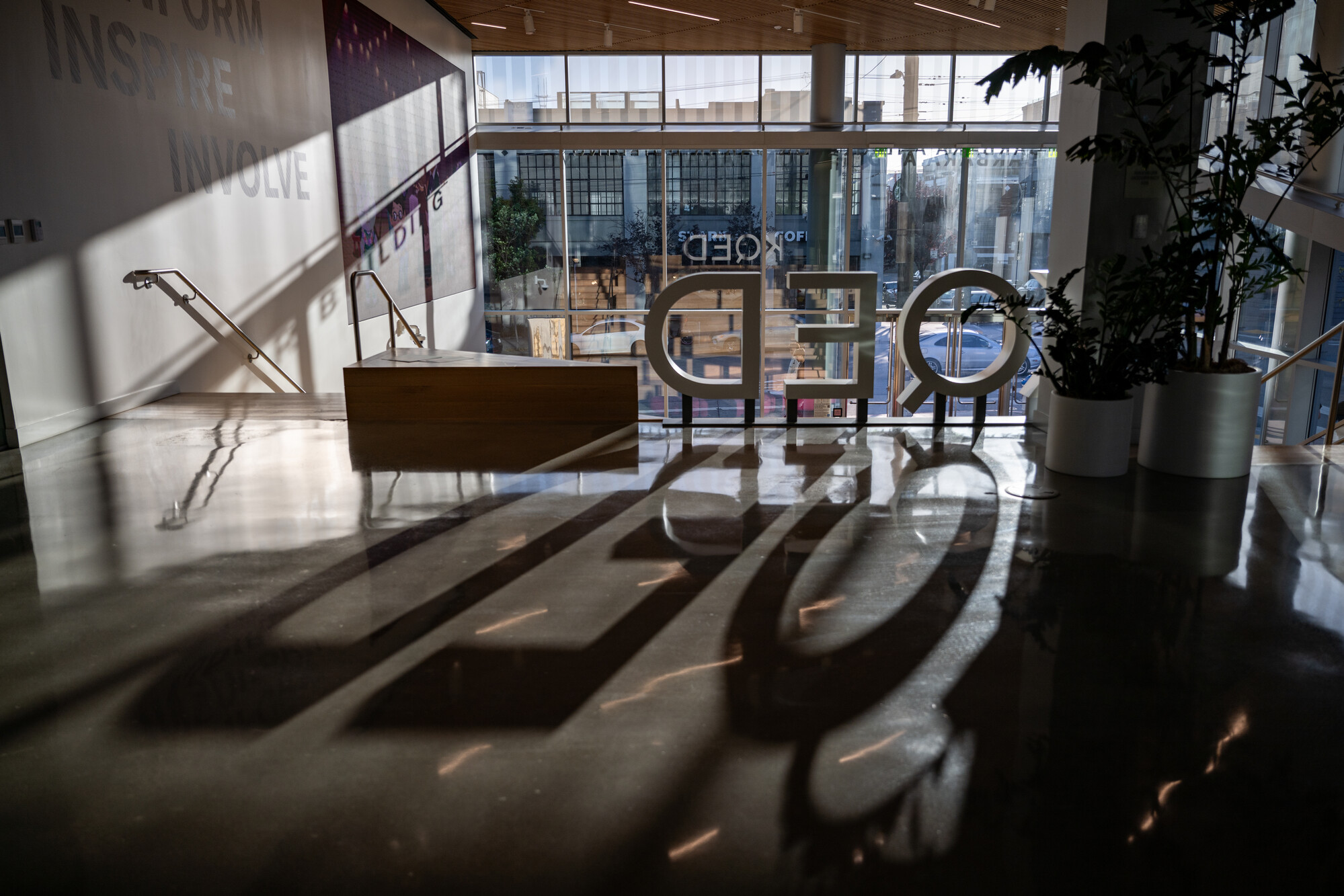
"caption": "A KQED sign in the entrance way to the organization's headquarters in San Francisco on May 22, 2024. The Bay Area media nonprofit is laying off staff for the third time in five years. It comes as the Trump administration aims to cut off federal funding for public media. ",
"credit": "Beth LaBerge/KQED",
"altTag": null,
"description": null,
"imgSizes": {
"thumbnail": {
"file": "https://cdn.kqed.org/wp-content/uploads/sites/10/2025/07/240522-KQEDheadquarters-12-BL_qed-160x107.jpg",
"width": 160,
"height": 107,
"mimeType": "image/jpeg"
},
"1536x1536": {
"file": "https://cdn.kqed.org/wp-content/uploads/sites/10/2025/07/240522-KQEDheadquarters-12-BL_qed-1536x1024.jpg",
"width": 1536,
"height": 1024,
"mimeType": "image/jpeg"
},
"post-thumbnail": {
"file": "https://cdn.kqed.org/wp-content/uploads/sites/10/2025/07/240522-KQEDheadquarters-12-BL_qed-672x372.jpg",
"width": 672,
"height": 372,
"mimeType": "image/jpeg"
},
"twentyfourteen-full-width": {
"file": "https://cdn.kqed.org/wp-content/uploads/sites/10/2025/07/240522-KQEDheadquarters-12-BL_qed-1038x576.jpg",
"width": 1038,
"height": 576,
"mimeType": "image/jpeg"
},
"kqedFullSize": {
"file": "https://cdn.kqed.org/wp-content/uploads/sites/10/2025/07/240522-KQEDheadquarters-12-BL_qed.jpg",
"width": 1999,
"height": 1333
}
},
"isLoading": false,
"fetchFailed": false
},
"news_12000971": {
"type": "attachments",
"id": "news_12000971",
"meta": {
"index": "attachments_1716263798",
"site": "news",
"id": "12000971",
"found": true
},
"title": "UC Berkeley Chancellor Rich Lyons in his office on campus on Aug. 20, 2024.",
"publishDate": 1724185101,
"status": "inherit",
"parent": 0,
"modified": 1724192309,
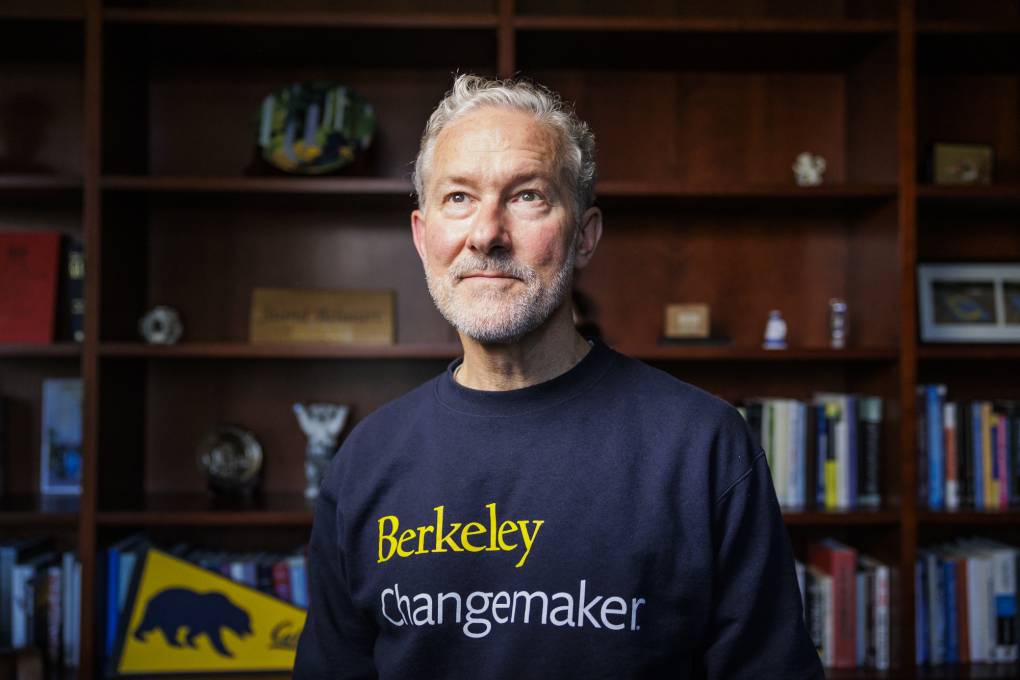
"caption": "UC Berkeley Chancellor Rich Lyons in his office on campus in Berkeley on Aug. 20, 2024.",
"credit": "Martin do Nascimento/KQED",
"altTag": null,
"description": null,
"imgSizes": {
"medium": {
"file": "https://cdn.kqed.org/wp-content/uploads/sites/10/2024/08/240820-UCB-CHANCELLOR-LYONS-MD-03-KQED-800x533.jpg",
"width": 800,
"height": 533,
"mimeType": "image/jpeg"
},
"large": {
"file": "https://cdn.kqed.org/wp-content/uploads/sites/10/2024/08/240820-UCB-CHANCELLOR-LYONS-MD-03-KQED-1020x680.jpg",
"width": 1020,
"height": 680,
"mimeType": "image/jpeg"
},
"thumbnail": {
"file": "https://cdn.kqed.org/wp-content/uploads/sites/10/2024/08/240820-UCB-CHANCELLOR-LYONS-MD-03-KQED-160x107.jpg",
"width": 160,
"height": 107,
"mimeType": "image/jpeg"
},
"1536x1536": {
"file": "https://cdn.kqed.org/wp-content/uploads/sites/10/2024/08/240820-UCB-CHANCELLOR-LYONS-MD-03-KQED-1536x1024.jpg",
"width": 1536,
"height": 1024,
"mimeType": "image/jpeg"
},
"post-thumbnail": {
"file": "https://cdn.kqed.org/wp-content/uploads/sites/10/2024/08/240820-UCB-CHANCELLOR-LYONS-MD-03-KQED-672x372.jpg",
"width": 672,
"height": 372,
"mimeType": "image/jpeg"
},
"twentyfourteen-full-width": {
"file": "https://cdn.kqed.org/wp-content/uploads/sites/10/2024/08/240820-UCB-CHANCELLOR-LYONS-MD-03-KQED-1038x576.jpg",
"width": 1038,
"height": 576,
"mimeType": "image/jpeg"
},
"full-width": {
"file": "https://cdn.kqed.org/wp-content/uploads/sites/10/2024/08/240820-UCB-CHANCELLOR-LYONS-MD-03-KQED-1920x1280.jpg",
"width": 1920,
"height": 1280,
"mimeType": "image/jpeg"
},
"kqedFullSize": {
"file": "https://cdn.kqed.org/wp-content/uploads/sites/10/2024/08/240820-UCB-CHANCELLOR-LYONS-MD-03-KQED.jpg",
"width": 2000,
"height": 1333
}
},
"isLoading": false,
"fetchFailed": false
},
"news_12047902": {
"type": "attachments",
"id": "news_12047902",
"meta": {
"index": "attachments_1716263798",
"site": "news",
"id": "12047902",
"found": true
},
"title": "240418-SJPDFILE-JG-6_qed",
"publishDate": 1752514544,
"status": "inherit",
"parent": 12047900,
"modified": 1763510734,
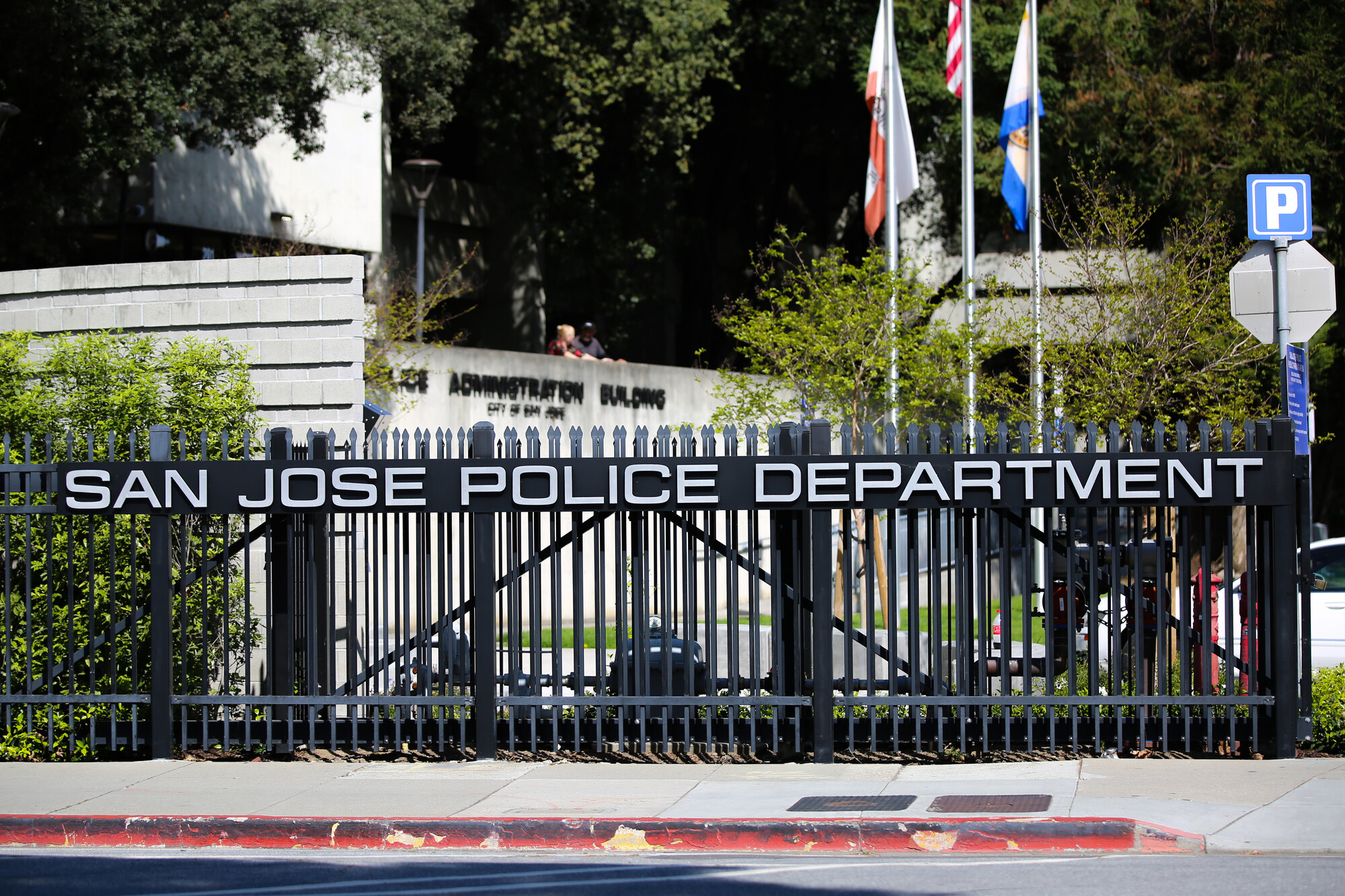
"caption": "The exterior of the San José Police Department headquarters on April 18, 2024.",
"credit": "Joseph Geha/KQED",
"altTag": null,
"description": null,
"imgSizes": {
"thumbnail": {
"file": "https://cdn.kqed.org/wp-content/uploads/sites/10/2025/07/240418-SJPDFILE-JG-6_qed-160x107.jpg",
"width": 160,
"height": 107,
"mimeType": "image/jpeg"
},
"1536x1536": {
"file": "https://cdn.kqed.org/wp-content/uploads/sites/10/2025/07/240418-SJPDFILE-JG-6_qed-1536x1024.jpg",
"width": 1536,
"height": 1024,
"mimeType": "image/jpeg"
},
"post-thumbnail": {
"file": "https://cdn.kqed.org/wp-content/uploads/sites/10/2025/07/240418-SJPDFILE-JG-6_qed-672x372.jpg",
"width": 672,
"height": 372,
"mimeType": "image/jpeg"
},
"twentyfourteen-full-width": {
"file": "https://cdn.kqed.org/wp-content/uploads/sites/10/2025/07/240418-SJPDFILE-JG-6_qed-1038x576.jpg",
"width": 1038,
"height": 576,
"mimeType": "image/jpeg"
},
"kqedFullSize": {
"file": "https://cdn.kqed.org/wp-content/uploads/sites/10/2025/07/240418-SJPDFILE-JG-6_qed.jpg",
"width": 2000,
"height": 1333
}
},
"isLoading": false,
"fetchFailed": false
},
"news_12018297": {
"type": "attachments",
"id": "news_12018297",
"meta": {
"index": "attachments_1716263798",
"site": "news",
"id": "12018297",
"found": true
},
"title": "Half Moon Bay shooting",
"publishDate": 1734134539,
"status": "inherit",
"parent": 12018283,
"modified": 1734134705,
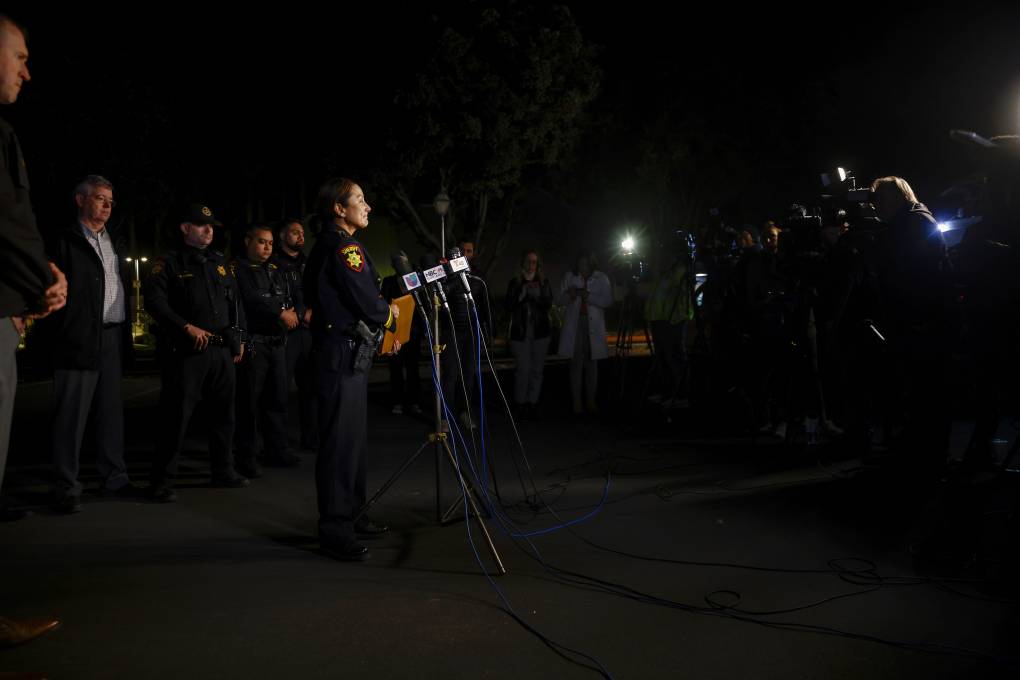
"caption": "San Mateo County Sheriff Christina Corpus speaks during a press conference in downtown Half Moon Bay on Jan. 23, 2023.",
"credit": "Nhat V. Meyer/MediaNews Group/East Bay Times via Getty Images",
"altTag": null,
"description": null,
"imgSizes": {
"medium": {
"file": "https://cdn.kqed.org/wp-content/uploads/sites/10/2024/12/GettyImages-1459218231-800x534.jpg",
"width": 800,
"height": 534,
"mimeType": "image/jpeg"
},
"large": {
"file": "https://cdn.kqed.org/wp-content/uploads/sites/10/2024/12/GettyImages-1459218231-1020x680.jpg",
"width": 1020,
"height": 680,
"mimeType": "image/jpeg"
},
"thumbnail": {
"file": "https://cdn.kqed.org/wp-content/uploads/sites/10/2024/12/GettyImages-1459218231-160x107.jpg",
"width": 160,
"height": 107,
"mimeType": "image/jpeg"
},
"1536x1536": {
"file": "https://cdn.kqed.org/wp-content/uploads/sites/10/2024/12/GettyImages-1459218231-1536x1025.jpg",
"width": 1536,
"height": 1025,
"mimeType": "image/jpeg"
},
"2048x2048": {
"file": "https://cdn.kqed.org/wp-content/uploads/sites/10/2024/12/GettyImages-1459218231-2048x1366.jpg",
"width": 2048,
"height": 1366,
"mimeType": "image/jpeg"
},
"post-thumbnail": {
"file": "https://cdn.kqed.org/wp-content/uploads/sites/10/2024/12/GettyImages-1459218231-672x372.jpg",
"width": 672,
"height": 372,
"mimeType": "image/jpeg"
},
"twentyfourteen-full-width": {
"file": "https://cdn.kqed.org/wp-content/uploads/sites/10/2024/12/GettyImages-1459218231-1038x576.jpg",
"width": 1038,
"height": 576,
"mimeType": "image/jpeg"
},
"full-width": {
"file": "https://cdn.kqed.org/wp-content/uploads/sites/10/2024/12/GettyImages-1459218231-1920x1281.jpg",
"width": 1920,
"height": 1281,
"mimeType": "image/jpeg"
},
"kqedFullSize": {
"file": "https://cdn.kqed.org/wp-content/uploads/sites/10/2024/12/GettyImages-1459218231-scaled-e1741196609411.jpg",
"width": 2000,
"height": 1334
}
},
"isLoading": false,
"fetchFailed": false
},
"news_11966292": {
"type": "attachments",
"id": "news_11966292",
"meta": {
"index": "attachments_1716263798",
"site": "news",
"id": "11966292",
"found": true
},
"parent": 11966281,
"imgSizes": {
"twentyfourteen-full-width": {
"file": "https://ww2.kqed.org/app/uploads/sites/10/2023/11/20230915-SunsetNightMarket-44-JY-qut-1038x576.jpg",
"width": 1038,
"mimeType": "image/jpeg",
"height": 576
},
"thumbnail": {
"file": "https://ww2.kqed.org/app/uploads/sites/10/2023/11/20230915-SunsetNightMarket-44-JY-qut-160x107.jpg",
"width": 160,
"mimeType": "image/jpeg",
"height": 107
},
"post-thumbnail": {
"file": "https://ww2.kqed.org/app/uploads/sites/10/2023/11/20230915-SunsetNightMarket-44-JY-qut-672x372.jpg",
"width": 672,
"mimeType": "image/jpeg",
"height": 372
},
"kqedFullSize": {
"file": "https://ww2.kqed.org/app/uploads/sites/10/2023/11/20230915-SunsetNightMarket-44-JY-qut.jpg",
"width": 1920,
"height": 1280
},
"large": {
"file": "https://ww2.kqed.org/app/uploads/sites/10/2023/11/20230915-SunsetNightMarket-44-JY-qut-1020x680.jpg",
"width": 1020,
"mimeType": "image/jpeg",
"height": 680
},
"1536x1536": {
"file": "https://ww2.kqed.org/app/uploads/sites/10/2023/11/20230915-SunsetNightMarket-44-JY-qut-1536x1024.jpg",
"width": 1536,
"mimeType": "image/jpeg",
"height": 1024
},
"medium": {
"file": "https://ww2.kqed.org/app/uploads/sites/10/2023/11/20230915-SunsetNightMarket-44-JY-qut-800x533.jpg",
"width": 800,
"mimeType": "image/jpeg",
"height": 533
}
},
"publishDate": 1698968908,
"modified": 1698969059,
"caption": "Dozens of people wait in line at Wooly Pig at the Sunset Night market in San Francisco on Friday, Sept. 15, 2023. The market’s inaugural night drew thousands of attendees, who enjoyed shops, food, games and live performances.",
"description": null,
"title": "20230915-SunsetNightMarket-44-JY-qut",
"credit": "Juliana Yamada/KQED",
"status": "inherit",
"altTag": "A bustling night market with food and live performances sees crowds of patrons.",
"isLoading": false,
"fetchFailed": false
},
"news_12047326": {
"type": "attachments",
"id": "news_12047326",
"meta": {
"index": "attachments_1716263798",
"site": "news",
"id": "12047326",
"found": true
},
"title": "JHuffakerTrial6",
"publishDate": 1751994248,
"status": "inherit",
"parent": 0,
"modified": 1751995349,
"caption": "Former Rohnert Park police officer Joseph Huffaker in San Francisco federal court on Monday, July 7, 2025.",
"credit": "Vicki Behringer for KQED",
"altTag": null,
"description": null,
"imgSizes": {
"thumbnail": {
"file": "https://cdn.kqed.org/wp-content/uploads/sites/10/2025/07/JHuffakerTrial6-160x128.jpg",
"width": 160,
"height": 128,
"mimeType": "image/jpeg"
},
"1536x1536": {
"file": "https://cdn.kqed.org/wp-content/uploads/sites/10/2025/07/JHuffakerTrial6-1536x1227.jpg",
"width": 1536,
"height": 1227,
"mimeType": "image/jpeg"
},
"post-thumbnail": {
"file": "https://cdn.kqed.org/wp-content/uploads/sites/10/2025/07/JHuffakerTrial6-672x372.jpg",
"width": 672,
"height": 372,
"mimeType": "image/jpeg"
},
"twentyfourteen-full-width": {
"file": "https://cdn.kqed.org/wp-content/uploads/sites/10/2025/07/JHuffakerTrial6-1038x576.jpg",
"width": 1038,
"height": 576,
"mimeType": "image/jpeg"
},
"kqedFullSize": {
"file": "https://cdn.kqed.org/wp-content/uploads/sites/10/2025/07/JHuffakerTrial6.jpg",
"width": 2000,
"height": 1598
}
},
"isLoading": false,
"fetchFailed": false
},
"news_12047651": {
"type": "attachments",
"id": "news_12047651",
"meta": {
"index": "attachments_1716263798",
"site": "news",
"id": "12047651",
"found": true
},
"title": "Oakland International Airport on April 14, 2020.",
"publishDate": 1752255952,
"status": "inherit",
"parent": 12047645,
"modified": 1752255969,
"caption": "Oakland International Airport on April 14, 2020.",
"credit": "Beth LaBerge/KQED",
"altTag": null,
"description": null,
"imgSizes": {
"thumbnail": {
"file": "https://cdn.kqed.org/wp-content/uploads/sites/10/2025/07/003_KQED_Oakland_Airport_04142020_qed-160x107.jpg",
"width": 160,
"height": 107,
"mimeType": "image/jpeg"
},
"1536x1536": {
"file": "https://cdn.kqed.org/wp-content/uploads/sites/10/2025/07/003_KQED_Oakland_Airport_04142020_qed-1536x1024.jpg",
"width": 1536,
"height": 1024,
"mimeType": "image/jpeg"
},
"post-thumbnail": {
"file": "https://cdn.kqed.org/wp-content/uploads/sites/10/2025/07/003_KQED_Oakland_Airport_04142020_qed-672x372.jpg",
"width": 672,
"height": 372,
"mimeType": "image/jpeg"
},
"twentyfourteen-full-width": {
"file": "https://cdn.kqed.org/wp-content/uploads/sites/10/2025/07/003_KQED_Oakland_Airport_04142020_qed-1038x576.jpg",
"width": 1038,
"height": 576,
"mimeType": "image/jpeg"
},
"kqedFullSize": {
"file": "https://cdn.kqed.org/wp-content/uploads/sites/10/2025/07/003_KQED_Oakland_Airport_04142020_qed.jpg",
"width": 2000,
"height": 1333
}
},
"isLoading": false,
"fetchFailed": false
},
"news_12047671": {
"type": "attachments",
"id": "news_12047671",
"meta": {
"index": "attachments_1716263798",
"site": "news",
"id": "12047671",
"found": true
},
"title": "250710-WoodStreetCabins-05-BL_qed",
"publishDate": 1752258075,
"status": "inherit",
"parent": 0,
"modified": 1752258316,
"caption": "Residents walk through the Wood Street Cabins in Oakland on July 10, 2025, before the city shuts down the temporary tiny-home site, which opened in 2023 to shelter people displaced from a nearby encampment.",
"credit": "Beth LaBerge/KQED",
"altTag": null,
"description": null,
"imgSizes": {
"thumbnail": {
"file": "https://cdn.kqed.org/wp-content/uploads/sites/10/2025/07/250710-WoodStreetCabins-05-BL_qed-160x107.jpg",
"width": 160,
"height": 107,
"mimeType": "image/jpeg"
},
"1536x1536": {
"file": "https://cdn.kqed.org/wp-content/uploads/sites/10/2025/07/250710-WoodStreetCabins-05-BL_qed-1536x1024.jpg",
"width": 1536,
"height": 1024,
"mimeType": "image/jpeg"
},
"post-thumbnail": {
"file": "https://cdn.kqed.org/wp-content/uploads/sites/10/2025/07/250710-WoodStreetCabins-05-BL_qed-672x372.jpg",
"width": 672,
"height": 372,
"mimeType": "image/jpeg"
},
"twentyfourteen-full-width": {
"file": "https://cdn.kqed.org/wp-content/uploads/sites/10/2025/07/250710-WoodStreetCabins-05-BL_qed-1038x576.jpg",
"width": 1038,
"height": 576,
"mimeType": "image/jpeg"
},
"kqedFullSize": {
"file": "https://cdn.kqed.org/wp-content/uploads/sites/10/2025/07/250710-WoodStreetCabins-05-BL_qed.jpg",
"width": 2000,
"height": 1333
}
},
"isLoading": false,
"fetchFailed": false
},
"news_12047614": {
"type": "attachments",
"id": "news_12047614",
"meta": {
"index": "attachments_1716263798",
"site": "news",
"id": "12047614",
"found": true
},
"title": "Traffic is congested in both directions during the peak morning commute on Highway 101 at the southbound Poplar Avenue exit in San Mateo, Calif. on Wednesday, July 13, 2016. Regional transit officials have gathered the necessary funding to begin work on a",
"publishDate": 1752184312,
"status": "inherit",
"parent": 12047579,
"modified": 1752185251,
"caption": "Traffic is congested in both directions during the peak morning commute on Highway 101 at the southbound Poplar Avenue exit in San Mateo, California, on July 13, 2016. ",
"credit": "Paul Chinn/The San Francisco Chronicle via Getty Images",
"altTag": null,
"description": null,
"imgSizes": {
"thumbnail": {
"file": "https://cdn.kqed.org/wp-content/uploads/sites/10/2025/07/Highway101SanMateoGetty-160x108.jpg",
"width": 160,
"height": 108,
"mimeType": "image/jpeg"
},
"1536x1536": {
"file": "https://cdn.kqed.org/wp-content/uploads/sites/10/2025/07/Highway101SanMateoGetty-1536x1034.jpg",
"width": 1536,
"height": 1034,
"mimeType": "image/jpeg"
},
"post-thumbnail": {
"file": "https://cdn.kqed.org/wp-content/uploads/sites/10/2025/07/Highway101SanMateoGetty-672x372.jpg",
"width": 672,
"height": 372,
"mimeType": "image/jpeg"
},
"twentyfourteen-full-width": {
"file": "https://cdn.kqed.org/wp-content/uploads/sites/10/2025/07/Highway101SanMateoGetty-1038x576.jpg",
"width": 1038,
"height": 576,
"mimeType": "image/jpeg"
},
"kqedFullSize": {
"file": "https://cdn.kqed.org/wp-content/uploads/sites/10/2025/07/Highway101SanMateoGetty.jpg",
"width": 2000,
"height": 1346
}
},
"isLoading": false,
"fetchFailed": false
},
"news_12047919": {
"type": "attachments",
"id": "news_12047919",
"meta": {
"index": "attachments_1716263798",
"site": "news",
"id": "12047919",
"found": true
},
"title": "Concepts Save The World and Environmental Issues, Garbage Bags Stacking Storage Against Green Trees Backgrounds. Waste Management",
"publishDate": 1752515742,
"status": "inherit",
"parent": 12047597,
"modified": 1752515766,
"caption": null,
"credit": "KDP/iStock via Getty Images",
"altTag": null,
"description": null,
"imgSizes": {
"thumbnail": {
"file": "https://cdn.kqed.org/wp-content/uploads/sites/10/2025/07/GarbageBagsGetty-160x107.jpg",
"width": 160,
"height": 107,
"mimeType": "image/jpeg"
},
"1536x1536": {
"file": "https://cdn.kqed.org/wp-content/uploads/sites/10/2025/07/GarbageBagsGetty-1536x1025.jpg",
"width": 1536,
"height": 1025,
"mimeType": "image/jpeg"
},
"post-thumbnail": {
"file": "https://cdn.kqed.org/wp-content/uploads/sites/10/2025/07/GarbageBagsGetty-672x372.jpg",
"width": 672,
"height": 372,
"mimeType": "image/jpeg"
},
"twentyfourteen-full-width": {
"file": "https://cdn.kqed.org/wp-content/uploads/sites/10/2025/07/GarbageBagsGetty-1038x576.jpg",
"width": 1038,
"height": 576,
"mimeType": "image/jpeg"
},
"kqedFullSize": {
"file": "https://cdn.kqed.org/wp-content/uploads/sites/10/2025/07/GarbageBagsGetty.jpg",
"width": 2000,
"height": 1334
}
},
"isLoading": false,
"fetchFailed": false
},
"news_12047573": {
"type": "attachments",
"id": "news_12047573",
"meta": {
"index": "attachments_1716263798",
"site": "news",
"id": "12047573",
"found": true
},
"title": "231017-LakeMercedRVs-023-BL_qed",
"publishDate": 1752174460,
"status": "inherit",
"parent": 12047562,
"modified": 1752175079,
"caption": "An SFMTA parking ticket for street cleaning sits on the windshield of an RV along Winston Drive in San Francisco, California, on Oct. 17, 2023, near San Francisco State University.",
"credit": "Beth LaBerge/KQED",
"altTag": null,
"description": null,
"imgSizes": {
"thumbnail": {
"file": "https://cdn.kqed.org/wp-content/uploads/sites/10/2025/07/231017-LakeMercedRVs-023-BL_qed-160x107.jpg",
"width": 160,
"height": 107,
"mimeType": "image/jpeg"
},
"1536x1536": {
"file": "https://cdn.kqed.org/wp-content/uploads/sites/10/2025/07/231017-LakeMercedRVs-023-BL_qed-1536x1024.jpg",
"width": 1536,
"height": 1024,
"mimeType": "image/jpeg"
},
"post-thumbnail": {
"file": "https://cdn.kqed.org/wp-content/uploads/sites/10/2025/07/231017-LakeMercedRVs-023-BL_qed-672x372.jpg",
"width": 672,
"height": 372,
"mimeType": "image/jpeg"
},
"twentyfourteen-full-width": {
"file": "https://cdn.kqed.org/wp-content/uploads/sites/10/2025/07/231017-LakeMercedRVs-023-BL_qed-1038x576.jpg",
"width": 1038,
"height": 576,
"mimeType": "image/jpeg"
},
"kqedFullSize": {
"file": "https://cdn.kqed.org/wp-content/uploads/sites/10/2025/07/231017-LakeMercedRVs-023-BL_qed.jpg",
"width": 2000,
"height": 1333
}
},
"isLoading": false,
"fetchFailed": false
},
"news_12047560": {
"type": "attachments",
"id": "news_12047560",
"meta": {
"index": "attachments_1716263798",
"site": "news",
"id": "12047560",
"found": true
},
"title": "Warm weather in San Francisco",
"publishDate": 1752169948,
"status": "inherit",
"parent": 12047555,
"modified": 1752170148,
"caption": "People enjoying the sun at the Palace of Fine Arts as a heat wave rolls through San Francisco on July 11, 2024. ",
"credit": "Tayfun Coskun/Anadolu via Getty Images",
"altTag": null,
"description": null,
"imgSizes": {
"thumbnail": {
"file": "https://cdn.kqed.org/wp-content/uploads/sites/10/2025/07/Heat-Wave-SF-Getty-160x109.jpg",
"width": 160,
"height": 109,
"mimeType": "image/jpeg"
},
"1536x1536": {
"file": "https://cdn.kqed.org/wp-content/uploads/sites/10/2025/07/Heat-Wave-SF-Getty-1536x1043.jpg",
"width": 1536,
"height": 1043,
"mimeType": "image/jpeg"
},
"post-thumbnail": {
"file": "https://cdn.kqed.org/wp-content/uploads/sites/10/2025/07/Heat-Wave-SF-Getty-672x372.jpg",
"width": 672,
"height": 372,
"mimeType": "image/jpeg"
},
"twentyfourteen-full-width": {
"file": "https://cdn.kqed.org/wp-content/uploads/sites/10/2025/07/Heat-Wave-SF-Getty-1038x576.jpg",
"width": 1038,
"height": 576,
"mimeType": "image/jpeg"
},
"kqedFullSize": {
"file": "https://cdn.kqed.org/wp-content/uploads/sites/10/2025/07/Heat-Wave-SF-Getty.jpg",
"width": 2000,
"height": 1358
}
},
"isLoading": false,
"fetchFailed": false
}
},
"audioPlayerReducer": {
"postId": "stream_live",
"isPaused": true,
"isPlaying": false,
"pfsActive": false,
"pledgeModalIsOpen": true,
"playerDrawerIsOpen": false,
"liveAudioPlayStartedAt": 0,
"liveAudioPlayContext": ""
},
"authorsReducer": {
"slewis": {
"type": "authors",
"id": "8676",
"meta": {
"index": "authors_1716337520",
"id": "8676",
"found": true
},
"name": "Sukey Lewis",
"firstName": "Sukey",
"lastName": "Lewis",
"slug": "slewis",
"email": "slewis@kqed.org",
"display_author_email": true,
"staff_mastheads": [
"news"
],
"title": "KQED Contributor",
"bio": "Sukey Lewis is a criminal justice reporter and host of \u003cem>On Our Watch\u003c/em>, a new podcast from NPR and KQED about the shadow world of police discipline. In 2018, she co-founded the California Reporting Project, a coalition of newsrooms across the state focused on obtaining previously sealed internal affairs records from law enforcement. In addition to her reporting on police accountability, Sukey has investigated the bail bonds industry, California's wildfires and the high cost of prison phone calls. Sukey earned a master's degree in journalism from the University of California at Berkeley. Send news tips to slewis@kqed.org.",
"avatar": "https://secure.gravatar.com/avatar/03fd6b21024f99d8b0a1966654586de7?s=600&d=blank&r=g",
"twitter": "SukeyLewis",
"facebook": null,
"instagram": null,
"linkedin": null,
"sites": [
{
"site": "news",
"roles": [
"author",
"edit_others_posts"
]
}
],
"headData": {
"title": "Sukey Lewis | KQED",
"description": "KQED Contributor",
"ogImgSrc": "https://secure.gravatar.com/avatar/03fd6b21024f99d8b0a1966654586de7?s=600&d=blank&r=g",
"twImgSrc": "https://secure.gravatar.com/avatar/03fd6b21024f99d8b0a1966654586de7?s=600&d=blank&r=g"
},
"isLoading": false,
"link": "/author/slewis"
},
"vrancano": {
"type": "authors",
"id": "11276",
"meta": {
"index": "authors_1716337520",
"id": "11276",
"found": true
},
"name": "Vanessa Rancaño",
"firstName": "Vanessa",
"lastName": "Rancaño",
"slug": "vrancano",
"email": "vrancano@kqed.org",
"display_author_email": false,
"staff_mastheads": [
"news"
],
"title": "Reporter",
"bio": "Vanessa Rancaño is a features reporter for KQED. She’s also covered homelessness and education for the station and reported from the Central Valley. Her work has aired across public radio, from flagship national news shows to longform narrative podcasts. Before taking up a mic, she worked as a freelance print journalist. She’s been recognized with a number of national and regional awards. Vanessa grew up in California's Central Valley. She's a former NPR Kroc Fellow, and a graduate of the UC Berkeley Graduate School of Journalism.",
"avatar": "https://secure.gravatar.com/avatar/b3a383dfb0e7ee1c17568f2cf067904ab654d6e3de9743fc661f3c788ade1bed?s=600&d=blank&r=g",
"twitter": "vanessarancano",
"bluesky": null,
"facebook": null,
"instagram": null,
"linkedin": null,
"sites": [
{
"site": "arts",
"roles": [
"editor"
]
},
{
"site": "news",
"roles": [
"editor"
]
},
{
"site": "liveblog",
"roles": [
"contributor"
]
}
],
"headData": {
"title": "Vanessa Rancaño | KQED",
"description": "Reporter",
"ogImgSrc": "https://secure.gravatar.com/avatar/b3a383dfb0e7ee1c17568f2cf067904ab654d6e3de9743fc661f3c788ade1bed?s=600&d=blank&r=g",
"twImgSrc": "https://secure.gravatar.com/avatar/b3a383dfb0e7ee1c17568f2cf067904ab654d6e3de9743fc661f3c788ade1bed?s=600&d=blank&r=g"
},
"isLoading": false,
"link": "/author/vrancano"
},
"abandlamudi": {
"type": "authors",
"id": "11672",
"meta": {
"index": "authors_1716337520",
"id": "11672",
"found": true
},
"name": "Adhiti Bandlamudi",
"firstName": "Adhiti",
"lastName": "Bandlamudi",
"slug": "abandlamudi",
"email": "abandlamudi@kqed.org",
"display_author_email": false,
"staff_mastheads": [
"news"
],
"title": "KQED Housing Reporter",
"bio": "Adhiti Bandlamudi reports for KQED's Housing desk. She focuses on how housing gets built across the Bay Area. Before joining KQED in 2020, she reported for WUNC in Durham, North Carolina, WABE in Atlanta, Georgia and Capital Public Radio in Sacramento. In 2017, she was awarded a Kroc Fellowship at NPR where she reported on everything from sprinkles to the Golden State Killer's arrest. When she's not reporting, she's baking new recipes in her kitchen or watching movies with friends and family. She's originally from Georgia and has strong opinions about Great British Bake Off.",
"avatar": "https://secure.gravatar.com/avatar/868129c8b257bb99a3500e2c86a65400?s=600&d=mm&r=g",
"twitter": "oddity_adhiti",
"facebook": null,
"instagram": null,
"linkedin": null,
"sites": [
{
"site": "arts",
"roles": [
"author"
]
},
{
"site": "news",
"roles": [
"editor"
]
},
{
"site": "liveblog",
"roles": [
"author"
]
}
],
"headData": {
"title": "Adhiti Bandlamudi | KQED",
"description": "KQED Housing Reporter",
"ogImgSrc": "https://secure.gravatar.com/avatar/868129c8b257bb99a3500e2c86a65400?s=600&d=mm&r=g",
"twImgSrc": "https://secure.gravatar.com/avatar/868129c8b257bb99a3500e2c86a65400?s=600&d=mm&r=g"
},
"isLoading": false,
"link": "/author/abandlamudi"
},
"adahlstromeckman": {
"type": "authors",
"id": "11785",
"meta": {
"index": "authors_1716337520",
"id": "11785",
"found": true
},
"name": "Azul Dahlstrom-Eckman",
"firstName": "Azul",
"lastName": "Dahlstrom-Eckman",
"slug": "adahlstromeckman",
"email": "adahlstrom-eckman@kqed.org",
"display_author_email": true,
"staff_mastheads": [],
"title": "Reporter",
"bio": "Azul is a reporter for KQED focusing on transportation and features. He joined KQED in 2021 as an alumna of KALW's Audio Academy radio journalism training program.",
"avatar": "https://secure.gravatar.com/avatar/9cb750298435add7815a777f55bf1f46845c1386bb8452555c60a7b820b5aba3?s=600&d=blank&r=g",
"twitter": "@zuliemann",
"bluesky": "@azul415.bsky.social",
"facebook": null,
"instagram": null,
"linkedin": null,
"sites": [
{
"site": "arts",
"roles": [
"editor"
]
},
{
"site": "news",
"roles": [
"editor"
]
},
{
"site": "science",
"roles": [
"editor"
]
},
{
"site": "liveblog",
"roles": [
"author"
]
}
],
"headData": {
"title": "Azul Dahlstrom-Eckman | KQED",
"description": "Reporter",
"ogImgSrc": "https://secure.gravatar.com/avatar/9cb750298435add7815a777f55bf1f46845c1386bb8452555c60a7b820b5aba3?s=600&d=blank&r=g",
"twImgSrc": "https://secure.gravatar.com/avatar/9cb750298435add7815a777f55bf1f46845c1386bb8452555c60a7b820b5aba3?s=600&d=blank&r=g"
},
"isLoading": false,
"link": "/author/adahlstromeckman"
},
"jgeha": {
"type": "authors",
"id": "11906",
"meta": {
"index": "authors_1716337520",
"id": "11906",
"found": true
},
"name": "Joseph Geha",
"firstName": "Joseph",
"lastName": "Geha",
"slug": "jgeha",
"email": "jgeha@kqed.org",
"display_author_email": false,
"staff_mastheads": [
"news",
"science"
],
"title": "KQED Contributor",
"bio": null,
"avatar": "https://secure.gravatar.com/avatar/ea84d2b6dd93d6369d453edf19dd583f117cd1759d2d9c9c92f9de77017354fe?s=600&d=blank&r=g",
"twitter": null,
"bluesky": null,
"facebook": null,
"instagram": null,
"linkedin": null,
"sites": [
{
"site": "news",
"roles": [
"editor"
]
},
{
"site": "liveblog",
"roles": [
"author"
]
}
],
"headData": {
"title": "Joseph Geha | KQED",
"description": "KQED Contributor",
"ogImgSrc": "https://secure.gravatar.com/avatar/ea84d2b6dd93d6369d453edf19dd583f117cd1759d2d9c9c92f9de77017354fe?s=600&d=blank&r=g",
"twImgSrc": "https://secure.gravatar.com/avatar/ea84d2b6dd93d6369d453edf19dd583f117cd1759d2d9c9c92f9de77017354fe?s=600&d=blank&r=g"
},
"isLoading": false,
"link": "/author/jgeha"
},
"kdebenedetti": {
"type": "authors",
"id": "11913",
"meta": {
"index": "authors_1716337520",
"id": "11913",
"found": true
},
"name": "Katie DeBenedetti",
"firstName": "Katie",
"lastName": "DeBenedetti",
"slug": "kdebenedetti",
"email": "kdebenedetti@kqed.org",
"display_author_email": false,
"staff_mastheads": [
"news",
"science"
],
"title": "KQED Contributor",
"bio": "Katie DeBenedetti is a digital reporter covering daily news for the Express Desk. Prior to joining KQED as a culture reporting intern in January 2024, she covered education and city government for the Napa Valley Register.",
"avatar": "https://secure.gravatar.com/avatar/6e31073cb8f7e4214ab03f42771d0f45?s=600&d=blank&r=g",
"twitter": null,
"facebook": null,
"instagram": null,
"linkedin": null,
"sites": [
{
"site": "news",
"roles": [
"author"
]
},
{
"site": "science",
"roles": [
"author"
]
},
{
"site": "liveblog",
"roles": [
"author"
]
}
],
"headData": {
"title": "Katie DeBenedetti | KQED",
"description": "KQED Contributor",
"ogImgSrc": "https://secure.gravatar.com/avatar/6e31073cb8f7e4214ab03f42771d0f45?s=600&d=blank&r=g",
"twImgSrc": "https://secure.gravatar.com/avatar/6e31073cb8f7e4214ab03f42771d0f45?s=600&d=blank&r=g"
},
"isLoading": false,
"link": "/author/kdebenedetti"
},
"slim": {
"type": "authors",
"id": "11920",
"meta": {
"index": "authors_1716337520",
"id": "11920",
"found": true
},
"name": "Samantha Lim",
"firstName": "Samantha",
"lastName": "Lim",
"slug": "slim",
"email": "slim@KQED.org",
"display_author_email": false,
"staff_mastheads": [],
"title": "KQED Contributor",
"bio": null,
"avatar": "https://secure.gravatar.com/avatar/82e592e6c15fe1a04d385e8ad0fb0b4e?s=600&d=blank&r=g",
"twitter": null,
"facebook": null,
"instagram": null,
"linkedin": null,
"sites": [
{
"site": "news",
"roles": []
}
],
"headData": {
"title": "Samantha Lim | KQED",
"description": "KQED Contributor",
"ogImgSrc": "https://secure.gravatar.com/avatar/82e592e6c15fe1a04d385e8ad0fb0b4e?s=600&d=blank&r=g",
"twImgSrc": "https://secure.gravatar.com/avatar/82e592e6c15fe1a04d385e8ad0fb0b4e?s=600&d=blank&r=g"
},
"isLoading": false,
"link": "/author/slim"
},
"gzada": {
"type": "authors",
"id": "11929",
"meta": {
"index": "authors_1716337520",
"id": "11929",
"found": true
},
"name": "Gilare Zada",
"firstName": "Gilare",
"lastName": "Zada",
"slug": "gzada",
"email": "gzada@kqed.org",
"display_author_email": true,
"staff_mastheads": [
"news"
],
"title": null,
"bio": "Gilare Zada is a Kurdish-American from San Diego, CA. Storytelling, fitness, and binge reading are some of her passions outside of news reporting. Her work has appeared in Mission Local, the Peninsula Press, the San Francisco Press Club, and more. She also writes as a class correspondent for the Stanford Magazine - go Card!",
"avatar": "https://secure.gravatar.com/avatar/33a75f2b947669a488a805edec3fbf3838c1cedaedda710e983770633b4d6a75?s=600&d=blank&r=g",
"twitter": null,
"bluesky": null,
"facebook": null,
"instagram": null,
"linkedin": null,
"sites": [
{
"site": "",
"roles": [
"editor"
]
},
{
"site": "arts",
"roles": [
"editor"
]
},
{
"site": "news",
"roles": [
"administrator"
]
},
{
"site": "science",
"roles": [
"editor"
]
}
],
"headData": {
"title": "Gilare Zada | KQED",
"description": null,
"ogImgSrc": "https://secure.gravatar.com/avatar/33a75f2b947669a488a805edec3fbf3838c1cedaedda710e983770633b4d6a75?s=600&d=blank&r=g",
"twImgSrc": "https://secure.gravatar.com/avatar/33a75f2b947669a488a805edec3fbf3838c1cedaedda710e983770633b4d6a75?s=600&d=blank&r=g"
},
"isLoading": false,
"link": "/author/gzada"
}
},
"pagesReducer": {
"news_category_local": {
"type": "terms",
"id": "news_28250",
"meta": {
"index": "terms_1716263798",
"site": "news",
"id": "28250",
"score": 12.940365
},
"featImg": null,
"name": "Local",
"description": null,
"taxonomy": "category",
"headData": {
"twImgId": null,
"twTitle": null,
"ogTitle": null,
"ogImgId": null,
"twDescription": null,
"description": null,
"title": "Local Archives | KQED News",
"ogDescription": null
},
"ttid": 28267,
"slug": "local",
"isLoading": false,
"title": "Local",
"pageMeta": {
"site": "news",
"WpPageTemplate": "page-topic-editorial",
"currentPage": 105
},
"blocks": [
{
"blockName": "kqed/post-list",
"attrs": {
"layout": "cardArticle2",
"query": "posts/news?category=local",
"seeMore": false,
"paginated": true,
"page": 105
}
},
{
"blockName": "kqed/ad"
}
]
}
},
"pfsSessionReducer": {},
"postsReducer": {
"stream_live": {
"type": "live",
"id": "stream_live",
"audioUrl": "https://streams.kqed.org/kqedradio",
"title": "Live Stream",
"excerpt": "Live Stream information currently unavailable.",
"link": "/radio",
"featImg": "",
"label": {
"name": "KQED Live",
"link": "/"
}
},
"stream_kqedNewscast": {
"type": "posts",
"id": "stream_kqedNewscast",
"audioUrl": "https://www.kqed.org/.stream/anon/radio/RDnews/newscast.mp3?_=1",
"title": "KQED Newscast",
"featImg": "",
"label": {
"name": "88.5 FM",
"link": "/"
}
},
"news_12048122": {
"type": "posts",
"id": "news_12048122",
"meta": {
"index": "posts_1716263798",
"site": "news",
"id": "12048122",
"score": null,
"sort": [
1752621279000
]
},
"guestAuthors": [],
"slug": "kqed-to-slash-workforce-by-15-cutting-dozens-of-jobs-in-latest-round-of-layoffs",
"title": "KQED to Slash Workforce by 15%, Cutting Dozens of Jobs in Latest Round of Layoffs",
"publishDate": 1752621279,
"format": "standard",
"headTitle": "KQED to Slash Workforce by 15%, Cutting Dozens of Jobs in Latest Round of Layoffs | KQED",
"labelTerm": {
"site": "news"
},
"content": "\u003cp>\u003cem>Updated at 6:15 p.m.\u003c/em>\u003c/p>\n\u003cp>KQED announced Tuesday it’s laying off 45 people and losing 12 more who took voluntary departure offers, marking a 15% reduction in staff as the organization faces a significant budget shortfall and \u003ca href=\"https://www.kqed.org/news/12048108/will-congress-cut-funds-to-npr-pbs-and-foreign-aid-this-week\">mounting financial uncertainty\u003c/a>.\u003c/p>\n\u003cp>It’s the third round of layoffs in five years for one of the most-listened-to public radio stations in the country and comes as federal funding for public media is under threat.\u003c/p>\n\u003cp>The cuts impact every level of the organization, from top executives to custodial staff, but content-producing departments account for nearly three-quarters of them. KQED is disbanding its digital video team and slashing its education department, which produces media literacy curriculum, as part of a plan to sharpen its focus on local news and community events.\u003c/p>\n\u003cp>“In these uncertain times, the prudent, responsible thing to do is address what we have control over and to stabilize the organization so we can better navigate whatever challenges and uncertainty comes our way,” President and CEO Michael Isip said.\u003c/p>\n\u003cp>[ad fullwidth]\u003c/p>\n\u003cp>KQED is operating at a $12 million deficit in the current fiscal year. The reductions are expected to bring down the shortfall by about 90% going into next year, Isip said.\u003c/p>\n\u003cp>In addition to paring back its staff, the nonprofit said it will stop contributing to employees’ retirement accounts and freeze salary increases beginning this fall. The current plan is to restart both next year.\u003c/p>\n\u003cp>Leaders with the unions representing many of KQED’s workers said the company will have to negotiate before freezing pay for union members.\u003c/p>\n\u003cp>A spokesperson for the Screen Actors Guild-American Federation of Television and Radio Artists (SAG-AFTRA), which represents radio, digital news and podcast employees, said in a statement that the union is “committed to protecting the rights of our members in accordance with our collective bargaining agreements and ensuring that those impacted are treated fairly and equitably.”\u003c/p>\n\u003cfigure id=\"attachment_11987511\" class=\"wp-caption aligncenter\" style=\"max-width: 1920px\">\u003cimg loading=\"lazy\" decoding=\"async\" class=\"size-full wp-image-11987511\" src=\"https://cdn.kqed.org/wp-content/uploads/sites/10/2024/05/240522-KQEDheadquarters-10-BL_qut.jpg\" alt=\"\" width=\"1920\" height=\"1280\" srcset=\"https://cdn.kqed.org/wp-content/uploads/sites/10/2024/05/240522-KQEDheadquarters-10-BL_qut.jpg 1920w, https://cdn.kqed.org/wp-content/uploads/sites/10/2024/05/240522-KQEDheadquarters-10-BL_qut-800x533.jpg 800w, https://cdn.kqed.org/wp-content/uploads/sites/10/2024/05/240522-KQEDheadquarters-10-BL_qut-1020x680.jpg 1020w, https://cdn.kqed.org/wp-content/uploads/sites/10/2024/05/240522-KQEDheadquarters-10-BL_qut-160x107.jpg 160w, https://cdn.kqed.org/wp-content/uploads/sites/10/2024/05/240522-KQEDheadquarters-10-BL_qut-1536x1024.jpg 1536w\" sizes=\"auto, (max-width: 1920px) 100vw, 1920px\">\u003cfigcaption class=\"wp-caption-text\">A KQED sign in the lobby of the organization’s headquarters in San Francisco. \u003ccite>(Beth LaBerge/KQED)\u003c/cite>\u003c/figcaption>\u003c/figure>\n\u003cp>The cuts whittle KQED’s workforce to 312, down from 369 full-time employees. An additional 10 vacant positions will go unfilled.\u003c/p>\n\u003cp>Four senior leaders are among those leaving the company, including Chief Operations and Administrative Officer Maria Miller and Chief Diversity, Equity & Inclusion Officer Eric Abrams. Isip said they were “mutual agreements that this was a good time for them to transition,” and he added that Abrams’ departure was not a response to pressure from the Trump administration to roll back DEI initiatives.\u003c/p>\n\u003cp>Petrice Gaskin, KQED’s director of mid-level giving who worked with Abrams as co-chair of the organization’s DEI council, lamented the optics of losing him in this climate. “At the same time, we acknowledge that this is a tough time period for everyone,” she said, “we’re really fighting for survival here.”\u003c/p>\n\u003cp>She credited Abrams with building a healthier culture at KQED, in part by making space to navigate difficult conversations. “KQED as a whole, people want to be nice and kind, but sometimes being nice gets in the way of addressing difficult topics that have to be unpacked that aren’t nice,” she said.\u003c/p>\n\u003ch2>‘Devastating’ cuts to some teams\u003c/h2>\n\u003cp>KQED’s education department is among those hardest hit; it’s losing eight of its 13 regular members. “It’s pretty devastating. The folks who we are losing … every single one of them has contributed to the success of our work in pretty significant ways,” said Michelle Parker, executive director of education.\u003c/p>\n\u003cp>The cuts mean listeners won’t hear as many young voices on the airwaves, and staff won’t see clusters of teens around the studio each year during \u003ca href=\"https://www.kqed.org/youthtakeover\">Youth Takeover\u003c/a> week, as the station is ending the eight-year-old tradition of giving swaths of airtime over to local youth once a year. The department will still help young people produce and publish media through the Youth Media Challenge showcase.\u003c/p>\n\u003cp>“We are still committed to youth voice, and we will still continue to do it in the best ways we can with the resources we have for as long as we are allowed to do that,” Parker said.[aside postID=news_11987176 hero='https://cdn.kqed.org/wp-content/uploads/sites/10/2024/05/KQED_Expansion_web_3_1000x600.jpg.png']The small remaining team will provide fewer educator workshops and less curriculum development than in the past, but it will keep professional development courses for K–12 teachers available through the \u003ca href=\"https://teach.kqed.org/\">KQED Teach platform\u003c/a>.\u003c/p>\n\u003cp>In dissolving its digital video team, the organization is focusing its online video offerings on expanding the audiences of existing shows and podcasts.\u003c/p>\n\u003cp>“We are really rethinking digital video,” Editor in Chief Ethan Toven-Lindsey said. “In terms of our local and news growth, it made sense for [the team] to be disbanded and to not have this separate, standalone unit, but to be integrated into different units.”\u003c/p>\n\u003cp>The station’s call-in radio show, Forum, already \u003ca href=\"https://video.kqed.org/show/kqedforum/\">produces videos\u003c/a> that stream on KQED’s website and YouTube, while its Political Breakdown podcast team is considering making its own video content. “That’s the map,” Toven-Lindsey said.\u003c/p>\n\u003cp>The digital video team’s work had centered on the often \u003ca href=\"https://www.kqed.org/pressroom/11550/kqed-receives-seven-northern-california-emmy-awards\">Emmy-lauded\u003c/a> Deep Look and other resource-intensive programs. Now, just two members of the 13-person team will remain at KQED, with one of them reporting to newsroom leadership. A scaled-back version of Deep Look will live on.\u003c/p>\n\u003cp>Separate from the reductions, Chief Content Officer \u003ca href=\"https://wpln.org/post/nashville-public-radio-names-holly-kernan-of-kqed-as-president-and-ceo/\">Holly Kernan left last month to become CEO of Nashville Public Radio\u003c/a>. Rather than replace her, Isip named Toven-Lindsey editor in chief, a new position.\u003c/p>\n\u003cp>“It’s an indication that KQED’s future sustainability, our future strategy, our future growth — the backbone is local news,” Toven-Lindsey said.\u003c/p>\n\u003cp>Six of the staff cuts will come from the newsroom, including four layoffs and two people who took voluntary departure offers.\u003c/p>\n\u003cp>Sarah Augusta, who took the buyout offer after six years with KQED’s fundraising team, said she “decided to make a total right angle career switch” and open an independent bookstore in Martinez this fall.\u003c/p>\n\u003cp>While she said her team, which works with some of the organization’s largest donors, at times felt under-resourced, she added that “this place also attracts some of the most fascinating, interesting, creative people I’ve ever worked with.”\u003c/p>\n\u003ch2>A volatile financial picture\u003c/h2>\n\u003cp>The station has been running a board-approved deficit since 2022. Based on revenue projections at the time, leadership expected to get back in the black by fiscal year 2027, according to a KQED spokesperson. The timeline banked on revenue growth of 2.4% a year, but it’s only grown 1.3%.\u003c/p>\n\u003cp>Board chair Jennifer Cabalquinto said the broader economic situation has thrown those projections out the window. “The volatility is very real, and that’s really impacted the revenue sources,” she said, noting that the threat of losing federal funding compounds the picture. “It’s a double whammy.”\u003c/p>\n\u003cp>The Trump administration is working on multiple fronts to gut federal support for public media. \u003ca href=\"https://www.npr.org/2025/07/15/g-s1-77572/npr-pbs-funding-rescission-congress\">The Senate faces a Friday deadline\u003c/a> to decide whether to claw back $1.1 billion appropriated for the Corporation for Public Broadcasting, a move already approved by the House of Representatives.\u003c/p>\n\u003cp>Last year, \u003ca href=\"https://www.kqed.org/community-report#financials\">KQED received $7.6 million from CPB\u003c/a>. If that’s pulled, Cabalquinto said the organization would likely rely on cash reserves in the short term.\u003c/p>\n\u003cp>Meanwhile, NPR and PBS are suing Trump to block \u003ca href=\"https://www.whitehouse.gov/presidential-actions/2025/05/ending-taxpayer-subsidization-of-biased-media/\">an executive order\u003c/a> that aims to cut off their federal funding, and the Federal Communications Commission is investigating the underwriting practices of local member stations — a move that Isip said has had “a chilling effect” among some corporate sponsors.\u003c/p>\n\u003cp>KQED’s financial troubles stem from the organization’s growth in recent years, driven by multimillion-dollar investments, and sluggish revenue growth can no longer support its size. But they are also indicative of the existential challenges bearing down on the nation’s public media system and news industry writ large.\u003c/p>\n\u003cp>New economic headwinds are contributing to a longstanding struggle to find financial footing in a digital environment.\u003c/p>\n\u003cp>“It wasn’t just one thing that’s causing this deficit, it’s multiple investments in growing our service,” Isip said.\u003c/p>\n\u003cp>Between 2013 and 2018, the nonprofit added 60 employees, mostly focused on digital services, according to Isip. During that period, the education department nearly tripled in size, he said, and the station added journalists, building among the largest nonprofit newsrooms in the country.\u003c/p>\n\u003cp>“We had to do that,” Isip said. “Broadcast audiences are declining. If we didn’t expand into new areas, that would threaten our future and our relevancy to our audiences moving forward.”\u003c/p>\n\u003cp>The growth was made possible in part by $45 million in one-time money from \u003ca href=\"https://www.kqed.org/campaign21\">a fundraising campaign\u003c/a> that also bankrolled a \u003ca href=\"https://www.kqed.org/pressroom/11576/kqed-plan-for-opening\">$94 million building renovation\u003c/a>, and station leaders were betting that expanding services would boost the station’s audience, bringing an uptick in ongoing revenue to follow.\u003c/p>\n\u003cp>“That has been the case,” Isip said. “But our financial support has not grown at the same rate as our expense growth.”\u003c/p>\n\u003cp>Carrie Biggs-Adams, president of NABET Local 51, which represents the company’s radio and television engineers, among many other employees, voiced concerns about leaders’ management of KQED’s assets.\u003c/p>\n\u003cp>“It’s just stunning to have this happen in a place that had so much money a few years ago,” she said. Four NABET members are being laid off, according to Biggs-Adams.\u003c/p>\n\u003cp>Over the past eight years, KQED’s revenue has grown by 3.2%, while expenses have risen 4.7%, Isip said.\u003c/p>\n\u003cp>He blamed a number of factors, including the effects of the COVID-19 pandemic. While individual donations from community members are strong — the May pledge drive brought in an annualized total of about $1.9 million, and the February drive brought in $2.3 million, the biggest since 2018 — corporate sponsorship and underwriting have “softened,” Isip said. Funding from foundations and grants is about flat, he added.\u003c/p>\n\u003cp>Last year, \u003ca href=\"https://www.kqed.org/news/11987509/kqed-cuts-34-positions-amid-budget-shortfall\">the company eliminated 34 positions\u003c/a> amid other cuts, with leadership again citing rising costs and flagging expenses. In 2020, it \u003ca href=\"https://www.kqed.org/news/11832855/kqed-announces-layoffs-blames-coronavirus-pandemic-for-budget-shortfall\">laid off 20 employees\u003c/a>.\u003c/p>\n\u003cp>\u003cem>This story was reported and written by KQED reporter Vanessa Rancaño and edited by KQED’s Jared Servantez. Under KQED’s standard practices for reporting on itself, no member of KQED management or its news executives reviewed this story before it was posted publicly.\u003c/em>\u003c/p>\n\u003cp>[ad floatright]\u003c/p>\n",
"blocks": [],
"excerpt": "The Bay Area media nonprofit is laying off staff for the third time in five years. It comes as the Trump administration aims to cut off federal funding for public media. ",
"status": "publish",
"parent": 0,
"modified": 1752628852,
"stats": {
"hasAudio": false,
"hasVideo": false,
"hasChartOrMap": false,
"iframeSrcs": [],
"hasGoogleForm": false,
"hasGallery": false,
"hasHearkenModule": false,
"hasPolis": false,
"paragraphCount": 45,
"wordCount": 1841
},
"headData": {
"title": "KQED to Slash Workforce by 15%, Cutting Dozens of Jobs in Latest Round of Layoffs | KQED",
"description": "The Bay Area media nonprofit is laying off staff for the third time in five years. It comes as the Trump administration aims to cut off federal funding for public media. ",
"ogTitle": "",
"ogDescription": "",
"ogImgId": "",
"twTitle": "",
"twDescription": "",
"twImgId": "",
"schema": {
"@context": "https://schema.org",
"@type": "NewsArticle",
"headline": "KQED to Slash Workforce by 15%, Cutting Dozens of Jobs in Latest Round of Layoffs",
"datePublished": "2025-07-15T16:14:39-07:00",
"dateModified": "2025-07-15T18:20:52-07:00",
"image": "https://cdn.kqed.org/wp-content/uploads/2020/02/KQED-OG-Image@1x.png",
"isAccessibleForFree": "True",
"publisher": {
"@type": "NewsMediaOrganization",
"@id": "https://www.kqed.org/#organization",
"name": "KQED",
"logo": "https://cdn.kqed.org/wp-content/uploads/2020/02/KQED-OG-Image@1x.png",
"url": "https://www.kqed.org",
"sameAs": [
"https://www.facebook.com/KQED",
"https://twitter.com/KQED",
"https://www.instagram.com/kqed/",
"https://www.tiktok.com/@kqedofficial",
"https://www.linkedin.com/company/kqed",
"https://www.youtube.com/channel/UCeC0IOo7i1P_61zVUWbJ4nw"
]
}
}
},
"primaryCategory": {
"termId": 8,
"slug": "news",
"name": "News"
},
"sticky": false,
"nprStoryId": "kqed-12048122",
"templateType": "standard",
"featuredImageType": "standard",
"excludeFromSiteSearch": "Include",
"articleAge": "0",
"path": "/news/12048122/kqed-to-slash-workforce-by-15-cutting-dozens-of-jobs-in-latest-round-of-layoffs",
"audioTrackLength": null,
"parsedContent": [
{
"type": "contentString",
"content": "\u003cdiv class=\"post-body\">\u003cp>\u003cp>\u003cem>Updated at 6:15 p.m.\u003c/em>\u003c/p>\n\u003cp>KQED announced Tuesday it’s laying off 45 people and losing 12 more who took voluntary departure offers, marking a 15% reduction in staff as the organization faces a significant budget shortfall and \u003ca href=\"https://www.kqed.org/news/12048108/will-congress-cut-funds-to-npr-pbs-and-foreign-aid-this-week\">mounting financial uncertainty\u003c/a>.\u003c/p>\n\u003cp>It’s the third round of layoffs in five years for one of the most-listened-to public radio stations in the country and comes as federal funding for public media is under threat.\u003c/p>\n\u003cp>The cuts impact every level of the organization, from top executives to custodial staff, but content-producing departments account for nearly three-quarters of them. KQED is disbanding its digital video team and slashing its education department, which produces media literacy curriculum, as part of a plan to sharpen its focus on local news and community events.\u003c/p>\n\u003cp>“In these uncertain times, the prudent, responsible thing to do is address what we have control over and to stabilize the organization so we can better navigate whatever challenges and uncertainty comes our way,” President and CEO Michael Isip said.\u003c/p>\n\u003cp>\u003c/p>\u003c/div>",
"attributes": {
"named": {},
"numeric": []
}
},
{
"type": "component",
"content": "",
"name": "ad",
"attributes": {
"named": {
"label": "fullwidth"
},
"numeric": [
"fullwidth"
]
}
},
{
"type": "contentString",
"content": "\u003cdiv class=\"post-body\">\u003cp>\u003c/p>\n\u003cp>KQED is operating at a $12 million deficit in the current fiscal year. The reductions are expected to bring down the shortfall by about 90% going into next year, Isip said.\u003c/p>\n\u003cp>In addition to paring back its staff, the nonprofit said it will stop contributing to employees’ retirement accounts and freeze salary increases beginning this fall. The current plan is to restart both next year.\u003c/p>\n\u003cp>Leaders with the unions representing many of KQED’s workers said the company will have to negotiate before freezing pay for union members.\u003c/p>\n\u003cp>A spokesperson for the Screen Actors Guild-American Federation of Television and Radio Artists (SAG-AFTRA), which represents radio, digital news and podcast employees, said in a statement that the union is “committed to protecting the rights of our members in accordance with our collective bargaining agreements and ensuring that those impacted are treated fairly and equitably.”\u003c/p>\n\u003cfigure id=\"attachment_11987511\" class=\"wp-caption aligncenter\" style=\"max-width: 1920px\">\u003cimg loading=\"lazy\" decoding=\"async\" class=\"size-full wp-image-11987511\" src=\"https://cdn.kqed.org/wp-content/uploads/sites/10/2024/05/240522-KQEDheadquarters-10-BL_qut.jpg\" alt=\"\" width=\"1920\" height=\"1280\" srcset=\"https://cdn.kqed.org/wp-content/uploads/sites/10/2024/05/240522-KQEDheadquarters-10-BL_qut.jpg 1920w, https://cdn.kqed.org/wp-content/uploads/sites/10/2024/05/240522-KQEDheadquarters-10-BL_qut-800x533.jpg 800w, https://cdn.kqed.org/wp-content/uploads/sites/10/2024/05/240522-KQEDheadquarters-10-BL_qut-1020x680.jpg 1020w, https://cdn.kqed.org/wp-content/uploads/sites/10/2024/05/240522-KQEDheadquarters-10-BL_qut-160x107.jpg 160w, https://cdn.kqed.org/wp-content/uploads/sites/10/2024/05/240522-KQEDheadquarters-10-BL_qut-1536x1024.jpg 1536w\" sizes=\"auto, (max-width: 1920px) 100vw, 1920px\">\u003cfigcaption class=\"wp-caption-text\">A KQED sign in the lobby of the organization’s headquarters in San Francisco. \u003ccite>(Beth LaBerge/KQED)\u003c/cite>\u003c/figcaption>\u003c/figure>\n\u003cp>The cuts whittle KQED’s workforce to 312, down from 369 full-time employees. An additional 10 vacant positions will go unfilled.\u003c/p>\n\u003cp>Four senior leaders are among those leaving the company, including Chief Operations and Administrative Officer Maria Miller and Chief Diversity, Equity & Inclusion Officer Eric Abrams. Isip said they were “mutual agreements that this was a good time for them to transition,” and he added that Abrams’ departure was not a response to pressure from the Trump administration to roll back DEI initiatives.\u003c/p>\n\u003cp>Petrice Gaskin, KQED’s director of mid-level giving who worked with Abrams as co-chair of the organization’s DEI council, lamented the optics of losing him in this climate. “At the same time, we acknowledge that this is a tough time period for everyone,” she said, “we’re really fighting for survival here.”\u003c/p>\n\u003cp>She credited Abrams with building a healthier culture at KQED, in part by making space to navigate difficult conversations. “KQED as a whole, people want to be nice and kind, but sometimes being nice gets in the way of addressing difficult topics that have to be unpacked that aren’t nice,” she said.\u003c/p>\n\u003ch2>‘Devastating’ cuts to some teams\u003c/h2>\n\u003cp>KQED’s education department is among those hardest hit; it’s losing eight of its 13 regular members. “It’s pretty devastating. The folks who we are losing … every single one of them has contributed to the success of our work in pretty significant ways,” said Michelle Parker, executive director of education.\u003c/p>\n\u003cp>The cuts mean listeners won’t hear as many young voices on the airwaves, and staff won’t see clusters of teens around the studio each year during \u003ca href=\"https://www.kqed.org/youthtakeover\">Youth Takeover\u003c/a> week, as the station is ending the eight-year-old tradition of giving swaths of airtime over to local youth once a year. The department will still help young people produce and publish media through the Youth Media Challenge showcase.\u003c/p>\n\u003cp>“We are still committed to youth voice, and we will still continue to do it in the best ways we can with the resources we have for as long as we are allowed to do that,” Parker said.\u003c/p>\u003c/div>",
"attributes": {
"named": {},
"numeric": []
}
},
{
"type": "component",
"content": "",
"name": "aside",
"attributes": {
"named": {
"postid": "news_11987176",
"hero": "https://cdn.kqed.org/wp-content/uploads/sites/10/2024/05/KQED_Expansion_web_3_1000x600.jpg.png",
"label": ""
},
"numeric": []
}
},
{
"type": "contentString",
"content": "\u003cdiv class=\"post-body\">\u003cp>The small remaining team will provide fewer educator workshops and less curriculum development than in the past, but it will keep professional development courses for K–12 teachers available through the \u003ca href=\"https://teach.kqed.org/\">KQED Teach platform\u003c/a>.\u003c/p>\n\u003cp>In dissolving its digital video team, the organization is focusing its online video offerings on expanding the audiences of existing shows and podcasts.\u003c/p>\n\u003cp>“We are really rethinking digital video,” Editor in Chief Ethan Toven-Lindsey said. “In terms of our local and news growth, it made sense for [the team] to be disbanded and to not have this separate, standalone unit, but to be integrated into different units.”\u003c/p>\n\u003cp>The station’s call-in radio show, Forum, already \u003ca href=\"https://video.kqed.org/show/kqedforum/\">produces videos\u003c/a> that stream on KQED’s website and YouTube, while its Political Breakdown podcast team is considering making its own video content. “That’s the map,” Toven-Lindsey said.\u003c/p>\n\u003cp>The digital video team’s work had centered on the often \u003ca href=\"https://www.kqed.org/pressroom/11550/kqed-receives-seven-northern-california-emmy-awards\">Emmy-lauded\u003c/a> Deep Look and other resource-intensive programs. Now, just two members of the 13-person team will remain at KQED, with one of them reporting to newsroom leadership. A scaled-back version of Deep Look will live on.\u003c/p>\n\u003cp>Separate from the reductions, Chief Content Officer \u003ca href=\"https://wpln.org/post/nashville-public-radio-names-holly-kernan-of-kqed-as-president-and-ceo/\">Holly Kernan left last month to become CEO of Nashville Public Radio\u003c/a>. Rather than replace her, Isip named Toven-Lindsey editor in chief, a new position.\u003c/p>\n\u003cp>“It’s an indication that KQED’s future sustainability, our future strategy, our future growth — the backbone is local news,” Toven-Lindsey said.\u003c/p>\n\u003cp>Six of the staff cuts will come from the newsroom, including four layoffs and two people who took voluntary departure offers.\u003c/p>\n\u003cp>Sarah Augusta, who took the buyout offer after six years with KQED’s fundraising team, said she “decided to make a total right angle career switch” and open an independent bookstore in Martinez this fall.\u003c/p>\n\u003cp>While she said her team, which works with some of the organization’s largest donors, at times felt under-resourced, she added that “this place also attracts some of the most fascinating, interesting, creative people I’ve ever worked with.”\u003c/p>\n\u003ch2>A volatile financial picture\u003c/h2>\n\u003cp>The station has been running a board-approved deficit since 2022. Based on revenue projections at the time, leadership expected to get back in the black by fiscal year 2027, according to a KQED spokesperson. The timeline banked on revenue growth of 2.4% a year, but it’s only grown 1.3%.\u003c/p>\n\u003cp>Board chair Jennifer Cabalquinto said the broader economic situation has thrown those projections out the window. “The volatility is very real, and that’s really impacted the revenue sources,” she said, noting that the threat of losing federal funding compounds the picture. “It’s a double whammy.”\u003c/p>\n\u003cp>The Trump administration is working on multiple fronts to gut federal support for public media. \u003ca href=\"https://www.npr.org/2025/07/15/g-s1-77572/npr-pbs-funding-rescission-congress\">The Senate faces a Friday deadline\u003c/a> to decide whether to claw back $1.1 billion appropriated for the Corporation for Public Broadcasting, a move already approved by the House of Representatives.\u003c/p>\n\u003cp>Last year, \u003ca href=\"https://www.kqed.org/community-report#financials\">KQED received $7.6 million from CPB\u003c/a>. If that’s pulled, Cabalquinto said the organization would likely rely on cash reserves in the short term.\u003c/p>\n\u003cp>Meanwhile, NPR and PBS are suing Trump to block \u003ca href=\"https://www.whitehouse.gov/presidential-actions/2025/05/ending-taxpayer-subsidization-of-biased-media/\">an executive order\u003c/a> that aims to cut off their federal funding, and the Federal Communications Commission is investigating the underwriting practices of local member stations — a move that Isip said has had “a chilling effect” among some corporate sponsors.\u003c/p>\n\u003cp>KQED’s financial troubles stem from the organization’s growth in recent years, driven by multimillion-dollar investments, and sluggish revenue growth can no longer support its size. But they are also indicative of the existential challenges bearing down on the nation’s public media system and news industry writ large.\u003c/p>\n\u003cp>New economic headwinds are contributing to a longstanding struggle to find financial footing in a digital environment.\u003c/p>\n\u003cp>“It wasn’t just one thing that’s causing this deficit, it’s multiple investments in growing our service,” Isip said.\u003c/p>\n\u003cp>Between 2013 and 2018, the nonprofit added 60 employees, mostly focused on digital services, according to Isip. During that period, the education department nearly tripled in size, he said, and the station added journalists, building among the largest nonprofit newsrooms in the country.\u003c/p>\n\u003cp>“We had to do that,” Isip said. “Broadcast audiences are declining. If we didn’t expand into new areas, that would threaten our future and our relevancy to our audiences moving forward.”\u003c/p>\n\u003cp>The growth was made possible in part by $45 million in one-time money from \u003ca href=\"https://www.kqed.org/campaign21\">a fundraising campaign\u003c/a> that also bankrolled a \u003ca href=\"https://www.kqed.org/pressroom/11576/kqed-plan-for-opening\">$94 million building renovation\u003c/a>, and station leaders were betting that expanding services would boost the station’s audience, bringing an uptick in ongoing revenue to follow.\u003c/p>\n\u003cp>“That has been the case,” Isip said. “But our financial support has not grown at the same rate as our expense growth.”\u003c/p>\n\u003cp>Carrie Biggs-Adams, president of NABET Local 51, which represents the company’s radio and television engineers, among many other employees, voiced concerns about leaders’ management of KQED’s assets.\u003c/p>\n\u003cp>“It’s just stunning to have this happen in a place that had so much money a few years ago,” she said. Four NABET members are being laid off, according to Biggs-Adams.\u003c/p>\n\u003cp>Over the past eight years, KQED’s revenue has grown by 3.2%, while expenses have risen 4.7%, Isip said.\u003c/p>\n\u003cp>He blamed a number of factors, including the effects of the COVID-19 pandemic. While individual donations from community members are strong — the May pledge drive brought in an annualized total of about $1.9 million, and the February drive brought in $2.3 million, the biggest since 2018 — corporate sponsorship and underwriting have “softened,” Isip said. Funding from foundations and grants is about flat, he added.\u003c/p>\n\u003cp>Last year, \u003ca href=\"https://www.kqed.org/news/11987509/kqed-cuts-34-positions-amid-budget-shortfall\">the company eliminated 34 positions\u003c/a> amid other cuts, with leadership again citing rising costs and flagging expenses. In 2020, it \u003ca href=\"https://www.kqed.org/news/11832855/kqed-announces-layoffs-blames-coronavirus-pandemic-for-budget-shortfall\">laid off 20 employees\u003c/a>.\u003c/p>\n\u003cp>\u003cem>This story was reported and written by KQED reporter Vanessa Rancaño and edited by KQED’s Jared Servantez. Under KQED’s standard practices for reporting on itself, no member of KQED management or its news executives reviewed this story before it was posted publicly.\u003c/em>\u003c/p>\n\u003cp>\u003c/p>\u003c/div>",
"attributes": {
"named": {},
"numeric": []
}
},
{
"type": "component",
"content": "",
"name": "ad",
"attributes": {
"named": {
"label": "floatright"
},
"numeric": [
"floatright"
]
}
},
{
"type": "contentString",
"content": "\u003cdiv class=\"post-body\">\u003cp>\u003c/p>\n\u003c/div>\u003c/p>",
"attributes": {
"named": {},
"numeric": []
}
}
],
"link": "/news/12048122/kqed-to-slash-workforce-by-15-cutting-dozens-of-jobs-in-latest-round-of-layoffs",
"authors": [
"11276"
],
"categories": [
"news_31795",
"news_34551",
"news_28250",
"news_8"
],
"tags": [
"news_1386",
"news_3854",
"news_34186",
"news_18538",
"news_1323",
"news_27626",
"news_2670",
"news_9",
"news_19904",
"news_352",
"news_205",
"news_3424",
"news_18542",
"news_1400",
"news_1401",
"news_38"
],
"featImg": "news_12048133",
"label": "news"
},
"news_12047251": {
"type": "posts",
"id": "news_12047251",
"meta": {
"index": "posts_1716263798",
"site": "news",
"id": "12047251",
"score": null,
"sort": [
1752592817000
]
},
"guestAuthors": [],
"slug": "chancellor-lyons-to-testify-in-house-hearing-on-uc-berkeley-antisemitism-policies",
"title": "Chancellor Lyons Testified in House Hearing on UC Berkeley Antisemitism Policies",
"publishDate": 1752592817,
"format": "standard",
"headTitle": "Chancellor Lyons Testified in House Hearing on UC Berkeley Antisemitism Policies | KQED",
"labelTerm": {
"site": "news"
},
"content": "\u003cp>\u003cem>Updated 12:30 p.m. Tuesday\u003c/em>\u003c/p>\n\u003cp>It was \u003ca href=\"https://www.kqed.org/news/tag/uc-berkeley\">UC Berkeley\u003c/a> Chancellor Rich Lyons’ turn in the hot seat on Capitol Hill Tuesday, as he testified on the school’s efforts to prevent \u003ca href=\"https://www.kqed.org/news/12034707/federal-antisemitism-investigations-california-higher-education-explained\">antisemitic discrimination and harassment\u003c/a> on campus.\u003c/p>\n\u003cp>Lyons appeared before the Committee on Education and Workforce, in a hearing titled: “Antisemitism in Higher Education: Examining the Role of Faculty, Funding, and Ideology.” The committee has held a number of hearings with university leaders since the Oct. 7, 2023, Hamas attack on Israel and the war in Gaza that followed. The interim president of Georgetown University and the Chancellor of the City University of New York also testified.\u003c/p>\n\u003cp>“This hearing will focus on the underlying factors instigating antisemitic upheaval and hatred on campus,” committee chair Rep. Tim Walberg, R-Michigan, said in a press release, “Until these factors — such as foreign funding and antisemitic student and faculty groups — are addressed, antisemitism will persist on college campuses.”\u003c/p>\n\u003cp>[ad fullwidth]\u003c/p>\n\u003cp>At the start of the meeting, Walberg identified a number of groups that he said “incite antisemitism on college campuses,” including faculty and student groups such as Students for Justice in Palestine, Faculty and Staff for Justice in Palestine, faculty unions and Middle East Studies centers, as well as DEI policies and funding sources from outside the United States.\u003c/p>\n\u003cp>Walberg said the hearing marked the “next phase” of the committee’s work.\u003c/p>\n\u003cp>Lyons was questioned by the committee on several issues, including collective bargaining with pro-Palestinian labor groups, foreign investments in the university, progressive leanings in higher education, doxxing and student safety. He was also repeatedly asked about Ussama Makdisi, a UC Berkeley history professor who was made the \u003ca href=\"https://www.kqed.org/news/12003861/uc-berkeley-launches-new-palestinian-studies-program-this-fall\">inaugural chair of Palestinian and Arab Studies\u003c/a>.\u003c/p>\n\u003cfigure id=\"attachment_12004344\" class=\"wp-caption aligncenter\" style=\"max-width: 2000px\">\u003cimg loading=\"lazy\" decoding=\"async\" class=\"size-full wp-image-12004344\" src=\"https://cdn.kqed.org/wp-content/uploads/sites/10/2024/09/UCBerkeleyMakdisi.jpg\" alt=\"\" width=\"2000\" height=\"1368\" srcset=\"https://cdn.kqed.org/wp-content/uploads/sites/10/2024/09/UCBerkeleyMakdisi.jpg 2000w, https://cdn.kqed.org/wp-content/uploads/sites/10/2024/09/UCBerkeleyMakdisi-800x547.jpg 800w, https://cdn.kqed.org/wp-content/uploads/sites/10/2024/09/UCBerkeleyMakdisi-1020x698.jpg 1020w, https://cdn.kqed.org/wp-content/uploads/sites/10/2024/09/UCBerkeleyMakdisi-160x109.jpg 160w, https://cdn.kqed.org/wp-content/uploads/sites/10/2024/09/UCBerkeleyMakdisi-1536x1051.jpg 1536w, https://cdn.kqed.org/wp-content/uploads/sites/10/2024/09/UCBerkeleyMakdisi-1920x1313.jpg 1920w\" sizes=\"auto, (max-width: 2000px) 100vw, 2000px\">\u003cfigcaption class=\"wp-caption-text\">UC Berkeley history professor Ussama Makdisi. \u003ccite>(Courtesy of Sofia Liashcheva via UC Berkeley)\u003c/cite>\u003c/figcaption>\u003c/figure>\n\u003cp>The hearing is part of a crusade by the Trump administration to root out what it describes as pervasive antisemitism at some of the top universities in the country. UC Berkeley now joins a list of schools that have appeared before the committee, which includes Columbia University and the University of Pennsylvania, both of whose presidents resigned after their hearings in December 2023.\u003c/p>\n\u003cp>During these and other hearings, the Republican House majority has also threatened to revoke federal funding if some schools don’t comply with requested reforms.\u003c/p>\n\u003cp>But it also comes at a time when institutions of higher education are under a flurry of investigations by the administration — not just for antisemitism, but also for race and sex based hiring practices, and other programs related to diversity, equity and inclusion. Critics of the administration see it as a thinly veiled attempt to exert influence on higher education and an attack on academic freedoms.[aside postID=news_12034707 hero='https://cdn.kqed.org/wp-content/uploads/sites/10/2024/10/241008-UCB-CAMPUS-WALKOUT-MD-04-KQED-1020x680.jpg']During the hearing, Rep. Andy Harris (R-Maryland) characterized diversity, equity and inclusion practices as fundamentally divisive. He questioned the chancellors about whether a practice that categorizes people on the basis of “oppressor or oppressed” makes college campuses safer for Jewish students. Similar language appeared in President Donald Trump’s executive order on so-called “radical indoctrination” in K-12 schools.\u003c/p>\n\u003cp>“ This whole crusade against antisemitism is a Trojan horse,” said Amanda Goldstein, a Jewish associate professor of English at UC Berkeley and a member of the group \u003ca href=\"https://speaklearnteach.org/2025/04/16/about-bff2l/\">Berkeley Faculty for the Freedom to Learn\u003c/a>. “ They feel threatened by our form of free inquiry and free thought, and they’re using antisemitism as a pretext to crack down on very many aspects of our legitimate and rigorous research and teaching.”\u003c/p>\n\u003cp>Goldstein said BFF2L formed in the spring in response to what she calls an escalation of the Trump administration’s attacks on higher education, including revoking student visas based on their perceived political views and making federal funding contingent on things like the “severe curtailment of faculty input and governance.”\u003c/p>\n\u003cp>A group of Jewish faculty members from UC Berkeley has penned an \u003ca href=\"https://docs.google.com/forms/d/e/1FAIpQLSfVjAp1A88aXlahHxCtKEqHvy2UQFH_zW7CUlP96dLvvkpTpQ/viewform\">open letter\u003c/a> to Lyons ahead of his testimony.\u003c/p>\n\u003cfigure id=\"attachment_12034299\" class=\"wp-caption aligncenter\" style=\"max-width: 2000px\">\u003cimg loading=\"lazy\" decoding=\"async\" class=\"size-full wp-image-12034299\" src=\"https://cdn.kqed.org/wp-content/uploads/sites/10/2025/04/DSC8380_qed.jpg\" alt=\"\" width=\"2000\" height=\"1333\" srcset=\"https://cdn.kqed.org/wp-content/uploads/sites/10/2025/04/DSC8380_qed.jpg 2000w, https://cdn.kqed.org/wp-content/uploads/sites/10/2025/04/DSC8380_qed-800x533.jpg 800w, https://cdn.kqed.org/wp-content/uploads/sites/10/2025/04/DSC8380_qed-1020x680.jpg 1020w, https://cdn.kqed.org/wp-content/uploads/sites/10/2025/04/DSC8380_qed-160x107.jpg 160w, https://cdn.kqed.org/wp-content/uploads/sites/10/2025/04/DSC8380_qed-1536x1024.jpg 1536w, https://cdn.kqed.org/wp-content/uploads/sites/10/2025/04/DSC8380_qed-1920x1280.jpg 1920w\" sizes=\"auto, (max-width: 2000px) 100vw, 2000px\">\u003cfigcaption class=\"wp-caption-text\">Students hold up homemade signs and shirts to protest against UC Berkeley during the 2024 commencement ceremony at the California Memorial Stadium in Berkeley, California, on May 11, 2024. \u003ccite>(Aryk Copley/KQED)\u003c/cite>\u003c/figcaption>\u003c/figure>\n\u003cp>“This letter does not dismiss the real challenges Jewish students, staff, and faculty have faced, including moments of unease and, at times, physical threats. Isolated incidents of hostile speech and even acts of violence have occurred,” the letter said. “However, as Jewish faculty who frequently engage with campus leadership and remain vigilant about the well-being of the Jewish campus community, we reject the claim that Berkeley is an antisemitic campus or that widespread antisemitism exists here.”\u003c/p>\n\u003cp>Goldstein called the previous hearings by the Committee on Education and Workforce a “bad-faith show trial.”\u003c/p>\n\u003cp>“We feel that that capitulation has not worked to protect the important work of education and research that we do in our universities, and we hope that our chancellor will continue to clearly and forcefully defend the research, teaching and scholarship that we do at UC Berkeley.”[aside postID=news_11985335 hero='https://cdn.kqed.org/wp-content/uploads/sites/10/2024/05/GettyImages-2152066925-1020x680.jpg']In a reflection of the tensions that have existed on college campuses since Oct. 7, 2023, the hearing was punctuated by multiple interruptions from pro-Palestinian protestors.\u003c/p>\n\u003cp>“Chancellor Lyon, you are complicit in the genocide of Palestinians. Free Palestine, free Palestine,” shouted one protester, who was quickly removed from the room. Another shouted, “You’re burning children alive.”\u003c/p>\n\u003cp>Some former Justice Department employees are alarmed at how the Trump administration is using its authority to extract concessions out of universities.\u003c/p>\n\u003cp>“Everything that the Trump administration is doing right now is subverting institutional norms,” said Jen Swedish, a former lawyer with the employment litigation section of the Civil Rights Division at the DOJ. “It’s weaponizing the department and in this situation, it’s using civil rights laws as a way to bully employers and other entities into doing what it wants them to do.”\u003c/p>\n\u003cp>Swedish pointed to a recent example: the Trump administration successfully \u003ca href=\"https://www.nytimes.com/2025/06/27/us/politics/uva-president-resigns-jim-ryan-trump.html\">demanded the resignation\u003c/a> of the president of the University of Virginia as a condition to settle a civil rights investigation into the school’s diversity practices.\u003c/p>\n\u003cp>“The idea of threatening a university president to resign as a way to settle a Title VII case is completely out of the norm,” Swedish said.\u003c/p>\n\u003cfigure id=\"attachment_12008656\" class=\"wp-caption aligncenter\" style=\"max-width: 2000px\">\u003cimg loading=\"lazy\" decoding=\"async\" class=\"size-full wp-image-12008656\" src=\"https://cdn.kqed.org/wp-content/uploads/sites/10/2024/10/241008-UCB-CAMPUS-WALKOUT-MD-02-KQED.jpg\" alt=\"\" width=\"2000\" height=\"1333\" srcset=\"https://cdn.kqed.org/wp-content/uploads/sites/10/2024/10/241008-UCB-CAMPUS-WALKOUT-MD-02-KQED.jpg 2000w, https://cdn.kqed.org/wp-content/uploads/sites/10/2024/10/241008-UCB-CAMPUS-WALKOUT-MD-02-KQED-800x533.jpg 800w, https://cdn.kqed.org/wp-content/uploads/sites/10/2024/10/241008-UCB-CAMPUS-WALKOUT-MD-02-KQED-1020x680.jpg 1020w, https://cdn.kqed.org/wp-content/uploads/sites/10/2024/10/241008-UCB-CAMPUS-WALKOUT-MD-02-KQED-160x107.jpg 160w, https://cdn.kqed.org/wp-content/uploads/sites/10/2024/10/241008-UCB-CAMPUS-WALKOUT-MD-02-KQED-1536x1024.jpg 1536w, https://cdn.kqed.org/wp-content/uploads/sites/10/2024/10/241008-UCB-CAMPUS-WALKOUT-MD-02-KQED-1920x1280.jpg 1920w\" sizes=\"auto, (max-width: 2000px) 100vw, 2000px\">\u003cfigcaption class=\"wp-caption-text\">Harry Singh (center), a pro-Israel student at Berkeley, counter-protests a walkout and rally for Gaza and Lebanon at the University of California, Berkeley on Oct. 8, 2024. \u003ccite>(Martin do Nascimento/KQED)\u003c/cite>\u003c/figcaption>\u003c/figure>\n\u003cp>The DOJ is currently investigating whether the UC system allowed an “\u003ca href=\"https://www.kqed.org/news/12029887/trump-doj-investigate-university-california-over-antisemitism-allegations\">antisemitic hostile work environment\u003c/a>” to exist for professors, staff and other employees, while UC Berkeley itself is one of 60 schools being \u003ca href=\"https://www.ed.gov/about/news/press-release/us-department-of-educations-office-civil-rights-sends-letters-60-universities-under-investigation-antisemitic-discrimination-and-harassment\">investigated\u003c/a> by the U.S. Department of Education for allegedly failing to “fulfill their obligations under Title VI of the Civil Rights Act to protect Jewish students on campus, including uninterrupted access to campus facilities and educational opportunities.”\u003c/p>\n\u003cp>Lyons is the second Berkeley education official to be called before the committee to testify about antisemitism in schools. In May 2024, Enikia Ford Morthel, the superintendent of the Berkeley Unified School District, \u003ca href=\"https://www.kqed.org/news/11985335/berkeley-schools-chief-rejects-allegations-of-pervasive-antisemitism-in-capitol-hill-testimony\">firmly denied accusations\u003c/a> that antisemitism had become “pervasive” in the district.\u003c/p>\n\u003cp>Lyons took the helm as chancellor of Berkeley just over a year ago in July 2024. He inherited a UC system that has beefed up rules \u003ca href=\"https://www.kqed.org/news/12000770/uc-president-orders-new-rules-on-encampments-masks-as-students-return-to-school\">preventing student encampments\u003c/a> and restricted how students can \u003ca href=\"https://www.kqed.org/news/12000859/uc-system-implements-new-rules-on-protests-encampments\">protest on campuses\u003c/a>.[aside postID=news_12047925 hero='https://cdn.kqed.org/wp-content/uploads/sites/10/2024/12/RobBontaSFAP-1020x680.jpg']“In universities, there is a freedom to express one’s views — even if there’s some learning that needs to happen through that process,” Lyons said during his testimony. “If somebody is expressing pro-Palestine views, that’s not necessarily antisemitism.”\u003c/p>\n\u003cp>Rep. Lisa McClain (R-Michigan) and several other representatives questioned Lyons on statements Makdisi had made regarding the Hamas attack on Israel. McClain said the professor previously described the attack as an act of “resistance” and said he could have been one of the people “who broke through on the siege.”\u003c/p>\n\u003cp>“It was a celebration of the terrorist attack on Oct. 7,” Lyons said after being questioned by McClain on the subject for several minutes. He also referred to Makdisi several times throughout the hearing as a “fine scholar,” and acknowledged the professor’s academic contributions to the university.\u003c/p>\n\u003cp>Since Oct. 7, 2023, university campuses across the Bay Area have become hotbeds for \u003ca href=\"https://www.kqed.org/news/11984203/pro-palestinian-protests-sweep-california-college-campuses-amid-israel-hamas-war\">student-led demonstrations\u003c/a> decrying Israel’s ongoing offensive in Gaza. During the 2023–24 school year, students led monthslong encampments calling for divestment from companies that supported Israel’s military, among other demands.\u003c/p>\n\u003cp>Jewish students and allies on those same campuses responded with \u003ca href=\"https://www.kqed.org/news/11978998/uc-berkeley-jewish-community-members-march-on-campus-amid-rising-tensions\">marches and demonstrations\u003c/a> of their own, claiming they felt unsafe at school due to outspoken activism against Israel and Israeli soldiers.\u003c/p>\n\u003cp>In his first month in office, Trump signed an executive order aimed at fighting antisemitism, particularly on college campuses. The administration’s DOJ formed a multi-agency task force to combat antisemitism shortly after.\u003c/p>\n\u003cfigure id=\"attachment_12008657\" class=\"wp-caption aligncenter\" style=\"max-width: 2000px\">\u003cimg loading=\"lazy\" decoding=\"async\" class=\"size-full wp-image-12008657\" src=\"https://cdn.kqed.org/wp-content/uploads/sites/10/2024/10/241008-UCB-CAMPUS-WALKOUT-MD-03-KQED.jpg\" alt=\"\" width=\"2000\" height=\"1333\" srcset=\"https://cdn.kqed.org/wp-content/uploads/sites/10/2024/10/241008-UCB-CAMPUS-WALKOUT-MD-03-KQED.jpg 2000w, https://cdn.kqed.org/wp-content/uploads/sites/10/2024/10/241008-UCB-CAMPUS-WALKOUT-MD-03-KQED-800x533.jpg 800w, https://cdn.kqed.org/wp-content/uploads/sites/10/2024/10/241008-UCB-CAMPUS-WALKOUT-MD-03-KQED-1020x680.jpg 1020w, https://cdn.kqed.org/wp-content/uploads/sites/10/2024/10/241008-UCB-CAMPUS-WALKOUT-MD-03-KQED-160x107.jpg 160w, https://cdn.kqed.org/wp-content/uploads/sites/10/2024/10/241008-UCB-CAMPUS-WALKOUT-MD-03-KQED-1536x1024.jpg 1536w, https://cdn.kqed.org/wp-content/uploads/sites/10/2024/10/241008-UCB-CAMPUS-WALKOUT-MD-03-KQED-1920x1280.jpg 1920w\" sizes=\"auto, (max-width: 2000px) 100vw, 2000px\">\u003cfigcaption class=\"wp-caption-text\">Students hold signs that read “No Votes for Genocide” at a walkout and rally for Gaza and Lebanon at the University of California, Berkeley on Oct. 8, 2024. \u003ccite>(Martin do Nascimento/KQED)\u003c/cite>\u003c/figcaption>\u003c/figure>\n\u003cp>While Lyon’s testimony isn’t explicitly linked to the multitude of investigations into the UC System and UC Berkeley itself, it certainly is related, according to Swedish.\u003c/p>\n\u003cp>Swedish said if the UC system is found to have engaged in a pattern or practice of workplace discrimination against Jewish employees, the DOJ would enter into a settlement agreement with the UC System “ to take certain measurable steps that we believe would prevent it from happening again.”\u003c/p>\n\u003cp>The crackdown on Harvard University may foreshadow other potential impacts upon the UC system or UC Berkeley itself.\u003c/p>\n\u003cp>On June 30, the DOJ’s joint antisemitism task force notified Harvard that its investigation found that the university was in “violent violation” of the Civil Rights Act for failing to adequately protect Jewish students from antisemitism on campus.” The task force said in a press release that “failure to institute adequate changes immediately will result in the loss of all federal financial resources.”\u003c/p>\n\u003cp>The Department of Justice does not currently have an open investigation into whether the UC system or UC Berkeley has violated Title VI of the Civil Rights Act by failing to prevent antisemitism on campus. But if it were to open one, “revocation of federal funds is a potential remedy,” according to Swedish.\u003c/p>\n\u003cp>UC Berkeley received $419 million in research funding from the federal government for the fiscal year that ended June 30, 2024, according to Assistant Vice Chancellor Dan Mogulof, a university spokesperson.\u003c/p>\n\u003cp>[ad floatright]\u003c/p>\n",
"blocks": [],
"excerpt": "UC Berkeley Chancellor Rich Lyons testified before Congress today as the university faces federal scrutiny over its handling of campus antisemitism and statements by a professor regarding the Hamas attack on Israel.",
"status": "publish",
"parent": 0,
"modified": 1754091559,
"stats": {
"hasAudio": false,
"hasVideo": false,
"hasChartOrMap": false,
"iframeSrcs": [],
"hasGoogleForm": false,
"hasGallery": false,
"hasHearkenModule": false,
"hasPolis": false,
"paragraphCount": 37,
"wordCount": 1901
},
"headData": {
"title": "Chancellor Lyons Testified in House Hearing on UC Berkeley Antisemitism Policies | KQED",
"description": "UC Berkeley Chancellor Rich Lyons testified before Congress today as the university faces federal scrutiny over its handling of campus antisemitism and statements by a professor regarding the Hamas attack on Israel.",
"ogTitle": "",
"ogDescription": "",
"ogImgId": "",
"twTitle": "",
"twDescription": "",
"twImgId": "",
"schema": {
"@context": "https://schema.org",
"@type": "NewsArticle",
"headline": "Chancellor Lyons Testified in House Hearing on UC Berkeley Antisemitism Policies",
"datePublished": "2025-07-15T08:20:17-07:00",
"dateModified": "2025-08-01T16:39:19-07:00",
"image": "https://cdn.kqed.org/wp-content/uploads/2020/02/KQED-OG-Image@1x.png",
"isAccessibleForFree": "True",
"publisher": {
"@type": "NewsMediaOrganization",
"@id": "https://www.kqed.org/#organization",
"name": "KQED",
"logo": "https://cdn.kqed.org/wp-content/uploads/2020/02/KQED-OG-Image@1x.png",
"url": "https://www.kqed.org",
"sameAs": [
"https://www.facebook.com/KQED",
"https://twitter.com/KQED",
"https://www.instagram.com/kqed/",
"https://www.tiktok.com/@kqedofficial",
"https://www.linkedin.com/company/kqed",
"https://www.youtube.com/channel/UCeC0IOo7i1P_61zVUWbJ4nw"
]
}
}
},
"primaryCategory": {
"termId": 8,
"slug": "news",
"name": "News"
},
"sticky": false,
"nprStoryId": "kqed-12047251",
"templateType": "standard",
"featuredImageType": "standard",
"excludeFromSiteSearch": "Include",
"articleAge": "0",
"path": "/news/12047251/chancellor-lyons-to-testify-in-house-hearing-on-uc-berkeley-antisemitism-policies",
"audioTrackLength": null,
"parsedContent": [
{
"type": "contentString",
"content": "\u003cdiv class=\"post-body\">\u003cp>\u003cp>\u003cem>Updated 12:30 p.m. Tuesday\u003c/em>\u003c/p>\n\u003cp>It was \u003ca href=\"https://www.kqed.org/news/tag/uc-berkeley\">UC Berkeley\u003c/a> Chancellor Rich Lyons’ turn in the hot seat on Capitol Hill Tuesday, as he testified on the school’s efforts to prevent \u003ca href=\"https://www.kqed.org/news/12034707/federal-antisemitism-investigations-california-higher-education-explained\">antisemitic discrimination and harassment\u003c/a> on campus.\u003c/p>\n\u003cp>Lyons appeared before the Committee on Education and Workforce, in a hearing titled: “Antisemitism in Higher Education: Examining the Role of Faculty, Funding, and Ideology.” The committee has held a number of hearings with university leaders since the Oct. 7, 2023, Hamas attack on Israel and the war in Gaza that followed. The interim president of Georgetown University and the Chancellor of the City University of New York also testified.\u003c/p>\n\u003cp>“This hearing will focus on the underlying factors instigating antisemitic upheaval and hatred on campus,” committee chair Rep. Tim Walberg, R-Michigan, said in a press release, “Until these factors — such as foreign funding and antisemitic student and faculty groups — are addressed, antisemitism will persist on college campuses.”\u003c/p>\n\u003cp>\u003c/p>\u003c/div>",
"attributes": {
"named": {},
"numeric": []
}
},
{
"type": "component",
"content": "",
"name": "ad",
"attributes": {
"named": {
"label": "fullwidth"
},
"numeric": [
"fullwidth"
]
}
},
{
"type": "contentString",
"content": "\u003cdiv class=\"post-body\">\u003cp>\u003c/p>\n\u003cp>At the start of the meeting, Walberg identified a number of groups that he said “incite antisemitism on college campuses,” including faculty and student groups such as Students for Justice in Palestine, Faculty and Staff for Justice in Palestine, faculty unions and Middle East Studies centers, as well as DEI policies and funding sources from outside the United States.\u003c/p>\n\u003cp>Walberg said the hearing marked the “next phase” of the committee’s work.\u003c/p>\n\u003cp>Lyons was questioned by the committee on several issues, including collective bargaining with pro-Palestinian labor groups, foreign investments in the university, progressive leanings in higher education, doxxing and student safety. He was also repeatedly asked about Ussama Makdisi, a UC Berkeley history professor who was made the \u003ca href=\"https://www.kqed.org/news/12003861/uc-berkeley-launches-new-palestinian-studies-program-this-fall\">inaugural chair of Palestinian and Arab Studies\u003c/a>.\u003c/p>\n\u003cfigure id=\"attachment_12004344\" class=\"wp-caption aligncenter\" style=\"max-width: 2000px\">\u003cimg loading=\"lazy\" decoding=\"async\" class=\"size-full wp-image-12004344\" src=\"https://cdn.kqed.org/wp-content/uploads/sites/10/2024/09/UCBerkeleyMakdisi.jpg\" alt=\"\" width=\"2000\" height=\"1368\" srcset=\"https://cdn.kqed.org/wp-content/uploads/sites/10/2024/09/UCBerkeleyMakdisi.jpg 2000w, https://cdn.kqed.org/wp-content/uploads/sites/10/2024/09/UCBerkeleyMakdisi-800x547.jpg 800w, https://cdn.kqed.org/wp-content/uploads/sites/10/2024/09/UCBerkeleyMakdisi-1020x698.jpg 1020w, https://cdn.kqed.org/wp-content/uploads/sites/10/2024/09/UCBerkeleyMakdisi-160x109.jpg 160w, https://cdn.kqed.org/wp-content/uploads/sites/10/2024/09/UCBerkeleyMakdisi-1536x1051.jpg 1536w, https://cdn.kqed.org/wp-content/uploads/sites/10/2024/09/UCBerkeleyMakdisi-1920x1313.jpg 1920w\" sizes=\"auto, (max-width: 2000px) 100vw, 2000px\">\u003cfigcaption class=\"wp-caption-text\">UC Berkeley history professor Ussama Makdisi. \u003ccite>(Courtesy of Sofia Liashcheva via UC Berkeley)\u003c/cite>\u003c/figcaption>\u003c/figure>\n\u003cp>The hearing is part of a crusade by the Trump administration to root out what it describes as pervasive antisemitism at some of the top universities in the country. UC Berkeley now joins a list of schools that have appeared before the committee, which includes Columbia University and the University of Pennsylvania, both of whose presidents resigned after their hearings in December 2023.\u003c/p>\n\u003cp>During these and other hearings, the Republican House majority has also threatened to revoke federal funding if some schools don’t comply with requested reforms.\u003c/p>\n\u003cp>But it also comes at a time when institutions of higher education are under a flurry of investigations by the administration — not just for antisemitism, but also for race and sex based hiring practices, and other programs related to diversity, equity and inclusion. Critics of the administration see it as a thinly veiled attempt to exert influence on higher education and an attack on academic freedoms.\u003c/p>\u003c/div>",
"attributes": {
"named": {},
"numeric": []
}
},
{
"type": "component",
"content": "",
"name": "aside",
"attributes": {
"named": {
"postid": "news_12034707",
"hero": "https://cdn.kqed.org/wp-content/uploads/sites/10/2024/10/241008-UCB-CAMPUS-WALKOUT-MD-04-KQED-1020x680.jpg",
"label": ""
},
"numeric": []
}
},
{
"type": "contentString",
"content": "\u003cdiv class=\"post-body\">\u003cp>During the hearing, Rep. Andy Harris (R-Maryland) characterized diversity, equity and inclusion practices as fundamentally divisive. He questioned the chancellors about whether a practice that categorizes people on the basis of “oppressor or oppressed” makes college campuses safer for Jewish students. Similar language appeared in President Donald Trump’s executive order on so-called “radical indoctrination” in K-12 schools.\u003c/p>\n\u003cp>“ This whole crusade against antisemitism is a Trojan horse,” said Amanda Goldstein, a Jewish associate professor of English at UC Berkeley and a member of the group \u003ca href=\"https://speaklearnteach.org/2025/04/16/about-bff2l/\">Berkeley Faculty for the Freedom to Learn\u003c/a>. “ They feel threatened by our form of free inquiry and free thought, and they’re using antisemitism as a pretext to crack down on very many aspects of our legitimate and rigorous research and teaching.”\u003c/p>\n\u003cp>Goldstein said BFF2L formed in the spring in response to what she calls an escalation of the Trump administration’s attacks on higher education, including revoking student visas based on their perceived political views and making federal funding contingent on things like the “severe curtailment of faculty input and governance.”\u003c/p>\n\u003cp>A group of Jewish faculty members from UC Berkeley has penned an \u003ca href=\"https://docs.google.com/forms/d/e/1FAIpQLSfVjAp1A88aXlahHxCtKEqHvy2UQFH_zW7CUlP96dLvvkpTpQ/viewform\">open letter\u003c/a> to Lyons ahead of his testimony.\u003c/p>\n\u003cfigure id=\"attachment_12034299\" class=\"wp-caption aligncenter\" style=\"max-width: 2000px\">\u003cimg loading=\"lazy\" decoding=\"async\" class=\"size-full wp-image-12034299\" src=\"https://cdn.kqed.org/wp-content/uploads/sites/10/2025/04/DSC8380_qed.jpg\" alt=\"\" width=\"2000\" height=\"1333\" srcset=\"https://cdn.kqed.org/wp-content/uploads/sites/10/2025/04/DSC8380_qed.jpg 2000w, https://cdn.kqed.org/wp-content/uploads/sites/10/2025/04/DSC8380_qed-800x533.jpg 800w, https://cdn.kqed.org/wp-content/uploads/sites/10/2025/04/DSC8380_qed-1020x680.jpg 1020w, https://cdn.kqed.org/wp-content/uploads/sites/10/2025/04/DSC8380_qed-160x107.jpg 160w, https://cdn.kqed.org/wp-content/uploads/sites/10/2025/04/DSC8380_qed-1536x1024.jpg 1536w, https://cdn.kqed.org/wp-content/uploads/sites/10/2025/04/DSC8380_qed-1920x1280.jpg 1920w\" sizes=\"auto, (max-width: 2000px) 100vw, 2000px\">\u003cfigcaption class=\"wp-caption-text\">Students hold up homemade signs and shirts to protest against UC Berkeley during the 2024 commencement ceremony at the California Memorial Stadium in Berkeley, California, on May 11, 2024. \u003ccite>(Aryk Copley/KQED)\u003c/cite>\u003c/figcaption>\u003c/figure>\n\u003cp>“This letter does not dismiss the real challenges Jewish students, staff, and faculty have faced, including moments of unease and, at times, physical threats. Isolated incidents of hostile speech and even acts of violence have occurred,” the letter said. “However, as Jewish faculty who frequently engage with campus leadership and remain vigilant about the well-being of the Jewish campus community, we reject the claim that Berkeley is an antisemitic campus or that widespread antisemitism exists here.”\u003c/p>\n\u003cp>Goldstein called the previous hearings by the Committee on Education and Workforce a “bad-faith show trial.”\u003c/p>\n\u003cp>“We feel that that capitulation has not worked to protect the important work of education and research that we do in our universities, and we hope that our chancellor will continue to clearly and forcefully defend the research, teaching and scholarship that we do at UC Berkeley.”\u003c/p>\u003c/div>",
"attributes": {
"named": {},
"numeric": []
}
},
{
"type": "component",
"content": "",
"name": "aside",
"attributes": {
"named": {
"postid": "news_11985335",
"hero": "https://cdn.kqed.org/wp-content/uploads/sites/10/2024/05/GettyImages-2152066925-1020x680.jpg",
"label": ""
},
"numeric": []
}
},
{
"type": "contentString",
"content": "\u003cdiv class=\"post-body\">\u003cp>In a reflection of the tensions that have existed on college campuses since Oct. 7, 2023, the hearing was punctuated by multiple interruptions from pro-Palestinian protestors.\u003c/p>\n\u003cp>“Chancellor Lyon, you are complicit in the genocide of Palestinians. Free Palestine, free Palestine,” shouted one protester, who was quickly removed from the room. Another shouted, “You’re burning children alive.”\u003c/p>\n\u003cp>Some former Justice Department employees are alarmed at how the Trump administration is using its authority to extract concessions out of universities.\u003c/p>\n\u003cp>“Everything that the Trump administration is doing right now is subverting institutional norms,” said Jen Swedish, a former lawyer with the employment litigation section of the Civil Rights Division at the DOJ. “It’s weaponizing the department and in this situation, it’s using civil rights laws as a way to bully employers and other entities into doing what it wants them to do.”\u003c/p>\n\u003cp>Swedish pointed to a recent example: the Trump administration successfully \u003ca href=\"https://www.nytimes.com/2025/06/27/us/politics/uva-president-resigns-jim-ryan-trump.html\">demanded the resignation\u003c/a> of the president of the University of Virginia as a condition to settle a civil rights investigation into the school’s diversity practices.\u003c/p>\n\u003cp>“The idea of threatening a university president to resign as a way to settle a Title VII case is completely out of the norm,” Swedish said.\u003c/p>\n\u003cfigure id=\"attachment_12008656\" class=\"wp-caption aligncenter\" style=\"max-width: 2000px\">\u003cimg loading=\"lazy\" decoding=\"async\" class=\"size-full wp-image-12008656\" src=\"https://cdn.kqed.org/wp-content/uploads/sites/10/2024/10/241008-UCB-CAMPUS-WALKOUT-MD-02-KQED.jpg\" alt=\"\" width=\"2000\" height=\"1333\" srcset=\"https://cdn.kqed.org/wp-content/uploads/sites/10/2024/10/241008-UCB-CAMPUS-WALKOUT-MD-02-KQED.jpg 2000w, https://cdn.kqed.org/wp-content/uploads/sites/10/2024/10/241008-UCB-CAMPUS-WALKOUT-MD-02-KQED-800x533.jpg 800w, https://cdn.kqed.org/wp-content/uploads/sites/10/2024/10/241008-UCB-CAMPUS-WALKOUT-MD-02-KQED-1020x680.jpg 1020w, https://cdn.kqed.org/wp-content/uploads/sites/10/2024/10/241008-UCB-CAMPUS-WALKOUT-MD-02-KQED-160x107.jpg 160w, https://cdn.kqed.org/wp-content/uploads/sites/10/2024/10/241008-UCB-CAMPUS-WALKOUT-MD-02-KQED-1536x1024.jpg 1536w, https://cdn.kqed.org/wp-content/uploads/sites/10/2024/10/241008-UCB-CAMPUS-WALKOUT-MD-02-KQED-1920x1280.jpg 1920w\" sizes=\"auto, (max-width: 2000px) 100vw, 2000px\">\u003cfigcaption class=\"wp-caption-text\">Harry Singh (center), a pro-Israel student at Berkeley, counter-protests a walkout and rally for Gaza and Lebanon at the University of California, Berkeley on Oct. 8, 2024. \u003ccite>(Martin do Nascimento/KQED)\u003c/cite>\u003c/figcaption>\u003c/figure>\n\u003cp>The DOJ is currently investigating whether the UC system allowed an “\u003ca href=\"https://www.kqed.org/news/12029887/trump-doj-investigate-university-california-over-antisemitism-allegations\">antisemitic hostile work environment\u003c/a>” to exist for professors, staff and other employees, while UC Berkeley itself is one of 60 schools being \u003ca href=\"https://www.ed.gov/about/news/press-release/us-department-of-educations-office-civil-rights-sends-letters-60-universities-under-investigation-antisemitic-discrimination-and-harassment\">investigated\u003c/a> by the U.S. Department of Education for allegedly failing to “fulfill their obligations under Title VI of the Civil Rights Act to protect Jewish students on campus, including uninterrupted access to campus facilities and educational opportunities.”\u003c/p>\n\u003cp>Lyons is the second Berkeley education official to be called before the committee to testify about antisemitism in schools. In May 2024, Enikia Ford Morthel, the superintendent of the Berkeley Unified School District, \u003ca href=\"https://www.kqed.org/news/11985335/berkeley-schools-chief-rejects-allegations-of-pervasive-antisemitism-in-capitol-hill-testimony\">firmly denied accusations\u003c/a> that antisemitism had become “pervasive” in the district.\u003c/p>\n\u003cp>Lyons took the helm as chancellor of Berkeley just over a year ago in July 2024. He inherited a UC system that has beefed up rules \u003ca href=\"https://www.kqed.org/news/12000770/uc-president-orders-new-rules-on-encampments-masks-as-students-return-to-school\">preventing student encampments\u003c/a> and restricted how students can \u003ca href=\"https://www.kqed.org/news/12000859/uc-system-implements-new-rules-on-protests-encampments\">protest on campuses\u003c/a>.\u003c/p>\u003c/div>",
"attributes": {
"named": {},
"numeric": []
}
},
{
"type": "component",
"content": "",
"name": "aside",
"attributes": {
"named": {
"postid": "news_12047925",
"hero": "https://cdn.kqed.org/wp-content/uploads/sites/10/2024/12/RobBontaSFAP-1020x680.jpg",
"label": ""
},
"numeric": []
}
},
{
"type": "contentString",
"content": "\u003cdiv class=\"post-body\">\u003cp>“In universities, there is a freedom to express one’s views — even if there’s some learning that needs to happen through that process,” Lyons said during his testimony. “If somebody is expressing pro-Palestine views, that’s not necessarily antisemitism.”\u003c/p>\n\u003cp>Rep. Lisa McClain (R-Michigan) and several other representatives questioned Lyons on statements Makdisi had made regarding the Hamas attack on Israel. McClain said the professor previously described the attack as an act of “resistance” and said he could have been one of the people “who broke through on the siege.”\u003c/p>\n\u003cp>“It was a celebration of the terrorist attack on Oct. 7,” Lyons said after being questioned by McClain on the subject for several minutes. He also referred to Makdisi several times throughout the hearing as a “fine scholar,” and acknowledged the professor’s academic contributions to the university.\u003c/p>\n\u003cp>Since Oct. 7, 2023, university campuses across the Bay Area have become hotbeds for \u003ca href=\"https://www.kqed.org/news/11984203/pro-palestinian-protests-sweep-california-college-campuses-amid-israel-hamas-war\">student-led demonstrations\u003c/a> decrying Israel’s ongoing offensive in Gaza. During the 2023–24 school year, students led monthslong encampments calling for divestment from companies that supported Israel’s military, among other demands.\u003c/p>\n\u003cp>Jewish students and allies on those same campuses responded with \u003ca href=\"https://www.kqed.org/news/11978998/uc-berkeley-jewish-community-members-march-on-campus-amid-rising-tensions\">marches and demonstrations\u003c/a> of their own, claiming they felt unsafe at school due to outspoken activism against Israel and Israeli soldiers.\u003c/p>\n\u003cp>In his first month in office, Trump signed an executive order aimed at fighting antisemitism, particularly on college campuses. The administration’s DOJ formed a multi-agency task force to combat antisemitism shortly after.\u003c/p>\n\u003cfigure id=\"attachment_12008657\" class=\"wp-caption aligncenter\" style=\"max-width: 2000px\">\u003cimg loading=\"lazy\" decoding=\"async\" class=\"size-full wp-image-12008657\" src=\"https://cdn.kqed.org/wp-content/uploads/sites/10/2024/10/241008-UCB-CAMPUS-WALKOUT-MD-03-KQED.jpg\" alt=\"\" width=\"2000\" height=\"1333\" srcset=\"https://cdn.kqed.org/wp-content/uploads/sites/10/2024/10/241008-UCB-CAMPUS-WALKOUT-MD-03-KQED.jpg 2000w, https://cdn.kqed.org/wp-content/uploads/sites/10/2024/10/241008-UCB-CAMPUS-WALKOUT-MD-03-KQED-800x533.jpg 800w, https://cdn.kqed.org/wp-content/uploads/sites/10/2024/10/241008-UCB-CAMPUS-WALKOUT-MD-03-KQED-1020x680.jpg 1020w, https://cdn.kqed.org/wp-content/uploads/sites/10/2024/10/241008-UCB-CAMPUS-WALKOUT-MD-03-KQED-160x107.jpg 160w, https://cdn.kqed.org/wp-content/uploads/sites/10/2024/10/241008-UCB-CAMPUS-WALKOUT-MD-03-KQED-1536x1024.jpg 1536w, https://cdn.kqed.org/wp-content/uploads/sites/10/2024/10/241008-UCB-CAMPUS-WALKOUT-MD-03-KQED-1920x1280.jpg 1920w\" sizes=\"auto, (max-width: 2000px) 100vw, 2000px\">\u003cfigcaption class=\"wp-caption-text\">Students hold signs that read “No Votes for Genocide” at a walkout and rally for Gaza and Lebanon at the University of California, Berkeley on Oct. 8, 2024. \u003ccite>(Martin do Nascimento/KQED)\u003c/cite>\u003c/figcaption>\u003c/figure>\n\u003cp>While Lyon’s testimony isn’t explicitly linked to the multitude of investigations into the UC System and UC Berkeley itself, it certainly is related, according to Swedish.\u003c/p>\n\u003cp>Swedish said if the UC system is found to have engaged in a pattern or practice of workplace discrimination against Jewish employees, the DOJ would enter into a settlement agreement with the UC System “ to take certain measurable steps that we believe would prevent it from happening again.”\u003c/p>\n\u003cp>The crackdown on Harvard University may foreshadow other potential impacts upon the UC system or UC Berkeley itself.\u003c/p>\n\u003cp>On June 30, the DOJ’s joint antisemitism task force notified Harvard that its investigation found that the university was in “violent violation” of the Civil Rights Act for failing to adequately protect Jewish students from antisemitism on campus.” The task force said in a press release that “failure to institute adequate changes immediately will result in the loss of all federal financial resources.”\u003c/p>\n\u003cp>The Department of Justice does not currently have an open investigation into whether the UC system or UC Berkeley has violated Title VI of the Civil Rights Act by failing to prevent antisemitism on campus. But if it were to open one, “revocation of federal funds is a potential remedy,” according to Swedish.\u003c/p>\n\u003cp>UC Berkeley received $419 million in research funding from the federal government for the fiscal year that ended June 30, 2024, according to Assistant Vice Chancellor Dan Mogulof, a university spokesperson.\u003c/p>\n\u003cp>\u003c/p>\u003c/div>",
"attributes": {
"named": {},
"numeric": []
}
},
{
"type": "component",
"content": "",
"name": "ad",
"attributes": {
"named": {
"label": "floatright"
},
"numeric": [
"floatright"
]
}
},
{
"type": "contentString",
"content": "\u003cdiv class=\"post-body\">\u003cp>\u003c/p>\n\u003c/div>\u003c/p>",
"attributes": {
"named": {},
"numeric": []
}
}
],
"link": "/news/12047251/chancellor-lyons-to-testify-in-house-hearing-on-uc-berkeley-antisemitism-policies",
"authors": [
"11785",
"11920"
],
"categories": [
"news_31795",
"news_18540",
"news_28250",
"news_8",
"news_13"
],
"tags": [
"news_24276",
"news_18538",
"news_4750",
"news_1323",
"news_20013",
"news_27626",
"news_34377",
"news_23960",
"news_18797",
"news_6631",
"news_1741",
"news_33333",
"news_17968",
"news_17597"
],
"featImg": "news_12000971",
"label": "news"
},
"news_12047900": {
"type": "posts",
"id": "news_12047900",
"meta": {
"index": "posts_1716263798",
"site": "news",
"id": "12047900",
"score": null,
"sort": [
1752536404000
]
},
"guestAuthors": [],
"slug": "san-jose-police-fatally-shoot-suspect-in-park-stabbing-second-killing-in-a-week",
"title": "San José Police Say Father Killed His Son Before Being Shot by Officers",
"publishDate": 1752536404,
"format": "standard",
"headTitle": "San José Police Say Father Killed His Son Before Being Shot by Officers | KQED",
"labelTerm": {
"site": "news"
},
"content": "\u003cp>\u003cem>Updated 4:40 p.m. Monday\u003c/em>\u003c/p>\n\u003cp>\u003ca href=\"https://www.kqed.org/news/tag/san-jose\">San José\u003c/a> police say a man stabbed his own child to death in a North San José park on Sunday afternoon, then called 911 to report the killing before officers fatally shot him.\u003c/p>\n\u003cp>Police Chief Paul Joseph said during a Monday afternoon press conference that the man appears to have planned the act in an attempt to provoke officers to shoot him, which Joseph called “cowardly.”\u003c/p>\n\u003cp>Around 3:23 p.m. Sunday, Joseph said a man called 911 to report that someone had stabbed his 9-year-old son at Cataldi Park.\u003c/p>\n\u003cp>[ad fullwidth]\u003c/p>\n\u003cp>“The caller was hysterical, stating the assailant was still on scene and gave a description of the suspect that officers later discovered exactly described the caller himself,” Joseph said.\u003c/p>\n\u003cp>When officers arrived, they saw Mateusz Dzierbun, 48, of Fremont, hunched over a bloody child on the ground, armed with a large knife, Joseph said.\u003c/p>\n\u003cfigure id=\"attachment_12048044\" class=\"wp-caption alignleft\" style=\"max-width: 1116px\">\u003cimg loading=\"lazy\" decoding=\"async\" class=\"size-full wp-image-12048044\" src=\"https://cdn.kqed.org/wp-content/uploads/sites/10/2025/07/Screenshot-2025-07-14-at-4.27.38-PM.jpg\" alt=\"\" width=\"1116\" height=\"1538\" srcset=\"https://cdn.kqed.org/wp-content/uploads/sites/10/2025/07/Screenshot-2025-07-14-at-4.27.38-PM.jpg 1116w, https://cdn.kqed.org/wp-content/uploads/sites/10/2025/07/Screenshot-2025-07-14-at-4.27.38-PM-160x221.jpg 160w, https://cdn.kqed.org/wp-content/uploads/sites/10/2025/07/Screenshot-2025-07-14-at-4.27.38-PM-1115x1536.jpg 1115w\" sizes=\"auto, (max-width: 1116px) 100vw, 1116px\">\u003cfigcaption class=\"wp-caption-text\">Mateusz Dzierbun, 48, of Fremont, in a photo posted on Dzierbun’s Instagram account in 2017. \u003ccite>(Instagram)\u003c/cite>\u003c/figcaption>\u003c/figure>\n\u003cp>Joseph said officers “pleaded with the suspect to drop the knife,” but Dzierbun didn’t cooperate “and instead made several statements indicating he intended to be shot by the police.”\u003c/p>\n\u003cp>Dzierbun then stood up with the knife raised and charged at officers, who fired on him. Joseph said a sergeant with 19 years of experience and an officer with about four and a half years both fired their weapons.\u003c/p>\n\u003cp>Other officers were present with “less lethal” weapons, but Joseph said, “They weren’t able to try those options before [Dzierbun] forced the issue.” Officers arrived at the park around 3:31 p.m., and the shooting occurred about three minutes later, he said.\u003c/p>\n\u003cp>When officers reached the child, Joseph said the boy was already “clearly deceased,” and “suffered from injuries so severe that it’s unimaginable they could have been inflicted by his own father.”\u003c/p>\n\u003cp>Both officers are crisis intervention-trained and were wearing body cameras.\u003c/p>\n\u003cp>“The officers who responded that afternoon were running toward what they believed was a child desperately in need of help. They came intending to save a life, not to take one,” Joseph said.\u003c/p>\n\u003cp>“They had no way of knowing that this horrific and unfathomable act of violence had already led to the loss of an innocent child’s life before they even arrived. Now these officers have to carry a weight that was never theirs to bear, but one that was placed squarely on their shoulders by a man whose final act was as selfish as it was senseless,” he added.[aside postID=news_12047170 hero='https://cdn.kqed.org/wp-content/uploads/sites/10/2024/06/240424-SJPD-MD-01-KQED-1020x680.jpg']Joseph said Dzierbun doesn’t seem to have any documented mental health issues or criminal history in Alameda or Santa Clara counties.\u003c/p>\n\u003cp>However, he noted that Dzierbun “moved around the country quite a bit and so homicide detectives are trying to work to retrace his steps.”\u003c/p>\n\u003cp>The killing marks the second fatal police shooting in San José in a week. On July 6, officers fatally \u003ca href=\"https://www.kqed.org/news/12047170/heavily-armed-san-jose-man-fatally-shot-after-exchanging-fire-with-police-sjpd-says\">shot a man\u003c/a> in Almaden who, according to officials, was experiencing a mental health crisis and who shot at officers.\u003c/p>\n\u003cp>The department’s homicide unit is investigating Sunday’s shooting. Like all San José police shootings, it is also being investigated by the Santa Clara County District Attorney’s Office, and the case will be monitored administratively by the department’s internal affairs unit, the city attorney’s office and the office of the independent police auditor.\u003c/p>\n\u003cp>Joseph said the investigation is still in its early stages.\u003c/p>\n\u003cp>“What we know now may change as the investigation progresses,” he said. “There are some questions we may never know the answers to.”\u003c/p>\n\u003cp>\u003c/p>\n",
"blocks": [],
"excerpt": "San José police fatally shot a man who stabbed his 9-year-old son to death in Cataldi Park on Sunday afternoon, prompting a multi-agency investigation into the deadly incident.",
"status": "publish",
"parent": 0,
"modified": 1752540361,
"stats": {
"hasAudio": false,
"hasVideo": false,
"hasChartOrMap": false,
"iframeSrcs": [],
"hasGoogleForm": false,
"hasGallery": false,
"hasHearkenModule": false,
"hasPolis": false,
"paragraphCount": 20,
"wordCount": 666
},
"headData": {
"title": "San José Police Say Father Killed His Son Before Being Shot by Officers | KQED",
"description": "San José police fatally shot a man who stabbed his 9-year-old son to death in Cataldi Park on Sunday afternoon, prompting a multi-agency investigation into the deadly incident.",
"ogTitle": "",
"ogDescription": "",
"ogImgId": "",
"twTitle": "",
"twDescription": "",
"twImgId": "",
"schema": {
"@context": "https://schema.org",
"@type": "NewsArticle",
"headline": "San José Police Say Father Killed His Son Before Being Shot by Officers",
"datePublished": "2025-07-14T16:40:04-07:00",
"dateModified": "2025-07-14T17:46:01-07:00",
"image": "https://cdn.kqed.org/wp-content/uploads/2020/02/KQED-OG-Image@1x.png",
"isAccessibleForFree": "True",
"publisher": {
"@type": "NewsMediaOrganization",
"@id": "https://www.kqed.org/#organization",
"name": "KQED",
"logo": "https://cdn.kqed.org/wp-content/uploads/2020/02/KQED-OG-Image@1x.png",
"url": "https://www.kqed.org",
"sameAs": [
"https://www.facebook.com/KQED",
"https://twitter.com/KQED",
"https://www.instagram.com/kqed/",
"https://www.tiktok.com/@kqedofficial",
"https://www.linkedin.com/company/kqed",
"https://www.youtube.com/channel/UCeC0IOo7i1P_61zVUWbJ4nw"
]
}
}
},
"primaryCategory": {
"termId": 8,
"slug": "news",
"name": "News"
},
"sticky": false,
"nprStoryId": "kqed-12047900",
"templateType": "standard",
"featuredImageType": "standard",
"excludeFromSiteSearch": "Include",
"articleAge": "0",
"path": "/news/12047900/san-jose-police-fatally-shoot-suspect-in-park-stabbing-second-killing-in-a-week",
"audioTrackLength": null,
"parsedContent": [
{
"type": "contentString",
"content": "\u003cdiv class=\"post-body\">\u003cp>\u003cp>\u003cem>Updated 4:40 p.m. Monday\u003c/em>\u003c/p>\n\u003cp>\u003ca href=\"https://www.kqed.org/news/tag/san-jose\">San José\u003c/a> police say a man stabbed his own child to death in a North San José park on Sunday afternoon, then called 911 to report the killing before officers fatally shot him.\u003c/p>\n\u003cp>Police Chief Paul Joseph said during a Monday afternoon press conference that the man appears to have planned the act in an attempt to provoke officers to shoot him, which Joseph called “cowardly.”\u003c/p>\n\u003cp>Around 3:23 p.m. Sunday, Joseph said a man called 911 to report that someone had stabbed his 9-year-old son at Cataldi Park.\u003c/p>\n\u003cp>\u003c/p>\u003c/div>",
"attributes": {
"named": {},
"numeric": []
}
},
{
"type": "component",
"content": "",
"name": "ad",
"attributes": {
"named": {
"label": "fullwidth"
},
"numeric": [
"fullwidth"
]
}
},
{
"type": "contentString",
"content": "\u003cdiv class=\"post-body\">\u003cp>\u003c/p>\n\u003cp>“The caller was hysterical, stating the assailant was still on scene and gave a description of the suspect that officers later discovered exactly described the caller himself,” Joseph said.\u003c/p>\n\u003cp>When officers arrived, they saw Mateusz Dzierbun, 48, of Fremont, hunched over a bloody child on the ground, armed with a large knife, Joseph said.\u003c/p>\n\u003cfigure id=\"attachment_12048044\" class=\"wp-caption alignleft\" style=\"max-width: 1116px\">\u003cimg loading=\"lazy\" decoding=\"async\" class=\"size-full wp-image-12048044\" src=\"https://cdn.kqed.org/wp-content/uploads/sites/10/2025/07/Screenshot-2025-07-14-at-4.27.38-PM.jpg\" alt=\"\" width=\"1116\" height=\"1538\" srcset=\"https://cdn.kqed.org/wp-content/uploads/sites/10/2025/07/Screenshot-2025-07-14-at-4.27.38-PM.jpg 1116w, https://cdn.kqed.org/wp-content/uploads/sites/10/2025/07/Screenshot-2025-07-14-at-4.27.38-PM-160x221.jpg 160w, https://cdn.kqed.org/wp-content/uploads/sites/10/2025/07/Screenshot-2025-07-14-at-4.27.38-PM-1115x1536.jpg 1115w\" sizes=\"auto, (max-width: 1116px) 100vw, 1116px\">\u003cfigcaption class=\"wp-caption-text\">Mateusz Dzierbun, 48, of Fremont, in a photo posted on Dzierbun’s Instagram account in 2017. \u003ccite>(Instagram)\u003c/cite>\u003c/figcaption>\u003c/figure>\n\u003cp>Joseph said officers “pleaded with the suspect to drop the knife,” but Dzierbun didn’t cooperate “and instead made several statements indicating he intended to be shot by the police.”\u003c/p>\n\u003cp>Dzierbun then stood up with the knife raised and charged at officers, who fired on him. Joseph said a sergeant with 19 years of experience and an officer with about four and a half years both fired their weapons.\u003c/p>\n\u003cp>Other officers were present with “less lethal” weapons, but Joseph said, “They weren’t able to try those options before [Dzierbun] forced the issue.” Officers arrived at the park around 3:31 p.m., and the shooting occurred about three minutes later, he said.\u003c/p>\n\u003cp>When officers reached the child, Joseph said the boy was already “clearly deceased,” and “suffered from injuries so severe that it’s unimaginable they could have been inflicted by his own father.”\u003c/p>\n\u003cp>Both officers are crisis intervention-trained and were wearing body cameras.\u003c/p>\n\u003cp>“The officers who responded that afternoon were running toward what they believed was a child desperately in need of help. They came intending to save a life, not to take one,” Joseph said.\u003c/p>\n\u003cp>“They had no way of knowing that this horrific and unfathomable act of violence had already led to the loss of an innocent child’s life before they even arrived. Now these officers have to carry a weight that was never theirs to bear, but one that was placed squarely on their shoulders by a man whose final act was as selfish as it was senseless,” he added.\u003c/p>\u003c/div>",
"attributes": {
"named": {},
"numeric": []
}
},
{
"type": "component",
"content": "",
"name": "aside",
"attributes": {
"named": {
"postid": "news_12047170",
"hero": "https://cdn.kqed.org/wp-content/uploads/sites/10/2024/06/240424-SJPD-MD-01-KQED-1020x680.jpg",
"label": ""
},
"numeric": []
}
},
{
"type": "contentString",
"content": "\u003cdiv class=\"post-body\">\u003cp>Joseph said Dzierbun doesn’t seem to have any documented mental health issues or criminal history in Alameda or Santa Clara counties.\u003c/p>\n\u003cp>However, he noted that Dzierbun “moved around the country quite a bit and so homicide detectives are trying to work to retrace his steps.”\u003c/p>\n\u003cp>The killing marks the second fatal police shooting in San José in a week. On July 6, officers fatally \u003ca href=\"https://www.kqed.org/news/12047170/heavily-armed-san-jose-man-fatally-shot-after-exchanging-fire-with-police-sjpd-says\">shot a man\u003c/a> in Almaden who, according to officials, was experiencing a mental health crisis and who shot at officers.\u003c/p>\n\u003cp>The department’s homicide unit is investigating Sunday’s shooting. Like all San José police shootings, it is also being investigated by the Santa Clara County District Attorney’s Office, and the case will be monitored administratively by the department’s internal affairs unit, the city attorney’s office and the office of the independent police auditor.\u003c/p>\n\u003cp>Joseph said the investigation is still in its early stages.\u003c/p>\n\u003cp>“What we know now may change as the investigation progresses,” he said. “There are some questions we may never know the answers to.”\u003c/p>\n\u003cp>\u003c/p>\n\u003c/div>\u003c/p>",
"attributes": {
"named": {},
"numeric": []
}
}
],
"link": "/news/12047900/san-jose-police-fatally-shoot-suspect-in-park-stabbing-second-killing-in-a-week",
"authors": [
"11906"
],
"categories": [
"news_34167",
"news_28250",
"news_8"
],
"tags": [
"news_17725",
"news_22434",
"news_27626",
"news_19954",
"news_6104",
"news_22850",
"news_4379",
"news_18541",
"news_667",
"news_21285"
],
"featImg": "news_12047902",
"label": "news"
},
"news_12047905": {
"type": "posts",
"id": "news_12047905",
"meta": {
"index": "posts_1716263798",
"site": "news",
"id": "12047905",
"score": null,
"sort": [
1752531469000
]
},
"guestAuthors": [],
"slug": "san-mateo-sheriff-corpus-to-appear-in-court-after-misconduct-accusations",
"title": "San Mateo Sheriff Corpus to Appear in Court After Misconduct Accusations",
"publishDate": 1752531469,
"format": "standard",
"headTitle": "San Mateo Sheriff Corpus to Appear in Court After Misconduct Accusations | KQED",
"labelTerm": {
"site": "news"
},
"content": "\u003cp>\u003ca href=\"https://www.kqed.org/news/tag/san-mateo-county\">San Mateo County\u003c/a> Sheriff Christina Corpus is set to make her first court appearance on Tuesday after a civil grand jury formally accused her of engaging in unlawful and inappropriate conduct.\u003c/p>\n\u003cp>The San Mateo County Board of Supervisors \u003ca href=\"https://www.kqed.org/news/12045697/san-mateo-county-supervisors-take-historic-vote-to-remove-sheriff\">unanimously voted last month to remove Corpus\u003c/a> from her position after two independent investigations found she broke the law and abused her powers while on duty. Corpus and her attorneys previously said they plan to appeal the decision, accusing board members of bias and calling the investigations into her conduct “flawed.”\u003c/p>\n\u003cp>The \u003ca href=\"https://www.kqed.org/news/12014310/san-mateo-county-supervisors-to-hold-vote-of-no-confidence-in-sheriff-christina-corpus\">push to remove Corpus\u003c/a> began last year after several complaints were filed against her former executive director of administration, Victor Aenlle. An investigation conducted by retired Judge LaDoris Cordell, commissioned by the county, \u003ca href=\"https://www.kqed.org/news/12018283/california-sheriffs-are-rarely-removed-from-office-san-mateo-is-trying-anyway\">found Corpus and Aenlle were in a romantic relationship\u003c/a> and that her decision to hire him was a conflict of interest.\u003c/p>\n\u003cp>[ad fullwidth]\u003c/p>\n\u003cp>Corpus’ attorneys did not respond to a request for comment. She has previously denied the allegations.\u003c/p>\n\u003cp>“Lies, secrecy, intimidation, retaliation, conflicts of interest, and abuses of authority are the hallmarks of the Corpus administration,” Cordell wrote in the conclusion of her report. “Nothing short of new leadership can save this organization.”\u003c/p>\n\u003cp>Cordell’s investigation into Corpus also sustained accusations that she used derogatory language in the workplace and retaliated against law enforcement officials who were critical of her and her executive team. Sheriff’s deputies, for example, were allegedly ordered by Corpus to arrest Deputy Carlos Tapia, head of the deputies’ union and one of her vocal critics, following the release of Cordell’s findings.[aside postID=news_12046673 hero='https://cdn.kqed.org/wp-content/uploads/sites/10/2024/11/ChristinaCorpusGetty-1020x678.jpg']Tapia was arrested for time card fraud, an accusation that District Attorney Stephen Wagstaffe previously said was unsubstantiated and potentially politically motivated.\u003c/p>\n\u003cp>Wagstaffe and his office will appear in court opposite Corpus on Tuesday. He noted that Corpus’ attorneys had filed a motion to have the district attorney’s office removed as prosecutors in the case, citing conflict between the two parties. The hearing for the removal of Wagstaffe’s office is scheduled for Aug. 13.\u003c/p>\n\u003cp>“For the good of our county, the good of the people in our community, we need to get this behind us,” Wagstaffe said. “I have worked with Sheriff Corpus myself for two years … I’m saddened it’s come to this. I am more saddened by the fact of what it’s doing to our county with all the attention and resources.”\u003c/p>\n\u003cp>In a separate investigation into Corpus, the law firm Keker, Van Nest & Peters reported Corpus repeatedly violated the law by obstructing investigations and neglecting her sheriff’s duties.\u003c/p>\n\u003cp>Following the release of the so-called “Keker report,” San Mateo County Sgt. Joe Fava was placed on administrative leave by Corpus last week. He was one of several key witnesses named in the report, according to other news outlets.\u003c/p>\n\u003cp>While the temporary removal of Fava occurred after the civil grand jury issued its formal accusations, it could be brought up in trial if the presiding judge finds it relevant, Wagstaffe said.\u003c/p>\n\u003cp>\u003cem>KQED’s \u003c/em>\u003ca href=\"https://www.kqed.org/author/shossaini\">\u003cem>Sara Hossaini\u003c/em>\u003c/a>\u003cem> contributed to this report.\u003c/em>\u003c/p>\n\u003cp>\u003c/p>\n",
"blocks": [],
"excerpt": "Sheriff Christina Corpus will appear in court on Tuesday after a civil grand jury accused her of misconduct, including abuse of power and obstruction of investigations in San Mateo County.",
"status": "publish",
"parent": 0,
"modified": 1752532928,
"stats": {
"hasAudio": false,
"hasVideo": false,
"hasChartOrMap": false,
"iframeSrcs": [],
"hasGoogleForm": false,
"hasGallery": false,
"hasHearkenModule": false,
"hasPolis": false,
"paragraphCount": 14,
"wordCount": 553
},
"headData": {
"title": "San Mateo Sheriff Corpus to Appear in Court After Misconduct Accusations | KQED",
"description": "Sheriff Christina Corpus will appear in court on Tuesday after a civil grand jury accused her of misconduct, including abuse of power and obstruction of investigations in San Mateo County.",
"ogTitle": "",
"ogDescription": "",
"ogImgId": "",
"twTitle": "",
"twDescription": "",
"twImgId": "",
"schema": {
"@context": "https://schema.org",
"@type": "NewsArticle",
"headline": "San Mateo Sheriff Corpus to Appear in Court After Misconduct Accusations",
"datePublished": "2025-07-14T15:17:49-07:00",
"dateModified": "2025-07-14T15:42:08-07:00",
"image": "https://cdn.kqed.org/wp-content/uploads/2020/02/KQED-OG-Image@1x.png",
"isAccessibleForFree": "True",
"publisher": {
"@type": "NewsMediaOrganization",
"@id": "https://www.kqed.org/#organization",
"name": "KQED",
"logo": "https://cdn.kqed.org/wp-content/uploads/2020/02/KQED-OG-Image@1x.png",
"url": "https://www.kqed.org",
"sameAs": [
"https://www.facebook.com/KQED",
"https://twitter.com/KQED",
"https://www.instagram.com/kqed/",
"https://www.tiktok.com/@kqedofficial",
"https://www.linkedin.com/company/kqed",
"https://www.youtube.com/channel/UCeC0IOo7i1P_61zVUWbJ4nw"
]
}
}
},
"primaryCategory": {
"termId": 8,
"slug": "news",
"name": "News"
},
"sticky": false,
"nprStoryId": "kqed-12047905",
"templateType": "standard",
"featuredImageType": "standard",
"excludeFromSiteSearch": "Include",
"articleAge": "0",
"path": "/news/12047905/san-mateo-sheriff-corpus-to-appear-in-court-after-misconduct-accusations",
"audioTrackLength": null,
"parsedContent": [
{
"type": "contentString",
"content": "\u003cdiv class=\"post-body\">\u003cp>\u003cp>\u003ca href=\"https://www.kqed.org/news/tag/san-mateo-county\">San Mateo County\u003c/a> Sheriff Christina Corpus is set to make her first court appearance on Tuesday after a civil grand jury formally accused her of engaging in unlawful and inappropriate conduct.\u003c/p>\n\u003cp>The San Mateo County Board of Supervisors \u003ca href=\"https://www.kqed.org/news/12045697/san-mateo-county-supervisors-take-historic-vote-to-remove-sheriff\">unanimously voted last month to remove Corpus\u003c/a> from her position after two independent investigations found she broke the law and abused her powers while on duty. Corpus and her attorneys previously said they plan to appeal the decision, accusing board members of bias and calling the investigations into her conduct “flawed.”\u003c/p>\n\u003cp>The \u003ca href=\"https://www.kqed.org/news/12014310/san-mateo-county-supervisors-to-hold-vote-of-no-confidence-in-sheriff-christina-corpus\">push to remove Corpus\u003c/a> began last year after several complaints were filed against her former executive director of administration, Victor Aenlle. An investigation conducted by retired Judge LaDoris Cordell, commissioned by the county, \u003ca href=\"https://www.kqed.org/news/12018283/california-sheriffs-are-rarely-removed-from-office-san-mateo-is-trying-anyway\">found Corpus and Aenlle were in a romantic relationship\u003c/a> and that her decision to hire him was a conflict of interest.\u003c/p>\n\u003cp>\u003c/p>\u003c/div>",
"attributes": {
"named": {},
"numeric": []
}
},
{
"type": "component",
"content": "",
"name": "ad",
"attributes": {
"named": {
"label": "fullwidth"
},
"numeric": [
"fullwidth"
]
}
},
{
"type": "contentString",
"content": "\u003cdiv class=\"post-body\">\u003cp>\u003c/p>\n\u003cp>Corpus’ attorneys did not respond to a request for comment. She has previously denied the allegations.\u003c/p>\n\u003cp>“Lies, secrecy, intimidation, retaliation, conflicts of interest, and abuses of authority are the hallmarks of the Corpus administration,” Cordell wrote in the conclusion of her report. “Nothing short of new leadership can save this organization.”\u003c/p>\n\u003cp>Cordell’s investigation into Corpus also sustained accusations that she used derogatory language in the workplace and retaliated against law enforcement officials who were critical of her and her executive team. Sheriff’s deputies, for example, were allegedly ordered by Corpus to arrest Deputy Carlos Tapia, head of the deputies’ union and one of her vocal critics, following the release of Cordell’s findings.\u003c/p>\u003c/div>",
"attributes": {
"named": {},
"numeric": []
}
},
{
"type": "component",
"content": "",
"name": "aside",
"attributes": {
"named": {
"postid": "news_12046673",
"hero": "https://cdn.kqed.org/wp-content/uploads/sites/10/2024/11/ChristinaCorpusGetty-1020x678.jpg",
"label": ""
},
"numeric": []
}
},
{
"type": "contentString",
"content": "\u003cdiv class=\"post-body\">\u003cp>Tapia was arrested for time card fraud, an accusation that District Attorney Stephen Wagstaffe previously said was unsubstantiated and potentially politically motivated.\u003c/p>\n\u003cp>Wagstaffe and his office will appear in court opposite Corpus on Tuesday. He noted that Corpus’ attorneys had filed a motion to have the district attorney’s office removed as prosecutors in the case, citing conflict between the two parties. The hearing for the removal of Wagstaffe’s office is scheduled for Aug. 13.\u003c/p>\n\u003cp>“For the good of our county, the good of the people in our community, we need to get this behind us,” Wagstaffe said. “I have worked with Sheriff Corpus myself for two years … I’m saddened it’s come to this. I am more saddened by the fact of what it’s doing to our county with all the attention and resources.”\u003c/p>\n\u003cp>In a separate investigation into Corpus, the law firm Keker, Van Nest & Peters reported Corpus repeatedly violated the law by obstructing investigations and neglecting her sheriff’s duties.\u003c/p>\n\u003cp>Following the release of the so-called “Keker report,” San Mateo County Sgt. Joe Fava was placed on administrative leave by Corpus last week. He was one of several key witnesses named in the report, according to other news outlets.\u003c/p>\n\u003cp>While the temporary removal of Fava occurred after the civil grand jury issued its formal accusations, it could be brought up in trial if the presiding judge finds it relevant, Wagstaffe said.\u003c/p>\n\u003cp>\u003cem>KQED’s \u003c/em>\u003ca href=\"https://www.kqed.org/author/shossaini\">\u003cem>Sara Hossaini\u003c/em>\u003c/a>\u003cem> contributed to this report.\u003c/em>\u003c/p>\n\u003cp>\u003c/p>\n\u003c/div>\u003c/p>",
"attributes": {
"named": {},
"numeric": []
}
}
],
"link": "/news/12047905/san-mateo-sheriff-corpus-to-appear-in-court-after-misconduct-accusations",
"authors": [
"11920"
],
"categories": [
"news_31795",
"news_34167",
"news_28250",
"news_8"
],
"tags": [
"news_1386",
"news_32354",
"news_17725",
"news_19954",
"news_1259",
"news_19192",
"news_551",
"news_20846",
"news_34586"
],
"featImg": "news_12018297",
"label": "news"
},
"news_12047656": {
"type": "posts",
"id": "news_12047656",
"meta": {
"index": "posts_1716263798",
"site": "news",
"id": "12047656",
"score": null,
"sort": [
1752330643000
]
},
"guestAuthors": [],
"slug": "sfs-sunset-night-market-wont-happen-this-summer-is-local-politics-to-blame",
"title": "SF’s Sunset Night Market Won’t Happen This Summer. Is Local Politics to Blame?",
"publishDate": 1752330643,
"format": "standard",
"headTitle": "SF’s Sunset Night Market Won’t Happen This Summer. Is Local Politics to Blame? | KQED",
"labelTerm": {
"site": "news"
},
"content": "\u003cp>Although news that the \u003ca href=\"https://www.kqed.org/news/11961526/smiles-and-slurps-san-franciscos-sunset-neighborhood-night-market-kicks-off\">Sunset Night Market\u003c/a> in San Francisco will not take place this summer spurred reports and speculation that it was a victim of political strife in the Sunset District, organizers and city officials are blaming funding disputes instead.\u003c/p>\n\u003cp>Community partners who organized the market said the city did not issue reimbursements for last year’s event until May, which frustrated organizers who fronted initial expenses. Meanwhile, the unexpected popularity of last year’s market also overwhelmed organizers and local merchants, and highlighted the need for further planning, they added.\u003c/p>\n\u003cp>“There’s a lot of pieces to the puzzle that need to come into place before you launch an event,” said Angie Petitt, founder and owner of Sunset Mercantile. “There’s a lot to iron out before we can relaunch it, and it have a positive impact on the community.”\u003c/p>\n\u003cp>[ad fullwidth]\u003c/p>\n\u003cp>Petitt said the event is not canceled and added that organizers are in the process of working with the Office of Employment and Workforce Development to figure out a different date and night market set-up that works better for the area. It’s just on pause, she said.\u003c/p>\n\u003cp>Before its launch in 2023, the Sunset Night Market on Irving Street was expected to be a three-block community event featuring a few merchants and no more than 2,000 visitors. It quickly grew into a behemoth — last year’s market drew more than 10,000 attendees and featured over 100 food and retail vendors spread across seven blocks in the Outer Sunset.\u003c/p>\n\u003cfigure id=\"attachment_12047660\" class=\"wp-caption aligncenter\" style=\"max-width: 2000px\">\u003cimg loading=\"lazy\" decoding=\"async\" class=\"size-full wp-image-12047660\" src=\"https://cdn.kqed.org/wp-content/uploads/sites/10/2025/07/20230915-SunsetNightMarket-30-JY_qed.jpg\" alt=\"\" width=\"2000\" height=\"1333\" srcset=\"https://cdn.kqed.org/wp-content/uploads/sites/10/2025/07/20230915-SunsetNightMarket-30-JY_qed.jpg 2000w, https://cdn.kqed.org/wp-content/uploads/sites/10/2025/07/20230915-SunsetNightMarket-30-JY_qed-160x107.jpg 160w, https://cdn.kqed.org/wp-content/uploads/sites/10/2025/07/20230915-SunsetNightMarket-30-JY_qed-1536x1024.jpg 1536w\" sizes=\"auto, (max-width: 2000px) 100vw, 2000px\">\u003cfigcaption class=\"wp-caption-text\">People grab mochi donuts during Dear Community’s food tour at the Sunset Night market in San Francisco on Sept.15, 2023. \u003ccite>(Juliana Yamada/KQED)\u003c/cite>\u003c/figcaption>\u003c/figure>\n\u003cp>“It’s a community event that we’ve been trying to grow organically, and it kind of became bigger and a little more unwieldy than we expected,” Petitt said.\u003c/p>\n\u003cp>Community partners, including Sunset Mercantile and the Sunset Chinese Cultural District, secured a grant from the city last year, amounting to $120,000, to put on the night market. The funds have since been fully disbursed, according to the Office of Employment and Workforce Development.\u003c/p>\n\u003cp>A spokesperson for the department said delays in reimbursement were caused by issues with the paperwork and the office’s severe staffing shortage. With the summer night market on pause, the city is now in conversation with local partners to figure out alternative events for later this year, and $100,000 has been allocated for future activation.[aside postID=news_12042017 hero='https://cdn.kqed.org/wp-content/uploads/sites/10/2025/05/20250412_SUNSETDUNESGRANDOPENING_GC-9-KQED-1-1020x680.jpg']“After the last night market in September 2024, the Sunset Night Market Collaborative wanted to learn from the previous events and improve and enhance any future night markets for our Sunset community,” said Lily Wong, director of the Sunset Chinese Cultural District. “We are working with OEWD to create a night market more in scale with our community, and something the Sunset can be proud to have.”\u003c/p>\n\u003cp>Jennifer Leung, co-owner of Pineapple King Bakery, said she was disappointed to hear that the night market had been postponed. Although she had heard some complaints about increased traffic and noise last year, Leung said the event brought more business to her bakery and was a “vibrant” addition to the community.\u003c/p>\n\u003cp>“It was a win-win for small businesses, as well as for people who attended it,” she said. “People are really happy when they are shopping around, enjoying different types of food. You could get barbecue, dumplings, fresh-pressed sugarcane juice. It’s also very diverse, and what San Francisco is about.”\u003c/p>\n\u003cp>Leung said she hopes the night market comes back to the Sunset soon, with even more local businesses featured.\u003c/p>\n\u003cp>The loss of this summer’s Sunset Night Market comes as one of its major proponents, San Francisco Supervisor Joel Engardio, faces a wave of political backlash.\u003c/p>\n\u003cfigure id=\"attachment_11961532\" class=\"wp-caption aligncenter\" style=\"max-width: 1920px\">\u003cimg loading=\"lazy\" decoding=\"async\" class=\"size-full wp-image-11961532\" src=\"https://cdn.kqed.org/wp-content/uploads/sites/10/2030/09/20230915-SunsetNightMarket-17-JY-qut.jpg\" alt=\"\" width=\"1920\" height=\"1280\" srcset=\"https://cdn.kqed.org/wp-content/uploads/sites/10/2030/09/20230915-SunsetNightMarket-17-JY-qut.jpg 1920w, https://cdn.kqed.org/wp-content/uploads/sites/10/2030/09/20230915-SunsetNightMarket-17-JY-qut-800x533.jpg 800w, https://cdn.kqed.org/wp-content/uploads/sites/10/2030/09/20230915-SunsetNightMarket-17-JY-qut-1020x680.jpg 1020w, https://cdn.kqed.org/wp-content/uploads/sites/10/2030/09/20230915-SunsetNightMarket-17-JY-qut-160x107.jpg 160w, https://cdn.kqed.org/wp-content/uploads/sites/10/2030/09/20230915-SunsetNightMarket-17-JY-qut-1536x1024.jpg 1536w\" sizes=\"auto, (max-width: 1920px) 100vw, 1920px\">\u003cfigcaption class=\"wp-caption-text\">Supervisor Joel Engardio (left), District Attorney Brooke Jenkins (center) and Engardio’s husband Lionel Hsu (right) at the Sunset Night Market. \u003ccite>(Juliana Yamada/KQED)\u003c/cite>\u003c/figcaption>\u003c/figure>\n\u003cp>Some residents have speculated that the event was called off because of ongoing tension between Engardio and community members calling for his recall, according to a \u003ca href=\"https://sfstandard.com/2025/07/10/sunset-irving-street-night-market-cancelled-recall/\">report\u003c/a> by the \u003cem>San Francisco Standard\u003c/em>.\u003c/p>\n\u003cp>Engardio shared that article \u003ca href=\"https://x.com/JoelEngardio/status/1943424313258054056\">on social media\u003c/a> on Thursday, saying the night market was “gone — not because of lack of interest, but because the recall campaign poisoned local politics.” His office did not respond to a request for comment on Friday.\u003c/p>\n\u003cp>The \u003ca href=\"https://www.kqed.org/news/12042017/recall-against-sf-supervisor-joel-engardio-heads-to-the-ballot\">campaign to oust\u003c/a> Engardio began earlier this year after he sponsored a proposition that led to the closure of part of the Great Highway and its conversion to the Sunset Dunes park. The recall petition garnered thousands of signatures, and a special election for District 4 voters is scheduled for September.\u003c/p>\n\u003cp>Albert Chow, a vocal recall supporter and owner of Great Wall Hardware, previously told the \u003cem>Standard \u003c/em>that local businesses had turned away from the night market because of frustrations with Engardio’s leadership. When KQED reached him for comment, he said he did not believe the recall campaign or its supporters were responsible for the event’s postponement, and called it a matter of funding.\u003c/p>\n\u003cp>“[The recall] has nothing to do … with the night market. The night market was a great success and we advocated for it heavily,” Chow said. “The coffers were empty to fund the night market this year, and that is what happened. It wasn’t because of sabotage or subterfuge. It was simply because of bureaucracy.”\u003c/p>\n\u003cp>\u003cem>KQED’s \u003c/em>\u003ca href=\"https://www.kqed.org/author/jlara\">\u003cem>Juan Carlos Lara\u003c/em>\u003c/a>\u003cem> contributed to this report.\u003c/em>\u003c/p>\n\u003cp>\u003c/p>\n",
"blocks": [],
"excerpt": "News that the popular San Francisco event is on pause comes amid a heated recall campaign in the Sunset District. But organizers and city officials say funding disputes are to blame.",
"status": "publish",
"parent": 0,
"modified": 1752281683,
"stats": {
"hasAudio": false,
"hasVideo": false,
"hasChartOrMap": false,
"iframeSrcs": [],
"hasGoogleForm": false,
"hasGallery": false,
"hasHearkenModule": false,
"hasPolis": false,
"paragraphCount": 20,
"wordCount": 971
},
"headData": {
"title": "SF’s Sunset Night Market Won’t Happen This Summer. Is Local Politics to Blame? | KQED",
"description": "News that the popular San Francisco event is on pause comes amid a heated recall campaign in the Sunset District. But organizers and city officials say funding disputes are to blame.",
"ogTitle": "",
"ogDescription": "",
"ogImgId": "",
"twTitle": "",
"twDescription": "",
"twImgId": "",
"schema": {
"@context": "https://schema.org",
"@type": "NewsArticle",
"headline": "SF’s Sunset Night Market Won’t Happen This Summer. Is Local Politics to Blame?",
"datePublished": "2025-07-12T07:30:43-07:00",
"dateModified": "2025-07-11T17:54:43-07:00",
"image": "https://cdn.kqed.org/wp-content/uploads/2020/02/KQED-OG-Image@1x.png",
"isAccessibleForFree": "True",
"publisher": {
"@type": "NewsMediaOrganization",
"@id": "https://www.kqed.org/#organization",
"name": "KQED",
"logo": "https://cdn.kqed.org/wp-content/uploads/2020/02/KQED-OG-Image@1x.png",
"url": "https://www.kqed.org",
"sameAs": [
"https://www.facebook.com/KQED",
"https://twitter.com/KQED",
"https://www.instagram.com/kqed/",
"https://www.tiktok.com/@kqedofficial",
"https://www.linkedin.com/company/kqed",
"https://www.youtube.com/channel/UCeC0IOo7i1P_61zVUWbJ4nw"
]
}
}
},
"primaryCategory": {
"termId": 8,
"slug": "news",
"name": "News"
},
"sticky": false,
"templateType": "standard",
"featuredImageType": "standard",
"excludeFromSiteSearch": "Include",
"articleAge": "0",
"path": "/news/12047656/sfs-sunset-night-market-wont-happen-this-summer-is-local-politics-to-blame",
"audioTrackLength": null,
"parsedContent": [
{
"type": "contentString",
"content": "\u003cdiv class=\"post-body\">\u003cp>\u003cp>Although news that the \u003ca href=\"https://www.kqed.org/news/11961526/smiles-and-slurps-san-franciscos-sunset-neighborhood-night-market-kicks-off\">Sunset Night Market\u003c/a> in San Francisco will not take place this summer spurred reports and speculation that it was a victim of political strife in the Sunset District, organizers and city officials are blaming funding disputes instead.\u003c/p>\n\u003cp>Community partners who organized the market said the city did not issue reimbursements for last year’s event until May, which frustrated organizers who fronted initial expenses. Meanwhile, the unexpected popularity of last year’s market also overwhelmed organizers and local merchants, and highlighted the need for further planning, they added.\u003c/p>\n\u003cp>“There’s a lot of pieces to the puzzle that need to come into place before you launch an event,” said Angie Petitt, founder and owner of Sunset Mercantile. “There’s a lot to iron out before we can relaunch it, and it have a positive impact on the community.”\u003c/p>\n\u003cp>\u003c/p>\u003c/div>",
"attributes": {
"named": {},
"numeric": []
}
},
{
"type": "component",
"content": "",
"name": "ad",
"attributes": {
"named": {
"label": "fullwidth"
},
"numeric": [
"fullwidth"
]
}
},
{
"type": "contentString",
"content": "\u003cdiv class=\"post-body\">\u003cp>\u003c/p>\n\u003cp>Petitt said the event is not canceled and added that organizers are in the process of working with the Office of Employment and Workforce Development to figure out a different date and night market set-up that works better for the area. It’s just on pause, she said.\u003c/p>\n\u003cp>Before its launch in 2023, the Sunset Night Market on Irving Street was expected to be a three-block community event featuring a few merchants and no more than 2,000 visitors. It quickly grew into a behemoth — last year’s market drew more than 10,000 attendees and featured over 100 food and retail vendors spread across seven blocks in the Outer Sunset.\u003c/p>\n\u003cfigure id=\"attachment_12047660\" class=\"wp-caption aligncenter\" style=\"max-width: 2000px\">\u003cimg loading=\"lazy\" decoding=\"async\" class=\"size-full wp-image-12047660\" src=\"https://cdn.kqed.org/wp-content/uploads/sites/10/2025/07/20230915-SunsetNightMarket-30-JY_qed.jpg\" alt=\"\" width=\"2000\" height=\"1333\" srcset=\"https://cdn.kqed.org/wp-content/uploads/sites/10/2025/07/20230915-SunsetNightMarket-30-JY_qed.jpg 2000w, https://cdn.kqed.org/wp-content/uploads/sites/10/2025/07/20230915-SunsetNightMarket-30-JY_qed-160x107.jpg 160w, https://cdn.kqed.org/wp-content/uploads/sites/10/2025/07/20230915-SunsetNightMarket-30-JY_qed-1536x1024.jpg 1536w\" sizes=\"auto, (max-width: 2000px) 100vw, 2000px\">\u003cfigcaption class=\"wp-caption-text\">People grab mochi donuts during Dear Community’s food tour at the Sunset Night market in San Francisco on Sept.15, 2023. \u003ccite>(Juliana Yamada/KQED)\u003c/cite>\u003c/figcaption>\u003c/figure>\n\u003cp>“It’s a community event that we’ve been trying to grow organically, and it kind of became bigger and a little more unwieldy than we expected,” Petitt said.\u003c/p>\n\u003cp>Community partners, including Sunset Mercantile and the Sunset Chinese Cultural District, secured a grant from the city last year, amounting to $120,000, to put on the night market. The funds have since been fully disbursed, according to the Office of Employment and Workforce Development.\u003c/p>\n\u003cp>A spokesperson for the department said delays in reimbursement were caused by issues with the paperwork and the office’s severe staffing shortage. With the summer night market on pause, the city is now in conversation with local partners to figure out alternative events for later this year, and $100,000 has been allocated for future activation.\u003c/p>\u003c/div>",
"attributes": {
"named": {},
"numeric": []
}
},
{
"type": "component",
"content": "",
"name": "aside",
"attributes": {
"named": {
"postid": "news_12042017",
"hero": "https://cdn.kqed.org/wp-content/uploads/sites/10/2025/05/20250412_SUNSETDUNESGRANDOPENING_GC-9-KQED-1-1020x680.jpg",
"label": ""
},
"numeric": []
}
},
{
"type": "contentString",
"content": "\u003cdiv class=\"post-body\">\u003cp>“After the last night market in September 2024, the Sunset Night Market Collaborative wanted to learn from the previous events and improve and enhance any future night markets for our Sunset community,” said Lily Wong, director of the Sunset Chinese Cultural District. “We are working with OEWD to create a night market more in scale with our community, and something the Sunset can be proud to have.”\u003c/p>\n\u003cp>Jennifer Leung, co-owner of Pineapple King Bakery, said she was disappointed to hear that the night market had been postponed. Although she had heard some complaints about increased traffic and noise last year, Leung said the event brought more business to her bakery and was a “vibrant” addition to the community.\u003c/p>\n\u003cp>“It was a win-win for small businesses, as well as for people who attended it,” she said. “People are really happy when they are shopping around, enjoying different types of food. You could get barbecue, dumplings, fresh-pressed sugarcane juice. It’s also very diverse, and what San Francisco is about.”\u003c/p>\n\u003cp>Leung said she hopes the night market comes back to the Sunset soon, with even more local businesses featured.\u003c/p>\n\u003cp>The loss of this summer’s Sunset Night Market comes as one of its major proponents, San Francisco Supervisor Joel Engardio, faces a wave of political backlash.\u003c/p>\n\u003cfigure id=\"attachment_11961532\" class=\"wp-caption aligncenter\" style=\"max-width: 1920px\">\u003cimg loading=\"lazy\" decoding=\"async\" class=\"size-full wp-image-11961532\" src=\"https://cdn.kqed.org/wp-content/uploads/sites/10/2030/09/20230915-SunsetNightMarket-17-JY-qut.jpg\" alt=\"\" width=\"1920\" height=\"1280\" srcset=\"https://cdn.kqed.org/wp-content/uploads/sites/10/2030/09/20230915-SunsetNightMarket-17-JY-qut.jpg 1920w, https://cdn.kqed.org/wp-content/uploads/sites/10/2030/09/20230915-SunsetNightMarket-17-JY-qut-800x533.jpg 800w, https://cdn.kqed.org/wp-content/uploads/sites/10/2030/09/20230915-SunsetNightMarket-17-JY-qut-1020x680.jpg 1020w, https://cdn.kqed.org/wp-content/uploads/sites/10/2030/09/20230915-SunsetNightMarket-17-JY-qut-160x107.jpg 160w, https://cdn.kqed.org/wp-content/uploads/sites/10/2030/09/20230915-SunsetNightMarket-17-JY-qut-1536x1024.jpg 1536w\" sizes=\"auto, (max-width: 1920px) 100vw, 1920px\">\u003cfigcaption class=\"wp-caption-text\">Supervisor Joel Engardio (left), District Attorney Brooke Jenkins (center) and Engardio’s husband Lionel Hsu (right) at the Sunset Night Market. \u003ccite>(Juliana Yamada/KQED)\u003c/cite>\u003c/figcaption>\u003c/figure>\n\u003cp>Some residents have speculated that the event was called off because of ongoing tension between Engardio and community members calling for his recall, according to a \u003ca href=\"https://sfstandard.com/2025/07/10/sunset-irving-street-night-market-cancelled-recall/\">report\u003c/a> by the \u003cem>San Francisco Standard\u003c/em>.\u003c/p>\n\u003cp>Engardio shared that article \u003ca href=\"https://x.com/JoelEngardio/status/1943424313258054056\">on social media\u003c/a> on Thursday, saying the night market was “gone — not because of lack of interest, but because the recall campaign poisoned local politics.” His office did not respond to a request for comment on Friday.\u003c/p>\n\u003cp>The \u003ca href=\"https://www.kqed.org/news/12042017/recall-against-sf-supervisor-joel-engardio-heads-to-the-ballot\">campaign to oust\u003c/a> Engardio began earlier this year after he sponsored a proposition that led to the closure of part of the Great Highway and its conversion to the Sunset Dunes park. The recall petition garnered thousands of signatures, and a special election for District 4 voters is scheduled for September.\u003c/p>\n\u003cp>Albert Chow, a vocal recall supporter and owner of Great Wall Hardware, previously told the \u003cem>Standard \u003c/em>that local businesses had turned away from the night market because of frustrations with Engardio’s leadership. When KQED reached him for comment, he said he did not believe the recall campaign or its supporters were responsible for the event’s postponement, and called it a matter of funding.\u003c/p>\n\u003cp>“[The recall] has nothing to do … with the night market. The night market was a great success and we advocated for it heavily,” Chow said. “The coffers were empty to fund the night market this year, and that is what happened. It wasn’t because of sabotage or subterfuge. It was simply because of bureaucracy.”\u003c/p>\n\u003cp>\u003cem>KQED’s \u003c/em>\u003ca href=\"https://www.kqed.org/author/jlara\">\u003cem>Juan Carlos Lara\u003c/em>\u003c/a>\u003cem> contributed to this report.\u003c/em>\u003c/p>\n\u003cp>\u003c/p>\n\u003c/div>\u003c/p>",
"attributes": {
"named": {},
"numeric": []
}
}
],
"link": "/news/12047656/sfs-sunset-night-market-wont-happen-this-summer-is-local-politics-to-blame",
"authors": [
"11920"
],
"categories": [
"news_28250",
"news_8",
"news_13"
],
"tags": [
"news_27626",
"news_34377",
"news_31578",
"news_32915",
"news_17968",
"news_38",
"news_31584",
"news_33206"
],
"featImg": "news_11966292",
"label": "news"
},
"news_12046733": {
"type": "posts",
"id": "news_12046733",
"meta": {
"index": "posts_1716263798",
"site": "news",
"id": "12046733",
"score": null,
"sort": [
1752275241000
]
},
"guestAuthors": [],
"slug": "trial-begins-for-ex-rohnert-park-officer-accused-of-seizing-marijuana-from-drivers",
"title": "Ex-Rohnert Park Officer Found Guilty in Highway 101 Marijuana Seizure Scheme",
"publishDate": 1752275241,
"format": "standard",
"headTitle": "Ex-Rohnert Park Officer Found Guilty in Highway 101 Marijuana Seizure Scheme | KQED",
"labelTerm": {
"site": "news"
},
"content": "\u003cp>Former \u003ca href=\"https://www.kqed.org/news/tag/rohnert-park\">Rohnert Park\u003c/a> police officer Joseph Huffaker was found guilty on Friday in San Francisco federal court of six counts, including conspiracy, extortion, falsifying records and impersonating a federal officer to seize marijuana from motorists on Highway 101, according to the U.S. attorney’s office.\u003c/p>\n\u003cp>The jury deliberated for about 90 minutes before reaching a unanimous verdict. During closing arguments on Friday, prosecutors focused on phone records that placed Huffaker — who illegally stopped motorists to steal their marijuana as part of a conspiracy with other officers — at the scene of one of the suspicious stops.\u003c/p>\n\u003cp>The defense strategy was to blame Brendon “Jacy” Tatum, Huffaker’s former partner, who testified during the trial, among others. The jury was not swayed.\u003c/p>\n\u003cp>[ad fullwidth]\u003c/p>\n\u003cp>After the verdict, Huedell Freeman, one of the victims of the seizure scheme, said he had goosebumps. Huffaker is scheduled to be sentenced Oct. 15.\u003c/p>\n\u003cp>“It does feel like there’s a small measure of justice,” he said. “And I’m gratified that the jury was able to sort through the facts, because there was a lot of obfuscation put up by the defense, which is their job.\u003c/p>\n\u003cp>“I’m really gratified and feel happy that — finally — justice for the unfairly much-maligned cannabis farmer is finally being served. I mean, they made us out to be rich people that needed to be robbed, and we are not that. We are anything but that.”\u003c/p>\n\u003cp>Richard Ceballos, Huffaker’s attorney, declined to comment, as did Assistant U.S. Attorney Abraham Fine.\u003c/p>\n\u003cp>Seven years ago, KQED \u003ca href=\"https://www.kqed.org/news/11673412/highway-robbery-drivers-allege-rohnert-park-police-illegally-seized-cannabis-cash\">first reported on a string of allegations\u003c/a> from drivers who said Rohnert Park cops, operating far outside the city’s limits, had unlawfully seized hundreds of pounds of cannabis during pretextual traffic stops.\u003c/p>\n\u003cp>As recreational marijuana became legal in 2018, growers who had operated in the grey area of the medical cannabis market finally felt safe to come forward. Huffaker’s trial promises a rare window into how local and federal officials responded to long-silenced complaints of police corruption.\u003c/p>\n\u003cp>“This has been a long time coming, and it is a very important case,” said Izaak Schwaiger, a defense and civil rights attorney who filed a lawsuit over the unlawful seizure scheme.\u003c/p>\n\u003cp>He said taking the case to trial demonstrates “the government’s willingness to start holding people accountable in a real sense — people who were given a free pass for so long precisely because they were cops.”\u003c/p>\n\u003cfigure id=\"attachment_11897846\" class=\"wp-caption aligncenter\" style=\"max-width: 2000px\">\u003cimg loading=\"lazy\" decoding=\"async\" class=\"wp-image-11897846 size-full\" src=\"https://cdn.kqed.org/wp-content/uploads/sites/10/2021/12/IMG_8039-scaled-e1737145446662.jpg\" alt=\"A man wearing a face mask and business suit walks into a building.\" width=\"2000\" height=\"1500\">\u003cfigcaption class=\"wp-caption-text\">Sgt. Brendon “Jacy” Tatum walks into the Phillip Burton Federal Building and U.S. Courthouse in San Francisco on Dec. 1, 2021. \u003ccite>(Sukey Lewis/KQED)\u003c/cite>\u003c/figcaption>\u003c/figure>\n\u003cp>Shortly after KQED published its investigation in 2018, Tatum resigned. The city moved to terminate Huffaker but later \u003ca href=\"https://www.kqed.org/news/11735983/probe-into-rohnert-park-cannabis-and-cash-seizures-will-stay-secret-despite-transparency-law\">agreed to a settlement\u003c/a>, ensuring that an internal affairs investigation into the interdiction team would remain secret, despite a new police transparency law.\u003c/p>\n\u003cp>The city of Rohnert Park has since \u003ca href=\"https://www.kqed.org/news/11802870/rohnert-park-payouts-set-to-top-1-8-million-over-marijuana-and-cash-seizures\">paid out more than $1.8 million\u003c/a> to settle civil lawsuits over the seizures. A \u003ca href=\"https://www.kqed.org/news/11889861/ex-rohnert-park-cops-indicted-on-federal-extortion-conspiracy-charges-linked-to-marijuana-seizures\">federal grand jury indicted\u003c/a> Huffaker and Tatum in September 2021.\u003c/p>\n\u003cp>Two months later, Tatum \u003ca href=\"https://www.kqed.org/news/11897845/ex-rohnert-park-cop-pleads-guilty-to-conspiracy-to-commit-extortion\">pleaded guilty\u003c/a> to conspiracy to commit extortion under “color of law,” falsifying records in a federal investigation and tax evasion.\u003c/p>\n\u003cp>Unlike Tatum, Huffaker chose to fight the charges, backed by the police union’s legal defense fund, according to court filings and documents reviewed by KQED.\u003c/p>\n\u003cp>Over the past four years, Huffaker has gone through at least seven different lawyers, including Chris Shea of Marin, who died unexpectedly just two weeks before Huffaker was set for trial in October 2023. Huffaker’s latest defense attorney, Richard Ceballos of Ferrone Law Group, said he can not comment on his client’s case until after the trial is over. The U.S. attorney’s office also declined to comment.\u003c/p>\n\u003cp>“There’s always been this gnawing feeling that these guys are still walking free,” said Freeman, who received a settlement from Rohnert Park. “They’ve never done any time for the crime.”\u003c/p>\n\u003cp>Even with extensive public scrutiny, the lawsuits and a federal indictment, this case continues to present surprises. In February, KQED discovered that Sonoma County Code Enforcement had busted Tatum for a large indoor marijuana grow on his Santa Rosa property. In March, prosecutors dropped one of the charges against Huffaker. And then in May, a new witness — a coconspirator who said he sold stolen weed on the officers’ behalf — was added to the case.\u003c/p>\n\u003ch2>‘Brady’ cop\u003c/h2>\n\u003cp>One of the key witnesses expected to take the stand is Tatum, whose plea deal includes an agreement to testify against his former partner.\u003c/p>\n\u003cp>Tatum was the sergeant in charge of Rohnert Park’s interdiction team, which oversaw the seizure of $3.6 million under civil asset forfeiture laws and at least 2.5 tons of marijuana between 2013 and 2018, according to documents obtained and analyzed by KQED.\u003c/p>\n\u003cp>In 2015, Rohnert Park’s mayor formally recognized Tatum for his drug suppression efforts.\u003c/p>\n\u003cfigure id=\"attachment_11864661\" class=\"wp-caption aligncenter\" style=\"max-width: 1920px\">\u003cimg loading=\"lazy\" decoding=\"async\" class=\"size-full wp-image-11864661\" src=\"https://cdn.kqed.org/wp-content/uploads/sites/10/2021/03/RS31347_IMG_3562-qut.jpg\" alt=\"\" width=\"1920\" height=\"1280\" srcset=\"https://cdn.kqed.org/wp-content/uploads/sites/10/2021/03/RS31347_IMG_3562-qut.jpg 1920w, https://cdn.kqed.org/wp-content/uploads/sites/10/2021/03/RS31347_IMG_3562-qut-800x533.jpg 800w, https://cdn.kqed.org/wp-content/uploads/sites/10/2021/03/RS31347_IMG_3562-qut-1020x680.jpg 1020w, https://cdn.kqed.org/wp-content/uploads/sites/10/2021/03/RS31347_IMG_3562-qut-160x107.jpg 160w, https://cdn.kqed.org/wp-content/uploads/sites/10/2021/03/RS31347_IMG_3562-qut-1536x1024.jpg 1536w\" sizes=\"auto, (max-width: 1920px) 100vw, 1920px\">\u003cfigcaption class=\"wp-caption-text\">Former Rohnert Park police officers Brendon Jacy Tatum and Joseph Huffaker are facing federal charges tied to alleged illegal stops and seizures of cash and marijuana along Highway 101. \u003ccite>(Adam Grossberg/KQED)\u003c/cite>\u003c/figcaption>\u003c/figure>\n\u003cp>But alongside the apparent success of the interdiction team, complaints about Tatum’s tactics and his \u003ca href=\"https://www.kqed.org/news/11701249/ex-cops-credibility-is-key-question-in-federal-suit-against-rohnert-park\">credibility began to mount\u003c/a>. By 2016, the Sonoma County District Attorney’s office had placed him on its “Brady list” — a list of officers with known integrity issues. When Tatum takes the stand, Ceballos will likely introduce materials from his record to impeach his testimony.\u003c/p>\n\u003cp>“He’s a habitual liar,” said Schwaiger, who gave the DA evidence of Tatum’s dishonesty, which led to his placement on the list of problem cops. But Schwaiger said that in this case, Tatum’s testimony will be backed up by hard evidence. “So, I don’t think that the case is made or lost on the testimony of any given witness,” he said.\u003c/p>\n\u003cp>Tatum has spent the past four years out of custody awaiting sentencing, which is currently scheduled for September. While under pretrial supervision, KQED discovered that \u003ca href=\"https://www.kqed.org/news/12022803/exclusive-ex-rohnert-park-cop-faces-few-consequences-illegal-cannabis-grow\">Tatum was fined by Sonoma County code enforcement\u003c/a> in 2024 for a large indoor cannabis grow on his property. Federal officials declined to comment on whether this violated the terms of Tatum’s $100,000 bond agreement.\u003c/p>\n\u003ch2>Proffer admissions\u003c/h2>\n\u003cp>In February 2022, court documents show that Huffaker sat down with the FBI and admitted that he and Tatum had “agreed to extort drivers under color of official right for marijuana in December of 2017, that they committed multiple such extortions, that Defendant expected to receive money from these extortions, and that he knew his acts were criminal.”\u003c/p>\n\u003cfigure id=\"attachment_12046906\" class=\"wp-caption aligncenter\" style=\"max-width: 2000px\">\u003cimg loading=\"lazy\" decoding=\"async\" class=\"size-full wp-image-12046906\" src=\"https://cdn.kqed.org/wp-content/uploads/sites/10/2025/07/250702-JOSEPHHUFFAKERTRIAL-17-BL-KQED.jpg\" alt=\"\" width=\"2000\" height=\"1333\" srcset=\"https://cdn.kqed.org/wp-content/uploads/sites/10/2025/07/250702-JOSEPHHUFFAKERTRIAL-17-BL-KQED.jpg 2000w, https://cdn.kqed.org/wp-content/uploads/sites/10/2025/07/250702-JOSEPHHUFFAKERTRIAL-17-BL-KQED-160x107.jpg 160w, https://cdn.kqed.org/wp-content/uploads/sites/10/2025/07/250702-JOSEPHHUFFAKERTRIAL-17-BL-KQED-1536x1024.jpg 1536w\" sizes=\"auto, (max-width: 2000px) 100vw, 2000px\">\u003cfigcaption class=\"wp-caption-text\">A sign for Rohnert Park on Commerce Boulevard in Rohnert Park on July 2, 2025. \u003ccite>(Beth LaBerge/KQED)\u003c/cite>\u003c/figcaption>\u003c/figure>\n\u003cp>Huffaker made these admissions during a proffer interview — part of a plea process in which defendants offer information to the government in exchange for leniency. But in this case, the negotiations “fell apart,” court records show, and Huffaker walked away from the deal.\u003c/p>\n\u003cp>Senior District Judge Maxine Chesney has allowed the government to use Huffaker’s statements during the proffer interview and to internal affairs as rebuttal evidence.\u003c/p>\n\u003cp>It is not clear yet if Huffaker will take the stand, but if he does, Schwaiger said these “prior statements” are likely to be introduced.\u003c/p>\n\u003ch2>A last-minute witness\u003c/h2>\n\u003cp>In the final month leading up to trial, prosecutors also introduced a new witness in their case against Huffaker: a man named William Timmins.\u003c/p>\n\u003cp>Timmins told the FBI that he saw Huffaker with Tatum around Dec. 4, 2017, and that he’d “assisted in unloading and loading of approximately 100 to 200 pounds of marijuana on the side of the highway,” according to court filings.\u003c/p>\n\u003cfigure id=\"attachment_12046768\" class=\"wp-caption aligncenter\" style=\"max-width: 2000px\">\u003cimg loading=\"lazy\" decoding=\"async\" class=\"wp-image-12046768 size-full\" src=\"https://cdn.kqed.org/wp-content/uploads/sites/10/2025/07/FBIJacketGetty1.jpg\" alt=\"\" width=\"2000\" height=\"1330\" srcset=\"https://cdn.kqed.org/wp-content/uploads/sites/10/2025/07/FBIJacketGetty1.jpg 2000w, https://cdn.kqed.org/wp-content/uploads/sites/10/2025/07/FBIJacketGetty1-160x106.jpg 160w, https://cdn.kqed.org/wp-content/uploads/sites/10/2025/07/FBIJacketGetty1-1536x1021.jpg 1536w\" sizes=\"auto, (max-width: 2000px) 100vw, 2000px\">\u003cfigcaption class=\"wp-caption-text\">Former Rohnert Park police officer Joseph Huffaker is on trial in San Francisco federal court, where prosecutors say he admitted to the FBI that he conspired to extort marijuana from drivers during traffic stops on Highway 101. \u003ccite>(Sebastian Barros/Nur Photo via Getty Images)\u003c/cite>\u003c/figcaption>\u003c/figure>\n\u003cp>Timmins also said it was his job to sell the stolen cannabis and that he’d split the proceeds with Tatum, court records show.\u003c/p>\n\u003cp>The defense filed a motion to exclude Timmins’s testimony, noting that the FBI interviewed Timmins at least four times in the past two years and that his story has changed. It wasn’t until May 2025 that Timmins admitted his involvement in the scheme and told the FBI that he’d seen Huffaker on the side of the road.\u003c/p>\n\u003cp>The judge will allow Timmins to testify. Court filings indicate he has been granted immunity in exchange for his testimony.\u003c/p>\n\u003ch2>Dropped charge\u003c/h2>\n\u003cp>Another witness long expected to testify for the prosecution is Texas resident Zeke Flatten. Flatten was the first driver to come forward and tell independent journalist Kym Kemp that on Dec. 5, 2017, officers claiming to work for the ATF — the U.S. Bureau of Alcohol, Tobacco, Firearms and Explosives — stole three pounds of cannabis from him.\u003c/p>\n\u003cp>As Kemp began to ask around, court records show that Tatum and Huffaker met at Huffaker’s house and used his wife’s computer to draft a press release claiming responsibility for the Dec. 5, 2017, traffic stop. But the incident report details were all wrong: the make and model of the car, the amount of cannabis and even the presence of Tatum.\u003c/p>\n\u003cp>The press release, written to cover up one incident, actually contained the accurate details of a different seizure and traffic stop that took place on Dec. 18, 2017.\u003c/p>\n\u003cp>“ They issued a press release after the fact regarding the seizure, but got all of the details wrong because they were unlawfully seizing too many people to keep track of everyone,” Schwaiger said. “It’s like these cops — nobody questioned them.”\u003c/p>\n\u003cp>From the beginning, Flatten has said that Tatum was not one of the officers who pulled him over. He has said Huffaker was there along with another older white man, both wearing green uniforms without name tags and large “POLICE” insignias. That man has never been identified and Huffaker later claimed he was not a part of Flatten’s stop.[aside postID=news_11673412 hero='https://cdn.kqed.org/wp-content/uploads/sites/10/2018/06/RS31344_IMG_3493-qut-672x372.jpg']Flatten’s complaints, filed with local, state and federal law enforcement, sparked public scrutiny and the FBI investigation that ultimately led to Tatum and Huffaker’s indictment.\u003c/p>\n\u003cp>But Flatten’s case is hard to boil down into a tidy story. In March, prosecutors dropped Flatten as a witness and dropped one of the extortion charges initially filed against Huffaker related to the Dec. 5, 2017, stop. At the time, Flatten said he was disappointed he wouldn’t get the chance to face Huffaker in court.\u003c/p>\n\u003cp>“After this many years and this much time put into it and very much life altering,” Flatten said. “And it’s not like I created something out of the air that didn’t happen. These guys were really doing it.”\u003c/p>\n\u003cp>Then, in another twist, the defense added Flatten to\u003cem> its \u003c/em>witness list in June. In court filings, Ceballos argued that excluding Flatten from the case would confuse the jury. He also claimed that federal prosecutors dropped Flatten because he was a “paid FBI informant,” which hadn’t been disclosed. Flatten said he did work as an undercover informant for the FBI many years ago, but was not working as an informant on Dec. 5, 2017.\u003c/p>\n\u003cp>Judge Chesney has yet to rule on whether or not Flatten can take the stand.\u003c/p>\n\u003ch2>Brothers in blue?\u003c/h2>\n\u003cp>Court filings show that the federal prosecution plans to focus on a single traffic stop — the one on Dec. 18, 2017, that Huffaker and Tatum conflated with Flatten’s stop on Dec. 5, 2017. However, more than two tons of cannabis were seized during the years that Tatum ran Rohnert Park’s interdiction task force.\u003c/p>\n\u003cp>Huffaker and Tatum pulled over Freeman on Dec. 29, 2016, and took 47 pounds of cannabis that he had grown legally in Mendocino County, for which he had documentation. The day after the stop, Freeman said he called Rohnert Park and spoke to Sgt. Eric Matzen, who assured him that he’d be able to get his property back.\u003c/p>\n\u003cfigure id=\"attachment_12046903\" class=\"wp-caption aligncenter\" style=\"max-width: 2000px\">\u003cimg loading=\"lazy\" decoding=\"async\" class=\"size-full wp-image-12046903\" src=\"https://cdn.kqed.org/wp-content/uploads/sites/10/2025/07/250702-JOSEPHHUFFAKERTRIAL-05-BL-KQED.jpg\" alt=\"\" width=\"2000\" height=\"1333\" srcset=\"https://cdn.kqed.org/wp-content/uploads/sites/10/2025/07/250702-JOSEPHHUFFAKERTRIAL-05-BL-KQED.jpg 2000w, https://cdn.kqed.org/wp-content/uploads/sites/10/2025/07/250702-JOSEPHHUFFAKERTRIAL-05-BL-KQED-160x107.jpg 160w, https://cdn.kqed.org/wp-content/uploads/sites/10/2025/07/250702-JOSEPHHUFFAKERTRIAL-05-BL-KQED-1536x1024.jpg 1536w\" sizes=\"auto, (max-width: 2000px) 100vw, 2000px\">\u003cfigcaption class=\"wp-caption-text\">A sign for the Rohnert Park Police Station on July 2, 2025. \u003ccite>(Beth LaBerge/KQED)\u003c/cite>\u003c/figcaption>\u003c/figure>\n\u003cp>A few days later, Freeman’s attorney also contacted the city, but the department never returned his property, and his complaints were never investigated.\u003c/p>\n\u003cp>“I lived in terror for two years after that,” Freeman said. “They bankrupted me.”\u003c/p>\n\u003cp>Matzen is listed as a witness for the prosecution, along with a handful of other command staff and records personnel from the Rohnert Park Public Safety Department, including former chief Brian Masterson, who retired in the wake of the scandal.[aside postID=news_12022803 hero='https://cdn.kqed.org/wp-content/uploads/sites/10/2025/01/5452-HALL-RD-RETURN-W-PIC_Page_4-1020x680.jpg']Four other officers took part in cannabis seizures alongside Tatum: Matthew Snodgrass, Nicholas Miller, Chris Snyder and Chris Medina.\u003c/p>\n\u003cp>Snodgrass is now a lieutenant for Rohnert Park. Snyder and Miller are deputies with the Sonoma County Sheriff’s Office. Medina worked for the Burlingame Police Department before returning to Rohnert Park, where he worked until 2021.\u003c/p>\n\u003cp>Initially, when Huffaker was set to go to trial in 2023, these men were on the prosecution’s witness list, court filings show. Now, if called, they will be witnesses for the defense.\u003c/p>\n\u003cp>Schwaiger said he hopes the outcome of this case sends the message “ to people who wear the uniform and the badge, that this is not a license to rob, to steal, to kill, to hurt people.”\u003c/p>\n\u003cp>Freeman said he will be attending the trial and hopes for a guilty verdict.\u003c/p>\n\u003cp>“ I feel bad about anybody that has to do time, but sometimes people deserve it,” he said. “I mean, they, really, really did incredible damage to a lot of people’s faith in law enforcement.”\u003c/p>\n\u003cp>[ad floatright]\u003c/p>\n",
"blocks": [],
"excerpt": "A federal jury convicted former Rohnert Park police officer Joseph Huffaker of stealing cannabis from drivers along Highway 101 in a yearslong marijuana seizure scheme.",
"status": "publish",
"parent": 0,
"modified": 1752277057,
"stats": {
"hasAudio": false,
"hasVideo": false,
"hasChartOrMap": false,
"iframeSrcs": [],
"hasGoogleForm": false,
"hasGallery": false,
"hasHearkenModule": false,
"hasPolis": false,
"paragraphCount": 54,
"wordCount": 2439
},
"headData": {
"title": "Ex-Rohnert Park Officer Found Guilty in Highway 101 Marijuana Seizure Scheme | KQED",
"description": "A federal jury convicted former Rohnert Park police officer Joseph Huffaker of stealing cannabis from drivers along Highway 101 in a yearslong marijuana seizure scheme.",
"ogTitle": "",
"ogDescription": "",
"ogImgId": "",
"twTitle": "",
"twDescription": "",
"twImgId": "",
"schema": {
"@context": "https://schema.org",
"@type": "NewsArticle",
"headline": "Ex-Rohnert Park Officer Found Guilty in Highway 101 Marijuana Seizure Scheme",
"datePublished": "2025-07-11T16:07:21-07:00",
"dateModified": "2025-07-11T16:37:37-07:00",
"image": "https://cdn.kqed.org/wp-content/uploads/2020/02/KQED-OG-Image@1x.png",
"isAccessibleForFree": "True",
"publisher": {
"@type": "NewsMediaOrganization",
"@id": "https://www.kqed.org/#organization",
"name": "KQED",
"logo": "https://cdn.kqed.org/wp-content/uploads/2020/02/KQED-OG-Image@1x.png",
"url": "https://www.kqed.org",
"sameAs": [
"https://www.facebook.com/KQED",
"https://twitter.com/KQED",
"https://www.instagram.com/kqed/",
"https://www.tiktok.com/@kqedofficial",
"https://www.linkedin.com/company/kqed",
"https://www.youtube.com/channel/UCeC0IOo7i1P_61zVUWbJ4nw"
]
}
}
},
"primaryCategory": {
"termId": 8,
"slug": "news",
"name": "News"
},
"sticky": false,
"nprStoryId": "kqed-12046733",
"templateType": "standard",
"featuredImageType": "standard",
"excludeFromSiteSearch": "Include",
"articleAge": "0",
"path": "/news/12046733/trial-begins-for-ex-rohnert-park-officer-accused-of-seizing-marijuana-from-drivers",
"audioTrackLength": null,
"parsedContent": [
{
"type": "contentString",
"content": "\u003cdiv class=\"post-body\">\u003cp>\u003cp>Former \u003ca href=\"https://www.kqed.org/news/tag/rohnert-park\">Rohnert Park\u003c/a> police officer Joseph Huffaker was found guilty on Friday in San Francisco federal court of six counts, including conspiracy, extortion, falsifying records and impersonating a federal officer to seize marijuana from motorists on Highway 101, according to the U.S. attorney’s office.\u003c/p>\n\u003cp>The jury deliberated for about 90 minutes before reaching a unanimous verdict. During closing arguments on Friday, prosecutors focused on phone records that placed Huffaker — who illegally stopped motorists to steal their marijuana as part of a conspiracy with other officers — at the scene of one of the suspicious stops.\u003c/p>\n\u003cp>The defense strategy was to blame Brendon “Jacy” Tatum, Huffaker’s former partner, who testified during the trial, among others. The jury was not swayed.\u003c/p>\n\u003cp>\u003c/p>\u003c/div>",
"attributes": {
"named": {},
"numeric": []
}
},
{
"type": "component",
"content": "",
"name": "ad",
"attributes": {
"named": {
"label": "fullwidth"
},
"numeric": [
"fullwidth"
]
}
},
{
"type": "contentString",
"content": "\u003cdiv class=\"post-body\">\u003cp>\u003c/p>\n\u003cp>After the verdict, Huedell Freeman, one of the victims of the seizure scheme, said he had goosebumps. Huffaker is scheduled to be sentenced Oct. 15.\u003c/p>\n\u003cp>“It does feel like there’s a small measure of justice,” he said. “And I’m gratified that the jury was able to sort through the facts, because there was a lot of obfuscation put up by the defense, which is their job.\u003c/p>\n\u003cp>“I’m really gratified and feel happy that — finally — justice for the unfairly much-maligned cannabis farmer is finally being served. I mean, they made us out to be rich people that needed to be robbed, and we are not that. We are anything but that.”\u003c/p>\n\u003cp>Richard Ceballos, Huffaker’s attorney, declined to comment, as did Assistant U.S. Attorney Abraham Fine.\u003c/p>\n\u003cp>Seven years ago, KQED \u003ca href=\"https://www.kqed.org/news/11673412/highway-robbery-drivers-allege-rohnert-park-police-illegally-seized-cannabis-cash\">first reported on a string of allegations\u003c/a> from drivers who said Rohnert Park cops, operating far outside the city’s limits, had unlawfully seized hundreds of pounds of cannabis during pretextual traffic stops.\u003c/p>\n\u003cp>As recreational marijuana became legal in 2018, growers who had operated in the grey area of the medical cannabis market finally felt safe to come forward. Huffaker’s trial promises a rare window into how local and federal officials responded to long-silenced complaints of police corruption.\u003c/p>\n\u003cp>“This has been a long time coming, and it is a very important case,” said Izaak Schwaiger, a defense and civil rights attorney who filed a lawsuit over the unlawful seizure scheme.\u003c/p>\n\u003cp>He said taking the case to trial demonstrates “the government’s willingness to start holding people accountable in a real sense — people who were given a free pass for so long precisely because they were cops.”\u003c/p>\n\u003cfigure id=\"attachment_11897846\" class=\"wp-caption aligncenter\" style=\"max-width: 2000px\">\u003cimg loading=\"lazy\" decoding=\"async\" class=\"wp-image-11897846 size-full\" src=\"https://cdn.kqed.org/wp-content/uploads/sites/10/2021/12/IMG_8039-scaled-e1737145446662.jpg\" alt=\"A man wearing a face mask and business suit walks into a building.\" width=\"2000\" height=\"1500\">\u003cfigcaption class=\"wp-caption-text\">Sgt. Brendon “Jacy” Tatum walks into the Phillip Burton Federal Building and U.S. Courthouse in San Francisco on Dec. 1, 2021. \u003ccite>(Sukey Lewis/KQED)\u003c/cite>\u003c/figcaption>\u003c/figure>\n\u003cp>Shortly after KQED published its investigation in 2018, Tatum resigned. The city moved to terminate Huffaker but later \u003ca href=\"https://www.kqed.org/news/11735983/probe-into-rohnert-park-cannabis-and-cash-seizures-will-stay-secret-despite-transparency-law\">agreed to a settlement\u003c/a>, ensuring that an internal affairs investigation into the interdiction team would remain secret, despite a new police transparency law.\u003c/p>\n\u003cp>The city of Rohnert Park has since \u003ca href=\"https://www.kqed.org/news/11802870/rohnert-park-payouts-set-to-top-1-8-million-over-marijuana-and-cash-seizures\">paid out more than $1.8 million\u003c/a> to settle civil lawsuits over the seizures. A \u003ca href=\"https://www.kqed.org/news/11889861/ex-rohnert-park-cops-indicted-on-federal-extortion-conspiracy-charges-linked-to-marijuana-seizures\">federal grand jury indicted\u003c/a> Huffaker and Tatum in September 2021.\u003c/p>\n\u003cp>Two months later, Tatum \u003ca href=\"https://www.kqed.org/news/11897845/ex-rohnert-park-cop-pleads-guilty-to-conspiracy-to-commit-extortion\">pleaded guilty\u003c/a> to conspiracy to commit extortion under “color of law,” falsifying records in a federal investigation and tax evasion.\u003c/p>\n\u003cp>Unlike Tatum, Huffaker chose to fight the charges, backed by the police union’s legal defense fund, according to court filings and documents reviewed by KQED.\u003c/p>\n\u003cp>Over the past four years, Huffaker has gone through at least seven different lawyers, including Chris Shea of Marin, who died unexpectedly just two weeks before Huffaker was set for trial in October 2023. Huffaker’s latest defense attorney, Richard Ceballos of Ferrone Law Group, said he can not comment on his client’s case until after the trial is over. The U.S. attorney’s office also declined to comment.\u003c/p>\n\u003cp>“There’s always been this gnawing feeling that these guys are still walking free,” said Freeman, who received a settlement from Rohnert Park. “They’ve never done any time for the crime.”\u003c/p>\n\u003cp>Even with extensive public scrutiny, the lawsuits and a federal indictment, this case continues to present surprises. In February, KQED discovered that Sonoma County Code Enforcement had busted Tatum for a large indoor marijuana grow on his Santa Rosa property. In March, prosecutors dropped one of the charges against Huffaker. And then in May, a new witness — a coconspirator who said he sold stolen weed on the officers’ behalf — was added to the case.\u003c/p>\n\u003ch2>‘Brady’ cop\u003c/h2>\n\u003cp>One of the key witnesses expected to take the stand is Tatum, whose plea deal includes an agreement to testify against his former partner.\u003c/p>\n\u003cp>Tatum was the sergeant in charge of Rohnert Park’s interdiction team, which oversaw the seizure of $3.6 million under civil asset forfeiture laws and at least 2.5 tons of marijuana between 2013 and 2018, according to documents obtained and analyzed by KQED.\u003c/p>\n\u003cp>In 2015, Rohnert Park’s mayor formally recognized Tatum for his drug suppression efforts.\u003c/p>\n\u003cfigure id=\"attachment_11864661\" class=\"wp-caption aligncenter\" style=\"max-width: 1920px\">\u003cimg loading=\"lazy\" decoding=\"async\" class=\"size-full wp-image-11864661\" src=\"https://cdn.kqed.org/wp-content/uploads/sites/10/2021/03/RS31347_IMG_3562-qut.jpg\" alt=\"\" width=\"1920\" height=\"1280\" srcset=\"https://cdn.kqed.org/wp-content/uploads/sites/10/2021/03/RS31347_IMG_3562-qut.jpg 1920w, https://cdn.kqed.org/wp-content/uploads/sites/10/2021/03/RS31347_IMG_3562-qut-800x533.jpg 800w, https://cdn.kqed.org/wp-content/uploads/sites/10/2021/03/RS31347_IMG_3562-qut-1020x680.jpg 1020w, https://cdn.kqed.org/wp-content/uploads/sites/10/2021/03/RS31347_IMG_3562-qut-160x107.jpg 160w, https://cdn.kqed.org/wp-content/uploads/sites/10/2021/03/RS31347_IMG_3562-qut-1536x1024.jpg 1536w\" sizes=\"auto, (max-width: 1920px) 100vw, 1920px\">\u003cfigcaption class=\"wp-caption-text\">Former Rohnert Park police officers Brendon Jacy Tatum and Joseph Huffaker are facing federal charges tied to alleged illegal stops and seizures of cash and marijuana along Highway 101. \u003ccite>(Adam Grossberg/KQED)\u003c/cite>\u003c/figcaption>\u003c/figure>\n\u003cp>But alongside the apparent success of the interdiction team, complaints about Tatum’s tactics and his \u003ca href=\"https://www.kqed.org/news/11701249/ex-cops-credibility-is-key-question-in-federal-suit-against-rohnert-park\">credibility began to mount\u003c/a>. By 2016, the Sonoma County District Attorney’s office had placed him on its “Brady list” — a list of officers with known integrity issues. When Tatum takes the stand, Ceballos will likely introduce materials from his record to impeach his testimony.\u003c/p>\n\u003cp>“He’s a habitual liar,” said Schwaiger, who gave the DA evidence of Tatum’s dishonesty, which led to his placement on the list of problem cops. But Schwaiger said that in this case, Tatum’s testimony will be backed up by hard evidence. “So, I don’t think that the case is made or lost on the testimony of any given witness,” he said.\u003c/p>\n\u003cp>Tatum has spent the past four years out of custody awaiting sentencing, which is currently scheduled for September. While under pretrial supervision, KQED discovered that \u003ca href=\"https://www.kqed.org/news/12022803/exclusive-ex-rohnert-park-cop-faces-few-consequences-illegal-cannabis-grow\">Tatum was fined by Sonoma County code enforcement\u003c/a> in 2024 for a large indoor cannabis grow on his property. Federal officials declined to comment on whether this violated the terms of Tatum’s $100,000 bond agreement.\u003c/p>\n\u003ch2>Proffer admissions\u003c/h2>\n\u003cp>In February 2022, court documents show that Huffaker sat down with the FBI and admitted that he and Tatum had “agreed to extort drivers under color of official right for marijuana in December of 2017, that they committed multiple such extortions, that Defendant expected to receive money from these extortions, and that he knew his acts were criminal.”\u003c/p>\n\u003cfigure id=\"attachment_12046906\" class=\"wp-caption aligncenter\" style=\"max-width: 2000px\">\u003cimg loading=\"lazy\" decoding=\"async\" class=\"size-full wp-image-12046906\" src=\"https://cdn.kqed.org/wp-content/uploads/sites/10/2025/07/250702-JOSEPHHUFFAKERTRIAL-17-BL-KQED.jpg\" alt=\"\" width=\"2000\" height=\"1333\" srcset=\"https://cdn.kqed.org/wp-content/uploads/sites/10/2025/07/250702-JOSEPHHUFFAKERTRIAL-17-BL-KQED.jpg 2000w, https://cdn.kqed.org/wp-content/uploads/sites/10/2025/07/250702-JOSEPHHUFFAKERTRIAL-17-BL-KQED-160x107.jpg 160w, https://cdn.kqed.org/wp-content/uploads/sites/10/2025/07/250702-JOSEPHHUFFAKERTRIAL-17-BL-KQED-1536x1024.jpg 1536w\" sizes=\"auto, (max-width: 2000px) 100vw, 2000px\">\u003cfigcaption class=\"wp-caption-text\">A sign for Rohnert Park on Commerce Boulevard in Rohnert Park on July 2, 2025. \u003ccite>(Beth LaBerge/KQED)\u003c/cite>\u003c/figcaption>\u003c/figure>\n\u003cp>Huffaker made these admissions during a proffer interview — part of a plea process in which defendants offer information to the government in exchange for leniency. But in this case, the negotiations “fell apart,” court records show, and Huffaker walked away from the deal.\u003c/p>\n\u003cp>Senior District Judge Maxine Chesney has allowed the government to use Huffaker’s statements during the proffer interview and to internal affairs as rebuttal evidence.\u003c/p>\n\u003cp>It is not clear yet if Huffaker will take the stand, but if he does, Schwaiger said these “prior statements” are likely to be introduced.\u003c/p>\n\u003ch2>A last-minute witness\u003c/h2>\n\u003cp>In the final month leading up to trial, prosecutors also introduced a new witness in their case against Huffaker: a man named William Timmins.\u003c/p>\n\u003cp>Timmins told the FBI that he saw Huffaker with Tatum around Dec. 4, 2017, and that he’d “assisted in unloading and loading of approximately 100 to 200 pounds of marijuana on the side of the highway,” according to court filings.\u003c/p>\n\u003cfigure id=\"attachment_12046768\" class=\"wp-caption aligncenter\" style=\"max-width: 2000px\">\u003cimg loading=\"lazy\" decoding=\"async\" class=\"wp-image-12046768 size-full\" src=\"https://cdn.kqed.org/wp-content/uploads/sites/10/2025/07/FBIJacketGetty1.jpg\" alt=\"\" width=\"2000\" height=\"1330\" srcset=\"https://cdn.kqed.org/wp-content/uploads/sites/10/2025/07/FBIJacketGetty1.jpg 2000w, https://cdn.kqed.org/wp-content/uploads/sites/10/2025/07/FBIJacketGetty1-160x106.jpg 160w, https://cdn.kqed.org/wp-content/uploads/sites/10/2025/07/FBIJacketGetty1-1536x1021.jpg 1536w\" sizes=\"auto, (max-width: 2000px) 100vw, 2000px\">\u003cfigcaption class=\"wp-caption-text\">Former Rohnert Park police officer Joseph Huffaker is on trial in San Francisco federal court, where prosecutors say he admitted to the FBI that he conspired to extort marijuana from drivers during traffic stops on Highway 101. \u003ccite>(Sebastian Barros/Nur Photo via Getty Images)\u003c/cite>\u003c/figcaption>\u003c/figure>\n\u003cp>Timmins also said it was his job to sell the stolen cannabis and that he’d split the proceeds with Tatum, court records show.\u003c/p>\n\u003cp>The defense filed a motion to exclude Timmins’s testimony, noting that the FBI interviewed Timmins at least four times in the past two years and that his story has changed. It wasn’t until May 2025 that Timmins admitted his involvement in the scheme and told the FBI that he’d seen Huffaker on the side of the road.\u003c/p>\n\u003cp>The judge will allow Timmins to testify. Court filings indicate he has been granted immunity in exchange for his testimony.\u003c/p>\n\u003ch2>Dropped charge\u003c/h2>\n\u003cp>Another witness long expected to testify for the prosecution is Texas resident Zeke Flatten. Flatten was the first driver to come forward and tell independent journalist Kym Kemp that on Dec. 5, 2017, officers claiming to work for the ATF — the U.S. Bureau of Alcohol, Tobacco, Firearms and Explosives — stole three pounds of cannabis from him.\u003c/p>\n\u003cp>As Kemp began to ask around, court records show that Tatum and Huffaker met at Huffaker’s house and used his wife’s computer to draft a press release claiming responsibility for the Dec. 5, 2017, traffic stop. But the incident report details were all wrong: the make and model of the car, the amount of cannabis and even the presence of Tatum.\u003c/p>\n\u003cp>The press release, written to cover up one incident, actually contained the accurate details of a different seizure and traffic stop that took place on Dec. 18, 2017.\u003c/p>\n\u003cp>“ They issued a press release after the fact regarding the seizure, but got all of the details wrong because they were unlawfully seizing too many people to keep track of everyone,” Schwaiger said. “It’s like these cops — nobody questioned them.”\u003c/p>\n\u003cp>From the beginning, Flatten has said that Tatum was not one of the officers who pulled him over. He has said Huffaker was there along with another older white man, both wearing green uniforms without name tags and large “POLICE” insignias. That man has never been identified and Huffaker later claimed he was not a part of Flatten’s stop.\u003c/p>\u003c/div>",
"attributes": {
"named": {},
"numeric": []
}
},
{
"type": "component",
"content": "",
"name": "aside",
"attributes": {
"named": {
"postid": "news_11673412",
"hero": "https://cdn.kqed.org/wp-content/uploads/sites/10/2018/06/RS31344_IMG_3493-qut-672x372.jpg",
"label": ""
},
"numeric": []
}
},
{
"type": "contentString",
"content": "\u003cdiv class=\"post-body\">\u003cp>Flatten’s complaints, filed with local, state and federal law enforcement, sparked public scrutiny and the FBI investigation that ultimately led to Tatum and Huffaker’s indictment.\u003c/p>\n\u003cp>But Flatten’s case is hard to boil down into a tidy story. In March, prosecutors dropped Flatten as a witness and dropped one of the extortion charges initially filed against Huffaker related to the Dec. 5, 2017, stop. At the time, Flatten said he was disappointed he wouldn’t get the chance to face Huffaker in court.\u003c/p>\n\u003cp>“After this many years and this much time put into it and very much life altering,” Flatten said. “And it’s not like I created something out of the air that didn’t happen. These guys were really doing it.”\u003c/p>\n\u003cp>Then, in another twist, the defense added Flatten to\u003cem> its \u003c/em>witness list in June. In court filings, Ceballos argued that excluding Flatten from the case would confuse the jury. He also claimed that federal prosecutors dropped Flatten because he was a “paid FBI informant,” which hadn’t been disclosed. Flatten said he did work as an undercover informant for the FBI many years ago, but was not working as an informant on Dec. 5, 2017.\u003c/p>\n\u003cp>Judge Chesney has yet to rule on whether or not Flatten can take the stand.\u003c/p>\n\u003ch2>Brothers in blue?\u003c/h2>\n\u003cp>Court filings show that the federal prosecution plans to focus on a single traffic stop — the one on Dec. 18, 2017, that Huffaker and Tatum conflated with Flatten’s stop on Dec. 5, 2017. However, more than two tons of cannabis were seized during the years that Tatum ran Rohnert Park’s interdiction task force.\u003c/p>\n\u003cp>Huffaker and Tatum pulled over Freeman on Dec. 29, 2016, and took 47 pounds of cannabis that he had grown legally in Mendocino County, for which he had documentation. The day after the stop, Freeman said he called Rohnert Park and spoke to Sgt. Eric Matzen, who assured him that he’d be able to get his property back.\u003c/p>\n\u003cfigure id=\"attachment_12046903\" class=\"wp-caption aligncenter\" style=\"max-width: 2000px\">\u003cimg loading=\"lazy\" decoding=\"async\" class=\"size-full wp-image-12046903\" src=\"https://cdn.kqed.org/wp-content/uploads/sites/10/2025/07/250702-JOSEPHHUFFAKERTRIAL-05-BL-KQED.jpg\" alt=\"\" width=\"2000\" height=\"1333\" srcset=\"https://cdn.kqed.org/wp-content/uploads/sites/10/2025/07/250702-JOSEPHHUFFAKERTRIAL-05-BL-KQED.jpg 2000w, https://cdn.kqed.org/wp-content/uploads/sites/10/2025/07/250702-JOSEPHHUFFAKERTRIAL-05-BL-KQED-160x107.jpg 160w, https://cdn.kqed.org/wp-content/uploads/sites/10/2025/07/250702-JOSEPHHUFFAKERTRIAL-05-BL-KQED-1536x1024.jpg 1536w\" sizes=\"auto, (max-width: 2000px) 100vw, 2000px\">\u003cfigcaption class=\"wp-caption-text\">A sign for the Rohnert Park Police Station on July 2, 2025. \u003ccite>(Beth LaBerge/KQED)\u003c/cite>\u003c/figcaption>\u003c/figure>\n\u003cp>A few days later, Freeman’s attorney also contacted the city, but the department never returned his property, and his complaints were never investigated.\u003c/p>\n\u003cp>“I lived in terror for two years after that,” Freeman said. “They bankrupted me.”\u003c/p>\n\u003cp>Matzen is listed as a witness for the prosecution, along with a handful of other command staff and records personnel from the Rohnert Park Public Safety Department, including former chief Brian Masterson, who retired in the wake of the scandal.\u003c/p>\u003c/div>",
"attributes": {
"named": {},
"numeric": []
}
},
{
"type": "component",
"content": "",
"name": "aside",
"attributes": {
"named": {
"postid": "news_12022803",
"hero": "https://cdn.kqed.org/wp-content/uploads/sites/10/2025/01/5452-HALL-RD-RETURN-W-PIC_Page_4-1020x680.jpg",
"label": ""
},
"numeric": []
}
},
{
"type": "contentString",
"content": "\u003cdiv class=\"post-body\">\u003cp>Four other officers took part in cannabis seizures alongside Tatum: Matthew Snodgrass, Nicholas Miller, Chris Snyder and Chris Medina.\u003c/p>\n\u003cp>Snodgrass is now a lieutenant for Rohnert Park. Snyder and Miller are deputies with the Sonoma County Sheriff’s Office. Medina worked for the Burlingame Police Department before returning to Rohnert Park, where he worked until 2021.\u003c/p>\n\u003cp>Initially, when Huffaker was set to go to trial in 2023, these men were on the prosecution’s witness list, court filings show. Now, if called, they will be witnesses for the defense.\u003c/p>\n\u003cp>Schwaiger said he hopes the outcome of this case sends the message “ to people who wear the uniform and the badge, that this is not a license to rob, to steal, to kill, to hurt people.”\u003c/p>\n\u003cp>Freeman said he will be attending the trial and hopes for a guilty verdict.\u003c/p>\n\u003cp>“ I feel bad about anybody that has to do time, but sometimes people deserve it,” he said. “I mean, they, really, really did incredible damage to a lot of people’s faith in law enforcement.”\u003c/p>\n\u003cp>\u003c/p>\u003c/div>",
"attributes": {
"named": {},
"numeric": []
}
},
{
"type": "component",
"content": "",
"name": "ad",
"attributes": {
"named": {
"label": "floatright"
},
"numeric": [
"floatright"
]
}
},
{
"type": "contentString",
"content": "\u003cdiv class=\"post-body\">\u003cp>\u003c/p>\n\u003c/div>\u003c/p>",
"attributes": {
"named": {},
"numeric": []
}
}
],
"link": "/news/12046733/trial-begins-for-ex-rohnert-park-officer-accused-of-seizing-marijuana-from-drivers",
"authors": [
"8676"
],
"categories": [
"news_31795",
"news_34167",
"news_6188",
"news_28250",
"news_8"
],
"tags": [
"news_18538",
"news_19963",
"news_17626",
"news_17725",
"news_425",
"news_27626",
"news_19954",
"news_102",
"news_5026"
],
"featImg": "news_12047326",
"label": "news"
},
"news_12047645": {
"type": "posts",
"id": "news_12047645",
"meta": {
"index": "posts_1716263798",
"site": "news",
"id": "12047645",
"score": null,
"sort": [
1752266638000
]
},
"guestAuthors": [],
"slug": "now-its-the-oakland-san-francisco-bay-airport-sfo-still-isnt-happy",
"title": "Now It’s the Oakland San Francisco Bay Airport? SFO Still Isn’t Happy",
"publishDate": 1752266638,
"format": "standard",
"headTitle": "Now It’s the Oakland San Francisco Bay Airport? SFO Still Isn’t Happy | KQED",
"labelTerm": {
"site": "news"
},
"content": "\u003cp>They say imitation is the highest form of flattery, but \u003ca href=\"https://www.kqed.org/news/tag/san-francisco-international-airport\">SFO\u003c/a> is not buying it.\u003c/p>\n\u003cp>After Oakland’s airport announced last month it would \u003ca href=\"https://www.kqed.org/news/12046379/oakland-airport-renamed-again-in-ongoing-legal-dispute-with-san-francisco\">change its name for a second time\u003c/a> in just over a year amid a legal battle with San Francisco, the city across the bay still isn’t satisfied.\u003c/p>\n\u003cp>Port of Oakland officials say the latest rebrand — which changes its official title from “\u003ca href=\"https://www.kqed.org/news/11983384/san-francisco-sues-oakland-over-plan-to-change-airport-name\">San Francisco Bay Oakland International Airport\u003c/a>” to “Oakland San Francisco Bay Airport” — puts its East Bay roots first. The city of San Francisco, however, has the same problem with the new name as it did with the one Oakland adopted last year, which it alleges infringes on SFO’s trademark privileges.\u003c/p>\n\u003cp>[ad fullwidth]\u003c/p>\n\u003cp>“The Oakland San Francisco Bay name is just more of the same,” San Francisco International Airport spokesperson Doug Yakel said during public comment at a heated Oakland port commissioners meeting on Thursday afternoon, where the board unanimously approved the second name change.\u003c/p>\n\u003cp>“Once again, the port has chosen to ignore the city’s rights and the interests of travelers, and the end result will be detrimental to the public,” Yakel said. “Once again, the port has chosen to surprise the city of San Francisco with this latest renaming announcement barely over a week before voting on it.”\u003c/p>\n\u003cfigure id=\"attachment_11985763\" class=\"wp-caption aligncenter\" style=\"max-width: 1920px\">\u003cimg loading=\"lazy\" decoding=\"async\" class=\"size-full wp-image-11985763\" src=\"https://cdn.kqed.org/wp-content/uploads/sites/10/2024/05/240412-OAKAirport-011-BL_qut.jpg\" alt=\"\" width=\"1920\" height=\"1280\" srcset=\"https://cdn.kqed.org/wp-content/uploads/sites/10/2024/05/240412-OAKAirport-011-BL_qut.jpg 1920w, https://cdn.kqed.org/wp-content/uploads/sites/10/2024/05/240412-OAKAirport-011-BL_qut-800x533.jpg 800w, https://cdn.kqed.org/wp-content/uploads/sites/10/2024/05/240412-OAKAirport-011-BL_qut-1020x680.jpg 1020w, https://cdn.kqed.org/wp-content/uploads/sites/10/2024/05/240412-OAKAirport-011-BL_qut-160x107.jpg 160w, https://cdn.kqed.org/wp-content/uploads/sites/10/2024/05/240412-OAKAirport-011-BL_qut-1536x1024.jpg 1536w\" sizes=\"auto, (max-width: 1920px) 100vw, 1920px\">\u003cfigcaption class=\"wp-caption-text\">Passengers walk into Oakland International Airport in Oakland on April 12, 2024. \u003ccite>(Beth LaBerge/KQED)\u003c/cite>\u003c/figcaption>\u003c/figure>\n\u003cp>Yakel’s comments came after San Francisco City Attorney David Chiu’s office released a statement accusing the Port of Oakland of continuing to try to capitalize on SFO’s international reputation. When he took the public comment podium, commission president Michael Colbruno shot back, welcoming him with faux niceties.\u003c/p>\n\u003cp>“Welcome across San Francisco Bay,” he said to laughs from around the meeting room.\u003c/p>\n\u003cp>In his comments before the vote, Colbruno slammed SFO as hypocritical and disingenuous, reminding meeting attendees that San Francisco International is actually located in Millbrae — which, he said, is only considered inside the bounds of San Francisco “because you guys got a little carve-out.”[aside postID=news_12046379 hero='https://cdn.kqed.org/wp-content/uploads/sites/10/2025/06/240412-OAKAirport-009-BL_qed.jpg']“In 1927, the San Francisco airport in Millbrae was named Mills Field,” Colbruno said. “They changed the name because people didn’t know where Mills Field and Millbrae was.\u003c/p>\n\u003cp>“I just want to be crystal clear, so you can come here and ask about our name change when you did the exact same thing,” he continued. “It’s really upsetting to me … to bring that kind of elitism over here and to talk about us, when you think you’re special and privileged.”\u003c/p>\n\u003cp>Tension between the airports has built since the Port of Oakland, which operates the city’s airport, announced in a video message last March that the “Metropolitan Oakland International Airport” would be \u003ca href=\"https://www.kqed.org/news/11982744/oakland-officials-to-proceed-with-controversial-move-to-rename-airport\">renamed the “San Francisco Bay Oakland International Airport.\u003c/a>” The move was meant to improve the public’s geographic awareness and increase the number of flights in and out of the East Bay airport, port officials said.\u003c/p>\n\u003cp>After the first name change was approved by Port of Oakland commissioners in April 2024, it was \u003ca href=\"https://www.kqed.org/news/11983384/san-francisco-sues-oakland-over-plan-to-change-airport-name\">quickly slapped with a lawsuit\u003c/a> from Chiu and the city of San Francisco, which operates SFO.\u003c/p>\n\u003cp>In the suit, Chiu wrote that the Port of Oakland failed to give San Francisco officials reasonable notice of the coming change and said the move was an escalation of years of “jabs” Oakland’s airport has made toward SFO.\u003c/p>\n\u003cfigure id=\"attachment_12009320\" class=\"wp-caption aligncenter\" style=\"max-width: 1999px\">\u003cimg loading=\"lazy\" decoding=\"async\" class=\"size-full wp-image-12009320\" src=\"https://cdn.kqed.org/wp-content/uploads/sites/10/2024/10/240815-CityAttorneyDeepfakes-10-BL_qed.jpg\" alt=\"\" width=\"1999\" height=\"1333\" srcset=\"https://cdn.kqed.org/wp-content/uploads/sites/10/2024/10/240815-CityAttorneyDeepfakes-10-BL_qed.jpg 1999w, https://cdn.kqed.org/wp-content/uploads/sites/10/2024/10/240815-CityAttorneyDeepfakes-10-BL_qed-800x533.jpg 800w, https://cdn.kqed.org/wp-content/uploads/sites/10/2024/10/240815-CityAttorneyDeepfakes-10-BL_qed-1020x680.jpg 1020w, https://cdn.kqed.org/wp-content/uploads/sites/10/2024/10/240815-CityAttorneyDeepfakes-10-BL_qed-160x107.jpg 160w, https://cdn.kqed.org/wp-content/uploads/sites/10/2024/10/240815-CityAttorneyDeepfakes-10-BL_qed-1536x1024.jpg 1536w, https://cdn.kqed.org/wp-content/uploads/sites/10/2024/10/240815-CityAttorneyDeepfakes-10-BL_qed-1920x1280.jpg 1920w\" sizes=\"auto, (max-width: 1999px) 100vw, 1999px\">\u003cfigcaption class=\"wp-caption-text\">City Attorney David Chiu speaks during a press conference at City Hall in San Francisco on Aug. 15, 2024. \u003ccite>(Beth LaBerge/KQED)\u003c/cite>\u003c/figcaption>\u003c/figure>\n\u003cp>“Oakland has perceived itself to be in a rivalry with [San Francisco] over airlines and passengers,” Chiu wrote in legal documents. “Oakland’s fixation on and negativity toward SFO is exemplified by a pre-pandemic video ad campaign titled ‘Inferiority Complex,’ which features ‘stereotypical’ San Franciscans touting the superiority of the Oakland airport.”\u003c/p>\n\u003cp>For another event with airline partners, OAK also made custom fortune cookies containing paper slips that read “SFO? Just say no,” according to the suit.\u003c/p>\n\u003cp>The Port of Oakland counter-sued San Francisco in May, asking a judge to rule that its new name was not a trademark infringement.[aside postID=news_12043328 hero='https://cdn.kqed.org/wp-content/uploads/sites/10/2024/06/240614-VTAGROUNDBREAKING-JG-01_qut-1020x680.jpg']Both of those suits are pending, and in the meantime, each side is growing increasingly hostile.\u003c/p>\n\u003cp>The Oakland airport was\u003ca href=\"https://www.kqed.org/news/12014130/judge-blocks-oakland-from-using-san-francisco-bay-in-airport-name\"> temporarily blocked from calling itself “San Francisco Bay Oakland International”\u003c/a> after a judge granted SFO a preliminary injunction in November. While the Port of Oakland\u003ca href=\"https://www.kqed.org/news/12018113/oakland-airport-puts-up-fight-keep-san-francisco-bay-new-name\"> continues to appeal that injunction\u003c/a>, officials last month unveiled the second name change.\u003c/p>\n\u003cp>“This year’s name, like last year’s name, invites traveler confusion and risks jeopardizing the brand identity we have built through decades of investment and service to the region,” Jen Kwart, spokesperson for the San Francisco city attorney’s office, said in a statement ahead of the Port of Oakland’s Thursday meeting.\u003c/p>\n\u003cp>It’s unclear whether San Francisco plans to pursue further litigation in response to the now-approved name.\u003c/p>\n\u003cp>Kwart said the office was still assessing next steps, adding that since the city’s original suit is now tied up with a preliminary injunction appeal, “we can’t drop the lawsuit right now even if we wanted to.”\u003c/p>\n\u003cp>A trial for that suit is set for August 2026.\u003c/p>\n\u003cp>“My advice to you is let it be for the benefit of the whole region,” Colbruno said to Yakel. “It’s a benefit to travelers; it’s to the benefit of people coming to the East Bay, who may be going to Livermore or Berkeley or Napa — or San Francisco, which is actually closer [to Oakland] than Millbrae.”\u003c/p>\n\u003cp>\u003c/p>\n",
"blocks": [],
"excerpt": "Oakland port commissioners approved the airport’s second name change in just over a year amid a legal battle with San Francisco, accusing SFO of “elitism” over its reaction to the rebrand.",
"status": "publish",
"parent": 0,
"modified": 1752704047,
"stats": {
"hasAudio": false,
"hasVideo": false,
"hasChartOrMap": false,
"iframeSrcs": [],
"hasGoogleForm": false,
"hasGallery": false,
"hasHearkenModule": false,
"hasPolis": false,
"paragraphCount": 23,
"wordCount": 1041
},
"headData": {
"title": "Now It’s the Oakland San Francisco Bay Airport? SFO Still Isn’t Happy | KQED",
"description": "Oakland port commissioners approved the airport’s second name change in just over a year amid a legal battle with San Francisco, accusing SFO of “elitism” over its reaction to the rebrand.",
"ogTitle": "",
"ogDescription": "",
"ogImgId": "",
"twTitle": "",
"twDescription": "",
"twImgId": "",
"schema": {
"@context": "https://schema.org",
"@type": "NewsArticle",
"headline": "Now It’s the Oakland San Francisco Bay Airport? SFO Still Isn’t Happy",
"datePublished": "2025-07-11T13:43:58-07:00",
"dateModified": "2025-07-16T15:14:07-07:00",
"image": "https://cdn.kqed.org/wp-content/uploads/2020/02/KQED-OG-Image@1x.png",
"isAccessibleForFree": "True",
"publisher": {
"@type": "NewsMediaOrganization",
"@id": "https://www.kqed.org/#organization",
"name": "KQED",
"logo": "https://cdn.kqed.org/wp-content/uploads/2020/02/KQED-OG-Image@1x.png",
"url": "https://www.kqed.org",
"sameAs": [
"https://www.facebook.com/KQED",
"https://twitter.com/KQED",
"https://www.instagram.com/kqed/",
"https://www.tiktok.com/@kqedofficial",
"https://www.linkedin.com/company/kqed",
"https://www.youtube.com/channel/UCeC0IOo7i1P_61zVUWbJ4nw"
]
}
}
},
"primaryCategory": {
"termId": 8,
"slug": "news",
"name": "News"
},
"audioUrl": "https://traffic.omny.fm/d/clips/0af137ef-751e-4b19-a055-aaef00d2d578/ffca7e9f-6831-41c5-bcaf-aaef00f5a073/9ed19b2c-1354-475d-8479-b31c0111dfcb/audio.mp3",
"sticky": false,
"nprStoryId": "kqed-12047645",
"templateType": "standard",
"featuredImageType": "standard",
"excludeFromSiteSearch": "Include",
"articleAge": "0",
"path": "/news/12047645/now-its-the-oakland-san-francisco-bay-airport-sfo-still-isnt-happy",
"audioTrackLength": null,
"parsedContent": [
{
"type": "contentString",
"content": "\u003cdiv class=\"post-body\">\u003cp>\u003cp>They say imitation is the highest form of flattery, but \u003ca href=\"https://www.kqed.org/news/tag/san-francisco-international-airport\">SFO\u003c/a> is not buying it.\u003c/p>\n\u003cp>After Oakland’s airport announced last month it would \u003ca href=\"https://www.kqed.org/news/12046379/oakland-airport-renamed-again-in-ongoing-legal-dispute-with-san-francisco\">change its name for a second time\u003c/a> in just over a year amid a legal battle with San Francisco, the city across the bay still isn’t satisfied.\u003c/p>\n\u003cp>Port of Oakland officials say the latest rebrand — which changes its official title from “\u003ca href=\"https://www.kqed.org/news/11983384/san-francisco-sues-oakland-over-plan-to-change-airport-name\">San Francisco Bay Oakland International Airport\u003c/a>” to “Oakland San Francisco Bay Airport” — puts its East Bay roots first. The city of San Francisco, however, has the same problem with the new name as it did with the one Oakland adopted last year, which it alleges infringes on SFO’s trademark privileges.\u003c/p>\n\u003cp>\u003c/p>\u003c/div>",
"attributes": {
"named": {},
"numeric": []
}
},
{
"type": "component",
"content": "",
"name": "ad",
"attributes": {
"named": {
"label": "fullwidth"
},
"numeric": [
"fullwidth"
]
}
},
{
"type": "contentString",
"content": "\u003cdiv class=\"post-body\">\u003cp>\u003c/p>\n\u003cp>“The Oakland San Francisco Bay name is just more of the same,” San Francisco International Airport spokesperson Doug Yakel said during public comment at a heated Oakland port commissioners meeting on Thursday afternoon, where the board unanimously approved the second name change.\u003c/p>\n\u003cp>“Once again, the port has chosen to ignore the city’s rights and the interests of travelers, and the end result will be detrimental to the public,” Yakel said. “Once again, the port has chosen to surprise the city of San Francisco with this latest renaming announcement barely over a week before voting on it.”\u003c/p>\n\u003cfigure id=\"attachment_11985763\" class=\"wp-caption aligncenter\" style=\"max-width: 1920px\">\u003cimg loading=\"lazy\" decoding=\"async\" class=\"size-full wp-image-11985763\" src=\"https://cdn.kqed.org/wp-content/uploads/sites/10/2024/05/240412-OAKAirport-011-BL_qut.jpg\" alt=\"\" width=\"1920\" height=\"1280\" srcset=\"https://cdn.kqed.org/wp-content/uploads/sites/10/2024/05/240412-OAKAirport-011-BL_qut.jpg 1920w, https://cdn.kqed.org/wp-content/uploads/sites/10/2024/05/240412-OAKAirport-011-BL_qut-800x533.jpg 800w, https://cdn.kqed.org/wp-content/uploads/sites/10/2024/05/240412-OAKAirport-011-BL_qut-1020x680.jpg 1020w, https://cdn.kqed.org/wp-content/uploads/sites/10/2024/05/240412-OAKAirport-011-BL_qut-160x107.jpg 160w, https://cdn.kqed.org/wp-content/uploads/sites/10/2024/05/240412-OAKAirport-011-BL_qut-1536x1024.jpg 1536w\" sizes=\"auto, (max-width: 1920px) 100vw, 1920px\">\u003cfigcaption class=\"wp-caption-text\">Passengers walk into Oakland International Airport in Oakland on April 12, 2024. \u003ccite>(Beth LaBerge/KQED)\u003c/cite>\u003c/figcaption>\u003c/figure>\n\u003cp>Yakel’s comments came after San Francisco City Attorney David Chiu’s office released a statement accusing the Port of Oakland of continuing to try to capitalize on SFO’s international reputation. When he took the public comment podium, commission president Michael Colbruno shot back, welcoming him with faux niceties.\u003c/p>\n\u003cp>“Welcome across San Francisco Bay,” he said to laughs from around the meeting room.\u003c/p>\n\u003cp>In his comments before the vote, Colbruno slammed SFO as hypocritical and disingenuous, reminding meeting attendees that San Francisco International is actually located in Millbrae — which, he said, is only considered inside the bounds of San Francisco “because you guys got a little carve-out.”\u003c/p>\u003c/div>",
"attributes": {
"named": {},
"numeric": []
}
},
{
"type": "component",
"content": "",
"name": "aside",
"attributes": {
"named": {
"postid": "news_12046379",
"hero": "https://cdn.kqed.org/wp-content/uploads/sites/10/2025/06/240412-OAKAirport-009-BL_qed.jpg",
"label": ""
},
"numeric": []
}
},
{
"type": "contentString",
"content": "\u003cdiv class=\"post-body\">\u003cp>“In 1927, the San Francisco airport in Millbrae was named Mills Field,” Colbruno said. “They changed the name because people didn’t know where Mills Field and Millbrae was.\u003c/p>\n\u003cp>“I just want to be crystal clear, so you can come here and ask about our name change when you did the exact same thing,” he continued. “It’s really upsetting to me … to bring that kind of elitism over here and to talk about us, when you think you’re special and privileged.”\u003c/p>\n\u003cp>Tension between the airports has built since the Port of Oakland, which operates the city’s airport, announced in a video message last March that the “Metropolitan Oakland International Airport” would be \u003ca href=\"https://www.kqed.org/news/11982744/oakland-officials-to-proceed-with-controversial-move-to-rename-airport\">renamed the “San Francisco Bay Oakland International Airport.\u003c/a>” The move was meant to improve the public’s geographic awareness and increase the number of flights in and out of the East Bay airport, port officials said.\u003c/p>\n\u003cp>After the first name change was approved by Port of Oakland commissioners in April 2024, it was \u003ca href=\"https://www.kqed.org/news/11983384/san-francisco-sues-oakland-over-plan-to-change-airport-name\">quickly slapped with a lawsuit\u003c/a> from Chiu and the city of San Francisco, which operates SFO.\u003c/p>\n\u003cp>In the suit, Chiu wrote that the Port of Oakland failed to give San Francisco officials reasonable notice of the coming change and said the move was an escalation of years of “jabs” Oakland’s airport has made toward SFO.\u003c/p>\n\u003cfigure id=\"attachment_12009320\" class=\"wp-caption aligncenter\" style=\"max-width: 1999px\">\u003cimg loading=\"lazy\" decoding=\"async\" class=\"size-full wp-image-12009320\" src=\"https://cdn.kqed.org/wp-content/uploads/sites/10/2024/10/240815-CityAttorneyDeepfakes-10-BL_qed.jpg\" alt=\"\" width=\"1999\" height=\"1333\" srcset=\"https://cdn.kqed.org/wp-content/uploads/sites/10/2024/10/240815-CityAttorneyDeepfakes-10-BL_qed.jpg 1999w, https://cdn.kqed.org/wp-content/uploads/sites/10/2024/10/240815-CityAttorneyDeepfakes-10-BL_qed-800x533.jpg 800w, https://cdn.kqed.org/wp-content/uploads/sites/10/2024/10/240815-CityAttorneyDeepfakes-10-BL_qed-1020x680.jpg 1020w, https://cdn.kqed.org/wp-content/uploads/sites/10/2024/10/240815-CityAttorneyDeepfakes-10-BL_qed-160x107.jpg 160w, https://cdn.kqed.org/wp-content/uploads/sites/10/2024/10/240815-CityAttorneyDeepfakes-10-BL_qed-1536x1024.jpg 1536w, https://cdn.kqed.org/wp-content/uploads/sites/10/2024/10/240815-CityAttorneyDeepfakes-10-BL_qed-1920x1280.jpg 1920w\" sizes=\"auto, (max-width: 1999px) 100vw, 1999px\">\u003cfigcaption class=\"wp-caption-text\">City Attorney David Chiu speaks during a press conference at City Hall in San Francisco on Aug. 15, 2024. \u003ccite>(Beth LaBerge/KQED)\u003c/cite>\u003c/figcaption>\u003c/figure>\n\u003cp>“Oakland has perceived itself to be in a rivalry with [San Francisco] over airlines and passengers,” Chiu wrote in legal documents. “Oakland’s fixation on and negativity toward SFO is exemplified by a pre-pandemic video ad campaign titled ‘Inferiority Complex,’ which features ‘stereotypical’ San Franciscans touting the superiority of the Oakland airport.”\u003c/p>\n\u003cp>For another event with airline partners, OAK also made custom fortune cookies containing paper slips that read “SFO? Just say no,” according to the suit.\u003c/p>\n\u003cp>The Port of Oakland counter-sued San Francisco in May, asking a judge to rule that its new name was not a trademark infringement.\u003c/p>\u003c/div>",
"attributes": {
"named": {},
"numeric": []
}
},
{
"type": "component",
"content": "",
"name": "aside",
"attributes": {
"named": {
"postid": "news_12043328",
"hero": "https://cdn.kqed.org/wp-content/uploads/sites/10/2024/06/240614-VTAGROUNDBREAKING-JG-01_qut-1020x680.jpg",
"label": ""
},
"numeric": []
}
},
{
"type": "contentString",
"content": "\u003cdiv class=\"post-body\">\u003cp>Both of those suits are pending, and in the meantime, each side is growing increasingly hostile.\u003c/p>\n\u003cp>The Oakland airport was\u003ca href=\"https://www.kqed.org/news/12014130/judge-blocks-oakland-from-using-san-francisco-bay-in-airport-name\"> temporarily blocked from calling itself “San Francisco Bay Oakland International”\u003c/a> after a judge granted SFO a preliminary injunction in November. While the Port of Oakland\u003ca href=\"https://www.kqed.org/news/12018113/oakland-airport-puts-up-fight-keep-san-francisco-bay-new-name\"> continues to appeal that injunction\u003c/a>, officials last month unveiled the second name change.\u003c/p>\n\u003cp>“This year’s name, like last year’s name, invites traveler confusion and risks jeopardizing the brand identity we have built through decades of investment and service to the region,” Jen Kwart, spokesperson for the San Francisco city attorney’s office, said in a statement ahead of the Port of Oakland’s Thursday meeting.\u003c/p>\n\u003cp>It’s unclear whether San Francisco plans to pursue further litigation in response to the now-approved name.\u003c/p>\n\u003cp>Kwart said the office was still assessing next steps, adding that since the city’s original suit is now tied up with a preliminary injunction appeal, “we can’t drop the lawsuit right now even if we wanted to.”\u003c/p>\n\u003cp>A trial for that suit is set for August 2026.\u003c/p>\n\u003cp>“My advice to you is let it be for the benefit of the whole region,” Colbruno said to Yakel. “It’s a benefit to travelers; it’s to the benefit of people coming to the East Bay, who may be going to Livermore or Berkeley or Napa — or San Francisco, which is actually closer [to Oakland] than Millbrae.”\u003c/p>\n\u003cp>\u003c/p>\n\u003c/div>\u003c/p>",
"attributes": {
"named": {},
"numeric": []
}
}
],
"link": "/news/12047645/now-its-the-oakland-san-francisco-bay-airport-sfo-still-isnt-happy",
"authors": [
"11913"
],
"categories": [
"news_31795",
"news_28250",
"news_8",
"news_1397"
],
"tags": [
"news_18352",
"news_34054",
"news_33915",
"news_38",
"news_34040",
"news_20517"
],
"featImg": "news_12047651",
"label": "news"
},
"news_12047641": {
"type": "posts",
"id": "news_12047641",
"meta": {
"index": "posts_1716263798",
"site": "news",
"id": "12047641",
"score": null,
"sort": [
1752263282000
]
},
"guestAuthors": [],
"slug": "oakland-built-a-shelter-for-unhoused-residents-of-wood-street-now-its-evicting-them",
"title": "Oakland Built a Shelter for Unhoused Residents of Wood Street. Now, It’s Evicting Them",
"publishDate": 1752263282,
"format": "standard",
"headTitle": "Oakland Built a Shelter for Unhoused Residents of Wood Street. Now, It’s Evicting Them | KQED",
"labelTerm": {
"site": "news"
},
"content": "\u003cp>\u003cem>Updated 2:05 p.m. Friday\u003c/em>\u003c/p>\n\u003cp>On Monday, Oakland officials are expected to begin evicting residents of two city-run homeless shelters along Wood Street, the site of what was once the \u003ca href=\"https://www.kqed.org/news/11949327/the-end-of-wood-street-inside-the-struggle-for-stability-housing-on-the-margins-of-the-bay-area\">largest community of unhoused people\u003c/a> in Northern California.\u003c/p>\n\u003cp>The two sites — a safe RV parking site with 40 spots and a 100-bed cabin community — were always meant to be temporary shelters, but ceased operation in mid-May, \u003ca href=\"https://www.mercurynews.com/2025/05/30/oakland-wood-street-cabins-shelter/\">when the shelter operator abruptly left\u003c/a>. While some residents have found permanent housing, others have already left to find shelter in tents, RVs or other makeshift homes, according to SheMika Crawford, who was living in the cabins until she moved out on Thursday. At least five residents remain, city officials said.\u003c/p>\n\u003cp>Two weeks ago, Crawford signed the lease on a new home. She was only meant to stay at the cabin for 90 days, but June marked two years living there.\u003c/p>\n\u003cp>[ad fullwidth]\u003c/p>\n\u003cp>“You’re looking at the cabin falling apart,” she said. “We fix it ourselves.”\u003c/p>\n\u003cp>After BOSS stopped managing the sites in May, Crawford said, “We’ve been winging it.”\u003c/p>\n\u003cp>In 2022, the city and Caltrans began evicting unhoused residents from a sprawling, nearly milelong encampment on a vacant lot underneath Interstate 580 that runs parallel to Wood Street.\u003c/p>\n\u003cfigure id=\"attachment_12047669\" class=\"wp-caption aligncenter\" style=\"max-width: 1999px\">\u003cimg loading=\"lazy\" decoding=\"async\" class=\"size-full wp-image-12047669\" src=\"https://cdn.kqed.org/wp-content/uploads/sites/10/2025/07/250710-WoodStreetCabins-03-BL_qed.jpg\" alt=\"\" width=\"1999\" height=\"1333\" srcset=\"https://cdn.kqed.org/wp-content/uploads/sites/10/2025/07/250710-WoodStreetCabins-03-BL_qed.jpg 1999w, https://cdn.kqed.org/wp-content/uploads/sites/10/2025/07/250710-WoodStreetCabins-03-BL_qed-160x107.jpg 160w, https://cdn.kqed.org/wp-content/uploads/sites/10/2025/07/250710-WoodStreetCabins-03-BL_qed-1536x1024.jpg 1536w\" sizes=\"auto, (max-width: 1999px) 100vw, 1999px\">\u003cfigcaption class=\"wp-caption-text\">Resident SheMika Crawford stands near the Wood Street Cabins in Oakland on July 10, 2025, before the city shuts down the temporary tiny-home site, which opened in 2023 to shelter people displaced from a nearby encampment. \u003ccite>(Beth LaBerge/KQED)\u003c/cite>\u003c/figcaption>\u003c/figure>\n\u003cp>Most of the RVs and makeshift homes were on Caltrans’ land, which the agency closed in the fall of 2022. A portion of the encampment, which was on city-owned land, remained there until the spring of 2023, when the city moved many of the remaining residents into the newly opened cabin community.\u003c/p>\n\u003cp>It partnered with nonprofit Building Opportunities for Self-Sufficiency (BOSS) to operate \u003ca href=\"https://www.self-sufficiency.org/post/wood-street-community-cabins-registration-is-open\">both sites\u003c/a>. Along with RV spaces and cabin beds, BOSS also promised to provide services to find stable housing and employment opportunities. During its two years of operation, 185 people lived between the two sites.[aside postID=news_12032734 hero='https://cdn.kqed.org/wp-content/uploads/sites/10/2025/03/005_KQED_WoodStreet_12162022_qed-1020x680.jpg']But in late May, the nonprofit stopped operating the sites \u003ca href=\"https://www.kqed.org/news/12032734/homeless-services-nonprofits-oakland-fails-pay-contracts\">after months of late or missing payments\u003c/a> from the city of Oakland. In June, the City Council voted to \u003ca href=\"https://www.kqed.org/news/12045763/oaklands-wood-street-shelters-to-close-on-june-30\">decommission the two sites\u003c/a> and return them to the owner by December. According to a city notice, residents remaining after 5 p.m. on Monday will be arrested. Any belongings will be discarded and vehicles will be towed.\u003c/p>\n\u003cp>“The city estimates that the work to restore the property to returnable condition will require up to six months,” Sean Maher, a spokesperson for the city of Oakland, wrote in an email to KQED. “Work to implement this closure and find alternative support for the program residents has been underway for the last several months.”\u003c/p>\n\u003cp>BOSS started providing housing and employment services for people living at the RV safe parking site on Wood Street in July 2022, according to the company. From then through late May, the nonprofit served 48 people. Of those, 75% found permanent housing before the nonprofit left the site.\u003c/p>\n\u003cp>But the numbers look more grim for those who lived in the cabins. Of the 137 residents, fewer than a quarter found permanent housing and nearly 84% went to other shelters.\u003c/p>\n\u003cp>Donald Frazier, CEO of the nonprofit, said the program had its issues — the roads leading to the sites were riddled with potholes, staff slowly left and services dwindled as the city’s payments to the nonprofit grew less frequent. Though people are remaining on the sites, he said it’s not for a lack of trying on BOSS’s part.\u003c/p>\n\u003cfigure id=\"attachment_12047668\" class=\"wp-caption aligncenter\" style=\"max-width: 2000px\">\u003cimg loading=\"lazy\" decoding=\"async\" class=\"size-full wp-image-12047668\" src=\"https://cdn.kqed.org/wp-content/uploads/sites/10/2025/07/250710-WoodStreetCabins-01-BL_qed.jpg\" alt=\"\" width=\"2000\" height=\"1333\" srcset=\"https://cdn.kqed.org/wp-content/uploads/sites/10/2025/07/250710-WoodStreetCabins-01-BL_qed.jpg 2000w, https://cdn.kqed.org/wp-content/uploads/sites/10/2025/07/250710-WoodStreetCabins-01-BL_qed-160x107.jpg 160w, https://cdn.kqed.org/wp-content/uploads/sites/10/2025/07/250710-WoodStreetCabins-01-BL_qed-1536x1024.jpg 1536w\" sizes=\"auto, (max-width: 2000px) 100vw, 2000px\">\u003cfigcaption class=\"wp-caption-text\">The Wood Street Cabins in Oakland on July 10, 2025, before the city shuts down the temporary tiny-home site, which opened in 2023 to shelter people displaced from a nearby encampment. \u003ccite>(Beth LaBerge/KQED)\u003c/cite>\u003c/figcaption>\u003c/figure>\n\u003cp>“We were brought in from the beginning to provide housing navigation services, clinical services and just day-to-day services, food and making sure that everything is operational,” he said. “A vast majority of people were successful.”\u003c/p>\n\u003cp>According to the \u003ca href=\"https://homelessness.acgov.org/homelessness-assets/docs/infographic/Oakland%20PIT%202024%20Infographic.pdf\">city’s latest count\u003c/a>, roughly 5,480 unhoused people were living in Oakland last year, about two-thirds of whom were living in tents, cars and RVs.\u003c/p>\n\u003cp>Maher said the city is working with Alameda County officials to place those remaining at the sites into temporary housing. In the meantime, John Janosko, a former resident of the Wood Street cabins, hopes the city and the county consider the solutions he and other housing rights advocates proposed to address housing insecurity.\u003c/p>\n\u003cp>\u003cstrong>“\u003c/strong>The city needs to really start listening to us,” he said. “We have an opportunity because of Barbara Lee right now to change the narrative, to change how things are being done, how we treat unhoused people in Oakland right now and in Alameda County and be a leader in change.”\u003c/p>\n\u003cp>\u003cem>KQED’s \u003ca href=\"https://www.kqed.org/author/blaberge\">Beth LaBerge\u003c/a> contributed to this report.\u003c/em>\u003c/p>\n\u003cp>\u003c/p>\n",
"blocks": [],
"excerpt": "While some left the site and found permanent housing, others remain and could face either arrest or a return to street homelessness.",
"status": "publish",
"parent": 0,
"modified": 1752267944,
"stats": {
"hasAudio": false,
"hasVideo": false,
"hasChartOrMap": false,
"iframeSrcs": [],
"hasGoogleForm": false,
"hasGallery": false,
"hasHearkenModule": false,
"hasPolis": false,
"paragraphCount": 20,
"wordCount": 873
},
"headData": {
"title": "Oakland Built a Shelter for Unhoused Residents of Wood Street. Now, It’s Evicting Them | KQED",
"description": "While some left the site and found permanent housing, others remain and could face either arrest or a return to street homelessness.",
"ogTitle": "",
"ogDescription": "",
"ogImgId": "",
"twTitle": "",
"twDescription": "",
"twImgId": "",
"schema": {
"@context": "https://schema.org",
"@type": "NewsArticle",
"headline": "Oakland Built a Shelter for Unhoused Residents of Wood Street. Now, It’s Evicting Them",
"datePublished": "2025-07-11T12:48:02-07:00",
"dateModified": "2025-07-11T14:05:44-07:00",
"image": "https://cdn.kqed.org/wp-content/uploads/2020/02/KQED-OG-Image@1x.png",
"isAccessibleForFree": "True",
"publisher": {
"@type": "NewsMediaOrganization",
"@id": "https://www.kqed.org/#organization",
"name": "KQED",
"logo": "https://cdn.kqed.org/wp-content/uploads/2020/02/KQED-OG-Image@1x.png",
"url": "https://www.kqed.org",
"sameAs": [
"https://www.facebook.com/KQED",
"https://twitter.com/KQED",
"https://www.instagram.com/kqed/",
"https://www.tiktok.com/@kqedofficial",
"https://www.linkedin.com/company/kqed",
"https://www.youtube.com/channel/UCeC0IOo7i1P_61zVUWbJ4nw"
]
}
}
},
"primaryCategory": {
"termId": 8,
"slug": "news",
"name": "News"
},
"sticky": false,
"nprStoryId": "kqed-12047641",
"templateType": "standard",
"featuredImageType": "standard",
"excludeFromSiteSearch": "Include",
"articleAge": "0",
"path": "/news/12047641/oakland-built-a-shelter-for-unhoused-residents-of-wood-street-now-its-evicting-them",
"audioTrackLength": null,
"parsedContent": [
{
"type": "contentString",
"content": "\u003cdiv class=\"post-body\">\u003cp>\u003cp>\u003cem>Updated 2:05 p.m. Friday\u003c/em>\u003c/p>\n\u003cp>On Monday, Oakland officials are expected to begin evicting residents of two city-run homeless shelters along Wood Street, the site of what was once the \u003ca href=\"https://www.kqed.org/news/11949327/the-end-of-wood-street-inside-the-struggle-for-stability-housing-on-the-margins-of-the-bay-area\">largest community of unhoused people\u003c/a> in Northern California.\u003c/p>\n\u003cp>The two sites — a safe RV parking site with 40 spots and a 100-bed cabin community — were always meant to be temporary shelters, but ceased operation in mid-May, \u003ca href=\"https://www.mercurynews.com/2025/05/30/oakland-wood-street-cabins-shelter/\">when the shelter operator abruptly left\u003c/a>. While some residents have found permanent housing, others have already left to find shelter in tents, RVs or other makeshift homes, according to SheMika Crawford, who was living in the cabins until she moved out on Thursday. At least five residents remain, city officials said.\u003c/p>\n\u003cp>Two weeks ago, Crawford signed the lease on a new home. She was only meant to stay at the cabin for 90 days, but June marked two years living there.\u003c/p>\n\u003cp>\u003c/p>\u003c/div>",
"attributes": {
"named": {},
"numeric": []
}
},
{
"type": "component",
"content": "",
"name": "ad",
"attributes": {
"named": {
"label": "fullwidth"
},
"numeric": [
"fullwidth"
]
}
},
{
"type": "contentString",
"content": "\u003cdiv class=\"post-body\">\u003cp>\u003c/p>\n\u003cp>“You’re looking at the cabin falling apart,” she said. “We fix it ourselves.”\u003c/p>\n\u003cp>After BOSS stopped managing the sites in May, Crawford said, “We’ve been winging it.”\u003c/p>\n\u003cp>In 2022, the city and Caltrans began evicting unhoused residents from a sprawling, nearly milelong encampment on a vacant lot underneath Interstate 580 that runs parallel to Wood Street.\u003c/p>\n\u003cfigure id=\"attachment_12047669\" class=\"wp-caption aligncenter\" style=\"max-width: 1999px\">\u003cimg loading=\"lazy\" decoding=\"async\" class=\"size-full wp-image-12047669\" src=\"https://cdn.kqed.org/wp-content/uploads/sites/10/2025/07/250710-WoodStreetCabins-03-BL_qed.jpg\" alt=\"\" width=\"1999\" height=\"1333\" srcset=\"https://cdn.kqed.org/wp-content/uploads/sites/10/2025/07/250710-WoodStreetCabins-03-BL_qed.jpg 1999w, https://cdn.kqed.org/wp-content/uploads/sites/10/2025/07/250710-WoodStreetCabins-03-BL_qed-160x107.jpg 160w, https://cdn.kqed.org/wp-content/uploads/sites/10/2025/07/250710-WoodStreetCabins-03-BL_qed-1536x1024.jpg 1536w\" sizes=\"auto, (max-width: 1999px) 100vw, 1999px\">\u003cfigcaption class=\"wp-caption-text\">Resident SheMika Crawford stands near the Wood Street Cabins in Oakland on July 10, 2025, before the city shuts down the temporary tiny-home site, which opened in 2023 to shelter people displaced from a nearby encampment. \u003ccite>(Beth LaBerge/KQED)\u003c/cite>\u003c/figcaption>\u003c/figure>\n\u003cp>Most of the RVs and makeshift homes were on Caltrans’ land, which the agency closed in the fall of 2022. A portion of the encampment, which was on city-owned land, remained there until the spring of 2023, when the city moved many of the remaining residents into the newly opened cabin community.\u003c/p>\n\u003cp>It partnered with nonprofit Building Opportunities for Self-Sufficiency (BOSS) to operate \u003ca href=\"https://www.self-sufficiency.org/post/wood-street-community-cabins-registration-is-open\">both sites\u003c/a>. Along with RV spaces and cabin beds, BOSS also promised to provide services to find stable housing and employment opportunities. During its two years of operation, 185 people lived between the two sites.\u003c/p>\u003c/div>",
"attributes": {
"named": {},
"numeric": []
}
},
{
"type": "component",
"content": "",
"name": "aside",
"attributes": {
"named": {
"postid": "news_12032734",
"hero": "https://cdn.kqed.org/wp-content/uploads/sites/10/2025/03/005_KQED_WoodStreet_12162022_qed-1020x680.jpg",
"label": ""
},
"numeric": []
}
},
{
"type": "contentString",
"content": "\u003cdiv class=\"post-body\">\u003cp>But in late May, the nonprofit stopped operating the sites \u003ca href=\"https://www.kqed.org/news/12032734/homeless-services-nonprofits-oakland-fails-pay-contracts\">after months of late or missing payments\u003c/a> from the city of Oakland. In June, the City Council voted to \u003ca href=\"https://www.kqed.org/news/12045763/oaklands-wood-street-shelters-to-close-on-june-30\">decommission the two sites\u003c/a> and return them to the owner by December. According to a city notice, residents remaining after 5 p.m. on Monday will be arrested. Any belongings will be discarded and vehicles will be towed.\u003c/p>\n\u003cp>“The city estimates that the work to restore the property to returnable condition will require up to six months,” Sean Maher, a spokesperson for the city of Oakland, wrote in an email to KQED. “Work to implement this closure and find alternative support for the program residents has been underway for the last several months.”\u003c/p>\n\u003cp>BOSS started providing housing and employment services for people living at the RV safe parking site on Wood Street in July 2022, according to the company. From then through late May, the nonprofit served 48 people. Of those, 75% found permanent housing before the nonprofit left the site.\u003c/p>\n\u003cp>But the numbers look more grim for those who lived in the cabins. Of the 137 residents, fewer than a quarter found permanent housing and nearly 84% went to other shelters.\u003c/p>\n\u003cp>Donald Frazier, CEO of the nonprofit, said the program had its issues — the roads leading to the sites were riddled with potholes, staff slowly left and services dwindled as the city’s payments to the nonprofit grew less frequent. Though people are remaining on the sites, he said it’s not for a lack of trying on BOSS’s part.\u003c/p>\n\u003cfigure id=\"attachment_12047668\" class=\"wp-caption aligncenter\" style=\"max-width: 2000px\">\u003cimg loading=\"lazy\" decoding=\"async\" class=\"size-full wp-image-12047668\" src=\"https://cdn.kqed.org/wp-content/uploads/sites/10/2025/07/250710-WoodStreetCabins-01-BL_qed.jpg\" alt=\"\" width=\"2000\" height=\"1333\" srcset=\"https://cdn.kqed.org/wp-content/uploads/sites/10/2025/07/250710-WoodStreetCabins-01-BL_qed.jpg 2000w, https://cdn.kqed.org/wp-content/uploads/sites/10/2025/07/250710-WoodStreetCabins-01-BL_qed-160x107.jpg 160w, https://cdn.kqed.org/wp-content/uploads/sites/10/2025/07/250710-WoodStreetCabins-01-BL_qed-1536x1024.jpg 1536w\" sizes=\"auto, (max-width: 2000px) 100vw, 2000px\">\u003cfigcaption class=\"wp-caption-text\">The Wood Street Cabins in Oakland on July 10, 2025, before the city shuts down the temporary tiny-home site, which opened in 2023 to shelter people displaced from a nearby encampment. \u003ccite>(Beth LaBerge/KQED)\u003c/cite>\u003c/figcaption>\u003c/figure>\n\u003cp>“We were brought in from the beginning to provide housing navigation services, clinical services and just day-to-day services, food and making sure that everything is operational,” he said. “A vast majority of people were successful.”\u003c/p>\n\u003cp>According to the \u003ca href=\"https://homelessness.acgov.org/homelessness-assets/docs/infographic/Oakland%20PIT%202024%20Infographic.pdf\">city’s latest count\u003c/a>, roughly 5,480 unhoused people were living in Oakland last year, about two-thirds of whom were living in tents, cars and RVs.\u003c/p>\n\u003cp>Maher said the city is working with Alameda County officials to place those remaining at the sites into temporary housing. In the meantime, John Janosko, a former resident of the Wood Street cabins, hopes the city and the county consider the solutions he and other housing rights advocates proposed to address housing insecurity.\u003c/p>\n\u003cp>\u003cstrong>“\u003c/strong>The city needs to really start listening to us,” he said. “We have an opportunity because of Barbara Lee right now to change the narrative, to change how things are being done, how we treat unhoused people in Oakland right now and in Alameda County and be a leader in change.”\u003c/p>\n\u003cp>\u003cem>KQED’s \u003ca href=\"https://www.kqed.org/author/blaberge\">Beth LaBerge\u003c/a> contributed to this report.\u003c/em>\u003c/p>\n\u003cp>\u003c/p>\n\u003c/div>\u003c/p>",
"attributes": {
"named": {},
"numeric": []
}
}
],
"link": "/news/12047641/oakland-built-a-shelter-for-unhoused-residents-of-wood-street-now-its-evicting-them",
"authors": [
"11672"
],
"categories": [
"news_6266",
"news_28250",
"news_8"
],
"tags": [
"news_3921",
"news_1386",
"news_18352",
"news_27626",
"news_21214",
"news_35213",
"news_4020",
"news_1775",
"news_34054",
"news_2318",
"news_31342"
],
"featImg": "news_12047671",
"label": "news"
},
"news_12047579": {
"type": "posts",
"id": "news_12047579",
"meta": {
"index": "posts_1716263798",
"site": "news",
"id": "12047579",
"score": null,
"sort": [
1752262040000
]
},
"guestAuthors": [],
"slug": "san-mateo-climate-advocate-could-be-booted-from-transportation-committee",
"title": "Critic of San Mateo Highway Widening Keeps Role on Transportation Committee",
"publishDate": 1752262040,
"format": "standard",
"headTitle": "Critic of San Mateo Highway Widening Keeps Role on Transportation Committee | KQED",
"labelTerm": {
"site": "news"
},
"content": "\u003cp>In a surprising turn, a \u003ca href=\"https://www.kqed.org/news/tag/san-mateo\">San Mateo\u003c/a> climate advocate was named to another term on a transportation advisory committee on Thursday evening after residents and some elected officials had raised concerns he could be pushed out due to his advocacy.\u003c/p>\n\u003cp>Mike Swire, who is currently vice chair of the Community Advisory Committee for the San Mateo County Transportation Authority, was reappointed for another three years in a 4–2 vote by the Transportation Authority board.\u003c/p>\n\u003cp>Before the vote, Swire had said two board members were leading a push to oppose his reappointment, at least in part because of his advocacy against highway widening projects in San Mateo County. He has also pressed for increased safety measures for bicyclists and pedestrians.\u003c/p>\n\u003cp>[ad fullwidth]\u003c/p>\n\u003cp>“I’m very excited, of course, for myself and my ability to continue to serve on the CAC and be able to speak out on behalf of San Mateo residents, but I also think it’s a victory for San Mateo County residents,” Swire said. “The vote affirms our advisory committee’s role as an independent watchdog.”\u003c/p>\n\u003cp>The discussion over whether Swire should be reappointed ended up largely focused on fresh concerns about a lack of transparency in the process of interviewing and selecting committee members.\u003c/p>\n\u003cp>Board members Rico Medina, who is also the mayor of San Bruno, and Mark Nagales, a council member in South San Francisco, voted against renewing Swire’s term, saying they had concerns that his advocacy work didn’t fit with his role as an advisory body member.\u003c/p>\n\u003cfigure id=\"attachment_11946829\" class=\"wp-caption aligncenter\" style=\"max-width: 2000px\">\u003cimg loading=\"lazy\" decoding=\"async\" class=\"wp-image-11946829 size-full\" src=\"https://cdn.kqed.org/wp-content/uploads/sites/10/2023/04/IMG_2751-scaled-e1752264067878.jpg\" alt=\"Ten people stand in a row with a freeway behind them as they cut a blue ribbon and smile.\" width=\"2000\" height=\"1500\">\u003cfigcaption class=\"wp-caption-text\">The ribbon-cutting ceremony officially inaugurating the San Mateo 101 express lanes, with (sixth from left) San Bruno Mayor Rico Medina, Assemblymember Diane Papan (third from right) and Rep. Kevin Mullin (fourth from right), on April 15, 2023, in San Mateo. \u003ccite>(Elize Manoukian/KQED)\u003c/cite>\u003c/figcaption>\u003c/figure>\n\u003cp>“There’s been times where those lines have been blurred and I’ve been really concerned about that,” Nagales said during the board meeting.\u003c/p>\n\u003cp>Medina and Nagales sit on a three-member nominating subcommittee and recommended to the board that Swire not be renewed. The third member of the subcommittee, Board Chair Carlos Romero, a council member in East Palo Alto, supported Swire.\u003c/p>\n\u003cp>Swire said that Romero told him one of the reasons he was targeted in the nominating subcommittee is that he showed up to a 2023 event celebrating the completion of a Highway 101 widening and express lane project to \u003ca href=\"https://www.kqed.org/news/11946820/san-mateo-101-express-lanes-officially-opened-with-ceremony-but-critics-say-traffic-and-pollution-will-be-worse\">voice his opposition\u003c/a>.\u003c/p>\n\u003cp>That project added a new express lane to 22 miles of 101 between the Santa Clara County line and Interstate 380, near the San Francisco International Airport. Swire has also opposed a continuation of that work, which would extend the new lanes and widen north of 380.[aside postID=news_12046673 hero='https://cdn.kqed.org/wp-content/uploads/sites/10/2024/11/ChristinaCorpusGetty-1020x678.jpg']He has also spoken out at San Mateo City Council meetings against a project that would add a direct connector from the 101 express lane to Highway 92. Swire said much of his opposition is rooted in equity concerns, as more highway lanes could lead to more traffic, and more polluted air for lower-income and disadvantaged communities near highways.\u003c/p>\n\u003cp>Swire said he felt some board members were trying to remove him because of his advocacy and, in doing so, were stifling differing viewpoints on how to improve transportation locally.\u003c/p>\n\u003cp>Everyone who volunteers for a county committee or board is an advocate in one way or another, Swire said.\u003c/p>\n\u003cp>“Everybody advocates, and when you advocate for things that certain people like, it doesn’t seem to be a problem. But when you advocate for minority opinions or things that other people like, that is questioned. So, you can’t have that inconsistency,” he said after the vote.\u003c/p>\n\u003cp>Medina and Nagales did not respond to requests for comment on Thursday, but during the board meeting, they sought to emphasize that diversity of opinion is something they value, and they said the recommendation to not reappoint Swire wasn’t based on disagreement with his views.\u003c/p>\n\u003cp>But other board members questioned the reasoning behind the recommendation against Swire and said he is a plus to the community.\u003c/p>\n\u003cp>“I have not heard any specific rule that was violated or even a timeline. I was honestly surprised to hear that this was even a recommendation,” board member Noelia Corzo, a county supervisor, said at the meeting.\u003c/p>\n\u003cfigure id=\"attachment_11898222\" class=\"wp-caption aligncenter\" style=\"max-width: 1920px\">\u003cimg loading=\"lazy\" decoding=\"async\" class=\"size-full wp-image-11898222\" src=\"https://cdn.kqed.org/wp-content/uploads/sites/10/2021/12/RS52798_IMG_3713-qut.jpg\" alt='A woman in a pink suit jacket stands at a podium that reads \"Kevin Mullin\" on the front. There are several people standing behind her wearing masks and holding \"Kevin Mullin\" signs.' width=\"1920\" height=\"1440\" srcset=\"https://cdn.kqed.org/wp-content/uploads/sites/10/2021/12/RS52798_IMG_3713-qut.jpg 1920w, https://cdn.kqed.org/wp-content/uploads/sites/10/2021/12/RS52798_IMG_3713-qut-800x600.jpg 800w, https://cdn.kqed.org/wp-content/uploads/sites/10/2021/12/RS52798_IMG_3713-qut-1020x765.jpg 1020w, https://cdn.kqed.org/wp-content/uploads/sites/10/2021/12/RS52798_IMG_3713-qut-160x120.jpg 160w, https://cdn.kqed.org/wp-content/uploads/sites/10/2021/12/RS52798_IMG_3713-qut-1536x1152.jpg 1536w\" sizes=\"auto, (max-width: 1920px) 100vw, 1920px\">\u003cfigcaption class=\"wp-caption-text\">Jackie Speier announces her endorsement of Assemblymember Kevin Mullin (behind Speier, in red tie) to succeed her in Congress, on Dec. 6, 2021, in South San Francisco. \u003ccite>(Guy Marzorati/KQED)\u003c/cite>\u003c/figcaption>\u003c/figure>\n\u003cp>Jackie Speier, a board member and county supervisor who previously served in Congress, said Swire “has galvanized a lot of interest from people in the community. And I’m particularly impressed by the fact that he has ignited in young people an interest in being participatory.”\u003c/p>\n\u003cp>Board member Julia Mates, the mayor of Belmont, abstained from voting because she didn’t have enough information about the interview process by the subcommittee.\u003c/p>\n\u003cp>Swire said hundreds of people sent letters to the board in his support, and about 15 people spoke about the issue during the meeting, mostly in favor of reappointing him.\u003c/p>\n\u003cp>“This kind of censorship is very worrying to me,” Mollie Carter, a new member of the Congestion Management and Environmental Quality Committee in San Mateo County, said to the board. “It sets a really harmful precedent to remove committee members because of their views or because it may cause some confusion.”\u003c/p>\n\u003cp>The Community Advisory Committee’s charge is to act “as a liaison between the public and the Board of directors, providing valuable input to the board on the projects and programs,” funded through two different countywide sales tax measures, according to its \u003ca href=\"https://www.smcta.com/whats-happening/community-advisory-committee\">website\u003c/a>.\u003c/p>\n\u003cp>While it is intended to have 15 members from around the county, in recent months it’s been operating with 12. In addition to reappointing Swire and two other members on Thursday night, the board also appointed two new members to replace two who stepped down at its last meeting.\u003c/p>\n\u003cp>\u003c/p>\n",
"blocks": [],
"excerpt": "A San Mateo climate advocate was reappointed to another term after some had raised concerns that the board could push him out due to his advocacy.\r\n",
"status": "publish",
"parent": 0,
"modified": 1752860550,
"stats": {
"hasAudio": false,
"hasVideo": false,
"hasChartOrMap": false,
"iframeSrcs": [],
"hasGoogleForm": false,
"hasGallery": false,
"hasHearkenModule": false,
"hasPolis": false,
"paragraphCount": 24,
"wordCount": 1038
},
"headData": {
"title": "Critic of San Mateo Highway Widening Keeps Role on Transportation Committee | KQED",
"description": "A San Mateo climate advocate was reappointed to another term after some had raised concerns that the board could push him out due to his advocacy.\r\n",
"ogTitle": "",
"ogDescription": "",
"ogImgId": "",
"twTitle": "",
"twDescription": "",
"twImgId": "",
"schema": {
"@context": "https://schema.org",
"@type": "NewsArticle",
"headline": "Critic of San Mateo Highway Widening Keeps Role on Transportation Committee",
"datePublished": "2025-07-11T12:27:20-07:00",
"dateModified": "2025-07-18T10:42:30-07:00",
"image": "https://cdn.kqed.org/wp-content/uploads/2020/02/KQED-OG-Image@1x.png",
"isAccessibleForFree": "True",
"publisher": {
"@type": "NewsMediaOrganization",
"@id": "https://www.kqed.org/#organization",
"name": "KQED",
"logo": "https://cdn.kqed.org/wp-content/uploads/2020/02/KQED-OG-Image@1x.png",
"url": "https://www.kqed.org",
"sameAs": [
"https://www.facebook.com/KQED",
"https://twitter.com/KQED",
"https://www.instagram.com/kqed/",
"https://www.tiktok.com/@kqedofficial",
"https://www.linkedin.com/company/kqed",
"https://www.youtube.com/channel/UCeC0IOo7i1P_61zVUWbJ4nw"
]
}
}
},
"primaryCategory": {
"termId": 8,
"slug": "news",
"name": "News"
},
"sticky": false,
"nprStoryId": "kqed-12047579",
"templateType": "standard",
"featuredImageType": "standard",
"excludeFromSiteSearch": "Include",
"articleAge": "0",
"path": "/news/12047579/san-mateo-climate-advocate-could-be-booted-from-transportation-committee",
"audioTrackLength": null,
"parsedContent": [
{
"type": "contentString",
"content": "\u003cdiv class=\"post-body\">\u003cp>\u003cp>In a surprising turn, a \u003ca href=\"https://www.kqed.org/news/tag/san-mateo\">San Mateo\u003c/a> climate advocate was named to another term on a transportation advisory committee on Thursday evening after residents and some elected officials had raised concerns he could be pushed out due to his advocacy.\u003c/p>\n\u003cp>Mike Swire, who is currently vice chair of the Community Advisory Committee for the San Mateo County Transportation Authority, was reappointed for another three years in a 4–2 vote by the Transportation Authority board.\u003c/p>\n\u003cp>Before the vote, Swire had said two board members were leading a push to oppose his reappointment, at least in part because of his advocacy against highway widening projects in San Mateo County. He has also pressed for increased safety measures for bicyclists and pedestrians.\u003c/p>\n\u003cp>\u003c/p>\u003c/div>",
"attributes": {
"named": {},
"numeric": []
}
},
{
"type": "component",
"content": "",
"name": "ad",
"attributes": {
"named": {
"label": "fullwidth"
},
"numeric": [
"fullwidth"
]
}
},
{
"type": "contentString",
"content": "\u003cdiv class=\"post-body\">\u003cp>\u003c/p>\n\u003cp>“I’m very excited, of course, for myself and my ability to continue to serve on the CAC and be able to speak out on behalf of San Mateo residents, but I also think it’s a victory for San Mateo County residents,” Swire said. “The vote affirms our advisory committee’s role as an independent watchdog.”\u003c/p>\n\u003cp>The discussion over whether Swire should be reappointed ended up largely focused on fresh concerns about a lack of transparency in the process of interviewing and selecting committee members.\u003c/p>\n\u003cp>Board members Rico Medina, who is also the mayor of San Bruno, and Mark Nagales, a council member in South San Francisco, voted against renewing Swire’s term, saying they had concerns that his advocacy work didn’t fit with his role as an advisory body member.\u003c/p>\n\u003cfigure id=\"attachment_11946829\" class=\"wp-caption aligncenter\" style=\"max-width: 2000px\">\u003cimg loading=\"lazy\" decoding=\"async\" class=\"wp-image-11946829 size-full\" src=\"https://cdn.kqed.org/wp-content/uploads/sites/10/2023/04/IMG_2751-scaled-e1752264067878.jpg\" alt=\"Ten people stand in a row with a freeway behind them as they cut a blue ribbon and smile.\" width=\"2000\" height=\"1500\">\u003cfigcaption class=\"wp-caption-text\">The ribbon-cutting ceremony officially inaugurating the San Mateo 101 express lanes, with (sixth from left) San Bruno Mayor Rico Medina, Assemblymember Diane Papan (third from right) and Rep. Kevin Mullin (fourth from right), on April 15, 2023, in San Mateo. \u003ccite>(Elize Manoukian/KQED)\u003c/cite>\u003c/figcaption>\u003c/figure>\n\u003cp>“There’s been times where those lines have been blurred and I’ve been really concerned about that,” Nagales said during the board meeting.\u003c/p>\n\u003cp>Medina and Nagales sit on a three-member nominating subcommittee and recommended to the board that Swire not be renewed. The third member of the subcommittee, Board Chair Carlos Romero, a council member in East Palo Alto, supported Swire.\u003c/p>\n\u003cp>Swire said that Romero told him one of the reasons he was targeted in the nominating subcommittee is that he showed up to a 2023 event celebrating the completion of a Highway 101 widening and express lane project to \u003ca href=\"https://www.kqed.org/news/11946820/san-mateo-101-express-lanes-officially-opened-with-ceremony-but-critics-say-traffic-and-pollution-will-be-worse\">voice his opposition\u003c/a>.\u003c/p>\n\u003cp>That project added a new express lane to 22 miles of 101 between the Santa Clara County line and Interstate 380, near the San Francisco International Airport. Swire has also opposed a continuation of that work, which would extend the new lanes and widen north of 380.\u003c/p>\u003c/div>",
"attributes": {
"named": {},
"numeric": []
}
},
{
"type": "component",
"content": "",
"name": "aside",
"attributes": {
"named": {
"postid": "news_12046673",
"hero": "https://cdn.kqed.org/wp-content/uploads/sites/10/2024/11/ChristinaCorpusGetty-1020x678.jpg",
"label": ""
},
"numeric": []
}
},
{
"type": "contentString",
"content": "\u003cdiv class=\"post-body\">\u003cp>He has also spoken out at San Mateo City Council meetings against a project that would add a direct connector from the 101 express lane to Highway 92. Swire said much of his opposition is rooted in equity concerns, as more highway lanes could lead to more traffic, and more polluted air for lower-income and disadvantaged communities near highways.\u003c/p>\n\u003cp>Swire said he felt some board members were trying to remove him because of his advocacy and, in doing so, were stifling differing viewpoints on how to improve transportation locally.\u003c/p>\n\u003cp>Everyone who volunteers for a county committee or board is an advocate in one way or another, Swire said.\u003c/p>\n\u003cp>“Everybody advocates, and when you advocate for things that certain people like, it doesn’t seem to be a problem. But when you advocate for minority opinions or things that other people like, that is questioned. So, you can’t have that inconsistency,” he said after the vote.\u003c/p>\n\u003cp>Medina and Nagales did not respond to requests for comment on Thursday, but during the board meeting, they sought to emphasize that diversity of opinion is something they value, and they said the recommendation to not reappoint Swire wasn’t based on disagreement with his views.\u003c/p>\n\u003cp>But other board members questioned the reasoning behind the recommendation against Swire and said he is a plus to the community.\u003c/p>\n\u003cp>“I have not heard any specific rule that was violated or even a timeline. I was honestly surprised to hear that this was even a recommendation,” board member Noelia Corzo, a county supervisor, said at the meeting.\u003c/p>\n\u003cfigure id=\"attachment_11898222\" class=\"wp-caption aligncenter\" style=\"max-width: 1920px\">\u003cimg loading=\"lazy\" decoding=\"async\" class=\"size-full wp-image-11898222\" src=\"https://cdn.kqed.org/wp-content/uploads/sites/10/2021/12/RS52798_IMG_3713-qut.jpg\" alt='A woman in a pink suit jacket stands at a podium that reads \"Kevin Mullin\" on the front. There are several people standing behind her wearing masks and holding \"Kevin Mullin\" signs.' width=\"1920\" height=\"1440\" srcset=\"https://cdn.kqed.org/wp-content/uploads/sites/10/2021/12/RS52798_IMG_3713-qut.jpg 1920w, https://cdn.kqed.org/wp-content/uploads/sites/10/2021/12/RS52798_IMG_3713-qut-800x600.jpg 800w, https://cdn.kqed.org/wp-content/uploads/sites/10/2021/12/RS52798_IMG_3713-qut-1020x765.jpg 1020w, https://cdn.kqed.org/wp-content/uploads/sites/10/2021/12/RS52798_IMG_3713-qut-160x120.jpg 160w, https://cdn.kqed.org/wp-content/uploads/sites/10/2021/12/RS52798_IMG_3713-qut-1536x1152.jpg 1536w\" sizes=\"auto, (max-width: 1920px) 100vw, 1920px\">\u003cfigcaption class=\"wp-caption-text\">Jackie Speier announces her endorsement of Assemblymember Kevin Mullin (behind Speier, in red tie) to succeed her in Congress, on Dec. 6, 2021, in South San Francisco. \u003ccite>(Guy Marzorati/KQED)\u003c/cite>\u003c/figcaption>\u003c/figure>\n\u003cp>Jackie Speier, a board member and county supervisor who previously served in Congress, said Swire “has galvanized a lot of interest from people in the community. And I’m particularly impressed by the fact that he has ignited in young people an interest in being participatory.”\u003c/p>\n\u003cp>Board member Julia Mates, the mayor of Belmont, abstained from voting because she didn’t have enough information about the interview process by the subcommittee.\u003c/p>\n\u003cp>Swire said hundreds of people sent letters to the board in his support, and about 15 people spoke about the issue during the meeting, mostly in favor of reappointing him.\u003c/p>\n\u003cp>“This kind of censorship is very worrying to me,” Mollie Carter, a new member of the Congestion Management and Environmental Quality Committee in San Mateo County, said to the board. “It sets a really harmful precedent to remove committee members because of their views or because it may cause some confusion.”\u003c/p>\n\u003cp>The Community Advisory Committee’s charge is to act “as a liaison between the public and the Board of directors, providing valuable input to the board on the projects and programs,” funded through two different countywide sales tax measures, according to its \u003ca href=\"https://www.smcta.com/whats-happening/community-advisory-committee\">website\u003c/a>.\u003c/p>\n\u003cp>While it is intended to have 15 members from around the county, in recent months it’s been operating with 12. In addition to reappointing Swire and two other members on Thursday night, the board also appointed two new members to replace two who stepped down at its last meeting.\u003c/p>\n\u003cp>\u003c/p>\n\u003c/div>\u003c/p>",
"attributes": {
"named": {},
"numeric": []
}
}
],
"link": "/news/12047579/san-mateo-climate-advocate-could-be-booted-from-transportation-committee",
"authors": [
"11906"
],
"categories": [
"news_31795",
"news_28250",
"news_8"
],
"tags": [
"news_19204",
"news_1164",
"news_19192",
"news_551",
"news_1749",
"news_18188",
"news_21285",
"news_20517"
],
"featImg": "news_12047614",
"label": "news"
},
"news_12047597": {
"type": "posts",
"id": "news_12047597",
"meta": {
"index": "posts_1716263798",
"site": "news",
"id": "12047597",
"score": null,
"sort": [
1752187300000
]
},
"guestAuthors": [],
"slug": "bay-area-trash-pickups-stall-as-republic-services-workers-join-nationwide-strike",
"title": "Bay Area Trash Pickups Stall as Republic Services Workers Join Nationwide Strike",
"publishDate": 1752187300,
"format": "standard",
"headTitle": "Bay Area Trash Pickups Stall as Republic Services Workers Join Nationwide Strike | KQED",
"labelTerm": {
"site": "news"
},
"content": "\u003cp>After months of negotiations failed to produce a new contract, workers for Republic Services, the waste company servicing cities in the \u003ca href=\"https://www.kqed.org/news/tag/bay-area\">Bay Area\u003c/a>, have gone on a solidarity strike.\u003c/p>\n\u003cp>The International Brotherhood of Teamsters Union, which represents nearly 8,000 Republic Services workers nationwide, last week overwhelmingly \u003ca href=\"https://teamster.org/2025/07/teamsters-to-republic-services-end-subpar-compensation-to-resolve-strike/\">voted\u003c/a> in favor of walking the picket line to protest what it called “subpar compensation.”\u003c/p>\n\u003cp>Around 2,000 of those represented workers are actively on strike across five cities nationwide: Stockton, Boston, Atlanta, Ottawa, Illinois and Lacey, Washington.\u003c/p>\n\u003cp>[ad fullwidth]\u003c/p>\n\u003cp>According to the Teamsters, the strike vote, which passed by more than 90%, was fueled by Republic Services’ refusal to match workers’ wages and benefits to those offered by their competitors, like Capitol Waste and Star Waste Systems.\u003c/p>\n\u003cp>This week, Bay Area workers joined their East Coast counterparts in solidarity, causing a three-day pileup outside of countless homes and businesses.\u003c/p>\n\u003cp>“They drag for months, then they come back and offer nothing,” said Gilbert Gomez, a representative for Teamsters Local 439 in Stockton.\u003c/p>\n\u003cp>Gomez said watching the garbage service company rake in record profits, all while negotiations continue to stall, has only exacerbated workers’ frustration. Republic Services \u003ca href=\"https://investor.republicservices.com/news-releases/news-release-details/republic-services-inc-reports-fourth-quarter-and-full-year-2024\">reported\u003c/a> a net income of around $500 million for the first three months of 2025 alone.[aside postID=news_12046134 hero='https://cdn.kqed.org/wp-content/uploads/sites/10/2025/06/250626-SJBBB-JG-5-KQED.jpg']“Your management is getting these big bonuses and these guys want to come in and lowball you,” Gomez said. “And it’s pretty much like a slap in the face.”\u003c/p>\n\u003cp>A spokesperson for Republic Services responded in a statement, apologizing for “this inconvenience,” also stating that the company is “ready to continue discussions with the union to reach an agreement.”\u003c/p>\n\u003cp>Affected areas include Half Moon Bay, Daly City, San José and many cities in the East Bay, like Piedmont and Richmond.\u003c/p>\n\u003cp>Gomez said tangible impacts of the strike aren’t just from the absence of trash pickups alone, but also from drivers who are honoring the picket line by abstaining from transporting waste to landfills.\u003c/p>\n\u003cp>“The Bay Area is pretty solid when it comes to labor workers, and they’re real supportive,” Gomez said.\u003c/p>\n\u003cp>Regarding residents’ reactions to the garbage buildup, Gomez said, despite expressing concern, they have been supportive of the workers’ strike overall.\u003c/p>\n\u003cp>“I hope they get what they’re asking for,” said Michael Chang, a Daly City resident. His street’s regular trash pickup day is Wednesday.\u003c/p>\n\u003cp>Chang admitted his surprise when Thursday morning rolled around and his street was still lined with trash bins. But he believes “the real fundamental issue is with the company.”\u003c/p>\n\u003cp>“If there’s a strike or anything like that, I think it just kind of breaks the system,” Chang said. “And there’s no alternative option.”\u003c/p>\n\u003cp>Chang said that although the trash buildup hasn’t caused any significant smells or inconveniences, he can expect that to change should the strike persist through the week.\u003c/p>\n\u003cp>“It’s also going to start causing some parking issues, maybe people will have to start moving neighbors’ trash cans to park their cars,” Chang said.\u003c/p>\n\u003cp>He said he may end up taking his trash out to the landfill himself, but he’s trying to avoid that.\u003c/p>\n\u003cp>Brenda Muñoz is the UC Berkeley Labor Center’s executive director. She said this effort sheds an important light on the role that essential workers play, but also on the broader implications of private companies leveraging power over those workers.\u003c/p>\n\u003cp>She asked, “How do you boast about your company doing well if workers are being left behind, and not keeping up with the pace of that growth from the company?”\u003c/p>\n\u003cp>Muñoz emphasized the increasingly steep costs of living in California, particularly the Bay Area, as a driving force behind the necessity of striking.\u003c/p>\n\u003cp>She said that where essential workers are otherwise invisible, actions like this one bring their significance to light, and there exists the “valid concern that they should be making more in the face of increasing costs of living and the company making a good profit.”\u003c/p>\n\u003cp>Muñoz, like Chang, has also been directly impacted by the strike. She lives in Hercules, and said her area, rife with raccoons, has experienced trash pileup this week.\u003c/p>\n\u003cp>“Trash picked up is a benefit that we get,” Muñoz said. “But it doesn’t come to us without also seeing that the workers get their fair share.”\u003c/p>\n\u003cp>\u003c/p>\n",
"blocks": [],
"excerpt": "Three days after Bay Area workers joined their East Coast counterparts in a nationwide strike, garbage pickups across several counties have been on pause, causing trash pileups.",
"status": "publish",
"parent": 0,
"modified": 1752515780,
"stats": {
"hasAudio": false,
"hasVideo": false,
"hasChartOrMap": false,
"iframeSrcs": [],
"hasGoogleForm": false,
"hasGallery": false,
"hasHearkenModule": false,
"hasPolis": false,
"paragraphCount": 26,
"wordCount": 794
},
"headData": {
"title": "Bay Area Trash Pickups Stall as Republic Services Workers Join Nationwide Strike | KQED",
"description": "Three days after Bay Area workers joined their East Coast counterparts in a nationwide strike, garbage pickups across several counties have been on pause, causing trash pileups.",
"ogTitle": "",
"ogDescription": "",
"ogImgId": "",
"twTitle": "",
"twDescription": "",
"twImgId": "",
"schema": {
"@context": "https://schema.org",
"@type": "NewsArticle",
"headline": "Bay Area Trash Pickups Stall as Republic Services Workers Join Nationwide Strike",
"datePublished": "2025-07-10T15:41:40-07:00",
"dateModified": "2025-07-14T10:56:20-07:00",
"image": "https://cdn.kqed.org/wp-content/uploads/2020/02/KQED-OG-Image@1x.png",
"isAccessibleForFree": "True",
"publisher": {
"@type": "NewsMediaOrganization",
"@id": "https://www.kqed.org/#organization",
"name": "KQED",
"logo": "https://cdn.kqed.org/wp-content/uploads/2020/02/KQED-OG-Image@1x.png",
"url": "https://www.kqed.org",
"sameAs": [
"https://www.facebook.com/KQED",
"https://twitter.com/KQED",
"https://www.instagram.com/kqed/",
"https://www.tiktok.com/@kqedofficial",
"https://www.linkedin.com/company/kqed",
"https://www.youtube.com/channel/UCeC0IOo7i1P_61zVUWbJ4nw"
]
}
}
},
"primaryCategory": {
"termId": 8,
"slug": "news",
"name": "News"
},
"sticky": false,
"nprStoryId": "kqed-12047597",
"templateType": "standard",
"featuredImageType": "standard",
"excludeFromSiteSearch": "Include",
"articleAge": "0",
"path": "/news/12047597/bay-area-trash-pickups-stall-as-republic-services-workers-join-nationwide-strike",
"audioTrackLength": null,
"parsedContent": [
{
"type": "contentString",
"content": "\u003cdiv class=\"post-body\">\u003cp>\u003cp>After months of negotiations failed to produce a new contract, workers for Republic Services, the waste company servicing cities in the \u003ca href=\"https://www.kqed.org/news/tag/bay-area\">Bay Area\u003c/a>, have gone on a solidarity strike.\u003c/p>\n\u003cp>The International Brotherhood of Teamsters Union, which represents nearly 8,000 Republic Services workers nationwide, last week overwhelmingly \u003ca href=\"https://teamster.org/2025/07/teamsters-to-republic-services-end-subpar-compensation-to-resolve-strike/\">voted\u003c/a> in favor of walking the picket line to protest what it called “subpar compensation.”\u003c/p>\n\u003cp>Around 2,000 of those represented workers are actively on strike across five cities nationwide: Stockton, Boston, Atlanta, Ottawa, Illinois and Lacey, Washington.\u003c/p>\n\u003cp>\u003c/p>\u003c/div>",
"attributes": {
"named": {},
"numeric": []
}
},
{
"type": "component",
"content": "",
"name": "ad",
"attributes": {
"named": {
"label": "fullwidth"
},
"numeric": [
"fullwidth"
]
}
},
{
"type": "contentString",
"content": "\u003cdiv class=\"post-body\">\u003cp>\u003c/p>\n\u003cp>According to the Teamsters, the strike vote, which passed by more than 90%, was fueled by Republic Services’ refusal to match workers’ wages and benefits to those offered by their competitors, like Capitol Waste and Star Waste Systems.\u003c/p>\n\u003cp>This week, Bay Area workers joined their East Coast counterparts in solidarity, causing a three-day pileup outside of countless homes and businesses.\u003c/p>\n\u003cp>“They drag for months, then they come back and offer nothing,” said Gilbert Gomez, a representative for Teamsters Local 439 in Stockton.\u003c/p>\n\u003cp>Gomez said watching the garbage service company rake in record profits, all while negotiations continue to stall, has only exacerbated workers’ frustration. Republic Services \u003ca href=\"https://investor.republicservices.com/news-releases/news-release-details/republic-services-inc-reports-fourth-quarter-and-full-year-2024\">reported\u003c/a> a net income of around $500 million for the first three months of 2025 alone.\u003c/p>\u003c/div>",
"attributes": {
"named": {},
"numeric": []
}
},
{
"type": "component",
"content": "",
"name": "aside",
"attributes": {
"named": {
"postid": "news_12046134",
"hero": "https://cdn.kqed.org/wp-content/uploads/sites/10/2025/06/250626-SJBBB-JG-5-KQED.jpg",
"label": ""
},
"numeric": []
}
},
{
"type": "contentString",
"content": "\u003cdiv class=\"post-body\">\u003cp>“Your management is getting these big bonuses and these guys want to come in and lowball you,” Gomez said. “And it’s pretty much like a slap in the face.”\u003c/p>\n\u003cp>A spokesperson for Republic Services responded in a statement, apologizing for “this inconvenience,” also stating that the company is “ready to continue discussions with the union to reach an agreement.”\u003c/p>\n\u003cp>Affected areas include Half Moon Bay, Daly City, San José and many cities in the East Bay, like Piedmont and Richmond.\u003c/p>\n\u003cp>Gomez said tangible impacts of the strike aren’t just from the absence of trash pickups alone, but also from drivers who are honoring the picket line by abstaining from transporting waste to landfills.\u003c/p>\n\u003cp>“The Bay Area is pretty solid when it comes to labor workers, and they’re real supportive,” Gomez said.\u003c/p>\n\u003cp>Regarding residents’ reactions to the garbage buildup, Gomez said, despite expressing concern, they have been supportive of the workers’ strike overall.\u003c/p>\n\u003cp>“I hope they get what they’re asking for,” said Michael Chang, a Daly City resident. His street’s regular trash pickup day is Wednesday.\u003c/p>\n\u003cp>Chang admitted his surprise when Thursday morning rolled around and his street was still lined with trash bins. But he believes “the real fundamental issue is with the company.”\u003c/p>\n\u003cp>“If there’s a strike or anything like that, I think it just kind of breaks the system,” Chang said. “And there’s no alternative option.”\u003c/p>\n\u003cp>Chang said that although the trash buildup hasn’t caused any significant smells or inconveniences, he can expect that to change should the strike persist through the week.\u003c/p>\n\u003cp>“It’s also going to start causing some parking issues, maybe people will have to start moving neighbors’ trash cans to park their cars,” Chang said.\u003c/p>\n\u003cp>He said he may end up taking his trash out to the landfill himself, but he’s trying to avoid that.\u003c/p>\n\u003cp>Brenda Muñoz is the UC Berkeley Labor Center’s executive director. She said this effort sheds an important light on the role that essential workers play, but also on the broader implications of private companies leveraging power over those workers.\u003c/p>\n\u003cp>She asked, “How do you boast about your company doing well if workers are being left behind, and not keeping up with the pace of that growth from the company?”\u003c/p>\n\u003cp>Muñoz emphasized the increasingly steep costs of living in California, particularly the Bay Area, as a driving force behind the necessity of striking.\u003c/p>\n\u003cp>She said that where essential workers are otherwise invisible, actions like this one bring their significance to light, and there exists the “valid concern that they should be making more in the face of increasing costs of living and the company making a good profit.”\u003c/p>\n\u003cp>Muñoz, like Chang, has also been directly impacted by the strike. She lives in Hercules, and said her area, rife with raccoons, has experienced trash pileup this week.\u003c/p>\n\u003cp>“Trash picked up is a benefit that we get,” Muñoz said. “But it doesn’t come to us without also seeing that the workers get their fair share.”\u003c/p>\n\u003cp>\u003c/p>\n\u003c/div>\u003c/p>",
"attributes": {
"named": {},
"numeric": []
}
}
],
"link": "/news/12047597/bay-area-trash-pickups-stall-as-republic-services-workers-join-nationwide-strike",
"authors": [
"11929"
],
"categories": [
"news_31795",
"news_34551",
"news_28250",
"news_8"
],
"tags": [
"news_1386",
"news_18538",
"news_2567",
"news_4265",
"news_1164",
"news_19904",
"news_24590",
"news_20482",
"news_1749",
"news_18188",
"news_6579"
],
"featImg": "news_12047919",
"label": "news"
},
"news_12047562": {
"type": "posts",
"id": "news_12047562",
"meta": {
"index": "posts_1716263798",
"site": "news",
"id": "12047562",
"score": null,
"sort": [
1752180925000
]
},
"guestAuthors": [],
"slug": "please-just-let-us-be-san-francisco-rv-crackdown-advances-despite-families-pleas",
"title": "‘Please Just Let Us Be’: San Francisco RV Crackdown Advances Despite Families’ Pleas",
"publishDate": 1752180925,
"format": "standard",
"headTitle": "‘Please Just Let Us Be’: San Francisco RV Crackdown Advances Despite Families’ Pleas | KQED",
"labelTerm": {
"site": "news"
},
"content": "\u003cp>San Francisco’s proposed \u003ca href=\"https://www.kqed.org/news/12043568/san-francisco-mayor-proposes-to-ban-rvs-from-long-term-street-parking\">crackdown on RV parking\u003c/a> is one step closer to reality after a key committee gave it the green light on Wednesday, despite unhoused residents and advocates’ pleas to reconsider.\u003c/p>\n\u003cp>The city’s Budget and Finance Committee voted unanimously to recommend policy changes limiting the amount of time RVs can park on streets citywide to two hours, sending the ordinance to the full Board of Supervisors after years of strife over the large vehicles.\u003c/p>\n\u003cp>During the meeting, San Franciscans who have lived in RVs for years asked board members to drop the legislation proposed by Mayor Daniel Lurie, which they said would exacerbate their housing difficulties and pose challenges for their families.\u003c/p>\n\u003cp>[ad fullwidth]\u003c/p>\n\u003cp>“I’m asking you to please legislate from your heart,” a woman named Lucy told the supervisors in Spanish. She was one of dozens who opposed the policy during public comment. “We feel like we were not heard. I feel personally destroyed.\u003c/p>\n\u003cp>“We don’t bother anybody, we’re not asking for money, please just let us be in a place where we can have our home and be at peace,” she continued, speaking through tears.\u003c/p>\n\u003cfigure id=\"attachment_12017563\" class=\"wp-caption aligncenter\" style=\"max-width: 2000px\">\u003cimg loading=\"lazy\" decoding=\"async\" class=\"size-full wp-image-12017563\" src=\"https://cdn.kqed.org/wp-content/uploads/sites/10/2024/12/231017-LakeMercedRVs-020-BL_qed.jpg\" alt=\"\" width=\"2000\" height=\"1333\" srcset=\"https://cdn.kqed.org/wp-content/uploads/sites/10/2024/12/231017-LakeMercedRVs-020-BL_qed.jpg 2000w, https://cdn.kqed.org/wp-content/uploads/sites/10/2024/12/231017-LakeMercedRVs-020-BL_qed-800x533.jpg 800w, https://cdn.kqed.org/wp-content/uploads/sites/10/2024/12/231017-LakeMercedRVs-020-BL_qed-1020x680.jpg 1020w, https://cdn.kqed.org/wp-content/uploads/sites/10/2024/12/231017-LakeMercedRVs-020-BL_qed-160x107.jpg 160w, https://cdn.kqed.org/wp-content/uploads/sites/10/2024/12/231017-LakeMercedRVs-020-BL_qed-1536x1024.jpg 1536w, https://cdn.kqed.org/wp-content/uploads/sites/10/2024/12/231017-LakeMercedRVs-020-BL_qed-1920x1280.jpg 1920w\" sizes=\"auto, (max-width: 2000px) 100vw, 2000px\">\u003cfigcaption class=\"wp-caption-text\">RVs line Winston Drive in San Francisco on Oct. 17, 2023, near San Francisco State University. \u003ccite>(Beth LaBerge/KQED)\u003c/cite>\u003c/figcaption>\u003c/figure>\n\u003cp>Lurie’s plan is the latest effort to reduce the number of people living in RVs in pockets of the city, estimated to total hundreds citywide. The vehicles have blocked sidewalks, caused traffic congestion and created health hazards that harm surrounding neighborhoods, Lurie’s chief of health, homelessness and family services, Kunal Modi, told the supervisors on Wednesday.\u003c/p>\n\u003cp>Much of the ongoing controversy has centered on the quiet westside streets around Lake Merced, where \u003ca href=\"https://www.kqed.org/news/11965352/san-francisco-rv-community-fears-new-parking-rules-could-push-them-closer-to-homelessness\">dozens of families have lived for years\u003c/a>.\u003c/p>\n\u003cp>Residents parked along Winston Drive behind Stonestown Galleria were forced to move last year after the San Francisco Municipal Transportation Agency passed new parking restrictions for the area in 2023. The changes came amid mounting complaints from neighbors and were meant to clear space for San Francisco State students and staff to park.\u003c/p>\n\u003cp>When those limits briefly went into effect over the summer of 2024, RV dwellers \u003ca href=\"https://www.kqed.org/news/11999643/unhoused-san-francisco-rv-families-forced-to-move-yet-again-with-nowhere-to-go\">moved to Zoo Road near Lake Merced\u003c/a> before facing similar pushback and notices to vacate.[aside postID=news_12047353 hero='https://cdn.kqed.org/wp-content/uploads/sites/10/2025/05/250502-TENDERLOINTRIAGECENTER-26-BL-KQED-1020x680.jpg']In the months since, oversized vehicles have \u003ca href=\"https://www.kqed.org/news/12000285/unhoused-rv-families-return-to-winston-drive-after-eviction-from-s-f-zoo-road\">shuffled around the area\u003c/a> as then-Mayor London Breed and now Lurie proposed plans that sought to appease residents in surrounding neighborhoods while coming up with housing solutions, including promises to find \u003ca href=\"https://www.kqed.org/news/11970299/city-delays-parking-restrictions-near-sf-state-offering-brief-reprieve-to-rv-community\">new westside spaces for a safe parking site\u003c/a> similar to one \u003ca href=\"https://www.allhomeca.org/solutions/bayview-vehicle-triage-center/\">opened in the Bayview\u003c/a> during the pandemic.\u003c/p>\n\u003cp>Last fall, Breed proposed a plan that would have allowed SFMTA to tow large vehicles if people living in them refused shelter and housing services. That ban on overnight parking was set to go into effect in November, but an \u003ca href=\"https://sfgov.legistar.com/View.ashx?M=F&ID=13531123&GUID=EE66C5B2-A7B2-4941-B9E6-1F0B62A1DC95\">appeal\u003c/a> from homelessness advocates delayed it, and \u003ca href=\"https://www.kqed.org/news/12017544/sf-supes-reverse-citys-controversial-rv-parking-ban\">the Board of Supervisors later reversed it\u003c/a>.\u003c/p>\n\u003cp>Modi told the board’s Budget and Finance Committee that his plan, which seems to have wider support, differs from previous attempts to restrict RV parking.\u003c/p>\n\u003cp>“We owe our small businesses and residents safe and clean public spaces,” he said. “People experiencing RV homelessness deserve compassion and pathways to stability. At the same time, our neighborhoods and small businesses deserve safe and clean streets. We really do believe that we can do both.”\u003c/p>\n\u003cp>The three-person committee — including Supervisors Connie Chan and Myrna Melgar, who had voted to overturn Breed’s policy — unanimously forwarded the proposal with a positive recommendation. It also has support from Board President Rafael Mandelman and Supervisors Stephen Sherrill, Matt Dorsey and Joel Engardio, who are co-sponsors of the ordinance.\u003c/p>\n\u003cfigure id=\"attachment_12047592\" class=\"wp-caption aligncenter\" style=\"max-width: 2000px\">\u003cimg loading=\"lazy\" decoding=\"async\" class=\"size-full wp-image-12047592\" src=\"https://cdn.kqed.org/wp-content/uploads/sites/10/2025/07/231017-LakeMercedRVs-011-BL_qed.jpg\" alt=\"\" width=\"2000\" height=\"1333\" srcset=\"https://cdn.kqed.org/wp-content/uploads/sites/10/2025/07/231017-LakeMercedRVs-011-BL_qed.jpg 2000w, https://cdn.kqed.org/wp-content/uploads/sites/10/2025/07/231017-LakeMercedRVs-011-BL_qed-160x107.jpg 160w, https://cdn.kqed.org/wp-content/uploads/sites/10/2025/07/231017-LakeMercedRVs-011-BL_qed-1536x1024.jpg 1536w\" sizes=\"auto, (max-width: 2000px) 100vw, 2000px\">\u003cfigcaption class=\"wp-caption-text\">RVs line Winston Drive in San Francisco on Oct. 17, 2023. \u003ccite>(Beth LaBerge/KQED)\u003c/cite>\u003c/figcaption>\u003c/figure>\n\u003cp>Under the proposal, some RV dwellers who are actively pursuing housing options would be eligible to receive temporary parking permits for up to six months while they wait to relocate, Modi said.\u003c/p>\n\u003cp>It also includes funding to subsidize 65 rapid rehousing slots, which policy documents say would be in addition to over 300 of these subsidies added to the Department of Homelessness and Supportive Housing’s annual budget for families, adults and young people this year. About 437 vehicles are currently being used as housing in San Francisco, according to city documents.\u003c/p>\n\u003cp>A new half-million-dollar \u003ca href=\"https://www.kqed.org/news/12043568/san-francisco-mayor-proposes-to-ban-rvs-from-long-term-street-parking\">rebate program\u003c/a> would also allow residents to sell their vehicles back to the city — an idea some advocates believe \u003ca href=\"https://www.kqed.org/news/12043516/rv-encampments-are-notoriously-hard-to-close-this-city-found-something-that-works\">could be valuable\u003c/a> so long as RV owners get fair compensation, but others view as possibly coercive.\u003c/p>\n\u003cp>Christin Evans, co-chair of San Francisco’s Homeless Oversight Commission, warned that the ban on long-term parking might not have a significant effect on the level of street homelessness in the city, since it’s unlikely many families will agree to a communal or highly regulated housing option over their vehicles.\u003c/p>\n\u003cp>“That is not really a rational choice for somebody to make to switch out of a vehicle where they have privacy, a private bathroom, and move into a congregate shelter where they’re in a very crowded situation,” Evans \u003ca href=\"https://www.kqed.org/news/12047353/heres-why-sf-homeless-advocates-are-glad-lurie-ditched-push-for-1500-shelter-beds\">told KQED earlier this week\u003c/a>.\u003c/p>\n\u003cp>If vehicles are towed or impounded as a result of the crackdown, she said, it could increase the strain on the city’s shelters and housing resources.\u003c/p>\n\u003cp>“If we don’t have those resources, I don’t know that that should be our priority,” she said.\u003c/p>\n\u003cp>She and other homelessness advocates have urged supervisors to reconsider before the whole board is expected to hear the proposal in September.\u003c/p>\n\u003cp>\u003c/p>\n",
"blocks": [],
"excerpt": "A key city committee gave the green light to Mayor Daniel Lurie’s proposal to limit RV parking to two hours, after years of strife over the large vehicles and those who live in them.",
"status": "publish",
"parent": 0,
"modified": 1752181885,
"stats": {
"hasAudio": false,
"hasVideo": false,
"hasChartOrMap": false,
"iframeSrcs": [],
"hasGoogleForm": false,
"hasGallery": false,
"hasHearkenModule": false,
"hasPolis": false,
"paragraphCount": 23,
"wordCount": 978
},
"headData": {
"title": "‘Please Just Let Us Be’: San Francisco RV Crackdown Advances Despite Families’ Pleas | KQED",
"description": "A key city committee gave the green light to Mayor Daniel Lurie’s proposal to limit RV parking to two hours, after years of strife over the large vehicles and those who live in them.",
"ogTitle": "",
"ogDescription": "",
"ogImgId": "",
"twTitle": "",
"twDescription": "",
"twImgId": "",
"schema": {
"@context": "https://schema.org",
"@type": "NewsArticle",
"headline": "‘Please Just Let Us Be’: San Francisco RV Crackdown Advances Despite Families’ Pleas",
"datePublished": "2025-07-10T13:55:25-07:00",
"dateModified": "2025-07-10T14:11:25-07:00",
"image": "https://cdn.kqed.org/wp-content/uploads/2020/02/KQED-OG-Image@1x.png",
"isAccessibleForFree": "True",
"publisher": {
"@type": "NewsMediaOrganization",
"@id": "https://www.kqed.org/#organization",
"name": "KQED",
"logo": "https://cdn.kqed.org/wp-content/uploads/2020/02/KQED-OG-Image@1x.png",
"url": "https://www.kqed.org",
"sameAs": [
"https://www.facebook.com/KQED",
"https://twitter.com/KQED",
"https://www.instagram.com/kqed/",
"https://www.tiktok.com/@kqedofficial",
"https://www.linkedin.com/company/kqed",
"https://www.youtube.com/channel/UCeC0IOo7i1P_61zVUWbJ4nw"
]
}
}
},
"primaryCategory": {
"termId": 8,
"slug": "news",
"name": "News"
},
"sticky": false,
"nprStoryId": "kqed-12047562",
"templateType": "standard",
"featuredImageType": "standard",
"excludeFromSiteSearch": "Include",
"articleAge": "0",
"path": "/news/12047562/please-just-let-us-be-san-francisco-rv-crackdown-advances-despite-families-pleas",
"audioTrackLength": null,
"parsedContent": [
{
"type": "contentString",
"content": "\u003cdiv class=\"post-body\">\u003cp>\u003cp>San Francisco’s proposed \u003ca href=\"https://www.kqed.org/news/12043568/san-francisco-mayor-proposes-to-ban-rvs-from-long-term-street-parking\">crackdown on RV parking\u003c/a> is one step closer to reality after a key committee gave it the green light on Wednesday, despite unhoused residents and advocates’ pleas to reconsider.\u003c/p>\n\u003cp>The city’s Budget and Finance Committee voted unanimously to recommend policy changes limiting the amount of time RVs can park on streets citywide to two hours, sending the ordinance to the full Board of Supervisors after years of strife over the large vehicles.\u003c/p>\n\u003cp>During the meeting, San Franciscans who have lived in RVs for years asked board members to drop the legislation proposed by Mayor Daniel Lurie, which they said would exacerbate their housing difficulties and pose challenges for their families.\u003c/p>\n\u003cp>\u003c/p>\u003c/div>",
"attributes": {
"named": {},
"numeric": []
}
},
{
"type": "component",
"content": "",
"name": "ad",
"attributes": {
"named": {
"label": "fullwidth"
},
"numeric": [
"fullwidth"
]
}
},
{
"type": "contentString",
"content": "\u003cdiv class=\"post-body\">\u003cp>\u003c/p>\n\u003cp>“I’m asking you to please legislate from your heart,” a woman named Lucy told the supervisors in Spanish. She was one of dozens who opposed the policy during public comment. “We feel like we were not heard. I feel personally destroyed.\u003c/p>\n\u003cp>“We don’t bother anybody, we’re not asking for money, please just let us be in a place where we can have our home and be at peace,” she continued, speaking through tears.\u003c/p>\n\u003cfigure id=\"attachment_12017563\" class=\"wp-caption aligncenter\" style=\"max-width: 2000px\">\u003cimg loading=\"lazy\" decoding=\"async\" class=\"size-full wp-image-12017563\" src=\"https://cdn.kqed.org/wp-content/uploads/sites/10/2024/12/231017-LakeMercedRVs-020-BL_qed.jpg\" alt=\"\" width=\"2000\" height=\"1333\" srcset=\"https://cdn.kqed.org/wp-content/uploads/sites/10/2024/12/231017-LakeMercedRVs-020-BL_qed.jpg 2000w, https://cdn.kqed.org/wp-content/uploads/sites/10/2024/12/231017-LakeMercedRVs-020-BL_qed-800x533.jpg 800w, https://cdn.kqed.org/wp-content/uploads/sites/10/2024/12/231017-LakeMercedRVs-020-BL_qed-1020x680.jpg 1020w, https://cdn.kqed.org/wp-content/uploads/sites/10/2024/12/231017-LakeMercedRVs-020-BL_qed-160x107.jpg 160w, https://cdn.kqed.org/wp-content/uploads/sites/10/2024/12/231017-LakeMercedRVs-020-BL_qed-1536x1024.jpg 1536w, https://cdn.kqed.org/wp-content/uploads/sites/10/2024/12/231017-LakeMercedRVs-020-BL_qed-1920x1280.jpg 1920w\" sizes=\"auto, (max-width: 2000px) 100vw, 2000px\">\u003cfigcaption class=\"wp-caption-text\">RVs line Winston Drive in San Francisco on Oct. 17, 2023, near San Francisco State University. \u003ccite>(Beth LaBerge/KQED)\u003c/cite>\u003c/figcaption>\u003c/figure>\n\u003cp>Lurie’s plan is the latest effort to reduce the number of people living in RVs in pockets of the city, estimated to total hundreds citywide. The vehicles have blocked sidewalks, caused traffic congestion and created health hazards that harm surrounding neighborhoods, Lurie’s chief of health, homelessness and family services, Kunal Modi, told the supervisors on Wednesday.\u003c/p>\n\u003cp>Much of the ongoing controversy has centered on the quiet westside streets around Lake Merced, where \u003ca href=\"https://www.kqed.org/news/11965352/san-francisco-rv-community-fears-new-parking-rules-could-push-them-closer-to-homelessness\">dozens of families have lived for years\u003c/a>.\u003c/p>\n\u003cp>Residents parked along Winston Drive behind Stonestown Galleria were forced to move last year after the San Francisco Municipal Transportation Agency passed new parking restrictions for the area in 2023. The changes came amid mounting complaints from neighbors and were meant to clear space for San Francisco State students and staff to park.\u003c/p>\n\u003cp>When those limits briefly went into effect over the summer of 2024, RV dwellers \u003ca href=\"https://www.kqed.org/news/11999643/unhoused-san-francisco-rv-families-forced-to-move-yet-again-with-nowhere-to-go\">moved to Zoo Road near Lake Merced\u003c/a> before facing similar pushback and notices to vacate.\u003c/p>\u003c/div>",
"attributes": {
"named": {},
"numeric": []
}
},
{
"type": "component",
"content": "",
"name": "aside",
"attributes": {
"named": {
"postid": "news_12047353",
"hero": "https://cdn.kqed.org/wp-content/uploads/sites/10/2025/05/250502-TENDERLOINTRIAGECENTER-26-BL-KQED-1020x680.jpg",
"label": ""
},
"numeric": []
}
},
{
"type": "contentString",
"content": "\u003cdiv class=\"post-body\">\u003cp>In the months since, oversized vehicles have \u003ca href=\"https://www.kqed.org/news/12000285/unhoused-rv-families-return-to-winston-drive-after-eviction-from-s-f-zoo-road\">shuffled around the area\u003c/a> as then-Mayor London Breed and now Lurie proposed plans that sought to appease residents in surrounding neighborhoods while coming up with housing solutions, including promises to find \u003ca href=\"https://www.kqed.org/news/11970299/city-delays-parking-restrictions-near-sf-state-offering-brief-reprieve-to-rv-community\">new westside spaces for a safe parking site\u003c/a> similar to one \u003ca href=\"https://www.allhomeca.org/solutions/bayview-vehicle-triage-center/\">opened in the Bayview\u003c/a> during the pandemic.\u003c/p>\n\u003cp>Last fall, Breed proposed a plan that would have allowed SFMTA to tow large vehicles if people living in them refused shelter and housing services. That ban on overnight parking was set to go into effect in November, but an \u003ca href=\"https://sfgov.legistar.com/View.ashx?M=F&ID=13531123&GUID=EE66C5B2-A7B2-4941-B9E6-1F0B62A1DC95\">appeal\u003c/a> from homelessness advocates delayed it, and \u003ca href=\"https://www.kqed.org/news/12017544/sf-supes-reverse-citys-controversial-rv-parking-ban\">the Board of Supervisors later reversed it\u003c/a>.\u003c/p>\n\u003cp>Modi told the board’s Budget and Finance Committee that his plan, which seems to have wider support, differs from previous attempts to restrict RV parking.\u003c/p>\n\u003cp>“We owe our small businesses and residents safe and clean public spaces,” he said. “People experiencing RV homelessness deserve compassion and pathways to stability. At the same time, our neighborhoods and small businesses deserve safe and clean streets. We really do believe that we can do both.”\u003c/p>\n\u003cp>The three-person committee — including Supervisors Connie Chan and Myrna Melgar, who had voted to overturn Breed’s policy — unanimously forwarded the proposal with a positive recommendation. It also has support from Board President Rafael Mandelman and Supervisors Stephen Sherrill, Matt Dorsey and Joel Engardio, who are co-sponsors of the ordinance.\u003c/p>\n\u003cfigure id=\"attachment_12047592\" class=\"wp-caption aligncenter\" style=\"max-width: 2000px\">\u003cimg loading=\"lazy\" decoding=\"async\" class=\"size-full wp-image-12047592\" src=\"https://cdn.kqed.org/wp-content/uploads/sites/10/2025/07/231017-LakeMercedRVs-011-BL_qed.jpg\" alt=\"\" width=\"2000\" height=\"1333\" srcset=\"https://cdn.kqed.org/wp-content/uploads/sites/10/2025/07/231017-LakeMercedRVs-011-BL_qed.jpg 2000w, https://cdn.kqed.org/wp-content/uploads/sites/10/2025/07/231017-LakeMercedRVs-011-BL_qed-160x107.jpg 160w, https://cdn.kqed.org/wp-content/uploads/sites/10/2025/07/231017-LakeMercedRVs-011-BL_qed-1536x1024.jpg 1536w\" sizes=\"auto, (max-width: 2000px) 100vw, 2000px\">\u003cfigcaption class=\"wp-caption-text\">RVs line Winston Drive in San Francisco on Oct. 17, 2023. \u003ccite>(Beth LaBerge/KQED)\u003c/cite>\u003c/figcaption>\u003c/figure>\n\u003cp>Under the proposal, some RV dwellers who are actively pursuing housing options would be eligible to receive temporary parking permits for up to six months while they wait to relocate, Modi said.\u003c/p>\n\u003cp>It also includes funding to subsidize 65 rapid rehousing slots, which policy documents say would be in addition to over 300 of these subsidies added to the Department of Homelessness and Supportive Housing’s annual budget for families, adults and young people this year. About 437 vehicles are currently being used as housing in San Francisco, according to city documents.\u003c/p>\n\u003cp>A new half-million-dollar \u003ca href=\"https://www.kqed.org/news/12043568/san-francisco-mayor-proposes-to-ban-rvs-from-long-term-street-parking\">rebate program\u003c/a> would also allow residents to sell their vehicles back to the city — an idea some advocates believe \u003ca href=\"https://www.kqed.org/news/12043516/rv-encampments-are-notoriously-hard-to-close-this-city-found-something-that-works\">could be valuable\u003c/a> so long as RV owners get fair compensation, but others view as possibly coercive.\u003c/p>\n\u003cp>Christin Evans, co-chair of San Francisco’s Homeless Oversight Commission, warned that the ban on long-term parking might not have a significant effect on the level of street homelessness in the city, since it’s unlikely many families will agree to a communal or highly regulated housing option over their vehicles.\u003c/p>\n\u003cp>“That is not really a rational choice for somebody to make to switch out of a vehicle where they have privacy, a private bathroom, and move into a congregate shelter where they’re in a very crowded situation,” Evans \u003ca href=\"https://www.kqed.org/news/12047353/heres-why-sf-homeless-advocates-are-glad-lurie-ditched-push-for-1500-shelter-beds\">told KQED earlier this week\u003c/a>.\u003c/p>\n\u003cp>If vehicles are towed or impounded as a result of the crackdown, she said, it could increase the strain on the city’s shelters and housing resources.\u003c/p>\n\u003cp>“If we don’t have those resources, I don’t know that that should be our priority,” she said.\u003c/p>\n\u003cp>She and other homelessness advocates have urged supervisors to reconsider before the whole board is expected to hear the proposal in September.\u003c/p>\n\u003cp>\u003c/p>\n\u003c/div>\u003c/p>",
"attributes": {
"named": {},
"numeric": []
}
}
],
"link": "/news/12047562/please-just-let-us-be-san-francisco-rv-crackdown-advances-despite-families-pleas",
"authors": [
"11913"
],
"categories": [
"news_31795",
"news_6266",
"news_28250",
"news_8"
],
"tags": [
"news_3921",
"news_1386",
"news_34055",
"news_4020",
"news_1775",
"news_38"
],
"featImg": "news_12047573",
"label": "news"
},
"news_12047555": {
"type": "posts",
"id": "news_12047555",
"meta": {
"index": "posts_1716263798",
"site": "news",
"id": "12047555",
"score": null,
"sort": [
1752170681000
]
},
"guestAuthors": [],
"slug": "two-days-of-northern-california-heat-kick-off-after-a-warm-night",
"title": "2 Days of Northern California Heat Kick Off After a Warm Night",
"publishDate": 1752170681,
"format": "standard",
"headTitle": "2 Days of Northern California Heat Kick Off After a Warm Night | KQED",
"labelTerm": {
"site": "news"
},
"content": "\u003cp>Feeling a little hotter last night \u003ca href=\"https://www.kqed.org/news/tag/bay-area-weather\">across the Bay Area\u003c/a>?\u003c/p>\n\u003cp>According to the National Weather Service, that’s because temperatures in interior areas surged up to 20 degrees from Tuesday night’s highs — the start of a fast-moving warming trend that will affect the region in the back half of the week.\u003c/p>\n\u003cp>The overnight spike kicked off two days of heat expected to peak in the Bay Area on Thursday afternoon, bringing widespread highs in the 80s and even possible triple-digit temperatures in the Sacramento Valley and far Northern California.\u003c/p>\n\u003cp>[ad fullwidth]\u003c/p>\n\u003cp>While the weather could feel like a stark departure from recent weeks, weather service meteorologist Dylan Flynn said highs will really only be slightly above average for early July.\u003c/p>\n\u003cp>“The swing from early in the week to where we are now is pretty notable for this area,” he told KQED. “It’s maybe 5 to 10 degrees above normal for this time of year, [but] since it’s been cooler than average for June and July, it will feel quite a bit warmer than it’s been.”\u003c/p>\n\u003cp>Flynn said the Bay Area’s “natural air conditioning” — the cooling effects of the Pacific Ocean — has been in overdrive this year, thanks to a pocket of water just off the coast of California that’s a few degrees cooler than normal.[aside postID=news_12043762 hero='https://cdn.kqed.org/wp-content/uploads/sites/10/2025/06/GettyImages-1399700616-2000x1333.jpg']The phenomenon has led to \u003ca href=\"https://www.kqed.org/science/1997437/why-is-the-bay-area-so-chilly-compared-to-inland-california-blame-karl\">a stark divide to start the summer\u003c/a>, according to meteorologists and climate scientists: a coastal marine layer and cooler temperatures closer to the ocean, and near triple-digit heat in inland areas.\u003c/p>\n\u003cp>That’s been keeping the Bay Area fairly temperate, and aside from this week’s warm-up, the trend is expected to continue.\u003c/p>\n\u003cp>“I can’t find any indications that we have a heat wave coming in July or August,” Flynn said. “That could still change, but right now it looks like this kind of near normal, maybe even a little below normal, is going to be the story.”\u003c/p>\n\u003cp>Still, inland parts of the Bay Area could see their hottest temperatures so far this summer because the \u003ca href=\"https://www.kqed.org/news/12043771/san-franciscos-summer-fog-is-sticking-around-and-creeping-further-inland\">marine layer that usually cools the region\u003c/a> is hugging close to the coast.\u003c/p>\n\u003cp>While that’s keeping highs on the west side of San Francisco, as well as coastal parts of the North Bay and Peninsula, in the upper 50s and low 60s, temperatures downtown and in inner neighborhoods of San Francisco could hit their summer peaks on Thursday, possibly getting into the high 70s.\u003c/p>\n\u003cp>The interiors of other Bay Area counties will hit the 90-degree range, with Livermore and the coast of Sonoma County getting the most intense heat.\u003c/p>\n\u003cp>Along the bay, temperatures are expected to hit the 80s.\u003c/p>\n\u003cp>Temperatures will drop slightly on Friday, but the Bay Area is expected to settle into a more normal range — slightly warmer than the last few weeks — over the weekend.\u003c/p>\n\u003cp>“When we get back to normal this weekend, for inland areas at least, it will feel warmer than it has,” Flynn said. Longer term, cool weather is expected to return.\u003c/p>\n\u003cp>In the Sacramento Valley and far north, hotter weather, and a moderate risk of heat-related illnesses, will persist through the weekend.\u003c/p>\n\u003cp>\u003c/p>\n",
"blocks": [],
"excerpt": "With the cooling marine layer hugging closer to the coast, the interior Bay Area’s overnight temperatures surged up to 20 degrees from the night before. Highs could hit the 90s.",
"status": "publish",
"parent": 0,
"modified": 1752171382,
"stats": {
"hasAudio": false,
"hasVideo": false,
"hasChartOrMap": false,
"iframeSrcs": [],
"hasGoogleForm": false,
"hasGallery": false,
"hasHearkenModule": false,
"hasPolis": false,
"paragraphCount": 17,
"wordCount": 576
},
"headData": {
"title": "2 Days of Northern California Heat Kick Off After a Warm Night | KQED",
"description": "With the cooling marine layer hugging closer to the coast, the interior Bay Area’s overnight temperatures surged up to 20 degrees from the night before. Highs could hit the 90s.",
"ogTitle": "",
"ogDescription": "",
"ogImgId": "",
"twTitle": "",
"twDescription": "",
"twImgId": "",
"schema": {
"@context": "https://schema.org",
"@type": "NewsArticle",
"headline": "2 Days of Northern California Heat Kick Off After a Warm Night",
"datePublished": "2025-07-10T11:04:41-07:00",
"dateModified": "2025-07-10T11:16:22-07:00",
"image": "https://cdn.kqed.org/wp-content/uploads/2020/02/KQED-OG-Image@1x.png",
"isAccessibleForFree": "True",
"publisher": {
"@type": "NewsMediaOrganization",
"@id": "https://www.kqed.org/#organization",
"name": "KQED",
"logo": "https://cdn.kqed.org/wp-content/uploads/2020/02/KQED-OG-Image@1x.png",
"url": "https://www.kqed.org",
"sameAs": [
"https://www.facebook.com/KQED",
"https://twitter.com/KQED",
"https://www.instagram.com/kqed/",
"https://www.tiktok.com/@kqedofficial",
"https://www.linkedin.com/company/kqed",
"https://www.youtube.com/channel/UCeC0IOo7i1P_61zVUWbJ4nw"
]
}
}
},
"primaryCategory": {
"termId": 8,
"slug": "news",
"name": "News"
},
"sticky": false,
"nprStoryId": "kqed-12047555",
"templateType": "standard",
"featuredImageType": "standard",
"excludeFromSiteSearch": "Include",
"articleAge": "0",
"path": "/news/12047555/two-days-of-northern-california-heat-kick-off-after-a-warm-night",
"audioTrackLength": null,
"parsedContent": [
{
"type": "contentString",
"content": "\u003cdiv class=\"post-body\">\u003cp>\u003cp>Feeling a little hotter last night \u003ca href=\"https://www.kqed.org/news/tag/bay-area-weather\">across the Bay Area\u003c/a>?\u003c/p>\n\u003cp>According to the National Weather Service, that’s because temperatures in interior areas surged up to 20 degrees from Tuesday night’s highs — the start of a fast-moving warming trend that will affect the region in the back half of the week.\u003c/p>\n\u003cp>The overnight spike kicked off two days of heat expected to peak in the Bay Area on Thursday afternoon, bringing widespread highs in the 80s and even possible triple-digit temperatures in the Sacramento Valley and far Northern California.\u003c/p>\n\u003cp>\u003c/p>\u003c/div>",
"attributes": {
"named": {},
"numeric": []
}
},
{
"type": "component",
"content": "",
"name": "ad",
"attributes": {
"named": {
"label": "fullwidth"
},
"numeric": [
"fullwidth"
]
}
},
{
"type": "contentString",
"content": "\u003cdiv class=\"post-body\">\u003cp>\u003c/p>\n\u003cp>While the weather could feel like a stark departure from recent weeks, weather service meteorologist Dylan Flynn said highs will really only be slightly above average for early July.\u003c/p>\n\u003cp>“The swing from early in the week to where we are now is pretty notable for this area,” he told KQED. “It’s maybe 5 to 10 degrees above normal for this time of year, [but] since it’s been cooler than average for June and July, it will feel quite a bit warmer than it’s been.”\u003c/p>\n\u003cp>Flynn said the Bay Area’s “natural air conditioning” — the cooling effects of the Pacific Ocean — has been in overdrive this year, thanks to a pocket of water just off the coast of California that’s a few degrees cooler than normal.\u003c/p>\u003c/div>",
"attributes": {
"named": {},
"numeric": []
}
},
{
"type": "component",
"content": "",
"name": "aside",
"attributes": {
"named": {
"postid": "news_12043762",
"hero": "https://cdn.kqed.org/wp-content/uploads/sites/10/2025/06/GettyImages-1399700616-2000x1333.jpg",
"label": ""
},
"numeric": []
}
},
{
"type": "contentString",
"content": "\u003cdiv class=\"post-body\">\u003cp>The phenomenon has led to \u003ca href=\"https://www.kqed.org/science/1997437/why-is-the-bay-area-so-chilly-compared-to-inland-california-blame-karl\">a stark divide to start the summer\u003c/a>, according to meteorologists and climate scientists: a coastal marine layer and cooler temperatures closer to the ocean, and near triple-digit heat in inland areas.\u003c/p>\n\u003cp>That’s been keeping the Bay Area fairly temperate, and aside from this week’s warm-up, the trend is expected to continue.\u003c/p>\n\u003cp>“I can’t find any indications that we have a heat wave coming in July or August,” Flynn said. “That could still change, but right now it looks like this kind of near normal, maybe even a little below normal, is going to be the story.”\u003c/p>\n\u003cp>Still, inland parts of the Bay Area could see their hottest temperatures so far this summer because the \u003ca href=\"https://www.kqed.org/news/12043771/san-franciscos-summer-fog-is-sticking-around-and-creeping-further-inland\">marine layer that usually cools the region\u003c/a> is hugging close to the coast.\u003c/p>\n\u003cp>While that’s keeping highs on the west side of San Francisco, as well as coastal parts of the North Bay and Peninsula, in the upper 50s and low 60s, temperatures downtown and in inner neighborhoods of San Francisco could hit their summer peaks on Thursday, possibly getting into the high 70s.\u003c/p>\n\u003cp>The interiors of other Bay Area counties will hit the 90-degree range, with Livermore and the coast of Sonoma County getting the most intense heat.\u003c/p>\n\u003cp>Along the bay, temperatures are expected to hit the 80s.\u003c/p>\n\u003cp>Temperatures will drop slightly on Friday, but the Bay Area is expected to settle into a more normal range — slightly warmer than the last few weeks — over the weekend.\u003c/p>\n\u003cp>“When we get back to normal this weekend, for inland areas at least, it will feel warmer than it has,” Flynn said. Longer term, cool weather is expected to return.\u003c/p>\n\u003cp>In the Sacramento Valley and far north, hotter weather, and a moderate risk of heat-related illnesses, will persist through the weekend.\u003c/p>\n\u003cp>\u003c/p>\n\u003c/div>\u003c/p>",
"attributes": {
"named": {},
"numeric": []
}
}
],
"link": "/news/12047555/two-days-of-northern-california-heat-kick-off-after-a-warm-night",
"authors": [
"11913"
],
"categories": [
"news_34165",
"news_28250",
"news_8"
],
"tags": [
"news_1386",
"news_34945",
"news_18538",
"news_19204",
"news_2929",
"news_18578",
"news_3"
],
"featImg": "news_12047560",
"label": "news"
}
},
"podcastsReducer": {
"isFetching": false,
"fetchFailed": false,
"hasFetched": false,
"podcasts": {}
},
"radioProgramsReducer": {
"isFetching": false,
"fetchFailed": false,
"hasFetched": false,
"radioPrograms": {}
},
"radioSearchSegmentsReducer": {},
"programsReducer": {
"all-things-considered": {
"id": "all-things-considered",
"title": "All Things Considered",
"info": "Every weekday, \u003cem>All Things Considered\u003c/em> hosts Robert Siegel, Audie Cornish, Ari Shapiro, and Kelly McEvers present the program's trademark mix of news, interviews, commentaries, reviews, and offbeat features. Michel Martin hosts on the weekends.",
"airtime": "MON-FRI 1pm-2pm, 4:30pm-6:30pm\u003cbr />SAT-SUN 5pm-6pm",
"imageSrc": "https://cdn.kqed.org/wp-content/uploads/2024/04/All-Things-Considered-Podcast-Tile-360x360-1.jpg",
"officialWebsiteLink": "https://www.npr.org/programs/all-things-considered/",
"meta": {
"site": "news",
"source": "npr"
},
"link": "/radio/program/all-things-considered"
},
"american-suburb-podcast": {
"id": "american-suburb-podcast",
"title": "American Suburb: The Podcast",
"tagline": "The flip side of gentrification, told through one town",
"info": "Gentrification is changing cities across America, forcing people from neighborhoods they have long called home. Call them the displaced. Now those priced out of the Bay Area are looking for a better life in an unlikely place. American Suburb follows this migration to one California town along the Delta, 45 miles from San Francisco. But is this once sleepy suburb ready for them?",
"imageSrc": "https://cdn.kqed.org/wp-content/uploads/2024/04/American-Suburb-Podcast-Tile-703x703-1.jpg",
"officialWebsiteLink": "/news/series/american-suburb-podcast",
"meta": {
"site": "news",
"source": "kqed",
"order": 19
},
"link": "/news/series/american-suburb-podcast/",
"subscribe": {
"npr": "https://rpb3r.app.goo.gl/RBrW",
"apple": "https://itunes.apple.com/WebObjects/MZStore.woa/wa/viewPodcast?mt=2&id=1287748328",
"tuneIn": "https://tunein.com/radio/American-Suburb-p1086805/",
"rss": "https://ww2.kqed.org/news/series/american-suburb-podcast/feed/podcast",
"google": "https://podcasts.google.com/feed/aHR0cHM6Ly9mZWVkcy5tZWdhcGhvbmUuZm0vS1FJTkMzMDExODgxNjA5"
}
},
"baycurious": {
"id": "baycurious",
"title": "Bay Curious",
"tagline": "Exploring the Bay Area, one question at a time",
"info": "KQED’s new podcast, Bay Curious, gets to the bottom of the mysteries — both profound and peculiar — that give the Bay Area its unique identity. And we’ll do it with your help! You ask the questions. You decide what Bay Curious investigates. And you join us on the journey to find the answers.",
"imageSrc": "https://cdn.kqed.org/wp-content/uploads/2024/04/Bay-Curious-Podcast-Tile-703x703-1.jpg",
"imageAlt": "KQED Bay Curious",
"officialWebsiteLink": "/news/series/baycurious",
"meta": {
"site": "news",
"source": "kqed",
"order": 3
},
"link": "/podcasts/baycurious",
"subscribe": {
"apple": "https://podcasts.apple.com/us/podcast/bay-curious/id1172473406",
"npr": "https://www.npr.org/podcasts/500557090/bay-curious",
"rss": "https://ww2.kqed.org/news/category/bay-curious-podcast/feed/podcast",
"amazon": "https://music.amazon.com/podcasts/9a90d476-aa04-455d-9a4c-0871ed6216d4/bay-curious",
"stitcher": "https://www.stitcher.com/podcast/kqed/bay-curious",
"spotify": "https://open.spotify.com/show/6O76IdmhixfijmhTZLIJ8k"
}
},
"bbc-world-service": {
"id": "bbc-world-service",
"title": "BBC World Service",
"info": "The day's top stories from BBC News compiled twice daily in the week, once at weekends.",
"airtime": "MON-FRI 9pm-10pm, TUE-FRI 1am-2am",
"imageSrc": "https://cdn.kqed.org/wp-content/uploads/2024/04/BBC-World-Service-Podcast-Tile-360x360-1.jpg",
"officialWebsiteLink": "https://www.bbc.co.uk/sounds/play/live:bbc_world_service",
"meta": {
"site": "news",
"source": "BBC World Service"
},
"link": "/radio/program/bbc-world-service",
"subscribe": {
"apple": "https://itunes.apple.com/us/podcast/global-news-podcast/id135067274?mt=2",
"tuneIn": "https://tunein.com/radio/BBC-World-Service-p455581/",
"rss": "https://podcasts.files.bbci.co.uk/p02nq0gn.rss"
}
},
"californiareport": {
"id": "californiareport",
"title": "The California Report",
"tagline": "California, day by day",
"info": "KQED’s statewide radio news program providing daily coverage of issues, trends and public policy decisions.",
"imageSrc": "https://cdn.kqed.org/wp-content/uploads/2024/04/The-California-Report-Podcast-Tile-703x703-1.jpg",
"imageAlt": "KQED The California Report",
"officialWebsiteLink": "/californiareport",
"meta": {
"site": "news",
"source": "kqed",
"order": 8
},
"link": "/californiareport",
"subscribe": {
"apple": "https://podcasts.apple.com/us/podcast/kqeds-the-california-report/id79681292",
"amazon": "https://music.amazon.com/podcasts/26099305-72af-4542-9dde-ac1807fe36d5/kqed-s-the-california-report",
"npr": "https://www.npr.org/podcasts/432285393/the-california-report",
"stitcher": "https://www.stitcher.com/podcast/kqedfm-kqeds-the-california-report-podcast-8838",
"rss": "https://ww2.kqed.org/news/tag/tcram/feed/podcast"
}
},
"californiareportmagazine": {
"id": "californiareportmagazine",
"title": "The California Report Magazine",
"tagline": "Your state, your stories",
"info": "Every week, The California Report Magazine takes you on a road trip for the ears: to visit the places and meet the people who make California unique. The in-depth storytelling podcast from the California Report.",
"airtime": "FRI 4:30pm-5pm, 6:30pm-7pm, 11pm-11:30pm",
"imageSrc": "https://cdn.kqed.org/wp-content/uploads/2024/04/The-California-Report-Magazine-Podcast-Tile-703x703-1.jpg",
"imageAlt": "KQED The California Report Magazine",
"officialWebsiteLink": "/californiareportmagazine",
"meta": {
"site": "news",
"source": "kqed",
"order": 10
},
"link": "/californiareportmagazine",
"subscribe": {
"apple": "https://podcasts.apple.com/us/podcast/the-california-report-magazine/id1314750545",
"google": "https://podcasts.google.com/feed/aHR0cHM6Ly9mZWVkcy5tZWdhcGhvbmUuZm0vS1FJTkM3NjkwNjk1OTAz",
"npr": "https://www.npr.org/podcasts/564733126/the-california-report-magazine",
"stitcher": "https://www.stitcher.com/podcast/kqed/the-california-report-magazine",
"rss": "https://ww2.kqed.org/news/tag/tcrmag/feed/podcast"
}
},
"city-arts": {
"id": "city-arts",
"title": "City Arts & Lectures",
"info": "A one-hour radio program to hear celebrated writers, artists and thinkers address contemporary ideas and values, often discussing the creative process. Please note: tapes or transcripts are not available",
"imageSrc": "https://ww2.kqed.org/radio/wp-content/uploads/sites/50/2018/05/cityartsandlecture-300x300.jpg",
"officialWebsiteLink": "https://www.cityarts.net/",
"airtime": "SUN 1pm-2pm, TUE 10pm, WED 1am",
"meta": {
"site": "news",
"source": "City Arts & Lectures"
},
"link": "https://www.cityarts.net",
"subscribe": {
"tuneIn": "https://tunein.com/radio/City-Arts-and-Lectures-p692/",
"rss": "https://www.cityarts.net/feed/"
}
},
"closealltabs": {
"id": "closealltabs",
"title": "Close All Tabs",
"tagline": "Your irreverent guide to the trends redefining our world",
"info": "Close All Tabs breaks down how digital culture shapes our world through thoughtful insights and irreverent humor.",
"imageSrc": "https://cdn.kqed.org/wp-content/uploads/2025/02/CAT_2_Tile-scaled.jpg",
"imageAlt": "KQED Close All Tabs",
"officialWebsiteLink": "/podcasts/closealltabs",
"meta": {
"site": "news",
"source": "kqed",
"order": 1
},
"link": "/podcasts/closealltabs",
"subscribe": {
"apple": "https://podcasts.apple.com/us/podcast/close-all-tabs/id214663465",
"rss": "https://feeds.megaphone.fm/KQINC6993880386",
"amazon": "https://music.amazon.com/podcasts/92d9d4ac-67a3-4eed-b10a-fb45d45b1ef2/close-all-tabs",
"spotify": "https://open.spotify.com/show/6LAJFHnGK1pYXYzv6SIol6?si=deb0cae19813417c"
}
},
"code-switch-life-kit": {
"id": "code-switch-life-kit",
"title": "Code Switch / Life Kit",
"info": "\u003cem>Code Switch\u003c/em>, which listeners will hear in the first part of the hour, has fearless and much-needed conversations about race. Hosted by journalists of color, the show tackles the subject of race head-on, exploring how it impacts every part of society — from politics and pop culture to history, sports and more.\u003cbr />\u003cbr />\u003cem>Life Kit\u003c/em>, which will be in the second part of the hour, guides you through spaces and feelings no one prepares you for — from finances to mental health, from workplace microaggressions to imposter syndrome, from relationships to parenting. The show features experts with real world experience and shares their knowledge. Because everyone needs a little help being human.\u003cbr />\u003cbr />\u003ca href=\"https://www.npr.org/podcasts/510312/codeswitch\">\u003cem>Code Switch\u003c/em> offical site and podcast\u003c/a>\u003cbr />\u003ca href=\"https://www.npr.org/lifekit\">\u003cem>Life Kit\u003c/em> offical site and podcast\u003c/a>\u003cbr />",
"airtime": "SUN 9pm-10pm",
"imageSrc": "https://cdn.kqed.org/wp-content/uploads/2024/04/Code-Switch-Life-Kit-Podcast-Tile-360x360-1.jpg",
"meta": {
"site": "radio",
"source": "npr"
},
"link": "/radio/program/code-switch-life-kit",
"subscribe": {
"apple": "https://podcasts.apple.com/podcast/1112190608?mt=2&at=11l79Y&ct=nprdirectory",
"google": "https://podcasts.google.com/feed/aHR0cHM6Ly93d3cubnByLm9yZy9yc3MvcG9kY2FzdC5waHA_aWQ9NTEwMzEy",
"spotify": "https://open.spotify.com/show/3bExJ9JQpkwNhoHvaIIuyV",
"rss": "https://feeds.npr.org/510312/podcast.xml"
}
},
"commonwealth-club": {
"id": "commonwealth-club",
"title": "Commonwealth Club of California Podcast",
"info": "The Commonwealth Club of California is the nation's oldest and largest public affairs forum. As a non-partisan forum, The Club brings to the public airwaves diverse viewpoints on important topics. The Club's weekly radio broadcast - the oldest in the U.S., dating back to 1924 - is carried across the nation on public radio stations and is now podcasting. Our website archive features audio of our recent programs, as well as selected speeches from our long and distinguished history. This podcast feed is usually updated twice a week and is always un-edited.",
"airtime": "THU 10pm, FRI 1am",
"imageSrc": "https://cdn.kqed.org/wp-content/uploads/2024/04/Commonwealth-Club-Podcast-Tile-360x360-1.jpg",
"officialWebsiteLink": "https://www.commonwealthclub.org/podcasts",
"meta": {
"site": "news",
"source": "Commonwealth Club of California"
},
"link": "/radio/program/commonwealth-club",
"subscribe": {
"apple": "https://itunes.apple.com/us/podcast/commonwealth-club-of-california-podcast/id976334034?mt=2",
"google": "https://podcasts.google.com/feed/aHR0cDovL3d3dy5jb21tb253ZWFsdGhjbHViLm9yZy9hdWRpby9wb2RjYXN0L3dlZWtseS54bWw",
"tuneIn": "https://tunein.com/radio/Commonwealth-Club-of-California-p1060/"
}
},
"forum": {
"id": "forum",
"title": "Forum",
"tagline": "The conversation starts here",
"info": "KQED’s live call-in program discussing local, state, national and international issues, as well as in-depth interviews.",
"airtime": "MON-FRI 9am-11am, 10pm-11pm",
"imageSrc": "https://cdn.kqed.org/wp-content/uploads/2024/04/Forum-Podcast-Tile-703x703-1.jpg",
"imageAlt": "KQED Forum with Mina Kim and Alexis Madrigal",
"officialWebsiteLink": "/forum",
"meta": {
"site": "news",
"source": "kqed",
"order": 9
},
"link": "/forum",
"subscribe": {
"apple": "https://podcasts.apple.com/us/podcast/kqeds-forum/id73329719",
"google": "https://podcasts.google.com/feed/aHR0cHM6Ly9mZWVkcy5tZWdhcGhvbmUuZm0vS1FJTkM5NTU3MzgxNjMz",
"npr": "https://www.npr.org/podcasts/432307980/forum",
"stitcher": "https://www.stitcher.com/podcast/kqedfm-kqeds-forum-podcast",
"rss": "https://feeds.megaphone.fm/KQINC9557381633"
}
},
"freakonomics-radio": {
"id": "freakonomics-radio",
"title": "Freakonomics Radio",
"info": "Freakonomics Radio is a one-hour award-winning podcast and public-radio project hosted by Stephen Dubner, with co-author Steve Levitt as a regular guest. It is produced in partnership with WNYC.",
"imageSrc": "https://ww2.kqed.org/news/wp-content/uploads/sites/10/2018/05/freakonomicsRadio.png",
"officialWebsiteLink": "http://freakonomics.com/",
"airtime": "SUN 1am-2am, SAT 3pm-4pm",
"meta": {
"site": "radio",
"source": "WNYC"
},
"link": "/radio/program/freakonomics-radio",
"subscribe": {
"npr": "https://rpb3r.app.goo.gl/4s8b",
"apple": "https://itunes.apple.com/us/podcast/freakonomics-radio/id354668519",
"tuneIn": "https://tunein.com/podcasts/WNYC-Podcasts/Freakonomics-Radio-p272293/",
"rss": "https://feeds.feedburner.com/freakonomicsradio"
}
},
"fresh-air": {
"id": "fresh-air",
"title": "Fresh Air",
"info": "Hosted by Terry Gross, \u003cem>Fresh Air from WHYY\u003c/em> is the Peabody Award-winning weekday magazine of contemporary arts and issues. One of public radio's most popular programs, Fresh Air features intimate conversations with today's biggest luminaries.",
"airtime": "MON-FRI 7pm-8pm",
"imageSrc": "https://cdn.kqed.org/wp-content/uploads/2024/04/Fresh-Air-Podcast-Tile-360x360-1.jpg",
"officialWebsiteLink": "https://www.npr.org/programs/fresh-air/",
"meta": {
"site": "radio",
"source": "npr"
},
"link": "/radio/program/fresh-air",
"subscribe": {
"npr": "https://rpb3r.app.goo.gl/4s8b",
"apple": "https://itunes.apple.com/WebObjects/MZStore.woa/wa/viewPodcast?s=143441&mt=2&id=214089682&at=11l79Y&ct=nprdirectory",
"tuneIn": "https://tunein.com/radio/Fresh-Air-p17/",
"rss": "https://feeds.npr.org/381444908/podcast.xml"
}
},
"here-and-now": {
"id": "here-and-now",
"title": "Here & Now",
"info": "A live production of NPR and WBUR Boston, in collaboration with stations across the country, Here & Now reflects the fluid world of news as it's happening in the middle of the day, with timely, in-depth news, interviews and conversation. Hosted by Robin Young, Jeremy Hobson and Tonya Mosley.",
"airtime": "MON-THU 11am-12pm",
"imageSrc": "https://cdn.kqed.org/wp-content/uploads/2024/04/Here-And-Now-Podcast-Tile-360x360-1.jpg",
"officialWebsiteLink": "http://www.wbur.org/hereandnow",
"meta": {
"site": "news",
"source": "npr"
},
"link": "/radio/program/here-and-now",
"subsdcribe": {
"apple": "https://itunes.apple.com/WebObjects/MZStore.woa/wa/viewPodcast?mt=2&id=426698661",
"tuneIn": "https://tunein.com/radio/Here--Now-p211/",
"rss": "https://feeds.npr.org/510051/podcast.xml"
}
},
"hidden-brain": {
"id": "hidden-brain",
"title": "Hidden Brain",
"info": "Shankar Vedantam uses science and storytelling to reveal the unconscious patterns that drive human behavior, shape our choices and direct our relationships.",
"imageSrc": "https://ww2.kqed.org/radio/wp-content/uploads/sites/50/2018/05/hiddenbrain.jpg",
"officialWebsiteLink": "https://www.npr.org/series/423302056/hidden-brain",
"airtime": "SUN 7pm-8pm",
"meta": {
"site": "news",
"source": "NPR"
},
"link": "/radio/program/hidden-brain",
"subscribe": {
"apple": "https://itunes.apple.com/us/podcast/hidden-brain/id1028908750?mt=2",
"tuneIn": "https://tunein.com/podcasts/Science-Podcasts/Hidden-Brain-p787503/",
"rss": "https://feeds.npr.org/510308/podcast.xml"
}
},
"how-i-built-this": {
"id": "how-i-built-this",
"title": "How I Built This with Guy Raz",
"info": "Guy Raz dives into the stories behind some of the world's best known companies. How I Built This weaves a narrative journey about innovators, entrepreneurs and idealists—and the movements they built.",
"imageSrc": "https://ww2.kqed.org/news/wp-content/uploads/sites/10/2018/05/howIBuiltThis.png",
"officialWebsiteLink": "https://www.npr.org/podcasts/510313/how-i-built-this",
"airtime": "SUN 7:30pm-8pm",
"meta": {
"site": "news",
"source": "npr"
},
"link": "/radio/program/how-i-built-this",
"subscribe": {
"npr": "https://rpb3r.app.goo.gl/3zxy",
"apple": "https://itunes.apple.com/us/podcast/how-i-built-this-with-guy-raz/id1150510297?mt=2",
"tuneIn": "https://tunein.com/podcasts/Arts--Culture-Podcasts/How-I-Built-This-p910896/",
"rss": "https://feeds.npr.org/510313/podcast.xml"
}
},
"hyphenacion": {
"id": "hyphenacion",
"title": "Hyphenación",
"tagline": "Where conversation and cultura meet",
"info": "What kind of no sabo word is Hyphenación? For us, it’s about living within a hyphenation. Like being a third-gen Mexican-American from the Texas border now living that Bay Area Chicano life. Like Xorje! Each week we bring together a couple of hyphenated Latinos to talk all about personal life choices: family, careers, relationships, belonging … everything is on the table. ",
"imageSrc": "https://cdn.kqed.org/wp-content/uploads/2025/03/Hyphenacion_FinalAssets_PodcastTile.png",
"imageAlt": "KQED Hyphenación",
"officialWebsiteLink": "/podcasts/hyphenacion",
"meta": {
"site": "news",
"source": "kqed",
"order": 15
},
"link": "/podcasts/hyphenacion",
"subscribe": {
"apple": "https://podcasts.apple.com/us/podcast/hyphenaci%C3%B3n/id1191591838",
"spotify": "https://open.spotify.com/show/2p3Fifq96nw9BPcmFdIq0o?si=39209f7b25774f38",
"youtube": "https://www.youtube.com/c/kqedarts",
"amazon": "https://music.amazon.com/podcasts/6c3dd23c-93fb-4aab-97ba-1725fa6315f1/hyphenaci%C3%B3n",
"rss": "https://feeds.megaphone.fm/KQINC2275451163"
}
},
"jerrybrown": {
"id": "jerrybrown",
"title": "The Political Mind of Jerry Brown",
"tagline": "Lessons from a lifetime in politics",
"info": "The Political Mind of Jerry Brown brings listeners the wisdom of the former Governor, Mayor, and presidential candidate. Scott Shafer interviewed Brown for more than 40 hours, covering the former governor's life and half-century in the political game – and Brown has some lessons he'd like to share. ",
"imageSrc": "https://cdn.kqed.org/wp-content/uploads/2024/04/The-Political-Mind-of-Jerry-Brown-Podcast-Tile-703x703-1.jpg",
"imageAlt": "KQED The Political Mind of Jerry Brown",
"officialWebsiteLink": "/podcasts/jerrybrown",
"meta": {
"site": "news",
"source": "kqed",
"order": 18
},
"link": "/podcasts/jerrybrown",
"subscribe": {
"npr": "https://www.npr.org/podcasts/790253322/the-political-mind-of-jerry-brown",
"apple": "https://itunes.apple.com/us/podcast/id1492194549",
"rss": "https://ww2.kqed.org/news/series/jerrybrown/feed/podcast/",
"tuneIn": "http://tun.in/pjGcK",
"stitcher": "https://www.stitcher.com/podcast/kqed/the-political-mind-of-jerry-brown",
"spotify": "https://open.spotify.com/show/54C1dmuyFyKMFttY6X2j6r?si=K8SgRCoISNK6ZbjpXrX5-w",
"amazon": "https://music.amazon.com/podcasts/44420f75-3b0e-4301-ab3b-16da6b09e543/the-political-mind-of-jerry-brown"
}
},
"latino-usa": {
"id": "latino-usa",
"title": "Latino USA",
"airtime": "MON 1am-2am, SUN 6pm-7pm",
"info": "Latino USA, the radio journal of news and culture, is the only national, English-language radio program produced from a Latino perspective.",
"imageSrc": "https://ww2.kqed.org/radio/wp-content/uploads/sites/50/2018/04/latinoUsa.jpg",
"officialWebsiteLink": "http://latinousa.org/",
"meta": {
"site": "news",
"source": "npr"
},
"link": "/radio/program/latino-usa",
"subscribe": {
"npr": "https://rpb3r.app.goo.gl/xtTd",
"apple": "https://itunes.apple.com/WebObjects/MZStore.woa/wa/viewPodcast?s=143441&mt=2&id=79681317&at=11l79Y&ct=nprdirectory",
"tuneIn": "https://tunein.com/radio/Latino-USA-p621/",
"rss": "https://feeds.npr.org/510016/podcast.xml"
}
},
"marketplace": {
"id": "marketplace",
"title": "Marketplace",
"info": "Our flagship program, helmed by Kai Ryssdal, examines what the day in money delivered, through stories, conversations, newsworthy numbers and more. Updated Monday through Friday at about 3:30 p.m. PT.",
"airtime": "MON-FRI 4pm-4:30pm, MON-WED 6:30pm-7pm",
"imageSrc": "https://cdn.kqed.org/wp-content/uploads/2024/04/Marketplace-Podcast-Tile-360x360-1.jpg",
"officialWebsiteLink": "https://www.marketplace.org/",
"meta": {
"site": "news",
"source": "American Public Media"
},
"link": "/radio/program/marketplace",
"subscribe": {
"apple": "https://itunes.apple.com/WebObjects/MZStore.woa/wa/viewPodcast?s=143441&mt=2&id=201853034&at=11l79Y&ct=nprdirectory",
"tuneIn": "https://tunein.com/radio/APM-Marketplace-p88/",
"rss": "https://feeds.publicradio.org/public_feeds/marketplace-pm/rss/rss"
}
},
"masters-of-scale": {
"id": "masters-of-scale",
"title": "Masters of Scale",
"info": "Masters of Scale is an original podcast in which LinkedIn co-founder and Greylock Partner Reid Hoffman sets out to describe and prove theories that explain how great entrepreneurs take their companies from zero to a gazillion in ingenious fashion.",
"airtime": "Every other Wednesday June 12 through October 16 at 8pm (repeats Thursdays at 2am)",
"imageSrc": "https://cdn.kqed.org/wp-content/uploads/2024/04/Masters-of-Scale-Podcast-Tile-360x360-1.jpg",
"officialWebsiteLink": "https://mastersofscale.com/",
"meta": {
"site": "radio",
"source": "WaitWhat"
},
"link": "/radio/program/masters-of-scale",
"subscribe": {
"apple": "http://mastersofscale.app.link/",
"rss": "https://rss.art19.com/masters-of-scale"
}
},
"mindshift": {
"id": "mindshift",
"title": "MindShift",
"tagline": "A podcast about the future of learning and how we raise our kids",
"info": "The MindShift podcast explores the innovations in education that are shaping how kids learn. Hosts Ki Sung and Katrina Schwartz introduce listeners to educators, researchers, parents and students who are developing effective ways to improve how kids learn. We cover topics like how fed-up administrators are developing surprising tactics to deal with classroom disruptions; how listening to podcasts are helping kids develop reading skills; the consequences of overparenting; and why interdisciplinary learning can engage students on all ends of the traditional achievement spectrum. This podcast is part of the MindShift education site, a division of KQED News. KQED is an NPR/PBS member station based in San Francisco. You can also visit the MindShift website for episodes and supplemental blog posts or tweet us \u003ca href=\"https://twitter.com/MindShiftKQED\">@MindShiftKQED\u003c/a> or visit us at \u003ca href=\"/mindshift\">MindShift.KQED.org\u003c/a>",
"imageSrc": "https://cdn.kqed.org/wp-content/uploads/2024/04/Mindshift-Podcast-Tile-703x703-1.jpg",
"imageAlt": "KQED MindShift: How We Will Learn",
"officialWebsiteLink": "/mindshift/",
"meta": {
"site": "news",
"source": "kqed",
"order": 12
},
"link": "/podcasts/mindshift",
"subscribe": {
"apple": "https://podcasts.apple.com/us/podcast/mindshift-podcast/id1078765985",
"google": "https://podcasts.google.com/feed/aHR0cHM6Ly9mZWVkcy5tZWdhcGhvbmUuZm0vS1FJTkM1NzY0NjAwNDI5",
"npr": "https://www.npr.org/podcasts/464615685/mind-shift-podcast",
"stitcher": "https://www.stitcher.com/podcast/kqed/stories-teachers-share",
"spotify": "https://open.spotify.com/show/0MxSpNYZKNprFLCl7eEtyx"
}
},
"morning-edition": {
"id": "morning-edition",
"title": "Morning Edition",
"info": "\u003cem>Morning Edition\u003c/em> takes listeners around the country and the world with multi-faceted stories and commentaries every weekday. Hosts Steve Inskeep, David Greene and Rachel Martin bring you the latest breaking news and features to prepare you for the day.",
"airtime": "MON-FRI 3am-9am",
"imageSrc": "https://cdn.kqed.org/wp-content/uploads/2024/04/Morning-Edition-Podcast-Tile-360x360-1.jpg",
"officialWebsiteLink": "https://www.npr.org/programs/morning-edition/",
"meta": {
"site": "news",
"source": "npr"
},
"link": "/radio/program/morning-edition"
},
"onourwatch": {
"id": "onourwatch",
"title": "On Our Watch",
"tagline": "Deeply-reported investigative journalism",
"info": "For decades, the process for how police police themselves has been inconsistent – if not opaque. In some states, like California, these proceedings were completely hidden. After a new police transparency law unsealed scores of internal affairs files, our reporters set out to examine these cases and the shadow world of police discipline. On Our Watch brings listeners into the rooms where officers are questioned and witnesses are interrogated to find out who this system is really protecting. Is it the officers, or the public they've sworn to serve?",
"imageSrc": "https://cdn.kqed.org/wp-content/uploads/2024/04/On-Our-Watch-Podcast-Tile-703x703-1.jpg",
"imageAlt": "On Our Watch from NPR and KQED",
"officialWebsiteLink": "/podcasts/onourwatch",
"meta": {
"site": "news",
"source": "kqed",
"order": 11
},
"link": "/podcasts/onourwatch",
"subscribe": {
"apple": "https://podcasts.apple.com/podcast/id1567098962",
"google": "https://podcasts.google.com/feed/aHR0cHM6Ly9mZWVkcy5ucHIub3JnLzUxMDM2MC9wb2RjYXN0LnhtbD9zYz1nb29nbGVwb2RjYXN0cw",
"npr": "https://rpb3r.app.goo.gl/onourwatch",
"spotify": "https://open.spotify.com/show/0OLWoyizopu6tY1XiuX70x",
"tuneIn": "https://tunein.com/radio/On-Our-Watch-p1436229/",
"stitcher": "https://www.stitcher.com/show/on-our-watch",
"rss": "https://feeds.npr.org/510360/podcast.xml"
}
},
"on-the-media": {
"id": "on-the-media",
"title": "On The Media",
"info": "Our weekly podcast explores how the media 'sausage' is made, casts an incisive eye on fluctuations in the marketplace of ideas, and examines threats to the freedom of information and expression in America and abroad. For one hour a week, the show tries to lift the veil from the process of \"making media,\" especially news media, because it's through that lens that we see the world and the world sees us",
"airtime": "SUN 2pm-3pm, MON 12am-1am",
"imageSrc": "https://ww2.kqed.org/radio/wp-content/uploads/sites/50/2018/04/onTheMedia.png",
"officialWebsiteLink": "https://www.wnycstudios.org/shows/otm",
"meta": {
"site": "news",
"source": "wnyc"
},
"link": "/radio/program/on-the-media",
"subscribe": {
"apple": "https://itunes.apple.com/us/podcast/on-the-media/id73330715?mt=2",
"tuneIn": "https://tunein.com/radio/On-the-Media-p69/",
"rss": "http://feeds.wnyc.org/onthemedia"
}
},
"pbs-newshour": {
"id": "pbs-newshour",
"title": "PBS NewsHour",
"info": "Analysis, background reports and updates from the PBS NewsHour putting today's news in context.",
"airtime": "MON-FRI 3pm-4pm",
"imageSrc": "https://cdn.kqed.org/wp-content/uploads/2024/04/PBS-News-Hour-Podcast-Tile-360x360-1.jpg",
"officialWebsiteLink": "https://www.pbs.org/newshour/",
"meta": {
"site": "news",
"source": "pbs"
},
"link": "/radio/program/pbs-newshour",
"subscribe": {
"apple": "https://itunes.apple.com/us/podcast/pbs-newshour-full-show/id394432287?mt=2",
"tuneIn": "https://tunein.com/radio/PBS-NewsHour---Full-Show-p425698/",
"rss": "https://www.pbs.org/newshour/feeds/rss/podcasts/show"
}
},
"perspectives": {
"id": "perspectives",
"title": "Perspectives",
"tagline": "KQED's series of daily listener commentaries since 1991",
"info": "KQED's series of daily listener commentaries since 1991.",
"imageSrc": "https://cdn.kqed.org/wp-content/uploads/2025/01/Perspectives_Tile_Final.jpg",
"imageAlt": "KQED Perspectives",
"officialWebsiteLink": "/perspectives/",
"meta": {
"site": "radio",
"source": "kqed",
"order": 14
},
"link": "/perspectives",
"subscribe": {
"apple": "https://podcasts.apple.com/us/podcast/id73801135",
"npr": "https://www.npr.org/podcasts/432309616/perspectives",
"rss": "https://ww2.kqed.org/perspectives/category/perspectives/feed/",
"google": "https://podcasts.google.com/feed/aHR0cHM6Ly93dzIua3FlZC5vcmcvcGVyc3BlY3RpdmVzL2NhdGVnb3J5L3BlcnNwZWN0aXZlcy9mZWVkLw"
}
},
"planet-money": {
"id": "planet-money",
"title": "Planet Money",
"info": "The economy explained. Imagine you could call up a friend and say, Meet me at the bar and tell me what's going on with the economy. Now imagine that's actually a fun evening.",
"airtime": "SUN 3pm-4pm",
"imageSrc": "https://ww2.kqed.org/radio/wp-content/uploads/sites/50/2018/04/planetmoney.jpg",
"officialWebsiteLink": "https://www.npr.org/sections/money/",
"meta": {
"site": "news",
"source": "npr"
},
"link": "/radio/program/planet-money",
"subscribe": {
"npr": "https://rpb3r.app.goo.gl/M4f5",
"apple": "https://itunes.apple.com/us/podcast/planet-money/id290783428?mt=2",
"tuneIn": "https://tunein.com/podcasts/Business--Economics-Podcasts/Planet-Money-p164680/",
"rss": "https://feeds.npr.org/510289/podcast.xml"
}
},
"politicalbreakdown": {
"id": "politicalbreakdown",
"title": "Political Breakdown",
"tagline": "Politics from a personal perspective",
"info": "Political Breakdown is a new series that explores the political intersection of California and the nation. Each week hosts Scott Shafer and Marisa Lagos are joined with a new special guest to unpack politics -- with personality — and offer an insider’s glimpse at how politics happens.",
"airtime": "THU 6:30pm-7pm",
"imageSrc": "https://cdn.kqed.org/wp-content/uploads/2024/04/Political-Breakdown-2024-Podcast-Tile-703x703-1.jpg",
"imageAlt": "KQED Political Breakdown",
"officialWebsiteLink": "/podcasts/politicalbreakdown",
"meta": {
"site": "radio",
"source": "kqed",
"order": 5
},
"link": "/podcasts/politicalbreakdown",
"subscribe": {
"apple": "https://podcasts.apple.com/us/podcast/political-breakdown/id1327641087",
"amazon": "https://music.amazon.com/podcasts/e0c2d153-ad36-4c8d-901d-f1da6a724824/political-breakdown",
"npr": "https://www.npr.org/podcasts/572155894/political-breakdown",
"stitcher": "https://www.stitcher.com/podcast/kqed/political-breakdown",
"spotify": "https://open.spotify.com/show/07RVyIjIdk2WDuVehvBMoN",
"rss": "https://ww2.kqed.org/news/tag/political-breakdown/feed/podcast"
}
},
"possible": {
"id": "possible",
"title": "Possible",
"info": "Possible is hosted by entrepreneur Reid Hoffman and writer Aria Finger. Together in Possible, Hoffman and Finger lead enlightening discussions about building a brighter collective future. The show features interviews with visionary guests like Trevor Noah, Sam Altman and Janette Sadik-Khan. Possible paints an optimistic portrait of the world we can create through science, policy, business, art and our shared humanity. It asks: What if everything goes right for once? How can we get there? Each episode also includes a short fiction story generated by advanced AI GPT-4, serving as a thought-provoking springboard to speculate how humanity could leverage technology for good.",
"airtime": "SUN 2pm",
"imageSrc": "https://cdn.kqed.org/wp-content/uploads/2024/04/Possible-Podcast-Tile-360x360-1.jpg",
"officialWebsiteLink": "https://www.possible.fm/",
"meta": {
"site": "news",
"source": "Possible"
},
"link": "/radio/program/possible",
"subscribe": {
"apple": "https://podcasts.apple.com/us/podcast/possible/id1677184070",
"spotify": "https://open.spotify.com/show/730YpdUSNlMyPQwNnyjp4k"
}
},
"pri-the-world": {
"id": "pri-the-world",
"title": "PRI's The World: Latest Edition",
"info": "Each weekday, host Marco Werman and his team of producers bring you the world's most interesting stories in an hour of radio that reminds us just how small our planet really is.",
"airtime": "MON-FRI 2pm-3pm",
"imageSrc": "https://cdn.kqed.org/wp-content/uploads/2024/04/The-World-Podcast-Tile-360x360-1.jpg",
"officialWebsiteLink": "https://www.pri.org/programs/the-world",
"meta": {
"site": "news",
"source": "PRI"
},
"link": "/radio/program/pri-the-world",
"subscribe": {
"apple": "https://itunes.apple.com/us/podcast/pris-the-world-latest-edition/id278196007?mt=2",
"tuneIn": "https://tunein.com/podcasts/News--Politics-Podcasts/PRIs-The-World-p24/",
"rss": "http://feeds.feedburner.com/pri/theworld"
}
},
"radiolab": {
"id": "radiolab",
"title": "Radiolab",
"info": "A two-time Peabody Award-winner, Radiolab is an investigation told through sounds and stories, and centered around one big idea. In the Radiolab world, information sounds like music and science and culture collide. Hosted by Jad Abumrad and Robert Krulwich, the show is designed for listeners who demand skepticism, but appreciate wonder. WNYC Studios is the producer of other leading podcasts including Freakonomics Radio, Death, Sex & Money, On the Media and many more.",
"airtime": "SUN 12am-1am, SAT 2pm-3pm",
"imageSrc": "https://ww2.kqed.org/radio/wp-content/uploads/sites/50/2018/04/radiolab1400.png",
"officialWebsiteLink": "https://www.wnycstudios.org/shows/radiolab/",
"meta": {
"site": "science",
"source": "WNYC"
},
"link": "/radio/program/radiolab",
"subscribe": {
"apple": "https://itunes.apple.com/us/podcast/radiolab/id152249110?mt=2",
"tuneIn": "https://tunein.com/radio/RadioLab-p68032/",
"rss": "https://feeds.wnyc.org/radiolab"
}
},
"reveal": {
"id": "reveal",
"title": "Reveal",
"info": "Created by The Center for Investigative Reporting and PRX, Reveal is public radios first one-hour weekly radio show and podcast dedicated to investigative reporting. Credible, fact based and without a partisan agenda, Reveal combines the power and artistry of driveway moment storytelling with data-rich reporting on critically important issues. The result is stories that inform and inspire, arming our listeners with information to right injustices, hold the powerful accountable and improve lives.Reveal is hosted by Al Letson and showcases the award-winning work of CIR and newsrooms large and small across the nation. In a radio and podcast market crowded with choices, Reveal focuses on important and often surprising stories that illuminate the world for our listeners.",
"airtime": "SAT 4pm-5pm",
"imageSrc": "https://ww2.kqed.org/radio/wp-content/uploads/sites/50/2018/04/reveal300px.png",
"officialWebsiteLink": "https://www.revealnews.org/episodes/",
"meta": {
"site": "news",
"source": "npr"
},
"link": "/radio/program/reveal",
"subscribe": {
"apple": "https://itunes.apple.com/us/podcast/reveal/id886009669",
"tuneIn": "https://tunein.com/radio/Reveal-p679597/",
"rss": "http://feeds.revealradio.org/revealpodcast"
}
},
"rightnowish": {
"id": "rightnowish",
"title": "Rightnowish",
"tagline": "Art is where you find it",
"info": "Rightnowish digs into life in the Bay Area right now… ish. Journalist Pendarvis Harshaw takes us to galleries painted on the sides of liquor stores in West Oakland. We'll dance in warehouses in the Bayview, make smoothies with kids in South Berkeley, and listen to classical music in a 1984 Cutlass Supreme in Richmond. Every week, Pen talks to movers and shakers about how the Bay Area shapes what they create, and how they shape the place we call home.",
"imageSrc": "https://cdn.kqed.org/wp-content/uploads/2024/04/Rightnowish-Podcast-Tile-500x500-1.jpg",
"imageAlt": "KQED Rightnowish with Pendarvis Harshaw",
"officialWebsiteLink": "/podcasts/rightnowish",
"meta": {
"site": "arts",
"source": "kqed",
"order": 16
},
"link": "/podcasts/rightnowish",
"subscribe": {
"npr": "https://www.npr.org/podcasts/721590300/rightnowish",
"rss": "https://ww2.kqed.org/arts/programs/rightnowish/feed/podcast",
"apple": "https://podcasts.apple.com/us/podcast/rightnowish/id1482187648",
"stitcher": "https://www.stitcher.com/podcast/kqed/rightnowish",
"google": "https://podcasts.google.com/feed/aHR0cHM6Ly9mZWVkcy5tZWdhcGhvbmUuZm0vS1FJTkMxMjU5MTY3NDc4",
"spotify": "https://open.spotify.com/show/7kEJuafTzTVan7B78ttz1I"
}
},
"science-friday": {
"id": "science-friday",
"title": "Science Friday",
"info": "Science Friday is a weekly science talk show, broadcast live over public radio stations nationwide. Each week, the show focuses on science topics that are in the news and tries to bring an educated, balanced discussion to bear on the scientific issues at hand. Panels of expert guests join host Ira Flatow, a veteran science journalist, to discuss science and to take questions from listeners during the call-in portion of the program.",
"airtime": "FRI 11am-1pm",
"imageSrc": "https://cdn.kqed.org/wp-content/uploads/2024/04/Science-Friday-Podcast-Tile-360x360-1.jpg",
"officialWebsiteLink": "https://www.wnycstudios.org/shows/science-friday",
"meta": {
"site": "news",
"source": "npr"
},
"link": "/radio/program/science-friday",
"subscribe": {
"apple": "https://itunes.apple.com/WebObjects/MZStore.woa/wa/viewPodcast?s=143441&mt=2&id=73329284&at=11l79Y&ct=nprdirectory",
"tuneIn": "https://tunein.com/radio/Science-Friday-p394/",
"rss": "http://feeds.wnyc.org/science-friday"
}
},
"snap-judgment": {
"id": "snap-judgment",
"title": "Snap Judgment",
"tagline": "Real stories with killer beats",
"info": "The Snap Judgment radio show and podcast mixes real stories with killer beats to produce cinematic, dramatic radio. Snap's musical brand of storytelling dares listeners to see the world through the eyes of another. This is storytelling... with a BEAT!! Snap first aired on public radio stations nationwide in July 2010. Today, Snap Judgment airs on over 450 public radio stations and is brought to the airwaves by KQED & PRX.",
"airtime": "SAT 1pm-2pm, 9pm-10pm",
"imageSrc": "https://cdn.kqed.org/wp-content/uploads/2024/05/Snap-Judgment-Podcast-Tile-703x703-1.jpg",
"imageAlt": "KQED Snap Judgment",
"officialWebsiteLink": "https://snapjudgment.org",
"meta": {
"site": "arts",
"source": "kqed",
"order": 4
},
"link": "https://snapjudgment.org",
"subscribe": {
"apple": "https://podcasts.apple.com/us/podcast/snap-judgment/id283657561",
"npr": "https://www.npr.org/podcasts/449018144/snap-judgment",
"stitcher": "https://www.pandora.com/podcast/snap-judgment/PC:241?source=stitcher-sunset",
"spotify": "https://open.spotify.com/show/3Cct7ZWmxHNAtLgBTqjC5v",
"rss": "https://snap.feed.snapjudgment.org/"
}
},
"soldout": {
"id": "soldout",
"title": "SOLD OUT: Rethinking Housing in America",
"tagline": "A new future for housing",
"info": "Sold Out: Rethinking Housing in America",
"imageSrc": "https://cdn.kqed.org/wp-content/uploads/2024/04/Sold-Out-Podcast-Tile-703x703-1.jpg",
"imageAlt": "KQED Sold Out: Rethinking Housing in America",
"officialWebsiteLink": "/podcasts/soldout",
"meta": {
"site": "news",
"source": "kqed",
"order": 13
},
"link": "/podcasts/soldout",
"subscribe": {
"npr": "https://www.npr.org/podcasts/911586047/s-o-l-d-o-u-t-a-new-future-for-housing",
"apple": "https://podcasts.apple.com/us/podcast/introducing-sold-out-rethinking-housing-in-america/id1531354937",
"rss": "https://feeds.megaphone.fm/soldout",
"spotify": "https://open.spotify.com/show/38dTBSk2ISFoPiyYNoKn1X",
"stitcher": "https://www.stitcher.com/podcast/kqed/sold-out-rethinking-housing-in-america",
"tunein": "https://tunein.com/radio/SOLD-OUT-Rethinking-Housing-in-America-p1365871/"
}
},
"spooked": {
"id": "spooked",
"title": "Spooked",
"tagline": "True-life supernatural stories",
"info": "",
"imageSrc": "https://cdn.kqed.org/wp-content/uploads/2024/10/Spooked-Podcast-Tile-703x703-1.jpg",
"imageAlt": "KQED Spooked",
"officialWebsiteLink": "https://spookedpodcast.org/",
"meta": {
"site": "news",
"source": "kqed",
"order": 7
},
"link": "https://spookedpodcast.org/",
"subscribe": {
"apple": "https://podcasts.apple.com/us/podcast/spooked/id1279361017",
"npr": "https://www.npr.org/podcasts/549547848/snap-judgment-presents-spooked",
"spotify": "https://open.spotify.com/show/76571Rfl3m7PLJQZKQIGCT",
"rss": "https://feeds.simplecast.com/TBotaapn"
}
},
"tech-nation": {
"id": "tech-nation",
"title": "Tech Nation Radio Podcast",
"info": "Tech Nation is a weekly public radio program, hosted by Dr. Moira Gunn. Founded in 1993, it has grown from a simple interview show to a multi-faceted production, featuring conversations with noted technology and science leaders, and a weekly science and technology-related commentary.",
"airtime": "FRI 10pm",
"imageSrc": "https://cdn.kqed.org/wp-content/uploads/2024/04/Tech-Nation-Radio-Podcast-Tile-360x360-1.jpg",
"officialWebsiteLink": "http://technation.podomatic.com/",
"meta": {
"site": "science",
"source": "Tech Nation Media"
},
"link": "/radio/program/tech-nation",
"subscribe": {
"rss": "https://technation.podomatic.com/rss2.xml"
}
},
"ted-radio-hour": {
"id": "ted-radio-hour",
"title": "TED Radio Hour",
"info": "The TED Radio Hour is a journey through fascinating ideas, astonishing inventions, fresh approaches to old problems, and new ways to think and create.",
"airtime": "SUN 3pm-4pm, SAT 10pm-11pm",
"imageSrc": "https://ww2.kqed.org/radio/wp-content/uploads/sites/50/2018/04/tedRadioHour.jpg",
"officialWebsiteLink": "https://www.npr.org/programs/ted-radio-hour/?showDate=2018-06-22",
"meta": {
"site": "news",
"source": "npr"
},
"link": "/radio/program/ted-radio-hour",
"subscribe": {
"npr": "https://rpb3r.app.goo.gl/8vsS",
"apple": "https://itunes.apple.com/WebObjects/MZStore.woa/wa/viewPodcast?s=143441&mt=2&id=523121474&at=11l79Y&ct=nprdirectory",
"tuneIn": "https://tunein.com/radio/TED-Radio-Hour-p418021/",
"rss": "https://feeds.npr.org/510298/podcast.xml"
}
},
"thebay": {
"id": "thebay",
"title": "The Bay",
"tagline": "Local news to keep you rooted",
"info": "Host Devin Katayama walks you through the biggest story of the day with reporters and newsmakers.",
"imageSrc": "https://cdn.kqed.org/wp-content/uploads/2024/04/The-Bay-Podcast-Tile-703x703-1.jpg",
"imageAlt": "KQED The Bay",
"officialWebsiteLink": "/podcasts/thebay",
"meta": {
"site": "radio",
"source": "kqed",
"order": 2
},
"link": "/podcasts/thebay",
"subscribe": {
"apple": "https://podcasts.apple.com/us/podcast/the-bay/id1350043452",
"amazon": "https://music.amazon.com/podcasts/d800ea4c-7a2c-42f2-b861-edaf78a5db0b/the-bay",
"npr": "https://www.npr.org/podcasts/586725995/the-bay",
"stitcher": "https://www.stitcher.com/podcast/kqed/the-bay",
"spotify": "https://open.spotify.com/show/4BIKBKIujizLHlIlBNaAqQ",
"rss": "https://feeds.megaphone.fm/KQINC8259786327"
}
},
"thelatest": {
"id": "thelatest",
"title": "The Latest",
"tagline": "Trusted local news in real time",
"info": "",
"imageSrc": "https://cdn.kqed.org/wp-content/uploads/2025/05/The-Latest-2025-Podcast-Tile-703x703-1.jpg",
"imageAlt": "KQED The Latest",
"officialWebsiteLink": "/thelatest",
"meta": {
"site": "news",
"source": "kqed",
"order": 6
},
"link": "/thelatest",
"subscribe": {
"apple": "https://podcasts.apple.com/us/podcast/the-latest-from-kqed/id1197721799",
"npr": "https://www.npr.org/podcasts/1257949365/the-latest-from-k-q-e-d",
"spotify": "https://open.spotify.com/show/5KIIXMgM9GTi5AepwOYvIZ?si=bd3053fec7244dba",
"rss": "https://feeds.megaphone.fm/KQINC9137121918"
}
},
"theleap": {
"id": "theleap",
"title": "The Leap",
"tagline": "What if you closed your eyes, and jumped?",
"info": "Stories about people making dramatic, risky changes, told by award-winning public radio reporter Judy Campbell.",
"imageSrc": "https://cdn.kqed.org/wp-content/uploads/2024/04/The-Leap-Podcast-Tile-703x703-1.jpg",
"imageAlt": "KQED The Leap",
"officialWebsiteLink": "/podcasts/theleap",
"meta": {
"site": "news",
"source": "kqed",
"order": 17
},
"link": "/podcasts/theleap",
"subscribe": {
"apple": "https://podcasts.apple.com/us/podcast/the-leap/id1046668171",
"npr": "https://www.npr.org/podcasts/447248267/the-leap",
"stitcher": "https://www.stitcher.com/podcast/kqed/the-leap",
"spotify": "https://open.spotify.com/show/3sSlVHHzU0ytLwuGs1SD1U",
"rss": "https://ww2.kqed.org/news/programs/the-leap/feed/podcast"
}
},
"the-moth-radio-hour": {
"id": "the-moth-radio-hour",
"title": "The Moth Radio Hour",
"info": "Since its launch in 1997, The Moth has presented thousands of true stories, told live and without notes, to standing-room-only crowds worldwide. Moth storytellers stand alone, under a spotlight, with only a microphone and a roomful of strangers. The storyteller and the audience embark on a high-wire act of shared experience which is both terrifying and exhilarating. Since 2008, The Moth podcast has featured many of our favorite stories told live on Moth stages around the country. For information on all of our programs and live events, visit themoth.org.",
"airtime": "SAT 8pm-9pm and SUN 11am-12pm",
"imageSrc": "https://ww2.kqed.org/radio/wp-content/uploads/sites/50/2018/04/theMoth.jpg",
"officialWebsiteLink": "https://themoth.org/",
"meta": {
"site": "arts",
"source": "prx"
},
"link": "/radio/program/the-moth-radio-hour",
"subscribe": {
"apple": "https://itunes.apple.com/us/podcast/the-moth-podcast/id275699983?mt=2",
"tuneIn": "https://tunein.com/radio/The-Moth-p273888/",
"rss": "http://feeds.themoth.org/themothpodcast"
}
},
"the-new-yorker-radio-hour": {
"id": "the-new-yorker-radio-hour",
"title": "The New Yorker Radio Hour",
"info": "The New Yorker Radio Hour is a weekly program presented by the magazine's editor, David Remnick, and produced by WNYC Studios and The New Yorker. Each episode features a diverse mix of interviews, profiles, storytelling, and an occasional burst of humor inspired by the magazine, and shaped by its writers, artists, and editors. This isn't a radio version of a magazine, but something all its own, reflecting the rich possibilities of audio storytelling and conversation. Theme music for the show was composed and performed by Merrill Garbus of tUnE-YArDs.",
"airtime": "SAT 10am-11am",
"imageSrc": "https://cdn.kqed.org/wp-content/uploads/2024/04/The-New-Yorker-Podcast-Tile-360x360-1.jpg",
"officialWebsiteLink": "https://www.wnycstudios.org/shows/tnyradiohour",
"meta": {
"site": "arts",
"source": "WNYC"
},
"link": "/radio/program/the-new-yorker-radio-hour",
"subscribe": {
"apple": "https://itunes.apple.com/us/podcast/id1050430296",
"tuneIn": "https://tunein.com/podcasts/WNYC-Podcasts/New-Yorker-Radio-Hour-p803804/",
"rss": "https://feeds.feedburner.com/newyorkerradiohour"
}
},
"the-sam-sanders-show": {
"id": "the-sam-sanders-show",
"title": "The Sam Sanders Show",
"info": "One of public radio's most dynamic voices, Sam Sanders helped launch The NPR Politics Podcast and hosted NPR's hit show It's Been A Minute. Now, the award-winning host returns with something brand new, The Sam Sanders Show. Every week, Sam Sanders and friends dig into the culture that shapes our lives: what's driving the biggest trends, how artists really think, and even the memes you can't stop scrolling past. Sam is beloved for his way of unpacking the world and bringing you up close to fresh currents and engaging conversations. The Sam Sanders Show is smart, funny and always a good time.",
"airtime": "FRI 12-1pm AND SAT 11am-12pm",
"imageSrc": "https://cdn.kqed.org/wp-content/uploads/2025/11/The-Sam-Sanders-Show-Podcast-Tile-400x400-1.jpg",
"officialWebsiteLink": "https://www.kcrw.com/shows/the-sam-sanders-show/latest",
"meta": {
"site": "arts",
"source": "KCRW"
},
"link": "https://www.kcrw.com/shows/the-sam-sanders-show/latest",
"subscribe": {
"rss": "https://feed.cdnstream1.com/zjb/feed/download/ac/28/59/ac28594c-e1d0-4231-8728-61865cdc80e8.xml"
}
},
"the-splendid-table": {
"id": "the-splendid-table",
"title": "The Splendid Table",
"info": "\u003cem>The Splendid Table\u003c/em> hosts our nation's conversations about cooking, sustainability and food culture.",
"imageSrc": "https://cdn.kqed.org/wp-content/uploads/2024/04/The-Splendid-Table-Podcast-Tile-360x360-1.jpg",
"officialWebsiteLink": "https://www.splendidtable.org/",
"airtime": "SUN 10-11 pm",
"meta": {
"site": "radio",
"source": "npr"
},
"link": "/radio/program/the-splendid-table"
},
"this-american-life": {
"id": "this-american-life",
"title": "This American Life",
"info": "This American Life is a weekly public radio show, heard by 2.2 million people on more than 500 stations. Another 2.5 million people download the weekly podcast. It is hosted by Ira Glass, produced in collaboration with Chicago Public Media, delivered to stations by PRX The Public Radio Exchange, and has won all of the major broadcasting awards.",
"airtime": "SAT 12pm-1pm, 7pm-8pm",
"imageSrc": "https://ww2.kqed.org/radio/wp-content/uploads/sites/50/2018/04/thisAmericanLife.png",
"officialWebsiteLink": "https://www.thisamericanlife.org/",
"meta": {
"site": "news",
"source": "wbez"
},
"link": "/radio/program/this-american-life",
"subscribe": {
"apple": "https://itunes.apple.com/WebObjects/MZStore.woa/wa/viewPodcast?s=143441&mt=2&id=201671138&at=11l79Y&ct=nprdirectory",
"rss": "https://www.thisamericanlife.org/podcast/rss.xml"
}
},
"tinydeskradio": {
"id": "tinydeskradio",
"title": "Tiny Desk Radio",
"info": "We're bringing the best of Tiny Desk to the airwaves, only on public radio.",
"airtime": "SUN 8pm and SAT 9pm",
"imageSrc": "https://cdn.kqed.org/wp-content/uploads/2025/04/300x300-For-Member-Station-Logo-Tiny-Desk-Radio-@2x.png",
"officialWebsiteLink": "https://www.npr.org/series/g-s1-52030/tiny-desk-radio",
"meta": {
"site": "news",
"source": "npr"
},
"link": "/radio/program/tinydeskradio",
"subscribe": {
"rss": "https://feeds.npr.org/g-s1-52030/rss.xml"
}
},
"wait-wait-dont-tell-me": {
"id": "wait-wait-dont-tell-me",
"title": "Wait Wait... Don't Tell Me!",
"info": "Peter Sagal and Bill Kurtis host the weekly NPR News quiz show alongside some of the best and brightest news and entertainment personalities.",
"airtime": "SUN 10am-11am, SAT 11am-12pm, SAT 6pm-7pm",
"imageSrc": "https://cdn.kqed.org/wp-content/uploads/2024/04/Wait-Wait-Podcast-Tile-300x300-1.jpg",
"officialWebsiteLink": "https://www.npr.org/programs/wait-wait-dont-tell-me/",
"meta": {
"site": "news",
"source": "npr"
},
"link": "/radio/program/wait-wait-dont-tell-me",
"subscribe": {
"npr": "https://rpb3r.app.goo.gl/Xogv",
"apple": "https://itunes.apple.com/WebObjects/MZStore.woa/wa/viewPodcast?s=143441&mt=2&id=121493804&at=11l79Y&ct=nprdirectory",
"tuneIn": "https://tunein.com/radio/Wait-Wait-Dont-Tell-Me-p46/",
"rss": "https://feeds.npr.org/344098539/podcast.xml"
}
},
"weekend-edition-saturday": {
"id": "weekend-edition-saturday",
"title": "Weekend Edition Saturday",
"info": "Weekend Edition Saturday wraps up the week's news and offers a mix of analysis and features on a wide range of topics, including arts, sports, entertainment, and human interest stories. The two-hour program is hosted by NPR's Peabody Award-winning Scott Simon.",
"airtime": "SAT 5am-10am",
"imageSrc": "https://cdn.kqed.org/wp-content/uploads/2024/04/Weekend-Edition-Podcast-Tile-360x360-1.jpg",
"officialWebsiteLink": "https://www.npr.org/programs/weekend-edition-saturday/",
"meta": {
"site": "news",
"source": "npr"
},
"link": "/radio/program/weekend-edition-saturday"
},
"weekend-edition-sunday": {
"id": "weekend-edition-sunday",
"title": "Weekend Edition Sunday",
"info": "Weekend Edition Sunday features interviews with newsmakers, artists, scientists, politicians, musicians, writers, theologians and historians. The program has covered news events from Nelson Mandela's 1990 release from a South African prison to the capture of Saddam Hussein.",
"airtime": "SUN 5am-10am",
"imageSrc": "https://cdn.kqed.org/wp-content/uploads/2024/04/Weekend-Edition-Podcast-Tile-360x360-1.jpg",
"officialWebsiteLink": "https://www.npr.org/programs/weekend-edition-sunday/",
"meta": {
"site": "news",
"source": "npr"
},
"link": "/radio/program/weekend-edition-sunday"
}
},
"racesReducer": {},
"racesGenElectionReducer": {},
"racesGenElection2026Reducer": {},
"racesGenElection2026PresidentialReducer": {},
"radioSchedulesReducer": {},
"listsReducer": {
"posts/news?category=local": {
"isFetching": false,
"latestQuery": {
"from": 1248,
"size": 12
},
"vitalsOnly": false,
"totalRequested": 12,
"isLoading": false,
"isLoadingMore": true,
"total": {
"value": 1982,
"relation": "eq"
},
"items": [
"news_12048122",
"news_12047251",
"news_12047900",
"news_12047905",
"news_12047656",
"news_12046733",
"news_12047645",
"news_12047641",
"news_12047579",
"news_12047597",
"news_12047562",
"news_12047555"
],
"complete": true
}
},
"recallGuideReducer": {
"intros": {},
"policy": {},
"candidates": {}
},
"savedArticleReducer": {
"articles": [],
"status": {}
},
"newslettersReducer": {
"isFetching": false,
"fetchFailed": false,
"hasFetched": false,
"newsletters": {},
"isSubscribing": false,
"isUnsubscribing": false,
"subscribedNewsletters": {}
},
"termsReducer": {
"about": {
"name": "About",
"type": "terms",
"id": "about",
"slug": "about",
"link": "/about",
"taxonomy": "site"
},
"arts": {
"name": "Arts & Culture",
"grouping": [
"arts",
"pop",
"trulyca"
],
"description": "KQED Arts provides daily in-depth coverage of the Bay Area's music, art, film, performing arts, literature and arts news, as well as cultural commentary and criticism.",
"type": "terms",
"id": "arts",
"slug": "arts",
"link": "/arts",
"taxonomy": "site"
},
"artschool": {
"name": "Art School",
"parent": "arts",
"type": "terms",
"id": "artschool",
"slug": "artschool",
"link": "/artschool",
"taxonomy": "site"
},
"bayareabites": {
"name": "KQED food",
"grouping": [
"food",
"bayareabites",
"checkplease"
],
"parent": "food",
"type": "terms",
"id": "bayareabites",
"slug": "bayareabites",
"link": "/food",
"taxonomy": "site"
},
"bayareahiphop": {
"name": "Bay Area Hiphop",
"type": "terms",
"id": "bayareahiphop",
"slug": "bayareahiphop",
"link": "/bayareahiphop",
"taxonomy": "site"
},
"campaign21": {
"name": "Campaign 21",
"type": "terms",
"id": "campaign21",
"slug": "campaign21",
"link": "/campaign21",
"taxonomy": "site"
},
"careers": {
"name": "Careers",
"type": "terms",
"id": "careers",
"slug": "careers",
"link": "/careers",
"taxonomy": "site"
},
"checkplease": {
"name": "KQED food",
"grouping": [
"food",
"bayareabites",
"checkplease"
],
"parent": "food",
"type": "terms",
"id": "checkplease",
"slug": "checkplease",
"link": "/food",
"taxonomy": "site"
},
"education": {
"name": "Education",
"grouping": [
"education"
],
"type": "terms",
"id": "education",
"slug": "education",
"link": "/education",
"taxonomy": "site"
},
"elections": {
"name": "Elections",
"type": "terms",
"id": "elections",
"slug": "elections",
"link": "/elections",
"taxonomy": "site"
},
"events": {
"name": "Events",
"type": "terms",
"id": "events",
"slug": "events",
"link": "/events",
"taxonomy": "site"
},
"event": {
"name": "Event",
"alias": "events",
"type": "terms",
"id": "event",
"slug": "event",
"link": "/event",
"taxonomy": "site"
},
"filmschoolshorts": {
"name": "Film School Shorts",
"type": "terms",
"id": "filmschoolshorts",
"slug": "filmschoolshorts",
"link": "/filmschoolshorts",
"taxonomy": "site"
},
"food": {
"name": "KQED food",
"grouping": [
"food",
"bayareabites",
"checkplease"
],
"type": "terms",
"id": "food",
"slug": "food",
"link": "/food",
"taxonomy": "site"
},
"forum": {
"name": "Forum",
"relatedContentQuery": "posts/forum?",
"parent": "news",
"type": "terms",
"id": "forum",
"slug": "forum",
"link": "/forum",
"taxonomy": "site"
},
"futureofyou": {
"name": "Future of You",
"grouping": [
"science",
"futureofyou"
],
"parent": "science",
"type": "terms",
"id": "futureofyou",
"slug": "futureofyou",
"link": "/futureofyou",
"taxonomy": "site"
},
"jpepinheart": {
"name": "KQED food",
"relatedContentQuery": "posts/food,bayareabites,checkplease",
"parent": "food",
"type": "terms",
"id": "jpepinheart",
"slug": "jpepinheart",
"link": "/food",
"taxonomy": "site"
},
"liveblog": {
"name": "Live Blog",
"type": "terms",
"id": "liveblog",
"slug": "liveblog",
"link": "/liveblog",
"taxonomy": "site"
},
"livetv": {
"name": "Live TV",
"parent": "tv",
"type": "terms",
"id": "livetv",
"slug": "livetv",
"link": "/livetv",
"taxonomy": "site"
},
"lowdown": {
"name": "The Lowdown",
"relatedContentQuery": "posts/lowdown?",
"parent": "news",
"type": "terms",
"id": "lowdown",
"slug": "lowdown",
"link": "/lowdown",
"taxonomy": "site"
},
"mindshift": {
"name": "Mindshift",
"parent": "news",
"description": "MindShift explores the future of education by highlighting the innovative – and sometimes counterintuitive – ways educators and parents are helping all children succeed.",
"type": "terms",
"id": "mindshift",
"slug": "mindshift",
"link": "/mindshift",
"taxonomy": "site"
},
"news": {
"name": "News",
"grouping": [
"news",
"forum"
],
"type": "terms",
"id": "news",
"slug": "news",
"link": "/news",
"taxonomy": "site"
},
"newsletters": {
"name": "newsletters",
"type": "terms",
"id": "newsletters",
"slug": "newsletters",
"link": "/newsletters",
"taxonomy": "site"
},
"perspectives": {
"name": "Perspectives",
"parent": "radio",
"type": "terms",
"id": "perspectives",
"slug": "perspectives",
"link": "/perspectives",
"taxonomy": "site"
},
"podcasts": {
"name": "Podcasts",
"type": "terms",
"id": "podcasts",
"slug": "podcasts",
"link": "/podcasts",
"taxonomy": "site"
},
"pop": {
"name": "Pop",
"parent": "arts",
"type": "terms",
"id": "pop",
"slug": "pop",
"link": "/pop",
"taxonomy": "site"
},
"pressroom": {
"name": "Pressroom",
"type": "terms",
"id": "pressroom",
"slug": "pressroom",
"link": "/pressroom",
"taxonomy": "site"
},
"quest": {
"name": "Quest",
"parent": "science",
"type": "terms",
"id": "quest",
"slug": "quest",
"link": "/quest",
"taxonomy": "site"
},
"radio": {
"name": "Radio",
"grouping": [
"forum",
"perspectives"
],
"description": "Listen to KQED Public Radio – home of Forum and The California Report – on 88.5 FM in San Francisco, 89.3 FM in Sacramento, 88.3 FM in Santa Rosa and 88.1 FM in Martinez.",
"type": "terms",
"id": "radio",
"slug": "radio",
"link": "/radio",
"taxonomy": "site"
},
"root": {
"name": "KQED",
"image": "https://ww2.kqed.org/app/uploads/2020/02/KQED-OG-Image@1x.png",
"imageWidth": 1200,
"imageHeight": 630,
"headData": {
"title": "KQED | News, Radio, Podcasts, TV | Public Media for Northern California",
"description": "KQED provides public radio, television, and independent reporting on issues that matter to the Bay Area. We’re the NPR and PBS member station for Northern California."
},
"type": "terms",
"id": "root",
"slug": "root",
"link": "/root",
"taxonomy": "site"
},
"science": {
"name": "Science",
"grouping": [
"science",
"futureofyou"
],
"description": "KQED Science brings you award-winning science and environment coverage from the Bay Area and beyond.",
"type": "terms",
"id": "science",
"slug": "science",
"link": "/science",
"taxonomy": "site"
},
"stateofhealth": {
"name": "State of Health",
"parent": "science",
"type": "terms",
"id": "stateofhealth",
"slug": "stateofhealth",
"link": "/stateofhealth",
"taxonomy": "site"
},
"support": {
"name": "Support",
"type": "terms",
"id": "support",
"slug": "support",
"link": "/support",
"taxonomy": "site"
},
"thedolist": {
"name": "The Do List",
"parent": "arts",
"type": "terms",
"id": "thedolist",
"slug": "thedolist",
"link": "/thedolist",
"taxonomy": "site"
},
"trulyca": {
"name": "Truly CA",
"grouping": [
"arts",
"pop",
"trulyca"
],
"parent": "arts",
"type": "terms",
"id": "trulyca",
"slug": "trulyca",
"link": "/trulyca",
"taxonomy": "site"
},
"tv": {
"name": "TV",
"type": "terms",
"id": "tv",
"slug": "tv",
"link": "/tv",
"taxonomy": "site"
},
"voterguide": {
"name": "Voter Guide",
"parent": "elections",
"alias": "elections",
"type": "terms",
"id": "voterguide",
"slug": "voterguide",
"link": "/voterguide",
"taxonomy": "site"
},
"guiaelectoral": {
"name": "Guia Electoral",
"parent": "elections",
"alias": "elections",
"type": "terms",
"id": "guiaelectoral",
"slug": "guiaelectoral",
"link": "/guiaelectoral",
"taxonomy": "site"
},
"news_category_local": {
"isLoading": true
},
"news_28250": {
"type": "terms",
"id": "news_28250",
"meta": {
"index": "terms_1716263798",
"site": "news",
"id": "28250",
"found": true
},
"relationships": {},
"featImg": null,
"name": "Local",
"description": null,
"taxonomy": "category",
"headData": {
"twImgId": null,
"twTitle": null,
"ogTitle": null,
"ogImgId": null,
"twDescription": null,
"description": null,
"title": "Local Archives | KQED News",
"ogDescription": null
},
"ttid": 28267,
"slug": "local",
"isLoading": false,
"link": "/news/category/local"
},
"news_31795": {
"type": "terms",
"id": "news_31795",
"meta": {
"index": "terms_1716263798",
"site": "news",
"id": "31795",
"found": true
},
"relationships": {},
"featImg": null,
"name": "California",
"description": null,
"taxonomy": "category",
"headData": {
"twImgId": null,
"twTitle": null,
"ogTitle": null,
"ogImgId": null,
"twDescription": null,
"description": null,
"title": "California Archives | KQED News",
"ogDescription": null
},
"ttid": 31812,
"slug": "california",
"isLoading": false,
"link": "/news/category/california"
},
"news_34551": {
"type": "terms",
"id": "news_34551",
"meta": {
"index": "terms_1716263798",
"site": "news",
"id": "34551",
"found": true
},
"relationships": {},
"name": "Labor",
"slug": "labor",
"taxonomy": "category",
"description": "We examine worker safety, workplace regulation, employment trends and union organizing.",
"featImg": null,
"headData": {
"title": "Labor | KQED News",
"description": "We examine worker safety, workplace regulation, employment trends and union organizing.",
"ogTitle": null,
"ogDescription": null,
"ogImgId": null,
"twTitle": null,
"twDescription": null,
"twImgId": null
},
"ttid": 34568,
"isLoading": false,
"link": "/news/category/labor"
},
"news_8": {
"type": "terms",
"id": "news_8",
"meta": {
"index": "terms_1716263798",
"site": "news",
"id": "8",
"found": true
},
"relationships": {},
"featImg": null,
"name": "News",
"description": null,
"taxonomy": "category",
"headData": {
"twImgId": null,
"twTitle": null,
"ogTitle": null,
"ogImgId": null,
"twDescription": null,
"description": null,
"title": "News Archives | KQED News",
"ogDescription": null
},
"ttid": 8,
"slug": "news",
"isLoading": false,
"link": "/news/category/news"
},
"news_1386": {
"type": "terms",
"id": "news_1386",
"meta": {
"index": "terms_1716263798",
"site": "news",
"id": "1386",
"found": true
},
"relationships": {},
"featImg": null,
"name": "Bay Area",
"description": null,
"taxonomy": "tag",
"headData": {
"twImgId": null,
"twTitle": null,
"ogTitle": null,
"ogImgId": null,
"twDescription": null,
"description": null,
"title": "Bay Area Archives | KQED News",
"ogDescription": null
},
"ttid": 1398,
"slug": "bay-area",
"isLoading": false,
"link": "/news/tag/bay-area"
},
"news_3854": {
"type": "terms",
"id": "news_3854",
"meta": {
"index": "terms_1716263798",
"site": "news",
"id": "3854",
"found": true
},
"relationships": {},
"featImg": null,
"name": "budget cuts",
"description": null,
"taxonomy": "tag",
"headData": {
"twImgId": null,
"twTitle": null,
"ogTitle": null,
"ogImgId": null,
"twDescription": null,
"description": null,
"title": "budget cuts Archives | KQED News",
"ogDescription": null
},
"ttid": 3873,
"slug": "budget-cuts",
"isLoading": false,
"link": "/news/tag/budget-cuts"
},
"news_34186": {
"type": "terms",
"id": "news_34186",
"meta": {
"index": "terms_1716263798",
"site": "news",
"id": "34186",
"found": true
},
"relationships": {},
"name": "budget deficit",
"slug": "budget-deficit",
"taxonomy": "tag",
"description": null,
"featImg": null,
"headData": {
"title": "budget deficit Archives | KQED News",
"description": null,
"ogTitle": null,
"ogDescription": null,
"ogImgId": null,
"twTitle": null,
"twDescription": null,
"twImgId": null
},
"ttid": 34203,
"isLoading": false,
"link": "/news/tag/budget-deficit"
},
"news_18538": {
"type": "terms",
"id": "news_18538",
"meta": {
"index": "terms_1716263798",
"site": "news",
"id": "18538",
"found": true
},
"relationships": {},
"featImg": null,
"name": "California",
"description": null,
"taxonomy": "tag",
"headData": {
"twImgId": null,
"twTitle": null,
"ogTitle": null,
"ogImgId": null,
"twDescription": null,
"description": null,
"title": "California Archives | KQED News",
"ogDescription": null
},
"ttid": 31,
"slug": "california",
"isLoading": false,
"link": "/news/tag/california"
},
"news_1323": {
"type": "terms",
"id": "news_1323",
"meta": {
"index": "terms_1716263798",
"site": "news",
"id": "1323",
"found": true
},
"relationships": {},
"featImg": null,
"name": "Donald Trump",
"description": null,
"taxonomy": "tag",
"headData": {
"twImgId": null,
"twTitle": null,
"ogTitle": null,
"ogImgId": null,
"twDescription": null,
"description": null,
"title": "Donald Trump Archives | KQED News",
"ogDescription": null
},
"ttid": 1335,
"slug": "donald-trump",
"isLoading": false,
"link": "/news/tag/donald-trump"
},
"news_27626": {
"type": "terms",
"id": "news_27626",
"meta": {
"index": "terms_1716263798",
"site": "news",
"id": "27626",
"found": true
},
"relationships": {},
"featImg": null,
"name": "featured-news",
"description": null,
"taxonomy": "tag",
"headData": {
"twImgId": null,
"twTitle": null,
"ogTitle": null,
"ogImgId": null,
"twDescription": null,
"description": null,
"title": "featured-news Archives | KQED News",
"ogDescription": null
},
"ttid": 27643,
"slug": "featured-news",
"isLoading": false,
"link": "/news/tag/featured-news"
},
"news_2670": {
"type": "terms",
"id": "news_2670",
"meta": {
"index": "terms_1716263798",
"site": "news",
"id": "2670",
"found": true
},
"relationships": {},
"featImg": null,
"name": "journalism",
"description": null,
"taxonomy": "tag",
"headData": {
"twImgId": null,
"twTitle": null,
"ogTitle": null,
"ogImgId": null,
"twDescription": null,
"description": null,
"title": "journalism Archives | KQED News",
"ogDescription": null
},
"ttid": 2687,
"slug": "journalism",
"isLoading": false,
"link": "/news/tag/journalism"
},
"news_9": {
"type": "terms",
"id": "news_9",
"meta": {
"index": "terms_1716263798",
"site": "news",
"id": "9",
"found": true
},
"relationships": {},
"featImg": null,
"name": "KQED",
"description": null,
"taxonomy": "tag",
"headData": {
"twImgId": null,
"twTitle": null,
"ogTitle": null,
"ogImgId": null,
"twDescription": null,
"description": null,
"title": "KQED Archives | KQED News",
"ogDescription": null
},
"ttid": 150,
"slug": "kqed",
"isLoading": false,
"link": "/news/tag/kqed"
},
"news_19904": {
"type": "terms",
"id": "news_19904",
"meta": {
"index": "terms_1716263798",
"site": "news",
"id": "19904",
"found": true
},
"relationships": {},
"name": "Labor",
"slug": "labor",
"taxonomy": "tag",
"description": null,
"featImg": null,
"headData": {
"title": "Labor | KQED News",
"description": null,
"ogTitle": null,
"ogDescription": null,
"ogImgId": null,
"twTitle": null,
"twDescription": null,
"twImgId": null
},
"ttid": 19921,
"isLoading": false,
"link": "/news/tag/labor"
},
"news_352": {
"type": "terms",
"id": "news_352",
"meta": {
"index": "terms_1716263798",
"site": "news",
"id": "352",
"found": true
},
"relationships": {},
"featImg": null,
"name": "layoffs",
"description": null,
"taxonomy": "tag",
"headData": {
"twImgId": null,
"twTitle": null,
"ogTitle": null,
"ogImgId": null,
"twDescription": null,
"description": null,
"title": "layoffs Archives | KQED News",
"ogDescription": null
},
"ttid": 360,
"slug": "layoffs",
"isLoading": false,
"link": "/news/tag/layoffs"
},
"news_205": {
"type": "terms",
"id": "news_205",
"meta": {
"index": "terms_1716263798",
"site": "news",
"id": "205",
"found": true
},
"relationships": {},
"featImg": null,
"name": "Media",
"description": null,
"taxonomy": "tag",
"headData": {
"twImgId": null,
"twTitle": null,
"ogTitle": null,
"ogImgId": null,
"twDescription": null,
"description": null,
"title": "Media Archives | KQED News",
"ogDescription": null
},
"ttid": 213,
"slug": "media",
"isLoading": false,
"link": "/news/tag/media"
},
"news_3424": {
"type": "terms",
"id": "news_3424",
"meta": {
"index": "terms_1716263798",
"site": "news",
"id": "3424",
"found": true
},
"relationships": {},
"featImg": null,
"name": "nonprofits",
"description": null,
"taxonomy": "tag",
"headData": {
"twImgId": null,
"twTitle": null,
"ogTitle": null,
"ogImgId": null,
"twDescription": null,
"description": null,
"title": "nonprofits Archives | KQED News",
"ogDescription": null
},
"ttid": 3442,
"slug": "nonprofits",
"isLoading": false,
"link": "/news/tag/nonprofits"
},
"news_18542": {
"type": "terms",
"id": "news_18542",
"meta": {
"index": "terms_1716263798",
"site": "news",
"id": "18542",
"found": true
},
"relationships": {},
"featImg": null,
"name": "NPR",
"description": null,
"taxonomy": "tag",
"headData": {
"twImgId": null,
"twTitle": null,
"ogTitle": null,
"ogImgId": null,
"twDescription": null,
"description": null,
"title": "NPR Archives | KQED News",
"ogDescription": null
},
"ttid": 261,
"slug": "npr",
"isLoading": false,
"link": "/news/tag/npr"
},
"news_1400": {
"type": "terms",
"id": "news_1400",
"meta": {
"index": "terms_1716263798",
"site": "news",
"id": "1400",
"found": true
},
"relationships": {},
"featImg": null,
"name": "pbs",
"description": null,
"taxonomy": "tag",
"headData": {
"twImgId": null,
"twTitle": null,
"ogTitle": null,
"ogImgId": null,
"twDescription": null,
"description": null,
"title": "pbs Archives | KQED News",
"ogDescription": null
},
"ttid": 1412,
"slug": "pbs",
"isLoading": false,
"link": "/news/tag/pbs"
},
"news_1401": {
"type": "terms",
"id": "news_1401",
"meta": {
"index": "terms_1716263798",
"site": "news",
"id": "1401",
"found": true
},
"relationships": {},
"featImg": null,
"name": "public media",
"description": null,
"taxonomy": "tag",
"headData": {
"twImgId": null,
"twTitle": null,
"ogTitle": null,
"ogImgId": null,
"twDescription": null,
"description": null,
"title": "public media Archives | KQED News",
"ogDescription": null
},
"ttid": 1413,
"slug": "public-media",
"isLoading": false,
"link": "/news/tag/public-media"
},
"news_38": {
"type": "terms",
"id": "news_38",
"meta": {
"index": "terms_1716263798",
"site": "news",
"id": "38",
"found": true
},
"relationships": {},
"featImg": null,
"name": "San Francisco",
"description": null,
"taxonomy": "tag",
"headData": {
"twImgId": null,
"twTitle": null,
"ogTitle": null,
"ogImgId": null,
"twDescription": null,
"description": null,
"title": "San Francisco Archives | KQED News",
"ogDescription": null
},
"ttid": 58,
"slug": "san-francisco",
"isLoading": false,
"link": "/news/tag/san-francisco"
},
"news_33738": {
"type": "terms",
"id": "news_33738",
"meta": {
"index": "terms_1716263798",
"site": "news",
"id": "33738",
"found": true
},
"relationships": {},
"featImg": null,
"name": "California",
"description": null,
"taxonomy": "interest",
"headData": {
"twImgId": null,
"twTitle": null,
"ogTitle": null,
"ogImgId": null,
"twDescription": null,
"description": null,
"title": "California Archives | KQED News",
"ogDescription": null
},
"ttid": 33755,
"slug": "california",
"isLoading": false,
"link": "/news/interest/california"
},
"news_33733": {
"type": "terms",
"id": "news_33733",
"meta": {
"index": "terms_1716263798",
"site": "news",
"id": "33733",
"found": true
},
"relationships": {},
"featImg": null,
"name": "News",
"description": null,
"taxonomy": "interest",
"headData": {
"twImgId": null,
"twTitle": null,
"ogTitle": null,
"ogImgId": null,
"twDescription": null,
"description": null,
"title": "News Archives | KQED News",
"ogDescription": null
},
"ttid": 33750,
"slug": "news",
"isLoading": false,
"link": "/news/interest/news"
},
"news_33729": {
"type": "terms",
"id": "news_33729",
"meta": {
"index": "terms_1716263798",
"site": "news",
"id": "33729",
"found": true
},
"relationships": {},
"featImg": null,
"name": "San Francisco",
"description": null,
"taxonomy": "interest",
"headData": {
"twImgId": null,
"twTitle": null,
"ogTitle": null,
"ogImgId": null,
"twDescription": null,
"description": null,
"title": "San Francisco Archives | KQED News",
"ogDescription": null
},
"ttid": 33746,
"slug": "san-francisco",
"isLoading": false,
"link": "/news/interest/san-francisco"
},
"news_18540": {
"type": "terms",
"id": "news_18540",
"meta": {
"index": "terms_1716263798",
"site": "news",
"id": "18540",
"found": true
},
"relationships": {},
"featImg": null,
"name": "Education",
"description": null,
"taxonomy": "category",
"headData": {
"twImgId": null,
"twTitle": null,
"ogTitle": null,
"ogImgId": null,
"twDescription": null,
"description": null,
"title": "Education Archives | KQED News",
"ogDescription": null
},
"ttid": 2595,
"slug": "education",
"isLoading": false,
"link": "/news/category/education"
},
"news_13": {
"type": "terms",
"id": "news_13",
"meta": {
"index": "terms_1716263798",
"site": "news",
"id": "13",
"found": true
},
"relationships": {},
"name": "Politics",
"slug": "politics",
"taxonomy": "category",
"description": null,
"featImg": null,
"headData": {
"title": "Politics | KQED News",
"description": null,
"ogTitle": null,
"ogDescription": null,
"ogImgId": null,
"twTitle": null,
"twDescription": null,
"twImgId": null
},
"ttid": 13,
"isLoading": false,
"link": "/news/category/politics"
},
"news_24276": {
"type": "terms",
"id": "news_24276",
"meta": {
"index": "terms_1716263798",
"site": "news",
"id": "24276",
"found": true
},
"relationships": {},
"featImg": null,
"name": "Anti-Semitism",
"description": null,
"taxonomy": "tag",
"headData": {
"twImgId": null,
"twTitle": null,
"ogTitle": null,
"ogImgId": null,
"twDescription": null,
"description": null,
"title": "Anti-Semitism Archives | KQED News",
"ogDescription": null
},
"ttid": 24293,
"slug": "anti-semitism",
"isLoading": false,
"link": "/news/tag/anti-semitism"
},
"news_4750": {
"type": "terms",
"id": "news_4750",
"meta": {
"index": "terms_1716263798",
"site": "news",
"id": "4750",
"found": true
},
"relationships": {},
"featImg": null,
"name": "civil rights",
"description": null,
"taxonomy": "tag",
"headData": {
"twImgId": null,
"twTitle": null,
"ogTitle": null,
"ogImgId": null,
"twDescription": null,
"description": null,
"title": "civil rights Archives | KQED News",
"ogDescription": null
},
"ttid": 4769,
"slug": "civil-rights",
"isLoading": false,
"link": "/news/tag/civil-rights"
},
"news_20013": {
"type": "terms",
"id": "news_20013",
"meta": {
"index": "terms_1716263798",
"site": "news",
"id": "20013",
"found": true
},
"relationships": {},
"featImg": null,
"name": "education",
"description": null,
"taxonomy": "tag",
"headData": {
"twImgId": null,
"twTitle": null,
"ogTitle": null,
"ogImgId": null,
"twDescription": null,
"description": null,
"title": "education Archives | KQED News",
"ogDescription": null
},
"ttid": 20030,
"slug": "education",
"isLoading": false,
"link": "/news/tag/education"
},
"news_34377": {
"type": "terms",
"id": "news_34377",
"meta": {
"index": "terms_1716263798",
"site": "news",
"id": "34377",
"found": true
},
"relationships": {},
"name": "featured-politics",
"slug": "featured-politics",
"taxonomy": "tag",
"description": null,
"featImg": null,
"headData": {
"title": "featured-politics Archives | KQED News",
"description": null,
"ogTitle": null,
"ogDescription": null,
"ogImgId": null,
"twTitle": null,
"twDescription": null,
"twImgId": null
},
"ttid": 34394,
"isLoading": false,
"link": "/news/tag/featured-politics"
},
"news_23960": {
"type": "terms",
"id": "news_23960",
"meta": {
"index": "terms_1716263798",
"site": "news",
"id": "23960",
"found": true
},
"relationships": {},
"featImg": null,
"name": "First Amendment",
"description": null,
"taxonomy": "tag",
"headData": {
"twImgId": null,
"twTitle": null,
"ogTitle": null,
"ogImgId": null,
"twDescription": null,
"description": null,
"title": "First Amendment Archives | KQED News",
"ogDescription": null
},
"ttid": 23977,
"slug": "first-amendment",
"isLoading": false,
"link": "/news/tag/first-amendment"
},
"news_18797": {
"type": "terms",
"id": "news_18797",
"meta": {
"index": "terms_1716263798",
"site": "news",
"id": "18797",
"found": true
},
"relationships": {},
"featImg": null,
"name": "free speech",
"description": null,
"taxonomy": "tag",
"headData": {
"twImgId": null,
"twTitle": null,
"ogTitle": null,
"ogImgId": null,
"twDescription": null,
"description": null,
"title": "free speech Archives | KQED News",
"ogDescription": null
},
"ttid": 18814,
"slug": "free-speech",
"isLoading": false,
"link": "/news/tag/free-speech"
},
"news_6631": {
"type": "terms",
"id": "news_6631",
"meta": {
"index": "terms_1716263798",
"site": "news",
"id": "6631",
"found": true
},
"relationships": {},
"featImg": null,
"name": "Gaza",
"description": null,
"taxonomy": "tag",
"headData": {
"twImgId": null,
"twTitle": null,
"ogTitle": null,
"ogImgId": null,
"twDescription": null,
"description": null,
"title": "Gaza Archives | KQED News",
"ogDescription": null
},
"ttid": 6655,
"slug": "gaza",
"isLoading": false,
"link": "/news/tag/gaza"
},
"news_1741": {
"type": "terms",
"id": "news_1741",
"meta": {
"index": "terms_1716263798",
"site": "news",
"id": "1741",
"found": true
},
"relationships": {},
"featImg": null,
"name": "Israel",
"description": null,
"taxonomy": "tag",
"headData": {
"twImgId": null,
"twTitle": null,
"ogTitle": null,
"ogImgId": null,
"twDescription": null,
"description": null,
"title": "Israel Archives | KQED News",
"ogDescription": null
},
"ttid": 1753,
"slug": "israel",
"isLoading": false,
"link": "/news/tag/israel"
},
"news_33333": {
"type": "terms",
"id": "news_33333",
"meta": {
"index": "terms_1716263798",
"site": "news",
"id": "33333",
"found": true
},
"relationships": {},
"featImg": null,
"name": "Israel-Hamas War",
"description": null,
"taxonomy": "tag",
"headData": {
"twImgId": null,
"twTitle": null,
"ogTitle": null,
"ogImgId": null,
"twDescription": null,
"description": null,
"title": "Israel-Hamas War Archives | KQED News",
"ogDescription": null
},
"ttid": 33350,
"slug": "israel-hamas-war",
"isLoading": false,
"link": "/news/tag/israel-hamas-war"
},
"news_17968": {
"type": "terms",
"id": "news_17968",
"meta": {
"index": "terms_1716263798",
"site": "news",
"id": "17968",
"found": true
},
"relationships": {},
"name": "Politics",
"slug": "politics",
"taxonomy": "tag",
"description": null,
"featImg": null,
"headData": {
"title": "Politics | KQED News",
"description": null,
"ogTitle": null,
"ogDescription": null,
"ogImgId": null,
"twTitle": null,
"twDescription": null,
"twImgId": null
},
"ttid": 18002,
"isLoading": false,
"link": "/news/tag/politics"
},
"news_17597": {
"type": "terms",
"id": "news_17597",
"meta": {
"index": "terms_1716263798",
"site": "news",
"id": "17597",
"found": true
},
"relationships": {},
"featImg": null,
"name": "UC Berkeley",
"description": null,
"taxonomy": "tag",
"headData": {
"twImgId": null,
"twTitle": null,
"ogTitle": null,
"ogImgId": null,
"twDescription": null,
"description": null,
"title": "UC Berkeley Archives | KQED News",
"ogDescription": null
},
"ttid": 17631,
"slug": "uc-berkeley",
"isLoading": false,
"link": "/news/tag/uc-berkeley"
},
"news_33746": {
"type": "terms",
"id": "news_33746",
"meta": {
"index": "terms_1716263798",
"site": "news",
"id": "33746",
"found": true
},
"relationships": {},
"featImg": null,
"name": "Education",
"description": null,
"taxonomy": "interest",
"headData": {
"twImgId": null,
"twTitle": null,
"ogTitle": null,
"ogImgId": null,
"twDescription": null,
"description": null,
"title": "Education Archives | KQED News",
"ogDescription": null
},
"ttid": 33763,
"slug": "education",
"isLoading": false,
"link": "/news/interest/education"
},
"news_34167": {
"type": "terms",
"id": "news_34167",
"meta": {
"index": "terms_1716263798",
"site": "news",
"id": "34167",
"found": true
},
"relationships": {},
"name": "Criminal Justice",
"slug": "criminal-justice",
"taxonomy": "category",
"description": null,
"featImg": null,
"headData": {
"title": "Criminal Justice Archives | KQED News",
"description": null,
"ogTitle": null,
"ogDescription": null,
"ogImgId": null,
"twTitle": null,
"twDescription": null,
"twImgId": null
},
"ttid": 34184,
"isLoading": false,
"link": "/news/category/criminal-justice"
},
"news_17725": {
"type": "terms",
"id": "news_17725",
"meta": {
"index": "terms_1716263798",
"site": "news",
"id": "17725",
"found": true
},
"relationships": {},
"featImg": null,
"name": "criminal justice",
"description": null,
"taxonomy": "tag",
"headData": {
"twImgId": null,
"twTitle": null,
"ogTitle": null,
"ogImgId": null,
"twDescription": null,
"description": null,
"title": "criminal justice Archives | KQED News",
"ogDescription": null
},
"ttid": 17759,
"slug": "criminal-justice",
"isLoading": false,
"link": "/news/tag/criminal-justice"
},
"news_22434": {
"type": "terms",
"id": "news_22434",
"meta": {
"index": "terms_1716263798",
"site": "news",
"id": "22434",
"found": true
},
"relationships": {},
"featImg": null,
"name": "death",
"description": null,
"taxonomy": "tag",
"headData": {
"twImgId": null,
"twTitle": null,
"ogTitle": null,
"ogImgId": null,
"twDescription": null,
"description": null,
"title": "death Archives | KQED News",
"ogDescription": null
},
"ttid": 22451,
"slug": "death",
"isLoading": false,
"link": "/news/tag/death"
},
"news_19954": {
"type": "terms",
"id": "news_19954",
"meta": {
"index": "terms_1716263798",
"site": "news",
"id": "19954",
"found": true
},
"relationships": {},
"featImg": null,
"name": "Law and Justice",
"description": null,
"taxonomy": "tag",
"headData": {
"twImgId": null,
"twTitle": null,
"ogTitle": null,
"ogImgId": null,
"twDescription": null,
"description": null,
"title": "Law and Justice Archives | KQED News",
"ogDescription": null
},
"ttid": 19971,
"slug": "law-and-justice",
"isLoading": false,
"link": "/news/tag/law-and-justice"
},
"news_6104": {
"type": "terms",
"id": "news_6104",
"meta": {
"index": "terms_1716263798",
"site": "news",
"id": "6104",
"found": true
},
"relationships": {},
"featImg": null,
"name": "officer involved shootings",
"description": null,
"taxonomy": "tag",
"headData": {
"twImgId": null,
"twTitle": null,
"ogTitle": null,
"ogImgId": null,
"twDescription": null,
"description": null,
"title": "officer involved shootings Archives | KQED News",
"ogDescription": null
},
"ttid": 6128,
"slug": "officer-involved-shootings",
"isLoading": false,
"link": "/news/tag/officer-involved-shootings"
},
"news_22850": {
"type": "terms",
"id": "news_22850",
"meta": {
"index": "terms_1716263798",
"site": "news",
"id": "22850",
"found": true
},
"relationships": {},
"featImg": null,
"name": "Police shooting",
"description": null,
"taxonomy": "tag",
"headData": {
"twImgId": null,
"twTitle": null,
"ogTitle": null,
"ogImgId": null,
"twDescription": null,
"description": null,
"title": "Police shooting Archives | KQED News",
"ogDescription": null
},
"ttid": 22867,
"slug": "police-shooting",
"isLoading": false,
"link": "/news/tag/police-shooting"
},
"news_4379": {
"type": "terms",
"id": "news_4379",
"meta": {
"index": "terms_1716263798",
"site": "news",
"id": "4379",
"found": true
},
"relationships": {},
"featImg": null,
"name": "police shootings",
"description": null,
"taxonomy": "tag",
"headData": {
"twImgId": null,
"twTitle": null,
"ogTitle": null,
"ogImgId": null,
"twDescription": null,
"description": null,
"title": "police shootings Archives | KQED News",
"ogDescription": null
},
"ttid": 4398,
"slug": "police-shootings",
"isLoading": false,
"link": "/news/tag/police-shootings"
},
"news_18541": {
"type": "terms",
"id": "news_18541",
"meta": {
"index": "terms_1716263798",
"site": "news",
"id": "18541",
"found": true
},
"relationships": {},
"featImg": null,
"name": "San Jose",
"description": null,
"taxonomy": "tag",
"headData": {
"twImgId": null,
"twTitle": null,
"ogTitle": null,
"ogImgId": null,
"twDescription": null,
"description": null,
"title": "San Jose Archives | KQED News",
"ogDescription": null
},
"ttid": 91,
"slug": "san-jose",
"isLoading": false,
"link": "/news/tag/san-jose"
},
"news_667": {
"type": "terms",
"id": "news_667",
"meta": {
"index": "terms_1716263798",
"site": "news",
"id": "667",
"found": true
},
"relationships": {},
"featImg": null,
"name": "San Jose police",
"description": null,
"taxonomy": "tag",
"headData": {
"twImgId": null,
"twTitle": null,
"ogTitle": null,
"ogImgId": null,
"twDescription": null,
"description": null,
"title": "San Jose police Archives | KQED News",
"ogDescription": null
},
"ttid": 676,
"slug": "san-jose-police",
"isLoading": false,
"link": "/news/tag/san-jose-police"
},
"news_21285": {
"type": "terms",
"id": "news_21285",
"meta": {
"index": "terms_1716263798",
"site": "news",
"id": "21285",
"found": true
},
"relationships": {},
"featImg": null,
"name": "South Bay",
"description": null,
"taxonomy": "tag",
"headData": {
"twImgId": null,
"twTitle": null,
"ogTitle": null,
"ogImgId": null,
"twDescription": null,
"description": null,
"title": "South Bay Archives | KQED News",
"ogDescription": null
},
"ttid": 21302,
"slug": "south-bay",
"isLoading": false,
"link": "/news/tag/south-bay"
},
"news_33745": {
"type": "terms",
"id": "news_33745",
"meta": {
"index": "terms_1716263798",
"site": "news",
"id": "33745",
"found": true
},
"relationships": {},
"featImg": null,
"name": "Criminal Justice",
"description": null,
"taxonomy": "interest",
"headData": {
"twImgId": null,
"twTitle": null,
"ogTitle": null,
"ogImgId": null,
"twDescription": null,
"description": null,
"title": "Criminal Justice Archives | KQED News",
"ogDescription": null
},
"ttid": 33762,
"slug": "criminal-justice",
"isLoading": false,
"link": "/news/interest/criminal-justice"
},
"news_33731": {
"type": "terms",
"id": "news_33731",
"meta": {
"index": "terms_1716263798",
"site": "news",
"id": "33731",
"found": true
},
"relationships": {},
"featImg": null,
"name": "South Bay",
"description": null,
"taxonomy": "interest",
"headData": {
"twImgId": null,
"twTitle": null,
"ogTitle": null,
"ogImgId": null,
"twDescription": null,
"description": null,
"title": "South Bay Archives | KQED News",
"ogDescription": null
},
"ttid": 33748,
"slug": "south-bay",
"isLoading": false,
"link": "/news/interest/south-bay"
},
"news_32354": {
"type": "terms",
"id": "news_32354",
"meta": {
"index": "terms_1716263798",
"site": "news",
"id": "32354",
"found": true
},
"relationships": {},
"featImg": null,
"name": "christina corpus",
"description": null,
"taxonomy": "tag",
"headData": {
"twImgId": null,
"twTitle": null,
"ogTitle": null,
"ogImgId": null,
"twDescription": null,
"description": null,
"title": "christina corpus Archives | KQED News",
"ogDescription": null
},
"ttid": 32371,
"slug": "christina-corpus",
"isLoading": false,
"link": "/news/tag/christina-corpus"
},
"news_1259": {
"type": "terms",
"id": "news_1259",
"meta": {
"index": "terms_1716263798",
"site": "news",
"id": "1259",
"found": true
},
"relationships": {},
"featImg": null,
"name": "Peninsula",
"description": null,
"taxonomy": "tag",
"headData": {
"twImgId": null,
"twTitle": null,
"ogTitle": null,
"ogImgId": null,
"twDescription": null,
"description": null,
"title": "Peninsula Archives | KQED News",
"ogDescription": null
},
"ttid": 1271,
"slug": "peninsula",
"isLoading": false,
"link": "/news/tag/peninsula"
},
"news_19192": {
"type": "terms",
"id": "news_19192",
"meta": {
"index": "terms_1716263798",
"site": "news",
"id": "19192",
"found": true
},
"relationships": {},
"featImg": null,
"name": "San Mateo",
"description": null,
"taxonomy": "tag",
"headData": {
"twImgId": null,
"twTitle": null,
"ogTitle": null,
"ogImgId": null,
"twDescription": null,
"description": null,
"title": "San Mateo Archives | KQED News",
"ogDescription": null
},
"ttid": 19209,
"slug": "san-mateo",
"isLoading": false,
"link": "/news/tag/san-mateo"
},
"news_551": {
"type": "terms",
"id": "news_551",
"meta": {
"index": "terms_1716263798",
"site": "news",
"id": "551",
"found": true
},
"relationships": {},
"featImg": null,
"name": "San Mateo County",
"description": null,
"taxonomy": "tag",
"headData": {
"twImgId": null,
"twTitle": null,
"ogTitle": null,
"ogImgId": null,
"twDescription": null,
"description": null,
"title": "San Mateo County Archives | KQED News",
"ogDescription": null
},
"ttid": 560,
"slug": "san-mateo-county",
"isLoading": false,
"link": "/news/tag/san-mateo-county"
},
"news_20846": {
"type": "terms",
"id": "news_20846",
"meta": {
"index": "terms_1716263798",
"site": "news",
"id": "20846",
"found": true
},
"relationships": {},
"featImg": null,
"name": "San Mateo County Sheriff's Office",
"description": null,
"taxonomy": "tag",
"headData": {
"twImgId": null,
"twTitle": null,
"ogTitle": null,
"ogImgId": null,
"twDescription": null,
"description": null,
"title": "San Mateo County Sheriff's Office Archives | KQED News",
"ogDescription": null
},
"ttid": 20863,
"slug": "san-mateo-county-sheriffs-office",
"isLoading": false,
"link": "/news/tag/san-mateo-county-sheriffs-office"
},
"news_34586": {
"type": "terms",
"id": "news_34586",
"meta": {
"index": "terms_1716263798",
"site": "news",
"id": "34586",
"found": true
},
"relationships": {},
"name": "Silicon Valley",
"slug": "silicon-valley",
"taxonomy": "tag",
"description": null,
"featImg": null,
"headData": {
"title": "Silicon Valley | KQED News",
"description": null,
"ogTitle": null,
"ogDescription": null,
"ogImgId": null,
"twTitle": null,
"twDescription": null,
"twImgId": null
},
"ttid": 34603,
"isLoading": false,
"link": "/news/tag/silicon-valley"
},
"news_33744": {
"type": "terms",
"id": "news_33744",
"meta": {
"index": "terms_1716263798",
"site": "news",
"id": "33744",
"found": true
},
"relationships": {},
"featImg": null,
"name": "Peninsula",
"description": null,
"taxonomy": "interest",
"headData": {
"twImgId": null,
"twTitle": null,
"ogTitle": null,
"ogImgId": null,
"twDescription": null,
"description": null,
"title": "Peninsula Archives | KQED News",
"ogDescription": null
},
"ttid": 33761,
"slug": "peninsula",
"isLoading": false,
"link": "/news/interest/peninsula"
},
"news_31578": {
"type": "terms",
"id": "news_31578",
"meta": {
"index": "terms_1716263798",
"site": "news",
"id": "31578",
"found": true
},
"relationships": {},
"featImg": null,
"name": "Joel Engardio",
"description": null,
"taxonomy": "tag",
"headData": {
"twImgId": null,
"twTitle": null,
"ogTitle": null,
"ogImgId": null,
"twDescription": null,
"description": null,
"title": "Joel Engardio Archives | KQED News",
"ogDescription": null
},
"ttid": 31595,
"slug": "joel-engardio",
"isLoading": false,
"link": "/news/tag/joel-engardio"
},
"news_32915": {
"type": "terms",
"id": "news_32915",
"meta": {
"index": "terms_1716263798",
"site": "news",
"id": "32915",
"found": true
},
"relationships": {},
"featImg": null,
"name": "night market",
"description": null,
"taxonomy": "tag",
"headData": {
"twImgId": null,
"twTitle": null,
"ogTitle": null,
"ogImgId": null,
"twDescription": null,
"description": null,
"title": "night market Archives | KQED News",
"ogDescription": null
},
"ttid": 32932,
"slug": "night-market",
"isLoading": false,
"link": "/news/tag/night-market"
},
"news_31584": {
"type": "terms",
"id": "news_31584",
"meta": {
"index": "terms_1716263798",
"site": "news",
"id": "31584",
"found": true
},
"relationships": {},
"featImg": null,
"name": "sunset district",
"description": null,
"taxonomy": "tag",
"headData": {
"twImgId": null,
"twTitle": null,
"ogTitle": null,
"ogImgId": null,
"twDescription": null,
"description": null,
"title": "sunset district Archives | KQED News",
"ogDescription": null
},
"ttid": 31601,
"slug": "sunset-district",
"isLoading": false,
"link": "/news/tag/sunset-district"
},
"news_33206": {
"type": "terms",
"id": "news_33206",
"meta": {
"index": "terms_1716263798",
"site": "news",
"id": "33206",
"found": true
},
"relationships": {},
"featImg": null,
"name": "Sunset Night Market",
"description": null,
"taxonomy": "tag",
"headData": {
"twImgId": null,
"twTitle": null,
"ogTitle": null,
"ogImgId": null,
"twDescription": null,
"description": null,
"title": "Sunset Night Market Archives | KQED News",
"ogDescription": null
},
"ttid": 33223,
"slug": "sunset-night-market",
"isLoading": false,
"link": "/news/tag/sunset-night-market"
},
"news_33734": {
"type": "terms",
"id": "news_33734",
"meta": {
"index": "terms_1716263798",
"site": "news",
"id": "33734",
"found": true
},
"relationships": {},
"featImg": null,
"name": "Local Politics",
"description": null,
"taxonomy": "interest",
"headData": {
"twImgId": null,
"twTitle": null,
"ogTitle": null,
"ogImgId": null,
"twDescription": null,
"description": null,
"title": "Local Politics Archives | KQED News",
"ogDescription": null
},
"ttid": 33751,
"slug": "local-politics",
"isLoading": false,
"link": "/news/interest/local-politics"
},
"news_6188": {
"type": "terms",
"id": "news_6188",
"meta": {
"index": "terms_1716263798",
"site": "news",
"id": "6188",
"found": true
},
"relationships": {},
"featImg": null,
"name": "Law and Justice",
"description": null,
"taxonomy": "category",
"headData": {
"twImgId": null,
"twTitle": null,
"ogTitle": null,
"ogImgId": null,
"twDescription": null,
"description": null,
"title": "Law and Justice Archives | KQED News",
"ogDescription": null
},
"ttid": 6212,
"slug": "law-and-justice",
"isLoading": false,
"link": "/news/category/law-and-justice"
},
"news_19963": {
"type": "terms",
"id": "news_19963",
"meta": {
"index": "terms_1716263798",
"site": "news",
"id": "19963",
"found": true
},
"relationships": {},
"featImg": null,
"name": "Cannabis",
"description": null,
"taxonomy": "tag",
"headData": {
"twImgId": null,
"twTitle": null,
"ogTitle": null,
"ogImgId": null,
"twDescription": null,
"description": null,
"title": "Cannabis Archives | KQED News",
"ogDescription": null
},
"ttid": 19980,
"slug": "cannabis",
"isLoading": false,
"link": "/news/tag/cannabis"
},
"news_17626": {
"type": "terms",
"id": "news_17626",
"meta": {
"index": "terms_1716263798",
"site": "news",
"id": "17626",
"found": true
},
"relationships": {},
"featImg": null,
"name": "crime",
"description": null,
"taxonomy": "tag",
"headData": {
"twImgId": null,
"twTitle": null,
"ogTitle": null,
"ogImgId": null,
"twDescription": null,
"description": null,
"title": "crime Archives | KQED News",
"ogDescription": null
},
"ttid": 17660,
"slug": "crime",
"isLoading": false,
"link": "/news/tag/crime"
},
"news_425": {
"type": "terms",
"id": "news_425",
"meta": {
"index": "terms_1716263798",
"site": "news",
"id": "425",
"found": true
},
"relationships": {},
"featImg": null,
"name": "FBI",
"description": null,
"taxonomy": "tag",
"headData": {
"twImgId": null,
"twTitle": null,
"ogTitle": null,
"ogImgId": null,
"twDescription": null,
"description": null,
"title": "FBI Archives | KQED News",
"ogDescription": null
},
"ttid": 434,
"slug": "fbi",
"isLoading": false,
"link": "/news/tag/fbi"
},
"news_102": {
"type": "terms",
"id": "news_102",
"meta": {
"index": "terms_1716263798",
"site": "news",
"id": "102",
"found": true
},
"relationships": {},
"featImg": null,
"name": "marijuana",
"description": null,
"taxonomy": "tag",
"headData": {
"twImgId": null,
"twTitle": null,
"ogTitle": null,
"ogImgId": null,
"twDescription": null,
"description": null,
"title": "marijuana Archives | KQED News",
"ogDescription": null
},
"ttid": 106,
"slug": "marijuana",
"isLoading": false,
"link": "/news/tag/marijuana"
},
"news_5026": {
"type": "terms",
"id": "news_5026",
"meta": {
"index": "terms_1716263798",
"site": "news",
"id": "5026",
"found": true
},
"relationships": {},
"featImg": null,
"name": "Rohnert Park",
"description": null,
"taxonomy": "tag",
"headData": {
"twImgId": null,
"twTitle": null,
"ogTitle": null,
"ogImgId": null,
"twDescription": null,
"description": null,
"title": "Rohnert Park Archives | KQED News",
"ogDescription": null
},
"ttid": 5045,
"slug": "rohnert-park",
"isLoading": false,
"link": "/news/tag/rohnert-park"
},
"news_1397": {
"type": "terms",
"id": "news_1397",
"meta": {
"index": "terms_1716263798",
"site": "news",
"id": "1397",
"found": true
},
"relationships": {},
"featImg": null,
"name": "Transportation",
"description": null,
"taxonomy": "category",
"headData": {
"twImgId": null,
"twTitle": null,
"ogTitle": null,
"ogImgId": null,
"twDescription": null,
"description": null,
"title": "Transportation Archives | KQED News",
"ogDescription": null
},
"ttid": 1409,
"slug": "transportation",
"isLoading": false,
"link": "/news/category/transportation"
},
"news_18352": {
"type": "terms",
"id": "news_18352",
"meta": {
"index": "terms_1716263798",
"site": "news",
"id": "18352",
"found": true
},
"relationships": {},
"featImg": null,
"name": "East Bay",
"description": null,
"taxonomy": "tag",
"headData": {
"twImgId": null,
"twTitle": null,
"ogTitle": null,
"ogImgId": null,
"twDescription": null,
"description": null,
"title": "East Bay Archives | KQED News",
"ogDescription": null
},
"ttid": 18386,
"slug": "east-bay",
"isLoading": false,
"link": "/news/tag/east-bay"
},
"news_34054": {
"type": "terms",
"id": "news_34054",
"meta": {
"index": "terms_1716263798",
"site": "news",
"id": "34054",
"found": true
},
"relationships": {},
"featImg": null,
"name": "oakland",
"description": null,
"taxonomy": "tag",
"headData": {
"twImgId": null,
"twTitle": null,
"ogTitle": null,
"ogImgId": null,
"twDescription": null,
"description": null,
"title": "oakland Archives | KQED News",
"ogDescription": null
},
"ttid": 34071,
"slug": "oakland",
"isLoading": false,
"link": "/news/tag/oakland"
},
"news_33915": {
"type": "terms",
"id": "news_33915",
"meta": {
"index": "terms_1716263798",
"site": "news",
"id": "33915",
"found": true
},
"relationships": {},
"featImg": null,
"name": "Oakland Airport",
"description": null,
"taxonomy": "tag",
"headData": {
"twImgId": null,
"twTitle": null,
"ogTitle": null,
"ogImgId": null,
"twDescription": null,
"description": null,
"title": "Oakland Airport Archives | KQED News",
"ogDescription": null
},
"ttid": 33932,
"slug": "oakland-airport",
"isLoading": false,
"link": "/news/tag/oakland-airport"
},
"news_34040": {
"type": "terms",
"id": "news_34040",
"meta": {
"index": "terms_1716263798",
"site": "news",
"id": "34040",
"found": true
},
"relationships": {},
"featImg": null,
"name": "San Francisco Bay Oakland International Airport",
"description": null,
"taxonomy": "tag",
"headData": {
"twImgId": null,
"twTitle": null,
"ogTitle": null,
"ogImgId": null,
"twDescription": null,
"description": null,
"title": "San Francisco Bay Oakland International Airport Archives | KQED News",
"ogDescription": null
},
"ttid": 34057,
"slug": "san-francisco-bay-oakland-international-airport",
"isLoading": false,
"link": "/news/tag/san-francisco-bay-oakland-international-airport"
},
"news_20517": {
"type": "terms",
"id": "news_20517",
"meta": {
"index": "terms_1716263798",
"site": "news",
"id": "20517",
"found": true
},
"relationships": {},
"featImg": null,
"name": "transportation",
"description": null,
"taxonomy": "tag",
"headData": {
"twImgId": null,
"twTitle": null,
"ogTitle": null,
"ogImgId": null,
"twDescription": null,
"description": null,
"title": "transportation Archives | KQED News",
"ogDescription": null
},
"ttid": 20534,
"slug": "transportation",
"isLoading": false,
"link": "/news/tag/transportation"
},
"news_33730": {
"type": "terms",
"id": "news_33730",
"meta": {
"index": "terms_1716263798",
"site": "news",
"id": "33730",
"found": true
},
"relationships": {},
"featImg": null,
"name": "Oakland",
"description": null,
"taxonomy": "interest",
"headData": {
"twImgId": null,
"twTitle": null,
"ogTitle": null,
"ogImgId": null,
"twDescription": null,
"description": null,
"title": "Oakland Archives | KQED News",
"ogDescription": null
},
"ttid": 33747,
"slug": "oakland",
"isLoading": false,
"link": "/news/interest/oakland"
},
"news_6266": {
"type": "terms",
"id": "news_6266",
"meta": {
"index": "terms_1716263798",
"site": "news",
"id": "6266",
"found": true
},
"relationships": {},
"featImg": null,
"name": "Housing",
"description": null,
"taxonomy": "category",
"headData": {
"twImgId": null,
"twTitle": null,
"ogTitle": null,
"ogImgId": null,
"twDescription": null,
"description": null,
"title": "Housing Archives | KQED News",
"ogDescription": null
},
"ttid": 6290,
"slug": "housing",
"isLoading": false,
"link": "/news/category/housing"
},
"news_3921": {
"type": "terms",
"id": "news_3921",
"meta": {
"index": "terms_1716263798",
"site": "news",
"id": "3921",
"found": true
},
"relationships": {},
"featImg": null,
"name": "affordable housing",
"description": null,
"taxonomy": "tag",
"headData": {
"twImgId": null,
"twTitle": null,
"ogTitle": null,
"ogImgId": null,
"twDescription": null,
"description": null,
"title": "affordable housing Archives | KQED News",
"ogDescription": null
},
"ttid": 3940,
"slug": "affordable-housing",
"isLoading": false,
"link": "/news/tag/affordable-housing"
},
"news_21214": {
"type": "terms",
"id": "news_21214",
"meta": {
"index": "terms_1716263798",
"site": "news",
"id": "21214",
"found": true
},
"relationships": {},
"featImg": null,
"name": "homeless encampments",
"description": null,
"taxonomy": "tag",
"headData": {
"twImgId": null,
"twTitle": null,
"ogTitle": null,
"ogImgId": null,
"twDescription": null,
"description": null,
"title": "homeless encampments Archives | KQED News",
"ogDescription": null
},
"ttid": 21231,
"slug": "homeless-encampments",
"isLoading": false,
"link": "/news/tag/homeless-encampments"
},
"news_35213": {
"type": "terms",
"id": "news_35213",
"meta": {
"index": "terms_1716263798",
"site": "news",
"id": "35213",
"found": true
},
"relationships": {},
"name": "homeless shelters",
"slug": "homeless-shelters",
"taxonomy": "tag",
"description": null,
"featImg": null,
"headData": {
"title": "homeless shelters | KQED News",
"description": null,
"ogTitle": null,
"ogDescription": null,
"ogImgId": null,
"twTitle": null,
"twDescription": null,
"twImgId": null
},
"ttid": 35230,
"isLoading": false,
"link": "/news/tag/homeless-shelters"
},
"news_4020": {
"type": "terms",
"id": "news_4020",
"meta": {
"index": "terms_1716263798",
"site": "news",
"id": "4020",
"found": true
},
"relationships": {},
"name": "Homelessness",
"slug": "homelessness",
"taxonomy": "tag",
"description": null,
"featImg": null,
"headData": {
"title": "Homelessness | KQED News",
"description": null,
"ogTitle": null,
"ogDescription": null,
"ogImgId": null,
"twTitle": null,
"twDescription": null,
"twImgId": null,
"metaRobotsNoIndex": "index"
},
"ttid": 4039,
"isLoading": false,
"link": "/news/tag/homelessness"
},
"news_1775": {
"type": "terms",
"id": "news_1775",
"meta": {
"index": "terms_1716263798",
"site": "news",
"id": "1775",
"found": true
},
"relationships": {},
"featImg": null,
"name": "housing",
"description": null,
"taxonomy": "tag",
"headData": {
"twImgId": null,
"twTitle": null,
"ogTitle": null,
"ogImgId": null,
"twDescription": null,
"description": null,
"title": "housing Archives | KQED News",
"ogDescription": null
},
"ttid": 1790,
"slug": "housing",
"isLoading": false,
"link": "/news/tag/housing"
},
"news_2318": {
"type": "terms",
"id": "news_2318",
"meta": {
"index": "terms_1716263798",
"site": "news",
"id": "2318",
"found": true
},
"relationships": {},
"featImg": null,
"name": "West Oakland",
"description": null,
"taxonomy": "tag",
"headData": {
"twImgId": null,
"twTitle": null,
"ogTitle": null,
"ogImgId": null,
"twDescription": null,
"description": null,
"title": "West Oakland Archives | KQED News",
"ogDescription": null
},
"ttid": 2333,
"slug": "west-oakland",
"isLoading": false,
"link": "/news/tag/west-oakland"
},
"news_31342": {
"type": "terms",
"id": "news_31342",
"meta": {
"index": "terms_1716263798",
"site": "news",
"id": "31342",
"found": true
},
"relationships": {},
"featImg": null,
"name": "wood street",
"description": null,
"taxonomy": "tag",
"headData": {
"twImgId": null,
"twTitle": null,
"ogTitle": null,
"ogImgId": null,
"twDescription": null,
"description": null,
"title": "wood street Archives | KQED News",
"ogDescription": null
},
"ttid": 31359,
"slug": "wood-street",
"isLoading": false,
"link": "/news/tag/wood-street"
},
"news_33739": {
"type": "terms",
"id": "news_33739",
"meta": {
"index": "terms_1716263798",
"site": "news",
"id": "33739",
"found": true
},
"relationships": {},
"featImg": null,
"name": "Housing",
"description": null,
"taxonomy": "interest",
"headData": {
"twImgId": null,
"twTitle": null,
"ogTitle": null,
"ogImgId": null,
"twDescription": null,
"description": null,
"title": "Housing Archives | KQED News",
"ogDescription": null
},
"ttid": 33756,
"slug": "housing",
"isLoading": false,
"link": "/news/interest/housing"
},
"news_19204": {
"type": "terms",
"id": "news_19204",
"meta": {
"index": "terms_1716263798",
"site": "news",
"id": "19204",
"found": true
},
"relationships": {},
"featImg": null,
"name": "climate",
"description": null,
"taxonomy": "tag",
"headData": {
"twImgId": null,
"twTitle": null,
"ogTitle": null,
"ogImgId": null,
"twDescription": null,
"description": null,
"title": "climate Archives | KQED News",
"ogDescription": null
},
"ttid": 19221,
"slug": "climate",
"isLoading": false,
"link": "/news/tag/climate"
},
"news_1164": {
"type": "terms",
"id": "news_1164",
"meta": {
"index": "terms_1716263798",
"site": "news",
"id": "1164",
"found": true
},
"relationships": {},
"featImg": null,
"name": "Half Moon Bay",
"description": null,
"taxonomy": "tag",
"headData": {
"twImgId": null,
"twTitle": null,
"ogTitle": null,
"ogImgId": null,
"twDescription": null,
"description": null,
"title": "Half Moon Bay Archives | KQED News",
"ogDescription": null
},
"ttid": 1175,
"slug": "half-moon-bay",
"isLoading": false,
"link": "/news/tag/half-moon-bay"
},
"news_1749": {
"type": "terms",
"id": "news_1749",
"meta": {
"index": "terms_1716263798",
"site": "news",
"id": "1749",
"found": true
},
"relationships": {},
"featImg": null,
"name": "Santa Clara",
"description": null,
"taxonomy": "tag",
"headData": {
"twImgId": null,
"twTitle": null,
"ogTitle": null,
"ogImgId": null,
"twDescription": null,
"description": null,
"title": "Santa Clara Archives | KQED News",
"ogDescription": null
},
"ttid": 1761,
"slug": "santa-clara",
"isLoading": false,
"link": "/news/tag/santa-clara"
},
"news_18188": {
"type": "terms",
"id": "news_18188",
"meta": {
"index": "terms_1716263798",
"site": "news",
"id": "18188",
"found": true
},
"relationships": {},
"featImg": null,
"name": "Santa Clara County",
"description": null,
"taxonomy": "tag",
"headData": {
"twImgId": null,
"twTitle": null,
"ogTitle": null,
"ogImgId": null,
"twDescription": null,
"description": null,
"title": "Santa Clara County Archives | KQED News",
"ogDescription": null
},
"ttid": 18222,
"slug": "santa-clara-county",
"isLoading": false,
"link": "/news/tag/santa-clara-county"
},
"news_2567": {
"type": "terms",
"id": "news_2567",
"meta": {
"index": "terms_1716263798",
"site": "news",
"id": "2567",
"found": true
},
"relationships": {},
"featImg": null,
"name": "Daly City",
"description": null,
"taxonomy": "tag",
"headData": {
"twImgId": null,
"twTitle": null,
"ogTitle": null,
"ogImgId": null,
"twDescription": null,
"description": null,
"title": "Daly City Archives | KQED News",
"ogDescription": null
},
"ttid": 2582,
"slug": "daly-city",
"isLoading": false,
"link": "/news/tag/daly-city"
},
"news_4265": {
"type": "terms",
"id": "news_4265",
"meta": {
"index": "terms_1716263798",
"site": "news",
"id": "4265",
"found": true
},
"relationships": {},
"featImg": null,
"name": "garbage",
"description": null,
"taxonomy": "tag",
"headData": {
"twImgId": null,
"twTitle": null,
"ogTitle": null,
"ogImgId": null,
"twDescription": null,
"description": null,
"title": "garbage Archives | KQED News",
"ogDescription": null
},
"ttid": 4284,
"slug": "garbage",
"isLoading": false,
"link": "/news/tag/garbage"
},
"news_24590": {
"type": "terms",
"id": "news_24590",
"meta": {
"index": "terms_1716263798",
"site": "news",
"id": "24590",
"found": true
},
"relationships": {},
"featImg": null,
"name": "labor strikes",
"description": null,
"taxonomy": "tag",
"headData": {
"twImgId": null,
"twTitle": null,
"ogTitle": null,
"ogImgId": null,
"twDescription": null,
"description": null,
"title": "labor strikes Archives | KQED News",
"ogDescription": null
},
"ttid": 24607,
"slug": "labor-strikes",
"isLoading": false,
"link": "/news/tag/labor-strikes"
},
"news_20482": {
"type": "terms",
"id": "news_20482",
"meta": {
"index": "terms_1716263798",
"site": "news",
"id": "20482",
"found": true
},
"relationships": {},
"featImg": null,
"name": "labor unions",
"description": null,
"taxonomy": "tag",
"headData": {
"twImgId": null,
"twTitle": null,
"ogTitle": null,
"ogImgId": null,
"twDescription": null,
"description": null,
"title": "labor unions Archives | KQED News",
"ogDescription": null
},
"ttid": 20499,
"slug": "labor-unions",
"isLoading": false,
"link": "/news/tag/labor-unions"
},
"news_6579": {
"type": "terms",
"id": "news_6579",
"meta": {
"index": "terms_1716263798",
"site": "news",
"id": "6579",
"found": true
},
"relationships": {},
"featImg": null,
"name": "Waste Disposal",
"description": null,
"taxonomy": "tag",
"headData": {
"twImgId": null,
"twTitle": null,
"ogTitle": null,
"ogImgId": null,
"twDescription": null,
"description": null,
"title": "Waste Disposal Archives | KQED News",
"ogDescription": null
},
"ttid": 6603,
"slug": "waste-disposal",
"isLoading": false,
"link": "/news/tag/waste-disposal"
},
"news_34055": {
"type": "terms",
"id": "news_34055",
"meta": {
"index": "terms_1716263798",
"site": "news",
"id": "34055",
"found": true
},
"relationships": {},
"name": "Daniel Lurie",
"slug": "daniel-lurie",
"taxonomy": "tag",
"description": null,
"featImg": null,
"headData": {
"title": "Daniel Lurie | KQED News",
"description": null,
"ogTitle": null,
"ogDescription": null,
"ogImgId": null,
"twTitle": null,
"twDescription": null,
"twImgId": null
},
"ttid": 34072,
"isLoading": false,
"link": "/news/tag/daniel-lurie"
},
"news_34165": {
"type": "terms",
"id": "news_34165",
"meta": {
"index": "terms_1716263798",
"site": "news",
"id": "34165",
"found": true
},
"relationships": {},
"name": "Climate",
"slug": "climate",
"taxonomy": "category",
"description": null,
"featImg": null,
"headData": {
"title": "Climate Archives | KQED News",
"description": null,
"ogTitle": null,
"ogDescription": null,
"ogImgId": null,
"twTitle": null,
"twDescription": null,
"twImgId": null
},
"ttid": 34182,
"isLoading": false,
"link": "/news/category/climate"
},
"news_34945": {
"type": "terms",
"id": "news_34945",
"meta": {
"index": "terms_1716263798",
"site": "news",
"id": "34945",
"found": true
},
"relationships": {},
"name": "bay area weather",
"slug": "bay-area-weather",
"taxonomy": "tag",
"description": null,
"featImg": null,
"headData": {
"title": "bay area weather | KQED News",
"description": null,
"ogTitle": null,
"ogDescription": null,
"ogImgId": null,
"twTitle": null,
"twDescription": null,
"twImgId": null
},
"ttid": 34962,
"isLoading": false,
"link": "/news/tag/bay-area-weather"
},
"news_2929": {
"type": "terms",
"id": "news_2929",
"meta": {
"index": "terms_1716263798",
"site": "news",
"id": "2929",
"found": true
},
"relationships": {},
"featImg": null,
"name": "heat",
"description": null,
"taxonomy": "tag",
"headData": {
"twImgId": null,
"twTitle": null,
"ogTitle": null,
"ogImgId": null,
"twDescription": null,
"description": null,
"title": "heat Archives | KQED News",
"ogDescription": null
},
"ttid": 2947,
"slug": "heat",
"isLoading": false,
"link": "/news/tag/heat"
},
"news_18578": {
"type": "terms",
"id": "news_18578",
"meta": {
"index": "terms_1716263798",
"site": "news",
"id": "18578",
"found": true
},
"relationships": {},
"featImg": null,
"name": "heat wave",
"description": null,
"taxonomy": "tag",
"headData": {
"twImgId": null,
"twTitle": null,
"ogTitle": null,
"ogImgId": null,
"twDescription": null,
"description": null,
"title": "heat wave Archives | KQED News",
"ogDescription": null
},
"ttid": 18595,
"slug": "heat-wave",
"isLoading": false,
"link": "/news/tag/heat-wave"
},
"news_3": {
"type": "terms",
"id": "news_3",
"meta": {
"index": "terms_1716263798",
"site": "news",
"id": "3",
"found": true
},
"relationships": {},
"featImg": null,
"name": "weather",
"description": null,
"taxonomy": "tag",
"headData": {
"twImgId": null,
"twTitle": null,
"ogTitle": null,
"ogImgId": null,
"twDescription": null,
"description": null,
"title": "weather Archives | KQED News",
"ogDescription": null
},
"ttid": 3,
"slug": "weather",
"isLoading": false,
"link": "/news/tag/weather"
},
"news_33750": {
"type": "terms",
"id": "news_33750",
"meta": {
"index": "terms_1716263798",
"site": "news",
"id": "33750",
"found": true
},
"relationships": {},
"featImg": null,
"name": "Climate",
"description": null,
"taxonomy": "interest",
"headData": {
"twImgId": null,
"twTitle": null,
"ogTitle": null,
"ogImgId": null,
"twDescription": null,
"description": null,
"title": "Climate Archives | KQED News",
"ogDescription": null
},
"ttid": 33767,
"slug": "climate",
"isLoading": false,
"link": "/news/interest/climate"
}
},
"userPermissionsReducer": {
"wpLoggedIn": false
},
"eventsReducer": {},
"fssReducer": {},
"tvDailyScheduleReducer": {},
"tvWeeklyScheduleReducer": {},
"tvPrimetimeScheduleReducer": {},
"tvMonthlyScheduleReducer": {},
"userAccountReducer": {
"user": {
"email": null,
"emailStatus": "EMAIL_UNVALIDATED",
"loggedStatus": "LOGGED_OUT",
"loggingChecked": false,
"articles": [],
"firstName": null,
"lastName": null,
"phoneNumber": null,
"fetchingMembership": false,
"membershipError": false,
"memberships": [
{
"id": null,
"startDate": null,
"firstName": null,
"lastName": null,
"familyNumber": null,
"memberNumber": null,
"memberSince": null,
"expirationDate": null,
"pfsEligible": false,
"isSustaining": false,
"membershipLevel": "Prospect",
"membershipStatus": "Non Member",
"lastGiftDate": null,
"renewalDate": null,
"lastDonationAmount": null
}
]
},
"authModal": {
"isOpen": false,
"view": "LANDING_VIEW"
},
"error": null
},
"youthMediaReducer": {},
"checkPleaseReducer": {
"filterData": {
"region": {
"key": "Restaurant Region",
"filters": [
"Any Region"
]
},
"cuisine": {
"key": "Restaurant Cuisine",
"filters": [
"Any Cuisine"
]
}
},
"restaurantDataById": {},
"restaurantIdsSorted": [],
"error": null
},
"userAgentReducer": {
"userAgent": "Mozilla/5.0 AppleWebKit/537.36 (KHTML, like Gecko; compatible; ClaudeBot/1.0; +claudebot@anthropic.com)",
"isBot": true
},
"requestOutcomesReducer": {
"notFound": []
}
}