window.__IS_SSR__=true
window.__INITIAL_STATE__={
"attachmentsReducer": {
"audio_0": {
"type": "attachments",
"id": "audio_0",
"imgSizes": {
"kqedFullSize": {
"file": "https://ww2.kqed.org/news/wp-content/themes/KQED-unified/img/audio_bgs/background0.jpg"
}
}
},
"audio_1": {
"type": "attachments",
"id": "audio_1",
"imgSizes": {
"kqedFullSize": {
"file": "https://ww2.kqed.org/news/wp-content/themes/KQED-unified/img/audio_bgs/background1.jpg"
}
}
},
"audio_2": {
"type": "attachments",
"id": "audio_2",
"imgSizes": {
"kqedFullSize": {
"file": "https://ww2.kqed.org/news/wp-content/themes/KQED-unified/img/audio_bgs/background2.jpg"
}
}
},
"audio_3": {
"type": "attachments",
"id": "audio_3",
"imgSizes": {
"kqedFullSize": {
"file": "https://ww2.kqed.org/news/wp-content/themes/KQED-unified/img/audio_bgs/background3.jpg"
}
}
},
"audio_4": {
"type": "attachments",
"id": "audio_4",
"imgSizes": {
"kqedFullSize": {
"file": "https://ww2.kqed.org/news/wp-content/themes/KQED-unified/img/audio_bgs/background4.jpg"
}
}
},
"placeholder": {
"type": "attachments",
"id": "placeholder",
"imgSizes": {
"thumbnail": {
"file": "https://cdn.kqed.org/wp-content/uploads/2024/12/KQED-Default-Image-816638274-2000x1333-1-160x107.jpg",
"width": 160,
"height": 107,
"mimeType": "image/jpeg"
},
"medium": {
"file": "https://cdn.kqed.org/wp-content/uploads/2024/12/KQED-Default-Image-816638274-2000x1333-1-800x533.jpg",
"width": 800,
"height": 533,
"mimeType": "image/jpeg"
},
"medium_large": {
"file": "https://cdn.kqed.org/wp-content/uploads/2024/12/KQED-Default-Image-816638274-2000x1333-1-768x512.jpg",
"width": 768,
"height": 512,
"mimeType": "image/jpeg"
},
"large": {
"file": "https://cdn.kqed.org/wp-content/uploads/2024/12/KQED-Default-Image-816638274-2000x1333-1-1020x680.jpg",
"width": 1020,
"height": 680,
"mimeType": "image/jpeg"
},
"1536x1536": {
"file": "https://cdn.kqed.org/wp-content/uploads/2024/12/KQED-Default-Image-816638274-2000x1333-1-1536x1024.jpg",
"width": 1536,
"height": 1024,
"mimeType": "image/jpeg"
},
"fd-lrg": {
"file": "https://cdn.kqed.org/wp-content/uploads/2024/12/KQED-Default-Image-816638274-2000x1333-1-1536x1024.jpg",
"width": 1536,
"height": 1024,
"mimeType": "image/jpeg"
},
"fd-med": {
"file": "https://cdn.kqed.org/wp-content/uploads/2024/12/KQED-Default-Image-816638274-2000x1333-1-1020x680.jpg",
"width": 1020,
"height": 680,
"mimeType": "image/jpeg"
},
"fd-sm": {
"file": "https://cdn.kqed.org/wp-content/uploads/2024/12/KQED-Default-Image-816638274-2000x1333-1-800x533.jpg",
"width": 800,
"height": 533,
"mimeType": "image/jpeg"
},
"post-thumbnail": {
"file": "https://cdn.kqed.org/wp-content/uploads/2024/12/KQED-Default-Image-816638274-2000x1333-1-672x372.jpg",
"width": 672,
"height": 372,
"mimeType": "image/jpeg"
},
"twentyfourteen-full-width": {
"file": "https://cdn.kqed.org/wp-content/uploads/2024/12/KQED-Default-Image-816638274-2000x1333-1-1038x576.jpg",
"width": 1038,
"height": 576,
"mimeType": "image/jpeg"
},
"xxsmall": {
"file": "https://cdn.kqed.org/wp-content/uploads/2024/12/KQED-Default-Image-816638274-2000x1333-1-160x107.jpg",
"width": 160,
"height": 107,
"mimeType": "image/jpeg"
},
"xsmall": {
"file": "https://cdn.kqed.org/wp-content/uploads/2024/12/KQED-Default-Image-816638274-2000x1333-1-672x372.jpg",
"width": 672,
"height": 372,
"mimeType": "image/jpeg"
},
"small": {
"file": "https://cdn.kqed.org/wp-content/uploads/2024/12/KQED-Default-Image-816638274-2000x1333-1-672x372.jpg",
"width": 672,
"height": 372,
"mimeType": "image/jpeg"
},
"xlarge": {
"file": "https://cdn.kqed.org/wp-content/uploads/2024/12/KQED-Default-Image-816638274-2000x1333-1-1020x680.jpg",
"width": 1020,
"height": 680,
"mimeType": "image/jpeg"
},
"full-width": {
"file": "https://cdn.kqed.org/wp-content/uploads/2024/12/KQED-Default-Image-816638274-2000x1333-1-1920x1280.jpg",
"width": 1920,
"height": 1280,
"mimeType": "image/jpeg"
},
"guest-author-32": {
"file": "https://cdn.kqed.org/wp-content/uploads/2025/01/KQED-Default-Image-816638274-1333x1333-1-160x160.jpg",
"width": 32,
"height": 32,
"mimeType": "image/jpeg"
},
"guest-author-50": {
"file": "https://cdn.kqed.org/wp-content/uploads/2025/01/KQED-Default-Image-816638274-1333x1333-1-160x160.jpg",
"width": 50,
"height": 50,
"mimeType": "image/jpeg"
},
"guest-author-64": {
"file": "https://cdn.kqed.org/wp-content/uploads/2025/01/KQED-Default-Image-816638274-1333x1333-1-160x160.jpg",
"width": 64,
"height": 64,
"mimeType": "image/jpeg"
},
"guest-author-96": {
"file": "https://cdn.kqed.org/wp-content/uploads/2025/01/KQED-Default-Image-816638274-1333x1333-1-160x160.jpg",
"width": 96,
"height": 96,
"mimeType": "image/jpeg"
},
"guest-author-128": {
"file": "https://cdn.kqed.org/wp-content/uploads/2025/01/KQED-Default-Image-816638274-1333x1333-1-160x160.jpg",
"width": 128,
"height": 128,
"mimeType": "image/jpeg"
},
"detail": {
"file": "https://cdn.kqed.org/wp-content/uploads/2025/01/KQED-Default-Image-816638274-1333x1333-1-160x160.jpg",
"width": 160,
"height": 160,
"mimeType": "image/jpeg"
},
"kqedFullSize": {
"file": "https://cdn.kqed.org/wp-content/uploads/2024/12/KQED-Default-Image-816638274-2000x1333-1.jpg",
"width": 2000,
"height": 1333
}
}
},
"news_132755": {
"type": "attachments",
"id": "news_132755",
"meta": {
"index": "attachments_1716263798",
"site": "news",
"id": "132755",
"found": true
},
"parent": 132737,
"imgSizes": {
"kqedFullSize": {
"file": "https://ww2.kqed.org/app/uploads/sites/10/2014/04/RS9220_IMG_9283-copy-hpf.jpg",
"width": 640,
"height": 427
}
},
"publishDate": 1397590489,
"modified": 1397590489,
"caption": "Mission Bay Fire. (Mark Andrew Boyer / KQED)",
"description": null,
"title": "RS9220_IMG_9283-copy-hpf",
"credit": null,
"status": "inherit",
"isLoading": false,
"fetchFailed": false
},
"news_132660": {
"type": "attachments",
"id": "news_132660",
"meta": {
"index": "attachments_1716263798",
"site": "news",
"id": "132660",
"found": true
},
"parent": 132646,
"imgSizes": {
"kqedFullSize": {
"file": "https://ww2.kqed.org/app/uploads/sites/10/2014/04/5669872729_f94c13513d_o.jpg",
"width": 827,
"height": 564
}
},
"publishDate": 1397521611,
"modified": 1397521611,
"caption": "Graffiti from 2001, as San Francisco's last boom began to burst. (Wolfgang Sterneck/Flickr)",
"description": "Graffiti from 2001, as San Francisco's last boom began to burst. (Wolfgang Sterneck/Flickr)",
"title": "5669872729_f94c13513d_o",
"credit": null,
"status": "inherit",
"isLoading": false,
"fetchFailed": false
},
"news_132411": {
"type": "attachments",
"id": "news_132411",
"meta": {
"index": "attachments_1716263798",
"site": "news",
"id": "132411",
"found": true
},
"parent": 132400,
"imgSizes": {
"kqedFullSize": {
"file": "https://ww2.kqed.org/app/uploads/sites/10/2014/04/RS9666_photo-scr.jpg",
"width": 850,
"height": 638
}
},
"publishDate": 1397256289,
"modified": 1397256289,
"caption": "Mayor Ed Lee, Salesforce Chief Legal Officer Burke Norton and Sen. Nancy Pelosi announce the Salesforce Tower Deal. (Cy Musiker/KQED)",
"description": "Mayor Ed Lee, Salesforce Chief Legal Officer Burke Norton and Sen. Nancy Pelosi announce the Salesforce Tower Deal. (Cy Musiker/KQED)",
"title": "RS9666_photo-scr",
"credit": null,
"status": "inherit",
"isLoading": false,
"fetchFailed": false
},
"news_10341089": {
"type": "attachments",
"id": "news_10341089",
"meta": {
"index": "attachments_1716263798",
"site": "news",
"id": "10341089",
"found": true
},
"parent": 10141088,
"imgSizes": {
"thumbnail": {
"file": "https://ww2.kqed.org/app/uploads/sites/10/2014/09/LeahLibrarySocial-400x225.jpg",
"width": 400,
"mimeType": "image/jpeg",
"height": 225
},
"kqedFullSize": {
"file": "https://ww2.kqed.org/app/uploads/sites/10/2014/09/LeahLibrarySocial.jpg",
"width": 640,
"height": 360
},
"guest-author-96": {
"file": "https://ww2.kqed.org/app/uploads/sites/10/2014/09/LeahLibrarySocial-96x96.jpg",
"width": 96,
"mimeType": "image/jpeg",
"height": 96
},
"guest-author-64": {
"file": "https://ww2.kqed.org/app/uploads/sites/10/2014/09/LeahLibrarySocial-64x64.jpg",
"width": 64,
"mimeType": "image/jpeg",
"height": 64
},
"detail": {
"file": "https://ww2.kqed.org/app/uploads/sites/10/2014/09/LeahLibrarySocial-75x75.jpg",
"width": 75,
"mimeType": "image/jpeg",
"height": 75
},
"guest-author-32": {
"file": "https://ww2.kqed.org/app/uploads/sites/10/2014/09/LeahLibrarySocial-32x32.jpg",
"width": 32,
"mimeType": "image/jpeg",
"height": 32
},
"guest-author-128": {
"file": "https://ww2.kqed.org/app/uploads/sites/10/2014/09/LeahLibrarySocial-128x128.jpg",
"width": 128,
"mimeType": "image/jpeg",
"height": 128
}
},
"publishDate": 1410543104,
"modified": 1410543104,
"caption": "Leah Esguerra, the first full-time social worker hired by a library in the U.S., oversees a team of formerly homeless patrons who do health outreach at the library. (Scott Shafer/KQED)",
"description": null,
"title": "LeahLibrarySocial",
"credit": null,
"status": "inherit",
"isLoading": false,
"fetchFailed": false
},
"news_123982": {
"type": "attachments",
"id": "news_123982",
"meta": {
"index": "attachments_1716263798",
"site": "news",
"id": "123982",
"found": true
},
"parent": 123964,
"imgSizes": {
"kqedFullSize": {
"file": "https://ww2.kqed.org/app/uploads/sites/10/2014/01/airbnbsf-e1396370252786.jpg",
"width": 640,
"height": 360
}
},
"publishDate": 1390262574,
"modified": 1446737613,
"caption": "An Airbnb guide in San Francisco. ",
"description": "An Airbnb guide in San Francisco. Photo: Effie Yang/Flickr",
"title": "airbnbsf",
"credit": "Effie Yang/Flickr",
"status": "inherit",
"isLoading": false,
"fetchFailed": false
},
"news_131735": {
"type": "attachments",
"id": "news_131735",
"meta": {
"index": "attachments_1716263798",
"site": "news",
"id": "131735",
"found": true
},
"parent": 131727,
"imgSizes": {
"kqedFullSize": {
"file": "https://ww2.kqed.org/app/uploads/sites/10/2014/04/535-powell-lowres.jpg",
"width": 288,
"height": 432
}
},
"publishDate": 1396654192,
"modified": 1396654192,
"caption": null,
"description": null,
"title": "The Meridian Gallery in San Francisco (Photo courtesty Meridian Gallery)",
"credit": null,
"status": "inherit",
"isLoading": false,
"fetchFailed": false
},
"news_128924": {
"type": "attachments",
"id": "news_128924",
"meta": {
"index": "attachments_1716263798",
"site": "news",
"id": "128924",
"found": true
},
"parent": 128923,
"imgSizes": {
"kqedFullSize": {
"file": "https://ww2.kqed.org/app/uploads/sites/10/2014/03/EPA-apart-e1394567835783.jpg",
"width": 640,
"height": 427
}
},
"publishDate": 1394565320,
"modified": 1394565320,
"caption": "This Woodland Park apartment is an Equity Residential property in East Palo Alto. Equity purchased Woodland Park in December 2011. (Marianne LeVine / Peninsula Press)",
"description": null,
"title": "EPA apart",
"credit": null,
"status": "inherit",
"isLoading": false,
"fetchFailed": false
},
"news_131424": {
"type": "attachments",
"id": "news_131424",
"meta": {
"index": "attachments_1716263798",
"site": "news",
"id": "131424",
"found": true
},
"parent": 131406,
"imgSizes": {
"kqedFullSize": {
"file": "https://ww2.kqed.org/app/uploads/sites/10/2014/04/yahoobus-e1396474898874.jpg",
"width": 640,
"height": 480
}
},
"publishDate": 1396474884,
"modified": 1396474884,
"caption": null,
"description": null,
"title": "yahoobus",
"credit": null,
"status": "inherit",
"isLoading": false,
"fetchFailed": false
},
"news_131273": {
"type": "attachments",
"id": "news_131273",
"meta": {
"index": "attachments_1716263798",
"site": "news",
"id": "131273",
"found": true
},
"parent": 131250,
"imgSizes": {
"kqedFullSize": {
"file": "https://ww2.kqed.org/app/uploads/sites/10/2014/04/1000housing.jpg",
"width": 640,
"height": 360
}
},
"publishDate": 1396391860,
"modified": 1396391860,
"caption": "Lexie Scanlon doesn't fit the profile of young tech-workers looking to share houses. But, she can't afford anywhere else to live in the city. Photo: Sam Harnett/KQED",
"description": null,
"title": "1000housing",
"credit": null,
"status": "inherit",
"isLoading": false,
"fetchFailed": false
},
"news_131220": {
"type": "attachments",
"id": "news_131220",
"meta": {
"index": "attachments_1716263798",
"site": "news",
"id": "131220",
"found": true
},
"parent": 131201,
"imgSizes": {
"kqedFullSize": {
"file": "https://ww2.kqed.org/app/uploads/sites/10/2014/04/google2-e1396383999838.jpg",
"width": 640,
"height": 480
}
},
"publishDate": 1396383973,
"modified": 1396383973,
"caption": null,
"description": null,
"title": "google2",
"credit": null,
"status": "inherit",
"isLoading": false,
"fetchFailed": false
}
},
"audioPlayerReducer": {
"postId": "stream_live",
"isPaused": true,
"isPlaying": false,
"pfsActive": false,
"pledgeModalIsOpen": true,
"playerDrawerIsOpen": false,
"liveAudioPlayStartedAt": 0,
"liveAudioPlayContext": ""
},
"authorsReducer": {
"cmusiker": {
"type": "authors",
"id": "32",
"meta": {
"index": "authors_1716337520",
"id": "32",
"found": true
},
"name": "Cy Musiker",
"firstName": "Cy",
"lastName": "Musiker",
"slug": "cmusiker",
"email": "cmusiker@kqed.org",
"display_author_email": false,
"staff_mastheads": [],
"title": "KQED Contributor",
"bio": "Cy Musiker is a former co-host of The Do List and a former reporter covering the arts for KQED News and The California Report. He loves live performance, especially great theater, jazz, roots music, anything by Mahler. Cy has an MJ from UC Berkeley's School of Journalism, and got his BA from Hampshire College. His work has been recognized by the Society for Professional Journalists with their Sigma Delta Chi Award for Public Service in Journalism. When he can, Cy likes to swim in Tomales Bay, run with his dog in the East Bay Hills, and hike the Sierra.",
"avatar": "https://secure.gravatar.com/avatar/05eaba5c5696ce8f062e4ea2df428a43?s=600&d=blank&r=g",
"twitter": null,
"facebook": null,
"instagram": null,
"linkedin": null,
"sites": [
{
"site": "arts",
"roles": [
"Contributor",
"subscriber"
]
},
{
"site": "news",
"roles": [
"author"
]
},
{
"site": "bayareabites",
"roles": [
"contributor"
]
}
],
"headData": {
"title": "Cy Musiker | KQED",
"description": "KQED Contributor",
"ogImgSrc": "https://secure.gravatar.com/avatar/05eaba5c5696ce8f062e4ea2df428a43?s=600&d=blank&r=g",
"twImgSrc": "https://secure.gravatar.com/avatar/05eaba5c5696ce8f062e4ea2df428a43?s=600&d=blank&r=g"
},
"isLoading": false,
"link": "/author/cmusiker"
},
"astupi": {
"type": "authors",
"id": "70",
"meta": {
"index": "authors_1716337520",
"id": "70",
"found": true
},
"name": "Amanda Stupi",
"firstName": "Amanda",
"lastName": "Stupi",
"slug": "astupi",
"email": "astupi@kqed.org",
"display_author_email": false,
"staff_mastheads": [],
"title": "Senior Engagement Producer",
"bio": "Amanda joined KQED Science’s engagement team as a Senior Audience Engagement Strategist in the spring of 2019. She has helped craft messaging around wildfires, the coronavirus pandemic, climate change and many other stories. She has also brought KQED Science to new platforms such as Reddit’s Ask Me Anything series. Prior to joining KQED Science, Amanda spent seven years as an engagement producer with Forum, KQED’s daily live call-in show. She got her start in radio at KALW's weekly call in show, City Visions, before going on to an internship and stint at NPR's Talk of the Nation.\r\n\r\nPrior to journalism, Amanda taught English at Lowell High School. She's a native of Petaluma and currently lives under the \"South San Francisco the Industrial City\" sign in South City. She believes that engagement is vital to news’s future and that good journalism listens as much as it asks questions.",
"avatar": "https://secure.gravatar.com/avatar/e981c503e5c162da701dcaccfbf87e35?s=600&d=blank&r=g",
"twitter": null,
"facebook": null,
"instagram": null,
"linkedin": null,
"sites": [
{
"site": "arts",
"roles": [
"Contributor"
]
},
{
"site": "news",
"roles": [
"editor"
]
},
{
"site": "pop",
"roles": [
"contributor"
]
},
{
"site": "stateofhealth",
"roles": [
"editor"
]
},
{
"site": "science",
"roles": []
},
{
"site": "perspectives",
"roles": [
"editor"
]
}
],
"headData": {
"title": "Amanda Stupi | KQED",
"description": "Senior Engagement Producer",
"ogImgSrc": "https://secure.gravatar.com/avatar/e981c503e5c162da701dcaccfbf87e35?s=600&d=blank&r=g",
"twImgSrc": "https://secure.gravatar.com/avatar/e981c503e5c162da701dcaccfbf87e35?s=600&d=blank&r=g"
},
"isLoading": false,
"link": "/author/astupi"
},
"jbrooks": {
"type": "authors",
"id": "80",
"meta": {
"index": "authors_1716337520",
"id": "80",
"found": true
},
"name": "Jon Brooks",
"firstName": "Jon",
"lastName": "Brooks",
"slug": "jbrooks",
"email": "jbrooks@kqed.org",
"display_author_email": true,
"staff_mastheads": [
"science"
],
"title": "Digital Editor",
"bio": "Jon Brooks is a former Digital Editor for KQED Science. He is the former editor of KQED’s daily news blog, News Fix. In 2014, he won a California Journalism Award for his coverage of ride services like Uber and Lyft and the taxi industry. A veteran blogger, he previously worked for Yahoo! in various news writing and editing roles. Jon is also a playwright whose work has been produced in San Francisco, New York, Italy, and around the U.S. He has written about film for his own blog and studied film at Boston University.",
"avatar": "https://secure.gravatar.com/avatar/98887f7ed1c876ed414d4c915e969584?s=600&d=blank&r=g",
"twitter": "jbrooksfoy",
"facebook": null,
"instagram": null,
"linkedin": null,
"sites": [
{
"site": "arts",
"roles": [
"Contributor",
"editor"
]
},
{
"site": "news",
"roles": [
"author"
]
},
{
"site": "futureofyou",
"roles": [
"administrator"
]
},
{
"site": "mindshift",
"roles": [
"editor"
]
},
{
"site": "stateofhealth",
"roles": [
"editor"
]
},
{
"site": "science",
"roles": [
"administrator"
]
},
{
"site": "quest",
"roles": [
"editor"
]
}
],
"headData": {
"title": "Jon Brooks | KQED",
"description": "Digital Editor",
"ogImgSrc": "https://secure.gravatar.com/avatar/98887f7ed1c876ed414d4c915e969584?s=600&d=blank&r=g",
"twImgSrc": "https://secure.gravatar.com/avatar/98887f7ed1c876ed414d4c915e969584?s=600&d=blank&r=g"
},
"isLoading": false,
"link": "/author/jbrooks"
},
"smartin": {
"type": "authors",
"id": "89",
"meta": {
"index": "authors_1716337520",
"id": "89",
"found": true
},
"name": "Stephanie Martin Taylor",
"firstName": "Stephanie Martin",
"lastName": "Taylor",
"slug": "smartin",
"email": "smartin@kqed.org",
"display_author_email": false,
"staff_mastheads": [],
"title": null,
"bio": "Stephanie Martin is a radio news reporter and anchor, and an occasional host of the \u003cem>KQED Newsroom \u003c/em>television program. While she currently focuses on housing and development issues, she has also reported on topics ranging from state and local politics to religion to arts and culture.\r\n\r\nPrior to joining KQED in 2005, Stephanie was an anchor and reporter for WFDD, the NPR affiliate in Winston-Salem, NC. She also spent several years as a television anchor, reporter and producer at various stations around the country.\r\n\r\nStephanie has received numerous awards for her reporting, including two National Headliner Awards, the Religion Newswriters Association's Best Radio Reporting Award and honors from the Associated Press and the Radio and Television Digital News Association. A series she produced from Iraq in 2005 earned a Best of Radio Award from the Society of Professional Journalists.\r\n\r\nStephanie received a graduate degree in Journalism from Columbia University. As an undergraduate at Colgate University, she worked and studied in Paris and Dijon, France, and spent a summer interning in the White House Press Office.\r\n\r\nStephanie grew up in Dallas, TX, and now lives with her husband in San Francisco.",
"avatar": "https://secure.gravatar.com/avatar/9fd3f8e9af01e14afde39822c19646e0?s=600&d=blank&r=g",
"twitter": "SMartinTaylor",
"facebook": null,
"instagram": null,
"linkedin": null,
"sites": [
{
"site": "arts",
"roles": [
"Contributor",
"subscriber"
]
},
{
"site": "news",
"roles": [
"subscriber"
]
},
{
"site": "stateofhealth",
"roles": [
"subscriber"
]
}
],
"headData": {
"title": "Stephanie Martin Taylor | KQED",
"description": null,
"ogImgSrc": "https://secure.gravatar.com/avatar/9fd3f8e9af01e14afde39822c19646e0?s=600&d=blank&r=g",
"twImgSrc": "https://secure.gravatar.com/avatar/9fd3f8e9af01e14afde39822c19646e0?s=600&d=blank&r=g"
},
"isLoading": false,
"link": "/author/smartin"
},
"ohubertallen": {
"type": "authors",
"id": "102",
"meta": {
"index": "authors_1716337520",
"id": "102",
"found": true
},
"name": "Olivia Allen-Price",
"firstName": "Olivia",
"lastName": "Allen-Price",
"slug": "ohubertallen",
"email": "oallenprice@kqed.org",
"display_author_email": false,
"staff_mastheads": [
"news"
],
"title": "Senior Editor",
"bio": "Olivia Allen-Price is senior editor and host of the award-winning Bay Curious podcast. Prior to joining KQED in 2013, Olivia worked at The Baltimore Sun and The Virginian-Pilot in Norfolk, Va. She holds degrees in journalism and political science from Elon University. Her work has earned awards from the Society of Professional Journalists, the Hearst Foundation and Hearken. She loves to talk about running and curly hair.\r\n\r\nFollow: \u003ca href=\"https://twitter.com/oallenprice\">@oallenprice\u003c/a>\r\nEmail: \u003ca href=\"mailto:oallenprice@kqed.org\">oallenprice@kqed.org\u003c/a>",
"avatar": "https://secure.gravatar.com/avatar/07f7803c1f6be56f3be58ef276dfa64dce898502e0554408ef4858451a8294f7?s=600&d=blank&r=g",
"twitter": "oallenprice",
"bluesky": null,
"facebook": null,
"instagram": null,
"linkedin": null,
"sites": [
{
"site": "",
"roles": [
"editor"
]
},
{
"site": "arts",
"roles": [
"subscriber"
]
},
{
"site": "news",
"roles": [
"administrator"
]
},
{
"site": "pop",
"roles": [
"administrator"
]
},
{
"site": "bayareabites",
"roles": [
"contributor"
]
},
{
"site": "stateofhealth",
"roles": [
"administrator"
]
},
{
"site": "science",
"roles": [
"editor"
]
}
],
"headData": {
"title": "Olivia Allen-Price | KQED",
"description": "Senior Editor",
"ogImgSrc": "https://secure.gravatar.com/avatar/07f7803c1f6be56f3be58ef276dfa64dce898502e0554408ef4858451a8294f7?s=600&d=blank&r=g",
"twImgSrc": "https://secure.gravatar.com/avatar/07f7803c1f6be56f3be58ef276dfa64dce898502e0554408ef4858451a8294f7?s=600&d=blank&r=g"
},
"isLoading": false,
"link": "/author/ohubertallen"
},
"kqed": {
"type": "authors",
"id": "236",
"meta": {
"index": "authors_1716337520",
"id": "236",
"found": true
},
"name": "KQED News Staff",
"firstName": "KQED News Staff",
"lastName": null,
"slug": "kqed",
"email": "faq@kqed.org",
"display_author_email": false,
"staff_mastheads": [],
"title": null,
"bio": null,
"avatar": "https://secure.gravatar.com/avatar/ef0e801a68c4c54afa9180db14084167?s=600&d=blank&r=g",
"twitter": null,
"facebook": null,
"instagram": null,
"linkedin": null,
"sites": [
{
"site": "arts",
"roles": [
"contributor"
]
},
{
"site": "news",
"roles": [
"editor"
]
},
{
"site": "futureofyou",
"roles": [
"author"
]
}
],
"headData": {
"title": "KQED News Staff | KQED",
"description": null,
"ogImgSrc": "https://secure.gravatar.com/avatar/ef0e801a68c4c54afa9180db14084167?s=600&d=blank&r=g",
"twImgSrc": "https://secure.gravatar.com/avatar/ef0e801a68c4c54afa9180db14084167?s=600&d=blank&r=g"
},
"isLoading": false,
"link": "/author/kqed"
},
"kqednewsstaffandwires": {
"type": "authors",
"id": "237",
"meta": {
"index": "authors_1716337520",
"id": "237",
"found": true
},
"name": "KQED News Staff and Wires",
"firstName": "KQED News Staff and Wires",
"lastName": null,
"slug": "kqednewsstaffandwires",
"email": "onlinenewsstaff@kqed.org",
"display_author_email": false,
"staff_mastheads": [],
"title": null,
"bio": null,
"avatar": "https://secure.gravatar.com/avatar/72295af8ebbfbd19a4948f5271285664?s=600&d=blank&r=g",
"twitter": null,
"facebook": null,
"instagram": null,
"linkedin": null,
"sites": [
{
"site": "arts",
"roles": [
"contributor"
]
},
{
"site": "news",
"roles": [
"contributor"
]
},
{
"site": "lowdown",
"roles": [
"author"
]
},
{
"site": "stateofhealth",
"roles": [
"contributor"
]
},
{
"site": "food",
"roles": [
"author"
]
}
],
"headData": {
"title": "KQED News Staff and Wires | KQED",
"description": null,
"ogImgSrc": "https://secure.gravatar.com/avatar/72295af8ebbfbd19a4948f5271285664?s=600&d=blank&r=g",
"twImgSrc": "https://secure.gravatar.com/avatar/72295af8ebbfbd19a4948f5271285664?s=600&d=blank&r=g"
},
"isLoading": false,
"link": "/author/kqednewsstaffandwires"
},
"mboyer": {
"type": "authors",
"id": "242",
"meta": {
"index": "authors_1716337520",
"id": "242",
"found": true
},
"name": "Mark Andrew Boyer",
"firstName": "Mark Andrew",
"lastName": "Boyer",
"slug": "mboyer",
"email": "mboyer@kqed.org",
"display_author_email": false,
"staff_mastheads": [],
"title": null,
"bio": null,
"avatar": "https://secure.gravatar.com/avatar/97f25e563059e57d6a08f9c09b43851a?s=600&d=blank&r=g",
"twitter": null,
"facebook": null,
"instagram": null,
"linkedin": null,
"sites": [
{
"site": "news",
"roles": [
"contributor"
]
}
],
"headData": {
"title": "Mark Andrew Boyer | KQED",
"description": null,
"ogImgSrc": "https://secure.gravatar.com/avatar/97f25e563059e57d6a08f9c09b43851a?s=600&d=blank&r=g",
"twImgSrc": "https://secure.gravatar.com/avatar/97f25e563059e57d6a08f9c09b43851a?s=600&d=blank&r=g"
},
"isLoading": false,
"link": "/author/mboyer"
},
"samharnett": {
"type": "authors",
"id": "253",
"meta": {
"index": "authors_1716337520",
"id": "253",
"found": true
},
"name": "Sam Harnett",
"firstName": "Sam",
"lastName": "Harnett",
"slug": "samharnett",
"email": "samharnett@gmail.com",
"display_author_email": false,
"staff_mastheads": [],
"title": "KQED Contributor",
"bio": "Sam Harnett covered tech and work at KQED. He is the co-creator of \u003cem>\u003ca href=\"http://www.theworldaccordingtosound.org\">The World According to Sound\u003c/a>,\u003c/em> a 90-second podcast that features different sounds and the stories behind them.\r\n\r\nBefore coming to KQED, Sam worked as an independent reporter who contributed regularly to \u003cem>The California Report, Marketplace,\u003c/em> \u003cem>The World \u003c/em>and NPR.",
"avatar": "https://secure.gravatar.com/avatar/2538b972ac02f2b9546c7a6c59a0f3d0?s=600&d=blank&r=g",
"twitter": "Samwharnett",
"facebook": null,
"instagram": null,
"linkedin": null,
"sites": [
{
"site": "news",
"roles": [
"edit_others_posts",
"subscriber"
]
},
{
"site": "stateofhealth",
"roles": [
"author"
]
},
{
"site": "science",
"roles": [
"editor"
]
},
{
"site": "quest",
"roles": [
"subscriber"
]
}
],
"headData": {
"title": "Sam Harnett | KQED",
"description": "KQED Contributor",
"ogImgSrc": "https://secure.gravatar.com/avatar/2538b972ac02f2b9546c7a6c59a0f3d0?s=600&d=blank&r=g",
"twImgSrc": "https://secure.gravatar.com/avatar/2538b972ac02f2b9546c7a6c59a0f3d0?s=600&d=blank&r=g"
},
"isLoading": false,
"link": "/author/samharnett"
},
"scottshafer": {
"type": "authors",
"id": "255",
"meta": {
"index": "authors_1716337520",
"id": "255",
"found": true
},
"name": "Scott Shafer",
"firstName": "Scott",
"lastName": "Shafer",
"slug": "scottshafer",
"email": "sshafer@kqed.org",
"display_author_email": false,
"staff_mastheads": [
"news"
],
"title": "KQED Contributor",
"bio": "Scott Shafer is a senior editor with the KQED Politics and Government desk. He is co-host of Political Breakdown, the award-winning radio show and podcast with a personal take on the world of politics. Scott came to KQED in 1998 to host the statewide\u003cem> California Report\u003c/em>. Prior to that he had extended stints in politics and government\u003cem>.\u003c/em> He uses that inside experience at KQED in his, reporting, hosting and analysis for the politics desk. Scott collaborated \u003cem>Political Breakdown a\u003c/em>nd on \u003cem>The Political Mind of Jerry Brown, \u003c/em>an eight-part series about the life and extraordinary political career of the former governor. For fun, he plays water polo with the San Francisco Tsunami.",
"avatar": "https://secure.gravatar.com/avatar/a62ebae45b79d7aed1a39a0e3bf68104?s=600&d=blank&r=g",
"twitter": "scottshafer",
"bluesky": null,
"facebook": null,
"instagram": null,
"linkedin": null,
"sites": [
{
"site": "news",
"roles": [
"editor"
]
},
{
"site": "stateofhealth",
"roles": [
"author"
]
},
{
"site": "science",
"roles": [
"author"
]
},
{
"site": "forum",
"roles": [
"subscriber"
]
},
{
"site": "liveblog",
"roles": [
"author"
]
}
],
"headData": {
"title": "Scott Shafer | KQED",
"description": "KQED Contributor",
"ogImgSrc": "https://secure.gravatar.com/avatar/a62ebae45b79d7aed1a39a0e3bf68104?s=600&d=blank&r=g",
"twImgSrc": "https://secure.gravatar.com/avatar/a62ebae45b79d7aed1a39a0e3bf68104?s=600&d=blank&r=g"
},
"isLoading": false,
"link": "/author/scottshafer"
}
},
"pagesReducer": {
"news_category_housing": {
"type": "terms",
"id": "news_6266",
"meta": {
"index": "terms_1716263798",
"site": "news",
"id": "6266",
"score": 11.040672
},
"featImg": null,
"name": "Housing",
"description": null,
"taxonomy": "category",
"headData": {
"twImgId": null,
"twTitle": null,
"ogTitle": null,
"ogImgId": null,
"twDescription": null,
"description": null,
"title": "Housing Archives | KQED News",
"ogDescription": null
},
"ttid": 6290,
"slug": "housing",
"isLoading": false,
"title": "Housing",
"pageMeta": {
"site": "news",
"WpPageTemplate": "page-topic-editorial",
"currentPage": 181
},
"blocks": [
{
"blockName": "kqed/post-list",
"attrs": {
"layout": "cardArticle2",
"query": "posts/news?category=housing",
"seeMore": false,
"paginated": true,
"page": 181
}
},
{
"blockName": "kqed/ad"
}
]
}
},
"pfsSessionReducer": {},
"postsReducer": {
"stream_live": {
"type": "live",
"id": "stream_live",
"audioUrl": "https://streams.kqed.org/kqedradio",
"title": "Live Stream",
"excerpt": "Live Stream information currently unavailable.",
"link": "/radio",
"featImg": "",
"label": {
"name": "KQED Live",
"link": "/"
}
},
"stream_kqedNewscast": {
"type": "posts",
"id": "stream_kqedNewscast",
"audioUrl": "https://www.kqed.org/.stream/anon/radio/RDnews/newscast.mp3?_=1",
"title": "KQED Newscast",
"featImg": "",
"label": {
"name": "88.5 FM",
"link": "/"
}
},
"news_132737": {
"type": "posts",
"id": "news_132737",
"meta": {
"index": "posts_1716263798",
"site": "news",
"id": "132737",
"score": null,
"sort": [
1397586632000
]
},
"parent": 0,
"labelTerm": {
"site": "news",
"term": 6944
},
"blocks": [],
"publishDate": 1397586632,
"format": "aside",
"disqusTitle": "SF Fire Dept: Mission Bay Blaze Accidental, $40 Million in Damage",
"title": "SF Fire Dept: Mission Bay Blaze Accidental, $40 Million in Damage",
"headTitle": "News Fix | KQED News",
"content": "\u003cfigure id=\"attachment_132755\" class=\"wp-caption alignnone\" style=\"max-width: 640px\">\u003ca href=\"http://ww2.kqed.org/news/2014/04/15/mission-bay-fire-damage/rs9220_img_9283-copy-hpf/\" rel=\"attachment wp-att-132755\">\u003cimg class=\"size-full wp-image-132755\" src=\"http://ww2.kqed.org/news/wp-content/uploads/sites/10/2014/04/RS9220_IMG_9283-copy-hpf.jpg\" alt=\"Mission Bay Fire. Mark Andrew Boyer / KQED\" width=\"640\" height=\"427\">\u003c/a>\u003cfigcaption class=\"wp-caption-text\">This under-construction apartment complex at Mission Bay was devoured by fire on March 11. (Mark Andrew Boyer / KQED)\u003c/figcaption>\u003c/figure>\n\u003cp>The San Francisco Fire Department has issued a preliminary report on the massive, five-alarm fire that destroyed an under-construction, 172-unit Mission Bay apartment complex March 11. The report said the fire has been ruled \"unintentional,\" ignited by a \"hot or smoldering object\" between the top floor and the roof of the building. The estimated monetary damage is $40 million.\u003c/p>\n\u003cp>Two firefighters were injured in the blaze: one who suffered first-and-second-degree burns to the face and hands, and a battalion chief who sprained an ankle.\u003c/p>\n\u003cp>Fire department spokeswoman Mindy Talmadge said a more detailed investigative report will be issued in coming weeks.\u003c/p>\n\u003cp style=\"margin: 12px auto 6px auto;font-family: Helvetica,Arial,Sans-serif;font-style: normal;font-variant: normal;font-weight: normal;font-size: 14px;line-height: normal\">\u003ca style=\"text-decoration: underline\" title=\"View FIre Report for 1200 4th Street in San Francisco on Scribd\" href=\"http://www.scribd.com/doc/218412656/FIre-Report-for-1200-4th-Street-in-San-Francisco\">FIre Report for 1200 4th Street in San Francisco\u003c/a>\u003c/p>\n\u003cp>\u003ciframe id=\"doc_75631\" src=\"//www.scribd.com/embeds/218412656/content?start_page=1&view_mode=scroll&show_recommendations=true\" frameborder=\"0\" scrolling=\"no\" width=\"100%\" height=\"600\">\u003c/iframe>\u003c/p>\n\u003cp>[ad fullwidth]\u003c/p>\u003cp>\u003c/p>\n",
"disqusIdentifier": "132737 http://ww2.kqed.org/news/?p=132737",
"disqusUrl": "https://ww2.kqed.org/news/2014/04/15/san-francisco-fire-dept-mission-bay-blaze-accidental-40-million-in-damage/",
"stats": {
"hasVideo": false,
"hasChartOrMap": false,
"hasAudio": false,
"hasPolis": false,
"wordCount": 137,
"hasGoogleForm": false,
"hasGallery": false,
"hasHearkenModule": false,
"iframeSrcs": [],
"paragraphCount": 6
},
"modified": 1398475527,
"excerpt": "Preliminary report on the massive March 11 fire says it was ignited by 'hot or smoldering object.'",
"headData": {
"twImgId": "",
"twTitle": "",
"ogTitle": "",
"ogImgId": "",
"twDescription": "",
"description": "Preliminary report on the massive March 11 fire says it was ignited by 'hot or smoldering object.'",
"title": "SF Fire Dept: Mission Bay Blaze Accidental, $40 Million in Damage | KQED",
"ogDescription": "",
"schema": {
"@context": "https://schema.org",
"@type": "NewsArticle",
"headline": "SF Fire Dept: Mission Bay Blaze Accidental, $40 Million in Damage",
"datePublished": "2014-04-15T11:30:32-07:00",
"dateModified": "2014-04-25T18:25:27-07:00",
"image": "https://cdn.kqed.org/wp-content/uploads/2020/02/KQED-OG-Image@1x.png",
"isAccessibleForFree": "True",
"publisher": {
"@type": "NewsMediaOrganization",
"@id": "https://www.kqed.org/#organization",
"name": "KQED",
"logo": "https://cdn.kqed.org/wp-content/uploads/2020/02/KQED-OG-Image@1x.png",
"url": "https://www.kqed.org",
"sameAs": [
"https://www.facebook.com/KQED",
"https://twitter.com/KQED",
"https://www.instagram.com/kqed/",
"https://www.tiktok.com/@kqedofficial",
"https://www.linkedin.com/company/kqed",
"https://www.youtube.com/channel/UCeC0IOo7i1P_61zVUWbJ4nw"
]
}
}
},
"guestAuthors": [],
"slug": "san-francisco-fire-dept-mission-bay-blaze-accidental-40-million-in-damage",
"status": "publish",
"customPermalink": "2014/04/15/mission-bay-fire-damage/",
"path": "/news/132737/san-francisco-fire-dept-mission-bay-blaze-accidental-40-million-in-damage",
"audioTrackLength": null,
"parsedContent": [
{
"type": "contentString",
"content": "\u003cdiv class=\"post-body\">\u003cp>\u003cfigure id=\"attachment_132755\" class=\"wp-caption alignnone\" style=\"max-width: 640px\">\u003ca href=\"http://ww2.kqed.org/news/2014/04/15/mission-bay-fire-damage/rs9220_img_9283-copy-hpf/\" rel=\"attachment wp-att-132755\">\u003cimg class=\"size-full wp-image-132755\" src=\"http://ww2.kqed.org/news/wp-content/uploads/sites/10/2014/04/RS9220_IMG_9283-copy-hpf.jpg\" alt=\"Mission Bay Fire. Mark Andrew Boyer / KQED\" width=\"640\" height=\"427\">\u003c/a>\u003cfigcaption class=\"wp-caption-text\">This under-construction apartment complex at Mission Bay was devoured by fire on March 11. (Mark Andrew Boyer / KQED)\u003c/figcaption>\u003c/figure>\n\u003cp>The San Francisco Fire Department has issued a preliminary report on the massive, five-alarm fire that destroyed an under-construction, 172-unit Mission Bay apartment complex March 11. The report said the fire has been ruled \"unintentional,\" ignited by a \"hot or smoldering object\" between the top floor and the roof of the building. The estimated monetary damage is $40 million.\u003c/p>\n\u003cp>Two firefighters were injured in the blaze: one who suffered first-and-second-degree burns to the face and hands, and a battalion chief who sprained an ankle.\u003c/p>\n\u003cp>Fire department spokeswoman Mindy Talmadge said a more detailed investigative report will be issued in coming weeks.\u003c/p>\n\u003cp style=\"margin: 12px auto 6px auto;font-family: Helvetica,Arial,Sans-serif;font-style: normal;font-variant: normal;font-weight: normal;font-size: 14px;line-height: normal\">\u003ca style=\"text-decoration: underline\" title=\"View FIre Report for 1200 4th Street in San Francisco on Scribd\" href=\"http://www.scribd.com/doc/218412656/FIre-Report-for-1200-4th-Street-in-San-Francisco\">FIre Report for 1200 4th Street in San Francisco\u003c/a>\u003c/p>\n\u003cp>\u003ciframe id=\"doc_75631\" src=\"//www.scribd.com/embeds/218412656/content?start_page=1&view_mode=scroll&show_recommendations=true\" frameborder=\"0\" scrolling=\"no\" width=\"100%\" height=\"600\">\u003c/iframe>\u003c/p>\n\u003cp>\u003c/p>\u003c/div>",
"attributes": {
"named": {},
"numeric": []
}
},
{
"type": "component",
"content": "",
"name": "ad",
"attributes": {
"named": {
"label": "fullwidth"
},
"numeric": [
"fullwidth"
]
}
},
{
"type": "contentString",
"content": "\u003cdiv class=\"post-body\">\u003cp>\u003c/p>\u003cp>\u003c/p>\n\u003c/div>\u003c/p>",
"attributes": {
"named": {},
"numeric": []
}
}
],
"link": "/news/132737/san-francisco-fire-dept-mission-bay-blaze-accidental-40-million-in-damage",
"authors": [
"80"
],
"programs": [
"news_6944"
],
"categories": [
"news_6266"
],
"tags": [
"news_212",
"news_787",
"news_38"
],
"featImg": "news_132755",
"label": "news_6944"
},
"news_132646": {
"type": "posts",
"id": "news_132646",
"meta": {
"index": "posts_1716263798",
"site": "news",
"id": "132646",
"score": null,
"sort": [
1397568625000
]
},
"guestAuthors": [],
"slug": "san-franciscos-current-boom-repeats-an-old-story",
"title": "San Francisco's Housing Boom Repeats an Old Story",
"publishDate": 1397568625,
"format": "aside",
"headTitle": "San Francisco’s Housing Boom Repeats an Old Story | KQED",
"labelTerm": {
"term": 6944,
"site": "news"
},
"content": "\u003cfigure id=\"attachment_132660\" class=\"wp-caption aligncenter\" style=\"max-width: 640px\">\u003ca href=\"http://ww2.kqed.org/news/wp-content/uploads/sites/10/2014/04/5669872729_f94c13513d_o.jpg\">\u003cimg loading=\"lazy\" decoding=\"async\" class=\"size-medium wp-image-132660\" src=\"http://ww2.kqed.org/news/wp-content/uploads/sites/10/2014/04/5669872729_f94c13513d_o-640x436.jpg\" alt=\"Graffiti from 2001, as San Francisco's last boom began to burst. (Wolfgang Sterneck/Flickr)\" width=\"640\" height=\"436\">\u003c/a>\u003cfigcaption class=\"wp-caption-text\">Graffiti from 2001, as San Francisco’s last boom began to burst. (Wolfgang Sterneck/Flickr)\u003c/figcaption>\u003c/figure>\n\u003cp>Consider the croissant — the flaky pastry found in coffee shops, convenience stores and fast-food chains nationwide. But in the 1980s, croissants, baguettes and the French-style bakery chains that sold them were a fresh hot trend. For many San Franciscans, they were a symbol of the ascendance of “yuppies,” young professionals with high-paying jobs and expensive tastes.\u003c/p>\n\u003cp>San Francisco activist and historian Chris Carlsson moved to the Haight Ashbury in 1978, when it was mostly poor and rundown. But, he says, it didn’t take long for gentrification — or “\u003ca href=\"http://articles.latimes.com/1985-04-03/news/mn-28445_1_san-francisco-s-skyline\">croissantification\u003c/a>,” as some called it at the time — to begin.\u003c/p>\n\u003cp>“And, soon enough, you had conflicts on the streets of the Haight, between new boutiques and bars that were kind of like chi-chi bars and the old dive bars that had been there,” he says.\u003c/p>\n\u003cp>Carlsson says the changes affecting many of the city’s working-class enclaves stemmed largely from a commercial office boom happening downtown. From the late 1970s and well through the ’80s, developers worked with Dianne Feinstein, then the mayor of San Francisco, to build high-rise offices and condominiums serving white-collar workers.\u003c/p>\n\u003cp>\u003cstrong>\u003cem> \u003c/em>\u003c/strong>“And people who had lived in the Haight 10, 15, or 20 years felt like they were losing their neighborhood to these interlopers coming in with all their money,” Carlsson adds.\u003c/p>\n\u003cp>[ad fullwidth]\u003c/p>\n\u003cp>\u003ciframe loading=\"lazy\" width=\"100%\" height=\"166\" scrolling=\"no\" frameborder=\"no\" src=\"https://w.soundcloud.com/player/?url=https%3A//api.soundcloud.com/tracks/144847527&color=ff5500&auto_play=false&hide_related=false&show_artwork=true\">\u003c/iframe>\u003c/p>\n\u003cp>Longtime activist Calvin Welch was, and still is, one of those frustrated residents. Right now, he’s concerned that the young tech workers moving into the city don’t understand San Francisco’s strong sense of place.\u003c/p>\n\u003cp>“Cyberspace, for them, is where life is lived,” Welch says.\u003c/p>\n\u003cp>\u003cstrong>In San Francisco, Activists Have Fought for Affordable Housing for Decades\u003cbr>\n\u003c/strong>\u003cbr>\nWelch has been fighting to control growth and displacement for more than three decades. In 1986, during the \u003ca href=\"http://articles.latimes.com/1988-08-03/news/mn-6786_1_downtown-office-space\">office boom\u003c/a>, he ran a successful campaign to limit high-rise development and preserve affordable housing.\u003c/p>\n\u003cp>“What those of us who are concerned about growth control, and go to the ballots with ballot measures, bank on: Everybody who lives here doesn’t want it to change,” Welch says. “They don’t want it to be different from the first day they came.”\u003c/p>\n\u003cp>He and other activists also had their work cut out for them as economy surged in the 1990s. Dot-com entrepreneurs flooded into San Francisco looking for cheap office space, places to live — not to mention luxuries, such as upscale coffee bars and sushi restaurants. They moved into the former warehouse district south of Market Street and, increasingly, the Mission neighborhood.\u003c/p>\n\u003caside class=\"pullquote alignleft\">‘I’m hoping that 10 or 20 years from now, we’re doing a piece on all the great solutions to the housing crisis that San Francisco was able to put forward.’\u003c/aside>\n\u003cp>A documentary called “\u003ca href=\"http://boomthemovie.org/preview.html\">Boom: The Sound of Eviction\u003c/a>” shows \u003ca href=\"http://articles.latimes.com/1999/jun/21/news/mn-48707\">anti-yuppie graffiti\u003c/a> scrawled on apartment lofts and offices and numerous street demonstrations against rising housing costs and soaring evictions.\u003c/p>\n\u003cp>In one scene, a young woman stands on an outdoor stage in the Mission, clutching a small child, and says goodbye to the place she calls her “barrio”.\u003c/p>\n\u003cp>“We probably won’t be here,” she says, her voice quivering. “But we’ll always come back to make sure that everybody that’s left here can stay, at least.”\u003c/p>\n\u003cp>The mayor, Willie Brown, \u003ca href=\"http://foundsf.org/index.php?title=McFrisco\">took a lot of the blame\u003c/a>. He welcomed the dot-com boom and defended \u003ca href=\"http://www.sfgate.com/default/article/How-S-F-s-live-work-development-boom-began-3272818.php\">the real estate developers\u003c/a> who were cashing in.\u003c/p>\n\u003cp>In the Boom documentary, Brown argued displacement had an upside.\u003c/p>\n\u003cp>“People moving into the Mission are replacing Latinos,” Brown admits to the interviewer. But, he says, “Latinos have taken in many cases money from those old rundown structures that they live in, and they’re buying in Daly City or they’re buying a better structure some other place.”\u003c/p>\n\u003cp>Brown also pointed out that San Francisco neighborhoods have changed hands many times over the years. He said it’s a natural process.\u003c/p>\n\u003cp>“The Mission was not always Latino,” Brown says. “The Mission, at one time, was Irish.”\u003c/p>\n\u003cp>By the time the bubble \u003ca href=\"http://www.sfgate.com/default/article/Wide-open-spaces-Dot-com-demise-sends-2922863.php\">burst\u003c/a>, a new generation of activists had earned its stripes on the streets of San Francisco.\u003c/p>\n\u003cp>Author James Tracy co-founded San Francisco’s Eviction Defense Network and worked with many similar groups. He’s finishing a book about the dot-com period. He says activists had many “small” triumphs.\u003c/p>\n\u003cp>[contextly_sidebar id=”a37d6559416a7ac7f0449a6bf75f4655″]\u003c/p>\n\u003cp>“Housing organizers in San Francisco have pulled many amazing rabbits out of our hats,” says Tracy. “We’ve stopped evictions, we’ve stopped homelessness from happening. We’ve created much better planning policies than were in place before.”\u003c/p>\n\u003cp>“So, it’s not like all has been lost,” he adds.\u003c/p>\n\u003cp>But Tracy says it’s humbling to realize that, after all the sit-ins, trips to jail and meetings with city leaders, San Francisco remains one of the least affordable cities in the U.S. There were no \u003ca href=\"http://ww2.kqed.org/news/tag/google-buses/\">Google buses\u003c/a> to block back in 1999, but he says what’s happening now is essentially the same story.\u003c/p>\n\u003cp>“It is a\u003cstrong> \u003c/strong>little bit too familiar,’ Tracy says. “I’m hoping that 10 or 20 years from now, we’re doing a piece on all the great solutions to the housing crisis that San Francisco was able to put forward.”\u003c/p>\n\u003cp>But activists say it does \u003cem>feel\u003c/em> somewhat different this time around. For one thing, the tech companies are larger and more entrenched.\u003c/p>\n\u003cp>As new residents settle into San Francisco, the changes they bring may be here to stay.\u003c/p>\n\u003cp>\u003c/p>\n\u003cp>Just like the croissant.\u003c/p>\n\n",
"blocks": [],
"excerpt": "Commercial office construction, rabid development and dot-com entrepreneurs have shaped decades of change.",
"status": "publish",
"parent": 0,
"modified": 1721106905,
"stats": {
"hasAudio": true,
"hasVideo": false,
"hasChartOrMap": false,
"iframeSrcs": [],
"hasGoogleForm": false,
"hasGallery": false,
"hasHearkenModule": false,
"hasPolis": false,
"paragraphCount": 30,
"wordCount": 1007
},
"headData": {
"title": "San Francisco's Housing Boom Repeats an Old Story | KQED",
"description": "Commercial office construction, rabid development and dot-com entrepreneurs have shaped decades of change.",
"ogTitle": "",
"ogDescription": "",
"ogImgId": "",
"twTitle": "",
"twDescription": "",
"twImgId": "",
"schema": {
"@context": "https://schema.org",
"@type": "NewsArticle",
"headline": "San Francisco's Housing Boom Repeats an Old Story",
"datePublished": "2014-04-15T06:30:25-07:00",
"dateModified": "2024-07-15T22:15:05-07:00",
"image": "https://cdn.kqed.org/wp-content/uploads/2020/02/KQED-OG-Image@1x.png",
"isAccessibleForFree": "True",
"publisher": {
"@type": "NewsMediaOrganization",
"@id": "https://www.kqed.org/#organization",
"name": "KQED",
"logo": "https://cdn.kqed.org/wp-content/uploads/2020/02/KQED-OG-Image@1x.png",
"url": "https://www.kqed.org",
"sameAs": [
"https://www.facebook.com/KQED",
"https://twitter.com/KQED",
"https://www.instagram.com/kqed/",
"https://www.tiktok.com/@kqedofficial",
"https://www.linkedin.com/company/kqed",
"https://www.youtube.com/channel/UCeC0IOo7i1P_61zVUWbJ4nw"
]
}
}
},
"sticky": false,
"customPermalink": "2014/04/14/San-Franciscos-Current-Boom-Repeats-an-Old-Story/",
"path": "/news/132646/san-franciscos-current-boom-repeats-an-old-story",
"audioTrackLength": null,
"parsedContent": [
{
"type": "contentString",
"content": "\u003cdiv class=\"post-body\">\u003cp>\u003cfigure id=\"attachment_132660\" class=\"wp-caption aligncenter\" style=\"max-width: 640px\">\u003ca href=\"http://ww2.kqed.org/news/wp-content/uploads/sites/10/2014/04/5669872729_f94c13513d_o.jpg\">\u003cimg loading=\"lazy\" decoding=\"async\" class=\"size-medium wp-image-132660\" src=\"http://ww2.kqed.org/news/wp-content/uploads/sites/10/2014/04/5669872729_f94c13513d_o-640x436.jpg\" alt=\"Graffiti from 2001, as San Francisco's last boom began to burst. (Wolfgang Sterneck/Flickr)\" width=\"640\" height=\"436\">\u003c/a>\u003cfigcaption class=\"wp-caption-text\">Graffiti from 2001, as San Francisco’s last boom began to burst. (Wolfgang Sterneck/Flickr)\u003c/figcaption>\u003c/figure>\n\u003cp>Consider the croissant — the flaky pastry found in coffee shops, convenience stores and fast-food chains nationwide. But in the 1980s, croissants, baguettes and the French-style bakery chains that sold them were a fresh hot trend. For many San Franciscans, they were a symbol of the ascendance of “yuppies,” young professionals with high-paying jobs and expensive tastes.\u003c/p>\n\u003cp>San Francisco activist and historian Chris Carlsson moved to the Haight Ashbury in 1978, when it was mostly poor and rundown. But, he says, it didn’t take long for gentrification — or “\u003ca href=\"http://articles.latimes.com/1985-04-03/news/mn-28445_1_san-francisco-s-skyline\">croissantification\u003c/a>,” as some called it at the time — to begin.\u003c/p>\n\u003cp>“And, soon enough, you had conflicts on the streets of the Haight, between new boutiques and bars that were kind of like chi-chi bars and the old dive bars that had been there,” he says.\u003c/p>\n\u003cp>Carlsson says the changes affecting many of the city’s working-class enclaves stemmed largely from a commercial office boom happening downtown. From the late 1970s and well through the ’80s, developers worked with Dianne Feinstein, then the mayor of San Francisco, to build high-rise offices and condominiums serving white-collar workers.\u003c/p>\n\u003cp>\u003cstrong>\u003cem> \u003c/em>\u003c/strong>“And people who had lived in the Haight 10, 15, or 20 years felt like they were losing their neighborhood to these interlopers coming in with all their money,” Carlsson adds.\u003c/p>\n\u003cp>\u003c/p>\u003c/div>",
"attributes": {
"named": {},
"numeric": []
}
},
{
"type": "component",
"content": "",
"name": "ad",
"attributes": {
"named": {
"label": "fullwidth"
},
"numeric": [
"fullwidth"
]
}
},
{
"type": "contentString",
"content": "\u003cdiv class=\"post-body\">\u003cp>\u003c/p>\n\u003cp>\u003ciframe loading=\"lazy\" width=\"100%\" height=\"166\" scrolling=\"no\" frameborder=\"no\" src=\"https://w.soundcloud.com/player/?url=https%3A//api.soundcloud.com/tracks/144847527&color=ff5500&auto_play=false&hide_related=false&show_artwork=true\">\u003c/iframe>\u003c/p>\n\u003cp>Longtime activist Calvin Welch was, and still is, one of those frustrated residents. Right now, he’s concerned that the young tech workers moving into the city don’t understand San Francisco’s strong sense of place.\u003c/p>\n\u003cp>“Cyberspace, for them, is where life is lived,” Welch says.\u003c/p>\n\u003cp>\u003cstrong>In San Francisco, Activists Have Fought for Affordable Housing for Decades\u003cbr>\n\u003c/strong>\u003cbr>\nWelch has been fighting to control growth and displacement for more than three decades. In 1986, during the \u003ca href=\"http://articles.latimes.com/1988-08-03/news/mn-6786_1_downtown-office-space\">office boom\u003c/a>, he ran a successful campaign to limit high-rise development and preserve affordable housing.\u003c/p>\n\u003cp>“What those of us who are concerned about growth control, and go to the ballots with ballot measures, bank on: Everybody who lives here doesn’t want it to change,” Welch says. “They don’t want it to be different from the first day they came.”\u003c/p>\n\u003cp>He and other activists also had their work cut out for them as economy surged in the 1990s. Dot-com entrepreneurs flooded into San Francisco looking for cheap office space, places to live — not to mention luxuries, such as upscale coffee bars and sushi restaurants. They moved into the former warehouse district south of Market Street and, increasingly, the Mission neighborhood.\u003c/p>\n\u003caside class=\"pullquote alignleft\">‘I’m hoping that 10 or 20 years from now, we’re doing a piece on all the great solutions to the housing crisis that San Francisco was able to put forward.’\u003c/aside>\n\u003cp>A documentary called “\u003ca href=\"http://boomthemovie.org/preview.html\">Boom: The Sound of Eviction\u003c/a>” shows \u003ca href=\"http://articles.latimes.com/1999/jun/21/news/mn-48707\">anti-yuppie graffiti\u003c/a> scrawled on apartment lofts and offices and numerous street demonstrations against rising housing costs and soaring evictions.\u003c/p>\n\u003cp>In one scene, a young woman stands on an outdoor stage in the Mission, clutching a small child, and says goodbye to the place she calls her “barrio”.\u003c/p>\n\u003cp>“We probably won’t be here,” she says, her voice quivering. “But we’ll always come back to make sure that everybody that’s left here can stay, at least.”\u003c/p>\n\u003cp>The mayor, Willie Brown, \u003ca href=\"http://foundsf.org/index.php?title=McFrisco\">took a lot of the blame\u003c/a>. He welcomed the dot-com boom and defended \u003ca href=\"http://www.sfgate.com/default/article/How-S-F-s-live-work-development-boom-began-3272818.php\">the real estate developers\u003c/a> who were cashing in.\u003c/p>\n\u003cp>In the Boom documentary, Brown argued displacement had an upside.\u003c/p>\n\u003cp>“People moving into the Mission are replacing Latinos,” Brown admits to the interviewer. But, he says, “Latinos have taken in many cases money from those old rundown structures that they live in, and they’re buying in Daly City or they’re buying a better structure some other place.”\u003c/p>\n\u003cp>Brown also pointed out that San Francisco neighborhoods have changed hands many times over the years. He said it’s a natural process.\u003c/p>\n\u003cp>“The Mission was not always Latino,” Brown says. “The Mission, at one time, was Irish.”\u003c/p>\n\u003cp>By the time the bubble \u003ca href=\"http://www.sfgate.com/default/article/Wide-open-spaces-Dot-com-demise-sends-2922863.php\">burst\u003c/a>, a new generation of activists had earned its stripes on the streets of San Francisco.\u003c/p>\n\u003cp>Author James Tracy co-founded San Francisco’s Eviction Defense Network and worked with many similar groups. He’s finishing a book about the dot-com period. He says activists had many “small” triumphs.\u003c/p>\n\u003cp>\u003c/p>\u003cp>\u003c/p>\u003cp>\u003c/p>\n\u003cp>“Housing organizers in San Francisco have pulled many amazing rabbits out of our hats,” says Tracy. “We’ve stopped evictions, we’ve stopped homelessness from happening. We’ve created much better planning policies than were in place before.”\u003c/p>\n\u003cp>“So, it’s not like all has been lost,” he adds.\u003c/p>\n\u003cp>But Tracy says it’s humbling to realize that, after all the sit-ins, trips to jail and meetings with city leaders, San Francisco remains one of the least affordable cities in the U.S. There were no \u003ca href=\"http://ww2.kqed.org/news/tag/google-buses/\">Google buses\u003c/a> to block back in 1999, but he says what’s happening now is essentially the same story.\u003c/p>\n\u003cp>“It is a\u003cstrong> \u003c/strong>little bit too familiar,’ Tracy says. “I’m hoping that 10 or 20 years from now, we’re doing a piece on all the great solutions to the housing crisis that San Francisco was able to put forward.”\u003c/p>\n\u003cp>But activists say it does \u003cem>feel\u003c/em> somewhat different this time around. For one thing, the tech companies are larger and more entrenched.\u003c/p>\n\u003cp>As new residents settle into San Francisco, the changes they bring may be here to stay.\u003c/p>\n\u003cp>\u003c/p>\n\u003cp>Just like the croissant.\u003c/p>\n\n\u003c/div>\u003c/p>",
"attributes": {
"named": {},
"numeric": []
}
}
],
"link": "/news/132646/san-franciscos-current-boom-repeats-an-old-story",
"authors": [
"89"
],
"programs": [
"news_6944"
],
"series": [
"news_18549"
],
"categories": [
"news_1758",
"news_6266"
],
"tags": [
"news_4613",
"news_1775",
"news_38"
],
"featImg": "news_132660",
"label": "news_6944"
},
"news_132400": {
"type": "posts",
"id": "news_132400",
"meta": {
"index": "posts_1716263798",
"site": "news",
"id": "132400",
"score": null,
"sort": [
1397256911000
]
},
"parent": 0,
"labelTerm": {
"site": "news",
"term": 6944
},
"blocks": [],
"publishDate": 1397256911,
"format": "aside",
"disqusTitle": "Salesforce Wins Naming Rights to Transbay Tower",
"title": "Salesforce Wins Naming Rights to Transbay Tower",
"headTitle": "News Fix | KQED News",
"content": "\u003cfigure id=\"attachment_132411\" class=\"wp-caption aligncenter\" style=\"max-width: 640px\">\u003cimg class=\"size-medium wp-image-132411\" src=\"http://ww2.kqed.org/news/wp-content/uploads/sites/10/2014/04/RS9666_photo-scr-640x480.jpg\" alt=\"Mayor Ed Lee, Salesforce Chief Legal Officer Burke Norton and Sen. Nancy Pelosi announce the Salesforce Tower Deal. (Cy Musiker/KQED)\" width=\"640\" height=\"480\">\u003cfigcaption class=\"wp-caption-text\">Mayor Ed Lee, Salesforce Chief Legal Officer Burke Norton and Rep. Nancy Pelosi announce the Salesforce Tower deal. (Cy Musiker/KQED)\u003c/figcaption>\u003c/figure>\n\u003cp>Salesforce is locking in plans to stay in San Francisco for at least the next 15 years.\u003c/p>\n\u003cp>The cloud-computing company announced plans today to take more than half of the office space available in the Transbay Tower, which is expected to be completed in 2017. Once finished, the 61-story South of Market skyscraper will be the tallest in San Francisco, taking the title away from the Transamerica Pyramid.\u003c/p>\n\u003cp>The lease reportedly cost $560 million over 15 years. Salesforce will occupy 30 floors of the building at Fremont and Mission streets, earning it the naming rights for the tower.\u003c/p>\n\u003cp>Salesforce Chief Legal Officer Burke Norton said the company believes San Francisco is the best place for its future, despite the high cost of office space.\u003c/p>\n\u003cp>\"People want to be here in San Francisco, they want to live here, to work here. And that makes it worth it for us to be here as well,\" Norton said.\u003c/p>\n\u003cp>[ad fullwidth]\u003c/p>\n\u003cp>The company plans to continue its leases at several other buildings surrounding the tower, forming a large urban campus.\u003c/p>\n\u003cp>\u003cem>Cy Musiker contributed to this report.\u003c/em>\u003c/p>\n\u003cp>\u003c/p>\n\u003cp> \u003c/p>\n\n",
"disqusIdentifier": "132400 http://ww2.kqed.org/news/?p=132400",
"disqusUrl": "https://ww2.kqed.org/news/2014/04/11/salesforce-wins-naming-rights-to-transbay-tower/",
"stats": {
"hasVideo": false,
"hasChartOrMap": false,
"hasAudio": false,
"hasPolis": false,
"wordCount": 206,
"hasGoogleForm": false,
"hasGallery": false,
"hasHearkenModule": false,
"iframeSrcs": [],
"paragraphCount": 9
},
"modified": 1397258578,
"excerpt": "The company is putting its stamp on the city with a $560 million 15-year deal in the Transbay Tower.",
"headData": {
"twImgId": "",
"twTitle": "",
"ogTitle": "",
"ogImgId": "",
"twDescription": "",
"description": "The company is putting its stamp on the city with a $560 million 15-year deal in the Transbay Tower.",
"title": "Salesforce Wins Naming Rights to Transbay Tower | KQED",
"ogDescription": "",
"schema": {
"@context": "https://schema.org",
"@type": "NewsArticle",
"headline": "Salesforce Wins Naming Rights to Transbay Tower",
"datePublished": "2014-04-11T15:55:11-07:00",
"dateModified": "2014-04-11T16:22:58-07:00",
"image": "https://cdn.kqed.org/wp-content/uploads/2020/02/KQED-OG-Image@1x.png",
"isAccessibleForFree": "True",
"publisher": {
"@type": "NewsMediaOrganization",
"@id": "https://www.kqed.org/#organization",
"name": "KQED",
"logo": "https://cdn.kqed.org/wp-content/uploads/2020/02/KQED-OG-Image@1x.png",
"url": "https://www.kqed.org",
"sameAs": [
"https://www.facebook.com/KQED",
"https://twitter.com/KQED",
"https://www.instagram.com/kqed/",
"https://www.tiktok.com/@kqedofficial",
"https://www.linkedin.com/company/kqed",
"https://www.youtube.com/channel/UCeC0IOo7i1P_61zVUWbJ4nw"
]
}
}
},
"guestAuthors": [],
"slug": "salesforce-wins-naming-rights-to-transbay-tower",
"status": "publish",
"customPermalink": "2014/04/11/salesforce-signs-deal-in-transbay-tower/",
"path": "/news/132400/salesforce-wins-naming-rights-to-transbay-tower",
"audioTrackLength": null,
"parsedContent": [
{
"type": "contentString",
"content": "\u003cdiv class=\"post-body\">\u003cp>\u003cfigure id=\"attachment_132411\" class=\"wp-caption aligncenter\" style=\"max-width: 640px\">\u003cimg class=\"size-medium wp-image-132411\" src=\"http://ww2.kqed.org/news/wp-content/uploads/sites/10/2014/04/RS9666_photo-scr-640x480.jpg\" alt=\"Mayor Ed Lee, Salesforce Chief Legal Officer Burke Norton and Sen. Nancy Pelosi announce the Salesforce Tower Deal. (Cy Musiker/KQED)\" width=\"640\" height=\"480\">\u003cfigcaption class=\"wp-caption-text\">Mayor Ed Lee, Salesforce Chief Legal Officer Burke Norton and Rep. Nancy Pelosi announce the Salesforce Tower deal. (Cy Musiker/KQED)\u003c/figcaption>\u003c/figure>\n\u003cp>Salesforce is locking in plans to stay in San Francisco for at least the next 15 years.\u003c/p>\n\u003cp>The cloud-computing company announced plans today to take more than half of the office space available in the Transbay Tower, which is expected to be completed in 2017. Once finished, the 61-story South of Market skyscraper will be the tallest in San Francisco, taking the title away from the Transamerica Pyramid.\u003c/p>\n\u003cp>The lease reportedly cost $560 million over 15 years. Salesforce will occupy 30 floors of the building at Fremont and Mission streets, earning it the naming rights for the tower.\u003c/p>\n\u003cp>Salesforce Chief Legal Officer Burke Norton said the company believes San Francisco is the best place for its future, despite the high cost of office space.\u003c/p>\n\u003cp>\"People want to be here in San Francisco, they want to live here, to work here. And that makes it worth it for us to be here as well,\" Norton said.\u003c/p>\n\u003cp>\u003c/p>\u003c/div>",
"attributes": {
"named": {},
"numeric": []
}
},
{
"type": "component",
"content": "",
"name": "ad",
"attributes": {
"named": {
"label": "fullwidth"
},
"numeric": [
"fullwidth"
]
}
},
{
"type": "contentString",
"content": "\u003cdiv class=\"post-body\">\u003cp>\u003c/p>\n\u003cp>The company plans to continue its leases at several other buildings surrounding the tower, forming a large urban campus.\u003c/p>\n\u003cp>\u003cem>Cy Musiker contributed to this report.\u003c/em>\u003c/p>\n\u003cp>\u003c/p>\n\u003cp> \u003c/p>\n\n\u003c/div>\u003c/p>",
"attributes": {
"named": {},
"numeric": []
}
}
],
"link": "/news/132400/salesforce-wins-naming-rights-to-transbay-tower",
"authors": [
"102"
],
"programs": [
"news_6944"
],
"categories": [
"news_6266"
],
"tags": [
"news_5150",
"news_38"
],
"featImg": "news_132411",
"label": "news_6944"
},
"news_10341088": {
"type": "posts",
"id": "news_10341088",
"meta": {
"index": "posts_1716263798",
"site": "news",
"id": "10341088",
"score": null,
"sort": [
1397203203000
]
},
"guestAuthors": [],
"slug": "nations-first-library-social-worker-helps-give-hope-to-the-homeless",
"title": "Nation's First Library Social Worker Helps Give Hope to the Homeless",
"publishDate": 1397203203,
"format": "standard",
"headTitle": "Nation’s First Library Social Worker Helps Give Hope to the Homeless | KQED",
"labelTerm": {
"term": 72,
"site": "news"
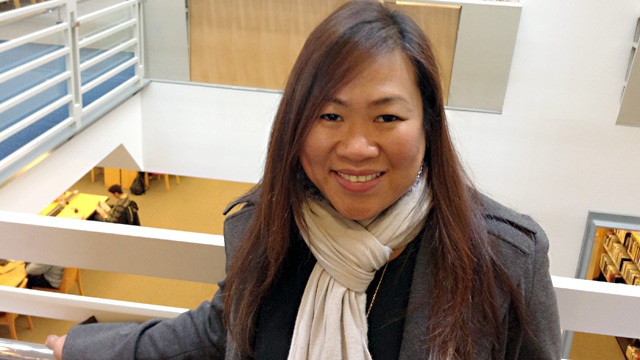
},
"content": "\u003cp>http://www.kqed.org/.stream/anon/radio/tcrmag/2014/04/2014-04-11d-tcrmag.mp3\u003c/p>\n\u003cp>Visitors to San Francisco are often shocked by the number of people living on the streets. Some of those homeless are among the 5,000 people who each day use the city’s Main Library.\u003c/p>\n\u003cp>On a recent weekday morning, a few of them join the dozens of people waiting for the library to open. One of them is Clarissa Eat.\u003c/p>\n\u003cp>“I’m in and out of shelters, unfortunately,” says Eat. “Trying to get housing right now. I’m just drifting.”\u003c/p>\n\u003cp>It’s a cold morning, by San Francisco standards anyway. The 39-year-old San Francisco native is standing on a sidewalk heating grate to stay warm, toting everything she owns in a red suitcase and shopping bags.\u003c/p>\n\u003cp>[ad fullwidth]\u003c/p>\n\u003cp>“Unfortunately, I’ve had more, but it was all stolen,” says Eat. “They’ll steal everything — your jacket, shoes, anything.”\u003c/p>\n\u003cp>San Francisco’s public library is a de facto daytime shelter for dozens, if not hundreds, of people in Eat’s situation and others struggling with mental illness or substance abuse. A few years ago, the San Francisco Public Library became the first in the nation to hire a full-time social worker to help them.\u003c/p>\n\u003cp>Her name is Leah Esguerra. She spends her days roaming the library’s six floors, keeping an eye out for regulars who look like they could use her help.\u003c/p>\n\u003cfigure id=\"attachment_10141090\" class=\"wp-caption alignright\" style=\"max-width: 313px\">\u003ca href=\"http://ww2.kqed.org/news/wp-content/uploads/sites/10/2014/09/ClarissaEat.jpg\">\u003cimg loading=\"lazy\" decoding=\"async\" src=\"http://ww2.kqed.org/news/wp-content/uploads/sites/10/2014/09/ClarissaEat-313x450.jpg\" alt=\"Clarissa Eat waits for the San Francisco Public Library to open. Her suitcase and two bags contain everything she owns. She's been helped by the library's social worker. (Scott Shafer/KQED)\" width=\"313\" height=\"450\" class=\"size-medium wp-image-10141090\">\u003c/a>\u003cfigcaption class=\"wp-caption-text\">Clarissa Eat waits for the San Francisco Public Library to open. Her suitcase and two bags contain everything she owns. She’s been helped by the library’s social worker. (Scott Shafer/KQED)\u003c/figcaption>\u003c/figure>\n\u003cp>“I introduce myself. ‘Hi, I’m Leah. I don’t know if you know that there is a social worker here at the library. I’m a social worker.’ And I just spread the word around,” says Esguerra.\u003c/p>\n\u003cp>Her training as a psychiatric social worker helps her ease into conversations with library users.\u003c/p>\n\u003cp>“I find a safe topic to talk about. The books that they’re reading, that they borrow here, or the movies they rent from here.”\u003c/p>\n\u003cp>Esguerra and her team work to develop relationships with patrons. But she says the time it takes to build trust doesn’t always work with such a transient population in search of housing.\u003c/p>\n\u003cp>“Sometimes you’re so close, I’m about to tell them, ‘You just got accepted’, and then we cannot find them. So I usually ask them to keep on checking in with me. ‘Keep on coming, let’s talk about what your needs are.’ ”\u003c/p>\n\u003cp>Upstairs Esguerra hunts out potential clients. She quietly walks up to a 30-something, somewhat disheveled man. As he huddles over a computer screen, she whispers to him.\u003c/p>\n\u003cp>“Michael. I know you’re watching something right now. I’ll talk to you later. I’ll check in with you.”\u003c/p>\n\u003cp>A few years ago, Esguerra began hiring some of the formerly homeless patrons she helped. Now they do outreach under her supervision.\u003c/p>\n\u003cp>One of them is Joe Bank, who hitchhiked a ride to San Francisco a few years ago. He landed in Golden Gate Park, homeless and struggling with substance abuse. He says that experience has helped him in his new job at the library.\u003c/p>\n\u003cfigure id=\"attachment_10141091\" class=\"wp-caption alignleft\" style=\"max-width: 274px\">\u003ca href=\"http://ww2.kqed.org/news/wp-content/uploads/sites/10/2014/09/LibraryJoeBank.jpg\">\u003cimg loading=\"lazy\" decoding=\"async\" src=\"http://ww2.kqed.org/news/wp-content/uploads/sites/10/2014/09/LibraryJoeBank-274x225.jpg\" alt=\"Joe Bank was homeless until he was helped by the San Francisco Public Library's social worker. Now he works for the library as a homeless outreach worker. (Scott Shafer/KQED)\" width=\"274\" height=\"225\" class=\"size-thumbnail wp-image-10141091\">\u003c/a>\u003cfigcaption class=\"wp-caption-text\">Joe Bank was homeless until he was helped by the San Francisco Public Library’s social worker. Now he works for the library as a homeless outreach worker. (Scott Shafer/KQED)\u003c/figcaption>\u003c/figure>\n\u003cp>“Coming at somebody with compassion for having been through that sort of thing, you know their walls kind of fall down,” says Bank. “Because they realize I’m not trying to make them do anything they don’t want to do.”\u003c/p>\n\u003cp>After getting his act together with help from Leah Esguerra and her outreach team, Bank is now part of that team.\u003c/p>\n\u003cp>“You know, I’m 32 years old and I really wasn’t sure what I wanted to do with my life until I started doing this work,” says Bank. “Then I realized, this is it. This is what I’m supposed to be doing.”\u003c/p>\n\u003cp>Even a city as liberal as San Francisco has its limits. Some library users complain about the homeless using the library bathroom for things like shaving or bathing. And after one patron was caught urinating on bookshelves not once, but twice, Sen. and former Mayor Dianne Feinstein urged the city to toughen rules and punishment.\u003c/p>\n\u003cp>Next week, says Chief Librarian Luis Herrera, the Library Commission will discuss new regulations aimed at some of the worst, most offensive behavior.\u003c/p>\n\u003cp>“Whether it’s drug use or physical assault, we’re not going to tolerate that,” says Herrera.\u003c/p>\n\u003cp>Even as he tries to strike that balance — creating a safe, secure library where everyone, including the homeless, feels welcome — Herrera says the social worker is here to stay.\u003c/p>\n\u003cp>“Initially there were some questions about whether this was a good idea,” he says. “But it’s taken off. And I think, in fact, we would look at the idea of expanding.”\u003c/p>\n\u003cp>\u003c/p>\n\u003cp>And it’s catching on. Other California cities, including San Jose and Sacramento, now have social workers at their libraries.\u003c/p>\n\n",
"blocks": [],
"excerpt": "A few years ago, the SF Public Library became the first to hire a social worker to help the homeless.",
"status": "publish",
"parent": 0,
"modified": 1725926825,
"stats": {
"hasAudio": true,
"hasVideo": false,
"hasChartOrMap": false,
"iframeSrcs": [],
"hasGoogleForm": false,
"hasGallery": false,
"hasHearkenModule": false,
"hasPolis": false,
"paragraphCount": 27,
"wordCount": 927
},
"headData": {
"title": "Nation's First Library Social Worker Helps Give Hope to the Homeless | KQED",
"description": "A few years ago, the SF Public Library became the first to hire a social worker to help the homeless.",
"ogTitle": "",
"ogDescription": "",
"ogImgId": "",
"twTitle": "",
"twDescription": "",
"twImgId": "",
"schema": {
"@context": "https://schema.org",
"@type": "NewsArticle",
"headline": "Nation's First Library Social Worker Helps Give Hope to the Homeless",
"datePublished": "2014-04-11T01:00:03-07:00",
"dateModified": "2024-09-09T17:07:05-07:00",
"image": "https://cdn.kqed.org/wp-content/uploads/2020/02/KQED-OG-Image@1x.png",
"isAccessibleForFree": "True",
"publisher": {
"@type": "NewsMediaOrganization",
"@id": "https://www.kqed.org/#organization",
"name": "KQED",
"logo": "https://cdn.kqed.org/wp-content/uploads/2020/02/KQED-OG-Image@1x.png",
"url": "https://www.kqed.org",
"sameAs": [
"https://www.facebook.com/KQED",
"https://twitter.com/KQED",
"https://www.instagram.com/kqed/",
"https://www.tiktok.com/@kqedofficial",
"https://www.linkedin.com/company/kqed",
"https://www.youtube.com/channel/UCeC0IOo7i1P_61zVUWbJ4nw"
]
}
}
},
"sticky": false,
"path": "/news/10341088/nations-first-library-social-worker-helps-give-hope-to-the-homeless",
"audioUrl": "http://www.kqed.org/.stream/anon/radio/tcrmag/2014/04/2014-04-11d-tcrmag.mp3",
"audioDuration": null,
"audioTrackLength": null,
"parsedContent": [
{
"type": "contentString",
"content": "\u003cdiv class=\"post-body\">\u003cp>\u003cp>http://www.kqed.org/.stream/anon/radio/tcrmag/2014/04/2014-04-11d-tcrmag.mp3\u003c/p>\n\u003cp>Visitors to San Francisco are often shocked by the number of people living on the streets. Some of those homeless are among the 5,000 people who each day use the city’s Main Library.\u003c/p>\n\u003cp>On a recent weekday morning, a few of them join the dozens of people waiting for the library to open. One of them is Clarissa Eat.\u003c/p>\n\u003cp>“I’m in and out of shelters, unfortunately,” says Eat. “Trying to get housing right now. I’m just drifting.”\u003c/p>\n\u003cp>It’s a cold morning, by San Francisco standards anyway. The 39-year-old San Francisco native is standing on a sidewalk heating grate to stay warm, toting everything she owns in a red suitcase and shopping bags.\u003c/p>\n\u003cp>\u003c/p>\u003c/div>",
"attributes": {
"named": {},
"numeric": []
}
},
{
"type": "component",
"content": "",
"name": "ad",
"attributes": {
"named": {
"label": "fullwidth"
},
"numeric": [
"fullwidth"
]
}
},
{
"type": "contentString",
"content": "\u003cdiv class=\"post-body\">\u003cp>\u003c/p>\n\u003cp>“Unfortunately, I’ve had more, but it was all stolen,” says Eat. “They’ll steal everything — your jacket, shoes, anything.”\u003c/p>\n\u003cp>San Francisco’s public library is a de facto daytime shelter for dozens, if not hundreds, of people in Eat’s situation and others struggling with mental illness or substance abuse. A few years ago, the San Francisco Public Library became the first in the nation to hire a full-time social worker to help them.\u003c/p>\n\u003cp>Her name is Leah Esguerra. She spends her days roaming the library’s six floors, keeping an eye out for regulars who look like they could use her help.\u003c/p>\n\u003cfigure id=\"attachment_10141090\" class=\"wp-caption alignright\" style=\"max-width: 313px\">\u003ca href=\"http://ww2.kqed.org/news/wp-content/uploads/sites/10/2014/09/ClarissaEat.jpg\">\u003cimg loading=\"lazy\" decoding=\"async\" src=\"http://ww2.kqed.org/news/wp-content/uploads/sites/10/2014/09/ClarissaEat-313x450.jpg\" alt=\"Clarissa Eat waits for the San Francisco Public Library to open. Her suitcase and two bags contain everything she owns. She's been helped by the library's social worker. (Scott Shafer/KQED)\" width=\"313\" height=\"450\" class=\"size-medium wp-image-10141090\">\u003c/a>\u003cfigcaption class=\"wp-caption-text\">Clarissa Eat waits for the San Francisco Public Library to open. Her suitcase and two bags contain everything she owns. She’s been helped by the library’s social worker. (Scott Shafer/KQED)\u003c/figcaption>\u003c/figure>\n\u003cp>“I introduce myself. ‘Hi, I’m Leah. I don’t know if you know that there is a social worker here at the library. I’m a social worker.’ And I just spread the word around,” says Esguerra.\u003c/p>\n\u003cp>Her training as a psychiatric social worker helps her ease into conversations with library users.\u003c/p>\n\u003cp>“I find a safe topic to talk about. The books that they’re reading, that they borrow here, or the movies they rent from here.”\u003c/p>\n\u003cp>Esguerra and her team work to develop relationships with patrons. But she says the time it takes to build trust doesn’t always work with such a transient population in search of housing.\u003c/p>\n\u003cp>“Sometimes you’re so close, I’m about to tell them, ‘You just got accepted’, and then we cannot find them. So I usually ask them to keep on checking in with me. ‘Keep on coming, let’s talk about what your needs are.’ ”\u003c/p>\n\u003cp>Upstairs Esguerra hunts out potential clients. She quietly walks up to a 30-something, somewhat disheveled man. As he huddles over a computer screen, she whispers to him.\u003c/p>\n\u003cp>“Michael. I know you’re watching something right now. I’ll talk to you later. I’ll check in with you.”\u003c/p>\n\u003cp>A few years ago, Esguerra began hiring some of the formerly homeless patrons she helped. Now they do outreach under her supervision.\u003c/p>\n\u003cp>One of them is Joe Bank, who hitchhiked a ride to San Francisco a few years ago. He landed in Golden Gate Park, homeless and struggling with substance abuse. He says that experience has helped him in his new job at the library.\u003c/p>\n\u003cfigure id=\"attachment_10141091\" class=\"wp-caption alignleft\" style=\"max-width: 274px\">\u003ca href=\"http://ww2.kqed.org/news/wp-content/uploads/sites/10/2014/09/LibraryJoeBank.jpg\">\u003cimg loading=\"lazy\" decoding=\"async\" src=\"http://ww2.kqed.org/news/wp-content/uploads/sites/10/2014/09/LibraryJoeBank-274x225.jpg\" alt=\"Joe Bank was homeless until he was helped by the San Francisco Public Library's social worker. Now he works for the library as a homeless outreach worker. (Scott Shafer/KQED)\" width=\"274\" height=\"225\" class=\"size-thumbnail wp-image-10141091\">\u003c/a>\u003cfigcaption class=\"wp-caption-text\">Joe Bank was homeless until he was helped by the San Francisco Public Library’s social worker. Now he works for the library as a homeless outreach worker. (Scott Shafer/KQED)\u003c/figcaption>\u003c/figure>\n\u003cp>“Coming at somebody with compassion for having been through that sort of thing, you know their walls kind of fall down,” says Bank. “Because they realize I’m not trying to make them do anything they don’t want to do.”\u003c/p>\n\u003cp>After getting his act together with help from Leah Esguerra and her outreach team, Bank is now part of that team.\u003c/p>\n\u003cp>“You know, I’m 32 years old and I really wasn’t sure what I wanted to do with my life until I started doing this work,” says Bank. “Then I realized, this is it. This is what I’m supposed to be doing.”\u003c/p>\n\u003cp>Even a city as liberal as San Francisco has its limits. Some library users complain about the homeless using the library bathroom for things like shaving or bathing. And after one patron was caught urinating on bookshelves not once, but twice, Sen. and former Mayor Dianne Feinstein urged the city to toughen rules and punishment.\u003c/p>\n\u003cp>Next week, says Chief Librarian Luis Herrera, the Library Commission will discuss new regulations aimed at some of the worst, most offensive behavior.\u003c/p>\n\u003cp>“Whether it’s drug use or physical assault, we’re not going to tolerate that,” says Herrera.\u003c/p>\n\u003cp>Even as he tries to strike that balance — creating a safe, secure library where everyone, including the homeless, feels welcome — Herrera says the social worker is here to stay.\u003c/p>\n\u003cp>“Initially there were some questions about whether this was a good idea,” he says. “But it’s taken off. And I think, in fact, we would look at the idea of expanding.”\u003c/p>\n\u003cp>\u003c/p>\n\u003cp>And it’s catching on. Other California cities, including San Jose and Sacramento, now have social workers at their libraries.\u003c/p>\n\n\u003c/div>\u003c/p>",
"attributes": {
"named": {},
"numeric": []
}
}
],
"link": "/news/10341088/nations-first-library-social-worker-helps-give-hope-to-the-homeless",
"authors": [
"255"
],
"programs": [
"news_72"
],
"categories": [
"news_6266"
],
"tags": [
"news_4020"
],
"featImg": "news_10341089",
"label": "news_72"
},
"news_132195": {
"type": "posts",
"id": "news_132195",
"meta": {
"index": "posts_1716263798",
"site": "news",
"id": "132195",
"score": null,
"sort": [
1397171830000
]
},
"parent": 0,
"labelTerm": {
"site": "news",
"term": 6944
},
"blocks": [],
"publishDate": 1397171830,
"format": "aside",
"disqusTitle": "San Francisco Hotel Tax May Be Just the Beginning of Regulation for Airbnb",
"title": "San Francisco Hotel Tax May Be Just the Beginning of Regulation for Airbnb",
"headTitle": "News Fix | KQED News",
"content": "\u003cfigure id=\"attachment_123982\" class=\"wp-caption alignleft\" style=\"max-width: 384px\">\u003ca href=\"http://ww2.kqed.org/news/2014/01/20/airbnb-struggles-with-tax-questions/airbnbsf/\" rel=\"attachment wp-att-123982\">\u003cimg class=\"wp-image-123982 \" src=\"http://ww2.kqed.org/news/wp-content/uploads/sites/10/2014/01/airbnbsf-e1396370252786.jpg\" alt=\"An Airbnb guide in San Francisco. Photo: Effie Yang/Flickr\" width=\"384\" height=\"216\">\u003c/a>\u003cfigcaption class=\"wp-caption-text\">An Airbnb guide in San Francisco. (Effie Yang/Flickr) \u003ccite>(Effie Yang/Flickr)\u003c/cite>\u003c/figcaption>\u003c/figure>\n\u003cp>The short-term rental company \u003ca href=\"https://www.airbnb.com/\" target=\"_blank\">Air\u003c/a>bnb made waves \u003ca href=\"http://publicpolicy.airbnb.com/san-francisco-taxes-airbnb-community/\" target=\"_blank\">when it announced\u003c/a> that it will start collecting San Francisco's 14 percent hotel tax from its guests in the city. And while this may be a first step in assuaging critics, it probably won't be the last. It's no secret that \u003ca href=\"http://www.sfbos.org/index.aspx?page=2105\" target=\"_blank\">San Francisco Board of Supervisors President David Chiu\u003c/a> is working on regulations for short-term rental companies like Airbnb, but on Wednesday a representative from Chiu's office offered more specifics about what those regulations will likely include.\u003c/p>\n\u003cp>During an appearance on \u003ca href=\"http://www.kqed.org/a/forum/R201404090900\" target=\"_blank\">KQED's \"Forum\u003c/a>,\" Judson True, a legislative aide to Chiu, said that while details are still being worked out, \"the general principles are getting close.\"\u003c/p>\n\u003cp>One of those general principles is protecting the city's housing stock. To that end, True hinted that regulations will aim to keep housing units primarily housing city residents, not tourists.\u003c/p>\n\u003cp>\"Permanent residency is really, really important,\" said True. \"For a short-term rental to be legal, it should have to be a permanent residence for someone. That’s really a core concept.\"\u003c/p>\n\u003cp>True also said that a cap on the number of days a unit could be let as a short-term rental is \"crucial.\"\u003c/p>\n\u003cp>[ad fullwidth]\u003c/p>\n\u003cp>\"If it's truly a case of renting out a room when you are on vacation or to supplement income a little bit, then really it should not be a unit that has permanently become an 'Airbnb unit.' That's really not serving San Franciscans.\"\u003c/p>\n\u003cp>According to True, a registration system for people renting with the short-term rental services is also being considered.\u003c/p>\n\u003cp>The regulations have been about a year in the making and will likely be announced in the next few weeks, said True. But, he warned, they will be far from a done deal.\u003c/p>\n\u003cp>\"It's going to be a conversation that lasts a number of months,\" True said.\u003c/p>\n\u003cp>After the legislation is proposed, in addition to the usual process of approval by the Board of Supervisors, he said, it will also have to go to the Planning Commission \u003cem>and\u003c/em> to the Department of Building Inspection.\u003c/p>\n\u003cp>Improved enforcement of short-term rental laws will also be part of the conversation.\u003c/p>\n\u003cp>\"When you have the city’s housing stock being taken off the market to become short-term rentals, you have an enforcement issue,\" said True. \"(Enforcement) shouldn’t merely be complaint-driven.\"\u003c/p>\n\u003cp>True said that Airbnb collecting the city's hotel tax was \"a prerequisite for us moving forward on legislation.\"\u003c/p>\n\u003cp>You can listen to the full discussion on \"\u003ca href=\"http://www.kqed.org/a/forum/R201404090900\" target=\"_blank\">Forum\u003c/a>\" below:\u003c/p>\n\u003cp>\u003c/p>\n\u003cp>\u003ciframe src=\"https://w.soundcloud.com/player/?url=https%3A//api.soundcloud.com/tracks/143923190&color=ff5500&auto_play=false&hide_related=false&show_artwork=true\" frameborder=\"no\" scrolling=\"no\" width=\"100%\" height=\"166\">\u003c/iframe>\u003c/p>\n\n",
"disqusIdentifier": "132195 http://ww2.kqed.org/news/?p=132195",
"disqusUrl": "https://ww2.kqed.org/news/2014/04/10/san-francisco-hotel-tax-may-be-just-the-beginning-of-regulation-for-airbnb/",
"stats": {
"hasVideo": false,
"hasChartOrMap": false,
"hasAudio": true,
"hasPolis": false,
"wordCount": 447,
"hasGoogleForm": false,
"hasGallery": false,
"hasHearkenModule": false,
"iframeSrcs": [],
"paragraphCount": 17
},
"modified": 1397502362,
"excerpt": "Supervisor David Chiu proposes measure to ensure city's housing serves residents rather than tourists. ",
"headData": {
"twImgId": "",
"twTitle": "",
"ogTitle": "",
"ogImgId": "",
"twDescription": "",
"description": "Supervisor David Chiu proposes measure to ensure city's housing serves residents rather than tourists. ",
"title": "San Francisco Hotel Tax May Be Just the Beginning of Regulation for Airbnb | KQED",
"ogDescription": "",
"schema": {
"@context": "https://schema.org",
"@type": "NewsArticle",
"headline": "San Francisco Hotel Tax May Be Just the Beginning of Regulation for Airbnb",
"datePublished": "2014-04-10T16:17:10-07:00",
"dateModified": "2014-04-14T12:06:02-07:00",
"image": "https://cdn.kqed.org/wp-content/uploads/2020/02/KQED-OG-Image@1x.png",
"isAccessibleForFree": "True",
"publisher": {
"@type": "NewsMediaOrganization",
"@id": "https://www.kqed.org/#organization",
"name": "KQED",
"logo": "https://cdn.kqed.org/wp-content/uploads/2020/02/KQED-OG-Image@1x.png",
"url": "https://www.kqed.org",
"sameAs": [
"https://www.facebook.com/KQED",
"https://twitter.com/KQED",
"https://www.instagram.com/kqed/",
"https://www.tiktok.com/@kqedofficial",
"https://www.linkedin.com/company/kqed",
"https://www.youtube.com/channel/UCeC0IOo7i1P_61zVUWbJ4nw"
]
}
}
},
"guestAuthors": [],
"slug": "san-francisco-hotel-tax-may-be-just-the-beginning-of-regulation-for-airbnb",
"status": "publish",
"customPermalink": "2014/04/09/hotel-tax-may-be-just-the-beginning-of-regulations-on-airbnb/",
"path": "/news/132195/san-francisco-hotel-tax-may-be-just-the-beginning-of-regulation-for-airbnb",
"audioTrackLength": null,
"parsedContent": [
{
"type": "contentString",
"content": "\u003cdiv class=\"post-body\">\u003cp>\u003cfigure id=\"attachment_123982\" class=\"wp-caption alignleft\" style=\"max-width: 384px\">\u003ca href=\"http://ww2.kqed.org/news/2014/01/20/airbnb-struggles-with-tax-questions/airbnbsf/\" rel=\"attachment wp-att-123982\">\u003cimg class=\"wp-image-123982 \" src=\"http://ww2.kqed.org/news/wp-content/uploads/sites/10/2014/01/airbnbsf-e1396370252786.jpg\" alt=\"An Airbnb guide in San Francisco. Photo: Effie Yang/Flickr\" width=\"384\" height=\"216\">\u003c/a>\u003cfigcaption class=\"wp-caption-text\">An Airbnb guide in San Francisco. (Effie Yang/Flickr) \u003ccite>(Effie Yang/Flickr)\u003c/cite>\u003c/figcaption>\u003c/figure>\n\u003cp>The short-term rental company \u003ca href=\"https://www.airbnb.com/\" target=\"_blank\">Air\u003c/a>bnb made waves \u003ca href=\"http://publicpolicy.airbnb.com/san-francisco-taxes-airbnb-community/\" target=\"_blank\">when it announced\u003c/a> that it will start collecting San Francisco's 14 percent hotel tax from its guests in the city. And while this may be a first step in assuaging critics, it probably won't be the last. It's no secret that \u003ca href=\"http://www.sfbos.org/index.aspx?page=2105\" target=\"_blank\">San Francisco Board of Supervisors President David Chiu\u003c/a> is working on regulations for short-term rental companies like Airbnb, but on Wednesday a representative from Chiu's office offered more specifics about what those regulations will likely include.\u003c/p>\n\u003cp>During an appearance on \u003ca href=\"http://www.kqed.org/a/forum/R201404090900\" target=\"_blank\">KQED's \"Forum\u003c/a>,\" Judson True, a legislative aide to Chiu, said that while details are still being worked out, \"the general principles are getting close.\"\u003c/p>\n\u003cp>One of those general principles is protecting the city's housing stock. To that end, True hinted that regulations will aim to keep housing units primarily housing city residents, not tourists.\u003c/p>\n\u003cp>\"Permanent residency is really, really important,\" said True. \"For a short-term rental to be legal, it should have to be a permanent residence for someone. That’s really a core concept.\"\u003c/p>\n\u003cp>True also said that a cap on the number of days a unit could be let as a short-term rental is \"crucial.\"\u003c/p>\n\u003cp>\u003c/p>\u003c/div>",
"attributes": {
"named": {},
"numeric": []
}
},
{
"type": "component",
"content": "",
"name": "ad",
"attributes": {
"named": {
"label": "fullwidth"
},
"numeric": [
"fullwidth"
]
}
},
{
"type": "contentString",
"content": "\u003cdiv class=\"post-body\">\u003cp>\u003c/p>\n\u003cp>\"If it's truly a case of renting out a room when you are on vacation or to supplement income a little bit, then really it should not be a unit that has permanently become an 'Airbnb unit.' That's really not serving San Franciscans.\"\u003c/p>\n\u003cp>According to True, a registration system for people renting with the short-term rental services is also being considered.\u003c/p>\n\u003cp>The regulations have been about a year in the making and will likely be announced in the next few weeks, said True. But, he warned, they will be far from a done deal.\u003c/p>\n\u003cp>\"It's going to be a conversation that lasts a number of months,\" True said.\u003c/p>\n\u003cp>After the legislation is proposed, in addition to the usual process of approval by the Board of Supervisors, he said, it will also have to go to the Planning Commission \u003cem>and\u003c/em> to the Department of Building Inspection.\u003c/p>\n\u003cp>Improved enforcement of short-term rental laws will also be part of the conversation.\u003c/p>\n\u003cp>\"When you have the city’s housing stock being taken off the market to become short-term rentals, you have an enforcement issue,\" said True. \"(Enforcement) shouldn’t merely be complaint-driven.\"\u003c/p>\n\u003cp>True said that Airbnb collecting the city's hotel tax was \"a prerequisite for us moving forward on legislation.\"\u003c/p>\n\u003cp>You can listen to the full discussion on \"\u003ca href=\"http://www.kqed.org/a/forum/R201404090900\" target=\"_blank\">Forum\u003c/a>\" below:\u003c/p>\n\u003cp>\u003c/p>\n\u003cp>\u003ciframe src=\"https://w.soundcloud.com/player/?url=https%3A//api.soundcloud.com/tracks/143923190&color=ff5500&auto_play=false&hide_related=false&show_artwork=true\" frameborder=\"no\" scrolling=\"no\" width=\"100%\" height=\"166\">\u003c/iframe>\u003c/p>\n\n\u003c/div>\u003c/p>",
"attributes": {
"named": {},
"numeric": []
}
}
],
"link": "/news/132195/san-francisco-hotel-tax-may-be-just-the-beginning-of-regulation-for-airbnb",
"authors": [
"70"
],
"programs": [
"news_6944"
],
"categories": [
"news_1758",
"news_6266"
],
"tags": [
"news_1735",
"news_167",
"news_15",
"news_6114",
"news_1775",
"news_6111",
"news_423",
"news_566",
"news_2207"
],
"featImg": "news_123982",
"label": "news_6944"
},
"news_131963": {
"type": "posts",
"id": "news_131963",
"meta": {
"index": "posts_1716263798",
"site": "news",
"id": "131963",
"score": null,
"sort": [
1397142047000
]
},
"guestAuthors": [],
"slug": "bayview-residents-weigh-adding-a-new-homeless-shelter",
"title": "Bayview Residents Weigh Adding a New Homeless Shelter",
"publishDate": 1397142047,
"format": "aside",
"headTitle": "Bayview Residents Weigh Adding a New Homeless Shelter | KQED",
"labelTerm": {
"term": 6944,
"site": "news"
},
"content": "\u003cfigure id=\"attachment_131996\" class=\"wp-caption alignnone\" style=\"max-width: 640px\">\u003ca href=\"http://ww2.kqed.org/news/wp-content/uploads/sites/10/2014/04/IMG_2667.jpg\">\u003cimg loading=\"lazy\" decoding=\"async\" class=\"size-medium wp-image-131996\" src=\"http://ww2.kqed.org/news/wp-content/uploads/sites/10/2014/04/IMG_2667-640x426.jpg\" alt=\"Mother Brown's Dining Room, a soup kitchen in Bayview-Hunters Point, wants to add a 100-bed homeless shelter (Mark Andrew Boyer / KQED)\" width=\"640\" height=\"426\">\u003c/a>\u003cfigcaption class=\"wp-caption-text\">Mother Brown’s Dining Room, a soup kitchen in Bayview-Hunters Point, wants to add a 100-bed homeless shelter (Mark Andrew Boyer / KQED)\u003c/figcaption>\u003c/figure>\n\u003cp>Mother Brown’s Dining Room is a Bayview-Hunters Point institution. For the past decade, the small soup kitchen has served breakfast and dinner to the neighborhood’s hungry. The organization that operates Mother Brown’s also allows homeless people to sit overnight in plastic chairs in a room on the building’s second floor. Now, the city wants to open a 100-bed homeless shelter to an adjacent warehouse. But the plan has drawn opposition from neighbors and local merchants. About 2,000 neighborhood residents have signed a petition, arguing that the shelter would add to the gritty neighborhood’s problems.\u003c/p>\n\u003cfigure id=\"attachment_132004\" class=\"wp-caption alignnone\" style=\"max-width: 640px\">\u003ca href=\"http://ww2.kqed.org/news/wp-content/uploads/sites/10/2014/04/IMG_2424.jpg\">\u003cimg loading=\"lazy\" decoding=\"async\" class=\"size-medium wp-image-132004\" src=\"http://ww2.kqed.org/news/wp-content/uploads/sites/10/2014/04/IMG_2424-640x426.jpg\" alt=\"Calvin Henderson is one of many homeless people who sleep in the chairs at Mother Brown's (Mark Andrew Boyer / KQED)\" width=\"640\" height=\"426\">\u003c/a>\u003cfigcaption class=\"wp-caption-text\">Calvin Henderson is one of many homeless people who sleep in the chairs at Mother Brown’s (Mark Andrew Boyer / KQED)\u003c/figcaption>\u003c/figure>\n\u003cp>Calvin Henderson was nodding off during breakfast service on a recent weekday morning after another poor night’s sleep in the chairs upstairs. Like other homeless people in the area, he stays at Mother Brown’s because there are few alternatives. “It swells your feet up,” he said of sleeping upright. “I’ve been up all night.”\u003c/p>\n\u003cfigure id=\"attachment_132094\" class=\"wp-caption alignnone\" style=\"max-width: 640px\">\u003ca href=\"http://ww2.kqed.org/news/wp-content/uploads/sites/10/2014/04/IMG_2821-copy.jpg\">\u003cimg loading=\"lazy\" decoding=\"async\" class=\"size-medium wp-image-132094\" src=\"http://ww2.kqed.org/news/wp-content/uploads/sites/10/2014/04/IMG_2821-copy-640x426.jpg\" alt=\"Marvin Robinson, owner of Dollar Store and More on 3rd Street, sees both sides of the issue (Mark Andrew Boyer/KQED)\" width=\"640\" height=\"426\">\u003c/a>\u003cfigcaption class=\"wp-caption-text\">Marvin Robinson, owner of Dollar Store and More on Third Street, sees both sides of the issue (Mark Andrew Boyer/KQED)\u003c/figcaption>\u003c/figure>\n\u003cp>“We really don’t have a homeless shelter out here,” said Marvin Robinson, owner of the Dollar Store and More on Third Street. Robinson said that neighbors are concerned that the shelter would attract homeless from outside the neighborhood, and that it would result in more loitering and noise late at night. “I see the issue of being a property owner,” Robinson said. “But some of the homeless are stakeholders — they grew up in this neighborhood.”\u003c/p>\n\u003cfigure id=\"attachment_131967\" class=\"wp-caption alignnone\" style=\"max-width: 640px\">\u003ca href=\"http://ww2.kqed.org/news/wp-content/uploads/sites/10/2014/04/IMG_2490.jpg\">\u003cimg loading=\"lazy\" decoding=\"async\" class=\"size-medium wp-image-131967\" src=\"http://ww2.kqed.org/news/wp-content/uploads/sites/10/2014/04/IMG_2490-640x426.jpg\" alt=\"Longtime Bayview resident Larry Williams supports opening a new homeless shelter (Mark Andrew Boyer / KQED)\" width=\"640\" height=\"426\">\u003c/a>\u003cfigcaption class=\"wp-caption-text\">Longtime Bayview resident Larry Williams supports opening a new homeless shelter. (Mark Andrew Boyer / KQED)\u003c/figcaption>\u003c/figure>\n\u003cp>Larry Williams has lived in the Bayview since in the 1960s and he currently lives in an RV, which is parked just down the block from Mother Brown’s. “I grew up and went to school with all these people. So, I know all these neighbors around here. And all the newer neighbors around here, they came up in here acting like they’re so community-minded, trying to push us out because they don’t want no shelters. But if you ain’t never been homeless, you ain’t got no business even speakin on this.”\u003c/p>\n\u003cfigure id=\"attachment_132095\" class=\"wp-caption alignnone\" style=\"max-width: 640px\">\u003ca href=\"http://ww2.kqed.org/news/wp-content/uploads/sites/10/2014/04/IMG_2725.jpg\">\u003cimg loading=\"lazy\" decoding=\"async\" class=\"size-medium wp-image-132095\" src=\"http://ww2.kqed.org/news/wp-content/uploads/sites/10/2014/04/IMG_2725-640x426.jpg\" alt=\"Shane Mayer, co-chair of Bayview Residents Improving Their Environment, opposes the proposed shelter (Mark Andrew Boyer/KQED)\" width=\"640\" height=\"426\">\u003c/a>\u003cfigcaption class=\"wp-caption-text\">Shane Mayer, co-chair of Bayview Residents Improving Their Environment, opposes the proposed shelter (Mark Andrew Boyer/KQED)\u003c/figcaption>\u003c/figure>\n\u003cp>Shane Mayer moved to the Bayview about three years ago, and he lives a couple blocks away from Mother Brown’s. He co-chairs Bayview Residents Improving Their Environment, an organization that promotes neighborhood rejuvenation efforts. Mayer thinks the Bayview is an up-and-coming neighborhood, but he’s worried that adding beds to Mother Brown’s would attract more homeless people. “My position is that we should have supportive housing for them — not an emergency shelter.”\u003c/p>\n\u003cfigure id=\"attachment_132098\" class=\"wp-caption alignnone\" style=\"max-width: 640px\">\u003ca href=\"http://ww2.kqed.org/news/wp-content/uploads/sites/10/2014/04/RS9592_IMG_2570-copy.jpg\">\u003cimg loading=\"lazy\" decoding=\"async\" class=\"size-medium wp-image-132098\" src=\"http://ww2.kqed.org/news/wp-content/uploads/sites/10/2014/04/RS9592_IMG_2570-copy-640x426.jpg\" alt=\"Evaristo Morales Crúz regularly eats at Mother Brown's (Mark Andrew Boyer/KQED)\" width=\"640\" height=\"426\">\u003c/a>\u003cfigcaption class=\"wp-caption-text\">Evaristo Morales Crúz regularly eats at Mother Brown’s. (Mark Andrew Boyer/KQED)\u003c/figcaption>\u003c/figure>\n\u003cp>Evaristo Morales Crúz, from Veracruz, Mexico, works for a roofing company in Bayview-Hunters Point and eats at Mother Brown’s Dining Room two or three times per week. “The food makes me strong,” he said. “No food, no power.” Crúz says he has slept in the chairs a few times, when it was too late to go to a shelter. “It’s better than the street.”\u003c/p>\n\u003cfigure id=\"attachment_132100\" class=\"wp-caption alignnone\" style=\"max-width: 640px\">\u003ca href=\"http://ww2.kqed.org/news/wp-content/uploads/sites/10/2014/04/RS9598_IMG_2631.jpg\">\u003cimg loading=\"lazy\" decoding=\"async\" class=\"size-medium wp-image-132100\" src=\"http://ww2.kqed.org/news/wp-content/uploads/sites/10/2014/04/RS9598_IMG_2631-640x426.jpg\" alt=\"Breakfast service at Mother Brown's Dining Rom (Mark Andrew Boyer/KQED)\" width=\"640\" height=\"426\">\u003c/a>\u003cfigcaption class=\"wp-caption-text\">Breakfast service at Mother Brown’s Dining Room (Mark Andrew Boyer/KQED)\u003c/figcaption>\u003c/figure>\n\u003cp>[ad fullwidth]\u003c/p>\u003cp>\u003c/p>\n",
"blocks": [],
"excerpt": "Photo Essay of people involved with Mother Brown's Dining Room, a Bayview-Hunter's Point institution.",
"status": "publish",
"parent": 0,
"modified": 1740521139,
"stats": {
"hasAudio": false,
"hasVideo": false,
"hasChartOrMap": false,
"iframeSrcs": [],
"hasGoogleForm": false,
"hasGallery": false,
"hasHearkenModule": false,
"hasPolis": false,
"paragraphCount": 8,
"wordCount": 656
},
"headData": {
"title": "Bayview Residents Weigh Adding a New Homeless Shelter | KQED",
"description": "Photo Essay of people involved with Mother Brown's Dining Room, a Bayview-Hunter's Point institution.",
"ogTitle": "",
"ogDescription": "",
"ogImgId": "",
"twTitle": "",
"twDescription": "",
"twImgId": "",
"schema": {
"@context": "https://schema.org",
"@type": "NewsArticle",
"headline": "Bayview Residents Weigh Adding a New Homeless Shelter",
"datePublished": "2014-04-10T08:00:47-07:00",
"dateModified": "2025-02-25T14:05:39-08:00",
"image": "https://cdn.kqed.org/wp-content/uploads/2020/02/KQED-OG-Image@1x.png",
"isAccessibleForFree": "True",
"publisher": {
"@type": "NewsMediaOrganization",
"@id": "https://www.kqed.org/#organization",
"name": "KQED",
"logo": "https://cdn.kqed.org/wp-content/uploads/2020/02/KQED-OG-Image@1x.png",
"url": "https://www.kqed.org",
"sameAs": [
"https://www.facebook.com/KQED",
"https://twitter.com/KQED",
"https://www.instagram.com/kqed/",
"https://www.tiktok.com/@kqedofficial",
"https://www.linkedin.com/company/kqed",
"https://www.youtube.com/channel/UCeC0IOo7i1P_61zVUWbJ4nw"
]
}
}
},
"sticky": false,
"customPermalink": "2014/04/08/homeless-shelter-for-bayview/",
"path": "/news/131963/bayview-residents-weigh-adding-a-new-homeless-shelter",
"audioTrackLength": null,
"parsedContent": [
{
"type": "contentString",
"content": "\u003cdiv class=\"post-body\">\u003cp>\u003cfigure id=\"attachment_131996\" class=\"wp-caption alignnone\" style=\"max-width: 640px\">\u003ca href=\"http://ww2.kqed.org/news/wp-content/uploads/sites/10/2014/04/IMG_2667.jpg\">\u003cimg loading=\"lazy\" decoding=\"async\" class=\"size-medium wp-image-131996\" src=\"http://ww2.kqed.org/news/wp-content/uploads/sites/10/2014/04/IMG_2667-640x426.jpg\" alt=\"Mother Brown's Dining Room, a soup kitchen in Bayview-Hunters Point, wants to add a 100-bed homeless shelter (Mark Andrew Boyer / KQED)\" width=\"640\" height=\"426\">\u003c/a>\u003cfigcaption class=\"wp-caption-text\">Mother Brown’s Dining Room, a soup kitchen in Bayview-Hunters Point, wants to add a 100-bed homeless shelter (Mark Andrew Boyer / KQED)\u003c/figcaption>\u003c/figure>\n\u003cp>Mother Brown’s Dining Room is a Bayview-Hunters Point institution. For the past decade, the small soup kitchen has served breakfast and dinner to the neighborhood’s hungry. The organization that operates Mother Brown’s also allows homeless people to sit overnight in plastic chairs in a room on the building’s second floor. Now, the city wants to open a 100-bed homeless shelter to an adjacent warehouse. But the plan has drawn opposition from neighbors and local merchants. About 2,000 neighborhood residents have signed a petition, arguing that the shelter would add to the gritty neighborhood’s problems.\u003c/p>\n\u003cfigure id=\"attachment_132004\" class=\"wp-caption alignnone\" style=\"max-width: 640px\">\u003ca href=\"http://ww2.kqed.org/news/wp-content/uploads/sites/10/2014/04/IMG_2424.jpg\">\u003cimg loading=\"lazy\" decoding=\"async\" class=\"size-medium wp-image-132004\" src=\"http://ww2.kqed.org/news/wp-content/uploads/sites/10/2014/04/IMG_2424-640x426.jpg\" alt=\"Calvin Henderson is one of many homeless people who sleep in the chairs at Mother Brown's (Mark Andrew Boyer / KQED)\" width=\"640\" height=\"426\">\u003c/a>\u003cfigcaption class=\"wp-caption-text\">Calvin Henderson is one of many homeless people who sleep in the chairs at Mother Brown’s (Mark Andrew Boyer / KQED)\u003c/figcaption>\u003c/figure>\n\u003cp>Calvin Henderson was nodding off during breakfast service on a recent weekday morning after another poor night’s sleep in the chairs upstairs. Like other homeless people in the area, he stays at Mother Brown’s because there are few alternatives. “It swells your feet up,” he said of sleeping upright. “I’ve been up all night.”\u003c/p>\n\u003cfigure id=\"attachment_132094\" class=\"wp-caption alignnone\" style=\"max-width: 640px\">\u003ca href=\"http://ww2.kqed.org/news/wp-content/uploads/sites/10/2014/04/IMG_2821-copy.jpg\">\u003cimg loading=\"lazy\" decoding=\"async\" class=\"size-medium wp-image-132094\" src=\"http://ww2.kqed.org/news/wp-content/uploads/sites/10/2014/04/IMG_2821-copy-640x426.jpg\" alt=\"Marvin Robinson, owner of Dollar Store and More on 3rd Street, sees both sides of the issue (Mark Andrew Boyer/KQED)\" width=\"640\" height=\"426\">\u003c/a>\u003cfigcaption class=\"wp-caption-text\">Marvin Robinson, owner of Dollar Store and More on Third Street, sees both sides of the issue (Mark Andrew Boyer/KQED)\u003c/figcaption>\u003c/figure>\n\u003cp>“We really don’t have a homeless shelter out here,” said Marvin Robinson, owner of the Dollar Store and More on Third Street. Robinson said that neighbors are concerned that the shelter would attract homeless from outside the neighborhood, and that it would result in more loitering and noise late at night. “I see the issue of being a property owner,” Robinson said. “But some of the homeless are stakeholders — they grew up in this neighborhood.”\u003c/p>\n\u003cfigure id=\"attachment_131967\" class=\"wp-caption alignnone\" style=\"max-width: 640px\">\u003ca href=\"http://ww2.kqed.org/news/wp-content/uploads/sites/10/2014/04/IMG_2490.jpg\">\u003cimg loading=\"lazy\" decoding=\"async\" class=\"size-medium wp-image-131967\" src=\"http://ww2.kqed.org/news/wp-content/uploads/sites/10/2014/04/IMG_2490-640x426.jpg\" alt=\"Longtime Bayview resident Larry Williams supports opening a new homeless shelter (Mark Andrew Boyer / KQED)\" width=\"640\" height=\"426\">\u003c/a>\u003cfigcaption class=\"wp-caption-text\">Longtime Bayview resident Larry Williams supports opening a new homeless shelter. (Mark Andrew Boyer / KQED)\u003c/figcaption>\u003c/figure>\n\u003cp>Larry Williams has lived in the Bayview since in the 1960s and he currently lives in an RV, which is parked just down the block from Mother Brown’s. “I grew up and went to school with all these people. So, I know all these neighbors around here. And all the newer neighbors around here, they came up in here acting like they’re so community-minded, trying to push us out because they don’t want no shelters. But if you ain’t never been homeless, you ain’t got no business even speakin on this.”\u003c/p>\n\u003cfigure id=\"attachment_132095\" class=\"wp-caption alignnone\" style=\"max-width: 640px\">\u003ca href=\"http://ww2.kqed.org/news/wp-content/uploads/sites/10/2014/04/IMG_2725.jpg\">\u003cimg loading=\"lazy\" decoding=\"async\" class=\"size-medium wp-image-132095\" src=\"http://ww2.kqed.org/news/wp-content/uploads/sites/10/2014/04/IMG_2725-640x426.jpg\" alt=\"Shane Mayer, co-chair of Bayview Residents Improving Their Environment, opposes the proposed shelter (Mark Andrew Boyer/KQED)\" width=\"640\" height=\"426\">\u003c/a>\u003cfigcaption class=\"wp-caption-text\">Shane Mayer, co-chair of Bayview Residents Improving Their Environment, opposes the proposed shelter (Mark Andrew Boyer/KQED)\u003c/figcaption>\u003c/figure>\n\u003cp>Shane Mayer moved to the Bayview about three years ago, and he lives a couple blocks away from Mother Brown’s. He co-chairs Bayview Residents Improving Their Environment, an organization that promotes neighborhood rejuvenation efforts. Mayer thinks the Bayview is an up-and-coming neighborhood, but he’s worried that adding beds to Mother Brown’s would attract more homeless people. “My position is that we should have supportive housing for them — not an emergency shelter.”\u003c/p>\n\u003cfigure id=\"attachment_132098\" class=\"wp-caption alignnone\" style=\"max-width: 640px\">\u003ca href=\"http://ww2.kqed.org/news/wp-content/uploads/sites/10/2014/04/RS9592_IMG_2570-copy.jpg\">\u003cimg loading=\"lazy\" decoding=\"async\" class=\"size-medium wp-image-132098\" src=\"http://ww2.kqed.org/news/wp-content/uploads/sites/10/2014/04/RS9592_IMG_2570-copy-640x426.jpg\" alt=\"Evaristo Morales Crúz regularly eats at Mother Brown's (Mark Andrew Boyer/KQED)\" width=\"640\" height=\"426\">\u003c/a>\u003cfigcaption class=\"wp-caption-text\">Evaristo Morales Crúz regularly eats at Mother Brown’s. (Mark Andrew Boyer/KQED)\u003c/figcaption>\u003c/figure>\n\u003cp>Evaristo Morales Crúz, from Veracruz, Mexico, works for a roofing company in Bayview-Hunters Point and eats at Mother Brown’s Dining Room two or three times per week. “The food makes me strong,” he said. “No food, no power.” Crúz says he has slept in the chairs a few times, when it was too late to go to a shelter. “It’s better than the street.”\u003c/p>\n\u003cfigure id=\"attachment_132100\" class=\"wp-caption alignnone\" style=\"max-width: 640px\">\u003ca href=\"http://ww2.kqed.org/news/wp-content/uploads/sites/10/2014/04/RS9598_IMG_2631.jpg\">\u003cimg loading=\"lazy\" decoding=\"async\" class=\"size-medium wp-image-132100\" src=\"http://ww2.kqed.org/news/wp-content/uploads/sites/10/2014/04/RS9598_IMG_2631-640x426.jpg\" alt=\"Breakfast service at Mother Brown's Dining Rom (Mark Andrew Boyer/KQED)\" width=\"640\" height=\"426\">\u003c/a>\u003cfigcaption class=\"wp-caption-text\">Breakfast service at Mother Brown’s Dining Room (Mark Andrew Boyer/KQED)\u003c/figcaption>\u003c/figure>\n\u003cp>\u003c/p>\u003c/div>",
"attributes": {
"named": {},
"numeric": []
}
},
{
"type": "component",
"content": "",
"name": "ad",
"attributes": {
"named": {
"label": "fullwidth"
},
"numeric": [
"fullwidth"
]
}
},
{
"type": "contentString",
"content": "\u003cdiv class=\"post-body\">\u003cp>\u003c/p>\u003cp>\u003c/p>\n\u003c/div>\u003c/p>",
"attributes": {
"named": {},
"numeric": []
}
}
],
"link": "/news/131963/bayview-residents-weigh-adding-a-new-homeless-shelter",
"authors": [
"242"
],
"programs": [
"news_6944"
],
"categories": [
"news_6266"
],
"tags": [
"news_5706",
"news_4020",
"news_854",
"news_38"
],
"label": "news_6944"
},
"news_131727": {
"type": "posts",
"id": "news_131727",
"meta": {
"index": "posts_1716263798",
"site": "news",
"id": "131727",
"score": null,
"sort": [
1396654327000
]
},
"parent": 0,
"labelTerm": {
"site": "news",
"term": 6944
},
"blocks": [],
"publishDate": 1396654327,
"format": "aside",
"disqusTitle": "San Francisco's Meridian Gallery Faces Eviction, Owners Say",
"title": "San Francisco's Meridian Gallery Faces Eviction, Owners Say",
"headTitle": "Priced Out | News Fix | KQED News",
"content": "\u003cp>\u003cimg class=\"size-full wp-image-131735 alignleft\" src=\"http://ww2.kqed.org/news/wp-content/uploads/sites/10/2014/04/535-powell-lowres.jpg\" alt=\"The Meridian Gallery in San Francisco (Photo courtesty Meridian Gallery)\" width=\"288\" height=\"432\">Still another San Francisco gallery is in danger of losing its space.\u003c/p>\n\u003cp>The landlord has delivered an ultimatum to the owners of the nonprofit Meridian Gallery, just uphill from Union Square on the Powell Street cable car line: Pay $100,000 by Monday or face eviction, say the owners. That's a full year’s rent plus a security deposit\u003c/p>\n\u003cp>The gallery mounts exhibits and new music programs, but co-founders Anne Brodzky and Anthony Williams say they’re most proud of the arts training they offer to “the amazing youth,” about 30 at-risk high school students from around the city. Meridian interns painted a mural a decade ago at Powell and Market, one restored recently by the current group of artist interns.\u003c/p>\n\u003cp>The gallery has raised about 10 percent of the funds needed through an auction and online pledges, but “we understand that the eviction process is going through, and that any moment the sheriffs could arrive and present us with a departure notice,\" says Williams.\u003c/p>\n\u003cp>The problems for Meridian follow the eviction earlier this year of a number of galleries at 77 Geary Street, including Rena Bransten and George Krevsky, to make way for an expanding software firm. Both have since relocated.\u003c/p>\n\u003cp>[ad fullwidth]\u003c/p>\n\u003cp>The galleries are in trouble because a surge in retail business around Union Square is driving rental prices to “a range beyond what anyone had ever imagined,” says retail consultant Helen Bulwik. She did an analysis of the rental market in Union Square in late 2013, and found prime retail spaces going for as much as $3,000 per square foot. That compares with $400 to $500 per square foot in early 2007.\u003c/p>\n\u003cp>“The galleries unfortunately don’t generate the kind of revenue that a landlord can expect today,” Bulwik says.\u003c/p>\n\u003cp>\u003c/p>\n\u003cp>Brodzky says she still hopes to save Meridian and its programs. “We will go on doing this until the last ding-dong,” she says.\u003c/p>\n\n",
"disqusIdentifier": "131727 http://ww2.kqed.org/news/?p=131727",
"disqusUrl": "https://ww2.kqed.org/news/2014/04/04/san-franciscos-meridian-gallery-faces-eviction-owners-say/",
"stats": {
"hasVideo": false,
"hasChartOrMap": false,
"hasAudio": false,
"hasPolis": false,
"wordCount": 334,
"hasGoogleForm": false,
"hasGallery": false,
"hasHearkenModule": false,
"iframeSrcs": [],
"paragraphCount": 10
},
"modified": 1414789135,
"excerpt": "Surge of retail business around Union Square is driving rental prices way up.",
"headData": {
"twImgId": "",
"twTitle": "",
"ogTitle": "",
"ogImgId": "",
"twDescription": "",
"description": "Surge of retail business around Union Square is driving rental prices way up.",
"title": "San Francisco's Meridian Gallery Faces Eviction, Owners Say | KQED",
"ogDescription": "",
"schema": {
"@context": "https://schema.org",
"@type": "NewsArticle",
"headline": "San Francisco's Meridian Gallery Faces Eviction, Owners Say",
"datePublished": "2014-04-04T16:32:07-07:00",
"dateModified": "2014-10-31T13:58:55-07:00",
"image": "https://cdn.kqed.org/wp-content/uploads/2020/02/KQED-OG-Image@1x.png",
"isAccessibleForFree": "True",
"publisher": {
"@type": "NewsMediaOrganization",
"@id": "https://www.kqed.org/#organization",
"name": "KQED",
"logo": "https://cdn.kqed.org/wp-content/uploads/2020/02/KQED-OG-Image@1x.png",
"url": "https://www.kqed.org",
"sameAs": [
"https://www.facebook.com/KQED",
"https://twitter.com/KQED",
"https://www.instagram.com/kqed/",
"https://www.tiktok.com/@kqedofficial",
"https://www.linkedin.com/company/kqed",
"https://www.youtube.com/channel/UCeC0IOo7i1P_61zVUWbJ4nw"
]
}
}
},
"guestAuthors": [],
"slug": "san-franciscos-meridian-gallery-faces-eviction-owners-say",
"status": "publish",
"customPermalink": "2014/04/04/meridian-gallery/",
"path": "/news/131727/san-franciscos-meridian-gallery-faces-eviction-owners-say",
"audioTrackLength": null,
"parsedContent": [
{
"type": "contentString",
"content": "\u003cdiv class=\"post-body\">\u003cp>\u003cp>\u003cimg class=\"size-full wp-image-131735 alignleft\" src=\"http://ww2.kqed.org/news/wp-content/uploads/sites/10/2014/04/535-powell-lowres.jpg\" alt=\"The Meridian Gallery in San Francisco (Photo courtesty Meridian Gallery)\" width=\"288\" height=\"432\">Still another San Francisco gallery is in danger of losing its space.\u003c/p>\n\u003cp>The landlord has delivered an ultimatum to the owners of the nonprofit Meridian Gallery, just uphill from Union Square on the Powell Street cable car line: Pay $100,000 by Monday or face eviction, say the owners. That's a full year’s rent plus a security deposit\u003c/p>\n\u003cp>The gallery mounts exhibits and new music programs, but co-founders Anne Brodzky and Anthony Williams say they’re most proud of the arts training they offer to “the amazing youth,” about 30 at-risk high school students from around the city. Meridian interns painted a mural a decade ago at Powell and Market, one restored recently by the current group of artist interns.\u003c/p>\n\u003cp>The gallery has raised about 10 percent of the funds needed through an auction and online pledges, but “we understand that the eviction process is going through, and that any moment the sheriffs could arrive and present us with a departure notice,\" says Williams.\u003c/p>\n\u003cp>The problems for Meridian follow the eviction earlier this year of a number of galleries at 77 Geary Street, including Rena Bransten and George Krevsky, to make way for an expanding software firm. Both have since relocated.\u003c/p>\n\u003cp>\u003c/p>\u003c/div>",
"attributes": {
"named": {},
"numeric": []
}
},
{
"type": "component",
"content": "",
"name": "ad",
"attributes": {
"named": {
"label": "fullwidth"
},
"numeric": [
"fullwidth"
]
}
},
{
"type": "contentString",
"content": "\u003cdiv class=\"post-body\">\u003cp>\u003c/p>\n\u003cp>The galleries are in trouble because a surge in retail business around Union Square is driving rental prices to “a range beyond what anyone had ever imagined,” says retail consultant Helen Bulwik. She did an analysis of the rental market in Union Square in late 2013, and found prime retail spaces going for as much as $3,000 per square foot. That compares with $400 to $500 per square foot in early 2007.\u003c/p>\n\u003cp>“The galleries unfortunately don’t generate the kind of revenue that a landlord can expect today,” Bulwik says.\u003c/p>\n\u003cp>\u003c/p>\n\u003cp>Brodzky says she still hopes to save Meridian and its programs. “We will go on doing this until the last ding-dong,” she says.\u003c/p>\n\n\u003c/div>\u003c/p>",
"attributes": {
"named": {},
"numeric": []
}
}
],
"link": "/news/131727/san-franciscos-meridian-gallery-faces-eviction-owners-say",
"authors": [
"32"
],
"programs": [
"news_6944"
],
"series": [
"news_18549"
],
"categories": [
"news_223",
"news_6266"
],
"tags": [
"news_38"
],
"featImg": "news_131735",
"label": "news_6944"
},
"news_128923": {
"type": "posts",
"id": "news_128923",
"meta": {
"index": "posts_1716263798",
"site": "news",
"id": "128923",
"score": null,
"sort": [
1396623601000
]
},
"parent": 0,
"labelTerm": {
"site": "news",
"term": 6944
},
"blocks": [],
"publishDate": 1396623601,
"format": "aside",
"disqusTitle": "East Palo Alto City Council Passes New Tenant Protections",
"title": "East Palo Alto City Council Passes New Tenant Protections",
"headTitle": "Priced Out | News Fix | KQED News",
"content": "\u003cp>\u003cstrong>By Marianne LeVine\u003c/strong>\u003cbr>\n\u003ca href=\"http://peninsulapress.com/2014/03/11/east-palo-affordable-housing/\" target=\"_blank\">Peninsula Press\u003c/a>\u003c/p>\n\u003cfigure id=\"attachment_128924\" class=\"wp-caption aligncenter\" style=\"max-width: 640px\">\u003ca href=\"http://ww2.kqed.org/news/wp-content/uploads/sites/10/2014/03/EPA-apart.jpg\">\u003cimg class=\"size-medium wp-image-128924\" src=\"http://ww2.kqed.org/news/wp-content/uploads/sites/10/2014/03/EPA-apart-640x426.jpg\" alt=\"This Woodland Park apartment is an Equity Residential property in East Palo Alto. Equity purchased Woodland Park in December 2011. (Marianne LeVine / Peninsula Press)\" width=\"640\" height=\"426\">\u003c/a>\u003cfigcaption class=\"wp-caption-text\">This Woodland Park apartment is an Equity Residential property in East Palo Alto. Equity purchased Woodland Park in December 2011. (Marianne LeVine/Peninsula Press)\u003c/figcaption>\u003c/figure>\n\u003cp>\u003cstrong>Update Friday, April 4\u003c/strong>: East Palo Alto's City Council unanimously passed a tenant protection ordinance Tuesday. The proposal has to pass a second vote in the coming weeks before it becomes law.\u003c/p>\n\u003cp>The law would tighten restrictions on demolitions, protect renters from landlord harassment and provide relocation benefits for tenants who are displaced.\u003c/p>\n\u003cp>Supporters turned out in force to support the measure's passage. One common theme among them: In the event of displacement, there's nowhere else to go in the Bay Area because of how expensive housing has become.\u003c/p>\n\u003cp>You can read more at \u003ca href=\"http://www.paloaltoonline.com/news/2014/04/02/east-palo-alto-unanimously-backs-new-tenant-protection-ordinance\" target=\"_blank\">Palo Alto Online\u003c/a>.\u003c/p>\n\u003cp>[ad fullwidth]\u003c/p>\n\u003cp>\u003cem>Original post\u003c/em>\u003c/p>\n\u003cp>\u003cstrong>East Palo Alto's Biggest Landlord Opposes Tenant Protection Law\u003c/strong>\u003c/p>\n\u003cp>The company that controls more than half of East Palo Alto's rental housing market is opposing a proposed city law that would provide relocation benefits to displaced tenants, tighten restrictions on demolishing buildings and offer protection from landlord harassment.\u003c/p>\n\u003cp>Chicago-based \u003ca href=\"http://www.equityapartments.com/corporate/\" target=\"_blank\">Equity Residential\u003c/a>, which in 2011 bought more than 1,800 units in the city, has challenged the proposal as an “unlawful” burden on apartment owners and landlords, stirring fears among community groups and some City Council members that the company aims to force out low-income residents to make room for more affluent tenants.\u003c/p>\n\u003cp>“We have a history of offering protection for tenants because they’re vulnerable,” said \u003ca href=\"http://www.cityofepa.org/directory.aspx?EID=49\" target=\"_blank\">Councilman Ruben Abrica\u003c/a>, a former East Palo Alto mayor. “(Equity) is objecting to the whole concept. They don’t see a need for it.”\u003c/p>\n\u003cp>Within six months of acquiring its properties from Wells Fargo in foreclosure sales, Equity raised the attention of city officials by issuing 706 three-day eviction notices from January to June 2012. Equity’s notices warned tenants who were late on rent that they had three days to pay before they would face eviction.\u003c/p>\n\u003cp>[contextly_sidebar id=\"e67632a7989cafa28191163425fbebcf\"]\u003c/p>\n\u003cp>After the city Rent Stabilization Board made those figures public, Equity stopped reporting the notices. Company executive John Hyjer said it was not required by law to notify the city of three-day eviction notices, only of unlawful detainers -- eviction cases filed in court.\u003c/p>\n\u003cp>“It’s less onerous on the city of East Palo Alto’s already stretched resources,” Hyjer, Equity’s first vice president of investments, said in an email.\u003c/p>\n\u003cp>Shirley Gibson, a lawyer for \u003ca href=\"http://www.legalaidsmc.org/\" target=\"_blank\">LegalAid San Mateo\u003c/a>, said when the city is not told of all eviction notices, it becomes difficult for organizations like hers to direct tenants toward programs that assist with rent payment.\u003c/p>\n\u003cp>\u003cstrong>'If we have to fight, we will fight'\u003c/strong>\u003c/p>\n\u003cp>In June 2010, East Palo Alto voters passed the \u003ca href=\"http://www.ci.east-palo-alto.ca.us/index.aspx?nid=469\" target=\"_blank\">Rent Stabilization and Eviction for Good Cause Ordinance\u003c/a>, designed to protect tenants from “unreasonable rent increases” and “arbitrary, discriminatory or retaliatory evictions,” and to guarantee landlords the “right to fair return.” The proposed law, known as the Tenant Protection Ordinance, would expand tenant rights.\u003c/p>\n\u003caside class=\"pullquote alignleft\"> The landlord also has filed lawsuits challenging city rent control laws in Santa Cruz and San Rafael. \u003c/aside>\n\u003cp>Since Equity Residential objected to the proposed ordinance, city officials have been working with landlord and tenant representatives to make revisions. Equity views the proposed changes as a violation of local and state laws. Larisa Bowman, a lawyer for Community Legal Services in East Palo Alto, called such concerns “unfounded.”\u003c/p>\n\u003cp>Equity Residential has opposed other tenant protection efforts in California. Sam Zell, the company chairman, donated $50,000 to Proposition 98, a ballot measure that would have phased out rent control throughout California had it passed in June 2008. He is also the chairman of Equity Lifestyle Properties, which has filed lawsuits challenging city rent control laws in Santa Cruz and San Rafael. Both companies are real estate investment trusts and are publicly traded.\u003c/p>\n\u003cp>Since Equity Residential’s purchase of its East Palo Alto properties, some tenants have complained about difficulty paying rent -- one type of complaint is that a person will be told by a rent collector to come back the next day and then will be informed the rent is late.\u003c/p>\n\u003cp>Bowman, the community legal representative, said some of the confusion over rent payments is because of the portfolio’s change in ownership, from Page Mill Properties to Wells Fargo to Equity Residential. However, she still remains concerned. “The amount of rent a person is being evicted over is $47,” she said. “Are you after $47 or are you after this unit? I can’t prove that, (but) for tenants it certainly feels that way.”\u003c/p>\n\u003cp>William Webster, a longtime advocate for affordable housing in East Palo Alto and member of the Rent Stabilization Board, said he believes Equity Residential wants to replace long-term tenants paying rent under market rate. “They’re going to exploit every angle that is legally permissible in order to (extract) profits,” he said. “They have a vested interest at this point in making life miserable for long-term tenants, under the Rent Stabilization Program.”\u003c/p>\n\u003cp>Equity Residential said it does not intend to displace residents. But Hyjer noted “there has been a lot of discussion with the city that a significant amount of housing in Woodland Park has and is becoming functionally obsolete. Equity Residential has no intention of displacing current residents if and when this housing gets replaced.”\u003c/p>\n\u003cp>East Palo Alto officials will present the newly drafted protection ordinance at a City Council meeting March 18. Councilman Abrica said officials are aware of Equity’s reputation for playing hardball but added that the city would not be intimidated.\u003c/p>\n\u003cp>\u003c/p>\n\u003cp>“If they are determined to fight you, they will use every weapon at their disposal,” Abrica said. “We have demonstrated that we’re not going to roll over. If we have to fight, we will fight. But ultimately that becomes the decision of the council.”\u003c/p>\n\n",
"disqusIdentifier": "128923 http://ww2.kqed.org/news/?p=128923",
"disqusUrl": "https://ww2.kqed.org/news/2014/04/04/east-palo-altos-biggest-landlord-opposes-proposed-tenant-protection-law/",
"stats": {
"hasVideo": false,
"hasChartOrMap": false,
"hasAudio": false,
"hasPolis": false,
"wordCount": 1021,
"hasGoogleForm": false,
"hasGallery": false,
"hasHearkenModule": false,
"iframeSrcs": [],
"paragraphCount": 27
},
"modified": 1396651642,
"excerpt": "The law would protect against landlord harassment and relocation benefits for displaced tenants.",
"headData": {
"twImgId": "",
"twTitle": "",
"ogTitle": "",
"ogImgId": "",
"twDescription": "",
"description": "The law would protect against landlord harassment and relocation benefits for displaced tenants.",
"title": "East Palo Alto City Council Passes New Tenant Protections | KQED",
"ogDescription": "",
"schema": {
"@context": "https://schema.org",
"@type": "NewsArticle",
"headline": "East Palo Alto City Council Passes New Tenant Protections",
"datePublished": "2014-04-04T08:00:01-07:00",
"dateModified": "2014-04-04T15:47:22-07:00",
"image": "https://cdn.kqed.org/wp-content/uploads/2020/02/KQED-OG-Image@1x.png",
"isAccessibleForFree": "True",
"publisher": {
"@type": "NewsMediaOrganization",
"@id": "https://www.kqed.org/#organization",
"name": "KQED",
"logo": "https://cdn.kqed.org/wp-content/uploads/2020/02/KQED-OG-Image@1x.png",
"url": "https://www.kqed.org",
"sameAs": [
"https://www.facebook.com/KQED",
"https://twitter.com/KQED",
"https://www.instagram.com/kqed/",
"https://www.tiktok.com/@kqedofficial",
"https://www.linkedin.com/company/kqed",
"https://www.youtube.com/channel/UCeC0IOo7i1P_61zVUWbJ4nw"
]
}
}
},
"guestAuthors": [],
"slug": "east-palo-altos-biggest-landlord-opposes-proposed-tenant-protection-law",
"status": "publish",
"customPermalink": "2014/03/11/east-palo-altos-biggest-landlord-opposes-proposed-tenant-protection-law/",
"path": "/news/128923/east-palo-altos-biggest-landlord-opposes-proposed-tenant-protection-law",
"audioTrackLength": null,
"parsedContent": [
{
"type": "contentString",
"content": "\u003cdiv class=\"post-body\">\u003cp>\u003cp>\u003cstrong>By Marianne LeVine\u003c/strong>\u003cbr>\n\u003ca href=\"http://peninsulapress.com/2014/03/11/east-palo-affordable-housing/\" target=\"_blank\">Peninsula Press\u003c/a>\u003c/p>\n\u003cfigure id=\"attachment_128924\" class=\"wp-caption aligncenter\" style=\"max-width: 640px\">\u003ca href=\"http://ww2.kqed.org/news/wp-content/uploads/sites/10/2014/03/EPA-apart.jpg\">\u003cimg class=\"size-medium wp-image-128924\" src=\"http://ww2.kqed.org/news/wp-content/uploads/sites/10/2014/03/EPA-apart-640x426.jpg\" alt=\"This Woodland Park apartment is an Equity Residential property in East Palo Alto. Equity purchased Woodland Park in December 2011. (Marianne LeVine / Peninsula Press)\" width=\"640\" height=\"426\">\u003c/a>\u003cfigcaption class=\"wp-caption-text\">This Woodland Park apartment is an Equity Residential property in East Palo Alto. Equity purchased Woodland Park in December 2011. (Marianne LeVine/Peninsula Press)\u003c/figcaption>\u003c/figure>\n\u003cp>\u003cstrong>Update Friday, April 4\u003c/strong>: East Palo Alto's City Council unanimously passed a tenant protection ordinance Tuesday. The proposal has to pass a second vote in the coming weeks before it becomes law.\u003c/p>\n\u003cp>The law would tighten restrictions on demolitions, protect renters from landlord harassment and provide relocation benefits for tenants who are displaced.\u003c/p>\n\u003cp>Supporters turned out in force to support the measure's passage. One common theme among them: In the event of displacement, there's nowhere else to go in the Bay Area because of how expensive housing has become.\u003c/p>\n\u003cp>You can read more at \u003ca href=\"http://www.paloaltoonline.com/news/2014/04/02/east-palo-alto-unanimously-backs-new-tenant-protection-ordinance\" target=\"_blank\">Palo Alto Online\u003c/a>.\u003c/p>\n\u003cp>\u003c/p>\u003c/div>",
"attributes": {
"named": {},
"numeric": []
}
},
{
"type": "component",
"content": "",
"name": "ad",
"attributes": {
"named": {
"label": "fullwidth"
},
"numeric": [
"fullwidth"
]
}
},
{
"type": "contentString",
"content": "\u003cdiv class=\"post-body\">\u003cp>\u003c/p>\n\u003cp>\u003cem>Original post\u003c/em>\u003c/p>\n\u003cp>\u003cstrong>East Palo Alto's Biggest Landlord Opposes Tenant Protection Law\u003c/strong>\u003c/p>\n\u003cp>The company that controls more than half of East Palo Alto's rental housing market is opposing a proposed city law that would provide relocation benefits to displaced tenants, tighten restrictions on demolishing buildings and offer protection from landlord harassment.\u003c/p>\n\u003cp>Chicago-based \u003ca href=\"http://www.equityapartments.com/corporate/\" target=\"_blank\">Equity Residential\u003c/a>, which in 2011 bought more than 1,800 units in the city, has challenged the proposal as an “unlawful” burden on apartment owners and landlords, stirring fears among community groups and some City Council members that the company aims to force out low-income residents to make room for more affluent tenants.\u003c/p>\n\u003cp>“We have a history of offering protection for tenants because they’re vulnerable,” said \u003ca href=\"http://www.cityofepa.org/directory.aspx?EID=49\" target=\"_blank\">Councilman Ruben Abrica\u003c/a>, a former East Palo Alto mayor. “(Equity) is objecting to the whole concept. They don’t see a need for it.”\u003c/p>\n\u003cp>Within six months of acquiring its properties from Wells Fargo in foreclosure sales, Equity raised the attention of city officials by issuing 706 three-day eviction notices from January to June 2012. Equity’s notices warned tenants who were late on rent that they had three days to pay before they would face eviction.\u003c/p>\n\u003cp>\u003c/p>\u003cp>\u003c/p>\u003cp>\u003c/p>\n\u003cp>After the city Rent Stabilization Board made those figures public, Equity stopped reporting the notices. Company executive John Hyjer said it was not required by law to notify the city of three-day eviction notices, only of unlawful detainers -- eviction cases filed in court.\u003c/p>\n\u003cp>“It’s less onerous on the city of East Palo Alto’s already stretched resources,” Hyjer, Equity’s first vice president of investments, said in an email.\u003c/p>\n\u003cp>Shirley Gibson, a lawyer for \u003ca href=\"http://www.legalaidsmc.org/\" target=\"_blank\">LegalAid San Mateo\u003c/a>, said when the city is not told of all eviction notices, it becomes difficult for organizations like hers to direct tenants toward programs that assist with rent payment.\u003c/p>\n\u003cp>\u003cstrong>'If we have to fight, we will fight'\u003c/strong>\u003c/p>\n\u003cp>In June 2010, East Palo Alto voters passed the \u003ca href=\"http://www.ci.east-palo-alto.ca.us/index.aspx?nid=469\" target=\"_blank\">Rent Stabilization and Eviction for Good Cause Ordinance\u003c/a>, designed to protect tenants from “unreasonable rent increases” and “arbitrary, discriminatory or retaliatory evictions,” and to guarantee landlords the “right to fair return.” The proposed law, known as the Tenant Protection Ordinance, would expand tenant rights.\u003c/p>\n\u003caside class=\"pullquote alignleft\"> The landlord also has filed lawsuits challenging city rent control laws in Santa Cruz and San Rafael. \u003c/aside>\n\u003cp>Since Equity Residential objected to the proposed ordinance, city officials have been working with landlord and tenant representatives to make revisions. Equity views the proposed changes as a violation of local and state laws. Larisa Bowman, a lawyer for Community Legal Services in East Palo Alto, called such concerns “unfounded.”\u003c/p>\n\u003cp>Equity Residential has opposed other tenant protection efforts in California. Sam Zell, the company chairman, donated $50,000 to Proposition 98, a ballot measure that would have phased out rent control throughout California had it passed in June 2008. He is also the chairman of Equity Lifestyle Properties, which has filed lawsuits challenging city rent control laws in Santa Cruz and San Rafael. Both companies are real estate investment trusts and are publicly traded.\u003c/p>\n\u003cp>Since Equity Residential’s purchase of its East Palo Alto properties, some tenants have complained about difficulty paying rent -- one type of complaint is that a person will be told by a rent collector to come back the next day and then will be informed the rent is late.\u003c/p>\n\u003cp>Bowman, the community legal representative, said some of the confusion over rent payments is because of the portfolio’s change in ownership, from Page Mill Properties to Wells Fargo to Equity Residential. However, she still remains concerned. “The amount of rent a person is being evicted over is $47,” she said. “Are you after $47 or are you after this unit? I can’t prove that, (but) for tenants it certainly feels that way.”\u003c/p>\n\u003cp>William Webster, a longtime advocate for affordable housing in East Palo Alto and member of the Rent Stabilization Board, said he believes Equity Residential wants to replace long-term tenants paying rent under market rate. “They’re going to exploit every angle that is legally permissible in order to (extract) profits,” he said. “They have a vested interest at this point in making life miserable for long-term tenants, under the Rent Stabilization Program.”\u003c/p>\n\u003cp>Equity Residential said it does not intend to displace residents. But Hyjer noted “there has been a lot of discussion with the city that a significant amount of housing in Woodland Park has and is becoming functionally obsolete. Equity Residential has no intention of displacing current residents if and when this housing gets replaced.”\u003c/p>\n\u003cp>East Palo Alto officials will present the newly drafted protection ordinance at a City Council meeting March 18. Councilman Abrica said officials are aware of Equity’s reputation for playing hardball but added that the city would not be intimidated.\u003c/p>\n\u003cp>\u003c/p>\n\u003cp>“If they are determined to fight you, they will use every weapon at their disposal,” Abrica said. “We have demonstrated that we’re not going to roll over. If we have to fight, we will fight. But ultimately that becomes the decision of the council.”\u003c/p>\n\n\u003c/div>\u003c/p>",
"attributes": {
"named": {},
"numeric": []
}
}
],
"link": "/news/128923/east-palo-altos-biggest-landlord-opposes-proposed-tenant-protection-law",
"authors": [
"236"
],
"programs": [
"news_6944"
],
"series": [
"news_18549"
],
"categories": [
"news_6266",
"news_8"
],
"tags": [
"news_4612",
"news_1775",
"news_18550",
"news_5008"
],
"featImg": "news_128924",
"label": "news_6944"
},
"news_131406": {
"type": "posts",
"id": "news_131406",
"meta": {
"index": "posts_1716263798",
"site": "news",
"id": "131406",
"score": null,
"sort": [
1396474763000
]
},
"parent": 0,
"labelTerm": {
"site": "news",
"term": 6944
},
"blocks": [],
"publishDate": 1396474763,
"format": "aside",
"disqusTitle": "Protesters Block Yahoo Shuttle at MacArthur BART Station",
"title": "Protesters Block Yahoo Shuttle at MacArthur BART Station",
"headTitle": "News Fix | KQED News",
"content": "\u003cfigure id=\"attachment_131417\" class=\"wp-caption alignleft\" style=\"max-width: 367px\">\u003cimg class=\"size-full wp-image-131417\" src=\"http://ww2.kqed.org/news/wp-content/uploads/sites/10/2014/04/yhoobus.jpg\" alt=\"Protesters on top of a Yahoo bus Wednesday. (Defend the Bay)\" width=\"367\" height=\"367\">\u003cfigcaption class=\"wp-caption-text\">Protesters on top of a Yahoo bus Wednesday. (Defend the Bay)\u003c/figcaption>\u003c/figure>\n\u003cp>Today in tech-shuttle protesting: Oakland.\u003c/p>\n\u003cp>Bay City News says BART police responded to reports around 7:30 a.m. of dozens of protesters blocking buses at Oakland's MacArthur BART station. The group dispersed peacefully, according to police.\u003c/p>\n\u003cp>The Chronicle posted \u003ca href=\"http://blog.sfgate.com/techchron/2014/04/02/protesters-block-vomit-on-yahoo-bus-in-oakland/\" target=\"_blank\">this account\u003c/a> with photos of an unfurled banner in front of a Yahoo bus. The banner says: \"Capital is the driver, gentrification is the vehicle, techies on the bus.\"\u003c/p>\n\u003cp>The report says the windshield of the bus may have been vomited on -- here's a \u003ca href=\"https://twitter.com/revscript/status/451380896076029953/photo/1\" target=\"_blank\">photo\u003c/a> if you feel inclined to examine the evidence. The Chron says an Apple bus may have been targeted as well.\u003c/p>\n\u003cp>\u003ca href=\"http://www.indybay.org/newsitems/2014/04/02/18753431.php\" target=\"_blank\">More photos at Indybay\u003c/a>.\u003c/p>\n\u003cp>[ad fullwidth]\u003c/p>\n\u003cp>According to Bay City News, organizers said today's protest was part of a \"Defend the Bay Area\" week of actions scheduled to last through Saturday.\u003c/p>\n\u003cp>Yesterday, protesters blocked a Google shuttle bus in San Francisco's Mission District. That didn't stop the San Francisco Board of Supervisors from \u003ca href=\"http://ww2.kqed.org/news/2014/04/01/google-bus-San-Francisco-Supervisors/\" target=\"_blank\">voting last night to go ahead with a program\u003c/a> that would allow private shuttles to pay for permission to use city bus stops -- but only at $1 a stop per day.\u003c/p>\n\u003cp>The vote was 8-2, with supervisors David Campos and John Avalos voting to oppose rejecting the appeal. Opponents are considering filing a lawsuit over the pilot program.\u003c/p>\n\u003cp>\u003c/p>\n\u003cp>\u003cem>Bryan Goebel contributed to this report.\u003c/em>\u003c/p>\n\n",
"disqusIdentifier": "131406 http://ww2.kqed.org/news/?p=131406",
"disqusUrl": "https://ww2.kqed.org/news/2014/04/02/protesters-block-yahoo-shuttle-at-macarthur-bart-station/",
"stats": {
"hasVideo": false,
"hasChartOrMap": false,
"hasAudio": false,
"hasPolis": false,
"wordCount": 241,
"hasGoogleForm": false,
"hasGallery": false,
"hasHearkenModule": false,
"iframeSrcs": [],
"paragraphCount": 11
},
"modified": 1396478927,
"excerpt": "The latest in a series of demonstrations against tech buses.",
"headData": {
"twImgId": "",
"twTitle": "",
"ogTitle": "",
"ogImgId": "",
"twDescription": "",
"description": "The latest in a series of demonstrations against tech buses.",
"title": "Protesters Block Yahoo Shuttle at MacArthur BART Station | KQED",
"ogDescription": "",
"schema": {
"@context": "https://schema.org",
"@type": "NewsArticle",
"headline": "Protesters Block Yahoo Shuttle at MacArthur BART Station",
"datePublished": "2014-04-02T14:39:23-07:00",
"dateModified": "2014-04-02T15:48:47-07:00",
"image": "https://cdn.kqed.org/wp-content/uploads/2020/02/KQED-OG-Image@1x.png",
"isAccessibleForFree": "True",
"publisher": {
"@type": "NewsMediaOrganization",
"@id": "https://www.kqed.org/#organization",
"name": "KQED",
"logo": "https://cdn.kqed.org/wp-content/uploads/2020/02/KQED-OG-Image@1x.png",
"url": "https://www.kqed.org",
"sameAs": [
"https://www.facebook.com/KQED",
"https://twitter.com/KQED",
"https://www.instagram.com/kqed/",
"https://www.tiktok.com/@kqedofficial",
"https://www.linkedin.com/company/kqed",
"https://www.youtube.com/channel/UCeC0IOo7i1P_61zVUWbJ4nw"
]
}
}
},
"guestAuthors": [],
"slug": "protesters-block-yahoo-shuttle-at-macarthur-bart-station",
"status": "publish",
"customPermalink": "2014/04/02/oakland-tech-bus-protest/",
"path": "/news/131406/protesters-block-yahoo-shuttle-at-macarthur-bart-station",
"audioTrackLength": null,
"parsedContent": [
{
"type": "contentString",
"content": "\u003cdiv class=\"post-body\">\u003cp>\u003cfigure id=\"attachment_131417\" class=\"wp-caption alignleft\" style=\"max-width: 367px\">\u003cimg class=\"size-full wp-image-131417\" src=\"http://ww2.kqed.org/news/wp-content/uploads/sites/10/2014/04/yhoobus.jpg\" alt=\"Protesters on top of a Yahoo bus Wednesday. (Defend the Bay)\" width=\"367\" height=\"367\">\u003cfigcaption class=\"wp-caption-text\">Protesters on top of a Yahoo bus Wednesday. (Defend the Bay)\u003c/figcaption>\u003c/figure>\n\u003cp>Today in tech-shuttle protesting: Oakland.\u003c/p>\n\u003cp>Bay City News says BART police responded to reports around 7:30 a.m. of dozens of protesters blocking buses at Oakland's MacArthur BART station. The group dispersed peacefully, according to police.\u003c/p>\n\u003cp>The Chronicle posted \u003ca href=\"http://blog.sfgate.com/techchron/2014/04/02/protesters-block-vomit-on-yahoo-bus-in-oakland/\" target=\"_blank\">this account\u003c/a> with photos of an unfurled banner in front of a Yahoo bus. The banner says: \"Capital is the driver, gentrification is the vehicle, techies on the bus.\"\u003c/p>\n\u003cp>The report says the windshield of the bus may have been vomited on -- here's a \u003ca href=\"https://twitter.com/revscript/status/451380896076029953/photo/1\" target=\"_blank\">photo\u003c/a> if you feel inclined to examine the evidence. The Chron says an Apple bus may have been targeted as well.\u003c/p>\n\u003cp>\u003ca href=\"http://www.indybay.org/newsitems/2014/04/02/18753431.php\" target=\"_blank\">More photos at Indybay\u003c/a>.\u003c/p>\n\u003cp>\u003c/p>\u003c/div>",
"attributes": {
"named": {},
"numeric": []
}
},
{
"type": "component",
"content": "",
"name": "ad",
"attributes": {
"named": {
"label": "fullwidth"
},
"numeric": [
"fullwidth"
]
}
},
{
"type": "contentString",
"content": "\u003cdiv class=\"post-body\">\u003cp>\u003c/p>\n\u003cp>According to Bay City News, organizers said today's protest was part of a \"Defend the Bay Area\" week of actions scheduled to last through Saturday.\u003c/p>\n\u003cp>Yesterday, protesters blocked a Google shuttle bus in San Francisco's Mission District. That didn't stop the San Francisco Board of Supervisors from \u003ca href=\"http://ww2.kqed.org/news/2014/04/01/google-bus-San-Francisco-Supervisors/\" target=\"_blank\">voting last night to go ahead with a program\u003c/a> that would allow private shuttles to pay for permission to use city bus stops -- but only at $1 a stop per day.\u003c/p>\n\u003cp>The vote was 8-2, with supervisors David Campos and John Avalos voting to oppose rejecting the appeal. Opponents are considering filing a lawsuit over the pilot program.\u003c/p>\n\u003cp>\u003c/p>\n\u003cp>\u003cem>Bryan Goebel contributed to this report.\u003c/em>\u003c/p>\n\n\u003c/div>\u003c/p>",
"attributes": {
"named": {},
"numeric": []
}
}
],
"link": "/news/131406/protesters-block-yahoo-shuttle-at-macarthur-bart-station",
"authors": [
"80"
],
"programs": [
"news_6944"
],
"categories": [
"news_6266",
"news_248"
],
"tags": [
"news_5384",
"news_18"
],
"featImg": "news_131424",
"label": "news_6944"
},
"news_131250": {
"type": "posts",
"id": "news_131250",
"meta": {
"index": "posts_1716263798",
"site": "news",
"id": "131250",
"score": null,
"sort": [
1396456249000
]
},
"guestAuthors": [],
"slug": "in-san-francisco-rooms-for-1000month-are-now-scarce",
"title": "In San Francisco, Rooms for $1,000/Month Are Now Scarce",
"publishDate": 1396456249,
"format": "aside",
"headTitle": "In San Francisco, Rooms for $1,000/Month Are Now Scarce | KQED",
"labelTerm": {
"term": 6944,
"site": "news"
},
"content": "\u003cfigure id=\"attachment_131273\" class=\"wp-caption aligncenter\" style=\"max-width: 640px\">\u003ca href=\"http://ww2.kqed.org/news/wp-content/uploads/sites/10/2014/04/1000housing.jpg\">\u003cimg loading=\"lazy\" decoding=\"async\" class=\"size-full wp-image-131273\" src=\"http://ww2.kqed.org/news/wp-content/uploads/sites/10/2014/04/1000housing.jpg\" alt=\"Lexie Scanlon doesn't fit the profile of young tech-workers looking to share houses. But, she can't afford anywhere else to live in the city. Photo: Sam Harnett/KQED\" width=\"640\" height=\"360\">\u003c/a>\u003cfigcaption class=\"wp-caption-text\">Lexie Scanlon doesn’t fit the profile of young tech workers looking to share houses. But she can’t afford anywhere else to live in the city. (Sam Harnett/KQED)\u003c/figcaption>\u003c/figure>\n\u003cp>If you can’t afford at least $1,000 in rent, then it may be difficult to find anywhere to live in San Francisco — even just a room. The average market rate per room on new leases has now gone well above $1,000 per month. Spots in shared-living situations with rent-controlled leases that make prices lower are few and coveted. And even some privately run single-room-occupancies (SRO), often a last resort before homelessness, are now charging $1,000 in rent for a room that doesn’t even have its own bathroom or kitchen.\u003c/p>\n\u003cp>Bedrooms for under $1,000 a month can still be found on the fringes of some less popular neighborhoods or with students near San Francisco State. But the only way to get a spot in one of the city’s trendier neighborhoods for that price is to convince a master tenant with a rent-controlled lease to let you move in. For these spots, applicants compete against dozens or, in some cases, hundreds of other candidates.\u003c/p>\n\u003cp>Getting selected to sublet a room in a shared-living situation depends on the whims of the leaseholders. Applicants send tailored cover letters, fight to win attention at open houses, and attempt to impress potential housemates during one-on-one interviews. The whole thing is a subjective process with little protection against prejudices like ageism, sexism or racism. If the master tenant doesn’t like you, you won’t get picked.\u003c/p>\n\u003cp>To beat the competition and get a hotly coveted room, applicants are trying anything they can. Some advertise themselves on Craigslist as great roommates. Others send LinkedIn and Facebook profiles. Francesco Mursia made a video introducing himself and describing his favorite pastimes. He is not getting many responses.\u003c/p>\n\u003cp>Mursia thinks part of the problem is his age. Many of the other applicants are 20-somethings in a period of transition. Mursia is 39. He would like to live alone, but with his budget ($1,000/month) that’s not possible in San Francisco. He’s been looking for a room since September. He checks Craigslist every day, sends out emails and goes to open houses. During this process, he said, “You ask yourself, why don’t I stand out?”\u003c/p>\n\u003cp>[ad fullwidth]\u003c/p>\n\u003cp>Even expensive rooms are highly contested. Eun-Joung Lee lives in a three-bedroom on the border between the Mission and Noe Valley. She recently put a room on Craigslist for $1,500 a month. That may sound like a lot, but according to Tracy Ballard from the \u003ca href=\"http://www.bayarearentaladvisors.com/\" target=\"_blank\">Bay Area Rental Advisors\u003c/a>, the average asking rate for a three-bedroom in San Francisco is around $5,000/month.\u003c/p>\n\u003cp>So, $1,500 for a room in a hot neighborhood isn’t that bad. Lee got 20 responses to her post, which suggests she could have probably priced the room even higher.\u003c/p>\n\u003cp>The standard financial advice is to not spend more than a third of your income on rent. For a $1,500 a month room you would need to earn $54,000 a year after taxes. Lexie Scanlon barely makes half that as an hourly employee. She says she cannot find anywhere affordable in the city to live, so she is considering an SRO.\u003c/p>\n\u003cp>Scanlon has lived in an SRO before. It was not a pleasant arrangement. The place had bedbugs, she said, but at least it was affordable — only $185 a week. She recently called to inquire about a room at the same place, and the price had gone up to $225 a week. But, $900 a month is too much to pay for those conditions, she said.\u003c/p>\n\u003cp>Scanlon has seen a few shared-living situations she can afford — mostly student houses or apartments that advertise themselves as “tech houses.” These places post on Craigslist as group living arrangements for people with startup ambitions. One such post was titled “the good life 2.0.”\u003c/p>\n\u003cp>Another reads: “We all went to top schools and work at the companies you read about.” Scanlon doesn’t fit that profile. She is 42 years old, transgender and a veteran. She works in the city and wants to know why there isn’t a place for her here.\u003c/p>\n\u003cp>Brian Harrigan is on the other side of the equation. He is on the lease of an iconic four-bedroom Victorian in the Lower Haight. He could probably rent the rooms out for as much as $1,500 each, but he doesn’t want to be greedy. At the same time, he said, “If I was to rent it out at like $500 I would have hundreds of emails. You would get everyone applying for it, and it wouldn’t be manageable.”\u003c/p>\n\u003cp>Harrigan recently had a room open up in the apartment and he decided to put it up at $1,000 — about double the rent-controlled rate and $500 below what he could have charged. Even with the inflated price, he received about 50 applications for the one room. The odds of getting selected from that pool are worse than obtaining undergraduate admission at Harvard.\u003c/p>\n\u003cp>Getting an affordable room has not always been so cutthroat. Twenty years ago, John Hattori paid $70 a month to rent on Valencia Street in the Mission. Today he lives in a rent-controlled apartment, which he can afford as a video artist and substitute teacher. “The type of people that moved when I moved here are very different people, and that’s an unfortunate thing. You can’t experiment with your life in the same way that we were able to,” he said.\u003c/p>\n\u003cp>That old San Francisco, he said, is long gone.\u003c/p>\n\u003cp>\u003c/p>\n\u003cp>\u003ciframe loading=\"lazy\" width=\"100%\" height=\"166\" scrolling=\"no\" frameborder=\"no\" src=\"https://w.soundcloud.com/player/?url=https%3A//api.soundcloud.com/tracks/142905710&color=ff5500&auto_play=false&hide_related=false&show_artwork=true\">\u003c/iframe>\u003c/p>\n\n",
"blocks": [],
"excerpt": "The time of affordable rooms in San Francisco may be long over.",
"status": "publish",
"parent": 0,
"modified": 1738787388,
"stats": {
"hasAudio": true,
"hasVideo": false,
"hasChartOrMap": false,
"iframeSrcs": [],
"hasGoogleForm": false,
"hasGallery": false,
"hasHearkenModule": false,
"hasPolis": false,
"paragraphCount": 18,
"wordCount": 1000
},
"headData": {
"title": "In San Francisco, Rooms for $1,000/Month Are Now Scarce | KQED",
"description": "The time of affordable rooms in San Francisco may be long over.",
"ogTitle": "",
"ogDescription": "",
"ogImgId": "",
"twTitle": "",
"twDescription": "",
"twImgId": "",
"schema": {
"@context": "https://schema.org",
"@type": "NewsArticle",
"headline": "In San Francisco, Rooms for $1,000/Month Are Now Scarce",
"datePublished": "2014-04-02T09:30:49-07:00",
"dateModified": "2025-02-05T12:29:48-08:00",
"image": "https://cdn.kqed.org/wp-content/uploads/2020/02/KQED-OG-Image@1x.png",
"isAccessibleForFree": "True",
"publisher": {
"@type": "NewsMediaOrganization",
"@id": "https://www.kqed.org/#organization",
"name": "KQED",
"logo": "https://cdn.kqed.org/wp-content/uploads/2020/02/KQED-OG-Image@1x.png",
"url": "https://www.kqed.org",
"sameAs": [
"https://www.facebook.com/KQED",
"https://twitter.com/KQED",
"https://www.instagram.com/kqed/",
"https://www.tiktok.com/@kqedofficial",
"https://www.linkedin.com/company/kqed",
"https://www.youtube.com/channel/UCeC0IOo7i1P_61zVUWbJ4nw"
]
}
}
},
"sticky": false,
"customPermalink": "2014/04/01/in-san-francisciorooms-for-1000-a-month-now-scarce-in-san-francisco/",
"path": "/news/131250/in-san-francisco-rooms-for-1000month-are-now-scarce",
"audioTrackLength": null,
"parsedContent": [
{
"type": "contentString",
"content": "\u003cdiv class=\"post-body\">\u003cp>\u003cfigure id=\"attachment_131273\" class=\"wp-caption aligncenter\" style=\"max-width: 640px\">\u003ca href=\"http://ww2.kqed.org/news/wp-content/uploads/sites/10/2014/04/1000housing.jpg\">\u003cimg loading=\"lazy\" decoding=\"async\" class=\"size-full wp-image-131273\" src=\"http://ww2.kqed.org/news/wp-content/uploads/sites/10/2014/04/1000housing.jpg\" alt=\"Lexie Scanlon doesn't fit the profile of young tech-workers looking to share houses. But, she can't afford anywhere else to live in the city. Photo: Sam Harnett/KQED\" width=\"640\" height=\"360\">\u003c/a>\u003cfigcaption class=\"wp-caption-text\">Lexie Scanlon doesn’t fit the profile of young tech workers looking to share houses. But she can’t afford anywhere else to live in the city. (Sam Harnett/KQED)\u003c/figcaption>\u003c/figure>\n\u003cp>If you can’t afford at least $1,000 in rent, then it may be difficult to find anywhere to live in San Francisco — even just a room. The average market rate per room on new leases has now gone well above $1,000 per month. Spots in shared-living situations with rent-controlled leases that make prices lower are few and coveted. And even some privately run single-room-occupancies (SRO), often a last resort before homelessness, are now charging $1,000 in rent for a room that doesn’t even have its own bathroom or kitchen.\u003c/p>\n\u003cp>Bedrooms for under $1,000 a month can still be found on the fringes of some less popular neighborhoods or with students near San Francisco State. But the only way to get a spot in one of the city’s trendier neighborhoods for that price is to convince a master tenant with a rent-controlled lease to let you move in. For these spots, applicants compete against dozens or, in some cases, hundreds of other candidates.\u003c/p>\n\u003cp>Getting selected to sublet a room in a shared-living situation depends on the whims of the leaseholders. Applicants send tailored cover letters, fight to win attention at open houses, and attempt to impress potential housemates during one-on-one interviews. The whole thing is a subjective process with little protection against prejudices like ageism, sexism or racism. If the master tenant doesn’t like you, you won’t get picked.\u003c/p>\n\u003cp>To beat the competition and get a hotly coveted room, applicants are trying anything they can. Some advertise themselves on Craigslist as great roommates. Others send LinkedIn and Facebook profiles. Francesco Mursia made a video introducing himself and describing his favorite pastimes. He is not getting many responses.\u003c/p>\n\u003cp>Mursia thinks part of the problem is his age. Many of the other applicants are 20-somethings in a period of transition. Mursia is 39. He would like to live alone, but with his budget ($1,000/month) that’s not possible in San Francisco. He’s been looking for a room since September. He checks Craigslist every day, sends out emails and goes to open houses. During this process, he said, “You ask yourself, why don’t I stand out?”\u003c/p>\n\u003cp>\u003c/p>\u003c/div>",
"attributes": {
"named": {},
"numeric": []
}
},
{
"type": "component",
"content": "",
"name": "ad",
"attributes": {
"named": {
"label": "fullwidth"
},
"numeric": [
"fullwidth"
]
}
},
{
"type": "contentString",
"content": "\u003cdiv class=\"post-body\">\u003cp>\u003c/p>\n\u003cp>Even expensive rooms are highly contested. Eun-Joung Lee lives in a three-bedroom on the border between the Mission and Noe Valley. She recently put a room on Craigslist for $1,500 a month. That may sound like a lot, but according to Tracy Ballard from the \u003ca href=\"http://www.bayarearentaladvisors.com/\" target=\"_blank\">Bay Area Rental Advisors\u003c/a>, the average asking rate for a three-bedroom in San Francisco is around $5,000/month.\u003c/p>\n\u003cp>So, $1,500 for a room in a hot neighborhood isn’t that bad. Lee got 20 responses to her post, which suggests she could have probably priced the room even higher.\u003c/p>\n\u003cp>The standard financial advice is to not spend more than a third of your income on rent. For a $1,500 a month room you would need to earn $54,000 a year after taxes. Lexie Scanlon barely makes half that as an hourly employee. She says she cannot find anywhere affordable in the city to live, so she is considering an SRO.\u003c/p>\n\u003cp>Scanlon has lived in an SRO before. It was not a pleasant arrangement. The place had bedbugs, she said, but at least it was affordable — only $185 a week. She recently called to inquire about a room at the same place, and the price had gone up to $225 a week. But, $900 a month is too much to pay for those conditions, she said.\u003c/p>\n\u003cp>Scanlon has seen a few shared-living situations she can afford — mostly student houses or apartments that advertise themselves as “tech houses.” These places post on Craigslist as group living arrangements for people with startup ambitions. One such post was titled “the good life 2.0.”\u003c/p>\n\u003cp>Another reads: “We all went to top schools and work at the companies you read about.” Scanlon doesn’t fit that profile. She is 42 years old, transgender and a veteran. She works in the city and wants to know why there isn’t a place for her here.\u003c/p>\n\u003cp>Brian Harrigan is on the other side of the equation. He is on the lease of an iconic four-bedroom Victorian in the Lower Haight. He could probably rent the rooms out for as much as $1,500 each, but he doesn’t want to be greedy. At the same time, he said, “If I was to rent it out at like $500 I would have hundreds of emails. You would get everyone applying for it, and it wouldn’t be manageable.”\u003c/p>\n\u003cp>Harrigan recently had a room open up in the apartment and he decided to put it up at $1,000 — about double the rent-controlled rate and $500 below what he could have charged. Even with the inflated price, he received about 50 applications for the one room. The odds of getting selected from that pool are worse than obtaining undergraduate admission at Harvard.\u003c/p>\n\u003cp>Getting an affordable room has not always been so cutthroat. Twenty years ago, John Hattori paid $70 a month to rent on Valencia Street in the Mission. Today he lives in a rent-controlled apartment, which he can afford as a video artist and substitute teacher. “The type of people that moved when I moved here are very different people, and that’s an unfortunate thing. You can’t experiment with your life in the same way that we were able to,” he said.\u003c/p>\n\u003cp>That old San Francisco, he said, is long gone.\u003c/p>\n\u003cp>\u003c/p>\n\u003cp>\u003ciframe loading=\"lazy\" width=\"100%\" height=\"166\" scrolling=\"no\" frameborder=\"no\" src=\"https://w.soundcloud.com/player/?url=https%3A//api.soundcloud.com/tracks/142905710&color=ff5500&auto_play=false&hide_related=false&show_artwork=true\">\u003c/iframe>\u003c/p>\n\n\u003c/div>\u003c/p>",
"attributes": {
"named": {},
"numeric": []
}
}
],
"link": "/news/131250/in-san-francisco-rooms-for-1000month-are-now-scarce",
"authors": [
"253"
],
"programs": [
"news_6944"
],
"series": [
"news_18549"
],
"categories": [
"news_6266"
],
"tags": [
"news_3921",
"news_5008",
"news_20967",
"news_38"
],
"featImg": "news_131273",
"label": "news_6944"
},
"news_131201": {
"type": "posts",
"id": "news_131201",
"meta": {
"index": "posts_1716263798",
"site": "news",
"id": "131201",
"score": null,
"sort": [
1396455635000
]
},
"parent": 0,
"labelTerm": {
"site": "news",
"term": 6944
},
"blocks": [],
"publishDate": 1396455635,
"format": "aside",
"disqusTitle": "San Francisco Supervisors Deny Appeal of Google Bus Law",
"title": "San Francisco Supervisors Deny Appeal of Google Bus Law",
"headTitle": "News Fix | KQED News",
"content": "\u003cfigure id=\"attachment_131220\" class=\"wp-caption aligncenter\" style=\"max-width: 640px\">\u003cimg class=\"size-medium wp-image-131220\" src=\"http://ww2.kqed.org/news/wp-content/uploads/sites/10/2014/04/google2-640x480.jpg\" alt=\"Protesters delay a Google bus in the Mission today. (Photo by Zach Mack)\" width=\"640\" height=\"480\">\u003cfigcaption class=\"wp-caption-text\">Protesters delay a Google bus in the Mission today. (Photo by Zach Mack)\u003c/figcaption>\u003c/figure>\n\u003cp> \u003c/p>\n\u003cp>\u003cstrong>Update 2 Wednesday: \u003c/strong>In Oakland today, \u003ca href=\"http://ww2.kqed.org/news/2014/04/02/oakland-tech-bus-protest/\" target=\"_blank\">another tech bus protest\u003c/a>.\u003c/p>\n\u003cp>\u003cstrong>Update 1 Wednesday\u003c/strong>: Opponents of San Francisco's tech shuttles have \u003ca href=\"http://www.sfgate.com/bayarea/article/Appeal-targeting-S-F-tech-shuttles-shot-down-5369085.php\" target=\"_blank\">lost an environmental appeal\u003c/a> to the San Francisco Board of Supervisors.\u003c/p>\n\u003cp>Late last night, the board voted to go ahead with a program that would allow private employee shuttles to pay for permission to use city bus stops -- but only at $1 a stop per day.\u003c/p>\n\u003cp>The vote was 8-2, with supervisors David Campos and John Avalos voting to oppose rejecting the appeal.\u003c/p>\n\u003cp>[ad fullwidth]\u003c/p>\n\u003cp>Opponents' attorney Richard Drury told the board there should be an environmental review first. \"You don't approve a project and then find out what are the impacts by measuring air quality, pedestrian safety risks, after the buses are already out of the gate,\" he said.\u003c/p>\n\u003cp>Opponents are considering filing a lawsuit over the pilot program.\u003c/p>\n\u003cp>The bus controversy is so intense that master's candidates have been doing their theses on it. Here's one from a UC Berkeley student called \"\u003ca href=\"http://svenworld.com/wp-content/uploads/2014/01/Goldman_PRFinal.pdf\" target=\"_blank\">The Google Shuttle Effect: Gentrification and San Francisco's Dot Com Boom 2.0\u003c/a>.\" And here's a more recent one from UC Berkeley called \"\u003ca href=\"http://www.danielledai.com/academic/dai-weinzimmer-shuttles.pdf\" target=\"_blank\">Riding First Class: Impacts of Silicon Valley Shuttles on Commute & Residential Location Choice\u003c/a>.\"\u003c/p>\n\u003cp>The latter asked and answered the question: \"Does the provision of shuttles and knowledge of shuttle stop locations influence commute mode and residential location choice? In short -- yes.\"\u003c/p>\n\u003cblockquote>\u003cp>The data show that nearly half of current shuttle riders would drive alone if the shuttles were not provided, supporting the positive impacts of the shuttles provided, on environmental and congestion reduction goals.\u003c/p>\n\u003cp>On the other hand, since 20% say they would use public transit were the\u003cbr>\nshuttles not available, the shuttles do have an impact on public transit ridership and finances. With regards to residential choices, the data indicate that many are choosing to live farther away from their workplace than they otherwise would. Additionally, 22% of shuttle riders have already moved farther from their jobs since accepting their offer, suggesting that shuttles enable some commuters to live in San Francisco who would otherwise live closer to work.\u003c/p>\u003c/blockquote>\n\u003cp>--Bryan Goebel and Jon Brooks\u003c/p>\n\u003cp>\u003cem>Previous post\u003c/em>\u003c/p>\n\u003cp>SAN FRANCISCO (Bay City News and KQED) -- Google \u003ca href=\"http://thenextweb.com/google/2014/03/31/round-googles-jokes-april-fools-day-2014/\" target=\"_blank\">played a lot of April Fools' Day jokes today\u003c/a>, but this wasn't one of them.\u003c/p>\n\u003cp>Protesters decked out in colorful outfits, some walking on \u003ca href=\"https://www.youtube.com/watch?v=MEfhz53rWXU\" target=\"_blank\">stilts\u003c/a>, handed out fake \"Gmuni\" passes as they blocked a Google commuter bus in the city's Mission District this morning. (\u003ca href=\"http://sanfrancisco.cbslocal.com/video?autoStart=true&topVideoCatNo=default&clipId=10007012\" target=\"_blank\">Video from KPIX here\u003c/a>.) The action was just the latest in a string of protests against the shuttle service, which to some has become the No. 1 symbol of gentrification in an \u003ca href=\"http://ww2.kqed.org/news/2014/03/27/how-much-to-afford-a-1-bedroom-apartment-in-san-francisco/\" target=\"_blank\">increasingly unaffordable San Francisco\u003c/a>.\u003c/p>\n\u003cp>The protest came ahead of a San Francisco Board of Supervisors hearing this afternoon on a pilot program to charge private shuttle buses for using public bus stops.\u003c/p>\n\u003cp>[contextly_sidebar id=\"72b4bf907427a06d75a90f0cff481c5f\"]\u003c/p>\n\u003cp>Police said they were called around 9 a.m. as a group of 20 to 30 people blocked a private shuttle bus at 24th and Valencia streets.\u003c/p>\n\u003cp>Officers told the group to disperse and the bus, apparently transporting Google workers, was able to move around 9:15 a.m., police said. No one was arrested or injured during the brief protest.\u003c/p>\n\u003cp>The \u003ca href=\"http://www.heart-of-the-city.org/\" target=\"_blank\">Heart of the City Collective\u003c/a>, which has been staging protests at tech commuter bus stops throughout the city since December 2013, said on its website that it organized today's action.\u003c/p>\n\u003cfigure id=\"attachment_131211\" class=\"wp-caption aligncenter\" style=\"max-width: 640px\">\u003cimg class=\"size-medium wp-image-131211\" src=\"http://ww2.kqed.org/news/wp-content/uploads/sites/10/2014/04/gbus11-640x480.jpg\" alt=\"(Photo by Zach Mack)\" width=\"640\" height=\"480\">\u003cfigcaption class=\"wp-caption-text\">(Photo by Zach Mack/KQED)\u003c/figcaption>\u003c/figure>\n\u003cp>In a statement on the protesters' website, the group wrote, \"Let's take back the city!\" and included a list of demands, including the halting of private shuttles from public bus zone use and making Muni free for all residents.\u003c/p>\n\u003cp>The group called for \"tech companies (to) pay for their impact on housing and public infrastructure\" and to fund affordable housing initiatives.\u003c/p>\n\u003cp>A recent phone poll by the Bay Area Council actually \u003ca href=\"http://sanfrancisco.cbslocal.com/2014/03/25/poll-finds-support-for-sfs-commuter-shuttles-and-their-regulation/\" target=\"_blank\"> showed wide support for the buses\u003c/a> in the city. \u003ca href=\"http://www.motherjones.com/blue-marble/2014/03/how-do-san-franciscans-really-feel-about-google-buses\" target=\"_blank\">Mother Jones\u003c/a> and the \u003ca href=\"http://www.sfbg.com/politics/2014/03/25/poll-says-sf-loves-tech-buses-doesnt-ask-spanish-speakers\" target=\"_blank\">Bay Guardian\u003c/a> this week questioned the objectivity and accuracy of the poll.\u003c/p>\n\u003cp>The Board of Supervisors is scheduled to hold a hearing today on an appeal of a San Francisco Municipal Transportation Agency pilot program concerning the shuttle buses, slated to start July 1. (\u003ca href=\"http://sanfrancisco.granicus.com/MediaPlayer.php?publish_id=6\" target=\"_blank\">Watch today's board meeting live\u003c/a> at 2 p.m.)\u003c/p>\n\u003cp>The 18-month program would charge private shuttles $1 per stop to use designated Muni stops. Some opponents have called that a \u003ca href=\"https://www.facebook.com/events/1476478739231261/?ref=22\" target=\"_blank\">giveaway\u003c/a> to rich tech companies like Google, Apple and Facebook.\u003c/p>\n\u003cp>Opponents appealed the planning process after the SFMTA board of directors approved the program in January with a California Environmental Quality Act exemption.\u003c/p>\n\u003cfigure id=\"attachment_131212\" class=\"wp-caption aligncenter\" style=\"max-width: 640px\">\u003cimg class=\"size-medium wp-image-131212\" src=\"http://ww2.kqed.org/news/wp-content/uploads/sites/10/2014/04/gbus3-640x480.jpg\" alt=\"gbus3\" width=\"640\" height=\"480\">\u003cfigcaption class=\"wp-caption-text\">(Photo by Zach Mack/KQED)\u003c/figcaption>\u003c/figure>\n\u003cp>The appellants, including members of Service Employees International Union Local 1021, affordable housing advocates and other community activists, are calling for an environmental review to study the impact of the new shuttle program.\u003c/p>\n\u003cp>If the board accepts the appeal, the start of the program would be delayed to include a more thorough CEQA review.\u003c/p>\n\u003cp>This morning's protesters said in a statement that SFMTA and the city government \"will decide if these corporations can continue to use public bus zones for a mere $1 per stop.\u003c/p>\n\u003cp>\u003c/p>\n\u003cp>\"Meanwhile, underfunded Muni is considering a fare hike. Why fund Muni on the backs of poor and working class people while rich corporations use public infrastructure for pennies?\" the group wrote.\u003c/p>\n\n",
"disqusIdentifier": "131201 http://ww2.kqed.org/news/?p=131201",
"disqusUrl": "https://ww2.kqed.org/news/2014/04/02/ahead-of-san-francisco-supervisors-hearing-another-google-bus-protest/",
"stats": {
"hasVideo": false,
"hasChartOrMap": false,
"hasAudio": false,
"hasPolis": false,
"wordCount": 912,
"hasGoogleForm": false,
"hasGallery": false,
"hasHearkenModule": false,
"iframeSrcs": [],
"paragraphCount": 31
},
"modified": 1396478447,
"excerpt": "Opponents of tech shuttles had fought city plan to charge the buses $1 per stop per day.",
"headData": {
"twImgId": "",
"twTitle": "",
"ogTitle": "",
"ogImgId": "",
"twDescription": "",
"description": "Opponents of tech shuttles had fought city plan to charge the buses $1 per stop per day.",
"title": "San Francisco Supervisors Deny Appeal of Google Bus Law | KQED",
"ogDescription": "",
"schema": {
"@context": "https://schema.org",
"@type": "NewsArticle",
"headline": "San Francisco Supervisors Deny Appeal of Google Bus Law",
"datePublished": "2014-04-02T09:20:35-07:00",
"dateModified": "2014-04-02T15:40:47-07:00",
"image": "https://cdn.kqed.org/wp-content/uploads/2020/02/KQED-OG-Image@1x.png",
"isAccessibleForFree": "True",
"publisher": {
"@type": "NewsMediaOrganization",
"@id": "https://www.kqed.org/#organization",
"name": "KQED",
"logo": "https://cdn.kqed.org/wp-content/uploads/2020/02/KQED-OG-Image@1x.png",
"url": "https://www.kqed.org",
"sameAs": [
"https://www.facebook.com/KQED",
"https://twitter.com/KQED",
"https://www.instagram.com/kqed/",
"https://www.tiktok.com/@kqedofficial",
"https://www.linkedin.com/company/kqed",
"https://www.youtube.com/channel/UCeC0IOo7i1P_61zVUWbJ4nw"
]
}
}
},
"guestAuthors": [],
"slug": "ahead-of-san-francisco-supervisors-hearing-another-google-bus-protest",
"status": "publish",
"customPermalink": "2014/04/01/google-bus-San-Francisco-Supervisors/",
"path": "/news/131201/ahead-of-san-francisco-supervisors-hearing-another-google-bus-protest",
"audioTrackLength": null,
"parsedContent": [
{
"type": "contentString",
"content": "\u003cdiv class=\"post-body\">\u003cp>\u003cfigure id=\"attachment_131220\" class=\"wp-caption aligncenter\" style=\"max-width: 640px\">\u003cimg class=\"size-medium wp-image-131220\" src=\"http://ww2.kqed.org/news/wp-content/uploads/sites/10/2014/04/google2-640x480.jpg\" alt=\"Protesters delay a Google bus in the Mission today. (Photo by Zach Mack)\" width=\"640\" height=\"480\">\u003cfigcaption class=\"wp-caption-text\">Protesters delay a Google bus in the Mission today. (Photo by Zach Mack)\u003c/figcaption>\u003c/figure>\n\u003cp> \u003c/p>\n\u003cp>\u003cstrong>Update 2 Wednesday: \u003c/strong>In Oakland today, \u003ca href=\"http://ww2.kqed.org/news/2014/04/02/oakland-tech-bus-protest/\" target=\"_blank\">another tech bus protest\u003c/a>.\u003c/p>\n\u003cp>\u003cstrong>Update 1 Wednesday\u003c/strong>: Opponents of San Francisco's tech shuttles have \u003ca href=\"http://www.sfgate.com/bayarea/article/Appeal-targeting-S-F-tech-shuttles-shot-down-5369085.php\" target=\"_blank\">lost an environmental appeal\u003c/a> to the San Francisco Board of Supervisors.\u003c/p>\n\u003cp>Late last night, the board voted to go ahead with a program that would allow private employee shuttles to pay for permission to use city bus stops -- but only at $1 a stop per day.\u003c/p>\n\u003cp>The vote was 8-2, with supervisors David Campos and John Avalos voting to oppose rejecting the appeal.\u003c/p>\n\u003cp>\u003c/p>\u003c/div>",
"attributes": {
"named": {},
"numeric": []
}
},
{
"type": "component",
"content": "",
"name": "ad",
"attributes": {
"named": {
"label": "fullwidth"
},
"numeric": [
"fullwidth"
]
}
},
{
"type": "contentString",
"content": "\u003cdiv class=\"post-body\">\u003cp>\u003c/p>\n\u003cp>Opponents' attorney Richard Drury told the board there should be an environmental review first. \"You don't approve a project and then find out what are the impacts by measuring air quality, pedestrian safety risks, after the buses are already out of the gate,\" he said.\u003c/p>\n\u003cp>Opponents are considering filing a lawsuit over the pilot program.\u003c/p>\n\u003cp>The bus controversy is so intense that master's candidates have been doing their theses on it. Here's one from a UC Berkeley student called \"\u003ca href=\"http://svenworld.com/wp-content/uploads/2014/01/Goldman_PRFinal.pdf\" target=\"_blank\">The Google Shuttle Effect: Gentrification and San Francisco's Dot Com Boom 2.0\u003c/a>.\" And here's a more recent one from UC Berkeley called \"\u003ca href=\"http://www.danielledai.com/academic/dai-weinzimmer-shuttles.pdf\" target=\"_blank\">Riding First Class: Impacts of Silicon Valley Shuttles on Commute & Residential Location Choice\u003c/a>.\"\u003c/p>\n\u003cp>The latter asked and answered the question: \"Does the provision of shuttles and knowledge of shuttle stop locations influence commute mode and residential location choice? In short -- yes.\"\u003c/p>\n\u003cblockquote>\u003cp>The data show that nearly half of current shuttle riders would drive alone if the shuttles were not provided, supporting the positive impacts of the shuttles provided, on environmental and congestion reduction goals.\u003c/p>\n\u003cp>On the other hand, since 20% say they would use public transit were the\u003cbr>\nshuttles not available, the shuttles do have an impact on public transit ridership and finances. With regards to residential choices, the data indicate that many are choosing to live farther away from their workplace than they otherwise would. Additionally, 22% of shuttle riders have already moved farther from their jobs since accepting their offer, suggesting that shuttles enable some commuters to live in San Francisco who would otherwise live closer to work.\u003c/p>\u003c/blockquote>\n\u003cp>--Bryan Goebel and Jon Brooks\u003c/p>\n\u003cp>\u003cem>Previous post\u003c/em>\u003c/p>\n\u003cp>SAN FRANCISCO (Bay City News and KQED) -- Google \u003ca href=\"http://thenextweb.com/google/2014/03/31/round-googles-jokes-april-fools-day-2014/\" target=\"_blank\">played a lot of April Fools' Day jokes today\u003c/a>, but this wasn't one of them.\u003c/p>\n\u003cp>Protesters decked out in colorful outfits, some walking on \u003ca href=\"https://www.youtube.com/watch?v=MEfhz53rWXU\" target=\"_blank\">stilts\u003c/a>, handed out fake \"Gmuni\" passes as they blocked a Google commuter bus in the city's Mission District this morning. (\u003ca href=\"http://sanfrancisco.cbslocal.com/video?autoStart=true&topVideoCatNo=default&clipId=10007012\" target=\"_blank\">Video from KPIX here\u003c/a>.) The action was just the latest in a string of protests against the shuttle service, which to some has become the No. 1 symbol of gentrification in an \u003ca href=\"http://ww2.kqed.org/news/2014/03/27/how-much-to-afford-a-1-bedroom-apartment-in-san-francisco/\" target=\"_blank\">increasingly unaffordable San Francisco\u003c/a>.\u003c/p>\n\u003cp>The protest came ahead of a San Francisco Board of Supervisors hearing this afternoon on a pilot program to charge private shuttle buses for using public bus stops.\u003c/p>\n\u003cp>\u003c/p>\u003cp>\u003c/p>\u003cp>\u003c/p>\n\u003cp>Police said they were called around 9 a.m. as a group of 20 to 30 people blocked a private shuttle bus at 24th and Valencia streets.\u003c/p>\n\u003cp>Officers told the group to disperse and the bus, apparently transporting Google workers, was able to move around 9:15 a.m., police said. No one was arrested or injured during the brief protest.\u003c/p>\n\u003cp>The \u003ca href=\"http://www.heart-of-the-city.org/\" target=\"_blank\">Heart of the City Collective\u003c/a>, which has been staging protests at tech commuter bus stops throughout the city since December 2013, said on its website that it organized today's action.\u003c/p>\n\u003cfigure id=\"attachment_131211\" class=\"wp-caption aligncenter\" style=\"max-width: 640px\">\u003cimg class=\"size-medium wp-image-131211\" src=\"http://ww2.kqed.org/news/wp-content/uploads/sites/10/2014/04/gbus11-640x480.jpg\" alt=\"(Photo by Zach Mack)\" width=\"640\" height=\"480\">\u003cfigcaption class=\"wp-caption-text\">(Photo by Zach Mack/KQED)\u003c/figcaption>\u003c/figure>\n\u003cp>In a statement on the protesters' website, the group wrote, \"Let's take back the city!\" and included a list of demands, including the halting of private shuttles from public bus zone use and making Muni free for all residents.\u003c/p>\n\u003cp>The group called for \"tech companies (to) pay for their impact on housing and public infrastructure\" and to fund affordable housing initiatives.\u003c/p>\n\u003cp>A recent phone poll by the Bay Area Council actually \u003ca href=\"http://sanfrancisco.cbslocal.com/2014/03/25/poll-finds-support-for-sfs-commuter-shuttles-and-their-regulation/\" target=\"_blank\"> showed wide support for the buses\u003c/a> in the city. \u003ca href=\"http://www.motherjones.com/blue-marble/2014/03/how-do-san-franciscans-really-feel-about-google-buses\" target=\"_blank\">Mother Jones\u003c/a> and the \u003ca href=\"http://www.sfbg.com/politics/2014/03/25/poll-says-sf-loves-tech-buses-doesnt-ask-spanish-speakers\" target=\"_blank\">Bay Guardian\u003c/a> this week questioned the objectivity and accuracy of the poll.\u003c/p>\n\u003cp>The Board of Supervisors is scheduled to hold a hearing today on an appeal of a San Francisco Municipal Transportation Agency pilot program concerning the shuttle buses, slated to start July 1. (\u003ca href=\"http://sanfrancisco.granicus.com/MediaPlayer.php?publish_id=6\" target=\"_blank\">Watch today's board meeting live\u003c/a> at 2 p.m.)\u003c/p>\n\u003cp>The 18-month program would charge private shuttles $1 per stop to use designated Muni stops. Some opponents have called that a \u003ca href=\"https://www.facebook.com/events/1476478739231261/?ref=22\" target=\"_blank\">giveaway\u003c/a> to rich tech companies like Google, Apple and Facebook.\u003c/p>\n\u003cp>Opponents appealed the planning process after the SFMTA board of directors approved the program in January with a California Environmental Quality Act exemption.\u003c/p>\n\u003cfigure id=\"attachment_131212\" class=\"wp-caption aligncenter\" style=\"max-width: 640px\">\u003cimg class=\"size-medium wp-image-131212\" src=\"http://ww2.kqed.org/news/wp-content/uploads/sites/10/2014/04/gbus3-640x480.jpg\" alt=\"gbus3\" width=\"640\" height=\"480\">\u003cfigcaption class=\"wp-caption-text\">(Photo by Zach Mack/KQED)\u003c/figcaption>\u003c/figure>\n\u003cp>The appellants, including members of Service Employees International Union Local 1021, affordable housing advocates and other community activists, are calling for an environmental review to study the impact of the new shuttle program.\u003c/p>\n\u003cp>If the board accepts the appeal, the start of the program would be delayed to include a more thorough CEQA review.\u003c/p>\n\u003cp>This morning's protesters said in a statement that SFMTA and the city government \"will decide if these corporations can continue to use public bus zones for a mere $1 per stop.\u003c/p>\n\u003cp>\u003c/p>\n\u003cp>\"Meanwhile, underfunded Muni is considering a fare hike. Why fund Muni on the backs of poor and working class people while rich corporations use public infrastructure for pennies?\" the group wrote.\u003c/p>\n\n\u003c/div>\u003c/p>",
"attributes": {
"named": {},
"numeric": []
}
}
],
"link": "/news/131201/ahead-of-san-francisco-supervisors-hearing-another-google-bus-protest",
"authors": [
"236"
],
"programs": [
"news_6944"
],
"categories": [
"news_6266",
"news_248",
"news_1397"
],
"tags": [
"news_5384"
],
"featImg": "news_131220",
"label": "news_6944"
},
"news_131129": {
"type": "posts",
"id": "news_131129",
"meta": {
"index": "posts_1716263798",
"site": "news",
"id": "131129",
"score": null,
"sort": [
1396372314000
]
},
"parent": 0,
"labelTerm": {
"site": "news",
"term": 6944
},
"blocks": [],
"publishDate": 1396372314,
"format": "aside",
"disqusTitle": "Airbnb to Tack on Hotel Tax for San Francisco Guests",
"title": "Airbnb to Tack on Hotel Tax for San Francisco Guests",
"headTitle": "News Fix | KQED News",
"content": "\u003cfigure id=\"attachment_123982\" class=\"wp-caption aligncenter\" style=\"max-width: 640px\">\u003ca href=\"https://www.flickr.com/photos/46526362@N00/8378723325/in/photolist-dLp9wZ-8qZsMQ-h32Exn-gcsqoY-gcsLCH-gcsMQn-8yRirG-8yNaVe-8yNc1H-8yNcsv-8yNfHi-8yNb6M-8yNbga-8yRf5E-8yNcZ2-8yRhBA-gLbWsN-b16nsT-jfWP5F-hmK63K-hwPhLC-ePdTEo-fbnqVw-e23G2z-e2aaZE-a88s6M-fb8JBt-fbnYxw-fbnZbG-fbnYMo-fboch5-fbnZoQ-fbnZMC-fb8HZM-9SADu5-fb9tPF-fb9tmi-fboJau-fb9ssZ-fb9sE8-fb9ty8-fb9sdx-hkZtBJ-dhxxxi-dhxxue-9x5UBm-dhxxFg-dNfgrw-dNfgLd-dNfgXU-eP2x5c\">\u003cimg class=\"size-full wp-image-123982\" src=\"http://ww2.kqed.org/news/wp-content/uploads/sites/10/2014/01/airbnbsf-e1396370252786.jpg\" alt=\"An Airbnb guide in San Francisco. Photo: Effie Yang/Flickr\" width=\"640\" height=\"360\">\u003c/a>\u003cfigcaption class=\"wp-caption-text\">An Airbnb guide in San Francisco. Photo: Effie Yang/Flickr \u003ccite>(Effie Yang/Flickr)\u003c/cite>\u003c/figcaption>\u003c/figure>\n\u003cp>If you're used to traveling to San Francisco and saving on hotel bills by renting accommodations through Airbnb, time to start preparing for an increase. The online home rental service has agreed to pay San Francisco's 14 percent hotel tax, addressing at least one concern of critics who say the company is flouting regulations. Under the plan, Airbnb would collect taxes directly from guests as an extra charge on their bill.\u003c/p>\n\u003cp>The San Francisco-based company, which connects travelers with people renting out their homes, said it will begin remitting taxes to the city by the summer. Out of the 32,000 cities worldwide where Airbnb operates, San Francisco and Portland, Ore., would be the first ones where it collects hotel taxes. The company agreed last week to collect taxes in Portland. The company is also in negotiations over collecting taxes with New York state.\u003c/p>\n\u003cp>[contextly_sidebar id=\"b9b5cbb763e6203dc841ab0d7e5388d7\"]\u003c/p>\n\u003cp>\"We have repeatedly said that we believe our community in San Francisco should pay its fair share of taxes,\" David Hantman, the company's head of global public policy, wrote in a \u003ca href=\"http://publicpolicy.airbnb.com/san-francisco-taxes-airbnb-community/\" target=\"_blank\">blog post\u003c/a>. The move could potentially add millions to San Francisco coffers and help Airbnb avoid conflict with regulators — especially if the company seeks to go public.\u003c/p>\n\u003cp>Airbnb has been criticized by city officials, landlords and hotels, who say it ignores local regulations, including the hotel tax and a ban on renting residential spaces for less than 30 days. \u003ca href=\"http://www.sfgate.com/bayarea/article/Airbnb-other-sites-owe-city-hotel-tax-S-F-says-3457290.php\">San Francisco's treasurer ruled\u003c/a> in 2012 that the online home rental services like Airbnb are subject to the tax. At the time, the company strongly resisted. \"Laws (like San Francisco’s hotel tax) were written long before the Internet or any of these activities were conceived,\" an Airbnb spokesperson said after that ruling. \"Innovative new models that allow San Franciscans to generate additional income should be addressed by innovative laws and policies -- not stifled by 40-year-old regulations.\"\u003c/p>\n\u003cp>[ad fullwidth]\u003c/p>\n\u003cp>Marina Franco, an attorney at a law firm that represents property owners, told the \u003ca href=\"http://www.sfgate.com/business/article/Airbnb-to-collect-hotel-taxes-for-San-Francisco-5365352.php%22%20target=%22_blank\">San Francisco Chronicle\u003c/a> that the tax alone would not satisfy landlords. \"Our concerns are the liabilities of having strangers in our buildings, the fact that (tenants) are renting rooms for more than landlords are entitled to charge and that they don't have conditional use permits to run hotels,\" Franco said.\u003c/p>\n\u003cp>The Chronicle said that an Airbnb host who was briefed on the plan said the company plans to keep hosts anonymous when it remits the tax.\u003c/p>\n\u003cp>Some \u003ca href=\"http://www.sfgate.com/realestate/article/Airbnb-sublets-in-S-F-land-some-renters-in-the-5326019.php\" target=\"_blank\">San Francisco landlords have been trying to evict tenants who use their rentals to host Airbnb guests\u003c/a>. \"Landlords are pissed off that tenants are profiting off their properties,\" Delene Wolf, executive director of the San Francisco Rent Board, told the \u003ca href=\"http://www.sfgate.com/realestate/article/Airbnb-sublets-in-S-F-land-some-renters-in-the-5326019.php\" target=\"_blank\">Chronicle\u003c/a> in March. \"It makes them crazy: They're rent controlled, and the tenant is making more off their property than they can make.\"\u003c/p>\n\u003cp>San Francisco Supervisor David Chiu is working on legislation that would establish a framework for the company's operations. \"Now that they are doing the right thing and remitting taxes, I'm looking forward to moving forward on legislation to regulate shareable housing,\" he said.\u003c/p>\n\u003cp>As with those other fast-growing stalwarts of the \"sharing economy,\" the ride-service firms UberX and Lyft, Airbnb has caused all manner of consternation in the well-regulated business that preceded it. Across the country, local taxi companies have adamantly opposed the ride services; and the \"hospitality industry\" has likewise gone to war with Airbnb. In New York City, the hotel industry has been especially critical of the company. Airbnb said recently it's in \u003ca href=\"http://online.wsj.com/news/articles/SB10001424052702303779504579465532885246114?mg=reno64-wsj&url=http%3A%2F%2Fonline.wsj.com%2Farticle%2FSB10001424052702303779504579465532885246114.html\" target=\"_blank\">discussion with New York state\u003c/a> over a subpoena of information on 15,000 Airbnb hosts.\u003c/p>\n\u003cp>Last October, Airbnb co-founder and CEO Brian Chesky wrote, in a \u003ca href=\"http://blog.airbnb.com/who-we-are/\" target=\"_blank\">blog post\u003c/a> on the New York battle, that he believed hosts should pay tax. \"Our hosts are not hotels,\" he wrote, \"but we believe that it makes sense for our community to pay occupancy tax, with limited exemptions for those who earn under certain thresholds.\"\u003c/p>\n\u003cp>The San Francisco agreement comes on the heels of a recently launched Airbnb initiative called \u003ca href=\"https://medium.com/life-learning/db9746750a3a\" target=\"_blank\">Shared City\u003c/a>, intended to \"help civic leaders and our community create more shareable, more livable cities through relevant, concrete actions and partnerships.\" \u003ca href=\"http://features.blogs.fortune.cnn.com/2014/03/26/airbnb-shared-city/\" target=\"_blank\">Fortune\u003c/a> described the plan as \"somewhere between \u003ca href=\"https://www.google.com/search?q=jane+jacob\" target=\"_blank\">Jane Jacobs\u003c/a> meets \u003ca href=\"http://en.wikipedia.org/wiki/Richard_Florida\" target=\"_blank\">Richard Florida\u003c/a> with a 2014, shareable-economy twist.\"\u003c/p>\n\u003cp>The \u003ca href=\"http://online.wsj.com/news/articles/SB10001424052702303802104579451022670668410\" target=\"_blank\">Wall Street Journal reported\u003c/a> last month reported that Airbnb is \"close to becoming one of the world's most valuable startups\" after engaging in \"advanced talks\" for another round of financing worth $400-$500 million. That could leave the company worth about $10 billion, the Journal said.\u003c/p>\n\u003cp>\u003cem>Airbnb CEO Brian Chesky sat down with Scot Shafer on KQED Newsroom in January.\u003c/em>\u003c/p>\n\u003cdiv class=\"single-video\">\u003ciframe src=\"//www.youtube.com/embed/CBeYIKXq_Ts\" frameborder=\"0\" width=\"560\" height=\"315\">\u003c/iframe>\u003c/div>\n\u003cp>\u003c/p>\n\u003cp> \u003c/p>\n\n",
"disqusIdentifier": "131129 http://ww2.kqed.org/news/?p=131129",
"disqusUrl": "https://ww2.kqed.org/news/2014/04/01/airbnb-to-tack-on-hotel-tax-for-san-francisco-guests/",
"stats": {
"hasVideo": true,
"hasChartOrMap": false,
"hasAudio": false,
"hasPolis": false,
"wordCount": 808,
"hasGoogleForm": false,
"hasGallery": false,
"hasHearkenModule": false,
"iframeSrcs": [],
"paragraphCount": 16
},
"modified": 1396451759,
"excerpt": "The online home rental site says it will collect the city's 14 percent hotel tax.",
"headData": {
"twImgId": "",
"twTitle": "",
"ogTitle": "",
"ogImgId": "",
"twDescription": "",
"description": "The online home rental site says it will collect the city's 14 percent hotel tax.",
"title": "Airbnb to Tack on Hotel Tax for San Francisco Guests | KQED",
"ogDescription": "",
"schema": {
"@context": "https://schema.org",
"@type": "NewsArticle",
"headline": "Airbnb to Tack on Hotel Tax for San Francisco Guests",
"datePublished": "2014-04-01T10:11:54-07:00",
"dateModified": "2014-04-02T08:15:59-07:00",
"image": "https://cdn.kqed.org/wp-content/uploads/2020/02/KQED-OG-Image@1x.png",
"isAccessibleForFree": "True",
"publisher": {
"@type": "NewsMediaOrganization",
"@id": "https://www.kqed.org/#organization",
"name": "KQED",
"logo": "https://cdn.kqed.org/wp-content/uploads/2020/02/KQED-OG-Image@1x.png",
"url": "https://www.kqed.org",
"sameAs": [
"https://www.facebook.com/KQED",
"https://twitter.com/KQED",
"https://www.instagram.com/kqed/",
"https://www.tiktok.com/@kqedofficial",
"https://www.linkedin.com/company/kqed",
"https://www.youtube.com/channel/UCeC0IOo7i1P_61zVUWbJ4nw"
]
}
}
},
"guestAuthors": [],
"slug": "airbnb-to-tack-on-hotel-tax-for-san-francisco-guests",
"status": "publish",
"customPermalink": "2014/04/01/Airbnb+Hotel+Tax+San+Francisco/",
"path": "/news/131129/airbnb-to-tack-on-hotel-tax-for-san-francisco-guests",
"audioTrackLength": null,
"parsedContent": [
{
"type": "contentString",
"content": "\u003cdiv class=\"post-body\">\u003cp>\u003cfigure id=\"attachment_123982\" class=\"wp-caption aligncenter\" style=\"max-width: 640px\">\u003ca href=\"https://www.flickr.com/photos/46526362@N00/8378723325/in/photolist-dLp9wZ-8qZsMQ-h32Exn-gcsqoY-gcsLCH-gcsMQn-8yRirG-8yNaVe-8yNc1H-8yNcsv-8yNfHi-8yNb6M-8yNbga-8yRf5E-8yNcZ2-8yRhBA-gLbWsN-b16nsT-jfWP5F-hmK63K-hwPhLC-ePdTEo-fbnqVw-e23G2z-e2aaZE-a88s6M-fb8JBt-fbnYxw-fbnZbG-fbnYMo-fboch5-fbnZoQ-fbnZMC-fb8HZM-9SADu5-fb9tPF-fb9tmi-fboJau-fb9ssZ-fb9sE8-fb9ty8-fb9sdx-hkZtBJ-dhxxxi-dhxxue-9x5UBm-dhxxFg-dNfgrw-dNfgLd-dNfgXU-eP2x5c\">\u003cimg class=\"size-full wp-image-123982\" src=\"http://ww2.kqed.org/news/wp-content/uploads/sites/10/2014/01/airbnbsf-e1396370252786.jpg\" alt=\"An Airbnb guide in San Francisco. Photo: Effie Yang/Flickr\" width=\"640\" height=\"360\">\u003c/a>\u003cfigcaption class=\"wp-caption-text\">An Airbnb guide in San Francisco. Photo: Effie Yang/Flickr \u003ccite>(Effie Yang/Flickr)\u003c/cite>\u003c/figcaption>\u003c/figure>\n\u003cp>If you're used to traveling to San Francisco and saving on hotel bills by renting accommodations through Airbnb, time to start preparing for an increase. The online home rental service has agreed to pay San Francisco's 14 percent hotel tax, addressing at least one concern of critics who say the company is flouting regulations. Under the plan, Airbnb would collect taxes directly from guests as an extra charge on their bill.\u003c/p>\n\u003cp>The San Francisco-based company, which connects travelers with people renting out their homes, said it will begin remitting taxes to the city by the summer. Out of the 32,000 cities worldwide where Airbnb operates, San Francisco and Portland, Ore., would be the first ones where it collects hotel taxes. The company agreed last week to collect taxes in Portland. The company is also in negotiations over collecting taxes with New York state.\u003c/p>\n\u003cp>\u003c/p>\u003cp>\u003c/p>\u003cp>\u003c/p>\n\u003cp>\"We have repeatedly said that we believe our community in San Francisco should pay its fair share of taxes,\" David Hantman, the company's head of global public policy, wrote in a \u003ca href=\"http://publicpolicy.airbnb.com/san-francisco-taxes-airbnb-community/\" target=\"_blank\">blog post\u003c/a>. The move could potentially add millions to San Francisco coffers and help Airbnb avoid conflict with regulators — especially if the company seeks to go public.\u003c/p>\n\u003cp>Airbnb has been criticized by city officials, landlords and hotels, who say it ignores local regulations, including the hotel tax and a ban on renting residential spaces for less than 30 days. \u003ca href=\"http://www.sfgate.com/bayarea/article/Airbnb-other-sites-owe-city-hotel-tax-S-F-says-3457290.php\">San Francisco's treasurer ruled\u003c/a> in 2012 that the online home rental services like Airbnb are subject to the tax. At the time, the company strongly resisted. \"Laws (like San Francisco’s hotel tax) were written long before the Internet or any of these activities were conceived,\" an Airbnb spokesperson said after that ruling. \"Innovative new models that allow San Franciscans to generate additional income should be addressed by innovative laws and policies -- not stifled by 40-year-old regulations.\"\u003c/p>\n\u003cp>\u003c/p>\u003c/div>",
"attributes": {
"named": {},
"numeric": []
}
},
{
"type": "component",
"content": "",
"name": "ad",
"attributes": {
"named": {
"label": "fullwidth"
},
"numeric": [
"fullwidth"
]
}
},
{
"type": "contentString",
"content": "\u003cdiv class=\"post-body\">\u003cp>\u003c/p>\n\u003cp>Marina Franco, an attorney at a law firm that represents property owners, told the \u003ca href=\"http://www.sfgate.com/business/article/Airbnb-to-collect-hotel-taxes-for-San-Francisco-5365352.php%22%20target=%22_blank\">San Francisco Chronicle\u003c/a> that the tax alone would not satisfy landlords. \"Our concerns are the liabilities of having strangers in our buildings, the fact that (tenants) are renting rooms for more than landlords are entitled to charge and that they don't have conditional use permits to run hotels,\" Franco said.\u003c/p>\n\u003cp>The Chronicle said that an Airbnb host who was briefed on the plan said the company plans to keep hosts anonymous when it remits the tax.\u003c/p>\n\u003cp>Some \u003ca href=\"http://www.sfgate.com/realestate/article/Airbnb-sublets-in-S-F-land-some-renters-in-the-5326019.php\" target=\"_blank\">San Francisco landlords have been trying to evict tenants who use their rentals to host Airbnb guests\u003c/a>. \"Landlords are pissed off that tenants are profiting off their properties,\" Delene Wolf, executive director of the San Francisco Rent Board, told the \u003ca href=\"http://www.sfgate.com/realestate/article/Airbnb-sublets-in-S-F-land-some-renters-in-the-5326019.php\" target=\"_blank\">Chronicle\u003c/a> in March. \"It makes them crazy: They're rent controlled, and the tenant is making more off their property than they can make.\"\u003c/p>\n\u003cp>San Francisco Supervisor David Chiu is working on legislation that would establish a framework for the company's operations. \"Now that they are doing the right thing and remitting taxes, I'm looking forward to moving forward on legislation to regulate shareable housing,\" he said.\u003c/p>\n\u003cp>As with those other fast-growing stalwarts of the \"sharing economy,\" the ride-service firms UberX and Lyft, Airbnb has caused all manner of consternation in the well-regulated business that preceded it. Across the country, local taxi companies have adamantly opposed the ride services; and the \"hospitality industry\" has likewise gone to war with Airbnb. In New York City, the hotel industry has been especially critical of the company. Airbnb said recently it's in \u003ca href=\"http://online.wsj.com/news/articles/SB10001424052702303779504579465532885246114?mg=reno64-wsj&url=http%3A%2F%2Fonline.wsj.com%2Farticle%2FSB10001424052702303779504579465532885246114.html\" target=\"_blank\">discussion with New York state\u003c/a> over a subpoena of information on 15,000 Airbnb hosts.\u003c/p>\n\u003cp>Last October, Airbnb co-founder and CEO Brian Chesky wrote, in a \u003ca href=\"http://blog.airbnb.com/who-we-are/\" target=\"_blank\">blog post\u003c/a> on the New York battle, that he believed hosts should pay tax. \"Our hosts are not hotels,\" he wrote, \"but we believe that it makes sense for our community to pay occupancy tax, with limited exemptions for those who earn under certain thresholds.\"\u003c/p>\n\u003cp>The San Francisco agreement comes on the heels of a recently launched Airbnb initiative called \u003ca href=\"https://medium.com/life-learning/db9746750a3a\" target=\"_blank\">Shared City\u003c/a>, intended to \"help civic leaders and our community create more shareable, more livable cities through relevant, concrete actions and partnerships.\" \u003ca href=\"http://features.blogs.fortune.cnn.com/2014/03/26/airbnb-shared-city/\" target=\"_blank\">Fortune\u003c/a> described the plan as \"somewhere between \u003ca href=\"https://www.google.com/search?q=jane+jacob\" target=\"_blank\">Jane Jacobs\u003c/a> meets \u003ca href=\"http://en.wikipedia.org/wiki/Richard_Florida\" target=\"_blank\">Richard Florida\u003c/a> with a 2014, shareable-economy twist.\"\u003c/p>\n\u003cp>The \u003ca href=\"http://online.wsj.com/news/articles/SB10001424052702303802104579451022670668410\" target=\"_blank\">Wall Street Journal reported\u003c/a> last month reported that Airbnb is \"close to becoming one of the world's most valuable startups\" after engaging in \"advanced talks\" for another round of financing worth $400-$500 million. That could leave the company worth about $10 billion, the Journal said.\u003c/p>\n\u003cp>\u003cem>Airbnb CEO Brian Chesky sat down with Scot Shafer on KQED Newsroom in January.\u003c/em>\u003c/p>\n\u003cdiv class=\"single-video\">\u003ciframe src=\"//www.youtube.com/embed/CBeYIKXq_Ts\" frameborder=\"0\" width=\"560\" height=\"315\">\u003c/iframe>\u003c/div>\n\u003cp>\u003c/p>\n\u003cp> \u003c/p>\n\n\u003c/div>\u003c/p>",
"attributes": {
"named": {},
"numeric": []
}
}
],
"link": "/news/131129/airbnb-to-tack-on-hotel-tax-for-san-francisco-guests",
"authors": [
"237"
],
"programs": [
"news_6944"
],
"categories": [
"news_6266"
],
"tags": [
"news_1735",
"news_38",
"news_566"
],
"featImg": "news_123982",
"label": "news_6944"
}
},
"podcastsReducer": {
"isFetching": false,
"fetchFailed": false,
"hasFetched": false,
"podcasts": {}
},
"radioProgramsReducer": {
"isFetching": false,
"fetchFailed": false,
"hasFetched": false,
"radioPrograms": {}
},
"radioSearchSegmentsReducer": {},
"programsReducer": {
"all-things-considered": {
"id": "all-things-considered",
"title": "All Things Considered",
"info": "Every weekday, \u003cem>All Things Considered\u003c/em> hosts Robert Siegel, Audie Cornish, Ari Shapiro, and Kelly McEvers present the program's trademark mix of news, interviews, commentaries, reviews, and offbeat features. Michel Martin hosts on the weekends.",
"airtime": "MON-FRI 1pm-2pm, 4:30pm-6:30pm\u003cbr />SAT-SUN 5pm-6pm",
"imageSrc": "https://cdn.kqed.org/wp-content/uploads/2024/04/All-Things-Considered-Podcast-Tile-360x360-1.jpg",
"officialWebsiteLink": "https://www.npr.org/programs/all-things-considered/",
"meta": {
"site": "news",
"source": "npr"
},
"link": "/radio/program/all-things-considered"
},
"american-suburb-podcast": {
"id": "american-suburb-podcast",
"title": "American Suburb: The Podcast",
"tagline": "The flip side of gentrification, told through one town",
"info": "Gentrification is changing cities across America, forcing people from neighborhoods they have long called home. Call them the displaced. Now those priced out of the Bay Area are looking for a better life in an unlikely place. American Suburb follows this migration to one California town along the Delta, 45 miles from San Francisco. But is this once sleepy suburb ready for them?",
"imageSrc": "https://cdn.kqed.org/wp-content/uploads/2024/04/American-Suburb-Podcast-Tile-703x703-1.jpg",
"officialWebsiteLink": "/news/series/american-suburb-podcast",
"meta": {
"site": "news",
"source": "kqed",
"order": 19
},
"link": "/news/series/american-suburb-podcast/",
"subscribe": {
"npr": "https://rpb3r.app.goo.gl/RBrW",
"apple": "https://itunes.apple.com/WebObjects/MZStore.woa/wa/viewPodcast?mt=2&id=1287748328",
"tuneIn": "https://tunein.com/radio/American-Suburb-p1086805/",
"rss": "https://ww2.kqed.org/news/series/american-suburb-podcast/feed/podcast",
"google": "https://podcasts.google.com/feed/aHR0cHM6Ly9mZWVkcy5tZWdhcGhvbmUuZm0vS1FJTkMzMDExODgxNjA5"
}
},
"baycurious": {
"id": "baycurious",
"title": "Bay Curious",
"tagline": "Exploring the Bay Area, one question at a time",
"info": "KQED’s new podcast, Bay Curious, gets to the bottom of the mysteries — both profound and peculiar — that give the Bay Area its unique identity. And we’ll do it with your help! You ask the questions. You decide what Bay Curious investigates. And you join us on the journey to find the answers.",
"imageSrc": "https://cdn.kqed.org/wp-content/uploads/2024/04/Bay-Curious-Podcast-Tile-703x703-1.jpg",
"imageAlt": "KQED Bay Curious",
"officialWebsiteLink": "/news/series/baycurious",
"meta": {
"site": "news",
"source": "kqed",
"order": 3
},
"link": "/podcasts/baycurious",
"subscribe": {
"apple": "https://podcasts.apple.com/us/podcast/bay-curious/id1172473406",
"npr": "https://www.npr.org/podcasts/500557090/bay-curious",
"rss": "https://ww2.kqed.org/news/category/bay-curious-podcast/feed/podcast",
"amazon": "https://music.amazon.com/podcasts/9a90d476-aa04-455d-9a4c-0871ed6216d4/bay-curious",
"stitcher": "https://www.stitcher.com/podcast/kqed/bay-curious",
"spotify": "https://open.spotify.com/show/6O76IdmhixfijmhTZLIJ8k"
}
},
"bbc-world-service": {
"id": "bbc-world-service",
"title": "BBC World Service",
"info": "The day's top stories from BBC News compiled twice daily in the week, once at weekends.",
"airtime": "MON-FRI 9pm-10pm, TUE-FRI 1am-2am",
"imageSrc": "https://cdn.kqed.org/wp-content/uploads/2024/04/BBC-World-Service-Podcast-Tile-360x360-1.jpg",
"officialWebsiteLink": "https://www.bbc.co.uk/sounds/play/live:bbc_world_service",
"meta": {
"site": "news",
"source": "BBC World Service"
},
"link": "/radio/program/bbc-world-service",
"subscribe": {
"apple": "https://itunes.apple.com/us/podcast/global-news-podcast/id135067274?mt=2",
"tuneIn": "https://tunein.com/radio/BBC-World-Service-p455581/",
"rss": "https://podcasts.files.bbci.co.uk/p02nq0gn.rss"
}
},
"californiareport": {
"id": "californiareport",
"title": "The California Report",
"tagline": "California, day by day",
"info": "KQED’s statewide radio news program providing daily coverage of issues, trends and public policy decisions.",
"imageSrc": "https://cdn.kqed.org/wp-content/uploads/2024/04/The-California-Report-Podcast-Tile-703x703-1.jpg",
"imageAlt": "KQED The California Report",
"officialWebsiteLink": "/californiareport",
"meta": {
"site": "news",
"source": "kqed",
"order": 8
},
"link": "/californiareport",
"subscribe": {
"apple": "https://podcasts.apple.com/us/podcast/kqeds-the-california-report/id79681292",
"amazon": "https://music.amazon.com/podcasts/26099305-72af-4542-9dde-ac1807fe36d5/kqed-s-the-california-report",
"npr": "https://www.npr.org/podcasts/432285393/the-california-report",
"stitcher": "https://www.stitcher.com/podcast/kqedfm-kqeds-the-california-report-podcast-8838",
"rss": "https://ww2.kqed.org/news/tag/tcram/feed/podcast"
}
},
"californiareportmagazine": {
"id": "californiareportmagazine",
"title": "The California Report Magazine",
"tagline": "Your state, your stories",
"info": "Every week, The California Report Magazine takes you on a road trip for the ears: to visit the places and meet the people who make California unique. The in-depth storytelling podcast from the California Report.",
"airtime": "FRI 4:30pm-5pm, 6:30pm-7pm, 11pm-11:30pm",
"imageSrc": "https://cdn.kqed.org/wp-content/uploads/2024/04/The-California-Report-Magazine-Podcast-Tile-703x703-1.jpg",
"imageAlt": "KQED The California Report Magazine",
"officialWebsiteLink": "/californiareportmagazine",
"meta": {
"site": "news",
"source": "kqed",
"order": 10
},
"link": "/californiareportmagazine",
"subscribe": {
"apple": "https://podcasts.apple.com/us/podcast/the-california-report-magazine/id1314750545",
"google": "https://podcasts.google.com/feed/aHR0cHM6Ly9mZWVkcy5tZWdhcGhvbmUuZm0vS1FJTkM3NjkwNjk1OTAz",
"npr": "https://www.npr.org/podcasts/564733126/the-california-report-magazine",
"stitcher": "https://www.stitcher.com/podcast/kqed/the-california-report-magazine",
"rss": "https://ww2.kqed.org/news/tag/tcrmag/feed/podcast"
}
},
"city-arts": {
"id": "city-arts",
"title": "City Arts & Lectures",
"info": "A one-hour radio program to hear celebrated writers, artists and thinkers address contemporary ideas and values, often discussing the creative process. Please note: tapes or transcripts are not available",
"imageSrc": "https://ww2.kqed.org/radio/wp-content/uploads/sites/50/2018/05/cityartsandlecture-300x300.jpg",
"officialWebsiteLink": "https://www.cityarts.net/",
"airtime": "SUN 1pm-2pm, TUE 10pm, WED 1am",
"meta": {
"site": "news",
"source": "City Arts & Lectures"
},
"link": "https://www.cityarts.net",
"subscribe": {
"tuneIn": "https://tunein.com/radio/City-Arts-and-Lectures-p692/",
"rss": "https://www.cityarts.net/feed/"
}
},
"closealltabs": {
"id": "closealltabs",
"title": "Close All Tabs",
"tagline": "Your irreverent guide to the trends redefining our world",
"info": "Close All Tabs breaks down how digital culture shapes our world through thoughtful insights and irreverent humor.",
"imageSrc": "https://cdn.kqed.org/wp-content/uploads/2025/02/CAT_2_Tile-scaled.jpg",
"imageAlt": "KQED Close All Tabs",
"officialWebsiteLink": "/podcasts/closealltabs",
"meta": {
"site": "news",
"source": "kqed",
"order": 1
},
"link": "/podcasts/closealltabs",
"subscribe": {
"apple": "https://podcasts.apple.com/us/podcast/close-all-tabs/id214663465",
"rss": "https://feeds.megaphone.fm/KQINC6993880386",
"amazon": "https://music.amazon.com/podcasts/92d9d4ac-67a3-4eed-b10a-fb45d45b1ef2/close-all-tabs",
"spotify": "https://open.spotify.com/show/6LAJFHnGK1pYXYzv6SIol6?si=deb0cae19813417c"
}
},
"code-switch-life-kit": {
"id": "code-switch-life-kit",
"title": "Code Switch / Life Kit",
"info": "\u003cem>Code Switch\u003c/em>, which listeners will hear in the first part of the hour, has fearless and much-needed conversations about race. Hosted by journalists of color, the show tackles the subject of race head-on, exploring how it impacts every part of society — from politics and pop culture to history, sports and more.\u003cbr />\u003cbr />\u003cem>Life Kit\u003c/em>, which will be in the second part of the hour, guides you through spaces and feelings no one prepares you for — from finances to mental health, from workplace microaggressions to imposter syndrome, from relationships to parenting. The show features experts with real world experience and shares their knowledge. Because everyone needs a little help being human.\u003cbr />\u003cbr />\u003ca href=\"https://www.npr.org/podcasts/510312/codeswitch\">\u003cem>Code Switch\u003c/em> offical site and podcast\u003c/a>\u003cbr />\u003ca href=\"https://www.npr.org/lifekit\">\u003cem>Life Kit\u003c/em> offical site and podcast\u003c/a>\u003cbr />",
"airtime": "SUN 9pm-10pm",
"imageSrc": "https://cdn.kqed.org/wp-content/uploads/2024/04/Code-Switch-Life-Kit-Podcast-Tile-360x360-1.jpg",
"meta": {
"site": "radio",
"source": "npr"
},
"link": "/radio/program/code-switch-life-kit",
"subscribe": {
"apple": "https://podcasts.apple.com/podcast/1112190608?mt=2&at=11l79Y&ct=nprdirectory",
"google": "https://podcasts.google.com/feed/aHR0cHM6Ly93d3cubnByLm9yZy9yc3MvcG9kY2FzdC5waHA_aWQ9NTEwMzEy",
"spotify": "https://open.spotify.com/show/3bExJ9JQpkwNhoHvaIIuyV",
"rss": "https://feeds.npr.org/510312/podcast.xml"
}
},
"commonwealth-club": {
"id": "commonwealth-club",
"title": "Commonwealth Club of California Podcast",
"info": "The Commonwealth Club of California is the nation's oldest and largest public affairs forum. As a non-partisan forum, The Club brings to the public airwaves diverse viewpoints on important topics. The Club's weekly radio broadcast - the oldest in the U.S., dating back to 1924 - is carried across the nation on public radio stations and is now podcasting. Our website archive features audio of our recent programs, as well as selected speeches from our long and distinguished history. This podcast feed is usually updated twice a week and is always un-edited.",
"airtime": "THU 10pm, FRI 1am",
"imageSrc": "https://cdn.kqed.org/wp-content/uploads/2024/04/Commonwealth-Club-Podcast-Tile-360x360-1.jpg",
"officialWebsiteLink": "https://www.commonwealthclub.org/podcasts",
"meta": {
"site": "news",
"source": "Commonwealth Club of California"
},
"link": "/radio/program/commonwealth-club",
"subscribe": {
"apple": "https://itunes.apple.com/us/podcast/commonwealth-club-of-california-podcast/id976334034?mt=2",
"google": "https://podcasts.google.com/feed/aHR0cDovL3d3dy5jb21tb253ZWFsdGhjbHViLm9yZy9hdWRpby9wb2RjYXN0L3dlZWtseS54bWw",
"tuneIn": "https://tunein.com/radio/Commonwealth-Club-of-California-p1060/"
}
},
"forum": {
"id": "forum",
"title": "Forum",
"tagline": "The conversation starts here",
"info": "KQED’s live call-in program discussing local, state, national and international issues, as well as in-depth interviews.",
"airtime": "MON-FRI 9am-11am, 10pm-11pm",
"imageSrc": "https://cdn.kqed.org/wp-content/uploads/2024/04/Forum-Podcast-Tile-703x703-1.jpg",
"imageAlt": "KQED Forum with Mina Kim and Alexis Madrigal",
"officialWebsiteLink": "/forum",
"meta": {
"site": "news",
"source": "kqed",
"order": 9
},
"link": "/forum",
"subscribe": {
"apple": "https://podcasts.apple.com/us/podcast/kqeds-forum/id73329719",
"google": "https://podcasts.google.com/feed/aHR0cHM6Ly9mZWVkcy5tZWdhcGhvbmUuZm0vS1FJTkM5NTU3MzgxNjMz",
"npr": "https://www.npr.org/podcasts/432307980/forum",
"stitcher": "https://www.stitcher.com/podcast/kqedfm-kqeds-forum-podcast",
"rss": "https://feeds.megaphone.fm/KQINC9557381633"
}
},
"freakonomics-radio": {
"id": "freakonomics-radio",
"title": "Freakonomics Radio",
"info": "Freakonomics Radio is a one-hour award-winning podcast and public-radio project hosted by Stephen Dubner, with co-author Steve Levitt as a regular guest. It is produced in partnership with WNYC.",
"imageSrc": "https://ww2.kqed.org/news/wp-content/uploads/sites/10/2018/05/freakonomicsRadio.png",
"officialWebsiteLink": "http://freakonomics.com/",
"airtime": "SUN 1am-2am, SAT 3pm-4pm",
"meta": {
"site": "radio",
"source": "WNYC"
},
"link": "/radio/program/freakonomics-radio",
"subscribe": {
"npr": "https://rpb3r.app.goo.gl/4s8b",
"apple": "https://itunes.apple.com/us/podcast/freakonomics-radio/id354668519",
"tuneIn": "https://tunein.com/podcasts/WNYC-Podcasts/Freakonomics-Radio-p272293/",
"rss": "https://feeds.feedburner.com/freakonomicsradio"
}
},
"fresh-air": {
"id": "fresh-air",
"title": "Fresh Air",
"info": "Hosted by Terry Gross, \u003cem>Fresh Air from WHYY\u003c/em> is the Peabody Award-winning weekday magazine of contemporary arts and issues. One of public radio's most popular programs, Fresh Air features intimate conversations with today's biggest luminaries.",
"airtime": "MON-FRI 7pm-8pm",
"imageSrc": "https://cdn.kqed.org/wp-content/uploads/2024/04/Fresh-Air-Podcast-Tile-360x360-1.jpg",
"officialWebsiteLink": "https://www.npr.org/programs/fresh-air/",
"meta": {
"site": "radio",
"source": "npr"
},
"link": "/radio/program/fresh-air",
"subscribe": {
"npr": "https://rpb3r.app.goo.gl/4s8b",
"apple": "https://itunes.apple.com/WebObjects/MZStore.woa/wa/viewPodcast?s=143441&mt=2&id=214089682&at=11l79Y&ct=nprdirectory",
"tuneIn": "https://tunein.com/radio/Fresh-Air-p17/",
"rss": "https://feeds.npr.org/381444908/podcast.xml"
}
},
"here-and-now": {
"id": "here-and-now",
"title": "Here & Now",
"info": "A live production of NPR and WBUR Boston, in collaboration with stations across the country, Here & Now reflects the fluid world of news as it's happening in the middle of the day, with timely, in-depth news, interviews and conversation. Hosted by Robin Young, Jeremy Hobson and Tonya Mosley.",
"airtime": "MON-THU 11am-12pm",
"imageSrc": "https://cdn.kqed.org/wp-content/uploads/2024/04/Here-And-Now-Podcast-Tile-360x360-1.jpg",
"officialWebsiteLink": "http://www.wbur.org/hereandnow",
"meta": {
"site": "news",
"source": "npr"
},
"link": "/radio/program/here-and-now",
"subsdcribe": {
"apple": "https://itunes.apple.com/WebObjects/MZStore.woa/wa/viewPodcast?mt=2&id=426698661",
"tuneIn": "https://tunein.com/radio/Here--Now-p211/",
"rss": "https://feeds.npr.org/510051/podcast.xml"
}
},
"hidden-brain": {
"id": "hidden-brain",
"title": "Hidden Brain",
"info": "Shankar Vedantam uses science and storytelling to reveal the unconscious patterns that drive human behavior, shape our choices and direct our relationships.",
"imageSrc": "https://ww2.kqed.org/radio/wp-content/uploads/sites/50/2018/05/hiddenbrain.jpg",
"officialWebsiteLink": "https://www.npr.org/series/423302056/hidden-brain",
"airtime": "SUN 7pm-8pm",
"meta": {
"site": "news",
"source": "NPR"
},
"link": "/radio/program/hidden-brain",
"subscribe": {
"apple": "https://itunes.apple.com/us/podcast/hidden-brain/id1028908750?mt=2",
"tuneIn": "https://tunein.com/podcasts/Science-Podcasts/Hidden-Brain-p787503/",
"rss": "https://feeds.npr.org/510308/podcast.xml"
}
},
"how-i-built-this": {
"id": "how-i-built-this",
"title": "How I Built This with Guy Raz",
"info": "Guy Raz dives into the stories behind some of the world's best known companies. How I Built This weaves a narrative journey about innovators, entrepreneurs and idealists—and the movements they built.",
"imageSrc": "https://ww2.kqed.org/news/wp-content/uploads/sites/10/2018/05/howIBuiltThis.png",
"officialWebsiteLink": "https://www.npr.org/podcasts/510313/how-i-built-this",
"airtime": "SUN 7:30pm-8pm",
"meta": {
"site": "news",
"source": "npr"
},
"link": "/radio/program/how-i-built-this",
"subscribe": {
"npr": "https://rpb3r.app.goo.gl/3zxy",
"apple": "https://itunes.apple.com/us/podcast/how-i-built-this-with-guy-raz/id1150510297?mt=2",
"tuneIn": "https://tunein.com/podcasts/Arts--Culture-Podcasts/How-I-Built-This-p910896/",
"rss": "https://feeds.npr.org/510313/podcast.xml"
}
},
"hyphenacion": {
"id": "hyphenacion",
"title": "Hyphenación",
"tagline": "Where conversation and cultura meet",
"info": "What kind of no sabo word is Hyphenación? For us, it’s about living within a hyphenation. Like being a third-gen Mexican-American from the Texas border now living that Bay Area Chicano life. Like Xorje! Each week we bring together a couple of hyphenated Latinos to talk all about personal life choices: family, careers, relationships, belonging … everything is on the table. ",
"imageSrc": "https://cdn.kqed.org/wp-content/uploads/2025/03/Hyphenacion_FinalAssets_PodcastTile.png",
"imageAlt": "KQED Hyphenación",
"officialWebsiteLink": "/podcasts/hyphenacion",
"meta": {
"site": "news",
"source": "kqed",
"order": 15
},
"link": "/podcasts/hyphenacion",
"subscribe": {
"apple": "https://podcasts.apple.com/us/podcast/hyphenaci%C3%B3n/id1191591838",
"spotify": "https://open.spotify.com/show/2p3Fifq96nw9BPcmFdIq0o?si=39209f7b25774f38",
"youtube": "https://www.youtube.com/c/kqedarts",
"amazon": "https://music.amazon.com/podcasts/6c3dd23c-93fb-4aab-97ba-1725fa6315f1/hyphenaci%C3%B3n",
"rss": "https://feeds.megaphone.fm/KQINC2275451163"
}
},
"jerrybrown": {
"id": "jerrybrown",
"title": "The Political Mind of Jerry Brown",
"tagline": "Lessons from a lifetime in politics",
"info": "The Political Mind of Jerry Brown brings listeners the wisdom of the former Governor, Mayor, and presidential candidate. Scott Shafer interviewed Brown for more than 40 hours, covering the former governor's life and half-century in the political game – and Brown has some lessons he'd like to share. ",
"imageSrc": "https://cdn.kqed.org/wp-content/uploads/2024/04/The-Political-Mind-of-Jerry-Brown-Podcast-Tile-703x703-1.jpg",
"imageAlt": "KQED The Political Mind of Jerry Brown",
"officialWebsiteLink": "/podcasts/jerrybrown",
"meta": {
"site": "news",
"source": "kqed",
"order": 18
},
"link": "/podcasts/jerrybrown",
"subscribe": {
"npr": "https://www.npr.org/podcasts/790253322/the-political-mind-of-jerry-brown",
"apple": "https://itunes.apple.com/us/podcast/id1492194549",
"rss": "https://ww2.kqed.org/news/series/jerrybrown/feed/podcast/",
"tuneIn": "http://tun.in/pjGcK",
"stitcher": "https://www.stitcher.com/podcast/kqed/the-political-mind-of-jerry-brown",
"spotify": "https://open.spotify.com/show/54C1dmuyFyKMFttY6X2j6r?si=K8SgRCoISNK6ZbjpXrX5-w",
"amazon": "https://music.amazon.com/podcasts/44420f75-3b0e-4301-ab3b-16da6b09e543/the-political-mind-of-jerry-brown"
}
},
"latino-usa": {
"id": "latino-usa",
"title": "Latino USA",
"airtime": "MON 1am-2am, SUN 6pm-7pm",
"info": "Latino USA, the radio journal of news and culture, is the only national, English-language radio program produced from a Latino perspective.",
"imageSrc": "https://ww2.kqed.org/radio/wp-content/uploads/sites/50/2018/04/latinoUsa.jpg",
"officialWebsiteLink": "http://latinousa.org/",
"meta": {
"site": "news",
"source": "npr"
},
"link": "/radio/program/latino-usa",
"subscribe": {
"npr": "https://rpb3r.app.goo.gl/xtTd",
"apple": "https://itunes.apple.com/WebObjects/MZStore.woa/wa/viewPodcast?s=143441&mt=2&id=79681317&at=11l79Y&ct=nprdirectory",
"tuneIn": "https://tunein.com/radio/Latino-USA-p621/",
"rss": "https://feeds.npr.org/510016/podcast.xml"
}
},
"marketplace": {
"id": "marketplace",
"title": "Marketplace",
"info": "Our flagship program, helmed by Kai Ryssdal, examines what the day in money delivered, through stories, conversations, newsworthy numbers and more. Updated Monday through Friday at about 3:30 p.m. PT.",
"airtime": "MON-FRI 4pm-4:30pm, MON-WED 6:30pm-7pm",
"imageSrc": "https://cdn.kqed.org/wp-content/uploads/2024/04/Marketplace-Podcast-Tile-360x360-1.jpg",
"officialWebsiteLink": "https://www.marketplace.org/",
"meta": {
"site": "news",
"source": "American Public Media"
},
"link": "/radio/program/marketplace",
"subscribe": {
"apple": "https://itunes.apple.com/WebObjects/MZStore.woa/wa/viewPodcast?s=143441&mt=2&id=201853034&at=11l79Y&ct=nprdirectory",
"tuneIn": "https://tunein.com/radio/APM-Marketplace-p88/",
"rss": "https://feeds.publicradio.org/public_feeds/marketplace-pm/rss/rss"
}
},
"masters-of-scale": {
"id": "masters-of-scale",
"title": "Masters of Scale",
"info": "Masters of Scale is an original podcast in which LinkedIn co-founder and Greylock Partner Reid Hoffman sets out to describe and prove theories that explain how great entrepreneurs take their companies from zero to a gazillion in ingenious fashion.",
"airtime": "Every other Wednesday June 12 through October 16 at 8pm (repeats Thursdays at 2am)",
"imageSrc": "https://cdn.kqed.org/wp-content/uploads/2024/04/Masters-of-Scale-Podcast-Tile-360x360-1.jpg",
"officialWebsiteLink": "https://mastersofscale.com/",
"meta": {
"site": "radio",
"source": "WaitWhat"
},
"link": "/radio/program/masters-of-scale",
"subscribe": {
"apple": "http://mastersofscale.app.link/",
"rss": "https://rss.art19.com/masters-of-scale"
}
},
"mindshift": {
"id": "mindshift",
"title": "MindShift",
"tagline": "A podcast about the future of learning and how we raise our kids",
"info": "The MindShift podcast explores the innovations in education that are shaping how kids learn. Hosts Ki Sung and Katrina Schwartz introduce listeners to educators, researchers, parents and students who are developing effective ways to improve how kids learn. We cover topics like how fed-up administrators are developing surprising tactics to deal with classroom disruptions; how listening to podcasts are helping kids develop reading skills; the consequences of overparenting; and why interdisciplinary learning can engage students on all ends of the traditional achievement spectrum. This podcast is part of the MindShift education site, a division of KQED News. KQED is an NPR/PBS member station based in San Francisco. You can also visit the MindShift website for episodes and supplemental blog posts or tweet us \u003ca href=\"https://twitter.com/MindShiftKQED\">@MindShiftKQED\u003c/a> or visit us at \u003ca href=\"/mindshift\">MindShift.KQED.org\u003c/a>",
"imageSrc": "https://cdn.kqed.org/wp-content/uploads/2024/04/Mindshift-Podcast-Tile-703x703-1.jpg",
"imageAlt": "KQED MindShift: How We Will Learn",
"officialWebsiteLink": "/mindshift/",
"meta": {
"site": "news",
"source": "kqed",
"order": 12
},
"link": "/podcasts/mindshift",
"subscribe": {
"apple": "https://podcasts.apple.com/us/podcast/mindshift-podcast/id1078765985",
"google": "https://podcasts.google.com/feed/aHR0cHM6Ly9mZWVkcy5tZWdhcGhvbmUuZm0vS1FJTkM1NzY0NjAwNDI5",
"npr": "https://www.npr.org/podcasts/464615685/mind-shift-podcast",
"stitcher": "https://www.stitcher.com/podcast/kqed/stories-teachers-share",
"spotify": "https://open.spotify.com/show/0MxSpNYZKNprFLCl7eEtyx"
}
},
"morning-edition": {
"id": "morning-edition",
"title": "Morning Edition",
"info": "\u003cem>Morning Edition\u003c/em> takes listeners around the country and the world with multi-faceted stories and commentaries every weekday. Hosts Steve Inskeep, David Greene and Rachel Martin bring you the latest breaking news and features to prepare you for the day.",
"airtime": "MON-FRI 3am-9am",
"imageSrc": "https://cdn.kqed.org/wp-content/uploads/2024/04/Morning-Edition-Podcast-Tile-360x360-1.jpg",
"officialWebsiteLink": "https://www.npr.org/programs/morning-edition/",
"meta": {
"site": "news",
"source": "npr"
},
"link": "/radio/program/morning-edition"
},
"onourwatch": {
"id": "onourwatch",
"title": "On Our Watch",
"tagline": "Deeply-reported investigative journalism",
"info": "For decades, the process for how police police themselves has been inconsistent – if not opaque. In some states, like California, these proceedings were completely hidden. After a new police transparency law unsealed scores of internal affairs files, our reporters set out to examine these cases and the shadow world of police discipline. On Our Watch brings listeners into the rooms where officers are questioned and witnesses are interrogated to find out who this system is really protecting. Is it the officers, or the public they've sworn to serve?",
"imageSrc": "https://cdn.kqed.org/wp-content/uploads/2024/04/On-Our-Watch-Podcast-Tile-703x703-1.jpg",
"imageAlt": "On Our Watch from NPR and KQED",
"officialWebsiteLink": "/podcasts/onourwatch",
"meta": {
"site": "news",
"source": "kqed",
"order": 11
},
"link": "/podcasts/onourwatch",
"subscribe": {
"apple": "https://podcasts.apple.com/podcast/id1567098962",
"google": "https://podcasts.google.com/feed/aHR0cHM6Ly9mZWVkcy5ucHIub3JnLzUxMDM2MC9wb2RjYXN0LnhtbD9zYz1nb29nbGVwb2RjYXN0cw",
"npr": "https://rpb3r.app.goo.gl/onourwatch",
"spotify": "https://open.spotify.com/show/0OLWoyizopu6tY1XiuX70x",
"tuneIn": "https://tunein.com/radio/On-Our-Watch-p1436229/",
"stitcher": "https://www.stitcher.com/show/on-our-watch",
"rss": "https://feeds.npr.org/510360/podcast.xml"
}
},
"on-the-media": {
"id": "on-the-media",
"title": "On The Media",
"info": "Our weekly podcast explores how the media 'sausage' is made, casts an incisive eye on fluctuations in the marketplace of ideas, and examines threats to the freedom of information and expression in America and abroad. For one hour a week, the show tries to lift the veil from the process of \"making media,\" especially news media, because it's through that lens that we see the world and the world sees us",
"airtime": "SUN 2pm-3pm, MON 12am-1am",
"imageSrc": "https://ww2.kqed.org/radio/wp-content/uploads/sites/50/2018/04/onTheMedia.png",
"officialWebsiteLink": "https://www.wnycstudios.org/shows/otm",
"meta": {
"site": "news",
"source": "wnyc"
},
"link": "/radio/program/on-the-media",
"subscribe": {
"apple": "https://itunes.apple.com/us/podcast/on-the-media/id73330715?mt=2",
"tuneIn": "https://tunein.com/radio/On-the-Media-p69/",
"rss": "http://feeds.wnyc.org/onthemedia"
}
},
"pbs-newshour": {
"id": "pbs-newshour",
"title": "PBS NewsHour",
"info": "Analysis, background reports and updates from the PBS NewsHour putting today's news in context.",
"airtime": "MON-FRI 3pm-4pm",
"imageSrc": "https://cdn.kqed.org/wp-content/uploads/2024/04/PBS-News-Hour-Podcast-Tile-360x360-1.jpg",
"officialWebsiteLink": "https://www.pbs.org/newshour/",
"meta": {
"site": "news",
"source": "pbs"
},
"link": "/radio/program/pbs-newshour",
"subscribe": {
"apple": "https://itunes.apple.com/us/podcast/pbs-newshour-full-show/id394432287?mt=2",
"tuneIn": "https://tunein.com/radio/PBS-NewsHour---Full-Show-p425698/",
"rss": "https://www.pbs.org/newshour/feeds/rss/podcasts/show"
}
},
"perspectives": {
"id": "perspectives",
"title": "Perspectives",
"tagline": "KQED's series of daily listener commentaries since 1991",
"info": "KQED's series of daily listener commentaries since 1991.",
"imageSrc": "https://cdn.kqed.org/wp-content/uploads/2025/01/Perspectives_Tile_Final.jpg",
"imageAlt": "KQED Perspectives",
"officialWebsiteLink": "/perspectives/",
"meta": {
"site": "radio",
"source": "kqed",
"order": 14
},
"link": "/perspectives",
"subscribe": {
"apple": "https://podcasts.apple.com/us/podcast/id73801135",
"npr": "https://www.npr.org/podcasts/432309616/perspectives",
"rss": "https://ww2.kqed.org/perspectives/category/perspectives/feed/",
"google": "https://podcasts.google.com/feed/aHR0cHM6Ly93dzIua3FlZC5vcmcvcGVyc3BlY3RpdmVzL2NhdGVnb3J5L3BlcnNwZWN0aXZlcy9mZWVkLw"
}
},
"planet-money": {
"id": "planet-money",
"title": "Planet Money",
"info": "The economy explained. Imagine you could call up a friend and say, Meet me at the bar and tell me what's going on with the economy. Now imagine that's actually a fun evening.",
"airtime": "SUN 3pm-4pm",
"imageSrc": "https://ww2.kqed.org/radio/wp-content/uploads/sites/50/2018/04/planetmoney.jpg",
"officialWebsiteLink": "https://www.npr.org/sections/money/",
"meta": {
"site": "news",
"source": "npr"
},
"link": "/radio/program/planet-money",
"subscribe": {
"npr": "https://rpb3r.app.goo.gl/M4f5",
"apple": "https://itunes.apple.com/us/podcast/planet-money/id290783428?mt=2",
"tuneIn": "https://tunein.com/podcasts/Business--Economics-Podcasts/Planet-Money-p164680/",
"rss": "https://feeds.npr.org/510289/podcast.xml"
}
},
"politicalbreakdown": {
"id": "politicalbreakdown",
"title": "Political Breakdown",
"tagline": "Politics from a personal perspective",
"info": "Political Breakdown is a new series that explores the political intersection of California and the nation. Each week hosts Scott Shafer and Marisa Lagos are joined with a new special guest to unpack politics -- with personality — and offer an insider’s glimpse at how politics happens.",
"airtime": "THU 6:30pm-7pm",
"imageSrc": "https://cdn.kqed.org/wp-content/uploads/2024/04/Political-Breakdown-2024-Podcast-Tile-703x703-1.jpg",
"imageAlt": "KQED Political Breakdown",
"officialWebsiteLink": "/podcasts/politicalbreakdown",
"meta": {
"site": "radio",
"source": "kqed",
"order": 5
},
"link": "/podcasts/politicalbreakdown",
"subscribe": {
"apple": "https://podcasts.apple.com/us/podcast/political-breakdown/id1327641087",
"amazon": "https://music.amazon.com/podcasts/e0c2d153-ad36-4c8d-901d-f1da6a724824/political-breakdown",
"npr": "https://www.npr.org/podcasts/572155894/political-breakdown",
"stitcher": "https://www.stitcher.com/podcast/kqed/political-breakdown",
"spotify": "https://open.spotify.com/show/07RVyIjIdk2WDuVehvBMoN",
"rss": "https://ww2.kqed.org/news/tag/political-breakdown/feed/podcast"
}
},
"possible": {
"id": "possible",
"title": "Possible",
"info": "Possible is hosted by entrepreneur Reid Hoffman and writer Aria Finger. Together in Possible, Hoffman and Finger lead enlightening discussions about building a brighter collective future. The show features interviews with visionary guests like Trevor Noah, Sam Altman and Janette Sadik-Khan. Possible paints an optimistic portrait of the world we can create through science, policy, business, art and our shared humanity. It asks: What if everything goes right for once? How can we get there? Each episode also includes a short fiction story generated by advanced AI GPT-4, serving as a thought-provoking springboard to speculate how humanity could leverage technology for good.",
"airtime": "SUN 2pm",
"imageSrc": "https://cdn.kqed.org/wp-content/uploads/2024/04/Possible-Podcast-Tile-360x360-1.jpg",
"officialWebsiteLink": "https://www.possible.fm/",
"meta": {
"site": "news",
"source": "Possible"
},
"link": "/radio/program/possible",
"subscribe": {
"apple": "https://podcasts.apple.com/us/podcast/possible/id1677184070",
"spotify": "https://open.spotify.com/show/730YpdUSNlMyPQwNnyjp4k"
}
},
"pri-the-world": {
"id": "pri-the-world",
"title": "PRI's The World: Latest Edition",
"info": "Each weekday, host Marco Werman and his team of producers bring you the world's most interesting stories in an hour of radio that reminds us just how small our planet really is.",
"airtime": "MON-FRI 2pm-3pm",
"imageSrc": "https://cdn.kqed.org/wp-content/uploads/2024/04/The-World-Podcast-Tile-360x360-1.jpg",
"officialWebsiteLink": "https://www.pri.org/programs/the-world",
"meta": {
"site": "news",
"source": "PRI"
},
"link": "/radio/program/pri-the-world",
"subscribe": {
"apple": "https://itunes.apple.com/us/podcast/pris-the-world-latest-edition/id278196007?mt=2",
"tuneIn": "https://tunein.com/podcasts/News--Politics-Podcasts/PRIs-The-World-p24/",
"rss": "http://feeds.feedburner.com/pri/theworld"
}
},
"radiolab": {
"id": "radiolab",
"title": "Radiolab",
"info": "A two-time Peabody Award-winner, Radiolab is an investigation told through sounds and stories, and centered around one big idea. In the Radiolab world, information sounds like music and science and culture collide. Hosted by Jad Abumrad and Robert Krulwich, the show is designed for listeners who demand skepticism, but appreciate wonder. WNYC Studios is the producer of other leading podcasts including Freakonomics Radio, Death, Sex & Money, On the Media and many more.",
"airtime": "SUN 12am-1am, SAT 2pm-3pm",
"imageSrc": "https://ww2.kqed.org/radio/wp-content/uploads/sites/50/2018/04/radiolab1400.png",
"officialWebsiteLink": "https://www.wnycstudios.org/shows/radiolab/",
"meta": {
"site": "science",
"source": "WNYC"
},
"link": "/radio/program/radiolab",
"subscribe": {
"apple": "https://itunes.apple.com/us/podcast/radiolab/id152249110?mt=2",
"tuneIn": "https://tunein.com/radio/RadioLab-p68032/",
"rss": "https://feeds.wnyc.org/radiolab"
}
},
"reveal": {
"id": "reveal",
"title": "Reveal",
"info": "Created by The Center for Investigative Reporting and PRX, Reveal is public radios first one-hour weekly radio show and podcast dedicated to investigative reporting. Credible, fact based and without a partisan agenda, Reveal combines the power and artistry of driveway moment storytelling with data-rich reporting on critically important issues. The result is stories that inform and inspire, arming our listeners with information to right injustices, hold the powerful accountable and improve lives.Reveal is hosted by Al Letson and showcases the award-winning work of CIR and newsrooms large and small across the nation. In a radio and podcast market crowded with choices, Reveal focuses on important and often surprising stories that illuminate the world for our listeners.",
"airtime": "SAT 4pm-5pm",
"imageSrc": "https://ww2.kqed.org/radio/wp-content/uploads/sites/50/2018/04/reveal300px.png",
"officialWebsiteLink": "https://www.revealnews.org/episodes/",
"meta": {
"site": "news",
"source": "npr"
},
"link": "/radio/program/reveal",
"subscribe": {
"apple": "https://itunes.apple.com/us/podcast/reveal/id886009669",
"tuneIn": "https://tunein.com/radio/Reveal-p679597/",
"rss": "http://feeds.revealradio.org/revealpodcast"
}
},
"rightnowish": {
"id": "rightnowish",
"title": "Rightnowish",
"tagline": "Art is where you find it",
"info": "Rightnowish digs into life in the Bay Area right now… ish. Journalist Pendarvis Harshaw takes us to galleries painted on the sides of liquor stores in West Oakland. We'll dance in warehouses in the Bayview, make smoothies with kids in South Berkeley, and listen to classical music in a 1984 Cutlass Supreme in Richmond. Every week, Pen talks to movers and shakers about how the Bay Area shapes what they create, and how they shape the place we call home.",
"imageSrc": "https://cdn.kqed.org/wp-content/uploads/2024/04/Rightnowish-Podcast-Tile-500x500-1.jpg",
"imageAlt": "KQED Rightnowish with Pendarvis Harshaw",
"officialWebsiteLink": "/podcasts/rightnowish",
"meta": {
"site": "arts",
"source": "kqed",
"order": 16
},
"link": "/podcasts/rightnowish",
"subscribe": {
"npr": "https://www.npr.org/podcasts/721590300/rightnowish",
"rss": "https://ww2.kqed.org/arts/programs/rightnowish/feed/podcast",
"apple": "https://podcasts.apple.com/us/podcast/rightnowish/id1482187648",
"stitcher": "https://www.stitcher.com/podcast/kqed/rightnowish",
"google": "https://podcasts.google.com/feed/aHR0cHM6Ly9mZWVkcy5tZWdhcGhvbmUuZm0vS1FJTkMxMjU5MTY3NDc4",
"spotify": "https://open.spotify.com/show/7kEJuafTzTVan7B78ttz1I"
}
},
"science-friday": {
"id": "science-friday",
"title": "Science Friday",
"info": "Science Friday is a weekly science talk show, broadcast live over public radio stations nationwide. Each week, the show focuses on science topics that are in the news and tries to bring an educated, balanced discussion to bear on the scientific issues at hand. Panels of expert guests join host Ira Flatow, a veteran science journalist, to discuss science and to take questions from listeners during the call-in portion of the program.",
"airtime": "FRI 11am-1pm",
"imageSrc": "https://cdn.kqed.org/wp-content/uploads/2024/04/Science-Friday-Podcast-Tile-360x360-1.jpg",
"officialWebsiteLink": "https://www.wnycstudios.org/shows/science-friday",
"meta": {
"site": "news",
"source": "npr"
},
"link": "/radio/program/science-friday",
"subscribe": {
"apple": "https://itunes.apple.com/WebObjects/MZStore.woa/wa/viewPodcast?s=143441&mt=2&id=73329284&at=11l79Y&ct=nprdirectory",
"tuneIn": "https://tunein.com/radio/Science-Friday-p394/",
"rss": "http://feeds.wnyc.org/science-friday"
}
},
"snap-judgment": {
"id": "snap-judgment",
"title": "Snap Judgment",
"tagline": "Real stories with killer beats",
"info": "The Snap Judgment radio show and podcast mixes real stories with killer beats to produce cinematic, dramatic radio. Snap's musical brand of storytelling dares listeners to see the world through the eyes of another. This is storytelling... with a BEAT!! Snap first aired on public radio stations nationwide in July 2010. Today, Snap Judgment airs on over 450 public radio stations and is brought to the airwaves by KQED & PRX.",
"airtime": "SAT 1pm-2pm, 9pm-10pm",
"imageSrc": "https://cdn.kqed.org/wp-content/uploads/2024/05/Snap-Judgment-Podcast-Tile-703x703-1.jpg",
"imageAlt": "KQED Snap Judgment",
"officialWebsiteLink": "https://snapjudgment.org",
"meta": {
"site": "arts",
"source": "kqed",
"order": 4
},
"link": "https://snapjudgment.org",
"subscribe": {
"apple": "https://podcasts.apple.com/us/podcast/snap-judgment/id283657561",
"npr": "https://www.npr.org/podcasts/449018144/snap-judgment",
"stitcher": "https://www.pandora.com/podcast/snap-judgment/PC:241?source=stitcher-sunset",
"spotify": "https://open.spotify.com/show/3Cct7ZWmxHNAtLgBTqjC5v",
"rss": "https://snap.feed.snapjudgment.org/"
}
},
"soldout": {
"id": "soldout",
"title": "SOLD OUT: Rethinking Housing in America",
"tagline": "A new future for housing",
"info": "Sold Out: Rethinking Housing in America",
"imageSrc": "https://cdn.kqed.org/wp-content/uploads/2024/04/Sold-Out-Podcast-Tile-703x703-1.jpg",
"imageAlt": "KQED Sold Out: Rethinking Housing in America",
"officialWebsiteLink": "/podcasts/soldout",
"meta": {
"site": "news",
"source": "kqed",
"order": 13
},
"link": "/podcasts/soldout",
"subscribe": {
"npr": "https://www.npr.org/podcasts/911586047/s-o-l-d-o-u-t-a-new-future-for-housing",
"apple": "https://podcasts.apple.com/us/podcast/introducing-sold-out-rethinking-housing-in-america/id1531354937",
"rss": "https://feeds.megaphone.fm/soldout",
"spotify": "https://open.spotify.com/show/38dTBSk2ISFoPiyYNoKn1X",
"stitcher": "https://www.stitcher.com/podcast/kqed/sold-out-rethinking-housing-in-america",
"tunein": "https://tunein.com/radio/SOLD-OUT-Rethinking-Housing-in-America-p1365871/"
}
},
"spooked": {
"id": "spooked",
"title": "Spooked",
"tagline": "True-life supernatural stories",
"info": "",
"imageSrc": "https://cdn.kqed.org/wp-content/uploads/2024/10/Spooked-Podcast-Tile-703x703-1.jpg",
"imageAlt": "KQED Spooked",
"officialWebsiteLink": "https://spookedpodcast.org/",
"meta": {
"site": "news",
"source": "kqed",
"order": 7
},
"link": "https://spookedpodcast.org/",
"subscribe": {
"apple": "https://podcasts.apple.com/us/podcast/spooked/id1279361017",
"npr": "https://www.npr.org/podcasts/549547848/snap-judgment-presents-spooked",
"spotify": "https://open.spotify.com/show/76571Rfl3m7PLJQZKQIGCT",
"rss": "https://feeds.simplecast.com/TBotaapn"
}
},
"tech-nation": {
"id": "tech-nation",
"title": "Tech Nation Radio Podcast",
"info": "Tech Nation is a weekly public radio program, hosted by Dr. Moira Gunn. Founded in 1993, it has grown from a simple interview show to a multi-faceted production, featuring conversations with noted technology and science leaders, and a weekly science and technology-related commentary.",
"airtime": "FRI 10pm",
"imageSrc": "https://cdn.kqed.org/wp-content/uploads/2024/04/Tech-Nation-Radio-Podcast-Tile-360x360-1.jpg",
"officialWebsiteLink": "http://technation.podomatic.com/",
"meta": {
"site": "science",
"source": "Tech Nation Media"
},
"link": "/radio/program/tech-nation",
"subscribe": {
"rss": "https://technation.podomatic.com/rss2.xml"
}
},
"ted-radio-hour": {
"id": "ted-radio-hour",
"title": "TED Radio Hour",
"info": "The TED Radio Hour is a journey through fascinating ideas, astonishing inventions, fresh approaches to old problems, and new ways to think and create.",
"airtime": "SUN 3pm-4pm, SAT 10pm-11pm",
"imageSrc": "https://ww2.kqed.org/radio/wp-content/uploads/sites/50/2018/04/tedRadioHour.jpg",
"officialWebsiteLink": "https://www.npr.org/programs/ted-radio-hour/?showDate=2018-06-22",
"meta": {
"site": "news",
"source": "npr"
},
"link": "/radio/program/ted-radio-hour",
"subscribe": {
"npr": "https://rpb3r.app.goo.gl/8vsS",
"apple": "https://itunes.apple.com/WebObjects/MZStore.woa/wa/viewPodcast?s=143441&mt=2&id=523121474&at=11l79Y&ct=nprdirectory",
"tuneIn": "https://tunein.com/radio/TED-Radio-Hour-p418021/",
"rss": "https://feeds.npr.org/510298/podcast.xml"
}
},
"thebay": {
"id": "thebay",
"title": "The Bay",
"tagline": "Local news to keep you rooted",
"info": "Host Devin Katayama walks you through the biggest story of the day with reporters and newsmakers.",
"imageSrc": "https://cdn.kqed.org/wp-content/uploads/2024/04/The-Bay-Podcast-Tile-703x703-1.jpg",
"imageAlt": "KQED The Bay",
"officialWebsiteLink": "/podcasts/thebay",
"meta": {
"site": "radio",
"source": "kqed",
"order": 2
},
"link": "/podcasts/thebay",
"subscribe": {
"apple": "https://podcasts.apple.com/us/podcast/the-bay/id1350043452",
"amazon": "https://music.amazon.com/podcasts/d800ea4c-7a2c-42f2-b861-edaf78a5db0b/the-bay",
"npr": "https://www.npr.org/podcasts/586725995/the-bay",
"stitcher": "https://www.stitcher.com/podcast/kqed/the-bay",
"spotify": "https://open.spotify.com/show/4BIKBKIujizLHlIlBNaAqQ",
"rss": "https://feeds.megaphone.fm/KQINC8259786327"
}
},
"thelatest": {
"id": "thelatest",
"title": "The Latest",
"tagline": "Trusted local news in real time",
"info": "",
"imageSrc": "https://cdn.kqed.org/wp-content/uploads/2025/05/The-Latest-2025-Podcast-Tile-703x703-1.jpg",
"imageAlt": "KQED The Latest",
"officialWebsiteLink": "/thelatest",
"meta": {
"site": "news",
"source": "kqed",
"order": 6
},
"link": "/thelatest",
"subscribe": {
"apple": "https://podcasts.apple.com/us/podcast/the-latest-from-kqed/id1197721799",
"npr": "https://www.npr.org/podcasts/1257949365/the-latest-from-k-q-e-d",
"spotify": "https://open.spotify.com/show/5KIIXMgM9GTi5AepwOYvIZ?si=bd3053fec7244dba",
"rss": "https://feeds.megaphone.fm/KQINC9137121918"
}
},
"theleap": {
"id": "theleap",
"title": "The Leap",
"tagline": "What if you closed your eyes, and jumped?",
"info": "Stories about people making dramatic, risky changes, told by award-winning public radio reporter Judy Campbell.",
"imageSrc": "https://cdn.kqed.org/wp-content/uploads/2024/04/The-Leap-Podcast-Tile-703x703-1.jpg",
"imageAlt": "KQED The Leap",
"officialWebsiteLink": "/podcasts/theleap",
"meta": {
"site": "news",
"source": "kqed",
"order": 17
},
"link": "/podcasts/theleap",
"subscribe": {
"apple": "https://podcasts.apple.com/us/podcast/the-leap/id1046668171",
"npr": "https://www.npr.org/podcasts/447248267/the-leap",
"stitcher": "https://www.stitcher.com/podcast/kqed/the-leap",
"spotify": "https://open.spotify.com/show/3sSlVHHzU0ytLwuGs1SD1U",
"rss": "https://ww2.kqed.org/news/programs/the-leap/feed/podcast"
}
},
"the-moth-radio-hour": {
"id": "the-moth-radio-hour",
"title": "The Moth Radio Hour",
"info": "Since its launch in 1997, The Moth has presented thousands of true stories, told live and without notes, to standing-room-only crowds worldwide. Moth storytellers stand alone, under a spotlight, with only a microphone and a roomful of strangers. The storyteller and the audience embark on a high-wire act of shared experience which is both terrifying and exhilarating. Since 2008, The Moth podcast has featured many of our favorite stories told live on Moth stages around the country. For information on all of our programs and live events, visit themoth.org.",
"airtime": "SAT 8pm-9pm and SUN 11am-12pm",
"imageSrc": "https://ww2.kqed.org/radio/wp-content/uploads/sites/50/2018/04/theMoth.jpg",
"officialWebsiteLink": "https://themoth.org/",
"meta": {
"site": "arts",
"source": "prx"
},
"link": "/radio/program/the-moth-radio-hour",
"subscribe": {
"apple": "https://itunes.apple.com/us/podcast/the-moth-podcast/id275699983?mt=2",
"tuneIn": "https://tunein.com/radio/The-Moth-p273888/",
"rss": "http://feeds.themoth.org/themothpodcast"
}
},
"the-new-yorker-radio-hour": {
"id": "the-new-yorker-radio-hour",
"title": "The New Yorker Radio Hour",
"info": "The New Yorker Radio Hour is a weekly program presented by the magazine's editor, David Remnick, and produced by WNYC Studios and The New Yorker. Each episode features a diverse mix of interviews, profiles, storytelling, and an occasional burst of humor inspired by the magazine, and shaped by its writers, artists, and editors. This isn't a radio version of a magazine, but something all its own, reflecting the rich possibilities of audio storytelling and conversation. Theme music for the show was composed and performed by Merrill Garbus of tUnE-YArDs.",
"airtime": "SAT 10am-11am",
"imageSrc": "https://cdn.kqed.org/wp-content/uploads/2024/04/The-New-Yorker-Podcast-Tile-360x360-1.jpg",
"officialWebsiteLink": "https://www.wnycstudios.org/shows/tnyradiohour",
"meta": {
"site": "arts",
"source": "WNYC"
},
"link": "/radio/program/the-new-yorker-radio-hour",
"subscribe": {
"apple": "https://itunes.apple.com/us/podcast/id1050430296",
"tuneIn": "https://tunein.com/podcasts/WNYC-Podcasts/New-Yorker-Radio-Hour-p803804/",
"rss": "https://feeds.feedburner.com/newyorkerradiohour"
}
},
"the-sam-sanders-show": {
"id": "the-sam-sanders-show",
"title": "The Sam Sanders Show",
"info": "One of public radio's most dynamic voices, Sam Sanders helped launch The NPR Politics Podcast and hosted NPR's hit show It's Been A Minute. Now, the award-winning host returns with something brand new, The Sam Sanders Show. Every week, Sam Sanders and friends dig into the culture that shapes our lives: what's driving the biggest trends, how artists really think, and even the memes you can't stop scrolling past. Sam is beloved for his way of unpacking the world and bringing you up close to fresh currents and engaging conversations. The Sam Sanders Show is smart, funny and always a good time.",
"airtime": "FRI 12-1pm AND SAT 11am-12pm",
"imageSrc": "https://cdn.kqed.org/wp-content/uploads/2025/11/The-Sam-Sanders-Show-Podcast-Tile-400x400-1.jpg",
"officialWebsiteLink": "https://www.kcrw.com/shows/the-sam-sanders-show/latest",
"meta": {
"site": "arts",
"source": "KCRW"
},
"link": "https://www.kcrw.com/shows/the-sam-sanders-show/latest",
"subscribe": {
"rss": "https://feed.cdnstream1.com/zjb/feed/download/ac/28/59/ac28594c-e1d0-4231-8728-61865cdc80e8.xml"
}
},
"the-splendid-table": {
"id": "the-splendid-table",
"title": "The Splendid Table",
"info": "\u003cem>The Splendid Table\u003c/em> hosts our nation's conversations about cooking, sustainability and food culture.",
"imageSrc": "https://cdn.kqed.org/wp-content/uploads/2024/04/The-Splendid-Table-Podcast-Tile-360x360-1.jpg",
"officialWebsiteLink": "https://www.splendidtable.org/",
"airtime": "SUN 10-11 pm",
"meta": {
"site": "radio",
"source": "npr"
},
"link": "/radio/program/the-splendid-table"
},
"this-american-life": {
"id": "this-american-life",
"title": "This American Life",
"info": "This American Life is a weekly public radio show, heard by 2.2 million people on more than 500 stations. Another 2.5 million people download the weekly podcast. It is hosted by Ira Glass, produced in collaboration with Chicago Public Media, delivered to stations by PRX The Public Radio Exchange, and has won all of the major broadcasting awards.",
"airtime": "SAT 12pm-1pm, 7pm-8pm",
"imageSrc": "https://ww2.kqed.org/radio/wp-content/uploads/sites/50/2018/04/thisAmericanLife.png",
"officialWebsiteLink": "https://www.thisamericanlife.org/",
"meta": {
"site": "news",
"source": "wbez"
},
"link": "/radio/program/this-american-life",
"subscribe": {
"apple": "https://itunes.apple.com/WebObjects/MZStore.woa/wa/viewPodcast?s=143441&mt=2&id=201671138&at=11l79Y&ct=nprdirectory",
"rss": "https://www.thisamericanlife.org/podcast/rss.xml"
}
},
"tinydeskradio": {
"id": "tinydeskradio",
"title": "Tiny Desk Radio",
"info": "We're bringing the best of Tiny Desk to the airwaves, only on public radio.",
"airtime": "SUN 8pm and SAT 9pm",
"imageSrc": "https://cdn.kqed.org/wp-content/uploads/2025/04/300x300-For-Member-Station-Logo-Tiny-Desk-Radio-@2x.png",
"officialWebsiteLink": "https://www.npr.org/series/g-s1-52030/tiny-desk-radio",
"meta": {
"site": "news",
"source": "npr"
},
"link": "/radio/program/tinydeskradio",
"subscribe": {
"rss": "https://feeds.npr.org/g-s1-52030/rss.xml"
}
},
"wait-wait-dont-tell-me": {
"id": "wait-wait-dont-tell-me",
"title": "Wait Wait... Don't Tell Me!",
"info": "Peter Sagal and Bill Kurtis host the weekly NPR News quiz show alongside some of the best and brightest news and entertainment personalities.",
"airtime": "SUN 10am-11am, SAT 11am-12pm, SAT 6pm-7pm",
"imageSrc": "https://cdn.kqed.org/wp-content/uploads/2024/04/Wait-Wait-Podcast-Tile-300x300-1.jpg",
"officialWebsiteLink": "https://www.npr.org/programs/wait-wait-dont-tell-me/",
"meta": {
"site": "news",
"source": "npr"
},
"link": "/radio/program/wait-wait-dont-tell-me",
"subscribe": {
"npr": "https://rpb3r.app.goo.gl/Xogv",
"apple": "https://itunes.apple.com/WebObjects/MZStore.woa/wa/viewPodcast?s=143441&mt=2&id=121493804&at=11l79Y&ct=nprdirectory",
"tuneIn": "https://tunein.com/radio/Wait-Wait-Dont-Tell-Me-p46/",
"rss": "https://feeds.npr.org/344098539/podcast.xml"
}
},
"weekend-edition-saturday": {
"id": "weekend-edition-saturday",
"title": "Weekend Edition Saturday",
"info": "Weekend Edition Saturday wraps up the week's news and offers a mix of analysis and features on a wide range of topics, including arts, sports, entertainment, and human interest stories. The two-hour program is hosted by NPR's Peabody Award-winning Scott Simon.",
"airtime": "SAT 5am-10am",
"imageSrc": "https://cdn.kqed.org/wp-content/uploads/2024/04/Weekend-Edition-Podcast-Tile-360x360-1.jpg",
"officialWebsiteLink": "https://www.npr.org/programs/weekend-edition-saturday/",
"meta": {
"site": "news",
"source": "npr"
},
"link": "/radio/program/weekend-edition-saturday"
},
"weekend-edition-sunday": {
"id": "weekend-edition-sunday",
"title": "Weekend Edition Sunday",
"info": "Weekend Edition Sunday features interviews with newsmakers, artists, scientists, politicians, musicians, writers, theologians and historians. The program has covered news events from Nelson Mandela's 1990 release from a South African prison to the capture of Saddam Hussein.",
"airtime": "SUN 5am-10am",
"imageSrc": "https://cdn.kqed.org/wp-content/uploads/2024/04/Weekend-Edition-Podcast-Tile-360x360-1.jpg",
"officialWebsiteLink": "https://www.npr.org/programs/weekend-edition-sunday/",
"meta": {
"site": "news",
"source": "npr"
},
"link": "/radio/program/weekend-edition-sunday"
}
},
"racesReducer": {},
"racesGenElectionReducer": {},
"racesGenElection2026Reducer": {},
"racesGenElection2026PresidentialReducer": {},
"radioSchedulesReducer": {},
"listsReducer": {
"posts/news?category=housing": {
"isFetching": false,
"latestQuery": {
"from": 2160,
"size": 12
},
"vitalsOnly": false,
"totalRequested": 12,
"isLoading": false,
"isLoadingMore": true,
"total": {
"value": 2342,
"relation": "eq"
},
"items": [
"news_132737",
"news_132646",
"news_132400",
"news_10341088",
"news_132195",
"news_131963",
"news_131727",
"news_128923",
"news_131406",
"news_131250",
"news_131201",
"news_131129"
],
"complete": true
}
},
"recallGuideReducer": {
"intros": {},
"policy": {},
"candidates": {}
},
"savedArticleReducer": {
"articles": [],
"status": {}
},
"newslettersReducer": {
"isFetching": false,
"fetchFailed": false,
"hasFetched": false,
"newsletters": {},
"isSubscribing": false,
"isUnsubscribing": false,
"subscribedNewsletters": {}
},
"termsReducer": {
"about": {
"name": "About",
"type": "terms",
"id": "about",
"slug": "about",
"link": "/about",
"taxonomy": "site"
},
"arts": {
"name": "Arts & Culture",
"grouping": [
"arts",
"pop",
"trulyca"
],
"description": "KQED Arts provides daily in-depth coverage of the Bay Area's music, art, film, performing arts, literature and arts news, as well as cultural commentary and criticism.",
"type": "terms",
"id": "arts",
"slug": "arts",
"link": "/arts",
"taxonomy": "site"
},
"artschool": {
"name": "Art School",
"parent": "arts",
"type": "terms",
"id": "artschool",
"slug": "artschool",
"link": "/artschool",
"taxonomy": "site"
},
"bayareabites": {
"name": "KQED food",
"grouping": [
"food",
"bayareabites",
"checkplease"
],
"parent": "food",
"type": "terms",
"id": "bayareabites",
"slug": "bayareabites",
"link": "/food",
"taxonomy": "site"
},
"bayareahiphop": {
"name": "Bay Area Hiphop",
"type": "terms",
"id": "bayareahiphop",
"slug": "bayareahiphop",
"link": "/bayareahiphop",
"taxonomy": "site"
},
"campaign21": {
"name": "Campaign 21",
"type": "terms",
"id": "campaign21",
"slug": "campaign21",
"link": "/campaign21",
"taxonomy": "site"
},
"careers": {
"name": "Careers",
"type": "terms",
"id": "careers",
"slug": "careers",
"link": "/careers",
"taxonomy": "site"
},
"checkplease": {
"name": "KQED food",
"grouping": [
"food",
"bayareabites",
"checkplease"
],
"parent": "food",
"type": "terms",
"id": "checkplease",
"slug": "checkplease",
"link": "/food",
"taxonomy": "site"
},
"education": {
"name": "Education",
"grouping": [
"education"
],
"type": "terms",
"id": "education",
"slug": "education",
"link": "/education",
"taxonomy": "site"
},
"elections": {
"name": "Elections",
"type": "terms",
"id": "elections",
"slug": "elections",
"link": "/elections",
"taxonomy": "site"
},
"events": {
"name": "Events",
"type": "terms",
"id": "events",
"slug": "events",
"link": "/events",
"taxonomy": "site"
},
"event": {
"name": "Event",
"alias": "events",
"type": "terms",
"id": "event",
"slug": "event",
"link": "/event",
"taxonomy": "site"
},
"filmschoolshorts": {
"name": "Film School Shorts",
"type": "terms",
"id": "filmschoolshorts",
"slug": "filmschoolshorts",
"link": "/filmschoolshorts",
"taxonomy": "site"
},
"food": {
"name": "KQED food",
"grouping": [
"food",
"bayareabites",
"checkplease"
],
"type": "terms",
"id": "food",
"slug": "food",
"link": "/food",
"taxonomy": "site"
},
"forum": {
"name": "Forum",
"relatedContentQuery": "posts/forum?",
"parent": "news",
"type": "terms",
"id": "forum",
"slug": "forum",
"link": "/forum",
"taxonomy": "site"
},
"futureofyou": {
"name": "Future of You",
"grouping": [
"science",
"futureofyou"
],
"parent": "science",
"type": "terms",
"id": "futureofyou",
"slug": "futureofyou",
"link": "/futureofyou",
"taxonomy": "site"
},
"jpepinheart": {
"name": "KQED food",
"relatedContentQuery": "posts/food,bayareabites,checkplease",
"parent": "food",
"type": "terms",
"id": "jpepinheart",
"slug": "jpepinheart",
"link": "/food",
"taxonomy": "site"
},
"liveblog": {
"name": "Live Blog",
"type": "terms",
"id": "liveblog",
"slug": "liveblog",
"link": "/liveblog",
"taxonomy": "site"
},
"livetv": {
"name": "Live TV",
"parent": "tv",
"type": "terms",
"id": "livetv",
"slug": "livetv",
"link": "/livetv",
"taxonomy": "site"
},
"lowdown": {
"name": "The Lowdown",
"relatedContentQuery": "posts/lowdown?",
"parent": "news",
"type": "terms",
"id": "lowdown",
"slug": "lowdown",
"link": "/lowdown",
"taxonomy": "site"
},
"mindshift": {
"name": "Mindshift",
"parent": "news",
"description": "MindShift explores the future of education by highlighting the innovative – and sometimes counterintuitive – ways educators and parents are helping all children succeed.",
"type": "terms",
"id": "mindshift",
"slug": "mindshift",
"link": "/mindshift",
"taxonomy": "site"
},
"news": {
"name": "News",
"grouping": [
"news",
"forum"
],
"type": "terms",
"id": "news",
"slug": "news",
"link": "/news",
"taxonomy": "site"
},
"newsletters": {
"name": "newsletters",
"type": "terms",
"id": "newsletters",
"slug": "newsletters",
"link": "/newsletters",
"taxonomy": "site"
},
"perspectives": {
"name": "Perspectives",
"parent": "radio",
"type": "terms",
"id": "perspectives",
"slug": "perspectives",
"link": "/perspectives",
"taxonomy": "site"
},
"podcasts": {
"name": "Podcasts",
"type": "terms",
"id": "podcasts",
"slug": "podcasts",
"link": "/podcasts",
"taxonomy": "site"
},
"pop": {
"name": "Pop",
"parent": "arts",
"type": "terms",
"id": "pop",
"slug": "pop",
"link": "/pop",
"taxonomy": "site"
},
"pressroom": {
"name": "Pressroom",
"type": "terms",
"id": "pressroom",
"slug": "pressroom",
"link": "/pressroom",
"taxonomy": "site"
},
"quest": {
"name": "Quest",
"parent": "science",
"type": "terms",
"id": "quest",
"slug": "quest",
"link": "/quest",
"taxonomy": "site"
},
"radio": {
"name": "Radio",
"grouping": [
"forum",
"perspectives"
],
"description": "Listen to KQED Public Radio – home of Forum and The California Report – on 88.5 FM in San Francisco, 89.3 FM in Sacramento, 88.3 FM in Santa Rosa and 88.1 FM in Martinez.",
"type": "terms",
"id": "radio",
"slug": "radio",
"link": "/radio",
"taxonomy": "site"
},
"root": {
"name": "KQED",
"image": "https://ww2.kqed.org/app/uploads/2020/02/KQED-OG-Image@1x.png",
"imageWidth": 1200,
"imageHeight": 630,
"headData": {
"title": "KQED | News, Radio, Podcasts, TV | Public Media for Northern California",
"description": "KQED provides public radio, television, and independent reporting on issues that matter to the Bay Area. We’re the NPR and PBS member station for Northern California."
},
"type": "terms",
"id": "root",
"slug": "root",
"link": "/root",
"taxonomy": "site"
},
"science": {
"name": "Science",
"grouping": [
"science",
"futureofyou"
],
"description": "KQED Science brings you award-winning science and environment coverage from the Bay Area and beyond.",
"type": "terms",
"id": "science",
"slug": "science",
"link": "/science",
"taxonomy": "site"
},
"stateofhealth": {
"name": "State of Health",
"parent": "science",
"type": "terms",
"id": "stateofhealth",
"slug": "stateofhealth",
"link": "/stateofhealth",
"taxonomy": "site"
},
"support": {
"name": "Support",
"type": "terms",
"id": "support",
"slug": "support",
"link": "/support",
"taxonomy": "site"
},
"thedolist": {
"name": "The Do List",
"parent": "arts",
"type": "terms",
"id": "thedolist",
"slug": "thedolist",
"link": "/thedolist",
"taxonomy": "site"
},
"trulyca": {
"name": "Truly CA",
"grouping": [
"arts",
"pop",
"trulyca"
],
"parent": "arts",
"type": "terms",
"id": "trulyca",
"slug": "trulyca",
"link": "/trulyca",
"taxonomy": "site"
},
"tv": {
"name": "TV",
"type": "terms",
"id": "tv",
"slug": "tv",
"link": "/tv",
"taxonomy": "site"
},
"voterguide": {
"name": "Voter Guide",
"parent": "elections",
"alias": "elections",
"type": "terms",
"id": "voterguide",
"slug": "voterguide",
"link": "/voterguide",
"taxonomy": "site"
},
"guiaelectoral": {
"name": "Guia Electoral",
"parent": "elections",
"alias": "elections",
"type": "terms",
"id": "guiaelectoral",
"slug": "guiaelectoral",
"link": "/guiaelectoral",
"taxonomy": "site"
},
"news_category_housing": {
"isLoading": true
},
"news_6266": {
"type": "terms",
"id": "news_6266",
"meta": {
"index": "terms_1716263798",
"site": "news",
"id": "6266",
"found": true
},
"relationships": {},
"featImg": null,
"name": "Housing",
"description": null,
"taxonomy": "category",
"headData": {
"twImgId": null,
"twTitle": null,
"ogTitle": null,
"ogImgId": null,
"twDescription": null,
"description": null,
"title": "Housing Archives | KQED News",
"ogDescription": null
},
"ttid": 6290,
"slug": "housing",
"isLoading": false,
"link": "/news/category/housing"
},
"news_6944": {
"type": "terms",
"id": "news_6944",
"meta": {
"index": "terms_1716263798",
"site": "news",
"id": "6944",
"found": true
},
"relationships": {},
"featImg": "https://ww2.kqed.org/app/uploads/sites/10/2014/10/News-Fix-Logo-Web-Banners-04.png",
"name": "News Fix",
"description": null,
"taxonomy": "program",
"headData": {
"twImgId": null,
"twTitle": null,
"ogTitle": null,
"ogImgId": null,
"twDescription": null,
"description": "The News Fix is a daily news podcast from KQED that breaks down the latest headlines and provides in-depth analysis of the stories that matter to the Bay Area.",
"title": "News Fix - Daily Dose of Bay Area News | KQED",
"ogDescription": null
},
"ttid": 6968,
"slug": "news-fix",
"isLoading": false,
"link": "/news/program/news-fix"
},
"news_212": {
"type": "terms",
"id": "news_212",
"meta": {
"index": "terms_1716263798",
"site": "news",
"id": "212",
"found": true
},
"relationships": {},
"featImg": null,
"name": "Fire",
"description": null,
"taxonomy": "tag",
"headData": {
"twImgId": null,
"twTitle": null,
"ogTitle": null,
"ogImgId": null,
"twDescription": null,
"description": null,
"title": "Fire Archives | KQED News",
"ogDescription": null
},
"ttid": 220,
"slug": "fire",
"isLoading": false,
"link": "/news/tag/fire"
},
"news_787": {
"type": "terms",
"id": "news_787",
"meta": {
"index": "terms_1716263798",
"site": "news",
"id": "787",
"found": true
},
"relationships": {},
"featImg": null,
"name": "fire",
"description": null,
"taxonomy": "tag",
"headData": {
"twImgId": null,
"twTitle": null,
"ogTitle": null,
"ogImgId": null,
"twDescription": null,
"description": null,
"title": "fire Archives | KQED News",
"ogDescription": null
},
"ttid": 797,
"slug": "fire-2",
"isLoading": false,
"link": "/news/tag/fire-2"
},
"news_38": {
"type": "terms",
"id": "news_38",
"meta": {
"index": "terms_1716263798",
"site": "news",
"id": "38",
"found": true
},
"relationships": {},
"featImg": null,
"name": "San Francisco",
"description": null,
"taxonomy": "tag",
"headData": {
"twImgId": null,
"twTitle": null,
"ogTitle": null,
"ogImgId": null,
"twDescription": null,
"description": null,
"title": "San Francisco Archives | KQED News",
"ogDescription": null
},
"ttid": 58,
"slug": "san-francisco",
"isLoading": false,
"link": "/news/tag/san-francisco"
},
"news_18549": {
"type": "terms",
"id": "news_18549",
"meta": {
"index": "terms_1716263798",
"site": "news",
"id": "18549",
"found": true
},
"relationships": {},
"featImg": null,
"name": "Priced Out",
"description": "It seems that almost everyone in the Bay Area has a housing horror story to tell. Anecdotes abound of renters spending months looking for a new place, and the pound of flesh extracted when they do find one. Equally scary are the stories from aspiring, seemingly qualified homeowners who are turned away by banks. \r\n \r\nThroughout 2014, KQED brought out the facts and stories behind the Bay Area housing crisis as part of our series called ‘Priced Out.’ We told the stories of people struggling and surviving amidst the increasing cost of living. We examined the changing neighborhoods and cities in the Bay Area, looked at who is getting evicted and why, as well as the potential solutions that have emerged.",
"taxonomy": "series",
"headData": {
"twImgId": null,
"twTitle": null,
"ogTitle": null,
"ogImgId": null,
"twDescription": null,
"description": "It seems that almost everyone in the Bay Area has a housing horror story to tell. Anecdotes abound of renters spending months looking for a new place, and the pound of flesh extracted when they do find one. Equally scary are the stories from aspiring, seemingly qualified homeowners who are turned away by banks. Throughout 2014, KQED brought out the facts and stories behind the Bay Area housing crisis as part of our series called ‘Priced Out.’ We told the stories of people struggling and surviving amidst the increasing cost of living. We examined the changing neighborhoods and cities in the Bay Area, looked at who is getting evicted and why, as well as the potential solutions that have emerged.",
"title": "Priced Out Archives | KQED News",
"ogDescription": null
},
"ttid": 5066,
"slug": "priced-out",
"isLoading": false,
"link": "/news/series/priced-out"
},
"news_1758": {
"type": "terms",
"id": "news_1758",
"meta": {
"index": "terms_1716263798",
"site": "news",
"id": "1758",
"found": true
},
"relationships": {},
"featImg": null,
"name": "Economy",
"description": null,
"taxonomy": "category",
"headData": {
"twImgId": null,
"twTitle": null,
"ogTitle": null,
"ogImgId": null,
"twDescription": null,
"description": "Full coverage of the economy",
"title": "Economy Archives | KQED News",
"ogDescription": null
},
"ttid": 2648,
"slug": "economy",
"isLoading": false,
"link": "/news/category/economy"
},
"news_4613": {
"type": "terms",
"id": "news_4613",
"meta": {
"index": "terms_1716263798",
"site": "news",
"id": "4613",
"found": true
},
"relationships": {},
"featImg": null,
"name": "gentrification",
"description": null,
"taxonomy": "tag",
"headData": {
"twImgId": null,
"twTitle": null,
"ogTitle": null,
"ogImgId": null,
"twDescription": null,
"description": null,
"title": "gentrification Archives | KQED News",
"ogDescription": null
},
"ttid": 4632,
"slug": "gentrification",
"isLoading": false,
"link": "/news/tag/gentrification"
},
"news_1775": {
"type": "terms",
"id": "news_1775",
"meta": {
"index": "terms_1716263798",
"site": "news",
"id": "1775",
"found": true
},
"relationships": {},
"featImg": null,
"name": "housing",
"description": null,
"taxonomy": "tag",
"headData": {
"twImgId": null,
"twTitle": null,
"ogTitle": null,
"ogImgId": null,
"twDescription": null,
"description": null,
"title": "housing Archives | KQED News",
"ogDescription": null
},
"ttid": 1790,
"slug": "housing",
"isLoading": false,
"link": "/news/tag/housing"
},
"news_5150": {
"type": "terms",
"id": "news_5150",
"meta": {
"index": "terms_1716263798",
"site": "news",
"id": "5150",
"found": true
},
"relationships": {},
"featImg": null,
"name": "Salesforce",
"description": null,
"taxonomy": "tag",
"headData": {
"twImgId": null,
"twTitle": null,
"ogTitle": null,
"ogImgId": null,
"twDescription": null,
"description": null,
"title": "Salesforce Archives | KQED News",
"ogDescription": null
},
"ttid": 5171,
"slug": "salesforce",
"isLoading": false,
"link": "/news/tag/salesforce"
},
"news_72": {
"type": "terms",
"id": "news_72",
"meta": {
"index": "terms_1716263798",
"site": "news",
"id": "72",
"found": true
},
"relationships": {},
"featImg": "https://ww2.kqed.org/app/uploads/sites/10/2014/10/TCR-2-Logo-Web-Banners-03.png",
"name": "The California Report",
"description": null,
"taxonomy": "program",
"headData": {
"twImgId": null,
"twTitle": null,
"ogTitle": null,
"ogImgId": null,
"twDescription": null,
"description": null,
"title": "The California Report Archives | KQED News",
"ogDescription": null
},
"ttid": 6969,
"slug": "the-california-report",
"isLoading": false,
"link": "/news/program/the-california-report"
},
"news_4020": {
"type": "terms",
"id": "news_4020",
"meta": {
"index": "terms_1716263798",
"site": "news",
"id": "4020",
"found": true
},
"relationships": {},
"name": "Homelessness",
"slug": "homelessness",
"taxonomy": "tag",
"description": null,
"featImg": null,
"headData": {
"title": "Homelessness | KQED News",
"description": null,
"ogTitle": null,
"ogDescription": null,
"ogImgId": null,
"twTitle": null,
"twDescription": null,
"twImgId": null,
"metaRobotsNoIndex": "index"
},
"ttid": 4039,
"isLoading": false,
"link": "/news/tag/homelessness"
},
"news_1735": {
"type": "terms",
"id": "news_1735",
"meta": {
"index": "terms_1716263798",
"site": "news",
"id": "1735",
"found": true
},
"relationships": {},
"featImg": null,
"name": "Airbnb",
"description": null,
"taxonomy": "tag",
"headData": {
"twImgId": null,
"twTitle": null,
"ogTitle": null,
"ogImgId": null,
"twDescription": null,
"description": null,
"title": "Airbnb Archives | KQED News",
"ogDescription": null
},
"ttid": 1747,
"slug": "airbnb",
"isLoading": false,
"link": "/news/tag/airbnb"
},
"news_167": {
"type": "terms",
"id": "news_167",
"meta": {
"index": "terms_1716263798",
"site": "news",
"id": "167",
"found": true
},
"relationships": {},
"featImg": null,
"name": "David Chiu",
"description": null,
"taxonomy": "tag",
"headData": {
"twImgId": null,
"twTitle": null,
"ogTitle": null,
"ogImgId": null,
"twDescription": null,
"description": null,
"title": "David Chiu Archives | KQED News",
"ogDescription": null
},
"ttid": 174,
"slug": "david-chiu",
"isLoading": false,
"link": "/news/tag/david-chiu"
},
"news_15": {
"type": "terms",
"id": "news_15",
"meta": {
"index": "terms_1716263798",
"site": "news",
"id": "15",
"found": true
},
"relationships": {},
"featImg": null,
"name": "Forum",
"description": null,
"taxonomy": "tag",
"headData": {
"twImgId": null,
"twTitle": null,
"ogTitle": null,
"ogImgId": null,
"twDescription": null,
"description": null,
"title": "Forum Archives | KQED News",
"ogDescription": null
},
"ttid": 15,
"slug": "forum",
"isLoading": false,
"link": "/news/tag/forum"
},
"news_6114": {
"type": "terms",
"id": "news_6114",
"meta": {
"index": "terms_1716263798",
"site": "news",
"id": "6114",
"found": true
},
"relationships": {},
"featImg": null,
"name": "hotels",
"description": null,
"taxonomy": "tag",
"headData": {
"twImgId": null,
"twTitle": null,
"ogTitle": null,
"ogImgId": null,
"twDescription": null,
"description": null,
"title": "hotels Archives | KQED News",
"ogDescription": null
},
"ttid": 6138,
"slug": "hotels",
"isLoading": false,
"link": "/news/tag/hotels"
},
"news_6111": {
"type": "terms",
"id": "news_6111",
"meta": {
"index": "terms_1716263798",
"site": "news",
"id": "6111",
"found": true
},
"relationships": {},
"featImg": null,
"name": "short term rentals",
"description": null,
"taxonomy": "tag",
"headData": {
"twImgId": null,
"twTitle": null,
"ogTitle": null,
"ogImgId": null,
"twDescription": null,
"description": null,
"title": "short term rentals Archives | KQED News",
"ogDescription": null
},
"ttid": 6135,
"slug": "short-term-rentals",
"isLoading": false,
"link": "/news/tag/short-term-rentals"
},
"news_423": {
"type": "terms",
"id": "news_423",
"meta": {
"index": "terms_1716263798",
"site": "news",
"id": "423",
"found": true
},
"relationships": {},
"featImg": null,
"name": "taxes",
"description": null,
"taxonomy": "tag",
"headData": {
"twImgId": null,
"twTitle": null,
"ogTitle": null,
"ogImgId": null,
"twDescription": null,
"description": null,
"title": "taxes Archives | KQED News",
"ogDescription": null
},
"ttid": 432,
"slug": "taxes",
"isLoading": false,
"link": "/news/tag/taxes"
},
"news_566": {
"type": "terms",
"id": "news_566",
"meta": {
"index": "terms_1716263798",
"site": "news",
"id": "566",
"found": true
},
"relationships": {},
"featImg": null,
"name": "Tourism",
"description": null,
"taxonomy": "tag",
"headData": {
"twImgId": null,
"twTitle": null,
"ogTitle": null,
"ogImgId": null,
"twDescription": null,
"description": null,
"title": "Tourism Archives | KQED News",
"ogDescription": null
},
"ttid": 575,
"slug": "tourism",
"isLoading": false,
"link": "/news/tag/tourism"
},
"news_2207": {
"type": "terms",
"id": "news_2207",
"meta": {
"index": "terms_1716263798",
"site": "news",
"id": "2207",
"found": true
},
"relationships": {},
"name": "tourism",
"slug": "tourism-2",
"taxonomy": "tag",
"description": null,
"featImg": null,
"headData": {
"title": "tourism | KQED News",
"description": null,
"ogTitle": null,
"ogDescription": null,
"ogImgId": null,
"twTitle": null,
"twDescription": null,
"twImgId": null,
"metaRobotsNoIndex": "noindex"
},
"ttid": 2222,
"isLoading": false,
"link": "/news/tag/tourism-2"
},
"news_5706": {
"type": "terms",
"id": "news_5706",
"meta": {
"index": "terms_1716263798",
"site": "news",
"id": "5706",
"found": true
},
"relationships": {},
"featImg": null,
"name": "Bayview",
"description": null,
"taxonomy": "tag",
"headData": {
"twImgId": null,
"twTitle": null,
"ogTitle": null,
"ogImgId": null,
"twDescription": null,
"description": null,
"title": "Bayview Archives | KQED News",
"ogDescription": null
},
"ttid": 5730,
"slug": "bayview",
"isLoading": false,
"link": "/news/tag/bayview"
},
"news_854": {
"type": "terms",
"id": "news_854",
"meta": {
"index": "terms_1716263798",
"site": "news",
"id": "854",
"found": true
},
"relationships": {},
"featImg": null,
"name": "Poverty Issues",
"description": null,
"taxonomy": "tag",
"headData": {
"twImgId": null,
"twTitle": null,
"ogTitle": null,
"ogImgId": null,
"twDescription": null,
"description": null,
"title": "Poverty Issues Archives | KQED News",
"ogDescription": null
},
"ttid": 864,
"slug": "poverty-issues",
"isLoading": false,
"link": "/news/tag/poverty-issues"
},
"news_223": {
"type": "terms",
"id": "news_223",
"meta": {
"index": "terms_1716263798",
"site": "news",
"id": "223",
"found": true
},
"relationships": {},
"featImg": null,
"name": "Arts and Culture",
"description": null,
"taxonomy": "category",
"headData": {
"twImgId": null,
"twTitle": null,
"ogTitle": null,
"ogImgId": null,
"twDescription": null,
"description": null,
"title": "Arts and Culture Archives | KQED News",
"ogDescription": null
},
"ttid": 231,
"slug": "arts-and-culture",
"isLoading": false,
"link": "/news/category/arts-and-culture"
},
"news_8": {
"type": "terms",
"id": "news_8",
"meta": {
"index": "terms_1716263798",
"site": "news",
"id": "8",
"found": true
},
"relationships": {},
"featImg": null,
"name": "News",
"description": null,
"taxonomy": "category",
"headData": {
"twImgId": null,
"twTitle": null,
"ogTitle": null,
"ogImgId": null,
"twDescription": null,
"description": null,
"title": "News Archives | KQED News",
"ogDescription": null
},
"ttid": 8,
"slug": "news",
"isLoading": false,
"link": "/news/category/news"
},
"news_4612": {
"type": "terms",
"id": "news_4612",
"meta": {
"index": "terms_1716263798",
"site": "news",
"id": "4612",
"found": true
},
"relationships": {},
"featImg": null,
"name": "East Palo Alto",
"description": null,
"taxonomy": "tag",
"headData": {
"twImgId": null,
"twTitle": null,
"ogTitle": null,
"ogImgId": null,
"twDescription": null,
"description": null,
"title": "East Palo Alto Archives | KQED News",
"ogDescription": null
},
"ttid": 4631,
"slug": "east-palo-alto",
"isLoading": false,
"link": "/news/tag/east-palo-alto"
},
"news_18550": {
"type": "terms",
"id": "news_18550",
"meta": {
"index": "terms_1716263798",
"site": "news",
"id": "18550",
"found": true
},
"relationships": {},
"featImg": null,
"name": "Peninsula Press",
"description": null,
"taxonomy": "tag",
"headData": {
"twImgId": null,
"twTitle": null,
"ogTitle": null,
"ogImgId": null,
"twDescription": null,
"description": null,
"title": "Peninsula Press Archives | KQED News",
"ogDescription": null
},
"ttid": 5957,
"slug": "peninsula-press",
"isLoading": false,
"link": "/news/tag/peninsula-press"
},
"news_5008": {
"type": "terms",
"id": "news_5008",
"meta": {
"index": "terms_1716263798",
"site": "news",
"id": "5008",
"found": true
},
"relationships": {},
"featImg": null,
"name": "Priced Out",
"description": "\u003cimg src=\"http://u.s.kqed.net/2013/10/30/pricedoutlogo.jpg\" width=\"640\" height=\"200\" alt=\" Priced Out logo\" border=\"0\">\r\n\r\n\u003cp>It seems that almost everyone in the Bay Area has a housing horror story to tell. Anecdotes abound of renters spending months looking for a new place, and the pound of flesh extracted when they do find one. Equally scary are the stories from aspiring, seemingly qualified homeowners who are turned away by banks.\u003c/p>\r\n\r\n\u003cp>Over the coming months KQED will bring you the facts and stories of the Bay Area housing crisis. We'll tell the stories of people struggling and surviving amidst the increasing cost of living. We'll take you into changing neighborhoods and cities, look at who is getting evicted and why, as well as show you what possible solutions look like.\u003c/p>",
"taxonomy": "tag",
"headData": {
"twImgId": null,
"twTitle": null,
"ogTitle": null,
"ogImgId": null,
"twDescription": null,
"description": "It seems that almost everyone in the Bay Area has a housing horror story to tell. Anecdotes abound of renters spending months looking for a new place, and the pound of flesh extracted when they do find one. Equally scary are the stories from aspiring, seemingly qualified homeowners who are turned away by banks. Over the coming months KQED will bring you the facts and stories of the Bay Area housing crisis. We'll tell the stories of people struggling and surviving amidst the increasing cost of living. We'll take you into changing neighborhoods and cities, look at who is getting evicted and why, as well as show you what possible solutions look like.",
"title": "Priced Out Archives | KQED News",
"ogDescription": null
},
"ttid": 5027,
"slug": "priced-out",
"isLoading": false,
"link": "/news/tag/priced-out"
},
"news_248": {
"type": "terms",
"id": "news_248",
"meta": {
"index": "terms_1716263798",
"site": "news",
"id": "248",
"found": true
},
"relationships": {},
"featImg": null,
"name": "Technology",
"description": null,
"taxonomy": "category",
"headData": {
"twImgId": null,
"twTitle": null,
"ogTitle": null,
"ogImgId": null,
"twDescription": null,
"description": null,
"title": "Technology Archives | KQED News",
"ogDescription": null
},
"ttid": 256,
"slug": "technology",
"isLoading": false,
"link": "/news/category/technology"
},
"news_5384": {
"type": "terms",
"id": "news_5384",
"meta": {
"index": "terms_1716263798",
"site": "news",
"id": "5384",
"found": true
},
"relationships": {},
"featImg": null,
"name": "Google bus",
"description": null,
"taxonomy": "tag",
"headData": {
"twImgId": null,
"twTitle": null,
"ogTitle": null,
"ogImgId": null,
"twDescription": null,
"description": null,
"title": "Google bus Archives | KQED News",
"ogDescription": null
},
"ttid": 5407,
"slug": "google-bus",
"isLoading": false,
"link": "/news/tag/google-bus"
},
"news_3921": {
"type": "terms",
"id": "news_3921",
"meta": {
"index": "terms_1716263798",
"site": "news",
"id": "3921",
"found": true
},
"relationships": {},
"featImg": null,
"name": "affordable housing",
"description": null,
"taxonomy": "tag",
"headData": {
"twImgId": null,
"twTitle": null,
"ogTitle": null,
"ogImgId": null,
"twDescription": null,
"description": null,
"title": "affordable housing Archives | KQED News",
"ogDescription": null
},
"ttid": 3940,
"slug": "affordable-housing",
"isLoading": false,
"link": "/news/tag/affordable-housing"
},
"news_20967": {
"type": "terms",
"id": "news_20967",
"meta": {
"index": "terms_1716263798",
"site": "news",
"id": "20967",
"found": true
},
"relationships": {},
"featImg": null,
"name": "Rent",
"description": null,
"taxonomy": "tag",
"headData": {
"twImgId": null,
"twTitle": null,
"ogTitle": null,
"ogImgId": null,
"twDescription": null,
"description": null,
"title": "Rent Archives | KQED News",
"ogDescription": null
},
"ttid": 20984,
"slug": "rent",
"isLoading": false,
"link": "/news/tag/rent"
},
"news_1397": {
"type": "terms",
"id": "news_1397",
"meta": {
"index": "terms_1716263798",
"site": "news",
"id": "1397",
"found": true
},
"relationships": {},
"featImg": null,
"name": "Transportation",
"description": null,
"taxonomy": "category",
"headData": {
"twImgId": null,
"twTitle": null,
"ogTitle": null,
"ogImgId": null,
"twDescription": null,
"description": null,
"title": "Transportation Archives | KQED News",
"ogDescription": null
},
"ttid": 1409,
"slug": "transportation",
"isLoading": false,
"link": "/news/category/transportation"
}
},
"userPermissionsReducer": {
"wpLoggedIn": false
},
"eventsReducer": {},
"fssReducer": {},
"tvDailyScheduleReducer": {},
"tvWeeklyScheduleReducer": {},
"tvPrimetimeScheduleReducer": {},
"tvMonthlyScheduleReducer": {},
"userAccountReducer": {
"user": {
"email": null,
"emailStatus": "EMAIL_UNVALIDATED",
"loggedStatus": "LOGGED_OUT",
"loggingChecked": false,
"articles": [],
"firstName": null,
"lastName": null,
"phoneNumber": null,
"fetchingMembership": false,
"membershipError": false,
"memberships": [
{
"id": null,
"startDate": null,
"firstName": null,
"lastName": null,
"familyNumber": null,
"memberNumber": null,
"memberSince": null,
"expirationDate": null,
"pfsEligible": false,
"isSustaining": false,
"membershipLevel": "Prospect",
"membershipStatus": "Non Member",
"lastGiftDate": null,
"renewalDate": null,
"lastDonationAmount": null
}
]
},
"authModal": {
"isOpen": false,
"view": "LANDING_VIEW"
},
"error": null
},
"youthMediaReducer": {},
"checkPleaseReducer": {
"filterData": {
"region": {
"key": "Restaurant Region",
"filters": [
"Any Region"
]
},
"cuisine": {
"key": "Restaurant Cuisine",
"filters": [
"Any Cuisine"
]
}
},
"restaurantDataById": {},
"restaurantIdsSorted": [],
"error": null
},
"userAgentReducer": {
"userAgent": "Mozilla/5.0 AppleWebKit/537.36 (KHTML, like Gecko; compatible; ClaudeBot/1.0; +claudebot@anthropic.com)",
"isBot": true
},
"requestOutcomesReducer": {
"notFound": []
}
}