window.__IS_SSR__=true
window.__INITIAL_STATE__={
"attachmentsReducer": {
"audio_0": {
"type": "attachments",
"id": "audio_0",
"imgSizes": {
"kqedFullSize": {
"file": "https://ww2.kqed.org/news/wp-content/themes/KQED-unified/img/audio_bgs/background0.jpg"
}
}
},
"audio_1": {
"type": "attachments",
"id": "audio_1",
"imgSizes": {
"kqedFullSize": {
"file": "https://ww2.kqed.org/news/wp-content/themes/KQED-unified/img/audio_bgs/background1.jpg"
}
}
},
"audio_2": {
"type": "attachments",
"id": "audio_2",
"imgSizes": {
"kqedFullSize": {
"file": "https://ww2.kqed.org/news/wp-content/themes/KQED-unified/img/audio_bgs/background2.jpg"
}
}
},
"audio_3": {
"type": "attachments",
"id": "audio_3",
"imgSizes": {
"kqedFullSize": {
"file": "https://ww2.kqed.org/news/wp-content/themes/KQED-unified/img/audio_bgs/background3.jpg"
}
}
},
"audio_4": {
"type": "attachments",
"id": "audio_4",
"imgSizes": {
"kqedFullSize": {
"file": "https://ww2.kqed.org/news/wp-content/themes/KQED-unified/img/audio_bgs/background4.jpg"
}
}
},
"placeholder": {
"type": "attachments",
"id": "placeholder",
"imgSizes": {
"thumbnail": {
"file": "https://cdn.kqed.org/wp-content/uploads/2024/12/KQED-Default-Image-816638274-2000x1333-1-160x107.jpg",
"width": 160,
"height": 107,
"mimeType": "image/jpeg"
},
"medium": {
"file": "https://cdn.kqed.org/wp-content/uploads/2024/12/KQED-Default-Image-816638274-2000x1333-1-800x533.jpg",
"width": 800,
"height": 533,
"mimeType": "image/jpeg"
},
"medium_large": {
"file": "https://cdn.kqed.org/wp-content/uploads/2024/12/KQED-Default-Image-816638274-2000x1333-1-768x512.jpg",
"width": 768,
"height": 512,
"mimeType": "image/jpeg"
},
"large": {
"file": "https://cdn.kqed.org/wp-content/uploads/2024/12/KQED-Default-Image-816638274-2000x1333-1-1020x680.jpg",
"width": 1020,
"height": 680,
"mimeType": "image/jpeg"
},
"1536x1536": {
"file": "https://cdn.kqed.org/wp-content/uploads/2024/12/KQED-Default-Image-816638274-2000x1333-1-1536x1024.jpg",
"width": 1536,
"height": 1024,
"mimeType": "image/jpeg"
},
"fd-lrg": {
"file": "https://cdn.kqed.org/wp-content/uploads/2024/12/KQED-Default-Image-816638274-2000x1333-1-1536x1024.jpg",
"width": 1536,
"height": 1024,
"mimeType": "image/jpeg"
},
"fd-med": {
"file": "https://cdn.kqed.org/wp-content/uploads/2024/12/KQED-Default-Image-816638274-2000x1333-1-1020x680.jpg",
"width": 1020,
"height": 680,
"mimeType": "image/jpeg"
},
"fd-sm": {
"file": "https://cdn.kqed.org/wp-content/uploads/2024/12/KQED-Default-Image-816638274-2000x1333-1-800x533.jpg",
"width": 800,
"height": 533,
"mimeType": "image/jpeg"
},
"post-thumbnail": {
"file": "https://cdn.kqed.org/wp-content/uploads/2024/12/KQED-Default-Image-816638274-2000x1333-1-672x372.jpg",
"width": 672,
"height": 372,
"mimeType": "image/jpeg"
},
"twentyfourteen-full-width": {
"file": "https://cdn.kqed.org/wp-content/uploads/2024/12/KQED-Default-Image-816638274-2000x1333-1-1038x576.jpg",
"width": 1038,
"height": 576,
"mimeType": "image/jpeg"
},
"xxsmall": {
"file": "https://cdn.kqed.org/wp-content/uploads/2024/12/KQED-Default-Image-816638274-2000x1333-1-160x107.jpg",
"width": 160,
"height": 107,
"mimeType": "image/jpeg"
},
"xsmall": {
"file": "https://cdn.kqed.org/wp-content/uploads/2024/12/KQED-Default-Image-816638274-2000x1333-1-672x372.jpg",
"width": 672,
"height": 372,
"mimeType": "image/jpeg"
},
"small": {
"file": "https://cdn.kqed.org/wp-content/uploads/2024/12/KQED-Default-Image-816638274-2000x1333-1-672x372.jpg",
"width": 672,
"height": 372,
"mimeType": "image/jpeg"
},
"xlarge": {
"file": "https://cdn.kqed.org/wp-content/uploads/2024/12/KQED-Default-Image-816638274-2000x1333-1-1020x680.jpg",
"width": 1020,
"height": 680,
"mimeType": "image/jpeg"
},
"full-width": {
"file": "https://cdn.kqed.org/wp-content/uploads/2024/12/KQED-Default-Image-816638274-2000x1333-1-1920x1280.jpg",
"width": 1920,
"height": 1280,
"mimeType": "image/jpeg"
},
"guest-author-32": {
"file": "https://cdn.kqed.org/wp-content/uploads/2025/01/KQED-Default-Image-816638274-1333x1333-1-160x160.jpg",
"width": 32,
"height": 32,
"mimeType": "image/jpeg"
},
"guest-author-50": {
"file": "https://cdn.kqed.org/wp-content/uploads/2025/01/KQED-Default-Image-816638274-1333x1333-1-160x160.jpg",
"width": 50,
"height": 50,
"mimeType": "image/jpeg"
},
"guest-author-64": {
"file": "https://cdn.kqed.org/wp-content/uploads/2025/01/KQED-Default-Image-816638274-1333x1333-1-160x160.jpg",
"width": 64,
"height": 64,
"mimeType": "image/jpeg"
},
"guest-author-96": {
"file": "https://cdn.kqed.org/wp-content/uploads/2025/01/KQED-Default-Image-816638274-1333x1333-1-160x160.jpg",
"width": 96,
"height": 96,
"mimeType": "image/jpeg"
},
"guest-author-128": {
"file": "https://cdn.kqed.org/wp-content/uploads/2025/01/KQED-Default-Image-816638274-1333x1333-1-160x160.jpg",
"width": 128,
"height": 128,
"mimeType": "image/jpeg"
},
"detail": {
"file": "https://cdn.kqed.org/wp-content/uploads/2025/01/KQED-Default-Image-816638274-1333x1333-1-160x160.jpg",
"width": 160,
"height": 160,
"mimeType": "image/jpeg"
},
"kqedFullSize": {
"file": "https://cdn.kqed.org/wp-content/uploads/2024/12/KQED-Default-Image-816638274-2000x1333-1.jpg",
"width": 2000,
"height": 1333
}
}
},
"news_12059261": {
"type": "attachments",
"id": "news_12059261",
"meta": {
"index": "attachments_1716263798",
"site": "news",
"id": "12059261",
"found": true
},
"title": "Visitors walk on the roof of Fort Point on Saturday, Dec. 1, 2018, in San Francisco, CA. The Golden Gate Bridge towers above Fort Point.",
"publishDate": 1760028337,
"status": "inherit",
"parent": 12059259,
"modified": 1760028436,
"caption": "Visitors walk on the roof of Fort Point beneath the towering Golden Gate Bridge on Dec. 1, 2018, in San Francisco, California. The Golden Gate National Parks Conservancy says it’s funding a “final hurrah” for the site’s Black Gold exhibit.",
"credit": "Paul Kuroda/San Francisco Chronicle via Getty Images",
"altTag": null,
"description": null,
"imgSizes": {
"thumbnail": {
"file": "https://cdn.kqed.org/wp-content/uploads/sites/10/2025/10/FortPointSFGetty-160x120.jpg",
"width": 160,
"height": 120,
"mimeType": "image/jpeg"
},
"1536x1536": {
"file": "https://cdn.kqed.org/wp-content/uploads/sites/10/2025/10/FortPointSFGetty-1536x1152.jpg",
"width": 1536,
"height": 1152,
"mimeType": "image/jpeg"
},
"post-thumbnail": {
"file": "https://cdn.kqed.org/wp-content/uploads/sites/10/2025/10/FortPointSFGetty-672x372.jpg",
"width": 672,
"height": 372,
"mimeType": "image/jpeg"
},
"twentyfourteen-full-width": {
"file": "https://cdn.kqed.org/wp-content/uploads/sites/10/2025/10/FortPointSFGetty-1038x576.jpg",
"width": 1038,
"height": 576,
"mimeType": "image/jpeg"
},
"kqedFullSize": {
"file": "https://cdn.kqed.org/wp-content/uploads/sites/10/2025/10/FortPointSFGetty.jpg",
"width": 2000,
"height": 1500
}
},
"isLoading": false,
"fetchFailed": false
},
"news_12053411": {
"type": "attachments",
"id": "news_12053411",
"meta": {
"index": "attachments_1716263798",
"site": "news",
"id": "12053411",
"found": true
},
"title": "DSC02098",
"publishDate": 1755896823,
"status": "inherit",
"parent": 12053380,
"modified": 1755898471,
"caption": "California National Guard patrol downtown Los Angeles on June 18, 2025. ",
"credit": "Aisha Wallace-Palomares/KQED",
"altTag": null,
"description": null,
"imgSizes": {
"medium": {
"file": "https://cdn.kqed.org/wp-content/uploads/sites/10/2025/08/DSC02098-2000x1333.jpg",
"width": 2000,
"height": 1333,
"mimeType": "image/jpeg"
},
"large": {
"file": "https://cdn.kqed.org/wp-content/uploads/sites/10/2025/08/DSC02098-2000x1333.jpg",
"width": 2000,
"height": 1333,
"mimeType": "image/jpeg"
},
"thumbnail": {
"file": "https://cdn.kqed.org/wp-content/uploads/sites/10/2025/08/DSC02098-160x107.jpg",
"width": 160,
"height": 107,
"mimeType": "image/jpeg"
},
"1536x1536": {
"file": "https://cdn.kqed.org/wp-content/uploads/sites/10/2025/08/DSC02098-1536x1024.jpg",
"width": 1536,
"height": 1024,
"mimeType": "image/jpeg"
},
"2048x2048": {
"file": "https://cdn.kqed.org/wp-content/uploads/sites/10/2025/08/DSC02098-2048x1365.jpg",
"width": 2048,
"height": 1365,
"mimeType": "image/jpeg"
},
"post-thumbnail": {
"file": "https://cdn.kqed.org/wp-content/uploads/sites/10/2025/08/DSC02098-672x372.jpg",
"width": 672,
"height": 372,
"mimeType": "image/jpeg"
},
"twentyfourteen-full-width": {
"file": "https://cdn.kqed.org/wp-content/uploads/sites/10/2025/08/DSC02098-1038x576.jpg",
"width": 1038,
"height": 576,
"mimeType": "image/jpeg"
},
"full-width": {
"file": "https://cdn.kqed.org/wp-content/uploads/sites/10/2025/08/DSC02098-2000x1333.jpg",
"width": 2000,
"height": 1333,
"mimeType": "image/jpeg"
},
"kqedFullSize": {
"file": "https://cdn.kqed.org/wp-content/uploads/sites/10/2025/08/DSC02098-scaled-e1755897157954.jpg",
"width": 2000,
"height": 1334
}
},
"isLoading": false,
"fetchFailed": false
},
"news_12017609": {
"type": "attachments",
"id": "news_12017609",
"meta": {
"index": "attachments_1716263798",
"site": "news",
"id": "12017609",
"found": true
},
"title": "258_KQED_NewFolsomPrisonSacramento_04132023",
"publishDate": 1733909832,
"status": "inherit",
"parent": 0,
"modified": 1759946740,
"caption": "The East Gate of old Folsom Prison in Sacramento, where Johnny Cash played in 1968. New Folsom, which was initially administered by old Folsom’s warden, opened in 1986.",
"credit": "Beth LaBerge/KQED",
"altTag": null,
"description": null,
"imgSizes": {
"medium": {
"file": "https://cdn.kqed.org/wp-content/uploads/sites/10/2024/12/258_KQED_NewFolsomPrisonSacramento_04132023-800x533.jpg",
"width": 800,
"height": 533,
"mimeType": "image/jpeg"
},
"large": {
"file": "https://cdn.kqed.org/wp-content/uploads/sites/10/2024/12/258_KQED_NewFolsomPrisonSacramento_04132023-1020x680.jpg",
"width": 1020,
"height": 680,
"mimeType": "image/jpeg"
},
"thumbnail": {
"file": "https://cdn.kqed.org/wp-content/uploads/sites/10/2024/12/258_KQED_NewFolsomPrisonSacramento_04132023-160x107.jpg",
"width": 160,
"height": 107,
"mimeType": "image/jpeg"
},
"1536x1536": {
"file": "https://cdn.kqed.org/wp-content/uploads/sites/10/2024/12/258_KQED_NewFolsomPrisonSacramento_04132023-1536x1024.jpg",
"width": 1536,
"height": 1024,
"mimeType": "image/jpeg"
},
"2048x2048": {
"file": "https://cdn.kqed.org/wp-content/uploads/sites/10/2024/12/258_KQED_NewFolsomPrisonSacramento_04132023-2048x1365.jpg",
"width": 2048,
"height": 1365,
"mimeType": "image/jpeg"
},
"post-thumbnail": {
"file": "https://cdn.kqed.org/wp-content/uploads/sites/10/2024/12/258_KQED_NewFolsomPrisonSacramento_04132023-672x372.jpg",
"width": 672,
"height": 372,
"mimeType": "image/jpeg"
},
"twentyfourteen-full-width": {
"file": "https://cdn.kqed.org/wp-content/uploads/sites/10/2024/12/258_KQED_NewFolsomPrisonSacramento_04132023-1038x576.jpg",
"width": 1038,
"height": 576,
"mimeType": "image/jpeg"
},
"full-width": {
"file": "https://cdn.kqed.org/wp-content/uploads/sites/10/2024/12/258_KQED_NewFolsomPrisonSacramento_04132023-1920x1280.jpg",
"width": 1920,
"height": 1280,
"mimeType": "image/jpeg"
},
"kqedFullSize": {
"file": "https://cdn.kqed.org/wp-content/uploads/sites/10/2024/12/258_KQED_NewFolsomPrisonSacramento_04132023-scaled-e1759946715876.jpg",
"width": 2000,
"height": 1334
}
},
"isLoading": false,
"fetchFailed": false
},
"news_11979390": {
"type": "attachments",
"id": "news_11979390",
"meta": {
"index": "attachments_1716263798",
"site": "news",
"id": "11979390",
"found": true
},
"title": "hispanic college student doing some home works from home with laptop",
"publishDate": 1710374837,
"status": "inherit",
"parent": 11979367,
"modified": 1759874426,
"caption": "A glitch blocking mixed-status families has caused stress for many, but some steps can be taken in the meantime when it comes to the FAFSA application.",
"credit": "Carol Yepes/Getty Images",
"altTag": "A young woman with dark brown hair stares intently at her computer screen.",
"description": null,
"imgSizes": {
"medium": {
"file": "https://cdn.kqed.org/wp-content/uploads/sites/10/2024/03/GettyImages-1403066184-800x533.jpg",
"width": 800,
"height": 533,
"mimeType": "image/jpeg"
},
"large": {
"file": "https://cdn.kqed.org/wp-content/uploads/sites/10/2024/03/GettyImages-1403066184-1020x680.jpg",
"width": 1020,
"height": 680,
"mimeType": "image/jpeg"
},
"thumbnail": {
"file": "https://cdn.kqed.org/wp-content/uploads/sites/10/2024/03/GettyImages-1403066184-160x107.jpg",
"width": 160,
"height": 107,
"mimeType": "image/jpeg"
},
"1536x1536": {
"file": "https://cdn.kqed.org/wp-content/uploads/sites/10/2024/03/GettyImages-1403066184-1536x1024.jpg",
"width": 1536,
"height": 1024,
"mimeType": "image/jpeg"
},
"2048x2048": {
"file": "https://cdn.kqed.org/wp-content/uploads/sites/10/2024/03/GettyImages-1403066184-2048x1365.jpg",
"width": 2048,
"height": 1365,
"mimeType": "image/jpeg"
},
"post-thumbnail": {
"file": "https://cdn.kqed.org/wp-content/uploads/sites/10/2024/03/GettyImages-1403066184-672x372.jpg",
"width": 672,
"height": 372,
"mimeType": "image/jpeg"
},
"twentyfourteen-full-width": {
"file": "https://cdn.kqed.org/wp-content/uploads/sites/10/2024/03/GettyImages-1403066184-1038x576.jpg",
"width": 1038,
"height": 576,
"mimeType": "image/jpeg"
},
"full-width": {
"file": "https://cdn.kqed.org/wp-content/uploads/sites/10/2024/03/GettyImages-1403066184-1920x1280.jpg",
"width": 1920,
"height": 1280,
"mimeType": "image/jpeg"
},
"kqedFullSize": {
"file": "https://cdn.kqed.org/wp-content/uploads/sites/10/2024/03/GettyImages-1403066184.jpg",
"width": 2121,
"height": 1414
}
},
"isLoading": false,
"fetchFailed": false
},
"news_12059135": {
"type": "attachments",
"id": "news_12059135",
"meta": {
"index": "attachments_1716263798",
"site": "news",
"id": "12059135",
"found": true
},
"title": "Record High Inflation Forces Many To Depend On Food Banks For Basic Needs",
"publishDate": 1759947400,
"status": "inherit",
"parent": 12058985,
"modified": 1759947455,
"caption": "People wait in line to receive packages of food during an Alameda County Community Food Bank food giveaway at Acts Full Gospel Church on July 15, 2022, in Oakland, California. ",
"credit": "Justin Sullivan/Getty Images",
"altTag": null,
"description": null,
"imgSizes": {
"thumbnail": {
"file": "https://cdn.kqed.org/wp-content/uploads/sites/10/2025/10/EastBayFoodBankGetty1-160x107.jpg",
"width": 160,
"height": 107,
"mimeType": "image/jpeg"
},
"1536x1536": {
"file": "https://cdn.kqed.org/wp-content/uploads/sites/10/2025/10/EastBayFoodBankGetty1-1536x1024.jpg",
"width": 1536,
"height": 1024,
"mimeType": "image/jpeg"
},
"post-thumbnail": {
"file": "https://cdn.kqed.org/wp-content/uploads/sites/10/2025/10/EastBayFoodBankGetty1-672x372.jpg",
"width": 672,
"height": 372,
"mimeType": "image/jpeg"
},
"twentyfourteen-full-width": {
"file": "https://cdn.kqed.org/wp-content/uploads/sites/10/2025/10/EastBayFoodBankGetty1-1038x576.jpg",
"width": 1038,
"height": 576,
"mimeType": "image/jpeg"
},
"kqedFullSize": {
"file": "https://cdn.kqed.org/wp-content/uploads/sites/10/2025/10/EastBayFoodBankGetty1.jpg",
"width": 2000,
"height": 1333
}
},
"isLoading": false,
"fetchFailed": false
},
"news_12022546": {
"type": "attachments",
"id": "news_12022546",
"meta": {
"index": "attachments_1716263798",
"site": "news",
"id": "12022546",
"found": true
},
"title": "Powerful Winds Fuel Multiple Fires Across Los Angeles Area",
"publishDate": 1737051131,
"status": "inherit",
"parent": 12022540,
"modified": 1759949175,
"caption": "An aerial view of beachfront homes that burned in the Palisades Fire on January 15, 2025 in Malibu, Los Angeles County. ",
"credit": "Mario Tama/Getty Images",
"altTag": null,
"description": null,
"imgSizes": {
"medium": {
"file": "https://cdn.kqed.org/wp-content/uploads/sites/10/2025/01/GettyImages-2194137909-800x546.jpg",
"width": 800,
"height": 546,
"mimeType": "image/jpeg"
},
"large": {
"file": "https://cdn.kqed.org/wp-content/uploads/sites/10/2025/01/GettyImages-2194137909-1020x696.jpg",
"width": 1020,
"height": 696,
"mimeType": "image/jpeg"
},
"thumbnail": {
"file": "https://cdn.kqed.org/wp-content/uploads/sites/10/2025/01/GettyImages-2194137909-160x109.jpg",
"width": 160,
"height": 109,
"mimeType": "image/jpeg"
},
"post-thumbnail": {
"file": "https://cdn.kqed.org/wp-content/uploads/sites/10/2025/01/GettyImages-2194137909-672x372.jpg",
"width": 672,
"height": 372,
"mimeType": "image/jpeg"
},
"twentyfourteen-full-width": {
"file": "https://cdn.kqed.org/wp-content/uploads/sites/10/2025/01/GettyImages-2194137909-1024x576.jpg",
"width": 1024,
"height": 576,
"mimeType": "image/jpeg"
},
"kqedFullSize": {
"file": "https://cdn.kqed.org/wp-content/uploads/sites/10/2025/01/GettyImages-2194137909.jpg",
"width": 1024,
"height": 699
}
},
"isLoading": false,
"fetchFailed": false
},
"news_12058946": {
"type": "attachments",
"id": "news_12058946",
"meta": {
"index": "attachments_1716263798",
"site": "news",
"id": "12058946",
"found": true
},
"title": "ICE in Little Tokyo",
"publishDate": 1759861710,
"status": "inherit",
"parent": 12058936,
"modified": 1759880054,
"caption": "Gregory Bovino, chief patrol agent of the El Centro sector (center), marches with federal agents to the Edward R. Roybal Federal Building after U.S. Border Patrol agents produced a show of force outside the Japanese American National Museum, where Gov. Newsom was holding a redistricting press conference on Aug. 14, 2025, in Los Angeles, California.",
"credit": "Carlin Stiehl/Los Angeles Times via Getty Images",
"altTag": null,
"description": null,
"imgSizes": {
"thumbnail": {
"file": "https://cdn.kqed.org/wp-content/uploads/sites/10/2025/10/BorderPatrolAgentsGetty-160x107.jpg",
"width": 160,
"height": 107,
"mimeType": "image/jpeg"
},
"1536x1536": {
"file": "https://cdn.kqed.org/wp-content/uploads/sites/10/2025/10/BorderPatrolAgentsGetty-1536x1025.jpg",
"width": 1536,
"height": 1025,
"mimeType": "image/jpeg"
},
"post-thumbnail": {
"file": "https://cdn.kqed.org/wp-content/uploads/sites/10/2025/10/BorderPatrolAgentsGetty-672x372.jpg",
"width": 672,
"height": 372,
"mimeType": "image/jpeg"
},
"twentyfourteen-full-width": {
"file": "https://cdn.kqed.org/wp-content/uploads/sites/10/2025/10/BorderPatrolAgentsGetty-1038x576.jpg",
"width": 1038,
"height": 576,
"mimeType": "image/jpeg"
},
"kqedFullSize": {
"file": "https://cdn.kqed.org/wp-content/uploads/sites/10/2025/10/BorderPatrolAgentsGetty.jpg",
"width": 2000,
"height": 1334
}
},
"isLoading": false,
"fetchFailed": false
},
"news_12057954": {
"type": "attachments",
"id": "news_12057954",
"meta": {
"index": "attachments_1716263798",
"site": "news",
"id": "12057954",
"found": true
},
"title": "20250923_MEDICAIDDISABILITY_GC-15-KQED",
"publishDate": 1759164379,
"status": "inherit",
"parent": 0,
"modified": 1759165152,
"caption": "Art student Douglas Morales, left, works on a painting in the art studio at the Arc in San Francisco on Sept. 23, 2025.",
"credit": "Gina Castro/KQED",
"altTag": null,
"description": null,
"imgSizes": {
"thumbnail": {
"file": "https://cdn.kqed.org/wp-content/uploads/sites/10/2025/09/20250923_MEDICAIDDISABILITY_GC-15-KQED-160x107.jpg",
"width": 160,
"height": 107,
"mimeType": "image/jpeg"
},
"1536x1536": {
"file": "https://cdn.kqed.org/wp-content/uploads/sites/10/2025/09/20250923_MEDICAIDDISABILITY_GC-15-KQED-1536x1024.jpg",
"width": 1536,
"height": 1024,
"mimeType": "image/jpeg"
},
"post-thumbnail": {
"file": "https://cdn.kqed.org/wp-content/uploads/sites/10/2025/09/20250923_MEDICAIDDISABILITY_GC-15-KQED-672x372.jpg",
"width": 672,
"height": 372,
"mimeType": "image/jpeg"
},
"twentyfourteen-full-width": {
"file": "https://cdn.kqed.org/wp-content/uploads/sites/10/2025/09/20250923_MEDICAIDDISABILITY_GC-15-KQED-1038x576.jpg",
"width": 1038,
"height": 576,
"mimeType": "image/jpeg"
},
"kqedFullSize": {
"file": "https://cdn.kqed.org/wp-content/uploads/sites/10/2025/09/20250923_MEDICAIDDISABILITY_GC-15-KQED.jpg",
"width": 2000,
"height": 1333
}
},
"isLoading": false,
"fetchFailed": false
},
"news_11773994": {
"type": "attachments",
"id": "news_11773994",
"meta": {
"index": "attachments_1716263798",
"site": "news",
"id": "11773994",
"found": true
},
"title": "Hundreds Of Flights In And Out Of San Francisco International Airport Delayed, As The Airport Works To Update Its Busiest Runway",
"publishDate": 1568327990,
"status": "inherit",
"parent": 11773957,
"modified": 1759883272,
"caption": "A United Airlines customer talks to a ticket agent at San Francisco International Airport on Sept. 9, 2019, in San Francisco, California.",
"credit": "Justin Sullivan/Getty Images",
"altTag": null,
"description": null,
"imgSizes": {
"thumbnail": {
"file": "https://cdn.kqed.org/wp-content/uploads/sites/10/2019/09/GettyImages-1173446702-1-160x107.jpg",
"width": 160,
"height": 107,
"mimeType": "image/jpeg"
},
"medium": {
"file": "https://cdn.kqed.org/wp-content/uploads/sites/10/2019/09/GettyImages-1173446702-1-800x537.jpg",
"width": 800,
"height": 537,
"mimeType": "image/jpeg"
},
"large": {
"file": "https://cdn.kqed.org/wp-content/uploads/sites/10/2019/09/GettyImages-1173446702-1-1020x685.jpg",
"width": 1020,
"height": 685,
"mimeType": "image/jpeg"
},
"complete_open_graph": {
"file": "https://cdn.kqed.org/wp-content/uploads/sites/10/2019/09/GettyImages-1173446702-1-1200x805.jpg",
"width": 1200,
"height": 805,
"mimeType": "image/jpeg"
},
"post-thumbnail": {
"file": "https://cdn.kqed.org/wp-content/uploads/sites/10/2019/09/GettyImages-1173446702-1-672x372.jpg",
"width": 672,
"height": 372,
"mimeType": "image/jpeg"
},
"twentyfourteen-full-width": {
"file": "https://cdn.kqed.org/wp-content/uploads/sites/10/2019/09/GettyImages-1173446702-1-1038x576.jpg",
"width": 1038,
"height": 576,
"mimeType": "image/jpeg"
},
"full-width": {
"file": "https://cdn.kqed.org/wp-content/uploads/sites/10/2019/09/GettyImages-1173446702-1-1920x1289.jpg",
"width": 1920,
"height": 1289,
"mimeType": "image/jpeg"
},
"apple_news_ca_landscape_12_9": {
"file": "https://cdn.kqed.org/wp-content/uploads/sites/10/2019/09/GettyImages-1173446702-1-1832x1374.jpg",
"width": 1832,
"height": 1374,
"mimeType": "image/jpeg"
},
"apple_news_ca_landscape_9_7": {
"file": "https://cdn.kqed.org/wp-content/uploads/sites/10/2019/09/GettyImages-1173446702-1-1376x1032.jpg",
"width": 1376,
"height": 1032,
"mimeType": "image/jpeg"
},
"apple_news_ca_landscape_5_5": {
"file": "https://cdn.kqed.org/wp-content/uploads/sites/10/2019/09/GettyImages-1173446702-1-1044x783.jpg",
"width": 1044,
"height": 783,
"mimeType": "image/jpeg"
},
"apple_news_ca_landscape_4_7": {
"file": "https://cdn.kqed.org/wp-content/uploads/sites/10/2019/09/GettyImages-1173446702-1-632x474.jpg",
"width": 632,
"height": 474,
"mimeType": "image/jpeg"
},
"apple_news_ca_landscape_4_0": {
"file": "https://cdn.kqed.org/wp-content/uploads/sites/10/2019/09/GettyImages-1173446702-1-536x402.jpg",
"width": 536,
"height": 402,
"mimeType": "image/jpeg"
},
"apple_news_ca_portrait_12_9": {
"file": "https://cdn.kqed.org/wp-content/uploads/sites/10/2019/09/GettyImages-1173446702-1-1122x1496.jpg",
"width": 1122,
"height": 1496,
"mimeType": "image/jpeg"
},
"apple_news_ca_portrait_9_7": {
"file": "https://cdn.kqed.org/wp-content/uploads/sites/10/2019/09/GettyImages-1173446702-1-840x1120.jpg",
"width": 840,
"height": 1120,
"mimeType": "image/jpeg"
},
"apple_news_ca_portrait_5_5": {
"file": "https://cdn.kqed.org/wp-content/uploads/sites/10/2019/09/GettyImages-1173446702-1-687x916.jpg",
"width": 687,
"height": 916,
"mimeType": "image/jpeg"
},
"apple_news_ca_portrait_4_7": {
"file": "https://cdn.kqed.org/wp-content/uploads/sites/10/2019/09/GettyImages-1173446702-1-414x552.jpg",
"width": 414,
"height": 552,
"mimeType": "image/jpeg"
},
"apple_news_ca_portrait_4_0": {
"file": "https://cdn.kqed.org/wp-content/uploads/sites/10/2019/09/GettyImages-1173446702-1-354x472.jpg",
"width": 354,
"height": 472,
"mimeType": "image/jpeg"
},
"apple_news_ca_square_12_9": {
"file": "https://cdn.kqed.org/wp-content/uploads/sites/10/2019/09/GettyImages-1173446702-1-1472x1472.jpg",
"width": 1472,
"height": 1472,
"mimeType": "image/jpeg"
},
"apple_news_ca_square_9_7": {
"file": "https://cdn.kqed.org/wp-content/uploads/sites/10/2019/09/GettyImages-1173446702-1-1104x1104.jpg",
"width": 1104,
"height": 1104,
"mimeType": "image/jpeg"
},
"apple_news_ca_square_5_5": {
"file": "https://cdn.kqed.org/wp-content/uploads/sites/10/2019/09/GettyImages-1173446702-1-912x912.jpg",
"width": 912,
"height": 912,
"mimeType": "image/jpeg"
},
"apple_news_ca_square_4_7": {
"file": "https://cdn.kqed.org/wp-content/uploads/sites/10/2019/09/GettyImages-1173446702-1-550x550.jpg",
"width": 550,
"height": 550,
"mimeType": "image/jpeg"
},
"apple_news_ca_square_4_0": {
"file": "https://cdn.kqed.org/wp-content/uploads/sites/10/2019/09/GettyImages-1173446702-1-470x470.jpg",
"width": 470,
"height": 470,
"mimeType": "image/jpeg"
},
"kqedFullSize": {
"file": "https://cdn.kqed.org/wp-content/uploads/sites/10/2019/09/GettyImages-1173446702-1-e1568328016889.jpg",
"width": 1920,
"height": 1289
}
},
"isLoading": false,
"fetchFailed": false
},
"news_12058999": {
"type": "attachments",
"id": "news_12058999",
"meta": {
"index": "attachments_1716263798",
"site": "news",
"id": "12058999",
"found": true
},
"title": "TOPSHOT-SWEDEN-NOBEL-PRIZE-PHYSICS",
"publishDate": 1759871306,
"status": "inherit",
"parent": 12058994,
"modified": 1759871409,
"caption": "Left to right: Olle Eriksson, Chair of the Nobel Committee for Physics, Hans Ellegren, Secretary General of The Royal Swedish Academy of Sciences, and Goeran Johansson, Member of the Nobel Committe for Physics, address a press conference to announce the winners of the 2025 Nobel Prize in Physics at the Royal Swedish Academy of Sciences in Stockholm, Sweden, on Oct. 7, 2025. John Clarke (UK), Michel H. Devoret (France) and John M. Martinis (US) win the Nobel Prize in Physics 2025, \"for the discovery of macroscopic quatum mechanical tunnelling and energy quantisation in an electric circuit.\"",
"credit": "Jonathan Nackstrand/AFP via Getty Images",
"altTag": null,
"description": null,
"imgSizes": {
"thumbnail": {
"file": "https://cdn.kqed.org/wp-content/uploads/sites/10/2025/10/NobelPrizePhysicsGetty1-160x105.jpg",
"width": 160,
"height": 105,
"mimeType": "image/jpeg"
},
"1536x1536": {
"file": "https://cdn.kqed.org/wp-content/uploads/sites/10/2025/10/NobelPrizePhysicsGetty1-1536x1009.jpg",
"width": 1536,
"height": 1009,
"mimeType": "image/jpeg"
},
"post-thumbnail": {
"file": "https://cdn.kqed.org/wp-content/uploads/sites/10/2025/10/NobelPrizePhysicsGetty1-672x372.jpg",
"width": 672,
"height": 372,
"mimeType": "image/jpeg"
},
"twentyfourteen-full-width": {
"file": "https://cdn.kqed.org/wp-content/uploads/sites/10/2025/10/NobelPrizePhysicsGetty1-1038x576.jpg",
"width": 1038,
"height": 576,
"mimeType": "image/jpeg"
},
"kqedFullSize": {
"file": "https://cdn.kqed.org/wp-content/uploads/sites/10/2025/10/NobelPrizePhysicsGetty1.jpg",
"width": 2000,
"height": 1314
}
},
"isLoading": false,
"fetchFailed": false
},
"news_12054634": {
"type": "attachments",
"id": "news_12054634",
"meta": {
"index": "attachments_1716263798",
"site": "news",
"id": "12054634",
"found": true
},
"title": "California Trump Newsom",
"publishDate": 1757009366,
"status": "inherit",
"parent": 12054630,
"modified": 1757009400,
"caption": "Gov. Gavin Newsom at a press conference to discuss the measures to redraw the state's Congressional districts and put new maps before voters in a special election, in Sacramento, California, on Aug. 21, 2025. ",
"credit": "Rich Pedroncelli/AP Photo",
"altTag": null,
"description": null,
"imgSizes": {
"thumbnail": {
"file": "https://cdn.kqed.org/wp-content/uploads/sites/10/2025/09/GavinNewsomAP-160x107.jpg",
"width": 160,
"height": 107,
"mimeType": "image/jpeg"
},
"1536x1536": {
"file": "https://cdn.kqed.org/wp-content/uploads/sites/10/2025/09/GavinNewsomAP-1536x1024.jpg",
"width": 1536,
"height": 1024,
"mimeType": "image/jpeg"
},
"post-thumbnail": {
"file": "https://cdn.kqed.org/wp-content/uploads/sites/10/2025/09/GavinNewsomAP-672x372.jpg",
"width": 672,
"height": 372,
"mimeType": "image/jpeg"
},
"twentyfourteen-full-width": {
"file": "https://cdn.kqed.org/wp-content/uploads/sites/10/2025/09/GavinNewsomAP-1038x576.jpg",
"width": 1038,
"height": 576,
"mimeType": "image/jpeg"
},
"kqedFullSize": {
"file": "https://cdn.kqed.org/wp-content/uploads/sites/10/2025/09/GavinNewsomAP.jpg",
"width": 2000,
"height": 1333
}
},
"isLoading": false,
"fetchFailed": false
},
"news_12058864": {
"type": "attachments",
"id": "news_12058864",
"meta": {
"index": "attachments_1716263798",
"site": "news",
"id": "12058864",
"found": true
},
"title": "1497898_me-bonta-office-behind-the-scenes_AJS",
"publishDate": 1759794181,
"status": "inherit",
"parent": 12058799,
"modified": 1759794302,
"caption": "California Attorney General Rob Bonta is briefed by members of his Civil Rights Enforcement Section on litigation challenging the Trump administration at his offices in downtown Los Angeles, California, on March 11, 2025. ",
"credit": "Allen J. Schaben/Los Angeles Times via Getty Images",
"altTag": null,
"description": null,
"imgSizes": {
"thumbnail": {
"file": "https://cdn.kqed.org/wp-content/uploads/sites/10/2025/10/RobBontaTrumpGetty-160x107.jpg",
"width": 160,
"height": 107,
"mimeType": "image/jpeg"
},
"1536x1536": {
"file": "https://cdn.kqed.org/wp-content/uploads/sites/10/2025/10/RobBontaTrumpGetty-1536x1024.jpg",
"width": 1536,
"height": 1024,
"mimeType": "image/jpeg"
},
"post-thumbnail": {
"file": "https://cdn.kqed.org/wp-content/uploads/sites/10/2025/10/RobBontaTrumpGetty-672x372.jpg",
"width": 672,
"height": 372,
"mimeType": "image/jpeg"
},
"twentyfourteen-full-width": {
"file": "https://cdn.kqed.org/wp-content/uploads/sites/10/2025/10/RobBontaTrumpGetty-1038x576.jpg",
"width": 1038,
"height": 576,
"mimeType": "image/jpeg"
},
"kqedFullSize": {
"file": "https://cdn.kqed.org/wp-content/uploads/sites/10/2025/10/RobBontaTrumpGetty.jpg",
"width": 2000,
"height": 1333
}
},
"isLoading": false,
"fetchFailed": false
}
},
"audioPlayerReducer": {
"postId": "stream_live",
"isPaused": true,
"isPlaying": false,
"pfsActive": false,
"pledgeModalIsOpen": true,
"playerDrawerIsOpen": false,
"liveAudioPlayStartedAt": 0,
"liveAudioPlayContext": ""
},
"authorsReducer": {
"byline_news_12059123": {
"type": "authors",
"id": "byline_news_12059123",
"meta": {
"override": true
},
"slug": "byline_news_12059123",
"name": "Jacob Margolis, LAist",
"isLoading": false
},
"mlagos": {
"type": "authors",
"id": "3239",
"meta": {
"index": "authors_1716337520",
"id": "3239",
"found": true
},
"name": "Marisa Lagos",
"firstName": "Marisa",
"lastName": "Lagos",
"slug": "mlagos",
"email": "mlagos@kqed.org",
"display_author_email": false,
"staff_mastheads": [
"news"
],
"title": "KQED Contributor",
"bio": "Marisa Lagos is a correspondent for KQED’s California Politics and Government Desk and co-hosts the award-winning show and podcast, Political Breakdown. At KQED, Lagos also conducts reporting, analysis and investigations into state, local and national politics for radio, TV, online and onstage. In 2022, she and co-host, Scott Shafer, moderated the only gubernatorial debate in California. In 2020, the \u003ci>Washington Post\u003c/i> named her one of the top political journalists in California; she was nominated for a Peabody and won several other awards for her work investigating the 2017 California wildfires. She has worked at the \u003ci>San Francisco Chronicle\u003c/i>, \u003ci>San Francisco Examiner\u003c/i> and \u003ci>Los Angeles Times\u003c/i>. A UC Santa Barbara graduate, she lives in San Francisco with her two sons and husband.",
"avatar": "https://secure.gravatar.com/avatar/a261a0d3696fc066871ef96b85b5e7d2?s=600&d=blank&r=g",
"twitter": "@mlagos",
"facebook": null,
"instagram": null,
"linkedin": null,
"sites": [
{
"site": "arts",
"roles": [
"author"
]
},
{
"site": "news",
"roles": [
"editor"
]
},
{
"site": "science",
"roles": [
"editor"
]
},
{
"site": "forum",
"roles": [
"author"
]
},
{
"site": "liveblog",
"roles": [
"author"
]
}
],
"headData": {
"title": "Marisa Lagos | KQED",
"description": "KQED Contributor",
"ogImgSrc": "https://secure.gravatar.com/avatar/a261a0d3696fc066871ef96b85b5e7d2?s=600&d=blank&r=g",
"twImgSrc": "https://secure.gravatar.com/avatar/a261a0d3696fc066871ef96b85b5e7d2?s=600&d=blank&r=g"
},
"isLoading": false,
"link": "/author/mlagos"
},
"carlysevern": {
"type": "authors",
"id": "3243",
"meta": {
"index": "authors_1716337520",
"id": "3243",
"found": true
},
"name": "Carly Severn",
"firstName": "Carly",
"lastName": "Severn",
"slug": "carlysevern",
"email": "csevern@kqed.org",
"display_author_email": false,
"staff_mastheads": [
"news"
],
"title": "Senior Editor, Audience News ",
"bio": "Carly is KQED's Senior Editor of Audience News on the Digital News team, and has reported for the California Report Magazine, Bay Curious and KQED Arts. She's formerly the host of \u003ca href=\"http://ww2.kqed.org/pop/category/the-cooler/\" rel=\"noopener noreferrer\">The Cooler\u003c/a> podcast.",
"avatar": "https://secure.gravatar.com/avatar/54037bf5c128fe678f0ef26cec97a93f2e7f220a22d7285703328f12c42c1b1d?s=600&d=blank&r=g",
"twitter": "teacupinthebay",
"bluesky": null,
"facebook": null,
"instagram": null,
"linkedin": null,
"sites": [
{
"site": "",
"roles": [
"editor"
]
},
{
"site": "arts",
"roles": [
"editor"
]
},
{
"site": "news",
"roles": [
"administrator"
]
},
{
"site": "pop",
"roles": [
"editor"
]
},
{
"site": "futureofyou",
"roles": [
"editor"
]
},
{
"site": "about",
"roles": [
"administrator"
]
},
{
"site": "mindshift",
"roles": [
"editor"
]
},
{
"site": "bayareabites",
"roles": [
"editor"
]
},
{
"site": "stateofhealth",
"roles": [
"editor"
]
},
{
"site": "science",
"roles": [
"editor"
]
},
{
"site": "food",
"roles": [
"contributor"
]
},
{
"site": "forum",
"roles": [
"editor"
]
},
{
"site": "perspectives",
"roles": [
"administrator"
]
},
{
"site": "liveblog",
"roles": [
"editor"
]
}
],
"headData": {
"title": "Carly Severn | KQED",
"description": "Senior Editor, Audience News ",
"ogImgSrc": "https://secure.gravatar.com/avatar/54037bf5c128fe678f0ef26cec97a93f2e7f220a22d7285703328f12c42c1b1d?s=600&d=blank&r=g",
"twImgSrc": "https://secure.gravatar.com/avatar/54037bf5c128fe678f0ef26cec97a93f2e7f220a22d7285703328f12c42c1b1d?s=600&d=blank&r=g"
},
"isLoading": false,
"link": "/author/carlysevern"
},
"jsmall": {
"type": "authors",
"id": "6625",
"meta": {
"index": "authors_1716337520",
"id": "6625",
"found": true
},
"name": "Julie Small",
"firstName": "Julie",
"lastName": "Small",
"slug": "jsmall",
"email": "jsmall@kqed.org",
"display_author_email": true,
"staff_mastheads": [
"news"
],
"title": "KQED Contributor",
"bio": "Julie Small reports on criminal justice and immigration.\r\n\r\nShe was part of a team at KQED awarded a regional 2019 Edward R. Murrow award for continuing coverage of the Trump Administration's family separation policy.\r\n\r\nThe Society for Professional Journalists recognized Julie's 2018 \u003ca href=\"https://www.kqed.org/news/11636262/the-officer-tased-him-31-times-the-sheriff-called-his-death-an-accident\">reporting\u003c/a> on the San Joaquin County Sheriff's \u003ca href=\"https://www.kqed.org/news/11634689/autopsy-doctors-sheriff-overrode-death-findings-to-protect-law-enforcement\">interference\u003c/a> in death investigations with an Excellence in Journalism Award for Ongoing Coverage.\r\n\r\nJulie's\u003ca href=\"https://www.kqed.org/news/11039666/two-mentally-ill-inmates-died-one-month-in-santa-clara\"> reporting\u003c/a> with Lisa Pickoff-White on the treatment of mentally ill offenders in California jails earned a 2017 regional Edward R. Murrow Award for news reporting and an investigative reporting award from the SPJ of Northern California.\r\n\r\nBefore joining KQED, Julie covered government and politics in Sacramento for Southern California Public Radio (SCPR). Her 2010 \u003ca href=\"https://www.scpr.org/specials/prisonmedical/\">series\u003c/a> on lapses in California’s prison medical care also won a regional Edward R. Murrow Award for investigative reporting and a Golden Mic Award from the RTNDA of Southern California.\r\n\r\nJulie began her career in journalism in 2000 as the deputy foreign editor for public radio's \u003cem>Marketplace, \u003c/em>while earning her master's degree in journalism from USC’s Annenberg School of Communication.",
"avatar": "https://secure.gravatar.com/avatar/236dc12b6acae3aacdd008a5a0aa2fd6fd55b1755fa3d3d923df5d3588e0a764?s=600&d=blank&r=g",
"twitter": "@SmallRadio2",
"bluesky": null,
"facebook": null,
"instagram": null,
"linkedin": null,
"sites": [
{
"site": "news",
"roles": [
"editor"
]
},
{
"site": "stateofhealth",
"roles": [
"author"
]
},
{
"site": "science",
"roles": [
"author"
]
},
{
"site": "liveblog",
"roles": [
"author"
]
}
],
"headData": {
"title": "Julie Small | KQED",
"description": "KQED Contributor",
"ogImgSrc": "https://secure.gravatar.com/avatar/236dc12b6acae3aacdd008a5a0aa2fd6fd55b1755fa3d3d923df5d3588e0a764?s=600&d=blank&r=g",
"twImgSrc": "https://secure.gravatar.com/avatar/236dc12b6acae3aacdd008a5a0aa2fd6fd55b1755fa3d3d923df5d3588e0a764?s=600&d=blank&r=g"
},
"isLoading": false,
"link": "/author/jsmall"
},
"fjhabvala": {
"type": "authors",
"id": "8659",
"meta": {
"index": "authors_1716337520",
"id": "8659",
"found": true
},
"name": "Farida Jhabvala Romero",
"firstName": "Farida",
"lastName": "Jhabvala Romero",
"slug": "fjhabvala",
"email": "fjhabvala@kqed.org",
"display_author_email": true,
"staff_mastheads": [
"news"
],
"title": "KQED Contributor",
"bio": "Farida Jhabvala Romero is a Labor Correspondent for KQED. She previously covered immigration. Farida was \u003ca href=\"https://www.ccnma.org/2022-most-influential-latina-journalists\">named\u003c/a> one of the 10 Most Influential Latina Journalists in California in 2022 by the California Chicano News Media Association. Her work has won awards from the Society of Professional Journalists (Northern California), as well as a national and regional Edward M. Murrow Award for the collaborative reporting projects “Dangerous Air” and “Graying California.” Before joining KQED, Farida worked as a producer at Radio Bilingüe, a national public radio network. Farida earned her master’s degree in journalism from Stanford University.",
"avatar": "https://secure.gravatar.com/avatar/f9f022d4e2609741874222a1e9d41f48fea74011aa7c615eef91d9a50c944ebe?s=600&d=blank&r=g",
"twitter": "FaridaJhabvala",
"bluesky": null,
"facebook": null,
"instagram": null,
"linkedin": "https://www.linkedin.com/in/faridajhabvala/",
"sites": [
{
"site": "news",
"roles": [
"editor"
]
},
{
"site": "stateofhealth",
"roles": [
"author"
]
},
{
"site": "liveblog",
"roles": [
"author"
]
}
],
"headData": {
"title": "Farida Jhabvala Romero | KQED",
"description": "KQED Contributor",
"ogImgSrc": "https://secure.gravatar.com/avatar/f9f022d4e2609741874222a1e9d41f48fea74011aa7c615eef91d9a50c944ebe?s=600&d=blank&r=g",
"twImgSrc": "https://secure.gravatar.com/avatar/f9f022d4e2609741874222a1e9d41f48fea74011aa7c615eef91d9a50c944ebe?s=600&d=blank&r=g"
},
"isLoading": false,
"link": "/author/fjhabvala"
},
"ccabreralomeli": {
"type": "authors",
"id": "11708",
"meta": {
"index": "authors_1716337520",
"id": "11708",
"found": true
},
"name": "Carlos Cabrera-Lomelí",
"firstName": "Carlos",
"lastName": "Cabrera-Lomelí",
"slug": "ccabreralomeli",
"email": "ccabreralomeli@KQED.org",
"display_author_email": true,
"staff_mastheads": [
"news"
],
"title": "Community Reporter",
"bio": "Carlos Cabrera-Lomelí is a community reporter with KQED's digital engagement team. He also reports and co-produces for KQED's bilingual news hub KQED en Español. He grew up in San Francisco's Mission District and has previously worked with Univision, 48 Hills and REFORMA in Mexico City.",
"avatar": "https://secure.gravatar.com/avatar/c309be9665e484f887b818c89e273ecc673004f426f36b24d00a4d813a2e0518?s=600&d=blank&r=g",
"twitter": "@LomeliCabrera",
"bluesky": null,
"facebook": null,
"instagram": null,
"linkedin": null,
"sites": [
{
"site": "arts",
"roles": [
"editor"
]
},
{
"site": "news",
"roles": [
"editor"
]
},
{
"site": "about",
"roles": [
"editor"
]
},
{
"site": "science",
"roles": [
"editor"
]
},
{
"site": "perspectives",
"roles": [
"editor"
]
},
{
"site": "elections",
"roles": [
"editor"
]
},
{
"site": "liveblog",
"roles": [
"contributor"
]
}
],
"headData": {
"title": "Carlos Cabrera-Lomelí | KQED",
"description": "Community Reporter",
"ogImgSrc": "https://secure.gravatar.com/avatar/c309be9665e484f887b818c89e273ecc673004f426f36b24d00a4d813a2e0518?s=600&d=blank&r=g",
"twImgSrc": "https://secure.gravatar.com/avatar/c309be9665e484f887b818c89e273ecc673004f426f36b24d00a4d813a2e0518?s=600&d=blank&r=g"
},
"isLoading": false,
"link": "/author/ccabreralomeli"
},
"ibloom": {
"type": "authors",
"id": "11805",
"meta": {
"index": "authors_1716337520",
"id": "11805",
"found": true
},
"name": "Izzy Bloom",
"firstName": "Izzy",
"lastName": "Bloom",
"slug": "ibloom",
"email": "ibloom@kqed.org",
"display_author_email": false,
"staff_mastheads": [],
"title": "KQED Reporter & Producer",
"bio": "Izzy is a reporter and producer on KQED's California Politics & Government Desk. She joined the desk in 2024 to produce Political Breakdown, covering local and national elections and attending the RNC and DNC in Milwaukee and Chicago. \r\n\r\nBefore that, Izzy was a producer on The California Report and reported long-form stories for The California Report Magazine. She was a finalist for the Third Coast/Richard H. Driehaus Foundation Competition and was awarded for her reporting on indigenous land back by the Society of Professional Journalists. Izzy received her master's in journalism from the University of California, Berkeley.",
"avatar": "https://secure.gravatar.com/avatar/cc4d272ca430783ee1a8efac470a6b1e0fdd082c3beb61da019801d0ff751c8c?s=600&d=blank&r=g",
"twitter": null,
"bluesky": null,
"facebook": null,
"instagram": null,
"linkedin": null,
"sites": [
{
"site": "news",
"roles": [
"editor"
]
},
{
"site": "perspectives",
"roles": [
"editor"
]
}
],
"headData": {
"title": "Izzy Bloom | KQED",
"description": "KQED Reporter & Producer",
"ogImgSrc": "https://secure.gravatar.com/avatar/cc4d272ca430783ee1a8efac470a6b1e0fdd082c3beb61da019801d0ff751c8c?s=600&d=blank&r=g",
"twImgSrc": "https://secure.gravatar.com/avatar/cc4d272ca430783ee1a8efac470a6b1e0fdd082c3beb61da019801d0ff751c8c?s=600&d=blank&r=g"
},
"isLoading": false,
"link": "/author/ibloom"
},
"nkhan": {
"type": "authors",
"id": "11867",
"meta": {
"index": "authors_1716337520",
"id": "11867",
"found": true
},
"name": "Nisa Khan",
"firstName": "Nisa",
"lastName": "Khan",
"slug": "nkhan",
"email": "nkhan@kqed.org",
"display_author_email": false,
"staff_mastheads": [],
"title": "KQED Contributor",
"bio": "Nisa Khan is a reporter for KQED's Audience News Desk. She was formerly a data reporter at Michigan Radio. She earned a Bachelor of Science in Information from the University of Michigan and a Master of Arts in Communication from Stanford University.",
"avatar": "https://secure.gravatar.com/avatar/8720459eef081ff64582b3506b124d58523e80e120704a0cbd9892533c914991?s=600&d=blank&r=g",
"twitter": "mnisakhan",
"bluesky": null,
"facebook": null,
"instagram": null,
"linkedin": null,
"sites": [
{
"site": "arts",
"roles": [
"editor"
]
},
{
"site": "news",
"roles": [
"editor"
]
},
{
"site": "science",
"roles": [
"editor",
"author"
]
},
{
"site": "forum",
"roles": [
"editor"
]
},
{
"site": "liveblog",
"roles": [
"contributor"
]
}
],
"headData": {
"title": "Nisa Khan | KQED",
"description": "KQED Contributor",
"ogImgSrc": "https://secure.gravatar.com/avatar/8720459eef081ff64582b3506b124d58523e80e120704a0cbd9892533c914991?s=600&d=blank&r=g",
"twImgSrc": "https://secure.gravatar.com/avatar/8720459eef081ff64582b3506b124d58523e80e120704a0cbd9892533c914991?s=600&d=blank&r=g"
},
"isLoading": false,
"link": "/author/nkhan"
},
"kdebenedetti": {
"type": "authors",
"id": "11913",
"meta": {
"index": "authors_1716337520",
"id": "11913",
"found": true
},
"name": "Katie DeBenedetti",
"firstName": "Katie",
"lastName": "DeBenedetti",
"slug": "kdebenedetti",
"email": "kdebenedetti@kqed.org",
"display_author_email": false,
"staff_mastheads": [
"news",
"science"
],
"title": "KQED Contributor",
"bio": "Katie DeBenedetti is a digital reporter covering daily news for the Express Desk. Prior to joining KQED as a culture reporting intern in January 2024, she covered education and city government for the Napa Valley Register.",
"avatar": "https://secure.gravatar.com/avatar/6e31073cb8f7e4214ab03f42771d0f45?s=600&d=blank&r=g",
"twitter": null,
"facebook": null,
"instagram": null,
"linkedin": null,
"sites": [
{
"site": "news",
"roles": [
"author"
]
},
{
"site": "science",
"roles": [
"author"
]
},
{
"site": "liveblog",
"roles": [
"author"
]
}
],
"headData": {
"title": "Katie DeBenedetti | KQED",
"description": "KQED Contributor",
"ogImgSrc": "https://secure.gravatar.com/avatar/6e31073cb8f7e4214ab03f42771d0f45?s=600&d=blank&r=g",
"twImgSrc": "https://secure.gravatar.com/avatar/6e31073cb8f7e4214ab03f42771d0f45?s=600&d=blank&r=g"
},
"isLoading": false,
"link": "/author/kdebenedetti"
},
"sarahwright": {
"type": "authors",
"id": "11956",
"meta": {
"index": "authors_1716337520",
"id": "11956",
"found": true
},
"name": "Sarah Wright",
"firstName": "Sarah",
"lastName": "Wright",
"slug": "sarahwright",
"email": "swright@kqed.org",
"display_author_email": true,
"staff_mastheads": [],
"title": "Outdoors Engagement Reporter",
"bio": "Sarah Wright is KQED's Outdoors Engagement Reporter. Originally from Lake Tahoe, she completed a thru-hike of the Pacific Crest Trail in 2019 and was a U.S. Fulbright Program grantee to Argentina in 2023. Her journalism has appeared in The Guardian, The San Francisco Standard, The Palo Alto Weekly and the Half Moon Bay Review.",
"avatar": "https://secure.gravatar.com/avatar/c161a3d6441865cba25e6db4fa561099ad665799e9432e34da2b84d7e371524c?s=600&d=blank&r=g",
"twitter": null,
"bluesky": null,
"facebook": null,
"instagram": null,
"linkedin": null,
"sites": [
{
"site": "arts",
"roles": [
"editor"
]
},
{
"site": "news",
"roles": [
"editor"
]
},
{
"site": "science",
"roles": [
"contributor",
"author"
]
},
{
"site": "forum",
"roles": [
"editor"
]
}
],
"headData": {
"title": "Sarah Wright | KQED",
"description": "Outdoors Engagement Reporter",
"ogImgSrc": "https://secure.gravatar.com/avatar/c161a3d6441865cba25e6db4fa561099ad665799e9432e34da2b84d7e371524c?s=600&d=blank&r=g",
"twImgSrc": "https://secure.gravatar.com/avatar/c161a3d6441865cba25e6db4fa561099ad665799e9432e34da2b84d7e371524c?s=600&d=blank&r=g"
},
"isLoading": false,
"link": "/author/sarahwright"
}
},
"pagesReducer": {
"news_category_california": {
"type": "terms",
"id": "news_31795",
"meta": {
"index": "terms_1716263798",
"site": "news",
"id": "31795",
"score": 10.849665
},
"featImg": null,
"name": "California",
"description": null,
"taxonomy": "category",
"headData": {
"twImgId": null,
"twTitle": null,
"ogTitle": null,
"ogImgId": null,
"twDescription": null,
"description": null,
"title": "California Archives | KQED News",
"ogDescription": null
},
"ttid": 31812,
"slug": "california",
"isLoading": false,
"title": "California",
"pageMeta": {
"site": "news",
"WpPageTemplate": "page-topic-editorial",
"currentPage": 98
},
"blocks": [
{
"blockName": "kqed/post-list",
"attrs": {
"layout": "cardArticle2",
"query": "posts/news?category=california",
"seeMore": false,
"paginated": true,
"page": 98
}
},
{
"blockName": "kqed/ad"
}
]
}
},
"pfsSessionReducer": {},
"postsReducer": {
"stream_live": {
"type": "live",
"id": "stream_live",
"audioUrl": "https://hls.kqed.org/hls/kqed_app/playlist.m3u8",
"title": "Live Stream",
"excerpt": "Live Stream information currently unavailable.",
"link": "/radio",
"featImg": "",
"label": {
"name": "KQED Live",
"link": "/"
}
},
"stream_kqedNewscast": {
"type": "posts",
"id": "stream_kqedNewscast",
"audioUrl": "https://www.kqed.org/.stream/anon/radio/RDnews/newscast.mp3?_=1",
"title": "KQED Newscast",
"featImg": "",
"label": {
"name": "88.5 FM",
"link": "/"
}
},
"news_12059259": {
"type": "posts",
"id": "news_12059259",
"meta": {
"index": "posts_1716263798",
"site": "news",
"id": "12059259",
"score": null,
"sort": [
1760034039000
]
},
"guestAuthors": [],
"slug": "san-franciscos-fort-point-will-partially-reopen-amid-national-parks-shutdown",
"title": "San Francisco’s Fort Point Will Partially Reopen Amid National Parks Shutdown",
"publishDate": 1760034039,
"format": "standard",
"headTitle": "San Francisco’s Fort Point Will Partially Reopen Amid National Parks Shutdown | KQED",
"labelTerm": {
"site": "news"
},
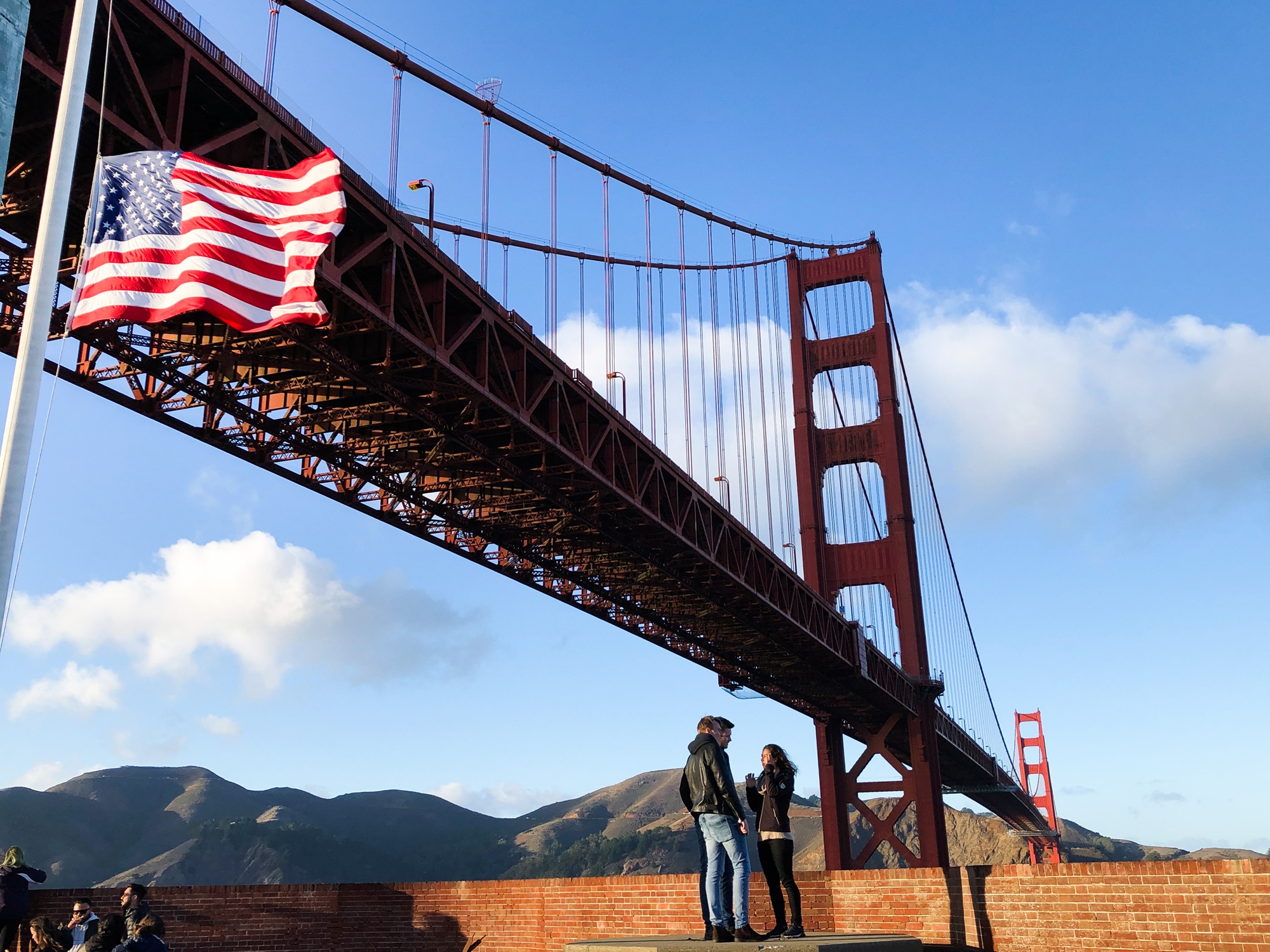
"content": "\u003cp>After being \u003ca href=\"https://www.kqed.org/news/12058291/san-francisco-national-parks-government-shutdown-bay-area-muir-woods-redwoods-fort-point\">shuttered for over a week due to the federal government shutdown\u003c/a>, \u003ca href=\"https://www.nps.gov/fopo/index.htm\">Fort Point National Historic Site\u003c/a> is scheduled to partially reopen to the public on Friday.\u003c/p>\n\u003cp>The San Francisco national park site, famed for its use as a filming location for Alfred Hitchcock’s 1958 thriller \u003ca href=\"https://reelsf.com/reelsf/vertigo-fort-point\">\u003cem>Vertigo\u003c/em>\u003c/a>, will reopen only on weekends during the shutdown, according to Chris Lehnertz, president and CEO of the Golden Gate National Parks Conservancy. Fort Point received almost \u003ca href=\"https://irma.nps.gov/Stats/SSRSReports/Park%20Specific%20Reports/Annual%20Park%20Recreation%20Visitation%20(1904%20-%20Last%20Calendar%20Year)?Park=FOPO\">1.2 million\u003c/a> visitors in 2024.\u003c/p>\n\u003cp>Before the shutdown, Fort Point’s \u003ca href=\"https://www.nps.gov/fopo/planyourvisit/hours.htm\">interior\u003c/a> was open to the public on Mondays through Thursdays, with weeklong access to the fort’s grounds. During the shutdown, \u003ca href=\"https://www.kqed.org/news/12058291/san-francisco-national-parks-government-shutdown-bay-area-muir-woods-redwoods-fort-point\">the gates that lead to Fort Point by road have remained locked\u003c/a>, although pedestrian access is still possible and the site’s bathrooms are still open.\u003c/p>\n\u003cp>[ad fullwidth]\u003c/p>\n\u003cp>But Lehnertz said due to the popularity of the \u003cem>\u003ca href=\"https://www.kqed.org/arts/13977165/review-black-gold-fort-point-san-francisco\">Black Gold: Stories Untold\u003c/a>\u003c/em> exhibition on display inside Fort Point, the conservancy made a donation to fund staffing at the site for the show’s final weekend on Oct. 10–13. Both the museum and exhibition will be open from 10 a.m. to 5 p.m.\u003c/p>\n\u003cp>“It’s just one of those times when an exhibit that’s this important needs to have a final hurrah,” she said.[aside postID=news_12058298 hero='https://cdn.kqed.org/wp-content/uploads/sites/10/2025/10/251001-NATIONAL-PARKS-SHUTDOWN-MD-08-KQED.jpg']The Fort Point visitor center, parking lot, bookstore and the bathrooms will be open Friday through Monday for the Indigenous Peoples Day holiday weekend, and every following weekend, Friday through Sunday, “for the foreseeable future,” Lehnertz said.\u003c/p>\n\u003cp>\u003ca href=\"https://www.for-site.org/black-gold-stories-untold\">\u003cem>Black Gold\u003c/em>\u003c/a>, a collaboration between the park service and the For-Site Foundation, features the work of 17 artists highlighting Black history and the contributions of Black Californians during the period from the Gold Rush to Reconstruction.\u003c/p>\n\u003cp>Since opening on June 6, 70,000 visitors have seen the \u003cem>Black Gold\u003c/em> exhibit, according to \u003ca href=\"https://www.for-site.org/black-gold-stories-untold\">For-Site\u003c/a>. The foundation is planning two performances for Oct. 12 at 1 p.m. and 2 p.m. to mark its closing weekend, with actors “representing historic figures highlighted in the exhibition.”\u003c/p>\n\u003ch2>How parks are reopening during the shutdown\u003c/h2>\n\u003cp>Lehnertz said the conservancy, a nonprofit membership organization that supports parks within the Golden Gate National Recreation Area, is able to partially reopen Fort Point under the current parks contingency \u003ca href=\"https://www.doi.gov/sites/default/files/documents/2025-09/doi-nps-lapse-plan2025930508.pdf\">plan\u003c/a> for the shutdown — which allows park partners and concessionaires, like hotel, food or tour operators, to make donations to reopen specific parks to reduce the community’s economic loss.\u003c/p>\n\u003cp>“Governors and partners in several states have been working with the National Park Service to establish short-term agreements with donations to help maintain operations during the lapse in appropriations,” a spokesperson for the National Park Service told KQED by email Thursday. “We can confirm that thanks to one of our partners there is an agreement in place for Fort Point.”\u003c/p>\n\u003cp>This donation model has also funded\u003ca href=\"https://www.kqed.org/news/12058592/\"> the Oct. 3 reopening of Alcatraz Island\u003c/a>, which was initially closed for two days at the start of the shutdown. Hornblower Group and Alcatraz City Cruises, operators of ferry service to the island, confirmed to KQED Thursday that they made a donation to NPS in partnership with the conservancy, to restart Alcatraz tours and to keep the park open during the shutdown.\u003c/p>\n\u003cp>\u003c/p>\n",
"blocks": [],
"excerpt": "The Golden Gate National Parks Conservancy says it’s funding a “final hurrah” for the site’s ‘Black Gold’ exhibit.",
"status": "publish",
"parent": 0,
"modified": 1761760523,
"stats": {
"hasAudio": false,
"hasVideo": false,
"hasChartOrMap": false,
"iframeSrcs": [],
"hasGoogleForm": false,
"hasGallery": false,
"hasHearkenModule": false,
"hasPolis": false,
"paragraphCount": 12,
"wordCount": 576
},
"headData": {
"title": "San Francisco’s Fort Point Will Partially Reopen Amid National Parks Shutdown | KQED",
"description": "The Golden Gate National Parks Conservancy says it’s funding a “final hurrah” for the site’s ‘Black Gold’ exhibit.",
"ogTitle": "",
"ogDescription": "",
"ogImgId": "",
"twTitle": "",
"twDescription": "",
"twImgId": "",
"schema": {
"@context": "https://schema.org",
"@type": "NewsArticle",
"headline": "San Francisco’s Fort Point Will Partially Reopen Amid National Parks Shutdown",
"datePublished": "2025-10-09T11:20:39-07:00",
"dateModified": "2025-10-29T10:55:23-07:00",
"image": "https://cdn.kqed.org/wp-content/uploads/2020/02/KQED-OG-Image@1x.png",
"isAccessibleForFree": "True",
"publisher": {
"@type": "NewsMediaOrganization",
"@id": "https://www.kqed.org/#organization",
"name": "KQED",
"logo": "https://cdn.kqed.org/wp-content/uploads/2020/02/KQED-OG-Image@1x.png",
"url": "https://www.kqed.org",
"sameAs": [
"https://www.facebook.com/KQED",
"https://twitter.com/KQED",
"https://www.instagram.com/kqed/",
"https://www.tiktok.com/@kqedofficial",
"https://www.linkedin.com/company/kqed",
"https://www.youtube.com/channel/UCeC0IOo7i1P_61zVUWbJ4nw"
]
}
}
},
"primaryCategory": {
"termId": 34168,
"slug": "guides-and-explainers",
"name": "Guides and Explainers"
},
"sticky": false,
"nprStoryId": "kqed-12059259",
"templateType": "standard",
"featuredImageType": "standard",
"excludeFromSiteSearch": "Include",
"articleAge": "0",
"path": "/news/12059259/san-franciscos-fort-point-will-partially-reopen-amid-national-parks-shutdown",
"audioTrackLength": null,
"parsedContent": [
{
"type": "contentString",
"content": "\u003cdiv class=\"post-body\">\u003cp>\u003cp>After being \u003ca href=\"https://www.kqed.org/news/12058291/san-francisco-national-parks-government-shutdown-bay-area-muir-woods-redwoods-fort-point\">shuttered for over a week due to the federal government shutdown\u003c/a>, \u003ca href=\"https://www.nps.gov/fopo/index.htm\">Fort Point National Historic Site\u003c/a> is scheduled to partially reopen to the public on Friday.\u003c/p>\n\u003cp>The San Francisco national park site, famed for its use as a filming location for Alfred Hitchcock’s 1958 thriller \u003ca href=\"https://reelsf.com/reelsf/vertigo-fort-point\">\u003cem>Vertigo\u003c/em>\u003c/a>, will reopen only on weekends during the shutdown, according to Chris Lehnertz, president and CEO of the Golden Gate National Parks Conservancy. Fort Point received almost \u003ca href=\"https://irma.nps.gov/Stats/SSRSReports/Park%20Specific%20Reports/Annual%20Park%20Recreation%20Visitation%20(1904%20-%20Last%20Calendar%20Year)?Park=FOPO\">1.2 million\u003c/a> visitors in 2024.\u003c/p>\n\u003cp>Before the shutdown, Fort Point’s \u003ca href=\"https://www.nps.gov/fopo/planyourvisit/hours.htm\">interior\u003c/a> was open to the public on Mondays through Thursdays, with weeklong access to the fort’s grounds. During the shutdown, \u003ca href=\"https://www.kqed.org/news/12058291/san-francisco-national-parks-government-shutdown-bay-area-muir-woods-redwoods-fort-point\">the gates that lead to Fort Point by road have remained locked\u003c/a>, although pedestrian access is still possible and the site’s bathrooms are still open.\u003c/p>\n\u003cp>\u003c/p>\u003c/div>",
"attributes": {
"named": {},
"numeric": []
}
},
{
"type": "component",
"content": "",
"name": "ad",
"attributes": {
"named": {
"label": "fullwidth"
},
"numeric": [
"fullwidth"
]
}
},
{
"type": "contentString",
"content": "\u003cdiv class=\"post-body\">\u003cp>\u003c/p>\n\u003cp>But Lehnertz said due to the popularity of the \u003cem>\u003ca href=\"https://www.kqed.org/arts/13977165/review-black-gold-fort-point-san-francisco\">Black Gold: Stories Untold\u003c/a>\u003c/em> exhibition on display inside Fort Point, the conservancy made a donation to fund staffing at the site for the show’s final weekend on Oct. 10–13. Both the museum and exhibition will be open from 10 a.m. to 5 p.m.\u003c/p>\n\u003cp>“It’s just one of those times when an exhibit that’s this important needs to have a final hurrah,” she said.\u003c/p>\u003c/div>",
"attributes": {
"named": {},
"numeric": []
}
},
{
"type": "component",
"content": "",
"name": "aside",
"attributes": {
"named": {
"postid": "news_12058298",
"hero": "https://cdn.kqed.org/wp-content/uploads/sites/10/2025/10/251001-NATIONAL-PARKS-SHUTDOWN-MD-08-KQED.jpg",
"label": ""
},
"numeric": []
}
},
{
"type": "contentString",
"content": "\u003cdiv class=\"post-body\">\u003cp>The Fort Point visitor center, parking lot, bookstore and the bathrooms will be open Friday through Monday for the Indigenous Peoples Day holiday weekend, and every following weekend, Friday through Sunday, “for the foreseeable future,” Lehnertz said.\u003c/p>\n\u003cp>\u003ca href=\"https://www.for-site.org/black-gold-stories-untold\">\u003cem>Black Gold\u003c/em>\u003c/a>, a collaboration between the park service and the For-Site Foundation, features the work of 17 artists highlighting Black history and the contributions of Black Californians during the period from the Gold Rush to Reconstruction.\u003c/p>\n\u003cp>Since opening on June 6, 70,000 visitors have seen the \u003cem>Black Gold\u003c/em> exhibit, according to \u003ca href=\"https://www.for-site.org/black-gold-stories-untold\">For-Site\u003c/a>. The foundation is planning two performances for Oct. 12 at 1 p.m. and 2 p.m. to mark its closing weekend, with actors “representing historic figures highlighted in the exhibition.”\u003c/p>\n\u003ch2>How parks are reopening during the shutdown\u003c/h2>\n\u003cp>Lehnertz said the conservancy, a nonprofit membership organization that supports parks within the Golden Gate National Recreation Area, is able to partially reopen Fort Point under the current parks contingency \u003ca href=\"https://www.doi.gov/sites/default/files/documents/2025-09/doi-nps-lapse-plan2025930508.pdf\">plan\u003c/a> for the shutdown — which allows park partners and concessionaires, like hotel, food or tour operators, to make donations to reopen specific parks to reduce the community’s economic loss.\u003c/p>\n\u003cp>“Governors and partners in several states have been working with the National Park Service to establish short-term agreements with donations to help maintain operations during the lapse in appropriations,” a spokesperson for the National Park Service told KQED by email Thursday. “We can confirm that thanks to one of our partners there is an agreement in place for Fort Point.”\u003c/p>\n\u003cp>This donation model has also funded\u003ca href=\"https://www.kqed.org/news/12058592/\"> the Oct. 3 reopening of Alcatraz Island\u003c/a>, which was initially closed for two days at the start of the shutdown. Hornblower Group and Alcatraz City Cruises, operators of ferry service to the island, confirmed to KQED Thursday that they made a donation to NPS in partnership with the conservancy, to restart Alcatraz tours and to keep the park open during the shutdown.\u003c/p>\n\u003cp>\u003c/p>\n\u003c/div>\u003c/p>",
"attributes": {
"named": {},
"numeric": []
}
}
],
"link": "/news/12059259/san-franciscos-fort-point-will-partially-reopen-amid-national-parks-shutdown",
"authors": [
"11956"
],
"categories": [
"news_29992",
"news_31795",
"news_34168",
"news_28250",
"news_8"
],
"tags": [
"news_32707",
"news_36020",
"news_1386",
"news_35888",
"news_1276",
"news_29828",
"news_17925",
"news_38"
],
"featImg": "news_12059261",
"label": "news"
},
"news_12059176": {
"type": "posts",
"id": "news_12059176",
"meta": {
"index": "posts_1716263798",
"site": "news",
"id": "12059176",
"score": null,
"sort": [
1760014848000
]
},
"guestAuthors": [],
"slug": "california-leads-resistance-as-trump-sends-troops-into-american-cities",
"title": "California Leads Resistance as Trump Sends Troops Into American Cities",
"publishDate": 1760014848,
"format": "standard",
"headTitle": "California Leads Resistance as Trump Sends Troops Into American Cities | KQED",
"labelTerm": {},
"content": "\u003cp>\u003cem>\u003cstrong>[This column was reported for Political Breakdown, a bimonthly newsletter offering analysis and context on Bay Area and California political news. \u003ca href=\"https://www.kqed.org/newsletters/political-breakdown\">Click here to subscribe\u003c/a>.]\u003c/strong>\u003c/em>\u003c/p>\n\u003cp>\u003cstrong>It’s a \u003ca href=\"https://www.kqed.org/news/12058799/trumps-national-guard-moves-are-part-of-a-dangerous-plan-california-ag-warns\">threat\u003c/a> President Trump has made before:\u003c/strong> He first publicly mused about using military troops to quell civilian protests in 2020, during his first term, when demonstrations roiled the nation after Minneapolis police killed George Floyd.\u003c/p>\n\u003cp>He didn’t send troops across the country, but did dispatch National Guard troops from 11 states to Washington, D.C., where they controversially helped clear protesters from Lafayette Square ahead of a presidential photo-op in front of a church. (An \u003ca href=\"https://www.npr.org/2021/06/09/1004832399/watchdog-report-says-police-did-not-clear-protesters-to-make-way-for-trump-last-\">investigation\u003c/a> later found that the park police and Guard members decided to disperse the crowd — using tear gas — independently of the president’s plans.)\u003c/p>\n\u003cp>It’s important to note that Washington, D.C., unlike cities in sovereign states, falls under greater federal control — the president commands the D.C. National Guard. Still, even before Trump’s reelection, pro-democracy experts saw the threats to use troops against civilians as part of a \u003ca href=\"https://www.kqed.org/news/11991317/protect-democracy-warns-how-trump-2-0-could-lead-to-authoritarianism\">troubling pattern of authoritarian tendencies\u003c/a>.\u003c/p>\n\u003cp>[ad fullwidth]\u003c/p>\n\u003cp>\u003cstrong>Things escalated in June, when Trump sent troops to L.A.:\u003c/strong> Trump said he was responding to “out-of-control” immigration protests when he \u003ca href=\"https://www.kqed.org/news/12043221/protesters-and-immigration-authorities-face-off-for-a-2nd-day-in-la-area-after-arrests\">seized control of the California National Guard\u003c/a> from Gov. Gavin Newsom and deployed Guard members — and eventually 700 U.S. Marines — to the nation’s second largest city. State and local officials disputed that the protests were beyond their control and \u003ca href=\"https://www.kqed.org/news/12043314/california-to-sue-trump-for-sending-national-guard-troops-into-la-after-ice-protests\">quickly sued\u003c/a>, asking a court to \u003ca href=\"https://www.kqed.org/news/12043548/california-asks-court-to-stop-national-guard-marines-from-patrolling-la-streets\">remove the troops\u003c/a> from the streets. While the state has had \u003ca href=\"https://www.kqed.org/news/12043935/how-solid-is-californias-legal-case-against-trump-deploying-troops-to-la\">success\u003c/a> in a district court, \u003ca href=\"https://www.kqed.org/news/12043920/judge-weighs-californias-lawsuit-over-trumps-troop-deployment-in-la\">an appeals court halted\u003c/a> the lower judge’s order to remove the troops.\u003c/p>\n\u003cp>After a \u003ca href=\"https://www.kqed.org/news/12051797/california-argues-trumps-use-of-troops-in-l-a-violated-federal-law\">three-day trial\u003c/a> in August, a judge \u003ca href=\"https://www.kqed.org/news/12054322/judge-rules-trump-violated-law-by-sending-troops-to-los-angeles\">ruled in favor of California\u003c/a>, ruling that Trump had violated federal law and ordering him to stop using troops for policing, but an appeals court paused that decision. The case is still pending and is expected to be heard by the Ninth Circuit Court of Appeals later this month.\u003c/p>\n\u003cp>But in general, some judges have appeared \u003ca href=\"https://www.kqed.org/news/12044621/appeals-court-hears-newsoms-case-against-trumps-national-guard-mobilization\">reticent to second-guess\u003c/a> the president’s authority on an issue related to national security.\u003c/p>\n\u003cfigure id=\"attachment_12059095\" class=\"wp-caption aligncenter\" style=\"max-width: 2560px\">\u003cimg loading=\"lazy\" decoding=\"async\" class=\"size-full wp-image-12059095\" src=\"https://cdn.kqed.org/wp-content/uploads/sites/10/2025/10/GettyImages-2220483644-scaled.jpg\" alt=\"\" width=\"2560\" height=\"1707\" srcset=\"https://cdn.kqed.org/wp-content/uploads/sites/10/2025/10/GettyImages-2220483644-scaled.jpg 2560w, https://cdn.kqed.org/wp-content/uploads/sites/10/2025/10/GettyImages-2220483644-2000x1333.jpg 2000w, https://cdn.kqed.org/wp-content/uploads/sites/10/2025/10/GettyImages-2220483644-160x107.jpg 160w, https://cdn.kqed.org/wp-content/uploads/sites/10/2025/10/GettyImages-2220483644-1536x1024.jpg 1536w, https://cdn.kqed.org/wp-content/uploads/sites/10/2025/10/GettyImages-2220483644-2048x1365.jpg 2048w\" sizes=\"auto, (max-width: 2560px) 100vw, 2560px\">\u003cfigcaption class=\"wp-caption-text\">Residents surround federal and Border Patrol agents as they plan their exit after an immigration raid on Atlantic Boulevard in Bell, California, on June 19, 2025. \u003ccite>(Genaro Molina/Los Angeles Times via Getty Images)\u003c/cite>\u003c/figcaption>\u003c/figure>\n\u003cp>\u003cstrong>First Washington, D.C., then an escalation with Oregon and Illinois:\u003c/strong> Trump argued that he needed troops in D.C. to combat crime — a rationale that shifted as he began sending forces to Portland and Chicago. He has claimed the troops are needed to protect immigration facilities and agents from protesters, though he often conflates crime and immigration enforcement.\u003c/p>\n\u003cp>The deployments have turned into a partisan showdown between blue states and red states, now playing out in multiple courts. California joined Oregon’s lawsuit after Trump \u003ca href=\"https://www.kqed.org/news/12058677/newsom-says-trump-is-sending-300-california-national-guard-members-to-oregon\">tried to send California Guard members to Portland\u003c/a>, successfully securing a temporary order \u003ca href=\"https://www.kqed.org/news/12058715/trumps-order-to-deploy-california-national-guard-to-oregon-sparks-legal-showdown\">blocking that deployment\u003c/a>. Chicago and Illinois were not successful. Both cases are moving through appeals court.[aside postID=news_12058715 hero='https://cdn.kqed.org/wp-content/uploads/sites/10/2025/10/AP25278748416734-scaled.jpg']Both cases are moving through appeals courts.\u003c/p>\n\u003cp>Republicans and Democrats are telling starkly different stories and military experts are concerned. The Trump administration insists the deployments are about public safety and the rule of law. On Monday, White House Press Secretary Karoline Leavitt said ICE facilities in Portland had been “under siege by these anarchists” for months and accused protesters of inciting violence.\u003c/p>\n\u003cp>Democrats, including California Attorney General Rob Bonta, see Trump’s moves as a precursor to potentially \u003ca href=\"https://www.kqed.org/news/12058799/trumps-national-guard-moves-are-part-of-a-dangerous-plan-california-ag-warns\">more frightening uses of the military\u003c/a>.\u003c/p>\n\u003cp>“Trump does think that the military is his personal police force and his personal army. And he wants that force behind his policy decisions,” Bonta said. “He wants to weaponize the military against blue states and blue cities…. he’s also, I think, socializing the idea of the military in American cities.”\u003c/p>\n\u003cp>Newsom and other Democrats have warned that Trump may use the troops to intimidate voters in blue states and to \u003ca href=\"https://www.sfchronicle.com/politics/article/proposition-50-election-newsom-trump-21088506.php\">suppress the vote\u003c/a> in November’s special election and beyond.\u003c/p>\n\u003cp>Bonta, though, said that the U.S. “is a nation that will never accept military rule.” And some former military leaders are speaking out. Retired Gen. Randy Manner, who will join Political Breakdown on Thursday, has warned that the president’s actions risk driving a wedge between the armed forces and the public.\u003c/p>\n\u003cp>\u003c/p>\n",
"blocks": [],
"excerpt": "President Trump’s decision to deploy U.S. troops to Los Angeles, Portland and Chicago has ignited legal battles with California and other blue states, escalating tensions over presidential power, immigration enforcement, and the use of the military in American cities.",
"status": "publish",
"parent": 0,
"modified": 1760027088,
"stats": {
"hasAudio": false,
"hasVideo": false,
"hasChartOrMap": false,
"iframeSrcs": [],
"hasGoogleForm": false,
"hasGallery": false,
"hasHearkenModule": false,
"hasPolis": false,
"paragraphCount": 16,
"wordCount": 781
},
"headData": {
"title": "California Leads Resistance as Trump Sends Troops Into American Cities | KQED",
"description": "President Trump’s decision to deploy U.S. troops to Los Angeles, Portland and Chicago has ignited legal battles with California and other blue states, escalating tensions over presidential power, immigration enforcement, and the use of the military in American cities.",
"ogTitle": "",
"ogDescription": "",
"ogImgId": "",
"twTitle": "",
"twDescription": "",
"twImgId": "",
"schema": {
"@context": "https://schema.org",
"@type": "NewsArticle",
"headline": "California Leads Resistance as Trump Sends Troops Into American Cities",
"datePublished": "2025-10-09T06:00:48-07:00",
"dateModified": "2025-10-09T09:24:48-07:00",
"image": "https://cdn.kqed.org/wp-content/uploads/2020/02/KQED-OG-Image@1x.png",
"isAccessibleForFree": "True",
"publisher": {
"@type": "NewsMediaOrganization",
"@id": "https://www.kqed.org/#organization",
"name": "KQED",
"logo": "https://cdn.kqed.org/wp-content/uploads/2020/02/KQED-OG-Image@1x.png",
"url": "https://www.kqed.org",
"sameAs": [
"https://www.facebook.com/KQED",
"https://twitter.com/KQED",
"https://www.instagram.com/kqed/",
"https://www.tiktok.com/@kqedofficial",
"https://www.linkedin.com/company/kqed",
"https://www.youtube.com/channel/UCeC0IOo7i1P_61zVUWbJ4nw"
]
}
}
},
"primaryCategory": {
"termId": 13,
"slug": "politics",
"name": "Politics"
},
"source": "COMMENTARY",
"sticky": false,
"nprStoryId": "kqed-12059176",
"templateType": "standard",
"featuredImageType": "standard",
"excludeFromSiteSearch": "Include",
"articleAge": "0",
"path": "/news/12059176/california-leads-resistance-as-trump-sends-troops-into-american-cities",
"audioTrackLength": null,
"parsedContent": [
{
"type": "contentString",
"content": "\u003cdiv class=\"post-body\">\u003cp>\u003cp>\u003cem>\u003cstrong>[This column was reported for Political Breakdown, a bimonthly newsletter offering analysis and context on Bay Area and California political news. \u003ca href=\"https://www.kqed.org/newsletters/political-breakdown\">Click here to subscribe\u003c/a>.]\u003c/strong>\u003c/em>\u003c/p>\n\u003cp>\u003cstrong>It’s a \u003ca href=\"https://www.kqed.org/news/12058799/trumps-national-guard-moves-are-part-of-a-dangerous-plan-california-ag-warns\">threat\u003c/a> President Trump has made before:\u003c/strong> He first publicly mused about using military troops to quell civilian protests in 2020, during his first term, when demonstrations roiled the nation after Minneapolis police killed George Floyd.\u003c/p>\n\u003cp>He didn’t send troops across the country, but did dispatch National Guard troops from 11 states to Washington, D.C., where they controversially helped clear protesters from Lafayette Square ahead of a presidential photo-op in front of a church. (An \u003ca href=\"https://www.npr.org/2021/06/09/1004832399/watchdog-report-says-police-did-not-clear-protesters-to-make-way-for-trump-last-\">investigation\u003c/a> later found that the park police and Guard members decided to disperse the crowd — using tear gas — independently of the president’s plans.)\u003c/p>\n\u003cp>It’s important to note that Washington, D.C., unlike cities in sovereign states, falls under greater federal control — the president commands the D.C. National Guard. Still, even before Trump’s reelection, pro-democracy experts saw the threats to use troops against civilians as part of a \u003ca href=\"https://www.kqed.org/news/11991317/protect-democracy-warns-how-trump-2-0-could-lead-to-authoritarianism\">troubling pattern of authoritarian tendencies\u003c/a>.\u003c/p>\n\u003cp>\u003c/p>\u003c/div>",
"attributes": {
"named": {},
"numeric": []
}
},
{
"type": "component",
"content": "",
"name": "ad",
"attributes": {
"named": {
"label": "fullwidth"
},
"numeric": [
"fullwidth"
]
}
},
{
"type": "contentString",
"content": "\u003cdiv class=\"post-body\">\u003cp>\u003c/p>\n\u003cp>\u003cstrong>Things escalated in June, when Trump sent troops to L.A.:\u003c/strong> Trump said he was responding to “out-of-control” immigration protests when he \u003ca href=\"https://www.kqed.org/news/12043221/protesters-and-immigration-authorities-face-off-for-a-2nd-day-in-la-area-after-arrests\">seized control of the California National Guard\u003c/a> from Gov. Gavin Newsom and deployed Guard members — and eventually 700 U.S. Marines — to the nation’s second largest city. State and local officials disputed that the protests were beyond their control and \u003ca href=\"https://www.kqed.org/news/12043314/california-to-sue-trump-for-sending-national-guard-troops-into-la-after-ice-protests\">quickly sued\u003c/a>, asking a court to \u003ca href=\"https://www.kqed.org/news/12043548/california-asks-court-to-stop-national-guard-marines-from-patrolling-la-streets\">remove the troops\u003c/a> from the streets. While the state has had \u003ca href=\"https://www.kqed.org/news/12043935/how-solid-is-californias-legal-case-against-trump-deploying-troops-to-la\">success\u003c/a> in a district court, \u003ca href=\"https://www.kqed.org/news/12043920/judge-weighs-californias-lawsuit-over-trumps-troop-deployment-in-la\">an appeals court halted\u003c/a> the lower judge’s order to remove the troops.\u003c/p>\n\u003cp>After a \u003ca href=\"https://www.kqed.org/news/12051797/california-argues-trumps-use-of-troops-in-l-a-violated-federal-law\">three-day trial\u003c/a> in August, a judge \u003ca href=\"https://www.kqed.org/news/12054322/judge-rules-trump-violated-law-by-sending-troops-to-los-angeles\">ruled in favor of California\u003c/a>, ruling that Trump had violated federal law and ordering him to stop using troops for policing, but an appeals court paused that decision. The case is still pending and is expected to be heard by the Ninth Circuit Court of Appeals later this month.\u003c/p>\n\u003cp>But in general, some judges have appeared \u003ca href=\"https://www.kqed.org/news/12044621/appeals-court-hears-newsoms-case-against-trumps-national-guard-mobilization\">reticent to second-guess\u003c/a> the president’s authority on an issue related to national security.\u003c/p>\n\u003cfigure id=\"attachment_12059095\" class=\"wp-caption aligncenter\" style=\"max-width: 2560px\">\u003cimg loading=\"lazy\" decoding=\"async\" class=\"size-full wp-image-12059095\" src=\"https://cdn.kqed.org/wp-content/uploads/sites/10/2025/10/GettyImages-2220483644-scaled.jpg\" alt=\"\" width=\"2560\" height=\"1707\" srcset=\"https://cdn.kqed.org/wp-content/uploads/sites/10/2025/10/GettyImages-2220483644-scaled.jpg 2560w, https://cdn.kqed.org/wp-content/uploads/sites/10/2025/10/GettyImages-2220483644-2000x1333.jpg 2000w, https://cdn.kqed.org/wp-content/uploads/sites/10/2025/10/GettyImages-2220483644-160x107.jpg 160w, https://cdn.kqed.org/wp-content/uploads/sites/10/2025/10/GettyImages-2220483644-1536x1024.jpg 1536w, https://cdn.kqed.org/wp-content/uploads/sites/10/2025/10/GettyImages-2220483644-2048x1365.jpg 2048w\" sizes=\"auto, (max-width: 2560px) 100vw, 2560px\">\u003cfigcaption class=\"wp-caption-text\">Residents surround federal and Border Patrol agents as they plan their exit after an immigration raid on Atlantic Boulevard in Bell, California, on June 19, 2025. \u003ccite>(Genaro Molina/Los Angeles Times via Getty Images)\u003c/cite>\u003c/figcaption>\u003c/figure>\n\u003cp>\u003cstrong>First Washington, D.C., then an escalation with Oregon and Illinois:\u003c/strong> Trump argued that he needed troops in D.C. to combat crime — a rationale that shifted as he began sending forces to Portland and Chicago. He has claimed the troops are needed to protect immigration facilities and agents from protesters, though he often conflates crime and immigration enforcement.\u003c/p>\n\u003cp>The deployments have turned into a partisan showdown between blue states and red states, now playing out in multiple courts. California joined Oregon’s lawsuit after Trump \u003ca href=\"https://www.kqed.org/news/12058677/newsom-says-trump-is-sending-300-california-national-guard-members-to-oregon\">tried to send California Guard members to Portland\u003c/a>, successfully securing a temporary order \u003ca href=\"https://www.kqed.org/news/12058715/trumps-order-to-deploy-california-national-guard-to-oregon-sparks-legal-showdown\">blocking that deployment\u003c/a>. Chicago and Illinois were not successful. Both cases are moving through appeals court.\u003c/p>\u003c/div>",
"attributes": {
"named": {},
"numeric": []
}
},
{
"type": "component",
"content": "",
"name": "aside",
"attributes": {
"named": {
"postid": "news_12058715",
"hero": "https://cdn.kqed.org/wp-content/uploads/sites/10/2025/10/AP25278748416734-scaled.jpg",
"label": ""
},
"numeric": []
}
},
{
"type": "contentString",
"content": "\u003cdiv class=\"post-body\">\u003cp>Both cases are moving through appeals courts.\u003c/p>\n\u003cp>Republicans and Democrats are telling starkly different stories and military experts are concerned. The Trump administration insists the deployments are about public safety and the rule of law. On Monday, White House Press Secretary Karoline Leavitt said ICE facilities in Portland had been “under siege by these anarchists” for months and accused protesters of inciting violence.\u003c/p>\n\u003cp>Democrats, including California Attorney General Rob Bonta, see Trump’s moves as a precursor to potentially \u003ca href=\"https://www.kqed.org/news/12058799/trumps-national-guard-moves-are-part-of-a-dangerous-plan-california-ag-warns\">more frightening uses of the military\u003c/a>.\u003c/p>\n\u003cp>“Trump does think that the military is his personal police force and his personal army. And he wants that force behind his policy decisions,” Bonta said. “He wants to weaponize the military against blue states and blue cities…. he’s also, I think, socializing the idea of the military in American cities.”\u003c/p>\n\u003cp>Newsom and other Democrats have warned that Trump may use the troops to intimidate voters in blue states and to \u003ca href=\"https://www.sfchronicle.com/politics/article/proposition-50-election-newsom-trump-21088506.php\">suppress the vote\u003c/a> in November’s special election and beyond.\u003c/p>\n\u003cp>Bonta, though, said that the U.S. “is a nation that will never accept military rule.” And some former military leaders are speaking out. Retired Gen. Randy Manner, who will join Political Breakdown on Thursday, has warned that the president’s actions risk driving a wedge between the armed forces and the public.\u003c/p>\n\u003cp>\u003c/p>\n\u003c/div>\u003c/p>",
"attributes": {
"named": {},
"numeric": []
}
}
],
"link": "/news/12059176/california-leads-resistance-as-trump-sends-troops-into-american-cities",
"authors": [
"3239"
],
"categories": [
"news_31795",
"news_1169",
"news_8",
"news_13"
],
"tags": [
"news_18538",
"news_1323",
"news_27626",
"news_34377",
"news_16",
"news_20202",
"news_17968"
],
"featImg": "news_12053411",
"label": "source_news_12059176"
},
"news_12059022": {
"type": "posts",
"id": "news_12059022",
"meta": {
"index": "posts_1716263798",
"site": "news",
"id": "12059022",
"score": null,
"sort": [
1759963362000
]
},
"guestAuthors": [],
"slug": "judge-upholds-firings-pay-cuts-for-california-prison-guards-who-bullied-whistleblower",
"title": "Judge Upholds Firings, Pay Cuts for California Prison Guards Who Bullied Whistleblower",
"publishDate": 1759963362,
"format": "standard",
"headTitle": "Judge Upholds Firings, Pay Cuts for California Prison Guards Who Bullied Whistleblower | KQED",
"labelTerm": {
"site": "news"
},
"content": "\u003cp>Four correctional officers who worked in an elite investigative unit at a high-security Northern California prison lost their final bid this week to overturn disciplinary decisions arising from \u003ca href=\"https://www.kqed.org/news/12017652/how-to-kill-a-cop-death-despair-and-corruption-in-californias-most-violent-prison\">an investigation\u003c/a> into the 2020 death of a coworker.\u003c/p>\n\u003cp>The Sacramento County Superior Court on Monday affirmed earlier State Personnel Board findings that the four officers at California State Prison, Sacramento — colloquially known as New Folsom — had violated prohibitions against harassing, bullying and abusing others and using slurs and other derogatory language.\u003c/p>\n\u003cp>This included harassment of a former coworker in the Investigative Services Unit, Lt. Valentino Rodriguez Jr., a whistleblower who was found dead in his home just days after reporting misconduct within the unit to then-warden Jeff Lynch.\u003c/p>\n\u003cp>[ad fullwidth]\u003c/p>\n\u003cp>Judge Jennifer K. Rockwell’s 13-page ruling also affirmed that the California Department of Corrections and Rehabilitation had sufficient evidence of those violations to terminate former ISU officers Daniel Garland and Marcus Jordan and shave 10% of officers Martin Fong’s and Paul Bettencourt’s pay for 24 and 36 months, respectively.\u003c/p>\n\u003cp>“The Court’s inquiry is limited to whether substantial evidence supports the decision in light of the whole record,” Rockwell wrote in her ruling. “The Court does not reweigh the evidence.”\u003cem> \u003c/em>\u003c/p>\n\u003cfigure id=\"attachment_12017605\" class=\"wp-caption alignleft\" style=\"max-width: 683px\">\u003cimg loading=\"lazy\" decoding=\"async\" class=\"size-full wp-image-12017605\" src=\"https://cdn.kqed.org/wp-content/uploads/sites/10/2024/12/241113-OOW-VALENTINO-RODRIGUEZ-JR-04-KQED.jpg\" alt=\"\" width=\"683\" height=\"854\" srcset=\"https://cdn.kqed.org/wp-content/uploads/sites/10/2024/12/241113-OOW-VALENTINO-RODRIGUEZ-JR-04-KQED.jpg 683w, https://cdn.kqed.org/wp-content/uploads/sites/10/2024/12/241113-OOW-VALENTINO-RODRIGUEZ-JR-04-KQED-160x200.jpg 160w\" sizes=\"auto, (max-width: 683px) 100vw, 683px\">\u003cfigcaption class=\"wp-caption-text\">Valentino Rodriguez Jr. with his mother, Erma Rodriguez, at his graduation from CDCR’s officer academy in Galt, California, May 1, 2015. \u003ccite>(Courtesy of the Rodriguez Family)\u003c/cite>\u003c/figcaption>\u003c/figure>\n\u003cp>Much of that evidence came from the cellphone of Rodriguez, which contained thousands of texts between the officers. It also showed that he’d told senior officers that the group excluded and degraded him.\u003c/p>\n\u003cp>“I’m glad that the judge stuck to the decision, and that they’ve run out of appeals,” said his father, Valentino Rodriguez Sr. “I know for a fact that if he hadn’t been in that ISU, he’d be alive today.”\u003c/p>\n\u003cp>Rodriguez was promoted to the ISU in 2018 to fill in for another officer on administrative leave and became a permanent member before going on leave for stress in early 2020.\u003c/p>\n\u003cp>His efforts to cope with unrelenting hazing by fellow officers, the loss of his career and his ultimate death by an accidental overdose were chronicled in KQED’s eight-part podcast “\u003ca href=\"https://www.kqed.org/podcasts/onourwatch\">On Our Watch: New Folsom\u003c/a>.”\u003c/p>\n\u003cp>The multi-year investigation also told the story of ISU \u003ca href=\"https://www.kqed.org/news/12017652/how-to-kill-a-cop-death-despair-and-corruption-in-californias-most-violent-prison\">Sgt. Kevin Steele\u003c/a>, who urged the warden to investigate Rodriguez’s untimely death. Steele had also reported systemic abuse of inmates and allegations that guards’ negligence resulted in a homicide in a high-security lock-up at New Folsom. Steele died by suicide in 2021.\u003c/p>\n\u003cp>CDCR representatives have repeatedly said they could not comment on specific allegations made by Steele and Rodriguez before their deaths.\u003c/p>\n\u003cp>The internal affairs investigation into Rodriguez’s death resulted in the discipline of a number of employees, some of whom settled out of court. Just four officers pursued an appeal all the way to the Superior Court.[aside postID=news_12057486 hero='https://cdn.kqed.org/wp-content/uploads/sites/10/2025/04/230816-Dublin-Womens-Prison-Suit-MD-01_qed-1020x680.jpg']Garland and Jordan, who had used a racist slur and other derogatory language in the office, were cited for “Inexcusable Neglect of Duty, Discourteous Treatment of Public or Other Employees, Willful Disobedience, and Other Failure of Good Behavior” and dismissed from their jobs; Fong and Bettencourt, who repeatedly called Rodriguez “half patch” as a reminder of his temporary status on the unit and failed to report misconduct, received lengthy pay cuts, according to court filings.\u003c/p>\n\u003cp>At a Sept. 29 hearing with the judge, the attorney representing the four officers argued that the offensive language was commonly used as a way to cope with the stress of working in a maximum-security prison and that CDCR’s decisions were overly severe.\u003c/p>\n\u003cp>“There were no allegations of dishonesty, no allegations of insubordination, but we end up with this nuclear reaction in terms of discipline,” Lina Balciunas Cockrell said. “They communicated off-duty with each other, and they got fired and heavily disciplined for it.”\u003c/p>\n\u003cp>Timothy Knight, an attorney for CDCR, argued that the policies the officers violated “were in place to prevent exactly what occurred in this case: harassment of a coworker.”\u003c/p>\n\u003cp>Knight said the officers who didn’t use slurs and derogatory language \u003cstrong>“\u003c/strong>were repeatedly not reporting the misconduct that they knew about.”\u003c/p>\n\u003cp>In disciplinary decisions, he said, CDCR considers the likelihood that the employee would repeat the misconduct.\u003c/p>\n\u003cp>“These are not individuals that, looking back, have recognized the degree of their misconduct or feel any particular noteworthy responsibility for the mistakes they made,” Knight said.\u003c/p>\n\u003cp>CDCR dismissed Garland and Jordan in October 2021, according to a department spokesperson. Fong and Bettencourt still work for CDCR at other prisons. Their attorney could not comment in time for publication.\u003c/p>\n\u003cp>\u003c/p>\n",
"blocks": [],
"excerpt": "The case revealed a toxic culture of hazing among officers of an elite investigative unit at California State Prison, Sacramento — colloquially known as New Folsom. ",
"status": "publish",
"parent": 0,
"modified": 1759965007,
"stats": {
"hasAudio": false,
"hasVideo": false,
"hasChartOrMap": false,
"iframeSrcs": [],
"hasGoogleForm": false,
"hasGallery": false,
"hasHearkenModule": false,
"hasPolis": false,
"paragraphCount": 21,
"wordCount": 843
},
"headData": {
"title": "Judge Upholds Firings, Pay Cuts for California Prison Guards Who Bullied Whistleblower | KQED",
"description": "The case revealed a toxic culture of hazing among officers of an elite investigative unit at California State Prison, Sacramento — colloquially known as New Folsom. ",
"ogTitle": "",
"ogDescription": "",
"ogImgId": "",
"twTitle": "",
"twDescription": "",
"twImgId": "",
"schema": {
"@context": "https://schema.org",
"@type": "NewsArticle",
"headline": "Judge Upholds Firings, Pay Cuts for California Prison Guards Who Bullied Whistleblower",
"datePublished": "2025-10-08T15:42:42-07:00",
"dateModified": "2025-10-08T16:10:07-07:00",
"image": "https://cdn.kqed.org/wp-content/uploads/2020/02/KQED-OG-Image@1x.png",
"isAccessibleForFree": "True",
"publisher": {
"@type": "NewsMediaOrganization",
"@id": "https://www.kqed.org/#organization",
"name": "KQED",
"logo": "https://cdn.kqed.org/wp-content/uploads/2020/02/KQED-OG-Image@1x.png",
"url": "https://www.kqed.org",
"sameAs": [
"https://www.facebook.com/KQED",
"https://twitter.com/KQED",
"https://www.instagram.com/kqed/",
"https://www.tiktok.com/@kqedofficial",
"https://www.linkedin.com/company/kqed",
"https://www.youtube.com/channel/UCeC0IOo7i1P_61zVUWbJ4nw"
]
}
}
},
"primaryCategory": {
"termId": 34167,
"slug": "criminal-justice",
"name": "Criminal Justice"
},
"sticky": false,
"nprStoryId": "kqed-12059022",
"templateType": "standard",
"featuredImageType": "standard",
"excludeFromSiteSearch": "Include",
"articleAge": "0",
"path": "/news/12059022/judge-upholds-firings-pay-cuts-for-california-prison-guards-who-bullied-whistleblower",
"audioTrackLength": null,
"parsedContent": [
{
"type": "contentString",
"content": "\u003cdiv class=\"post-body\">\u003cp>\u003cp>Four correctional officers who worked in an elite investigative unit at a high-security Northern California prison lost their final bid this week to overturn disciplinary decisions arising from \u003ca href=\"https://www.kqed.org/news/12017652/how-to-kill-a-cop-death-despair-and-corruption-in-californias-most-violent-prison\">an investigation\u003c/a> into the 2020 death of a coworker.\u003c/p>\n\u003cp>The Sacramento County Superior Court on Monday affirmed earlier State Personnel Board findings that the four officers at California State Prison, Sacramento — colloquially known as New Folsom — had violated prohibitions against harassing, bullying and abusing others and using slurs and other derogatory language.\u003c/p>\n\u003cp>This included harassment of a former coworker in the Investigative Services Unit, Lt. Valentino Rodriguez Jr., a whistleblower who was found dead in his home just days after reporting misconduct within the unit to then-warden Jeff Lynch.\u003c/p>\n\u003cp>\u003c/p>\u003c/div>",
"attributes": {
"named": {},
"numeric": []
}
},
{
"type": "component",
"content": "",
"name": "ad",
"attributes": {
"named": {
"label": "fullwidth"
},
"numeric": [
"fullwidth"
]
}
},
{
"type": "contentString",
"content": "\u003cdiv class=\"post-body\">\u003cp>\u003c/p>\n\u003cp>Judge Jennifer K. Rockwell’s 13-page ruling also affirmed that the California Department of Corrections and Rehabilitation had sufficient evidence of those violations to terminate former ISU officers Daniel Garland and Marcus Jordan and shave 10% of officers Martin Fong’s and Paul Bettencourt’s pay for 24 and 36 months, respectively.\u003c/p>\n\u003cp>“The Court’s inquiry is limited to whether substantial evidence supports the decision in light of the whole record,” Rockwell wrote in her ruling. “The Court does not reweigh the evidence.”\u003cem> \u003c/em>\u003c/p>\n\u003cfigure id=\"attachment_12017605\" class=\"wp-caption alignleft\" style=\"max-width: 683px\">\u003cimg loading=\"lazy\" decoding=\"async\" class=\"size-full wp-image-12017605\" src=\"https://cdn.kqed.org/wp-content/uploads/sites/10/2024/12/241113-OOW-VALENTINO-RODRIGUEZ-JR-04-KQED.jpg\" alt=\"\" width=\"683\" height=\"854\" srcset=\"https://cdn.kqed.org/wp-content/uploads/sites/10/2024/12/241113-OOW-VALENTINO-RODRIGUEZ-JR-04-KQED.jpg 683w, https://cdn.kqed.org/wp-content/uploads/sites/10/2024/12/241113-OOW-VALENTINO-RODRIGUEZ-JR-04-KQED-160x200.jpg 160w\" sizes=\"auto, (max-width: 683px) 100vw, 683px\">\u003cfigcaption class=\"wp-caption-text\">Valentino Rodriguez Jr. with his mother, Erma Rodriguez, at his graduation from CDCR’s officer academy in Galt, California, May 1, 2015. \u003ccite>(Courtesy of the Rodriguez Family)\u003c/cite>\u003c/figcaption>\u003c/figure>\n\u003cp>Much of that evidence came from the cellphone of Rodriguez, which contained thousands of texts between the officers. It also showed that he’d told senior officers that the group excluded and degraded him.\u003c/p>\n\u003cp>“I’m glad that the judge stuck to the decision, and that they’ve run out of appeals,” said his father, Valentino Rodriguez Sr. “I know for a fact that if he hadn’t been in that ISU, he’d be alive today.”\u003c/p>\n\u003cp>Rodriguez was promoted to the ISU in 2018 to fill in for another officer on administrative leave and became a permanent member before going on leave for stress in early 2020.\u003c/p>\n\u003cp>His efforts to cope with unrelenting hazing by fellow officers, the loss of his career and his ultimate death by an accidental overdose were chronicled in KQED’s eight-part podcast “\u003ca href=\"https://www.kqed.org/podcasts/onourwatch\">On Our Watch: New Folsom\u003c/a>.”\u003c/p>\n\u003cp>The multi-year investigation also told the story of ISU \u003ca href=\"https://www.kqed.org/news/12017652/how-to-kill-a-cop-death-despair-and-corruption-in-californias-most-violent-prison\">Sgt. Kevin Steele\u003c/a>, who urged the warden to investigate Rodriguez’s untimely death. Steele had also reported systemic abuse of inmates and allegations that guards’ negligence resulted in a homicide in a high-security lock-up at New Folsom. Steele died by suicide in 2021.\u003c/p>\n\u003cp>CDCR representatives have repeatedly said they could not comment on specific allegations made by Steele and Rodriguez before their deaths.\u003c/p>\n\u003cp>The internal affairs investigation into Rodriguez’s death resulted in the discipline of a number of employees, some of whom settled out of court. Just four officers pursued an appeal all the way to the Superior Court.\u003c/p>\u003c/div>",
"attributes": {
"named": {},
"numeric": []
}
},
{
"type": "component",
"content": "",
"name": "aside",
"attributes": {
"named": {
"postid": "news_12057486",
"hero": "https://cdn.kqed.org/wp-content/uploads/sites/10/2025/04/230816-Dublin-Womens-Prison-Suit-MD-01_qed-1020x680.jpg",
"label": ""
},
"numeric": []
}
},
{
"type": "contentString",
"content": "\u003cdiv class=\"post-body\">\u003cp>Garland and Jordan, who had used a racist slur and other derogatory language in the office, were cited for “Inexcusable Neglect of Duty, Discourteous Treatment of Public or Other Employees, Willful Disobedience, and Other Failure of Good Behavior” and dismissed from their jobs; Fong and Bettencourt, who repeatedly called Rodriguez “half patch” as a reminder of his temporary status on the unit and failed to report misconduct, received lengthy pay cuts, according to court filings.\u003c/p>\n\u003cp>At a Sept. 29 hearing with the judge, the attorney representing the four officers argued that the offensive language was commonly used as a way to cope with the stress of working in a maximum-security prison and that CDCR’s decisions were overly severe.\u003c/p>\n\u003cp>“There were no allegations of dishonesty, no allegations of insubordination, but we end up with this nuclear reaction in terms of discipline,” Lina Balciunas Cockrell said. “They communicated off-duty with each other, and they got fired and heavily disciplined for it.”\u003c/p>\n\u003cp>Timothy Knight, an attorney for CDCR, argued that the policies the officers violated “were in place to prevent exactly what occurred in this case: harassment of a coworker.”\u003c/p>\n\u003cp>Knight said the officers who didn’t use slurs and derogatory language \u003cstrong>“\u003c/strong>were repeatedly not reporting the misconduct that they knew about.”\u003c/p>\n\u003cp>In disciplinary decisions, he said, CDCR considers the likelihood that the employee would repeat the misconduct.\u003c/p>\n\u003cp>“These are not individuals that, looking back, have recognized the degree of their misconduct or feel any particular noteworthy responsibility for the mistakes they made,” Knight said.\u003c/p>\n\u003cp>CDCR dismissed Garland and Jordan in October 2021, according to a department spokesperson. Fong and Bettencourt still work for CDCR at other prisons. Their attorney could not comment in time for publication.\u003c/p>\n\u003cp>\u003c/p>\n\u003c/div>\u003c/p>",
"attributes": {
"named": {},
"numeric": []
}
}
],
"link": "/news/12059022/judge-upholds-firings-pay-cuts-for-california-prison-guards-who-bullied-whistleblower",
"authors": [
"6625"
],
"categories": [
"news_31795",
"news_34167",
"news_8"
],
"tags": [
"news_616",
"news_17725",
"news_3148",
"news_30805",
"news_19954",
"news_5930"
],
"featImg": "news_12017609",
"label": "news"
},
"news_12059007": {
"type": "posts",
"id": "news_12059007",
"meta": {
"index": "posts_1716263798",
"site": "news",
"id": "12059007",
"score": null,
"sort": [
1759950029000
]
},
"guestAuthors": [],
"slug": "2026-2027-fafsa-open-deadlines-student-aid-application-cadaa",
"title": "The 2026-27 FAFSA Is Open. Mark These Deadlines on Your Calendar",
"publishDate": 1759950029,
"format": "standard",
"headTitle": "The 2026-27 FAFSA Is Open. Mark These Deadlines on Your Calendar | KQED",
"labelTerm": {
"site": "news"
},
"content": "\u003cp>For the first time since \u003ca href=\"https://www.kqed.org/news/11987754/californias-class-of-2024-lags-in-student-aid-applications-data-shows\">its glitchy revamp\u003c/a> two years ago, the Free Application for Federal Student Aid (FAFSA) is \u003ca href=\"https://fsapartners.ed.gov/home/\">open to students on time\u003c/a>.\u003c/p>\n\u003cp>The application launched last week on Oct. 1, on the same day \u003ca href=\"https://www.kqed.org/news/tag/government-shutdown\">the federal government shut down\u003c/a> after Congress failed to pass a stopgap funding bill.\u003c/p>\n\u003cp>But there’s good news for prospective college students: The shutdown doesn’t impact applying for FAFSA. Daisy Gonzales, Executive Director of the California Student Aid Commission (CSAC), said students can \u003ca href=\"https://fsapartners.ed.gov/knowledge-center/library/electronic-announcements/2025-10-01/government-lapse-appropriations-federal-student-aid-processing-and-customer-service-guidance\">still submit their forms\u003c/a>, and the agency “does not anticipate any disruption.”\u003c/p>\n\u003cp>[ad fullwidth]\u003c/p>\n\u003cp>“CSAC encourages students to be ready to apply for financial aid through the FAFSA,” Gonzales said in a statement. “Call centers will be open to answer any calls from both the Federal Student Aid and CSAC.”\u003c/p>\n\u003cp>The California DREAM Act, the \u003ca href=\"https://www.kqed.org/news/11979367/fafsa-2024-the-big-error-affecting-mixed-status-families-and-what-to-do-if-youre-an-affected-student\">state-based application\u003c/a> for undocumented students and students from mixed-status families, is also open. The state said that student\u003ca href=\"https://dream.csac.ca.gov/landing\"> “information is never shared with the federal government or used for immigration enforcement.” \u003c/a>\u003c/p>\n\u003cfigure id=\"attachment_11982309\" class=\"wp-caption aligncenter\" style=\"max-width: 2000px\">\u003cimg loading=\"lazy\" decoding=\"async\" class=\"size-full wp-image-11982309\" src=\"https://cdn.kqed.org/wp-content/uploads/sites/10/2024/04/240408-UCLAWSF-010-BL-KQED.jpg\" alt=\"\" width=\"2000\" height=\"1333\" srcset=\"https://cdn.kqed.org/wp-content/uploads/sites/10/2024/04/240408-UCLAWSF-010-BL-KQED.jpg 2000w, https://cdn.kqed.org/wp-content/uploads/sites/10/2024/04/240408-UCLAWSF-010-BL-KQED-800x533.jpg 800w, https://cdn.kqed.org/wp-content/uploads/sites/10/2024/04/240408-UCLAWSF-010-BL-KQED-1020x680.jpg 1020w, https://cdn.kqed.org/wp-content/uploads/sites/10/2024/04/240408-UCLAWSF-010-BL-KQED-160x107.jpg 160w, https://cdn.kqed.org/wp-content/uploads/sites/10/2024/04/240408-UCLAWSF-010-BL-KQED-1536x1024.jpg 1536w, https://cdn.kqed.org/wp-content/uploads/sites/10/2024/04/240408-UCLAWSF-010-BL-KQED-1920x1280.jpg 1920w\" sizes=\"auto, (max-width: 2000px) 100vw, 2000px\">\u003cfigcaption class=\"wp-caption-text\">Students outside of the University of California College of the Law in San Francisco on April 8, 2024. \u003ccite>(Beth LaBerge/KQED)\u003c/cite>\u003c/figcaption>\u003c/figure>\n\u003cp>While you have plenty of time to complete and submit the application, deadlines can creep up on you, especially after two cycles of delayed rollouts.\u003c/p>\n\u003cp>Keep reading for all the FAFSA and CADAA application deadlines to know for 2025, as well as other financial aid applications.\u003c/p>\n\u003ch2>What are the financial aid deadlines to know for 2025?\u003c/h2>\n\u003cp>What deadlines you should keep track of largely depends on what type of college or university you are hoping to enroll in. You should check directly with the school you’re interested in attending to make sure of their specific timings.\u003c/p>\n\u003cp>For the FAFSA, March 2, 2026, is \u003ca href=\"https://www.csac.ca.gov/post/important-dates-and-deadlines\">the priority deadline\u003c/a> for most colleges and institutions.\u003c/p>\n\u003cp>For students applying for state-based aid like CADAA, March 2, 2026, is the strict deadline.\u003c/p>\n\u003cfigure id=\"attachment_11968720\" class=\"wp-caption aligncenter\" style=\"max-width: 1920px\">\u003cimg loading=\"lazy\" decoding=\"async\" class=\"wp-image-11968720 size-full\" src=\"https://cdn.kqed.org/wp-content/uploads/sites/10/2023/11/IMG_0524.jpg\" alt=\"An illustration showing a pair of hands holding a yellow sheet of paper that reads FAFSA. In the background, a number of figures representing family members talk.\" width=\"1920\" height=\"1240\" srcset=\"https://cdn.kqed.org/wp-content/uploads/sites/10/2023/11/IMG_0524.jpg 1920w, https://cdn.kqed.org/wp-content/uploads/sites/10/2023/11/IMG_0524-800x517.jpg 800w, https://cdn.kqed.org/wp-content/uploads/sites/10/2023/11/IMG_0524-1020x659.jpg 1020w, https://cdn.kqed.org/wp-content/uploads/sites/10/2023/11/IMG_0524-160x103.jpg 160w, https://cdn.kqed.org/wp-content/uploads/sites/10/2023/11/IMG_0524-1536x992.jpg 1536w\" sizes=\"auto, (max-width: 1920px) 100vw, 1920px\">\u003cfigcaption class=\"wp-caption-text\">The FAFSA is now open on time. Here are the major student aid deadlines students need to know. \u003ccite>(Anna Vignet/KQED)\u003c/cite>\u003c/figcaption>\u003c/figure>\n\u003cp>The financial aid deadline for students going to community college is Sept. 2, 2026.\u003c/p>\n\u003cp>While some people may qualify for free community college through the California Promise Grant, they can only access this program by \u003ca href=\"https://www.ccsf.edu/california-college-promise-grant-ccpg\">applying to the FAFSA or CADAA\u003c/a> along with \u003ca href=\"https://home.cccapply.org/index.php/us/money/california-college-promise-grant\">the grant’s own application\u003c/a>.\u003c/p>\n\u003cp>Students hoping to go to a private institution should consider filling out the \u003ca href=\"https://cssprofile.collegeboard.org/getting-started\">CSS Profile\u003c/a> in addition to the FAFSA. The deadline for the CSS Profile, which is a separate aid application, is dependent on the \u003ca href=\"https://cssprofile.collegeboard.org/frequently-asked-questionshttps:/cssprofile.collegeboard.org/frequently-asked-questions\">private school’s own priority deadline\u003c/a>.\u003c/p>\n\u003ch2>I’m not sure I’m going to college. Should I follow these deadlines anyway?\u003c/h2>\n\u003cp>In \u003ca href=\"https://www.kqed.org/news/12018723/fafsa-2025-california-deadlines\">a 2024 interview with KQED\u003c/a>, Gonzales said that the biggest misconception people can make about the FAFSA is believing that they don’t qualify — whether that’s because their family is \u003ca href=\"https://www.csac.ca.gov/middle-class-scholarship\">middle class\u003c/a>, they’re thinking about joining the military or they’re going on a gap year.\u003c/p>\n\u003cp>Even if you’re uncertain about going to college at all, Gonzales said you should apply for FAFSA anyway. That way, you’ll have it completed in case they change your mind about your plans, and you’ll be sure you haven’t missed any deadlines.[aside postID=news_12058230 hero='https://cdn.kqed.org/wp-content/uploads/sites/10/2024/10/npr.brightspotcdn-copy-1-1020x681.jpg']“It’s never a bad idea to apply,” she said. And because “the aid here in California is very generous, very diverse,” many students — especially first-year college students — will qualify for some form of aid like grants, scholarships, subsidized loans or work-study, she said.\u003c/p>\n\u003cp>Among those programs is \u003ca href=\"https://www.csac.ca.gov/financial-aid-programshttps:/www.csac.ca.gov/financial-aid-programs\">the Cal Grant\u003c/a> — the \u003ca href=\"https://www.csac.ca.gov/cal-grants\">state-specific aid program\u003c/a> that California students can apply for through the FAFSA. Other programs include:\u003c/p>\n\u003cul>\n\u003cli>The Cal-HBCU program, which provides aid for California students transferring from California Community Colleges to a partnering Historically Black College.\u003c/li>\n\u003cli>A grant for foster youth under 26 that funds five years of schooling\u003c/li>\n\u003cli>Aid for undocumented students who also participate in community service\u003c/li>\n\u003cli>Grants for students who are also parents\u003c/li>\n\u003cli>Students planning to enter the teaching profession.\u003c/li>\n\u003c/ul>\n\u003ch2>What tax documents do I need to complete the FAFSA on time?\u003c/h2>\n\u003cp>First, a quick breakdown of tax vocabulary:\u003c/p>\n\u003cul>\n\u003cli>A W-2 form is a tax document that an employer gives workers once a year, which shows how much the employer paid the worker that year.\u003c/li>\n\u003cli>A 1040 form is a tax document, also known as a tax return, that a worker completes themselves, usually with the help of a tax expert. This document is sent to the IRS each year to confirm how much the worker got paid and how much they owe the government in taxes.\u003c/li>\n\u003c/ul>\n\u003cfigure id=\"attachment_12011586\" class=\"wp-caption aligncenter\" style=\"max-width: 2000px\">\u003cimg loading=\"lazy\" decoding=\"async\" class=\"size-full wp-image-12011586\" src=\"https://cdn.kqed.org/wp-content/uploads/sites/10/2024/10/241029-OAKLANDSCHOLARSHIPSTUDENTS-01-BL-KQED.jpg\" alt=\"\" width=\"2000\" height=\"1333\" srcset=\"https://cdn.kqed.org/wp-content/uploads/sites/10/2024/10/241029-OAKLANDSCHOLARSHIPSTUDENTS-01-BL-KQED.jpg 2000w, https://cdn.kqed.org/wp-content/uploads/sites/10/2024/10/241029-OAKLANDSCHOLARSHIPSTUDENTS-01-BL-KQED-800x533.jpg 800w, https://cdn.kqed.org/wp-content/uploads/sites/10/2024/10/241029-OAKLANDSCHOLARSHIPSTUDENTS-01-BL-KQED-1020x680.jpg 1020w, https://cdn.kqed.org/wp-content/uploads/sites/10/2024/10/241029-OAKLANDSCHOLARSHIPSTUDENTS-01-BL-KQED-160x107.jpg 160w, https://cdn.kqed.org/wp-content/uploads/sites/10/2024/10/241029-OAKLANDSCHOLARSHIPSTUDENTS-01-BL-KQED-1536x1024.jpg 1536w, https://cdn.kqed.org/wp-content/uploads/sites/10/2024/10/241029-OAKLANDSCHOLARSHIPSTUDENTS-01-BL-KQED-1920x1280.jpg 1920w\" sizes=\"auto, (max-width: 2000px) 100vw, 2000px\">\u003cfigcaption class=\"wp-caption-text\">The Northeastern University campus in Oakland on Oct. 29, 2024, formerly Mills College. \u003ccite>(Beth LaBerge/KQED)\u003c/cite>\u003c/figcaption>\u003c/figure>\n\u003cp>Most people in the U.S. receive a W-2 form and then complete a 1040 form themselves. FAFSA will ask parents to share information from last year’s documents. If the parents do not have this information, it could be for one of these reasons:\u003c/p>\n\u003cul>\n\u003cli>The parent is a gig worker, such as driving for Uber or doing deliveries for Grubhub; they most likely did not get a W-2 form. Instead, the company they work for gave them a 1099 form. Ask for “their 1099” instead.\u003c/li>\n\u003cli>The parents did not work last year and received unemployment benefits instead; they most likely did not get a W-2 form. In this case, the state government will have sent them a 1099-G form, which lists how much they received from unemployment benefits.\u003c/li>\n\u003c/ul>\n\u003cp>If a student’s parent has a W-2 form but does not have last year’s 1040 form, this probably means they haven’t filed their taxes yet. Colleges will still want to see their taxes, and applicants should ask their parents about scheduling an appointment with a tax preparer to catch up on this.\u003c/p>\n\u003cp>Many community organizations offer free tax filing services year-round. In the Bay Area, \u003ca href=\"https://uwba.org/freetaxhelp/\">United Way can connect people\u003c/a> to online and in-person tax help — and parents could potentially qualify to get cash back from the government when they file, based on their income and the size of the family.\u003c/p>\n\u003cp>If your family still needs to file their taxes, keep the schools you’re applying to updated about this.\u003c/p>\n\u003ch2>Resources for students applying for financial aid:\u003c/h2>\n\u003cp>For students and family members who still have questions, FAFSA resources state-wide and nationally include:\u003c/p>\n\u003cul>\n\u003cli>\u003ca href=\"https://www.ncan.org/news/687244/NCANs-2025-26-FAFSA-Page-A-How-To-Guide.htm\">The National College Attainment Network’s 2025–26 FAFSA Page: A How-To Guide\u003c/a>\u003c/li>\n\u003cli>\u003ca href=\"https://studentaid.gov/apply-for-aid/fafsa/filling-out/help\">FAFSA’s official FAQ\u003c/a> (with \u003ca href=\"https://studentaid.gov/help-center/contact\">the help center’s contact information\u003c/a>)\u003c/li>\n\u003cli>\u003ca href=\"https://www.csac.ca.gov/sites/default/files/file-attachments/spanish_paper_better_cadaa_2024-2025.pdf\">Solicitud Dream Act de California\u003c/a>\u003c/li>\n\u003cli>\u003ca href=\"https://www.csac.ca.gov/students\">California Student Aid Commission\u003c/a>\u003c/li>\n\u003cli>\u003ca href=\"https://www.csac.ca.gov/cash-college\">CSAC’s Cash for College\u003c/a>\u003c/li>\n\u003cli>\u003ca href=\"https://www.casfaa.org/\">California Association of Student Financial Aid Administrators\u003c/a>\u003c/li>\n\u003c/ul>\n\u003cp>[ad floatright]\u003c/p>\n",
"blocks": [],
"excerpt": "The FAFSA is now open on time. Here are the major student aid deadlines students need to know. \r\n",
"status": "publish",
"parent": 0,
"modified": 1759950417,
"stats": {
"hasAudio": false,
"hasVideo": false,
"hasChartOrMap": false,
"iframeSrcs": [],
"hasGoogleForm": false,
"hasGallery": false,
"hasHearkenModule": false,
"hasPolis": false,
"paragraphCount": 24,
"wordCount": 1179
},
"headData": {
"title": "The 2026-27 FAFSA Is Open. Mark These Deadlines on Your Calendar | KQED",
"description": "The FAFSA is now open on time. Here are the major student aid deadlines students need to know. \r\n",
"ogTitle": "",
"ogDescription": "",
"ogImgId": "",
"twTitle": "",
"twDescription": "",
"twImgId": "",
"schema": {
"@context": "https://schema.org",
"@type": "NewsArticle",
"headline": "The 2026-27 FAFSA Is Open. Mark These Deadlines on Your Calendar",
"datePublished": "2025-10-08T12:00:29-07:00",
"dateModified": "2025-10-08T12:06:57-07:00",
"image": "https://cdn.kqed.org/wp-content/uploads/2020/02/KQED-OG-Image@1x.png",
"isAccessibleForFree": "True",
"publisher": {
"@type": "NewsMediaOrganization",
"@id": "https://www.kqed.org/#organization",
"name": "KQED",
"logo": "https://cdn.kqed.org/wp-content/uploads/2020/02/KQED-OG-Image@1x.png",
"url": "https://www.kqed.org",
"sameAs": [
"https://www.facebook.com/KQED",
"https://twitter.com/KQED",
"https://www.instagram.com/kqed/",
"https://www.tiktok.com/@kqedofficial",
"https://www.linkedin.com/company/kqed",
"https://www.youtube.com/channel/UCeC0IOo7i1P_61zVUWbJ4nw"
]
}
}
},
"primaryCategory": {
"termId": 34168,
"slug": "guides-and-explainers",
"name": "Guides and Explainers"
},
"sticky": false,
"nprStoryId": "kqed-12059007",
"templateType": "standard",
"featuredImageType": "standard",
"excludeFromSiteSearch": "Include",
"articleAge": "0",
"path": "/news/12059007/2026-2027-fafsa-open-deadlines-student-aid-application-cadaa",
"audioTrackLength": null,
"parsedContent": [
{
"type": "contentString",
"content": "\u003cdiv class=\"post-body\">\u003cp>\u003cp>For the first time since \u003ca href=\"https://www.kqed.org/news/11987754/californias-class-of-2024-lags-in-student-aid-applications-data-shows\">its glitchy revamp\u003c/a> two years ago, the Free Application for Federal Student Aid (FAFSA) is \u003ca href=\"https://fsapartners.ed.gov/home/\">open to students on time\u003c/a>.\u003c/p>\n\u003cp>The application launched last week on Oct. 1, on the same day \u003ca href=\"https://www.kqed.org/news/tag/government-shutdown\">the federal government shut down\u003c/a> after Congress failed to pass a stopgap funding bill.\u003c/p>\n\u003cp>But there’s good news for prospective college students: The shutdown doesn’t impact applying for FAFSA. Daisy Gonzales, Executive Director of the California Student Aid Commission (CSAC), said students can \u003ca href=\"https://fsapartners.ed.gov/knowledge-center/library/electronic-announcements/2025-10-01/government-lapse-appropriations-federal-student-aid-processing-and-customer-service-guidance\">still submit their forms\u003c/a>, and the agency “does not anticipate any disruption.”\u003c/p>\n\u003cp>\u003c/p>\u003c/div>",
"attributes": {
"named": {},
"numeric": []
}
},
{
"type": "component",
"content": "",
"name": "ad",
"attributes": {
"named": {
"label": "fullwidth"
},
"numeric": [
"fullwidth"
]
}
},
{
"type": "contentString",
"content": "\u003cdiv class=\"post-body\">\u003cp>\u003c/p>\n\u003cp>“CSAC encourages students to be ready to apply for financial aid through the FAFSA,” Gonzales said in a statement. “Call centers will be open to answer any calls from both the Federal Student Aid and CSAC.”\u003c/p>\n\u003cp>The California DREAM Act, the \u003ca href=\"https://www.kqed.org/news/11979367/fafsa-2024-the-big-error-affecting-mixed-status-families-and-what-to-do-if-youre-an-affected-student\">state-based application\u003c/a> for undocumented students and students from mixed-status families, is also open. The state said that student\u003ca href=\"https://dream.csac.ca.gov/landing\"> “information is never shared with the federal government or used for immigration enforcement.” \u003c/a>\u003c/p>\n\u003cfigure id=\"attachment_11982309\" class=\"wp-caption aligncenter\" style=\"max-width: 2000px\">\u003cimg loading=\"lazy\" decoding=\"async\" class=\"size-full wp-image-11982309\" src=\"https://cdn.kqed.org/wp-content/uploads/sites/10/2024/04/240408-UCLAWSF-010-BL-KQED.jpg\" alt=\"\" width=\"2000\" height=\"1333\" srcset=\"https://cdn.kqed.org/wp-content/uploads/sites/10/2024/04/240408-UCLAWSF-010-BL-KQED.jpg 2000w, https://cdn.kqed.org/wp-content/uploads/sites/10/2024/04/240408-UCLAWSF-010-BL-KQED-800x533.jpg 800w, https://cdn.kqed.org/wp-content/uploads/sites/10/2024/04/240408-UCLAWSF-010-BL-KQED-1020x680.jpg 1020w, https://cdn.kqed.org/wp-content/uploads/sites/10/2024/04/240408-UCLAWSF-010-BL-KQED-160x107.jpg 160w, https://cdn.kqed.org/wp-content/uploads/sites/10/2024/04/240408-UCLAWSF-010-BL-KQED-1536x1024.jpg 1536w, https://cdn.kqed.org/wp-content/uploads/sites/10/2024/04/240408-UCLAWSF-010-BL-KQED-1920x1280.jpg 1920w\" sizes=\"auto, (max-width: 2000px) 100vw, 2000px\">\u003cfigcaption class=\"wp-caption-text\">Students outside of the University of California College of the Law in San Francisco on April 8, 2024. \u003ccite>(Beth LaBerge/KQED)\u003c/cite>\u003c/figcaption>\u003c/figure>\n\u003cp>While you have plenty of time to complete and submit the application, deadlines can creep up on you, especially after two cycles of delayed rollouts.\u003c/p>\n\u003cp>Keep reading for all the FAFSA and CADAA application deadlines to know for 2025, as well as other financial aid applications.\u003c/p>\n\u003ch2>What are the financial aid deadlines to know for 2025?\u003c/h2>\n\u003cp>What deadlines you should keep track of largely depends on what type of college or university you are hoping to enroll in. You should check directly with the school you’re interested in attending to make sure of their specific timings.\u003c/p>\n\u003cp>For the FAFSA, March 2, 2026, is \u003ca href=\"https://www.csac.ca.gov/post/important-dates-and-deadlines\">the priority deadline\u003c/a> for most colleges and institutions.\u003c/p>\n\u003cp>For students applying for state-based aid like CADAA, March 2, 2026, is the strict deadline.\u003c/p>\n\u003cfigure id=\"attachment_11968720\" class=\"wp-caption aligncenter\" style=\"max-width: 1920px\">\u003cimg loading=\"lazy\" decoding=\"async\" class=\"wp-image-11968720 size-full\" src=\"https://cdn.kqed.org/wp-content/uploads/sites/10/2023/11/IMG_0524.jpg\" alt=\"An illustration showing a pair of hands holding a yellow sheet of paper that reads FAFSA. In the background, a number of figures representing family members talk.\" width=\"1920\" height=\"1240\" srcset=\"https://cdn.kqed.org/wp-content/uploads/sites/10/2023/11/IMG_0524.jpg 1920w, https://cdn.kqed.org/wp-content/uploads/sites/10/2023/11/IMG_0524-800x517.jpg 800w, https://cdn.kqed.org/wp-content/uploads/sites/10/2023/11/IMG_0524-1020x659.jpg 1020w, https://cdn.kqed.org/wp-content/uploads/sites/10/2023/11/IMG_0524-160x103.jpg 160w, https://cdn.kqed.org/wp-content/uploads/sites/10/2023/11/IMG_0524-1536x992.jpg 1536w\" sizes=\"auto, (max-width: 1920px) 100vw, 1920px\">\u003cfigcaption class=\"wp-caption-text\">The FAFSA is now open on time. Here are the major student aid deadlines students need to know. \u003ccite>(Anna Vignet/KQED)\u003c/cite>\u003c/figcaption>\u003c/figure>\n\u003cp>The financial aid deadline for students going to community college is Sept. 2, 2026.\u003c/p>\n\u003cp>While some people may qualify for free community college through the California Promise Grant, they can only access this program by \u003ca href=\"https://www.ccsf.edu/california-college-promise-grant-ccpg\">applying to the FAFSA or CADAA\u003c/a> along with \u003ca href=\"https://home.cccapply.org/index.php/us/money/california-college-promise-grant\">the grant’s own application\u003c/a>.\u003c/p>\n\u003cp>Students hoping to go to a private institution should consider filling out the \u003ca href=\"https://cssprofile.collegeboard.org/getting-started\">CSS Profile\u003c/a> in addition to the FAFSA. The deadline for the CSS Profile, which is a separate aid application, is dependent on the \u003ca href=\"https://cssprofile.collegeboard.org/frequently-asked-questionshttps:/cssprofile.collegeboard.org/frequently-asked-questions\">private school’s own priority deadline\u003c/a>.\u003c/p>\n\u003ch2>I’m not sure I’m going to college. Should I follow these deadlines anyway?\u003c/h2>\n\u003cp>In \u003ca href=\"https://www.kqed.org/news/12018723/fafsa-2025-california-deadlines\">a 2024 interview with KQED\u003c/a>, Gonzales said that the biggest misconception people can make about the FAFSA is believing that they don’t qualify — whether that’s because their family is \u003ca href=\"https://www.csac.ca.gov/middle-class-scholarship\">middle class\u003c/a>, they’re thinking about joining the military or they’re going on a gap year.\u003c/p>\n\u003cp>Even if you’re uncertain about going to college at all, Gonzales said you should apply for FAFSA anyway. That way, you’ll have it completed in case they change your mind about your plans, and you’ll be sure you haven’t missed any deadlines.\u003c/p>\u003c/div>",
"attributes": {
"named": {},
"numeric": []
}
},
{
"type": "component",
"content": "",
"name": "aside",
"attributes": {
"named": {
"postid": "news_12058230",
"hero": "https://cdn.kqed.org/wp-content/uploads/sites/10/2024/10/npr.brightspotcdn-copy-1-1020x681.jpg",
"label": ""
},
"numeric": []
}
},
{
"type": "contentString",
"content": "\u003cdiv class=\"post-body\">\u003cp>“It’s never a bad idea to apply,” she said. And because “the aid here in California is very generous, very diverse,” many students — especially first-year college students — will qualify for some form of aid like grants, scholarships, subsidized loans or work-study, she said.\u003c/p>\n\u003cp>Among those programs is \u003ca href=\"https://www.csac.ca.gov/financial-aid-programshttps:/www.csac.ca.gov/financial-aid-programs\">the Cal Grant\u003c/a> — the \u003ca href=\"https://www.csac.ca.gov/cal-grants\">state-specific aid program\u003c/a> that California students can apply for through the FAFSA. Other programs include:\u003c/p>\n\u003cul>\n\u003cli>The Cal-HBCU program, which provides aid for California students transferring from California Community Colleges to a partnering Historically Black College.\u003c/li>\n\u003cli>A grant for foster youth under 26 that funds five years of schooling\u003c/li>\n\u003cli>Aid for undocumented students who also participate in community service\u003c/li>\n\u003cli>Grants for students who are also parents\u003c/li>\n\u003cli>Students planning to enter the teaching profession.\u003c/li>\n\u003c/ul>\n\u003ch2>What tax documents do I need to complete the FAFSA on time?\u003c/h2>\n\u003cp>First, a quick breakdown of tax vocabulary:\u003c/p>\n\u003cul>\n\u003cli>A W-2 form is a tax document that an employer gives workers once a year, which shows how much the employer paid the worker that year.\u003c/li>\n\u003cli>A 1040 form is a tax document, also known as a tax return, that a worker completes themselves, usually with the help of a tax expert. This document is sent to the IRS each year to confirm how much the worker got paid and how much they owe the government in taxes.\u003c/li>\n\u003c/ul>\n\u003cfigure id=\"attachment_12011586\" class=\"wp-caption aligncenter\" style=\"max-width: 2000px\">\u003cimg loading=\"lazy\" decoding=\"async\" class=\"size-full wp-image-12011586\" src=\"https://cdn.kqed.org/wp-content/uploads/sites/10/2024/10/241029-OAKLANDSCHOLARSHIPSTUDENTS-01-BL-KQED.jpg\" alt=\"\" width=\"2000\" height=\"1333\" srcset=\"https://cdn.kqed.org/wp-content/uploads/sites/10/2024/10/241029-OAKLANDSCHOLARSHIPSTUDENTS-01-BL-KQED.jpg 2000w, https://cdn.kqed.org/wp-content/uploads/sites/10/2024/10/241029-OAKLANDSCHOLARSHIPSTUDENTS-01-BL-KQED-800x533.jpg 800w, https://cdn.kqed.org/wp-content/uploads/sites/10/2024/10/241029-OAKLANDSCHOLARSHIPSTUDENTS-01-BL-KQED-1020x680.jpg 1020w, https://cdn.kqed.org/wp-content/uploads/sites/10/2024/10/241029-OAKLANDSCHOLARSHIPSTUDENTS-01-BL-KQED-160x107.jpg 160w, https://cdn.kqed.org/wp-content/uploads/sites/10/2024/10/241029-OAKLANDSCHOLARSHIPSTUDENTS-01-BL-KQED-1536x1024.jpg 1536w, https://cdn.kqed.org/wp-content/uploads/sites/10/2024/10/241029-OAKLANDSCHOLARSHIPSTUDENTS-01-BL-KQED-1920x1280.jpg 1920w\" sizes=\"auto, (max-width: 2000px) 100vw, 2000px\">\u003cfigcaption class=\"wp-caption-text\">The Northeastern University campus in Oakland on Oct. 29, 2024, formerly Mills College. \u003ccite>(Beth LaBerge/KQED)\u003c/cite>\u003c/figcaption>\u003c/figure>\n\u003cp>Most people in the U.S. receive a W-2 form and then complete a 1040 form themselves. FAFSA will ask parents to share information from last year’s documents. If the parents do not have this information, it could be for one of these reasons:\u003c/p>\n\u003cul>\n\u003cli>The parent is a gig worker, such as driving for Uber or doing deliveries for Grubhub; they most likely did not get a W-2 form. Instead, the company they work for gave them a 1099 form. Ask for “their 1099” instead.\u003c/li>\n\u003cli>The parents did not work last year and received unemployment benefits instead; they most likely did not get a W-2 form. In this case, the state government will have sent them a 1099-G form, which lists how much they received from unemployment benefits.\u003c/li>\n\u003c/ul>\n\u003cp>If a student’s parent has a W-2 form but does not have last year’s 1040 form, this probably means they haven’t filed their taxes yet. Colleges will still want to see their taxes, and applicants should ask their parents about scheduling an appointment with a tax preparer to catch up on this.\u003c/p>\n\u003cp>Many community organizations offer free tax filing services year-round. In the Bay Area, \u003ca href=\"https://uwba.org/freetaxhelp/\">United Way can connect people\u003c/a> to online and in-person tax help — and parents could potentially qualify to get cash back from the government when they file, based on their income and the size of the family.\u003c/p>\n\u003cp>If your family still needs to file their taxes, keep the schools you’re applying to updated about this.\u003c/p>\n\u003ch2>Resources for students applying for financial aid:\u003c/h2>\n\u003cp>For students and family members who still have questions, FAFSA resources state-wide and nationally include:\u003c/p>\n\u003cul>\n\u003cli>\u003ca href=\"https://www.ncan.org/news/687244/NCANs-2025-26-FAFSA-Page-A-How-To-Guide.htm\">The National College Attainment Network’s 2025–26 FAFSA Page: A How-To Guide\u003c/a>\u003c/li>\n\u003cli>\u003ca href=\"https://studentaid.gov/apply-for-aid/fafsa/filling-out/help\">FAFSA’s official FAQ\u003c/a> (with \u003ca href=\"https://studentaid.gov/help-center/contact\">the help center’s contact information\u003c/a>)\u003c/li>\n\u003cli>\u003ca href=\"https://www.csac.ca.gov/sites/default/files/file-attachments/spanish_paper_better_cadaa_2024-2025.pdf\">Solicitud Dream Act de California\u003c/a>\u003c/li>\n\u003cli>\u003ca href=\"https://www.csac.ca.gov/students\">California Student Aid Commission\u003c/a>\u003c/li>\n\u003cli>\u003ca href=\"https://www.csac.ca.gov/cash-college\">CSAC’s Cash for College\u003c/a>\u003c/li>\n\u003cli>\u003ca href=\"https://www.casfaa.org/\">California Association of Student Financial Aid Administrators\u003c/a>\u003c/li>\n\u003c/ul>\n\u003cp>\u003c/p>\u003c/div>",
"attributes": {
"named": {},
"numeric": []
}
},
{
"type": "component",
"content": "",
"name": "ad",
"attributes": {
"named": {
"label": "floatright"
},
"numeric": [
"floatright"
]
}
},
{
"type": "contentString",
"content": "\u003cdiv class=\"post-body\">\u003cp>\u003c/p>\n\u003c/div>\u003c/p>",
"attributes": {
"named": {},
"numeric": []
}
}
],
"link": "/news/12059007/2026-2027-fafsa-open-deadlines-student-aid-application-cadaa",
"authors": [
"11867",
"11708"
],
"categories": [
"news_31795",
"news_18540",
"news_34168",
"news_28250",
"news_8"
],
"tags": [
"news_32707",
"news_18538",
"news_18085",
"news_22810",
"news_20013",
"news_31715",
"news_35888",
"news_22697"
],
"featImg": "news_11979390",
"label": "news"
},
"news_12058985": {
"type": "posts",
"id": "news_12058985",
"meta": {
"index": "posts_1716263798",
"site": "news",
"id": "12058985",
"score": null,
"sort": [
1759947619000
]
},
"guestAuthors": [],
"slug": "east-bay-workers-now-earn-more-but-many-still-struggle-to-make-ends-meet",
"title": "East Bay Workers Now Earn More, But Many Still Struggle to Make Ends Meet",
"publishDate": 1759947619,
"format": "standard",
"headTitle": "East Bay Workers Now Earn More, But Many Still Struggle to Make Ends Meet | KQED",
"labelTerm": {
"site": "news"
},
"content": "\u003cp>Workers’ wages in \u003ca href=\"https://www.kqed.org/news/tag/alameda-county\">Alameda\u003c/a> and \u003ca href=\"https://www.kqed.org/news/tag/contra-costa-county\">Contra Costa\u003c/a> counties rose during the COVID-19 pandemic recovery, but the gains were not enough for many to afford the region’s high cost of living, according to a UC Berkeley Labor Center \u003ca href=\"https://laborcenter.berkeley.edu/state-of-working-east-bay-2021-2023/\">report\u003c/a> published Tuesday.\u003c/p>\n\u003cp>Researchers estimated that the median hourly wage in the East Bay region reached more than $35.43 in 2023, nearly $3 higher than in 2019, adjusting for inflation. Despite the higher individual income, which added up thousands of dollars per year, the number of workers living at or near poverty increased to nearly 97,000, or one in 10.\u003c/p>\n\u003cp>“The wage gains are really important and that is a true bright spot in the story, but in the aggregate, it didn’t really move the needle,” said Savannah Hunter, a senior researcher at the UC Berkeley Labor Center who co-authored the report. “A lot of people still don’t make enough to make ends meet in the East Bay.”\u003c/p>\n\u003cp>[ad fullwidth]\u003c/p>\n\u003cp>More than half of East Bay workers weren’t paid enough to support a household of two full-time worker parents and two children. Among renters, about one-third of workers struggled to afford housing costs, according to the report’s findings.\u003c/p>\n\u003cp>Latino and Black workers disproportionately experienced lower incomes than whites and Asians. Hispanic immigrants earned a median hourly wage that rose to just $22, the lowest when compared to other race and ethnicity groups, as well as other U.S.-born and foreign-born workers.[aside postID=news_12053655 hero='https://cdn.kqed.org/wp-content/uploads/sites/10/2025/08/GuaranteedIncomeGetty.jpg']The end of pandemic-era relief programs in 2022, such as stimulus payments and tax credits, likely dimmed the higher earnings employers paid to attract and retain workers in a tight labor market, Hunter said. The federal government’s choice to let those social support policies expire led to a \u003ca href=\"https://www.cbpp.org/research/poverty-and-inequality/expiration-of-pandemic-relief-led-to-record-increases-in-poverty\">spike in poverty\u003c/a> nationwide, especially for children.\u003c/p>\n\u003cp>Stasia Hansen, research and policy director with the East Bay Alliance for a Sustainable Economy, said state and local governments must invest public dollars to make housing more affordable and ensure that employers in industries where wage theft is common pay workers what they are owed.\u003c/p>\n\u003cp>“Too many East Bay workers are trapped in poverty while working full-time. That’s honestly a policy failure; it’s not an accident. That is something that we have the power to change,” Hansen said. “We are seeing so much wealth in the East Bay and more broadly the Bay Area, and the concentration of that wealth is not going into our immigrant and Black communities.”\u003c/p>\n\u003cp>Hansen worried that the Trump administration’s steps to shrink healthcare access and the social safety net could exacerbate poverty. Trump’s ‘Big Beautiful’ spending bill, for instance, is expected to \u003ca href=\"https://www.kqed.org/forum/2010101911196/trump-cuts-to-snap-program-threaten-to-increase-hunger-locally-nationwide\">cut about $184 billion\u003c/a> from the Supplemental Nutrition Assistance Program through 2034.\u003c/p>\n\u003cp>“That’s going the wrong direction for what we need for our workers and for our communities and families in the East Bay,” she said.\u003c/p>\n\u003cp>\u003c/p>\n",
"blocks": [],
"excerpt": "Over half of East Bay workers were not paid enough to support a four-person household, UC Berkeley researchers found.\r\n",
"status": "publish",
"parent": 0,
"modified": 1759950491,
"stats": {
"hasAudio": false,
"hasVideo": false,
"hasChartOrMap": false,
"iframeSrcs": [],
"hasGoogleForm": false,
"hasGallery": false,
"hasHearkenModule": false,
"hasPolis": false,
"paragraphCount": 11,
"wordCount": 530
},
"headData": {
"title": "East Bay Workers Now Earn More, But Many Still Struggle to Make Ends Meet | KQED",
"description": "Over half of East Bay workers were not paid enough to support a four-person household, UC Berkeley researchers found.\r\n",
"ogTitle": "",
"ogDescription": "",
"ogImgId": "",
"twTitle": "",
"twDescription": "",
"twImgId": "",
"schema": {
"@context": "https://schema.org",
"@type": "NewsArticle",
"headline": "East Bay Workers Now Earn More, But Many Still Struggle to Make Ends Meet",
"datePublished": "2025-10-08T11:20:19-07:00",
"dateModified": "2025-10-08T12:08:11-07:00",
"image": "https://cdn.kqed.org/wp-content/uploads/2020/02/KQED-OG-Image@1x.png",
"isAccessibleForFree": "True",
"publisher": {
"@type": "NewsMediaOrganization",
"@id": "https://www.kqed.org/#organization",
"name": "KQED",
"logo": "https://cdn.kqed.org/wp-content/uploads/2020/02/KQED-OG-Image@1x.png",
"url": "https://www.kqed.org",
"sameAs": [
"https://www.facebook.com/KQED",
"https://twitter.com/KQED",
"https://www.instagram.com/kqed/",
"https://www.tiktok.com/@kqedofficial",
"https://www.linkedin.com/company/kqed",
"https://www.youtube.com/channel/UCeC0IOo7i1P_61zVUWbJ4nw"
]
}
}
},
"primaryCategory": {
"termId": 34551,
"slug": "labor",
"name": "Labor"
},
"sticky": false,
"nprStoryId": "kqed-12058985",
"templateType": "standard",
"featuredImageType": "standard",
"excludeFromSiteSearch": "Include",
"articleAge": "0",
"path": "/news/12058985/east-bay-workers-now-earn-more-but-many-still-struggle-to-make-ends-meet",
"audioTrackLength": null,
"parsedContent": [
{
"type": "contentString",
"content": "\u003cdiv class=\"post-body\">\u003cp>\u003cp>Workers’ wages in \u003ca href=\"https://www.kqed.org/news/tag/alameda-county\">Alameda\u003c/a> and \u003ca href=\"https://www.kqed.org/news/tag/contra-costa-county\">Contra Costa\u003c/a> counties rose during the COVID-19 pandemic recovery, but the gains were not enough for many to afford the region’s high cost of living, according to a UC Berkeley Labor Center \u003ca href=\"https://laborcenter.berkeley.edu/state-of-working-east-bay-2021-2023/\">report\u003c/a> published Tuesday.\u003c/p>\n\u003cp>Researchers estimated that the median hourly wage in the East Bay region reached more than $35.43 in 2023, nearly $3 higher than in 2019, adjusting for inflation. Despite the higher individual income, which added up thousands of dollars per year, the number of workers living at or near poverty increased to nearly 97,000, or one in 10.\u003c/p>\n\u003cp>“The wage gains are really important and that is a true bright spot in the story, but in the aggregate, it didn’t really move the needle,” said Savannah Hunter, a senior researcher at the UC Berkeley Labor Center who co-authored the report. “A lot of people still don’t make enough to make ends meet in the East Bay.”\u003c/p>\n\u003cp>\u003c/p>\u003c/div>",
"attributes": {
"named": {},
"numeric": []
}
},
{
"type": "component",
"content": "",
"name": "ad",
"attributes": {
"named": {
"label": "fullwidth"
},
"numeric": [
"fullwidth"
]
}
},
{
"type": "contentString",
"content": "\u003cdiv class=\"post-body\">\u003cp>\u003c/p>\n\u003cp>More than half of East Bay workers weren’t paid enough to support a household of two full-time worker parents and two children. Among renters, about one-third of workers struggled to afford housing costs, according to the report’s findings.\u003c/p>\n\u003cp>Latino and Black workers disproportionately experienced lower incomes than whites and Asians. Hispanic immigrants earned a median hourly wage that rose to just $22, the lowest when compared to other race and ethnicity groups, as well as other U.S.-born and foreign-born workers.\u003c/p>\u003c/div>",
"attributes": {
"named": {},
"numeric": []
}
},
{
"type": "component",
"content": "",
"name": "aside",
"attributes": {
"named": {
"postid": "news_12053655",
"hero": "https://cdn.kqed.org/wp-content/uploads/sites/10/2025/08/GuaranteedIncomeGetty.jpg",
"label": ""
},
"numeric": []
}
},
{
"type": "contentString",
"content": "\u003cdiv class=\"post-body\">\u003cp>The end of pandemic-era relief programs in 2022, such as stimulus payments and tax credits, likely dimmed the higher earnings employers paid to attract and retain workers in a tight labor market, Hunter said. The federal government’s choice to let those social support policies expire led to a \u003ca href=\"https://www.cbpp.org/research/poverty-and-inequality/expiration-of-pandemic-relief-led-to-record-increases-in-poverty\">spike in poverty\u003c/a> nationwide, especially for children.\u003c/p>\n\u003cp>Stasia Hansen, research and policy director with the East Bay Alliance for a Sustainable Economy, said state and local governments must invest public dollars to make housing more affordable and ensure that employers in industries where wage theft is common pay workers what they are owed.\u003c/p>\n\u003cp>“Too many East Bay workers are trapped in poverty while working full-time. That’s honestly a policy failure; it’s not an accident. That is something that we have the power to change,” Hansen said. “We are seeing so much wealth in the East Bay and more broadly the Bay Area, and the concentration of that wealth is not going into our immigrant and Black communities.”\u003c/p>\n\u003cp>Hansen worried that the Trump administration’s steps to shrink healthcare access and the social safety net could exacerbate poverty. Trump’s ‘Big Beautiful’ spending bill, for instance, is expected to \u003ca href=\"https://www.kqed.org/forum/2010101911196/trump-cuts-to-snap-program-threaten-to-increase-hunger-locally-nationwide\">cut about $184 billion\u003c/a> from the Supplemental Nutrition Assistance Program through 2034.\u003c/p>\n\u003cp>“That’s going the wrong direction for what we need for our workers and for our communities and families in the East Bay,” she said.\u003c/p>\n\u003cp>\u003c/p>\n\u003c/div>\u003c/p>",
"attributes": {
"named": {},
"numeric": []
}
}
],
"link": "/news/12058985/east-bay-workers-now-earn-more-but-many-still-struggle-to-make-ends-meet",
"authors": [
"8659"
],
"categories": [
"news_31795",
"news_1758",
"news_34551",
"news_28250",
"news_8"
],
"tags": [
"news_1386",
"news_129",
"news_18352",
"news_23333",
"news_19904",
"news_34054",
"news_1585",
"news_17597"
],
"featImg": "news_12059135",
"label": "news"
},
"news_12059123": {
"type": "posts",
"id": "news_12059123",
"meta": {
"index": "posts_1716263798",
"site": "news",
"id": "12059123",
"score": null,
"sort": [
1759947343000
]
},
"guestAuthors": [],
"slug": "uber-driver-charged-in-connection-with-starting-the-palisades-fire",
"title": "Uber Driver Charged in Connection With Starting the Palisades Fire",
"publishDate": 1759947343,
"format": "standard",
"headTitle": "Uber Driver Charged in Connection With Starting the Palisades Fire | KQED",
"labelTerm": {
"term": 24117,
"site": "news"
},
"content": "\u003cp>Nine months after the \u003ca href=\"https://www.kqed.org/news/tag/palisades-fire\">Palisades Fire ignited\u003c/a>, killing 12 and destroying more than 6,800 structures, authorities announced that they’ve arrested and charged 29-year-old Jonathan Rinderknecht in connection to starting the deadly blaze.\u003c/p>\n\u003cp>Acting U.S. Attorney Bill Essayli said Rinderknecht was arrested Tuesday in Florida. He has been \u003ca href=\"https://cdn.kqed.org/wp-content/uploads/sites/10/2025/10/usa-v-rinderknecht.pdf\">charged\u003c/a> with destruction of property by means of fire, which is a felony that carries a minimum sentence of five years in federal prison.\u003c/p>\n\u003cp>The Bureau of Alcohol, Tobacco, Firearms and Explosives has been investigating since January and has determined that it was a reignition of an earlier fire. Officials said at a news conference Wednesday that Rinderknecht started that fire six days earlier while working as an Uber driver — around midnight on Jan. 1 — after dropping off a passenger.\u003c/p>\n\u003cp>[ad fullwidth]\u003c/p>\n\u003cp>The 8-acre Lachman Fire didn’t spread far as L.A. city and county helicopters made water drops and hand crews cut a fire line, helping to contain the blaze before moving on to mop up. Firefighters then patrolled the burned area to extinguish smoldering stumps, logs and piles of ash, as there was a risk of reignition later.\u003c/p>\n\u003cp>That’s exactly what appears to have happened.\u003c/p>\n\u003cfigure id=\"attachment_12059124\" class=\"wp-caption aligncenter\" style=\"max-width: 1584px\">\u003ca href=\"https://cdn.kqed.org/wp-content/uploads/sites/10/2025/10/Mug-shot-firtes.jpeg\">\u003cimg loading=\"lazy\" decoding=\"async\" class=\"size-full wp-image-12059124\" src=\"https://cdn.kqed.org/wp-content/uploads/sites/10/2025/10/Mug-shot-firtes.jpeg\" alt=\"\" width=\"1584\" height=\"892\" srcset=\"https://cdn.kqed.org/wp-content/uploads/sites/10/2025/10/Mug-shot-firtes.jpeg 1584w, https://cdn.kqed.org/wp-content/uploads/sites/10/2025/10/Mug-shot-firtes-160x90.jpeg 160w, https://cdn.kqed.org/wp-content/uploads/sites/10/2025/10/Mug-shot-firtes-1536x865.jpeg 1536w\" sizes=\"auto, (max-width: 1584px) 100vw, 1584px\">\u003c/a>\u003cfigcaption class=\"wp-caption-text\">This undated photo provided by the U.S. Attorney’s Office shows Jonathan Rinderknecht, a suspect in the Palisades Fire. \u003ccite>(Courtesy U.S. Attorney's Office )\u003c/cite>\u003c/figcaption>\u003c/figure>\n\u003cp>According to Essayli, the fire smoldered underground until strong winds on Jan. 7 caused the fire to surface and spread, becoming one of the most destructive fires on record.\u003c/p>\n\u003cp>Speculation about the case of the fire had centered on fireworks, but Essayli said that authorities have no evidence that’s the case. Rinderknecht reportedly lived in the Pacific Palisades, but had relocated to Florida since then.\u003c/p>\n\u003cp>Authorities gave no potential motive. They projected AI images, said to have been generated by the suspect, at a news conference.\u003c/p>\n\u003cfigure id=\"attachment_12059125\" class=\"wp-caption aligncenter\" style=\"max-width: 1584px\">\u003ca href=\"https://cdn.kqed.org/wp-content/uploads/sites/10/2025/10/AI-gen-fires.jpeg\">\u003cimg loading=\"lazy\" decoding=\"async\" class=\"size-full wp-image-12059125\" src=\"https://cdn.kqed.org/wp-content/uploads/sites/10/2025/10/AI-gen-fires.jpeg\" alt=\"\" width=\"1584\" height=\"906\" srcset=\"https://cdn.kqed.org/wp-content/uploads/sites/10/2025/10/AI-gen-fires.jpeg 1584w, https://cdn.kqed.org/wp-content/uploads/sites/10/2025/10/AI-gen-fires-160x92.jpeg 160w, https://cdn.kqed.org/wp-content/uploads/sites/10/2025/10/AI-gen-fires-1536x879.jpeg 1536w\" sizes=\"auto, (max-width: 1584px) 100vw, 1584px\">\u003c/a>\u003cfigcaption class=\"wp-caption-text\">AI-generated images were displayed by federal officials when they announced the arrest of a man in connection with the Palisades Fire. \u003ccite>(Courtesy U.S. Attorney's Office)\u003c/cite>\u003c/figcaption>\u003c/figure>\n\u003cp>In a statement, Los Angeles Mayor Karen Bass thanked federal and local investigators for the work that led to the arrest.\u003c/p>\n\u003cp>“Each day that families are displaced is a day too long,” Bass said, “and as we are working tirelessly to bring Angelenos home, we are also working towards closure and towards justice — and today is a step forward in that process.”\u003c/p>\n\u003ch2>The backstory\u003c/h2>\n\u003cp>The Palisades Fire sparked about 10:30 a.m. on Jan. 7, amid a massive windstorm in Southern California. By the time it was fully contained 24 days later, the fire had burned more than 23,000 acres and destroyed more than 6,800 structures and damaging 937 more. Twelve people were killed.\u003cbr>\n[aside postID=news_12058885 hero='https://cdn.kqed.org/wp-content/uploads/sites/10/2025/01/ReligiousCenterFirePasadenaJewishTempleGetty-1020x671.jpg']An \u003ca href=\"https://laist.com/news/climate-environment/la-county-emergency-response-after-action-reports-woolsey-palisades-eaton\">LAist review of after-action reports\u003c/a> released following the January fires and the 2018 Woolsey Fire — which killed three people and destroyed nearly 2,000 structures across L.A. and Ventura counties — found similar shortfalls in L.A. County’s emergency response. The reports offer similar recommendations for how to fix the issues too.\u003c/p>\n\u003cp>The L.A. County Sheriff’s Department told LAist it isn’t “reasonable or appropriate” to compare the reports, a sentiment echoed by the county Fire Department, which said in a statement that “hurricane-force winds that caused a never-before-seen ember cast and house-to-house ignition, the idea that recommendations in the Woolsey After-Action Report are strikingly similar to those in the Eaton/Palisades wildfires, we disagree.”\u003c/p>\n\u003cp>After the announcement of the arrest in the Palisades Fire, Bass said the Los Angeles Fire Department’s after-action report would be released soon.\u003c/p>\n\u003cp>\u003c/p>\n",
"blocks": [],
"excerpt": "Nine months after the Palisades Fire ignited, killing 12 and destroying more than 6,800 structures, authorities announced that they've arrested and charged a suspect in connection to the start of the deadly blaze.\r\n\r\n",
"status": "publish",
"parent": 0,
"modified": 1759950200,
"stats": {
"hasAudio": false,
"hasVideo": false,
"hasChartOrMap": false,
"iframeSrcs": [],
"hasGoogleForm": false,
"hasGallery": false,
"hasHearkenModule": false,
"hasPolis": false,
"paragraphCount": 15,
"wordCount": 653
},
"headData": {
"title": "Uber Driver Charged in Connection With Starting the Palisades Fire | KQED",
"description": "Nine months after the Palisades Fire ignited, killing 12 and destroying more than 6,800 structures, authorities announced that they've arrested and charged a suspect in connection to the start of the deadly blaze.\r\n\r\n",
"ogTitle": "",
"ogDescription": "",
"ogImgId": "",
"twTitle": "",
"twDescription": "",
"twImgId": "",
"schema": {
"@context": "https://schema.org",
"@type": "NewsArticle",
"headline": "Uber Driver Charged in Connection With Starting the Palisades Fire",
"datePublished": "2025-10-08T11:15:43-07:00",
"dateModified": "2025-10-08T12:03:20-07:00",
"image": "https://cdn.kqed.org/wp-content/uploads/2020/02/KQED-OG-Image@1x.png",
"isAccessibleForFree": "True",
"publisher": {
"@type": "NewsMediaOrganization",
"@id": "https://www.kqed.org/#organization",
"name": "KQED",
"logo": "https://cdn.kqed.org/wp-content/uploads/2020/02/KQED-OG-Image@1x.png",
"url": "https://www.kqed.org",
"sameAs": [
"https://www.facebook.com/KQED",
"https://twitter.com/KQED",
"https://www.instagram.com/kqed/",
"https://www.tiktok.com/@kqedofficial",
"https://www.linkedin.com/company/kqed",
"https://www.youtube.com/channel/UCeC0IOo7i1P_61zVUWbJ4nw"
]
}
}
},
"primaryCategory": {
"termId": 34167,
"slug": "criminal-justice",
"name": "Criminal Justice"
},
"sticky": false,
"nprByline": "Jacob Margolis, LAist",
"nprStoryId": "kqed-12059123",
"templateType": "standard",
"featuredImageType": "standard",
"excludeFromSiteSearch": "Include",
"showOnAuthorArchivePages": "No",
"articleAge": "0",
"path": "/news/12059123/uber-driver-charged-in-connection-with-starting-the-palisades-fire",
"audioTrackLength": null,
"parsedContent": [
{
"type": "contentString",
"content": "\u003cdiv class=\"post-body\">\u003cp>\u003cp>Nine months after the \u003ca href=\"https://www.kqed.org/news/tag/palisades-fire\">Palisades Fire ignited\u003c/a>, killing 12 and destroying more than 6,800 structures, authorities announced that they’ve arrested and charged 29-year-old Jonathan Rinderknecht in connection to starting the deadly blaze.\u003c/p>\n\u003cp>Acting U.S. Attorney Bill Essayli said Rinderknecht was arrested Tuesday in Florida. He has been \u003ca href=\"https://cdn.kqed.org/wp-content/uploads/sites/10/2025/10/usa-v-rinderknecht.pdf\">charged\u003c/a> with destruction of property by means of fire, which is a felony that carries a minimum sentence of five years in federal prison.\u003c/p>\n\u003cp>The Bureau of Alcohol, Tobacco, Firearms and Explosives has been investigating since January and has determined that it was a reignition of an earlier fire. Officials said at a news conference Wednesday that Rinderknecht started that fire six days earlier while working as an Uber driver — around midnight on Jan. 1 — after dropping off a passenger.\u003c/p>\n\u003cp>\u003c/p>\u003c/div>",
"attributes": {
"named": {},
"numeric": []
}
},
{
"type": "component",
"content": "",
"name": "ad",
"attributes": {
"named": {
"label": "fullwidth"
},
"numeric": [
"fullwidth"
]
}
},
{
"type": "contentString",
"content": "\u003cdiv class=\"post-body\">\u003cp>\u003c/p>\n\u003cp>The 8-acre Lachman Fire didn’t spread far as L.A. city and county helicopters made water drops and hand crews cut a fire line, helping to contain the blaze before moving on to mop up. Firefighters then patrolled the burned area to extinguish smoldering stumps, logs and piles of ash, as there was a risk of reignition later.\u003c/p>\n\u003cp>That’s exactly what appears to have happened.\u003c/p>\n\u003cfigure id=\"attachment_12059124\" class=\"wp-caption aligncenter\" style=\"max-width: 1584px\">\u003ca href=\"https://cdn.kqed.org/wp-content/uploads/sites/10/2025/10/Mug-shot-firtes.jpeg\">\u003cimg loading=\"lazy\" decoding=\"async\" class=\"size-full wp-image-12059124\" src=\"https://cdn.kqed.org/wp-content/uploads/sites/10/2025/10/Mug-shot-firtes.jpeg\" alt=\"\" width=\"1584\" height=\"892\" srcset=\"https://cdn.kqed.org/wp-content/uploads/sites/10/2025/10/Mug-shot-firtes.jpeg 1584w, https://cdn.kqed.org/wp-content/uploads/sites/10/2025/10/Mug-shot-firtes-160x90.jpeg 160w, https://cdn.kqed.org/wp-content/uploads/sites/10/2025/10/Mug-shot-firtes-1536x865.jpeg 1536w\" sizes=\"auto, (max-width: 1584px) 100vw, 1584px\">\u003c/a>\u003cfigcaption class=\"wp-caption-text\">This undated photo provided by the U.S. Attorney’s Office shows Jonathan Rinderknecht, a suspect in the Palisades Fire. \u003ccite>(Courtesy U.S. Attorney's Office )\u003c/cite>\u003c/figcaption>\u003c/figure>\n\u003cp>According to Essayli, the fire smoldered underground until strong winds on Jan. 7 caused the fire to surface and spread, becoming one of the most destructive fires on record.\u003c/p>\n\u003cp>Speculation about the case of the fire had centered on fireworks, but Essayli said that authorities have no evidence that’s the case. Rinderknecht reportedly lived in the Pacific Palisades, but had relocated to Florida since then.\u003c/p>\n\u003cp>Authorities gave no potential motive. They projected AI images, said to have been generated by the suspect, at a news conference.\u003c/p>\n\u003cfigure id=\"attachment_12059125\" class=\"wp-caption aligncenter\" style=\"max-width: 1584px\">\u003ca href=\"https://cdn.kqed.org/wp-content/uploads/sites/10/2025/10/AI-gen-fires.jpeg\">\u003cimg loading=\"lazy\" decoding=\"async\" class=\"size-full wp-image-12059125\" src=\"https://cdn.kqed.org/wp-content/uploads/sites/10/2025/10/AI-gen-fires.jpeg\" alt=\"\" width=\"1584\" height=\"906\" srcset=\"https://cdn.kqed.org/wp-content/uploads/sites/10/2025/10/AI-gen-fires.jpeg 1584w, https://cdn.kqed.org/wp-content/uploads/sites/10/2025/10/AI-gen-fires-160x92.jpeg 160w, https://cdn.kqed.org/wp-content/uploads/sites/10/2025/10/AI-gen-fires-1536x879.jpeg 1536w\" sizes=\"auto, (max-width: 1584px) 100vw, 1584px\">\u003c/a>\u003cfigcaption class=\"wp-caption-text\">AI-generated images were displayed by federal officials when they announced the arrest of a man in connection with the Palisades Fire. \u003ccite>(Courtesy U.S. Attorney's Office)\u003c/cite>\u003c/figcaption>\u003c/figure>\n\u003cp>In a statement, Los Angeles Mayor Karen Bass thanked federal and local investigators for the work that led to the arrest.\u003c/p>\n\u003cp>“Each day that families are displaced is a day too long,” Bass said, “and as we are working tirelessly to bring Angelenos home, we are also working towards closure and towards justice — and today is a step forward in that process.”\u003c/p>\n\u003ch2>The backstory\u003c/h2>\n\u003cp>The Palisades Fire sparked about 10:30 a.m. on Jan. 7, amid a massive windstorm in Southern California. By the time it was fully contained 24 days later, the fire had burned more than 23,000 acres and destroyed more than 6,800 structures and damaging 937 more. Twelve people were killed.\u003cbr>\n\u003c/p>\u003c/div>",
"attributes": {
"named": {},
"numeric": []
}
},
{
"type": "component",
"content": "",
"name": "aside",
"attributes": {
"named": {
"postid": "news_12058885",
"hero": "https://cdn.kqed.org/wp-content/uploads/sites/10/2025/01/ReligiousCenterFirePasadenaJewishTempleGetty-1020x671.jpg",
"label": ""
},
"numeric": []
}
},
{
"type": "contentString",
"content": "\u003cdiv class=\"post-body\">\u003cp>An \u003ca href=\"https://laist.com/news/climate-environment/la-county-emergency-response-after-action-reports-woolsey-palisades-eaton\">LAist review of after-action reports\u003c/a> released following the January fires and the 2018 Woolsey Fire — which killed three people and destroyed nearly 2,000 structures across L.A. and Ventura counties — found similar shortfalls in L.A. County’s emergency response. The reports offer similar recommendations for how to fix the issues too.\u003c/p>\n\u003cp>The L.A. County Sheriff’s Department told LAist it isn’t “reasonable or appropriate” to compare the reports, a sentiment echoed by the county Fire Department, which said in a statement that “hurricane-force winds that caused a never-before-seen ember cast and house-to-house ignition, the idea that recommendations in the Woolsey After-Action Report are strikingly similar to those in the Eaton/Palisades wildfires, we disagree.”\u003c/p>\n\u003cp>After the announcement of the arrest in the Palisades Fire, Bass said the Los Angeles Fire Department’s after-action report would be released soon.\u003c/p>\n\u003cp>\u003c/p>\n\u003c/div>\u003c/p>",
"attributes": {
"named": {},
"numeric": []
}
}
],
"link": "/news/12059123/uber-driver-charged-in-connection-with-starting-the-palisades-fire",
"authors": [
"byline_news_12059123"
],
"categories": [
"news_31795",
"news_34165",
"news_34167",
"news_8"
],
"tags": [
"news_18538",
"news_19204",
"news_255",
"news_22434",
"news_21238",
"news_34879",
"news_4523",
"news_4463"
],
"affiliates": [
"news_24117"
],
"featImg": "news_12022546",
"label": "news_24117"
},
"news_12058936": {
"type": "posts",
"id": "news_12058936",
"meta": {
"index": "posts_1716263798",
"site": "news",
"id": "12058936",
"score": null,
"sort": [
1759939244000
]
},
"guestAuthors": [],
"slug": "masking-bill-fuels-california-legal-battle-over-federal-immigration-agents",
"title": "Masking Bill Fuels California Legal Battle Over Federal Immigration Agents",
"publishDate": 1759939244,
"format": "standard",
"headTitle": "Masking Bill Fuels California Legal Battle Over Federal Immigration Agents | KQED",
"labelTerm": {
"site": "news"
},
"content": "\u003cp>The videos have become almost routine: men in dark clothing and vests, \u003ca href=\"https://www.kqed.org/news/12044570/california-bill-would-prohibit-ice-officers-from-wearing-masks-in-the-state\">often wearing masks\u003c/a>, wrestling people to the ground and whisking them away in unmarked vehicles.\u003c/p>\n\u003cp>It could look like a kidnapping or a scene from a movie, but they are American immigration officers, and some of the people being swept up are U.S. citizens.\u003c/p>\n\u003cp>“That’s happening in the United States of America. Masked men jumping out of unmarked cars, people disappearing, no due process, no oversight, zero accountability,” California Gov. Gavin Newsom \u003ca href=\"https://www.youtube.com/watch?v=OC71635to-I\">said recently on “The Late Show with Stephen Colbert\u003c/a>.”\u003c/p>\n\u003cp>[ad fullwidth]\u003c/p>\n\u003cp>“We’re losing confidence and trust in law enforcement,” he said, citing incidents where federal officers \u003ca href=\"https://www.theguardian.com/us-news/2025/aug/29/immigration-agents-los-angeles-detention-damages-claim\">pointed guns\u003c/a> at a teenager. “We had a 15-year-old disabled kid in Los Angeles who was waiting for his sister to come out of high school and they pulled out guns on this kid. They pulled out guns and handcuffed this young child.”\u003c/p>\n\u003cp>In response to the scenes, Newsom signed a bill last month barring local and federal law enforcement from wearing masks while on duty.\u003c/p>\n\u003cfigure id=\"attachment_12046313\" class=\"wp-caption aligncenter\" style=\"max-width: 2000px\">\u003cimg loading=\"lazy\" decoding=\"async\" class=\"size-full wp-image-12046313\" src=\"https://cdn.kqed.org/wp-content/uploads/sites/10/2025/06/GavinNewsomGetty2.jpg\" alt=\"\" width=\"2000\" height=\"1333\" srcset=\"https://cdn.kqed.org/wp-content/uploads/sites/10/2025/06/GavinNewsomGetty2.jpg 2000w, https://cdn.kqed.org/wp-content/uploads/sites/10/2025/06/GavinNewsomGetty2-160x107.jpg 160w, https://cdn.kqed.org/wp-content/uploads/sites/10/2025/06/GavinNewsomGetty2-1536x1024.jpg 1536w\" sizes=\"auto, (max-width: 2000px) 100vw, 2000px\">\u003cfigcaption class=\"wp-caption-text\">Gov. Gavin Newsom speaks after U.S. District Judge Charles Breyer granted an emergency temporary restraining order to stop President Trump’s deployment of the California National Guard, on Thursday, June 12, 2025, at the California State Supreme Court building in San Francisco. \u003ccite>(Santiago Mejia/San Francisco Chronicle via Getty Images)\u003c/cite>\u003c/figcaption>\u003c/figure>\n\u003cp>The new law quickly drew fire from federal officials. Acting U.S. Attorney Bill Essayli instructed federal officers to \u003ca href=\"https://x.com/USAttyEssayli/status/1971625330722119843\">disregard\u003c/a> what he called a dangerous and unconstitutional law. In a recent \u003ca href=\"https://www.youtube.com/watch?v=fEbtGwPLi6E\">interview\u003c/a> on KCRA, Essayli accused California officials of passing the law because they “don’t want our immigration laws being enforced.”\u003c/p>\n\u003cp>“So they’re dehumanizing, and they’re delegitimizing the federal government. They call ICE agents kidnappers. They’re saying they’re making people disappear,” he said. “People are being arrested in compliance with federal law and the Constitution. … And all they’re doing with this bill and this rhetoric is putting the lives of our agents in danger.”\u003c/p>\n\u003ch2>California’s latest immigration battle\u003c/h2>\n\u003cp>The masking bill is the latest skirmish in an ongoing battle between California and the Trump administration over how federal law enforcement agencies operate in the state — a fight likely headed to court.\u003c/p>\n\u003cp>There’s already a \u003ca href=\"https://www.kqed.org/news/12054322/judge-rules-trump-violated-law-by-sending-troops-to-los-angeles\">pending federal lawsuit\u003c/a> over President Donald Trump’s decision to seize control of the California National Guard earlier this summer and deploy guard troops and U.S. Marines to assist in immigration raids.\u003c/p>\n\u003cfigure id=\"attachment_12058608\" class=\"wp-caption aligncenter\" style=\"max-width: 2000px\">\u003cimg loading=\"lazy\" decoding=\"async\" class=\"wp-image-12058608 size-full\" src=\"https://cdn.kqed.org/wp-content/uploads/sites/10/2025/10/GettyImages-2237687579-scaled-e1759877176351.jpg\" alt=\"\" width=\"2000\" height=\"1334\">\u003cfigcaption class=\"wp-caption-text\">Federal agents confront protesters outside of the U.S. Immigration and Customs Enforcement building on Sept. 28, 2025, in Portland, Oregon. In a Truth Social post on Sept. 27, President Donald Trump authorized the deployment of military troops to “protect war-ravaged Portland, and any of our ICE Facilities under siege from attack by Antifa, and other domestic terrorists.” \u003ccite>(Mathieu Lewis-Rolland/Getty Images)\u003c/cite>\u003c/figcaption>\u003c/figure>\n\u003cp>Last weekend, California also joined a lawsuit in Oregon challenging the president’s move to send National Guard troops into Portland. And \u003ca href=\"https://www.kqed.org/news/12031821/legal-showdown-over-sanctuary-laws-tests-federal-vs-state-power-again\">legal battles over the state’s sanctuary laws\u003c/a>, which prohibit state and local police from assisting in immigration enforcement, date back to Trump’s first term.\u003c/p>\n\u003cp>Essayli and other federal prosecutors have also \u003ca href=\"https://www.latimes.com/california/story/2025-07-23/protester-charges-essayli\">aggressively pursued criminal charges\u003c/a> against people who come into contact with federal officers, though many cases have been dismissed or reduced after grand juries \u003ca href=\"https://www.nytimes.com/2025/09/06/us/trump-dc-national-guard-grand-juries-crime.html\">declined to hand down indictments\u003c/a>. In some cases, evidence \u003ca href=\"https://www.theguardian.com/us-news/2025/jul/28/doj-la-protesters-false-claims\">contradicted\u003c/a> Immigration and Customs Enforcement and Department of Homeland Security agents’ claims.\u003c/p>\n\u003cp>Critics say the aggressive tactics and lack of identification by immigration officers raise questions about both the rights of Americans and the accountability of federal law enforcement officers.\u003c/p>\n\u003cfigure id=\"attachment_12000985\" class=\"wp-caption aligncenter\" style=\"max-width: 2000px\">\u003cimg loading=\"lazy\" decoding=\"async\" class=\"wp-image-12000985 size-full\" style=\"font-weight: bold;background-color: transparent;color: #767676\" src=\"https://cdn.kqed.org/wp-content/uploads/sites/10/2024/08/Scott_Wiener_20111118_1473_qed.jpg\" alt=\"\" width=\"2000\" height=\"1333\" srcset=\"https://cdn.kqed.org/wp-content/uploads/sites/10/2024/08/Scott_Wiener_20111118_1473_qed.jpg 2000w, https://cdn.kqed.org/wp-content/uploads/sites/10/2024/08/Scott_Wiener_20111118_1473_qed-800x533.jpg 800w, https://cdn.kqed.org/wp-content/uploads/sites/10/2024/08/Scott_Wiener_20111118_1473_qed-1020x680.jpg 1020w, https://cdn.kqed.org/wp-content/uploads/sites/10/2024/08/Scott_Wiener_20111118_1473_qed-160x107.jpg 160w, https://cdn.kqed.org/wp-content/uploads/sites/10/2024/08/Scott_Wiener_20111118_1473_qed-1536x1024.jpg 1536w, https://cdn.kqed.org/wp-content/uploads/sites/10/2024/08/Scott_Wiener_20111118_1473_qed-1920x1280.jpg 1920w\" sizes=\"auto, (max-width: 2000px) 100vw, 2000px\">\u003cfigcaption class=\"wp-caption-text\">Sen. Scott Wiener, a Democrat, wrote the No Secret Police Act (SB 627), barring law enforcement from wearing masks. \u003ccite>(Michelle Gachet/KQED)\u003c/cite>\u003c/figcaption>\u003c/figure>\n\u003cp>San Francisco state Sen. Scott Wiener, a Democrat, wrote the bill barring law enforcement from wearing masks. He said ICE’s “authoritarian tactics” are creating a combustible situation that makes law enforcement less safe by eroding trust with the public and opening the door to people \u003ca href=\"https://www.usatoday.com/story/news/nation/2025/04/25/ice-agent-impersonate-kidnapping-florida-woman/83271541007/\">impersonating law enforcement\u003c/a>. It also makes it nearly impossible for Americans to know whether the people detaining them are actually law enforcement, he said.\u003c/p>\n\u003cp>The city of San José also passed a policy last week aimed at forcing federal immigration agents to unmask and identify themselves when they are working in the city.\u003c/p>\n\u003cp>“This entire ICE operation, essentially secret police, is terrifying and scary. Having ICE agents, and lord knows who else, vigilantes, bounty hunters, having them patrolling, roving around neighborhoods and grabbing people out of bus stops, out of their front yards, out their workplaces — it’s absolutely terrifying,” Wiener said. “You can’t even see the face of the person you’re dealing with. You don’t know who you’re interacting with.”\u003c/p>\n\u003ch2>‘I’m a citizen. I am not doing anything wrong’\u003c/h2>\n\u003cp>U.S. citizens, including George Retes, are among those being caught up.\u003c/p>\n\u003cp>Retes, a 25-year-old Army veteran and security guard, was arrested in July during a raid on the Ventura County cannabis farm where he works as a security guard. He was held for three days before being released without charges. After he wrote an \u003ca href=\"https://www.sfchronicle.com/opinion/openforum/article/ice-racial-profiling-21045429.php\">op-ed\u003c/a> about his experience, DHS accused him of assault on the social media platform \u003ca href=\"https://x.com/DHSgov/status/1968378912326697368\">X\u003c/a>. No charges have been filed, according to his lawyers.\u003c/p>\n\u003cp>Retes said he tried to comply with orders as he approached the farm in his vehicle, but federal agents gave him contradictory commands before using tear gas, smashing his car window, pepper-spraying his face, pulling him out of the car and pinning him to the ground with their knees. He was transferred to a Los Angeles County facility and released without explanation.\u003c/p>\n\u003cfigure id=\"attachment_12059042\" class=\"wp-caption aligncenter\" style=\"max-width: 2000px\">\u003cimg loading=\"lazy\" decoding=\"async\" class=\"size-full wp-image-12059042\" src=\"https://cdn.kqed.org/wp-content/uploads/sites/10/2025/10/CamarilloCannabisFarmICEGetty.jpg\" alt=\"\" width=\"2000\" height=\"1307\" srcset=\"https://cdn.kqed.org/wp-content/uploads/sites/10/2025/10/CamarilloCannabisFarmICEGetty.jpg 2000w, https://cdn.kqed.org/wp-content/uploads/sites/10/2025/10/CamarilloCannabisFarmICEGetty-160x105.jpg 160w, https://cdn.kqed.org/wp-content/uploads/sites/10/2025/10/CamarilloCannabisFarmICEGetty-1536x1004.jpg 1536w\" sizes=\"auto, (max-width: 2000px) 100vw, 2000px\">\u003cfigcaption class=\"wp-caption-text\">Federal agents block a field and road during an ICE raid at a nearby licensed cannabis farm on July 10, 2025, near Camarillo, California. \u003ccite>(Mario Tama/Getty Images)\u003c/cite>\u003c/figcaption>\u003c/figure>\n\u003cp>Retes has filed a claim alleging unconstitutional detention — the precursor to a lawsuit — but his lawyers have been unable to identify the officers involved.\u003c/p>\n\u003cp>“I’m just trying to get to work. I’m a citizen. I am not doing anything wrong,” he said. “I thought everything was going to be OK.”\u003c/p>\n\u003cp>Retes missed his daughter’s third birthday during his detention, and was suspended from work for three weeks until he could prove he wasn’t charged with a crime.\u003c/p>\n\u003cp>Institute for Justice attorney Anya Bidwell, who represents Retes, alleged that his arrest and detention — and the threat of assault charges now being leveled at him — illustrate how ICE officers are comfortable acting with impunity.\u003c/p>\n\u003cfigure id=\"attachment_12047761\" class=\"wp-caption aligncenter\" style=\"max-width: 2000px\">\u003cimg loading=\"lazy\" decoding=\"async\" class=\"size-full wp-image-12047761\" src=\"https://cdn.kqed.org/wp-content/uploads/sites/10/2025/07/AP25192084195592-scaled-e1759878934178.jpg\" alt=\"\" width=\"2000\" height=\"1331\">\u003cfigcaption class=\"wp-caption-text\">A demonstrator stands in front of a military vehicle approaching a federal immigration agents raid in the agriculture area of Camarillo, California, on July 10, 2025. \u003ccite>(Michael Owen Baker/AP Photo)\u003c/cite>\u003c/figcaption>\u003c/figure>\n\u003cp>Bidwell said \u003ca href=\"https://www.ecfr.gov/current/title-8/chapter-I/subchapter-B/part-287/section-287.8#p-287.8%28c%29\">federal regulations\u003c/a> already require immigration officers to identify themselves when making arrests — a point noted in \u003ca href=\"https://www.kaine.senate.gov/press-releases/warner-kaine-push-ice-to-require-agents-identify-themselves-limit-use-of-masks-and-face-coverings-during-enforcement-operations\">a letter earlier this year\u003c/a> from Virginia Sens. Mark Warner and Tim Kaine, who demanded ICE agents unmask and identify themselves.\u003c/p>\n\u003cp>“This administration is kind of just exploiting the cracks that we have in the system,” Bidwell said. “Federal officials have such a high degree of immunity that they essentially don’t even care if they break the law.”\u003c/p>\n\u003cp>“They’re not following their own regulations,” she added. “But again, it doesn’t matter that they’re not following their own regulations, at least in their mind, because like, go ahead, sue me. What are you going to do?”\u003c/p>\n\u003ch2>Local police caught in the middle\u003c/h2>\n\u003cp>By contrast, local and state police in California are legally required to identify themselves in most cases, said Brian Marvel, president of the Peace Officers Research Association of California, or PORAC. The group represents 87,000 rank-and-file police officers in the state.\u003c/p>\n\u003cp>“You have to have either a badge or a name or identification indicating that you’re a peace officer in the state of California,” Marvel said, adding that after someone is arrested,” their name, their ID number and the agency they work for will be all available to that individual.”\u003c/p>\n\u003cfigure id=\"attachment_12055169\" class=\"wp-caption aligncenter\" style=\"max-width: 1999px\">\u003cimg loading=\"lazy\" decoding=\"async\" class=\"size-full wp-image-12055169\" src=\"https://cdn.kqed.org/wp-content/uploads/sites/10/2025/09/ICECMGETTY.jpg\" alt=\"\" width=\"1999\" height=\"1334\" srcset=\"https://cdn.kqed.org/wp-content/uploads/sites/10/2025/09/ICECMGETTY.jpg 1999w, https://cdn.kqed.org/wp-content/uploads/sites/10/2025/09/ICECMGETTY-160x107.jpg 160w, https://cdn.kqed.org/wp-content/uploads/sites/10/2025/09/ICECMGETTY-1536x1025.jpg 1536w\" sizes=\"auto, (max-width: 1999px) 100vw, 1999px\">\u003cfigcaption class=\"wp-caption-text\">A person is detained as clashes break out after U.S. Customs and Border Protection (CBP) officers attempted to raid a store in Bell, just south of Los Angeles, on June 20, 2025. \u003ccite>(Etienne Laurent/AFP via Getty Images)\u003c/cite>\u003c/figcaption>\u003c/figure>\n\u003cp>PORAC opposed the masking bill, arguing that it unfairly entangles local police in a broader political fight that’s really about federal authorities. Marvel said no California agency uses masks to conceal identity, but the law could expose officers to lawsuits even if they cover their faces for legitimate reasons, like cold weather or to protect their health and safety.\u003c/p>\n\u003cp>Federal officials have made clear they will not comply. Before Newsom signed the bill, Department of Homeland Security officials called on the governor to veto it. In \u003ca href=\"https://www.dhs.gov/news/2025/09/16/dhs-calls-governor-newsom-veto-californias-no-secret-police-act\">a statement\u003c/a>, DHS insisted federal agents do identify themselves but wear masks to prevent doxing and retaliation from “highly sophisticated gangs like Tren de Aragua and MS-13, criminal rings, murderers, and rapists.”\u003c/p>\n\u003cp>DHS Assistant Secretary Tricia McLaughlin went on to blame Wiener for violence against ICE agents, saying that his legislation “and rhetoric comparing them to ‘secret police’ — likening them to the Gestapo — is despicable.”[aside postID=news_12058586 hero='https://cdn.kqed.org/wp-content/uploads/sites/10/2025/10/IMG_1173-2000x1500.jpg']Wiener, who has himself been frequently targeted and doxed, said McLaughlin’s comments are meant to silence critics.\u003c/p>\n\u003cp>“None of us want anyone to be doxed,” he said. “Being a law enforcement officer has certain risks. Just like being an elected official has certain risks … Anyone who says, ‘I can only be a law enforcement officer on patrol if I wear a ski mask,’ I think that person needs to do some introspection and decide if law enforcement is really the right calling for them.”\u003c/p>\n\u003cp>Still, Wiener and others acknowledged that the public runs the risk of criminal charges if they don’t comply with a federal agent. Marvel, from PORAC, recommended compliance even if an agent refuses to show identification.\u003c/p>\n\u003cp>“Here in America, the likelihood of that actually being a legitimate kidnapping is pretty slight. So I would assume that they are legitimate law enforcement officers,” he said. “Compliance is the best route because it’s less likely to escalate a situation, less likely to turn into a violent altercation or an officer-involved shooting.”\u003c/p>\n\u003cp>UC Berkeley Law School Dean Erwin Chemerinsky said police have a clear obligation to identify themselves when arresting someone.\u003c/p>\n\u003cp>“If law enforcement personnel take somebody and arrest them, law enforcement personnel need to let them know that they have been arrested,” he said. “It’s the only way for somebody to know that they haven’t been kidnapped. And so when ICE agents in masks without identification are taking people into custody, that shouldn’t be deemed a lawful arrest.”\u003c/p>\n\u003cp>But Chemerinsky acknowledged the only recourse is a lawsuit or asking a judge to dismiss charges. Neither, he said, is a sure bet.\u003c/p>\n\u003cp>[ad floatright]\u003c/p>\n",
"blocks": [],
"excerpt": "California’s new law banning federal immigration agents from wearing masks heightens tensions with the Trump administration over ICE accountability, enforcement authority and public oversight. ",
"status": "publish",
"parent": 0,
"modified": 1766096405,
"stats": {
"hasAudio": false,
"hasVideo": false,
"hasChartOrMap": false,
"iframeSrcs": [],
"hasGoogleForm": false,
"hasGallery": false,
"hasHearkenModule": false,
"hasPolis": false,
"paragraphCount": 38,
"wordCount": 1951
},
"headData": {
"title": "Masking Bill Fuels California Legal Battle Over Federal Immigration Agents | KQED",
"description": "California’s new law banning federal immigration agents from wearing masks heightens tensions with the Trump administration over ICE accountability, enforcement authority and public oversight. ",
"ogTitle": "",
"ogDescription": "",
"ogImgId": "",
"twTitle": "",
"twDescription": "",
"twImgId": "",
"schema": {
"@context": "https://schema.org",
"@type": "NewsArticle",
"headline": "Masking Bill Fuels California Legal Battle Over Federal Immigration Agents",
"datePublished": "2025-10-08T09:00:44-07:00",
"dateModified": "2025-12-18T14:20:05-08:00",
"image": "https://cdn.kqed.org/wp-content/uploads/2020/02/KQED-OG-Image@1x.png",
"isAccessibleForFree": "True",
"publisher": {
"@type": "NewsMediaOrganization",
"@id": "https://www.kqed.org/#organization",
"name": "KQED",
"logo": "https://cdn.kqed.org/wp-content/uploads/2020/02/KQED-OG-Image@1x.png",
"url": "https://www.kqed.org",
"sameAs": [
"https://www.facebook.com/KQED",
"https://twitter.com/KQED",
"https://www.instagram.com/kqed/",
"https://www.tiktok.com/@kqedofficial",
"https://www.linkedin.com/company/kqed",
"https://www.youtube.com/channel/UCeC0IOo7i1P_61zVUWbJ4nw"
]
}
}
},
"primaryCategory": {
"termId": 13,
"slug": "politics",
"name": "Politics"
},
"audioUrl": "https://traffic.omny.fm/d/clips/0af137ef-751e-4b19-a055-aaef00d2d578/ffca7e9f-6831-41c5-bcaf-aaef00f5a073/85d46495-ba4f-4c59-8fee-b370010e89b6/audio.mp3",
"sticky": false,
"nprStoryId": "kqed-12058936",
"templateType": "standard",
"featuredImageType": "standard",
"excludeFromSiteSearch": "Include",
"articleAge": "0",
"path": "/news/12058936/masking-bill-fuels-california-legal-battle-over-federal-immigration-agents",
"audioTrackLength": null,
"parsedContent": [
{
"type": "contentString",
"content": "\u003cdiv class=\"post-body\">\u003cp>\u003cp>The videos have become almost routine: men in dark clothing and vests, \u003ca href=\"https://www.kqed.org/news/12044570/california-bill-would-prohibit-ice-officers-from-wearing-masks-in-the-state\">often wearing masks\u003c/a>, wrestling people to the ground and whisking them away in unmarked vehicles.\u003c/p>\n\u003cp>It could look like a kidnapping or a scene from a movie, but they are American immigration officers, and some of the people being swept up are U.S. citizens.\u003c/p>\n\u003cp>“That’s happening in the United States of America. Masked men jumping out of unmarked cars, people disappearing, no due process, no oversight, zero accountability,” California Gov. Gavin Newsom \u003ca href=\"https://www.youtube.com/watch?v=OC71635to-I\">said recently on “The Late Show with Stephen Colbert\u003c/a>.”\u003c/p>\n\u003cp>\u003c/p>\u003c/div>",
"attributes": {
"named": {},
"numeric": []
}
},
{
"type": "component",
"content": "",
"name": "ad",
"attributes": {
"named": {
"label": "fullwidth"
},
"numeric": [
"fullwidth"
]
}
},
{
"type": "contentString",
"content": "\u003cdiv class=\"post-body\">\u003cp>\u003c/p>\n\u003cp>“We’re losing confidence and trust in law enforcement,” he said, citing incidents where federal officers \u003ca href=\"https://www.theguardian.com/us-news/2025/aug/29/immigration-agents-los-angeles-detention-damages-claim\">pointed guns\u003c/a> at a teenager. “We had a 15-year-old disabled kid in Los Angeles who was waiting for his sister to come out of high school and they pulled out guns on this kid. They pulled out guns and handcuffed this young child.”\u003c/p>\n\u003cp>In response to the scenes, Newsom signed a bill last month barring local and federal law enforcement from wearing masks while on duty.\u003c/p>\n\u003cfigure id=\"attachment_12046313\" class=\"wp-caption aligncenter\" style=\"max-width: 2000px\">\u003cimg loading=\"lazy\" decoding=\"async\" class=\"size-full wp-image-12046313\" src=\"https://cdn.kqed.org/wp-content/uploads/sites/10/2025/06/GavinNewsomGetty2.jpg\" alt=\"\" width=\"2000\" height=\"1333\" srcset=\"https://cdn.kqed.org/wp-content/uploads/sites/10/2025/06/GavinNewsomGetty2.jpg 2000w, https://cdn.kqed.org/wp-content/uploads/sites/10/2025/06/GavinNewsomGetty2-160x107.jpg 160w, https://cdn.kqed.org/wp-content/uploads/sites/10/2025/06/GavinNewsomGetty2-1536x1024.jpg 1536w\" sizes=\"auto, (max-width: 2000px) 100vw, 2000px\">\u003cfigcaption class=\"wp-caption-text\">Gov. Gavin Newsom speaks after U.S. District Judge Charles Breyer granted an emergency temporary restraining order to stop President Trump’s deployment of the California National Guard, on Thursday, June 12, 2025, at the California State Supreme Court building in San Francisco. \u003ccite>(Santiago Mejia/San Francisco Chronicle via Getty Images)\u003c/cite>\u003c/figcaption>\u003c/figure>\n\u003cp>The new law quickly drew fire from federal officials. Acting U.S. Attorney Bill Essayli instructed federal officers to \u003ca href=\"https://x.com/USAttyEssayli/status/1971625330722119843\">disregard\u003c/a> what he called a dangerous and unconstitutional law. In a recent \u003ca href=\"https://www.youtube.com/watch?v=fEbtGwPLi6E\">interview\u003c/a> on KCRA, Essayli accused California officials of passing the law because they “don’t want our immigration laws being enforced.”\u003c/p>\n\u003cp>“So they’re dehumanizing, and they’re delegitimizing the federal government. They call ICE agents kidnappers. They’re saying they’re making people disappear,” he said. “People are being arrested in compliance with federal law and the Constitution. … And all they’re doing with this bill and this rhetoric is putting the lives of our agents in danger.”\u003c/p>\n\u003ch2>California’s latest immigration battle\u003c/h2>\n\u003cp>The masking bill is the latest skirmish in an ongoing battle between California and the Trump administration over how federal law enforcement agencies operate in the state — a fight likely headed to court.\u003c/p>\n\u003cp>There’s already a \u003ca href=\"https://www.kqed.org/news/12054322/judge-rules-trump-violated-law-by-sending-troops-to-los-angeles\">pending federal lawsuit\u003c/a> over President Donald Trump’s decision to seize control of the California National Guard earlier this summer and deploy guard troops and U.S. Marines to assist in immigration raids.\u003c/p>\n\u003cfigure id=\"attachment_12058608\" class=\"wp-caption aligncenter\" style=\"max-width: 2000px\">\u003cimg loading=\"lazy\" decoding=\"async\" class=\"wp-image-12058608 size-full\" src=\"https://cdn.kqed.org/wp-content/uploads/sites/10/2025/10/GettyImages-2237687579-scaled-e1759877176351.jpg\" alt=\"\" width=\"2000\" height=\"1334\">\u003cfigcaption class=\"wp-caption-text\">Federal agents confront protesters outside of the U.S. Immigration and Customs Enforcement building on Sept. 28, 2025, in Portland, Oregon. In a Truth Social post on Sept. 27, President Donald Trump authorized the deployment of military troops to “protect war-ravaged Portland, and any of our ICE Facilities under siege from attack by Antifa, and other domestic terrorists.” \u003ccite>(Mathieu Lewis-Rolland/Getty Images)\u003c/cite>\u003c/figcaption>\u003c/figure>\n\u003cp>Last weekend, California also joined a lawsuit in Oregon challenging the president’s move to send National Guard troops into Portland. And \u003ca href=\"https://www.kqed.org/news/12031821/legal-showdown-over-sanctuary-laws-tests-federal-vs-state-power-again\">legal battles over the state’s sanctuary laws\u003c/a>, which prohibit state and local police from assisting in immigration enforcement, date back to Trump’s first term.\u003c/p>\n\u003cp>Essayli and other federal prosecutors have also \u003ca href=\"https://www.latimes.com/california/story/2025-07-23/protester-charges-essayli\">aggressively pursued criminal charges\u003c/a> against people who come into contact with federal officers, though many cases have been dismissed or reduced after grand juries \u003ca href=\"https://www.nytimes.com/2025/09/06/us/trump-dc-national-guard-grand-juries-crime.html\">declined to hand down indictments\u003c/a>. In some cases, evidence \u003ca href=\"https://www.theguardian.com/us-news/2025/jul/28/doj-la-protesters-false-claims\">contradicted\u003c/a> Immigration and Customs Enforcement and Department of Homeland Security agents’ claims.\u003c/p>\n\u003cp>Critics say the aggressive tactics and lack of identification by immigration officers raise questions about both the rights of Americans and the accountability of federal law enforcement officers.\u003c/p>\n\u003cfigure id=\"attachment_12000985\" class=\"wp-caption aligncenter\" style=\"max-width: 2000px\">\u003cimg loading=\"lazy\" decoding=\"async\" class=\"wp-image-12000985 size-full\" style=\"font-weight: bold;background-color: transparent;color: #767676\" src=\"https://cdn.kqed.org/wp-content/uploads/sites/10/2024/08/Scott_Wiener_20111118_1473_qed.jpg\" alt=\"\" width=\"2000\" height=\"1333\" srcset=\"https://cdn.kqed.org/wp-content/uploads/sites/10/2024/08/Scott_Wiener_20111118_1473_qed.jpg 2000w, https://cdn.kqed.org/wp-content/uploads/sites/10/2024/08/Scott_Wiener_20111118_1473_qed-800x533.jpg 800w, https://cdn.kqed.org/wp-content/uploads/sites/10/2024/08/Scott_Wiener_20111118_1473_qed-1020x680.jpg 1020w, https://cdn.kqed.org/wp-content/uploads/sites/10/2024/08/Scott_Wiener_20111118_1473_qed-160x107.jpg 160w, https://cdn.kqed.org/wp-content/uploads/sites/10/2024/08/Scott_Wiener_20111118_1473_qed-1536x1024.jpg 1536w, https://cdn.kqed.org/wp-content/uploads/sites/10/2024/08/Scott_Wiener_20111118_1473_qed-1920x1280.jpg 1920w\" sizes=\"auto, (max-width: 2000px) 100vw, 2000px\">\u003cfigcaption class=\"wp-caption-text\">Sen. Scott Wiener, a Democrat, wrote the No Secret Police Act (SB 627), barring law enforcement from wearing masks. \u003ccite>(Michelle Gachet/KQED)\u003c/cite>\u003c/figcaption>\u003c/figure>\n\u003cp>San Francisco state Sen. Scott Wiener, a Democrat, wrote the bill barring law enforcement from wearing masks. He said ICE’s “authoritarian tactics” are creating a combustible situation that makes law enforcement less safe by eroding trust with the public and opening the door to people \u003ca href=\"https://www.usatoday.com/story/news/nation/2025/04/25/ice-agent-impersonate-kidnapping-florida-woman/83271541007/\">impersonating law enforcement\u003c/a>. It also makes it nearly impossible for Americans to know whether the people detaining them are actually law enforcement, he said.\u003c/p>\n\u003cp>The city of San José also passed a policy last week aimed at forcing federal immigration agents to unmask and identify themselves when they are working in the city.\u003c/p>\n\u003cp>“This entire ICE operation, essentially secret police, is terrifying and scary. Having ICE agents, and lord knows who else, vigilantes, bounty hunters, having them patrolling, roving around neighborhoods and grabbing people out of bus stops, out of their front yards, out their workplaces — it’s absolutely terrifying,” Wiener said. “You can’t even see the face of the person you’re dealing with. You don’t know who you’re interacting with.”\u003c/p>\n\u003ch2>‘I’m a citizen. I am not doing anything wrong’\u003c/h2>\n\u003cp>U.S. citizens, including George Retes, are among those being caught up.\u003c/p>\n\u003cp>Retes, a 25-year-old Army veteran and security guard, was arrested in July during a raid on the Ventura County cannabis farm where he works as a security guard. He was held for three days before being released without charges. After he wrote an \u003ca href=\"https://www.sfchronicle.com/opinion/openforum/article/ice-racial-profiling-21045429.php\">op-ed\u003c/a> about his experience, DHS accused him of assault on the social media platform \u003ca href=\"https://x.com/DHSgov/status/1968378912326697368\">X\u003c/a>. No charges have been filed, according to his lawyers.\u003c/p>\n\u003cp>Retes said he tried to comply with orders as he approached the farm in his vehicle, but federal agents gave him contradictory commands before using tear gas, smashing his car window, pepper-spraying his face, pulling him out of the car and pinning him to the ground with their knees. He was transferred to a Los Angeles County facility and released without explanation.\u003c/p>\n\u003cfigure id=\"attachment_12059042\" class=\"wp-caption aligncenter\" style=\"max-width: 2000px\">\u003cimg loading=\"lazy\" decoding=\"async\" class=\"size-full wp-image-12059042\" src=\"https://cdn.kqed.org/wp-content/uploads/sites/10/2025/10/CamarilloCannabisFarmICEGetty.jpg\" alt=\"\" width=\"2000\" height=\"1307\" srcset=\"https://cdn.kqed.org/wp-content/uploads/sites/10/2025/10/CamarilloCannabisFarmICEGetty.jpg 2000w, https://cdn.kqed.org/wp-content/uploads/sites/10/2025/10/CamarilloCannabisFarmICEGetty-160x105.jpg 160w, https://cdn.kqed.org/wp-content/uploads/sites/10/2025/10/CamarilloCannabisFarmICEGetty-1536x1004.jpg 1536w\" sizes=\"auto, (max-width: 2000px) 100vw, 2000px\">\u003cfigcaption class=\"wp-caption-text\">Federal agents block a field and road during an ICE raid at a nearby licensed cannabis farm on July 10, 2025, near Camarillo, California. \u003ccite>(Mario Tama/Getty Images)\u003c/cite>\u003c/figcaption>\u003c/figure>\n\u003cp>Retes has filed a claim alleging unconstitutional detention — the precursor to a lawsuit — but his lawyers have been unable to identify the officers involved.\u003c/p>\n\u003cp>“I’m just trying to get to work. I’m a citizen. I am not doing anything wrong,” he said. “I thought everything was going to be OK.”\u003c/p>\n\u003cp>Retes missed his daughter’s third birthday during his detention, and was suspended from work for three weeks until he could prove he wasn’t charged with a crime.\u003c/p>\n\u003cp>Institute for Justice attorney Anya Bidwell, who represents Retes, alleged that his arrest and detention — and the threat of assault charges now being leveled at him — illustrate how ICE officers are comfortable acting with impunity.\u003c/p>\n\u003cfigure id=\"attachment_12047761\" class=\"wp-caption aligncenter\" style=\"max-width: 2000px\">\u003cimg loading=\"lazy\" decoding=\"async\" class=\"size-full wp-image-12047761\" src=\"https://cdn.kqed.org/wp-content/uploads/sites/10/2025/07/AP25192084195592-scaled-e1759878934178.jpg\" alt=\"\" width=\"2000\" height=\"1331\">\u003cfigcaption class=\"wp-caption-text\">A demonstrator stands in front of a military vehicle approaching a federal immigration agents raid in the agriculture area of Camarillo, California, on July 10, 2025. \u003ccite>(Michael Owen Baker/AP Photo)\u003c/cite>\u003c/figcaption>\u003c/figure>\n\u003cp>Bidwell said \u003ca href=\"https://www.ecfr.gov/current/title-8/chapter-I/subchapter-B/part-287/section-287.8#p-287.8%28c%29\">federal regulations\u003c/a> already require immigration officers to identify themselves when making arrests — a point noted in \u003ca href=\"https://www.kaine.senate.gov/press-releases/warner-kaine-push-ice-to-require-agents-identify-themselves-limit-use-of-masks-and-face-coverings-during-enforcement-operations\">a letter earlier this year\u003c/a> from Virginia Sens. Mark Warner and Tim Kaine, who demanded ICE agents unmask and identify themselves.\u003c/p>\n\u003cp>“This administration is kind of just exploiting the cracks that we have in the system,” Bidwell said. “Federal officials have such a high degree of immunity that they essentially don’t even care if they break the law.”\u003c/p>\n\u003cp>“They’re not following their own regulations,” she added. “But again, it doesn’t matter that they’re not following their own regulations, at least in their mind, because like, go ahead, sue me. What are you going to do?”\u003c/p>\n\u003ch2>Local police caught in the middle\u003c/h2>\n\u003cp>By contrast, local and state police in California are legally required to identify themselves in most cases, said Brian Marvel, president of the Peace Officers Research Association of California, or PORAC. The group represents 87,000 rank-and-file police officers in the state.\u003c/p>\n\u003cp>“You have to have either a badge or a name or identification indicating that you’re a peace officer in the state of California,” Marvel said, adding that after someone is arrested,” their name, their ID number and the agency they work for will be all available to that individual.”\u003c/p>\n\u003cfigure id=\"attachment_12055169\" class=\"wp-caption aligncenter\" style=\"max-width: 1999px\">\u003cimg loading=\"lazy\" decoding=\"async\" class=\"size-full wp-image-12055169\" src=\"https://cdn.kqed.org/wp-content/uploads/sites/10/2025/09/ICECMGETTY.jpg\" alt=\"\" width=\"1999\" height=\"1334\" srcset=\"https://cdn.kqed.org/wp-content/uploads/sites/10/2025/09/ICECMGETTY.jpg 1999w, https://cdn.kqed.org/wp-content/uploads/sites/10/2025/09/ICECMGETTY-160x107.jpg 160w, https://cdn.kqed.org/wp-content/uploads/sites/10/2025/09/ICECMGETTY-1536x1025.jpg 1536w\" sizes=\"auto, (max-width: 1999px) 100vw, 1999px\">\u003cfigcaption class=\"wp-caption-text\">A person is detained as clashes break out after U.S. Customs and Border Protection (CBP) officers attempted to raid a store in Bell, just south of Los Angeles, on June 20, 2025. \u003ccite>(Etienne Laurent/AFP via Getty Images)\u003c/cite>\u003c/figcaption>\u003c/figure>\n\u003cp>PORAC opposed the masking bill, arguing that it unfairly entangles local police in a broader political fight that’s really about federal authorities. Marvel said no California agency uses masks to conceal identity, but the law could expose officers to lawsuits even if they cover their faces for legitimate reasons, like cold weather or to protect their health and safety.\u003c/p>\n\u003cp>Federal officials have made clear they will not comply. Before Newsom signed the bill, Department of Homeland Security officials called on the governor to veto it. In \u003ca href=\"https://www.dhs.gov/news/2025/09/16/dhs-calls-governor-newsom-veto-californias-no-secret-police-act\">a statement\u003c/a>, DHS insisted federal agents do identify themselves but wear masks to prevent doxing and retaliation from “highly sophisticated gangs like Tren de Aragua and MS-13, criminal rings, murderers, and rapists.”\u003c/p>\n\u003cp>DHS Assistant Secretary Tricia McLaughlin went on to blame Wiener for violence against ICE agents, saying that his legislation “and rhetoric comparing them to ‘secret police’ — likening them to the Gestapo — is despicable.”\u003c/p>\u003c/div>",
"attributes": {
"named": {},
"numeric": []
}
},
{
"type": "component",
"content": "",
"name": "aside",
"attributes": {
"named": {
"postid": "news_12058586",
"hero": "https://cdn.kqed.org/wp-content/uploads/sites/10/2025/10/IMG_1173-2000x1500.jpg",
"label": ""
},
"numeric": []
}
},
{
"type": "contentString",
"content": "\u003cdiv class=\"post-body\">\u003cp>Wiener, who has himself been frequently targeted and doxed, said McLaughlin’s comments are meant to silence critics.\u003c/p>\n\u003cp>“None of us want anyone to be doxed,” he said. “Being a law enforcement officer has certain risks. Just like being an elected official has certain risks … Anyone who says, ‘I can only be a law enforcement officer on patrol if I wear a ski mask,’ I think that person needs to do some introspection and decide if law enforcement is really the right calling for them.”\u003c/p>\n\u003cp>Still, Wiener and others acknowledged that the public runs the risk of criminal charges if they don’t comply with a federal agent. Marvel, from PORAC, recommended compliance even if an agent refuses to show identification.\u003c/p>\n\u003cp>“Here in America, the likelihood of that actually being a legitimate kidnapping is pretty slight. So I would assume that they are legitimate law enforcement officers,” he said. “Compliance is the best route because it’s less likely to escalate a situation, less likely to turn into a violent altercation or an officer-involved shooting.”\u003c/p>\n\u003cp>UC Berkeley Law School Dean Erwin Chemerinsky said police have a clear obligation to identify themselves when arresting someone.\u003c/p>\n\u003cp>“If law enforcement personnel take somebody and arrest them, law enforcement personnel need to let them know that they have been arrested,” he said. “It’s the only way for somebody to know that they haven’t been kidnapped. And so when ICE agents in masks without identification are taking people into custody, that shouldn’t be deemed a lawful arrest.”\u003c/p>\n\u003cp>But Chemerinsky acknowledged the only recourse is a lawsuit or asking a judge to dismiss charges. Neither, he said, is a sure bet.\u003c/p>\n\u003cp>\u003c/p>\u003c/div>",
"attributes": {
"named": {},
"numeric": []
}
},
{
"type": "component",
"content": "",
"name": "ad",
"attributes": {
"named": {
"label": "floatright"
},
"numeric": [
"floatright"
]
}
},
{
"type": "contentString",
"content": "\u003cdiv class=\"post-body\">\u003cp>\u003c/p>\n\u003c/div>\u003c/p>",
"attributes": {
"named": {},
"numeric": []
}
}
],
"link": "/news/12058936/masking-bill-fuels-california-legal-battle-over-federal-immigration-agents",
"authors": [
"3239"
],
"categories": [
"news_31795",
"news_1169",
"news_28250",
"news_8",
"news_13"
],
"tags": [
"news_18538",
"news_4750",
"news_1323",
"news_27626",
"news_34377",
"news_16",
"news_35606",
"news_20579",
"news_20202",
"news_17968",
"news_20529"
],
"featImg": "news_12058946",
"label": "news"
},
"news_12058930": {
"type": "posts",
"id": "news_12058930",
"meta": {
"index": "posts_1716263798",
"site": "news",
"id": "12058930",
"score": null,
"sort": [
1759928407000
]
},
"guestAuthors": [],
"slug": "medicaid-cuts-could-put-services-for-disabled-californians-at-risk",
"title": "For Californians With Disabilities, Medicaid Cuts Could Mean Losing Not Just Services — But Freedom",
"publishDate": 1759928407,
"format": "standard",
"headTitle": "For Californians With Disabilities, Medicaid Cuts Could Mean Losing Not Just Services — But Freedom | KQED",
"labelTerm": {
"site": "news"
},
"content": "\u003cp>A fall-themed Snoopy jazz playlist hums throughout the art studio, rising just above the soft scratching of brushes on canvas. One person uses purple paint to carefully outline Squidward, his fourth SpongeBob-themed painting. Another artist prefers to paint airplanes, having previously worked at the airport.\u003c/p>\n\u003cp>Ron Ansley’s specialty is abstract paintings, often inspired by Tiggy, his cat who passed away. Today, he’s using oil pastels to outline an illustration of plates and cups sprouting cactuses.\u003c/p>\n\u003cp>“Making art is what I call a relaxation stress breaker,” Ansley said. “Mostly, I just like to express myself in painting.”\u003c/p>\n\u003cp>[ad fullwidth]\u003c/p>\n\u003cp>Ansley, 64, has autism and several physical disabilities, including deep vein thrombosis and cataracts. Since 2019, he’s been attending art classes three days a week at The Arc \u003ca href=\"https://www.kqed.org/news/tag/san-francisco\">San Francisco\u003c/a>. As the local chapter of the national Arc organization, the nonprofit serves about 800 adults with intellectual and developmental disabilities in the \u003ca href=\"https://www.kqed.org/news/tag/bay-area\">Bay Area\u003c/a>. In addition to art, music and cooking classes, The Arc helps clients find jobs, pursue higher education and navigate their health care.\u003c/p>\n\u003cp>Now, programs like these are at risk nationwide. When President Donald Trump signed into law his sweeping policy bill, dubbed the One Big Beautiful Bill, it included roughly $1 trillion in federal Medicaid cuts over the next decade.\u003c/p>\n\u003cfigure id=\"attachment_12057949\" class=\"wp-caption aligncenter\" style=\"max-width: 2000px\">\u003cimg loading=\"lazy\" decoding=\"async\" class=\"size-full wp-image-12057949\" src=\"https://cdn.kqed.org/wp-content/uploads/sites/10/2025/09/20250923_MEDICAIDDISABILITY_GC-2-KQED.jpg\" alt=\"\" width=\"2000\" height=\"1333\" srcset=\"https://cdn.kqed.org/wp-content/uploads/sites/10/2025/09/20250923_MEDICAIDDISABILITY_GC-2-KQED.jpg 2000w, https://cdn.kqed.org/wp-content/uploads/sites/10/2025/09/20250923_MEDICAIDDISABILITY_GC-2-KQED-160x107.jpg 160w, https://cdn.kqed.org/wp-content/uploads/sites/10/2025/09/20250923_MEDICAIDDISABILITY_GC-2-KQED-1536x1024.jpg 1536w\" sizes=\"auto, (max-width: 2000px) 100vw, 2000px\">\u003cfigcaption class=\"wp-caption-text\">Ronald Albert Ansley, a student in ArtReach, shows his painting of glass vases in the art studio at the Arc in San Francisco on Sept. 23, 2025. \u003ccite>(Gina Castro/KQED)\u003c/cite>\u003c/figcaption>\u003c/figure>\n\u003cp>Medicaid, called Medi-Cal in California, is best known for helping low-income people access health care, but it also funds services for people with disabilities.\u003c/p>\n\u003cp>The White House website claims Trump’s megabill \u003ca href=\"https://www.whitehouse.gov/articles/2025/06/myth-vs-fact-the-one-big-beautiful-bill/\">won’t impact Americans with disabilities\u003c/a>: “Rest assured, those with disabilities receiving Medicaid will receive no loss or change in coverage.”\u003c/p>\n\u003cp>Policy experts, however, say that while nothing in the bill specifically targets disability services, they’re unlikely to be left unscathed.\u003c/p>\n\u003cp>“Because people with disabilities are more likely to depend on Medi-Cal compared to the general population, we would argue that any cuts to this funding would disproportionately harm folks with a disability,” said Adriana Ramos-Yamamoto, a senior policy analyst at the California Budget and Policy Center. “They’re essentially destabilizing a whole program and system that supports these communities.”[aside postID=news_12058418 hero='https://cdn.kqed.org/wp-content/uploads/sites/10/2025/10/250924-ELECTION-SJ-MEASURE-A_00613_TV-KQED.jpg']The California Department of Health Care Services (DHCS) estimates the state could \u003ca href=\"https://ahea.assembly.ca.gov/system/files/2025-08/dhcs-slide-presentation.pdf\">lose $30 billion a year\u003c/a> in federal MediCal funding for the next decade. It falls to state legislators to close that gap when they take on next year’s budget.\u003c/p>\n\u003cp>Ramos-Yamamoto expects the state will drain money from a benefit known as home- and community-based care, which \u003ca href=\"https://www.dhcs.ca.gov/dataandstats/dashboards/Pages/LTSS-Dashboard.aspx\">serves more than 900,000 Californians\u003c/a>, according to 2022 data from DHCS.\u003c/p>\n\u003cp>Home- and community-based services are programs like those provided by The Arc, which allow people to live and work in their homes and communities rather than in institutions like nursing homes.\u003c/p>\n\u003cp>“During tough budget years, these home- and community-based services are at risk because they’re optional services and when budgets are tight, those are often times on the chopping block,” Ramos-Yamamoto said.\u003c/p>\n\u003cp>Federal law requires states to provide certain benefits, like nursing home services, to receive matching Medicaid dollars. Other benefits, like home- and community-based services, are considered optional. That means states can make changes to them — limiting enrollment, reducing benefits or cutting them entirely — when they face budgetary emergencies.\u003c/p>\n\u003cp>“During the Great Recession, just about every state in the country ended up cutting some of their home- and community-based services,” said William Dow, a professor at the UC Berkeley School of Public Health. “And these account for about half of the Medicaid optional service spending nationwide, and so they’re just ripe for cutting.”\u003c/p>\n\u003cfigure id=\"attachment_12057948\" class=\"wp-caption aligncenter\" style=\"max-width: 2000px\">\u003cimg loading=\"lazy\" decoding=\"async\" class=\"size-full wp-image-12057948\" src=\"https://cdn.kqed.org/wp-content/uploads/sites/10/2025/09/20250923_MEDICAIDDISABILITY_GC-1-KQED.jpg\" alt=\"\" width=\"2000\" height=\"1333\" srcset=\"https://cdn.kqed.org/wp-content/uploads/sites/10/2025/09/20250923_MEDICAIDDISABILITY_GC-1-KQED.jpg 2000w, https://cdn.kqed.org/wp-content/uploads/sites/10/2025/09/20250923_MEDICAIDDISABILITY_GC-1-KQED-160x107.jpg 160w, https://cdn.kqed.org/wp-content/uploads/sites/10/2025/09/20250923_MEDICAIDDISABILITY_GC-1-KQED-1536x1024.jpg 1536w\" sizes=\"auto, (max-width: 2000px) 100vw, 2000px\">\u003cfigcaption class=\"wp-caption-text\">Wecley Borges, a student in ArtReach, paints in the art studio at the Arc in San Francisco on Sept. 23, 2025. \u003ccite>(Gina Castro/KQED)\u003c/cite>\u003c/figcaption>\u003c/figure>\n\u003cp>In an email to KQED, the White House disputed that Medicaid changes will jeopardize home- and community-based services and pointed to a \u003ca href=\"https://www.kff.org/medicaid/health-provisions-in-the-2025-federal-budget-reconciliation-law/#2ca666ac-5d15-4454-8973-241566e22bb5\">provision in the bill\u003c/a> providing additional funding to expand access to this care.\u003c/p>\n\u003cp>However, Ramos-Yamamoto said it’s unlikely states will spend limited resources to make new investments in these services while facing billions of dollars in cuts elsewhere.\u003c/p>\n\u003cp>“Despite there being some promising revisions related to this HCBS expansion … it is really insignificant compared to the amount that Republicans in Congress and the Trump administration are cutting from Medicaid overall,” Ramos-Yamamoto said.\u003c/p>\n\u003cp>Kristen Pedersen, executive director of The Arc San Francisco, said even before these changes to Medicaid, disability services were underfunded. Most of The Arc’s programs have a 12-month waitlist with over 125 people waiting.[aside postID=news_12048636 hero='https://cdn.kqed.org/wp-content/uploads/sites/10/2025/05/npr.brightspotcdn-1020x680.jpg']“What’s really concerning for us is… knowing that funding is going to be sparse for a system that’s already pretty anemic as it is,” Pedersen said.\u003c/p>\n\u003cp>Pederson is most worried about their clients with complex needs, like Ansley.\u003c/p>\n\u003cp>“I think those folks are very much at risk of ending up in institutional settings,” she said. “As the funding depletes and you aren’t able to pay direct service workers for very skilled work that they do to support these individuals, I think that options are going to really decrease.”\u003c/p>\n\u003cp>In addition to attending art classes, Ansley lives at The Arc’s affordable housing project in San Francisco. He receives care from direct support professionals who take him to the grocery store and help him with his laundry, budgeting and medications.\u003c/p>\n\u003cp>For Ansley, the thought of losing his independent living services is terrifying.\u003c/p>\n\u003cp>“I’m an independent man. I just have to stay independent,” Ansley said. “I don’t want to end up in no nursing home. If I end up in a nursing home, I’m a nobody. I am just a number.”\u003c/p>\n\u003cp>Ansley also relies on a health advocate named Arlo Beckman, who takes him to doctor’s appointments and coordinates his health care services like insurance renewal. Beckman said that although home- and community-based care is deemed optional, it’s vital to people’s quality of life.\u003c/p>\n\u003cfigure id=\"attachment_12057950\" class=\"wp-caption aligncenter\" style=\"max-width: 2000px\">\u003cimg loading=\"lazy\" decoding=\"async\" class=\"size-full wp-image-12057950\" src=\"https://cdn.kqed.org/wp-content/uploads/sites/10/2025/09/20250923_MEDICAIDDISABILITY_GC-7-KQED.jpg\" alt=\"\" width=\"2000\" height=\"1333\" srcset=\"https://cdn.kqed.org/wp-content/uploads/sites/10/2025/09/20250923_MEDICAIDDISABILITY_GC-7-KQED.jpg 2000w, https://cdn.kqed.org/wp-content/uploads/sites/10/2025/09/20250923_MEDICAIDDISABILITY_GC-7-KQED-160x107.jpg 160w, https://cdn.kqed.org/wp-content/uploads/sites/10/2025/09/20250923_MEDICAIDDISABILITY_GC-7-KQED-1536x1024.jpg 1536w\" sizes=\"auto, (max-width: 2000px) 100vw, 2000px\">\u003cfigcaption class=\"wp-caption-text\">Students Ruth Defoe, left, and Douglas Morales, right, work on art in the art studio at the Arc in San Francisco on Sept. 23, 2025. \u003ccite>(Gina Castro/KQED)\u003c/cite>\u003c/figcaption>\u003c/figure>\n\u003cp>“In this world, we all consider in-home supportive services to be critical to our participants’ lives and their well-being,” Beckman said.\u003c/p>\n\u003cp>Many of The Arc’s clients rely on this support to hold jobs, volunteer in their communities and go to school. Any reductions in funding could mean less staff available for individualized services and even longer waitlists.\u003c/p>\n\u003cp>“I find that the clients that are more homebound are sad, more frequently struggle with mental health issues,” Beckman said. “I think we’re at a point where we understand how significantly being social and getting outside and just moving in general impacts both physical and mental health.”\u003c/p>\n\u003cp>Many of the changes to Medicaid don’t go into effect until after the 2026 midterm elections, but advocates are already pushing state leaders to uphold obligations as laid out in the \u003ca href=\"https://www.dds.ca.gov/transparency/laws-regulations/lanterman-act-and-related-laws/\">Lanterman Act\u003c/a>.\u003c/p>\n\u003cfigure id=\"attachment_12057951\" class=\"wp-caption aligncenter\" style=\"max-width: 2000px\">\u003cimg loading=\"lazy\" decoding=\"async\" class=\"size-full wp-image-12057951\" src=\"https://cdn.kqed.org/wp-content/uploads/sites/10/2025/09/20250923_MEDICAIDDISABILITY_GC-9-KQED.jpg\" alt=\"\" width=\"2000\" height=\"1333\" srcset=\"https://cdn.kqed.org/wp-content/uploads/sites/10/2025/09/20250923_MEDICAIDDISABILITY_GC-9-KQED.jpg 2000w, https://cdn.kqed.org/wp-content/uploads/sites/10/2025/09/20250923_MEDICAIDDISABILITY_GC-9-KQED-160x107.jpg 160w, https://cdn.kqed.org/wp-content/uploads/sites/10/2025/09/20250923_MEDICAIDDISABILITY_GC-9-KQED-1536x1024.jpg 1536w\" sizes=\"auto, (max-width: 2000px) 100vw, 2000px\">\u003cfigcaption class=\"wp-caption-text\">Drawers with art students’ names taped in ArtReach Studios at the Arc in San Francisco on Sept. 23, 2025. \u003ccite>(Gina Castro/KQED)\u003c/cite>\u003c/figcaption>\u003c/figure>\n\u003cp>The landmark law, passed in California in 1969, ensures people with developmental disabilities have the support to live full and inclusive lives.\u003c/p>\n\u003cp>“We just want to make sure that the balancing of the budget isn’t done on the backs of people with disabilities,” Pedersen said.\u003c/p>\n\u003cp>To offset the impending damage of federal cuts, some health care advocates have proposed a \u003ca href=\"https://www.sacbee.com/news/politics-government/capitol-alert/article311855234.html\">ballot measure to raise taxes on the ultra-rich\u003c/a>.\u003c/p>\n\u003cp>Santa Clara County has already put the question before voters, placing a \u003ca href=\"https://www.kqed.org/news/12058418/santa-clara-county-sales-tax-measure-a-pitched-to-offset-deep-medicaid-cuts-measure-a\">sales tax measure on a November special election ballot\u003c/a> to support the county’s health care system.\u003c/p>\n\u003cfigure id=\"attachment_12057952\" class=\"wp-caption aligncenter\" style=\"max-width: 2000px\">\u003cimg loading=\"lazy\" decoding=\"async\" class=\"size-full wp-image-12057952\" src=\"https://cdn.kqed.org/wp-content/uploads/sites/10/2025/09/20250923_MEDICAIDDISABILITY_GC-11-KQED.jpg\" alt=\"\" width=\"2000\" height=\"1333\" srcset=\"https://cdn.kqed.org/wp-content/uploads/sites/10/2025/09/20250923_MEDICAIDDISABILITY_GC-11-KQED.jpg 2000w, https://cdn.kqed.org/wp-content/uploads/sites/10/2025/09/20250923_MEDICAIDDISABILITY_GC-11-KQED-160x107.jpg 160w, https://cdn.kqed.org/wp-content/uploads/sites/10/2025/09/20250923_MEDICAIDDISABILITY_GC-11-KQED-1536x1024.jpg 1536w\" sizes=\"auto, (max-width: 2000px) 100vw, 2000px\">\u003cfigcaption class=\"wp-caption-text\">Ronald Albert Ansley poses for a portrait at the Arc in San Francisco on Sept. 23, 2025. \u003ccite>(Gina Castro/KQED)\u003c/cite>\u003c/figcaption>\u003c/figure>\n\u003cp>Pedersen said her organization is also approaching 2026 gubernatorial candidates, asking them to make a campaign pledge to prioritize disability services.\u003c/p>\n\u003cp>“We don’t really have someone right now who’s taking up that mantle,” Pedersen said. “That’s something we’re really working on at The Arc California level and just educating our new legislators.”\u003c/p>\n\u003cp>For now, as they wait for state lawmakers to unveil their budget plan, the disability community has to sit with uncertainty and the fear of what’s to come.\u003c/p>\n\u003cp>“It’s like you have to choose: medicine or food. Medicine or art supplies. Medicine or laundry money. Medicine or bus rides. Medicine or paying your bills,” Ansley said. “It’s the worst thing that is going to ruin people’s physical health and their mental health. I don’t like it at all.”\u003c/p>\n\u003cp>[ad floatright]\u003c/p>\n",
"blocks": [],
"excerpt": "Medicaid helps pay for programs that allow disabled Californians to live and work in their homes and communities, rather than in institutions. But federal cuts might endanger those services.",
"status": "publish",
"parent": 0,
"modified": 1759948659,
"stats": {
"hasAudio": false,
"hasVideo": false,
"hasChartOrMap": false,
"iframeSrcs": [],
"hasGoogleForm": false,
"hasGallery": false,
"hasHearkenModule": false,
"hasPolis": false,
"paragraphCount": 38,
"wordCount": 1597
},
"headData": {
"title": "For Californians With Disabilities, Medicaid Cuts Could Mean Losing Not Just Services — But Freedom | KQED",
"description": "Medicaid helps pay for programs that allow disabled Californians to live and work in their homes and communities, rather than in institutions. But federal cuts might endanger those services.",
"ogTitle": "",
"ogDescription": "",
"ogImgId": "",
"twTitle": "",
"twDescription": "",
"twImgId": "",
"schema": {
"@context": "https://schema.org",
"@type": "NewsArticle",
"headline": "For Californians With Disabilities, Medicaid Cuts Could Mean Losing Not Just Services — But Freedom",
"datePublished": "2025-10-08T06:00:07-07:00",
"dateModified": "2025-10-08T11:37:39-07:00",
"image": "https://cdn.kqed.org/wp-content/uploads/2020/02/KQED-OG-Image@1x.png",
"isAccessibleForFree": "True",
"publisher": {
"@type": "NewsMediaOrganization",
"@id": "https://www.kqed.org/#organization",
"name": "KQED",
"logo": "https://cdn.kqed.org/wp-content/uploads/2020/02/KQED-OG-Image@1x.png",
"url": "https://www.kqed.org",
"sameAs": [
"https://www.facebook.com/KQED",
"https://twitter.com/KQED",
"https://www.instagram.com/kqed/",
"https://www.tiktok.com/@kqedofficial",
"https://www.linkedin.com/company/kqed",
"https://www.youtube.com/channel/UCeC0IOo7i1P_61zVUWbJ4nw"
]
}
}
},
"primaryCategory": {
"termId": 13,
"slug": "politics",
"name": "Politics"
},
"audioUrl": "https://traffic.omny.fm/d/clips/0af137ef-751e-4b19-a055-aaef00d2d578/ffca7e9f-6831-4[…]f-aaef00f5a073/ec0bc706-7ec0-46d7-8459-b36e011225a3/audio.mp3",
"sticky": false,
"nprStoryId": "kqed-12058930",
"templateType": "standard",
"featuredImageType": "standard",
"excludeFromSiteSearch": "Include",
"articleAge": "0",
"path": "/news/12058930/medicaid-cuts-could-put-services-for-disabled-californians-at-risk",
"audioTrackLength": null,
"parsedContent": [
{
"type": "contentString",
"content": "\u003cdiv class=\"post-body\">\u003cp>\u003cp>A fall-themed Snoopy jazz playlist hums throughout the art studio, rising just above the soft scratching of brushes on canvas. One person uses purple paint to carefully outline Squidward, his fourth SpongeBob-themed painting. Another artist prefers to paint airplanes, having previously worked at the airport.\u003c/p>\n\u003cp>Ron Ansley’s specialty is abstract paintings, often inspired by Tiggy, his cat who passed away. Today, he’s using oil pastels to outline an illustration of plates and cups sprouting cactuses.\u003c/p>\n\u003cp>“Making art is what I call a relaxation stress breaker,” Ansley said. “Mostly, I just like to express myself in painting.”\u003c/p>\n\u003cp>\u003c/p>\u003c/div>",
"attributes": {
"named": {},
"numeric": []
}
},
{
"type": "component",
"content": "",
"name": "ad",
"attributes": {
"named": {
"label": "fullwidth"
},
"numeric": [
"fullwidth"
]
}
},
{
"type": "contentString",
"content": "\u003cdiv class=\"post-body\">\u003cp>\u003c/p>\n\u003cp>Ansley, 64, has autism and several physical disabilities, including deep vein thrombosis and cataracts. Since 2019, he’s been attending art classes three days a week at The Arc \u003ca href=\"https://www.kqed.org/news/tag/san-francisco\">San Francisco\u003c/a>. As the local chapter of the national Arc organization, the nonprofit serves about 800 adults with intellectual and developmental disabilities in the \u003ca href=\"https://www.kqed.org/news/tag/bay-area\">Bay Area\u003c/a>. In addition to art, music and cooking classes, The Arc helps clients find jobs, pursue higher education and navigate their health care.\u003c/p>\n\u003cp>Now, programs like these are at risk nationwide. When President Donald Trump signed into law his sweeping policy bill, dubbed the One Big Beautiful Bill, it included roughly $1 trillion in federal Medicaid cuts over the next decade.\u003c/p>\n\u003cfigure id=\"attachment_12057949\" class=\"wp-caption aligncenter\" style=\"max-width: 2000px\">\u003cimg loading=\"lazy\" decoding=\"async\" class=\"size-full wp-image-12057949\" src=\"https://cdn.kqed.org/wp-content/uploads/sites/10/2025/09/20250923_MEDICAIDDISABILITY_GC-2-KQED.jpg\" alt=\"\" width=\"2000\" height=\"1333\" srcset=\"https://cdn.kqed.org/wp-content/uploads/sites/10/2025/09/20250923_MEDICAIDDISABILITY_GC-2-KQED.jpg 2000w, https://cdn.kqed.org/wp-content/uploads/sites/10/2025/09/20250923_MEDICAIDDISABILITY_GC-2-KQED-160x107.jpg 160w, https://cdn.kqed.org/wp-content/uploads/sites/10/2025/09/20250923_MEDICAIDDISABILITY_GC-2-KQED-1536x1024.jpg 1536w\" sizes=\"auto, (max-width: 2000px) 100vw, 2000px\">\u003cfigcaption class=\"wp-caption-text\">Ronald Albert Ansley, a student in ArtReach, shows his painting of glass vases in the art studio at the Arc in San Francisco on Sept. 23, 2025. \u003ccite>(Gina Castro/KQED)\u003c/cite>\u003c/figcaption>\u003c/figure>\n\u003cp>Medicaid, called Medi-Cal in California, is best known for helping low-income people access health care, but it also funds services for people with disabilities.\u003c/p>\n\u003cp>The White House website claims Trump’s megabill \u003ca href=\"https://www.whitehouse.gov/articles/2025/06/myth-vs-fact-the-one-big-beautiful-bill/\">won’t impact Americans with disabilities\u003c/a>: “Rest assured, those with disabilities receiving Medicaid will receive no loss or change in coverage.”\u003c/p>\n\u003cp>Policy experts, however, say that while nothing in the bill specifically targets disability services, they’re unlikely to be left unscathed.\u003c/p>\n\u003cp>“Because people with disabilities are more likely to depend on Medi-Cal compared to the general population, we would argue that any cuts to this funding would disproportionately harm folks with a disability,” said Adriana Ramos-Yamamoto, a senior policy analyst at the California Budget and Policy Center. “They’re essentially destabilizing a whole program and system that supports these communities.”\u003c/p>\u003c/div>",
"attributes": {
"named": {},
"numeric": []
}
},
{
"type": "component",
"content": "",
"name": "aside",
"attributes": {
"named": {
"postid": "news_12058418",
"hero": "https://cdn.kqed.org/wp-content/uploads/sites/10/2025/10/250924-ELECTION-SJ-MEASURE-A_00613_TV-KQED.jpg",
"label": ""
},
"numeric": []
}
},
{
"type": "contentString",
"content": "\u003cdiv class=\"post-body\">\u003cp>The California Department of Health Care Services (DHCS) estimates the state could \u003ca href=\"https://ahea.assembly.ca.gov/system/files/2025-08/dhcs-slide-presentation.pdf\">lose $30 billion a year\u003c/a> in federal MediCal funding for the next decade. It falls to state legislators to close that gap when they take on next year’s budget.\u003c/p>\n\u003cp>Ramos-Yamamoto expects the state will drain money from a benefit known as home- and community-based care, which \u003ca href=\"https://www.dhcs.ca.gov/dataandstats/dashboards/Pages/LTSS-Dashboard.aspx\">serves more than 900,000 Californians\u003c/a>, according to 2022 data from DHCS.\u003c/p>\n\u003cp>Home- and community-based services are programs like those provided by The Arc, which allow people to live and work in their homes and communities rather than in institutions like nursing homes.\u003c/p>\n\u003cp>“During tough budget years, these home- and community-based services are at risk because they’re optional services and when budgets are tight, those are often times on the chopping block,” Ramos-Yamamoto said.\u003c/p>\n\u003cp>Federal law requires states to provide certain benefits, like nursing home services, to receive matching Medicaid dollars. Other benefits, like home- and community-based services, are considered optional. That means states can make changes to them — limiting enrollment, reducing benefits or cutting them entirely — when they face budgetary emergencies.\u003c/p>\n\u003cp>“During the Great Recession, just about every state in the country ended up cutting some of their home- and community-based services,” said William Dow, a professor at the UC Berkeley School of Public Health. “And these account for about half of the Medicaid optional service spending nationwide, and so they’re just ripe for cutting.”\u003c/p>\n\u003cfigure id=\"attachment_12057948\" class=\"wp-caption aligncenter\" style=\"max-width: 2000px\">\u003cimg loading=\"lazy\" decoding=\"async\" class=\"size-full wp-image-12057948\" src=\"https://cdn.kqed.org/wp-content/uploads/sites/10/2025/09/20250923_MEDICAIDDISABILITY_GC-1-KQED.jpg\" alt=\"\" width=\"2000\" height=\"1333\" srcset=\"https://cdn.kqed.org/wp-content/uploads/sites/10/2025/09/20250923_MEDICAIDDISABILITY_GC-1-KQED.jpg 2000w, https://cdn.kqed.org/wp-content/uploads/sites/10/2025/09/20250923_MEDICAIDDISABILITY_GC-1-KQED-160x107.jpg 160w, https://cdn.kqed.org/wp-content/uploads/sites/10/2025/09/20250923_MEDICAIDDISABILITY_GC-1-KQED-1536x1024.jpg 1536w\" sizes=\"auto, (max-width: 2000px) 100vw, 2000px\">\u003cfigcaption class=\"wp-caption-text\">Wecley Borges, a student in ArtReach, paints in the art studio at the Arc in San Francisco on Sept. 23, 2025. \u003ccite>(Gina Castro/KQED)\u003c/cite>\u003c/figcaption>\u003c/figure>\n\u003cp>In an email to KQED, the White House disputed that Medicaid changes will jeopardize home- and community-based services and pointed to a \u003ca href=\"https://www.kff.org/medicaid/health-provisions-in-the-2025-federal-budget-reconciliation-law/#2ca666ac-5d15-4454-8973-241566e22bb5\">provision in the bill\u003c/a> providing additional funding to expand access to this care.\u003c/p>\n\u003cp>However, Ramos-Yamamoto said it’s unlikely states will spend limited resources to make new investments in these services while facing billions of dollars in cuts elsewhere.\u003c/p>\n\u003cp>“Despite there being some promising revisions related to this HCBS expansion … it is really insignificant compared to the amount that Republicans in Congress and the Trump administration are cutting from Medicaid overall,” Ramos-Yamamoto said.\u003c/p>\n\u003cp>Kristen Pedersen, executive director of The Arc San Francisco, said even before these changes to Medicaid, disability services were underfunded. Most of The Arc’s programs have a 12-month waitlist with over 125 people waiting.\u003c/p>\u003c/div>",
"attributes": {
"named": {},
"numeric": []
}
},
{
"type": "component",
"content": "",
"name": "aside",
"attributes": {
"named": {
"postid": "news_12048636",
"hero": "https://cdn.kqed.org/wp-content/uploads/sites/10/2025/05/npr.brightspotcdn-1020x680.jpg",
"label": ""
},
"numeric": []
}
},
{
"type": "contentString",
"content": "\u003cdiv class=\"post-body\">\u003cp>“What’s really concerning for us is… knowing that funding is going to be sparse for a system that’s already pretty anemic as it is,” Pedersen said.\u003c/p>\n\u003cp>Pederson is most worried about their clients with complex needs, like Ansley.\u003c/p>\n\u003cp>“I think those folks are very much at risk of ending up in institutional settings,” she said. “As the funding depletes and you aren’t able to pay direct service workers for very skilled work that they do to support these individuals, I think that options are going to really decrease.”\u003c/p>\n\u003cp>In addition to attending art classes, Ansley lives at The Arc’s affordable housing project in San Francisco. He receives care from direct support professionals who take him to the grocery store and help him with his laundry, budgeting and medications.\u003c/p>\n\u003cp>For Ansley, the thought of losing his independent living services is terrifying.\u003c/p>\n\u003cp>“I’m an independent man. I just have to stay independent,” Ansley said. “I don’t want to end up in no nursing home. If I end up in a nursing home, I’m a nobody. I am just a number.”\u003c/p>\n\u003cp>Ansley also relies on a health advocate named Arlo Beckman, who takes him to doctor’s appointments and coordinates his health care services like insurance renewal. Beckman said that although home- and community-based care is deemed optional, it’s vital to people’s quality of life.\u003c/p>\n\u003cfigure id=\"attachment_12057950\" class=\"wp-caption aligncenter\" style=\"max-width: 2000px\">\u003cimg loading=\"lazy\" decoding=\"async\" class=\"size-full wp-image-12057950\" src=\"https://cdn.kqed.org/wp-content/uploads/sites/10/2025/09/20250923_MEDICAIDDISABILITY_GC-7-KQED.jpg\" alt=\"\" width=\"2000\" height=\"1333\" srcset=\"https://cdn.kqed.org/wp-content/uploads/sites/10/2025/09/20250923_MEDICAIDDISABILITY_GC-7-KQED.jpg 2000w, https://cdn.kqed.org/wp-content/uploads/sites/10/2025/09/20250923_MEDICAIDDISABILITY_GC-7-KQED-160x107.jpg 160w, https://cdn.kqed.org/wp-content/uploads/sites/10/2025/09/20250923_MEDICAIDDISABILITY_GC-7-KQED-1536x1024.jpg 1536w\" sizes=\"auto, (max-width: 2000px) 100vw, 2000px\">\u003cfigcaption class=\"wp-caption-text\">Students Ruth Defoe, left, and Douglas Morales, right, work on art in the art studio at the Arc in San Francisco on Sept. 23, 2025. \u003ccite>(Gina Castro/KQED)\u003c/cite>\u003c/figcaption>\u003c/figure>\n\u003cp>“In this world, we all consider in-home supportive services to be critical to our participants’ lives and their well-being,” Beckman said.\u003c/p>\n\u003cp>Many of The Arc’s clients rely on this support to hold jobs, volunteer in their communities and go to school. Any reductions in funding could mean less staff available for individualized services and even longer waitlists.\u003c/p>\n\u003cp>“I find that the clients that are more homebound are sad, more frequently struggle with mental health issues,” Beckman said. “I think we’re at a point where we understand how significantly being social and getting outside and just moving in general impacts both physical and mental health.”\u003c/p>\n\u003cp>Many of the changes to Medicaid don’t go into effect until after the 2026 midterm elections, but advocates are already pushing state leaders to uphold obligations as laid out in the \u003ca href=\"https://www.dds.ca.gov/transparency/laws-regulations/lanterman-act-and-related-laws/\">Lanterman Act\u003c/a>.\u003c/p>\n\u003cfigure id=\"attachment_12057951\" class=\"wp-caption aligncenter\" style=\"max-width: 2000px\">\u003cimg loading=\"lazy\" decoding=\"async\" class=\"size-full wp-image-12057951\" src=\"https://cdn.kqed.org/wp-content/uploads/sites/10/2025/09/20250923_MEDICAIDDISABILITY_GC-9-KQED.jpg\" alt=\"\" width=\"2000\" height=\"1333\" srcset=\"https://cdn.kqed.org/wp-content/uploads/sites/10/2025/09/20250923_MEDICAIDDISABILITY_GC-9-KQED.jpg 2000w, https://cdn.kqed.org/wp-content/uploads/sites/10/2025/09/20250923_MEDICAIDDISABILITY_GC-9-KQED-160x107.jpg 160w, https://cdn.kqed.org/wp-content/uploads/sites/10/2025/09/20250923_MEDICAIDDISABILITY_GC-9-KQED-1536x1024.jpg 1536w\" sizes=\"auto, (max-width: 2000px) 100vw, 2000px\">\u003cfigcaption class=\"wp-caption-text\">Drawers with art students’ names taped in ArtReach Studios at the Arc in San Francisco on Sept. 23, 2025. \u003ccite>(Gina Castro/KQED)\u003c/cite>\u003c/figcaption>\u003c/figure>\n\u003cp>The landmark law, passed in California in 1969, ensures people with developmental disabilities have the support to live full and inclusive lives.\u003c/p>\n\u003cp>“We just want to make sure that the balancing of the budget isn’t done on the backs of people with disabilities,” Pedersen said.\u003c/p>\n\u003cp>To offset the impending damage of federal cuts, some health care advocates have proposed a \u003ca href=\"https://www.sacbee.com/news/politics-government/capitol-alert/article311855234.html\">ballot measure to raise taxes on the ultra-rich\u003c/a>.\u003c/p>\n\u003cp>Santa Clara County has already put the question before voters, placing a \u003ca href=\"https://www.kqed.org/news/12058418/santa-clara-county-sales-tax-measure-a-pitched-to-offset-deep-medicaid-cuts-measure-a\">sales tax measure on a November special election ballot\u003c/a> to support the county’s health care system.\u003c/p>\n\u003cfigure id=\"attachment_12057952\" class=\"wp-caption aligncenter\" style=\"max-width: 2000px\">\u003cimg loading=\"lazy\" decoding=\"async\" class=\"size-full wp-image-12057952\" src=\"https://cdn.kqed.org/wp-content/uploads/sites/10/2025/09/20250923_MEDICAIDDISABILITY_GC-11-KQED.jpg\" alt=\"\" width=\"2000\" height=\"1333\" srcset=\"https://cdn.kqed.org/wp-content/uploads/sites/10/2025/09/20250923_MEDICAIDDISABILITY_GC-11-KQED.jpg 2000w, https://cdn.kqed.org/wp-content/uploads/sites/10/2025/09/20250923_MEDICAIDDISABILITY_GC-11-KQED-160x107.jpg 160w, https://cdn.kqed.org/wp-content/uploads/sites/10/2025/09/20250923_MEDICAIDDISABILITY_GC-11-KQED-1536x1024.jpg 1536w\" sizes=\"auto, (max-width: 2000px) 100vw, 2000px\">\u003cfigcaption class=\"wp-caption-text\">Ronald Albert Ansley poses for a portrait at the Arc in San Francisco on Sept. 23, 2025. \u003ccite>(Gina Castro/KQED)\u003c/cite>\u003c/figcaption>\u003c/figure>\n\u003cp>Pedersen said her organization is also approaching 2026 gubernatorial candidates, asking them to make a campaign pledge to prioritize disability services.\u003c/p>\n\u003cp>“We don’t really have someone right now who’s taking up that mantle,” Pedersen said. “That’s something we’re really working on at The Arc California level and just educating our new legislators.”\u003c/p>\n\u003cp>For now, as they wait for state lawmakers to unveil their budget plan, the disability community has to sit with uncertainty and the fear of what’s to come.\u003c/p>\n\u003cp>“It’s like you have to choose: medicine or food. Medicine or art supplies. Medicine or laundry money. Medicine or bus rides. Medicine or paying your bills,” Ansley said. “It’s the worst thing that is going to ruin people’s physical health and their mental health. I don’t like it at all.”\u003c/p>\n\u003cp>\u003c/p>\u003c/div>",
"attributes": {
"named": {},
"numeric": []
}
},
{
"type": "component",
"content": "",
"name": "ad",
"attributes": {
"named": {
"label": "floatright"
},
"numeric": [
"floatright"
]
}
},
{
"type": "contentString",
"content": "\u003cdiv class=\"post-body\">\u003cp>\u003c/p>\n\u003c/div>\u003c/p>",
"attributes": {
"named": {},
"numeric": []
}
}
],
"link": "/news/12058930/medicaid-cuts-could-put-services-for-disabled-californians-at-risk",
"authors": [
"11805"
],
"categories": [
"news_31795",
"news_457",
"news_28250",
"news_8",
"news_13"
],
"tags": [
"news_19133",
"news_18538",
"news_21845",
"news_25262",
"news_1323",
"news_34377",
"news_18543",
"news_35118",
"news_2605",
"news_30761",
"news_20666",
"news_26763",
"news_17968",
"news_38"
],
"featImg": "news_12057954",
"label": "news"
},
"news_12058887": {
"type": "posts",
"id": "news_12058887",
"meta": {
"index": "posts_1716263798",
"site": "news",
"id": "12058887",
"score": null,
"sort": [
1759887057000
]
},
"guestAuthors": [],
"slug": "flight-delays-government-shutdown-air-traffic-controllers-sfo-oak-sjc",
"title": "Will My Flight Be Delayed During the Shutdown? Here's How to Check",
"publishDate": 1759887057,
"format": "standard",
"headTitle": "Will My Flight Be Delayed During the Shutdown? Here’s How to Check | KQED",
"labelTerm": {
"site": "news"
},
"content": "\u003cp>Travelers across the U.S. are feeling the effects \u003ca href=\"https://www.kqed.org/news/12057777/with-a-government-shutdown-looming-heres-how-the-bay-area-could-be-affected\">of the government shutdown\u003c/a> as air traffic controllers are calling out sick, said the nation’s top transportation official.\u003c/p>\n\u003cp>At a Monday press conference, Transportation Secretary Sean Duffy said there has already been a small uptick in controllers — essential federal employees who are required to work without pay throughout the shutdown — calling out sick in a few places.\u003c/p>\n\u003cp>Hollywood Burbank Airport’s air traffic control tower sat empty on Monday evening, \u003ca href=\"https://www.nytimes.com/2025/10/06/us/politics/flight-delays-faa-shutdown.html\">reported the \u003cem>New York Times\u003c/em>\u003c/a>. Flight management at Burbank was instead performed by workers at the Southern California Terminal Radar Approach Control in San Diego, resulting in average incoming delays of around two and a half hours.\u003c/p>\n\u003cp>On Tuesday, the Federal Aviation Administration reported more staffing issues at airports in Nashville, Boston, Dallas, Chicago and Philadelphia, and at its air traffic control centers in Atlanta, Houston and the Dallas-Fort Worth area.\u003c/p>\n\u003cp>[ad fullwidth]\u003c/p>\n\u003cp>“Is our airspace unsafe? No, but if we think there’s issues with the airspace, we will shut it down – we will close it down, we will delay,” Duffy said.\u003c/p>\n\u003cul>\n\u003cli>\u003cstrong>Jump straight to: \u003ca href=\"#Howtocheckwhatshappeningatyourairport\">How to check what’s happening at your airport\u003c/a>\u003c/strong>\u003c/li>\n\u003c/ul>\n\u003cp>An FAA spokesperson confirmed “increased staffing shortages across the system” to KQED. In this event, “the FAA slows traffic into some airports to ensure safe operations.”\u003c/p>\n\u003cfigure id=\"attachment_12057833\" class=\"wp-caption aligncenter\" style=\"max-width: 1999px\">\u003cimg loading=\"lazy\" decoding=\"async\" class=\"size-full wp-image-12057833\" src=\"https://cdn.kqed.org/wp-content/uploads/sites/10/2025/09/240412-OAKAirport-027-BL_qed.jpg\" alt=\"\" width=\"1999\" height=\"1333\" srcset=\"https://cdn.kqed.org/wp-content/uploads/sites/10/2025/09/240412-OAKAirport-027-BL_qed.jpg 1999w, https://cdn.kqed.org/wp-content/uploads/sites/10/2025/09/240412-OAKAirport-027-BL_qed-160x107.jpg 160w, https://cdn.kqed.org/wp-content/uploads/sites/10/2025/09/240412-OAKAirport-027-BL_qed-1536x1024.jpg 1536w\" sizes=\"auto, (max-width: 1999px) 100vw, 1999px\">\u003cfigcaption class=\"wp-caption-text\">Passengers walk into the Oakland International Airport in Oakland on April 12, 2024. \u003ccite>(Beth LaBerge/KQED)\u003c/cite>\u003c/figcaption>\u003c/figure>\n\u003cp>During the last government shutdown in 2018 and 2019, \u003ca href=\"https://www.youtube.com/watch?v=d8rLnDwqO2k\">air traffic controllers calling in sick \u003c/a>caused \u003ca href=\"https://www.cnn.com/2019/02/06/politics/ten-air-traffic-controllers-shutdown\">widespread flight delays and cancellations\u003c/a>.\u003c/p>\n\u003cp>This hasn’t played out in major Bay Area airports yet. On Monday, a spokesperson for San Francisco International Airport said it hadn’t “received any such reports locally” when it came to staffing issues. The spokesperson also attributed \u003ca href=\"https://nasstatus.faa.gov/\">any delays seen at SFO on Wednesday\u003c/a> to weather.\u003c/p>\n\u003cp>An Oakland San Francisco Bay Airport spokesperson told KQED Monday the airport didn’t expect “any screening or air traffic control services to be interrupted” due to the shutdown. At San José Mineta International Airport, “it’s business as usual,” a spokesperson said.\u003c/p>\n\u003cp>Keep reading for how to make sure you’re aware of any flight delays that might affect your upcoming journey — at either your point of departure or your destination — during the government shutdown.\u003c/p>\n\u003ch2>\u003ca id=\"Howtocheckwhatshappeningatyourairport\">\u003c/a>Check your airport with the FAA’s National Airspace System Status tool\u003c/h2>\n\u003cp>The FAA’s \u003ca href=\"https://nasstatus.faa.gov/\">National Airspace System Status\u003c/a> site allows passengers to see “active airport events” that might affect their flight — including staffing issues and weather.\u003c/p>\n\u003cfigure id=\"attachment_12050041\" class=\"wp-caption aligncenter\" style=\"max-width: 2000px\">\u003cimg loading=\"lazy\" decoding=\"async\" class=\"size-full wp-image-12050041\" src=\"https://cdn.kqed.org/wp-content/uploads/sites/10/2025/07/DeltaSFOGetty.jpg\" alt=\"\" width=\"2000\" height=\"1332\" srcset=\"https://cdn.kqed.org/wp-content/uploads/sites/10/2025/07/DeltaSFOGetty.jpg 2000w, https://cdn.kqed.org/wp-content/uploads/sites/10/2025/07/DeltaSFOGetty-160x107.jpg 160w, https://cdn.kqed.org/wp-content/uploads/sites/10/2025/07/DeltaSFOGetty-1536x1023.jpg 1536w\" sizes=\"auto, (max-width: 2000px) 100vw, 2000px\">\u003cfigcaption class=\"wp-caption-text\">A Delta Airlines plane lands at San Francisco International Airport (SFO) in San Francisco, California, on July 24, 2025. \u003ccite>(Tayfun Coskun/Anadolu via Getty Images)\u003c/cite>\u003c/figcaption>\u003c/figure>\n\u003cp>The tool only uses three-letter airport codes, so make sure you know the code for the airport you’re departing and arriving from (i.e., “SFO” for San Francisco International Airport).\u003c/p>\n\u003cp>You can also use\u003ca href=\"https://nasstatus.faa.gov/map\"> the FAA’s map view\u003c/a> of affected airports.\u003c/p>\n\u003ch2>Keep a watchful eye on your flight’s status\u003c/h2>\n\u003cp>If you haven’t already, sign up for email or text alerts direct from your airline so you’re informed about possible delays or cancellations as soon as possible.\u003c/p>\n\u003cp>You can also check the status of your flight on each airport’s website. In the Bay Area, use:\u003c/p>\n\u003cul>\n\u003cli>\u003ca href=\"https://www.flysfo.com/passengers/flight-info/flight-status\">SFO Flight Status \u003c/a>\u003c/li>\n\u003cli>\u003ca href=\"https://www.iflyoak.com/fly/flight-status/\">OAK Flight Status\u003c/a>\u003c/li>\n\u003cli>\u003ca href=\"https://www.flysanjose.com/flight-status\">SJC Flight Status\u003c/a>\u003c/li>\n\u003c/ul>\n\u003cp>Googling your flight number — for example, “UA246” for United flight 246 — will also show you a live flight tracker, using data from flight data company \u003ca href=\"http://oag.com\">OAG\u003c/a>.\u003c/p>\n\u003ch2>Check live TSA wait times (where you can)\u003c/h2>\n\u003cp>TSA employees are federal workers who, like air traffic controllers, are generally working without pay through the shutdown. A TSA spokesperson told KQED last week that around 61,000 of the agency’s 64,000 employees are considered essential, “and TSA will continue operations to keep the traveling public safe” — with the agency’s remaining employees temporarily furloughed.[aside postID=news_12058508 hero='https://cdn.kqed.org/wp-content/uploads/sites/10/2025/10/YosemiteGetty.jpg']“While TSA is prepared to continue screening about 2.5M passengers a day, an extended shutdown could mean longer wait times at airports,” warned the spokesperson. \u003ca href=\"https://www.kqed.org/news/11962810/government-shutdown-from-national-parks-and-air-travel-to-immigration-how-california-could-be-affected\">As KQED has reported during previous shutdown threats\u003c/a>, this does raise the possibility that these staff may call in sick, potentially causing delays.\u003c/p>\n\u003cp>\u003ca href=\"https://www.tsa.gov/mobile\">The TSA’s own MyTSA app \u003c/a>usually tracks wait times at airports around the United States. However, a message on the app’s homepage said that “this website will not be actively managed” during the shutdown.\u003c/p>\n\u003cp>While SFO, OAK and SJC don’t publish security wait times on their sites, some other airports do — for example, like \u003ca href=\"https://www.jfkairport.com/\">JFK International Airport\u003c/a> — so it’s worth checking your departure airport’s website before you fly.\u003c/p>\n\u003cp>(And a reminder that if you’re flying out of SFO, any long security lines you find yourself in won’t actually be due to the shutdown — because a\u003ca href=\"https://www.flysfo.com/about/airport-operations/safety-security#:~:text=Security%20Screening,website%20for%20helpful%20travel%20tips.\"> private company under contract with TSA does SFO’s bagging and screening\u003c/a>, and these workers will continue to be paid during the shutdown.)\u003c/p>\n\u003ch2>Using small rural airports? Be especially vigilant for delays\u003c/h2>\n\u003cp>Many small rural airports around the U.S. are subsidized by \u003ca href=\"https://www.transportation.gov/policy/aviation-policy/small-community-rural-air-service/essential-air-service\">the Essential Air Service program\u003c/a>, which supports airline service to small communities.\u003c/p>\n\u003cp>But if the shutdown continues, “that money runs out this Sunday,” warned Secretary Duffy on Tuesday.\u003c/p>\n\u003cfigure id=\"attachment_12048867\" class=\"wp-caption aligncenter\" style=\"max-width: 1800px\">\u003cimg loading=\"lazy\" decoding=\"async\" class=\"size-full wp-image-12048867\" src=\"https://cdn.kqed.org/wp-content/uploads/sites/10/2025/07/npr.brightspotcdn-5-copy.jpg\" alt=\"\" width=\"1800\" height=\"1200\" srcset=\"https://cdn.kqed.org/wp-content/uploads/sites/10/2025/07/npr.brightspotcdn-5-copy.jpg 1800w, https://cdn.kqed.org/wp-content/uploads/sites/10/2025/07/npr.brightspotcdn-5-copy-160x107.jpg 160w, https://cdn.kqed.org/wp-content/uploads/sites/10/2025/07/npr.brightspotcdn-5-copy-1536x1024.jpg 1536w\" sizes=\"auto, (max-width: 1800px) 100vw, 1800px\">\u003cfigcaption class=\"wp-caption-text\">Planes are parked at Newark Liberty International Airport. \u003ccite>(Andres Kudacki/Getty Images)\u003c/cite>\u003c/figcaption>\u003c/figure>\n\u003cp>The program is especially important in Alaska, where flying is the only way to travel between many communities. In California,\u003ca href=\"https://www.transportation.gov/sites/dot.gov/files/2022-01/Current%20list%20of%20EAS-Eligible%20communities%20excl%20AK%20%20HI_Dec2021_0.pdf\"> these small airports include\u003c/a> Crescent City, El Centro and Merced.\u003c/p>\n\u003cp>If your journey relies on connections between smaller airports, be especially on the lookout for delays or cancellations.\u003c/p>\n\u003cp>\u003cem>This story contains reporting from The Associated Press and KQED’s Ted Goldberg.\u003c/em>\u003c/p>\n\u003cp>\u003c/p>\n",
"blocks": [],
"excerpt": "With aviation staff starting to call in sick, travelers throughout the U.S. can check if their flights will be delayed by staffing shortages during the government shutdown.",
"status": "publish",
"parent": 0,
"modified": 1761760555,
"stats": {
"hasAudio": false,
"hasVideo": false,
"hasChartOrMap": false,
"iframeSrcs": [],
"hasGoogleForm": false,
"hasGallery": false,
"hasHearkenModule": false,
"hasPolis": false,
"paragraphCount": 27,
"wordCount": 1028
},
"headData": {
"title": "Will My Flight Be Delayed During the Shutdown? Here's How to Check | KQED",
"description": "With aviation staff starting to call in sick, travelers throughout the U.S. can check if their flights will be delayed by staffing shortages during the government shutdown.",
"ogTitle": "",
"ogDescription": "",
"ogImgId": "",
"twTitle": "",
"twDescription": "",
"twImgId": "",
"schema": {
"@context": "https://schema.org",
"@type": "NewsArticle",
"headline": "Will My Flight Be Delayed During the Shutdown? Here's How to Check",
"datePublished": "2025-10-07T18:30:57-07:00",
"dateModified": "2025-10-29T10:55:55-07:00",
"image": "https://cdn.kqed.org/wp-content/uploads/2020/02/KQED-OG-Image@1x.png",
"isAccessibleForFree": "True",
"publisher": {
"@type": "NewsMediaOrganization",
"@id": "https://www.kqed.org/#organization",
"name": "KQED",
"logo": "https://cdn.kqed.org/wp-content/uploads/2020/02/KQED-OG-Image@1x.png",
"url": "https://www.kqed.org",
"sameAs": [
"https://www.facebook.com/KQED",
"https://twitter.com/KQED",
"https://www.instagram.com/kqed/",
"https://www.tiktok.com/@kqedofficial",
"https://www.linkedin.com/company/kqed",
"https://www.youtube.com/channel/UCeC0IOo7i1P_61zVUWbJ4nw"
]
}
}
},
"primaryCategory": {
"termId": 34168,
"slug": "guides-and-explainers",
"name": "Guides and Explainers"
},
"sticky": false,
"nprStoryId": "kqed-12058887",
"templateType": "standard",
"featuredImageType": "standard",
"excludeFromSiteSearch": "Include",
"articleAge": "0",
"path": "/news/12058887/flight-delays-government-shutdown-air-traffic-controllers-sfo-oak-sjc",
"audioTrackLength": null,
"parsedContent": [
{
"type": "contentString",
"content": "\u003cdiv class=\"post-body\">\u003cp>\u003cp>Travelers across the U.S. are feeling the effects \u003ca href=\"https://www.kqed.org/news/12057777/with-a-government-shutdown-looming-heres-how-the-bay-area-could-be-affected\">of the government shutdown\u003c/a> as air traffic controllers are calling out sick, said the nation’s top transportation official.\u003c/p>\n\u003cp>At a Monday press conference, Transportation Secretary Sean Duffy said there has already been a small uptick in controllers — essential federal employees who are required to work without pay throughout the shutdown — calling out sick in a few places.\u003c/p>\n\u003cp>Hollywood Burbank Airport’s air traffic control tower sat empty on Monday evening, \u003ca href=\"https://www.nytimes.com/2025/10/06/us/politics/flight-delays-faa-shutdown.html\">reported the \u003cem>New York Times\u003c/em>\u003c/a>. Flight management at Burbank was instead performed by workers at the Southern California Terminal Radar Approach Control in San Diego, resulting in average incoming delays of around two and a half hours.\u003c/p>\n\u003cp>On Tuesday, the Federal Aviation Administration reported more staffing issues at airports in Nashville, Boston, Dallas, Chicago and Philadelphia, and at its air traffic control centers in Atlanta, Houston and the Dallas-Fort Worth area.\u003c/p>\n\u003cp>\u003c/p>\u003c/div>",
"attributes": {
"named": {},
"numeric": []
}
},
{
"type": "component",
"content": "",
"name": "ad",
"attributes": {
"named": {
"label": "fullwidth"
},
"numeric": [
"fullwidth"
]
}
},
{
"type": "contentString",
"content": "\u003cdiv class=\"post-body\">\u003cp>\u003c/p>\n\u003cp>“Is our airspace unsafe? No, but if we think there’s issues with the airspace, we will shut it down – we will close it down, we will delay,” Duffy said.\u003c/p>\n\u003cul>\n\u003cli>\u003cstrong>Jump straight to: \u003ca href=\"#Howtocheckwhatshappeningatyourairport\">How to check what’s happening at your airport\u003c/a>\u003c/strong>\u003c/li>\n\u003c/ul>\n\u003cp>An FAA spokesperson confirmed “increased staffing shortages across the system” to KQED. In this event, “the FAA slows traffic into some airports to ensure safe operations.”\u003c/p>\n\u003cfigure id=\"attachment_12057833\" class=\"wp-caption aligncenter\" style=\"max-width: 1999px\">\u003cimg loading=\"lazy\" decoding=\"async\" class=\"size-full wp-image-12057833\" src=\"https://cdn.kqed.org/wp-content/uploads/sites/10/2025/09/240412-OAKAirport-027-BL_qed.jpg\" alt=\"\" width=\"1999\" height=\"1333\" srcset=\"https://cdn.kqed.org/wp-content/uploads/sites/10/2025/09/240412-OAKAirport-027-BL_qed.jpg 1999w, https://cdn.kqed.org/wp-content/uploads/sites/10/2025/09/240412-OAKAirport-027-BL_qed-160x107.jpg 160w, https://cdn.kqed.org/wp-content/uploads/sites/10/2025/09/240412-OAKAirport-027-BL_qed-1536x1024.jpg 1536w\" sizes=\"auto, (max-width: 1999px) 100vw, 1999px\">\u003cfigcaption class=\"wp-caption-text\">Passengers walk into the Oakland International Airport in Oakland on April 12, 2024. \u003ccite>(Beth LaBerge/KQED)\u003c/cite>\u003c/figcaption>\u003c/figure>\n\u003cp>During the last government shutdown in 2018 and 2019, \u003ca href=\"https://www.youtube.com/watch?v=d8rLnDwqO2k\">air traffic controllers calling in sick \u003c/a>caused \u003ca href=\"https://www.cnn.com/2019/02/06/politics/ten-air-traffic-controllers-shutdown\">widespread flight delays and cancellations\u003c/a>.\u003c/p>\n\u003cp>This hasn’t played out in major Bay Area airports yet. On Monday, a spokesperson for San Francisco International Airport said it hadn’t “received any such reports locally” when it came to staffing issues. The spokesperson also attributed \u003ca href=\"https://nasstatus.faa.gov/\">any delays seen at SFO on Wednesday\u003c/a> to weather.\u003c/p>\n\u003cp>An Oakland San Francisco Bay Airport spokesperson told KQED Monday the airport didn’t expect “any screening or air traffic control services to be interrupted” due to the shutdown. At San José Mineta International Airport, “it’s business as usual,” a spokesperson said.\u003c/p>\n\u003cp>Keep reading for how to make sure you’re aware of any flight delays that might affect your upcoming journey — at either your point of departure or your destination — during the government shutdown.\u003c/p>\n\u003ch2>\u003ca id=\"Howtocheckwhatshappeningatyourairport\">\u003c/a>Check your airport with the FAA’s National Airspace System Status tool\u003c/h2>\n\u003cp>The FAA’s \u003ca href=\"https://nasstatus.faa.gov/\">National Airspace System Status\u003c/a> site allows passengers to see “active airport events” that might affect their flight — including staffing issues and weather.\u003c/p>\n\u003cfigure id=\"attachment_12050041\" class=\"wp-caption aligncenter\" style=\"max-width: 2000px\">\u003cimg loading=\"lazy\" decoding=\"async\" class=\"size-full wp-image-12050041\" src=\"https://cdn.kqed.org/wp-content/uploads/sites/10/2025/07/DeltaSFOGetty.jpg\" alt=\"\" width=\"2000\" height=\"1332\" srcset=\"https://cdn.kqed.org/wp-content/uploads/sites/10/2025/07/DeltaSFOGetty.jpg 2000w, https://cdn.kqed.org/wp-content/uploads/sites/10/2025/07/DeltaSFOGetty-160x107.jpg 160w, https://cdn.kqed.org/wp-content/uploads/sites/10/2025/07/DeltaSFOGetty-1536x1023.jpg 1536w\" sizes=\"auto, (max-width: 2000px) 100vw, 2000px\">\u003cfigcaption class=\"wp-caption-text\">A Delta Airlines plane lands at San Francisco International Airport (SFO) in San Francisco, California, on July 24, 2025. \u003ccite>(Tayfun Coskun/Anadolu via Getty Images)\u003c/cite>\u003c/figcaption>\u003c/figure>\n\u003cp>The tool only uses three-letter airport codes, so make sure you know the code for the airport you’re departing and arriving from (i.e., “SFO” for San Francisco International Airport).\u003c/p>\n\u003cp>You can also use\u003ca href=\"https://nasstatus.faa.gov/map\"> the FAA’s map view\u003c/a> of affected airports.\u003c/p>\n\u003ch2>Keep a watchful eye on your flight’s status\u003c/h2>\n\u003cp>If you haven’t already, sign up for email or text alerts direct from your airline so you’re informed about possible delays or cancellations as soon as possible.\u003c/p>\n\u003cp>You can also check the status of your flight on each airport’s website. In the Bay Area, use:\u003c/p>\n\u003cul>\n\u003cli>\u003ca href=\"https://www.flysfo.com/passengers/flight-info/flight-status\">SFO Flight Status \u003c/a>\u003c/li>\n\u003cli>\u003ca href=\"https://www.iflyoak.com/fly/flight-status/\">OAK Flight Status\u003c/a>\u003c/li>\n\u003cli>\u003ca href=\"https://www.flysanjose.com/flight-status\">SJC Flight Status\u003c/a>\u003c/li>\n\u003c/ul>\n\u003cp>Googling your flight number — for example, “UA246” for United flight 246 — will also show you a live flight tracker, using data from flight data company \u003ca href=\"http://oag.com\">OAG\u003c/a>.\u003c/p>\n\u003ch2>Check live TSA wait times (where you can)\u003c/h2>\n\u003cp>TSA employees are federal workers who, like air traffic controllers, are generally working without pay through the shutdown. A TSA spokesperson told KQED last week that around 61,000 of the agency’s 64,000 employees are considered essential, “and TSA will continue operations to keep the traveling public safe” — with the agency’s remaining employees temporarily furloughed.\u003c/p>\u003c/div>",
"attributes": {
"named": {},
"numeric": []
}
},
{
"type": "component",
"content": "",
"name": "aside",
"attributes": {
"named": {
"postid": "news_12058508",
"hero": "https://cdn.kqed.org/wp-content/uploads/sites/10/2025/10/YosemiteGetty.jpg",
"label": ""
},
"numeric": []
}
},
{
"type": "contentString",
"content": "\u003cdiv class=\"post-body\">\u003cp>“While TSA is prepared to continue screening about 2.5M passengers a day, an extended shutdown could mean longer wait times at airports,” warned the spokesperson. \u003ca href=\"https://www.kqed.org/news/11962810/government-shutdown-from-national-parks-and-air-travel-to-immigration-how-california-could-be-affected\">As KQED has reported during previous shutdown threats\u003c/a>, this does raise the possibility that these staff may call in sick, potentially causing delays.\u003c/p>\n\u003cp>\u003ca href=\"https://www.tsa.gov/mobile\">The TSA’s own MyTSA app \u003c/a>usually tracks wait times at airports around the United States. However, a message on the app’s homepage said that “this website will not be actively managed” during the shutdown.\u003c/p>\n\u003cp>While SFO, OAK and SJC don’t publish security wait times on their sites, some other airports do — for example, like \u003ca href=\"https://www.jfkairport.com/\">JFK International Airport\u003c/a> — so it’s worth checking your departure airport’s website before you fly.\u003c/p>\n\u003cp>(And a reminder that if you’re flying out of SFO, any long security lines you find yourself in won’t actually be due to the shutdown — because a\u003ca href=\"https://www.flysfo.com/about/airport-operations/safety-security#:~:text=Security%20Screening,website%20for%20helpful%20travel%20tips.\"> private company under contract with TSA does SFO’s bagging and screening\u003c/a>, and these workers will continue to be paid during the shutdown.)\u003c/p>\n\u003ch2>Using small rural airports? Be especially vigilant for delays\u003c/h2>\n\u003cp>Many small rural airports around the U.S. are subsidized by \u003ca href=\"https://www.transportation.gov/policy/aviation-policy/small-community-rural-air-service/essential-air-service\">the Essential Air Service program\u003c/a>, which supports airline service to small communities.\u003c/p>\n\u003cp>But if the shutdown continues, “that money runs out this Sunday,” warned Secretary Duffy on Tuesday.\u003c/p>\n\u003cfigure id=\"attachment_12048867\" class=\"wp-caption aligncenter\" style=\"max-width: 1800px\">\u003cimg loading=\"lazy\" decoding=\"async\" class=\"size-full wp-image-12048867\" src=\"https://cdn.kqed.org/wp-content/uploads/sites/10/2025/07/npr.brightspotcdn-5-copy.jpg\" alt=\"\" width=\"1800\" height=\"1200\" srcset=\"https://cdn.kqed.org/wp-content/uploads/sites/10/2025/07/npr.brightspotcdn-5-copy.jpg 1800w, https://cdn.kqed.org/wp-content/uploads/sites/10/2025/07/npr.brightspotcdn-5-copy-160x107.jpg 160w, https://cdn.kqed.org/wp-content/uploads/sites/10/2025/07/npr.brightspotcdn-5-copy-1536x1024.jpg 1536w\" sizes=\"auto, (max-width: 1800px) 100vw, 1800px\">\u003cfigcaption class=\"wp-caption-text\">Planes are parked at Newark Liberty International Airport. \u003ccite>(Andres Kudacki/Getty Images)\u003c/cite>\u003c/figcaption>\u003c/figure>\n\u003cp>The program is especially important in Alaska, where flying is the only way to travel between many communities. In California,\u003ca href=\"https://www.transportation.gov/sites/dot.gov/files/2022-01/Current%20list%20of%20EAS-Eligible%20communities%20excl%20AK%20%20HI_Dec2021_0.pdf\"> these small airports include\u003c/a> Crescent City, El Centro and Merced.\u003c/p>\n\u003cp>If your journey relies on connections between smaller airports, be especially on the lookout for delays or cancellations.\u003c/p>\n\u003cp>\u003cem>This story contains reporting from The Associated Press and KQED’s Ted Goldberg.\u003c/em>\u003c/p>\n\u003cp>\u003c/p>\n\u003c/div>\u003c/p>",
"attributes": {
"named": {},
"numeric": []
}
}
],
"link": "/news/12058887/flight-delays-government-shutdown-air-traffic-controllers-sfo-oak-sjc",
"authors": [
"3243"
],
"categories": [
"news_31795",
"news_34168",
"news_28250",
"news_8",
"news_13",
"news_1397"
],
"tags": [
"news_20281",
"news_32707",
"news_36020",
"news_18538",
"news_1323",
"news_35888",
"news_27626",
"news_1204",
"news_33915",
"news_17968",
"news_508",
"news_2767",
"news_20517",
"news_1855"
],
"featImg": "news_11773994",
"label": "news"
},
"news_12058994": {
"type": "posts",
"id": "news_12058994",
"meta": {
"index": "posts_1716263798",
"site": "news",
"id": "12058994",
"score": null,
"sort": [
1759871759000
]
},
"guestAuthors": [],
"slug": "uc-scientists-win-nobel-prize-for-showing-bizarre-workings-of-quantum-world",
"title": "UC Scientists Win Nobel Prize for Showing ‘Bizarre’ Workings of Quantum World",
"publishDate": 1759871759,
"format": "standard",
"headTitle": "UC Scientists Win Nobel Prize for Showing ‘Bizarre’ Workings of Quantum World | KQED",
"labelTerm": {
"site": "news"
},
"content": "\u003cp>Three \u003ca href=\"https://www.kqed.org/news/tag/university-of-california\">University of California\u003c/a> scientists were awarded the 2025 Nobel Prize in physics for a series of experiments they conducted in the 1980s that laid the groundwork for modern quantum computing.\u003c/p>\n\u003cp>John Clarke of UC Berkeley and Michel H. Devoret and John M. Martinis of UC Santa Barbara were honored Tuesday for their work demonstrating some of the “bizarre” — and traditionally microscopic — properties of the quantum world at the macroscopic level for the first time.\u003c/p>\n\u003cp>“It had never occurred to me in any way that this might be the basis of a Nobel Prize,” Clarke, who served as the principal of the group, said while \u003ca href=\"https://www.youtube.com/watch?v=m9FUkAis62s&t=1151s\">accepting the prize\u003c/a> on the scientists’ behalf. “To put it mildly, it was the surprise of my life.”\u003c/p>\n\u003cp>[ad fullwidth]\u003c/p>\n\u003cp>Clarke, who has been a part of Berkeley’s physics faculty since 1969, led multiple efforts to try to demonstrate quantum tunneling — the phenomenon that some particles can move through barriers classical physics would assume can’t be breached — at a macro level in the 1980s.\u003c/p>\n\u003cp>Scientists had previously proved that while a ball thrown against a wall, for example, always bounces back, a single particle thrown against an equivalent barrier in its microscopic world sometimes passes through.\u003c/p>\n\u003cfigure id=\"attachment_12059002\" class=\"wp-caption aligncenter\" style=\"max-width: 2000px\">\u003cimg loading=\"lazy\" decoding=\"async\" class=\"size-full wp-image-12059002\" src=\"https://cdn.kqed.org/wp-content/uploads/sites/10/2025/10/NobelPrizePhysicsAP1.jpg\" alt=\"\" width=\"2000\" height=\"1333\" srcset=\"https://cdn.kqed.org/wp-content/uploads/sites/10/2025/10/NobelPrizePhysicsAP1.jpg 2000w, https://cdn.kqed.org/wp-content/uploads/sites/10/2025/10/NobelPrizePhysicsAP1-160x107.jpg 160w, https://cdn.kqed.org/wp-content/uploads/sites/10/2025/10/NobelPrizePhysicsAP1-1536x1024.jpg 1536w\" sizes=\"auto, (max-width: 2000px) 100vw, 2000px\">\u003cfigcaption class=\"wp-caption-text\">John Martinis stands with his wife Jean in their living room after winning the Nobel Prize in Physics for his work on quantum tunneling on Tuesday, Oct. 7, 2025, in Santa Barbara, California. \u003ccite>(Mark J. Terrill/AP Photo)\u003c/cite>\u003c/figcaption>\u003c/figure>\n\u003cp>In 1984 and 1985, Clarke, along with Martinis, who was a graduate student at the time, and Devoret, then a postdoctoral fellow, developed a model that showed the phenomenon in a way visible to the naked eye.\u003c/p>\n\u003cp>They designed an electrical circuit featuring two semiconductors that was able to conduct an electrical current without electrical resistance.\u003c/p>\n\u003cp>“The system [they created] shows its quantum character by using tunnelling to escape the zero-voltage state, generating an electrical voltage,” the Nobel committee wrote about the work.[aside postID=science_1998619 hero='https://cdn.kqed.org/wp-content/uploads/sites/35/2025/09/20250925_MARSSATELLITE_GC-3-KQED.jpg']The committee explained that quantum mechanics can be challenging to study, since it describes properties that are significant on the scale of single particles, which are sometimes smaller than can be seen using an optical microscope.\u003c/p>\n\u003cp>The scientists’ demonstration of the strange quantum tunneling process at a more visible scale “laid the foundation for exploring macroscopic quantum physics in superconducting circuits,” the Nobel committee wrote in its announcement of the award on Tuesday.\u003c/p>\n\u003cp>“A major question in physics is the maximum size of a system that can demonstrate quantum mechanical effects,” the announcement said. “This year’s Nobel Prize laureates conducted experiments with an electrical circuit in which they demonstrated both quantum mechanical tunnelling and quantised energy levels in a system big enough to be held in the hand.”\u003c/p>\n\u003cp>According to the committee, the scientists’ experiments provided opportunities for further developments in quantum technology, including in quantum cryptography, which is a method of data encryption and secure communication, and quantum computers and sensors, which can perform calculations that are impossible on traditional computers and have been \u003ca href=\"https://www.youtube.com/watch?v=B3U1NDUiwSA&t=259s\">used to make advances\u003c/a> in artificial intelligence, cybersecurity and new drug design.\u003c/p>\n\u003cp>Olle Eriksson, the chair of the Nobel Committee for Physics, called their work “enormously useful, as quantum mechanics is the foundation of all digital technology.”\u003c/p>\n\u003cp>\u003c/p>\n",
"blocks": [],
"excerpt": "John Clarke of UC Berkeley and Michel H. Devoret and John M. Martinis of UC Santa Barbara won the Nobel Prize in physics for their experiments in the 1980s.",
"status": "publish",
"parent": 0,
"modified": 1759874147,
"stats": {
"hasAudio": false,
"hasVideo": false,
"hasChartOrMap": false,
"iframeSrcs": [],
"hasGoogleForm": false,
"hasGallery": false,
"hasHearkenModule": false,
"hasPolis": false,
"paragraphCount": 14,
"wordCount": 583
},
"headData": {
"title": "UC Scientists Win Nobel Prize for Showing ‘Bizarre’ Workings of Quantum World | KQED",
"description": "John Clarke of UC Berkeley and Michel H. Devoret and John M. Martinis of UC Santa Barbara won the Nobel Prize in physics for their experiments in the 1980s.",
"ogTitle": "",
"ogDescription": "",
"ogImgId": "",
"twTitle": "",
"twDescription": "",
"twImgId": "",
"schema": {
"@context": "https://schema.org",
"@type": "NewsArticle",
"headline": "UC Scientists Win Nobel Prize for Showing ‘Bizarre’ Workings of Quantum World",
"datePublished": "2025-10-07T14:15:59-07:00",
"dateModified": "2025-10-07T14:55:47-07:00",
"image": "https://cdn.kqed.org/wp-content/uploads/2020/02/KQED-OG-Image@1x.png",
"isAccessibleForFree": "True",
"publisher": {
"@type": "NewsMediaOrganization",
"@id": "https://www.kqed.org/#organization",
"name": "KQED",
"logo": "https://cdn.kqed.org/wp-content/uploads/2020/02/KQED-OG-Image@1x.png",
"url": "https://www.kqed.org",
"sameAs": [
"https://www.facebook.com/KQED",
"https://twitter.com/KQED",
"https://www.instagram.com/kqed/",
"https://www.tiktok.com/@kqedofficial",
"https://www.linkedin.com/company/kqed",
"https://www.youtube.com/channel/UCeC0IOo7i1P_61zVUWbJ4nw"
]
}
}
},
"primaryCategory": {
"termId": 18540,
"slug": "education",
"name": "Education"
},
"sticky": false,
"nprStoryId": "kqed-12058994",
"templateType": "standard",
"featuredImageType": "standard",
"excludeFromSiteSearch": "Include",
"articleAge": "0",
"path": "/news/12058994/uc-scientists-win-nobel-prize-for-showing-bizarre-workings-of-quantum-world",
"audioTrackLength": null,
"parsedContent": [
{
"type": "contentString",
"content": "\u003cdiv class=\"post-body\">\u003cp>\u003cp>Three \u003ca href=\"https://www.kqed.org/news/tag/university-of-california\">University of California\u003c/a> scientists were awarded the 2025 Nobel Prize in physics for a series of experiments they conducted in the 1980s that laid the groundwork for modern quantum computing.\u003c/p>\n\u003cp>John Clarke of UC Berkeley and Michel H. Devoret and John M. Martinis of UC Santa Barbara were honored Tuesday for their work demonstrating some of the “bizarre” — and traditionally microscopic — properties of the quantum world at the macroscopic level for the first time.\u003c/p>\n\u003cp>“It had never occurred to me in any way that this might be the basis of a Nobel Prize,” Clarke, who served as the principal of the group, said while \u003ca href=\"https://www.youtube.com/watch?v=m9FUkAis62s&t=1151s\">accepting the prize\u003c/a> on the scientists’ behalf. “To put it mildly, it was the surprise of my life.”\u003c/p>\n\u003cp>\u003c/p>\u003c/div>",
"attributes": {
"named": {},
"numeric": []
}
},
{
"type": "component",
"content": "",
"name": "ad",
"attributes": {
"named": {
"label": "fullwidth"
},
"numeric": [
"fullwidth"
]
}
},
{
"type": "contentString",
"content": "\u003cdiv class=\"post-body\">\u003cp>\u003c/p>\n\u003cp>Clarke, who has been a part of Berkeley’s physics faculty since 1969, led multiple efforts to try to demonstrate quantum tunneling — the phenomenon that some particles can move through barriers classical physics would assume can’t be breached — at a macro level in the 1980s.\u003c/p>\n\u003cp>Scientists had previously proved that while a ball thrown against a wall, for example, always bounces back, a single particle thrown against an equivalent barrier in its microscopic world sometimes passes through.\u003c/p>\n\u003cfigure id=\"attachment_12059002\" class=\"wp-caption aligncenter\" style=\"max-width: 2000px\">\u003cimg loading=\"lazy\" decoding=\"async\" class=\"size-full wp-image-12059002\" src=\"https://cdn.kqed.org/wp-content/uploads/sites/10/2025/10/NobelPrizePhysicsAP1.jpg\" alt=\"\" width=\"2000\" height=\"1333\" srcset=\"https://cdn.kqed.org/wp-content/uploads/sites/10/2025/10/NobelPrizePhysicsAP1.jpg 2000w, https://cdn.kqed.org/wp-content/uploads/sites/10/2025/10/NobelPrizePhysicsAP1-160x107.jpg 160w, https://cdn.kqed.org/wp-content/uploads/sites/10/2025/10/NobelPrizePhysicsAP1-1536x1024.jpg 1536w\" sizes=\"auto, (max-width: 2000px) 100vw, 2000px\">\u003cfigcaption class=\"wp-caption-text\">John Martinis stands with his wife Jean in their living room after winning the Nobel Prize in Physics for his work on quantum tunneling on Tuesday, Oct. 7, 2025, in Santa Barbara, California. \u003ccite>(Mark J. Terrill/AP Photo)\u003c/cite>\u003c/figcaption>\u003c/figure>\n\u003cp>In 1984 and 1985, Clarke, along with Martinis, who was a graduate student at the time, and Devoret, then a postdoctoral fellow, developed a model that showed the phenomenon in a way visible to the naked eye.\u003c/p>\n\u003cp>They designed an electrical circuit featuring two semiconductors that was able to conduct an electrical current without electrical resistance.\u003c/p>\n\u003cp>“The system [they created] shows its quantum character by using tunnelling to escape the zero-voltage state, generating an electrical voltage,” the Nobel committee wrote about the work.\u003c/p>\u003c/div>",
"attributes": {
"named": {},
"numeric": []
}
},
{
"type": "component",
"content": "",
"name": "aside",
"attributes": {
"named": {
"postid": "science_1998619",
"hero": "https://cdn.kqed.org/wp-content/uploads/sites/35/2025/09/20250925_MARSSATELLITE_GC-3-KQED.jpg",
"label": ""
},
"numeric": []
}
},
{
"type": "contentString",
"content": "\u003cdiv class=\"post-body\">\u003cp>The committee explained that quantum mechanics can be challenging to study, since it describes properties that are significant on the scale of single particles, which are sometimes smaller than can be seen using an optical microscope.\u003c/p>\n\u003cp>The scientists’ demonstration of the strange quantum tunneling process at a more visible scale “laid the foundation for exploring macroscopic quantum physics in superconducting circuits,” the Nobel committee wrote in its announcement of the award on Tuesday.\u003c/p>\n\u003cp>“A major question in physics is the maximum size of a system that can demonstrate quantum mechanical effects,” the announcement said. “This year’s Nobel Prize laureates conducted experiments with an electrical circuit in which they demonstrated both quantum mechanical tunnelling and quantised energy levels in a system big enough to be held in the hand.”\u003c/p>\n\u003cp>According to the committee, the scientists’ experiments provided opportunities for further developments in quantum technology, including in quantum cryptography, which is a method of data encryption and secure communication, and quantum computers and sensors, which can perform calculations that are impossible on traditional computers and have been \u003ca href=\"https://www.youtube.com/watch?v=B3U1NDUiwSA&t=259s\">used to make advances\u003c/a> in artificial intelligence, cybersecurity and new drug design.\u003c/p>\n\u003cp>Olle Eriksson, the chair of the Nobel Committee for Physics, called their work “enormously useful, as quantum mechanics is the foundation of all digital technology.”\u003c/p>\n\u003cp>\u003c/p>\n\u003c/div>\u003c/p>",
"attributes": {
"named": {},
"numeric": []
}
}
],
"link": "/news/12058994/uc-scientists-win-nobel-prize-for-showing-bizarre-workings-of-quantum-world",
"authors": [
"11913"
],
"categories": [
"news_31795",
"news_18540",
"news_28250",
"news_8",
"news_356",
"news_248"
],
"tags": [
"news_18538",
"news_20013",
"news_28199",
"news_3332",
"news_1631",
"news_17597"
],
"featImg": "news_12058999",
"label": "news"
},
"news_12058779": {
"type": "posts",
"id": "news_12058779",
"meta": {
"index": "posts_1716263798",
"site": "news",
"id": "12058779",
"score": null,
"sort": [
1759868791000
]
},
"guestAuthors": [],
"slug": "newsoms-veto-of-sober-housing-bill-sparks-a-backlash-in-sf",
"title": "Newsom’s Veto of Sober Housing Bill Sparks a Backlash in SF",
"publishDate": 1759868791,
"format": "standard",
"headTitle": "Newsom’s Veto of Sober Housing Bill Sparks a Backlash in SF | KQED",
"labelTerm": {
"site": "news"
},
"content": "\u003cp>After Gov. \u003ca href=\"https://www.kqed.org/news/tag/gavin-newsom\">Gavin Newsom\u003c/a> last week vetoed an initiative aimed at expanding sober housing in California, San Francisco supervisors are proposing new legislation that would all but bar new city money from funding supportive housing developments that don’t \u003ca href=\"https://www.kqed.org/news/12034006/san-francisco-mans-housing-struggle-relapse-put-him-back-on-streets\">require residents to be drug-free\u003c/a>.\u003c/p>\n\u003cp>“Today, San Francisco’s exclusively drug-tolerant [permanent supportive housing] model is blamed for disproportionate rates of fatal overdoses, chaotic and too often violent\u003c/p>\n\u003cp>neighborhood conditions, and a wide range of drug-driven public safety challenges,” Supervisor Matt Dorsey said in a statement. “It’s time to deliver the drug-free options [permanent supportive housing] residents have long been asking for.”\u003c/p>\n\u003cp>[ad fullwidth]\u003c/p>\n\u003cp>For about a decade, California has required supportive housing programs that utilize state funding to follow a “Housing First” framework, which aims to remove barriers to housing by requiring programs to accept tenants regardless of their credit score, criminal history or drug use, among other conditions.\u003c/p>\n\u003cp>The San Francisco legislation, co-sponsored by Board President Rafael Mandelman, aims to expand the availability of drug-free supportive housing in the city, despite Newsom’s veto of the state bill.\u003c/p>\n\u003cfigure id=\"attachment_12027566\" class=\"wp-caption aligncenter\" style=\"max-width: 2000px\">\u003cimg loading=\"lazy\" decoding=\"async\" class=\"size-full wp-image-12027566\" src=\"https://cdn.kqed.org/wp-content/uploads/sites/10/2025/02/250218-SFDowntown-14-BL.jpg\" alt=\"\" width=\"2000\" height=\"1333\" srcset=\"https://cdn.kqed.org/wp-content/uploads/sites/10/2025/02/250218-SFDowntown-14-BL.jpg 2000w, https://cdn.kqed.org/wp-content/uploads/sites/10/2025/02/250218-SFDowntown-14-BL-800x533.jpg 800w, https://cdn.kqed.org/wp-content/uploads/sites/10/2025/02/250218-SFDowntown-14-BL-1020x680.jpg 1020w, https://cdn.kqed.org/wp-content/uploads/sites/10/2025/02/250218-SFDowntown-14-BL-160x107.jpg 160w, https://cdn.kqed.org/wp-content/uploads/sites/10/2025/02/250218-SFDowntown-14-BL-1536x1024.jpg 1536w, https://cdn.kqed.org/wp-content/uploads/sites/10/2025/02/250218-SFDowntown-14-BL-1920x1280.jpg 1920w\" sizes=\"auto, (max-width: 2000px) 100vw, 2000px\">\u003cfigcaption class=\"wp-caption-text\">Assemblymember Matt Haney speaks during a press conference announcing legislation to increase nightlife in Downtown San Francisco to help the recovery of the neighborhood, in Union Square, San Francisco, on Feb. 18, 2025. \u003ccite>(Beth LaBerge/KQED)\u003c/cite>\u003c/figcaption>\u003c/figure>\n\u003cp>Assemblymember Matt Haney’s \u003ca href=\"https://leginfo.legislature.ca.gov/faces/billNavClient.xhtml?bill_id=202520260AB255\">AB 255\u003c/a>, which would have allowed cities and counties to use up to 10% of state supportive housing dollars to fund sober living centers, was returned unsigned by Gov. Gavin Newsom on Sept. 30.\u003c/p>\n\u003cp>Haney and other San Francisco leaders have long \u003ca href=\"https://www.kqed.org/news/11990693/san-francisco-lawmakers-want-sober-housing-to-be-part-of-homelessness-plan\">advocated for the expansion of state-funded sober living programs\u003c/a>, which many believe are prohibited by California’s Housing First framework.\u003c/p>\n\u003cp>The California Interagency Council on Homelessness, which oversees the implementation of those guidelines in the state, said the intention is to provide housing as a starting place for all people, including those who want to seek recovery, instead of using housing as a “reward” for achieving recovery.\u003c/p>\n\u003cp>Many housing providers have interpreted the framework to mean they could not bar a new tenant, or evict an existing one, if they were not sober — which Haney said creates living environments that make it difficult for many people trying to get sober.[aside postID=news_12057616 hero='https://cdn.kqed.org/wp-content/uploads/sites/10/2025/08/250826_SFHARMREDUCTION00437_TV-KQED-1.jpg']“If you know you need to get off of and away from drugs, you shouldn’t be forced into housing where drug use is allowed and where recovery is not supported,” he said. “Some folks won’t go into housing because they know that it actually is dangerous for them because they’re still experiencing an addiction. … This isn’t about having zero tolerance to drug use. It’s about having environments where recovery is explicitly supported, and that is the goal.”\u003c/p>\n\u003cp>But according to Newsom, jurisdictions can already use state dollars to “support recovery housing.”\u003c/p>\n\u003cp>“That was news to most cities and counties,” Haney said after \u003ca href=\"https://leginfo.legislature.ca.gov/faces/billNavClient.xhtml?bill_id=202520260AB255\">AB 255\u003c/a> was vetoed.\u003c/p>\n\u003cp>Newsom said in his veto message that he believes “recovery-focused” housing is essential, but that Haney’s legislation would require the state to establish a separate — and costly — certification and oversight process. The Senate Appropriations Committee estimated that creating the new regulatory system would have cost more than $4 million in its first year.\u003c/p>\n\u003cp>Instead, he pointed to guidance the California Interagency Council on Homelessness published in July, which allows jurisdictions to access state funding for recovery housing already.\u003c/p>\n\u003cfigure id=\"attachment_11962415\" class=\"wp-caption aligncenter\" style=\"max-width: 2000px\">\u003cimg loading=\"lazy\" decoding=\"async\" class=\"size-full wp-image-11962415\" src=\"https://cdn.kqed.org/wp-content/uploads/sites/10/2023/09/230925-ENCAMPMENT-SAN-FRANCISCO-GETTY-KQED.jpg\" alt=\"A series of tents lined up along a city sidewalk.\" width=\"2000\" height=\"1333\" srcset=\"https://cdn.kqed.org/wp-content/uploads/sites/10/2023/09/230925-ENCAMPMENT-SAN-FRANCISCO-GETTY-KQED.jpg 2000w, https://cdn.kqed.org/wp-content/uploads/sites/10/2023/09/230925-ENCAMPMENT-SAN-FRANCISCO-GETTY-KQED-800x533.jpg 800w, https://cdn.kqed.org/wp-content/uploads/sites/10/2023/09/230925-ENCAMPMENT-SAN-FRANCISCO-GETTY-KQED-1020x680.jpg 1020w, https://cdn.kqed.org/wp-content/uploads/sites/10/2023/09/230925-ENCAMPMENT-SAN-FRANCISCO-GETTY-KQED-160x107.jpg 160w, https://cdn.kqed.org/wp-content/uploads/sites/10/2023/09/230925-ENCAMPMENT-SAN-FRANCISCO-GETTY-KQED-1536x1024.jpg 1536w, https://cdn.kqed.org/wp-content/uploads/sites/10/2023/09/230925-ENCAMPMENT-SAN-FRANCISCO-GETTY-KQED-1920x1280.jpg 1920w\" sizes=\"auto, (max-width: 2000px) 100vw, 2000px\">\u003cfigcaption class=\"wp-caption-text\">A homeless encampment on a sidewalk in San Francisco on Sept. 2, 2023. \u003ccite>(Tayfun Coskun/Anadolu Agency via Getty Images)\u003c/cite>\u003c/figcaption>\u003c/figure>\n\u003cp>According to the guidance, recovery housing programs “may include sobriety requirements; however, the decision to pursue sobriety must be made by the participant.”\u003c/p>\n\u003cp>The idea, it said, is that choice is central to the Housing First framework — “This includes the choice to participate in recovery housing and sober living programs, programs with a focus on implementing harm reduction methods, or other programs.”\u003c/p>\n\u003cp>“People using substances or in recovery from substance use disorders have diverse needs, goals, and interests and should be provided with meaningful choice within the housing and services options available to them,” the guidance continues.\u003c/p>\n\u003cp>After the veto, Haney and San Francisco Mayor Daniel Lurie, who co-sponsored the bill, both said they were disappointed but would continue to create housing “across the spectrum” at the city level.\u003c/p>\n\u003cp>The legislation announced Tuesday appears poised to do just that.[aside postID=news_12057448 hero='https://cdn.kqed.org/wp-content/uploads/sites/10/2025/06/250519-AffordableHousingFile-24-BL_qed-1020x680.jpg']Dorsey said he and Mandelman — with support from Supervisors Stephen Sherrill and Danny Sauter — would propose legislation to prevent San Francisco officials from using city dollars to open new non-sober housing.\u003c/p>\n\u003cp>The city already generates independent revenue for sober housing through Proposition C, which voters passed in 2018.\u003c/p>\n\u003cp>Lurie said that since he took office, “We’ve stood up over 300 new beds, the right kind of beds, treatment beds, recovery beds.”\u003c/p>\n\u003cp>He’s not offered a new drug-free supportive program that provides the sort of permanent housing that Dorsey’s proposal would apply to, though.\u003c/p>\n\u003cp>If passed, it would prohibit the use of city funds for drug-tolerant permanent supportive housing sites and more clearly separate the models of permanent supportive housing projects in the city.\u003c/p>\n\u003cp>According to Dorsey’s office, there would be three: state-funded housing that prohibits evictions of tenants found using illegal drugs; drug-free sites that disallow use of illegal drugs but allow legal substances like alcohol and marijuana; and sober, recovery-oriented housing.\u003c/p>\n\u003cp>The effort — and sobriety restrictions on housing in general — could invite more pushback from homelessness advocates, like Coalition on Homelessness Executive Director Jennifer Friedenbach, who opposed the less-restrictive Assembly bill.\u003c/p>\n\u003cp>“Some people are at a place where they would love to have sober housing, so let’s do that, but let’s not rob Peter to pay Paul,” she said. “Let’s find funding for that and expand it so there are those options available for people.”\u003c/p>\n\u003cp>Haney pushed back on Friedenbach’s assertion that his state bill would have carved out a portion of already-thin funding exclusively for those in recovery. Dorsey’s forthcoming city legislation, on the other hand, would appear to do so.\u003c/p>\n\u003cp>\u003cem>KQED’s \u003c/em>\u003ca href=\"https://www.kqed.org/author/abandlamudi\">\u003cem>Adhiti Bandlamudi\u003c/em>\u003c/a>\u003cem> contributed to this report.\u003c/em>\u003c/p>\n\u003cp>[ad floatright]\u003c/p>\n",
"blocks": [],
"excerpt": "San Francisco supervisors are proposing new legislation that seeks to push city dollars toward drug-free supportive housing.",
"status": "publish",
"parent": 0,
"modified": 1759872012,
"stats": {
"hasAudio": false,
"hasVideo": false,
"hasChartOrMap": false,
"iframeSrcs": [],
"hasGoogleForm": false,
"hasGallery": false,
"hasHearkenModule": false,
"hasPolis": false,
"paragraphCount": 29,
"wordCount": 1133
},
"headData": {
"title": "Newsom’s Veto of Sober Housing Bill Sparks a Backlash in SF | KQED",
"description": "San Francisco supervisors are proposing new legislation that seeks to push city dollars toward drug-free supportive housing.",
"ogTitle": "",
"ogDescription": "",
"ogImgId": "",
"twTitle": "",
"twDescription": "",
"twImgId": "",
"schema": {
"@context": "https://schema.org",
"@type": "NewsArticle",
"headline": "Newsom’s Veto of Sober Housing Bill Sparks a Backlash in SF",
"datePublished": "2025-10-07T13:26:31-07:00",
"dateModified": "2025-10-07T14:20:12-07:00",
"image": "https://cdn.kqed.org/wp-content/uploads/2020/02/KQED-OG-Image@1x.png",
"isAccessibleForFree": "True",
"publisher": {
"@type": "NewsMediaOrganization",
"@id": "https://www.kqed.org/#organization",
"name": "KQED",
"logo": "https://cdn.kqed.org/wp-content/uploads/2020/02/KQED-OG-Image@1x.png",
"url": "https://www.kqed.org",
"sameAs": [
"https://www.facebook.com/KQED",
"https://twitter.com/KQED",
"https://www.instagram.com/kqed/",
"https://www.tiktok.com/@kqedofficial",
"https://www.linkedin.com/company/kqed",
"https://www.youtube.com/channel/UCeC0IOo7i1P_61zVUWbJ4nw"
]
}
}
},
"primaryCategory": {
"termId": 6266,
"slug": "housing",
"name": "Housing"
},
"sticky": false,
"nprStoryId": "kqed-12058779",
"templateType": "standard",
"featuredImageType": "standard",
"excludeFromSiteSearch": "Include",
"articleAge": "0",
"path": "/news/12058779/newsoms-veto-of-sober-housing-bill-sparks-a-backlash-in-sf",
"audioTrackLength": null,
"parsedContent": [
{
"type": "contentString",
"content": "\u003cdiv class=\"post-body\">\u003cp>\u003cp>After Gov. \u003ca href=\"https://www.kqed.org/news/tag/gavin-newsom\">Gavin Newsom\u003c/a> last week vetoed an initiative aimed at expanding sober housing in California, San Francisco supervisors are proposing new legislation that would all but bar new city money from funding supportive housing developments that don’t \u003ca href=\"https://www.kqed.org/news/12034006/san-francisco-mans-housing-struggle-relapse-put-him-back-on-streets\">require residents to be drug-free\u003c/a>.\u003c/p>\n\u003cp>“Today, San Francisco’s exclusively drug-tolerant [permanent supportive housing] model is blamed for disproportionate rates of fatal overdoses, chaotic and too often violent\u003c/p>\n\u003cp>neighborhood conditions, and a wide range of drug-driven public safety challenges,” Supervisor Matt Dorsey said in a statement. “It’s time to deliver the drug-free options [permanent supportive housing] residents have long been asking for.”\u003c/p>\n\u003cp>\u003c/p>\u003c/div>",
"attributes": {
"named": {},
"numeric": []
}
},
{
"type": "component",
"content": "",
"name": "ad",
"attributes": {
"named": {
"label": "fullwidth"
},
"numeric": [
"fullwidth"
]
}
},
{
"type": "contentString",
"content": "\u003cdiv class=\"post-body\">\u003cp>\u003c/p>\n\u003cp>For about a decade, California has required supportive housing programs that utilize state funding to follow a “Housing First” framework, which aims to remove barriers to housing by requiring programs to accept tenants regardless of their credit score, criminal history or drug use, among other conditions.\u003c/p>\n\u003cp>The San Francisco legislation, co-sponsored by Board President Rafael Mandelman, aims to expand the availability of drug-free supportive housing in the city, despite Newsom’s veto of the state bill.\u003c/p>\n\u003cfigure id=\"attachment_12027566\" class=\"wp-caption aligncenter\" style=\"max-width: 2000px\">\u003cimg loading=\"lazy\" decoding=\"async\" class=\"size-full wp-image-12027566\" src=\"https://cdn.kqed.org/wp-content/uploads/sites/10/2025/02/250218-SFDowntown-14-BL.jpg\" alt=\"\" width=\"2000\" height=\"1333\" srcset=\"https://cdn.kqed.org/wp-content/uploads/sites/10/2025/02/250218-SFDowntown-14-BL.jpg 2000w, https://cdn.kqed.org/wp-content/uploads/sites/10/2025/02/250218-SFDowntown-14-BL-800x533.jpg 800w, https://cdn.kqed.org/wp-content/uploads/sites/10/2025/02/250218-SFDowntown-14-BL-1020x680.jpg 1020w, https://cdn.kqed.org/wp-content/uploads/sites/10/2025/02/250218-SFDowntown-14-BL-160x107.jpg 160w, https://cdn.kqed.org/wp-content/uploads/sites/10/2025/02/250218-SFDowntown-14-BL-1536x1024.jpg 1536w, https://cdn.kqed.org/wp-content/uploads/sites/10/2025/02/250218-SFDowntown-14-BL-1920x1280.jpg 1920w\" sizes=\"auto, (max-width: 2000px) 100vw, 2000px\">\u003cfigcaption class=\"wp-caption-text\">Assemblymember Matt Haney speaks during a press conference announcing legislation to increase nightlife in Downtown San Francisco to help the recovery of the neighborhood, in Union Square, San Francisco, on Feb. 18, 2025. \u003ccite>(Beth LaBerge/KQED)\u003c/cite>\u003c/figcaption>\u003c/figure>\n\u003cp>Assemblymember Matt Haney’s \u003ca href=\"https://leginfo.legislature.ca.gov/faces/billNavClient.xhtml?bill_id=202520260AB255\">AB 255\u003c/a>, which would have allowed cities and counties to use up to 10% of state supportive housing dollars to fund sober living centers, was returned unsigned by Gov. Gavin Newsom on Sept. 30.\u003c/p>\n\u003cp>Haney and other San Francisco leaders have long \u003ca href=\"https://www.kqed.org/news/11990693/san-francisco-lawmakers-want-sober-housing-to-be-part-of-homelessness-plan\">advocated for the expansion of state-funded sober living programs\u003c/a>, which many believe are prohibited by California’s Housing First framework.\u003c/p>\n\u003cp>The California Interagency Council on Homelessness, which oversees the implementation of those guidelines in the state, said the intention is to provide housing as a starting place for all people, including those who want to seek recovery, instead of using housing as a “reward” for achieving recovery.\u003c/p>\n\u003cp>Many housing providers have interpreted the framework to mean they could not bar a new tenant, or evict an existing one, if they were not sober — which Haney said creates living environments that make it difficult for many people trying to get sober.\u003c/p>\u003c/div>",
"attributes": {
"named": {},
"numeric": []
}
},
{
"type": "component",
"content": "",
"name": "aside",
"attributes": {
"named": {
"postid": "news_12057616",
"hero": "https://cdn.kqed.org/wp-content/uploads/sites/10/2025/08/250826_SFHARMREDUCTION00437_TV-KQED-1.jpg",
"label": ""
},
"numeric": []
}
},
{
"type": "contentString",
"content": "\u003cdiv class=\"post-body\">\u003cp>“If you know you need to get off of and away from drugs, you shouldn’t be forced into housing where drug use is allowed and where recovery is not supported,” he said. “Some folks won’t go into housing because they know that it actually is dangerous for them because they’re still experiencing an addiction. … This isn’t about having zero tolerance to drug use. It’s about having environments where recovery is explicitly supported, and that is the goal.”\u003c/p>\n\u003cp>But according to Newsom, jurisdictions can already use state dollars to “support recovery housing.”\u003c/p>\n\u003cp>“That was news to most cities and counties,” Haney said after \u003ca href=\"https://leginfo.legislature.ca.gov/faces/billNavClient.xhtml?bill_id=202520260AB255\">AB 255\u003c/a> was vetoed.\u003c/p>\n\u003cp>Newsom said in his veto message that he believes “recovery-focused” housing is essential, but that Haney’s legislation would require the state to establish a separate — and costly — certification and oversight process. The Senate Appropriations Committee estimated that creating the new regulatory system would have cost more than $4 million in its first year.\u003c/p>\n\u003cp>Instead, he pointed to guidance the California Interagency Council on Homelessness published in July, which allows jurisdictions to access state funding for recovery housing already.\u003c/p>\n\u003cfigure id=\"attachment_11962415\" class=\"wp-caption aligncenter\" style=\"max-width: 2000px\">\u003cimg loading=\"lazy\" decoding=\"async\" class=\"size-full wp-image-11962415\" src=\"https://cdn.kqed.org/wp-content/uploads/sites/10/2023/09/230925-ENCAMPMENT-SAN-FRANCISCO-GETTY-KQED.jpg\" alt=\"A series of tents lined up along a city sidewalk.\" width=\"2000\" height=\"1333\" srcset=\"https://cdn.kqed.org/wp-content/uploads/sites/10/2023/09/230925-ENCAMPMENT-SAN-FRANCISCO-GETTY-KQED.jpg 2000w, https://cdn.kqed.org/wp-content/uploads/sites/10/2023/09/230925-ENCAMPMENT-SAN-FRANCISCO-GETTY-KQED-800x533.jpg 800w, https://cdn.kqed.org/wp-content/uploads/sites/10/2023/09/230925-ENCAMPMENT-SAN-FRANCISCO-GETTY-KQED-1020x680.jpg 1020w, https://cdn.kqed.org/wp-content/uploads/sites/10/2023/09/230925-ENCAMPMENT-SAN-FRANCISCO-GETTY-KQED-160x107.jpg 160w, https://cdn.kqed.org/wp-content/uploads/sites/10/2023/09/230925-ENCAMPMENT-SAN-FRANCISCO-GETTY-KQED-1536x1024.jpg 1536w, https://cdn.kqed.org/wp-content/uploads/sites/10/2023/09/230925-ENCAMPMENT-SAN-FRANCISCO-GETTY-KQED-1920x1280.jpg 1920w\" sizes=\"auto, (max-width: 2000px) 100vw, 2000px\">\u003cfigcaption class=\"wp-caption-text\">A homeless encampment on a sidewalk in San Francisco on Sept. 2, 2023. \u003ccite>(Tayfun Coskun/Anadolu Agency via Getty Images)\u003c/cite>\u003c/figcaption>\u003c/figure>\n\u003cp>According to the guidance, recovery housing programs “may include sobriety requirements; however, the decision to pursue sobriety must be made by the participant.”\u003c/p>\n\u003cp>The idea, it said, is that choice is central to the Housing First framework — “This includes the choice to participate in recovery housing and sober living programs, programs with a focus on implementing harm reduction methods, or other programs.”\u003c/p>\n\u003cp>“People using substances or in recovery from substance use disorders have diverse needs, goals, and interests and should be provided with meaningful choice within the housing and services options available to them,” the guidance continues.\u003c/p>\n\u003cp>After the veto, Haney and San Francisco Mayor Daniel Lurie, who co-sponsored the bill, both said they were disappointed but would continue to create housing “across the spectrum” at the city level.\u003c/p>\n\u003cp>The legislation announced Tuesday appears poised to do just that.\u003c/p>\u003c/div>",
"attributes": {
"named": {},
"numeric": []
}
},
{
"type": "component",
"content": "",
"name": "aside",
"attributes": {
"named": {
"postid": "news_12057448",
"hero": "https://cdn.kqed.org/wp-content/uploads/sites/10/2025/06/250519-AffordableHousingFile-24-BL_qed-1020x680.jpg",
"label": ""
},
"numeric": []
}
},
{
"type": "contentString",
"content": "\u003cdiv class=\"post-body\">\u003cp>Dorsey said he and Mandelman — with support from Supervisors Stephen Sherrill and Danny Sauter — would propose legislation to prevent San Francisco officials from using city dollars to open new non-sober housing.\u003c/p>\n\u003cp>The city already generates independent revenue for sober housing through Proposition C, which voters passed in 2018.\u003c/p>\n\u003cp>Lurie said that since he took office, “We’ve stood up over 300 new beds, the right kind of beds, treatment beds, recovery beds.”\u003c/p>\n\u003cp>He’s not offered a new drug-free supportive program that provides the sort of permanent housing that Dorsey’s proposal would apply to, though.\u003c/p>\n\u003cp>If passed, it would prohibit the use of city funds for drug-tolerant permanent supportive housing sites and more clearly separate the models of permanent supportive housing projects in the city.\u003c/p>\n\u003cp>According to Dorsey’s office, there would be three: state-funded housing that prohibits evictions of tenants found using illegal drugs; drug-free sites that disallow use of illegal drugs but allow legal substances like alcohol and marijuana; and sober, recovery-oriented housing.\u003c/p>\n\u003cp>The effort — and sobriety restrictions on housing in general — could invite more pushback from homelessness advocates, like Coalition on Homelessness Executive Director Jennifer Friedenbach, who opposed the less-restrictive Assembly bill.\u003c/p>\n\u003cp>“Some people are at a place where they would love to have sober housing, so let’s do that, but let’s not rob Peter to pay Paul,” she said. “Let’s find funding for that and expand it so there are those options available for people.”\u003c/p>\n\u003cp>Haney pushed back on Friedenbach’s assertion that his state bill would have carved out a portion of already-thin funding exclusively for those in recovery. Dorsey’s forthcoming city legislation, on the other hand, would appear to do so.\u003c/p>\n\u003cp>\u003cem>KQED’s \u003c/em>\u003ca href=\"https://www.kqed.org/author/abandlamudi\">\u003cem>Adhiti Bandlamudi\u003c/em>\u003c/a>\u003cem> contributed to this report.\u003c/em>\u003c/p>\n\u003cp>\u003c/p>\u003c/div>",
"attributes": {
"named": {},
"numeric": []
}
},
{
"type": "component",
"content": "",
"name": "ad",
"attributes": {
"named": {
"label": "floatright"
},
"numeric": [
"floatright"
]
}
},
{
"type": "contentString",
"content": "\u003cdiv class=\"post-body\">\u003cp>\u003c/p>\n\u003c/div>\u003c/p>",
"attributes": {
"named": {},
"numeric": []
}
}
],
"link": "/news/12058779/newsoms-veto-of-sober-housing-bill-sparks-a-backlash-in-sf",
"authors": [
"11913"
],
"categories": [
"news_31795",
"news_6266",
"news_28250",
"news_8",
"news_13"
],
"tags": [
"news_3921",
"news_18538",
"news_34055",
"news_27626",
"news_16",
"news_1775",
"news_35856",
"news_25468",
"news_38"
],
"featImg": "news_12054634",
"label": "news"
},
"news_12058799": {
"type": "posts",
"id": "news_12058799",
"meta": {
"index": "posts_1716263798",
"site": "news",
"id": "12058799",
"score": null,
"sort": [
1759795244000
]
},
"guestAuthors": [],
"slug": "trumps-national-guard-moves-are-part-of-a-dangerous-plan-california-ag-warns",
"title": "Trump’s National Guard Moves Are Part of a Dangerous Plan, California AG Warns",
"publishDate": 1759795244,
"format": "standard",
"headTitle": "Trump’s National Guard Moves Are Part of a Dangerous Plan, California AG Warns | KQED",
"labelTerm": {
"site": "news"
},
"content": "\u003cp>California Attorney General \u003ca href=\"https://www.kqed.org/news/tag/rob-bonta\">Rob Bonta\u003c/a> said Monday that President Donald Trump’s ongoing attempts to seize control of state National Guard troops and deploy them to Democratic-led cities are part of a larger plan to consolidate executive power and normalize the sight of armed forces on American streets.\u003c/p>\n\u003cp>Bonta’s comments came one day after \u003ca href=\"https://www.kqed.org/news/12058715/trumps-order-to-deploy-california-national-guard-to-oregon-sparks-legal-showdown\">a federal judge barred Trump\u003c/a> from dispatching hundreds of California National Guard troops to Portland, Oregon, and as Illinois and Chicago \u003ca href=\"https://www.wbez.org/politics/2025/10/06/illinois-sues-trump-over-national-guard-deployment\">filed a separate lawsuit\u003c/a> to prevent the deployment of hundreds of Texas National Guard members to Chicago. Trump has \u003ca href=\"https://apnews.com/article/trump-memphis-national-guard-deployment-crime-washington-f678a17a66d3e49b2f67930a6ea70e6b\">also sent troops to Memphis, Tenn.\u003c/a>, over the objections of local Democratic officials but with the support of the state’s Republican governor.\u003c/p>\n\u003cp>On Monday, Trump \u003ca href=\"https://www.politico.com/news/2025/10/06/trump-insurrection-act-national-guard-00595241\">said he would be willing to invoke the Insurrection Act\u003c/a> if courts or state officials block his deployments. “If I had to enact it, I’d do it, if people were being killed and courts were holding us up, or governors or mayors were holding us up,” Trump told reporters in the Oval Office.\u003c/p>\n\u003cp>[ad fullwidth]\u003c/p>\n\u003cp>Last month, a federal judge \u003ca href=\"https://www.kqed.org/news/12054322/judge-rules-trump-violated-law-by-sending-troops-to-los-angeles\">ruled\u003c/a> that guard members and U.S. Marines had been illegally deployed to Los Angeles to quell immigration protests and police civilian populations. That case is being appealed, but in the meantime, the court has allowed troops to remain in L.A.\u003c/p>\n\u003cp>“Trump does think that the military is his personal police force and his personal army,” Bonta said Monday. “And he wants that force behind his policy decisions. … And I think he wants to weaponize the military against blue states and blue cities. That’s where he’s sending them. Exclusively, that is where he’s sending them.”\u003c/p>\n\u003cfigure id=\"attachment_12043426\" class=\"wp-caption aligncenter\" style=\"max-width: 2000px\">\u003cimg loading=\"lazy\" decoding=\"async\" class=\"size-full wp-image-12043426\" src=\"https://cdn.kqed.org/wp-content/uploads/sites/10/2025/06/GavinNewsomRobBontaGetty.jpg\" alt=\"\" width=\"2000\" height=\"1491\" srcset=\"https://cdn.kqed.org/wp-content/uploads/sites/10/2025/06/GavinNewsomRobBontaGetty.jpg 2000w, https://cdn.kqed.org/wp-content/uploads/sites/10/2025/06/GavinNewsomRobBontaGetty-160x119.jpg 160w, https://cdn.kqed.org/wp-content/uploads/sites/10/2025/06/GavinNewsomRobBontaGetty-1536x1145.jpg 1536w\" sizes=\"auto, (max-width: 2000px) 100vw, 2000px\">\u003cfigcaption class=\"wp-caption-text\">Gov. Gavin Newsom (right) speaks as Attorney General Rob Bonta looks on during a news conference on April 16, 2025, in Ceres, California. \u003ccite>(Justin Sullivan/Getty Images)\u003c/cite>\u003c/figcaption>\u003c/figure>\n\u003cp>Bonta and Gov. Gavin Newsom joined Oregon’s lawsuit over the weekend, after the Trump administration attempted to get around an \u003ca href=\"https://www.opb.org/article/2025/10/04/portland-national-guard-deployment-judge-decision/\">earlier court ruling that barred the president \u003c/a>from seizing control of the Oregon National Guard and deploying 200 of its members to Portland.\u003c/p>\n\u003cp>After that ruling by U.S. District Judge Karin J. Immergut, a Trump appointee, the president ordered at least 200 previously federalized California guard members to deploy to Portland — a move Newsom called a “breathtaking abuse of the law and power.”\u003c/p>\n\u003cp>Immergut blocked that deployment, too, in a \u003ca href=\"https://www.opb.org/article/2025/10/05/california-and-oregon-sue-trump-administration-to-block-national-guard-deployment-to-portland/\">tense hearing late Sunday\u003c/a> where she pressed lawyers for the administration as to why the California deployment shouldn’t be seen as the president’s attempt to circumvent her earlier order.\u003c/p>\n\u003cp>Ultimately, Immergut \u003ca href=\"https://www.politico.com/news/2025/10/05/national-guard-oregon-california-rurling-00594606?nname=california-playbook&nid=00000150-384f-da43-aff2-bf7fd35a0000&nrid=00000150-96ca-ddf1-abdc-bedb22030001\">blocked\u003c/a> the president from deploying any federalized National Guard troops to Oregon and refused to stay the order while the president appeals.[aside postID=news_12058604 hero='https://cdn.kqed.org/wp-content/uploads/sites/10/2025/10/GettyImages-2237687579-2000x1333.jpg']She set a hearing in the case for Oct. 29.\u003c/p>\n\u003cp>The president’s rationale for the deployments is not entirely consistent. He often talks about crime problems and lawlessness in Democratic-led cities, including \u003ca href=\"https://truthsocial.com/@realDonaldTrump/posts/115276694936263266\">calling Portland “war-ravaged.”\u003c/a> Last week, he \u003ca href=\"https://www.bbc.com/news/articles/cvgq044n72po\">told\u003c/a> a gathering of top military brass that he wants to use American cities as “training grounds” for the military.\u003c/p>\n\u003cp>But in \u003ca href=\"https://x.com/StephenM/status/1975054022672281980\">other public statements\u003c/a> and in court filings, the administration has argued that the troops need to be sent to Portland to protect an Immigration and Customs Enforcement office from ongoing protests. In general, the Trump administration has argued that protests outside ICE facilities — and in some cases, in communities where immigration enforcement actions are taking place — are preventing the president from enforcing immigration law, though judges have found little evidence to support such claims.\u003c/p>\n\u003cp>“With all due respect to that judge, I think her opinion is untethered in reality and in the law,” White House spokeswoman Karoline Leavitt said Monday, adding that the president “has the right to call up the National Guard in cases where he deems it’s appropriate.”\u003c/p>\n\u003cp>“And if you look at what has happened in Portland, Oregon, for more than 100 nights — I was talking to our law enforcement team about it this morning — for more than 100 days, night after night after night, the ICE facility has been really under siege by these anarchists outside. They have been disrespecting law enforcement. They’ve been inciting violence,” she said.\u003c/p>\n\u003cfigure id=\"attachment_12053411\" class=\"wp-caption aligncenter\" style=\"max-width: 2000px\">\u003cimg loading=\"lazy\" decoding=\"async\" class=\"size-full wp-image-12053411\" src=\"https://cdn.kqed.org/wp-content/uploads/sites/10/2025/08/DSC02098-scaled-e1755897157954.jpg\" alt=\"\" width=\"2000\" height=\"1334\">\u003cfigcaption class=\"wp-caption-text\">California National Guard patrols downtown Los Angeles on June 18, 2025. \u003ccite>(Aisha Wallace-Palomares/KQED)\u003c/cite>\u003c/figcaption>\u003c/figure>\n\u003cp>While there have been some fights and other instances of violence at protests, local officials say the situation is \u003ca href=\"https://www.opb.org/article/2025/10/03/portland-protests-court-national-guard-case-dueling-narratives/\">well within their control\u003c/a>, and some protesters \u003ca href=\"https://www.opb.org/article/2025/10/05/federal-tactics-on-protesters-escalates-hours-after-judge-rules-against-trump/\">worry that federal agents are the ones escalating the situation\u003c/a>.\u003c/p>\n\u003cp>Loyola Law School professor Jessica Levinson said that while there are multiple legal cases pending in numerous states, they all have one central question in common: How much power does Trump have to federalize a state’s National Guard?\u003c/p>\n\u003cp>“We know that the \u003ca href=\"https://uscode.house.gov/view.xhtml?req=granuleid:USC-prelim-title10-section12406&num=0&edition=prelim\">statute\u003c/a> is a pretty broad grant of authority from Congress to the president, to federalize the National Guard under certain circumstances, like there’s an invasion or the possibility of a rebellion— and this is where a lot of litigation is — the president is unable through the regular forces to execute federal law,” Levinson said.\u003c/p>\n\u003cp>But despite the similarities, Levinson said it’s likely that for now all these lawsuits will continue on separate tracks.\u003c/p>\n\u003cfigure id=\"attachment_12054122\" class=\"wp-caption aligncenter\" style=\"max-width: 2000px\">\u003cimg loading=\"lazy\" decoding=\"async\" class=\"size-full wp-image-12054122\" src=\"https://cdn.kqed.org/wp-content/uploads/sites/10/2025/08/GettyImages-2231662199-scaled-e1759794960302.jpg\" alt=\"\" width=\"2000\" height=\"1334\">\u003cfigcaption class=\"wp-caption-text\">Members of the National Guard armed with rifles and sidearms patrol the National Mall in Washington, D.C., on Aug. 26, 2025. The Trump administration deployed federal officers and National Guard units to the District to place the Metropolitan Police Department under federal control and assist with crime prevention efforts in the nation’s capital. \u003ccite>(Mehmet Eser/Middle East Images/AFP via Getty Images)\u003c/cite>\u003c/figcaption>\u003c/figure>\n\u003cp>“It essentially can’t be decided nationwide in the sense that I think the question of whether or not a president has the power to federalize the National Guard fundamentally depends on the facts on the ground in a specific jurisdiction,” she said.\u003c/p>\n\u003cp>Bonta said California’s position is that the president lacks authority to seize control of the National Guard from state governors or use the military to police civilians. He also criticized Trump’s rhetoric on crime as inconsistent with his efforts to cut billions of dollars in federal law enforcement and \u003ca href=\"https://www.oag.ca.gov/news/press-releases/attorney-general-bonta-celebrates-key-victory-lawsuit-challenging-illegal\">victims’ services\u003c/a> funding from states that have \u003ca href=\"https://www.oag.ca.gov/news/press-releases/attorney-general-bonta-sues-trump-administration-over-illegal-new-retroactive\">policies he disagrees with\u003c/a>..\u003c/p>\n\u003cp>“It’s an outrageous gap and delta and distance between what Trump says he stands for and what he purports to be. He wants to be a pro-public safety president, a tough-on-crime president,” Bonta said. “His actions completely undermine that image that he’s trying to present to the people.”\u003c/p>\n\u003cp>Bonta noted Trump’s \u003ca href=\"https://www.npr.org/2025/01/30/nx-s1-5276336/donald-trump-jan-6-rape-assault-pardons-rioters\">pardons of Jan. 6 rioters\u003c/a> as well as his moves to strip money\u003ca href=\"https://www.kqed.org/news/12045032/she-left-her-abuser-now-the-shelter-that-helped-her-is-losing-federal-funds-under-trump\"> from programs that help victims of domestic violence\u003c/a>, seek \u003ca href=\"https://www.reuters.com/legal/government/trump-administration-slashed-federal-funding-gun-violence-prevention-2025-07-29/\">to reduce violent street crime\u003c/a>, and help \u003ca href=\"https://www.politico.com/news/2025/09/30/judge-orders-trump-administration-to-preserve-233m-in-fema-grants-it-attempted-to-pull-from-blue-states-00588438\">communities prepare for natural disasters and terror attacks\u003c/a>.\u003c/p>\n\u003cp>[ad floatright]\u003c/p>\n",
"blocks": [],
"excerpt": "Attorney General Rob Bonta’s comments came after a federal judge blocked President Trump from dispatching California National Guard troops to Portland, Oregon.",
"status": "publish",
"parent": 0,
"modified": 1759796730,
"stats": {
"hasAudio": false,
"hasVideo": false,
"hasChartOrMap": false,
"iframeSrcs": [],
"hasGoogleForm": false,
"hasGallery": false,
"hasHearkenModule": false,
"hasPolis": false,
"paragraphCount": 23,
"wordCount": 1214
},
"headData": {
"title": "Trump’s National Guard Moves Are Part of a Dangerous Plan, California AG Warns | KQED",
"description": "Attorney General Rob Bonta’s comments came after a federal judge blocked President Trump from dispatching California National Guard troops to Portland, Oregon.",
"ogTitle": "",
"ogDescription": "",
"ogImgId": "",
"twTitle": "",
"twDescription": "",
"twImgId": "",
"schema": {
"@context": "https://schema.org",
"@type": "NewsArticle",
"headline": "Trump’s National Guard Moves Are Part of a Dangerous Plan, California AG Warns",
"datePublished": "2025-10-06T17:00:44-07:00",
"dateModified": "2025-10-06T17:25:30-07:00",
"image": "https://cdn.kqed.org/wp-content/uploads/2020/02/KQED-OG-Image@1x.png",
"isAccessibleForFree": "True",
"publisher": {
"@type": "NewsMediaOrganization",
"@id": "https://www.kqed.org/#organization",
"name": "KQED",
"logo": "https://cdn.kqed.org/wp-content/uploads/2020/02/KQED-OG-Image@1x.png",
"url": "https://www.kqed.org",
"sameAs": [
"https://www.facebook.com/KQED",
"https://twitter.com/KQED",
"https://www.instagram.com/kqed/",
"https://www.tiktok.com/@kqedofficial",
"https://www.linkedin.com/company/kqed",
"https://www.youtube.com/channel/UCeC0IOo7i1P_61zVUWbJ4nw"
]
}
}
},
"primaryCategory": {
"termId": 13,
"slug": "politics",
"name": "Politics"
},
"sticky": false,
"nprStoryId": "kqed-12058799",
"templateType": "standard",
"featuredImageType": "standard",
"excludeFromSiteSearch": "Include",
"articleAge": "0",
"path": "/news/12058799/trumps-national-guard-moves-are-part-of-a-dangerous-plan-california-ag-warns",
"audioTrackLength": null,
"parsedContent": [
{
"type": "contentString",
"content": "\u003cdiv class=\"post-body\">\u003cp>\u003cp>California Attorney General \u003ca href=\"https://www.kqed.org/news/tag/rob-bonta\">Rob Bonta\u003c/a> said Monday that President Donald Trump’s ongoing attempts to seize control of state National Guard troops and deploy them to Democratic-led cities are part of a larger plan to consolidate executive power and normalize the sight of armed forces on American streets.\u003c/p>\n\u003cp>Bonta’s comments came one day after \u003ca href=\"https://www.kqed.org/news/12058715/trumps-order-to-deploy-california-national-guard-to-oregon-sparks-legal-showdown\">a federal judge barred Trump\u003c/a> from dispatching hundreds of California National Guard troops to Portland, Oregon, and as Illinois and Chicago \u003ca href=\"https://www.wbez.org/politics/2025/10/06/illinois-sues-trump-over-national-guard-deployment\">filed a separate lawsuit\u003c/a> to prevent the deployment of hundreds of Texas National Guard members to Chicago. Trump has \u003ca href=\"https://apnews.com/article/trump-memphis-national-guard-deployment-crime-washington-f678a17a66d3e49b2f67930a6ea70e6b\">also sent troops to Memphis, Tenn.\u003c/a>, over the objections of local Democratic officials but with the support of the state’s Republican governor.\u003c/p>\n\u003cp>On Monday, Trump \u003ca href=\"https://www.politico.com/news/2025/10/06/trump-insurrection-act-national-guard-00595241\">said he would be willing to invoke the Insurrection Act\u003c/a> if courts or state officials block his deployments. “If I had to enact it, I’d do it, if people were being killed and courts were holding us up, or governors or mayors were holding us up,” Trump told reporters in the Oval Office.\u003c/p>\n\u003cp>\u003c/p>\u003c/div>",
"attributes": {
"named": {},
"numeric": []
}
},
{
"type": "component",
"content": "",
"name": "ad",
"attributes": {
"named": {
"label": "fullwidth"
},
"numeric": [
"fullwidth"
]
}
},
{
"type": "contentString",
"content": "\u003cdiv class=\"post-body\">\u003cp>\u003c/p>\n\u003cp>Last month, a federal judge \u003ca href=\"https://www.kqed.org/news/12054322/judge-rules-trump-violated-law-by-sending-troops-to-los-angeles\">ruled\u003c/a> that guard members and U.S. Marines had been illegally deployed to Los Angeles to quell immigration protests and police civilian populations. That case is being appealed, but in the meantime, the court has allowed troops to remain in L.A.\u003c/p>\n\u003cp>“Trump does think that the military is his personal police force and his personal army,” Bonta said Monday. “And he wants that force behind his policy decisions. … And I think he wants to weaponize the military against blue states and blue cities. That’s where he’s sending them. Exclusively, that is where he’s sending them.”\u003c/p>\n\u003cfigure id=\"attachment_12043426\" class=\"wp-caption aligncenter\" style=\"max-width: 2000px\">\u003cimg loading=\"lazy\" decoding=\"async\" class=\"size-full wp-image-12043426\" src=\"https://cdn.kqed.org/wp-content/uploads/sites/10/2025/06/GavinNewsomRobBontaGetty.jpg\" alt=\"\" width=\"2000\" height=\"1491\" srcset=\"https://cdn.kqed.org/wp-content/uploads/sites/10/2025/06/GavinNewsomRobBontaGetty.jpg 2000w, https://cdn.kqed.org/wp-content/uploads/sites/10/2025/06/GavinNewsomRobBontaGetty-160x119.jpg 160w, https://cdn.kqed.org/wp-content/uploads/sites/10/2025/06/GavinNewsomRobBontaGetty-1536x1145.jpg 1536w\" sizes=\"auto, (max-width: 2000px) 100vw, 2000px\">\u003cfigcaption class=\"wp-caption-text\">Gov. Gavin Newsom (right) speaks as Attorney General Rob Bonta looks on during a news conference on April 16, 2025, in Ceres, California. \u003ccite>(Justin Sullivan/Getty Images)\u003c/cite>\u003c/figcaption>\u003c/figure>\n\u003cp>Bonta and Gov. Gavin Newsom joined Oregon’s lawsuit over the weekend, after the Trump administration attempted to get around an \u003ca href=\"https://www.opb.org/article/2025/10/04/portland-national-guard-deployment-judge-decision/\">earlier court ruling that barred the president \u003c/a>from seizing control of the Oregon National Guard and deploying 200 of its members to Portland.\u003c/p>\n\u003cp>After that ruling by U.S. District Judge Karin J. Immergut, a Trump appointee, the president ordered at least 200 previously federalized California guard members to deploy to Portland — a move Newsom called a “breathtaking abuse of the law and power.”\u003c/p>\n\u003cp>Immergut blocked that deployment, too, in a \u003ca href=\"https://www.opb.org/article/2025/10/05/california-and-oregon-sue-trump-administration-to-block-national-guard-deployment-to-portland/\">tense hearing late Sunday\u003c/a> where she pressed lawyers for the administration as to why the California deployment shouldn’t be seen as the president’s attempt to circumvent her earlier order.\u003c/p>\n\u003cp>Ultimately, Immergut \u003ca href=\"https://www.politico.com/news/2025/10/05/national-guard-oregon-california-rurling-00594606?nname=california-playbook&nid=00000150-384f-da43-aff2-bf7fd35a0000&nrid=00000150-96ca-ddf1-abdc-bedb22030001\">blocked\u003c/a> the president from deploying any federalized National Guard troops to Oregon and refused to stay the order while the president appeals.\u003c/p>\u003c/div>",
"attributes": {
"named": {},
"numeric": []
}
},
{
"type": "component",
"content": "",
"name": "aside",
"attributes": {
"named": {
"postid": "news_12058604",
"hero": "https://cdn.kqed.org/wp-content/uploads/sites/10/2025/10/GettyImages-2237687579-2000x1333.jpg",
"label": ""
},
"numeric": []
}
},
{
"type": "contentString",
"content": "\u003cdiv class=\"post-body\">\u003cp>She set a hearing in the case for Oct. 29.\u003c/p>\n\u003cp>The president’s rationale for the deployments is not entirely consistent. He often talks about crime problems and lawlessness in Democratic-led cities, including \u003ca href=\"https://truthsocial.com/@realDonaldTrump/posts/115276694936263266\">calling Portland “war-ravaged.”\u003c/a> Last week, he \u003ca href=\"https://www.bbc.com/news/articles/cvgq044n72po\">told\u003c/a> a gathering of top military brass that he wants to use American cities as “training grounds” for the military.\u003c/p>\n\u003cp>But in \u003ca href=\"https://x.com/StephenM/status/1975054022672281980\">other public statements\u003c/a> and in court filings, the administration has argued that the troops need to be sent to Portland to protect an Immigration and Customs Enforcement office from ongoing protests. In general, the Trump administration has argued that protests outside ICE facilities — and in some cases, in communities where immigration enforcement actions are taking place — are preventing the president from enforcing immigration law, though judges have found little evidence to support such claims.\u003c/p>\n\u003cp>“With all due respect to that judge, I think her opinion is untethered in reality and in the law,” White House spokeswoman Karoline Leavitt said Monday, adding that the president “has the right to call up the National Guard in cases where he deems it’s appropriate.”\u003c/p>\n\u003cp>“And if you look at what has happened in Portland, Oregon, for more than 100 nights — I was talking to our law enforcement team about it this morning — for more than 100 days, night after night after night, the ICE facility has been really under siege by these anarchists outside. They have been disrespecting law enforcement. They’ve been inciting violence,” she said.\u003c/p>\n\u003cfigure id=\"attachment_12053411\" class=\"wp-caption aligncenter\" style=\"max-width: 2000px\">\u003cimg loading=\"lazy\" decoding=\"async\" class=\"size-full wp-image-12053411\" src=\"https://cdn.kqed.org/wp-content/uploads/sites/10/2025/08/DSC02098-scaled-e1755897157954.jpg\" alt=\"\" width=\"2000\" height=\"1334\">\u003cfigcaption class=\"wp-caption-text\">California National Guard patrols downtown Los Angeles on June 18, 2025. \u003ccite>(Aisha Wallace-Palomares/KQED)\u003c/cite>\u003c/figcaption>\u003c/figure>\n\u003cp>While there have been some fights and other instances of violence at protests, local officials say the situation is \u003ca href=\"https://www.opb.org/article/2025/10/03/portland-protests-court-national-guard-case-dueling-narratives/\">well within their control\u003c/a>, and some protesters \u003ca href=\"https://www.opb.org/article/2025/10/05/federal-tactics-on-protesters-escalates-hours-after-judge-rules-against-trump/\">worry that federal agents are the ones escalating the situation\u003c/a>.\u003c/p>\n\u003cp>Loyola Law School professor Jessica Levinson said that while there are multiple legal cases pending in numerous states, they all have one central question in common: How much power does Trump have to federalize a state’s National Guard?\u003c/p>\n\u003cp>“We know that the \u003ca href=\"https://uscode.house.gov/view.xhtml?req=granuleid:USC-prelim-title10-section12406&num=0&edition=prelim\">statute\u003c/a> is a pretty broad grant of authority from Congress to the president, to federalize the National Guard under certain circumstances, like there’s an invasion or the possibility of a rebellion— and this is where a lot of litigation is — the president is unable through the regular forces to execute federal law,” Levinson said.\u003c/p>\n\u003cp>But despite the similarities, Levinson said it’s likely that for now all these lawsuits will continue on separate tracks.\u003c/p>\n\u003cfigure id=\"attachment_12054122\" class=\"wp-caption aligncenter\" style=\"max-width: 2000px\">\u003cimg loading=\"lazy\" decoding=\"async\" class=\"size-full wp-image-12054122\" src=\"https://cdn.kqed.org/wp-content/uploads/sites/10/2025/08/GettyImages-2231662199-scaled-e1759794960302.jpg\" alt=\"\" width=\"2000\" height=\"1334\">\u003cfigcaption class=\"wp-caption-text\">Members of the National Guard armed with rifles and sidearms patrol the National Mall in Washington, D.C., on Aug. 26, 2025. The Trump administration deployed federal officers and National Guard units to the District to place the Metropolitan Police Department under federal control and assist with crime prevention efforts in the nation’s capital. \u003ccite>(Mehmet Eser/Middle East Images/AFP via Getty Images)\u003c/cite>\u003c/figcaption>\u003c/figure>\n\u003cp>“It essentially can’t be decided nationwide in the sense that I think the question of whether or not a president has the power to federalize the National Guard fundamentally depends on the facts on the ground in a specific jurisdiction,” she said.\u003c/p>\n\u003cp>Bonta said California’s position is that the president lacks authority to seize control of the National Guard from state governors or use the military to police civilians. He also criticized Trump’s rhetoric on crime as inconsistent with his efforts to cut billions of dollars in federal law enforcement and \u003ca href=\"https://www.oag.ca.gov/news/press-releases/attorney-general-bonta-celebrates-key-victory-lawsuit-challenging-illegal\">victims’ services\u003c/a> funding from states that have \u003ca href=\"https://www.oag.ca.gov/news/press-releases/attorney-general-bonta-sues-trump-administration-over-illegal-new-retroactive\">policies he disagrees with\u003c/a>..\u003c/p>\n\u003cp>“It’s an outrageous gap and delta and distance between what Trump says he stands for and what he purports to be. He wants to be a pro-public safety president, a tough-on-crime president,” Bonta said. “His actions completely undermine that image that he’s trying to present to the people.”\u003c/p>\n\u003cp>Bonta noted Trump’s \u003ca href=\"https://www.npr.org/2025/01/30/nx-s1-5276336/donald-trump-jan-6-rape-assault-pardons-rioters\">pardons of Jan. 6 rioters\u003c/a> as well as his moves to strip money\u003ca href=\"https://www.kqed.org/news/12045032/she-left-her-abuser-now-the-shelter-that-helped-her-is-losing-federal-funds-under-trump\"> from programs that help victims of domestic violence\u003c/a>, seek \u003ca href=\"https://www.reuters.com/legal/government/trump-administration-slashed-federal-funding-gun-violence-prevention-2025-07-29/\">to reduce violent street crime\u003c/a>, and help \u003ca href=\"https://www.politico.com/news/2025/09/30/judge-orders-trump-administration-to-preserve-233m-in-fema-grants-it-attempted-to-pull-from-blue-states-00588438\">communities prepare for natural disasters and terror attacks\u003c/a>.\u003c/p>\n\u003cp>\u003c/p>\u003c/div>",
"attributes": {
"named": {},
"numeric": []
}
},
{
"type": "component",
"content": "",
"name": "ad",
"attributes": {
"named": {
"label": "floatright"
},
"numeric": [
"floatright"
]
}
},
{
"type": "contentString",
"content": "\u003cdiv class=\"post-body\">\u003cp>\u003c/p>\n\u003c/div>\u003c/p>",
"attributes": {
"named": {},
"numeric": []
}
}
],
"link": "/news/12058799/trumps-national-guard-moves-are-part-of-a-dangerous-plan-california-ag-warns",
"authors": [
"3239"
],
"categories": [
"news_31795",
"news_8",
"news_13"
],
"tags": [
"news_18538",
"news_20251",
"news_20098",
"news_176",
"news_1323",
"news_27626",
"news_34377",
"news_16",
"news_79",
"news_1024",
"news_17968",
"news_3674"
],
"featImg": "news_12058864",
"label": "news"
}
},
"podcastsReducer": {
"isFetching": false,
"fetchFailed": false,
"hasFetched": false,
"podcasts": {}
},
"radioProgramsReducer": {
"isFetching": false,
"fetchFailed": false,
"hasFetched": false,
"radioPrograms": {}
},
"radioSearchSegmentsReducer": {},
"programsReducer": {
"all-things-considered": {
"id": "all-things-considered",
"title": "All Things Considered",
"info": "Every weekday, \u003cem>All Things Considered\u003c/em> hosts Robert Siegel, Audie Cornish, Ari Shapiro, and Kelly McEvers present the program's trademark mix of news, interviews, commentaries, reviews, and offbeat features. Michel Martin hosts on the weekends.",
"airtime": "MON-FRI 1pm-2pm, 4:30pm-6:30pm\u003cbr />SAT-SUN 5pm-6pm",
"imageSrc": "https://cdn.kqed.org/wp-content/uploads/2024/04/All-Things-Considered-Podcast-Tile-360x360-1.jpg",
"officialWebsiteLink": "https://www.npr.org/programs/all-things-considered/",
"meta": {
"site": "news",
"source": "npr"
},
"link": "/radio/program/all-things-considered"
},
"american-suburb-podcast": {
"id": "american-suburb-podcast",
"title": "American Suburb: The Podcast",
"tagline": "The flip side of gentrification, told through one town",
"info": "Gentrification is changing cities across America, forcing people from neighborhoods they have long called home. Call them the displaced. Now those priced out of the Bay Area are looking for a better life in an unlikely place. American Suburb follows this migration to one California town along the Delta, 45 miles from San Francisco. But is this once sleepy suburb ready for them?",
"imageSrc": "https://cdn.kqed.org/wp-content/uploads/2024/04/American-Suburb-Podcast-Tile-703x703-1.jpg",
"officialWebsiteLink": "/news/series/american-suburb-podcast",
"meta": {
"site": "news",
"source": "kqed",
"order": 19
},
"link": "/news/series/american-suburb-podcast/",
"subscribe": {
"npr": "https://rpb3r.app.goo.gl/RBrW",
"apple": "https://itunes.apple.com/WebObjects/MZStore.woa/wa/viewPodcast?mt=2&id=1287748328",
"tuneIn": "https://tunein.com/radio/American-Suburb-p1086805/",
"rss": "https://ww2.kqed.org/news/series/american-suburb-podcast/feed/podcast",
"google": "https://podcasts.google.com/feed/aHR0cHM6Ly9mZWVkcy5tZWdhcGhvbmUuZm0vS1FJTkMzMDExODgxNjA5"
}
},
"baycurious": {
"id": "baycurious",
"title": "Bay Curious",
"tagline": "Exploring the Bay Area, one question at a time",
"info": "KQED’s new podcast, Bay Curious, gets to the bottom of the mysteries — both profound and peculiar — that give the Bay Area its unique identity. And we’ll do it with your help! You ask the questions. You decide what Bay Curious investigates. And you join us on the journey to find the answers.",
"imageSrc": "https://cdn.kqed.org/wp-content/uploads/2024/04/Bay-Curious-Podcast-Tile-703x703-1.jpg",
"imageAlt": "KQED Bay Curious",
"officialWebsiteLink": "/news/series/baycurious",
"meta": {
"site": "news",
"source": "kqed",
"order": 3
},
"link": "/podcasts/baycurious",
"subscribe": {
"apple": "https://podcasts.apple.com/us/podcast/bay-curious/id1172473406",
"npr": "https://www.npr.org/podcasts/500557090/bay-curious",
"rss": "https://ww2.kqed.org/news/category/bay-curious-podcast/feed/podcast",
"amazon": "https://music.amazon.com/podcasts/9a90d476-aa04-455d-9a4c-0871ed6216d4/bay-curious",
"stitcher": "https://www.stitcher.com/podcast/kqed/bay-curious",
"spotify": "https://open.spotify.com/show/6O76IdmhixfijmhTZLIJ8k"
}
},
"bbc-world-service": {
"id": "bbc-world-service",
"title": "BBC World Service",
"info": "The day's top stories from BBC News compiled twice daily in the week, once at weekends.",
"airtime": "MON-FRI 9pm-10pm, TUE-FRI 1am-2am",
"imageSrc": "https://cdn.kqed.org/wp-content/uploads/2024/04/BBC-World-Service-Podcast-Tile-360x360-1.jpg",
"officialWebsiteLink": "https://www.bbc.co.uk/sounds/play/live:bbc_world_service",
"meta": {
"site": "news",
"source": "BBC World Service"
},
"link": "/radio/program/bbc-world-service",
"subscribe": {
"apple": "https://itunes.apple.com/us/podcast/global-news-podcast/id135067274?mt=2",
"tuneIn": "https://tunein.com/radio/BBC-World-Service-p455581/",
"rss": "https://podcasts.files.bbci.co.uk/p02nq0gn.rss"
}
},
"californiareport": {
"id": "californiareport",
"title": "The California Report",
"tagline": "California, day by day",
"info": "KQED’s statewide radio news program providing daily coverage of issues, trends and public policy decisions.",
"imageSrc": "https://cdn.kqed.org/wp-content/uploads/2024/04/The-California-Report-Podcast-Tile-703x703-1.jpg",
"imageAlt": "KQED The California Report",
"officialWebsiteLink": "/californiareport",
"meta": {
"site": "news",
"source": "kqed",
"order": 8
},
"link": "/californiareport",
"subscribe": {
"apple": "https://podcasts.apple.com/us/podcast/kqeds-the-california-report/id79681292",
"amazon": "https://music.amazon.com/podcasts/26099305-72af-4542-9dde-ac1807fe36d5/kqed-s-the-california-report",
"npr": "https://www.npr.org/podcasts/432285393/the-california-report",
"stitcher": "https://www.stitcher.com/podcast/kqedfm-kqeds-the-california-report-podcast-8838",
"rss": "https://ww2.kqed.org/news/tag/tcram/feed/podcast"
}
},
"californiareportmagazine": {
"id": "californiareportmagazine",
"title": "The California Report Magazine",
"tagline": "Your state, your stories",
"info": "Every week, The California Report Magazine takes you on a road trip for the ears: to visit the places and meet the people who make California unique. The in-depth storytelling podcast from the California Report.",
"airtime": "FRI 4:30pm-5pm, 6:30pm-7pm, 11pm-11:30pm",
"imageSrc": "https://cdn.kqed.org/wp-content/uploads/2024/04/The-California-Report-Magazine-Podcast-Tile-703x703-1.jpg",
"imageAlt": "KQED The California Report Magazine",
"officialWebsiteLink": "/californiareportmagazine",
"meta": {
"site": "news",
"source": "kqed",
"order": 10
},
"link": "/californiareportmagazine",
"subscribe": {
"apple": "https://podcasts.apple.com/us/podcast/the-california-report-magazine/id1314750545",
"google": "https://podcasts.google.com/feed/aHR0cHM6Ly9mZWVkcy5tZWdhcGhvbmUuZm0vS1FJTkM3NjkwNjk1OTAz",
"npr": "https://www.npr.org/podcasts/564733126/the-california-report-magazine",
"stitcher": "https://www.stitcher.com/podcast/kqed/the-california-report-magazine",
"rss": "https://ww2.kqed.org/news/tag/tcrmag/feed/podcast"
}
},
"city-arts": {
"id": "city-arts",
"title": "City Arts & Lectures",
"info": "A one-hour radio program to hear celebrated writers, artists and thinkers address contemporary ideas and values, often discussing the creative process. Please note: tapes or transcripts are not available",
"imageSrc": "https://ww2.kqed.org/radio/wp-content/uploads/sites/50/2018/05/cityartsandlecture-300x300.jpg",
"officialWebsiteLink": "https://www.cityarts.net/",
"airtime": "SUN 1pm-2pm, TUE 10pm, WED 1am",
"meta": {
"site": "news",
"source": "City Arts & Lectures"
},
"link": "https://www.cityarts.net",
"subscribe": {
"tuneIn": "https://tunein.com/radio/City-Arts-and-Lectures-p692/",
"rss": "https://www.cityarts.net/feed/"
}
},
"closealltabs": {
"id": "closealltabs",
"title": "Close All Tabs",
"tagline": "Your irreverent guide to the trends redefining our world",
"info": "Close All Tabs breaks down how digital culture shapes our world through thoughtful insights and irreverent humor.",
"imageSrc": "https://cdn.kqed.org/wp-content/uploads/2025/02/CAT_2_Tile-scaled.jpg",
"imageAlt": "KQED Close All Tabs",
"officialWebsiteLink": "/podcasts/closealltabs",
"meta": {
"site": "news",
"source": "kqed",
"order": 1
},
"link": "/podcasts/closealltabs",
"subscribe": {
"apple": "https://podcasts.apple.com/us/podcast/close-all-tabs/id214663465",
"rss": "https://feeds.megaphone.fm/KQINC6993880386",
"amazon": "https://music.amazon.com/podcasts/92d9d4ac-67a3-4eed-b10a-fb45d45b1ef2/close-all-tabs",
"spotify": "https://open.spotify.com/show/6LAJFHnGK1pYXYzv6SIol6?si=deb0cae19813417c"
}
},
"code-switch-life-kit": {
"id": "code-switch-life-kit",
"title": "Code Switch / Life Kit",
"info": "\u003cem>Code Switch\u003c/em>, which listeners will hear in the first part of the hour, has fearless and much-needed conversations about race. Hosted by journalists of color, the show tackles the subject of race head-on, exploring how it impacts every part of society — from politics and pop culture to history, sports and more.\u003cbr />\u003cbr />\u003cem>Life Kit\u003c/em>, which will be in the second part of the hour, guides you through spaces and feelings no one prepares you for — from finances to mental health, from workplace microaggressions to imposter syndrome, from relationships to parenting. The show features experts with real world experience and shares their knowledge. Because everyone needs a little help being human.\u003cbr />\u003cbr />\u003ca href=\"https://www.npr.org/podcasts/510312/codeswitch\">\u003cem>Code Switch\u003c/em> offical site and podcast\u003c/a>\u003cbr />\u003ca href=\"https://www.npr.org/lifekit\">\u003cem>Life Kit\u003c/em> offical site and podcast\u003c/a>\u003cbr />",
"airtime": "SUN 9pm-10pm",
"imageSrc": "https://cdn.kqed.org/wp-content/uploads/2024/04/Code-Switch-Life-Kit-Podcast-Tile-360x360-1.jpg",
"meta": {
"site": "radio",
"source": "npr"
},
"link": "/radio/program/code-switch-life-kit",
"subscribe": {
"apple": "https://podcasts.apple.com/podcast/1112190608?mt=2&at=11l79Y&ct=nprdirectory",
"google": "https://podcasts.google.com/feed/aHR0cHM6Ly93d3cubnByLm9yZy9yc3MvcG9kY2FzdC5waHA_aWQ9NTEwMzEy",
"spotify": "https://open.spotify.com/show/3bExJ9JQpkwNhoHvaIIuyV",
"rss": "https://feeds.npr.org/510312/podcast.xml"
}
},
"commonwealth-club": {
"id": "commonwealth-club",
"title": "Commonwealth Club of California Podcast",
"info": "The Commonwealth Club of California is the nation's oldest and largest public affairs forum. As a non-partisan forum, The Club brings to the public airwaves diverse viewpoints on important topics. The Club's weekly radio broadcast - the oldest in the U.S., dating back to 1924 - is carried across the nation on public radio stations and is now podcasting. Our website archive features audio of our recent programs, as well as selected speeches from our long and distinguished history. This podcast feed is usually updated twice a week and is always un-edited.",
"airtime": "THU 10pm, FRI 1am",
"imageSrc": "https://cdn.kqed.org/wp-content/uploads/2024/04/Commonwealth-Club-Podcast-Tile-360x360-1.jpg",
"officialWebsiteLink": "https://www.commonwealthclub.org/podcasts",
"meta": {
"site": "news",
"source": "Commonwealth Club of California"
},
"link": "/radio/program/commonwealth-club",
"subscribe": {
"apple": "https://itunes.apple.com/us/podcast/commonwealth-club-of-california-podcast/id976334034?mt=2",
"google": "https://podcasts.google.com/feed/aHR0cDovL3d3dy5jb21tb253ZWFsdGhjbHViLm9yZy9hdWRpby9wb2RjYXN0L3dlZWtseS54bWw",
"tuneIn": "https://tunein.com/radio/Commonwealth-Club-of-California-p1060/"
}
},
"forum": {
"id": "forum",
"title": "Forum",
"tagline": "The conversation starts here",
"info": "KQED’s live call-in program discussing local, state, national and international issues, as well as in-depth interviews.",
"airtime": "MON-FRI 9am-11am, 10pm-11pm",
"imageSrc": "https://cdn.kqed.org/wp-content/uploads/2024/04/Forum-Podcast-Tile-703x703-1.jpg",
"imageAlt": "KQED Forum with Mina Kim and Alexis Madrigal",
"officialWebsiteLink": "/forum",
"meta": {
"site": "news",
"source": "kqed",
"order": 9
},
"link": "/forum",
"subscribe": {
"apple": "https://podcasts.apple.com/us/podcast/kqeds-forum/id73329719",
"google": "https://podcasts.google.com/feed/aHR0cHM6Ly9mZWVkcy5tZWdhcGhvbmUuZm0vS1FJTkM5NTU3MzgxNjMz",
"npr": "https://www.npr.org/podcasts/432307980/forum",
"stitcher": "https://www.stitcher.com/podcast/kqedfm-kqeds-forum-podcast",
"rss": "https://feeds.megaphone.fm/KQINC9557381633"
}
},
"freakonomics-radio": {
"id": "freakonomics-radio",
"title": "Freakonomics Radio",
"info": "Freakonomics Radio is a one-hour award-winning podcast and public-radio project hosted by Stephen Dubner, with co-author Steve Levitt as a regular guest. It is produced in partnership with WNYC.",
"imageSrc": "https://ww2.kqed.org/news/wp-content/uploads/sites/10/2018/05/freakonomicsRadio.png",
"officialWebsiteLink": "http://freakonomics.com/",
"airtime": "SUN 1am-2am, SAT 3pm-4pm",
"meta": {
"site": "radio",
"source": "WNYC"
},
"link": "/radio/program/freakonomics-radio",
"subscribe": {
"npr": "https://rpb3r.app.goo.gl/4s8b",
"apple": "https://itunes.apple.com/us/podcast/freakonomics-radio/id354668519",
"tuneIn": "https://tunein.com/podcasts/WNYC-Podcasts/Freakonomics-Radio-p272293/",
"rss": "https://feeds.feedburner.com/freakonomicsradio"
}
},
"fresh-air": {
"id": "fresh-air",
"title": "Fresh Air",
"info": "Hosted by Terry Gross, \u003cem>Fresh Air from WHYY\u003c/em> is the Peabody Award-winning weekday magazine of contemporary arts and issues. One of public radio's most popular programs, Fresh Air features intimate conversations with today's biggest luminaries.",
"airtime": "MON-FRI 7pm-8pm",
"imageSrc": "https://cdn.kqed.org/wp-content/uploads/2024/04/Fresh-Air-Podcast-Tile-360x360-1.jpg",
"officialWebsiteLink": "https://www.npr.org/programs/fresh-air/",
"meta": {
"site": "radio",
"source": "npr"
},
"link": "/radio/program/fresh-air",
"subscribe": {
"npr": "https://rpb3r.app.goo.gl/4s8b",
"apple": "https://itunes.apple.com/WebObjects/MZStore.woa/wa/viewPodcast?s=143441&mt=2&id=214089682&at=11l79Y&ct=nprdirectory",
"tuneIn": "https://tunein.com/radio/Fresh-Air-p17/",
"rss": "https://feeds.npr.org/381444908/podcast.xml"
}
},
"here-and-now": {
"id": "here-and-now",
"title": "Here & Now",
"info": "A live production of NPR and WBUR Boston, in collaboration with stations across the country, Here & Now reflects the fluid world of news as it's happening in the middle of the day, with timely, in-depth news, interviews and conversation. Hosted by Robin Young, Jeremy Hobson and Tonya Mosley.",
"airtime": "MON-THU 11am-12pm",
"imageSrc": "https://cdn.kqed.org/wp-content/uploads/2024/04/Here-And-Now-Podcast-Tile-360x360-1.jpg",
"officialWebsiteLink": "http://www.wbur.org/hereandnow",
"meta": {
"site": "news",
"source": "npr"
},
"link": "/radio/program/here-and-now",
"subsdcribe": {
"apple": "https://itunes.apple.com/WebObjects/MZStore.woa/wa/viewPodcast?mt=2&id=426698661",
"tuneIn": "https://tunein.com/radio/Here--Now-p211/",
"rss": "https://feeds.npr.org/510051/podcast.xml"
}
},
"hidden-brain": {
"id": "hidden-brain",
"title": "Hidden Brain",
"info": "Shankar Vedantam uses science and storytelling to reveal the unconscious patterns that drive human behavior, shape our choices and direct our relationships.",
"imageSrc": "https://ww2.kqed.org/radio/wp-content/uploads/sites/50/2018/05/hiddenbrain.jpg",
"officialWebsiteLink": "https://www.npr.org/series/423302056/hidden-brain",
"airtime": "SUN 7pm-8pm",
"meta": {
"site": "news",
"source": "NPR"
},
"link": "/radio/program/hidden-brain",
"subscribe": {
"apple": "https://itunes.apple.com/us/podcast/hidden-brain/id1028908750?mt=2",
"tuneIn": "https://tunein.com/podcasts/Science-Podcasts/Hidden-Brain-p787503/",
"rss": "https://feeds.npr.org/510308/podcast.xml"
}
},
"how-i-built-this": {
"id": "how-i-built-this",
"title": "How I Built This with Guy Raz",
"info": "Guy Raz dives into the stories behind some of the world's best known companies. How I Built This weaves a narrative journey about innovators, entrepreneurs and idealists—and the movements they built.",
"imageSrc": "https://ww2.kqed.org/news/wp-content/uploads/sites/10/2018/05/howIBuiltThis.png",
"officialWebsiteLink": "https://www.npr.org/podcasts/510313/how-i-built-this",
"airtime": "SUN 7:30pm-8pm",
"meta": {
"site": "news",
"source": "npr"
},
"link": "/radio/program/how-i-built-this",
"subscribe": {
"npr": "https://rpb3r.app.goo.gl/3zxy",
"apple": "https://itunes.apple.com/us/podcast/how-i-built-this-with-guy-raz/id1150510297?mt=2",
"tuneIn": "https://tunein.com/podcasts/Arts--Culture-Podcasts/How-I-Built-This-p910896/",
"rss": "https://feeds.npr.org/510313/podcast.xml"
}
},
"hyphenacion": {
"id": "hyphenacion",
"title": "Hyphenación",
"tagline": "Where conversation and cultura meet",
"info": "What kind of no sabo word is Hyphenación? For us, it’s about living within a hyphenation. Like being a third-gen Mexican-American from the Texas border now living that Bay Area Chicano life. Like Xorje! Each week we bring together a couple of hyphenated Latinos to talk all about personal life choices: family, careers, relationships, belonging … everything is on the table. ",
"imageSrc": "https://cdn.kqed.org/wp-content/uploads/2025/03/Hyphenacion_FinalAssets_PodcastTile.png",
"imageAlt": "KQED Hyphenación",
"officialWebsiteLink": "/podcasts/hyphenacion",
"meta": {
"site": "news",
"source": "kqed",
"order": 15
},
"link": "/podcasts/hyphenacion",
"subscribe": {
"apple": "https://podcasts.apple.com/us/podcast/hyphenaci%C3%B3n/id1191591838",
"spotify": "https://open.spotify.com/show/2p3Fifq96nw9BPcmFdIq0o?si=39209f7b25774f38",
"youtube": "https://www.youtube.com/c/kqedarts",
"amazon": "https://music.amazon.com/podcasts/6c3dd23c-93fb-4aab-97ba-1725fa6315f1/hyphenaci%C3%B3n",
"rss": "https://feeds.megaphone.fm/KQINC2275451163"
}
},
"jerrybrown": {
"id": "jerrybrown",
"title": "The Political Mind of Jerry Brown",
"tagline": "Lessons from a lifetime in politics",
"info": "The Political Mind of Jerry Brown brings listeners the wisdom of the former Governor, Mayor, and presidential candidate. Scott Shafer interviewed Brown for more than 40 hours, covering the former governor's life and half-century in the political game – and Brown has some lessons he'd like to share. ",
"imageSrc": "https://cdn.kqed.org/wp-content/uploads/2024/04/The-Political-Mind-of-Jerry-Brown-Podcast-Tile-703x703-1.jpg",
"imageAlt": "KQED The Political Mind of Jerry Brown",
"officialWebsiteLink": "/podcasts/jerrybrown",
"meta": {
"site": "news",
"source": "kqed",
"order": 18
},
"link": "/podcasts/jerrybrown",
"subscribe": {
"npr": "https://www.npr.org/podcasts/790253322/the-political-mind-of-jerry-brown",
"apple": "https://itunes.apple.com/us/podcast/id1492194549",
"rss": "https://ww2.kqed.org/news/series/jerrybrown/feed/podcast/",
"tuneIn": "http://tun.in/pjGcK",
"stitcher": "https://www.stitcher.com/podcast/kqed/the-political-mind-of-jerry-brown",
"spotify": "https://open.spotify.com/show/54C1dmuyFyKMFttY6X2j6r?si=K8SgRCoISNK6ZbjpXrX5-w",
"amazon": "https://music.amazon.com/podcasts/44420f75-3b0e-4301-ab3b-16da6b09e543/the-political-mind-of-jerry-brown"
}
},
"latino-usa": {
"id": "latino-usa",
"title": "Latino USA",
"airtime": "MON 1am-2am, SUN 6pm-7pm",
"info": "Latino USA, the radio journal of news and culture, is the only national, English-language radio program produced from a Latino perspective.",
"imageSrc": "https://ww2.kqed.org/radio/wp-content/uploads/sites/50/2018/04/latinoUsa.jpg",
"officialWebsiteLink": "http://latinousa.org/",
"meta": {
"site": "news",
"source": "npr"
},
"link": "/radio/program/latino-usa",
"subscribe": {
"npr": "https://rpb3r.app.goo.gl/xtTd",
"apple": "https://itunes.apple.com/WebObjects/MZStore.woa/wa/viewPodcast?s=143441&mt=2&id=79681317&at=11l79Y&ct=nprdirectory",
"tuneIn": "https://tunein.com/radio/Latino-USA-p621/",
"rss": "https://feeds.npr.org/510016/podcast.xml"
}
},
"marketplace": {
"id": "marketplace",
"title": "Marketplace",
"info": "Our flagship program, helmed by Kai Ryssdal, examines what the day in money delivered, through stories, conversations, newsworthy numbers and more. Updated Monday through Friday at about 3:30 p.m. PT.",
"airtime": "MON-FRI 4pm-4:30pm, MON-WED 6:30pm-7pm",
"imageSrc": "https://cdn.kqed.org/wp-content/uploads/2024/04/Marketplace-Podcast-Tile-360x360-1.jpg",
"officialWebsiteLink": "https://www.marketplace.org/",
"meta": {
"site": "news",
"source": "American Public Media"
},
"link": "/radio/program/marketplace",
"subscribe": {
"apple": "https://itunes.apple.com/WebObjects/MZStore.woa/wa/viewPodcast?s=143441&mt=2&id=201853034&at=11l79Y&ct=nprdirectory",
"tuneIn": "https://tunein.com/radio/APM-Marketplace-p88/",
"rss": "https://feeds.publicradio.org/public_feeds/marketplace-pm/rss/rss"
}
},
"masters-of-scale": {
"id": "masters-of-scale",
"title": "Masters of Scale",
"info": "Masters of Scale is an original podcast in which LinkedIn co-founder and Greylock Partner Reid Hoffman sets out to describe and prove theories that explain how great entrepreneurs take their companies from zero to a gazillion in ingenious fashion.",
"airtime": "Every other Wednesday June 12 through October 16 at 8pm (repeats Thursdays at 2am)",
"imageSrc": "https://cdn.kqed.org/wp-content/uploads/2024/04/Masters-of-Scale-Podcast-Tile-360x360-1.jpg",
"officialWebsiteLink": "https://mastersofscale.com/",
"meta": {
"site": "radio",
"source": "WaitWhat"
},
"link": "/radio/program/masters-of-scale",
"subscribe": {
"apple": "http://mastersofscale.app.link/",
"rss": "https://rss.art19.com/masters-of-scale"
}
},
"mindshift": {
"id": "mindshift",
"title": "MindShift",
"tagline": "A podcast about the future of learning and how we raise our kids",
"info": "The MindShift podcast explores the innovations in education that are shaping how kids learn. Hosts Ki Sung and Katrina Schwartz introduce listeners to educators, researchers, parents and students who are developing effective ways to improve how kids learn. We cover topics like how fed-up administrators are developing surprising tactics to deal with classroom disruptions; how listening to podcasts are helping kids develop reading skills; the consequences of overparenting; and why interdisciplinary learning can engage students on all ends of the traditional achievement spectrum. This podcast is part of the MindShift education site, a division of KQED News. KQED is an NPR/PBS member station based in San Francisco. You can also visit the MindShift website for episodes and supplemental blog posts or tweet us \u003ca href=\"https://twitter.com/MindShiftKQED\">@MindShiftKQED\u003c/a> or visit us at \u003ca href=\"/mindshift\">MindShift.KQED.org\u003c/a>",
"imageSrc": "https://cdn.kqed.org/wp-content/uploads/2024/04/Mindshift-Podcast-Tile-703x703-1.jpg",
"imageAlt": "KQED MindShift: How We Will Learn",
"officialWebsiteLink": "/mindshift/",
"meta": {
"site": "news",
"source": "kqed",
"order": 12
},
"link": "/podcasts/mindshift",
"subscribe": {
"apple": "https://podcasts.apple.com/us/podcast/mindshift-podcast/id1078765985",
"google": "https://podcasts.google.com/feed/aHR0cHM6Ly9mZWVkcy5tZWdhcGhvbmUuZm0vS1FJTkM1NzY0NjAwNDI5",
"npr": "https://www.npr.org/podcasts/464615685/mind-shift-podcast",
"stitcher": "https://www.stitcher.com/podcast/kqed/stories-teachers-share",
"spotify": "https://open.spotify.com/show/0MxSpNYZKNprFLCl7eEtyx"
}
},
"morning-edition": {
"id": "morning-edition",
"title": "Morning Edition",
"info": "\u003cem>Morning Edition\u003c/em> takes listeners around the country and the world with multi-faceted stories and commentaries every weekday. Hosts Steve Inskeep, David Greene and Rachel Martin bring you the latest breaking news and features to prepare you for the day.",
"airtime": "MON-FRI 3am-9am",
"imageSrc": "https://cdn.kqed.org/wp-content/uploads/2024/04/Morning-Edition-Podcast-Tile-360x360-1.jpg",
"officialWebsiteLink": "https://www.npr.org/programs/morning-edition/",
"meta": {
"site": "news",
"source": "npr"
},
"link": "/radio/program/morning-edition"
},
"onourwatch": {
"id": "onourwatch",
"title": "On Our Watch",
"tagline": "Deeply-reported investigative journalism",
"info": "For decades, the process for how police police themselves has been inconsistent – if not opaque. In some states, like California, these proceedings were completely hidden. After a new police transparency law unsealed scores of internal affairs files, our reporters set out to examine these cases and the shadow world of police discipline. On Our Watch brings listeners into the rooms where officers are questioned and witnesses are interrogated to find out who this system is really protecting. Is it the officers, or the public they've sworn to serve?",
"imageSrc": "https://cdn.kqed.org/wp-content/uploads/2024/04/On-Our-Watch-Podcast-Tile-703x703-1.jpg",
"imageAlt": "On Our Watch from NPR and KQED",
"officialWebsiteLink": "/podcasts/onourwatch",
"meta": {
"site": "news",
"source": "kqed",
"order": 11
},
"link": "/podcasts/onourwatch",
"subscribe": {
"apple": "https://podcasts.apple.com/podcast/id1567098962",
"google": "https://podcasts.google.com/feed/aHR0cHM6Ly9mZWVkcy5ucHIub3JnLzUxMDM2MC9wb2RjYXN0LnhtbD9zYz1nb29nbGVwb2RjYXN0cw",
"npr": "https://rpb3r.app.goo.gl/onourwatch",
"spotify": "https://open.spotify.com/show/0OLWoyizopu6tY1XiuX70x",
"tuneIn": "https://tunein.com/radio/On-Our-Watch-p1436229/",
"stitcher": "https://www.stitcher.com/show/on-our-watch",
"rss": "https://feeds.npr.org/510360/podcast.xml"
}
},
"on-the-media": {
"id": "on-the-media",
"title": "On The Media",
"info": "Our weekly podcast explores how the media 'sausage' is made, casts an incisive eye on fluctuations in the marketplace of ideas, and examines threats to the freedom of information and expression in America and abroad. For one hour a week, the show tries to lift the veil from the process of \"making media,\" especially news media, because it's through that lens that we see the world and the world sees us",
"airtime": "SUN 2pm-3pm, MON 12am-1am",
"imageSrc": "https://ww2.kqed.org/radio/wp-content/uploads/sites/50/2018/04/onTheMedia.png",
"officialWebsiteLink": "https://www.wnycstudios.org/shows/otm",
"meta": {
"site": "news",
"source": "wnyc"
},
"link": "/radio/program/on-the-media",
"subscribe": {
"apple": "https://itunes.apple.com/us/podcast/on-the-media/id73330715?mt=2",
"tuneIn": "https://tunein.com/radio/On-the-Media-p69/",
"rss": "http://feeds.wnyc.org/onthemedia"
}
},
"pbs-newshour": {
"id": "pbs-newshour",
"title": "PBS NewsHour",
"info": "Analysis, background reports and updates from the PBS NewsHour putting today's news in context.",
"airtime": "MON-FRI 3pm-4pm",
"imageSrc": "https://cdn.kqed.org/wp-content/uploads/2024/04/PBS-News-Hour-Podcast-Tile-360x360-1.jpg",
"officialWebsiteLink": "https://www.pbs.org/newshour/",
"meta": {
"site": "news",
"source": "pbs"
},
"link": "/radio/program/pbs-newshour",
"subscribe": {
"apple": "https://itunes.apple.com/us/podcast/pbs-newshour-full-show/id394432287?mt=2",
"tuneIn": "https://tunein.com/radio/PBS-NewsHour---Full-Show-p425698/",
"rss": "https://www.pbs.org/newshour/feeds/rss/podcasts/show"
}
},
"perspectives": {
"id": "perspectives",
"title": "Perspectives",
"tagline": "KQED's series of daily listener commentaries since 1991",
"info": "KQED's series of daily listener commentaries since 1991.",
"imageSrc": "https://cdn.kqed.org/wp-content/uploads/2025/01/Perspectives_Tile_Final.jpg",
"imageAlt": "KQED Perspectives",
"officialWebsiteLink": "/perspectives/",
"meta": {
"site": "radio",
"source": "kqed",
"order": 14
},
"link": "/perspectives",
"subscribe": {
"apple": "https://podcasts.apple.com/us/podcast/id73801135",
"npr": "https://www.npr.org/podcasts/432309616/perspectives",
"rss": "https://ww2.kqed.org/perspectives/category/perspectives/feed/",
"google": "https://podcasts.google.com/feed/aHR0cHM6Ly93dzIua3FlZC5vcmcvcGVyc3BlY3RpdmVzL2NhdGVnb3J5L3BlcnNwZWN0aXZlcy9mZWVkLw"
}
},
"planet-money": {
"id": "planet-money",
"title": "Planet Money",
"info": "The economy explained. Imagine you could call up a friend and say, Meet me at the bar and tell me what's going on with the economy. Now imagine that's actually a fun evening.",
"airtime": "SUN 3pm-4pm",
"imageSrc": "https://ww2.kqed.org/radio/wp-content/uploads/sites/50/2018/04/planetmoney.jpg",
"officialWebsiteLink": "https://www.npr.org/sections/money/",
"meta": {
"site": "news",
"source": "npr"
},
"link": "/radio/program/planet-money",
"subscribe": {
"npr": "https://rpb3r.app.goo.gl/M4f5",
"apple": "https://itunes.apple.com/us/podcast/planet-money/id290783428?mt=2",
"tuneIn": "https://tunein.com/podcasts/Business--Economics-Podcasts/Planet-Money-p164680/",
"rss": "https://feeds.npr.org/510289/podcast.xml"
}
},
"politicalbreakdown": {
"id": "politicalbreakdown",
"title": "Political Breakdown",
"tagline": "Politics from a personal perspective",
"info": "Political Breakdown is a new series that explores the political intersection of California and the nation. Each week hosts Scott Shafer and Marisa Lagos are joined with a new special guest to unpack politics -- with personality — and offer an insider’s glimpse at how politics happens.",
"airtime": "THU 6:30pm-7pm",
"imageSrc": "https://cdn.kqed.org/wp-content/uploads/2024/04/Political-Breakdown-2024-Podcast-Tile-703x703-1.jpg",
"imageAlt": "KQED Political Breakdown",
"officialWebsiteLink": "/podcasts/politicalbreakdown",
"meta": {
"site": "radio",
"source": "kqed",
"order": 5
},
"link": "/podcasts/politicalbreakdown",
"subscribe": {
"apple": "https://podcasts.apple.com/us/podcast/political-breakdown/id1327641087",
"amazon": "https://music.amazon.com/podcasts/e0c2d153-ad36-4c8d-901d-f1da6a724824/political-breakdown",
"npr": "https://www.npr.org/podcasts/572155894/political-breakdown",
"stitcher": "https://www.stitcher.com/podcast/kqed/political-breakdown",
"spotify": "https://open.spotify.com/show/07RVyIjIdk2WDuVehvBMoN",
"rss": "https://ww2.kqed.org/news/tag/political-breakdown/feed/podcast"
}
},
"possible": {
"id": "possible",
"title": "Possible",
"info": "Possible is hosted by entrepreneur Reid Hoffman and writer Aria Finger. Together in Possible, Hoffman and Finger lead enlightening discussions about building a brighter collective future. The show features interviews with visionary guests like Trevor Noah, Sam Altman and Janette Sadik-Khan. Possible paints an optimistic portrait of the world we can create through science, policy, business, art and our shared humanity. It asks: What if everything goes right for once? How can we get there? Each episode also includes a short fiction story generated by advanced AI GPT-4, serving as a thought-provoking springboard to speculate how humanity could leverage technology for good.",
"airtime": "SUN 2pm",
"imageSrc": "https://cdn.kqed.org/wp-content/uploads/2024/04/Possible-Podcast-Tile-360x360-1.jpg",
"officialWebsiteLink": "https://www.possible.fm/",
"meta": {
"site": "news",
"source": "Possible"
},
"link": "/radio/program/possible",
"subscribe": {
"apple": "https://podcasts.apple.com/us/podcast/possible/id1677184070",
"spotify": "https://open.spotify.com/show/730YpdUSNlMyPQwNnyjp4k"
}
},
"pri-the-world": {
"id": "pri-the-world",
"title": "PRI's The World: Latest Edition",
"info": "Each weekday, host Marco Werman and his team of producers bring you the world's most interesting stories in an hour of radio that reminds us just how small our planet really is.",
"airtime": "MON-FRI 2pm-3pm",
"imageSrc": "https://cdn.kqed.org/wp-content/uploads/2024/04/The-World-Podcast-Tile-360x360-1.jpg",
"officialWebsiteLink": "https://www.pri.org/programs/the-world",
"meta": {
"site": "news",
"source": "PRI"
},
"link": "/radio/program/pri-the-world",
"subscribe": {
"apple": "https://itunes.apple.com/us/podcast/pris-the-world-latest-edition/id278196007?mt=2",
"tuneIn": "https://tunein.com/podcasts/News--Politics-Podcasts/PRIs-The-World-p24/",
"rss": "http://feeds.feedburner.com/pri/theworld"
}
},
"radiolab": {
"id": "radiolab",
"title": "Radiolab",
"info": "A two-time Peabody Award-winner, Radiolab is an investigation told through sounds and stories, and centered around one big idea. In the Radiolab world, information sounds like music and science and culture collide. Hosted by Jad Abumrad and Robert Krulwich, the show is designed for listeners who demand skepticism, but appreciate wonder. WNYC Studios is the producer of other leading podcasts including Freakonomics Radio, Death, Sex & Money, On the Media and many more.",
"airtime": "SUN 12am-1am, SAT 2pm-3pm",
"imageSrc": "https://ww2.kqed.org/radio/wp-content/uploads/sites/50/2018/04/radiolab1400.png",
"officialWebsiteLink": "https://www.wnycstudios.org/shows/radiolab/",
"meta": {
"site": "science",
"source": "WNYC"
},
"link": "/radio/program/radiolab",
"subscribe": {
"apple": "https://itunes.apple.com/us/podcast/radiolab/id152249110?mt=2",
"tuneIn": "https://tunein.com/radio/RadioLab-p68032/",
"rss": "https://feeds.wnyc.org/radiolab"
}
},
"reveal": {
"id": "reveal",
"title": "Reveal",
"info": "Created by The Center for Investigative Reporting and PRX, Reveal is public radios first one-hour weekly radio show and podcast dedicated to investigative reporting. Credible, fact based and without a partisan agenda, Reveal combines the power and artistry of driveway moment storytelling with data-rich reporting on critically important issues. The result is stories that inform and inspire, arming our listeners with information to right injustices, hold the powerful accountable and improve lives.Reveal is hosted by Al Letson and showcases the award-winning work of CIR and newsrooms large and small across the nation. In a radio and podcast market crowded with choices, Reveal focuses on important and often surprising stories that illuminate the world for our listeners.",
"airtime": "SAT 4pm-5pm",
"imageSrc": "https://ww2.kqed.org/radio/wp-content/uploads/sites/50/2018/04/reveal300px.png",
"officialWebsiteLink": "https://www.revealnews.org/episodes/",
"meta": {
"site": "news",
"source": "npr"
},
"link": "/radio/program/reveal",
"subscribe": {
"apple": "https://itunes.apple.com/us/podcast/reveal/id886009669",
"tuneIn": "https://tunein.com/radio/Reveal-p679597/",
"rss": "http://feeds.revealradio.org/revealpodcast"
}
},
"rightnowish": {
"id": "rightnowish",
"title": "Rightnowish",
"tagline": "Art is where you find it",
"info": "Rightnowish digs into life in the Bay Area right now… ish. Journalist Pendarvis Harshaw takes us to galleries painted on the sides of liquor stores in West Oakland. We'll dance in warehouses in the Bayview, make smoothies with kids in South Berkeley, and listen to classical music in a 1984 Cutlass Supreme in Richmond. Every week, Pen talks to movers and shakers about how the Bay Area shapes what they create, and how they shape the place we call home.",
"imageSrc": "https://cdn.kqed.org/wp-content/uploads/2024/04/Rightnowish-Podcast-Tile-500x500-1.jpg",
"imageAlt": "KQED Rightnowish with Pendarvis Harshaw",
"officialWebsiteLink": "/podcasts/rightnowish",
"meta": {
"site": "arts",
"source": "kqed",
"order": 16
},
"link": "/podcasts/rightnowish",
"subscribe": {
"npr": "https://www.npr.org/podcasts/721590300/rightnowish",
"rss": "https://ww2.kqed.org/arts/programs/rightnowish/feed/podcast",
"apple": "https://podcasts.apple.com/us/podcast/rightnowish/id1482187648",
"stitcher": "https://www.stitcher.com/podcast/kqed/rightnowish",
"google": "https://podcasts.google.com/feed/aHR0cHM6Ly9mZWVkcy5tZWdhcGhvbmUuZm0vS1FJTkMxMjU5MTY3NDc4",
"spotify": "https://open.spotify.com/show/7kEJuafTzTVan7B78ttz1I"
}
},
"science-friday": {
"id": "science-friday",
"title": "Science Friday",
"info": "Science Friday is a weekly science talk show, broadcast live over public radio stations nationwide. Each week, the show focuses on science topics that are in the news and tries to bring an educated, balanced discussion to bear on the scientific issues at hand. Panels of expert guests join host Ira Flatow, a veteran science journalist, to discuss science and to take questions from listeners during the call-in portion of the program.",
"airtime": "FRI 11am-1pm",
"imageSrc": "https://cdn.kqed.org/wp-content/uploads/2024/04/Science-Friday-Podcast-Tile-360x360-1.jpg",
"officialWebsiteLink": "https://www.wnycstudios.org/shows/science-friday",
"meta": {
"site": "news",
"source": "npr"
},
"link": "/radio/program/science-friday",
"subscribe": {
"apple": "https://itunes.apple.com/WebObjects/MZStore.woa/wa/viewPodcast?s=143441&mt=2&id=73329284&at=11l79Y&ct=nprdirectory",
"tuneIn": "https://tunein.com/radio/Science-Friday-p394/",
"rss": "http://feeds.wnyc.org/science-friday"
}
},
"snap-judgment": {
"id": "snap-judgment",
"title": "Snap Judgment",
"tagline": "Real stories with killer beats",
"info": "The Snap Judgment radio show and podcast mixes real stories with killer beats to produce cinematic, dramatic radio. Snap's musical brand of storytelling dares listeners to see the world through the eyes of another. This is storytelling... with a BEAT!! Snap first aired on public radio stations nationwide in July 2010. Today, Snap Judgment airs on over 450 public radio stations and is brought to the airwaves by KQED & PRX.",
"airtime": "SAT 1pm-2pm, 9pm-10pm",
"imageSrc": "https://cdn.kqed.org/wp-content/uploads/2024/05/Snap-Judgment-Podcast-Tile-703x703-1.jpg",
"imageAlt": "KQED Snap Judgment",
"officialWebsiteLink": "https://snapjudgment.org",
"meta": {
"site": "arts",
"source": "kqed",
"order": 4
},
"link": "https://snapjudgment.org",
"subscribe": {
"apple": "https://podcasts.apple.com/us/podcast/snap-judgment/id283657561",
"npr": "https://www.npr.org/podcasts/449018144/snap-judgment",
"stitcher": "https://www.pandora.com/podcast/snap-judgment/PC:241?source=stitcher-sunset",
"spotify": "https://open.spotify.com/show/3Cct7ZWmxHNAtLgBTqjC5v",
"rss": "https://snap.feed.snapjudgment.org/"
}
},
"soldout": {
"id": "soldout",
"title": "SOLD OUT: Rethinking Housing in America",
"tagline": "A new future for housing",
"info": "Sold Out: Rethinking Housing in America",
"imageSrc": "https://cdn.kqed.org/wp-content/uploads/2024/04/Sold-Out-Podcast-Tile-703x703-1.jpg",
"imageAlt": "KQED Sold Out: Rethinking Housing in America",
"officialWebsiteLink": "/podcasts/soldout",
"meta": {
"site": "news",
"source": "kqed",
"order": 13
},
"link": "/podcasts/soldout",
"subscribe": {
"npr": "https://www.npr.org/podcasts/911586047/s-o-l-d-o-u-t-a-new-future-for-housing",
"apple": "https://podcasts.apple.com/us/podcast/introducing-sold-out-rethinking-housing-in-america/id1531354937",
"rss": "https://feeds.megaphone.fm/soldout",
"spotify": "https://open.spotify.com/show/38dTBSk2ISFoPiyYNoKn1X",
"stitcher": "https://www.stitcher.com/podcast/kqed/sold-out-rethinking-housing-in-america",
"tunein": "https://tunein.com/radio/SOLD-OUT-Rethinking-Housing-in-America-p1365871/"
}
},
"spooked": {
"id": "spooked",
"title": "Spooked",
"tagline": "True-life supernatural stories",
"info": "",
"imageSrc": "https://cdn.kqed.org/wp-content/uploads/2024/10/Spooked-Podcast-Tile-703x703-1.jpg",
"imageAlt": "KQED Spooked",
"officialWebsiteLink": "https://spookedpodcast.org/",
"meta": {
"site": "news",
"source": "kqed",
"order": 7
},
"link": "https://spookedpodcast.org/",
"subscribe": {
"apple": "https://podcasts.apple.com/us/podcast/spooked/id1279361017",
"npr": "https://www.npr.org/podcasts/549547848/snap-judgment-presents-spooked",
"spotify": "https://open.spotify.com/show/76571Rfl3m7PLJQZKQIGCT",
"rss": "https://feeds.simplecast.com/TBotaapn"
}
},
"tech-nation": {
"id": "tech-nation",
"title": "Tech Nation Radio Podcast",
"info": "Tech Nation is a weekly public radio program, hosted by Dr. Moira Gunn. Founded in 1993, it has grown from a simple interview show to a multi-faceted production, featuring conversations with noted technology and science leaders, and a weekly science and technology-related commentary.",
"airtime": "FRI 10pm",
"imageSrc": "https://cdn.kqed.org/wp-content/uploads/2024/04/Tech-Nation-Radio-Podcast-Tile-360x360-1.jpg",
"officialWebsiteLink": "http://technation.podomatic.com/",
"meta": {
"site": "science",
"source": "Tech Nation Media"
},
"link": "/radio/program/tech-nation",
"subscribe": {
"rss": "https://technation.podomatic.com/rss2.xml"
}
},
"ted-radio-hour": {
"id": "ted-radio-hour",
"title": "TED Radio Hour",
"info": "The TED Radio Hour is a journey through fascinating ideas, astonishing inventions, fresh approaches to old problems, and new ways to think and create.",
"airtime": "SUN 3pm-4pm, SAT 10pm-11pm",
"imageSrc": "https://ww2.kqed.org/radio/wp-content/uploads/sites/50/2018/04/tedRadioHour.jpg",
"officialWebsiteLink": "https://www.npr.org/programs/ted-radio-hour/?showDate=2018-06-22",
"meta": {
"site": "news",
"source": "npr"
},
"link": "/radio/program/ted-radio-hour",
"subscribe": {
"npr": "https://rpb3r.app.goo.gl/8vsS",
"apple": "https://itunes.apple.com/WebObjects/MZStore.woa/wa/viewPodcast?s=143441&mt=2&id=523121474&at=11l79Y&ct=nprdirectory",
"tuneIn": "https://tunein.com/radio/TED-Radio-Hour-p418021/",
"rss": "https://feeds.npr.org/510298/podcast.xml"
}
},
"thebay": {
"id": "thebay",
"title": "The Bay",
"tagline": "Local news to keep you rooted",
"info": "Host Devin Katayama walks you through the biggest story of the day with reporters and newsmakers.",
"imageSrc": "https://cdn.kqed.org/wp-content/uploads/2024/04/The-Bay-Podcast-Tile-703x703-1.jpg",
"imageAlt": "KQED The Bay",
"officialWebsiteLink": "/podcasts/thebay",
"meta": {
"site": "radio",
"source": "kqed",
"order": 2
},
"link": "/podcasts/thebay",
"subscribe": {
"apple": "https://podcasts.apple.com/us/podcast/the-bay/id1350043452",
"amazon": "https://music.amazon.com/podcasts/d800ea4c-7a2c-42f2-b861-edaf78a5db0b/the-bay",
"npr": "https://www.npr.org/podcasts/586725995/the-bay",
"stitcher": "https://www.stitcher.com/podcast/kqed/the-bay",
"spotify": "https://open.spotify.com/show/4BIKBKIujizLHlIlBNaAqQ",
"rss": "https://feeds.megaphone.fm/KQINC8259786327"
}
},
"thelatest": {
"id": "thelatest",
"title": "The Latest",
"tagline": "Trusted local news in real time",
"info": "",
"imageSrc": "https://cdn.kqed.org/wp-content/uploads/2025/05/The-Latest-2025-Podcast-Tile-703x703-1.jpg",
"imageAlt": "KQED The Latest",
"officialWebsiteLink": "/thelatest",
"meta": {
"site": "news",
"source": "kqed",
"order": 6
},
"link": "/thelatest",
"subscribe": {
"apple": "https://podcasts.apple.com/us/podcast/the-latest-from-kqed/id1197721799",
"npr": "https://www.npr.org/podcasts/1257949365/the-latest-from-k-q-e-d",
"spotify": "https://open.spotify.com/show/5KIIXMgM9GTi5AepwOYvIZ?si=bd3053fec7244dba",
"rss": "https://feeds.megaphone.fm/KQINC9137121918"
}
},
"theleap": {
"id": "theleap",
"title": "The Leap",
"tagline": "What if you closed your eyes, and jumped?",
"info": "Stories about people making dramatic, risky changes, told by award-winning public radio reporter Judy Campbell.",
"imageSrc": "https://cdn.kqed.org/wp-content/uploads/2024/04/The-Leap-Podcast-Tile-703x703-1.jpg",
"imageAlt": "KQED The Leap",
"officialWebsiteLink": "/podcasts/theleap",
"meta": {
"site": "news",
"source": "kqed",
"order": 17
},
"link": "/podcasts/theleap",
"subscribe": {
"apple": "https://podcasts.apple.com/us/podcast/the-leap/id1046668171",
"npr": "https://www.npr.org/podcasts/447248267/the-leap",
"stitcher": "https://www.stitcher.com/podcast/kqed/the-leap",
"spotify": "https://open.spotify.com/show/3sSlVHHzU0ytLwuGs1SD1U",
"rss": "https://ww2.kqed.org/news/programs/the-leap/feed/podcast"
}
},
"the-moth-radio-hour": {
"id": "the-moth-radio-hour",
"title": "The Moth Radio Hour",
"info": "Since its launch in 1997, The Moth has presented thousands of true stories, told live and without notes, to standing-room-only crowds worldwide. Moth storytellers stand alone, under a spotlight, with only a microphone and a roomful of strangers. The storyteller and the audience embark on a high-wire act of shared experience which is both terrifying and exhilarating. Since 2008, The Moth podcast has featured many of our favorite stories told live on Moth stages around the country. For information on all of our programs and live events, visit themoth.org.",
"airtime": "SAT 8pm-9pm and SUN 11am-12pm",
"imageSrc": "https://ww2.kqed.org/radio/wp-content/uploads/sites/50/2018/04/theMoth.jpg",
"officialWebsiteLink": "https://themoth.org/",
"meta": {
"site": "arts",
"source": "prx"
},
"link": "/radio/program/the-moth-radio-hour",
"subscribe": {
"apple": "https://itunes.apple.com/us/podcast/the-moth-podcast/id275699983?mt=2",
"tuneIn": "https://tunein.com/radio/The-Moth-p273888/",
"rss": "http://feeds.themoth.org/themothpodcast"
}
},
"the-new-yorker-radio-hour": {
"id": "the-new-yorker-radio-hour",
"title": "The New Yorker Radio Hour",
"info": "The New Yorker Radio Hour is a weekly program presented by the magazine's editor, David Remnick, and produced by WNYC Studios and The New Yorker. Each episode features a diverse mix of interviews, profiles, storytelling, and an occasional burst of humor inspired by the magazine, and shaped by its writers, artists, and editors. This isn't a radio version of a magazine, but something all its own, reflecting the rich possibilities of audio storytelling and conversation. Theme music for the show was composed and performed by Merrill Garbus of tUnE-YArDs.",
"airtime": "SAT 10am-11am",
"imageSrc": "https://cdn.kqed.org/wp-content/uploads/2024/04/The-New-Yorker-Podcast-Tile-360x360-1.jpg",
"officialWebsiteLink": "https://www.wnycstudios.org/shows/tnyradiohour",
"meta": {
"site": "arts",
"source": "WNYC"
},
"link": "/radio/program/the-new-yorker-radio-hour",
"subscribe": {
"apple": "https://itunes.apple.com/us/podcast/id1050430296",
"tuneIn": "https://tunein.com/podcasts/WNYC-Podcasts/New-Yorker-Radio-Hour-p803804/",
"rss": "https://feeds.feedburner.com/newyorkerradiohour"
}
},
"the-sam-sanders-show": {
"id": "the-sam-sanders-show",
"title": "The Sam Sanders Show",
"info": "One of public radio's most dynamic voices, Sam Sanders helped launch The NPR Politics Podcast and hosted NPR's hit show It's Been A Minute. Now, the award-winning host returns with something brand new, The Sam Sanders Show. Every week, Sam Sanders and friends dig into the culture that shapes our lives: what's driving the biggest trends, how artists really think, and even the memes you can't stop scrolling past. Sam is beloved for his way of unpacking the world and bringing you up close to fresh currents and engaging conversations. The Sam Sanders Show is smart, funny and always a good time.",
"airtime": "FRI 12-1pm AND SAT 11am-12pm",
"imageSrc": "https://cdn.kqed.org/wp-content/uploads/2025/11/The-Sam-Sanders-Show-Podcast-Tile-400x400-1.jpg",
"officialWebsiteLink": "https://www.kcrw.com/shows/the-sam-sanders-show/latest",
"meta": {
"site": "arts",
"source": "KCRW"
},
"link": "https://www.kcrw.com/shows/the-sam-sanders-show/latest",
"subscribe": {
"rss": "https://feed.cdnstream1.com/zjb/feed/download/ac/28/59/ac28594c-e1d0-4231-8728-61865cdc80e8.xml"
}
},
"the-splendid-table": {
"id": "the-splendid-table",
"title": "The Splendid Table",
"info": "\u003cem>The Splendid Table\u003c/em> hosts our nation's conversations about cooking, sustainability and food culture.",
"imageSrc": "https://cdn.kqed.org/wp-content/uploads/2024/04/The-Splendid-Table-Podcast-Tile-360x360-1.jpg",
"officialWebsiteLink": "https://www.splendidtable.org/",
"airtime": "SUN 10-11 pm",
"meta": {
"site": "radio",
"source": "npr"
},
"link": "/radio/program/the-splendid-table"
},
"this-american-life": {
"id": "this-american-life",
"title": "This American Life",
"info": "This American Life is a weekly public radio show, heard by 2.2 million people on more than 500 stations. Another 2.5 million people download the weekly podcast. It is hosted by Ira Glass, produced in collaboration with Chicago Public Media, delivered to stations by PRX The Public Radio Exchange, and has won all of the major broadcasting awards.",
"airtime": "SAT 12pm-1pm, 7pm-8pm",
"imageSrc": "https://ww2.kqed.org/radio/wp-content/uploads/sites/50/2018/04/thisAmericanLife.png",
"officialWebsiteLink": "https://www.thisamericanlife.org/",
"meta": {
"site": "news",
"source": "wbez"
},
"link": "/radio/program/this-american-life",
"subscribe": {
"apple": "https://itunes.apple.com/WebObjects/MZStore.woa/wa/viewPodcast?s=143441&mt=2&id=201671138&at=11l79Y&ct=nprdirectory",
"rss": "https://www.thisamericanlife.org/podcast/rss.xml"
}
},
"tinydeskradio": {
"id": "tinydeskradio",
"title": "Tiny Desk Radio",
"info": "We're bringing the best of Tiny Desk to the airwaves, only on public radio.",
"airtime": "SUN 8pm and SAT 9pm",
"imageSrc": "https://cdn.kqed.org/wp-content/uploads/2025/04/300x300-For-Member-Station-Logo-Tiny-Desk-Radio-@2x.png",
"officialWebsiteLink": "https://www.npr.org/series/g-s1-52030/tiny-desk-radio",
"meta": {
"site": "news",
"source": "npr"
},
"link": "/radio/program/tinydeskradio",
"subscribe": {
"rss": "https://feeds.npr.org/g-s1-52030/rss.xml"
}
},
"wait-wait-dont-tell-me": {
"id": "wait-wait-dont-tell-me",
"title": "Wait Wait... Don't Tell Me!",
"info": "Peter Sagal and Bill Kurtis host the weekly NPR News quiz show alongside some of the best and brightest news and entertainment personalities.",
"airtime": "SUN 10am-11am, SAT 11am-12pm, SAT 6pm-7pm",
"imageSrc": "https://cdn.kqed.org/wp-content/uploads/2024/04/Wait-Wait-Podcast-Tile-300x300-1.jpg",
"officialWebsiteLink": "https://www.npr.org/programs/wait-wait-dont-tell-me/",
"meta": {
"site": "news",
"source": "npr"
},
"link": "/radio/program/wait-wait-dont-tell-me",
"subscribe": {
"npr": "https://rpb3r.app.goo.gl/Xogv",
"apple": "https://itunes.apple.com/WebObjects/MZStore.woa/wa/viewPodcast?s=143441&mt=2&id=121493804&at=11l79Y&ct=nprdirectory",
"tuneIn": "https://tunein.com/radio/Wait-Wait-Dont-Tell-Me-p46/",
"rss": "https://feeds.npr.org/344098539/podcast.xml"
}
},
"weekend-edition-saturday": {
"id": "weekend-edition-saturday",
"title": "Weekend Edition Saturday",
"info": "Weekend Edition Saturday wraps up the week's news and offers a mix of analysis and features on a wide range of topics, including arts, sports, entertainment, and human interest stories. The two-hour program is hosted by NPR's Peabody Award-winning Scott Simon.",
"airtime": "SAT 5am-10am",
"imageSrc": "https://cdn.kqed.org/wp-content/uploads/2024/04/Weekend-Edition-Podcast-Tile-360x360-1.jpg",
"officialWebsiteLink": "https://www.npr.org/programs/weekend-edition-saturday/",
"meta": {
"site": "news",
"source": "npr"
},
"link": "/radio/program/weekend-edition-saturday"
},
"weekend-edition-sunday": {
"id": "weekend-edition-sunday",
"title": "Weekend Edition Sunday",
"info": "Weekend Edition Sunday features interviews with newsmakers, artists, scientists, politicians, musicians, writers, theologians and historians. The program has covered news events from Nelson Mandela's 1990 release from a South African prison to the capture of Saddam Hussein.",
"airtime": "SUN 5am-10am",
"imageSrc": "https://cdn.kqed.org/wp-content/uploads/2024/04/Weekend-Edition-Podcast-Tile-360x360-1.jpg",
"officialWebsiteLink": "https://www.npr.org/programs/weekend-edition-sunday/",
"meta": {
"site": "news",
"source": "npr"
},
"link": "/radio/program/weekend-edition-sunday"
}
},
"racesReducer": {},
"racesGenElectionReducer": {},
"racesGenElection2026Reducer": {},
"racesGeneralEl2026Reducer": {},
"radioSchedulesReducer": {},
"listsReducer": {
"posts/news?category=california": {
"isFetching": false,
"latestQuery": {
"from": 1164,
"size": 12
},
"vitalsOnly": false,
"totalRequested": 12,
"isLoading": false,
"isLoadingMore": true,
"total": {
"value": 2956,
"relation": "eq"
},
"items": [
"news_12059259",
"news_12059176",
"news_12059022",
"news_12059007",
"news_12058985",
"news_12059123",
"news_12058936",
"news_12058930",
"news_12058887",
"news_12058994",
"news_12058779",
"news_12058799"
],
"complete": true
}
},
"recallGuideReducer": {
"intros": {},
"policy": {},
"candidates": {}
},
"savedArticleReducer": {
"articles": [],
"status": {}
},
"newslettersReducer": {
"isFetching": false,
"fetchFailed": false,
"hasFetched": false,
"newsletters": {},
"isSubscribing": false,
"isUnsubscribing": false,
"subscribedNewsletters": {}
},
"termsReducer": {
"about": {
"name": "About",
"type": "terms",
"id": "about",
"slug": "about",
"link": "/about",
"taxonomy": "site"
},
"arts": {
"name": "Arts & Culture",
"grouping": [
"arts",
"pop",
"trulyca"
],
"description": "KQED Arts provides daily in-depth coverage of the Bay Area's music, art, film, performing arts, literature and arts news, as well as cultural commentary and criticism.",
"type": "terms",
"id": "arts",
"slug": "arts",
"link": "/arts",
"taxonomy": "site"
},
"artschool": {
"name": "Art School",
"parent": "arts",
"type": "terms",
"id": "artschool",
"slug": "artschool",
"link": "/artschool",
"taxonomy": "site"
},
"bayareabites": {
"name": "KQED food",
"grouping": [
"food",
"bayareabites",
"checkplease"
],
"parent": "food",
"type": "terms",
"id": "bayareabites",
"slug": "bayareabites",
"link": "/food",
"taxonomy": "site"
},
"bayareahiphop": {
"name": "Bay Area Hiphop",
"type": "terms",
"id": "bayareahiphop",
"slug": "bayareahiphop",
"link": "/bayareahiphop",
"taxonomy": "site"
},
"campaign21": {
"name": "Campaign 21",
"type": "terms",
"id": "campaign21",
"slug": "campaign21",
"link": "/campaign21",
"taxonomy": "site"
},
"careers": {
"name": "Careers",
"type": "terms",
"id": "careers",
"slug": "careers",
"link": "/careers",
"taxonomy": "site"
},
"checkplease": {
"name": "KQED food",
"grouping": [
"food",
"bayareabites",
"checkplease"
],
"parent": "food",
"type": "terms",
"id": "checkplease",
"slug": "checkplease",
"link": "/food",
"taxonomy": "site"
},
"education": {
"name": "Education",
"grouping": [
"education"
],
"type": "terms",
"id": "education",
"slug": "education",
"link": "/education",
"taxonomy": "site"
},
"elections": {
"name": "Elections",
"type": "terms",
"id": "elections",
"slug": "elections",
"link": "/elections",
"taxonomy": "site"
},
"events": {
"name": "Events",
"type": "terms",
"id": "events",
"slug": "events",
"link": "/events",
"taxonomy": "site"
},
"event": {
"name": "Event",
"alias": "events",
"type": "terms",
"id": "event",
"slug": "event",
"link": "/event",
"taxonomy": "site"
},
"filmschoolshorts": {
"name": "Film School Shorts",
"type": "terms",
"id": "filmschoolshorts",
"slug": "filmschoolshorts",
"link": "/filmschoolshorts",
"taxonomy": "site"
},
"food": {
"name": "KQED food",
"grouping": [
"food",
"bayareabites",
"checkplease"
],
"type": "terms",
"id": "food",
"slug": "food",
"link": "/food",
"taxonomy": "site"
},
"forum": {
"name": "Forum",
"relatedContentQuery": "posts/forum?",
"parent": "news",
"type": "terms",
"id": "forum",
"slug": "forum",
"link": "/forum",
"taxonomy": "site"
},
"futureofyou": {
"name": "Future of You",
"grouping": [
"science",
"futureofyou"
],
"parent": "science",
"type": "terms",
"id": "futureofyou",
"slug": "futureofyou",
"link": "/futureofyou",
"taxonomy": "site"
},
"jpepinheart": {
"name": "KQED food",
"relatedContentQuery": "posts/food,bayareabites,checkplease",
"parent": "food",
"type": "terms",
"id": "jpepinheart",
"slug": "jpepinheart",
"link": "/food",
"taxonomy": "site"
},
"liveblog": {
"name": "Live Blog",
"type": "terms",
"id": "liveblog",
"slug": "liveblog",
"link": "/liveblog",
"taxonomy": "site"
},
"livetv": {
"name": "Live TV",
"parent": "tv",
"type": "terms",
"id": "livetv",
"slug": "livetv",
"link": "/livetv",
"taxonomy": "site"
},
"lowdown": {
"name": "The Lowdown",
"relatedContentQuery": "posts/lowdown?",
"parent": "news",
"type": "terms",
"id": "lowdown",
"slug": "lowdown",
"link": "/lowdown",
"taxonomy": "site"
},
"mindshift": {
"name": "Mindshift",
"parent": "news",
"description": "MindShift explores the future of education by highlighting the innovative – and sometimes counterintuitive – ways educators and parents are helping all children succeed.",
"type": "terms",
"id": "mindshift",
"slug": "mindshift",
"link": "/mindshift",
"taxonomy": "site"
},
"news": {
"name": "News",
"grouping": [
"news",
"forum"
],
"type": "terms",
"id": "news",
"slug": "news",
"link": "/news",
"taxonomy": "site"
},
"newsletters": {
"name": "newsletters",
"type": "terms",
"id": "newsletters",
"slug": "newsletters",
"link": "/newsletters",
"taxonomy": "site"
},
"perspectives": {
"name": "Perspectives",
"parent": "radio",
"type": "terms",
"id": "perspectives",
"slug": "perspectives",
"link": "/perspectives",
"taxonomy": "site"
},
"podcasts": {
"name": "Podcasts",
"type": "terms",
"id": "podcasts",
"slug": "podcasts",
"link": "/podcasts",
"taxonomy": "site"
},
"pop": {
"name": "Pop",
"parent": "arts",
"type": "terms",
"id": "pop",
"slug": "pop",
"link": "/pop",
"taxonomy": "site"
},
"pressroom": {
"name": "Pressroom",
"type": "terms",
"id": "pressroom",
"slug": "pressroom",
"link": "/pressroom",
"taxonomy": "site"
},
"quest": {
"name": "Quest",
"parent": "science",
"type": "terms",
"id": "quest",
"slug": "quest",
"link": "/quest",
"taxonomy": "site"
},
"radio": {
"name": "Radio",
"grouping": [
"forum",
"perspectives"
],
"description": "Listen to KQED Public Radio – home of Forum and The California Report – on 88.5 FM in San Francisco, 89.3 FM in Sacramento, 88.3 FM in Santa Rosa and 88.1 FM in Martinez.",
"type": "terms",
"id": "radio",
"slug": "radio",
"link": "/radio",
"taxonomy": "site"
},
"root": {
"name": "KQED",
"image": "https://ww2.kqed.org/app/uploads/2020/02/KQED-OG-Image@1x.png",
"imageWidth": 1200,
"imageHeight": 630,
"headData": {
"title": "KQED | News, Radio, Podcasts, TV | Public Media for Northern California",
"description": "KQED provides public radio, television, and independent reporting on issues that matter to the Bay Area. We’re the NPR and PBS member station for Northern California."
},
"type": "terms",
"id": "root",
"slug": "root",
"link": "/root",
"taxonomy": "site"
},
"science": {
"name": "Science",
"grouping": [
"science",
"futureofyou"
],
"description": "KQED Science brings you award-winning science and environment coverage from the Bay Area and beyond.",
"type": "terms",
"id": "science",
"slug": "science",
"link": "/science",
"taxonomy": "site"
},
"stateofhealth": {
"name": "State of Health",
"parent": "science",
"type": "terms",
"id": "stateofhealth",
"slug": "stateofhealth",
"link": "/stateofhealth",
"taxonomy": "site"
},
"support": {
"name": "Support",
"type": "terms",
"id": "support",
"slug": "support",
"link": "/support",
"taxonomy": "site"
},
"thedolist": {
"name": "The Do List",
"parent": "arts",
"type": "terms",
"id": "thedolist",
"slug": "thedolist",
"link": "/thedolist",
"taxonomy": "site"
},
"trulyca": {
"name": "Truly CA",
"grouping": [
"arts",
"pop",
"trulyca"
],
"parent": "arts",
"type": "terms",
"id": "trulyca",
"slug": "trulyca",
"link": "/trulyca",
"taxonomy": "site"
},
"tv": {
"name": "TV",
"type": "terms",
"id": "tv",
"slug": "tv",
"link": "/tv",
"taxonomy": "site"
},
"voterguide": {
"name": "Voter Guide",
"parent": "elections",
"alias": "elections",
"type": "terms",
"id": "voterguide",
"slug": "voterguide",
"link": "/voterguide",
"taxonomy": "site"
},
"guiaelectoral": {
"name": "Guia Electoral",
"parent": "elections",
"alias": "elections",
"type": "terms",
"id": "guiaelectoral",
"slug": "guiaelectoral",
"link": "/guiaelectoral",
"taxonomy": "site"
},
"news_category_california": {
"isLoading": true
},
"news_31795": {
"type": "terms",
"id": "news_31795",
"meta": {
"index": "terms_1716263798",
"site": "news",
"id": "31795",
"found": true
},
"relationships": {},
"featImg": null,
"name": "California",
"description": null,
"taxonomy": "category",
"headData": {
"twImgId": null,
"twTitle": null,
"ogTitle": null,
"ogImgId": null,
"twDescription": null,
"description": null,
"title": "California Archives | KQED News",
"ogDescription": null
},
"ttid": 31812,
"slug": "california",
"isLoading": false,
"link": "/news/category/california"
},
"source_news_12059176": {
"type": "terms",
"id": "source_news_12059176",
"meta": {
"override": true
},
"name": "COMMENTARY",
"isLoading": false
},
"news_29992": {
"type": "terms",
"id": "news_29992",
"meta": {
"index": "terms_1716263798",
"site": "news",
"id": "29992",
"found": true
},
"relationships": {},
"featImg": null,
"name": "Arts",
"description": null,
"taxonomy": "category",
"headData": {
"twImgId": null,
"twTitle": null,
"ogTitle": null,
"ogImgId": null,
"twDescription": null,
"description": null,
"title": "Arts Archives | KQED News",
"ogDescription": null
},
"ttid": 30009,
"slug": "arts",
"isLoading": false,
"link": "/news/category/arts"
},
"news_34168": {
"type": "terms",
"id": "news_34168",
"meta": {
"index": "terms_1716263798",
"site": "news",
"id": "34168",
"found": true
},
"relationships": {},
"name": "Guides",
"slug": "guides",
"taxonomy": "category",
"description": null,
"featImg": null,
"headData": {
"title": "Guides | KQED News",
"description": null,
"ogTitle": null,
"ogDescription": null,
"ogImgId": null,
"twTitle": null,
"twDescription": null,
"twImgId": null
},
"ttid": 34185,
"isLoading": false,
"link": "/news/category/guides"
},
"news_28250": {
"type": "terms",
"id": "news_28250",
"meta": {
"index": "terms_1716263798",
"site": "news",
"id": "28250",
"found": true
},
"relationships": {},
"featImg": null,
"name": "Local",
"description": null,
"taxonomy": "category",
"headData": {
"twImgId": null,
"twTitle": null,
"ogTitle": null,
"ogImgId": null,
"twDescription": null,
"description": null,
"title": "Local Archives | KQED News",
"ogDescription": null
},
"ttid": 28267,
"slug": "local",
"isLoading": false,
"link": "/news/category/local"
},
"news_8": {
"type": "terms",
"id": "news_8",
"meta": {
"index": "terms_1716263798",
"site": "news",
"id": "8",
"found": true
},
"relationships": {},
"featImg": null,
"name": "News",
"description": null,
"taxonomy": "category",
"headData": {
"twImgId": null,
"twTitle": null,
"ogTitle": null,
"ogImgId": null,
"twDescription": null,
"description": null,
"title": "News Archives | KQED News",
"ogDescription": null
},
"ttid": 8,
"slug": "news",
"isLoading": false,
"link": "/news/category/news"
},
"news_32707": {
"type": "terms",
"id": "news_32707",
"meta": {
"index": "terms_1716263798",
"site": "news",
"id": "32707",
"found": true
},
"relationships": {},
"featImg": null,
"name": "audience-news",
"description": null,
"taxonomy": "tag",
"headData": {
"twImgId": null,
"twTitle": null,
"ogTitle": null,
"ogImgId": null,
"twDescription": null,
"description": null,
"title": "audience-news Archives | KQED News",
"ogDescription": null
},
"ttid": 32724,
"slug": "audience-news",
"isLoading": false,
"link": "/news/tag/audience-news"
},
"news_36020": {
"type": "terms",
"id": "news_36020",
"meta": {
"index": "terms_1716263798",
"site": "news",
"id": "36020",
"found": true
},
"relationships": {},
"name": "audience-shutdown",
"slug": "audience-shutdown",
"taxonomy": "tag",
"description": null,
"featImg": null,
"headData": {
"title": "audience-shutdown | KQED News",
"description": null,
"ogTitle": null,
"ogDescription": null,
"ogImgId": null,
"twTitle": null,
"twDescription": null,
"twImgId": null
},
"ttid": 36037,
"isLoading": false,
"link": "/news/tag/audience-shutdown"
},
"news_1386": {
"type": "terms",
"id": "news_1386",
"meta": {
"index": "terms_1716263798",
"site": "news",
"id": "1386",
"found": true
},
"relationships": {},
"featImg": null,
"name": "Bay Area",
"description": null,
"taxonomy": "tag",
"headData": {
"twImgId": null,
"twTitle": null,
"ogTitle": null,
"ogImgId": null,
"twDescription": null,
"description": null,
"title": "Bay Area Archives | KQED News",
"ogDescription": null
},
"ttid": 1398,
"slug": "bay-area",
"isLoading": false,
"link": "/news/tag/bay-area"
},
"news_35888": {
"type": "terms",
"id": "news_35888",
"meta": {
"index": "terms_1716263798",
"site": "news",
"id": "35888",
"found": true
},
"relationships": {},
"name": "featured-audience-news",
"slug": "featured-audience-news",
"taxonomy": "tag",
"description": null,
"featImg": null,
"headData": {
"title": "featured-audience-news | KQED News",
"description": null,
"ogTitle": null,
"ogDescription": null,
"ogImgId": null,
"twTitle": null,
"twDescription": null,
"twImgId": null
},
"ttid": 35905,
"isLoading": false,
"link": "/news/tag/featured-audience-news"
},
"news_1276": {
"type": "terms",
"id": "news_1276",
"meta": {
"index": "terms_1716263798",
"site": "news",
"id": "1276",
"found": true
},
"relationships": {},
"featImg": null,
"name": "Golden Gate Bridge",
"description": null,
"taxonomy": "tag",
"headData": {
"twImgId": null,
"twTitle": null,
"ogTitle": null,
"ogImgId": null,
"twDescription": null,
"description": null,
"title": "Golden Gate Bridge Archives | KQED News",
"ogDescription": null
},
"ttid": 1288,
"slug": "golden-gate-bridge",
"isLoading": false,
"link": "/news/tag/golden-gate-bridge"
},
"news_29828": {
"type": "terms",
"id": "news_29828",
"meta": {
"index": "terms_1716263798",
"site": "news",
"id": "29828",
"found": true
},
"relationships": {},
"featImg": null,
"name": "hikes",
"description": null,
"taxonomy": "tag",
"headData": {
"twImgId": null,
"twTitle": null,
"ogTitle": null,
"ogImgId": null,
"twDescription": null,
"description": null,
"title": "hikes Archives | KQED News",
"ogDescription": null
},
"ttid": 29845,
"slug": "hikes",
"isLoading": false,
"link": "/news/tag/hikes"
},
"news_17925": {
"type": "terms",
"id": "news_17925",
"meta": {
"index": "terms_1716263798",
"site": "news",
"id": "17925",
"found": true
},
"relationships": {},
"featImg": null,
"name": "hiking",
"description": null,
"taxonomy": "tag",
"headData": {
"twImgId": null,
"twTitle": null,
"ogTitle": null,
"ogImgId": null,
"twDescription": null,
"description": null,
"title": "hiking Archives | KQED News",
"ogDescription": null
},
"ttid": 17959,
"slug": "hiking",
"isLoading": false,
"link": "/news/tag/hiking"
},
"news_38": {
"type": "terms",
"id": "news_38",
"meta": {
"index": "terms_1716263798",
"site": "news",
"id": "38",
"found": true
},
"relationships": {},
"featImg": null,
"name": "San Francisco",
"description": null,
"taxonomy": "tag",
"headData": {
"twImgId": null,
"twTitle": null,
"ogTitle": null,
"ogImgId": null,
"twDescription": null,
"description": null,
"title": "San Francisco Archives | KQED News",
"ogDescription": null
},
"ttid": 58,
"slug": "san-francisco",
"isLoading": false,
"link": "/news/tag/san-francisco"
},
"news_33736": {
"type": "terms",
"id": "news_33736",
"meta": {
"index": "terms_1716263798",
"site": "news",
"id": "33736",
"found": true
},
"relationships": {},
"featImg": null,
"name": "Arts and Culture",
"description": null,
"taxonomy": "interest",
"headData": {
"twImgId": null,
"twTitle": null,
"ogTitle": null,
"ogImgId": null,
"twDescription": null,
"description": null,
"title": "Arts and Culture Archives | KQED News",
"ogDescription": null
},
"ttid": 33753,
"slug": "arts-and-culture",
"isLoading": false,
"link": "/news/interest/arts-and-culture"
},
"news_33738": {
"type": "terms",
"id": "news_33738",
"meta": {
"index": "terms_1716263798",
"site": "news",
"id": "33738",
"found": true
},
"relationships": {},
"featImg": null,
"name": "California",
"description": null,
"taxonomy": "interest",
"headData": {
"twImgId": null,
"twTitle": null,
"ogTitle": null,
"ogImgId": null,
"twDescription": null,
"description": null,
"title": "California Archives | KQED News",
"ogDescription": null
},
"ttid": 33755,
"slug": "california",
"isLoading": false,
"link": "/news/interest/california"
},
"news_33733": {
"type": "terms",
"id": "news_33733",
"meta": {
"index": "terms_1716263798",
"site": "news",
"id": "33733",
"found": true
},
"relationships": {},
"featImg": null,
"name": "News",
"description": null,
"taxonomy": "interest",
"headData": {
"twImgId": null,
"twTitle": null,
"ogTitle": null,
"ogImgId": null,
"twDescription": null,
"description": null,
"title": "News Archives | KQED News",
"ogDescription": null
},
"ttid": 33750,
"slug": "news",
"isLoading": false,
"link": "/news/interest/news"
},
"news_33729": {
"type": "terms",
"id": "news_33729",
"meta": {
"index": "terms_1716263798",
"site": "news",
"id": "33729",
"found": true
},
"relationships": {},
"featImg": null,
"name": "San Francisco",
"description": null,
"taxonomy": "interest",
"headData": {
"twImgId": null,
"twTitle": null,
"ogTitle": null,
"ogImgId": null,
"twDescription": null,
"description": null,
"title": "San Francisco Archives | KQED News",
"ogDescription": null
},
"ttid": 33746,
"slug": "san-francisco",
"isLoading": false,
"link": "/news/interest/san-francisco"
},
"news_1169": {
"type": "terms",
"id": "news_1169",
"meta": {
"index": "terms_1716263798",
"site": "news",
"id": "1169",
"found": true
},
"relationships": {},
"featImg": null,
"name": "Immigration",
"description": null,
"taxonomy": "category",
"headData": {
"twImgId": null,
"twTitle": null,
"ogTitle": null,
"ogImgId": null,
"twDescription": null,
"description": null,
"title": "Immigration Archives | KQED News",
"ogDescription": null
},
"ttid": 1180,
"slug": "immigration",
"isLoading": false,
"link": "/news/category/immigration"
},
"news_13": {
"type": "terms",
"id": "news_13",
"meta": {
"index": "terms_1716263798",
"site": "news",
"id": "13",
"found": true
},
"relationships": {},
"name": "Politics",
"slug": "politics",
"taxonomy": "category",
"description": null,
"featImg": null,
"headData": {
"title": "Politics | KQED News",
"description": null,
"ogTitle": null,
"ogDescription": null,
"ogImgId": null,
"twTitle": null,
"twDescription": null,
"twImgId": null
},
"ttid": 13,
"isLoading": false,
"link": "/news/category/politics"
},
"news_18538": {
"type": "terms",
"id": "news_18538",
"meta": {
"index": "terms_1716263798",
"site": "news",
"id": "18538",
"found": true
},
"relationships": {},
"featImg": null,
"name": "California",
"description": null,
"taxonomy": "tag",
"headData": {
"twImgId": null,
"twTitle": null,
"ogTitle": null,
"ogImgId": null,
"twDescription": null,
"description": null,
"title": "California Archives | KQED News",
"ogDescription": null
},
"ttid": 31,
"slug": "california",
"isLoading": false,
"link": "/news/tag/california"
},
"news_1323": {
"type": "terms",
"id": "news_1323",
"meta": {
"index": "terms_1716263798",
"site": "news",
"id": "1323",
"found": true
},
"relationships": {},
"featImg": null,
"name": "Donald Trump",
"description": null,
"taxonomy": "tag",
"headData": {
"twImgId": null,
"twTitle": null,
"ogTitle": null,
"ogImgId": null,
"twDescription": null,
"description": null,
"title": "Donald Trump Archives | KQED News",
"ogDescription": null
},
"ttid": 1335,
"slug": "donald-trump",
"isLoading": false,
"link": "/news/tag/donald-trump"
},
"news_27626": {
"type": "terms",
"id": "news_27626",
"meta": {
"index": "terms_1716263798",
"site": "news",
"id": "27626",
"found": true
},
"relationships": {},
"featImg": null,
"name": "featured-news",
"description": null,
"taxonomy": "tag",
"headData": {
"twImgId": null,
"twTitle": null,
"ogTitle": null,
"ogImgId": null,
"twDescription": null,
"description": null,
"title": "featured-news Archives | KQED News",
"ogDescription": null
},
"ttid": 27643,
"slug": "featured-news",
"isLoading": false,
"link": "/news/tag/featured-news"
},
"news_34377": {
"type": "terms",
"id": "news_34377",
"meta": {
"index": "terms_1716263798",
"site": "news",
"id": "34377",
"found": true
},
"relationships": {},
"name": "featured-politics",
"slug": "featured-politics",
"taxonomy": "tag",
"description": null,
"featImg": null,
"headData": {
"title": "featured-politics Archives | KQED News",
"description": null,
"ogTitle": null,
"ogDescription": null,
"ogImgId": null,
"twTitle": null,
"twDescription": null,
"twImgId": null
},
"ttid": 34394,
"isLoading": false,
"link": "/news/tag/featured-politics"
},
"news_16": {
"type": "terms",
"id": "news_16",
"meta": {
"index": "terms_1716263798",
"site": "news",
"id": "16",
"found": true
},
"relationships": {},
"featImg": null,
"name": "Gavin Newsom",
"description": null,
"taxonomy": "tag",
"headData": {
"twImgId": null,
"twTitle": null,
"ogTitle": null,
"ogImgId": null,
"twDescription": null,
"description": null,
"title": "Gavin Newsom Archives | KQED News",
"ogDescription": null
},
"ttid": 16,
"slug": "gavin-newsom",
"isLoading": false,
"link": "/news/tag/gavin-newsom"
},
"news_20202": {
"type": "terms",
"id": "news_20202",
"meta": {
"index": "terms_1716263798",
"site": "news",
"id": "20202",
"found": true
},
"relationships": {},
"featImg": null,
"name": "immigration",
"description": null,
"taxonomy": "tag",
"headData": {
"twImgId": null,
"twTitle": null,
"ogTitle": null,
"ogImgId": null,
"twDescription": null,
"description": null,
"title": "immigration Archives | KQED News",
"ogDescription": null
},
"ttid": 20219,
"slug": "immigration",
"isLoading": false,
"link": "/news/tag/immigration"
},
"news_17968": {
"type": "terms",
"id": "news_17968",
"meta": {
"index": "terms_1716263798",
"site": "news",
"id": "17968",
"found": true
},
"relationships": {},
"name": "Politics",
"slug": "politics",
"taxonomy": "tag",
"description": null,
"featImg": null,
"headData": {
"title": "Politics | KQED News",
"description": null,
"ogTitle": null,
"ogDescription": null,
"ogImgId": null,
"twTitle": null,
"twDescription": null,
"twImgId": null
},
"ttid": 18002,
"isLoading": false,
"link": "/news/tag/politics"
},
"news_33734": {
"type": "terms",
"id": "news_33734",
"meta": {
"index": "terms_1716263798",
"site": "news",
"id": "33734",
"found": true
},
"relationships": {},
"featImg": null,
"name": "Local Politics",
"description": null,
"taxonomy": "interest",
"headData": {
"twImgId": null,
"twTitle": null,
"ogTitle": null,
"ogImgId": null,
"twDescription": null,
"description": null,
"title": "Local Politics Archives | KQED News",
"ogDescription": null
},
"ttid": 33751,
"slug": "local-politics",
"isLoading": false,
"link": "/news/interest/local-politics"
},
"news_34167": {
"type": "terms",
"id": "news_34167",
"meta": {
"index": "terms_1716263798",
"site": "news",
"id": "34167",
"found": true
},
"relationships": {},
"name": "Criminal Justice",
"slug": "criminal-justice",
"taxonomy": "category",
"description": null,
"featImg": null,
"headData": {
"title": "Criminal Justice Archives | KQED News",
"description": null,
"ogTitle": null,
"ogDescription": null,
"ogImgId": null,
"twTitle": null,
"twDescription": null,
"twImgId": null
},
"ttid": 34184,
"isLoading": false,
"link": "/news/category/criminal-justice"
},
"news_616": {
"type": "terms",
"id": "news_616",
"meta": {
"index": "terms_1716263798",
"site": "news",
"id": "616",
"found": true
},
"relationships": {},
"featImg": null,
"name": "California prisons",
"description": null,
"taxonomy": "tag",
"headData": {
"twImgId": null,
"twTitle": null,
"ogTitle": null,
"ogImgId": null,
"twDescription": null,
"description": null,
"title": "California prisons Archives | KQED News",
"ogDescription": null
},
"ttid": 625,
"slug": "california-prisons",
"isLoading": false,
"link": "/news/tag/california-prisons"
},
"news_17725": {
"type": "terms",
"id": "news_17725",
"meta": {
"index": "terms_1716263798",
"site": "news",
"id": "17725",
"found": true
},
"relationships": {},
"featImg": null,
"name": "criminal justice",
"description": null,
"taxonomy": "tag",
"headData": {
"twImgId": null,
"twTitle": null,
"ogTitle": null,
"ogImgId": null,
"twDescription": null,
"description": null,
"title": "criminal justice Archives | KQED News",
"ogDescription": null
},
"ttid": 17759,
"slug": "criminal-justice",
"isLoading": false,
"link": "/news/tag/criminal-justice"
},
"news_3148": {
"type": "terms",
"id": "news_3148",
"meta": {
"index": "terms_1716263798",
"site": "news",
"id": "3148",
"found": true
},
"relationships": {},
"name": "Folsom",
"slug": "folsom",
"taxonomy": "tag",
"description": null,
"featImg": null,
"headData": {
"title": "Folsom | KQED News",
"description": null,
"ogTitle": null,
"ogDescription": null,
"ogImgId": null,
"twTitle": null,
"twDescription": null,
"twImgId": null,
"metaRobotsNoIndex": "noindex"
},
"ttid": 3166,
"isLoading": false,
"link": "/news/tag/folsom"
},
"news_30805": {
"type": "terms",
"id": "news_30805",
"meta": {
"index": "terms_1716263798",
"site": "news",
"id": "30805",
"found": true
},
"relationships": {},
"name": "Folsom State Prison",
"slug": "folsom-state-prison",
"taxonomy": "tag",
"description": null,
"featImg": null,
"headData": {
"title": "Folsom State Prison | KQED News",
"description": null,
"ogTitle": null,
"ogDescription": null,
"ogImgId": null,
"twTitle": null,
"twDescription": null,
"twImgId": null,
"metaRobotsNoIndex": "noindex"
},
"ttid": 30822,
"isLoading": false,
"link": "/news/tag/folsom-state-prison"
},
"news_19954": {
"type": "terms",
"id": "news_19954",
"meta": {
"index": "terms_1716263798",
"site": "news",
"id": "19954",
"found": true
},
"relationships": {},
"featImg": null,
"name": "Law and Justice",
"description": null,
"taxonomy": "tag",
"headData": {
"twImgId": null,
"twTitle": null,
"ogTitle": null,
"ogImgId": null,
"twDescription": null,
"description": null,
"title": "Law and Justice Archives | KQED News",
"ogDescription": null
},
"ttid": 19971,
"slug": "law-and-justice",
"isLoading": false,
"link": "/news/tag/law-and-justice"
},
"news_5930": {
"type": "terms",
"id": "news_5930",
"meta": {
"index": "terms_1716263798",
"site": "news",
"id": "5930",
"found": true
},
"relationships": {},
"featImg": null,
"name": "Northern California",
"description": null,
"taxonomy": "tag",
"headData": {
"twImgId": null,
"twTitle": null,
"ogTitle": null,
"ogImgId": null,
"twDescription": null,
"description": null,
"title": "Northern California Archives | KQED News",
"ogDescription": null
},
"ttid": 5954,
"slug": "northern-california",
"isLoading": false,
"link": "/news/tag/northern-california"
},
"news_33745": {
"type": "terms",
"id": "news_33745",
"meta": {
"index": "terms_1716263798",
"site": "news",
"id": "33745",
"found": true
},
"relationships": {},
"featImg": null,
"name": "Criminal Justice",
"description": null,
"taxonomy": "interest",
"headData": {
"twImgId": null,
"twTitle": null,
"ogTitle": null,
"ogImgId": null,
"twDescription": null,
"description": null,
"title": "Criminal Justice Archives | KQED News",
"ogDescription": null
},
"ttid": 33762,
"slug": "criminal-justice",
"isLoading": false,
"link": "/news/interest/criminal-justice"
},
"news_18540": {
"type": "terms",
"id": "news_18540",
"meta": {
"index": "terms_1716263798",
"site": "news",
"id": "18540",
"found": true
},
"relationships": {},
"featImg": null,
"name": "Education",
"description": null,
"taxonomy": "category",
"headData": {
"twImgId": null,
"twTitle": null,
"ogTitle": null,
"ogImgId": null,
"twDescription": null,
"description": null,
"title": "Education Archives | KQED News",
"ogDescription": null
},
"ttid": 2595,
"slug": "education",
"isLoading": false,
"link": "/news/category/education"
},
"news_18085": {
"type": "terms",
"id": "news_18085",
"meta": {
"index": "terms_1716263798",
"site": "news",
"id": "18085",
"found": true
},
"relationships": {},
"name": "College",
"slug": "college",
"taxonomy": "tag",
"description": null,
"featImg": null,
"headData": {
"title": "College | KQED News",
"description": null,
"ogTitle": null,
"ogDescription": null,
"ogImgId": null,
"twTitle": null,
"twDescription": null,
"twImgId": null
},
"ttid": 18119,
"isLoading": false,
"link": "/news/tag/college"
},
"news_22810": {
"type": "terms",
"id": "news_22810",
"meta": {
"index": "terms_1716263798",
"site": "news",
"id": "22810",
"found": true
},
"relationships": {},
"featImg": null,
"name": "college access",
"description": null,
"taxonomy": "tag",
"headData": {
"twImgId": null,
"twTitle": null,
"ogTitle": null,
"ogImgId": null,
"twDescription": null,
"description": null,
"title": "college access Archives | KQED News",
"ogDescription": null
},
"ttid": 22827,
"slug": "college-access",
"isLoading": false,
"link": "/news/tag/college-access"
},
"news_20013": {
"type": "terms",
"id": "news_20013",
"meta": {
"index": "terms_1716263798",
"site": "news",
"id": "20013",
"found": true
},
"relationships": {},
"featImg": null,
"name": "education",
"description": null,
"taxonomy": "tag",
"headData": {
"twImgId": null,
"twTitle": null,
"ogTitle": null,
"ogImgId": null,
"twDescription": null,
"description": null,
"title": "education Archives | KQED News",
"ogDescription": null
},
"ttid": 20030,
"slug": "education",
"isLoading": false,
"link": "/news/tag/education"
},
"news_31715": {
"type": "terms",
"id": "news_31715",
"meta": {
"index": "terms_1716263798",
"site": "news",
"id": "31715",
"found": true
},
"relationships": {},
"featImg": null,
"name": "FAFSA",
"description": null,
"taxonomy": "tag",
"headData": {
"twImgId": null,
"twTitle": null,
"ogTitle": null,
"ogImgId": null,
"twDescription": null,
"description": null,
"title": "FAFSA Archives | KQED News",
"ogDescription": null
},
"ttid": 31732,
"slug": "fafsa",
"isLoading": false,
"link": "/news/tag/fafsa"
},
"news_22697": {
"type": "terms",
"id": "news_22697",
"meta": {
"index": "terms_1716263798",
"site": "news",
"id": "22697",
"found": true
},
"relationships": {},
"featImg": null,
"name": "financial aid",
"description": null,
"taxonomy": "tag",
"headData": {
"twImgId": null,
"twTitle": null,
"ogTitle": null,
"ogImgId": null,
"twDescription": null,
"description": null,
"title": "financial aid Archives | KQED News",
"ogDescription": null
},
"ttid": 22714,
"slug": "financial-aid",
"isLoading": false,
"link": "/news/tag/financial-aid"
},
"news_33746": {
"type": "terms",
"id": "news_33746",
"meta": {
"index": "terms_1716263798",
"site": "news",
"id": "33746",
"found": true
},
"relationships": {},
"featImg": null,
"name": "Education",
"description": null,
"taxonomy": "interest",
"headData": {
"twImgId": null,
"twTitle": null,
"ogTitle": null,
"ogImgId": null,
"twDescription": null,
"description": null,
"title": "Education Archives | KQED News",
"ogDescription": null
},
"ttid": 33763,
"slug": "education",
"isLoading": false,
"link": "/news/interest/education"
},
"news_1758": {
"type": "terms",
"id": "news_1758",
"meta": {
"index": "terms_1716263798",
"site": "news",
"id": "1758",
"found": true
},
"relationships": {},
"featImg": null,
"name": "Economy",
"description": null,
"taxonomy": "category",
"headData": {
"twImgId": null,
"twTitle": null,
"ogTitle": null,
"ogImgId": null,
"twDescription": null,
"description": "Full coverage of the economy",
"title": "Economy Archives | KQED News",
"ogDescription": null
},
"ttid": 2648,
"slug": "economy",
"isLoading": false,
"link": "/news/category/economy"
},
"news_34551": {
"type": "terms",
"id": "news_34551",
"meta": {
"index": "terms_1716263798",
"site": "news",
"id": "34551",
"found": true
},
"relationships": {},
"name": "Labor",
"slug": "labor",
"taxonomy": "category",
"description": "We examine worker safety, workplace regulation, employment trends and union organizing.",
"featImg": null,
"headData": {
"title": "Labor | KQED News",
"description": "We examine worker safety, workplace regulation, employment trends and union organizing.",
"ogTitle": null,
"ogDescription": null,
"ogImgId": null,
"twTitle": null,
"twDescription": null,
"twImgId": null
},
"ttid": 34568,
"isLoading": false,
"link": "/news/category/labor"
},
"news_129": {
"type": "terms",
"id": "news_129",
"meta": {
"index": "terms_1716263798",
"site": "news",
"id": "129",
"found": true
},
"relationships": {},
"featImg": null,
"name": "Berkeley",
"description": null,
"taxonomy": "tag",
"headData": {
"twImgId": null,
"twTitle": null,
"ogTitle": null,
"ogImgId": null,
"twDescription": null,
"description": null,
"title": "Berkeley Archives | KQED News",
"ogDescription": null
},
"ttid": 133,
"slug": "berkeley",
"isLoading": false,
"link": "/news/tag/berkeley"
},
"news_18352": {
"type": "terms",
"id": "news_18352",
"meta": {
"index": "terms_1716263798",
"site": "news",
"id": "18352",
"found": true
},
"relationships": {},
"featImg": null,
"name": "East Bay",
"description": null,
"taxonomy": "tag",
"headData": {
"twImgId": null,
"twTitle": null,
"ogTitle": null,
"ogImgId": null,
"twDescription": null,
"description": null,
"title": "East Bay Archives | KQED News",
"ogDescription": null
},
"ttid": 18386,
"slug": "east-bay",
"isLoading": false,
"link": "/news/tag/east-bay"
},
"news_23333": {
"type": "terms",
"id": "news_23333",
"meta": {
"index": "terms_1716263798",
"site": "news",
"id": "23333",
"found": true
},
"relationships": {},
"featImg": null,
"name": "families",
"description": null,
"taxonomy": "tag",
"headData": {
"twImgId": null,
"twTitle": null,
"ogTitle": null,
"ogImgId": null,
"twDescription": null,
"description": null,
"title": "families Archives | KQED News",
"ogDescription": null
},
"ttid": 23350,
"slug": "families",
"isLoading": false,
"link": "/news/tag/families"
},
"news_19904": {
"type": "terms",
"id": "news_19904",
"meta": {
"index": "terms_1716263798",
"site": "news",
"id": "19904",
"found": true
},
"relationships": {},
"name": "Labor",
"slug": "labor",
"taxonomy": "tag",
"description": null,
"featImg": null,
"headData": {
"title": "Labor | KQED News",
"description": null,
"ogTitle": null,
"ogDescription": null,
"ogImgId": null,
"twTitle": null,
"twDescription": null,
"twImgId": null
},
"ttid": 19921,
"isLoading": false,
"link": "/news/tag/labor"
},
"news_34054": {
"type": "terms",
"id": "news_34054",
"meta": {
"index": "terms_1716263798",
"site": "news",
"id": "34054",
"found": true
},
"relationships": {},
"featImg": null,
"name": "oakland",
"description": null,
"taxonomy": "tag",
"headData": {
"twImgId": null,
"twTitle": null,
"ogTitle": null,
"ogImgId": null,
"twDescription": null,
"description": null,
"title": "oakland Archives | KQED News",
"ogDescription": null
},
"ttid": 34071,
"slug": "oakland",
"isLoading": false,
"link": "/news/tag/oakland"
},
"news_1585": {
"type": "terms",
"id": "news_1585",
"meta": {
"index": "terms_1716263798",
"site": "news",
"id": "1585",
"found": true
},
"relationships": {},
"featImg": null,
"name": "poverty",
"description": null,
"taxonomy": "tag",
"headData": {
"twImgId": null,
"twTitle": null,
"ogTitle": null,
"ogImgId": null,
"twDescription": null,
"description": null,
"title": "poverty Archives | KQED News",
"ogDescription": null
},
"ttid": 1597,
"slug": "poverty",
"isLoading": false,
"link": "/news/tag/poverty"
},
"news_17597": {
"type": "terms",
"id": "news_17597",
"meta": {
"index": "terms_1716263798",
"site": "news",
"id": "17597",
"found": true
},
"relationships": {},
"featImg": null,
"name": "UC Berkeley",
"description": null,
"taxonomy": "tag",
"headData": {
"twImgId": null,
"twTitle": null,
"ogTitle": null,
"ogImgId": null,
"twDescription": null,
"description": null,
"title": "UC Berkeley Archives | KQED News",
"ogDescription": null
},
"ttid": 17631,
"slug": "uc-berkeley",
"isLoading": false,
"link": "/news/tag/uc-berkeley"
},
"news_33741": {
"type": "terms",
"id": "news_33741",
"meta": {
"index": "terms_1716263798",
"site": "news",
"id": "33741",
"found": true
},
"relationships": {},
"featImg": null,
"name": "East Bay",
"description": null,
"taxonomy": "interest",
"headData": {
"twImgId": null,
"twTitle": null,
"ogTitle": null,
"ogImgId": null,
"twDescription": null,
"description": null,
"title": "East Bay Archives | KQED News",
"ogDescription": null
},
"ttid": 33758,
"slug": "east-bay",
"isLoading": false,
"link": "/news/interest/east-bay"
},
"news_34165": {
"type": "terms",
"id": "news_34165",
"meta": {
"index": "terms_1716263798",
"site": "news",
"id": "34165",
"found": true
},
"relationships": {},
"name": "Climate",
"slug": "climate",
"taxonomy": "category",
"description": null,
"featImg": null,
"headData": {
"title": "Climate Archives | KQED News",
"description": null,
"ogTitle": null,
"ogDescription": null,
"ogImgId": null,
"twTitle": null,
"twDescription": null,
"twImgId": null
},
"ttid": 34182,
"isLoading": false,
"link": "/news/category/climate"
},
"news_19204": {
"type": "terms",
"id": "news_19204",
"meta": {
"index": "terms_1716263798",
"site": "news",
"id": "19204",
"found": true
},
"relationships": {},
"featImg": null,
"name": "climate",
"description": null,
"taxonomy": "tag",
"headData": {
"twImgId": null,
"twTitle": null,
"ogTitle": null,
"ogImgId": null,
"twDescription": null,
"description": null,
"title": "climate Archives | KQED News",
"ogDescription": null
},
"ttid": 19221,
"slug": "climate",
"isLoading": false,
"link": "/news/tag/climate"
},
"news_255": {
"type": "terms",
"id": "news_255",
"meta": {
"index": "terms_1716263798",
"site": "news",
"id": "255",
"found": true
},
"relationships": {},
"featImg": null,
"name": "climate change",
"description": null,
"taxonomy": "tag",
"headData": {
"twImgId": null,
"twTitle": null,
"ogTitle": null,
"ogImgId": null,
"twDescription": null,
"description": null,
"title": "climate change Archives | KQED News",
"ogDescription": null
},
"ttid": 263,
"slug": "climate-change",
"isLoading": false,
"link": "/news/tag/climate-change"
},
"news_22434": {
"type": "terms",
"id": "news_22434",
"meta": {
"index": "terms_1716263798",
"site": "news",
"id": "22434",
"found": true
},
"relationships": {},
"featImg": null,
"name": "death",
"description": null,
"taxonomy": "tag",
"headData": {
"twImgId": null,
"twTitle": null,
"ogTitle": null,
"ogImgId": null,
"twDescription": null,
"description": null,
"title": "death Archives | KQED News",
"ogDescription": null
},
"ttid": 22451,
"slug": "death",
"isLoading": false,
"link": "/news/tag/death"
},
"news_21238": {
"type": "terms",
"id": "news_21238",
"meta": {
"index": "terms_1716263798",
"site": "news",
"id": "21238",
"found": true
},
"relationships": {},
"featImg": null,
"name": "Los Angeles County",
"description": null,
"taxonomy": "tag",
"headData": {
"twImgId": null,
"twTitle": null,
"ogTitle": null,
"ogImgId": null,
"twDescription": null,
"description": null,
"title": "Los Angeles County Archives | KQED News",
"ogDescription": null
},
"ttid": 21255,
"slug": "los-angeles-county",
"isLoading": false,
"link": "/news/tag/los-angeles-county"
},
"news_34879": {
"type": "terms",
"id": "news_34879",
"meta": {
"index": "terms_1716263798",
"site": "news",
"id": "34879",
"found": true
},
"relationships": {},
"name": "Palisades Fire",
"slug": "palisades-fire",
"taxonomy": "tag",
"description": null,
"featImg": null,
"headData": {
"title": "Palisades Fire | KQED News",
"description": null,
"ogTitle": null,
"ogDescription": null,
"ogImgId": null,
"twTitle": null,
"twDescription": null,
"twImgId": null
},
"ttid": 34896,
"isLoading": false,
"link": "/news/tag/palisades-fire"
},
"news_4523": {
"type": "terms",
"id": "news_4523",
"meta": {
"index": "terms_1716263798",
"site": "news",
"id": "4523",
"found": true
},
"relationships": {},
"featImg": null,
"name": "Uber",
"description": null,
"taxonomy": "tag",
"headData": {
"twImgId": null,
"twTitle": null,
"ogTitle": null,
"ogImgId": null,
"twDescription": null,
"description": null,
"title": "Uber Archives | KQED News",
"ogDescription": null
},
"ttid": 4542,
"slug": "uber",
"isLoading": false,
"link": "/news/tag/uber"
},
"news_4463": {
"type": "terms",
"id": "news_4463",
"meta": {
"index": "terms_1716263798",
"site": "news",
"id": "4463",
"found": true
},
"relationships": {},
"featImg": null,
"name": "wildfires",
"description": null,
"taxonomy": "tag",
"headData": {
"twImgId": null,
"twTitle": null,
"ogTitle": null,
"ogImgId": null,
"twDescription": null,
"description": null,
"title": "wildfires Archives | KQED News",
"ogDescription": null
},
"ttid": 4482,
"slug": "wildfires",
"isLoading": false,
"link": "/news/tag/wildfires"
},
"news_24117": {
"type": "terms",
"id": "news_24117",
"meta": {
"index": "terms_1716263798",
"site": "news",
"id": "24117",
"found": true
},
"relationships": {},
"featImg": null,
"name": "LAist",
"description": null,
"taxonomy": "affiliate",
"headData": {
"twImgId": null,
"twTitle": null,
"ogTitle": null,
"ogImgId": null,
"twDescription": null,
"description": null,
"title": "LAist Archives | KQED Arts",
"ogDescription": null
},
"ttid": 24134,
"slug": "laist",
"isLoading": false,
"link": "/news/affiliate/laist"
},
"news_33750": {
"type": "terms",
"id": "news_33750",
"meta": {
"index": "terms_1716263798",
"site": "news",
"id": "33750",
"found": true
},
"relationships": {},
"featImg": null,
"name": "Climate",
"description": null,
"taxonomy": "interest",
"headData": {
"twImgId": null,
"twTitle": null,
"ogTitle": null,
"ogImgId": null,
"twDescription": null,
"description": null,
"title": "Climate Archives | KQED News",
"ogDescription": null
},
"ttid": 33767,
"slug": "climate",
"isLoading": false,
"link": "/news/interest/climate"
},
"news_4750": {
"type": "terms",
"id": "news_4750",
"meta": {
"index": "terms_1716263798",
"site": "news",
"id": "4750",
"found": true
},
"relationships": {},
"featImg": null,
"name": "civil rights",
"description": null,
"taxonomy": "tag",
"headData": {
"twImgId": null,
"twTitle": null,
"ogTitle": null,
"ogImgId": null,
"twDescription": null,
"description": null,
"title": "civil rights Archives | KQED News",
"ogDescription": null
},
"ttid": 4769,
"slug": "civil-rights",
"isLoading": false,
"link": "/news/tag/civil-rights"
},
"news_35606": {
"type": "terms",
"id": "news_35606",
"meta": {
"index": "terms_1716263798",
"site": "news",
"id": "35606",
"found": true
},
"relationships": {},
"name": "ICE raids",
"slug": "ice-raids",
"taxonomy": "tag",
"description": null,
"featImg": null,
"headData": {
"title": "ICE raids | KQED News",
"description": null,
"ogTitle": null,
"ogDescription": null,
"ogImgId": null,
"twTitle": null,
"twDescription": null,
"twImgId": null
},
"ttid": 35623,
"isLoading": false,
"link": "/news/tag/ice-raids"
},
"news_20579": {
"type": "terms",
"id": "news_20579",
"meta": {
"index": "terms_1716263798",
"site": "news",
"id": "20579",
"found": true
},
"relationships": {},
"featImg": null,
"name": "immigrant rights",
"description": null,
"taxonomy": "tag",
"headData": {
"twImgId": null,
"twTitle": null,
"ogTitle": null,
"ogImgId": null,
"twDescription": null,
"description": null,
"title": "immigrant rights Archives | KQED News",
"ogDescription": null
},
"ttid": 20596,
"slug": "immigrant-rights",
"isLoading": false,
"link": "/news/tag/immigrant-rights"
},
"news_20529": {
"type": "terms",
"id": "news_20529",
"meta": {
"index": "terms_1716263798",
"site": "news",
"id": "20529",
"found": true
},
"relationships": {},
"featImg": null,
"name": "U.S. Immigration and Customs Enforcement",
"description": null,
"taxonomy": "tag",
"headData": {
"twImgId": null,
"twTitle": null,
"ogTitle": null,
"ogImgId": null,
"twDescription": null,
"description": null,
"title": "U.S. Immigration and Customs Enforcement Archives | KQED News",
"ogDescription": null
},
"ttid": 20546,
"slug": "u-s-immigration-and-customs-enforcement",
"isLoading": false,
"link": "/news/tag/u-s-immigration-and-customs-enforcement"
},
"news_33748": {
"type": "terms",
"id": "news_33748",
"meta": {
"index": "terms_1716263798",
"site": "news",
"id": "33748",
"found": true
},
"relationships": {},
"featImg": null,
"name": "Immigration",
"description": null,
"taxonomy": "interest",
"headData": {
"twImgId": null,
"twTitle": null,
"ogTitle": null,
"ogImgId": null,
"twDescription": null,
"description": null,
"title": "Immigration Archives | KQED News",
"ogDescription": null
},
"ttid": 33765,
"slug": "immigration",
"isLoading": false,
"link": "/news/interest/immigration"
},
"news_457": {
"type": "terms",
"id": "news_457",
"meta": {
"index": "terms_1716263798",
"site": "news",
"id": "457",
"found": true
},
"relationships": {},
"featImg": null,
"name": "Health",
"description": null,
"taxonomy": "category",
"headData": {
"twImgId": null,
"twTitle": null,
"ogTitle": null,
"ogImgId": null,
"twDescription": null,
"description": null,
"title": "Health Archives | KQED News",
"ogDescription": null
},
"ttid": 16998,
"slug": "health",
"isLoading": false,
"link": "/news/category/health"
},
"news_19133": {
"type": "terms",
"id": "news_19133",
"meta": {
"index": "terms_1716263798",
"site": "news",
"id": "19133",
"found": true
},
"relationships": {},
"featImg": null,
"name": "Arts",
"description": null,
"taxonomy": "tag",
"headData": {
"twImgId": null,
"twTitle": null,
"ogTitle": null,
"ogImgId": null,
"twDescription": null,
"description": null,
"title": "Arts Archives | KQED News",
"ogDescription": null
},
"ttid": 19150,
"slug": "arts",
"isLoading": false,
"link": "/news/tag/arts"
},
"news_21845": {
"type": "terms",
"id": "news_21845",
"meta": {
"index": "terms_1716263798",
"site": "news",
"id": "21845",
"found": true
},
"relationships": {},
"featImg": null,
"name": "disability",
"description": null,
"taxonomy": "tag",
"headData": {
"twImgId": null,
"twTitle": null,
"ogTitle": null,
"ogImgId": null,
"twDescription": null,
"description": null,
"title": "disability Archives | KQED News",
"ogDescription": null
},
"ttid": 21862,
"slug": "disability",
"isLoading": false,
"link": "/news/tag/disability"
},
"news_25262": {
"type": "terms",
"id": "news_25262",
"meta": {
"index": "terms_1716263798",
"site": "news",
"id": "25262",
"found": true
},
"relationships": {},
"featImg": null,
"name": "disability rights",
"description": null,
"taxonomy": "tag",
"headData": {
"twImgId": null,
"twTitle": null,
"ogTitle": null,
"ogImgId": null,
"twDescription": null,
"description": null,
"title": "disability rights Archives | KQED News",
"ogDescription": null
},
"ttid": 25279,
"slug": "disability-rights",
"isLoading": false,
"link": "/news/tag/disability-rights"
},
"news_18543": {
"type": "terms",
"id": "news_18543",
"meta": {
"index": "terms_1716263798",
"site": "news",
"id": "18543",
"found": true
},
"relationships": {},
"featImg": null,
"name": "Health",
"description": null,
"taxonomy": "tag",
"headData": {
"twImgId": null,
"twTitle": null,
"ogTitle": null,
"ogImgId": null,
"twDescription": null,
"description": null,
"title": "Health Archives | KQED News",
"ogDescription": null
},
"ttid": 466,
"slug": "health",
"isLoading": false,
"link": "/news/tag/health"
},
"news_35118": {
"type": "terms",
"id": "news_35118",
"meta": {
"index": "terms_1716263798",
"site": "news",
"id": "35118",
"found": true
},
"relationships": {},
"name": "health care",
"slug": "health-care",
"taxonomy": "tag",
"description": null,
"featImg": null,
"headData": {
"title": "health care | KQED News",
"description": null,
"ogTitle": null,
"ogDescription": null,
"ogImgId": null,
"twTitle": null,
"twDescription": null,
"twImgId": null
},
"ttid": 35135,
"isLoading": false,
"link": "/news/tag/health-care"
},
"news_2605": {
"type": "terms",
"id": "news_2605",
"meta": {
"index": "terms_1716263798",
"site": "news",
"id": "2605",
"found": true
},
"relationships": {},
"featImg": null,
"name": "Medi-Cal",
"description": null,
"taxonomy": "tag",
"headData": {
"twImgId": null,
"twTitle": null,
"ogTitle": null,
"ogImgId": null,
"twDescription": null,
"description": null,
"title": "Medi-Cal Archives | KQED News",
"ogDescription": null
},
"ttid": 2621,
"slug": "medi-cal",
"isLoading": false,
"link": "/news/tag/medi-cal"
},
"news_30761": {
"type": "terms",
"id": "news_30761",
"meta": {
"index": "terms_1716263798",
"site": "news",
"id": "30761",
"found": true
},
"relationships": {},
"featImg": null,
"name": "Medi-Cal coverage",
"description": null,
"taxonomy": "tag",
"headData": {
"twImgId": null,
"twTitle": null,
"ogTitle": null,
"ogImgId": null,
"twDescription": null,
"description": null,
"title": "Medi-Cal coverage Archives | KQED News",
"ogDescription": null
},
"ttid": 30778,
"slug": "medi-cal-coverage",
"isLoading": false,
"link": "/news/tag/medi-cal-coverage"
},
"news_20666": {
"type": "terms",
"id": "news_20666",
"meta": {
"index": "terms_1716263798",
"site": "news",
"id": "20666",
"found": true
},
"relationships": {},
"featImg": null,
"name": "Medicaid",
"description": null,
"taxonomy": "tag",
"headData": {
"twImgId": null,
"twTitle": null,
"ogTitle": null,
"ogImgId": null,
"twDescription": null,
"description": null,
"title": "Medicaid Archives | KQED News",
"ogDescription": null
},
"ttid": 20683,
"slug": "medicaid",
"isLoading": false,
"link": "/news/tag/medicaid"
},
"news_26763": {
"type": "terms",
"id": "news_26763",
"meta": {
"index": "terms_1716263798",
"site": "news",
"id": "26763",
"found": true
},
"relationships": {},
"featImg": null,
"name": "Medicare",
"description": null,
"taxonomy": "tag",
"headData": {
"twImgId": null,
"twTitle": null,
"ogTitle": null,
"ogImgId": null,
"twDescription": null,
"description": null,
"title": "Medicare Archives | KQED News",
"ogDescription": null
},
"ttid": 26780,
"slug": "medicare",
"isLoading": false,
"link": "/news/tag/medicare"
},
"news_33747": {
"type": "terms",
"id": "news_33747",
"meta": {
"index": "terms_1716263798",
"site": "news",
"id": "33747",
"found": true
},
"relationships": {},
"featImg": null,
"name": "Health",
"description": null,
"taxonomy": "interest",
"headData": {
"twImgId": null,
"twTitle": null,
"ogTitle": null,
"ogImgId": null,
"twDescription": null,
"description": null,
"title": "Health Archives | KQED News",
"ogDescription": null
},
"ttid": 33764,
"slug": "health",
"isLoading": false,
"link": "/news/interest/health"
},
"news_1397": {
"type": "terms",
"id": "news_1397",
"meta": {
"index": "terms_1716263798",
"site": "news",
"id": "1397",
"found": true
},
"relationships": {},
"featImg": null,
"name": "Transportation",
"description": null,
"taxonomy": "category",
"headData": {
"twImgId": null,
"twTitle": null,
"ogTitle": null,
"ogImgId": null,
"twDescription": null,
"description": null,
"title": "Transportation Archives | KQED News",
"ogDescription": null
},
"ttid": 1409,
"slug": "transportation",
"isLoading": false,
"link": "/news/category/transportation"
},
"news_20281": {
"type": "terms",
"id": "news_20281",
"meta": {
"index": "terms_1716263798",
"site": "news",
"id": "20281",
"found": true
},
"relationships": {},
"featImg": null,
"name": "air travel",
"description": null,
"taxonomy": "tag",
"headData": {
"twImgId": null,
"twTitle": null,
"ogTitle": null,
"ogImgId": null,
"twDescription": null,
"description": null,
"title": "air travel Archives | KQED News",
"ogDescription": null
},
"ttid": 20298,
"slug": "air-travel",
"isLoading": false,
"link": "/news/tag/air-travel"
},
"news_1204": {
"type": "terms",
"id": "news_1204",
"meta": {
"index": "terms_1716263798",
"site": "news",
"id": "1204",
"found": true
},
"relationships": {},
"featImg": null,
"name": "government shutdown",
"description": null,
"taxonomy": "tag",
"headData": {
"twImgId": null,
"twTitle": null,
"ogTitle": null,
"ogImgId": null,
"twDescription": null,
"description": null,
"title": "government shutdown Archives | KQED News",
"ogDescription": null
},
"ttid": 1216,
"slug": "government-shutdown",
"isLoading": false,
"link": "/news/tag/government-shutdown"
},
"news_33915": {
"type": "terms",
"id": "news_33915",
"meta": {
"index": "terms_1716263798",
"site": "news",
"id": "33915",
"found": true
},
"relationships": {},
"featImg": null,
"name": "Oakland Airport",
"description": null,
"taxonomy": "tag",
"headData": {
"twImgId": null,
"twTitle": null,
"ogTitle": null,
"ogImgId": null,
"twDescription": null,
"description": null,
"title": "Oakland Airport Archives | KQED News",
"ogDescription": null
},
"ttid": 33932,
"slug": "oakland-airport",
"isLoading": false,
"link": "/news/tag/oakland-airport"
},
"news_508": {
"type": "terms",
"id": "news_508",
"meta": {
"index": "terms_1716263798",
"site": "news",
"id": "508",
"found": true
},
"relationships": {},
"featImg": null,
"name": "San Francisco Airport",
"description": null,
"taxonomy": "tag",
"headData": {
"twImgId": null,
"twTitle": null,
"ogTitle": null,
"ogImgId": null,
"twDescription": null,
"description": null,
"title": "San Francisco Airport Archives | KQED News",
"ogDescription": null
},
"ttid": 517,
"slug": "san-francisco-airport",
"isLoading": false,
"link": "/news/tag/san-francisco-airport"
},
"news_2767": {
"type": "terms",
"id": "news_2767",
"meta": {
"index": "terms_1716263798",
"site": "news",
"id": "2767",
"found": true
},
"relationships": {},
"featImg": null,
"name": "San Francisco international Airport",
"description": null,
"taxonomy": "tag",
"headData": {
"twImgId": null,
"twTitle": null,
"ogTitle": null,
"ogImgId": null,
"twDescription": null,
"description": null,
"title": "San Francisco international Airport Archives | KQED News",
"ogDescription": null
},
"ttid": 2785,
"slug": "san-francisco-international-airport",
"isLoading": false,
"link": "/news/tag/san-francisco-international-airport"
},
"news_20517": {
"type": "terms",
"id": "news_20517",
"meta": {
"index": "terms_1716263798",
"site": "news",
"id": "20517",
"found": true
},
"relationships": {},
"featImg": null,
"name": "transportation",
"description": null,
"taxonomy": "tag",
"headData": {
"twImgId": null,
"twTitle": null,
"ogTitle": null,
"ogImgId": null,
"twDescription": null,
"description": null,
"title": "transportation Archives | KQED News",
"ogDescription": null
},
"ttid": 20534,
"slug": "transportation",
"isLoading": false,
"link": "/news/tag/transportation"
},
"news_1855": {
"type": "terms",
"id": "news_1855",
"meta": {
"index": "terms_1716263798",
"site": "news",
"id": "1855",
"found": true
},
"relationships": {},
"featImg": null,
"name": "travel",
"description": null,
"taxonomy": "tag",
"headData": {
"twImgId": null,
"twTitle": null,
"ogTitle": null,
"ogImgId": null,
"twDescription": null,
"description": null,
"title": "travel Archives | KQED News",
"ogDescription": null
},
"ttid": 1870,
"slug": "travel",
"isLoading": false,
"link": "/news/tag/travel"
},
"news_356": {
"type": "terms",
"id": "news_356",
"meta": {
"index": "terms_1716263798",
"site": "news",
"id": "356",
"found": true
},
"relationships": {},
"featImg": null,
"name": "Science",
"description": null,
"taxonomy": "category",
"headData": {
"twImgId": null,
"twTitle": null,
"ogTitle": null,
"ogImgId": null,
"twDescription": null,
"description": null,
"title": "Science Archives | KQED News",
"ogDescription": null
},
"ttid": 364,
"slug": "science",
"isLoading": false,
"link": "/news/category/science"
},
"news_248": {
"type": "terms",
"id": "news_248",
"meta": {
"index": "terms_1716263798",
"site": "news",
"id": "248",
"found": true
},
"relationships": {},
"featImg": null,
"name": "Technology",
"description": null,
"taxonomy": "category",
"headData": {
"twImgId": null,
"twTitle": null,
"ogTitle": null,
"ogImgId": null,
"twDescription": null,
"description": null,
"title": "Technology Archives | KQED News",
"ogDescription": null
},
"ttid": 256,
"slug": "technology",
"isLoading": false,
"link": "/news/category/technology"
},
"news_28199": {
"type": "terms",
"id": "news_28199",
"meta": {
"index": "terms_1716263798",
"site": "news",
"id": "28199",
"found": true
},
"relationships": {},
"featImg": null,
"name": "featured-science",
"description": null,
"taxonomy": "tag",
"headData": {
"twImgId": null,
"twTitle": null,
"ogTitle": null,
"ogImgId": null,
"twDescription": null,
"description": null,
"title": "featured-science Archives | KQED News",
"ogDescription": null
},
"ttid": 28216,
"slug": "featured-science",
"isLoading": false,
"link": "/news/tag/featured-science"
},
"news_3332": {
"type": "terms",
"id": "news_3332",
"meta": {
"index": "terms_1716263798",
"site": "news",
"id": "3332",
"found": true
},
"relationships": {},
"featImg": null,
"name": "Nobel Prize",
"description": null,
"taxonomy": "tag",
"headData": {
"twImgId": null,
"twTitle": null,
"ogTitle": null,
"ogImgId": null,
"twDescription": null,
"description": null,
"title": "Nobel Prize Archives | KQED News",
"ogDescription": null
},
"ttid": 3350,
"slug": "nobel-prize",
"isLoading": false,
"link": "/news/tag/nobel-prize"
},
"news_1631": {
"type": "terms",
"id": "news_1631",
"meta": {
"index": "terms_1716263798",
"site": "news",
"id": "1631",
"found": true
},
"relationships": {},
"name": "Technology",
"slug": "technology",
"taxonomy": "tag",
"description": null,
"featImg": null,
"headData": {
"title": "Technology | KQED News",
"description": null,
"ogTitle": null,
"ogDescription": null,
"ogImgId": null,
"twTitle": null,
"twDescription": null,
"twImgId": null
},
"ttid": 1643,
"isLoading": false,
"link": "/news/tag/technology"
},
"news_33742": {
"type": "terms",
"id": "news_33742",
"meta": {
"index": "terms_1716263798",
"site": "news",
"id": "33742",
"found": true
},
"relationships": {},
"featImg": null,
"name": "Berkeley",
"description": null,
"taxonomy": "interest",
"headData": {
"twImgId": null,
"twTitle": null,
"ogTitle": null,
"ogImgId": null,
"twDescription": null,
"description": null,
"title": "Berkeley Archives | KQED News",
"ogDescription": null
},
"ttid": 33759,
"slug": "berkeley",
"isLoading": false,
"link": "/news/interest/berkeley"
},
"news_33737": {
"type": "terms",
"id": "news_33737",
"meta": {
"index": "terms_1716263798",
"site": "news",
"id": "33737",
"found": true
},
"relationships": {},
"featImg": null,
"name": "Science",
"description": null,
"taxonomy": "interest",
"headData": {
"twImgId": null,
"twTitle": null,
"ogTitle": null,
"ogImgId": null,
"twDescription": null,
"description": null,
"title": "Science Archives | KQED News",
"ogDescription": null
},
"ttid": 33754,
"slug": "science",
"isLoading": false,
"link": "/news/interest/science"
},
"news_6266": {
"type": "terms",
"id": "news_6266",
"meta": {
"index": "terms_1716263798",
"site": "news",
"id": "6266",
"found": true
},
"relationships": {},
"featImg": null,
"name": "Housing",
"description": null,
"taxonomy": "category",
"headData": {
"twImgId": null,
"twTitle": null,
"ogTitle": null,
"ogImgId": null,
"twDescription": null,
"description": null,
"title": "Housing Archives | KQED News",
"ogDescription": null
},
"ttid": 6290,
"slug": "housing",
"isLoading": false,
"link": "/news/category/housing"
},
"news_3921": {
"type": "terms",
"id": "news_3921",
"meta": {
"index": "terms_1716263798",
"site": "news",
"id": "3921",
"found": true
},
"relationships": {},
"featImg": null,
"name": "affordable housing",
"description": null,
"taxonomy": "tag",
"headData": {
"twImgId": null,
"twTitle": null,
"ogTitle": null,
"ogImgId": null,
"twDescription": null,
"description": null,
"title": "affordable housing Archives | KQED News",
"ogDescription": null
},
"ttid": 3940,
"slug": "affordable-housing",
"isLoading": false,
"link": "/news/tag/affordable-housing"
},
"news_34055": {
"type": "terms",
"id": "news_34055",
"meta": {
"index": "terms_1716263798",
"site": "news",
"id": "34055",
"found": true
},
"relationships": {},
"name": "Daniel Lurie",
"slug": "daniel-lurie",
"taxonomy": "tag",
"description": null,
"featImg": null,
"headData": {
"title": "Daniel Lurie | KQED News",
"description": null,
"ogTitle": null,
"ogDescription": null,
"ogImgId": null,
"twTitle": null,
"twDescription": null,
"twImgId": null
},
"ttid": 34072,
"isLoading": false,
"link": "/news/tag/daniel-lurie"
},
"news_1775": {
"type": "terms",
"id": "news_1775",
"meta": {
"index": "terms_1716263798",
"site": "news",
"id": "1775",
"found": true
},
"relationships": {},
"featImg": null,
"name": "housing",
"description": null,
"taxonomy": "tag",
"headData": {
"twImgId": null,
"twTitle": null,
"ogTitle": null,
"ogImgId": null,
"twDescription": null,
"description": null,
"title": "housing Archives | KQED News",
"ogDescription": null
},
"ttid": 1790,
"slug": "housing",
"isLoading": false,
"link": "/news/tag/housing"
},
"news_35856": {
"type": "terms",
"id": "news_35856",
"meta": {
"index": "terms_1716263798",
"site": "news",
"id": "35856",
"found": true
},
"relationships": {},
"name": "Housing First",
"slug": "housing-first",
"taxonomy": "tag",
"description": null,
"featImg": null,
"headData": {
"title": "Housing First | KQED News",
"description": null,
"ogTitle": null,
"ogDescription": null,
"ogImgId": null,
"twTitle": null,
"twDescription": null,
"twImgId": null
},
"ttid": 35873,
"isLoading": false,
"link": "/news/tag/housing-first"
},
"news_25468": {
"type": "terms",
"id": "news_25468",
"meta": {
"index": "terms_1716263798",
"site": "news",
"id": "25468",
"found": true
},
"relationships": {},
"featImg": null,
"name": "Matt Haney",
"description": null,
"taxonomy": "tag",
"headData": {
"twImgId": null,
"twTitle": null,
"ogTitle": null,
"ogImgId": null,
"twDescription": null,
"description": null,
"title": "Matt Haney Archives | KQED News",
"ogDescription": null
},
"ttid": 25485,
"slug": "matt-haney",
"isLoading": false,
"link": "/news/tag/matt-haney"
},
"news_20251": {
"type": "terms",
"id": "news_20251",
"meta": {
"index": "terms_1716263798",
"site": "news",
"id": "20251",
"found": true
},
"relationships": {},
"featImg": null,
"name": "California Democrats",
"description": null,
"taxonomy": "tag",
"headData": {
"twImgId": null,
"twTitle": null,
"ogTitle": null,
"ogImgId": null,
"twDescription": null,
"description": null,
"title": "California Democrats Archives | KQED News",
"ogDescription": null
},
"ttid": 20268,
"slug": "california-democrats",
"isLoading": false,
"link": "/news/tag/california-democrats"
},
"news_20098": {
"type": "terms",
"id": "news_20098",
"meta": {
"index": "terms_1716263798",
"site": "news",
"id": "20098",
"found": true
},
"relationships": {},
"featImg": null,
"name": "California National Guard",
"description": null,
"taxonomy": "tag",
"headData": {
"twImgId": null,
"twTitle": null,
"ogTitle": null,
"ogImgId": null,
"twDescription": null,
"description": null,
"title": "California National Guard Archives | KQED News",
"ogDescription": null
},
"ttid": 20115,
"slug": "california-national-guard",
"isLoading": false,
"link": "/news/tag/california-national-guard"
},
"news_176": {
"type": "terms",
"id": "news_176",
"meta": {
"index": "terms_1716263798",
"site": "news",
"id": "176",
"found": true
},
"relationships": {},
"featImg": null,
"name": "Democrats",
"description": null,
"taxonomy": "tag",
"headData": {
"twImgId": null,
"twTitle": null,
"ogTitle": null,
"ogImgId": null,
"twDescription": null,
"description": null,
"title": "Democrats Archives | KQED News",
"ogDescription": null
},
"ttid": 183,
"slug": "democrats",
"isLoading": false,
"link": "/news/tag/democrats"
},
"news_79": {
"type": "terms",
"id": "news_79",
"meta": {
"index": "terms_1716263798",
"site": "news",
"id": "79",
"found": true
},
"relationships": {},
"featImg": null,
"name": "National Guard",
"description": null,
"taxonomy": "tag",
"headData": {
"twImgId": null,
"twTitle": null,
"ogTitle": null,
"ogImgId": null,
"twDescription": null,
"description": null,
"title": "National Guard Archives | KQED News",
"ogDescription": null
},
"ttid": 80,
"slug": "national-guard",
"isLoading": false,
"link": "/news/tag/national-guard"
},
"news_1024": {
"type": "terms",
"id": "news_1024",
"meta": {
"index": "terms_1716263798",
"site": "news",
"id": "1024",
"found": true
},
"relationships": {},
"featImg": null,
"name": "oregon",
"description": null,
"taxonomy": "tag",
"headData": {
"twImgId": null,
"twTitle": null,
"ogTitle": null,
"ogImgId": null,
"twDescription": null,
"description": null,
"title": "oregon Archives | KQED News",
"ogDescription": null
},
"ttid": 1034,
"slug": "oregon",
"isLoading": false,
"link": "/news/tag/oregon"
},
"news_3674": {
"type": "terms",
"id": "news_3674",
"meta": {
"index": "terms_1716263798",
"site": "news",
"id": "3674",
"found": true
},
"relationships": {},
"featImg": null,
"name": "Rob Bonta",
"description": null,
"taxonomy": "tag",
"headData": {
"twImgId": null,
"twTitle": null,
"ogTitle": null,
"ogImgId": null,
"twDescription": null,
"description": null,
"title": "Rob Bonta Archives | KQED News",
"ogDescription": null
},
"ttid": 3692,
"slug": "rob-bonta",
"isLoading": false,
"link": "/news/tag/rob-bonta"
}
},
"userPermissionsReducer": {
"wpLoggedIn": false
},
"eventsReducer": {},
"fssReducer": {},
"tvDailyScheduleReducer": {},
"tvWeeklyScheduleReducer": {},
"tvPrimetimeScheduleReducer": {},
"tvMonthlyScheduleReducer": {},
"userAccountReducer": {
"user": {
"email": null,
"emailStatus": "EMAIL_UNVALIDATED",
"loggedStatus": "LOGGED_OUT",
"loggingChecked": false,
"articles": [],
"firstName": null,
"lastName": null,
"phoneNumber": null,
"fetchingMembership": false,
"membershipError": false,
"memberships": [
{
"id": null,
"startDate": null,
"firstName": null,
"lastName": null,
"familyNumber": null,
"memberNumber": null,
"memberSince": null,
"expirationDate": null,
"pfsEligible": false,
"isSustaining": false,
"membershipLevel": "Prospect",
"membershipStatus": "Non Member",
"lastGiftDate": null,
"renewalDate": null,
"lastDonationAmount": null
}
]
},
"authModal": {
"isOpen": false,
"view": "LANDING_VIEW"
},
"error": null
},
"youthMediaReducer": {},
"checkPleaseReducer": {
"filterData": {
"region": {
"key": "Restaurant Region",
"filters": [
"Any Region"
]
},
"cuisine": {
"key": "Restaurant Cuisine",
"filters": [
"Any Cuisine"
]
}
},
"restaurantDataById": {},
"restaurantIdsSorted": [],
"error": null
},
"userAgentReducer": {
"userAgent": "Mozilla/5.0 AppleWebKit/537.36 (KHTML, like Gecko; compatible; ClaudeBot/1.0; +claudebot@anthropic.com)",
"isBot": true
},
"requestOutcomesReducer": {
"notFound": []
},
"navPromosReducer": {
"isFetching": false,
"fetchFailed": false,
"hasFetched": true,
"promos": {
"news": {},
"podcasts-radio": {},
"video-tv": {},
"events": {},
"support": {
"name": "Shop exclusive Bay Area offers",
"link": "https://shop.kqed.org/",
"imageURL": "https://cdn.kqed.org/wp-content/uploads/2026/11/Nav-Support-KQED-Marketplace@2x-e29b8111.png",
"description": "100% of net proceeds go to support KQED’s mission."
}
}
}
}