window.__IS_SSR__=true
window.__INITIAL_STATE__={
"attachmentsReducer": {
"audio_0": {
"type": "attachments",
"id": "audio_0",
"imgSizes": {
"kqedFullSize": {
"file": "https://ww2.kqed.org/news/wp-content/themes/KQED-unified/img/audio_bgs/background0.jpg"
}
}
},
"audio_1": {
"type": "attachments",
"id": "audio_1",
"imgSizes": {
"kqedFullSize": {
"file": "https://ww2.kqed.org/news/wp-content/themes/KQED-unified/img/audio_bgs/background1.jpg"
}
}
},
"audio_2": {
"type": "attachments",
"id": "audio_2",
"imgSizes": {
"kqedFullSize": {
"file": "https://ww2.kqed.org/news/wp-content/themes/KQED-unified/img/audio_bgs/background2.jpg"
}
}
},
"audio_3": {
"type": "attachments",
"id": "audio_3",
"imgSizes": {
"kqedFullSize": {
"file": "https://ww2.kqed.org/news/wp-content/themes/KQED-unified/img/audio_bgs/background3.jpg"
}
}
},
"audio_4": {
"type": "attachments",
"id": "audio_4",
"imgSizes": {
"kqedFullSize": {
"file": "https://ww2.kqed.org/news/wp-content/themes/KQED-unified/img/audio_bgs/background4.jpg"
}
}
},
"placeholder": {
"type": "attachments",
"id": "placeholder",
"imgSizes": {
"thumbnail": {
"file": "https://cdn.kqed.org/wp-content/uploads/2024/12/KQED-Default-Image-816638274-2000x1333-1-160x107.jpg",
"width": 160,
"height": 107,
"mimeType": "image/jpeg"
},
"medium": {
"file": "https://cdn.kqed.org/wp-content/uploads/2024/12/KQED-Default-Image-816638274-2000x1333-1-800x533.jpg",
"width": 800,
"height": 533,
"mimeType": "image/jpeg"
},
"medium_large": {
"file": "https://cdn.kqed.org/wp-content/uploads/2024/12/KQED-Default-Image-816638274-2000x1333-1-768x512.jpg",
"width": 768,
"height": 512,
"mimeType": "image/jpeg"
},
"large": {
"file": "https://cdn.kqed.org/wp-content/uploads/2024/12/KQED-Default-Image-816638274-2000x1333-1-1020x680.jpg",
"width": 1020,
"height": 680,
"mimeType": "image/jpeg"
},
"1536x1536": {
"file": "https://cdn.kqed.org/wp-content/uploads/2024/12/KQED-Default-Image-816638274-2000x1333-1-1536x1024.jpg",
"width": 1536,
"height": 1024,
"mimeType": "image/jpeg"
},
"fd-lrg": {
"file": "https://cdn.kqed.org/wp-content/uploads/2024/12/KQED-Default-Image-816638274-2000x1333-1-1536x1024.jpg",
"width": 1536,
"height": 1024,
"mimeType": "image/jpeg"
},
"fd-med": {
"file": "https://cdn.kqed.org/wp-content/uploads/2024/12/KQED-Default-Image-816638274-2000x1333-1-1020x680.jpg",
"width": 1020,
"height": 680,
"mimeType": "image/jpeg"
},
"fd-sm": {
"file": "https://cdn.kqed.org/wp-content/uploads/2024/12/KQED-Default-Image-816638274-2000x1333-1-800x533.jpg",
"width": 800,
"height": 533,
"mimeType": "image/jpeg"
},
"post-thumbnail": {
"file": "https://cdn.kqed.org/wp-content/uploads/2024/12/KQED-Default-Image-816638274-2000x1333-1-672x372.jpg",
"width": 672,
"height": 372,
"mimeType": "image/jpeg"
},
"twentyfourteen-full-width": {
"file": "https://cdn.kqed.org/wp-content/uploads/2024/12/KQED-Default-Image-816638274-2000x1333-1-1038x576.jpg",
"width": 1038,
"height": 576,
"mimeType": "image/jpeg"
},
"xxsmall": {
"file": "https://cdn.kqed.org/wp-content/uploads/2024/12/KQED-Default-Image-816638274-2000x1333-1-160x107.jpg",
"width": 160,
"height": 107,
"mimeType": "image/jpeg"
},
"xsmall": {
"file": "https://cdn.kqed.org/wp-content/uploads/2024/12/KQED-Default-Image-816638274-2000x1333-1-672x372.jpg",
"width": 672,
"height": 372,
"mimeType": "image/jpeg"
},
"small": {
"file": "https://cdn.kqed.org/wp-content/uploads/2024/12/KQED-Default-Image-816638274-2000x1333-1-672x372.jpg",
"width": 672,
"height": 372,
"mimeType": "image/jpeg"
},
"xlarge": {
"file": "https://cdn.kqed.org/wp-content/uploads/2024/12/KQED-Default-Image-816638274-2000x1333-1-1020x680.jpg",
"width": 1020,
"height": 680,
"mimeType": "image/jpeg"
},
"full-width": {
"file": "https://cdn.kqed.org/wp-content/uploads/2024/12/KQED-Default-Image-816638274-2000x1333-1-1920x1280.jpg",
"width": 1920,
"height": 1280,
"mimeType": "image/jpeg"
},
"guest-author-32": {
"file": "https://cdn.kqed.org/wp-content/uploads/2025/01/KQED-Default-Image-816638274-1333x1333-1-160x160.jpg",
"width": 32,
"height": 32,
"mimeType": "image/jpeg"
},
"guest-author-50": {
"file": "https://cdn.kqed.org/wp-content/uploads/2025/01/KQED-Default-Image-816638274-1333x1333-1-160x160.jpg",
"width": 50,
"height": 50,
"mimeType": "image/jpeg"
},
"guest-author-64": {
"file": "https://cdn.kqed.org/wp-content/uploads/2025/01/KQED-Default-Image-816638274-1333x1333-1-160x160.jpg",
"width": 64,
"height": 64,
"mimeType": "image/jpeg"
},
"guest-author-96": {
"file": "https://cdn.kqed.org/wp-content/uploads/2025/01/KQED-Default-Image-816638274-1333x1333-1-160x160.jpg",
"width": 96,
"height": 96,
"mimeType": "image/jpeg"
},
"guest-author-128": {
"file": "https://cdn.kqed.org/wp-content/uploads/2025/01/KQED-Default-Image-816638274-1333x1333-1-160x160.jpg",
"width": 128,
"height": 128,
"mimeType": "image/jpeg"
},
"detail": {
"file": "https://cdn.kqed.org/wp-content/uploads/2025/01/KQED-Default-Image-816638274-1333x1333-1-160x160.jpg",
"width": 160,
"height": 160,
"mimeType": "image/jpeg"
},
"kqedFullSize": {
"file": "https://cdn.kqed.org/wp-content/uploads/2024/12/KQED-Default-Image-816638274-2000x1333-1.jpg",
"width": 2000,
"height": 1333
}
}
},
"news_12035893": {
"type": "attachments",
"id": "news_12035893",
"meta": {
"index": "attachments_1716263798",
"site": "news",
"id": "12035893",
"found": true
},
"title": "dayinthelife",
"publishDate": 1744655626,
"status": "inherit",
"parent": 12035891,
"modified": 1744655661,
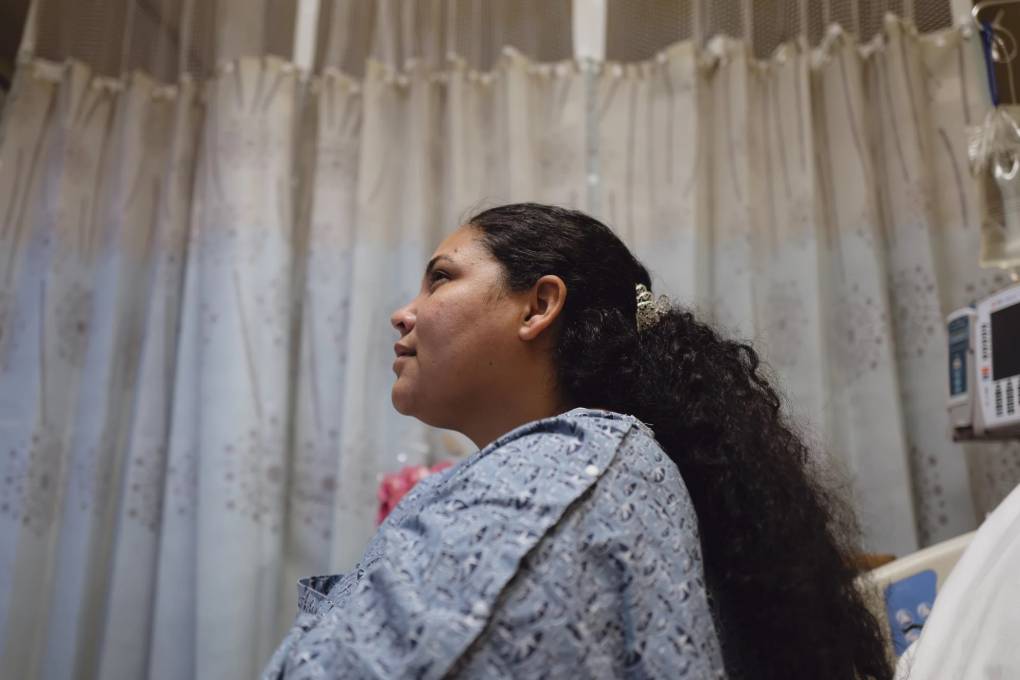
"caption": "One day before her court hearing, Yasmelin Valazquez is hospitalized at John F. Kennedy Memorial Hospital in Indio, Calif., on April 9, 2025.",
"credit": "Zaydee Sanchez for NPR",
"altTag": null,
"description": null,
"imgSizes": {
"medium": {
"file": "https://cdn.kqed.org/wp-content/uploads/sites/10/2025/04/dayinthelife-800x533.jpg",
"width": 800,
"height": 533,
"mimeType": "image/jpeg"
},
"large": {
"file": "https://cdn.kqed.org/wp-content/uploads/sites/10/2025/04/dayinthelife-1020x680.jpg",
"width": 1020,
"height": 680,
"mimeType": "image/jpeg"
},
"thumbnail": {
"file": "https://cdn.kqed.org/wp-content/uploads/sites/10/2025/04/dayinthelife-160x107.jpg",
"width": 160,
"height": 107,
"mimeType": "image/jpeg"
},
"1536x1536": {
"file": "https://cdn.kqed.org/wp-content/uploads/sites/10/2025/04/dayinthelife-1536x1024.jpg",
"width": 1536,
"height": 1024,
"mimeType": "image/jpeg"
},
"post-thumbnail": {
"file": "https://cdn.kqed.org/wp-content/uploads/sites/10/2025/04/dayinthelife-672x372.jpg",
"width": 672,
"height": 372,
"mimeType": "image/jpeg"
},
"twentyfourteen-full-width": {
"file": "https://cdn.kqed.org/wp-content/uploads/sites/10/2025/04/dayinthelife-1038x576.jpg",
"width": 1038,
"height": 576,
"mimeType": "image/jpeg"
},
"full-width": {
"file": "https://cdn.kqed.org/wp-content/uploads/sites/10/2025/04/dayinthelife-1920x1280.jpg",
"width": 1920,
"height": 1280,
"mimeType": "image/jpeg"
},
"kqedFullSize": {
"file": "https://cdn.kqed.org/wp-content/uploads/sites/10/2025/04/dayinthelife.jpg",
"width": 2000,
"height": 1333
}
},
"isLoading": false,
"fetchFailed": false
},
"news_12035652": {
"type": "attachments",
"id": "news_12035652",
"meta": {
"index": "attachments_1716263798",
"site": "news",
"id": "12035652",
"found": true
},
"title": "npr.brightspotcdn copy",
"publishDate": 1744392823,
"status": "inherit",
"parent": 12035651,
"modified": 1744392842,
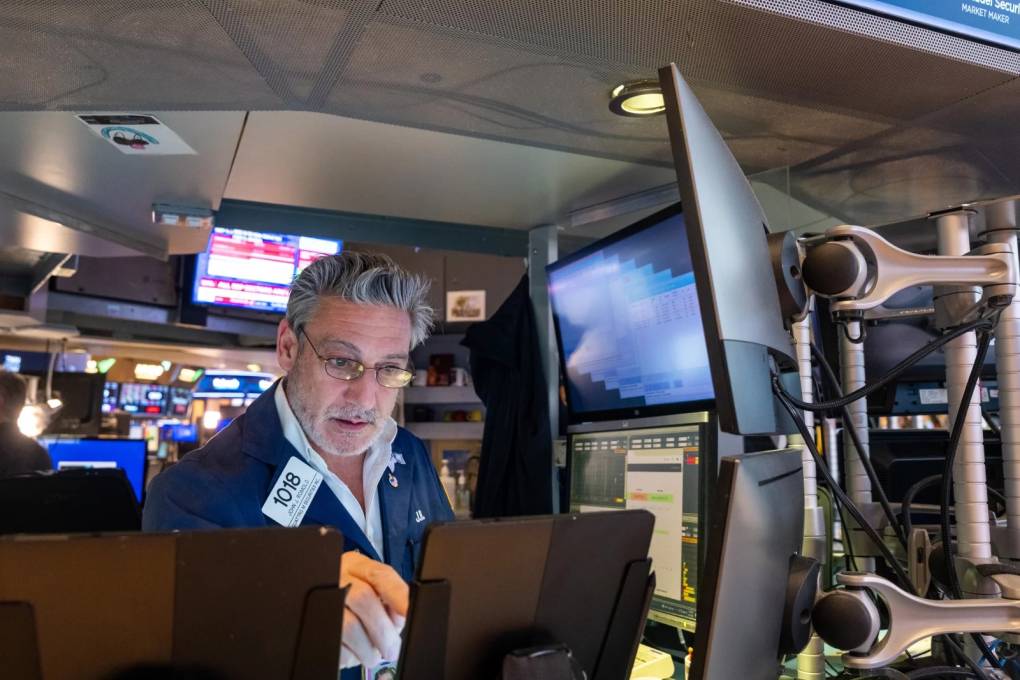
"caption": "A trader on the floor of the New York Stock Exchange.",
"credit": "Spencer Platt/Getty Images",
"altTag": null,
"description": null,
"imgSizes": {
"medium": {
"file": "https://cdn.kqed.org/wp-content/uploads/sites/10/2025/04/npr.brightspotcdn-copy-14-800x534.jpg",
"width": 800,
"height": 534,
"mimeType": "image/jpeg"
},
"large": {
"file": "https://cdn.kqed.org/wp-content/uploads/sites/10/2025/04/npr.brightspotcdn-copy-14-1020x680.jpg",
"width": 1020,
"height": 680,
"mimeType": "image/jpeg"
},
"thumbnail": {
"file": "https://cdn.kqed.org/wp-content/uploads/sites/10/2025/04/npr.brightspotcdn-copy-14-160x107.jpg",
"width": 160,
"height": 107,
"mimeType": "image/jpeg"
},
"1536x1536": {
"file": "https://cdn.kqed.org/wp-content/uploads/sites/10/2025/04/npr.brightspotcdn-copy-14-1536x1024.jpg",
"width": 1536,
"height": 1024,
"mimeType": "image/jpeg"
},
"post-thumbnail": {
"file": "https://cdn.kqed.org/wp-content/uploads/sites/10/2025/04/npr.brightspotcdn-copy-14-672x372.jpg",
"width": 672,
"height": 372,
"mimeType": "image/jpeg"
},
"twentyfourteen-full-width": {
"file": "https://cdn.kqed.org/wp-content/uploads/sites/10/2025/04/npr.brightspotcdn-copy-14-1038x576.jpg",
"width": 1038,
"height": 576,
"mimeType": "image/jpeg"
},
"kqedFullSize": {
"file": "https://cdn.kqed.org/wp-content/uploads/sites/10/2025/04/npr.brightspotcdn-copy-14.jpg",
"width": 1600,
"height": 1067
}
},
"isLoading": false,
"fetchFailed": false
},
"news_12035717": {
"type": "attachments",
"id": "news_12035717",
"meta": {
"index": "attachments_1716263798",
"site": "news",
"id": "12035717",
"found": true
},
"title": "npr.brightspotcdn copy",
"publishDate": 1744402668,
"status": "inherit",
"parent": 12035716,
"modified": 1744402697,
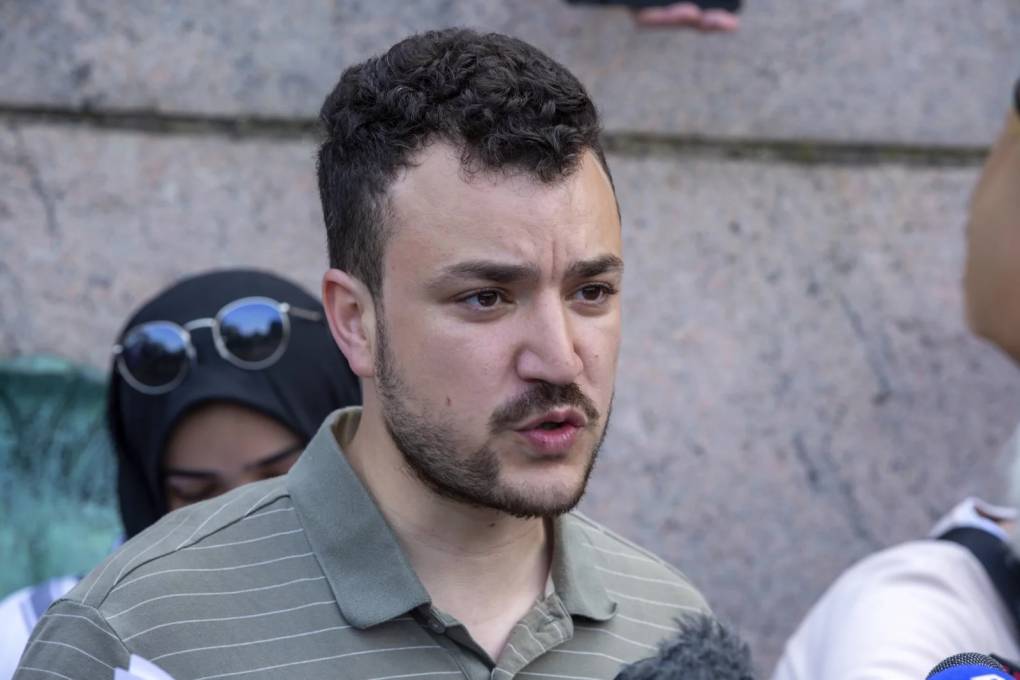
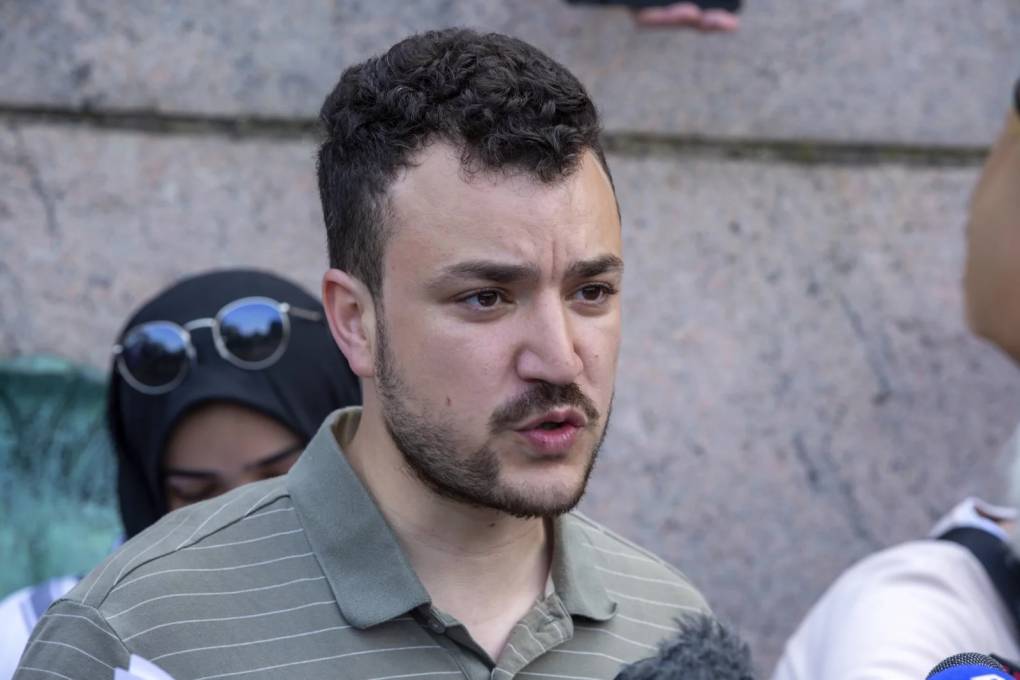
"caption": "Student negotiator Mahmoud Khalil is seen at a pro-Palestinian protest encampment on the Columbia University campus in New York, April 29, 2024. ",
"credit": "Ted Shaffrey/AP Photo",
"altTag": null,
"description": null,
"imgSizes": {
"medium": {
"file": "https://cdn.kqed.org/wp-content/uploads/sites/10/2025/04/npr.brightspotcdn-copy-15-800x534.jpg",
"width": 800,
"height": 534,
"mimeType": "image/jpeg"
},
"large": {
"file": "https://cdn.kqed.org/wp-content/uploads/sites/10/2025/04/npr.brightspotcdn-copy-15-1020x680.jpg",
"width": 1020,
"height": 680,
"mimeType": "image/jpeg"
},
"thumbnail": {
"file": "https://cdn.kqed.org/wp-content/uploads/sites/10/2025/04/npr.brightspotcdn-copy-15-160x107.jpg",
"width": 160,
"height": 107,
"mimeType": "image/jpeg"
},
"1536x1536": {
"file": "https://cdn.kqed.org/wp-content/uploads/sites/10/2025/04/npr.brightspotcdn-copy-15-1536x1024.jpg",
"width": 1536,
"height": 1024,
"mimeType": "image/jpeg"
},
"post-thumbnail": {
"file": "https://cdn.kqed.org/wp-content/uploads/sites/10/2025/04/npr.brightspotcdn-copy-15-672x372.jpg",
"width": 672,
"height": 372,
"mimeType": "image/jpeg"
},
"twentyfourteen-full-width": {
"file": "https://cdn.kqed.org/wp-content/uploads/sites/10/2025/04/npr.brightspotcdn-copy-15-1038x576.jpg",
"width": 1038,
"height": 576,
"mimeType": "image/jpeg"
},
"kqedFullSize": {
"file": "https://cdn.kqed.org/wp-content/uploads/sites/10/2025/04/npr.brightspotcdn-copy-15.jpg",
"width": 1600,
"height": 1067
}
},
"isLoading": false,
"fetchFailed": false
},
"news_12035439": {
"type": "attachments",
"id": "news_12035439",
"meta": {
"index": "attachments_1716263798",
"site": "news",
"id": "12035439",
"found": true
},
"title": "npr.brightspotcdn-1 copy",
"publishDate": 1744314063,
"status": "inherit",
"parent": 12035438,
"modified": 1744314096,
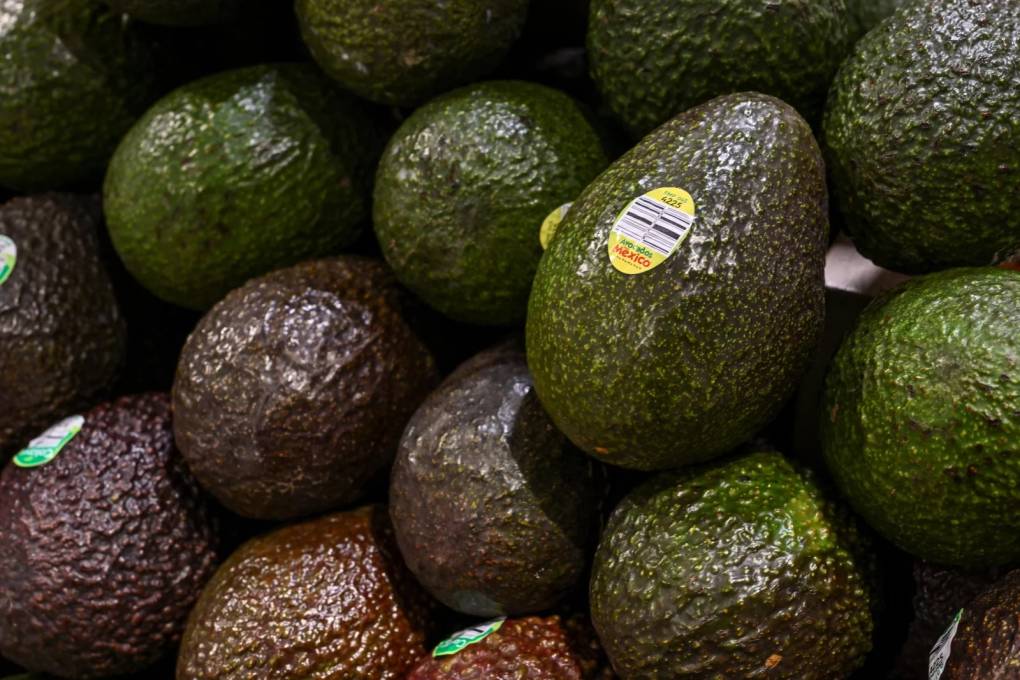
"caption": "Tariffs are likely to drive up the price of avocados. So, do restaurant owners raise menu prices now? And if so, will they ever come back down?",
"credit": "Angela Weiss/AFP via Getty Images",
"altTag": null,
"description": null,
"imgSizes": {
"medium": {
"file": "https://cdn.kqed.org/wp-content/uploads/sites/10/2025/04/npr.brightspotcdn-1-copy-5-800x534.jpg",
"width": 800,
"height": 534,
"mimeType": "image/jpeg"
},
"large": {
"file": "https://cdn.kqed.org/wp-content/uploads/sites/10/2025/04/npr.brightspotcdn-1-copy-5-1020x680.jpg",
"width": 1020,
"height": 680,
"mimeType": "image/jpeg"
},
"thumbnail": {
"file": "https://cdn.kqed.org/wp-content/uploads/sites/10/2025/04/npr.brightspotcdn-1-copy-5-160x107.jpg",
"width": 160,
"height": 107,
"mimeType": "image/jpeg"
},
"1536x1536": {
"file": "https://cdn.kqed.org/wp-content/uploads/sites/10/2025/04/npr.brightspotcdn-1-copy-5-1536x1024.jpg",
"width": 1536,
"height": 1024,
"mimeType": "image/jpeg"
},
"post-thumbnail": {
"file": "https://cdn.kqed.org/wp-content/uploads/sites/10/2025/04/npr.brightspotcdn-1-copy-5-672x372.jpg",
"width": 672,
"height": 372,
"mimeType": "image/jpeg"
},
"twentyfourteen-full-width": {
"file": "https://cdn.kqed.org/wp-content/uploads/sites/10/2025/04/npr.brightspotcdn-1-copy-5-1038x576.jpg",
"width": 1038,
"height": 576,
"mimeType": "image/jpeg"
},
"kqedFullSize": {
"file": "https://cdn.kqed.org/wp-content/uploads/sites/10/2025/04/npr.brightspotcdn-1-copy-5.jpg",
"width": 1600,
"height": 1067
}
},
"isLoading": false,
"fetchFailed": false
},
"news_12035484": {
"type": "attachments",
"id": "news_12035484",
"meta": {
"index": "attachments_1716263798",
"site": "news",
"id": "12035484",
"found": true
},
"title": "npr.brightspotcdn copy",
"publishDate": 1744317258,
"status": "inherit",
"parent": 12035483,
"modified": 1744317279,
"caption": "Mahmoud Khalil is seen at a pro-Palestinian protest encampment on the Columbia University campus in New York on April 29, 2024.",
"credit": "Ted Shaffrey/AP",
"altTag": null,
"description": null,
"imgSizes": {
"medium": {
"file": "https://cdn.kqed.org/wp-content/uploads/sites/10/2025/04/npr.brightspotcdn-copy-11-800x534.jpg",
"width": 800,
"height": 534,
"mimeType": "image/jpeg"
},
"large": {
"file": "https://cdn.kqed.org/wp-content/uploads/sites/10/2025/04/npr.brightspotcdn-copy-11-1020x680.jpg",
"width": 1020,
"height": 680,
"mimeType": "image/jpeg"
},
"thumbnail": {
"file": "https://cdn.kqed.org/wp-content/uploads/sites/10/2025/04/npr.brightspotcdn-copy-11-160x107.jpg",
"width": 160,
"height": 107,
"mimeType": "image/jpeg"
},
"1536x1536": {
"file": "https://cdn.kqed.org/wp-content/uploads/sites/10/2025/04/npr.brightspotcdn-copy-11-1536x1024.jpg",
"width": 1536,
"height": 1024,
"mimeType": "image/jpeg"
},
"post-thumbnail": {
"file": "https://cdn.kqed.org/wp-content/uploads/sites/10/2025/04/npr.brightspotcdn-copy-11-672x372.jpg",
"width": 672,
"height": 372,
"mimeType": "image/jpeg"
},
"twentyfourteen-full-width": {
"file": "https://cdn.kqed.org/wp-content/uploads/sites/10/2025/04/npr.brightspotcdn-copy-11-1038x576.jpg",
"width": 1038,
"height": 576,
"mimeType": "image/jpeg"
},
"kqedFullSize": {
"file": "https://cdn.kqed.org/wp-content/uploads/sites/10/2025/04/npr.brightspotcdn-copy-11.jpg",
"width": 1600,
"height": 1067
}
},
"isLoading": false,
"fetchFailed": false
},
"news_12035408": {
"type": "attachments",
"id": "news_12035408",
"meta": {
"index": "attachments_1716263798",
"site": "news",
"id": "12035408",
"found": true
},
"title": "npr.brightspotcdn copy",
"publishDate": 1744312190,
"status": "inherit",
"parent": 12035407,
"modified": 1744312213,
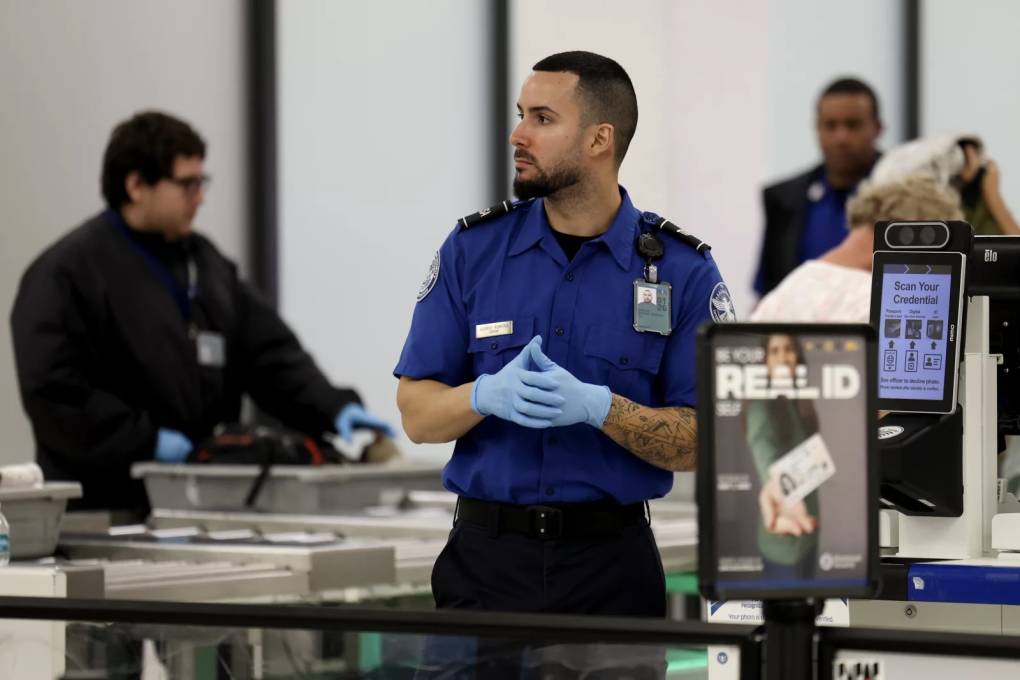
"caption": "A Transportation Security Administration agent stands at a security checkpoint at Miami International Airport on Dec. 20, 2024. The federal government is preparing to begin implementing Real ID rules in May.",
"credit": "Joe Raedle/Getty Images",
"altTag": null,
"description": null,
"imgSizes": {
"medium": {
"file": "https://cdn.kqed.org/wp-content/uploads/sites/10/2025/04/npr.brightspotcdn-copy-9-800x534.jpg",
"width": 800,
"height": 534,
"mimeType": "image/jpeg"
},
"large": {
"file": "https://cdn.kqed.org/wp-content/uploads/sites/10/2025/04/npr.brightspotcdn-copy-9-1020x680.jpg",
"width": 1020,
"height": 680,
"mimeType": "image/jpeg"
},
"thumbnail": {
"file": "https://cdn.kqed.org/wp-content/uploads/sites/10/2025/04/npr.brightspotcdn-copy-9-160x107.jpg",
"width": 160,
"height": 107,
"mimeType": "image/jpeg"
},
"1536x1536": {
"file": "https://cdn.kqed.org/wp-content/uploads/sites/10/2025/04/npr.brightspotcdn-copy-9-1536x1024.jpg",
"width": 1536,
"height": 1024,
"mimeType": "image/jpeg"
},
"post-thumbnail": {
"file": "https://cdn.kqed.org/wp-content/uploads/sites/10/2025/04/npr.brightspotcdn-copy-9-672x372.jpg",
"width": 672,
"height": 372,
"mimeType": "image/jpeg"
},
"twentyfourteen-full-width": {
"file": "https://cdn.kqed.org/wp-content/uploads/sites/10/2025/04/npr.brightspotcdn-copy-9-1038x576.jpg",
"width": 1038,
"height": 576,
"mimeType": "image/jpeg"
},
"kqedFullSize": {
"file": "https://cdn.kqed.org/wp-content/uploads/sites/10/2025/04/npr.brightspotcdn-copy-9.jpg",
"width": 1600,
"height": 1067
}
},
"isLoading": false,
"fetchFailed": false
},
"news_12035496": {
"type": "attachments",
"id": "news_12035496",
"meta": {
"index": "attachments_1716263798",
"site": "news",
"id": "12035496",
"found": true
},
"title": "npr.brightspotcdn copy",
"publishDate": 1744318400,
"status": "inherit",
"parent": 12035487,
"modified": 1754695655,
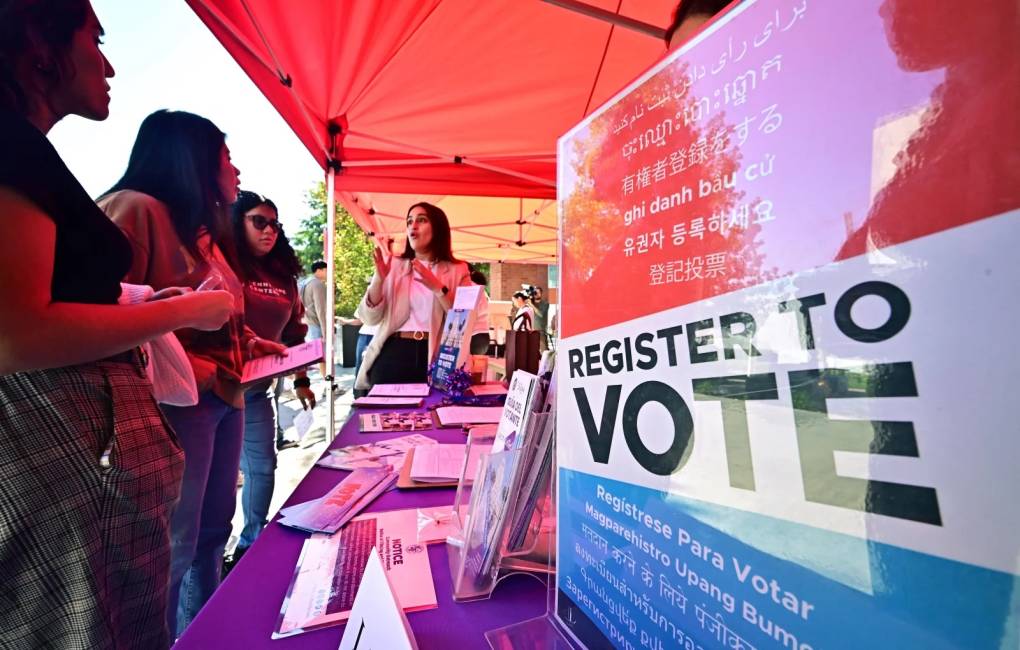
"caption": "Potential young voters get information at a voter registration desk at California State University, Los Angeles, on Oct. 22, 2024. ",
"credit": "Frederic J. Brown/AFP via Getty Images",
"altTag": null,
"description": null,
"imgSizes": {
"medium": {
"file": "https://cdn.kqed.org/wp-content/uploads/sites/10/2025/04/npr.brightspotcdn-copy-12-800x510.jpg",
"width": 800,
"height": 510,
"mimeType": "image/jpeg"
},
"large": {
"file": "https://cdn.kqed.org/wp-content/uploads/sites/10/2025/04/npr.brightspotcdn-copy-12-1020x650.jpg",
"width": 1020,
"height": 650,
"mimeType": "image/jpeg"
},
"thumbnail": {
"file": "https://cdn.kqed.org/wp-content/uploads/sites/10/2025/04/npr.brightspotcdn-copy-12-160x102.jpg",
"width": 160,
"height": 102,
"mimeType": "image/jpeg"
},
"1536x1536": {
"file": "https://cdn.kqed.org/wp-content/uploads/sites/10/2025/04/npr.brightspotcdn-copy-12-1536x979.jpg",
"width": 1536,
"height": 979,
"mimeType": "image/jpeg"
},
"post-thumbnail": {
"file": "https://cdn.kqed.org/wp-content/uploads/sites/10/2025/04/npr.brightspotcdn-copy-12-672x372.jpg",
"width": 672,
"height": 372,
"mimeType": "image/jpeg"
},
"twentyfourteen-full-width": {
"file": "https://cdn.kqed.org/wp-content/uploads/sites/10/2025/04/npr.brightspotcdn-copy-12-1038x576.jpg",
"width": 1038,
"height": 576,
"mimeType": "image/jpeg"
},
"kqedFullSize": {
"file": "https://cdn.kqed.org/wp-content/uploads/sites/10/2025/04/npr.brightspotcdn-copy-12.jpg",
"width": 1600,
"height": 1020
}
},
"isLoading": false,
"fetchFailed": false
},
"news_12035251": {
"type": "attachments",
"id": "news_12035251",
"meta": {
"index": "attachments_1716263798",
"site": "news",
"id": "12035251",
"found": true
},
"title": "npr.brightspotcdn copy",
"publishDate": 1744235919,
"status": "inherit",
"parent": 12035250,
"modified": 1759351949,
"caption": "A closed entrance to the Social Security Administration headquarters sits empty in Woodlawn, Md., on March 20, 2025. ",
"credit": "Wesley Lapointe/The Washington Post via Getty Images",
"altTag": null,
"description": null,
"imgSizes": {
"medium": {
"file": "https://cdn.kqed.org/wp-content/uploads/sites/10/2025/04/npr.brightspotcdn-copy-8-800x534.jpg",
"width": 800,
"height": 534,
"mimeType": "image/jpeg"
},
"large": {
"file": "https://cdn.kqed.org/wp-content/uploads/sites/10/2025/04/npr.brightspotcdn-copy-8-1020x680.jpg",
"width": 1020,
"height": 680,
"mimeType": "image/jpeg"
},
"thumbnail": {
"file": "https://cdn.kqed.org/wp-content/uploads/sites/10/2025/04/npr.brightspotcdn-copy-8-160x107.jpg",
"width": 160,
"height": 107,
"mimeType": "image/jpeg"
},
"1536x1536": {
"file": "https://cdn.kqed.org/wp-content/uploads/sites/10/2025/04/npr.brightspotcdn-copy-8-1536x1024.jpg",
"width": 1536,
"height": 1024,
"mimeType": "image/jpeg"
},
"post-thumbnail": {
"file": "https://cdn.kqed.org/wp-content/uploads/sites/10/2025/04/npr.brightspotcdn-copy-8-672x372.jpg",
"width": 672,
"height": 372,
"mimeType": "image/jpeg"
},
"twentyfourteen-full-width": {
"file": "https://cdn.kqed.org/wp-content/uploads/sites/10/2025/04/npr.brightspotcdn-copy-8-1038x576.jpg",
"width": 1038,
"height": 576,
"mimeType": "image/jpeg"
},
"kqedFullSize": {
"file": "https://cdn.kqed.org/wp-content/uploads/sites/10/2025/04/npr.brightspotcdn-copy-8.jpg",
"width": 1600,
"height": 1067
}
},
"isLoading": false,
"fetchFailed": false
},
"news_12035198": {
"type": "attachments",
"id": "news_12035198",
"meta": {
"index": "attachments_1716263798",
"site": "news",
"id": "12035198",
"found": true
},
"title": "npr.brightspotcdn-1 copy",
"publishDate": 1744225028,
"status": "inherit",
"parent": 12035197,
"modified": 1744225049,
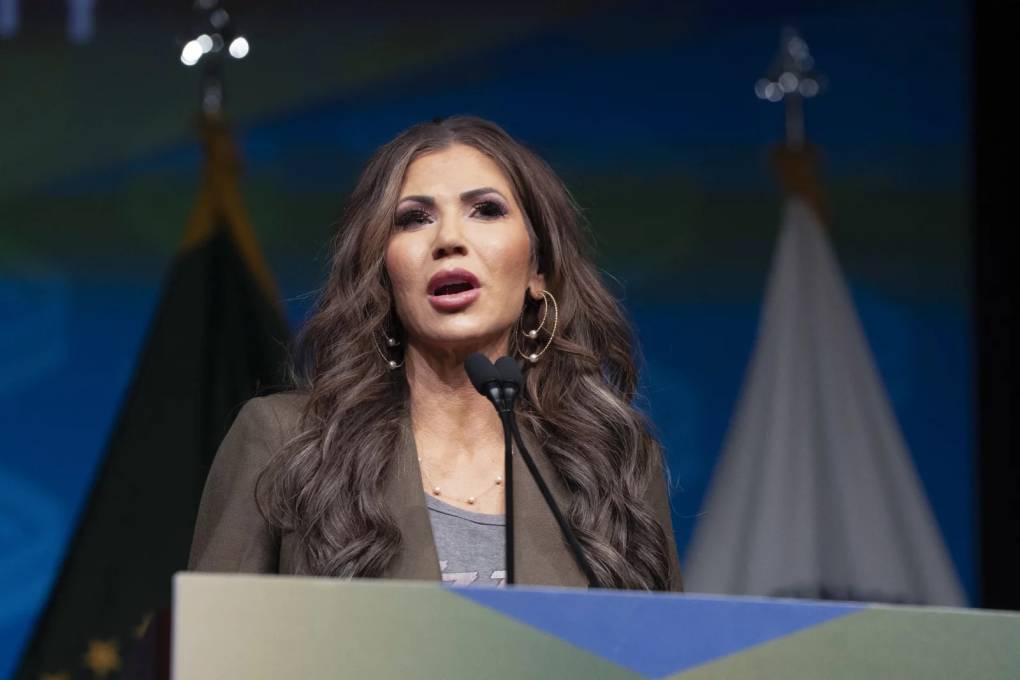
"caption": "Department of Homeland Security Secretary Kristi Noem's agency says the social media screenings will affect immigrants applying for permanent residence status, and foreigners affiliated with educational institutions.",
"credit": "Rebecca Noble/AFP via Getty Images",
"altTag": null,
"description": null,
"imgSizes": {
"medium": {
"file": "https://cdn.kqed.org/wp-content/uploads/sites/10/2025/04/npr.brightspotcdn-1-copy-4-800x534.jpg",
"width": 800,
"height": 534,
"mimeType": "image/jpeg"
},
"large": {
"file": "https://cdn.kqed.org/wp-content/uploads/sites/10/2025/04/npr.brightspotcdn-1-copy-4-1020x680.jpg",
"width": 1020,
"height": 680,
"mimeType": "image/jpeg"
},
"thumbnail": {
"file": "https://cdn.kqed.org/wp-content/uploads/sites/10/2025/04/npr.brightspotcdn-1-copy-4-160x107.jpg",
"width": 160,
"height": 107,
"mimeType": "image/jpeg"
},
"1536x1536": {
"file": "https://cdn.kqed.org/wp-content/uploads/sites/10/2025/04/npr.brightspotcdn-1-copy-4-1536x1024.jpg",
"width": 1536,
"height": 1024,
"mimeType": "image/jpeg"
},
"post-thumbnail": {
"file": "https://cdn.kqed.org/wp-content/uploads/sites/10/2025/04/npr.brightspotcdn-1-copy-4-672x372.jpg",
"width": 672,
"height": 372,
"mimeType": "image/jpeg"
},
"twentyfourteen-full-width": {
"file": "https://cdn.kqed.org/wp-content/uploads/sites/10/2025/04/npr.brightspotcdn-1-copy-4-1038x576.jpg",
"width": 1038,
"height": 576,
"mimeType": "image/jpeg"
},
"kqedFullSize": {
"file": "https://cdn.kqed.org/wp-content/uploads/sites/10/2025/04/npr.brightspotcdn-1-copy-4.jpg",
"width": 1600,
"height": 1067
}
},
"isLoading": false,
"fetchFailed": false
},
"news_12035189": {
"type": "attachments",
"id": "news_12035189",
"meta": {
"index": "attachments_1716263798",
"site": "news",
"id": "12035189",
"found": true
},
"title": "npr.brightspotcdn copy",
"publishDate": 1744224218,
"status": "inherit",
"parent": 12035188,
"modified": 1746123189,
"caption": "President Trump answers a reporter's question in the Oval Office on Monday. ",
"credit": "Kevin Dietsch/Getty Images",
"altTag": null,
"description": null,
"imgSizes": {
"medium": {
"file": "https://cdn.kqed.org/wp-content/uploads/sites/10/2025/04/npr.brightspotcdn-copy-6-800x522.jpg",
"width": 800,
"height": 522,
"mimeType": "image/jpeg"
},
"large": {
"file": "https://cdn.kqed.org/wp-content/uploads/sites/10/2025/04/npr.brightspotcdn-copy-6-1020x666.jpg",
"width": 1020,
"height": 666,
"mimeType": "image/jpeg"
},
"thumbnail": {
"file": "https://cdn.kqed.org/wp-content/uploads/sites/10/2025/04/npr.brightspotcdn-copy-6-160x104.jpg",
"width": 160,
"height": 104,
"mimeType": "image/jpeg"
},
"1536x1536": {
"file": "https://cdn.kqed.org/wp-content/uploads/sites/10/2025/04/npr.brightspotcdn-copy-6-1536x1002.jpg",
"width": 1536,
"height": 1002,
"mimeType": "image/jpeg"
},
"post-thumbnail": {
"file": "https://cdn.kqed.org/wp-content/uploads/sites/10/2025/04/npr.brightspotcdn-copy-6-672x372.jpg",
"width": 672,
"height": 372,
"mimeType": "image/jpeg"
},
"twentyfourteen-full-width": {
"file": "https://cdn.kqed.org/wp-content/uploads/sites/10/2025/04/npr.brightspotcdn-copy-6-1038x576.jpg",
"width": 1038,
"height": 576,
"mimeType": "image/jpeg"
},
"kqedFullSize": {
"file": "https://cdn.kqed.org/wp-content/uploads/sites/10/2025/04/npr.brightspotcdn-copy-6.jpg",
"width": 1600,
"height": 1044
}
},
"isLoading": false,
"fetchFailed": false
},
"news_12034551": {
"type": "attachments",
"id": "news_12034551",
"meta": {
"index": "attachments_1716263798",
"site": "news",
"id": "12034551",
"found": true
},
"title": "npr.brightspotcdn copy",
"publishDate": 1743795952,
"status": "inherit",
"parent": 12034550,
"modified": 1743795973,
"caption": "Jose Barco in Iraq in 2007.",
"credit": "Courtesy of Tia Barco",
"altTag": null,
"description": null,
"imgSizes": {
"medium": {
"file": "https://cdn.kqed.org/wp-content/uploads/sites/10/2025/04/npr.brightspotcdn-copy-5-800x670.jpg",
"width": 800,
"height": 670,
"mimeType": "image/jpeg"
},
"large": {
"file": "https://cdn.kqed.org/wp-content/uploads/sites/10/2025/04/npr.brightspotcdn-copy-5-1020x854.jpg",
"width": 1020,
"height": 854,
"mimeType": "image/jpeg"
},
"thumbnail": {
"file": "https://cdn.kqed.org/wp-content/uploads/sites/10/2025/04/npr.brightspotcdn-copy-5-160x134.jpg",
"width": 160,
"height": 134,
"mimeType": "image/jpeg"
},
"1536x1536": {
"file": "https://cdn.kqed.org/wp-content/uploads/sites/10/2025/04/npr.brightspotcdn-copy-5-1536x1285.jpg",
"width": 1536,
"height": 1285,
"mimeType": "image/jpeg"
},
"post-thumbnail": {
"file": "https://cdn.kqed.org/wp-content/uploads/sites/10/2025/04/npr.brightspotcdn-copy-5-672x372.jpg",
"width": 672,
"height": 372,
"mimeType": "image/jpeg"
},
"twentyfourteen-full-width": {
"file": "https://cdn.kqed.org/wp-content/uploads/sites/10/2025/04/npr.brightspotcdn-copy-5-1038x576.jpg",
"width": 1038,
"height": 576,
"mimeType": "image/jpeg"
},
"kqedFullSize": {
"file": "https://cdn.kqed.org/wp-content/uploads/sites/10/2025/04/npr.brightspotcdn-copy-5.jpg",
"width": 1600,
"height": 1339
}
},
"isLoading": false,
"fetchFailed": false
},
"news_12034427": {
"type": "attachments",
"id": "news_12034427",
"meta": {
"index": "attachments_1716263798",
"site": "news",
"id": "12034427",
"found": true
},
"title": "npr.brightspotcdn copy",
"publishDate": 1743709665,
"status": "inherit",
"parent": 12034425,
"modified": 1746748188,
"caption": "President Donald Trump holds a chart as he delivers remarks on reciprocal tariffs during an event in the Rose Garden entitled \"Make America Wealthy Again\" at the White House in Washington, D.C., on April 2, 2025.",
"credit": "Brendan Smialowski/AFP via Getty Images",
"altTag": null,
"description": null,
"imgSizes": {
"medium": {
"file": "https://cdn.kqed.org/wp-content/uploads/sites/10/2025/04/npr.brightspotcdn-copy-4-800x534.jpg",
"width": 800,
"height": 534,
"mimeType": "image/jpeg"
},
"large": {
"file": "https://cdn.kqed.org/wp-content/uploads/sites/10/2025/04/npr.brightspotcdn-copy-4-1020x680.jpg",
"width": 1020,
"height": 680,
"mimeType": "image/jpeg"
},
"thumbnail": {
"file": "https://cdn.kqed.org/wp-content/uploads/sites/10/2025/04/npr.brightspotcdn-copy-4-160x107.jpg",
"width": 160,
"height": 107,
"mimeType": "image/jpeg"
},
"1536x1536": {
"file": "https://cdn.kqed.org/wp-content/uploads/sites/10/2025/04/npr.brightspotcdn-copy-4-1536x1024.jpg",
"width": 1536,
"height": 1024,
"mimeType": "image/jpeg"
},
"post-thumbnail": {
"file": "https://cdn.kqed.org/wp-content/uploads/sites/10/2025/04/npr.brightspotcdn-copy-4-672x372.jpg",
"width": 672,
"height": 372,
"mimeType": "image/jpeg"
},
"twentyfourteen-full-width": {
"file": "https://cdn.kqed.org/wp-content/uploads/sites/10/2025/04/npr.brightspotcdn-copy-4-1038x576.jpg",
"width": 1038,
"height": 576,
"mimeType": "image/jpeg"
},
"kqedFullSize": {
"file": "https://cdn.kqed.org/wp-content/uploads/sites/10/2025/04/npr.brightspotcdn-copy-4.jpg",
"width": 1600,
"height": 1067
}
},
"isLoading": false,
"fetchFailed": false
}
},
"audioPlayerReducer": {
"postId": "stream_live",
"isPaused": true,
"isPlaying": false,
"pfsActive": false,
"pledgeModalIsOpen": true,
"playerDrawerIsOpen": false,
"liveAudioPlayStartedAt": 0,
"liveAudioPlayContext": ""
},
"authorsReducer": {
"byline_news_12035891": {
"type": "authors",
"id": "byline_news_12035891",
"meta": {
"override": true
},
"slug": "byline_news_12035891",
"name": "Sergio Martínez-Beltrán, NPR",
"isLoading": false
},
"byline_news_12035651": {
"type": "authors",
"id": "byline_news_12035651",
"meta": {
"override": true
},
"slug": "byline_news_12035651",
"name": "\u003ca href=\"https://www.npr.org/people/g-s1-13096/maria-aspan\">Maria Aspan\u003c/a>, NPR",
"isLoading": false
},
"byline_news_12035716": {
"type": "authors",
"id": "byline_news_12035716",
"meta": {
"override": true
},
"slug": "byline_news_12035716",
"name": "\u003ca href=\"https://www.npr.org/people/427718118/adrian-florido\">Adrian Florido\u003c/a>, NPR",
"isLoading": false
},
"byline_news_12035438": {
"type": "authors",
"id": "byline_news_12035438",
"meta": {
"override": true
},
"slug": "byline_news_12035438",
"name": "\u003ca href=\"https://www.npr.org/people/131724812/scott-neuman\">Scott Neuman\u003c/a>, NPR",
"isLoading": false
},
"byline_news_12035483": {
"type": "authors",
"id": "byline_news_12035483",
"meta": {
"override": true
},
"slug": "byline_news_12035483",
"name": "\u003ca href=\"https://www.npr.org/people/159989569/joel-rose\">Joel Rose\u003c/a> and \u003ca href=\"https://www.npr.org/people/427718118/adrian-florido\">Adrian Florido\u003c/a>, NPR",
"isLoading": false
},
"byline_news_12035407": {
"type": "authors",
"id": "byline_news_12035407",
"meta": {
"override": true
},
"slug": "byline_news_12035407",
"name": "\u003ca href=\"https://www.npr.org/people/1000952100/joe-hernandez\">Joe Hernandez\u003c/a>, NPR",
"isLoading": false
},
"byline_news_12035487": {
"type": "authors",
"id": "byline_news_12035487",
"meta": {
"override": true
},
"slug": "byline_news_12035487",
"name": "\u003ca href=\"https://www.npr.org/people/1244911175/jude-joffe-block\">Jude Joffe-Block, NPR",
"isLoading": false
},
"byline_news_12035250": {
"type": "authors",
"id": "byline_news_12035250",
"meta": {
"override": true
},
"slug": "byline_news_12035250",
"name": "\u003ca href=\"https://www.npr.org/people/919091588/ashley-lopez\">Ashley Lopez\u003c/a>, NPR",
"isLoading": false
},
"byline_news_12035197": {
"type": "authors",
"id": "byline_news_12035197",
"meta": {
"override": true
},
"slug": "byline_news_12035197",
"name": "\u003ca href=\"https://www.npr.org/people/297147616/jasmine-garsd\">Jasmine Garsd\u003c/a>, NPR",
"isLoading": false
},
"byline_news_12035188": {
"type": "authors",
"id": "byline_news_12035188",
"meta": {
"override": true
},
"slug": "byline_news_12035188",
"name": "\u003ca href=\"https://www.npr.org/people/729411445/franco-ordonez\">Franco Ordoñez\u003c/a>, NPR",
"isLoading": false
},
"byline_news_12034550": {
"type": "authors",
"id": "byline_news_12034550",
"meta": {
"override": true
},
"slug": "byline_news_12034550",
"name": "\u003ca href=\"https://www.npr.org/people/5457129/tom-bowman\">Tom Bowman\u003c/a> and \u003ca href=\"https://www.npr.org/people/105678418/quil-lawrence\">Quil Lawrence\u003c/a>, NPR",
"isLoading": false
},
"byline_news_12034425": {
"type": "authors",
"id": "byline_news_12034425",
"meta": {
"override": true
},
"slug": "byline_news_12034425",
"name": "\u003ca href=\"https://www.npr.org/people/1117285034/jeff-guo\">Jeff Guo\u003c/a>, NPR",
"isLoading": false
}
},
"pagesReducer": {
"news_affiliate_npr": {
"type": "terms",
"id": "news_253",
"meta": {
"index": "terms_1716263798",
"site": "news",
"id": "253",
"score": 14.255476
},
"featImg": null,
"name": "NPR",
"description": null,
"taxonomy": "affiliate",
"headData": {
"twImgId": null,
"twTitle": null,
"ogTitle": null,
"ogImgId": null,
"twDescription": null,
"description": "KQED is the NPR station for the Bay Area, providing award-winning news, programming, and community engagement.",
"title": "NPR Archives - Get the Latest News and Reports from California | KQED",
"ogDescription": null
},
"ttid": 7083,
"slug": "npr",
"isLoading": false,
"title": "NPR",
"pageMeta": {
"site": "news",
"WpPageTemplate": "page-topic-editorial",
"currentPage": 7
},
"blocks": [
{
"blockName": "kqed/post-list",
"attrs": {
"layout": "cardArticle2",
"query": "posts/news?affiliate=npr",
"seeMore": false,
"paginated": true,
"page": 7
}
},
{
"blockName": "kqed/ad"
}
]
}
},
"pfsSessionReducer": {},
"postsReducer": {
"stream_live": {
"type": "live",
"id": "stream_live",
"audioUrl": "https://streams.kqed.org/kqedradio",
"title": "Live Stream",
"excerpt": "Live Stream information currently unavailable.",
"link": "/radio",
"featImg": "",
"label": {
"name": "KQED Live",
"link": "/"
}
},
"stream_kqedNewscast": {
"type": "posts",
"id": "stream_kqedNewscast",
"audioUrl": "https://www.kqed.org/.stream/anon/radio/RDnews/newscast.mp3?_=1",
"title": "KQED Newscast",
"featImg": "",
"label": {
"name": "88.5 FM",
"link": "/"
}
},
"news_12035891": {
"type": "posts",
"id": "news_12035891",
"meta": {
"index": "posts_1716263798",
"site": "news",
"id": "12035891",
"score": null,
"sort": [
1744656179000
]
},
"guestAuthors": [],
"slug": "a-day-in-the-life-of-one-migrant-seeking-to-stay-in-the-u-s",
"title": "A Day in the Life of One Migrant Seeking to Stay in the US",
"publishDate": 1744656179,
"format": "standard",
"headTitle": "A Day in the Life of One Migrant Seeking to Stay in the US | KQED",
"labelTerm": {
"term": 253,
"site": "news"
},
"content": "\u003cp>When the nurse told Yasmelin Velazquez she was going to be hospitalized for a couple of days, Velazquez’s anxiety spiked.\u003c/p>\n\u003cp>“I can’t stay!” she exclaimed. “I have \u003ca href=\"https://www.kqed.org/news/11975904/new-bay-area-immigration-court-opens-aims-to-tackle-deportation-backlog\">immigration court\u003c/a> tomorrow!”\u003c/p>\n\u003cp>The hospitalization comes at a bad time. Missing her first court hearing the next day would almost guarantee a deportation order for the 36-year-old Venezuelan \u003ca href=\"https://www.kqed.org/immigration\">immigrant\u003c/a> and her two young sons.\u003c/p>\n\u003cp>[ad fullwidth]\u003c/p>\n\u003cp>She’s especially on edge since receiving \u003ca href=\"https://www.npr.org/2025/04/08/g-s1-58984/cbp-one-app-migrants-dhs-border\" target=\"_blank\" rel=\"noopener\">\u003cu>an email\u003c/u>\u003c/a> from the U.S. Department of Homeland Security two days earlier notifying her that her temporary status in the country was terminated.\u003c/p>\n\u003cp>“It is time for you to leave the United States,” the email read. “Do not attempt to remain in the United States — the federal government will find you.”\u003c/p>\n\u003cp>Velazquez is among the growing number of migrants who received the DHS email. All of them came to the U.S. through legal pathways now terminated by President Trump, or were given temporary protection from deportation after surrendering to immigration authorities at the U.S.-Mexico border.\u003c/p>\n\u003cp>[aside postID=news_12034703 hero='https://cdn.kqed.org/wp-content/uploads/sites/10/2025/04/250319-UCBerkeleyProtest-14-BL_qed-1020x680.jpg']\u003c/p>\n\u003cp>They are now left in limbo: Should they stay and continue the legal process? Could they be detained or deported while waiting for their day in court?\u003c/p>\n\u003cp>NPR has followed Velazquez’s immigration journey from Ciudad Juárez, México, where she waited 8 months to enter the U.S. via the CBP One app, a Biden-era legal pathway for asylum seekers. She became one of 900,000 people who used the app, which was the only way to schedule an immigration hearing in the U.S. at the time.\u003c/p>\n\u003cp>But as her court date approached, Velazquez told NPR she was getting nervous. Migrants have been picked up by immigration authorities at court lately, and that could happen to her, too.\u003c/p>\n\u003cp>Then, her doctor called during Velazquez’s shift at Walmart. The doctor explained that she had some bad test results and might need to stay in the emergency room for a couple of days.\u003c/p>\n\u003cp>After pushing back, Velazquez was cleared to leave the hospital. She will make it to court the next day – but the doctor warns her condition could worsen.\u003c/p>\n\u003cfigure class=\"wp-block-image size-large\">\u003cimg decoding=\"async\" src=\"https://npr.brightspotcdn.com/dims3/default/strip/false/crop/6720x4480+0+0/resize/1200/quality/75/format/jpeg/?url=http%3A%2F%2Fnpr-brightspot.s3.amazonaws.com%2Fc1%2F1f%2Fcab713b94f82a20943cb5fce3b48%2Fyasmelin-valazquez-136.jpg\" alt=\"Outside John F. Kennedy Memorial Hospital in Indio, Calif., Yasmelin Valazquez waits for her partner to bring the car around on April 9, 2025.\">\u003cfigcaption>Outside John F. Kennedy Memorial Hospital in Indio, Calif., Yasmelin Valazquez waits for her partner to bring the car around on April 9, 2025. \u003ccite> (Zaydee Sanchez for NPR)\u003c/cite>\u003c/figcaption>\u003c/figure>\n\u003cfigure class=\"wp-block-image size-large\">\u003cimg decoding=\"async\" src=\"https://npr.brightspotcdn.com/dims3/default/strip/false/crop/6000x4000+0+0/resize/1200/quality/75/format/jpeg/?url=http%3A%2F%2Fnpr-brightspot.s3.amazonaws.com%2F39%2F58%2F9d61d3474b61b62b16c5c37da07d%2Fyasmelin-valazquez-146.jpg\" alt=\"After being away overnight, Yasmelin Valazquez is greeted with joy as her two sons jump on her in a reunion on April 9, 2025.\">\u003cfigcaption>After being away overnight, Yasmelin Valazquez is greeted with joy as her two sons jump on her in a reunion on April 9, 2025. \u003ccite> (Zaydee Sanchez for NPR)\u003c/cite>\u003c/figcaption>\u003c/figure>\n\u003cp>The sun had not risen when Velazquez, her partner, and her two little boys, 2-year-old Jeremías and 4-year-old Jordan, left their home in Indio, California, the next day.\u003c/p>\n\u003cp>“Father God, be our lawyer, be our judge,” they prayed. “Touch the heart of Judge Simmons.”\u003c/p>\n\u003cp>They are anxious — so they sing while they drive their used black SUV down the highway.\u003c/p>\n\u003cp>After more than two hours on the road, the family pulls up at the immigration court in an industrial park in a Southern California suburb.\u003c/p>\n\u003cp>A dozen or so other families make their way into the courtroom.\u003c/p>\n\u003cfigure class=\"wp-block-image size-large\">\u003cimg decoding=\"async\" src=\"https://npr.brightspotcdn.com/dims3/default/strip/false/crop/5418x3612+0+0/resize/1200/quality/75/format/jpeg/?url=http%3A%2F%2Fnpr-brightspot.s3.amazonaws.com%2F6b%2Ffa%2F856691424698ae292a70c87b09c9%2Fyasmelin-valazquez-166.jpg\" alt=\"Yasmelin Valazquez wakes up her two sons at 3:30 in the morning to have breakfast before they leave for immigration court. April 10, 2025.\">\u003cfigcaption>Yasmelin Valazquez wakes up her two sons at 3:30 in the morning to have breakfast before they leave for immigration court. April 10, 2025. \u003ccite> (Zaydee Sanchez for NPR)\u003c/cite>\u003c/figcaption>\u003c/figure>\n\u003cfigure class=\"wp-block-image size-large\">\u003cimg decoding=\"async\" src=\"https://npr.brightspotcdn.com/dims3/default/strip/false/crop/5657x3771+0+0/resize/1200/quality/75/format/jpeg/?url=http%3A%2F%2Fnpr-brightspot.s3.amazonaws.com%2F54%2Fda%2F52f06fc74f519f46c9c0f319465c%2Fyasmelin-valazquez-178.jpg\" alt=\"Yasmelin Valazquez's sons sit quietly as the family drives two hours to immigration court on April 10, 2025.\">\u003cfigcaption>Yasmelin Valazquez’s sons sit quietly as the family drives two hours to immigration court on April 10, 2025. \u003ccite> (Zaydee Sanchez for NPR)\u003c/cite>\u003c/figcaption>\u003c/figure>\n\u003cp>First hearings like this one are usually low-stakes. A judge validates the migrants’ identities, and they decide whether to file for a form of relief, such as asylum. Then a second hearing is scheduled.\u003c/p>\n\u003cp>But under Trump, anything can happen.\u003c/p>\n\u003cp>Inside the courtroom, Velazquez and the kids sit in the first row of wooden benches. They wait an hour for their turn– long enough that the two-year-old pees his pants.\u003c/p>\n\u003cp>Finally, the judge asks Velazquez whether she understands the reason she’s in court: that the government believes she doesn’t have a legal right to be in the U.S.\u003c/p>\n\u003cp>“Yes,” she replies quietly, adding that she’s planning to claim asylum later this summer.\u003c/p>\n\u003cp>The judge tells her to come back in August, this time with an attorney.\u003c/p>\n\u003cp>The whole interaction only took a few minutes.\u003c/p>\n\u003cp>Velazquez is free to go.\u003c/p>\n\u003cfigure class=\"wp-block-image size-large\">\u003cimg decoding=\"async\" src=\"https://npr.brightspotcdn.com/dims3/default/strip/false/crop/5170x3447+0+0/resize/1200/quality/75/format/jpeg/?url=http%3A%2F%2Fnpr-brightspot.s3.amazonaws.com%2F3b%2Fdf%2Ff88d55fc4af78dfd4c90f8c58046%2Fyasmelin-valazquez-181.jpg\" alt=\"With a little nervousness, Yasmelin Valazquez and her family arrive for thier immigration court hearing in Santa Ana, California on April 10, 2025.\">\u003cfigcaption>With a little nervousness, Yasmelin Valazquez and her family arrive for thier immigration court hearing in Santa Ana, California on April 10, 2025. \u003ccite> (Zaydee Sanchez for NPR)\u003c/cite>\u003c/figcaption>\u003c/figure>\n\u003cfigure class=\"wp-block-image size-large\">\u003cimg decoding=\"async\" src=\"https://npr.brightspotcdn.com/dims3/default/strip/false/crop/5123x3414+0+555/resize/1200/quality/75/format/jpeg/?url=http%3A%2F%2Fnpr-brightspot.s3.amazonaws.com%2F6a%2F48%2F97974ae948d4ac902739b7dbca9c%2Fyasmelin-valazquez-190.jpg\" alt=\"After immigration court, Yasmelin Valazquez secures her paperwork inside her folder where she keeps track of her documents. April 10, 2025. Zaydee Sanchez/NPR\">\u003cfigcaption>After immigration court, Yasmelin Valazquez secures her paperwork inside her folder where she keeps track of her documents. April 10, 2025. Zaydee Sanchez/NPR \u003ccite> (Zaydee Sanchez for NPR)\u003c/cite>\u003c/figcaption>\u003c/figure>\n\u003cp>“I feel victorious,” she tells NPR after the hearing, her relieved laughter ringing over the parking lot while her kids snack on juice and arepas.\u003c/p>\n\u003cp>But their day isn’t over yet.\u003c/p>\n\u003cp>Next is another hour-long drive to Velazquez’s regular in-person check-in with U.S. Immigration and Customs Enforcement, which she has to do every few months in addition to weekly calls and texts with the agent in charge of her parole.\u003c/p>\n\u003cp>This week, the check-in seems scarier. There have been reports of migrants being picked up by agents as they go into the ICE office. And now, there’s that email from DHS to worry about.\u003c/p>\n\u003cp>Velazquez enters the office and meets with the agent assigned to her case.\u003c/p>\n\u003cp>Eight minutes later, she comes out again, beaming a huge smile.\u003c/p>\n\u003cp>“Today, my future looks marvelous,” she says.\u003c/p>\n\u003cp>She was not detained today, but her optimism might be premature.\u003c/p>\n\u003cfigure class=\"wp-block-image size-large\">\u003cimg decoding=\"async\" src=\"https://npr.brightspotcdn.com/dims3/default/strip/false/crop/5900x3933+0+0/resize/1200/quality/75/format/jpeg/?url=http%3A%2F%2Fnpr-brightspot.s3.amazonaws.com%2F0b%2Fec%2F48b9a0214833b8fb1bedbdf6c1a6%2Fyasmelin-valazquez-195.jpg\" alt=\"After a long day, Yasmelin Valazquez and her family share a moment of joy at a parking lot in San Bernadino, California on April 10, 2025. Zaydee Sanchez/NPR\">\u003cfigcaption>After a long day, Yasmelin Valazquez and her family share a moment of joy at a parking lot in San Bernadino, California on April 10, 2025. Zaydee Sanchez/NPR \u003ccite> (Zaydee Sanchez for NPR)\u003c/cite>\u003c/figcaption>\u003c/figure>\n\u003cp>She has a long way to go in her quest for legal status, and the Trump administration is unpredictable and willing to push legal limits to fulfill its goal of deporting millions of people.\u003c/p>\n\u003cp>But Velazquez knows that when you are living day-to-day in the U.S., you take a win when you can.\u003c/p>\n\u003cp>“I feel like I’ll be able to obtain permanent residency, and who knows, maybe citizenship, too!” she says, laughing and smiling.\u003c/p>\n\u003cp>[ad floatright]\u003c/p>\n",
"blocks": [],
"excerpt": "Yasmelin Velazquez has waited 10 months for her immigration court date. But a last-minute hospitalization and confusion over Trump's changing immigration policies lead to more hurdles and anxiety.",
"status": "publish",
"parent": 0,
"modified": 1744663326,
"stats": {
"hasAudio": false,
"hasVideo": false,
"hasChartOrMap": false,
"iframeSrcs": [],
"hasGoogleForm": false,
"hasGallery": false,
"hasHearkenModule": false,
"hasPolis": false,
"paragraphCount": 38,
"wordCount": 1096
},
"headData": {
"title": "A Day in the Life of One Migrant Seeking to Stay in the US | KQED",
"description": "Yasmelin Velazquez has waited 10 months for her immigration court date. But a last-minute hospitalization and confusion over Trump's changing immigration policies lead to more hurdles and anxiety.",
"ogTitle": "",
"ogDescription": "",
"ogImgId": "",
"twTitle": "",
"twDescription": "",
"twImgId": "",
"schema": {
"@context": "https://schema.org",
"@type": "NewsArticle",
"headline": "A Day in the Life of One Migrant Seeking to Stay in the US",
"datePublished": "2025-04-14T11:42:59-07:00",
"dateModified": "2025-04-14T13:42:06-07:00",
"image": "https://cdn.kqed.org/wp-content/uploads/2020/02/KQED-OG-Image@1x.png",
"isAccessibleForFree": "True",
"publisher": {
"@type": "NewsMediaOrganization",
"@id": "https://www.kqed.org/#organization",
"name": "KQED",
"logo": "https://cdn.kqed.org/wp-content/uploads/2020/02/KQED-OG-Image@1x.png",
"url": "https://www.kqed.org",
"sameAs": [
"https://www.facebook.com/KQED",
"https://twitter.com/KQED",
"https://www.instagram.com/kqed/",
"https://www.tiktok.com/@kqedofficial",
"https://www.linkedin.com/company/kqed",
"https://www.youtube.com/channel/UCeC0IOo7i1P_61zVUWbJ4nw"
]
}
}
},
"sticky": false,
"nprByline": "Sergio Martínez-Beltrán, NPR",
"nprStoryId": "g-s1-60091",
"nprHtmlLink": "https://www.npr.org/2025/04/14/g-s1-60091/venezuelan-asylum-seeker-immigration-court",
"nprRetrievedStory": "1",
"nprPubDate": "2025-04-14T13:52:00.393-04:00",
"nprStoryDate": "2025-04-14T13:52:00.393-04:00",
"nprLastModifiedDate": "2025-04-14T13:52:00.393-04:00",
"nprAudio": "https://ondemand.npr.org/anon.npr-mp3/npr/wesat/2025/04/20250412_wesat_a_day_in_the_life_of_a_migrant_seeking_asylum_under_the_trump_administration.mp3?size=4687039&d=292888&e=g-s1-60091",
"templateType": "standard",
"featuredImageType": "standard",
"excludeFromSiteSearch": "Include",
"showOnAuthorArchivePages": "No",
"articleAge": "0",
"path": "/news/12035891/a-day-in-the-life-of-one-migrant-seeking-to-stay-in-the-u-s",
"audioUrl": "https://ondemand.npr.org/anon.npr-mp3/npr/wesat/2025/04/20250412_wesat_a_day_in_the_life_of_a_migrant_seeking_asylum_under_the_trump_administration.mp3?size=4687039&d=292888&e=g-s1-60091",
"audioTrackLength": null,
"parsedContent": [
{
"type": "contentString",
"content": "\u003cdiv class=\"post-body\">\u003cp>\u003cp>When the nurse told Yasmelin Velazquez she was going to be hospitalized for a couple of days, Velazquez’s anxiety spiked.\u003c/p>\n\u003cp>“I can’t stay!” she exclaimed. “I have \u003ca href=\"https://www.kqed.org/news/11975904/new-bay-area-immigration-court-opens-aims-to-tackle-deportation-backlog\">immigration court\u003c/a> tomorrow!”\u003c/p>\n\u003cp>The hospitalization comes at a bad time. Missing her first court hearing the next day would almost guarantee a deportation order for the 36-year-old Venezuelan \u003ca href=\"https://www.kqed.org/immigration\">immigrant\u003c/a> and her two young sons.\u003c/p>\n\u003cp>\u003c/p>\u003c/div>",
"attributes": {
"named": {},
"numeric": []
}
},
{
"type": "component",
"content": "",
"name": "ad",
"attributes": {
"named": {
"label": "fullwidth"
},
"numeric": [
"fullwidth"
]
}
},
{
"type": "contentString",
"content": "\u003cdiv class=\"post-body\">\u003cp>\u003c/p>\n\u003cp>She’s especially on edge since receiving \u003ca href=\"https://www.npr.org/2025/04/08/g-s1-58984/cbp-one-app-migrants-dhs-border\" target=\"_blank\" rel=\"noopener\">\u003cu>an email\u003c/u>\u003c/a> from the U.S. Department of Homeland Security two days earlier notifying her that her temporary status in the country was terminated.\u003c/p>\n\u003cp>“It is time for you to leave the United States,” the email read. “Do not attempt to remain in the United States — the federal government will find you.”\u003c/p>\n\u003cp>Velazquez is among the growing number of migrants who received the DHS email. All of them came to the U.S. through legal pathways now terminated by President Trump, or were given temporary protection from deportation after surrendering to immigration authorities at the U.S.-Mexico border.\u003c/p>\n\u003cp>\u003c/p>\u003c/div>",
"attributes": {
"named": {},
"numeric": []
}
},
{
"type": "component",
"content": "",
"name": "aside",
"attributes": {
"named": {
"postid": "news_12034703",
"hero": "https://cdn.kqed.org/wp-content/uploads/sites/10/2025/04/250319-UCBerkeleyProtest-14-BL_qed-1020x680.jpg",
"label": ""
},
"numeric": []
}
},
{
"type": "contentString",
"content": "\u003cdiv class=\"post-body\">\u003cp>\u003c/p>\n\u003cp>They are now left in limbo: Should they stay and continue the legal process? Could they be detained or deported while waiting for their day in court?\u003c/p>\n\u003cp>NPR has followed Velazquez’s immigration journey from Ciudad Juárez, México, where she waited 8 months to enter the U.S. via the CBP One app, a Biden-era legal pathway for asylum seekers. She became one of 900,000 people who used the app, which was the only way to schedule an immigration hearing in the U.S. at the time.\u003c/p>\n\u003cp>But as her court date approached, Velazquez told NPR she was getting nervous. Migrants have been picked up by immigration authorities at court lately, and that could happen to her, too.\u003c/p>\n\u003cp>Then, her doctor called during Velazquez’s shift at Walmart. The doctor explained that she had some bad test results and might need to stay in the emergency room for a couple of days.\u003c/p>\n\u003cp>After pushing back, Velazquez was cleared to leave the hospital. She will make it to court the next day – but the doctor warns her condition could worsen.\u003c/p>\n\u003cfigure class=\"wp-block-image size-large\">\u003cimg decoding=\"async\" src=\"https://npr.brightspotcdn.com/dims3/default/strip/false/crop/6720x4480+0+0/resize/1200/quality/75/format/jpeg/?url=http%3A%2F%2Fnpr-brightspot.s3.amazonaws.com%2Fc1%2F1f%2Fcab713b94f82a20943cb5fce3b48%2Fyasmelin-valazquez-136.jpg\" alt=\"Outside John F. Kennedy Memorial Hospital in Indio, Calif., Yasmelin Valazquez waits for her partner to bring the car around on April 9, 2025.\">\u003cfigcaption>Outside John F. Kennedy Memorial Hospital in Indio, Calif., Yasmelin Valazquez waits for her partner to bring the car around on April 9, 2025. \u003ccite> (Zaydee Sanchez for NPR)\u003c/cite>\u003c/figcaption>\u003c/figure>\n\u003cfigure class=\"wp-block-image size-large\">\u003cimg decoding=\"async\" src=\"https://npr.brightspotcdn.com/dims3/default/strip/false/crop/6000x4000+0+0/resize/1200/quality/75/format/jpeg/?url=http%3A%2F%2Fnpr-brightspot.s3.amazonaws.com%2F39%2F58%2F9d61d3474b61b62b16c5c37da07d%2Fyasmelin-valazquez-146.jpg\" alt=\"After being away overnight, Yasmelin Valazquez is greeted with joy as her two sons jump on her in a reunion on April 9, 2025.\">\u003cfigcaption>After being away overnight, Yasmelin Valazquez is greeted with joy as her two sons jump on her in a reunion on April 9, 2025. \u003ccite> (Zaydee Sanchez for NPR)\u003c/cite>\u003c/figcaption>\u003c/figure>\n\u003cp>The sun had not risen when Velazquez, her partner, and her two little boys, 2-year-old Jeremías and 4-year-old Jordan, left their home in Indio, California, the next day.\u003c/p>\n\u003cp>“Father God, be our lawyer, be our judge,” they prayed. “Touch the heart of Judge Simmons.”\u003c/p>\n\u003cp>They are anxious — so they sing while they drive their used black SUV down the highway.\u003c/p>\n\u003cp>After more than two hours on the road, the family pulls up at the immigration court in an industrial park in a Southern California suburb.\u003c/p>\n\u003cp>A dozen or so other families make their way into the courtroom.\u003c/p>\n\u003cfigure class=\"wp-block-image size-large\">\u003cimg decoding=\"async\" src=\"https://npr.brightspotcdn.com/dims3/default/strip/false/crop/5418x3612+0+0/resize/1200/quality/75/format/jpeg/?url=http%3A%2F%2Fnpr-brightspot.s3.amazonaws.com%2F6b%2Ffa%2F856691424698ae292a70c87b09c9%2Fyasmelin-valazquez-166.jpg\" alt=\"Yasmelin Valazquez wakes up her two sons at 3:30 in the morning to have breakfast before they leave for immigration court. April 10, 2025.\">\u003cfigcaption>Yasmelin Valazquez wakes up her two sons at 3:30 in the morning to have breakfast before they leave for immigration court. April 10, 2025. \u003ccite> (Zaydee Sanchez for NPR)\u003c/cite>\u003c/figcaption>\u003c/figure>\n\u003cfigure class=\"wp-block-image size-large\">\u003cimg decoding=\"async\" src=\"https://npr.brightspotcdn.com/dims3/default/strip/false/crop/5657x3771+0+0/resize/1200/quality/75/format/jpeg/?url=http%3A%2F%2Fnpr-brightspot.s3.amazonaws.com%2F54%2Fda%2F52f06fc74f519f46c9c0f319465c%2Fyasmelin-valazquez-178.jpg\" alt=\"Yasmelin Valazquez's sons sit quietly as the family drives two hours to immigration court on April 10, 2025.\">\u003cfigcaption>Yasmelin Valazquez’s sons sit quietly as the family drives two hours to immigration court on April 10, 2025. \u003ccite> (Zaydee Sanchez for NPR)\u003c/cite>\u003c/figcaption>\u003c/figure>\n\u003cp>First hearings like this one are usually low-stakes. A judge validates the migrants’ identities, and they decide whether to file for a form of relief, such as asylum. Then a second hearing is scheduled.\u003c/p>\n\u003cp>But under Trump, anything can happen.\u003c/p>\n\u003cp>Inside the courtroom, Velazquez and the kids sit in the first row of wooden benches. They wait an hour for their turn– long enough that the two-year-old pees his pants.\u003c/p>\n\u003cp>Finally, the judge asks Velazquez whether she understands the reason she’s in court: that the government believes she doesn’t have a legal right to be in the U.S.\u003c/p>\n\u003cp>“Yes,” she replies quietly, adding that she’s planning to claim asylum later this summer.\u003c/p>\n\u003cp>The judge tells her to come back in August, this time with an attorney.\u003c/p>\n\u003cp>The whole interaction only took a few minutes.\u003c/p>\n\u003cp>Velazquez is free to go.\u003c/p>\n\u003cfigure class=\"wp-block-image size-large\">\u003cimg decoding=\"async\" src=\"https://npr.brightspotcdn.com/dims3/default/strip/false/crop/5170x3447+0+0/resize/1200/quality/75/format/jpeg/?url=http%3A%2F%2Fnpr-brightspot.s3.amazonaws.com%2F3b%2Fdf%2Ff88d55fc4af78dfd4c90f8c58046%2Fyasmelin-valazquez-181.jpg\" alt=\"With a little nervousness, Yasmelin Valazquez and her family arrive for thier immigration court hearing in Santa Ana, California on April 10, 2025.\">\u003cfigcaption>With a little nervousness, Yasmelin Valazquez and her family arrive for thier immigration court hearing in Santa Ana, California on April 10, 2025. \u003ccite> (Zaydee Sanchez for NPR)\u003c/cite>\u003c/figcaption>\u003c/figure>\n\u003cfigure class=\"wp-block-image size-large\">\u003cimg decoding=\"async\" src=\"https://npr.brightspotcdn.com/dims3/default/strip/false/crop/5123x3414+0+555/resize/1200/quality/75/format/jpeg/?url=http%3A%2F%2Fnpr-brightspot.s3.amazonaws.com%2F6a%2F48%2F97974ae948d4ac902739b7dbca9c%2Fyasmelin-valazquez-190.jpg\" alt=\"After immigration court, Yasmelin Valazquez secures her paperwork inside her folder where she keeps track of her documents. April 10, 2025. Zaydee Sanchez/NPR\">\u003cfigcaption>After immigration court, Yasmelin Valazquez secures her paperwork inside her folder where she keeps track of her documents. April 10, 2025. Zaydee Sanchez/NPR \u003ccite> (Zaydee Sanchez for NPR)\u003c/cite>\u003c/figcaption>\u003c/figure>\n\u003cp>“I feel victorious,” she tells NPR after the hearing, her relieved laughter ringing over the parking lot while her kids snack on juice and arepas.\u003c/p>\n\u003cp>But their day isn’t over yet.\u003c/p>\n\u003cp>Next is another hour-long drive to Velazquez’s regular in-person check-in with U.S. Immigration and Customs Enforcement, which she has to do every few months in addition to weekly calls and texts with the agent in charge of her parole.\u003c/p>\n\u003cp>This week, the check-in seems scarier. There have been reports of migrants being picked up by agents as they go into the ICE office. And now, there’s that email from DHS to worry about.\u003c/p>\n\u003cp>Velazquez enters the office and meets with the agent assigned to her case.\u003c/p>\n\u003cp>Eight minutes later, she comes out again, beaming a huge smile.\u003c/p>\n\u003cp>“Today, my future looks marvelous,” she says.\u003c/p>\n\u003cp>She was not detained today, but her optimism might be premature.\u003c/p>\n\u003cfigure class=\"wp-block-image size-large\">\u003cimg decoding=\"async\" src=\"https://npr.brightspotcdn.com/dims3/default/strip/false/crop/5900x3933+0+0/resize/1200/quality/75/format/jpeg/?url=http%3A%2F%2Fnpr-brightspot.s3.amazonaws.com%2F0b%2Fec%2F48b9a0214833b8fb1bedbdf6c1a6%2Fyasmelin-valazquez-195.jpg\" alt=\"After a long day, Yasmelin Valazquez and her family share a moment of joy at a parking lot in San Bernadino, California on April 10, 2025. Zaydee Sanchez/NPR\">\u003cfigcaption>After a long day, Yasmelin Valazquez and her family share a moment of joy at a parking lot in San Bernadino, California on April 10, 2025. Zaydee Sanchez/NPR \u003ccite> (Zaydee Sanchez for NPR)\u003c/cite>\u003c/figcaption>\u003c/figure>\n\u003cp>She has a long way to go in her quest for legal status, and the Trump administration is unpredictable and willing to push legal limits to fulfill its goal of deporting millions of people.\u003c/p>\n\u003cp>But Velazquez knows that when you are living day-to-day in the U.S., you take a win when you can.\u003c/p>\n\u003cp>“I feel like I’ll be able to obtain permanent residency, and who knows, maybe citizenship, too!” she says, laughing and smiling.\u003c/p>\n\u003cp>\u003c/p>\u003c/div>",
"attributes": {
"named": {},
"numeric": []
}
},
{
"type": "component",
"content": "",
"name": "ad",
"attributes": {
"named": {
"label": "floatright"
},
"numeric": [
"floatright"
]
}
},
{
"type": "contentString",
"content": "\u003cdiv class=\"post-body\">\u003cp>\u003c/p>\n\u003c/div>\u003c/p>",
"attributes": {
"named": {},
"numeric": []
}
}
],
"link": "/news/12035891/a-day-in-the-life-of-one-migrant-seeking-to-stay-in-the-u-s",
"authors": [
"byline_news_12035891"
],
"categories": [
"news_8"
],
"tags": [
"news_23653",
"news_18538",
"news_20202",
"news_24303",
"news_2672"
],
"affiliates": [
"news_253"
],
"featImg": "news_12035893",
"label": "news_253"
},
"news_12035651": {
"type": "posts",
"id": "news_12035651",
"meta": {
"index": "posts_1716263798",
"site": "news",
"id": "12035651",
"score": null,
"sort": [
1744405208000
]
},
"guestAuthors": [],
"slug": "why-some-are-accusing-trump-of-manipulating-stock-markets",
"title": "Why Some Are Accusing Trump of Manipulating Stock Markets",
"publishDate": 1744405208,
"format": "standard",
"headTitle": "Why Some Are Accusing Trump of Manipulating Stock Markets | KQED",
"labelTerm": {
"term": 253,
"site": "news"
},
"content": "\u003cp>Wall Street has been whipsawed for \u003ca href=\"https://www.npr.org/2025/04/08/nx-s1-5355914/markets-swing-on-hopes-for-tariffs-deals\">more than a week\u003c/a> by President Trump’s every word about tariffs. Now he’s facing accusations of using his power to deliberately manipulate the markets.\u003c/p>\n\u003cp>The scrutiny started with a tale of two social media posts. On Wednesday, shortly after the U.S. stock market opened, Trump \u003ca href=\"https://truthsocial.com/@realDonaldTrump/posts/114308272725981913\">posted on his Truth Social network\u003c/a> in all caps: “THIS IS A GREAT TIME TO BUY!!!”\u003c/p>\n\u003cp>Less than \u003ca href=\"https://truthsocial.com/@realDonaldTrump/posts/114309144289505174\">four hours \u003c/a>after his post, Trump said on Truth Social that \u003ca href=\"https://www.npr.org/2025/04/09/nx-s1-5357645/trump-tariffs-paused\">he would pause\u003c/a> the harshest of his tariffs on most countries.\u003c/p>\n\u003cp>Stocks immediately \u003ca href=\"https://www.npr.org/2025/04/09/nx-s1-5357405/stocks-tariffs-china-eu-trump-trade-war\">skyrocketed in relief\u003c/a>, with the Dow closing up almost 3,000 points — meaning that any investors who had followed Trump’s advice in the morning and bought into the stock market right away would have made quite a bit of money by the end of the day.\u003c/p>\n\u003cp>Prior to his post, share prices had been plummeting \u003ca href=\"https://www.npr.org/2025/04/07/nx-s1-5354231/markets-continue-to-tumble-following-trumps-new-tariffs-announcement\">for days\u003c/a>, as fears mounted about the economic damage Trump’s new trade policies could cause. Powerful investors and billionaire business leaders had \u003ca href=\"https://www.npr.org/2025/04/07/nx-s1-5354797/tariffs-wall-street-warnings\">increasingly gone public\u003c/a> airing their worries about the new tariffs and the resulting financial panic.\u003c/p>\n\u003cp>[ad fullwidth]\u003c/p>\n\u003cp>By Wednesday afternoon, Trump seemed to hear them when he hit pause.\u003c/p>\n\u003cp>Now some Democratic lawmakers and government ethics experts are calling for investigations into whether Trump was attempting to deliberately manipulate the markets, or to enable others to trade on insider information.\u003c/p>\n\u003cp>Sens. Adam Schiff, Democrat from California, and Ruben Gallego, Democrat from Arizona, \u003ca href=\"https://www.schiff.senate.gov/wp-content/uploads/2025/04/2025.04.10-Sens.-Schiff-Gallego-Letter-to-WH-OGE-on-Insider-Trading-and-Tariffs.pdf\" target=\"_blank\" rel=\"noopener\">sent a letter (PDF)\u003c/a> to the White House on Wednesday requesting “an urgent inquiry into whether President Trump, his family, or other members of the administration engaged in insider trading or other illegal financial transactions, informed by advanced knowledge” of his tariff policy changes.\u003c/p>\n\u003cp>Sen. Elizabeth Warren, Democrat from Massachusetts, \u003ca href=\"https://finance.yahoo.com/news/aoc-elizabeth-warren-demand-answers-135944420.html\">also called\u003c/a> for an investigation, asking on the floor of Congress if this was “corruption in plain sight.”\u003c/p>\n\u003cp>White House spokesperson Kush Desai accused Democrats of “playing partisan games” and tells NPR that Trump’s early-morning post was merely meant to calm investors’ fears.\u003c/p>\n\u003cp>“”It is the responsibility of the President of the United States to reassure the markets and Americans about their economic security,” he wrote in an emailed statement.\u003c/p>\n\u003ch2>George W. Bush’s former chief ethics lawyer says such statements would have led to firing\u003c/h2>\n\u003cp>But the criticisms of Trump’s two Truth Social posts aren’t just limited to his partisan opponents.\u003c/p>\n\u003cp>“We can’t have senior public officials — including the president — talking about stock prices and where to buy or to sell at the same time as they are making and announcing decisions that have a dramatic impact on stock prices,” says Richard Painter, a law professor at the University of Minnesota, who previously served as the chief ethics lawyer for President George W. Bush.\u003c/p>\n\u003cp>[aside postID=forum_2010101909473 hero='https://cdn.kqed.org/wp-content/uploads/sites/43/2025/04/GettyImages-2207863842-stock-market-tariffs-1020x574.jpg']\u003c/p>\n\u003cp>If anyone in the Bush administration had made similar public statements urging people to buy or sell stocks, Painter added, “that person probably would [have been] fired.”\u003c/p>\n\u003cp>Painter did not accuse President Trump of market manipulation: “We don’t have clear evidence of that here,” he tells NPR.\u003c/p>\n\u003cp>But he pointed out that the president already has a track record of \u003ca href=\"https://www.npr.org/2024/11/29/nx-s1-5209831/a-second-trump-term-could-bring-more-financial-conflicts-of-interest\">pushing the boundaries\u003c/a>, at the very least.\u003c/p>\n\u003cp>“Financial conflicts of interests for President Trump \u003ca href=\"https://www.npr.org/2016/12/05/503611249/trumps-businesses-and-potential-conflicts-sorting-it-out\">have been a concern\u003c/a> since he was first elected in 2016,” Painter says, adding that the problems today are even greater.\u003c/p>\n\u003cp>Trump’s \u003ca href=\"https://www.npr.org/2024/09/25/nx-s1-5056183/trump-has-a-pro-cryptocurrency-platform-while-harris-chases-the-crypto-vote\">embrace of the crypto industry\u003c/a>, for example, has drawn \u003ca href=\"https://www.npr.org/2024/11/11/nx-s1-5184152/the-crypto-industry-won-big-this-election-it-has-several-implications\">ongoing scrutiny\u003c/a>: The president, who has a growing personal portfolio of cryptocurrency-related businesses, has appointed \u003ca href=\"https://www.npr.org/2024/11/19/nx-s1-5189643/commerce-treasury-secretary-howard-lutnick-trump-cantor-fitzgerald\">pro-crypto Cabinet officials\u003c/a> and promised the industry much friendlier regulation.\u003c/p>\n\u003ch2>It’s up to the SEC to investigate accusations of insider trading\u003c/h2>\n\u003cp>Despite the wide-ranging calls for investigations into Trump’s social media posts on Wednesday, Painter and others aren’t expecting to see much happen.\u003c/p>\n\u003cp>The Republican lawmakers who control both the House and Senate have shown little interest in picking fights with Trump. Nor do ethics experts expect much movement from the U.S. Securities and Exchange Commission, which investigates accusations of insider trading.\u003c/p>\n\u003cp>On Wednesday, the Senate\u003ca href=\"https://thehill.com/business/5241843-trump-sec-chair-pick-paul-atkins-confirmed-senate/\"> voted to confirm\u003c/a> Trump nominee \u003ca href=\"https://www.npr.org/2024/12/04/g-s1-36803/trump-crypto-paul-atkins-sec-chair\">Paul Atkins\u003c/a> to lead the SEC. And Trump in February \u003ca href=\"https://www.npr.org/2025/02/19/nx-s1-5302481/trump-independent-agencies\">signed an executive order\u003c/a> claiming more power over independent regulatory agencies, including the SEC.\u003c/p>\n\u003cp>\u003c/p>\n\u003cp>An SEC spokesperson declined to comment on the matter.\u003c/p>\n\n",
"blocks": [],
"excerpt": "Lawmakers and ethics experts are calling for an investigation into President Trump's social media posts and whether he was attempting to deliberately manipulate the markets, or to enable others to trade on insider information.",
"status": "publish",
"parent": 0,
"modified": 1744395274,
"stats": {
"hasAudio": false,
"hasVideo": false,
"hasChartOrMap": false,
"iframeSrcs": [],
"hasGoogleForm": false,
"hasGallery": false,
"hasHearkenModule": false,
"hasPolis": false,
"paragraphCount": 25,
"wordCount": 807
},
"headData": {
"title": "Why Some Are Accusing Trump of Manipulating Stock Markets | KQED",
"description": "Lawmakers and ethics experts are calling for an investigation into President Trump's social media posts and whether he was attempting to deliberately manipulate the markets, or to enable others to trade on insider information.",
"ogTitle": "",
"ogDescription": "",
"ogImgId": "",
"twTitle": "",
"twDescription": "",
"twImgId": "",
"schema": {
"@context": "https://schema.org",
"@type": "NewsArticle",
"headline": "Why Some Are Accusing Trump of Manipulating Stock Markets",
"datePublished": "2025-04-11T14:00:08-07:00",
"dateModified": "2025-04-11T11:14:34-07:00",
"image": "https://cdn.kqed.org/wp-content/uploads/2020/02/KQED-OG-Image@1x.png",
"isAccessibleForFree": "True",
"publisher": {
"@type": "NewsMediaOrganization",
"@id": "https://www.kqed.org/#organization",
"name": "KQED",
"logo": "https://cdn.kqed.org/wp-content/uploads/2020/02/KQED-OG-Image@1x.png",
"url": "https://www.kqed.org",
"sameAs": [
"https://www.facebook.com/KQED",
"https://twitter.com/KQED",
"https://www.instagram.com/kqed/",
"https://www.tiktok.com/@kqedofficial",
"https://www.linkedin.com/company/kqed",
"https://www.youtube.com/channel/UCeC0IOo7i1P_61zVUWbJ4nw"
]
}
}
},
"sticky": false,
"nprByline": "\u003ca href=\"https://www.npr.org/people/g-s1-13096/maria-aspan\">Maria Aspan\u003c/a>, NPR",
"templateType": "standard",
"featuredImageType": "standard",
"excludeFromSiteSearch": "Include",
"showOnAuthorArchivePages": "No",
"articleAge": "0",
"path": "/news/12035651/why-some-are-accusing-trump-of-manipulating-stock-markets",
"audioTrackLength": null,
"parsedContent": [
{
"type": "contentString",
"content": "\u003cdiv class=\"post-body\">\u003cp>\u003cp>Wall Street has been whipsawed for \u003ca href=\"https://www.npr.org/2025/04/08/nx-s1-5355914/markets-swing-on-hopes-for-tariffs-deals\">more than a week\u003c/a> by President Trump’s every word about tariffs. Now he’s facing accusations of using his power to deliberately manipulate the markets.\u003c/p>\n\u003cp>The scrutiny started with a tale of two social media posts. On Wednesday, shortly after the U.S. stock market opened, Trump \u003ca href=\"https://truthsocial.com/@realDonaldTrump/posts/114308272725981913\">posted on his Truth Social network\u003c/a> in all caps: “THIS IS A GREAT TIME TO BUY!!!”\u003c/p>\n\u003cp>Less than \u003ca href=\"https://truthsocial.com/@realDonaldTrump/posts/114309144289505174\">four hours \u003c/a>after his post, Trump said on Truth Social that \u003ca href=\"https://www.npr.org/2025/04/09/nx-s1-5357645/trump-tariffs-paused\">he would pause\u003c/a> the harshest of his tariffs on most countries.\u003c/p>\n\u003cp>Stocks immediately \u003ca href=\"https://www.npr.org/2025/04/09/nx-s1-5357405/stocks-tariffs-china-eu-trump-trade-war\">skyrocketed in relief\u003c/a>, with the Dow closing up almost 3,000 points — meaning that any investors who had followed Trump’s advice in the morning and bought into the stock market right away would have made quite a bit of money by the end of the day.\u003c/p>\n\u003cp>Prior to his post, share prices had been plummeting \u003ca href=\"https://www.npr.org/2025/04/07/nx-s1-5354231/markets-continue-to-tumble-following-trumps-new-tariffs-announcement\">for days\u003c/a>, as fears mounted about the economic damage Trump’s new trade policies could cause. Powerful investors and billionaire business leaders had \u003ca href=\"https://www.npr.org/2025/04/07/nx-s1-5354797/tariffs-wall-street-warnings\">increasingly gone public\u003c/a> airing their worries about the new tariffs and the resulting financial panic.\u003c/p>\n\u003cp>\u003c/p>\u003c/div>",
"attributes": {
"named": {},
"numeric": []
}
},
{
"type": "component",
"content": "",
"name": "ad",
"attributes": {
"named": {
"label": "fullwidth"
},
"numeric": [
"fullwidth"
]
}
},
{
"type": "contentString",
"content": "\u003cdiv class=\"post-body\">\u003cp>\u003c/p>\n\u003cp>By Wednesday afternoon, Trump seemed to hear them when he hit pause.\u003c/p>\n\u003cp>Now some Democratic lawmakers and government ethics experts are calling for investigations into whether Trump was attempting to deliberately manipulate the markets, or to enable others to trade on insider information.\u003c/p>\n\u003cp>Sens. Adam Schiff, Democrat from California, and Ruben Gallego, Democrat from Arizona, \u003ca href=\"https://www.schiff.senate.gov/wp-content/uploads/2025/04/2025.04.10-Sens.-Schiff-Gallego-Letter-to-WH-OGE-on-Insider-Trading-and-Tariffs.pdf\" target=\"_blank\" rel=\"noopener\">sent a letter (PDF)\u003c/a> to the White House on Wednesday requesting “an urgent inquiry into whether President Trump, his family, or other members of the administration engaged in insider trading or other illegal financial transactions, informed by advanced knowledge” of his tariff policy changes.\u003c/p>\n\u003cp>Sen. Elizabeth Warren, Democrat from Massachusetts, \u003ca href=\"https://finance.yahoo.com/news/aoc-elizabeth-warren-demand-answers-135944420.html\">also called\u003c/a> for an investigation, asking on the floor of Congress if this was “corruption in plain sight.”\u003c/p>\n\u003cp>White House spokesperson Kush Desai accused Democrats of “playing partisan games” and tells NPR that Trump’s early-morning post was merely meant to calm investors’ fears.\u003c/p>\n\u003cp>“”It is the responsibility of the President of the United States to reassure the markets and Americans about their economic security,” he wrote in an emailed statement.\u003c/p>\n\u003ch2>George W. Bush’s former chief ethics lawyer says such statements would have led to firing\u003c/h2>\n\u003cp>But the criticisms of Trump’s two Truth Social posts aren’t just limited to his partisan opponents.\u003c/p>\n\u003cp>“We can’t have senior public officials — including the president — talking about stock prices and where to buy or to sell at the same time as they are making and announcing decisions that have a dramatic impact on stock prices,” says Richard Painter, a law professor at the University of Minnesota, who previously served as the chief ethics lawyer for President George W. Bush.\u003c/p>\n\u003cp>\u003c/p>\u003c/div>",
"attributes": {
"named": {},
"numeric": []
}
},
{
"type": "component",
"content": "",
"name": "aside",
"attributes": {
"named": {
"postid": "forum_2010101909473",
"hero": "https://cdn.kqed.org/wp-content/uploads/sites/43/2025/04/GettyImages-2207863842-stock-market-tariffs-1020x574.jpg",
"label": ""
},
"numeric": []
}
},
{
"type": "contentString",
"content": "\u003cdiv class=\"post-body\">\u003cp>\u003c/p>\n\u003cp>If anyone in the Bush administration had made similar public statements urging people to buy or sell stocks, Painter added, “that person probably would [have been] fired.”\u003c/p>\n\u003cp>Painter did not accuse President Trump of market manipulation: “We don’t have clear evidence of that here,” he tells NPR.\u003c/p>\n\u003cp>But he pointed out that the president already has a track record of \u003ca href=\"https://www.npr.org/2024/11/29/nx-s1-5209831/a-second-trump-term-could-bring-more-financial-conflicts-of-interest\">pushing the boundaries\u003c/a>, at the very least.\u003c/p>\n\u003cp>“Financial conflicts of interests for President Trump \u003ca href=\"https://www.npr.org/2016/12/05/503611249/trumps-businesses-and-potential-conflicts-sorting-it-out\">have been a concern\u003c/a> since he was first elected in 2016,” Painter says, adding that the problems today are even greater.\u003c/p>\n\u003cp>Trump’s \u003ca href=\"https://www.npr.org/2024/09/25/nx-s1-5056183/trump-has-a-pro-cryptocurrency-platform-while-harris-chases-the-crypto-vote\">embrace of the crypto industry\u003c/a>, for example, has drawn \u003ca href=\"https://www.npr.org/2024/11/11/nx-s1-5184152/the-crypto-industry-won-big-this-election-it-has-several-implications\">ongoing scrutiny\u003c/a>: The president, who has a growing personal portfolio of cryptocurrency-related businesses, has appointed \u003ca href=\"https://www.npr.org/2024/11/19/nx-s1-5189643/commerce-treasury-secretary-howard-lutnick-trump-cantor-fitzgerald\">pro-crypto Cabinet officials\u003c/a> and promised the industry much friendlier regulation.\u003c/p>\n\u003ch2>It’s up to the SEC to investigate accusations of insider trading\u003c/h2>\n\u003cp>Despite the wide-ranging calls for investigations into Trump’s social media posts on Wednesday, Painter and others aren’t expecting to see much happen.\u003c/p>\n\u003cp>The Republican lawmakers who control both the House and Senate have shown little interest in picking fights with Trump. Nor do ethics experts expect much movement from the U.S. Securities and Exchange Commission, which investigates accusations of insider trading.\u003c/p>\n\u003cp>On Wednesday, the Senate\u003ca href=\"https://thehill.com/business/5241843-trump-sec-chair-pick-paul-atkins-confirmed-senate/\"> voted to confirm\u003c/a> Trump nominee \u003ca href=\"https://www.npr.org/2024/12/04/g-s1-36803/trump-crypto-paul-atkins-sec-chair\">Paul Atkins\u003c/a> to lead the SEC. And Trump in February \u003ca href=\"https://www.npr.org/2025/02/19/nx-s1-5302481/trump-independent-agencies\">signed an executive order\u003c/a> claiming more power over independent regulatory agencies, including the SEC.\u003c/p>\n\u003cp>\u003c/p>\n\u003cp>An SEC spokesperson declined to comment on the matter.\u003c/p>\n\n\u003c/div>\u003c/p>",
"attributes": {
"named": {},
"numeric": []
}
}
],
"link": "/news/12035651/why-some-are-accusing-trump-of-manipulating-stock-markets",
"authors": [
"byline_news_12035651"
],
"categories": [
"news_1758",
"news_6188",
"news_8",
"news_13"
],
"tags": [
"news_1323",
"news_18545",
"news_2618",
"news_23908"
],
"affiliates": [
"news_253"
],
"featImg": "news_12035652",
"label": "news_253"
},
"news_12035716": {
"type": "posts",
"id": "news_12035716",
"meta": {
"index": "posts_1716263798",
"site": "news",
"id": "12035716",
"score": null,
"sort": [
1744403152000
]
},
"guestAuthors": [],
"slug": "judge-rules-mahmoud-khalil-can-be-deported",
"title": "Judge Rules Mahmoud Khalil Can Be Deported",
"publishDate": 1744403152,
"format": "standard",
"headTitle": "Judge Rules Mahmoud Khalil Can Be Deported | KQED",
"labelTerm": {
"term": 253,
"site": "news"
},
"content": "\u003cp>A Louisiana immigration judge ruled Friday that activist Mahmoud Khalil can be deported.\u003c/p>\n\u003cp>Khalil, who as a Columbia University graduate student led pro-Palestinian protests there last year, was detained last month after Secretary of State Marco Rubio said he had determined that Khalil’s activism was antisemitic and that allowing him to remain in the country would undermine a U.S. foreign policy goal of combatting antisemitism around the world.\u003c/p>\n\u003cp>During a hearing at the remote Louisiana detention center where Khalil is being held, Judge Jamee Comans said she had no authority to question Rubio’s determination.\u003c/p>\n\u003cp>[ad fullwidth]\u003c/p>\n\u003cp>After the ruling, Khalil told the judge, “I would like to quote what you said last time that there’s nothing that’s more important to this court than due process rights and fundamental fairness. Clearly what we witnessed today, neither of these principles were present today or in this whole process.\u003c/p>\n\u003cp>“This is exactly why the Trump administration has sent me to this court, 1,000 miles away from my family,” he added. “I just hope that the urgency that you deemed fit for me are afforded to the hundreds of others who have been here without hearing for months.”\u003c/p>\n\u003cp>Khalil will not immediately be deported. His attorneys have said that if he were ordered deported, they would appeal the judge’s ruling. Comans gave Khalil until April 23 to request a stay of his deportation if his attorneys believe he qualifies for one. And the judge said if they don’t meet that deadline, she will order him deported either to Syria, where he was born, or to Algeria, where he is a citizen.\u003c/p>\n\u003cp>“If Mahmoud can be targeted in this way, simply for speaking out for Palestinians and exercising his constitutionally protected right to free speech, this can happen to anyone over any issue the Trump administration dislikes,” said Marc van Der Hout, one of Khalil’s attorneys.\u003c/p>\n\u003cfigure id=\"attachment_12035718\" class=\"wp-caption aligncenter\" style=\"max-width: 1600px\">\u003cimg loading=\"lazy\" decoding=\"async\" class=\"size-full wp-image-12035718\" src=\"https://cdn.kqed.org/wp-content/uploads/sites/10/2025/04/npr.brightspotcdn-1-copy-6.jpg\" alt=\"\" width=\"1600\" height=\"1067\" srcset=\"https://cdn.kqed.org/wp-content/uploads/sites/10/2025/04/npr.brightspotcdn-1-copy-6.jpg 1600w, https://cdn.kqed.org/wp-content/uploads/sites/10/2025/04/npr.brightspotcdn-1-copy-6-800x534.jpg 800w, https://cdn.kqed.org/wp-content/uploads/sites/10/2025/04/npr.brightspotcdn-1-copy-6-1020x680.jpg 1020w, https://cdn.kqed.org/wp-content/uploads/sites/10/2025/04/npr.brightspotcdn-1-copy-6-160x107.jpg 160w, https://cdn.kqed.org/wp-content/uploads/sites/10/2025/04/npr.brightspotcdn-1-copy-6-1536x1024.jpg 1536w\" sizes=\"auto, (max-width: 1600px) 100vw, 1600px\">\u003cfigcaption class=\"wp-caption-text\">An aerial view of the Central Louisiana ICE Processing Facility in Jena, La., Tuesday, April 8, 2025. \u003ccite>(Gerald Herbert/AP Photo)\u003c/cite>\u003c/figcaption>\u003c/figure>\n\u003cp>Khalil, who has a green card, is a lawful permanent resident. In ordering Khalil’s deportation, Rubio relied on a rarely used federal statute from the 1950s that played a major role in shaping American immigration during the Cold War. The McCarran-Walter Act, or the Immigration Nationality Act of 1952, gives the secretary of state authority to decide that a noncitizen’s presence in the United States threatens the country’s foreign policy goals.\u003c/p>\n\u003cp>Khalil, 30, was arrested March 8 at the university-owned apartment building in New York City where he lives with his wife, a U.S. citizen who is pregnant. He was transported to the Jena/LaSalle Detention Facility in Jena, La., where he has been held since.\u003c/p>\n\u003cp>While Friday’s hearing took place in immigration court, a separate case is playing out in federal court in New Jersey over whether Khalil should have been arrested and detained.\u003c/p>\n\u003cp>\u003c/p>\n",
"blocks": [],
"excerpt": "Khalil was detained last month after Secretary of State Marco Rubio said he had determined that Khalil's activism was antisemitic and that allowing him to remain in the country would undermine a US foreign policy goal of combatting antisemitism around the world.\r\n\r\n",
"status": "publish",
"parent": 0,
"modified": 1744403152,
"stats": {
"hasAudio": false,
"hasVideo": false,
"hasChartOrMap": false,
"iframeSrcs": [],
"hasGoogleForm": false,
"hasGallery": false,
"hasHearkenModule": false,
"hasPolis": false,
"paragraphCount": 12,
"wordCount": 512
},
"headData": {
"title": "Judge Rules Mahmoud Khalil Can Be Deported | KQED",
"description": "Khalil was detained last month after Secretary of State Marco Rubio said he had determined that Khalil's activism was antisemitic and that allowing him to remain in the country would undermine a US foreign policy goal of combatting antisemitism around the world.\r\n\r\n",
"ogTitle": "",
"ogDescription": "",
"ogImgId": "",
"twTitle": "",
"twDescription": "",
"twImgId": "",
"schema": {
"@context": "https://schema.org",
"@type": "NewsArticle",
"headline": "Judge Rules Mahmoud Khalil Can Be Deported",
"datePublished": "2025-04-11T13:25:52-07:00",
"dateModified": "2025-04-11T13:25:52-07:00",
"image": "https://cdn.kqed.org/wp-content/uploads/2020/02/KQED-OG-Image@1x.png",
"isAccessibleForFree": "True",
"publisher": {
"@type": "NewsMediaOrganization",
"@id": "https://www.kqed.org/#organization",
"name": "KQED",
"logo": "https://cdn.kqed.org/wp-content/uploads/2020/02/KQED-OG-Image@1x.png",
"url": "https://www.kqed.org",
"sameAs": [
"https://www.facebook.com/KQED",
"https://twitter.com/KQED",
"https://www.instagram.com/kqed/",
"https://www.tiktok.com/@kqedofficial",
"https://www.linkedin.com/company/kqed",
"https://www.youtube.com/channel/UCeC0IOo7i1P_61zVUWbJ4nw"
]
}
}
},
"sticky": false,
"nprByline": "\u003ca href=\"https://www.npr.org/people/427718118/adrian-florido\">Adrian Florido\u003c/a>, NPR",
"nprStoryId": "kqed-12035716",
"templateType": "standard",
"featuredImageType": "standard",
"excludeFromSiteSearch": "Include",
"showOnAuthorArchivePages": "No",
"articleAge": "0",
"path": "/news/12035716/judge-rules-mahmoud-khalil-can-be-deported",
"audioTrackLength": null,
"parsedContent": [
{
"type": "contentString",
"content": "\u003cdiv class=\"post-body\">\u003cp>\u003cp>A Louisiana immigration judge ruled Friday that activist Mahmoud Khalil can be deported.\u003c/p>\n\u003cp>Khalil, who as a Columbia University graduate student led pro-Palestinian protests there last year, was detained last month after Secretary of State Marco Rubio said he had determined that Khalil’s activism was antisemitic and that allowing him to remain in the country would undermine a U.S. foreign policy goal of combatting antisemitism around the world.\u003c/p>\n\u003cp>During a hearing at the remote Louisiana detention center where Khalil is being held, Judge Jamee Comans said she had no authority to question Rubio’s determination.\u003c/p>\n\u003cp>\u003c/p>\u003c/div>",
"attributes": {
"named": {},
"numeric": []
}
},
{
"type": "component",
"content": "",
"name": "ad",
"attributes": {
"named": {
"label": "fullwidth"
},
"numeric": [
"fullwidth"
]
}
},
{
"type": "contentString",
"content": "\u003cdiv class=\"post-body\">\u003cp>\u003c/p>\n\u003cp>After the ruling, Khalil told the judge, “I would like to quote what you said last time that there’s nothing that’s more important to this court than due process rights and fundamental fairness. Clearly what we witnessed today, neither of these principles were present today or in this whole process.\u003c/p>\n\u003cp>“This is exactly why the Trump administration has sent me to this court, 1,000 miles away from my family,” he added. “I just hope that the urgency that you deemed fit for me are afforded to the hundreds of others who have been here without hearing for months.”\u003c/p>\n\u003cp>Khalil will not immediately be deported. His attorneys have said that if he were ordered deported, they would appeal the judge’s ruling. Comans gave Khalil until April 23 to request a stay of his deportation if his attorneys believe he qualifies for one. And the judge said if they don’t meet that deadline, she will order him deported either to Syria, where he was born, or to Algeria, where he is a citizen.\u003c/p>\n\u003cp>“If Mahmoud can be targeted in this way, simply for speaking out for Palestinians and exercising his constitutionally protected right to free speech, this can happen to anyone over any issue the Trump administration dislikes,” said Marc van Der Hout, one of Khalil’s attorneys.\u003c/p>\n\u003cfigure id=\"attachment_12035718\" class=\"wp-caption aligncenter\" style=\"max-width: 1600px\">\u003cimg loading=\"lazy\" decoding=\"async\" class=\"size-full wp-image-12035718\" src=\"https://cdn.kqed.org/wp-content/uploads/sites/10/2025/04/npr.brightspotcdn-1-copy-6.jpg\" alt=\"\" width=\"1600\" height=\"1067\" srcset=\"https://cdn.kqed.org/wp-content/uploads/sites/10/2025/04/npr.brightspotcdn-1-copy-6.jpg 1600w, https://cdn.kqed.org/wp-content/uploads/sites/10/2025/04/npr.brightspotcdn-1-copy-6-800x534.jpg 800w, https://cdn.kqed.org/wp-content/uploads/sites/10/2025/04/npr.brightspotcdn-1-copy-6-1020x680.jpg 1020w, https://cdn.kqed.org/wp-content/uploads/sites/10/2025/04/npr.brightspotcdn-1-copy-6-160x107.jpg 160w, https://cdn.kqed.org/wp-content/uploads/sites/10/2025/04/npr.brightspotcdn-1-copy-6-1536x1024.jpg 1536w\" sizes=\"auto, (max-width: 1600px) 100vw, 1600px\">\u003cfigcaption class=\"wp-caption-text\">An aerial view of the Central Louisiana ICE Processing Facility in Jena, La., Tuesday, April 8, 2025. \u003ccite>(Gerald Herbert/AP Photo)\u003c/cite>\u003c/figcaption>\u003c/figure>\n\u003cp>Khalil, who has a green card, is a lawful permanent resident. In ordering Khalil’s deportation, Rubio relied on a rarely used federal statute from the 1950s that played a major role in shaping American immigration during the Cold War. The McCarran-Walter Act, or the Immigration Nationality Act of 1952, gives the secretary of state authority to decide that a noncitizen’s presence in the United States threatens the country’s foreign policy goals.\u003c/p>\n\u003cp>Khalil, 30, was arrested March 8 at the university-owned apartment building in New York City where he lives with his wife, a U.S. citizen who is pregnant. He was transported to the Jena/LaSalle Detention Facility in Jena, La., where he has been held since.\u003c/p>\n\u003cp>While Friday’s hearing took place in immigration court, a separate case is playing out in federal court in New Jersey over whether Khalil should have been arrested and detained.\u003c/p>\n\u003cp>\u003c/p>\n\u003c/div>\u003c/p>",
"attributes": {
"named": {},
"numeric": []
}
}
],
"link": "/news/12035716/judge-rules-mahmoud-khalil-can-be-deported",
"authors": [
"byline_news_12035716"
],
"categories": [
"news_18540",
"news_1169",
"news_8",
"news_13"
],
"tags": [
"news_1323",
"news_20202",
"news_33647",
"news_22646"
],
"affiliates": [
"news_253"
],
"featImg": "news_12035717",
"label": "news_253"
},
"news_12035438": {
"type": "posts",
"id": "news_12035438",
"meta": {
"index": "posts_1716263798",
"site": "news",
"id": "12035438",
"score": null,
"sort": [
1744390810000
]
},
"guestAuthors": [],
"slug": "higher-prices-may-be-slow-to-come-down-even-if-tariffs-go-away-economists-say",
"title": "Higher Prices May Be Slow to Come Down Even if Tariffs Go Away, Economists Say",
"publishDate": 1744390810,
"format": "standard",
"headTitle": "Higher Prices May Be Slow to Come Down Even if Tariffs Go Away, Economists Say | KQED",
"labelTerm": {},
"content": "\u003cp>As consumers, we’re all familiar with a basic tenet of economics: prices can go up quickly, but they come down only slowly — or more commonly, not at all.\u003c/p>\n\u003cp>How does that play out in the era of tariff wars? The answer depends partly on something you may remember from Econ 101: Prices are “sticky.” It’s a phenomenon that might be intuitive for most consumers: Prices tend to rise more quickly than they fall.\u003c/p>\n\u003cp>Some products, such as automobiles and appliances, have more price stickiness due to more complex supply chains. In these cases, producers need more time to assess cost increases and decide how much to raise prices for wholesalers or consumers, according to Robert Triest, an economics professor at Northwestern University. As a result, he says, price hikes may take longer and, once implemented, tend to stay in place longer.\u003c/p>\n\u003cp>[ad fullwidth]\u003c/p>\n\u003cp>Companies will be “trying to relocate where they procure parts. And that’s a costly endeavor, both in terms of the resources spent and the time it takes,” he says.\u003c/p>\n\u003cp>“And even if tariffs come down, once they’ve made those adjustments, it’s likely that it would be a long time before they readjust the supply chain,” Triest says. “And so the costs associated with the supply chains adjustments would likely be very sticky.”\u003c/p>\n\u003cp>On the other hand, he says, there are some commodities, such as food and fuel, “where the cost of procurement goes up a lot … [but] once a tariff is removed, that could come down pretty rapidly, too.”\u003c/p>\n\u003ch2>Experimenting with sticky prices\u003c/h2>\n\u003cp>Price stickiness is related to the concept of disinflation, explains Kenneth Louie, director of the Economic Research Institute of Erie at Penn State University. Unlike deflation, which is about falling prices and rare, disinflation “means prices are still rising, but at a slower rate,” he says. The end of tariffs would bring disinflation, not deflation, he says.\u003c/p>\n\u003cp>“If you look at our most recent experience with disinflation, namely when inflation fell from 9% in 2022, back down now to under 3% recently … the rate of increase has been slowing, but that doesn’t mean prices are falling overall.”\u003c/p>\n\u003cp>Robert Dolan, a marketing professor emeritus at Harvard Business School, says another price pressure is at play. The tariffs, he says, “will essentially launch a broad set of experiments, which will reveal to suppliers if their previous prices were profit maximizing or too low.”\u003c/p>\n\u003cp>[aside postID=forum_2010101909473 hero='https://cdn.kqed.org/wp-content/uploads/sites/43/2025/04/GettyImages-2207863842-stock-market-tariffs-1020x574.jpg']\u003c/p>\n\u003cp>He gives the example of entertainment venues learning from secondary ticket sellers on platforms such as StubHub. Professional teams focused mainly on filling seats, not on how much people were willing to pay. In contrast, StubHub sellers set their own prices, essentially running many price experiments. This revealed that people were sometimes willing to pay much more than was previously thought for prime seats.\u003c/p>\n\u003cp>When suppliers learn that people will pay more, those price adjustments could get locked in even if tariffs go away, Dolan says.\u003c/p>\n\u003cp>There’s another factor, according to Carola Binder, an associate professor at the University of Texas School of Civic Leadership. It’s the cost of changing the prices on consumer goods.\u003c/p>\n\u003cp>Take the example of a restaurant that needs to raise the price of guacamole. The restaurant owner will need to print a new menu to reflect the higher input cost of avocados. “If they think the prices of avocados are going to continue rising, then they’re going to set prices now,” she says. “And that’s because of that price stickiness, because they know that they are not going to instantly print a new menu every hour as input prices are changing.”\u003c/p>\n\u003cp>Much is likely to depend on how long the tariffs remain in place, according to Philip Braun, a clinical professor of at Northwestern’s Kellogg School of Management. The tariffs, he says, are “definitely going to disrupt everything, even if they’re reduced to zero within a few months.” That’s because anger at the U.S. and uncertainty over the White House’s next move will cause companies located abroad to “start searching for alternative supply chains outside of the U.S. And if they find them, they’re going to focus on those over the U.S.”\u003c/p>\n\u003ch2>Still, consumers have time before prices rise\u003c/h2>\n\u003cp>Even so, Joseph Gagnon, a senior fellow at the Peterson Institute for International Economics, cautions that “shifting your supply chain is such a costly and long-lasting decision that it’s unlikely to happen soon.”\u003c/p>\n\u003cp>To be sure, Gagnon is more optimistic about the ability of some manufacturers, such as automakers, to absorb some of the price increases due to tariffs that would otherwise be passed onto consumers. “They have profit margins that can absorb some of it,” he says. “They can shift their production so that they have factories in the U.S. and in Japan, and they can run more shifts in the U.S. and less in Japan.”\u003c/p>\n\u003cp>The White House’s conflicting messages — about the timing of the tariffs, their percentage and possible exemptions — are likely to make business owners hesitant to make changes, Triest says.\u003c/p>\n\u003cp>“I’m sure a lot of decisions are being put on hold right now until business people see where this all settles out,” he says. “So it’s likely that a lot of the price increases will also be delayed until businesses figure out how much the costs really will have increased.”\u003c/p>\n\u003cp>\u003c/p>\n",
"blocks": [],
"excerpt": "Economists point to price 'stickiness' whereby price hikes may take longer and, once implemented, tend to stay in place longer due to the complexity of supply chains on certain products, even if or when tariffs are dropped. ",
"status": "publish",
"parent": 0,
"modified": 1744392342,
"stats": {
"hasAudio": false,
"hasVideo": false,
"hasChartOrMap": false,
"iframeSrcs": [],
"hasGoogleForm": false,
"hasGallery": false,
"hasHearkenModule": false,
"hasPolis": false,
"paragraphCount": 21,
"wordCount": 981
},
"headData": {
"title": "Higher Prices May Be Slow to Come Down Even if Tariffs Go Away, Economists Say | KQED",
"description": "Economists point to price 'stickiness' whereby price hikes may take longer and, once implemented, tend to stay in place longer due to the complexity of supply chains on certain products, even if or when tariffs are dropped. ",
"ogTitle": "",
"ogDescription": "",
"ogImgId": "",
"twTitle": "",
"twDescription": "",
"twImgId": "",
"schema": {
"@context": "https://schema.org",
"@type": "NewsArticle",
"headline": "Higher Prices May Be Slow to Come Down Even if Tariffs Go Away, Economists Say",
"datePublished": "2025-04-11T10:00:10-07:00",
"dateModified": "2025-04-11T10:25:42-07:00",
"image": "https://cdn.kqed.org/wp-content/uploads/2020/02/KQED-OG-Image@1x.png",
"isAccessibleForFree": "True",
"publisher": {
"@type": "NewsMediaOrganization",
"@id": "https://www.kqed.org/#organization",
"name": "KQED",
"logo": "https://cdn.kqed.org/wp-content/uploads/2020/02/KQED-OG-Image@1x.png",
"url": "https://www.kqed.org",
"sameAs": [
"https://www.facebook.com/KQED",
"https://twitter.com/KQED",
"https://www.instagram.com/kqed/",
"https://www.tiktok.com/@kqedofficial",
"https://www.linkedin.com/company/kqed",
"https://www.youtube.com/channel/UCeC0IOo7i1P_61zVUWbJ4nw"
]
}
}
},
"source": "Food",
"sticky": false,
"nprByline": "\u003ca href=\"https://www.npr.org/people/131724812/scott-neuman\">Scott Neuman\u003c/a>, NPR",
"nprStoryId": "kqed-12035438",
"templateType": "standard",
"featuredImageType": "standard",
"excludeFromSiteSearch": "Include",
"showOnAuthorArchivePages": "No",
"articleAge": "0",
"path": "/news/12035438/higher-prices-may-be-slow-to-come-down-even-if-tariffs-go-away-economists-say",
"audioTrackLength": null,
"parsedContent": [
{
"type": "contentString",
"content": "\u003cdiv class=\"post-body\">\u003cp>\u003cp>As consumers, we’re all familiar with a basic tenet of economics: prices can go up quickly, but they come down only slowly — or more commonly, not at all.\u003c/p>\n\u003cp>How does that play out in the era of tariff wars? The answer depends partly on something you may remember from Econ 101: Prices are “sticky.” It’s a phenomenon that might be intuitive for most consumers: Prices tend to rise more quickly than they fall.\u003c/p>\n\u003cp>Some products, such as automobiles and appliances, have more price stickiness due to more complex supply chains. In these cases, producers need more time to assess cost increases and decide how much to raise prices for wholesalers or consumers, according to Robert Triest, an economics professor at Northwestern University. As a result, he says, price hikes may take longer and, once implemented, tend to stay in place longer.\u003c/p>\n\u003cp>\u003c/p>\u003c/div>",
"attributes": {
"named": {},
"numeric": []
}
},
{
"type": "component",
"content": "",
"name": "ad",
"attributes": {
"named": {
"label": "fullwidth"
},
"numeric": [
"fullwidth"
]
}
},
{
"type": "contentString",
"content": "\u003cdiv class=\"post-body\">\u003cp>\u003c/p>\n\u003cp>Companies will be “trying to relocate where they procure parts. And that’s a costly endeavor, both in terms of the resources spent and the time it takes,” he says.\u003c/p>\n\u003cp>“And even if tariffs come down, once they’ve made those adjustments, it’s likely that it would be a long time before they readjust the supply chain,” Triest says. “And so the costs associated with the supply chains adjustments would likely be very sticky.”\u003c/p>\n\u003cp>On the other hand, he says, there are some commodities, such as food and fuel, “where the cost of procurement goes up a lot … [but] once a tariff is removed, that could come down pretty rapidly, too.”\u003c/p>\n\u003ch2>Experimenting with sticky prices\u003c/h2>\n\u003cp>Price stickiness is related to the concept of disinflation, explains Kenneth Louie, director of the Economic Research Institute of Erie at Penn State University. Unlike deflation, which is about falling prices and rare, disinflation “means prices are still rising, but at a slower rate,” he says. The end of tariffs would bring disinflation, not deflation, he says.\u003c/p>\n\u003cp>“If you look at our most recent experience with disinflation, namely when inflation fell from 9% in 2022, back down now to under 3% recently … the rate of increase has been slowing, but that doesn’t mean prices are falling overall.”\u003c/p>\n\u003cp>Robert Dolan, a marketing professor emeritus at Harvard Business School, says another price pressure is at play. The tariffs, he says, “will essentially launch a broad set of experiments, which will reveal to suppliers if their previous prices were profit maximizing or too low.”\u003c/p>\n\u003cp>\u003c/p>\u003c/div>",
"attributes": {
"named": {},
"numeric": []
}
},
{
"type": "component",
"content": "",
"name": "aside",
"attributes": {
"named": {
"postid": "forum_2010101909473",
"hero": "https://cdn.kqed.org/wp-content/uploads/sites/43/2025/04/GettyImages-2207863842-stock-market-tariffs-1020x574.jpg",
"label": ""
},
"numeric": []
}
},
{
"type": "contentString",
"content": "\u003cdiv class=\"post-body\">\u003cp>\u003c/p>\n\u003cp>He gives the example of entertainment venues learning from secondary ticket sellers on platforms such as StubHub. Professional teams focused mainly on filling seats, not on how much people were willing to pay. In contrast, StubHub sellers set their own prices, essentially running many price experiments. This revealed that people were sometimes willing to pay much more than was previously thought for prime seats.\u003c/p>\n\u003cp>When suppliers learn that people will pay more, those price adjustments could get locked in even if tariffs go away, Dolan says.\u003c/p>\n\u003cp>There’s another factor, according to Carola Binder, an associate professor at the University of Texas School of Civic Leadership. It’s the cost of changing the prices on consumer goods.\u003c/p>\n\u003cp>Take the example of a restaurant that needs to raise the price of guacamole. The restaurant owner will need to print a new menu to reflect the higher input cost of avocados. “If they think the prices of avocados are going to continue rising, then they’re going to set prices now,” she says. “And that’s because of that price stickiness, because they know that they are not going to instantly print a new menu every hour as input prices are changing.”\u003c/p>\n\u003cp>Much is likely to depend on how long the tariffs remain in place, according to Philip Braun, a clinical professor of at Northwestern’s Kellogg School of Management. The tariffs, he says, are “definitely going to disrupt everything, even if they’re reduced to zero within a few months.” That’s because anger at the U.S. and uncertainty over the White House’s next move will cause companies located abroad to “start searching for alternative supply chains outside of the U.S. And if they find them, they’re going to focus on those over the U.S.”\u003c/p>\n\u003ch2>Still, consumers have time before prices rise\u003c/h2>\n\u003cp>Even so, Joseph Gagnon, a senior fellow at the Peterson Institute for International Economics, cautions that “shifting your supply chain is such a costly and long-lasting decision that it’s unlikely to happen soon.”\u003c/p>\n\u003cp>To be sure, Gagnon is more optimistic about the ability of some manufacturers, such as automakers, to absorb some of the price increases due to tariffs that would otherwise be passed onto consumers. “They have profit margins that can absorb some of it,” he says. “They can shift their production so that they have factories in the U.S. and in Japan, and they can run more shifts in the U.S. and less in Japan.”\u003c/p>\n\u003cp>The White House’s conflicting messages — about the timing of the tariffs, their percentage and possible exemptions — are likely to make business owners hesitant to make changes, Triest says.\u003c/p>\n\u003cp>“I’m sure a lot of decisions are being put on hold right now until business people see where this all settles out,” he says. “So it’s likely that a lot of the price increases will also be delayed until businesses figure out how much the costs really will have increased.”\u003c/p>\n\u003cp>\u003c/p>\n\u003c/div>\u003c/p>",
"attributes": {
"named": {},
"numeric": []
}
}
],
"link": "/news/12035438/higher-prices-may-be-slow-to-come-down-even-if-tariffs-go-away-economists-say",
"authors": [
"byline_news_12035438"
],
"categories": [
"news_1758",
"news_8",
"news_13"
],
"tags": [
"news_1323",
"news_34283",
"news_641",
"news_30877",
"news_23908",
"news_22934"
],
"affiliates": [
"news_253"
],
"featImg": "news_12035439",
"label": "source_news_12035438"
},
"news_12035483": {
"type": "posts",
"id": "news_12035483",
"meta": {
"index": "posts_1716263798",
"site": "news",
"id": "12035483",
"score": null,
"sort": [
1744326056000
]
},
"guestAuthors": [],
"slug": "trump-administration-lays-out-its-evidence-for-deporting-activist-mahmoud-khalil",
"title": "Trump Administration Lays Out Its Evidence for Deporting Activist Mahmoud Khalil",
"publishDate": 1744326056,
"format": "standard",
"headTitle": "Trump Administration Lays Out Its Evidence for Deporting Activist Mahmoud Khalil | KQED",
"labelTerm": {
"term": 253,
"site": "news"
},
"content": "\u003cp>When pressed for evidence about why activist Mahmoud Khalil was arrested by immigration authorities last month, the Department of Homeland Security shared a two-page letter from Secretary of State Marco Rubio that accuses the Columbia University graduate student of participating in “antisemitic protests and disruptive activities.”\u003c/p>\n\u003cp>That letter is at the heart of the \u003ca href=\"https://s3.documentcloud.org/documents/25894225/dhs-documents-mahmoud-khalil.pdf\" target=\"_blank\" rel=\"noopener\">Trump administration’s case (PDF)\u003c/a> against Khalil, according to his attorneys.\u003c/p>\n\u003cp>The letter, which was undated, was released by Khalil’s legal team on Thursday, the day after the Trump administration submitted it in an immigration court filing. Rubio writes that Khalil’s continued presence in the U.S. would have “potentially serious adverse foreign consequences, and would compromise a compelling U.S. foreign policy interest.”\u003c/p>\n\u003cp>[ad fullwidth]\u003c/p>\n\u003cp>But Khalil’s lawyers say the government has provided no additional evidence to explain the basis for Rubio’s conclusion.\u003c/p>\n\u003cp>“Two pages. That’s it,” said Marc Van Der Hout, one of Khalil’s lawyers. “There is no there there at all.”\u003c/p>\n\u003cp>Lawyers for the Department of Homeland Security released their evidence against Khalil, who is a lawful permanent resident, after \u003ca href=\"https://www.npr.org/2025/04/08/nx-s1-5356477/mahmoud-khalil-immigration-judge-ruling-ice-louisiana\">an immigration judge in Louisiana ordered them to do so\u003c/a> at a hearing on Tuesday.\u003c/p>\n\u003cp>The Trump administration is trying to deport the 30-year-old, who played a prominent role in campus protests last year. Judge Jamee Comans said she will rule on Friday whether Khalil can be deported, or whether he must be freed. Whichever side loses is likely to appeal to the Board of Immigration Appeals.\u003c/p>\n\u003cp>Khalil’s case has become a crucial test for how far the Trump administration can go to deport noncitizen protesters. Khalil insists he was expressing support for Palestinians in Gaza, while administration officials accuse him of providing support to Hamas terrorism.\u003c/p>\n\u003cp>[aside postID=forum_2010101909250 hero='https://cdn.kqed.org/wp-content/uploads/sites/43/2025/03/GettyImages-2205115524-1-1020x574.jpg']\u003c/p>\n\u003cp>Khalil’s legal case is proceeding on multiple tracks. While an immigration judge considers the evidence against him, Khalid’s lawyers are also challenging his March 8 detention in federal court in New Jersey.\u003c/p>\n\u003cp>After ICE agents arrested Khalil on March 8 and shipped him to Louisiana, Rubio said he had revoked Khalil’s green card.\u003c/p>\n\u003cp>Rubio relied on a rarely used statute from the Immigration and Nationality Act of 1952 that authorizes the secretary of state to personally order the deportation of people whose presence in the U.S. the secretary believes “would have potentially serious adverse foreign policy consequences for the United States.”\u003c/p>\n\u003cp>But in 1990, after the Cold War ended, lawmakers modified the law to protect “beliefs, statements, or associations” that are “lawful within the United States,” and raised the standard for deportation to cases in which the foreigner’s presence in the U.S. would “compromise a compelling United States foreign policy interest.”\u003c/p>\n\u003cp>Khalil’s lawyers say that Rubio’s letter alone does not meet that high standard.\u003c/p>\n\u003cp>“His determination, quote unquote, has absolutely nothing to do with foreign policy,” Van Der Hout said during a Zoom meeting with reporters on Thursday. “What does he talk about? He talks about First Amendment activity in the United States, and the effect on people in the United States.”\u003c/p>\n\u003cp>Days after Khalil was arrested and detained, Homeland Security officials charged him with several additional civil violations. They allege he withheld information on his 2024 green card application, including his work history with a United Nations relief agency and his involvement with a pro-Palestinian activist group at Columbia University.\u003c/p>\n\u003cp>Khalil’s lawyers deny those charges. The government filed additional documents on Wednesday in support of those charges, Van Der Hout said, “but it is zero to do with the foreign policy charge. And there is zero support for the government’s allegations about any misrepresentation.”\u003c/p>\n\u003cp>Free speech advocates argue the administration is violating the U.S. Constitution by targeting immigrants for their activism and their political beliefs. Khalil and several other students and scholars who have been detained have challenged their arrests on constitutional grounds.\u003c/p>\n\u003cp>\u003c/p>\n",
"blocks": [],
"excerpt": "At the heart of the Trump administration's case against Khalil is a letter from Secretary of State Marco Rubio in which he writes that Khalil's continued presence in the US would have 'potentially serious adverse foreign consequences, and would compromise a compelling U.S. foreign policy interest.'",
"status": "publish",
"parent": 0,
"modified": 1744325017,
"stats": {
"hasAudio": false,
"hasVideo": false,
"hasChartOrMap": false,
"iframeSrcs": [],
"hasGoogleForm": false,
"hasGallery": false,
"hasHearkenModule": false,
"hasPolis": false,
"paragraphCount": 20,
"wordCount": 712
},
"headData": {
"title": "Trump Administration Lays Out Its Evidence for Deporting Activist Mahmoud Khalil | KQED",
"description": "At the heart of the Trump administration's case against Khalil is a letter from Secretary of State Marco Rubio in which he writes that Khalil's continued presence in the US would have 'potentially serious adverse foreign consequences, and would compromise a compelling U.S. foreign policy interest.'",
"ogTitle": "",
"ogDescription": "",
"ogImgId": "",
"twTitle": "",
"twDescription": "",
"twImgId": "",
"schema": {
"@context": "https://schema.org",
"@type": "NewsArticle",
"headline": "Trump Administration Lays Out Its Evidence for Deporting Activist Mahmoud Khalil",
"datePublished": "2025-04-10T16:00:56-07:00",
"dateModified": "2025-04-10T15:43:37-07:00",
"image": "https://cdn.kqed.org/wp-content/uploads/2020/02/KQED-OG-Image@1x.png",
"isAccessibleForFree": "True",
"publisher": {
"@type": "NewsMediaOrganization",
"@id": "https://www.kqed.org/#organization",
"name": "KQED",
"logo": "https://cdn.kqed.org/wp-content/uploads/2020/02/KQED-OG-Image@1x.png",
"url": "https://www.kqed.org",
"sameAs": [
"https://www.facebook.com/KQED",
"https://twitter.com/KQED",
"https://www.instagram.com/kqed/",
"https://www.tiktok.com/@kqedofficial",
"https://www.linkedin.com/company/kqed",
"https://www.youtube.com/channel/UCeC0IOo7i1P_61zVUWbJ4nw"
]
}
}
},
"sticky": false,
"nprByline": "\u003ca href=\"https://www.npr.org/people/159989569/joel-rose\">Joel Rose\u003c/a> and \u003ca href=\"https://www.npr.org/people/427718118/adrian-florido\">Adrian Florido\u003c/a>, NPR",
"templateType": "standard",
"featuredImageType": "standard",
"excludeFromSiteSearch": "Include",
"showOnAuthorArchivePages": "No",
"articleAge": "0",
"path": "/news/12035483/trump-administration-lays-out-its-evidence-for-deporting-activist-mahmoud-khalil",
"audioTrackLength": null,
"parsedContent": [
{
"type": "contentString",
"content": "\u003cdiv class=\"post-body\">\u003cp>\u003cp>When pressed for evidence about why activist Mahmoud Khalil was arrested by immigration authorities last month, the Department of Homeland Security shared a two-page letter from Secretary of State Marco Rubio that accuses the Columbia University graduate student of participating in “antisemitic protests and disruptive activities.”\u003c/p>\n\u003cp>That letter is at the heart of the \u003ca href=\"https://s3.documentcloud.org/documents/25894225/dhs-documents-mahmoud-khalil.pdf\" target=\"_blank\" rel=\"noopener\">Trump administration’s case (PDF)\u003c/a> against Khalil, according to his attorneys.\u003c/p>\n\u003cp>The letter, which was undated, was released by Khalil’s legal team on Thursday, the day after the Trump administration submitted it in an immigration court filing. Rubio writes that Khalil’s continued presence in the U.S. would have “potentially serious adverse foreign consequences, and would compromise a compelling U.S. foreign policy interest.”\u003c/p>\n\u003cp>\u003c/p>\u003c/div>",
"attributes": {
"named": {},
"numeric": []
}
},
{
"type": "component",
"content": "",
"name": "ad",
"attributes": {
"named": {
"label": "fullwidth"
},
"numeric": [
"fullwidth"
]
}
},
{
"type": "contentString",
"content": "\u003cdiv class=\"post-body\">\u003cp>\u003c/p>\n\u003cp>But Khalil’s lawyers say the government has provided no additional evidence to explain the basis for Rubio’s conclusion.\u003c/p>\n\u003cp>“Two pages. That’s it,” said Marc Van Der Hout, one of Khalil’s lawyers. “There is no there there at all.”\u003c/p>\n\u003cp>Lawyers for the Department of Homeland Security released their evidence against Khalil, who is a lawful permanent resident, after \u003ca href=\"https://www.npr.org/2025/04/08/nx-s1-5356477/mahmoud-khalil-immigration-judge-ruling-ice-louisiana\">an immigration judge in Louisiana ordered them to do so\u003c/a> at a hearing on Tuesday.\u003c/p>\n\u003cp>The Trump administration is trying to deport the 30-year-old, who played a prominent role in campus protests last year. Judge Jamee Comans said she will rule on Friday whether Khalil can be deported, or whether he must be freed. Whichever side loses is likely to appeal to the Board of Immigration Appeals.\u003c/p>\n\u003cp>Khalil’s case has become a crucial test for how far the Trump administration can go to deport noncitizen protesters. Khalil insists he was expressing support for Palestinians in Gaza, while administration officials accuse him of providing support to Hamas terrorism.\u003c/p>\n\u003cp>\u003c/p>\u003c/div>",
"attributes": {
"named": {},
"numeric": []
}
},
{
"type": "component",
"content": "",
"name": "aside",
"attributes": {
"named": {
"postid": "forum_2010101909250",
"hero": "https://cdn.kqed.org/wp-content/uploads/sites/43/2025/03/GettyImages-2205115524-1-1020x574.jpg",
"label": ""
},
"numeric": []
}
},
{
"type": "contentString",
"content": "\u003cdiv class=\"post-body\">\u003cp>\u003c/p>\n\u003cp>Khalil’s legal case is proceeding on multiple tracks. While an immigration judge considers the evidence against him, Khalid’s lawyers are also challenging his March 8 detention in federal court in New Jersey.\u003c/p>\n\u003cp>After ICE agents arrested Khalil on March 8 and shipped him to Louisiana, Rubio said he had revoked Khalil’s green card.\u003c/p>\n\u003cp>Rubio relied on a rarely used statute from the Immigration and Nationality Act of 1952 that authorizes the secretary of state to personally order the deportation of people whose presence in the U.S. the secretary believes “would have potentially serious adverse foreign policy consequences for the United States.”\u003c/p>\n\u003cp>But in 1990, after the Cold War ended, lawmakers modified the law to protect “beliefs, statements, or associations” that are “lawful within the United States,” and raised the standard for deportation to cases in which the foreigner’s presence in the U.S. would “compromise a compelling United States foreign policy interest.”\u003c/p>\n\u003cp>Khalil’s lawyers say that Rubio’s letter alone does not meet that high standard.\u003c/p>\n\u003cp>“His determination, quote unquote, has absolutely nothing to do with foreign policy,” Van Der Hout said during a Zoom meeting with reporters on Thursday. “What does he talk about? He talks about First Amendment activity in the United States, and the effect on people in the United States.”\u003c/p>\n\u003cp>Days after Khalil was arrested and detained, Homeland Security officials charged him with several additional civil violations. They allege he withheld information on his 2024 green card application, including his work history with a United Nations relief agency and his involvement with a pro-Palestinian activist group at Columbia University.\u003c/p>\n\u003cp>Khalil’s lawyers deny those charges. The government filed additional documents on Wednesday in support of those charges, Van Der Hout said, “but it is zero to do with the foreign policy charge. And there is zero support for the government’s allegations about any misrepresentation.”\u003c/p>\n\u003cp>Free speech advocates argue the administration is violating the U.S. Constitution by targeting immigrants for their activism and their political beliefs. Khalil and several other students and scholars who have been detained have challenged their arrests on constitutional grounds.\u003c/p>\n\u003cp>\u003c/p>\n\u003c/div>\u003c/p>",
"attributes": {
"named": {},
"numeric": []
}
}
],
"link": "/news/12035483/trump-administration-lays-out-its-evidence-for-deporting-activist-mahmoud-khalil",
"authors": [
"byline_news_12035483"
],
"categories": [
"news_1169",
"news_6188",
"news_8",
"news_13"
],
"tags": [
"news_1323",
"news_35247",
"news_20829",
"news_23687",
"news_20202",
"news_32906",
"news_22646",
"news_22226",
"news_20529",
"news_35248"
],
"affiliates": [
"news_253"
],
"featImg": "news_12035484",
"label": "news_253"
},
"news_12035407": {
"type": "posts",
"id": "news_12035407",
"meta": {
"index": "posts_1716263798",
"site": "news",
"id": "12035407",
"score": null,
"sort": [
1744322454000
]
},
"guestAuthors": [],
"slug": "the-real-id-deadline-is-may-7-but-its-unclear-if-itll-be-immediately-enforced",
"title": "The Real ID Deadline Is May 7 — but It's Unclear if It'll Be Immediately Enforced",
"publishDate": 1744322454,
"format": "standard",
"headTitle": "The Real ID Deadline Is May 7 — but It’s Unclear if It’ll Be Immediately Enforced | KQED",
"labelTerm": {
"term": 253,
"site": "news"
},
"content": "\u003cp>The federal government says it will finally begin enforcing the national \u003ca href=\"https://www.kqed.org/news/12027050/apply-for-real-id-deadline-may-7-can-i-fly-without\">Real ID law starting on May 7\u003c/a> — for real this time, after \u003ca href=\"https://www.npr.org/2008/01/11/18028514/homeland-security-unveils-real-id-regulations\">nearly two decades\u003c/a> of delays.\u003c/p>\n\u003cp>For many people, this matters most for boarding domestic flights. Non-Real ID driver’s licenses and identification cards won’t get you through security at U.S. airports when the law is fully enforced.\u003c/p>\n\u003cp>But are the millions of daily U.S. airline passengers — as well as the Transportation Security Administration (TSA) officials who screen them — ready for the changeover?\u003c/p>\n\u003cp>[ad fullwidth]\u003c/p>\n\u003cp>In recent years, the federal government has set and delayed other deadlines for Real ID enforcement after realizing that not enough Americans would be ready with compliant documents, says Kyle Potter, executive editor of the travel website Thrifty Traveler.\u003c/p>\n\u003cp>“So they extend [the deadline] again and they push it out another two or three years, but then there’s no more urgency,” he said. “So this problem just keeps happening and happening and happening.”\u003c/p>\n\u003cp>As the latest Real ID deadline approaches in less than a month, here’s what you need to know.\u003c/p>\n\u003ch2>What’s happening on May 7?\u003c/h2>\n\u003cp>On that date, federal agencies including the TSA say they will accept only state-issued driver’s licenses and IDs that meet Real ID requirements, which include having applicants provide certain identifying information such as Social Security numbers.\u003c/p>\n\u003cp>This doesn’t mean that you need a Real ID to board a domestic flight. You can still use a passport or passport card, an enhanced driver’s license issued by some states, a permanent resident card or one of many \u003ca href=\"https://www.tsa.gov/travel/security-screening/identification\">other forms of ID allowed by the TSA\u003c/a>. (Children under 18 don’t need any identification to fly within the United States.)\u003c/p>\n\u003cfigure id=\"attachment_12035416\" class=\"wp-caption aligncenter\" style=\"max-width: 1600px\">\u003cimg loading=\"lazy\" decoding=\"async\" class=\"size-full wp-image-12035416\" src=\"https://cdn.kqed.org/wp-content/uploads/sites/10/2025/04/npr.brightspotcdn-copy-10.jpg\" alt=\"\" width=\"1600\" height=\"1035\" srcset=\"https://cdn.kqed.org/wp-content/uploads/sites/10/2025/04/npr.brightspotcdn-copy-10.jpg 1600w, https://cdn.kqed.org/wp-content/uploads/sites/10/2025/04/npr.brightspotcdn-copy-10-800x518.jpg 800w, https://cdn.kqed.org/wp-content/uploads/sites/10/2025/04/npr.brightspotcdn-copy-10-1020x660.jpg 1020w, https://cdn.kqed.org/wp-content/uploads/sites/10/2025/04/npr.brightspotcdn-copy-10-160x104.jpg 160w, https://cdn.kqed.org/wp-content/uploads/sites/10/2025/04/npr.brightspotcdn-copy-10-1536x994.jpg 1536w\" sizes=\"auto, (max-width: 1600px) 100vw, 1600px\">\u003cfigcaption class=\"wp-caption-text\">This driver’s license design is meant to comply with federal Real ID requirements. The star in the top-right corner indicates that it’s a Real ID. \u003ccite>(AP/Kansas Department of Revenue)\u003c/cite>\u003c/figcaption>\u003c/figure>\n\u003cp>But it does mean that state-issued driver’s licenses that aren’t Real ID-compliant will no longer be accepted.\u003c/p>\n\u003cp>According to TSA spokesperson Lisa Farbstein, 81% of current U.S. travelers already use a Real ID license or an approved alternative form of identification, such as a passport.\u003c/p>\n\u003ch2>Will I get turned away at the airport if I don’t have a Real ID?\u003c/h2>\n\u003cp>It’s still unclear whether travelers carrying a non-Real ID license will be sent packing — or just face additional scrutiny by law enforcement.\u003c/p>\n\u003cp>In an \u003ca href=\"https://www.dhs.gov/real-id/real-id-faqs\">FAQ on its website\u003c/a>, the Department of Homeland Security says travelers without “a REAL ID-compliant license or acceptable alternative beginning May 7, 2025, will not be permitted through the security checkpoint.”\u003c/p>\n\u003cp>[aside postID=news_12027050 hero='https://cdn.kqed.org/wp-content/uploads/sites/10/2025/02/GettyImages-1808440413-1020x680.jpg']\u003c/p>\n\u003cp>But the TSA has said it plans to begin “\u003ca href=\"https://www.tsa.gov/news/press/releases/2025/01/13/tsa-publishes-final-rule-real-id-enforcement-beginning-may-7-2025\">phased enforcement\u003c/a>” on May 7, though it hasn’t shared details about what that means. In a \u003ca href=\"https://www.federalregister.gov/documents/2025/01/14/2025-00484/minimum-standards-for-drivers-licenses-and-identification-cards-acceptable-by-federal-agencies-for\">federal rule published this year\u003c/a>, the agency said it could take a “phased approach” to enforcement over two years, with the ability to issue warnings to people without Real IDs to avoid “a serious risk of operational disruption, negative public impact, and potential security vulnerabilities.”\u003c/p>\n\u003cp>Another TSA spokesperson \u003ca href=\"https://www.tpr.org/economy-and-labor/2025-04-07/tsa-warns-real-id-enforcement-starting-may-7-could-cause-long-lines-and-confusion-at-airports\">told member station KUT\u003c/a> that security officers may subject travelers with non-Real ID licenses to extra screening measures.\u003c/p>\n\u003cp>Potter, the travel editor, said he thinks the TSA and the federal government are “trying to find a middle ground of telling people that Real ID is happening but giving them some wiggle room to avoid the kinds of mass disruptions that nobody wants in air travel.”\u003c/p>\n\u003ch2>How do I get a Real ID?\u003c/h2>\n\u003cp>First, check to see whether you’ve got a Real ID already. Your driver’s license or ID card is compliant with the new rules if it has one of \u003ca href=\"https://x.com/tsa/status/1518939714937577472\">these star markings\u003c/a> in one of its top corners.\u003c/p>\n\u003cp>Otherwise, you should check with the motor vehicle agency in your state to find out how to get a Real ID.\u003c/p>\n\u003cp>According to the \u003ca href=\"https://www.dhs.gov/real-id/real-id-faqs\">Department of Homeland Security\u003c/a>, you’ll need to provide documentation showing your full legal name, date of birth, Social Security number and lawful status, as well as two proofs of address.\u003c/p>\n\u003cp>But federal officials say to double-check with your state to find out exactly what documents are necessary and whether your state goes beyond the minimum federal Real ID requirements.\u003c/p>\n\u003cp>The fast-approaching deadline has led to a surge of applications at state DMVs from \u003ca href=\"https://www.opb.org/article/2025/04/07/thousands-of-oregonians-book-appointments-as-real-id-deadline-approaches/\">Oregon\u003c/a> to \u003ca href=\"https://www.witf.org/2025/04/08/penndot-says-only-a-quarter-of-pennsylvanians-have-real-id-ahead-of-upcoming-enforcement-deadline/\">Pennsylvania\u003c/a> as people rush to get compliant licenses.\u003c/p>\n\u003ch2>Why is all this happening, anyway?\u003c/h2>\n\u003cp>The Real ID Act was \u003ca href=\"https://www.npr.org/2009/12/07/121162967/real-id-act-might-cause-real-hassles-for-travelers\">signed into law\u003c/a> in 2005 after the 9/11 Commission warned that it was too easy to obtain a driver’s license in the United States.\u003c/p>\n\u003cp>But there have been hurdles in getting all 50 states and U.S. territories to adopt the new requirements and begin issuing Real IDs, something the federal government \u003ca href=\"https://www.npr.org/transcripts/7673289?ft=nprml&f=7673289\">estimated in 2007\u003c/a> would cost states $11 billion to implement. More recently, issues stemming from the COVID-19 pandemic have \u003ca href=\"https://www.npr.org/sections/coronavirus-live-updates/2020/03/26/822031112/tougher-id-requirements-for-domestic-flights-postponed-to-2021\">caused additional delays\u003c/a>.\u003c/p>\n\u003cp>It wasn’t until 2020 — 15 years after the Real ID Act became law — that all 50 states \u003ca href=\"https://www.dhs.gov/archive/real-id/news/2020/09/10/all-us-states-now-compliant-ahead-real-id-deadline\">became compliant\u003c/a> with its licensing requirements.\u003c/p>\n\u003cp>In addition to airports, people entering certain other federal facilities and nuclear power plants will also be required to present a Real ID, the Department of Homeland Security, said.\u003c/p>\n\u003cp>\u003c/p>\n",
"blocks": [],
"excerpt": "Questions remain as to whether millions of daily US airline passengers — and the Transportation Security Administration (TSA) officials who screen them — will be ready for the changeover to Real ID.",
"status": "publish",
"parent": 0,
"modified": 1744316689,
"stats": {
"hasAudio": false,
"hasVideo": false,
"hasChartOrMap": false,
"iframeSrcs": [],
"hasGoogleForm": false,
"hasGallery": false,
"hasHearkenModule": false,
"hasPolis": false,
"paragraphCount": 27,
"wordCount": 966
},
"headData": {
"title": "The Real ID Deadline Is May 7 — but It's Unclear if It'll Be Immediately Enforced | KQED",
"description": "Questions remain as to whether millions of daily US airline passengers — and the Transportation Security Administration (TSA) officials who screen them — will be ready for the changeover to Real ID.",
"ogTitle": "",
"ogDescription": "",
"ogImgId": "",
"twTitle": "",
"twDescription": "",
"twImgId": "",
"schema": {
"@context": "https://schema.org",
"@type": "NewsArticle",
"headline": "The Real ID Deadline Is May 7 — but It's Unclear if It'll Be Immediately Enforced",
"datePublished": "2025-04-10T15:00:54-07:00",
"dateModified": "2025-04-10T13:24:49-07:00",
"image": "https://cdn.kqed.org/wp-content/uploads/2020/02/KQED-OG-Image@1x.png",
"isAccessibleForFree": "True",
"publisher": {
"@type": "NewsMediaOrganization",
"@id": "https://www.kqed.org/#organization",
"name": "KQED",
"logo": "https://cdn.kqed.org/wp-content/uploads/2020/02/KQED-OG-Image@1x.png",
"url": "https://www.kqed.org",
"sameAs": [
"https://www.facebook.com/KQED",
"https://twitter.com/KQED",
"https://www.instagram.com/kqed/",
"https://www.tiktok.com/@kqedofficial",
"https://www.linkedin.com/company/kqed",
"https://www.youtube.com/channel/UCeC0IOo7i1P_61zVUWbJ4nw"
]
}
}
},
"sticky": false,
"nprByline": "\u003ca href=\"https://www.npr.org/people/1000952100/joe-hernandez\">Joe Hernandez\u003c/a>, NPR",
"templateType": "standard",
"featuredImageType": "standard",
"excludeFromSiteSearch": "Include",
"showOnAuthorArchivePages": "No",
"articleAge": "0",
"path": "/news/12035407/the-real-id-deadline-is-may-7-but-its-unclear-if-itll-be-immediately-enforced",
"audioTrackLength": null,
"parsedContent": [
{
"type": "contentString",
"content": "\u003cdiv class=\"post-body\">\u003cp>\u003cp>The federal government says it will finally begin enforcing the national \u003ca href=\"https://www.kqed.org/news/12027050/apply-for-real-id-deadline-may-7-can-i-fly-without\">Real ID law starting on May 7\u003c/a> — for real this time, after \u003ca href=\"https://www.npr.org/2008/01/11/18028514/homeland-security-unveils-real-id-regulations\">nearly two decades\u003c/a> of delays.\u003c/p>\n\u003cp>For many people, this matters most for boarding domestic flights. Non-Real ID driver’s licenses and identification cards won’t get you through security at U.S. airports when the law is fully enforced.\u003c/p>\n\u003cp>But are the millions of daily U.S. airline passengers — as well as the Transportation Security Administration (TSA) officials who screen them — ready for the changeover?\u003c/p>\n\u003cp>\u003c/p>\u003c/div>",
"attributes": {
"named": {},
"numeric": []
}
},
{
"type": "component",
"content": "",
"name": "ad",
"attributes": {
"named": {
"label": "fullwidth"
},
"numeric": [
"fullwidth"
]
}
},
{
"type": "contentString",
"content": "\u003cdiv class=\"post-body\">\u003cp>\u003c/p>\n\u003cp>In recent years, the federal government has set and delayed other deadlines for Real ID enforcement after realizing that not enough Americans would be ready with compliant documents, says Kyle Potter, executive editor of the travel website Thrifty Traveler.\u003c/p>\n\u003cp>“So they extend [the deadline] again and they push it out another two or three years, but then there’s no more urgency,” he said. “So this problem just keeps happening and happening and happening.”\u003c/p>\n\u003cp>As the latest Real ID deadline approaches in less than a month, here’s what you need to know.\u003c/p>\n\u003ch2>What’s happening on May 7?\u003c/h2>\n\u003cp>On that date, federal agencies including the TSA say they will accept only state-issued driver’s licenses and IDs that meet Real ID requirements, which include having applicants provide certain identifying information such as Social Security numbers.\u003c/p>\n\u003cp>This doesn’t mean that you need a Real ID to board a domestic flight. You can still use a passport or passport card, an enhanced driver’s license issued by some states, a permanent resident card or one of many \u003ca href=\"https://www.tsa.gov/travel/security-screening/identification\">other forms of ID allowed by the TSA\u003c/a>. (Children under 18 don’t need any identification to fly within the United States.)\u003c/p>\n\u003cfigure id=\"attachment_12035416\" class=\"wp-caption aligncenter\" style=\"max-width: 1600px\">\u003cimg loading=\"lazy\" decoding=\"async\" class=\"size-full wp-image-12035416\" src=\"https://cdn.kqed.org/wp-content/uploads/sites/10/2025/04/npr.brightspotcdn-copy-10.jpg\" alt=\"\" width=\"1600\" height=\"1035\" srcset=\"https://cdn.kqed.org/wp-content/uploads/sites/10/2025/04/npr.brightspotcdn-copy-10.jpg 1600w, https://cdn.kqed.org/wp-content/uploads/sites/10/2025/04/npr.brightspotcdn-copy-10-800x518.jpg 800w, https://cdn.kqed.org/wp-content/uploads/sites/10/2025/04/npr.brightspotcdn-copy-10-1020x660.jpg 1020w, https://cdn.kqed.org/wp-content/uploads/sites/10/2025/04/npr.brightspotcdn-copy-10-160x104.jpg 160w, https://cdn.kqed.org/wp-content/uploads/sites/10/2025/04/npr.brightspotcdn-copy-10-1536x994.jpg 1536w\" sizes=\"auto, (max-width: 1600px) 100vw, 1600px\">\u003cfigcaption class=\"wp-caption-text\">This driver’s license design is meant to comply with federal Real ID requirements. The star in the top-right corner indicates that it’s a Real ID. \u003ccite>(AP/Kansas Department of Revenue)\u003c/cite>\u003c/figcaption>\u003c/figure>\n\u003cp>But it does mean that state-issued driver’s licenses that aren’t Real ID-compliant will no longer be accepted.\u003c/p>\n\u003cp>According to TSA spokesperson Lisa Farbstein, 81% of current U.S. travelers already use a Real ID license or an approved alternative form of identification, such as a passport.\u003c/p>\n\u003ch2>Will I get turned away at the airport if I don’t have a Real ID?\u003c/h2>\n\u003cp>It’s still unclear whether travelers carrying a non-Real ID license will be sent packing — or just face additional scrutiny by law enforcement.\u003c/p>\n\u003cp>In an \u003ca href=\"https://www.dhs.gov/real-id/real-id-faqs\">FAQ on its website\u003c/a>, the Department of Homeland Security says travelers without “a REAL ID-compliant license or acceptable alternative beginning May 7, 2025, will not be permitted through the security checkpoint.”\u003c/p>\n\u003cp>\u003c/p>\u003c/div>",
"attributes": {
"named": {},
"numeric": []
}
},
{
"type": "component",
"content": "",
"name": "aside",
"attributes": {
"named": {
"postid": "news_12027050",
"hero": "https://cdn.kqed.org/wp-content/uploads/sites/10/2025/02/GettyImages-1808440413-1020x680.jpg",
"label": ""
},
"numeric": []
}
},
{
"type": "contentString",
"content": "\u003cdiv class=\"post-body\">\u003cp>\u003c/p>\n\u003cp>But the TSA has said it plans to begin “\u003ca href=\"https://www.tsa.gov/news/press/releases/2025/01/13/tsa-publishes-final-rule-real-id-enforcement-beginning-may-7-2025\">phased enforcement\u003c/a>” on May 7, though it hasn’t shared details about what that means. In a \u003ca href=\"https://www.federalregister.gov/documents/2025/01/14/2025-00484/minimum-standards-for-drivers-licenses-and-identification-cards-acceptable-by-federal-agencies-for\">federal rule published this year\u003c/a>, the agency said it could take a “phased approach” to enforcement over two years, with the ability to issue warnings to people without Real IDs to avoid “a serious risk of operational disruption, negative public impact, and potential security vulnerabilities.”\u003c/p>\n\u003cp>Another TSA spokesperson \u003ca href=\"https://www.tpr.org/economy-and-labor/2025-04-07/tsa-warns-real-id-enforcement-starting-may-7-could-cause-long-lines-and-confusion-at-airports\">told member station KUT\u003c/a> that security officers may subject travelers with non-Real ID licenses to extra screening measures.\u003c/p>\n\u003cp>Potter, the travel editor, said he thinks the TSA and the federal government are “trying to find a middle ground of telling people that Real ID is happening but giving them some wiggle room to avoid the kinds of mass disruptions that nobody wants in air travel.”\u003c/p>\n\u003ch2>How do I get a Real ID?\u003c/h2>\n\u003cp>First, check to see whether you’ve got a Real ID already. Your driver’s license or ID card is compliant with the new rules if it has one of \u003ca href=\"https://x.com/tsa/status/1518939714937577472\">these star markings\u003c/a> in one of its top corners.\u003c/p>\n\u003cp>Otherwise, you should check with the motor vehicle agency in your state to find out how to get a Real ID.\u003c/p>\n\u003cp>According to the \u003ca href=\"https://www.dhs.gov/real-id/real-id-faqs\">Department of Homeland Security\u003c/a>, you’ll need to provide documentation showing your full legal name, date of birth, Social Security number and lawful status, as well as two proofs of address.\u003c/p>\n\u003cp>But federal officials say to double-check with your state to find out exactly what documents are necessary and whether your state goes beyond the minimum federal Real ID requirements.\u003c/p>\n\u003cp>The fast-approaching deadline has led to a surge of applications at state DMVs from \u003ca href=\"https://www.opb.org/article/2025/04/07/thousands-of-oregonians-book-appointments-as-real-id-deadline-approaches/\">Oregon\u003c/a> to \u003ca href=\"https://www.witf.org/2025/04/08/penndot-says-only-a-quarter-of-pennsylvanians-have-real-id-ahead-of-upcoming-enforcement-deadline/\">Pennsylvania\u003c/a> as people rush to get compliant licenses.\u003c/p>\n\u003ch2>Why is all this happening, anyway?\u003c/h2>\n\u003cp>The Real ID Act was \u003ca href=\"https://www.npr.org/2009/12/07/121162967/real-id-act-might-cause-real-hassles-for-travelers\">signed into law\u003c/a> in 2005 after the 9/11 Commission warned that it was too easy to obtain a driver’s license in the United States.\u003c/p>\n\u003cp>But there have been hurdles in getting all 50 states and U.S. territories to adopt the new requirements and begin issuing Real IDs, something the federal government \u003ca href=\"https://www.npr.org/transcripts/7673289?ft=nprml&f=7673289\">estimated in 2007\u003c/a> would cost states $11 billion to implement. More recently, issues stemming from the COVID-19 pandemic have \u003ca href=\"https://www.npr.org/sections/coronavirus-live-updates/2020/03/26/822031112/tougher-id-requirements-for-domestic-flights-postponed-to-2021\">caused additional delays\u003c/a>.\u003c/p>\n\u003cp>It wasn’t until 2020 — 15 years after the Real ID Act became law — that all 50 states \u003ca href=\"https://www.dhs.gov/archive/real-id/news/2020/09/10/all-us-states-now-compliant-ahead-real-id-deadline\">became compliant\u003c/a> with its licensing requirements.\u003c/p>\n\u003cp>In addition to airports, people entering certain other federal facilities and nuclear power plants will also be required to present a Real ID, the Department of Homeland Security, said.\u003c/p>\n\u003cp>\u003c/p>\n\u003c/div>\u003c/p>",
"attributes": {
"named": {},
"numeric": []
}
}
],
"link": "/news/12035407/the-real-id-deadline-is-may-7-but-its-unclear-if-itll-be-immediately-enforced",
"authors": [
"byline_news_12035407"
],
"categories": [
"news_8"
],
"tags": [
"news_20281",
"news_24736",
"news_17940",
"news_34550",
"news_1855",
"news_264"
],
"affiliates": [
"news_253"
],
"featImg": "news_12035408",
"label": "news_253"
},
"news_12035487": {
"type": "posts",
"id": "news_12035487",
"meta": {
"index": "posts_1716263798",
"site": "news",
"id": "12035487",
"score": null,
"sort": [
1744319238000
]
},
"guestAuthors": [],
"slug": "the-house-has-passed-the-trump-backed-save-act-here-are-8-things-to-know",
"title": "The House Has Passed the Trump-Backed SAVE Act. Here Are 8 Things to Know",
"publishDate": 1744319238,
"format": "standard",
"headTitle": "The House Has Passed the Trump-Backed SAVE Act. Here Are 8 Things to Know | KQED",
"labelTerm": {
"term": 253,
"site": "news"
},
"content": "\u003cp>The House of Representatives passed the\u003ca href=\"https://www.congress.gov/bill/119th-congress/house-bill/22/text\"> Safeguard American Voter Eligibility Act\u003c/a>, known as the SAVE Act, on Thursday morning by a vote of 220-208.\u003c/p>\n\u003cp>The bill, which received unanimous support from House Republicans along with four Democrats, would make sweeping changes to voter registration, including requiring those signing up to present documents proving U.S. citizenship. But tens of millions of Americans say they don’t have easy access to such documents, and critics say the proposal would dramatically depress voter participation.\u003c/p>\n\u003cp>The bill now heads to the Senate where it will need bipartisan support to overcome a filibuster.\u003c/p>\n\u003cp>[ad fullwidth]\u003c/p>\n\u003cp>The \u003ca href=\"https://www.congress.gov/bill/119th-congress/house-bill/22/text\">Safeguard American Voter Eligibility Act\u003c/a> was first introduced last year as President Trump and his allies focused on the \u003ca href=\"https://www.npr.org/2024/10/16/nx-s1-5147790/noncitizen-voting-claims-trump\">baseless narrative\u003c/a> that noncitizens presented a major threat to the 2024 election.\u003c/p>\n\u003cp>The current \u003ca href=\"https://www.eac.gov/voters/national-mail-voter-registration-form\">federal voter registration form\u003c/a> requires voters to swear — under penalty of perjury — that they are U.S. citizens, and some states take additional steps to verify citizenship. Noncitizens who attempt to vote face steep penalties like jail, fines and deportation. A sweeping \u003ca href=\"https://www.npr.org/2025/03/26/g-s1-55927/trump-voting-citizenship-executive-order\">executive order\u003c/a> Trump signed last month directs the Election Assistance Commission to change the federal registration form to include a requirement to show proof of citizenship. That directive is now \u003ca href=\"https://www.npr.org/2025/04/03/nx-s1-5351751/voting-executive-order-lawsuit\">facing multiple legal challenges\u003c/a> in federal court.\u003c/p>\n\u003cp>Backers of the SAVE Act say requiring voters to show citizenship documents is necessary to protect election integrity — though they have yet to provide evidence that instances of illegal voting by noncitizens are anything but incredibly rare.\u003c/p>\n\u003cp>“They are trying to take something that we all agree on — that only U.S. citizens should vote in U.S. elections — and use that to make it harder for millions of eligible citizens to cast their vote,” Michigan Democratic Secretary of State Jocelyn Benson said in \u003ca href=\"https://www.youtube.com/watch?v=2QAn-xFTKIE\">a video denouncing the bill\u003c/a>.\u003c/p>\n\u003cp>Here are eight things to know about the SAVE Act.\u003c/p>\n\u003ch2>1. The bill was first introduced last year as Republicans focused on noncitizen voting\u003c/h2>\n\u003cp>Ahead of the 2024 election, Trump and his allies repeated the groundless claim that Democrats planned to cheat by encouraging noncitizens to illegally vote. Many political observers and election experts saw the baseless narrative as an attempt to \u003ca href=\"https://www.npr.org/2024/10/12/nx-s1-5147789/voting-election-2024-noncitizen-fact-check-trump\">sow doubt about the election results in case Trump lost\u003c/a>.\u003c/p>\n\u003cp>“We all know, intuitively, that a lot of illegals are voting in federal elections, but it’s not been something that is easily provable,” House Speaker Mike Johnson, R-La., said at a news conference introducing the SAVE Act last May. The bill passed the House in July, \u003ca href=\"https://clerk.house.gov/Votes/2024345\">with five Democrats voting for it,\u003c/a> though it languished in the Senate.\u003c/p>\n\u003cfigure id=\"attachment_12035499\" class=\"wp-caption aligncenter\" style=\"max-width: 1600px\">\u003cimg loading=\"lazy\" decoding=\"async\" class=\"size-full wp-image-12035499\" src=\"https://cdn.kqed.org/wp-content/uploads/sites/10/2025/04/npr.brightspotcdn-copy-13.jpg\" alt=\"\" width=\"1600\" height=\"1067\" srcset=\"https://cdn.kqed.org/wp-content/uploads/sites/10/2025/04/npr.brightspotcdn-copy-13.jpg 1600w, https://cdn.kqed.org/wp-content/uploads/sites/10/2025/04/npr.brightspotcdn-copy-13-800x534.jpg 800w, https://cdn.kqed.org/wp-content/uploads/sites/10/2025/04/npr.brightspotcdn-copy-13-1020x680.jpg 1020w, https://cdn.kqed.org/wp-content/uploads/sites/10/2025/04/npr.brightspotcdn-copy-13-160x107.jpg 160w, https://cdn.kqed.org/wp-content/uploads/sites/10/2025/04/npr.brightspotcdn-copy-13-1536x1024.jpg 1536w\" sizes=\"auto, (max-width: 1600px) 100vw, 1600px\">\u003cfigcaption class=\"wp-caption-text\">House Speaker Mike Johnson (R-La.) speaks during a May 2024 news conference on the steps of the US Capitol as Republicans introduced the SAVE Act. \u003ccite>(Kent Nishimura/Getty Images)\u003c/cite>\u003c/figcaption>\u003c/figure>\n\u003cp>No evidence came to light of any plot to encourage noncitizens to vote in the 2024 election, but that didn’t stop Republicans from \u003ca href=\"//www.npr.org/2025/01/13/nx-s1-5254181/election-integrity-policy-save-act-cleta-mitchell\">reintroducing\u003c/a> the measure at the start of the 119th Congress.\u003c/p>\n\u003cp>“American elections belong to American citizens, and the public’s confidence in those elections is the cornerstone of our republic,” the bill’s sponsor, Rep. Chip Roy, R-Texas, said in a January news release.\u003c/p>\n\u003ch2>2. Millions of Americans don’t have easy access to proof-of-citizenship documents\u003c/h2>\n\u003cp>The requirement to show proof of citizenship would apply to new voters as well as existing voters who update their registrations, such as after a move or name change.\u003c/p>\n\u003cp>But \u003ca href=\"https://www.npr.org/2024/06/11/nx-s1-4991903/voter-registration-proof-of-citizenship-requirement\">one in 10 voting-age American\u003c/a> citizens, or an estimated 21.3 million people, either don’t have a proof-of-citizenship document like a birth certificate, passport or naturalization certificate, or don’t have easy access to one, according to a 2023 \u003ca href=\"https://cdce.umd.edu/sites/cdce.umd.edu/files/pubs/Voter%20ID%20survey%20Key%20Results%20June%202024.pdf\" target=\"_blank\" rel=\"noopener\">survey (PDF)\u003c/a> commissioned by voting rights groups. The survey found people of color are more likely not to have a document proving citizenship.\u003c/p>\n\u003cp>Obtaining these documents takes \u003ca href=\"https://www.mapresearch.org/file/MAP-Identity-Documents-report-2022.pdf\" target=\"_blank\" rel=\"noopener\">time and money (PDF)\u003c/a>. Only about 43% of Americans have passports, according to an analysis by the Voting Rights Lab. The bill says voters can show an ID that indicates citizenship, but currently only five states — Michigan, Minnesota, New York, Vermont and Washington — offer \u003ca href=\"https://www.dhs.gov/enhanced-drivers-licenses-what-are-they\">IDs that meet that criteria\u003c/a>.\u003c/p>\n\u003cp>Voters who don’t have a citizenship document with a photo, like a passport, would need to show two documents — such as a government-issued photo ID along with a document proving citizenship, like a birth certificate.\u003c/p>\n\u003cp>“Adding more requirements to the process — especially costly, unnecessary ones that are a sudden and dramatic departure from existing requirements — will depress turnout overall,” said Lauren Kunis, executive director of VoteRiders, a nonpartisan organization that helps people obtain ID to vote.\u003c/p>\n\u003ch2>3. Married women who changed their names would likely face additional requirements\u003c/h2>\n\u003cp>Up to 69 million American women changed their names after they got married and therefore don’t have birth certificates that match their current names, according to an analysis \u003ca href=\"https://www.americanprogress.org/article/the-save-act-would-disenfranchise-millions-of-citizens/\">by the progressive Center for American Progress\u003c/a>. These women would likely need additional documentation, such as a name change document or marriage certificate, to register to vote.\u003c/p>\n\u003cp>The center’s Greta Bedekovics told NPR that would unfairly burden the women’s right to vote.\u003c/p>\n\u003cp>“Every move, every party affiliation change … and these women would be required to go with all of their documentation every single time,” Bedekovics said.\u003c/p>\n\u003cp>Cleta Mitchell, an advocate for stricter voting requirements who supports the SAVE Act, pushed back against that argument in \u003ca href=\"https://x.com/CletaMitchell/status/1889808249555185879\">a post on X\u003c/a>.\u003c/p>\n\u003cp>“Under this nonsensical theory, married women are not capable of bringing the necessary documentation that shows citizenship AND married status,” she wrote.\u003c/p>\n\u003cp>Rep. Mary Miller, R-Ill., a SAVE Act co-sponsor, \u003ca href=\"https://www.youtube.com/watch?v=W7W1hxeEp-c\">defended the bill\u003c/a> in a congressional hearing, saying, “The SAVE Act does have robust protections for married women whose names have changed.” The legislation does not mention married women but says states should come up with processes to accept additional documentation when voters have a discrepancy on their proof-of-citizenship document. Miller’s office did not respond to a request for comment.\u003c/p>\n\u003ch2>4. Voter registration would likely require a visit to a government office\u003c/h2>\n\u003cp>The bill specifies that if someone registers by mail they must present their documents “in person to the office of the appropriate election official” before the voter registration deadline passes (or if they are in a state where voters can register at a polling place, they could show their documents there). That requirement would also “completely upend” third-party voter registration drives that rely on mail forms, said Jonathan Diaz, an attorney with Campaign Legal Center, which advocates for expanded voter access and \u003ca href=\"https://campaignlegal.org/sites/default/files/2025-01/CLC%20Fact%20Sheet%20on%20the%20SAVE%20Act_0.pdf\" target=\"_blank\" rel=\"noopener\">opposes the SAVE Act (PDF)\u003c/a>.\u003c/p>\n\u003cp>The bill does not mention online voter registration, which is an option in most states. Neither Roy or Rep. Andrew Garbarino, R-N.Y., the bill’s other lead sponsor, responded to an NPR inquiry requesting more details.\u003c/p>\n\u003cp>Some 80 million Americans registered to vote or updated their registrations between the 2020 and 2022 elections, according to \u003ca href=\"https://www.eac.gov/sites/default/files/2023-06/2022_EAVS_Report_508c.pdf\" target=\"_blank\" rel=\"noopener\">data from the Election Assistance Commission (PDF)\u003c/a> (EAC). The most common way people registered was through department of motor vehicles offices, but 9% of voters registered to vote by mail, fax or email, and 14% registered online in 2022, according to the EAC.\u003c/p>\n\u003cp>Requiring voters to show documents in person would be particularly burdensome for rural voters, people who rely on public transit and people who cannot leave work during business hours. In the 30 largest counties by area in the West, voters would have to drive an average of 260 miles to get to their election office, according to \u003ca href=\"https://www.americanprogress.org/article/the-save-act-would-force-many-rural-americans-to-drive-hours-to-register-to-vote/\">an analysis\u003c/a> by the Center for American Progress. The same analysis found some voters in Alaska and Hawaii could have to fly to get to election offices.\u003c/p>\n\u003cp>That’s a concern espoused by Arizona Secretary of State Adrian Fontes, a Democrat.\u003c/p>\n\u003cp>“Because of [a voter’s] physical condition or their age or their distance from their county registrar’s office, they just don’t get to vote anymore?” Fontes questioned. “This is a radical shift in the way we consider preserving the voter’s right to vote.”\u003c/p>\n\u003ch2>5. Election officials have concerns about implementation and new criminal penalties\u003c/h2>\n\u003cp>Fontes said the lawmakers who came up with the SAVE Act may have had a noble idea, but the bill as written is deeply flawed.\u003c/p>\n\u003cp>“It’s going to put a heavy burden on localities and it’s really bad for voters,” Fontes said.\u003c/p>\n\u003cp>Some Republican state officials \u003ca href=\"https://apnews.com/article/congress-elections-citizenship-voter-id-republicans-17c6e7877b7ba63a08b68a771c92da92\">have also voiced concerns\u003c/a> with how the bill would be implemented.\u003c/p>\n\u003cp>Michael Siegrist, a Democrat who runs elections as town clerk in Canton, Mich., said it would be necessary for his office to add some evening hours to accommodate voters who work during the day.\u003c/p>\n\u003cp>And he would have to evaluate people’s birth certificates, which are not uniform. “How am I supposed to know if you forged that birth certificate?” he questioned.\u003c/p>\n\u003cp>Raising the stakes further, the SAVE Act says election officials can face five years in prison or be sued if they register a noncitizen or a citizen who did not show proof. Siegrist worries he and his colleagues could be prosecuted for human errors or targeted by frivolous lawsuits.\u003c/p>\n\u003cp>“It creates too much risk, I think, for any reasonable person to want to stay in the profession,” he said.\u003c/p>\n\u003ch2>6. Key details are still up in the air\u003c/h2>\n\u003cp>The bill leaves the thorniest implementation questions up to states to decide with guidance from the EAC. If an applicant does not possess one of the proof-of-citizenship documents described in the bill, it says states should have a process for those applicants to submit additional evidence and for officials to decide if it is sufficient. The bill also says states should come up with accommodations for voters with disabilities.\u003c/p>\n\u003cp>Voting rights advocates say it is problematic to have gray areas in a bill that also says election officials can face criminal prosecution for missteps.\u003c/p>\n\u003cp>“Every incentive is for officials to not interpret this law broadly and favorably for voters,” said Sean Morales-Doyle, an attorney with the Brennan Center for Justice, which advocates for expanding voting access and opposes the bill. “Because if they make a mistake, they’re putting their neck out there and themselves on the line.”\u003c/p>\n\u003ch2>7. States would get more access to federal immigration data\u003c/h2>\n\u003cp>The SAVE Act would require states to check voter rolls on an ongoing basis to ensure only U.S. citizens are registered. The bill would make it easier for states to use federal immigration data to do that, which has long been \u003ca href=\"https://www.npr.org/2024/10/25/nx-s1-5156112/noncitizen-voting-election-lawsuits-trump-stephen-miller-save\">a point of contention\u003c/a> between state election officials and the federal government.\u003c/p>\n\u003cp>Earlier this year, 21 Republican secretaries of state \u003ca href=\"https://s3.documentcloud.org/documents/25548794/902a7005-1927-42fd-acbe-1a7e3a276420-finaljtsossaveletter.pdf\" target=\"_blank\" rel=\"noopener\">wrote to (PDF)\u003c/a> Homeland Security Secretary Kristi Noem to ask for improved access to a federal data system called the Systematic Alien Verification for Entitlements (SAVE) program to help detect noncitizens on their voter rolls.\u003c/p>\n\u003cp>Some past efforts by states to purge noncitizens from voting rolls, however, \u003ca href=\"https://www.npr.org/2024/10/29/nx-s1-5169204/virginia-noncitizen-voter-purge\">have ensnared eligible U.S. citizens\u003c/a> due to \u003ca href=\"https://www.npr.org/2024/08/30/nx-s1-5091032/noncitizens-voting-election-gop-texas-tennessee-alabama\">data inaccuracies\u003c/a>.\u003c/p>\n\u003ch2>8. States are considering their own proof-of-citizenship laws\u003c/h2>\n\u003cp>The Republican goals behind the SAVE Act have spread to states as well.\u003c/p>\n\u003cp>Lawmakers in at least 20 states, including Texas, Florida and South Carolina, have introduced bills this year that would require documentary proof of citizenship to register to vote in state elections, according to an analysis by the Voting Rights Lab. New Hampshire \u003ca href=\"https://www.npr.org/2024/09/19/nx-s1-5111890/new-hampshire-voting-citizenship-requirements-law\">passed a proof-of-citizenship law\u003c/a> last year.\u003c/p>\n\u003cp>Kansas and Arizona pioneered such laws — and in both states they’ve been controversial.\u003c/p>\n\u003cp>In the first few years that Kansas’ law was in effect, more than 30,000 voter registration applicants were blocked due to not providing proof of citizenship — and a state expert \u003ca href=\"https://apnews.com/article/donald-trump-kansas-voting-rights-elections-us-supreme-court-f12295c7870a94eb7749d94fa5e7019b\">conceded\u003c/a> most of those people were citizens. In 2018 a \u003ca href=\"https://www.npr.org/2018/06/19/621304260/judge-tosses-kansas-proof-of-citizenship-voter-law-and-rebukes-sec-of-state-koba\">federal court declared the state law unconstitutional\u003c/a>.\u003c/p>\n\u003cp>Arizona uses a unique split system in which voters must prove citizenship to participate in state and local elections but not federal elections.\u003c/p>\n\u003cp>Unlike the protocol outlined in the SAVE Act, many Arizonans are able to fulfill the proof-of-citizenship requirement by writing their driver’s license or state ID number on the voter registration form, since the state’s motor vehicle division tracks citizenship. Still, some 32,000 Arizona voters are barred from voting in state and local elections due to proof-of-citizenship requirements, and \u003ca href=\"https://www.votebeat.org/arizona/2023/12/18/arizona-federal-only-voters-concentrated-college-campuses-proof-of-citizenship/\">an analysis by Votebeat\u003c/a> found they are disproportionately young people near college campuses.\u003c/p>\n\u003cp>In February, a federal appeals court found portions of two 2022 Arizona laws that would have imposed further proof of citizenship requirements to be “\u003ca href=\"https://www.votebeat.org/arizona/2025/02/25/voter-proof-of-citizenship-laws-blocked-by-9th-circuit/\">unlawful measures of voter suppression\u003c/a>.”\u003c/p>\n\u003cp>[ad floatright]\u003c/p>\n",
"blocks": [],
"excerpt": "The bill now heads to the Senate where it will need bipartisan support to overcome a filibuster.",
"status": "publish",
"parent": 0,
"modified": 1744319238,
"stats": {
"hasAudio": false,
"hasVideo": false,
"hasChartOrMap": false,
"iframeSrcs": [],
"hasGoogleForm": false,
"hasGallery": false,
"hasHearkenModule": false,
"hasPolis": false,
"paragraphCount": 51,
"wordCount": 2230
},
"headData": {
"title": "The House Has Passed the Trump-Backed SAVE Act. Here Are 8 Things to Know | KQED",
"description": "The bill now heads to the Senate where it will need bipartisan support to overcome a filibuster.",
"ogTitle": "",
"ogDescription": "",
"ogImgId": "",
"twTitle": "",
"twDescription": "",
"twImgId": "",
"schema": {
"@context": "https://schema.org",
"@type": "NewsArticle",
"headline": "The House Has Passed the Trump-Backed SAVE Act. Here Are 8 Things to Know",
"datePublished": "2025-04-10T14:07:18-07:00",
"dateModified": "2025-04-10T14:07:18-07:00",
"image": "https://cdn.kqed.org/wp-content/uploads/2020/02/KQED-OG-Image@1x.png",
"isAccessibleForFree": "True",
"publisher": {
"@type": "NewsMediaOrganization",
"@id": "https://www.kqed.org/#organization",
"name": "KQED",
"logo": "https://cdn.kqed.org/wp-content/uploads/2020/02/KQED-OG-Image@1x.png",
"url": "https://www.kqed.org",
"sameAs": [
"https://www.facebook.com/KQED",
"https://twitter.com/KQED",
"https://www.instagram.com/kqed/",
"https://www.tiktok.com/@kqedofficial",
"https://www.linkedin.com/company/kqed",
"https://www.youtube.com/channel/UCeC0IOo7i1P_61zVUWbJ4nw"
]
}
}
},
"sticky": false,
"nprByline": "\u003ca href=\"https://www.npr.org/people/1244911175/jude-joffe-block\">Jude Joffe-Block, NPR",
"nprStoryId": "kqed-12035487",
"templateType": "standard",
"featuredImageType": "standard",
"excludeFromSiteSearch": "Include",
"showOnAuthorArchivePages": "No",
"articleAge": "0",
"path": "/news/12035487/the-house-has-passed-the-trump-backed-save-act-here-are-8-things-to-know",
"audioTrackLength": null,
"parsedContent": [
{
"type": "contentString",
"content": "\u003cdiv class=\"post-body\">\u003cp>\u003cp>The House of Representatives passed the\u003ca href=\"https://www.congress.gov/bill/119th-congress/house-bill/22/text\"> Safeguard American Voter Eligibility Act\u003c/a>, known as the SAVE Act, on Thursday morning by a vote of 220-208.\u003c/p>\n\u003cp>The bill, which received unanimous support from House Republicans along with four Democrats, would make sweeping changes to voter registration, including requiring those signing up to present documents proving U.S. citizenship. But tens of millions of Americans say they don’t have easy access to such documents, and critics say the proposal would dramatically depress voter participation.\u003c/p>\n\u003cp>The bill now heads to the Senate where it will need bipartisan support to overcome a filibuster.\u003c/p>\n\u003cp>\u003c/p>\u003c/div>",
"attributes": {
"named": {},
"numeric": []
}
},
{
"type": "component",
"content": "",
"name": "ad",
"attributes": {
"named": {
"label": "fullwidth"
},
"numeric": [
"fullwidth"
]
}
},
{
"type": "contentString",
"content": "\u003cdiv class=\"post-body\">\u003cp>\u003c/p>\n\u003cp>The \u003ca href=\"https://www.congress.gov/bill/119th-congress/house-bill/22/text\">Safeguard American Voter Eligibility Act\u003c/a> was first introduced last year as President Trump and his allies focused on the \u003ca href=\"https://www.npr.org/2024/10/16/nx-s1-5147790/noncitizen-voting-claims-trump\">baseless narrative\u003c/a> that noncitizens presented a major threat to the 2024 election.\u003c/p>\n\u003cp>The current \u003ca href=\"https://www.eac.gov/voters/national-mail-voter-registration-form\">federal voter registration form\u003c/a> requires voters to swear — under penalty of perjury — that they are U.S. citizens, and some states take additional steps to verify citizenship. Noncitizens who attempt to vote face steep penalties like jail, fines and deportation. A sweeping \u003ca href=\"https://www.npr.org/2025/03/26/g-s1-55927/trump-voting-citizenship-executive-order\">executive order\u003c/a> Trump signed last month directs the Election Assistance Commission to change the federal registration form to include a requirement to show proof of citizenship. That directive is now \u003ca href=\"https://www.npr.org/2025/04/03/nx-s1-5351751/voting-executive-order-lawsuit\">facing multiple legal challenges\u003c/a> in federal court.\u003c/p>\n\u003cp>Backers of the SAVE Act say requiring voters to show citizenship documents is necessary to protect election integrity — though they have yet to provide evidence that instances of illegal voting by noncitizens are anything but incredibly rare.\u003c/p>\n\u003cp>“They are trying to take something that we all agree on — that only U.S. citizens should vote in U.S. elections — and use that to make it harder for millions of eligible citizens to cast their vote,” Michigan Democratic Secretary of State Jocelyn Benson said in \u003ca href=\"https://www.youtube.com/watch?v=2QAn-xFTKIE\">a video denouncing the bill\u003c/a>.\u003c/p>\n\u003cp>Here are eight things to know about the SAVE Act.\u003c/p>\n\u003ch2>1. The bill was first introduced last year as Republicans focused on noncitizen voting\u003c/h2>\n\u003cp>Ahead of the 2024 election, Trump and his allies repeated the groundless claim that Democrats planned to cheat by encouraging noncitizens to illegally vote. Many political observers and election experts saw the baseless narrative as an attempt to \u003ca href=\"https://www.npr.org/2024/10/12/nx-s1-5147789/voting-election-2024-noncitizen-fact-check-trump\">sow doubt about the election results in case Trump lost\u003c/a>.\u003c/p>\n\u003cp>“We all know, intuitively, that a lot of illegals are voting in federal elections, but it’s not been something that is easily provable,” House Speaker Mike Johnson, R-La., said at a news conference introducing the SAVE Act last May. The bill passed the House in July, \u003ca href=\"https://clerk.house.gov/Votes/2024345\">with five Democrats voting for it,\u003c/a> though it languished in the Senate.\u003c/p>\n\u003cfigure id=\"attachment_12035499\" class=\"wp-caption aligncenter\" style=\"max-width: 1600px\">\u003cimg loading=\"lazy\" decoding=\"async\" class=\"size-full wp-image-12035499\" src=\"https://cdn.kqed.org/wp-content/uploads/sites/10/2025/04/npr.brightspotcdn-copy-13.jpg\" alt=\"\" width=\"1600\" height=\"1067\" srcset=\"https://cdn.kqed.org/wp-content/uploads/sites/10/2025/04/npr.brightspotcdn-copy-13.jpg 1600w, https://cdn.kqed.org/wp-content/uploads/sites/10/2025/04/npr.brightspotcdn-copy-13-800x534.jpg 800w, https://cdn.kqed.org/wp-content/uploads/sites/10/2025/04/npr.brightspotcdn-copy-13-1020x680.jpg 1020w, https://cdn.kqed.org/wp-content/uploads/sites/10/2025/04/npr.brightspotcdn-copy-13-160x107.jpg 160w, https://cdn.kqed.org/wp-content/uploads/sites/10/2025/04/npr.brightspotcdn-copy-13-1536x1024.jpg 1536w\" sizes=\"auto, (max-width: 1600px) 100vw, 1600px\">\u003cfigcaption class=\"wp-caption-text\">House Speaker Mike Johnson (R-La.) speaks during a May 2024 news conference on the steps of the US Capitol as Republicans introduced the SAVE Act. \u003ccite>(Kent Nishimura/Getty Images)\u003c/cite>\u003c/figcaption>\u003c/figure>\n\u003cp>No evidence came to light of any plot to encourage noncitizens to vote in the 2024 election, but that didn’t stop Republicans from \u003ca href=\"//www.npr.org/2025/01/13/nx-s1-5254181/election-integrity-policy-save-act-cleta-mitchell\">reintroducing\u003c/a> the measure at the start of the 119th Congress.\u003c/p>\n\u003cp>“American elections belong to American citizens, and the public’s confidence in those elections is the cornerstone of our republic,” the bill’s sponsor, Rep. Chip Roy, R-Texas, said in a January news release.\u003c/p>\n\u003ch2>2. Millions of Americans don’t have easy access to proof-of-citizenship documents\u003c/h2>\n\u003cp>The requirement to show proof of citizenship would apply to new voters as well as existing voters who update their registrations, such as after a move or name change.\u003c/p>\n\u003cp>But \u003ca href=\"https://www.npr.org/2024/06/11/nx-s1-4991903/voter-registration-proof-of-citizenship-requirement\">one in 10 voting-age American\u003c/a> citizens, or an estimated 21.3 million people, either don’t have a proof-of-citizenship document like a birth certificate, passport or naturalization certificate, or don’t have easy access to one, according to a 2023 \u003ca href=\"https://cdce.umd.edu/sites/cdce.umd.edu/files/pubs/Voter%20ID%20survey%20Key%20Results%20June%202024.pdf\" target=\"_blank\" rel=\"noopener\">survey (PDF)\u003c/a> commissioned by voting rights groups. The survey found people of color are more likely not to have a document proving citizenship.\u003c/p>\n\u003cp>Obtaining these documents takes \u003ca href=\"https://www.mapresearch.org/file/MAP-Identity-Documents-report-2022.pdf\" target=\"_blank\" rel=\"noopener\">time and money (PDF)\u003c/a>. Only about 43% of Americans have passports, according to an analysis by the Voting Rights Lab. The bill says voters can show an ID that indicates citizenship, but currently only five states — Michigan, Minnesota, New York, Vermont and Washington — offer \u003ca href=\"https://www.dhs.gov/enhanced-drivers-licenses-what-are-they\">IDs that meet that criteria\u003c/a>.\u003c/p>\n\u003cp>Voters who don’t have a citizenship document with a photo, like a passport, would need to show two documents — such as a government-issued photo ID along with a document proving citizenship, like a birth certificate.\u003c/p>\n\u003cp>“Adding more requirements to the process — especially costly, unnecessary ones that are a sudden and dramatic departure from existing requirements — will depress turnout overall,” said Lauren Kunis, executive director of VoteRiders, a nonpartisan organization that helps people obtain ID to vote.\u003c/p>\n\u003ch2>3. Married women who changed their names would likely face additional requirements\u003c/h2>\n\u003cp>Up to 69 million American women changed their names after they got married and therefore don’t have birth certificates that match their current names, according to an analysis \u003ca href=\"https://www.americanprogress.org/article/the-save-act-would-disenfranchise-millions-of-citizens/\">by the progressive Center for American Progress\u003c/a>. These women would likely need additional documentation, such as a name change document or marriage certificate, to register to vote.\u003c/p>\n\u003cp>The center’s Greta Bedekovics told NPR that would unfairly burden the women’s right to vote.\u003c/p>\n\u003cp>“Every move, every party affiliation change … and these women would be required to go with all of their documentation every single time,” Bedekovics said.\u003c/p>\n\u003cp>Cleta Mitchell, an advocate for stricter voting requirements who supports the SAVE Act, pushed back against that argument in \u003ca href=\"https://x.com/CletaMitchell/status/1889808249555185879\">a post on X\u003c/a>.\u003c/p>\n\u003cp>“Under this nonsensical theory, married women are not capable of bringing the necessary documentation that shows citizenship AND married status,” she wrote.\u003c/p>\n\u003cp>Rep. Mary Miller, R-Ill., a SAVE Act co-sponsor, \u003ca href=\"https://www.youtube.com/watch?v=W7W1hxeEp-c\">defended the bill\u003c/a> in a congressional hearing, saying, “The SAVE Act does have robust protections for married women whose names have changed.” The legislation does not mention married women but says states should come up with processes to accept additional documentation when voters have a discrepancy on their proof-of-citizenship document. Miller’s office did not respond to a request for comment.\u003c/p>\n\u003ch2>4. Voter registration would likely require a visit to a government office\u003c/h2>\n\u003cp>The bill specifies that if someone registers by mail they must present their documents “in person to the office of the appropriate election official” before the voter registration deadline passes (or if they are in a state where voters can register at a polling place, they could show their documents there). That requirement would also “completely upend” third-party voter registration drives that rely on mail forms, said Jonathan Diaz, an attorney with Campaign Legal Center, which advocates for expanded voter access and \u003ca href=\"https://campaignlegal.org/sites/default/files/2025-01/CLC%20Fact%20Sheet%20on%20the%20SAVE%20Act_0.pdf\" target=\"_blank\" rel=\"noopener\">opposes the SAVE Act (PDF)\u003c/a>.\u003c/p>\n\u003cp>The bill does not mention online voter registration, which is an option in most states. Neither Roy or Rep. Andrew Garbarino, R-N.Y., the bill’s other lead sponsor, responded to an NPR inquiry requesting more details.\u003c/p>\n\u003cp>Some 80 million Americans registered to vote or updated their registrations between the 2020 and 2022 elections, according to \u003ca href=\"https://www.eac.gov/sites/default/files/2023-06/2022_EAVS_Report_508c.pdf\" target=\"_blank\" rel=\"noopener\">data from the Election Assistance Commission (PDF)\u003c/a> (EAC). The most common way people registered was through department of motor vehicles offices, but 9% of voters registered to vote by mail, fax or email, and 14% registered online in 2022, according to the EAC.\u003c/p>\n\u003cp>Requiring voters to show documents in person would be particularly burdensome for rural voters, people who rely on public transit and people who cannot leave work during business hours. In the 30 largest counties by area in the West, voters would have to drive an average of 260 miles to get to their election office, according to \u003ca href=\"https://www.americanprogress.org/article/the-save-act-would-force-many-rural-americans-to-drive-hours-to-register-to-vote/\">an analysis\u003c/a> by the Center for American Progress. The same analysis found some voters in Alaska and Hawaii could have to fly to get to election offices.\u003c/p>\n\u003cp>That’s a concern espoused by Arizona Secretary of State Adrian Fontes, a Democrat.\u003c/p>\n\u003cp>“Because of [a voter’s] physical condition or their age or their distance from their county registrar’s office, they just don’t get to vote anymore?” Fontes questioned. “This is a radical shift in the way we consider preserving the voter’s right to vote.”\u003c/p>\n\u003ch2>5. Election officials have concerns about implementation and new criminal penalties\u003c/h2>\n\u003cp>Fontes said the lawmakers who came up with the SAVE Act may have had a noble idea, but the bill as written is deeply flawed.\u003c/p>\n\u003cp>“It’s going to put a heavy burden on localities and it’s really bad for voters,” Fontes said.\u003c/p>\n\u003cp>Some Republican state officials \u003ca href=\"https://apnews.com/article/congress-elections-citizenship-voter-id-republicans-17c6e7877b7ba63a08b68a771c92da92\">have also voiced concerns\u003c/a> with how the bill would be implemented.\u003c/p>\n\u003cp>Michael Siegrist, a Democrat who runs elections as town clerk in Canton, Mich., said it would be necessary for his office to add some evening hours to accommodate voters who work during the day.\u003c/p>\n\u003cp>And he would have to evaluate people’s birth certificates, which are not uniform. “How am I supposed to know if you forged that birth certificate?” he questioned.\u003c/p>\n\u003cp>Raising the stakes further, the SAVE Act says election officials can face five years in prison or be sued if they register a noncitizen or a citizen who did not show proof. Siegrist worries he and his colleagues could be prosecuted for human errors or targeted by frivolous lawsuits.\u003c/p>\n\u003cp>“It creates too much risk, I think, for any reasonable person to want to stay in the profession,” he said.\u003c/p>\n\u003ch2>6. Key details are still up in the air\u003c/h2>\n\u003cp>The bill leaves the thorniest implementation questions up to states to decide with guidance from the EAC. If an applicant does not possess one of the proof-of-citizenship documents described in the bill, it says states should have a process for those applicants to submit additional evidence and for officials to decide if it is sufficient. The bill also says states should come up with accommodations for voters with disabilities.\u003c/p>\n\u003cp>Voting rights advocates say it is problematic to have gray areas in a bill that also says election officials can face criminal prosecution for missteps.\u003c/p>\n\u003cp>“Every incentive is for officials to not interpret this law broadly and favorably for voters,” said Sean Morales-Doyle, an attorney with the Brennan Center for Justice, which advocates for expanding voting access and opposes the bill. “Because if they make a mistake, they’re putting their neck out there and themselves on the line.”\u003c/p>\n\u003ch2>7. States would get more access to federal immigration data\u003c/h2>\n\u003cp>The SAVE Act would require states to check voter rolls on an ongoing basis to ensure only U.S. citizens are registered. The bill would make it easier for states to use federal immigration data to do that, which has long been \u003ca href=\"https://www.npr.org/2024/10/25/nx-s1-5156112/noncitizen-voting-election-lawsuits-trump-stephen-miller-save\">a point of contention\u003c/a> between state election officials and the federal government.\u003c/p>\n\u003cp>Earlier this year, 21 Republican secretaries of state \u003ca href=\"https://s3.documentcloud.org/documents/25548794/902a7005-1927-42fd-acbe-1a7e3a276420-finaljtsossaveletter.pdf\" target=\"_blank\" rel=\"noopener\">wrote to (PDF)\u003c/a> Homeland Security Secretary Kristi Noem to ask for improved access to a federal data system called the Systematic Alien Verification for Entitlements (SAVE) program to help detect noncitizens on their voter rolls.\u003c/p>\n\u003cp>Some past efforts by states to purge noncitizens from voting rolls, however, \u003ca href=\"https://www.npr.org/2024/10/29/nx-s1-5169204/virginia-noncitizen-voter-purge\">have ensnared eligible U.S. citizens\u003c/a> due to \u003ca href=\"https://www.npr.org/2024/08/30/nx-s1-5091032/noncitizens-voting-election-gop-texas-tennessee-alabama\">data inaccuracies\u003c/a>.\u003c/p>\n\u003ch2>8. States are considering their own proof-of-citizenship laws\u003c/h2>\n\u003cp>The Republican goals behind the SAVE Act have spread to states as well.\u003c/p>\n\u003cp>Lawmakers in at least 20 states, including Texas, Florida and South Carolina, have introduced bills this year that would require documentary proof of citizenship to register to vote in state elections, according to an analysis by the Voting Rights Lab. New Hampshire \u003ca href=\"https://www.npr.org/2024/09/19/nx-s1-5111890/new-hampshire-voting-citizenship-requirements-law\">passed a proof-of-citizenship law\u003c/a> last year.\u003c/p>\n\u003cp>Kansas and Arizona pioneered such laws — and in both states they’ve been controversial.\u003c/p>\n\u003cp>In the first few years that Kansas’ law was in effect, more than 30,000 voter registration applicants were blocked due to not providing proof of citizenship — and a state expert \u003ca href=\"https://apnews.com/article/donald-trump-kansas-voting-rights-elections-us-supreme-court-f12295c7870a94eb7749d94fa5e7019b\">conceded\u003c/a> most of those people were citizens. In 2018 a \u003ca href=\"https://www.npr.org/2018/06/19/621304260/judge-tosses-kansas-proof-of-citizenship-voter-law-and-rebukes-sec-of-state-koba\">federal court declared the state law unconstitutional\u003c/a>.\u003c/p>\n\u003cp>Arizona uses a unique split system in which voters must prove citizenship to participate in state and local elections but not federal elections.\u003c/p>\n\u003cp>Unlike the protocol outlined in the SAVE Act, many Arizonans are able to fulfill the proof-of-citizenship requirement by writing their driver’s license or state ID number on the voter registration form, since the state’s motor vehicle division tracks citizenship. Still, some 32,000 Arizona voters are barred from voting in state and local elections due to proof-of-citizenship requirements, and \u003ca href=\"https://www.votebeat.org/arizona/2023/12/18/arizona-federal-only-voters-concentrated-college-campuses-proof-of-citizenship/\">an analysis by Votebeat\u003c/a> found they are disproportionately young people near college campuses.\u003c/p>\n\u003cp>In February, a federal appeals court found portions of two 2022 Arizona laws that would have imposed further proof of citizenship requirements to be “\u003ca href=\"https://www.votebeat.org/arizona/2025/02/25/voter-proof-of-citizenship-laws-blocked-by-9th-circuit/\">unlawful measures of voter suppression\u003c/a>.”\u003c/p>\n\u003cp>\u003c/p>\u003c/div>",
"attributes": {
"named": {},
"numeric": []
}
},
{
"type": "component",
"content": "",
"name": "ad",
"attributes": {
"named": {
"label": "floatright"
},
"numeric": [
"floatright"
]
}
},
{
"type": "contentString",
"content": "\u003cdiv class=\"post-body\">\u003cp>\u003c/p>\n\u003c/div>\u003c/p>",
"attributes": {
"named": {},
"numeric": []
}
}
],
"link": "/news/12035487/the-house-has-passed-the-trump-backed-save-act-here-are-8-things-to-know",
"authors": [
"byline_news_12035487"
],
"categories": [
"news_8",
"news_13"
],
"tags": [
"news_1323",
"news_23394",
"news_31977"
],
"affiliates": [
"news_253"
],
"featImg": "news_12035496",
"label": "news_253"
},
"news_12035250": {
"type": "posts",
"id": "news_12035250",
"meta": {
"index": "posts_1716263798",
"site": "news",
"id": "12035250",
"score": null,
"sort": [
1744304421000
]
},
"guestAuthors": [],
"slug": "new-social-security-rules-will-create-hurdles-for-millions-of-older-adults-report-finds",
"title": "New Social Security Rules Will Create Hurdles for Millions of Older Adults, Report Finds",
"publishDate": 1744304421,
"format": "standard",
"headTitle": "New Social Security Rules Will Create Hurdles for Millions of Older Adults, Report Finds | KQED",
"labelTerm": {
"term": 253,
"site": "news"
},
"content": "\u003cp>Americans seeking retirement or survivor benefits from the \u003ca href=\"https://www.npr.org/2025/03/22/nx-s1-5320263/social-security-administration-changes-identity-office\">Social Security Administration\u003c/a> will no longer be able to apply over the phone, starting on Monday.\u003c/p>\n\u003cp>Instead, they will have to seek services online or travel in-person to a local Social Security field office, which a \u003ca href=\"https://www.cbpp.org/research/social-security/abruptly-eliminating-social-security-phone-services-threatens-access-to\">new analysis\u003c/a> from the left-leaning Center on Budget and Policy Priorities, or CBPP, found amounts to a “45-mile trip for some 6 million seniors.”\u003c/p>\n\u003cp>The group wrote this change “will close off an important mode of service for millions of people” who are eligible for services.\u003c/p>\n\u003cp>[ad fullwidth]\u003c/p>\n\u003cp>“More than 4 in 10 retirees apply for their Social Security benefits by phone, as do most spouses who are eligible for benefits,” researchers wrote. “So do the substantial majority of bereaved family members who are eligible for benefits following the death of a worker.”\u003c/p>\n\u003cp>This new policy, which also applies to anyone making changes to their direct deposit account, was first\u003ca href=\"https://www.ssa.gov/news/press/releases/2025/#2025-03-18\"> announced\u003c/a> last month — and then\u003ca href=\"https://www.npr.org/2025/03/22/nx-s1-5320263/social-security-administration-changes-identity-office\"> partially walked-back\u003c/a> a week later due to push back from disability groups and other stakeholders.\u003c/p>\n\u003cp>Agency officials have said these new measures “will further safeguard Social Security records and benefits against fraudulent activity” by creating “stronger identity verification procedures.”\u003c/p>\n\u003cp>In a statement to NPR, a spokesperson at the SSA said “telephone remains a viable option to the public” when these new policies go into effect. As of now, Medicare, disability, and supplemental income applications are exempted from the new changes.\u003c/p>\n\u003cp>[aside postID=news_12028454 hero='https://cdn.kqed.org/wp-content/uploads/sites/10/2025/02/GettyImages-2177324845-1020x680.jpg']\u003c/p>\n\u003cp>“Beginning on April 14, Social Security will perform an anti-fraud check on all claims filed over the telephone and flag claims that have fraud risk indicators,” they wrote. “We will continue to conduct 100 percent ID proofing for all in-person claims. 4.5 million telephone claims a year and 70K may be flagged.”\u003c/p>\n\u003cp>Advocates for seniors and people with disabilities, however, have argued these changes amount to barriers to services for many of the people the agency is required to serve. This policy was also included in a legal challenge from disability rights groups against the agency that was\u003ca href=\"https://justiceinaging.org/wp-content/uploads/2025/04/AAPD-v.-SSA-Complaint.pdf\" target=\"_blank\" rel=\"noopener\"> filed last week (PDF)\u003c/a>.\u003c/p>\n\u003cp>The Social Security Administration runs a slew of programs for seniors and people with disabilities. Besides retirement services — which make up the largest share of services — the agency also runs programs that provide survivor benefits and disability benefits and supplemental income for the very poor. According to the latest monthly data, more than 50 million Americans \u003ca href=\"https://www.ssa.gov/policy/docs/quickfacts/stat_snapshot/#:~:text=Table%20of%20Contents,.%20.%20.%20=%20not%20applicable.\">received\u003c/a> retirement benefits from the SSA in February and \u003ca href=\"https://www.ssa.gov/policy/docs/chartbooks/fast_facts/2024/fast_facts24.html\">thousands\u003c/a> of Americans newly qualify for benefits every day.\u003c/p>\n\u003cp>Kathleen Romig, the CBPP’s director of Social Security and disability policy, told NPR these new in-person verification requirements will be “really burdensome” for the many Americans who qualify for these benefits, particularly those who live in more rural parts of the country.\u003c/p>\n\u003cp>For one, she said, it’s already “a lengthy process” to get an appointment for in-person services.\u003c/p>\n\u003cp>“There’s no way to schedule an appointment online,” Romig said. “So you have to call the agency’s 800 number. Right now, the wait for a call back from Social Security is two and a half hours. And that’s if you get through to an agent at all. Most people don’t.”\u003c/p>\n\u003cp>She also said once someone does get through and makes an appointment, they usually wait “more than 28 days for the next appointment” that’s available.\u003c/p>\n\u003cp>And for many seniors and disabled Americans, Romig said, an in-person appointment is not physically doable.\u003c/p>\n\u003cp>“Not everyone drives, particularly seniors or people with disabilities,” she said. “And not everyone is able to leave the house. Think about people who are homebound or hospitalized. So, this is incredibly burdensome for the older and disabled people that the SSA serves.”\u003c/p>\n\u003cp>Romig said this new policy disproportionately affects every bereaved person who is applying for a Social Security survivor’s benefit, because they don’t have the option of applying online.\u003c/p>\n\u003cp>“That is Social Security’s version of life insurance, that a widow or widower or surviving child of a worker who has died,” she said. “Those are the monthly benefits that Social Security calls survivor’s insurance. So, all of those people need to go in person to apply for benefits because there is no online option for that.”\u003c/p>\n\u003cp>And even when beneficiaries are able to apply online, there are still hurdles, the CBPP report found.\u003c/p>\n\u003cp>“Many seniors and people with disabilities lack internet service, computers or smartphones, or the technological savvy to navigate a multi-step, multi-factor online verification process,” researchers wrote. “Even as SSA is encouraging people to do business online, the Department of Government Efficiency (DOGE) is making changes to online identity authentication that are triggering system outages and access problems.”\u003c/p>\n\u003cp>Romig said ongoing \u003ca href=\"https://www.npr.org/2025/02/28/nx-s1-5296986/trump-worker-cuts-social-security-administration\">staff cuts\u003c/a> at the agency also make it likely that wait times for in-person services will continue to grow.\u003c/p>\n\u003cp>\u003c/p>\n",
"blocks": [],
"excerpt": "Older adults seeking retirement or survivor benefits will have to seek services online or travel in-person to a local Social Security field office instead of applying by phone.",
"status": "publish",
"parent": 0,
"modified": 1744237282,
"stats": {
"hasAudio": false,
"hasVideo": false,
"hasChartOrMap": false,
"iframeSrcs": [],
"hasGoogleForm": false,
"hasGallery": false,
"hasHearkenModule": false,
"hasPolis": false,
"paragraphCount": 24,
"wordCount": 899
},
"headData": {
"title": "New Social Security Rules Will Create Hurdles for Millions of Older Adults, Report Finds | KQED",
"description": "Older adults seeking retirement or survivor benefits will have to seek services online or travel in-person to a local Social Security field office instead of applying by phone.",
"ogTitle": "",
"ogDescription": "",
"ogImgId": "",
"twTitle": "",
"twDescription": "",
"twImgId": "",
"schema": {
"@context": "https://schema.org",
"@type": "NewsArticle",
"headline": "New Social Security Rules Will Create Hurdles for Millions of Older Adults, Report Finds",
"datePublished": "2025-04-10T10:00:21-07:00",
"dateModified": "2025-04-09T15:21:22-07:00",
"image": "https://cdn.kqed.org/wp-content/uploads/2020/02/KQED-OG-Image@1x.png",
"isAccessibleForFree": "True",
"publisher": {
"@type": "NewsMediaOrganization",
"@id": "https://www.kqed.org/#organization",
"name": "KQED",
"logo": "https://cdn.kqed.org/wp-content/uploads/2020/02/KQED-OG-Image@1x.png",
"url": "https://www.kqed.org",
"sameAs": [
"https://www.facebook.com/KQED",
"https://twitter.com/KQED",
"https://www.instagram.com/kqed/",
"https://www.tiktok.com/@kqedofficial",
"https://www.linkedin.com/company/kqed",
"https://www.youtube.com/channel/UCeC0IOo7i1P_61zVUWbJ4nw"
]
}
}
},
"sticky": false,
"nprByline": "\u003ca href=\"https://www.npr.org/people/919091588/ashley-lopez\">Ashley Lopez\u003c/a>, NPR",
"templateType": "standard",
"featuredImageType": "standard",
"excludeFromSiteSearch": "Include",
"showOnAuthorArchivePages": "No",
"articleAge": "0",
"path": "/news/12035250/new-social-security-rules-will-create-hurdles-for-millions-of-older-adults-report-finds",
"audioTrackLength": null,
"parsedContent": [
{
"type": "contentString",
"content": "\u003cdiv class=\"post-body\">\u003cp>\u003cp>Americans seeking retirement or survivor benefits from the \u003ca href=\"https://www.npr.org/2025/03/22/nx-s1-5320263/social-security-administration-changes-identity-office\">Social Security Administration\u003c/a> will no longer be able to apply over the phone, starting on Monday.\u003c/p>\n\u003cp>Instead, they will have to seek services online or travel in-person to a local Social Security field office, which a \u003ca href=\"https://www.cbpp.org/research/social-security/abruptly-eliminating-social-security-phone-services-threatens-access-to\">new analysis\u003c/a> from the left-leaning Center on Budget and Policy Priorities, or CBPP, found amounts to a “45-mile trip for some 6 million seniors.”\u003c/p>\n\u003cp>The group wrote this change “will close off an important mode of service for millions of people” who are eligible for services.\u003c/p>\n\u003cp>\u003c/p>\u003c/div>",
"attributes": {
"named": {},
"numeric": []
}
},
{
"type": "component",
"content": "",
"name": "ad",
"attributes": {
"named": {
"label": "fullwidth"
},
"numeric": [
"fullwidth"
]
}
},
{
"type": "contentString",
"content": "\u003cdiv class=\"post-body\">\u003cp>\u003c/p>\n\u003cp>“More than 4 in 10 retirees apply for their Social Security benefits by phone, as do most spouses who are eligible for benefits,” researchers wrote. “So do the substantial majority of bereaved family members who are eligible for benefits following the death of a worker.”\u003c/p>\n\u003cp>This new policy, which also applies to anyone making changes to their direct deposit account, was first\u003ca href=\"https://www.ssa.gov/news/press/releases/2025/#2025-03-18\"> announced\u003c/a> last month — and then\u003ca href=\"https://www.npr.org/2025/03/22/nx-s1-5320263/social-security-administration-changes-identity-office\"> partially walked-back\u003c/a> a week later due to push back from disability groups and other stakeholders.\u003c/p>\n\u003cp>Agency officials have said these new measures “will further safeguard Social Security records and benefits against fraudulent activity” by creating “stronger identity verification procedures.”\u003c/p>\n\u003cp>In a statement to NPR, a spokesperson at the SSA said “telephone remains a viable option to the public” when these new policies go into effect. As of now, Medicare, disability, and supplemental income applications are exempted from the new changes.\u003c/p>\n\u003cp>\u003c/p>\u003c/div>",
"attributes": {
"named": {},
"numeric": []
}
},
{
"type": "component",
"content": "",
"name": "aside",
"attributes": {
"named": {
"postid": "news_12028454",
"hero": "https://cdn.kqed.org/wp-content/uploads/sites/10/2025/02/GettyImages-2177324845-1020x680.jpg",
"label": ""
},
"numeric": []
}
},
{
"type": "contentString",
"content": "\u003cdiv class=\"post-body\">\u003cp>\u003c/p>\n\u003cp>“Beginning on April 14, Social Security will perform an anti-fraud check on all claims filed over the telephone and flag claims that have fraud risk indicators,” they wrote. “We will continue to conduct 100 percent ID proofing for all in-person claims. 4.5 million telephone claims a year and 70K may be flagged.”\u003c/p>\n\u003cp>Advocates for seniors and people with disabilities, however, have argued these changes amount to barriers to services for many of the people the agency is required to serve. This policy was also included in a legal challenge from disability rights groups against the agency that was\u003ca href=\"https://justiceinaging.org/wp-content/uploads/2025/04/AAPD-v.-SSA-Complaint.pdf\" target=\"_blank\" rel=\"noopener\"> filed last week (PDF)\u003c/a>.\u003c/p>\n\u003cp>The Social Security Administration runs a slew of programs for seniors and people with disabilities. Besides retirement services — which make up the largest share of services — the agency also runs programs that provide survivor benefits and disability benefits and supplemental income for the very poor. According to the latest monthly data, more than 50 million Americans \u003ca href=\"https://www.ssa.gov/policy/docs/quickfacts/stat_snapshot/#:~:text=Table%20of%20Contents,.%20.%20.%20=%20not%20applicable.\">received\u003c/a> retirement benefits from the SSA in February and \u003ca href=\"https://www.ssa.gov/policy/docs/chartbooks/fast_facts/2024/fast_facts24.html\">thousands\u003c/a> of Americans newly qualify for benefits every day.\u003c/p>\n\u003cp>Kathleen Romig, the CBPP’s director of Social Security and disability policy, told NPR these new in-person verification requirements will be “really burdensome” for the many Americans who qualify for these benefits, particularly those who live in more rural parts of the country.\u003c/p>\n\u003cp>For one, she said, it’s already “a lengthy process” to get an appointment for in-person services.\u003c/p>\n\u003cp>“There’s no way to schedule an appointment online,” Romig said. “So you have to call the agency’s 800 number. Right now, the wait for a call back from Social Security is two and a half hours. And that’s if you get through to an agent at all. Most people don’t.”\u003c/p>\n\u003cp>She also said once someone does get through and makes an appointment, they usually wait “more than 28 days for the next appointment” that’s available.\u003c/p>\n\u003cp>And for many seniors and disabled Americans, Romig said, an in-person appointment is not physically doable.\u003c/p>\n\u003cp>“Not everyone drives, particularly seniors or people with disabilities,” she said. “And not everyone is able to leave the house. Think about people who are homebound or hospitalized. So, this is incredibly burdensome for the older and disabled people that the SSA serves.”\u003c/p>\n\u003cp>Romig said this new policy disproportionately affects every bereaved person who is applying for a Social Security survivor’s benefit, because they don’t have the option of applying online.\u003c/p>\n\u003cp>“That is Social Security’s version of life insurance, that a widow or widower or surviving child of a worker who has died,” she said. “Those are the monthly benefits that Social Security calls survivor’s insurance. So, all of those people need to go in person to apply for benefits because there is no online option for that.”\u003c/p>\n\u003cp>And even when beneficiaries are able to apply online, there are still hurdles, the CBPP report found.\u003c/p>\n\u003cp>“Many seniors and people with disabilities lack internet service, computers or smartphones, or the technological savvy to navigate a multi-step, multi-factor online verification process,” researchers wrote. “Even as SSA is encouraging people to do business online, the Department of Government Efficiency (DOGE) is making changes to online identity authentication that are triggering system outages and access problems.”\u003c/p>\n\u003cp>Romig said ongoing \u003ca href=\"https://www.npr.org/2025/02/28/nx-s1-5296986/trump-worker-cuts-social-security-administration\">staff cuts\u003c/a> at the agency also make it likely that wait times for in-person services will continue to grow.\u003c/p>\n\u003cp>\u003c/p>\n\u003c/div>\u003c/p>",
"attributes": {
"named": {},
"numeric": []
}
}
],
"link": "/news/12035250/new-social-security-rules-will-create-hurdles-for-millions-of-older-adults-report-finds",
"authors": [
"byline_news_12035250"
],
"categories": [
"news_457",
"news_8",
"news_13"
],
"tags": [
"news_31080",
"news_34975",
"news_3897",
"news_20666",
"news_22685"
],
"affiliates": [
"news_253"
],
"featImg": "news_12035251",
"label": "news_253"
},
"news_12035197": {
"type": "posts",
"id": "news_12035197",
"meta": {
"index": "posts_1716263798",
"site": "news",
"id": "12035197",
"score": null,
"sort": [
1744232418000
]
},
"guestAuthors": [],
"slug": "us-says-it-is-now-monitoring-immigrants-social-media-for-antisemitic-activity",
"title": "US Says It Is Now Monitoring Immigrants' Social Media for 'Antisemitic Activity'",
"publishDate": 1744232418,
"format": "standard",
"headTitle": "US Says It Is Now Monitoring Immigrants’ Social Media for ‘Antisemitic Activity’ | KQED",
"labelTerm": {
"term": 253,
"site": "news"
},
"content": "\u003cp>U.S. Citizenship and Immigration Services \u003ca href=\"https://www.uscis.gov/newsroom/news-releases/dhs-to-begin-screening-aliens-social-media-activity-for-antisemitism\">has announced\u003c/a> it will begin screening immigrants’ social media for evidence of antisemitic activity as grounds for denying immigration benefit requests. The screenings will affect people applying for permanent residence status as well as foreigners affiliated with educational institutions. The policy will go into effect immediately.\u003c/p>\n\u003cp>In a statement issued Wednesday morning, the Department of Homeland Security said it will “protect the homeland from extremists and terrorist aliens, including those who support antisemitic terrorism, violent antisemitic ideologies and antisemitic terrorist organizations such as Hamas, Palestinian Islamic Jihad, Hezbollah, or [the Houthis].”\u003c/p>\n\u003cp>[ad fullwidth]\u003c/p>\n\u003cp>“There is no room in the United States for the rest of the world’s terrorist sympathizers, and we are under no obligation to admit them or let them stay here,” said DHS Assistant Secretary for Public Affairs Tricia McLaughlin.\u003c/p>\n\u003cp>The announcement comes following the highly publicized arrests and detentions of pro-Palestinian student activists such as Mahmoud Khalil and Rümeysa Öztürk, who the government alleges engaged in antisemitic activities. Their lawyers deny the allegations.\u003c/p>\n\u003cp>[aside postID=news_12033989 hero='https://cdn.kqed.org/wp-content/uploads/sites/10/2025/04/034_SanFrancisco_AlexPadillaMissionKids_06012021_qed-1-1020x680.jpg']\u003c/p>\n\u003cp>In a statement to NPR, Edward Ahmed Mitchell, the national deputy director of the Council on American-Islamic Relations, said: “The spirit of Joseph McCarthy is alive and well in the Trump administration, which has spent months dishonestly mischaracterizing legitimate criticism of the Israeli government’s war crimes in Gaza as antisemitic, pursuing witch hunts into American colleges, and threatening the free speech rights of immigrants.”\u003c/p>\n\u003cp>“It is a privilege to be granted a visa to live & study in the United States of America,” Homeland Security Secretary Kristi Noem posted on X last month. “When you advocate for violence and terrorism that privilege should be revoked and you should not be in this country.”\u003c/p>\n\u003cp>\u003c/p>\n",
"blocks": [],
"excerpt": "The announcement comes following the arrests and detentions of pro-Palestinian student activists such as Mahmoud Khalil and Rümeysa Öztürk, who the government alleges engaged in antisemitic activities.",
"status": "publish",
"parent": 0,
"modified": 1744226511,
"stats": {
"hasAudio": false,
"hasVideo": false,
"hasChartOrMap": false,
"iframeSrcs": [],
"hasGoogleForm": false,
"hasGallery": false,
"hasHearkenModule": false,
"hasPolis": false,
"paragraphCount": 9,
"wordCount": 328
},
"headData": {
"title": "US Says It Is Now Monitoring Immigrants' Social Media for 'Antisemitic Activity' | KQED",
"description": "The announcement comes following the arrests and detentions of pro-Palestinian student activists such as Mahmoud Khalil and Rümeysa Öztürk, who the government alleges engaged in antisemitic activities.",
"ogTitle": "",
"ogDescription": "",
"ogImgId": "",
"twTitle": "",
"twDescription": "",
"twImgId": "",
"schema": {
"@context": "https://schema.org",
"@type": "NewsArticle",
"headline": "US Says It Is Now Monitoring Immigrants' Social Media for 'Antisemitic Activity'",
"datePublished": "2025-04-09T14:00:18-07:00",
"dateModified": "2025-04-09T12:21:51-07:00",
"image": "https://cdn.kqed.org/wp-content/uploads/2020/02/KQED-OG-Image@1x.png",
"isAccessibleForFree": "True",
"publisher": {
"@type": "NewsMediaOrganization",
"@id": "https://www.kqed.org/#organization",
"name": "KQED",
"logo": "https://cdn.kqed.org/wp-content/uploads/2020/02/KQED-OG-Image@1x.png",
"url": "https://www.kqed.org",
"sameAs": [
"https://www.facebook.com/KQED",
"https://twitter.com/KQED",
"https://www.instagram.com/kqed/",
"https://www.tiktok.com/@kqedofficial",
"https://www.linkedin.com/company/kqed",
"https://www.youtube.com/channel/UCeC0IOo7i1P_61zVUWbJ4nw"
]
}
}
},
"sticky": false,
"nprByline": "\u003ca href=\"https://www.npr.org/people/297147616/jasmine-garsd\">Jasmine Garsd\u003c/a>, NPR",
"templateType": "standard",
"featuredImageType": "standard",
"excludeFromSiteSearch": "Include",
"showOnAuthorArchivePages": "No",
"articleAge": "0",
"path": "/news/12035197/us-says-it-is-now-monitoring-immigrants-social-media-for-antisemitic-activity",
"audioTrackLength": null,
"parsedContent": [
{
"type": "contentString",
"content": "\u003cdiv class=\"post-body\">\u003cp>\u003cp>U.S. Citizenship and Immigration Services \u003ca href=\"https://www.uscis.gov/newsroom/news-releases/dhs-to-begin-screening-aliens-social-media-activity-for-antisemitism\">has announced\u003c/a> it will begin screening immigrants’ social media for evidence of antisemitic activity as grounds for denying immigration benefit requests. The screenings will affect people applying for permanent residence status as well as foreigners affiliated with educational institutions. The policy will go into effect immediately.\u003c/p>\n\u003cp>In a statement issued Wednesday morning, the Department of Homeland Security said it will “protect the homeland from extremists and terrorist aliens, including those who support antisemitic terrorism, violent antisemitic ideologies and antisemitic terrorist organizations such as Hamas, Palestinian Islamic Jihad, Hezbollah, or [the Houthis].”\u003c/p>\n\u003cp>\u003c/p>\u003c/div>",
"attributes": {
"named": {},
"numeric": []
}
},
{
"type": "component",
"content": "",
"name": "ad",
"attributes": {
"named": {
"label": "fullwidth"
},
"numeric": [
"fullwidth"
]
}
},
{
"type": "contentString",
"content": "\u003cdiv class=\"post-body\">\u003cp>\u003c/p>\n\u003cp>“There is no room in the United States for the rest of the world’s terrorist sympathizers, and we are under no obligation to admit them or let them stay here,” said DHS Assistant Secretary for Public Affairs Tricia McLaughlin.\u003c/p>\n\u003cp>The announcement comes following the highly publicized arrests and detentions of pro-Palestinian student activists such as Mahmoud Khalil and Rümeysa Öztürk, who the government alleges engaged in antisemitic activities. Their lawyers deny the allegations.\u003c/p>\n\u003cp>\u003c/p>\u003c/div>",
"attributes": {
"named": {},
"numeric": []
}
},
{
"type": "component",
"content": "",
"name": "aside",
"attributes": {
"named": {
"postid": "news_12033989",
"hero": "https://cdn.kqed.org/wp-content/uploads/sites/10/2025/04/034_SanFrancisco_AlexPadillaMissionKids_06012021_qed-1-1020x680.jpg",
"label": ""
},
"numeric": []
}
},
{
"type": "contentString",
"content": "\u003cdiv class=\"post-body\">\u003cp>\u003c/p>\n\u003cp>In a statement to NPR, Edward Ahmed Mitchell, the national deputy director of the Council on American-Islamic Relations, said: “The spirit of Joseph McCarthy is alive and well in the Trump administration, which has spent months dishonestly mischaracterizing legitimate criticism of the Israeli government’s war crimes in Gaza as antisemitic, pursuing witch hunts into American colleges, and threatening the free speech rights of immigrants.”\u003c/p>\n\u003cp>“It is a privilege to be granted a visa to live & study in the United States of America,” Homeland Security Secretary Kristi Noem posted on X last month. “When you advocate for violence and terrorism that privilege should be revoked and you should not be in this country.”\u003c/p>\n\u003cp>\u003c/p>\n\u003c/div>\u003c/p>",
"attributes": {
"named": {},
"numeric": []
}
}
],
"link": "/news/12035197/us-says-it-is-now-monitoring-immigrants-social-media-for-antisemitic-activity",
"authors": [
"byline_news_12035197"
],
"categories": [
"news_1169",
"news_8",
"news_13"
],
"tags": [
"news_23687",
"news_20202",
"news_1741",
"news_4272",
"news_33647",
"news_1089",
"news_22646",
"news_22226",
"news_35248"
],
"affiliates": [
"news_253"
],
"featImg": "news_12035198",
"label": "news_253"
},
"news_12035188": {
"type": "posts",
"id": "news_12035188",
"meta": {
"index": "posts_1716263798",
"site": "news",
"id": "12035188",
"score": null,
"sort": [
1744224714000
]
},
"guestAuthors": [],
"slug": "trump-says-he-will-pause-tariffs-for-90-days-but-not-for-china",
"title": "Trump Says He Will Pause Tariffs for 90 Days, but Not for China",
"publishDate": 1744224714,
"format": "standard",
"headTitle": "Trump Says He Will Pause Tariffs for 90 Days, but Not for China | KQED",
"labelTerm": {
"term": 253,
"site": "news"
},
"content": "\u003cp>President Trump on Wednesday said on social media that he would pause tariffs on most countries for 90 days but would immediately hike tariffs on China to 125%.\u003c/p>\n\u003cp>White House press secretary Karoline Leavitt told reporters at the White House that \u003ca href=\"https://www.npr.org/2025/04/02/nx-s1-5345802/trump-tariffs-liberation-day\">tariffs\u003c/a> would be brought down to a “universal 10%” level during the 90-day pause, aside from China.\u003c/p>\n\u003cp>Treasury Secretary Scott Bessent told reporters, “It took great courage — great courage — for him [Trump] to stay the course until this moment.”\u003c/p>\n\u003cp>[ad fullwidth]\u003c/p>\n\u003cp>Bessent said China was the “biggest source” of trade issues for the United States and the rest of the world.\u003c/p>\n\u003cp>“I’m not calling it a trade war, but I’m saying that China has escalated, and President Trump responded very courageously to that, and we are going to work on a solution with the our trading partners,” he said.\u003c/p>\n\u003cp>Bessent said the decision to pause tariffs was not made because of the sharp decline in \u003ca href=\"https://www.npr.org/2025/04/09/nx-s1-5357405/stocks-tariffs-china-eu-trump-trade-war\">the stock market\u003c/a>, insisting the pause was needed to come to “bespoke” trade arrangements with other countries.\u003c/p>\n\u003cp>“It is going to take some time, and President Trump wants to be personally involved. So that’s why we’re getting the 90-day pause,” he said.\u003c/p>\n\u003cfigure id=\"attachment_12035190\" class=\"wp-caption aligncenter\" style=\"max-width: 1600px\">\u003cimg loading=\"lazy\" decoding=\"async\" class=\"size-full wp-image-12035190\" src=\"https://cdn.kqed.org/wp-content/uploads/sites/10/2025/04/npr.brightspotcdn-copy-7.jpg\" alt=\"\" width=\"1600\" height=\"1067\" srcset=\"https://cdn.kqed.org/wp-content/uploads/sites/10/2025/04/npr.brightspotcdn-copy-7.jpg 1600w, https://cdn.kqed.org/wp-content/uploads/sites/10/2025/04/npr.brightspotcdn-copy-7-800x534.jpg 800w, https://cdn.kqed.org/wp-content/uploads/sites/10/2025/04/npr.brightspotcdn-copy-7-1020x680.jpg 1020w, https://cdn.kqed.org/wp-content/uploads/sites/10/2025/04/npr.brightspotcdn-copy-7-160x107.jpg 160w, https://cdn.kqed.org/wp-content/uploads/sites/10/2025/04/npr.brightspotcdn-copy-7-1536x1024.jpg 1536w\" sizes=\"auto, (max-width: 1600px) 100vw, 1600px\">\u003cfigcaption class=\"wp-caption-text\">Treasury Secretary Scott Bessent speaks to the press outside the West Wing of the White House on Wednesday about President Trump’s decision to pause tariffs on US trading partners, but not for China. \u003ccite>(Saul Loeb/AFP via Getty Images)\u003c/cite>\u003c/figcaption>\u003c/figure>\n\u003cp>Bessent said that a range of issues would be on the table during talks with other countries, including liquefied natural gas (LNG) deals, non-tariff trade barriers, currency policies and subsidies. He said he has a meeting with Vietnamese officials today.\u003c/p>\n\u003cp>“These are complicated negotiations. These are imbalances that have taken decades to create,” he said.\u003c/p>\n\u003cp>Bessent told reporters that Trump had made his decision on Sunday. “This was driven by the president’s strategy. He and I had a long talk on Sunday, and this was his strategy all along.”\u003c/p>\n\u003cp>He said that Trump had “goaded China into a bad position” with its decision to hike its own retaliatory tariff to \u003ca href=\"https://www.npr.org/2025/04/09/g-s1-59092/asian-markets-tumble-trump-tariffs\">84% on all U.S. imports\u003c/a>.\u003c/p>\n\u003cp>\u003c/p>\n",
"blocks": [],
"excerpt": "Treasury Secretary Scott Bessent said the decision to pause tariffs was not made because of the sharp decline in the stock market. ",
"status": "publish",
"parent": 0,
"modified": 1744224750,
"stats": {
"hasAudio": false,
"hasVideo": false,
"hasChartOrMap": false,
"iframeSrcs": [],
"hasGoogleForm": false,
"hasGallery": false,
"hasHearkenModule": false,
"hasPolis": false,
"paragraphCount": 13,
"wordCount": 392
},
"headData": {
"title": "Trump Says He Will Pause Tariffs for 90 Days, but Not for China | KQED",
"description": "Treasury Secretary Scott Bessent said the decision to pause tariffs was not made because of the sharp decline in the stock market. ",
"ogTitle": "",
"ogDescription": "",
"ogImgId": "",
"twTitle": "",
"twDescription": "",
"twImgId": "",
"schema": {
"@context": "https://schema.org",
"@type": "NewsArticle",
"headline": "Trump Says He Will Pause Tariffs for 90 Days, but Not for China",
"datePublished": "2025-04-09T11:51:54-07:00",
"dateModified": "2025-04-09T11:52:30-07:00",
"image": "https://cdn.kqed.org/wp-content/uploads/2020/02/KQED-OG-Image@1x.png",
"isAccessibleForFree": "True",
"publisher": {
"@type": "NewsMediaOrganization",
"@id": "https://www.kqed.org/#organization",
"name": "KQED",
"logo": "https://cdn.kqed.org/wp-content/uploads/2020/02/KQED-OG-Image@1x.png",
"url": "https://www.kqed.org",
"sameAs": [
"https://www.facebook.com/KQED",
"https://twitter.com/KQED",
"https://www.instagram.com/kqed/",
"https://www.tiktok.com/@kqedofficial",
"https://www.linkedin.com/company/kqed",
"https://www.youtube.com/channel/UCeC0IOo7i1P_61zVUWbJ4nw"
]
}
}
},
"sticky": false,
"nprByline": "\u003ca href=\"https://www.npr.org/people/729411445/franco-ordonez\">Franco Ordoñez\u003c/a>, NPR",
"nprStoryId": "kqed-12035188",
"templateType": "standard",
"featuredImageType": "standard",
"excludeFromSiteSearch": "Include",
"showOnAuthorArchivePages": "No",
"articleAge": "0",
"path": "/news/12035188/trump-says-he-will-pause-tariffs-for-90-days-but-not-for-china",
"audioTrackLength": null,
"parsedContent": [
{
"type": "contentString",
"content": "\u003cdiv class=\"post-body\">\u003cp>\u003cp>President Trump on Wednesday said on social media that he would pause tariffs on most countries for 90 days but would immediately hike tariffs on China to 125%.\u003c/p>\n\u003cp>White House press secretary Karoline Leavitt told reporters at the White House that \u003ca href=\"https://www.npr.org/2025/04/02/nx-s1-5345802/trump-tariffs-liberation-day\">tariffs\u003c/a> would be brought down to a “universal 10%” level during the 90-day pause, aside from China.\u003c/p>\n\u003cp>Treasury Secretary Scott Bessent told reporters, “It took great courage — great courage — for him [Trump] to stay the course until this moment.”\u003c/p>\n\u003cp>\u003c/p>\u003c/div>",
"attributes": {
"named": {},
"numeric": []
}
},
{
"type": "component",
"content": "",
"name": "ad",
"attributes": {
"named": {
"label": "fullwidth"
},
"numeric": [
"fullwidth"
]
}
},
{
"type": "contentString",
"content": "\u003cdiv class=\"post-body\">\u003cp>\u003c/p>\n\u003cp>Bessent said China was the “biggest source” of trade issues for the United States and the rest of the world.\u003c/p>\n\u003cp>“I’m not calling it a trade war, but I’m saying that China has escalated, and President Trump responded very courageously to that, and we are going to work on a solution with the our trading partners,” he said.\u003c/p>\n\u003cp>Bessent said the decision to pause tariffs was not made because of the sharp decline in \u003ca href=\"https://www.npr.org/2025/04/09/nx-s1-5357405/stocks-tariffs-china-eu-trump-trade-war\">the stock market\u003c/a>, insisting the pause was needed to come to “bespoke” trade arrangements with other countries.\u003c/p>\n\u003cp>“It is going to take some time, and President Trump wants to be personally involved. So that’s why we’re getting the 90-day pause,” he said.\u003c/p>\n\u003cfigure id=\"attachment_12035190\" class=\"wp-caption aligncenter\" style=\"max-width: 1600px\">\u003cimg loading=\"lazy\" decoding=\"async\" class=\"size-full wp-image-12035190\" src=\"https://cdn.kqed.org/wp-content/uploads/sites/10/2025/04/npr.brightspotcdn-copy-7.jpg\" alt=\"\" width=\"1600\" height=\"1067\" srcset=\"https://cdn.kqed.org/wp-content/uploads/sites/10/2025/04/npr.brightspotcdn-copy-7.jpg 1600w, https://cdn.kqed.org/wp-content/uploads/sites/10/2025/04/npr.brightspotcdn-copy-7-800x534.jpg 800w, https://cdn.kqed.org/wp-content/uploads/sites/10/2025/04/npr.brightspotcdn-copy-7-1020x680.jpg 1020w, https://cdn.kqed.org/wp-content/uploads/sites/10/2025/04/npr.brightspotcdn-copy-7-160x107.jpg 160w, https://cdn.kqed.org/wp-content/uploads/sites/10/2025/04/npr.brightspotcdn-copy-7-1536x1024.jpg 1536w\" sizes=\"auto, (max-width: 1600px) 100vw, 1600px\">\u003cfigcaption class=\"wp-caption-text\">Treasury Secretary Scott Bessent speaks to the press outside the West Wing of the White House on Wednesday about President Trump’s decision to pause tariffs on US trading partners, but not for China. \u003ccite>(Saul Loeb/AFP via Getty Images)\u003c/cite>\u003c/figcaption>\u003c/figure>\n\u003cp>Bessent said that a range of issues would be on the table during talks with other countries, including liquefied natural gas (LNG) deals, non-tariff trade barriers, currency policies and subsidies. He said he has a meeting with Vietnamese officials today.\u003c/p>\n\u003cp>“These are complicated negotiations. These are imbalances that have taken decades to create,” he said.\u003c/p>\n\u003cp>Bessent told reporters that Trump had made his decision on Sunday. “This was driven by the president’s strategy. He and I had a long talk on Sunday, and this was his strategy all along.”\u003c/p>\n\u003cp>He said that Trump had “goaded China into a bad position” with its decision to hike its own retaliatory tariff to \u003ca href=\"https://www.npr.org/2025/04/09/g-s1-59092/asian-markets-tumble-trump-tariffs\">84% on all U.S. imports\u003c/a>.\u003c/p>\n\u003cp>\u003c/p>\n\u003c/div>\u003c/p>",
"attributes": {
"named": {},
"numeric": []
}
}
],
"link": "/news/12035188/trump-says-he-will-pause-tariffs-for-90-days-but-not-for-china",
"authors": [
"byline_news_12035188"
],
"categories": [
"news_1758",
"news_8",
"news_13"
],
"tags": [
"news_18378",
"news_1323",
"news_18545",
"news_23908"
],
"affiliates": [
"news_253"
],
"featImg": "news_12035189",
"label": "news_253"
},
"news_12034550": {
"type": "posts",
"id": "news_12034550",
"meta": {
"index": "posts_1716263798",
"site": "news",
"id": "12034550",
"score": null,
"sort": [
1743868826000
]
},
"guestAuthors": [],
"slug": "hes-a-decorated-war-vet-but-a-convicted-criminal-ice-wants-to-deport-him",
"title": "He's a Decorated War Vet but a Convicted Criminal. ICE Wants to Deport Him",
"publishDate": 1743868826,
"format": "standard",
"headTitle": "He’s a Decorated War Vet but a Convicted Criminal. ICE Wants to Deport Him | KQED",
"labelTerm": {
"term": 253,
"site": "news"
},
"content": "\u003cp>This week several dozen Venezuelan nationals were transferred from a U.S. immigration detention center in south Texas and boarded a deportation flight to their home country.\u003c/p>\n\u003cp>Among them was 39-year-old Jose Barco, a decorated American soldier who deployed twice to Iraq, saw horrific combat and received a Purple Heart after an explosion tossed him through the air and left him with a traumatic brain injury.\u003c/p>\n\u003cp>He was just four years old when his family left Venezuela, a country his father fled to after he was being released as a political prisoner in Cuba. Jose Barco’s fellow inmates in Texas, most of them much younger, simply call him “Cuba.”\u003c/p>\n\u003cp>How an American veteran, a father of a 15-year-old daughter, found himself inside this sprawling detention center outside Corpus Christi, Texas, waiting for a flight to a country he barely knows is a tortured tale of battlefield trauma, bureaucratic bumbling and eventually, a serious crime.\u003c/p>\n\u003cp>[ad fullwidth]\u003c/p>\n\u003cp>“His situation is incredibly complex and tragic,” said Anna Stout, a former mayor of Grand Junction, Colo., who is helping his family, told NPR. “It’s the story of multiple failures of the U.S. military when it comes to one of its own soldiers, of a man who fought and bled for the United States believing he was earning his right to be called an American only to find himself in deportation proceedings, and of the tragic intersection of a new age of immigration policy and unfortunate parole timing.”\u003c/p>\n\u003cp>On Thursday Barco’s journey took another unexpected twist: When he arrived in Honduras en route to Venezuela, the Venezuelan authorities there refused to take him. According to his family, the Venezuelan immigration officials didn’t believe Barco’s birth certificate was genuine; they said it looked too new. They said his accent sounded Cuban to them, plus he didn’t know his Venezuelan national identity card number (called a \u003cem>cedula\u003c/em>). One even told Barco it wouldn’t be good for him in Venezuela, because he has no family there.\u003c/p>\n\u003cp>Barco now sits, again, at a U.S. detention center, this time at Port Isabel, near Los Fresnos, Texas, wondering what country will take him — if not the one he risked his life for in Iraq.\u003c/p>\n\u003cp>“I feel very scared for him,” said his wife, Tia. “America should not be sending a decorated veteran to Venezuela.”\u003c/p>\n\u003cp>Now that Venezuela also has rejected him she said, “We have no clue how to navigate this as of now. This whole ordeal has been unimaginable.”\u003c/p>\n\u003ch2>An act of heroism\u003c/h2>\n\u003cp>Barco deployed to Iraq in the summer of 2004 with a unit from Fort Carson in Colorado Springs, Colo. He was a private with Charlie Company, from the 1st Battalion of the 506th Regiment. His unit was in western Iraq, at a time of fierce fighting against insurgent forces and car bombs. While Barco was on patrol in November with his platoon, a car laden with explosives swerved and went airborne, erupting in flames.\u003c/p>\n\u003cfigure id=\"attachment_12034554\" class=\"wp-caption alignright\" style=\"max-width: 800px\">\u003cimg loading=\"lazy\" decoding=\"async\" class=\"size-medium wp-image-12034554\" src=\"https://cdn.kqed.org/wp-content/uploads/sites/10/2025/04/npr.brightspotcdn-1-copy-3-800x1076.jpg\" alt=\"\" width=\"800\" height=\"1076\" srcset=\"https://cdn.kqed.org/wp-content/uploads/sites/10/2025/04/npr.brightspotcdn-1-copy-3-800x1076.jpg 800w, https://cdn.kqed.org/wp-content/uploads/sites/10/2025/04/npr.brightspotcdn-1-copy-3-1020x1371.jpg 1020w, https://cdn.kqed.org/wp-content/uploads/sites/10/2025/04/npr.brightspotcdn-1-copy-3-160x215.jpg 160w, https://cdn.kqed.org/wp-content/uploads/sites/10/2025/04/npr.brightspotcdn-1-copy-3-1143x1536.jpg 1143w, https://cdn.kqed.org/wp-content/uploads/sites/10/2025/04/npr.brightspotcdn-1-copy-3-1523x2048.jpg 1523w, https://cdn.kqed.org/wp-content/uploads/sites/10/2025/04/npr.brightspotcdn-1-copy-3.jpg 1600w\" sizes=\"auto, (max-width: 800px) 100vw, 800px\">\u003cfigcaption class=\"wp-caption-text\">A portrait of Jose Barco when he first enlisted in 2003. \u003ccite>(Courtesy of Tia Barco)\u003c/cite>\u003c/figcaption>\u003c/figure>\n\u003cp>Ryan Krebbs was the company medic. As he was treating a wounded soldier amid the dust and smoke, he spotted Barco lifting the front end of the burning car, which had two soldiers pinned underneath it. “They were unconscious when he pulled them out,” Krebbs remembered. “[Barco] was on fire after lifting the car.”\u003c/p>\n\u003cp>Barco said he remembered none of that, only being thrown against a wall.\u003c/p>\n\u003cp>“I kind of remember the impact of the explosion,” Barco told the PBS series \u003cem>Frontline\u003c/em>, which aired a story in 2010 about his unit called \u003ca href=\"https://www.pbs.org/wgbh/pages/frontline/woundedplatoon/\">\u003cem>The Wounded Platoon\u003c/em>\u003c/a>. “They told me I was just walking around. Walking around in circles or whatever, just cursing out loud. But I don’t remember that.”\u003c/p>\n\u003cp>Barco was treated for burns to his hands and thigh, as well as a lacerated lip. But \u003cem>Frontline\u003c/em> reported there was no record that he lost consciousness for several minutes or any suspicion of a possible brain injury. So Barco soon received further treatment at Brooke Army Medical Center in Texas for burns but no treatment for traumatic brain injury (TBI).\u003c/p>\n\u003cp>Months later, Barco noticed ringing in his ears, and military doctors at Fort Carson realized he had a head injury stemming from the November 2004 explosion, according to \u003cem>Frontline\u003c/em>. He could have received a medical discharge with benefits, but he wanted to go back to Iraq, telling them he was fit for duty.\u003c/p>\n\u003cp>Barco was told that his burns and hearing loss qualified him for an honorable medical retirement from the Army, which would leave him with a lifelong pension and free healthcare with the VA.\u003c/p>\n\u003cp>But Barco pressed his doctors to let him return to his unit,\u003c/p>\n\u003cp>even though he was suffering from nightmares and sleeplessness.\u003c/p>\n\u003cp>[aside postID=forum_2010101909406 hero='https://cdn.kqed.org/wp-content/uploads/sites/43/2025/03/immigration-1020x574.jpg']\u003c/p>\n\u003cp>“I told my doctors, ‘Hey, I want, like, to go back,” Barco said in the documentary. “They were looking at me like, ‘No way, you’re crazy, you should get evaluated, psychologically. They worked with me and they lowered my profile and they dropped everything. Cause, you know, if you want to go, they’re going to let you go, unless you’re paralyzed or something like that. They need people.”\u003c/p>\n\u003cp>Barco made it back to Iraq in the fall of 2006, during the surge of forces meant to tamp down the increasing sectarian violence. A few months before this, on July 6, one of Barco’s commanding officers, Lt. Col. Michael “Hutch” Hutchinson, helped him fill out the forms to become a naturalized citizen. For noncitizens, one of the promises of joining the military is that it’s a path to U.S. citizenship.\u003c/p>\n\u003cp>“I distinctly remember Jose Barco completing and submitting his application for United States citizenship,” Hutchinson wrote in a February 2025 memo for immigration officials. “He was fully eligible and with processing timelines at USCIS at the time should have been approved by the end of calendar year 2006. … At some point the packet was lost and we have not been able to find a chain of custody document.”\u003c/p>\n\u003ch2>Criminal behavior\u003c/h2>\n\u003cp>By the time he returned home in December 2007, Barco’s TBI symptoms worsened after he was exposed to still more explosions in Iraq, telling doctors he felt dazed and had memory problems. He was prescribed a variety of drugs, from Tylenol to Buspar, a psychoactive anti-anxiety drug. Barco said the drugs didn’t help. He was discharged in 2008, when he was 23.\u003c/p>\n\u003cp>Steve Xenakis, a retired Army brigadier general and psychiatrist, said Barco’s injuries happened when the Army had yet to understand these types of hidden wounds.\u003c/p>\n\u003cp>“This was at a time when the Army was not acknowledging the significant effects of blast concussions,” Xenakis said, adding that such a head injury can aggravate PTSD. “You really can’t control your emotions. You become irrational, impulsive.”\u003c/p>\n\u003cp>[aside postID=news_12034004 hero='https://cdn.kqed.org/wp-content/uploads/sites/10/2025/01/250122-OaklandImmigrants-13-BL-1020x680.jpg']\u003c/p>\n\u003cp>What happened next with Barco, Xenakis said, was “not surprising at all.” His mental health problems turned into criminal behavior.\u003c/p>\n\u003cp>In April, 2008, Barco was driving past a house party in Colorado Springs, where he had earlier that night been kicked out for firing a bullet into a basement ceiling.\u003c/p>\n\u003cp>Barco pulled out a handgun and shot into a crowd of teenagers standing on a porch. A bullet struck 19-year-old Ginny Clemens, who was pregnant. It left her with a serious leg injury. Clemens declined to speak with NPR through a relative. Barco has said he has no memory of what happened.\u003c/p>\n\u003cp>Barco was eventually charged with two counts of attempted first-degree murder and one count of menacing. Fourth Judicial District Judge Larry Schwartz sentenced him to 52 years, calling the crime “stunning in its lack of compassion. It brings considerable dishonor upon the uniform you wore,” according to a story in the \u003ca href=\"https://gazette.com/news/ex-soldier-who-wounded-pregnant-woman-sentenced-to-52-years/article_32572acc-123c-529d-8e10-1e2ab5e29d85.html\">\u003cem>Colorado Springs Gazette\u003c/em>\u003c/a>.\u003c/p>\n\u003cp>Barco ended up spending 15 years in prison, where he was a model prisoner, teaching English and math. And for good behavior, his sentence was reduced. A parole board released him on his first hearing. He walked out of prison on Jan. 21, 2025, one day after President Trump was inaugurated where he vowed to crack down on crime and illegal immigration.\u003c/p>\n\u003cp>Barco planned on heading to a family reunion in Florida. Instead he saw agents from Immigration and Customs Enforcement (ICE) waiting for him. He was hustled into a van.\u003c/p>\n\u003cp>“I was shocked. I told my case manager, ‘This is a joke, right? I’m a retired veteran,'” Barco told the \u003cem>Gazette\u003c/em>.\u003c/p>\n\u003cp>Ryan Krebbs, the former Army medic, and Barco’s wife, Tia, said they hired a private lawyer and paid $400 for a consultation, then found a pro bono lawyer in Colorado to help with his case. But when Barco was transferred to Texas they searched in vain for another pro bono immigration lawyer. The ones they contacted were too busy.\u003c/p>\n\u003cp>They reached out to the American Civil Liberties Union but were told the ACLU does not take individual immigration cases.\u003c/p>\n\u003cp>Barco was ordered to be deported to Venezuela by Assistant Chief Immigration Judge Mathew Kaufman in February at Aurora, Colo. Barco said he was not interested in appealing, even though the judge asked, “Are you sure?” Barco later told his brother he was “disillusioned and tired. Send me to a country that will accept me, since my country doesn’t,” according to the \u003cem>Gazette\u003c/em>.\u003c/p>\n\u003cp>“Jose’s spirit’s just broken,” said Krebbs, the medic. “They defeated him for sure.”\u003c/p>\n\u003cp>Krebbs and the other supporters tell NPR they won’t give up. They hope he can maybe get to Mexico where he can get access to better health care and a better life. They are also hoping that Democratic Colorado Gov. Jared Polis will pardon him, opening Barco up again to possible American citizenship. NPR reached out to Polis’ office, which did not comment before publication.\u003c/p>\n\u003cp>“He’s an American and that’s how he sees himself,” Krebbs said. “He’s a disabled combat veteran who saved people that day. In my eyes he’s an American hero.”\u003c/p>\n\u003cp>Krebbs can understand how some, including Ginny Clemens and her family, could find no sympathy for Barco. “What he did was awful. He knows what he did was wrong. He served his time and should be allowed another chance,” Krebbs said.\u003c/p>\n\u003cp>Hutchinson, the Army officer, said in his February memo to immigration authorities that Barco’s “peculiar legal residence status puts him at extreme risk of personal harm if he is extradited.”\u003c/p>\n\u003cp>In an interview with NPR, Hutchinson said, “If you cherry pick the facts of his story we could call him a hero or a villain.”\u003c/p>\n\u003cp>Still, he called Barco an “upstanding person,” who did his time, adding his story is “a symbol of how the prison system is supposed to work.”\u003c/p>\n\u003cp>“It boggles the mind. How you can pin a Purple Heart on someone and not give them citizenship,” said Danitza James with the League of United Latin American Citizens. The organization is tracking some 400 veterans who have been deported or are in that process, going back to the early 1990s.\u003c/p>\n\u003cp>James is\u003cstrong> \u003c/strong>a two-tour combat veteran who served as a gunner on convoys in Iraq. She held a green card at the time, and twice had her citizenship ceremony cancelled because the Army ordered her to redeploy. When she left the military she was still not a citizen, James says, and she was later naturalized when she married another soldier.\u003c/p>\n\u003cp>“ I left the military with an expired green card,” says James.\u003c/p>\n\u003cp>James says LULAC is urging politicians in Texas and Colorado to intervene and let Barco be moved to a VA hospital for medical evaluation.\u003c/p>\n\u003cp>Tia Barco, who is American, said ICE agents earlier this week asked her husband about his citizenship application from 2006.\u003c/p>\n\u003cp>“But he didn’t ask why they were inquiring,” she said.\u003c/p>\n\u003cp>NPR reached out to ICE for comment, but they didn’t respond.\u003c/p>\n\u003cp>[ad floatright]\u003c/p>\n",
"blocks": [],
"excerpt": "The story of how an American veteran, a father of a 15-year-old daughter, found himself inside a sprawling detention center outside Corpus Christi, Texas, waiting for a flight to a country he barely knows.",
"status": "publish",
"parent": 0,
"modified": 1743808406,
"stats": {
"hasAudio": false,
"hasVideo": false,
"hasChartOrMap": false,
"iframeSrcs": [],
"hasGoogleForm": false,
"hasGallery": false,
"hasHearkenModule": false,
"hasPolis": false,
"paragraphCount": 52,
"wordCount": 2144
},
"headData": {
"title": "He's a Decorated War Vet but a Convicted Criminal. ICE Wants to Deport Him | KQED",
"description": "The story of how an American veteran, a father of a 15-year-old daughter, found himself inside a sprawling detention center outside Corpus Christi, Texas, waiting for a flight to a country he barely knows.",
"ogTitle": "",
"ogDescription": "",
"ogImgId": "",
"twTitle": "",
"twDescription": "",
"twImgId": "",
"schema": {
"@context": "https://schema.org",
"@type": "NewsArticle",
"headline": "He's a Decorated War Vet but a Convicted Criminal. ICE Wants to Deport Him",
"datePublished": "2025-04-05T09:00:26-07:00",
"dateModified": "2025-04-04T16:13:26-07:00",
"image": "https://cdn.kqed.org/wp-content/uploads/2020/02/KQED-OG-Image@1x.png",
"isAccessibleForFree": "True",
"publisher": {
"@type": "NewsMediaOrganization",
"@id": "https://www.kqed.org/#organization",
"name": "KQED",
"logo": "https://cdn.kqed.org/wp-content/uploads/2020/02/KQED-OG-Image@1x.png",
"url": "https://www.kqed.org",
"sameAs": [
"https://www.facebook.com/KQED",
"https://twitter.com/KQED",
"https://www.instagram.com/kqed/",
"https://www.tiktok.com/@kqedofficial",
"https://www.linkedin.com/company/kqed",
"https://www.youtube.com/channel/UCeC0IOo7i1P_61zVUWbJ4nw"
]
}
}
},
"sticky": false,
"nprByline": "\u003ca href=\"https://www.npr.org/people/5457129/tom-bowman\">Tom Bowman\u003c/a> and \u003ca href=\"https://www.npr.org/people/105678418/quil-lawrence\">Quil Lawrence\u003c/a>, NPR",
"templateType": "standard",
"featuredImageType": "standard",
"excludeFromSiteSearch": "Include",
"showOnAuthorArchivePages": "No",
"articleAge": "0",
"path": "/news/12034550/hes-a-decorated-war-vet-but-a-convicted-criminal-ice-wants-to-deport-him",
"audioTrackLength": null,
"parsedContent": [
{
"type": "contentString",
"content": "\u003cdiv class=\"post-body\">\u003cp>\u003cp>This week several dozen Venezuelan nationals were transferred from a U.S. immigration detention center in south Texas and boarded a deportation flight to their home country.\u003c/p>\n\u003cp>Among them was 39-year-old Jose Barco, a decorated American soldier who deployed twice to Iraq, saw horrific combat and received a Purple Heart after an explosion tossed him through the air and left him with a traumatic brain injury.\u003c/p>\n\u003cp>He was just four years old when his family left Venezuela, a country his father fled to after he was being released as a political prisoner in Cuba. Jose Barco’s fellow inmates in Texas, most of them much younger, simply call him “Cuba.”\u003c/p>\n\u003cp>How an American veteran, a father of a 15-year-old daughter, found himself inside this sprawling detention center outside Corpus Christi, Texas, waiting for a flight to a country he barely knows is a tortured tale of battlefield trauma, bureaucratic bumbling and eventually, a serious crime.\u003c/p>\n\u003cp>\u003c/p>\u003c/div>",
"attributes": {
"named": {},
"numeric": []
}
},
{
"type": "component",
"content": "",
"name": "ad",
"attributes": {
"named": {
"label": "fullwidth"
},
"numeric": [
"fullwidth"
]
}
},
{
"type": "contentString",
"content": "\u003cdiv class=\"post-body\">\u003cp>\u003c/p>\n\u003cp>“His situation is incredibly complex and tragic,” said Anna Stout, a former mayor of Grand Junction, Colo., who is helping his family, told NPR. “It’s the story of multiple failures of the U.S. military when it comes to one of its own soldiers, of a man who fought and bled for the United States believing he was earning his right to be called an American only to find himself in deportation proceedings, and of the tragic intersection of a new age of immigration policy and unfortunate parole timing.”\u003c/p>\n\u003cp>On Thursday Barco’s journey took another unexpected twist: When he arrived in Honduras en route to Venezuela, the Venezuelan authorities there refused to take him. According to his family, the Venezuelan immigration officials didn’t believe Barco’s birth certificate was genuine; they said it looked too new. They said his accent sounded Cuban to them, plus he didn’t know his Venezuelan national identity card number (called a \u003cem>cedula\u003c/em>). One even told Barco it wouldn’t be good for him in Venezuela, because he has no family there.\u003c/p>\n\u003cp>Barco now sits, again, at a U.S. detention center, this time at Port Isabel, near Los Fresnos, Texas, wondering what country will take him — if not the one he risked his life for in Iraq.\u003c/p>\n\u003cp>“I feel very scared for him,” said his wife, Tia. “America should not be sending a decorated veteran to Venezuela.”\u003c/p>\n\u003cp>Now that Venezuela also has rejected him she said, “We have no clue how to navigate this as of now. This whole ordeal has been unimaginable.”\u003c/p>\n\u003ch2>An act of heroism\u003c/h2>\n\u003cp>Barco deployed to Iraq in the summer of 2004 with a unit from Fort Carson in Colorado Springs, Colo. He was a private with Charlie Company, from the 1st Battalion of the 506th Regiment. His unit was in western Iraq, at a time of fierce fighting against insurgent forces and car bombs. While Barco was on patrol in November with his platoon, a car laden with explosives swerved and went airborne, erupting in flames.\u003c/p>\n\u003cfigure id=\"attachment_12034554\" class=\"wp-caption alignright\" style=\"max-width: 800px\">\u003cimg loading=\"lazy\" decoding=\"async\" class=\"size-medium wp-image-12034554\" src=\"https://cdn.kqed.org/wp-content/uploads/sites/10/2025/04/npr.brightspotcdn-1-copy-3-800x1076.jpg\" alt=\"\" width=\"800\" height=\"1076\" srcset=\"https://cdn.kqed.org/wp-content/uploads/sites/10/2025/04/npr.brightspotcdn-1-copy-3-800x1076.jpg 800w, https://cdn.kqed.org/wp-content/uploads/sites/10/2025/04/npr.brightspotcdn-1-copy-3-1020x1371.jpg 1020w, https://cdn.kqed.org/wp-content/uploads/sites/10/2025/04/npr.brightspotcdn-1-copy-3-160x215.jpg 160w, https://cdn.kqed.org/wp-content/uploads/sites/10/2025/04/npr.brightspotcdn-1-copy-3-1143x1536.jpg 1143w, https://cdn.kqed.org/wp-content/uploads/sites/10/2025/04/npr.brightspotcdn-1-copy-3-1523x2048.jpg 1523w, https://cdn.kqed.org/wp-content/uploads/sites/10/2025/04/npr.brightspotcdn-1-copy-3.jpg 1600w\" sizes=\"auto, (max-width: 800px) 100vw, 800px\">\u003cfigcaption class=\"wp-caption-text\">A portrait of Jose Barco when he first enlisted in 2003. \u003ccite>(Courtesy of Tia Barco)\u003c/cite>\u003c/figcaption>\u003c/figure>\n\u003cp>Ryan Krebbs was the company medic. As he was treating a wounded soldier amid the dust and smoke, he spotted Barco lifting the front end of the burning car, which had two soldiers pinned underneath it. “They were unconscious when he pulled them out,” Krebbs remembered. “[Barco] was on fire after lifting the car.”\u003c/p>\n\u003cp>Barco said he remembered none of that, only being thrown against a wall.\u003c/p>\n\u003cp>“I kind of remember the impact of the explosion,” Barco told the PBS series \u003cem>Frontline\u003c/em>, which aired a story in 2010 about his unit called \u003ca href=\"https://www.pbs.org/wgbh/pages/frontline/woundedplatoon/\">\u003cem>The Wounded Platoon\u003c/em>\u003c/a>. “They told me I was just walking around. Walking around in circles or whatever, just cursing out loud. But I don’t remember that.”\u003c/p>\n\u003cp>Barco was treated for burns to his hands and thigh, as well as a lacerated lip. But \u003cem>Frontline\u003c/em> reported there was no record that he lost consciousness for several minutes or any suspicion of a possible brain injury. So Barco soon received further treatment at Brooke Army Medical Center in Texas for burns but no treatment for traumatic brain injury (TBI).\u003c/p>\n\u003cp>Months later, Barco noticed ringing in his ears, and military doctors at Fort Carson realized he had a head injury stemming from the November 2004 explosion, according to \u003cem>Frontline\u003c/em>. He could have received a medical discharge with benefits, but he wanted to go back to Iraq, telling them he was fit for duty.\u003c/p>\n\u003cp>Barco was told that his burns and hearing loss qualified him for an honorable medical retirement from the Army, which would leave him with a lifelong pension and free healthcare with the VA.\u003c/p>\n\u003cp>But Barco pressed his doctors to let him return to his unit,\u003c/p>\n\u003cp>even though he was suffering from nightmares and sleeplessness.\u003c/p>\n\u003cp>\u003c/p>\u003c/div>",
"attributes": {
"named": {},
"numeric": []
}
},
{
"type": "component",
"content": "",
"name": "aside",
"attributes": {
"named": {
"postid": "forum_2010101909406",
"hero": "https://cdn.kqed.org/wp-content/uploads/sites/43/2025/03/immigration-1020x574.jpg",
"label": ""
},
"numeric": []
}
},
{
"type": "contentString",
"content": "\u003cdiv class=\"post-body\">\u003cp>\u003c/p>\n\u003cp>“I told my doctors, ‘Hey, I want, like, to go back,” Barco said in the documentary. “They were looking at me like, ‘No way, you’re crazy, you should get evaluated, psychologically. They worked with me and they lowered my profile and they dropped everything. Cause, you know, if you want to go, they’re going to let you go, unless you’re paralyzed or something like that. They need people.”\u003c/p>\n\u003cp>Barco made it back to Iraq in the fall of 2006, during the surge of forces meant to tamp down the increasing sectarian violence. A few months before this, on July 6, one of Barco’s commanding officers, Lt. Col. Michael “Hutch” Hutchinson, helped him fill out the forms to become a naturalized citizen. For noncitizens, one of the promises of joining the military is that it’s a path to U.S. citizenship.\u003c/p>\n\u003cp>“I distinctly remember Jose Barco completing and submitting his application for United States citizenship,” Hutchinson wrote in a February 2025 memo for immigration officials. “He was fully eligible and with processing timelines at USCIS at the time should have been approved by the end of calendar year 2006. … At some point the packet was lost and we have not been able to find a chain of custody document.”\u003c/p>\n\u003ch2>Criminal behavior\u003c/h2>\n\u003cp>By the time he returned home in December 2007, Barco’s TBI symptoms worsened after he was exposed to still more explosions in Iraq, telling doctors he felt dazed and had memory problems. He was prescribed a variety of drugs, from Tylenol to Buspar, a psychoactive anti-anxiety drug. Barco said the drugs didn’t help. He was discharged in 2008, when he was 23.\u003c/p>\n\u003cp>Steve Xenakis, a retired Army brigadier general and psychiatrist, said Barco’s injuries happened when the Army had yet to understand these types of hidden wounds.\u003c/p>\n\u003cp>“This was at a time when the Army was not acknowledging the significant effects of blast concussions,” Xenakis said, adding that such a head injury can aggravate PTSD. “You really can’t control your emotions. You become irrational, impulsive.”\u003c/p>\n\u003cp>\u003c/p>\u003c/div>",
"attributes": {
"named": {},
"numeric": []
}
},
{
"type": "component",
"content": "",
"name": "aside",
"attributes": {
"named": {
"postid": "news_12034004",
"hero": "https://cdn.kqed.org/wp-content/uploads/sites/10/2025/01/250122-OaklandImmigrants-13-BL-1020x680.jpg",
"label": ""
},
"numeric": []
}
},
{
"type": "contentString",
"content": "\u003cdiv class=\"post-body\">\u003cp>\u003c/p>\n\u003cp>What happened next with Barco, Xenakis said, was “not surprising at all.” His mental health problems turned into criminal behavior.\u003c/p>\n\u003cp>In April, 2008, Barco was driving past a house party in Colorado Springs, where he had earlier that night been kicked out for firing a bullet into a basement ceiling.\u003c/p>\n\u003cp>Barco pulled out a handgun and shot into a crowd of teenagers standing on a porch. A bullet struck 19-year-old Ginny Clemens, who was pregnant. It left her with a serious leg injury. Clemens declined to speak with NPR through a relative. Barco has said he has no memory of what happened.\u003c/p>\n\u003cp>Barco was eventually charged with two counts of attempted first-degree murder and one count of menacing. Fourth Judicial District Judge Larry Schwartz sentenced him to 52 years, calling the crime “stunning in its lack of compassion. It brings considerable dishonor upon the uniform you wore,” according to a story in the \u003ca href=\"https://gazette.com/news/ex-soldier-who-wounded-pregnant-woman-sentenced-to-52-years/article_32572acc-123c-529d-8e10-1e2ab5e29d85.html\">\u003cem>Colorado Springs Gazette\u003c/em>\u003c/a>.\u003c/p>\n\u003cp>Barco ended up spending 15 years in prison, where he was a model prisoner, teaching English and math. And for good behavior, his sentence was reduced. A parole board released him on his first hearing. He walked out of prison on Jan. 21, 2025, one day after President Trump was inaugurated where he vowed to crack down on crime and illegal immigration.\u003c/p>\n\u003cp>Barco planned on heading to a family reunion in Florida. Instead he saw agents from Immigration and Customs Enforcement (ICE) waiting for him. He was hustled into a van.\u003c/p>\n\u003cp>“I was shocked. I told my case manager, ‘This is a joke, right? I’m a retired veteran,'” Barco told the \u003cem>Gazette\u003c/em>.\u003c/p>\n\u003cp>Ryan Krebbs, the former Army medic, and Barco’s wife, Tia, said they hired a private lawyer and paid $400 for a consultation, then found a pro bono lawyer in Colorado to help with his case. But when Barco was transferred to Texas they searched in vain for another pro bono immigration lawyer. The ones they contacted were too busy.\u003c/p>\n\u003cp>They reached out to the American Civil Liberties Union but were told the ACLU does not take individual immigration cases.\u003c/p>\n\u003cp>Barco was ordered to be deported to Venezuela by Assistant Chief Immigration Judge Mathew Kaufman in February at Aurora, Colo. Barco said he was not interested in appealing, even though the judge asked, “Are you sure?” Barco later told his brother he was “disillusioned and tired. Send me to a country that will accept me, since my country doesn’t,” according to the \u003cem>Gazette\u003c/em>.\u003c/p>\n\u003cp>“Jose’s spirit’s just broken,” said Krebbs, the medic. “They defeated him for sure.”\u003c/p>\n\u003cp>Krebbs and the other supporters tell NPR they won’t give up. They hope he can maybe get to Mexico where he can get access to better health care and a better life. They are also hoping that Democratic Colorado Gov. Jared Polis will pardon him, opening Barco up again to possible American citizenship. NPR reached out to Polis’ office, which did not comment before publication.\u003c/p>\n\u003cp>“He’s an American and that’s how he sees himself,” Krebbs said. “He’s a disabled combat veteran who saved people that day. In my eyes he’s an American hero.”\u003c/p>\n\u003cp>Krebbs can understand how some, including Ginny Clemens and her family, could find no sympathy for Barco. “What he did was awful. He knows what he did was wrong. He served his time and should be allowed another chance,” Krebbs said.\u003c/p>\n\u003cp>Hutchinson, the Army officer, said in his February memo to immigration authorities that Barco’s “peculiar legal residence status puts him at extreme risk of personal harm if he is extradited.”\u003c/p>\n\u003cp>In an interview with NPR, Hutchinson said, “If you cherry pick the facts of his story we could call him a hero or a villain.”\u003c/p>\n\u003cp>Still, he called Barco an “upstanding person,” who did his time, adding his story is “a symbol of how the prison system is supposed to work.”\u003c/p>\n\u003cp>“It boggles the mind. How you can pin a Purple Heart on someone and not give them citizenship,” said Danitza James with the League of United Latin American Citizens. The organization is tracking some 400 veterans who have been deported or are in that process, going back to the early 1990s.\u003c/p>\n\u003cp>James is\u003cstrong> \u003c/strong>a two-tour combat veteran who served as a gunner on convoys in Iraq. She held a green card at the time, and twice had her citizenship ceremony cancelled because the Army ordered her to redeploy. When she left the military she was still not a citizen, James says, and she was later naturalized when she married another soldier.\u003c/p>\n\u003cp>“ I left the military with an expired green card,” says James.\u003c/p>\n\u003cp>James says LULAC is urging politicians in Texas and Colorado to intervene and let Barco be moved to a VA hospital for medical evaluation.\u003c/p>\n\u003cp>Tia Barco, who is American, said ICE agents earlier this week asked her husband about his citizenship application from 2006.\u003c/p>\n\u003cp>“But he didn’t ask why they were inquiring,” she said.\u003c/p>\n\u003cp>NPR reached out to ICE for comment, but they didn’t respond.\u003c/p>\n\u003cp>\u003c/p>\u003c/div>",
"attributes": {
"named": {},
"numeric": []
}
},
{
"type": "component",
"content": "",
"name": "ad",
"attributes": {
"named": {
"label": "floatright"
},
"numeric": [
"floatright"
]
}
},
{
"type": "contentString",
"content": "\u003cdiv class=\"post-body\">\u003cp>\u003c/p>\n\u003c/div>\u003c/p>",
"attributes": {
"named": {},
"numeric": []
}
}
],
"link": "/news/12034550/hes-a-decorated-war-vet-but-a-convicted-criminal-ice-wants-to-deport-him",
"authors": [
"byline_news_12034550"
],
"categories": [
"news_34167",
"news_1169",
"news_8",
"news_13"
],
"tags": [
"news_18123",
"news_20202",
"news_34468",
"news_237"
],
"affiliates": [
"news_253"
],
"featImg": "news_12034551",
"label": "news_253"
},
"news_12034425": {
"type": "posts",
"id": "news_12034425",
"meta": {
"index": "posts_1716263798",
"site": "news",
"id": "12034425",
"score": null,
"sort": [
1743786041000
]
},
"guestAuthors": [],
"slug": "how-much-will-tariffs-raise-prices-trumps-economists-revealed-their-answer",
"title": "How Much Will Tariffs Raise Prices? Trump's Economists Revealed Their Answer",
"publishDate": 1743786041,
"format": "standard",
"headTitle": "How Much Will Tariffs Raise Prices? Trump’s Economists Revealed Their Answer | KQED",
"labelTerm": {
"term": 253,
"site": "news"
},
"content": "\u003cp>When \u003ca href=\"https://www.npr.org/2025/04/02/nx-s1-5345802/trump-tariffs-liberation-day\">President Trump announced his latest tariffs\u003c/a> on Wednesday, he also ignited an economic mystery. Just where in the world did those numbers come from?\u003c/p>\n\u003cp>Holding up a sign on the White House lawn, Trump pointed to a new, 34% tax on imports from China; for the EU, a tax of 20%. Vietnam got 46%; India, 26%. Nigeria? Just 15 percent. Trump claimed that these “reciprocal” tariffs reflect how other countries already tax American products. “That means they do it to us and we do it to them,” he said. “Very simple.”\u003c/p>\n\u003cp>That is not true. These are not reciprocal tariffs. They do not correspond to the tariff rates in other countries. The truth behind where these tariffs came from is far more interesting.\u003c/p>\n\u003cp>[ad fullwidth]\u003c/p>\n\u003cp>On Wednesday night, the administration revealed how they calculated the new tariffs, which are the highest taxes on foreign products that America has seen in generations. (For a sense of that era, listen to the \u003ca href=\"https://open.spotify.com/episode/1Xu7WphFFwtQpWmnZ5dn4f?si=bftF4o2PQoaysSOZ21jFJw\">Planet Money episode on the Smoot-Hawley tariffs\u003c/a>.)\u003c/p>\n\u003cp>Buried in that math, finally, is a straightforward answer to a question that Trump has long refused to straightforwardly answer: How much will his tariffs raise prices?\u003c/p>\n\u003ch2>Diving deep into Trump’s tariff math\u003c/h2>\n\u003cp>This is \u003ca href=\"https://ustr.gov/issue-areas/reciprocal-tariff-calculations\">the Trump administration’s tariff formula\u003c/a>, as revealed on Wednesday night by the Office of the U.S. Trade Representative:\u003c/p>\n\u003cfigure id=\"attachment_12034435\" class=\"wp-caption aligncenter\" style=\"max-width: 1024px\">\u003cimg loading=\"lazy\" decoding=\"async\" class=\"size-full wp-image-12034435\" src=\"https://cdn.kqed.org/wp-content/uploads/sites/10/2025/04/npr.brightspotcdn-1-copy-2.jpg\" alt=\"\" width=\"1024\" height=\"433\" srcset=\"https://cdn.kqed.org/wp-content/uploads/sites/10/2025/04/npr.brightspotcdn-1-copy-2.jpg 1024w, https://cdn.kqed.org/wp-content/uploads/sites/10/2025/04/npr.brightspotcdn-1-copy-2-800x338.jpg 800w, https://cdn.kqed.org/wp-content/uploads/sites/10/2025/04/npr.brightspotcdn-1-copy-2-1020x431.jpg 1020w, https://cdn.kqed.org/wp-content/uploads/sites/10/2025/04/npr.brightspotcdn-1-copy-2-160x68.jpg 160w\" sizes=\"auto, (max-width: 1024px) 100vw, 1024px\">\u003cfigcaption class=\"wp-caption-text\">The Trump administration’s tariff formula. \u003ccite>(Screenshot from ustr.gov)\u003c/cite>\u003c/figcaption>\u003c/figure>\n\u003cp>Behind these Greek letters there’s a blunt but understandable approach. Essentially, the equation is trying to answer the question: How high should we set tariffs in order to get Americans to buy fewer foreign products, and close the trade deficit? This math says, the more of a trade deficit the U.S. has with another country, the higher that tariffs should be on that country’s products.\u003c/p>\n\u003cp>Take China for instance. Last year, Americans imported about $439 billion of products from China — chiefly electronics, clothing, and machinery — while exporting only $144 billion. According to this formula, a 67% tax on those Chinese products should correct this trade imbalance. (On Wednesday Trump announced that the actual tariff would only be half of that, or 34%.)\u003c/p>\n\u003cp>Here’s how Trump’s math says it would work: The 67% tax should raise the prices of Chinese products in the United States. And those higher prices should discourage Americans from buying Chinese products or products that contain Chinese components.\u003c/p>\n\u003cp>This is contrary to Trump’s previous public statements, where he has variously denied that tariffs would raise prices or has said that he “couldn’t care less.”\u003c/p>\n\u003cp>But according to Trump’s math, the tariffs are \u003cem>supposed\u003c/em> to raise prices. Because those higher prices are the driving force that will close the trade deficit.[aside postID=forum_2010101909269 hero='https://cdn.kqed.org/wp-content/uploads/sites/43/2025/03/Edward-Fishman-1020x638.png']There are a couple of major assumptions in Trump’s math. The biggest assumption involves how much the tariffs would cause prices to go up. Here, the administration makes an eyebrow-raising admission: It guesses that for every 10% hike in tariffs, there will be a 2.5% increase in prices.\u003c/p>\n\u003cp>Translation: Trump’s economists think that about a quarter of his tariffs will be passed onto American consumers in the form of higher prices.\u003c/p>\n\u003cp>Going back to the China example, here’s how it would all play out. According to Trump’s math, the 67% tariff on Chinese products would cause prices of those products to go up by 16.75%.\u003c/p>\n\u003cp>By coincidence, the administration also assumes that for every 10% increase in the price of foreign products, there will be a 40% decrease in how much Americans buy. (This is on the higher but still reasonable end of what mainstream economists believe.) So, faced with 16.75% higher prices, Trump expects Americans to decrease their purchases by four times that amount. Which brings us back to 67%.\u003c/p>\n\u003cp>In other words, a 67% tariff on Chinese products would reduce demand for Chinese products by … also 67%. So if Americans are currently buying $439 billion worth of Chinese products each year, Trump’s economists expect that the new tariffs will reduce that spending by $294 billion — which would close the trade deficit. At least in theory.\u003c/p>\n\u003ch2>What’s wrong with Trump’s tariff math?\u003c/h2>\n\u003cp>Certainly these new tariffs are not “reciprocal” tariffs. But the math behind them is not wholly invented or nonsensical, despite what some \u003ca href=\"https://x.com/NateSilver538/status/1907660479800991802\">online\u003c/a> have claimed.\u003c/p>\n\u003cp>In fact, for possibly the first time ever, the administration is explicitly acknowledging some of the basic economic logic of tariffs. Tariffs do raise prices. And higher prices do cause people to buy less stuff. And if Americans buy less foreign stuff, then America’s trade deficit with other countries will narrow.\u003c/p>\n\u003cp>But that’s not to say that any of Trump’s tariff calculations arrive at the right answer. For one, these are very rough, back-of-the-envelope calculations. As laid out, this formula treats every trading partner, every good and every industry the same. Bananas, oil, clothing, computers or cars — it doesn’t matter what a country sends to the U.S.\u003c/p>\n\u003cp>More importantly, the formula hinges on a big assumption about how much tariffs will raise prices. Trump’s math assumes that only a quarter of the tariffs would be passed onto American consumers in the form of higher prices. But economists who have studied Trump’s tariffs in 2018 — on steel and aluminum and various products from China — calculate that \u003ca href=\"https://www.princeton.edu/~reddings/pubpapers/JEP-tariffs-2019.pdf\">almost all of those tariffs (PDF)\u003c/a> ended up being passed onto Americans.\u003c/p>\n\u003cp>Aside from that, Trump’s tariff math also ignores the broader economic consequences of these sweeping new tariffs. They will have an effect on the overall American economy. They will influence exchange rates. And they will likely provoke retaliatory tariffs from other countries.\u003c/p>\n\u003cp>So, will Trump’s new tariffs actually close the trade deficit? Maybe, maybe not. But finally, at least, the administration has shown its work. And according to their calculations, raising prices and closing the trade deficit is what these tariffs are designed to do.\u003c/p>\n\u003cp>\u003c/p>\n",
"blocks": [],
"excerpt": "Here's how the Trump administration calculated the 'Liberation Day' tariffs that were announced on Wednesday, and how much we could expect these tariffs to raise prices.",
"status": "publish",
"parent": 0,
"modified": 1743710951,
"stats": {
"hasAudio": false,
"hasVideo": false,
"hasChartOrMap": false,
"iframeSrcs": [],
"hasGoogleForm": false,
"hasGallery": false,
"hasHearkenModule": false,
"hasPolis": false,
"paragraphCount": 23,
"wordCount": 1070
},
"headData": {
"title": "How Much Will Tariffs Raise Prices? Trump's Economists Revealed Their Answer | KQED",
"description": "Here's how the Trump administration calculated the 'Liberation Day' tariffs that were announced on Wednesday, and how much we could expect these tariffs to raise prices.",
"ogTitle": "",
"ogDescription": "",
"ogImgId": "",
"twTitle": "",
"twDescription": "",
"twImgId": "",
"schema": {
"@context": "https://schema.org",
"@type": "NewsArticle",
"headline": "How Much Will Tariffs Raise Prices? Trump's Economists Revealed Their Answer",
"datePublished": "2025-04-04T10:00:41-07:00",
"dateModified": "2025-04-03T13:09:11-07:00",
"image": "https://cdn.kqed.org/wp-content/uploads/2020/02/KQED-OG-Image@1x.png",
"isAccessibleForFree": "True",
"publisher": {
"@type": "NewsMediaOrganization",
"@id": "https://www.kqed.org/#organization",
"name": "KQED",
"logo": "https://cdn.kqed.org/wp-content/uploads/2020/02/KQED-OG-Image@1x.png",
"url": "https://www.kqed.org",
"sameAs": [
"https://www.facebook.com/KQED",
"https://twitter.com/KQED",
"https://www.instagram.com/kqed/",
"https://www.tiktok.com/@kqedofficial",
"https://www.linkedin.com/company/kqed",
"https://www.youtube.com/channel/UCeC0IOo7i1P_61zVUWbJ4nw"
]
}
}
},
"sticky": false,
"nprByline": "\u003ca href=\"https://www.npr.org/people/1117285034/jeff-guo\">Jeff Guo\u003c/a>, NPR",
"templateType": "standard",
"featuredImageType": "standard",
"excludeFromSiteSearch": "Include",
"showOnAuthorArchivePages": "No",
"articleAge": "0",
"path": "/news/12034425/how-much-will-tariffs-raise-prices-trumps-economists-revealed-their-answer",
"audioTrackLength": null,
"parsedContent": [
{
"type": "contentString",
"content": "\u003cdiv class=\"post-body\">\u003cp>\u003cp>When \u003ca href=\"https://www.npr.org/2025/04/02/nx-s1-5345802/trump-tariffs-liberation-day\">President Trump announced his latest tariffs\u003c/a> on Wednesday, he also ignited an economic mystery. Just where in the world did those numbers come from?\u003c/p>\n\u003cp>Holding up a sign on the White House lawn, Trump pointed to a new, 34% tax on imports from China; for the EU, a tax of 20%. Vietnam got 46%; India, 26%. Nigeria? Just 15 percent. Trump claimed that these “reciprocal” tariffs reflect how other countries already tax American products. “That means they do it to us and we do it to them,” he said. “Very simple.”\u003c/p>\n\u003cp>That is not true. These are not reciprocal tariffs. They do not correspond to the tariff rates in other countries. The truth behind where these tariffs came from is far more interesting.\u003c/p>\n\u003cp>\u003c/p>\u003c/div>",
"attributes": {
"named": {},
"numeric": []
}
},
{
"type": "component",
"content": "",
"name": "ad",
"attributes": {
"named": {
"label": "fullwidth"
},
"numeric": [
"fullwidth"
]
}
},
{
"type": "contentString",
"content": "\u003cdiv class=\"post-body\">\u003cp>\u003c/p>\n\u003cp>On Wednesday night, the administration revealed how they calculated the new tariffs, which are the highest taxes on foreign products that America has seen in generations. (For a sense of that era, listen to the \u003ca href=\"https://open.spotify.com/episode/1Xu7WphFFwtQpWmnZ5dn4f?si=bftF4o2PQoaysSOZ21jFJw\">Planet Money episode on the Smoot-Hawley tariffs\u003c/a>.)\u003c/p>\n\u003cp>Buried in that math, finally, is a straightforward answer to a question that Trump has long refused to straightforwardly answer: How much will his tariffs raise prices?\u003c/p>\n\u003ch2>Diving deep into Trump’s tariff math\u003c/h2>\n\u003cp>This is \u003ca href=\"https://ustr.gov/issue-areas/reciprocal-tariff-calculations\">the Trump administration’s tariff formula\u003c/a>, as revealed on Wednesday night by the Office of the U.S. Trade Representative:\u003c/p>\n\u003cfigure id=\"attachment_12034435\" class=\"wp-caption aligncenter\" style=\"max-width: 1024px\">\u003cimg loading=\"lazy\" decoding=\"async\" class=\"size-full wp-image-12034435\" src=\"https://cdn.kqed.org/wp-content/uploads/sites/10/2025/04/npr.brightspotcdn-1-copy-2.jpg\" alt=\"\" width=\"1024\" height=\"433\" srcset=\"https://cdn.kqed.org/wp-content/uploads/sites/10/2025/04/npr.brightspotcdn-1-copy-2.jpg 1024w, https://cdn.kqed.org/wp-content/uploads/sites/10/2025/04/npr.brightspotcdn-1-copy-2-800x338.jpg 800w, https://cdn.kqed.org/wp-content/uploads/sites/10/2025/04/npr.brightspotcdn-1-copy-2-1020x431.jpg 1020w, https://cdn.kqed.org/wp-content/uploads/sites/10/2025/04/npr.brightspotcdn-1-copy-2-160x68.jpg 160w\" sizes=\"auto, (max-width: 1024px) 100vw, 1024px\">\u003cfigcaption class=\"wp-caption-text\">The Trump administration’s tariff formula. \u003ccite>(Screenshot from ustr.gov)\u003c/cite>\u003c/figcaption>\u003c/figure>\n\u003cp>Behind these Greek letters there’s a blunt but understandable approach. Essentially, the equation is trying to answer the question: How high should we set tariffs in order to get Americans to buy fewer foreign products, and close the trade deficit? This math says, the more of a trade deficit the U.S. has with another country, the higher that tariffs should be on that country’s products.\u003c/p>\n\u003cp>Take China for instance. Last year, Americans imported about $439 billion of products from China — chiefly electronics, clothing, and machinery — while exporting only $144 billion. According to this formula, a 67% tax on those Chinese products should correct this trade imbalance. (On Wednesday Trump announced that the actual tariff would only be half of that, or 34%.)\u003c/p>\n\u003cp>Here’s how Trump’s math says it would work: The 67% tax should raise the prices of Chinese products in the United States. And those higher prices should discourage Americans from buying Chinese products or products that contain Chinese components.\u003c/p>\n\u003cp>This is contrary to Trump’s previous public statements, where he has variously denied that tariffs would raise prices or has said that he “couldn’t care less.”\u003c/p>\n\u003cp>But according to Trump’s math, the tariffs are \u003cem>supposed\u003c/em> to raise prices. Because those higher prices are the driving force that will close the trade deficit.\u003c/p>\u003c/div>",
"attributes": {
"named": {},
"numeric": []
}
},
{
"type": "component",
"content": "",
"name": "aside",
"attributes": {
"named": {
"postid": "forum_2010101909269",
"hero": "https://cdn.kqed.org/wp-content/uploads/sites/43/2025/03/Edward-Fishman-1020x638.png",
"label": ""
},
"numeric": []
}
},
{
"type": "contentString",
"content": "\u003cdiv class=\"post-body\">\u003cp>There are a couple of major assumptions in Trump’s math. The biggest assumption involves how much the tariffs would cause prices to go up. Here, the administration makes an eyebrow-raising admission: It guesses that for every 10% hike in tariffs, there will be a 2.5% increase in prices.\u003c/p>\n\u003cp>Translation: Trump’s economists think that about a quarter of his tariffs will be passed onto American consumers in the form of higher prices.\u003c/p>\n\u003cp>Going back to the China example, here’s how it would all play out. According to Trump’s math, the 67% tariff on Chinese products would cause prices of those products to go up by 16.75%.\u003c/p>\n\u003cp>By coincidence, the administration also assumes that for every 10% increase in the price of foreign products, there will be a 40% decrease in how much Americans buy. (This is on the higher but still reasonable end of what mainstream economists believe.) So, faced with 16.75% higher prices, Trump expects Americans to decrease their purchases by four times that amount. Which brings us back to 67%.\u003c/p>\n\u003cp>In other words, a 67% tariff on Chinese products would reduce demand for Chinese products by … also 67%. So if Americans are currently buying $439 billion worth of Chinese products each year, Trump’s economists expect that the new tariffs will reduce that spending by $294 billion — which would close the trade deficit. At least in theory.\u003c/p>\n\u003ch2>What’s wrong with Trump’s tariff math?\u003c/h2>\n\u003cp>Certainly these new tariffs are not “reciprocal” tariffs. But the math behind them is not wholly invented or nonsensical, despite what some \u003ca href=\"https://x.com/NateSilver538/status/1907660479800991802\">online\u003c/a> have claimed.\u003c/p>\n\u003cp>In fact, for possibly the first time ever, the administration is explicitly acknowledging some of the basic economic logic of tariffs. Tariffs do raise prices. And higher prices do cause people to buy less stuff. And if Americans buy less foreign stuff, then America’s trade deficit with other countries will narrow.\u003c/p>\n\u003cp>But that’s not to say that any of Trump’s tariff calculations arrive at the right answer. For one, these are very rough, back-of-the-envelope calculations. As laid out, this formula treats every trading partner, every good and every industry the same. Bananas, oil, clothing, computers or cars — it doesn’t matter what a country sends to the U.S.\u003c/p>\n\u003cp>More importantly, the formula hinges on a big assumption about how much tariffs will raise prices. Trump’s math assumes that only a quarter of the tariffs would be passed onto American consumers in the form of higher prices. But economists who have studied Trump’s tariffs in 2018 — on steel and aluminum and various products from China — calculate that \u003ca href=\"https://www.princeton.edu/~reddings/pubpapers/JEP-tariffs-2019.pdf\">almost all of those tariffs (PDF)\u003c/a> ended up being passed onto Americans.\u003c/p>\n\u003cp>Aside from that, Trump’s tariff math also ignores the broader economic consequences of these sweeping new tariffs. They will have an effect on the overall American economy. They will influence exchange rates. And they will likely provoke retaliatory tariffs from other countries.\u003c/p>\n\u003cp>So, will Trump’s new tariffs actually close the trade deficit? Maybe, maybe not. But finally, at least, the administration has shown its work. And according to their calculations, raising prices and closing the trade deficit is what these tariffs are designed to do.\u003c/p>\n\u003cp>\u003c/p>\n\u003c/div>\u003c/p>",
"attributes": {
"named": {},
"numeric": []
}
}
],
"link": "/news/12034425/how-much-will-tariffs-raise-prices-trumps-economists-revealed-their-answer",
"authors": [
"byline_news_12034425"
],
"categories": [
"news_1758",
"news_8",
"news_13"
],
"tags": [
"news_1323",
"news_18545",
"news_23908"
],
"affiliates": [
"news_253"
],
"featImg": "news_12034427",
"label": "news_253"
}
},
"podcastsReducer": {
"isFetching": false,
"fetchFailed": false,
"hasFetched": false,
"podcasts": {}
},
"radioProgramsReducer": {
"isFetching": false,
"fetchFailed": false,
"hasFetched": false,
"radioPrograms": {}
},
"radioSearchSegmentsReducer": {},
"programsReducer": {
"all-things-considered": {
"id": "all-things-considered",
"title": "All Things Considered",
"info": "Every weekday, \u003cem>All Things Considered\u003c/em> hosts Robert Siegel, Audie Cornish, Ari Shapiro, and Kelly McEvers present the program's trademark mix of news, interviews, commentaries, reviews, and offbeat features. Michel Martin hosts on the weekends.",
"airtime": "MON-FRI 1pm-2pm, 4:30pm-6:30pm\u003cbr />SAT-SUN 5pm-6pm",
"imageSrc": "https://cdn.kqed.org/wp-content/uploads/2024/04/All-Things-Considered-Podcast-Tile-360x360-1.jpg",
"officialWebsiteLink": "https://www.npr.org/programs/all-things-considered/",
"meta": {
"site": "news",
"source": "npr"
},
"link": "/radio/program/all-things-considered"
},
"american-suburb-podcast": {
"id": "american-suburb-podcast",
"title": "American Suburb: The Podcast",
"tagline": "The flip side of gentrification, told through one town",
"info": "Gentrification is changing cities across America, forcing people from neighborhoods they have long called home. Call them the displaced. Now those priced out of the Bay Area are looking for a better life in an unlikely place. American Suburb follows this migration to one California town along the Delta, 45 miles from San Francisco. But is this once sleepy suburb ready for them?",
"imageSrc": "https://cdn.kqed.org/wp-content/uploads/2024/04/American-Suburb-Podcast-Tile-703x703-1.jpg",
"officialWebsiteLink": "/news/series/american-suburb-podcast",
"meta": {
"site": "news",
"source": "kqed",
"order": 19
},
"link": "/news/series/american-suburb-podcast/",
"subscribe": {
"npr": "https://rpb3r.app.goo.gl/RBrW",
"apple": "https://itunes.apple.com/WebObjects/MZStore.woa/wa/viewPodcast?mt=2&id=1287748328",
"tuneIn": "https://tunein.com/radio/American-Suburb-p1086805/",
"rss": "https://ww2.kqed.org/news/series/american-suburb-podcast/feed/podcast",
"google": "https://podcasts.google.com/feed/aHR0cHM6Ly9mZWVkcy5tZWdhcGhvbmUuZm0vS1FJTkMzMDExODgxNjA5"
}
},
"baycurious": {
"id": "baycurious",
"title": "Bay Curious",
"tagline": "Exploring the Bay Area, one question at a time",
"info": "KQED’s new podcast, Bay Curious, gets to the bottom of the mysteries — both profound and peculiar — that give the Bay Area its unique identity. And we’ll do it with your help! You ask the questions. You decide what Bay Curious investigates. And you join us on the journey to find the answers.",
"imageSrc": "https://cdn.kqed.org/wp-content/uploads/2024/04/Bay-Curious-Podcast-Tile-703x703-1.jpg",
"imageAlt": "KQED Bay Curious",
"officialWebsiteLink": "/news/series/baycurious",
"meta": {
"site": "news",
"source": "kqed",
"order": 3
},
"link": "/podcasts/baycurious",
"subscribe": {
"apple": "https://podcasts.apple.com/us/podcast/bay-curious/id1172473406",
"npr": "https://www.npr.org/podcasts/500557090/bay-curious",
"rss": "https://ww2.kqed.org/news/category/bay-curious-podcast/feed/podcast",
"amazon": "https://music.amazon.com/podcasts/9a90d476-aa04-455d-9a4c-0871ed6216d4/bay-curious",
"stitcher": "https://www.stitcher.com/podcast/kqed/bay-curious",
"spotify": "https://open.spotify.com/show/6O76IdmhixfijmhTZLIJ8k"
}
},
"bbc-world-service": {
"id": "bbc-world-service",
"title": "BBC World Service",
"info": "The day's top stories from BBC News compiled twice daily in the week, once at weekends.",
"airtime": "MON-FRI 9pm-10pm, TUE-FRI 1am-2am",
"imageSrc": "https://cdn.kqed.org/wp-content/uploads/2024/04/BBC-World-Service-Podcast-Tile-360x360-1.jpg",
"officialWebsiteLink": "https://www.bbc.co.uk/sounds/play/live:bbc_world_service",
"meta": {
"site": "news",
"source": "BBC World Service"
},
"link": "/radio/program/bbc-world-service",
"subscribe": {
"apple": "https://itunes.apple.com/us/podcast/global-news-podcast/id135067274?mt=2",
"tuneIn": "https://tunein.com/radio/BBC-World-Service-p455581/",
"rss": "https://podcasts.files.bbci.co.uk/p02nq0gn.rss"
}
},
"californiareport": {
"id": "californiareport",
"title": "The California Report",
"tagline": "California, day by day",
"info": "KQED’s statewide radio news program providing daily coverage of issues, trends and public policy decisions.",
"imageSrc": "https://cdn.kqed.org/wp-content/uploads/2024/04/The-California-Report-Podcast-Tile-703x703-1.jpg",
"imageAlt": "KQED The California Report",
"officialWebsiteLink": "/californiareport",
"meta": {
"site": "news",
"source": "kqed",
"order": 8
},
"link": "/californiareport",
"subscribe": {
"apple": "https://podcasts.apple.com/us/podcast/kqeds-the-california-report/id79681292",
"amazon": "https://music.amazon.com/podcasts/26099305-72af-4542-9dde-ac1807fe36d5/kqed-s-the-california-report",
"npr": "https://www.npr.org/podcasts/432285393/the-california-report",
"stitcher": "https://www.stitcher.com/podcast/kqedfm-kqeds-the-california-report-podcast-8838",
"rss": "https://ww2.kqed.org/news/tag/tcram/feed/podcast"
}
},
"californiareportmagazine": {
"id": "californiareportmagazine",
"title": "The California Report Magazine",
"tagline": "Your state, your stories",
"info": "Every week, The California Report Magazine takes you on a road trip for the ears: to visit the places and meet the people who make California unique. The in-depth storytelling podcast from the California Report.",
"airtime": "FRI 4:30pm-5pm, 6:30pm-7pm, 11pm-11:30pm",
"imageSrc": "https://cdn.kqed.org/wp-content/uploads/2024/04/The-California-Report-Magazine-Podcast-Tile-703x703-1.jpg",
"imageAlt": "KQED The California Report Magazine",
"officialWebsiteLink": "/californiareportmagazine",
"meta": {
"site": "news",
"source": "kqed",
"order": 10
},
"link": "/californiareportmagazine",
"subscribe": {
"apple": "https://podcasts.apple.com/us/podcast/the-california-report-magazine/id1314750545",
"google": "https://podcasts.google.com/feed/aHR0cHM6Ly9mZWVkcy5tZWdhcGhvbmUuZm0vS1FJTkM3NjkwNjk1OTAz",
"npr": "https://www.npr.org/podcasts/564733126/the-california-report-magazine",
"stitcher": "https://www.stitcher.com/podcast/kqed/the-california-report-magazine",
"rss": "https://ww2.kqed.org/news/tag/tcrmag/feed/podcast"
}
},
"city-arts": {
"id": "city-arts",
"title": "City Arts & Lectures",
"info": "A one-hour radio program to hear celebrated writers, artists and thinkers address contemporary ideas and values, often discussing the creative process. Please note: tapes or transcripts are not available",
"imageSrc": "https://ww2.kqed.org/radio/wp-content/uploads/sites/50/2018/05/cityartsandlecture-300x300.jpg",
"officialWebsiteLink": "https://www.cityarts.net/",
"airtime": "SUN 1pm-2pm, TUE 10pm, WED 1am",
"meta": {
"site": "news",
"source": "City Arts & Lectures"
},
"link": "https://www.cityarts.net",
"subscribe": {
"tuneIn": "https://tunein.com/radio/City-Arts-and-Lectures-p692/",
"rss": "https://www.cityarts.net/feed/"
}
},
"closealltabs": {
"id": "closealltabs",
"title": "Close All Tabs",
"tagline": "Your irreverent guide to the trends redefining our world",
"info": "Close All Tabs breaks down how digital culture shapes our world through thoughtful insights and irreverent humor.",
"imageSrc": "https://cdn.kqed.org/wp-content/uploads/2025/02/CAT_2_Tile-scaled.jpg",
"imageAlt": "KQED Close All Tabs",
"officialWebsiteLink": "/podcasts/closealltabs",
"meta": {
"site": "news",
"source": "kqed",
"order": 1
},
"link": "/podcasts/closealltabs",
"subscribe": {
"apple": "https://podcasts.apple.com/us/podcast/close-all-tabs/id214663465",
"rss": "https://feeds.megaphone.fm/KQINC6993880386",
"amazon": "https://music.amazon.com/podcasts/92d9d4ac-67a3-4eed-b10a-fb45d45b1ef2/close-all-tabs",
"spotify": "https://open.spotify.com/show/6LAJFHnGK1pYXYzv6SIol6?si=deb0cae19813417c"
}
},
"code-switch-life-kit": {
"id": "code-switch-life-kit",
"title": "Code Switch / Life Kit",
"info": "\u003cem>Code Switch\u003c/em>, which listeners will hear in the first part of the hour, has fearless and much-needed conversations about race. Hosted by journalists of color, the show tackles the subject of race head-on, exploring how it impacts every part of society — from politics and pop culture to history, sports and more.\u003cbr />\u003cbr />\u003cem>Life Kit\u003c/em>, which will be in the second part of the hour, guides you through spaces and feelings no one prepares you for — from finances to mental health, from workplace microaggressions to imposter syndrome, from relationships to parenting. The show features experts with real world experience and shares their knowledge. Because everyone needs a little help being human.\u003cbr />\u003cbr />\u003ca href=\"https://www.npr.org/podcasts/510312/codeswitch\">\u003cem>Code Switch\u003c/em> offical site and podcast\u003c/a>\u003cbr />\u003ca href=\"https://www.npr.org/lifekit\">\u003cem>Life Kit\u003c/em> offical site and podcast\u003c/a>\u003cbr />",
"airtime": "SUN 9pm-10pm",
"imageSrc": "https://cdn.kqed.org/wp-content/uploads/2024/04/Code-Switch-Life-Kit-Podcast-Tile-360x360-1.jpg",
"meta": {
"site": "radio",
"source": "npr"
},
"link": "/radio/program/code-switch-life-kit",
"subscribe": {
"apple": "https://podcasts.apple.com/podcast/1112190608?mt=2&at=11l79Y&ct=nprdirectory",
"google": "https://podcasts.google.com/feed/aHR0cHM6Ly93d3cubnByLm9yZy9yc3MvcG9kY2FzdC5waHA_aWQ9NTEwMzEy",
"spotify": "https://open.spotify.com/show/3bExJ9JQpkwNhoHvaIIuyV",
"rss": "https://feeds.npr.org/510312/podcast.xml"
}
},
"commonwealth-club": {
"id": "commonwealth-club",
"title": "Commonwealth Club of California Podcast",
"info": "The Commonwealth Club of California is the nation's oldest and largest public affairs forum. As a non-partisan forum, The Club brings to the public airwaves diverse viewpoints on important topics. The Club's weekly radio broadcast - the oldest in the U.S., dating back to 1924 - is carried across the nation on public radio stations and is now podcasting. Our website archive features audio of our recent programs, as well as selected speeches from our long and distinguished history. This podcast feed is usually updated twice a week and is always un-edited.",
"airtime": "THU 10pm, FRI 1am",
"imageSrc": "https://cdn.kqed.org/wp-content/uploads/2024/04/Commonwealth-Club-Podcast-Tile-360x360-1.jpg",
"officialWebsiteLink": "https://www.commonwealthclub.org/podcasts",
"meta": {
"site": "news",
"source": "Commonwealth Club of California"
},
"link": "/radio/program/commonwealth-club",
"subscribe": {
"apple": "https://itunes.apple.com/us/podcast/commonwealth-club-of-california-podcast/id976334034?mt=2",
"google": "https://podcasts.google.com/feed/aHR0cDovL3d3dy5jb21tb253ZWFsdGhjbHViLm9yZy9hdWRpby9wb2RjYXN0L3dlZWtseS54bWw",
"tuneIn": "https://tunein.com/radio/Commonwealth-Club-of-California-p1060/"
}
},
"forum": {
"id": "forum",
"title": "Forum",
"tagline": "The conversation starts here",
"info": "KQED’s live call-in program discussing local, state, national and international issues, as well as in-depth interviews.",
"airtime": "MON-FRI 9am-11am, 10pm-11pm",
"imageSrc": "https://cdn.kqed.org/wp-content/uploads/2024/04/Forum-Podcast-Tile-703x703-1.jpg",
"imageAlt": "KQED Forum with Mina Kim and Alexis Madrigal",
"officialWebsiteLink": "/forum",
"meta": {
"site": "news",
"source": "kqed",
"order": 9
},
"link": "/forum",
"subscribe": {
"apple": "https://podcasts.apple.com/us/podcast/kqeds-forum/id73329719",
"google": "https://podcasts.google.com/feed/aHR0cHM6Ly9mZWVkcy5tZWdhcGhvbmUuZm0vS1FJTkM5NTU3MzgxNjMz",
"npr": "https://www.npr.org/podcasts/432307980/forum",
"stitcher": "https://www.stitcher.com/podcast/kqedfm-kqeds-forum-podcast",
"rss": "https://feeds.megaphone.fm/KQINC9557381633"
}
},
"freakonomics-radio": {
"id": "freakonomics-radio",
"title": "Freakonomics Radio",
"info": "Freakonomics Radio is a one-hour award-winning podcast and public-radio project hosted by Stephen Dubner, with co-author Steve Levitt as a regular guest. It is produced in partnership with WNYC.",
"imageSrc": "https://ww2.kqed.org/news/wp-content/uploads/sites/10/2018/05/freakonomicsRadio.png",
"officialWebsiteLink": "http://freakonomics.com/",
"airtime": "SUN 1am-2am, SAT 3pm-4pm",
"meta": {
"site": "radio",
"source": "WNYC"
},
"link": "/radio/program/freakonomics-radio",
"subscribe": {
"npr": "https://rpb3r.app.goo.gl/4s8b",
"apple": "https://itunes.apple.com/us/podcast/freakonomics-radio/id354668519",
"tuneIn": "https://tunein.com/podcasts/WNYC-Podcasts/Freakonomics-Radio-p272293/",
"rss": "https://feeds.feedburner.com/freakonomicsradio"
}
},
"fresh-air": {
"id": "fresh-air",
"title": "Fresh Air",
"info": "Hosted by Terry Gross, \u003cem>Fresh Air from WHYY\u003c/em> is the Peabody Award-winning weekday magazine of contemporary arts and issues. One of public radio's most popular programs, Fresh Air features intimate conversations with today's biggest luminaries.",
"airtime": "MON-FRI 7pm-8pm",
"imageSrc": "https://cdn.kqed.org/wp-content/uploads/2024/04/Fresh-Air-Podcast-Tile-360x360-1.jpg",
"officialWebsiteLink": "https://www.npr.org/programs/fresh-air/",
"meta": {
"site": "radio",
"source": "npr"
},
"link": "/radio/program/fresh-air",
"subscribe": {
"npr": "https://rpb3r.app.goo.gl/4s8b",
"apple": "https://itunes.apple.com/WebObjects/MZStore.woa/wa/viewPodcast?s=143441&mt=2&id=214089682&at=11l79Y&ct=nprdirectory",
"tuneIn": "https://tunein.com/radio/Fresh-Air-p17/",
"rss": "https://feeds.npr.org/381444908/podcast.xml"
}
},
"here-and-now": {
"id": "here-and-now",
"title": "Here & Now",
"info": "A live production of NPR and WBUR Boston, in collaboration with stations across the country, Here & Now reflects the fluid world of news as it's happening in the middle of the day, with timely, in-depth news, interviews and conversation. Hosted by Robin Young, Jeremy Hobson and Tonya Mosley.",
"airtime": "MON-THU 11am-12pm",
"imageSrc": "https://cdn.kqed.org/wp-content/uploads/2024/04/Here-And-Now-Podcast-Tile-360x360-1.jpg",
"officialWebsiteLink": "http://www.wbur.org/hereandnow",
"meta": {
"site": "news",
"source": "npr"
},
"link": "/radio/program/here-and-now",
"subsdcribe": {
"apple": "https://itunes.apple.com/WebObjects/MZStore.woa/wa/viewPodcast?mt=2&id=426698661",
"tuneIn": "https://tunein.com/radio/Here--Now-p211/",
"rss": "https://feeds.npr.org/510051/podcast.xml"
}
},
"hidden-brain": {
"id": "hidden-brain",
"title": "Hidden Brain",
"info": "Shankar Vedantam uses science and storytelling to reveal the unconscious patterns that drive human behavior, shape our choices and direct our relationships.",
"imageSrc": "https://ww2.kqed.org/radio/wp-content/uploads/sites/50/2018/05/hiddenbrain.jpg",
"officialWebsiteLink": "https://www.npr.org/series/423302056/hidden-brain",
"airtime": "SUN 7pm-8pm",
"meta": {
"site": "news",
"source": "NPR"
},
"link": "/radio/program/hidden-brain",
"subscribe": {
"apple": "https://itunes.apple.com/us/podcast/hidden-brain/id1028908750?mt=2",
"tuneIn": "https://tunein.com/podcasts/Science-Podcasts/Hidden-Brain-p787503/",
"rss": "https://feeds.npr.org/510308/podcast.xml"
}
},
"how-i-built-this": {
"id": "how-i-built-this",
"title": "How I Built This with Guy Raz",
"info": "Guy Raz dives into the stories behind some of the world's best known companies. How I Built This weaves a narrative journey about innovators, entrepreneurs and idealists—and the movements they built.",
"imageSrc": "https://ww2.kqed.org/news/wp-content/uploads/sites/10/2018/05/howIBuiltThis.png",
"officialWebsiteLink": "https://www.npr.org/podcasts/510313/how-i-built-this",
"airtime": "SUN 7:30pm-8pm",
"meta": {
"site": "news",
"source": "npr"
},
"link": "/radio/program/how-i-built-this",
"subscribe": {
"npr": "https://rpb3r.app.goo.gl/3zxy",
"apple": "https://itunes.apple.com/us/podcast/how-i-built-this-with-guy-raz/id1150510297?mt=2",
"tuneIn": "https://tunein.com/podcasts/Arts--Culture-Podcasts/How-I-Built-This-p910896/",
"rss": "https://feeds.npr.org/510313/podcast.xml"
}
},
"hyphenacion": {
"id": "hyphenacion",
"title": "Hyphenación",
"tagline": "Where conversation and cultura meet",
"info": "What kind of no sabo word is Hyphenación? For us, it’s about living within a hyphenation. Like being a third-gen Mexican-American from the Texas border now living that Bay Area Chicano life. Like Xorje! Each week we bring together a couple of hyphenated Latinos to talk all about personal life choices: family, careers, relationships, belonging … everything is on the table. ",
"imageSrc": "https://cdn.kqed.org/wp-content/uploads/2025/03/Hyphenacion_FinalAssets_PodcastTile.png",
"imageAlt": "KQED Hyphenación",
"officialWebsiteLink": "/podcasts/hyphenacion",
"meta": {
"site": "news",
"source": "kqed",
"order": 15
},
"link": "/podcasts/hyphenacion",
"subscribe": {
"apple": "https://podcasts.apple.com/us/podcast/hyphenaci%C3%B3n/id1191591838",
"spotify": "https://open.spotify.com/show/2p3Fifq96nw9BPcmFdIq0o?si=39209f7b25774f38",
"youtube": "https://www.youtube.com/c/kqedarts",
"amazon": "https://music.amazon.com/podcasts/6c3dd23c-93fb-4aab-97ba-1725fa6315f1/hyphenaci%C3%B3n",
"rss": "https://feeds.megaphone.fm/KQINC2275451163"
}
},
"jerrybrown": {
"id": "jerrybrown",
"title": "The Political Mind of Jerry Brown",
"tagline": "Lessons from a lifetime in politics",
"info": "The Political Mind of Jerry Brown brings listeners the wisdom of the former Governor, Mayor, and presidential candidate. Scott Shafer interviewed Brown for more than 40 hours, covering the former governor's life and half-century in the political game – and Brown has some lessons he'd like to share. ",
"imageSrc": "https://cdn.kqed.org/wp-content/uploads/2024/04/The-Political-Mind-of-Jerry-Brown-Podcast-Tile-703x703-1.jpg",
"imageAlt": "KQED The Political Mind of Jerry Brown",
"officialWebsiteLink": "/podcasts/jerrybrown",
"meta": {
"site": "news",
"source": "kqed",
"order": 18
},
"link": "/podcasts/jerrybrown",
"subscribe": {
"npr": "https://www.npr.org/podcasts/790253322/the-political-mind-of-jerry-brown",
"apple": "https://itunes.apple.com/us/podcast/id1492194549",
"rss": "https://ww2.kqed.org/news/series/jerrybrown/feed/podcast/",
"tuneIn": "http://tun.in/pjGcK",
"stitcher": "https://www.stitcher.com/podcast/kqed/the-political-mind-of-jerry-brown",
"spotify": "https://open.spotify.com/show/54C1dmuyFyKMFttY6X2j6r?si=K8SgRCoISNK6ZbjpXrX5-w",
"amazon": "https://music.amazon.com/podcasts/44420f75-3b0e-4301-ab3b-16da6b09e543/the-political-mind-of-jerry-brown"
}
},
"latino-usa": {
"id": "latino-usa",
"title": "Latino USA",
"airtime": "MON 1am-2am, SUN 6pm-7pm",
"info": "Latino USA, the radio journal of news and culture, is the only national, English-language radio program produced from a Latino perspective.",
"imageSrc": "https://ww2.kqed.org/radio/wp-content/uploads/sites/50/2018/04/latinoUsa.jpg",
"officialWebsiteLink": "http://latinousa.org/",
"meta": {
"site": "news",
"source": "npr"
},
"link": "/radio/program/latino-usa",
"subscribe": {
"npr": "https://rpb3r.app.goo.gl/xtTd",
"apple": "https://itunes.apple.com/WebObjects/MZStore.woa/wa/viewPodcast?s=143441&mt=2&id=79681317&at=11l79Y&ct=nprdirectory",
"tuneIn": "https://tunein.com/radio/Latino-USA-p621/",
"rss": "https://feeds.npr.org/510016/podcast.xml"
}
},
"marketplace": {
"id": "marketplace",
"title": "Marketplace",
"info": "Our flagship program, helmed by Kai Ryssdal, examines what the day in money delivered, through stories, conversations, newsworthy numbers and more. Updated Monday through Friday at about 3:30 p.m. PT.",
"airtime": "MON-FRI 4pm-4:30pm, MON-WED 6:30pm-7pm",
"imageSrc": "https://cdn.kqed.org/wp-content/uploads/2024/04/Marketplace-Podcast-Tile-360x360-1.jpg",
"officialWebsiteLink": "https://www.marketplace.org/",
"meta": {
"site": "news",
"source": "American Public Media"
},
"link": "/radio/program/marketplace",
"subscribe": {
"apple": "https://itunes.apple.com/WebObjects/MZStore.woa/wa/viewPodcast?s=143441&mt=2&id=201853034&at=11l79Y&ct=nprdirectory",
"tuneIn": "https://tunein.com/radio/APM-Marketplace-p88/",
"rss": "https://feeds.publicradio.org/public_feeds/marketplace-pm/rss/rss"
}
},
"masters-of-scale": {
"id": "masters-of-scale",
"title": "Masters of Scale",
"info": "Masters of Scale is an original podcast in which LinkedIn co-founder and Greylock Partner Reid Hoffman sets out to describe and prove theories that explain how great entrepreneurs take their companies from zero to a gazillion in ingenious fashion.",
"airtime": "Every other Wednesday June 12 through October 16 at 8pm (repeats Thursdays at 2am)",
"imageSrc": "https://cdn.kqed.org/wp-content/uploads/2024/04/Masters-of-Scale-Podcast-Tile-360x360-1.jpg",
"officialWebsiteLink": "https://mastersofscale.com/",
"meta": {
"site": "radio",
"source": "WaitWhat"
},
"link": "/radio/program/masters-of-scale",
"subscribe": {
"apple": "http://mastersofscale.app.link/",
"rss": "https://rss.art19.com/masters-of-scale"
}
},
"mindshift": {
"id": "mindshift",
"title": "MindShift",
"tagline": "A podcast about the future of learning and how we raise our kids",
"info": "The MindShift podcast explores the innovations in education that are shaping how kids learn. Hosts Ki Sung and Katrina Schwartz introduce listeners to educators, researchers, parents and students who are developing effective ways to improve how kids learn. We cover topics like how fed-up administrators are developing surprising tactics to deal with classroom disruptions; how listening to podcasts are helping kids develop reading skills; the consequences of overparenting; and why interdisciplinary learning can engage students on all ends of the traditional achievement spectrum. This podcast is part of the MindShift education site, a division of KQED News. KQED is an NPR/PBS member station based in San Francisco. You can also visit the MindShift website for episodes and supplemental blog posts or tweet us \u003ca href=\"https://twitter.com/MindShiftKQED\">@MindShiftKQED\u003c/a> or visit us at \u003ca href=\"/mindshift\">MindShift.KQED.org\u003c/a>",
"imageSrc": "https://cdn.kqed.org/wp-content/uploads/2024/04/Mindshift-Podcast-Tile-703x703-1.jpg",
"imageAlt": "KQED MindShift: How We Will Learn",
"officialWebsiteLink": "/mindshift/",
"meta": {
"site": "news",
"source": "kqed",
"order": 12
},
"link": "/podcasts/mindshift",
"subscribe": {
"apple": "https://podcasts.apple.com/us/podcast/mindshift-podcast/id1078765985",
"google": "https://podcasts.google.com/feed/aHR0cHM6Ly9mZWVkcy5tZWdhcGhvbmUuZm0vS1FJTkM1NzY0NjAwNDI5",
"npr": "https://www.npr.org/podcasts/464615685/mind-shift-podcast",
"stitcher": "https://www.stitcher.com/podcast/kqed/stories-teachers-share",
"spotify": "https://open.spotify.com/show/0MxSpNYZKNprFLCl7eEtyx"
}
},
"morning-edition": {
"id": "morning-edition",
"title": "Morning Edition",
"info": "\u003cem>Morning Edition\u003c/em> takes listeners around the country and the world with multi-faceted stories and commentaries every weekday. Hosts Steve Inskeep, David Greene and Rachel Martin bring you the latest breaking news and features to prepare you for the day.",
"airtime": "MON-FRI 3am-9am",
"imageSrc": "https://cdn.kqed.org/wp-content/uploads/2024/04/Morning-Edition-Podcast-Tile-360x360-1.jpg",
"officialWebsiteLink": "https://www.npr.org/programs/morning-edition/",
"meta": {
"site": "news",
"source": "npr"
},
"link": "/radio/program/morning-edition"
},
"onourwatch": {
"id": "onourwatch",
"title": "On Our Watch",
"tagline": "Deeply-reported investigative journalism",
"info": "For decades, the process for how police police themselves has been inconsistent – if not opaque. In some states, like California, these proceedings were completely hidden. After a new police transparency law unsealed scores of internal affairs files, our reporters set out to examine these cases and the shadow world of police discipline. On Our Watch brings listeners into the rooms where officers are questioned and witnesses are interrogated to find out who this system is really protecting. Is it the officers, or the public they've sworn to serve?",
"imageSrc": "https://cdn.kqed.org/wp-content/uploads/2024/04/On-Our-Watch-Podcast-Tile-703x703-1.jpg",
"imageAlt": "On Our Watch from NPR and KQED",
"officialWebsiteLink": "/podcasts/onourwatch",
"meta": {
"site": "news",
"source": "kqed",
"order": 11
},
"link": "/podcasts/onourwatch",
"subscribe": {
"apple": "https://podcasts.apple.com/podcast/id1567098962",
"google": "https://podcasts.google.com/feed/aHR0cHM6Ly9mZWVkcy5ucHIub3JnLzUxMDM2MC9wb2RjYXN0LnhtbD9zYz1nb29nbGVwb2RjYXN0cw",
"npr": "https://rpb3r.app.goo.gl/onourwatch",
"spotify": "https://open.spotify.com/show/0OLWoyizopu6tY1XiuX70x",
"tuneIn": "https://tunein.com/radio/On-Our-Watch-p1436229/",
"stitcher": "https://www.stitcher.com/show/on-our-watch",
"rss": "https://feeds.npr.org/510360/podcast.xml"
}
},
"on-the-media": {
"id": "on-the-media",
"title": "On The Media",
"info": "Our weekly podcast explores how the media 'sausage' is made, casts an incisive eye on fluctuations in the marketplace of ideas, and examines threats to the freedom of information and expression in America and abroad. For one hour a week, the show tries to lift the veil from the process of \"making media,\" especially news media, because it's through that lens that we see the world and the world sees us",
"airtime": "SUN 2pm-3pm, MON 12am-1am",
"imageSrc": "https://ww2.kqed.org/radio/wp-content/uploads/sites/50/2018/04/onTheMedia.png",
"officialWebsiteLink": "https://www.wnycstudios.org/shows/otm",
"meta": {
"site": "news",
"source": "wnyc"
},
"link": "/radio/program/on-the-media",
"subscribe": {
"apple": "https://itunes.apple.com/us/podcast/on-the-media/id73330715?mt=2",
"tuneIn": "https://tunein.com/radio/On-the-Media-p69/",
"rss": "http://feeds.wnyc.org/onthemedia"
}
},
"pbs-newshour": {
"id": "pbs-newshour",
"title": "PBS NewsHour",
"info": "Analysis, background reports and updates from the PBS NewsHour putting today's news in context.",
"airtime": "MON-FRI 3pm-4pm",
"imageSrc": "https://cdn.kqed.org/wp-content/uploads/2024/04/PBS-News-Hour-Podcast-Tile-360x360-1.jpg",
"officialWebsiteLink": "https://www.pbs.org/newshour/",
"meta": {
"site": "news",
"source": "pbs"
},
"link": "/radio/program/pbs-newshour",
"subscribe": {
"apple": "https://itunes.apple.com/us/podcast/pbs-newshour-full-show/id394432287?mt=2",
"tuneIn": "https://tunein.com/radio/PBS-NewsHour---Full-Show-p425698/",
"rss": "https://www.pbs.org/newshour/feeds/rss/podcasts/show"
}
},
"perspectives": {
"id": "perspectives",
"title": "Perspectives",
"tagline": "KQED's series of daily listener commentaries since 1991",
"info": "KQED's series of daily listener commentaries since 1991.",
"imageSrc": "https://cdn.kqed.org/wp-content/uploads/2025/01/Perspectives_Tile_Final.jpg",
"imageAlt": "KQED Perspectives",
"officialWebsiteLink": "/perspectives/",
"meta": {
"site": "radio",
"source": "kqed",
"order": 14
},
"link": "/perspectives",
"subscribe": {
"apple": "https://podcasts.apple.com/us/podcast/id73801135",
"npr": "https://www.npr.org/podcasts/432309616/perspectives",
"rss": "https://ww2.kqed.org/perspectives/category/perspectives/feed/",
"google": "https://podcasts.google.com/feed/aHR0cHM6Ly93dzIua3FlZC5vcmcvcGVyc3BlY3RpdmVzL2NhdGVnb3J5L3BlcnNwZWN0aXZlcy9mZWVkLw"
}
},
"planet-money": {
"id": "planet-money",
"title": "Planet Money",
"info": "The economy explained. Imagine you could call up a friend and say, Meet me at the bar and tell me what's going on with the economy. Now imagine that's actually a fun evening.",
"airtime": "SUN 3pm-4pm",
"imageSrc": "https://ww2.kqed.org/radio/wp-content/uploads/sites/50/2018/04/planetmoney.jpg",
"officialWebsiteLink": "https://www.npr.org/sections/money/",
"meta": {
"site": "news",
"source": "npr"
},
"link": "/radio/program/planet-money",
"subscribe": {
"npr": "https://rpb3r.app.goo.gl/M4f5",
"apple": "https://itunes.apple.com/us/podcast/planet-money/id290783428?mt=2",
"tuneIn": "https://tunein.com/podcasts/Business--Economics-Podcasts/Planet-Money-p164680/",
"rss": "https://feeds.npr.org/510289/podcast.xml"
}
},
"politicalbreakdown": {
"id": "politicalbreakdown",
"title": "Political Breakdown",
"tagline": "Politics from a personal perspective",
"info": "Political Breakdown is a new series that explores the political intersection of California and the nation. Each week hosts Scott Shafer and Marisa Lagos are joined with a new special guest to unpack politics -- with personality — and offer an insider’s glimpse at how politics happens.",
"airtime": "THU 6:30pm-7pm",
"imageSrc": "https://cdn.kqed.org/wp-content/uploads/2024/04/Political-Breakdown-2024-Podcast-Tile-703x703-1.jpg",
"imageAlt": "KQED Political Breakdown",
"officialWebsiteLink": "/podcasts/politicalbreakdown",
"meta": {
"site": "radio",
"source": "kqed",
"order": 5
},
"link": "/podcasts/politicalbreakdown",
"subscribe": {
"apple": "https://podcasts.apple.com/us/podcast/political-breakdown/id1327641087",
"amazon": "https://music.amazon.com/podcasts/e0c2d153-ad36-4c8d-901d-f1da6a724824/political-breakdown",
"npr": "https://www.npr.org/podcasts/572155894/political-breakdown",
"stitcher": "https://www.stitcher.com/podcast/kqed/political-breakdown",
"spotify": "https://open.spotify.com/show/07RVyIjIdk2WDuVehvBMoN",
"rss": "https://ww2.kqed.org/news/tag/political-breakdown/feed/podcast"
}
},
"possible": {
"id": "possible",
"title": "Possible",
"info": "Possible is hosted by entrepreneur Reid Hoffman and writer Aria Finger. Together in Possible, Hoffman and Finger lead enlightening discussions about building a brighter collective future. The show features interviews with visionary guests like Trevor Noah, Sam Altman and Janette Sadik-Khan. Possible paints an optimistic portrait of the world we can create through science, policy, business, art and our shared humanity. It asks: What if everything goes right for once? How can we get there? Each episode also includes a short fiction story generated by advanced AI GPT-4, serving as a thought-provoking springboard to speculate how humanity could leverage technology for good.",
"airtime": "SUN 2pm",
"imageSrc": "https://cdn.kqed.org/wp-content/uploads/2024/04/Possible-Podcast-Tile-360x360-1.jpg",
"officialWebsiteLink": "https://www.possible.fm/",
"meta": {
"site": "news",
"source": "Possible"
},
"link": "/radio/program/possible",
"subscribe": {
"apple": "https://podcasts.apple.com/us/podcast/possible/id1677184070",
"spotify": "https://open.spotify.com/show/730YpdUSNlMyPQwNnyjp4k"
}
},
"pri-the-world": {
"id": "pri-the-world",
"title": "PRI's The World: Latest Edition",
"info": "Each weekday, host Marco Werman and his team of producers bring you the world's most interesting stories in an hour of radio that reminds us just how small our planet really is.",
"airtime": "MON-FRI 2pm-3pm",
"imageSrc": "https://cdn.kqed.org/wp-content/uploads/2024/04/The-World-Podcast-Tile-360x360-1.jpg",
"officialWebsiteLink": "https://www.pri.org/programs/the-world",
"meta": {
"site": "news",
"source": "PRI"
},
"link": "/radio/program/pri-the-world",
"subscribe": {
"apple": "https://itunes.apple.com/us/podcast/pris-the-world-latest-edition/id278196007?mt=2",
"tuneIn": "https://tunein.com/podcasts/News--Politics-Podcasts/PRIs-The-World-p24/",
"rss": "http://feeds.feedburner.com/pri/theworld"
}
},
"radiolab": {
"id": "radiolab",
"title": "Radiolab",
"info": "A two-time Peabody Award-winner, Radiolab is an investigation told through sounds and stories, and centered around one big idea. In the Radiolab world, information sounds like music and science and culture collide. Hosted by Jad Abumrad and Robert Krulwich, the show is designed for listeners who demand skepticism, but appreciate wonder. WNYC Studios is the producer of other leading podcasts including Freakonomics Radio, Death, Sex & Money, On the Media and many more.",
"airtime": "SUN 12am-1am, SAT 2pm-3pm",
"imageSrc": "https://ww2.kqed.org/radio/wp-content/uploads/sites/50/2018/04/radiolab1400.png",
"officialWebsiteLink": "https://www.wnycstudios.org/shows/radiolab/",
"meta": {
"site": "science",
"source": "WNYC"
},
"link": "/radio/program/radiolab",
"subscribe": {
"apple": "https://itunes.apple.com/us/podcast/radiolab/id152249110?mt=2",
"tuneIn": "https://tunein.com/radio/RadioLab-p68032/",
"rss": "https://feeds.wnyc.org/radiolab"
}
},
"reveal": {
"id": "reveal",
"title": "Reveal",
"info": "Created by The Center for Investigative Reporting and PRX, Reveal is public radios first one-hour weekly radio show and podcast dedicated to investigative reporting. Credible, fact based and without a partisan agenda, Reveal combines the power and artistry of driveway moment storytelling with data-rich reporting on critically important issues. The result is stories that inform and inspire, arming our listeners with information to right injustices, hold the powerful accountable and improve lives.Reveal is hosted by Al Letson and showcases the award-winning work of CIR and newsrooms large and small across the nation. In a radio and podcast market crowded with choices, Reveal focuses on important and often surprising stories that illuminate the world for our listeners.",
"airtime": "SAT 4pm-5pm",
"imageSrc": "https://ww2.kqed.org/radio/wp-content/uploads/sites/50/2018/04/reveal300px.png",
"officialWebsiteLink": "https://www.revealnews.org/episodes/",
"meta": {
"site": "news",
"source": "npr"
},
"link": "/radio/program/reveal",
"subscribe": {
"apple": "https://itunes.apple.com/us/podcast/reveal/id886009669",
"tuneIn": "https://tunein.com/radio/Reveal-p679597/",
"rss": "http://feeds.revealradio.org/revealpodcast"
}
},
"rightnowish": {
"id": "rightnowish",
"title": "Rightnowish",
"tagline": "Art is where you find it",
"info": "Rightnowish digs into life in the Bay Area right now… ish. Journalist Pendarvis Harshaw takes us to galleries painted on the sides of liquor stores in West Oakland. We'll dance in warehouses in the Bayview, make smoothies with kids in South Berkeley, and listen to classical music in a 1984 Cutlass Supreme in Richmond. Every week, Pen talks to movers and shakers about how the Bay Area shapes what they create, and how they shape the place we call home.",
"imageSrc": "https://cdn.kqed.org/wp-content/uploads/2024/04/Rightnowish-Podcast-Tile-500x500-1.jpg",
"imageAlt": "KQED Rightnowish with Pendarvis Harshaw",
"officialWebsiteLink": "/podcasts/rightnowish",
"meta": {
"site": "arts",
"source": "kqed",
"order": 16
},
"link": "/podcasts/rightnowish",
"subscribe": {
"npr": "https://www.npr.org/podcasts/721590300/rightnowish",
"rss": "https://ww2.kqed.org/arts/programs/rightnowish/feed/podcast",
"apple": "https://podcasts.apple.com/us/podcast/rightnowish/id1482187648",
"stitcher": "https://www.stitcher.com/podcast/kqed/rightnowish",
"google": "https://podcasts.google.com/feed/aHR0cHM6Ly9mZWVkcy5tZWdhcGhvbmUuZm0vS1FJTkMxMjU5MTY3NDc4",
"spotify": "https://open.spotify.com/show/7kEJuafTzTVan7B78ttz1I"
}
},
"science-friday": {
"id": "science-friday",
"title": "Science Friday",
"info": "Science Friday is a weekly science talk show, broadcast live over public radio stations nationwide. Each week, the show focuses on science topics that are in the news and tries to bring an educated, balanced discussion to bear on the scientific issues at hand. Panels of expert guests join host Ira Flatow, a veteran science journalist, to discuss science and to take questions from listeners during the call-in portion of the program.",
"airtime": "FRI 11am-1pm",
"imageSrc": "https://cdn.kqed.org/wp-content/uploads/2024/04/Science-Friday-Podcast-Tile-360x360-1.jpg",
"officialWebsiteLink": "https://www.wnycstudios.org/shows/science-friday",
"meta": {
"site": "news",
"source": "npr"
},
"link": "/radio/program/science-friday",
"subscribe": {
"apple": "https://itunes.apple.com/WebObjects/MZStore.woa/wa/viewPodcast?s=143441&mt=2&id=73329284&at=11l79Y&ct=nprdirectory",
"tuneIn": "https://tunein.com/radio/Science-Friday-p394/",
"rss": "http://feeds.wnyc.org/science-friday"
}
},
"snap-judgment": {
"id": "snap-judgment",
"title": "Snap Judgment",
"tagline": "Real stories with killer beats",
"info": "The Snap Judgment radio show and podcast mixes real stories with killer beats to produce cinematic, dramatic radio. Snap's musical brand of storytelling dares listeners to see the world through the eyes of another. This is storytelling... with a BEAT!! Snap first aired on public radio stations nationwide in July 2010. Today, Snap Judgment airs on over 450 public radio stations and is brought to the airwaves by KQED & PRX.",
"airtime": "SAT 1pm-2pm, 9pm-10pm",
"imageSrc": "https://cdn.kqed.org/wp-content/uploads/2024/05/Snap-Judgment-Podcast-Tile-703x703-1.jpg",
"imageAlt": "KQED Snap Judgment",
"officialWebsiteLink": "https://snapjudgment.org",
"meta": {
"site": "arts",
"source": "kqed",
"order": 4
},
"link": "https://snapjudgment.org",
"subscribe": {
"apple": "https://podcasts.apple.com/us/podcast/snap-judgment/id283657561",
"npr": "https://www.npr.org/podcasts/449018144/snap-judgment",
"stitcher": "https://www.pandora.com/podcast/snap-judgment/PC:241?source=stitcher-sunset",
"spotify": "https://open.spotify.com/show/3Cct7ZWmxHNAtLgBTqjC5v",
"rss": "https://snap.feed.snapjudgment.org/"
}
},
"soldout": {
"id": "soldout",
"title": "SOLD OUT: Rethinking Housing in America",
"tagline": "A new future for housing",
"info": "Sold Out: Rethinking Housing in America",
"imageSrc": "https://cdn.kqed.org/wp-content/uploads/2024/04/Sold-Out-Podcast-Tile-703x703-1.jpg",
"imageAlt": "KQED Sold Out: Rethinking Housing in America",
"officialWebsiteLink": "/podcasts/soldout",
"meta": {
"site": "news",
"source": "kqed",
"order": 13
},
"link": "/podcasts/soldout",
"subscribe": {
"npr": "https://www.npr.org/podcasts/911586047/s-o-l-d-o-u-t-a-new-future-for-housing",
"apple": "https://podcasts.apple.com/us/podcast/introducing-sold-out-rethinking-housing-in-america/id1531354937",
"rss": "https://feeds.megaphone.fm/soldout",
"spotify": "https://open.spotify.com/show/38dTBSk2ISFoPiyYNoKn1X",
"stitcher": "https://www.stitcher.com/podcast/kqed/sold-out-rethinking-housing-in-america",
"tunein": "https://tunein.com/radio/SOLD-OUT-Rethinking-Housing-in-America-p1365871/"
}
},
"spooked": {
"id": "spooked",
"title": "Spooked",
"tagline": "True-life supernatural stories",
"info": "",
"imageSrc": "https://cdn.kqed.org/wp-content/uploads/2024/10/Spooked-Podcast-Tile-703x703-1.jpg",
"imageAlt": "KQED Spooked",
"officialWebsiteLink": "https://spookedpodcast.org/",
"meta": {
"site": "news",
"source": "kqed",
"order": 7
},
"link": "https://spookedpodcast.org/",
"subscribe": {
"apple": "https://podcasts.apple.com/us/podcast/spooked/id1279361017",
"npr": "https://www.npr.org/podcasts/549547848/snap-judgment-presents-spooked",
"spotify": "https://open.spotify.com/show/76571Rfl3m7PLJQZKQIGCT",
"rss": "https://feeds.simplecast.com/TBotaapn"
}
},
"tech-nation": {
"id": "tech-nation",
"title": "Tech Nation Radio Podcast",
"info": "Tech Nation is a weekly public radio program, hosted by Dr. Moira Gunn. Founded in 1993, it has grown from a simple interview show to a multi-faceted production, featuring conversations with noted technology and science leaders, and a weekly science and technology-related commentary.",
"airtime": "FRI 10pm",
"imageSrc": "https://cdn.kqed.org/wp-content/uploads/2024/04/Tech-Nation-Radio-Podcast-Tile-360x360-1.jpg",
"officialWebsiteLink": "http://technation.podomatic.com/",
"meta": {
"site": "science",
"source": "Tech Nation Media"
},
"link": "/radio/program/tech-nation",
"subscribe": {
"rss": "https://technation.podomatic.com/rss2.xml"
}
},
"ted-radio-hour": {
"id": "ted-radio-hour",
"title": "TED Radio Hour",
"info": "The TED Radio Hour is a journey through fascinating ideas, astonishing inventions, fresh approaches to old problems, and new ways to think and create.",
"airtime": "SUN 3pm-4pm, SAT 10pm-11pm",
"imageSrc": "https://ww2.kqed.org/radio/wp-content/uploads/sites/50/2018/04/tedRadioHour.jpg",
"officialWebsiteLink": "https://www.npr.org/programs/ted-radio-hour/?showDate=2018-06-22",
"meta": {
"site": "news",
"source": "npr"
},
"link": "/radio/program/ted-radio-hour",
"subscribe": {
"npr": "https://rpb3r.app.goo.gl/8vsS",
"apple": "https://itunes.apple.com/WebObjects/MZStore.woa/wa/viewPodcast?s=143441&mt=2&id=523121474&at=11l79Y&ct=nprdirectory",
"tuneIn": "https://tunein.com/radio/TED-Radio-Hour-p418021/",
"rss": "https://feeds.npr.org/510298/podcast.xml"
}
},
"thebay": {
"id": "thebay",
"title": "The Bay",
"tagline": "Local news to keep you rooted",
"info": "Host Devin Katayama walks you through the biggest story of the day with reporters and newsmakers.",
"imageSrc": "https://cdn.kqed.org/wp-content/uploads/2024/04/The-Bay-Podcast-Tile-703x703-1.jpg",
"imageAlt": "KQED The Bay",
"officialWebsiteLink": "/podcasts/thebay",
"meta": {
"site": "radio",
"source": "kqed",
"order": 2
},
"link": "/podcasts/thebay",
"subscribe": {
"apple": "https://podcasts.apple.com/us/podcast/the-bay/id1350043452",
"amazon": "https://music.amazon.com/podcasts/d800ea4c-7a2c-42f2-b861-edaf78a5db0b/the-bay",
"npr": "https://www.npr.org/podcasts/586725995/the-bay",
"stitcher": "https://www.stitcher.com/podcast/kqed/the-bay",
"spotify": "https://open.spotify.com/show/4BIKBKIujizLHlIlBNaAqQ",
"rss": "https://feeds.megaphone.fm/KQINC8259786327"
}
},
"thelatest": {
"id": "thelatest",
"title": "The Latest",
"tagline": "Trusted local news in real time",
"info": "",
"imageSrc": "https://cdn.kqed.org/wp-content/uploads/2025/05/The-Latest-2025-Podcast-Tile-703x703-1.jpg",
"imageAlt": "KQED The Latest",
"officialWebsiteLink": "/thelatest",
"meta": {
"site": "news",
"source": "kqed",
"order": 6
},
"link": "/thelatest",
"subscribe": {
"apple": "https://podcasts.apple.com/us/podcast/the-latest-from-kqed/id1197721799",
"npr": "https://www.npr.org/podcasts/1257949365/the-latest-from-k-q-e-d",
"spotify": "https://open.spotify.com/show/5KIIXMgM9GTi5AepwOYvIZ?si=bd3053fec7244dba",
"rss": "https://feeds.megaphone.fm/KQINC9137121918"
}
},
"theleap": {
"id": "theleap",
"title": "The Leap",
"tagline": "What if you closed your eyes, and jumped?",
"info": "Stories about people making dramatic, risky changes, told by award-winning public radio reporter Judy Campbell.",
"imageSrc": "https://cdn.kqed.org/wp-content/uploads/2024/04/The-Leap-Podcast-Tile-703x703-1.jpg",
"imageAlt": "KQED The Leap",
"officialWebsiteLink": "/podcasts/theleap",
"meta": {
"site": "news",
"source": "kqed",
"order": 17
},
"link": "/podcasts/theleap",
"subscribe": {
"apple": "https://podcasts.apple.com/us/podcast/the-leap/id1046668171",
"npr": "https://www.npr.org/podcasts/447248267/the-leap",
"stitcher": "https://www.stitcher.com/podcast/kqed/the-leap",
"spotify": "https://open.spotify.com/show/3sSlVHHzU0ytLwuGs1SD1U",
"rss": "https://ww2.kqed.org/news/programs/the-leap/feed/podcast"
}
},
"the-moth-radio-hour": {
"id": "the-moth-radio-hour",
"title": "The Moth Radio Hour",
"info": "Since its launch in 1997, The Moth has presented thousands of true stories, told live and without notes, to standing-room-only crowds worldwide. Moth storytellers stand alone, under a spotlight, with only a microphone and a roomful of strangers. The storyteller and the audience embark on a high-wire act of shared experience which is both terrifying and exhilarating. Since 2008, The Moth podcast has featured many of our favorite stories told live on Moth stages around the country. For information on all of our programs and live events, visit themoth.org.",
"airtime": "SAT 8pm-9pm and SUN 11am-12pm",
"imageSrc": "https://ww2.kqed.org/radio/wp-content/uploads/sites/50/2018/04/theMoth.jpg",
"officialWebsiteLink": "https://themoth.org/",
"meta": {
"site": "arts",
"source": "prx"
},
"link": "/radio/program/the-moth-radio-hour",
"subscribe": {
"apple": "https://itunes.apple.com/us/podcast/the-moth-podcast/id275699983?mt=2",
"tuneIn": "https://tunein.com/radio/The-Moth-p273888/",
"rss": "http://feeds.themoth.org/themothpodcast"
}
},
"the-new-yorker-radio-hour": {
"id": "the-new-yorker-radio-hour",
"title": "The New Yorker Radio Hour",
"info": "The New Yorker Radio Hour is a weekly program presented by the magazine's editor, David Remnick, and produced by WNYC Studios and The New Yorker. Each episode features a diverse mix of interviews, profiles, storytelling, and an occasional burst of humor inspired by the magazine, and shaped by its writers, artists, and editors. This isn't a radio version of a magazine, but something all its own, reflecting the rich possibilities of audio storytelling and conversation. Theme music for the show was composed and performed by Merrill Garbus of tUnE-YArDs.",
"airtime": "SAT 10am-11am",
"imageSrc": "https://cdn.kqed.org/wp-content/uploads/2024/04/The-New-Yorker-Podcast-Tile-360x360-1.jpg",
"officialWebsiteLink": "https://www.wnycstudios.org/shows/tnyradiohour",
"meta": {
"site": "arts",
"source": "WNYC"
},
"link": "/radio/program/the-new-yorker-radio-hour",
"subscribe": {
"apple": "https://itunes.apple.com/us/podcast/id1050430296",
"tuneIn": "https://tunein.com/podcasts/WNYC-Podcasts/New-Yorker-Radio-Hour-p803804/",
"rss": "https://feeds.feedburner.com/newyorkerradiohour"
}
},
"the-sam-sanders-show": {
"id": "the-sam-sanders-show",
"title": "The Sam Sanders Show",
"info": "One of public radio's most dynamic voices, Sam Sanders helped launch The NPR Politics Podcast and hosted NPR's hit show It's Been A Minute. Now, the award-winning host returns with something brand new, The Sam Sanders Show. Every week, Sam Sanders and friends dig into the culture that shapes our lives: what's driving the biggest trends, how artists really think, and even the memes you can't stop scrolling past. Sam is beloved for his way of unpacking the world and bringing you up close to fresh currents and engaging conversations. The Sam Sanders Show is smart, funny and always a good time.",
"airtime": "FRI 12-1pm AND SAT 11am-12pm",
"imageSrc": "https://cdn.kqed.org/wp-content/uploads/2025/11/The-Sam-Sanders-Show-Podcast-Tile-400x400-1.jpg",
"officialWebsiteLink": "https://www.kcrw.com/shows/the-sam-sanders-show/latest",
"meta": {
"site": "arts",
"source": "KCRW"
},
"link": "https://www.kcrw.com/shows/the-sam-sanders-show/latest",
"subscribe": {
"rss": "https://feed.cdnstream1.com/zjb/feed/download/ac/28/59/ac28594c-e1d0-4231-8728-61865cdc80e8.xml"
}
},
"the-splendid-table": {
"id": "the-splendid-table",
"title": "The Splendid Table",
"info": "\u003cem>The Splendid Table\u003c/em> hosts our nation's conversations about cooking, sustainability and food culture.",
"imageSrc": "https://cdn.kqed.org/wp-content/uploads/2024/04/The-Splendid-Table-Podcast-Tile-360x360-1.jpg",
"officialWebsiteLink": "https://www.splendidtable.org/",
"airtime": "SUN 10-11 pm",
"meta": {
"site": "radio",
"source": "npr"
},
"link": "/radio/program/the-splendid-table"
},
"this-american-life": {
"id": "this-american-life",
"title": "This American Life",
"info": "This American Life is a weekly public radio show, heard by 2.2 million people on more than 500 stations. Another 2.5 million people download the weekly podcast. It is hosted by Ira Glass, produced in collaboration with Chicago Public Media, delivered to stations by PRX The Public Radio Exchange, and has won all of the major broadcasting awards.",
"airtime": "SAT 12pm-1pm, 7pm-8pm",
"imageSrc": "https://ww2.kqed.org/radio/wp-content/uploads/sites/50/2018/04/thisAmericanLife.png",
"officialWebsiteLink": "https://www.thisamericanlife.org/",
"meta": {
"site": "news",
"source": "wbez"
},
"link": "/radio/program/this-american-life",
"subscribe": {
"apple": "https://itunes.apple.com/WebObjects/MZStore.woa/wa/viewPodcast?s=143441&mt=2&id=201671138&at=11l79Y&ct=nprdirectory",
"rss": "https://www.thisamericanlife.org/podcast/rss.xml"
}
},
"tinydeskradio": {
"id": "tinydeskradio",
"title": "Tiny Desk Radio",
"info": "We're bringing the best of Tiny Desk to the airwaves, only on public radio.",
"airtime": "SUN 8pm and SAT 9pm",
"imageSrc": "https://cdn.kqed.org/wp-content/uploads/2025/04/300x300-For-Member-Station-Logo-Tiny-Desk-Radio-@2x.png",
"officialWebsiteLink": "https://www.npr.org/series/g-s1-52030/tiny-desk-radio",
"meta": {
"site": "news",
"source": "npr"
},
"link": "/radio/program/tinydeskradio",
"subscribe": {
"rss": "https://feeds.npr.org/g-s1-52030/rss.xml"
}
},
"wait-wait-dont-tell-me": {
"id": "wait-wait-dont-tell-me",
"title": "Wait Wait... Don't Tell Me!",
"info": "Peter Sagal and Bill Kurtis host the weekly NPR News quiz show alongside some of the best and brightest news and entertainment personalities.",
"airtime": "SUN 10am-11am, SAT 11am-12pm, SAT 6pm-7pm",
"imageSrc": "https://cdn.kqed.org/wp-content/uploads/2024/04/Wait-Wait-Podcast-Tile-300x300-1.jpg",
"officialWebsiteLink": "https://www.npr.org/programs/wait-wait-dont-tell-me/",
"meta": {
"site": "news",
"source": "npr"
},
"link": "/radio/program/wait-wait-dont-tell-me",
"subscribe": {
"npr": "https://rpb3r.app.goo.gl/Xogv",
"apple": "https://itunes.apple.com/WebObjects/MZStore.woa/wa/viewPodcast?s=143441&mt=2&id=121493804&at=11l79Y&ct=nprdirectory",
"tuneIn": "https://tunein.com/radio/Wait-Wait-Dont-Tell-Me-p46/",
"rss": "https://feeds.npr.org/344098539/podcast.xml"
}
},
"weekend-edition-saturday": {
"id": "weekend-edition-saturday",
"title": "Weekend Edition Saturday",
"info": "Weekend Edition Saturday wraps up the week's news and offers a mix of analysis and features on a wide range of topics, including arts, sports, entertainment, and human interest stories. The two-hour program is hosted by NPR's Peabody Award-winning Scott Simon.",
"airtime": "SAT 5am-10am",
"imageSrc": "https://cdn.kqed.org/wp-content/uploads/2024/04/Weekend-Edition-Podcast-Tile-360x360-1.jpg",
"officialWebsiteLink": "https://www.npr.org/programs/weekend-edition-saturday/",
"meta": {
"site": "news",
"source": "npr"
},
"link": "/radio/program/weekend-edition-saturday"
},
"weekend-edition-sunday": {
"id": "weekend-edition-sunday",
"title": "Weekend Edition Sunday",
"info": "Weekend Edition Sunday features interviews with newsmakers, artists, scientists, politicians, musicians, writers, theologians and historians. The program has covered news events from Nelson Mandela's 1990 release from a South African prison to the capture of Saddam Hussein.",
"airtime": "SUN 5am-10am",
"imageSrc": "https://cdn.kqed.org/wp-content/uploads/2024/04/Weekend-Edition-Podcast-Tile-360x360-1.jpg",
"officialWebsiteLink": "https://www.npr.org/programs/weekend-edition-sunday/",
"meta": {
"site": "news",
"source": "npr"
},
"link": "/radio/program/weekend-edition-sunday"
}
},
"racesReducer": {},
"racesGenElectionReducer": {},
"racesGenElection2026Reducer": {},
"radioSchedulesReducer": {},
"listsReducer": {
"posts/news?affiliate=npr": {
"isFetching": false,
"latestQuery": {
"from": 72,
"size": 12
},
"vitalsOnly": false,
"totalRequested": 12,
"isLoading": false,
"isLoadingMore": true,
"total": {
"value": 1246,
"relation": "eq"
},
"items": [
"news_12035891",
"news_12035651",
"news_12035716",
"news_12035438",
"news_12035483",
"news_12035407",
"news_12035487",
"news_12035250",
"news_12035197",
"news_12035188",
"news_12034550",
"news_12034425"
],
"complete": true
}
},
"recallGuideReducer": {
"intros": {},
"policy": {},
"candidates": {}
},
"savedArticleReducer": {
"articles": [],
"status": {}
},
"newslettersReducer": {
"isFetching": false,
"fetchFailed": false,
"hasFetched": false,
"newsletters": {},
"isSubscribing": false,
"isUnsubscribing": false,
"subscribedNewsletters": {}
},
"termsReducer": {
"about": {
"name": "About",
"type": "terms",
"id": "about",
"slug": "about",
"link": "/about",
"taxonomy": "site"
},
"arts": {
"name": "Arts & Culture",
"grouping": [
"arts",
"pop",
"trulyca"
],
"description": "KQED Arts provides daily in-depth coverage of the Bay Area's music, art, film, performing arts, literature and arts news, as well as cultural commentary and criticism.",
"type": "terms",
"id": "arts",
"slug": "arts",
"link": "/arts",
"taxonomy": "site"
},
"artschool": {
"name": "Art School",
"parent": "arts",
"type": "terms",
"id": "artschool",
"slug": "artschool",
"link": "/artschool",
"taxonomy": "site"
},
"bayareabites": {
"name": "KQED food",
"grouping": [
"food",
"bayareabites",
"checkplease"
],
"parent": "food",
"type": "terms",
"id": "bayareabites",
"slug": "bayareabites",
"link": "/food",
"taxonomy": "site"
},
"bayareahiphop": {
"name": "Bay Area Hiphop",
"type": "terms",
"id": "bayareahiphop",
"slug": "bayareahiphop",
"link": "/bayareahiphop",
"taxonomy": "site"
},
"campaign21": {
"name": "Campaign 21",
"type": "terms",
"id": "campaign21",
"slug": "campaign21",
"link": "/campaign21",
"taxonomy": "site"
},
"careers": {
"name": "Careers",
"type": "terms",
"id": "careers",
"slug": "careers",
"link": "/careers",
"taxonomy": "site"
},
"checkplease": {
"name": "KQED food",
"grouping": [
"food",
"bayareabites",
"checkplease"
],
"parent": "food",
"type": "terms",
"id": "checkplease",
"slug": "checkplease",
"link": "/food",
"taxonomy": "site"
},
"education": {
"name": "Education",
"grouping": [
"education"
],
"type": "terms",
"id": "education",
"slug": "education",
"link": "/education",
"taxonomy": "site"
},
"elections": {
"name": "Elections",
"type": "terms",
"id": "elections",
"slug": "elections",
"link": "/elections",
"taxonomy": "site"
},
"events": {
"name": "Events",
"type": "terms",
"id": "events",
"slug": "events",
"link": "/events",
"taxonomy": "site"
},
"event": {
"name": "Event",
"alias": "events",
"type": "terms",
"id": "event",
"slug": "event",
"link": "/event",
"taxonomy": "site"
},
"filmschoolshorts": {
"name": "Film School Shorts",
"type": "terms",
"id": "filmschoolshorts",
"slug": "filmschoolshorts",
"link": "/filmschoolshorts",
"taxonomy": "site"
},
"food": {
"name": "KQED food",
"grouping": [
"food",
"bayareabites",
"checkplease"
],
"type": "terms",
"id": "food",
"slug": "food",
"link": "/food",
"taxonomy": "site"
},
"forum": {
"name": "Forum",
"relatedContentQuery": "posts/forum?",
"parent": "news",
"type": "terms",
"id": "forum",
"slug": "forum",
"link": "/forum",
"taxonomy": "site"
},
"futureofyou": {
"name": "Future of You",
"grouping": [
"science",
"futureofyou"
],
"parent": "science",
"type": "terms",
"id": "futureofyou",
"slug": "futureofyou",
"link": "/futureofyou",
"taxonomy": "site"
},
"jpepinheart": {
"name": "KQED food",
"relatedContentQuery": "posts/food,bayareabites,checkplease",
"parent": "food",
"type": "terms",
"id": "jpepinheart",
"slug": "jpepinheart",
"link": "/food",
"taxonomy": "site"
},
"liveblog": {
"name": "Live Blog",
"type": "terms",
"id": "liveblog",
"slug": "liveblog",
"link": "/liveblog",
"taxonomy": "site"
},
"livetv": {
"name": "Live TV",
"parent": "tv",
"type": "terms",
"id": "livetv",
"slug": "livetv",
"link": "/livetv",
"taxonomy": "site"
},
"lowdown": {
"name": "The Lowdown",
"relatedContentQuery": "posts/lowdown?",
"parent": "news",
"type": "terms",
"id": "lowdown",
"slug": "lowdown",
"link": "/lowdown",
"taxonomy": "site"
},
"mindshift": {
"name": "Mindshift",
"parent": "news",
"description": "MindShift explores the future of education by highlighting the innovative – and sometimes counterintuitive – ways educators and parents are helping all children succeed.",
"type": "terms",
"id": "mindshift",
"slug": "mindshift",
"link": "/mindshift",
"taxonomy": "site"
},
"news": {
"name": "News",
"grouping": [
"news",
"forum"
],
"type": "terms",
"id": "news",
"slug": "news",
"link": "/news",
"taxonomy": "site"
},
"newsletters": {
"name": "newsletters",
"type": "terms",
"id": "newsletters",
"slug": "newsletters",
"link": "/newsletters",
"taxonomy": "site"
},
"perspectives": {
"name": "Perspectives",
"parent": "radio",
"type": "terms",
"id": "perspectives",
"slug": "perspectives",
"link": "/perspectives",
"taxonomy": "site"
},
"podcasts": {
"name": "Podcasts",
"type": "terms",
"id": "podcasts",
"slug": "podcasts",
"link": "/podcasts",
"taxonomy": "site"
},
"pop": {
"name": "Pop",
"parent": "arts",
"type": "terms",
"id": "pop",
"slug": "pop",
"link": "/pop",
"taxonomy": "site"
},
"pressroom": {
"name": "Pressroom",
"type": "terms",
"id": "pressroom",
"slug": "pressroom",
"link": "/pressroom",
"taxonomy": "site"
},
"quest": {
"name": "Quest",
"parent": "science",
"type": "terms",
"id": "quest",
"slug": "quest",
"link": "/quest",
"taxonomy": "site"
},
"radio": {
"name": "Radio",
"grouping": [
"forum",
"perspectives"
],
"description": "Listen to KQED Public Radio – home of Forum and The California Report – on 88.5 FM in San Francisco, 89.3 FM in Sacramento, 88.3 FM in Santa Rosa and 88.1 FM in Martinez.",
"type": "terms",
"id": "radio",
"slug": "radio",
"link": "/radio",
"taxonomy": "site"
},
"root": {
"name": "KQED",
"image": "https://ww2.kqed.org/app/uploads/2020/02/KQED-OG-Image@1x.png",
"imageWidth": 1200,
"imageHeight": 630,
"headData": {
"title": "KQED | News, Radio, Podcasts, TV | Public Media for Northern California",
"description": "KQED provides public radio, television, and independent reporting on issues that matter to the Bay Area. We’re the NPR and PBS member station for Northern California."
},
"type": "terms",
"id": "root",
"slug": "root",
"link": "/root",
"taxonomy": "site"
},
"science": {
"name": "Science",
"grouping": [
"science",
"futureofyou"
],
"description": "KQED Science brings you award-winning science and environment coverage from the Bay Area and beyond.",
"type": "terms",
"id": "science",
"slug": "science",
"link": "/science",
"taxonomy": "site"
},
"stateofhealth": {
"name": "State of Health",
"parent": "science",
"type": "terms",
"id": "stateofhealth",
"slug": "stateofhealth",
"link": "/stateofhealth",
"taxonomy": "site"
},
"support": {
"name": "Support",
"type": "terms",
"id": "support",
"slug": "support",
"link": "/support",
"taxonomy": "site"
},
"thedolist": {
"name": "The Do List",
"parent": "arts",
"type": "terms",
"id": "thedolist",
"slug": "thedolist",
"link": "/thedolist",
"taxonomy": "site"
},
"trulyca": {
"name": "Truly CA",
"grouping": [
"arts",
"pop",
"trulyca"
],
"parent": "arts",
"type": "terms",
"id": "trulyca",
"slug": "trulyca",
"link": "/trulyca",
"taxonomy": "site"
},
"tv": {
"name": "TV",
"type": "terms",
"id": "tv",
"slug": "tv",
"link": "/tv",
"taxonomy": "site"
},
"voterguide": {
"name": "Voter Guide",
"parent": "elections",
"alias": "elections",
"type": "terms",
"id": "voterguide",
"slug": "voterguide",
"link": "/voterguide",
"taxonomy": "site"
},
"guiaelectoral": {
"name": "Guia Electoral",
"parent": "elections",
"alias": "elections",
"type": "terms",
"id": "guiaelectoral",
"slug": "guiaelectoral",
"link": "/guiaelectoral",
"taxonomy": "site"
},
"news_affiliate_npr": {
"isLoading": true
},
"news_253": {
"type": "terms",
"id": "news_253",
"meta": {
"index": "terms_1716263798",
"site": "news",
"id": "253",
"found": true
},
"relationships": {},
"featImg": null,
"name": "NPR",
"description": null,
"taxonomy": "affiliate",
"headData": {
"twImgId": null,
"twTitle": null,
"ogTitle": null,
"ogImgId": null,
"twDescription": null,
"description": "KQED is the NPR station for the Bay Area, providing award-winning news, programming, and community engagement.",
"title": "NPR Archives - Get the Latest News and Reports from California | KQED",
"ogDescription": null
},
"ttid": 7083,
"slug": "npr",
"isLoading": false,
"link": "/news/affiliate/npr"
},
"source_news_12035438": {
"type": "terms",
"id": "source_news_12035438",
"meta": {
"override": true
},
"name": "Food",
"isLoading": false
},
"news_8": {
"type": "terms",
"id": "news_8",
"meta": {
"index": "terms_1716263798",
"site": "news",
"id": "8",
"found": true
},
"relationships": {},
"featImg": null,
"name": "News",
"description": null,
"taxonomy": "category",
"headData": {
"twImgId": null,
"twTitle": null,
"ogTitle": null,
"ogImgId": null,
"twDescription": null,
"description": null,
"title": "News Archives | KQED News",
"ogDescription": null
},
"ttid": 8,
"slug": "news",
"isLoading": false,
"link": "/news/category/news"
},
"news_23653": {
"type": "terms",
"id": "news_23653",
"meta": {
"index": "terms_1716263798",
"site": "news",
"id": "23653",
"found": true
},
"relationships": {},
"featImg": null,
"name": "Asylum-seekers",
"description": null,
"taxonomy": "tag",
"headData": {
"twImgId": null,
"twTitle": null,
"ogTitle": null,
"ogImgId": null,
"twDescription": null,
"description": null,
"title": "Asylum-seekers Archives | KQED News",
"ogDescription": null
},
"ttid": 23670,
"slug": "asylum-seekers",
"isLoading": false,
"link": "/news/tag/asylum-seekers"
},
"news_18538": {
"type": "terms",
"id": "news_18538",
"meta": {
"index": "terms_1716263798",
"site": "news",
"id": "18538",
"found": true
},
"relationships": {},
"featImg": null,
"name": "California",
"description": null,
"taxonomy": "tag",
"headData": {
"twImgId": null,
"twTitle": null,
"ogTitle": null,
"ogImgId": null,
"twDescription": null,
"description": null,
"title": "California Archives | KQED News",
"ogDescription": null
},
"ttid": 31,
"slug": "california",
"isLoading": false,
"link": "/news/tag/california"
},
"news_20202": {
"type": "terms",
"id": "news_20202",
"meta": {
"index": "terms_1716263798",
"site": "news",
"id": "20202",
"found": true
},
"relationships": {},
"featImg": null,
"name": "immigration",
"description": null,
"taxonomy": "tag",
"headData": {
"twImgId": null,
"twTitle": null,
"ogTitle": null,
"ogImgId": null,
"twDescription": null,
"description": null,
"title": "immigration Archives | KQED News",
"ogDescription": null
},
"ttid": 20219,
"slug": "immigration",
"isLoading": false,
"link": "/news/tag/immigration"
},
"news_24303": {
"type": "terms",
"id": "news_24303",
"meta": {
"index": "terms_1716263798",
"site": "news",
"id": "24303",
"found": true
},
"relationships": {},
"featImg": null,
"name": "immigration policy",
"description": null,
"taxonomy": "tag",
"headData": {
"twImgId": null,
"twTitle": null,
"ogTitle": null,
"ogImgId": null,
"twDescription": null,
"description": null,
"title": "immigration policy Archives | KQED News",
"ogDescription": null
},
"ttid": 24320,
"slug": "immigration-policy",
"isLoading": false,
"link": "/news/tag/immigration-policy"
},
"news_2672": {
"type": "terms",
"id": "news_2672",
"meta": {
"index": "terms_1716263798",
"site": "news",
"id": "2672",
"found": true
},
"relationships": {},
"featImg": null,
"name": "Photography",
"description": "Witness the Bay Area through captivating images and compelling narratives. Explore the latest visually-driven storytelling by KQED and immerse yourself in the heart of our community.",
"taxonomy": "tag",
"headData": {
"twImgId": null,
"twTitle": null,
"ogTitle": null,
"ogImgId": null,
"twDescription": null,
"description": "Witness the Bay Area through captivating images and compelling narratives. Explore the latest visually-driven storytelling by KQED and immerse yourself in the heart of our community.",
"title": "Photography Archives | KQED News",
"ogDescription": null
},
"ttid": 2689,
"slug": "photography",
"isLoading": false,
"link": "/news/tag/photography"
},
"news_1758": {
"type": "terms",
"id": "news_1758",
"meta": {
"index": "terms_1716263798",
"site": "news",
"id": "1758",
"found": true
},
"relationships": {},
"featImg": null,
"name": "Economy",
"description": null,
"taxonomy": "category",
"headData": {
"twImgId": null,
"twTitle": null,
"ogTitle": null,
"ogImgId": null,
"twDescription": null,
"description": "Full coverage of the economy",
"title": "Economy Archives | KQED News",
"ogDescription": null
},
"ttid": 2648,
"slug": "economy",
"isLoading": false,
"link": "/news/category/economy"
},
"news_6188": {
"type": "terms",
"id": "news_6188",
"meta": {
"index": "terms_1716263798",
"site": "news",
"id": "6188",
"found": true
},
"relationships": {},
"featImg": null,
"name": "Law and Justice",
"description": null,
"taxonomy": "category",
"headData": {
"twImgId": null,
"twTitle": null,
"ogTitle": null,
"ogImgId": null,
"twDescription": null,
"description": null,
"title": "Law and Justice Archives | KQED News",
"ogDescription": null
},
"ttid": 6212,
"slug": "law-and-justice",
"isLoading": false,
"link": "/news/category/law-and-justice"
},
"news_13": {
"type": "terms",
"id": "news_13",
"meta": {
"index": "terms_1716263798",
"site": "news",
"id": "13",
"found": true
},
"relationships": {},
"name": "Politics",
"slug": "politics",
"taxonomy": "category",
"description": null,
"featImg": null,
"headData": {
"title": "Politics | KQED News",
"description": null,
"ogTitle": null,
"ogDescription": null,
"ogImgId": null,
"twTitle": null,
"twDescription": null,
"twImgId": null
},
"ttid": 13,
"isLoading": false,
"link": "/news/category/politics"
},
"news_1323": {
"type": "terms",
"id": "news_1323",
"meta": {
"index": "terms_1716263798",
"site": "news",
"id": "1323",
"found": true
},
"relationships": {},
"featImg": null,
"name": "Donald Trump",
"description": null,
"taxonomy": "tag",
"headData": {
"twImgId": null,
"twTitle": null,
"ogTitle": null,
"ogImgId": null,
"twDescription": null,
"description": null,
"title": "Donald Trump Archives | KQED News",
"ogDescription": null
},
"ttid": 1335,
"slug": "donald-trump",
"isLoading": false,
"link": "/news/tag/donald-trump"
},
"news_18545": {
"type": "terms",
"id": "news_18545",
"meta": {
"index": "terms_1716263798",
"site": "news",
"id": "18545",
"found": true
},
"relationships": {},
"featImg": null,
"name": "Economy",
"description": null,
"taxonomy": "tag",
"headData": {
"twImgId": null,
"twTitle": null,
"ogTitle": null,
"ogImgId": null,
"twDescription": null,
"description": null,
"title": "Economy Archives | KQED News",
"ogDescription": null
},
"ttid": 1771,
"slug": "economy",
"isLoading": false,
"link": "/news/tag/economy"
},
"news_2618": {
"type": "terms",
"id": "news_2618",
"meta": {
"index": "terms_1716263798",
"site": "news",
"id": "2618",
"found": true
},
"relationships": {},
"featImg": null,
"name": "stock",
"description": null,
"taxonomy": "tag",
"headData": {
"twImgId": null,
"twTitle": null,
"ogTitle": null,
"ogImgId": null,
"twDescription": null,
"description": null,
"title": "stock Archives | KQED News",
"ogDescription": null
},
"ttid": 2634,
"slug": "stock",
"isLoading": false,
"link": "/news/tag/stock"
},
"news_23908": {
"type": "terms",
"id": "news_23908",
"meta": {
"index": "terms_1716263798",
"site": "news",
"id": "23908",
"found": true
},
"relationships": {},
"featImg": null,
"name": "tariffs",
"description": null,
"taxonomy": "tag",
"headData": {
"twImgId": null,
"twTitle": null,
"ogTitle": null,
"ogImgId": null,
"twDescription": null,
"description": null,
"title": "tariffs Archives | KQED News",
"ogDescription": null
},
"ttid": 23925,
"slug": "tariffs",
"isLoading": false,
"link": "/news/tag/tariffs"
},
"news_33733": {
"type": "terms",
"id": "news_33733",
"meta": {
"index": "terms_1716263798",
"site": "news",
"id": "33733",
"found": true
},
"relationships": {},
"featImg": null,
"name": "News",
"description": null,
"taxonomy": "interest",
"headData": {
"twImgId": null,
"twTitle": null,
"ogTitle": null,
"ogImgId": null,
"twDescription": null,
"description": null,
"title": "News Archives | KQED News",
"ogDescription": null
},
"ttid": 33750,
"slug": "news",
"isLoading": false,
"link": "/news/interest/news"
},
"news_18540": {
"type": "terms",
"id": "news_18540",
"meta": {
"index": "terms_1716263798",
"site": "news",
"id": "18540",
"found": true
},
"relationships": {},
"featImg": null,
"name": "Education",
"description": null,
"taxonomy": "category",
"headData": {
"twImgId": null,
"twTitle": null,
"ogTitle": null,
"ogImgId": null,
"twDescription": null,
"description": null,
"title": "Education Archives | KQED News",
"ogDescription": null
},
"ttid": 2595,
"slug": "education",
"isLoading": false,
"link": "/news/category/education"
},
"news_1169": {
"type": "terms",
"id": "news_1169",
"meta": {
"index": "terms_1716263798",
"site": "news",
"id": "1169",
"found": true
},
"relationships": {},
"featImg": null,
"name": "Immigration",
"description": null,
"taxonomy": "category",
"headData": {
"twImgId": null,
"twTitle": null,
"ogTitle": null,
"ogImgId": null,
"twDescription": null,
"description": null,
"title": "Immigration Archives | KQED News",
"ogDescription": null
},
"ttid": 1180,
"slug": "immigration",
"isLoading": false,
"link": "/news/category/immigration"
},
"news_33647": {
"type": "terms",
"id": "news_33647",
"meta": {
"index": "terms_1716263798",
"site": "news",
"id": "33647",
"found": true
},
"relationships": {},
"featImg": null,
"name": "pro-palestinian protest",
"description": null,
"taxonomy": "tag",
"headData": {
"twImgId": null,
"twTitle": null,
"ogTitle": null,
"ogImgId": null,
"twDescription": null,
"description": null,
"title": "pro-palestinian protest Archives | KQED News",
"ogDescription": null
},
"ttid": 33664,
"slug": "pro-palestinian-protest",
"isLoading": false,
"link": "/news/tag/pro-palestinian-protest"
},
"news_22646": {
"type": "terms",
"id": "news_22646",
"meta": {
"index": "terms_1716263798",
"site": "news",
"id": "22646",
"found": true
},
"relationships": {},
"featImg": null,
"name": "student activism",
"description": null,
"taxonomy": "tag",
"headData": {
"twImgId": null,
"twTitle": null,
"ogTitle": null,
"ogImgId": null,
"twDescription": null,
"description": null,
"title": "student activism Archives | KQED News",
"ogDescription": null
},
"ttid": 22663,
"slug": "student-activism",
"isLoading": false,
"link": "/news/tag/student-activism"
},
"news_33746": {
"type": "terms",
"id": "news_33746",
"meta": {
"index": "terms_1716263798",
"site": "news",
"id": "33746",
"found": true
},
"relationships": {},
"featImg": null,
"name": "Education",
"description": null,
"taxonomy": "interest",
"headData": {
"twImgId": null,
"twTitle": null,
"ogTitle": null,
"ogImgId": null,
"twDescription": null,
"description": null,
"title": "Education Archives | KQED News",
"ogDescription": null
},
"ttid": 33763,
"slug": "education",
"isLoading": false,
"link": "/news/interest/education"
},
"news_33748": {
"type": "terms",
"id": "news_33748",
"meta": {
"index": "terms_1716263798",
"site": "news",
"id": "33748",
"found": true
},
"relationships": {},
"featImg": null,
"name": "Immigration",
"description": null,
"taxonomy": "interest",
"headData": {
"twImgId": null,
"twTitle": null,
"ogTitle": null,
"ogImgId": null,
"twDescription": null,
"description": null,
"title": "Immigration Archives | KQED News",
"ogDescription": null
},
"ttid": 33765,
"slug": "immigration",
"isLoading": false,
"link": "/news/interest/immigration"
},
"news_34283": {
"type": "terms",
"id": "news_34283",
"meta": {
"index": "terms_1716263798",
"site": "news",
"id": "34283",
"found": true
},
"relationships": {},
"name": "food prices",
"slug": "food-prices",
"taxonomy": "tag",
"description": null,
"featImg": null,
"headData": {
"title": "food prices Archives | KQED News",
"description": null,
"ogTitle": null,
"ogDescription": null,
"ogImgId": null,
"twTitle": null,
"twDescription": null,
"twImgId": null
},
"ttid": 34300,
"isLoading": false,
"link": "/news/tag/food-prices"
},
"news_641": {
"type": "terms",
"id": "news_641",
"meta": {
"index": "terms_1716263798",
"site": "news",
"id": "641",
"found": true
},
"relationships": {},
"featImg": null,
"name": "gas prices",
"description": null,
"taxonomy": "tag",
"headData": {
"twImgId": null,
"twTitle": null,
"ogTitle": null,
"ogImgId": null,
"twDescription": null,
"description": null,
"title": "gas prices Archives | KQED News",
"ogDescription": null
},
"ttid": 650,
"slug": "gas-prices",
"isLoading": false,
"link": "/news/tag/gas-prices"
},
"news_30877": {
"type": "terms",
"id": "news_30877",
"meta": {
"index": "terms_1716263798",
"site": "news",
"id": "30877",
"found": true
},
"relationships": {},
"featImg": null,
"name": "inflation",
"description": null,
"taxonomy": "tag",
"headData": {
"twImgId": null,
"twTitle": null,
"ogTitle": null,
"ogImgId": null,
"twDescription": null,
"description": null,
"title": "inflation Archives | KQED News",
"ogDescription": null
},
"ttid": 30894,
"slug": "inflation",
"isLoading": false,
"link": "/news/tag/inflation"
},
"news_22934": {
"type": "terms",
"id": "news_22934",
"meta": {
"index": "terms_1716263798",
"site": "news",
"id": "22934",
"found": true
},
"relationships": {},
"featImg": null,
"name": "trade war",
"description": null,
"taxonomy": "tag",
"headData": {
"twImgId": null,
"twTitle": null,
"ogTitle": null,
"ogImgId": null,
"twDescription": null,
"description": null,
"title": "trade war Archives | KQED News",
"ogDescription": null
},
"ttid": 22951,
"slug": "trade-war",
"isLoading": false,
"link": "/news/tag/trade-war"
},
"news_35247": {
"type": "terms",
"id": "news_35247",
"meta": {
"index": "terms_1716263798",
"site": "news",
"id": "35247",
"found": true
},
"relationships": {},
"name": "foreign students",
"slug": "foreign-students",
"taxonomy": "tag",
"description": null,
"featImg": null,
"headData": {
"title": "foreign students | KQED News",
"description": null,
"ogTitle": null,
"ogDescription": null,
"ogImgId": null,
"twTitle": null,
"twDescription": null,
"twImgId": null
},
"ttid": 35264,
"isLoading": false,
"link": "/news/tag/foreign-students"
},
"news_20829": {
"type": "terms",
"id": "news_20829",
"meta": {
"index": "terms_1716263798",
"site": "news",
"id": "20829",
"found": true
},
"relationships": {},
"featImg": null,
"name": "green card",
"description": null,
"taxonomy": "tag",
"headData": {
"twImgId": null,
"twTitle": null,
"ogTitle": null,
"ogImgId": null,
"twDescription": null,
"description": null,
"title": "green card Archives | KQED News",
"ogDescription": null
},
"ttid": 20846,
"slug": "green-card",
"isLoading": false,
"link": "/news/tag/green-card"
},
"news_23687": {
"type": "terms",
"id": "news_23687",
"meta": {
"index": "terms_1716263798",
"site": "news",
"id": "23687",
"found": true
},
"relationships": {},
"featImg": null,
"name": "immigrant detention",
"description": null,
"taxonomy": "tag",
"headData": {
"twImgId": null,
"twTitle": null,
"ogTitle": null,
"ogImgId": null,
"twDescription": null,
"description": null,
"title": "immigrant detention Archives | KQED News",
"ogDescription": null
},
"ttid": 23704,
"slug": "immigrant-detention",
"isLoading": false,
"link": "/news/tag/immigrant-detention"
},
"news_32906": {
"type": "terms",
"id": "news_32906",
"meta": {
"index": "terms_1716263798",
"site": "news",
"id": "32906",
"found": true
},
"relationships": {},
"featImg": null,
"name": "mass arrests",
"description": null,
"taxonomy": "tag",
"headData": {
"twImgId": null,
"twTitle": null,
"ogTitle": null,
"ogImgId": null,
"twDescription": null,
"description": null,
"title": "mass arrests Archives | KQED News",
"ogDescription": null
},
"ttid": 32923,
"slug": "mass-arrests",
"isLoading": false,
"link": "/news/tag/mass-arrests"
},
"news_22226": {
"type": "terms",
"id": "news_22226",
"meta": {
"index": "terms_1716263798",
"site": "news",
"id": "22226",
"found": true
},
"relationships": {},
"featImg": null,
"name": "U.S. Department of Homeland Security",
"description": null,
"taxonomy": "tag",
"headData": {
"twImgId": null,
"twTitle": null,
"ogTitle": null,
"ogImgId": null,
"twDescription": null,
"description": null,
"title": "U.S. Department of Homeland Security Archives | KQED News",
"ogDescription": null
},
"ttid": 22243,
"slug": "u-s-department-of-homeland-security",
"isLoading": false,
"link": "/news/tag/u-s-department-of-homeland-security"
},
"news_20529": {
"type": "terms",
"id": "news_20529",
"meta": {
"index": "terms_1716263798",
"site": "news",
"id": "20529",
"found": true
},
"relationships": {},
"featImg": null,
"name": "U.S. Immigration and Customs Enforcement",
"description": null,
"taxonomy": "tag",
"headData": {
"twImgId": null,
"twTitle": null,
"ogTitle": null,
"ogImgId": null,
"twDescription": null,
"description": null,
"title": "U.S. Immigration and Customs Enforcement Archives | KQED News",
"ogDescription": null
},
"ttid": 20546,
"slug": "u-s-immigration-and-customs-enforcement",
"isLoading": false,
"link": "/news/tag/u-s-immigration-and-customs-enforcement"
},
"news_35248": {
"type": "terms",
"id": "news_35248",
"meta": {
"index": "terms_1716263798",
"site": "news",
"id": "35248",
"found": true
},
"relationships": {},
"name": "visa",
"slug": "visa",
"taxonomy": "tag",
"description": null,
"featImg": null,
"headData": {
"title": "visa | KQED News",
"description": null,
"ogTitle": null,
"ogDescription": null,
"ogImgId": null,
"twTitle": null,
"twDescription": null,
"twImgId": null
},
"ttid": 35265,
"isLoading": false,
"link": "/news/tag/visa"
},
"news_20281": {
"type": "terms",
"id": "news_20281",
"meta": {
"index": "terms_1716263798",
"site": "news",
"id": "20281",
"found": true
},
"relationships": {},
"featImg": null,
"name": "air travel",
"description": null,
"taxonomy": "tag",
"headData": {
"twImgId": null,
"twTitle": null,
"ogTitle": null,
"ogImgId": null,
"twDescription": null,
"description": null,
"title": "air travel Archives | KQED News",
"ogDescription": null
},
"ttid": 20298,
"slug": "air-travel",
"isLoading": false,
"link": "/news/tag/air-travel"
},
"news_24736": {
"type": "terms",
"id": "news_24736",
"meta": {
"index": "terms_1716263798",
"site": "news",
"id": "24736",
"found": true
},
"relationships": {},
"featImg": null,
"name": "CBP",
"description": null,
"taxonomy": "tag",
"headData": {
"twImgId": null,
"twTitle": null,
"ogTitle": null,
"ogImgId": null,
"twDescription": null,
"description": null,
"title": "CBP Archives | KQED News",
"ogDescription": null
},
"ttid": 24753,
"slug": "cbp",
"isLoading": false,
"link": "/news/tag/cbp"
},
"news_17940": {
"type": "terms",
"id": "news_17940",
"meta": {
"index": "terms_1716263798",
"site": "news",
"id": "17940",
"found": true
},
"relationships": {},
"featImg": null,
"name": "Drivers' Licenses",
"description": null,
"taxonomy": "tag",
"headData": {
"twImgId": null,
"twTitle": null,
"ogTitle": null,
"ogImgId": null,
"twDescription": null,
"description": null,
"title": "Drivers' Licenses Archives | KQED News",
"ogDescription": null
},
"ttid": 17974,
"slug": "drivers-licenses",
"isLoading": false,
"link": "/news/tag/drivers-licenses"
},
"news_34550": {
"type": "terms",
"id": "news_34550",
"meta": {
"index": "terms_1716263798",
"site": "news",
"id": "34550",
"found": true
},
"relationships": {},
"name": "passport",
"slug": "passport",
"taxonomy": "tag",
"description": null,
"featImg": null,
"headData": {
"title": "passport | KQED News",
"description": null,
"ogTitle": null,
"ogDescription": null,
"ogImgId": null,
"twTitle": null,
"twDescription": null,
"twImgId": null
},
"ttid": 34567,
"isLoading": false,
"link": "/news/tag/passport"
},
"news_1855": {
"type": "terms",
"id": "news_1855",
"meta": {
"index": "terms_1716263798",
"site": "news",
"id": "1855",
"found": true
},
"relationships": {},
"featImg": null,
"name": "travel",
"description": null,
"taxonomy": "tag",
"headData": {
"twImgId": null,
"twTitle": null,
"ogTitle": null,
"ogImgId": null,
"twDescription": null,
"description": null,
"title": "travel Archives | KQED News",
"ogDescription": null
},
"ttid": 1870,
"slug": "travel",
"isLoading": false,
"link": "/news/tag/travel"
},
"news_264": {
"type": "terms",
"id": "news_264",
"meta": {
"index": "terms_1716263798",
"site": "news",
"id": "264",
"found": true
},
"relationships": {},
"featImg": null,
"name": "TSA",
"description": null,
"taxonomy": "tag",
"headData": {
"twImgId": null,
"twTitle": null,
"ogTitle": null,
"ogImgId": null,
"twDescription": null,
"description": null,
"title": "TSA Archives | KQED News",
"ogDescription": null
},
"ttid": 272,
"slug": "tsa",
"isLoading": false,
"link": "/news/tag/tsa"
},
"news_23394": {
"type": "terms",
"id": "news_23394",
"meta": {
"index": "terms_1716263798",
"site": "news",
"id": "23394",
"found": true
},
"relationships": {},
"featImg": null,
"name": "elections",
"description": null,
"taxonomy": "tag",
"headData": {
"twImgId": null,
"twTitle": null,
"ogTitle": null,
"ogImgId": null,
"twDescription": null,
"description": null,
"title": "elections Archives | KQED News",
"ogDescription": null
},
"ttid": 23411,
"slug": "elections",
"isLoading": false,
"link": "/news/tag/elections"
},
"news_31977": {
"type": "terms",
"id": "news_31977",
"meta": {
"index": "terms_1716263798",
"site": "news",
"id": "31977",
"found": true
},
"relationships": {},
"featImg": null,
"name": "US House of Representatives",
"description": null,
"taxonomy": "tag",
"headData": {
"twImgId": null,
"twTitle": null,
"ogTitle": null,
"ogImgId": null,
"twDescription": null,
"description": null,
"title": "US House of Representatives Archives | KQED News",
"ogDescription": null
},
"ttid": 31994,
"slug": "us-house-of-representatives",
"isLoading": false,
"link": "/news/tag/us-house-of-representatives"
},
"news_457": {
"type": "terms",
"id": "news_457",
"meta": {
"index": "terms_1716263798",
"site": "news",
"id": "457",
"found": true
},
"relationships": {},
"featImg": null,
"name": "Health",
"description": null,
"taxonomy": "category",
"headData": {
"twImgId": null,
"twTitle": null,
"ogTitle": null,
"ogImgId": null,
"twDescription": null,
"description": null,
"title": "Health Archives | KQED News",
"ogDescription": null
},
"ttid": 16998,
"slug": "health",
"isLoading": false,
"link": "/news/category/health"
},
"news_31080": {
"type": "terms",
"id": "news_31080",
"meta": {
"index": "terms_1716263798",
"site": "news",
"id": "31080",
"found": true
},
"relationships": {},
"featImg": null,
"name": "benefits",
"description": null,
"taxonomy": "tag",
"headData": {
"twImgId": null,
"twTitle": null,
"ogTitle": null,
"ogImgId": null,
"twDescription": null,
"description": null,
"title": "benefits Archives | KQED News",
"ogDescription": null
},
"ttid": 31097,
"slug": "benefits",
"isLoading": false,
"link": "/news/tag/benefits"
},
"news_34975": {
"type": "terms",
"id": "news_34975",
"meta": {
"index": "terms_1716263798",
"site": "news",
"id": "34975",
"found": true
},
"relationships": {},
"name": "doge",
"slug": "doge",
"taxonomy": "tag",
"description": null,
"featImg": null,
"headData": {
"title": "doge | KQED News",
"description": null,
"ogTitle": null,
"ogDescription": null,
"ogImgId": null,
"twTitle": null,
"twDescription": null,
"twImgId": null
},
"ttid": 34992,
"isLoading": false,
"link": "/news/tag/doge"
},
"news_3897": {
"type": "terms",
"id": "news_3897",
"meta": {
"index": "terms_1716263798",
"site": "news",
"id": "3897",
"found": true
},
"relationships": {},
"featImg": null,
"name": "Elon Musk",
"description": null,
"taxonomy": "tag",
"headData": {
"twImgId": null,
"twTitle": null,
"ogTitle": null,
"ogImgId": null,
"twDescription": null,
"description": null,
"title": "Elon Musk Archives | KQED News",
"ogDescription": null
},
"ttid": 3916,
"slug": "elon-musk",
"isLoading": false,
"link": "/news/tag/elon-musk"
},
"news_20666": {
"type": "terms",
"id": "news_20666",
"meta": {
"index": "terms_1716263798",
"site": "news",
"id": "20666",
"found": true
},
"relationships": {},
"featImg": null,
"name": "Medicaid",
"description": null,
"taxonomy": "tag",
"headData": {
"twImgId": null,
"twTitle": null,
"ogTitle": null,
"ogImgId": null,
"twDescription": null,
"description": null,
"title": "Medicaid Archives | KQED News",
"ogDescription": null
},
"ttid": 20683,
"slug": "medicaid",
"isLoading": false,
"link": "/news/tag/medicaid"
},
"news_22685": {
"type": "terms",
"id": "news_22685",
"meta": {
"index": "terms_1716263798",
"site": "news",
"id": "22685",
"found": true
},
"relationships": {},
"featImg": null,
"name": "Social Security",
"description": null,
"taxonomy": "tag",
"headData": {
"twImgId": null,
"twTitle": null,
"ogTitle": null,
"ogImgId": null,
"twDescription": null,
"description": null,
"title": "Social Security Archives | KQED News",
"ogDescription": null
},
"ttid": 22702,
"slug": "social-security",
"isLoading": false,
"link": "/news/tag/social-security"
},
"news_33747": {
"type": "terms",
"id": "news_33747",
"meta": {
"index": "terms_1716263798",
"site": "news",
"id": "33747",
"found": true
},
"relationships": {},
"featImg": null,
"name": "Health",
"description": null,
"taxonomy": "interest",
"headData": {
"twImgId": null,
"twTitle": null,
"ogTitle": null,
"ogImgId": null,
"twDescription": null,
"description": null,
"title": "Health Archives | KQED News",
"ogDescription": null
},
"ttid": 33764,
"slug": "health",
"isLoading": false,
"link": "/news/interest/health"
},
"news_1741": {
"type": "terms",
"id": "news_1741",
"meta": {
"index": "terms_1716263798",
"site": "news",
"id": "1741",
"found": true
},
"relationships": {},
"featImg": null,
"name": "Israel",
"description": null,
"taxonomy": "tag",
"headData": {
"twImgId": null,
"twTitle": null,
"ogTitle": null,
"ogImgId": null,
"twDescription": null,
"description": null,
"title": "Israel Archives | KQED News",
"ogDescription": null
},
"ttid": 1753,
"slug": "israel",
"isLoading": false,
"link": "/news/tag/israel"
},
"news_4272": {
"type": "terms",
"id": "news_4272",
"meta": {
"index": "terms_1716263798",
"site": "news",
"id": "4272",
"found": true
},
"relationships": {},
"featImg": null,
"name": "Muslims",
"description": null,
"taxonomy": "tag",
"headData": {
"twImgId": null,
"twTitle": null,
"ogTitle": null,
"ogImgId": null,
"twDescription": null,
"description": null,
"title": "Muslims Archives | KQED News",
"ogDescription": null
},
"ttid": 4291,
"slug": "muslims",
"isLoading": false,
"link": "/news/tag/muslims"
},
"news_1089": {
"type": "terms",
"id": "news_1089",
"meta": {
"index": "terms_1716263798",
"site": "news",
"id": "1089",
"found": true
},
"relationships": {},
"featImg": null,
"name": "social media",
"description": null,
"taxonomy": "tag",
"headData": {
"twImgId": null,
"twTitle": null,
"ogTitle": null,
"ogImgId": null,
"twDescription": null,
"description": null,
"title": "social media Archives | KQED News",
"ogDescription": null
},
"ttid": 1100,
"slug": "social-media",
"isLoading": false,
"link": "/news/tag/social-media"
},
"news_18378": {
"type": "terms",
"id": "news_18378",
"meta": {
"index": "terms_1716263798",
"site": "news",
"id": "18378",
"found": true
},
"relationships": {},
"featImg": null,
"name": "China",
"description": null,
"taxonomy": "tag",
"headData": {
"twImgId": null,
"twTitle": null,
"ogTitle": null,
"ogImgId": null,
"twDescription": null,
"description": null,
"title": "China Archives | KQED News",
"ogDescription": null
},
"ttid": 18412,
"slug": "china",
"isLoading": false,
"link": "/news/tag/china"
},
"news_34167": {
"type": "terms",
"id": "news_34167",
"meta": {
"index": "terms_1716263798",
"site": "news",
"id": "34167",
"found": true
},
"relationships": {},
"name": "Criminal Justice",
"slug": "criminal-justice",
"taxonomy": "category",
"description": null,
"featImg": null,
"headData": {
"title": "Criminal Justice Archives | KQED News",
"description": null,
"ogTitle": null,
"ogDescription": null,
"ogImgId": null,
"twTitle": null,
"twDescription": null,
"twImgId": null
},
"ttid": 34184,
"isLoading": false,
"link": "/news/category/criminal-justice"
},
"news_18123": {
"type": "terms",
"id": "news_18123",
"meta": {
"index": "terms_1716263798",
"site": "news",
"id": "18123",
"found": true
},
"relationships": {},
"featImg": null,
"name": "deportation",
"description": null,
"taxonomy": "tag",
"headData": {
"twImgId": null,
"twTitle": null,
"ogTitle": null,
"ogImgId": null,
"twDescription": null,
"description": null,
"title": "deportation Archives | KQED News",
"ogDescription": null
},
"ttid": 18157,
"slug": "deportation",
"isLoading": false,
"link": "/news/tag/deportation"
},
"news_34468": {
"type": "terms",
"id": "news_34468",
"meta": {
"index": "terms_1716263798",
"site": "news",
"id": "34468",
"found": true
},
"relationships": {},
"name": "mass deportations",
"slug": "mass-deportations",
"taxonomy": "tag",
"description": null,
"featImg": null,
"headData": {
"title": "mass deportations | KQED News",
"description": null,
"ogTitle": null,
"ogDescription": null,
"ogImgId": null,
"twTitle": null,
"twDescription": null,
"twImgId": null
},
"ttid": 34485,
"isLoading": false,
"link": "/news/tag/mass-deportations"
},
"news_237": {
"type": "terms",
"id": "news_237",
"meta": {
"index": "terms_1716263798",
"site": "news",
"id": "237",
"found": true
},
"relationships": {},
"featImg": null,
"name": "veterans",
"description": null,
"taxonomy": "tag",
"headData": {
"twImgId": null,
"twTitle": null,
"ogTitle": null,
"ogImgId": null,
"twDescription": null,
"description": null,
"title": "veterans Archives | KQED News",
"ogDescription": null
},
"ttid": 245,
"slug": "veterans",
"isLoading": false,
"link": "/news/tag/veterans"
}
},
"userPermissionsReducer": {
"wpLoggedIn": false
},
"eventsReducer": {},
"fssReducer": {},
"tvDailyScheduleReducer": {},
"tvWeeklyScheduleReducer": {},
"tvPrimetimeScheduleReducer": {},
"tvMonthlyScheduleReducer": {},
"userAccountReducer": {
"user": {
"email": null,
"emailStatus": "EMAIL_UNVALIDATED",
"loggedStatus": "LOGGED_OUT",
"loggingChecked": false,
"articles": [],
"firstName": null,
"lastName": null,
"phoneNumber": null,
"fetchingMembership": false,
"membershipError": false,
"memberships": [
{
"id": null,
"startDate": null,
"firstName": null,
"lastName": null,
"familyNumber": null,
"memberNumber": null,
"memberSince": null,
"expirationDate": null,
"pfsEligible": false,
"isSustaining": false,
"membershipLevel": "Prospect",
"membershipStatus": "Non Member",
"lastGiftDate": null,
"renewalDate": null,
"lastDonationAmount": null
}
]
},
"authModal": {
"isOpen": false,
"view": "LANDING_VIEW"
},
"error": null
},
"youthMediaReducer": {},
"checkPleaseReducer": {
"filterData": {
"region": {
"key": "Restaurant Region",
"filters": [
"Any Region"
]
},
"cuisine": {
"key": "Restaurant Cuisine",
"filters": [
"Any Cuisine"
]
}
},
"restaurantDataById": {},
"restaurantIdsSorted": [],
"error": null
},
"userAgentReducer": {
"userAgent": "Mozilla/5.0 AppleWebKit/537.36 (KHTML, like Gecko; compatible; ClaudeBot/1.0; +claudebot@anthropic.com)",
"isBot": true
},
"requestOutcomesReducer": {
"notFound": []
}
}