AI Is Drafting More Bay Area Lawsuits, Especially for People Without Lawyers
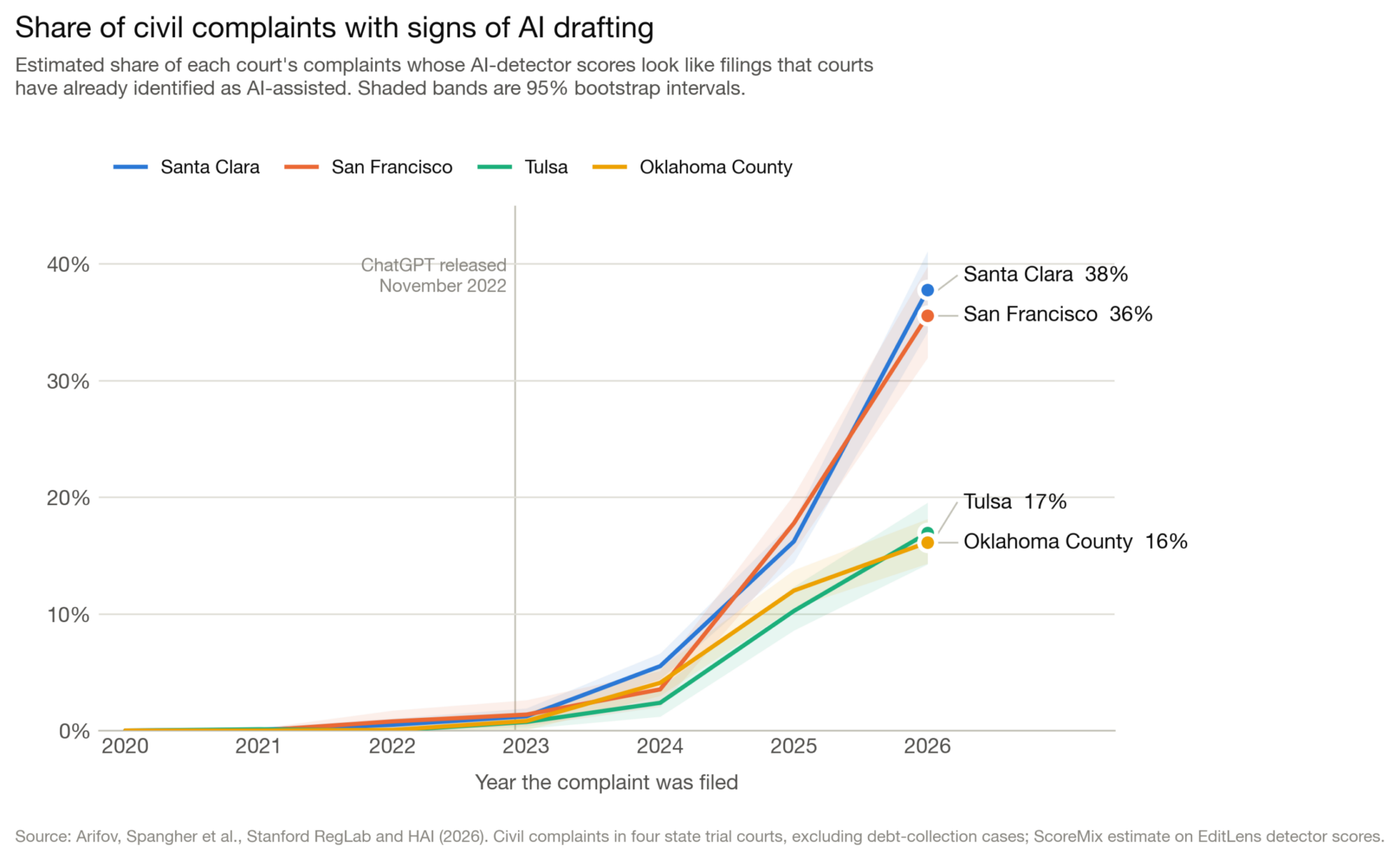
Legal citations hallucinated by artificial intelligence have been turning up in court filings across California and beyond. More than a third of the civil lawsuits filed this year in Santa Clara and San Francisco counties — other than debt collection cases — show signs of AI-assisted writing, according to a new Stanford University report.
“The sharp rise we document here corroborates that AI in the law is a question of how, not whether,” researchers from Stanford’s Human-Centered Artificial Intelligence and the Regulation, Evaluation, and Governance lab wrote.
Until now, no one had a reliable way to measure how much AI is creeping into the courts overall. The researchers say their study is the first to try it in state trial courts, which handle nearly all of the country’s cases.
The researchers faced a daunting task, given that existing AI detectors trained on general language struggle with legal documents’ specialized vocabulary and boilerplate language. AI detection will only get harder, the authors said, “as language models are trained to mimic human text and style.” For this study, the researchers calibrated AI detectors using nearly 1,000 real court filings in which judges had flagged fake citations.
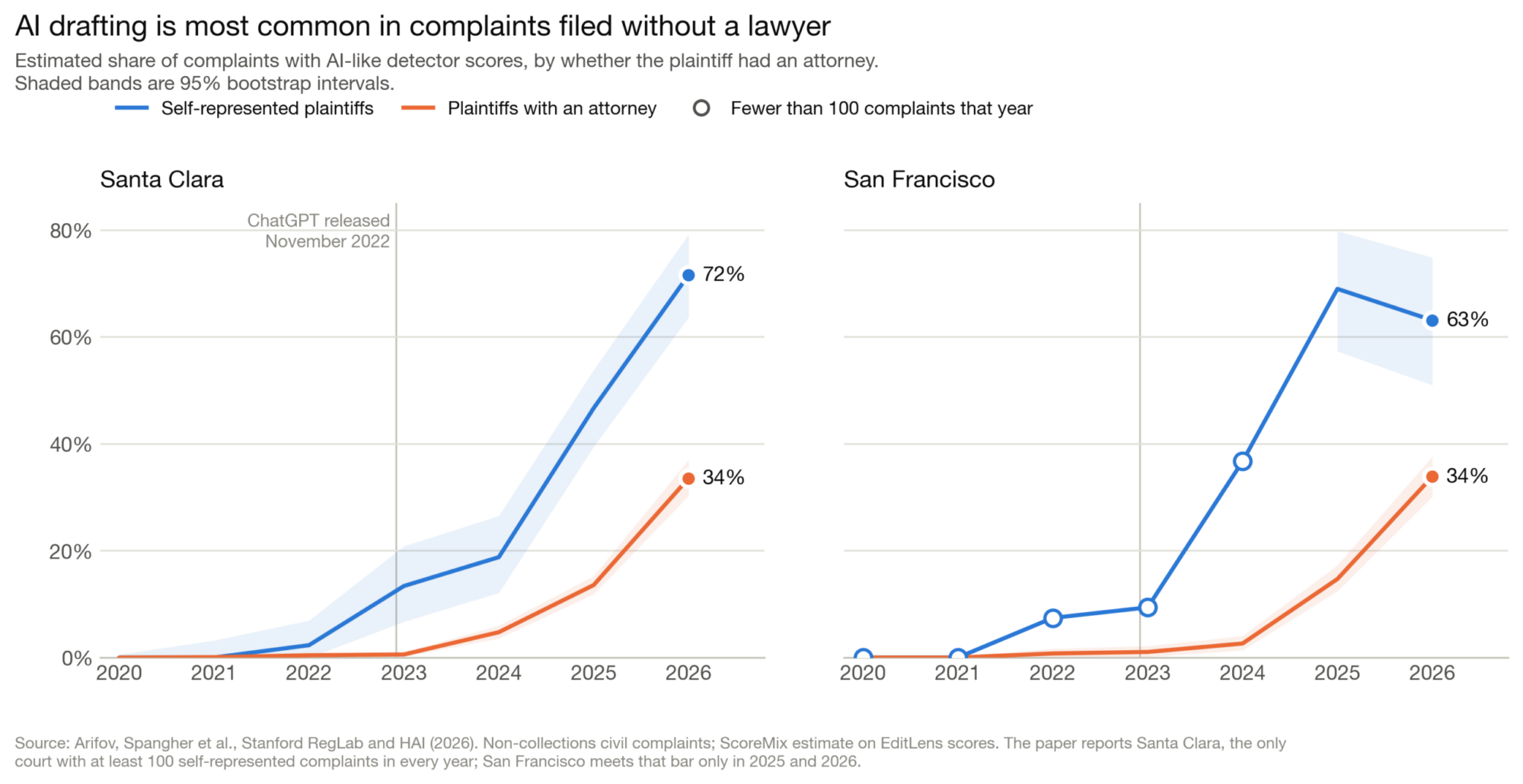
The study found the steepest rise in AI use among people representing themselves. In Santa Clara, the share of complaints from people representing themselves that show signs of AI went from 19% in 2024 to 72% this year. Roughly one-third of attorney-filed complaints in Santa Clara also show signs of AI.
So is AI helping address California’s access-to-justice crisis? Or making it worse? Possibly both, at the same time.
“AI assistance could lower barriers to legal expertise and access to the justice system, but it could also strain a court system that is already at capacity by increasing the volume of cases, the length of documents and likelihood that citations and facts are fictitious,” the study authors wrote.
Stanford law professor and study co-author Dan Ho said there’s no putting the horse back in the barn, as much as some judges would prefer it if nobody — civilians or lawyers — used AI.
Fake, AI-hallucinated citations are the obvious risk, but Ho worries about subtler damage to the law itself.
“It isn’t just hallucinations that you worry about,” he said. “You may worry about the way in which generative AI might not hallucinate directly a case, but still craft a kind of argument that really shouldn’t be relied upon,” he said.
Ho said many people representing themselves are using generative AI to replace Internet searches or library visits. AI, Ho said, “could improve the quality of complaints, relative to not having much access to legal knowledge at all.”
“The mere use of AI in drafting a document doesn’t imply anything about quality,” wrote Riana Pfefferkorn, a Stanford HAI policy fellow who was not involved in the study. The study, she said, notes a potential area for future research.
“If AI helps litigants draft legal documents but doesn’t help them win, then litigants will really need to adjust their expectations about the capabilities and limitations of AI tools,” Pfefferkorn said.

Legal eagles are split on whether and how California courts should prepare for the coming AI onslaught.
“The volume of materials will go up, and the quality of the content will decline,” UC Law San Francisco Professor Robin Feldman said in an email to KQED. “AI may open the courthouse doors to people who can’t afford lawyers and are now better able to understand that they have a legal claim and how to pursue it. On the other hand, many of these filings may be completely wrong and simply lead to an overburdened legal system.”
Colleen Chien, a UC Berkeley law professor who studies AI and access to justice, called the developments both “good news and bad news.”
“It tells us AI is lowering the cost of getting in the door, but getting in the door is not the same as being heard.”
The study, she said, can’t tell which people are “saving money on a lawyer they could have afforded, and which are people who would never have come to court at all without AI.”
California courts already have guidelines for how judges themselves use AI, and a new state law will require lawyers to disclose AI use starting in January, though it doesn’t apply to people representing themselves.
“At the end of the day,” wrote Feldman, “I suspect courts will have to come down hard on a string of errors by lawyers who fail to check some nonsense they get from AI. Even then, many lawyers will be tempted to assume that a quick read of the AI’s work is enough for them. To paraphrase Garrison Keillor’s radio show, A Prairie Home Companion, everyone will assume that they are above average.”