Largest U.S. Doctors’ Group Supports Banning Countertop Material Linked to Deadly Lung Disease
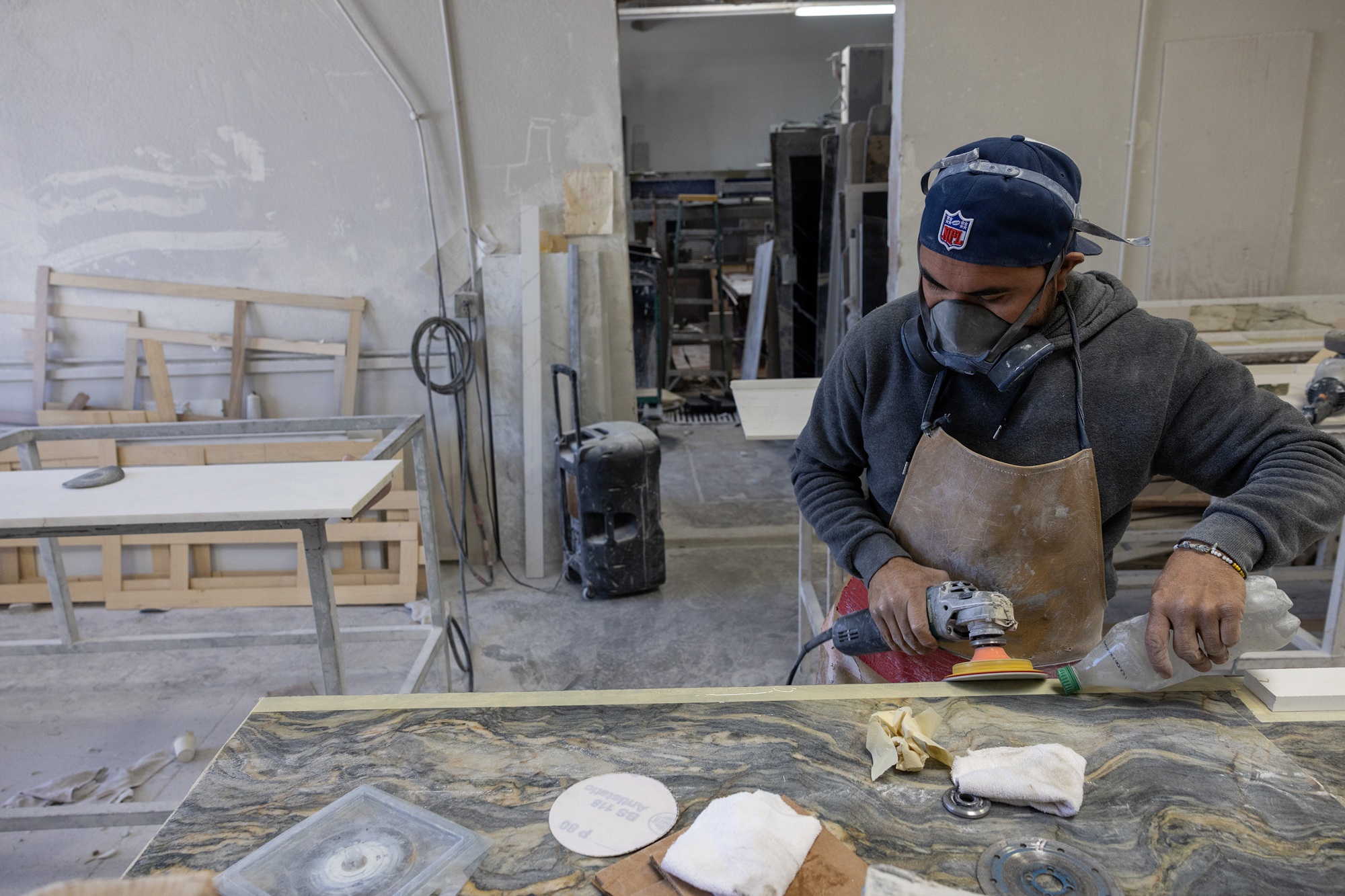
The nation’s largest physician group has backed a near complete ban on the most popular countertop material, which is linked to an aggressive lung disease disabling and killing stoneworkers in California and other states.
The American Medical Association has adopted a new policy opposing the manufacturing, importation, distribution, sale, fabrication and installation of high-silica engineered stone products across the U.S. Doctors in California hope that the declaration by the AMA, which counts more than 250,000 physicians and medical students as members, will spur greater regulation of the factory-made material and promote the use of safer alternatives.
“Workers are developing an incurable lung disease that can progress to respiratory failure and sometimes, death, often at a young age among workers,” AMA Board Member and radiation oncologist Sheila Rege said in a statement. “Silicosis is preventable, and the most effective way to prevent silicosis is to use safer countertop materials containing less than 1% crystalline silica with appropriate dust control measures.”
The move could boost a push by California regulators to phase out the use of engineered stone with more than 1% crystalline silica to make countertops and other construction surfaces. A state workplace standards board is poised to vote on a first-in-the-nation emergency regulation next month. Australia was the first country to ban engineered stone slabs in 2024.
More than 680 stoneworkers in California have contracted silicosis after inhaling toxic silica dust generated when cutting or polishing engineered stone, also known as artificial stone or quartz.
Most of them are Latino men who say they didn’t know about the hazards of handling artificial stone until they or co-workers felt shortness of breath and other worsening symptoms.
Dozens of workers have died, while 75 have undergone lung transplants since 2019, according to the California Department of Public Health. Physicians in Colorado, Florida, Illinois, Texas and other states have reported cases as well, though California is the only state systematically tracking the disease in the industry.
“Having personally gone through the illness caused by artificial stone, I believe that eliminating the use of artificial stone would be a good decision,” said Lopez, a former stoneworker in the Bay Area who underwent a double lung transplant in March after years at a job cutting engineered stone into kitchen and bathroom countertops.
“Health must take precedence over commercial interests,” the father of four added. KQED is not using Lopez’s full name, as he fears losing vital medical care if arrested by immigration authorities.
Major manufacturers of high-silica artificial stone have sought to place the blame for rapidly rising silicosis cases on countertop fabrication employers who fail to follow safety precautions. Cambria, the largest U.S.-based producer of the material, has pushed for a bill in Congress that would immunize manufacturers and distributors from hundreds of lawsuits by sick workers seeking damages.
Meanwhile, the International Surface Fabricators Association, which is supported by Cambria and other manufacturers, has petitioned California regulators to require countertop fabricators to be certified to do business, instead of restricting their use of artificial stone.
ISFA CEO Laurie Weber doubted that a ban would benefit most workers, since “unlicensed, uninspected operators who cut stone unsafely today would continue to cut whatever comes next the same way.”
“ISFA respects the medical community’s concern for workers and calls for a solution that protects them now, licensing and verified compliance for every shop that cuts stone,” Weber said in a statement. “Silicosis is real, it is devastating and it is preventable. We respect the physicians and researchers who have treated these workers and sounded the alarm. Our disagreement is not with the medicine. It is with the idea that a product ban on fabrication, by itself, will protect the people doing this work.”
California, which has more protective silica regulations than federal standards, already requires fabricators to cut the material under a layer of water to reduce airborne dust, and provide workers with sophisticated masks and ventilation systems.
But the rules are expensive and difficult to implement, and Cal/OSHA inspectors have found most fabrication businesses they’ve visited had violations. In addition, mounting evidence shows that workers can get sick even at sophisticated shops complying with the current regulations. Within the next decade, between 1,000 to 1,500 stoneworkers in California could develop silicosis, leading to roughly 285 deaths, according to Cal/OSHA. The state is home to about 5,000 countertop fabrication workers, predominantly Latino immigrants.
Dr. Robert Blink, a San Francisco-based occupational medicine physician urging California to ban high-silica artificial stone, said AMA’s resolution will help increase awareness about its hazards, and increase potential regulation by federal OSHA, other states and even Congress, which is expected to tie or break a record number of physician representatives next year. The material is safe for consumers once installed.
“This is recognition by the larger house of medicine that the material cannot be safely used.” said Blink, a former president of the Western Occupational and Environmental Medical Association. “We’ve certainly been trying to raise the alarm because this is a deadly epidemic that is killing people.”