California Prison Officials Failed to Complete Thousands of Misconduct Investigations, Report Finds

One prisoner said that officers attacked him, sending him to the hospital for five days. Another complained that an officer grabbed him by the hair and slammed his face into the concrete. An incarcerated woman alleged an officer refused to take her for a sexual assault examination.
These are among the 3,500 complaints filed by incarcerated people that California prison officials failed to investigate in a timely manner, in the first six months of 2026, according to a new report from the Office of the Inspector General.
The semiannual report sent to the governor and state legislature details how the California Department of Corrections and Rehabilitation handled internal investigations and officer discipline between January and July of this year.
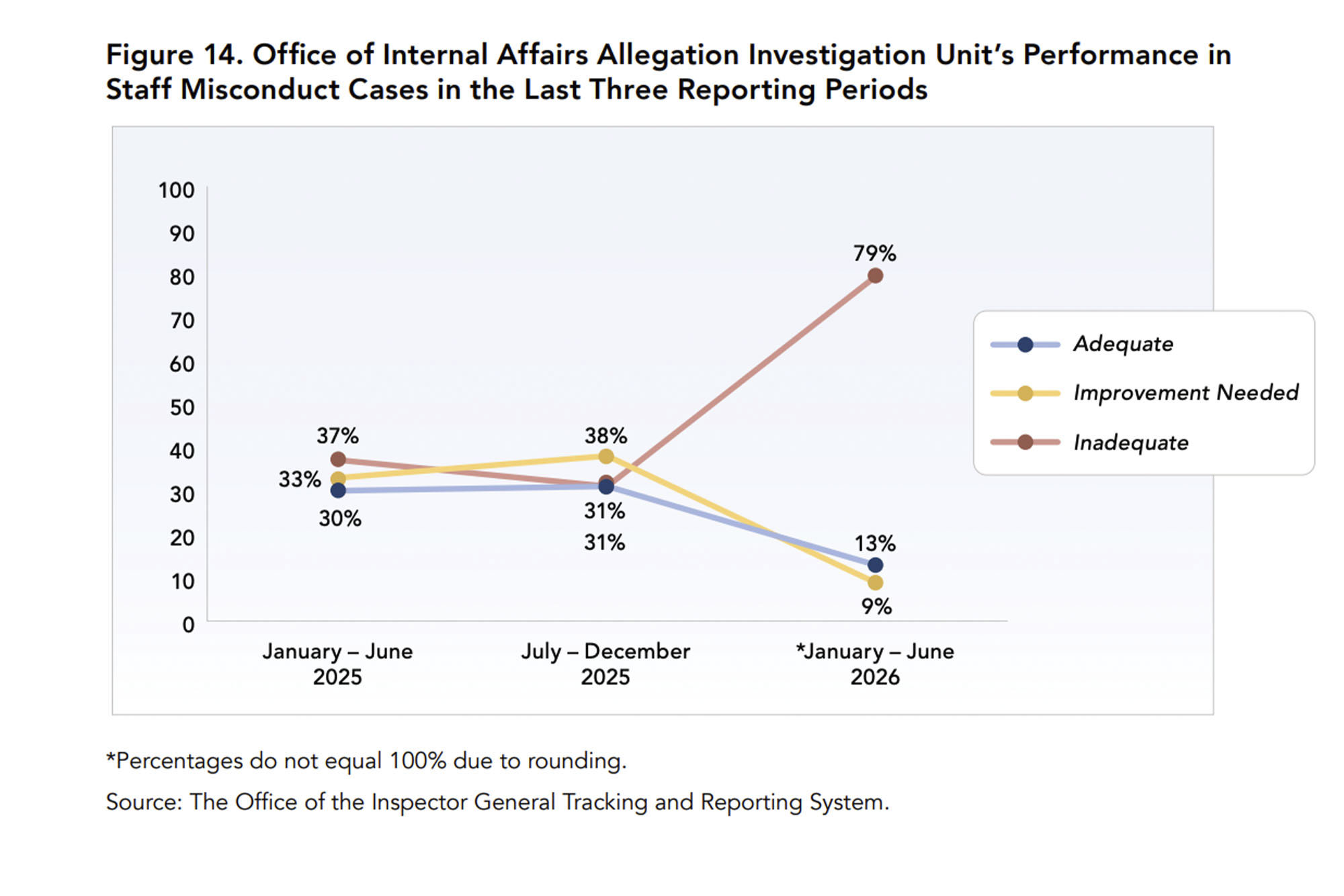
While the report said that CDCR’s overall handling of misconduct “has improved,” it noted the performance of one division, the Allegation Investigation Unit, or AIU, has “declined dramatically.”
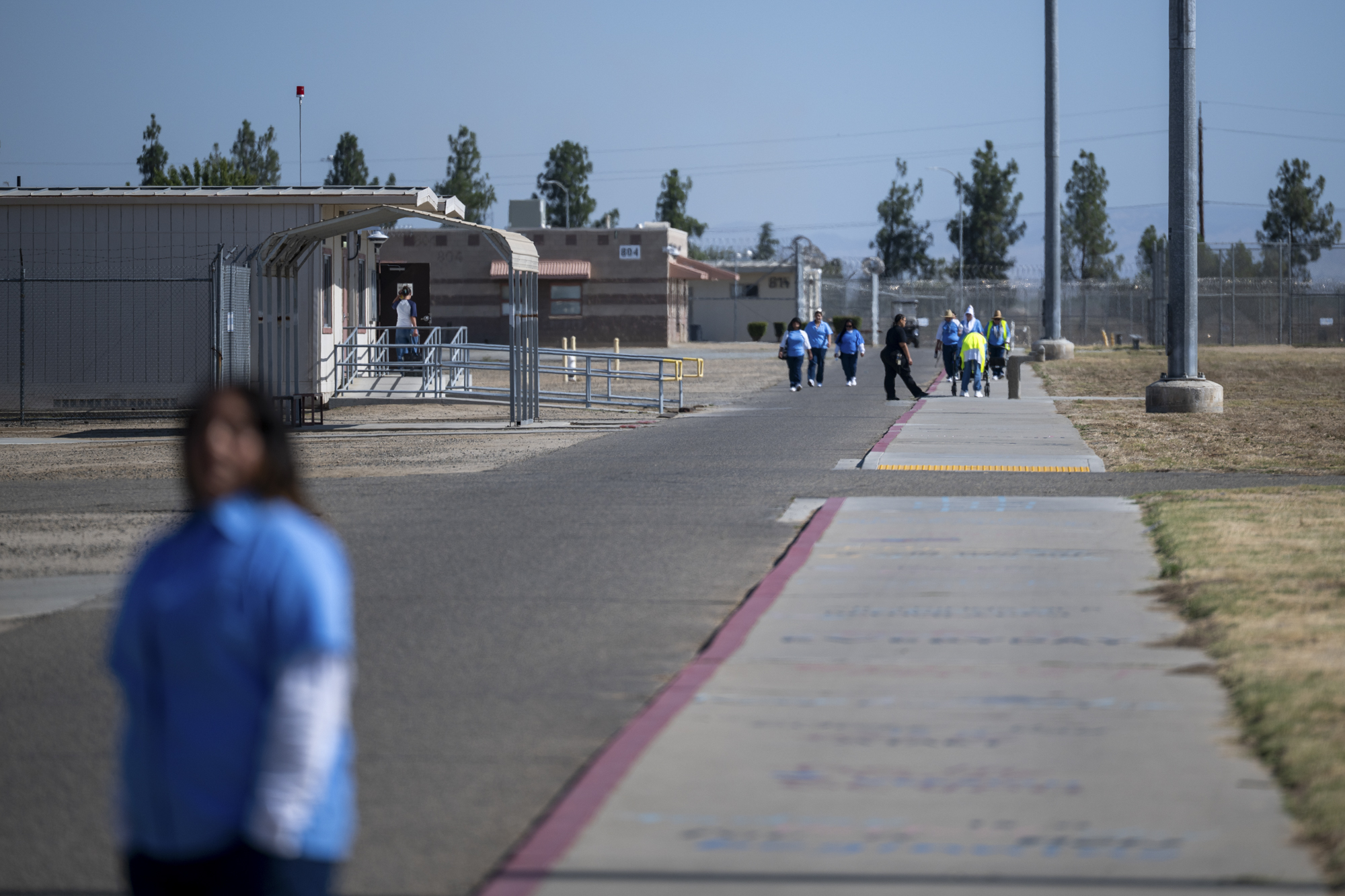
The AIU was set up in 2022, as part of an effort by prison officials to more thoroughly and fairly address the thousands of complaints made by incarcerated people each year. But recent reports from the inspector general reveal an escalating crisis in the unit, driven by ballooning caseloads, delayed investigations and a growing backlog of complaints.
In contrast, the report found that CDCR’s traditional Office of Internal Affairs, which handles serious criminal allegations and complaints coming from other staff members, rather than prisoners, stayed largely consistent in its performance.
“CDCR takes staff misconduct allegations seriously, and timely, thorough investigations are essential to accountability and the safety of our institutions,” agency spokesperson Terri Hardy wrote in an email. She said the agency has created a four-tier prioritization system and increased staffing.
Former AIU chief David Starnes told KQED that when he took over the unit two years ago, CDCR’s executive leadership knew there was a flood of complaints, but undermined his efforts to triage cases and hire staff. When he retired last month, Starnes said the unit was completely overwhelmed by a backlog of cases.
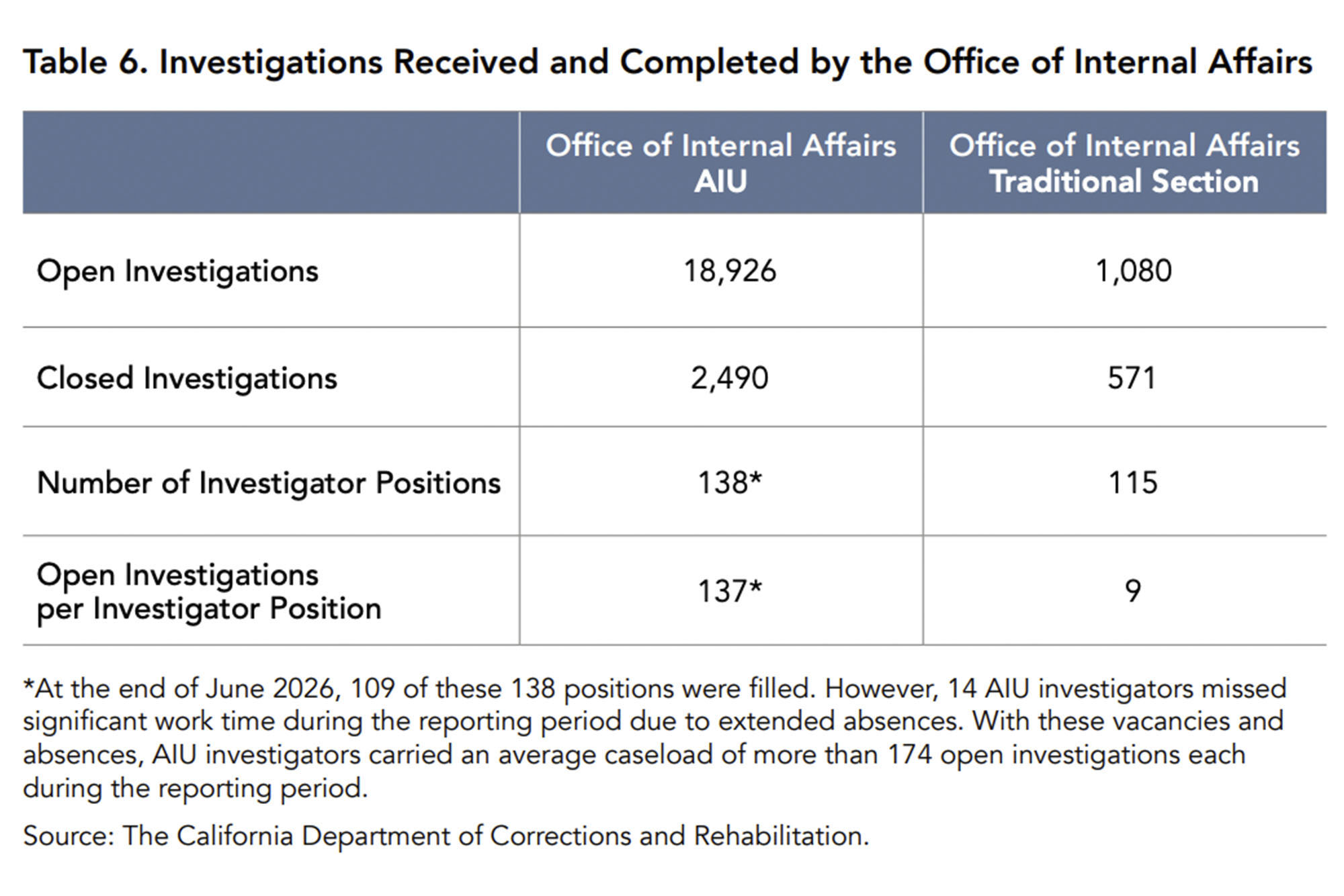
The number of open cases topped 10,000 in June 2025, according to a report released by the inspector general last year. The latest findings show that number has nearly doubled to 19,000, with a single investigator averaging 135 open cases at a time.
“ We had them as high as 200 cases at one point,” Starnes said, noting that those cases didn’t go away. “They’re still sitting in a queue and the department, quote-unquote, ‘is gonna work them someday.’”
Under California’s peace officers’ bill of rights, if an agency doesn’t investigate a complaint within a year, it can’t discipline officers.
In December 2025, the inspector general warned that 705 cases were within 60 days of the deadline. Its next report, which came out in May, found the deadline had expired in 1,774 cases. Now that number has doubled again, with the latest report finding the statute of limitations had expired in 3,428 cases.
“The harm is significant,” said Penny Godbold, an attorney with Rosen, Bien, Galvan & Grunfeld, which has a long-running class action lawsuit against the Department of Corrections called Armstrong v. Newsom, on behalf of people in prison with disabilities.
Starnes said a decade ago this would have been unheard of. “If a case wasn’t investigated before the statute of limitations expired, you were the worst person in the world, and everybody across the state heard about it,” he said. “It just didn’t happen.”
The Armstrong case has been a key driver of the backlog, Starnes said, because it led to the redefinition of staff misconduct. The AIU must take every complaint at face value, in contrast to the Office of Internal Affairs, which has a “reasonable belief” standard that allows agents to quickly dismiss complaints that are contradicted by facts or other evidence.
“So, if you just say something happened, we’re investigating it,” Starnes said of the AIU’s approach.
Godbold said the standard changed for a reason: credible complaints by incarcerated people were getting thrown out. “ It is true that the number of cases increased under the new system,” she said. “That was by design.”
The inspector general recommended that CDCR use technology to better prioritize cases, and Starnes said that the AIU had started using artificial intelligence technology like Microsoft Co-Pilot to help review documents, transcribe interviews and write reports.
The inspector general credited the department with communicating about case backlogs and expired deadlines.
It also largely approved of how the department was using a new “special conditions closure process” to quickly close cases where audio or video footage “provides conclusive evidence that the alleged misconduct did not occur.”
Godbold and Starnes both said that reviewing body-worn camera footage is the best way to triage cases and determine if an allegation is founded or not.
So far, Godbold said, just 10 of California’s 31 prisons have implemented body cameras.