San Francisco's Condor Club Is Full of History, Dancers ... and Ghosts?
Olivia Allen-Price: I’m Olivia Allen-Price, this is Bay Curious. Just a heads up that today’s episode includes discussion of nudity and sex. So turn it off or turn it up. We won’t judge you either way.
When you look back at San Francisco history, sexual entertainment has been a part of the culture since the boots of the earliest miners hit the soil in the mid-1800s. In these early days, prostitution was big business and brothels were easy to come by. We earned the name Barbary Coast in part because of them.
But every few decades, as public attitudes, state law, or local politics shifted, so too did San Francisco’s sex industry. It jumped from one neighborhood to another. Dance halls came and went. The pendulum would swing more conservative than more permissive. In the 1960s, North Beach was poppin’ with dozens of nightclubs, mostly offering jazz or other live music as the main attraction. But it wouldn’t stay that way for long.
The Condor Club and a charismatic performer named Carol Doda ushered in a new chapter for San Francisco’s sex industry. Doda has become a San Francisco icon and some say her presence in the Condor club has persisted despite her death in 2015.
Today we bring you a story about the Condor Club from Spooked, a KQED podcast about real ghost stories told by the people who lived them. Here’s producer Zoe Ferrigno.
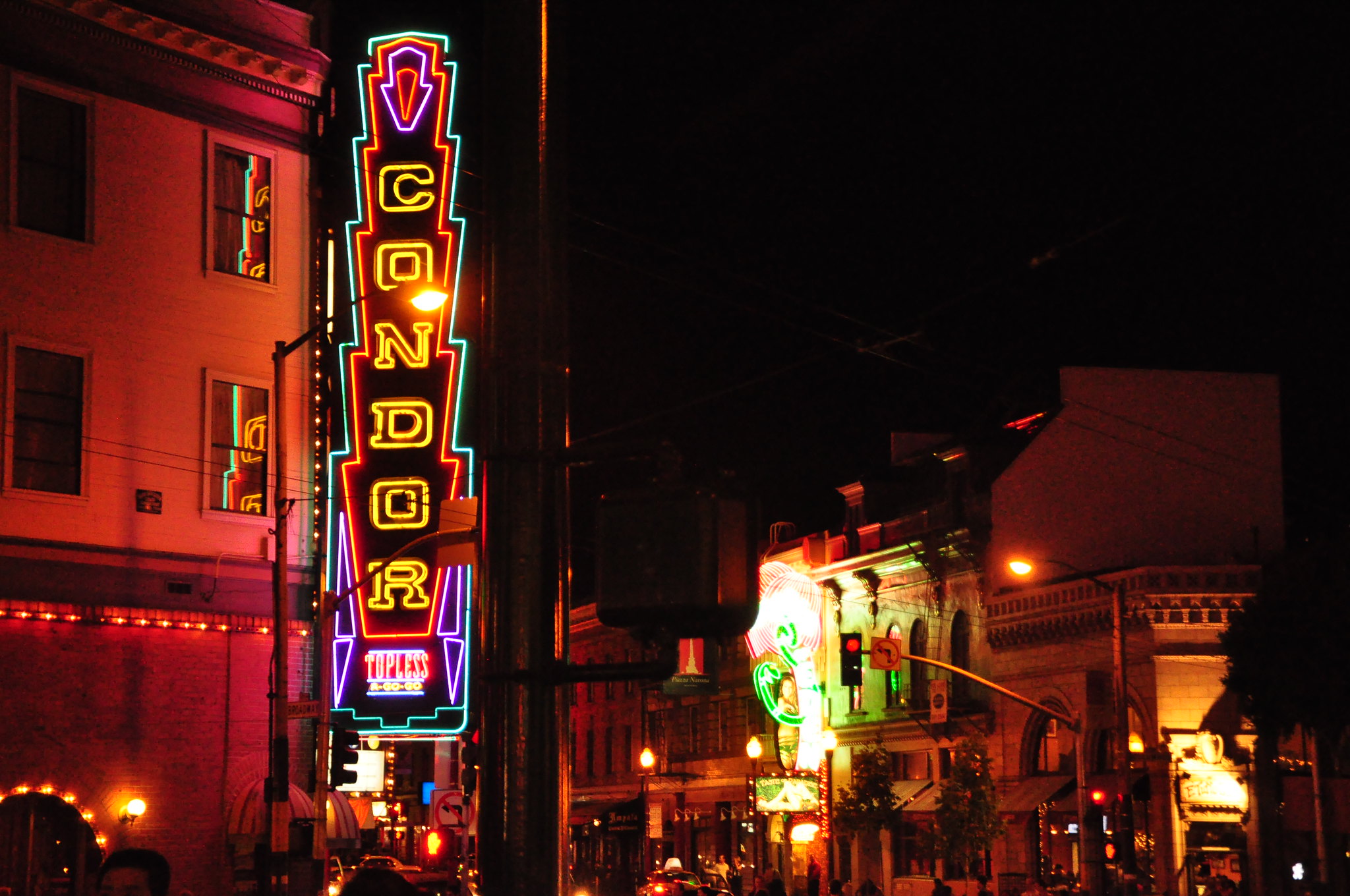
Zoe Ferrigno: It’s a Sunday night, and my fiance Pete and I are in North Beach, walking up Broadway. Most nights of the week, this street is totally lit up with neon signs, but tonight, almost all of them are dark. There’s no glowing gangster outside of Big Owls, no blonde bombshell in front of the hungry eye. Even the bright green snake outside of the Garden of Eden has the night off. From the looks of it, there’s only one club open in North Beach tonight. And the 50 foot tall neon sign that says Condor in big gold letters is as bright as ever. Inside, the Condor Club is dark and very loud. There are Christmas decorations hanging on the walls and football is playing on the TVs. It kind of feels like just your average neighborhood bar, except for one thing. The dancer up on stage in a silver bikini top, hanging upside down on the stripper pole. The truth is, the Condor isn’t just a neighborhood bar, even if it feels that way sometimes. It’s one of the oldest strip clubs in San Francisco and the very first topless bar in America.
Rachel: I was really excited to work there, honestly, even if I wasn’t dancing, because it’s an iconic spot.
Zoe Ferrigno: That’s Rachel. She started working at the Condor as a bartender in 2019.
Rachel: The building itself is like over a hundred years old. So when you go in it has like a very like old-school burlesque vibe, which I really liked. The stairs are still made of hardwood, the railings are still make of hard wood. The wallpaper was like super detailed and ornate, paisley, with like these deep reds and gold. And then you just have pictures of dancers who danced there throughout the years. There’s this history there, like I wouldn’t be surprised if it opened as a museum one of these days. Rachel started out working the day shift at the club. In the beginning, it was intimidating. The girl who was training me during the daytime, she was very charismatic and a lot of people loved her. She had a lot of regulars that came in just for her. So I was just like, I felt like I had like this huge role to fill, you know.
Zoe Ferrigno: Rachel knew if she was going to win over the crowd, she was gonna have to put in some extra time before her shift when the club was dead.
Rachel: I came in and I was setting up the bar and I was practicing making drinks so that I could get faster at it. And I went to go grab a bottle, and then I noticed that the Hennessy bottle was out of place. It was just like slightly scooched towards the edge. And I noticed that because I’m one of those people where I’m like it needs to be in like a perfect little place, like it need to look neat. And so I went and I pushed it back and then I got down off the ladder and then, I started cleaning the bar and cutting fruit and just doing downtime stuff that you do as a bartender at the bar. I look up and that damn bottle. Is by the edge again and I’m just like, what the hell? Because I made sure that I pushed that thing back and then I went and I did it again.
Zoe Ferrigno: And it kept happening whenever she was there practicing in the deserted club with the empty stage.
Rachel: I would push it back, and then it would be slightly out of place again. And it was just that one bottle of Hennessy. It was really annoying.
Zoe Ferrigno: After a few weeks on the job, Rachel was starting to get the hang of things.
Rachel: Because we had a lot of beer drinkers, I would keep bottles of beer on ice. So I remember I was taking some Bud Lights, putting them on the ice. It’s very early, so like no customers had rolled in yet, the band hadn’t come in yet. And I heard what sounded like footsteps. It sounded like somebody was just darting up the stairs. I thought it was my manager, but then about five to 10 minutes later, it sounded like somebody was running back down the stairs. I was like, all right, what’s going on? Did something happen? So I decided to investigate. So I went upstairs and I looked around, my manager was not up there, I came back down. As I’m coming down the stairs leading up to the private rooms, he comes up from the basement stairs. And I’m like, I just heard somebody running up and down the stairs. I thought it was you. And he was just like, oh yeah, that’s the ghost. I’ve heard it too. In my head, I was like, people like to blame things that they can’t explain on ghosts. Or he’s just trying to scare me. That was what was going through my head. So I brushed it off and went back to work.
Zoe Ferrigno: It was another dead afternoon, and Rachel was all alone in the club again, up on the stage.
Rachel: My manager told me that he wanted me to start cleaning the mirror that’s behind the pole on the stage because no one was cleaning it and it’s just filled with fingerprints and lipstick stains because sometimes the girls would kiss the mirror. So I’m up there with the Windex and I’m wiping it down. I’m minding my own business. And then as I’m whipping away these fingerprints, I see a man standing behind me. And that’s when I got startled. He was very tall, very big, and he had a beard. He was wearing a full-on black suit, white button-up shirt with a red tie. It was the kind of outfit that the bouncers wore. And he looked like my old co-worker that I had at my old club. And I was like, Oh, did he come by to say hello and turn around and no one’s there. It was literally like a split second. Like I saw it in the mirror and I kinda got excited and I turned around and no one was there and I was like, what just happened? I got scared. I was like, is somebody in here? Like, who was that? I looked around and I was like maybe somebody from the night shift maybe came in to pick up their paycheck or something. Nope, no one was there. And then I remembered like, boss said it was haunted. Oh, is this what he was talking about? We’ll be back with more.
Olivia Allen-Price: After this quick break. And we’re back at the Condor Club with producer Zoe Frigno.
Zoe Ferrigno: Up on the same stage where Rachel saw the man behind her in the mirror, another dancer is finishing her set. There’s a guy in a suit up there with her, using a push broom to sweep up all the cash on stage. Pete and I get up and make our way into the club’s other room to get drinks at the bar. We see the stairs that lead up to the private rooms where Rachel heard the disembodied footsteps. And then towards the back of the club, we notice that part of the floor is glowing. We walk over and see that set into the floor is a baby grand piano. It’s underneath a layer of plexiglass and illuminated by hot pink lights. There’s a clear stripper pole coming up out of the plexi glass that goes all the way into the ceiling. It turns out that this piano plays a big role in the history of the club.
Rachel: I was bartending at night time, it was very very busy, very loud music playing. I was very stressed out because there was a lot of people and I have to deal with this door-to-ash order because one of the dancers had ordered food.
Zoe Ferrigno: Rachel grabbed the takeout bag and started heading for the back room. But before she got there, she ran into another dancer.
Rachel: Faces like super pale white. When I noticed they were looking up at the ceiling, I turn around, I look up. I was expecting to see something wild going down on the second floor in the private rooms because that’s what happens when you work in a nightclub. That’s what I was expecting to, see something Wild. But when I looked up, I saw this black shadowy figure of a woman, hourglass shape, pinned up hair with her hand on her hip, just like descending from the ceiling, like down to the floor. And it was dark, but I could see it. It was plain as day. And then as soon as it hits the floor, it just dissipates. It was like a raindrop hitting the floor. It was, like, poof. Gone. I was super shaken up. I had chills, I was freaking out, but the dancer next to me, she was like really freaking out. She was like, oh my God, did we just see that? I was trying really, really hard to keep it together, but I couldn’t stop shaking. Just the way she was posing, just the way that her body was shaped. There’s no doubt in my mind that that was Carol, absolutely.
Zoe Ferrigno: Carol, as in Carol Dota, the iconic topless dancer who made the Condor Club famous and who turned North Beach into a hub of sex and controversy in the 1960s.
Olivia Allen-Price: Yours was the first topless show.
Carol Doda: The first topless and the first to be in trouble. I was the first one to go to jail for three hours.
Interviewer: You did go to jail for three hours, what was that like?
Carol Doda: It was very terrible. I don’t particularly like it.
Interviewer: But I would like to know what is the performance of the condor, what did it consist of?
Carol Doda: Oh, it consisted of a piano, a ceiling, and a body coming out of the ceiling on the piano with this wild rock and roll music. And it was like going up and down on an elevator. And it would hit the stage and I would go into one of my routines, mostly rock and dancing, you know, the contemporary.
Zoe Ferrigno: Carol performed her signature moves, singing and dancing topless on top of the piano six times every night, and each time the crowd in the Chandra Club would go wild.
Rachel: When I saw the silhouette come down from the ceiling, like that was her platform where she had her piano, where she would come down. Like that was her spot. She passed away in 2015, so pretty recent, but I wouldn’t be surprised if she felt very spiritually and emotionally connected to that place.
Zoe Ferrigno: But the legacy of the piano that now sits encased in plexiglass beneath the floor goes beyond just Carol Dota.
Rachel So back in the early 80s, this floor host and a dancer decided that now that the club was closed, that it was a good idea to do the nasty on top of the piano. Why they thought that that was a great idea, I don’t know. But as they were, you know, being intimate on top the piano, it malfunctioned. And it just SMASHED against the ceiling. And it crushed the man. His girlfriend, the dancer, she was able to survive. But yeah, the four hosts, yeah, he did not survive, unfortunately.
Zoe Ferrigno: Over time, Rachel came to wonder if that was the large man in the bouncer suit, whose reflection she saw behind her that day, in the mirror.
Rachel: Apparently he had a beard, like that was his nickname, the beard.
Zoe Ferrigno: This theory intrigued me, so I started looking into it, and I found out that there’s evidence that the beard, whose real name was Jimmy Ferruzzo, may actually have been murdered by the mob, and then his death was staged to look like an accident. We probably won’t ever know what really happened, just like we’ll never know whether Rachel saw the beard that day, or the spirit of some other guy who just really loved Tennessee.
Rachel: To me, it’s like a lot of different spirits that are there. Even though I was there for only several months, I could definitely just feel a lot of different energy, because there’s just so many different people that have come and gone from that place since the 60s. And a strip club is a very emotionally charged place. There’s a lot of different emotions, and people are experiencing a bunch of different things. I feel like their energy just sort of lingers.
Zoe Ferrigno: It’s about 10 p.m at the Condor Club. There’s a little break in the entertainment and Pete has wandered off with his drink to the back of the club to check out the piano one more time. He’s standing right over it in the same place where Jimmy Ferruzzo met his end and where Rachel saw what she believes was Carol Doda’s ghost. There’s another dancer about to take the stage, but I think it’s time to go. I wanna get my fiance out of here in one piece.
Olivia Allen-Price: That was Spooked Productions Producer Zoe Ferringo.
Spooked is dropping new episodes right now as part of their latest season, The Spooked Field Guide to the Shadow. Be sure to check them out and subscribe over on the Spooked podcast feed.
And if you like what you’re hearing there, or here for that matter, consider becoming a KQED member and supporting our work. It’s super quick and easy. Just head to donate.kqed.org slash podcasts.
If you want to learn more about the history of the Condor Club and Carol’s legacy, check out the documentary Carol Dota, topless at the condor.
The Spooked team behind that episode was Doug Stewart, Casey Butler, Paulina Creakey, and Zoe Ferrigno.
Bay Curious is made in San Francisco by Christopher Beale, Katrina Schwartz, Anna Casalme, and me, Olivia Allen-Price. We get extra support from Maha Sanad, Jen Chien, Katie Sprenger, Ethan Toven-Lindsey, and everyone on Team KQED.
I hope you have a wonderful week, and don’t see anything creepy in the mirror.