Silicon Valley Spends Millions on North Bay Assembly Race
Here are the morning’s top stories on Friday, October 16, 2026
- This year, Silicon Valley has poured money into California’s legislative races at levels far above past elections. One district where that money looms large is Assembly District 12 in Marin and Sonoma counties, where two Democrats are facing off.
- The Trump administration filed a lawsuit against California on Thursday, aiming to block the state from counting the ballots of around 20,000 voters.
- California Attorney General Rob Bonta has filed his 100th lawsuit against the Trump administration. It’s challenging the Immigration and Customs Enforcement practice of making immigration arrests inside state courthouses.
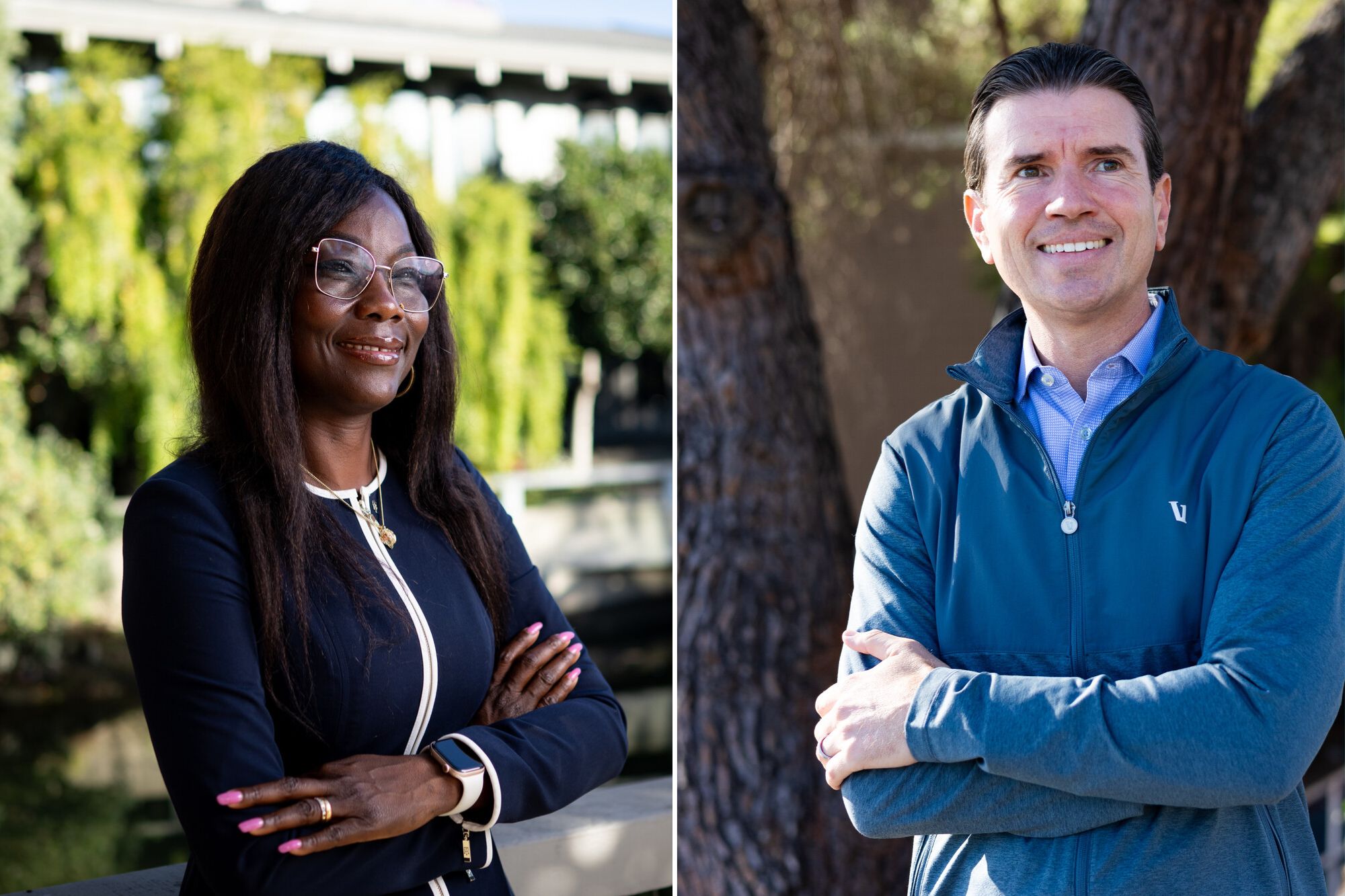
On a recent Saturday morning, Jackie Elward stood in a park facing dozens of volunteer canvassers, most of them union members, from sheet metal workers to school support staff. They grabbed coffee and campaign flyers, preparing to knock on doors and persuade voters to elect Elward to the state Assembly to represent this North Bay district.
Before they fanned out, Elward reminded them what was at stake. She said the race is about workers versus corporations. “We know that they are coming to steal our job[s], to make sure that people are out of jobs,” she said. “But guess what? We are not going to allow a billionaire to take over what we have built for so many years.”
Elward, 47, is a labor organizer, educator and member of the Rohnert Park City Council who became the first Black woman elected to the council in 2020. She raised three children in the district with her husband after immigrating from the Democratic Republic of the Congo in 2003. Her pitch to voters is straightforward: She’s the labor candidate fighting for working families, running against steep spending by tech special interests. Her opponent, Marin County Supervisor Eric Lucan, is the main beneficiary of that money in this race. Both are Democrats. “We know that the crypto billionaires’ … priority [is] to elect [a] candidate that they can bring to Sacramento in order to push their agenda,” Elward said. “One of the crystal clear examples is my race.”
Across California, tech special interests are pouring money into legislative races at levels far above past elections, political analysts say. Two super PACs, Grow California and California Leads, have spent more than $34 million on downballot competitions this year. Grow California is financed by billionaire Chris Larsen, co-founder of the crypto firm Ripple, and billionaire Tim Draper, a venture capitalist and bitcoin investor. California Leads is funded mostly by Meta and Google.
In the North Bay’s Assembly District 12, Grow California has spent nearly $3 million so far opposing Elward and supporting Lucan. Elsewhere, the two super PACs are backing mostly moderate, business-friendly candidates in 16 other legislative races, the bulk of them in Southern California.
Political analysts see it as part of a broader fight for power in Sacramento between business and labor interests, which traditionally spend millions every cycle. “What you are seeing is an attempt to moderate on the margins many of the potential members that could come into the Assembly and the Senate that would be perceived as too far one way or another,” said David McCuan, a political science professor at Sonoma State University. “They’re pushing these large [independent expenditure] campaigns that are essentially blowing off the doors of any previous level of finance.”
Larsen rejected the idea that this can be boiled down to a business-versus-labor struggle. “We’re looking for problem solvers,” he told KQED’s Political Breakdown on Thursday. “I don’t even like to use the word ‘moderate.’ That just sounds like you’re doing too much.” Rather, Larsen said, the millions of dollars in political spending this year aims to bring a different perspective to Sacramento, which he said has been dominated by unions that are not focusing on key issues such as housing, energy, the insurance crisis and education.
While labor and tech face off in the independent expenditure arena, both sides see a vital opening to maximize their influence in California’s Democratic-controlled Legislature: Given that the Trump administration has signaled a resistance to regulating artificial intelligence, the state is in a clear position to set the standards for the nation.
The Trump administration sued California and state elections officials on Thursday, two days after demanding that they prove U.S. citizenship for tens of thousands of registered voters — or set aside their ballots.
The unusual lawsuit, filed weeks before Election Day, immediately drew criticism from Gov. Gavin Newsom and state officials, who have accused President Donald Trump and the federal government of stoking unfounded concerns about voter fraud and trying to intimidate voters.
In letters sent Tuesday to state and local officials, the U.S. Department of Justice gave officials two days to confirm the voters’ citizenship status, ramping up its pressure on the state to root out alleged voter fraud ahead of the Nov. 3 midterm election. The letters were accompanied by a password-protected thumb drive that the DOJ said contained the names of over 20,000 voters who the federal government “believes are likely noncitizens.”
In its complaint filed Thursday, the Justice Department asked a federal court to order California to set aside the vote-by-mail ballots sent to those people and to block the state from counting those ballots until the voters’ citizenship status can be confirmed.
“This is a sad, desperate attempt by Trump to use his politicized Justice Department to try to suppress California voters just three weeks before Election Day,” Newsom said in a statement. “Courts have made clear the federal government has no role in running state elections. We will defend free and fair elections in the Golden State and call out every authoritarian attempt to undermine our democracy.”
Legal experts say the lawsuit faces an uphill battle. Similar suits by the Trump administration over California’s voter rolls have been unsuccessful since the start of Trump’s second term.
California Attorney General Rob Bonta has filed the state’s 100th lawsuit against the federal government since President Trump took office for a second time in 2025.
The lawsuit filed Thursday alleges that U.S. Immigration and Customs Enforcement overstepped its Constitutional limits by taking people into custody at state courthouses, a practice forbidden by a U.S. District Court judge that the lawsuit alleges ICE nevertheless continues to employ.
For instance, the California Justice Department found that ICE detained 34 people at state courthouses in June 2026. In July 2026, the month after the judicial order to stop making arrests at courthouses, ICE detained 28 people at courthouses.
“ICE’s directive on courthouse enforcement and the resulting enforcement activities have had a profound chilling effect that has hindered California’s ability to enforce the law and protect public safety,” the state Justice Department said in a news release.
Picking people up at a courthouse can have a chilling effect on witnesses, victims and even suspects who are afraid to show up for court, California Supreme Court Chief Justice Patricia Guerrero said last year. “Making courthouses a focus of immigration enforcement hinders, rather than helps, the administration of justice by deterring witnesses and victims from coming forward and discouraging individuals from asserting their rights,” Guerrero said.