Senior Fired From Oakland Job After Union Tried to Collect Thousands of Dollars

An elderly man has returned to a part-time job at an Oakland market after the union representing workers at the store got him temporarily fired for refusing to pay a sudden $3,700 membership bill.
The incident, which labor experts said is rare, points to a decadeslong debate about individual workers’ rights and the power of labor unions in a place like California.
California is one of 24 states where unions can get private-sector employees terminated under common “union-security” contract agreements with employers, which require all members of a bargaining unit to pay dues as a condition of employment.
Objecting employees can opt out of full union membership, paying instead generally lower fees for direct representation that don’t cover other union activities, such as political lobbying. Nationwide, 26 states have different “right-to-work” laws making union dues payment voluntary.
Philip Holland was let go by the Village Market in the Upper Rockridge area last month at the urging of United Food and Commercial Workers Local 5, which represents most of the 30 employees at the family-run grocery store.

The union first contacted Holland, an 86-year-old Navy veteran, four years after he began working six-hour, bi-weekly shifts, subsequently demanding $3,676 in back dues and a $400 initiation fee, according to the National Right to Work Legal Defense Foundation, which filed charges before federal regulators on behalf of Holland on Sept. 23.
The nonprofit organization, which labor advocates and progressive groups consider anti-union, alleges UFCW representatives waited too long to ask Holland for retroactive pay and failed to notify him that he could choose a reduced amount — charges the union denies.
Holland declined to speak with KQED through representatives at the foundation. But the organization’s vice president, Patrick Semmens, said Holland, an Oakland resident who worked decades in law enforcement before retiring, was surprised, disappointed and angry when he called to inquire about his plight.
“He suddenly found himself facing a big threat over, ‘Hey, you better pay us thousands of dollars in back dues or we’re going to have you fired.’ And that’s kind of the exact type of situation that we provide free legal assistance to employees in,” said Semmens, adding that the foundation handles about 250 cases per year of workers who allege unions violated their rights.
By the end of September, UFCW officials had backtracked and asked Keith Trimble, the Village Market’s owner and operator, to reinstate Holland. He returned to work last Wednesday, according to Trimble.
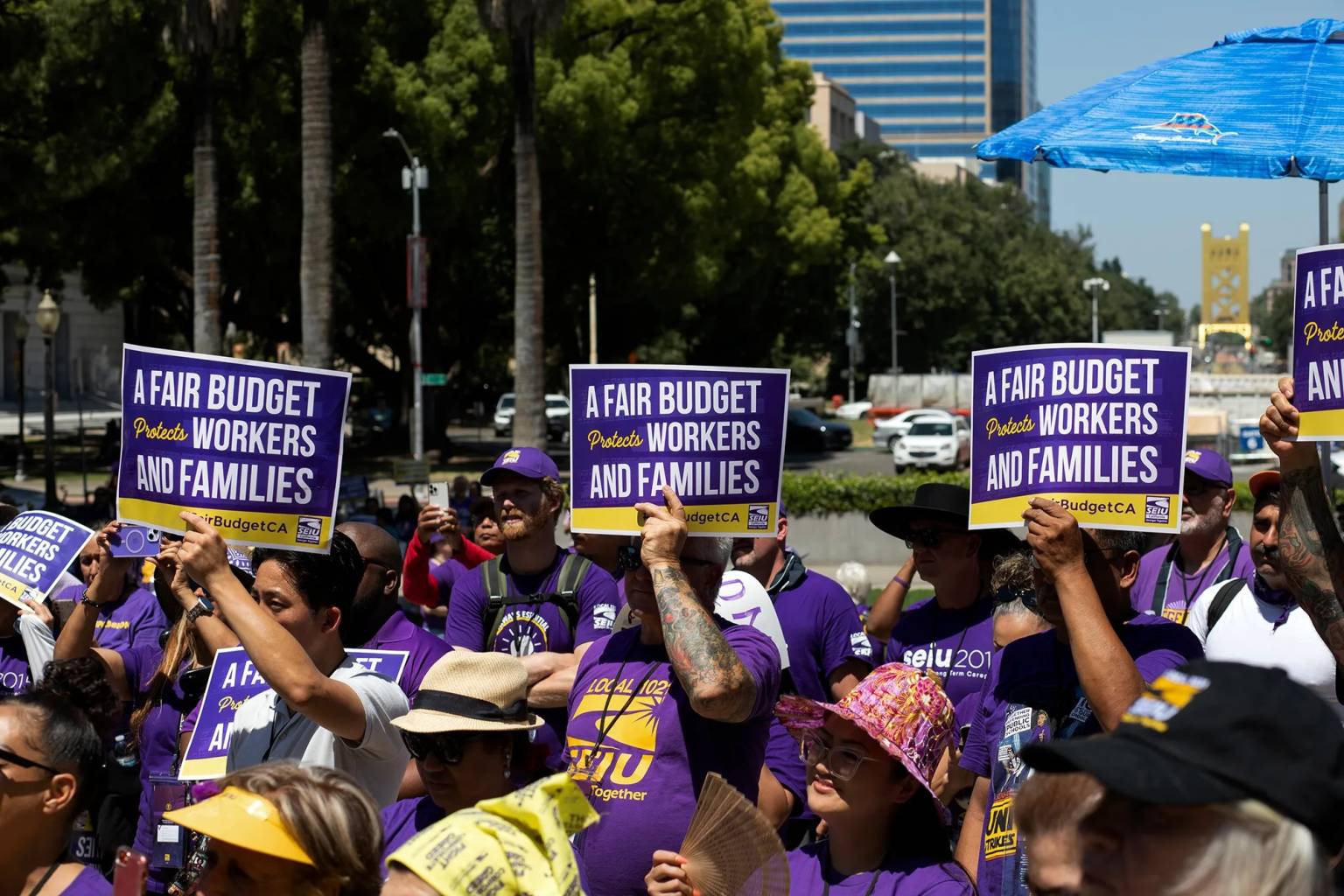
The independent grocery store, owned by Trimble’s family since 1974, has terminated a handful of other employees because of nonpayment of union dues, as stated in the market’s labor contract with UFCW, Trimble said. But Holland was the first worker that the union requested be rehired.
“I had a good employee, and through the contract I was required to let them go,” he said. “All I know officially is that for whatever reason they figured they didn’t follow whatever procedures and asked me if I could take him back, and I said yes.”
UFCW Local 5 represents about 25,000 retail and agricultural employees from Salinas to Eureka, including in the Bay Area. David Rosenfeld, an attorney for the union, stressed that it almost never asks employers to terminate someone.
The union sent Holland a letter with all his rights and benefits of union representation in May or June, shortly after it became aware that Holland was working at the market, Rosenfeld said. It’s unclear why the union didn’t reach out to Holland earlier, though Rosenfeld partly blamed Holland and the employer for not coming forward. The union has since acknowledged that waiting more than three years to collect back fees for membership was too long.
“We should have perhaps been more diligent about this. So that’s why we said, ‘Put him back to work. Start over again,’” Rosenfeld said, adding that the union is now asking Holland to pay fees going forward. “We corrected it, realizing that asking him to pay three years back was unfair under these circumstances.”
About one in 10 wage and salaried workers were unionized in 2025 compared to one in five four decades ago, according to the U.S. Bureau of Labor Statistics. Full-time union employees have higher earnings and access to benefits than employees of nonunion workplaces.
Most U.S. private-sector workers have the right to bargain collectively through chosen representatives without employer coercion or retaliation. Yet, workers are far more likely to lose their jobs for trying to join unions than for not paying union fees, several labor experts told KQED.

“It’s not even in the same universe,” said Cathy Creighton, a former attorney at the National Labor Relations Board in New York. The federal agency investigates charges of unfair labor practices.
“It’s so much more likely for an employer to fire an employee for their union activities than it is for a union to ask the employer to terminate an employee for not paying fee dues,” said Creighton, who directs a research initiative at Cornell University’s Industrial and Labor Relations School. “There’s really no comparison.”
Unions must notify employees that they can choose limited membership, meaning a labor contract will cover them, but they will pay a share of dues for only direct representation costs like bargaining and grievance handling. These so-called ‘Beck rights’ are named after a lawsuit that led the U.S. Supreme Court to rule in 1988 that workers could reject compulsory fees if they objected to a union’s political or ideological activities.
Bill Gould, who chaired the National Labor Relations Board in 1995 when it began requiring unions to inform new members of their Beck rights, said he disagrees in principle with the SCOTUS distinction between full and limited union membership as unions advocate for workers in different ways.
“There never should have been a demarcation between expenditures that go toward collective bargaining and those that don’t,” Gould said. “Because unions have a wide-ranging role to provide all kinds of services for the people that they represent, which they think are important, including politics.”
He said it’s unclear how often unions fail to notify new members of their Beck rights. But Gould, an emeritus professor at Stanford Law School, suspects many employees at unionized workplaces are not aware of this option.
“It’s not in the interest of unions to publicize this kind of thing,” he said.