‘Cornell 7’ Case Puts Spotlight on Stanford’s Move to Halt Sexual Violence Resistance Training

Stanford University’s decision to pause a sexual violence resistance program — one of the very few that research shows significantly decreases the risk of campus sexual assault — has drawn new scrutiny from students after an alleged gang rape at a fraternity house at Cornell University.
The Enhanced Assess, Acknowledge, Act Sexual Assault Resistance Education program, also known as “Flip the Script,” teaches young women to identify and respond to risks, dissect relationships and learn the basics of physical defense.
Cornell introduced the program last year, a year after the alleged assault inside the school’s Chi Phi fraternity house. Stanford has piloted and run the same training program in different formats since 2018, but officials put it on hold before fall quarter began last month, telling student workers that the decision was due to budget constraints.
“It was halfway through the summer that we got an email from our boss basically saying, ‘I’m really sorry, this is what’s happening around budget cuts, and for this reason the program will no longer be offered,’” said senior Kirsten Lees, who worked as a facilitator of the program last year. The university said in a statement that the pause was not primarily a budget decision.

Students and professors who had fought to bring the program to campus were shocked and devastated.
Then in September, the Cornell accuser, identified as “Jane Doe” in legal documents, sued the New York university and seven men who she alleges coerced her into taking ketamine and raped her in October 2024.
The shocking allegations thrust conversations about campus sexual violence and schools’ responses to it into the national spotlight — and compounded the Stanford students’ concerns.
“I think the main question that a lot of people are wondering is … could this happen here? Is our culture and our fraternities any different?” said Pelagia Martin, a 21-year-old Stanford senior.

Until recently, Martin worked in the school’s Title IX and Title VI Office, known by the acronym SHARE for Sexual Harassment/Assault Response & Education. She said her resignation has a lot “to do with Flip the Script being cut.”
The program, she said, “changed the way that people thought about sexual violence and taught them actionable skills.”
“In a perfect world, it wouldn’t be on the survivor to protect themselves,” she told KQED. “But we don’t live in that kind of world, and it is a shame that we lost a program that allowed people to actually protect themselves.”
Flip the Script’s origins
In 2015, Chanel Miller’s assault outside a Stanford fraternity party spurred a nationwide reckoning around campus sexual violence.
That year, the university conducted an independent climate survey asking students about their experiences with prohibited sexual conduct, and found that just 1.9% of participants had experiences meeting Stanford’s definition of sexual assault. It caused widespread outrage from students and faculty who said the results underrepresented students’ experiences because of the language of questions and narrow definition of assault.
In 2019, Stanford participated in an Association of American Universities climate survey that found 38.5% of undergraduate women in their fourth year had experienced some form of sexual violence since entering college. A similar study in 2024 found that figure was only slightly lower, at 32.3%.

“It’s heartbreaking,” said Stanford professor Michele Dauber, who was instrumental in the successful recall of Superior Court Judge Aaron Persky, who presided over the trial of Miller’s attacker, Brock Turner.
Dauber began advocating to implement Flip the Script after seeing results from its first randomized control trial in 2015, which found that the 12-hour informational and resistance training course geared toward college women reduced instances of rape by almost 50% and attempted sexual assaults by more than 60% among participants.
Those outcomes were “unheard of,” according to Dr. Clea Sarnquist, who researches gender-based violence intervention at Stanford Medicine.
“There’s really no other programming that has that level of evidence,” she told KQED.
In 2018, Stanford introduced Flip the Script as a research project. During the first year, 81 students completed the training.
Researchers intended to roll out a larger trial the following year, but that effort was interrupted by the COVID-19 pandemic.
It’s been offered intermittently since. Sarnquist said the program returned to campus in the fall of 2022 as part of a multi-site trial, but that effort was defunded in late 2023 due to “changing funder priorities.” In the fall of 2025, Stanford’s SHARE Office reinstated Flip the Script as an optional training available to students.
Lees said at first, it was difficult to get the reinstated program off the ground. It had just four participants that fall, according to the university.
But after increasing outreach and introducing a for-credit class option, five enrolled in the winter and 14 completed the training in the spring.
“We had a motto toward the end of the year of just keeping our foot on the gas,” she said.
“We had a lot of plans around how to bring Flip the Script to other aspects of campus, whether that be having dorm-led sessions, bringing it to sororities as part of their onboarding training, having the Women’s Community Center host workshops,” she continued.
Then, while Lees was completing her thesis in Cape Town over the summer, she got the email that the program would no longer be offered.
‘We pleaded with her’
In the years since Miller’s assault on campus, Dauber has remained a leading critic of Stanford’s efforts to prevent sexual violence. In 2024, before retiring, she urged the campus to expand Flip the Script. She and a colleague met with Provost Jenny Martinez to share the details of the program and research showing its efficacy.
“We pleaded with her,” Dauber said.
While Martinez didn’t tell the professors that she planned to expand Flip the Script, according to Dauber, she did indicate at that meeting that she would retain it as an optional program.

Dauber said she found out last week, through reporting by the Stanford Daily, that it had been cut.
“She never suggested that she would eliminate it, ever,” Dauber said. “Had she suggested that she would eliminate it, I think faculty and students would have reacted very strongly to that, and possibly applied enough pressure to prevent the cancellation.”
A Stanford spokesperson said that the program was paused because of last year’s low enrollment.
“Given those numbers, we are reassessing how the program fits within Stanford’s broader portfolio of trainings and whether changes would help impact more students,” Angie Davis said via email.

She also said that students have felt that a program geared toward women “places the burden in the wrong place.”
“We recognize the importance of awareness and self-defense skills and want students to have access to them, but it shouldn’t be the sole focus of our prevention work,” she wrote.
But Dauber said that no one has found an evidence-backed way to do that yet.
“Meanwhile, 32% of women at Stanford are being assaulted, and we have it in our power to prevent half of that,” she said. “Are we supposed to wait and just let all that assault continue year after year until someone invents a way to train men not to assault that has an equally strong success rate validated by research?”
Flip the Script does require some investment: Lees had to complete a two-week training over the summer to become a facilitator, student participants are required to make a 12-hour commitment, and according to estimates from the Canada-based Sexual Assault Resistance Education Centre, which facilitates Flip the Script, training 160 women would cost about $39,000 in total.
But Dauber said it isn’t difficult to scale, especially given the return on investment.
“Stanford is one of the richest educational institutions on earth, and it absolutely can do this,” she said.
Current programs
In addition to Flip the Script, Stanford canceled a program called “Beyond Sex Ed,” which was a mandatory part of new student orientation, last spring. The programming included Stanford students speaking to freshmen about their experiences with relationships, consent, sex and sexuality throughout college.
“This was a really great equalizer for all incoming frosh to get exposure to talking about sex and positive sexuality and consent,” Martin said. “Now that we’ve lost that program, we don’t have a replacement and students continue to lack this sort of education at the very worst times.
“Right after orientation, you have your first parties, your first hanging out with people in the dorm, and violence happens quickly,” she continued.
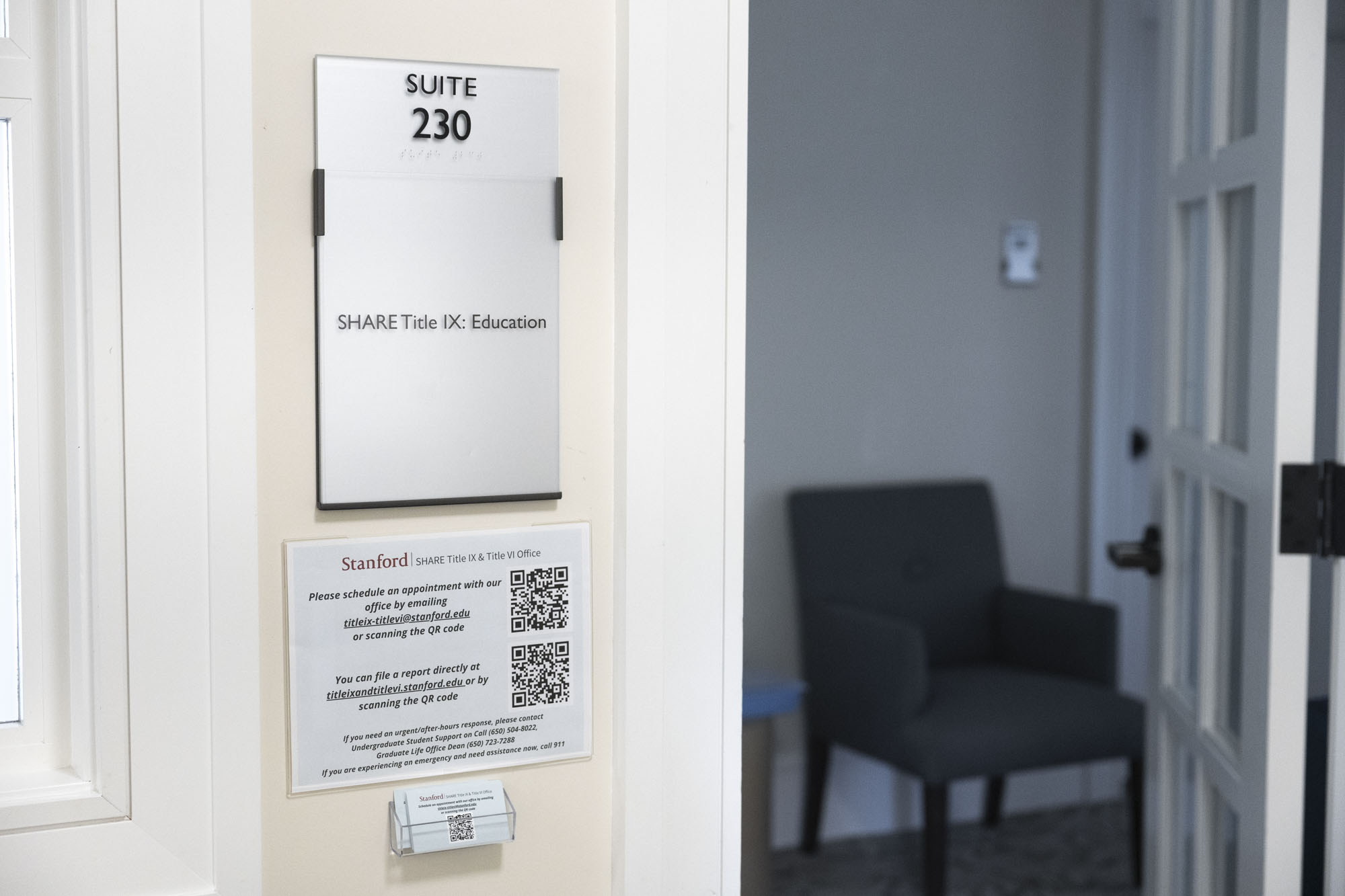
Davis said the Title IX and VI Office is focused on “holistic education,” including mandatory Title IX training for all incoming students. It also introduced a new 90-minute upstander training course to students and student groups by request this fall, and the office has hired an assistant director for culture and connection, who will develop “additional programming” and is holding drop-in hours at residence halls, sororities and fraternities.
Sarnquist said that the new upstander training “is a great supplement,” but she doesn’t think it is sufficient as comprehensive sexual violence prevention programming.
“We’re an R1 institution,” she said, referring to the highest tier of research universities in the U.S. “We expect our students and our faculty and our staff to meet these incredibly high levels of scholarship and rigor. And so I think we probably owe it to our community to have health and wellbeing programming that meets similarly highly evidence-based [standards].”
Stanford also has a Confidential Support Team for students affected by sexual assault and relationship violence, and offers consent and communication workshops through the Office of Substance Use Programs Education and Resources (SUPER).

In fall of 2025, a year after Jane Doe’s alleged rape occurred, the Advocacy Center of Tompkins County announced that Cornell would pilot Flip the Script for campus sorority members, along with a parallel program for fraternities. Student leaders completed two training cohorts in the spring.
Like Stanford, the school had previously piloted the program before COVID-19, but hadn’t reinstated it after the pandemic until last year.
“What the Cornell case really shows is the economic inefficiency and the moral insufficiency of canceling the one program that actually prevents rape on campus,” Dauber said. “From a fiscal perspective, Cornell and Stanford would be way better off preventing these assaults than trying to address the costs after they occur. From a moral perspective, it’s indefensible.”