Prop 39: Require Identification When Californians Cast A Ballot
Episode Transcript:
Olivia Allen-Price: Right now, when you cast a ballot in California, you don’t need to show identification. Prop 39 seeks to change that.
Ericka Cruz Guevarra: This is one of the most hotly contested issues on this year’s ballot, in part because President Donald Trump has also been talking about new voter ID laws.
Donald Trump: It’s very simple, all voters must show voter ID.
Olivia Allen-Price: Is this a common sense way to make voting more secure or an attempt to suppress the vote? That’s for you to decide.
Ericka Cruz Guevarra: This is how Proposition 39 reads on your ballot.
Voiceover: Proposition 39 prohibits citizens from voting unless they present government issued identification.
Ericka Cruz Guevarra: I’m Ericka Cruz Guevarra, host of The Bay.
Olivia Allen-Price: And I’m Olivia Allen-Price, host of Bay Curious.
Ericka Cruz Guevarra: We are back with another edition of PropFest, where our teams break down each statewide proposition on the California ballot. Way to hang in there this week. We talked about a lot of ballot measures.
Olivia Allen-Price: But there’s one last one to talk about this week before we head into the weekend. And it’s one of the most contentious. Here to help us understand Prop 39 is reporter Izzy Bloom from KQED’s politics desk. Welcome, Izzy.
Izzy Bloom: Hi.
Olivia Allen-Price: Proposition 39 is an amendment to the state constitution about how we vote in the state. Before we dive into specifics, who put us on the ballot and why now?
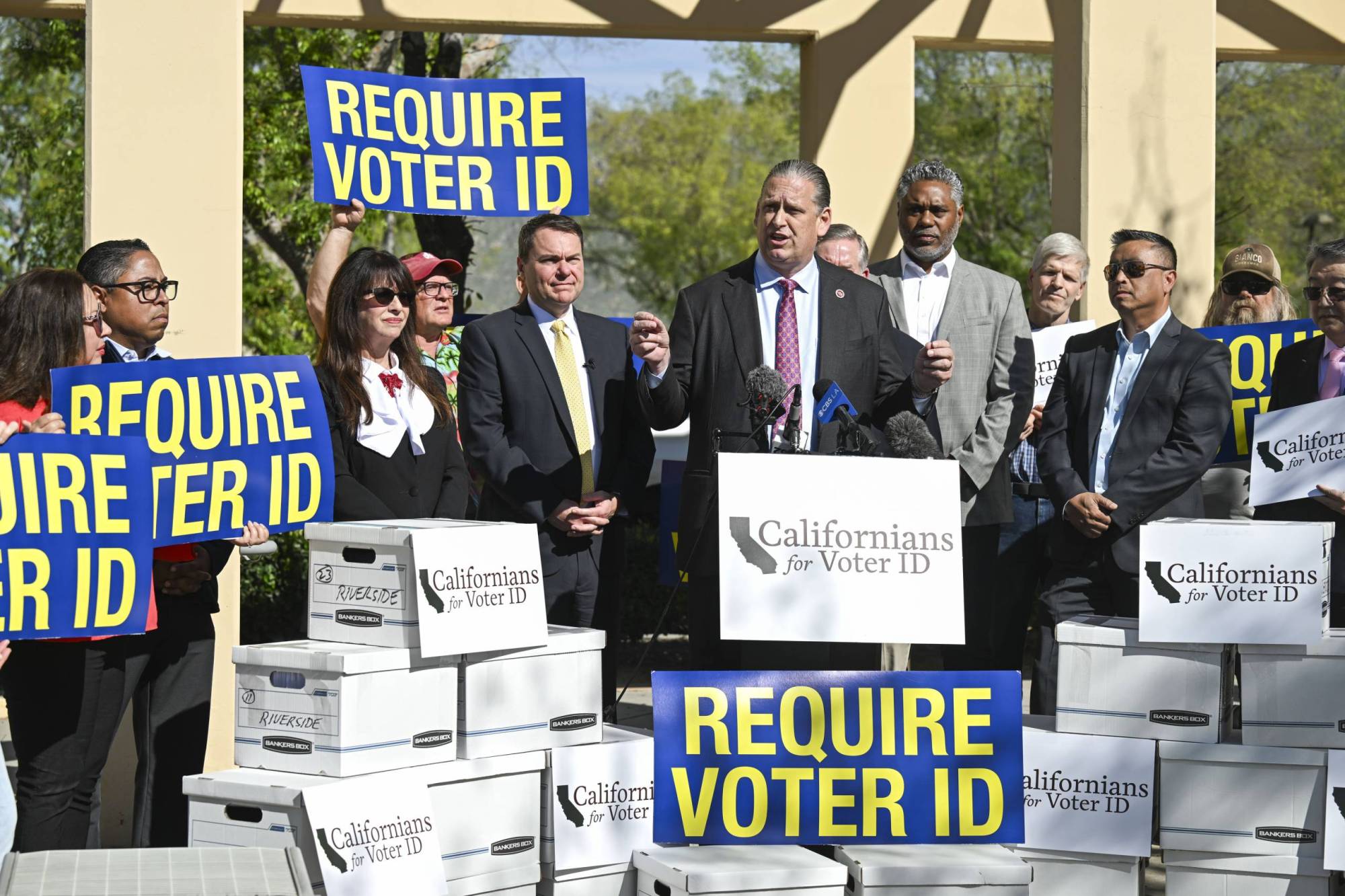
Izzy Bloom: Nationally, we’ve seen a lot of conversations in recent years about election integrity, especially from President Donald Trump and his allies, who are pushing voter ID requirements nationally and attempting to restrict mail-in voting. So this was put on the ballot by Republican lawmakers in California who want to increase voter confidence in elections by adding new ID requirements.
Olivia Allen-Price: Break down for us what exactly Prop 39 would do.
Izzy Bloom: So the measure would amend the state constitution to require Californians present a government-issued ID when voting in person. So that would be something like a driver’s license or a social security number. Or if they’re voting by mail, they would need to write the last four digits of an ID number on their ballot envelope. Right now, California only requires ID or social security numbers when registering to vote. It would also require the Secretary of State and county election officials to verify voters’ citizenship and report every year what percentage of their voter rolls they’ve verified. And in odd years, the state auditor would have to audit counties on how well they’re complying with the law and recommend changes. Lastly, the initiative says that any voter can request a new free state-issued ID at no cost, but when you designate at registration which ID you’re using, you have to stick to that number every time you vote or else your ballot could be invalidated.
Olivia Allen-Price: Why do proponents say this measure is necessary?
Izzy Bloom: Backers of the measure are really trying to distance themselves from accusations that this is an extension of Trump’s agenda, given how blue the state votes. Their main argument is this is a common sense reform that both Republicans and Democrats are in favor of. They say nearly half the signatures they gathered to qualify for the ballot were from Democrats and Independents. Also one of the bill’s authors, Assemblymember Carl DeMaio, says whether there is or isn’t fraud going on. It’s undeniable that voter confidence in elections is incredibly low, and this is just an easy way to give people greater trust in the election system.
Assemblymember Carl DeMaio: Because we’ve seen a dramatic drop in public trust and confidence in our elections. We’ve also seen very destructive and dishonest conspiracy theories on both sides. And so what we need to do is make sure that we always conduct our elections with the best safeguards and the highest integrity. And voters have said they want voter ID. It’s common sense.
Izzy Bloom: Another argument that Senator Tony Strickland, who is also one of the bill’s authors, made is that 36 other states and many other countries already have voter ID requirements.
Senator Tony Strickland: ID is part of your everyday life. I had to use my idea a few times just today. You need an ID to get on a plane. You need ID to get prescription medication. You use the ID to open up a bank account. So there’s no reason why we shouldn’t require ID to actually go out and vote.
Izzy Bloom: And Strickland says voter participation has actually increased in states like Georgia after introducing voter ID. But opponents say motivation is really hard to measure, and it’s just as likely due to voter mobilization efforts.
Olivia Allen-Price: Do we have a problem with voter fraud in California?
Izzy Bloom: Most studies say the rates of voter fraud are minuscule. But there’s certainly a narrative out there that it’s too easy to take advantage of the system. This year, I think a lot of concerns about fraud came from California’s slow vote count. And one of the talking points you’ll hear a lot from Republicans is how there was a dog registered to vote in Orange County. Democrats respond to that saying, actually this shows the system is working because the dog’s owner, who’s a registered Republican, was caught and prosecuted.
Olivia Allen-Price: We’ll pause the conversation here for a moment. More on Prop 39 when we return.
Olivia Allen-Price: And we’re back talking about Proposition 39 with KQED’s Izzy Bloom. Izzy, what are the current rules around citizenship and voting in California?
Izzy Bloom: Right now, when you register to vote in California, you have to prove that you’re legally allowed to vote by showing ID or a social security number, and it’s already illegal for non-citizens to vote in California. Jenny Farrell is the executive director for the League of Women Voters in California and she says, you know, California already has voter ID laws.
Jenny Farrell: Voters sign the roster and impersonating another voter is a crime. And then for mail ballots, every ballot goes through a signature verification against the voter’s registration record before it is counted with a process to cure mismatches. No matter how you vote, citizenship is already attested to under penalty of perjure when someone registers.
Izzy Bloom: For mail-in ballots, they say it’s not very different to sign an envelope and verify that signature versus writing down a number and verifying that.
Olivia Allen-Price: Tell me more about that citizenship verification process. What happens now with voter rolls and how would this be different?
Izzy Bloom: It’s already part of state law that voter roles are maintained and updated. So for example, if someone goes to prison or dies and can no longer vote, government agencies send those names to the Secretary of State and the roles are updated. When it comes to citizenship status, that’s checked when a person registers to vote currently, and it’s considered perjury for a non-citizen to lie and sign up to vote anyway. So this measure is really aiming to make everything stricter. It’s not really clear what best efforts to verify citizenship means. That’s probably something the state legislature would have to determine if this passes. But in general, the measure is adding more steps to ensure you are who you say you are when you go to vote.
Olivia Allen-Price: Okay, we’ve heard from supporters on this, who is opposing this prop and what are their arguments?
Izzy Bloom: As you can imagine, this has become a pretty partisan fight. The California Democratic Party and gubernatorial candidate Javier Becerra are against it. And then there’s also groups including the ACLU of Northern California, the League of Women Voters, California Common Cause also against the measure. And they argue the system isn’t broken. There’s very little, if any, election fraud right now. And all this will do is make it harder to vote. Here’s Farrell again.
Jenny Farrell: Prop 39 would actually affect every California voter, but we know that additional ID requirements don’t fall equally on everyone. There are large gaps in terms of who possesses current valid ID with, you know, the current name and address. Voters in Black, Latino, Asian American, and Pacific Islander communities are less likely to have that current valid ID. These ID laws also present particular challenges for young voters, low-income voters, voters with disabilities, and folks who have changed their names, including women who have changed their name due to marriage and transgender folks.
Izzy Bloom: Also, Farrell says it creates new identity theft problems because it requires voters write the last four digits of a government-issued ID on the outside of their mail-in envelope, and that already has your name and address on it.
Jenny Farrell: The measure itself does not require a secrecy flap or some other covering over that number. And then election officials retain those envelopes for as long as 22 months.
Izzy Bloom: The initiative seems clear on its face, but there are a lot of details that still need to be hashed out if it passes. For instance, it’s unclear what kinds of government-issued ID would qualify, like tribal ID, student ID, public housing ID, gun registration ID, and whichever forms of ID are allowed could privilege certain racial, age, and socioeconomic groups. The opposition also points out that this could cost the state a bunch of money. The Legislative Analyst’s office estimated tens of millions to the low hundreds of millions of dollars to issue all those free state IDs and additional workload for state and county election officials and the state auditor.
Olivia Allen-Price: What does campaign spending look like for this measure?
Izzy Bloom: As of early September, the yes on Prop 39 side has far outspent the no side to tune of $15 million. The spending here isn’t nearly as big as we’re seeing in some of the other contentious measures, like the billionaire tax, but polling does show it’s underwater. The most recent Berkeley IGS poll from September shows 52% of likely voters plan to vote no versus 39% planning to vote yes.
Olivia Allen-Price: That was Izzy Bloom, a reporter with KQED’s Politics Desk. Thanks so much, Izzy.
Izzy Bloom: Thanks for having me.
Olivia Allen-Price: In a nutshell, a vote yes on Prop 39 would require people to show a government-issued ID when voting in person or provide the last four digits of a government issued ID designated during voter registration for mail-in voting. It would also require election officials to maintain accurate voter registration lists and to try to verify citizenship of voters using government data. And it would also require the state auditor to audit government compliance with these requirements. A vote no on Prop 39 would keep things as they are now.
Ericka Cruz Guevarra: That’s it for our episode on Proposition 39. We’ll be back next week with explainers on the remaining six propositions on your ballot.
Olivia Allen-Price: Bay Curious is produced by Erika Cruz Guevarra, Alan Monticello, Gabriella Glick, Pauline Bartolone, Katrina Schwartz, Christopher Beale, Anna Casalme and me, Olivia Allen-Price.
Ericka Cruz Guevarra: We get extra support from Maha Sanad, Katie Sprenger, Jen Chien, Ethan Toven-Lindsey and everyone on team KQED.
Olivia Allen-Price: Some members of the KQED podcast team are represented by the Screen Actors Guild, American Federation of Television and Radio Artists, San Francisco, Northern California Local.
Ericka Cruz Guevarra: Support for The Bay is provided in part by the Osher Production Fund. I’m Olivia Allen-Price and I’m Ericka Cruz Guavarra. Have a lovely weekend.