Prop 4: Allows Cities to Create Public Campaign Financing Programs
Episode Transcript:
Olivia Allen-Price: If you want to get elected to office in California, it’s no big secret that you’ll need to raise money.
Ericka Cruz Guevarra: And in some cases, a lot of money. State legislative campaigns can run into the million.
Olivia Allen-Price: That puts candidates who don’t come from money or have rich connections at a disadvantage, some say. And that’s the issue that creators of Proposition 4 are trying to address.
Ericka Cruz Guevarra: Here’s how it reads on your ballot.
Voice Over: Proposition four, repeals prohibition against public funding of election campaigns.
Olivia Allen-Price: I’m Olivia Allen Price.
Ericka Cruz Guevarra: And I’m Erika Cruz Guevara. This is Prop Fest, a collaboration between the Bay and Bay Curious, where we break down the propositions on the statewide ballot.
Olivia Allen-Price: It’s a marathon this year with 14 initiatives. So let’s get right to it, shall we? Here to talk campaign finance with us is reporter Izzy Bloom from KQED’s politics desk. Welcome, Izzy.
Izzy Bloom: Hi, thanks for having me.
Olivia Allen-Price: Okay, so Prop 4 would repeal part of a proposition that was passed by voters back in 1988. What was the deal with that prop?
Izzy Bloom: So, in 1988, there was a feeling very similar to right now that there’s too much money in politics, especially corporate money, special interest money. On top of that, the mood in the 80s when Reagan was president was very pro-business, anti-tax, anti-spending. So in 1988, Prop 73 banned public funds for campaign expenses. Basically, that meant governments can’t allow politicians to use taxpayer money for their campaigns. And then that proposition did a second thing, which is set new limits on campaign contributions. But a few years later, a federal judge threw out that second tenant, and just the public financing ban remained.
Olivia Allen-Price: So then how do we get from there to Prop 4?
Izzy Bloom: So state Senator Tom Umberg wrote the bill that ended up becoming Prop 4. It’s similarly a response to this growing feeling that big money and corporate interests and super PACs have too much influence in politics. And that public financing helps candidates who don’t have a ton of personal wealth or access to those special interests.
Olivia Allen-Price: Let’s look under the hood. How does this actually work if passed?
Izzy Bloom: What it does is repeal the ban from Prop 73 to allow state and local governments to set up public financing programs for election campaigns. Candidates would have to meet certain eligibility criteria and agree to spending limits. And the initiative also spells out that the funds could not be used for legal defense costs, fines, or repayment of personal loans. It also has this provision that allows the legislature to amend the rules about how public financing works, like the mechanics and eligibility requirements without needing to go back to the ballot and ask voters to approve it again.
Olivia Allen-Price: Does this mean that automatically there will be a pool of money for political candidates to pull from?
Izzy Bloom: No, it’s basically just allowing governments to create programs and they will have, you know, specific eligibility requirements that they’ll have to decide for themselves, like raising a certain amount of small dollar donations or not accepting PAC money or capping how many personal funds they donate to their campaigns.
Olivia Allen-Price: But I understand that there are some cities that have already been providing public funding for campaigns. Is that true? And if so, like how?
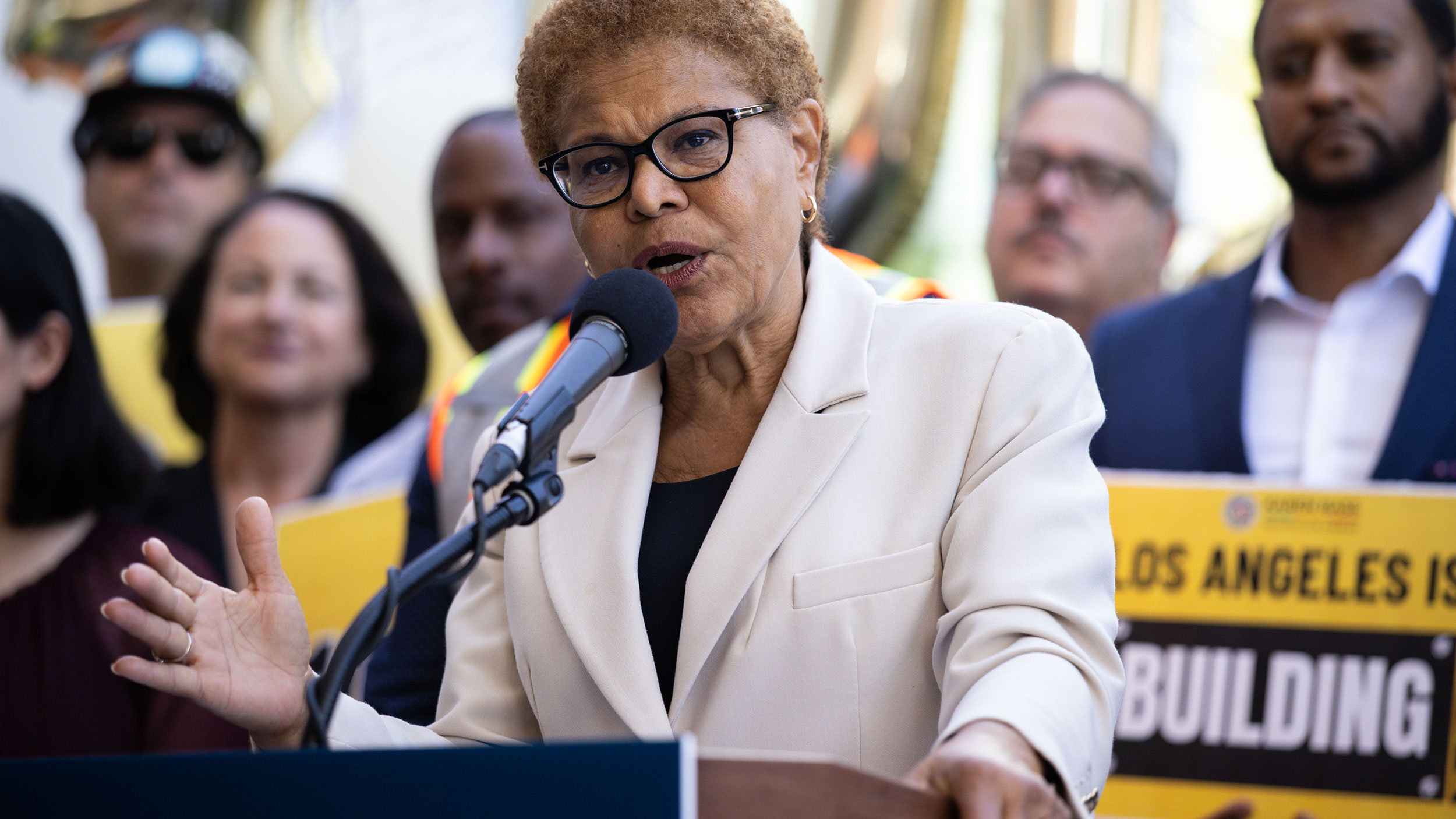
Izzy Bloom: Yeah, so there’s an exception in Prop 73 for charter cities, which have their own constitution and that gives the state less authority over them. A lot of the biggest cities in California are charter cities like Los Angeles and San Francisco, Oakland, Berkeley. And so they already have public financing programs. Supporters of this initiative point to the success of candidates like Los Angeles Mayor Karen Bass.
Karen Bass: Thanks to L.A.’s Supermatch program, every qualified donation from Los Angeles residents is matched 6-1 by the city.
Izzy Bloom: Or New York City Mayor Zohran Mamdani who accessed public finance systems and won their elections.
Olivia Allen-Price: Us through how one of these programs works so we can kind of get a sense for it. Let’s take a look at San Francisco, for example.
Izzy Bloom: There are a lot of hurdles a candidate has to pass to qualify for the money. So a candidate for mayor in San Francisco can receive up to $1.2 million in public funds. There are minimum qualifying contributions. So you have to show you have support from actual voters. You need to be opposed by a candidate who raises or spends at least $50,000. You have to agree to a spending limit of roughly $1,500,000 and agree to limits on how much. You donate to your own campaign. And then it’s a match program in San Francisco. That’s a lot, but essentially there are many rules and you need to prove you’re a serious candidate. And the program can’t favor candidates in one party over the other.
Olivia Allen-Price: Is that how all the programs in California would look if Proposition 4 passes?
Izzy Bloom: No, there’s a lot of different ways a state or local government could set up a program like this. Like in Seattle, Washington, they have democracy vouchers, giving residents $100. They get to decide which candidates to distribute that money to. And that’s supposed to encourage candidates to engage with the people they hope to represent instead of appealing to special interests.
Olivia Allen-Price: While we pause for a quick break, won’t you consider becoming a member of KQED? Donate whatever works for your budget at donate.kqed.org slash podcasts. One-time gifts, ongoing donations, we are here for it all. Thanks!
Sponsor messages
Olivia Allen-Price: And we’re back talking about proposition four, the public funding for campaigns prop with KQED’s Izzy Bloom. Izzy, who is supporting this measure and why?
Izzy Bloom: This measure is supported by the California Democratic Party, California Common Cause, the League of Women Voters of California, California Clean Money Campaign. Jenny Farrell, the executive director of the League for Women Voters of California said this.
Jenny Farrell: Public financing can make it possible for someone who is deeply connected to their community, but doesn’t have a Rolodex full of wealthy donors to run a viable campaign. Before public financing, women made up a minority of Los Angeles City Council. Once Los Angeles put public financing in place, 14 or 15 of the members were elected using matching funds, and a majority of members now are women, a majority members are people of color. And it’s the most diverse city council in the city’s history.
Izzy Bloom: Who is opposing this measure and why? Anti-tax groups like the California Taxpayers Association, the Howard Jarvis Taxpayers’ Association, as well as the PAC Reform California run by Republican Assemblymember Carl DeMaio, a former chair of the Fair Political Practices Commission, Dan Schnurr, and they all argue that the measure is written too broadly. It leaves each government to set its own eligibility criteria and spending limits, and that makes the system vulnerable to abuse. David Kline is spokesperson for the California Taxpayers Association, and he thinks taxpayer dollars shouldn’t be used for campaigns.
David Kline: The whole idea on its face is bad. Tax dollars should be used to help the taxpayers, to help constituents by promoting reasonable, efficient government services. Not to give money to a candidate to then put out a hit piece mailer on an opponent, and not to flood our mailboxes with even more junk mail from campaigns every election season.
Izzy Bloom: Also, candidates already have to file campaign finance reports disclosing contributions and expenditures, which Kline says creates a lot of transparency around where big money is putting their influence and voters can decide for themselves whether they support that or not.
Olivia Allen-Price: What does spending look like on this spending prop?
Izzy Bloom: Not much spending on this initiative, just $7,500 in opposition from Reform California. As for the cost to the state, the Nonpartisan Legislative Analyst’s Office estimates it could cost the state a few hundred thousand dollars a year just to cover the additional hours and staffing for the Fair Political Practices Commission to answer state and local government’s questions about the programs.
Olivia Allen-Price: Reporter Izzy Bloom from KQED’s Politics Desk, thank you for walking us through this one.
Izzy Bloom: Thanks for having me.
Olivia Allen-Price: In a nutshell, a vote yes on Prop 4 means you want to remove the ban on public funding for election campaigns, opening the door for state or local governments to create new programs. A vote no means you wanna keep the ban in place.
Ericka Cruz Guevarra: That’s all for our episode on Prop Four. Also in your podcast feed today is our show on Prop Five, which takes on statewide recalls. And we’ll be back with even more tomorrow.
Olivia Allen-Price: PropFest is a collaboration between the Bay and Bay Curious podcasts. It’s produced by Erica Cruz Guevarra, Alan Montecillo, Gabriella Glueck,Pauline Bartolone, Katrina Schwartz, Christopher Beale, Anna Casalme and me, Olivia Allen Price.
Ericka Cruz Guevarra: We get extra support from Katie Springer, Jen Chien, Maha Sanad, Ethan Toven-Lindsey, and everyone on Team KQED.
Olivia Allen-Price: Some members of the KQD podcast team are represented by the Screen Actors Guild, American Federation of Television and Radio Artists, San Francisco, Northern California Local.
Ericka Cruz Guevarra: Support for The Bay is provided in part by the Osher Production Fund.
Olivia Allen-Price: I’m Olivia Allen Price. And I’m Erika Cruz-Gavarra. Talk to you next time.