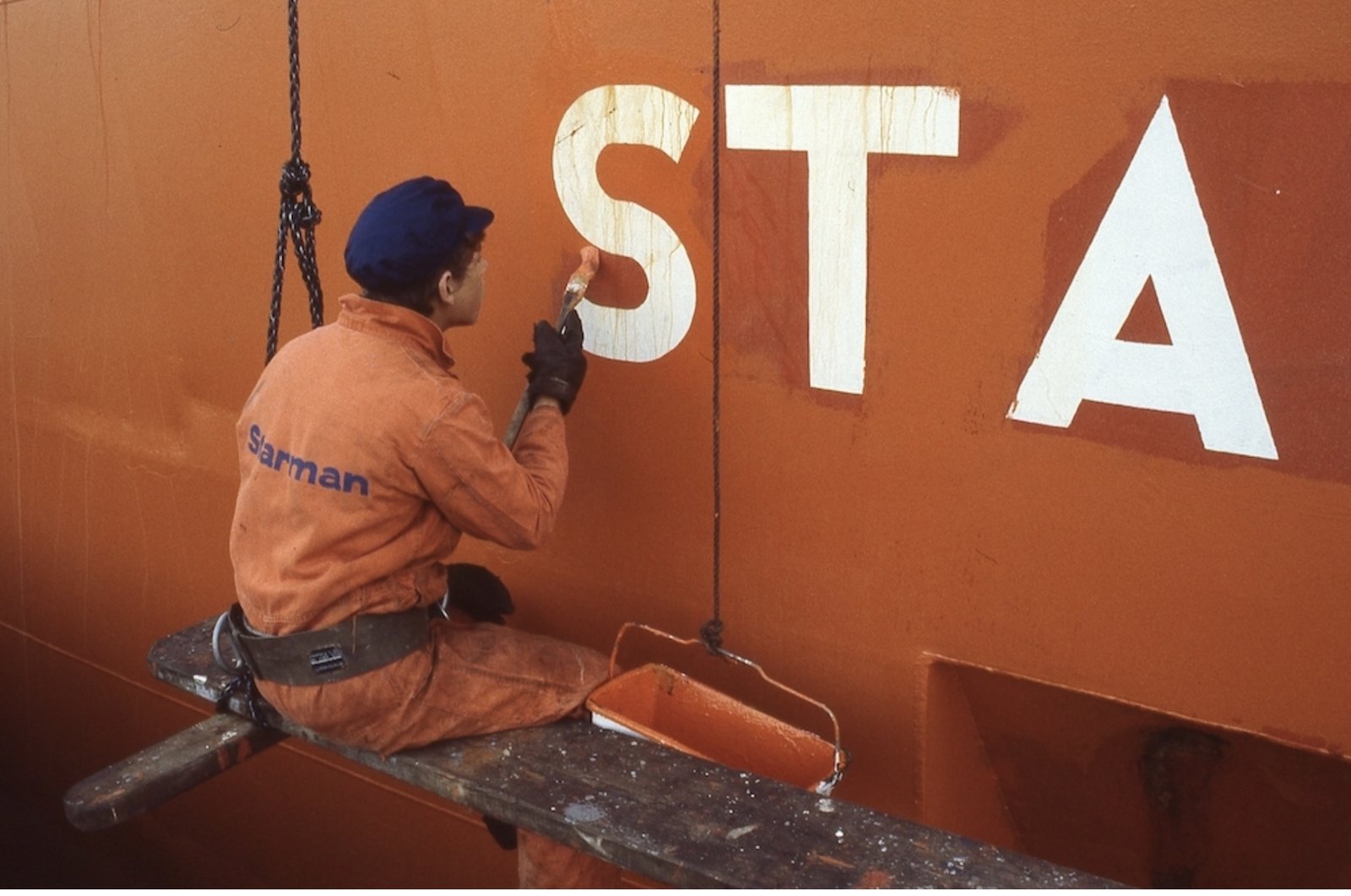
This piece was featured first on Sep 24 for One Good Thing, a weekly newsletter brought to you by Alexis Madrigal about his take on Bay Area art, culture & nature. Subscribe today.
A friend of mine is dying. This is a sad thing, but our friendship has been one very good thing.
I met Brian Nelson through my work studying the world-altering effects of containerization, which the Port of Oakland played a central role in popularizing. Brian grew up in a waterfront family. His uncle was a longshoreman. His dad was a gang boss. So, naturally, Brian became a dock worker, a clerk (ie. ILWU, Local 34).
At heart, though, Brian was always an artist. He sketched, took photographs, made films and captured sound recordings throughout his years. And it was one of those artistic endeavors that brought him into my life.
In the 1970s, a group of dockworkers formed the Waterfront Writers and Artists, guys like Bob Carson, George Benet, and Herb Mills. Among their number were three photographers: Mike Vawter, Frank Silva, and Brian Nelson. For waterfront readings—which usually involved a mix of poems and storytelling—the visual artists developed a slideshow documenting the transition from traditional longshore work to containerization. That got made into a short film called Longshoremen At Work, which got preserved on the Internet Archive, which is where I found it in 2016.
I got in touch with Mike, who I found somehow, and he put me in touch with Frank and Brian. At the time, I was making a podcast called Containers, and I was delighted to hear that Brian had preserved dozens of tapes from those days. He knew they contained some recordings he’d made down on the docks as well as parts of readings, but he hadn’t listened to any of them in decades.
Could I listen to them? Yes. But could I borrow them? No. He told me that I’d have to come to his house and we could digitize them together.
Little did I know that those days would become some of the best memories of my career and life. I’d show up on his doorstep and we’d go into the basement and put on our headphones. He’d describe what we were hearing (“That’s a winch!” or “That’s George Benet!”). Along the way, he transmitted ILWU lore and culture to me. The Bay Area locals of the west coast longshore union have fascinated people from all over the world, and here I had this firsthand account of a pivotal era in their history.
At some point in each session, Brian’s wife Manya would lure us from the basement with a promise of lunch. Manya and Brian met in her native Germany and she’d often prepare a spread of cold cuts with one of those crispy German beers. She’s an amazing gardener, a human attuned to other living beings, the kind of person who can spot a hummingbird nest. The three of us would sit in their cute little house in El Cerrito chatting, talking about their lives, reminiscing. I knew that those moments were special at the time. After a day spent that way, I’d head home on my bike glowing. The whole thing had a bit of a religious cadence, this wake for a bygone way of life. Quietly, we became real friends.
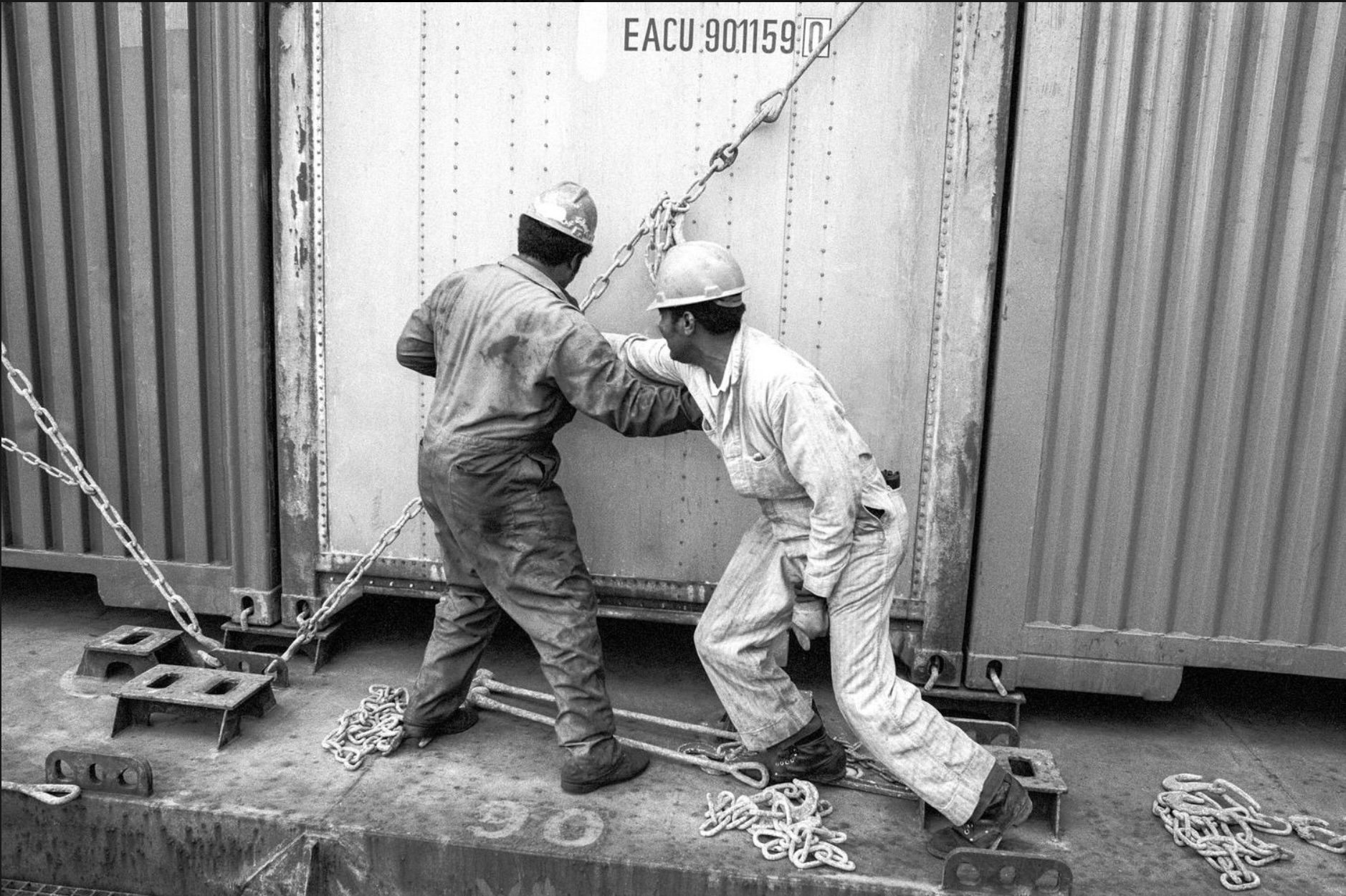
We hung out with Mike and Frank, too. Racetrack Mike, as he was known, is an old radical, a guy who got booted from Stanford for an altercation at a university board meeting. Mike liked to drink margaritas and I always knew never to drive to meet up with him. Frank grew up around the Oakland waterfront and is one of the sweetest guys I’ve ever known. He’s the kind of guy you’d want to mentor your sons, show them there are ways of being a strong man that do not require meanness of any kind. He’s also a tremendous photographer, especially of working people going about their craft. I have one of his images of two longshore partners in a place of pride to this day.
After I finished the podcast, we still hung out occasionally, kept in touch at various intervals via text or meeting up for lunch. When my book, The Pacific Circuit, came out, they were there at the Oakland launch, despite Mike having some pretty serious health problems by then.
Then last week, Frank called me. I missed it and he left me a message with terrible news: Brian had a stroke. I got in touch with Manya and it seemed like Brian was recovering well. He went home. I made them this turmeric-spiced dish that we just call The Chicken in our house and got it to Manya’s daughter in law, just so I could do something to help.
But then the next day, this past weekend, Manya texted that Brian’s brain was bleeding. He’d taken a definitive turn for the worse. He was on a morphine drip and would not be making it.
I drove out to Walnut Creek to see him. I took the elevator to the ICU. It was quiet on that floor. In contrast with the bright sun outside, the lights felt dim. The scenes I saw in each room I passed filled me with dread. This was real and this was it.
Of course, when I walked into Brian’s room, I found Frank Silva already there with his wife Mimi. What can be said of a moment like that? I am not sure Brian could hear me. Manya thought he could. He held on when I took his hand and his eyes occasionally opened. I told him how much I loved the time we had spent together.
Manya and Frank and Mimi and I also talked. I heard about Manya and Brian’s early adventures in coupledom, traveling around Europe, taking a boat up the Rhine. We talked about the different forms of Brian’s art. Manya maintains that he always likes to do things the hard way. That made me think about Brian’s binaural microphone headset, a funny contraption that let him capture more three-dimensional sound on the waterfront. He also took up a complex version of lithography in his later years.
One happy outcome of the months in the basement with Brian is that some Berkeley scholars took up the cause of waterfront life preservation. And over these last years, Brian and Manya painstakingly went back through his collection of stuff so that they could present it to the Bancroft library. A bunch of it is already publicly accessible through the work of Erfan Moradi and Nicholas Anderman.
It took me a while to identify the complex feelings that reflecting on our years of friendship gave me. There is the obvious grief, but also some kind of iridescence, too, in that darkness. I finally named it: meaning. This was a meaningful friendship on a personal level that had an echo in the public realm. Those hours in the basement changed our lives, bending our trajectories for a decade, and sparking new interest in the lives and art of people working on the Bay waterfront.
When I got home, I got to hold our neighbors’ infant, one of those smiley, giggly babies. It seemed he was born just yesterday and there he already is, a solid 22 pounds. Time passes so quickly. I didn’t want to let him go.

Alexis Madrigal, Co-Host, Forum

My Tipline
- Bay science and haunting ethereal music on a Friday night? Yes.
- A flash tattoo and music in Rodeo on a Saturday? Yes.
- Geology, art, and music on a Sunday? Yes.
- Love a big voice? You will love Big Maybelle.

My Picks
 FORUM
FORUM
Naomi Klein and Astra Taylor on How to Resist ‘End Times Fascism’
The answer? “Hereness,” which might be the subtitle of this newsletter
 BOOKS
BOOKS
The 2026 Booker Prize Shortlist Is ‘Writing at Its Best’
Local publisher Transit has a debut author on the shortlist!
 POLITICS
Housing Fix or Data Center Loophole? This Ballot Measure Would Overhaul CEQA
Time to go deep on Prop 45