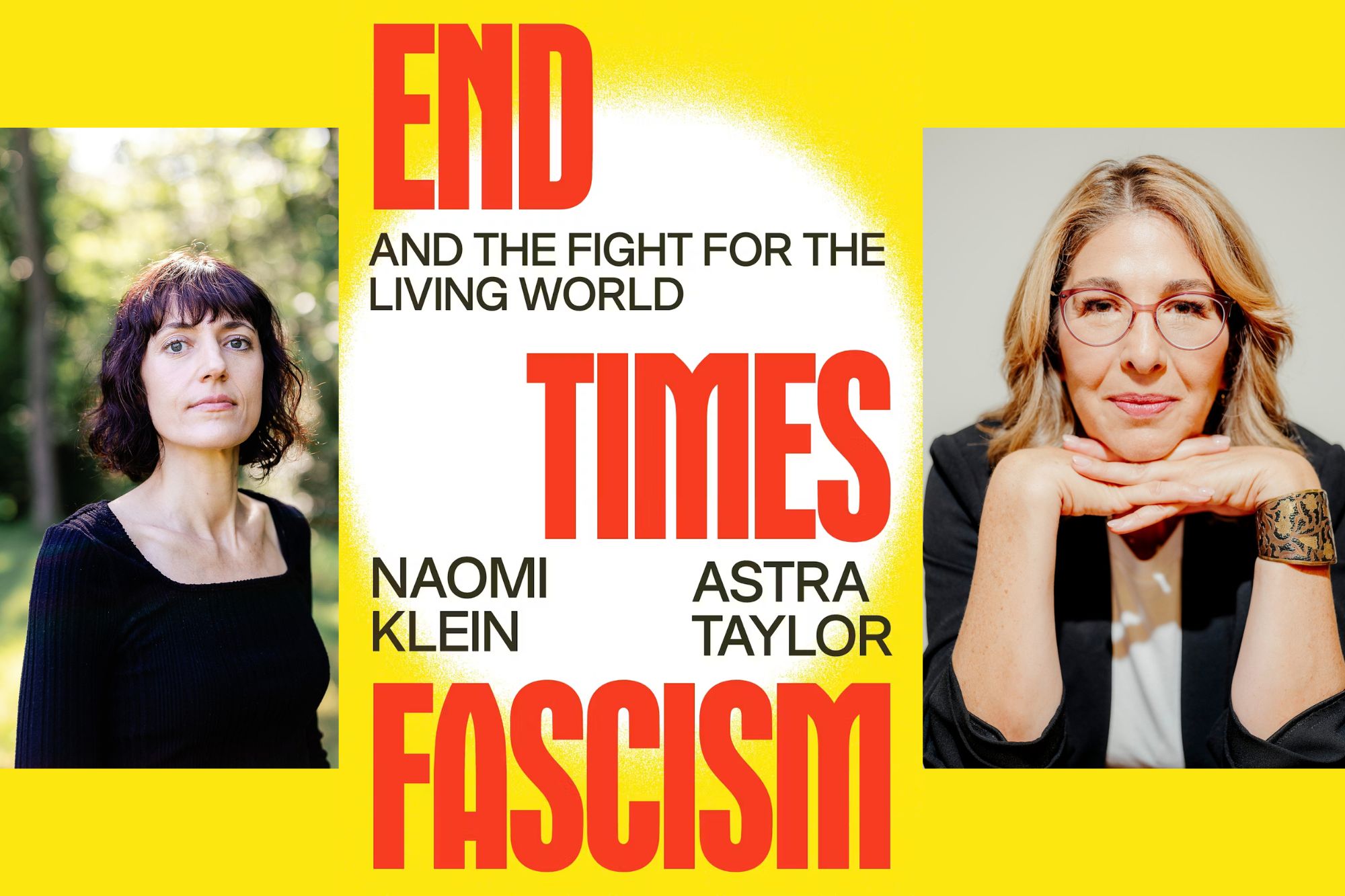
Naomi Klein and Astra Taylor on How to Resist ‘End Times Fascism’
Airdate: Tuesday, September 21, 2026 at 9 am
Authors Naomi Klein and Astra Taylor have a new synthesis of the many bad things happening in our world. In their new book, “End Times Fascism,” they argue that apocalyptic Christians, AI accelerationists and ethnonationalists share an underlying similarity: they have given up on a good life for the many, the earth itself, and even humanity writ large. What can combat these forces? A new politics of “hereness”, they say. We talk with Klein and Taylor about the motivations of the powerful people they say are speeding us toward the destruction of the world, and how we can unite to fight back.
Guests:
- Naomi Klein, columnist; The Guardian; documentary filmmaker; associate professor of geography and codirector of the Centre for Climate Justic, University of British Columbia; author, “Doppelganger,” “No Logo,” “The Shock Doctrine” among others; co-author, “End Times Fascism: And the Fight for the Living World”
- Astra Taylor, writer, activist, and documentarian; cofounder, Debt Collective, a debtors’ union that came out of the Occupy Movement; co-author, “End Times Fascism: And the Fight for the Living World”
Episode Transcript
This is a computer-generated transcript. While our team has reviewed it, there may be errors.
Alexis Madrigal: Welcome to Forum. I’m Alexis Madrigal. Naomi Klein and Astra Taylor’s new book is called End Times Fascism, and in it, they distinguish the politics we are seeing emerge here in the United States and across Europe as distinct from what we might call good old-fashioned fascism. The new version does not sell itself as a large in-group of people living in a well-ordered utopia. Instead, its leaders across tech, religious extremism, and hard-right nationalism imagine an age of perpetual crisis that they won’t try to fix so much as wall off and profit from.
Take the old fascism, add global warming and massive inequality and AI, and cook it with Klein’s concept of disaster capitalism and you get end times fascism. As they write, we should believe our eyes. The most powerful people in the world are preparing for the end of the world, an end they themselves are frenetically accelerating.
The book takes up the question of how and why different groups have found themselves plowing toward the same end, and also who and what might counteract this revolution from above. The essence of that counter to fascism can be expressed in a word: here-ness, a politics centered on our neighbors and the living world we all depend on.
The authors of the book, Naomi Klein and Astra Taylor, join us here in San Francisco this morning. Welcome.
Glad to be here.
Yeah, glad to have you. So before we get into the meat of the discussion, Astra, maybe this goes to you. The people want to know: on a scale of one to infinity, how depressing is this book?
Astra Taylor: I actually have to say, I don’t think it’s very depressing. I came out of writing this book and collaborating with Naomi feeling more resilient and motivated. I was actually more depressed before I started the deep dive. And one thing I’ve been saying is, sometimes, you know, when you go into the darkness, your eyes adjust, right? It feels really overwhelming in the beginning, but afterward you can see clearly. And seeing clearly is important because that’s how you figure out the strategy and the fight back.
Yeah.
Alexis Madrigal: Naomi, you know, the argument is that there’s long been a strain of fascism running through Western societies, as we might say. But you also acknowledge that, you know, people don’t always like the term fascist. You know, it’s controversial. You know, I think one person called it “vilification inflation.” Why do you think the term, like, why is fascism important to use in this case?
Naomi Klein: Well, the book comes out, first of all, it’s great to be with you, great to see you again. The book comes — our attempt to understand how history is changing, how the world is changing. The second Trump administration is not the same as the first Trump administration. And the speed with which they were moving to deport thousands of people, occupy cities with masked agents, build this archipelago of immigrant detention facilities, which many have called concentration camps, the flooding the zone with sadistic memes that are just about taking pleasure in dominance, in the pain of others, the things that look awfully like Nazi salutes in stadiums, the ranking, the sorting of human beings.
The first Trump administration was terrible. I wrote a book about that, too, and didn’t use language like this, honestly, because I don’t believe we should throw terms around fascism to the extent that they don’t mean anything. At the same time, I don’t think we should save them like precious jewels. Um, the point of not inflating the language and using these words casually is so that when we need to use them, they’re available to us and still have force.
Um, so I think we thought a lot about the use of the term, but we also don’t subscribe to a definition of fascism that claims that Mussolini and Hitler were the only fascists in history and that every form of fascism is really about a one-to-one equation with those fascists. They learned from the Jim Crow South, from the German colonies in what is now Namibia. That was not a rupture in time and space. It had a prehistory, and it also had a future.
I’ve written a lot about the Latin American dictatorships in Chile, Argentina, Uruguay, which people there describe as fascism. So we believe that the word is justified. We also don’t believe that end times fascism has won, that it is totalizing, that we have lost all of our rights.
I mean, this book is a warning, and it’s also a map to see the weaknesses of this fascist coalition. All fascisms are coalitions. We believe this one is uniquely unstable because it is so unpopular. So we want to, as Astra said, look into the darkness, let our eyes adjust and find our bearings. And we think there’s a lot of hope in that because the more we study them, the more we see the ruptures and the internal battles, and we think that anti-fascists and people who believe in the antithesis of fascism should exploit the hell out of them and beat —
Alexis Madrigal: Astra, in the fascism of the 20th century, the one we associate with Europe, Mussolini, Nazi Germany, et cetera, there was a promise essentially to the people of the country suffering under various economic circumstances that the fascists would make life good for them. They would punish the out-group, and they would, like, do good things for the in-group. But you all argue that that’s actually not the pitch in end times fascism. So what are they selling?
Astra Taylor: Not much at all. I mean, it’s important to say we are not nostalgic for the fascism of the 20th century. Just put that on the table. I mean, it was a genocidal, blood-soaked vision, deeply authoritarian. It destroyed worlds, right? But it did offer real benefits to the in-group.
There were major public works projects throughout Franco’s Spain, Mussolini’s Italy, Hitler’s Germany. There were also opportunities for recreation, I mean, and social clubs. People were organized into, you know, groups that would go and explore nature together, or you could take a cheap train to the coast if you were a working-class Italian family. There were also expansions of the welfare state.
Today, you know, the Trump administration is decimating public services. We saw in 2024 that Trump ran on affordability. But now affordability is being described as a hoax and a scam. There are no jobs unless you count building data centers, which is infrastructure that promises to take all of the jobs. So what’s on offer basically are some sadistic memes, right? Some —
Alexis Madrigal: Owning the libs.
Astra Taylor: Owning the libs, right? You’ll never own a home in Trump advances America, but you get to own the libs, which isn’t much because most people actually want to see their lives improve.
So we call it at one point a kind of futureless fascism. This fascism is distinct from the fascism we see in various ways. One way is the sense in which the people at the top are extremely entrepreneurial in an individualistic way, right, and very kleptocratic. So they’re grabbing a lot. You know, there’s a lot of corruption happening, and there aren’t many crumbs trickling down to ordinary people.
And that is both a strength and a weakness. I think we have to see it in this double way because there is evidence that increased insecurity and precarity make people more susceptible to strongman politics, to scapegoating. So, for example, the AfD in Germany just won a critical regional election in a place where there was a major affordability crisis, right, in a place where there weren’t a lot of jobs, where people were feeling very precarious. That caused the far right to win in a way they haven’t since World War II.
That said, the broken promises are also an opportunity for a different kind of politics to be organized into being. So that futurelessness can go in different directions.
Alexis Madrigal: Yeah. I mean, Naomi, many people through history have imagined that they were sort of at the end of history, but you argue that the kind of groups that you have, you know, drawn a circle around in this book are different. Why do you think they’re different from some of these previous apocalyptic millenarian types?
Naomi Klein: Well, some of them share a lot in common, the religious piece of it, which is really the template. And to be clear, we don’t believe in the end times story. This is a story, and in many ways, this is a book about stories, about this idea that humanity is on a linear track toward a cataclysmic ending.
And at the moment that it reaches this ending that it is driving toward, there will be massive destruction, death, rivers of blood, and out of that horror will emerge this golden city for the chosen few, right? This is a story kind of threaded through the Abrahamic religions. It’s the ark and the flood. It is most explicit in the Book of Revelation.
Thank you. But it is a through line, and then it echoes through the culture. It’s in video games and disaster movies. And even if we are secular, even if we are atheists, even if we have never read the original text, it’s in us, the story. That linear story is in us.
But that said, we are in a time of real boundary crossing, of ecological boundary crossings, of immense, um, existential risk. That’s not in our imagination, and that is really the difference with the fascists of your Hitler and Mussolini.
Alexis Madrigal: They’re in a pre-nuclear world, isn’t it?
Naomi Klein: Exactly. They died right before the Trinity tests, right? And the fact that humans now hold the apocalypse in our hands, right, changes us. It changes humanity. It changed our dreams. It changes our fears, our imagination.
They didn’t understand that pollution was causing the entire globe to overheat. That was not, I mean, it was, it had already started, but they didn’t understand that. So, so fascism always surges in times of real crises.
So if we think about that moment in the ’20s and ’30s in Europe, it’s the wreckage of the First World War. It is after a pandemic. The cities are choked with orphans, with widows. Entire economies have been humiliated. I mean, we know this history, right?
And so the crises are real that it’s trying to resolve, and there’s another crisis for elites, which is the Russian Revolution has just happened. There are socialist parties in every country saying we want this too, and what fascism does is it takes the real and legitimate rage at systemic crisis, and it pivots that ball of rage and redirects it toward scapegoats.
So in our age, we also have big crises, but our crises are different, and because they’re different, that millenarian part of religion has now secularized. And so we have it in tech and we have it in all other aspects of our culture, but I hear music.
Alexis Madrigal: Yes, we are talking with Naomi Klein and Astra Taylor about their new book, End Times Fascism and the Fight for the Living World. We’ll be back with more right after the break.
Welcome back to Forum. Alexis Madrigal here with Naomi Klein and Astra Taylor, talking about their new book, End Times Fascism and the Fight for the Living World.
Naomi Klein, of course, is a journalist, columnist at The Guardian, documentary filmmaker, also professor at the University of British Columbia, author of Doppelganger, No Logo, Shock Doctrine, other books. Astra Taylor’s a writer, activist, and documentarian, co-founder of The Debt Collective, which is a debtors union that came out of the Occupy movement.
And this evening, Naomi and Astra are going to be discussing their book with Palomi Saha, who’s another Forum favorite, at City Arts and Lectures tonight at 7:30 at the Sidney Goldstein Theater.
We want to hear from you as well. You know, what do you think the resistance to end times fascism could look like? If you have experience as an activist, what do you think applies in this moment? Or maybe you’ve noticed this end times rhetoric in your place of worship or among your friends, whether they’re on the right or the left.
You can give us a call, 866-733-6786. That’s 866-733-6786. You can email Forum at kqed.org. You can find us on BlueSky, Instagram, Discord. We’re KQED Forum in all of those places.
So, Naomi, you were saying, you kind of mentioning that the sort of patterning idea in End Times Fascism comes out of this religious apocalypticism. And one of the most disturbing things to me, both in this book and in reading about it for other shows and being a human on Earth, is that there is a strain of this apocalyptic thinking that is now embedded very high in the United States government, in particular at the head of the Department of Defense. Maybe we could just go in specifically about Pete Hegseth and the particular set of beliefs that are in his kind of religious world.
Naomi Klein: Yeah, Pete Hegseth, also Mike Huckabee, who is the ambassador to Israel in this administration, they are associated with a strain of Christianity known as Christian Zionism. And Hegseth is also a Christian nationalist. I mean, the boundaries get blurry, and people hop from one camp to another. I mean, I don’t think he’s that strict a theologian, Pete Hegseth, but he has been very enamored with this idea that in the Holy Land, in Jerusalem, things are gonna go down. I mean, that’s where this final chapter in the story plays out. And so this embrace, this excitement, this acceleration. Final!
Alexis Madrigal: Literal final story of, like, life on Earth and the current time we’re living and before Revelation and the second coming of Christ and all these things.
Naomi Klein: And one of the things we get into in the book is the scale of what’s called biblical tourism or religious tourism from this country, where you have people from a great many evangelical churches traveling to walk in the footsteps of Jesus, but also to go to the sites of the future Armageddon, right?
So in this story, this is where the final battle occurs. The Third Temple must be rebuilt. This creates the conditions for, if you’re a Christian Zionist, for Christ’s return. If you are a Messianic Jew and you have this coalition between these two camps, then the Messiah arrives for the first time, and then utopia, and then the next world.
And this is why we talk about, when we say futurelessness, they have a vision of a future, but it isn’t a future in this world. It is a future the next world, and this is what really separates them from the 20th-century, you know, future horizon of fascism, which was, you know, it was actually in land stolen from the Slavs. Like, you get a house, you get the rewards.
So that’s, you know, we were trying to understand how Trump had assembled this kind of Frankenstein coalition of evangelicals and tech billionaires and ethno-nationalists, like how is it all holding together? And so that through line of we are the chosen, we will be saved, which is in the biblical story, runs through the other parts of the coalition.
So we didn’t arbitrarily fuse these groups, Trump did. It’s how he got elected, right? We’re trying to understand them and how they resolve these kind of glaring, awkward fits, let’s just say, yeah.
Alexis Madrigal: Yeah, Astra, I mean, in kind of like previous eras of the technology world, like, you know, let’s call it, you know, I don’t know, the ’90s through 2020 or so, you didn’t really see technologists talking about things being terrible in the future. You know, they weren’t like, our technologies are gonna kill us all.
I mean, there were always a few people who had kind of outlying beliefs, but the core of the technology industry was about, we’re about making life better for people, we are about connecting people. And then you’ve seen this incredible turn where people, even those in places like Anthropic, are like, we believe there’s a credible chance that AI ends all life on Earth, you know? What do you, how does that fit into this framework?
Astra Taylor: Yeah, I mean, so as Naomi said, there’s almost this secularization of this narrative. And we see it in all the headlines in the last week or two about the AI apocalypse, right? And are we building machine gods, or maybe they’re machine demons? And this discussion, as you’re saying, that’s pretty unprecedented of technology destroying everything.
And we think ultimately this has a material basis, right? The people in Silicon Valley were looking for the next big thing because social media had saturated our world and NFTs weren’t really taking off and crypto has made some people really rich but it’s got limits.
Generative AI, if you look at how OpenAI defines it, it’s a technology that can do all economically valuable work, right. They talk about it in messianic terms, it’s gonna be the ultimate technology, the final invention. So they’re playing for keeps in their minds, right?
Naomi Klein: The secrets of the universe will be unlocked.
Astra Taylor: Yes, I think that’s on the splash page for Grok.
Astra Taylor: Yeah, and it’s like, so that, you know, we say these are actually the same story when it’s like it’s going to destroy everything or, right, mysteries unlocked, cancer cured, forget about climate change because we’ve solved it magically somehow. That it’s the heaven-hell, it’s that story, and out of Armageddon, out of a job, Armageddon, out of just, you know, consuming all the fossil fuels, something great will happen.
And, you know, for them the heavenscape could be, you know, maybe it’s Mars colonies, according to Elon Musk, or it’s merging with the singularity, or it is this next iteration of digital entities.
Naomi Klein: Like the other really strong parallel is a deep desire to dematerialize, right? Like, in the religious version of this story, the material world, the earthly world is the place of sin. You cannot wait to leave the world behind to get to that place of pure light.
And we’ve been on this road of dematerialization, like everything is about getting frictionless and having to deal with fewer and fewer people.
Astra Taylor: Humans are inconvenient, right? Having a body’s inconvenient, like, disincarnate. Cities are inconvenient. And they all need health care and breaks. Yeah, you won’t need all of that.
I mean, the other parallel is that one thing we say is prophecies do not have to be literally true to be self-fulfilling. So if you are a Christian Zionist advocating for war in the Holy Land, and millions of Christians are lobbying Trump for an escalating war in Iran, right, and so the Messiah won’t return, in my view, but you can hurt huge numbers of people. You could maybe start World War III.
The same goes with this tech narrative. Their prophecies do not have to be literally true for it to be incredibly harmful, for not superintelligence, but maybe kind of stupid bots crashing some critical infrastructure, or for the effects of all the carbon that’s being burned to fuel the data centers, right? Having catastrophic effects for our ecosystem.
So the harms are real, even if the stories are not credible on their face.
Alexis Madrigal: Well, Naomi, one of the things you all point out, too, is if you want to know what these folks really think might happen, you might look at how they’re preparing themselves, which we know at least some of them have developed this kind of bunker mentality and made purchases, huge purchases to that effect.
Naomi Klein: Yeah, I mean, it’s been almost 20 years since my book The Shock Doctrine came out. And I have been following the way the wealthy prepare for crisis and shocks for a long time.
Shortly after that book came out, we started to see the first private firefighters here in California. You know, it didn’t make it into the book, but just, you know, like a year later, there was a big fire and we heard that you could pay extra for what insurance companies were calling gold-plated concierge —
Alexis Madrigal: Firefighting.
Naomi Klein: Yeah. And your mansion would be sprayed in flame retardant and so on.
In that book, I wrote about a short-lived airline in Florida, which was maybe just ahead of its time, called HelpJet, that promised — this was after Hurricane Katrina, and it was clear there were going to be more and more intense storms — and their tagline was, “Turn your disaster into a luxury vacation.”
And they would contact you if you were a member of HelpJet when a hurricane was headed to your beachfront property, pick you up in a limousine, book your holiday, escape the crowd.
So to me, when I first started writing about this, I was like, it’s the rapture. It’s a secular rapture. They’re imagining that they, except for down here, right? In the religious version, you get in an elevator to the sky, but in the secular version, you get on your HelpJet limousine and whisked off to a five-star resort somewhere.
So, thank you for joining us. This has been building, and yes, we know that they’re building bunkers, but this prepping has been going on now for quite some time.
But what has shifted, what Astra is alluding to, it wasn’t so long ago that many of these same tech billionaires were handing out Earth prizes and actually actively promising to save the world, right? And presenting their, you know, we’re here in San Francisco, presenting the kind of capitalism that was emerging from Silicon Valley as blue, as green, as dematerial, right? As markedly different from the dirty industrial capitalism that had powered the global economy in the past.
And what we’re seeing is that the deal made over AI was a fusing of those two worlds. We call it fossil tech. Because the very same green billionaires are now powering their data centers with rigged-together methane gas turbines, revived coal plants, and it’s just foot on the gas, literally.
Alexis Madrigal: It’s been a really stunning turn for a lot of these places that had made net-zero emissions pledges and a variety of other things to actually make some progress on some of these, put money into clean-tech solutions, all these other things, and so much of that has been abandoned.
Astra, I did want to ask you, before we get into the sort of ethno-nationalism part of the story, how do you think end times thinking is playing out on the left side of the spectrum? I mean, I just — I personally know lots of people who have very serious, doomy feelings about the future of our world. Where do you think that fits in within this framework?
Astra Taylor: I mean, as we’ve been saying, there are real crises. End times fascism is a response to real emergencies. We are crossing boundaries economically, environmentally. And so I think there can definitely be a sense of doom.
I mean, it was actually a democratic socialist who came up with the term doom-scrolling. And I think just as somebody who’s also deeply involved organizing, as Naomi is as well, you know, part of what we need to do in this book is make the case for getting involved and getting off the couch and actually trying to challenge this political alliance.
So, yeah, doom on the left is real. I mean, occasionally there will be French figures, I’ll see a comment or something that’s like, okay, fine, let it all burn. Like, give the Earth back to the animals or something like that. You know, I think it’s a marginal view on the left, but I do think a lot of people are feeling hopeless.
And so that’s why the way the book tracks the infighting, the fractures, the foibles, right, the weaknesses of a futurelessness are critical, because there are real things we can do in the here and now. And this is not a dominant strain of thought even on the right. And that’s important. You know, we are sounding the alarm before it’s all powerful.
Yeah.
Alexis Madrigal: Let’s talk about some of the ethno-nationalist stuff. This came up in your book, Doppelganger, Naomi. Of course, you started becoming a major listener of War Room, Steve Bannon’s podcast, on behalf of the world.
And I think, you know, we have a listener who’s written in to say, “I think the far right has learned the big-tent philosophy from ’60s, ’70s liberal activism. They feel no need to resolve internal differences so long as they can drive their coalition to achieve some wins. The libs, on the other hand, are doing a lot of mutual distress mistrust, and their coalition is highly fractured.”
I wanted to point out that Steve Bannon and Bernie Sanders recently held a joint event, I suppose, on AI. And does it feel like there is, within that — which I think many of our listeners are really familiar with the ethno-nationalist kind of frame around things — does it feel like that’s the biggest fracture line right now in that coalition?
Naomi Klein: Yeah, and I mean, I would say that this was for me a big part of the reason why I wanted to do this research. Because I had listened to so much Steve Bannon in hundreds of hours, you know, to write Doppelganger, I knew how deeply invested the MAGA base was, frankly, in hating Silicon Valley.
Like, the story of the anti-COVID health measures movement that Bannon had been at the forefront of and that, you know, I was writing about him in that book, was all about, “They want to track us. They want to surveil us. Bill Gates is using the vaccine to implant little computers into our arms. The vaccine verification apps are a backdoor way of doing Chinese-style social credit systems,” right?
And what I argued in the book is what they’re doing is they’re successfully tapping into the very real and fair fear of mass surveillance and the fact that we all know all our devices are tracking us, and projecting all of it onto these vaccine and vaccine verification apps.
But we on the left should have a real answer. Like, we shouldn’t just shrug and be like, oh, wait until they hear about cell phones. We should be saying, actually, we have a right to privacy. We have a right not to have our data stored. You know, we need another business model than surveillance capitalism.
And that is what’s interesting, is that that is starting to happen now in the movements against Flock cameras and the movements against data centers, you know, against Palantir. So the world is healing.
But I think the point is a really good one, that the right is sometimes better at building this big tent. You mentioned the Bernie Sanders-Steve Bannon event. It was two parallel speeches. I’m sure that there was some negotiation about whether or not they would appear on stage together. They actually didn’t.
Bernie didn’t reference Bannon in his speech, but Bannon did reference Bernie in his remarks. And what was interesting about what Bannon did is he’s doing what he always does, which is acknowledging the real fears. You guys all hate the tech oligarchs. You’re pissed off that they stole from you. You know, you don’t want these data centers forced on you without your democratic input.
But then he’s like, the real solution is war with China. The real solution is — and he said, we need to build a moat around American tech. Suddenly, he’s helping with the tech companies that he had been railing about five seconds earlier. We need to build a moat around our tech. We need expel the Chinese nationals from every one of these labs, every one of these universities, by practically calling for internment camps.
And this is the skill of a figure like Bannon. This is how he’s resolving it. Acknowledge the fear, pivot to war, right?
So, for us, we have an opportunity because Trump’s base is furious about the wars. They don’t want more wars. They’re mad about the wars that have been, that have already been expanded, started and expanded. And they genuinely don’t like these tech companies. And it’s not about China. It’s about the tech itself and the impact on their community.
Astra Taylor: To the, I mean, the reader, the listener’s really good point, it’s like on building the big tent and the contrast between the left and the right. Sometimes in organizing we talk about how the right does belonging before belief, right? Like, you’re allowed to come into a movement even when your politics aren’t that coherent, right, and maybe you’re not actually a solid rightist.
And I think we can learn from that, that there’s an opportunity here to bring a lot of people into a different kind of coalition around data centers, Flock cameras and give that sense of belonging that can then change their perception of reality.
Alexis Madrigal: We’re talking with Naomi Klein and Astra Taylor about their new book, End Times Fascism and the Fight for the Living World. We’ve laid it all out. We’re going to get into some of their solutions for pushing back on fascism when we get back from the break.
I’m Alexis Madrigal. Stay tuned.
Well, welcome back to Forum. Alexis Madrigal here with Naomi Klein and Astra Taylor, talking about their new book, End Times Fascism. We’re taking your calls as well.
Maybe you work in tech. How do you see this stuff playing out? Maybe you have experiences in activism. What do you think applies from their book to what you’ve been working on? Or maybe you’ve noticed end times rhetoric among your friends or the media you consume or maybe in your dreams.
You can give us a call, 866-733-6786. That’s 866-733-6786. The email is forum at kqed.org, and of course, we’re on social media as well. You can find us there.
Art in San Francisco writes, “Please ask your guests if they’re calling for a social movement or a political movement to accomplish the worthy goals they lay out. In other words, what would give it legs? How do we achieve the goals they are laying out in their book?”
I would say maybe we should talk about your concept of here-ness and maybe we should talk how you feel like that applies to this massive and kind of unprecedentedly fast-moving resistance to data centers.
Astra Taylor: Mm-hmm. Yeah. So we organized sort of the final act of the book around this concept of here-ness, which is an idea that we take from the Jewish Labor Bund, citing a brilliant book by our friend Molly Crabapple, Brothers of the Gun, is an idea that spoke to the need to build multiracial, multi-faith solidarity where we live.
But here-ness we think has a new resonance today because ultimately we are describing a far-right alliance that is all about there, all about their-ness, right? Whether it is the celestial bunker in the sky or merging with the machine or going up to the digital cloud or hiding behind these fortress borders and your ethno-state and letting everybody else be damned.
So here-ness is a way of describing the basic battle lines that are being drawn, right? Here also, not just in the places we live, but here in our bodies, in our human bodies, right? So not the discarnate dream of just like a life of clicking and talking to chatbots.
How does that manifest, though? I mean, it manifests, as your listener said, in different ways, right, in social movements, in electoral campaigns, in trying to make people’s lives better in the here and now.
So, you know, what I organize, I organize around debt. You mentioned the Debt Collective. You know, the majority of people in this country are not tech billionaires. They’re people with negative wealth because they’ve had to, you know, put their dental bills on a credit card or they’ve got to take out student loans to go to college or they can’t pay for their medical bills.
So we organize and try to make people’s economic lives less precarious so that they can have that space that they need to live less fear, be less fearful. So I think, yeah, the politics of it can manifest in different ways.
We do spend a lot of time with the data center movement. We went to Memphis and reported on the movement against its four supercomputers, which are powered, as we’ve mentioned, powered by temporary gas turbines that are belching carcinogens into the air and creating enormous noise pollution. And what we just see in that fight are these, you know, these clear stakes. It’s like a future for humans or a future for machines.
Naomi Klein: And here in California, this section of the book is called the leavers versus the stayers, right? And I think the movement here in California to have a billionaire tax, a one-time 5% tax, is so telling. Because it is an attempt to stand up to the folks that we are writing about, many of them.
And what is their response? We’re leaving. We’re getting out of here. And so the commitment to place is so deep.
And I think this is a bit of a shift in progressive movements on the left because what we see in something like the Mamdani campaign in New York City, which we have a chapter about, of how he went from 1% in the polls to winning against a former governor as mayor, was really running a campaign with 100,000 volunteers, which is extraordinary.
It means that one in 10 people who voted for Mamdani volunteered for Mamdani, so the campaign itself was really building that organization, getting people outside and in person, but really feeling the love —
Astra Taylor: — of place.
Naomi Klein: So on the left, we have had a lot of campaigns that are against things. We have been less good at having campaigns and movements that are rooted in what we’re for, what we are defending, which doesn’t mean everything is fine the way it is, but it means starting from a place of, we love it here, here in the city, here on this planet, here on this Earth, and here are all kinds of things that we can do to bring more life to it, make it more livable, make it easier for people to thrive.
So in New York that meant free and fast buses, you know, elsewhere it will mean something. Well, pretty much anywhere it should mean a free and fast bus.
Astra Taylor: And look at the way Mamdani has inspired, you know, people across the U.S. But also in Europe, right? I mentioned the AfD victory in Germany, but also we just saw the left win a major election in Berlin, directly citing Mamdani as an inspiration, saying, well, this idea of like really laying out how you’re going to make people’s lives more affordable and more joyous, too, in the here and now is a winning formula.
So it seems very basic, but we are in very basic times.
I mean, you know, some people on the right are talking about how they’ve pivoted from talking about the great replacement, which is about how immigrants are supposedly being imported by globalists to destroy Western civilization, to talking about the greater replacement, which is robots, right, being foisted upon us by our tech overlords.
And, you know, that doesn’t mean that they’ve adopted progressive politics. It means there’s an opening to shift how people understand their lives, what’s making their lives difficult, and what would make their lives better.
I mean, we really —
Naomi Klein: We’re calling for a new kind of pro-life movement that is expansive and is really about defending life on this Earth. I mean, it is that basic.
And I think Astra and I share a frustration of having lost the language of life to the abortion debates. This, and so we’re calling for that.
We’re also calling for a revival of the disarmament frame. And I think it really does apply to the apocalyptic rhetoric we’ve been hearing lately from tech. You know, and I think Ezra Klein had a really good take on it this week of just like, if you’re saying that you’re building something that could kill us all, don’t build it. Don’t do it, you know?
And so we were thinking, okay, what does disarmament mean in this moment, where we have these different forms of WMDs? Yes, the nukes, but also the tech, and also the wealth, that the wealth accumulation has become so extreme that we need to disarm some of those wealth bombs.
Alexis Madrigal: Um, let’s bring in Robert in San Francisco. Welcome, Robert.
Robert: Uh… Good morning. Uh… Thank you for this amazing program. Personally, I have been, uh… really concerned and actually psychologically affected, uh… by the end times, you know, and, uh… you know, it’s a relief to know that leading thinkers are thinking about and diagnosing this problem.
Uh, my question is to the panel: since this is, in a way, a religious or a spiritual problem, if the movement to correct this issue shouldn’t come from a religious angle.
Alexis Madrigal: Hmm. That’s interesting, Robert. I mean, what do you all think?
Astra Taylor: I mean, I think I just want to say thank you for that question and for saying that you’ve been psychologically affected by the doom loop. I mean, I, you know, sometimes scholars talk about fascism and they go like, well, what, you know, it’s just this emotional movement. Actually, my response is politics is always emotional because part of what makes us humans and not robots is we have emotions, not just intelligence as some rarefied thing, but we feel things, and we’re feeling a lot in this moment.
So I think we need an emotional effect of politics and a spiritual politics to counteract the end times. It doesn’t have to be explicitly religious, though in this book, as much as we track the religious right, we also show all of these folks who are from communities of faith standing up and saying, actually, you know what? That’s not what the Bible says.
The Bible doesn’t actually say that we’re relentlessly heading toward Armageddon and the tribulations and rivers of blood. It says to love thy neighbor.
So we saw an incredible, you know, surge of that kind of faith in Minneapolis when the city stood up against ICE. You know, there were people of faith coming from all over the country to defend and protect their neighbors, neighbors in this expansive sense of not just the people who live next door to you, but people who share this Earth.
So, yeah, I think it is a spiritual fight, and I think that can be, in its expansive sense, what that is. There are people who are taking inspiration from their faith traditions, and then there are people like — who’s a to me, what is spiritual is being in community with other people and standing up for justice.
Alexis Madrigal: Yeah, and here-ness definitely feels to me like it’s sort of taking some of the principles of environmental justice and what Adam Serwer called neighborism in Minnesota and trying to turn it into something you can believe in, in that sense. Like, I believe in here-ness. I believe it in this particular kind of packet of both material and also kind of emotional things.
Naomi Klein: And a lot of what we track in the book in this final section is people re-enchanting the world, right? I mean, this is the people falling more deeply in love with their city and all of its quirks and charm.
We saw this in Minneapolis when people came together to fight ICE, in this kind of the deep love that they had for the state, for their city, for the practice of, “We are the type of people who dig each other out of the snow.” Our identity is not based on blood. It’s based on a way of being in the world.
So that is also spiritual, and some people come to it from organized religion, a lot of people did, but a lot of people, you know, there were Indigenous people who were helping to lead those protests, who were simultaneously educating their neighbors on the history of genocide under their feet that was, you know, unknown, and saying like, we need to tell a new story of how we got here, where we are more rooted in place.
Because part of the reason why we have this rootlessness and, frankly, why I think you have that religious tourism that I talked about before, where people find a sort of sense of history and rootedness somewhere else, is because when you live in a settler colonial country, it is built on erasure. Like, you don’t learn the deep history of your place.
So, you know, quoting Wendell Berry, you know, I once asked Wendell, you know, like what his advice was to rootless cosmopolitans like me and my friends. And he said, “Stop somewhere and begin the thousand-year-long process of knowing that place,” which is so good.
Alexis Madrigal: Yeah, I know as different as Mamdani and our mayor here in San Francisco, Daniel Lurie, are, they both did run campaigns based on loving the place. I mean, Lurie, that’s one thing. Like, he ran that same kind of campaign. “Let’s Go San Francisco” is literally his catch line.
So let’s bring in Kara in Pacifica. Kara, sorry. Hello.
Kara: Hello.
Alexis Madrigal: Hello, welcome.
Kara: Yeah, I wanted to share, as a 25-year park ranger that was looking at the IPCC reports about climate collapse, I ran into the Work That Reconnects during COVID. And in that work, they say there are three stories that are running simultaneously.
There’s the Great Unraveling, of how everything’s falling apart. There’s business as usual, just ignore it. And there’s the Great Turning. And that we have an opportunity to turn toward with love what is in the now and look at what, who can I be that will serve us whether we have a short time or whether we do make it through the challenges that are ahead and live in the future.
So it allows me to give toward what I want to create regardless of outcome, coming from the love of place, the love of life. And that’s had me turn to buying into an intentional community that has a garden that does public service projects, changing my career to be one of helping people heal, and just bringing things like nonviolent communication into the world where I can serve regardless of —
Yeah.
Alexis Madrigal: Kara, that’s amazing. Work That Reconnects, Joanna Macy, the philosopher’s work there. It’s interesting, from your perspective, if someone is out there saying, like, I wanna put my shoulder to the wheel on here-ness. Kara obviously was able to find a space where she can do that. Where do you all see that happening? What’s your advice to people on that?
Naomi Klein: Well, I think that framework that we just heard invoking Joanna Macy’s work is so important because we are not against prepping, you know, and as we keep saying, the crises that are being exploited here are real.
And the response can’t be to pretend like everything is fine and there is no need to listen to the signals that are coming to us in the form of these shocks and disasters that we’ve all been living through, right?
But what we’re describing in the book is a response to these shocks that says we’re going to rank human life, we are going to create categories of chosen and damned and human and un-human, and we are gonna make sure that our chosen group survives the future.
And I think that the work that the caller is referencing is a work that says, how do we survive these shocks? Do what is necessary so that the shocks don’t get so bad that they’re unsurvivable, and save as many people as possible, right? How do we prep together? How do we leave no one behind?
How do we create networks in our neighborhoods where we know where people are living alone, where people have mobility challenges and need somebody to go to their home and make sure that they can get out when there’s an evacuation order?
You know, I always remember, I did some research on the Paradise Fire, the giant Camp Fire, in 2018, and that was the deadliest fire in the state, I think, ever. And one of the researchers who I interviewed said, “The worst place to be was alone.”
And you really saw that. The people who died were people who were alone in their homes and nobody knew that they were alone. But the people, many disabled people survived, many elderly people survived, but they were people in care and in community homes and group homes. They were saved by their caregivers, right?
So how do we survive together? How do we prep? How do we create these networks?
And one of the really moving things we heard from folks in Minneapolis was that they know that the Signal groups that they’ve created with thousands of people on them, where they know where their neighbors are so that they can protect them against ICE, they know those networks will be used when there’s the next climate disaster to help each other.
Alexis Madrigal: Astra, one of the things I want to toss it here is, as this conversation has gone on, we’ve gotten more and more optimistic comments rolling in.
One listener writes, “Whenever I hear someone drifting toward every-man-for-himself language, I think, but civilization won a long time ago.”
Noel writes, “We can work together. We haven’t gotten this far without cooperation for thousands of years.”
Kate writes, “There’s a new bumper sticker that says, ‘Make art with your human hands.’ It’s the new coexist.”
And a listener writes, “These people building lavish bunkers and hidden islands simply aren’t charismatic enough to make that work. If you wanna go that survivalist route, you should be spending all your time now getting people to love you. Otherwise, it’s not going to go well.”
I mean, I do think it’s kind of fascinating. You wrote a book called End Times Fascism, and what people, I think, are taking away from this discussion is like, no, there’s some things that can be done.
Astra Taylor: Yeah, oh, there’s so much that can be done. I mean, people often ask us both, what should I do? And I think it’s so important to not let the perfect be the enemy of the good, right?
None of us have access to the lever of power that’s gonna fix this, but by doing what we can in community, finding a political home, joining something, right? The most dangerous place to be in is alone, like joining some kind of group.
It could be Indivisible, it could be DSA, it could be a tenants union, it can be a debtors union, it could a labor union, it could just be a community watch group. You know, that’s how we start to build that collectivity.
And you know, that feeling of engagement, of resilience, of being empowered is contagious. And we get that from being with other people. So I think that that’s what we need to do, just all do the work where we can now.
Alexis Madrigal: We’ve been talking with Naomi Klein and Astra Taylor about their new book, End Times Fascism and the Fight for the Living World. Astra Taylor is a writer, activist, and documentarian, as well as co-founder of The Debt Collective. Thanks so much for joining us, Astra.
Astra Taylor: Thank you.
Alexis Madrigal: And Naomi Klein, journalist, columnist at The Guardian, documentary filmmaker, associate professor of geography, co-director of the Center for Climate Justice at the University of British Columbia. Thanks so much, Naomi.
Naomi Klein: It’s so great to speak with you.
Alexis Madrigal: And thank you to all of you for your hopeful comments. That was so nice. I didn’t expect that.
I’m Alexis Madrigal. Stay tuned for another hour of Forum ahead. We meet again.
Announcer: Funds for the production of FORUM are provided by the Jenerosity Family Fund and the members of KQED.