Silicon Valley Used to Be Carpeted With Flower Farms
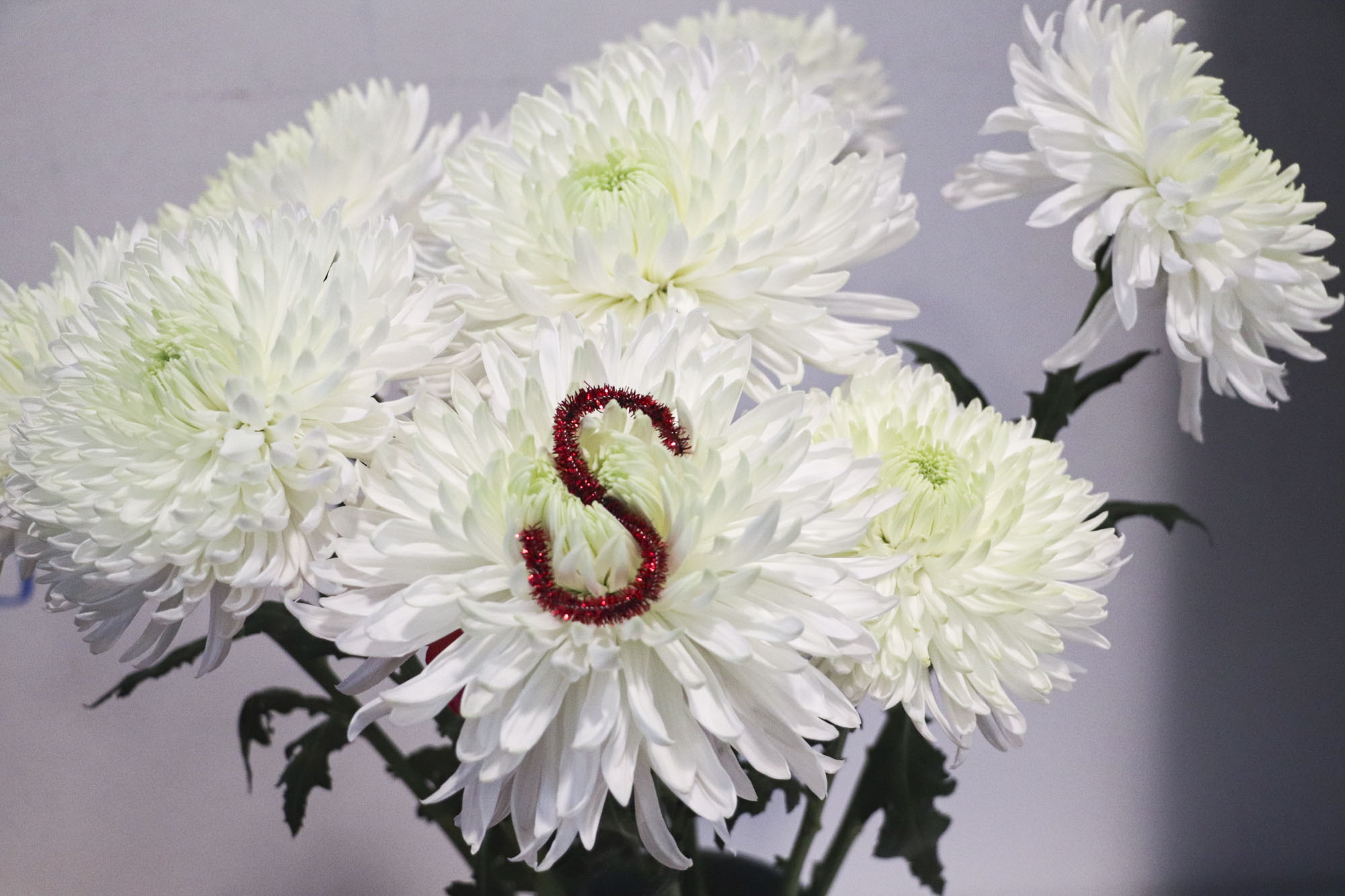
For almost a hundred years, huge swaths of San Mateo and Santa Clara counties were used to grow flowers. Hundreds of acres of chrysanthemums, asters and irises dotted the landscape, part of a two million dollar flower industry. And many of the people growing these flowers were immigrants from Italy, Japan and China.
Because of racist laws around land ownership at the time, most of the Chinese growers had to lease land from white people. Leland and Jane Stanford were willing landlords. The land where Stanford Shopping Center, the school’s research park and graduate student housing are today all used to be flower farms.
Read Gabriela Glueck’s full story “When Chinese Flower Growers Helped the Bay Area Bloom” on The California Report Magazine.
Episode Transcript
Olivia Allen-Price: I’m Olivia Allen-Price. This is Bay Curious. We start today’s story at Stanford University at the office of archeologist Laura Jones.
The first big surprise is the sculpture just outside. A half human, half animal figure that she’s storing for an indigenous tribe.Then there’s the colorfully embroidered tapestry of campus landmarks inside… and the 3 dimensional map on her wall…
Things that don’t quite make the cut for a museum end up here, in Laura Jones’ office. So when a retiring colleague offered her some old Stanford maps from the 1950s, Laura says it was an easy yes.
Laura Jones: She shows me this map that’s got all these colored pencil areas on it, where the Stanford shopping center is today, where the Stanford Research Park is today, where our graduate student housing is today, and they’re coded for what flower is being grown.
Olivia Allen-Price: Fields and field of flowers blooming, as far as the eye could see.
Laura Jones: In black pencil, dark black pencil, are the names of the farmers, and they’re all Chinese and Japanese…
Olivia Allen-Price: For a solid stretch of the 20th century, the Bay Area was home to a burgeoning flower industry, shaped in part by Japanese, Italian, and Chinese farmers.
In 1948 about 200 acres of chrysanthemums were grown in San Mateo and Santa Clara counties. Imagine, that’s about 150 football fields!
Some of these flowers were grown on Stanford lands between the 1890s and 1960s, in plots leased to Asian American farmers.
Laura Jones: If you could imagine, as you go down towards El Camino Real at the shopping center, or where our graduate students live today, you would have seen just fields of flowers.
Olivia Allen-Price: KQED reporter Gabriela Glueck met up with Laura to learn more about this history and the contributions of Chinese American growers in particular.
This story first aired on The California Report Magazine.
Music begins
Gabriela Glueck: Beginning in the late 1800s, farmers in Santa Clara Valley began planting fruit orchards, and the area’s rich, fertile soil helped the region develop into an agricultural powerhouse.
One that came to be known as the “Garden of the World.”
Much of this agricultural land was owned by white farmers. But they regularly hired Chinese immigrant laborers and also leased them land.
Laura Jones: Chinese immigrants arrive in California in the 1840s and 1850s during the Gold Rush, not everybody found gold. So Chinese immigrants fan out across California looking for other things to do…
Gabriela Glueck: Discriminatory laws made land ownership nearly impossible for many immigrants. So leasing was the next best option.
Music fades
Gabriela Glueck: As Laura tells it, Leland and Jane Stanford – the founders of Stanford University – were eager landlords.
Laura Jones: Leland Stanford, for example, employed hundreds of Chinese on his ranches and farms and here in Palo Alto. Mrs. Stanford had a number of leases with Chinese farmers.
Gabriela Glueck: Jim Mok was one such Chinese worker employed by the Stanfords. He worked as a foreman on their farm and at the University.
He helped lead the team of Chinese gardeners who planted the palm trees on Stanford’s famous palm drive.
Laura Jones: He was a really gifted supervisor… he was paid well for it, too. And he saved his money, and then he leased some land from Jane, and he did his vegetable farm.
Gabriela Glueck: Mok was also a leader in his own community, helping other Chinese immigrants find work and land.
George Chin: Because he’s a foreman, he employed some of the fellow clansmen, relatives and whatnot.
Gabriela Glueck: That’s George Chin. He heads San Francisco’s Chinatown History & Culture Association.
Gabriela Glueck: George says that at the start, Chinese land leasees were focused on growing vegetables. First for their own consumption, then for selling locally.
George Chin: And then they discover that they can sell flowers in San Francisco and make much more profit compared to vegetables.
Gabriela Glueck: So Mok switched gears, opting for asters and chrysanthemums in lieu of vegetables… Other Chinese immigrants followed suit.
It was a gradual transition, taking shape in the early 1900s, as the demand for cut flowers started to accelerate.
At the same time, Japanese and Italian immigrant farmers were making similar shifts, building their own greenhouses, and networks.
Music begins
Gabriela Glueck: That’s when George’s dad, Arthur Y. Chin, came into the picture. He arrived in the United States in 1923, hailing from Guangdong Province in China, just like Mok did. And pretty quickly he got into the flower business, getting a lease in Palo Alto.
George spent much of his childhood on the farm. And he’s still got pictures of the place…including one black and white still of him and his two siblings in front of their house…
George Chin: And the background you see part of the greenhouse, which is the nurse part of the nursery, and that’s where my father grew the flowers.
Inside would be various row of chrysanthemums various color.
Gabriela Glueck: George says the business was truly a family operation, and in many ways, his mom was the backbone of it. She worked the fields, helped prepare cut flowers, cooked meals for the crew, and raised three children.
As a kid, George pitched in too, helping his parents with the hard work of flower growing.
George Chin: When I’m a teenager, there’s a little bit of resentment because I cannot go to after school sports… I cannot join in the sports club, after school activity, because I have to be home working.
Gabriela Glueck: He’d help build and repair green houses. And pick buds on growing flower bushes to make sure only the biggest mum would bloom.
George says he remembers his dad packing up their family truck with fresh cut flowers to sell at the wholesaler. He’d also collect some other farmer’s flowers to take with him. It was just one of many ways this group of Chinese American growers — looked out for each other.
George Chin: In order to protect each other and fought against the competitions the Chinese growers form a Bay Area Chrysanthemums Growers Association.
Olivia Allen-Price: You’re listening to Bay Curious – a podcast produced by listener supported KQED. You can join the hundreds of thousands of members in the Bay Area today but donate at donate.kqed.org/podcasts. We’ve got to take a quick break – when we return The Chinese Growers scale up to meet a tide of demand.
Olivia Allen-Price: And we’re back…
Jim Mok had helped build a community of Chinese flower growers on and around the Stanford campus. What started out as a small solo operation, grew into a large coordinated effort.
Music begins
Gabriela Glueck: By the late 1970s, one report shows that the association had grown to nearly 140 Chinese growers.
The blueprint Mok and other enterprising immigrants laid out had really taken shape.
Laura Jones: These growers had essentially self organized into cooperatives so that they could, in fact, afford mass shipping…
Gabriela Glueck: Stanford archaeologist Laura Jones again.
Laura Jones: This is you providing thousands of flowers that are packed into a semi trailer truck, refrigerated truck, with other growers flowers, right? And going off to wholesalers somewhere but they’re banding together to access mass markets.
Gabriela Glueck: And those markets – both local and around the country – wanted chrysanthemums.
Laura Jones: In large part, for corsages, which is a tradition we don’t really follow as much anymore; it’s really rare but it was huge, huge between 1920 and about 1960. Men wore corsages as well as women. And it was just a major market.
Music begins
Gabriela Glueck: If you dig up pictures of old Cal versus Stanford football games and zoom in on the spectators, you’ll see them. White chrysanthemum corsages with a pipe cleaner shaped into a red S. And a yellow version with a blue C for Cal.
Laura Jones: And we found these ads in the local newspapers for chrysanthemum corsages. And they had the, they were about the big game. And so there’ll be a drawing of a, you know, a pretty girl with a giant corsage with a big S on it for the big game.
Music fades
Gabriela Glueck: Cut flowers for your dining room table and for all other occasions were also popular. At every step, as new business opportunities arose, the Chinese growers worked together to take advantage.
Laura Jones: These small growers on these small farms are banding together. They buy warehouses near trail train lines, right? They buy warehouses at the airport together. Because, I mean, who’s what? Person with six acres is going to buy a hangar at the airport.
Gabriela Glueck: That cooperation helped the industry scale. And it also gave immigrants a chance at upward mobility.
Laura Jones: One of the things that’s interesting about flower growing and also true about vegetable farms is you can make a living with a fairly small acreage. You could be running, you know, a multi family operation on six leased acres. That’s real opportunity, right for immigrants to come in and start something for their families.
Gabriela Glueck: For George and his family, flower farming was supposed to be a stepping stone, a path to the middle class. And it was.
George Chin: Farming is not easy. I’m sure my father doesn’t really want to see his son actually just taking over the business so to speak.
Gabriela Glueck: After serving in the U.S. Air Force, George became an engineer, and when his parents retired from flower growing they just stopped leasing the plot. Today, it’s a condo.
Music begins
Gabriela Glueck: In the 1980s, it became economical to ship cut flowers from South America. And Bay Area real estate was also starting to get Silicon-Valley pricey.
Laura Jones: So it’s like the perfect storm of wiping out these small flower farms.
Gabriela Glueck: For George, watching the history fade away was sad… but he says the best we can do now is make sure the story’s not forgotten.
It’s part of the reason he’s been so excited about the work Laura is doing. Since she first came across that map, she’s been researching this history, and plans to turn her findings into a digital exhibit called the Forgotten Flowers project.
Last year, Laura and George also helped put on a corsage making event on Stanford’s campus… as part of the initiative.
Laura Jones: We had a lot of the flower growers who came. It was a joyful event, right to recover that tradition at Stanford.
Gabriela Glueck: The corsage making kits came from a florist in San Francisco’s Chinatown. White chrysanthemums, pipe cleaners to make the Stanford S, and instruction sheets.
About 200 people showed up to take part.
George Chin: It’s kind of exciting because, you are seeing people really intense of learning from the past. I think we’re there’s certain joy to be able to pass down this tradition.
Gabriela Glueck: Corsage making has always been an intricate art form – arranging fresh cut flowers and carefully trimmed leaves into a balanced and wearable composition.
And at the event, it also offered crafters a way to connect with a not so distant past. When Stanford’s campus and the area surrounding it were blooming with flower farms and chrysanthemum fields were king.
Music begins
Olivia Allen-Price: That was KQED reporter Gabriella Glueck. Thanks to the team at The California Report Magazine for their work producing that story. The team includes Sasha Khokha, Victoria Mauleon, Suzie Racho and Brendan Willard.
Bay Curious is made in San Francisco at member-supported KQED. Our show is produced by Katrina Schwartz, Christopher Beale, Anna Casalme, and me, Olivia Allen-Price. We get extra support from Maha Sanad, Katie Sprenger, Jen Chien, Ethan Toven-Lindsey and everyone on team KQED.
Some members of the KQED podcast team are represented by The Screen Actors Guild, American Federation of Television and Radio Artists, San Francisco Northern California Local.
I’m Olivia Allen-Price. Have a wonderful week!