Lawyers Say Laken Riley Act Is Eroding Due Process Rights for Immigrants
Here are the morning’s top stories on Wednesday, September 2, 2026
- During his second term, president Donald Trump has done very little that can be considered even remotely bi-partisan. But one thing stands out … The Laken Riley Act. We explore the impacts of this immigration legislation more than a year after trump signed it into law.
- A bill that could give the public more access to information about emergencies inside private immigrant detention centers is on its way to becoming a law. It just needs Governor Newsom’s signature.
- Students without legal status aren’t allowed to work for California’s public colleges or universities. That’s despite years of efforts by state lawmakers and advocates. A bill that could change that is now on Governor Gavin Newsom’s desk.
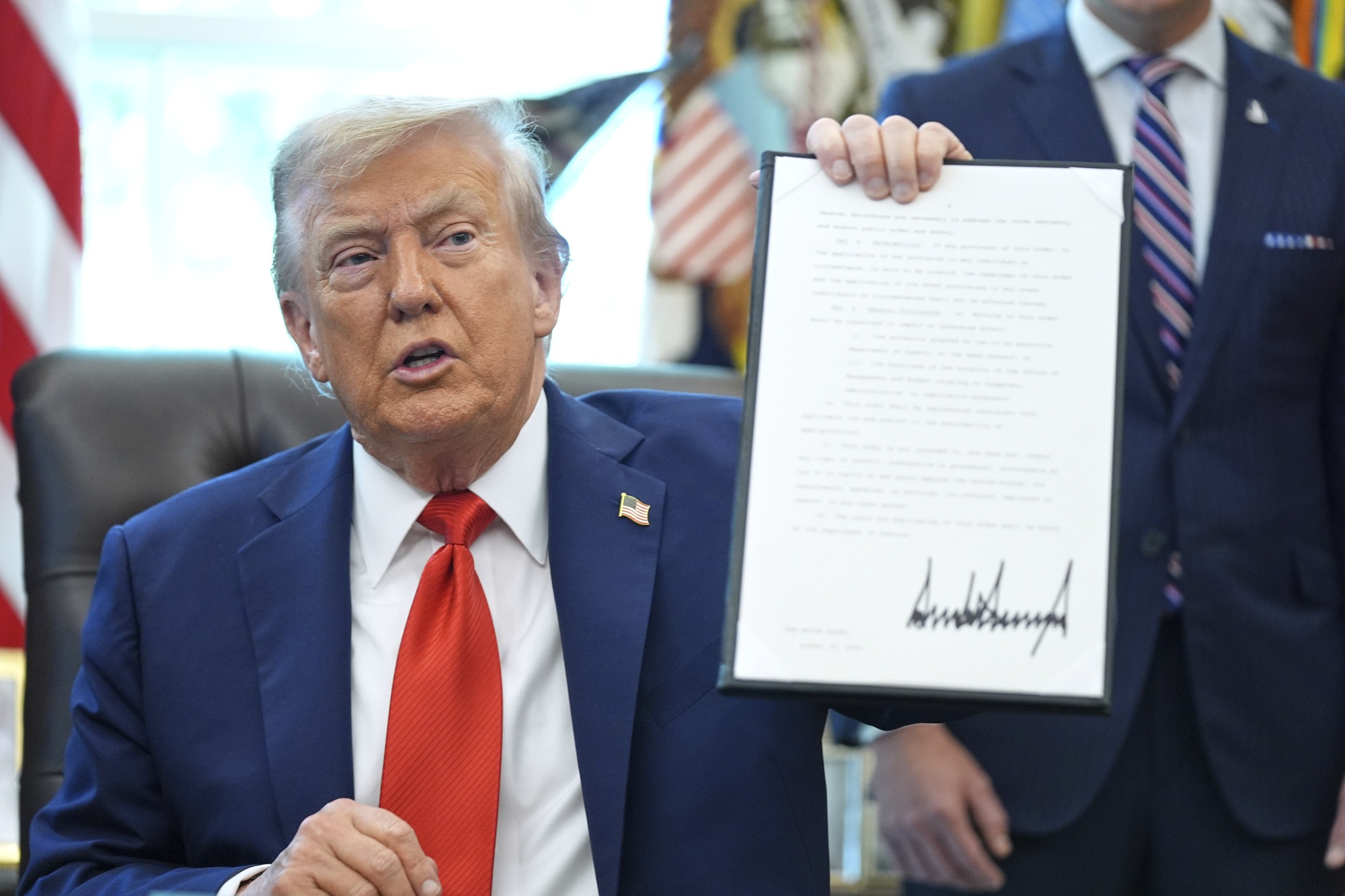
The first bill that Trump signed into law this term was a bi-partisan law targeting immigrants without legal status. The law was named after a college student who was murdered by an undocumented immigrant. It requires mandatory detention for immigrants who are accused of certain crimes.
“Under the law I’m signing today, the Department of Homeland Security will be required to detain all illegal aliens who have been arrested for theft, burglary, larceny, shoplifting, assaulting a police officer or any crime that results in death,” Trump said before signing the act into law.
Thirteen Democratic Senators and 46 Democrats in the House voted for the act, including San Diego Congressman Mike Levin.
Levin justified his vote by citing an increase in retail thefts in his North County district. However, civil rights organizations said the new law would deny people due process protections because Laken Riley imposes mandatory detention of people after an arrest, even if they aren’t charged or convicted.
After his vote in 2025, Levin said he did not believe the law took away due process protections or targeted innocent immigrants. But immigration lawyers say that’s what happened.
Carlos Barrios is an immigration lawyer based in Los Angeles
“And in that respect, Laken Riley has been a problem because a basic arrest is enough. Even if the person wasn’t convicted. I thought it was absurd when I heard this was on the table and then I thought it was incredibly absurd when people voted for it,” he said.
Barrios represented a man who was arrested for receiving stolen property. A county judge dismissed his case in criminal court, but that didn’t matter in immigration court, where a judge used the Laken Riley Act as justification to keep him locked up.
“But it became a major issue that this person was delayed and stuck in jail for a month and a half,” said Barrios. “This person owns his own business, now he’s at risk of losing everything because he had to shut down the business for a month and a half. Bills had to be paid. They’re backed up on their mortgage payments and everything else. It creates a major impact.”
According to data from Immigration and Customs Enforcement, there are currently more than 65,000 people in immigration detention. More than 70% of them do not have criminal convictions.
There is no publicly available data that would tell us how many people have been subject to mandatory detention under Laken Riley. But individual cases show the law’s impact.
In San Diego, Noah Montague represented a man who was never even arrested for a crime. While not a lawyer, Montague is accredited to represent people in immigration court proceedings.
“My client has never been arrested for any kind of crime relating to assault on a police officer. However what happened, when he was picked up by ICE, the narrative that ICE wrote said that he basically resisted arrest and that resulted in assault of a police officer,” said Montague.
No arrest, no charge, no conviction. Just the words of a federal officer. Yet, the judge invoked Laken Riley.
“There’s been no arrest for this crime, there’s been no conviction, my client has maintained that he didn’t try to do this. And the only context that this came up is a report by an ICE officer that’s actually unsigned.”
Montague describes the Laken Riley Act as just one piece of Trump’s mass deportation machine. Others include courthouse arrests, travel bans, third-country deportations, and aggressive immigration enforcement raids. All with the ultimate goal of making life so difficult for immigrants that they will self deport.
“They’re kind of piecemeal pulling this policy, this policy, they just make it so unbearable that people decide they don’t want to “play the game” or go through the process,” said Montague.
Levin’s office declined multiple interview requests by KPBS. In a statement, Levin acknowledges that an arrest is not a finding of guilt and should not be allowed to become a shortcut around due process. But the text of the law he voted for specifically requires DHS to detain immigrants after an arrest.
Since voting for that law, Levin has become an outspoken critic of Trump’s deportation agenda. He’s voted to withhold funding for ICE, demanded more transparency from detention centers, and advocated for families of deported constituents.
The bill, AB 713, is from Lakewood Democrat José Luis Solache, and it sailed through the
Legislature to Newsom’s desk despite GOP opposition.
It says California’s public college campuses cannot disqualify students without legal
status from campus employment.
The UC, CSU, and community college systems enroll an estimated 60,000
students without legal status. While these students can get state-backed financial aid,
they’re ineligible for most federal grants and loans.
Leading the charge for this right to work on campuses are students without legal status, immigration rights groups and legal scholars. Access to safe working conditions for students without legal status is a high priority because they’re ineligible for federal Pell grants — up to $7,400 annually — and federal student loans that come with more borrower protections than ones offered by private lenders. California awards eligible in-state students tuition waivers regardless of immigration status, so many students without legal status can at least attend a public institution tuition-free.
Newsom vetoed a similar bill in 2024, echoing a chief worry put forward by the University of California: Any effort to employ students without proper status would incur the wrath of the Trump administration, which could attempt to pull some or all of the $17 billion in annual federal support the system gets.
The state’s Department of Finance is recommending a no vote on Solache’s bill. The fear of federal litigation and budget cuts are the main reasons why.
The UC itself abandoned its own review of employing students without legal status in 2024 for those reasons.
At a hearing earlier this year, Solache said, “While California has a long standing commitment to expanding access, affordability and student success in higher education, our undocumented students continue to face significant financial and structural barriers.”
This bill and previous pushback has been rooted in an untested legal theory. That
theory says a 1980s federal law that banned employing immigrants without legal
status did not directly mention state agencies.
A bill that could give the public more access to information about emergencies inside private immigrant detention centers is on its way to becoming a law. It just needs Governor Newsom’s signature.
SB 423 would require local agencies to share audio of 9-1-1 calls and written reports from inside detention centers. It was prompted by questions about medical care, allegations of sexual abuse and violence against immigrants being detained.
State Sen. Lena Gonzalez, D-Long Beach, said she introduced SB 423 because the number of people in ICE detention in California has grown dramatically during President Donald Trump’s second term, to more than 6,000 people, and many are held for long periods in sometimes inhumane conditions.
“I hope Governor Newsom signs because it really gives us a signal that he means business as it pertains to really pushing back against this Trump administration,” said Gonzalez.
There’s also been six deaths inside the state’s detention centers since last September. Four of those were at the Adelanto ICE facility. DHS has repeatedly denied that any abuse is taking place inside ICE centers.