Voter Suppression Didn’t Start with Trump. A Historian Tracks Its Origins
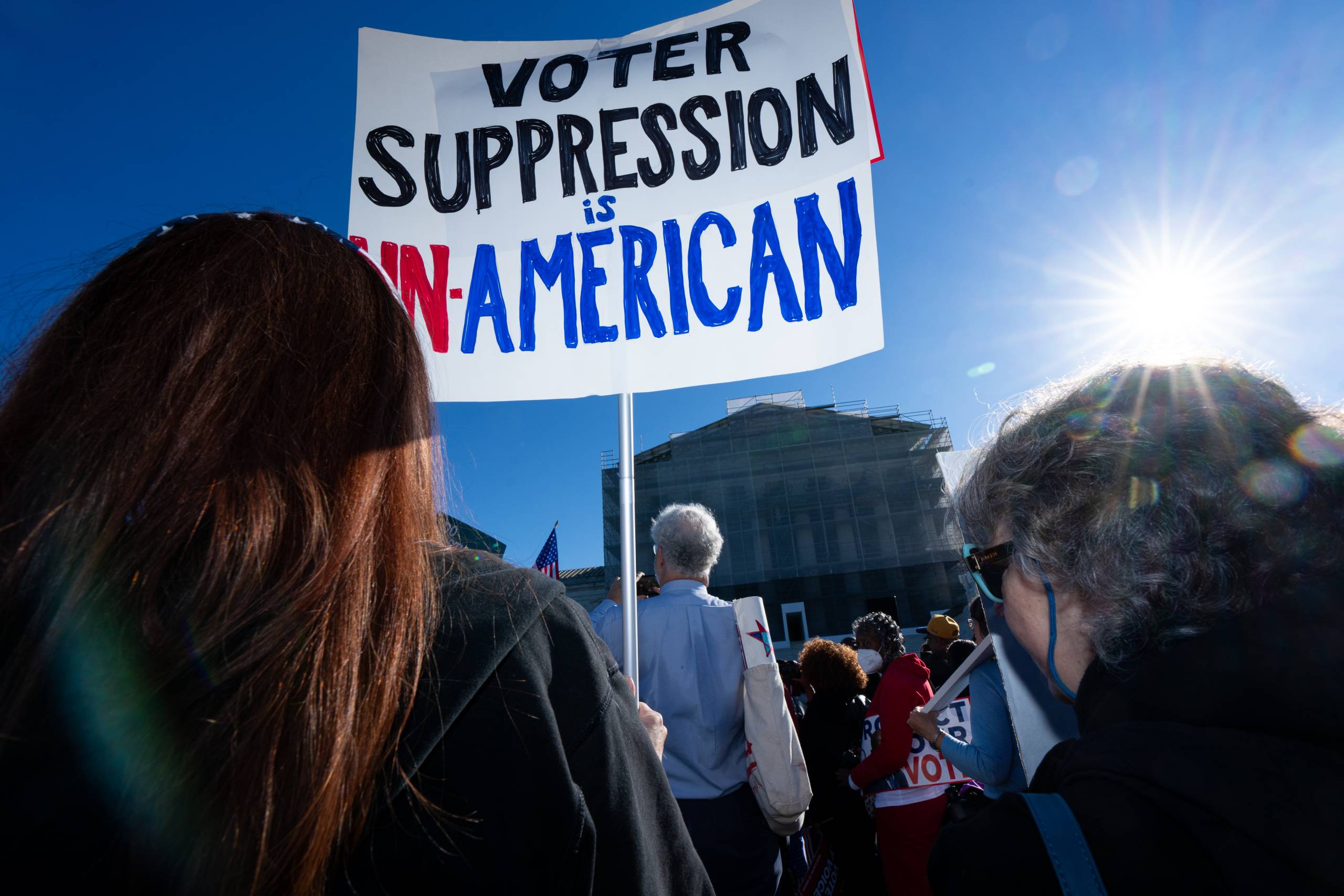
This week, President Donald Trump asked the U.S. Supreme Court to allow him to implement an executive order aimed at making it much harder to vote by mail. The order would direct the Department of Homeland Security to create “state citizenship lists” of eligible voters and require the U.S. Postal Service to deliver mail-in ballots only to people on those lists.
It’s part of the president’s ongoing attacks on the election system.
Political Breakdown has been examining election integrity in America over the past few weeks, and today they revisit the first episode in that series.
Host Marisa Lagos talks with historian Carol Anderson, a professor of African American Studies at Emory University and author of “One Person, No Vote: How Voter Suppression is Destroying our Democracy.”
She said the debate over who gets to vote has been centered, since our founding, on the question of “who is worthy” of voting.
Anderson said the first big backlash came after the Civil War, when Congress passed the Reconstruction Act of 1867, “which basically said that Black men could vote.” And they did come out to vote: That law led to 33 Black men being elected to the state legislature in Georgia a year later — then being expelled, illegally, by white lawmakers. The resulting protests ended in a massacre.
“You had this massive backlash to Black men voting because there was this sense that they were not real Americans. They weren’t worthy of citizenship,” Anderson said.
Understanding that the Reconstruction Act wasn’t enough, Congress passed the 15th Amendment in 1869. Clocking in at 46 words long, it decreed: “The right of citizens of the United States to vote shall not be denied or abridged by the United States or by any State on account of race, color, or previous condition of servitude. The Congress shall have power to enforce this article by appropriate legislation.”
Anderson said the intention was good, but the law ultimately ushered in the Jim Crow era as once again states worked to circumvent the federal law. Sometimes it was through raw violence and intimidation of Black voters — but often, Anderson said, it was also through what she called “bureaucratic violence.”
“The states figured out, OK, we can’t say we don’t want Black folks to vote,” Anderson said, so they instead crafted laws and policies that never mentioned race but had the effect of disenfranchising Black voters.
Those laws included literacy and constitutional tests, which Black voters couldn’t pass because they’d been denied education, poll taxes, and grandfather clauses that exempted men who had the right to vote before 1867 from these various tests and taxes — so that poor and illiterate white men wouldn’t be barred from voting.
“They figured out how to make it sound reasonable, how to make it sound like a protection of democracy, to make a sound like they’re going for election integrity,” Anderson said.
These laws were often upheld by the U.S. Supreme Court under the guise that they didn’t mention race, Anderson said. The blueprint was the Mississippi Plan of 1890, which pioneered many of those Jim Crow voter suppression laws and was upheld by the court because its language was “colorblind.”
When it passed, Anderson said, around 190,000 Black men were registered to vote in Mississippi. Two years later, that number had dropped to 8,600.
“That is the power of the Mississippi Plan, massive disfranchisement,” she said. “They knew exactly what they were doing.”
Anderson said things didn’t really start changing until the Voting Rights Act of 1965, though there have been efforts in the subsequent decades to limit voting access. That includes the 1993 Motor Voter Act, which made voter registration easier but also included a provision requiring states to clean up their voter rolls. Anderson said it resulted in tens of thousands of eligible voters being scrubbed from the rolls in mostly Southern states — and unable to vote in key races, including the 2000 presidential contest.
“And who are those people? We know who they are by statistics, by research. They’re overwhelmingly young people, poor people and minorities,” she said.
That brings us to the modern era, and Trump’s attacks on the 2020 elections. Stay tuned for more episodes on election integrity in America.