window.__IS_SSR__=true
window.__INITIAL_STATE__={
"attachmentsReducer": {
"audio_0": {
"type": "attachments",
"id": "audio_0",
"imgSizes": {
"kqedFullSize": {
"file": "https://ww2.kqed.org/news/wp-content/themes/KQED-unified/img/audio_bgs/background0.jpg"
}
}
},
"audio_1": {
"type": "attachments",
"id": "audio_1",
"imgSizes": {
"kqedFullSize": {
"file": "https://ww2.kqed.org/news/wp-content/themes/KQED-unified/img/audio_bgs/background1.jpg"
}
}
},
"audio_2": {
"type": "attachments",
"id": "audio_2",
"imgSizes": {
"kqedFullSize": {
"file": "https://ww2.kqed.org/news/wp-content/themes/KQED-unified/img/audio_bgs/background2.jpg"
}
}
},
"audio_3": {
"type": "attachments",
"id": "audio_3",
"imgSizes": {
"kqedFullSize": {
"file": "https://ww2.kqed.org/news/wp-content/themes/KQED-unified/img/audio_bgs/background3.jpg"
}
}
},
"audio_4": {
"type": "attachments",
"id": "audio_4",
"imgSizes": {
"kqedFullSize": {
"file": "https://ww2.kqed.org/news/wp-content/themes/KQED-unified/img/audio_bgs/background4.jpg"
}
}
},
"placeholder": {
"type": "attachments",
"id": "placeholder",
"imgSizes": {
"thumbnail": {
"file": "https://cdn.kqed.org/wp-content/uploads/2024/12/KQED-Default-Image-816638274-2000x1333-1-160x107.jpg",
"width": 160,
"height": 107,
"mimeType": "image/jpeg"
},
"medium": {
"file": "https://cdn.kqed.org/wp-content/uploads/2024/12/KQED-Default-Image-816638274-2000x1333-1-800x533.jpg",
"width": 800,
"height": 533,
"mimeType": "image/jpeg"
},
"medium_large": {
"file": "https://cdn.kqed.org/wp-content/uploads/2024/12/KQED-Default-Image-816638274-2000x1333-1-768x512.jpg",
"width": 768,
"height": 512,
"mimeType": "image/jpeg"
},
"large": {
"file": "https://cdn.kqed.org/wp-content/uploads/2024/12/KQED-Default-Image-816638274-2000x1333-1-1020x680.jpg",
"width": 1020,
"height": 680,
"mimeType": "image/jpeg"
},
"1536x1536": {
"file": "https://cdn.kqed.org/wp-content/uploads/2024/12/KQED-Default-Image-816638274-2000x1333-1-1536x1024.jpg",
"width": 1536,
"height": 1024,
"mimeType": "image/jpeg"
},
"fd-lrg": {
"file": "https://cdn.kqed.org/wp-content/uploads/2024/12/KQED-Default-Image-816638274-2000x1333-1-1536x1024.jpg",
"width": 1536,
"height": 1024,
"mimeType": "image/jpeg"
},
"fd-med": {
"file": "https://cdn.kqed.org/wp-content/uploads/2024/12/KQED-Default-Image-816638274-2000x1333-1-1020x680.jpg",
"width": 1020,
"height": 680,
"mimeType": "image/jpeg"
},
"fd-sm": {
"file": "https://cdn.kqed.org/wp-content/uploads/2024/12/KQED-Default-Image-816638274-2000x1333-1-800x533.jpg",
"width": 800,
"height": 533,
"mimeType": "image/jpeg"
},
"post-thumbnail": {
"file": "https://cdn.kqed.org/wp-content/uploads/2024/12/KQED-Default-Image-816638274-2000x1333-1-672x372.jpg",
"width": 672,
"height": 372,
"mimeType": "image/jpeg"
},
"twentyfourteen-full-width": {
"file": "https://cdn.kqed.org/wp-content/uploads/2024/12/KQED-Default-Image-816638274-2000x1333-1-1038x576.jpg",
"width": 1038,
"height": 576,
"mimeType": "image/jpeg"
},
"xxsmall": {
"file": "https://cdn.kqed.org/wp-content/uploads/2024/12/KQED-Default-Image-816638274-2000x1333-1-160x107.jpg",
"width": 160,
"height": 107,
"mimeType": "image/jpeg"
},
"xsmall": {
"file": "https://cdn.kqed.org/wp-content/uploads/2024/12/KQED-Default-Image-816638274-2000x1333-1-672x372.jpg",
"width": 672,
"height": 372,
"mimeType": "image/jpeg"
},
"small": {
"file": "https://cdn.kqed.org/wp-content/uploads/2024/12/KQED-Default-Image-816638274-2000x1333-1-672x372.jpg",
"width": 672,
"height": 372,
"mimeType": "image/jpeg"
},
"xlarge": {
"file": "https://cdn.kqed.org/wp-content/uploads/2024/12/KQED-Default-Image-816638274-2000x1333-1-1020x680.jpg",
"width": 1020,
"height": 680,
"mimeType": "image/jpeg"
},
"full-width": {
"file": "https://cdn.kqed.org/wp-content/uploads/2024/12/KQED-Default-Image-816638274-2000x1333-1-1920x1280.jpg",
"width": 1920,
"height": 1280,
"mimeType": "image/jpeg"
},
"guest-author-32": {
"file": "https://cdn.kqed.org/wp-content/uploads/2025/01/KQED-Default-Image-816638274-1333x1333-1-160x160.jpg",
"width": 32,
"height": 32,
"mimeType": "image/jpeg"
},
"guest-author-50": {
"file": "https://cdn.kqed.org/wp-content/uploads/2025/01/KQED-Default-Image-816638274-1333x1333-1-160x160.jpg",
"width": 50,
"height": 50,
"mimeType": "image/jpeg"
},
"guest-author-64": {
"file": "https://cdn.kqed.org/wp-content/uploads/2025/01/KQED-Default-Image-816638274-1333x1333-1-160x160.jpg",
"width": 64,
"height": 64,
"mimeType": "image/jpeg"
},
"guest-author-96": {
"file": "https://cdn.kqed.org/wp-content/uploads/2025/01/KQED-Default-Image-816638274-1333x1333-1-160x160.jpg",
"width": 96,
"height": 96,
"mimeType": "image/jpeg"
},
"guest-author-128": {
"file": "https://cdn.kqed.org/wp-content/uploads/2025/01/KQED-Default-Image-816638274-1333x1333-1-160x160.jpg",
"width": 128,
"height": 128,
"mimeType": "image/jpeg"
},
"detail": {
"file": "https://cdn.kqed.org/wp-content/uploads/2025/01/KQED-Default-Image-816638274-1333x1333-1-160x160.jpg",
"width": 160,
"height": 160,
"mimeType": "image/jpeg"
},
"kqedFullSize": {
"file": "https://cdn.kqed.org/wp-content/uploads/2024/12/KQED-Default-Image-816638274-2000x1333-1.jpg",
"width": 2000,
"height": 1333
}
}
},
"mindshift_39144": {
"type": "attachments",
"id": "mindshift_39144",
"meta": {
"index": "attachments_1716263798",
"site": "mindshift",
"id": "39144",
"found": true
},
"parent": 39142,
"imgSizes": {
"twentyfourteen-full-width": {
"file": "https://ww2.kqed.org/app/uploads/sites/23/2015/01/girl-study-sketch-1038x576.jpg",
"width": 1038,
"mimeType": "image/jpeg",
"height": 576
},
"thumbnail": {
"file": "https://ww2.kqed.org/app/uploads/sites/23/2015/01/girl-study-sketch-400x225.jpg",
"width": 400,
"mimeType": "image/jpeg",
"height": 225
},
"fd-sm": {
"file": "https://ww2.kqed.org/app/uploads/sites/23/2015/01/girl-study-sketch-320x180.jpg",
"width": 320,
"mimeType": "image/jpeg",
"height": 180
},
"post-thumbnail": {
"file": "https://ww2.kqed.org/app/uploads/sites/23/2015/01/girl-study-sketch-672x372.jpg",
"width": 672,
"mimeType": "image/jpeg",
"height": 372
},
"kqedFullSize": {
"file": "https://ww2.kqed.org/app/uploads/sites/23/2015/01/girl-study-sketch.jpg",
"width": 1440,
"height": 810
},
"large": {
"file": "https://ww2.kqed.org/app/uploads/sites/23/2015/01/girl-study-sketch-1440x810.jpg",
"width": 1440,
"mimeType": "image/jpeg",
"height": 810
},
"guest-author-96": {
"file": "https://ww2.kqed.org/app/uploads/sites/23/2015/01/girl-study-sketch-96x96.jpg",
"width": 96,
"mimeType": "image/jpeg",
"height": 96
},
"medium": {
"file": "https://ww2.kqed.org/app/uploads/sites/23/2015/01/girl-study-sketch-800x450.jpg",
"width": 800,
"mimeType": "image/jpeg",
"height": 450
},
"guest-author-64": {
"file": "https://ww2.kqed.org/app/uploads/sites/23/2015/01/girl-study-sketch-64x64.jpg",
"width": 64,
"mimeType": "image/jpeg",
"height": 64
},
"guest-author-32": {
"file": "https://ww2.kqed.org/app/uploads/sites/23/2015/01/girl-study-sketch-32x32.jpg",
"width": 32,
"mimeType": "image/jpeg",
"height": 32
},
"fd-lrg": {
"file": "https://ww2.kqed.org/app/uploads/sites/23/2015/01/girl-study-sketch-1180x664.jpg",
"width": 1180,
"mimeType": "image/jpeg",
"height": 664
},
"fd-med": {
"file": "https://ww2.kqed.org/app/uploads/sites/23/2015/01/girl-study-sketch-768x432.jpg",
"width": 768,
"mimeType": "image/jpeg",
"height": 432
},
"guest-author-128": {
"file": "https://ww2.kqed.org/app/uploads/sites/23/2015/01/girl-study-sketch-128x128.jpg",
"width": 128,
"mimeType": "image/jpeg",
"height": 128
}
},
"publishDate": 1422493759,
"modified": 1422493806,
"caption": "Naomi Chung/Flickr",
"description": null,
"title": "girl-study-sketch",
"credit": null,
"status": "inherit",
"isLoading": false,
"fetchFailed": false
},
"mindshift_38568": {
"type": "attachments",
"id": "mindshift_38568",
"meta": {
"index": "attachments_1716263798",
"site": "mindshift",
"id": "38568",
"found": true
},
"parent": 38566,
"imgSizes": {
"twentyfourteen-full-width": {
"file": "https://ww2.kqed.org/app/uploads/sites/23/2014/11/personalize-1038x576.jpg",
"width": 1038,
"mimeType": "image/jpeg",
"height": 576
},
"thumbnail": {
"file": "https://ww2.kqed.org/app/uploads/sites/23/2014/11/personalize-400x225.jpg",
"width": 400,
"mimeType": "image/jpeg",
"height": 225
},
"fd-sm": {
"file": "https://ww2.kqed.org/app/uploads/sites/23/2014/11/personalize-320x180.jpg",
"width": 320,
"mimeType": "image/jpeg",
"height": 180
},
"post-thumbnail": {
"file": "https://ww2.kqed.org/app/uploads/sites/23/2014/11/personalize-672x372.jpg",
"width": 672,
"mimeType": "image/jpeg",
"height": 372
},
"kqedFullSize": {
"file": "https://ww2.kqed.org/app/uploads/sites/23/2014/11/personalize.jpg",
"width": 1440,
"height": 810
},
"large": {
"file": "https://ww2.kqed.org/app/uploads/sites/23/2014/11/personalize-1440x810.jpg",
"width": 1440,
"mimeType": "image/jpeg",
"height": 810
},
"guest-author-96": {
"file": "https://ww2.kqed.org/app/uploads/sites/23/2014/11/personalize-96x96.jpg",
"width": 96,
"mimeType": "image/jpeg",
"height": 96
},
"medium": {
"file": "https://ww2.kqed.org/app/uploads/sites/23/2014/11/personalize-800x450.jpg",
"width": 800,
"mimeType": "image/jpeg",
"height": 450
},
"guest-author-64": {
"file": "https://ww2.kqed.org/app/uploads/sites/23/2014/11/personalize-64x64.jpg",
"width": 64,
"mimeType": "image/jpeg",
"height": 64
},
"guest-author-32": {
"file": "https://ww2.kqed.org/app/uploads/sites/23/2014/11/personalize-32x32.jpg",
"width": 32,
"mimeType": "image/jpeg",
"height": 32
},
"fd-lrg": {
"file": "https://ww2.kqed.org/app/uploads/sites/23/2014/11/personalize-1180x664.jpg",
"width": 1180,
"mimeType": "image/jpeg",
"height": 664
},
"fd-med": {
"file": "https://ww2.kqed.org/app/uploads/sites/23/2014/11/personalize-768x432.jpg",
"width": 768,
"mimeType": "image/jpeg",
"height": 432
},
"guest-author-128": {
"file": "https://ww2.kqed.org/app/uploads/sites/23/2014/11/personalize-128x128.jpg",
"width": 128,
"mimeType": "image/jpeg",
"height": 128
}
},
"publishDate": 1417031252,
"modified": 1417031252,
"caption": "Mia MacMeekin/An Ethical Island",
"description": null,
"title": "personalize",
"credit": null,
"status": "inherit",
"isLoading": false,
"fetchFailed": false
},
"mindshift_36068": {
"type": "attachments",
"id": "mindshift_36068",
"meta": {
"index": "attachments_1716263798",
"site": "mindshift",
"id": "36068",
"found": true
},
"parent": 36063,
"imgSizes": {
"thumbnail": {
"file": "https://ww2.kqed.org/app/uploads/sites/23/2014/06/one-room-schoolhouse-400x225.jpg",
"width": 400,
"mimeType": "image/jpeg",
"height": 225
},
"fd-sm": {
"file": "https://ww2.kqed.org/app/uploads/sites/23/2014/06/one-room-schoolhouse-320x180.jpg",
"width": 320,
"mimeType": "image/jpeg",
"height": 180
},
"kqedFullSize": {
"file": "https://ww2.kqed.org/app/uploads/sites/23/2014/06/one-room-schoolhouse.jpg",
"width": 640,
"height": 360
},
"guest-author-96": {
"file": "https://ww2.kqed.org/app/uploads/sites/23/2014/06/one-room-schoolhouse-96x96.jpg",
"width": 96,
"mimeType": "image/jpeg",
"height": 96
},
"guest-author-64": {
"file": "https://ww2.kqed.org/app/uploads/sites/23/2014/06/one-room-schoolhouse-64x64.jpg",
"width": 64,
"mimeType": "image/jpeg",
"height": 64
},
"guest-author-32": {
"file": "https://ww2.kqed.org/app/uploads/sites/23/2014/06/one-room-schoolhouse-32x32.jpg",
"width": 32,
"mimeType": "image/jpeg",
"height": 32
},
"guest-author-128": {
"file": "https://ww2.kqed.org/app/uploads/sites/23/2014/06/one-room-schoolhouse-128x128.jpg",
"width": 128,
"mimeType": "image/jpeg",
"height": 128
}
},
"publishDate": 1401827825,
"modified": 1401827825,
"caption": "Barry Peterson/CBS",
"description": null,
"title": "one-room-schoolhouse",
"credit": null,
"status": "inherit",
"isLoading": false,
"fetchFailed": false
},
"mindshift_31176": {
"type": "attachments",
"id": "mindshift_31176",
"meta": {
"index": "attachments_1716263798",
"site": "mindshift",
"id": "31176",
"found": true
},
"parent": 31165,
"imgSizes": {
"thumbnail": {
"file": "https://ww2.kqed.org/app/uploads/sites/23/2013/09/1470057351-400x224.jpg",
"width": 400,
"mimeType": "image/jpeg",
"height": 224
},
"fd-sm": {
"file": "https://ww2.kqed.org/app/uploads/sites/23/2013/09/1470057351-320x179.jpg",
"width": 320,
"mimeType": "image/jpeg",
"height": 179
},
"post-thumbnail": {
"file": "https://ww2.kqed.org/app/uploads/sites/23/2013/09/1470057351-672x372.jpg",
"width": 672,
"mimeType": "image/jpeg",
"height": 372
},
"kqedFullSize": {
"file": "https://ww2.kqed.org/app/uploads/sites/23/2013/09/1470057351.jpg",
"width": 684,
"height": 383
},
"guest-author-96": {
"file": "https://ww2.kqed.org/app/uploads/sites/23/2013/09/1470057351-96x96.jpg",
"width": 96,
"mimeType": "image/jpeg",
"height": 96
},
"guest-author-64": {
"file": "https://ww2.kqed.org/app/uploads/sites/23/2013/09/1470057351-64x64.jpg",
"width": 64,
"mimeType": "image/jpeg",
"height": 64
},
"detail": {
"file": "https://ww2.kqed.org/app/uploads/sites/23/2013/09/1470057351-75x75.jpg",
"width": 75,
"mimeType": "image/jpeg",
"height": 75
},
"guest-author-32": {
"file": "https://ww2.kqed.org/app/uploads/sites/23/2013/09/1470057351-32x32.jpg",
"width": 32,
"mimeType": "image/jpeg",
"height": 32
},
"guest-author-128": {
"file": "https://ww2.kqed.org/app/uploads/sites/23/2013/09/1470057351-128x128.jpg",
"width": 128,
"mimeType": "image/jpeg",
"height": 128
}
},
"publishDate": 1378399372,
"modified": 1378399372,
"caption": null,
"description": null,
"title": "147005735",
"credit": null,
"status": "inherit",
"isLoading": false,
"fetchFailed": false
},
"mindshift_28477": {
"type": "attachments",
"id": "mindshift_28477",
"meta": {
"index": "attachments_1716263798",
"site": "mindshift",
"id": "28477",
"found": true
},
"parent": 28475,
"imgSizes": {
"twentyfourteen-full-width": {
"file": "https://ww2.kqed.org/app/uploads/sites/23/2013/04/New-Tech-students-1038x576.jpg",
"width": 1038,
"mimeType": "image/jpeg",
"height": 576
},
"thumbnail": {
"file": "https://ww2.kqed.org/app/uploads/sites/23/2013/04/New-Tech-students-400x238.jpg",
"width": 400,
"mimeType": "image/jpeg",
"height": 238
},
"fd-sm": {
"file": "https://ww2.kqed.org/app/uploads/sites/23/2013/04/New-Tech-students-320x190.jpg",
"width": 320,
"mimeType": "image/jpeg",
"height": 190
},
"post-thumbnail": {
"file": "https://ww2.kqed.org/app/uploads/sites/23/2013/04/New-Tech-students-672x372.jpg",
"width": 672,
"mimeType": "image/jpeg",
"height": 372
},
"kqedFullSize": {
"file": "https://ww2.kqed.org/app/uploads/sites/23/2013/04/New-Tech-students.jpg",
"width": 3225,
"height": 1917
},
"large": {
"file": "https://ww2.kqed.org/app/uploads/sites/23/2013/04/New-Tech-students-1440x856.jpg",
"width": 1440,
"mimeType": "image/jpeg",
"height": 856
},
"guest-author-96": {
"file": "https://ww2.kqed.org/app/uploads/sites/23/2013/04/New-Tech-students-96x96.jpg",
"width": 96,
"mimeType": "image/jpeg",
"height": 96
},
"medium": {
"file": "https://ww2.kqed.org/app/uploads/sites/23/2013/04/New-Tech-students-800x476.jpg",
"width": 800,
"mimeType": "image/jpeg",
"height": 476
},
"guest-author-64": {
"file": "https://ww2.kqed.org/app/uploads/sites/23/2013/04/New-Tech-students-64x64.jpg",
"width": 64,
"mimeType": "image/jpeg",
"height": 64
},
"guest-author-32": {
"file": "https://ww2.kqed.org/app/uploads/sites/23/2013/04/New-Tech-students-32x32.jpg",
"width": 32,
"mimeType": "image/jpeg",
"height": 32
},
"fd-lrg": {
"file": "https://ww2.kqed.org/app/uploads/sites/23/2013/04/New-Tech-students-1180x701.jpg",
"width": 1180,
"mimeType": "image/jpeg",
"height": 701
},
"fd-med": {
"file": "https://ww2.kqed.org/app/uploads/sites/23/2013/04/New-Tech-students-768x457.jpg",
"width": 768,
"mimeType": "image/jpeg",
"height": 457
},
"detail": {
"file": "https://ww2.kqed.org/app/uploads/sites/23/2013/04/New-Tech-students-75x75.jpg",
"width": 75,
"mimeType": "image/jpeg",
"height": 75
},
"guest-author-128": {
"file": "https://ww2.kqed.org/app/uploads/sites/23/2013/04/New-Tech-students-128x128.jpg",
"width": 128,
"mimeType": "image/jpeg",
"height": 128
}
},
"publishDate": 1367262771,
"modified": 1367262771,
"caption": null,
"description": null,
"title": "New-Tech-students",
"credit": null,
"status": "inherit",
"isLoading": false,
"fetchFailed": false
},
"mindshift_28268": {
"type": "attachments",
"id": "mindshift_28268",
"meta": {
"index": "attachments_1716263798",
"site": "mindshift",
"id": "28268",
"found": true
},
"parent": 28264,
"imgSizes": {
"thumbnail": {
"file": "https://ww2.kqed.org/app/uploads/sites/23/2013/04/test-taking-400x225.jpg",
"width": 400,
"mimeType": "image/jpeg",
"height": 225
},
"fd-sm": {
"file": "https://ww2.kqed.org/app/uploads/sites/23/2013/04/test-taking-320x180.jpg",
"width": 320,
"mimeType": "image/jpeg",
"height": 180
},
"post-thumbnail": {
"file": "https://ww2.kqed.org/app/uploads/sites/23/2013/04/test-taking-672x372.jpg",
"width": 672,
"mimeType": "image/jpeg",
"height": 372
},
"kqedFullSize": {
"file": "https://ww2.kqed.org/app/uploads/sites/23/2013/04/test-taking.jpg",
"width": 981,
"height": 552
},
"fd-med": {
"file": "https://ww2.kqed.org/app/uploads/sites/23/2013/04/test-taking-768x432.jpg",
"width": 768,
"mimeType": "image/jpeg",
"height": 432
},
"guest-author-96": {
"file": "https://ww2.kqed.org/app/uploads/sites/23/2013/04/test-taking-96x96.jpg",
"width": 96,
"mimeType": "image/jpeg",
"height": 96
},
"medium": {
"file": "https://ww2.kqed.org/app/uploads/sites/23/2013/04/test-taking-800x450.jpg",
"width": 800,
"mimeType": "image/jpeg",
"height": 450
},
"guest-author-64": {
"file": "https://ww2.kqed.org/app/uploads/sites/23/2013/04/test-taking-64x64.jpg",
"width": 64,
"mimeType": "image/jpeg",
"height": 64
},
"detail": {
"file": "https://ww2.kqed.org/app/uploads/sites/23/2013/04/test-taking-75x75.jpg",
"width": 75,
"mimeType": "image/jpeg",
"height": 75
},
"guest-author-32": {
"file": "https://ww2.kqed.org/app/uploads/sites/23/2013/04/test-taking-32x32.jpg",
"width": 32,
"mimeType": "image/jpeg",
"height": 32
},
"guest-author-128": {
"file": "https://ww2.kqed.org/app/uploads/sites/23/2013/04/test-taking-128x128.jpg",
"width": 128,
"mimeType": "image/jpeg",
"height": 128
}
},
"publishDate": 1366328476,
"modified": 1366328476,
"caption": null,
"description": null,
"title": "test-taking",
"credit": null,
"status": "inherit",
"isLoading": false,
"fetchFailed": false
},
"mindshift_26936": {
"type": "attachments",
"id": "mindshift_26936",
"meta": {
"index": "attachments_1716263798",
"site": "mindshift",
"id": "26936",
"found": true
},
"parent": 26755,
"imgSizes": {
"thumbnail": {
"file": "https://ww2.kqed.org/app/uploads/sites/23/2013/02/kids-in-class-400x267.jpg",
"width": 400,
"mimeType": "image/jpeg",
"height": 267
},
"fd-sm": {
"file": "https://ww2.kqed.org/app/uploads/sites/23/2013/02/kids-in-class-320x214.jpg",
"width": 320,
"mimeType": "image/jpeg",
"height": 214
},
"post-thumbnail": {
"file": "https://ww2.kqed.org/app/uploads/sites/23/2013/02/kids-in-class-640x372.jpg",
"width": 640,
"mimeType": "image/jpeg",
"height": 372
},
"kqedFullSize": {
"file": "https://ww2.kqed.org/app/uploads/sites/23/2013/02/kids-in-class.jpg",
"width": 640,
"height": 427
},
"guest-author-96": {
"file": "https://ww2.kqed.org/app/uploads/sites/23/2013/02/kids-in-class-96x96.jpg",
"width": 96,
"mimeType": "image/jpeg",
"height": 96
},
"guest-author-64": {
"file": "https://ww2.kqed.org/app/uploads/sites/23/2013/02/kids-in-class-64x64.jpg",
"width": 64,
"mimeType": "image/jpeg",
"height": 64
},
"detail": {
"file": "https://ww2.kqed.org/app/uploads/sites/23/2013/02/kids-in-class-75x75.jpg",
"width": 75,
"mimeType": "image/jpeg",
"height": 75
},
"guest-author-32": {
"file": "https://ww2.kqed.org/app/uploads/sites/23/2013/02/kids-in-class-32x32.jpg",
"width": 32,
"mimeType": "image/jpeg",
"height": 32
},
"guest-author-128": {
"file": "https://ww2.kqed.org/app/uploads/sites/23/2013/02/kids-in-class-128x128.jpg",
"width": 128,
"mimeType": "image/jpeg",
"height": 128
}
},
"publishDate": 1359744844,
"modified": 1359744844,
"caption": null,
"description": null,
"title": "kids in class",
"credit": null,
"status": "inherit",
"isLoading": false,
"fetchFailed": false
},
"mindshift_23797": {
"type": "attachments",
"id": "mindshift_23797",
"meta": {
"index": "attachments_1716263798",
"site": "mindshift",
"id": "23797",
"found": true
},
"parent": 20350,
"imgSizes": {
"thumbnail": {
"file": "https://ww2.kqed.org/app/uploads/sites/23/2012/03/IMG_8481-400x266.jpg",
"width": 400,
"mimeType": "image/jpeg",
"height": 266
},
"fd-sm": {
"file": "https://ww2.kqed.org/app/uploads/sites/23/2012/03/IMG_8481-320x213.jpg",
"width": 320,
"mimeType": "image/jpeg",
"height": 213
},
"post-thumbnail": {
"file": "https://ww2.kqed.org/app/uploads/sites/23/2012/03/IMG_8481-650x372.jpg",
"width": 650,
"mimeType": "image/jpeg",
"height": 372
},
"kqedFullSize": {
"file": "https://ww2.kqed.org/app/uploads/sites/23/2012/03/IMG_8481.jpg",
"width": 650,
"height": 433
},
"guest-author-96": {
"file": "https://ww2.kqed.org/app/uploads/sites/23/2012/03/IMG_8481-96x96.jpg",
"width": 96,
"mimeType": "image/jpeg",
"height": 96
},
"guest-author-64": {
"file": "https://ww2.kqed.org/app/uploads/sites/23/2012/03/IMG_8481-64x64.jpg",
"width": 64,
"mimeType": "image/jpeg",
"height": 64
},
"detail": {
"file": "https://ww2.kqed.org/app/uploads/sites/23/2012/03/IMG_8481-75x75.jpg",
"width": 75,
"mimeType": "image/jpeg",
"height": 75
},
"guest-author-32": {
"file": "https://ww2.kqed.org/app/uploads/sites/23/2012/03/IMG_8481-32x32.jpg",
"width": 32,
"mimeType": "image/jpeg",
"height": 32
},
"guest-author-128": {
"file": "https://ww2.kqed.org/app/uploads/sites/23/2012/03/IMG_8481-128x128.jpg",
"width": 128,
"mimeType": "image/jpeg",
"height": 128
}
},
"publishDate": 1347475983,
"modified": 1347475983,
"caption": null,
"description": null,
"title": "IMG_8481",
"credit": null,
"status": "inherit",
"isLoading": false,
"fetchFailed": false
},
"mindshift_9494": {
"type": "attachments",
"id": "mindshift_9494",
"meta": {
"index": "attachments_1716263798",
"site": "mindshift",
"id": "9494",
"found": true
},
"parent": 9391,
"imgSizes": {
"thumbnail": {
"file": "https://ww2.kqed.org/app/uploads/sites/23/2011/03/1442244452_3ef578b633_z-400x302.jpg",
"width": 400,
"mimeType": "image/jpeg",
"height": 302
},
"fd-sm": {
"file": "https://ww2.kqed.org/app/uploads/sites/23/2011/03/1442244452_3ef578b633_z-320x242.jpg",
"width": 320,
"mimeType": "image/jpeg",
"height": 242
},
"post-thumbnail": {
"file": "https://ww2.kqed.org/app/uploads/sites/23/2011/03/1442244452_3ef578b633_z-640x372.jpg",
"width": 640,
"mimeType": "image/jpeg",
"height": 372
},
"kqedFullSize": {
"file": "https://ww2.kqed.org/app/uploads/sites/23/2011/03/1442244452_3ef578b633_z.jpg",
"width": 640,
"height": 483
},
"guest-author-96": {
"file": "https://ww2.kqed.org/app/uploads/sites/23/2011/03/1442244452_3ef578b633_z-96x96.jpg",
"width": 96,
"mimeType": "image/jpeg",
"height": 96
},
"guest-author-64": {
"file": "https://ww2.kqed.org/app/uploads/sites/23/2011/03/1442244452_3ef578b633_z-64x64.jpg",
"width": 64,
"mimeType": "image/jpeg",
"height": 64
},
"detail": {
"file": "https://ww2.kqed.org/app/uploads/sites/23/2011/03/1442244452_3ef578b633_z-75x75.jpg",
"width": 75,
"mimeType": "image/jpeg",
"height": 75
},
"guest-author-32": {
"file": "https://ww2.kqed.org/app/uploads/sites/23/2011/03/1442244452_3ef578b633_z-32x32.jpg",
"width": 32,
"mimeType": "image/jpeg",
"height": 32
},
"guest-author-128": {
"file": "https://ww2.kqed.org/app/uploads/sites/23/2011/03/1442244452_3ef578b633_z-128x128.jpg",
"width": 128,
"mimeType": "image/jpeg",
"height": 128
}
},
"publishDate": 1300740363,
"modified": 1300740363,
"caption": null,
"description": null,
"title": "smart phone",
"credit": null,
"status": "inherit",
"isLoading": false,
"fetchFailed": false
}
},
"audioPlayerReducer": {
"postId": "stream_live",
"isPaused": true,
"isPlaying": false,
"pfsActive": false,
"pledgeModalIsOpen": true,
"playerDrawerIsOpen": false,
"liveAudioPlayStartedAt": 0,
"liveAudioPlayContext": ""
},
"authorsReducer": {
"tbarseghian": {
"type": "authors",
"id": "180",
"meta": {
"index": "authors_1716337520",
"id": "180",
"found": true
},
"name": "Tina Barseghian",
"firstName": "Tina",
"lastName": "Barseghian",
"slug": "tbarseghian",
"email": "tbarseghian@kqed.org",
"display_author_email": false,
"staff_mastheads": [],
"title": null,
"bio": null,
"avatar": "https://secure.gravatar.com/avatar/de7e6ced1239b7018fe4d2b61f723c90?s=600&d=blank&r=g",
"twitter": null,
"facebook": null,
"instagram": null,
"linkedin": null,
"sites": [
{
"site": "styleguide",
"roles": [
"contributor"
]
},
{
"site": "news",
"roles": [
"subscriber"
]
},
{
"site": "mindshift",
"roles": [
"subscriber"
]
},
{
"site": "bayareabites",
"roles": [
"subscriber"
]
}
],
"headData": {
"title": "Tina Barseghian | KQED",
"description": null,
"ogImgSrc": "https://secure.gravatar.com/avatar/de7e6ced1239b7018fe4d2b61f723c90?s=600&d=blank&r=g",
"twImgSrc": "https://secure.gravatar.com/avatar/de7e6ced1239b7018fe4d2b61f723c90?s=600&d=blank&r=g"
},
"isLoading": false,
"link": "/author/tbarseghian"
},
"katrinaschwartz": {
"type": "authors",
"id": "234",
"meta": {
"index": "authors_1716337520",
"id": "234",
"found": true
},
"name": "Katrina Schwartz",
"firstName": "Katrina",
"lastName": "Schwartz",
"slug": "katrinaschwartz",
"email": "kschwartz@kqed.org",
"display_author_email": false,
"staff_mastheads": [
"news"
],
"title": "Producer",
"bio": "Katrina Schwartz is a journalist based in San Francisco. She's worked at KPCC public radio in LA and has reported on air and online for KQED since 2010. She covered how teaching and learning is changing for MindShift between 2012 and 2020. She is the co-host of the MindShift podcast and now produces KQED's Bay Curious podcast.",
"avatar": "https://secure.gravatar.com/avatar/edb4ee79070447a018538c9aae6eeecf28786515b8a0c30e43b6b7dce5aa44c8?s=600&d=blank&r=g",
"twitter": "kschwart",
"bluesky": null,
"facebook": null,
"instagram": null,
"linkedin": null,
"sites": [
{
"site": "",
"roles": [
"editor"
]
},
{
"site": "news",
"roles": [
"editor"
]
},
{
"site": "mindshift",
"roles": [
"administrator"
]
},
{
"site": "stateofhealth",
"roles": [
"author"
]
},
{
"site": "science",
"roles": [
"editor"
]
}
],
"headData": {
"title": "Katrina Schwartz | KQED",
"description": "Producer",
"ogImgSrc": "https://secure.gravatar.com/avatar/edb4ee79070447a018538c9aae6eeecf28786515b8a0c30e43b6b7dce5aa44c8?s=600&d=blank&r=g",
"twImgSrc": "https://secure.gravatar.com/avatar/edb4ee79070447a018538c9aae6eeecf28786515b8a0c30e43b6b7dce5aa44c8?s=600&d=blank&r=g"
},
"isLoading": false,
"link": "/author/katrinaschwartz"
},
"sbernard": {
"type": "authors",
"id": "4351",
"meta": {
"index": "authors_1716337520",
"id": "4351",
"found": true
},
"name": "Sara Bernard",
"firstName": "Sara",
"lastName": "Bernard",
"slug": "sbernard",
"email": "saralacy@gmail.com",
"display_author_email": false,
"staff_mastheads": [],
"title": null,
"bio": null,
"avatar": "https://secure.gravatar.com/avatar/69bae8afcc64ab67f6e3709cfb4bef26?s=600&d=blank&r=g",
"twitter": null,
"facebook": null,
"instagram": null,
"linkedin": null,
"sites": [
{
"site": "mindshift",
"roles": [
"subscriber"
]
}
],
"headData": {
"title": "Sara Bernard | KQED",
"description": null,
"ogImgSrc": "https://secure.gravatar.com/avatar/69bae8afcc64ab67f6e3709cfb4bef26?s=600&d=blank&r=g",
"twImgSrc": "https://secure.gravatar.com/avatar/69bae8afcc64ab67f6e3709cfb4bef26?s=600&d=blank&r=g"
},
"isLoading": false,
"link": "/author/sbernard"
},
"awatters": {
"type": "authors",
"id": "4352",
"meta": {
"index": "authors_1716337520",
"id": "4352",
"found": true
},
"name": "Audrey Watters",
"firstName": "Audrey",
"lastName": "Watters",
"slug": "awatters",
"email": "awatters@kqed.org",
"display_author_email": false,
"staff_mastheads": [],
"title": null,
"bio": null,
"avatar": "https://secure.gravatar.com/avatar/fb6ac91bb93632725bfa683c1de71bee?s=600&d=blank&r=g",
"twitter": null,
"facebook": null,
"instagram": null,
"linkedin": null,
"sites": [
{
"site": "mindshift",
"roles": [
"subscriber"
]
}
],
"headData": {
"title": "Audrey Watters | KQED",
"description": null,
"ogImgSrc": "https://secure.gravatar.com/avatar/fb6ac91bb93632725bfa683c1de71bee?s=600&d=blank&r=g",
"twImgSrc": "https://secure.gravatar.com/avatar/fb6ac91bb93632725bfa683c1de71bee?s=600&d=blank&r=g"
},
"isLoading": false,
"link": "/author/awatters"
}
},
"pagesReducer": {
"mindshift_tag_personalized-learning": {
"type": "terms",
"id": "mindshift_421",
"meta": {
"index": "terms_1716263798",
"site": "mindshift",
"id": "421",
"score": 10.403414
},
"featImg": null,
"name": "personalized learning",
"description": null,
"taxonomy": "tag",
"headData": {
"twImgId": null,
"twTitle": null,
"ogTitle": null,
"ogImgId": null,
"twDescription": null,
"description": null,
"title": "personalized learning Archives | KQED Mindshift",
"ogDescription": null
},
"ttid": 422,
"slug": "personalized-learning",
"isLoading": false,
"title": "personalized learning",
"pageMeta": {
"site": "mindshift",
"WpPageTemplate": "page-topic-editorial",
"currentPage": 3
},
"blocks": [
{
"blockName": "kqed/post-list",
"attrs": {
"layout": "cardArticle2",
"query": "posts/mindshift?tag=personalized-learning",
"seeMore": false,
"paginated": true,
"page": 3
}
},
{
"blockName": "kqed/ad"
}
]
}
},
"pfsSessionReducer": {},
"postsReducer": {
"stream_live": {
"type": "live",
"id": "stream_live",
"audioUrl": "https://streams.kqed.org/kqedradio",
"title": "Live Stream",
"excerpt": "Live Stream information currently unavailable.",
"link": "/radio",
"featImg": "",
"label": {
"name": "KQED Live",
"link": "/"
}
},
"stream_kqedNewscast": {
"type": "posts",
"id": "stream_kqedNewscast",
"audioUrl": "https://www.kqed.org/.stream/anon/radio/RDnews/newscast.mp3?_=1",
"title": "KQED Newscast",
"featImg": "",
"label": {
"name": "88.5 FM",
"link": "/"
}
},
"mindshift_39142": {
"type": "posts",
"id": "mindshift_39142",
"meta": {
"index": "posts_1716263798",
"site": "mindshift",
"id": "39142",
"score": null,
"sort": [
1422886342000
]
},
"parent": 0,
"labelTerm": {
"site": "mindshift"
},
"blocks": [],
"publishDate": 1422886342,
"format": "aside",
"disqusTitle": "What Do We Really Mean When We Say 'Personalized Learning'?",
"title": "What Do We Really Mean When We Say 'Personalized Learning'?",
"headTitle": "MindShift | KQED News",
"content": "\u003cfigure id=\"attachment_39144\" class=\"wp-caption aligncenter\" style=\"max-width: 640px\">\u003ca href=\"https://www.flickr.com/photos/sosodaydreamart/10974117124/\">\u003cimg class=\"size-large wp-image-39144\" src=\"http://ww2.kqed.org/mindshift/wp-content/uploads/sites/23/2015/01/girl-study-sketch-640x360.jpg\" alt=\"Naomi Chung/Flickr\" width=\"640\" height=\"360\">\u003c/a>\u003cfigcaption class=\"wp-caption-text\">Naomi Chung/Flickr\u003c/figcaption>\u003c/figure>\n\u003cp class=\"dropcap-serif\">The idea of personalized learning is seductive – it implies moving away from the industrialized form of education that pumps out cookie-cutter students with the same knowledge and skills. After decades of this approach, it is clear that all children don’t learn the same way and personalization seems to honor those differences. However, that term has taken on several different meanings.\u003c/p>\n\u003caside class=\"pullquote alignleft\">'We often say we want creativity and innovation – personalization - but every mechanism we use to measure it is through control and compliance.'\u003c/aside>\n\u003cp>“When you say personalization, what do you mean by that?” asked \u003ca href=\"http://www.ted.com/talks/diana_laufenberg_3_ways_to_teach?language=en\" target=\"_blank\">Diana Laufenberg\u003c/a>, director of Inquiry Schools and a former teacher at Science Leadership Academy in Philadelphia. “It’s not a word that always means the same thing.”\u003c/p>\n\u003cp>Personalization is often used in the \u003ca href=\"http://ww2.kqed.org/mindshift/2012/01/combining-computer-games-with-classroom-teaching/\" target=\"_blank\">ed-tech community\u003c/a> to describe a student moving through a prescribed set of activities at his own pace. The only choice a student gets is what box to check on the screen and how quickly to move through the exercises. For many educators that’s not the true meaning of “personalized learning.”\u003c/p>\n\u003cp>“That has nothing to do with the person sitting in front of you,” Laufenberg said. “It meets the needs of an individual in a very standardized way, but it doesn’t take into account who that kid is.” For Laufenberg, personalization only comes when students have authentic choice over how to tackle a problem. A personalized environment gives students the freedom to follow a meaningful line of inquiry, while building the skills to connect, synthesize and analyze information into original productions.\u003c/p>\n\u003cp>Educators at the \u003ca href=\"http://2015.educon.org/\" target=\"_blank\">EduCon conference\u003c/a> hosted by Science Leadership Academy eagerly discussed the merits and challenges of personalizing learning. Dozens of teachers agreed that a truly personalized learning experience requires student choice, is individualized, meaningful and resource rich. This kind of learning allows students to work at their own pace and level, meets the individual needs of students, and perhaps most importantly, is not a one-size fits all model. Technology was strikingly absent from these conversations. Instead, the common view of personalization focused on giving agency for learning to the student and valuing each individual in a classroom.\u003c/p>\n\u003cp>[ad fullwidth]\u003c/p>\n\u003cp>[contextly_sidebar id=\"qftFpZKTbDgOW50foLeZWXX4b2sPwl35\"]\u003c/p>\n\u003cp>However, in order to navigate the system of accountability in the U.S. educational system, many school district leaders require public school educators to teach a specific curriculum that will be evaluated on standardized tests, while at the same time telling teachers to be innovative and creative within their classrooms. When that happens, the structures around the classroom leave little room for the kind of authentic, whole-child personalization many teachers dream of offering. The demands of the system -- and education leaders’ desire to excel within it -- lend themselves well to the computerized, modular and often very standardized system of “personalization” many ed-tech companies are offering. \u003ca href=\"http://ww2.kqed.org/mindshift/2013/09/are-teachers-and-ed-tech-businesses-working-towards-the-same-goal/\" target=\"_blank\">Those are the tools with a market in the current system\u003c/a>.\u003c/p>\n\u003cp>\u003c/p>\n\u003cp>“We often say we want creativity and innovation – personalization - but every mechanism we use to measure it is through control and compliance,” Laufenberg said. “Those things never come together as long as that is the overriding moment.” She cautions educators who may be excited about the progressive educational implications for “personalized learning” to make sure everyone they work with is on the same page about what that phrase means.\u003c/p>\n\n",
"disqusIdentifier": "39142 http://blogs.kqed.org/mindshift/?p=39142",
"disqusUrl": "https://ww2.kqed.org/mindshift/2015/02/02/what-do-we-really-mean-when-we-say-personalized-learning/",
"stats": {
"hasVideo": false,
"hasChartOrMap": false,
"hasAudio": false,
"hasPolis": false,
"wordCount": 584,
"hasGoogleForm": false,
"hasGallery": false,
"hasHearkenModule": false,
"iframeSrcs": [],
"paragraphCount": 9
},
"modified": 1422886745,
"excerpt": "The definition of \"personalized learning\" is as varied as the richness of instruction tailored to learners. ",
"headData": {
"twImgId": "",
"twTitle": "",
"ogTitle": "",
"ogImgId": "",
"twDescription": "",
"description": "The definition of "personalized learning" is as varied as the richness of instruction tailored to learners. ",
"title": "What Do We Really Mean When We Say 'Personalized Learning'? | KQED",
"ogDescription": "",
"schema": {
"@context": "https://schema.org",
"@type": "Article",
"headline": "What Do We Really Mean When We Say 'Personalized Learning'?",
"datePublished": "2015-02-02T06:12:22-08:00",
"dateModified": "2015-02-02T06:19:05-08:00",
"image": "https://cdn.kqed.org/wp-content/uploads/2020/02/KQED-OG-Image@1x.png"
}
},
"guestAuthors": [],
"slug": "what-do-we-really-mean-when-we-say-personalized-learning",
"status": "publish",
"path": "/mindshift/39142/what-do-we-really-mean-when-we-say-personalized-learning",
"audioTrackLength": null,
"parsedContent": [
{
"type": "contentString",
"content": "\u003cdiv class=\"post-body\">\u003cp>\u003cfigure id=\"attachment_39144\" class=\"wp-caption aligncenter\" style=\"max-width: 640px\">\u003ca href=\"https://www.flickr.com/photos/sosodaydreamart/10974117124/\">\u003cimg class=\"size-large wp-image-39144\" src=\"http://ww2.kqed.org/mindshift/wp-content/uploads/sites/23/2015/01/girl-study-sketch-640x360.jpg\" alt=\"Naomi Chung/Flickr\" width=\"640\" height=\"360\">\u003c/a>\u003cfigcaption class=\"wp-caption-text\">Naomi Chung/Flickr\u003c/figcaption>\u003c/figure>\n\u003cp class=\"dropcap-serif\">The idea of personalized learning is seductive – it implies moving away from the industrialized form of education that pumps out cookie-cutter students with the same knowledge and skills. After decades of this approach, it is clear that all children don’t learn the same way and personalization seems to honor those differences. However, that term has taken on several different meanings.\u003c/p>\n\u003caside class=\"pullquote alignleft\">'We often say we want creativity and innovation – personalization - but every mechanism we use to measure it is through control and compliance.'\u003c/aside>\n\u003cp>“When you say personalization, what do you mean by that?” asked \u003ca href=\"http://www.ted.com/talks/diana_laufenberg_3_ways_to_teach?language=en\" target=\"_blank\">Diana Laufenberg\u003c/a>, director of Inquiry Schools and a former teacher at Science Leadership Academy in Philadelphia. “It’s not a word that always means the same thing.”\u003c/p>\n\u003cp>Personalization is often used in the \u003ca href=\"http://ww2.kqed.org/mindshift/2012/01/combining-computer-games-with-classroom-teaching/\" target=\"_blank\">ed-tech community\u003c/a> to describe a student moving through a prescribed set of activities at his own pace. The only choice a student gets is what box to check on the screen and how quickly to move through the exercises. For many educators that’s not the true meaning of “personalized learning.”\u003c/p>\n\u003cp>“That has nothing to do with the person sitting in front of you,” Laufenberg said. “It meets the needs of an individual in a very standardized way, but it doesn’t take into account who that kid is.” For Laufenberg, personalization only comes when students have authentic choice over how to tackle a problem. A personalized environment gives students the freedom to follow a meaningful line of inquiry, while building the skills to connect, synthesize and analyze information into original productions.\u003c/p>\n\u003cp>Educators at the \u003ca href=\"http://2015.educon.org/\" target=\"_blank\">EduCon conference\u003c/a> hosted by Science Leadership Academy eagerly discussed the merits and challenges of personalizing learning. Dozens of teachers agreed that a truly personalized learning experience requires student choice, is individualized, meaningful and resource rich. This kind of learning allows students to work at their own pace and level, meets the individual needs of students, and perhaps most importantly, is not a one-size fits all model. Technology was strikingly absent from these conversations. Instead, the common view of personalization focused on giving agency for learning to the student and valuing each individual in a classroom.\u003c/p>\n\u003cp>\u003c/p>\u003c/div>",
"attributes": {
"named": {},
"numeric": []
}
},
{
"type": "component",
"content": "",
"name": "ad",
"attributes": {
"named": {
"label": "fullwidth"
},
"numeric": [
"fullwidth"
]
}
},
{
"type": "contentString",
"content": "\u003cdiv class=\"post-body\">\u003cp>\u003c/p>\n\u003cp>\u003c/p>\u003cp>\u003c/p>\u003cp>\u003c/p>\n\u003cp>However, in order to navigate the system of accountability in the U.S. educational system, many school district leaders require public school educators to teach a specific curriculum that will be evaluated on standardized tests, while at the same time telling teachers to be innovative and creative within their classrooms. When that happens, the structures around the classroom leave little room for the kind of authentic, whole-child personalization many teachers dream of offering. The demands of the system -- and education leaders’ desire to excel within it -- lend themselves well to the computerized, modular and often very standardized system of “personalization” many ed-tech companies are offering. \u003ca href=\"http://ww2.kqed.org/mindshift/2013/09/are-teachers-and-ed-tech-businesses-working-towards-the-same-goal/\" target=\"_blank\">Those are the tools with a market in the current system\u003c/a>.\u003c/p>\n\u003cp>\u003c/p>\n\u003cp>“We often say we want creativity and innovation – personalization - but every mechanism we use to measure it is through control and compliance,” Laufenberg said. “Those things never come together as long as that is the overriding moment.” She cautions educators who may be excited about the progressive educational implications for “personalized learning” to make sure everyone they work with is on the same page about what that phrase means.\u003c/p>\n\n\u003c/div>\u003c/p>",
"attributes": {
"named": {},
"numeric": []
}
}
],
"link": "/mindshift/39142/what-do-we-really-mean-when-we-say-personalized-learning",
"authors": [
"234"
],
"categories": [
"mindshift_192"
],
"tags": [
"mindshift_997",
"mindshift_20784",
"mindshift_1040",
"mindshift_797",
"mindshift_421",
"mindshift_956"
],
"featImg": "mindshift_39144",
"label": "mindshift"
},
"mindshift_38566": {
"type": "posts",
"id": "mindshift_38566",
"meta": {
"index": "posts_1716263798",
"site": "mindshift",
"id": "38566",
"score": null,
"sort": [
1417187937000
]
},
"parent": 0,
"labelTerm": {
"site": "mindshift"
},
"blocks": [],
"publishDate": 1417187937,
"format": "aside",
"disqusTitle": "Step by Step: Designing Personalized Learning Experiences For Students",
"title": "Step by Step: Designing Personalized Learning Experiences For Students",
"headTitle": "MindShift | KQED News",
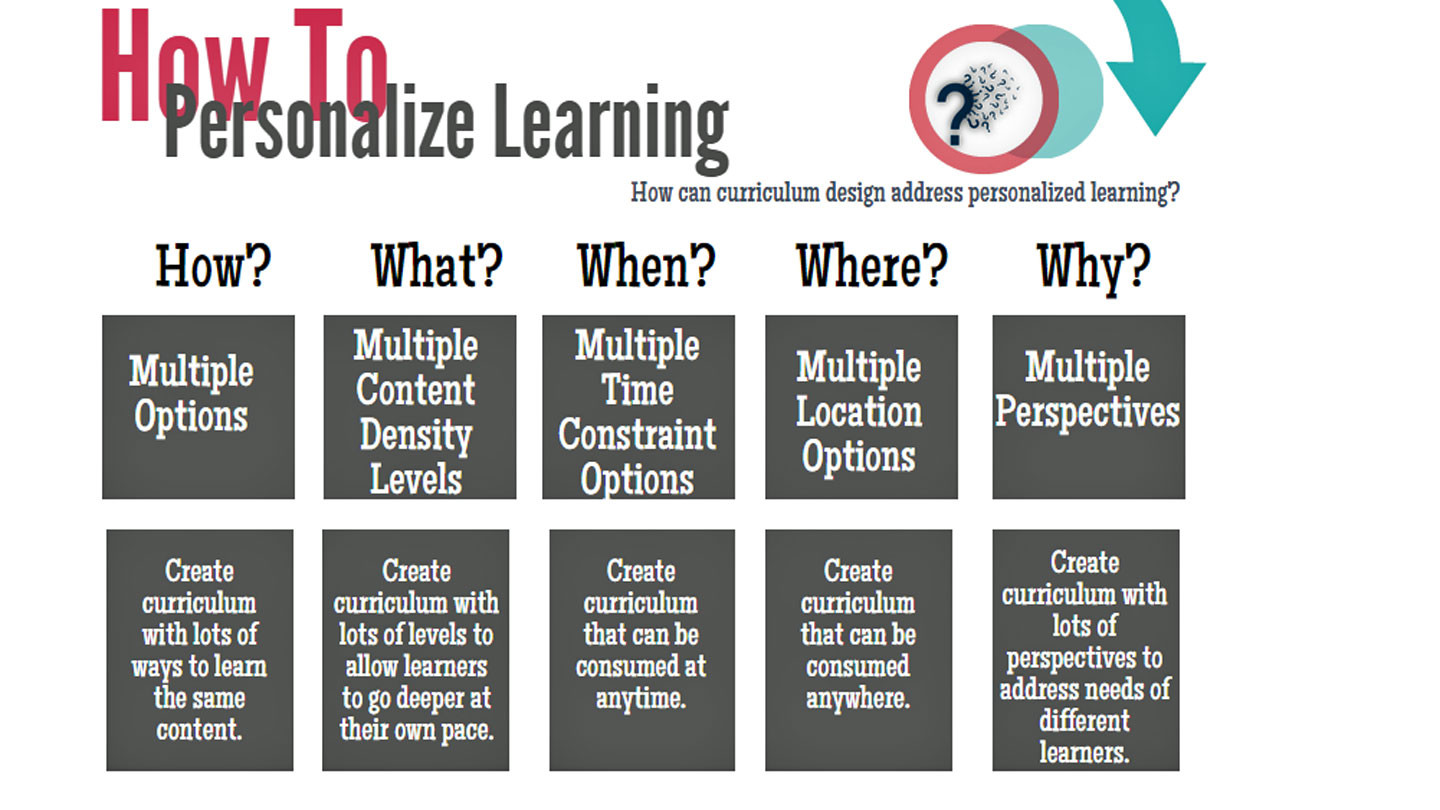
"content": "\u003cp>The phrase \"personalized learning\" gets tossed around a lot in education circles. Sometimes it's used in the context of educational technology tools that offer lessons keyed to the academic level of individual students. Other times it's referring to the personal touch of a teacher getting to know a student, learning about their interests and tailoring lessons to meet both their needs and their passion areas. As with most education jargon, the phrase isn't fixed, but it usually connects to the idea that not all students need the same thing at the same time. It implies choice, multiple pathways to learning, many ways to demonstrate competency and resists the notion that all students learn the same way.\u003c/p>\n\u003cp>Educator \u003ca href=\"https://anethicalisland.wordpress.com/\" target=\"_blank\">Mia MacMeekin\u003c/a> has put together \u003ca href=\"https://anethicalisland.wordpress.com/2014/11/07/personalize-my-learning-please/\" target=\"_blank\">a clear infographic\u003c/a> highlighting some of the ways teachers design \"personalized\" curriculum.\u003c/p>\n\u003cp>\u003ciframe width=\"795\" height=\"2541\" frameborder=\"0\" scrolling=\"no\" src=\"https://magic.piktochart.com/embed/3391583-personalized-learn\"></iframe\u003c/iframe>\u003c/p>\n\u003cp>[ad fullwidth]\u003c/p>\u003cp>\u003c/p>\n",
"disqusIdentifier": "38566 http://blogs.kqed.org/mindshift/?p=38566",
"disqusUrl": "https://ww2.kqed.org/mindshift/2014/11/28/step-by-step-designing-personalized-learning-experiences-for-students/",
"stats": {
"hasVideo": false,
"hasChartOrMap": true,
"hasAudio": false,
"hasPolis": false,
"wordCount": 141,
"hasGoogleForm": false,
"hasGallery": false,
"hasHearkenModule": false,
"iframeSrcs": [
"https://magic.piktochart.com/embed/3391583-personalized-learn"
],
"paragraphCount": 5
},
"modified": 1417188146,
"excerpt": "Each student is unique and learns in different ways. There are many ways to use this diversity as a classroom strength.",
"headData": {
"twImgId": "",
"twTitle": "",
"ogTitle": "",
"ogImgId": "",
"twDescription": "",
"description": "Each student is unique and learns in different ways. There are many ways to use this diversity as a classroom strength.",
"title": "Step by Step: Designing Personalized Learning Experiences For Students | KQED",
"ogDescription": "",
"schema": {
"@context": "https://schema.org",
"@type": "Article",
"headline": "Step by Step: Designing Personalized Learning Experiences For Students",
"datePublished": "2014-11-28T07:18:57-08:00",
"dateModified": "2014-11-28T07:22:26-08:00",
"image": "https://cdn.kqed.org/wp-content/uploads/2020/02/KQED-OG-Image@1x.png"
}
},
"guestAuthors": [],
"slug": "step-by-step-designing-personalized-learning-experiences-for-students",
"status": "publish",
"path": "/mindshift/38566/step-by-step-designing-personalized-learning-experiences-for-students",
"audioTrackLength": null,
"parsedContent": [
{
"type": "contentString",
"content": "\u003cdiv class=\"post-body\">\u003cp>\u003cp>The phrase \"personalized learning\" gets tossed around a lot in education circles. Sometimes it's used in the context of educational technology tools that offer lessons keyed to the academic level of individual students. Other times it's referring to the personal touch of a teacher getting to know a student, learning about their interests and tailoring lessons to meet both their needs and their passion areas. As with most education jargon, the phrase isn't fixed, but it usually connects to the idea that not all students need the same thing at the same time. It implies choice, multiple pathways to learning, many ways to demonstrate competency and resists the notion that all students learn the same way.\u003c/p>\n\u003cp>Educator \u003ca href=\"https://anethicalisland.wordpress.com/\" target=\"_blank\">Mia MacMeekin\u003c/a> has put together \u003ca href=\"https://anethicalisland.wordpress.com/2014/11/07/personalize-my-learning-please/\" target=\"_blank\">a clear infographic\u003c/a> highlighting some of the ways teachers design \"personalized\" curriculum.\u003c/p>\n\u003cp>\u003ciframe width=\"795\" height=\"2541\" frameborder=\"0\" scrolling=\"no\" src=\"https://magic.piktochart.com/embed/3391583-personalized-learn\"></iframe\u003c/iframe>\u003c/p>\n\u003cp>\u003c/p>\u003c/div>",
"attributes": {
"named": {},
"numeric": []
}
},
{
"type": "component",
"content": "",
"name": "ad",
"attributes": {
"named": {
"label": "fullwidth"
},
"numeric": [
"fullwidth"
]
}
},
{
"type": "contentString",
"content": "\u003cdiv class=\"post-body\">\u003cp>\u003c/p>\u003cp>\u003c/p>\n\u003c/div>\u003c/p>",
"attributes": {
"named": {},
"numeric": []
}
}
],
"link": "/mindshift/38566/step-by-step-designing-personalized-learning-experiences-for-students",
"authors": [
"234"
],
"categories": [
"mindshift_193"
],
"tags": [
"mindshift_20784",
"mindshift_1040",
"mindshift_20532",
"mindshift_421"
],
"featImg": "mindshift_38568",
"label": "mindshift"
},
"mindshift_36063": {
"type": "posts",
"id": "mindshift_36063",
"meta": {
"index": "posts_1716263798",
"site": "mindshift",
"id": "36063",
"score": null,
"sort": [
1401830873000
]
},
"parent": 0,
"labelTerm": {
"site": "mindshift"
},
"blocks": [],
"publishDate": 1401830873,
"format": "aside",
"disqusTitle": "What Can Educators Learn From the One Room Schoolhouse Model?",
"title": "What Can Educators Learn From the One Room Schoolhouse Model?",
"headTitle": "MindShift | KQED News",
"content": "\u003cp>Believe it or not, one room schoolhouses like the one in \u003cem>Little House on the Prairie\u003c/em> still exist. While most public school students don't have one adult serving as their teacher, principal and guidance counselor all at once, the model allows for a style of teaching that could benefit teachers everywhere. Each student gets his or her own learning plan, works collaboratively with children of different ages, is encouraged to be an individual learner and gets the support he or she needs at the right moment. In his \u003ca href=\"http://www.cbsnews.com/news/lessons-to-be-learned-from-a-one-room-schoolhouse/\" target=\"_blank\">CBS segment, Barry Peterson reports\u003c/a> that parents appreciate that their children can progress academically at whatever pace suits them, without worrying if he or she is mature enough for a higher grade.\u003c/p>\n\u003cp>One mom, Cynthia Trygier, said the one room schoolhouse was a great fit for her son Thomas: \"Kindergarten, he was already moved up into first grade reading and math, and it was a smooth transition,\" she said. \"I don't want him to grow up too fast; I want him to enjoy his childhood. And in this school, he is still a first grader, but he's doing second and third grade work in reading and math.\"\u003c/p>\n\u003cp>http://www.cbsnews.com/news/lessons-to-be-learned-from-a-one-room-schoolhouse/\u003c/p>\n\u003cp>[ad fullwidth]\u003c/p>\u003cp>\u003c/p>\n",
"disqusIdentifier": "36063 http://blogs.kqed.org/mindshift/?p=36063",
"disqusUrl": "https://ww2.kqed.org/mindshift/2014/06/03/what-can-educators-learn-from-the-one-room-schoolhouse-model/",
"stats": {
"hasVideo": false,
"hasChartOrMap": false,
"hasAudio": false,
"hasPolis": false,
"wordCount": 214,
"hasGoogleForm": false,
"hasGallery": false,
"hasHearkenModule": false,
"iframeSrcs": [],
"paragraphCount": 4
},
"modified": 1456275663,
"excerpt": "The old one room schoolhouse model offers good lessons on valuing each learner and true personalization.",
"headData": {
"twImgId": "",
"twTitle": "",
"ogTitle": "",
"ogImgId": "",
"twDescription": "",
"description": "The old one room schoolhouse model offers good lessons on valuing each learner and true personalization.",
"title": "What Can Educators Learn From the One Room Schoolhouse Model? | KQED",
"ogDescription": "",
"schema": {
"@context": "https://schema.org",
"@type": "Article",
"headline": "What Can Educators Learn From the One Room Schoolhouse Model?",
"datePublished": "2014-06-03T14:27:53-07:00",
"dateModified": "2016-02-23T17:01:03-08:00",
"image": "https://cdn.kqed.org/wp-content/uploads/2020/02/KQED-OG-Image@1x.png"
}
},
"guestAuthors": [],
"slug": "what-can-educators-learn-from-the-one-room-schoolhouse-model",
"status": "publish",
"path": "/mindshift/36063/what-can-educators-learn-from-the-one-room-schoolhouse-model",
"audioTrackLength": null,
"parsedContent": [
{
"type": "contentString",
"content": "\u003cdiv class=\"post-body\">\u003cp>\u003cp>Believe it or not, one room schoolhouses like the one in \u003cem>Little House on the Prairie\u003c/em> still exist. While most public school students don't have one adult serving as their teacher, principal and guidance counselor all at once, the model allows for a style of teaching that could benefit teachers everywhere. Each student gets his or her own learning plan, works collaboratively with children of different ages, is encouraged to be an individual learner and gets the support he or she needs at the right moment. In his \u003ca href=\"http://www.cbsnews.com/news/lessons-to-be-learned-from-a-one-room-schoolhouse/\" target=\"_blank\">CBS segment, Barry Peterson reports\u003c/a> that parents appreciate that their children can progress academically at whatever pace suits them, without worrying if he or she is mature enough for a higher grade.\u003c/p>\n\u003cp>One mom, Cynthia Trygier, said the one room schoolhouse was a great fit for her son Thomas: \"Kindergarten, he was already moved up into first grade reading and math, and it was a smooth transition,\" she said. \"I don't want him to grow up too fast; I want him to enjoy his childhood. And in this school, he is still a first grader, but he's doing second and third grade work in reading and math.\"\u003c/p>\n\u003cp>http://www.cbsnews.com/news/lessons-to-be-learned-from-a-one-room-schoolhouse/\u003c/p>\n\u003cp>\u003c/p>\u003c/div>",
"attributes": {
"named": {},
"numeric": []
}
},
{
"type": "component",
"content": "",
"name": "ad",
"attributes": {
"named": {
"label": "fullwidth"
},
"numeric": [
"fullwidth"
]
}
},
{
"type": "contentString",
"content": "\u003cdiv class=\"post-body\">\u003cp>\u003c/p>\u003cp>\u003c/p>\n\u003c/div>\u003c/p>",
"attributes": {
"named": {},
"numeric": []
}
}
],
"link": "/mindshift/36063/what-can-educators-learn-from-the-one-room-schoolhouse-model",
"authors": [
"4354"
],
"categories": [
"mindshift_193"
],
"tags": [
"mindshift_421"
],
"featImg": "mindshift_36068",
"label": "mindshift"
},
"mindshift_31165": {
"type": "posts",
"id": "mindshift_31165",
"meta": {
"index": "posts_1716263798",
"site": "mindshift",
"id": "31165",
"score": null,
"sort": [
1378399460000
]
},
"parent": 0,
"labelTerm": {
"site": "mindshift"
},
"blocks": [],
"publishDate": 1378399460,
"format": "aside",
"disqusTitle": "Can Technology Help Students Find the \"Sweet Spot\" for Learning?",
"title": "Can Technology Help Students Find the \"Sweet Spot\" for Learning?",
"headTitle": "MindShift | KQED News",
"content": "\u003cp>\u003cimg class=\"alignright size-large wp-image-31176\" src=\"http://ww2.kqed.org/mindshift/wp-content/uploads/sites/23/2013/09/1470057351-640x358.jpg\" alt=\"147005735\" width=\"640\" height=\"358\">\u003c/p>\n\u003cp>\u003ca href=\"http://americanradioworks.publicradio.org/features/personalized-learning/\">\u003cstrong>By Emily Hanford and Stephen Smith, American RadioWorks\u003c/strong>\u003c/a>\u003c/p>\n\u003cp class=\"dropcap-serif\">Cognitive scientist Daniel Willingham wrote a book called \u003cem>Why Don't Students Like School?\u003c/em> The book is complex and fascinating - and 228 pages - but you can basically boil the answer down to this: Students don't like school because school isn't set up to help them learn very well.\u003c/p>\n\u003cp>The first thing to know is that everyone likes to learn.\u003c/p>\n\u003cp>\"There is a sense of satisfaction, of fulfillment, in successful thinking,\" writes Willingham.\u003c/p>\n\u003cp>[ad fullwidth]\u003c/p>\n\u003cp>But it's not fun to try to learn something that's too hard.\u003c/p>\n\u003cp>\"Working on a problem with no sense that you're making progress is not pleasurable,\" writes Willingham. \"In fact, it's frustrating.\"\u003c/p>\n\u003cp>Working on a problem that's too easy is no fun either. It's boring.\u003c/p>\n\u003cp>What people enjoy is working on problems that are the right level of difficulty.\u003c/p>\n\u003cp>\"The problem must be easy enough to be solved yet difficult enough to take some mental effort,\" Willingham writes. He calls this the \"sweet spot\" of difficulty.\u003c/p>\n\u003cp>The problem with most schools is that kids don't get to their sweet spot enough. There are 20 other kids in the class - or maybe 30 or even 40. Everyone is in a slightly different place. Some kids get it and want to move ahead. Others are struggling to catch up and need more explanation. It's a challenge for teachers. The best teachers try to meet each student's needs. But a lot of teachers end up teaching to the middle. That leaves a lot of kids bored, or frustrated, or both.\u003c/p>\n\u003cp>\"I think teachers are acutely aware that this is an enormous problem,\" Willingham said in an interview. \"I don't think it's easily solved.\"\u003c/p>\n\u003caside class=\"pullquote alignleft\">\"The technological solutions are more difficult to implement than would appear at first blush. The software has got to be really good in order to reap this advantage that it can adjust to a student's individual pace of learning.\"\u003c/aside>\n\u003cp>You can trace the roots of the problem back to the Industrial Revolution. That's when American public schools as we know them today got started.\u003c/p>\n\u003cp>Prior to the rise of factories and cities, most people lived on farms and in small villages. Children were typically educated in one-room schoolhouses. \"In such environments, education could be individualized,\" says Angeline Lillard, a professor at the University of Virginia who has written about the history of education.\u003c/p>\n\u003cp>Not everything was perfect in the one-room school. But if you were 10 and needed to learn addition, that's what the teacher taught you. If you were 5 and already knew how to write your name, you'd move on with the older kids.\u003c/p>\n\u003cp>Then in 1847 in Quincy, Massachusetts a new kind of school appeared on the scene. Instead of being together in one room, students were separated into classrooms based on how old they were. It was seen as a more efficient way to educate children.\u003c/p>\n\u003cp>\"The whole country was so taken by this idea that we could improve through industrialization,\" says Lillard. \"Mass production was going to be the wings through which we could fly into the future. And schools were no different.\"\u003c/p>\n\u003cp>By the early 20th century, some education experts were actually referring to schools as factories. Elwood Cubberley, dean of Stanford University's School of Education from 1917 to 1933, put it bluntly: Schools were \"factories in which the raw products (children) are to be shaped and fashioned into products to meet the various demands of life.\"\u003c/p>\n\u003cp>\"What we lost from the one-room schoolhouse days was individualization,\" says Lillard. \"We replaced that with an expectation that all children be the same.\"\u003c/p>\n\u003cp>Today it's a big challenge to deal with the 10-year-olds who haven't learned addition; they're supposed to be doing fifth-grade math. There's not a good way to deal with the 5-year-olds who are ready to move ahead either.\u003c/p>\n\u003cp>The problem of how to meet students' individual needs is at the heart of today's education debates: the achievement gap, tracking, social promotion. These are among the thorniest and most important issues facing American schools, and they all have something to do with the fact that we expect students of a certain age to be in a certain place with their learning, rather than working with each child individually based on their unique learning needs.\u003c/p>\n\u003cp>\"All students are supposed to accomplish exactly the same goals under exactly the same circumstances by exactly the same date and demonstrate their learning in exactly the same way,\" says Carol Ann Tomlinson, sounding a bit exasperated.\u003c/p>\n\u003cp>Tomlinson is an expert on a teaching technique called \"differentiated instruction.\" It's a response to the challenge of working with a classroom full of kids who have different abilities and interests. Rather than teaching to the middle, the teacher offers a variety of lessons or assignments so that the students who are ahead get more challenging work and students who are behind get more practice on basic concepts.\u003c/p>\n\u003cp>Tomlinson's research shows differentiated instruction can be done. But even she admits it's not easy. It takes talented teachers and good training.\u003c/p>\n\u003cp>Keona Walker says she learned all about differentiated instruction during her teacher training. When asked how she pulled it off in the classroom, she laughs. She says differentiated instruction is \"possible, yes. Realistic? No.\"\u003c/p>\n\u003cfigure id=\"attachment_31175\" class=\"wp-caption alignright\" style=\"max-width: 300px\">\u003cimg class=\"size-medium wp-image-31175\" src=\"http://ww2.kqed.org/mindshift/wp-content/uploads/sites/23/2013/09/mooresville04-300x201.jpg\" alt=\"mooresville04\" width=\"300\" height=\"201\">\u003cfigcaption class=\"wp-caption-text\"> \u003c/figcaption>\u003c/figure>\n\u003cp>Walker was an English teacher at a high school in Indianapolis, Indiana. In any given class she would have some students who were ready for college-level work and others who couldn't \"tell you what the verb of a sentence was.\" She felt constantly frustrated and unable to meet everyone's needs.\u003c/p>\n\u003cp>Then she heard about a new school with a different approach to learning. The school is called Carpe Diem-Meridian. It's a public charter school that opened in Indianapolis in August 2012. Students spend part of the day in traditional classes, and part of the day learning on computer. There's an online curriculum; students move through each course at their own pace. When they demonstrate they've mastered the material, they move on to the next level.\u003c/p>\n\u003cp>Walker is the English teacher at Carpe Diem. She says because students spend part of their day learning on computer, she has more time to work with students individually. And she thinks when students work on their own at their own pace they actually have a better understanding of what they need help with. \"These are the things I've mastered. I don't need help with that,\" they'll say to her. \"These are the things that I can read and understand on my own. [And] these are the things that I really need help with.\" That's what she focuses on with them. She says it's a more efficient way to teach -- and to learn.\u003c/p>\n\u003cp>Cognitive scientist Daniel Willingham is not familiar enough with Carpe Diem to comment specifically on the school's model. But he says technology is a possible solution to the \"sweet spot\" problem. He says learning on computers does not necessarily result in better learning, though.\u003c/p>\n\u003cp>\"The technological solutions are more difficult to implement than would appear at first blush,\" he says. Teachers need lots of training. And he adds: \"The software has got to be really good.\"\u003c/p>\n\u003cp>The software is getting better. So-called \u003ca href=\"http://edgrowthadvisors.com/wp-content/uploads/2013/04/Learning-to-Adapt_Report_Supplier-Landscape_Education-Growth-Advisors_April-2013.pdf\">\"adaptive learning\" programs\u003c/a>, which have been around for more than a decade, are designed to adjust to an individual's needs. A student answers questions or solves problems and the software adapts the level of difficulty depending on how the student is performing. Dozens of companies have developed this kind of software. The software varies in quality. Research suggests some adaptive learning programs do help students learn better, but \u003ca href=\"http://ies.ed.gov/ncee/wwc/\">the research\u003c/a> is sparse and overall the results are mixed.\u003c/p>\n\u003cp>Willingham says technology may be a solution to the \"sweet spot\" problem for some students and some schools. When asked if he would send his own children to a school that uses computers to help teachers individualize instruction for students he says: \"The answer would depend a lot on how old my child is.\" He's not sure putting young children on computers for large or even small parts of the school day is a good idea. He says his own kids, who are 6 and 8, don't use computers at all -- at school or at home. He doesn't see any reason his children need to use computers yet.\u003c/p>\n\u003cp>That's a personal choice, he says, not based on evidence that there's something categorically wrong with young children using technology.\u003c/p>\n\u003cp>Willingham does note, however, that research shows the emotional connection between a student and a teacher is enormously important when it comes to how much a student learns. He doesn't think students of any age should spend all of their time learning on a computer. The balance between time spent with computers and time spent with other human beings is important for schools to consider as they think about bringing technology into classrooms. Willingham says this may be the most important question -- even more important than how good the software is. Technology is only as good as the way it gets used.\u003c/p>\n\u003cp>Willingham says in a few years, when his children are in middle school or high school, he might be open to sending them to a school where they would spend part of their day learning on a computer. But he'd have to see the school first and make a decision based on what he thought of the school, and what the other options were for his children's education.\u003c/p>\n\u003cp>\u003cem>This article is part of the \u003ca href=\"http://americanradioworks.publicradio.org/features/personalized-learning/\">One Child At a Time series produced by American RadioWorks\u003c/a>.\u003c/em>\u003c/p>\n\u003cp>[ad floatright]\u003c/p>\n\u003cp>\u003ciframe src=\"https://w.soundcloud.com/player/?url=http%3A%2F%2Fapi.soundcloud.com%2Ftracks%2F108631876\" frameborder=\"no\" scrolling=\"no\" width=\"100%\" height=\"166\">\u003c/iframe>\u003c/p>\n\n",
"disqusIdentifier": "31165 http://blogs.kqed.org/mindshift/?p=31165",
"disqusUrl": "https://ww2.kqed.org/mindshift/2013/09/05/can-technology-help-students-find-the-sweet-spot-for-learning/",
"stats": {
"hasVideo": false,
"hasChartOrMap": true,
"hasAudio": true,
"hasPolis": false,
"wordCount": 1644,
"hasGoogleForm": false,
"hasGallery": false,
"hasHearkenModule": false,
"iframeSrcs": [
"https://w.soundcloud.com/player/"
],
"paragraphCount": 38
},
"modified": 1380161961,
"excerpt": "\"The technological solutions are more difficult to implement than would appear at first blush. The software has got to be really good in order to reap this advantage that it can adjust to a student's individual pace of learning,\" says author Daniel Willingham.",
"headData": {
"twImgId": "",
"twTitle": "",
"ogTitle": "",
"ogImgId": "",
"twDescription": "",
"description": ""The technological solutions are more difficult to implement than would appear at first blush. The software has got to be really good in order to reap this advantage that it can adjust to a student's individual pace of learning," says author Daniel Willingham.",
"title": "Can Technology Help Students Find the \"Sweet Spot\" for Learning? | KQED",
"ogDescription": "",
"schema": {
"@context": "https://schema.org",
"@type": "Article",
"headline": "Can Technology Help Students Find the \"Sweet Spot\" for Learning?",
"datePublished": "2013-09-05T09:44:20-07:00",
"dateModified": "2013-09-25T19:19:21-07:00",
"image": "https://cdn.kqed.org/wp-content/uploads/2020/02/KQED-OG-Image@1x.png"
}
},
"guestAuthors": [],
"slug": "can-technology-help-students-find-the-sweet-spot-for-learning",
"status": "publish",
"path": "/mindshift/31165/can-technology-help-students-find-the-sweet-spot-for-learning",
"audioTrackLength": null,
"parsedContent": [
{
"type": "contentString",
"content": "\u003cdiv class=\"post-body\">\u003cp>\u003cp>\u003cimg class=\"alignright size-large wp-image-31176\" src=\"http://ww2.kqed.org/mindshift/wp-content/uploads/sites/23/2013/09/1470057351-640x358.jpg\" alt=\"147005735\" width=\"640\" height=\"358\">\u003c/p>\n\u003cp>\u003ca href=\"http://americanradioworks.publicradio.org/features/personalized-learning/\">\u003cstrong>By Emily Hanford and Stephen Smith, American RadioWorks\u003c/strong>\u003c/a>\u003c/p>\n\u003cp class=\"dropcap-serif\">Cognitive scientist Daniel Willingham wrote a book called \u003cem>Why Don't Students Like School?\u003c/em> The book is complex and fascinating - and 228 pages - but you can basically boil the answer down to this: Students don't like school because school isn't set up to help them learn very well.\u003c/p>\n\u003cp>The first thing to know is that everyone likes to learn.\u003c/p>\n\u003cp>\"There is a sense of satisfaction, of fulfillment, in successful thinking,\" writes Willingham.\u003c/p>\n\u003cp>\u003c/p>\u003c/div>",
"attributes": {
"named": {},
"numeric": []
}
},
{
"type": "component",
"content": "",
"name": "ad",
"attributes": {
"named": {
"label": "fullwidth"
},
"numeric": [
"fullwidth"
]
}
},
{
"type": "contentString",
"content": "\u003cdiv class=\"post-body\">\u003cp>\u003c/p>\n\u003cp>But it's not fun to try to learn something that's too hard.\u003c/p>\n\u003cp>\"Working on a problem with no sense that you're making progress is not pleasurable,\" writes Willingham. \"In fact, it's frustrating.\"\u003c/p>\n\u003cp>Working on a problem that's too easy is no fun either. It's boring.\u003c/p>\n\u003cp>What people enjoy is working on problems that are the right level of difficulty.\u003c/p>\n\u003cp>\"The problem must be easy enough to be solved yet difficult enough to take some mental effort,\" Willingham writes. He calls this the \"sweet spot\" of difficulty.\u003c/p>\n\u003cp>The problem with most schools is that kids don't get to their sweet spot enough. There are 20 other kids in the class - or maybe 30 or even 40. Everyone is in a slightly different place. Some kids get it and want to move ahead. Others are struggling to catch up and need more explanation. It's a challenge for teachers. The best teachers try to meet each student's needs. But a lot of teachers end up teaching to the middle. That leaves a lot of kids bored, or frustrated, or both.\u003c/p>\n\u003cp>\"I think teachers are acutely aware that this is an enormous problem,\" Willingham said in an interview. \"I don't think it's easily solved.\"\u003c/p>\n\u003caside class=\"pullquote alignleft\">\"The technological solutions are more difficult to implement than would appear at first blush. The software has got to be really good in order to reap this advantage that it can adjust to a student's individual pace of learning.\"\u003c/aside>\n\u003cp>You can trace the roots of the problem back to the Industrial Revolution. That's when American public schools as we know them today got started.\u003c/p>\n\u003cp>Prior to the rise of factories and cities, most people lived on farms and in small villages. Children were typically educated in one-room schoolhouses. \"In such environments, education could be individualized,\" says Angeline Lillard, a professor at the University of Virginia who has written about the history of education.\u003c/p>\n\u003cp>Not everything was perfect in the one-room school. But if you were 10 and needed to learn addition, that's what the teacher taught you. If you were 5 and already knew how to write your name, you'd move on with the older kids.\u003c/p>\n\u003cp>Then in 1847 in Quincy, Massachusetts a new kind of school appeared on the scene. Instead of being together in one room, students were separated into classrooms based on how old they were. It was seen as a more efficient way to educate children.\u003c/p>\n\u003cp>\"The whole country was so taken by this idea that we could improve through industrialization,\" says Lillard. \"Mass production was going to be the wings through which we could fly into the future. And schools were no different.\"\u003c/p>\n\u003cp>By the early 20th century, some education experts were actually referring to schools as factories. Elwood Cubberley, dean of Stanford University's School of Education from 1917 to 1933, put it bluntly: Schools were \"factories in which the raw products (children) are to be shaped and fashioned into products to meet the various demands of life.\"\u003c/p>\n\u003cp>\"What we lost from the one-room schoolhouse days was individualization,\" says Lillard. \"We replaced that with an expectation that all children be the same.\"\u003c/p>\n\u003cp>Today it's a big challenge to deal with the 10-year-olds who haven't learned addition; they're supposed to be doing fifth-grade math. There's not a good way to deal with the 5-year-olds who are ready to move ahead either.\u003c/p>\n\u003cp>The problem of how to meet students' individual needs is at the heart of today's education debates: the achievement gap, tracking, social promotion. These are among the thorniest and most important issues facing American schools, and they all have something to do with the fact that we expect students of a certain age to be in a certain place with their learning, rather than working with each child individually based on their unique learning needs.\u003c/p>\n\u003cp>\"All students are supposed to accomplish exactly the same goals under exactly the same circumstances by exactly the same date and demonstrate their learning in exactly the same way,\" says Carol Ann Tomlinson, sounding a bit exasperated.\u003c/p>\n\u003cp>Tomlinson is an expert on a teaching technique called \"differentiated instruction.\" It's a response to the challenge of working with a classroom full of kids who have different abilities and interests. Rather than teaching to the middle, the teacher offers a variety of lessons or assignments so that the students who are ahead get more challenging work and students who are behind get more practice on basic concepts.\u003c/p>\n\u003cp>Tomlinson's research shows differentiated instruction can be done. But even she admits it's not easy. It takes talented teachers and good training.\u003c/p>\n\u003cp>Keona Walker says she learned all about differentiated instruction during her teacher training. When asked how she pulled it off in the classroom, she laughs. She says differentiated instruction is \"possible, yes. Realistic? No.\"\u003c/p>\n\u003cfigure id=\"attachment_31175\" class=\"wp-caption alignright\" style=\"max-width: 300px\">\u003cimg class=\"size-medium wp-image-31175\" src=\"http://ww2.kqed.org/mindshift/wp-content/uploads/sites/23/2013/09/mooresville04-300x201.jpg\" alt=\"mooresville04\" width=\"300\" height=\"201\">\u003cfigcaption class=\"wp-caption-text\"> \u003c/figcaption>\u003c/figure>\n\u003cp>Walker was an English teacher at a high school in Indianapolis, Indiana. In any given class she would have some students who were ready for college-level work and others who couldn't \"tell you what the verb of a sentence was.\" She felt constantly frustrated and unable to meet everyone's needs.\u003c/p>\n\u003cp>Then she heard about a new school with a different approach to learning. The school is called Carpe Diem-Meridian. It's a public charter school that opened in Indianapolis in August 2012. Students spend part of the day in traditional classes, and part of the day learning on computer. There's an online curriculum; students move through each course at their own pace. When they demonstrate they've mastered the material, they move on to the next level.\u003c/p>\n\u003cp>Walker is the English teacher at Carpe Diem. She says because students spend part of their day learning on computer, she has more time to work with students individually. And she thinks when students work on their own at their own pace they actually have a better understanding of what they need help with. \"These are the things I've mastered. I don't need help with that,\" they'll say to her. \"These are the things that I can read and understand on my own. [And] these are the things that I really need help with.\" That's what she focuses on with them. She says it's a more efficient way to teach -- and to learn.\u003c/p>\n\u003cp>Cognitive scientist Daniel Willingham is not familiar enough with Carpe Diem to comment specifically on the school's model. But he says technology is a possible solution to the \"sweet spot\" problem. He says learning on computers does not necessarily result in better learning, though.\u003c/p>\n\u003cp>\"The technological solutions are more difficult to implement than would appear at first blush,\" he says. Teachers need lots of training. And he adds: \"The software has got to be really good.\"\u003c/p>\n\u003cp>The software is getting better. So-called \u003ca href=\"http://edgrowthadvisors.com/wp-content/uploads/2013/04/Learning-to-Adapt_Report_Supplier-Landscape_Education-Growth-Advisors_April-2013.pdf\">\"adaptive learning\" programs\u003c/a>, which have been around for more than a decade, are designed to adjust to an individual's needs. A student answers questions or solves problems and the software adapts the level of difficulty depending on how the student is performing. Dozens of companies have developed this kind of software. The software varies in quality. Research suggests some adaptive learning programs do help students learn better, but \u003ca href=\"http://ies.ed.gov/ncee/wwc/\">the research\u003c/a> is sparse and overall the results are mixed.\u003c/p>\n\u003cp>Willingham says technology may be a solution to the \"sweet spot\" problem for some students and some schools. When asked if he would send his own children to a school that uses computers to help teachers individualize instruction for students he says: \"The answer would depend a lot on how old my child is.\" He's not sure putting young children on computers for large or even small parts of the school day is a good idea. He says his own kids, who are 6 and 8, don't use computers at all -- at school or at home. He doesn't see any reason his children need to use computers yet.\u003c/p>\n\u003cp>That's a personal choice, he says, not based on evidence that there's something categorically wrong with young children using technology.\u003c/p>\n\u003cp>Willingham does note, however, that research shows the emotional connection between a student and a teacher is enormously important when it comes to how much a student learns. He doesn't think students of any age should spend all of their time learning on a computer. The balance between time spent with computers and time spent with other human beings is important for schools to consider as they think about bringing technology into classrooms. Willingham says this may be the most important question -- even more important than how good the software is. Technology is only as good as the way it gets used.\u003c/p>\n\u003cp>Willingham says in a few years, when his children are in middle school or high school, he might be open to sending them to a school where they would spend part of their day learning on a computer. But he'd have to see the school first and make a decision based on what he thought of the school, and what the other options were for his children's education.\u003c/p>\n\u003cp>\u003cem>This article is part of the \u003ca href=\"http://americanradioworks.publicradio.org/features/personalized-learning/\">One Child At a Time series produced by American RadioWorks\u003c/a>.\u003c/em>\u003c/p>\n\u003cp>\u003c/p>\u003c/div>",
"attributes": {
"named": {},
"numeric": []
}
},
{
"type": "component",
"content": "",
"name": "ad",
"attributes": {
"named": {
"label": "floatright"
},
"numeric": [
"floatright"
]
}
},
{
"type": "contentString",
"content": "\u003cdiv class=\"post-body\">\u003cp>\u003c/p>\n\u003cp>\u003ciframe src=\"https://w.soundcloud.com/player/?url=http%3A%2F%2Fapi.soundcloud.com%2Ftracks%2F108631876\" frameborder=\"no\" scrolling=\"no\" width=\"100%\" height=\"166\">\u003c/iframe>\u003c/p>\n\n\u003c/div>\u003c/p>",
"attributes": {
"named": {},
"numeric": []
}
}
],
"link": "/mindshift/31165/can-technology-help-students-find-the-sweet-spot-for-learning",
"authors": [
"180"
],
"categories": [
"mindshift_195"
],
"tags": [
"mindshift_20552",
"mindshift_1040",
"mindshift_421"
],
"featImg": "mindshift_31176",
"label": "mindshift"
},
"mindshift_28475": {
"type": "posts",
"id": "mindshift_28475",
"meta": {
"index": "posts_1716263798",
"site": "mindshift",
"id": "28475",
"score": null,
"sort": [
1368712819000
]
},
"parent": 0,
"labelTerm": {
"site": "mindshift",
"term": 20656
},
"blocks": [],
"publishDate": 1368712819,
"format": "aside",
"disqusTitle": "What It Takes to Become an All Project-Based School",
"title": "What It Takes to Become an All Project-Based School",
"headTitle": "PROJECT BASED LEARNING | MindShift | KQED News",
"content": "\u003cfigure id=\"attachment_28477\" class=\"wp-caption center\" style=\"max-width: 620px\">\u003cimg class=\"size-large wp-image-28477\" title=\"\" src=\"http://ww2.kqed.org/mindshift/wp-content/uploads/sites/23/2013/04/New-Tech-students-620x368.jpg\" alt=\"New-Tech-students\" width=\"620\" height=\"368\">\u003cfigcaption class=\"wp-caption-text\"> \u003c/figcaption>\u003c/figure>\n\u003cp class=\"dropcap-serif\">In many schools, project-based learning happens in isolated cases: in certain teachers' classrooms here and there, or in the contexts of specific subjects. But for students to benefit from project-based learning, ideally it's part of a school's infrastructure -- a way to approach learning holistically.\u003c/p>\n\u003cp>For one quickly growing network of schools, project-based learning is the crux of the entire ecosystem. \u003ca href=\"http://www.newtechnetwork.org/\">New Tech Network,\u003c/a> which was founded 15 years ago, is taking its school-wide project-based model to national scale. The organization, which offers a paid program for schools to use its model, began with a \u003ca href=\"http://ww2.kqed.org/mindshift/2011/01/napa-new-tech-school-of-the-future-is-here/\">flagship school in Napa\u003c/a> and has grown to 120 schools in 18 states, most of which are public schools.\u003c/p>\n\u003cp>The network has not only grown in size, but also in notoriety. President Obama visited \u003ca href=\"http://www.csmonitor.com/USA/Education/2013/0509/In-Texas-Obama-lauds-New-Tech-high-school.-Model-for-the-future-video\">Manor New Tech High School\u003c/a> in Texas last week, as part of an effort to promote an education agenda focused on producing graduates that can compete in today's global economy.\u003c/p>\n\u003cp>The nod from the president comes at a time when New Tech is attempting to position itself as a successful model to follow. But rather than relying on test scores and such quantifiable numbers to prove its value, New Tech's own \u003ca href=\"http://www.newtechnetwork.org/sites/default/files/news/2013_annual_data_v14-01.pdf\">2013 annual report \u003c/a>frames success by focusing on deeper learning that can't be measured by standardized test scores and their college readiness. Yet it's that lack of emphasis on test scores, an all-consuming worry for many districts, that makes it more difficult for the organization to pin point numbers to tell its story.\u003c/p>\n\u003caside class=\"pullquote alignleft\">\u003cstrong>“From where we stand, public school districts are as capable of innovative schools as charter schools.”\u003c/strong>\u003c/aside>\n\u003cp>Here are a few of the\u003ca href=\"http://www.newtechnetwork.org/sites/default/files/ntn_overview1.pdf\"> statistics\u003c/a> New Tech has gathered from their schools: students graduate at a rate six percent higher than the national average and enroll in college nine percent more than the average. They also persist in four-year universities at a 17 percent higher rate and 46 percent higher rate when it comes to two year colleges. Perhaps most importantly, they claim that \u003c!--more-->students’ higher order thinking skills between freshmen and senior years grow 75 percent more than a comparison group that did not attend a New Tech high school.\u003c/p>\n\u003cp>[ad fullwidth]\u003c/p>\n\u003cp>New Tech calls itself a school development organization and is a non-profit subsidiary of \u003ca href=\"http://knowledgeworks.org/\">KnowledgeWorks\u003c/a>, another non-profit that acts as a foundation, education policy advocate and on-the-ground work through mergers with groups like New Tech, \u003ca href=\"http://strivenetwork.org/\">Strive\u003c/a> and \u003ca href=\"http://www.edworkspartners.org/\">EdWorks\u003c/a>.\u003c/p>\n\u003cp>\u003cstrong>GRAPPLING WITH THE PUBLIC SCHOOL SYSTEM\u003c/strong>\u003c/p>\n\u003cp>New Tech offers whole-school change to any school interested in contracting with them, including public schools. It has implemented the model in charter and private schools as well, but the majority of its clients are public schools. “From where we stand, public school districts are as capable of innovative schools as charter schools,” said Lydia Dobyns, president of New Tech Network. But as everyone in education knows, every school and every district has different needs, and the organization's offerings are changed accordingly.\u003c/p>\n\u003cp>New Tech schools are entirely\u003ca href=\"http://ww2.kqed.org/mindshift/2013/01/what-project-based-learning-is-and-isnt/\"> project-based\u003c/a> and cross-disciplinary. Students take courses like Bio-literacy, which mesh subjects together, emphasizing that disciplines are not stand-alone endeavors. Technology is woven throughout the school day and at home seamlessly. Many New Tech schools have one-to-one programs and all schools in the network use a learning management system called Echo that tracks student progress, is open to teachers and students, and connects New Tech educators around the country.\u003c/p>\n\u003cfigure id=\"attachment_28483\" class=\"wp-caption left\" style=\"max-width: 300px\">\u003cimg class=\"size-medium wp-image-28483\" title=\"\" src=\"http://ww2.kqed.org/mindshift/wp-content/uploads/sites/23/2013/04/New-Tech-measuring-300x438.jpg\" alt=\"New-Tech-measuring\" width=\"300\" height=\"438\">\u003cfigcaption class=\"wp-caption-text\"> \u003c/figcaption>\u003c/figure>\n\u003cp>Assessments are designed to measure different kinds of learning outcomes. Mike Reed, principal of \u003ca href=\"http://www.bcsc.k12.in.us/Page/8148\">Columbus Signature Academy\u003c/a> in Indiana, said that only 60 percent of assessment is based on content. The other 40 percent is based on what he called “school-wide learning outcomes,” things like written and oral proficiency, work ethic, presentation skills and the ability to give and take feedback. Students can see the project rubric and know where they need to improve their skills.\u003c/p>\n\u003cp>“Looking at school performance is really different from looking at student growth, which is really what we want to focus on,” Dobyns said. That’s why New Tech doesn’t promise to increase school test scores – it sees that as a separate question, and one that they're not necessarily interested in.\u003c/p>\n\u003cp>The schools that have taken on this model don’t seem to mind that test scores aren’t the focus. “A big difference you’d see is student engagement,” Reed said. “Students are working on authentic projects and problems.” He gave an example of a cross curricular physics and environmental science class that studied the physics of power and electricity. “Our students learned those skills and then rewired houses that were destroyed in New Orleans’ 9th Ward. They’re going to remember that far longer than regurgitating a test or a lab.”\u003c/p>\n\u003cp>\u003cstrong>PROFESSIONAL DEVELOPMENT\u003c/strong>\u003c/p>\n\u003cp>New Tech works with schools individually, offering professional development as the school gets started. “One of the things we’ve learned and changed is that every implementation is now a custom designed implementation plan,” Dobyns said.\u003c/p>\n\u003cp>New Tech sticks with a school for five years, spending the first year laying ground work, listening to what schools want and need and garnering teacher buy-in. They offer intensive trainings to help teachers retool skills to teach entirely-project based and cross-curricular classes. Each school is given a coach who visits throughout the school year, checks on lesson plans, suggests changes and helps troubleshoot problems. And New Tech focuses on nurturing the leadership capacity of principals so they can continue to innovate with teachers.\u003c/p>\n\u003cp style=\"text-align: center\">\u003cstrong>[RELATED READING: \u003ca href=\"http://ww2.kqed.org/mindshift/2013/02/are-teachers-of-tomorrow-prepared-to-use-innovative-tech/\">Are Teachers of Tomorrow Prepared to Use Innovative Tech?\u003c/a>]\u003c/strong>\u003c/p>\n\u003cp>At Columbus Signature Academy, Reed and his staff discussed the professional culture they wanted to promote and decided they’d make decisions by consensus. “That changes everything in a school,” Reed said. Those affected by a decision get equal say in making it, and that includes students. For example, teachers are in charge of the master schedule because it affects them most, but students can weigh in about how changes affect them too.\u003c/p>\n\u003cp>If gaining consensus is important in New Tech Schools, so is transparency. Teachers share and vet lessons with colleagues at the beginning and end of every project to learn from successes and mistakes. Teachers aren’t penalized if something they try doesn’t work out. They share their successes, experiments, and failures and everyone learns from the experience. That’s the kind of collaborative learning schools expect from students and Dobyns thinks it’s important that teachers experience and practice it too.\u003c/p>\n\u003cp>\u003cstrong>TRANSITION CHALLENGES\u003c/strong>\u003c/p>\n\u003cp>Opening or converting to a New Tech school can mean some growing pains.\u003c/p>\n\u003cp>“It’s almost a month of de-programming,” said Randy Hollenkamp, director of \u003ca href=\"http://www.bulldogtech.org/\">Bulldog Tech\u003c/a> in San Jose, one of the few middle schools New Tech has begun to pilot. When kids enter his seventh grade they are so used to the traditional school system, they don’t know how to work collaboratively on projects. “At first their grades go down just because it’s projects. It’s actually kind of harder because you have to be a self-learner.” In traditional schools, kids are constantly being directed, so they don’t have to think for themselves as much, Hollenkamp said.\u003c/p>\n\u003cp>“Every year, as you grow into it, it’s difficult for the group of students who aren’t a part of New Tech,” said Jason Witzigreuter, principal of \u003ca href=\"http://www.accs.k12.in.us/jets/\">Adams Central\u003c/a> in Monroe, Indiana. Adams Central is a unique school in the New Tech Network because it is a K-12 school under one roof, but only the high school uses New Tech’s model. Witzigreuter calls his school a hybrid model and a learning experience. The school is three years into the experiment, which means the seniors are the only class without their own laptops and without some of the communication and presentation skills that the freshmen quickly pick up.\u003c/p>\n\u003cp>“Our kids at a lower grade are able to understand how to collaborate better and use those soft skills, or 21st century skills, better because they’ve been taught that through New Tech,” Witzigreuter said. He tries to use the younger students’ success to encourage seniors into demonstrating the same kinds of higher order thinking and maturity.\u003c/p>\n\u003cp style=\"text-align: center\">\u003cstrong>[RELATED READING: \u003ca href=\"http://ww2.kqed.org/mindshift/2013/01/how-can-teachers-prepare-kids-for-a-connected-world/\">How Can Teachers Prepare Kids for a Connected World?\u003c/a>]\u003c/strong>\u003c/p>\n\u003cp>From New Tech’s perspective, one of the hardest things about working on a five-year timeline can be school leadership changes. And, like any part of the public school system, funding cuts can affect whether a district is able to continue to pay for the program.\u003c/p>\n\u003cp>\u003cstrong>COSTS\u003c/strong>\u003c/p>\n\u003cp>New Tech’s model is not cheap. It costs about $100,000-$120,000 per year for each school. That hefty fee includes support, training, professional development, and access to the knowledge and experience of all the other schools in the network. Still, to pay for it, districts have done everything from pass school bonds, apply for state innovation grants, apply for private foundation grants and beg districts for the money. In addition to New Tech’s service fees, schools have to pay for the technology that accompanies the program and often facility redesign to foster more collaborative “studio” spaces.\u003c/p>\n\u003cp>Though it's a big price tag, the principals interviewed at three New Tech schools thought the money was well spent. \u003ca href=\"http://www.successforall.org/\">Success For All\u003c/a> is another school development program that uses a “whole school” model at the elementary school level. They estimate that for 500 students, their program costs $120,000 in the first year and decreases to $50,000 in the second year, finally reaching $30,000 in the third year. High schools programs generally cost more than elementary programs, though.\u003c/p>\n\u003cp>\u003cstrong>NEW DIRECTIONS\u003c/strong>\u003c/p>\n\u003cp>[ad floatright]\u003c/p>\n\u003cp>New Tech has proven that its model is scalable, in part with extra cash from its parent company KnowledgeWorks. Now they're trying to see if it can work beyond high school. In the past year New Tech has opened 10 middle schools in various states and is dipping into the elementary school scene as well. They’re also trying to find ways for districts to expand the model to other schools nearby on their own. “The first New Tech School can be an anchor in their district and then the strategies can spread across the schools,” Dobyns said. Leaders and teachers at the anchor school could act as trainers and coaches to others, lowering the cost of transitioning future schools.\u003c/p>\n\n",
"disqusIdentifier": "28475 http://blogs.kqed.org/mindshift/?p=28475",
"disqusUrl": "https://ww2.kqed.org/mindshift/2013/05/16/what-it-takes-to-become-a-project-based-school/",
"stats": {
"hasVideo": false,
"hasChartOrMap": false,
"hasAudio": false,
"hasPolis": false,
"wordCount": 1810,
"hasGoogleForm": false,
"hasGallery": false,
"hasHearkenModule": false,
"iframeSrcs": [],
"paragraphCount": 29
},
"modified": 1369352668,
"excerpt": "New Tech Network, which was founded 15 years ago, is taking its school-wide project-based model to national scale. The organization, which offers a paid program for schools to use its model, began with a flagship school in Napa and has grown to 120 schools in 18 states, most of which are public schools.",
"headData": {
"twImgId": "",
"twTitle": "",
"ogTitle": "",
"ogImgId": "",
"twDescription": "",
"description": "New Tech Network, which was founded 15 years ago, is taking its school-wide project-based model to national scale. The organization, which offers a paid program for schools to use its model, began with a flagship school in Napa and has grown to 120 schools in 18 states, most of which are public schools.",
"title": "What It Takes to Become an All Project-Based School | KQED",
"ogDescription": "",
"schema": {
"@context": "https://schema.org",
"@type": "Article",
"headline": "What It Takes to Become an All Project-Based School",
"datePublished": "2013-05-16T07:00:19-07:00",
"dateModified": "2013-05-23T16:44:28-07:00",
"image": "https://cdn.kqed.org/wp-content/uploads/2020/02/KQED-OG-Image@1x.png"
}
},
"guestAuthors": [],
"slug": "what-it-takes-to-become-a-project-based-school",
"status": "publish",
"path": "/mindshift/28475/what-it-takes-to-become-a-project-based-school",
"audioTrackLength": null,
"parsedContent": [
{
"type": "contentString",
"content": "\u003cdiv class=\"post-body\">\u003cp>\u003cfigure id=\"attachment_28477\" class=\"wp-caption center\" style=\"max-width: 620px\">\u003cimg class=\"size-large wp-image-28477\" title=\"\" src=\"http://ww2.kqed.org/mindshift/wp-content/uploads/sites/23/2013/04/New-Tech-students-620x368.jpg\" alt=\"New-Tech-students\" width=\"620\" height=\"368\">\u003cfigcaption class=\"wp-caption-text\"> \u003c/figcaption>\u003c/figure>\n\u003cp class=\"dropcap-serif\">In many schools, project-based learning happens in isolated cases: in certain teachers' classrooms here and there, or in the contexts of specific subjects. But for students to benefit from project-based learning, ideally it's part of a school's infrastructure -- a way to approach learning holistically.\u003c/p>\n\u003cp>For one quickly growing network of schools, project-based learning is the crux of the entire ecosystem. \u003ca href=\"http://www.newtechnetwork.org/\">New Tech Network,\u003c/a> which was founded 15 years ago, is taking its school-wide project-based model to national scale. The organization, which offers a paid program for schools to use its model, began with a \u003ca href=\"http://ww2.kqed.org/mindshift/2011/01/napa-new-tech-school-of-the-future-is-here/\">flagship school in Napa\u003c/a> and has grown to 120 schools in 18 states, most of which are public schools.\u003c/p>\n\u003cp>The network has not only grown in size, but also in notoriety. President Obama visited \u003ca href=\"http://www.csmonitor.com/USA/Education/2013/0509/In-Texas-Obama-lauds-New-Tech-high-school.-Model-for-the-future-video\">Manor New Tech High School\u003c/a> in Texas last week, as part of an effort to promote an education agenda focused on producing graduates that can compete in today's global economy.\u003c/p>\n\u003cp>The nod from the president comes at a time when New Tech is attempting to position itself as a successful model to follow. But rather than relying on test scores and such quantifiable numbers to prove its value, New Tech's own \u003ca href=\"http://www.newtechnetwork.org/sites/default/files/news/2013_annual_data_v14-01.pdf\">2013 annual report \u003c/a>frames success by focusing on deeper learning that can't be measured by standardized test scores and their college readiness. Yet it's that lack of emphasis on test scores, an all-consuming worry for many districts, that makes it more difficult for the organization to pin point numbers to tell its story.\u003c/p>\n\u003caside class=\"pullquote alignleft\">\u003cstrong>“From where we stand, public school districts are as capable of innovative schools as charter schools.”\u003c/strong>\u003c/aside>\n\u003cp>Here are a few of the\u003ca href=\"http://www.newtechnetwork.org/sites/default/files/ntn_overview1.pdf\"> statistics\u003c/a> New Tech has gathered from their schools: students graduate at a rate six percent higher than the national average and enroll in college nine percent more than the average. They also persist in four-year universities at a 17 percent higher rate and 46 percent higher rate when it comes to two year colleges. Perhaps most importantly, they claim that \u003c!--more-->students’ higher order thinking skills between freshmen and senior years grow 75 percent more than a comparison group that did not attend a New Tech high school.\u003c/p>\n\u003cp>\u003c/p>\u003c/div>",
"attributes": {
"named": {},
"numeric": []
}
},
{
"type": "component",
"content": "",
"name": "ad",
"attributes": {
"named": {
"label": "fullwidth"
},
"numeric": [
"fullwidth"
]
}
},
{
"type": "contentString",
"content": "\u003cdiv class=\"post-body\">\u003cp>\u003c/p>\n\u003cp>New Tech calls itself a school development organization and is a non-profit subsidiary of \u003ca href=\"http://knowledgeworks.org/\">KnowledgeWorks\u003c/a>, another non-profit that acts as a foundation, education policy advocate and on-the-ground work through mergers with groups like New Tech, \u003ca href=\"http://strivenetwork.org/\">Strive\u003c/a> and \u003ca href=\"http://www.edworkspartners.org/\">EdWorks\u003c/a>.\u003c/p>\n\u003cp>\u003cstrong>GRAPPLING WITH THE PUBLIC SCHOOL SYSTEM\u003c/strong>\u003c/p>\n\u003cp>New Tech offers whole-school change to any school interested in contracting with them, including public schools. It has implemented the model in charter and private schools as well, but the majority of its clients are public schools. “From where we stand, public school districts are as capable of innovative schools as charter schools,” said Lydia Dobyns, president of New Tech Network. But as everyone in education knows, every school and every district has different needs, and the organization's offerings are changed accordingly.\u003c/p>\n\u003cp>New Tech schools are entirely\u003ca href=\"http://ww2.kqed.org/mindshift/2013/01/what-project-based-learning-is-and-isnt/\"> project-based\u003c/a> and cross-disciplinary. Students take courses like Bio-literacy, which mesh subjects together, emphasizing that disciplines are not stand-alone endeavors. Technology is woven throughout the school day and at home seamlessly. Many New Tech schools have one-to-one programs and all schools in the network use a learning management system called Echo that tracks student progress, is open to teachers and students, and connects New Tech educators around the country.\u003c/p>\n\u003cfigure id=\"attachment_28483\" class=\"wp-caption left\" style=\"max-width: 300px\">\u003cimg class=\"size-medium wp-image-28483\" title=\"\" src=\"http://ww2.kqed.org/mindshift/wp-content/uploads/sites/23/2013/04/New-Tech-measuring-300x438.jpg\" alt=\"New-Tech-measuring\" width=\"300\" height=\"438\">\u003cfigcaption class=\"wp-caption-text\"> \u003c/figcaption>\u003c/figure>\n\u003cp>Assessments are designed to measure different kinds of learning outcomes. Mike Reed, principal of \u003ca href=\"http://www.bcsc.k12.in.us/Page/8148\">Columbus Signature Academy\u003c/a> in Indiana, said that only 60 percent of assessment is based on content. The other 40 percent is based on what he called “school-wide learning outcomes,” things like written and oral proficiency, work ethic, presentation skills and the ability to give and take feedback. Students can see the project rubric and know where they need to improve their skills.\u003c/p>\n\u003cp>“Looking at school performance is really different from looking at student growth, which is really what we want to focus on,” Dobyns said. That’s why New Tech doesn’t promise to increase school test scores – it sees that as a separate question, and one that they're not necessarily interested in.\u003c/p>\n\u003cp>The schools that have taken on this model don’t seem to mind that test scores aren’t the focus. “A big difference you’d see is student engagement,” Reed said. “Students are working on authentic projects and problems.” He gave an example of a cross curricular physics and environmental science class that studied the physics of power and electricity. “Our students learned those skills and then rewired houses that were destroyed in New Orleans’ 9th Ward. They’re going to remember that far longer than regurgitating a test or a lab.”\u003c/p>\n\u003cp>\u003cstrong>PROFESSIONAL DEVELOPMENT\u003c/strong>\u003c/p>\n\u003cp>New Tech works with schools individually, offering professional development as the school gets started. “One of the things we’ve learned and changed is that every implementation is now a custom designed implementation plan,” Dobyns said.\u003c/p>\n\u003cp>New Tech sticks with a school for five years, spending the first year laying ground work, listening to what schools want and need and garnering teacher buy-in. They offer intensive trainings to help teachers retool skills to teach entirely-project based and cross-curricular classes. Each school is given a coach who visits throughout the school year, checks on lesson plans, suggests changes and helps troubleshoot problems. And New Tech focuses on nurturing the leadership capacity of principals so they can continue to innovate with teachers.\u003c/p>\n\u003cp style=\"text-align: center\">\u003cstrong>[RELATED READING: \u003ca href=\"http://ww2.kqed.org/mindshift/2013/02/are-teachers-of-tomorrow-prepared-to-use-innovative-tech/\">Are Teachers of Tomorrow Prepared to Use Innovative Tech?\u003c/a>]\u003c/strong>\u003c/p>\n\u003cp>At Columbus Signature Academy, Reed and his staff discussed the professional culture they wanted to promote and decided they’d make decisions by consensus. “That changes everything in a school,” Reed said. Those affected by a decision get equal say in making it, and that includes students. For example, teachers are in charge of the master schedule because it affects them most, but students can weigh in about how changes affect them too.\u003c/p>\n\u003cp>If gaining consensus is important in New Tech Schools, so is transparency. Teachers share and vet lessons with colleagues at the beginning and end of every project to learn from successes and mistakes. Teachers aren’t penalized if something they try doesn’t work out. They share their successes, experiments, and failures and everyone learns from the experience. That’s the kind of collaborative learning schools expect from students and Dobyns thinks it’s important that teachers experience and practice it too.\u003c/p>\n\u003cp>\u003cstrong>TRANSITION CHALLENGES\u003c/strong>\u003c/p>\n\u003cp>Opening or converting to a New Tech school can mean some growing pains.\u003c/p>\n\u003cp>“It’s almost a month of de-programming,” said Randy Hollenkamp, director of \u003ca href=\"http://www.bulldogtech.org/\">Bulldog Tech\u003c/a> in San Jose, one of the few middle schools New Tech has begun to pilot. When kids enter his seventh grade they are so used to the traditional school system, they don’t know how to work collaboratively on projects. “At first their grades go down just because it’s projects. It’s actually kind of harder because you have to be a self-learner.” In traditional schools, kids are constantly being directed, so they don’t have to think for themselves as much, Hollenkamp said.\u003c/p>\n\u003cp>“Every year, as you grow into it, it’s difficult for the group of students who aren’t a part of New Tech,” said Jason Witzigreuter, principal of \u003ca href=\"http://www.accs.k12.in.us/jets/\">Adams Central\u003c/a> in Monroe, Indiana. Adams Central is a unique school in the New Tech Network because it is a K-12 school under one roof, but only the high school uses New Tech’s model. Witzigreuter calls his school a hybrid model and a learning experience. The school is three years into the experiment, which means the seniors are the only class without their own laptops and without some of the communication and presentation skills that the freshmen quickly pick up.\u003c/p>\n\u003cp>“Our kids at a lower grade are able to understand how to collaborate better and use those soft skills, or 21st century skills, better because they’ve been taught that through New Tech,” Witzigreuter said. He tries to use the younger students’ success to encourage seniors into demonstrating the same kinds of higher order thinking and maturity.\u003c/p>\n\u003cp style=\"text-align: center\">\u003cstrong>[RELATED READING: \u003ca href=\"http://ww2.kqed.org/mindshift/2013/01/how-can-teachers-prepare-kids-for-a-connected-world/\">How Can Teachers Prepare Kids for a Connected World?\u003c/a>]\u003c/strong>\u003c/p>\n\u003cp>From New Tech’s perspective, one of the hardest things about working on a five-year timeline can be school leadership changes. And, like any part of the public school system, funding cuts can affect whether a district is able to continue to pay for the program.\u003c/p>\n\u003cp>\u003cstrong>COSTS\u003c/strong>\u003c/p>\n\u003cp>New Tech’s model is not cheap. It costs about $100,000-$120,000 per year for each school. That hefty fee includes support, training, professional development, and access to the knowledge and experience of all the other schools in the network. Still, to pay for it, districts have done everything from pass school bonds, apply for state innovation grants, apply for private foundation grants and beg districts for the money. In addition to New Tech’s service fees, schools have to pay for the technology that accompanies the program and often facility redesign to foster more collaborative “studio” spaces.\u003c/p>\n\u003cp>Though it's a big price tag, the principals interviewed at three New Tech schools thought the money was well spent. \u003ca href=\"http://www.successforall.org/\">Success For All\u003c/a> is another school development program that uses a “whole school” model at the elementary school level. They estimate that for 500 students, their program costs $120,000 in the first year and decreases to $50,000 in the second year, finally reaching $30,000 in the third year. High schools programs generally cost more than elementary programs, though.\u003c/p>\n\u003cp>\u003cstrong>NEW DIRECTIONS\u003c/strong>\u003c/p>\n\u003cp>\u003c/p>\u003c/div>",
"attributes": {
"named": {},
"numeric": []
}
},
{
"type": "component",
"content": "",
"name": "ad",
"attributes": {
"named": {
"label": "floatright"
},
"numeric": [
"floatright"
]
}
},
{
"type": "contentString",
"content": "\u003cdiv class=\"post-body\">\u003cp>\u003c/p>\n\u003cp>New Tech has proven that its model is scalable, in part with extra cash from its parent company KnowledgeWorks. Now they're trying to see if it can work beyond high school. In the past year New Tech has opened 10 middle schools in various states and is dipping into the elementary school scene as well. They’re also trying to find ways for districts to expand the model to other schools nearby on their own. “The first New Tech School can be an anchor in their district and then the strategies can spread across the schools,” Dobyns said. Leaders and teachers at the anchor school could act as trainers and coaches to others, lowering the cost of transitioning future schools.\u003c/p>\n\n\u003c/div>\u003c/p>",
"attributes": {
"named": {},
"numeric": []
}
}
],
"link": "/mindshift/28475/what-it-takes-to-become-a-project-based-school",
"authors": [
"234"
],
"series": [
"mindshift_20656"
],
"categories": [
"mindshift_194",
"mindshift_195",
"mindshift_193"
],
"tags": [
"mindshift_254",
"mindshift_421",
"mindshift_96",
"mindshift_256",
"mindshift_486"
],
"featImg": "mindshift_28477",
"label": "mindshift_20656"
},
"mindshift_28264": {
"type": "posts",
"id": "mindshift_28264",
"meta": {
"index": "posts_1716263798",
"site": "mindshift",
"id": "28264",
"score": null,
"sort": [
1366388919000
]
},
"parent": 0,
"labelTerm": {
"site": "mindshift"
},
"blocks": [],
"publishDate": 1366388919,
"format": "aside",
"disqusTitle": "In an Era of Global Competition, What Exactly Are We Testing For?",
"title": "In an Era of Global Competition, What Exactly Are We Testing For?",
"headTitle": "MindShift | KQED News",
"content": "\u003cdiv id=\"attachment_28268\" class=\"module image center mceTemp\" style=\"width: 620px\">\u003ca href=\"http://www.flickr.com/photos/rzganoza/4186516481/\">\u003cimg class=\"size-large wp-image-28268\" src=\"http://ww2.kqed.org/mindshift/wp-content/uploads/sites/23/2013/04/test-taking-620x348.jpg\" alt=\"test-taking\" width=\"620\" height=\"348\">\u003c/a>\n\u003cp class=\"wp-media-credit\">Renato Ganoza/Flickr\u003c/p>\n\u003c/div>\n\u003cp> \u003c/p>\n\u003cp class=\"dropcap-serif\">In this era of global competition, test scores are used as the primary benchmark to call out which countries will produce \"successful\" students. Knowing that American students are competing against a global pool of the best and brightest has led education leaders to focus more on how they score on international tests compared to students from other countries.\u003c/p>\n\u003cp>But high test scores don't provide a complete picture of students' success, according to \u003ca href=\"http://zhaolearning.com/\">Yong Zhao\u003c/a>, world-renown author, scholar, and professor of education at University of Oregon.\u003c/p>\n\u003cp>“Countries that score highly, have students with lower confidence,” Zhao said in his keynote address to educators gathered online for the \u003ca href=\"http://admin20.org/page/summit\">2013 Leadership Summit\u003c/a>.\u003c/p>\n\u003cp>That seems counter-intuitive, and Zhao isn’t claiming a causal connection -- he questions whether focusing on test scores might inadvertently lower confidence. Zhao has analyzed data from the \u003ca href=\"http://nces.ed.gov/Timss/\">Trends in International Mathematics and Science Study\u003c/a> (TIMSS) and discovered a negative correlation between high math scores and confidence.\u003c/p>\n\u003caside class=\"pullquote alignleft\">\u003cstrong>“Countries that score highly, have students with lower confidence.”\u003c/strong>\u003c/aside>\n\u003cp>Similarly, in his analysis of the \u003ca href=\"http://www.oecd.org/pisa/\">Program for International Student Assessment\u003c/a> (PISA), a test that analyzes how countries score in reading, math and science, Zhao found a negative correlation between attitude and attainment. In other words, the countries with lower scores had students who reported higher interest in the subjects. Zhao analyzed media stories from high scoring countries like Korea and Japan, where students don’t show enough confidence or enthusiasm for subjects in which they excel.\u003c/p>\n\u003cp>[ad fullwidth]\u003c/p>\n\u003cp>He found the same results when he looked at students’ belief in their entrepreneurial capacity, their ability to start businesses or be self-starters. “Everybody is trying to perfect this system and make \u003c!--more-->a good bet about the knowledge and skills that our children might need,” he said. “All of this says that the measures we use to measure education outcomes, to view them as the best education systems in terms of test scores, do not result in the same kinds of things we might value otherwise -- entrepreneurial capabilities, confidence, enjoyment.”\u003c/p>\n\u003cp>\u003cstrong>TESTING FOR THE WRONG QUALITIES\u003c/strong>\u003c/p>\n\u003cp>Zhao's findings have led him to question the value of the tests altogether. If the stated goal is to get kids ready for careers, and careers demand confidence, creativity, and an entrepreneurial attitude, then why focus on test scores that seem to produce the opposite effect?\u003c/p>\n\u003cp>“A lot of times teachers have been asked to improve our schools, to make our schools more effective, but the question I’m raising is, effective at what?” Zhao said. “Some reading programs could improve your students' reading scores, but cause your students to hate education.” He’s concerned that national initiatives like the Common Core State Standards could have unintended consequences.\u003c/p>\n\u003cp>In Zhao’s view, most education systems start out by defining the outcomes. They make a bet about which skills will be important and promise that if students master those skills, they will succeed. Zhao sees this as a flawed approach because it forces everyone into a homogenous group, a bit like making sausage out of all different kinds of meat. Defining outcomes allows systems to measure results, but it stamps out individuality.\u003c/p>\n\u003caside class=\"pullquote alignright\">\u003cstrong>“The new education needs to start with the child. Not with the prescribed content.”\u003c/strong>\u003c/aside>\n\u003cp>Countries that score well on international exams, like \u003ca href=\"http://ww2.kqed.org/mindshift/2011/04/my-teacher-is-an-avatar/\">Korea\u003c/a>, have clearly defined outcomes, narrow curricula, and dictatorial systems with clear ranking and sorting systems. Students know exactly how they stack up in that system.\u003c/p>\n\u003cp>“Everybody is reminded everyday that they have to master the skills,” Zhao said. “But in the process you have people who are either kicked out of the system or put down into a different school and they will lose confidence.” By valuing what’s prescribed and assessed, the system creates a uniform group with little confidence in the individual’s unique contributions.\u003c/p>\n\u003cp>Zhao pointed to the tremendous amount of local control in the U.S. educational system as both its savior and a contributing factor to its lower test scores. It allows for different types of schools and for students to demonstrate that they can be good at different things. There are arts schools, engineering schools and schools focused on bi-lingual education. That kind of choice allows students the chance to find what they are good at. The U.S. system also gives learners many second chances to keep learning and find their strengths.\u003c/p>\n\u003cp style=\"text-align: center\">\u003cstrong>\u003cspan style=\"color: #808080\">[RELATED READING: \u003ca href=\"http://ww2.kqed.org/mindshift/2013/04/some-ask-whats-the-value-of-common-core-state-standards/\">Some Ask: What's the Value of Common Core State Standards?\u003c/a>]\u003c/span>\u003c/strong>\u003c/p>\n\u003cp>“The new education needs to start with the child. Not with the prescribed content,” Zhao said. “We start with individual differences; we start with their cultural strengths.” Beginning with the individual and building upwards from there allows each person to become uniquely great at something. And when students are passionate about anything, they can then be creative and entrepreneurial. For Zhao, the new model has to be about creating a new middle class based on creativity.\u003c/p>\n\u003cp>To do that, he suggests giving students more autonomy over their learning and emphasizing the importance of making authentic products that solve problems. He also emphasizes a global learning community that can collaborate to fill the gaps that each country, school or teacher experiences.\u003c/p>\n\u003cp>\u003cstrong>ZHAO'S INITIATIVES\u003c/strong>\u003c/p>\n\u003cp>Zhao is actively trying to create the learning experiences he has written and lectured about. He’s started an online education community called \u003ca href=\"https://www.obaworld.net/welcome/\">ObaWorld\u003c/a>, which costs $1 per student per year and is a closed, private site. It’s a cloud-based learning platform, like \u003ca href=\"https://moodle.org/\">Moodle\u003c/a>, and includes similar features like the ability to make and evaluate portfolios. But Zhao is most excited that he’s recruiting students and teachers from all over the world to participate. So a teacher can create a tool or course and put it on ObaWorld to help an educator on the other side of the country.\u003c/p>\n\u003cp>[ad floatright]\u003c/p>\n\u003cp>His other big push is to create more entrepreneurial school leaders through the \u003ca href=\"https://education.uoregon.edu/educational-leadership-ma-ms-med/admissions\">Global Education Leadership Master’s program\u003c/a>, which is based online and accredited through University of Oregon. Students will have to create a product that will improve education and will be encouraged to think about schools as entrepreneurial global enterprises.\u003c/p>\n\n",
"disqusIdentifier": "28264 http://blogs.kqed.org/mindshift/?p=28264",
"disqusUrl": "https://ww2.kqed.org/mindshift/2013/04/19/in-an-era-of-global-competition-what-exactly-are-we-testing-for/",
"stats": {
"hasVideo": false,
"hasChartOrMap": false,
"hasAudio": false,
"hasPolis": false,
"wordCount": 1059,
"hasGoogleForm": false,
"hasGallery": false,
"hasHearkenModule": false,
"iframeSrcs": [],
"paragraphCount": 19
},
"modified": 1366391791,
"excerpt": null,
"headData": {
"twImgId": "",
"twTitle": "",
"ogTitle": "",
"ogImgId": "",
"twDescription": "",
"description": "Renato Ganoza/Flickr In this era of global competition, test scores are used as the primary benchmark to call out which countries will produce "successful" students. Knowing that American students are competing against a global pool of the best and brightest has led education leaders to focus more on how they score on international tests",
"title": "In an Era of Global Competition, What Exactly Are We Testing For? | KQED",
"ogDescription": "",
"schema": {
"@context": "https://schema.org",
"@type": "Article",
"headline": "In an Era of Global Competition, What Exactly Are We Testing For?",
"datePublished": "2013-04-19T09:28:39-07:00",
"dateModified": "2013-04-19T10:16:31-07:00",
"image": "https://cdn.kqed.org/wp-content/uploads/2020/02/KQED-OG-Image@1x.png"
}
},
"guestAuthors": [],
"slug": "in-an-era-of-global-competition-what-exactly-are-we-testing-for",
"status": "publish",
"path": "/mindshift/28264/in-an-era-of-global-competition-what-exactly-are-we-testing-for",
"audioTrackLength": null,
"parsedContent": [
{
"type": "contentString",
"content": "\u003cdiv class=\"post-body\">\u003cp>\u003cdiv id=\"attachment_28268\" class=\"module image center mceTemp\" style=\"width: 620px\">\u003ca href=\"http://www.flickr.com/photos/rzganoza/4186516481/\">\u003cimg class=\"size-large wp-image-28268\" src=\"http://ww2.kqed.org/mindshift/wp-content/uploads/sites/23/2013/04/test-taking-620x348.jpg\" alt=\"test-taking\" width=\"620\" height=\"348\">\u003c/a>\n\u003cp class=\"wp-media-credit\">Renato Ganoza/Flickr\u003c/p>\n\u003c/div>\n\u003cp> \u003c/p>\n\u003cp class=\"dropcap-serif\">In this era of global competition, test scores are used as the primary benchmark to call out which countries will produce \"successful\" students. Knowing that American students are competing against a global pool of the best and brightest has led education leaders to focus more on how they score on international tests compared to students from other countries.\u003c/p>\n\u003cp>But high test scores don't provide a complete picture of students' success, according to \u003ca href=\"http://zhaolearning.com/\">Yong Zhao\u003c/a>, world-renown author, scholar, and professor of education at University of Oregon.\u003c/p>\n\u003cp>“Countries that score highly, have students with lower confidence,” Zhao said in his keynote address to educators gathered online for the \u003ca href=\"http://admin20.org/page/summit\">2013 Leadership Summit\u003c/a>.\u003c/p>\n\u003cp>That seems counter-intuitive, and Zhao isn’t claiming a causal connection -- he questions whether focusing on test scores might inadvertently lower confidence. Zhao has analyzed data from the \u003ca href=\"http://nces.ed.gov/Timss/\">Trends in International Mathematics and Science Study\u003c/a> (TIMSS) and discovered a negative correlation between high math scores and confidence.\u003c/p>\n\u003caside class=\"pullquote alignleft\">\u003cstrong>“Countries that score highly, have students with lower confidence.”\u003c/strong>\u003c/aside>\n\u003cp>Similarly, in his analysis of the \u003ca href=\"http://www.oecd.org/pisa/\">Program for International Student Assessment\u003c/a> (PISA), a test that analyzes how countries score in reading, math and science, Zhao found a negative correlation between attitude and attainment. In other words, the countries with lower scores had students who reported higher interest in the subjects. Zhao analyzed media stories from high scoring countries like Korea and Japan, where students don’t show enough confidence or enthusiasm for subjects in which they excel.\u003c/p>\n\u003cp>\u003c/p>\u003c/div>",
"attributes": {
"named": {},
"numeric": []
}
},
{
"type": "component",
"content": "",
"name": "ad",
"attributes": {
"named": {
"label": "fullwidth"
},
"numeric": [
"fullwidth"
]
}
},
{
"type": "contentString",
"content": "\u003cdiv class=\"post-body\">\u003cp>\u003c/p>\n\u003cp>He found the same results when he looked at students’ belief in their entrepreneurial capacity, their ability to start businesses or be self-starters. “Everybody is trying to perfect this system and make \u003c!--more-->a good bet about the knowledge and skills that our children might need,” he said. “All of this says that the measures we use to measure education outcomes, to view them as the best education systems in terms of test scores, do not result in the same kinds of things we might value otherwise -- entrepreneurial capabilities, confidence, enjoyment.”\u003c/p>\n\u003cp>\u003cstrong>TESTING FOR THE WRONG QUALITIES\u003c/strong>\u003c/p>\n\u003cp>Zhao's findings have led him to question the value of the tests altogether. If the stated goal is to get kids ready for careers, and careers demand confidence, creativity, and an entrepreneurial attitude, then why focus on test scores that seem to produce the opposite effect?\u003c/p>\n\u003cp>“A lot of times teachers have been asked to improve our schools, to make our schools more effective, but the question I’m raising is, effective at what?” Zhao said. “Some reading programs could improve your students' reading scores, but cause your students to hate education.” He’s concerned that national initiatives like the Common Core State Standards could have unintended consequences.\u003c/p>\n\u003cp>In Zhao’s view, most education systems start out by defining the outcomes. They make a bet about which skills will be important and promise that if students master those skills, they will succeed. Zhao sees this as a flawed approach because it forces everyone into a homogenous group, a bit like making sausage out of all different kinds of meat. Defining outcomes allows systems to measure results, but it stamps out individuality.\u003c/p>\n\u003caside class=\"pullquote alignright\">\u003cstrong>“The new education needs to start with the child. Not with the prescribed content.”\u003c/strong>\u003c/aside>\n\u003cp>Countries that score well on international exams, like \u003ca href=\"http://ww2.kqed.org/mindshift/2011/04/my-teacher-is-an-avatar/\">Korea\u003c/a>, have clearly defined outcomes, narrow curricula, and dictatorial systems with clear ranking and sorting systems. Students know exactly how they stack up in that system.\u003c/p>\n\u003cp>“Everybody is reminded everyday that they have to master the skills,” Zhao said. “But in the process you have people who are either kicked out of the system or put down into a different school and they will lose confidence.” By valuing what’s prescribed and assessed, the system creates a uniform group with little confidence in the individual’s unique contributions.\u003c/p>\n\u003cp>Zhao pointed to the tremendous amount of local control in the U.S. educational system as both its savior and a contributing factor to its lower test scores. It allows for different types of schools and for students to demonstrate that they can be good at different things. There are arts schools, engineering schools and schools focused on bi-lingual education. That kind of choice allows students the chance to find what they are good at. The U.S. system also gives learners many second chances to keep learning and find their strengths.\u003c/p>\n\u003cp style=\"text-align: center\">\u003cstrong>\u003cspan style=\"color: #808080\">[RELATED READING: \u003ca href=\"http://ww2.kqed.org/mindshift/2013/04/some-ask-whats-the-value-of-common-core-state-standards/\">Some Ask: What's the Value of Common Core State Standards?\u003c/a>]\u003c/span>\u003c/strong>\u003c/p>\n\u003cp>“The new education needs to start with the child. Not with the prescribed content,” Zhao said. “We start with individual differences; we start with their cultural strengths.” Beginning with the individual and building upwards from there allows each person to become uniquely great at something. And when students are passionate about anything, they can then be creative and entrepreneurial. For Zhao, the new model has to be about creating a new middle class based on creativity.\u003c/p>\n\u003cp>To do that, he suggests giving students more autonomy over their learning and emphasizing the importance of making authentic products that solve problems. He also emphasizes a global learning community that can collaborate to fill the gaps that each country, school or teacher experiences.\u003c/p>\n\u003cp>\u003cstrong>ZHAO'S INITIATIVES\u003c/strong>\u003c/p>\n\u003cp>Zhao is actively trying to create the learning experiences he has written and lectured about. He’s started an online education community called \u003ca href=\"https://www.obaworld.net/welcome/\">ObaWorld\u003c/a>, which costs $1 per student per year and is a closed, private site. It’s a cloud-based learning platform, like \u003ca href=\"https://moodle.org/\">Moodle\u003c/a>, and includes similar features like the ability to make and evaluate portfolios. But Zhao is most excited that he’s recruiting students and teachers from all over the world to participate. So a teacher can create a tool or course and put it on ObaWorld to help an educator on the other side of the country.\u003c/p>\n\u003cp>\u003c/p>\u003c/div>",
"attributes": {
"named": {},
"numeric": []
}
},
{
"type": "component",
"content": "",
"name": "ad",
"attributes": {
"named": {
"label": "floatright"
},
"numeric": [
"floatright"
]
}
},
{
"type": "contentString",
"content": "\u003cdiv class=\"post-body\">\u003cp>\u003c/p>\n\u003cp>His other big push is to create more entrepreneurial school leaders through the \u003ca href=\"https://education.uoregon.edu/educational-leadership-ma-ms-med/admissions\">Global Education Leadership Master’s program\u003c/a>, which is based online and accredited through University of Oregon. Students will have to create a product that will improve education and will be encouraged to think about schools as entrepreneurial global enterprises.\u003c/p>\n\n\u003c/div>\u003c/p>",
"attributes": {
"named": {},
"numeric": []
}
}
],
"link": "/mindshift/28264/in-an-era-of-global-competition-what-exactly-are-we-testing-for",
"authors": [
"234"
],
"categories": [
"mindshift_192",
"mindshift_194",
"mindshift_193"
],
"tags": [
"mindshift_108",
"mindshift_121",
"mindshift_1004",
"mindshift_85",
"mindshift_421",
"mindshift_1029"
],
"featImg": "mindshift_28268",
"label": "mindshift"
},
"mindshift_26755": {
"type": "posts",
"id": "mindshift_26755",
"meta": {
"index": "posts_1716263798",
"site": "mindshift",
"id": "26755",
"score": null,
"sort": [
1359744931000
]
},
"parent": 0,
"labelTerm": {
"site": "mindshift"
},
"blocks": [],
"publishDate": 1359744931,
"format": "aside",
"disqusTitle": "7 Essential Principles of Innovative Learning",
"title": "7 Essential Principles of Innovative Learning",
"headTitle": "MindShift | KQED News",
"content": "\u003cdiv id=\"attachment_26936\" class=\"module image aligncenter mceTemp mceIEcenter\" style=\"width: 620px\">\u003ca href=\"http://www.flickr.com/photos/wwworks/5074150006/sizes/m/in/set-72157627432819304/\">\u003cimg class=\"size-large wp-image-26936\" title=\"\" src=\"http://ww2.kqed.org/mindshift/wp-content/uploads/sites/23/2013/02/kids-in-class-620x413.jpg\" alt=\"kids in class\" width=\"620\" height=\"413\">\u003c/a>\n\u003cp class=\"wp-media-credit\">Flirck:WoodleyWonderworks\u003c/p>\n\u003c/div>\n\u003cp class=\"dropcap-serif\">Every educator wants to create an environment that will foster students' love of learning. Because the criteria are intangible, it's difficult to define or pinpoint exactly what they are. But one group is giving it a try.\u003c/p>\n\u003cp>Researchers at the Organization for Economic Cooperation and Development (OECD) launched the\u003ca href=\"http://www.oecd.org/edu/ceri/innovativelearningenvironments.htm\"> Innovative Learning Environments\u003c/a> project to turn an academic lens on the project of identifying concrete traits that mark innovative learning environments. They sifted through and categorized the research on learning science, documented case studies, and compiled policy recommendations they hope will transform the current system.\u003c/p>\n\u003cp>Their book, \u003ca href=\"http://www.oecd.org/edu/ceri/thenatureoflearningusingresearchtoinspirepractice.htm\">\u003cem>The Nature of Learning: Using Research to Inspire Practice\u003c/em>\u003c/a> and the accompanying \u003ca href=\"http://redesigningeducation.org/NoL_files/NatureOfLearning_PractitionerGuide_US.pdf\">practitioner’s guide,\u003c/a> lay out the key principles for designing learning environments that will help students build skills useful in a world where jobs are increasingly information and knowledge-based. The principles are not job-specific – no one knows what the future economy will demand. Instead, the main goal is to develop self-directed learners, students with “adaptive expertise.”\u003c/p>\n\u003cp>“Adaptive expertise tries to push beyond the idea of mastery,” said Jennifer Groff, an educational engineer and co-founder of the \u003ca href=\"http://curriculumredesign.org/\">Center for Curriculum Redesign\u003c/a>. “You may be proficient, but without adaptive expertise you can get stuck very quickly as the world shifts.”\u003c/p>\n\u003cp style=\"text-align: center\">\u003cspan style=\"color: #808080\">\u003cstrong>[RELATED READING: \u003ca href=\"http://ww2.kqed.org/mindshift/2013/01/how-can-teachers-prepare-kids-for-a-connected-world/\">How Can Teachers Prepare Kids for a Connected World\u003c/a>]\u003c/strong>\u003c/span>\u003c/p>\n\u003cp>Groff doesn’t dispute that mastery is important and that students need to learn age-appropriate content, but she also argues it’s equally important to develop students’ ability to go beyond that, to question and apply learning in new situations.\u003c/p>\n\u003cp>[ad fullwidth]\u003c/p>\n\u003cp>To that end, these are their identified principles for innovative learning.\u003c/p>\n\u003col>\n\u003cli>\u003cstrong>\u003cem>\u003c/em>\u003c/strong>\u003cstrong>\u003cem>Learners have to be at the center of what happens in the classroom\u003c/em>\u003c/strong>\u003cspan> with activities focused on their cognition and growth. They have to actively engage in learning in order to become self-regulated learners who are able to control their emotions and motivations during the study process, set goals, and monitor their own learning process.\u003c/span>\u003c/li>\n\u003cli>\u003cstrong>\u003cem>Learning is a social practice and can’t happen alone\u003c/em>\u003c/strong>\u003cspan>. “By our nature we are social beings and we learn by interacting,” Groff said. “We learn by pushing and pulling on concepts with \u003c!--more-->one another.” Structured, collaborative group work can be good for all learners; it pushes people in different ways.\u003c/span>\u003c/li>\n\u003cli>\u003cstrong>\u003cem>\u003c/em>\u003c/strong>\u003cstrong>\u003cem>Emotions are an integral part of learning\u003c/em>\u003c/strong>\u003cspan>. Students understand ideas better when there’s interplay between emotions, motivation and cognition, so positive beliefs about oneself are a core part of reaching a more profound understanding. The \u003ca href=\"http://ww2.kqed.org/mindshift/2012/09/teaching-social-and-emotional-skills-in-schools/\">power of emotions\u003c/a> and motivation in the classroom are well documented, but often overlooked because they are “soft.” Still most teachers know that if a student is upset about something that happened at home or in school, he won’t learn well. Similarly, keeping students motivated should be the starting point of learning. If students understand why it matters, learning becomes more important to them.\u003c/span>\u003c/li>\n\u003cli>\u003cstrong>\u003cem>Learners are different\u003c/em>\u003c/strong>\u003cspan> and innovative learning environments reflect the various experiences and prior knowledge that each student brings to class. “You really want practices and processes that help teachers engage each student where they are,” said Groff. This principle is understood by every frustrated educator teaching to a “middle” that doesn’t exist.\u003c/span>\u003c/li>\n\u003cli>\u003cem>\u003cstrong>Students need to be stretched, but not too much.\u003c/strong>\u003c/em>\u003cspan> “It’s really critical to find that student’s sweet spot,” Groff Said. Educators should try to prevent both coasting and overloading. Students need to experience both academic success and the challenge of discovery. In a diverse classroom group work can help achieve this as students at different levels help one another.\u003c/span>\u003c/li>\n\u003cli>\u003cstrong>\u003cem>Assessment should be for learning, not of learning\u003c/em>\u003c/strong>\u003cspan>. Assessments are important, but only to gauge how to structure the next lesson for maximum effectiveness. It should be meaningful, substantial, and shape the learning environment itself. “Good teachers do this informally most of the time,” Groff said. “But when it’s done well and more formally it’s a whole structure and methodology where you collect feedback on the learning pathway and it drives the next step that you take.”\u003c/span>\u003c/li>\n\u003cli>\u003cstrong>\u003cem>Learning needs to be connected across disciplines\u003c/em>\u003c/strong>\u003cspan> and reach out into the real world. Learning can’t be meaningful if students don’t understand why the knowledge will be useful to them, how it can be applied in life. Understanding the connections between subjects and ideas is essential for the ability to transfer skills and adapt. “We can’t just have things remain in silos that never interact,” Groff said.\u003c/span>\u003c/li>\n\u003c/ol>\n\u003cp>\u003cstrong>IMPLEMENTING THE PRINCIPLES\u003c/strong>\u003c/p>\n\u003cp>Many of the seven principles Groff outlines are second nature to good teachers, but they can feel hard to achieve within education systems that are slow-moving, bureaucratic and resistant to change. Still Groff says there are ways for teachers who want to create an innovative learning environment to begin down the path, even without the full support of their colleagues and administration. Groff also hopes shifting to the Common Core could offer openings for building in these practices. “It’s designed in a way that condones a lot of the principles that we’ve been talking about,” she said.\u003c/p>\n\u003cp>Everyone knows the common barriers educators face: the school culture, the students and themselves. Groff says with some reflection and problem solving, teachers can often begin to work around these barriers. An educator might think she’s open to innovation without realizing that there are preconceived notions about how one should teach that are deeply ingrained.\u003c/p>\n\u003caside class=\"pullquote alignright\">\u003cstrong>“You may be proficient, but without adaptive expertise you can get stuck very quickly as the world shifts.”\u003c/strong>\u003c/aside>\n\u003cp>What's more, if the school culture does not encourage experimentation, educators can mitigate negative reaction by framing the ideas in a way that will be accepted, or by bringing in outside resources to try and convince naysayers. Even finding one colleague in or outside of the school to bounce ideas with can make the process much smoother.\u003c/p>\n\u003cp>Educators can also test ideas with students before implementing them. Students have been indoctrinated into the same educational mindset about what makes a “useful” education as everyone else, and some might be resistant to new teaching methodologies. Without their enthusiasm it can be hard to persevere through other obstacles.\u003c/p>\n\u003cp>\u003cstrong>CASE STUDY\u003c/strong>\u003c/p>\n\u003cp>The darling of the Innovative Learning Environment case studies is the \u003ca href=\"http://www.oecd.org/edu/ceri/DEU.THU.003.%20Finalwihcover.pdf\">Jenaplan School \u003c/a>in Germany. It’s one of the few schools embodying all the principles fluidly. The school has about 450 students that range three to 20 years old. Students aren’t broken up into grade levels, instead they learn in mixed-age groups as well as in groups of roughly the same age. Learning is directed by students, often project-based, evaluated primarily through writing and projects, self-assessments and peer-assessment. The schedule is periodic, focusing on a topic like geography or history for three to four weeks and crossing into multiple disciplines. The teacher is seen as an active mentor and coordinator and the school has active parental involvement.\u003c/p>\n\u003cp>[ad floatright]\u003c/p>\n\u003cp>The Jenaplan School has won awards for its model and in the eyes of the Innovative Learning Environment researchers is doing an excellent job at preparing students to be adaptive and nimble thinkers in a knowledge-based world.\u003c/p>\n\n",
"disqusIdentifier": "26755 http://blogs.kqed.org/mindshift/?p=26755",
"disqusUrl": "https://ww2.kqed.org/mindshift/2013/02/01/7-essential-principles-of-innovative-learning/",
"stats": {
"hasVideo": false,
"hasChartOrMap": false,
"hasAudio": false,
"hasPolis": false,
"wordCount": 1249,
"hasGoogleForm": false,
"hasGallery": false,
"hasHearkenModule": false,
"iframeSrcs": [],
"paragraphCount": 15
},
"modified": 1370539396,
"excerpt": null,
"headData": {
"twImgId": "",
"twTitle": "",
"ogTitle": "",
"ogImgId": "",
"twDescription": "",
"description": "Flirck:WoodleyWonderworks Every educator wants to create an environment that will foster students' love of learning. Because the criteria are intangible, it's difficult to define or pinpoint exactly what they are. But one group is giving it a try. Researchers at the Organization for Economic Cooperation and Development (OECD) launched the Innovative Learning Environments project to",
"title": "7 Essential Principles of Innovative Learning | KQED",
"ogDescription": "",
"schema": {
"@context": "https://schema.org",
"@type": "Article",
"headline": "7 Essential Principles of Innovative Learning",
"datePublished": "2013-02-01T10:55:31-08:00",
"dateModified": "2013-06-06T10:23:16-07:00",
"image": "https://cdn.kqed.org/wp-content/uploads/2020/02/KQED-OG-Image@1x.png"
}
},
"guestAuthors": [],
"slug": "7-essential-principles-of-innovative-learning",
"status": "publish",
"path": "/mindshift/26755/7-essential-principles-of-innovative-learning",
"audioTrackLength": null,
"parsedContent": [
{
"type": "contentString",
"content": "\u003cdiv class=\"post-body\">\u003cp>\u003cdiv id=\"attachment_26936\" class=\"module image aligncenter mceTemp mceIEcenter\" style=\"width: 620px\">\u003ca href=\"http://www.flickr.com/photos/wwworks/5074150006/sizes/m/in/set-72157627432819304/\">\u003cimg class=\"size-large wp-image-26936\" title=\"\" src=\"http://ww2.kqed.org/mindshift/wp-content/uploads/sites/23/2013/02/kids-in-class-620x413.jpg\" alt=\"kids in class\" width=\"620\" height=\"413\">\u003c/a>\n\u003cp class=\"wp-media-credit\">Flirck:WoodleyWonderworks\u003c/p>\n\u003c/div>\n\u003cp class=\"dropcap-serif\">Every educator wants to create an environment that will foster students' love of learning. Because the criteria are intangible, it's difficult to define or pinpoint exactly what they are. But one group is giving it a try.\u003c/p>\n\u003cp>Researchers at the Organization for Economic Cooperation and Development (OECD) launched the\u003ca href=\"http://www.oecd.org/edu/ceri/innovativelearningenvironments.htm\"> Innovative Learning Environments\u003c/a> project to turn an academic lens on the project of identifying concrete traits that mark innovative learning environments. They sifted through and categorized the research on learning science, documented case studies, and compiled policy recommendations they hope will transform the current system.\u003c/p>\n\u003cp>Their book, \u003ca href=\"http://www.oecd.org/edu/ceri/thenatureoflearningusingresearchtoinspirepractice.htm\">\u003cem>The Nature of Learning: Using Research to Inspire Practice\u003c/em>\u003c/a> and the accompanying \u003ca href=\"http://redesigningeducation.org/NoL_files/NatureOfLearning_PractitionerGuide_US.pdf\">practitioner’s guide,\u003c/a> lay out the key principles for designing learning environments that will help students build skills useful in a world where jobs are increasingly information and knowledge-based. The principles are not job-specific – no one knows what the future economy will demand. Instead, the main goal is to develop self-directed learners, students with “adaptive expertise.”\u003c/p>\n\u003cp>“Adaptive expertise tries to push beyond the idea of mastery,” said Jennifer Groff, an educational engineer and co-founder of the \u003ca href=\"http://curriculumredesign.org/\">Center for Curriculum Redesign\u003c/a>. “You may be proficient, but without adaptive expertise you can get stuck very quickly as the world shifts.”\u003c/p>\n\u003cp style=\"text-align: center\">\u003cspan style=\"color: #808080\">\u003cstrong>[RELATED READING: \u003ca href=\"http://ww2.kqed.org/mindshift/2013/01/how-can-teachers-prepare-kids-for-a-connected-world/\">How Can Teachers Prepare Kids for a Connected World\u003c/a>]\u003c/strong>\u003c/span>\u003c/p>\n\u003cp>Groff doesn’t dispute that mastery is important and that students need to learn age-appropriate content, but she also argues it’s equally important to develop students’ ability to go beyond that, to question and apply learning in new situations.\u003c/p>\n\u003cp>\u003c/p>\u003c/div>",
"attributes": {
"named": {},
"numeric": []
}
},
{
"type": "component",
"content": "",
"name": "ad",
"attributes": {
"named": {
"label": "fullwidth"
},
"numeric": [
"fullwidth"
]
}
},
{
"type": "contentString",
"content": "\u003cdiv class=\"post-body\">\u003cp>\u003c/p>\n\u003cp>To that end, these are their identified principles for innovative learning.\u003c/p>\n\u003col>\n\u003cli>\u003cstrong>\u003cem>\u003c/em>\u003c/strong>\u003cstrong>\u003cem>Learners have to be at the center of what happens in the classroom\u003c/em>\u003c/strong>\u003cspan> with activities focused on their cognition and growth. They have to actively engage in learning in order to become self-regulated learners who are able to control their emotions and motivations during the study process, set goals, and monitor their own learning process.\u003c/span>\u003c/li>\n\u003cli>\u003cstrong>\u003cem>Learning is a social practice and can’t happen alone\u003c/em>\u003c/strong>\u003cspan>. “By our nature we are social beings and we learn by interacting,” Groff said. “We learn by pushing and pulling on concepts with \u003c!--more-->one another.” Structured, collaborative group work can be good for all learners; it pushes people in different ways.\u003c/span>\u003c/li>\n\u003cli>\u003cstrong>\u003cem>\u003c/em>\u003c/strong>\u003cstrong>\u003cem>Emotions are an integral part of learning\u003c/em>\u003c/strong>\u003cspan>. Students understand ideas better when there’s interplay between emotions, motivation and cognition, so positive beliefs about oneself are a core part of reaching a more profound understanding. The \u003ca href=\"http://ww2.kqed.org/mindshift/2012/09/teaching-social-and-emotional-skills-in-schools/\">power of emotions\u003c/a> and motivation in the classroom are well documented, but often overlooked because they are “soft.” Still most teachers know that if a student is upset about something that happened at home or in school, he won’t learn well. Similarly, keeping students motivated should be the starting point of learning. If students understand why it matters, learning becomes more important to them.\u003c/span>\u003c/li>\n\u003cli>\u003cstrong>\u003cem>Learners are different\u003c/em>\u003c/strong>\u003cspan> and innovative learning environments reflect the various experiences and prior knowledge that each student brings to class. “You really want practices and processes that help teachers engage each student where they are,” said Groff. This principle is understood by every frustrated educator teaching to a “middle” that doesn’t exist.\u003c/span>\u003c/li>\n\u003cli>\u003cem>\u003cstrong>Students need to be stretched, but not too much.\u003c/strong>\u003c/em>\u003cspan> “It’s really critical to find that student’s sweet spot,” Groff Said. Educators should try to prevent both coasting and overloading. Students need to experience both academic success and the challenge of discovery. In a diverse classroom group work can help achieve this as students at different levels help one another.\u003c/span>\u003c/li>\n\u003cli>\u003cstrong>\u003cem>Assessment should be for learning, not of learning\u003c/em>\u003c/strong>\u003cspan>. Assessments are important, but only to gauge how to structure the next lesson for maximum effectiveness. It should be meaningful, substantial, and shape the learning environment itself. “Good teachers do this informally most of the time,” Groff said. “But when it’s done well and more formally it’s a whole structure and methodology where you collect feedback on the learning pathway and it drives the next step that you take.”\u003c/span>\u003c/li>\n\u003cli>\u003cstrong>\u003cem>Learning needs to be connected across disciplines\u003c/em>\u003c/strong>\u003cspan> and reach out into the real world. Learning can’t be meaningful if students don’t understand why the knowledge will be useful to them, how it can be applied in life. Understanding the connections between subjects and ideas is essential for the ability to transfer skills and adapt. “We can’t just have things remain in silos that never interact,” Groff said.\u003c/span>\u003c/li>\n\u003c/ol>\n\u003cp>\u003cstrong>IMPLEMENTING THE PRINCIPLES\u003c/strong>\u003c/p>\n\u003cp>Many of the seven principles Groff outlines are second nature to good teachers, but they can feel hard to achieve within education systems that are slow-moving, bureaucratic and resistant to change. Still Groff says there are ways for teachers who want to create an innovative learning environment to begin down the path, even without the full support of their colleagues and administration. Groff also hopes shifting to the Common Core could offer openings for building in these practices. “It’s designed in a way that condones a lot of the principles that we’ve been talking about,” she said.\u003c/p>\n\u003cp>Everyone knows the common barriers educators face: the school culture, the students and themselves. Groff says with some reflection and problem solving, teachers can often begin to work around these barriers. An educator might think she’s open to innovation without realizing that there are preconceived notions about how one should teach that are deeply ingrained.\u003c/p>\n\u003caside class=\"pullquote alignright\">\u003cstrong>“You may be proficient, but without adaptive expertise you can get stuck very quickly as the world shifts.”\u003c/strong>\u003c/aside>\n\u003cp>What's more, if the school culture does not encourage experimentation, educators can mitigate negative reaction by framing the ideas in a way that will be accepted, or by bringing in outside resources to try and convince naysayers. Even finding one colleague in or outside of the school to bounce ideas with can make the process much smoother.\u003c/p>\n\u003cp>Educators can also test ideas with students before implementing them. Students have been indoctrinated into the same educational mindset about what makes a “useful” education as everyone else, and some might be resistant to new teaching methodologies. Without their enthusiasm it can be hard to persevere through other obstacles.\u003c/p>\n\u003cp>\u003cstrong>CASE STUDY\u003c/strong>\u003c/p>\n\u003cp>The darling of the Innovative Learning Environment case studies is the \u003ca href=\"http://www.oecd.org/edu/ceri/DEU.THU.003.%20Finalwihcover.pdf\">Jenaplan School \u003c/a>in Germany. It’s one of the few schools embodying all the principles fluidly. The school has about 450 students that range three to 20 years old. Students aren’t broken up into grade levels, instead they learn in mixed-age groups as well as in groups of roughly the same age. Learning is directed by students, often project-based, evaluated primarily through writing and projects, self-assessments and peer-assessment. The schedule is periodic, focusing on a topic like geography or history for three to four weeks and crossing into multiple disciplines. The teacher is seen as an active mentor and coordinator and the school has active parental involvement.\u003c/p>\n\u003cp>\u003c/p>\u003c/div>",
"attributes": {
"named": {},
"numeric": []
}
},
{
"type": "component",
"content": "",
"name": "ad",
"attributes": {
"named": {
"label": "floatright"
},
"numeric": [
"floatright"
]
}
},
{
"type": "contentString",
"content": "\u003cdiv class=\"post-body\">\u003cp>\u003c/p>\n\u003cp>The Jenaplan School has won awards for its model and in the eyes of the Innovative Learning Environment researchers is doing an excellent job at preparing students to be adaptive and nimble thinkers in a knowledge-based world.\u003c/p>\n\n\u003c/div>\u003c/p>",
"attributes": {
"named": {},
"numeric": []
}
}
],
"link": "/mindshift/26755/7-essential-principles-of-innovative-learning",
"authors": [
"234"
],
"categories": [
"mindshift_192",
"mindshift_194",
"mindshift_193"
],
"tags": [
"mindshift_996",
"mindshift_108",
"mindshift_121",
"mindshift_421",
"mindshift_943"
],
"featImg": "mindshift_26936",
"label": "mindshift"
},
"mindshift_20350": {
"type": "posts",
"id": "mindshift_20350",
"meta": {
"index": "posts_1716263798",
"site": "mindshift",
"id": "20350",
"score": null,
"sort": [
1333130732000
]
},
"parent": 0,
"labelTerm": {
"site": "mindshift"
},
"blocks": [],
"publishDate": 1333130732,
"format": "aside",
"disqusTitle": "Amidst a Mobile Revolution in Schools, Will Old Teaching Tactics Work?",
"title": "Amidst a Mobile Revolution in Schools, Will Old Teaching Tactics Work?",
"headTitle": "MindShift | KQED News",
"content": "\u003cdiv id=\"attachment_20398\" class=\"module image aligncenter mceTemp mceIEcenter\" style=\"width: 396px\">\u003ca href=\"http://ww2.kqed.org/mindshift/2012/03/amidst-a-mobile-revolution-in-schools-will-old-teaching-tactics-prevail/screen-shot-2012-03-30-at-10-48-31-am/\" rel=\"attachment wp-att-20398\">\u003cimg class=\"size-full wp-image-20398\" title=\"cell phones\" src=\"http://ww2.kqed.org/mindshift/wp-content/uploads/sites/23/2012/03/Screen-shot-2012-03-30-at-10.48.31-AM.png\" alt=\"\" width=\"396\" height=\"255\" srcset=\"https://ww2.kqed.org/app/uploads/sites/23/2012/03/Screen-shot-2012-03-30-at-10.48.31-AM.png 396w, https://ww2.kqed.org/app/uploads/sites/23/2012/03/Screen-shot-2012-03-30-at-10.48.31-AM-320x206.png 320w\" sizes=\"(max-width: 396px) 100vw, 396px\">\u003c/a>\n\u003cp class=\"wp-media-credit\">Getty\u003c/p>\n\u003c/div>\n\u003cp class=\"dropcap-serif\">Just a few years ago, the idea of using a mobile phone as a legitimate learning tool in school seemed far-fetched, if not downright blasphemous. Kids were either prohibited from bringing their phones to school, or at the very least told to shut it off during school hours.\u003c/p>\n\u003cp>But these days, it's not unusual to hear a teacher say, \"\u003ca href=\"http://ww2.kqed.org/mindshift/2011/08/class-turn-on-your-cell-phones-its-time-to-text/\">Class, turn on your cell\u003c/a>. It's time to work.\"\u003c/p>\n\u003cp>Harvard professor \u003ca href=\"http://isites.harvard.edu/icb/icb.do?keyword=chris_dede\">Chris Dede\u003c/a> has been working in the field of education technology for decades, and is astonished at how quickly mobile devices are penetrating in schools. “I’ve never seen technology moving faster than mobile learning,” said Dede, who teaches at the Harvard Graduate School of Education.\u003c/p>\n\u003cp>That's not necessarily surprising, given that a staggering \u003ca href=\"http://www.washingtonpost.com/blogs/post-tech/post/teens-clamor-to-smartphones-texting-and-girls-lead-the-way/2012/03/19/gIQAIxiLNS_blog.html\">80 percent of teens\u003c/a> have cell phones. This penetration of mobile devices in the consumer market has also wrought what Dede describes as a \"sea change\" in the education landscape.\u003c/p>\n\u003cp>\"People are talking about this being an inflection point,\" said \u003ca href=\"http://bangordailynews.com/2012/02/16/education/report-says-giving-ipads-to-auburn-kindergartners-increases-test-scores/\">Elliot Soloway\u003c/a>. Soloway is a professor at the School of Education at the University of Michigan, and a longtime proponent of mobile learning. \"It feels like something major is about to happen. It went from a silly idea, to, 'Of course it’s inevitable.\"\u003c/p>\n\u003caside class=\"pullquote alignleft\">\n\u003cp>“I’m petrified that we’ll apply new technology to old pedagogy.\"\u003c/p>\n\u003c/aside>\n\u003cp>The \u003ca href=\"http://www.pewinternet.org/Reports/2010/Teens-and-Mobile-Phones/Chapter-4/Mobile-phones-and-schools.aspx\">most recent data available\u003c/a> is from 2010, and indicates that 62 percent of schools allow cell phones to be used on school grounds, though not in classrooms. But both Dede and Solloway, who are closely involved in coaching schools on how to use mobile learning techniques, said a lot of progress has been made in just the past couple of years.\u003c/p>\n\u003cp>[ad fullwidth]\u003c/p>\n\u003cp>\"What I'm hearing from schools more is that they've eliminated policies restricting using mobile devices for learning and they're interested in developing mobile learning programs as fast as possible,\" Dede said. \"We're going from districts fearing it and blocking it off to welcoming it and making it a major part of their technology plan. We’ll be surprised if a significant portion of districts aren’t using mobile learning inside and outside of schools soon.\"\u003c/p>\n\u003cp>More than \u003ca href=\"http://thenextweb.com/apple/2012/01/19/apple-1-5-million-ipads-in-use-in-educational-programs-offering-over-20000-education-apps/\">1.5 million iPads have been deployed\u003c/a> in schools. That's not counting school-supplied \u003cem>non-\u003c/em>Apple devices, or the most ubiquitous device of all -- students’ own mobile phones.\u003c/p>\n\u003cp>Classroom uses for iPads and cell phones are vast and varied. Some schools are replacing print books for apps that feature videos and interactive quizzes. Kindergarteners are \u003c!--more-->\u003ca href=\"http://bangordailynews.com/2012/02/16/education/report-says-giving-ipads-to-auburn-kindergartners-increases-test-scores/\">learning to read using an iPad app\u003c/a>. Teachers are using tablets to \u003ca href=\"http://mineola.patch.com/articles/mineola-students-show-off-ipad-classroom-impact\">monitor student progress on “dashboards”\u003c/a> that show moment-by-moment test scores. Others are using cell phones to take \u003ca href=\"http://ww2.kqed.org/mindshift/2011/08/class-turn-on-your-cell-phones-its-time-to-text/\">instant polls in class\u003c/a> to gauge student comprehension. And more students are using smartphones, many of which have stronger processing power than their schools’ desktop computers, for instant fact-finding, calculating, mapping, and note-taking.\u003c/p>\n\u003cp>\u003cstrong>\u003cem>\u003c/em>\u003c/strong>\u003c/p>\n\u003caside class=\"pullquote alignleft\">\n\u003cp>\u003cstrong>GUIDE TO MOBILE LEARNING\u003c/strong>\u003c/p>\n\u003cp>This\u003ca href=\"http://ww2.kqed.org/mindshift/wp-content/uploads/sites/23/2012/03/Mobile-Mind-Shift-Icon.png\">\u003cimg class=\"alignleft size-thumbnail wp-image-21054\" title=\"Mobile Mind Shift Icon\" src=\"http://ww2.kqed.org/mindshift/wp-content/uploads/sites/23/2012/03/Mobile-Mind-Shift-Icon-140x140.png\" alt=\"\" width=\"76\" height=\"76\">\u003c/a> article is part one of a multi-part series exploring mobile learning co-produced by \u003ca href=\"http://mindshift.kqed.org\">MindShift\u003c/a> and \u003ca href=\"http://www.spotlight.macfound.org\">Spotlight on Digital Media & Learning\u003c/a>. In the coming weeks, we'll explore policy issues in schools and districts with integrating mobile learning programs, the latest in augmented reality, and best practices for mobile learning in classrooms.\u003c/p>\n\u003cp>\u003cstrong>\u003cem>\u003c/em>\u003c/strong>\u003c/p>\u003c/aside>\n\u003cp>\u003c/p>\n\u003cp>With all these direct applications for learning, it’s easy to justify using mobile devices in school. But what real and lasting effect will they have on the “formal” learning equation? Will this become just another passing craze in the long line of fads that have swung through schools and classes in past years? What criteria are being used to gauge a successful mobile learning program?\u003c/p>\n\u003cp>For progressives who have been itching to use technology to deconstruct and redesign the current classroom model – one teacher parsing facts to 30 or more students quietly sitting at their desks who will be tested on what they can memorize – the idea of mobile learning holds great promise. Here's an opportunity to reach every student in a meaningful way. But unless traditional teaching practices morph to adapt and fully take advantage of what mobile devices can afford, some fear the promise will go the way of all the technology collecting dust in the corner of the classroom. Worse, it might eventually lead to what everyone unequivocally dreads: the mechanization of teaching.\u003c/p>\n\u003cp>“I’m petrified that we’ll apply new technology to old pedagogy,” Soloway said. “Right now, the iPad craze is using the same content on a different device. Schools must change the pedagogy.”\u003c/p>\n\u003cp> \u003c/p>\n\u003caside class=\"pullquote alignright\">\n\u003ch5>RELATED READING\u003c/h5>\n\u003cul>\n\u003cli>\u003cstrong>\u003ca href=\"http://ww2.kqed.org/mindshift/2011/09/are-we-wired-for-mobile-learning/\">ARE WE WIRED FOR MOBILE LEARNING?\u003c/a>\u003c/strong>\u003c/li>\n\u003cli>\u003cstrong>\u003ca href=\"http://ww2.kqed.org/mindshift/2012/02/in-cash-strapped-schools-kids-bring-their-own-tech-devices/\">IN SOME CASH-STRAPPED SCHOOLS, KIDS BRING THEIR OWN DEVICES\u003c/a>\u003c/strong>\u003c/li>\n\u003cli>\u003cstrong>\u003ca href=\"http://ww2.kqed.org/mindshift/2011/08/to-ban-or-not-to-ban-schools-must-decide-cell-phone-policies/\">TO BAN OR NOT TO BAN, SCHOOLS WEIGH CELL PHONE POLICY\u003c/a>\u003c/strong>\u003c/li>\n\u003c/ul>\n\u003c/aside>\n\u003cp>“It’s the classic cycle of old wine in new bottles that tends to happen when people get excited about the technology itself,” said Michael Levine, executive director of the Joan Ganz Cooney Center, which researches how media affects learning. (The new wine bottles being tablets and cell phones, of course.) “They buy all sorts of new technology, things like interactive whiteboards, and slap on old practices on the new devices.”\u003c/p>\n\u003cp>Even with the latest available technology, schools are still using old delivery tactics -- like technology carts – taking iPads from classroom to classroom in schools that can’t provide a take-home device for every student. But that’s exactly the kind of short-term thinking that drives Soloway mad.\u003c/p>\n\u003cp>“A cart of iPads will have as much impact on student achievement as a cart of laptops had -- which is pretty much zero,” Soloway said. “So lots of schools are going to be disappointed after a year of iPad use when they see no gains.”\u003c/p>\n\u003cp>Actually some schools \u003cem>are\u003c/em> seeing gains. A couple of very early findings show somewhat higher test scores; Houghton Mifflin Harcourt reported that students in one class who \u003ca href=\"http://mindshift.kqed.org/tag/houghton-mifflin-harcourt/\">used its algebra iPad app\u003c/a> showed \u003ca href=\"http://www.hmhco.com/content/student-math-scores-jump-20-percent-hmh-algebra-curriculum-apple-ipad-app-transforms-class\">a 20% increase\u003c/a> compared to those who used its textbooks; and in Maine, kindergarteners who used an iPad app for literacy scored 2 percent better than those who didn’t. “We’re pleased with such a short window of using iPads as instructional tools,” said Auburn Superintendent Katy Grondin in a \u003ca href=\"http://bangordailynews.com/2012/02/16/education/report-says-giving-ipads-to-auburn-kindergartners-increases-test-scores/\">Bangor Daily News article\u003c/a>. “We are seeing it’s making an impact in learning.”\u003c/p>\n\u003cdiv id=\"attachment_20426\" class=\"module image alignleft mceTemp\" style=\"width: 300px\">\u003ca href=\"http://www.flickr.com/photos/56155476@N08/6660084813/sizes/m/in/photostream/\">\u003cimg class=\"size-medium wp-image-20426\" title=\"\" src=\"http://ww2.kqed.org/mindshift/wp-content/uploads/sites/23/2012/03/6660084813_d684b0e298-300x225.jpg\" alt=\"\" width=\"300\" height=\"225\">\u003c/a>\n\u003cp class=\"wp-media-credit\">Flickr:Flickingerbrad\u003c/p>\n\u003c/div>\n\u003cp>But Soloway and others question whether any of the old pedagogy around algebra or literacy have been affected by the use of the devices in these early studies.\u003c/p>\n\u003cp>“Publishers will create apps that support their paper textbooks – or they will port their paper textbooks over to a PDF and say, ‘See, we have an eTextbook.’ Publishers can't admit that their model is broken, that they are in the process of being disrupted,” he said. “All they can do is entrench further and talk even louder that they have the answer; that their apps are really exciting and will engage the kids.”\u003c/p>\n\u003cp>Soloway challenges schools to think about what they’ve gained in student achievement through the use of devices. “We are using new technology to implement old pedagogy,” he said. “We are not exploiting the affordances of the new technology to give kids new kinds of learn-by-doing activities. Flash card programs for the iPad are too numerous to count. What a waste!”\u003c/p>\n\u003cp>But what about student engagement, the buzzword that’s dominated edu-speak especially in reference to technology? Soloway said engagement \u003cem>will\u003c/em> go up when the iPad is used. “But engagement always goes up when technology is used -- laptops, even electronic whiteboards. School is deadly boring to the kids who are accustomed to the fast-paced digital world in which they live the moment the school bell heralds the end of school. So to say that iPads result in increased engagement is to say nothing.”\u003c/p>\n\u003cp>\u003cstrong>POSSIBILITIES AND POTENTIAL\u003c/strong>\u003c/p>\n\u003cp>So what exactly does this idealized view of mobile devices for learning look like? It’s not easy to specify, or even outline. Each educator, each class, each school will have to find the best way to integrate mobile devices based on its student population. The opportunity of using mobile devices and all of its utilities allows educators to reconsider: What do we want students to know, and how do we help them? And what additional benefit does using a mobile device bring to the equation? This gets to the heart of the mobile learning issue: beyond fact-finding and game-playing – even if it's educational -- how can mobile devices add relevance and value to how kids learn?\u003c/p>\n\u003cp>There's not just one explanation. As mobile devices evolve and become ever more powerful and multi-functional, the answers will change. In the meantime, there are some things educators know for certain do make a big impact on learning.\u003c/p>\n\u003cp>“There's something in the design of mobile that lends itself to a different way of learning and interacting,” Michael Levine said. “It’s a way of developing a one-to-one personalized computer\u003cbr>\nin the classroom. There’s a powerful notion that you can walk away with the world at your fingertips.\"\u003c/p>\n\u003cp>In class, the mobile device provides the “one-to-oneness” that Levine said allows for what most educators agree is one of the most important tenets of a well-rounded education: personalized learning – students owning what they learn.\u003c/p>\n\u003cp>A child, for example, who’s learning about plant growth, can take pictures of the roots of a tree on her way home for school, Soloway said as an example. She brings it into class the next day, shares it with the teacher and other students, and they talk about what they’ve discovered.\u003c/p>\n\u003caside class=\"pullquote alignleft\">\n\u003cp>\"To say that iPads result in increased engagement is to say nothing.\"\u003c/p>\n\u003c/aside>\n\u003cp>But can’t a camera do the same thing -- or finding the picture of the root online or in a book? “Taking a picture for themselves is a lot different than getting one from a book,” Soloway answered. “A child owns the picture when the child takes it; it is meaningful to the student. When the child takes a picture with a phone, the child can then integrate the picture into an artifact that also contains a concept map, an animation, etc. In fact, the picture can be imported into a drawing program, then labeled with text. So it is more than a camera.”\u003c/p>\n\u003cp>Shelley Pasnik, director of \u003ca href=\"http://cct.edc.org/person.asp?id=46\">Center for Children & Technology\u003c/a> agrees. “Having a personal device support your learning changes things up,” she said. “It’s different than having a computer lab down the hall.”\u003c/p>\n\u003cp>The closest students came to personalizing their learning before mobile devices was changing fonts on Microsoft Word programs. “Now you have your own collection of apps to choose from,” she said.\u003c/p>\n\u003cdiv id=\"attachment_20423\" class=\"module image alignright mceTemp\" style=\"width: 300px\">\u003ca href=\"http://www.flickr.com/photos/56155476@N08/6659988943/sizes/m/in/photostream/\">\u003cimg class=\"size-medium wp-image-20423\" title=\"6659988943_48abe01d49\" src=\"http://ww2.kqed.org/mindshift/wp-content/uploads/sites/23/2012/03/6659988943_48abe01d49-300x225.jpg\" alt=\"\" width=\"300\" height=\"225\">\u003c/a>\n\u003cp class=\"wp-media-credit\">Flickr:Flickingerbrad\u003c/p>\n\u003c/div>\n\u003cp>But the apps shouldn't be the focus of discussion. “That’s where the pedagogical practice comes to play, a thoughtful use of tool sets. Having the apps sitting on your phone on your desk in and of itself isn’t going to make you smarter, and it won’t make the classroom more anything,\" she said. \"It’s what you do with it, and how it’s supported, how teachers and students know to learn, to use those tools. It’s part of a complex nature of learning.”\u003c/p>\n\u003cp>And for any this to succeed, the devices – whatever they may be – need to be integrated into a broader sequence of activities, not an isolated tool that sits outside of everything that’s going on, Pasnik said. But that’s exactly what first happens when new devices are introduced.\u003c/p>\n\u003cp>“That’s a common first step -- it’s the ‘extra,’ it’s what kids do when they finish their ‘real’ work,” Pasnick said. “But when it’s really integrated into a sequence of activities, kids are moving between screens given what’s developmentally appropriate, they’re playing games. Some experiences use screens, then manipulatives or other materials, they’re engaged in conversations with peers and adults in the room. That’s where it works. There’s not this ‘privileging’ of this device. Instead, all of it is moving toward the learning goal.”\u003c/p>\n\u003cp>Using mobile devices as tools toward a learning goal is exactly what students at Catholic High School in New Iberia, Louisiana, are doing. Seniors at the school are using their phones to \u003ca href=\"http://thejournal.com/articles/2012/03/28/revisiting-cell-phones-bans-in-schools.aspx.\">convert historical information\u003c/a> they researched about their hometowns into QR codes that can be used on a walking tour they designed. Smartphone users can learn about historical sites by scanning the QR codes on their devices.\u003c/p>\n\u003cp>This project exemplifies the kind of learning-by-doing that mobile learning can be used for. Though the device makes it possible to create dynamic, interactive features like QR codes, one could argue that the learning equation of this project is not necessarily creating the QR codes (though there’s also an argument to be made about \u003ca href=\"http://mindshift.kqed.org/2011/06/why-should-fifth-graders-learn-to-program/\">teaching tech\u003c/a>). The point at which kids learn is when they go into their community and research noteworthy historical sites to understand their significance.\u003c/p>\n\u003caside class=\"pullquote alignright\">\n\u003cp>\"Polling devices are based on lecture. I would like to see teachers using different pedagogy.\"\u003c/p>\n\u003c/aside>\n\u003cp>Students could have just as easily created individual print brochures that featured historical sites around town -- and the educational value would have arguably been comparable. What the mobile phone added was an immediacy to the task at hand. Was it imperative to the learning process? Probably not. But did the QR creation make the project more interesting, more relevant to their lives, and thus more personal for students? That’s what educators are betting on.\u003c/p>\n\u003cp>But when it comes to using cell phones for things like taking polls, that may not necessarily change traditional lecture-based teaching tactics. “I personally think there are better things to do in the \u003c!--more-->classroom than lecture,” Chris Dede said. “Polling devices are based on lecture. You’re not having a discussion about it, but getting a quick sense of what students understand and modifying lecture accordingly. I would like to see teachers using different pedagogy.”\u003c/p>\n\u003cp>\u003ca href=\"http://ww2.kqed.org/mindshift/2012/03/amidst-a-mobile-revolution-in-schools-will-old-teaching-tactics-prevail/screen-shot-2012-03-28-at-10-02-19-pm/\" rel=\"attachment wp-att-20405\">\u003cimg class=\"alignleft size-thumbnail wp-image-20405\" title=\"Screen shot 2012-03-28 at 10.02.19 PM\" src=\"http://ww2.kqed.org/mindshift/wp-content/uploads/sites/23/2012/03/Screen-shot-2012-03-28-at-10.02.19-PM-140x140.png\" alt=\"\" width=\"140\" height=\"140\">\u003c/a>As a college professor, Dede thinks students can use their cell phones to have “back-channel” discussions that happen during discussions that happen in class. But even then, Dede doesn’t display the Twitter discussions on the board because he says students find it distracting. And if it’s distracting for college students, it would definitely be distracting for grade-schoolers. “Kids are still learning to type, they’re not as good as multi-processing. It’s all they can do to keep track of one thing that’s going on,” Dede said.\u003c/p>\n\u003cp>These are the kinds of issues that are still being hashed out in schools: What's more distracting than helpful, what's just straight up utilitarian, what's helping students understand concepts better? What's allowing them to make a particular lesson more personal and relevant?\u003c/p>\n\u003cp>\u003cstrong>THE SOCIAL QUOTIENT\u003cbr>\n\u003c/strong>\u003c/p>\n\u003cp>The way most classrooms are designed currently discourages social interaction in class. Desks are lined up facing front. But the social aspect of learning that’s been lost in the past decades, Levine said, can be leveraged with mobile devices. “So much of what research has taught us about child development, and even the most recent research on brain development, is that the social aspect -- relationships in the context of which you're motivated to learn, and the types of people who are encouraging kids to learn, that social aspect is fundamental to who we are,” he said.\u003c/p>\n\u003caside class=\"pullquote alignleft\">\n\u003cp>It's imperative to focus the discussion on how to use devices not to mechanize and standardize, but to bring back the human, personal element to teaching and learning.\u003c/p>\n\u003c/aside>\n\u003cp>Mobile devices seem to be -- at least in theory -- a real enabler of social interaction. \"They’re social learning objects,\" he said. \"Kids plug into their friends and families and important social networks. When you begin to combine features of mobility and socialness and access to every learning object you can imagine, that becomes more seamless and natural and interesting in terms of possibilities.”\u003c/p>\n\u003cp>This social connection is what helped at-risk kids do better and enjoy math more in \u003ca href=\"http://ww2.kqed.org/mindshift/2011/07/mobile-learning-proves-to-benefit-at-risk-students/\">a pilot study called Project K-Nect last year\u003c/a>. Students collaborated with each other through blogs, instant messaging and email on their mobile phones.\u003c/p>\n\u003cp>\u003cstrong>THE MOBILE FUTURE\u003c/strong>\u003c/p>\n\u003cp>From where we stand now, it seems that the mobile revolution in schools is inevitable. But as the hype around the wizardry of the technology escalates, it's imperative to focus the discussion on how to use devices not to mechanize and standardize, but to bring back the human, personal element to teaching and learning. Kids learning from each other, making what they learn personal and relevant, and giving educators more tools to reach students.\u003c/p>\n\u003cp>[ad floatright]\u003c/p>\n\u003cp>\"Because mobile devices are the new piece here, people want to know does it make a difference,\" Pasnik said. \"When we know that learning happens because of relationships, and we want to keep that richness. So the question of the value of a single piece like the mobile phone becomes reductive. You falsely are having to focus in one element, when in fact, learning happens because multiple elements are interacting with one another.\"\u003c/p>\n\n",
"disqusIdentifier": "20350 http://blogs.kqed.org/mindshift/?p=20350",
"disqusUrl": "https://ww2.kqed.org/mindshift/2012/03/30/amidst-a-mobile-revolution-in-schools-will-old-teaching-tactics-prevail/",
"stats": {
"hasVideo": false,
"hasChartOrMap": false,
"hasAudio": false,
"hasPolis": false,
"wordCount": 3002,
"hasGoogleForm": false,
"hasGallery": false,
"hasHearkenModule": false,
"iframeSrcs": [],
"paragraphCount": 55
},
"modified": 1347475937,
"excerpt": "The first of a multi-part series exploring mobile learning, a look at what teaching practices are being used to integrate cell phones and other mobile devices into classrooms.",
"headData": {
"twImgId": "",
"twTitle": "",
"ogTitle": "",
"ogImgId": "",
"twDescription": "",
"description": "The first of a multi-part series exploring mobile learning, a look at what teaching practices are being used to integrate cell phones and other mobile devices into classrooms.",
"title": "Amidst a Mobile Revolution in Schools, Will Old Teaching Tactics Work? | KQED",
"ogDescription": "",
"schema": {
"@context": "https://schema.org",
"@type": "Article",
"headline": "Amidst a Mobile Revolution in Schools, Will Old Teaching Tactics Work?",
"datePublished": "2012-03-30T11:05:32-07:00",
"dateModified": "2012-09-12T11:52:17-07:00",
"image": "https://cdn.kqed.org/wp-content/uploads/2020/02/KQED-OG-Image@1x.png"
}
},
"guestAuthors": [],
"slug": "amidst-a-mobile-revolution-in-schools-will-old-teaching-tactics-prevail",
"status": "publish",
"path": "/mindshift/20350/amidst-a-mobile-revolution-in-schools-will-old-teaching-tactics-prevail",
"audioTrackLength": null,
"parsedContent": [
{
"type": "contentString",
"content": "\u003cdiv class=\"post-body\">\u003cp>\u003cdiv id=\"attachment_20398\" class=\"module image aligncenter mceTemp mceIEcenter\" style=\"width: 396px\">\u003ca href=\"http://ww2.kqed.org/mindshift/2012/03/amidst-a-mobile-revolution-in-schools-will-old-teaching-tactics-prevail/screen-shot-2012-03-30-at-10-48-31-am/\" rel=\"attachment wp-att-20398\">\u003cimg class=\"size-full wp-image-20398\" title=\"cell phones\" src=\"http://ww2.kqed.org/mindshift/wp-content/uploads/sites/23/2012/03/Screen-shot-2012-03-30-at-10.48.31-AM.png\" alt=\"\" width=\"396\" height=\"255\" srcset=\"https://ww2.kqed.org/app/uploads/sites/23/2012/03/Screen-shot-2012-03-30-at-10.48.31-AM.png 396w, https://ww2.kqed.org/app/uploads/sites/23/2012/03/Screen-shot-2012-03-30-at-10.48.31-AM-320x206.png 320w\" sizes=\"(max-width: 396px) 100vw, 396px\">\u003c/a>\n\u003cp class=\"wp-media-credit\">Getty\u003c/p>\n\u003c/div>\n\u003cp class=\"dropcap-serif\">Just a few years ago, the idea of using a mobile phone as a legitimate learning tool in school seemed far-fetched, if not downright blasphemous. Kids were either prohibited from bringing their phones to school, or at the very least told to shut it off during school hours.\u003c/p>\n\u003cp>But these days, it's not unusual to hear a teacher say, \"\u003ca href=\"http://ww2.kqed.org/mindshift/2011/08/class-turn-on-your-cell-phones-its-time-to-text/\">Class, turn on your cell\u003c/a>. It's time to work.\"\u003c/p>\n\u003cp>Harvard professor \u003ca href=\"http://isites.harvard.edu/icb/icb.do?keyword=chris_dede\">Chris Dede\u003c/a> has been working in the field of education technology for decades, and is astonished at how quickly mobile devices are penetrating in schools. “I’ve never seen technology moving faster than mobile learning,” said Dede, who teaches at the Harvard Graduate School of Education.\u003c/p>\n\u003cp>That's not necessarily surprising, given that a staggering \u003ca href=\"http://www.washingtonpost.com/blogs/post-tech/post/teens-clamor-to-smartphones-texting-and-girls-lead-the-way/2012/03/19/gIQAIxiLNS_blog.html\">80 percent of teens\u003c/a> have cell phones. This penetration of mobile devices in the consumer market has also wrought what Dede describes as a \"sea change\" in the education landscape.\u003c/p>\n\u003cp>\"People are talking about this being an inflection point,\" said \u003ca href=\"http://bangordailynews.com/2012/02/16/education/report-says-giving-ipads-to-auburn-kindergartners-increases-test-scores/\">Elliot Soloway\u003c/a>. Soloway is a professor at the School of Education at the University of Michigan, and a longtime proponent of mobile learning. \"It feels like something major is about to happen. It went from a silly idea, to, 'Of course it’s inevitable.\"\u003c/p>\n\u003caside class=\"pullquote alignleft\">\n\u003cp>“I’m petrified that we’ll apply new technology to old pedagogy.\"\u003c/p>\n\u003c/aside>\n\u003cp>The \u003ca href=\"http://www.pewinternet.org/Reports/2010/Teens-and-Mobile-Phones/Chapter-4/Mobile-phones-and-schools.aspx\">most recent data available\u003c/a> is from 2010, and indicates that 62 percent of schools allow cell phones to be used on school grounds, though not in classrooms. But both Dede and Solloway, who are closely involved in coaching schools on how to use mobile learning techniques, said a lot of progress has been made in just the past couple of years.\u003c/p>\n\u003cp>\u003c/p>\u003c/div>",
"attributes": {
"named": {},
"numeric": []
}
},
{
"type": "component",
"content": "",
"name": "ad",
"attributes": {
"named": {
"label": "fullwidth"
},
"numeric": [
"fullwidth"
]
}
},
{
"type": "contentString",
"content": "\u003cdiv class=\"post-body\">\u003cp>\u003c/p>\n\u003cp>\"What I'm hearing from schools more is that they've eliminated policies restricting using mobile devices for learning and they're interested in developing mobile learning programs as fast as possible,\" Dede said. \"We're going from districts fearing it and blocking it off to welcoming it and making it a major part of their technology plan. We’ll be surprised if a significant portion of districts aren’t using mobile learning inside and outside of schools soon.\"\u003c/p>\n\u003cp>More than \u003ca href=\"http://thenextweb.com/apple/2012/01/19/apple-1-5-million-ipads-in-use-in-educational-programs-offering-over-20000-education-apps/\">1.5 million iPads have been deployed\u003c/a> in schools. That's not counting school-supplied \u003cem>non-\u003c/em>Apple devices, or the most ubiquitous device of all -- students’ own mobile phones.\u003c/p>\n\u003cp>Classroom uses for iPads and cell phones are vast and varied. Some schools are replacing print books for apps that feature videos and interactive quizzes. Kindergarteners are \u003c!--more-->\u003ca href=\"http://bangordailynews.com/2012/02/16/education/report-says-giving-ipads-to-auburn-kindergartners-increases-test-scores/\">learning to read using an iPad app\u003c/a>. Teachers are using tablets to \u003ca href=\"http://mineola.patch.com/articles/mineola-students-show-off-ipad-classroom-impact\">monitor student progress on “dashboards”\u003c/a> that show moment-by-moment test scores. Others are using cell phones to take \u003ca href=\"http://ww2.kqed.org/mindshift/2011/08/class-turn-on-your-cell-phones-its-time-to-text/\">instant polls in class\u003c/a> to gauge student comprehension. And more students are using smartphones, many of which have stronger processing power than their schools’ desktop computers, for instant fact-finding, calculating, mapping, and note-taking.\u003c/p>\n\u003cp>\u003cstrong>\u003cem>\u003c/em>\u003c/strong>\u003c/p>\n\u003caside class=\"pullquote alignleft\">\n\u003cp>\u003cstrong>GUIDE TO MOBILE LEARNING\u003c/strong>\u003c/p>\n\u003cp>This\u003ca href=\"http://ww2.kqed.org/mindshift/wp-content/uploads/sites/23/2012/03/Mobile-Mind-Shift-Icon.png\">\u003cimg class=\"alignleft size-thumbnail wp-image-21054\" title=\"Mobile Mind Shift Icon\" src=\"http://ww2.kqed.org/mindshift/wp-content/uploads/sites/23/2012/03/Mobile-Mind-Shift-Icon-140x140.png\" alt=\"\" width=\"76\" height=\"76\">\u003c/a> article is part one of a multi-part series exploring mobile learning co-produced by \u003ca href=\"http://mindshift.kqed.org\">MindShift\u003c/a> and \u003ca href=\"http://www.spotlight.macfound.org\">Spotlight on Digital Media & Learning\u003c/a>. In the coming weeks, we'll explore policy issues in schools and districts with integrating mobile learning programs, the latest in augmented reality, and best practices for mobile learning in classrooms.\u003c/p>\n\u003cp>\u003cstrong>\u003cem>\u003c/em>\u003c/strong>\u003c/p>\u003c/aside>\n\u003cp>\u003c/p>\n\u003cp>With all these direct applications for learning, it’s easy to justify using mobile devices in school. But what real and lasting effect will they have on the “formal” learning equation? Will this become just another passing craze in the long line of fads that have swung through schools and classes in past years? What criteria are being used to gauge a successful mobile learning program?\u003c/p>\n\u003cp>For progressives who have been itching to use technology to deconstruct and redesign the current classroom model – one teacher parsing facts to 30 or more students quietly sitting at their desks who will be tested on what they can memorize – the idea of mobile learning holds great promise. Here's an opportunity to reach every student in a meaningful way. But unless traditional teaching practices morph to adapt and fully take advantage of what mobile devices can afford, some fear the promise will go the way of all the technology collecting dust in the corner of the classroom. Worse, it might eventually lead to what everyone unequivocally dreads: the mechanization of teaching.\u003c/p>\n\u003cp>“I’m petrified that we’ll apply new technology to old pedagogy,” Soloway said. “Right now, the iPad craze is using the same content on a different device. Schools must change the pedagogy.”\u003c/p>\n\u003cp> \u003c/p>\n\u003caside class=\"pullquote alignright\">\n\u003ch5>RELATED READING\u003c/h5>\n\u003cul>\n\u003cli>\u003cstrong>\u003ca href=\"http://ww2.kqed.org/mindshift/2011/09/are-we-wired-for-mobile-learning/\">ARE WE WIRED FOR MOBILE LEARNING?\u003c/a>\u003c/strong>\u003c/li>\n\u003cli>\u003cstrong>\u003ca href=\"http://ww2.kqed.org/mindshift/2012/02/in-cash-strapped-schools-kids-bring-their-own-tech-devices/\">IN SOME CASH-STRAPPED SCHOOLS, KIDS BRING THEIR OWN DEVICES\u003c/a>\u003c/strong>\u003c/li>\n\u003cli>\u003cstrong>\u003ca href=\"http://ww2.kqed.org/mindshift/2011/08/to-ban-or-not-to-ban-schools-must-decide-cell-phone-policies/\">TO BAN OR NOT TO BAN, SCHOOLS WEIGH CELL PHONE POLICY\u003c/a>\u003c/strong>\u003c/li>\n\u003c/ul>\n\u003c/aside>\n\u003cp>“It’s the classic cycle of old wine in new bottles that tends to happen when people get excited about the technology itself,” said Michael Levine, executive director of the Joan Ganz Cooney Center, which researches how media affects learning. (The new wine bottles being tablets and cell phones, of course.) “They buy all sorts of new technology, things like interactive whiteboards, and slap on old practices on the new devices.”\u003c/p>\n\u003cp>Even with the latest available technology, schools are still using old delivery tactics -- like technology carts – taking iPads from classroom to classroom in schools that can’t provide a take-home device for every student. But that’s exactly the kind of short-term thinking that drives Soloway mad.\u003c/p>\n\u003cp>“A cart of iPads will have as much impact on student achievement as a cart of laptops had -- which is pretty much zero,” Soloway said. “So lots of schools are going to be disappointed after a year of iPad use when they see no gains.”\u003c/p>\n\u003cp>Actually some schools \u003cem>are\u003c/em> seeing gains. A couple of very early findings show somewhat higher test scores; Houghton Mifflin Harcourt reported that students in one class who \u003ca href=\"http://mindshift.kqed.org/tag/houghton-mifflin-harcourt/\">used its algebra iPad app\u003c/a> showed \u003ca href=\"http://www.hmhco.com/content/student-math-scores-jump-20-percent-hmh-algebra-curriculum-apple-ipad-app-transforms-class\">a 20% increase\u003c/a> compared to those who used its textbooks; and in Maine, kindergarteners who used an iPad app for literacy scored 2 percent better than those who didn’t. “We’re pleased with such a short window of using iPads as instructional tools,” said Auburn Superintendent Katy Grondin in a \u003ca href=\"http://bangordailynews.com/2012/02/16/education/report-says-giving-ipads-to-auburn-kindergartners-increases-test-scores/\">Bangor Daily News article\u003c/a>. “We are seeing it’s making an impact in learning.”\u003c/p>\n\u003cdiv id=\"attachment_20426\" class=\"module image alignleft mceTemp\" style=\"width: 300px\">\u003ca href=\"http://www.flickr.com/photos/56155476@N08/6660084813/sizes/m/in/photostream/\">\u003cimg class=\"size-medium wp-image-20426\" title=\"\" src=\"http://ww2.kqed.org/mindshift/wp-content/uploads/sites/23/2012/03/6660084813_d684b0e298-300x225.jpg\" alt=\"\" width=\"300\" height=\"225\">\u003c/a>\n\u003cp class=\"wp-media-credit\">Flickr:Flickingerbrad\u003c/p>\n\u003c/div>\n\u003cp>But Soloway and others question whether any of the old pedagogy around algebra or literacy have been affected by the use of the devices in these early studies.\u003c/p>\n\u003cp>“Publishers will create apps that support their paper textbooks – or they will port their paper textbooks over to a PDF and say, ‘See, we have an eTextbook.’ Publishers can't admit that their model is broken, that they are in the process of being disrupted,” he said. “All they can do is entrench further and talk even louder that they have the answer; that their apps are really exciting and will engage the kids.”\u003c/p>\n\u003cp>Soloway challenges schools to think about what they’ve gained in student achievement through the use of devices. “We are using new technology to implement old pedagogy,” he said. “We are not exploiting the affordances of the new technology to give kids new kinds of learn-by-doing activities. Flash card programs for the iPad are too numerous to count. What a waste!”\u003c/p>\n\u003cp>But what about student engagement, the buzzword that’s dominated edu-speak especially in reference to technology? Soloway said engagement \u003cem>will\u003c/em> go up when the iPad is used. “But engagement always goes up when technology is used -- laptops, even electronic whiteboards. School is deadly boring to the kids who are accustomed to the fast-paced digital world in which they live the moment the school bell heralds the end of school. So to say that iPads result in increased engagement is to say nothing.”\u003c/p>\n\u003cp>\u003cstrong>POSSIBILITIES AND POTENTIAL\u003c/strong>\u003c/p>\n\u003cp>So what exactly does this idealized view of mobile devices for learning look like? It’s not easy to specify, or even outline. Each educator, each class, each school will have to find the best way to integrate mobile devices based on its student population. The opportunity of using mobile devices and all of its utilities allows educators to reconsider: What do we want students to know, and how do we help them? And what additional benefit does using a mobile device bring to the equation? This gets to the heart of the mobile learning issue: beyond fact-finding and game-playing – even if it's educational -- how can mobile devices add relevance and value to how kids learn?\u003c/p>\n\u003cp>There's not just one explanation. As mobile devices evolve and become ever more powerful and multi-functional, the answers will change. In the meantime, there are some things educators know for certain do make a big impact on learning.\u003c/p>\n\u003cp>“There's something in the design of mobile that lends itself to a different way of learning and interacting,” Michael Levine said. “It’s a way of developing a one-to-one personalized computer\u003cbr>\nin the classroom. There’s a powerful notion that you can walk away with the world at your fingertips.\"\u003c/p>\n\u003cp>In class, the mobile device provides the “one-to-oneness” that Levine said allows for what most educators agree is one of the most important tenets of a well-rounded education: personalized learning – students owning what they learn.\u003c/p>\n\u003cp>A child, for example, who’s learning about plant growth, can take pictures of the roots of a tree on her way home for school, Soloway said as an example. She brings it into class the next day, shares it with the teacher and other students, and they talk about what they’ve discovered.\u003c/p>\n\u003caside class=\"pullquote alignleft\">\n\u003cp>\"To say that iPads result in increased engagement is to say nothing.\"\u003c/p>\n\u003c/aside>\n\u003cp>But can’t a camera do the same thing -- or finding the picture of the root online or in a book? “Taking a picture for themselves is a lot different than getting one from a book,” Soloway answered. “A child owns the picture when the child takes it; it is meaningful to the student. When the child takes a picture with a phone, the child can then integrate the picture into an artifact that also contains a concept map, an animation, etc. In fact, the picture can be imported into a drawing program, then labeled with text. So it is more than a camera.”\u003c/p>\n\u003cp>Shelley Pasnik, director of \u003ca href=\"http://cct.edc.org/person.asp?id=46\">Center for Children & Technology\u003c/a> agrees. “Having a personal device support your learning changes things up,” she said. “It’s different than having a computer lab down the hall.”\u003c/p>\n\u003cp>The closest students came to personalizing their learning before mobile devices was changing fonts on Microsoft Word programs. “Now you have your own collection of apps to choose from,” she said.\u003c/p>\n\u003cdiv id=\"attachment_20423\" class=\"module image alignright mceTemp\" style=\"width: 300px\">\u003ca href=\"http://www.flickr.com/photos/56155476@N08/6659988943/sizes/m/in/photostream/\">\u003cimg class=\"size-medium wp-image-20423\" title=\"6659988943_48abe01d49\" src=\"http://ww2.kqed.org/mindshift/wp-content/uploads/sites/23/2012/03/6659988943_48abe01d49-300x225.jpg\" alt=\"\" width=\"300\" height=\"225\">\u003c/a>\n\u003cp class=\"wp-media-credit\">Flickr:Flickingerbrad\u003c/p>\n\u003c/div>\n\u003cp>But the apps shouldn't be the focus of discussion. “That’s where the pedagogical practice comes to play, a thoughtful use of tool sets. Having the apps sitting on your phone on your desk in and of itself isn’t going to make you smarter, and it won’t make the classroom more anything,\" she said. \"It’s what you do with it, and how it’s supported, how teachers and students know to learn, to use those tools. It’s part of a complex nature of learning.”\u003c/p>\n\u003cp>And for any this to succeed, the devices – whatever they may be – need to be integrated into a broader sequence of activities, not an isolated tool that sits outside of everything that’s going on, Pasnik said. But that’s exactly what first happens when new devices are introduced.\u003c/p>\n\u003cp>“That’s a common first step -- it’s the ‘extra,’ it’s what kids do when they finish their ‘real’ work,” Pasnick said. “But when it’s really integrated into a sequence of activities, kids are moving between screens given what’s developmentally appropriate, they’re playing games. Some experiences use screens, then manipulatives or other materials, they’re engaged in conversations with peers and adults in the room. That’s where it works. There’s not this ‘privileging’ of this device. Instead, all of it is moving toward the learning goal.”\u003c/p>\n\u003cp>Using mobile devices as tools toward a learning goal is exactly what students at Catholic High School in New Iberia, Louisiana, are doing. Seniors at the school are using their phones to \u003ca href=\"http://thejournal.com/articles/2012/03/28/revisiting-cell-phones-bans-in-schools.aspx.\">convert historical information\u003c/a> they researched about their hometowns into QR codes that can be used on a walking tour they designed. Smartphone users can learn about historical sites by scanning the QR codes on their devices.\u003c/p>\n\u003cp>This project exemplifies the kind of learning-by-doing that mobile learning can be used for. Though the device makes it possible to create dynamic, interactive features like QR codes, one could argue that the learning equation of this project is not necessarily creating the QR codes (though there’s also an argument to be made about \u003ca href=\"http://mindshift.kqed.org/2011/06/why-should-fifth-graders-learn-to-program/\">teaching tech\u003c/a>). The point at which kids learn is when they go into their community and research noteworthy historical sites to understand their significance.\u003c/p>\n\u003caside class=\"pullquote alignright\">\n\u003cp>\"Polling devices are based on lecture. I would like to see teachers using different pedagogy.\"\u003c/p>\n\u003c/aside>\n\u003cp>Students could have just as easily created individual print brochures that featured historical sites around town -- and the educational value would have arguably been comparable. What the mobile phone added was an immediacy to the task at hand. Was it imperative to the learning process? Probably not. But did the QR creation make the project more interesting, more relevant to their lives, and thus more personal for students? That’s what educators are betting on.\u003c/p>\n\u003cp>But when it comes to using cell phones for things like taking polls, that may not necessarily change traditional lecture-based teaching tactics. “I personally think there are better things to do in the \u003c!--more-->classroom than lecture,” Chris Dede said. “Polling devices are based on lecture. You’re not having a discussion about it, but getting a quick sense of what students understand and modifying lecture accordingly. I would like to see teachers using different pedagogy.”\u003c/p>\n\u003cp>\u003ca href=\"http://ww2.kqed.org/mindshift/2012/03/amidst-a-mobile-revolution-in-schools-will-old-teaching-tactics-prevail/screen-shot-2012-03-28-at-10-02-19-pm/\" rel=\"attachment wp-att-20405\">\u003cimg class=\"alignleft size-thumbnail wp-image-20405\" title=\"Screen shot 2012-03-28 at 10.02.19 PM\" src=\"http://ww2.kqed.org/mindshift/wp-content/uploads/sites/23/2012/03/Screen-shot-2012-03-28-at-10.02.19-PM-140x140.png\" alt=\"\" width=\"140\" height=\"140\">\u003c/a>As a college professor, Dede thinks students can use their cell phones to have “back-channel” discussions that happen during discussions that happen in class. But even then, Dede doesn’t display the Twitter discussions on the board because he says students find it distracting. And if it’s distracting for college students, it would definitely be distracting for grade-schoolers. “Kids are still learning to type, they’re not as good as multi-processing. It’s all they can do to keep track of one thing that’s going on,” Dede said.\u003c/p>\n\u003cp>These are the kinds of issues that are still being hashed out in schools: What's more distracting than helpful, what's just straight up utilitarian, what's helping students understand concepts better? What's allowing them to make a particular lesson more personal and relevant?\u003c/p>\n\u003cp>\u003cstrong>THE SOCIAL QUOTIENT\u003cbr>\n\u003c/strong>\u003c/p>\n\u003cp>The way most classrooms are designed currently discourages social interaction in class. Desks are lined up facing front. But the social aspect of learning that’s been lost in the past decades, Levine said, can be leveraged with mobile devices. “So much of what research has taught us about child development, and even the most recent research on brain development, is that the social aspect -- relationships in the context of which you're motivated to learn, and the types of people who are encouraging kids to learn, that social aspect is fundamental to who we are,” he said.\u003c/p>\n\u003caside class=\"pullquote alignleft\">\n\u003cp>It's imperative to focus the discussion on how to use devices not to mechanize and standardize, but to bring back the human, personal element to teaching and learning.\u003c/p>\n\u003c/aside>\n\u003cp>Mobile devices seem to be -- at least in theory -- a real enabler of social interaction. \"They’re social learning objects,\" he said. \"Kids plug into their friends and families and important social networks. When you begin to combine features of mobility and socialness and access to every learning object you can imagine, that becomes more seamless and natural and interesting in terms of possibilities.”\u003c/p>\n\u003cp>This social connection is what helped at-risk kids do better and enjoy math more in \u003ca href=\"http://ww2.kqed.org/mindshift/2011/07/mobile-learning-proves-to-benefit-at-risk-students/\">a pilot study called Project K-Nect last year\u003c/a>. Students collaborated with each other through blogs, instant messaging and email on their mobile phones.\u003c/p>\n\u003cp>\u003cstrong>THE MOBILE FUTURE\u003c/strong>\u003c/p>\n\u003cp>From where we stand now, it seems that the mobile revolution in schools is inevitable. But as the hype around the wizardry of the technology escalates, it's imperative to focus the discussion on how to use devices not to mechanize and standardize, but to bring back the human, personal element to teaching and learning. Kids learning from each other, making what they learn personal and relevant, and giving educators more tools to reach students.\u003c/p>\n\u003cp>\u003c/p>\u003c/div>",
"attributes": {
"named": {},
"numeric": []
}
},
{
"type": "component",
"content": "",
"name": "ad",
"attributes": {
"named": {
"label": "floatright"
},
"numeric": [
"floatright"
]
}
},
{
"type": "contentString",
"content": "\u003cdiv class=\"post-body\">\u003cp>\u003c/p>\n\u003cp>\"Because mobile devices are the new piece here, people want to know does it make a difference,\" Pasnik said. \"When we know that learning happens because of relationships, and we want to keep that richness. So the question of the value of a single piece like the mobile phone becomes reductive. You falsely are having to focus in one element, when in fact, learning happens because multiple elements are interacting with one another.\"\u003c/p>\n\n\u003c/div>\u003c/p>",
"attributes": {
"named": {},
"numeric": []
}
}
],
"link": "/mindshift/20350/amidst-a-mobile-revolution-in-schools-will-old-teaching-tactics-prevail",
"authors": [
"180"
],
"categories": [
"mindshift_192",
"mindshift_194",
"mindshift_195",
"mindshift_193"
],
"tags": [
"mindshift_484",
"mindshift_20906",
"mindshift_187",
"mindshift_421"
],
"featImg": "mindshift_23797",
"label": "mindshift"
},
"mindshift_15754": {
"type": "posts",
"id": "mindshift_15754",
"meta": {
"index": "posts_1716263798",
"site": "mindshift",
"id": "15754",
"score": null,
"sort": [
1317763148000
]
},
"parent": 0,
"labelTerm": {
"site": "mindshift"
},
"blocks": [],
"publishDate": 1317763148,
"format": "aside",
"disqusTitle": "Can Apple Products Pave the Way to Personalized Learning?",
"title": "Can Apple Products Pave the Way to Personalized Learning?",
"headTitle": "MindShift | KQED News",
"content": "\u003cfigure id=\"attachment_15310\" class=\"wp-caption left\" style=\"max-width: 300px\">\u003ca href=\"http://ww2.kqed.org/mindshift/2011/09/how-technology-fuels-learning/11_1-21_ipad_algebra_0238-3/\" rel=\"attachment wp-att-15310\">\u003cimg class=\"size-medium wp-image-15310\" src=\"http://ww2.kqed.org/mindshift/wp-content/uploads/sites/23/2011/09/11_1.21_Ipad_Algebra_0238-300x199.jpg\" alt=\"\" width=\"300\" height=\"199\">\u003c/a>\u003cfigcaption class=\"wp-caption-text\">San Francisco middle school students watch instructional videos on their school-issued iPads.\u003c/figcaption>\u003c/figure>\n\u003cp>\u003ca href=\"http://apple.com\">Apple\u003c/a> held a press event today at its Cupertino headquarters, unveiling a variety of improvements to its line of iPods and iPhones, including an update to its mobile operating system and a brand new version of its wildly popular iPhone. As always happens around these Apple announcements, there's a flurry of excitement -- before, during, and after -- about what the company will reveal. Other tech companies hold similar press events, sure, but few seem to garner as much buzz as Apple's.\u003c/p>\n\u003cp>Some of that allure came from its former CEO. When Steve Jobs announced in August that he was \u003ca href=\"http://www.apple.com/pr/library/2011/08/24Steve-Jobs-Resigns-as-CEO-of-Apple.html\">stepping down\u003c/a> from his position as CEO, there was a \u003ca href=\"http://www.google.com/#q=steve+jobs+resigns\">massive outpouring of reflections and analyses\u003c/a> by the technology press about the impact that he and his company have had on technology -- on both hardware and software. Indeed, it's hard to understate that impact when you look at the role that Apple played in the development and adoption of personal computers, portable music devices, mobile phones, and tablets. By extension, Apple's influence has helped usher in new opportunities for digital content in the entertainment and publishing industries.\u003c/p>\n\u003cp>And, of course, the company has had a huge impact on education. Apple has had a long history of pushing its computers into the classrooms. For many years, a child's first exposure to a computer had been at school, and often that computer was an Apple. The company made a push back in the \u003c!--more-->1980s to get its PCs into the classroom, and even with the ascendancy of Microsoft and Windows in the personal computing market, schools have remained a stronghold for Apple.\u003c/p>\n\u003cp>The shift to mobile devices -- first the iPods, then the iPhones, and now the iPads -- has once again put Apple in the lead in the consumer market, and it's interesting to think about how the company continues to be embraced by schools and to influence education. Indeed, Steve Jobs often said that the company exists at the \"\u003ca href=\"http://www.wired.com/epicenter/2011/08/apple-liberal-arts/all/1\">intersection of technology and the liberal arts\u003c/a>,\" and as such arguably has had a very different approach to the devices it's produced -- their design and their capabilities -- as well as to these devices' applications and the types of software that runs on them.\u003c/p>\n\u003cp>The buzz around Apple products often seems to prompt both the company and its users to make sweeping predictions about their \"magic\" and about their \"\u003ca href=\"http://www.apple.com/education/ipad/\">revolutionary\u003c/a>\" impact on the world. That's particularly true for education. On stage today in Cupertino, Apple's new CEO Tim Cook told the audience that iPads are \"showing up everywhere\" and that in schools they are \"changing the way teachers teach and kids learn, and many educators agree with us.\" He added that there is an iPad deployment program in every state.\u003c/p>\n\u003cp>[ad fullwidth]\u003c/p>\n\u003cp>But as ZDNet's Christopher Dawson recently noted, \"\u003ca href=\"http://www.zdnet.com/blog/education/the-jury-is-still-out-on-school-ipad-deployments/4703?tag=mantle_skin;content\">the jury's still out\u003c/a>\" on the success of these deployments. Despite the move towards a more paper-free classroom and despite all the new apps and e-books available, it's hard to know if the adoption of the Apple devices -- the tablets as well as iPod Touches -- is necessarily changing things. Without adjusting classroom instruction to take full advantage of a one-to-one classroom, many of these schools are just doing the \"same old thing\" but using more expensive tools to do so. And the operative word here may be \"expensive\" too.\u003c/p>\n\u003cp>The idea of a one-to-one classroom does mean that students have their own computing devices, ones they carry with them at all times, at school and at home. That helps support mobile learning opportunities, as students have access to the Internet, to their digital textbooks, to their assignments and so on, no matter where they are. The desirability for Apple devices seems to have pushed forward the one-to-one \"buzz\" at a level that laptops and netbooks, the devices typically associated with one-to-one, never has.\u003c/p>\n\u003cp>But Apple's mobile devices are at their core consumer products. It's important to remember that its mobile operating system is thoroughly integrated with its App Store, which raises questions about the control of content there. (There is, obviously, still access to the Web on these devices, giving users and developers some opportunity to skirt iTunes.) Despite the rush to adopt Apple devices, it's still not easy to sync them simultaneously to one administrative account, nor is it possible to blend a school's iTunes account with a student's school account with her or his personal account. That may be a great stumbling block for the promise of having a truly personalized computing device with all its associated software and applications.\u003c/p>\n\u003cp>The promise of a personalized device was the \"big reveal\" at the end of today's Apple event, when the company unveiled its plans to integrate the Siri personal assistant technology into its iPhones. Siri allows users to now control many aspects of their iPhones with their voices, including asking research questions (among its resources are \u003ca href=\"http://wikipedia.org\">Wikipedia\u003c/a> and \u003ca href=\"wolframalpha.com\">WolframAlpha\u003c/a>) and listening to, dictating and transcribing messages.\u003c/p>\n\u003cp>\u003c/p>\n\u003cp>Of course, personalization in education (and education technology) means a lot more than just having a device that recognizes your voice. It could mean a technology that knows what you \"like\" (arguably, of course, that's Facebook). It could mean one that knows your academic strengths and weaknesses -- what you could or should be studying. It could mean recommending courses, books, and apps. I'm not sure that the artificial intelligence that underlies the new iPhone personal assistant is a first step towards any of this (not to mention if it's something that's possible or something we'd want), but considering the continued love of Apple products by teachers and students, I'm curious to see how the next generation of Apple devices will impact education.\u003c/p>\n\n",
"disqusIdentifier": "15754 http://blogs.kqed.org/mindshift/?p=15754",
"disqusUrl": "https://ww2.kqed.org/mindshift/2011/10/04/can-apple-products-pave-the-way-to-personalized-learning/",
"stats": {
"hasVideo": false,
"hasChartOrMap": false,
"hasAudio": false,
"hasPolis": false,
"wordCount": 989,
"hasGoogleForm": false,
"hasGallery": false,
"hasHearkenModule": false,
"iframeSrcs": [],
"paragraphCount": 12
},
"modified": 1317763159,
"excerpt": null,
"headData": {
"twImgId": "",
"twTitle": "",
"ogTitle": "",
"ogImgId": "",
"twDescription": "",
"description": "Apple held a press event today at its Cupertino headquarters, unveiling a variety of improvements to its line of iPods and iPhones, including an update to its mobile operating system and a brand new version of its wildly popular iPhone. As always happens around these Apple announcements, there's a flurry of excitement -- before, during,",
"title": "Can Apple Products Pave the Way to Personalized Learning? | KQED",
"ogDescription": "",
"schema": {
"@context": "https://schema.org",
"@type": "Article",
"headline": "Can Apple Products Pave the Way to Personalized Learning?",
"datePublished": "2011-10-04T14:19:08-07:00",
"dateModified": "2011-10-04T14:19:19-07:00",
"image": "https://cdn.kqed.org/wp-content/uploads/2020/02/KQED-OG-Image@1x.png"
}
},
"guestAuthors": [],
"slug": "can-apple-products-pave-the-way-to-personalized-learning",
"status": "publish",
"path": "/mindshift/15754/can-apple-products-pave-the-way-to-personalized-learning",
"audioTrackLength": null,
"parsedContent": [
{
"type": "contentString",
"content": "\u003cdiv class=\"post-body\">\u003cp>\u003cfigure id=\"attachment_15310\" class=\"wp-caption left\" style=\"max-width: 300px\">\u003ca href=\"http://ww2.kqed.org/mindshift/2011/09/how-technology-fuels-learning/11_1-21_ipad_algebra_0238-3/\" rel=\"attachment wp-att-15310\">\u003cimg class=\"size-medium wp-image-15310\" src=\"http://ww2.kqed.org/mindshift/wp-content/uploads/sites/23/2011/09/11_1.21_Ipad_Algebra_0238-300x199.jpg\" alt=\"\" width=\"300\" height=\"199\">\u003c/a>\u003cfigcaption class=\"wp-caption-text\">San Francisco middle school students watch instructional videos on their school-issued iPads.\u003c/figcaption>\u003c/figure>\n\u003cp>\u003ca href=\"http://apple.com\">Apple\u003c/a> held a press event today at its Cupertino headquarters, unveiling a variety of improvements to its line of iPods and iPhones, including an update to its mobile operating system and a brand new version of its wildly popular iPhone. As always happens around these Apple announcements, there's a flurry of excitement -- before, during, and after -- about what the company will reveal. Other tech companies hold similar press events, sure, but few seem to garner as much buzz as Apple's.\u003c/p>\n\u003cp>Some of that allure came from its former CEO. When Steve Jobs announced in August that he was \u003ca href=\"http://www.apple.com/pr/library/2011/08/24Steve-Jobs-Resigns-as-CEO-of-Apple.html\">stepping down\u003c/a> from his position as CEO, there was a \u003ca href=\"http://www.google.com/#q=steve+jobs+resigns\">massive outpouring of reflections and analyses\u003c/a> by the technology press about the impact that he and his company have had on technology -- on both hardware and software. Indeed, it's hard to understate that impact when you look at the role that Apple played in the development and adoption of personal computers, portable music devices, mobile phones, and tablets. By extension, Apple's influence has helped usher in new opportunities for digital content in the entertainment and publishing industries.\u003c/p>\n\u003cp>And, of course, the company has had a huge impact on education. Apple has had a long history of pushing its computers into the classrooms. For many years, a child's first exposure to a computer had been at school, and often that computer was an Apple. The company made a push back in the \u003c!--more-->1980s to get its PCs into the classroom, and even with the ascendancy of Microsoft and Windows in the personal computing market, schools have remained a stronghold for Apple.\u003c/p>\n\u003cp>The shift to mobile devices -- first the iPods, then the iPhones, and now the iPads -- has once again put Apple in the lead in the consumer market, and it's interesting to think about how the company continues to be embraced by schools and to influence education. Indeed, Steve Jobs often said that the company exists at the \"\u003ca href=\"http://www.wired.com/epicenter/2011/08/apple-liberal-arts/all/1\">intersection of technology and the liberal arts\u003c/a>,\" and as such arguably has had a very different approach to the devices it's produced -- their design and their capabilities -- as well as to these devices' applications and the types of software that runs on them.\u003c/p>\n\u003cp>The buzz around Apple products often seems to prompt both the company and its users to make sweeping predictions about their \"magic\" and about their \"\u003ca href=\"http://www.apple.com/education/ipad/\">revolutionary\u003c/a>\" impact on the world. That's particularly true for education. On stage today in Cupertino, Apple's new CEO Tim Cook told the audience that iPads are \"showing up everywhere\" and that in schools they are \"changing the way teachers teach and kids learn, and many educators agree with us.\" He added that there is an iPad deployment program in every state.\u003c/p>\n\u003cp>\u003c/p>\u003c/div>",
"attributes": {
"named": {},
"numeric": []
}
},
{
"type": "component",
"content": "",
"name": "ad",
"attributes": {
"named": {
"label": "fullwidth"
},
"numeric": [
"fullwidth"
]
}
},
{
"type": "contentString",
"content": "\u003cdiv class=\"post-body\">\u003cp>\u003c/p>\n\u003cp>But as ZDNet's Christopher Dawson recently noted, \"\u003ca href=\"http://www.zdnet.com/blog/education/the-jury-is-still-out-on-school-ipad-deployments/4703?tag=mantle_skin;content\">the jury's still out\u003c/a>\" on the success of these deployments. Despite the move towards a more paper-free classroom and despite all the new apps and e-books available, it's hard to know if the adoption of the Apple devices -- the tablets as well as iPod Touches -- is necessarily changing things. Without adjusting classroom instruction to take full advantage of a one-to-one classroom, many of these schools are just doing the \"same old thing\" but using more expensive tools to do so. And the operative word here may be \"expensive\" too.\u003c/p>\n\u003cp>The idea of a one-to-one classroom does mean that students have their own computing devices, ones they carry with them at all times, at school and at home. That helps support mobile learning opportunities, as students have access to the Internet, to their digital textbooks, to their assignments and so on, no matter where they are. The desirability for Apple devices seems to have pushed forward the one-to-one \"buzz\" at a level that laptops and netbooks, the devices typically associated with one-to-one, never has.\u003c/p>\n\u003cp>But Apple's mobile devices are at their core consumer products. It's important to remember that its mobile operating system is thoroughly integrated with its App Store, which raises questions about the control of content there. (There is, obviously, still access to the Web on these devices, giving users and developers some opportunity to skirt iTunes.) Despite the rush to adopt Apple devices, it's still not easy to sync them simultaneously to one administrative account, nor is it possible to blend a school's iTunes account with a student's school account with her or his personal account. That may be a great stumbling block for the promise of having a truly personalized computing device with all its associated software and applications.\u003c/p>\n\u003cp>The promise of a personalized device was the \"big reveal\" at the end of today's Apple event, when the company unveiled its plans to integrate the Siri personal assistant technology into its iPhones. Siri allows users to now control many aspects of their iPhones with their voices, including asking research questions (among its resources are \u003ca href=\"http://wikipedia.org\">Wikipedia\u003c/a> and \u003ca href=\"wolframalpha.com\">WolframAlpha\u003c/a>) and listening to, dictating and transcribing messages.\u003c/p>\n\u003cp>\u003c/p>\n\u003cp>Of course, personalization in education (and education technology) means a lot more than just having a device that recognizes your voice. It could mean a technology that knows what you \"like\" (arguably, of course, that's Facebook). It could mean one that knows your academic strengths and weaknesses -- what you could or should be studying. It could mean recommending courses, books, and apps. I'm not sure that the artificial intelligence that underlies the new iPhone personal assistant is a first step towards any of this (not to mention if it's something that's possible or something we'd want), but considering the continued love of Apple products by teachers and students, I'm curious to see how the next generation of Apple devices will impact education.\u003c/p>\n\n\u003c/div>\u003c/p>",
"attributes": {
"named": {},
"numeric": []
}
}
],
"link": "/mindshift/15754/can-apple-products-pave-the-way-to-personalized-learning",
"authors": [
"4352"
],
"categories": [
"mindshift_194",
"mindshift_193"
],
"tags": [
"mindshift_23",
"mindshift_722",
"mindshift_81",
"mindshift_213",
"mindshift_421"
],
"label": "mindshift"
},
"mindshift_9391": {
"type": "posts",
"id": "mindshift_9391",
"meta": {
"index": "posts_1716263798",
"site": "mindshift",
"id": "9391",
"score": null,
"sort": [
1301421655000
]
},
"parent": 0,
"labelTerm": {
"site": "mindshift"
},
"blocks": [],
"publishDate": 1301421655,
"format": "aside",
"disqusTitle": "Can a Smart Phone Program Really Close the Achievement Gap?",
"title": "Can a Smart Phone Program Really Close the Achievement Gap?",
"headTitle": "MindShift | KQED News",
"content": "\u003ch5>\u003cem>\u003cstrong>Students from different geographic regions communicate socially, but also to help each other achieve the common goal of succeeding at Algebra 1.\u003c/strong>\u003c/em>\u003c/h5>\n\u003cp>\u003ca href=\"http://www.flickr.com/photos/from_ko/1442244452/\">\u003cimg class=\"size-medium wp-image-9494\" src=\"http://ww2.kqed.org/mindshift/wp-content/uploads/sites/23/2011/03/1442244452_3ef578b633_z-300x226.jpg\" alt=\"\" width=\"300\" height=\"226\">\u003c/a>\u003c/p>\n\u003cp>When asked what tech tools students would like to use in learning science and math, their reply was no surprise: \"They said they wanted something that would utilize social networking technology -- something portable. Overwhelmingly, they wanted to use a smart phone,\" said \u003ca href=\"http://www.projectknect.org\" target=\"_blank\">Project K-Nect\u003c/a> founder and director Shawn Gross about his interview with Washington, D.C. area- kids five years ago.\u003c/p>\n\u003cp>\"Students told us that the subject matter was too abstract, there wasn't enough [real-world] application, that they were having difficulty with the instructional methods. They thought technology might be a way to change that,\" says Gross.\u003c/p>\n\u003cp>With that directive in mind, Project K-Nect's social-media-based curriculum combines project and collaborative learning with new media learning for the 3,000 high schoolers in three states who currently participate.\u003c/p>\n\u003cp>The initial goal of the nonprofit -- launched in North Carolina in 2007 with the support of \u003ca href=\"http://www.projectknect.org/Project%20K-Nect/Sponsor.html\" target=\"_blank\">Qualcomm's Wireless Reach Initiative\u003c/a> and \u003ca href=\"http://www.projectknect.org/Project%20K-Nect/Team.html\" target=\"_blank\">other organizations\u003c/a> and now also in place in Ohio and Virginia -- was to increase student performance in STEM subjects, particularly in low-income areas. The requirement, therefore, for Project K-Nect's participating schools, is that at least 50 percent of the student body qualify for free or reduced lunch.\u003c/p>\n\u003caside class=\"pullquote alignleft\">\"\u003cstrong>The majority of the students we started with in 2007-2008 school year\u003c/strong> \u003cstrong>went on to take an AP Calculus course or are currently enrolled in AP Statistics\u003c/strong>.\"\u003c/aside>\n\u003cp>Do smart phones help low-income, at-risk student populations learn math? Yes, most definitely, says Gross. The majority of participating students scored 20 percent higher on standardized tests than their peers in the same school and 30 to 40 percent higher than students in the district and state after a single year. (Click \u003ca href=\"http://projectknect.blogspot.com/2010/10/k-nect-research-report.html\" target=\"_blank\">here\u003c/a> to see a full research report on the program in Onslow County, North Carolina).\u003c/p>\n\u003cp>[ad fullwidth]\u003c/p>\n\u003cp>But for very high-risk students -- such as those who are homeless or are attending school primarily for a free lunch -- the technology-integrated math class is not as likely beneficial, Gross says. There is a lot more going on in that student's life than academia, and curriculum alone won't change that.\u003c/p>\n\u003cp>\"It's hard to just say 'at-risk students,' -- there are different categories of at-risk students,\" he says. \"The bottom line is we see increased student achievement and engagement because this is a media that students feel comfortable utilizing. It's an outlet to be able to express themselves in a totally different fashion.\"\u003c/p>\n\u003cp>\u003cstrong>ON HOW IT WORKS:\u003c/strong>\u003c/p>\n\u003cp style=\"padding-left: 30px;\">\"Initially, we partnered with Drexel University and Florida State University to create the curriculum. We built a comprehensive set of Algebra 1 resources: all the components related to instant messaging and blogging, assessment tools for teachers, supplemental activities, project-based learning components, problem sets, and cartoon animation. There are basically mini apps for every unit of instruction that get pushed out to a student's device.\u003c/p>\n\u003cp style=\"padding-left: 30px;\">Teachers speak for 10 or 15 minutes about the fundamentals of the unit and give some instruction, then pass it to students who work in teams to create videos that describe the steps students need to take to arrive at proficiency [in Algebra 1]. Then, teachers ask the kids to apply the math to something. They post the videos up into the blogs [that all Project K-Nect's participating students share]. When they run into stumbling blocks they create a video and tag it with 'SOS.' One of the schools will pick up an SOS tag within a matter of minutes and will respond back, either using instant messaging or a video response.\u003c/p>\n\u003cp>[Visit \u003ca href=\"http://projectknect.blogspot.com/\" target=\"_blank\">Project K-Nect's blog\u003c/a> to see example videos of what students are doing.]\u003c/p>\n\u003cp>\u003cstrong>WHY IT WORKS:\u003c/strong>\u003c/p>\n\u003cp style=\"padding-left: 30px;\">\"Social networking is heavily questioned by adults, so at first, no one thought students were going to be using blogs to actually do math. It turned out that those adults were dead wrong. \u003cstrong>Students from different geographic regions were communicating socially, sure, but they were also communicating to help each other to achieve this common goal of succeeding at Algebra 1.\u003c/strong> They were taking control of the learning process and creating personalized learning communities.\u003c/p>\n\u003cp style=\"padding-left: 30px;\">And what has been really dramatic are the changes in instructional strategies in the classroom. Teachers have gone from lecture-style textbooks to a completely different approach: It's project-based learning design that they're doing, now.\u003c/p>\n\u003cp>\u003c/p>\n\u003cp style=\"padding-left: 30px;\">What's surprising -- in a good way -- is that the majority of the students we started with in 2007-2008 school year went on to take an AP Calculus course or are currently enrolled in AP Statistics. In this district [Jacksonville, North Carolina], typically only about 2 percent of Algebra 1 students will go on to take AP math course. Now, those students are sitting in an AP class in their senior year.\"\u003c/p>\n\n",
"disqusIdentifier": "9391 http://blogs.kqed.org/mindshift/?p=9391",
"disqusUrl": "https://ww2.kqed.org/mindshift/2011/03/29/can-a-smart-phone-program-really-close-the-achievement-gap/",
"stats": {
"hasVideo": false,
"hasChartOrMap": false,
"hasAudio": false,
"hasPolis": false,
"wordCount": 824,
"hasGoogleForm": false,
"hasGallery": false,
"hasHearkenModule": false,
"iframeSrcs": [],
"paragraphCount": 13
},
"modified": 1301424466,
"excerpt": null,
"headData": {
"twImgId": "",
"twTitle": "",
"ogTitle": "",
"ogImgId": "",
"twDescription": "",
"description": "Students from different geographic regions communicate socially, but also to help each other achieve the common goal of succeeding at Algebra 1. When asked what tech tools students would like to use in learning science and math, their reply was no surprise: "They said they wanted something that would utilize social networking technology -- something",
"title": "Can a Smart Phone Program Really Close the Achievement Gap? | KQED",
"ogDescription": "",
"schema": {
"@context": "https://schema.org",
"@type": "Article",
"headline": "Can a Smart Phone Program Really Close the Achievement Gap?",
"datePublished": "2011-03-29T11:00:55-07:00",
"dateModified": "2011-03-29T11:47:46-07:00",
"image": "https://cdn.kqed.org/wp-content/uploads/2020/02/KQED-OG-Image@1x.png"
}
},
"guestAuthors": [],
"slug": "can-a-smart-phone-program-really-close-the-achievement-gap",
"status": "publish",
"path": "/mindshift/9391/can-a-smart-phone-program-really-close-the-achievement-gap",
"audioTrackLength": null,
"parsedContent": [
{
"type": "contentString",
"content": "\u003cdiv class=\"post-body\">\u003cp>\u003ch5>\u003cem>\u003cstrong>Students from different geographic regions communicate socially, but also to help each other achieve the common goal of succeeding at Algebra 1.\u003c/strong>\u003c/em>\u003c/h5>\n\u003cp>\u003ca href=\"http://www.flickr.com/photos/from_ko/1442244452/\">\u003cimg class=\"size-medium wp-image-9494\" src=\"http://ww2.kqed.org/mindshift/wp-content/uploads/sites/23/2011/03/1442244452_3ef578b633_z-300x226.jpg\" alt=\"\" width=\"300\" height=\"226\">\u003c/a>\u003c/p>\n\u003cp>When asked what tech tools students would like to use in learning science and math, their reply was no surprise: \"They said they wanted something that would utilize social networking technology -- something portable. Overwhelmingly, they wanted to use a smart phone,\" said \u003ca href=\"http://www.projectknect.org\" target=\"_blank\">Project K-Nect\u003c/a> founder and director Shawn Gross about his interview with Washington, D.C. area- kids five years ago.\u003c/p>\n\u003cp>\"Students told us that the subject matter was too abstract, there wasn't enough [real-world] application, that they were having difficulty with the instructional methods. They thought technology might be a way to change that,\" says Gross.\u003c/p>\n\u003cp>With that directive in mind, Project K-Nect's social-media-based curriculum combines project and collaborative learning with new media learning for the 3,000 high schoolers in three states who currently participate.\u003c/p>\n\u003cp>The initial goal of the nonprofit -- launched in North Carolina in 2007 with the support of \u003ca href=\"http://www.projectknect.org/Project%20K-Nect/Sponsor.html\" target=\"_blank\">Qualcomm's Wireless Reach Initiative\u003c/a> and \u003ca href=\"http://www.projectknect.org/Project%20K-Nect/Team.html\" target=\"_blank\">other organizations\u003c/a> and now also in place in Ohio and Virginia -- was to increase student performance in STEM subjects, particularly in low-income areas. The requirement, therefore, for Project K-Nect's participating schools, is that at least 50 percent of the student body qualify for free or reduced lunch.\u003c/p>\n\u003caside class=\"pullquote alignleft\">\"\u003cstrong>The majority of the students we started with in 2007-2008 school year\u003c/strong> \u003cstrong>went on to take an AP Calculus course or are currently enrolled in AP Statistics\u003c/strong>.\"\u003c/aside>\n\u003cp>Do smart phones help low-income, at-risk student populations learn math? Yes, most definitely, says Gross. The majority of participating students scored 20 percent higher on standardized tests than their peers in the same school and 30 to 40 percent higher than students in the district and state after a single year. (Click \u003ca href=\"http://projectknect.blogspot.com/2010/10/k-nect-research-report.html\" target=\"_blank\">here\u003c/a> to see a full research report on the program in Onslow County, North Carolina).\u003c/p>\n\u003cp>\u003c/p>\u003c/div>",
"attributes": {
"named": {},
"numeric": []
}
},
{
"type": "component",
"content": "",
"name": "ad",
"attributes": {
"named": {
"label": "fullwidth"
},
"numeric": [
"fullwidth"
]
}
},
{
"type": "contentString",
"content": "\u003cdiv class=\"post-body\">\u003cp>\u003c/p>\n\u003cp>But for very high-risk students -- such as those who are homeless or are attending school primarily for a free lunch -- the technology-integrated math class is not as likely beneficial, Gross says. There is a lot more going on in that student's life than academia, and curriculum alone won't change that.\u003c/p>\n\u003cp>\"It's hard to just say 'at-risk students,' -- there are different categories of at-risk students,\" he says. \"The bottom line is we see increased student achievement and engagement because this is a media that students feel comfortable utilizing. It's an outlet to be able to express themselves in a totally different fashion.\"\u003c/p>\n\u003cp>\u003cstrong>ON HOW IT WORKS:\u003c/strong>\u003c/p>\n\u003cp style=\"padding-left: 30px;\">\"Initially, we partnered with Drexel University and Florida State University to create the curriculum. We built a comprehensive set of Algebra 1 resources: all the components related to instant messaging and blogging, assessment tools for teachers, supplemental activities, project-based learning components, problem sets, and cartoon animation. There are basically mini apps for every unit of instruction that get pushed out to a student's device.\u003c/p>\n\u003cp style=\"padding-left: 30px;\">Teachers speak for 10 or 15 minutes about the fundamentals of the unit and give some instruction, then pass it to students who work in teams to create videos that describe the steps students need to take to arrive at proficiency [in Algebra 1]. Then, teachers ask the kids to apply the math to something. They post the videos up into the blogs [that all Project K-Nect's participating students share]. When they run into stumbling blocks they create a video and tag it with 'SOS.' One of the schools will pick up an SOS tag within a matter of minutes and will respond back, either using instant messaging or a video response.\u003c/p>\n\u003cp>[Visit \u003ca href=\"http://projectknect.blogspot.com/\" target=\"_blank\">Project K-Nect's blog\u003c/a> to see example videos of what students are doing.]\u003c/p>\n\u003cp>\u003cstrong>WHY IT WORKS:\u003c/strong>\u003c/p>\n\u003cp style=\"padding-left: 30px;\">\"Social networking is heavily questioned by adults, so at first, no one thought students were going to be using blogs to actually do math. It turned out that those adults were dead wrong. \u003cstrong>Students from different geographic regions were communicating socially, sure, but they were also communicating to help each other to achieve this common goal of succeeding at Algebra 1.\u003c/strong> They were taking control of the learning process and creating personalized learning communities.\u003c/p>\n\u003cp style=\"padding-left: 30px;\">And what has been really dramatic are the changes in instructional strategies in the classroom. Teachers have gone from lecture-style textbooks to a completely different approach: It's project-based learning design that they're doing, now.\u003c/p>\n\u003cp>\u003c/p>\n\u003cp style=\"padding-left: 30px;\">What's surprising -- in a good way -- is that the majority of the students we started with in 2007-2008 school year went on to take an AP Calculus course or are currently enrolled in AP Statistics. In this district [Jacksonville, North Carolina], typically only about 2 percent of Algebra 1 students will go on to take AP math course. Now, those students are sitting in an AP class in their senior year.\"\u003c/p>\n\n\u003c/div>\u003c/p>",
"attributes": {
"named": {},
"numeric": []
}
}
],
"link": "/mindshift/9391/can-a-smart-phone-program-really-close-the-achievement-gap",
"authors": [
"4351"
],
"categories": [
"mindshift_195",
"mindshift_193"
],
"tags": [
"mindshift_179",
"mindshift_252",
"mindshift_187",
"mindshift_421",
"mindshift_389",
"mindshift_47"
],
"featImg": "mindshift_9494",
"label": "mindshift"
}
},
"podcastsReducer": {
"isFetching": false,
"fetchFailed": false,
"hasFetched": false,
"podcasts": {}
},
"radioProgramsReducer": {
"isFetching": false,
"fetchFailed": false,
"hasFetched": false,
"radioPrograms": {}
},
"radioSearchSegmentsReducer": {},
"programsReducer": {
"all-things-considered": {
"id": "all-things-considered",
"title": "All Things Considered",
"info": "Every weekday, \u003cem>All Things Considered\u003c/em> hosts Robert Siegel, Audie Cornish, Ari Shapiro, and Kelly McEvers present the program's trademark mix of news, interviews, commentaries, reviews, and offbeat features. Michel Martin hosts on the weekends.",
"airtime": "MON-FRI 1pm-2pm, 4:30pm-6:30pm\u003cbr />SAT-SUN 5pm-6pm",
"imageSrc": "https://cdn.kqed.org/wp-content/uploads/2024/04/All-Things-Considered-Podcast-Tile-360x360-1.jpg",
"officialWebsiteLink": "https://www.npr.org/programs/all-things-considered/",
"meta": {
"site": "news",
"source": "npr"
},
"link": "/radio/program/all-things-considered"
},
"american-suburb-podcast": {
"id": "american-suburb-podcast",
"title": "American Suburb: The Podcast",
"tagline": "The flip side of gentrification, told through one town",
"info": "Gentrification is changing cities across America, forcing people from neighborhoods they have long called home. Call them the displaced. Now those priced out of the Bay Area are looking for a better life in an unlikely place. American Suburb follows this migration to one California town along the Delta, 45 miles from San Francisco. But is this once sleepy suburb ready for them?",
"imageSrc": "https://cdn.kqed.org/wp-content/uploads/2024/04/American-Suburb-Podcast-Tile-703x703-1.jpg",
"officialWebsiteLink": "/news/series/american-suburb-podcast",
"meta": {
"site": "news",
"source": "kqed",
"order": 19
},
"link": "/news/series/american-suburb-podcast/",
"subscribe": {
"npr": "https://rpb3r.app.goo.gl/RBrW",
"apple": "https://itunes.apple.com/WebObjects/MZStore.woa/wa/viewPodcast?mt=2&id=1287748328",
"tuneIn": "https://tunein.com/radio/American-Suburb-p1086805/",
"rss": "https://ww2.kqed.org/news/series/american-suburb-podcast/feed/podcast",
"google": "https://podcasts.google.com/feed/aHR0cHM6Ly9mZWVkcy5tZWdhcGhvbmUuZm0vS1FJTkMzMDExODgxNjA5"
}
},
"baycurious": {
"id": "baycurious",
"title": "Bay Curious",
"tagline": "Exploring the Bay Area, one question at a time",
"info": "KQED’s new podcast, Bay Curious, gets to the bottom of the mysteries — both profound and peculiar — that give the Bay Area its unique identity. And we’ll do it with your help! You ask the questions. You decide what Bay Curious investigates. And you join us on the journey to find the answers.",
"imageSrc": "https://cdn.kqed.org/wp-content/uploads/2024/04/Bay-Curious-Podcast-Tile-703x703-1.jpg",
"imageAlt": "KQED Bay Curious",
"officialWebsiteLink": "/news/series/baycurious",
"meta": {
"site": "news",
"source": "kqed",
"order": 3
},
"link": "/podcasts/baycurious",
"subscribe": {
"apple": "https://podcasts.apple.com/us/podcast/bay-curious/id1172473406",
"npr": "https://www.npr.org/podcasts/500557090/bay-curious",
"rss": "https://ww2.kqed.org/news/category/bay-curious-podcast/feed/podcast",
"amazon": "https://music.amazon.com/podcasts/9a90d476-aa04-455d-9a4c-0871ed6216d4/bay-curious",
"stitcher": "https://www.stitcher.com/podcast/kqed/bay-curious",
"spotify": "https://open.spotify.com/show/6O76IdmhixfijmhTZLIJ8k"
}
},
"bbc-world-service": {
"id": "bbc-world-service",
"title": "BBC World Service",
"info": "The day's top stories from BBC News compiled twice daily in the week, once at weekends.",
"airtime": "MON-FRI 9pm-10pm, TUE-FRI 1am-2am",
"imageSrc": "https://cdn.kqed.org/wp-content/uploads/2024/04/BBC-World-Service-Podcast-Tile-360x360-1.jpg",
"officialWebsiteLink": "https://www.bbc.co.uk/sounds/play/live:bbc_world_service",
"meta": {
"site": "news",
"source": "BBC World Service"
},
"link": "/radio/program/bbc-world-service",
"subscribe": {
"apple": "https://itunes.apple.com/us/podcast/global-news-podcast/id135067274?mt=2",
"tuneIn": "https://tunein.com/radio/BBC-World-Service-p455581/",
"rss": "https://podcasts.files.bbci.co.uk/p02nq0gn.rss"
}
},
"californiareport": {
"id": "californiareport",
"title": "The California Report",
"tagline": "California, day by day",
"info": "KQED’s statewide radio news program providing daily coverage of issues, trends and public policy decisions.",
"imageSrc": "https://cdn.kqed.org/wp-content/uploads/2024/04/The-California-Report-Podcast-Tile-703x703-1.jpg",
"imageAlt": "KQED The California Report",
"officialWebsiteLink": "/californiareport",
"meta": {
"site": "news",
"source": "kqed",
"order": 8
},
"link": "/californiareport",
"subscribe": {
"apple": "https://podcasts.apple.com/us/podcast/kqeds-the-california-report/id79681292",
"amazon": "https://music.amazon.com/podcasts/26099305-72af-4542-9dde-ac1807fe36d5/kqed-s-the-california-report",
"npr": "https://www.npr.org/podcasts/432285393/the-california-report",
"stitcher": "https://www.stitcher.com/podcast/kqedfm-kqeds-the-california-report-podcast-8838",
"rss": "https://ww2.kqed.org/news/tag/tcram/feed/podcast"
}
},
"californiareportmagazine": {
"id": "californiareportmagazine",
"title": "The California Report Magazine",
"tagline": "Your state, your stories",
"info": "Every week, The California Report Magazine takes you on a road trip for the ears: to visit the places and meet the people who make California unique. The in-depth storytelling podcast from the California Report.",
"airtime": "FRI 4:30pm-5pm, 6:30pm-7pm, 11pm-11:30pm",
"imageSrc": "https://cdn.kqed.org/wp-content/uploads/2024/04/The-California-Report-Magazine-Podcast-Tile-703x703-1.jpg",
"imageAlt": "KQED The California Report Magazine",
"officialWebsiteLink": "/californiareportmagazine",
"meta": {
"site": "news",
"source": "kqed",
"order": 10
},
"link": "/californiareportmagazine",
"subscribe": {
"apple": "https://podcasts.apple.com/us/podcast/the-california-report-magazine/id1314750545",
"google": "https://podcasts.google.com/feed/aHR0cHM6Ly9mZWVkcy5tZWdhcGhvbmUuZm0vS1FJTkM3NjkwNjk1OTAz",
"npr": "https://www.npr.org/podcasts/564733126/the-california-report-magazine",
"stitcher": "https://www.stitcher.com/podcast/kqed/the-california-report-magazine",
"rss": "https://ww2.kqed.org/news/tag/tcrmag/feed/podcast"
}
},
"city-arts": {
"id": "city-arts",
"title": "City Arts & Lectures",
"info": "A one-hour radio program to hear celebrated writers, artists and thinkers address contemporary ideas and values, often discussing the creative process. Please note: tapes or transcripts are not available",
"imageSrc": "https://ww2.kqed.org/radio/wp-content/uploads/sites/50/2018/05/cityartsandlecture-300x300.jpg",
"officialWebsiteLink": "https://www.cityarts.net/",
"airtime": "SUN 1pm-2pm, TUE 10pm, WED 1am",
"meta": {
"site": "news",
"source": "City Arts & Lectures"
},
"link": "https://www.cityarts.net",
"subscribe": {
"tuneIn": "https://tunein.com/radio/City-Arts-and-Lectures-p692/",
"rss": "https://www.cityarts.net/feed/"
}
},
"closealltabs": {
"id": "closealltabs",
"title": "Close All Tabs",
"tagline": "Your irreverent guide to the trends redefining our world",
"info": "Close All Tabs breaks down how digital culture shapes our world through thoughtful insights and irreverent humor.",
"imageSrc": "https://cdn.kqed.org/wp-content/uploads/2025/02/CAT_2_Tile-scaled.jpg",
"imageAlt": "KQED Close All Tabs",
"officialWebsiteLink": "/podcasts/closealltabs",
"meta": {
"site": "news",
"source": "kqed",
"order": 1
},
"link": "/podcasts/closealltabs",
"subscribe": {
"apple": "https://podcasts.apple.com/us/podcast/close-all-tabs/id214663465",
"rss": "https://feeds.megaphone.fm/KQINC6993880386",
"amazon": "https://music.amazon.com/podcasts/92d9d4ac-67a3-4eed-b10a-fb45d45b1ef2/close-all-tabs",
"spotify": "https://open.spotify.com/show/6LAJFHnGK1pYXYzv6SIol6?si=deb0cae19813417c"
}
},
"code-switch-life-kit": {
"id": "code-switch-life-kit",
"title": "Code Switch / Life Kit",
"info": "\u003cem>Code Switch\u003c/em>, which listeners will hear in the first part of the hour, has fearless and much-needed conversations about race. Hosted by journalists of color, the show tackles the subject of race head-on, exploring how it impacts every part of society — from politics and pop culture to history, sports and more.\u003cbr />\u003cbr />\u003cem>Life Kit\u003c/em>, which will be in the second part of the hour, guides you through spaces and feelings no one prepares you for — from finances to mental health, from workplace microaggressions to imposter syndrome, from relationships to parenting. The show features experts with real world experience and shares their knowledge. Because everyone needs a little help being human.\u003cbr />\u003cbr />\u003ca href=\"https://www.npr.org/podcasts/510312/codeswitch\">\u003cem>Code Switch\u003c/em> offical site and podcast\u003c/a>\u003cbr />\u003ca href=\"https://www.npr.org/lifekit\">\u003cem>Life Kit\u003c/em> offical site and podcast\u003c/a>\u003cbr />",
"airtime": "SUN 9pm-10pm",
"imageSrc": "https://cdn.kqed.org/wp-content/uploads/2024/04/Code-Switch-Life-Kit-Podcast-Tile-360x360-1.jpg",
"meta": {
"site": "radio",
"source": "npr"
},
"link": "/radio/program/code-switch-life-kit",
"subscribe": {
"apple": "https://podcasts.apple.com/podcast/1112190608?mt=2&at=11l79Y&ct=nprdirectory",
"google": "https://podcasts.google.com/feed/aHR0cHM6Ly93d3cubnByLm9yZy9yc3MvcG9kY2FzdC5waHA_aWQ9NTEwMzEy",
"spotify": "https://open.spotify.com/show/3bExJ9JQpkwNhoHvaIIuyV",
"rss": "https://feeds.npr.org/510312/podcast.xml"
}
},
"commonwealth-club": {
"id": "commonwealth-club",
"title": "Commonwealth Club of California Podcast",
"info": "The Commonwealth Club of California is the nation's oldest and largest public affairs forum. As a non-partisan forum, The Club brings to the public airwaves diverse viewpoints on important topics. The Club's weekly radio broadcast - the oldest in the U.S., dating back to 1924 - is carried across the nation on public radio stations and is now podcasting. Our website archive features audio of our recent programs, as well as selected speeches from our long and distinguished history. This podcast feed is usually updated twice a week and is always un-edited.",
"airtime": "THU 10pm, FRI 1am",
"imageSrc": "https://cdn.kqed.org/wp-content/uploads/2024/04/Commonwealth-Club-Podcast-Tile-360x360-1.jpg",
"officialWebsiteLink": "https://www.commonwealthclub.org/podcasts",
"meta": {
"site": "news",
"source": "Commonwealth Club of California"
},
"link": "/radio/program/commonwealth-club",
"subscribe": {
"apple": "https://itunes.apple.com/us/podcast/commonwealth-club-of-california-podcast/id976334034?mt=2",
"google": "https://podcasts.google.com/feed/aHR0cDovL3d3dy5jb21tb253ZWFsdGhjbHViLm9yZy9hdWRpby9wb2RjYXN0L3dlZWtseS54bWw",
"tuneIn": "https://tunein.com/radio/Commonwealth-Club-of-California-p1060/"
}
},
"forum": {
"id": "forum",
"title": "Forum",
"tagline": "The conversation starts here",
"info": "KQED’s live call-in program discussing local, state, national and international issues, as well as in-depth interviews.",
"airtime": "MON-FRI 9am-11am, 10pm-11pm",
"imageSrc": "https://cdn.kqed.org/wp-content/uploads/2024/04/Forum-Podcast-Tile-703x703-1.jpg",
"imageAlt": "KQED Forum with Mina Kim and Alexis Madrigal",
"officialWebsiteLink": "/forum",
"meta": {
"site": "news",
"source": "kqed",
"order": 9
},
"link": "/forum",
"subscribe": {
"apple": "https://podcasts.apple.com/us/podcast/kqeds-forum/id73329719",
"google": "https://podcasts.google.com/feed/aHR0cHM6Ly9mZWVkcy5tZWdhcGhvbmUuZm0vS1FJTkM5NTU3MzgxNjMz",
"npr": "https://www.npr.org/podcasts/432307980/forum",
"stitcher": "https://www.stitcher.com/podcast/kqedfm-kqeds-forum-podcast",
"rss": "https://feeds.megaphone.fm/KQINC9557381633"
}
},
"freakonomics-radio": {
"id": "freakonomics-radio",
"title": "Freakonomics Radio",
"info": "Freakonomics Radio is a one-hour award-winning podcast and public-radio project hosted by Stephen Dubner, with co-author Steve Levitt as a regular guest. It is produced in partnership with WNYC.",
"imageSrc": "https://ww2.kqed.org/news/wp-content/uploads/sites/10/2018/05/freakonomicsRadio.png",
"officialWebsiteLink": "http://freakonomics.com/",
"airtime": "SUN 1am-2am, SAT 3pm-4pm",
"meta": {
"site": "radio",
"source": "WNYC"
},
"link": "/radio/program/freakonomics-radio",
"subscribe": {
"npr": "https://rpb3r.app.goo.gl/4s8b",
"apple": "https://itunes.apple.com/us/podcast/freakonomics-radio/id354668519",
"tuneIn": "https://tunein.com/podcasts/WNYC-Podcasts/Freakonomics-Radio-p272293/",
"rss": "https://feeds.feedburner.com/freakonomicsradio"
}
},
"fresh-air": {
"id": "fresh-air",
"title": "Fresh Air",
"info": "Hosted by Terry Gross, \u003cem>Fresh Air from WHYY\u003c/em> is the Peabody Award-winning weekday magazine of contemporary arts and issues. One of public radio's most popular programs, Fresh Air features intimate conversations with today's biggest luminaries.",
"airtime": "MON-FRI 7pm-8pm",
"imageSrc": "https://cdn.kqed.org/wp-content/uploads/2024/04/Fresh-Air-Podcast-Tile-360x360-1.jpg",
"officialWebsiteLink": "https://www.npr.org/programs/fresh-air/",
"meta": {
"site": "radio",
"source": "npr"
},
"link": "/radio/program/fresh-air",
"subscribe": {
"npr": "https://rpb3r.app.goo.gl/4s8b",
"apple": "https://itunes.apple.com/WebObjects/MZStore.woa/wa/viewPodcast?s=143441&mt=2&id=214089682&at=11l79Y&ct=nprdirectory",
"tuneIn": "https://tunein.com/radio/Fresh-Air-p17/",
"rss": "https://feeds.npr.org/381444908/podcast.xml"
}
},
"here-and-now": {
"id": "here-and-now",
"title": "Here & Now",
"info": "A live production of NPR and WBUR Boston, in collaboration with stations across the country, Here & Now reflects the fluid world of news as it's happening in the middle of the day, with timely, in-depth news, interviews and conversation. Hosted by Robin Young, Jeremy Hobson and Tonya Mosley.",
"airtime": "MON-THU 11am-12pm",
"imageSrc": "https://cdn.kqed.org/wp-content/uploads/2024/04/Here-And-Now-Podcast-Tile-360x360-1.jpg",
"officialWebsiteLink": "http://www.wbur.org/hereandnow",
"meta": {
"site": "news",
"source": "npr"
},
"link": "/radio/program/here-and-now",
"subsdcribe": {
"apple": "https://itunes.apple.com/WebObjects/MZStore.woa/wa/viewPodcast?mt=2&id=426698661",
"tuneIn": "https://tunein.com/radio/Here--Now-p211/",
"rss": "https://feeds.npr.org/510051/podcast.xml"
}
},
"hidden-brain": {
"id": "hidden-brain",
"title": "Hidden Brain",
"info": "Shankar Vedantam uses science and storytelling to reveal the unconscious patterns that drive human behavior, shape our choices and direct our relationships.",
"imageSrc": "https://ww2.kqed.org/radio/wp-content/uploads/sites/50/2018/05/hiddenbrain.jpg",
"officialWebsiteLink": "https://www.npr.org/series/423302056/hidden-brain",
"airtime": "SUN 7pm-8pm",
"meta": {
"site": "news",
"source": "NPR"
},
"link": "/radio/program/hidden-brain",
"subscribe": {
"apple": "https://itunes.apple.com/us/podcast/hidden-brain/id1028908750?mt=2",
"tuneIn": "https://tunein.com/podcasts/Science-Podcasts/Hidden-Brain-p787503/",
"rss": "https://feeds.npr.org/510308/podcast.xml"
}
},
"how-i-built-this": {
"id": "how-i-built-this",
"title": "How I Built This with Guy Raz",
"info": "Guy Raz dives into the stories behind some of the world's best known companies. How I Built This weaves a narrative journey about innovators, entrepreneurs and idealists—and the movements they built.",
"imageSrc": "https://ww2.kqed.org/news/wp-content/uploads/sites/10/2018/05/howIBuiltThis.png",
"officialWebsiteLink": "https://www.npr.org/podcasts/510313/how-i-built-this",
"airtime": "SUN 7:30pm-8pm",
"meta": {
"site": "news",
"source": "npr"
},
"link": "/radio/program/how-i-built-this",
"subscribe": {
"npr": "https://rpb3r.app.goo.gl/3zxy",
"apple": "https://itunes.apple.com/us/podcast/how-i-built-this-with-guy-raz/id1150510297?mt=2",
"tuneIn": "https://tunein.com/podcasts/Arts--Culture-Podcasts/How-I-Built-This-p910896/",
"rss": "https://feeds.npr.org/510313/podcast.xml"
}
},
"hyphenacion": {
"id": "hyphenacion",
"title": "Hyphenación",
"tagline": "Where conversation and cultura meet",
"info": "What kind of no sabo word is Hyphenación? For us, it’s about living within a hyphenation. Like being a third-gen Mexican-American from the Texas border now living that Bay Area Chicano life. Like Xorje! Each week we bring together a couple of hyphenated Latinos to talk all about personal life choices: family, careers, relationships, belonging … everything is on the table. ",
"imageSrc": "https://cdn.kqed.org/wp-content/uploads/2025/03/Hyphenacion_FinalAssets_PodcastTile.png",
"imageAlt": "KQED Hyphenación",
"officialWebsiteLink": "/podcasts/hyphenacion",
"meta": {
"site": "news",
"source": "kqed",
"order": 15
},
"link": "/podcasts/hyphenacion",
"subscribe": {
"apple": "https://podcasts.apple.com/us/podcast/hyphenaci%C3%B3n/id1191591838",
"spotify": "https://open.spotify.com/show/2p3Fifq96nw9BPcmFdIq0o?si=39209f7b25774f38",
"youtube": "https://www.youtube.com/c/kqedarts",
"amazon": "https://music.amazon.com/podcasts/6c3dd23c-93fb-4aab-97ba-1725fa6315f1/hyphenaci%C3%B3n",
"rss": "https://feeds.megaphone.fm/KQINC2275451163"
}
},
"jerrybrown": {
"id": "jerrybrown",
"title": "The Political Mind of Jerry Brown",
"tagline": "Lessons from a lifetime in politics",
"info": "The Political Mind of Jerry Brown brings listeners the wisdom of the former Governor, Mayor, and presidential candidate. Scott Shafer interviewed Brown for more than 40 hours, covering the former governor's life and half-century in the political game – and Brown has some lessons he'd like to share. ",
"imageSrc": "https://cdn.kqed.org/wp-content/uploads/2024/04/The-Political-Mind-of-Jerry-Brown-Podcast-Tile-703x703-1.jpg",
"imageAlt": "KQED The Political Mind of Jerry Brown",
"officialWebsiteLink": "/podcasts/jerrybrown",
"meta": {
"site": "news",
"source": "kqed",
"order": 18
},
"link": "/podcasts/jerrybrown",
"subscribe": {
"npr": "https://www.npr.org/podcasts/790253322/the-political-mind-of-jerry-brown",
"apple": "https://itunes.apple.com/us/podcast/id1492194549",
"rss": "https://ww2.kqed.org/news/series/jerrybrown/feed/podcast/",
"tuneIn": "http://tun.in/pjGcK",
"stitcher": "https://www.stitcher.com/podcast/kqed/the-political-mind-of-jerry-brown",
"spotify": "https://open.spotify.com/show/54C1dmuyFyKMFttY6X2j6r?si=K8SgRCoISNK6ZbjpXrX5-w",
"amazon": "https://music.amazon.com/podcasts/44420f75-3b0e-4301-ab3b-16da6b09e543/the-political-mind-of-jerry-brown"
}
},
"latino-usa": {
"id": "latino-usa",
"title": "Latino USA",
"airtime": "MON 1am-2am, SUN 6pm-7pm",
"info": "Latino USA, the radio journal of news and culture, is the only national, English-language radio program produced from a Latino perspective.",
"imageSrc": "https://ww2.kqed.org/radio/wp-content/uploads/sites/50/2018/04/latinoUsa.jpg",
"officialWebsiteLink": "http://latinousa.org/",
"meta": {
"site": "news",
"source": "npr"
},
"link": "/radio/program/latino-usa",
"subscribe": {
"npr": "https://rpb3r.app.goo.gl/xtTd",
"apple": "https://itunes.apple.com/WebObjects/MZStore.woa/wa/viewPodcast?s=143441&mt=2&id=79681317&at=11l79Y&ct=nprdirectory",
"tuneIn": "https://tunein.com/radio/Latino-USA-p621/",
"rss": "https://feeds.npr.org/510016/podcast.xml"
}
},
"marketplace": {
"id": "marketplace",
"title": "Marketplace",
"info": "Our flagship program, helmed by Kai Ryssdal, examines what the day in money delivered, through stories, conversations, newsworthy numbers and more. Updated Monday through Friday at about 3:30 p.m. PT.",
"airtime": "MON-FRI 4pm-4:30pm, MON-WED 6:30pm-7pm",
"imageSrc": "https://cdn.kqed.org/wp-content/uploads/2024/04/Marketplace-Podcast-Tile-360x360-1.jpg",
"officialWebsiteLink": "https://www.marketplace.org/",
"meta": {
"site": "news",
"source": "American Public Media"
},
"link": "/radio/program/marketplace",
"subscribe": {
"apple": "https://itunes.apple.com/WebObjects/MZStore.woa/wa/viewPodcast?s=143441&mt=2&id=201853034&at=11l79Y&ct=nprdirectory",
"tuneIn": "https://tunein.com/radio/APM-Marketplace-p88/",
"rss": "https://feeds.publicradio.org/public_feeds/marketplace-pm/rss/rss"
}
},
"masters-of-scale": {
"id": "masters-of-scale",
"title": "Masters of Scale",
"info": "Masters of Scale is an original podcast in which LinkedIn co-founder and Greylock Partner Reid Hoffman sets out to describe and prove theories that explain how great entrepreneurs take their companies from zero to a gazillion in ingenious fashion.",
"airtime": "Every other Wednesday June 12 through October 16 at 8pm (repeats Thursdays at 2am)",
"imageSrc": "https://cdn.kqed.org/wp-content/uploads/2024/04/Masters-of-Scale-Podcast-Tile-360x360-1.jpg",
"officialWebsiteLink": "https://mastersofscale.com/",
"meta": {
"site": "radio",
"source": "WaitWhat"
},
"link": "/radio/program/masters-of-scale",
"subscribe": {
"apple": "http://mastersofscale.app.link/",
"rss": "https://rss.art19.com/masters-of-scale"
}
},
"mindshift": {
"id": "mindshift",
"title": "MindShift",
"tagline": "A podcast about the future of learning and how we raise our kids",
"info": "The MindShift podcast explores the innovations in education that are shaping how kids learn. Hosts Ki Sung and Katrina Schwartz introduce listeners to educators, researchers, parents and students who are developing effective ways to improve how kids learn. We cover topics like how fed-up administrators are developing surprising tactics to deal with classroom disruptions; how listening to podcasts are helping kids develop reading skills; the consequences of overparenting; and why interdisciplinary learning can engage students on all ends of the traditional achievement spectrum. This podcast is part of the MindShift education site, a division of KQED News. KQED is an NPR/PBS member station based in San Francisco. You can also visit the MindShift website for episodes and supplemental blog posts or tweet us \u003ca href=\"https://twitter.com/MindShiftKQED\">@MindShiftKQED\u003c/a> or visit us at \u003ca href=\"/mindshift\">MindShift.KQED.org\u003c/a>",
"imageSrc": "https://cdn.kqed.org/wp-content/uploads/2024/04/Mindshift-Podcast-Tile-703x703-1.jpg",
"imageAlt": "KQED MindShift: How We Will Learn",
"officialWebsiteLink": "/mindshift/",
"meta": {
"site": "news",
"source": "kqed",
"order": 12
},
"link": "/podcasts/mindshift",
"subscribe": {
"apple": "https://podcasts.apple.com/us/podcast/mindshift-podcast/id1078765985",
"google": "https://podcasts.google.com/feed/aHR0cHM6Ly9mZWVkcy5tZWdhcGhvbmUuZm0vS1FJTkM1NzY0NjAwNDI5",
"npr": "https://www.npr.org/podcasts/464615685/mind-shift-podcast",
"stitcher": "https://www.stitcher.com/podcast/kqed/stories-teachers-share",
"spotify": "https://open.spotify.com/show/0MxSpNYZKNprFLCl7eEtyx"
}
},
"morning-edition": {
"id": "morning-edition",
"title": "Morning Edition",
"info": "\u003cem>Morning Edition\u003c/em> takes listeners around the country and the world with multi-faceted stories and commentaries every weekday. Hosts Steve Inskeep, David Greene and Rachel Martin bring you the latest breaking news and features to prepare you for the day.",
"airtime": "MON-FRI 3am-9am",
"imageSrc": "https://cdn.kqed.org/wp-content/uploads/2024/04/Morning-Edition-Podcast-Tile-360x360-1.jpg",
"officialWebsiteLink": "https://www.npr.org/programs/morning-edition/",
"meta": {
"site": "news",
"source": "npr"
},
"link": "/radio/program/morning-edition"
},
"onourwatch": {
"id": "onourwatch",
"title": "On Our Watch",
"tagline": "Deeply-reported investigative journalism",
"info": "For decades, the process for how police police themselves has been inconsistent – if not opaque. In some states, like California, these proceedings were completely hidden. After a new police transparency law unsealed scores of internal affairs files, our reporters set out to examine these cases and the shadow world of police discipline. On Our Watch brings listeners into the rooms where officers are questioned and witnesses are interrogated to find out who this system is really protecting. Is it the officers, or the public they've sworn to serve?",
"imageSrc": "https://cdn.kqed.org/wp-content/uploads/2024/04/On-Our-Watch-Podcast-Tile-703x703-1.jpg",
"imageAlt": "On Our Watch from NPR and KQED",
"officialWebsiteLink": "/podcasts/onourwatch",
"meta": {
"site": "news",
"source": "kqed",
"order": 11
},
"link": "/podcasts/onourwatch",
"subscribe": {
"apple": "https://podcasts.apple.com/podcast/id1567098962",
"google": "https://podcasts.google.com/feed/aHR0cHM6Ly9mZWVkcy5ucHIub3JnLzUxMDM2MC9wb2RjYXN0LnhtbD9zYz1nb29nbGVwb2RjYXN0cw",
"npr": "https://rpb3r.app.goo.gl/onourwatch",
"spotify": "https://open.spotify.com/show/0OLWoyizopu6tY1XiuX70x",
"tuneIn": "https://tunein.com/radio/On-Our-Watch-p1436229/",
"stitcher": "https://www.stitcher.com/show/on-our-watch",
"rss": "https://feeds.npr.org/510360/podcast.xml"
}
},
"on-the-media": {
"id": "on-the-media",
"title": "On The Media",
"info": "Our weekly podcast explores how the media 'sausage' is made, casts an incisive eye on fluctuations in the marketplace of ideas, and examines threats to the freedom of information and expression in America and abroad. For one hour a week, the show tries to lift the veil from the process of \"making media,\" especially news media, because it's through that lens that we see the world and the world sees us",
"airtime": "SUN 2pm-3pm, MON 12am-1am",
"imageSrc": "https://ww2.kqed.org/radio/wp-content/uploads/sites/50/2018/04/onTheMedia.png",
"officialWebsiteLink": "https://www.wnycstudios.org/shows/otm",
"meta": {
"site": "news",
"source": "wnyc"
},
"link": "/radio/program/on-the-media",
"subscribe": {
"apple": "https://itunes.apple.com/us/podcast/on-the-media/id73330715?mt=2",
"tuneIn": "https://tunein.com/radio/On-the-Media-p69/",
"rss": "http://feeds.wnyc.org/onthemedia"
}
},
"pbs-newshour": {
"id": "pbs-newshour",
"title": "PBS NewsHour",
"info": "Analysis, background reports and updates from the PBS NewsHour putting today's news in context.",
"airtime": "MON-FRI 3pm-4pm",
"imageSrc": "https://cdn.kqed.org/wp-content/uploads/2024/04/PBS-News-Hour-Podcast-Tile-360x360-1.jpg",
"officialWebsiteLink": "https://www.pbs.org/newshour/",
"meta": {
"site": "news",
"source": "pbs"
},
"link": "/radio/program/pbs-newshour",
"subscribe": {
"apple": "https://itunes.apple.com/us/podcast/pbs-newshour-full-show/id394432287?mt=2",
"tuneIn": "https://tunein.com/radio/PBS-NewsHour---Full-Show-p425698/",
"rss": "https://www.pbs.org/newshour/feeds/rss/podcasts/show"
}
},
"perspectives": {
"id": "perspectives",
"title": "Perspectives",
"tagline": "KQED's series of daily listener commentaries since 1991",
"info": "KQED's series of daily listener commentaries since 1991.",
"imageSrc": "https://cdn.kqed.org/wp-content/uploads/2025/01/Perspectives_Tile_Final.jpg",
"imageAlt": "KQED Perspectives",
"officialWebsiteLink": "/perspectives/",
"meta": {
"site": "radio",
"source": "kqed",
"order": 14
},
"link": "/perspectives",
"subscribe": {
"apple": "https://podcasts.apple.com/us/podcast/id73801135",
"npr": "https://www.npr.org/podcasts/432309616/perspectives",
"rss": "https://ww2.kqed.org/perspectives/category/perspectives/feed/",
"google": "https://podcasts.google.com/feed/aHR0cHM6Ly93dzIua3FlZC5vcmcvcGVyc3BlY3RpdmVzL2NhdGVnb3J5L3BlcnNwZWN0aXZlcy9mZWVkLw"
}
},
"planet-money": {
"id": "planet-money",
"title": "Planet Money",
"info": "The economy explained. Imagine you could call up a friend and say, Meet me at the bar and tell me what's going on with the economy. Now imagine that's actually a fun evening.",
"airtime": "SUN 3pm-4pm",
"imageSrc": "https://ww2.kqed.org/radio/wp-content/uploads/sites/50/2018/04/planetmoney.jpg",
"officialWebsiteLink": "https://www.npr.org/sections/money/",
"meta": {
"site": "news",
"source": "npr"
},
"link": "/radio/program/planet-money",
"subscribe": {
"npr": "https://rpb3r.app.goo.gl/M4f5",
"apple": "https://itunes.apple.com/us/podcast/planet-money/id290783428?mt=2",
"tuneIn": "https://tunein.com/podcasts/Business--Economics-Podcasts/Planet-Money-p164680/",
"rss": "https://feeds.npr.org/510289/podcast.xml"
}
},
"politicalbreakdown": {
"id": "politicalbreakdown",
"title": "Political Breakdown",
"tagline": "Politics from a personal perspective",
"info": "Political Breakdown is a new series that explores the political intersection of California and the nation. Each week hosts Scott Shafer and Marisa Lagos are joined with a new special guest to unpack politics -- with personality — and offer an insider’s glimpse at how politics happens.",
"airtime": "THU 6:30pm-7pm",
"imageSrc": "https://cdn.kqed.org/wp-content/uploads/2024/04/Political-Breakdown-2024-Podcast-Tile-703x703-1.jpg",
"imageAlt": "KQED Political Breakdown",
"officialWebsiteLink": "/podcasts/politicalbreakdown",
"meta": {
"site": "radio",
"source": "kqed",
"order": 5
},
"link": "/podcasts/politicalbreakdown",
"subscribe": {
"apple": "https://podcasts.apple.com/us/podcast/political-breakdown/id1327641087",
"amazon": "https://music.amazon.com/podcasts/e0c2d153-ad36-4c8d-901d-f1da6a724824/political-breakdown",
"npr": "https://www.npr.org/podcasts/572155894/political-breakdown",
"stitcher": "https://www.stitcher.com/podcast/kqed/political-breakdown",
"spotify": "https://open.spotify.com/show/07RVyIjIdk2WDuVehvBMoN",
"rss": "https://ww2.kqed.org/news/tag/political-breakdown/feed/podcast"
}
},
"possible": {
"id": "possible",
"title": "Possible",
"info": "Possible is hosted by entrepreneur Reid Hoffman and writer Aria Finger. Together in Possible, Hoffman and Finger lead enlightening discussions about building a brighter collective future. The show features interviews with visionary guests like Trevor Noah, Sam Altman and Janette Sadik-Khan. Possible paints an optimistic portrait of the world we can create through science, policy, business, art and our shared humanity. It asks: What if everything goes right for once? How can we get there? Each episode also includes a short fiction story generated by advanced AI GPT-4, serving as a thought-provoking springboard to speculate how humanity could leverage technology for good.",
"airtime": "SUN 2pm",
"imageSrc": "https://cdn.kqed.org/wp-content/uploads/2024/04/Possible-Podcast-Tile-360x360-1.jpg",
"officialWebsiteLink": "https://www.possible.fm/",
"meta": {
"site": "news",
"source": "Possible"
},
"link": "/radio/program/possible",
"subscribe": {
"apple": "https://podcasts.apple.com/us/podcast/possible/id1677184070",
"spotify": "https://open.spotify.com/show/730YpdUSNlMyPQwNnyjp4k"
}
},
"pri-the-world": {
"id": "pri-the-world",
"title": "PRI's The World: Latest Edition",
"info": "Each weekday, host Marco Werman and his team of producers bring you the world's most interesting stories in an hour of radio that reminds us just how small our planet really is.",
"airtime": "MON-FRI 2pm-3pm",
"imageSrc": "https://cdn.kqed.org/wp-content/uploads/2024/04/The-World-Podcast-Tile-360x360-1.jpg",
"officialWebsiteLink": "https://www.pri.org/programs/the-world",
"meta": {
"site": "news",
"source": "PRI"
},
"link": "/radio/program/pri-the-world",
"subscribe": {
"apple": "https://itunes.apple.com/us/podcast/pris-the-world-latest-edition/id278196007?mt=2",
"tuneIn": "https://tunein.com/podcasts/News--Politics-Podcasts/PRIs-The-World-p24/",
"rss": "http://feeds.feedburner.com/pri/theworld"
}
},
"radiolab": {
"id": "radiolab",
"title": "Radiolab",
"info": "A two-time Peabody Award-winner, Radiolab is an investigation told through sounds and stories, and centered around one big idea. In the Radiolab world, information sounds like music and science and culture collide. Hosted by Jad Abumrad and Robert Krulwich, the show is designed for listeners who demand skepticism, but appreciate wonder. WNYC Studios is the producer of other leading podcasts including Freakonomics Radio, Death, Sex & Money, On the Media and many more.",
"airtime": "SUN 12am-1am, SAT 2pm-3pm",
"imageSrc": "https://ww2.kqed.org/radio/wp-content/uploads/sites/50/2018/04/radiolab1400.png",
"officialWebsiteLink": "https://www.wnycstudios.org/shows/radiolab/",
"meta": {
"site": "science",
"source": "WNYC"
},
"link": "/radio/program/radiolab",
"subscribe": {
"apple": "https://itunes.apple.com/us/podcast/radiolab/id152249110?mt=2",
"tuneIn": "https://tunein.com/radio/RadioLab-p68032/",
"rss": "https://feeds.wnyc.org/radiolab"
}
},
"reveal": {
"id": "reveal",
"title": "Reveal",
"info": "Created by The Center for Investigative Reporting and PRX, Reveal is public radios first one-hour weekly radio show and podcast dedicated to investigative reporting. Credible, fact based and without a partisan agenda, Reveal combines the power and artistry of driveway moment storytelling with data-rich reporting on critically important issues. The result is stories that inform and inspire, arming our listeners with information to right injustices, hold the powerful accountable and improve lives.Reveal is hosted by Al Letson and showcases the award-winning work of CIR and newsrooms large and small across the nation. In a radio and podcast market crowded with choices, Reveal focuses on important and often surprising stories that illuminate the world for our listeners.",
"airtime": "SAT 4pm-5pm",
"imageSrc": "https://ww2.kqed.org/radio/wp-content/uploads/sites/50/2018/04/reveal300px.png",
"officialWebsiteLink": "https://www.revealnews.org/episodes/",
"meta": {
"site": "news",
"source": "npr"
},
"link": "/radio/program/reveal",
"subscribe": {
"apple": "https://itunes.apple.com/us/podcast/reveal/id886009669",
"tuneIn": "https://tunein.com/radio/Reveal-p679597/",
"rss": "http://feeds.revealradio.org/revealpodcast"
}
},
"rightnowish": {
"id": "rightnowish",
"title": "Rightnowish",
"tagline": "Art is where you find it",
"info": "Rightnowish digs into life in the Bay Area right now… ish. Journalist Pendarvis Harshaw takes us to galleries painted on the sides of liquor stores in West Oakland. We'll dance in warehouses in the Bayview, make smoothies with kids in South Berkeley, and listen to classical music in a 1984 Cutlass Supreme in Richmond. Every week, Pen talks to movers and shakers about how the Bay Area shapes what they create, and how they shape the place we call home.",
"imageSrc": "https://cdn.kqed.org/wp-content/uploads/2024/04/Rightnowish-Podcast-Tile-500x500-1.jpg",
"imageAlt": "KQED Rightnowish with Pendarvis Harshaw",
"officialWebsiteLink": "/podcasts/rightnowish",
"meta": {
"site": "arts",
"source": "kqed",
"order": 16
},
"link": "/podcasts/rightnowish",
"subscribe": {
"npr": "https://www.npr.org/podcasts/721590300/rightnowish",
"rss": "https://ww2.kqed.org/arts/programs/rightnowish/feed/podcast",
"apple": "https://podcasts.apple.com/us/podcast/rightnowish/id1482187648",
"stitcher": "https://www.stitcher.com/podcast/kqed/rightnowish",
"google": "https://podcasts.google.com/feed/aHR0cHM6Ly9mZWVkcy5tZWdhcGhvbmUuZm0vS1FJTkMxMjU5MTY3NDc4",
"spotify": "https://open.spotify.com/show/7kEJuafTzTVan7B78ttz1I"
}
},
"science-friday": {
"id": "science-friday",
"title": "Science Friday",
"info": "Science Friday is a weekly science talk show, broadcast live over public radio stations nationwide. Each week, the show focuses on science topics that are in the news and tries to bring an educated, balanced discussion to bear on the scientific issues at hand. Panels of expert guests join host Ira Flatow, a veteran science journalist, to discuss science and to take questions from listeners during the call-in portion of the program.",
"airtime": "FRI 11am-1pm",
"imageSrc": "https://cdn.kqed.org/wp-content/uploads/2024/04/Science-Friday-Podcast-Tile-360x360-1.jpg",
"officialWebsiteLink": "https://www.wnycstudios.org/shows/science-friday",
"meta": {
"site": "news",
"source": "npr"
},
"link": "/radio/program/science-friday",
"subscribe": {
"apple": "https://itunes.apple.com/WebObjects/MZStore.woa/wa/viewPodcast?s=143441&mt=2&id=73329284&at=11l79Y&ct=nprdirectory",
"tuneIn": "https://tunein.com/radio/Science-Friday-p394/",
"rss": "http://feeds.wnyc.org/science-friday"
}
},
"snap-judgment": {
"id": "snap-judgment",
"title": "Snap Judgment",
"tagline": "Real stories with killer beats",
"info": "The Snap Judgment radio show and podcast mixes real stories with killer beats to produce cinematic, dramatic radio. Snap's musical brand of storytelling dares listeners to see the world through the eyes of another. This is storytelling... with a BEAT!! Snap first aired on public radio stations nationwide in July 2010. Today, Snap Judgment airs on over 450 public radio stations and is brought to the airwaves by KQED & PRX.",
"airtime": "SAT 1pm-2pm, 9pm-10pm",
"imageSrc": "https://cdn.kqed.org/wp-content/uploads/2024/05/Snap-Judgment-Podcast-Tile-703x703-1.jpg",
"imageAlt": "KQED Snap Judgment",
"officialWebsiteLink": "https://snapjudgment.org",
"meta": {
"site": "arts",
"source": "kqed",
"order": 4
},
"link": "https://snapjudgment.org",
"subscribe": {
"apple": "https://podcasts.apple.com/us/podcast/snap-judgment/id283657561",
"npr": "https://www.npr.org/podcasts/449018144/snap-judgment",
"stitcher": "https://www.pandora.com/podcast/snap-judgment/PC:241?source=stitcher-sunset",
"spotify": "https://open.spotify.com/show/3Cct7ZWmxHNAtLgBTqjC5v",
"rss": "https://snap.feed.snapjudgment.org/"
}
},
"soldout": {
"id": "soldout",
"title": "SOLD OUT: Rethinking Housing in America",
"tagline": "A new future for housing",
"info": "Sold Out: Rethinking Housing in America",
"imageSrc": "https://cdn.kqed.org/wp-content/uploads/2024/04/Sold-Out-Podcast-Tile-703x703-1.jpg",
"imageAlt": "KQED Sold Out: Rethinking Housing in America",
"officialWebsiteLink": "/podcasts/soldout",
"meta": {
"site": "news",
"source": "kqed",
"order": 13
},
"link": "/podcasts/soldout",
"subscribe": {
"npr": "https://www.npr.org/podcasts/911586047/s-o-l-d-o-u-t-a-new-future-for-housing",
"apple": "https://podcasts.apple.com/us/podcast/introducing-sold-out-rethinking-housing-in-america/id1531354937",
"rss": "https://feeds.megaphone.fm/soldout",
"spotify": "https://open.spotify.com/show/38dTBSk2ISFoPiyYNoKn1X",
"stitcher": "https://www.stitcher.com/podcast/kqed/sold-out-rethinking-housing-in-america",
"tunein": "https://tunein.com/radio/SOLD-OUT-Rethinking-Housing-in-America-p1365871/"
}
},
"spooked": {
"id": "spooked",
"title": "Spooked",
"tagline": "True-life supernatural stories",
"info": "",
"imageSrc": "https://cdn.kqed.org/wp-content/uploads/2024/10/Spooked-Podcast-Tile-703x703-1.jpg",
"imageAlt": "KQED Spooked",
"officialWebsiteLink": "https://spookedpodcast.org/",
"meta": {
"site": "news",
"source": "kqed",
"order": 7
},
"link": "https://spookedpodcast.org/",
"subscribe": {
"apple": "https://podcasts.apple.com/us/podcast/spooked/id1279361017",
"npr": "https://www.npr.org/podcasts/549547848/snap-judgment-presents-spooked",
"spotify": "https://open.spotify.com/show/76571Rfl3m7PLJQZKQIGCT",
"rss": "https://feeds.simplecast.com/TBotaapn"
}
},
"tech-nation": {
"id": "tech-nation",
"title": "Tech Nation Radio Podcast",
"info": "Tech Nation is a weekly public radio program, hosted by Dr. Moira Gunn. Founded in 1993, it has grown from a simple interview show to a multi-faceted production, featuring conversations with noted technology and science leaders, and a weekly science and technology-related commentary.",
"airtime": "FRI 10pm",
"imageSrc": "https://cdn.kqed.org/wp-content/uploads/2024/04/Tech-Nation-Radio-Podcast-Tile-360x360-1.jpg",
"officialWebsiteLink": "http://technation.podomatic.com/",
"meta": {
"site": "science",
"source": "Tech Nation Media"
},
"link": "/radio/program/tech-nation",
"subscribe": {
"rss": "https://technation.podomatic.com/rss2.xml"
}
},
"ted-radio-hour": {
"id": "ted-radio-hour",
"title": "TED Radio Hour",
"info": "The TED Radio Hour is a journey through fascinating ideas, astonishing inventions, fresh approaches to old problems, and new ways to think and create.",
"airtime": "SUN 3pm-4pm, SAT 10pm-11pm",
"imageSrc": "https://ww2.kqed.org/radio/wp-content/uploads/sites/50/2018/04/tedRadioHour.jpg",
"officialWebsiteLink": "https://www.npr.org/programs/ted-radio-hour/?showDate=2018-06-22",
"meta": {
"site": "news",
"source": "npr"
},
"link": "/radio/program/ted-radio-hour",
"subscribe": {
"npr": "https://rpb3r.app.goo.gl/8vsS",
"apple": "https://itunes.apple.com/WebObjects/MZStore.woa/wa/viewPodcast?s=143441&mt=2&id=523121474&at=11l79Y&ct=nprdirectory",
"tuneIn": "https://tunein.com/radio/TED-Radio-Hour-p418021/",
"rss": "https://feeds.npr.org/510298/podcast.xml"
}
},
"thebay": {
"id": "thebay",
"title": "The Bay",
"tagline": "Local news to keep you rooted",
"info": "Host Devin Katayama walks you through the biggest story of the day with reporters and newsmakers.",
"imageSrc": "https://cdn.kqed.org/wp-content/uploads/2024/04/The-Bay-Podcast-Tile-703x703-1.jpg",
"imageAlt": "KQED The Bay",
"officialWebsiteLink": "/podcasts/thebay",
"meta": {
"site": "radio",
"source": "kqed",
"order": 2
},
"link": "/podcasts/thebay",
"subscribe": {
"apple": "https://podcasts.apple.com/us/podcast/the-bay/id1350043452",
"amazon": "https://music.amazon.com/podcasts/d800ea4c-7a2c-42f2-b861-edaf78a5db0b/the-bay",
"npr": "https://www.npr.org/podcasts/586725995/the-bay",
"stitcher": "https://www.stitcher.com/podcast/kqed/the-bay",
"spotify": "https://open.spotify.com/show/4BIKBKIujizLHlIlBNaAqQ",
"rss": "https://feeds.megaphone.fm/KQINC8259786327"
}
},
"thelatest": {
"id": "thelatest",
"title": "The Latest",
"tagline": "Trusted local news in real time",
"info": "",
"imageSrc": "https://cdn.kqed.org/wp-content/uploads/2025/05/The-Latest-2025-Podcast-Tile-703x703-1.jpg",
"imageAlt": "KQED The Latest",
"officialWebsiteLink": "/thelatest",
"meta": {
"site": "news",
"source": "kqed",
"order": 6
},
"link": "/thelatest",
"subscribe": {
"apple": "https://podcasts.apple.com/us/podcast/the-latest-from-kqed/id1197721799",
"npr": "https://www.npr.org/podcasts/1257949365/the-latest-from-k-q-e-d",
"spotify": "https://open.spotify.com/show/5KIIXMgM9GTi5AepwOYvIZ?si=bd3053fec7244dba",
"rss": "https://feeds.megaphone.fm/KQINC9137121918"
}
},
"theleap": {
"id": "theleap",
"title": "The Leap",
"tagline": "What if you closed your eyes, and jumped?",
"info": "Stories about people making dramatic, risky changes, told by award-winning public radio reporter Judy Campbell.",
"imageSrc": "https://cdn.kqed.org/wp-content/uploads/2024/04/The-Leap-Podcast-Tile-703x703-1.jpg",
"imageAlt": "KQED The Leap",
"officialWebsiteLink": "/podcasts/theleap",
"meta": {
"site": "news",
"source": "kqed",
"order": 17
},
"link": "/podcasts/theleap",
"subscribe": {
"apple": "https://podcasts.apple.com/us/podcast/the-leap/id1046668171",
"npr": "https://www.npr.org/podcasts/447248267/the-leap",
"stitcher": "https://www.stitcher.com/podcast/kqed/the-leap",
"spotify": "https://open.spotify.com/show/3sSlVHHzU0ytLwuGs1SD1U",
"rss": "https://ww2.kqed.org/news/programs/the-leap/feed/podcast"
}
},
"the-moth-radio-hour": {
"id": "the-moth-radio-hour",
"title": "The Moth Radio Hour",
"info": "Since its launch in 1997, The Moth has presented thousands of true stories, told live and without notes, to standing-room-only crowds worldwide. Moth storytellers stand alone, under a spotlight, with only a microphone and a roomful of strangers. The storyteller and the audience embark on a high-wire act of shared experience which is both terrifying and exhilarating. Since 2008, The Moth podcast has featured many of our favorite stories told live on Moth stages around the country. For information on all of our programs and live events, visit themoth.org.",
"airtime": "SAT 8pm-9pm and SUN 11am-12pm",
"imageSrc": "https://ww2.kqed.org/radio/wp-content/uploads/sites/50/2018/04/theMoth.jpg",
"officialWebsiteLink": "https://themoth.org/",
"meta": {
"site": "arts",
"source": "prx"
},
"link": "/radio/program/the-moth-radio-hour",
"subscribe": {
"apple": "https://itunes.apple.com/us/podcast/the-moth-podcast/id275699983?mt=2",
"tuneIn": "https://tunein.com/radio/The-Moth-p273888/",
"rss": "http://feeds.themoth.org/themothpodcast"
}
},
"the-new-yorker-radio-hour": {
"id": "the-new-yorker-radio-hour",
"title": "The New Yorker Radio Hour",
"info": "The New Yorker Radio Hour is a weekly program presented by the magazine's editor, David Remnick, and produced by WNYC Studios and The New Yorker. Each episode features a diverse mix of interviews, profiles, storytelling, and an occasional burst of humor inspired by the magazine, and shaped by its writers, artists, and editors. This isn't a radio version of a magazine, but something all its own, reflecting the rich possibilities of audio storytelling and conversation. Theme music for the show was composed and performed by Merrill Garbus of tUnE-YArDs.",
"airtime": "SAT 10am-11am",
"imageSrc": "https://cdn.kqed.org/wp-content/uploads/2024/04/The-New-Yorker-Podcast-Tile-360x360-1.jpg",
"officialWebsiteLink": "https://www.wnycstudios.org/shows/tnyradiohour",
"meta": {
"site": "arts",
"source": "WNYC"
},
"link": "/radio/program/the-new-yorker-radio-hour",
"subscribe": {
"apple": "https://itunes.apple.com/us/podcast/id1050430296",
"tuneIn": "https://tunein.com/podcasts/WNYC-Podcasts/New-Yorker-Radio-Hour-p803804/",
"rss": "https://feeds.feedburner.com/newyorkerradiohour"
}
},
"the-sam-sanders-show": {
"id": "the-sam-sanders-show",
"title": "The Sam Sanders Show",
"info": "One of public radio's most dynamic voices, Sam Sanders helped launch The NPR Politics Podcast and hosted NPR's hit show It's Been A Minute. Now, the award-winning host returns with something brand new, The Sam Sanders Show. Every week, Sam Sanders and friends dig into the culture that shapes our lives: what's driving the biggest trends, how artists really think, and even the memes you can't stop scrolling past. Sam is beloved for his way of unpacking the world and bringing you up close to fresh currents and engaging conversations. The Sam Sanders Show is smart, funny and always a good time.",
"airtime": "FRI 12-1pm AND SAT 11am-12pm",
"imageSrc": "https://cdn.kqed.org/wp-content/uploads/2025/11/The-Sam-Sanders-Show-Podcast-Tile-400x400-1.jpg",
"officialWebsiteLink": "https://www.kcrw.com/shows/the-sam-sanders-show/latest",
"meta": {
"site": "arts",
"source": "KCRW"
},
"link": "https://www.kcrw.com/shows/the-sam-sanders-show/latest",
"subscribe": {
"rss": "https://feed.cdnstream1.com/zjb/feed/download/ac/28/59/ac28594c-e1d0-4231-8728-61865cdc80e8.xml"
}
},
"the-splendid-table": {
"id": "the-splendid-table",
"title": "The Splendid Table",
"info": "\u003cem>The Splendid Table\u003c/em> hosts our nation's conversations about cooking, sustainability and food culture.",
"imageSrc": "https://cdn.kqed.org/wp-content/uploads/2024/04/The-Splendid-Table-Podcast-Tile-360x360-1.jpg",
"officialWebsiteLink": "https://www.splendidtable.org/",
"airtime": "SUN 10-11 pm",
"meta": {
"site": "radio",
"source": "npr"
},
"link": "/radio/program/the-splendid-table"
},
"this-american-life": {
"id": "this-american-life",
"title": "This American Life",
"info": "This American Life is a weekly public radio show, heard by 2.2 million people on more than 500 stations. Another 2.5 million people download the weekly podcast. It is hosted by Ira Glass, produced in collaboration with Chicago Public Media, delivered to stations by PRX The Public Radio Exchange, and has won all of the major broadcasting awards.",
"airtime": "SAT 12pm-1pm, 7pm-8pm",
"imageSrc": "https://ww2.kqed.org/radio/wp-content/uploads/sites/50/2018/04/thisAmericanLife.png",
"officialWebsiteLink": "https://www.thisamericanlife.org/",
"meta": {
"site": "news",
"source": "wbez"
},
"link": "/radio/program/this-american-life",
"subscribe": {
"apple": "https://itunes.apple.com/WebObjects/MZStore.woa/wa/viewPodcast?s=143441&mt=2&id=201671138&at=11l79Y&ct=nprdirectory",
"rss": "https://www.thisamericanlife.org/podcast/rss.xml"
}
},
"tinydeskradio": {
"id": "tinydeskradio",
"title": "Tiny Desk Radio",
"info": "We're bringing the best of Tiny Desk to the airwaves, only on public radio.",
"airtime": "SUN 8pm and SAT 9pm",
"imageSrc": "https://cdn.kqed.org/wp-content/uploads/2025/04/300x300-For-Member-Station-Logo-Tiny-Desk-Radio-@2x.png",
"officialWebsiteLink": "https://www.npr.org/series/g-s1-52030/tiny-desk-radio",
"meta": {
"site": "news",
"source": "npr"
},
"link": "/radio/program/tinydeskradio",
"subscribe": {
"rss": "https://feeds.npr.org/g-s1-52030/rss.xml"
}
},
"wait-wait-dont-tell-me": {
"id": "wait-wait-dont-tell-me",
"title": "Wait Wait... Don't Tell Me!",
"info": "Peter Sagal and Bill Kurtis host the weekly NPR News quiz show alongside some of the best and brightest news and entertainment personalities.",
"airtime": "SUN 10am-11am, SAT 11am-12pm, SAT 6pm-7pm",
"imageSrc": "https://cdn.kqed.org/wp-content/uploads/2024/04/Wait-Wait-Podcast-Tile-300x300-1.jpg",
"officialWebsiteLink": "https://www.npr.org/programs/wait-wait-dont-tell-me/",
"meta": {
"site": "news",
"source": "npr"
},
"link": "/radio/program/wait-wait-dont-tell-me",
"subscribe": {
"npr": "https://rpb3r.app.goo.gl/Xogv",
"apple": "https://itunes.apple.com/WebObjects/MZStore.woa/wa/viewPodcast?s=143441&mt=2&id=121493804&at=11l79Y&ct=nprdirectory",
"tuneIn": "https://tunein.com/radio/Wait-Wait-Dont-Tell-Me-p46/",
"rss": "https://feeds.npr.org/344098539/podcast.xml"
}
},
"weekend-edition-saturday": {
"id": "weekend-edition-saturday",
"title": "Weekend Edition Saturday",
"info": "Weekend Edition Saturday wraps up the week's news and offers a mix of analysis and features on a wide range of topics, including arts, sports, entertainment, and human interest stories. The two-hour program is hosted by NPR's Peabody Award-winning Scott Simon.",
"airtime": "SAT 5am-10am",
"imageSrc": "https://cdn.kqed.org/wp-content/uploads/2024/04/Weekend-Edition-Podcast-Tile-360x360-1.jpg",
"officialWebsiteLink": "https://www.npr.org/programs/weekend-edition-saturday/",
"meta": {
"site": "news",
"source": "npr"
},
"link": "/radio/program/weekend-edition-saturday"
},
"weekend-edition-sunday": {
"id": "weekend-edition-sunday",
"title": "Weekend Edition Sunday",
"info": "Weekend Edition Sunday features interviews with newsmakers, artists, scientists, politicians, musicians, writers, theologians and historians. The program has covered news events from Nelson Mandela's 1990 release from a South African prison to the capture of Saddam Hussein.",
"airtime": "SUN 5am-10am",
"imageSrc": "https://cdn.kqed.org/wp-content/uploads/2024/04/Weekend-Edition-Podcast-Tile-360x360-1.jpg",
"officialWebsiteLink": "https://www.npr.org/programs/weekend-edition-sunday/",
"meta": {
"site": "news",
"source": "npr"
},
"link": "/radio/program/weekend-edition-sunday"
}
},
"racesReducer": {},
"racesGenElectionReducer": {},
"racesGenElection2026Reducer": {},
"radioSchedulesReducer": {},
"listsReducer": {
"posts/mindshift?tag=personalized-learning": {
"isFetching": false,
"latestQuery": {
"from": 24,
"size": 12
},
"vitalsOnly": false,
"totalRequested": 10,
"isLoading": false,
"isLoadingMore": true,
"total": {
"value": 34,
"relation": "eq"
},
"items": [
"mindshift_39142",
"mindshift_38566",
"mindshift_36063",
"mindshift_31165",
"mindshift_28475",
"mindshift_28264",
"mindshift_26755",
"mindshift_20350",
"mindshift_15754",
"mindshift_9391"
],
"complete": true
}
},
"recallGuideReducer": {
"intros": {},
"policy": {},
"candidates": {}
},
"savedArticleReducer": {
"articles": [],
"status": {}
},
"newslettersReducer": {
"isFetching": false,
"fetchFailed": false,
"hasFetched": false,
"newsletters": {},
"isSubscribing": false,
"isUnsubscribing": false,
"subscribedNewsletters": {}
},
"termsReducer": {
"about": {
"name": "About",
"type": "terms",
"id": "about",
"slug": "about",
"link": "/about",
"taxonomy": "site"
},
"arts": {
"name": "Arts & Culture",
"grouping": [
"arts",
"pop",
"trulyca"
],
"description": "KQED Arts provides daily in-depth coverage of the Bay Area's music, art, film, performing arts, literature and arts news, as well as cultural commentary and criticism.",
"type": "terms",
"id": "arts",
"slug": "arts",
"link": "/arts",
"taxonomy": "site"
},
"artschool": {
"name": "Art School",
"parent": "arts",
"type": "terms",
"id": "artschool",
"slug": "artschool",
"link": "/artschool",
"taxonomy": "site"
},
"bayareabites": {
"name": "KQED food",
"grouping": [
"food",
"bayareabites",
"checkplease"
],
"parent": "food",
"type": "terms",
"id": "bayareabites",
"slug": "bayareabites",
"link": "/food",
"taxonomy": "site"
},
"bayareahiphop": {
"name": "Bay Area Hiphop",
"type": "terms",
"id": "bayareahiphop",
"slug": "bayareahiphop",
"link": "/bayareahiphop",
"taxonomy": "site"
},
"campaign21": {
"name": "Campaign 21",
"type": "terms",
"id": "campaign21",
"slug": "campaign21",
"link": "/campaign21",
"taxonomy": "site"
},
"careers": {
"name": "Careers",
"type": "terms",
"id": "careers",
"slug": "careers",
"link": "/careers",
"taxonomy": "site"
},
"checkplease": {
"name": "KQED food",
"grouping": [
"food",
"bayareabites",
"checkplease"
],
"parent": "food",
"type": "terms",
"id": "checkplease",
"slug": "checkplease",
"link": "/food",
"taxonomy": "site"
},
"education": {
"name": "Education",
"grouping": [
"education"
],
"type": "terms",
"id": "education",
"slug": "education",
"link": "/education",
"taxonomy": "site"
},
"elections": {
"name": "Elections",
"type": "terms",
"id": "elections",
"slug": "elections",
"link": "/elections",
"taxonomy": "site"
},
"events": {
"name": "Events",
"type": "terms",
"id": "events",
"slug": "events",
"link": "/events",
"taxonomy": "site"
},
"event": {
"name": "Event",
"alias": "events",
"type": "terms",
"id": "event",
"slug": "event",
"link": "/event",
"taxonomy": "site"
},
"filmschoolshorts": {
"name": "Film School Shorts",
"type": "terms",
"id": "filmschoolshorts",
"slug": "filmschoolshorts",
"link": "/filmschoolshorts",
"taxonomy": "site"
},
"food": {
"name": "KQED food",
"grouping": [
"food",
"bayareabites",
"checkplease"
],
"type": "terms",
"id": "food",
"slug": "food",
"link": "/food",
"taxonomy": "site"
},
"forum": {
"name": "Forum",
"relatedContentQuery": "posts/forum?",
"parent": "news",
"type": "terms",
"id": "forum",
"slug": "forum",
"link": "/forum",
"taxonomy": "site"
},
"futureofyou": {
"name": "Future of You",
"grouping": [
"science",
"futureofyou"
],
"parent": "science",
"type": "terms",
"id": "futureofyou",
"slug": "futureofyou",
"link": "/futureofyou",
"taxonomy": "site"
},
"jpepinheart": {
"name": "KQED food",
"relatedContentQuery": "posts/food,bayareabites,checkplease",
"parent": "food",
"type": "terms",
"id": "jpepinheart",
"slug": "jpepinheart",
"link": "/food",
"taxonomy": "site"
},
"liveblog": {
"name": "Live Blog",
"type": "terms",
"id": "liveblog",
"slug": "liveblog",
"link": "/liveblog",
"taxonomy": "site"
},
"livetv": {
"name": "Live TV",
"parent": "tv",
"type": "terms",
"id": "livetv",
"slug": "livetv",
"link": "/livetv",
"taxonomy": "site"
},
"lowdown": {
"name": "The Lowdown",
"relatedContentQuery": "posts/lowdown?",
"parent": "news",
"type": "terms",
"id": "lowdown",
"slug": "lowdown",
"link": "/lowdown",
"taxonomy": "site"
},
"mindshift": {
"name": "Mindshift",
"parent": "news",
"description": "MindShift explores the future of education by highlighting the innovative – and sometimes counterintuitive – ways educators and parents are helping all children succeed.",
"type": "terms",
"id": "mindshift",
"slug": "mindshift",
"link": "/mindshift",
"taxonomy": "site"
},
"news": {
"name": "News",
"grouping": [
"news",
"forum"
],
"type": "terms",
"id": "news",
"slug": "news",
"link": "/news",
"taxonomy": "site"
},
"newsletters": {
"name": "newsletters",
"type": "terms",
"id": "newsletters",
"slug": "newsletters",
"link": "/newsletters",
"taxonomy": "site"
},
"perspectives": {
"name": "Perspectives",
"parent": "radio",
"type": "terms",
"id": "perspectives",
"slug": "perspectives",
"link": "/perspectives",
"taxonomy": "site"
},
"podcasts": {
"name": "Podcasts",
"type": "terms",
"id": "podcasts",
"slug": "podcasts",
"link": "/podcasts",
"taxonomy": "site"
},
"pop": {
"name": "Pop",
"parent": "arts",
"type": "terms",
"id": "pop",
"slug": "pop",
"link": "/pop",
"taxonomy": "site"
},
"pressroom": {
"name": "Pressroom",
"type": "terms",
"id": "pressroom",
"slug": "pressroom",
"link": "/pressroom",
"taxonomy": "site"
},
"quest": {
"name": "Quest",
"parent": "science",
"type": "terms",
"id": "quest",
"slug": "quest",
"link": "/quest",
"taxonomy": "site"
},
"radio": {
"name": "Radio",
"grouping": [
"forum",
"perspectives"
],
"description": "Listen to KQED Public Radio – home of Forum and The California Report – on 88.5 FM in San Francisco, 89.3 FM in Sacramento, 88.3 FM in Santa Rosa and 88.1 FM in Martinez.",
"type": "terms",
"id": "radio",
"slug": "radio",
"link": "/radio",
"taxonomy": "site"
},
"root": {
"name": "KQED",
"image": "https://ww2.kqed.org/app/uploads/2020/02/KQED-OG-Image@1x.png",
"imageWidth": 1200,
"imageHeight": 630,
"headData": {
"title": "KQED | News, Radio, Podcasts, TV | Public Media for Northern California",
"description": "KQED provides public radio, television, and independent reporting on issues that matter to the Bay Area. We’re the NPR and PBS member station for Northern California."
},
"type": "terms",
"id": "root",
"slug": "root",
"link": "/root",
"taxonomy": "site"
},
"science": {
"name": "Science",
"grouping": [
"science",
"futureofyou"
],
"description": "KQED Science brings you award-winning science and environment coverage from the Bay Area and beyond.",
"type": "terms",
"id": "science",
"slug": "science",
"link": "/science",
"taxonomy": "site"
},
"stateofhealth": {
"name": "State of Health",
"parent": "science",
"type": "terms",
"id": "stateofhealth",
"slug": "stateofhealth",
"link": "/stateofhealth",
"taxonomy": "site"
},
"support": {
"name": "Support",
"type": "terms",
"id": "support",
"slug": "support",
"link": "/support",
"taxonomy": "site"
},
"thedolist": {
"name": "The Do List",
"parent": "arts",
"type": "terms",
"id": "thedolist",
"slug": "thedolist",
"link": "/thedolist",
"taxonomy": "site"
},
"trulyca": {
"name": "Truly CA",
"grouping": [
"arts",
"pop",
"trulyca"
],
"parent": "arts",
"type": "terms",
"id": "trulyca",
"slug": "trulyca",
"link": "/trulyca",
"taxonomy": "site"
},
"tv": {
"name": "TV",
"type": "terms",
"id": "tv",
"slug": "tv",
"link": "/tv",
"taxonomy": "site"
},
"voterguide": {
"name": "Voter Guide",
"parent": "elections",
"alias": "elections",
"type": "terms",
"id": "voterguide",
"slug": "voterguide",
"link": "/voterguide",
"taxonomy": "site"
},
"guiaelectoral": {
"name": "Guia Electoral",
"parent": "elections",
"alias": "elections",
"type": "terms",
"id": "guiaelectoral",
"slug": "guiaelectoral",
"link": "/guiaelectoral",
"taxonomy": "site"
},
"mindshift_tag_personalized-learning": {
"isLoading": true
},
"mindshift_421": {
"type": "terms",
"id": "mindshift_421",
"meta": {
"index": "terms_1716263798",
"site": "mindshift",
"id": "421",
"found": true
},
"relationships": {},
"featImg": null,
"name": "personalized learning",
"description": null,
"taxonomy": "tag",
"headData": {
"twImgId": null,
"twTitle": null,
"ogTitle": null,
"ogImgId": null,
"twDescription": null,
"description": null,
"title": "personalized learning Archives | KQED Mindshift",
"ogDescription": null
},
"ttid": 422,
"slug": "personalized-learning",
"isLoading": false,
"link": "/mindshift/tag/personalized-learning"
},
"mindshift_192": {
"type": "terms",
"id": "mindshift_192",
"meta": {
"index": "terms_1716263798",
"site": "mindshift",
"id": "192",
"found": true
},
"relationships": {},
"featImg": null,
"name": "Big Ideas",
"description": "The latest findings from experts in the field related to the future of learning.",
"taxonomy": "category",
"headData": {
"twImgId": null,
"twTitle": null,
"ogTitle": null,
"ogImgId": null,
"twDescription": null,
"description": "The latest findings from experts in the field related to the future of learning.",
"title": "Big Ideas Archives | KQED Mindshift",
"ogDescription": null
},
"ttid": 192,
"slug": "big-ideas",
"isLoading": false,
"link": "/mindshift/category/big-ideas"
},
"mindshift_997": {
"type": "terms",
"id": "mindshift_997",
"meta": {
"index": "terms_1716263798",
"site": "mindshift",
"id": "997",
"found": true
},
"relationships": {},
"featImg": null,
"name": "Educon",
"description": null,
"taxonomy": "tag",
"headData": {
"twImgId": null,
"twTitle": null,
"ogTitle": null,
"ogImgId": null,
"twDescription": null,
"description": null,
"title": "Educon Archives | KQED Mindshift",
"ogDescription": null
},
"ttid": 1002,
"slug": "educon",
"isLoading": false,
"link": "/mindshift/tag/educon"
},
"mindshift_20784": {
"type": "terms",
"id": "mindshift_20784",
"meta": {
"index": "terms_1716263798",
"site": "mindshift",
"id": "20784",
"found": true
},
"relationships": {},
"featImg": null,
"name": "featured",
"description": null,
"taxonomy": "tag",
"headData": {
"twImgId": null,
"twTitle": null,
"ogTitle": null,
"ogImgId": null,
"twDescription": null,
"description": null,
"title": "featured Archives | KQED Mindshift",
"ogDescription": null
},
"ttid": 20061,
"slug": "featured",
"isLoading": false,
"link": "/mindshift/tag/featured"
},
"mindshift_1040": {
"type": "terms",
"id": "mindshift_1040",
"meta": {
"index": "terms_1716263798",
"site": "mindshift",
"id": "1040",
"found": true
},
"relationships": {},
"featImg": null,
"name": "full-image",
"description": null,
"taxonomy": "tag",
"headData": {
"twImgId": null,
"twTitle": null,
"ogTitle": null,
"ogImgId": null,
"twDescription": null,
"description": null,
"title": "full-image Archives | KQED Mindshift",
"ogDescription": null
},
"ttid": 1045,
"slug": "full-image",
"isLoading": false,
"link": "/mindshift/tag/full-image"
},
"mindshift_797": {
"type": "terms",
"id": "mindshift_797",
"meta": {
"index": "terms_1716263798",
"site": "mindshift",
"id": "797",
"found": true
},
"relationships": {},
"featImg": null,
"name": "inquiry learning",
"description": null,
"taxonomy": "tag",
"headData": {
"twImgId": null,
"twTitle": null,
"ogTitle": null,
"ogImgId": null,
"twDescription": null,
"description": null,
"title": "inquiry learning Archives - KQED Mindshift",
"ogDescription": null
},
"ttid": 800,
"slug": "inquiry-learning",
"isLoading": false,
"link": "/mindshift/tag/inquiry-learning"
},
"mindshift_956": {
"type": "terms",
"id": "mindshift_956",
"meta": {
"index": "terms_1716263798",
"site": "mindshift",
"id": "956",
"found": true
},
"relationships": {},
"featImg": null,
"name": "Science Leadership Academy",
"description": null,
"taxonomy": "tag",
"headData": {
"twImgId": null,
"twTitle": null,
"ogTitle": null,
"ogImgId": null,
"twDescription": null,
"description": null,
"title": "Science Leadership Academy Archives | KQED Mindshift",
"ogDescription": null
},
"ttid": 961,
"slug": "science-leadership-academy",
"isLoading": false,
"link": "/mindshift/tag/science-leadership-academy"
},
"mindshift_193": {
"type": "terms",
"id": "mindshift_193",
"meta": {
"index": "terms_1716263798",
"site": "mindshift",
"id": "193",
"found": true
},
"relationships": {},
"featImg": null,
"name": "Teaching Strategies",
"description": "Innovative ideas - projects, processes, curricula, and more - that are transforming how we teach and learn.",
"taxonomy": "category",
"headData": {
"twImgId": null,
"twTitle": null,
"ogTitle": null,
"ogImgId": null,
"twDescription": null,
"description": "Innovative ideas - projects, processes, curricula, and more - that are transforming how we teach and learn.",
"title": "Teaching Strategies Archives | KQED Mindshift",
"ogDescription": null
},
"ttid": 193,
"slug": "teaching-strategies",
"isLoading": false,
"link": "/mindshift/category/teaching-strategies"
},
"mindshift_20532": {
"type": "terms",
"id": "mindshift_20532",
"meta": {
"index": "terms_1716263798",
"site": "mindshift",
"id": "20532",
"found": true
},
"relationships": {},
"featImg": null,
"name": "infographic",
"description": null,
"taxonomy": "tag",
"headData": {
"twImgId": null,
"twTitle": null,
"ogTitle": null,
"ogImgId": null,
"twDescription": null,
"description": null,
"title": "infographic Archives | KQED Mindshift",
"ogDescription": null
},
"ttid": 19809,
"slug": "infographic",
"isLoading": false,
"link": "/mindshift/tag/infographic"
},
"mindshift_195": {
"type": "terms",
"id": "mindshift_195",
"meta": {
"index": "terms_1716263798",
"site": "mindshift",
"id": "195",
"found": true
},
"relationships": {},
"featImg": null,
"name": "Digital Tools",
"description": "How devices, software, and the Internet are changing the classroom dynamic.",
"taxonomy": "category",
"headData": {
"twImgId": null,
"twTitle": null,
"ogTitle": null,
"ogImgId": null,
"twDescription": null,
"description": "How devices, software, and the Internet are changing the classroom dynamic.",
"title": "Digital Tools Archives | KQED Mindshift",
"ogDescription": null
},
"ttid": 195,
"slug": "digital-tools",
"isLoading": false,
"link": "/mindshift/category/digital-tools"
},
"mindshift_20552": {
"type": "terms",
"id": "mindshift_20552",
"meta": {
"index": "terms_1716263798",
"site": "mindshift",
"id": "20552",
"found": true
},
"relationships": {},
"featImg": null,
"name": "Daniel Willingham",
"description": null,
"taxonomy": "tag",
"headData": {
"twImgId": null,
"twTitle": null,
"ogTitle": null,
"ogImgId": null,
"twDescription": null,
"description": null,
"title": "Daniel Willingham Archives | KQED Mindshift",
"ogDescription": null
},
"ttid": 19829,
"slug": "daniel-willingham",
"isLoading": false,
"link": "/mindshift/tag/daniel-willingham"
},
"mindshift_20656": {
"type": "terms",
"id": "mindshift_20656",
"meta": {
"index": "terms_1716263798",
"site": "mindshift",
"id": "20656",
"found": true
},
"relationships": {},
"featImg": null,
"name": "PROJECT BASED LEARNING",
"description": "The term “project-based learning” gets tossed around a lot in discussions about how to connect students to what they’re learning. As many great teachers know, project-based learning is much more than students just \"doing projects\" after they’ve learned about a certain subject. When done well, students use the project as a way to learn about the subject. The idea is that kids learn best not by being lectured, but when they \u003ca href=\"http://blogs.kqed.org/mindshift/2011/01/napa-new-tech-school-of-the-future-is-here/\">become a part of the learning objective\u003c/a>. \r\n\r\nWhen done well, the goal of project based learning is to \u003ca href=\"http://blogs.kqed.org/mindshift/2013/01/what-project-based-learning-is-and-isnt/\">connect classroom learning to its applications in the outside world\u003c/a>. Planning and designing great projects is not easy, though. \u003ca href=\"http://blogs.kqed.org/mindshift/2012/10/why-learning-should-be-messy/\">It can be very messy\u003c/a>, and schools that are entirely based on project based learning \u003ca href=\"http://blogs.kqed.org/mindshift/2012/08/lessons-learned-how-a-progressive-new-school-evolves/\">look very different than traditional classrooms\u003c/a>. Though there’s no one particular way of doing it, there are certain criteria that educators agree should be incorporated. \r\n\r\nTake a look at the posts below, which include \u003ca href=\"http://blogs.kqed.org/mindshift/2012/05/building-a-bridge-to-summer-with-projects/\">examples of projects\u003c/a>, like this \u003ca href=\"http://blogs.kqed.org/mindshift/2011/07/what-does-a-great-school-year-look-like-ask-the-students/\">student-created Holocaust exhibit\u003c/a>, and this \u003ca href=\"http://blogs.kqed.org/mindshift/2012/12/the-far-flung-reach-of-caines-arcade/\">arcade made of cardboard\u003c/a> completely by one motivated kid. We recommend starting with the articles below, but be sure to scroll through all the pages.\r\n\r\n\u003cstrong>DIG INTO PROJECT BASED LEARNING\u003c/strong>\r\n\r\n1. \u003ca href=\"http://blogs.kqed.org/mindshift/2014/03/moving-towards-inquiry-how-to-reinvent-project-based-learning/\">How to Reinvent Project Based Learning to Be More Meaningful\u003c/a>\r\n\r\n2. \u003ca href=\"http://blogs.kqed.org/mindshift/2013/07/how-to-trigger-students-inquiry-through-projects/\">How to Trigger Students' Inquiry Through Projects\u003c/a> \r\n\r\n3. \u003ca href=\"http://blogs.kqed.org/mindshift/2013/01/what-project-based-learning-is-and-isnt/\">What Project-Based Learning Is -- And What It Isn't\u003c/a>\r\n\r\n4. \u003ca href=\"http://blogs.kqed.org/mindshift/2012/10/why-learning-should-be-messy/\">Why Learning Should Be Messy\u003c/a>\r\n\r\n5. \u003ca href=\"http://blogs.kqed.org/mindshift/2012/07/whats-the-best-way-to-practice-project-based-learning/\">What's the Best Way to Practice Project-Based Learning?\u003c/a>\r\n\r\n6. \u003ca href=\"http://blogs.kqed.org/mindshift/2013/05/what-it-takes-to-become-a-project-based-school/\">What It Takes to Become an All Project-Based School\u003c/a>\r\n\r\n7. \u003ca href=\"http://blogs.kqed.org/mindshift/2013/07/before-reading-or-watching-videos-students-should-first-experiment/\">Before Reading or Watching, Students Should Experiment First\u003c/a>",
"taxonomy": "series",
"headData": {
"twImgId": null,
"twTitle": null,
"ogTitle": null,
"ogImgId": null,
"twDescription": null,
"description": "The term “project-based learning” gets tossed around a lot in discussions about how to connect students to what they’re learning. As many great teachers know, project-based learning is much more than students just \"doing projects\" after they’ve learned about a certain subject. When done well, students use the project as a way to learn about the subject. The idea is that kids learn best not by being lectured, but when they become a part of the learning objective. When done well, the goal of project based learning is to connect classroom learning to its applications in the outside world. Planning and designing great projects is not easy, though. It can be very messy, and schools that are entirely based on project based learning look very different than traditional classrooms. Though there’s no one particular way of doing it, there are certain criteria that educators agree should be incorporated. Take a look at the posts below, which include examples of projects, like this student-created Holocaust exhibit, and this arcade made of cardboard completely by one motivated kid. We recommend starting with the articles below, but be sure to scroll through all the pages. DIG INTO PROJECT BASED LEARNING 1. How to Reinvent Project Based Learning to Be More Meaningful 2. How to Trigger Students' Inquiry Through Projects 3. What Project-Based Learning Is -- And What It Isn't 4. Why Learning Should Be Messy 5. What's the Best Way to Practice Project-Based Learning? 6. What It Takes to Become an All Project-Based School 7. Before Reading or Watching, Students Should Experiment First",
"title": "PROJECT BASED LEARNING Archives | KQED Mindshift",
"ogDescription": null
},
"ttid": 19933,
"slug": "project-problem-based-learning-pbl",
"isLoading": false,
"link": "/mindshift/series/project-problem-based-learning-pbl"
},
"mindshift_194": {
"type": "terms",
"id": "mindshift_194",
"meta": {
"index": "terms_1716263798",
"site": "mindshift",
"id": "194",
"found": true
},
"relationships": {},
"featImg": null,
"name": "Culture",
"description": "How trends in technology – social networks, Internet privacy, cyberbullying – influence education.",
"taxonomy": "category",
"headData": {
"twImgId": null,
"twTitle": null,
"ogTitle": null,
"ogImgId": null,
"twDescription": null,
"description": "How trends in technology – social networks, Internet privacy, cyberbullying – influence education.",
"title": "Culture Archives | KQED Mindshift",
"ogDescription": null
},
"ttid": 194,
"slug": "culture",
"isLoading": false,
"link": "/mindshift/category/culture"
},
"mindshift_254": {
"type": "terms",
"id": "mindshift_254",
"meta": {
"index": "terms_1716263798",
"site": "mindshift",
"id": "254",
"found": true
},
"relationships": {},
"featImg": null,
"name": "New Tech Network",
"description": null,
"taxonomy": "tag",
"headData": {
"twImgId": null,
"twTitle": null,
"ogTitle": null,
"ogImgId": null,
"twDescription": null,
"description": null,
"title": "New Tech Network Archives | KQED Mindshift",
"ogDescription": null
},
"ttid": 254,
"slug": "new-tech-network",
"isLoading": false,
"link": "/mindshift/tag/new-tech-network"
},
"mindshift_96": {
"type": "terms",
"id": "mindshift_96",
"meta": {
"index": "terms_1716263798",
"site": "mindshift",
"id": "96",
"found": true
},
"relationships": {},
"featImg": null,
"name": "professional development",
"description": null,
"taxonomy": "tag",
"headData": {
"twImgId": null,
"twTitle": null,
"ogTitle": null,
"ogImgId": null,
"twDescription": null,
"description": null,
"title": "professional development Archives | KQED Mindshift",
"ogDescription": null
},
"ttid": 96,
"slug": "professional-development",
"isLoading": false,
"link": "/mindshift/tag/professional-development"
},
"mindshift_256": {
"type": "terms",
"id": "mindshift_256",
"meta": {
"index": "terms_1716263798",
"site": "mindshift",
"id": "256",
"found": true
},
"relationships": {},
"featImg": null,
"name": "Project Based Learning",
"description": "Educators use Project Based Learning to allow students to make projects as they learn certain subjects.",
"taxonomy": "tag",
"headData": {
"twImgId": null,
"twTitle": null,
"ogTitle": null,
"ogImgId": null,
"twDescription": null,
"description": "Educators use Project Based Learning to allow students to make projects as they learn certain subjects.",
"title": "Project Based Learning Archives - KQED Mindshift",
"ogDescription": null
},
"ttid": 256,
"slug": "project-based-learning",
"isLoading": false,
"link": "/mindshift/tag/project-based-learning"
},
"mindshift_486": {
"type": "terms",
"id": "mindshift_486",
"meta": {
"index": "terms_1716263798",
"site": "mindshift",
"id": "486",
"found": true
},
"relationships": {},
"featImg": null,
"name": "school culture",
"description": null,
"taxonomy": "tag",
"headData": {
"twImgId": null,
"twTitle": null,
"ogTitle": null,
"ogImgId": null,
"twDescription": null,
"description": null,
"title": "school culture Archives | KQED Mindshift",
"ogDescription": null
},
"ttid": 489,
"slug": "school-culture",
"isLoading": false,
"link": "/mindshift/tag/school-culture"
},
"mindshift_108": {
"type": "terms",
"id": "mindshift_108",
"meta": {
"index": "terms_1716263798",
"site": "mindshift",
"id": "108",
"found": true
},
"relationships": {},
"featImg": null,
"name": "assessment",
"description": null,
"taxonomy": "tag",
"headData": {
"twImgId": null,
"twTitle": null,
"ogTitle": null,
"ogImgId": null,
"twDescription": null,
"description": null,
"title": "assessment Archives | KQED Mindshift",
"ogDescription": null
},
"ttid": 108,
"slug": "assessments",
"isLoading": false,
"link": "/mindshift/tag/assessments"
},
"mindshift_121": {
"type": "terms",
"id": "mindshift_121",
"meta": {
"index": "terms_1716263798",
"site": "mindshift",
"id": "121",
"found": true
},
"relationships": {},
"featImg": null,
"name": "collaborative learning",
"description": null,
"taxonomy": "tag",
"headData": {
"twImgId": null,
"twTitle": null,
"ogTitle": null,
"ogImgId": null,
"twDescription": null,
"description": null,
"title": "collaborative learning Archives | KQED Mindshift",
"ogDescription": null
},
"ttid": 121,
"slug": "collaborative-learning",
"isLoading": false,
"link": "/mindshift/tag/collaborative-learning"
},
"mindshift_1004": {
"type": "terms",
"id": "mindshift_1004",
"meta": {
"index": "terms_1716263798",
"site": "mindshift",
"id": "1004",
"found": true
},
"relationships": {},
"featImg": null,
"name": "Common Core State Standards",
"description": null,
"taxonomy": "tag",
"headData": {
"twImgId": null,
"twTitle": null,
"ogTitle": null,
"ogImgId": null,
"twDescription": null,
"description": null,
"title": "Common Core State Standards Archives | KQED Mindshift",
"ogDescription": null
},
"ttid": 1009,
"slug": "common-core",
"isLoading": false,
"link": "/mindshift/tag/common-core"
},
"mindshift_85": {
"type": "terms",
"id": "mindshift_85",
"meta": {
"index": "terms_1716263798",
"site": "mindshift",
"id": "85",
"found": true
},
"relationships": {},
"featImg": null,
"name": "global learning",
"description": null,
"taxonomy": "tag",
"headData": {
"twImgId": null,
"twTitle": null,
"ogTitle": null,
"ogImgId": null,
"twDescription": null,
"description": null,
"title": "global learning Archives | KQED Mindshift",
"ogDescription": null
},
"ttid": 85,
"slug": "global-learning",
"isLoading": false,
"link": "/mindshift/tag/global-learning"
},
"mindshift_1029": {
"type": "terms",
"id": "mindshift_1029",
"meta": {
"index": "terms_1716263798",
"site": "mindshift",
"id": "1029",
"found": true
},
"relationships": {},
"featImg": null,
"name": "Yong Zhao",
"description": null,
"taxonomy": "tag",
"headData": {
"twImgId": null,
"twTitle": null,
"ogTitle": null,
"ogImgId": null,
"twDescription": null,
"description": null,
"title": "Yong Zhao Archives | KQED Mindshift",
"ogDescription": null
},
"ttid": 1034,
"slug": "yong-zhao",
"isLoading": false,
"link": "/mindshift/tag/yong-zhao"
},
"mindshift_996": {
"type": "terms",
"id": "mindshift_996",
"meta": {
"index": "terms_1716263798",
"site": "mindshift",
"id": "996",
"found": true
},
"relationships": {},
"featImg": null,
"name": "adaptive expertise",
"description": null,
"taxonomy": "tag",
"headData": {
"twImgId": null,
"twTitle": null,
"ogTitle": null,
"ogImgId": null,
"twDescription": null,
"description": null,
"title": "adaptive expertise Archives | KQED Mindshift",
"ogDescription": null
},
"ttid": 1001,
"slug": "adaptive-expertise",
"isLoading": false,
"link": "/mindshift/tag/adaptive-expertise"
},
"mindshift_943": {
"type": "terms",
"id": "mindshift_943",
"meta": {
"index": "terms_1716263798",
"site": "mindshift",
"id": "943",
"found": true
},
"relationships": {},
"featImg": null,
"name": "social emotional learning",
"description": null,
"taxonomy": "tag",
"headData": {
"twImgId": null,
"twTitle": null,
"ogTitle": null,
"ogImgId": null,
"twDescription": null,
"description": null,
"title": "social emotional learning Archives - KQED Mindshift",
"ogDescription": null
},
"ttid": 948,
"slug": "social-emotional-learning",
"isLoading": false,
"link": "/mindshift/tag/social-emotional-learning"
},
"mindshift_484": {
"type": "terms",
"id": "mindshift_484",
"meta": {
"index": "terms_1716263798",
"site": "mindshift",
"id": "484",
"found": true
},
"relationships": {},
"featImg": null,
"name": "bring your own device",
"description": null,
"taxonomy": "tag",
"headData": {
"twImgId": null,
"twTitle": null,
"ogTitle": null,
"ogImgId": null,
"twDescription": null,
"description": null,
"title": "bring your own device Archives | KQED Mindshift",
"ogDescription": null
},
"ttid": 486,
"slug": "bring-your-own-device",
"isLoading": false,
"link": "/mindshift/tag/bring-your-own-device"
},
"mindshift_20906": {
"type": "terms",
"id": "mindshift_20906",
"meta": {
"index": "terms_1716263798",
"site": "mindshift",
"id": "20906",
"found": true
},
"relationships": {},
"featImg": null,
"name": "BYOD",
"description": null,
"taxonomy": "tag",
"headData": {
"twImgId": null,
"twTitle": null,
"ogTitle": null,
"ogImgId": null,
"twDescription": null,
"description": null,
"title": "BYOD Archives | KQED Mindshift",
"ogDescription": null
},
"ttid": 935,
"slug": "byod",
"isLoading": false,
"link": "/mindshift/tag/byod"
},
"mindshift_187": {
"type": "terms",
"id": "mindshift_187",
"meta": {
"index": "terms_1716263798",
"site": "mindshift",
"id": "187",
"found": true
},
"relationships": {},
"featImg": null,
"name": "Mobile Learning",
"description": null,
"taxonomy": "tag",
"headData": {
"twImgId": null,
"twTitle": null,
"ogTitle": null,
"ogImgId": null,
"twDescription": null,
"description": null,
"title": "Mobile Learning Archives | KQED Mindshift",
"ogDescription": null
},
"ttid": 187,
"slug": "mobile-learning",
"isLoading": false,
"link": "/mindshift/tag/mobile-learning"
},
"mindshift_23": {
"type": "terms",
"id": "mindshift_23",
"meta": {
"index": "terms_1716263798",
"site": "mindshift",
"id": "23",
"found": true
},
"relationships": {},
"featImg": null,
"name": "Apple",
"description": null,
"taxonomy": "tag",
"headData": {
"twImgId": null,
"twTitle": null,
"ogTitle": null,
"ogImgId": null,
"twDescription": null,
"description": null,
"title": "Apple Archives | KQED Mindshift",
"ogDescription": null
},
"ttid": 23,
"slug": "apple",
"isLoading": false,
"link": "/mindshift/tag/apple"
},
"mindshift_722": {
"type": "terms",
"id": "mindshift_722",
"meta": {
"index": "terms_1716263798",
"site": "mindshift",
"id": "722",
"found": true
},
"relationships": {},
"featImg": null,
"name": "differentiated instruction",
"description": null,
"taxonomy": "tag",
"headData": {
"twImgId": null,
"twTitle": null,
"ogTitle": null,
"ogImgId": null,
"twDescription": null,
"description": null,
"title": "differentiated instruction Archives | KQED Mindshift",
"ogDescription": null
},
"ttid": 725,
"slug": "differentiated-instruction",
"isLoading": false,
"link": "/mindshift/tag/differentiated-instruction"
},
"mindshift_81": {
"type": "terms",
"id": "mindshift_81",
"meta": {
"index": "terms_1716263798",
"site": "mindshift",
"id": "81",
"found": true
},
"relationships": {},
"featImg": null,
"name": "iPad",
"description": null,
"taxonomy": "tag",
"headData": {
"twImgId": null,
"twTitle": null,
"ogTitle": null,
"ogImgId": null,
"twDescription": null,
"description": null,
"title": "iPad Archives | KQED Mindshift",
"ogDescription": null
},
"ttid": 81,
"slug": "ipad",
"isLoading": false,
"link": "/mindshift/tag/ipad"
},
"mindshift_213": {
"type": "terms",
"id": "mindshift_213",
"meta": {
"index": "terms_1716263798",
"site": "mindshift",
"id": "213",
"found": true
},
"relationships": {},
"featImg": null,
"name": "iphone",
"description": null,
"taxonomy": "tag",
"headData": {
"twImgId": null,
"twTitle": null,
"ogTitle": null,
"ogImgId": null,
"twDescription": null,
"description": null,
"title": "iphone Archives | KQED Mindshift",
"ogDescription": null
},
"ttid": 213,
"slug": "iphone",
"isLoading": false,
"link": "/mindshift/tag/iphone"
},
"mindshift_179": {
"type": "terms",
"id": "mindshift_179",
"meta": {
"index": "terms_1716263798",
"site": "mindshift",
"id": "179",
"found": true
},
"relationships": {},
"featImg": null,
"name": "achievement gap",
"description": null,
"taxonomy": "tag",
"headData": {
"twImgId": null,
"twTitle": null,
"ogTitle": null,
"ogImgId": null,
"twDescription": null,
"description": null,
"title": "achievement gap Archives | KQED Mindshift",
"ogDescription": null
},
"ttid": 179,
"slug": "achievement-gap",
"isLoading": false,
"link": "/mindshift/tag/achievement-gap"
},
"mindshift_252": {
"type": "terms",
"id": "mindshift_252",
"meta": {
"index": "terms_1716263798",
"site": "mindshift",
"id": "252",
"found": true
},
"relationships": {},
"featImg": null,
"name": "digital-divide",
"description": null,
"taxonomy": "tag",
"headData": {
"twImgId": null,
"twTitle": null,
"ogTitle": null,
"ogImgId": null,
"twDescription": null,
"description": null,
"title": "digital-divide Archives | KQED Mindshift",
"ogDescription": null
},
"ttid": 252,
"slug": "digital-divide",
"isLoading": false,
"link": "/mindshift/tag/digital-divide"
},
"mindshift_389": {
"type": "terms",
"id": "mindshift_389",
"meta": {
"index": "terms_1716263798",
"site": "mindshift",
"id": "389",
"found": true
},
"relationships": {},
"featImg": null,
"name": "Project K-Nect",
"description": null,
"taxonomy": "tag",
"headData": {
"twImgId": null,
"twTitle": null,
"ogTitle": null,
"ogImgId": null,
"twDescription": null,
"description": null,
"title": "Project K-Nect Archives | KQED Mindshift",
"ogDescription": null
},
"ttid": 390,
"slug": "project-k-nect",
"isLoading": false,
"link": "/mindshift/tag/project-k-nect"
},
"mindshift_47": {
"type": "terms",
"id": "mindshift_47",
"meta": {
"index": "terms_1716263798",
"site": "mindshift",
"id": "47",
"found": true
},
"relationships": {},
"featImg": null,
"name": "STEM",
"description": null,
"taxonomy": "tag",
"headData": {
"twImgId": null,
"twTitle": null,
"ogTitle": null,
"ogImgId": null,
"twDescription": null,
"description": null,
"title": "STEM Archives - KQED Mindshift",
"ogDescription": null
},
"ttid": 47,
"slug": "stem",
"isLoading": false,
"link": "/mindshift/tag/stem"
}
},
"userPermissionsReducer": {
"wpLoggedIn": false
},
"eventsReducer": {},
"fssReducer": {},
"tvDailyScheduleReducer": {},
"tvWeeklyScheduleReducer": {},
"tvPrimetimeScheduleReducer": {},
"tvMonthlyScheduleReducer": {},
"userAccountReducer": {
"user": {
"email": null,
"emailStatus": "EMAIL_UNVALIDATED",
"loggedStatus": "LOGGED_OUT",
"loggingChecked": false,
"articles": [],
"firstName": null,
"lastName": null,
"phoneNumber": null,
"fetchingMembership": false,
"membershipError": false,
"memberships": [
{
"id": null,
"startDate": null,
"firstName": null,
"lastName": null,
"familyNumber": null,
"memberNumber": null,
"memberSince": null,
"expirationDate": null,
"pfsEligible": false,
"isSustaining": false,
"membershipLevel": "Prospect",
"membershipStatus": "Non Member",
"lastGiftDate": null,
"renewalDate": null,
"lastDonationAmount": null
}
]
},
"authModal": {
"isOpen": false,
"view": "LANDING_VIEW"
},
"error": null
},
"youthMediaReducer": {},
"checkPleaseReducer": {
"filterData": {
"region": {
"key": "Restaurant Region",
"filters": [
"Any Region"
]
},
"cuisine": {
"key": "Restaurant Cuisine",
"filters": [
"Any Cuisine"
]
}
},
"restaurantDataById": {},
"restaurantIdsSorted": [],
"error": null
},
"userAgentReducer": {
"userAgent": "Mozilla/5.0 AppleWebKit/537.36 (KHTML, like Gecko; compatible; ClaudeBot/1.0; +claudebot@anthropic.com)",
"isBot": true
},
"requestOutcomesReducer": {
"notFound": []
}
}