window.__IS_SSR__=true
window.__INITIAL_STATE__={
"attachmentsReducer": {
"audio_0": {
"type": "attachments",
"id": "audio_0",
"imgSizes": {
"kqedFullSize": {
"file": "https://ww2.kqed.org/news/wp-content/themes/KQED-unified/img/audio_bgs/background0.jpg"
}
}
},
"audio_1": {
"type": "attachments",
"id": "audio_1",
"imgSizes": {
"kqedFullSize": {
"file": "https://ww2.kqed.org/news/wp-content/themes/KQED-unified/img/audio_bgs/background1.jpg"
}
}
},
"audio_2": {
"type": "attachments",
"id": "audio_2",
"imgSizes": {
"kqedFullSize": {
"file": "https://ww2.kqed.org/news/wp-content/themes/KQED-unified/img/audio_bgs/background2.jpg"
}
}
},
"audio_3": {
"type": "attachments",
"id": "audio_3",
"imgSizes": {
"kqedFullSize": {
"file": "https://ww2.kqed.org/news/wp-content/themes/KQED-unified/img/audio_bgs/background3.jpg"
}
}
},
"audio_4": {
"type": "attachments",
"id": "audio_4",
"imgSizes": {
"kqedFullSize": {
"file": "https://ww2.kqed.org/news/wp-content/themes/KQED-unified/img/audio_bgs/background4.jpg"
}
}
},
"placeholder": {
"type": "attachments",
"id": "placeholder",
"imgSizes": {
"thumbnail": {
"file": "https://cdn.kqed.org/wp-content/uploads/2024/12/KQED-Default-Image-816638274-2000x1333-1-160x107.jpg",
"width": 160,
"height": 107,
"mimeType": "image/jpeg"
},
"medium": {
"file": "https://cdn.kqed.org/wp-content/uploads/2024/12/KQED-Default-Image-816638274-2000x1333-1-800x533.jpg",
"width": 800,
"height": 533,
"mimeType": "image/jpeg"
},
"medium_large": {
"file": "https://cdn.kqed.org/wp-content/uploads/2024/12/KQED-Default-Image-816638274-2000x1333-1-768x512.jpg",
"width": 768,
"height": 512,
"mimeType": "image/jpeg"
},
"large": {
"file": "https://cdn.kqed.org/wp-content/uploads/2024/12/KQED-Default-Image-816638274-2000x1333-1-1020x680.jpg",
"width": 1020,
"height": 680,
"mimeType": "image/jpeg"
},
"1536x1536": {
"file": "https://cdn.kqed.org/wp-content/uploads/2024/12/KQED-Default-Image-816638274-2000x1333-1-1536x1024.jpg",
"width": 1536,
"height": 1024,
"mimeType": "image/jpeg"
},
"fd-lrg": {
"file": "https://cdn.kqed.org/wp-content/uploads/2024/12/KQED-Default-Image-816638274-2000x1333-1-1536x1024.jpg",
"width": 1536,
"height": 1024,
"mimeType": "image/jpeg"
},
"fd-med": {
"file": "https://cdn.kqed.org/wp-content/uploads/2024/12/KQED-Default-Image-816638274-2000x1333-1-1020x680.jpg",
"width": 1020,
"height": 680,
"mimeType": "image/jpeg"
},
"fd-sm": {
"file": "https://cdn.kqed.org/wp-content/uploads/2024/12/KQED-Default-Image-816638274-2000x1333-1-800x533.jpg",
"width": 800,
"height": 533,
"mimeType": "image/jpeg"
},
"post-thumbnail": {
"file": "https://cdn.kqed.org/wp-content/uploads/2024/12/KQED-Default-Image-816638274-2000x1333-1-672x372.jpg",
"width": 672,
"height": 372,
"mimeType": "image/jpeg"
},
"twentyfourteen-full-width": {
"file": "https://cdn.kqed.org/wp-content/uploads/2024/12/KQED-Default-Image-816638274-2000x1333-1-1038x576.jpg",
"width": 1038,
"height": 576,
"mimeType": "image/jpeg"
},
"xxsmall": {
"file": "https://cdn.kqed.org/wp-content/uploads/2024/12/KQED-Default-Image-816638274-2000x1333-1-160x107.jpg",
"width": 160,
"height": 107,
"mimeType": "image/jpeg"
},
"xsmall": {
"file": "https://cdn.kqed.org/wp-content/uploads/2024/12/KQED-Default-Image-816638274-2000x1333-1-672x372.jpg",
"width": 672,
"height": 372,
"mimeType": "image/jpeg"
},
"small": {
"file": "https://cdn.kqed.org/wp-content/uploads/2024/12/KQED-Default-Image-816638274-2000x1333-1-672x372.jpg",
"width": 672,
"height": 372,
"mimeType": "image/jpeg"
},
"xlarge": {
"file": "https://cdn.kqed.org/wp-content/uploads/2024/12/KQED-Default-Image-816638274-2000x1333-1-1020x680.jpg",
"width": 1020,
"height": 680,
"mimeType": "image/jpeg"
},
"full-width": {
"file": "https://cdn.kqed.org/wp-content/uploads/2024/12/KQED-Default-Image-816638274-2000x1333-1-1920x1280.jpg",
"width": 1920,
"height": 1280,
"mimeType": "image/jpeg"
},
"guest-author-32": {
"file": "https://cdn.kqed.org/wp-content/uploads/2025/01/KQED-Default-Image-816638274-1333x1333-1-160x160.jpg",
"width": 32,
"height": 32,
"mimeType": "image/jpeg"
},
"guest-author-50": {
"file": "https://cdn.kqed.org/wp-content/uploads/2025/01/KQED-Default-Image-816638274-1333x1333-1-160x160.jpg",
"width": 50,
"height": 50,
"mimeType": "image/jpeg"
},
"guest-author-64": {
"file": "https://cdn.kqed.org/wp-content/uploads/2025/01/KQED-Default-Image-816638274-1333x1333-1-160x160.jpg",
"width": 64,
"height": 64,
"mimeType": "image/jpeg"
},
"guest-author-96": {
"file": "https://cdn.kqed.org/wp-content/uploads/2025/01/KQED-Default-Image-816638274-1333x1333-1-160x160.jpg",
"width": 96,
"height": 96,
"mimeType": "image/jpeg"
},
"guest-author-128": {
"file": "https://cdn.kqed.org/wp-content/uploads/2025/01/KQED-Default-Image-816638274-1333x1333-1-160x160.jpg",
"width": 128,
"height": 128,
"mimeType": "image/jpeg"
},
"detail": {
"file": "https://cdn.kqed.org/wp-content/uploads/2025/01/KQED-Default-Image-816638274-1333x1333-1-160x160.jpg",
"width": 160,
"height": 160,
"mimeType": "image/jpeg"
},
"kqedFullSize": {
"file": "https://cdn.kqed.org/wp-content/uploads/2024/12/KQED-Default-Image-816638274-2000x1333-1.jpg",
"width": 2000,
"height": 1333
}
}
},
"mindshift_26982": {
"type": "attachments",
"id": "mindshift_26982",
"meta": {
"index": "attachments_1716263798",
"site": "mindshift",
"id": "26982",
"found": true
},
"parent": 26974,
"imgSizes": {
"twentyfourteen-full-width": {
"file": "https://ww2.kqed.org/app/uploads/sites/23/2013/02/PBS-infographic-cropped-1038x576.gif",
"width": 1038,
"mimeType": "image/gif",
"height": 576
},
"thumbnail": {
"file": "https://ww2.kqed.org/app/uploads/sites/23/2013/02/PBS-infographic-cropped-400x254.gif",
"width": 400,
"mimeType": "image/gif",
"height": 254
},
"fd-sm": {
"file": "https://ww2.kqed.org/app/uploads/sites/23/2013/02/PBS-infographic-cropped-320x203.gif",
"width": 320,
"mimeType": "image/gif",
"height": 203
},
"post-thumbnail": {
"file": "https://ww2.kqed.org/app/uploads/sites/23/2013/02/PBS-infographic-cropped-672x372.gif",
"width": 672,
"mimeType": "image/gif",
"height": 372
},
"kqedFullSize": {
"file": "https://ww2.kqed.org/app/uploads/sites/23/2013/02/PBS-infographic-cropped.gif",
"width": 2400,
"height": 1523
},
"large": {
"file": "https://ww2.kqed.org/app/uploads/sites/23/2013/02/PBS-infographic-cropped-1440x914.gif",
"width": 1440,
"mimeType": "image/gif",
"height": 914
},
"guest-author-96": {
"file": "https://ww2.kqed.org/app/uploads/sites/23/2013/02/PBS-infographic-cropped-96x96.gif",
"width": 96,
"mimeType": "image/gif",
"height": 96
},
"medium": {
"file": "https://ww2.kqed.org/app/uploads/sites/23/2013/02/PBS-infographic-cropped-800x508.gif",
"width": 800,
"mimeType": "image/gif",
"height": 508
},
"guest-author-64": {
"file": "https://ww2.kqed.org/app/uploads/sites/23/2013/02/PBS-infographic-cropped-64x64.gif",
"width": 64,
"mimeType": "image/gif",
"height": 64
},
"guest-author-32": {
"file": "https://ww2.kqed.org/app/uploads/sites/23/2013/02/PBS-infographic-cropped-32x32.gif",
"width": 32,
"mimeType": "image/gif",
"height": 32
},
"fd-lrg": {
"file": "https://ww2.kqed.org/app/uploads/sites/23/2013/02/PBS-infographic-cropped-1180x749.gif",
"width": 1180,
"mimeType": "image/gif",
"height": 749
},
"fd-med": {
"file": "https://ww2.kqed.org/app/uploads/sites/23/2013/02/PBS-infographic-cropped-768x487.gif",
"width": 768,
"mimeType": "image/gif",
"height": 487
},
"detail": {
"file": "https://ww2.kqed.org/app/uploads/sites/23/2013/02/PBS-infographic-cropped-75x75.gif",
"width": 75,
"mimeType": "image/gif",
"height": 75
},
"guest-author-128": {
"file": "https://ww2.kqed.org/app/uploads/sites/23/2013/02/PBS-infographic-cropped-128x128.gif",
"width": 128,
"mimeType": "image/gif",
"height": 128
}
},
"publishDate": 1360175376,
"modified": 1360175376,
"caption": null,
"description": null,
"title": "PBS-infographic-cropped",
"credit": null,
"status": "inherit",
"isLoading": false,
"fetchFailed": false
},
"mindshift_26936": {
"type": "attachments",
"id": "mindshift_26936",
"meta": {
"index": "attachments_1716263798",
"site": "mindshift",
"id": "26936",
"found": true
},
"parent": 26755,
"imgSizes": {
"thumbnail": {
"file": "https://ww2.kqed.org/app/uploads/sites/23/2013/02/kids-in-class-400x267.jpg",
"width": 400,
"mimeType": "image/jpeg",
"height": 267
},
"fd-sm": {
"file": "https://ww2.kqed.org/app/uploads/sites/23/2013/02/kids-in-class-320x214.jpg",
"width": 320,
"mimeType": "image/jpeg",
"height": 214
},
"post-thumbnail": {
"file": "https://ww2.kqed.org/app/uploads/sites/23/2013/02/kids-in-class-640x372.jpg",
"width": 640,
"mimeType": "image/jpeg",
"height": 372
},
"kqedFullSize": {
"file": "https://ww2.kqed.org/app/uploads/sites/23/2013/02/kids-in-class.jpg",
"width": 640,
"height": 427
},
"guest-author-96": {
"file": "https://ww2.kqed.org/app/uploads/sites/23/2013/02/kids-in-class-96x96.jpg",
"width": 96,
"mimeType": "image/jpeg",
"height": 96
},
"guest-author-64": {
"file": "https://ww2.kqed.org/app/uploads/sites/23/2013/02/kids-in-class-64x64.jpg",
"width": 64,
"mimeType": "image/jpeg",
"height": 64
},
"detail": {
"file": "https://ww2.kqed.org/app/uploads/sites/23/2013/02/kids-in-class-75x75.jpg",
"width": 75,
"mimeType": "image/jpeg",
"height": 75
},
"guest-author-32": {
"file": "https://ww2.kqed.org/app/uploads/sites/23/2013/02/kids-in-class-32x32.jpg",
"width": 32,
"mimeType": "image/jpeg",
"height": 32
},
"guest-author-128": {
"file": "https://ww2.kqed.org/app/uploads/sites/23/2013/02/kids-in-class-128x128.jpg",
"width": 128,
"mimeType": "image/jpeg",
"height": 128
}
},
"publishDate": 1359744844,
"modified": 1359744844,
"caption": null,
"description": null,
"title": "kids in class",
"credit": null,
"status": "inherit",
"isLoading": false,
"fetchFailed": false
},
"mindshift_26836": {
"type": "attachments",
"id": "mindshift_26836",
"meta": {
"index": "attachments_1716263798",
"site": "mindshift",
"id": "26836",
"found": true
},
"parent": 26819,
"imgSizes": {
"thumbnail": {
"file": "https://ww2.kqed.org/app/uploads/sites/23/2013/01/compassionate-kids-400x266.jpg",
"width": 400,
"mimeType": "image/jpeg",
"height": 266
},
"fd-sm": {
"file": "https://ww2.kqed.org/app/uploads/sites/23/2013/01/compassionate-kids-320x213.jpg",
"width": 320,
"mimeType": "image/jpeg",
"height": 213
},
"post-thumbnail": {
"file": "https://ww2.kqed.org/app/uploads/sites/23/2013/01/compassionate-kids-620x372.jpg",
"width": 620,
"mimeType": "image/jpeg",
"height": 372
},
"kqedFullSize": {
"file": "https://ww2.kqed.org/app/uploads/sites/23/2013/01/compassionate-kids.jpg",
"width": 620,
"height": 412
},
"guest-author-96": {
"file": "https://ww2.kqed.org/app/uploads/sites/23/2013/01/compassionate-kids-96x96.jpg",
"width": 96,
"mimeType": "image/jpeg",
"height": 96
},
"guest-author-64": {
"file": "https://ww2.kqed.org/app/uploads/sites/23/2013/01/compassionate-kids-64x64.jpg",
"width": 64,
"mimeType": "image/jpeg",
"height": 64
},
"detail": {
"file": "https://ww2.kqed.org/app/uploads/sites/23/2013/01/compassionate-kids-75x75.jpg",
"width": 75,
"mimeType": "image/jpeg",
"height": 75
},
"guest-author-32": {
"file": "https://ww2.kqed.org/app/uploads/sites/23/2013/01/compassionate-kids-32x32.jpg",
"width": 32,
"mimeType": "image/jpeg",
"height": 32
},
"guest-author-128": {
"file": "https://ww2.kqed.org/app/uploads/sites/23/2013/01/compassionate-kids-128x128.jpg",
"width": 128,
"mimeType": "image/jpeg",
"height": 128
}
},
"publishDate": 1359497628,
"modified": 1359497628,
"caption": null,
"description": null,
"title": "compassionate kids",
"credit": null,
"status": "inherit",
"isLoading": false,
"fetchFailed": false
},
"mindshift_26576": {
"type": "attachments",
"id": "mindshift_26576",
"meta": {
"index": "attachments_1716263798",
"site": "mindshift",
"id": "26576",
"found": true
},
"parent": 26563,
"imgSizes": {
"kqedFullSize": {
"file": "https://ww2.kqed.org/app/uploads/sites/23/2013/01/87463263-300x247.jpg",
"width": 300,
"height": 247
},
"guest-author-96": {
"file": "https://ww2.kqed.org/app/uploads/sites/23/2013/01/87463263-300x247-96x96.jpg",
"width": 96,
"mimeType": "image/jpeg",
"height": 96
},
"guest-author-64": {
"file": "https://ww2.kqed.org/app/uploads/sites/23/2013/01/87463263-300x247-64x64.jpg",
"width": 64,
"mimeType": "image/jpeg",
"height": 64
},
"detail": {
"file": "https://ww2.kqed.org/app/uploads/sites/23/2013/01/87463263-300x247-75x75.jpg",
"width": 75,
"mimeType": "image/jpeg",
"height": 75
},
"guest-author-32": {
"file": "https://ww2.kqed.org/app/uploads/sites/23/2013/01/87463263-300x247-32x32.jpg",
"width": 32,
"mimeType": "image/jpeg",
"height": 32
},
"guest-author-128": {
"file": "https://ww2.kqed.org/app/uploads/sites/23/2013/01/87463263-300x247-128x128.jpg",
"width": 128,
"mimeType": "image/jpeg",
"height": 128
}
},
"publishDate": 1358376779,
"modified": 1358376779,
"caption": null,
"description": null,
"title": "87463263-300x247",
"credit": null,
"status": "inherit",
"isLoading": false,
"fetchFailed": false
},
"mindshift_26452": {
"type": "attachments",
"id": "mindshift_26452",
"meta": {
"index": "attachments_1716263798",
"site": "mindshift",
"id": "26452",
"found": true
},
"parent": 26396,
"imgSizes": {
"thumbnail": {
"file": "https://ww2.kqed.org/app/uploads/sites/23/2013/01/728680151-400x266.jpg",
"width": 400,
"mimeType": "image/jpeg",
"height": 266
},
"fd-sm": {
"file": "https://ww2.kqed.org/app/uploads/sites/23/2013/01/728680151-320x213.jpg",
"width": 320,
"mimeType": "image/jpeg",
"height": 213
},
"post-thumbnail": {
"file": "https://ww2.kqed.org/app/uploads/sites/23/2013/01/728680151-672x372.jpg",
"width": 672,
"mimeType": "image/jpeg",
"height": 372
},
"kqedFullSize": {
"file": "https://ww2.kqed.org/app/uploads/sites/23/2013/01/728680151.jpg",
"width": 725,
"height": 483
},
"guest-author-96": {
"file": "https://ww2.kqed.org/app/uploads/sites/23/2013/01/728680151-96x96.jpg",
"width": 96,
"mimeType": "image/jpeg",
"height": 96
},
"guest-author-64": {
"file": "https://ww2.kqed.org/app/uploads/sites/23/2013/01/728680151-64x64.jpg",
"width": 64,
"mimeType": "image/jpeg",
"height": 64
},
"detail": {
"file": "https://ww2.kqed.org/app/uploads/sites/23/2013/01/728680151-75x75.jpg",
"width": 75,
"mimeType": "image/jpeg",
"height": 75
},
"guest-author-32": {
"file": "https://ww2.kqed.org/app/uploads/sites/23/2013/01/728680151-32x32.jpg",
"width": 32,
"mimeType": "image/jpeg",
"height": 32
},
"guest-author-128": {
"file": "https://ww2.kqed.org/app/uploads/sites/23/2013/01/728680151-128x128.jpg",
"width": 128,
"mimeType": "image/jpeg",
"height": 128
}
},
"publishDate": 1358188710,
"modified": 1358188710,
"caption": null,
"description": null,
"title": "72868015",
"credit": null,
"status": "inherit",
"isLoading": false,
"fetchFailed": false
},
"mindshift_26383": {
"type": "attachments",
"id": "mindshift_26383",
"meta": {
"index": "attachments_1716263798",
"site": "mindshift",
"id": "26383",
"found": true
},
"parent": 26079,
"imgSizes": {
"thumbnail": {
"file": "https://ww2.kqed.org/app/uploads/sites/23/2013/01/76754131-400x228.jpg",
"width": 400,
"mimeType": "image/jpeg",
"height": 228
},
"fd-sm": {
"file": "https://ww2.kqed.org/app/uploads/sites/23/2013/01/76754131-320x182.jpg",
"width": 320,
"mimeType": "image/jpeg",
"height": 182
},
"post-thumbnail": {
"file": "https://ww2.kqed.org/app/uploads/sites/23/2013/01/76754131-672x372.jpg",
"width": 672,
"mimeType": "image/jpeg",
"height": 372
},
"kqedFullSize": {
"file": "https://ww2.kqed.org/app/uploads/sites/23/2013/01/76754131.jpg",
"width": 694,
"height": 395
},
"guest-author-96": {
"file": "https://ww2.kqed.org/app/uploads/sites/23/2013/01/76754131-96x96.jpg",
"width": 96,
"mimeType": "image/jpeg",
"height": 96
},
"guest-author-64": {
"file": "https://ww2.kqed.org/app/uploads/sites/23/2013/01/76754131-64x64.jpg",
"width": 64,
"mimeType": "image/jpeg",
"height": 64
},
"detail": {
"file": "https://ww2.kqed.org/app/uploads/sites/23/2013/01/76754131-75x75.jpg",
"width": 75,
"mimeType": "image/jpeg",
"height": 75
},
"guest-author-32": {
"file": "https://ww2.kqed.org/app/uploads/sites/23/2013/01/76754131-32x32.jpg",
"width": 32,
"mimeType": "image/jpeg",
"height": 32
},
"guest-author-128": {
"file": "https://ww2.kqed.org/app/uploads/sites/23/2013/01/76754131-128x128.jpg",
"width": 128,
"mimeType": "image/jpeg",
"height": 128
}
},
"publishDate": 1357930109,
"modified": 1357930109,
"caption": null,
"description": "Girl sleeping in class",
"title": "76754131",
"credit": null,
"status": "inherit",
"isLoading": false,
"fetchFailed": false
},
"mindshift_25971": {
"type": "attachments",
"id": "mindshift_25971",
"meta": {
"index": "attachments_1716263798",
"site": "mindshift",
"id": "25971",
"found": true
},
"parent": 25915,
"imgSizes": {
"thumbnail": {
"file": "https://ww2.kqed.org/app/uploads/sites/23/2012/12/Stranger-Danger-400x245.jpg",
"width": 400,
"mimeType": "image/jpeg",
"height": 245
},
"fd-sm": {
"file": "https://ww2.kqed.org/app/uploads/sites/23/2012/12/Stranger-Danger-320x196.jpg",
"width": 320,
"mimeType": "image/jpeg",
"height": 196
},
"post-thumbnail": {
"file": "https://ww2.kqed.org/app/uploads/sites/23/2012/12/Stranger-Danger-672x372.jpg",
"width": 672,
"mimeType": "image/jpeg",
"height": 372
},
"kqedFullSize": {
"file": "https://ww2.kqed.org/app/uploads/sites/23/2012/12/Stranger-Danger.jpg",
"width": 698,
"height": 427
},
"guest-author-96": {
"file": "https://ww2.kqed.org/app/uploads/sites/23/2012/12/Stranger-Danger-96x96.jpg",
"width": 96,
"mimeType": "image/jpeg",
"height": 96
},
"guest-author-64": {
"file": "https://ww2.kqed.org/app/uploads/sites/23/2012/12/Stranger-Danger-64x64.jpg",
"width": 64,
"mimeType": "image/jpeg",
"height": 64
},
"detail": {
"file": "https://ww2.kqed.org/app/uploads/sites/23/2012/12/Stranger-Danger-75x75.jpg",
"width": 75,
"mimeType": "image/jpeg",
"height": 75
},
"guest-author-32": {
"file": "https://ww2.kqed.org/app/uploads/sites/23/2012/12/Stranger-Danger-32x32.jpg",
"width": 32,
"mimeType": "image/jpeg",
"height": 32
},
"guest-author-128": {
"file": "https://ww2.kqed.org/app/uploads/sites/23/2012/12/Stranger-Danger-128x128.jpg",
"width": 128,
"mimeType": "image/jpeg",
"height": 128
}
},
"publishDate": 1356130786,
"modified": 1356130786,
"caption": null,
"description": null,
"title": "Stranger-Danger",
"credit": null,
"status": "inherit",
"isLoading": false,
"fetchFailed": false
},
"mindshift_25985": {
"type": "attachments",
"id": "mindshift_25985",
"meta": {
"index": "attachments_1716263798",
"site": "mindshift",
"id": "25985",
"found": true
},
"parent": 25899,
"imgSizes": {
"thumbnail": {
"file": "https://ww2.kqed.org/app/uploads/sites/23/2012/12/kid-400x218.png",
"width": 400,
"mimeType": "image/png",
"height": 218
},
"fd-sm": {
"file": "https://ww2.kqed.org/app/uploads/sites/23/2012/12/kid-320x174.png",
"width": 320,
"mimeType": "image/png",
"height": 174
},
"kqedFullSize": {
"file": "https://ww2.kqed.org/app/uploads/sites/23/2012/12/kid.png",
"width": 620,
"height": 338
},
"guest-author-96": {
"file": "https://ww2.kqed.org/app/uploads/sites/23/2012/12/kid-96x96.png",
"width": 96,
"mimeType": "image/png",
"height": 96
},
"guest-author-64": {
"file": "https://ww2.kqed.org/app/uploads/sites/23/2012/12/kid-64x64.png",
"width": 64,
"mimeType": "image/png",
"height": 64
},
"detail": {
"file": "https://ww2.kqed.org/app/uploads/sites/23/2012/12/kid-75x75.png",
"width": 75,
"mimeType": "image/png",
"height": 75
},
"guest-author-32": {
"file": "https://ww2.kqed.org/app/uploads/sites/23/2012/12/kid-32x32.png",
"width": 32,
"mimeType": "image/png",
"height": 32
},
"guest-author-128": {
"file": "https://ww2.kqed.org/app/uploads/sites/23/2012/12/kid-128x128.png",
"width": 128,
"mimeType": "image/png",
"height": 128
}
},
"publishDate": 1356132286,
"modified": 1356132286,
"caption": null,
"description": null,
"title": "kid",
"credit": null,
"status": "inherit",
"isLoading": false,
"fetchFailed": false
},
"mindshift_25934": {
"type": "attachments",
"id": "mindshift_25934",
"meta": {
"index": "attachments_1716263798",
"site": "mindshift",
"id": "25934",
"found": true
},
"parent": 25785,
"imgSizes": {
"thumbnail": {
"file": "https://ww2.kqed.org/app/uploads/sites/23/2012/12/kids1-400x255.png",
"width": 400,
"mimeType": "image/png",
"height": 255
},
"fd-sm": {
"file": "https://ww2.kqed.org/app/uploads/sites/23/2012/12/kids1-320x204.png",
"width": 320,
"mimeType": "image/png",
"height": 204
},
"post-thumbnail": {
"file": "https://ww2.kqed.org/app/uploads/sites/23/2012/12/kids1-672x372.png",
"width": 672,
"mimeType": "image/png",
"height": 372
},
"kqedFullSize": {
"file": "https://ww2.kqed.org/app/uploads/sites/23/2012/12/kids1.png",
"width": 891,
"height": 569
},
"fd-med": {
"file": "https://ww2.kqed.org/app/uploads/sites/23/2012/12/kids1-768x490.png",
"width": 768,
"mimeType": "image/png",
"height": 490
},
"guest-author-96": {
"file": "https://ww2.kqed.org/app/uploads/sites/23/2012/12/kids1-96x96.png",
"width": 96,
"mimeType": "image/png",
"height": 96
},
"medium": {
"file": "https://ww2.kqed.org/app/uploads/sites/23/2012/12/kids1-800x511.png",
"width": 800,
"mimeType": "image/png",
"height": 511
},
"guest-author-64": {
"file": "https://ww2.kqed.org/app/uploads/sites/23/2012/12/kids1-64x64.png",
"width": 64,
"mimeType": "image/png",
"height": 64
},
"detail": {
"file": "https://ww2.kqed.org/app/uploads/sites/23/2012/12/kids1-75x75.png",
"width": 75,
"mimeType": "image/png",
"height": 75
},
"guest-author-32": {
"file": "https://ww2.kqed.org/app/uploads/sites/23/2012/12/kids1-32x32.png",
"width": 32,
"mimeType": "image/png",
"height": 32
},
"guest-author-128": {
"file": "https://ww2.kqed.org/app/uploads/sites/23/2012/12/kids1-128x128.png",
"width": 128,
"mimeType": "image/png",
"height": 128
}
},
"publishDate": 1356115795,
"modified": 1356115795,
"caption": null,
"description": null,
"title": "kids1",
"credit": null,
"status": "inherit",
"isLoading": false,
"fetchFailed": false
},
"mindshift_25867": {
"type": "attachments",
"id": "mindshift_25867",
"meta": {
"index": "attachments_1716263798",
"site": "mindshift",
"id": "25867",
"found": true
},
"parent": 25863,
"imgSizes": {
"thumbnail": {
"file": "https://ww2.kqed.org/app/uploads/sites/23/2012/12/Facebook-400x213.jpg",
"width": 400,
"mimeType": "image/jpeg",
"height": 213
},
"fd-sm": {
"file": "https://ww2.kqed.org/app/uploads/sites/23/2012/12/Facebook-320x170.jpg",
"width": 320,
"mimeType": "image/jpeg",
"height": 170
},
"kqedFullSize": {
"file": "https://ww2.kqed.org/app/uploads/sites/23/2012/12/Facebook.jpg",
"width": 620,
"height": 330
},
"guest-author-96": {
"file": "https://ww2.kqed.org/app/uploads/sites/23/2012/12/Facebook-96x96.jpg",
"width": 96,
"mimeType": "image/jpeg",
"height": 96
},
"guest-author-64": {
"file": "https://ww2.kqed.org/app/uploads/sites/23/2012/12/Facebook-64x64.jpg",
"width": 64,
"mimeType": "image/jpeg",
"height": 64
},
"detail": {
"file": "https://ww2.kqed.org/app/uploads/sites/23/2012/12/Facebook-75x75.jpg",
"width": 75,
"mimeType": "image/jpeg",
"height": 75
},
"guest-author-32": {
"file": "https://ww2.kqed.org/app/uploads/sites/23/2012/12/Facebook-32x32.jpg",
"width": 32,
"mimeType": "image/jpeg",
"height": 32
},
"guest-author-128": {
"file": "https://ww2.kqed.org/app/uploads/sites/23/2012/12/Facebook-128x128.jpg",
"width": 128,
"mimeType": "image/jpeg",
"height": 128
}
},
"publishDate": 1355964060,
"modified": 1355964060,
"caption": null,
"description": "TO GO WITH US-IT-Internet-IPO-Facebook-Asia,FOCUS by Dan Martin\r\nIn a picture taken on May 15, 2012, a logo of social networking facebook is displayed on a laptop screen inside a restaurant in Manila. As Facebook nears saturation levels in some Western countries, Asian users are helping drive the social-networking leader's march on the 1-billion-user milestone and beyond. AFP PHOTO/TED ALJIBE (Photo credit should read TED ALJIBE/AFP/GettyImages)",
"title": "TO GO WITH US-IT-Internet-IPO-Facebook-A",
"credit": null,
"status": "inherit",
"isLoading": false,
"fetchFailed": false
},
"mindshift_25728": {
"type": "attachments",
"id": "mindshift_25728",
"meta": {
"index": "attachments_1716263798",
"site": "mindshift",
"id": "25728",
"found": true
},
"parent": 25715,
"imgSizes": {
"thumbnail": {
"file": "https://ww2.kqed.org/app/uploads/sites/23/2012/12/NASBE-400x262.jpg",
"width": 400,
"mimeType": "image/jpeg",
"height": 262
},
"fd-sm": {
"file": "https://ww2.kqed.org/app/uploads/sites/23/2012/12/NASBE-320x209.jpg",
"width": 320,
"mimeType": "image/jpeg",
"height": 209
},
"post-thumbnail": {
"file": "https://ww2.kqed.org/app/uploads/sites/23/2012/12/NASBE-628x372.jpg",
"width": 628,
"mimeType": "image/jpeg",
"height": 372
},
"kqedFullSize": {
"file": "https://ww2.kqed.org/app/uploads/sites/23/2012/12/NASBE.jpg",
"width": 628,
"height": 411
},
"guest-author-96": {
"file": "https://ww2.kqed.org/app/uploads/sites/23/2012/12/NASBE-96x96.jpg",
"width": 96,
"mimeType": "image/jpeg",
"height": 96
},
"guest-author-64": {
"file": "https://ww2.kqed.org/app/uploads/sites/23/2012/12/NASBE-64x64.jpg",
"width": 64,
"mimeType": "image/jpeg",
"height": 64
},
"detail": {
"file": "https://ww2.kqed.org/app/uploads/sites/23/2012/12/NASBE-75x75.jpg",
"width": 75,
"mimeType": "image/jpeg",
"height": 75
},
"guest-author-32": {
"file": "https://ww2.kqed.org/app/uploads/sites/23/2012/12/NASBE-32x32.jpg",
"width": 32,
"mimeType": "image/jpeg",
"height": 32
},
"guest-author-128": {
"file": "https://ww2.kqed.org/app/uploads/sites/23/2012/12/NASBE-128x128.jpg",
"width": 128,
"mimeType": "image/jpeg",
"height": 128
}
},
"publishDate": 1355791622,
"modified": 1355791622,
"caption": null,
"description": null,
"title": "NASBE",
"credit": null,
"status": "inherit",
"isLoading": false,
"fetchFailed": false
},
"mindshift_25152": {
"type": "attachments",
"id": "mindshift_25152",
"meta": {
"index": "attachments_1716263798",
"site": "mindshift",
"id": "25152",
"found": true
},
"parent": 25135,
"imgSizes": {
"twentyfourteen-full-width": {
"file": "https://ww2.kqed.org/app/uploads/sites/23/2012/11/chem_art_directed_1024-1023x576.jpg",
"width": 1023,
"mimeType": "image/jpeg",
"height": 576
},
"thumbnail": {
"file": "https://ww2.kqed.org/app/uploads/sites/23/2012/11/chem_art_directed_1024-400x267.jpg",
"width": 400,
"mimeType": "image/jpeg",
"height": 267
},
"fd-sm": {
"file": "https://ww2.kqed.org/app/uploads/sites/23/2012/11/chem_art_directed_1024-320x213.jpg",
"width": 320,
"mimeType": "image/jpeg",
"height": 213
},
"post-thumbnail": {
"file": "https://ww2.kqed.org/app/uploads/sites/23/2012/11/chem_art_directed_1024-672x372.jpg",
"width": 672,
"mimeType": "image/jpeg",
"height": 372
},
"kqedFullSize": {
"file": "https://ww2.kqed.org/app/uploads/sites/23/2012/11/chem_art_directed_1024.jpg",
"width": 1023,
"height": 682
},
"fd-med": {
"file": "https://ww2.kqed.org/app/uploads/sites/23/2012/11/chem_art_directed_1024-768x512.jpg",
"width": 768,
"mimeType": "image/jpeg",
"height": 512
},
"guest-author-96": {
"file": "https://ww2.kqed.org/app/uploads/sites/23/2012/11/chem_art_directed_1024-96x96.jpg",
"width": 96,
"mimeType": "image/jpeg",
"height": 96
},
"medium": {
"file": "https://ww2.kqed.org/app/uploads/sites/23/2012/11/chem_art_directed_1024-800x533.jpg",
"width": 800,
"mimeType": "image/jpeg",
"height": 533
},
"guest-author-64": {
"file": "https://ww2.kqed.org/app/uploads/sites/23/2012/11/chem_art_directed_1024-64x64.jpg",
"width": 64,
"mimeType": "image/jpeg",
"height": 64
},
"detail": {
"file": "https://ww2.kqed.org/app/uploads/sites/23/2012/11/chem_art_directed_1024-75x75.jpg",
"width": 75,
"mimeType": "image/jpeg",
"height": 75
},
"guest-author-32": {
"file": "https://ww2.kqed.org/app/uploads/sites/23/2012/11/chem_art_directed_1024-32x32.jpg",
"width": 32,
"mimeType": "image/jpeg",
"height": 32
},
"guest-author-128": {
"file": "https://ww2.kqed.org/app/uploads/sites/23/2012/11/chem_art_directed_1024-128x128.jpg",
"width": 128,
"mimeType": "image/jpeg",
"height": 128
}
},
"publishDate": 1353957764,
"modified": 1353957764,
"caption": "SMALLab's Chemistry Titration Lab",
"description": null,
"title": "chem_art_directed_1024",
"credit": null,
"status": "inherit",
"isLoading": false,
"fetchFailed": false
}
},
"audioPlayerReducer": {
"postId": "stream_live",
"isPaused": true,
"isPlaying": false,
"pfsActive": false,
"pledgeModalIsOpen": true,
"playerDrawerIsOpen": false,
"liveAudioPlayStartedAt": 0,
"liveAudioPlayContext": ""
},
"authorsReducer": {
"katrinaschwartz": {
"type": "authors",
"id": "234",
"meta": {
"index": "authors_1716337520",
"id": "234",
"found": true
},
"name": "Katrina Schwartz",
"firstName": "Katrina",
"lastName": "Schwartz",
"slug": "katrinaschwartz",
"email": "kschwartz@kqed.org",
"display_author_email": false,
"staff_mastheads": [
"news"
],
"title": "Producer",
"bio": "Katrina Schwartz is a journalist based in San Francisco. She's worked at KPCC public radio in LA and has reported on air and online for KQED since 2010. She covered how teaching and learning is changing for MindShift between 2012 and 2020. She is the co-host of the MindShift podcast and now produces KQED's Bay Curious podcast.",
"avatar": "https://secure.gravatar.com/avatar/edb4ee79070447a018538c9aae6eeecf28786515b8a0c30e43b6b7dce5aa44c8?s=600&d=blank&r=g",
"twitter": "kschwart",
"bluesky": null,
"facebook": null,
"instagram": null,
"linkedin": null,
"sites": [
{
"site": "",
"roles": [
"editor"
]
},
{
"site": "news",
"roles": [
"editor"
]
},
{
"site": "mindshift",
"roles": [
"administrator"
]
},
{
"site": "stateofhealth",
"roles": [
"author"
]
},
{
"site": "science",
"roles": [
"editor"
]
}
],
"headData": {
"title": "Katrina Schwartz | KQED",
"description": "Producer",
"ogImgSrc": "https://secure.gravatar.com/avatar/edb4ee79070447a018538c9aae6eeecf28786515b8a0c30e43b6b7dce5aa44c8?s=600&d=blank&r=g",
"twImgSrc": "https://secure.gravatar.com/avatar/edb4ee79070447a018538c9aae6eeecf28786515b8a0c30e43b6b7dce5aa44c8?s=600&d=blank&r=g"
},
"isLoading": false,
"link": "/author/katrinaschwartz"
}
},
"pagesReducer": {
"mindshift_category_big-ideas": {
"type": "terms",
"id": "mindshift_192",
"meta": {
"index": "terms_1716263798",
"site": "mindshift",
"id": "192",
"score": 14.406534
},
"featImg": null,
"name": "Big Ideas",
"description": "The latest findings from experts in the field related to the future of learning.",
"taxonomy": "category",
"headData": {
"twImgId": null,
"twTitle": null,
"ogTitle": null,
"ogImgId": null,
"twDescription": null,
"description": "The latest findings from experts in the field related to the future of learning.",
"title": "Big Ideas Archives | KQED Mindshift",
"ogDescription": null
},
"ttid": 192,
"slug": "big-ideas",
"isLoading": false,
"title": "Big Ideas",
"pageMeta": {
"site": "mindshift",
"WpPageTemplate": "page-topic-editorial",
"currentPage": 76
},
"blocks": [
{
"blockName": "kqed/company-paragraph",
"content": "The latest findings from experts in the field related to the future of learning."
},
{
"blockName": "kqed/post-list",
"attrs": {
"layout": "cardArticle2",
"query": "posts/mindshift?category=big-ideas",
"seeMore": false,
"paginated": true,
"page": 76
}
},
{
"blockName": "kqed/ad"
}
]
}
},
"pfsSessionReducer": {},
"postsReducer": {
"stream_live": {
"type": "live",
"id": "stream_live",
"audioUrl": "https://streams.kqed.org/kqedradio",
"title": "Live Stream",
"excerpt": "Live Stream information currently unavailable.",
"link": "/radio",
"featImg": "",
"label": {
"name": "KQED Live",
"link": "/"
}
},
"stream_kqedNewscast": {
"type": "posts",
"id": "stream_kqedNewscast",
"audioUrl": "https://www.kqed.org/.stream/anon/radio/RDnews/newscast.mp3?_=1",
"title": "KQED Newscast",
"featImg": "",
"label": {
"name": "88.5 FM",
"link": "/"
}
},
"mindshift_26974": {
"type": "posts",
"id": "mindshift_26974",
"meta": {
"index": "posts_1716263798",
"site": "mindshift",
"id": "26974",
"score": null,
"sort": [
1360178083000
]
},
"parent": 0,
"labelTerm": {
"site": "mindshift"
},
"blocks": [],
"publishDate": 1360178083,
"format": "aside",
"disqusTitle": "Teachers Embrace Digital Learning Strategies",
"title": "Teachers Embrace Digital Learning Strategies",
"headTitle": "MindShift | KQED News",
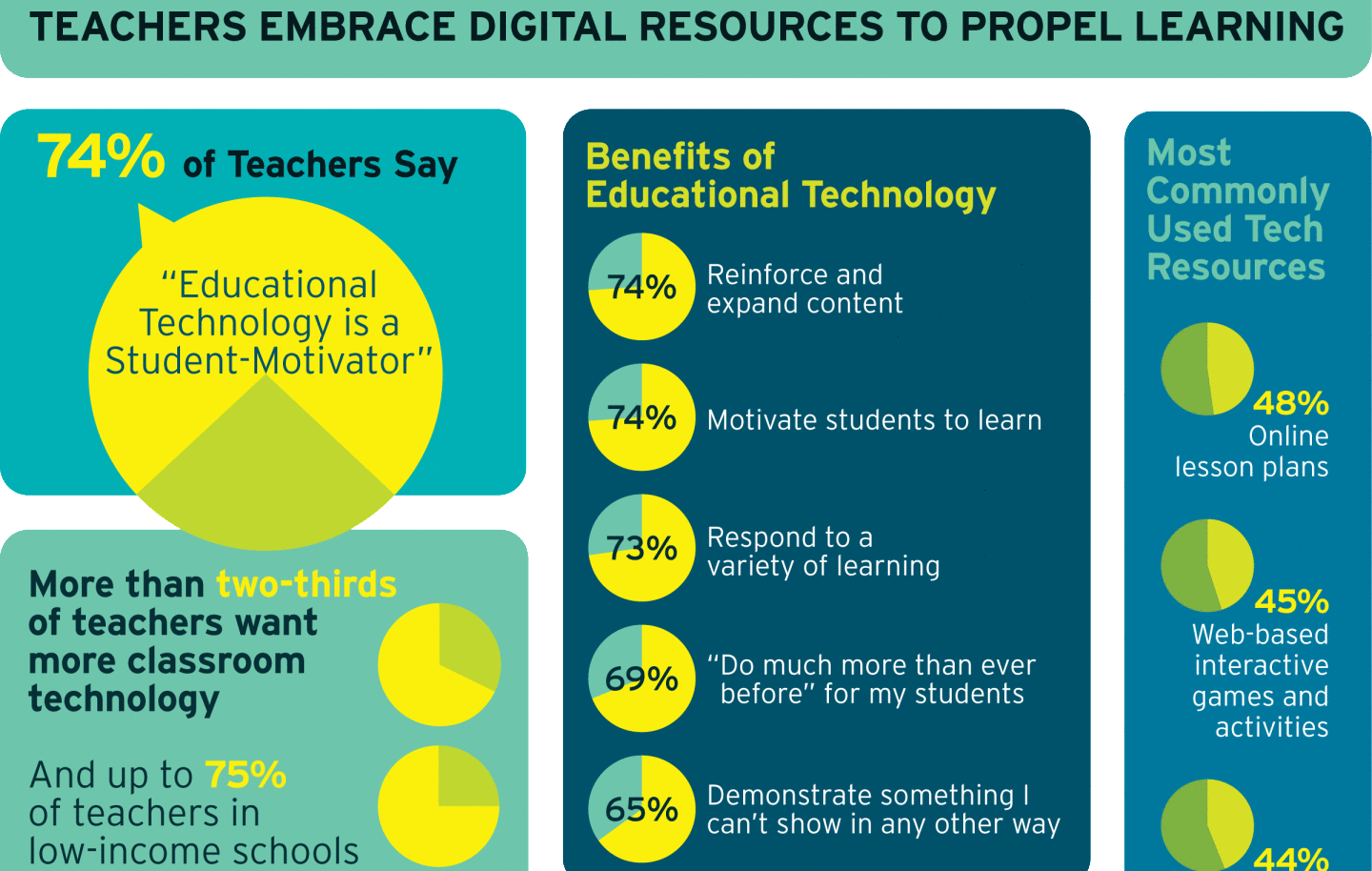
"content": "\u003cfigure id=\"attachment_26992\" class=\"wp-caption alignright\" style=\"max-width: 620px\">\u003cimg class=\"size-large wp-image-26992\" title=\"\" src=\"http://ww2.kqed.org/mindshift/wp-content/uploads/sites/23/2013/02/IMG_8535-620x413.jpg\" alt=\"IMG_8535\" width=\"620\" height=\"413\">\u003cfigcaption class=\"wp-caption-text\"> \u003c/figcaption>\u003c/figure>\n\u003cp class=\"dropcap-serif\">Today is the second annual \u003ca href=\"www.digitallearningday.org\">Digital Learning Day,\u003c/a> designated to bring attention to the benefits of technology for learning. As part of the effort, \u003ca href=\"http://www.pbs.org/about/news/archive/2013/teacher-tech-survey/\">PBS LearningMedia\u003c/a> has released a survey showing that 74 percent of teachers say educational technology benefits their classroom in many ways, including the ability to reinforce and expand content, motivate students, and respond to a variety of learning styles. Given these numbers, and despite increasing access, it’s not surprising that 68 percent of teachers still want more access to technology in the classroom. That number goes up to 75 percent of teachers in low-income schools.\u003c/p>\n\u003cp>To understand more about the influence of technology and learning, the following articles help shed light on subjects of discussion among educators and parents.\u003c/p>\n\u003cul>\n\u003cli>\u003ca href=\"http://ww2.kqed.org/mindshift/2011/07/the-seven-golden-rules-of-using-technology-in-schools/\">7 GOLDEN RULES OF USING TECHNOLOGY IN SCHOOLS. \u003c/a>\u003cstrong>1) DON’T TRAP TECHNOLOGY IN A ROOM.\u003c/strong> “When I went to school, computers were put in a room called The Lab,” Bellow said. “‘What are they experimenting with in there, I thought.’ Technology wasn’t built into what we were doing. It was farmed off in a room, like it was special. Like we were learning how to code, and in case the Russians came, we’d know what to do.” Technology should be like oxygen, Bellow said, quoting \u003ca href=\"http://www.scienceleadership.org/pages/Faculty_and_Staff\">Chris Lehmann\u003c/a>, the founding principal of Science Leadership Academy: Ubiquitous, necessary, and invisible.\u003c/li>\n\u003c/ul>\n\u003cul>\n\u003cli>\u003ca href=\"http://ww2.kqed.org/mindshift/2013/01/case-studies-how-teachers-use-tech-to-support-learning/\">CASE STUDIES: HOW TEACHERS USE TECHNOLOGY TO SUPPORT LEARNING\u003c/a>. Larry Ferlazzo collected an invaluable \u003ca href=\"http://blogs.edweek.org/teachers/classroom_qa_with_larry_ferlazzo/2011/09/response_the_best_ways_to_use_tech_in_the_classroom.html\">list of criteria last year\u003c/a> from educators, to which he added more resources in his \u003ca href=\"http://blogs.edweek.org/teachers/classroom_qa_with_larry_ferlazzo/2012/12/response_using_ed_tech_to_support_the_learning_process.html\">recent blog post for EdWeek\u003c/a>.Other posts in the series include \u003ca href=\"http://blogs.edweek.org/teachers/classroom_qa_with_larry_ferlazzo/2012/12/response_using_ed_tech_to_create_deep_meaningful_experiences.html\">Using Ed \u003c!--more-->Tech to Create Deep and Meaningful Experiences\u003c/a> and \u003ca href=\"http://blogs.edweek.org/teachers/classroom_qa_with_larry_ferlazzo/2012/12/response_effective_ways_to_use_tech_in_the_classroom_--_part_three.html\">Effective Ways of Using Tech in the Classroom\u003c/a>. Here is MindShift’s contribution to the collection of ideas.\u003c/li>\n\u003cli>\u003ca href=\"http://ww2.kqed.org/mindshift/2012/11/whats-the-best-way-of-using-computers-in-schools/\">TO MAKE BLENDED LEARNING WORK, TEACHERS TRY DIFFERENT TACTICS\u003c/a>. For many schools, finding a way to integrate the use of tech in a traditional setting — teacher-centered classrooms — is proving to be a challenge. What educational software should be used? \u003ca href=\"http://ww2.kqed.org/mindshift/2012/10/whats-worth-investing-in-criteria-for-choosing-technology-for-learning/\">What criteria \u003c/a>should the software be judged against? And what happens to the role of the teacher and classroom activities when students are using software for practice exercises?\u003c/li>\n\u003cli>\u003ca href=\"http://ww2.kqed.org/mindshift/2012/10/whats-worth-investing-in-criteria-for-choosing-technology-for-learning/\">WHAT'S WORTH INVESTING IN? HOW TO DECIDE WHAT TECHNOLOGY YOU NEED. \u003c/a> How will technology allow students and teachers to network their learning, to collaborate with each other, to extend the reach of what kids can learn beyond the walls of the school? How can technology be used to unlock what hasn’t even been thought of yet? These questions are more difficult to answer, and less tangible to measure, than improving test scores, which is what typically draws the attention of educators.\u003c/li>\n\u003c/ul>\n\u003cfigure id=\"attachment_26989\" class=\"wp-caption center\" style=\"max-width: 620px\">\u003cimg class=\"size-large wp-image-26989\" title=\"\" src=\"http://ww2.kqed.org/mindshift/wp-content/uploads/sites/23/2013/02/Screen-Shot-2013-02-06-at-10.48.26-AM-620x735.png\" alt=\"Screen Shot 2013-02-06 at 10.48.26 AM\" width=\"620\" height=\"735\">\u003cfigcaption class=\"wp-caption-text\"> \u003c/figcaption>\u003c/figure>\n\u003cp>[ad fullwidth]\u003c/p>\u003cp>\u003c/p>\n",
"disqusIdentifier": "26974 http://blogs.kqed.org/mindshift/?p=26974",
"disqusUrl": "https://ww2.kqed.org/mindshift/2013/02/06/teachers-embrace-digital-learning-strategies/",
"stats": {
"hasVideo": false,
"hasChartOrMap": false,
"hasAudio": false,
"hasPolis": false,
"wordCount": 463,
"hasGoogleForm": false,
"hasGallery": false,
"hasHearkenModule": false,
"iframeSrcs": [],
"paragraphCount": 3
},
"modified": 1360178083,
"excerpt": null,
"headData": {
"twImgId": "",
"twTitle": "",
"ogTitle": "",
"ogImgId": "",
"twDescription": "",
"description": "Today is the second annual Digital Learning Day, designated to bring attention to the benefits of technology for learning. As part of the effort, PBS LearningMedia has released a survey showing that 74 percent of teachers say educational technology benefits their classroom in many ways, including the ability to reinforce and expand content, motivate students, and",
"title": "Teachers Embrace Digital Learning Strategies | KQED",
"ogDescription": "",
"schema": {
"@context": "https://schema.org",
"@type": "Article",
"headline": "Teachers Embrace Digital Learning Strategies",
"datePublished": "2013-02-06T11:14:43-08:00",
"dateModified": "2013-02-06T11:14:43-08:00",
"image": "https://cdn.kqed.org/wp-content/uploads/2020/02/KQED-OG-Image@1x.png"
}
},
"guestAuthors": [],
"slug": "teachers-embrace-digital-learning-strategies",
"status": "publish",
"path": "/mindshift/26974/teachers-embrace-digital-learning-strategies",
"audioTrackLength": null,
"parsedContent": [
{
"type": "contentString",
"content": "\u003cdiv class=\"post-body\">\u003cp>\u003cfigure id=\"attachment_26992\" class=\"wp-caption alignright\" style=\"max-width: 620px\">\u003cimg class=\"size-large wp-image-26992\" title=\"\" src=\"http://ww2.kqed.org/mindshift/wp-content/uploads/sites/23/2013/02/IMG_8535-620x413.jpg\" alt=\"IMG_8535\" width=\"620\" height=\"413\">\u003cfigcaption class=\"wp-caption-text\"> \u003c/figcaption>\u003c/figure>\n\u003cp class=\"dropcap-serif\">Today is the second annual \u003ca href=\"www.digitallearningday.org\">Digital Learning Day,\u003c/a> designated to bring attention to the benefits of technology for learning. As part of the effort, \u003ca href=\"http://www.pbs.org/about/news/archive/2013/teacher-tech-survey/\">PBS LearningMedia\u003c/a> has released a survey showing that 74 percent of teachers say educational technology benefits their classroom in many ways, including the ability to reinforce and expand content, motivate students, and respond to a variety of learning styles. Given these numbers, and despite increasing access, it’s not surprising that 68 percent of teachers still want more access to technology in the classroom. That number goes up to 75 percent of teachers in low-income schools.\u003c/p>\n\u003cp>To understand more about the influence of technology and learning, the following articles help shed light on subjects of discussion among educators and parents.\u003c/p>\n\u003cul>\n\u003cli>\u003ca href=\"http://ww2.kqed.org/mindshift/2011/07/the-seven-golden-rules-of-using-technology-in-schools/\">7 GOLDEN RULES OF USING TECHNOLOGY IN SCHOOLS. \u003c/a>\u003cstrong>1) DON’T TRAP TECHNOLOGY IN A ROOM.\u003c/strong> “When I went to school, computers were put in a room called The Lab,” Bellow said. “‘What are they experimenting with in there, I thought.’ Technology wasn’t built into what we were doing. It was farmed off in a room, like it was special. Like we were learning how to code, and in case the Russians came, we’d know what to do.” Technology should be like oxygen, Bellow said, quoting \u003ca href=\"http://www.scienceleadership.org/pages/Faculty_and_Staff\">Chris Lehmann\u003c/a>, the founding principal of Science Leadership Academy: Ubiquitous, necessary, and invisible.\u003c/li>\n\u003c/ul>\n\u003cul>\n\u003cli>\u003ca href=\"http://ww2.kqed.org/mindshift/2013/01/case-studies-how-teachers-use-tech-to-support-learning/\">CASE STUDIES: HOW TEACHERS USE TECHNOLOGY TO SUPPORT LEARNING\u003c/a>. Larry Ferlazzo collected an invaluable \u003ca href=\"http://blogs.edweek.org/teachers/classroom_qa_with_larry_ferlazzo/2011/09/response_the_best_ways_to_use_tech_in_the_classroom.html\">list of criteria last year\u003c/a> from educators, to which he added more resources in his \u003ca href=\"http://blogs.edweek.org/teachers/classroom_qa_with_larry_ferlazzo/2012/12/response_using_ed_tech_to_support_the_learning_process.html\">recent blog post for EdWeek\u003c/a>.Other posts in the series include \u003ca href=\"http://blogs.edweek.org/teachers/classroom_qa_with_larry_ferlazzo/2012/12/response_using_ed_tech_to_create_deep_meaningful_experiences.html\">Using Ed \u003c!--more-->Tech to Create Deep and Meaningful Experiences\u003c/a> and \u003ca href=\"http://blogs.edweek.org/teachers/classroom_qa_with_larry_ferlazzo/2012/12/response_effective_ways_to_use_tech_in_the_classroom_--_part_three.html\">Effective Ways of Using Tech in the Classroom\u003c/a>. Here is MindShift’s contribution to the collection of ideas.\u003c/li>\n\u003cli>\u003ca href=\"http://ww2.kqed.org/mindshift/2012/11/whats-the-best-way-of-using-computers-in-schools/\">TO MAKE BLENDED LEARNING WORK, TEACHERS TRY DIFFERENT TACTICS\u003c/a>. For many schools, finding a way to integrate the use of tech in a traditional setting — teacher-centered classrooms — is proving to be a challenge. What educational software should be used? \u003ca href=\"http://ww2.kqed.org/mindshift/2012/10/whats-worth-investing-in-criteria-for-choosing-technology-for-learning/\">What criteria \u003c/a>should the software be judged against? And what happens to the role of the teacher and classroom activities when students are using software for practice exercises?\u003c/li>\n\u003cli>\u003ca href=\"http://ww2.kqed.org/mindshift/2012/10/whats-worth-investing-in-criteria-for-choosing-technology-for-learning/\">WHAT'S WORTH INVESTING IN? HOW TO DECIDE WHAT TECHNOLOGY YOU NEED. \u003c/a> How will technology allow students and teachers to network their learning, to collaborate with each other, to extend the reach of what kids can learn beyond the walls of the school? How can technology be used to unlock what hasn’t even been thought of yet? These questions are more difficult to answer, and less tangible to measure, than improving test scores, which is what typically draws the attention of educators.\u003c/li>\n\u003c/ul>\n\u003cfigure id=\"attachment_26989\" class=\"wp-caption center\" style=\"max-width: 620px\">\u003cimg class=\"size-large wp-image-26989\" title=\"\" src=\"http://ww2.kqed.org/mindshift/wp-content/uploads/sites/23/2013/02/Screen-Shot-2013-02-06-at-10.48.26-AM-620x735.png\" alt=\"Screen Shot 2013-02-06 at 10.48.26 AM\" width=\"620\" height=\"735\">\u003cfigcaption class=\"wp-caption-text\"> \u003c/figcaption>\u003c/figure>\n\u003cp>\u003c/p>\u003c/div>",
"attributes": {
"named": {},
"numeric": []
}
},
{
"type": "component",
"content": "",
"name": "ad",
"attributes": {
"named": {
"label": "fullwidth"
},
"numeric": [
"fullwidth"
]
}
},
{
"type": "contentString",
"content": "\u003cdiv class=\"post-body\">\u003cp>\u003c/p>\u003cp>\u003c/p>\n\u003c/div>\u003c/p>",
"attributes": {
"named": {},
"numeric": []
}
}
],
"link": "/mindshift/26974/teachers-embrace-digital-learning-strategies",
"authors": [
"234"
],
"categories": [
"mindshift_192",
"mindshift_193"
],
"tags": [
"mindshift_808",
"mindshift_962",
"mindshift_602"
],
"featImg": "mindshift_26982",
"label": "mindshift"
},
"mindshift_26755": {
"type": "posts",
"id": "mindshift_26755",
"meta": {
"index": "posts_1716263798",
"site": "mindshift",
"id": "26755",
"score": null,
"sort": [
1359744931000
]
},
"parent": 0,
"labelTerm": {
"site": "mindshift"
},
"blocks": [],
"publishDate": 1359744931,
"format": "aside",
"disqusTitle": "7 Essential Principles of Innovative Learning",
"title": "7 Essential Principles of Innovative Learning",
"headTitle": "MindShift | KQED News",
"content": "\u003cdiv id=\"attachment_26936\" class=\"module image aligncenter mceTemp mceIEcenter\" style=\"width: 620px\">\u003ca href=\"http://www.flickr.com/photos/wwworks/5074150006/sizes/m/in/set-72157627432819304/\">\u003cimg class=\"size-large wp-image-26936\" title=\"\" src=\"http://ww2.kqed.org/mindshift/wp-content/uploads/sites/23/2013/02/kids-in-class-620x413.jpg\" alt=\"kids in class\" width=\"620\" height=\"413\">\u003c/a>\n\u003cp class=\"wp-media-credit\">Flirck:WoodleyWonderworks\u003c/p>\n\u003c/div>\n\u003cp class=\"dropcap-serif\">Every educator wants to create an environment that will foster students' love of learning. Because the criteria are intangible, it's difficult to define or pinpoint exactly what they are. But one group is giving it a try.\u003c/p>\n\u003cp>Researchers at the Organization for Economic Cooperation and Development (OECD) launched the\u003ca href=\"http://www.oecd.org/edu/ceri/innovativelearningenvironments.htm\"> Innovative Learning Environments\u003c/a> project to turn an academic lens on the project of identifying concrete traits that mark innovative learning environments. They sifted through and categorized the research on learning science, documented case studies, and compiled policy recommendations they hope will transform the current system.\u003c/p>\n\u003cp>Their book, \u003ca href=\"http://www.oecd.org/edu/ceri/thenatureoflearningusingresearchtoinspirepractice.htm\">\u003cem>The Nature of Learning: Using Research to Inspire Practice\u003c/em>\u003c/a> and the accompanying \u003ca href=\"http://redesigningeducation.org/NoL_files/NatureOfLearning_PractitionerGuide_US.pdf\">practitioner’s guide,\u003c/a> lay out the key principles for designing learning environments that will help students build skills useful in a world where jobs are increasingly information and knowledge-based. The principles are not job-specific – no one knows what the future economy will demand. Instead, the main goal is to develop self-directed learners, students with “adaptive expertise.”\u003c/p>\n\u003cp>“Adaptive expertise tries to push beyond the idea of mastery,” said Jennifer Groff, an educational engineer and co-founder of the \u003ca href=\"http://curriculumredesign.org/\">Center for Curriculum Redesign\u003c/a>. “You may be proficient, but without adaptive expertise you can get stuck very quickly as the world shifts.”\u003c/p>\n\u003cp style=\"text-align: center\">\u003cspan style=\"color: #808080\">\u003cstrong>[RELATED READING: \u003ca href=\"http://ww2.kqed.org/mindshift/2013/01/how-can-teachers-prepare-kids-for-a-connected-world/\">How Can Teachers Prepare Kids for a Connected World\u003c/a>]\u003c/strong>\u003c/span>\u003c/p>\n\u003cp>Groff doesn’t dispute that mastery is important and that students need to learn age-appropriate content, but she also argues it’s equally important to develop students’ ability to go beyond that, to question and apply learning in new situations.\u003c/p>\n\u003cp>[ad fullwidth]\u003c/p>\n\u003cp>To that end, these are their identified principles for innovative learning.\u003c/p>\n\u003col>\n\u003cli>\u003cstrong>\u003cem>\u003c/em>\u003c/strong>\u003cstrong>\u003cem>Learners have to be at the center of what happens in the classroom\u003c/em>\u003c/strong>\u003cspan> with activities focused on their cognition and growth. They have to actively engage in learning in order to become self-regulated learners who are able to control their emotions and motivations during the study process, set goals, and monitor their own learning process.\u003c/span>\u003c/li>\n\u003cli>\u003cstrong>\u003cem>Learning is a social practice and can’t happen alone\u003c/em>\u003c/strong>\u003cspan>. “By our nature we are social beings and we learn by interacting,” Groff said. “We learn by pushing and pulling on concepts with \u003c!--more-->one another.” Structured, collaborative group work can be good for all learners; it pushes people in different ways.\u003c/span>\u003c/li>\n\u003cli>\u003cstrong>\u003cem>\u003c/em>\u003c/strong>\u003cstrong>\u003cem>Emotions are an integral part of learning\u003c/em>\u003c/strong>\u003cspan>. Students understand ideas better when there’s interplay between emotions, motivation and cognition, so positive beliefs about oneself are a core part of reaching a more profound understanding. The \u003ca href=\"http://ww2.kqed.org/mindshift/2012/09/teaching-social-and-emotional-skills-in-schools/\">power of emotions\u003c/a> and motivation in the classroom are well documented, but often overlooked because they are “soft.” Still most teachers know that if a student is upset about something that happened at home or in school, he won’t learn well. Similarly, keeping students motivated should be the starting point of learning. If students understand why it matters, learning becomes more important to them.\u003c/span>\u003c/li>\n\u003cli>\u003cstrong>\u003cem>Learners are different\u003c/em>\u003c/strong>\u003cspan> and innovative learning environments reflect the various experiences and prior knowledge that each student brings to class. “You really want practices and processes that help teachers engage each student where they are,” said Groff. This principle is understood by every frustrated educator teaching to a “middle” that doesn’t exist.\u003c/span>\u003c/li>\n\u003cli>\u003cem>\u003cstrong>Students need to be stretched, but not too much.\u003c/strong>\u003c/em>\u003cspan> “It’s really critical to find that student’s sweet spot,” Groff Said. Educators should try to prevent both coasting and overloading. Students need to experience both academic success and the challenge of discovery. In a diverse classroom group work can help achieve this as students at different levels help one another.\u003c/span>\u003c/li>\n\u003cli>\u003cstrong>\u003cem>Assessment should be for learning, not of learning\u003c/em>\u003c/strong>\u003cspan>. Assessments are important, but only to gauge how to structure the next lesson for maximum effectiveness. It should be meaningful, substantial, and shape the learning environment itself. “Good teachers do this informally most of the time,” Groff said. “But when it’s done well and more formally it’s a whole structure and methodology where you collect feedback on the learning pathway and it drives the next step that you take.”\u003c/span>\u003c/li>\n\u003cli>\u003cstrong>\u003cem>Learning needs to be connected across disciplines\u003c/em>\u003c/strong>\u003cspan> and reach out into the real world. Learning can’t be meaningful if students don’t understand why the knowledge will be useful to them, how it can be applied in life. Understanding the connections between subjects and ideas is essential for the ability to transfer skills and adapt. “We can’t just have things remain in silos that never interact,” Groff said.\u003c/span>\u003c/li>\n\u003c/ol>\n\u003cp>\u003cstrong>IMPLEMENTING THE PRINCIPLES\u003c/strong>\u003c/p>\n\u003cp>Many of the seven principles Groff outlines are second nature to good teachers, but they can feel hard to achieve within education systems that are slow-moving, bureaucratic and resistant to change. Still Groff says there are ways for teachers who want to create an innovative learning environment to begin down the path, even without the full support of their colleagues and administration. Groff also hopes shifting to the Common Core could offer openings for building in these practices. “It’s designed in a way that condones a lot of the principles that we’ve been talking about,” she said.\u003c/p>\n\u003cp>Everyone knows the common barriers educators face: the school culture, the students and themselves. Groff says with some reflection and problem solving, teachers can often begin to work around these barriers. An educator might think she’s open to innovation without realizing that there are preconceived notions about how one should teach that are deeply ingrained.\u003c/p>\n\u003caside class=\"pullquote alignright\">\u003cstrong>“You may be proficient, but without adaptive expertise you can get stuck very quickly as the world shifts.”\u003c/strong>\u003c/aside>\n\u003cp>What's more, if the school culture does not encourage experimentation, educators can mitigate negative reaction by framing the ideas in a way that will be accepted, or by bringing in outside resources to try and convince naysayers. Even finding one colleague in or outside of the school to bounce ideas with can make the process much smoother.\u003c/p>\n\u003cp>Educators can also test ideas with students before implementing them. Students have been indoctrinated into the same educational mindset about what makes a “useful” education as everyone else, and some might be resistant to new teaching methodologies. Without their enthusiasm it can be hard to persevere through other obstacles.\u003c/p>\n\u003cp>\u003cstrong>CASE STUDY\u003c/strong>\u003c/p>\n\u003cp>The darling of the Innovative Learning Environment case studies is the \u003ca href=\"http://www.oecd.org/edu/ceri/DEU.THU.003.%20Finalwihcover.pdf\">Jenaplan School \u003c/a>in Germany. It’s one of the few schools embodying all the principles fluidly. The school has about 450 students that range three to 20 years old. Students aren’t broken up into grade levels, instead they learn in mixed-age groups as well as in groups of roughly the same age. Learning is directed by students, often project-based, evaluated primarily through writing and projects, self-assessments and peer-assessment. The schedule is periodic, focusing on a topic like geography or history for three to four weeks and crossing into multiple disciplines. The teacher is seen as an active mentor and coordinator and the school has active parental involvement.\u003c/p>\n\u003cp>[ad floatright]\u003c/p>\n\u003cp>The Jenaplan School has won awards for its model and in the eyes of the Innovative Learning Environment researchers is doing an excellent job at preparing students to be adaptive and nimble thinkers in a knowledge-based world.\u003c/p>\n\n",
"disqusIdentifier": "26755 http://blogs.kqed.org/mindshift/?p=26755",
"disqusUrl": "https://ww2.kqed.org/mindshift/2013/02/01/7-essential-principles-of-innovative-learning/",
"stats": {
"hasVideo": false,
"hasChartOrMap": false,
"hasAudio": false,
"hasPolis": false,
"wordCount": 1249,
"hasGoogleForm": false,
"hasGallery": false,
"hasHearkenModule": false,
"iframeSrcs": [],
"paragraphCount": 15
},
"modified": 1370539396,
"excerpt": null,
"headData": {
"twImgId": "",
"twTitle": "",
"ogTitle": "",
"ogImgId": "",
"twDescription": "",
"description": "Flirck:WoodleyWonderworks Every educator wants to create an environment that will foster students' love of learning. Because the criteria are intangible, it's difficult to define or pinpoint exactly what they are. But one group is giving it a try. Researchers at the Organization for Economic Cooperation and Development (OECD) launched the Innovative Learning Environments project to",
"title": "7 Essential Principles of Innovative Learning | KQED",
"ogDescription": "",
"schema": {
"@context": "https://schema.org",
"@type": "Article",
"headline": "7 Essential Principles of Innovative Learning",
"datePublished": "2013-02-01T10:55:31-08:00",
"dateModified": "2013-06-06T10:23:16-07:00",
"image": "https://cdn.kqed.org/wp-content/uploads/2020/02/KQED-OG-Image@1x.png"
}
},
"guestAuthors": [],
"slug": "7-essential-principles-of-innovative-learning",
"status": "publish",
"path": "/mindshift/26755/7-essential-principles-of-innovative-learning",
"audioTrackLength": null,
"parsedContent": [
{
"type": "contentString",
"content": "\u003cdiv class=\"post-body\">\u003cp>\u003cdiv id=\"attachment_26936\" class=\"module image aligncenter mceTemp mceIEcenter\" style=\"width: 620px\">\u003ca href=\"http://www.flickr.com/photos/wwworks/5074150006/sizes/m/in/set-72157627432819304/\">\u003cimg class=\"size-large wp-image-26936\" title=\"\" src=\"http://ww2.kqed.org/mindshift/wp-content/uploads/sites/23/2013/02/kids-in-class-620x413.jpg\" alt=\"kids in class\" width=\"620\" height=\"413\">\u003c/a>\n\u003cp class=\"wp-media-credit\">Flirck:WoodleyWonderworks\u003c/p>\n\u003c/div>\n\u003cp class=\"dropcap-serif\">Every educator wants to create an environment that will foster students' love of learning. Because the criteria are intangible, it's difficult to define or pinpoint exactly what they are. But one group is giving it a try.\u003c/p>\n\u003cp>Researchers at the Organization for Economic Cooperation and Development (OECD) launched the\u003ca href=\"http://www.oecd.org/edu/ceri/innovativelearningenvironments.htm\"> Innovative Learning Environments\u003c/a> project to turn an academic lens on the project of identifying concrete traits that mark innovative learning environments. They sifted through and categorized the research on learning science, documented case studies, and compiled policy recommendations they hope will transform the current system.\u003c/p>\n\u003cp>Their book, \u003ca href=\"http://www.oecd.org/edu/ceri/thenatureoflearningusingresearchtoinspirepractice.htm\">\u003cem>The Nature of Learning: Using Research to Inspire Practice\u003c/em>\u003c/a> and the accompanying \u003ca href=\"http://redesigningeducation.org/NoL_files/NatureOfLearning_PractitionerGuide_US.pdf\">practitioner’s guide,\u003c/a> lay out the key principles for designing learning environments that will help students build skills useful in a world where jobs are increasingly information and knowledge-based. The principles are not job-specific – no one knows what the future economy will demand. Instead, the main goal is to develop self-directed learners, students with “adaptive expertise.”\u003c/p>\n\u003cp>“Adaptive expertise tries to push beyond the idea of mastery,” said Jennifer Groff, an educational engineer and co-founder of the \u003ca href=\"http://curriculumredesign.org/\">Center for Curriculum Redesign\u003c/a>. “You may be proficient, but without adaptive expertise you can get stuck very quickly as the world shifts.”\u003c/p>\n\u003cp style=\"text-align: center\">\u003cspan style=\"color: #808080\">\u003cstrong>[RELATED READING: \u003ca href=\"http://ww2.kqed.org/mindshift/2013/01/how-can-teachers-prepare-kids-for-a-connected-world/\">How Can Teachers Prepare Kids for a Connected World\u003c/a>]\u003c/strong>\u003c/span>\u003c/p>\n\u003cp>Groff doesn’t dispute that mastery is important and that students need to learn age-appropriate content, but she also argues it’s equally important to develop students’ ability to go beyond that, to question and apply learning in new situations.\u003c/p>\n\u003cp>\u003c/p>\u003c/div>",
"attributes": {
"named": {},
"numeric": []
}
},
{
"type": "component",
"content": "",
"name": "ad",
"attributes": {
"named": {
"label": "fullwidth"
},
"numeric": [
"fullwidth"
]
}
},
{
"type": "contentString",
"content": "\u003cdiv class=\"post-body\">\u003cp>\u003c/p>\n\u003cp>To that end, these are their identified principles for innovative learning.\u003c/p>\n\u003col>\n\u003cli>\u003cstrong>\u003cem>\u003c/em>\u003c/strong>\u003cstrong>\u003cem>Learners have to be at the center of what happens in the classroom\u003c/em>\u003c/strong>\u003cspan> with activities focused on their cognition and growth. They have to actively engage in learning in order to become self-regulated learners who are able to control their emotions and motivations during the study process, set goals, and monitor their own learning process.\u003c/span>\u003c/li>\n\u003cli>\u003cstrong>\u003cem>Learning is a social practice and can’t happen alone\u003c/em>\u003c/strong>\u003cspan>. “By our nature we are social beings and we learn by interacting,” Groff said. “We learn by pushing and pulling on concepts with \u003c!--more-->one another.” Structured, collaborative group work can be good for all learners; it pushes people in different ways.\u003c/span>\u003c/li>\n\u003cli>\u003cstrong>\u003cem>\u003c/em>\u003c/strong>\u003cstrong>\u003cem>Emotions are an integral part of learning\u003c/em>\u003c/strong>\u003cspan>. Students understand ideas better when there’s interplay between emotions, motivation and cognition, so positive beliefs about oneself are a core part of reaching a more profound understanding. The \u003ca href=\"http://ww2.kqed.org/mindshift/2012/09/teaching-social-and-emotional-skills-in-schools/\">power of emotions\u003c/a> and motivation in the classroom are well documented, but often overlooked because they are “soft.” Still most teachers know that if a student is upset about something that happened at home or in school, he won’t learn well. Similarly, keeping students motivated should be the starting point of learning. If students understand why it matters, learning becomes more important to them.\u003c/span>\u003c/li>\n\u003cli>\u003cstrong>\u003cem>Learners are different\u003c/em>\u003c/strong>\u003cspan> and innovative learning environments reflect the various experiences and prior knowledge that each student brings to class. “You really want practices and processes that help teachers engage each student where they are,” said Groff. This principle is understood by every frustrated educator teaching to a “middle” that doesn’t exist.\u003c/span>\u003c/li>\n\u003cli>\u003cem>\u003cstrong>Students need to be stretched, but not too much.\u003c/strong>\u003c/em>\u003cspan> “It’s really critical to find that student’s sweet spot,” Groff Said. Educators should try to prevent both coasting and overloading. Students need to experience both academic success and the challenge of discovery. In a diverse classroom group work can help achieve this as students at different levels help one another.\u003c/span>\u003c/li>\n\u003cli>\u003cstrong>\u003cem>Assessment should be for learning, not of learning\u003c/em>\u003c/strong>\u003cspan>. Assessments are important, but only to gauge how to structure the next lesson for maximum effectiveness. It should be meaningful, substantial, and shape the learning environment itself. “Good teachers do this informally most of the time,” Groff said. “But when it’s done well and more formally it’s a whole structure and methodology where you collect feedback on the learning pathway and it drives the next step that you take.”\u003c/span>\u003c/li>\n\u003cli>\u003cstrong>\u003cem>Learning needs to be connected across disciplines\u003c/em>\u003c/strong>\u003cspan> and reach out into the real world. Learning can’t be meaningful if students don’t understand why the knowledge will be useful to them, how it can be applied in life. Understanding the connections between subjects and ideas is essential for the ability to transfer skills and adapt. “We can’t just have things remain in silos that never interact,” Groff said.\u003c/span>\u003c/li>\n\u003c/ol>\n\u003cp>\u003cstrong>IMPLEMENTING THE PRINCIPLES\u003c/strong>\u003c/p>\n\u003cp>Many of the seven principles Groff outlines are second nature to good teachers, but they can feel hard to achieve within education systems that are slow-moving, bureaucratic and resistant to change. Still Groff says there are ways for teachers who want to create an innovative learning environment to begin down the path, even without the full support of their colleagues and administration. Groff also hopes shifting to the Common Core could offer openings for building in these practices. “It’s designed in a way that condones a lot of the principles that we’ve been talking about,” she said.\u003c/p>\n\u003cp>Everyone knows the common barriers educators face: the school culture, the students and themselves. Groff says with some reflection and problem solving, teachers can often begin to work around these barriers. An educator might think she’s open to innovation without realizing that there are preconceived notions about how one should teach that are deeply ingrained.\u003c/p>\n\u003caside class=\"pullquote alignright\">\u003cstrong>“You may be proficient, but without adaptive expertise you can get stuck very quickly as the world shifts.”\u003c/strong>\u003c/aside>\n\u003cp>What's more, if the school culture does not encourage experimentation, educators can mitigate negative reaction by framing the ideas in a way that will be accepted, or by bringing in outside resources to try and convince naysayers. Even finding one colleague in or outside of the school to bounce ideas with can make the process much smoother.\u003c/p>\n\u003cp>Educators can also test ideas with students before implementing them. Students have been indoctrinated into the same educational mindset about what makes a “useful” education as everyone else, and some might be resistant to new teaching methodologies. Without their enthusiasm it can be hard to persevere through other obstacles.\u003c/p>\n\u003cp>\u003cstrong>CASE STUDY\u003c/strong>\u003c/p>\n\u003cp>The darling of the Innovative Learning Environment case studies is the \u003ca href=\"http://www.oecd.org/edu/ceri/DEU.THU.003.%20Finalwihcover.pdf\">Jenaplan School \u003c/a>in Germany. It’s one of the few schools embodying all the principles fluidly. The school has about 450 students that range three to 20 years old. Students aren’t broken up into grade levels, instead they learn in mixed-age groups as well as in groups of roughly the same age. Learning is directed by students, often project-based, evaluated primarily through writing and projects, self-assessments and peer-assessment. The schedule is periodic, focusing on a topic like geography or history for three to four weeks and crossing into multiple disciplines. The teacher is seen as an active mentor and coordinator and the school has active parental involvement.\u003c/p>\n\u003cp>\u003c/p>\u003c/div>",
"attributes": {
"named": {},
"numeric": []
}
},
{
"type": "component",
"content": "",
"name": "ad",
"attributes": {
"named": {
"label": "floatright"
},
"numeric": [
"floatright"
]
}
},
{
"type": "contentString",
"content": "\u003cdiv class=\"post-body\">\u003cp>\u003c/p>\n\u003cp>The Jenaplan School has won awards for its model and in the eyes of the Innovative Learning Environment researchers is doing an excellent job at preparing students to be adaptive and nimble thinkers in a knowledge-based world.\u003c/p>\n\n\u003c/div>\u003c/p>",
"attributes": {
"named": {},
"numeric": []
}
}
],
"link": "/mindshift/26755/7-essential-principles-of-innovative-learning",
"authors": [
"234"
],
"categories": [
"mindshift_192",
"mindshift_194",
"mindshift_193"
],
"tags": [
"mindshift_996",
"mindshift_108",
"mindshift_121",
"mindshift_421",
"mindshift_943"
],
"featImg": "mindshift_26936",
"label": "mindshift"
},
"mindshift_26819": {
"type": "posts",
"id": "mindshift_26819",
"meta": {
"index": "posts_1716263798",
"site": "mindshift",
"id": "26819",
"score": null,
"sort": [
1359575195000
]
},
"parent": 0,
"labelTerm": {
"site": "mindshift"
},
"blocks": [],
"publishDate": 1359575195,
"format": "aside",
"disqusTitle": "Empathy: the Key to Social and Emotional Learning",
"title": "Empathy: the Key to Social and Emotional Learning",
"headTitle": "MindShift | KQED News",
"content": "\u003cp>\u003ca href=\"http://ww2.kqed.org/mindshift/2013/01/empathy-the-key-to-social-and-emotional-learning/compassionate-kids/\" rel=\"attachment wp-att-26836\">\u003cimg class=\"alignright size-full wp-image-26836\" title=\"\" src=\"http://ww2.kqed.org/mindshift/wp-content/uploads/sites/23/2013/01/compassionate-kids.jpg\" alt=\"compassionate kids\" width=\"620\" height=\"412\" srcset=\"https://ww2.kqed.org/app/uploads/sites/23/2013/01/compassionate-kids.jpg 620w, https://ww2.kqed.org/app/uploads/sites/23/2013/01/compassionate-kids-400x266.jpg 400w, https://ww2.kqed.org/app/uploads/sites/23/2013/01/compassionate-kids-320x213.jpg 320w\" sizes=\"(max-width: 620px) 100vw, 620px\">\u003c/a>\u003c/p>\n\u003cp class=\"dropcap-serif\">Educators are aware that social problems like poverty, unsafe neighborhoods, violence, and family trauma can affect how students learn when they come to school. Though teaching subjects like math and literacy are the biggest part of their job, in many cases they're also called on to attend to their students' emotional health as well, incorporating\u003ca href=\"http://ww2.kqed.org/mindshift/2012/09/teaching-social-and-emotional-skills-in-schools/\"> social and emotional skills.\u003c/a>\u003c/p>\n\u003cp>“Science is starting to show that there is a very strong integration between social and emotional skills and learning,” said Vicki Zakrzewski, education director of the\u003ca href=\"http://greatergood.berkeley.edu/topic/empathy\"> Greater Good Science Center at U.C. Berkeley\u003c/a>, which studies the psychology, sociology and neuroscience of well-being during a recent \u003ca href=\"http://blogs.kqed.org/americangraduate/2013/01/18/kqed-forum-teaching-social-and-emotional-learning/\">Forum radio show\u003c/a>. “Some scientists believe that cognitive achievement is 50 percent of the equation and social and emotional skills are the other 50 percent.”\u003c/p>\n\u003cp>Some school districts are taking that idea seriously and integrating the research into teaching practices. \u003ca href=\"http://www.ousd.k12.ca.us/site/default.aspx?PageID=1\">Oakland Unified School District,\u003c/a> for example, is piloting a program called \u003ca href=\"http://www.rootsofempathy.org/\">Roots of Empathy\u003c/a> in 20 schools across the district. The program teaches students how to be empathetic by bringing a baby and the baby's parent into K-12 classrooms. The students are asked to think about the baby's experience as it explores the classroom, while a trained facilitator helps them name the baby's feelings and emotions. Focusing on the baby and its vulnerability allows students to practice empathy, making it easier to identify their own emotions in the future. As they become more self-aware they're better able to develop respectful and caring relationships.\u003c/p>\n\u003caside class=\"pullquote alignright\">\u003cstrong>“Some scientists believe that cognitive achievement is 50 percent of the equation and social and emotional skills are the other 50 percent of the equation.”\u003c/strong>\u003c/aside>\n\u003cp>“It’s a launching pad for the children to apply the understanding of emotion and perspective taking that they've learned through this little baby to themselves and then the bridge to understanding how their classmates feel,” said Mary Gordon, who founded the program. Gordon says that when \u003c!--more-->children learn to be empathetic they naturally behave less aggressively. Researchers at the University of British Columbia \u003ca href=\"http://www.rootsofempathy.org/documents/content/infopackages/roe_research09_en.pdf\">have documented\u003c/a> her claim that when students develop emotional literacy they can begin to talk about their feelings, frustrations and anger without acting out. She’s implemented her program in schools across the U.S. and Canada, in rural, suburban and urban settings and says it works everywhere.\u003c/p>\n\u003cp>[ad fullwidth]\u003c/p>\n\u003cp>“We have to be able to understand our own experiences emotionally to have a better relationship with others in the world and also to engage deeply in dialogue, to take other people’s perspective and examine our own,” said \u003ca href=\"http://www.ousd.k12.ca.us/domain/10\">Tony Smith\u003c/a>, superintendent of Oakland Unified School District. He’s aware that his city is plagued by race and class divisions as well as high levels of violence, which have left many students traumatized and angry.\u003c/p>\n\u003cp>\u003cspan style=\"color: #808080\">\u003cstrong>[RELATED READING: \u003ca href=\"http://ww2.kqed.org/mindshift/2012/10/how-parents-and-schools-can-help-build-kids-emotional-strength/\">How Parents and Schools Can Help Build Kids' Emotional Strength\u003c/a>]\u003c/strong>\u003c/span>\u003c/p>\n\u003cp>“Many of our young people don’t have the capacity to struggle productively with other people around their ideas and not shut down if they're feeling uncomfortable,” Smith said. He believes that by building emotional skills, his students will be able to focus more on learning and become more socially successful. “There’s a lot of work to do around building the emotional capacity to be a deep thinker,” Smith said.\u003c/p>\n\u003cp>\u003c/p>\n\u003cp>“Giving students a safe caring classroom won’t necessarily mitigate all the trauma they've experienced, but it will help them develop a secure attachment with the teacher, and they need that strong attachment with an adult to feel safe exploring the world,” Zakrzewski said. That freedom to explore is at the center of what many consider to be deeper and self-directed learning.\u003c/p>\n\n",
"disqusIdentifier": "26819 http://blogs.kqed.org/mindshift/?p=26819",
"disqusUrl": "https://ww2.kqed.org/mindshift/2013/01/30/empathy-the-key-to-social-and-emotional-learning/",
"stats": {
"hasVideo": false,
"hasChartOrMap": false,
"hasAudio": false,
"hasPolis": false,
"wordCount": 643,
"hasGoogleForm": false,
"hasGallery": false,
"hasHearkenModule": false,
"iframeSrcs": [],
"paragraphCount": 10
},
"modified": 1359742877,
"excerpt": null,
"headData": {
"twImgId": "",
"twTitle": "",
"ogTitle": "",
"ogImgId": "",
"twDescription": "",
"description": "Educators are aware that social problems like poverty, unsafe neighborhoods, violence, and family trauma can affect how students learn when they come to school. Though teaching subjects like math and literacy are the biggest part of their job, in many cases they're also called on to attend to their students' emotional health as well, incorporating",
"title": "Empathy: the Key to Social and Emotional Learning | KQED",
"ogDescription": "",
"schema": {
"@context": "https://schema.org",
"@type": "Article",
"headline": "Empathy: the Key to Social and Emotional Learning",
"datePublished": "2013-01-30T11:46:35-08:00",
"dateModified": "2013-02-01T10:21:17-08:00",
"image": "https://cdn.kqed.org/wp-content/uploads/2020/02/KQED-OG-Image@1x.png"
}
},
"guestAuthors": [],
"slug": "empathy-the-key-to-social-and-emotional-learning",
"status": "publish",
"path": "/mindshift/26819/empathy-the-key-to-social-and-emotional-learning",
"audioTrackLength": null,
"parsedContent": [
{
"type": "contentString",
"content": "\u003cdiv class=\"post-body\">\u003cp>\u003cp>\u003ca href=\"http://ww2.kqed.org/mindshift/2013/01/empathy-the-key-to-social-and-emotional-learning/compassionate-kids/\" rel=\"attachment wp-att-26836\">\u003cimg class=\"alignright size-full wp-image-26836\" title=\"\" src=\"http://ww2.kqed.org/mindshift/wp-content/uploads/sites/23/2013/01/compassionate-kids.jpg\" alt=\"compassionate kids\" width=\"620\" height=\"412\" srcset=\"https://ww2.kqed.org/app/uploads/sites/23/2013/01/compassionate-kids.jpg 620w, https://ww2.kqed.org/app/uploads/sites/23/2013/01/compassionate-kids-400x266.jpg 400w, https://ww2.kqed.org/app/uploads/sites/23/2013/01/compassionate-kids-320x213.jpg 320w\" sizes=\"(max-width: 620px) 100vw, 620px\">\u003c/a>\u003c/p>\n\u003cp class=\"dropcap-serif\">Educators are aware that social problems like poverty, unsafe neighborhoods, violence, and family trauma can affect how students learn when they come to school. Though teaching subjects like math and literacy are the biggest part of their job, in many cases they're also called on to attend to their students' emotional health as well, incorporating\u003ca href=\"http://ww2.kqed.org/mindshift/2012/09/teaching-social-and-emotional-skills-in-schools/\"> social and emotional skills.\u003c/a>\u003c/p>\n\u003cp>“Science is starting to show that there is a very strong integration between social and emotional skills and learning,” said Vicki Zakrzewski, education director of the\u003ca href=\"http://greatergood.berkeley.edu/topic/empathy\"> Greater Good Science Center at U.C. Berkeley\u003c/a>, which studies the psychology, sociology and neuroscience of well-being during a recent \u003ca href=\"http://blogs.kqed.org/americangraduate/2013/01/18/kqed-forum-teaching-social-and-emotional-learning/\">Forum radio show\u003c/a>. “Some scientists believe that cognitive achievement is 50 percent of the equation and social and emotional skills are the other 50 percent.”\u003c/p>\n\u003cp>Some school districts are taking that idea seriously and integrating the research into teaching practices. \u003ca href=\"http://www.ousd.k12.ca.us/site/default.aspx?PageID=1\">Oakland Unified School District,\u003c/a> for example, is piloting a program called \u003ca href=\"http://www.rootsofempathy.org/\">Roots of Empathy\u003c/a> in 20 schools across the district. The program teaches students how to be empathetic by bringing a baby and the baby's parent into K-12 classrooms. The students are asked to think about the baby's experience as it explores the classroom, while a trained facilitator helps them name the baby's feelings and emotions. Focusing on the baby and its vulnerability allows students to practice empathy, making it easier to identify their own emotions in the future. As they become more self-aware they're better able to develop respectful and caring relationships.\u003c/p>\n\u003caside class=\"pullquote alignright\">\u003cstrong>“Some scientists believe that cognitive achievement is 50 percent of the equation and social and emotional skills are the other 50 percent of the equation.”\u003c/strong>\u003c/aside>\n\u003cp>“It’s a launching pad for the children to apply the understanding of emotion and perspective taking that they've learned through this little baby to themselves and then the bridge to understanding how their classmates feel,” said Mary Gordon, who founded the program. Gordon says that when \u003c!--more-->children learn to be empathetic they naturally behave less aggressively. Researchers at the University of British Columbia \u003ca href=\"http://www.rootsofempathy.org/documents/content/infopackages/roe_research09_en.pdf\">have documented\u003c/a> her claim that when students develop emotional literacy they can begin to talk about their feelings, frustrations and anger without acting out. She’s implemented her program in schools across the U.S. and Canada, in rural, suburban and urban settings and says it works everywhere.\u003c/p>\n\u003cp>\u003c/p>\u003c/div>",
"attributes": {
"named": {},
"numeric": []
}
},
{
"type": "component",
"content": "",
"name": "ad",
"attributes": {
"named": {
"label": "fullwidth"
},
"numeric": [
"fullwidth"
]
}
},
{
"type": "contentString",
"content": "\u003cdiv class=\"post-body\">\u003cp>\u003c/p>\n\u003cp>“We have to be able to understand our own experiences emotionally to have a better relationship with others in the world and also to engage deeply in dialogue, to take other people’s perspective and examine our own,” said \u003ca href=\"http://www.ousd.k12.ca.us/domain/10\">Tony Smith\u003c/a>, superintendent of Oakland Unified School District. He’s aware that his city is plagued by race and class divisions as well as high levels of violence, which have left many students traumatized and angry.\u003c/p>\n\u003cp>\u003cspan style=\"color: #808080\">\u003cstrong>[RELATED READING: \u003ca href=\"http://ww2.kqed.org/mindshift/2012/10/how-parents-and-schools-can-help-build-kids-emotional-strength/\">How Parents and Schools Can Help Build Kids' Emotional Strength\u003c/a>]\u003c/strong>\u003c/span>\u003c/p>\n\u003cp>“Many of our young people don’t have the capacity to struggle productively with other people around their ideas and not shut down if they're feeling uncomfortable,” Smith said. He believes that by building emotional skills, his students will be able to focus more on learning and become more socially successful. “There’s a lot of work to do around building the emotional capacity to be a deep thinker,” Smith said.\u003c/p>\n\u003cp>\u003c/p>\n\u003cp>“Giving students a safe caring classroom won’t necessarily mitigate all the trauma they've experienced, but it will help them develop a secure attachment with the teacher, and they need that strong attachment with an adult to feel safe exploring the world,” Zakrzewski said. That freedom to explore is at the center of what many consider to be deeper and self-directed learning.\u003c/p>\n\n\u003c/div>\u003c/p>",
"attributes": {
"named": {},
"numeric": []
}
}
],
"link": "/mindshift/26819/empathy-the-key-to-social-and-emotional-learning",
"authors": [
"234"
],
"categories": [
"mindshift_192",
"mindshift_194"
],
"tags": [
"mindshift_943"
],
"featImg": "mindshift_26836",
"label": "mindshift"
},
"mindshift_26563": {
"type": "posts",
"id": "mindshift_26563",
"meta": {
"index": "posts_1716263798",
"site": "mindshift",
"id": "26563",
"score": null,
"sort": [
1358376950000
]
},
"parent": 0,
"labelTerm": {
"site": "mindshift"
},
"blocks": [],
"publishDate": 1358376950,
"format": "aside",
"disqusTitle": "Where Are All Those Ed Tech Dollars Going?",
"title": "Where Are All Those Ed Tech Dollars Going?",
"headTitle": "MindShift | KQED News",
"content": "\u003cdiv id=\"attachment_26576\" class=\"module image alignright mceTemp\" style=\"width: 300px\">\n\u003cp>\u003ca href=\"http://ww2.kqed.org/mindshift/2013/01/where-are-all-those-ed-tech-dollars-going/87463263-300x247/\" rel=\"attachment wp-att-26576\">\u003cimg class=\"size-full wp-image-26576\" title=\"87463263-300x247\" src=\"http://ww2.kqed.org/mindshift/wp-content/uploads/sites/23/2013/01/87463263-300x247.jpg\" alt=\"\" width=\"300\" height=\"247\">\u003c/a>\u003c/p>\n\u003cp class=\"wp-media-credit\">Getty\u003c/p>\n\u003c/div>\n\u003cp class=\"dropcap-serif\">The largest segment of the $7.76 billion ed-tech market, according to the industry group \u003ca href=\"http://www.siia.net/\">SIIA\u003c/a> is \"instructional support,\" which accounts for up to 38 percent of the market -- and that's increased by 12 percent over the previous year.\u003c/p>\n\u003cp>Companies within the \"instructional support\" space earned $892 million, with assessment and testing products registering as the most profitable sector under that category. Some factors that might have influenced the rise in spending on assessment, according to SIIA officials, are the increased use of data and data analysis as well as online assessments, as schools move from print to digital in the move to meeting the Common Core State Standards.\u003c/p>\n\u003cp>These are numbers reported by the \u003ca href=\"http://www.siia.net/\">Software and Information Industry Association\u003c/a> for the 2010-2011 year for the Pre-K-12 ed-tech market. Overall, the entire industry's value increased by 3.5 percent from the previous year.\u003c/p>\n\u003cp>This is the SIIA's second survey of companies selling non-hardware educational products and services. Of the 581 companies in the ed-tech space, 105 responded to the survey. SIIA and their \u003c!--more-->research partner, \u003ca href=\"http://www.cs4ed.com/\">Consulting Services for Education\u003c/a>, extrapolated the results of the overall findings based on the direct responses they received.\u003c/p>\n\u003cp>It's also worth noting that companies that create content services have almost as large a market share -- 36 percent -- as those working in instructional support. Within that category, English Language Arts and reading programs take up the most space and revenue, earning $400 million. The next largest group, math software, reported $160 million in profits. Science content revenue has gone up 10 percent.\u003c/p>\n\u003cp>[ad fullwidth]\u003c/p>\n\u003cp>Other noteworthy information:\u003c/p>\n\u003cul>\n\u003cli>Bring Your Own Device, or \u003ca href=\"http://ww2.kqed.org/mindshift/2012/09/privacy-equity-and-other-byod-concerns/\">BYOD programs\u003c/a> are taking off, opening up opportunities for mobile learning programs.\u003c/li>\n\u003cli>Open education resources are disrupting markets in ways that will clearly have a big impact, although it’s not clear yet how.\u003c/li>\n\u003cli>According to the survey, public schools tend to move much more slowly at adapting technology than private schools.Data from digital services is going to become ever more important, especially as schools move toward adopting Common Core State Standards.\u003c/li>\n\u003c/ul>\n\u003cp>\u003c/p>\n\u003cp>[NOTE: The current version of the article reflects the fact that the \u003cem>largest\u003c/em> segment of the ed-tech market is instructional support, which accounts for up to 38 percent of the market -- and that's increased by 12 percent over the previous year.]\u003c/p>\n\n",
"disqusIdentifier": "26563 http://blogs.kqed.org/mindshift/?p=26563",
"disqusUrl": "https://ww2.kqed.org/mindshift/2013/01/16/where-are-all-those-ed-tech-dollars-going/",
"stats": {
"hasVideo": false,
"hasChartOrMap": false,
"hasAudio": false,
"hasPolis": false,
"wordCount": 395,
"hasGoogleForm": false,
"hasGallery": false,
"hasHearkenModule": false,
"iframeSrcs": [],
"paragraphCount": 9
},
"modified": 1358444320,
"excerpt": null,
"headData": {
"twImgId": "",
"twTitle": "",
"ogTitle": "",
"ogImgId": "",
"twDescription": "",
"description": "Getty The largest segment of the $7.76 billion ed-tech market, according to the industry group SIIA is "instructional support," which accounts for up to 38 percent of the market -- and that's increased by 12 percent over the previous year. Companies within the "instructional support" space earned $892 million, with assessment and testing products registering",
"title": "Where Are All Those Ed Tech Dollars Going? | KQED",
"ogDescription": "",
"schema": {
"@context": "https://schema.org",
"@type": "Article",
"headline": "Where Are All Those Ed Tech Dollars Going?",
"datePublished": "2013-01-16T14:55:50-08:00",
"dateModified": "2013-01-17T09:38:40-08:00",
"image": "https://cdn.kqed.org/wp-content/uploads/2020/02/KQED-OG-Image@1x.png"
}
},
"guestAuthors": [],
"slug": "where-are-all-those-ed-tech-dollars-going",
"status": "publish",
"path": "/mindshift/26563/where-are-all-those-ed-tech-dollars-going",
"audioTrackLength": null,
"parsedContent": [
{
"type": "contentString",
"content": "\u003cdiv class=\"post-body\">\u003cp>\u003cdiv id=\"attachment_26576\" class=\"module image alignright mceTemp\" style=\"width: 300px\">\n\u003cp>\u003ca href=\"http://ww2.kqed.org/mindshift/2013/01/where-are-all-those-ed-tech-dollars-going/87463263-300x247/\" rel=\"attachment wp-att-26576\">\u003cimg class=\"size-full wp-image-26576\" title=\"87463263-300x247\" src=\"http://ww2.kqed.org/mindshift/wp-content/uploads/sites/23/2013/01/87463263-300x247.jpg\" alt=\"\" width=\"300\" height=\"247\">\u003c/a>\u003c/p>\n\u003cp class=\"wp-media-credit\">Getty\u003c/p>\n\u003c/div>\n\u003cp class=\"dropcap-serif\">The largest segment of the $7.76 billion ed-tech market, according to the industry group \u003ca href=\"http://www.siia.net/\">SIIA\u003c/a> is \"instructional support,\" which accounts for up to 38 percent of the market -- and that's increased by 12 percent over the previous year.\u003c/p>\n\u003cp>Companies within the \"instructional support\" space earned $892 million, with assessment and testing products registering as the most profitable sector under that category. Some factors that might have influenced the rise in spending on assessment, according to SIIA officials, are the increased use of data and data analysis as well as online assessments, as schools move from print to digital in the move to meeting the Common Core State Standards.\u003c/p>\n\u003cp>These are numbers reported by the \u003ca href=\"http://www.siia.net/\">Software and Information Industry Association\u003c/a> for the 2010-2011 year for the Pre-K-12 ed-tech market. Overall, the entire industry's value increased by 3.5 percent from the previous year.\u003c/p>\n\u003cp>This is the SIIA's second survey of companies selling non-hardware educational products and services. Of the 581 companies in the ed-tech space, 105 responded to the survey. SIIA and their \u003c!--more-->research partner, \u003ca href=\"http://www.cs4ed.com/\">Consulting Services for Education\u003c/a>, extrapolated the results of the overall findings based on the direct responses they received.\u003c/p>\n\u003cp>It's also worth noting that companies that create content services have almost as large a market share -- 36 percent -- as those working in instructional support. Within that category, English Language Arts and reading programs take up the most space and revenue, earning $400 million. The next largest group, math software, reported $160 million in profits. Science content revenue has gone up 10 percent.\u003c/p>\n\u003cp>\u003c/p>\u003c/div>",
"attributes": {
"named": {},
"numeric": []
}
},
{
"type": "component",
"content": "",
"name": "ad",
"attributes": {
"named": {
"label": "fullwidth"
},
"numeric": [
"fullwidth"
]
}
},
{
"type": "contentString",
"content": "\u003cdiv class=\"post-body\">\u003cp>\u003c/p>\n\u003cp>Other noteworthy information:\u003c/p>\n\u003cul>\n\u003cli>Bring Your Own Device, or \u003ca href=\"http://ww2.kqed.org/mindshift/2012/09/privacy-equity-and-other-byod-concerns/\">BYOD programs\u003c/a> are taking off, opening up opportunities for mobile learning programs.\u003c/li>\n\u003cli>Open education resources are disrupting markets in ways that will clearly have a big impact, although it’s not clear yet how.\u003c/li>\n\u003cli>According to the survey, public schools tend to move much more slowly at adapting technology than private schools.Data from digital services is going to become ever more important, especially as schools move toward adopting Common Core State Standards.\u003c/li>\n\u003c/ul>\n\u003cp>\u003c/p>\n\u003cp>[NOTE: The current version of the article reflects the fact that the \u003cem>largest\u003c/em> segment of the ed-tech market is instructional support, which accounts for up to 38 percent of the market -- and that's increased by 12 percent over the previous year.]\u003c/p>\n\n\u003c/div>\u003c/p>",
"attributes": {
"named": {},
"numeric": []
}
}
],
"link": "/mindshift/26563/where-are-all-those-ed-tech-dollars-going",
"authors": [
"234"
],
"categories": [
"mindshift_192"
],
"tags": [
"mindshift_995",
"mindshift_720"
],
"featImg": "mindshift_26576",
"label": "mindshift"
},
"mindshift_26396": {
"type": "posts",
"id": "mindshift_26396",
"meta": {
"index": "posts_1716263798",
"site": "mindshift",
"id": "26396",
"score": null,
"sort": [
1358188743000
]
},
"parent": 0,
"labelTerm": {
"site": "mindshift"
},
"blocks": [],
"publishDate": 1358188743,
"format": "aside",
"disqusTitle": "Girls and Games: What's the Attraction?",
"title": "Girls and Games: What's the Attraction?",
"headTitle": "MindShift | KQED News",
"content": "\u003cfigure id=\"attachment_26452\" class=\"wp-caption center\" style=\"max-width: 620px\">\u003ca href=\"http://ww2.kqed.org/mindshift/2013/01/girls-and-games-whats-the-attraction/72868015-2/\" rel=\"attachment wp-att-26452\">\u003cimg class=\"size-large wp-image-26452\" title=\"72868015\" src=\"http://ww2.kqed.org/mindshift/wp-content/uploads/sites/23/2013/01/728680151-620x413.jpg\" alt=\"\" width=\"620\" height=\"413\">\u003c/a>\u003cfigcaption class=\"wp-caption-text\"> \u003c/figcaption>\u003c/figure>\n\u003cp class=\"dropcap-serif\">Games are increasingly recognized by educators as a way to get kids excited about learning. While the stereotype of a “gamer” may evoke the image of a high school boy holed up in a dark room playing on a console, in reality 62 percent of gamers play with other people either in person or online, and 47 percent of all gamers are girls.\u003c/p>\n\u003cp>Game developers and academics who have been studying the elements that go into making games more attractive to girls found that those very same qualities are also important components of learning. For instance, girls are more drawn to games that require problem solving in context, that are collaborative (played through social media) and that produce what's perceived to be a social good. They also like games that simulate the real word and are particularly drawn to “transmedia” content that draws on characters from books, movies, or toys.\u003c/p>\n\u003caside class=\"pullquote alignleft\">\n\u003cp>“A tremendous motivator for girls to learn about math and science is that they need to see the connection from the classroom out into the real world.”\u003c/p>\n\u003c/aside>\n\u003cp style=\"text-align: left\">“Something we’ve seen as a tremendous motivator for girls to learn about math and science is that they need to see the connection from the classroom out into the real world,” said Victoria Van Voorhis, the founder of \u003ca href=\"http://www.secondavenuelearning.com/frontPage.aspx\">Second Avenue Learning\u003c/a> in a recent \u003ca href=\"http://www.instantpresenter.com/WebConference/RecordingDefault.aspx?c_psrid=EA52DA89834A\">webinar\u003c/a>. Her company has received funding from the National Science Foundation to study how to reach girls through gaming with the help of the \u003ca href=\"http://www.rit.edu/\">Rochester Institute of Technology\u003c/a>. They tested a physical science game called “Martha Madison’s Marvelous Machines” with middle school girls in urban, suburban, and rural \u003c!--more-->environments to gauge whether playing the game would increase their interest in science, technology, engineering and math (STEM), whether it appealed to them and if it could improve their understanding of fundamental mechanical devices.\u003c/p>\n\u003cp style=\"text-align: center\">\u003cstrong>[RELATED READING:\u003c/strong> \u003cstrong>\u003ca href=\"http://ww2.kqed.org/mindshift/2012/04/whats-the-secret-sauce-to-a-great-educational-game/\">What's the Secret Sauce to a Great Educational Game?\u003c/a>]\u003c/strong>\u003c/p>\n\u003cp style=\"text-align: left\">“When we asked them about springs and levers, they had no understanding of why they were important in the real world,” Van Voorhis said. “But when we were able to situate those kinds of tools in a real-world context, where they were solving a problem that was directed towards social good, we saw the engagement numbers pop.” girls were talking about physics or game play 76 percent of the time and were only off topic 5 percent of the time.\u003c/p>\n\u003cp>[ad fullwidth]\u003c/p>\n\u003cp>One of the biggest draws for girls to gaming are the passionate communities that spring up around the games. Affinity groups, or what's sometimes referred to as the meta-game, often involve users creating their own story lines, interacting with each other and sharing. \u003ca href=\"http://www.warner.rochester.edu/facultystaff/lammers/\">Jayne Lammers\u003c/a>, a professor at the University of Rochester, spent extensive time studying affinity groups of girls that play \u003ca href=\"http://www.thesims3.com/\">SIMs\u003c/a>, the game that allows users to simulate real life through the game, and watched girls go from consumers to creators in the space. They wrote stories, solicited feedback from peers, demonstrated self-awareness, and even learned elements of programming and design through their creations.\u003c/p>\n\u003cp>“As we think about how girls are developing these skills outside of the classroom such as affinity spaces, I think it’s important that we think about how to bring it back into the classroom,” Lammers said. But it can be hard to convince parents and administrators that a video game is helping students learn, especially when game-producers have upended some foundational thinking about how to educate – like allowing a student to interpret and analyze a subject on their own before giving them explicit content instruction.\u003c/p>\n\u003cp>“Invoking their interest in the topic through play is a great way to get them to come to their reading or lectures or small group work with an explicit agenda,” Van Voorhis said. She advocates for thinking of learning as a non-linear path, where steps are taken forward, but also backwards and sideways.\u003c/p>\n\u003cp>“The critical thinking and the problem solving that students experience in games create spontaneous innovation,” Van Voorhis said. “It can be the catalyst and the spark to get a kid to that ‘ah ha moment’ that inspire a kid to get deeper into that content area.” And games allow kids to experiment, try new methods and fail without consequences.\u003c/p>\n\u003cp>Van Voorhis constructed a different version of \u003ca href=\"http://en.wikipedia.org/wiki/Bloom%27s_Taxonomy\">Bloom's Taxonomy\u003c/a> based on game play, in which students first explore a theme informally, and that process helps them understand written text afterwards.\u003c/p>\n\u003cp>\u003c/p>\n\u003cp>\"Invoking their interest in the topic through play is a great way to get them to come to their reading or lectures or small group work with an explicit agenda,\" she said.\u003c/p>\n\u003cfigure id=\"attachment_26437\" class=\"wp-caption center\" style=\"max-width: 620px\">\u003ca href=\"http://ww2.kqed.org/mindshift/2013/01/girls-and-games-whats-the-attraction/screen-shot-2013-01-14-at-10-21-43-am/\" rel=\"attachment wp-att-26437\">\u003cimg class=\"size-large wp-image-26437\" title=\"Bloom's Taxonomy\" src=\"http://ww2.kqed.org/mindshift/wp-content/uploads/sites/23/2013/01/Screen-Shot-2013-01-14-at-10.21.43-AM-620x466.png\" alt=\"\" width=\"620\" height=\"466\">\u003c/a>\u003cfigcaption class=\"wp-caption-text\">A flipped version of Bloom's Taxonomy, informed by game-play.\u003c/figcaption>\u003c/figure>\n\n",
"disqusIdentifier": "26396 http://blogs.kqed.org/mindshift/?p=26396",
"disqusUrl": "https://ww2.kqed.org/mindshift/2013/01/14/girls-and-games-whats-the-attraction/",
"stats": {
"hasVideo": false,
"hasChartOrMap": false,
"hasAudio": false,
"hasPolis": false,
"wordCount": 813,
"hasGoogleForm": false,
"hasGallery": false,
"hasHearkenModule": false,
"iframeSrcs": [],
"paragraphCount": 10
},
"modified": 1358274091,
"excerpt": null,
"headData": {
"twImgId": "",
"twTitle": "",
"ogTitle": "",
"ogImgId": "",
"twDescription": "",
"description": "Games are increasingly recognized by educators as a way to get kids excited about learning. While the stereotype of a “gamer” may evoke the image of a high school boy holed up in a dark room playing on a console, in reality 62 percent of gamers play with other people either in person or online,",
"title": "Girls and Games: What's the Attraction? | KQED",
"ogDescription": "",
"schema": {
"@context": "https://schema.org",
"@type": "Article",
"headline": "Girls and Games: What's the Attraction?",
"datePublished": "2013-01-14T10:39:03-08:00",
"dateModified": "2013-01-15T10:21:31-08:00",
"image": "https://cdn.kqed.org/wp-content/uploads/2020/02/KQED-OG-Image@1x.png"
}
},
"guestAuthors": [],
"slug": "girls-and-games-whats-the-attraction",
"status": "publish",
"path": "/mindshift/26396/girls-and-games-whats-the-attraction",
"audioTrackLength": null,
"parsedContent": [
{
"type": "contentString",
"content": "\u003cdiv class=\"post-body\">\u003cp>\u003cfigure id=\"attachment_26452\" class=\"wp-caption center\" style=\"max-width: 620px\">\u003ca href=\"http://ww2.kqed.org/mindshift/2013/01/girls-and-games-whats-the-attraction/72868015-2/\" rel=\"attachment wp-att-26452\">\u003cimg class=\"size-large wp-image-26452\" title=\"72868015\" src=\"http://ww2.kqed.org/mindshift/wp-content/uploads/sites/23/2013/01/728680151-620x413.jpg\" alt=\"\" width=\"620\" height=\"413\">\u003c/a>\u003cfigcaption class=\"wp-caption-text\"> \u003c/figcaption>\u003c/figure>\n\u003cp class=\"dropcap-serif\">Games are increasingly recognized by educators as a way to get kids excited about learning. While the stereotype of a “gamer” may evoke the image of a high school boy holed up in a dark room playing on a console, in reality 62 percent of gamers play with other people either in person or online, and 47 percent of all gamers are girls.\u003c/p>\n\u003cp>Game developers and academics who have been studying the elements that go into making games more attractive to girls found that those very same qualities are also important components of learning. For instance, girls are more drawn to games that require problem solving in context, that are collaborative (played through social media) and that produce what's perceived to be a social good. They also like games that simulate the real word and are particularly drawn to “transmedia” content that draws on characters from books, movies, or toys.\u003c/p>\n\u003caside class=\"pullquote alignleft\">\n\u003cp>“A tremendous motivator for girls to learn about math and science is that they need to see the connection from the classroom out into the real world.”\u003c/p>\n\u003c/aside>\n\u003cp style=\"text-align: left\">“Something we’ve seen as a tremendous motivator for girls to learn about math and science is that they need to see the connection from the classroom out into the real world,” said Victoria Van Voorhis, the founder of \u003ca href=\"http://www.secondavenuelearning.com/frontPage.aspx\">Second Avenue Learning\u003c/a> in a recent \u003ca href=\"http://www.instantpresenter.com/WebConference/RecordingDefault.aspx?c_psrid=EA52DA89834A\">webinar\u003c/a>. Her company has received funding from the National Science Foundation to study how to reach girls through gaming with the help of the \u003ca href=\"http://www.rit.edu/\">Rochester Institute of Technology\u003c/a>. They tested a physical science game called “Martha Madison’s Marvelous Machines” with middle school girls in urban, suburban, and rural \u003c!--more-->environments to gauge whether playing the game would increase their interest in science, technology, engineering and math (STEM), whether it appealed to them and if it could improve their understanding of fundamental mechanical devices.\u003c/p>\n\u003cp style=\"text-align: center\">\u003cstrong>[RELATED READING:\u003c/strong> \u003cstrong>\u003ca href=\"http://ww2.kqed.org/mindshift/2012/04/whats-the-secret-sauce-to-a-great-educational-game/\">What's the Secret Sauce to a Great Educational Game?\u003c/a>]\u003c/strong>\u003c/p>\n\u003cp style=\"text-align: left\">“When we asked them about springs and levers, they had no understanding of why they were important in the real world,” Van Voorhis said. “But when we were able to situate those kinds of tools in a real-world context, where they were solving a problem that was directed towards social good, we saw the engagement numbers pop.” girls were talking about physics or game play 76 percent of the time and were only off topic 5 percent of the time.\u003c/p>\n\u003cp>\u003c/p>\u003c/div>",
"attributes": {
"named": {},
"numeric": []
}
},
{
"type": "component",
"content": "",
"name": "ad",
"attributes": {
"named": {
"label": "fullwidth"
},
"numeric": [
"fullwidth"
]
}
},
{
"type": "contentString",
"content": "\u003cdiv class=\"post-body\">\u003cp>\u003c/p>\n\u003cp>One of the biggest draws for girls to gaming are the passionate communities that spring up around the games. Affinity groups, or what's sometimes referred to as the meta-game, often involve users creating their own story lines, interacting with each other and sharing. \u003ca href=\"http://www.warner.rochester.edu/facultystaff/lammers/\">Jayne Lammers\u003c/a>, a professor at the University of Rochester, spent extensive time studying affinity groups of girls that play \u003ca href=\"http://www.thesims3.com/\">SIMs\u003c/a>, the game that allows users to simulate real life through the game, and watched girls go from consumers to creators in the space. They wrote stories, solicited feedback from peers, demonstrated self-awareness, and even learned elements of programming and design through their creations.\u003c/p>\n\u003cp>“As we think about how girls are developing these skills outside of the classroom such as affinity spaces, I think it’s important that we think about how to bring it back into the classroom,” Lammers said. But it can be hard to convince parents and administrators that a video game is helping students learn, especially when game-producers have upended some foundational thinking about how to educate – like allowing a student to interpret and analyze a subject on their own before giving them explicit content instruction.\u003c/p>\n\u003cp>“Invoking their interest in the topic through play is a great way to get them to come to their reading or lectures or small group work with an explicit agenda,” Van Voorhis said. She advocates for thinking of learning as a non-linear path, where steps are taken forward, but also backwards and sideways.\u003c/p>\n\u003cp>“The critical thinking and the problem solving that students experience in games create spontaneous innovation,” Van Voorhis said. “It can be the catalyst and the spark to get a kid to that ‘ah ha moment’ that inspire a kid to get deeper into that content area.” And games allow kids to experiment, try new methods and fail without consequences.\u003c/p>\n\u003cp>Van Voorhis constructed a different version of \u003ca href=\"http://en.wikipedia.org/wiki/Bloom%27s_Taxonomy\">Bloom's Taxonomy\u003c/a> based on game play, in which students first explore a theme informally, and that process helps them understand written text afterwards.\u003c/p>\n\u003cp>\u003c/p>\n\u003cp>\"Invoking their interest in the topic through play is a great way to get them to come to their reading or lectures or small group work with an explicit agenda,\" she said.\u003c/p>\n\u003cfigure id=\"attachment_26437\" class=\"wp-caption center\" style=\"max-width: 620px\">\u003ca href=\"http://ww2.kqed.org/mindshift/2013/01/girls-and-games-whats-the-attraction/screen-shot-2013-01-14-at-10-21-43-am/\" rel=\"attachment wp-att-26437\">\u003cimg class=\"size-large wp-image-26437\" title=\"Bloom's Taxonomy\" src=\"http://ww2.kqed.org/mindshift/wp-content/uploads/sites/23/2013/01/Screen-Shot-2013-01-14-at-10.21.43-AM-620x466.png\" alt=\"\" width=\"620\" height=\"466\">\u003c/a>\u003cfigcaption class=\"wp-caption-text\">A flipped version of Bloom's Taxonomy, informed by game-play.\u003c/figcaption>\u003c/figure>\n\n\u003c/div>\u003c/p>",
"attributes": {
"named": {},
"numeric": []
}
}
],
"link": "/mindshift/26396/girls-and-games-whats-the-attraction",
"authors": [
"234"
],
"categories": [
"mindshift_192",
"mindshift_195",
"mindshift_193"
],
"tags": [
"mindshift_548",
"mindshift_47",
"mindshift_825"
],
"featImg": "mindshift_26452",
"label": "mindshift"
},
"mindshift_26079": {
"type": "posts",
"id": "mindshift_26079",
"meta": {
"index": "posts_1716263798",
"site": "mindshift",
"id": "26079",
"score": null,
"sort": [
1357929615000
]
},
"parent": 0,
"labelTerm": {
"site": "mindshift"
},
"blocks": [],
"publishDate": 1357929615,
"format": "aside",
"disqusTitle": "Why Sleeping May Be More Important Than Studying",
"title": "Why Sleeping May Be More Important Than Studying",
"headTitle": "MindShift | KQED News",
"content": "\u003cdiv id=\"attachment_26383\" class=\"module image aligncenter mceTemp mceIEcenter\" style=\"width: 620px\">\u003ca href=\"http://ww2.kqed.org/mindshift/2013/01/why-sleeping-may-be-more-important-than-studying/attachment/76754131/\" rel=\"attachment wp-att-26383\">\u003cimg class=\"size-large wp-image-26383\" title=\"76754131\" src=\"http://ww2.kqed.org/mindshift/wp-content/uploads/sites/23/2013/01/76754131-620x352.jpg\" alt=\"\" width=\"620\" height=\"352\">\u003c/a>\n\u003cp class=\"wp-media-credit\">Getty\u003c/p>\n\u003c/div>\n\u003cp class=\"dropcap-serif\">Getting enough sleep is an under-valued but crucial part of learning. Contrary to students' belief that staying up all night to cram for an exam will lead to higher scores, truth is, the need for a good night's rest is even more important than finishing homework or studying for a test.\u003c/p>\n\u003cp>\u003ca href=\"http://www.sciencedaily.com/releases/2012/08/120821094350.htm\">A recent study\u003c/a> in the journal \u003ca href=\"http://onlinelibrary.wiley.com/journal/10.1111/%28ISSN%291467-8624\">\u003cem>Child Development\u003c/em>\u003c/a> showed that sacrificing sleep in order to study will actually backfire. The study followed 535 Los Angeles high school students for 14 days, tracking how long they slept, as well as how well they understood material being taught in class and how they performed on a test, quiz, or homework.\u003c/p>\n\u003cp>\"Although the researchers expected that extra hours of studying that ate into sleep time might create problems in terms of students' understanding of what they were taught in class, they were surprised to find that diminishing sleep in order to study was actually associated with doing more poorly on a test, quiz, or homework,\" \u003ca href=\"http://www.sciencedaily.com/releases/2012/08/120821094350.htm\">Science Daily wrote\u003c/a>.\u003c/p>\n\u003cp>\"Reduced sleep ... accounts for the increase in academic problems that occurs after days of increased studying,\" said UCLA scientist Andrew Fuligni. \"Although these nights of extra studying may seem necessary, they can come at a cost.\"\u003c/p>\n\u003cp>In another study \u003ca href=\"http://www.york.ac.uk/news-and-events/news/2012/research/sweet-dreams-can-spell-out-improved-language-skill/\">by a research team at the University of York,\u003c/a> researchers found that sleep even helps boost language acquisition skills in young children. \"Children's ability to recall and recognize new words improved approximately 12 hours after training, but only if sleep occurs,\" said Dr. Lisa Henderson, a lead researcher on the study. \"The key effects were maintained one week later, suggesting that these new words are retained in long-term memory.\" The study, published in \u003c!--more-->\u003cem>\u003ca href=\"http://onlinelibrary.wiley.com/doi/10.1111/j.1467-7687.2012.01172.x/full\">Developmental Science\u003c/a>\u003c/em>, shows that when they sleep enough, children show the same learning patterns as adults.\u003c/p>\n\u003cp>[ad fullwidth]\u003c/p>\n\u003cp>Yet even with the well-documented evidence that sleep is necessary to learning, students continue to face increasing demands on their time. Kids often participate in extracurricular activities as well as \u003ca href=\"http://ww2.kqed.org/mindshift/2012/11/parents-wonder-why-so-much-homework/\">hours of homework each night\u003c/a>.\u003c/p>\n\u003ch4>\u003cstrong>What’s really happening during sleep?\u003c/strong>\u003c/h4>\n\u003cp>Sleep happens in several stages, with each phase serving a particular purpose. The human body takes care of its physical needs first. Quickly passing through stages one and two, which are brief, the body settles into several hours of stage three and four sleep. During these stages, neurons in the brain have synchronized into a regular rhythm and the body begins to repair itself. The immune system is restored, muscles and cardiovascular systems are rejuvenated and the positive effects on metabolism and muscle growth from exercise take effect.\u003c/p>\n\u003caside class=\"pullquote alignright\">\n\u003cp>\"If you didn’t get a good night’s sleep, it’s really hard to learn new things because you didn’t clear out all the synaptic connections.”\u003c/p>\n\u003c/aside>\n\u003cp>“The reason to get a good night’s sleep is really so you can enjoy the next day and so you can consolidate what you did the day before,” said Dr. Matt Carter, senior fellow at the University of Washington in a \u003ca href=\"http://www.instantpresenter.com/WebConference/RecordingDefault.aspx?c_psrid=EA52DC848247\">recent webinar\u003c/a>.\u003c/p>\n\u003cp>Towards the end of a typical six- to eight-hour night of sleep, the brain gets its chance at rejuvenation, during Rapid Eye Movement (REM) sleep. This is the stage that's crucial for learners because the brain solidifies all that was taken in the day before and clears out old, unnecessary memories to make room for new information.\u003c/p>\n\u003cp>“In REM sleep your brain is basically replaying everything that happened during the day and consolidating what you’ve learned,” Carter said. During the learning process, the brain’s synapses fire in particular patterns. At night, those patterns are firing over and over again, strengthening the path. Equally important, there are many small details the brain remembers from the previous day that it won’t need. During REM sleep the brain purges the unnecessary details to make room for new learning the following day.\u003c/p>\n\u003cp>“If you didn’t get a good night’s sleep it’s really hard to learn new things because you didn’t clear out all the synaptic connections,” said Carter. The brain-rejuvenating functions happen in REM sleep, a later sleep stage, so if a student doesn’t sleep enough he won’t spend much time in REM.\u003c/p>\n\u003cp>Just as with adults, sleep-deprived kids won't be able to focus as well, and over time, the effects of sleep deprivation will wear on the body.\u003c/p>\n\u003ch4>\u003cstrong>What’s the solution?\u003c/strong>\u003c/h4>\n\u003cp>Educator Madeline Levine and author of \u003cem>Teach Your Children Well \u003c/em>\u003ca href=\"http://ww2.kqed.org/mindshift/2012/09/why-kids-need-schools-to-change/\">says high schools should adjust their schedules\u003c/a> to meet the needs of adolescents. School should start at 10 a.m. to help ensure high school students get the nine hours they need. That would go a long way in helping them to focus in class and could even prevent depression, a condition increasingly linked to lack of sleep.\u003c/p>\n\u003cp>And it’s not just about the number of hours in bed – it’s about the quality of sleep. “Sleep is something you can prepare for and be deliberate about,” Carter said, adding that people assume sleep comes naturally to kids. But for young ones, it’s especially important to establish a routine, not to eat carbohydrates before sleep, and to avoid bright screens before bed -- the glow biologically resets circadian rhythms that respond to how much light enters the eye. For kids who have trouble falling asleep, parents should teach them relaxation techniques like taking deep breaths and listening to slow tempo music – that helps the neurons fall into their synchronized pattern quicker.\u003c/p>\n\u003cp>\u003c/p>\n\u003cp> \u003c/p>\n\n",
"disqusIdentifier": "26079 http://blogs.kqed.org/mindshift/?p=26079",
"disqusUrl": "https://ww2.kqed.org/mindshift/2013/01/11/why-sleeping-may-be-more-important-than-studying/",
"stats": {
"hasVideo": false,
"hasChartOrMap": false,
"hasAudio": false,
"hasPolis": false,
"wordCount": 954,
"hasGoogleForm": false,
"hasGallery": false,
"hasHearkenModule": false,
"iframeSrcs": [],
"paragraphCount": 16
},
"modified": 1357932086,
"excerpt": null,
"headData": {
"twImgId": "",
"twTitle": "",
"ogTitle": "",
"ogImgId": "",
"twDescription": "",
"description": "Getty Getting enough sleep is an under-valued but crucial part of learning. Contrary to students' belief that staying up all night to cram for an exam will lead to higher scores, truth is, the need for a good night's rest is even more important than finishing homework or studying for a test. A recent study",
"title": "Why Sleeping May Be More Important Than Studying | KQED",
"ogDescription": "",
"schema": {
"@context": "https://schema.org",
"@type": "Article",
"headline": "Why Sleeping May Be More Important Than Studying",
"datePublished": "2013-01-11T10:40:15-08:00",
"dateModified": "2013-01-11T11:21:26-08:00",
"image": "https://cdn.kqed.org/wp-content/uploads/2020/02/KQED-OG-Image@1x.png"
}
},
"guestAuthors": [],
"slug": "why-sleeping-may-be-more-important-than-studying",
"status": "publish",
"path": "/mindshift/26079/why-sleeping-may-be-more-important-than-studying",
"audioTrackLength": null,
"parsedContent": [
{
"type": "contentString",
"content": "\u003cdiv class=\"post-body\">\u003cp>\u003cdiv id=\"attachment_26383\" class=\"module image aligncenter mceTemp mceIEcenter\" style=\"width: 620px\">\u003ca href=\"http://ww2.kqed.org/mindshift/2013/01/why-sleeping-may-be-more-important-than-studying/attachment/76754131/\" rel=\"attachment wp-att-26383\">\u003cimg class=\"size-large wp-image-26383\" title=\"76754131\" src=\"http://ww2.kqed.org/mindshift/wp-content/uploads/sites/23/2013/01/76754131-620x352.jpg\" alt=\"\" width=\"620\" height=\"352\">\u003c/a>\n\u003cp class=\"wp-media-credit\">Getty\u003c/p>\n\u003c/div>\n\u003cp class=\"dropcap-serif\">Getting enough sleep is an under-valued but crucial part of learning. Contrary to students' belief that staying up all night to cram for an exam will lead to higher scores, truth is, the need for a good night's rest is even more important than finishing homework or studying for a test.\u003c/p>\n\u003cp>\u003ca href=\"http://www.sciencedaily.com/releases/2012/08/120821094350.htm\">A recent study\u003c/a> in the journal \u003ca href=\"http://onlinelibrary.wiley.com/journal/10.1111/%28ISSN%291467-8624\">\u003cem>Child Development\u003c/em>\u003c/a> showed that sacrificing sleep in order to study will actually backfire. The study followed 535 Los Angeles high school students for 14 days, tracking how long they slept, as well as how well they understood material being taught in class and how they performed on a test, quiz, or homework.\u003c/p>\n\u003cp>\"Although the researchers expected that extra hours of studying that ate into sleep time might create problems in terms of students' understanding of what they were taught in class, they were surprised to find that diminishing sleep in order to study was actually associated with doing more poorly on a test, quiz, or homework,\" \u003ca href=\"http://www.sciencedaily.com/releases/2012/08/120821094350.htm\">Science Daily wrote\u003c/a>.\u003c/p>\n\u003cp>\"Reduced sleep ... accounts for the increase in academic problems that occurs after days of increased studying,\" said UCLA scientist Andrew Fuligni. \"Although these nights of extra studying may seem necessary, they can come at a cost.\"\u003c/p>\n\u003cp>In another study \u003ca href=\"http://www.york.ac.uk/news-and-events/news/2012/research/sweet-dreams-can-spell-out-improved-language-skill/\">by a research team at the University of York,\u003c/a> researchers found that sleep even helps boost language acquisition skills in young children. \"Children's ability to recall and recognize new words improved approximately 12 hours after training, but only if sleep occurs,\" said Dr. Lisa Henderson, a lead researcher on the study. \"The key effects were maintained one week later, suggesting that these new words are retained in long-term memory.\" The study, published in \u003c!--more-->\u003cem>\u003ca href=\"http://onlinelibrary.wiley.com/doi/10.1111/j.1467-7687.2012.01172.x/full\">Developmental Science\u003c/a>\u003c/em>, shows that when they sleep enough, children show the same learning patterns as adults.\u003c/p>\n\u003cp>\u003c/p>\u003c/div>",
"attributes": {
"named": {},
"numeric": []
}
},
{
"type": "component",
"content": "",
"name": "ad",
"attributes": {
"named": {
"label": "fullwidth"
},
"numeric": [
"fullwidth"
]
}
},
{
"type": "contentString",
"content": "\u003cdiv class=\"post-body\">\u003cp>\u003c/p>\n\u003cp>Yet even with the well-documented evidence that sleep is necessary to learning, students continue to face increasing demands on their time. Kids often participate in extracurricular activities as well as \u003ca href=\"http://ww2.kqed.org/mindshift/2012/11/parents-wonder-why-so-much-homework/\">hours of homework each night\u003c/a>.\u003c/p>\n\u003ch4>\u003cstrong>What’s really happening during sleep?\u003c/strong>\u003c/h4>\n\u003cp>Sleep happens in several stages, with each phase serving a particular purpose. The human body takes care of its physical needs first. Quickly passing through stages one and two, which are brief, the body settles into several hours of stage three and four sleep. During these stages, neurons in the brain have synchronized into a regular rhythm and the body begins to repair itself. The immune system is restored, muscles and cardiovascular systems are rejuvenated and the positive effects on metabolism and muscle growth from exercise take effect.\u003c/p>\n\u003caside class=\"pullquote alignright\">\n\u003cp>\"If you didn’t get a good night’s sleep, it’s really hard to learn new things because you didn’t clear out all the synaptic connections.”\u003c/p>\n\u003c/aside>\n\u003cp>“The reason to get a good night’s sleep is really so you can enjoy the next day and so you can consolidate what you did the day before,” said Dr. Matt Carter, senior fellow at the University of Washington in a \u003ca href=\"http://www.instantpresenter.com/WebConference/RecordingDefault.aspx?c_psrid=EA52DC848247\">recent webinar\u003c/a>.\u003c/p>\n\u003cp>Towards the end of a typical six- to eight-hour night of sleep, the brain gets its chance at rejuvenation, during Rapid Eye Movement (REM) sleep. This is the stage that's crucial for learners because the brain solidifies all that was taken in the day before and clears out old, unnecessary memories to make room for new information.\u003c/p>\n\u003cp>“In REM sleep your brain is basically replaying everything that happened during the day and consolidating what you’ve learned,” Carter said. During the learning process, the brain’s synapses fire in particular patterns. At night, those patterns are firing over and over again, strengthening the path. Equally important, there are many small details the brain remembers from the previous day that it won’t need. During REM sleep the brain purges the unnecessary details to make room for new learning the following day.\u003c/p>\n\u003cp>“If you didn’t get a good night’s sleep it’s really hard to learn new things because you didn’t clear out all the synaptic connections,” said Carter. The brain-rejuvenating functions happen in REM sleep, a later sleep stage, so if a student doesn’t sleep enough he won’t spend much time in REM.\u003c/p>\n\u003cp>Just as with adults, sleep-deprived kids won't be able to focus as well, and over time, the effects of sleep deprivation will wear on the body.\u003c/p>\n\u003ch4>\u003cstrong>What’s the solution?\u003c/strong>\u003c/h4>\n\u003cp>Educator Madeline Levine and author of \u003cem>Teach Your Children Well \u003c/em>\u003ca href=\"http://ww2.kqed.org/mindshift/2012/09/why-kids-need-schools-to-change/\">says high schools should adjust their schedules\u003c/a> to meet the needs of adolescents. School should start at 10 a.m. to help ensure high school students get the nine hours they need. That would go a long way in helping them to focus in class and could even prevent depression, a condition increasingly linked to lack of sleep.\u003c/p>\n\u003cp>And it’s not just about the number of hours in bed – it’s about the quality of sleep. “Sleep is something you can prepare for and be deliberate about,” Carter said, adding that people assume sleep comes naturally to kids. But for young ones, it’s especially important to establish a routine, not to eat carbohydrates before sleep, and to avoid bright screens before bed -- the glow biologically resets circadian rhythms that respond to how much light enters the eye. For kids who have trouble falling asleep, parents should teach them relaxation techniques like taking deep breaths and listening to slow tempo music – that helps the neurons fall into their synchronized pattern quicker.\u003c/p>\n\u003cp>\u003c/p>\n\u003cp> \u003c/p>\n\n\u003c/div>\u003c/p>",
"attributes": {
"named": {},
"numeric": []
}
}
],
"link": "/mindshift/26079/why-sleeping-may-be-more-important-than-studying",
"authors": [
"234"
],
"categories": [
"mindshift_192",
"mindshift_194"
],
"tags": [
"mindshift_46",
"mindshift_991"
],
"featImg": "mindshift_26383",
"label": "mindshift"
},
"mindshift_25915": {
"type": "posts",
"id": "mindshift_25915",
"meta": {
"index": "posts_1716263798",
"site": "mindshift",
"id": "25915",
"score": null,
"sort": [
1356710410000
]
},
"parent": 0,
"labelTerm": {
"site": "mindshift"
},
"blocks": [],
"publishDate": 1356710410,
"format": "aside",
"disqusTitle": "Online Privacy: Parents Worry Advertisers Know Too Much",
"title": "Online Privacy: Parents Worry Advertisers Know Too Much",
"headTitle": "MindShift | KQED News",
"content": "\u003cp>\u003ca href=\"http://ww2.kqed.org/mindshift/2012/12/online-privacy-parents-worry-advertisers-know-too-much/stranger-danger/\" rel=\"attachment wp-att-25971\">\u003cimg class=\"alignright size-large wp-image-25971\" title=\"Stranger-Danger\" src=\"http://ww2.kqed.org/mindshift/wp-content/uploads/sites/23/2012/12/Stranger-Danger-620x379.jpg\" alt=\"\" width=\"620\" height=\"379\">\u003c/a>\u003c/p>\n\u003cp class=\"dropcap-serif\">The Federal Trade Commission \u003ca href=\"http://ww2.kqed.org/mindshift/2012/12/ftc-urges-app-makers-to-protect-kids-privacy/\">recently reprimanded makers of mobile apps\u003c/a> targeted at children for failing to provide enough information to parents about the kinds of data being collected. The announcement raises a long-standing concern many parents have about how to keep kids safe online.\u003c/p>\n\u003cp>A \u003ca href=\"http://pewinternet.org/Reports/2012/Teens-and-Privacy.aspx\">recent study\u003c/a> from the \u003ca href=\"http://www.pewinternet.org/\">Pew Center’s Internet and American Life Project\u003c/a> found that 81 percent of surveyed parents with children between 12-17 years-old are concerned about how much information advertisers can learn about their children online. They are also concerned about their children’s online behavior, with 72 percent saying they're concerned about how their child interacts with strangers online, 69 percent saying they're worried about how their child’s online footprint might affect their academic career and 69 percent saying they're worried about online reputations.\u003c/p>\n\u003cp>“When asked about the information that advertisers can gather about their child’s online behavior, parents’ concern levels rival and sometimes even exceed worries about their child’s interaction with people they do not know online,” the Pew study says. Specifically, African American parents worried about advertisers, with 62 percent saying they were “very concerned” about the information gathered, as compared to 47 percent of white parents.\u003c!--more-->\u003c/p>\n\u003cp>“Most of the free services available online involve a trade off: In return for being able to access services online for free, information is collected about users to deliver targeted advertising,” the report stated. By law, online sites collecting information about children under the age of 13 must comply with the \u003ca href=\"http://www.coppa.org/\">Children’s Online Privacy Protection Act or COPPA\u003c/a>.\u003c/p>\n\u003cp>[ad fullwidth]\u003c/p>\n\u003cp>\u003cstrong>ONLINE INTERACTIONS\u003c/strong>\u003c/p>\n\u003cp>Despite parents' trepidation about children interacting with strangers online, the fears are not always well-founded. The number of crimes perpetrated against children that were initiated online are few, according to the Crimes Against Children Research Center’s report \u003ca href=\"http://www.unh.edu/ccrc/pdf/CV194.pdf\">Trends in Arrests of Online Predators\u003c/a>. The report found that there have been more arrests of online predators because of better policing and that the nature of crimes against children have not changed even with the advent of social networking sites.\u003c/p>\n\u003cp>“The risk is very low to most kids, those who don’t actively engage in risky online behavior such as talking about sex with strangers in a variety of places online or exhibit other known risk factors in their \u003cem>offline\u003c/em> lives,” \u003ca href=\"http://www.netfamilynews.org/youth-online-risk-accurate-reporting\">wrote Ann Collier\u003c/a>, editor of NetFamilyNews, in a recap of useful advice on how to prevent risk to youth online. If parents teach their children safe online behavior, the risks shrink dramatically.\u003c/p>\n\u003cp>Most teenagers using social networking sites say they do so to connect with friends. And keeping open lines of communication with ones children by staying calm about Internet safety may actually be one of the best ways to make sure they can bring up real concerns if they do arise.\u003c/p>\n\u003cp>\u003c/p>\n\u003cp> \u003c/p>\n\n",
"disqusIdentifier": "25915 http://blogs.kqed.org/mindshift/?p=25915",
"disqusUrl": "https://ww2.kqed.org/mindshift/2012/12/28/online-privacy-parents-worry-advertisers-know-too-much/",
"stats": {
"hasVideo": false,
"hasChartOrMap": false,
"hasAudio": false,
"hasPolis": false,
"wordCount": 491,
"hasGoogleForm": false,
"hasGallery": false,
"hasHearkenModule": false,
"iframeSrcs": [],
"paragraphCount": 10
},
"modified": 1357244202,
"excerpt": null,
"headData": {
"twImgId": "",
"twTitle": "",
"ogTitle": "",
"ogImgId": "",
"twDescription": "",
"description": "The Federal Trade Commission recently reprimanded makers of mobile apps targeted at children for failing to provide enough information to parents about the kinds of data being collected. The announcement raises a long-standing concern many parents have about how to keep kids safe online. A recent study from the Pew Center’s Internet and American Life",
"title": "Online Privacy: Parents Worry Advertisers Know Too Much | KQED",
"ogDescription": "",
"schema": {
"@context": "https://schema.org",
"@type": "Article",
"headline": "Online Privacy: Parents Worry Advertisers Know Too Much",
"datePublished": "2012-12-28T08:00:10-08:00",
"dateModified": "2013-01-03T12:16:42-08:00",
"image": "https://cdn.kqed.org/wp-content/uploads/2020/02/KQED-OG-Image@1x.png"
}
},
"guestAuthors": [],
"slug": "online-privacy-parents-worry-advertisers-know-too-much",
"status": "publish",
"path": "/mindshift/25915/online-privacy-parents-worry-advertisers-know-too-much",
"audioTrackLength": null,
"parsedContent": [
{
"type": "contentString",
"content": "\u003cdiv class=\"post-body\">\u003cp>\u003cp>\u003ca href=\"http://ww2.kqed.org/mindshift/2012/12/online-privacy-parents-worry-advertisers-know-too-much/stranger-danger/\" rel=\"attachment wp-att-25971\">\u003cimg class=\"alignright size-large wp-image-25971\" title=\"Stranger-Danger\" src=\"http://ww2.kqed.org/mindshift/wp-content/uploads/sites/23/2012/12/Stranger-Danger-620x379.jpg\" alt=\"\" width=\"620\" height=\"379\">\u003c/a>\u003c/p>\n\u003cp class=\"dropcap-serif\">The Federal Trade Commission \u003ca href=\"http://ww2.kqed.org/mindshift/2012/12/ftc-urges-app-makers-to-protect-kids-privacy/\">recently reprimanded makers of mobile apps\u003c/a> targeted at children for failing to provide enough information to parents about the kinds of data being collected. The announcement raises a long-standing concern many parents have about how to keep kids safe online.\u003c/p>\n\u003cp>A \u003ca href=\"http://pewinternet.org/Reports/2012/Teens-and-Privacy.aspx\">recent study\u003c/a> from the \u003ca href=\"http://www.pewinternet.org/\">Pew Center’s Internet and American Life Project\u003c/a> found that 81 percent of surveyed parents with children between 12-17 years-old are concerned about how much information advertisers can learn about their children online. They are also concerned about their children’s online behavior, with 72 percent saying they're concerned about how their child interacts with strangers online, 69 percent saying they're worried about how their child’s online footprint might affect their academic career and 69 percent saying they're worried about online reputations.\u003c/p>\n\u003cp>“When asked about the information that advertisers can gather about their child’s online behavior, parents’ concern levels rival and sometimes even exceed worries about their child’s interaction with people they do not know online,” the Pew study says. Specifically, African American parents worried about advertisers, with 62 percent saying they were “very concerned” about the information gathered, as compared to 47 percent of white parents.\u003c!--more-->\u003c/p>\n\u003cp>“Most of the free services available online involve a trade off: In return for being able to access services online for free, information is collected about users to deliver targeted advertising,” the report stated. By law, online sites collecting information about children under the age of 13 must comply with the \u003ca href=\"http://www.coppa.org/\">Children’s Online Privacy Protection Act or COPPA\u003c/a>.\u003c/p>\n\u003cp>\u003c/p>\u003c/div>",
"attributes": {
"named": {},
"numeric": []
}
},
{
"type": "component",
"content": "",
"name": "ad",
"attributes": {
"named": {
"label": "fullwidth"
},
"numeric": [
"fullwidth"
]
}
},
{
"type": "contentString",
"content": "\u003cdiv class=\"post-body\">\u003cp>\u003c/p>\n\u003cp>\u003cstrong>ONLINE INTERACTIONS\u003c/strong>\u003c/p>\n\u003cp>Despite parents' trepidation about children interacting with strangers online, the fears are not always well-founded. The number of crimes perpetrated against children that were initiated online are few, according to the Crimes Against Children Research Center’s report \u003ca href=\"http://www.unh.edu/ccrc/pdf/CV194.pdf\">Trends in Arrests of Online Predators\u003c/a>. The report found that there have been more arrests of online predators because of better policing and that the nature of crimes against children have not changed even with the advent of social networking sites.\u003c/p>\n\u003cp>“The risk is very low to most kids, those who don’t actively engage in risky online behavior such as talking about sex with strangers in a variety of places online or exhibit other known risk factors in their \u003cem>offline\u003c/em> lives,” \u003ca href=\"http://www.netfamilynews.org/youth-online-risk-accurate-reporting\">wrote Ann Collier\u003c/a>, editor of NetFamilyNews, in a recap of useful advice on how to prevent risk to youth online. If parents teach their children safe online behavior, the risks shrink dramatically.\u003c/p>\n\u003cp>Most teenagers using social networking sites say they do so to connect with friends. And keeping open lines of communication with ones children by staying calm about Internet safety may actually be one of the best ways to make sure they can bring up real concerns if they do arise.\u003c/p>\n\u003cp>\u003c/p>\n\u003cp> \u003c/p>\n\n\u003c/div>\u003c/p>",
"attributes": {
"named": {},
"numeric": []
}
}
],
"link": "/mindshift/25915/online-privacy-parents-worry-advertisers-know-too-much",
"authors": [
"234"
],
"categories": [
"mindshift_192"
],
"featImg": "mindshift_25971",
"label": "mindshift"
},
"mindshift_25899": {
"type": "posts",
"id": "mindshift_25899",
"meta": {
"index": "posts_1716263798",
"site": "mindshift",
"id": "25899",
"score": null,
"sort": [
1356537618000
]
},
"parent": 0,
"labelTerm": {
"site": "mindshift"
},
"blocks": [],
"publishDate": 1356537618,
"format": "aside",
"disqusTitle": "Top 10 Posts of 2012: Deep, Meaningful and Creative Learning ",
"title": "Top 10 Posts of 2012: Deep, Meaningful and Creative Learning ",
"headTitle": "MindShift | KQED News",
"content": "\u003cdiv id=\"attachment_25985\" class=\"module image aligncenter mceTemp mceIEcenter\" style=\"width: 620px\">\n\u003cp>\u003ca href=\"http://www.flickr.com/photos/cricristina/5542560570/sizes/m/in/photostream/\">\u003cimg class=\"size-full wp-image-25985\" title=\"kid\" src=\"http://ww2.kqed.org/mindshift/wp-content/uploads/sites/23/2012/12/kid.png\" alt=\"\" width=\"620\" height=\"338\" srcset=\"https://ww2.kqed.org/app/uploads/sites/23/2012/12/kid.png 620w, https://ww2.kqed.org/app/uploads/sites/23/2012/12/kid-400x218.png 400w, https://ww2.kqed.org/app/uploads/sites/23/2012/12/kid-320x174.png 320w\" sizes=\"(max-width: 620px) 100vw, 620px\">\u003c/a>\u003c/p>\n\u003cp class=\"wp-media-credit\">Flickr: CriCristina\u003c/p>\n\u003c/div>\n\u003cp class=\"dropcap-serif\">It may come as no surprise that the ideas that are top-of-mind for educators, parents, and policymakers are the very topics conveyed in the most popular MindShift posts this year. Giving kids the tools to create, teachers the freedom to innovate, making students' work relevant in the real world, giving them access to valuable technology. These are the aspirations that have resonated most with MindShift readers this year. Here are the top 10 posts from 2012.\u003c/p>\n\u003cp> \u003c/p>\n\u003ch4>\u003cstrong>1. \u003ca href=\"http://ww2.kqed.org/mindshift/2011/05/5-tools-to-introduce-programming-to-kids/\">EASY WAYS TO INTRODUCE PROGRAMMING TO KIDS\u003c/a>.\u003cbr>\n\u003c/strong>\u003c/h4>\n\u003cp>Being able to use the Internet and operate computers is one thing, but it may be just as valuable to teach students how to code. Giving students an introduction to programming helps peel back the layers of what happens inside computers and how computers communicate with one another online. Programming knowledge, even at a very basic level, makes technology seem less magical and more manageable. Programming also teaches other important skills, including math and logic.\u003c/p>\n\u003ch4>\u003cstrong>2. \u003ca href=\"http://ww2.kqed.org/mindshift/2012/07/10-things-in-school-that-should-be-obsolete/\">10 THINGS IN SCHOOL THAT SHOULD BE OBSOLETE\u003c/a>.\u003c/strong>\u003c/h4>\n\u003cp>So much about how and where kids learn has changed over the years, but the physical structure of schools has not. Looking around most school facilities — even those that aren't old and crumbling – it’s obvious that so much of it is obsolete today, and yet still in wide use.\u003c!--more-->\u003c/p>\n\u003ch4>\u003cstrong>3. \u003ca href=\"http://ww2.kqed.org/mindshift/2012/09/why-kids-need-schools-to-change/\">WHY KIDS NEED SCHOOLS TO CHANGE\u003c/a>.\u003c/strong>\u003c/h4>\n\u003cp>The conversation in education has shifted towards outcomes and training kids for jobs of the future, and in many ways the traditional classroom has become obsolete. And yet many people fear change, preferring to hunker down and take the conservative route. Yet, it’s exactly during these uncertain times when people \u003cem>must\u003c/em> be willing to try new things, to be more open, curious and experimental, said educator Madeline Levine.\u003c/p>\n\u003ch4>\u003cstrong>4. \u003ca href=\"http://ww2.kqed.org/mindshift/2012/10/why-learning-should-be-messy/\">LEARNING SHOULD BE MESSY\u003c/a>.\u003c/strong>\u003c/h4>\n\u003cp>Can creativity be taught? Absolutely. The real question is: “How do we teach it?” In school, instead of crossing subjects and classes, we teach them in a very rigid manner. Very rarely do you witness math and science teachers or English and history teachers collaborating with each other. Sticking in your silo, shell, and expertise is comfortable. Well, it’s time to crack that shell. It’s time to abolish silos and subjects.\u003c/p>\n\u003ch4>\u003cstrong>5. \u003ca href=\"http://ww2.kqed.org/mindshift/2012/05/how-teachers-make-cell-phones-work-in-the-classroom/\">MAKING CELL PHONES WORK IN THE CLASSROOM\u003c/a>.\u003c/strong>\u003c/h4>\n\u003cp>At its core, the issues associated with mobile learning get to the very fundamentals of what happens in class everyday. At their best, cell phones and mobile devices seamlessly facilitate what students and teachers already do in thriving, inspiring classrooms. Students communicate and collaborate with each other and the teacher. They apply facts and information they've found to formulate or back up their ideas. They create projects to deepen their understanding, association with, and presentation of ideas.\u003c/p>\n\u003ch4>\u003cstrong>6. \u003ca href=\"http://ww2.kqed.org/mindshift/2012/08/how-to-turn-your-classroom-into-an-idea-factory/\">TURN YOUR CLASSROOM INTO AN IDEA FACTORY\u003c/a>.\u003c/strong>\u003c/h4>\n\u003cp>If we’re serious about preparing students to become innovators, educators have some hard work ahead. Getting students ready to tackle tomorrow’s challenges means helping them develop a new set of skills and fresh ways of thinking that they won’t acquire through textbook-driven instruction. Students need opportunities to practice these skills on right-sized projects, with supports in place to scaffold learning. They need to persist and learn from setbacks. That’s how they’ll develop the confidence to tackle difficult problems.\u003c/p>\n\u003ch4>\u003cstrong>7. \u003ca href=\"http://ww2.kqed.org/mindshift/2011/05/10-open-education-resources-you-may-not-know-about-but-should/\">OPEN EDUCATION RESOURCES FOR ALL\u003c/a>.\u003c/strong>\u003c/h4>\n\u003cp>As open educational resources and OpenCourseWare (OCW) increase in popularity and usage, there are a number of new resources out there that do offer opportunity for interaction and engagement with the material.\u003c/p>\n\u003ch4>\u003cstrong>8. \u003ca href=\"http://ww2.kqed.org/mindshift/2012/10/for-students-why-the-question-is-more-important-than-the-answer/\">FOR STUDENTS, WHY THE QUESTION IS MORE IMPORTANT THAN THE ANSWER\u003c/a>.\u003c/strong>\u003c/h4>\n\u003cp>In a traditional classroom, the teacher is the center of attention, the owner of knowledge and information. Teachers often ask questions of their students to gauge comprehension, but it’s a passive model that relies on students to absorb information they need to reproduce on tests. What would happen if the roles were flipped and students asked the questions?\u003c/p>\n\u003ch4>\u003cstrong>9. \u003ca href=\"http://ww2.kqed.org/mindshift/2012/09/how-do-we-define-and-measure-deeper-learning/\">DEFINING DEEPER LEARNING\u003c/a>.\u003c/strong>\u003c/h4>\n\u003cp>In preparing students for the world outside school, what skills are important to learn? This goes to the heart of the research addressed in the \u003ca href=\"http://www7.nationalacademies.org/bota/Deeper_Learning_Report_Homepage2.html\">Deeper Learning Report \u003c/a>released by the National Research Council of the National Academies of Science in Washington. Simply defined, “deeper learning” is the “process of learning for transfer,” meaning it allows a student to take what’s learned in one situation and apply it to another, explained James Pellegrino, one of the authors of the report. “You can use knowledge in ways that make it useful in new situations,” he said.\u003c/p>\n\u003ch4>\u003cstrong>10. \u003ca href=\"http://ww2.kqed.org/mindshift/2012/10/should-kids-schoolwork-impact-the-real-world/\">HOW CAN WE CONNECT SCHOOL LIFE TO REAL LIFE\u003c/a>.\u003c/strong>\u003c/h4>\n\u003cp>So what if we were to say that, starting this year, even with our children in K– 5, at least half of the time they spend on schoolwork must be on stuff that can’t end up in a folder we put away? That the reason they’re doing their schoolwork isn't just for a grade or for it to be pinned up in the hallway? It should be because their work is something they create on their own, or with others, that has real value in the real world.\u003c/p>\n\u003cp>[ad fullwidth]\u003c/p>\u003cp>\u003c/p>\n",
"disqusIdentifier": "25899 http://blogs.kqed.org/mindshift/?p=25899",
"disqusUrl": "https://ww2.kqed.org/mindshift/2012/12/26/top-10-posts-of-2012-deeper-more-meaningful-and-creative-learning/",
"stats": {
"hasVideo": false,
"hasChartOrMap": false,
"hasAudio": false,
"hasPolis": false,
"wordCount": 899,
"hasGoogleForm": false,
"hasGallery": false,
"hasHearkenModule": false,
"iframeSrcs": [],
"paragraphCount": 13
},
"modified": 1387487831,
"excerpt": null,
"headData": {
"twImgId": "",
"twTitle": "",
"ogTitle": "",
"ogImgId": "",
"twDescription": "",
"description": "Flickr: CriCristina It may come as no surprise that the ideas that are top-of-mind for educators, parents, and policymakers are the very topics conveyed in the most popular MindShift posts this year. Giving kids the tools to create, teachers the freedom to innovate, making students' work relevant in the real world, giving them access to",
"title": "Top 10 Posts of 2012: Deep, Meaningful and Creative Learning | KQED",
"ogDescription": "",
"schema": {
"@context": "https://schema.org",
"@type": "Article",
"headline": "Top 10 Posts of 2012: Deep, Meaningful and Creative Learning ",
"datePublished": "2012-12-26T08:00:18-08:00",
"dateModified": "2013-12-19T13:17:11-08:00",
"image": "https://cdn.kqed.org/wp-content/uploads/2020/02/KQED-OG-Image@1x.png"
}
},
"guestAuthors": [],
"slug": "top-10-posts-of-2012-deeper-more-meaningful-and-creative-learning",
"status": "publish",
"path": "/mindshift/25899/top-10-posts-of-2012-deeper-more-meaningful-and-creative-learning",
"audioTrackLength": null,
"parsedContent": [
{
"type": "contentString",
"content": "\u003cdiv class=\"post-body\">\u003cp>\u003cdiv id=\"attachment_25985\" class=\"module image aligncenter mceTemp mceIEcenter\" style=\"width: 620px\">\n\u003cp>\u003ca href=\"http://www.flickr.com/photos/cricristina/5542560570/sizes/m/in/photostream/\">\u003cimg class=\"size-full wp-image-25985\" title=\"kid\" src=\"http://ww2.kqed.org/mindshift/wp-content/uploads/sites/23/2012/12/kid.png\" alt=\"\" width=\"620\" height=\"338\" srcset=\"https://ww2.kqed.org/app/uploads/sites/23/2012/12/kid.png 620w, https://ww2.kqed.org/app/uploads/sites/23/2012/12/kid-400x218.png 400w, https://ww2.kqed.org/app/uploads/sites/23/2012/12/kid-320x174.png 320w\" sizes=\"(max-width: 620px) 100vw, 620px\">\u003c/a>\u003c/p>\n\u003cp class=\"wp-media-credit\">Flickr: CriCristina\u003c/p>\n\u003c/div>\n\u003cp class=\"dropcap-serif\">It may come as no surprise that the ideas that are top-of-mind for educators, parents, and policymakers are the very topics conveyed in the most popular MindShift posts this year. Giving kids the tools to create, teachers the freedom to innovate, making students' work relevant in the real world, giving them access to valuable technology. These are the aspirations that have resonated most with MindShift readers this year. Here are the top 10 posts from 2012.\u003c/p>\n\u003cp> \u003c/p>\n\u003ch4>\u003cstrong>1. \u003ca href=\"http://ww2.kqed.org/mindshift/2011/05/5-tools-to-introduce-programming-to-kids/\">EASY WAYS TO INTRODUCE PROGRAMMING TO KIDS\u003c/a>.\u003cbr>\n\u003c/strong>\u003c/h4>\n\u003cp>Being able to use the Internet and operate computers is one thing, but it may be just as valuable to teach students how to code. Giving students an introduction to programming helps peel back the layers of what happens inside computers and how computers communicate with one another online. Programming knowledge, even at a very basic level, makes technology seem less magical and more manageable. Programming also teaches other important skills, including math and logic.\u003c/p>\n\u003ch4>\u003cstrong>2. \u003ca href=\"http://ww2.kqed.org/mindshift/2012/07/10-things-in-school-that-should-be-obsolete/\">10 THINGS IN SCHOOL THAT SHOULD BE OBSOLETE\u003c/a>.\u003c/strong>\u003c/h4>\n\u003cp>So much about how and where kids learn has changed over the years, but the physical structure of schools has not. Looking around most school facilities — even those that aren't old and crumbling – it’s obvious that so much of it is obsolete today, and yet still in wide use.\u003c!--more-->\u003c/p>\n\u003ch4>\u003cstrong>3. \u003ca href=\"http://ww2.kqed.org/mindshift/2012/09/why-kids-need-schools-to-change/\">WHY KIDS NEED SCHOOLS TO CHANGE\u003c/a>.\u003c/strong>\u003c/h4>\n\u003cp>The conversation in education has shifted towards outcomes and training kids for jobs of the future, and in many ways the traditional classroom has become obsolete. And yet many people fear change, preferring to hunker down and take the conservative route. Yet, it’s exactly during these uncertain times when people \u003cem>must\u003c/em> be willing to try new things, to be more open, curious and experimental, said educator Madeline Levine.\u003c/p>\n\u003ch4>\u003cstrong>4. \u003ca href=\"http://ww2.kqed.org/mindshift/2012/10/why-learning-should-be-messy/\">LEARNING SHOULD BE MESSY\u003c/a>.\u003c/strong>\u003c/h4>\n\u003cp>Can creativity be taught? Absolutely. The real question is: “How do we teach it?” In school, instead of crossing subjects and classes, we teach them in a very rigid manner. Very rarely do you witness math and science teachers or English and history teachers collaborating with each other. Sticking in your silo, shell, and expertise is comfortable. Well, it’s time to crack that shell. It’s time to abolish silos and subjects.\u003c/p>\n\u003ch4>\u003cstrong>5. \u003ca href=\"http://ww2.kqed.org/mindshift/2012/05/how-teachers-make-cell-phones-work-in-the-classroom/\">MAKING CELL PHONES WORK IN THE CLASSROOM\u003c/a>.\u003c/strong>\u003c/h4>\n\u003cp>At its core, the issues associated with mobile learning get to the very fundamentals of what happens in class everyday. At their best, cell phones and mobile devices seamlessly facilitate what students and teachers already do in thriving, inspiring classrooms. Students communicate and collaborate with each other and the teacher. They apply facts and information they've found to formulate or back up their ideas. They create projects to deepen their understanding, association with, and presentation of ideas.\u003c/p>\n\u003ch4>\u003cstrong>6. \u003ca href=\"http://ww2.kqed.org/mindshift/2012/08/how-to-turn-your-classroom-into-an-idea-factory/\">TURN YOUR CLASSROOM INTO AN IDEA FACTORY\u003c/a>.\u003c/strong>\u003c/h4>\n\u003cp>If we’re serious about preparing students to become innovators, educators have some hard work ahead. Getting students ready to tackle tomorrow’s challenges means helping them develop a new set of skills and fresh ways of thinking that they won’t acquire through textbook-driven instruction. Students need opportunities to practice these skills on right-sized projects, with supports in place to scaffold learning. They need to persist and learn from setbacks. That’s how they’ll develop the confidence to tackle difficult problems.\u003c/p>\n\u003ch4>\u003cstrong>7. \u003ca href=\"http://ww2.kqed.org/mindshift/2011/05/10-open-education-resources-you-may-not-know-about-but-should/\">OPEN EDUCATION RESOURCES FOR ALL\u003c/a>.\u003c/strong>\u003c/h4>\n\u003cp>As open educational resources and OpenCourseWare (OCW) increase in popularity and usage, there are a number of new resources out there that do offer opportunity for interaction and engagement with the material.\u003c/p>\n\u003ch4>\u003cstrong>8. \u003ca href=\"http://ww2.kqed.org/mindshift/2012/10/for-students-why-the-question-is-more-important-than-the-answer/\">FOR STUDENTS, WHY THE QUESTION IS MORE IMPORTANT THAN THE ANSWER\u003c/a>.\u003c/strong>\u003c/h4>\n\u003cp>In a traditional classroom, the teacher is the center of attention, the owner of knowledge and information. Teachers often ask questions of their students to gauge comprehension, but it’s a passive model that relies on students to absorb information they need to reproduce on tests. What would happen if the roles were flipped and students asked the questions?\u003c/p>\n\u003ch4>\u003cstrong>9. \u003ca href=\"http://ww2.kqed.org/mindshift/2012/09/how-do-we-define-and-measure-deeper-learning/\">DEFINING DEEPER LEARNING\u003c/a>.\u003c/strong>\u003c/h4>\n\u003cp>In preparing students for the world outside school, what skills are important to learn? This goes to the heart of the research addressed in the \u003ca href=\"http://www7.nationalacademies.org/bota/Deeper_Learning_Report_Homepage2.html\">Deeper Learning Report \u003c/a>released by the National Research Council of the National Academies of Science in Washington. Simply defined, “deeper learning” is the “process of learning for transfer,” meaning it allows a student to take what’s learned in one situation and apply it to another, explained James Pellegrino, one of the authors of the report. “You can use knowledge in ways that make it useful in new situations,” he said.\u003c/p>\n\u003ch4>\u003cstrong>10. \u003ca href=\"http://ww2.kqed.org/mindshift/2012/10/should-kids-schoolwork-impact-the-real-world/\">HOW CAN WE CONNECT SCHOOL LIFE TO REAL LIFE\u003c/a>.\u003c/strong>\u003c/h4>\n\u003cp>So what if we were to say that, starting this year, even with our children in K– 5, at least half of the time they spend on schoolwork must be on stuff that can’t end up in a folder we put away? That the reason they’re doing their schoolwork isn't just for a grade or for it to be pinned up in the hallway? It should be because their work is something they create on their own, or with others, that has real value in the real world.\u003c/p>\n\u003cp>\u003c/p>\u003c/div>",
"attributes": {
"named": {},
"numeric": []
}
},
{
"type": "component",
"content": "",
"name": "ad",
"attributes": {
"named": {
"label": "fullwidth"
},
"numeric": [
"fullwidth"
]
}
},
{
"type": "contentString",
"content": "\u003cdiv class=\"post-body\">\u003cp>\u003c/p>\u003cp>\u003c/p>\n\u003c/div>\u003c/p>",
"attributes": {
"named": {},
"numeric": []
}
}
],
"link": "/mindshift/25899/top-10-posts-of-2012-deeper-more-meaningful-and-creative-learning",
"authors": [
"234"
],
"categories": [
"mindshift_192",
"mindshift_194",
"mindshift_195",
"mindshift_193"
],
"tags": [
"mindshift_484",
"mindshift_20906",
"mindshift_121",
"mindshift_862",
"mindshift_939",
"mindshift_187",
"mindshift_499"
],
"featImg": "mindshift_25985",
"label": "mindshift"
},
"mindshift_25785": {
"type": "posts",
"id": "mindshift_25785",
"meta": {
"index": "posts_1716263798",
"site": "mindshift",
"id": "25785",
"score": null,
"sort": [
1356115893000
]
},
"parent": 0,
"labelTerm": {
"site": "mindshift"
},
"blocks": [],
"publishDate": 1356115893,
"format": "aside",
"disqusTitle": "For Low-Income Kids, Is More Time in School the Answer?",
"title": "For Low-Income Kids, Is More Time in School the Answer?",
"headTitle": "MindShift | KQED News",
"content": "\u003cdiv id=\"attachment_25934\" class=\"module image aligncenter mceTemp mceIEcenter\" style=\"width: 620px\">\n\u003cp>\u003ca href=\"http://ww2.kqed.org/mindshift/2012/12/for-low-income-kids-is-more-school-time-the-answer/kids1/\" rel=\"attachment wp-att-25934\">\u003cimg class=\"size-large wp-image-25934\" title=\"kids1\" src=\"http://ww2.kqed.org/mindshift/wp-content/uploads/sites/23/2012/12/kids1-620x395.png\" alt=\"\" width=\"620\" height=\"395\">\u003c/a>\u003c/p>\n\u003cp class=\"wp-media-credit\">TB\u003c/p>\n\u003c/div>\n\u003cp class=\"dropcap-serif\">To help disadvantaged kids who are struggling to keep up in school, some education advocates believe that extending the school day could give them the extra boost they need. They argue that many parents can’t afford to send their kids to the varied extracurricular activities that wealthier children enjoy – leaving poorer kids with a sparse education that focuses primarily on testing.\u003c/p>\n\u003cp>On that premise, \u003ca href=\"http://www.fordfoundation.org/issues/educational-opportunity-and-scholarship/more-and-better-learning-time/news?id=698\">five states recently announced\u003c/a> that select school districts will participate in a three-year extended time pilot project funded with a mix of federal, state and district funds, along with private philanthropy from the Ford Foundation and \u003ca href=\"http://www.timeandlearning.org/\">National Center on Time and Learning\u003c/a>.\u003cbr>\nExtended-time advocates cite \u003ca href=\"http://www.timeandlearning.org/files/OGCaseStudy.pdf\">studies showing a gap in childhood opportunity\u003c/a> that mirrors the widening income gap. Wealthy families can and do spend more money on music and art lessons, tutors, and summer camp for their children that help them get ahead, while low-income kids often go home after school to unsafe neighborhoods, with little supervision and fewer positive outlets for their time and energy. The extended time movement is meant to correct those inequalities by offering the same diverse array of activities and adult mentors to disadvantaged children.\u003c/p>\n\u003cp>But simply tacking on hours at the end of a school day is not the solution, according to some.\u003c/p>\n\u003cp>\"The issue is that many of the schools that poor kids go to are not good schools,\" said \u003ca href=\"http://www.carnegiefoundation.org/about-us/staff/elena-silva\">Elena Silva\u003c/a>, a senior associate at the Carnegie Foundation for the Advancement of Teaching. \"If that’s the case, the obvious question is, why would you extend more time? You don’t need more of a bad thing.\" Silva has \u003ca href=\"http://www.educationsector.org/publications/clock-what-more-time-can-and-cant-do-school-turnarounds\">researched the efficacy of extended time\u003c/a> and come up with mixed results.\u003c!--more-->\u003c/p>\n\u003caside class=\"pullquote alignleft\">\n\u003cp>“The goal is to use the extra time to change the entire school day. So, not to just add supplemental things, but rather to say if you had more time in the day, how would you structure the whole day.”\u003c/p>\n\u003c/aside>\n\u003cp>In theory, it could work, she says, but it's often resource intensive and takes the space and time for creative outside-the-box thinking. Silva is skeptical that school districts will have the time or money to redesign the school day in the ways that are necessary to make extended-learning effective. The strongest research out there supports a shorter summer to minimize the \u003ca href=\"http://ww2.kqed.org/mindshift/2011/05/preventing-the-summer-slide-in-math-skills/\">summer learning loss\u003c/a> that is well documented among low-income students.\u003c/p>\n\u003cp>[ad fullwidth]\u003c/p>\n\u003cp>And that's what the pilot program will attempt to address: what kind of extended learning works best. Participating schools will add at least 300 hours to the school year and focus on broad frameworks like academics and enrichment, strong partners and teacher development. Beyond that, each school community will figure out how to design its own program.\u003c/p>\n\u003cp>\"When the time is really used to focus kids in interesting and engaging ways, that is a powerful aid to learning,\" said \u003ca href=\"http://www.fordfoundation.org/issues/educational-opportunity-and-scholarship/advancing-higher-education-access-and-success/team/jeannie-oakes\">Jeannie Oakes\u003c/a>, director of the Ford Foundation’s Educational Opportunities and Scholarship Program. \"The \u003cem>better\u003c/em> is as important as the \u003cem>more\u003c/em>. That means changing the substance of what goes on, not just adding hours.\"\u003c/p>\n\u003cp>It also means bringing in \u003ca href=\"http://ww2.kqed.org/mindshift/2011/04/can-a-9-hour-school-day-prevent-students-from-dropping-out/\">community-based organizations and other outside resources\u003c/a> that allow for staggered teacher schedules and built-in teacher planning periods. Oakes says the ideal extended-learning environment would provide richer opportunities that allow learning to go beyond tests, and would include subjects that have been stripped out of most public schools -- art, music, science labs, real-world internships and field trips.\u003c/p>\n\u003cp>\u003cstrong>CARRYING THE COST\u003c/strong>\u003c/p>\n\u003cp>The extended-learning vision is a compelling one, but it has been tried and failed, Silva says, not because it's a bad idea, but because there wasn't enough sustained funding to transform schools. The 2009 stimulus bill included money for \u003ca href=\"http://www.ed.gov/category/program/school-improvement-grants\">School Improvement Grants\u003c/a> (SIG) for the worst performing schools in the country. Some of that funding was used to extend the school day. Silva evaluated many of those schools and found that teachers and administrators faced so many challenges that they had no space to imagine or execute a re-designed school day.\u003c/p>\n\u003caside class=\"pullquote alignright\">\n\u003cp>\"The potential unintended consequence is that you extend what is a rote learning experience for a longer period of time.\"\u003c/p>\n\u003c/aside>\n\u003cp>\"There are a lot of people out there who don’t have time to add time in really creative ways,\" she said. Instead schools were overwhelmed trying to meet federal requirements that included changing leadership, huge staffing turnovers and shifts in curriculum and pedagogical approach. On top of that, funding was finite and limited. Not only did they not know how to use the extra time, they were reluctant to make big structural changes that would have to be reversed when the money dried up.\u003c/p>\n\u003cp>\"Ideally these pilots will give us an answer, because we’ll see some cost-effective, creative ways to do this,\" Silva said. \"But I don’t think that we can get around the fact that it will be more expensive than what we have now.\" Already when districts look at their budgets, they are scared at what they see. \"They are being conservative because they know there isn't as much money as there once was,\" said Silva.\u003c/p>\n\u003caside class=\"pullquote alignleft\">\n\u003ch5>\u003cstrong>RELATED READING\u003c/strong>\u003c/h5>\n\u003cul>\n\u003cli>\u003ca href=\"http://ww2.kqed.org/mindshift/2011/04/can-a-9-hour-school-day-prevent-students-from-dropping-out/\">Can a 9 Hour School Day Prevent Students From Dropping Out?\u003c/a>\u003c/li>\n\u003cli>\u003ca href=\"http://ww2.kqed.org/mindshift/2011/02/educators-go-from-soloists-to-choreographers-in-the-future-school-day/\">Educators Go From Soloists to Choreographers in the Future School Day\u003c/a>\u003c/li>\n\u003c/ul>\n\u003c/aside>\n\u003cp>\u003cstrong>HARD TO MEASURE RESULTS\u003c/strong>\u003c/p>\n\u003cp>One of the toughest challenges that extended-time advocates contend with is finding an effective way to isolate the influence of more time on a child’s academic achievement. Oakes says the Ford Foundation will track standard measures, but they also want to develop new measures that take into account some of the less tangible gains. If the goal is \"better time\" then it can't be all about the test – it's about teaching to the whole child, she said. Lack of hard data could become a problem, however, when it comes time to convince politicians to spend more money nationwide on a longer school day.\u003c/p>\n\u003cp>[ad floatright]\u003c/p>\n\u003cp>Another concern about the extended school day is that it provides so much structure that kids don't have time to just be kids – to play, imagine and relax. \"The reflection time, the free time, that's a worry, frankly, of the advantaged class,\" Oakes said.\u003c/p>\n\n",
"disqusIdentifier": "25785 http://blogs.kqed.org/mindshift/?p=25785",
"disqusUrl": "https://ww2.kqed.org/mindshift/2012/12/21/for-low-income-kids-is-more-school-time-the-answer/",
"stats": {
"hasVideo": false,
"hasChartOrMap": false,
"hasAudio": false,
"hasPolis": false,
"wordCount": 1115,
"hasGoogleForm": false,
"hasGallery": false,
"hasHearkenModule": false,
"iframeSrcs": [],
"paragraphCount": 19
},
"modified": 1356116624,
"excerpt": null,
"headData": {
"twImgId": "",
"twTitle": "",
"ogTitle": "",
"ogImgId": "",
"twDescription": "",
"description": "TB To help disadvantaged kids who are struggling to keep up in school, some education advocates believe that extending the school day could give them the extra boost they need. They argue that many parents can’t afford to send their kids to the varied extracurricular activities that wealthier children enjoy – leaving poorer kids with a sparse",
"title": "For Low-Income Kids, Is More Time in School the Answer? | KQED",
"ogDescription": "",
"schema": {
"@context": "https://schema.org",
"@type": "Article",
"headline": "For Low-Income Kids, Is More Time in School the Answer?",
"datePublished": "2012-12-21T10:51:33-08:00",
"dateModified": "2012-12-21T11:03:44-08:00",
"image": "https://cdn.kqed.org/wp-content/uploads/2020/02/KQED-OG-Image@1x.png"
}
},
"guestAuthors": [],
"slug": "for-low-income-kids-is-more-school-time-the-answer",
"status": "publish",
"path": "/mindshift/25785/for-low-income-kids-is-more-school-time-the-answer",
"audioTrackLength": null,
"parsedContent": [
{
"type": "contentString",
"content": "\u003cdiv class=\"post-body\">\u003cp>\u003cdiv id=\"attachment_25934\" class=\"module image aligncenter mceTemp mceIEcenter\" style=\"width: 620px\">\n\u003cp>\u003ca href=\"http://ww2.kqed.org/mindshift/2012/12/for-low-income-kids-is-more-school-time-the-answer/kids1/\" rel=\"attachment wp-att-25934\">\u003cimg class=\"size-large wp-image-25934\" title=\"kids1\" src=\"http://ww2.kqed.org/mindshift/wp-content/uploads/sites/23/2012/12/kids1-620x395.png\" alt=\"\" width=\"620\" height=\"395\">\u003c/a>\u003c/p>\n\u003cp class=\"wp-media-credit\">TB\u003c/p>\n\u003c/div>\n\u003cp class=\"dropcap-serif\">To help disadvantaged kids who are struggling to keep up in school, some education advocates believe that extending the school day could give them the extra boost they need. They argue that many parents can’t afford to send their kids to the varied extracurricular activities that wealthier children enjoy – leaving poorer kids with a sparse education that focuses primarily on testing.\u003c/p>\n\u003cp>On that premise, \u003ca href=\"http://www.fordfoundation.org/issues/educational-opportunity-and-scholarship/more-and-better-learning-time/news?id=698\">five states recently announced\u003c/a> that select school districts will participate in a three-year extended time pilot project funded with a mix of federal, state and district funds, along with private philanthropy from the Ford Foundation and \u003ca href=\"http://www.timeandlearning.org/\">National Center on Time and Learning\u003c/a>.\u003cbr>\nExtended-time advocates cite \u003ca href=\"http://www.timeandlearning.org/files/OGCaseStudy.pdf\">studies showing a gap in childhood opportunity\u003c/a> that mirrors the widening income gap. Wealthy families can and do spend more money on music and art lessons, tutors, and summer camp for their children that help them get ahead, while low-income kids often go home after school to unsafe neighborhoods, with little supervision and fewer positive outlets for their time and energy. The extended time movement is meant to correct those inequalities by offering the same diverse array of activities and adult mentors to disadvantaged children.\u003c/p>\n\u003cp>But simply tacking on hours at the end of a school day is not the solution, according to some.\u003c/p>\n\u003cp>\"The issue is that many of the schools that poor kids go to are not good schools,\" said \u003ca href=\"http://www.carnegiefoundation.org/about-us/staff/elena-silva\">Elena Silva\u003c/a>, a senior associate at the Carnegie Foundation for the Advancement of Teaching. \"If that’s the case, the obvious question is, why would you extend more time? You don’t need more of a bad thing.\" Silva has \u003ca href=\"http://www.educationsector.org/publications/clock-what-more-time-can-and-cant-do-school-turnarounds\">researched the efficacy of extended time\u003c/a> and come up with mixed results.\u003c!--more-->\u003c/p>\n\u003caside class=\"pullquote alignleft\">\n\u003cp>“The goal is to use the extra time to change the entire school day. So, not to just add supplemental things, but rather to say if you had more time in the day, how would you structure the whole day.”\u003c/p>\n\u003c/aside>\n\u003cp>In theory, it could work, she says, but it's often resource intensive and takes the space and time for creative outside-the-box thinking. Silva is skeptical that school districts will have the time or money to redesign the school day in the ways that are necessary to make extended-learning effective. The strongest research out there supports a shorter summer to minimize the \u003ca href=\"http://ww2.kqed.org/mindshift/2011/05/preventing-the-summer-slide-in-math-skills/\">summer learning loss\u003c/a> that is well documented among low-income students.\u003c/p>\n\u003cp>\u003c/p>\u003c/div>",
"attributes": {
"named": {},
"numeric": []
}
},
{
"type": "component",
"content": "",
"name": "ad",
"attributes": {
"named": {
"label": "fullwidth"
},
"numeric": [
"fullwidth"
]
}
},
{
"type": "contentString",
"content": "\u003cdiv class=\"post-body\">\u003cp>\u003c/p>\n\u003cp>And that's what the pilot program will attempt to address: what kind of extended learning works best. Participating schools will add at least 300 hours to the school year and focus on broad frameworks like academics and enrichment, strong partners and teacher development. Beyond that, each school community will figure out how to design its own program.\u003c/p>\n\u003cp>\"When the time is really used to focus kids in interesting and engaging ways, that is a powerful aid to learning,\" said \u003ca href=\"http://www.fordfoundation.org/issues/educational-opportunity-and-scholarship/advancing-higher-education-access-and-success/team/jeannie-oakes\">Jeannie Oakes\u003c/a>, director of the Ford Foundation’s Educational Opportunities and Scholarship Program. \"The \u003cem>better\u003c/em> is as important as the \u003cem>more\u003c/em>. That means changing the substance of what goes on, not just adding hours.\"\u003c/p>\n\u003cp>It also means bringing in \u003ca href=\"http://ww2.kqed.org/mindshift/2011/04/can-a-9-hour-school-day-prevent-students-from-dropping-out/\">community-based organizations and other outside resources\u003c/a> that allow for staggered teacher schedules and built-in teacher planning periods. Oakes says the ideal extended-learning environment would provide richer opportunities that allow learning to go beyond tests, and would include subjects that have been stripped out of most public schools -- art, music, science labs, real-world internships and field trips.\u003c/p>\n\u003cp>\u003cstrong>CARRYING THE COST\u003c/strong>\u003c/p>\n\u003cp>The extended-learning vision is a compelling one, but it has been tried and failed, Silva says, not because it's a bad idea, but because there wasn't enough sustained funding to transform schools. The 2009 stimulus bill included money for \u003ca href=\"http://www.ed.gov/category/program/school-improvement-grants\">School Improvement Grants\u003c/a> (SIG) for the worst performing schools in the country. Some of that funding was used to extend the school day. Silva evaluated many of those schools and found that teachers and administrators faced so many challenges that they had no space to imagine or execute a re-designed school day.\u003c/p>\n\u003caside class=\"pullquote alignright\">\n\u003cp>\"The potential unintended consequence is that you extend what is a rote learning experience for a longer period of time.\"\u003c/p>\n\u003c/aside>\n\u003cp>\"There are a lot of people out there who don’t have time to add time in really creative ways,\" she said. Instead schools were overwhelmed trying to meet federal requirements that included changing leadership, huge staffing turnovers and shifts in curriculum and pedagogical approach. On top of that, funding was finite and limited. Not only did they not know how to use the extra time, they were reluctant to make big structural changes that would have to be reversed when the money dried up.\u003c/p>\n\u003cp>\"Ideally these pilots will give us an answer, because we’ll see some cost-effective, creative ways to do this,\" Silva said. \"But I don’t think that we can get around the fact that it will be more expensive than what we have now.\" Already when districts look at their budgets, they are scared at what they see. \"They are being conservative because they know there isn't as much money as there once was,\" said Silva.\u003c/p>\n\u003caside class=\"pullquote alignleft\">\n\u003ch5>\u003cstrong>RELATED READING\u003c/strong>\u003c/h5>\n\u003cul>\n\u003cli>\u003ca href=\"http://ww2.kqed.org/mindshift/2011/04/can-a-9-hour-school-day-prevent-students-from-dropping-out/\">Can a 9 Hour School Day Prevent Students From Dropping Out?\u003c/a>\u003c/li>\n\u003cli>\u003ca href=\"http://ww2.kqed.org/mindshift/2011/02/educators-go-from-soloists-to-choreographers-in-the-future-school-day/\">Educators Go From Soloists to Choreographers in the Future School Day\u003c/a>\u003c/li>\n\u003c/ul>\n\u003c/aside>\n\u003cp>\u003cstrong>HARD TO MEASURE RESULTS\u003c/strong>\u003c/p>\n\u003cp>One of the toughest challenges that extended-time advocates contend with is finding an effective way to isolate the influence of more time on a child’s academic achievement. Oakes says the Ford Foundation will track standard measures, but they also want to develop new measures that take into account some of the less tangible gains. If the goal is \"better time\" then it can't be all about the test – it's about teaching to the whole child, she said. Lack of hard data could become a problem, however, when it comes time to convince politicians to spend more money nationwide on a longer school day.\u003c/p>\n\u003cp>\u003c/p>\u003c/div>",
"attributes": {
"named": {},
"numeric": []
}
},
{
"type": "component",
"content": "",
"name": "ad",
"attributes": {
"named": {
"label": "floatright"
},
"numeric": [
"floatright"
]
}
},
{
"type": "contentString",
"content": "\u003cdiv class=\"post-body\">\u003cp>\u003c/p>\n\u003cp>Another concern about the extended school day is that it provides so much structure that kids don't have time to just be kids – to play, imagine and relax. \"The reflection time, the free time, that's a worry, frankly, of the advantaged class,\" Oakes said.\u003c/p>\n\n\u003c/div>\u003c/p>",
"attributes": {
"named": {},
"numeric": []
}
}
],
"link": "/mindshift/25785/for-low-income-kids-is-more-school-time-the-answer",
"authors": [
"234"
],
"categories": [
"mindshift_192",
"mindshift_194",
"mindshift_193"
],
"tags": [
"mindshift_278"
],
"featImg": "mindshift_25934",
"label": "mindshift"
},
"mindshift_25863": {
"type": "posts",
"id": "mindshift_25863",
"meta": {
"index": "posts_1716263798",
"site": "mindshift",
"id": "25863",
"score": null,
"sort": [
1356024764000
]
},
"parent": 0,
"labelTerm": {
"site": "mindshift"
},
"blocks": [],
"publishDate": 1356024764,
"format": "aside",
"disqusTitle": "For Advice, Ideas and Support, More Educators Seek Social Networks",
"title": "For Advice, Ideas and Support, More Educators Seek Social Networks",
"headTitle": "MindShift | KQED News",
"content": "\u003cdiv id=\"attachment_25867\" class=\"module image alignright mceTemp\" style=\"width: 620px\">\n\u003cp>\u003ca href=\"http://ww2.kqed.org/mindshift/2012/12/for-advice-ideas-and-support-more-educators-seek-social-networks/to-go-with-us-it-internet-ipo-facebook-a/\" rel=\"attachment wp-att-25867\">\u003cimg class=\"size-full wp-image-25867\" title=\"TO GO WITH US-IT-Internet-IPO-Facebook-A\" src=\"http://ww2.kqed.org/mindshift/wp-content/uploads/sites/23/2012/12/Facebook.jpg\" alt=\"\" width=\"620\" height=\"330\" srcset=\"https://ww2.kqed.org/app/uploads/sites/23/2012/12/Facebook.jpg 620w, https://ww2.kqed.org/app/uploads/sites/23/2012/12/Facebook-400x213.jpg 400w, https://ww2.kqed.org/app/uploads/sites/23/2012/12/Facebook-320x170.jpg 320w\" sizes=\"(max-width: 620px) 100vw, 620px\">\u003c/a>\u003c/p>\n\u003cp class=\"wp-media-credit\">Ted Aljibe/Getty\u003c/p>\n\u003c/div>\n\u003cp class=\"dropcap-serif\">Social networking is hardly a new phenomenon, but teachers have come a long way in their use of sites like Facebook and Twitter. These forms of communication and collaboration have become so common, it’s easy to forget that even a social networking heavyweight like Twitter only gained popularity in the last three or four years.\u003c/p>\n\u003cp>Results of a survey conducted by \u003ca href=\"http://www.mmseducation.com/\">MMS Education\u003c/a> show that between 2009 -- when the survey was last conducted -- and 2012, teachers have significantly increased their use of social networking for both personal and professional use. According to a\u003cem>\u003ca title=\"blocked::http://r20.rs6.net/tn.jsp?e=0011FwD7r9HPaFHBrTtn8Iae5fr1kSoIscDDyZeO9NzXk5vF3y55Jdlq7554_PuJNji8F5iTGKGSBqPPcbDm-5pl1WTlHDMxKYPZWx-kW-CeyYnBGELFPSzUJrfZYxbhp-ljcO5gTEFSyFnOovl1ArjaWg_uDOm6fjXG5aOaB0I4qNwHKp47UEnO_GR-PRGU66rhMGJeXAGKGo=\" href=\"http://r20.rs6.net/tn.jsp?e=0011FwD7r9HPaFHBrTtn8Iae5fr1kSoIscDDyZeO9NzXk5vF3y55Jdlq7554_PuJNji8F5iTGKGSBqPPcbDm-5pl1WTlHDMxKYPZWx-kW-CeyYnBGELFPSzUJrfZYxbhp-ljcO5gTEFSyFnOovl1ArjaWg_uDOm6fjXG5aOaB0I4qNwHKp47UEnO_GR-PRGU66rhMGJeXAGKGo=\" target=\"_blank\"> Survey of K-12 Educators on Social Networking, Online Communities, and Web 2.0 Tools 2012\u003c/a>\u003c/em>, the percentage of educators who replied that they were part of at least one social networking site went up from 61 percent in 2009 to 82 percent in 2012 -- a significant 34 percent gain.\u003c/p>\n\u003cp>It’s not too surprising that Facebook is still the most popular site, with 85 percent of respondents saying they are members, but educators also favor Google+, Twitter and Pinterest, a surprise write-in. Even more impressively, participation on education-focused sites, some of which didn't exist during the 2009 survey, has increased dramatically. The most popular is Edmodo with 27 percent, but more established sites like edWeb saw significant increases in participation as well.\u003c/p>\n\u003caside class=\"pullquote alignleft\">\n\u003cp>“Teachers often tell us that they feel isolated in the classroom because they find it difficult during a busy day to connect with colleagues and get feedback.”\u003c/p>\n\u003c/aside>\n\u003cp>While teachers understand how important social networking sites are to students' lives, most indicated that they haven’t been able to capitalize on that energy for the purposes of learning. Access to sites is still a huge problem; 47 percent of educators said they felt the rules were too restrictive for their students and even for themselves when at school.\u003c/p>\n\u003cp>“When educators do find value in an education-based site, they visit frequently,” said Susan Meell, CEO of MMS Education in a \u003ca href=\"http://www.instantpresenter.com/WebConference/RecordingDefault.aspx?c_psrid=EA52DE82894D\">webinar\u003c/a> explaining the survey results. Many educators reported getting a lot of use out of their interactions on social media sites, especially from free professional development and sharing ideas.\u003c!--more-->\u003c/p>\n\u003cp>[ad fullwidth]\u003c/p>\n\u003cp>“Teachers often tell us that they feel isolated in the classroom because they find it difficult during a busy day to connect with colleagues and get feedback,” explained Meell. Social networking is an easy and quick way to do both. It’s also a great way for teachers to broaden their ideas about teaching and to share new digital tools.\u003c/p>\n\u003cp>“It is so very important that we as teachers begin to use technology, as students are already 'equipped' with the mindset for technology,” wrote one teacher on the survey. Others noted that teachers need to be teaching digital citizenship and using web 2.0 tools to transform teaching and learning. And in a striking parallel to how online learning can bring out shy learners, many teachers noted how much they gain from interacting with other educators through participation on social networking sites.\u003c/p>\n\u003caside class=\"pullquote alignright\">\n\u003cp>\u003cstrong>RELATED READING\u003c/strong>\u003c/p>\n\u003cul>\n\u003cli>\u003ca href=\"http://ww2.kqed.org/mindshift/2012/10/what-to-do-if-your-school-bans-a-useful-website/\">What To Do If Your School Bans Useful Websites\u003c/a>\u003c/li>\n\u003cli>\u003ca href=\"http://ww2.kqed.org/mindshift/2012/03/students-demand-the-right-to-use-technology-in-schools/\">Students Demand the Right to Use Technology in Schools\u003c/a>\u003c/li>\n\u003cli>\u003ca href=\"http://ww2.kqed.org/mindshift/2012/08/can-twitter-replace-traditional-professional-development/\">Can Twitter Replace Traditional Professional Development?\u003c/a>\u003c/li>\n\u003c/ul>\n\u003c/aside>\n\u003cp>But teachers had concerns as well. Foremost on their minds was the potential impropriety of participating in networks with students. And even in their private lives, educators worried posting might jeopardize their jobs. Others felt that the sites are a distracting waste of time with too many opportunities for misuse. And there were concerns that poorer students wouldn't have equal access to the tools if teachers try to integrate social networking into their classrooms.\u003c/p>\n\u003cp>\u003c/p>\n\u003cp>General social networking sites, as well as education-focused sites, have emerged as powerful tools for teachers in the last several years. They combat the isolation of the classroom and can provide forward-thinking teachers with a community that shares their views. But challenges still remain with access to useful sites and in the lack of security teachers feel around trying out new strategies.\u003c/p>\n\n",
"disqusIdentifier": "25863 http://blogs.kqed.org/mindshift/?p=25863",
"disqusUrl": "https://ww2.kqed.org/mindshift/2012/12/20/for-advice-ideas-and-support-more-educators-seek-social-networks/",
"stats": {
"hasVideo": false,
"hasChartOrMap": false,
"hasAudio": false,
"hasPolis": false,
"wordCount": 681,
"hasGoogleForm": false,
"hasGallery": false,
"hasHearkenModule": false,
"iframeSrcs": [],
"paragraphCount": 13
},
"modified": 1356026921,
"excerpt": "Social networking is hardly a new phenomenon, but teachers have come a long way in their use of sites like Facebook and Twitter. ",
"headData": {
"twImgId": "",
"twTitle": "",
"ogTitle": "",
"ogImgId": "",
"twDescription": "",
"description": "Social networking is hardly a new phenomenon, but teachers have come a long way in their use of sites like Facebook and Twitter. ",
"title": "For Advice, Ideas and Support, More Educators Seek Social Networks | KQED",
"ogDescription": "",
"schema": {
"@context": "https://schema.org",
"@type": "Article",
"headline": "For Advice, Ideas and Support, More Educators Seek Social Networks",
"datePublished": "2012-12-20T09:32:44-08:00",
"dateModified": "2012-12-20T10:08:41-08:00",
"image": "https://cdn.kqed.org/wp-content/uploads/2020/02/KQED-OG-Image@1x.png"
}
},
"guestAuthors": [],
"slug": "for-advice-ideas-and-support-more-educators-seek-social-networks",
"status": "publish",
"path": "/mindshift/25863/for-advice-ideas-and-support-more-educators-seek-social-networks",
"audioTrackLength": null,
"parsedContent": [
{
"type": "contentString",
"content": "\u003cdiv class=\"post-body\">\u003cp>\u003cdiv id=\"attachment_25867\" class=\"module image alignright mceTemp\" style=\"width: 620px\">\n\u003cp>\u003ca href=\"http://ww2.kqed.org/mindshift/2012/12/for-advice-ideas-and-support-more-educators-seek-social-networks/to-go-with-us-it-internet-ipo-facebook-a/\" rel=\"attachment wp-att-25867\">\u003cimg class=\"size-full wp-image-25867\" title=\"TO GO WITH US-IT-Internet-IPO-Facebook-A\" src=\"http://ww2.kqed.org/mindshift/wp-content/uploads/sites/23/2012/12/Facebook.jpg\" alt=\"\" width=\"620\" height=\"330\" srcset=\"https://ww2.kqed.org/app/uploads/sites/23/2012/12/Facebook.jpg 620w, https://ww2.kqed.org/app/uploads/sites/23/2012/12/Facebook-400x213.jpg 400w, https://ww2.kqed.org/app/uploads/sites/23/2012/12/Facebook-320x170.jpg 320w\" sizes=\"(max-width: 620px) 100vw, 620px\">\u003c/a>\u003c/p>\n\u003cp class=\"wp-media-credit\">Ted Aljibe/Getty\u003c/p>\n\u003c/div>\n\u003cp class=\"dropcap-serif\">Social networking is hardly a new phenomenon, but teachers have come a long way in their use of sites like Facebook and Twitter. These forms of communication and collaboration have become so common, it’s easy to forget that even a social networking heavyweight like Twitter only gained popularity in the last three or four years.\u003c/p>\n\u003cp>Results of a survey conducted by \u003ca href=\"http://www.mmseducation.com/\">MMS Education\u003c/a> show that between 2009 -- when the survey was last conducted -- and 2012, teachers have significantly increased their use of social networking for both personal and professional use. According to a\u003cem>\u003ca title=\"blocked::http://r20.rs6.net/tn.jsp?e=0011FwD7r9HPaFHBrTtn8Iae5fr1kSoIscDDyZeO9NzXk5vF3y55Jdlq7554_PuJNji8F5iTGKGSBqPPcbDm-5pl1WTlHDMxKYPZWx-kW-CeyYnBGELFPSzUJrfZYxbhp-ljcO5gTEFSyFnOovl1ArjaWg_uDOm6fjXG5aOaB0I4qNwHKp47UEnO_GR-PRGU66rhMGJeXAGKGo=\" href=\"http://r20.rs6.net/tn.jsp?e=0011FwD7r9HPaFHBrTtn8Iae5fr1kSoIscDDyZeO9NzXk5vF3y55Jdlq7554_PuJNji8F5iTGKGSBqPPcbDm-5pl1WTlHDMxKYPZWx-kW-CeyYnBGELFPSzUJrfZYxbhp-ljcO5gTEFSyFnOovl1ArjaWg_uDOm6fjXG5aOaB0I4qNwHKp47UEnO_GR-PRGU66rhMGJeXAGKGo=\" target=\"_blank\"> Survey of K-12 Educators on Social Networking, Online Communities, and Web 2.0 Tools 2012\u003c/a>\u003c/em>, the percentage of educators who replied that they were part of at least one social networking site went up from 61 percent in 2009 to 82 percent in 2012 -- a significant 34 percent gain.\u003c/p>\n\u003cp>It’s not too surprising that Facebook is still the most popular site, with 85 percent of respondents saying they are members, but educators also favor Google+, Twitter and Pinterest, a surprise write-in. Even more impressively, participation on education-focused sites, some of which didn't exist during the 2009 survey, has increased dramatically. The most popular is Edmodo with 27 percent, but more established sites like edWeb saw significant increases in participation as well.\u003c/p>\n\u003caside class=\"pullquote alignleft\">\n\u003cp>“Teachers often tell us that they feel isolated in the classroom because they find it difficult during a busy day to connect with colleagues and get feedback.”\u003c/p>\n\u003c/aside>\n\u003cp>While teachers understand how important social networking sites are to students' lives, most indicated that they haven’t been able to capitalize on that energy for the purposes of learning. Access to sites is still a huge problem; 47 percent of educators said they felt the rules were too restrictive for their students and even for themselves when at school.\u003c/p>\n\u003cp>“When educators do find value in an education-based site, they visit frequently,” said Susan Meell, CEO of MMS Education in a \u003ca href=\"http://www.instantpresenter.com/WebConference/RecordingDefault.aspx?c_psrid=EA52DE82894D\">webinar\u003c/a> explaining the survey results. Many educators reported getting a lot of use out of their interactions on social media sites, especially from free professional development and sharing ideas.\u003c!--more-->\u003c/p>\n\u003cp>\u003c/p>\u003c/div>",
"attributes": {
"named": {},
"numeric": []
}
},
{
"type": "component",
"content": "",
"name": "ad",
"attributes": {
"named": {
"label": "fullwidth"
},
"numeric": [
"fullwidth"
]
}
},
{
"type": "contentString",
"content": "\u003cdiv class=\"post-body\">\u003cp>\u003c/p>\n\u003cp>“Teachers often tell us that they feel isolated in the classroom because they find it difficult during a busy day to connect with colleagues and get feedback,” explained Meell. Social networking is an easy and quick way to do both. It’s also a great way for teachers to broaden their ideas about teaching and to share new digital tools.\u003c/p>\n\u003cp>“It is so very important that we as teachers begin to use technology, as students are already 'equipped' with the mindset for technology,” wrote one teacher on the survey. Others noted that teachers need to be teaching digital citizenship and using web 2.0 tools to transform teaching and learning. And in a striking parallel to how online learning can bring out shy learners, many teachers noted how much they gain from interacting with other educators through participation on social networking sites.\u003c/p>\n\u003caside class=\"pullquote alignright\">\n\u003cp>\u003cstrong>RELATED READING\u003c/strong>\u003c/p>\n\u003cul>\n\u003cli>\u003ca href=\"http://ww2.kqed.org/mindshift/2012/10/what-to-do-if-your-school-bans-a-useful-website/\">What To Do If Your School Bans Useful Websites\u003c/a>\u003c/li>\n\u003cli>\u003ca href=\"http://ww2.kqed.org/mindshift/2012/03/students-demand-the-right-to-use-technology-in-schools/\">Students Demand the Right to Use Technology in Schools\u003c/a>\u003c/li>\n\u003cli>\u003ca href=\"http://ww2.kqed.org/mindshift/2012/08/can-twitter-replace-traditional-professional-development/\">Can Twitter Replace Traditional Professional Development?\u003c/a>\u003c/li>\n\u003c/ul>\n\u003c/aside>\n\u003cp>But teachers had concerns as well. Foremost on their minds was the potential impropriety of participating in networks with students. And even in their private lives, educators worried posting might jeopardize their jobs. Others felt that the sites are a distracting waste of time with too many opportunities for misuse. And there were concerns that poorer students wouldn't have equal access to the tools if teachers try to integrate social networking into their classrooms.\u003c/p>\n\u003cp>\u003c/p>\n\u003cp>General social networking sites, as well as education-focused sites, have emerged as powerful tools for teachers in the last several years. They combat the isolation of the classroom and can provide forward-thinking teachers with a community that shares their views. But challenges still remain with access to useful sites and in the lack of security teachers feel around trying out new strategies.\u003c/p>\n\n\u003c/div>\u003c/p>",
"attributes": {
"named": {},
"numeric": []
}
}
],
"link": "/mindshift/25863/for-advice-ideas-and-support-more-educators-seek-social-networks",
"authors": [
"234"
],
"categories": [
"mindshift_192",
"mindshift_193"
],
"tags": [
"mindshift_508",
"mindshift_223"
],
"featImg": "mindshift_25867",
"label": "mindshift"
},
"mindshift_25715": {
"type": "posts",
"id": "mindshift_25715",
"meta": {
"index": "posts_1716263798",
"site": "mindshift",
"id": "25715",
"score": null,
"sort": [
1355855438000
]
},
"parent": 0,
"labelTerm": {
"site": "mindshift"
},
"blocks": [],
"publishDate": 1355855438,
"format": "aside",
"disqusTitle": "It's Time: Create Smart Policies to Support Student Tech Use ",
"title": "It's Time: Create Smart Policies to Support Student Tech Use ",
"headTitle": "MindShift | KQED News",
"content": "\u003cdiv>\n\u003cp>\u003ca href=\"http://ww2.kqed.org/mindshift/2012/12/its-time-create-smart-policies-to-support-student-tech-use/nasbe/\" rel=\"attachment wp-att-25728\">\u003cimg class=\"alignright size-large wp-image-25728\" title=\"NASBE\" src=\"http://ww2.kqed.org/mindshift/wp-content/uploads/sites/23/2012/12/NASBE-620x405.jpg\" alt=\"\" width=\"620\" height=\"405\">\u003c/a>\u003c/p>\n\u003cp class=\"dropcap-serif\">Technology has become a seamless part of students' lives in and out of the classroom, and schools must find ways to integrate it. This is one of the conclusions in a report by the National Association of State Boards of Education (NASBE), which states that policymakers at the highest level need to understand the trend and form a cohesive course of action for schools to follow.\u003c/p>\n\u003cp>In \u003ca href=\"http://nasbe.org/wp-content/uploads/Born-in-Another-Time-NASBE-full-report.pdf\">Born in Another Time: Ensuring Educational Technology Meets the Needs of Students Today -- And Tomorrow\u003c/a> the NASBE focuses on the importance of understanding students' needs, ensuring that teachers are prepared to meet those needs, and shoring up the technical infrastructure that will allow schools to participate.\u003c/p>\n\u003caside class=\"pullquote alignleft\">\n\u003cp>“Our kids are digitally savvy when it comes to gaming, texting, and social networking, but when it comes to information, even the best students can be digital doofuses.”\u003c/p>\n\u003c/aside>\n\u003cp>Up until now, much of the enthusiasm for education technology, blended learning, online courses and other digital aids in the classroom have come from teachers themselves. In fact, many ed-tech companies are pursuing a teacher-first strategy, opting to hook the educator and avoid the complicated bureaucracy of selling to school districts. That has left a patchwork of tools and uncertainty among some teachers who would like to take advantage of new tech tools, but \u003ca href=\"http://ww2.kqed.org/mindshift/2012/10/whats-worth-investing-in-criteria-for-choosing-technology-for-learning/\">aren't sure how to get started\u003c/a>.\u003c/p>\n\u003cp>\"State boards of education along with their state education agencies are key to providing the leadership on education technology issues our school systems need to ensure students are ready for life and work in a digital era,\" \u003ca href=\"http://nasbe.org/wp-content/uploads/Born-in-Another-Time-NASBE-full-report.pdf\">wrote \u003c/a>the NASBE study group tasked with investigating emerging tech trends. At the same time the report acknowledges that the current landscape is a \"wild, wild west\" of various products and approaches. \"Because of their formal responsibilities, state education systems are the only entities able to offer a sustainable platform for aligning these promising—but still fragmented and rapidly changing — forces,\" the report said.\u003c!--more-->\u003c/p>\n\u003cp>This excerpt addresses how educators and the Board should move forward in the shifting landscape.\u003c/p>\n\u003ch5>\u003cstrong>CHAPTER 1: ADDRESSING THE VOICE AND NEEDS OF TODAY'S STUDENTS\u003c/strong>\u003c/h5>\n\u003cp>Much has been written about the cohort of students in school today, who are generally considered digital natives. Commentators frequently point out how these children have always lived with computers in their homes, cell phones in everyone’s pocket, and hundreds of channels available on their televisions. They easily adapt to every new piece of technology that arrives in the marketplace and can text as easily and quickly as adults can talk. They are constantly “plugged in.” For this generation, there is no divide between “technology” and their daily lives.\u003c/p>\n\u003cdiv>\u003c/div>\n\u003caside class=\"pullquote alignleft\">\n\u003cdiv>\u003cstrong>\u003cspan style=\"color: #000000\">\u003cem>Ideally, we need school leaders who help communities think very carefully about what learning goals they have for their students, their faculty, and themselves, and then look at how technology tools can support those learning initiatives. It’s not about “using more tech” or even about “using technology to boost engagement,” since what is engagement without direction? The fundamental issue is how do we think about the kind of learning experiences that will prepare people for work, for our democracy, and for a well-lived life, and to what extent can technology support those kinds of learning experiences. \u003c/em>\u003c/span>\u003cspan style=\"color: #808080\">– Justin Reich, \u003cem>Education Week\u003c/em>\u003c/span>\u003c/strong>\u003c/div>\n\u003c/aside>\n\u003cdiv>\u003c/div>\n\u003cdiv>Today the combination of immense portable computing power, digital communications, and the Internet presents education with an enormous number of opportunities, challenges, and imperatives. There is the imperative, for example, that all students be digitally literate, which will require educators to meet students in the technological world where they now live in order to bring them to a new place. There are the challenges that come with ensuring students are good digital citizens—that they understand the potential consequences, negative and positive, of anything they put out on the web, understand plagiarism, and how to harness the power of technology safely, respectfully, and responsibly. Finally, there are the vast opportunities technology brings as a vehicle for enhancing the learning process through greater personalization of instruction—something leaders may need to address through policies that provide the flexibility and incentives needed to allow educators to take advantage of these opportunities.\u003c/div>\n\u003cp> \u003c/p>\n\u003cp>\u003cstrong>KEY TAKEAWAYS\u003c/strong>\u003c/p>\n\u003cul>\n\u003cli>Today’s students have never lived in a world where the internet wasn’t in their homes and cell phones weren’t in everyone’s pockets. For them, there is no divide between “technology” and their daily lives.\u003c/li>\n\u003cli>“Our kids are digitally savvy when it comes to gaming, texting, and social networking,” one expert told state board members, “but when it comes to information, even the best students can be digital doofuses.” In other words, just because they have a more intuitive grasp of how to make technology “work” doesn’t mean students automatically know how to use it as a tool for learning. Students still need to be taught foundational research skills and processes that can be enhanced by technology use. This means students—and educators—need to understand that doing research is more than just sorting through what pops up via online search engines.\u003c/li>\n\u003cli>Internet information often does not have the ordered structure provided by textbooks or other resources for students. Educators need to be sensitive to this, and to their students frame of reference in regards to online searches, when integrating technology into their lessons.\u003c/li>\n\u003cli>With increased access to many different types of tools for learning and socializing and ever-increasing multitasking, it has become even more important to teach students how to focus their attention.\u003c/li>\n\u003cli>One of the great advantages of technology is its potential for personalizing instruction. Students are used to being able to personalize how they receive information—and when schools don’t present information in the same way, they sometimes become bored and disengaged. Instruction should be designed to take advantage of each student’s personal style of learning.\u003c/li>\n\u003cli>Because online problems can cause disruptions at school, there is a role for schools to help students learn to be safe, responsible, and respectful digital citizens. But in order to do so, school teachers and staff have to be prepared and equipped to monitor and instruct students in safe environments that are close to what they will experience once the filters and monitoring are removed.\u003c/li>\n\u003c/ul>\n\u003c/div>\n\u003cdiv>\u003c/div>\n\u003cdiv>\n\u003cp>\u003cstrong>RECOMMENDATIONS\u003c/strong>\u003c/p>\n\u003c/div>\n\u003cdiv>\n\u003col>\n\u003cli>Address digital citizenship and digital literacy. These are relatively new areas for education leaders to address through the creation of policies and programs. It is important for policymakers to realize that every school community is different and each is starting at a different place. Some will be ready to institute integrated curricula, while others first need to create common definitions. The study group recommends that state boards urge their districts and schools to address the critical areas of digital citizenship and digital literacy and ensure that the state education department is prepared to offer resources and guidance for these discussions.\u003c/li>\n\u003cli>Design instruction to take advantage of how each student learns now. It is time to revisit what “school” is and how education policymakers can ensure that their decisions create a learning environment that best fits current learners’ needs. Policies at the state and local levels should be responsive to student’s lifestyles and behaviors at home and in the classroom.\u003c/li>\n\u003cli>Create policies that allocate resources based on data, student needs, and student, parent and stakeholder voices. These key stakeholder groups understand the complexities of the issues involved, and can provide the most accurate feedback about what solutions might work best. Additionally, providing access to student performance data to parents and students can also help them serve as an informed partner in ensuring that student study habits, methods and schedules are most conducive to learning outside of school hours.\u003c/li>\n\u003c/ol>\n\u003c/div>\n\u003cdiv>\u003c/div>\n\u003cp>[ad fullwidth]\u003c/p>\u003cp>[ad floatright]\u003c/p>\n",
"disqusIdentifier": "25715 http://blogs.kqed.org/mindshift/?p=25715",
"disqusUrl": "https://ww2.kqed.org/mindshift/2012/12/18/its-time-create-smart-policies-to-support-student-tech-use/",
"stats": {
"hasVideo": false,
"hasChartOrMap": false,
"hasAudio": false,
"hasPolis": false,
"wordCount": 1344,
"hasGoogleForm": false,
"hasGallery": false,
"hasHearkenModule": false,
"iframeSrcs": [],
"paragraphCount": 11
},
"modified": 1406069207,
"excerpt": null,
"headData": {
"twImgId": "",
"twTitle": "",
"ogTitle": "",
"ogImgId": "",
"twDescription": "",
"description": "Technology has become a seamless part of students' lives in and out of the classroom, and schools must find ways to integrate it. This is one of the conclusions in a report by the National Association of State Boards of Education (NASBE), which states that policymakers at the highest level need to understand the trend",
"title": "It's Time: Create Smart Policies to Support Student Tech Use | KQED",
"ogDescription": "",
"schema": {
"@context": "https://schema.org",
"@type": "Article",
"headline": "It's Time: Create Smart Policies to Support Student Tech Use ",
"datePublished": "2012-12-18T10:30:38-08:00",
"dateModified": "2014-07-22T15:46:47-07:00",
"image": "https://cdn.kqed.org/wp-content/uploads/2020/02/KQED-OG-Image@1x.png"
}
},
"guestAuthors": [],
"slug": "its-time-create-smart-policies-to-support-student-tech-use",
"status": "publish",
"path": "/mindshift/25715/its-time-create-smart-policies-to-support-student-tech-use",
"audioTrackLength": null,
"parsedContent": [
{
"type": "contentString",
"content": "\u003cdiv class=\"post-body\">\u003cp>\u003cdiv>\n\u003cp>\u003ca href=\"http://ww2.kqed.org/mindshift/2012/12/its-time-create-smart-policies-to-support-student-tech-use/nasbe/\" rel=\"attachment wp-att-25728\">\u003cimg class=\"alignright size-large wp-image-25728\" title=\"NASBE\" src=\"http://ww2.kqed.org/mindshift/wp-content/uploads/sites/23/2012/12/NASBE-620x405.jpg\" alt=\"\" width=\"620\" height=\"405\">\u003c/a>\u003c/p>\n\u003cp class=\"dropcap-serif\">Technology has become a seamless part of students' lives in and out of the classroom, and schools must find ways to integrate it. This is one of the conclusions in a report by the National Association of State Boards of Education (NASBE), which states that policymakers at the highest level need to understand the trend and form a cohesive course of action for schools to follow.\u003c/p>\n\u003cp>In \u003ca href=\"http://nasbe.org/wp-content/uploads/Born-in-Another-Time-NASBE-full-report.pdf\">Born in Another Time: Ensuring Educational Technology Meets the Needs of Students Today -- And Tomorrow\u003c/a> the NASBE focuses on the importance of understanding students' needs, ensuring that teachers are prepared to meet those needs, and shoring up the technical infrastructure that will allow schools to participate.\u003c/p>\n\u003caside class=\"pullquote alignleft\">\n\u003cp>“Our kids are digitally savvy when it comes to gaming, texting, and social networking, but when it comes to information, even the best students can be digital doofuses.”\u003c/p>\n\u003c/aside>\n\u003cp>Up until now, much of the enthusiasm for education technology, blended learning, online courses and other digital aids in the classroom have come from teachers themselves. In fact, many ed-tech companies are pursuing a teacher-first strategy, opting to hook the educator and avoid the complicated bureaucracy of selling to school districts. That has left a patchwork of tools and uncertainty among some teachers who would like to take advantage of new tech tools, but \u003ca href=\"http://ww2.kqed.org/mindshift/2012/10/whats-worth-investing-in-criteria-for-choosing-technology-for-learning/\">aren't sure how to get started\u003c/a>.\u003c/p>\n\u003cp>\"State boards of education along with their state education agencies are key to providing the leadership on education technology issues our school systems need to ensure students are ready for life and work in a digital era,\" \u003ca href=\"http://nasbe.org/wp-content/uploads/Born-in-Another-Time-NASBE-full-report.pdf\">wrote \u003c/a>the NASBE study group tasked with investigating emerging tech trends. At the same time the report acknowledges that the current landscape is a \"wild, wild west\" of various products and approaches. \"Because of their formal responsibilities, state education systems are the only entities able to offer a sustainable platform for aligning these promising—but still fragmented and rapidly changing — forces,\" the report said.\u003c!--more-->\u003c/p>\n\u003cp>This excerpt addresses how educators and the Board should move forward in the shifting landscape.\u003c/p>\n\u003ch5>\u003cstrong>CHAPTER 1: ADDRESSING THE VOICE AND NEEDS OF TODAY'S STUDENTS\u003c/strong>\u003c/h5>\n\u003cp>Much has been written about the cohort of students in school today, who are generally considered digital natives. Commentators frequently point out how these children have always lived with computers in their homes, cell phones in everyone’s pocket, and hundreds of channels available on their televisions. They easily adapt to every new piece of technology that arrives in the marketplace and can text as easily and quickly as adults can talk. They are constantly “plugged in.” For this generation, there is no divide between “technology” and their daily lives.\u003c/p>\n\u003cdiv>\u003c/div>\n\u003caside class=\"pullquote alignleft\">\n\u003cdiv>\u003cstrong>\u003cspan style=\"color: #000000\">\u003cem>Ideally, we need school leaders who help communities think very carefully about what learning goals they have for their students, their faculty, and themselves, and then look at how technology tools can support those learning initiatives. It’s not about “using more tech” or even about “using technology to boost engagement,” since what is engagement without direction? The fundamental issue is how do we think about the kind of learning experiences that will prepare people for work, for our democracy, and for a well-lived life, and to what extent can technology support those kinds of learning experiences. \u003c/em>\u003c/span>\u003cspan style=\"color: #808080\">– Justin Reich, \u003cem>Education Week\u003c/em>\u003c/span>\u003c/strong>\u003c/div>\n\u003c/aside>\n\u003cdiv>\u003c/div>\n\u003cdiv>Today the combination of immense portable computing power, digital communications, and the Internet presents education with an enormous number of opportunities, challenges, and imperatives. There is the imperative, for example, that all students be digitally literate, which will require educators to meet students in the technological world where they now live in order to bring them to a new place. There are the challenges that come with ensuring students are good digital citizens—that they understand the potential consequences, negative and positive, of anything they put out on the web, understand plagiarism, and how to harness the power of technology safely, respectfully, and responsibly. Finally, there are the vast opportunities technology brings as a vehicle for enhancing the learning process through greater personalization of instruction—something leaders may need to address through policies that provide the flexibility and incentives needed to allow educators to take advantage of these opportunities.\u003c/div>\n\u003cp> \u003c/p>\n\u003cp>\u003cstrong>KEY TAKEAWAYS\u003c/strong>\u003c/p>\n\u003cul>\n\u003cli>Today’s students have never lived in a world where the internet wasn’t in their homes and cell phones weren’t in everyone’s pockets. For them, there is no divide between “technology” and their daily lives.\u003c/li>\n\u003cli>“Our kids are digitally savvy when it comes to gaming, texting, and social networking,” one expert told state board members, “but when it comes to information, even the best students can be digital doofuses.” In other words, just because they have a more intuitive grasp of how to make technology “work” doesn’t mean students automatically know how to use it as a tool for learning. Students still need to be taught foundational research skills and processes that can be enhanced by technology use. This means students—and educators—need to understand that doing research is more than just sorting through what pops up via online search engines.\u003c/li>\n\u003cli>Internet information often does not have the ordered structure provided by textbooks or other resources for students. Educators need to be sensitive to this, and to their students frame of reference in regards to online searches, when integrating technology into their lessons.\u003c/li>\n\u003cli>With increased access to many different types of tools for learning and socializing and ever-increasing multitasking, it has become even more important to teach students how to focus their attention.\u003c/li>\n\u003cli>One of the great advantages of technology is its potential for personalizing instruction. Students are used to being able to personalize how they receive information—and when schools don’t present information in the same way, they sometimes become bored and disengaged. Instruction should be designed to take advantage of each student’s personal style of learning.\u003c/li>\n\u003cli>Because online problems can cause disruptions at school, there is a role for schools to help students learn to be safe, responsible, and respectful digital citizens. But in order to do so, school teachers and staff have to be prepared and equipped to monitor and instruct students in safe environments that are close to what they will experience once the filters and monitoring are removed.\u003c/li>\n\u003c/ul>\n\u003c/div>\n\u003cdiv>\u003c/div>\n\u003cdiv>\n\u003cp>\u003cstrong>RECOMMENDATIONS\u003c/strong>\u003c/p>\n\u003c/div>\n\u003cdiv>\n\u003col>\n\u003cli>Address digital citizenship and digital literacy. These are relatively new areas for education leaders to address through the creation of policies and programs. It is important for policymakers to realize that every school community is different and each is starting at a different place. Some will be ready to institute integrated curricula, while others first need to create common definitions. The study group recommends that state boards urge their districts and schools to address the critical areas of digital citizenship and digital literacy and ensure that the state education department is prepared to offer resources and guidance for these discussions.\u003c/li>\n\u003cli>Design instruction to take advantage of how each student learns now. It is time to revisit what “school” is and how education policymakers can ensure that their decisions create a learning environment that best fits current learners’ needs. Policies at the state and local levels should be responsive to student’s lifestyles and behaviors at home and in the classroom.\u003c/li>\n\u003cli>Create policies that allocate resources based on data, student needs, and student, parent and stakeholder voices. These key stakeholder groups understand the complexities of the issues involved, and can provide the most accurate feedback about what solutions might work best. Additionally, providing access to student performance data to parents and students can also help them serve as an informed partner in ensuring that student study habits, methods and schedules are most conducive to learning outside of school hours.\u003c/li>\n\u003c/ol>\n\u003c/div>\n\u003cdiv>\u003c/div>\n\u003cp>\u003c/p>\u003c/div>",
"attributes": {
"named": {},
"numeric": []
}
},
{
"type": "component",
"content": "",
"name": "ad",
"attributes": {
"named": {
"label": "fullwidth"
},
"numeric": [
"fullwidth"
]
}
},
{
"type": "contentString",
"content": "\u003cdiv class=\"post-body\">\u003cp>\u003c/p>\u003cp>\u003c/p>\u003c/div>",
"attributes": {
"named": {},
"numeric": []
}
},
{
"type": "component",
"content": "",
"name": "ad",
"attributes": {
"named": {
"label": "floatright"
},
"numeric": [
"floatright"
]
}
},
{
"type": "contentString",
"content": "\u003cdiv class=\"post-body\">\u003cp>\u003c/p>\n\u003c/div>\u003c/p>",
"attributes": {
"named": {},
"numeric": []
}
}
],
"link": "/mindshift/25715/its-time-create-smart-policies-to-support-student-tech-use",
"authors": [
"234"
],
"categories": [
"mindshift_192",
"mindshift_194"
],
"tags": [
"mindshift_35",
"mindshift_963"
],
"featImg": "mindshift_25728",
"label": "mindshift"
},
"mindshift_25135": {
"type": "posts",
"id": "mindshift_25135",
"meta": {
"index": "posts_1716263798",
"site": "mindshift",
"id": "25135",
"score": null,
"sort": [
1353958389000
]
},
"parent": 0,
"labelTerm": {
"site": "mindshift"
},
"blocks": [],
"publishDate": 1353958389,
"format": "aside",
"disqusTitle": "What's It Like to Be a Molecule? Science Meets Embodied Learning ",
"title": "What's It Like to Be a Molecule? Science Meets Embodied Learning ",
"headTitle": "MindShift | KQED News",
"content": "\u003cfigure id=\"attachment_25152\" class=\"wp-caption center\" style=\"max-width: 620px\">\u003ca href=\"http://ww2.kqed.org/mindshift/2012/11/whats-it-like-to-be-a-molecule-science-meets-embodied-learning/chem_art_directed_1024/\" rel=\"attachment wp-att-25152\">\u003cimg class=\"size-large wp-image-25152\" title=\"chem_art_directed_1024\" src=\"http://ww2.kqed.org/mindshift/wp-content/uploads/sites/23/2012/11/chem_art_directed_1024-620x413.jpg\" alt=\"\" width=\"620\" height=\"413\">\u003c/a>\u003cfigcaption class=\"wp-caption-text\">SMALLab's Chemistry Titration Lab\u003c/figcaption>\u003c/figure>\n\u003ch5>By Andrew Miller\u003c/h5>\n\u003cp class=\"dropcap-serif\">\"Embodied learning\" is a new initiative in the field of interactive and game-based learning, in which learning content is combined with physical movement. Among one of the leading organizations in bringing this movement to the classroom is \u003ca href=\"http://smallablearning.com\">SMALLab\u003c/a>, based in Los Angeles. The company has created activities -- check out their \u003ca href=\"http://smallablearning.com/scenarios/browse\">different learning scenarios \u003c/a>-- that use large projected environments as experimental playgrounds of movement connected to learning targets.\u003c/p>\n\u003cp>For example, in \u003ca href=\"http://smallablearning.com/research\">one activity\u003c/a>, students are put into “acids” and “bases” teams to experiment with molecules in a “virtual flask.” Students can add different molecules to the flask to see how their choices affect the simulated environment by using a “glowball” that contains color LEDs. The experiment, as described in a research brief, should show that, “as particles in the flask collide with each another, they undergo one of four reactions based on the general properties of acid and base in aqueous solution.” Here, the movement is necessary to experiment with the creation of acids and bases.\u003c/p>\n\u003cp>\u003ca href=\"http://smallablearning.com/research\">In another example,\u003c/a> students explore concepts in earth science, such as the geological layer cake, and use the glowball and other controllers to experiment with placing fossils in different layers of the earth in different environments, from swamps to mountains.\u003c/p>\n\u003cp>Schools can use the products in two ways, SMALLab and Flow, for a range of topics and grade levels, including sciences, English language arts, and the performing arts. With Flow, teachers can use an existing Interactive Whiteboard or any project surface along with Microsoft’s Kinect motion-capture camera. For schools that use SMALLab equipment, \"there are 12 motion-capture cameras to track students’ movements as they learn in an immersive, interactive space. For example, in the Constant Velocity Scenario, physics students can hear the sounds of their actions getting faster, \u003c!--more-->see graphs that change in real time, and feel how their bodies move through the space.\" Its open-source \u003ca href=\"http://smallablearning.com/developer-program\" target=\"_blank\">software development kit\u003c/a> allows schools to create new scenarios.\u003c/p>\n\u003cp>Why go through such lengths to teach this material? According to \u003ca href=\"http://www.ascd.org/research-a-topic/brain-based-learning-resources.aspx\">brain-based learning advocates\u003c/a>, evidence supports the notion that the work in embodied learning can lead to increased student achievement. John Medina author of \u003ca href=\"http://brainrules.net/\">Brain Rules\u003c/a>, claims that exercise boosts oxygen-rich blood flow to the brain, which helps students concentrate better in school.\u003c/p>\n\u003caside class=\"pullquote alignleft\">\n\u003ch5>READ MORE:\u003c/h5>\n\u003cul>\n\u003cli>\u003ca href=\"http://ww2.kqed.org/mindshift/2012/01/two-students-video-game-innovations-in-science/\">2 Students + Video Game = Innovations in Science\u003c/a>\u003c/li>\n\u003cli>\u003ca href=\"http://ww2.kqed.org/mindshift/2011/07/with-microsoft-kinect-students-can-learn-how-to-hack/\">Computer Science With a Twist: Students Hack into Kinect\u003c/a>\u003c/li>\n\u003cli>\u003ca href=\"http://ww2.kqed.org/mindshift/2011/12/combining-tv-and-active-play-microsoft-dives-in/\">Is it Possible To Combine TV and Active Play?\u003c/a>\u003c/li>\n\u003c/ul>\n\u003c/aside>\n\u003cp>In \u003ca href=\"http://smallablearning.com/research\">their own research\u003c/a> conducted in K-12 schools and museums across the country, SMALLab found that “student learning gains were significantly higher after the SMALLab learning intervention when compared to regular classroom instruction.” In some instances, the company says it found that \"there is a marked increase in the number of \u003cem>student-to-student\u003c/em> and \u003cem>student-discussions\u003c/em> during SMALLab.\"\u003c/p>\n\u003cp>[ad fullwidth]\u003c/p>\n\u003cp>For SMALLab to work well, the company recommends that embodied learning activities are one component of the instruction -- not the entire lesson. Order of activities is important as well, as students perform better when traditional instruction occurs before the embodied learning experiences.\u003c/p>\n\u003cp>But the company is cautious about the results. “At this juncture we cannot yet say which components lead to the increase in student learning,” the company says, and they call for further research to analyze the components of embodied learning experience.\u003c/p>\n\u003cp>The company's products are being used in different schools throughout the country. \u003ca href=\"http://www.efsd.net/MiddleSchool.cfm\">Elizabeth Forward Middle School\u003c/a>, outside Pittsburgh, Penn., is using a $20,000 grant to install SMALLab's equipment and curriculum for its STEM program. The company's products are also being used in \u003ca href=\"http://smallablearning.com/smallab-learning-and-einstruction-singapore-announce-global-partnership-k-12-embodied-and-engaging-l\">schools in Singapore\u003c/a>.\u003c/p>\n\u003cp>For schools interested in using embodied learning techniques, can the same results be achieved using low-tech tactics? If the goal is to make sense of and connect authentically with content, what tactics have teachers used that simulate the same concepts?\u003c/p>\n\u003cp>\u003c/p>\n\u003cp> \u003c/p>\n\n",
"disqusIdentifier": "25135 http://blogs.kqed.org/mindshift/?p=25135",
"disqusUrl": "https://ww2.kqed.org/mindshift/2012/11/26/whats-it-like-to-be-a-molecule-science-meets-embodied-learning/",
"stats": {
"hasVideo": false,
"hasChartOrMap": false,
"hasAudio": false,
"hasPolis": false,
"wordCount": 667,
"hasGoogleForm": false,
"hasGallery": false,
"hasHearkenModule": false,
"iframeSrcs": [],
"paragraphCount": 11
},
"modified": 1353958391,
"excerpt": null,
"headData": {
"twImgId": "",
"twTitle": "",
"ogTitle": "",
"ogImgId": "",
"twDescription": "",
"description": "By Andrew Miller "Embodied learning" is a new initiative in the field of interactive and game-based learning, in which learning content is combined with physical movement. Among one of the leading organizations in bringing this movement to the classroom is SMALLab, based in Los Angeles. The company has created activities -- check out their different",
"title": "What's It Like to Be a Molecule? Science Meets Embodied Learning | KQED",
"ogDescription": "",
"schema": {
"@context": "https://schema.org",
"@type": "Article",
"headline": "What's It Like to Be a Molecule? Science Meets Embodied Learning ",
"datePublished": "2012-11-26T11:33:09-08:00",
"dateModified": "2012-11-26T11:33:11-08:00",
"image": "https://cdn.kqed.org/wp-content/uploads/2020/02/KQED-OG-Image@1x.png"
}
},
"guestAuthors": [],
"slug": "whats-it-like-to-be-a-molecule-science-meets-embodied-learning",
"status": "publish",
"path": "/mindshift/25135/whats-it-like-to-be-a-molecule-science-meets-embodied-learning",
"audioTrackLength": null,
"parsedContent": [
{
"type": "contentString",
"content": "\u003cdiv class=\"post-body\">\u003cp>\u003cfigure id=\"attachment_25152\" class=\"wp-caption center\" style=\"max-width: 620px\">\u003ca href=\"http://ww2.kqed.org/mindshift/2012/11/whats-it-like-to-be-a-molecule-science-meets-embodied-learning/chem_art_directed_1024/\" rel=\"attachment wp-att-25152\">\u003cimg class=\"size-large wp-image-25152\" title=\"chem_art_directed_1024\" src=\"http://ww2.kqed.org/mindshift/wp-content/uploads/sites/23/2012/11/chem_art_directed_1024-620x413.jpg\" alt=\"\" width=\"620\" height=\"413\">\u003c/a>\u003cfigcaption class=\"wp-caption-text\">SMALLab's Chemistry Titration Lab\u003c/figcaption>\u003c/figure>\n\u003ch5>By Andrew Miller\u003c/h5>\n\u003cp class=\"dropcap-serif\">\"Embodied learning\" is a new initiative in the field of interactive and game-based learning, in which learning content is combined with physical movement. Among one of the leading organizations in bringing this movement to the classroom is \u003ca href=\"http://smallablearning.com\">SMALLab\u003c/a>, based in Los Angeles. The company has created activities -- check out their \u003ca href=\"http://smallablearning.com/scenarios/browse\">different learning scenarios \u003c/a>-- that use large projected environments as experimental playgrounds of movement connected to learning targets.\u003c/p>\n\u003cp>For example, in \u003ca href=\"http://smallablearning.com/research\">one activity\u003c/a>, students are put into “acids” and “bases” teams to experiment with molecules in a “virtual flask.” Students can add different molecules to the flask to see how their choices affect the simulated environment by using a “glowball” that contains color LEDs. The experiment, as described in a research brief, should show that, “as particles in the flask collide with each another, they undergo one of four reactions based on the general properties of acid and base in aqueous solution.” Here, the movement is necessary to experiment with the creation of acids and bases.\u003c/p>\n\u003cp>\u003ca href=\"http://smallablearning.com/research\">In another example,\u003c/a> students explore concepts in earth science, such as the geological layer cake, and use the glowball and other controllers to experiment with placing fossils in different layers of the earth in different environments, from swamps to mountains.\u003c/p>\n\u003cp>Schools can use the products in two ways, SMALLab and Flow, for a range of topics and grade levels, including sciences, English language arts, and the performing arts. With Flow, teachers can use an existing Interactive Whiteboard or any project surface along with Microsoft’s Kinect motion-capture camera. For schools that use SMALLab equipment, \"there are 12 motion-capture cameras to track students’ movements as they learn in an immersive, interactive space. For example, in the Constant Velocity Scenario, physics students can hear the sounds of their actions getting faster, \u003c!--more-->see graphs that change in real time, and feel how their bodies move through the space.\" Its open-source \u003ca href=\"http://smallablearning.com/developer-program\" target=\"_blank\">software development kit\u003c/a> allows schools to create new scenarios.\u003c/p>\n\u003cp>Why go through such lengths to teach this material? According to \u003ca href=\"http://www.ascd.org/research-a-topic/brain-based-learning-resources.aspx\">brain-based learning advocates\u003c/a>, evidence supports the notion that the work in embodied learning can lead to increased student achievement. John Medina author of \u003ca href=\"http://brainrules.net/\">Brain Rules\u003c/a>, claims that exercise boosts oxygen-rich blood flow to the brain, which helps students concentrate better in school.\u003c/p>\n\u003caside class=\"pullquote alignleft\">\n\u003ch5>READ MORE:\u003c/h5>\n\u003cul>\n\u003cli>\u003ca href=\"http://ww2.kqed.org/mindshift/2012/01/two-students-video-game-innovations-in-science/\">2 Students + Video Game = Innovations in Science\u003c/a>\u003c/li>\n\u003cli>\u003ca href=\"http://ww2.kqed.org/mindshift/2011/07/with-microsoft-kinect-students-can-learn-how-to-hack/\">Computer Science With a Twist: Students Hack into Kinect\u003c/a>\u003c/li>\n\u003cli>\u003ca href=\"http://ww2.kqed.org/mindshift/2011/12/combining-tv-and-active-play-microsoft-dives-in/\">Is it Possible To Combine TV and Active Play?\u003c/a>\u003c/li>\n\u003c/ul>\n\u003c/aside>\n\u003cp>In \u003ca href=\"http://smallablearning.com/research\">their own research\u003c/a> conducted in K-12 schools and museums across the country, SMALLab found that “student learning gains were significantly higher after the SMALLab learning intervention when compared to regular classroom instruction.” In some instances, the company says it found that \"there is a marked increase in the number of \u003cem>student-to-student\u003c/em> and \u003cem>student-discussions\u003c/em> during SMALLab.\"\u003c/p>\n\u003cp>\u003c/p>\u003c/div>",
"attributes": {
"named": {},
"numeric": []
}
},
{
"type": "component",
"content": "",
"name": "ad",
"attributes": {
"named": {
"label": "fullwidth"
},
"numeric": [
"fullwidth"
]
}
},
{
"type": "contentString",
"content": "\u003cdiv class=\"post-body\">\u003cp>\u003c/p>\n\u003cp>For SMALLab to work well, the company recommends that embodied learning activities are one component of the instruction -- not the entire lesson. Order of activities is important as well, as students perform better when traditional instruction occurs before the embodied learning experiences.\u003c/p>\n\u003cp>But the company is cautious about the results. “At this juncture we cannot yet say which components lead to the increase in student learning,” the company says, and they call for further research to analyze the components of embodied learning experience.\u003c/p>\n\u003cp>The company's products are being used in different schools throughout the country. \u003ca href=\"http://www.efsd.net/MiddleSchool.cfm\">Elizabeth Forward Middle School\u003c/a>, outside Pittsburgh, Penn., is using a $20,000 grant to install SMALLab's equipment and curriculum for its STEM program. The company's products are also being used in \u003ca href=\"http://smallablearning.com/smallab-learning-and-einstruction-singapore-announce-global-partnership-k-12-embodied-and-engaging-l\">schools in Singapore\u003c/a>.\u003c/p>\n\u003cp>For schools interested in using embodied learning techniques, can the same results be achieved using low-tech tactics? If the goal is to make sense of and connect authentically with content, what tactics have teachers used that simulate the same concepts?\u003c/p>\n\u003cp>\u003c/p>\n\u003cp> \u003c/p>\n\n\u003c/div>\u003c/p>",
"attributes": {
"named": {},
"numeric": []
}
}
],
"link": "/mindshift/25135/whats-it-like-to-be-a-molecule-science-meets-embodied-learning",
"authors": [
"4354"
],
"categories": [
"mindshift_192",
"mindshift_195",
"mindshift_193"
],
"tags": [
"mindshift_20902",
"mindshift_789",
"mindshift_973"
],
"featImg": "mindshift_25152",
"label": "mindshift"
}
},
"podcastsReducer": {
"isFetching": false,
"fetchFailed": false,
"hasFetched": false,
"podcasts": {}
},
"radioProgramsReducer": {
"isFetching": false,
"fetchFailed": false,
"hasFetched": false,
"radioPrograms": {}
},
"radioSearchSegmentsReducer": {},
"programsReducer": {
"all-things-considered": {
"id": "all-things-considered",
"title": "All Things Considered",
"info": "Every weekday, \u003cem>All Things Considered\u003c/em> hosts Robert Siegel, Audie Cornish, Ari Shapiro, and Kelly McEvers present the program's trademark mix of news, interviews, commentaries, reviews, and offbeat features. Michel Martin hosts on the weekends.",
"airtime": "MON-FRI 1pm-2pm, 4:30pm-6:30pm\u003cbr />SAT-SUN 5pm-6pm",
"imageSrc": "https://cdn.kqed.org/wp-content/uploads/2024/04/All-Things-Considered-Podcast-Tile-360x360-1.jpg",
"officialWebsiteLink": "https://www.npr.org/programs/all-things-considered/",
"meta": {
"site": "news",
"source": "npr"
},
"link": "/radio/program/all-things-considered"
},
"american-suburb-podcast": {
"id": "american-suburb-podcast",
"title": "American Suburb: The Podcast",
"tagline": "The flip side of gentrification, told through one town",
"info": "Gentrification is changing cities across America, forcing people from neighborhoods they have long called home. Call them the displaced. Now those priced out of the Bay Area are looking for a better life in an unlikely place. American Suburb follows this migration to one California town along the Delta, 45 miles from San Francisco. But is this once sleepy suburb ready for them?",
"imageSrc": "https://cdn.kqed.org/wp-content/uploads/2024/04/American-Suburb-Podcast-Tile-703x703-1.jpg",
"officialWebsiteLink": "/news/series/american-suburb-podcast",
"meta": {
"site": "news",
"source": "kqed",
"order": 19
},
"link": "/news/series/american-suburb-podcast/",
"subscribe": {
"npr": "https://rpb3r.app.goo.gl/RBrW",
"apple": "https://itunes.apple.com/WebObjects/MZStore.woa/wa/viewPodcast?mt=2&id=1287748328",
"tuneIn": "https://tunein.com/radio/American-Suburb-p1086805/",
"rss": "https://ww2.kqed.org/news/series/american-suburb-podcast/feed/podcast",
"google": "https://podcasts.google.com/feed/aHR0cHM6Ly9mZWVkcy5tZWdhcGhvbmUuZm0vS1FJTkMzMDExODgxNjA5"
}
},
"baycurious": {
"id": "baycurious",
"title": "Bay Curious",
"tagline": "Exploring the Bay Area, one question at a time",
"info": "KQED’s new podcast, Bay Curious, gets to the bottom of the mysteries — both profound and peculiar — that give the Bay Area its unique identity. And we’ll do it with your help! You ask the questions. You decide what Bay Curious investigates. And you join us on the journey to find the answers.",
"imageSrc": "https://cdn.kqed.org/wp-content/uploads/2024/04/Bay-Curious-Podcast-Tile-703x703-1.jpg",
"imageAlt": "KQED Bay Curious",
"officialWebsiteLink": "/news/series/baycurious",
"meta": {
"site": "news",
"source": "kqed",
"order": 3
},
"link": "/podcasts/baycurious",
"subscribe": {
"apple": "https://podcasts.apple.com/us/podcast/bay-curious/id1172473406",
"npr": "https://www.npr.org/podcasts/500557090/bay-curious",
"rss": "https://ww2.kqed.org/news/category/bay-curious-podcast/feed/podcast",
"amazon": "https://music.amazon.com/podcasts/9a90d476-aa04-455d-9a4c-0871ed6216d4/bay-curious",
"stitcher": "https://www.stitcher.com/podcast/kqed/bay-curious",
"spotify": "https://open.spotify.com/show/6O76IdmhixfijmhTZLIJ8k"
}
},
"bbc-world-service": {
"id": "bbc-world-service",
"title": "BBC World Service",
"info": "The day's top stories from BBC News compiled twice daily in the week, once at weekends.",
"airtime": "MON-FRI 9pm-10pm, TUE-FRI 1am-2am",
"imageSrc": "https://cdn.kqed.org/wp-content/uploads/2024/04/BBC-World-Service-Podcast-Tile-360x360-1.jpg",
"officialWebsiteLink": "https://www.bbc.co.uk/sounds/play/live:bbc_world_service",
"meta": {
"site": "news",
"source": "BBC World Service"
},
"link": "/radio/program/bbc-world-service",
"subscribe": {
"apple": "https://itunes.apple.com/us/podcast/global-news-podcast/id135067274?mt=2",
"tuneIn": "https://tunein.com/radio/BBC-World-Service-p455581/",
"rss": "https://podcasts.files.bbci.co.uk/p02nq0gn.rss"
}
},
"californiareport": {
"id": "californiareport",
"title": "The California Report",
"tagline": "California, day by day",
"info": "KQED’s statewide radio news program providing daily coverage of issues, trends and public policy decisions.",
"imageSrc": "https://cdn.kqed.org/wp-content/uploads/2024/04/The-California-Report-Podcast-Tile-703x703-1.jpg",
"imageAlt": "KQED The California Report",
"officialWebsiteLink": "/californiareport",
"meta": {
"site": "news",
"source": "kqed",
"order": 8
},
"link": "/californiareport",
"subscribe": {
"apple": "https://podcasts.apple.com/us/podcast/kqeds-the-california-report/id79681292",
"amazon": "https://music.amazon.com/podcasts/26099305-72af-4542-9dde-ac1807fe36d5/kqed-s-the-california-report",
"npr": "https://www.npr.org/podcasts/432285393/the-california-report",
"stitcher": "https://www.stitcher.com/podcast/kqedfm-kqeds-the-california-report-podcast-8838",
"rss": "https://ww2.kqed.org/news/tag/tcram/feed/podcast"
}
},
"californiareportmagazine": {
"id": "californiareportmagazine",
"title": "The California Report Magazine",
"tagline": "Your state, your stories",
"info": "Every week, The California Report Magazine takes you on a road trip for the ears: to visit the places and meet the people who make California unique. The in-depth storytelling podcast from the California Report.",
"airtime": "FRI 4:30pm-5pm, 6:30pm-7pm, 11pm-11:30pm",
"imageSrc": "https://cdn.kqed.org/wp-content/uploads/2024/04/The-California-Report-Magazine-Podcast-Tile-703x703-1.jpg",
"imageAlt": "KQED The California Report Magazine",
"officialWebsiteLink": "/californiareportmagazine",
"meta": {
"site": "news",
"source": "kqed",
"order": 10
},
"link": "/californiareportmagazine",
"subscribe": {
"apple": "https://podcasts.apple.com/us/podcast/the-california-report-magazine/id1314750545",
"google": "https://podcasts.google.com/feed/aHR0cHM6Ly9mZWVkcy5tZWdhcGhvbmUuZm0vS1FJTkM3NjkwNjk1OTAz",
"npr": "https://www.npr.org/podcasts/564733126/the-california-report-magazine",
"stitcher": "https://www.stitcher.com/podcast/kqed/the-california-report-magazine",
"rss": "https://ww2.kqed.org/news/tag/tcrmag/feed/podcast"
}
},
"city-arts": {
"id": "city-arts",
"title": "City Arts & Lectures",
"info": "A one-hour radio program to hear celebrated writers, artists and thinkers address contemporary ideas and values, often discussing the creative process. Please note: tapes or transcripts are not available",
"imageSrc": "https://ww2.kqed.org/radio/wp-content/uploads/sites/50/2018/05/cityartsandlecture-300x300.jpg",
"officialWebsiteLink": "https://www.cityarts.net/",
"airtime": "SUN 1pm-2pm, TUE 10pm, WED 1am",
"meta": {
"site": "news",
"source": "City Arts & Lectures"
},
"link": "https://www.cityarts.net",
"subscribe": {
"tuneIn": "https://tunein.com/radio/City-Arts-and-Lectures-p692/",
"rss": "https://www.cityarts.net/feed/"
}
},
"closealltabs": {
"id": "closealltabs",
"title": "Close All Tabs",
"tagline": "Your irreverent guide to the trends redefining our world",
"info": "Close All Tabs breaks down how digital culture shapes our world through thoughtful insights and irreverent humor.",
"imageSrc": "https://cdn.kqed.org/wp-content/uploads/2025/02/CAT_2_Tile-scaled.jpg",
"imageAlt": "KQED Close All Tabs",
"officialWebsiteLink": "/podcasts/closealltabs",
"meta": {
"site": "news",
"source": "kqed",
"order": 1
},
"link": "/podcasts/closealltabs",
"subscribe": {
"apple": "https://podcasts.apple.com/us/podcast/close-all-tabs/id214663465",
"rss": "https://feeds.megaphone.fm/KQINC6993880386",
"amazon": "https://music.amazon.com/podcasts/92d9d4ac-67a3-4eed-b10a-fb45d45b1ef2/close-all-tabs",
"spotify": "https://open.spotify.com/show/6LAJFHnGK1pYXYzv6SIol6?si=deb0cae19813417c"
}
},
"code-switch-life-kit": {
"id": "code-switch-life-kit",
"title": "Code Switch / Life Kit",
"info": "\u003cem>Code Switch\u003c/em>, which listeners will hear in the first part of the hour, has fearless and much-needed conversations about race. Hosted by journalists of color, the show tackles the subject of race head-on, exploring how it impacts every part of society — from politics and pop culture to history, sports and more.\u003cbr />\u003cbr />\u003cem>Life Kit\u003c/em>, which will be in the second part of the hour, guides you through spaces and feelings no one prepares you for — from finances to mental health, from workplace microaggressions to imposter syndrome, from relationships to parenting. The show features experts with real world experience and shares their knowledge. Because everyone needs a little help being human.\u003cbr />\u003cbr />\u003ca href=\"https://www.npr.org/podcasts/510312/codeswitch\">\u003cem>Code Switch\u003c/em> offical site and podcast\u003c/a>\u003cbr />\u003ca href=\"https://www.npr.org/lifekit\">\u003cem>Life Kit\u003c/em> offical site and podcast\u003c/a>\u003cbr />",
"airtime": "SUN 9pm-10pm",
"imageSrc": "https://cdn.kqed.org/wp-content/uploads/2024/04/Code-Switch-Life-Kit-Podcast-Tile-360x360-1.jpg",
"meta": {
"site": "radio",
"source": "npr"
},
"link": "/radio/program/code-switch-life-kit",
"subscribe": {
"apple": "https://podcasts.apple.com/podcast/1112190608?mt=2&at=11l79Y&ct=nprdirectory",
"google": "https://podcasts.google.com/feed/aHR0cHM6Ly93d3cubnByLm9yZy9yc3MvcG9kY2FzdC5waHA_aWQ9NTEwMzEy",
"spotify": "https://open.spotify.com/show/3bExJ9JQpkwNhoHvaIIuyV",
"rss": "https://feeds.npr.org/510312/podcast.xml"
}
},
"commonwealth-club": {
"id": "commonwealth-club",
"title": "Commonwealth Club of California Podcast",
"info": "The Commonwealth Club of California is the nation's oldest and largest public affairs forum. As a non-partisan forum, The Club brings to the public airwaves diverse viewpoints on important topics. The Club's weekly radio broadcast - the oldest in the U.S., dating back to 1924 - is carried across the nation on public radio stations and is now podcasting. Our website archive features audio of our recent programs, as well as selected speeches from our long and distinguished history. This podcast feed is usually updated twice a week and is always un-edited.",
"airtime": "THU 10pm, FRI 1am",
"imageSrc": "https://cdn.kqed.org/wp-content/uploads/2024/04/Commonwealth-Club-Podcast-Tile-360x360-1.jpg",
"officialWebsiteLink": "https://www.commonwealthclub.org/podcasts",
"meta": {
"site": "news",
"source": "Commonwealth Club of California"
},
"link": "/radio/program/commonwealth-club",
"subscribe": {
"apple": "https://itunes.apple.com/us/podcast/commonwealth-club-of-california-podcast/id976334034?mt=2",
"google": "https://podcasts.google.com/feed/aHR0cDovL3d3dy5jb21tb253ZWFsdGhjbHViLm9yZy9hdWRpby9wb2RjYXN0L3dlZWtseS54bWw",
"tuneIn": "https://tunein.com/radio/Commonwealth-Club-of-California-p1060/"
}
},
"forum": {
"id": "forum",
"title": "Forum",
"tagline": "The conversation starts here",
"info": "KQED’s live call-in program discussing local, state, national and international issues, as well as in-depth interviews.",
"airtime": "MON-FRI 9am-11am, 10pm-11pm",
"imageSrc": "https://cdn.kqed.org/wp-content/uploads/2024/04/Forum-Podcast-Tile-703x703-1.jpg",
"imageAlt": "KQED Forum with Mina Kim and Alexis Madrigal",
"officialWebsiteLink": "/forum",
"meta": {
"site": "news",
"source": "kqed",
"order": 9
},
"link": "/forum",
"subscribe": {
"apple": "https://podcasts.apple.com/us/podcast/kqeds-forum/id73329719",
"google": "https://podcasts.google.com/feed/aHR0cHM6Ly9mZWVkcy5tZWdhcGhvbmUuZm0vS1FJTkM5NTU3MzgxNjMz",
"npr": "https://www.npr.org/podcasts/432307980/forum",
"stitcher": "https://www.stitcher.com/podcast/kqedfm-kqeds-forum-podcast",
"rss": "https://feeds.megaphone.fm/KQINC9557381633"
}
},
"freakonomics-radio": {
"id": "freakonomics-radio",
"title": "Freakonomics Radio",
"info": "Freakonomics Radio is a one-hour award-winning podcast and public-radio project hosted by Stephen Dubner, with co-author Steve Levitt as a regular guest. It is produced in partnership with WNYC.",
"imageSrc": "https://ww2.kqed.org/news/wp-content/uploads/sites/10/2018/05/freakonomicsRadio.png",
"officialWebsiteLink": "http://freakonomics.com/",
"airtime": "SUN 1am-2am, SAT 3pm-4pm",
"meta": {
"site": "radio",
"source": "WNYC"
},
"link": "/radio/program/freakonomics-radio",
"subscribe": {
"npr": "https://rpb3r.app.goo.gl/4s8b",
"apple": "https://itunes.apple.com/us/podcast/freakonomics-radio/id354668519",
"tuneIn": "https://tunein.com/podcasts/WNYC-Podcasts/Freakonomics-Radio-p272293/",
"rss": "https://feeds.feedburner.com/freakonomicsradio"
}
},
"fresh-air": {
"id": "fresh-air",
"title": "Fresh Air",
"info": "Hosted by Terry Gross, \u003cem>Fresh Air from WHYY\u003c/em> is the Peabody Award-winning weekday magazine of contemporary arts and issues. One of public radio's most popular programs, Fresh Air features intimate conversations with today's biggest luminaries.",
"airtime": "MON-FRI 7pm-8pm",
"imageSrc": "https://cdn.kqed.org/wp-content/uploads/2024/04/Fresh-Air-Podcast-Tile-360x360-1.jpg",
"officialWebsiteLink": "https://www.npr.org/programs/fresh-air/",
"meta": {
"site": "radio",
"source": "npr"
},
"link": "/radio/program/fresh-air",
"subscribe": {
"npr": "https://rpb3r.app.goo.gl/4s8b",
"apple": "https://itunes.apple.com/WebObjects/MZStore.woa/wa/viewPodcast?s=143441&mt=2&id=214089682&at=11l79Y&ct=nprdirectory",
"tuneIn": "https://tunein.com/radio/Fresh-Air-p17/",
"rss": "https://feeds.npr.org/381444908/podcast.xml"
}
},
"here-and-now": {
"id": "here-and-now",
"title": "Here & Now",
"info": "A live production of NPR and WBUR Boston, in collaboration with stations across the country, Here & Now reflects the fluid world of news as it's happening in the middle of the day, with timely, in-depth news, interviews and conversation. Hosted by Robin Young, Jeremy Hobson and Tonya Mosley.",
"airtime": "MON-THU 11am-12pm",
"imageSrc": "https://cdn.kqed.org/wp-content/uploads/2024/04/Here-And-Now-Podcast-Tile-360x360-1.jpg",
"officialWebsiteLink": "http://www.wbur.org/hereandnow",
"meta": {
"site": "news",
"source": "npr"
},
"link": "/radio/program/here-and-now",
"subsdcribe": {
"apple": "https://itunes.apple.com/WebObjects/MZStore.woa/wa/viewPodcast?mt=2&id=426698661",
"tuneIn": "https://tunein.com/radio/Here--Now-p211/",
"rss": "https://feeds.npr.org/510051/podcast.xml"
}
},
"hidden-brain": {
"id": "hidden-brain",
"title": "Hidden Brain",
"info": "Shankar Vedantam uses science and storytelling to reveal the unconscious patterns that drive human behavior, shape our choices and direct our relationships.",
"imageSrc": "https://ww2.kqed.org/radio/wp-content/uploads/sites/50/2018/05/hiddenbrain.jpg",
"officialWebsiteLink": "https://www.npr.org/series/423302056/hidden-brain",
"airtime": "SUN 7pm-8pm",
"meta": {
"site": "news",
"source": "NPR"
},
"link": "/radio/program/hidden-brain",
"subscribe": {
"apple": "https://itunes.apple.com/us/podcast/hidden-brain/id1028908750?mt=2",
"tuneIn": "https://tunein.com/podcasts/Science-Podcasts/Hidden-Brain-p787503/",
"rss": "https://feeds.npr.org/510308/podcast.xml"
}
},
"how-i-built-this": {
"id": "how-i-built-this",
"title": "How I Built This with Guy Raz",
"info": "Guy Raz dives into the stories behind some of the world's best known companies. How I Built This weaves a narrative journey about innovators, entrepreneurs and idealists—and the movements they built.",
"imageSrc": "https://ww2.kqed.org/news/wp-content/uploads/sites/10/2018/05/howIBuiltThis.png",
"officialWebsiteLink": "https://www.npr.org/podcasts/510313/how-i-built-this",
"airtime": "SUN 7:30pm-8pm",
"meta": {
"site": "news",
"source": "npr"
},
"link": "/radio/program/how-i-built-this",
"subscribe": {
"npr": "https://rpb3r.app.goo.gl/3zxy",
"apple": "https://itunes.apple.com/us/podcast/how-i-built-this-with-guy-raz/id1150510297?mt=2",
"tuneIn": "https://tunein.com/podcasts/Arts--Culture-Podcasts/How-I-Built-This-p910896/",
"rss": "https://feeds.npr.org/510313/podcast.xml"
}
},
"hyphenacion": {
"id": "hyphenacion",
"title": "Hyphenación",
"tagline": "Where conversation and cultura meet",
"info": "What kind of no sabo word is Hyphenación? For us, it’s about living within a hyphenation. Like being a third-gen Mexican-American from the Texas border now living that Bay Area Chicano life. Like Xorje! Each week we bring together a couple of hyphenated Latinos to talk all about personal life choices: family, careers, relationships, belonging … everything is on the table. ",
"imageSrc": "https://cdn.kqed.org/wp-content/uploads/2025/03/Hyphenacion_FinalAssets_PodcastTile.png",
"imageAlt": "KQED Hyphenación",
"officialWebsiteLink": "/podcasts/hyphenacion",
"meta": {
"site": "news",
"source": "kqed",
"order": 15
},
"link": "/podcasts/hyphenacion",
"subscribe": {
"apple": "https://podcasts.apple.com/us/podcast/hyphenaci%C3%B3n/id1191591838",
"spotify": "https://open.spotify.com/show/2p3Fifq96nw9BPcmFdIq0o?si=39209f7b25774f38",
"youtube": "https://www.youtube.com/c/kqedarts",
"amazon": "https://music.amazon.com/podcasts/6c3dd23c-93fb-4aab-97ba-1725fa6315f1/hyphenaci%C3%B3n",
"rss": "https://feeds.megaphone.fm/KQINC2275451163"
}
},
"jerrybrown": {
"id": "jerrybrown",
"title": "The Political Mind of Jerry Brown",
"tagline": "Lessons from a lifetime in politics",
"info": "The Political Mind of Jerry Brown brings listeners the wisdom of the former Governor, Mayor, and presidential candidate. Scott Shafer interviewed Brown for more than 40 hours, covering the former governor's life and half-century in the political game – and Brown has some lessons he'd like to share. ",
"imageSrc": "https://cdn.kqed.org/wp-content/uploads/2024/04/The-Political-Mind-of-Jerry-Brown-Podcast-Tile-703x703-1.jpg",
"imageAlt": "KQED The Political Mind of Jerry Brown",
"officialWebsiteLink": "/podcasts/jerrybrown",
"meta": {
"site": "news",
"source": "kqed",
"order": 18
},
"link": "/podcasts/jerrybrown",
"subscribe": {
"npr": "https://www.npr.org/podcasts/790253322/the-political-mind-of-jerry-brown",
"apple": "https://itunes.apple.com/us/podcast/id1492194549",
"rss": "https://ww2.kqed.org/news/series/jerrybrown/feed/podcast/",
"tuneIn": "http://tun.in/pjGcK",
"stitcher": "https://www.stitcher.com/podcast/kqed/the-political-mind-of-jerry-brown",
"spotify": "https://open.spotify.com/show/54C1dmuyFyKMFttY6X2j6r?si=K8SgRCoISNK6ZbjpXrX5-w",
"amazon": "https://music.amazon.com/podcasts/44420f75-3b0e-4301-ab3b-16da6b09e543/the-political-mind-of-jerry-brown"
}
},
"latino-usa": {
"id": "latino-usa",
"title": "Latino USA",
"airtime": "MON 1am-2am, SUN 6pm-7pm",
"info": "Latino USA, the radio journal of news and culture, is the only national, English-language radio program produced from a Latino perspective.",
"imageSrc": "https://ww2.kqed.org/radio/wp-content/uploads/sites/50/2018/04/latinoUsa.jpg",
"officialWebsiteLink": "http://latinousa.org/",
"meta": {
"site": "news",
"source": "npr"
},
"link": "/radio/program/latino-usa",
"subscribe": {
"npr": "https://rpb3r.app.goo.gl/xtTd",
"apple": "https://itunes.apple.com/WebObjects/MZStore.woa/wa/viewPodcast?s=143441&mt=2&id=79681317&at=11l79Y&ct=nprdirectory",
"tuneIn": "https://tunein.com/radio/Latino-USA-p621/",
"rss": "https://feeds.npr.org/510016/podcast.xml"
}
},
"marketplace": {
"id": "marketplace",
"title": "Marketplace",
"info": "Our flagship program, helmed by Kai Ryssdal, examines what the day in money delivered, through stories, conversations, newsworthy numbers and more. Updated Monday through Friday at about 3:30 p.m. PT.",
"airtime": "MON-FRI 4pm-4:30pm, MON-WED 6:30pm-7pm",
"imageSrc": "https://cdn.kqed.org/wp-content/uploads/2024/04/Marketplace-Podcast-Tile-360x360-1.jpg",
"officialWebsiteLink": "https://www.marketplace.org/",
"meta": {
"site": "news",
"source": "American Public Media"
},
"link": "/radio/program/marketplace",
"subscribe": {
"apple": "https://itunes.apple.com/WebObjects/MZStore.woa/wa/viewPodcast?s=143441&mt=2&id=201853034&at=11l79Y&ct=nprdirectory",
"tuneIn": "https://tunein.com/radio/APM-Marketplace-p88/",
"rss": "https://feeds.publicradio.org/public_feeds/marketplace-pm/rss/rss"
}
},
"masters-of-scale": {
"id": "masters-of-scale",
"title": "Masters of Scale",
"info": "Masters of Scale is an original podcast in which LinkedIn co-founder and Greylock Partner Reid Hoffman sets out to describe and prove theories that explain how great entrepreneurs take their companies from zero to a gazillion in ingenious fashion.",
"airtime": "Every other Wednesday June 12 through October 16 at 8pm (repeats Thursdays at 2am)",
"imageSrc": "https://cdn.kqed.org/wp-content/uploads/2024/04/Masters-of-Scale-Podcast-Tile-360x360-1.jpg",
"officialWebsiteLink": "https://mastersofscale.com/",
"meta": {
"site": "radio",
"source": "WaitWhat"
},
"link": "/radio/program/masters-of-scale",
"subscribe": {
"apple": "http://mastersofscale.app.link/",
"rss": "https://rss.art19.com/masters-of-scale"
}
},
"mindshift": {
"id": "mindshift",
"title": "MindShift",
"tagline": "A podcast about the future of learning and how we raise our kids",
"info": "The MindShift podcast explores the innovations in education that are shaping how kids learn. Hosts Ki Sung and Katrina Schwartz introduce listeners to educators, researchers, parents and students who are developing effective ways to improve how kids learn. We cover topics like how fed-up administrators are developing surprising tactics to deal with classroom disruptions; how listening to podcasts are helping kids develop reading skills; the consequences of overparenting; and why interdisciplinary learning can engage students on all ends of the traditional achievement spectrum. This podcast is part of the MindShift education site, a division of KQED News. KQED is an NPR/PBS member station based in San Francisco. You can also visit the MindShift website for episodes and supplemental blog posts or tweet us \u003ca href=\"https://twitter.com/MindShiftKQED\">@MindShiftKQED\u003c/a> or visit us at \u003ca href=\"/mindshift\">MindShift.KQED.org\u003c/a>",
"imageSrc": "https://cdn.kqed.org/wp-content/uploads/2024/04/Mindshift-Podcast-Tile-703x703-1.jpg",
"imageAlt": "KQED MindShift: How We Will Learn",
"officialWebsiteLink": "/mindshift/",
"meta": {
"site": "news",
"source": "kqed",
"order": 12
},
"link": "/podcasts/mindshift",
"subscribe": {
"apple": "https://podcasts.apple.com/us/podcast/mindshift-podcast/id1078765985",
"google": "https://podcasts.google.com/feed/aHR0cHM6Ly9mZWVkcy5tZWdhcGhvbmUuZm0vS1FJTkM1NzY0NjAwNDI5",
"npr": "https://www.npr.org/podcasts/464615685/mind-shift-podcast",
"stitcher": "https://www.stitcher.com/podcast/kqed/stories-teachers-share",
"spotify": "https://open.spotify.com/show/0MxSpNYZKNprFLCl7eEtyx"
}
},
"morning-edition": {
"id": "morning-edition",
"title": "Morning Edition",
"info": "\u003cem>Morning Edition\u003c/em> takes listeners around the country and the world with multi-faceted stories and commentaries every weekday. Hosts Steve Inskeep, David Greene and Rachel Martin bring you the latest breaking news and features to prepare you for the day.",
"airtime": "MON-FRI 3am-9am",
"imageSrc": "https://cdn.kqed.org/wp-content/uploads/2024/04/Morning-Edition-Podcast-Tile-360x360-1.jpg",
"officialWebsiteLink": "https://www.npr.org/programs/morning-edition/",
"meta": {
"site": "news",
"source": "npr"
},
"link": "/radio/program/morning-edition"
},
"onourwatch": {
"id": "onourwatch",
"title": "On Our Watch",
"tagline": "Deeply-reported investigative journalism",
"info": "For decades, the process for how police police themselves has been inconsistent – if not opaque. In some states, like California, these proceedings were completely hidden. After a new police transparency law unsealed scores of internal affairs files, our reporters set out to examine these cases and the shadow world of police discipline. On Our Watch brings listeners into the rooms where officers are questioned and witnesses are interrogated to find out who this system is really protecting. Is it the officers, or the public they've sworn to serve?",
"imageSrc": "https://cdn.kqed.org/wp-content/uploads/2024/04/On-Our-Watch-Podcast-Tile-703x703-1.jpg",
"imageAlt": "On Our Watch from NPR and KQED",
"officialWebsiteLink": "/podcasts/onourwatch",
"meta": {
"site": "news",
"source": "kqed",
"order": 11
},
"link": "/podcasts/onourwatch",
"subscribe": {
"apple": "https://podcasts.apple.com/podcast/id1567098962",
"google": "https://podcasts.google.com/feed/aHR0cHM6Ly9mZWVkcy5ucHIub3JnLzUxMDM2MC9wb2RjYXN0LnhtbD9zYz1nb29nbGVwb2RjYXN0cw",
"npr": "https://rpb3r.app.goo.gl/onourwatch",
"spotify": "https://open.spotify.com/show/0OLWoyizopu6tY1XiuX70x",
"tuneIn": "https://tunein.com/radio/On-Our-Watch-p1436229/",
"stitcher": "https://www.stitcher.com/show/on-our-watch",
"rss": "https://feeds.npr.org/510360/podcast.xml"
}
},
"on-the-media": {
"id": "on-the-media",
"title": "On The Media",
"info": "Our weekly podcast explores how the media 'sausage' is made, casts an incisive eye on fluctuations in the marketplace of ideas, and examines threats to the freedom of information and expression in America and abroad. For one hour a week, the show tries to lift the veil from the process of \"making media,\" especially news media, because it's through that lens that we see the world and the world sees us",
"airtime": "SUN 2pm-3pm, MON 12am-1am",
"imageSrc": "https://ww2.kqed.org/radio/wp-content/uploads/sites/50/2018/04/onTheMedia.png",
"officialWebsiteLink": "https://www.wnycstudios.org/shows/otm",
"meta": {
"site": "news",
"source": "wnyc"
},
"link": "/radio/program/on-the-media",
"subscribe": {
"apple": "https://itunes.apple.com/us/podcast/on-the-media/id73330715?mt=2",
"tuneIn": "https://tunein.com/radio/On-the-Media-p69/",
"rss": "http://feeds.wnyc.org/onthemedia"
}
},
"pbs-newshour": {
"id": "pbs-newshour",
"title": "PBS NewsHour",
"info": "Analysis, background reports and updates from the PBS NewsHour putting today's news in context.",
"airtime": "MON-FRI 3pm-4pm",
"imageSrc": "https://cdn.kqed.org/wp-content/uploads/2024/04/PBS-News-Hour-Podcast-Tile-360x360-1.jpg",
"officialWebsiteLink": "https://www.pbs.org/newshour/",
"meta": {
"site": "news",
"source": "pbs"
},
"link": "/radio/program/pbs-newshour",
"subscribe": {
"apple": "https://itunes.apple.com/us/podcast/pbs-newshour-full-show/id394432287?mt=2",
"tuneIn": "https://tunein.com/radio/PBS-NewsHour---Full-Show-p425698/",
"rss": "https://www.pbs.org/newshour/feeds/rss/podcasts/show"
}
},
"perspectives": {
"id": "perspectives",
"title": "Perspectives",
"tagline": "KQED's series of daily listener commentaries since 1991",
"info": "KQED's series of daily listener commentaries since 1991.",
"imageSrc": "https://cdn.kqed.org/wp-content/uploads/2025/01/Perspectives_Tile_Final.jpg",
"imageAlt": "KQED Perspectives",
"officialWebsiteLink": "/perspectives/",
"meta": {
"site": "radio",
"source": "kqed",
"order": 14
},
"link": "/perspectives",
"subscribe": {
"apple": "https://podcasts.apple.com/us/podcast/id73801135",
"npr": "https://www.npr.org/podcasts/432309616/perspectives",
"rss": "https://ww2.kqed.org/perspectives/category/perspectives/feed/",
"google": "https://podcasts.google.com/feed/aHR0cHM6Ly93dzIua3FlZC5vcmcvcGVyc3BlY3RpdmVzL2NhdGVnb3J5L3BlcnNwZWN0aXZlcy9mZWVkLw"
}
},
"planet-money": {
"id": "planet-money",
"title": "Planet Money",
"info": "The economy explained. Imagine you could call up a friend and say, Meet me at the bar and tell me what's going on with the economy. Now imagine that's actually a fun evening.",
"airtime": "SUN 3pm-4pm",
"imageSrc": "https://ww2.kqed.org/radio/wp-content/uploads/sites/50/2018/04/planetmoney.jpg",
"officialWebsiteLink": "https://www.npr.org/sections/money/",
"meta": {
"site": "news",
"source": "npr"
},
"link": "/radio/program/planet-money",
"subscribe": {
"npr": "https://rpb3r.app.goo.gl/M4f5",
"apple": "https://itunes.apple.com/us/podcast/planet-money/id290783428?mt=2",
"tuneIn": "https://tunein.com/podcasts/Business--Economics-Podcasts/Planet-Money-p164680/",
"rss": "https://feeds.npr.org/510289/podcast.xml"
}
},
"politicalbreakdown": {
"id": "politicalbreakdown",
"title": "Political Breakdown",
"tagline": "Politics from a personal perspective",
"info": "Political Breakdown is a new series that explores the political intersection of California and the nation. Each week hosts Scott Shafer and Marisa Lagos are joined with a new special guest to unpack politics -- with personality — and offer an insider’s glimpse at how politics happens.",
"airtime": "THU 6:30pm-7pm",
"imageSrc": "https://cdn.kqed.org/wp-content/uploads/2024/04/Political-Breakdown-2024-Podcast-Tile-703x703-1.jpg",
"imageAlt": "KQED Political Breakdown",
"officialWebsiteLink": "/podcasts/politicalbreakdown",
"meta": {
"site": "radio",
"source": "kqed",
"order": 5
},
"link": "/podcasts/politicalbreakdown",
"subscribe": {
"apple": "https://podcasts.apple.com/us/podcast/political-breakdown/id1327641087",
"amazon": "https://music.amazon.com/podcasts/e0c2d153-ad36-4c8d-901d-f1da6a724824/political-breakdown",
"npr": "https://www.npr.org/podcasts/572155894/political-breakdown",
"stitcher": "https://www.stitcher.com/podcast/kqed/political-breakdown",
"spotify": "https://open.spotify.com/show/07RVyIjIdk2WDuVehvBMoN",
"rss": "https://ww2.kqed.org/news/tag/political-breakdown/feed/podcast"
}
},
"possible": {
"id": "possible",
"title": "Possible",
"info": "Possible is hosted by entrepreneur Reid Hoffman and writer Aria Finger. Together in Possible, Hoffman and Finger lead enlightening discussions about building a brighter collective future. The show features interviews with visionary guests like Trevor Noah, Sam Altman and Janette Sadik-Khan. Possible paints an optimistic portrait of the world we can create through science, policy, business, art and our shared humanity. It asks: What if everything goes right for once? How can we get there? Each episode also includes a short fiction story generated by advanced AI GPT-4, serving as a thought-provoking springboard to speculate how humanity could leverage technology for good.",
"airtime": "SUN 2pm",
"imageSrc": "https://cdn.kqed.org/wp-content/uploads/2024/04/Possible-Podcast-Tile-360x360-1.jpg",
"officialWebsiteLink": "https://www.possible.fm/",
"meta": {
"site": "news",
"source": "Possible"
},
"link": "/radio/program/possible",
"subscribe": {
"apple": "https://podcasts.apple.com/us/podcast/possible/id1677184070",
"spotify": "https://open.spotify.com/show/730YpdUSNlMyPQwNnyjp4k"
}
},
"pri-the-world": {
"id": "pri-the-world",
"title": "PRI's The World: Latest Edition",
"info": "Each weekday, host Marco Werman and his team of producers bring you the world's most interesting stories in an hour of radio that reminds us just how small our planet really is.",
"airtime": "MON-FRI 2pm-3pm",
"imageSrc": "https://cdn.kqed.org/wp-content/uploads/2024/04/The-World-Podcast-Tile-360x360-1.jpg",
"officialWebsiteLink": "https://www.pri.org/programs/the-world",
"meta": {
"site": "news",
"source": "PRI"
},
"link": "/radio/program/pri-the-world",
"subscribe": {
"apple": "https://itunes.apple.com/us/podcast/pris-the-world-latest-edition/id278196007?mt=2",
"tuneIn": "https://tunein.com/podcasts/News--Politics-Podcasts/PRIs-The-World-p24/",
"rss": "http://feeds.feedburner.com/pri/theworld"
}
},
"radiolab": {
"id": "radiolab",
"title": "Radiolab",
"info": "A two-time Peabody Award-winner, Radiolab is an investigation told through sounds and stories, and centered around one big idea. In the Radiolab world, information sounds like music and science and culture collide. Hosted by Jad Abumrad and Robert Krulwich, the show is designed for listeners who demand skepticism, but appreciate wonder. WNYC Studios is the producer of other leading podcasts including Freakonomics Radio, Death, Sex & Money, On the Media and many more.",
"airtime": "SUN 12am-1am, SAT 2pm-3pm",
"imageSrc": "https://ww2.kqed.org/radio/wp-content/uploads/sites/50/2018/04/radiolab1400.png",
"officialWebsiteLink": "https://www.wnycstudios.org/shows/radiolab/",
"meta": {
"site": "science",
"source": "WNYC"
},
"link": "/radio/program/radiolab",
"subscribe": {
"apple": "https://itunes.apple.com/us/podcast/radiolab/id152249110?mt=2",
"tuneIn": "https://tunein.com/radio/RadioLab-p68032/",
"rss": "https://feeds.wnyc.org/radiolab"
}
},
"reveal": {
"id": "reveal",
"title": "Reveal",
"info": "Created by The Center for Investigative Reporting and PRX, Reveal is public radios first one-hour weekly radio show and podcast dedicated to investigative reporting. Credible, fact based and without a partisan agenda, Reveal combines the power and artistry of driveway moment storytelling with data-rich reporting on critically important issues. The result is stories that inform and inspire, arming our listeners with information to right injustices, hold the powerful accountable and improve lives.Reveal is hosted by Al Letson and showcases the award-winning work of CIR and newsrooms large and small across the nation. In a radio and podcast market crowded with choices, Reveal focuses on important and often surprising stories that illuminate the world for our listeners.",
"airtime": "SAT 4pm-5pm",
"imageSrc": "https://ww2.kqed.org/radio/wp-content/uploads/sites/50/2018/04/reveal300px.png",
"officialWebsiteLink": "https://www.revealnews.org/episodes/",
"meta": {
"site": "news",
"source": "npr"
},
"link": "/radio/program/reveal",
"subscribe": {
"apple": "https://itunes.apple.com/us/podcast/reveal/id886009669",
"tuneIn": "https://tunein.com/radio/Reveal-p679597/",
"rss": "http://feeds.revealradio.org/revealpodcast"
}
},
"rightnowish": {
"id": "rightnowish",
"title": "Rightnowish",
"tagline": "Art is where you find it",
"info": "Rightnowish digs into life in the Bay Area right now… ish. Journalist Pendarvis Harshaw takes us to galleries painted on the sides of liquor stores in West Oakland. We'll dance in warehouses in the Bayview, make smoothies with kids in South Berkeley, and listen to classical music in a 1984 Cutlass Supreme in Richmond. Every week, Pen talks to movers and shakers about how the Bay Area shapes what they create, and how they shape the place we call home.",
"imageSrc": "https://cdn.kqed.org/wp-content/uploads/2024/04/Rightnowish-Podcast-Tile-500x500-1.jpg",
"imageAlt": "KQED Rightnowish with Pendarvis Harshaw",
"officialWebsiteLink": "/podcasts/rightnowish",
"meta": {
"site": "arts",
"source": "kqed",
"order": 16
},
"link": "/podcasts/rightnowish",
"subscribe": {
"npr": "https://www.npr.org/podcasts/721590300/rightnowish",
"rss": "https://ww2.kqed.org/arts/programs/rightnowish/feed/podcast",
"apple": "https://podcasts.apple.com/us/podcast/rightnowish/id1482187648",
"stitcher": "https://www.stitcher.com/podcast/kqed/rightnowish",
"google": "https://podcasts.google.com/feed/aHR0cHM6Ly9mZWVkcy5tZWdhcGhvbmUuZm0vS1FJTkMxMjU5MTY3NDc4",
"spotify": "https://open.spotify.com/show/7kEJuafTzTVan7B78ttz1I"
}
},
"science-friday": {
"id": "science-friday",
"title": "Science Friday",
"info": "Science Friday is a weekly science talk show, broadcast live over public radio stations nationwide. Each week, the show focuses on science topics that are in the news and tries to bring an educated, balanced discussion to bear on the scientific issues at hand. Panels of expert guests join host Ira Flatow, a veteran science journalist, to discuss science and to take questions from listeners during the call-in portion of the program.",
"airtime": "FRI 11am-1pm",
"imageSrc": "https://cdn.kqed.org/wp-content/uploads/2024/04/Science-Friday-Podcast-Tile-360x360-1.jpg",
"officialWebsiteLink": "https://www.wnycstudios.org/shows/science-friday",
"meta": {
"site": "news",
"source": "npr"
},
"link": "/radio/program/science-friday",
"subscribe": {
"apple": "https://itunes.apple.com/WebObjects/MZStore.woa/wa/viewPodcast?s=143441&mt=2&id=73329284&at=11l79Y&ct=nprdirectory",
"tuneIn": "https://tunein.com/radio/Science-Friday-p394/",
"rss": "http://feeds.wnyc.org/science-friday"
}
},
"snap-judgment": {
"id": "snap-judgment",
"title": "Snap Judgment",
"tagline": "Real stories with killer beats",
"info": "The Snap Judgment radio show and podcast mixes real stories with killer beats to produce cinematic, dramatic radio. Snap's musical brand of storytelling dares listeners to see the world through the eyes of another. This is storytelling... with a BEAT!! Snap first aired on public radio stations nationwide in July 2010. Today, Snap Judgment airs on over 450 public radio stations and is brought to the airwaves by KQED & PRX.",
"airtime": "SAT 1pm-2pm, 9pm-10pm",
"imageSrc": "https://cdn.kqed.org/wp-content/uploads/2024/05/Snap-Judgment-Podcast-Tile-703x703-1.jpg",
"imageAlt": "KQED Snap Judgment",
"officialWebsiteLink": "https://snapjudgment.org",
"meta": {
"site": "arts",
"source": "kqed",
"order": 4
},
"link": "https://snapjudgment.org",
"subscribe": {
"apple": "https://podcasts.apple.com/us/podcast/snap-judgment/id283657561",
"npr": "https://www.npr.org/podcasts/449018144/snap-judgment",
"stitcher": "https://www.pandora.com/podcast/snap-judgment/PC:241?source=stitcher-sunset",
"spotify": "https://open.spotify.com/show/3Cct7ZWmxHNAtLgBTqjC5v",
"rss": "https://snap.feed.snapjudgment.org/"
}
},
"soldout": {
"id": "soldout",
"title": "SOLD OUT: Rethinking Housing in America",
"tagline": "A new future for housing",
"info": "Sold Out: Rethinking Housing in America",
"imageSrc": "https://cdn.kqed.org/wp-content/uploads/2024/04/Sold-Out-Podcast-Tile-703x703-1.jpg",
"imageAlt": "KQED Sold Out: Rethinking Housing in America",
"officialWebsiteLink": "/podcasts/soldout",
"meta": {
"site": "news",
"source": "kqed",
"order": 13
},
"link": "/podcasts/soldout",
"subscribe": {
"npr": "https://www.npr.org/podcasts/911586047/s-o-l-d-o-u-t-a-new-future-for-housing",
"apple": "https://podcasts.apple.com/us/podcast/introducing-sold-out-rethinking-housing-in-america/id1531354937",
"rss": "https://feeds.megaphone.fm/soldout",
"spotify": "https://open.spotify.com/show/38dTBSk2ISFoPiyYNoKn1X",
"stitcher": "https://www.stitcher.com/podcast/kqed/sold-out-rethinking-housing-in-america",
"tunein": "https://tunein.com/radio/SOLD-OUT-Rethinking-Housing-in-America-p1365871/"
}
},
"spooked": {
"id": "spooked",
"title": "Spooked",
"tagline": "True-life supernatural stories",
"info": "",
"imageSrc": "https://cdn.kqed.org/wp-content/uploads/2024/10/Spooked-Podcast-Tile-703x703-1.jpg",
"imageAlt": "KQED Spooked",
"officialWebsiteLink": "https://spookedpodcast.org/",
"meta": {
"site": "news",
"source": "kqed",
"order": 7
},
"link": "https://spookedpodcast.org/",
"subscribe": {
"apple": "https://podcasts.apple.com/us/podcast/spooked/id1279361017",
"npr": "https://www.npr.org/podcasts/549547848/snap-judgment-presents-spooked",
"spotify": "https://open.spotify.com/show/76571Rfl3m7PLJQZKQIGCT",
"rss": "https://feeds.simplecast.com/TBotaapn"
}
},
"tech-nation": {
"id": "tech-nation",
"title": "Tech Nation Radio Podcast",
"info": "Tech Nation is a weekly public radio program, hosted by Dr. Moira Gunn. Founded in 1993, it has grown from a simple interview show to a multi-faceted production, featuring conversations with noted technology and science leaders, and a weekly science and technology-related commentary.",
"airtime": "FRI 10pm",
"imageSrc": "https://cdn.kqed.org/wp-content/uploads/2024/04/Tech-Nation-Radio-Podcast-Tile-360x360-1.jpg",
"officialWebsiteLink": "http://technation.podomatic.com/",
"meta": {
"site": "science",
"source": "Tech Nation Media"
},
"link": "/radio/program/tech-nation",
"subscribe": {
"rss": "https://technation.podomatic.com/rss2.xml"
}
},
"ted-radio-hour": {
"id": "ted-radio-hour",
"title": "TED Radio Hour",
"info": "The TED Radio Hour is a journey through fascinating ideas, astonishing inventions, fresh approaches to old problems, and new ways to think and create.",
"airtime": "SUN 3pm-4pm, SAT 10pm-11pm",
"imageSrc": "https://ww2.kqed.org/radio/wp-content/uploads/sites/50/2018/04/tedRadioHour.jpg",
"officialWebsiteLink": "https://www.npr.org/programs/ted-radio-hour/?showDate=2018-06-22",
"meta": {
"site": "news",
"source": "npr"
},
"link": "/radio/program/ted-radio-hour",
"subscribe": {
"npr": "https://rpb3r.app.goo.gl/8vsS",
"apple": "https://itunes.apple.com/WebObjects/MZStore.woa/wa/viewPodcast?s=143441&mt=2&id=523121474&at=11l79Y&ct=nprdirectory",
"tuneIn": "https://tunein.com/radio/TED-Radio-Hour-p418021/",
"rss": "https://feeds.npr.org/510298/podcast.xml"
}
},
"thebay": {
"id": "thebay",
"title": "The Bay",
"tagline": "Local news to keep you rooted",
"info": "Host Devin Katayama walks you through the biggest story of the day with reporters and newsmakers.",
"imageSrc": "https://cdn.kqed.org/wp-content/uploads/2024/04/The-Bay-Podcast-Tile-703x703-1.jpg",
"imageAlt": "KQED The Bay",
"officialWebsiteLink": "/podcasts/thebay",
"meta": {
"site": "radio",
"source": "kqed",
"order": 2
},
"link": "/podcasts/thebay",
"subscribe": {
"apple": "https://podcasts.apple.com/us/podcast/the-bay/id1350043452",
"amazon": "https://music.amazon.com/podcasts/d800ea4c-7a2c-42f2-b861-edaf78a5db0b/the-bay",
"npr": "https://www.npr.org/podcasts/586725995/the-bay",
"stitcher": "https://www.stitcher.com/podcast/kqed/the-bay",
"spotify": "https://open.spotify.com/show/4BIKBKIujizLHlIlBNaAqQ",
"rss": "https://feeds.megaphone.fm/KQINC8259786327"
}
},
"thelatest": {
"id": "thelatest",
"title": "The Latest",
"tagline": "Trusted local news in real time",
"info": "",
"imageSrc": "https://cdn.kqed.org/wp-content/uploads/2025/05/The-Latest-2025-Podcast-Tile-703x703-1.jpg",
"imageAlt": "KQED The Latest",
"officialWebsiteLink": "/thelatest",
"meta": {
"site": "news",
"source": "kqed",
"order": 6
},
"link": "/thelatest",
"subscribe": {
"apple": "https://podcasts.apple.com/us/podcast/the-latest-from-kqed/id1197721799",
"npr": "https://www.npr.org/podcasts/1257949365/the-latest-from-k-q-e-d",
"spotify": "https://open.spotify.com/show/5KIIXMgM9GTi5AepwOYvIZ?si=bd3053fec7244dba",
"rss": "https://feeds.megaphone.fm/KQINC9137121918"
}
},
"theleap": {
"id": "theleap",
"title": "The Leap",
"tagline": "What if you closed your eyes, and jumped?",
"info": "Stories about people making dramatic, risky changes, told by award-winning public radio reporter Judy Campbell.",
"imageSrc": "https://cdn.kqed.org/wp-content/uploads/2024/04/The-Leap-Podcast-Tile-703x703-1.jpg",
"imageAlt": "KQED The Leap",
"officialWebsiteLink": "/podcasts/theleap",
"meta": {
"site": "news",
"source": "kqed",
"order": 17
},
"link": "/podcasts/theleap",
"subscribe": {
"apple": "https://podcasts.apple.com/us/podcast/the-leap/id1046668171",
"npr": "https://www.npr.org/podcasts/447248267/the-leap",
"stitcher": "https://www.stitcher.com/podcast/kqed/the-leap",
"spotify": "https://open.spotify.com/show/3sSlVHHzU0ytLwuGs1SD1U",
"rss": "https://ww2.kqed.org/news/programs/the-leap/feed/podcast"
}
},
"the-moth-radio-hour": {
"id": "the-moth-radio-hour",
"title": "The Moth Radio Hour",
"info": "Since its launch in 1997, The Moth has presented thousands of true stories, told live and without notes, to standing-room-only crowds worldwide. Moth storytellers stand alone, under a spotlight, with only a microphone and a roomful of strangers. The storyteller and the audience embark on a high-wire act of shared experience which is both terrifying and exhilarating. Since 2008, The Moth podcast has featured many of our favorite stories told live on Moth stages around the country. For information on all of our programs and live events, visit themoth.org.",
"airtime": "SAT 8pm-9pm and SUN 11am-12pm",
"imageSrc": "https://ww2.kqed.org/radio/wp-content/uploads/sites/50/2018/04/theMoth.jpg",
"officialWebsiteLink": "https://themoth.org/",
"meta": {
"site": "arts",
"source": "prx"
},
"link": "/radio/program/the-moth-radio-hour",
"subscribe": {
"apple": "https://itunes.apple.com/us/podcast/the-moth-podcast/id275699983?mt=2",
"tuneIn": "https://tunein.com/radio/The-Moth-p273888/",
"rss": "http://feeds.themoth.org/themothpodcast"
}
},
"the-new-yorker-radio-hour": {
"id": "the-new-yorker-radio-hour",
"title": "The New Yorker Radio Hour",
"info": "The New Yorker Radio Hour is a weekly program presented by the magazine's editor, David Remnick, and produced by WNYC Studios and The New Yorker. Each episode features a diverse mix of interviews, profiles, storytelling, and an occasional burst of humor inspired by the magazine, and shaped by its writers, artists, and editors. This isn't a radio version of a magazine, but something all its own, reflecting the rich possibilities of audio storytelling and conversation. Theme music for the show was composed and performed by Merrill Garbus of tUnE-YArDs.",
"airtime": "SAT 10am-11am",
"imageSrc": "https://cdn.kqed.org/wp-content/uploads/2024/04/The-New-Yorker-Podcast-Tile-360x360-1.jpg",
"officialWebsiteLink": "https://www.wnycstudios.org/shows/tnyradiohour",
"meta": {
"site": "arts",
"source": "WNYC"
},
"link": "/radio/program/the-new-yorker-radio-hour",
"subscribe": {
"apple": "https://itunes.apple.com/us/podcast/id1050430296",
"tuneIn": "https://tunein.com/podcasts/WNYC-Podcasts/New-Yorker-Radio-Hour-p803804/",
"rss": "https://feeds.feedburner.com/newyorkerradiohour"
}
},
"the-sam-sanders-show": {
"id": "the-sam-sanders-show",
"title": "The Sam Sanders Show",
"info": "One of public radio's most dynamic voices, Sam Sanders helped launch The NPR Politics Podcast and hosted NPR's hit show It's Been A Minute. Now, the award-winning host returns with something brand new, The Sam Sanders Show. Every week, Sam Sanders and friends dig into the culture that shapes our lives: what's driving the biggest trends, how artists really think, and even the memes you can't stop scrolling past. Sam is beloved for his way of unpacking the world and bringing you up close to fresh currents and engaging conversations. The Sam Sanders Show is smart, funny and always a good time.",
"airtime": "FRI 12-1pm AND SAT 11am-12pm",
"imageSrc": "https://cdn.kqed.org/wp-content/uploads/2025/11/The-Sam-Sanders-Show-Podcast-Tile-400x400-1.jpg",
"officialWebsiteLink": "https://www.kcrw.com/shows/the-sam-sanders-show/latest",
"meta": {
"site": "arts",
"source": "KCRW"
},
"link": "https://www.kcrw.com/shows/the-sam-sanders-show/latest",
"subscribe": {
"rss": "https://feed.cdnstream1.com/zjb/feed/download/ac/28/59/ac28594c-e1d0-4231-8728-61865cdc80e8.xml"
}
},
"the-splendid-table": {
"id": "the-splendid-table",
"title": "The Splendid Table",
"info": "\u003cem>The Splendid Table\u003c/em> hosts our nation's conversations about cooking, sustainability and food culture.",
"imageSrc": "https://cdn.kqed.org/wp-content/uploads/2024/04/The-Splendid-Table-Podcast-Tile-360x360-1.jpg",
"officialWebsiteLink": "https://www.splendidtable.org/",
"airtime": "SUN 10-11 pm",
"meta": {
"site": "radio",
"source": "npr"
},
"link": "/radio/program/the-splendid-table"
},
"this-american-life": {
"id": "this-american-life",
"title": "This American Life",
"info": "This American Life is a weekly public radio show, heard by 2.2 million people on more than 500 stations. Another 2.5 million people download the weekly podcast. It is hosted by Ira Glass, produced in collaboration with Chicago Public Media, delivered to stations by PRX The Public Radio Exchange, and has won all of the major broadcasting awards.",
"airtime": "SAT 12pm-1pm, 7pm-8pm",
"imageSrc": "https://ww2.kqed.org/radio/wp-content/uploads/sites/50/2018/04/thisAmericanLife.png",
"officialWebsiteLink": "https://www.thisamericanlife.org/",
"meta": {
"site": "news",
"source": "wbez"
},
"link": "/radio/program/this-american-life",
"subscribe": {
"apple": "https://itunes.apple.com/WebObjects/MZStore.woa/wa/viewPodcast?s=143441&mt=2&id=201671138&at=11l79Y&ct=nprdirectory",
"rss": "https://www.thisamericanlife.org/podcast/rss.xml"
}
},
"tinydeskradio": {
"id": "tinydeskradio",
"title": "Tiny Desk Radio",
"info": "We're bringing the best of Tiny Desk to the airwaves, only on public radio.",
"airtime": "SUN 8pm and SAT 9pm",
"imageSrc": "https://cdn.kqed.org/wp-content/uploads/2025/04/300x300-For-Member-Station-Logo-Tiny-Desk-Radio-@2x.png",
"officialWebsiteLink": "https://www.npr.org/series/g-s1-52030/tiny-desk-radio",
"meta": {
"site": "news",
"source": "npr"
},
"link": "/radio/program/tinydeskradio",
"subscribe": {
"rss": "https://feeds.npr.org/g-s1-52030/rss.xml"
}
},
"wait-wait-dont-tell-me": {
"id": "wait-wait-dont-tell-me",
"title": "Wait Wait... Don't Tell Me!",
"info": "Peter Sagal and Bill Kurtis host the weekly NPR News quiz show alongside some of the best and brightest news and entertainment personalities.",
"airtime": "SUN 10am-11am, SAT 11am-12pm, SAT 6pm-7pm",
"imageSrc": "https://cdn.kqed.org/wp-content/uploads/2024/04/Wait-Wait-Podcast-Tile-300x300-1.jpg",
"officialWebsiteLink": "https://www.npr.org/programs/wait-wait-dont-tell-me/",
"meta": {
"site": "news",
"source": "npr"
},
"link": "/radio/program/wait-wait-dont-tell-me",
"subscribe": {
"npr": "https://rpb3r.app.goo.gl/Xogv",
"apple": "https://itunes.apple.com/WebObjects/MZStore.woa/wa/viewPodcast?s=143441&mt=2&id=121493804&at=11l79Y&ct=nprdirectory",
"tuneIn": "https://tunein.com/radio/Wait-Wait-Dont-Tell-Me-p46/",
"rss": "https://feeds.npr.org/344098539/podcast.xml"
}
},
"weekend-edition-saturday": {
"id": "weekend-edition-saturday",
"title": "Weekend Edition Saturday",
"info": "Weekend Edition Saturday wraps up the week's news and offers a mix of analysis and features on a wide range of topics, including arts, sports, entertainment, and human interest stories. The two-hour program is hosted by NPR's Peabody Award-winning Scott Simon.",
"airtime": "SAT 5am-10am",
"imageSrc": "https://cdn.kqed.org/wp-content/uploads/2024/04/Weekend-Edition-Podcast-Tile-360x360-1.jpg",
"officialWebsiteLink": "https://www.npr.org/programs/weekend-edition-saturday/",
"meta": {
"site": "news",
"source": "npr"
},
"link": "/radio/program/weekend-edition-saturday"
},
"weekend-edition-sunday": {
"id": "weekend-edition-sunday",
"title": "Weekend Edition Sunday",
"info": "Weekend Edition Sunday features interviews with newsmakers, artists, scientists, politicians, musicians, writers, theologians and historians. The program has covered news events from Nelson Mandela's 1990 release from a South African prison to the capture of Saddam Hussein.",
"airtime": "SUN 5am-10am",
"imageSrc": "https://cdn.kqed.org/wp-content/uploads/2024/04/Weekend-Edition-Podcast-Tile-360x360-1.jpg",
"officialWebsiteLink": "https://www.npr.org/programs/weekend-edition-sunday/",
"meta": {
"site": "news",
"source": "npr"
},
"link": "/radio/program/weekend-edition-sunday"
}
},
"racesReducer": {},
"racesGenElectionReducer": {},
"racesGenElection2026Reducer": {},
"racesGenElection2026PresidentialReducer": {},
"radioSchedulesReducer": {},
"listsReducer": {
"posts/mindshift?category=big-ideas": {
"isFetching": false,
"latestQuery": {
"from": 900,
"size": 12
},
"vitalsOnly": false,
"totalRequested": 12,
"isLoading": false,
"isLoadingMore": true,
"total": {
"value": 993,
"relation": "eq"
},
"items": [
"mindshift_26974",
"mindshift_26755",
"mindshift_26819",
"mindshift_26563",
"mindshift_26396",
"mindshift_26079",
"mindshift_25915",
"mindshift_25899",
"mindshift_25785",
"mindshift_25863",
"mindshift_25715",
"mindshift_25135"
],
"complete": true
}
},
"recallGuideReducer": {
"intros": {},
"policy": {},
"candidates": {}
},
"savedArticleReducer": {
"articles": [],
"status": {}
},
"newslettersReducer": {
"isFetching": false,
"fetchFailed": false,
"hasFetched": false,
"newsletters": {},
"isSubscribing": false,
"isUnsubscribing": false,
"subscribedNewsletters": {}
},
"termsReducer": {
"about": {
"name": "About",
"type": "terms",
"id": "about",
"slug": "about",
"link": "/about",
"taxonomy": "site"
},
"arts": {
"name": "Arts & Culture",
"grouping": [
"arts",
"pop",
"trulyca"
],
"description": "KQED Arts provides daily in-depth coverage of the Bay Area's music, art, film, performing arts, literature and arts news, as well as cultural commentary and criticism.",
"type": "terms",
"id": "arts",
"slug": "arts",
"link": "/arts",
"taxonomy": "site"
},
"artschool": {
"name": "Art School",
"parent": "arts",
"type": "terms",
"id": "artschool",
"slug": "artschool",
"link": "/artschool",
"taxonomy": "site"
},
"bayareabites": {
"name": "KQED food",
"grouping": [
"food",
"bayareabites",
"checkplease"
],
"parent": "food",
"type": "terms",
"id": "bayareabites",
"slug": "bayareabites",
"link": "/food",
"taxonomy": "site"
},
"bayareahiphop": {
"name": "Bay Area Hiphop",
"type": "terms",
"id": "bayareahiphop",
"slug": "bayareahiphop",
"link": "/bayareahiphop",
"taxonomy": "site"
},
"campaign21": {
"name": "Campaign 21",
"type": "terms",
"id": "campaign21",
"slug": "campaign21",
"link": "/campaign21",
"taxonomy": "site"
},
"careers": {
"name": "Careers",
"type": "terms",
"id": "careers",
"slug": "careers",
"link": "/careers",
"taxonomy": "site"
},
"checkplease": {
"name": "KQED food",
"grouping": [
"food",
"bayareabites",
"checkplease"
],
"parent": "food",
"type": "terms",
"id": "checkplease",
"slug": "checkplease",
"link": "/food",
"taxonomy": "site"
},
"education": {
"name": "Education",
"grouping": [
"education"
],
"type": "terms",
"id": "education",
"slug": "education",
"link": "/education",
"taxonomy": "site"
},
"elections": {
"name": "Elections",
"type": "terms",
"id": "elections",
"slug": "elections",
"link": "/elections",
"taxonomy": "site"
},
"events": {
"name": "Events",
"type": "terms",
"id": "events",
"slug": "events",
"link": "/events",
"taxonomy": "site"
},
"event": {
"name": "Event",
"alias": "events",
"type": "terms",
"id": "event",
"slug": "event",
"link": "/event",
"taxonomy": "site"
},
"filmschoolshorts": {
"name": "Film School Shorts",
"type": "terms",
"id": "filmschoolshorts",
"slug": "filmschoolshorts",
"link": "/filmschoolshorts",
"taxonomy": "site"
},
"food": {
"name": "KQED food",
"grouping": [
"food",
"bayareabites",
"checkplease"
],
"type": "terms",
"id": "food",
"slug": "food",
"link": "/food",
"taxonomy": "site"
},
"forum": {
"name": "Forum",
"relatedContentQuery": "posts/forum?",
"parent": "news",
"type": "terms",
"id": "forum",
"slug": "forum",
"link": "/forum",
"taxonomy": "site"
},
"futureofyou": {
"name": "Future of You",
"grouping": [
"science",
"futureofyou"
],
"parent": "science",
"type": "terms",
"id": "futureofyou",
"slug": "futureofyou",
"link": "/futureofyou",
"taxonomy": "site"
},
"jpepinheart": {
"name": "KQED food",
"relatedContentQuery": "posts/food,bayareabites,checkplease",
"parent": "food",
"type": "terms",
"id": "jpepinheart",
"slug": "jpepinheart",
"link": "/food",
"taxonomy": "site"
},
"liveblog": {
"name": "Live Blog",
"type": "terms",
"id": "liveblog",
"slug": "liveblog",
"link": "/liveblog",
"taxonomy": "site"
},
"livetv": {
"name": "Live TV",
"parent": "tv",
"type": "terms",
"id": "livetv",
"slug": "livetv",
"link": "/livetv",
"taxonomy": "site"
},
"lowdown": {
"name": "The Lowdown",
"relatedContentQuery": "posts/lowdown?",
"parent": "news",
"type": "terms",
"id": "lowdown",
"slug": "lowdown",
"link": "/lowdown",
"taxonomy": "site"
},
"mindshift": {
"name": "Mindshift",
"parent": "news",
"description": "MindShift explores the future of education by highlighting the innovative – and sometimes counterintuitive – ways educators and parents are helping all children succeed.",
"type": "terms",
"id": "mindshift",
"slug": "mindshift",
"link": "/mindshift",
"taxonomy": "site"
},
"news": {
"name": "News",
"grouping": [
"news",
"forum"
],
"type": "terms",
"id": "news",
"slug": "news",
"link": "/news",
"taxonomy": "site"
},
"newsletters": {
"name": "newsletters",
"type": "terms",
"id": "newsletters",
"slug": "newsletters",
"link": "/newsletters",
"taxonomy": "site"
},
"perspectives": {
"name": "Perspectives",
"parent": "radio",
"type": "terms",
"id": "perspectives",
"slug": "perspectives",
"link": "/perspectives",
"taxonomy": "site"
},
"podcasts": {
"name": "Podcasts",
"type": "terms",
"id": "podcasts",
"slug": "podcasts",
"link": "/podcasts",
"taxonomy": "site"
},
"pop": {
"name": "Pop",
"parent": "arts",
"type": "terms",
"id": "pop",
"slug": "pop",
"link": "/pop",
"taxonomy": "site"
},
"pressroom": {
"name": "Pressroom",
"type": "terms",
"id": "pressroom",
"slug": "pressroom",
"link": "/pressroom",
"taxonomy": "site"
},
"quest": {
"name": "Quest",
"parent": "science",
"type": "terms",
"id": "quest",
"slug": "quest",
"link": "/quest",
"taxonomy": "site"
},
"radio": {
"name": "Radio",
"grouping": [
"forum",
"perspectives"
],
"description": "Listen to KQED Public Radio – home of Forum and The California Report – on 88.5 FM in San Francisco, 89.3 FM in Sacramento, 88.3 FM in Santa Rosa and 88.1 FM in Martinez.",
"type": "terms",
"id": "radio",
"slug": "radio",
"link": "/radio",
"taxonomy": "site"
},
"root": {
"name": "KQED",
"image": "https://ww2.kqed.org/app/uploads/2020/02/KQED-OG-Image@1x.png",
"imageWidth": 1200,
"imageHeight": 630,
"headData": {
"title": "KQED | News, Radio, Podcasts, TV | Public Media for Northern California",
"description": "KQED provides public radio, television, and independent reporting on issues that matter to the Bay Area. We’re the NPR and PBS member station for Northern California."
},
"type": "terms",
"id": "root",
"slug": "root",
"link": "/root",
"taxonomy": "site"
},
"science": {
"name": "Science",
"grouping": [
"science",
"futureofyou"
],
"description": "KQED Science brings you award-winning science and environment coverage from the Bay Area and beyond.",
"type": "terms",
"id": "science",
"slug": "science",
"link": "/science",
"taxonomy": "site"
},
"stateofhealth": {
"name": "State of Health",
"parent": "science",
"type": "terms",
"id": "stateofhealth",
"slug": "stateofhealth",
"link": "/stateofhealth",
"taxonomy": "site"
},
"support": {
"name": "Support",
"type": "terms",
"id": "support",
"slug": "support",
"link": "/support",
"taxonomy": "site"
},
"thedolist": {
"name": "The Do List",
"parent": "arts",
"type": "terms",
"id": "thedolist",
"slug": "thedolist",
"link": "/thedolist",
"taxonomy": "site"
},
"trulyca": {
"name": "Truly CA",
"grouping": [
"arts",
"pop",
"trulyca"
],
"parent": "arts",
"type": "terms",
"id": "trulyca",
"slug": "trulyca",
"link": "/trulyca",
"taxonomy": "site"
},
"tv": {
"name": "TV",
"type": "terms",
"id": "tv",
"slug": "tv",
"link": "/tv",
"taxonomy": "site"
},
"voterguide": {
"name": "Voter Guide",
"parent": "elections",
"alias": "elections",
"type": "terms",
"id": "voterguide",
"slug": "voterguide",
"link": "/voterguide",
"taxonomy": "site"
},
"guiaelectoral": {
"name": "Guia Electoral",
"parent": "elections",
"alias": "elections",
"type": "terms",
"id": "guiaelectoral",
"slug": "guiaelectoral",
"link": "/guiaelectoral",
"taxonomy": "site"
},
"mindshift_category_big-ideas": {
"isLoading": true
},
"mindshift_192": {
"type": "terms",
"id": "mindshift_192",
"meta": {
"index": "terms_1716263798",
"site": "mindshift",
"id": "192",
"found": true
},
"relationships": {},
"featImg": null,
"name": "Big Ideas",
"description": "The latest findings from experts in the field related to the future of learning.",
"taxonomy": "category",
"headData": {
"twImgId": null,
"twTitle": null,
"ogTitle": null,
"ogImgId": null,
"twDescription": null,
"description": "The latest findings from experts in the field related to the future of learning.",
"title": "Big Ideas Archives | KQED Mindshift",
"ogDescription": null
},
"ttid": 192,
"slug": "big-ideas",
"isLoading": false,
"link": "/mindshift/category/big-ideas"
},
"mindshift_193": {
"type": "terms",
"id": "mindshift_193",
"meta": {
"index": "terms_1716263798",
"site": "mindshift",
"id": "193",
"found": true
},
"relationships": {},
"featImg": null,
"name": "Teaching Strategies",
"description": "Innovative ideas - projects, processes, curricula, and more - that are transforming how we teach and learn.",
"taxonomy": "category",
"headData": {
"twImgId": null,
"twTitle": null,
"ogTitle": null,
"ogImgId": null,
"twDescription": null,
"description": "Innovative ideas - projects, processes, curricula, and more - that are transforming how we teach and learn.",
"title": "Teaching Strategies Archives | KQED Mindshift",
"ogDescription": null
},
"ttid": 193,
"slug": "teaching-strategies",
"isLoading": false,
"link": "/mindshift/category/teaching-strategies"
},
"mindshift_808": {
"type": "terms",
"id": "mindshift_808",
"meta": {
"index": "terms_1716263798",
"site": "mindshift",
"id": "808",
"found": true
},
"relationships": {},
"featImg": null,
"name": "Digital Learning Day",
"description": null,
"taxonomy": "tag",
"headData": {
"twImgId": null,
"twTitle": null,
"ogTitle": null,
"ogImgId": null,
"twDescription": null,
"description": null,
"title": "Digital Learning Day Archives | KQED Mindshift",
"ogDescription": null
},
"ttid": 811,
"slug": "digital-learning-day",
"isLoading": false,
"link": "/mindshift/tag/digital-learning-day"
},
"mindshift_962": {
"type": "terms",
"id": "mindshift_962",
"meta": {
"index": "terms_1716263798",
"site": "mindshift",
"id": "962",
"found": true
},
"relationships": {},
"featImg": null,
"name": "ed tech",
"description": null,
"taxonomy": "tag",
"headData": {
"twImgId": null,
"twTitle": null,
"ogTitle": null,
"ogImgId": null,
"twDescription": null,
"description": null,
"title": "ed tech Archives | KQED Mindshift",
"ogDescription": null
},
"ttid": 967,
"slug": "ed-tech",
"isLoading": false,
"link": "/mindshift/tag/ed-tech"
},
"mindshift_602": {
"type": "terms",
"id": "mindshift_602",
"meta": {
"index": "terms_1716263798",
"site": "mindshift",
"id": "602",
"found": true
},
"relationships": {},
"featImg": null,
"name": "PBS LearningMedia",
"description": null,
"taxonomy": "tag",
"headData": {
"twImgId": null,
"twTitle": null,
"ogTitle": null,
"ogImgId": null,
"twDescription": null,
"description": null,
"title": "PBS LearningMedia Archives | KQED Mindshift",
"ogDescription": null
},
"ttid": 605,
"slug": "pbs-learningmedia",
"isLoading": false,
"link": "/mindshift/tag/pbs-learningmedia"
},
"mindshift_194": {
"type": "terms",
"id": "mindshift_194",
"meta": {
"index": "terms_1716263798",
"site": "mindshift",
"id": "194",
"found": true
},
"relationships": {},
"featImg": null,
"name": "Culture",
"description": "How trends in technology – social networks, Internet privacy, cyberbullying – influence education.",
"taxonomy": "category",
"headData": {
"twImgId": null,
"twTitle": null,
"ogTitle": null,
"ogImgId": null,
"twDescription": null,
"description": "How trends in technology – social networks, Internet privacy, cyberbullying – influence education.",
"title": "Culture Archives | KQED Mindshift",
"ogDescription": null
},
"ttid": 194,
"slug": "culture",
"isLoading": false,
"link": "/mindshift/category/culture"
},
"mindshift_996": {
"type": "terms",
"id": "mindshift_996",
"meta": {
"index": "terms_1716263798",
"site": "mindshift",
"id": "996",
"found": true
},
"relationships": {},
"featImg": null,
"name": "adaptive expertise",
"description": null,
"taxonomy": "tag",
"headData": {
"twImgId": null,
"twTitle": null,
"ogTitle": null,
"ogImgId": null,
"twDescription": null,
"description": null,
"title": "adaptive expertise Archives | KQED Mindshift",
"ogDescription": null
},
"ttid": 1001,
"slug": "adaptive-expertise",
"isLoading": false,
"link": "/mindshift/tag/adaptive-expertise"
},
"mindshift_108": {
"type": "terms",
"id": "mindshift_108",
"meta": {
"index": "terms_1716263798",
"site": "mindshift",
"id": "108",
"found": true
},
"relationships": {},
"featImg": null,
"name": "assessment",
"description": null,
"taxonomy": "tag",
"headData": {
"twImgId": null,
"twTitle": null,
"ogTitle": null,
"ogImgId": null,
"twDescription": null,
"description": null,
"title": "assessment Archives | KQED Mindshift",
"ogDescription": null
},
"ttid": 108,
"slug": "assessments",
"isLoading": false,
"link": "/mindshift/tag/assessments"
},
"mindshift_121": {
"type": "terms",
"id": "mindshift_121",
"meta": {
"index": "terms_1716263798",
"site": "mindshift",
"id": "121",
"found": true
},
"relationships": {},
"featImg": null,
"name": "collaborative learning",
"description": null,
"taxonomy": "tag",
"headData": {
"twImgId": null,
"twTitle": null,
"ogTitle": null,
"ogImgId": null,
"twDescription": null,
"description": null,
"title": "collaborative learning Archives | KQED Mindshift",
"ogDescription": null
},
"ttid": 121,
"slug": "collaborative-learning",
"isLoading": false,
"link": "/mindshift/tag/collaborative-learning"
},
"mindshift_421": {
"type": "terms",
"id": "mindshift_421",
"meta": {
"index": "terms_1716263798",
"site": "mindshift",
"id": "421",
"found": true
},
"relationships": {},
"featImg": null,
"name": "personalized learning",
"description": null,
"taxonomy": "tag",
"headData": {
"twImgId": null,
"twTitle": null,
"ogTitle": null,
"ogImgId": null,
"twDescription": null,
"description": null,
"title": "personalized learning Archives | KQED Mindshift",
"ogDescription": null
},
"ttid": 422,
"slug": "personalized-learning",
"isLoading": false,
"link": "/mindshift/tag/personalized-learning"
},
"mindshift_943": {
"type": "terms",
"id": "mindshift_943",
"meta": {
"index": "terms_1716263798",
"site": "mindshift",
"id": "943",
"found": true
},
"relationships": {},
"featImg": null,
"name": "social emotional learning",
"description": null,
"taxonomy": "tag",
"headData": {
"twImgId": null,
"twTitle": null,
"ogTitle": null,
"ogImgId": null,
"twDescription": null,
"description": null,
"title": "social emotional learning Archives - KQED Mindshift",
"ogDescription": null
},
"ttid": 948,
"slug": "social-emotional-learning",
"isLoading": false,
"link": "/mindshift/tag/social-emotional-learning"
},
"mindshift_995": {
"type": "terms",
"id": "mindshift_995",
"meta": {
"index": "terms_1716263798",
"site": "mindshift",
"id": "995",
"found": true
},
"relationships": {},
"featImg": null,
"name": "online assessments",
"description": null,
"taxonomy": "tag",
"headData": {
"twImgId": null,
"twTitle": null,
"ogTitle": null,
"ogImgId": null,
"twDescription": null,
"description": null,
"title": "online assessments Archives | KQED Mindshift",
"ogDescription": null
},
"ttid": 1000,
"slug": "online-assessments",
"isLoading": false,
"link": "/mindshift/tag/online-assessments"
},
"mindshift_720": {
"type": "terms",
"id": "mindshift_720",
"meta": {
"index": "terms_1716263798",
"site": "mindshift",
"id": "720",
"found": true
},
"relationships": {},
"featImg": null,
"name": "SIIA",
"description": null,
"taxonomy": "tag",
"headData": {
"twImgId": null,
"twTitle": null,
"ogTitle": null,
"ogImgId": null,
"twDescription": null,
"description": null,
"title": "SIIA Archives | KQED Mindshift",
"ogDescription": null
},
"ttid": 723,
"slug": "siia",
"isLoading": false,
"link": "/mindshift/tag/siia"
},
"mindshift_195": {
"type": "terms",
"id": "mindshift_195",
"meta": {
"index": "terms_1716263798",
"site": "mindshift",
"id": "195",
"found": true
},
"relationships": {},
"featImg": null,
"name": "Digital Tools",
"description": "How devices, software, and the Internet are changing the classroom dynamic.",
"taxonomy": "category",
"headData": {
"twImgId": null,
"twTitle": null,
"ogTitle": null,
"ogImgId": null,
"twDescription": null,
"description": "How devices, software, and the Internet are changing the classroom dynamic.",
"title": "Digital Tools Archives | KQED Mindshift",
"ogDescription": null
},
"ttid": 195,
"slug": "digital-tools",
"isLoading": false,
"link": "/mindshift/category/digital-tools"
},
"mindshift_548": {
"type": "terms",
"id": "mindshift_548",
"meta": {
"index": "terms_1716263798",
"site": "mindshift",
"id": "548",
"found": true
},
"relationships": {},
"featImg": null,
"name": "game-based learning",
"description": null,
"taxonomy": "tag",
"headData": {
"twImgId": null,
"twTitle": null,
"ogTitle": null,
"ogImgId": null,
"twDescription": null,
"description": null,
"title": "game-based learning Archives | KQED Mindshift",
"ogDescription": null
},
"ttid": 551,
"slug": "game-based-learning",
"isLoading": false,
"link": "/mindshift/tag/game-based-learning"
},
"mindshift_47": {
"type": "terms",
"id": "mindshift_47",
"meta": {
"index": "terms_1716263798",
"site": "mindshift",
"id": "47",
"found": true
},
"relationships": {},
"featImg": null,
"name": "STEM",
"description": null,
"taxonomy": "tag",
"headData": {
"twImgId": null,
"twTitle": null,
"ogTitle": null,
"ogImgId": null,
"twDescription": null,
"description": null,
"title": "STEM Archives - KQED Mindshift",
"ogDescription": null
},
"ttid": 47,
"slug": "stem",
"isLoading": false,
"link": "/mindshift/tag/stem"
},
"mindshift_825": {
"type": "terms",
"id": "mindshift_825",
"meta": {
"index": "terms_1716263798",
"site": "mindshift",
"id": "825",
"found": true
},
"relationships": {},
"featImg": null,
"name": "stereotypes",
"description": null,
"taxonomy": "tag",
"headData": {
"twImgId": null,
"twTitle": null,
"ogTitle": null,
"ogImgId": null,
"twDescription": null,
"description": null,
"title": "stereotypes Archives | KQED Mindshift",
"ogDescription": null
},
"ttid": 828,
"slug": "stereotypes",
"isLoading": false,
"link": "/mindshift/tag/stereotypes"
},
"mindshift_46": {
"type": "terms",
"id": "mindshift_46",
"meta": {
"index": "terms_1716263798",
"site": "mindshift",
"id": "46",
"found": true
},
"relationships": {},
"featImg": null,
"name": "Neuroscience",
"description": null,
"taxonomy": "tag",
"headData": {
"twImgId": null,
"twTitle": null,
"ogTitle": null,
"ogImgId": null,
"twDescription": null,
"description": null,
"title": "Neuroscience Archives | KQED Mindshift",
"ogDescription": null
},
"ttid": 46,
"slug": "neuroscience",
"isLoading": false,
"link": "/mindshift/tag/neuroscience"
},
"mindshift_991": {
"type": "terms",
"id": "mindshift_991",
"meta": {
"index": "terms_1716263798",
"site": "mindshift",
"id": "991",
"found": true
},
"relationships": {},
"featImg": null,
"name": "sleep",
"description": null,
"taxonomy": "tag",
"headData": {
"twImgId": null,
"twTitle": null,
"ogTitle": null,
"ogImgId": null,
"twDescription": null,
"description": null,
"title": "sleep Archives | KQED Mindshift",
"ogDescription": null
},
"ttid": 996,
"slug": "sleep",
"isLoading": false,
"link": "/mindshift/tag/sleep"
},
"mindshift_484": {
"type": "terms",
"id": "mindshift_484",
"meta": {
"index": "terms_1716263798",
"site": "mindshift",
"id": "484",
"found": true
},
"relationships": {},
"featImg": null,
"name": "bring your own device",
"description": null,
"taxonomy": "tag",
"headData": {
"twImgId": null,
"twTitle": null,
"ogTitle": null,
"ogImgId": null,
"twDescription": null,
"description": null,
"title": "bring your own device Archives | KQED Mindshift",
"ogDescription": null
},
"ttid": 486,
"slug": "bring-your-own-device",
"isLoading": false,
"link": "/mindshift/tag/bring-your-own-device"
},
"mindshift_20906": {
"type": "terms",
"id": "mindshift_20906",
"meta": {
"index": "terms_1716263798",
"site": "mindshift",
"id": "20906",
"found": true
},
"relationships": {},
"featImg": null,
"name": "BYOD",
"description": null,
"taxonomy": "tag",
"headData": {
"twImgId": null,
"twTitle": null,
"ogTitle": null,
"ogImgId": null,
"twDescription": null,
"description": null,
"title": "BYOD Archives | KQED Mindshift",
"ogDescription": null
},
"ttid": 935,
"slug": "byod",
"isLoading": false,
"link": "/mindshift/tag/byod"
},
"mindshift_862": {
"type": "terms",
"id": "mindshift_862",
"meta": {
"index": "terms_1716263798",
"site": "mindshift",
"id": "862",
"found": true
},
"relationships": {},
"featImg": null,
"name": "creativity",
"description": null,
"taxonomy": "tag",
"headData": {
"twImgId": null,
"twTitle": null,
"ogTitle": null,
"ogImgId": null,
"twDescription": null,
"description": null,
"title": "creativity Archives | KQED Mindshift",
"ogDescription": null
},
"ttid": 865,
"slug": "creativity",
"isLoading": false,
"link": "/mindshift/tag/creativity"
},
"mindshift_939": {
"type": "terms",
"id": "mindshift_939",
"meta": {
"index": "terms_1716263798",
"site": "mindshift",
"id": "939",
"found": true
},
"relationships": {},
"featImg": null,
"name": "deeper learning",
"description": null,
"taxonomy": "tag",
"headData": {
"twImgId": null,
"twTitle": null,
"ogTitle": null,
"ogImgId": null,
"twDescription": null,
"description": null,
"title": "deeper learning Archives | KQED Mindshift",
"ogDescription": null
},
"ttid": 944,
"slug": "deeper-learning",
"isLoading": false,
"link": "/mindshift/tag/deeper-learning"
},
"mindshift_187": {
"type": "terms",
"id": "mindshift_187",
"meta": {
"index": "terms_1716263798",
"site": "mindshift",
"id": "187",
"found": true
},
"relationships": {},
"featImg": null,
"name": "Mobile Learning",
"description": null,
"taxonomy": "tag",
"headData": {
"twImgId": null,
"twTitle": null,
"ogTitle": null,
"ogImgId": null,
"twDescription": null,
"description": null,
"title": "Mobile Learning Archives | KQED Mindshift",
"ogDescription": null
},
"ttid": 187,
"slug": "mobile-learning",
"isLoading": false,
"link": "/mindshift/tag/mobile-learning"
},
"mindshift_499": {
"type": "terms",
"id": "mindshift_499",
"meta": {
"index": "terms_1716263798",
"site": "mindshift",
"id": "499",
"found": true
},
"relationships": {},
"featImg": null,
"name": "programming",
"description": null,
"taxonomy": "tag",
"headData": {
"twImgId": null,
"twTitle": null,
"ogTitle": null,
"ogImgId": null,
"twDescription": null,
"description": null,
"title": "programming Archives | KQED Mindshift",
"ogDescription": null
},
"ttid": 502,
"slug": "programming",
"isLoading": false,
"link": "/mindshift/tag/programming"
},
"mindshift_278": {
"type": "terms",
"id": "mindshift_278",
"meta": {
"index": "terms_1716263798",
"site": "mindshift",
"id": "278",
"found": true
},
"relationships": {},
"featImg": null,
"name": "extending-learning-time",
"description": null,
"taxonomy": "tag",
"headData": {
"twImgId": null,
"twTitle": null,
"ogTitle": null,
"ogImgId": null,
"twDescription": null,
"description": null,
"title": "extending-learning-time Archives | KQED Mindshift",
"ogDescription": null
},
"ttid": 279,
"slug": "extending-learning-time",
"isLoading": false,
"link": "/mindshift/tag/extending-learning-time"
},
"mindshift_508": {
"type": "terms",
"id": "mindshift_508",
"meta": {
"index": "terms_1716263798",
"site": "mindshift",
"id": "508",
"found": true
},
"relationships": {},
"featImg": null,
"name": "edWeb",
"description": null,
"taxonomy": "tag",
"headData": {
"twImgId": null,
"twTitle": null,
"ogTitle": null,
"ogImgId": null,
"twDescription": null,
"description": null,
"title": "edWeb Archives | KQED Mindshift",
"ogDescription": null
},
"ttid": 511,
"slug": "edweb",
"isLoading": false,
"link": "/mindshift/tag/edweb"
},
"mindshift_223": {
"type": "terms",
"id": "mindshift_223",
"meta": {
"index": "terms_1716263798",
"site": "mindshift",
"id": "223",
"found": true
},
"relationships": {},
"featImg": null,
"name": "social networking",
"description": null,
"taxonomy": "tag",
"headData": {
"twImgId": null,
"twTitle": null,
"ogTitle": null,
"ogImgId": null,
"twDescription": null,
"description": null,
"title": "social networking Archives | KQED Mindshift",
"ogDescription": null
},
"ttid": 223,
"slug": "social-networking",
"isLoading": false,
"link": "/mindshift/tag/social-networking"
},
"mindshift_35": {
"type": "terms",
"id": "mindshift_35",
"meta": {
"index": "terms_1716263798",
"site": "mindshift",
"id": "35",
"found": true
},
"relationships": {},
"featImg": null,
"name": "Policy",
"description": null,
"taxonomy": "tag",
"headData": {
"twImgId": null,
"twTitle": null,
"ogTitle": null,
"ogImgId": null,
"twDescription": null,
"description": null,
"title": "Policy Archives | KQED Mindshift",
"ogDescription": null
},
"ttid": 35,
"slug": "policy",
"isLoading": false,
"link": "/mindshift/tag/policy"
},
"mindshift_963": {
"type": "terms",
"id": "mindshift_963",
"meta": {
"index": "terms_1716263798",
"site": "mindshift",
"id": "963",
"found": true
},
"relationships": {},
"featImg": null,
"name": "teaching with tech",
"description": null,
"taxonomy": "tag",
"headData": {
"twImgId": null,
"twTitle": null,
"ogTitle": null,
"ogImgId": null,
"twDescription": null,
"description": null,
"title": "teaching with tech Archives | KQED Mindshift",
"ogDescription": null
},
"ttid": 968,
"slug": "teaching-with-tech",
"isLoading": false,
"link": "/mindshift/tag/teaching-with-tech"
},
"mindshift_20902": {
"type": "terms",
"id": "mindshift_20902",
"meta": {
"index": "terms_1716263798",
"site": "mindshift",
"id": "20902",
"found": true
},
"relationships": {},
"featImg": null,
"name": "Games",
"description": null,
"taxonomy": "tag",
"headData": {
"twImgId": null,
"twTitle": null,
"ogTitle": null,
"ogImgId": null,
"twDescription": null,
"description": null,
"title": "Games Archives - KQED Mindshift",
"ogDescription": null
},
"ttid": 67,
"slug": "games",
"isLoading": false,
"link": "/mindshift/tag/games"
},
"mindshift_789": {
"type": "terms",
"id": "mindshift_789",
"meta": {
"index": "terms_1716263798",
"site": "mindshift",
"id": "789",
"found": true
},
"relationships": {},
"featImg": null,
"name": "Microsoft Kinect",
"description": null,
"taxonomy": "tag",
"headData": {
"twImgId": null,
"twTitle": null,
"ogTitle": null,
"ogImgId": null,
"twDescription": null,
"description": null,
"title": "Microsoft Kinect Archives | KQED Mindshift",
"ogDescription": null
},
"ttid": 792,
"slug": "microsoft-kinect",
"isLoading": false,
"link": "/mindshift/tag/microsoft-kinect"
},
"mindshift_973": {
"type": "terms",
"id": "mindshift_973",
"meta": {
"index": "terms_1716263798",
"site": "mindshift",
"id": "973",
"found": true
},
"relationships": {},
"featImg": null,
"name": "SMALLab",
"description": null,
"taxonomy": "tag",
"headData": {
"twImgId": null,
"twTitle": null,
"ogTitle": null,
"ogImgId": null,
"twDescription": null,
"description": null,
"title": "SMALLab Archives | KQED Mindshift",
"ogDescription": null
},
"ttid": 978,
"slug": "smallab",
"isLoading": false,
"link": "/mindshift/tag/smallab"
}
},
"userPermissionsReducer": {
"wpLoggedIn": false
},
"eventsReducer": {},
"fssReducer": {},
"tvDailyScheduleReducer": {},
"tvWeeklyScheduleReducer": {},
"tvPrimetimeScheduleReducer": {},
"tvMonthlyScheduleReducer": {},
"userAccountReducer": {
"user": {
"email": null,
"emailStatus": "EMAIL_UNVALIDATED",
"loggedStatus": "LOGGED_OUT",
"loggingChecked": false,
"articles": [],
"firstName": null,
"lastName": null,
"phoneNumber": null,
"fetchingMembership": false,
"membershipError": false,
"memberships": [
{
"id": null,
"startDate": null,
"firstName": null,
"lastName": null,
"familyNumber": null,
"memberNumber": null,
"memberSince": null,
"expirationDate": null,
"pfsEligible": false,
"isSustaining": false,
"membershipLevel": "Prospect",
"membershipStatus": "Non Member",
"lastGiftDate": null,
"renewalDate": null,
"lastDonationAmount": null
}
]
},
"authModal": {
"isOpen": false,
"view": "LANDING_VIEW"
},
"error": null
},
"youthMediaReducer": {},
"checkPleaseReducer": {
"filterData": {
"region": {
"key": "Restaurant Region",
"filters": [
"Any Region"
]
},
"cuisine": {
"key": "Restaurant Cuisine",
"filters": [
"Any Cuisine"
]
}
},
"restaurantDataById": {},
"restaurantIdsSorted": [],
"error": null
},
"userAgentReducer": {
"userAgent": "Mozilla/5.0 AppleWebKit/537.36 (KHTML, like Gecko; compatible; ClaudeBot/1.0; +claudebot@anthropic.com)",
"isBot": true
},
"requestOutcomesReducer": {
"notFound": []
}
}