window.__IS_SSR__=true
window.__INITIAL_STATE__={
"attachmentsReducer": {
"audio_0": {
"type": "attachments",
"id": "audio_0",
"imgSizes": {
"kqedFullSize": {
"file": "https://ww2.kqed.org/news/wp-content/themes/KQED-unified/img/audio_bgs/background0.jpg"
}
}
},
"audio_1": {
"type": "attachments",
"id": "audio_1",
"imgSizes": {
"kqedFullSize": {
"file": "https://ww2.kqed.org/news/wp-content/themes/KQED-unified/img/audio_bgs/background1.jpg"
}
}
},
"audio_2": {
"type": "attachments",
"id": "audio_2",
"imgSizes": {
"kqedFullSize": {
"file": "https://ww2.kqed.org/news/wp-content/themes/KQED-unified/img/audio_bgs/background2.jpg"
}
}
},
"audio_3": {
"type": "attachments",
"id": "audio_3",
"imgSizes": {
"kqedFullSize": {
"file": "https://ww2.kqed.org/news/wp-content/themes/KQED-unified/img/audio_bgs/background3.jpg"
}
}
},
"audio_4": {
"type": "attachments",
"id": "audio_4",
"imgSizes": {
"kqedFullSize": {
"file": "https://ww2.kqed.org/news/wp-content/themes/KQED-unified/img/audio_bgs/background4.jpg"
}
}
},
"placeholder": {
"type": "attachments",
"id": "placeholder",
"imgSizes": {
"thumbnail": {
"file": "https://cdn.kqed.org/wp-content/uploads/2024/12/KQED-Default-Image-816638274-2000x1333-1-160x107.jpg",
"width": 160,
"height": 107,
"mimeType": "image/jpeg"
},
"medium": {
"file": "https://cdn.kqed.org/wp-content/uploads/2024/12/KQED-Default-Image-816638274-2000x1333-1-800x533.jpg",
"width": 800,
"height": 533,
"mimeType": "image/jpeg"
},
"medium_large": {
"file": "https://cdn.kqed.org/wp-content/uploads/2024/12/KQED-Default-Image-816638274-2000x1333-1-768x512.jpg",
"width": 768,
"height": 512,
"mimeType": "image/jpeg"
},
"large": {
"file": "https://cdn.kqed.org/wp-content/uploads/2024/12/KQED-Default-Image-816638274-2000x1333-1-1020x680.jpg",
"width": 1020,
"height": 680,
"mimeType": "image/jpeg"
},
"1536x1536": {
"file": "https://cdn.kqed.org/wp-content/uploads/2024/12/KQED-Default-Image-816638274-2000x1333-1-1536x1024.jpg",
"width": 1536,
"height": 1024,
"mimeType": "image/jpeg"
},
"fd-lrg": {
"file": "https://cdn.kqed.org/wp-content/uploads/2024/12/KQED-Default-Image-816638274-2000x1333-1-1536x1024.jpg",
"width": 1536,
"height": 1024,
"mimeType": "image/jpeg"
},
"fd-med": {
"file": "https://cdn.kqed.org/wp-content/uploads/2024/12/KQED-Default-Image-816638274-2000x1333-1-1020x680.jpg",
"width": 1020,
"height": 680,
"mimeType": "image/jpeg"
},
"fd-sm": {
"file": "https://cdn.kqed.org/wp-content/uploads/2024/12/KQED-Default-Image-816638274-2000x1333-1-800x533.jpg",
"width": 800,
"height": 533,
"mimeType": "image/jpeg"
},
"post-thumbnail": {
"file": "https://cdn.kqed.org/wp-content/uploads/2024/12/KQED-Default-Image-816638274-2000x1333-1-672x372.jpg",
"width": 672,
"height": 372,
"mimeType": "image/jpeg"
},
"twentyfourteen-full-width": {
"file": "https://cdn.kqed.org/wp-content/uploads/2024/12/KQED-Default-Image-816638274-2000x1333-1-1038x576.jpg",
"width": 1038,
"height": 576,
"mimeType": "image/jpeg"
},
"xxsmall": {
"file": "https://cdn.kqed.org/wp-content/uploads/2024/12/KQED-Default-Image-816638274-2000x1333-1-160x107.jpg",
"width": 160,
"height": 107,
"mimeType": "image/jpeg"
},
"xsmall": {
"file": "https://cdn.kqed.org/wp-content/uploads/2024/12/KQED-Default-Image-816638274-2000x1333-1-672x372.jpg",
"width": 672,
"height": 372,
"mimeType": "image/jpeg"
},
"small": {
"file": "https://cdn.kqed.org/wp-content/uploads/2024/12/KQED-Default-Image-816638274-2000x1333-1-672x372.jpg",
"width": 672,
"height": 372,
"mimeType": "image/jpeg"
},
"xlarge": {
"file": "https://cdn.kqed.org/wp-content/uploads/2024/12/KQED-Default-Image-816638274-2000x1333-1-1020x680.jpg",
"width": 1020,
"height": 680,
"mimeType": "image/jpeg"
},
"full-width": {
"file": "https://cdn.kqed.org/wp-content/uploads/2024/12/KQED-Default-Image-816638274-2000x1333-1-1920x1280.jpg",
"width": 1920,
"height": 1280,
"mimeType": "image/jpeg"
},
"guest-author-32": {
"file": "https://cdn.kqed.org/wp-content/uploads/2025/01/KQED-Default-Image-816638274-1333x1333-1-160x160.jpg",
"width": 32,
"height": 32,
"mimeType": "image/jpeg"
},
"guest-author-50": {
"file": "https://cdn.kqed.org/wp-content/uploads/2025/01/KQED-Default-Image-816638274-1333x1333-1-160x160.jpg",
"width": 50,
"height": 50,
"mimeType": "image/jpeg"
},
"guest-author-64": {
"file": "https://cdn.kqed.org/wp-content/uploads/2025/01/KQED-Default-Image-816638274-1333x1333-1-160x160.jpg",
"width": 64,
"height": 64,
"mimeType": "image/jpeg"
},
"guest-author-96": {
"file": "https://cdn.kqed.org/wp-content/uploads/2025/01/KQED-Default-Image-816638274-1333x1333-1-160x160.jpg",
"width": 96,
"height": 96,
"mimeType": "image/jpeg"
},
"guest-author-128": {
"file": "https://cdn.kqed.org/wp-content/uploads/2025/01/KQED-Default-Image-816638274-1333x1333-1-160x160.jpg",
"width": 128,
"height": 128,
"mimeType": "image/jpeg"
},
"detail": {
"file": "https://cdn.kqed.org/wp-content/uploads/2025/01/KQED-Default-Image-816638274-1333x1333-1-160x160.jpg",
"width": 160,
"height": 160,
"mimeType": "image/jpeg"
},
"kqedFullSize": {
"file": "https://cdn.kqed.org/wp-content/uploads/2024/12/KQED-Default-Image-816638274-2000x1333-1.jpg",
"width": 2000,
"height": 1333
}
}
},
"lowdown_18880": {
"type": "attachments",
"id": "lowdown_18880",
"meta": {
"index": "attachments_1716263798",
"site": "lowdown",
"id": "18880",
"found": true
},
"parent": 18486,
"imgSizes": {
"thumbnail": {
"file": "https://ww2.kqed.org/app/uploads/sites/26/2015/07/SF-400x286.jpg",
"width": 400,
"mimeType": "image/jpeg",
"height": 286
},
"post-thumbnail": {
"file": "https://ww2.kqed.org/app/uploads/sites/26/2015/07/SF-672x372.jpg",
"width": 672,
"mimeType": "image/jpeg",
"height": 372
},
"kqedFullSize": {
"file": "https://ww2.kqed.org/app/uploads/sites/26/2015/07/SF.jpg",
"width": 800,
"height": 572
},
"guest-author-96": {
"file": "https://ww2.kqed.org/app/uploads/sites/26/2015/07/SF-96x96.jpg",
"width": 96,
"mimeType": "image/jpeg",
"height": 96
},
"medium": {
"file": "https://ww2.kqed.org/app/uploads/sites/26/2015/07/SF-800x572.jpg",
"width": 800,
"mimeType": "image/jpeg",
"height": 572
},
"guest-author-64": {
"file": "https://ww2.kqed.org/app/uploads/sites/26/2015/07/SF-64x64.jpg",
"width": 64,
"mimeType": "image/jpeg",
"height": 64
},
"detail": {
"file": "https://ww2.kqed.org/app/uploads/sites/26/2015/07/SF-75x75.jpg",
"width": 75,
"mimeType": "image/jpeg",
"height": 75
},
"guest-author-32": {
"file": "https://ww2.kqed.org/app/uploads/sites/26/2015/07/SF-32x32.jpg",
"width": 32,
"mimeType": "image/jpeg",
"height": 32
},
"guest-author-128": {
"file": "https://ww2.kqed.org/app/uploads/sites/26/2015/07/SF-128x128.jpg",
"width": 128,
"mimeType": "image/jpeg",
"height": 128
}
},
"publishDate": 1436652504,
"modified": 1436909703,
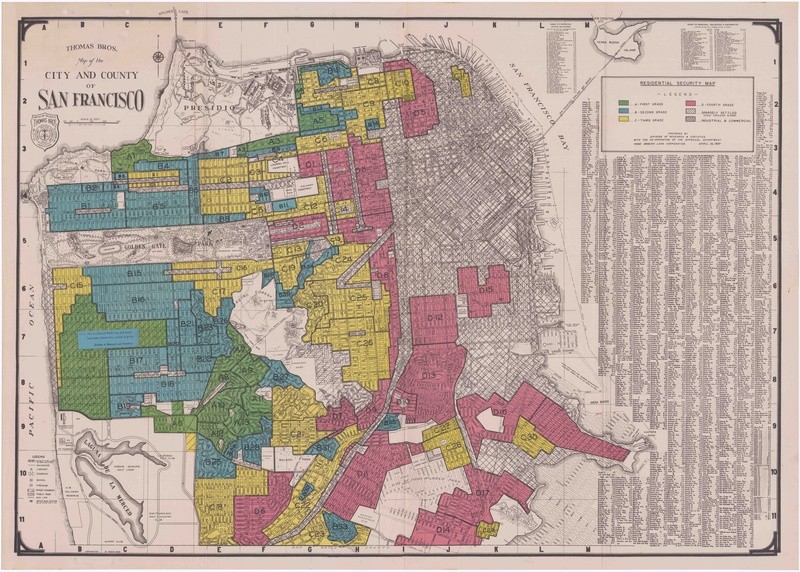
"caption": "A 1937 San Francisco \"residential security map\" created by the Home Owners' Loan Corporation",
"description": null,
"title": "SF",
"credit": "Courtesy of University of Maryland's T-Races project",
"status": "inherit",
"isLoading": false,
"fetchFailed": false
},
"lowdown_19345": {
"type": "attachments",
"id": "lowdown_19345",
"meta": {
"index": "attachments_1716263798",
"site": "lowdown",
"id": "19345",
"found": true
},
"parent": 18803,
"imgSizes": {
"thumbnail": {
"file": "https://ww2.kqed.org/app/uploads/sites/26/2015/08/Screen-shot-2015-08-26-at-5.25.51-PM-400x248.png",
"width": 400,
"mimeType": "image/png",
"height": 248
},
"post-thumbnail": {
"file": "https://ww2.kqed.org/app/uploads/sites/26/2015/08/Screen-shot-2015-08-26-at-5.25.51-PM-672x372.png",
"width": 672,
"mimeType": "image/png",
"height": 372
},
"kqedFullSize": {
"file": "https://ww2.kqed.org/app/uploads/sites/26/2015/08/Screen-shot-2015-08-26-at-5.25.51-PM.png",
"width": 879,
"height": 544
},
"guest-author-96": {
"file": "https://ww2.kqed.org/app/uploads/sites/26/2015/08/Screen-shot-2015-08-26-at-5.25.51-PM-96x96.png",
"width": 96,
"mimeType": "image/png",
"height": 96
},
"medium": {
"file": "https://ww2.kqed.org/app/uploads/sites/26/2015/08/Screen-shot-2015-08-26-at-5.25.51-PM-800x495.png",
"width": 800,
"mimeType": "image/png",
"height": 495
},
"guest-author-64": {
"file": "https://ww2.kqed.org/app/uploads/sites/26/2015/08/Screen-shot-2015-08-26-at-5.25.51-PM-64x64.png",
"width": 64,
"mimeType": "image/png",
"height": 64
},
"detail": {
"file": "https://ww2.kqed.org/app/uploads/sites/26/2015/08/Screen-shot-2015-08-26-at-5.25.51-PM-75x75.png",
"width": 75,
"mimeType": "image/png",
"height": 75
},
"guest-author-32": {
"file": "https://ww2.kqed.org/app/uploads/sites/26/2015/08/Screen-shot-2015-08-26-at-5.25.51-PM-32x32.png",
"width": 32,
"mimeType": "image/png",
"height": 32
},
"guest-author-128": {
"file": "https://ww2.kqed.org/app/uploads/sites/26/2015/08/Screen-shot-2015-08-26-at-5.25.51-PM-128x128.png",
"width": 128,
"mimeType": "image/png",
"height": 128
}
},
"publishDate": 1440635182,
"modified": 1440635182,
"caption": null,
"description": null,
"title": "Screen shot 2015-08-26 at 5.25.51 PM",
"credit": null,
"status": "inherit",
"isLoading": false,
"fetchFailed": false
},
"lowdown_19242": {
"type": "attachments",
"id": "lowdown_19242",
"meta": {
"index": "attachments_1716263798",
"site": "lowdown",
"id": "19242",
"found": true
},
"parent": 19169,
"imgSizes": {
"twentyfourteen-full-width": {
"file": "https://ww2.kqed.org/app/uploads/sites/26/2015/08/4b9145355-130924-reagan-medicare-cover-240p.nbcnews-fp-1200-800-1038x576.jpg",
"width": 1038,
"mimeType": "image/jpeg",
"height": 576
},
"thumbnail": {
"file": "https://ww2.kqed.org/app/uploads/sites/26/2015/08/4b9145355-130924-reagan-medicare-cover-240p.nbcnews-fp-1200-800-400x267.jpg",
"width": 400,
"mimeType": "image/jpeg",
"height": 267
},
"fd-sm": {
"file": "https://ww2.kqed.org/app/uploads/sites/26/2015/08/4b9145355-130924-reagan-medicare-cover-240p.nbcnews-fp-1200-800-960x640.jpg",
"width": 960,
"mimeType": "image/jpeg",
"height": 640
},
"post-thumbnail": {
"file": "https://ww2.kqed.org/app/uploads/sites/26/2015/08/4b9145355-130924-reagan-medicare-cover-240p.nbcnews-fp-1200-800-672x372.jpg",
"width": 672,
"mimeType": "image/jpeg",
"height": 372
},
"kqedFullSize": {
"file": "https://ww2.kqed.org/app/uploads/sites/26/2015/08/4b9145355-130924-reagan-medicare-cover-240p.nbcnews-fp-1200-800.jpg",
"width": 1200,
"height": 800
},
"fd-med": {
"file": "https://ww2.kqed.org/app/uploads/sites/26/2015/08/4b9145355-130924-reagan-medicare-cover-240p.nbcnews-fp-1200-800-1180x787.jpg",
"width": 1180,
"mimeType": "image/jpeg",
"height": 787
},
"guest-author-96": {
"file": "https://ww2.kqed.org/app/uploads/sites/26/2015/08/4b9145355-130924-reagan-medicare-cover-240p.nbcnews-fp-1200-800-96x96.jpg",
"width": 96,
"mimeType": "image/jpeg",
"height": 96
},
"medium": {
"file": "https://ww2.kqed.org/app/uploads/sites/26/2015/08/4b9145355-130924-reagan-medicare-cover-240p.nbcnews-fp-1200-800-800x533.jpg",
"width": 800,
"mimeType": "image/jpeg",
"height": 533
},
"guest-author-64": {
"file": "https://ww2.kqed.org/app/uploads/sites/26/2015/08/4b9145355-130924-reagan-medicare-cover-240p.nbcnews-fp-1200-800-64x64.jpg",
"width": 64,
"mimeType": "image/jpeg",
"height": 64
},
"detail": {
"file": "https://ww2.kqed.org/app/uploads/sites/26/2015/08/4b9145355-130924-reagan-medicare-cover-240p.nbcnews-fp-1200-800-75x75.jpg",
"width": 75,
"mimeType": "image/jpeg",
"height": 75
},
"guest-author-32": {
"file": "https://ww2.kqed.org/app/uploads/sites/26/2015/08/4b9145355-130924-reagan-medicare-cover-240p.nbcnews-fp-1200-800-32x32.jpg",
"width": 32,
"mimeType": "image/jpeg",
"height": 32
},
"guest-author-128": {
"file": "https://ww2.kqed.org/app/uploads/sites/26/2015/08/4b9145355-130924-reagan-medicare-cover-240p.nbcnews-fp-1200-800-128x128.jpg",
"width": 128,
"mimeType": "image/jpeg",
"height": 128
}
},
"publishDate": 1438483939,
"modified": 1490336394,
"caption": null,
"description": "Reagan",
"title": "4b9145355-130924-reagan-medicare-cover-240p.nbcnews-fp-1200-800",
"credit": null,
"status": "inherit",
"isLoading": false,
"fetchFailed": false
},
"lowdown_16554": {
"type": "attachments",
"id": "lowdown_16554",
"meta": {
"index": "attachments_1716263798",
"site": "lowdown",
"id": "16554",
"found": true
},
"parent": 16497,
"imgSizes": {
"thumbnail": {
"file": "https://ww2.kqed.org/app/uploads/sites/26/2015/03/selmatomontgomerymarch-400x284.jpg",
"width": 400,
"mimeType": "image/jpeg",
"height": 284
},
"fd-sm": {
"file": "https://ww2.kqed.org/app/uploads/sites/26/2015/03/selmatomontgomerymarch-320x228.jpg",
"width": 320,
"mimeType": "image/jpeg",
"height": 228
},
"kqedFullSize": {
"file": "https://ww2.kqed.org/app/uploads/sites/26/2015/03/selmatomontgomerymarch.jpg",
"width": 450,
"height": 320
},
"guest-author-96": {
"file": "https://ww2.kqed.org/app/uploads/sites/26/2015/03/selmatomontgomerymarch-96x96.jpg",
"width": 96,
"mimeType": "image/jpeg",
"height": 96
},
"guest-author-64": {
"file": "https://ww2.kqed.org/app/uploads/sites/26/2015/03/selmatomontgomerymarch-64x64.jpg",
"width": 64,
"mimeType": "image/jpeg",
"height": 64
},
"detail": {
"file": "https://ww2.kqed.org/app/uploads/sites/26/2015/03/selmatomontgomerymarch-75x75.jpg",
"width": 75,
"mimeType": "image/jpeg",
"height": 75
},
"guest-author-32": {
"file": "https://ww2.kqed.org/app/uploads/sites/26/2015/03/selmatomontgomerymarch-32x32.jpg",
"width": 32,
"mimeType": "image/jpeg",
"height": 32
},
"guest-author-128": {
"file": "https://ww2.kqed.org/app/uploads/sites/26/2015/03/selmatomontgomerymarch-128x128.jpg",
"width": 128,
"mimeType": "image/jpeg",
"height": 128
}
},
"publishDate": 1425947382,
"modified": 1425947382,
"caption": null,
"description": null,
"title": "selmatomontgomerymarch",
"credit": null,
"status": "inherit",
"isLoading": false,
"fetchFailed": false
},
"lowdown_9233": {
"type": "attachments",
"id": "lowdown_9233",
"meta": {
"index": "attachments_1716263798",
"site": "lowdown",
"id": "9233",
"found": true
},
"parent": 9030,
"imgSizes": {
"thumbnail": {
"file": "https://ww2.kqed.org/app/uploads/sites/26/2013/09/2013-e1418943769349-400x250.jpg",
"width": 400,
"mimeType": "image/jpeg",
"height": 250
},
"fd-sm": {
"file": "https://ww2.kqed.org/app/uploads/sites/26/2013/09/2013-e1418943769349-320x200.jpg",
"width": 320,
"mimeType": "image/jpeg",
"height": 200
},
"post-thumbnail": {
"file": "https://ww2.kqed.org/app/uploads/sites/26/2013/09/2013-e1418943769349-620x372.jpg",
"width": 620,
"mimeType": "image/jpeg",
"height": 372
},
"kqedFullSize": {
"file": "https://ww2.kqed.org/app/uploads/sites/26/2013/09/2013-e1418943769349.jpg",
"width": 620,
"height": 388
},
"guest-author-96": {
"file": "https://ww2.kqed.org/app/uploads/sites/26/2013/09/2013-e1418943769349-96x96.jpg",
"width": 96,
"mimeType": "image/jpeg",
"height": 96
},
"guest-author-64": {
"file": "https://ww2.kqed.org/app/uploads/sites/26/2013/09/2013-e1418943769349-64x64.jpg",
"width": 64,
"mimeType": "image/jpeg",
"height": 64
},
"detail": {
"file": "https://ww2.kqed.org/app/uploads/sites/26/2013/09/2013-e1418943769349-75x75.jpg",
"width": 75,
"mimeType": "image/jpeg",
"height": 75
},
"guest-author-32": {
"file": "https://ww2.kqed.org/app/uploads/sites/26/2013/09/2013-e1418943769349-32x32.jpg",
"width": 32,
"mimeType": "image/jpeg",
"height": 32
},
"guest-author-128": {
"file": "https://ww2.kqed.org/app/uploads/sites/26/2013/09/2013-e1418943769349-128x128.jpg",
"width": 128,
"mimeType": "image/jpeg",
"height": 128
}
},
"publishDate": 1378341862,
"modified": 1378341862,
"caption": null,
"description": "(FILES) US civil rights leader Martin Luther KIng (3rd from L) walks with supporters during the \"March on Washington\" 28 August, 1963 after which, King delivered the \"I Have a Dream\" speech from the steps of the LIncoln Memorial. 28 August, 2003 marks the 40th anniversary of the famous speech, which is credited with mobilizing supporters of desegregation and prompted the 1964 Civil Rights Act. King was assassinated on 04 April 1968 in Memphis, Tennessee. James Earl Ray confessed to shooting King and was sentenced to 99 years in prison. AFP PHOTO/FILES (Photo credit should read -/AFP/Getty Images)",
"title": "2013",
"credit": null,
"status": "inherit",
"isLoading": false,
"fetchFailed": false
},
"lowdown_17861": {
"type": "attachments",
"id": "lowdown_17861",
"meta": {
"index": "attachments_1716263798",
"site": "lowdown",
"id": "17861",
"found": true
},
"parent": 170,
"imgSizes": {
"thumbnail": {
"file": "https://ww2.kqed.org/app/uploads/sites/26/2011/11/FairHousing2-400x318.png",
"width": 400,
"mimeType": "image/png",
"height": 318
},
"post-thumbnail": {
"file": "https://ww2.kqed.org/app/uploads/sites/26/2011/11/FairHousing2-500x372.png",
"width": 500,
"mimeType": "image/png",
"height": 372
},
"kqedFullSize": {
"file": "https://ww2.kqed.org/app/uploads/sites/26/2011/11/FairHousing2.png",
"width": 500,
"height": 398
},
"guest-author-96": {
"file": "https://ww2.kqed.org/app/uploads/sites/26/2011/11/FairHousing2-96x96.png",
"width": 96,
"mimeType": "image/png",
"height": 96
},
"guest-author-64": {
"file": "https://ww2.kqed.org/app/uploads/sites/26/2011/11/FairHousing2-64x64.png",
"width": 64,
"mimeType": "image/png",
"height": 64
},
"detail": {
"file": "https://ww2.kqed.org/app/uploads/sites/26/2011/11/FairHousing2-75x75.png",
"width": 75,
"mimeType": "image/png",
"height": 75
},
"guest-author-32": {
"file": "https://ww2.kqed.org/app/uploads/sites/26/2011/11/FairHousing2-32x32.png",
"width": 32,
"mimeType": "image/png",
"height": 32
},
"guest-author-128": {
"file": "https://ww2.kqed.org/app/uploads/sites/26/2011/11/FairHousing2-128x128.png",
"width": 128,
"mimeType": "image/png",
"height": 128
}
},
"publishDate": 1432168843,
"modified": 1432168851,
"caption": null,
"description": null,
"title": "Fair Housing",
"credit": null,
"status": "inherit",
"isLoading": false,
"fetchFailed": false
}
},
"audioPlayerReducer": {
"postId": "stream_live",
"isPaused": true,
"isPlaying": false,
"pfsActive": false,
"pledgeModalIsOpen": true,
"playerDrawerIsOpen": false,
"liveAudioPlayStartedAt": 0,
"liveAudioPlayContext": ""
},
"authorsReducer": {
"matthewgreen": {
"type": "authors",
"id": "1263",
"meta": {
"index": "authors_1716337520",
"id": "1263",
"found": true
},
"name": "Matthew Green",
"firstName": "Matthew",
"lastName": "Green",
"slug": "matthewgreen",
"email": "mgreen@kqed.org",
"display_author_email": false,
"staff_mastheads": [],
"title": "KQED Editor/Reporter",
"bio": "Matthew Green is a digital media producer for KQED News. He previously produced \u003ca href=\"http://www.kqed.org/lowdown\">The Lowdown\u003c/a>, KQED’s multimedia news education blog. Matthew's written for numerous Bay Area publications, including the Oakland Tribune and San Francisco Chronicle. He also taught journalism classes at Fremont High School in East Oakland.\r\n\r\nEmail: mgreen@kqed.org; Twitter: @MGreenKQED",
"avatar": "https://secure.gravatar.com/avatar/3bf498d1267ca02c8494f33d8cfc575e?s=600&d=blank&r=g",
"twitter": "MGreenKQED",
"facebook": null,
"instagram": null,
"linkedin": null,
"sites": [
{
"site": "news",
"roles": []
},
{
"site": "lowdown",
"roles": []
},
{
"site": "science",
"roles": []
},
{
"site": "education",
"roles": []
},
{
"site": "quest",
"roles": []
},
{
"site": "liveblog",
"roles": []
}
],
"headData": {
"title": "Matthew Green | KQED",
"description": "KQED Editor/Reporter",
"ogImgSrc": "https://secure.gravatar.com/avatar/3bf498d1267ca02c8494f33d8cfc575e?s=600&d=blank&r=g",
"twImgSrc": "https://secure.gravatar.com/avatar/3bf498d1267ca02c8494f33d8cfc575e?s=600&d=blank&r=g"
},
"isLoading": false,
"link": "/author/matthewgreen"
},
"charukukreja": {
"type": "authors",
"id": "8658",
"meta": {
"index": "authors_1716337520",
"id": "8658",
"found": true
},
"name": "Charu Kukreja",
"firstName": "Charu",
"lastName": "Kukreja",
"slug": "charukukreja",
"email": "charu@dcrdesign.net",
"display_author_email": false,
"staff_mastheads": [],
"title": null,
"bio": "Charu is a writer, designer & urban planner based in Los Angeles, CA",
"avatar": "https://secure.gravatar.com/avatar/242498bfba464209ac2dea7d895a5fd4?s=600&d=blank&r=g",
"twitter": "charukukreja",
"facebook": null,
"instagram": null,
"linkedin": null,
"sites": [
{
"site": "lowdown",
"roles": [
"editor"
]
}
],
"headData": {
"title": "Charu Kukreja | KQED",
"description": null,
"ogImgSrc": "https://secure.gravatar.com/avatar/242498bfba464209ac2dea7d895a5fd4?s=600&d=blank&r=g",
"twImgSrc": "https://secure.gravatar.com/avatar/242498bfba464209ac2dea7d895a5fd4?s=600&d=blank&r=g"
},
"isLoading": false,
"link": "/author/charukukreja"
}
},
"pagesReducer": {
"lowdown_category_civil-rights-struggles": {
"type": "terms",
"id": "lowdown_2390",
"meta": {
"index": "terms_1716263798",
"site": "lowdown",
"id": "2390",
"score": 14.4057255
},
"featImg": null,
"name": "Civil Rights Struggles",
"description": null,
"taxonomy": "category",
"headData": {
"twImgId": null,
"twTitle": null,
"ogTitle": null,
"ogImgId": null,
"twDescription": null,
"description": null,
"title": "Civil Rights Struggles Archives | KQED Arts",
"ogDescription": null
},
"ttid": 2400,
"slug": "civil-rights-struggles",
"isLoading": false,
"title": "Civil Rights Struggles",
"pageMeta": {
"site": "lowdown",
"WpPageTemplate": "page-topic-editorial",
"currentPage": 2
},
"blocks": [
{
"blockName": "kqed/post-list",
"attrs": {
"layout": "cardArticle2",
"query": "posts/lowdown?category=civil-rights-struggles",
"seeMore": false,
"paginated": true,
"page": 2
}
},
{
"blockName": "kqed/ad"
}
]
}
},
"pfsSessionReducer": {},
"postsReducer": {
"stream_live": {
"type": "live",
"id": "stream_live",
"audioUrl": "https://hls.kqed.org/hls/kqed_app/playlist.m3u8",
"title": "Live Stream",
"excerpt": "Live Stream information currently unavailable.",
"link": "/radio",
"featImg": "",
"label": {
"name": "KQED Live",
"link": "/"
}
},
"stream_kqedNewscast": {
"type": "posts",
"id": "stream_kqedNewscast",
"audioUrl": "https://www.kqed.org/.stream/anon/radio/RDnews/newscast.mp3?_=1",
"title": "KQED Newscast",
"featImg": "",
"label": {
"name": "88.5 FM",
"link": "/"
}
},
"lowdown_18486": {
"type": "posts",
"id": "lowdown_18486",
"meta": {
"index": "posts_1716263798",
"site": "lowdown",
"id": "18486",
"score": null,
"sort": [
1461801623000
]
},
"parent": 0,
"labelTerm": {
"site": "lowdown"
},
"blocks": [],
"publishDate": 1461801623,
"format": "standard",
"disqusTitle": "How Government Redlining Maps Pushed Segregation in California Cities [Interactive]",
"title": "How Government Redlining Maps Pushed Segregation in California Cities [Interactive]",
"headTitle": "The Lowdown | KQED News",
"content": "\u003cp>A Supreme Court decision last June made clear that housing discrimination is not just a thing of the past.\u003c!--more-->\u003c/p>\n\u003cdiv>\n\u003caside class=\"alignright\">\n\u003ch3>Discussion Questions & Suggestions\u003c/h3>\n\u003cul>\n\u003cli>Why did the federal government create different categories for different neighborhoods?\u003c/li>\n\u003cli>Do you notice any lasting effects of redlining where you live?\u003c/li>\n\u003cli>Click on a green area in one of the interactive maps below. What are the reasons given for that neighborhood's desirability?\u003c/li>\n\u003cli>Click on a red area. What are the reasons given for its low ranking?\u003cem>For more teaching ideas, download a\u003ca href=\"http://ucbhssp.berkeley.edu/content/struggles-justice-segregation-housing-united-states\" target=\"_blank\"> lesson plan on U.S. housing discrimination\u003c/a>, created by Mt. Diablo Unified high school teacher Jenna Rentz, in collaboration with the UC Berkeley History-Social Science Project.\u003c/em>\u003c/li>\n\u003c/ul>\n\u003c/aside>\n\u003c/div>\n\u003cp>In a \u003ca href=\"http://www.npr.org/2015/06/25/417516457/supreme-court-sides-with-civil-rights-advocates-in-fair-housing-case\" target=\"_blank\">5-4 decision\u003c/a>, the High Court ruled that even unintentional housing discrimination violates the Fair Housing Act. Homeowners or renters, it stated, can file suit against government or private housing policies without having to prove that alleged discriminatory act was done intentionally.\u003c/p>\n\u003cp>Writing for the majority, Justice Anthony Kennedy said that although legally sanctioned racial segregation is over, “its vestiges remain today, intertwined with the country’s economic and social life.”\u003c/p>\n\u003cp>He did not, however, elaborate on the various federal government policies in place before the Civil Rights Movement that actually encouraged housing discrimination and segregation. It's these policies, some historians argue, that helped determine the demographic makeup of the neighborhoods many of us live in today.\u003c/p>\n\u003cp>One example is the Home Owners' Loan Corporation (HOLC). Established by Congress in 1933, the initiative was promoted by President Franklin Roosevelt to help stem the urban foreclosure crisis that had spiked during the Great Depression.\u003c/p>\n\u003cp>[ad fullwidth]\u003c/p>\n\u003cp>Over the next three years, the federal agency refinanced more than a million homes. It issued low-interest, long-term loans to scores of new homeowners across the nation, spurring a dramatic uptick in home-ownership over the proceeding decades.\u003c/p>\n\u003cp>But only for some.\u003c/p>\n\u003cp>To show which areas were safe investments, HOLC gathered reams of local data to draw up “residential safety maps\" of cities across the nation. Neighborhoods were classified into one of four categories based on \"favorable\" and \"detrimental\" influences. Factors included terrain and type and age of buildings, as well as the \"threat of infiltration of foreign-born, negro, or lower grade population.\"\u003c/p>\n\u003cp>\u003ca href=\"http://ww2.kqed.org/lowdown/wp-content/uploads/sites/26/2015/07/palette.png\">\u003cimg class=\"alignright wp-image-18884\" src=\"http://ww2.kqed.org/lowdown/wp-content/uploads/sites/26/2015/07/palette-400x273.png\" alt=\"palette\" width=\"296\" height=\"202\" srcset=\"https://ww2.kqed.org/app/uploads/sites/26/2015/07/palette-400x273.png 400w, https://ww2.kqed.org/app/uploads/sites/26/2015/07/palette.png 562w\" sizes=\"(max-width: 296px) 100vw, 296px\">\u003c/a>\"A\" areas, in green, were considered \"hot spots,\" where good mortgage lenders ... are willing to make their maximum loans.\" \"B\" areas, in blue, were deemed not as desirable, but \"still good.\" \"C\" areas, in yellow, were considered in decline. And finally, \"D\" areas, in red, were considered to be in full decline, areas lenders should steer clear of.\u003c/p>\n\u003cp>Not surprisingly, HOLC's classification method was heavily influenced by a neighborhood's racial and economic demographics.\u003c/p>\n\u003cp>Private banks quickly adopted the government's identification system, commonly denying home loans to residents in neighborhoods considered risky. The color-coding of maps became a verb: to redline a community was to mark it as undesirable and not worthy of investment.\u003c/p>\n\u003cp>Below are some of the original HOLC maps and re-created interactive versions, which use data collected by the \u003ca href=\"http://salt.umd.edu/T-RACES/demo/demo.html\" target=\"_blank\">University of Maryland's T-Races project\u003c/a>. Created in the late 1930s, they illustrate HOLC's neighborhood classification system for mid-to-large cities in the Bay Area and elsewhere in California. For the interactive maps, click on each neighborhood to see copies of the HOLC's original assessment surveys. Find additional maps for San Jose, Los Angeles, San Diego and Stockton at the end of this post.\u003c/p>\n\u003cp>\u003ca href=\"http://ww2.kqed.org/lowdown/wp-content/uploads/sites/26/2015/07/OaklandBerkeleyHOLCmap-MED.jpg\">\u003cimg class=\" size-large wp-image-18878 alignnone\" src=\"http://ww2.kqed.org/lowdown/wp-content/uploads/sites/26/2015/07/OaklandBerkeleyHOLCmap-MED-1440x1063.jpg\" alt=\"OaklandBerkeleyHOLCmap-MED\" width=\"640\" height=\"472\" srcset=\"https://ww2.kqed.org/app/uploads/sites/26/2015/07/OaklandBerkeleyHOLCmap-MED-1440x1063.jpg 1440w, https://ww2.kqed.org/app/uploads/sites/26/2015/07/OaklandBerkeleyHOLCmap-MED-400x295.jpg 400w, https://ww2.kqed.org/app/uploads/sites/26/2015/07/OaklandBerkeleyHOLCmap-MED-800x590.jpg 800w, https://ww2.kqed.org/app/uploads/sites/26/2015/07/OaklandBerkeleyHOLCmap-MED-1180x871.jpg 1180w, https://ww2.kqed.org/app/uploads/sites/26/2015/07/OaklandBerkeleyHOLCmap-MED-960x708.jpg 960w\" sizes=\"(max-width: 640px) 100vw, 640px\">\u003c/a>\u003c/p>\n\u003cp>\u003c!-- iframe plugin v.4.3 wordpress.org/plugins/iframe/ -->\u003cbr>\n\u003ciframe src=\"https://www.google.com/maps/d/embed?mid=zUghhWyBYBW4.knkdNhx04PDQ\" width=\"640\" height=\"480\" scrolling=\"yes\" class=\"iframe-class\" frameborder=\"0\">\u003c/iframe>\u003c/p>\n\u003cp>\u003ca href=\"http://ww2.kqed.org/lowdown/wp-content/uploads/sites/26/2015/07/SF.jpg\">\u003cimg class=\"alignnone size-full wp-image-18880\" src=\"http://ww2.kqed.org/lowdown/wp-content/uploads/sites/26/2015/07/SF.jpg\" alt=\"SF\" width=\"800\" height=\"572\" srcset=\"https://ww2.kqed.org/app/uploads/sites/26/2015/07/SF.jpg 800w, https://ww2.kqed.org/app/uploads/sites/26/2015/07/SF-400x286.jpg 400w\" sizes=\"(max-width: 800px) 100vw, 800px\">\u003c/a>\u003c/p>\n\u003cp>\u003c!-- iframe plugin v.4.3 wordpress.org/plugins/iframe/ -->\u003cbr>\n\u003ciframe src=\"https://www.google.com/maps/d/embed?mid=zUghhWyBYBW4.kt6v-_88BBJo\" width=\"640\" height=\"480\" scrolling=\"yes\" class=\"iframe-class\" frameborder=\"0\">\u003c/iframe>\u003c/p>\n\u003cp>University of Richmond Historian Robert K. Nelson, who runs the \u003ca href=\"http://dsl.richmond.edu/holc/pages/intro\" target=\"_blank\">Redlining Richmond \u003c/a>project describes the methodology:\u003c/p>\n\u003cp>\u003cem>Neighborhoods inexorably declined as housing stock decayed and housing styles went out of fashion, lowering values to the point that a \"lower grade population\" began \"infiltrating\" the neighborhood. This was bad enough when those infiltrators were working-class or foreign-born whites. Their presence compromised the neighborhood's social homogeneity and accelerated the decline of both housing values and neighborhood desirability. \u003c/em>\u003c/p>\n\u003cp>\u003cem>The movement of African Americans into a neighborhood was far worse according to this model, precipitating the final demise of its desirability and \"residential security.\" Thus while HOLC grades were assigned by weighing a variety of factors, including the age of houses and the fashionability of particular architectural styles, it is clear that race trumped all others ...\u003c/em>\u003c/p>\n\u003cp>Although officially prohibited by the \u003ca href=\"http://portal.hud.gov/hudportal/HUD?src=/program_offices/fair_housing_equal_opp/progdesc/title8\" target=\"_blank\">Fair Housing Act\u003c/a> of 1968, the practice of neighborhood delineation based on race and class had a lasting impact, depriving certain neighborhoods of essential resources. And that many argue, helped determine the demographic and economic makeup of the neighborhoods we live in today.\u003c/p>\n\u003cp>More subtle forms of redlining continue however, as evidenced by recent discriminatory loan practice \u003ca href=\"http://portal.hud.gov/hudportal/HUD?src=/press/press_releases_media_advisories/2015/HUDNo_15-064b\" target=\"_blank\">settlements\u003c/a> and issues of \u003ca href=\"http://www.ncbi.nlm.nih.gov/pubmed/22777683\" target=\"_blank\">\"retail redlining,\"\u003c/a> wherein businesses avoid setting up shop in neighborhoods deemed undesirable.\u003c/p>\n\u003cp>View HOLC maps of additional cities at the \u003ca href=\"http://www.urbanoasis.org/projects/holc-fha/digital-holc-maps/\" target=\"_blank\">Urban Oasis project\u003c/a>.\u003cbr>\n\u003ca href=\"http://ww2.kqed.org/lowdown/wp-content/uploads/sites/26/2015/07/SJ.png\">\u003cimg class=\" wp-image-18881 size-full alignnone\" src=\"http://ww2.kqed.org/lowdown/wp-content/uploads/sites/26/2015/07/SJ.png\" alt=\"SJ\" width=\"624\" height=\"562\" srcset=\"https://ww2.kqed.org/app/uploads/sites/26/2015/07/SJ.png 624w, https://ww2.kqed.org/app/uploads/sites/26/2015/07/SJ-400x360.png 400w\" sizes=\"(max-width: 624px) 100vw, 624px\">\u003c/a>\u003c/p>\n\u003cp>\u003c!-- iframe plugin v.4.3 wordpress.org/plugins/iframe/ -->\u003cbr>\n\u003ciframe src=\"https://www.google.com/maps/d/embed?mid=zUghhWyBYBW4.kiGRF4iVhw8g\" width=\"640\" height=\"480\" scrolling=\"yes\" class=\"iframe-class\" frameborder=\"0\">\u003c/iframe>\u003c/p>\n\u003cp> \u003c/p>\n\u003cp>\u003ca href=\"http://ww2.kqed.org/lowdown/wp-content/uploads/sites/26/2015/07/LosAngelesHOLC-lg.jpg\">\u003cimg class=\" size-large wp-image-18882 alignnone\" src=\"http://ww2.kqed.org/lowdown/wp-content/uploads/sites/26/2015/07/LosAngelesHOLC-lg-1440x1021.jpg\" alt=\"LosAngelesHOLC-lg\" width=\"640\" height=\"454\" srcset=\"https://ww2.kqed.org/app/uploads/sites/26/2015/07/LosAngelesHOLC-lg-1440x1021.jpg 1440w, https://ww2.kqed.org/app/uploads/sites/26/2015/07/LosAngelesHOLC-lg-400x284.jpg 400w, https://ww2.kqed.org/app/uploads/sites/26/2015/07/LosAngelesHOLC-lg-800x567.jpg 800w, https://ww2.kqed.org/app/uploads/sites/26/2015/07/LosAngelesHOLC-lg-1180x836.jpg 1180w, https://ww2.kqed.org/app/uploads/sites/26/2015/07/LosAngelesHOLC-lg-960x680.jpg 960w\" sizes=\"(max-width: 640px) 100vw, 640px\">\u003c/a>\u003c/p>\n\u003cp>\u003c!-- iframe plugin v.4.3 wordpress.org/plugins/iframe/ -->\u003cbr>\n\u003ciframe src=\"https://www.google.com/maps/d/embed?mid=zUghhWyBYBW4.kRkIgBut9l-o\" width=\"640\" height=\"480\" scrolling=\"yes\" class=\"iframe-class\" frameborder=\"0\">\u003c/iframe>\u003c/p>\n\u003cp>\u003c!-- iframe plugin v.4.3 wordpress.org/plugins/iframe/ -->\u003cbr>\n\u003ciframe src=\"https://www.google.com/maps/d/embed?mid=zUghhWyBYBW4.knWPOJ6VvdDo\" width=\"640\" height=\"480\" scrolling=\"yes\" class=\"iframe-class\" frameborder=\"0\">\u003c/iframe>\u003c/p>\n\u003cp>\u003c!-- iframe plugin v.4.3 wordpress.org/plugins/iframe/ -->\u003cbr>\n\u003ciframe src=\"https://www.google.com/maps/d/embed?mid=zUghhWyBYBW4.kdTG-ML2eOFU\" width=\"640\" height=\"480\" scrolling=\"yes\" class=\"iframe-class\" frameborder=\"0\">\u003c/iframe>\u003c/p>\n\u003cp>\u003c/p>\n\u003cp>\u003c!-- iframe plugin v.4.3 wordpress.org/plugins/iframe/ -->\u003cbr>\n\u003ciframe src=\"https://www.google.com/maps/d/embed?mid=zUghhWyBYBW4.kwu99aJGMq3g\" width=\"640\" height=\"480\" scrolling=\"yes\" class=\"iframe-class\" frameborder=\"0\">\u003c/iframe>\u003c/p>\n\n",
"disqusIdentifier": "18486 http://ww2.kqed.org/lowdown/?p=18486",
"disqusUrl": "https://ww2.kqed.org/lowdown/2016/04/27/redlining/",
"stats": {
"hasVideo": false,
"hasChartOrMap": true,
"hasAudio": false,
"hasPolis": false,
"wordCount": 821,
"hasGoogleForm": false,
"hasGallery": false,
"hasHearkenModule": false,
"iframeSrcs": [
"https://www.google.com/maps/d/embed"
],
"paragraphCount": 30
},
"modified": 1531507097,
"excerpt": null,
"headData": {
"twImgId": "",
"twTitle": "",
"ogTitle": "",
"ogImgId": "",
"twDescription": "",
"description": "A Supreme Court decision last June made clear that housing discrimination is not just a thing of the past.",
"title": "How Government Redlining Maps Pushed Segregation in California Cities [Interactive] | KQED",
"ogDescription": "",
"schema": {
"@context": "https://schema.org",
"@type": "Article",
"headline": "How Government Redlining Maps Pushed Segregation in California Cities [Interactive]",
"datePublished": "2016-04-27T17:00:23-07:00",
"dateModified": "2018-07-13T11:38:17-07:00",
"image": "https://cdn.kqed.org/wp-content/uploads/2020/02/KQED-OG-Image@1x.png"
}
},
"guestAuthors": [],
"slug": "redlining",
"status": "publish",
"path": "/lowdown/18486/redlining",
"audioTrackLength": null,
"parsedContent": [
{
"type": "contentString",
"content": "\u003cdiv class=\"post-body\">\u003cp>\u003cp>A Supreme Court decision last June made clear that housing discrimination is not just a thing of the past.\u003c!--more-->\u003c/p>\n\u003cdiv>\n\u003caside class=\"alignright\">\n\u003ch3>Discussion Questions & Suggestions\u003c/h3>\n\u003cul>\n\u003cli>Why did the federal government create different categories for different neighborhoods?\u003c/li>\n\u003cli>Do you notice any lasting effects of redlining where you live?\u003c/li>\n\u003cli>Click on a green area in one of the interactive maps below. What are the reasons given for that neighborhood's desirability?\u003c/li>\n\u003cli>Click on a red area. What are the reasons given for its low ranking?\u003cem>For more teaching ideas, download a\u003ca href=\"http://ucbhssp.berkeley.edu/content/struggles-justice-segregation-housing-united-states\" target=\"_blank\"> lesson plan on U.S. housing discrimination\u003c/a>, created by Mt. Diablo Unified high school teacher Jenna Rentz, in collaboration with the UC Berkeley History-Social Science Project.\u003c/em>\u003c/li>\n\u003c/ul>\n\u003c/aside>\n\u003c/div>\n\u003cp>In a \u003ca href=\"http://www.npr.org/2015/06/25/417516457/supreme-court-sides-with-civil-rights-advocates-in-fair-housing-case\" target=\"_blank\">5-4 decision\u003c/a>, the High Court ruled that even unintentional housing discrimination violates the Fair Housing Act. Homeowners or renters, it stated, can file suit against government or private housing policies without having to prove that alleged discriminatory act was done intentionally.\u003c/p>\n\u003cp>Writing for the majority, Justice Anthony Kennedy said that although legally sanctioned racial segregation is over, “its vestiges remain today, intertwined with the country’s economic and social life.”\u003c/p>\n\u003cp>He did not, however, elaborate on the various federal government policies in place before the Civil Rights Movement that actually encouraged housing discrimination and segregation. It's these policies, some historians argue, that helped determine the demographic makeup of the neighborhoods many of us live in today.\u003c/p>\n\u003cp>One example is the Home Owners' Loan Corporation (HOLC). Established by Congress in 1933, the initiative was promoted by President Franklin Roosevelt to help stem the urban foreclosure crisis that had spiked during the Great Depression.\u003c/p>\n\u003cp>\u003c/p>\u003c/div>",
"attributes": {
"named": {},
"numeric": []
}
},
{
"type": "component",
"content": "",
"name": "ad",
"attributes": {
"named": {
"label": "fullwidth"
},
"numeric": [
"fullwidth"
]
}
},
{
"type": "contentString",
"content": "\u003cdiv class=\"post-body\">\u003cp>\u003c/p>\n\u003cp>Over the next three years, the federal agency refinanced more than a million homes. It issued low-interest, long-term loans to scores of new homeowners across the nation, spurring a dramatic uptick in home-ownership over the proceeding decades.\u003c/p>\n\u003cp>But only for some.\u003c/p>\n\u003cp>To show which areas were safe investments, HOLC gathered reams of local data to draw up “residential safety maps\" of cities across the nation. Neighborhoods were classified into one of four categories based on \"favorable\" and \"detrimental\" influences. Factors included terrain and type and age of buildings, as well as the \"threat of infiltration of foreign-born, negro, or lower grade population.\"\u003c/p>\n\u003cp>\u003ca href=\"http://ww2.kqed.org/lowdown/wp-content/uploads/sites/26/2015/07/palette.png\">\u003cimg class=\"alignright wp-image-18884\" src=\"http://ww2.kqed.org/lowdown/wp-content/uploads/sites/26/2015/07/palette-400x273.png\" alt=\"palette\" width=\"296\" height=\"202\" srcset=\"https://ww2.kqed.org/app/uploads/sites/26/2015/07/palette-400x273.png 400w, https://ww2.kqed.org/app/uploads/sites/26/2015/07/palette.png 562w\" sizes=\"(max-width: 296px) 100vw, 296px\">\u003c/a>\"A\" areas, in green, were considered \"hot spots,\" where good mortgage lenders ... are willing to make their maximum loans.\" \"B\" areas, in blue, were deemed not as desirable, but \"still good.\" \"C\" areas, in yellow, were considered in decline. And finally, \"D\" areas, in red, were considered to be in full decline, areas lenders should steer clear of.\u003c/p>\n\u003cp>Not surprisingly, HOLC's classification method was heavily influenced by a neighborhood's racial and economic demographics.\u003c/p>\n\u003cp>Private banks quickly adopted the government's identification system, commonly denying home loans to residents in neighborhoods considered risky. The color-coding of maps became a verb: to redline a community was to mark it as undesirable and not worthy of investment.\u003c/p>\n\u003cp>Below are some of the original HOLC maps and re-created interactive versions, which use data collected by the \u003ca href=\"http://salt.umd.edu/T-RACES/demo/demo.html\" target=\"_blank\">University of Maryland's T-Races project\u003c/a>. Created in the late 1930s, they illustrate HOLC's neighborhood classification system for mid-to-large cities in the Bay Area and elsewhere in California. For the interactive maps, click on each neighborhood to see copies of the HOLC's original assessment surveys. Find additional maps for San Jose, Los Angeles, San Diego and Stockton at the end of this post.\u003c/p>\n\u003cp>\u003ca href=\"http://ww2.kqed.org/lowdown/wp-content/uploads/sites/26/2015/07/OaklandBerkeleyHOLCmap-MED.jpg\">\u003cimg class=\" size-large wp-image-18878 alignnone\" src=\"http://ww2.kqed.org/lowdown/wp-content/uploads/sites/26/2015/07/OaklandBerkeleyHOLCmap-MED-1440x1063.jpg\" alt=\"OaklandBerkeleyHOLCmap-MED\" width=\"640\" height=\"472\" srcset=\"https://ww2.kqed.org/app/uploads/sites/26/2015/07/OaklandBerkeleyHOLCmap-MED-1440x1063.jpg 1440w, https://ww2.kqed.org/app/uploads/sites/26/2015/07/OaklandBerkeleyHOLCmap-MED-400x295.jpg 400w, https://ww2.kqed.org/app/uploads/sites/26/2015/07/OaklandBerkeleyHOLCmap-MED-800x590.jpg 800w, https://ww2.kqed.org/app/uploads/sites/26/2015/07/OaklandBerkeleyHOLCmap-MED-1180x871.jpg 1180w, https://ww2.kqed.org/app/uploads/sites/26/2015/07/OaklandBerkeleyHOLCmap-MED-960x708.jpg 960w\" sizes=\"(max-width: 640px) 100vw, 640px\">\u003c/a>\u003c/p>\n\u003cp>\u003c!-- iframe plugin v.4.3 wordpress.org/plugins/iframe/ -->\u003cbr>\n\u003ciframe src=\"https://www.google.com/maps/d/embed?mid=zUghhWyBYBW4.knkdNhx04PDQ\" width=\"640\" height=\"480\" scrolling=\"yes\" class=\"iframe-class\" frameborder=\"0\">\u003c/iframe>\u003c/p>\n\u003cp>\u003ca href=\"http://ww2.kqed.org/lowdown/wp-content/uploads/sites/26/2015/07/SF.jpg\">\u003cimg class=\"alignnone size-full wp-image-18880\" src=\"http://ww2.kqed.org/lowdown/wp-content/uploads/sites/26/2015/07/SF.jpg\" alt=\"SF\" width=\"800\" height=\"572\" srcset=\"https://ww2.kqed.org/app/uploads/sites/26/2015/07/SF.jpg 800w, https://ww2.kqed.org/app/uploads/sites/26/2015/07/SF-400x286.jpg 400w\" sizes=\"(max-width: 800px) 100vw, 800px\">\u003c/a>\u003c/p>\n\u003cp>\u003c!-- iframe plugin v.4.3 wordpress.org/plugins/iframe/ -->\u003cbr>\n\u003ciframe src=\"https://www.google.com/maps/d/embed?mid=zUghhWyBYBW4.kt6v-_88BBJo\" width=\"640\" height=\"480\" scrolling=\"yes\" class=\"iframe-class\" frameborder=\"0\">\u003c/iframe>\u003c/p>\n\u003cp>University of Richmond Historian Robert K. Nelson, who runs the \u003ca href=\"http://dsl.richmond.edu/holc/pages/intro\" target=\"_blank\">Redlining Richmond \u003c/a>project describes the methodology:\u003c/p>\n\u003cp>\u003cem>Neighborhoods inexorably declined as housing stock decayed and housing styles went out of fashion, lowering values to the point that a \"lower grade population\" began \"infiltrating\" the neighborhood. This was bad enough when those infiltrators were working-class or foreign-born whites. Their presence compromised the neighborhood's social homogeneity and accelerated the decline of both housing values and neighborhood desirability. \u003c/em>\u003c/p>\n\u003cp>\u003cem>The movement of African Americans into a neighborhood was far worse according to this model, precipitating the final demise of its desirability and \"residential security.\" Thus while HOLC grades were assigned by weighing a variety of factors, including the age of houses and the fashionability of particular architectural styles, it is clear that race trumped all others ...\u003c/em>\u003c/p>\n\u003cp>Although officially prohibited by the \u003ca href=\"http://portal.hud.gov/hudportal/HUD?src=/program_offices/fair_housing_equal_opp/progdesc/title8\" target=\"_blank\">Fair Housing Act\u003c/a> of 1968, the practice of neighborhood delineation based on race and class had a lasting impact, depriving certain neighborhoods of essential resources. And that many argue, helped determine the demographic and economic makeup of the neighborhoods we live in today.\u003c/p>\n\u003cp>More subtle forms of redlining continue however, as evidenced by recent discriminatory loan practice \u003ca href=\"http://portal.hud.gov/hudportal/HUD?src=/press/press_releases_media_advisories/2015/HUDNo_15-064b\" target=\"_blank\">settlements\u003c/a> and issues of \u003ca href=\"http://www.ncbi.nlm.nih.gov/pubmed/22777683\" target=\"_blank\">\"retail redlining,\"\u003c/a> wherein businesses avoid setting up shop in neighborhoods deemed undesirable.\u003c/p>\n\u003cp>View HOLC maps of additional cities at the \u003ca href=\"http://www.urbanoasis.org/projects/holc-fha/digital-holc-maps/\" target=\"_blank\">Urban Oasis project\u003c/a>.\u003cbr>\n\u003ca href=\"http://ww2.kqed.org/lowdown/wp-content/uploads/sites/26/2015/07/SJ.png\">\u003cimg class=\" wp-image-18881 size-full alignnone\" src=\"http://ww2.kqed.org/lowdown/wp-content/uploads/sites/26/2015/07/SJ.png\" alt=\"SJ\" width=\"624\" height=\"562\" srcset=\"https://ww2.kqed.org/app/uploads/sites/26/2015/07/SJ.png 624w, https://ww2.kqed.org/app/uploads/sites/26/2015/07/SJ-400x360.png 400w\" sizes=\"(max-width: 624px) 100vw, 624px\">\u003c/a>\u003c/p>\n\u003cp>\u003c!-- iframe plugin v.4.3 wordpress.org/plugins/iframe/ -->\u003cbr>\n\u003ciframe src=\"https://www.google.com/maps/d/embed?mid=zUghhWyBYBW4.kiGRF4iVhw8g\" width=\"640\" height=\"480\" scrolling=\"yes\" class=\"iframe-class\" frameborder=\"0\">\u003c/iframe>\u003c/p>\n\u003cp> \u003c/p>\n\u003cp>\u003ca href=\"http://ww2.kqed.org/lowdown/wp-content/uploads/sites/26/2015/07/LosAngelesHOLC-lg.jpg\">\u003cimg class=\" size-large wp-image-18882 alignnone\" src=\"http://ww2.kqed.org/lowdown/wp-content/uploads/sites/26/2015/07/LosAngelesHOLC-lg-1440x1021.jpg\" alt=\"LosAngelesHOLC-lg\" width=\"640\" height=\"454\" srcset=\"https://ww2.kqed.org/app/uploads/sites/26/2015/07/LosAngelesHOLC-lg-1440x1021.jpg 1440w, https://ww2.kqed.org/app/uploads/sites/26/2015/07/LosAngelesHOLC-lg-400x284.jpg 400w, https://ww2.kqed.org/app/uploads/sites/26/2015/07/LosAngelesHOLC-lg-800x567.jpg 800w, https://ww2.kqed.org/app/uploads/sites/26/2015/07/LosAngelesHOLC-lg-1180x836.jpg 1180w, https://ww2.kqed.org/app/uploads/sites/26/2015/07/LosAngelesHOLC-lg-960x680.jpg 960w\" sizes=\"(max-width: 640px) 100vw, 640px\">\u003c/a>\u003c/p>\n\u003cp>\u003c!-- iframe plugin v.4.3 wordpress.org/plugins/iframe/ -->\u003cbr>\n\u003ciframe src=\"https://www.google.com/maps/d/embed?mid=zUghhWyBYBW4.kRkIgBut9l-o\" width=\"640\" height=\"480\" scrolling=\"yes\" class=\"iframe-class\" frameborder=\"0\">\u003c/iframe>\u003c/p>\n\u003cp>\u003c!-- iframe plugin v.4.3 wordpress.org/plugins/iframe/ -->\u003cbr>\n\u003ciframe src=\"https://www.google.com/maps/d/embed?mid=zUghhWyBYBW4.knWPOJ6VvdDo\" width=\"640\" height=\"480\" scrolling=\"yes\" class=\"iframe-class\" frameborder=\"0\">\u003c/iframe>\u003c/p>\n\u003cp>\u003c!-- iframe plugin v.4.3 wordpress.org/plugins/iframe/ -->\u003cbr>\n\u003ciframe src=\"https://www.google.com/maps/d/embed?mid=zUghhWyBYBW4.kdTG-ML2eOFU\" width=\"640\" height=\"480\" scrolling=\"yes\" class=\"iframe-class\" frameborder=\"0\">\u003c/iframe>\u003c/p>\n\u003cp>\u003c/p>\n\u003cp>\u003c!-- iframe plugin v.4.3 wordpress.org/plugins/iframe/ -->\u003cbr>\n\u003ciframe src=\"https://www.google.com/maps/d/embed?mid=zUghhWyBYBW4.kwu99aJGMq3g\" width=\"640\" height=\"480\" scrolling=\"yes\" class=\"iframe-class\" frameborder=\"0\">\u003c/iframe>\u003c/p>\n\n\u003c/div>\u003c/p>",
"attributes": {
"named": {},
"numeric": []
}
}
],
"link": "/lowdown/18486/redlining",
"authors": [
"1263"
],
"categories": [
"lowdown_2390",
"lowdown_451",
"lowdown_1",
"lowdown_2365"
],
"tags": [
"lowdown_2337",
"lowdown_2441",
"lowdown_60"
],
"featImg": "lowdown_18880",
"label": "lowdown"
},
"lowdown_18803": {
"type": "posts",
"id": "lowdown_18803",
"meta": {
"index": "posts_1716263798",
"site": "lowdown",
"id": "18803",
"score": null,
"sort": [
1449086434000
]
},
"parent": 0,
"labelTerm": {
"site": "lowdown"
},
"blocks": [],
"publishDate": 1449086434,
"format": "standard",
"disqusTitle": "MAP: Chicago Is Latest In Long List Of Police Departments To Be Investigated By the Feds",
"title": "MAP: Chicago Is Latest In Long List Of Police Departments To Be Investigated By the Feds",
"headTitle": "The Lowdown | KQED News",
"content": "\u003cp>[http_redir]\u003cbr>\nThe Chicago Police Department is the latest local law enforcement agency to come under fire, following the recent release of 2014 graphic video showing a white Chicago police officer shooting and killing a 17-year-old black male.\u003c!--more-->\u003c/p>\n\u003cp>Protests erupted last week after the city was forced to release the year-old footage. And on Tuesday, Chicago Mayor Rahm Emmanuel announced the dismissal of police Superintendent Garry McCarthy. Emmanuel said he would appoint a \u003ca href=\"http://www.npr.org/sections/thetwo-way/2015/12/01/457981923/amid-criticism-chicago-mayor-will-announce-police-accountability-taskforce\" target=\"_blank\" rel=\"noopener\">task force to look at police accountability\u003c/a>, noting that \"public trust\" in the police had been \"shaken\" and \"eroded.\"\u003c/p>\n\u003cp>McCarthy's dismissal comes on the same day that Illinois Attorney General asked the Justice Department to investigate whether the Chicago Police Department's practices violated constitutional law, \u003ca href=\"http://Illinois%20Attorney%20General%20Lisa%20Madigan%20asked%20the%20Justice%20Department%20Tuesday%20to%20investigate%20whether%20the%20Chicago%20Police%20Department's%20practices%20violated%20constitutional%20law.%20The%20agency%20confirmed%20to%20NPR's%20Carrie%20Johnson%20that%20it%20is%20reviewing%20the%20request.\" target=\"_blank\" rel=\"noopener\">NPR reports\u003c/a>.\u003c/p>\n\u003cp>If the Justice Department decides to take up the investigation, the Chicago PD will join the ranks of roughly 70 other police departments nationwide that have been investigated by the feds for brutality, racial bias and other civil rights violations.\u003cbr>\nClick points on the map below for specific DOJ 14141 investigations of police departments around the country (with data compiled by \u003ca href=\"https://github.com/themarshallproject/doj14141\" target=\"_blank\" rel=\"noopener\">the Marshall Project\u003c/a>.) The map details on-going cases and negotiated settlements (not all 67 cases). Map design by Charu Kukreja and Roland Hansson.\u003c/p>\n\u003cp>View \u003ca href=\"http://www.dcrdesign.net/maps/kqed_1.html\" target=\"_blank\" rel=\"noopener\">here\u003c/a> in fullscreen mode.\u003c/p>\n\u003cdiv align=\"center\">\n\u003c!-- iframe plugin v.4.3 wordpress.org/plugins/iframe/ -->\u003cbr>\n\u003ciframe src=\"https://www.dcrdesign.net/maps/kqed_1.html\" width=\"1000\" height=\"800\" scrolling=\"yes\" class=\"iframe-class\" frameborder=\"0\">\u003c/iframe>\n\u003c/div>\n\u003cp> \u003c/p>\n\u003cp>[ad fullwidth]\u003c/p>\n\u003cp>Although they make up only a tiny percentage of the the nearly 18,000 state and local law enforcement agencies around the country, some of these departments are among the nation's largest, serving nearly one in five Americans, according to a recent \u003ca href=\"http://papers.ssrn.com/sol3/papers.cfm?abstract_id=2414673\" target=\"_blank\" rel=\"noopener\">analysis\u003c/a>.\u003c/p>\n\u003cp>\u003ca href=\"http://ww2.kqed.org/lowdown/wp-content/uploads/sites/26/2015/08/14141-graphic_full_updated2-1.jpg\">\u003cimg class=\"alignright wp-image-19347\" src=\"http://ww2.kqed.org/lowdown/wp-content/uploads/sites/26/2015/08/14141-graphic_full_updated2-1-400x355.jpg\" alt=\"14141-graphic_full_updated2-1\" width=\"306\" height=\"271\" srcset=\"https://ww2.kqed.org/app/uploads/sites/26/2015/08/14141-graphic_full_updated2-1-400x355.jpg 400w, https://ww2.kqed.org/app/uploads/sites/26/2015/08/14141-graphic_full_updated2-1-800x710.jpg 800w, https://ww2.kqed.org/app/uploads/sites/26/2015/08/14141-graphic_full_updated2-1-1440x1278.jpg 1440w, https://ww2.kqed.org/app/uploads/sites/26/2015/08/14141-graphic_full_updated2-1-1180x1048.jpg 1180w, https://ww2.kqed.org/app/uploads/sites/26/2015/08/14141-graphic_full_updated2-1-960x852.jpg 960w\" sizes=\"(max-width: 306px) 100vw, 306px\">\u003c/a>DOJ investigations of police forces, from Detroit to the U.S. Virgin Islands, are the outcome of a federal law prompted by a 1991 incident involving Rodney King, an unarmed black man savagely beaten by Los Angeles police officers during a traffic stop. The \u003ca href=\"http://www.justice.gov/crt/conduct-law-enforcement-agencies\" target=\"_blank\" rel=\"noopener\">Violent Crime Control and Law Enforcement Act\u003c/a>, enacted three years later, includes a provision -- Section 14141 -- that gives the DOJ authority to investigate systemic civil rights abuses. It's one of the few federal tools that can compel widespread change in local law enforcement agencies, empowering the DOJ to take legal action against a police department unless it enters into a negotiated settlement -- such as a consent decree or memorandum of agreement -- and makes proposed reforms under a specified timeline.\u003c/p>\n\u003cp>There have been 67 formal investigations opened under Section 14141 to date. Of those, 22 cases have been closed without an agreement, 33 cases resulted in a negotiated settlement, and 12 cases are ongoing, including four currently in litigation.\u003c/p>\n\u003cp>The tactic has its naysayers: some critics call it a blatant form of government overreach that places unrealistic expectations and financial burdens on already strapped local police departments. Others question its effectiveness, pointing to instances where the DOJ's mandates were ignored or where reform efforts after federal oversight ended, as in the case of Cleveland's department, which has undergone two DOJ investigations.\u003c/p>\n\u003cp>\u003c/p>\n\u003cp>But advocates point to numerous examples of success that have led to sustained reforms and significantly improved police-community relations.\u003c/p>\n\n",
"disqusIdentifier": "18803 http://ww2.kqed.org/lowdown/?p=18803",
"disqusUrl": "https://ww2.kqed.org/lowdown/2015/12/02/policing-the-police-u-s-police-departments-investigated-by-the-feds-interactive-map/",
"stats": {
"hasVideo": false,
"hasChartOrMap": true,
"hasAudio": false,
"hasPolis": false,
"wordCount": 513,
"hasGoogleForm": false,
"hasGallery": false,
"hasHearkenModule": false,
"iframeSrcs": [
"https://www.dcrdesign.net/maps/kqed_1.html"
],
"paragraphCount": 12
},
"modified": 1523464587,
"excerpt": null,
"headData": {
"twImgId": "",
"twTitle": "",
"ogTitle": "",
"ogImgId": "",
"twDescription": "",
"description": " The Chicago Police Department is the latest local law enforcement agency to come under fire, following the recent release of 2014 graphic video showing a white Chicago police officer shooting and killing a 17-year-old black male.",
"title": "MAP: Chicago Is Latest In Long List Of Police Departments To Be Investigated By the Feds | KQED",
"ogDescription": "",
"schema": {
"@context": "https://schema.org",
"@type": "Article",
"headline": "MAP: Chicago Is Latest In Long List Of Police Departments To Be Investigated By the Feds",
"datePublished": "2015-12-02T12:00:34-08:00",
"dateModified": "2018-04-11T09:36:27-07:00",
"image": "https://cdn.kqed.org/wp-content/uploads/2020/02/KQED-OG-Image@1x.png"
}
},
"guestAuthors": [],
"slug": "policing-the-police-u-s-police-departments-investigated-by-the-feds-interactive-map",
"status": "publish",
"customPermalink": "2015/08/26/policing-the-police-u-s-police-departments-investigated-by-the-feds-interactive-map/",
"path": "/lowdown/18803/policing-the-police-u-s-police-departments-investigated-by-the-feds-interactive-map",
"audioTrackLength": null,
"parsedContent": [
{
"type": "contentString",
"content": "\u003cdiv class=\"post-body\">\u003cp>\u003cp>[http_redir]\u003cbr>\nThe Chicago Police Department is the latest local law enforcement agency to come under fire, following the recent release of 2014 graphic video showing a white Chicago police officer shooting and killing a 17-year-old black male.\u003c!--more-->\u003c/p>\n\u003cp>Protests erupted last week after the city was forced to release the year-old footage. And on Tuesday, Chicago Mayor Rahm Emmanuel announced the dismissal of police Superintendent Garry McCarthy. Emmanuel said he would appoint a \u003ca href=\"http://www.npr.org/sections/thetwo-way/2015/12/01/457981923/amid-criticism-chicago-mayor-will-announce-police-accountability-taskforce\" target=\"_blank\" rel=\"noopener\">task force to look at police accountability\u003c/a>, noting that \"public trust\" in the police had been \"shaken\" and \"eroded.\"\u003c/p>\n\u003cp>McCarthy's dismissal comes on the same day that Illinois Attorney General asked the Justice Department to investigate whether the Chicago Police Department's practices violated constitutional law, \u003ca href=\"http://Illinois%20Attorney%20General%20Lisa%20Madigan%20asked%20the%20Justice%20Department%20Tuesday%20to%20investigate%20whether%20the%20Chicago%20Police%20Department's%20practices%20violated%20constitutional%20law.%20The%20agency%20confirmed%20to%20NPR's%20Carrie%20Johnson%20that%20it%20is%20reviewing%20the%20request.\" target=\"_blank\" rel=\"noopener\">NPR reports\u003c/a>.\u003c/p>\n\u003cp>If the Justice Department decides to take up the investigation, the Chicago PD will join the ranks of roughly 70 other police departments nationwide that have been investigated by the feds for brutality, racial bias and other civil rights violations.\u003cbr>\nClick points on the map below for specific DOJ 14141 investigations of police departments around the country (with data compiled by \u003ca href=\"https://github.com/themarshallproject/doj14141\" target=\"_blank\" rel=\"noopener\">the Marshall Project\u003c/a>.) The map details on-going cases and negotiated settlements (not all 67 cases). Map design by Charu Kukreja and Roland Hansson.\u003c/p>\n\u003cp>View \u003ca href=\"http://www.dcrdesign.net/maps/kqed_1.html\" target=\"_blank\" rel=\"noopener\">here\u003c/a> in fullscreen mode.\u003c/p>\n\u003cdiv align=\"center\">\n\u003c!-- iframe plugin v.4.3 wordpress.org/plugins/iframe/ -->\u003cbr>\n\u003ciframe src=\"https://www.dcrdesign.net/maps/kqed_1.html\" width=\"1000\" height=\"800\" scrolling=\"yes\" class=\"iframe-class\" frameborder=\"0\">\u003c/iframe>\n\u003c/div>\n\u003cp> \u003c/p>\n\u003cp>\u003c/p>\u003c/div>",
"attributes": {
"named": {},
"numeric": []
}
},
{
"type": "component",
"content": "",
"name": "ad",
"attributes": {
"named": {
"label": "fullwidth"
},
"numeric": [
"fullwidth"
]
}
},
{
"type": "contentString",
"content": "\u003cdiv class=\"post-body\">\u003cp>\u003c/p>\n\u003cp>Although they make up only a tiny percentage of the the nearly 18,000 state and local law enforcement agencies around the country, some of these departments are among the nation's largest, serving nearly one in five Americans, according to a recent \u003ca href=\"http://papers.ssrn.com/sol3/papers.cfm?abstract_id=2414673\" target=\"_blank\" rel=\"noopener\">analysis\u003c/a>.\u003c/p>\n\u003cp>\u003ca href=\"http://ww2.kqed.org/lowdown/wp-content/uploads/sites/26/2015/08/14141-graphic_full_updated2-1.jpg\">\u003cimg class=\"alignright wp-image-19347\" src=\"http://ww2.kqed.org/lowdown/wp-content/uploads/sites/26/2015/08/14141-graphic_full_updated2-1-400x355.jpg\" alt=\"14141-graphic_full_updated2-1\" width=\"306\" height=\"271\" srcset=\"https://ww2.kqed.org/app/uploads/sites/26/2015/08/14141-graphic_full_updated2-1-400x355.jpg 400w, https://ww2.kqed.org/app/uploads/sites/26/2015/08/14141-graphic_full_updated2-1-800x710.jpg 800w, https://ww2.kqed.org/app/uploads/sites/26/2015/08/14141-graphic_full_updated2-1-1440x1278.jpg 1440w, https://ww2.kqed.org/app/uploads/sites/26/2015/08/14141-graphic_full_updated2-1-1180x1048.jpg 1180w, https://ww2.kqed.org/app/uploads/sites/26/2015/08/14141-graphic_full_updated2-1-960x852.jpg 960w\" sizes=\"(max-width: 306px) 100vw, 306px\">\u003c/a>DOJ investigations of police forces, from Detroit to the U.S. Virgin Islands, are the outcome of a federal law prompted by a 1991 incident involving Rodney King, an unarmed black man savagely beaten by Los Angeles police officers during a traffic stop. The \u003ca href=\"http://www.justice.gov/crt/conduct-law-enforcement-agencies\" target=\"_blank\" rel=\"noopener\">Violent Crime Control and Law Enforcement Act\u003c/a>, enacted three years later, includes a provision -- Section 14141 -- that gives the DOJ authority to investigate systemic civil rights abuses. It's one of the few federal tools that can compel widespread change in local law enforcement agencies, empowering the DOJ to take legal action against a police department unless it enters into a negotiated settlement -- such as a consent decree or memorandum of agreement -- and makes proposed reforms under a specified timeline.\u003c/p>\n\u003cp>There have been 67 formal investigations opened under Section 14141 to date. Of those, 22 cases have been closed without an agreement, 33 cases resulted in a negotiated settlement, and 12 cases are ongoing, including four currently in litigation.\u003c/p>\n\u003cp>The tactic has its naysayers: some critics call it a blatant form of government overreach that places unrealistic expectations and financial burdens on already strapped local police departments. Others question its effectiveness, pointing to instances where the DOJ's mandates were ignored or where reform efforts after federal oversight ended, as in the case of Cleveland's department, which has undergone two DOJ investigations.\u003c/p>\n\u003cp>\u003c/p>\n\u003cp>But advocates point to numerous examples of success that have led to sustained reforms and significantly improved police-community relations.\u003c/p>\n\n\u003c/div>\u003c/p>",
"attributes": {
"named": {},
"numeric": []
}
}
],
"link": "/lowdown/18803/policing-the-police-u-s-police-departments-investigated-by-the-feds-interactive-map",
"authors": [
"8658"
],
"categories": [
"lowdown_2390",
"lowdown_552",
"lowdown_2366"
],
"tags": [
"lowdown_2337",
"lowdown_2460"
],
"featImg": "lowdown_19345",
"label": "lowdown"
},
"lowdown_19169": {
"type": "posts",
"id": "lowdown_19169",
"meta": {
"index": "posts_1716263798",
"site": "lowdown",
"id": "19169",
"score": null,
"sort": [
1438606851000
]
},
"parent": 0,
"labelTerm": {
"site": "lowdown"
},
"blocks": [],
"publishDate": 1438606851,
"format": "aside",
"disqusTitle": "Back in the Day, Medicare Had Its Haters Too",
"title": "Back in the Day, Medicare Had Its Haters Too",
"headTitle": "The Lowdown | KQED News",
"content": "\u003cp>https://youtu.be/Bejdhs3jGyw\u003c/p>\n\u003cp>\u003cem>\"Write those letters now. Call your friends, and tell them to write. If you don't, this program, I promise you, will pass just as surely as the sun will come up tomorrow. And behind it will come other federal programs that will invade every area of freedom as we have known it in this country. Until, one day ... we will awake to find that we have socialism. And if you don't do this and if I don't do it, one of these days, you and I are going to spend our sunset years telling our children and our children's children what it once was like in America when men were free.\"\u003c/em>\u003c/p>\n\u003cp>Sound familiar? But back then, the target wasn't Obamacare.\u003c/p>\n\u003cp>The 1961 recording of then-actor Ronald Reagan was part of Operation Coffee Cup , an elaborate campaign waged by the American Medical Association to put the fear of god into people and help stave off the spread of \"socialized medicine\" in the United States.\u003c/p>\n\u003cp>The AMA's efforts to prevent Social Security from funding health insurance for the elderly and the poor, though influential (helping to curb President Kennedy's attempts), eventually failed.\u003c/p>\n\u003cp>[ad fullwidth]\u003c/p>\n\u003cp>Fifty years ago -- on July 30, 1965 -- President Lyndon Johnson, as part of his War on Poverty, signed into law the bill that created the Medicare and Medicaid federal health insurance programs. The first was for Americans ages 65 and up, regardless of income (and later expanded to include younger people with permanent disabilities). The second, for low-income people.\u003c/p>\n\u003cp>Like Obama's Affordable Care Act, the programs faced staunch opposition and lofty implementation challenges.\u003c/p>\n\u003cp>Take Medicare: for one, notes the \u003ca href=\"http://www.washingtonpost.com/news/wonkblog/wp/2013/05/17/when-medicare-launched-nobody-had-any-clue-whether-it-would-work/\" target=\"_blank\" rel=\"noopener noreferrer\">Washington Post's Sarah Kliff\u003c/a>, benefits were to go into effect in July 1966, giving the Johnson administration less than a year to reach 19 million seniors, a daunting deadline the New York Times tagged \"M-Day.\"\u003c/p>\n\u003cp>As part of \"Project Medicare Alert,\" the government hired 5,000 workers -- paid $1.25 per hour for 20-week stints -- to enroll seniors across the country. The \"$2 million crash effort,\" The Washington Post reported at the time, was meant to \"inform isolated elderly Americans of the availability of Medicare benefits.\"\u003c/p>\n\u003cp>Social Security Administration Commissioner \u003ca href=\"http://www.socialwelfarehistory.com/recollections/1071/\">Robert Ball\u003c/a> even \"enlisted the U. S. Forest Service to send Forest Rangers out into the woods in search of elderly hermits whom he might be able to enroll.\"\u003c/p>\n\u003cfigure id=\"attachment_19237\" class=\"wp-caption alignright\" style=\"max-width: 204px\">\u003ca href=\"http://ww2.kqed.org/lowdown/wp-content/uploads/sites/26/2015/08/MedicareClip7-414x8001.jpg\">\u003cimg class=\"wp-image-19237\" src=\"http://ww2.kqed.org/lowdown/wp-content/uploads/sites/26/2015/08/MedicareClip7-414x8001-400x773.jpg\" alt=\"MedicareClip7-414x800\" width=\"204\" height=\"394\" srcset=\"https://ww2.kqed.org/app/uploads/sites/26/2015/08/MedicareClip7-414x8001-400x773.jpg 400w, https://ww2.kqed.org/app/uploads/sites/26/2015/08/MedicareClip7-414x8001.jpg 414w\" sizes=\"(max-width: 204px) 100vw, 204px\">\u003c/a>\u003cfigcaption class=\"wp-caption-text\">Washington Post front page article (courtesy of Wonkblog)\u003c/figcaption>\u003c/figure>\n\u003cp>As the start date approached, the program also faced another major hurdle: segregation. The Civil Rights Act, signed the year before, barred federal funding of institutions that discriminated on the basis of race. That, of course, included hospitals, which under Medicare, would be major recipients of federal dollars. A front-page Washington Post story in 1966 reported that Johnson made \"an 11th-hour appeal for hospitals to end discrimination, but he failed to prevent Medicare's start from being marred by segregation.\"\u003c/p>\n\u003cp>But as \u003ca href=\"http://www.npr.org/2015/07/30/427648586/50-years-ago-medicare-helped-to-desegregate-hospitals\" target=\"_blank\" rel=\"noopener noreferrer\">NPR's All Things Considered\u003c/a> recently recounted, the fear of losing federal funds \"became a powerful motivator\" for segregated hospitals to accept black patients. An under-staffed team of government inspectors were supported by hundreds of volunteers who ensured that hospitals complied with the new rules, Temple University professor David Barton Smith told NPR.\u003c/p>\n\u003cp>\"Early on, they were making sure that all of the white and colored signs were removed,\" Barton said. \"But then, they would go back and insist that hospital employees and patients not self-segregate in the waiting rooms. They were pretty fierce about it. And they had an invisible army in the sense of local civil rights groups that would guide them in their inspections, including a lot of black health workers that helped in providing the eyes and ears for making sure that the hospitals were not just trying to cover everything up.\"\u003c/p>\n\u003cp>Within several months, about 2,000 hospitals around the country had been desegregated, according to Barton.\u003c/p>\n\u003cp>Overall, the enrollment effort was incredibly successful, with near to total enrollment of the 19 million eligible seniors by the summer of 1966.\u003c/p>\n\u003cp>Today Medicare accounts for roughly 15 percent of total federal spending. The program covers some 55 million seniors and people with disabilities.\u003c/p>\n\u003cp>Medicaid, which is jointly financed by federal and state governments, today covers one in five Americans -- nearly 70 million people -- including one in three children and two in three nursing home patients, according to the nonpartisan \u003ca href=\"http://kff.org/medicaremedicaid50/\" target=\"_blank\" rel=\"noopener noreferrer\">Kaiser Family Foundation\u003c/a>.\u003c/p>\n\u003cp>Together the two programs provide healthcare to roughly three in 10 Americans.\u003c/p>\n\u003cp>Perhaps most notable is that Medicare -- that harbinger of \"socialism\" and destroyer of freedom, as Reagan warned -- has long been one of the most popular federal programs. A recent KFF poll found that more than three-quarters of those surveyed called it a \"very important\" public program. That, remarkably, includes a solid majority of both Democrats (89%) and Republicans (69%).\u003c/p>\n\u003cp>Support for Medicaid is somewhat more divided, particularly along partisan lines, as evidenced by \u003ca href=\"https://www.whitehouse.gov/share/medicaid-map\" target=\"_blank\" rel=\"noopener noreferrer\">recent state actions\u003c/a> rejecting federal funding for the program's expansion. Still, a full 63 percent of the poll's respondents considered Medicaid to be \"very important,\" which by U.S. political standards, makes it a downright crowd-pleaser.\u003c/p>\n\u003cp>\u003c/p>\n\u003cp>https://www.youtube.com/watch?t=300&v=f9NUCvrrRz4\u003c/p>\n\n",
"disqusIdentifier": "19169 http://ww2.kqed.org/lowdown/?p=19169",
"disqusUrl": "https://ww2.kqed.org/lowdown/2015/08/03/50-years-ago-medicare-had-its-haters-too-and-we-never-did-awake-to-socialism/",
"stats": {
"hasVideo": true,
"hasChartOrMap": false,
"hasAudio": false,
"hasPolis": false,
"wordCount": 891,
"hasGoogleForm": false,
"hasGallery": false,
"hasHearkenModule": false,
"iframeSrcs": [],
"paragraphCount": 21
},
"modified": 1498264931,
"excerpt": null,
"headData": {
"twImgId": "",
"twTitle": "",
"ogTitle": "",
"ogImgId": "",
"twDescription": "",
"description": "https://youtu.be/Bejdhs3jGyw "Write those letters now. Call your friends, and tell them to write. If you don't, this program, I promise you, will pass just as surely as the sun will come up tomorrow. And behind it will come other federal programs that will invade every area of freedom as we have known it in this",
"title": "Back in the Day, Medicare Had Its Haters Too | KQED",
"ogDescription": "",
"schema": {
"@context": "https://schema.org",
"@type": "Article",
"headline": "Back in the Day, Medicare Had Its Haters Too",
"datePublished": "2015-08-03T06:00:51-07:00",
"dateModified": "2017-06-23T17:42:11-07:00",
"image": "https://cdn.kqed.org/wp-content/uploads/2020/02/KQED-OG-Image@1x.png"
}
},
"guestAuthors": [],
"slug": "50-years-ago-medicare-had-its-haters-too-and-we-never-did-awake-to-socialism",
"status": "publish",
"path": "/lowdown/19169/50-years-ago-medicare-had-its-haters-too-and-we-never-did-awake-to-socialism",
"audioTrackLength": null,
"parsedContent": [
{
"type": "contentString",
"content": "\u003cdiv class=\"post-body\">\u003cp>\u003c/p>\u003cp>\u003cspan class='utils-parseShortcode-shortcodes-__youtubeShortcode__embedYoutube'>\n \u003cspan class='utils-parseShortcode-shortcodes-__youtubeShortcode__embedYoutubeInside'>\n \u003ciframe\n loading='lazy'\n class='utils-parseShortcode-shortcodes-__youtubeShortcode__youtubePlayer'\n type='text/html'\n src='//www.youtube.com/embed/Bejdhs3jGyw'\n title='//www.youtube.com/embed/Bejdhs3jGyw'\n allowfullscreen='true'\n style='border:0;'>\u003c/iframe>\n \u003c/span>\n \u003c/span>\u003c/p>\u003cp>\u003cp>\u003cem>\"Write those letters now. Call your friends, and tell them to write. If you don't, this program, I promise you, will pass just as surely as the sun will come up tomorrow. And behind it will come other federal programs that will invade every area of freedom as we have known it in this country. Until, one day ... we will awake to find that we have socialism. And if you don't do this and if I don't do it, one of these days, you and I are going to spend our sunset years telling our children and our children's children what it once was like in America when men were free.\"\u003c/em>\u003c/p>\n\u003cp>Sound familiar? But back then, the target wasn't Obamacare.\u003c/p>\n\u003cp>The 1961 recording of then-actor Ronald Reagan was part of Operation Coffee Cup , an elaborate campaign waged by the American Medical Association to put the fear of god into people and help stave off the spread of \"socialized medicine\" in the United States.\u003c/p>\n\u003cp>The AMA's efforts to prevent Social Security from funding health insurance for the elderly and the poor, though influential (helping to curb President Kennedy's attempts), eventually failed.\u003c/p>\n\u003cp>\u003c/p>\u003c/div>",
"attributes": {
"named": {},
"numeric": []
}
},
{
"type": "component",
"content": "",
"name": "ad",
"attributes": {
"named": {
"label": "fullwidth"
},
"numeric": [
"fullwidth"
]
}
},
{
"type": "contentString",
"content": "\u003cdiv class=\"post-body\">\u003cp>\u003c/p>\n\u003cp>Fifty years ago -- on July 30, 1965 -- President Lyndon Johnson, as part of his War on Poverty, signed into law the bill that created the Medicare and Medicaid federal health insurance programs. The first was for Americans ages 65 and up, regardless of income (and later expanded to include younger people with permanent disabilities). The second, for low-income people.\u003c/p>\n\u003cp>Like Obama's Affordable Care Act, the programs faced staunch opposition and lofty implementation challenges.\u003c/p>\n\u003cp>Take Medicare: for one, notes the \u003ca href=\"http://www.washingtonpost.com/news/wonkblog/wp/2013/05/17/when-medicare-launched-nobody-had-any-clue-whether-it-would-work/\" target=\"_blank\" rel=\"noopener noreferrer\">Washington Post's Sarah Kliff\u003c/a>, benefits were to go into effect in July 1966, giving the Johnson administration less than a year to reach 19 million seniors, a daunting deadline the New York Times tagged \"M-Day.\"\u003c/p>\n\u003cp>As part of \"Project Medicare Alert,\" the government hired 5,000 workers -- paid $1.25 per hour for 20-week stints -- to enroll seniors across the country. The \"$2 million crash effort,\" The Washington Post reported at the time, was meant to \"inform isolated elderly Americans of the availability of Medicare benefits.\"\u003c/p>\n\u003cp>Social Security Administration Commissioner \u003ca href=\"http://www.socialwelfarehistory.com/recollections/1071/\">Robert Ball\u003c/a> even \"enlisted the U. S. Forest Service to send Forest Rangers out into the woods in search of elderly hermits whom he might be able to enroll.\"\u003c/p>\n\u003cfigure id=\"attachment_19237\" class=\"wp-caption alignright\" style=\"max-width: 204px\">\u003ca href=\"http://ww2.kqed.org/lowdown/wp-content/uploads/sites/26/2015/08/MedicareClip7-414x8001.jpg\">\u003cimg class=\"wp-image-19237\" src=\"http://ww2.kqed.org/lowdown/wp-content/uploads/sites/26/2015/08/MedicareClip7-414x8001-400x773.jpg\" alt=\"MedicareClip7-414x800\" width=\"204\" height=\"394\" srcset=\"https://ww2.kqed.org/app/uploads/sites/26/2015/08/MedicareClip7-414x8001-400x773.jpg 400w, https://ww2.kqed.org/app/uploads/sites/26/2015/08/MedicareClip7-414x8001.jpg 414w\" sizes=\"(max-width: 204px) 100vw, 204px\">\u003c/a>\u003cfigcaption class=\"wp-caption-text\">Washington Post front page article (courtesy of Wonkblog)\u003c/figcaption>\u003c/figure>\n\u003cp>As the start date approached, the program also faced another major hurdle: segregation. The Civil Rights Act, signed the year before, barred federal funding of institutions that discriminated on the basis of race. That, of course, included hospitals, which under Medicare, would be major recipients of federal dollars. A front-page Washington Post story in 1966 reported that Johnson made \"an 11th-hour appeal for hospitals to end discrimination, but he failed to prevent Medicare's start from being marred by segregation.\"\u003c/p>\n\u003cp>But as \u003ca href=\"http://www.npr.org/2015/07/30/427648586/50-years-ago-medicare-helped-to-desegregate-hospitals\" target=\"_blank\" rel=\"noopener noreferrer\">NPR's All Things Considered\u003c/a> recently recounted, the fear of losing federal funds \"became a powerful motivator\" for segregated hospitals to accept black patients. An under-staffed team of government inspectors were supported by hundreds of volunteers who ensured that hospitals complied with the new rules, Temple University professor David Barton Smith told NPR.\u003c/p>\n\u003cp>\"Early on, they were making sure that all of the white and colored signs were removed,\" Barton said. \"But then, they would go back and insist that hospital employees and patients not self-segregate in the waiting rooms. They were pretty fierce about it. And they had an invisible army in the sense of local civil rights groups that would guide them in their inspections, including a lot of black health workers that helped in providing the eyes and ears for making sure that the hospitals were not just trying to cover everything up.\"\u003c/p>\n\u003cp>Within several months, about 2,000 hospitals around the country had been desegregated, according to Barton.\u003c/p>\n\u003cp>Overall, the enrollment effort was incredibly successful, with near to total enrollment of the 19 million eligible seniors by the summer of 1966.\u003c/p>\n\u003cp>Today Medicare accounts for roughly 15 percent of total federal spending. The program covers some 55 million seniors and people with disabilities.\u003c/p>\n\u003cp>Medicaid, which is jointly financed by federal and state governments, today covers one in five Americans -- nearly 70 million people -- including one in three children and two in three nursing home patients, according to the nonpartisan \u003ca href=\"http://kff.org/medicaremedicaid50/\" target=\"_blank\" rel=\"noopener noreferrer\">Kaiser Family Foundation\u003c/a>.\u003c/p>\n\u003cp>Together the two programs provide healthcare to roughly three in 10 Americans.\u003c/p>\n\u003cp>Perhaps most notable is that Medicare -- that harbinger of \"socialism\" and destroyer of freedom, as Reagan warned -- has long been one of the most popular federal programs. A recent KFF poll found that more than three-quarters of those surveyed called it a \"very important\" public program. That, remarkably, includes a solid majority of both Democrats (89%) and Republicans (69%).\u003c/p>\n\u003cp>Support for Medicaid is somewhat more divided, particularly along partisan lines, as evidenced by \u003ca href=\"https://www.whitehouse.gov/share/medicaid-map\" target=\"_blank\" rel=\"noopener noreferrer\">recent state actions\u003c/a> rejecting federal funding for the program's expansion. Still, a full 63 percent of the poll's respondents considered Medicaid to be \"very important,\" which by U.S. political standards, makes it a downright crowd-pleaser.\u003c/p>\n\u003cp>\u003c/p>\u003c/p>\u003cp>\u003cspan class='utils-parseShortcode-shortcodes-__youtubeShortcode__embedYoutube'>\n \u003cspan class='utils-parseShortcode-shortcodes-__youtubeShortcode__embedYoutubeInside'>\n \u003ciframe\n loading='lazy'\n class='utils-parseShortcode-shortcodes-__youtubeShortcode__youtubePlayer'\n type='text/html'\n src='//www.youtube.com/embed/f9NUCvrrRz4'\n title='//www.youtube.com/embed/f9NUCvrrRz4'\n allowfullscreen='true'\n style='border:0;'>\u003c/iframe>\n \u003c/span>\n \u003c/span>\u003c/p>\u003cp>\n\u003c/div>\u003c/p>",
"attributes": {
"named": {},
"numeric": []
}
}
],
"link": "/lowdown/19169/50-years-ago-medicare-had-its-haters-too-and-we-never-did-awake-to-socialism",
"authors": [
"1263"
],
"categories": [
"lowdown_2390",
"lowdown_451"
],
"tags": [
"lowdown_2337",
"lowdown_2455",
"lowdown_2454",
"lowdown_2456"
],
"featImg": "lowdown_19242",
"label": "lowdown"
},
"lowdown_16497": {
"type": "posts",
"id": "lowdown_16497",
"meta": {
"index": "posts_1716263798",
"site": "lowdown",
"id": "16497",
"score": null,
"sort": [
1425949335000
]
},
"parent": 0,
"labelTerm": {
"site": "lowdown"
},
"blocks": [],
"publishDate": 1425949335,
"format": "aside",
"disqusTitle": "50 Years after \"Bloody Sunday,\" Still Miles to Go in March for Voting Rights",
"title": "50 Years after \"Bloody Sunday,\" Still Miles to Go in March for Voting Rights",
"headTitle": "The Lowdown | KQED News",
"content": "\u003cfigure id=\"attachment_16555\" class=\"wp-caption alignnone\" style=\"max-width: 590px\">\u003ca href=\"http://ww2.kqed.org/lowdown/wp-content/uploads/sites/26/2015/03/vote_pic_selma.jpg\">\u003cimg class=\" wp-image-16555\" title=\"\" src=\"http://ww2.kqed.org/lowdown/wp-content/uploads/sites/26/2015/03/vote_pic_selma-640x431.jpg\" alt=\"Selma to Montgomery march, 1965. (Bruce Davidson/Magnum) \" width=\"590\" height=\"397\">\u003c/a>\u003cfigcaption class=\"wp-caption-text\">Selma to Montgomery march, 1965. (Bruce Davidson/Magnum)\u003c/figcaption>\u003c/figure>\n\u003cp>Thousands of marchers joined President Obama and other leaders this weekend in the small city of Selma, Alabama, where 50 years ago police violently attacked peaceful demonstrators demanding the right to vote.\u003c!--more-->\u003c/p>\n\u003cp>In what became known as Bloody Sunday, the nationally televised sparked widespread outrage as viewers around the country watched shocking footage of white state troopers and a sheriff's posse ruthlessly beating hundreds of mostly black demonstrators trying to cross the Edmund Pettus Bridge (named for a Grand Dragon of the Alabama Ku Klux Klan) . As the new film \u003ca href=\"http://www.selmamovie.com/\" target=\"_blank\">Selma\u003c/a> dramatically recounts, the event was pivotal in strengthening public support for the Civil Rights Movement and persuading President Lyndon Johnson to push for voting rights legislation.\u003c/p>\n\u003cp>\u003c!-- iframe plugin v.4.3 wordpress.org/plugins/iframe/ -->\u003cbr>\n\u003ciframe src=\"http://www.youtube.com/embed/tVymzWrBTww\" frameborder=\"0\" allowfullscreen=\"allowfullscreen\" width=\"100%\" height=\"500\" scrolling=\"yes\" class=\"iframe-class\">\u003c/iframe>\u003c/p>\n\u003cp>A year after passage of the 1964 Civil Rights Act, blacks throughout the South -- and other regions -- were still blatantly denied the right to vote. Discriminatory state sanctioned tactics including intimidation and virtually impossible to pass \u003ca href=\"http://www.crmvet.org/info/la-littest2.pdf\" target=\"_blank\">voter literacy tests\u003c/a> continued to prevent the vast majority of eligible black voters from registering. Of Selma's voting age black population, roughly 2 percent were registered.\u003c/p>\n\u003cp>In one scene from the film, during a fictionalized account of a meeting with Johnson at the White House, Martin Luther King, Jr. attempts to win the president's support for voting rights legislation by framing it as key to a host of other racial equality issues. Voting protections, he argued, would allow southern blacks to influence and change a political structure and justice system that had long been designed to suppress their rights. King realized that voting was a critical element in the fight for racial equality, a visible and tangible entry point that people could easily rally around.\u003c/p>\n\u003cp>[ad fullwidth]\u003c/p>\n\u003cp>A week after Bloody Sunday, President Johnson \u003ca href=\"http://historymatters.gmu.edu/d/6336/\" target=\"_blank\">addressed a joint session of Congress\u003c/a> in a live televised event, imploring the passage of a voting rights act:\u003c/p>\n\u003cblockquote>\u003cp>\u003cem>\"We cannot, we must not, refuse to protect the right of every American to vote in every election that he may desire to participate in. And we ought not and we cannot and we must not wait another 8 months before we get a bill. We have already waited a hundred years and more, and the time for waiting is gone ...\u003c/em>\u003c/p>\n\u003cp>\u003cem>But even if we pass this bill, the battle will not be over. What happened in Selma is part of a far larger movement which reaches into every section and state of America. It is the effort of American Negroes to secure for themselves the full blessings of American life. Their cause must be our cause too. Because it is not just Negroes, but really it is all of us, who must overcome the crippling legacy of bigotry and injustice. And we shall overcome.\"\u003c/em>\u003c/p>\u003c/blockquote>\n\u003cp>\u003c!-- iframe plugin v.4.3 wordpress.org/plugins/iframe/ -->\u003cbr>\n\u003ciframe src=\"http://www.youtube.com/embed/MxEauRq1WxQ\" frameborder=\"0\" allowfullscreen=\"allowfullscreen\" width=\"100%\" height=\"500\" scrolling=\"yes\" class=\"iframe-class\">\u003c/iframe>\u003c/p>\n\u003cp>Later that month, King and other leaders of the movement successfully led thousands of marchers from Selma to the state capitol in Montgomery, protected along the way by the National Guard on Johnson's orders. By August 1965, just five months after Bloody Sunday, Johnson had signed the Voting Rights Act, one of the most significant pieces of civil rights legislation in U.S. history.\u003c/p>\n\u003cp>The law banned discriminatory voting practices, authorizing the deployment of federal election monitors and requiring specific states and counties with a history of discrimination to seek explicit approval from the Justice Department before making any changes in local election rules.\u003c/p>\n\u003cp>The results were dramatic and immediate: More than 27,000 African-Americans in Alabama, Louisiana and Mississippi successfully registered to vote in the first three weeks after the law's passage. Within the first two years, In Mississippi alone, registration among eligible black voters jumped from 6.7 percent of the state's eligible black voters to nearly 60 percent.\u003c/p>\n\u003cp>History, though, rarely comes packaged in neatly wrapped happy endings. And celebrated rights, no matter how hard they've been fought for, tend to erode if not vigilantly defended.\u003c/p>\n\u003cp>In 2013, the Supreme Court \u003ca href=\"http://www.nytimes.com/2013/06/26/us/supreme-court-ruling.html\" target=\"_blank\">struck down\u003c/a> the heart of the Voting Rights Act. The court's conservative majority ruled that the time's had changed and the law's safeguards were no longer necessary. The decision stripped the law of its primary enforcement mechanism requiring federal oversight of jurisdictions with a history of voter discrimination -- including most of the South.\u003c/p>\n\u003cp>[contextly_sidebar id=\"xzD83LFStBVA4kYqg4vWuQJbFVuW1049\"]\u003c/p>\n\u003cp>Almost immediately after the decision, Texas and North Carolina, freed from restrictions, introduced controversial voter photo ID legislation. Many of the other previously monitored states have followed suit, enacting laws restricting voting access, including strict voter ID requirements and limitations on early voting and absentee ballots.\u003c/p>\n\u003cp>Although conservative proponents defend the new rules as necessary in preventing voter fraud, the changes have a disproportionately negative impact on poor, minority voters who are more likely lack photo identification and often depend heavily on more flexible voting options.\u003c/p>\n\u003cp class=\"story-body-text story-content\">During the ceremonies in Selma this weekend, a succession of speakers beseeched the nation to wage a renewed battle for voting rights protections as the best way to honor the legacy of the protesters who risked their lives half a century ago.\u003c/p>\n\u003cp class=\"story-body-text story-content\">\"We have witnessed over the last few years, the worst assault on voting rights since the Voting Rights Act was passed in 1965,\" Rev. Raphael Warnock, of Ebenezer Baptist Church in Atlanta, told \u003cem>\u003ca href=\"http://www.usatoday.com/story/news/2015/03/05/selma-50th-anniversary-voting-rights-obama/24404741/\" target=\"_blank\">USA Today\u003c/a>\u003c/em>. \"Come this weekend we'll see a parade of politicians make their way to Selma. Our message to those politicians is that you cannot celebrate the lessons of history while sitting on the wrong side of history.\"\u003c/p>\n\u003cp>\u003c!-- iframe plugin v.4.3 wordpress.org/plugins/iframe/ -->\u003cbr>\n\u003ciframe src=\"http://www.youtube.com/embed/U4XtZ-tIzIA\" frameborder=\"0\" allowfullscreen=\"allowfullscreen\" width=\"100%\" height=\"500\" scrolling=\"yes\" class=\"iframe-class\">\u003c/iframe>\u003c/p>\n\u003cp>Obama echoed this sentiment in his address Saturday in front of the Edmund Pettus Bridge.\u003c/p>\n\u003cp>\"Right now, in 2015, 50 years after Selma, there are laws across this country designed to make it harder for people to vote,\" he said. As we speak, more such laws are being proposed. Meanwhile, the Voting Rights Act, the culmination of so much blood, so much sweat and tears, the product of so much sacrifice in the face of wanton violence, stands weakened, its future subject to political rancor. How can that be? The VRA was one of the crowning achievements of our democracy, the result of Republican and Democratic efforts ... If want to honor this day (let Congress) pledge to make it their mission to restore that law this year. That's how we honor those on this bridge.\"\u003c/p>\n\u003cp>Obama also criticized the strikingly low rate of voter turnout across the country in recent years.\u003c/p>\n\u003cp>\"If every new voter suppression law was struck down today, we would still have, here in America, one of the lowest voting rates among free people,\" he added. \"What's our excuse today for not voting? How do we so causally discard the right for which so many fought. How do we so fully give away our power, our voice in shaping America's future?\"\u003c/p>\n\u003cp>Gov. Robert Bentley of Alabama, a Republican, also spoke on Saturday, noting that he hoped the occasion would show how much Alabama had changed since those tumultuous days.\u003c/p>\n\u003cp>“We want people in America and the world to realize that Alabama is a different place and a different state than it was 50 years ago,” Bentley told the\u003cem> \u003ca href=\"http://www.nytimes.com/2015/03/08/us/obama-in-selma-for-edmund-pettus-bridge-attack-anniversary.html\" target=\"_blank\">New York Times\u003c/a>\u003c/em>. “It has become probably as much of a colorblind state as any state in the country, and we’re very proud of the advancement we've made.”\u003c/p>\n\u003cp class=\"story-body-text story-content\">The stats suggest otherwise.\u003c/p>\n\u003cp class=\"story-body-text story-content\">Alabama began enforcing strict voter photo ID rules last year. The state is one of the poorest in the nation. More than \u003ca href=\"http://www.census.gov/prod/2013pubs/acsbr11-17.pdf\" target=\"_blank\">30 percent of black and Latino residents live in poverty\u003c/a>. Meanwhile, the state and its school systems remain starkly segregated.\u003c/p>\n\u003cp class=\"story-body-text story-content\">Take Selma. In 1965, the city's population was nearly evenly divided. But after a half century of white flight, about 80 percent of its 20,000 residents today are black and the town's infrastructure is literally crumbling.\u003c/p>\n\u003cp class=\"story-body-text story-content\">However, the Selma Country Club still does not have a single black member, the \u003cem>\u003ca href=\"http://www.washingtonpost.com/politics/fifty-years-after-bloody-sunday-march-struggles-linger-in-selma/2015/03/05/8ed7a9c6-c348-11e4-ad5c-3b8ce89f1b89_story.html\" target=\"_blank\">Washington Post\u003c/a>\u003c/em> reports.\u003c/p>\n\u003cp class=\"story-body-text story-content\">Dallas County, where Selma is located, was ranked poorest in the state last year, with one of the highest child poverty rates in the nation and unemployment hovering above 10 percent -- almost twice the national average. 40 percent of Selma's families, and about two-thirds of its children, live below the poverty line, with a violent crime rate roughly five times the state average, according to U.S. Census figures.\u003c/p>\n\u003cp class=\"story-body-text story-content\">Early in his speech on Saturday, Obama noted these persistent disparities. Although praising the tremendous gains in equality that have come about as a result of the sacrifices demonstrators here made 50 years ago, the president rejected the notion that racism has been defeated.\u003c/p>\n\u003cp class=\"story-body-text story-content\">“We don’t need the Ferguson report to know that’s not true,” he said. “We just need to open our eyes and our ears and our hearts to know that this nation’s racial history still casts its long shadow upon us. We know the march is not yet over. We know the race is not yet won. We know reaching that blessed destination where we are judged, all of us, by the content of our character requires admitting as much, facing up to the truth.”\u003c/p>\n\u003cp>[ad floatright]\u003c/p>\n\u003cp>\u003c!-- iframe plugin v.4.3 wordpress.org/plugins/iframe/ -->\u003cbr>\n\u003ciframe src=\"http://www.youtube.com/embed/WyIx1qan3v8?list=PLJ8cMiYb3G5df0hNFQxY_CKa8wrUERh-u\" frameborder=\"0\" allowfullscreen=\"allowfullscreen\" width=\"100%\" height=\"500\" scrolling=\"yes\" class=\"iframe-class\">\u003c/iframe>\u003c/p>\n\n",
"disqusIdentifier": "16497 http://blogs.kqed.org/lowdown/?p=16497",
"disqusUrl": "https://ww2.kqed.org/lowdown/2015/03/09/how-far-weve-come-how-far-we-still-have-to-go-50-years-after-bloody-sunday-in-selma-still-miles-to-go-in-fight-for-racial-equality/",
"stats": {
"hasVideo": true,
"hasChartOrMap": true,
"hasAudio": false,
"hasPolis": false,
"wordCount": 1577,
"hasGoogleForm": false,
"hasGallery": false,
"hasHearkenModule": false,
"iframeSrcs": [
"http://www.youtube.com/embed/tVymzWrBTww",
"http://www.youtube.com/embed/MxEauRq1WxQ",
"http://www.youtube.com/embed/U4XtZ-tIzIA",
"http://www.youtube.com/embed/WyIx1qan3v8"
],
"paragraphCount": 27
},
"modified": 1432149643,
"excerpt": null,
"headData": {
"twImgId": "",
"twTitle": "",
"ogTitle": "",
"ogImgId": "",
"twDescription": "",
"description": "Thousands of marchers joined President Obama and other leaders this weekend in the small city of Selma, Alabama, where 50 years ago police violently attacked peaceful demonstrators demanding the right to vote.",
"title": "50 Years after \"Bloody Sunday,\" Still Miles to Go in March for Voting Rights | KQED",
"ogDescription": "",
"schema": {
"@context": "https://schema.org",
"@type": "Article",
"headline": "50 Years after \"Bloody Sunday,\" Still Miles to Go in March for Voting Rights",
"datePublished": "2015-03-09T18:02:15-07:00",
"dateModified": "2015-05-20T12:20:43-07:00",
"image": "https://cdn.kqed.org/wp-content/uploads/2020/02/KQED-OG-Image@1x.png"
}
},
"guestAuthors": [],
"slug": "how-far-weve-come-how-far-we-still-have-to-go-50-years-after-bloody-sunday-in-selma-still-miles-to-go-in-fight-for-racial-equality",
"status": "publish",
"path": "/lowdown/16497/how-far-weve-come-how-far-we-still-have-to-go-50-years-after-bloody-sunday-in-selma-still-miles-to-go-in-fight-for-racial-equality",
"audioTrackLength": null,
"parsedContent": [
{
"type": "contentString",
"content": "\u003cdiv class=\"post-body\">\u003cp>\u003cfigure id=\"attachment_16555\" class=\"wp-caption alignnone\" style=\"max-width: 590px\">\u003ca href=\"http://ww2.kqed.org/lowdown/wp-content/uploads/sites/26/2015/03/vote_pic_selma.jpg\">\u003cimg class=\" wp-image-16555\" title=\"\" src=\"http://ww2.kqed.org/lowdown/wp-content/uploads/sites/26/2015/03/vote_pic_selma-640x431.jpg\" alt=\"Selma to Montgomery march, 1965. (Bruce Davidson/Magnum) \" width=\"590\" height=\"397\">\u003c/a>\u003cfigcaption class=\"wp-caption-text\">Selma to Montgomery march, 1965. (Bruce Davidson/Magnum)\u003c/figcaption>\u003c/figure>\n\u003cp>Thousands of marchers joined President Obama and other leaders this weekend in the small city of Selma, Alabama, where 50 years ago police violently attacked peaceful demonstrators demanding the right to vote.\u003c!--more-->\u003c/p>\n\u003cp>In what became known as Bloody Sunday, the nationally televised sparked widespread outrage as viewers around the country watched shocking footage of white state troopers and a sheriff's posse ruthlessly beating hundreds of mostly black demonstrators trying to cross the Edmund Pettus Bridge (named for a Grand Dragon of the Alabama Ku Klux Klan) . As the new film \u003ca href=\"http://www.selmamovie.com/\" target=\"_blank\">Selma\u003c/a> dramatically recounts, the event was pivotal in strengthening public support for the Civil Rights Movement and persuading President Lyndon Johnson to push for voting rights legislation.\u003c/p>\n\u003cp>\u003c!-- iframe plugin v.4.3 wordpress.org/plugins/iframe/ -->\u003cbr>\n\u003ciframe src=\"http://www.youtube.com/embed/tVymzWrBTww\" frameborder=\"0\" allowfullscreen=\"allowfullscreen\" width=\"100%\" height=\"500\" scrolling=\"yes\" class=\"iframe-class\">\u003c/iframe>\u003c/p>\n\u003cp>A year after passage of the 1964 Civil Rights Act, blacks throughout the South -- and other regions -- were still blatantly denied the right to vote. Discriminatory state sanctioned tactics including intimidation and virtually impossible to pass \u003ca href=\"http://www.crmvet.org/info/la-littest2.pdf\" target=\"_blank\">voter literacy tests\u003c/a> continued to prevent the vast majority of eligible black voters from registering. Of Selma's voting age black population, roughly 2 percent were registered.\u003c/p>\n\u003cp>In one scene from the film, during a fictionalized account of a meeting with Johnson at the White House, Martin Luther King, Jr. attempts to win the president's support for voting rights legislation by framing it as key to a host of other racial equality issues. Voting protections, he argued, would allow southern blacks to influence and change a political structure and justice system that had long been designed to suppress their rights. King realized that voting was a critical element in the fight for racial equality, a visible and tangible entry point that people could easily rally around.\u003c/p>\n\u003cp>\u003c/p>\u003c/div>",
"attributes": {
"named": {},
"numeric": []
}
},
{
"type": "component",
"content": "",
"name": "ad",
"attributes": {
"named": {
"label": "fullwidth"
},
"numeric": [
"fullwidth"
]
}
},
{
"type": "contentString",
"content": "\u003cdiv class=\"post-body\">\u003cp>\u003c/p>\n\u003cp>A week after Bloody Sunday, President Johnson \u003ca href=\"http://historymatters.gmu.edu/d/6336/\" target=\"_blank\">addressed a joint session of Congress\u003c/a> in a live televised event, imploring the passage of a voting rights act:\u003c/p>\n\u003cblockquote>\u003cp>\u003cem>\"We cannot, we must not, refuse to protect the right of every American to vote in every election that he may desire to participate in. And we ought not and we cannot and we must not wait another 8 months before we get a bill. We have already waited a hundred years and more, and the time for waiting is gone ...\u003c/em>\u003c/p>\n\u003cp>\u003cem>But even if we pass this bill, the battle will not be over. What happened in Selma is part of a far larger movement which reaches into every section and state of America. It is the effort of American Negroes to secure for themselves the full blessings of American life. Their cause must be our cause too. Because it is not just Negroes, but really it is all of us, who must overcome the crippling legacy of bigotry and injustice. And we shall overcome.\"\u003c/em>\u003c/p>\u003c/blockquote>\n\u003cp>\u003c!-- iframe plugin v.4.3 wordpress.org/plugins/iframe/ -->\u003cbr>\n\u003ciframe src=\"http://www.youtube.com/embed/MxEauRq1WxQ\" frameborder=\"0\" allowfullscreen=\"allowfullscreen\" width=\"100%\" height=\"500\" scrolling=\"yes\" class=\"iframe-class\">\u003c/iframe>\u003c/p>\n\u003cp>Later that month, King and other leaders of the movement successfully led thousands of marchers from Selma to the state capitol in Montgomery, protected along the way by the National Guard on Johnson's orders. By August 1965, just five months after Bloody Sunday, Johnson had signed the Voting Rights Act, one of the most significant pieces of civil rights legislation in U.S. history.\u003c/p>\n\u003cp>The law banned discriminatory voting practices, authorizing the deployment of federal election monitors and requiring specific states and counties with a history of discrimination to seek explicit approval from the Justice Department before making any changes in local election rules.\u003c/p>\n\u003cp>The results were dramatic and immediate: More than 27,000 African-Americans in Alabama, Louisiana and Mississippi successfully registered to vote in the first three weeks after the law's passage. Within the first two years, In Mississippi alone, registration among eligible black voters jumped from 6.7 percent of the state's eligible black voters to nearly 60 percent.\u003c/p>\n\u003cp>History, though, rarely comes packaged in neatly wrapped happy endings. And celebrated rights, no matter how hard they've been fought for, tend to erode if not vigilantly defended.\u003c/p>\n\u003cp>In 2013, the Supreme Court \u003ca href=\"http://www.nytimes.com/2013/06/26/us/supreme-court-ruling.html\" target=\"_blank\">struck down\u003c/a> the heart of the Voting Rights Act. The court's conservative majority ruled that the time's had changed and the law's safeguards were no longer necessary. The decision stripped the law of its primary enforcement mechanism requiring federal oversight of jurisdictions with a history of voter discrimination -- including most of the South.\u003c/p>\n\u003cp>\u003c/p>\u003cp>\u003c/p>\u003cp>\u003c/p>\n\u003cp>Almost immediately after the decision, Texas and North Carolina, freed from restrictions, introduced controversial voter photo ID legislation. Many of the other previously monitored states have followed suit, enacting laws restricting voting access, including strict voter ID requirements and limitations on early voting and absentee ballots.\u003c/p>\n\u003cp>Although conservative proponents defend the new rules as necessary in preventing voter fraud, the changes have a disproportionately negative impact on poor, minority voters who are more likely lack photo identification and often depend heavily on more flexible voting options.\u003c/p>\n\u003cp class=\"story-body-text story-content\">During the ceremonies in Selma this weekend, a succession of speakers beseeched the nation to wage a renewed battle for voting rights protections as the best way to honor the legacy of the protesters who risked their lives half a century ago.\u003c/p>\n\u003cp class=\"story-body-text story-content\">\"We have witnessed over the last few years, the worst assault on voting rights since the Voting Rights Act was passed in 1965,\" Rev. Raphael Warnock, of Ebenezer Baptist Church in Atlanta, told \u003cem>\u003ca href=\"http://www.usatoday.com/story/news/2015/03/05/selma-50th-anniversary-voting-rights-obama/24404741/\" target=\"_blank\">USA Today\u003c/a>\u003c/em>. \"Come this weekend we'll see a parade of politicians make their way to Selma. Our message to those politicians is that you cannot celebrate the lessons of history while sitting on the wrong side of history.\"\u003c/p>\n\u003cp>\u003c!-- iframe plugin v.4.3 wordpress.org/plugins/iframe/ -->\u003cbr>\n\u003ciframe src=\"http://www.youtube.com/embed/U4XtZ-tIzIA\" frameborder=\"0\" allowfullscreen=\"allowfullscreen\" width=\"100%\" height=\"500\" scrolling=\"yes\" class=\"iframe-class\">\u003c/iframe>\u003c/p>\n\u003cp>Obama echoed this sentiment in his address Saturday in front of the Edmund Pettus Bridge.\u003c/p>\n\u003cp>\"Right now, in 2015, 50 years after Selma, there are laws across this country designed to make it harder for people to vote,\" he said. As we speak, more such laws are being proposed. Meanwhile, the Voting Rights Act, the culmination of so much blood, so much sweat and tears, the product of so much sacrifice in the face of wanton violence, stands weakened, its future subject to political rancor. How can that be? The VRA was one of the crowning achievements of our democracy, the result of Republican and Democratic efforts ... If want to honor this day (let Congress) pledge to make it their mission to restore that law this year. That's how we honor those on this bridge.\"\u003c/p>\n\u003cp>Obama also criticized the strikingly low rate of voter turnout across the country in recent years.\u003c/p>\n\u003cp>\"If every new voter suppression law was struck down today, we would still have, here in America, one of the lowest voting rates among free people,\" he added. \"What's our excuse today for not voting? How do we so causally discard the right for which so many fought. How do we so fully give away our power, our voice in shaping America's future?\"\u003c/p>\n\u003cp>Gov. Robert Bentley of Alabama, a Republican, also spoke on Saturday, noting that he hoped the occasion would show how much Alabama had changed since those tumultuous days.\u003c/p>\n\u003cp>“We want people in America and the world to realize that Alabama is a different place and a different state than it was 50 years ago,” Bentley told the\u003cem> \u003ca href=\"http://www.nytimes.com/2015/03/08/us/obama-in-selma-for-edmund-pettus-bridge-attack-anniversary.html\" target=\"_blank\">New York Times\u003c/a>\u003c/em>. “It has become probably as much of a colorblind state as any state in the country, and we’re very proud of the advancement we've made.”\u003c/p>\n\u003cp class=\"story-body-text story-content\">The stats suggest otherwise.\u003c/p>\n\u003cp class=\"story-body-text story-content\">Alabama began enforcing strict voter photo ID rules last year. The state is one of the poorest in the nation. More than \u003ca href=\"http://www.census.gov/prod/2013pubs/acsbr11-17.pdf\" target=\"_blank\">30 percent of black and Latino residents live in poverty\u003c/a>. Meanwhile, the state and its school systems remain starkly segregated.\u003c/p>\n\u003cp class=\"story-body-text story-content\">Take Selma. In 1965, the city's population was nearly evenly divided. But after a half century of white flight, about 80 percent of its 20,000 residents today are black and the town's infrastructure is literally crumbling.\u003c/p>\n\u003cp class=\"story-body-text story-content\">However, the Selma Country Club still does not have a single black member, the \u003cem>\u003ca href=\"http://www.washingtonpost.com/politics/fifty-years-after-bloody-sunday-march-struggles-linger-in-selma/2015/03/05/8ed7a9c6-c348-11e4-ad5c-3b8ce89f1b89_story.html\" target=\"_blank\">Washington Post\u003c/a>\u003c/em> reports.\u003c/p>\n\u003cp class=\"story-body-text story-content\">Dallas County, where Selma is located, was ranked poorest in the state last year, with one of the highest child poverty rates in the nation and unemployment hovering above 10 percent -- almost twice the national average. 40 percent of Selma's families, and about two-thirds of its children, live below the poverty line, with a violent crime rate roughly five times the state average, according to U.S. Census figures.\u003c/p>\n\u003cp class=\"story-body-text story-content\">Early in his speech on Saturday, Obama noted these persistent disparities. Although praising the tremendous gains in equality that have come about as a result of the sacrifices demonstrators here made 50 years ago, the president rejected the notion that racism has been defeated.\u003c/p>\n\u003cp class=\"story-body-text story-content\">“We don’t need the Ferguson report to know that’s not true,” he said. “We just need to open our eyes and our ears and our hearts to know that this nation’s racial history still casts its long shadow upon us. We know the march is not yet over. We know the race is not yet won. We know reaching that blessed destination where we are judged, all of us, by the content of our character requires admitting as much, facing up to the truth.”\u003c/p>\n\u003cp>\u003c/p>\u003c/div>",
"attributes": {
"named": {},
"numeric": []
}
},
{
"type": "component",
"content": "",
"name": "ad",
"attributes": {
"named": {
"label": "floatright"
},
"numeric": [
"floatright"
]
}
},
{
"type": "contentString",
"content": "\u003cdiv class=\"post-body\">\u003cp>\u003c/p>\n\u003cp>\u003c!-- iframe plugin v.4.3 wordpress.org/plugins/iframe/ -->\u003cbr>\n\u003ciframe src=\"http://www.youtube.com/embed/WyIx1qan3v8?list=PLJ8cMiYb3G5df0hNFQxY_CKa8wrUERh-u\" frameborder=\"0\" allowfullscreen=\"allowfullscreen\" width=\"100%\" height=\"500\" scrolling=\"yes\" class=\"iframe-class\">\u003c/iframe>\u003c/p>\n\n\u003c/div>\u003c/p>",
"attributes": {
"named": {},
"numeric": []
}
}
],
"link": "/lowdown/16497/how-far-weve-come-how-far-we-still-have-to-go-50-years-after-bloody-sunday-in-selma-still-miles-to-go-in-fight-for-racial-equality",
"authors": [
"1263"
],
"categories": [
"lowdown_245",
"lowdown_2390",
"lowdown_1",
"lowdown_457",
"lowdown_466"
],
"tags": [
"lowdown_590",
"lowdown_589",
"lowdown_420"
],
"featImg": "lowdown_16554",
"label": "lowdown"
},
"lowdown_18003": {
"type": "posts",
"id": "lowdown_18003",
"meta": {
"index": "posts_1716263798",
"site": "lowdown",
"id": "18003",
"score": null,
"sort": [
1421443315000
]
},
"parent": 0,
"labelTerm": {
"site": "lowdown"
},
"blocks": [],
"publishDate": 1421443315,
"format": "aside",
"disqusTitle": "Lesson Plan: March on Washington, 50 Years Later: Have the Goals Been Met?",
"title": "Lesson Plan: March on Washington, 50 Years Later: Have the Goals Been Met?",
"headTitle": "The Lowdown | KQED News",
"content": "\u003cp>\u003ca href=\"http://ww2.kqed.org/lowdown/wp-content/uploads/sites/26/2015/01/History-Lesson-Plan_Quindlen_Cotsen.pdf\" target=\"_blank\">Download Lesson Plan (PDF)\u003c/a>\u003c/p>\n\u003cp>\u003c!-- iframe plugin v.4.3 wordpress.org/plugins/iframe/ -->\u003cbr>\n\u003ciframe class=\"scribd_iframe_embed\" src=\"https://www.scribd.com/embeds/266287634/content?start_page=1&view_mode=scroll&show_recommendations=true\" data-auto-height=\"false\" data-aspect-ratio=\"undefined\" scrolling=\"no\" id=\"doc_95488\" width=\"100%\" height=\"800\" frameborder=\"0\">\u003c/iframe>\u003c/p>\n\u003cp>[ad fullwidth]\u003c/p>\u003cp>\u003c/p>\n",
"disqusIdentifier": "18003 http://ww2.kqed.org/lowdown/?p=18003",
"disqusUrl": "https://ww2.kqed.org/lowdown/2015/01/16/18003/",
"stats": {
"hasVideo": false,
"hasChartOrMap": true,
"hasAudio": false,
"hasPolis": false,
"wordCount": 6,
"hasGoogleForm": false,
"hasGallery": false,
"hasHearkenModule": false,
"iframeSrcs": [
"https://www.scribd.com/embeds/266287634/content"
],
"paragraphCount": 4
},
"modified": 1434059617,
"excerpt": null,
"headData": {
"twImgId": "",
"twTitle": "",
"ogTitle": "",
"ogImgId": "",
"twDescription": "",
"description": "Download Lesson Plan (PDF)",
"title": "Lesson Plan: March on Washington, 50 Years Later: Have the Goals Been Met? | KQED",
"ogDescription": "",
"schema": {
"@context": "https://schema.org",
"@type": "Article",
"headline": "Lesson Plan: March on Washington, 50 Years Later: Have the Goals Been Met?",
"datePublished": "2015-01-16T13:21:55-08:00",
"dateModified": "2015-06-11T14:53:37-07:00",
"image": "https://cdn.kqed.org/wp-content/uploads/2020/02/KQED-OG-Image@1x.png"
}
},
"guestAuthors": [],
"slug": "18003",
"status": "publish",
"path": "/lowdown/18003/18003",
"audioTrackLength": null,
"parsedContent": [
{
"type": "contentString",
"content": "\u003cdiv class=\"post-body\">\u003cp>\u003cp>\u003ca href=\"http://ww2.kqed.org/lowdown/wp-content/uploads/sites/26/2015/01/History-Lesson-Plan_Quindlen_Cotsen.pdf\" target=\"_blank\">Download Lesson Plan (PDF)\u003c/a>\u003c/p>\n\u003cp>\u003c!-- iframe plugin v.4.3 wordpress.org/plugins/iframe/ -->\u003cbr>\n\u003ciframe class=\"scribd_iframe_embed\" src=\"https://www.scribd.com/embeds/266287634/content?start_page=1&view_mode=scroll&show_recommendations=true\" data-auto-height=\"false\" data-aspect-ratio=\"undefined\" scrolling=\"no\" id=\"doc_95488\" width=\"100%\" height=\"800\" frameborder=\"0\">\u003c/iframe>\u003c/p>\n\u003cp>\u003c/p>\u003c/div>",
"attributes": {
"named": {},
"numeric": []
}
},
{
"type": "component",
"content": "",
"name": "ad",
"attributes": {
"named": {
"label": "fullwidth"
},
"numeric": [
"fullwidth"
]
}
},
{
"type": "contentString",
"content": "\u003cdiv class=\"post-body\">\u003cp>\u003c/p>\u003cp>\u003c/p>\n\u003c/div>\u003c/p>",
"attributes": {
"named": {},
"numeric": []
}
}
],
"link": "/lowdown/18003/18003",
"authors": [
"1263"
],
"categories": [
"lowdown_2390",
"lowdown_2399",
"lowdown_1"
],
"tags": [
"lowdown_231",
"lowdown_401"
],
"featImg": "lowdown_9233",
"label": "lowdown"
},
"lowdown_170": {
"type": "posts",
"id": "lowdown_170",
"meta": {
"index": "posts_1716263798",
"site": "lowdown",
"id": "170",
"score": null,
"sort": [
1322076884000
]
},
"parent": 0,
"labelTerm": {
"site": "lowdown"
},
"blocks": [],
"publishDate": 1322076884,
"format": "standard",
"disqusTitle": "What's So Fair About Fair Housing Laws?",
"title": "What's So Fair About Fair Housing Laws?",
"headTitle": "The Lowdown | KQED News",
"content": "\u003cp>In the 1960s Congress began enacting a series of civil rights laws intended to (among other things) protect certain classes of home-buyers or renters from discriminatory housing practices, and to help increase the supply and access of housing for lower income and underrepresented populations.\u003c!--more--> Known as “fair housing” legislation, the laws are administered and executed by the\u003ca href=\"http://portal.hud.gov/hudportal/HUD?src=/program_offices/fair_housing_equal_opp\" target=\"_blank\"> U.S. Housing and Urban Development’s office of Fair Housing and Equal Opportunity (FHEO)\u003c/a>.\u003c/p>\n\u003cp>Perhaps most prominent among them is the \u003ca href=\"http://www.justice.gov/crt/about/hce/title8.php\">Fair Housing Act\u003c/a>, a part of the Civil Rights Act of 1968 that President Johnson signed exactly a week after the assassination of Martin Luther King, Jr. As amended, the act prohibits discrimination in the sale, rental and financing of dwellings (homes of any kind) based on race, color, national origin, religion, gender, familial status, or disability. Essentially this means that a landlord or home seller can’t refuse a potential renter or buyer based on these bases. Interestingly, sexual orientation or gender identity is not included in the federal law, although it considered a protected class under the \u003ca href=\"http://www.fehc.ca.gov/act/pdf/FEHA_Outline.pdf\">California’s Fair Employment and Housing Act\u003c/a>.\u003cbr>\nMarin County was recently found to be out of compliance with federal fair housing laws. How so?\u003c/p>\n\u003cp>It’s actually more an issue of what they \u003cem>didn’t\u003c/em> do, and how that can actually restrict housing choices to minority classes protected under federal and state housing laws. Here’s how:\u003cbr>\nMarin recently received a large pot of federal funding as part of a \u003ca href=\"http://portal.hud.gov/hudportal/HUD?src=/program_offices/comm_planning/communitydevelopment/programs\">Community Development Block Grant\u003c/a>. The grants are part of a HUD program meant to help local governments provide decent affordable housing services and jobs in lower income communities. In determining how the funds would be used, Marin was required to actively solicit and incorporate input from residents of its lower income and minority communities, and HUD alleged that the county did not do enough outreach to ensure that a representative swath of the population was included in the planning process. Marin also failed to provide HUD with an adequate demographic data profile (racial, ethnic, gender, disability) on who would benefit from the funds. Put simply: their record keeping wasn't up to snuff.\u003c/p>\n\u003cp>Anne Quesada, the director of HUD’s regional Fair Housing and Equal Opportunity center, explains it like this: “Because they weren’t collecting or submitting accurate demographics from those getting direct benefits of the money, we couldn’t tell who was participating or benefiting from it.”\u003c/p>\n\u003cp>As a recipient of these funds, she adds, Marin must demonstrate that it is “affirmatively furthering fair housing” and that it has identified the “impediments to fair housing choice.” A crucial part of doing that is to demonstrate that the county isn’t just slapping up a bunch of affordable housing that's concentrated in just a few locations, the county must show that it is making proactive efforts to increase housing access throughout the jurisdiction.\u003c/p>\n\u003cp>[ad fullwidth]\u003c/p>\n\u003cp>HUD charged that Marin failed to comply with \u003ca href=\"http://www.justice.gov/crt/about/cor/coord/titlevi.php\">Title VI of the Civil Rights Act of 1964\u003c/a> as well as two other federal anti-discrimination statutes. Collectively, the laws prohibit discrimination (on the basis of race, color, national origin, gender, disability, or religion) within programs and activities that receive federal funding. The county has already agreed to take action to increase accessibility to the county for minorities and other lower income.\u003c/p>\n\u003cp>Marin has one of the most expensive housing markets in the country. The county is 80 percent white, according to \u003ca href=\"http://quickfacts.census.gov/qfd/states/06/06041.html\">2010 Census data\u003c/a>, with seven of the ten whitest communities in the Bay Area. Much of its small black and Hispanic population is concentrated in just areas: Marin City and San Rafael's Canal District.\u003c/p>\n\u003cp>Interestingly, Quesada says that similar instances of noncompliance by local government recipients are pretty common and, in most cases, fairly easy to rectify. Marin has since entered into a voluntary compliance agreement and last month submitted a document to HUD titled “\u003ca href=\"http://www.co.marin.ca.us/comdev/comdev/FEDERAL/ai/ai-esr-bos-10-11-11.pdf\">Analysis of Impediments to Fair Housing Choice” (AI)\u003c/a>, which the agency will review by the end of the year. Among the fair housing impediments Marin included in its report: strict zoning ordinances; restrictions on high-density, multi-family housing; insufficient outreach to non-English speakers, predatory lending practices; and negative stereotypes about low income residents with Section 8 vouchers.\u003cbr>\n\u003cstrong>\u003cbr>\nWhat does “fair housing” have to do with “affordable housing\"?\u003cbr>\n\u003c/strong>\u003cbr>\nExplicitly, not that much; no federal law mandates local governments to create specific numbers of affordable homes in their communities. In fact, under fair housing laws (both nationally and in California) landlords can lawfully discriminate against tenants with low incomes or bad credit histories.\u003c/p>\n\u003cp>That said, though, when local governments do receive CDBG grants and other housing funds, the money is explicitly intended to serve the needs of lower income and minority communities by increasing supply and access to affordable housing options throughout a jurisdiction.\u003c/p>\n\u003cp>“When you do build affordable housing, we’re interested in where you place housing,” notes Quesada. “Is it a good area? Is it a sustainable area? Who is benefiting?”\u003c/p>\n\u003cp>\u003c/p>\n\u003cp>\u003cstrong>\u003cbr>\nOnline fair housing resources\u003c/strong>\u003c/p>\n\u003cul>\n\u003cli>\u003ca href=\"http://portal.hud.gov/hudportal/HUD?src=/program_offices/fair_housing_equal_opphttp://portal.hud.gov/hudportal/HUD?src=/program_offices/fair_housing_equal_opp\">HUD’s Office of Fair Housing and Equal Opportunity\u003c/a>\u003c/li>\n\u003cli>\u003ca href=\"http://portal.hud.gov/hudportal/HUD?src=/program_offices/fair_housing_equal_opp/FHLaws\">HUD’s List of Fair Housing Laws\u003c/a>\u003c/li>\n\u003cli>\u003ca href=\"http://portal.hud.gov/hudportal/HUD?src=/program_offices/comm_planning/communitydevelopment/programs\">HUD’s Community Development Block Grant Program\u003c/a>\u003c/li>\n\u003cli>\u003ca href=\"http://fairhousing.com/\">National Fair Housing Advocate\u003c/a>\u003c/li>\n\u003cli>\u003ca href=\"http://www.realtor.org/library/library/fg705\">National Association of Realtor Fair Housing Field Guide\u003c/a>\u003c/li>\n\u003c/ul>\n\n",
"disqusIdentifier": "170 http://blogs.kqed.org/lowdown/?p=170",
"disqusUrl": "https://ww2.kqed.org/lowdown/2011/11/23/whats-so-fair-about-fair-housing-laws/",
"stats": {
"hasVideo": false,
"hasChartOrMap": false,
"hasAudio": false,
"hasPolis": false,
"wordCount": 909,
"hasGoogleForm": false,
"hasGallery": false,
"hasHearkenModule": false,
"iframeSrcs": [],
"paragraphCount": 13
},
"modified": 1438359694,
"excerpt": null,
"headData": {
"twImgId": "",
"twTitle": "",
"ogTitle": "",
"ogImgId": "",
"twDescription": "",
"description": "In the 1960s Congress began enacting a series of civil rights laws intended to (among other things) protect certain classes of home-buyers or renters from discriminatory housing practices, and to help increase the supply and access of housing for lower income and underrepresented populations.",
"title": "What's So Fair About Fair Housing Laws? | KQED",
"ogDescription": "",
"schema": {
"@context": "https://schema.org",
"@type": "Article",
"headline": "What's So Fair About Fair Housing Laws?",
"datePublished": "2011-11-23T11:34:44-08:00",
"dateModified": "2015-07-31T09:21:34-07:00",
"image": "https://cdn.kqed.org/wp-content/uploads/2020/02/KQED-OG-Image@1x.png"
}
},
"guestAuthors": [],
"slug": "whats-so-fair-about-fair-housing-laws",
"status": "publish",
"path": "/lowdown/170/whats-so-fair-about-fair-housing-laws",
"audioTrackLength": null,
"parsedContent": [
{
"type": "contentString",
"content": "\u003cdiv class=\"post-body\">\u003cp>\u003cp>In the 1960s Congress began enacting a series of civil rights laws intended to (among other things) protect certain classes of home-buyers or renters from discriminatory housing practices, and to help increase the supply and access of housing for lower income and underrepresented populations.\u003c!--more--> Known as “fair housing” legislation, the laws are administered and executed by the\u003ca href=\"http://portal.hud.gov/hudportal/HUD?src=/program_offices/fair_housing_equal_opp\" target=\"_blank\"> U.S. Housing and Urban Development’s office of Fair Housing and Equal Opportunity (FHEO)\u003c/a>.\u003c/p>\n\u003cp>Perhaps most prominent among them is the \u003ca href=\"http://www.justice.gov/crt/about/hce/title8.php\">Fair Housing Act\u003c/a>, a part of the Civil Rights Act of 1968 that President Johnson signed exactly a week after the assassination of Martin Luther King, Jr. As amended, the act prohibits discrimination in the sale, rental and financing of dwellings (homes of any kind) based on race, color, national origin, religion, gender, familial status, or disability. Essentially this means that a landlord or home seller can’t refuse a potential renter or buyer based on these bases. Interestingly, sexual orientation or gender identity is not included in the federal law, although it considered a protected class under the \u003ca href=\"http://www.fehc.ca.gov/act/pdf/FEHA_Outline.pdf\">California’s Fair Employment and Housing Act\u003c/a>.\u003cbr>\nMarin County was recently found to be out of compliance with federal fair housing laws. How so?\u003c/p>\n\u003cp>It’s actually more an issue of what they \u003cem>didn’t\u003c/em> do, and how that can actually restrict housing choices to minority classes protected under federal and state housing laws. Here’s how:\u003cbr>\nMarin recently received a large pot of federal funding as part of a \u003ca href=\"http://portal.hud.gov/hudportal/HUD?src=/program_offices/comm_planning/communitydevelopment/programs\">Community Development Block Grant\u003c/a>. The grants are part of a HUD program meant to help local governments provide decent affordable housing services and jobs in lower income communities. In determining how the funds would be used, Marin was required to actively solicit and incorporate input from residents of its lower income and minority communities, and HUD alleged that the county did not do enough outreach to ensure that a representative swath of the population was included in the planning process. Marin also failed to provide HUD with an adequate demographic data profile (racial, ethnic, gender, disability) on who would benefit from the funds. Put simply: their record keeping wasn't up to snuff.\u003c/p>\n\u003cp>Anne Quesada, the director of HUD’s regional Fair Housing and Equal Opportunity center, explains it like this: “Because they weren’t collecting or submitting accurate demographics from those getting direct benefits of the money, we couldn’t tell who was participating or benefiting from it.”\u003c/p>\n\u003cp>As a recipient of these funds, she adds, Marin must demonstrate that it is “affirmatively furthering fair housing” and that it has identified the “impediments to fair housing choice.” A crucial part of doing that is to demonstrate that the county isn’t just slapping up a bunch of affordable housing that's concentrated in just a few locations, the county must show that it is making proactive efforts to increase housing access throughout the jurisdiction.\u003c/p>\n\u003cp>\u003c/p>\u003c/div>",
"attributes": {
"named": {},
"numeric": []
}
},
{
"type": "component",
"content": "",
"name": "ad",
"attributes": {
"named": {
"label": "fullwidth"
},
"numeric": [
"fullwidth"
]
}
},
{
"type": "contentString",
"content": "\u003cdiv class=\"post-body\">\u003cp>\u003c/p>\n\u003cp>HUD charged that Marin failed to comply with \u003ca href=\"http://www.justice.gov/crt/about/cor/coord/titlevi.php\">Title VI of the Civil Rights Act of 1964\u003c/a> as well as two other federal anti-discrimination statutes. Collectively, the laws prohibit discrimination (on the basis of race, color, national origin, gender, disability, or religion) within programs and activities that receive federal funding. The county has already agreed to take action to increase accessibility to the county for minorities and other lower income.\u003c/p>\n\u003cp>Marin has one of the most expensive housing markets in the country. The county is 80 percent white, according to \u003ca href=\"http://quickfacts.census.gov/qfd/states/06/06041.html\">2010 Census data\u003c/a>, with seven of the ten whitest communities in the Bay Area. Much of its small black and Hispanic population is concentrated in just areas: Marin City and San Rafael's Canal District.\u003c/p>\n\u003cp>Interestingly, Quesada says that similar instances of noncompliance by local government recipients are pretty common and, in most cases, fairly easy to rectify. Marin has since entered into a voluntary compliance agreement and last month submitted a document to HUD titled “\u003ca href=\"http://www.co.marin.ca.us/comdev/comdev/FEDERAL/ai/ai-esr-bos-10-11-11.pdf\">Analysis of Impediments to Fair Housing Choice” (AI)\u003c/a>, which the agency will review by the end of the year. Among the fair housing impediments Marin included in its report: strict zoning ordinances; restrictions on high-density, multi-family housing; insufficient outreach to non-English speakers, predatory lending practices; and negative stereotypes about low income residents with Section 8 vouchers.\u003cbr>\n\u003cstrong>\u003cbr>\nWhat does “fair housing” have to do with “affordable housing\"?\u003cbr>\n\u003c/strong>\u003cbr>\nExplicitly, not that much; no federal law mandates local governments to create specific numbers of affordable homes in their communities. In fact, under fair housing laws (both nationally and in California) landlords can lawfully discriminate against tenants with low incomes or bad credit histories.\u003c/p>\n\u003cp>That said, though, when local governments do receive CDBG grants and other housing funds, the money is explicitly intended to serve the needs of lower income and minority communities by increasing supply and access to affordable housing options throughout a jurisdiction.\u003c/p>\n\u003cp>“When you do build affordable housing, we’re interested in where you place housing,” notes Quesada. “Is it a good area? Is it a sustainable area? Who is benefiting?”\u003c/p>\n\u003cp>\u003c/p>\n\u003cp>\u003cstrong>\u003cbr>\nOnline fair housing resources\u003c/strong>\u003c/p>\n\u003cul>\n\u003cli>\u003ca href=\"http://portal.hud.gov/hudportal/HUD?src=/program_offices/fair_housing_equal_opphttp://portal.hud.gov/hudportal/HUD?src=/program_offices/fair_housing_equal_opp\">HUD’s Office of Fair Housing and Equal Opportunity\u003c/a>\u003c/li>\n\u003cli>\u003ca href=\"http://portal.hud.gov/hudportal/HUD?src=/program_offices/fair_housing_equal_opp/FHLaws\">HUD’s List of Fair Housing Laws\u003c/a>\u003c/li>\n\u003cli>\u003ca href=\"http://portal.hud.gov/hudportal/HUD?src=/program_offices/comm_planning/communitydevelopment/programs\">HUD’s Community Development Block Grant Program\u003c/a>\u003c/li>\n\u003cli>\u003ca href=\"http://fairhousing.com/\">National Fair Housing Advocate\u003c/a>\u003c/li>\n\u003cli>\u003ca href=\"http://www.realtor.org/library/library/fg705\">National Association of Realtor Fair Housing Field Guide\u003c/a>\u003c/li>\n\u003c/ul>\n\n\u003c/div>\u003c/p>",
"attributes": {
"named": {},
"numeric": []
}
}
],
"link": "/lowdown/170/whats-so-fair-about-fair-housing-laws",
"authors": [
"1263"
],
"categories": [
"lowdown_2390",
"lowdown_2378",
"lowdown_1"
],
"tags": [
"lowdown_21",
"lowdown_268",
"lowdown_50",
"lowdown_52",
"lowdown_54",
"lowdown_48",
"lowdown_310",
"lowdown_53",
"lowdown_273"
],
"featImg": "lowdown_17861",
"label": "lowdown"
}
},
"podcastsReducer": {
"isFetching": false,
"fetchFailed": false,
"hasFetched": false,
"podcasts": {}
},
"radioProgramsReducer": {
"isFetching": false,
"fetchFailed": false,
"hasFetched": false,
"radioPrograms": {}
},
"radioSearchSegmentsReducer": {},
"programsReducer": {
"all-things-considered": {
"id": "all-things-considered",
"title": "All Things Considered",
"info": "Every weekday, \u003cem>All Things Considered\u003c/em> hosts Robert Siegel, Audie Cornish, Ari Shapiro, and Kelly McEvers present the program's trademark mix of news, interviews, commentaries, reviews, and offbeat features. Michel Martin hosts on the weekends.",
"airtime": "MON-FRI 1pm-2pm, 4:30pm-6:30pm\u003cbr />SAT-SUN 5pm-6pm",
"imageSrc": "https://cdn.kqed.org/wp-content/uploads/2024/04/All-Things-Considered-Podcast-Tile-360x360-1.jpg",
"officialWebsiteLink": "https://www.npr.org/programs/all-things-considered/",
"meta": {
"site": "news",
"source": "npr"
},
"link": "/radio/program/all-things-considered"
},
"american-suburb-podcast": {
"id": "american-suburb-podcast",
"title": "American Suburb: The Podcast",
"tagline": "The flip side of gentrification, told through one town",
"info": "Gentrification is changing cities across America, forcing people from neighborhoods they have long called home. Call them the displaced. Now those priced out of the Bay Area are looking for a better life in an unlikely place. American Suburb follows this migration to one California town along the Delta, 45 miles from San Francisco. But is this once sleepy suburb ready for them?",
"imageSrc": "https://cdn.kqed.org/wp-content/uploads/2024/04/American-Suburb-Podcast-Tile-703x703-1.jpg",
"officialWebsiteLink": "/news/series/american-suburb-podcast",
"meta": {
"site": "news",
"source": "kqed",
"order": 19
},
"link": "/news/series/american-suburb-podcast/",
"subscribe": {
"npr": "https://rpb3r.app.goo.gl/RBrW",
"apple": "https://itunes.apple.com/WebObjects/MZStore.woa/wa/viewPodcast?mt=2&id=1287748328",
"tuneIn": "https://tunein.com/radio/American-Suburb-p1086805/",
"rss": "https://ww2.kqed.org/news/series/american-suburb-podcast/feed/podcast",
"google": "https://podcasts.google.com/feed/aHR0cHM6Ly9mZWVkcy5tZWdhcGhvbmUuZm0vS1FJTkMzMDExODgxNjA5"
}
},
"baycurious": {
"id": "baycurious",
"title": "Bay Curious",
"tagline": "Exploring the Bay Area, one question at a time",
"info": "KQED’s new podcast, Bay Curious, gets to the bottom of the mysteries — both profound and peculiar — that give the Bay Area its unique identity. And we’ll do it with your help! You ask the questions. You decide what Bay Curious investigates. And you join us on the journey to find the answers.",
"imageSrc": "https://cdn.kqed.org/wp-content/uploads/2024/04/Bay-Curious-Podcast-Tile-703x703-1.jpg",
"imageAlt": "KQED Bay Curious",
"officialWebsiteLink": "/news/series/baycurious",
"meta": {
"site": "news",
"source": "kqed",
"order": 3
},
"link": "/podcasts/baycurious",
"subscribe": {
"apple": "https://podcasts.apple.com/us/podcast/bay-curious/id1172473406",
"npr": "https://www.npr.org/podcasts/500557090/bay-curious",
"rss": "https://ww2.kqed.org/news/category/bay-curious-podcast/feed/podcast",
"amazon": "https://music.amazon.com/podcasts/9a90d476-aa04-455d-9a4c-0871ed6216d4/bay-curious",
"stitcher": "https://www.stitcher.com/podcast/kqed/bay-curious",
"spotify": "https://open.spotify.com/show/6O76IdmhixfijmhTZLIJ8k"
}
},
"bbc-world-service": {
"id": "bbc-world-service",
"title": "BBC World Service",
"info": "The day's top stories from BBC News compiled twice daily in the week, once at weekends.",
"airtime": "MON-FRI 9pm-10pm, TUE-FRI 1am-2am",
"imageSrc": "https://cdn.kqed.org/wp-content/uploads/2024/04/BBC-World-Service-Podcast-Tile-360x360-1.jpg",
"officialWebsiteLink": "https://www.bbc.co.uk/sounds/play/live:bbc_world_service",
"meta": {
"site": "news",
"source": "BBC World Service"
},
"link": "/radio/program/bbc-world-service",
"subscribe": {
"apple": "https://itunes.apple.com/us/podcast/global-news-podcast/id135067274?mt=2",
"tuneIn": "https://tunein.com/radio/BBC-World-Service-p455581/",
"rss": "https://podcasts.files.bbci.co.uk/p02nq0gn.rss"
}
},
"californiareport": {
"id": "californiareport",
"title": "The California Report",
"tagline": "California, day by day",
"info": "KQED’s statewide radio news program providing daily coverage of issues, trends and public policy decisions.",
"imageSrc": "https://cdn.kqed.org/wp-content/uploads/2024/04/The-California-Report-Podcast-Tile-703x703-1.jpg",
"imageAlt": "KQED The California Report",
"officialWebsiteLink": "/californiareport",
"meta": {
"site": "news",
"source": "kqed",
"order": 8
},
"link": "/californiareport",
"subscribe": {
"apple": "https://podcasts.apple.com/us/podcast/kqeds-the-california-report/id79681292",
"amazon": "https://music.amazon.com/podcasts/26099305-72af-4542-9dde-ac1807fe36d5/kqed-s-the-california-report",
"npr": "https://www.npr.org/podcasts/432285393/the-california-report",
"stitcher": "https://www.stitcher.com/podcast/kqedfm-kqeds-the-california-report-podcast-8838",
"rss": "https://ww2.kqed.org/news/tag/tcram/feed/podcast"
}
},
"californiareportmagazine": {
"id": "californiareportmagazine",
"title": "The California Report Magazine",
"tagline": "Your state, your stories",
"info": "Every week, The California Report Magazine takes you on a road trip for the ears: to visit the places and meet the people who make California unique. The in-depth storytelling podcast from the California Report.",
"airtime": "FRI 4:30pm-5pm, 6:30pm-7pm, 11pm-11:30pm",
"imageSrc": "https://cdn.kqed.org/wp-content/uploads/2024/04/The-California-Report-Magazine-Podcast-Tile-703x703-1.jpg",
"imageAlt": "KQED The California Report Magazine",
"officialWebsiteLink": "/californiareportmagazine",
"meta": {
"site": "news",
"source": "kqed",
"order": 10
},
"link": "/californiareportmagazine",
"subscribe": {
"apple": "https://podcasts.apple.com/us/podcast/the-california-report-magazine/id1314750545",
"google": "https://podcasts.google.com/feed/aHR0cHM6Ly9mZWVkcy5tZWdhcGhvbmUuZm0vS1FJTkM3NjkwNjk1OTAz",
"npr": "https://www.npr.org/podcasts/564733126/the-california-report-magazine",
"stitcher": "https://www.stitcher.com/podcast/kqed/the-california-report-magazine",
"rss": "https://ww2.kqed.org/news/tag/tcrmag/feed/podcast"
}
},
"city-arts": {
"id": "city-arts",
"title": "City Arts & Lectures",
"info": "A one-hour radio program to hear celebrated writers, artists and thinkers address contemporary ideas and values, often discussing the creative process. Please note: tapes or transcripts are not available",
"imageSrc": "https://ww2.kqed.org/radio/wp-content/uploads/sites/50/2018/05/cityartsandlecture-300x300.jpg",
"officialWebsiteLink": "https://www.cityarts.net/",
"airtime": "SUN 1pm-2pm, TUE 10pm, WED 1am",
"meta": {
"site": "news",
"source": "City Arts & Lectures"
},
"link": "https://www.cityarts.net",
"subscribe": {
"tuneIn": "https://tunein.com/radio/City-Arts-and-Lectures-p692/",
"rss": "https://www.cityarts.net/feed/"
}
},
"closealltabs": {
"id": "closealltabs",
"title": "Close All Tabs",
"tagline": "Your irreverent guide to the trends redefining our world",
"info": "Close All Tabs breaks down how digital culture shapes our world through thoughtful insights and irreverent humor.",
"imageSrc": "https://cdn.kqed.org/wp-content/uploads/2025/02/CAT_2_Tile-scaled.jpg",
"imageAlt": "KQED Close All Tabs",
"officialWebsiteLink": "/podcasts/closealltabs",
"meta": {
"site": "news",
"source": "kqed",
"order": 1
},
"link": "/podcasts/closealltabs",
"subscribe": {
"apple": "https://podcasts.apple.com/us/podcast/close-all-tabs/id214663465",
"rss": "https://feeds.megaphone.fm/KQINC6993880386",
"amazon": "https://music.amazon.com/podcasts/92d9d4ac-67a3-4eed-b10a-fb45d45b1ef2/close-all-tabs",
"spotify": "https://open.spotify.com/show/6LAJFHnGK1pYXYzv6SIol6?si=deb0cae19813417c"
}
},
"code-switch-life-kit": {
"id": "code-switch-life-kit",
"title": "Code Switch / Life Kit",
"info": "\u003cem>Code Switch\u003c/em>, which listeners will hear in the first part of the hour, has fearless and much-needed conversations about race. Hosted by journalists of color, the show tackles the subject of race head-on, exploring how it impacts every part of society — from politics and pop culture to history, sports and more.\u003cbr />\u003cbr />\u003cem>Life Kit\u003c/em>, which will be in the second part of the hour, guides you through spaces and feelings no one prepares you for — from finances to mental health, from workplace microaggressions to imposter syndrome, from relationships to parenting. The show features experts with real world experience and shares their knowledge. Because everyone needs a little help being human.\u003cbr />\u003cbr />\u003ca href=\"https://www.npr.org/podcasts/510312/codeswitch\">\u003cem>Code Switch\u003c/em> offical site and podcast\u003c/a>\u003cbr />\u003ca href=\"https://www.npr.org/lifekit\">\u003cem>Life Kit\u003c/em> offical site and podcast\u003c/a>\u003cbr />",
"airtime": "SUN 9pm-10pm",
"imageSrc": "https://cdn.kqed.org/wp-content/uploads/2024/04/Code-Switch-Life-Kit-Podcast-Tile-360x360-1.jpg",
"meta": {
"site": "radio",
"source": "npr"
},
"link": "/radio/program/code-switch-life-kit",
"subscribe": {
"apple": "https://podcasts.apple.com/podcast/1112190608?mt=2&at=11l79Y&ct=nprdirectory",
"google": "https://podcasts.google.com/feed/aHR0cHM6Ly93d3cubnByLm9yZy9yc3MvcG9kY2FzdC5waHA_aWQ9NTEwMzEy",
"spotify": "https://open.spotify.com/show/3bExJ9JQpkwNhoHvaIIuyV",
"rss": "https://feeds.npr.org/510312/podcast.xml"
}
},
"commonwealth-club": {
"id": "commonwealth-club",
"title": "Commonwealth Club of California Podcast",
"info": "The Commonwealth Club of California is the nation's oldest and largest public affairs forum. As a non-partisan forum, The Club brings to the public airwaves diverse viewpoints on important topics. The Club's weekly radio broadcast - the oldest in the U.S., dating back to 1924 - is carried across the nation on public radio stations and is now podcasting. Our website archive features audio of our recent programs, as well as selected speeches from our long and distinguished history. This podcast feed is usually updated twice a week and is always un-edited.",
"airtime": "THU 10pm, FRI 1am",
"imageSrc": "https://cdn.kqed.org/wp-content/uploads/2024/04/Commonwealth-Club-Podcast-Tile-360x360-1.jpg",
"officialWebsiteLink": "https://www.commonwealthclub.org/podcasts",
"meta": {
"site": "news",
"source": "Commonwealth Club of California"
},
"link": "/radio/program/commonwealth-club",
"subscribe": {
"apple": "https://itunes.apple.com/us/podcast/commonwealth-club-of-california-podcast/id976334034?mt=2",
"google": "https://podcasts.google.com/feed/aHR0cDovL3d3dy5jb21tb253ZWFsdGhjbHViLm9yZy9hdWRpby9wb2RjYXN0L3dlZWtseS54bWw",
"tuneIn": "https://tunein.com/radio/Commonwealth-Club-of-California-p1060/"
}
},
"forum": {
"id": "forum",
"title": "Forum",
"tagline": "The conversation starts here",
"info": "KQED’s live call-in program discussing local, state, national and international issues, as well as in-depth interviews.",
"airtime": "MON-FRI 9am-11am, 10pm-11pm",
"imageSrc": "https://cdn.kqed.org/wp-content/uploads/2024/04/Forum-Podcast-Tile-703x703-1.jpg",
"imageAlt": "KQED Forum with Mina Kim and Alexis Madrigal",
"officialWebsiteLink": "/forum",
"meta": {
"site": "news",
"source": "kqed",
"order": 9
},
"link": "/forum",
"subscribe": {
"apple": "https://podcasts.apple.com/us/podcast/kqeds-forum/id73329719",
"google": "https://podcasts.google.com/feed/aHR0cHM6Ly9mZWVkcy5tZWdhcGhvbmUuZm0vS1FJTkM5NTU3MzgxNjMz",
"npr": "https://www.npr.org/podcasts/432307980/forum",
"stitcher": "https://www.stitcher.com/podcast/kqedfm-kqeds-forum-podcast",
"rss": "https://feeds.megaphone.fm/KQINC9557381633"
}
},
"freakonomics-radio": {
"id": "freakonomics-radio",
"title": "Freakonomics Radio",
"info": "Freakonomics Radio is a one-hour award-winning podcast and public-radio project hosted by Stephen Dubner, with co-author Steve Levitt as a regular guest. It is produced in partnership with WNYC.",
"imageSrc": "https://ww2.kqed.org/news/wp-content/uploads/sites/10/2018/05/freakonomicsRadio.png",
"officialWebsiteLink": "http://freakonomics.com/",
"airtime": "SUN 1am-2am, SAT 3pm-4pm",
"meta": {
"site": "radio",
"source": "WNYC"
},
"link": "/radio/program/freakonomics-radio",
"subscribe": {
"npr": "https://rpb3r.app.goo.gl/4s8b",
"apple": "https://itunes.apple.com/us/podcast/freakonomics-radio/id354668519",
"tuneIn": "https://tunein.com/podcasts/WNYC-Podcasts/Freakonomics-Radio-p272293/",
"rss": "https://feeds.feedburner.com/freakonomicsradio"
}
},
"fresh-air": {
"id": "fresh-air",
"title": "Fresh Air",
"info": "Hosted by Terry Gross, \u003cem>Fresh Air from WHYY\u003c/em> is the Peabody Award-winning weekday magazine of contemporary arts and issues. One of public radio's most popular programs, Fresh Air features intimate conversations with today's biggest luminaries.",
"airtime": "MON-FRI 7pm-8pm",
"imageSrc": "https://cdn.kqed.org/wp-content/uploads/2024/04/Fresh-Air-Podcast-Tile-360x360-1.jpg",
"officialWebsiteLink": "https://www.npr.org/programs/fresh-air/",
"meta": {
"site": "radio",
"source": "npr"
},
"link": "/radio/program/fresh-air",
"subscribe": {
"npr": "https://rpb3r.app.goo.gl/4s8b",
"apple": "https://itunes.apple.com/WebObjects/MZStore.woa/wa/viewPodcast?s=143441&mt=2&id=214089682&at=11l79Y&ct=nprdirectory",
"tuneIn": "https://tunein.com/radio/Fresh-Air-p17/",
"rss": "https://feeds.npr.org/381444908/podcast.xml"
}
},
"here-and-now": {
"id": "here-and-now",
"title": "Here & Now",
"info": "A live production of NPR and WBUR Boston, in collaboration with stations across the country, Here & Now reflects the fluid world of news as it's happening in the middle of the day, with timely, in-depth news, interviews and conversation. Hosted by Robin Young, Jeremy Hobson and Tonya Mosley.",
"airtime": "MON-THU 11am-12pm",
"imageSrc": "https://cdn.kqed.org/wp-content/uploads/2024/04/Here-And-Now-Podcast-Tile-360x360-1.jpg",
"officialWebsiteLink": "http://www.wbur.org/hereandnow",
"meta": {
"site": "news",
"source": "npr"
},
"link": "/radio/program/here-and-now",
"subsdcribe": {
"apple": "https://itunes.apple.com/WebObjects/MZStore.woa/wa/viewPodcast?mt=2&id=426698661",
"tuneIn": "https://tunein.com/radio/Here--Now-p211/",
"rss": "https://feeds.npr.org/510051/podcast.xml"
}
},
"hidden-brain": {
"id": "hidden-brain",
"title": "Hidden Brain",
"info": "Shankar Vedantam uses science and storytelling to reveal the unconscious patterns that drive human behavior, shape our choices and direct our relationships.",
"imageSrc": "https://ww2.kqed.org/radio/wp-content/uploads/sites/50/2018/05/hiddenbrain.jpg",
"officialWebsiteLink": "https://www.npr.org/series/423302056/hidden-brain",
"airtime": "SUN 7pm-8pm",
"meta": {
"site": "news",
"source": "NPR"
},
"link": "/radio/program/hidden-brain",
"subscribe": {
"apple": "https://itunes.apple.com/us/podcast/hidden-brain/id1028908750?mt=2",
"tuneIn": "https://tunein.com/podcasts/Science-Podcasts/Hidden-Brain-p787503/",
"rss": "https://feeds.npr.org/510308/podcast.xml"
}
},
"how-i-built-this": {
"id": "how-i-built-this",
"title": "How I Built This with Guy Raz",
"info": "Guy Raz dives into the stories behind some of the world's best known companies. How I Built This weaves a narrative journey about innovators, entrepreneurs and idealists—and the movements they built.",
"imageSrc": "https://ww2.kqed.org/news/wp-content/uploads/sites/10/2018/05/howIBuiltThis.png",
"officialWebsiteLink": "https://www.npr.org/podcasts/510313/how-i-built-this",
"airtime": "SUN 7:30pm-8pm",
"meta": {
"site": "news",
"source": "npr"
},
"link": "/radio/program/how-i-built-this",
"subscribe": {
"npr": "https://rpb3r.app.goo.gl/3zxy",
"apple": "https://itunes.apple.com/us/podcast/how-i-built-this-with-guy-raz/id1150510297?mt=2",
"tuneIn": "https://tunein.com/podcasts/Arts--Culture-Podcasts/How-I-Built-This-p910896/",
"rss": "https://feeds.npr.org/510313/podcast.xml"
}
},
"hyphenacion": {
"id": "hyphenacion",
"title": "Hyphenación",
"tagline": "Where conversation and cultura meet",
"info": "What kind of no sabo word is Hyphenación? For us, it’s about living within a hyphenation. Like being a third-gen Mexican-American from the Texas border now living that Bay Area Chicano life. Like Xorje! Each week we bring together a couple of hyphenated Latinos to talk all about personal life choices: family, careers, relationships, belonging … everything is on the table. ",
"imageSrc": "https://cdn.kqed.org/wp-content/uploads/2025/03/Hyphenacion_FinalAssets_PodcastTile.png",
"imageAlt": "KQED Hyphenación",
"officialWebsiteLink": "/podcasts/hyphenacion",
"meta": {
"site": "news",
"source": "kqed",
"order": 15
},
"link": "/podcasts/hyphenacion",
"subscribe": {
"apple": "https://podcasts.apple.com/us/podcast/hyphenaci%C3%B3n/id1191591838",
"spotify": "https://open.spotify.com/show/2p3Fifq96nw9BPcmFdIq0o?si=39209f7b25774f38",
"youtube": "https://www.youtube.com/c/kqedarts",
"amazon": "https://music.amazon.com/podcasts/6c3dd23c-93fb-4aab-97ba-1725fa6315f1/hyphenaci%C3%B3n",
"rss": "https://feeds.megaphone.fm/KQINC2275451163"
}
},
"jerrybrown": {
"id": "jerrybrown",
"title": "The Political Mind of Jerry Brown",
"tagline": "Lessons from a lifetime in politics",
"info": "The Political Mind of Jerry Brown brings listeners the wisdom of the former Governor, Mayor, and presidential candidate. Scott Shafer interviewed Brown for more than 40 hours, covering the former governor's life and half-century in the political game – and Brown has some lessons he'd like to share. ",
"imageSrc": "https://cdn.kqed.org/wp-content/uploads/2024/04/The-Political-Mind-of-Jerry-Brown-Podcast-Tile-703x703-1.jpg",
"imageAlt": "KQED The Political Mind of Jerry Brown",
"officialWebsiteLink": "/podcasts/jerrybrown",
"meta": {
"site": "news",
"source": "kqed",
"order": 18
},
"link": "/podcasts/jerrybrown",
"subscribe": {
"npr": "https://www.npr.org/podcasts/790253322/the-political-mind-of-jerry-brown",
"apple": "https://itunes.apple.com/us/podcast/id1492194549",
"rss": "https://ww2.kqed.org/news/series/jerrybrown/feed/podcast/",
"tuneIn": "http://tun.in/pjGcK",
"stitcher": "https://www.stitcher.com/podcast/kqed/the-political-mind-of-jerry-brown",
"spotify": "https://open.spotify.com/show/54C1dmuyFyKMFttY6X2j6r?si=K8SgRCoISNK6ZbjpXrX5-w",
"amazon": "https://music.amazon.com/podcasts/44420f75-3b0e-4301-ab3b-16da6b09e543/the-political-mind-of-jerry-brown"
}
},
"latino-usa": {
"id": "latino-usa",
"title": "Latino USA",
"airtime": "MON 1am-2am, SUN 6pm-7pm",
"info": "Latino USA, the radio journal of news and culture, is the only national, English-language radio program produced from a Latino perspective.",
"imageSrc": "https://ww2.kqed.org/radio/wp-content/uploads/sites/50/2018/04/latinoUsa.jpg",
"officialWebsiteLink": "http://latinousa.org/",
"meta": {
"site": "news",
"source": "npr"
},
"link": "/radio/program/latino-usa",
"subscribe": {
"npr": "https://rpb3r.app.goo.gl/xtTd",
"apple": "https://itunes.apple.com/WebObjects/MZStore.woa/wa/viewPodcast?s=143441&mt=2&id=79681317&at=11l79Y&ct=nprdirectory",
"tuneIn": "https://tunein.com/radio/Latino-USA-p621/",
"rss": "https://feeds.npr.org/510016/podcast.xml"
}
},
"marketplace": {
"id": "marketplace",
"title": "Marketplace",
"info": "Our flagship program, helmed by Kai Ryssdal, examines what the day in money delivered, through stories, conversations, newsworthy numbers and more. Updated Monday through Friday at about 3:30 p.m. PT.",
"airtime": "MON-FRI 4pm-4:30pm, MON-WED 6:30pm-7pm",
"imageSrc": "https://cdn.kqed.org/wp-content/uploads/2024/04/Marketplace-Podcast-Tile-360x360-1.jpg",
"officialWebsiteLink": "https://www.marketplace.org/",
"meta": {
"site": "news",
"source": "American Public Media"
},
"link": "/radio/program/marketplace",
"subscribe": {
"apple": "https://itunes.apple.com/WebObjects/MZStore.woa/wa/viewPodcast?s=143441&mt=2&id=201853034&at=11l79Y&ct=nprdirectory",
"tuneIn": "https://tunein.com/radio/APM-Marketplace-p88/",
"rss": "https://feeds.publicradio.org/public_feeds/marketplace-pm/rss/rss"
}
},
"masters-of-scale": {
"id": "masters-of-scale",
"title": "Masters of Scale",
"info": "Masters of Scale is an original podcast in which LinkedIn co-founder and Greylock Partner Reid Hoffman sets out to describe and prove theories that explain how great entrepreneurs take their companies from zero to a gazillion in ingenious fashion.",
"airtime": "Every other Wednesday June 12 through October 16 at 8pm (repeats Thursdays at 2am)",
"imageSrc": "https://cdn.kqed.org/wp-content/uploads/2024/04/Masters-of-Scale-Podcast-Tile-360x360-1.jpg",
"officialWebsiteLink": "https://mastersofscale.com/",
"meta": {
"site": "radio",
"source": "WaitWhat"
},
"link": "/radio/program/masters-of-scale",
"subscribe": {
"apple": "http://mastersofscale.app.link/",
"rss": "https://rss.art19.com/masters-of-scale"
}
},
"mindshift": {
"id": "mindshift",
"title": "MindShift",
"tagline": "A podcast about the future of learning and how we raise our kids",
"info": "The MindShift podcast explores the innovations in education that are shaping how kids learn. Hosts Ki Sung and Katrina Schwartz introduce listeners to educators, researchers, parents and students who are developing effective ways to improve how kids learn. We cover topics like how fed-up administrators are developing surprising tactics to deal with classroom disruptions; how listening to podcasts are helping kids develop reading skills; the consequences of overparenting; and why interdisciplinary learning can engage students on all ends of the traditional achievement spectrum. This podcast is part of the MindShift education site, a division of KQED News. KQED is an NPR/PBS member station based in San Francisco. You can also visit the MindShift website for episodes and supplemental blog posts or tweet us \u003ca href=\"https://twitter.com/MindShiftKQED\">@MindShiftKQED\u003c/a> or visit us at \u003ca href=\"/mindshift\">MindShift.KQED.org\u003c/a>",
"imageSrc": "https://cdn.kqed.org/wp-content/uploads/2024/04/Mindshift-Podcast-Tile-703x703-1.jpg",
"imageAlt": "KQED MindShift: How We Will Learn",
"officialWebsiteLink": "/mindshift/",
"meta": {
"site": "news",
"source": "kqed",
"order": 12
},
"link": "/podcasts/mindshift",
"subscribe": {
"apple": "https://podcasts.apple.com/us/podcast/mindshift-podcast/id1078765985",
"google": "https://podcasts.google.com/feed/aHR0cHM6Ly9mZWVkcy5tZWdhcGhvbmUuZm0vS1FJTkM1NzY0NjAwNDI5",
"npr": "https://www.npr.org/podcasts/464615685/mind-shift-podcast",
"stitcher": "https://www.stitcher.com/podcast/kqed/stories-teachers-share",
"spotify": "https://open.spotify.com/show/0MxSpNYZKNprFLCl7eEtyx"
}
},
"morning-edition": {
"id": "morning-edition",
"title": "Morning Edition",
"info": "\u003cem>Morning Edition\u003c/em> takes listeners around the country and the world with multi-faceted stories and commentaries every weekday. Hosts Steve Inskeep, David Greene and Rachel Martin bring you the latest breaking news and features to prepare you for the day.",
"airtime": "MON-FRI 3am-9am",
"imageSrc": "https://cdn.kqed.org/wp-content/uploads/2024/04/Morning-Edition-Podcast-Tile-360x360-1.jpg",
"officialWebsiteLink": "https://www.npr.org/programs/morning-edition/",
"meta": {
"site": "news",
"source": "npr"
},
"link": "/radio/program/morning-edition"
},
"onourwatch": {
"id": "onourwatch",
"title": "On Our Watch",
"tagline": "Deeply-reported investigative journalism",
"info": "For decades, the process for how police police themselves has been inconsistent – if not opaque. In some states, like California, these proceedings were completely hidden. After a new police transparency law unsealed scores of internal affairs files, our reporters set out to examine these cases and the shadow world of police discipline. On Our Watch brings listeners into the rooms where officers are questioned and witnesses are interrogated to find out who this system is really protecting. Is it the officers, or the public they've sworn to serve?",
"imageSrc": "https://cdn.kqed.org/wp-content/uploads/2024/04/On-Our-Watch-Podcast-Tile-703x703-1.jpg",
"imageAlt": "On Our Watch from NPR and KQED",
"officialWebsiteLink": "/podcasts/onourwatch",
"meta": {
"site": "news",
"source": "kqed",
"order": 11
},
"link": "/podcasts/onourwatch",
"subscribe": {
"apple": "https://podcasts.apple.com/podcast/id1567098962",
"google": "https://podcasts.google.com/feed/aHR0cHM6Ly9mZWVkcy5ucHIub3JnLzUxMDM2MC9wb2RjYXN0LnhtbD9zYz1nb29nbGVwb2RjYXN0cw",
"npr": "https://rpb3r.app.goo.gl/onourwatch",
"spotify": "https://open.spotify.com/show/0OLWoyizopu6tY1XiuX70x",
"tuneIn": "https://tunein.com/radio/On-Our-Watch-p1436229/",
"stitcher": "https://www.stitcher.com/show/on-our-watch",
"rss": "https://feeds.npr.org/510360/podcast.xml"
}
},
"on-the-media": {
"id": "on-the-media",
"title": "On The Media",
"info": "Our weekly podcast explores how the media 'sausage' is made, casts an incisive eye on fluctuations in the marketplace of ideas, and examines threats to the freedom of information and expression in America and abroad. For one hour a week, the show tries to lift the veil from the process of \"making media,\" especially news media, because it's through that lens that we see the world and the world sees us",
"airtime": "SUN 2pm-3pm, MON 12am-1am",
"imageSrc": "https://ww2.kqed.org/radio/wp-content/uploads/sites/50/2018/04/onTheMedia.png",
"officialWebsiteLink": "https://www.wnycstudios.org/shows/otm",
"meta": {
"site": "news",
"source": "wnyc"
},
"link": "/radio/program/on-the-media",
"subscribe": {
"apple": "https://itunes.apple.com/us/podcast/on-the-media/id73330715?mt=2",
"tuneIn": "https://tunein.com/radio/On-the-Media-p69/",
"rss": "http://feeds.wnyc.org/onthemedia"
}
},
"pbs-newshour": {
"id": "pbs-newshour",
"title": "PBS NewsHour",
"info": "Analysis, background reports and updates from the PBS NewsHour putting today's news in context.",
"airtime": "MON-FRI 3pm-4pm",
"imageSrc": "https://cdn.kqed.org/wp-content/uploads/2024/04/PBS-News-Hour-Podcast-Tile-360x360-1.jpg",
"officialWebsiteLink": "https://www.pbs.org/newshour/",
"meta": {
"site": "news",
"source": "pbs"
},
"link": "/radio/program/pbs-newshour",
"subscribe": {
"apple": "https://itunes.apple.com/us/podcast/pbs-newshour-full-show/id394432287?mt=2",
"tuneIn": "https://tunein.com/radio/PBS-NewsHour---Full-Show-p425698/",
"rss": "https://www.pbs.org/newshour/feeds/rss/podcasts/show"
}
},
"perspectives": {
"id": "perspectives",
"title": "Perspectives",
"tagline": "KQED's series of daily listener commentaries since 1991",
"info": "KQED's series of daily listener commentaries since 1991.",
"imageSrc": "https://cdn.kqed.org/wp-content/uploads/2025/01/Perspectives_Tile_Final.jpg",
"imageAlt": "KQED Perspectives",
"officialWebsiteLink": "/perspectives/",
"meta": {
"site": "radio",
"source": "kqed",
"order": 14
},
"link": "/perspectives",
"subscribe": {
"apple": "https://podcasts.apple.com/us/podcast/id73801135",
"npr": "https://www.npr.org/podcasts/432309616/perspectives",
"rss": "https://ww2.kqed.org/perspectives/category/perspectives/feed/",
"google": "https://podcasts.google.com/feed/aHR0cHM6Ly93dzIua3FlZC5vcmcvcGVyc3BlY3RpdmVzL2NhdGVnb3J5L3BlcnNwZWN0aXZlcy9mZWVkLw"
}
},
"planet-money": {
"id": "planet-money",
"title": "Planet Money",
"info": "The economy explained. Imagine you could call up a friend and say, Meet me at the bar and tell me what's going on with the economy. Now imagine that's actually a fun evening.",
"airtime": "SUN 3pm-4pm",
"imageSrc": "https://ww2.kqed.org/radio/wp-content/uploads/sites/50/2018/04/planetmoney.jpg",
"officialWebsiteLink": "https://www.npr.org/sections/money/",
"meta": {
"site": "news",
"source": "npr"
},
"link": "/radio/program/planet-money",
"subscribe": {
"npr": "https://rpb3r.app.goo.gl/M4f5",
"apple": "https://itunes.apple.com/us/podcast/planet-money/id290783428?mt=2",
"tuneIn": "https://tunein.com/podcasts/Business--Economics-Podcasts/Planet-Money-p164680/",
"rss": "https://feeds.npr.org/510289/podcast.xml"
}
},
"politicalbreakdown": {
"id": "politicalbreakdown",
"title": "Political Breakdown",
"tagline": "Politics from a personal perspective",
"info": "Political Breakdown is a new series that explores the political intersection of California and the nation. Each week hosts Scott Shafer and Marisa Lagos are joined with a new special guest to unpack politics -- with personality — and offer an insider’s glimpse at how politics happens.",
"airtime": "THU 6:30pm-7pm",
"imageSrc": "https://cdn.kqed.org/wp-content/uploads/2024/04/Political-Breakdown-2024-Podcast-Tile-703x703-1.jpg",
"imageAlt": "KQED Political Breakdown",
"officialWebsiteLink": "/podcasts/politicalbreakdown",
"meta": {
"site": "radio",
"source": "kqed",
"order": 5
},
"link": "/podcasts/politicalbreakdown",
"subscribe": {
"apple": "https://podcasts.apple.com/us/podcast/political-breakdown/id1327641087",
"amazon": "https://music.amazon.com/podcasts/e0c2d153-ad36-4c8d-901d-f1da6a724824/political-breakdown",
"npr": "https://www.npr.org/podcasts/572155894/political-breakdown",
"stitcher": "https://www.stitcher.com/podcast/kqed/political-breakdown",
"spotify": "https://open.spotify.com/show/07RVyIjIdk2WDuVehvBMoN",
"rss": "https://ww2.kqed.org/news/tag/political-breakdown/feed/podcast"
}
},
"possible": {
"id": "possible",
"title": "Possible",
"info": "Possible is hosted by entrepreneur Reid Hoffman and writer Aria Finger. Together in Possible, Hoffman and Finger lead enlightening discussions about building a brighter collective future. The show features interviews with visionary guests like Trevor Noah, Sam Altman and Janette Sadik-Khan. Possible paints an optimistic portrait of the world we can create through science, policy, business, art and our shared humanity. It asks: What if everything goes right for once? How can we get there? Each episode also includes a short fiction story generated by advanced AI GPT-4, serving as a thought-provoking springboard to speculate how humanity could leverage technology for good.",
"airtime": "SUN 2pm",
"imageSrc": "https://cdn.kqed.org/wp-content/uploads/2024/04/Possible-Podcast-Tile-360x360-1.jpg",
"officialWebsiteLink": "https://www.possible.fm/",
"meta": {
"site": "news",
"source": "Possible"
},
"link": "/radio/program/possible",
"subscribe": {
"apple": "https://podcasts.apple.com/us/podcast/possible/id1677184070",
"spotify": "https://open.spotify.com/show/730YpdUSNlMyPQwNnyjp4k"
}
},
"pri-the-world": {
"id": "pri-the-world",
"title": "PRI's The World: Latest Edition",
"info": "Each weekday, host Marco Werman and his team of producers bring you the world's most interesting stories in an hour of radio that reminds us just how small our planet really is.",
"airtime": "MON-FRI 2pm-3pm",
"imageSrc": "https://cdn.kqed.org/wp-content/uploads/2024/04/The-World-Podcast-Tile-360x360-1.jpg",
"officialWebsiteLink": "https://www.pri.org/programs/the-world",
"meta": {
"site": "news",
"source": "PRI"
},
"link": "/radio/program/pri-the-world",
"subscribe": {
"apple": "https://itunes.apple.com/us/podcast/pris-the-world-latest-edition/id278196007?mt=2",
"tuneIn": "https://tunein.com/podcasts/News--Politics-Podcasts/PRIs-The-World-p24/",
"rss": "http://feeds.feedburner.com/pri/theworld"
}
},
"radiolab": {
"id": "radiolab",
"title": "Radiolab",
"info": "A two-time Peabody Award-winner, Radiolab is an investigation told through sounds and stories, and centered around one big idea. In the Radiolab world, information sounds like music and science and culture collide. Hosted by Jad Abumrad and Robert Krulwich, the show is designed for listeners who demand skepticism, but appreciate wonder. WNYC Studios is the producer of other leading podcasts including Freakonomics Radio, Death, Sex & Money, On the Media and many more.",
"airtime": "SUN 12am-1am, SAT 2pm-3pm",
"imageSrc": "https://ww2.kqed.org/radio/wp-content/uploads/sites/50/2018/04/radiolab1400.png",
"officialWebsiteLink": "https://www.wnycstudios.org/shows/radiolab/",
"meta": {
"site": "science",
"source": "WNYC"
},
"link": "/radio/program/radiolab",
"subscribe": {
"apple": "https://itunes.apple.com/us/podcast/radiolab/id152249110?mt=2",
"tuneIn": "https://tunein.com/radio/RadioLab-p68032/",
"rss": "https://feeds.wnyc.org/radiolab"
}
},
"reveal": {
"id": "reveal",
"title": "Reveal",
"info": "Created by The Center for Investigative Reporting and PRX, Reveal is public radios first one-hour weekly radio show and podcast dedicated to investigative reporting. Credible, fact based and without a partisan agenda, Reveal combines the power and artistry of driveway moment storytelling with data-rich reporting on critically important issues. The result is stories that inform and inspire, arming our listeners with information to right injustices, hold the powerful accountable and improve lives.Reveal is hosted by Al Letson and showcases the award-winning work of CIR and newsrooms large and small across the nation. In a radio and podcast market crowded with choices, Reveal focuses on important and often surprising stories that illuminate the world for our listeners.",
"airtime": "SAT 4pm-5pm",
"imageSrc": "https://ww2.kqed.org/radio/wp-content/uploads/sites/50/2018/04/reveal300px.png",
"officialWebsiteLink": "https://www.revealnews.org/episodes/",
"meta": {
"site": "news",
"source": "npr"
},
"link": "/radio/program/reveal",
"subscribe": {
"apple": "https://itunes.apple.com/us/podcast/reveal/id886009669",
"tuneIn": "https://tunein.com/radio/Reveal-p679597/",
"rss": "http://feeds.revealradio.org/revealpodcast"
}
},
"rightnowish": {
"id": "rightnowish",
"title": "Rightnowish",
"tagline": "Art is where you find it",
"info": "Rightnowish digs into life in the Bay Area right now… ish. Journalist Pendarvis Harshaw takes us to galleries painted on the sides of liquor stores in West Oakland. We'll dance in warehouses in the Bayview, make smoothies with kids in South Berkeley, and listen to classical music in a 1984 Cutlass Supreme in Richmond. Every week, Pen talks to movers and shakers about how the Bay Area shapes what they create, and how they shape the place we call home.",
"imageSrc": "https://cdn.kqed.org/wp-content/uploads/2024/04/Rightnowish-Podcast-Tile-500x500-1.jpg",
"imageAlt": "KQED Rightnowish with Pendarvis Harshaw",
"officialWebsiteLink": "/podcasts/rightnowish",
"meta": {
"site": "arts",
"source": "kqed",
"order": 16
},
"link": "/podcasts/rightnowish",
"subscribe": {
"npr": "https://www.npr.org/podcasts/721590300/rightnowish",
"rss": "https://ww2.kqed.org/arts/programs/rightnowish/feed/podcast",
"apple": "https://podcasts.apple.com/us/podcast/rightnowish/id1482187648",
"stitcher": "https://www.stitcher.com/podcast/kqed/rightnowish",
"google": "https://podcasts.google.com/feed/aHR0cHM6Ly9mZWVkcy5tZWdhcGhvbmUuZm0vS1FJTkMxMjU5MTY3NDc4",
"spotify": "https://open.spotify.com/show/7kEJuafTzTVan7B78ttz1I"
}
},
"science-friday": {
"id": "science-friday",
"title": "Science Friday",
"info": "Science Friday is a weekly science talk show, broadcast live over public radio stations nationwide. Each week, the show focuses on science topics that are in the news and tries to bring an educated, balanced discussion to bear on the scientific issues at hand. Panels of expert guests join host Ira Flatow, a veteran science journalist, to discuss science and to take questions from listeners during the call-in portion of the program.",
"airtime": "FRI 11am-1pm",
"imageSrc": "https://cdn.kqed.org/wp-content/uploads/2024/04/Science-Friday-Podcast-Tile-360x360-1.jpg",
"officialWebsiteLink": "https://www.wnycstudios.org/shows/science-friday",
"meta": {
"site": "news",
"source": "npr"
},
"link": "/radio/program/science-friday",
"subscribe": {
"apple": "https://itunes.apple.com/WebObjects/MZStore.woa/wa/viewPodcast?s=143441&mt=2&id=73329284&at=11l79Y&ct=nprdirectory",
"tuneIn": "https://tunein.com/radio/Science-Friday-p394/",
"rss": "http://feeds.wnyc.org/science-friday"
}
},
"snap-judgment": {
"id": "snap-judgment",
"title": "Snap Judgment",
"tagline": "Real stories with killer beats",
"info": "The Snap Judgment radio show and podcast mixes real stories with killer beats to produce cinematic, dramatic radio. Snap's musical brand of storytelling dares listeners to see the world through the eyes of another. This is storytelling... with a BEAT!! Snap first aired on public radio stations nationwide in July 2010. Today, Snap Judgment airs on over 450 public radio stations and is brought to the airwaves by KQED & PRX.",
"airtime": "SAT 1pm-2pm, 9pm-10pm",
"imageSrc": "https://cdn.kqed.org/wp-content/uploads/2024/05/Snap-Judgment-Podcast-Tile-703x703-1.jpg",
"imageAlt": "KQED Snap Judgment",
"officialWebsiteLink": "https://snapjudgment.org",
"meta": {
"site": "arts",
"source": "kqed",
"order": 4
},
"link": "https://snapjudgment.org",
"subscribe": {
"apple": "https://podcasts.apple.com/us/podcast/snap-judgment/id283657561",
"npr": "https://www.npr.org/podcasts/449018144/snap-judgment",
"stitcher": "https://www.pandora.com/podcast/snap-judgment/PC:241?source=stitcher-sunset",
"spotify": "https://open.spotify.com/show/3Cct7ZWmxHNAtLgBTqjC5v",
"rss": "https://snap.feed.snapjudgment.org/"
}
},
"soldout": {
"id": "soldout",
"title": "SOLD OUT: Rethinking Housing in America",
"tagline": "A new future for housing",
"info": "Sold Out: Rethinking Housing in America",
"imageSrc": "https://cdn.kqed.org/wp-content/uploads/2024/04/Sold-Out-Podcast-Tile-703x703-1.jpg",
"imageAlt": "KQED Sold Out: Rethinking Housing in America",
"officialWebsiteLink": "/podcasts/soldout",
"meta": {
"site": "news",
"source": "kqed",
"order": 13
},
"link": "/podcasts/soldout",
"subscribe": {
"npr": "https://www.npr.org/podcasts/911586047/s-o-l-d-o-u-t-a-new-future-for-housing",
"apple": "https://podcasts.apple.com/us/podcast/introducing-sold-out-rethinking-housing-in-america/id1531354937",
"rss": "https://feeds.megaphone.fm/soldout",
"spotify": "https://open.spotify.com/show/38dTBSk2ISFoPiyYNoKn1X",
"stitcher": "https://www.stitcher.com/podcast/kqed/sold-out-rethinking-housing-in-america",
"tunein": "https://tunein.com/radio/SOLD-OUT-Rethinking-Housing-in-America-p1365871/"
}
},
"spooked": {
"id": "spooked",
"title": "Spooked",
"tagline": "True-life supernatural stories",
"info": "",
"imageSrc": "https://cdn.kqed.org/wp-content/uploads/2024/10/Spooked-Podcast-Tile-703x703-1.jpg",
"imageAlt": "KQED Spooked",
"officialWebsiteLink": "https://spookedpodcast.org/",
"meta": {
"site": "news",
"source": "kqed",
"order": 7
},
"link": "https://spookedpodcast.org/",
"subscribe": {
"apple": "https://podcasts.apple.com/us/podcast/spooked/id1279361017",
"npr": "https://www.npr.org/podcasts/549547848/snap-judgment-presents-spooked",
"spotify": "https://open.spotify.com/show/76571Rfl3m7PLJQZKQIGCT",
"rss": "https://feeds.simplecast.com/TBotaapn"
}
},
"tech-nation": {
"id": "tech-nation",
"title": "Tech Nation Radio Podcast",
"info": "Tech Nation is a weekly public radio program, hosted by Dr. Moira Gunn. Founded in 1993, it has grown from a simple interview show to a multi-faceted production, featuring conversations with noted technology and science leaders, and a weekly science and technology-related commentary.",
"airtime": "FRI 10pm",
"imageSrc": "https://cdn.kqed.org/wp-content/uploads/2024/04/Tech-Nation-Radio-Podcast-Tile-360x360-1.jpg",
"officialWebsiteLink": "http://technation.podomatic.com/",
"meta": {
"site": "science",
"source": "Tech Nation Media"
},
"link": "/radio/program/tech-nation",
"subscribe": {
"rss": "https://technation.podomatic.com/rss2.xml"
}
},
"ted-radio-hour": {
"id": "ted-radio-hour",
"title": "TED Radio Hour",
"info": "The TED Radio Hour is a journey through fascinating ideas, astonishing inventions, fresh approaches to old problems, and new ways to think and create.",
"airtime": "SUN 3pm-4pm, SAT 10pm-11pm",
"imageSrc": "https://ww2.kqed.org/radio/wp-content/uploads/sites/50/2018/04/tedRadioHour.jpg",
"officialWebsiteLink": "https://www.npr.org/programs/ted-radio-hour/?showDate=2018-06-22",
"meta": {
"site": "news",
"source": "npr"
},
"link": "/radio/program/ted-radio-hour",
"subscribe": {
"npr": "https://rpb3r.app.goo.gl/8vsS",
"apple": "https://itunes.apple.com/WebObjects/MZStore.woa/wa/viewPodcast?s=143441&mt=2&id=523121474&at=11l79Y&ct=nprdirectory",
"tuneIn": "https://tunein.com/radio/TED-Radio-Hour-p418021/",
"rss": "https://feeds.npr.org/510298/podcast.xml"
}
},
"thebay": {
"id": "thebay",
"title": "The Bay",
"tagline": "Local news to keep you rooted",
"info": "Host Devin Katayama walks you through the biggest story of the day with reporters and newsmakers.",
"imageSrc": "https://cdn.kqed.org/wp-content/uploads/2024/04/The-Bay-Podcast-Tile-703x703-1.jpg",
"imageAlt": "KQED The Bay",
"officialWebsiteLink": "/podcasts/thebay",
"meta": {
"site": "radio",
"source": "kqed",
"order": 2
},
"link": "/podcasts/thebay",
"subscribe": {
"apple": "https://podcasts.apple.com/us/podcast/the-bay/id1350043452",
"amazon": "https://music.amazon.com/podcasts/d800ea4c-7a2c-42f2-b861-edaf78a5db0b/the-bay",
"npr": "https://www.npr.org/podcasts/586725995/the-bay",
"stitcher": "https://www.stitcher.com/podcast/kqed/the-bay",
"spotify": "https://open.spotify.com/show/4BIKBKIujizLHlIlBNaAqQ",
"rss": "https://feeds.megaphone.fm/KQINC8259786327"
}
},
"thelatest": {
"id": "thelatest",
"title": "The Latest",
"tagline": "Trusted local news in real time",
"info": "",
"imageSrc": "https://cdn.kqed.org/wp-content/uploads/2025/05/The-Latest-2025-Podcast-Tile-703x703-1.jpg",
"imageAlt": "KQED The Latest",
"officialWebsiteLink": "/thelatest",
"meta": {
"site": "news",
"source": "kqed",
"order": 6
},
"link": "/thelatest",
"subscribe": {
"apple": "https://podcasts.apple.com/us/podcast/the-latest-from-kqed/id1197721799",
"npr": "https://www.npr.org/podcasts/1257949365/the-latest-from-k-q-e-d",
"spotify": "https://open.spotify.com/show/5KIIXMgM9GTi5AepwOYvIZ?si=bd3053fec7244dba",
"rss": "https://feeds.megaphone.fm/KQINC9137121918"
}
},
"theleap": {
"id": "theleap",
"title": "The Leap",
"tagline": "What if you closed your eyes, and jumped?",
"info": "Stories about people making dramatic, risky changes, told by award-winning public radio reporter Judy Campbell.",
"imageSrc": "https://cdn.kqed.org/wp-content/uploads/2024/04/The-Leap-Podcast-Tile-703x703-1.jpg",
"imageAlt": "KQED The Leap",
"officialWebsiteLink": "/podcasts/theleap",
"meta": {
"site": "news",
"source": "kqed",
"order": 17
},
"link": "/podcasts/theleap",
"subscribe": {
"apple": "https://podcasts.apple.com/us/podcast/the-leap/id1046668171",
"npr": "https://www.npr.org/podcasts/447248267/the-leap",
"stitcher": "https://www.stitcher.com/podcast/kqed/the-leap",
"spotify": "https://open.spotify.com/show/3sSlVHHzU0ytLwuGs1SD1U",
"rss": "https://ww2.kqed.org/news/programs/the-leap/feed/podcast"
}
},
"the-moth-radio-hour": {
"id": "the-moth-radio-hour",
"title": "The Moth Radio Hour",
"info": "Since its launch in 1997, The Moth has presented thousands of true stories, told live and without notes, to standing-room-only crowds worldwide. Moth storytellers stand alone, under a spotlight, with only a microphone and a roomful of strangers. The storyteller and the audience embark on a high-wire act of shared experience which is both terrifying and exhilarating. Since 2008, The Moth podcast has featured many of our favorite stories told live on Moth stages around the country. For information on all of our programs and live events, visit themoth.org.",
"airtime": "SAT 8pm-9pm and SUN 11am-12pm",
"imageSrc": "https://ww2.kqed.org/radio/wp-content/uploads/sites/50/2018/04/theMoth.jpg",
"officialWebsiteLink": "https://themoth.org/",
"meta": {
"site": "arts",
"source": "prx"
},
"link": "/radio/program/the-moth-radio-hour",
"subscribe": {
"apple": "https://itunes.apple.com/us/podcast/the-moth-podcast/id275699983?mt=2",
"tuneIn": "https://tunein.com/radio/The-Moth-p273888/",
"rss": "http://feeds.themoth.org/themothpodcast"
}
},
"the-new-yorker-radio-hour": {
"id": "the-new-yorker-radio-hour",
"title": "The New Yorker Radio Hour",
"info": "The New Yorker Radio Hour is a weekly program presented by the magazine's editor, David Remnick, and produced by WNYC Studios and The New Yorker. Each episode features a diverse mix of interviews, profiles, storytelling, and an occasional burst of humor inspired by the magazine, and shaped by its writers, artists, and editors. This isn't a radio version of a magazine, but something all its own, reflecting the rich possibilities of audio storytelling and conversation. Theme music for the show was composed and performed by Merrill Garbus of tUnE-YArDs.",
"airtime": "SAT 10am-11am",
"imageSrc": "https://cdn.kqed.org/wp-content/uploads/2024/04/The-New-Yorker-Podcast-Tile-360x360-1.jpg",
"officialWebsiteLink": "https://www.wnycstudios.org/shows/tnyradiohour",
"meta": {
"site": "arts",
"source": "WNYC"
},
"link": "/radio/program/the-new-yorker-radio-hour",
"subscribe": {
"apple": "https://itunes.apple.com/us/podcast/id1050430296",
"tuneIn": "https://tunein.com/podcasts/WNYC-Podcasts/New-Yorker-Radio-Hour-p803804/",
"rss": "https://feeds.feedburner.com/newyorkerradiohour"
}
},
"the-sam-sanders-show": {
"id": "the-sam-sanders-show",
"title": "The Sam Sanders Show",
"info": "One of public radio's most dynamic voices, Sam Sanders helped launch The NPR Politics Podcast and hosted NPR's hit show It's Been A Minute. Now, the award-winning host returns with something brand new, The Sam Sanders Show. Every week, Sam Sanders and friends dig into the culture that shapes our lives: what's driving the biggest trends, how artists really think, and even the memes you can't stop scrolling past. Sam is beloved for his way of unpacking the world and bringing you up close to fresh currents and engaging conversations. The Sam Sanders Show is smart, funny and always a good time.",
"airtime": "FRI 12-1pm AND SAT 11am-12pm",
"imageSrc": "https://cdn.kqed.org/wp-content/uploads/2025/11/The-Sam-Sanders-Show-Podcast-Tile-400x400-1.jpg",
"officialWebsiteLink": "https://www.kcrw.com/shows/the-sam-sanders-show/latest",
"meta": {
"site": "arts",
"source": "KCRW"
},
"link": "https://www.kcrw.com/shows/the-sam-sanders-show/latest",
"subscribe": {
"rss": "https://feed.cdnstream1.com/zjb/feed/download/ac/28/59/ac28594c-e1d0-4231-8728-61865cdc80e8.xml"
}
},
"the-splendid-table": {
"id": "the-splendid-table",
"title": "The Splendid Table",
"info": "\u003cem>The Splendid Table\u003c/em> hosts our nation's conversations about cooking, sustainability and food culture.",
"imageSrc": "https://cdn.kqed.org/wp-content/uploads/2024/04/The-Splendid-Table-Podcast-Tile-360x360-1.jpg",
"officialWebsiteLink": "https://www.splendidtable.org/",
"airtime": "SUN 10-11 pm",
"meta": {
"site": "radio",
"source": "npr"
},
"link": "/radio/program/the-splendid-table"
},
"this-american-life": {
"id": "this-american-life",
"title": "This American Life",
"info": "This American Life is a weekly public radio show, heard by 2.2 million people on more than 500 stations. Another 2.5 million people download the weekly podcast. It is hosted by Ira Glass, produced in collaboration with Chicago Public Media, delivered to stations by PRX The Public Radio Exchange, and has won all of the major broadcasting awards.",
"airtime": "SAT 12pm-1pm, 7pm-8pm",
"imageSrc": "https://ww2.kqed.org/radio/wp-content/uploads/sites/50/2018/04/thisAmericanLife.png",
"officialWebsiteLink": "https://www.thisamericanlife.org/",
"meta": {
"site": "news",
"source": "wbez"
},
"link": "/radio/program/this-american-life",
"subscribe": {
"apple": "https://itunes.apple.com/WebObjects/MZStore.woa/wa/viewPodcast?s=143441&mt=2&id=201671138&at=11l79Y&ct=nprdirectory",
"rss": "https://www.thisamericanlife.org/podcast/rss.xml"
}
},
"tinydeskradio": {
"id": "tinydeskradio",
"title": "Tiny Desk Radio",
"info": "We're bringing the best of Tiny Desk to the airwaves, only on public radio.",
"airtime": "SUN 8pm and SAT 9pm",
"imageSrc": "https://cdn.kqed.org/wp-content/uploads/2025/04/300x300-For-Member-Station-Logo-Tiny-Desk-Radio-@2x.png",
"officialWebsiteLink": "https://www.npr.org/series/g-s1-52030/tiny-desk-radio",
"meta": {
"site": "news",
"source": "npr"
},
"link": "/radio/program/tinydeskradio",
"subscribe": {
"rss": "https://feeds.npr.org/g-s1-52030/rss.xml"
}
},
"wait-wait-dont-tell-me": {
"id": "wait-wait-dont-tell-me",
"title": "Wait Wait... Don't Tell Me!",
"info": "Peter Sagal and Bill Kurtis host the weekly NPR News quiz show alongside some of the best and brightest news and entertainment personalities.",
"airtime": "SUN 10am-11am, SAT 11am-12pm, SAT 6pm-7pm",
"imageSrc": "https://cdn.kqed.org/wp-content/uploads/2024/04/Wait-Wait-Podcast-Tile-300x300-1.jpg",
"officialWebsiteLink": "https://www.npr.org/programs/wait-wait-dont-tell-me/",
"meta": {
"site": "news",
"source": "npr"
},
"link": "/radio/program/wait-wait-dont-tell-me",
"subscribe": {
"npr": "https://rpb3r.app.goo.gl/Xogv",
"apple": "https://itunes.apple.com/WebObjects/MZStore.woa/wa/viewPodcast?s=143441&mt=2&id=121493804&at=11l79Y&ct=nprdirectory",
"tuneIn": "https://tunein.com/radio/Wait-Wait-Dont-Tell-Me-p46/",
"rss": "https://feeds.npr.org/344098539/podcast.xml"
}
},
"weekend-edition-saturday": {
"id": "weekend-edition-saturday",
"title": "Weekend Edition Saturday",
"info": "Weekend Edition Saturday wraps up the week's news and offers a mix of analysis and features on a wide range of topics, including arts, sports, entertainment, and human interest stories. The two-hour program is hosted by NPR's Peabody Award-winning Scott Simon.",
"airtime": "SAT 5am-10am",
"imageSrc": "https://cdn.kqed.org/wp-content/uploads/2024/04/Weekend-Edition-Podcast-Tile-360x360-1.jpg",
"officialWebsiteLink": "https://www.npr.org/programs/weekend-edition-saturday/",
"meta": {
"site": "news",
"source": "npr"
},
"link": "/radio/program/weekend-edition-saturday"
},
"weekend-edition-sunday": {
"id": "weekend-edition-sunday",
"title": "Weekend Edition Sunday",
"info": "Weekend Edition Sunday features interviews with newsmakers, artists, scientists, politicians, musicians, writers, theologians and historians. The program has covered news events from Nelson Mandela's 1990 release from a South African prison to the capture of Saddam Hussein.",
"airtime": "SUN 5am-10am",
"imageSrc": "https://cdn.kqed.org/wp-content/uploads/2024/04/Weekend-Edition-Podcast-Tile-360x360-1.jpg",
"officialWebsiteLink": "https://www.npr.org/programs/weekend-edition-sunday/",
"meta": {
"site": "news",
"source": "npr"
},
"link": "/radio/program/weekend-edition-sunday"
}
},
"racesReducer": {},
"racesGenElectionReducer": {},
"racesGenElection2026Reducer": {},
"racesGeneralEl2026Reducer": {},
"radioSchedulesReducer": {},
"listsReducer": {
"posts/lowdown?category=civil-rights-struggles": {
"isFetching": false,
"latestQuery": {
"from": 12,
"size": 12
},
"vitalsOnly": false,
"totalRequested": 6,
"isLoading": false,
"isLoadingMore": true,
"total": {
"value": 18,
"relation": "eq"
},
"items": [
"lowdown_18486",
"lowdown_18803",
"lowdown_19169",
"lowdown_16497",
"lowdown_18003",
"lowdown_170"
],
"complete": true
}
},
"recallGuideReducer": {
"intros": {},
"policy": {},
"candidates": {}
},
"savedArticleReducer": {
"articles": [],
"status": {}
},
"newslettersReducer": {
"isFetching": false,
"fetchFailed": false,
"hasFetched": false,
"newsletters": {},
"isSubscribing": false,
"isUnsubscribing": false,
"subscribedNewsletters": {}
},
"termsReducer": {
"about": {
"name": "About",
"type": "terms",
"id": "about",
"slug": "about",
"link": "/about",
"taxonomy": "site"
},
"arts": {
"name": "Arts & Culture",
"grouping": [
"arts",
"pop",
"trulyca"
],
"description": "KQED Arts provides daily in-depth coverage of the Bay Area's music, art, film, performing arts, literature and arts news, as well as cultural commentary and criticism.",
"type": "terms",
"id": "arts",
"slug": "arts",
"link": "/arts",
"taxonomy": "site"
},
"artschool": {
"name": "Art School",
"parent": "arts",
"type": "terms",
"id": "artschool",
"slug": "artschool",
"link": "/artschool",
"taxonomy": "site"
},
"bayareabites": {
"name": "KQED food",
"grouping": [
"food",
"bayareabites",
"checkplease"
],
"parent": "food",
"type": "terms",
"id": "bayareabites",
"slug": "bayareabites",
"link": "/food",
"taxonomy": "site"
},
"bayareahiphop": {
"name": "Bay Area Hiphop",
"type": "terms",
"id": "bayareahiphop",
"slug": "bayareahiphop",
"link": "/bayareahiphop",
"taxonomy": "site"
},
"campaign21": {
"name": "Campaign 21",
"type": "terms",
"id": "campaign21",
"slug": "campaign21",
"link": "/campaign21",
"taxonomy": "site"
},
"careers": {
"name": "Careers",
"type": "terms",
"id": "careers",
"slug": "careers",
"link": "/careers",
"taxonomy": "site"
},
"checkplease": {
"name": "KQED food",
"grouping": [
"food",
"bayareabites",
"checkplease"
],
"parent": "food",
"type": "terms",
"id": "checkplease",
"slug": "checkplease",
"link": "/food",
"taxonomy": "site"
},
"education": {
"name": "Education",
"grouping": [
"education"
],
"type": "terms",
"id": "education",
"slug": "education",
"link": "/education",
"taxonomy": "site"
},
"elections": {
"name": "Elections",
"type": "terms",
"id": "elections",
"slug": "elections",
"link": "/elections",
"taxonomy": "site"
},
"events": {
"name": "Events",
"type": "terms",
"id": "events",
"slug": "events",
"link": "/events",
"taxonomy": "site"
},
"event": {
"name": "Event",
"alias": "events",
"type": "terms",
"id": "event",
"slug": "event",
"link": "/event",
"taxonomy": "site"
},
"filmschoolshorts": {
"name": "Film School Shorts",
"type": "terms",
"id": "filmschoolshorts",
"slug": "filmschoolshorts",
"link": "/filmschoolshorts",
"taxonomy": "site"
},
"food": {
"name": "KQED food",
"grouping": [
"food",
"bayareabites",
"checkplease"
],
"type": "terms",
"id": "food",
"slug": "food",
"link": "/food",
"taxonomy": "site"
},
"forum": {
"name": "Forum",
"relatedContentQuery": "posts/forum?",
"parent": "news",
"type": "terms",
"id": "forum",
"slug": "forum",
"link": "/forum",
"taxonomy": "site"
},
"futureofyou": {
"name": "Future of You",
"grouping": [
"science",
"futureofyou"
],
"parent": "science",
"type": "terms",
"id": "futureofyou",
"slug": "futureofyou",
"link": "/futureofyou",
"taxonomy": "site"
},
"jpepinheart": {
"name": "KQED food",
"relatedContentQuery": "posts/food,bayareabites,checkplease",
"parent": "food",
"type": "terms",
"id": "jpepinheart",
"slug": "jpepinheart",
"link": "/food",
"taxonomy": "site"
},
"liveblog": {
"name": "Live Blog",
"type": "terms",
"id": "liveblog",
"slug": "liveblog",
"link": "/liveblog",
"taxonomy": "site"
},
"livetv": {
"name": "Live TV",
"parent": "tv",
"type": "terms",
"id": "livetv",
"slug": "livetv",
"link": "/livetv",
"taxonomy": "site"
},
"lowdown": {
"name": "The Lowdown",
"relatedContentQuery": "posts/lowdown?",
"parent": "news",
"type": "terms",
"id": "lowdown",
"slug": "lowdown",
"link": "/lowdown",
"taxonomy": "site"
},
"mindshift": {
"name": "Mindshift",
"parent": "news",
"description": "MindShift explores the future of education by highlighting the innovative – and sometimes counterintuitive – ways educators and parents are helping all children succeed.",
"type": "terms",
"id": "mindshift",
"slug": "mindshift",
"link": "/mindshift",
"taxonomy": "site"
},
"news": {
"name": "News",
"grouping": [
"news",
"forum"
],
"type": "terms",
"id": "news",
"slug": "news",
"link": "/news",
"taxonomy": "site"
},
"newsletters": {
"name": "newsletters",
"type": "terms",
"id": "newsletters",
"slug": "newsletters",
"link": "/newsletters",
"taxonomy": "site"
},
"perspectives": {
"name": "Perspectives",
"parent": "radio",
"type": "terms",
"id": "perspectives",
"slug": "perspectives",
"link": "/perspectives",
"taxonomy": "site"
},
"podcasts": {
"name": "Podcasts",
"type": "terms",
"id": "podcasts",
"slug": "podcasts",
"link": "/podcasts",
"taxonomy": "site"
},
"pop": {
"name": "Pop",
"parent": "arts",
"type": "terms",
"id": "pop",
"slug": "pop",
"link": "/pop",
"taxonomy": "site"
},
"pressroom": {
"name": "Pressroom",
"type": "terms",
"id": "pressroom",
"slug": "pressroom",
"link": "/pressroom",
"taxonomy": "site"
},
"quest": {
"name": "Quest",
"parent": "science",
"type": "terms",
"id": "quest",
"slug": "quest",
"link": "/quest",
"taxonomy": "site"
},
"radio": {
"name": "Radio",
"grouping": [
"forum",
"perspectives"
],
"description": "Listen to KQED Public Radio – home of Forum and The California Report – on 88.5 FM in San Francisco, 89.3 FM in Sacramento, 88.3 FM in Santa Rosa and 88.1 FM in Martinez.",
"type": "terms",
"id": "radio",
"slug": "radio",
"link": "/radio",
"taxonomy": "site"
},
"root": {
"name": "KQED",
"image": "https://ww2.kqed.org/app/uploads/2020/02/KQED-OG-Image@1x.png",
"imageWidth": 1200,
"imageHeight": 630,
"headData": {
"title": "KQED | News, Radio, Podcasts, TV | Public Media for Northern California",
"description": "KQED provides public radio, television, and independent reporting on issues that matter to the Bay Area. We’re the NPR and PBS member station for Northern California."
},
"type": "terms",
"id": "root",
"slug": "root",
"link": "/root",
"taxonomy": "site"
},
"science": {
"name": "Science",
"grouping": [
"science",
"futureofyou"
],
"description": "KQED Science brings you award-winning science and environment coverage from the Bay Area and beyond.",
"type": "terms",
"id": "science",
"slug": "science",
"link": "/science",
"taxonomy": "site"
},
"stateofhealth": {
"name": "State of Health",
"parent": "science",
"type": "terms",
"id": "stateofhealth",
"slug": "stateofhealth",
"link": "/stateofhealth",
"taxonomy": "site"
},
"support": {
"name": "Support",
"type": "terms",
"id": "support",
"slug": "support",
"link": "/support",
"taxonomy": "site"
},
"thedolist": {
"name": "The Do List",
"parent": "arts",
"type": "terms",
"id": "thedolist",
"slug": "thedolist",
"link": "/thedolist",
"taxonomy": "site"
},
"trulyca": {
"name": "Truly CA",
"grouping": [
"arts",
"pop",
"trulyca"
],
"parent": "arts",
"type": "terms",
"id": "trulyca",
"slug": "trulyca",
"link": "/trulyca",
"taxonomy": "site"
},
"tv": {
"name": "TV",
"type": "terms",
"id": "tv",
"slug": "tv",
"link": "/tv",
"taxonomy": "site"
},
"voterguide": {
"name": "Voter Guide",
"parent": "elections",
"alias": "elections",
"type": "terms",
"id": "voterguide",
"slug": "voterguide",
"link": "/voterguide",
"taxonomy": "site"
},
"guiaelectoral": {
"name": "Guia Electoral",
"parent": "elections",
"alias": "elections",
"type": "terms",
"id": "guiaelectoral",
"slug": "guiaelectoral",
"link": "/guiaelectoral",
"taxonomy": "site"
},
"lowdown_category_civil-rights-struggles": {
"isLoading": true
},
"lowdown_2390": {
"type": "terms",
"id": "lowdown_2390",
"meta": {
"index": "terms_1716263798",
"site": "lowdown",
"id": "2390",
"found": true
},
"relationships": {},
"featImg": null,
"name": "Civil Rights Struggles",
"description": null,
"taxonomy": "category",
"headData": {
"twImgId": null,
"twTitle": null,
"ogTitle": null,
"ogImgId": null,
"twDescription": null,
"description": null,
"title": "Civil Rights Struggles Archives | KQED Arts",
"ogDescription": null
},
"ttid": 2400,
"slug": "civil-rights-struggles",
"isLoading": false,
"link": "/lowdown/category/civil-rights-struggles"
},
"lowdown_451": {
"type": "terms",
"id": "lowdown_451",
"meta": {
"index": "terms_1716263798",
"site": "lowdown",
"id": "451",
"found": true
},
"relationships": {},
"featImg": null,
"name": "Income Inequality",
"description": "Opportunity, inequality and the struggle to make a buck",
"taxonomy": "category",
"headData": {
"twImgId": null,
"twTitle": null,
"ogTitle": null,
"ogImgId": null,
"twDescription": null,
"description": "Opportunity, inequality and the struggle to make a buck",
"title": "Income Inequality Archives | KQED Arts",
"ogDescription": null
},
"ttid": 454,
"slug": "wealth-and-poverty",
"isLoading": false,
"link": "/lowdown/category/wealth-and-poverty"
},
"lowdown_1": {
"type": "terms",
"id": "lowdown_1",
"meta": {
"index": "terms_1716263798",
"site": "lowdown",
"id": "1",
"found": true
},
"relationships": {},
"featImg": null,
"name": "Lowdown",
"description": null,
"taxonomy": "category",
"headData": {
"twImgId": null,
"twTitle": null,
"ogTitle": null,
"ogImgId": null,
"twDescription": null,
"description": null,
"title": "Lowdown Archives | KQED Arts",
"ogDescription": null
},
"ttid": 1,
"slug": "lowdown",
"isLoading": false,
"link": "/lowdown/category/lowdown"
},
"lowdown_2365": {
"type": "terms",
"id": "lowdown_2365",
"meta": {
"index": "terms_1716263798",
"site": "lowdown",
"id": "2365",
"found": true
},
"relationships": {},
"featImg": null,
"name": "National Policy",
"description": null,
"taxonomy": "category",
"headData": {
"twImgId": null,
"twTitle": null,
"ogTitle": null,
"ogImgId": null,
"twDescription": null,
"description": null,
"title": "National Policy Archives | KQED Arts",
"ogDescription": null
},
"ttid": 2376,
"slug": "domestic-policy",
"isLoading": false,
"link": "/lowdown/category/domestic-policy"
},
"lowdown_2337": {
"type": "terms",
"id": "lowdown_2337",
"meta": {
"index": "terms_1716263798",
"site": "lowdown",
"id": "2337",
"found": true
},
"relationships": {},
"featImg": null,
"name": "featured",
"description": null,
"taxonomy": "tag",
"headData": {
"twImgId": null,
"twTitle": null,
"ogTitle": null,
"ogImgId": null,
"twDescription": null,
"description": null,
"title": "featured Archives | KQED Arts",
"ogDescription": null
},
"ttid": 2349,
"slug": "featured",
"isLoading": false,
"link": "/lowdown/tag/featured"
},
"lowdown_2441": {
"type": "terms",
"id": "lowdown_2441",
"meta": {
"index": "terms_1716263798",
"site": "lowdown",
"id": "2441",
"found": true
},
"relationships": {},
"featImg": null,
"name": "redlining",
"description": null,
"taxonomy": "tag",
"headData": {
"twImgId": null,
"twTitle": null,
"ogTitle": null,
"ogImgId": null,
"twDescription": null,
"description": null,
"title": "redlining Archives | KQED Arts",
"ogDescription": null
},
"ttid": 2451,
"slug": "redlining",
"isLoading": false,
"link": "/lowdown/tag/redlining"
},
"lowdown_60": {
"type": "terms",
"id": "lowdown_60",
"meta": {
"index": "terms_1716263798",
"site": "lowdown",
"id": "60",
"found": true
},
"relationships": {},
"featImg": null,
"name": "segregation",
"description": null,
"taxonomy": "tag",
"headData": {
"twImgId": null,
"twTitle": null,
"ogTitle": null,
"ogImgId": null,
"twDescription": null,
"description": null,
"title": "segregation Archives | KQED Arts",
"ogDescription": null
},
"ttid": 61,
"slug": "segregation",
"isLoading": false,
"link": "/lowdown/tag/segregation"
},
"lowdown_552": {
"type": "terms",
"id": "lowdown_552",
"meta": {
"index": "terms_1716263798",
"site": "lowdown",
"id": "552",
"found": true
},
"relationships": {},
"featImg": null,
"name": "Crime and Punishment",
"description": "Law enforcement, community and courts in the age of Ferguson.",
"taxonomy": "category",
"headData": {
"twImgId": null,
"twTitle": null,
"ogTitle": null,
"ogImgId": null,
"twDescription": null,
"description": "Law enforcement, community and courts in the age of Ferguson.",
"title": "Crime and Punishment Archives | KQED Arts",
"ogDescription": null
},
"ttid": 557,
"slug": "criminal-justice-2",
"isLoading": false,
"link": "/lowdown/category/criminal-justice-2"
},
"lowdown_2366": {
"type": "terms",
"id": "lowdown_2366",
"meta": {
"index": "terms_1716263798",
"site": "lowdown",
"id": "2366",
"found": true
},
"relationships": {},
"featImg": null,
"name": "Policing",
"description": null,
"taxonomy": "category",
"headData": {
"twImgId": null,
"twTitle": null,
"ogTitle": null,
"ogImgId": null,
"twDescription": null,
"description": null,
"title": "Policing Archives | KQED Arts",
"ogDescription": null
},
"ttid": 2377,
"slug": "policing",
"isLoading": false,
"link": "/lowdown/category/policing"
},
"lowdown_2460": {
"type": "terms",
"id": "lowdown_2460",
"meta": {
"index": "terms_1716263798",
"site": "lowdown",
"id": "2460",
"found": true
},
"relationships": {},
"featImg": null,
"name": "police brutality",
"description": null,
"taxonomy": "tag",
"headData": {
"twImgId": null,
"twTitle": null,
"ogTitle": null,
"ogImgId": null,
"twDescription": null,
"description": null,
"title": "police brutality Archives | KQED Arts",
"ogDescription": null
},
"ttid": 2470,
"slug": "police-brutality",
"isLoading": false,
"link": "/lowdown/tag/police-brutality"
},
"lowdown_2455": {
"type": "terms",
"id": "lowdown_2455",
"meta": {
"index": "terms_1716263798",
"site": "lowdown",
"id": "2455",
"found": true
},
"relationships": {},
"featImg": null,
"name": "Medicaid",
"description": null,
"taxonomy": "tag",
"headData": {
"twImgId": null,
"twTitle": null,
"ogTitle": null,
"ogImgId": null,
"twDescription": null,
"description": null,
"title": "Medicaid Archives | KQED Arts",
"ogDescription": null
},
"ttid": 2465,
"slug": "medicaid",
"isLoading": false,
"link": "/lowdown/tag/medicaid"
},
"lowdown_2454": {
"type": "terms",
"id": "lowdown_2454",
"meta": {
"index": "terms_1716263798",
"site": "lowdown",
"id": "2454",
"found": true
},
"relationships": {},
"featImg": null,
"name": "Medicare",
"description": null,
"taxonomy": "tag",
"headData": {
"twImgId": null,
"twTitle": null,
"ogTitle": null,
"ogImgId": null,
"twDescription": null,
"description": null,
"title": "Medicare Archives | KQED Arts",
"ogDescription": null
},
"ttid": 2464,
"slug": "medicare",
"isLoading": false,
"link": "/lowdown/tag/medicare"
},
"lowdown_2456": {
"type": "terms",
"id": "lowdown_2456",
"meta": {
"index": "terms_1716263798",
"site": "lowdown",
"id": "2456",
"found": true
},
"relationships": {},
"featImg": null,
"name": "Reagan",
"description": null,
"taxonomy": "tag",
"headData": {
"twImgId": null,
"twTitle": null,
"ogTitle": null,
"ogImgId": null,
"twDescription": null,
"description": null,
"title": "Reagan Archives | KQED Arts",
"ogDescription": null
},
"ttid": 2466,
"slug": "reagan",
"isLoading": false,
"link": "/lowdown/tag/reagan"
},
"lowdown_245": {
"type": "terms",
"id": "lowdown_245",
"meta": {
"index": "terms_1716263798",
"site": "lowdown",
"id": "245",
"found": true
},
"relationships": {},
"featImg": null,
"name": "All Videos",
"description": "A collection of embedded short news clips, animations, commentary and originally-produced videos ",
"taxonomy": "category",
"headData": {
"twImgId": null,
"twTitle": null,
"ogTitle": null,
"ogImgId": null,
"twDescription": null,
"description": "A collection of embedded short news clips, animations, commentary and originally-produced videos",
"title": "All Videos Archives | KQED Arts",
"ogDescription": null
},
"ttid": 247,
"slug": "video",
"isLoading": false,
"link": "/lowdown/category/video"
},
"lowdown_457": {
"type": "terms",
"id": "lowdown_457",
"meta": {
"index": "terms_1716263798",
"site": "lowdown",
"id": "457",
"found": true
},
"relationships": {},
"featImg": null,
"name": "Multimedia",
"description": "A collection of original and featured multimedia resources ",
"taxonomy": "category",
"headData": {
"twImgId": null,
"twTitle": null,
"ogTitle": null,
"ogImgId": null,
"twDescription": null,
"description": "A collection of original and featured multimedia resources",
"title": "Multimedia Archives | KQED Arts",
"ogDescription": null
},
"ttid": 462,
"slug": "multimedia",
"isLoading": false,
"link": "/lowdown/category/multimedia"
},
"lowdown_466": {
"type": "terms",
"id": "lowdown_466",
"meta": {
"index": "terms_1716263798",
"site": "lowdown",
"id": "466",
"found": true
},
"relationships": {},
"featImg": null,
"name": "Voting Rights & Rules",
"description": null,
"taxonomy": "category",
"headData": {
"twImgId": null,
"twTitle": null,
"ogTitle": null,
"ogImgId": null,
"twDescription": null,
"description": null,
"title": "Voting Rights & Rules Archives | KQED Arts",
"ogDescription": null
},
"ttid": 471,
"slug": "voting-and-elections",
"isLoading": false,
"link": "/lowdown/category/voting-and-elections"
},
"lowdown_590": {
"type": "terms",
"id": "lowdown_590",
"meta": {
"index": "terms_1716263798",
"site": "lowdown",
"id": "590",
"found": true
},
"relationships": {},
"featImg": null,
"name": "Bloody Sunday",
"description": null,
"taxonomy": "tag",
"headData": {
"twImgId": null,
"twTitle": null,
"ogTitle": null,
"ogImgId": null,
"twDescription": null,
"description": null,
"title": "Bloody Sunday Archives | KQED Arts",
"ogDescription": null
},
"ttid": 595,
"slug": "bloody-sunday",
"isLoading": false,
"link": "/lowdown/tag/bloody-sunday"
},
"lowdown_589": {
"type": "terms",
"id": "lowdown_589",
"meta": {
"index": "terms_1716263798",
"site": "lowdown",
"id": "589",
"found": true
},
"relationships": {},
"featImg": null,
"name": "Selma",
"description": null,
"taxonomy": "tag",
"headData": {
"twImgId": null,
"twTitle": null,
"ogTitle": null,
"ogImgId": null,
"twDescription": null,
"description": null,
"title": "Selma Archives | KQED Arts",
"ogDescription": null
},
"ttid": 594,
"slug": "selma",
"isLoading": false,
"link": "/lowdown/tag/selma"
},
"lowdown_420": {
"type": "terms",
"id": "lowdown_420",
"meta": {
"index": "terms_1716263798",
"site": "lowdown",
"id": "420",
"found": true
},
"relationships": {},
"featImg": null,
"name": "voting rights act",
"description": null,
"taxonomy": "tag",
"headData": {
"twImgId": null,
"twTitle": null,
"ogTitle": null,
"ogImgId": null,
"twDescription": null,
"description": null,
"title": "voting rights act Archives | KQED Arts",
"ogDescription": null
},
"ttid": 423,
"slug": "voting-rights-act",
"isLoading": false,
"link": "/lowdown/tag/voting-rights-act"
},
"lowdown_2399": {
"type": "terms",
"id": "lowdown_2399",
"meta": {
"index": "terms_1716263798",
"site": "lowdown",
"id": "2399",
"found": true
},
"relationships": {},
"featImg": null,
"name": "Lesson Plans and Educator Guides",
"description": null,
"taxonomy": "category",
"headData": {
"twImgId": null,
"twTitle": null,
"ogTitle": null,
"ogImgId": null,
"twDescription": null,
"description": null,
"title": "Lesson Plans and Educator Guides Archives | KQED Arts",
"ogDescription": null
},
"ttid": 2409,
"slug": "lesson-plans-and-guides",
"isLoading": false,
"link": "/lowdown/category/lesson-plans-and-guides"
},
"lowdown_231": {
"type": "terms",
"id": "lowdown_231",
"meta": {
"index": "terms_1716263798",
"site": "lowdown",
"id": "231",
"found": true
},
"relationships": {},
"featImg": null,
"name": "lesson plan",
"description": null,
"taxonomy": "tag",
"headData": {
"twImgId": null,
"twTitle": null,
"ogTitle": null,
"ogImgId": null,
"twDescription": null,
"description": null,
"title": "lesson plan Archives | KQED Arts",
"ogDescription": null
},
"ttid": 233,
"slug": "lesson-plan",
"isLoading": false,
"link": "/lowdown/tag/lesson-plan"
},
"lowdown_401": {
"type": "terms",
"id": "lowdown_401",
"meta": {
"index": "terms_1716263798",
"site": "lowdown",
"id": "401",
"found": true
},
"relationships": {},
"featImg": null,
"name": "March on Washington",
"description": null,
"taxonomy": "tag",
"headData": {
"twImgId": null,
"twTitle": null,
"ogTitle": null,
"ogImgId": null,
"twDescription": null,
"description": null,
"title": "March on Washington Archives | KQED Arts",
"ogDescription": null
},
"ttid": 404,
"slug": "march-on-washington",
"isLoading": false,
"link": "/lowdown/tag/march-on-washington"
},
"lowdown_2378": {
"type": "terms",
"id": "lowdown_2378",
"meta": {
"index": "terms_1716263798",
"site": "lowdown",
"id": "2378",
"found": true
},
"relationships": {},
"featImg": null,
"name": "Cost of Living Here",
"description": null,
"taxonomy": "category",
"headData": {
"twImgId": null,
"twTitle": null,
"ogTitle": null,
"ogImgId": null,
"twDescription": null,
"description": null,
"title": "Cost of Living Here Archives | KQED Arts",
"ogDescription": null
},
"ttid": 2388,
"slug": "cost-of-living",
"isLoading": false,
"link": "/lowdown/category/cost-of-living"
},
"lowdown_21": {
"type": "terms",
"id": "lowdown_21",
"meta": {
"index": "terms_1716263798",
"site": "lowdown",
"id": "21",
"found": true
},
"relationships": {},
"featImg": null,
"name": "affordable",
"description": null,
"taxonomy": "tag",
"headData": {
"twImgId": null,
"twTitle": null,
"ogTitle": null,
"ogImgId": null,
"twDescription": null,
"description": null,
"title": "affordable Archives | KQED Arts",
"ogDescription": null
},
"ttid": 21,
"slug": "affordable",
"isLoading": false,
"link": "/lowdown/tag/affordable"
},
"lowdown_268": {
"type": "terms",
"id": "lowdown_268",
"meta": {
"index": "terms_1716263798",
"site": "lowdown",
"id": "268",
"found": true
},
"relationships": {},
"featImg": null,
"name": "audio",
"description": null,
"taxonomy": "tag",
"headData": {
"twImgId": null,
"twTitle": null,
"ogTitle": null,
"ogImgId": null,
"twDescription": null,
"description": null,
"title": "audio Archives | KQED Arts",
"ogDescription": null
},
"ttid": 270,
"slug": "audio-2",
"isLoading": false,
"link": "/lowdown/tag/audio-2"
},
"lowdown_50": {
"type": "terms",
"id": "lowdown_50",
"meta": {
"index": "terms_1716263798",
"site": "lowdown",
"id": "50",
"found": true
},
"relationships": {},
"featImg": null,
"name": "civil rights",
"description": null,
"taxonomy": "tag",
"headData": {
"twImgId": null,
"twTitle": null,
"ogTitle": null,
"ogImgId": null,
"twDescription": null,
"description": null,
"title": "civil rights Archives | KQED Arts",
"ogDescription": null
},
"ttid": 50,
"slug": "civil-rights",
"isLoading": false,
"link": "/lowdown/tag/civil-rights"
},
"lowdown_52": {
"type": "terms",
"id": "lowdown_52",
"meta": {
"index": "terms_1716263798",
"site": "lowdown",
"id": "52",
"found": true
},
"relationships": {},
"featImg": null,
"name": "civil rights act",
"description": null,
"taxonomy": "tag",
"headData": {
"twImgId": null,
"twTitle": null,
"ogTitle": null,
"ogImgId": null,
"twDescription": null,
"description": null,
"title": "civil rights act Archives | KQED Arts",
"ogDescription": null
},
"ttid": 52,
"slug": "civil-rights-act",
"isLoading": false,
"link": "/lowdown/tag/civil-rights-act"
},
"lowdown_54": {
"type": "terms",
"id": "lowdown_54",
"meta": {
"index": "terms_1716263798",
"site": "lowdown",
"id": "54",
"found": true
},
"relationships": {},
"featImg": null,
"name": "HUD",
"description": null,
"taxonomy": "tag",
"headData": {
"twImgId": null,
"twTitle": null,
"ogTitle": null,
"ogImgId": null,
"twDescription": null,
"description": null,
"title": "HUD Archives | KQED Arts",
"ogDescription": null
},
"ttid": 54,
"slug": "hud",
"isLoading": false,
"link": "/lowdown/tag/hud"
},
"lowdown_48": {
"type": "terms",
"id": "lowdown_48",
"meta": {
"index": "terms_1716263798",
"site": "lowdown",
"id": "48",
"found": true
},
"relationships": {},
"featImg": null,
"name": "income",
"description": null,
"taxonomy": "tag",
"headData": {
"twImgId": null,
"twTitle": null,
"ogTitle": null,
"ogImgId": null,
"twDescription": null,
"description": null,
"title": "income Archives | KQED Arts",
"ogDescription": null
},
"ttid": 48,
"slug": "income",
"isLoading": false,
"link": "/lowdown/tag/income"
},
"lowdown_310": {
"type": "terms",
"id": "lowdown_310",
"meta": {
"index": "terms_1716263798",
"site": "lowdown",
"id": "310",
"found": true
},
"relationships": {},
"featImg": null,
"name": "links",
"description": null,
"taxonomy": "tag",
"headData": {
"twImgId": null,
"twTitle": null,
"ogTitle": null,
"ogImgId": null,
"twDescription": null,
"description": null,
"title": "links Archives | KQED Arts",
"ogDescription": null
},
"ttid": 313,
"slug": "links",
"isLoading": false,
"link": "/lowdown/tag/links"
},
"lowdown_53": {
"type": "terms",
"id": "lowdown_53",
"meta": {
"index": "terms_1716263798",
"site": "lowdown",
"id": "53",
"found": true
},
"relationships": {},
"featImg": null,
"name": "martin luther king",
"description": null,
"taxonomy": "tag",
"headData": {
"twImgId": null,
"twTitle": null,
"ogTitle": null,
"ogImgId": null,
"twDescription": null,
"description": null,
"title": "martin luther king Archives | KQED Arts",
"ogDescription": null
},
"ttid": 53,
"slug": "martin-luther-king",
"isLoading": false,
"link": "/lowdown/tag/martin-luther-king"
},
"lowdown_273": {
"type": "terms",
"id": "lowdown_273",
"meta": {
"index": "terms_1716263798",
"site": "lowdown",
"id": "273",
"found": true
},
"relationships": {},
"featImg": null,
"name": "podcast",
"description": null,
"taxonomy": "tag",
"headData": {
"twImgId": null,
"twTitle": null,
"ogTitle": null,
"ogImgId": null,
"twDescription": null,
"description": null,
"title": "podcast Archives | KQED Arts",
"ogDescription": null
},
"ttid": 275,
"slug": "podcast",
"isLoading": false,
"link": "/lowdown/tag/podcast"
}
},
"userPermissionsReducer": {
"wpLoggedIn": false
},
"eventsReducer": {},
"fssReducer": {},
"tvDailyScheduleReducer": {},
"tvWeeklyScheduleReducer": {},
"tvPrimetimeScheduleReducer": {},
"tvMonthlyScheduleReducer": {},
"userAccountReducer": {
"user": {
"email": null,
"emailStatus": "EMAIL_UNVALIDATED",
"loggedStatus": "LOGGED_OUT",
"loggingChecked": false,
"articles": [],
"firstName": null,
"lastName": null,
"phoneNumber": null,
"fetchingMembership": false,
"membershipError": false,
"memberships": [
{
"id": null,
"startDate": null,
"firstName": null,
"lastName": null,
"familyNumber": null,
"memberNumber": null,
"memberSince": null,
"expirationDate": null,
"pfsEligible": false,
"isSustaining": false,
"membershipLevel": "Prospect",
"membershipStatus": "Non Member",
"lastGiftDate": null,
"renewalDate": null,
"lastDonationAmount": null
}
]
},
"authModal": {
"isOpen": false,
"view": "LANDING_VIEW"
},
"error": null
},
"youthMediaReducer": {},
"checkPleaseReducer": {
"filterData": {
"region": {
"key": "Restaurant Region",
"filters": [
"Any Region"
]
},
"cuisine": {
"key": "Restaurant Cuisine",
"filters": [
"Any Cuisine"
]
}
},
"restaurantDataById": {},
"restaurantIdsSorted": [],
"error": null
},
"userAgentReducer": {
"userAgent": "Mozilla/5.0 AppleWebKit/537.36 (KHTML, like Gecko; compatible; ClaudeBot/1.0; +claudebot@anthropic.com)",
"isBot": true
},
"requestOutcomesReducer": {
"notFound": []
},
"navPromosReducer": {
"isFetching": false,
"fetchFailed": false,
"hasFetched": true,
"promos": {
"news": {
"name": "2026 Voter Guide",
"link": "/voterguide",
"imageURL": "https://cdn.kqed.org/wp-content/uploads/2026/10/Nav-News-Nov2026ElectionCoverage@2x-7bd4aad4.png",
"description": "Get informed in minutes with our Voter Guide for California’s November 3 election."
},
"podcasts-radio": {},
"video-tv": {},
"events": {},
"support": {}
}
}
}