Priya Parker on How to Have a Productive Fight
Airdate: Thursday, October 29, 2026 at 10 am
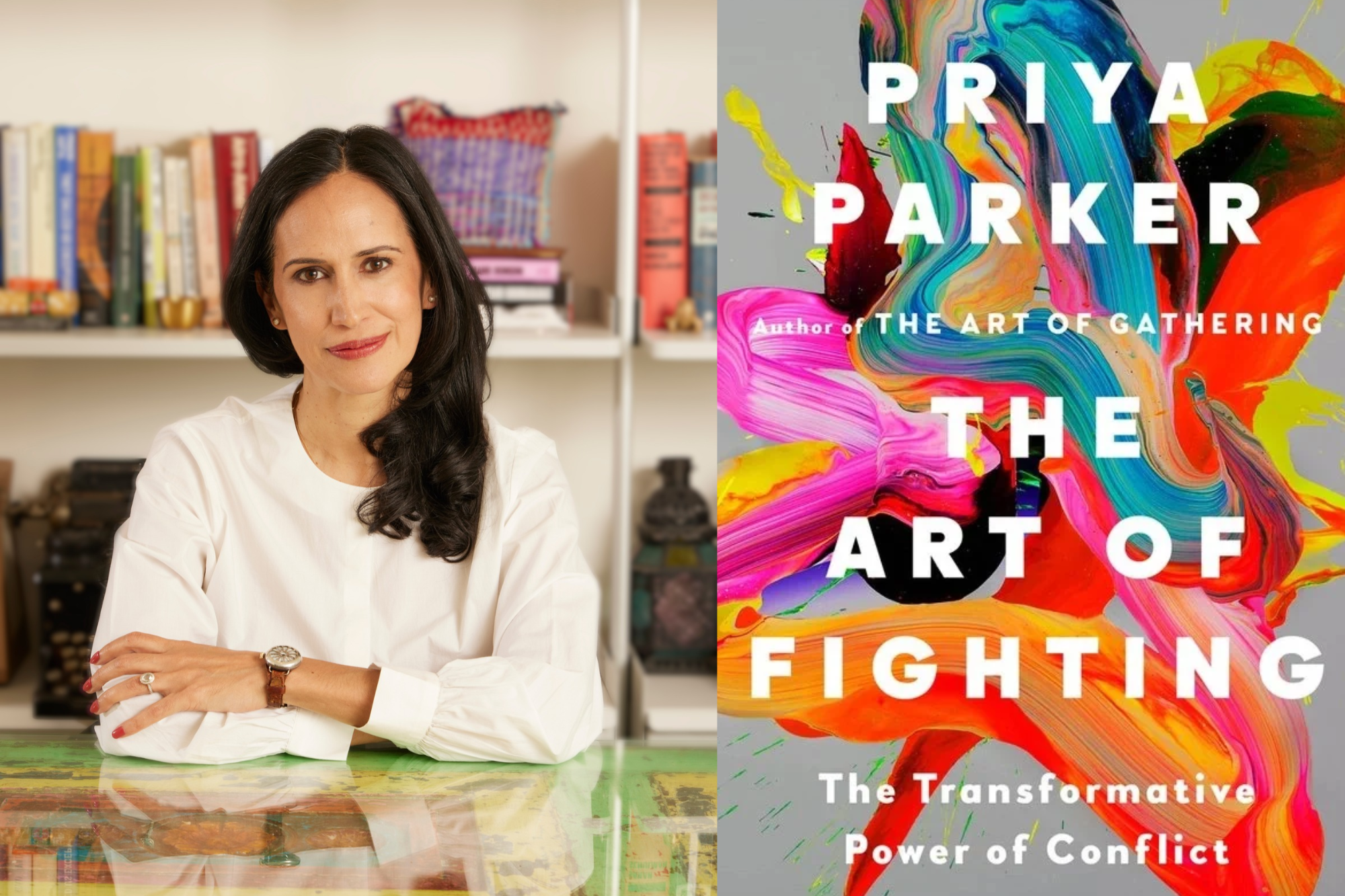
Author Priya Parker, whose 2018 book “The Art of Gathering” was about bringing people together, is out with a new book called “The Art of Fighting.” It may seem like an entirely different topic, but Parker says forming and growing successful relationships is not possible being able to navigate disagreement. We’ll talk to Parker about how to handle all kinds of fights, and hear from you: How has conflict strengthened your own relationships?
Guests:
- Priya Parker, conflict facilitator and author, “The Art of Fighting” and “The Art of Gathering”
Episode Transcript
This is a computer-generated transcript. While our team has reviewed it, there may be errors.
Mina Kim: Welcome to Forum. I’m Mina Kim. In her decades working with groups, Priya Parker says she’s learned two fundamental truths: Groups can’t sustain without love, and they can’t sustain without conflict. But many of us are so averse to conflict that we’ve lost out on its transformative power and the ability to engage in conflict well. That’s where Parker’s new book comes in, called The Art of Fighting. It offers ways to identify and address disputes, even when they seem insurmountable, at work, at home, in our politics, and with our friends. Priya Parker is a conflict facilitator and author of 2018’s The Art of Gathering, and she joins me now. Welcome to Forum, Priya.
Priya Parker: Thank you so much for having me.
Mina Kim: So you say fighting is a good thing, good for individual relationships and for groups. So how so?
Priya Parker: We don’t fight about the things we don’t care about, and we don’t fight with people we don’t care about. If we don’t care, we leave. And so I’m a conflict resolution facilitator, as you mentioned, and part of the way I look at conflict is that conflict is relevance. Conflict is dangerous, but it’s also relevant. And when we don’t have the skills, when we don’t have the moral capacity to realize that conflict is a form of relevance in a community, we’re actually throwing the baby out with the bathwater.
Mina Kim: It’s interesting how counterintuitive that idea is — that conflict is mattering, it’s relevance, it’s caring. Why do you think that we have been so averse to engaging in conflict if it has those types of qualities?
Priya Parker: So much of it, I think, is the way we were raised. I know this is true for me. I should probably admit, confess at this moment, that I am a conflict-averse conflict resolution facilitator. I’m biracial, I’m bicultural, I’m half Indian, half white American, but I am actually a third-generation ostrich on both sides. When conflict arises, both on my Indian and my Iowan side, we are very skilled at kind of ducking our heads into the sand and just hoping it’ll pass.
And as I started to research for The Art of Fighting, one of the places I actually looked was at a lot of church literature, because churches are full of conflict. Churches are full of rifts, of schisms. And so there’s actually a lot of really interesting literature looking at which churches are able to get through these pressure points.
There’s a book by a minister — he’s also an interventionist — called Michael Hare. And I think the book is called When Church Conflict Happens. He said that when he goes into churches that are experiencing a rift or a reckoning internally, one of the first things he has to dismantle in order to make any progress is what he calls the misbelief that conflict is sin.
It is not sin. But when we believe that, so many of us believe that quote-unquote good people don’t fight, and we’re actually not able to even have the conversation. As I read his passage, I realized that whether you’re Christian or not, whether you believe in God or not, that notion that conflict is sin has sort of permeated our culture.
And yet conflict is actually how groups articulate what’s important to them. It’s how we repair. It’s how we actually have the most important conversations in our companies and our families. But when we assume that you’re supposed to fight only with your enemies, we’re actually not even building the skill. Why would you get good at something that is immoral? And so the first step to having better relationships is to see that conflict, held well, is actually incredibly crucial to intimacy and also to high-performance, high-functioning teams.
Mina Kim: Yeah. On the intimacy part of it, I was struck by the personal story that you shared, that people were shocked when your parents got divorced. Why were they shocked?
Priya Parker: Because my parents never fought. And so when they did announce that they were separating, everyone, myself included, was shocked because they didn’t fight.
I share this also in the prologue of The Art of Fighting. The story goes back generations, to when my father’s father passed away and we went to his funeral in Iowa. I was sitting in a pew in the church, and the minister rose to give his eulogy. He saved the pinnacle of my grandfather’s virtues for this: In 50 years of marriage, Ruth and Lyle Parker never fought.
My wise stepmother leaned over to me and said, “That’s not a good thing.”
I was kind of surprised by her take on it, and it stuck with me for a long time. Years later, I actually texted my father to say, “Dad, do you — is that true? Like, did your parents never fight?”
And he texted me back, like a very dad text. It was like, “Dear Priya,” comma. I’m like, “Dad, it’s a text.” He says, “I think that’s true. My father served in World War II, and he won that fight, and he never needed to do it again.” Dad.
Mina Kim: Let me invite listeners into the conversation. Listeners, do you agree with Priya that fighting strengthens relationships? What’s your relationship with conflict? Do you try to avoid it, or maybe you tend to start the fight? What questions do you have for Priya about how and when to engage in a fight?
You can email Forum at kqed.org, find us on Discord, Bluesky, Facebook, or Instagram at KQED Forum. You can call us at 866-733-6786, 866-733-6786.
So, this aversion to fighting, these models that we’ve gotten about why fighting is not good or what it means about relationships — is that why one of the most common issues you see when you’re called in to address conflict is that groups have been avoiding it?
Priya Parker: We, you know, most of us are actually pretty bad at conflict. When heat rises, we oscillate between avoidance and burning the house down, between what I call unhealthy peace, where real conversations never happen, people don’t actually say what they think out of fear of escalation, and unhealthy conflict — so abuse, manipulation, attempts to destroy.
But actually, there’s a third form of conflict, and I call it healthy heat. Healthy heat is the ability to hold tension with care long enough for it to reveal something new.
As a conflict resolution facilitator — and I’ve been one for 25 years — I actually started thinking about this book in the summer of 2020 because, as you know, if you all remember, that was a summer of many reckonings. It was, for many workplaces, a return to work — a return to the office, sorry — and the battles about where work actually happens. It was the summer of the Black Lives Matter uprising. There were many, many implosions within tech companies, media companies, newspapers, and social justice organizations.
I was a facilitator, along with my peers, brought into those Zooms. Before the pandemic, if I was facilitating an internal reckoning, we were all in person together. You’d get onto an airplane or a train. We were all in these 40 little Zoom bubbles or a thousand little Zoom bubbles.
And I realized that even when I was invited in — which means someone has recognized there’s a problem and they want to work through it, two really important preconditions — in so many of those rooms, we don’t actually have the skills. We’re not taught to fight well. Again, we kind of avoid or we burn the house down. We don’t have healthy conflict rituals within our workplaces. We either say nothing or we sue each other, right? Or we unionize.
And again, unionizing is a really important collective ritual and need. But I would have labor organizers telling me these union negotiations are holding too much because we don’t actually have other mechanisms to hold, release, and help us have healthy heat together.
And so I wanted to write a book. The Art of Fighting is not about how you yell at strangers on the internet. It’s actually asking a different question, which is: How do we fight with those we want to belong to?
Mina Kim: Just to clarify your point about unionizing, are you saying essentially that if there was a dispute in the workplace, people would turn to unionizing if maybe that wasn’t even the best way to resolve it, just because it offered some kind of—
Priya Parker: Structure to fight? I would hear from labor organizers — again, people who believe in unionizing — that, in part, because there aren’t other mechanisms, unionizing was often holding a lot of very serious pain and despair, but often about things like, “What should be the vision of the company?” What should be the purpose of the company, versus labor regulation, or whether, you know, and so on.
Part of what they were saying is that unionizing is actually such a powerful, specific, developed, sophisticated ritual. There’s a table, there are roles, there are people, there are rules, people get trained in how to actually go through every part of the negotiation. It is a designed infrastructure to help hold an imbalance of power between management and labor.
But when we don’t have other ways to hold collective conversations about things like the future of the company, then all of a sudden these rituals are holding too much weight. And even if it’s not union negotiations, in so many workplaces, in part because we are conflict-averse, it’s also not seen as an aspirational skill.
So often, when there is some kind of dispute or disagreement between colleagues, the function is then to go to HR, versus actually building the skills — and not just the skills, but the normalization that great teams have healthy conflict. Because what is—
Mina Kim: The cost? You’ve also referred to the problem of toxic politeness in a workplace. What can be—
Priya Parker: Poisonous about it? That real conversations never happen, that people aren’t — that decisions don’t happen, that people don’t fully understand their roles.
I have a Substack, a newsletter and a training ground called Group Life. The first webinar I did a year ago was part of sessions I hold once a month called Group Help Labs. It’s free; you can find it online at priaparker.substack.com. It’s a very simple question: How do you nurture long-term group commitment?
The key to all groups is that a group is a place where people feel like they’re meaningfully contributing and that they’re meaningfully contributing to it. And if you can’t fight, you’re not going to be able to get to that answer.
Mina Kim: We’re talking with Priya Parker, author of the new book The Art of Fighting: The Transformative Power of Conflict. And you, our listeners, are joining the conversation with your experiences of conflict, if you’ve even found that it strengthened your relationships. If you have an aversion to conflict, what prevents you from engaging in it? And what questions do you have for Priya about how and when to engage in a fight?
We’ll have more after the break. This is Forum. I’m Mina Kim.
Welcome back to Forum. I’m Mina Kim. Priya Parker says the most meaningful human connection is forged not because you’ve avoided conflict, but because you’ve confronted it. It’s something she came to know the hard way, she says, but believes in deeply. And in a new book, she explains why. It’s called The Art of Fighting.
And you, our listeners, are invited to join the conversation. What do you think of Priya’s premise? Has conflict strengthened a relationship for you? Do you find that you try to avoid conflict? Why? Or maybe you’re the person who starts the fight. What do you want to know about the best ways, and how to gauge whether or not to engage in a fight at all?
The email address is [email protected]. Find us on Discord, Bluesky, Facebook, or Instagram at KQED Forum, or call us at 866-733-6786, 866-733-6786.
Sue writes: “As a native New Yorker who came here to San Francisco 32 years ago, I can tell you that San Francisco seems to be a very conflict-averse place. New Yorkers disagree with each other, and no one takes it personally. Here, you have an argument and someone thinks you’re canceling them.”
Priya, as someone who lives in New York, do you think there are regional differences in comfort with conflict?
Priya Parker: Yes. This is such a great question. The Art of Fighting came out on September 8, and I went on a kind of old-school, physical national book tour. I went to 12 different cities — Seattle, Los Angeles, Dallas, Huntsville, Alabama, Miami, and a number of other cities. I was so surprised and fascinated by the regional differences in conflict, even in the room in these bookstores.
When I was in Seattle — again, I’m just quoting what happened — there were actually a number of New Yorkers in the audience who said something similar to your listener. In Seattle, I think they called it the Seattle freeze, where there’s a deeply, deeply conflict-averse kind of culture.
Then, when I was in the Midwest, a number of people in the audience would ask questions saying, “We’re famous for Midwest Nice, but we also practice what they call Midwest Ice.” Did you just sort of slowly ice someone out, but you’d never actually tell them that you’re upset?
When I was in the South, someone in Huntsville, Alabama, also said, “Down here, we don’t necessarily — we sort of avoid, avoid, and then one day exit.”
And New Yorkers, I think, also have a reputation for being comfortable speaking their minds. So yes, there are regional differences.
I would say two things. The first is that all of us, particularly in our workplaces, are working with people who come from different cultures, who come from different family conflict styles. Conflict is cultural.
However, when you have a team or a community in which there are shared goals, you can create your own mini-microcultures of healthy heat. In The Art of Fighting, I look at teams, and I look at restaurants that purposely build cultures of healthy heat within their restaurants. One such restaurant is Canlis in Seattle, which has designed a culture that encourages healthy heat.
So even if you’re from whatever region, you’re taught the skills and the rituals, and also the culture, that if you don’t actually bring things up with your colleagues in ways that make normal, everyday repairs — what I call keeping a kerfuffle a kerfuffle — you’re not going to succeed here. And so it’s something that’s learnable.
The last thing I’ll say is that there’s a book she may be interested in called The Culture Map by Erin Meyer. I write about it also in The Art of Fighting. She looks at how conflict also changes based on which nation, which nationality, you come from.
She has a graph in her book that looks at conflict-averse versus conflict-seeking cultures. On the conflict-seeking or conflict-comfortable side, if I remember correctly, it was the Netherlands, Germany, Israel, and France. The conflict-averse side included Japan, China, and Indonesia.
She says the difference between these cultures is that in cultures where people assume there’s a difference between one’s opinion and one’s identity, people are conflict-comfortable. In cultures where those two things are the same, people avoid conflict.
Mina Kim: So how can we get better, then, at handling conflict? You gave a couple of examples. You’ve talked about doing a hot-takes party with your group of friends, and also a workplace where a boss had them first argue over whether pineapple should be on pizza. What do those things do? Describe some of those things.
Priya Parker: The first step to becoming a more artful fighter, if you will, is to displace this belief that all conflict is bad and start getting comfortable and curious about where, in your friend group, with your family, or in your workplace, you’re actually seeing what I call healthy heat.
The first step is to dislodge this notion that all conflict is bad. Some types of conflict are bad, but there is healthy, generative, creative conflict.
The second is to start understanding, when a fight comes up, what do you have on your hands? Not all fights are worth facing. To be an artful fighter doesn’t mean you’re fighting more; it means you’re finding better fights.
The second step to starting to think about how to become a better fighter is to have discernment about which fights are worth facing and which are not. I actually spend the first three chapters in The Art of Fighting going through the 12 different reasons you should not face a fight.
So I am not pro-fight. I’m actually helping people discern when it’s worth facing a fight and, when it is worth facing, how to set up the right fight. We’re so often having the wrong fight, and particularly in our groups and communities, groups need infrastructure.
This hot-takes party you’re talking about — I first saw it at a tech company where I was speaking. I was in the audience before it was my turn to talk, and I got permission to share the story. This was a company that, by its own admission, suffered from toxic politeness. They had to make a lot of really important decisions and were at a crossroads.
A vice president came onstage and said, “You know, I don’t like starting in a hard place, but we’re going to spend some time looking at five really core decisions that we need to make.”
You could feel the room tense up. He said, “So what I’m going to do is put up a core question that’s really fundamental to this company. You’re going to get in groups of four, and you’re going to debate.”
They all looked terrified. Everyone put their phones down and looked immediately at the stage. Then the first slide went up, and it said, “Pineapple on pizza: yes or no?”
I was in the room, and people were like, “What?” Some people started chuckling. Then he said, “Come on, go into your circles of four.”
People turned to each other, and one person said, “Yuck, that’s disgusting.” Someone else said, “Well, someone doesn’t have a palate.” Then someone else was like, “Ah, this is offensive. I’m Italian. You don’t put pineapple on pizza.”
And all of a sudden, the room was buzzing. People were laughing. Then he put up a second question: “What is the right time for lunch?” One person in my group said, “11 a.m.” Someone else exclaimed, “That’s breakfast!”
Then he had three or four more questions. Part of what was so fascinating about that moment was that he was actually helping them banter. He was helping them practice prosocial conflict, in part to prepare them for the real conversations the next day.
When they did bring things up the next day, you could hear people recollecting, “Remember the pineapple-on-pizza thing?”
Part of what he was doing, very sophisticatedly, was giving people a new experience of fighting over a hot take — a strongly held opinion about something that does not matter.
I’ve done this also with my Substack that I mentioned. We actually hosted a hot-takes party to practice the skill. I did it with my team at our end-of-the-year celebration lunch. We had fried chicken and Caesar salad, and everyone had to bring a two-minute hot take. That became our meal, and people were laughing and disagreeing with each other, but again, about things that don’t matter.
It might seem silly. You’re like, “Why are you spending time doing this?” But actually, as a country, we’ve gotten so bad and polarized at fighting about these very, very large, complex subjects that our muscles have actually atrophied.
So it turns out that in our communities, with the people we want to do work with, low-stakes arguing is actually good practice for higher-stakes arguing.
Mina Kim: Let me go to Andy next in San Rafael. Andy, go ahead. You’re on.
Andy: I just wanted to comment that our whole form of government, from the get-go, is designed around adversarial discourse with each other. You have the multiparty system, and the idea is that they get together, they have differing opinions, but they talk about it, argue about it — not fight. I mean, that’s gotten so out of balance of late.
Mina Kim: Yeah.
Andy: I think you should take your book to Congress and give them a lesson on that.
Mina Kim: Andy, thanks so much. I’m really glad you’re bringing this up because, I mean, our political parties, Priya — they’re always fighting, and rarely, if ever, in recent years, I think would people describe it as generative, using the word that you used there, or productive, right? So what’s wrong with the conflict that they are engaging in, or that we’re seeing modeled essentially daily these days, with a midterm upon us?
Priya Parker: I mean, Andy’s absolutely right. Our democracy is actually set up to have public debates in the open, whether in town halls or in Congress.
I would argue that our country has moved from healthy heat, or moments of healthy heat, into deeply unhealthy heat, unhealthy conflict. There are many, many different reasons for it. Some of them are structural, some are more systemic, some are related to the media and our fragmented media environment. Some of it is because, in part, of social media. These have become performative arguments. They’re not actually moments of healthy heat in a debate.
I think our democracy is really suffering from it.
There was actually a recent incident, a moment in the public eye, that I found really interesting. It was a town hall in Michigan, where Abdul El-Sayed was hosting a town hall in Cairo, Michigan. I think it was on October 19, and you may have seen this moment online.
Basically, there was a guy who stood up. Again, if you watch it online, the town hall is also this kind of archetypal, Norman Rockwell-like setting. The town hall is this really important public civic ritual that we have a history of — this way in which Americans come together to talk.
Somebody in the audience, I think his name was Tommy, asked Abdul El-Sayed whether he would disavow the Muslim Brotherhood.
As I analyze this as a facilitator, what El-Sayed is able to do in that moment with Tommy is practice artful fighting and make sure the room is having the right fight. He remains physically relaxed. If you watch his body, he doesn’t accept the frame of Tommy’s question. Instead, El-Sayed asks a different question of Tommy and the room. He says, “I want to ask, of the question you’re asking, why are you asking this question? Well, do you disavow me?” He says, “No, no, but what are you implying? Do you assume that I wouldn’t disavow the Muslim Brotherhood? Have you disavowed them, Tommy? I haven’t heard you disavow them yet.”
First of all, he’s starting to help us articulate what the right questions are that we should be asking as a country. He’s not afraid of building tension — not gratuitous tension, but tension that helps us clearly articulate and hear ideas in the open.
And then he names something. He says, I think, “You assume, Tommy, that because I’m Muslim, somehow I would have some allegiance to something that is not our Constitution,” right?
To me, as I’m analyzing this as a public figure, he’s naming something which, in The Art of Fighting, is a very helpful way to lessen the power of what’s happening in the room.
Then he weaves himself into a longer lineage of other presidential candidates who have also been asked such questions. Hello, JFK, right? He says he, too, was asked, as the first Catholic president, whether he would be answering to the Vatican or to democracy.
And so there are certain moments. Then he calls upon the common hymnal of the Constitution to make his point. Healthy heat is good for democracy.
That’s a moment, I would argue, that’s helpful for all of us to take off the subtext and make it text, and ask, “What do we believe in as Americans?”
I’m always looking for these moments of healthy heat, because when we just say, “Oh, throw away the tension,” no, we shouldn’t do that. These are the conversations we should be having, but in a way that we’re skilled enough to actually listen and have the right fight.
Mina Kim: Yeah, have the right fight, ask the right questions. These are all ways to help determine, as you say, whether or not this is also a fight worth engaging in.
The thing that I think about, though, as you said, all too common, is that the discourse is really about sort of overpowering the other, even snuffing out the other party to some extent. You get the sense that they don’t even want to see each other, see each other coexist. Can you talk about how an existential conflict can make any kind of productive outcome almost impossible?
Priya Parker: It’s really dangerous. There’s a group in Seattle — I think they call themselves the Seattle Love Lab — and they’re able to predict with extraordinary accuracy, I think above 90 percent, which married couples will divorce and which will remain together. They watch married couples.
The number one ingredient or quality they look for, a very dangerous marker and a high predictor of divorce, is disdain. Disdain is toxicity for relationships.
If you look at our country as if it were, metaphorically, this national marriage, the ingredient of disdain that has entered public life over the last decade-plus is really dangerous.
And so, again, coming back to why I’m holding this question of how we fight with those we want to belong to, it’s because I think, if you’re anything like me, almost all of us have differences within the people we actually know, whether in our families or extended families.
So stop screaming at the internet with strangers and start actually engaging with, spending time with, and having fun with people in your actual communities and families who might be different from you. Not just to have fun, because it’s actually really, really important to democracy.
It goes back to my first book, The Art of Gathering. These two books are really in conversation with each other. One of the things I found fascinating as I studied and researched for The Art of Fighting was that some of the best communities, the communities best at conflict, also have a lot of fun. They have a lot of connection. It’s not like you fight over here and then you never have any fun over there. It’s actually deeply, deeply tied together. The places with a lot of heat also have a lot of warmth.
Mina Kim: I think one of the things that you’re getting at — we’re coming up on a break, so maybe we can dig into it more — is that one of the key things for a productive fight is for the parties to actually want to maintain a relationship with each other. I think you called it relational longing. What is that?
Priya Parker: Relational longing is the residual desire to still be in relationship and connection with the other person underneath the crap, right? Underneath whatever the thing might be on the surface, whether you’re arguing about the dishwasher, whether you’re arguing about the election, or whether you’re on a creative team and deeply disagreeing about the vision for a film, a TV show, or an app.
Underneath that, is there still a residual desire, a joy and an interest in working together and being in relationship?
This term actually comes from the conflict resolution facilitator Say Ternier, who’s one of the stars of The Art of Fighting. In this book, I spent time with people who hold heat well — conflict resolution facilitators, lawyers, people who study it, and groups that are part of it. Fundamentally, what she says to look for is whether there’s still that residual relational longing underneath the fight. If you can tap into it, then there’s a possibility for a way through.
Mina Kim: We’re talking with Priya Parker about why fighting can be healthy, how not to be afraid of a fight, and also when a fight is worth having. Her new book is The Art of Fighting: The Transformative Power of Conflict, and we’ll have more with Priya after the break. This is Forum. I’m Mina Kim.
Welcome back to Forum. I’m Mina Kim. We’re talking this hour about the value of fighting and how to have a constructive one. Priya Parker feels like those skills have atrophied in our culture and our country, and her new book, The Art of Fighting, is trying to step in and address that.
Listeners, when has conflict actually strengthened a relationship for you? Or do you try to avoid it? What prevents you from engaging in a fight? 866-733-6786 is the number to call. You can find us on Discord, Bluesky, Facebook, or Instagram on social media, and you can email [email protected].
Abby on Discord writes: “When dealing in a relationship with a person with a serious mental illness in a person’s family, it’s not always safe to step into healthy conflict. How can I address conflict safely in this situation? Or might it be best for my safety not to step into even a healthy conflict?”
What do you think about this for Abby, with regard to, as you’ve been saying before, so much of your book is also about trying to determine when to engage in conflict?
Priya Parker: That’s a beautiful question, and it absolutely has to do with discerning whether, by doing something or saying something, you can alter the situation.
In Chapter Two of The Art of Fighting, I go through whether or not something is worth facing, what type of fight it is, and then, in Chapter Three, whether or not something is worth facing. In asking these questions, and, by the way, again, it’s really about thinking about what I call healthy heat.
Whether it’s because of a specific situation around mental illness, or whether it’s in some cases of abuse or other situations, that may be unhealthy heat. In certain cases, as I write in the book, what you actually need are these other tools. What you may need is a professional interventionist. What you may need is professional help. In cases of abuse — I’m not saying in the mental illness part — what you may need is a restraining order.
Part of the invitation to become a more artful fighter is both expanding the set of tools we have to discern and then using what’s needed in each context.
Mina Kim: Because we do have an election coming up, I’m curious if you could share how you navigate political differences in your own family. You’ve been very open about having very strong political differences with your dad and how you practice what’s called strategic conflict avoidance.
Priya Parker: One of the essays I read as I researched this book that really stuck with me was by a Christian theologian and professor of religion called Joyce Ann Mercer. I think the essay was in the Yale Bulletin. It was called “How Christians Fight.”
She wrote about how she was part of a family — I mean, she is part of a family — that for decades had a lot of political differences. For decades, whenever they came together for Thanksgiving or Christmas or various family reunions, there was always some poking and teasing. They’d get into politics.
She wrote that after the 2016 election of Donald Trump, something changed. All of a sudden, the stakes felt so much higher. It got to the point where they realized that if they were going to behave the way they used to, they wouldn’t be able to gather anymore because the stakes felt so high.
She had to step back and ask, she said, “Why am I getting together with my family? What is their role in my life?”
What they decided to do was engage in what they called strategic conflict avoidance. So, again, not all avoidance is fear. Some avoidance is wisdom.
As I read her essay, I thought about my own life, my own relationship with my father. For me, I’ve engaged in political dialogue with him for 30 years. For many, many years, I would engage and engage and engage. It would be very, very difficult and painful, I think, on both sides.
At some point, I just realized, well, I’m not going to change him, and he’s not going to change me. Actually, this is destroying the relationship. What I care more about is being in connection with him.
My job as a facilitator, my profession, is to help people connect across difference without having to be the same, to help find meaningful connection despite obstacles.
I write about this a lot. I recently wrote about it in my Substack. It’s free; you can see it as the most recent article about how I find connection with my father.
One of the things I’ve started to do is ask what I call magical questions. I’m a parent. I have a nine- and an 11-year-old. I want them to have a relationship with him, but I don’t want us to get into — it’s not interesting to get into each other’s opinions. What’s interesting is his stories.
I was recently visiting him in Florida with my children, and we asked a question at dinner. I think I asked, “What is one thing your mother or father specifically did for you as a kid that made you feel really loved?”
There were three generations in the room. My stepsister had just made her famous Bolognese, and we had Marcona almonds on a cheese plate. It was already sort of a festive feeling.
There were three kids at the table, all under 12. They said, “Oh, well, are you all going to answer, too?” And I was like, “Yep, we’re going to answer, too.” “Are you going to answer as when you were kids?” “Yep, we’re going to answer when you were kids.”
My father, who’s aging and often finds it difficult to follow conversations because he’s hard of hearing, to my surprise, looked straight up with his big blue eyes and said, “Oh, I know. I have one. I’ll go.”
I was like, “What?”
He said, “When my dad taught me how to ride a bike.”
I said, “Oh, well, tell us about it.”
He said, “Well, we’d go down the sidewalk, and he’d push me and run.”
I said, me being the facilitator, and partly because my dad and my kids were there, “What made you feel loved?”
He said, “His patience.”
And it’s like, whoa. Then this other story came up that I’d never heard before. He said, “You know, actually, that same year, I was at school and I was really talkative. My teacher — in those days, people would hit kids with a ruler, like over their head. My teacher hit me over the head with a ruler.”
My kids’ eyes were wide open. He said, “And it was the kind of ruler that had one of those metal edges at the end of it. She hit my head so hard it struck blood. I was bleeding.”
My father was so upset, he marched right up to that school and gave that teacher a talking-to. She realized she was wrong, was so embarrassed, and apologized. Then she invited our family to her farm for brunch.
So he’s telling this story, and again, why would we argue about our politics? It’s not even interesting. And that’s true for most people. Our opinions are not that interesting, but our stories are.
In that moment, I found this way, by asking what I call a magical question — a question everyone in the group would be interested in answering and hearing each other’s answers — that also disrupted my own family narrative that we’re all conflict-averse.
It changed the only story that, in 50 years of marriage, Ruth and Lyle Parker never fought, and it expanded our own sense of what, in my case, Parkers do.
Mina Kim: Yeah. I’m hearing a couple of things in what you’re saying. One is that there are so many ways to build connection, even if you have to avoid a particular aspect of that relationship, even if that aspect of the relationship is something really important to you. But also something you noted earlier about the ability to separate perspective from identity, which feels like it’s also important to hear.
Priya Parker: Yes. And that collapse — there are studies. In The Art of Fighting, I try to look at everyday groups that are experiencing an existential reckoning.
One such group I follow is a group of girlfriends who’ve been friends for 30 years. They met in kindergarten. They’re now in their 30s and 40s, and they now have kindergartners.
This is a group that, like many groups across the country, experienced an internal reckoning in the summer of 2020. They hopped on the Zoom bandwagon when a lot of people were doing those Zoom happy hours. Do you remember that phase of the pandemic?
They got on this happy hour, and five of them had grown up in North Carolina. Five had gone to college outside North Carolina, and five had sort of stayed near home. They’d never been on Zoom before. They were always on a text thread, texting about things like how to scrape mold off doors or, as they became moms, how to suck the boogers out of a baby’s nose. “Are you going to use that thing?”
Anyway, they got onto Zoom, and within five minutes, as it was described to me later, it became very clear that they had to stop the Zoom. Some people were saying things like, “Oh, this pandemic is fake,” or, “It’s overblown.” Other people were shocked. Someone else said, “Oh, those dangerous” — I’m saying this in quotes — “those dangerous protests in those dangerous cities.” Half of the room had been to those protests, and, by the way, they were white women.
All of a sudden, they realized, whoa. All these questions started to arise. They got off the Zoom, but they were asking, “Why are we still friends? What are we to each other? Has this friendship taken its course? Do my friends need to believe what I believe in order to maintain an old friendship?”
I profile and follow this group of women in this book in part because they are us. They are not the only group that has experienced these fundamental questions as Americans.
Part of what I help them go through is realizing that, according to Pew polling, this has also happened more broadly. Before the 2016 election, our political identities and how important they were ranked around fifth or sixth in terms of our other identities. After the 2016 election, and over the last 10 years, the ranking of that political identity has increased, meaning it’s number one or number two.
There are studies now that show that people would rather marry somebody of a different race than somebody from the opposite political party. So, as Americans, our political identity, and the meaning we graft onto it, has changed because of what feels like the stakes for the country.
Mina Kim: Now, let me go to Brian in Marin next. Brian, go ahead. Join us.
Brian: Yeah, thank you. This is really fascinating. I’ve been really interested and enthralled with what some people call the bridging movement or the depolarization movement. These are groups like Braver Angels and BridgeUSA.
There’s an event this Sunday at San Francisco City Hall called the MAGA, DSA, and Everyone Else Mixer. These are groups that lean into the conflict, you could say — the political conflict and how it fractures relationships, families, and communities — but also into the nitty-gritty details of policy, bringing people from opposite sides together to do what the politicians don’t: have constructive debates.
There’s a lot of it based in conflict resolution skills and theories, and I’m sure you’re familiar with that. But I’m just curious to hear more about the leaning in, I guess, and the skills for that, when there’s, you know, the strategic avoidance you mentioned. As a nation, it feels like that’s kind of not an option, right? We have to somehow make the marriage work. Yeah, totally. Thank you. Yeah.
Priya Parker: I think what these groups are doing is really important. What I appreciate about what they’re doing is that they’re practicing, experimenting, and creating what I call collective conflict rituals to help hold our heat.
A group like Braver Angels — my understanding of one of their concepts is that, through the rituals, they have rules and are helping people build the muscles to actually get to the right fight.
One of their core concepts, as I understand it, is getting to what they call accurate disagreement. So often, we’re talking past each other. We’re often believing all sorts of things about each other. Part of the purpose of that ritual, again, not unlike the Abdul El-Sayed moment we were talking about earlier, is to get to the point where we can actually understand where our real disagreements are.
One of the facilitators I interviewed for The Art of Fighting is Prentis Hemphill. One of the things they say is, “We’re often having the wrong fight.”
I think groups like this are doing God’s work to put people in relationship with each other, in warmth, but also to practice healthy heat through ritual.
I kind of joke, but it’s not really a joke, that both my first book, The Art of Gathering, and this book, The Art of Fighting, are not self-help books. They’re group-help books. We have so many apps, tools, and books to help the individual, but we actually have fewer tools to help us as groups.
I want to create a new bookshelf in the library, a bookshelf called group-help books. My books are not the only ones that should go on that shelf, but it’s about where and how we create collective rituals.
Part of The Art of Fighting is that I look at communities, including traditional communities that had collective conflict mechanisms, collective rituals to help them deal with internal conflict. I look at various tribes, the Minyanka people in West Africa, Hawaiian culture, and the Vikings.
The Vikings — I didn’t know this before I researched for this book — were one of the first groups in Northern Europe that had to figure out how to keep a community connected that wasn’t kin, that wasn’t blood-related.
They developed all of these sophisticated internal conflict resolution mechanisms. One of them was called an Althing. Apparently, on Mondays, the soldiers would come together. As I understand it, the Vikings were organized into clusters of a hundred soldiers and their families because that’s what could fit on a warship.
Again, I’m looking at their internal mechanisms. Externally, they were engaged in a lot of unhealthy heat. Internally, they would engage in these rituals called Althings, where on Monday nights they would have these, for lack of a better word, clearing ceremonies. They would come together, and whatever you needed to get off your chest with another soldier, this was the place to do it — to put it out there, to aerate it.
And there were only two rules: No spitting. No killing.
Mina Kim: All right. That will help resolve a conflict. Let me remind listeners you’re listening to Forum. I’m Mina Kim. We’re almost at the end of the hour, just letting you know. Priya, it has flown by so far.
Janet writes: “There is an intimacy involved in fighting and conflict. As one who has problems with intimacy, it has always been difficult to confront or fight with someone. There’s a vulnerability involved that my ego has a hard time accessing. It’s much easier when there’s that anger energy and the power that comes from that strong emotion, but it’s still scary.”
I’m just wondering, in the last minute or two, because I also found this part really illuminating, about recognizing and being okay with the physical responses you might have as you’re getting ready to engage in conflict, especially if you’re conflict-averse. Can you just talk a little bit about that?
Priya Parker: I would say to Janet, like, ding, ding, ding, ding, ding. You are absolutely right. Conflict is intimate, right? It is the willingness to say, “You affect me.” My feelings are hurt, or I’m mad. And that can be pretty terrifying.
It is for me, right to this day, when I’m a professional facilitator. To this day, when heat arises in my own relationships or in my work, my palms get sweaty, my tongue gets dry, and my heart is pounding out of my chest.
I’ve learned how to hold it and to realize, one, I’m not going to die. But there are actually physical practices. One of my favorite parts of the book is an interlude called “Preparing the Body for a Fight.” In it — and you can get it wherever you get books, or you can go to the library — I put out my own personal checklist of what I do to prepare my body for a fight, as well as Prentis Hemphill’s checklist as a facilitator.
Prentis is a somatic coach and facilitator. They say every conflict, all conflict, is physical, just not in the way we think. It’s not fisticuffs, right? It’s physical within us. Many of us don’t even realize — we’re not aware of our own physicality — until conflict arises.
Often, our physical reactions are also replaying old conflicts that the current situation might be triggering for us. Mastering fighting is also beginning to realize how and where we practice the tools so that we can hold heat within our own bodies.
Mina Kim: Priya Parker, the book is The Art of Fighting. Thank you so much for talking with us.
Priya Parker: Thank you for having me. What a great conversation. I so appreciate it.
Mina Kim: I appreciate it, too. I also appreciate Janelle Akoili for producing this segment, and, as always, our listeners. You’ve been listening to Forum. I’m Mina Kim.