Why It Feels Like We're Living in ‘The Twilight Zone’
Airdate: Wednesday, October 28, 2026 at 10 am
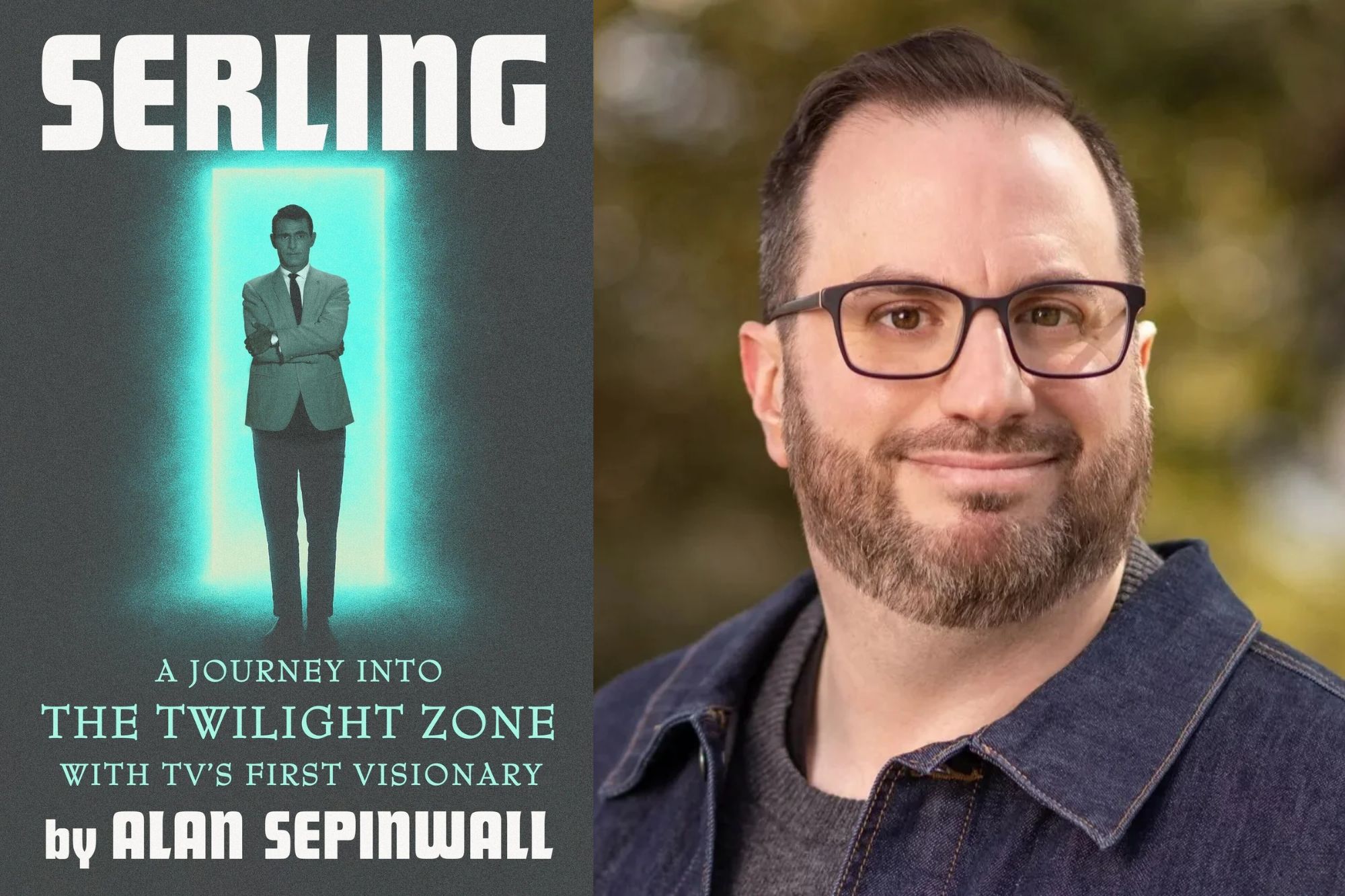
In an era marked by deep political polarization, runaway technology and everyday absurdities, our current reality often feels like an episode of “The Twilight Zone.” In his new book, “Serling: A Journey Into the Twilight Zone With TV’s First Visionary,” acclaimed television critic Alan Sepinwall, explores how writer and creator Rod Serling transformed television by weaving social issues and national anxieties in his storytelling. Sepinwall traces Serling’s enduring footprint across modern popular culture, from “Twin Peaks” to “Black Mirror.”
Guest:
- Alan Sepinwall, TV critic; author of “Serling: A Journey Into the Twilight Zone With TV’s First Visionary”
Episode Transcript
This is a computer-generated transcript. While our team has reviewed it, there may be errors.
Mina Kim: Welcome to Forum. I’m Mina Kim. A television series that tackles creeping authoritarianism, xenophobia, and technology replacing humans would seem like something referencing our present moment, but I’m actually talking about the early 1960s series The Twilight Zone. TV critic Alan Sepinwall has just written a book exploring the life and mind of its creator, Rod Serling, who used science fiction to address controversial social issues that commercial networks wanted to avoid. And along the way, he gave television perhaps its most recognizable theme song.
Rod Serling (archival narration): You unlock this door with the key of imagination. Beyond it is another dimension. A dimension of sound, a dimension of sight, a dimension of mind. You’re moving into a land of both shadow and substance, of things and ideas. You’ve just crossed over into the Twilight Zone.
Mina Kim: Alan Sepinwall’s new book is Serling: A Journey into the Twilight Zone with TV’s Last Visionary. And Alan joins me now. Welcome to Forum.
Alan Sepinwall: Thanks for having me.
Mina Kim: Glad to have you. So tell me, Alan, what’s the first Twilight Zone episode that you remember really grabbing you?
Alan Sepinwall: Weirdly, the first one I remember is not one I saw. It’s one I read. I was in seventh-grade English class, and we were doing a unit. The teacher handed out printouts of the script to “The Monsters Are Due on Maple Street” and assigned each of us a part to read. I’d heard of the show, but I’d never seen it. I think the commercials kind of freaked me out. They made me think it was going to be too scary for me. And I read this, and my mind was blown. I had never thought a TV show could do something like this.
Mina Kim: Do something like this, meaning what exactly did it do? Talk about social —
Alan Sepinwall: Talk about social issues and put them into this metaphor of science fiction. Even when I was a seventh grader, decades after McCarthyism and the Cold War, I could still understand exactly what this story about a suburban block where everyone turns on each other because aliens are interfering with them was about. I knew what it was about right away. I knew how powerful it was, and I said, “I want to see more of this as soon as I can.”
Mina Kim: Yeah, you’ve connected it with Cold War paranoia at the time. And it is so easy to connect it with, you know, the dangers of groupthink — people turning on each other because they seem different, or because there are inexplicable events, and then they’re just turning to a scapegoat.
Alan Sepinwall: Yeah, and the thing is, when you watch The Twilight Zone now — which I did to write this book — it’s both startling and more than a little depressing to realize how many of the things Rod Serling was writing about in 1959 and 1960 are still relevant today.
Mina Kim: Yeah, we actually have a clip from “The Monsters Are Due on Maple Street.” Let’s hear it.
Rod Serling (archival narration): Maple Street, in the last calm and reflective moment before the monsters came.
Voice in clip: He’s a little boy! It was this kid who knew what was going to happen! He was the one who knew! How did he know?
Voice in clip: How could he have known? Make —
Voice in clip: How did you not answer me? What’s the matter with you people? Now stop!
Voice in clip: I’m out of here!
Voice in clip: How did you —
Voice in clip: Yeah.
Voice in clip: Understand the procedure now. They pick the most dangerous enemy they can find, and it’s themselves. All we need to do is sit back and watch.
Mina Kim: And, of course, those are the aliens talking about how easy it is to take over the world. You say it was even just reading the story that really captivated you. What was it about Serling’s storytelling style?
Alan Sepinwall: He was a really good short-story writer, whether he was doing an original story like that or adapting other people. He just knew exactly when to start the story — where in the actual narrative is the most interesting place to begin, how to set up the themes, how to establish these characters in a really short amount of time.
Most of these episodes are maybe 25 minutes long, and over the course of it, you get a sense of who the sensible man on this block is, who the troublemaker is, and how everyone is behaving this way. You get all these dynamics within the space of a couple of minutes, and then, from there, everything starts going mad as they all give in to this paranoia about who the aliens are and who is working with the aliens.
Mina Kim: Right. And you say that the stories, because they begin with one foot planted in something resembling the real world, give permission to people who wouldn’t really be into sci-fi or alien invasions to watch.
Alan Sepinwall: Yeah, I mean, this is a story set in a suburban neighborhood, like one that a lot of the people who were watching the show in 1960 lived in. It’s the world outside their window. And you have this thing where there’s a certain degree of bias against really hard science fiction, with spaceships and aliens and other dimensions.
But when The Twilight Zone did a story about another dimension, it was about a little girl in a suburban bedroom disappearing through a dimensional portal, and her mom and dad looking for her. So, in some way, it’s always giving the audience permission to say, “This is not a show for nerds. This is a show for you. This is a show about your lives. What if this one extraordinary thing happened within it?”
Mina Kim: I also like your point that one of the reasons it feels so relevant today is because it hit on social questions back then that we have yet to adequately answer.
Alan Sepinwall: No, I mean, we’re still dealing with the same kind of tribalism that you can see in “Maple Street.” We’re still dealing with the same levels, if not worse levels, of misinformation. It’s not hard to imagine someone remaking that episode now, and instead of the kid talking about a story in his comic book about alien invasions, it’s someone saying, “I just heard this on a podcast, and you should listen to me.”
Mina Kim: Listeners, join the conversation. We’re talking with Alan Sepinwall, a television critic and author of the new book Serling: A Journey into the Twilight Zone with TV’s Last Visionary. Tell us: Are you a fan of The Twilight Zone? What’s your favorite episode? What themes from the show feel relevant to 2026? What do you want to know about its creator, Rod Serling? And what shows today are tapping into national anxieties for you?
You can email Forum at kqed.org. Find us on Discord, Bluesky, Facebook, or Instagram at KQED Forum. Or you can call us at 866-733-6786, 866-733-6786.
This listener on Discord writes — Douglas writes: “Black Mirror is the obvious one, but I’ll throw out maybe a less obvious show that hasn’t been quite as popular. Station 13 really captures the eerie surreality of the original Twilight Zone.”
You talked to so many people, including the creator of Black Mirror, Alan. Talk about what they said about Serling’s influence on them.
Alan Sepinwall: I mean, Charlie Brooker, who created Black Mirror, was unapologetic. He said, “I went in there and I pitched, ‘What if we were making The Twilight Zone now, and instead of it being about aliens and monsters, it’s about, you know, Google and Apple?’”
He took everything that Serling was doing and put it under a new title, and that’s working really well. And surely, if Serling were telling stories now, they would be about AI. They would be about lack of privacy and social media. You can already see glimmers of that in the original show.
But I talked to so many people for this book — Steven Spielberg, Guillermo del Toro, J.J. Abrams, Vince Gilligan, Rian Johnson, and all sorts of others. The amount of influence Serling has had on them, and how much he has inspired almost every corner of what we think of as popular culture in 2026, is really extraordinary.
Mina Kim: Yeah. Name some of Spielberg’s or Guillermo del Toro’s work, or even some of the other folks you talked to, or heard or read people like Ryan Coogler referencing Serling — the works that have echoes of The Twilight Zone, or where you can really feel Serling’s mark.
Alan Sepinwall: I mean, Sinners — when Ryan Coogler was out doing promotion for that, he said that one of its biggest influences was a Twilight Zone episode called “The Last Rites of Jeff Myrtlebank.” It’s set in a small town where a man who has died pops up out of his coffin alive and well, and no one’s quite sure how to deal with this. If you watch that episode, it’s not hard to draw a line between that and what happens at the juke joint in Sinners.
I mean, pretty much everything Guillermo del Toro did, including The Shape of Water, which won the Oscar for Best Picture, is in some way inspired by either The Twilight Zone or Night Gallery, which was Rod’s other work.
Steven Spielberg’s career as a director literally began with him directing Rod in the first episode of Night Gallery. J.J. Abrams, with Lost and the movies he’s made, like Super 8, really just sees Rod Serling as his North Star in terms of creativity.
The craziest one to me was that I was at an event for It’s Always Sunny in Philadelphia. It was the 20th anniversary of that show. I was chatting with Rob McElhenney, the creator and star, and he was making small talk. He says, “Alan, were you doing anything else while you’re here in L.A.?” I said, “I was just at UCLA to do some research in the Rod Serling archives for this book.”
Rob McElhenney’s eyes light up, and he grabs my forearm and says, “Alan, you have to talk to me for this book. Rod Serling is my guy.”
And I’m thinking, “Okay, I really like Rob. I really like the stuff he’s done. I’m not sure I see the connection, but okay, I will interview him.” We get on a Zoom, and he has some of the best, most insightful thoughts on Serling. By the time I was done with it, I was like, “Yeah, no, I can completely see the Twilight Zone elements in It’s Always Sunny in Philadelphia.”
Mina Kim: What’s crazy is that you note Serling never thought his work would be influential or enduring.
Alan Sepinwall: He was so down on himself all the time, about all of his work. He did these interviews constantly where he would say, “No one’s gonna remember anything I did.” You know, “My stuff — good writing, like wine, has to age, and my stuff has been momentarily adequate.” He said stuff like that all the time.
Mina Kim: Wow. And he died young, right, in 1975?
Alan Sepinwall: He died at the age of 50. He was a four-pack-a-day smoker. He had family heart trouble, and the two of them combined — he had a heart attack, then was rushed in. He’d had open-heart surgery, and he had another heart attack in the process of that. He didn’t expect to live very long. His father and his father before him had also died around the same age, but with all the smoking, it became something of a self-fulfilling prophecy.
Mina Kim: I see. Was it how the series was initially received that contributed to his doubts about its endurance?
Alan Sepinwall: The thing is, we talk about it now — we’re doing this interview in 2026 — which would make you think this is one of the biggest hits of all time. When it aired, it just did okay. It was often renewed by the skin of its teeth. It was never one of the top 30 shows in any season that it aired.
CBS canceled it after the third season and only brought it back because they thought, “Well, maybe something else we order won’t work. Let’s have a replacement handy.” So, in its time, it was not a big hit.
Rod Serling owned 50 percent of it. He sold his half of the show back to CBS about a year after the series ended for what today would be about five million bucks. And CBS, in that time, has made hundreds of millions of dollars off The Twilight Zone. So he did not expect anyone to care about this thing five months after he finished it.
Mina Kim: Could they — could CBS see through — and I’m so sorry, we just have 30 seconds — but could they see through the fact that Serling was trying to do pointed, you know, social commentary, thinly disguised social commentary?
Alan Sepinwall: I think they knew, and I think they were letting him do it because they didn’t want to have to deal with complaints. And so if someone called up, they had plausible deniability to say, “Sir, I don’t understand what your problem is. This is a story about a man from Venus with three eyes.”
Mina Kim: We’re talking with Alan Sepinwall about The Twilight Zone and its creator, Rod Serling, and we’ll have more with him and you, listeners, after the break.
Mina Kim: This is Forum. I’m Mina Kim. You’re listening to Forum on KQED. I’m Mina Kim. We’re talking about the legacy of The Twilight Zone and its creator, Rod Serling — why the show, with its blend of science fiction, controversial social issues, and morals, still has something to teach us about confronting the issues we face today.
Alan Sepinwall wrote about Serling in a new book called Serling: A Journey into the Twilight Zone with TV’s Last Visionary. You know him as an acclaimed television critic.
And listeners, join the conversation. What do you want to ask Alan about the creator, Rod Serling? Are you a fan of The Twilight Zone? What’s your favorite episode? What themes do you still draw from these shows that you feel are relevant today? And are there other shows tapping into national anxieties that have echoes of The Twilight Zone for you?
866-733-6786 is the number to call. You can email Forum at kqed.org or post on Discord, Bluesky, Facebook, or Instagram at KQED Forum.
Let me go to caller Mark, who’s calling from Georgia. Hi, Mark. Go ahead. You’re on.
Mark: Oh, yeah. Hi. You’re talking about The Twilight Zone, which I was probably, I don’t know, an eight- or ten-year-old kid watching and being scared, but interested at the same time. I would have to say that my favorite episode was called “The Eye of the Beholder.” It starts out in an operating room, and all the doctors are kind of in shadows. The centerpiece is this lady on the table. She’s all wrapped up in a bandage on her face, and she’s having this plastic surgery.
They’re discussing how, boy, too bad it didn’t work the first two times. They hope this is their last chance. And they slowly start unwinding the bandage, and you can see she can start to see light. And then it comes out, and they all kind of scream, like it’s terrible. And she happens to be a beautiful blonde.
Then eventually they pan to the doctors, who are grossly ugly and malformed. They start talking about how maybe they can find her a place with people like her, like lepers almost — a sanatorium or something like that. And she does run into another very good-looking guy, and they both think each other are ugly, but they start to get a lockup. It was just fascinating and scary at the same time.
Mina Kim: Oh, Mark —
Mark: Yeah, a lot of very famous people got their start on that show.
Mina Kim: Yeah, great point, Mark. Actually, you know —
Mark: Burgess Meredith. Almost everyone had a famous person who later went on to do very well.
Mina Kim: Well, Mark, thanks so much for calling in. You’re referencing two things that I’d love to talk about, one being “The Eye of the Beholder,” Alan, as one of the most famous episodes, right? Often ranked as one of the best Twilight Zone episodes. Why do you think that is?
Alan Sepinwall: I mean, part of it is that twist he talked about, which is probably the most famous shock ending of any episode of the show. You’re spending all this time establishing the idea that here’s this poor, hideous, disfigured woman, and we’re trying to help her. Then you get to the end, and it’s like, no, this is actress Donna Douglas, who would then play the gorgeous Elly May Clampett on The Beverly Hillbillies. And everyone around her has, like, this pig nose and is horrifying to look at.
It’s raising this question of, what is a beauty standard? Why do we say that this person is beautiful and this person is not? Who is it who decides this? So it’s asking all these questions. It’s surprising. The way they choreograph the episodes so you don’t realize you’re not seeing the faces of the doctors or the nurses until the very end is just an impressive feat of direction and cinematography. It’s a great story. It’s one of the best things Serling ever wrote.
Mina Kim: Rewatching it and seeing the glimpses they have of a fascist leader on television, giving these speeches about glorious conformity and the need for a specific kind of society, for a specific group of people — there’s also just so much of an echo of today. I want to play a little clip of that.
Voice in clip: We know now that there must be a single purpose, a single norm, a single approach, a single entity of people, a single virtue, a single morality, a single faith, a single philosophy of government.
Mina Kim: I mean, it’s just an example of one of so many difficult issues Serling would tackle. He would tackle conformity. He would tackle racism and prejudice, mechanization, and alienation. Help me understand, Alan, where his desire to tackle these topics came from. How did he grow — what?
Alan Sepinwall: He had a pretty idyllic childhood. He grew up in Binghamton, New York, in this lovely town in the Central Valley of New York. It was during the Depression, but the town was largely resistant to that. His father owned a grocery store and then was a wholesale butcher. They had a nice house, loving parents, and a loving older brother. He was a really popular kid. He was the president of, like, half the clubs at school. He played football despite being five foot four and a hundred pounds soaking wet. So everything was really good for him.
Then America enters World War II. He enlists. He decides he wants to be a paratrooper because he’s small and wants to prove that he can do anything, even this most dangerous specialty. He’s sent to the Pacific theater. He fights in the Philippines. He just endures one awful thing after another. He sees his best friend literally killed in front of him by a falling supply crate. Just every awful thing that could happen does happen to him.
He comes out of this questioning: Why are humans capable of doing this? Are we worth saving? Is there any point to humanity? Like, I thought life was great growing up, and now I’ve been to hell on Earth. Why are we here?
So he spends the rest of his short life wrestling with these questions of who people are, why we do the things we do, what we’re capable of at our worst, what we’re capable of at our best, and whether there is hope for us.
Mina Kim: Yeah, you write that Guillermo del Toro said that no matter how tan, no matter how well-dressed he is, he’s a haunted man. He really was obsessed with trying to understand why humans would do the things they did to each other.
Alan Sepinwall: And the thing is, even with that level of cynicism and PTSD that he came out of the war with, if you look at The Twilight Zone, the interesting thing is that there are some episodes where bad things happen to good people, but in the great majority of the ones he wrote, one of two things happens: A terrible person gets what’s coming to them, you know, cosmically, through some supernatural force, or an underdog gets a second chance through some supernatural force.
Serling wanted the world to make sense. He wanted the world to be just, even if he didn’t necessarily believe that the world outside his office was.
Mina Kim: You’ve talked about the episode “Walking Distance” as being autobiographical. First, remind us what that episode was about.
Alan Sepinwall: There’s an ad executive, Martin Sloan. He’s out for a Sunday drive. He’s feeling really burnt out and stressed by the demands of being a high-powered ad executive in the early 1960s. He realizes he’s driven to his hometown. He’s getting his car fixed, walks over to the town, and discovers he has traveled back in time 25 years to his childhood.
He sees his younger self running around playing on a carousel, very much like the carousel that was down the street from where Rod Serling grew up. His parents are still alive, even though they’re dead in 1959. He’s just determined to show his younger self: Enjoy this time. Embrace this time, because you’re going to be unhappy later.
He desperately wants to stay there, and he can’t. His father realizes who he is and says, “You know, there’s only one summer to a customer. You’ve got to stop looking back. You have to start looking forward.”
That was the thing Serling wrestled with his entire life. He was desperate to go back to that idyllic childhood in Binghamton and not be the guy who fought in the war and saw all those things. And he just couldn’t do it.
Mina Kim: Yeah, we actually have a clip from “Walking Distance.” This is where the older Martin Sloan is trying to talk to the younger Martin Sloan, freaking him out, and trying to explain why he was trying to talk to him at all.
Voice in clip: Mark, I only wanted to tell you that this is a wonderful time of life for you. Don’t let any of it go by without enjoying it. No more merry-go-rounds, no more cotton candy, no more band concerts. I only wanted to tell you that this is a wonderful time.
Mina Kim: So you don’t think that he reconciled that? He wrestled with it, but this episode may not have been a reconciliation. Or does that message from his dad —
Alan Sepinwall: I think he wrestled with it all the time. He wrote four different versions of this story across the run of The Twilight Zone and Night Gallery and some of the things he did in the ’50s.
Whenever his family had a lake house about 90 minutes away from Binghamton, where they would spend the summers, he would frequently just sort of slip away from what they were doing at the lake and drive back to Binghamton and walk around. So he was constantly trying to go back to that.
But at the same time, he understood: You can’t do this. Most of these stories on these shows end with the character realizing, “I can’t go back. There was no point to it.” Or, in some cases, they do go back and terrible things happen to them.
So he was nostalgic, but he was also realistic that the past that we think of is not important anymore. What’s important is what’s in front of us.
Mina Kim: Let me go to caller Judy in San Jose, who’s on the line. Judy, go ahead. Good morning.
Judy: I would like to return to something you two brought up briefly when you were talking about how Serling was able to fly under the radar of the censors. I’m going to tell you that I taught “The Monsters Are Due on Maple Street” for years in a college writing class under the theme of “film as text,” because it was a writing class.
One thing that always bothered me was that I had read in preparation that Serling, disgusted with the constraints of censorship, chose science fiction — or chose to do a science fiction show — because TV was a new medium, science fiction wasn’t taken seriously, and therefore he could insert all his wonderful commentary on social issues into some of the scripts.
Except that, come on, people aren’t that naive. And when the author — I’m sorry, I’m blanking on your name, but I’m dying to read your book — when you said, “Well, you know, when people would call up and complain about something, whoever answered the phone would say, ‘Well, this is really not about that,’” or, “You’re missing the whole point” — no, audiences aren’t that stupid.
So I’m just wondering if you could say a little bit more about how they could get away with that if the censorship rules were so strict. And I’ll stop there.
Mina Kim: Judy, thanks, Alan.
Alan Sepinwall: Yeah, I mean, Serling had spent the 1950s, before he ever did The Twilight Zone, as a famous writer. He was basically Aaron Sorkin before Aaron Sorkin. He would write these very acclaimed, important dramas about the sociopolitical issues of the 1950s, and he kept running into problems with the censors and the sponsors.
Two different times, he tried to do a fictionalized version of the story of Emmett Till, the Black teenager who went down to Mississippi in 1955 and was lynched, and the men who killed him were acquitted in less than an hour. Each time he tried to do a fictionalized version of it, the sponsors would step in and say, “You can’t say this. You can say this. You can’t say this. We can’t risk alienating our customers in the South, even if they’re racist.”
At a certain point, he just got fed up with this. He said, “Well, if they’re not going to let me say it, I have to find another way to do it.”
I don’t know that people were necessarily stupid, that they couldn’t get it. It was just a level of plausible deniability, where the network, Serling, and everybody else could say, “Look, this is science fiction. This is not that.”
There’s this infamous interview you can find on YouTube if you look up Rod Serling and Mike Wallace. Mike Wallace, the guy who hosted 60 Minutes for all those years, interviewed Serling about a week before The Twilight Zone debuted. The entire interview is Mike Wallace acting super disappointed that the great Rod Serling is now going to destroy his career by writing for this silly science fiction show, where he can’t possibly say anything important whatsoever.
And Serling plays along. There was just a lot of that going on in 1959 in America.
Mina Kim: Yeah. Well, Vicki references the Emmett Till connection. Vicki writes: “I was obsessed with The Twilight Zone when I was a kid, even though it scared the heck out of me. My sister and I would watch it sitting on her bed under the covers. There are too many favorite episodes to list.
“It wasn’t until recently that I learned that Rod Serling started the show because he was so affected by the murder of Emmett Till and ran into TV censors who okayed a script, but they wanted to make Till white or, you know, whatever the other ways they would water it down. Serling, besides being brilliant, was also a mensch,” Vicki writes. “May his memory be a blessing.”
Let me go next to — oh, I think we just lost our caller that I had teed up there. Let me go next to Nancy, who writes: “As the youngest of three children in the ’50s, I was unprotected from the terror I felt upon viewing these episodes. One in particular had mannequins coming to life and gave me nightmares for years. Later, when older, I viewed reruns and could appreciate the extraordinary value of Serling’s creative work. I never became a fan of horror films.”
I’m not so sure that it would be described as horror, though some of them were like horror, for sure. But I guess what I’m really struck by is what you were saying about how the episodes — sort of to the point of Judy’s call earlier — I don’t think people were stupid, but it gave people permission, right, to be able to engage in something that was scaring them, or that they were feeling but couldn’t quite put their finger on.
Alan Sepinwall: Exactly. And the thing that was interesting, and that was a complete accident, was that the show’s most important demographic turned out to be kids. It turned out to be younger viewers who were staying up past their bedtimes at 10 o’clock on a Friday night to watch the show. They were young enough, and had flexible enough brains, that I think they were a little bit more willing to listen to these sermons Serling was writing than the adults who were the audience for the stuff he was writing before The Twilight Zone.
Mina Kim: And you almost feel that, too, with just how — I mean, maybe he thought it was subtle, but how sort of over the top the morals were. And you referenced how so many people’s morality was shaped by Rod Serling.
Alan Sepinwall: I mean, people, you know, they’re like, “Rod was my second dad,” or, in some cases, “Rod was my actual dad,” because my parents were not actually making any effort whatsoever to instill any kind of moral code in me. And this came up again and again.
The thing is, Rian Johnson, the guy who makes the Knives Out films, talked at length about the subtlety thing. He said, “Sometimes subtlety is overrated. Sometimes you just have to say the important thing, and you have to say it in as entertaining a package as you can.” And there are few packages more entertaining than The Twilight Zone.
Mina Kim: Let me go to caller Ken in Castro Valley. Ken, go ahead. You’re on.
Ken: Thanks for that. Yeah, great show. I would just give an anecdote. I went to Chabot College in Hayward many years ago, and I’m going to say this was probably about 1970. Rod Serling came and gave a talk in the auditorium, so of course I had to see that. Just an amazing speaker. He had this incredible presence.
The second his talk was over, he immediately lit up a cigarette, as your speaker said. I don’t think he could go too long without doing that. But also, when asked specifically what was his favorite thing that he had written, he responded that it was the screenplay for Requiem for a Heavyweight, with Jack Palance. That was the piece he was most proud of.
So anyway, just a little anecdote I thought you might enjoy.
Mina Kim: Ken, thanks. You want to comment on Requiem, Alan?
Alan Sepinwall: Yeah, that was one of the two scripts he wrote in the ’50s that really made his name and made him famous in the first place. It’s a story of a boxer, played by Jack Palance, who’s fought his last fight and gets destroyed. He has to figure out, “Well, what am I going to do next in my life? All I’ve ever known how to do is be a boxer. I can’t do that anymore.”
This is a running theme of Serling’s because it’s something he wrestled with himself: “All I know how to do is be a writer. One day I’m going to stop. Either I’m going to lose the ability to do it, or people are going to lose their interest in buying my stuff. What happens then?”
He passed away before that ever happened, but it’s a common theme of his, and it’s really beautifully explored in that story. I mean, that’s something from 1956. It’s 70 years old. You can go to YouTube or Tubi or a bunch of other places to watch it now, and it’s still beautiful. It still really holds up. The performances are great.
The thing is, The Twilight Zone was the thing he did because he didn’t have any other options. He loved making the show and was proud of it, but the stuff he was most proud of, and the kinds of things he seemed to want to write the most, were much more in the vein of Requiem for a Heavyweight than they were of “The Eye of the Beholder.”
Mina Kim: Chris wants to know if he ever wrote anything purely for entertainment. Chris in Oakland writes: “The original Twilight Zone was before my time, but it’s interesting to learn about Serling’s attached social commentary. Were all episodes written this way?”
Alan Sepinwall: Most of his, but not all of his. And some of them — you know, he would just do comedy episodes, although I would not necessarily recommend those. Sometimes he would do scary ones. And there are also ones written by other writers, like Richard Matheson and Charles Beaumont, that are more purely entertainment.
But, I mean, Serling was a big believer that you can tell stories that are entertaining and exciting, but are also going to make people think about something.
Mina Kim: Yeah, we were talking with Alan Sepinwall about Rod Serling, creator of The Twilight Zone. More after the break.
Mina Kim: I’m Mina Kim. Welcome back to Forum. Listeners, are you a fan of The Twilight Zone? What’s your favorite episode? What themes from the show are relevant to you in 2026? What do you want to know about its creator, Rod Serling?
Alan Sepinwall has written a new book called Serling: A Journey into the Twilight Zone with TV’s Last Visionary. Sepinwall is an acclaimed television critic, and you, our listeners, can join the conversation and ask your questions at 866-733-6786. Email Forum at kqed.org or find us on our social channels, Discord, Bluesky, Facebook, or Instagram. We’re at KQED Forum.
Let me go to Tina next in San Francisco. Tina, go ahead. You’re on.
Tina: Thank you. I was a young mom, and I needed a babysitter. Someone gave me a referral to this woman, so I called her up and I said, “Hi, my name is Tina. You don’t know me, but so-and-so referred me.” And I said I needed a babysitter, and there was total silence. The woman could not talk. She was thunderstruck because the night before, the episode about Tina the doll had been on, and it freaked her out so much.
The next day, she received this phone call from a stranger. It was so funny. And when I went through her house, she was still kind of shaky.
Alan Sepinwall: That’s amazing. That’s a great story. I didn’t have a babysitter for me, but —
Tina: She just — I couldn’t understand what was wrong with her because she wasn’t talking back to me. So that was it. That was that show.
Mina Kim: Well, a great reflection and story of just how The Twilight Zone could get into your brain and under your skin and everything. Alan, one of the things I wanted to ask you about was why it has been so hard to create — I mean, we’ve talked a lot about people who have been influenced by him, right? And there are clearly echoes of The Twilight Zone in Black Mirror and so on. But there have been attempts to make The Twilight Zone again, and it really has not done well or survived or succeeded. Tell me why.
Alan Sepinwall: It’s crazy. Jordan Peele did a version of it a few years ago that he produced and hosted. If anyone — I mean, he’s another one who’s hugely influenced by the original — if he couldn’t make it work, I’m not sure who can.
I think part of it is that there was something about Rod Serling himself, something he understood about the ways in which you can tell a science fiction or fantasy story but have it informed by these deep human concerns — about emotion and philosophy and sociology and all of these things.
When you watch the stuff they did in the ’80s and the early 2000s, and then again in the Jordan Peele version, there are some really good episodes in there, but it’s more straightforward: Here’s a horror story, here’s a sci-fi story, here’s a fantasy story. It’s missing that Rod Serling secret sauce that you get from the original Twilight Zone.
And when you attach the title to it on top of that, you’re doing it a disservice and raising the bar higher than any of these shows can ultimately meet.
Mina Kim: Let me go to Donald in Oakland next, who also has some reflections about Serling. Donald, go ahead.
Donald: Thank you, Mina. Rod Serling’s humor reminded me a lot of Alfred Hitchcock. The episode I remember most vividly was the one in which, in the middle of the great space race against the Soviets, four astronauts blast off. They land seemingly on Mars — pardon me, the moon — and they get out. Unfortunately, they’re disconnected from all the help they would get from the spaceship, and they only have about an hour’s worth of oxygen in their spacesuits.
So they stagger around, looking for something to occupy them. All of a sudden, they realize that they’re just about at the end of their lives and their oxygen. They have to clamber up this little hill to get the next view. They try, but unfortunately, they don’t make it.
The camera then pans to a highway sign that says Route 66, probably somewhere in the Arizona desert. I just thought that was one of the cleverest comments Mr. Serling ever made about us human beings.
I’ll mention that, and also the fact that he graduated from Antioch College, where I spent my first year in Yellow Springs, Ohio. Oh, no. No.
Mina Kim: Donald, thanks so much for sharing that. Alan, I don’t know if you have any thoughts on Donald’s commentary, but Tom also writes: “Can you explain how and why Rod Serling became a writer after he left the military?”
Alan Sepinwall: So let me do the episode first. That one’s called “I Shot an Arrow into the Air.” It’s from the first season. The crazy thing about that episode is that the big twist at the end is that you find out they’re not on an asteroid. They’re just outside of Reno in the desert.
Years later, Serling was hired to write the script for Planet of the Apes, and the ending of Planet of the Apes is basically the same thing. We think we’ve gone somewhere else, but it’s really Earth. Instead of a highway sign saying Reno’s over here, it’s the Statue of Liberty. It’s just weird how this came up twice in his career.
In terms of how he became a writer, he came back from the war and went to college, as mentioned. He thought he was going to be a phys ed teacher. He was an athlete; he liked doing that. Maybe he wanted to be a gym teacher who worked with kids with special needs or something. But he took a writing class, and the writer-in-residence at Antioch said, “Look, I can tell you’ve been through some stuff you don’t want to talk about. Why don’t you try writing about it?”
He began writing these short stories, and some of them were directly inspired by what he went through. There’s one I quote extensively in the book called “First Squad, First Platoon,” which is about everything he went through in the Philippines. That became his therapy. It became his way of dealing with what he’d been through, and he just enjoyed it and never stopped doing it.
Mina Kim: Yeah, let me go to caller John next in the Bay Area. John, go ahead. You’re on.
John: Hi, this is John, and the episode that was most impactful for me was — and I don’t know the name of it — the one where the surgeons have the pig faces.
Mina Kim: Yes, “The Eye of the Beholder.” Yeah.
John: All of that, and then, of course, the female with the normal-looking human face. As a teenager watching that, what immediately came to mind for me was the issue of racism, and how that impacted me going forward in terms of how I thought about people. So I don’t know — that was very apropos.
Mina Kim: John, thanks. And yes, as we were saying, Alan, that was one of the topics Serling really wanted to explore all his life. The other topic I was struck by, in reading your book and reflecting on this, is that he also really wanted to talk about our sense of alienation. Can you talk a little bit about the role that played?
Alan Sepinwall: He was in the Pacific when America dropped the atom bombs on Hiroshima and Nagasaki. He was then home as the nuclear arms race was building up, and there was constant talk of, you know, you might not wake up tomorrow. He was dealing with Cold War paranoia and McCarthyism and fear of communism, and seeing everyone turning against everyone else.
So, on the one hand, it’s postwar America, and the economy is booming, and everyone’s so happy, and everything is wonderful. On the other hand, there are all these signs that the world is coming to an end, and all these things we’re taking for granted could be taken away from us in an instant.
He’s wrestling with this. Everyone’s wrestling with this. Not a lot of people want to actually write about it, and he was writing about it constantly.
Joe Dante, who directed one of the segments of The Twilight Zone movie in 1983 and then went on to direct Gremlins and some other films, talked about how, you know, we watched that show and Serling was talking about the things we were afraid of. The Cuban Missile Crisis happened, and we were afraid there wasn’t going to be any school on Monday — or ever again. That sense of dread was palpable throughout what you see in The Twilight Zone.
Mina Kim: Well, Tom in Point Reyes Station writes: “One of my favorite episodes is when Burgess Meredith, who just wanted to be alone and read, had his glasses broken.” I think he’s talking about “Time Enough at Last.”
Alan Sepinwall: Oh, yeah. One of the great ones. That was a fascinating one to talk about, because the accepted wisdom about that episode is: Poor Burgess Meredith. All he wanted to do was read. He survives a nuclear holocaust because he’s reading in a bank vault at the bank where he works, and he comes out and everyone is dead.
But, oh, at least he’ll be able to read now when he finds a library and stacks up all these books. Right when he’s about to start, he trips and falls, breaks his glasses, and he can’t see. Poor Burgess Meredith.
What I found when I started talking to fans of the show is that there are a lot of people who think that, but there’s a surprising number who go, “Oh, no, he’s another Twilight Zone character who gets what’s coming to him. He cares more about books than people. This is exactly what he deserves.” I was sort of shocked to hear this again and again.
Mina Kim: Oh, well, you know, people can interpret a lot through these episodes. Let me go to caller Gus, who’s on the line with us. Gus, go ahead. You’re on.
Gus: Good morning. A little personal story: I went to college with one of his daughters, and we were in a film class together, making a film, which was pretty mediocre, I must admit. But she said, “Well, why don’t I get my dad to do the voice-over and narration?”
So he came in and gave us probably a full hour of his time. He was very considerate and offered ideas, and he did the voice-over. It turned my little mediocre film into something people actually paid attention to and responded to, just because of his voice, the nature of his voice, his cadence, and how recognizable that voice was. It made a real difference in what the film turned out to be.
Mina Kim: Well, Gus, thanks so much for sharing that. Alan, you also really spent a lot of time with Serling’s family, right? His daughters — or daughter?
Alan Sepinwall: Yeah, I interviewed both his daughters, Anne and Jodi. There aren’t a lot of people left, unfortunately, who knew Rod at this point, because he died over 50 years ago. But I did talk to them a fair amount. I tracked down as many people as I could. One of them, a director on Night Gallery, literally passed away, I think, about three weeks after I interviewed him, because, again, we’re going back a long time.
But the thing you learn from Jodi and Anne and other people is that the Serling they knew was a goofball. He would do animal impressions and tell jokes, you know, and run around the house with a lampshade on his head or a gorilla mask or something — not at all like this creepy guy with his hands clasped in front of him, his teeth clenched, and all the things we associate with him as the host of The Twilight Zone.
Mina Kim: Actually, we have another personal story here from Stephen. But first, let me remind listeners you’re listening to Forum. I’m Mina Kim. Stephen in San Francisco, join us. You’re on.
Stephen: Hi, thank you. So I was a child actor, and I appeared in two episodes of The Twilight Zone. I met Rod Serling, who had a great influence on me because he was such a liberal humanitarian, and he raised all these social and political issues in the context of this science fiction show you’ve been talking about.
Watching that show — it was my favorite TV show as a kid — I grew up to be an investigative reporter and a documentary filmmaker, first for KQED for many years and then for Frontline for many, many years. I like to think Rod Serling had some influence on my decision to have that as my career.
Mina Kim: Oh, well, Stephen, that’s such a great story. So many connections. And also, Alan, just an example: We’ve been talking about all the famous people Rod Serling influenced, but, of course, he also influenced so many people’s careers and choices, and their morality, as we said. They’re human —
Alan Sepinwall: I believe this is Steven Talbot, who I interviewed for the book, so —
Mina Kim: Is this Stephen Talbot?
Alan Sepinwall: There it is. There it is.
Mina Kim: Oh, Stephen, thanks so much for listening.
Stephen: Well, I often listen to your show. It’s very, very good. Forum’s great.
Mina Kim: Thanks, Stephen. Really appreciate you calling in.
You know, we’re getting so many comments like this one from the listener Deborah, who writes: “The episode ‘It’s a Good Life’ is never far from my thoughts because the townspeople trying to placate the spoiled child with extreme power reminds me so much of certain politicians attempting to placate another certain politician.”
Another user, John, writes: “As a teenager in the ’50s, I was a huge fan of The Twilight Zone and have been thinking about ‘The Monsters Are Due on Maple Street.’ Somebody should make a movie of that one with AI instead of the aliens revealed to be running things.”
If Serling were alive today, what do you think he would do his episodes on? What specific types of issues we’re going through right now would he cover?
Alan Sepinwall: I think a lot of it would be the things he wrote about on the show. The references would just be updated. I mean, we’re still dealing with fascism. We’re still dealing with misinformation.
There are episodes in the original show about AI. There’s one called “A Thing About Machines,” where the workers at a factory are one by one replaced first by robots, then by algorithms. Even the CEO, who’s been gleefully getting rid of the other human workers, is eventually replaced by a robot. So he was way ahead of the curve on that stuff.
I think he would be sad that we haven’t solved more of it than we have, but he would absolutely be writing about all of it again right now.
Mina Kim: And Joe writes: “I remember the episode ‘I Am the Night — Color Me Black.’ I saw it as a child and was frightened by the idea of a sun not rising and getting darker as a prisoner is executed. In later years, realizing the meaning of the metaphor — an innocent Black man falsely accused being executed publicly — brilliant and sadly relevant today.”
We really do turn to dystopian fiction in times of distress. Why do you think that is, Alan?
Alan Sepinwall: I think because, A, just in general, fiction is an easy way to wrestle with the things in the world that are scary. You know they’re scary, and you’re out there, and it’s hard to just go at them straight on. So if you’re seeing something that is about the thing you’re scared about, but not the exact thing, the filter is there enough to be helpful in confronting it.
And especially when it’s written about, directed, and acted as artfully as some of these stories are. The great one — another one with Burgess Meredith — is “The Obsolete Man,” about life in a dystopia where they’ve banned learning, banned books, even banned God. I watch that one now, and it feels very unnervingly relevant today. And yet I can still watch it through this filter of it being fiction and see Burgess Meredith giving the performance he’s giving.
Mina Kim: Yeah. What are the shows today that you feel are really doing a good job tapping into social issues, our anxieties as a country, and the kind of doom that some people are feeling in this moment? There’s definitely a sense that more people are feeling like today is better than tomorrow will be, and so on. I’m wondering, because a couple, of course, come to mind, like Pluribus and Severance and so —
Alan Sepinwall: Yeah, I mean, Severance — like you talked before about the episode with the mannequins, “The After Hours.” There’s an episode of Severance called “The After Hours,” where Patricia Arquette quotes dialogue from that episode. Ben Stiller, who directs Severance, is a huge Twilight Zone fan.
Vince Gilligan, who created Pluribus, is an enormous Twilight Zone fan. Rhea Seehorn’s character on that show, Carol Sturka, is named after the main character of Vince’s favorite Twilight Zone episode, “Third from the Sun.”
So I think both of those shows deal very, very effectively with a lot of our concerns about AI and dehumanization — a lot of things we’re wrestling with right now in the world. Those are outstanding examples.
Mina Kim: So a lot has been written about Serling, but I’m wondering a couple of things. One was what you feel your particular approach to talking about Serling shows us now. And the other is whether or not you think Serling would have enjoyed all the attention he’s getting after his death.
Alan Sepinwall: I mean, the latter, I think there’s no question. Rod Serling is a guy who really liked to be famous. He really, really enjoyed that, and there’s nothing wrong with that. If I were as famous as Rod Serling was when The Twilight Zone was on, I would be dining out on that as long as possible. I have no beef with that, but it is definitely something he enjoyed greatly.
I think it sort of fed into that insecurity I talked about before. On the one hand, he was doubting the quality of his work and the endurance of his works. But in the moment, everywhere he went, everybody knew who he was. They would hum the theme to him or ask him for autographs or whatever, and that was great. That fed all of those anxieties nicely. So I think he would enjoy that.
I think the thing that was really striking to me as I researched his life and then wrote about his life is this idea we’ve been talking about for the whole hour: When the world is dark, when the world is not what you want it to be, and you’re a dramatist, how do you deal with that? How do you confront it?
There are a lot of shows right now, when the world is dark, that I think are kind of running away from it. They’re just, “I’m going to tell my own stories,” and not necessarily try to reckon with everything that’s out there and everything we’re feeling anxiety about constantly.
And then there are some that do. You know, Serling was able to do it through metaphor, brilliantly and powerfully. That’s why you and I are having this conversation right now, more than 60 years after the last episode of the show aired.
Mina Kim: Just another lesson for the rest of us. Well, thank you, Alan, so much for talking with us.
Alan Sepinwall: My absolute pleasure.
Mina Kim: Alan Sepinwall’s book is Serling. And my thanks to Jared Sport for producing this segment, and, as always, to our many listeners for their stories and their questions. This is Forum. I’m Mina Kim.