The Battle Over Voter ID in California
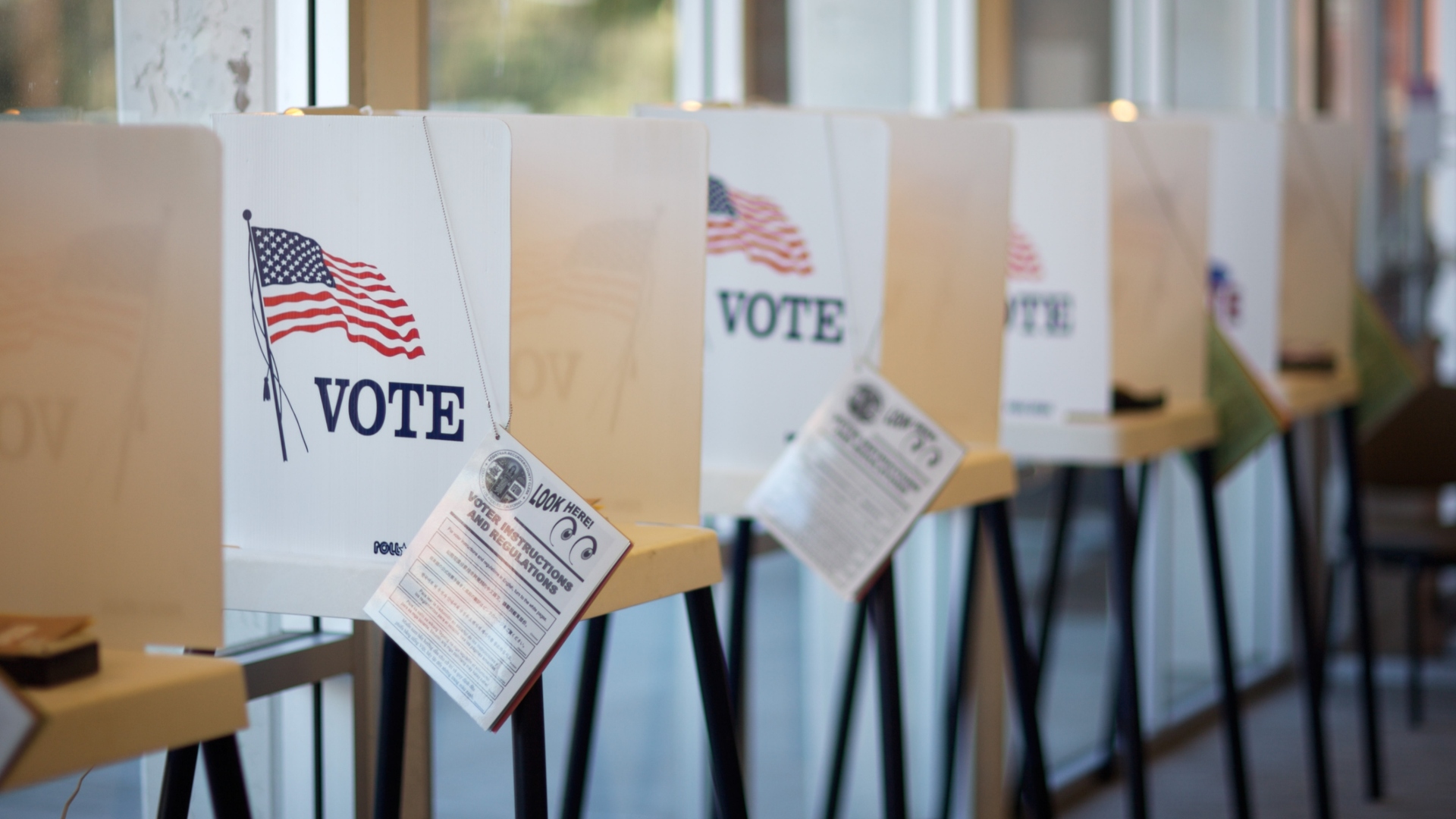
Airdate: Thursday, October 8, 2026 at 10 AM
Californians in this fall’s election will consider Proposition 39, which asks whether voters should be required to show ID when they cast a ballot. Supporters argue the rules are common-sense safeguards essential for restoring public confidence in elections, while opponents contend they pose identity theft risks and disproportionately disenfranchise low-income, minority, and young voters. We’ll unpack the cases for and against Prop 39 with KQED’s Guy Marzorati and Marisa Lagos.
Guests:
- Guy Marzorati, correspondent, KQED’s California Politics and Government Desk
- Marisa Lagos, politics correspondent, KQED, co-host of KQED’s Political Breakdown
Episode Transcript
This is a computer-generated transcript. While our team has reviewed it, there may be errors.
Mina Kim: Welcome to Forum. I’m Mina Kim. The president has aggressively pushed for voter ID mandates and restrictions on voting by mail in an effort to rein in an election system that he claims, without evidence, is rife with fraud. So is California’s Proposition 39, which would impose stricter identification requirements on voting in person and by mail, an outgrowth of that? Or is it a common-sense measure to restore confidence in elections, as its supporters say?
Joining me to break it all down as you fill out your midterm ballots, Marisa Lagos, correspondent for KQED’s Politics and Government Desk and co-host of Political Breakdown.
Marisa Lagos: Good morning.
Mina Kim: Also with us is Guy Marzorati, correspondent on KQED’s politics team as well. Hi, Guy.
Guy Marzorati: Hey, good morning.
Mina Kim: So start us off, Guy. What would Prop 39 do if passed?
Guy Marzorati: So Prop 39 would have put in place new requirements for voting in California. For voting in person, it would be presenting a government ID when you vote. But for the vast majority of Californians who vote by mail, it would be a little bit different. You’d actually have to write down a four-digit number from one piece of government ID. So that could be a driver’s license. You’d write that down on the outside of the ballot.
But there were a lot of outstanding questions about how that would actually work. Each of us would have to, if this passes, choose which government ID we’re going to be using as part of that vote-by-mail ID program. And so, in essence — and this would have to be worked out in some form or fashion — you’d have 23 million registered voters all basically having to re-register, pick which identification they’ll be using, so that when they do write down that four-digit number on their ballot envelope, it can be double-checked once the vote is cast.
Mina Kim: Would it also add requirements with regard to auditing or, you know, checking voter rolls?
Guy Marzorati: Yeah, there’s another provision in this ballot measure that asks both state election officials, the secretary of state and county election officials to double-check whether the voters on the rolls are citizens. And it says they have to do so using, quote, “their best effort.” But that’s another area of this proposition that would have to be defined in the future by the state legislature. What does that mean for these election officials to be using their best efforts to check whether the folks on the voter rolls are actually citizens? I think —
Marisa Lagos: I mean, something they would argue they’re already doing.
Guy Marzorati: Yeah, and the legislature would have to define that. And they could. It’s a Democratic-controlled legislature. The vast majority of members don’t even think that this proposition should be made law. You could easily end up in a situation where, if this does pass, the legislature basically signs off on the work that election officials are already doing as a way to confirm, under the way this measure is written, that folks on the rolls are citizens.
Mina Kim: Well, Marisa, who put this measure on the ballot?
Marisa Lagos: I mean, the main proponent is Carl DeMaio. He’s a longtime San Diego kind of politician. He hosted a radio show. I don’t know if he was quite a shock jock, but like sort of in that, like, right-wing radio, you know, and he really came to prominence in San Diego like 20 years ago when he was on the City Council and was kind of leading the fight to try to strip public employees of some of the retirement benefits. This was during a lot of concern about pension benefits being over-generous. And I think a lot of people, including Democrats, had concerns and felt that it needed to be reined in.
But DeMaio really angered a lot of public employee unions because he tried to actually claw back benefits that had already been promised to people instead of sort of making it moving forward. He went on, as I said, to kind of gain right-wing prominence with his radio show and then eventually has come to the state legislature. And he’s really the main person behind it, but it really is this coalition of him, other legislative Republicans. And then now we’re seeing a lot of support from national figures from, like, the MAGA movement who are pouring in money and supporting this.
Mina Kim: And what does DeMaio say about why this proposition is needed?
Marisa Lagos: You know, I think DeMaio understands the politics of the state better than probably the president. So I will say this is a far less sort of extreme measure than what Trump has been pushing. But he’s making the same arguments, right, that there’s fraud in our system, that we need to ensure that, you know, everybody who’s voting is a legitimate citizen. And I mean, it’s the same argument we’ve been hearing from Trump, I would say.
Guy Marzorati: But to Marisa’s point, DeMaio has, you know, gone on media throughout the state making the pitch for Prop 39. And I think in a lot of forums, he’s presented it as a way to kind of silence critiques about voter fraud. I mean, in one instance, he said, if you want to shut up the people who are raising these conspiracy theories, pass Proposition 39 and then they won’t be raising them anymore. Which would be still open. I don’t think he’s, you know, run that by the president. You know, I think that’s still an open question. But he’s, I think, in trying to appeal to folks beyond Republicans, have said, look, all this discussion about trust in elections and voter fraud will end if we pass Prop 39. I think there’s a lot of research that points to voters’ feelings about the security of elections being driven much more by bipartisan messaging than by actual voter laws.
Mina Kim: Is this measure, you know, in coordination with President Trump?
Guy Marzorati: President Trump has not explicitly endorsed Proposition 39. He did say in early 2025, after those wildfires in Southern California, that California’s ability to get federal funding should come after the state passes voter ID. So he’s expressed support for California to enact some kind of system of voter ID. He has not explicitly endorsed Prop 39 since it made it to the ballot.
Marisa Lagos: And I would argue that that’s intentional. Right? Trump’s historically unpopular here in California. I think that there’s a real sense that him — he is already so associated with these efforts that I think if you look at the polling and the way Democrats are responding, they’re probably making that connection anyway. But I think it’s likely that folks like DeMaio were sort of like, maybe just stay out of this one.
Mina Kim: So then let’s talk about the opponents. What do they say is wrong with requiring voters to show ID when they cast a ballot or to write that kind of information on a ballot envelope that they’re mailing in, Guy?
Guy Marzorati: I think the most common argument you hear against Prop 39 is that it’s a solution in search of a problem. We don’t have voter fraud occurring throughout California. Why is there a need, then, they would argue, to enact a new system that is purported to crack down on that fraud?
I think you also hear arguments about how this would add — you can call it hassles, you can call it hurdles — to actually voting by mail. I think that the piece of this that relates to in-person voting is much more simple and straightforward, right? Right now, when you go to vote in person, you usually sign the poll book next to your name. That’s not really checked. This would actually make it more secure in that case to vote in person because you’d be presenting ID.
But again, the vast majority, 80% in our last general election, voted by mail. So when you’re talking about this in California, we really have to talk about this through the lens of vote by mail, and it would create new systems to vote by mail. Again, writing down that four-digit number, where is that number coming from, having people pick that — it would add these new complications and these new systems to voting by mail. So it’s a very different conversation when you’re talking about voter ID in California than in the rest of the country, where we don’t have as much prevalence in a lot of states of vote by mail, and you see most states in the country do have some sort of voter ID.
Mina Kim: So it would be the last four digits of a Social Security number and your entire driver’s license number, or?
Guy Marzorati: So it could be any government ID. You would get to pick that, which ID you use.
Mina Kim: But you would have to stick with it, which is, I think, part of the concern. Yeah, the other reason I’m asking is because opponents have also raised concerns about identity theft related to this.
Guy Marzorati: Right. Because this number would be on the outside of your ballot envelope. So there are concerns that if you’re writing down the last four digits, let’s say, your driver’s license, with your signature there, could that open the door to identity theft?
I also think when you’re talking about this through the context of vote by mail, there are already a lot more security checks with vote by mail than voting in person. Again, when you vote in person, you sign that poll book. No one’s really double-checking that. When you vote by mail, that signature that you sign on your ballot envelope is being checked against your signature on file. That’s part of why it takes longer to count the vote in California.
But those security measures are already in place, and I think opponents of Prop 39 would say, well, then why do we need this whole new system involving writing down this number on the envelope?
Mina Kim: Yeah. The other thing that they raise are issues about voters of certain groups being disproportionately affected, right? Low-income —
Guy Marzorati: Young voters.
Mina Kim: Talk about that.
Guy Marzorati: Absolutely. I mean, I think any time we talk about voter access and hurdles to voting, young voters are oftentimes the most impacted. And that can be for a variety of reasons, being new to the experience of voting, moving around, changing addresses.
When we talk about votes that get rejected in California, oftentimes because ballots arrive too late, or there are signature issues, younger voters are overrepresented in that pool of ballots that tend to get rejected. And so I think the concern here with Prop 39 is, again, you add potentially this new requirement of having to select a form of identification that young voters would be the most impacted by that. Maybe not following up with that first request for, hey, you need to specify which ID you’re using.
Mina Kim: Let me invite listeners into the conversation. Listeners, how do you feel about Prop 39? What are your questions about it? You can email Forum at kqed.org, find us on Discord, Blue Sky, Facebook, or Instagram at KQED Forum. Or you can call us at 866-733-6786, 866-733-6786.
Douglas on Discord writes, “I don’t see a need for it. Voter fraud is incredibly rare. This costs money. Why spend money fighting something that almost never happens?”
Discord user Steve writes, “I would support voter ID laws, but only after we make the big push, likely a multi-year effort, to get adequate IDs into the hands of everyone qualified to vote. Otherwise, it’s just another form of an illegal poll tax.”
Guy Marzorati: That’s a great point about having a universal ID for this, because the way Prop 39 is written is that any voter can request a voting ID, basically can ask the state, hey, you’ve passed Prop 39, can I have a voting ID? But it wouldn’t be just sent by default to everybody. So that’s an important point that that listener raises.
Mina Kim: And Marisa, you know, Guy was mentioning — and you were mentioning — the fact that when, you know, votes are thrown out, if it’s not for fraud, what are the most common reasons the ballots get tossed?
Marisa Lagos: Yeah, I mean, people just don’t fill them out correctly, right? I mean, the signature matching is one thing, but often registrars really go above and beyond to try to ensure that if a signature doesn’t look matched, that they follow up with voters even, which again delays the count.
But I think that you have to do things properly. There’s a set of steps you need to fill out the bubbles with a black pen, right? Like, you need not a pencil, or I don’t think blue is accepted. Is that correct?
Guy Marzorati: In some cases, yeah, ideally, yeah.
Marisa Lagos: You know, you need to put it in the envelope correctly, sign it, date it. Like, there’s just all these steps. And I think that, you know, what people who oppose these types of voter ID measures say is, like, any — it’s already so hard to get people to vote. Like, any extra barriers are going to both, you know, dissuade some people from voting at all or potentially, you know, have others invalidate their —
Guy Marzorati: And I’ll say, I mean, we can just look recently to our last election in June. Almost 2% of all vote-by-mail ballots were rejected. And the biggest reason was they didn’t arrive on time. You know, people waited a long time to vote. And in some cases, that ballot just was not postmarked by Election Day.
Mina Kim: Yes, and interestingly, that marks a pretty significant increase, too, in the number of rejected ballots. But it sounds like you’re essentially saying, Marisa, that there is a robust process in place for vote verification, and also the penalties are pretty steep if you tried to commit voter fraud.
Marisa Lagos: Absolutely. And I mean, the reason we hear about voter fraud is because it’s so rare that when it does happen, it gets prosecuted. Right. And so I think, like, that’s something people who want these type of laws make, you know, hey, I’ve — say, oh, well, look, somebody registered their dog in Orange County. Well, she did it on purpose. First of all, we can talk about that later.
Mina Kim: We’re talking with Marisa Lagos and Guy Marzorati about Prop 39 and with you, listeners. Stay with us. More after the break. I’m Mina Kim.
You’re listening to Forum. I’m Mina Kim. We’re talking this hour about Proposition 39, a ballot measure that would institute stricter voter ID requirements. Voters would be required to show ID when they cast their ballot, in addition to when they register, which is what they do now, or to show some kind of identifying information on the outside of their mail-in ballot.
Supporters argue the rules are common-sense safeguards, essential for restoring public confidence in elections, while opponents contend that they would disproportionately disenfranchise certain voters, like young voters. It could also pose some identity theft risks with you writing information on the outside of your ballot envelope.
Marisa Lagos is a correspondent on KQED’s politics desk, co-host of Political Breakdown. Guy Marzorati is also a correspondent on KQED’s California Politics and Government Desk. And you, our listeners, are joining the conversation. You can tell us how you’re planning to vote on Prop 39, your questions about it, and also what you want to know about the status of mail-in voting, which is very connected to this. And there’s been some recent developments around that as well.
The email address is forum at kqed.org. Find us on Discord, Blue Sky, Facebook, or Instagram at KQED Forum. Call us at 866-733-6786, 866-733-6786.
Paul writes, “I’m a fan of the if-it-ain’t-broke, don’t-fix-it camp. We’ve had safe, secure, fraud-free elections for decades. Unless someone can come up with actual evidence of a problem with ineligible people casting ballots, I see no reason to create extra expense and inconvenience for both voters and election officials.”
So I want to take just a little bit of a step back and look at the status of the president’s efforts to restrict vote by mail. Not only because more than 80% of Californians now vote by mail, which I think is pretty incredible, according to the latest Secretary of State’s office, and would be affected by the type of rules that Proposition 39 would bring if passed. But also because there have been some recent developments that we can talk more into later, that the president has sort of changed his tune on voting by mail, even though he chooses to vote that way himself.
But let’s just sort of step back and remember some of the initial steps the president took to try to restrict vote by mail. There was that executive order in March that directed federal agencies to take a series of steps on mail-in voting. Remind us what some of those were, Marisa.
Marisa Lagos: Yeah, I mean, he’s made a number of attempts. I think there’s a previous executive order in 2025 as well, and that one’s the one this year sort of built on it. Essentially, there’s a couple buckets here.
I mean, one is that the federal government has been trying to force the states to essentially share their voter rolls with the feds and run them against, you know, whatever list the federal government has created of eligible citizens who can vote.
It’s interesting, the problem with this. I was just doing an event with David Becker at the Center for Election Integrity and Research, and he was saying, you know, actually, states have much more accurate information about you and I, like, because I think some people would be like, why shouldn’t we share this with the federal government? But the truth is, like, the feds don’t have necessarily your Social Security number linked to your driver’s license number linked to other information about you. The state does.
And so there’s been a huge pushback. Some Republican states have shared this information and handed over their voter rolls. States like California and many others, including some Republican states, have really balked, pushed back, sued. The courts have upheld that. So that information has not been passed on.
You know, another bucket was, of course, the SAVE Act, which he has unsuccessfully tried to get through Congress, which would have been a very draconian voter ID measure. That would have required, potentially, basically made millions of people, or at least hundreds of thousands, ineligible to vote because you would have had to have your birth certificate match your current ID. And obviously, for women who got married and changed their name, for people — there’s a long list of people who would have been affected by that. Again, even Republicans in Congress have not been willing, or at the least in the —
The biggest fight that we see play out most recently as related to that executive order has been around the Postal Service’s role, or historic lack of role, in sort of overseeing election mail. And so the president wanted USPS to essentially have its own list of eligible voters and only send ballots to those people.
So really injecting this federal agency that has never had any sort of contact with voting and elections into this entire process. Again, that’s been litigated. The Supreme Court upheld some lower court rulings, although mostly their decision, I think this is going to come back up, because what the Supreme Court said is essentially it’s too close to this election to do it.
Lower courts have also said, look, Congress would need to delegate this responsibility to USPS. The president wanted the Postal Service to create special envelopes that would be the only ones you could use.
There’s a lot of concerns about this, most notably that this is not an agency that has any training around this. And also that we do have a very prescribed legal system around who gets to touch ballots in our country. It’s called chain of custody.
Folks probably heard it brought up in relation to that case in Riverside where the sheriff, Chad Bianco, seized tens of thousands of ballots and was slapped down by the California Supreme Court recently. You know, the reason for that is, like, we sort of consider these ballots sacred once they’re being, you know, before they’re counted, and even afterward, they are a record of, you know, what’s at the heart of our democracy. And if you break that chain of custody, it can undermine election results.
So I think the USPS stuff has really raised a lot of concerns. And again, you know, obviously, the president’s most loyal supporters are behind him. But I really think you have to look at how many of these election officials, a lot of whom are nonpartisan right on the local level, but also Republican secretaries of state in some cases, have stood up and been like, get out of here, we do not want the federal government messing with a system that goes remarkably well given how many —
Mina Kim: Vote. The other thing that’s shaken voters, right, Guy, was the fact that there was a USPS whistleblower who basically said that the agency was sort of preparing to follow Trump’s executive order to some extent even though it had not been determined in the courts whether this was legal.
Guy Marzorati: Right. To push ahead with it regardless. And I think a big question, and Marisa raised as well, is just about the information that the federal government has versus the state has. And this executive order not only would have required states to put together a list of eligible voters, it also would have given the Department of Homeland Security a role in creating a list.
Mina Kim: Have, like, approved voters, right, who would receive ballots. Right. And basically —
Guy Marzorati: Right, and basically double-checking between those two lists, what the state provides to the feds and the list the federal government puts together. And to Marisa’s point, the information that the Department of Homeland Security might have to put together such a list could potentially be incomplete.
And so then you’d have basically them going between the state information, federal government information, and a big picture giving the USPS more power over vote-by-mail that they’ve never really had. I mean, the states have always had the authority over administering elections. This would have been a real departure from that in granting the USPS this authority.
Mina Kim: And then, Guy, there was also that recent investigation from ProPublica that the Trump administration would have disrupted mail-in voting even further by requiring ballots to be delivered through certified mail. What would that have meant?
Guy Marzorati: Yeah, that’s a great question. I mean, in practice, like, how that actually would have worked, given the timelines of getting ballots out. Yeah, signing for the ballot as you would for certified mail. So, you know, I think — and especially the time — I think we have to think about, like, the timeline of a lot of these executive orders and the litigation around them. Ballots are ready, going out. I mean, in some states, they’ve been sent out. In California, this is the week where a lot of people are receiving their ballots in the mail. The court of the Supreme Court has always been hesitant to adjudicate election-related issues close to an election, and we certainly are close to election, given how many Americans already have their ballots and —
Mina Kim: Let me go to some calls coming in. Omar in San Francisco, go ahead. You’re on.
Omar: Hey, Mina. So this is just another attempt in a roundabout way of the Orange Foolius trying to create issues with the process that works. You know, absolutely great. They’re basically, and I hate to use this term, you know, Henny-Pennying or Chicken Littling the voting process to create a sense of fear or even complacency where they’re like, okay, we just don’t even wanna deal with it. And I think it’s just gotten ridiculous.
Like, we’ve been put up with this for four years once. We’re about two years through the process again. I know we’ll survive as a country. But how — how bad will we be after, you know?
Mina Kim: Well, Omar, thanks for sharing where you’re at. I think you’re not alone.
Babesh writes, “The whole issue of voter fraud is a big lie perpetrated by Donald Trump. It’s sad that we’re wasting so much national energy and time discussing a non-issue, and it’s also corrosive in the long run to our democracy by reducing the faith in elections. The problem we should actually solve is how to get more people to vote in a democracy.”
Interestingly, though, the way this is polling — and was polling initially, too — it looked like it had a lot of bipartisan support.
Guy Marzorati: Yeah, the polling around voter ID is fascinating because, taken in a vacuum, the idea of requiring identification before people vote, adding that extra level of security, is popular.
Even in California, I mean, Berkeley, this is the best snapshot we have of this. In the spring, Berkeley did a survey where they asked voters about just that idea: What is being proposed in Proposition 39, voter ID at the polls and also through by mail. Fifty-six percent of voters approved of that idea.
They then said, okay, well, what if we tell you a little bit more about the arguments for and against, some of the, you know, pros and cons that we’ve discussed on this show? It suddenly dropped to about even — 37% yes, 35% no.
Then they asked, okay, well, I’m going to tell you who’s supporting this idea and who’s opposing it. All of a sudden, completely flipped. Yes down to 39%, no 52%.
So we go from 56% yes to 39% yes based on who’s actually lining up for and against this idea. That 39% yes is exactly where Prop 39 is still polling.
So more than anything, I think this measure and this idea has been incredibly red- and blue-coded. As soon as voters are aware of the groups behind it and the supporters of it, their support for the idea plummets.
Mina Kim: Well, I think Lane is sort of related here. Lane in San Francisco writes, “I think many people may have the attitude that it is not that difficult to just show identification if you want to vote,” which we may attribute to the fact that it was polling pretty evenly initially.
Lane writes, “Please clarify for listeners the many reasons why it may be difficult for some people to get ID. What about all of the fire victims that have lost their documents? What about foster children that may not have access to their birth certificates and other documents required to get identification?”
So there is a step, of course, to prove that you are eligible to vote through the registration process, but yes, there’s lots of reasons that documents are tough to get.
Guy Marzorati: Yeah. And it’s why in many states, even states that have voter ID rules, oftentimes you’ll see provisions that voters can still bring forth identification that’s not like your driver’s license. Arizona, for example, you can bring a utility bill and, like, a bank statement. Others are more strict and they really will require a photo ID requirement.
But even states that have gone ahead and enacted voter ID, I think understand in some cases that the actual photo ID as the sole document you have to provide can in some cases be challenging for people.
Marisa Lagos: But I also think we need to put this in the context of our history and the voter suppression efforts that have occurred and have often been very racially motivated. I’m thinking about, obviously, coming out of slavery and the Jim Crow era and the idea that there are states in this day and age who will say, you can use your gun license as a voter ID, but you may not use a student ID.
And so, like, I think — again, I think some of the opposition to these laws, like, yes, it sounds sort of reasonable, and in some ways it is, right, to say, and we all do show an ID, we all prove who we are when we register to vote in California. But this is a country that has a long history of using these types of laws to particularly suppress the votes of certain populations.
And I just, like, I think we have to put that in context, and I think it also speaks to why, when voters learn more about this in a state like California that is deep blue, in this hyper-partisan moment, when people are so angry at the president, it explains why people are like, mm, I’m good on this, you know?
I think, like, this is not really as much on either side in some ways about the policy. It’s about the sort of moment and the distrust.
Mina Kim: If this goes down in California, Marisa, do you think that essentially this issue — it will be the end of this issue in this state? Or do you think that there will be an attempt to try to re-energize it and bring it back up later?
Marisa Lagos: I mean, that’s an interesting question. How many times have we seen ballot measures fail and then come back? I don’t know. I do think this is a bit of a canary in the coal mine for Republicans. I’m not sure we’ll see it come back right away. If it fails, I think it would depend on how close it is, what else is going on.
But certainly we are seeing national figures donate money on the right to try to push this through. The bigger thing would be if it passes, what lessons are learned from that.
Mina Kim: Interestingly, there was a piece in CalMatters, Guy, that was saying that these big donors who are watching the Prop 39 fight in California are contending that, yes, it may not pass here, but that they’re gauging how much it loses by. Why would that information be important?
Guy Marzorati: I mean, maybe they feel like, you know, this particular election, the turnout that we expect in November is going to be pro-Democratic, right, given the national mood. The idea that they would fare better in a different electoral environment — this is not polling within the margin of error right now, right? This is like the yes side is trailing in all available public polling.
I’m not sure a signal that it’s, you know, four or five points one way or another would make them feel like, oh, if we brought this back in 2028, we’d have an entirely different result.
Mina Kim: But my sense is that it’s probably not gonna go away in other states, that’s for sure.
Guy Marzorati: Right. I mean, we are seeing — I mean, just this year, there’s Arizona, Nevada, a handful of other states have voter ID measures on the ballot. Oklahoma, in their primary, enshrined voter ID into their state constitution. So this is a live issue on the ballot in states throughout the country.
Marisa Lagos: And again, it’s interesting to me because states like Georgia and Arizona, for example, have actually higher or similar voter turnout to what we do here. And they have pretty strict voter ID laws.
Again, though, I think, like, how something is crafted matters. I do think that in this moment when there’s so much concern over how quickly we count ballots here and the resource levels of registrars already not being where they need to be to do the work, like, this is going to add another layer.
And it’s sort of ironic because I think the same people who are pushing this measure are the ones who are screaming about how undemocratic it is and how problematic it is that we take so long to count our vote here in California. Well, this would just expand that further, and I think give them more ability to attack the integrity of the election.
Guy Marzorati: Yeah, that’s not being talked about enough. We have this whole separate discussion about how long it takes to count ballots. Is adding a new — you have to write a four-digit number, have that be double-checked — that could add more time. If you show up to vote and you don’t have an ID and suddenly now you have cast a provisional ballot, that takes added time on the backend to check.
I don’t see anything in this measure that’s going to speed up the ballot count, which has been a very contentious discussion.
Mina Kim: It has been. I’m just curious what you make of that discussion. You know, if you feel like there are merits to the criticism of how long it takes for California to count its votes, you know, or others who just feel like, look, we’re a big state. We have a lot of people. We have a lot of different county offices and so on.
Guy Marzorati: I mean, that is true. It is taking longer because we are a big state in which a large number of people vote by mail and return those ballots on Election Day. But that’s not to say that it cannot be faster.
If there was more, you know, money in the system, if there were more people counting the ballots, if there were more machines to count the ballots, like, it’s not — you just say, oh, well, because so many people vote by mail, throw your hands up. It has to be this. I’m not — I don’t entirely buy that argument.
Mina Kim: We’re talking this hour about Proposition 39, the ballot measure that would institute stricter voter ID requirements when casting a ballot or voting by mail. Guy Marzorati is a correspondent on KQED’s California Politics and Government Desk. So is Marisa Lagos. She also co-hosts KQED’s Political Breakdown.
Listeners, do you want to share how you’re planning to vote, the questions you have about 39, the reasons you’re voting one way or the other, and what do you wanna know about the status of mail-in voting? The latest restrictions, the latest developments around that.
The email address is forum at kqed.org. Find us on Discord, Blue Sky, Facebook, or Instagram at KQED Forum, or call us at 866-733-6786, 866-733-6786.
And this listener — Noelle writes, “I volunteered at a vote center for the primary election in June. The Registrar of Voters has made it a priority to get all eligible voters to vote. There are so many options of how you can vote. It made me feel glad. And working with the other poll workers who are naturalized citizens and who knew other languages was another highlight for me.
“One of the poll workers lived in a senior housing apartment complex and one of her neighbors came to vote. The voter was 94 and needed help from the poll worker neighbor. And it was heartwarming to see that this person felt it was important to vote.”
So just a heartwarming story about voting and the importance of it here in California.
We’ll have more after the break. Listeners, this is Forum. I’m Mina Kim.
This is Forum. I’m Mina Kim. Prop 39 is a ballot measure that would institute stricter voter ID requirements when you cast a ballot or vote by mail. Supporters say the rules are common-sense safeguards essential for restoring public confidence in elections. Opponents contend that they pose all sorts of problems, including potentially disenfranchising groups of voters and increasing the risk of identity theft.
Marisa Lagos and Guy Marzorati have been covering this and are talking about it with you, our listeners, at 866-733-6786, at the email address forum at kqed.org, and on our social channels at KQED Forum.
And this listener, Jason, writes, “Prop 39 is a terrible idea. I’m already dealing with identity theft. The last thing I need is California making it easier for bad actors by requiring me to advertise the last four numbers of a form of identification.”
You know, we were talking about some of the things that have shaken people’s confidence in the U.S. Postal Service, and also about some of the issues related to the requirements around mail-in ballots, which nearly 90% of Californians now do, or at least did in the primary election. So vast majority of Californians vote this way.
So I wanna, well, first let’s clarify. Marisa, has anything changed at USPS? Will ballots be affected by any changes at USPS this election?
Marisa Lagos: I mean, yes, not actually differently from the primary, but yes, maybe since 2024 previously. Especially if you’re in a more rural area, there have been some changes to the way ballots are essentially gathered and processed that can delay when you get a postmark.
So it’s not just because you put your ballot in a mailbox on November 2nd, the day before the election, does not mean that USPS will put a November 2 postmark on it. And so I think, you know —
Mina Kim: So they’re postmarking when it’s received at the facility, when it is processed?
Marisa Lagos: And sometimes if you’re in, say, the Sacramento area or closer to Lake Tahoe, it might be sent to like a Reno processing center before it gets sent back here. So for the postmark. For the postmark.
So the bottom line is, like, it’s first of all, if you need to vote by actual USPS mail, I think the best advice these days is try to get in the mail up to a week before the election. Like, don’t wait until the days before.
But the best thing to do is either put it in one of those county drop boxes. Those do not rely on the postal service at all. The county registrar actually comes and collects those in most counties every single day at the end of the day. And they postmark the day that they were in the box. And they will essentially count it as being received that day.
Or you can mail — you know, take your mail-in ballot, take your time at home, love it, cuddle it, whatever you need to do, and then walk it into a voting center, whether that’s on Election Day or previously, preferably previously, because the sooner you get your ballots in, the less we have to hear national folks complaining about how long our vote count takes, right?
But you can actually — it’s called naked voting, I learned recently — where you basically go in and feed your ballot in at the voting center without the mail-in envelope in it. So there’s multiple options, and I think — but again, I think the ballot drop boxes, if you wanna vote by mail and you don’t wanna be hassled with finding a voting center, are probably the best option.
And then — there’s early voting in a lot of counties too. So you can actually just go in and, like, cast your ballot in person a week or two before the election.
Mina Kim: That naked balloting that Marisa’s talking about, Guy, that sounds like just a little bit different than what you say a lot of Californians do, which is drop off their ballot at the voting site the day of the election. This would mean actually taking it out of the envelope and having them process it right in front of you.
Guy Marzorati: Right, so that the processing doesn’t happen on the back end, so that it’s more akin to voting in person and that the vote is actually processed right there. That does help speed up the vote count.
I should point folks — our colleague Izzy Bloom did a great explainer on all the changes to USPS, how that might affect voting. Encourage folks, go to KQED, check that out. She talked to the registrar of voters in Sonoma County, who said, point: we’re not encouraging people to use USPS.
I do, I agree with Marisa, there’s so many drop boxes in counties. I mean, where I live in San Jose, the drop box is closer than the post office. And I will just — I’ll second that. I think if you’re voting close to Election Day, don’t be, you know, you would hate to be that person that you spend that time filling out your ballot, you return it, it ends up getting postmarked after Election Day. Just use a drop box.
Mina Kim: And I understand if you really do want to get that postmark or make sure you see that postmark, another thing that Izzy wrote about — and you’re right, that piece is excellent, and I highly recommend people read it — that you go in and get a hand-stamped postmark right there, right in front of you. Yeah, you can go into the post office as well.
Marisa Lagos: Again, these are adding the extra steps, so I do think, you know, I think it’s also just worth just thinking about making a plan. You know, like, what is my plan? Maybe it’s setting a time sometime the weekend before the election, if you don’t have time before then, or two weekends before, to just sit down and do this.
We have a long ballot in San Francisco and California in particular. I mean, there’s 14 statewide ballot measures. I can’t remember how many city ones this year, but add another handful to that. A lot of counties, you know, L.A. has a big mayor’s race. We have congressional races. There’s a lot to pour over.
A lot of these ballot measures are confusing in some cases on purpose. And so I think that giving yourself that time and then making a plan is really important. And it’s just, like I said, to do all that work and then to find out it wasn’t counted is just incredibly discouraging.
Mina Kim: And you can track your ballot once you put it out there so that you can. And again, if you want more details about that, listeners, that’s in the piece.
This is from Berkeley writes, “I’d always assumed that proponents of restrictive voting policies wanted to preferentially reduce progressive or Democratic turnout, but a more sinister interpretation seems more likely now. A desire to reduce turnout overall, making it easier for those in power to run roughshod over public interests in favor of politicians’ interests. Are there documents from whistleblowers or leaks that explicitly clarify the genuine intentions of those behind voter ID proposals?”
I don’t know if the person who blew the whistle at the USPS —
Guy Marzorati: I would say there’s, for this one in California, I would describe probably a few different motives. I mean, this is a policy that Republicans have championed across the country. I do think this was an organizing opportunity for Republicans, specifically Carl DeMaio. I mean, he started this group, Reform California, and they’ve gone through the process of collecting signatures to get this on the ballot, fundraising. So this really was a big grassroots organizing opportunity for DeMaio and Republicans in California.
Um, so, and as far as, like, fewer people voting, that is, you know, when the Legislative Analyst’s Office analyzed Prop 39 and said, okay, here’s where it would cost the state money. Here’s where we’d save the state. One of the ways that they said it could save the state money is just fewer people voting as a result of this, though the cost would still — this would still cost the state money from having to send out these new, uh, potential ID cards and, you know, the paperwork and —
Marisa Lagos: And then the registrars would have to do more work on the back end.
Mina Kim: Well, Corey in San Francisco writes, “What’s to stop the federal government from not sending ballots disproportionately to one party if the federal government gets more information, for example?” That was the only fear that was raised. Trump not sending ballots to Democrats or minorities or women, I feel like this — that’s his end game.
Okay, can we just talk about where the efforts to restrict mail-in voting will go from here, especially since its loudest champion for restrictions, the president, has recently been changing his tune and telling Republican voters to vote by mail?
And it’s really remarkable, you know, this shift. I just want to point out, like, he has said mail-in voting means mail-in cheating, and then just recently he posted this on Truth Social.
Donald Trump: Do not wait. Go out and vote. Vote early, vote by mail, or vote in person on Election Day, November 3rd.
Marisa Lagos: Vote often, right?
Mina Kim: How should we interpret this sort of change of message?
Marisa Lagos: I mean, cynically, I think is fair, because we’ve seen this before, right? Like, he spends, you know, a year or two years trying to undercut confidence in our elections, claiming all this fraud, and then looks around and realizes on the eve of an election that matters to Republicans that, hey, this could actually depress their vote as well.
You know, we saw this in 2024 and 2022 as well, so I don’t think it’s anything different, and I would not expect that it means a change of heart by the president. I think what we are going to see is him continue to try to push some of these attempts at making it harder to vote and inserting the federal government into the elections.
If Republicans lose the House, and especially if they lose the House and the Senate, he’s going to have even less chance of doing that legislatively. So I think we can expect more lawsuits, more executive orders, and a lot of rhetoric.
I think that’s really important to note. And this is something, like, I just want to say, because we’ve been spending a lot of time on Political Breakdown thinking about and talking about election integrity. And I’ve been spending a lot of time talking to folks, nonpartisan experts on this.
And I think what’s really important is that so much of what the president has done, I think, is really aimed at scaring people, right? When you think about things like these sort of — this idea they floated out there that they might have troops or ICE at the polls, the idea that they may try to sort of come in and take control from states and counties, none of that is constitutional.
And even if, you know, there were attempts to do it, I think that they would be very limited and very much aimed, again, at sort of intimidating people and officials, not in actually being able to disrupt the election.
So the folks I talked to who have done this work for a long time say that, you know, we should have confidence that this election will go off well. I think the thing I’m going to be watching is what happens after the election. Is there any attempts to disrupt vote counts, to seize ballots? Are there any attempts, you know, to sort of mess with things when we talk about the seating of the House on January 3rd?
And if, you know, if Republicans lose, is the speaker going to try to do something to prevent Democrats from being seated? I think that’s a pretty far-off, you know, thing. But I do think we spend so much time thinking about, like, how do people vote? I want us to still stay on our toes and be watching things after the votes come in.
Guy Marzorati: And I think also a lot of this, like, you have to look through the lens of a pre-buttle. Even before Trump’s approval dropped to how low it is, the president typically does poorly in a midterm election. And I would think it would surprise no one if the day after the election he comes out and says, well, if we had only passed, you know, stricter voter requirements, we wouldn’t have had this, you know, Democratic wins in the House, the Senate, et cetera.
Mina Kim: It sounds like you’re essentially saying that, you know, timing-wise, there’s gonna be vote by mail in this midterm election, and he does not need people not voting.
Marisa Lagos: One hundred percent. You can’t — and you can change anything related to that within 90 days of the election. Like, that is established.
Mina Kim: And I’m sure there were members of his own party telling him —
Guy Marzorati: I mean, that’s not — I didn’t see the video, but it sounded like he was reading off a script. Oh, yeah.
Mina Kim: So, you know, essentially, I think that is part of it.
Let me remind listeners first, you are listening to Forum. I’m Mina Kim. But Guy, to Marisa’s point, you very much covered the attempted seizure — or the seizure — of ballots and the attempt to hold onto them by Riverside County Sheriff Chad Bianco, and that, you know, the state Supreme Court had made a ruling in that. Tell us what the ruling is and whether people should feel more confident that that is unlikely — seizures of ballots might be unlikely to happen here.
Guy Marzorati: Yeah, so the ruling was basically that Chad Bianco, the sheriff in Riverside County, broke the law when he seized ballots from the 2025 election in an attempted investigation into what he purported to be potential voter fraud in Riverside County.
The Supreme Court both said that he had no right to do that, that there was a clear law as far as the chain of custody for ballots. Even in the course of an investigation, those ballots should have never been taken out of the Registrar of Voters office.
And the Supreme Court also affirmed the attorney general’s power to have tried to halt Bianco’s investigation. And I think that’s an important thing to keep an eye on, too. The attorney general really does have very broad powers in California, authority over sheriffs and district attorneys.
But this was one of the first times that court really confronted that question over the limits of their power over sheriffs. And it found that it didn’t set a limit. It basically said this was in Bonta’s authority to have told Bianco, stop this investigation.
That could be something with a tail to November or October if we see some kind of, you know, action leading up or after the election on the part of local law enforcement.
Because I do think state lawmakers, vast majority Democrats, are kind of caught in this push and pull. They’re trying to fend off federal efforts to intercede more in elections, but they’re also dealing with a lot of things popping up at the local level.
You know, Riverside County was probably the most notable example with Bianco’s investigation, but the state has also been in litigation with Shasta County, where there were efforts to restrict vote-by-mail.
So I think you see Attorney General Rob Bonta really at the fulcrum here between litigating against the federal government, trying to, you know, prevent changes to vote-by-mail there, but also almost in a whack-a-mole fashion banging on some of these local officials who, you know, he feels might have overstepped their — when it comes to involving themselves in the election process.
Mina Kim: Well, interestingly, Steve writes, “Since 1999, I’ve served as a poll worker in over 20 elections in three different California counties. Anyone who thinks elections are rigged or not secure should serve as a poll worker in just one election. I’ll bet they’d have a very different perspective after that. The problem isn’t with the security of elections on the county level, Steve feels. If there’s the potential for problems, it’s going to be from the intrusion of the current federal administration.”
We have another poll worker, Ruth, who writes, “I volunteer for VoteRiders, trying to get voter IDs for people who have the right to vote but lack the ID their state requires. There are 28 million people who meet that definition. It costs $50 for a birth certificate. You need a photo ID to get a Social Security card. You sometimes need a Social Security card to get the photo ID. So it’s easy to fall into a loop where you can’t get an ID. Add in those who don’t drive, the disabled, the old, the young. This is one party trying to make sure these 28 million voices are never heard.”
Certainly, we are hearing resoundingly, at least from our listenership today who are contributing, that they very much do not support Proposition 39 and see it as essentially, as you were saying initially, a solution in search of a problem.
Let me go to Laura in Lafayette, who’s on the line. Laura, go ahead.
Laura: Thanks. Thanks for taking my call, Mina. Yeah, I just want to say, you know, there are measures in place to combat voter fraud. And a friend of mine, whose son was studying out of state, she called him, filled out his ballot, put his signature on there — her signature on there — and got a call from the registrar and said, hey, you, this is not his signature.
So just for that, it was obvious that they’re looking at the ballots, they’re the signatures, and so there are measures in place.
Mina Kim: Well, Laura, thanks for sharing your experience.
And Joan writes, “No system is perfect. So a fraction of 1% of votes having problems is as close to perfect as anyone will ever get. If we had a crystal ball, Prop 39 would raise, not lower the voting problems, especially because it is not motivated by good intentions.”
Al writes, “I have to prove my identity at Wells Fargo to make a deposit. And I am a customer. My kid had to show photo ID to take the SAT test. I had to ID to register my car at DMV. Is my vote more important? All vote yes.”
That’s the first person that we’ve heard who’s going to vote yes. Thanks for sharing where you’re at with this, Al.
Claude writes, “I’m 76 years old and have voted straight Republican for 40-plus years. Never again. Voter ID is to ensure only Republicans can vote,” in Claude’s opinion.
Marisa.
Marisa Lagos: Like, it is interesting that it’s become so partisan in this moment. And again, like, I think historically that tracks with how things have played out over decades in this nation.
Although, to be fair, you know, back during the Jim Crow era, a lot of the folks in the South were Democrats who were trying to suppress the Black vote. I don’t think in itself voter ID is the problem.
But we have not had, like, a good sort of bipartisan effort to come together and figure out a way that would both sort of allow people to have as much access as possible and also have voter ID.
I think there are states that have voter ID laws that, you know, are perfectly reasonable and, like I said, that have very high voter —
Mina Kim: Turnout.
Marisa Lagos: I think the problem is, like, we just have such a problem with voter participation to begin with in our country and our state particularly. I mean, California does make it as easy as possible. And we still lag other states often in turnout.
And so that — that is troubling because our democracy does work better when everyone’s engaged. It does.
Mina Kim: And I think you were touching on this earlier, Marisa, if I may, when you were talking about our history with it. Fundamentally, too, there just may be different views with regard to who should vote in this country. Like, who should really be determining the leadership for all of us as a nation.
Marisa Lagos: I mean, I think we’ve seen that historically. I remember feeling like that in college, that there was a sense, you know, in a lot of college towns that folks who live there permanently were mad that college students got to say as well.
I think you see this often with the way people talk about, like, yeah, who should have a role in things. And, you know, we all get to.
Mina Kim: Well, Alona in Richmond writes, “As an experienced volunteer at the polls, I suggest everyone who has doubts about the process of voting in this state also volunteer. It is so much better to make these judgments from knowledge and experience rather than from ignorance and fear.”
We’ve been talking about Prop 39 with Guy Marzorati. Thank you so much, Guy.
Guy Marzorati: Thanks, Mina.
Mina Kim: And Marisa Lagos.
Marisa Lagos: Thanks, Marisa.
Mina Kim: My pleasure. And with you, listeners, my thanks to you always for sharing where you are and how you are doing on Forum. I’m Mina Kim.