Whistleblower Frances Haugen on Facebook's 'Social Reckoning'
Airdate: Monday, September 29, 2026 at 10am
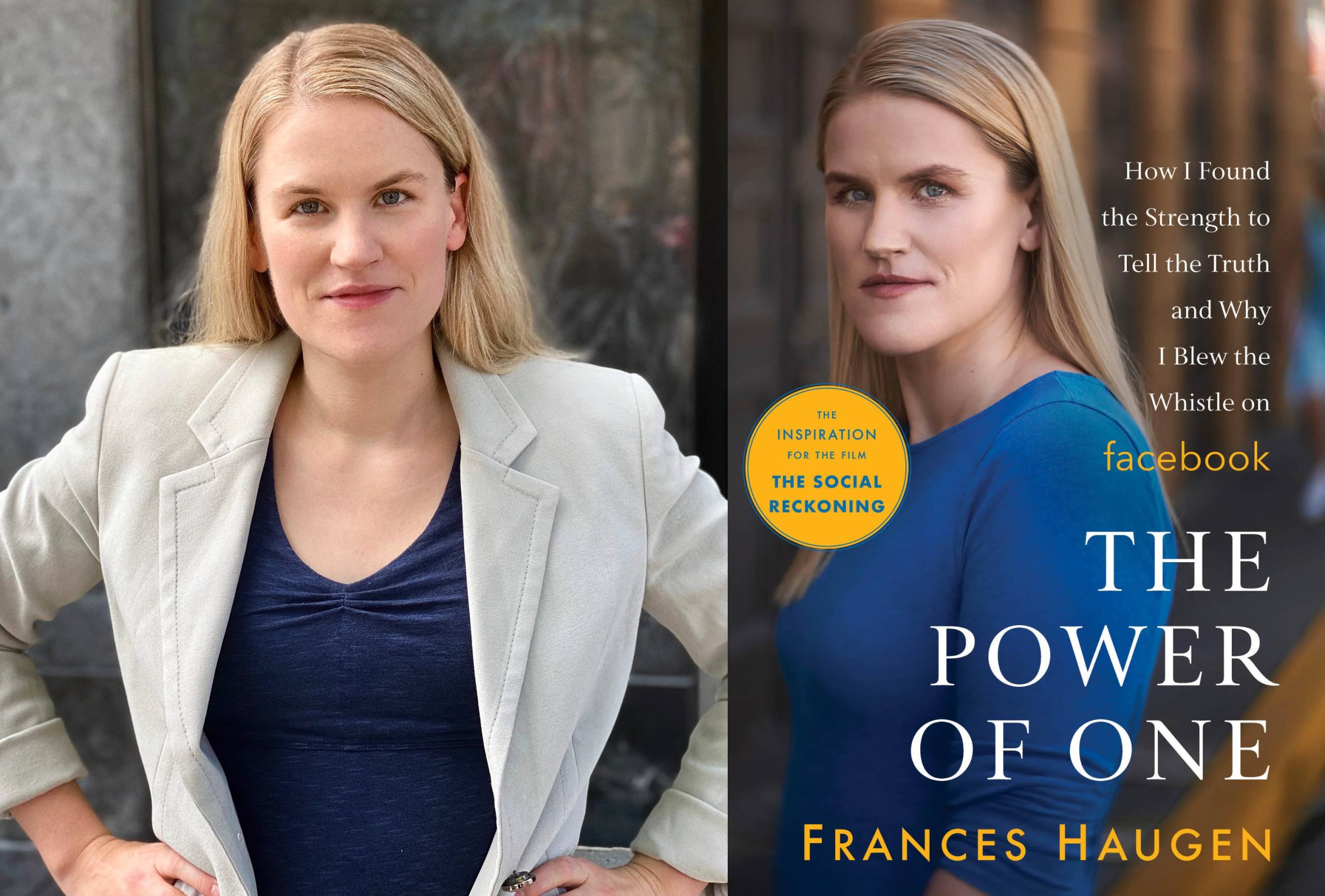
Facebook whistleblower Frances Haugen leaked tens of thousands of pages of internal documents that were published in a 2021 Wall Street Journal exposé, now the basis of the forthcoming film “The Social Reckoning.” The documents revealed that the tech giant knew its engagement-driven algorithms accelerated political polarization, increased teenage mental health issues and incited ethnic violence abroad, and Haugen argued that Mark Zuckerberg routinely prioritized user growth and corporate profits over public safety. In her memoir “The Power of One: How I Found the Strength to Tell the Truth and Why I Blew the Whistle on Facebook,” Haugen details the personal and professional cost of exposing Meta and going public.
Guest:
- Frances Haugen, data scientist and author of “The Power of One: How I Found the Strength to Tell the Truth and Why I Blew the Whistle on Facebook”
Episode Transcript
This is a computer-generated transcript. While our team has reviewed it, there may be errors.
Mina Kim: Welcome to Forum, I’m Mina Kim. Aaron Sorkin’s follow-up to the 2010 film The Social Network, about the founding of Facebook, comes out next week, called The Social Reckoning. This time, it’s about the 2021 revelations that Facebook knew its platform stoked division and harmed kids, especially teen girls, and did not act. Revelations that came to light after Frances Haugen decided to secretly leak thousands of internal documents to Wall Street Journal reporter Jeff Horwitz. Haugen’s memoir, The Power of One: How I Found the Strength to Tell the Truth and Why I Blew the Whistle on Facebook, is out in paperback this month, and she joins me now. Welcome to Forum, Frances.
Frances Haugen: Thank you for inviting me.
Mina Kim: What did you think of the film? I assume you got a preview.
Frances Haugen: I did get to see it maybe two weeks ago, and I was really impressed because ever since conversations have begun on, you know, should they make a movie out of this? I’ve always been a little baffled, like, how do you make exciting taking a bunch of pictures? And, you know, Aaron Sorkin worked his magic, and it’s exciting and funny and all the things that you associate with an Aaron Sorkin movie. Um, so it was real surreal, and, um, it’s so odd seeing yourself up on the big screen. I’ll put it that way.
Mina Kim: Yeah. I was going to say it must be surreal. How?
Frances Haugen: And, you know, it’s one of these things. So there are parts of my experience where, you know, I don’t ruminate on what happened five years ago. You know, I have a wonderful life that is not related to social media. And there are parts of it that he depicted really well that, once I watched them, I was like, oh, yeah, I did write about that. That did happen.
So I’ll give you an example. You know, there were things that I had high levels of certainty about when I first started talking to Jeff. And there are things that I didn’t know, but I knew there were known unknowns when I started talking to Jeff. And they did a really good job of capturing that. Like, there was a period of time where we were trying to fit the puzzle pieces together.
And I think it’s an important thing to remind people that these topics aren’t just complicated for, like, everyday people. They’re complicated for people who know a lot about them. And they did a great job of depicting that quest for understanding.
Mina Kim: Yeah, they had Mikey Madison play you, the Oscar winner, and then Jeremy Allen White plays Jeff Horwitz. Did she get some of the details right or things that you had actually forgotten?
Frances Haugen: Yeah, like I was saying, like some of those things about the process of, like, you know, how did we create — I’ll say create meaning, right? Like, it’s one thing to have a giant stack of paper, and it’s another thing to be like, you know, why did this happen? What were all the dominoes that, like — because it’s very easy to tell a story about someone who’s evil, right? It’s like, oh, well, they did bad things because they wanted to hurt other people. You know, that almost never is the real story.
And, you know, the movie does a really good job of depicting that there were different dependencies. There were things that the company was trying to navigate around. And they made choices that were short-sighted, that had really serious consequences. They were warned about them, but they were complicated. Like, it was — there were different balls in motion. And unfortunately, because there wasn’t the right either external oversight or internal guidance or leadership, bad choices were made.
Mina Kim: Yeah, I was also just wondering about the small details of you and your personality, whether those —
Frances Haugen: So, it’s funny. Like, the thing that struck me the most was, um, so I have a vasospastic problem. So that means, uh, when I get colder than about 83 degrees Fahrenheit, um, I start to lose sensation in my hands and feet. So, like, right now, sitting in New York on kind of a drizzly day, I have, like, little heaters in my shoes because it allows me to, like, be comfortable enough. I can talk to you, right?
Um, I live in Puerto Rico today, and, um, it was wild watching her wear wrist warmers throughout the entire movie, which sounds like such a tiny detail. But I walked away from it being like, oh my God, like, I’ve done a lot of mental energy not thinking about this because being forced to watch her do this for two hours, I was like, wow, this is really disruptive. Like, this has actually been, like, a large — this is actually, you know, it’s like one of these things where you hear your voice recorded for the first time.
Like, there were wrist warmers that she wore where I was like, I have knit wrist warmers that look exactly like those. You know, like, it’s so — I never told them about any of that. That’s all stuff that they summoned from the creative void.
Mina Kim: Wow. And probably, well, you know, you do talk about your health issues and, interestingly, how dealing with them was sort of the hardest thing you’ve ever done, even harder than blowing the whistle on Facebook, though in a way the two are connected. But how so?
Frances Haugen: Yeah, you know, originally when I set out to write a memoir, one of the things I was hoping to kind of, um, you know — there’s this interesting question that comes up in interviews over and over again. It’s like, you know, how are you able to do this? You know, like, it knew there were lots of people who had a chance to do this. You actually did it.
And I think if people, if you talk to an average person about, like, why do they not follow their heart? And this could be about something way smaller than taking down a big company like Facebook. They’ll say things to you about they’re worried they’ll lose their job, they’ll lose their home, they’ll lose their partner. They’ll — they start to catastrophize, like, all these things that are kind of the pillars that we think are ourselves.
And over a period of time of, like, two years, like a pretty short period of time, like, I lost all those things because, like, you know, I started to get sick initially, and we didn’t know why. And my then boss thought I was faking the need for a wheelchair. So I went from needing to — I could ride 200 kilometers, so 125 miles, in a day on a bike — to being in a wheelchair in two and a half years.
And, you know, you lose your job, you just — domino, domino, domino. And the process of having to put my life back together, you know, I don’t wish what happened to me on anyone else, but one of the things that it gave me was the realization that we think these things are who we are. You know, if we lost these things, how could we ever come back?
But the reality is that we have so much more strength inside of ourselves than we give ourselves credit for until we have to use it. And so when I ended up in a situation where there were potentially consequences, you know, like, I weighed the odds. I thought it was, like, a reasonable risk.
But, you know, I knew that I had already come back from having so little. And so it didn’t feel like a binary choice. It wasn’t like I was going to give up everything to do what I thought was right.
Mina Kim: You had already sort of experienced it and survived. Let me invite listeners into the conversation. What do you want to ask Frances Haugen or tell Frances, the Facebook whistleblower? Do you remember when those disclosures surfaced, the Facebook Files? And what effect did it have on you, listeners — your use of Facebook or Meta products, or how you thought about the company or tech companies more broadly, social media companies?
You can email Forum at kqed.org, find us on Discord, Bluesky, Facebook or Instagram at KQED Forum, and you can call us at 866-733-6786, 866-733-6786.
Right, if you were gonna whistle-blow on a major company, you could have a lot of terrible things happen to you, including losing your job or losing people close to you — colleagues, friends, family and so on. But you had already sort of experienced that because, as you say, you know, your health deteriorated and ultimately you were pushed out of Google, right? That’s where you were when a lot of this was starting.
Frances Haugen: So when — so I got hired straight out of college to Google, and it was the, you know, they paid for grad school. So I was, I think, I’m pretty sure I was the first MBA they ever paid for an MBA. I was there for seven, seven and a half years, something like that.
And it was really heartbreaking in the moment. But I look at it and, you know, I ended up kind of getting to follow one of my great passions, which is I love social software. It’s like in the movie, they talk about, like, “I’m not here to hurt Facebook.” The only way Facebook can actually heal itself or have a long-term future is if they deal with their problems, right? And the way the system was set up and the system of incentives, they were never going to be able to make the choices they needed to make internally without having some external pressure.
You know, I never would have gone to work at Pinterest if I hadn’t left Google. I would have never ended up working at Yelp. I would’ve never ended up at Facebook. And even today, like, I still love social software. Like, I love connecting people.
And so sometimes the things that, you know, I would never have left Google if I hadn’t been given a little, you know, little shove. Because I loved — I loved to search. Like, I loved getting to see inside of people’s thoughts. You know, it was beautiful.
Mina Kim: You were reluctant, though, to take a job at Facebook when they recruited you in 2019. Talk about why.
Frances Haugen: It was funny. When I went to go write my memoir, I went back and was looking through old emails and old chat logs and all these things, and I was definitely less polite than I usually am with people when the Facebook recruiter reached out.
Because for context, for listeners, Facebook has struggled to hire people mid-career and more senior for a long time. So even though they pay substantially more than other similar employers like Google or Amazon or Apple, that kind of thing, if you have more than maybe five years of work experience, there’s not a huge amount of demand for people to work there.
And part of that is that, you know, going back, I think at least as far as maybe the early 2010s, so it’s been over 10 years that this has been going on. There was kind of a perception that Facebook, you know, their motto, their old motto of “move fast and break things” — you know, if you’re a person who is more conscientious or you want to work on a single thing for a couple of years, sounds like a really basic ask. Inside of Facebook, it’s so dynamic that they, for example, they thought they bet the whole company on the metaverse five years ago and now they’re doing AI, right?
Like, it’s a more chaotic place that might have other motivating principles than maybe making technology that… There’s a lot of utopian thinkers in Silicon Valley, and I think Facebook attracts fewer of them.
Mina Kim: And it certainly didn’t help with, you know, the after-effects of the 2016 presidential election or Cambridge Analytica, right?
Frances Haugen: But so when they reached out, they were like, oh, do you want to work at Facebook? And I was like, the only thing I would want to work on is misinformation, because I had watched the consequences of it. But that’s another chapter.
Mina Kim: Yeah, and let’s get into that chapter right after the break. We’re talking with Frances Haugen, who leaked tens of thousands of pages of internal documents that were published in a 2021 Wall Street Journal exposé called the Facebook Files and helped people realize that the tech giant knew its platforms harmed kids, was riddled with misinformation and did nothing to address it. Haugen’s story is the inspiration for the forthcoming film The Social Reckoning, and we’ll talk more with her and with you after the break.
This is Forum. I’m Mina Kim. You’re listening to Forum, I’m Mina Kim.
Listeners, do you remember the Facebook Files, the 2021 Wall Street Journal exposé that showed that Facebook knew its platform stoked division, harmed kids, was riddled with misinformation and did nothing to address it? Facebook whistleblower Frances Haugen was the reason that we learned about that, and her story is part of the forthcoming film The Social Reckoning, that’s out next week. It’s a follow-up to 2010’s The Social Network.
And listeners, during the conversation, what do you remember about the Facebook Files? What effect did it have on you? Your use of Facebook or Meta products at the time? How you thought about the company? Did it give you insights or thoughts about the broader incentives of the tech industry?
What do you want to ask or tell Facebook whistleblower Frances Haugen, whose memoir, The Power of One, is out in paperback this month? The email address is [email protected]. Find us on Discord, Bluesky, Facebook or Instagram at KQED Forum, or call us at 866-733-6786, 866-733-6786.
As you know, Frances, before the break, you know, you were excited about social software, and the film clips suggest that you also, you know, appreciated what Facebook was trying to do with regards to connecting people. But the company had changed or was changing, right, with regard to how it was going to keep people on the platform.
Frances Haugen: So a big part of my revelations back in 2021 was trying to make the public aware that Facebook’s own researchers, over the course of a couple of years, talking to political parties across Europe on the left, on the right, talking to people in the United States, had found that changes they had made to the algorithm, the little computer program that chooses what content you get to see when you open up Facebook.
They made choices to that algorithm to try to encourage people to produce more content. And unfortunately, one of the side effects of those business choices was that it also gave the most distribution to the most emotionally intense content. And that had the unfortunate impact of political parties saying things like, we used to be able to run, say, a white paper on our agricultural policy, which we get is not super sexy. It’s not thrilling. But that’s, like, what democracy is actually about.
You know, there’s all these things that are not super exciting, but people read them. We could see from the stats people engaged. Now, if we don’t do really inflammatory, you know, accusations, things that make people angry, they don’t get the same distribution. And unfortunately, when you put that at scale, it changes the conversations that we get to have.
Mina Kim: Yeah, nothing short of, as you write in your memoir, defining the issues we voted on. I have to say, reading it was such a reminder of how powerful those changes could be. And, of course, you know, the mental and physical health of kids, especially teen girls, the effects of that was also very well documented. So, yeah, did you want to say something?
Frances Haugen: I was gonna say, one of the things that I was really amazed by with the movie is, you know, my memoir is a book. You know, there’s a lot of conversation on a lot of different issues around Facebook. The issue that, you know, they could have chosen many different things to focus on is like the — we’ll call it the simplified version of what information I brought out.
But the factoid they chose to make the kind of the smoking gun was about Facebook ran research on how do people find extremist groups and join them on Facebook, at least circa 2021, 2020? And what they found was two-thirds of the people who joined groups that were actively violating Facebook’s rules on violence, calling for violence, calling active hate speech, active threats against, say, minorities, the government, was because Facebook recommended that group to them.
And… When you say something like that, it sounds implausible. It’s like, wait, you already said this is against your rules. Like, why are you recommending a group that’s against your rules?
But when you have these systems, there have to be motivations to keep them safe. And the question is, how safe is safe enough? And we currently live in an environment where there is no check and balance on the company other than the company being like, how safe should we be?
And that’s the world that I was living in when I brought forward the information in 2021.
Mina Kim: Yeah, you also connect Facebook to January 6th, and of course you talk about how you feel like the groups, you know, would not have grown as fast as they had, would not have been able to spread the lies of —
Frances Haugen: Yeah, to be real clear, that’s not my opinion. It’s the research that I brought out from Facebook. They had data scientists that went in there and, after the fact, were like, wait, like, how did Stop the Steal get so big so fast?
So I feel particularly empathetic to the people who got arrested on January 6th and said, when I looked at my Facebook feed, it looked real. Like, everything I saw said, this is happening, this is happening, this was happening.
And when the researchers inside of Facebook went back and said, how did this happen? Facebook had in place rules that allowed a single person to invite 300,000 people to Stop the Steal groups. Or a small group of people founded tens of different Stop the Steal groups, even though that kind of behavior of doing kind of shadow organizations and pretending you’re all independent isn’t an allowed behavior on Facebook.
And part of the reason why all these safety measures that were on for the election were off was that Facebook fired the team whose job was to run those systems. So no one was in charge. No one was responsible for saying, oh, the temperature is starting to overheat. Like, maybe we shouldn’t run the platform at 11 or 12. Maybe we should just run it at, like, seven or eight.
Mina Kim: How much did the film make quite a bit about how you really wanted to get to the bottom of how a friend of yours was radicalized? How much of that was, in fact, something that really prompted you to start to question Facebook?
Frances Haugen: So part of why I was willing to take the job in the first place, because when I was offered the job back in spring of 2019, you know, I went and asked a variety of friends for feedback on, like, should I take this job? Like, I feel very conflicted.
Like, on one side I see there’s a lot of opportunity for someone with my specific skill set. So someone who’s worked really intimately with the kinds of software that picks out what people see in their home feed, right? Like, I’d already done that job at Pinterest. I’d worked on, at that point, it would have been my fourth social network.
I could see that there was an opportunity to have impact, but I also was like, do I really wanna deal with something this messy?
And the thing that pushed me to engage with it was that back in 2016, I had watched a friend who had been, like, very passionately for Bernie Sanders. After he lost the primary, he became very disillusioned. And, like, when he went on social media, like, he progressively got shown more and more extreme content that was not really related to our, like, consensus reality.
And watching him, like, passionately defend to me that, like, George Soros ran the world economy was like a terrifying experience for me because, like, if a smart, like, well-educated, like, someone who loved to consume information about the world, if being online could push them to be like, oh, we can’t even talk about newspapers because newspapers are all lies, you know, how do you come back from that level of disconnection or, like, estrangement?
And, you know, if it can happen to him, it can happen to anyone. And so that’s why I originally took the job.
Mina Kim: Well, Jay in San Francisco writes, how did Frances get direct access to all those documents? If Facebook had incriminating documents, I’m surprised that they’d be available for any employee to see. Can you answer Jay’s question and also just the painstaking role you had to play getting those documents to Jeff Horwitz at the Wall Street Journal?
Frances Haugen: So, one of the downsides of being someone who works a lot with data is that it can make you, like, a little — a little paranoid, because you can imagine all the ways, if you were trying to catch yourself, like, how would you catch yourself?
And so I followed, like, fairly tight cybersecurity. So I had a separate laptop that never had been connected to the internet. I had a phone that I don’t think even had a SIM card in it. Like, that is a small deviation on the movie. They have a flip phone in the movie, and I had, like, basically a phone with a touchscreen, but not an iPhone, just like a generic Android.
And I had to go through and take pictures of each individual page, like one page at a time on my screen.
It was interesting, he makes a great point. So, like, how did I have access to what I had access to? So for some things, I really got the accidental things that slipped through their net. So when it comes to, like, kids, for example, only about 10% of the pages I brought out were about kids.
And when the court — the people who, the lawyers representing children who had been hurt, families that had been hurt, the attorneys general — were able to subpoena for pages, you know, I brought out maybe a couple thousand pages, they were able to get millions of pages about kids. So the stuff that we found out about kids was really the stuff that, like, by using the — you know, I’d worked on multiple search engines by the time I was at Facebook. You know, using all the kind of little tricks around, you know, could we search for this? Could we search this? Like, they just didn’t lock it down quite hard enough.
But for all the stuff around political polarization, about how Facebook was influencing what ideas were allowed to be spread on the platform, I was exposed to a lot of that because I had worked on the teams that were looking at the algorithms, that were trying to understand why were we seeing things like ethnic violence in Myanmar, or later I worked on the working group that worked on the violence in Ethiopia. So it just happened to be that I had direct access because I worked on those issues.
Mina Kim: Hmm. Listener Stopna writes, those of us who are in the mental health field know that the damage from social media is long-term and pervasive. I was aware that many tech companies, especially gaming companies, were hiring psychiatrists to make their products more addictive.
I think in search of that big idea and wanting to break things, ethics will likely take a back seat in this industry, absent accountability. You know, you’ve talked about, of course, the profit motive at Facebook and the pressures from shareholders and so on and so forth. But you also note that there was sort of a paranoia on the part of Zuckerberg of a Facebook killer that would come to displace the company.
Frances Haugen: So we forget that the tech environment we live in today, it’s not eternal, right? Even Facebook, who’s at this point been around for more than 20 years, at some point it killed MySpace, which was, like, even bigger than Facebook back in 2004, 2005. Before that there was Friendster, which was very, very similar to Facebook.
And Facebook could see elsewhere in the world that products would surge. So, for example, when Instagram was bought, Instagram only had, you know, they had less than 15 employees, and yet it sold for a billion dollars. And the reason why it was worth that much money with so few employees was Facebook had an app that it was paying people to run on their phones to report back on what apps they were using. And they could see that this little tiny photo-sharing app had exploded over the —
And so social media is only as strong as the most recent wave of success it’s had. And so Mark’s always looking for what he can buy next, but he hasn’t been allowed to buy a big acquisition in a number of years now because of antitrust reasons.
Mina Kim: Did that paranoia drive his decision to also essentially offer or make his platform available in some of the most impoverished countries?
Frances Haugen: One of the biggest motivators for me when I became a whistleblower was going into the company. I was very focused on our experience here in the United States. My friend is in the States, I’m in the United States. I’m watching, say, the 2016 election play out.
Just to remind people, because we forget what the internet was like in 2016. There were viral stories that were seen by tens of millions of people, 100 million people in the United States, like “Trump endorses — excuse me, Pope endorses Donald Trump.” Right? Like, things that today we’d be like, we don’t generally see that level of absurdity go that viral, right?
But when I joined the company, I learned a lot about how Facebook was being used outside the United States. So as an English speaker, speaking to other likely English speakers, we take for granted that we have a really rich and vibrant open internet that we can interact with. You know, if you don’t like a company, you don’t like a news source, there are alternatives.
Facebook went into some of the most fragile places in the world when no one was online. So we’re talking mid-2010s, early 2010s, and said, hey, we want you to be able to access the wonder of the internet, specifically Facebook. If you use our products, your dot is free. If you want to use anything else, you’re going to pay for it yourself.
And so in a lot of countries around the world, you know, you might not have a business webpage, you just have a Facebook page. Or even a newspaper might not do its own page, it might have a group and push out content through that Facebook group.
And the difference between having an open internet where you get options and choices and competition and having a closed internet like that is that if the company, Facebook, doesn’t choose to invest in your safety, there aren’t other opportunities to get those safety needs met.
And what we found, I found in just the first couple months working at Facebook, was that while Facebook said we really care about everyone in the world, even though only about 11% of users spoke English, over half the safety budget was focused on English. You know, if you weren’t in Western Europe, if you were in the United States, you got very, very little safety investment comparatively.
Mina Kim: And so even though it was providing this incentive for a closed network, it wasn’t doing anything to ensure or police that network, essentially. And you also connect that and others to violence or division and issues in these smaller countries.
Frances Haugen: Well, that was kind of one of the wild things in the last six months I was at Facebook was in Ethiopia, a very large ethnic conflict emerged that was fueled by an information operation not even run inside the country.
So in the case of Myanmar, the Burmese government built out a whole bunch of digital assets so that they could run an information operation against the Rohingya, their Muslim minority, to say, hey, you need to go after these people. These people are dangerous.
In the case of Ethiopia, you had expats. So these are people who have left the country because there was an authoritarian government. You know, they’d been displaced. And they ran an information operation on their own back against the people inside their country, stoking division.
And one of the things that we need to remember, and I watched very, very front row in my last about year in the company, is that the nation-state actors know how cheap it is to run information operations. They know how little was invested in preventing them from freely operating.
And in an open democracy like the United States, you know, we are very vulnerable to having our discourse influenced by people going in there and pushing ideas into groups or silencing people who might ask questions because it’s way more effective to make us fight each other than have someone outside fight us.
Mina Kim: Yeah, it’s interesting, too, how you talk about, you know, the effect of your leaks. Like, your motivation was to come forward because you were concerned about tens of millions of lives and some of the most vulnerable places in the world. But that isn’t what ended up being the biggest things that moved things in this country.
I’m sure you’re glad that there was a big reaction to your disclosures, but what did that sort of experience do for you, seeing that sort of disconnect between your intent and the outcome?
Frances Haugen: So I don’t want to say that I was cynical going into it, but I did know enough political science that I was aware that if you look at every Congress in the United States going back to 2000, this is not — we can’t blame it on either party and it’s not about right now. It’s like, this is an ongoing trend. It’s been going on for 25 years.
Each progressive Congress passes less and less legislation. We are dealing with some really heavy, complicated, structural problems in how we have set up our government. You know, even our own Supreme Court justices, when you ask them, like, would you recommend copying the U.S. Constitution for a new country today? Like, they’re always like, they’re like, no comment.
And we’ve seen action in Europe. And that’s where I expected to see action. And we’re seeing action through the court system in the United States. And those are the two things that I thought were most likely when I went into all this back in 2021.
Mina Kim: We’re talking with Frances Haugen about the effect of her leaking tens of thousands of pages of internal documents from Facebook that showed the tech giant knew about its platform’s harms and did nothing to address it. A story that’s being dramatized in the film coming out next week called The Social Reckoning. We’ll have more with Frances Haugen and with you after the break. Stay with us. This is Forum. I’m Mina Kim. You’re listening to Forum. I’m Mina Kim.
Caller:
Hi. Well, as someone who’s had to sign serious nondisclosure agreements at the seven Silicon Valley tech startups I’ve worked for, what were the consequences for you? Because no doubt Facebook had you sign one of those as well.
Frances Haugen:
Peter, thanks. So I was incredibly fortunate. So until Sarah Wynn-Williams came forward with her book, Careless People, and Meta came after her with hundreds of millions of dollars in penalties, they had never sued another whistleblower. So I came into the experience pretty sure that I wasn’t going to be destroyed, at least in the courts, by Facebook, just because it’s a very bad look to go after an individual employee, especially when they’ve documented thoroughly that you knew you were doing things wrong and you continue to do them for profit reasons.
I would say the biggest consequences for me have been, like, I had a very private life before I came forward as a whistleblower. And, like, one of the things that makes me a little nervous about the movie is, like, I felt like a lot of that period of my life kind of maybe receded a little bit, like it was more, you know, previous chapters than current chapters. And it is a very weird thing to be in the airport or something and have someone recognize you. You know, it is a very different way of moving through the world.
But I wouldn’t say that it’s been — I still get job offers. I didn’t lose any friends. You know, all the worst-case scenarios didn’t come true for me.
Mina Kim:
And we just have a minute left. Your book is called The Power of One, but with everything feeling so big and overwhelming, it can be hard not to feel like a single person is too small to affect anything. What are we doing when we sort of allow that sense of fatalism to creep into our lives?
Frances Haugen:
So part of why I, you know, I called it The Power of One, and one thing is I do try to help people explore throughout the book, is we — I feel like I was given a real gift when I went to, I went this brand-new college called Olin College of Engineering in Massachusetts, because they build into the curriculum enough space that you can also take humanities. And I took a lot of history classes, and I was a minor in Cold War studies.
And the story of the 20th century is of amazing things happening because individual people just don’t give up. You know, the British left India, the Soviet Union fell, apartheid ended. We should not feel like the world is impossible. We should just believe that we are in the prelude, you know, that the prologue to being able to get the change that we want.
Mina Kim:
I’m Frances Haugen. The book is The Power of One. Thanks so much for talking with us. And my thanks to our listeners, and also to Jared Sport for producing this segment. You’ve been listening to Forum. I’m Mina Kim.
Announcer:
Funds for the production of Forum are provided by the Jenerosity Family Fund and the members of KQED.