Can Anyone Solve America’s $40 Trillion Debt Problem?
Airdate: Thursday, September 3, 2026 at 10am
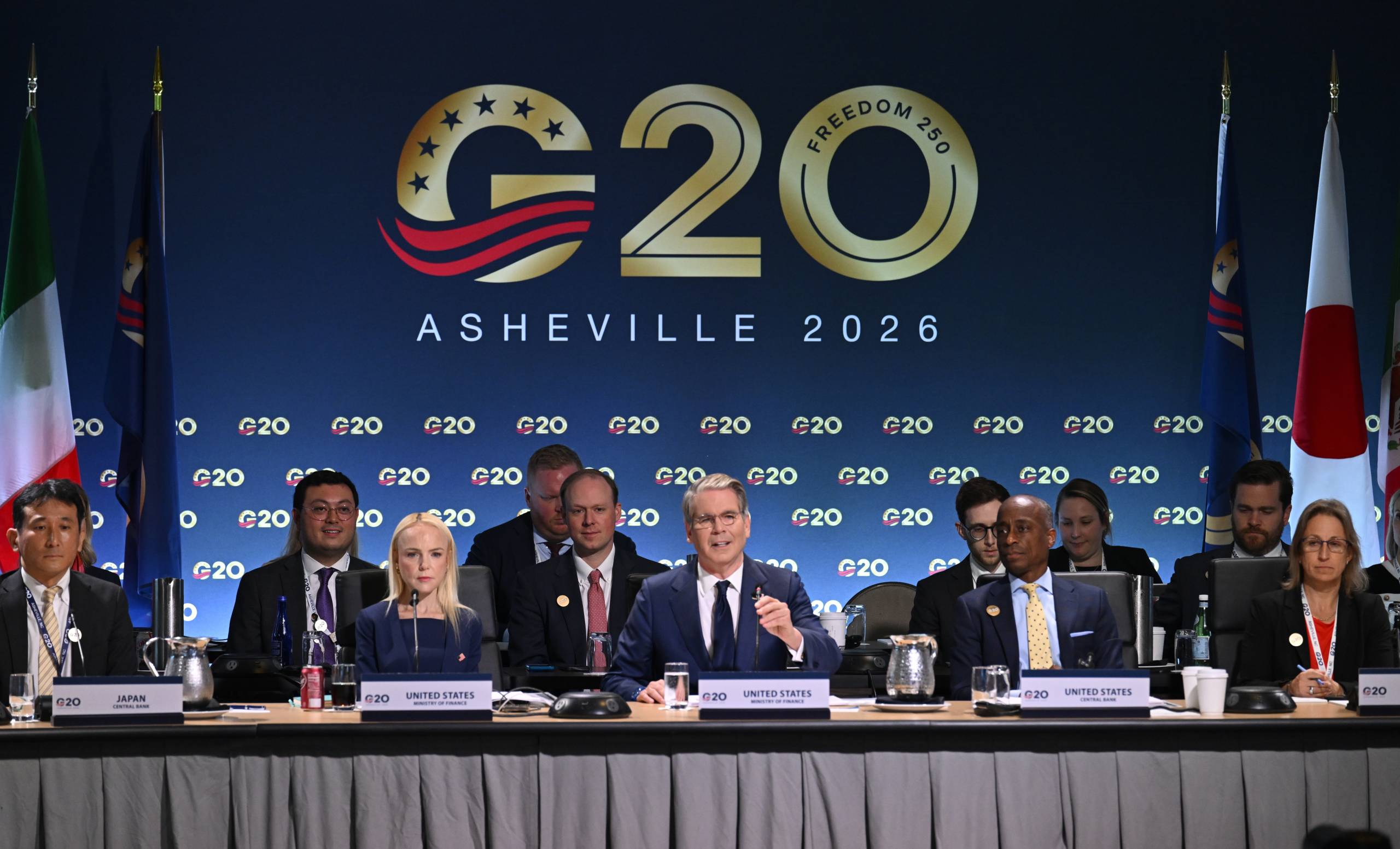
At this week’s G20 summit in Asheville, N.C., global finance leaders met amid a bond sell-off that threatened to raise the cost of long-term borrowing and upend global economic stability. That comes as the US national debt officially topped $40 trillion — a record high that’s double what it was a decade ago, raising serious concerns for some economists. With the nation’s spiraling debt showing no signs of slowing, is it too late to avoid a U.S. fiscal cliff catastrophe? We talk to economic experts about the current and future impacts, and whether there’s a solution.
Guests:
- Scott Horsley, chief economics correspondent, NPR News
- Talmon Joseph Smith, economics reporter, The New York Times
- Maya MacGuineas, president, Committee for a Responsible Federal Budget
Episode Transcript
This is a computer-generated transcript. While our team has reviewed it, there may be errors.
Rachel Myrow: This is Forum. I’m Rachel Myrow in for Mina Kim. Maybe you’ve seen the news headlines about our spiraling national debt and thought, there is not enough coffee in the world to get me to click on that. I can’t promise this Forum segment won’t hurt, but hear me out. It’s not the math that’s hard. It is the politics. Which is why we brought in three eminent brains, all of whom can translate the economics of a $40 trillion debt for us and the politics. Fear not, dear Forum listeners, you are in good hands. We’re here with Scott Horsley, chief economics correspondent at NPR. Scott, always a pleasure.
Scott Horsley: Nice to be with you.
Rachel Myrow: And we’ve also got Talmon Joseph Smith, economics reporter for the business section of the New York Times. Talmon, welcome.
Talmon Joseph Smith: Hey, it’s great to be here. I’m psyched.
Rachel Myrow: Well, let’s get started. Scott, walk me through this like I’m a golden retriever. What is the difference between the debt and the deficit?
Scott Horsley: Well, the deficit is the difference between what the government collects every year in tax revenue and what it spends. Right now, it’s about $2 trillion a year more that we’re spending than we are collecting in tax revenues. And so, in order to close that gap, the government goes out and borrows money. And if you add up all the accumulated borrowing from the last 250 years, that’s the debt.
Uh, it was about $20 trillion as recently as 2017, and it’s now doubled to $40 trillion as of last month.
Rachel Myrow: Okay, Talmon, since 2000, we have cut taxes tilted towards corporations and high earners four times: the two Bush tax cuts, the 2017 Trump tax cuts in his first term, and additional tax cuts in Trump’s second term. I know that this is a bipartisan problem with bipartisan causes, but is it fair to say that it’s more bipartisan towards Bush and Trump, or is that just politics getting in the way of understanding this?
Talmon Joseph Smith: Yeah, no, it’s a good question. No, I think, and Scott is a great example of this, it’s important to both recognize the bipartisan nature of any problem, but also, when there are asymmetries, it’s important to recognize and point out those asymmetries without fear or favor.
And it’s absolutely true that Republican administrations — the Bush administration, George W. Bush — did two massive tax cuts tilted towards corporations and the rich. But there were also middle-class tax cuts in there and tax cuts that helped small businesses. And then Donald Trump in his first term, now in the second term, has also passed multi-, multi-trillion-dollar tax cuts that are tilted towards the rich and corporations.
Now, it’s also true that the Obama administration decided to extend the vast majority of the Bush tax cuts under pressure from its moderate wing and from the very powerful wing of its donor class. And that’s part of what makes it bipartisan.
And also the Democrats under Joe Biden in 2021 had a chance to, if they wanted to, take their slim majority, but majority nonetheless, and roll back not just the Trump tax cuts, but also roll back some aspects of the Bush tax cuts from long ago. They declined to do that for many of the same reasons.
And you can make political judgments, partisan judgments, about whether those were good reasons or not. But that is, as you suggested, a whole other conversation. What’s important is to point out the mathematics of that. And the math is true that if you take away those four massive tax cuts since the turn of the millennium, we’d be in a very, very different fiscal situation.
Now, again, without stepping on the toes of the rest of the conversation, there’s actually a very active debate in the bond market on Wall Street about how bad the fiscal situation is outside of the inflationary aspects that we’re dealing with right now, which may or may not be connected to the size of the deficit itself.
But the core of your question is absolutely true, that our fiscal deterioration in terms of the mathematics comes from those four big sweeps of tax cuts, yes.
Rachel Myrow: Well, given that you brought it up, Talmon, I’m sorry to bring up a rival newsroom, but there’s this fabulous quote in yesterday’s Wall Street Journal about the effects on the markets of Treasury Secretary Scott Bessent’s plan to buy back more long-term bonds. The chief global strategist at JPMorgan Asset Management says, quote, “If the government says it’s going to raise taxes and cut spending to bring the deficit down, that’s one thing. Saying you found another credit card that you haven’t maxed out in your stack of 20 doesn’t actually inspire confidence,” fair?
Talmon Joseph Smith: Um, yeah. I believe that’s, uh — obviously, there are a lot of people high up at JPMorgan who have different titles. It sounds like that might be David Kelly at J.P. — very, very bright guy. Not only a markets guy, but a Ph.D. economist, and it’s no — it’s a good job. And far be it from me to cast too much doubt on anything that David Kelly has to say.
Uh, but he also knows that, you know, the federal government doesn’t have credit cards like we do. The federal government has way, way more tools. The U.S. government also sells bonds in its own currency, it borrows in its own currency. The U.S. government can never actually go bankrupt. None of us have a money printer, and we can go on and on.
But it is also true that whether it’s the Treasury or the Fed, the government does have limits, and for a bunch of very, very good reasons, we have a multigenerational tradition, not just in this country but around the globe, of market interest rates being set not just by central banks, but by investors and by households — you and I, people that have bonds in their IRAs or other investment portfolios — deciding, hey, which rate that is being offered on the market for this bond, for this fixed-income asset, is enough income over time right now, as I see it, so that I’ll be compensated for what I think inflation will be over the near term, over the medium term, and over the long term.
And he’s absolutely right that there’s a lot of hocus-pocus that a Treasury secretary of the United States can do. He is a very, very powerful figure, the Treasury secretary. But ultimately, he’s going to be fighting against market fundamentals. And the Treasury secretary knows that well as a longtime practitioner of markets before he took up his current seat.
My final declaration is that, yes, it is a fair joke, though, like always, they’re—
Scott Horsley: Scott, yeah. And one of the reasons the debt is getting more attention right now is because those market interest rates, those interest rates that investors are demanding in exchange for lending money to the federal government, have been going up.
So we have a sort of double whammy where we owe more money than we used to, a lot more, and we’re having to pay a higher interest rate to keep bankrolling that $40 trillion in debt. And the combination of a very big principal and a rising interest rate means that our cash payouts now to those investors who are financing our deficits, our annual deficits, keep going up.
And in the current fiscal year, we’ve already spent more than a trillion dollars just paying interest on all that old debt. So that’s a trillion dollars we have to raise and spend before we can, you know, pay out the first Social Security check or the first Medicare bill or buy the first F-15, whatever else we want to do as a federal government and as a country. We’ve got to pay that trillion-dollar interest tab first.
Rachel Myrow: Scott, the word “investors” — it’s so gray, it’s so amorphous. Explain for us who the federal government owes all this money to: pension funds, foreign governments, retirees. It strikes me as a group with genuinely nothing in common except we owe them all money.
Scott Horsley: Yeah, that’s right. It’s all of those folks, and that may include many of your listeners. You know, through their own retirement accounts, or if they’ve got a bond fund parked in a brokerage someplace, they may be, in effect, bankrolling the government. And they’re doing so because that’s been traditionally a safe place to park their money and to get a not spectacular but solid and certainly ironclad return.
And those returns have been going up. Now, another reason they’re going up is for a long period of time — for most of the teens, for example — interest rates were super low because, as our colleagues at Planet Money said, there was this giant pool of money looking for a place to park, and one of the popular places to park was in U.S. government Treasuries. And so there was excess savings chasing that debt, and so the interest rates were really low for a really long time.
But that giant pool of money is not so giant anymore. Or at least there’s a whole lot more places to park it. One place to park now is all the money that big tech companies are borrowing to build these data centers. They’re borrowing vast sums of money, and that’s another way that those investors, those savers, can park their money.
So the competition for that giant pool of savings is greater now, and that’s another reason that the interest rates have been rising.
Rachel Myrow: Talmon, there was a global bond sell-off Tuesday. In plain English, what happened?
Talmon Joseph Smith: Right now — I shouldn’t even say right now. I’d say since spring, since the Iran war really kicked off between primarily Israel and the United States and Iran, though of course, as listeners of NPR know, the list of combatants has sort of spread and is sort of vacillating from month to month.
What that did is that spiked oil prices, and the prices of all sorts of ancillary products that have to deal with oil, that are petroleum-connected in some way. That’s inflationary. It also disrupted supply chains. That’s inflation.
It’s also yet another signal of how globalization, which was, as Scott put in — you know, Scott mentioned the teens, the 2010s — globalization was thriving. The 2010s, it was thriving. It was thriving in the ’90s. It was thriving in the 2000s in general. We’ve seen that sort of a regime of globalization not only halt but reverse as we’ve seen either national economic priorities or global hostilities rise up.
And one of the most immediate effects that you can expect from that, according to both, you know, academic economists and global bond portfolio managers, is you can expect interest rates to go up. And so that’s what we’ve seen.
I mean, we mentioned David Kelly at J.P. Morgan. Abby Yoder, who works at a different branch of J.P. Morgan, actually was interviewed this morning, and she mentioned, you know, her take on this, which is that we wouldn’t even be having this conversation, or at least we wouldn’t be having this level of worry about a global bond sell-off — or there might not even be a global bond sell-off — if this war were not going on.
Now, of course, counterfactuals are hard to prove because inherently you can’t deal with them. But I thought that was a good point. And, you know—
Rachel Myrow: Point to step into the break. We are talking about the U.S. national debt officially topping $40 trillion, a record high, double what it was a decade ago, raising some serious concerns for economists. I don’t know about the rest of us, but folks, we want to hear your comments and questions. What are you worried about most, your retirement accounts or your credit card debt or both?