NPR’s Allison Aubrey on Reinventing Life After 50
Airdate: Wednesday, August 19, 2026 at 10 AM
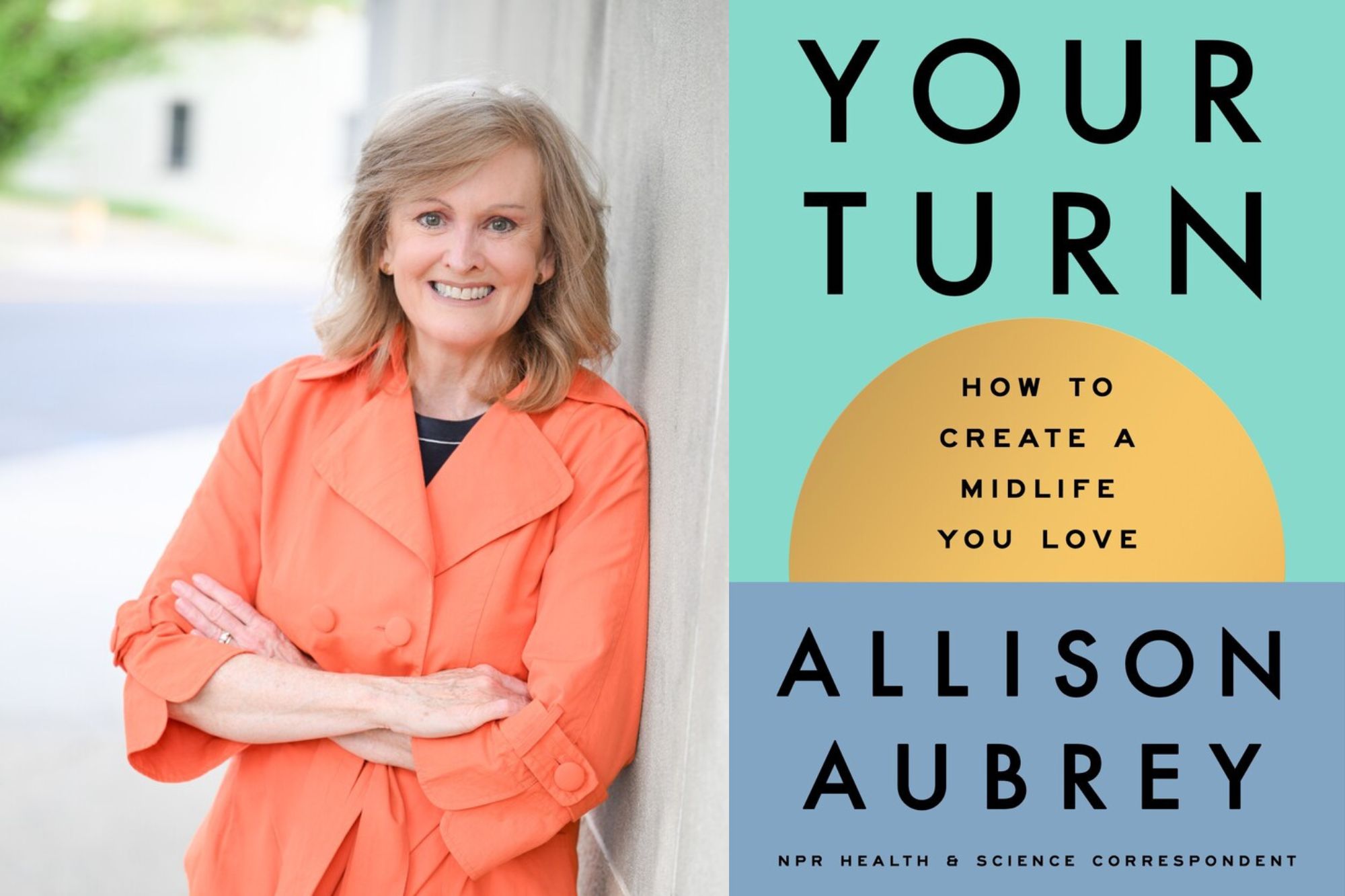
After years of chasing news stories and crashing on deadlines, NPR health and science correspondent Allison Aubrey began to reconsider what she wanted out of her life. Aubrey argues that this is a feeling that many women over 50 face, as they search for meaning beyond career achievement and parenting. In her new book, “Your Turn: How to Create a Midlife You Love,” Aubrey reveals steps for building a happier, healthier midlife. She tells the stories of women who are redefining their lives and joins us to share her own journey toward new meaning.
Guest:
- Allison Aubrey, health and science correspondent, NPR News; creator of the “How to Thrive as You Age” project; author of “Your Turn: How to Create a Midlife You Love”
Episode Transcript
This is a computer-generated transcript. While our team has reviewed it, there may be errors.
Mina Kim: Welcome to Forum. I’m Mina Kim. You’ve likely heard NPR Health and Science correspondent Allison Aubrey’s award-winning stories on consumer health and wellness, aging and food. Now Aubrey is out with a book about finding meaning beyond career achievement and parenting. Aubrey is approaching an empty nest with two sons in their twenties and a daughter in high school. Her book is called Your Turn: How to Create a Midlife You Love. And, listeners, how did midlife hit you? Or, if you’re not there yet, what do you hope this period will be? Allison, welcome to Forum.
Allison Aubrey: Oh, it’s so wonderful to be here. Thanks for having me.
Mina Kim: Great to have you. So your book, it is both a how-to guide, but also a very personal reflection of how destabilizing initially midlife felt for you. And I did wonder what it was like as a journalist to be so open about your personal life.
Allison Aubrey: Yes, well, there is a bit of memoir in here. I have to tell you, in the first process of writing the book, I was writing some early chapters and I would send them off to my editor, and she’d write back, “Too much like an NPR story. Need more of you.”
And so literally, like anything else in life, the more you try it, the more it’s like building a muscle. So, like, bit by bit, by bit, I was saying a little bit more about me. So yeah, there’s a little memoir in here, but mostly it’s a guide for you, the reader.
Mina Kim: Yeah, yeah. I just — so many women I know who go into journalism, they do it because they’re more comfortable telling other people’s stories.
Allison Aubrey: Absolutely. I have been telling other people’s stories for 25 years, so putting myself into the middle of it, it was something completely new.
And I think I kind of stepped into that very early on. About two years ago, I started a series called “How to Thrive as You Age.” And as part of that, I did a story about the Potocsnak Longevity Institute at Northwestern University. And I was pitched the story as an exclusive, and of course, as a journalist, and someone’s giving you the story, and no one else, you kind of think, oh yeah, I want to do that story.
So, you know, I find myself in Chicago at the Potocsnak Institute. I’m rolling my sleeve up in the name of science and the name of a good story. And the whole point of the research at the institute, at least for their first study, is to help discern a person’s biological age, which is your personal rate of aging, like indexed against your peers, compared to your chronological age, which is the number of candles on your birthday cake, like the number of years you’ve actually been alive.
So I thought, like, oh yeah, I’m gung-ho. This is a cool story, cool science. And I kind of unwittingly put myself right into the middle of that, into, like, a daylong series of tests where I learned a whole lot about myself that I wasn’t expecting to learn.
And I think really the book started that day because I was thinking to myself, Allison, you’re not just reporting on aging, you are aging. And if you’re going to do this well, you’re going to have to slow down a bit.
Mina Kim: Yeah, I mean, it’s so true. At this stage, we are going through so many physical changes, and there were also a lot of other signs for you that you did need to take a turn for yourself. For example, you know, you share you had the nickname Smiley, but you didn’t feel so smiley anymore.
Allison Aubrey: That was just an outward expression. And yes, I mean, early in my life and career, I would call myself a joyful sort of upbeat person, but yeah, there was a time when I really felt like I was running to stand still, sort of coming out of the pandemic, where we here on the Science Desk were reporting often until 10, 11 o’clock at night, waking up to do Up First at five o’clock in the morning. And that went on and on and on.
And I think I was burned out without realizing it. And part of those tests at the Potocsnak Institute, I mean, a couple of them. For instance, one, they strapped this device on me to read all the electrical signals of my heart over a kind of period of time. And they picked up some little irregularities. And when they gave me the news, I was super freaked out. And they’re like, no, don’t worry. This isn’t like AFib. This is kind of lifestyle-related. It’s sort of like being over-caffeinated, being always on, right?
And interestingly, by cutting caffeine in half and finding more time for meditation, those irregularities actually went away. So yeah, I mean, why it took the health reporter 25 years to figure out that I was subject to the same things that I’d been reporting on, that stress can really run us down and that burnout can make us feel like we are running to stand still. I certainly felt that moment, and that’s when I decided, you know what, I’m going to write this book. And it entailed taking a sabbatical, sort of leaving the newsroom and going on what I called a curiosity tour.
Mina Kim: Yeah. I was really struck by the line where you say you knew you needed to do something different. You said, “I felt stuck between feeling that it was time for something new and not knowing how to find that something.” Did some of the thrill and excitement of your job wane as well?
Allison Aubrey: You know, I really think that I have gotten to a point where what I do is very well practiced, and there’s an upside to that, right? It’s wonderful to feel competent in life and to have something that you love to do, that you’re paid to do. I love to say that my job has sort of given me three graduate degrees and I’ve been paid to do it. So I’m, you know, super appreciative and thankful for the career that I’ve had up until this point.
I also think that at this age, I really started to feel like most of what I know wasn’t getting on the air. When you learn a whole lot of things and then you’re very well practiced in reducing it and marinating it to its pithiest form, say, a 2:45 soundbite, that’s a service to the listener. So there’s nothing wrong with that. But it also leaves on the table a lot of the things that I know.
And I would say that the transition I’ve made in my own head is that I revere science. It’s what I’ve been doing for the last 25 years. I love the idea you can use the scientific method to ask questions and answer them. But when I looked in the mirror at midlife, I realized a lot of the questions I was asking myself were questions of the heart. They weren’t questions that the scientific process could necessarily answer. And so I needed to take time to explore that.
Mina Kim: Yeah, you do share this really touching moment of crying in your son’s empty bedroom after he left for college. And it wasn’t just about missing him, right?
Allison Aubrey: No, it’s about shifting identities, right? You know, I mean, I think that when our children are going through adolescence, they’re asking three basic questions, which is, you know, who am I, what’s happening to my body with everything shifting at once, and what is my purpose?
And it kind of mirrors those Erik Erikson steps, you know? Erik Erikson said the question is, what is generativity, which was his word for purpose.
What I have realized and come to see through my own children and launching them is that as they have been in this process of finding themselves in these teenage years, you know, we have words for that in our everyday nomenclature. We say that there’s teenage rebellion. We call things hormones, right? And we make room for our teenagers to explore who they are.
When my own daughter kind of started her transition into adolescence, she’s 15 now. You know, she was doing what teenagers do, kind of pushing me away. And while that hurts or stings in the moment, she’s doing exactly the thing that she’s supposed to be doing.
And as she was that, sort of giving me these angsty vibes and sort of putting me over here to the side, I realized something. Oh, my gosh, like, I’m going through the same thing. I was almost like a mirror reflection. I was thinking, I’m asking myself those same questions, right? Like, who am I now if my life isn’t completely defined by mothering and journalism and, like, what’s happening to my body? And what is my purpose now?
And these are hard questions to ask, but I have found that the people who ask them tend to do best in terms of embracing a next chapter, in terms of leaving something behind to start something new. And that is what is required if you want to make a midlife pivot.
Mina Kim: I want to invite listeners into the conversation. Does Allison’s story of entering midlife resonate with you? Have you struggled to know who you are outside of work or family? Did you find new happiness or meaning in midlife? And, of course, what do you want to ask or tell Allison if you’re familiar with her reporting?
You can email [email protected]. Find us on Discord, Bluesky, Facebook or Instagram at KQED Forum, or you can call us at 866-733-6786. That’s 866-733-6786.
So, Allison, you found comfort in the metaphor of the third turn. Can you explain it to us?
Allison Aubrey: Sure. Well, I grew up in Kentucky, in Louisville. And when I was a kid, I went to Churchill Downs, which is the home of the Kentucky Derby. And when I was about 13 years old, I watched the race. And a horse that was in the back of the pack for much of the first half of the race suddenly found this surge of energy that no one was expecting. And the jockey and the horse, you know, sort of together, magically pushed through at the third turn to the front of the pack.
And later, my grandfather said to me, “Oh, Allison, you always watch the third turn because this is always where something unexpected happens.” And I said, “Well, why here?” And he said, “Ah, well, when you can see the home stretch, when you can see the finish line, a sense of urgency arises.”
Now, when I was 13, that did not settle in as a midlife metaphor, but I did remember it. And much decades later, it did strike me as this perfect metaphor because if you think about it, there are going to be 3.7 million centenarians walking this globe as of 2050, which means obviously not all of us are going to make it to 100, but at a time when it is possible to make it to 100 or beyond, 50 is the start of midlife.
So I call this quarter, kind of 50 to 75, the third turn or the third quarter, if you will. Hopefully we all have decades ahead. But there is an urgency, right? It’s a, if not now, when kind of feeling. You know, you gotta — if you want a next chapter, the time to start thinking about it is now.
Mina Kim: Yeah, well, it really made you realize that this stage could be more and could probably come with incredible rewards, too.
Allison Aubrey: Absolutely. I think that, you know, the narrative that we’re handed societally is that we are, you know, particularly for women, in this kind of slow fade. You know, like, we’ve had the accolades, we’ve had the kids, and society does not expect much of us.
I’m a Gen X woman, and I kind of feel like the script that we were handed is something like, you know, life in three chapters: learn, earn, retire. And the word retire drives me crazy.
I don’t dislike the concept. I think a lot of people are eager to get to the point of life where they don’t have to show up to a job every day. And that’s wonderful. But the term retirement, I mean, just listen: retirement, the word tired is right there in the middle of it.
I know people 10, 20, 30 years older than me who are not tired. My own mother is 82, very vibrant. I do not look forward to just being tired.
And so I was really thinking, like, how do we reframe? Like, what is the better third chapter, if you will? And what I came to after dozens and dozens and dozens of interviews was, like, this concept of learn, earn, return. You know, return to, like, the kid within and turn to something new.
Mina Kim: We’ll have more with Allison Aubrey about hitting midlife after the break. Stay with us.