Is California Ready for `The Big One?’
Airdate: Tuesday, August 18, 2026 at 10 AM
The San Andreas Fault is under more pressure now than it has been in the last 1,000 years. That’s according to new research from seismologists who study earthquakes along the Pacific Rim. With recent earthquakes in Japan, Colombia and Venezuela making headlines, we look at the latest science, how prepared California is for “the Big One” and why we still can’t predict earthquakes.
Guests:
- Katherine Sharer, geologist, U.S. Geological Survey
- Wendy Bohon, seismic hazards and earthquake engineering branch chief, California Geological Survey
- Brian Strong, chief resilience officer, San Francisco Office of Resilience and Capital Planning
Episode Transcript
This is a computer-generated transcript. While our team has reviewed it, there may be errors.
Mina Kim: Welcome to Forum, I’m Mina Kim. Earthquake preparedness may have taken a backseat to wildfires and other major issues California faces, but seismologists say it wouldn’t be a bad idea to make it top of mind again. That’s because sections of the San Andreas Fault are at their highest level of strain in the last thousand years. And there’s only one way to meaningfully release that pressure: a big earthquake.
So where might the big one hit, and what kind of damage could it create? Joining me first is Kate Sharer, geologist with the U.S. Geological Survey and co-author of the recent article in the Journal of Geophysical Research about stress accumulation along the San Andreas Fault. Kate, welcome to Forum.
Kate Sharer: Hi, thanks so much for having me.
Mina Kim: So many Californians have been hearing about the San Andreas Fault all our lives, but can you remind us how far it stretches, what makes it unique?
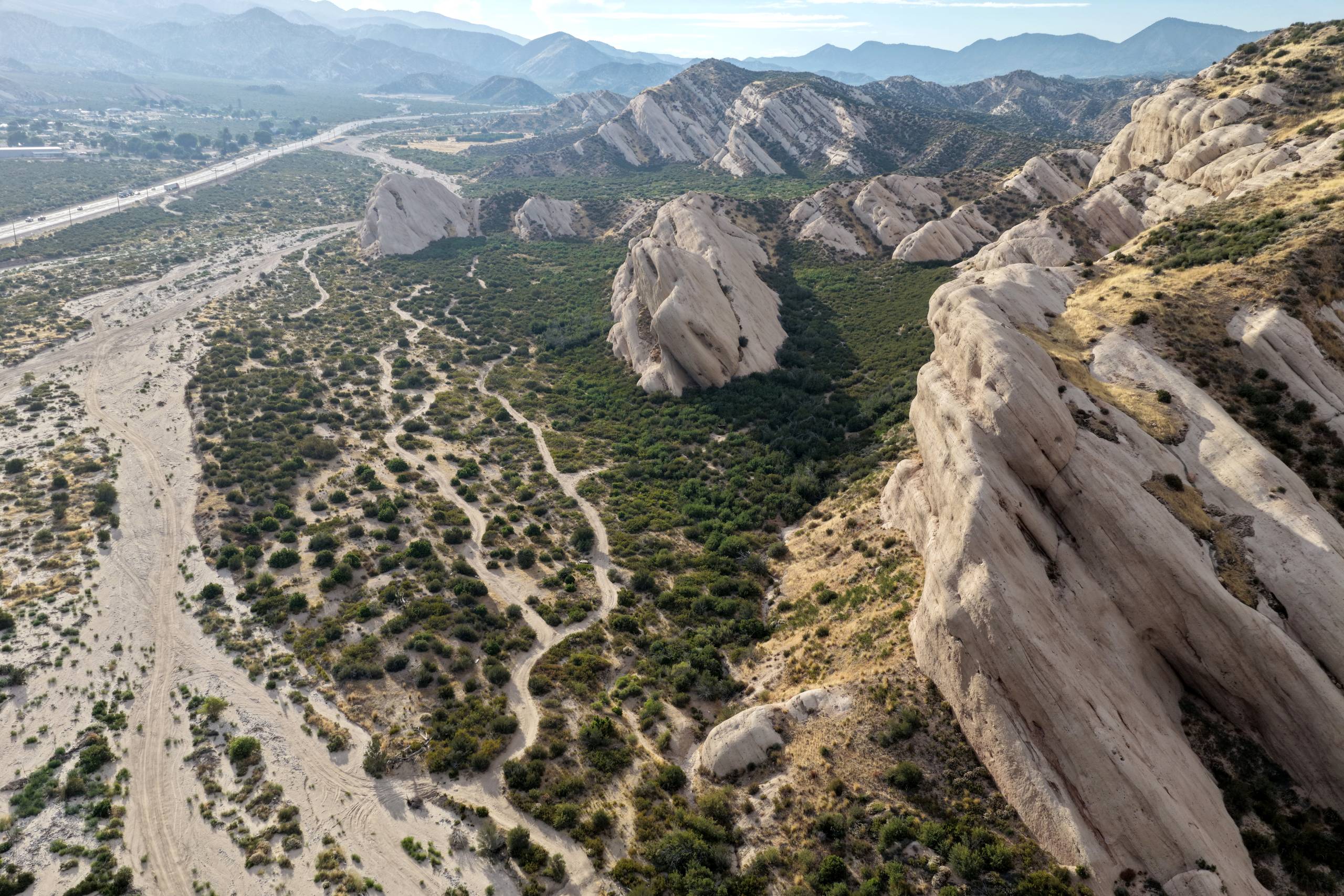
Kate Sharer: Absolutely. It’s quite long. It extends all the way from Northern California down through the Bay Area, all through the more quiet sections that we don’t tend to frequent in Central California, and then goes along the backside of the mountains here in Southern California and finally cuts through into the Salton Sea. So it’s quite long.
Mina Kim: And it acts as the primary boundary, right, between the Pacific and North American plates?
Kate Sharer: Absolutely. Most of the slip rate between those two plates slowly and inexorably sort of accumulates along the San Andreas. You know, in the Bay Area, you guys all know your 1906 earthquake, and we have one down here in Southern California. Our equivalent would be the one that occurred in 1857 as the largest earthquake that we had in historic times on the San Andreas.
Mina Kim: So then what kind of magnitude quake is the San Andreas capable of?
Kate Sharer: It would be quite reasonable to see something between 6 and then certainly approaching 8. We know from looking at the length of the earthquake in 1906 and also in 1857 that those earthquakes were around 7.9 or 8. We didn’t have seismometers then, so we have to do it by looking at about how long the rupture was and calculating estimated magnitude. So it’s done a little differently, but those two give us evidence that we can expect very large earthquakes on the system.
Mina Kim: And even though the San Andreas is infamous, you’re saying that really the last significant rupture along that main fault is 1906 in San Francisco and 1857 in Los Angeles. So the ones we’ve had in between, right? Like the Napa quake and the Northridge quake and even Loma Prieta was not along that main fault.
Kate Sharer: That’s right. Loma Prieta is a little bit of a question mark, but really most of the stress that was released in those earthquakes — Napa, where we had Ridgecrest and other ones, Northridge down here in Southern California — those are on the distributed network of faults that surround the San Andreas. So although the San Andreas takes up the lion’s share of the tectonic motion between the plates, we have all these other faults that also can contribute to the hazard underneath our feet.
Mina Kim: Right. So in the absence of major quake activity along the main fault, what has it been doing all this time?
Kate Sharer: It’s been accumulating energy. So we often talk about — you hear the analogy that the plates move about as fast as your nails grow. So very slowly, you know, the plates are just moving past each other. But when you get close to these faults, they are locked for the most part. And so you can think of it like a coiled spring or like a stick that you’re trying to break. You keep putting energy into that, eventually that stick will snap. And so the analogy for an earthquake is the fault snaps and releases all of the, you know, decades to centuries of strain that have accumulated along that fault, and it has to be released in large earthquakes like you said in the opener.
Mina Kim: Yeah.
Kate Sharer: And really, the small ones don’t do it.
Mina Kim: Correct. They don’t really do anything for us to dig, except for, you know, very important, which is to remind us to be prepared and that we do live in an active tectonic environment.
Mina Kim: So essentially you’re saying it’s not a question of if the fault will release this pressure.
Kate Sharer: It’s when. Yeah, I think we can expect in Southern California and Northern California that we’ve had earthquakes in the past. We’ll certainly experience them in the future. I know many people want to know when it’s going to occur. And I like to emphasize that, although that’s useful, there’s many things, and I think we’ll get into this a little bit more in the second half. But from a preparedness standpoint and engineering, we need to know now kind of about the average time between earthquakes, not necessarily if they’re gonna happen on a Tuesday, so that we can design buildings and bridges and hospitals to be prepared for those whenever they do occur.
Mina Kim: Yeah. Well, I want to invite listeners into the conversation. What questions do you have about the San Andreas Fault, the stress it’s under, and the risks that it poses? And listeners, what earthquakes have you experienced and how are you preparing, or what questions do you have about how to prepare? You can tell us by emailing forum at kqed.org, finding us on Discord, Blue Sky, Facebook or Instagram. We’re at KQED Forum. And you can call us at 866-733-6786. 866-733-6786.
So where are the biggest areas of pressure? What region of the fault did you home in on, Kate?
Kate Sharer: The study, and it’s received a lot of attention, I think the title and the idea that the stress is at this highest level that we’ve seen in a thousand years is very striking to people.
Mina Kim: Yes.
Kate Sharer: So for folks that have kind of been hearing this over the last couple of months, I would emphasize that the paper has to calculate that. We don’t have any technique or ability to actually measure directly how much stress is accumulating along a fault network. So we know about how fast the energy is accumulating, and we can sort of estimate how it’s been released in past earthquakes. And that’s how we come up with an estimate of how much is still around today.
You know, another idea that I like to put in folks’ heads is that earthquakes happen really quite deep, and this is why we can’t measure the stress along the fault directly. So when you’re flying in an airplane and the pilot says, all right, we’ve reached 30,000 feet, you can, you know, undo your seatbelt, that’s about the same height above the ground as earthquakes, actually. Big earthquakes are generated below the ground. So we’re talking about events and big amounts of energy and complex systems that are quite deep. And we don’t have any techniques that would facilitate us really penetrating that deep with, say, drilling. There’s some that reached halfway there, but not all the way. So that’s a little background on the paper.
Mina Kim: Yeah, I appreciate that. Yeah, but tell me, you focused on something called the Cajon Pass.
Kate Sharer: Sure. That’s an interesting area in Southern California and has received a lot of attention because it’s an infrastructure corridor. It’s also where the San Andreas and the San Jacinto Fault cut through all of that infrastructure. So the San Jacinto Fault is sort of the sister fault to the San Andreas. Down here in the Bay Area, you have the Hayward Fault. It takes up also a reasonable portion of the tectonic stress.
And so there’s been quite an emphasis on Cajon Pass because it’s where I-10 is, I-15, all of the gas and electric lines come through there, or many of them. So it’s really a lifeline corridor. And so understanding the history of earthquakes through there is important.
And in the study, we looked at how stress has been accumulated and released over the last thousand years by looking at the geologic record. And we find that it is a little bit higher than it has been over the past, according to the dates that we have for those prehistoric earthquakes.
Mina Kim: And so basically it’s in a position now where, I guess, that the current stress level is similar to what preceded previous —
Kate Sharer: Major ruptures? That’s right. It’s been about the same amount of time, but sort of the average time between earthquakes in that area were a little bit longer than the average. And that’s consistent with, you know, long-term estimates for hazard in Southern California that put the odds of large earthquakes quite high for us because of the time period between the elapsed time since previous large earthquakes.
Mina Kim: Kate, can you help us wrap our mind around if that area does rupture with a 7.8 or so magnitude earthquake? Since we really have not known one, as I understand now from preparing for the show, in the modern era — one of that magnitude not since 1906. So, you know, if it was to strike the Southern San Andreas around the area that you looked at, what would happen?
Kate Sharer: Sure. The way I like to present that is that people that have been around California for a while have experienced sort of mid-magnitude 6 earthquakes, so Loma Prieta and Northridge. If they lived in the Mojave Desert, they’ve experienced some sevens. Those tend to — and Northridge and Loma Prieta are good examples of earthquakes that are very impactful to sort of part of your region.
So here in Southern California, you know, the San Fernando Valley was certainly impacted quite strongly by the Northridge earthquake. The difference between that and a large earthquake that, when you’re getting up to magnitudes of 7.5 and larger, is that you’re starting to expand the damage over a much broader area. So the shaking happens to more buildings, the fault ruptures more lifelines and roads as the earthquake traverses the system. And so the impacts just sort of expand outward. They may be slightly stronger felt in some places, but overall you just start to increase the number of people and towns that are impacted directly by the earthquake.
Mina Kim: Yeah, I read that the violent shaking could be felt not just in Riverside and San Bernardino, but in Orange, you know, Los Angeles, and maybe even Ventura.
Kate Sharer: Yes, that’s right. In some of the ground motion models, we expect that you would have significant shaking pretty far out as the waves traverse through the basins of Southern California.
Mina Kim: Well, Trish in Redwood City asks, given all of our technology, is there any way that the pressure on the faults can be alleviated in the same way that avalanches are averted? Like, is there anything we can do besides a giant earthquake?
Kate Sharer: It’s a great question, but there is not. It’s so much energy that we don’t really know where we would exactly start the event. And we also don’t know exactly what would happen. So I think it’s the kind of thing that’s only in sci-fi movies, basically.
Mina Kim: We’re talking with Kate Sharer, geologist with the U.S. Geological Survey, about the historic level of pressure building up along the San Andreas Fault and what that means. And you, our listeners, are joining the conversation, and we’ll have more with you and with Kate and more guests after the break. Stay with us. This is Forum.