Artificial Stone Containing Silica is Killing Workers. Will California Ban It?
Airdate, Monday, August 17, 2026 at 10 AM
More than 600 California stoneworkers have contracted silicosis, a deadly and incurable lung disease resulting from exposure to the silica in engineered stone. The material, a go-to choice for home countertops, has been found to be toxic to the workers who cut, grind and polish it. Now, doctors, stoneworkers and activists are pressuring California lawmakers to ban the material and embrace available alternatives. At the same time, stone manufacturers and lawmakers are pushing federal legislation to protect manufacturers from worker lawsuits. Join us as we unpack the danger of artificial stone containing silica and the state of efforts to protect workers.
Guests:
- Farida Jhabvala Romero, labor correspondent, KQED
- Dr. Sheiphali Gandhi, pulmonologist and assistant professor, UC San Francisco; director, the Center for Silicosis Support and Research Network
Episode Transcript
This is a computer-generated transcript. While our team has reviewed it, there may be errors.
Mina Kim: Welcome to Forum, I’m Mina Kim. A new study finds that California workers who fabricate a popular engineered stone countertop, or quartz, are falling ill with an incurable and sometimes deadly disease. Some 600 people have developed silicosis since 2019, according to data from the State Department of Public Health, caused by inhaling silica particles. Dozens have died. At least 65 have required lung transplants. California is moving toward restricting engineered stone, but manufacturers are pushing back.
We learn more this hour with KQED’s Farida Jhabvala Romero, labor correspondent here. Welcome, Farida.
Farida Jhabvala Romero: Hi, Mina.
Mina Kim: Dr. Sheiphali Gandhi is also with us, a pulmonologist and occupational medicine physician and director for the Center for Silicosis Support and Research Network at UCSF. Welcome to Forum, Dr. Gandhi.
Dr. Sheiphali Gandhi: Thank you for inviting me.
Mina Kim: So, Farida, you first encountered someone with silicosis a few years ago. What were they going through?
Farida Jhabvala Romero: Yeah. They were in their late 20s. And I think how young this worker was at the time — I think it was in 2023, when California was considering tightening rules for how engineered stone, or artificial stone, which is this material linked to the increase in silicosis — they were considering tightening these rules.
And so this young man came into the meeting via Zoom. And I could see that he was connected to an oxygen machine, you know, with, like, the clear tubes tied to his nostrils, clipped to his nostrils. And I just couldn’t believe that he was so young and he was having to depend on an oxygen machine to breathe.
And I think he said he was on the waitlist to receive a lung transplant, which meant that his silicosis was really advanced. And he’d worked a number of years in this industry. But obviously, I mean, the fact that he was so young and already having to deal with it, and it seemed like most of the burden for his disease was falling on his family.
He used to be the main breadwinner, and now everybody had to deal with this. So it’s —
Mina Kim: The age is not necessarily a major outlier, right? Young men predominantly are getting this disease. I read that the median age of diagnosis is 46.
Farida Jhabvala Romero: Yeah. I mean, California, first of all, is the only state, as I understand it, actively tracking this disease. And what we know from this data that doctors at the California Department of Public Health have gathered and spent time confirming these cases, tracking these cases.
And then also, the numbers that you, the figures that you just mentioned right now — I mean, the fact that we have this website showing us all the new cases that they’re finding, where they are in the state, the age of the people getting sick, how many people have undergone lung transplants or are waiting for this surgery.
What we know is that many of these workers are in their 30s, in their 40s, in their 50s. Many of them have told me that they used to work with natural stones for decades. You know, the older workers, and they didn’t have this problem until they began working with artificial stone.
And all of them, you know, have told me, the people that I’ve spoken with, have said that they didn’t know about the hazards of working with engineered stone until they or someone — you know, a coworker, a friend — got sick.
Mina Kim: I was also really struck by the statistic that 98% of the cases are among Latino men.
Farida Jhabvala Romero: In California, that’s right.
Mina Kim: Yes, in California. And as you say, the fact that we even have this data is because California is uniquely taking this opportunity to really learn more about it.
Farida Jhabvala Romero: Yeah, we’ve heard from doctors in other states, in Illinois, in Florida, Massachusetts, Colorado, that have reported cases, but those states don’t have, you know, a concerted effort like California does to track this disease in the industry.
Mina Kim: So, Dr. Gandhi, what exactly is silicosis? Why is it so debilitating and even deadly?
Dr. Sheiphali Gandhi: So silicosis is a completely preventable lung disease. It essentially is caused by breathing in fractured or respirable crystalline silica that comes from mostly, like, minerals and rocks in the ground, so quartz. And when it is ground into a fine powder, it becomes the perfect size to enter into lungs and retain.
And the air sacs of the lungs are alveoli, where we exchange gas. And over time, the silica causes inflammation, it seems like, and also that inflammation, and also direct scars to the lungs. And when the lungs scar, it is very difficult to reverse from any cause.
But in other lung diseases, we decrease the progression, so stabilize it, but at this point, we don’t really have great medications to reverse scars in the lungs, and there’s no proven therapy for silicosis at this time. So that’s why it’s considered incurable.
Mina Kim: And that’s why it progresses even after someone, let’s say, if they just completely stop their exposure to silica dust, that the inflammation, the scarring and so on progresses.
Dr. Sheiphali Gandhi: That’s right. Yeah, you know, there is retained silica in the lung. So it remains there because it’s so small and the body thinks it’s an invader or some kind of, like, foreign body, is what we call it. And so the body almost walls it off inside the lung with, like, your immune system.
So it is stuck there. And so there is data from Spain, but also, like, historical data from mining and other occupations, where they show even when people stop working, that they keep getting worse.
Mina Kim: What about if they’ve received a lung transplant?
Dr. Sheiphali Gandhi: So a lung transplant is not really a cure because a lung transplant, in many outcome data, like when we look at studies of what is a bad outcome from a lung disease, lung transplant is almost the same level as someone dying from that disease because people generally receive a lung transplant when there is a thought that they would not live six more months without it.
So you have to be very ill to receive a lung transplant. And so if you think about it, we’ve had one in six people in California already to that, like, worst outcome almost.
A lung transplant replaces your lungs with someone else’s, but we often counsel patients that it’s like replacing one chronic disease with another, because with a lung transplant, many times it just is not as safe of a transplant as many of the others, like kidney, or heart, or liver, where people can live many years.
On average, the lifespan is like five to eight years after. So if you’re in your 20s or 30s receiving a lung transplant, your life expectancy is still very short. And so it’s not like a treatment. It’s just the last effort to provide some length of quality life for people.
Mina Kim: And what is the quality of life if you have silicosis? What are the types of things you are probably experiencing day to day?
Dr. Sheiphali Gandhi: You know, in the beginning, many people don’t have very many symptoms. And really, we push them to say, oh, like, you know, I ask them. And they’ll be like, oh, I’m fine. I can still work.
But then you ask them, like, are you able to play games with your kids? They’re like, no, I’m too tired when I come home.
Many times, it starts out with, like, a mild dry cough, a little bit of shortness of breath, some tiredness. But over time, this insidiously progresses. So they get worse and worse, almost in a way that is imperceptible until it is just completely affecting all aspects of their life.
So they’re very short of breath. Many of them have very severe chest pain that is difficult to treat. They are exhausted all the time. Many lose weight, significant amounts of weight, or have poor appetite.
Often we see people develop rare infections that you only see in people with severe lung diseases. They can develop heart issues because of the stress on the heart from the lungs. And then you start to see where they need oxygen, more hospitalizations. And when you’re at that point, we see that they tend to get much worse fast after that point.
Mina Kim: Farida, you have a clip from a stoneworker diagnosed with silicosis. What can you tell us about him?
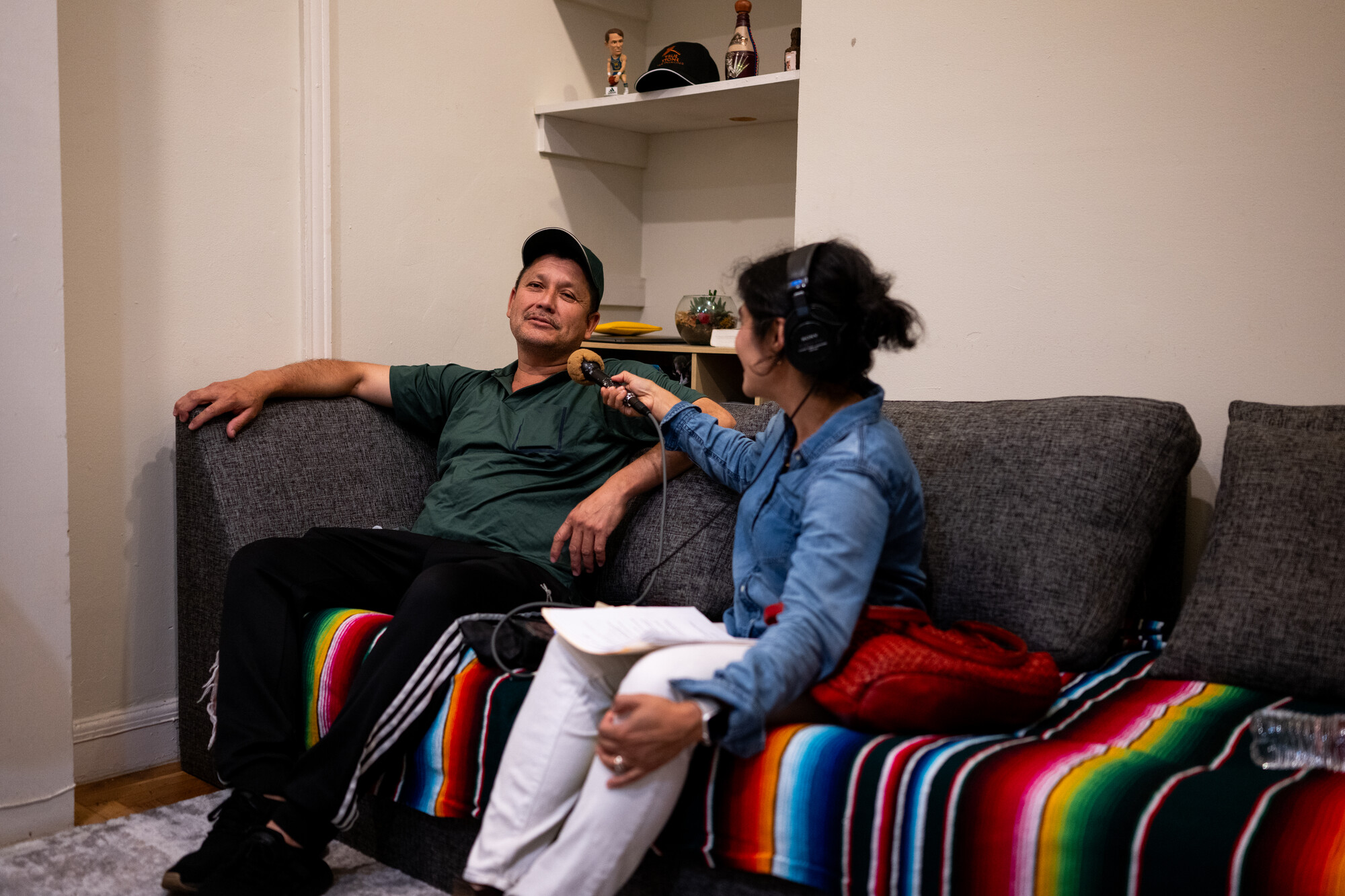
Farida Jhabvala Romero: His name is Lopez. Yeah. So Lopez lives in the East Bay. And we’re not using his full name because he’s undocumented and his wife as well.
So he also needs an oxygen machine to breathe 24/7. And I think when you speak with these workers and their families, I mean, it’s just this enormous stress of not being able to work anymore. They’re completely disabled, you know? They can’t even, like Dr. Gandhi said, play with their children or do things that used to be really easy before, like walking to the store or carrying grocery bags or going upstairs.
And then Lopez is also on a waitlist for a lung transplant. And I think not just him, but other folks I’ve spoken with, they talk about the mental toll, going from feeling like they were the main breadwinners for their family and now they feel like a burden, and they’re terrified about what’s going to happen to them.
Mina Kim: Let’s hear the clip and have you translate.
Lopez: Right now, I feel desperate. It’s a desperation to be just sitting around, without being able to do anything. It’s anguish to be here just waiting for the time for them to talk to me about the hospital, to receive the transplant that I’m waiting for, so that I can go out and work.
Farida Jhabvala Romero: Yeah, so he’s just talking about how he feels desperate, and how difficult it is to be just sitting at home waiting for the hospital to call to tell him when he can get a lung transplant.
Mina Kim: So you noted that he’s undocumented. Are a lot of stoneworkers undocumented, and does that make it harder for them to get the health care they need or ask employers for the support that they need?
Farida Jhabvala Romero: Um, you know, we know many, many of them are immigrant workers, immigrant Latino workers. A lot of people I’ve spoken with are undocumented, but we don’t have a clear picture if the majority are undocumented.
But this is part of the construction industry. There are so many Latino immigrants in California that work in that industry. And I think, you know, something to note about California is because we have a safety net for undocumented workers as well, although it’s been, you know, impacted in the last couple years because of budget cuts in the state.
That’s one of the reasons that doctors like Dr. Gandhi say that we’ve been able to, you know, track these cases as well. In other states, through our public health system, and that these workers have been able to receive life-saving treatment.
Mina Kim: We’re talking with Farida Jhabvala Romero, labor correspondent for KQED, who’s been covering the increase in the cases of silicosis caused by cutting engineered stone. Also, Dr. Sheiphali Gandhi is with us, an assistant professor at UCSF, who is a pulmonologist and occupational medicine physician.
We’ll have more with them and you after the break. This is Forum.