Former Google Employee Recounts Path From Enchantment to Disillusionment in ‘Don’t Be Evil’
Airdate: Monday, August 3, 2026 at 9 AM
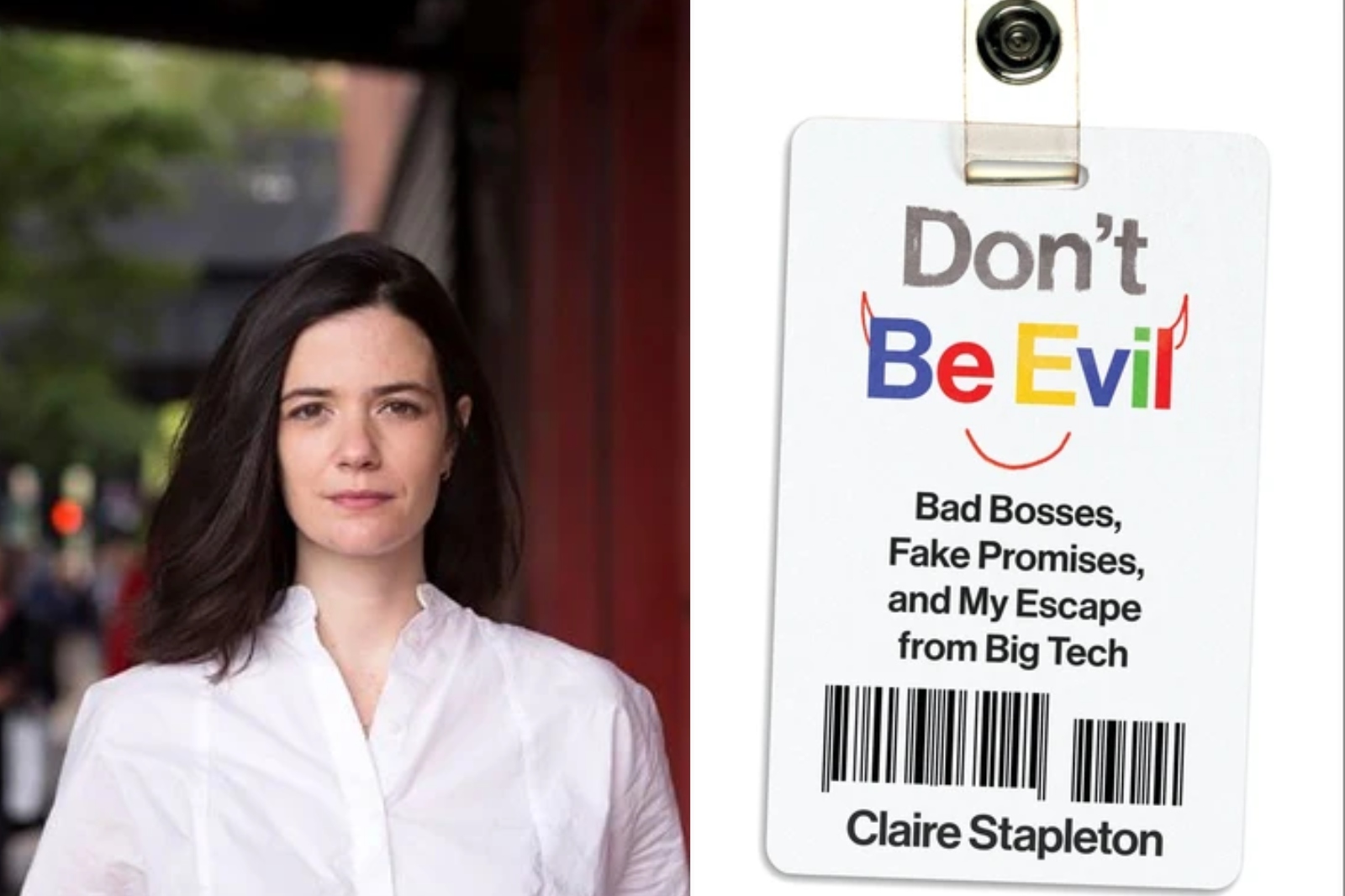
When Claire Stapleton started working at Google in 2007 she was a true believer, becoming known as the “Bard of Google,” by spinning positive narratives of the company. But by 2018, she was so disillusioned by the company culture that she helped organize the company’s largest walkout to protest how Google handled sexual harassment cases. We talk to Stapleton about her takes on the myths and the reality of Google and her new book “Don’t Be Evil: Bad Bosses, Fake Promises, and my Escape from Big Tech.”
Guest:
- Claire Stapleton, “Don’t Be Evil: How Big Tech Betrayed Its Founding Principles — And All of Us”
Episode Transcript
This is a computer-generated transcript. While our team has reviewed it, there may be errors.
Rachael Myrow: This is Forum. I’m Rachael Myrow, in for Alexis Madrigal.
When Claire Stapleton was issued a Google propeller cap in 2007, the company’s unofficial motto was still, “Don’t be evil.” She wrote the speeches, blog posts, and weekly all-hands emails that helped prop up the mythology, even as the gap widened between that motto and how an advertising business actually makes its money.
But over time, the scales fell from Claire’s eyes. And in 2018, she helped organize 20,000 coworkers to walk off the job. Her memoir about how all that happened is called Don’t Be Evil: Bad Bosses, Fake Promises, and My Escape from Big Tech.
Claire Stapleton, welcome. Thank you for joining us here on Forum.
Claire Stapleton: Thank you so much. As a Bay Area native, this is huge. I love KQED.
Rachael Myrow: Where’d you grow up in the Bay Area?
Claire Stapleton: Oakland.
Rachael Myrow: Oakland. All right. East Bay represent.
For the young ones out there in our listening audience, it’s hard to imagine Google was once a startup in a garage. It took a long time for it to grow into the world-dominating behemoth it’s become.
You’re a professional storyteller, Claire. Give us the short version. Bring them up to speed.
Claire Stapleton: I think what’s most shocking for the Gen Z audience is that Google, for a brief time, seemed to be able to reinvent the corporation as something really cool and fresh and innovative, and all the young people got to go work there.
They created these campuses around the world, but really Mountain View, California, was where it all began, kind of growing out of the Palo Alto garage. They had amazing food, and you could bike around. The idea was to collect all these smart, idealistic young people together, work on the world’s biggest problems, and create this sort of techno-utopia, starting with a new kind of work environment.
Rachael Myrow: Now bring us up to the aughts. You weren’t just taking a job at a Silicon Valley phenomenon. You were going to make the world a better place.
Claire Stapleton: Seems a little cringe to imagine believing that now, I guess.
But yeah, I was an English major in college, so I had no coding background. I was not an engineer. They did a big push of college recruiting in 2007. Just a bit of context: that was one year before the financial meltdown. They would never do college recruiting on that scale again, even though Google’s added so many people to its ranks.
It was this big year of young talent, and I was drawn in by the lore and the idea of, “Here’s the spaceship. Can you get a seat on the spaceship? Can you climb aboard?”
The job in the communications department was pitched as helping Google tell its story. And of course, the story seemed altruistic and exciting: here we are together, the biggest team project ever, to change the world.
Rachael Myrow: So describe one of the emails that led colleagues to dub you the bard of Google.
Claire Stapleton: Yeah, it was a very basic logistical email.
One of my first tasks and projects was working on TGIF, which was a weekly staff meeting hosted by Larry and Sergey. It was very grassroots, down-home. Imagine Larry and Sergey, the founders of Google, were already billionaires multiple times over by that point, but they were sort of folksy, approachable young guys in their 30s.
Every single week, they would go to Mountain View, stand in the big auditorium in front of employees, and talk a little bit about what happened during the week. They’d read a script our team worked on, and then they’d answer questions from employees.
One of my tasks was to send around an email sharing the logistics of the meeting and how to tune in. Google was expanding a lot, so we kept moving the broadcast around to different buildings in Mountain View and to Seattle, Kirkland, Boulder, Austin — all the new offices as they were cropping up.
It was a rote logistical email that I volunteered to send because I was the only person who wanted to do it. I was also giving campus tours, so I was really ingesting the company’s talking points, which were a mix of progressive workplace philosophy and exciting technological vision.
So I sort of riffed on it. Google was a very tight-knit, quirky culture. People made internal memes, and there was lots of chatter on email groups and that sort of thing. It was easy to become a character in the culture and lore of Google.
The emails were slightly intellectual, very much in the spirit of Google, and very weird. Not all of them hold up when I look back on them. They’re full of inside jokes and references. But something about them captured the zeitgeist of the time, and I became a bit of a company mascot.
Rachael Myrow: You worked closely with Larry Page, a man who talked about solving death as if it were something that could be solved and enthusiastically spent a lot of Google money financing scientific moonshots.
Looking back now, with the benefit of age and time, was all that techno-optimism real, or just a calculated snow job?
Claire Stapleton: I think it was an amazing time capsule.
When I was writing the book, I was fascinated to look back at this period when Larry Page — who was the founder of Google — had taken the reins back as CEO in 2011 after Eric Schmidt had served in that role for many years.
This was right as Google was becoming Alphabet, a huge, complicated holding company with many portfolio companies.
Larry was obsessed with workplace philosophy. Google should feel like a family. Everybody needed to feel like they were working on meaningful problems, solving humanity’s biggest problems.
I think it was sincere. I think he really believed Google was this unprecedented historical company with tremendous resources and all these great people who had poured everything into it.
When he said things like curing cancer was too small a goal and that we should be thinking about curing death altogether and dramatically extending the human lifespan, I think that reflected a strain of techno-bro thinking that everything can be treated as a computing problem. That conveniently erased a lot of inherent challenges in the world, as well as human complexities.
But I think he truly believed Google could make the world a better place if it simply kept pouring in people, resources, and data.
Sadly, looking back, this was also the moment Google started to become really corporate and really bloated. Internal politics and executive culture began shifting it away from the long-term, freewheeling startup spirit it had once had.
I think Larry tried to combat that by creating Google X, this moonshot factory full of ambitious technological projects. And yet the company came out of that period pretty unrecognizable. When we look back now, its defining technological innovation has really been online advertising.
Rachael Myrow: Yes, which we’re going to get to in a moment. But I still want to talk about what you describe in the book as you started bouncing from one department to another.
You transferred to the Creative Lab, which, for those less familiar with Google — or Alphabet — was an internal interdisciplinary team of designers, writers, programmers, filmmakers, and strategists. Kind of like a startup inside the company.
On the face of it, that sounds exciting. But there you found a boys’ club. What was that like for you?
Claire Stapleton: Oh, it was an incredibly painful chapter of my career because here I had been in Mountain View — again, a company mascot, writing the company mythology sort of on my own — and I’d gotten shoulder-tapped to move to this really exciting center of it all, the Creative Lab in New York.
On the face of it, it felt like a perfect fit. Here they are doing the Super Bowl ads, branding new products. It felt like, “Okay, this is the kind of thing I’ve been doing, but now it’ll be for the outside world and on a bigger scale.”
It was, I think, a very classic Mad Men-esque creative agency culture, which was nothing like the Google I’d experienced.
I moved to New York and started in this department, rosy-cheeked, ready to put pencil to paper, despite having no formal copywriting background. It was a complete nightmare from start to finish.
I had a boss who, to this day, I wonder why he hired me. I was never trained, never really managed, and was just fishing around for projects. A coworker told me, “Oh yeah, the boss really likes working with the kind of guy he can get a beer with after work. He’s a real guy’s guy.”
And I’m thinking, “What? I thought I was in the progressive workplace of the future, and here I am dealing with sexism 101.”
Meanwhile, when I was on projects or working on initiatives in this group, the job was still all about manufacturing and crafting the magic of Google and the utopia. They put everything on steroids. It was, “We’re even more of a cyber-utopia. We’re going to change the world,” all this sort of rhetoric.
The cognitive dissonance was so intense — from my day-to-day workplace, where you got 10 minutes with the boss, to having to manufacture the corporate BS. It was really intolerable.
At the same time, it helped me understand what it feels like to be excluded. What is it like to be in an environment where there’s not equal opportunity? And how does that square with the story Google is telling about itself?
Rachael Myrow: You also spent time manufacturing enthusiasm for YouTube.
Super quickly, ahead of the next break, talk about how you came to see the algorithm driving something you described as wild, endless, and untamable.
Claire Stapleton: Yes. YouTube was in a very interesting period when I moved over there in 2015. This was a year before the first Trump presidency, and YouTube was becoming a complete behemoth.
We had groups of editors and curators trying to tell the brand story of YouTube, but meanwhile YouTube was basically the internet itself. It is a wild and untamable place.
As much as we tried to control the story about the content and its impact on society, it was truly shocking to me how much impact it had and how little control the corporation could actually exert over it.
The company couldn’t really decide how much it wanted to police its content or how much it wanted to protect users from the various abuses you can find on the platform. It was just a very, very complicated moment.
Rachael Myrow: We are talking about the work culture behind the world’s most popular search engine, Google, and so much more.
We’re joined by Claire Stapleton, author of Don’t Be Evil. Have you worked at Google? Do Claire’s descriptions square with your experience?