window.__IS_SSR__=true
window.__INITIAL_STATE__={
"attachmentsReducer": {
"audio_0": {
"type": "attachments",
"id": "audio_0",
"imgSizes": {
"kqedFullSize": {
"file": "https://ww2.kqed.org/news/wp-content/themes/KQED-unified/img/audio_bgs/background0.jpg"
}
}
},
"audio_1": {
"type": "attachments",
"id": "audio_1",
"imgSizes": {
"kqedFullSize": {
"file": "https://ww2.kqed.org/news/wp-content/themes/KQED-unified/img/audio_bgs/background1.jpg"
}
}
},
"audio_2": {
"type": "attachments",
"id": "audio_2",
"imgSizes": {
"kqedFullSize": {
"file": "https://ww2.kqed.org/news/wp-content/themes/KQED-unified/img/audio_bgs/background2.jpg"
}
}
},
"audio_3": {
"type": "attachments",
"id": "audio_3",
"imgSizes": {
"kqedFullSize": {
"file": "https://ww2.kqed.org/news/wp-content/themes/KQED-unified/img/audio_bgs/background3.jpg"
}
}
},
"audio_4": {
"type": "attachments",
"id": "audio_4",
"imgSizes": {
"kqedFullSize": {
"file": "https://ww2.kqed.org/news/wp-content/themes/KQED-unified/img/audio_bgs/background4.jpg"
}
}
},
"placeholder": {
"type": "attachments",
"id": "placeholder",
"imgSizes": {
"thumbnail": {
"file": "https://cdn.kqed.org/wp-content/uploads/2024/12/KQED-Default-Image-816638274-2000x1333-1-160x107.jpg",
"width": 160,
"height": 107,
"mimeType": "image/jpeg"
},
"medium": {
"file": "https://cdn.kqed.org/wp-content/uploads/2024/12/KQED-Default-Image-816638274-2000x1333-1-800x533.jpg",
"width": 800,
"height": 533,
"mimeType": "image/jpeg"
},
"medium_large": {
"file": "https://cdn.kqed.org/wp-content/uploads/2024/12/KQED-Default-Image-816638274-2000x1333-1-768x512.jpg",
"width": 768,
"height": 512,
"mimeType": "image/jpeg"
},
"large": {
"file": "https://cdn.kqed.org/wp-content/uploads/2024/12/KQED-Default-Image-816638274-2000x1333-1-1020x680.jpg",
"width": 1020,
"height": 680,
"mimeType": "image/jpeg"
},
"1536x1536": {
"file": "https://cdn.kqed.org/wp-content/uploads/2024/12/KQED-Default-Image-816638274-2000x1333-1-1536x1024.jpg",
"width": 1536,
"height": 1024,
"mimeType": "image/jpeg"
},
"fd-lrg": {
"file": "https://cdn.kqed.org/wp-content/uploads/2024/12/KQED-Default-Image-816638274-2000x1333-1-1536x1024.jpg",
"width": 1536,
"height": 1024,
"mimeType": "image/jpeg"
},
"fd-med": {
"file": "https://cdn.kqed.org/wp-content/uploads/2024/12/KQED-Default-Image-816638274-2000x1333-1-1020x680.jpg",
"width": 1020,
"height": 680,
"mimeType": "image/jpeg"
},
"fd-sm": {
"file": "https://cdn.kqed.org/wp-content/uploads/2024/12/KQED-Default-Image-816638274-2000x1333-1-800x533.jpg",
"width": 800,
"height": 533,
"mimeType": "image/jpeg"
},
"post-thumbnail": {
"file": "https://cdn.kqed.org/wp-content/uploads/2024/12/KQED-Default-Image-816638274-2000x1333-1-672x372.jpg",
"width": 672,
"height": 372,
"mimeType": "image/jpeg"
},
"twentyfourteen-full-width": {
"file": "https://cdn.kqed.org/wp-content/uploads/2024/12/KQED-Default-Image-816638274-2000x1333-1-1038x576.jpg",
"width": 1038,
"height": 576,
"mimeType": "image/jpeg"
},
"xxsmall": {
"file": "https://cdn.kqed.org/wp-content/uploads/2024/12/KQED-Default-Image-816638274-2000x1333-1-160x107.jpg",
"width": 160,
"height": 107,
"mimeType": "image/jpeg"
},
"xsmall": {
"file": "https://cdn.kqed.org/wp-content/uploads/2024/12/KQED-Default-Image-816638274-2000x1333-1-672x372.jpg",
"width": 672,
"height": 372,
"mimeType": "image/jpeg"
},
"small": {
"file": "https://cdn.kqed.org/wp-content/uploads/2024/12/KQED-Default-Image-816638274-2000x1333-1-672x372.jpg",
"width": 672,
"height": 372,
"mimeType": "image/jpeg"
},
"xlarge": {
"file": "https://cdn.kqed.org/wp-content/uploads/2024/12/KQED-Default-Image-816638274-2000x1333-1-1020x680.jpg",
"width": 1020,
"height": 680,
"mimeType": "image/jpeg"
},
"full-width": {
"file": "https://cdn.kqed.org/wp-content/uploads/2024/12/KQED-Default-Image-816638274-2000x1333-1-1920x1280.jpg",
"width": 1920,
"height": 1280,
"mimeType": "image/jpeg"
},
"guest-author-32": {
"file": "https://cdn.kqed.org/wp-content/uploads/2025/01/KQED-Default-Image-816638274-1333x1333-1-160x160.jpg",
"width": 32,
"height": 32,
"mimeType": "image/jpeg"
},
"guest-author-50": {
"file": "https://cdn.kqed.org/wp-content/uploads/2025/01/KQED-Default-Image-816638274-1333x1333-1-160x160.jpg",
"width": 50,
"height": 50,
"mimeType": "image/jpeg"
},
"guest-author-64": {
"file": "https://cdn.kqed.org/wp-content/uploads/2025/01/KQED-Default-Image-816638274-1333x1333-1-160x160.jpg",
"width": 64,
"height": 64,
"mimeType": "image/jpeg"
},
"guest-author-96": {
"file": "https://cdn.kqed.org/wp-content/uploads/2025/01/KQED-Default-Image-816638274-1333x1333-1-160x160.jpg",
"width": 96,
"height": 96,
"mimeType": "image/jpeg"
},
"guest-author-128": {
"file": "https://cdn.kqed.org/wp-content/uploads/2025/01/KQED-Default-Image-816638274-1333x1333-1-160x160.jpg",
"width": 128,
"height": 128,
"mimeType": "image/jpeg"
},
"detail": {
"file": "https://cdn.kqed.org/wp-content/uploads/2025/01/KQED-Default-Image-816638274-1333x1333-1-160x160.jpg",
"width": 160,
"height": 160,
"mimeType": "image/jpeg"
},
"kqedFullSize": {
"file": "https://cdn.kqed.org/wp-content/uploads/2024/12/KQED-Default-Image-816638274-2000x1333-1.jpg",
"width": 2000,
"height": 1333
}
}
},
"bayareabites_133859": {
"type": "attachments",
"id": "bayareabites_133859",
"meta": {
"index": "attachments_1716263798",
"site": "bayareabites",
"id": "133859",
"found": true
},
"parent": 133858,
"imgSizes": {
"twentyfourteen-full-width": {
"file": "https://ww2.kqed.org/app/uploads/sites/24/2019/06/gettyimages-104948150_wide-2c3ea88148f1a37c9820e354146f16b63bc9e825-1038x576.jpg",
"width": 1038,
"mimeType": "image/jpeg",
"height": 576
},
"thumbnail": {
"file": "https://ww2.kqed.org/app/uploads/sites/24/2019/06/gettyimages-104948150_wide-2c3ea88148f1a37c9820e354146f16b63bc9e825-160x90.jpg",
"width": 160,
"mimeType": "image/jpeg",
"height": 90
},
"post-thumbnail": {
"file": "https://ww2.kqed.org/app/uploads/sites/24/2019/06/gettyimages-104948150_wide-2c3ea88148f1a37c9820e354146f16b63bc9e825-672x372.jpg",
"width": 672,
"mimeType": "image/jpeg",
"height": 372
},
"kqedFullSize": {
"file": "https://ww2.kqed.org/app/uploads/sites/24/2019/06/gettyimages-104948150_wide-2c3ea88148f1a37c9820e354146f16b63bc9e825-e1559751045288.jpg",
"width": 1920,
"height": 1080
},
"large": {
"file": "https://ww2.kqed.org/app/uploads/sites/24/2019/06/gettyimages-104948150_wide-2c3ea88148f1a37c9820e354146f16b63bc9e825-1020x574.jpg",
"width": 1020,
"mimeType": "image/jpeg",
"height": 574
},
"complete_open_graph": {
"file": "https://ww2.kqed.org/app/uploads/sites/24/2019/06/gettyimages-104948150_wide-2c3ea88148f1a37c9820e354146f16b63bc9e825-1200x675.jpg",
"width": 1200,
"mimeType": "image/jpeg",
"height": 675
},
"full-width": {
"file": "https://ww2.kqed.org/app/uploads/sites/24/2019/06/gettyimages-104948150_wide-2c3ea88148f1a37c9820e354146f16b63bc9e825-1920x1080.jpg",
"width": 1920,
"mimeType": "image/jpeg",
"height": 1080
},
"medium": {
"file": "https://ww2.kqed.org/app/uploads/sites/24/2019/06/gettyimages-104948150_wide-2c3ea88148f1a37c9820e354146f16b63bc9e825-800x450.jpg",
"width": 800,
"mimeType": "image/jpeg",
"height": 450
},
"medium_large": {
"file": "https://ww2.kqed.org/app/uploads/sites/24/2019/06/gettyimages-104948150_wide-2c3ea88148f1a37c9820e354146f16b63bc9e825-768x432.jpg",
"width": 768,
"mimeType": "image/jpeg",
"height": 432
}
},
"publishDate": 1559750885,
"modified": 1559751070,
"caption": "A sign in the window of a New York City market advertises the acceptance of food stamps.",
"description": "A sign in the window of a New York City market advertises the acceptance of food stamps.",
"title": "A sign in the window of a New York City market advertises the acceptance of food stamps.",
"credit": "Spencer Platt/Getty Images",
"status": "inherit",
"isLoading": false,
"fetchFailed": false
},
"bayareabites_133813": {
"type": "attachments",
"id": "bayareabites_133813",
"meta": {
"index": "attachments_1716263798",
"site": "bayareabites",
"id": "133813",
"found": true
},
"parent": 133812,
"imgSizes": {
"twentyfourteen-full-width": {
"file": "https://ww2.kqed.org/app/uploads/sites/24/2019/05/imgl1246-2e1f3f0e8bf5a8224a932036bbcfc876f7bd2099-1038x576.jpg",
"width": 1038,
"mimeType": "image/jpeg",
"height": 576
},
"thumbnail": {
"file": "https://ww2.kqed.org/app/uploads/sites/24/2019/05/imgl1246-2e1f3f0e8bf5a8224a932036bbcfc876f7bd2099-160x120.jpg",
"width": 160,
"mimeType": "image/jpeg",
"height": 120
},
"post-thumbnail": {
"file": "https://ww2.kqed.org/app/uploads/sites/24/2019/05/imgl1246-2e1f3f0e8bf5a8224a932036bbcfc876f7bd2099-672x372.jpg",
"width": 672,
"mimeType": "image/jpeg",
"height": 372
},
"kqedFullSize": {
"file": "https://ww2.kqed.org/app/uploads/sites/24/2019/05/imgl1246-2e1f3f0e8bf5a8224a932036bbcfc876f7bd2099.jpg",
"width": 1939,
"height": 1452
},
"large": {
"file": "https://ww2.kqed.org/app/uploads/sites/24/2019/05/imgl1246-2e1f3f0e8bf5a8224a932036bbcfc876f7bd2099-1020x764.jpg",
"width": 1020,
"mimeType": "image/jpeg",
"height": 764
},
"complete_open_graph": {
"file": "https://ww2.kqed.org/app/uploads/sites/24/2019/05/imgl1246-2e1f3f0e8bf5a8224a932036bbcfc876f7bd2099-1200x899.jpg",
"width": 1200,
"mimeType": "image/jpeg",
"height": 899
},
"full-width": {
"file": "https://ww2.kqed.org/app/uploads/sites/24/2019/05/imgl1246-2e1f3f0e8bf5a8224a932036bbcfc876f7bd2099-1920x1438.jpg",
"width": 1920,
"mimeType": "image/jpeg",
"height": 1438
},
"medium": {
"file": "https://ww2.kqed.org/app/uploads/sites/24/2019/05/imgl1246-2e1f3f0e8bf5a8224a932036bbcfc876f7bd2099-800x599.jpg",
"width": 800,
"mimeType": "image/jpeg",
"height": 599
},
"medium_large": {
"file": "https://ww2.kqed.org/app/uploads/sites/24/2019/05/imgl1246-2e1f3f0e8bf5a8224a932036bbcfc876f7bd2099-768x575.jpg",
"width": 768,
"mimeType": "image/jpeg",
"height": 575
}
},
"publishDate": 1559242789,
"modified": 1559242895,
"caption": "Samin Nosrat, author of the cookbook Salt, Fat, Acid, Heat: Mastering the Elements of Good Cooking.",
"description": "Samin Nosrat, author of the cookbook \u003cem>Salt, Fat, Acid, Heat: Mastering the Elements of Good Cooking.\u003c/em>",
"title": "Samin Nosrat, author of the cookbook Salt, Fat, Acid, Heat: Mastering the Elements of Good Cooking.",
"credit": "Shereen Marisol Meraji",
"status": "inherit",
"isLoading": false,
"fetchFailed": false
},
"bayareabites_133775": {
"type": "attachments",
"id": "bayareabites_133775",
"meta": {
"index": "attachments_1716263798",
"site": "bayareabites",
"id": "133775",
"found": true
},
"parent": 133774,
"imgSizes": {
"twentyfourteen-full-width": {
"file": "https://ww2.kqed.org/app/uploads/sites/24/2019/05/barrel-tasting-2-76d5c40d6a53bc986fed60fe3c75da3b7b114563-949x576.png",
"width": 949,
"mimeType": "image/png",
"height": 576
},
"thumbnail": {
"file": "https://ww2.kqed.org/app/uploads/sites/24/2019/05/barrel-tasting-2-76d5c40d6a53bc986fed60fe3c75da3b7b114563-160x120.png",
"width": 160,
"mimeType": "image/png",
"height": 120
},
"post-thumbnail": {
"file": "https://ww2.kqed.org/app/uploads/sites/24/2019/05/barrel-tasting-2-76d5c40d6a53bc986fed60fe3c75da3b7b114563-672x372.png",
"width": 672,
"mimeType": "image/png",
"height": 372
},
"kqedFullSize": {
"file": "https://ww2.kqed.org/app/uploads/sites/24/2019/05/barrel-tasting-2-76d5c40d6a53bc986fed60fe3c75da3b7b114563.png",
"width": 949,
"height": 712
},
"medium": {
"file": "https://ww2.kqed.org/app/uploads/sites/24/2019/05/barrel-tasting-2-76d5c40d6a53bc986fed60fe3c75da3b7b114563-800x600.png",
"width": 800,
"mimeType": "image/png",
"height": 600
},
"medium_large": {
"file": "https://ww2.kqed.org/app/uploads/sites/24/2019/05/barrel-tasting-2-76d5c40d6a53bc986fed60fe3c75da3b7b114563-768x576.png",
"width": 768,
"mimeType": "image/png",
"height": 576
}
},
"publishDate": 1559065749,
"modified": 1559065867,
"caption": "Beer archaeologist Travis Rupp inspects his latest \"Ale of Antiquity,\" George Washington Porter, surrounded by the oak barrels it fermented in at Avery Brewing Co. in Boulder, Colo.",
"description": "Beer archaeologist Travis Rupp inspects his latest \"Ale of Antiquity,\" George Washington Porter, surrounded by the oak barrels it fermented in at Avery Brewing Co. in Boulder, Colo.",
"title": "Beer archaeologist Travis Rupp inspects his latest \"Ale of Antiquity,\" George Washington Porter, surrounded by the oak barrels it fermented in at Avery Brewing Co. in Boulder, Colo.",
"credit": "Dustin Hall/The Brewtography Project",
"status": "inherit",
"isLoading": false,
"fetchFailed": false
},
"bayareabites_133711": {
"type": "attachments",
"id": "bayareabites_133711",
"meta": {
"index": "attachments_1716263798",
"site": "bayareabites",
"id": "133711",
"found": true
},
"parent": 133710,
"imgSizes": {
"twentyfourteen-full-width": {
"file": "https://ww2.kqed.org/app/uploads/sites/24/2019/05/rtx6vw88_custom-964e491b54547623b99f5246a381e3711ee72ce6-1038x576.jpg",
"width": 1038,
"mimeType": "image/jpeg",
"height": 576
},
"thumbnail": {
"file": "https://ww2.kqed.org/app/uploads/sites/24/2019/05/rtx6vw88_custom-964e491b54547623b99f5246a381e3711ee72ce6-160x109.jpg",
"width": 160,
"mimeType": "image/jpeg",
"height": 109
},
"post-thumbnail": {
"file": "https://ww2.kqed.org/app/uploads/sites/24/2019/05/rtx6vw88_custom-964e491b54547623b99f5246a381e3711ee72ce6-672x372.jpg",
"width": 672,
"mimeType": "image/jpeg",
"height": 372
},
"kqedFullSize": {
"file": "https://ww2.kqed.org/app/uploads/sites/24/2019/05/rtx6vw88_custom-964e491b54547623b99f5246a381e3711ee72ce6-e1558475130971.jpg",
"width": 1920,
"height": 1302
},
"large": {
"file": "https://ww2.kqed.org/app/uploads/sites/24/2019/05/rtx6vw88_custom-964e491b54547623b99f5246a381e3711ee72ce6-1020x692.jpg",
"width": 1020,
"mimeType": "image/jpeg",
"height": 692
},
"complete_open_graph": {
"file": "https://ww2.kqed.org/app/uploads/sites/24/2019/05/rtx6vw88_custom-964e491b54547623b99f5246a381e3711ee72ce6-1200x814.jpg",
"width": 1200,
"mimeType": "image/jpeg",
"height": 814
},
"full-width": {
"file": "https://ww2.kqed.org/app/uploads/sites/24/2019/05/rtx6vw88_custom-964e491b54547623b99f5246a381e3711ee72ce6-1920x1302.jpg",
"width": 1920,
"mimeType": "image/jpeg",
"height": 1302
},
"medium": {
"file": "https://ww2.kqed.org/app/uploads/sites/24/2019/05/rtx6vw88_custom-964e491b54547623b99f5246a381e3711ee72ce6-800x543.jpg",
"width": 800,
"mimeType": "image/jpeg",
"height": 543
},
"medium_large": {
"file": "https://ww2.kqed.org/app/uploads/sites/24/2019/05/rtx6vw88_custom-964e491b54547623b99f5246a381e3711ee72ce6-768x521.jpg",
"width": 768,
"mimeType": "image/jpeg",
"height": 521
}
},
"publishDate": 1558474467,
"modified": 1558475156,
"caption": "Norbertine Father Karel poses with a Grimbergen beer in the courtyard of the Belgian Abbey of Grimbergen. Karel says the abbey's fathers will return to brewing after a break of two centuries.",
"description": "Norbertine Father Karel poses with a Grimbergen beer in the courtyard of the Belgian Abbey of Grimbergen. Karel says the abbey's fathers will return to brewing after a break of two centuries.",
"title": "Norbertine Father Karel poses with a Grimbergen beer in the courtyard of the Belgian Abbey of Grimbergen. Karel says the abbey's fathers will return to brewing after a break of two centuries.",
"credit": "Yves Herman/Reuters",
"status": "inherit",
"isLoading": false,
"fetchFailed": false
},
"bayareabites_133660": {
"type": "attachments",
"id": "bayareabites_133660",
"meta": {
"index": "attachments_1716263798",
"site": "bayareabites",
"id": "133660",
"found": true
},
"parent": 133659,
"imgSizes": {
"twentyfourteen-full-width": {
"file": "https://ww2.kqed.org/app/uploads/sites/24/2019/05/escobar_feature_1_custom-a3aeb37765a75b2f1c501f858493b3b5f8b21617-1038x576.jpg",
"width": 1038,
"mimeType": "image/jpeg",
"height": 576
},
"thumbnail": {
"file": "https://ww2.kqed.org/app/uploads/sites/24/2019/05/escobar_feature_1_custom-a3aeb37765a75b2f1c501f858493b3b5f8b21617-160x87.jpg",
"width": 160,
"mimeType": "image/jpeg",
"height": 87
},
"post-thumbnail": {
"file": "https://ww2.kqed.org/app/uploads/sites/24/2019/05/escobar_feature_1_custom-a3aeb37765a75b2f1c501f858493b3b5f8b21617-672x372.jpg",
"width": 672,
"mimeType": "image/jpeg",
"height": 372
},
"kqedFullSize": {
"file": "https://ww2.kqed.org/app/uploads/sites/24/2019/05/escobar_feature_1_custom-a3aeb37765a75b2f1c501f858493b3b5f8b21617.jpg",
"width": 1594,
"height": 865
},
"large": {
"file": "https://ww2.kqed.org/app/uploads/sites/24/2019/05/escobar_feature_1_custom-a3aeb37765a75b2f1c501f858493b3b5f8b21617-1020x554.jpg",
"width": 1020,
"mimeType": "image/jpeg",
"height": 554
},
"complete_open_graph": {
"file": "https://ww2.kqed.org/app/uploads/sites/24/2019/05/escobar_feature_1_custom-a3aeb37765a75b2f1c501f858493b3b5f8b21617-1200x651.jpg",
"width": 1200,
"mimeType": "image/jpeg",
"height": 651
},
"medium": {
"file": "https://ww2.kqed.org/app/uploads/sites/24/2019/05/escobar_feature_1_custom-a3aeb37765a75b2f1c501f858493b3b5f8b21617-800x434.jpg",
"width": 800,
"mimeType": "image/jpeg",
"height": 434
},
"medium_large": {
"file": "https://ww2.kqed.org/app/uploads/sites/24/2019/05/escobar_feature_1_custom-a3aeb37765a75b2f1c501f858493b3b5f8b21617-768x417.jpg",
"width": 768,
"mimeType": "image/jpeg",
"height": 417
}
},
"publishDate": 1558368592,
"modified": 1558371086,
"caption": null,
"description": "Panel 1",
"title": "Panel 1",
"credit": "Trinidad Escobar",
"status": "inherit",
"isLoading": false,
"fetchFailed": false
},
"bayareabites_133594": {
"type": "attachments",
"id": "bayareabites_133594",
"meta": {
"index": "attachments_1716263798",
"site": "bayareabites",
"id": "133594",
"found": true
},
"parent": 133593,
"imgSizes": {
"twentyfourteen-full-width": {
"file": "https://ww2.kqed.org/app/uploads/sites/24/2019/05/bcorp1_wide-ae3b2b4de4701d712226bfdc946167ed8fad868b-1038x576.jpg",
"width": 1038,
"mimeType": "image/jpeg",
"height": 576
},
"thumbnail": {
"file": "https://ww2.kqed.org/app/uploads/sites/24/2019/05/bcorp1_wide-ae3b2b4de4701d712226bfdc946167ed8fad868b-160x90.jpg",
"width": 160,
"mimeType": "image/jpeg",
"height": 90
},
"post-thumbnail": {
"file": "https://ww2.kqed.org/app/uploads/sites/24/2019/05/bcorp1_wide-ae3b2b4de4701d712226bfdc946167ed8fad868b-672x372.jpg",
"width": 672,
"mimeType": "image/jpeg",
"height": 372
},
"kqedFullSize": {
"file": "https://ww2.kqed.org/app/uploads/sites/24/2019/05/bcorp1_wide-ae3b2b4de4701d712226bfdc946167ed8fad868b.jpg",
"width": 1920,
"height": 1080
},
"large": {
"file": "https://ww2.kqed.org/app/uploads/sites/24/2019/05/bcorp1_wide-ae3b2b4de4701d712226bfdc946167ed8fad868b-1020x574.jpg",
"width": 1020,
"mimeType": "image/jpeg",
"height": 574
},
"complete_open_graph": {
"file": "https://ww2.kqed.org/app/uploads/sites/24/2019/05/bcorp1_wide-ae3b2b4de4701d712226bfdc946167ed8fad868b-1200x675.jpg",
"width": 1200,
"mimeType": "image/jpeg",
"height": 675
},
"full-width": {
"file": "https://ww2.kqed.org/app/uploads/sites/24/2019/05/bcorp1_wide-ae3b2b4de4701d712226bfdc946167ed8fad868b-1920x1080.jpg",
"width": 1920,
"mimeType": "image/jpeg",
"height": 1080
},
"medium": {
"file": "https://ww2.kqed.org/app/uploads/sites/24/2019/05/bcorp1_wide-ae3b2b4de4701d712226bfdc946167ed8fad868b-800x450.jpg",
"width": 800,
"mimeType": "image/jpeg",
"height": 450
},
"medium_large": {
"file": "https://ww2.kqed.org/app/uploads/sites/24/2019/05/bcorp1_wide-ae3b2b4de4701d712226bfdc946167ed8fad868b-768x432.jpg",
"width": 768,
"mimeType": "image/jpeg",
"height": 432
}
},
"publishDate": 1557769223,
"modified": 1557769270,
"caption": "Charles Brain helps hand harvest grapes in a Shiraz vineyard in the Swartland wine region of South Africa. Lubanzi Wines, which was started by Brain and his partner, Walker Brown, earned its B Corp certification this year.",
"description": "Charles Brain helps hand harvest grapes in a Shiraz vineyard in the Swartland wine region of South Africa. Lubanzi Wines, which was started by Brain and his partner, Walker Brown, earned its B Corp certification this year.",
"title": "Charles Brain helps hand harvest grapes in a Shiraz vineyard in the Swartland wine region of South Africa. Lubanzi Wines, which was started by Brain and his partner, Walker Brown, earned its B Corp certification this year.",
"credit": "Christopher Grava/Courtesy of Lubanzi Wines",
"status": "inherit",
"isLoading": false,
"fetchFailed": false
},
"bayareabites_133522": {
"type": "attachments",
"id": "bayareabites_133522",
"meta": {
"index": "attachments_1716263798",
"site": "bayareabites",
"id": "133522",
"found": true
},
"parent": 133521,
"imgSizes": {
"twentyfourteen-full-width": {
"file": "https://ww2.kqed.org/app/uploads/sites/24/2019/05/gettyimages-159094667_wide-df98e6440b84c9ec1920bb095cb86c0c97cb7774-1038x576.jpg",
"width": 1038,
"mimeType": "image/jpeg",
"height": 576
},
"thumbnail": {
"file": "https://ww2.kqed.org/app/uploads/sites/24/2019/05/gettyimages-159094667_wide-df98e6440b84c9ec1920bb095cb86c0c97cb7774-160x90.jpg",
"width": 160,
"mimeType": "image/jpeg",
"height": 90
},
"post-thumbnail": {
"file": "https://ww2.kqed.org/app/uploads/sites/24/2019/05/gettyimages-159094667_wide-df98e6440b84c9ec1920bb095cb86c0c97cb7774-672x372.jpg",
"width": 672,
"mimeType": "image/jpeg",
"height": 372
},
"kqedFullSize": {
"file": "https://ww2.kqed.org/app/uploads/sites/24/2019/05/gettyimages-159094667_wide-df98e6440b84c9ec1920bb095cb86c0c97cb7774-e1557171467482.jpg",
"width": 1920,
"height": 1079
},
"large": {
"file": "https://ww2.kqed.org/app/uploads/sites/24/2019/05/gettyimages-159094667_wide-df98e6440b84c9ec1920bb095cb86c0c97cb7774-1020x573.jpg",
"width": 1020,
"mimeType": "image/jpeg",
"height": 573
},
"complete_open_graph": {
"file": "https://ww2.kqed.org/app/uploads/sites/24/2019/05/gettyimages-159094667_wide-df98e6440b84c9ec1920bb095cb86c0c97cb7774-1200x675.jpg",
"width": 1200,
"mimeType": "image/jpeg",
"height": 675
},
"full-width": {
"file": "https://ww2.kqed.org/app/uploads/sites/24/2019/05/gettyimages-159094667_wide-df98e6440b84c9ec1920bb095cb86c0c97cb7774-1920x1079.jpg",
"width": 1920,
"mimeType": "image/jpeg",
"height": 1079
},
"medium": {
"file": "https://ww2.kqed.org/app/uploads/sites/24/2019/05/gettyimages-159094667_wide-df98e6440b84c9ec1920bb095cb86c0c97cb7774-800x450.jpg",
"width": 800,
"mimeType": "image/jpeg",
"height": 450
},
"medium_large": {
"file": "https://ww2.kqed.org/app/uploads/sites/24/2019/05/gettyimages-159094667_wide-df98e6440b84c9ec1920bb095cb86c0c97cb7774-768x432.jpg",
"width": 768,
"mimeType": "image/jpeg",
"height": 432
}
},
"publishDate": 1557171391,
"modified": 1557171491,
"caption": "Above, fresh mahi mahi harvested from the sea. A handful of cell-based seafood companies are attempting to create fresh fish species, including mahi mahi, in a lab — where they will be grown without a head, tail, skin or bones.",
"description": "Above, fresh mahi mahi harvested from the sea. A handful of cell-based seafood companies are attempting to create fresh fish species, including mahi mahi, in a lab — where they will be grown without a head, tail, skin or bone",
"title": "Above, fresh mahi mahi harvested from the sea. A handful of cell-based seafood companies are attempting to create fresh fish species, including mahi mahi, in a lab — where they will be grown without a head, tail, skin or bones.",
"credit": "Bill Greene/The Boston Globe via Getty Images",
"status": "inherit",
"isLoading": false,
"fetchFailed": false
},
"bayareabites_133367": {
"type": "attachments",
"id": "bayareabites_133367",
"meta": {
"index": "attachments_1716263798",
"site": "bayareabites",
"id": "133367",
"found": true
},
"parent": 133366,
"imgSizes": {
"twentyfourteen-full-width": {
"file": "https://ww2.kqed.org/app/uploads/sites/24/2019/04/gettyimages-628556204_custom-3e47c665c23cbe73bba0ecef7f820d8b84368f60-1038x576.jpg",
"width": 1038,
"mimeType": "image/jpeg",
"height": 576
},
"thumbnail": {
"file": "https://ww2.kqed.org/app/uploads/sites/24/2019/04/gettyimages-628556204_custom-3e47c665c23cbe73bba0ecef7f820d8b84368f60-160x122.jpg",
"width": 160,
"mimeType": "image/jpeg",
"height": 122
},
"post-thumbnail": {
"file": "https://ww2.kqed.org/app/uploads/sites/24/2019/04/gettyimages-628556204_custom-3e47c665c23cbe73bba0ecef7f820d8b84368f60-672x372.jpg",
"width": 672,
"mimeType": "image/jpeg",
"height": 372
},
"kqedFullSize": {
"file": "https://ww2.kqed.org/app/uploads/sites/24/2019/04/gettyimages-628556204_custom-3e47c665c23cbe73bba0ecef7f820d8b84368f60-e1555963404561.jpg",
"width": 1920,
"height": 1469
},
"large": {
"file": "https://ww2.kqed.org/app/uploads/sites/24/2019/04/gettyimages-628556204_custom-3e47c665c23cbe73bba0ecef7f820d8b84368f60-1020x780.jpg",
"width": 1020,
"mimeType": "image/jpeg",
"height": 780
},
"complete_open_graph": {
"file": "https://ww2.kqed.org/app/uploads/sites/24/2019/04/gettyimages-628556204_custom-3e47c665c23cbe73bba0ecef7f820d8b84368f60-1200x918.jpg",
"width": 1200,
"mimeType": "image/jpeg",
"height": 918
},
"full-width": {
"file": "https://ww2.kqed.org/app/uploads/sites/24/2019/04/gettyimages-628556204_custom-3e47c665c23cbe73bba0ecef7f820d8b84368f60-1920x1469.jpg",
"width": 1920,
"mimeType": "image/jpeg",
"height": 1469
},
"medium": {
"file": "https://ww2.kqed.org/app/uploads/sites/24/2019/04/gettyimages-628556204_custom-3e47c665c23cbe73bba0ecef7f820d8b84368f60-800x612.jpg",
"width": 800,
"mimeType": "image/jpeg",
"height": 612
},
"medium_large": {
"file": "https://ww2.kqed.org/app/uploads/sites/24/2019/04/gettyimages-628556204_custom-3e47c665c23cbe73bba0ecef7f820d8b84368f60-768x588.jpg",
"width": 768,
"mimeType": "image/jpeg",
"height": 588
}
},
"publishDate": 1555963353,
"modified": 1555963434,
"caption": "While it may seem that heaps of plastic from meal kit delivery services like Blue Apron makes them less environmentally friendly than traditional grocery shopping, a new study says the kits actually produce less food waste.",
"description": "While it may seem that heaps of plastic from meal kit delivery services like Blue Apron makes them less environmentally friendly than traditional grocery shopping, a new study says the kits actually produce less food waste.",
"title": "While it may seem that heaps of plastic from meal kit delivery services like Blue Apron makes them less environmentally friendly than traditional grocery shopping, a new study says the kits actually produce less food waste.",
"credit": "Derek Davis/Portland Press Herald via Getty Images",
"status": "inherit",
"isLoading": false,
"fetchFailed": false
},
"bayareabites_133355": {
"type": "attachments",
"id": "bayareabites_133355",
"meta": {
"index": "attachments_1716263798",
"site": "bayareabites",
"id": "133355",
"found": true
},
"parent": 133354,
"imgSizes": {
"twentyfourteen-full-width": {
"file": "https://ww2.kqed.org/app/uploads/sites/24/2019/04/s_dsc7769_enl-048425938609116d23ffa9356f66cf3ed84a248a-1038x576.jpg",
"width": 1038,
"mimeType": "image/jpeg",
"height": 576
},
"thumbnail": {
"file": "https://ww2.kqed.org/app/uploads/sites/24/2019/04/s_dsc7769_enl-048425938609116d23ffa9356f66cf3ed84a248a-160x107.jpg",
"width": 160,
"mimeType": "image/jpeg",
"height": 107
},
"post-thumbnail": {
"file": "https://ww2.kqed.org/app/uploads/sites/24/2019/04/s_dsc7769_enl-048425938609116d23ffa9356f66cf3ed84a248a-672x372.jpg",
"width": 672,
"mimeType": "image/jpeg",
"height": 372
},
"kqedFullSize": {
"file": "https://ww2.kqed.org/app/uploads/sites/24/2019/04/s_dsc7769_enl-048425938609116d23ffa9356f66cf3ed84a248a-e1555622724502.jpg",
"width": 1920,
"height": 1279
},
"large": {
"file": "https://ww2.kqed.org/app/uploads/sites/24/2019/04/s_dsc7769_enl-048425938609116d23ffa9356f66cf3ed84a248a-1020x679.jpg",
"width": 1020,
"mimeType": "image/jpeg",
"height": 679
},
"complete_open_graph": {
"file": "https://ww2.kqed.org/app/uploads/sites/24/2019/04/s_dsc7769_enl-048425938609116d23ffa9356f66cf3ed84a248a-1200x799.jpg",
"width": 1200,
"mimeType": "image/jpeg",
"height": 799
},
"full-width": {
"file": "https://ww2.kqed.org/app/uploads/sites/24/2019/04/s_dsc7769_enl-048425938609116d23ffa9356f66cf3ed84a248a-1920x1279.jpg",
"width": 1920,
"mimeType": "image/jpeg",
"height": 1279
},
"medium": {
"file": "https://ww2.kqed.org/app/uploads/sites/24/2019/04/s_dsc7769_enl-048425938609116d23ffa9356f66cf3ed84a248a-800x533.jpg",
"width": 800,
"mimeType": "image/jpeg",
"height": 533
},
"medium_large": {
"file": "https://ww2.kqed.org/app/uploads/sites/24/2019/04/s_dsc7769_enl-048425938609116d23ffa9356f66cf3ed84a248a-768x511.jpg",
"width": 768,
"mimeType": "image/jpeg",
"height": 511
}
},
"publishDate": 1555622599,
"modified": 1555622736,
"caption": "A bowl of Honey Toasted Kernza. General Mills made 6,000 boxes of the cereal and is passing them out to spread the word about perennial grains.",
"description": "A bowl of Honey Toasted Kernza. General Mills made 6,000 boxes of the cereal and is passing them out to spread the word about perennial grains.",
"title": "A bowl of Honey Toasted Kernza. General Mills made 6,000 boxes of the cereal and is passing them out to spread the word about perennial grains.",
"credit": "Olivia Sun/NPR",
"status": "inherit",
"isLoading": false,
"fetchFailed": false
},
"bayareabites_133319": {
"type": "attachments",
"id": "bayareabites_133319",
"meta": {
"index": "attachments_1716263798",
"site": "bayareabites",
"id": "133319",
"found": true
},
"parent": 133318,
"imgSizes": {
"twentyfourteen-full-width": {
"file": "https://ww2.kqed.org/app/uploads/sites/24/2019/04/mk4_5448-1-5d2eb01a2e2d5e2e41549739a9efb1384f407fb1-1038x576.jpg",
"width": 1038,
"mimeType": "image/jpeg",
"height": 576
},
"thumbnail": {
"file": "https://ww2.kqed.org/app/uploads/sites/24/2019/04/mk4_5448-1-5d2eb01a2e2d5e2e41549739a9efb1384f407fb1-160x120.jpg",
"width": 160,
"mimeType": "image/jpeg",
"height": 120
},
"post-thumbnail": {
"file": "https://ww2.kqed.org/app/uploads/sites/24/2019/04/mk4_5448-1-5d2eb01a2e2d5e2e41549739a9efb1384f407fb1-672x372.jpg",
"width": 672,
"mimeType": "image/jpeg",
"height": 372
},
"kqedFullSize": {
"file": "https://ww2.kqed.org/app/uploads/sites/24/2019/04/mk4_5448-1-5d2eb01a2e2d5e2e41549739a9efb1384f407fb1-e1554828349920.jpg",
"width": 1920,
"height": 1441
},
"large": {
"file": "https://ww2.kqed.org/app/uploads/sites/24/2019/04/mk4_5448-1-5d2eb01a2e2d5e2e41549739a9efb1384f407fb1-1020x765.jpg",
"width": 1020,
"mimeType": "image/jpeg",
"height": 765
},
"complete_open_graph": {
"file": "https://ww2.kqed.org/app/uploads/sites/24/2019/04/mk4_5448-1-5d2eb01a2e2d5e2e41549739a9efb1384f407fb1-1200x900.jpg",
"width": 1200,
"mimeType": "image/jpeg",
"height": 900
},
"guest-author-50": {
"file": "https://ww2.kqed.org/app/uploads/sites/24/2019/04/mk4_5448-1-5d2eb01a2e2d5e2e41549739a9efb1384f407fb1-50x50.jpg",
"width": 50,
"mimeType": "image/jpeg",
"height": 50
},
"guest-author-96": {
"file": "https://ww2.kqed.org/app/uploads/sites/24/2019/04/mk4_5448-1-5d2eb01a2e2d5e2e41549739a9efb1384f407fb1-96x96.jpg",
"width": 96,
"mimeType": "image/jpeg",
"height": 96
},
"medium": {
"file": "https://ww2.kqed.org/app/uploads/sites/24/2019/04/mk4_5448-1-5d2eb01a2e2d5e2e41549739a9efb1384f407fb1-800x600.jpg",
"width": 800,
"mimeType": "image/jpeg",
"height": 600
},
"guest-author-64": {
"file": "https://ww2.kqed.org/app/uploads/sites/24/2019/04/mk4_5448-1-5d2eb01a2e2d5e2e41549739a9efb1384f407fb1-64x64.jpg",
"width": 64,
"mimeType": "image/jpeg",
"height": 64
},
"guest-author-32": {
"file": "https://ww2.kqed.org/app/uploads/sites/24/2019/04/mk4_5448-1-5d2eb01a2e2d5e2e41549739a9efb1384f407fb1-32x32.jpg",
"width": 32,
"mimeType": "image/jpeg",
"height": 32
},
"full-width": {
"file": "https://ww2.kqed.org/app/uploads/sites/24/2019/04/mk4_5448-1-5d2eb01a2e2d5e2e41549739a9efb1384f407fb1-1920x1441.jpg",
"width": 1920,
"mimeType": "image/jpeg",
"height": 1441
},
"medium_large": {
"file": "https://ww2.kqed.org/app/uploads/sites/24/2019/04/mk4_5448-1-5d2eb01a2e2d5e2e41549739a9efb1384f407fb1-768x576.jpg",
"width": 768,
"mimeType": "image/jpeg",
"height": 576
},
"guest-author-128": {
"file": "https://ww2.kqed.org/app/uploads/sites/24/2019/04/mk4_5448-1-5d2eb01a2e2d5e2e41549739a9efb1384f407fb1-128x128.jpg",
"width": 128,
"mimeType": "image/jpeg",
"height": 128
}
},
"publishDate": 1554828295,
"modified": 1554828343,
"caption": "After starting a brewery in Seoul, Booth Brewery co-founders Heeyoon Kim (left) and Sunghoo Yang moved their operations to California to make Korean beer and ship it back.",
"description": "After starting a brewery in Seoul, Booth Brewery co-founders Heeyoon Kim (left) and Sunghoo Yang moved their operations to California to make Korean beer and ship it back.",
"title": "After starting a brewery in Seoul, Booth Brewery co-founders Heeyoon Kim (left) and Sunghoo Yang moved their operations to California to make Korean beer and ship it back.",
"credit": "Courtesy of The Booth Brewing Co.",
"status": "inherit",
"isLoading": false,
"fetchFailed": false
},
"bayareabites_133311": {
"type": "attachments",
"id": "bayareabites_133311",
"meta": {
"index": "attachments_1716263798",
"site": "bayareabites",
"id": "133311",
"found": true
},
"parent": 133310,
"imgSizes": {
"twentyfourteen-full-width": {
"file": "https://ww2.kqed.org/app/uploads/sites/24/2019/04/gettyimages-971756310-1-206ceb0089cb936d383ba002e9af6525ce254197-1038x576.jpg",
"width": 1038,
"mimeType": "image/jpeg",
"height": 576
},
"thumbnail": {
"file": "https://ww2.kqed.org/app/uploads/sites/24/2019/04/gettyimages-971756310-1-206ceb0089cb936d383ba002e9af6525ce254197-160x120.jpg",
"width": 160,
"mimeType": "image/jpeg",
"height": 120
},
"post-thumbnail": {
"file": "https://ww2.kqed.org/app/uploads/sites/24/2019/04/gettyimages-971756310-1-206ceb0089cb936d383ba002e9af6525ce254197-672x372.jpg",
"width": 672,
"mimeType": "image/jpeg",
"height": 372
},
"kqedFullSize": {
"file": "https://ww2.kqed.org/app/uploads/sites/24/2019/04/gettyimages-971756310-1-206ceb0089cb936d383ba002e9af6525ce254197-e1554826739368.jpg",
"width": 1920,
"height": 1440
},
"large": {
"file": "https://ww2.kqed.org/app/uploads/sites/24/2019/04/gettyimages-971756310-1-206ceb0089cb936d383ba002e9af6525ce254197-1020x765.jpg",
"width": 1020,
"mimeType": "image/jpeg",
"height": 765
},
"complete_open_graph": {
"file": "https://ww2.kqed.org/app/uploads/sites/24/2019/04/gettyimages-971756310-1-206ceb0089cb936d383ba002e9af6525ce254197-1200x900.jpg",
"width": 1200,
"mimeType": "image/jpeg",
"height": 900
},
"guest-author-50": {
"file": "https://ww2.kqed.org/app/uploads/sites/24/2019/04/gettyimages-971756310-1-206ceb0089cb936d383ba002e9af6525ce254197-50x50.jpg",
"width": 50,
"mimeType": "image/jpeg",
"height": 50
},
"guest-author-96": {
"file": "https://ww2.kqed.org/app/uploads/sites/24/2019/04/gettyimages-971756310-1-206ceb0089cb936d383ba002e9af6525ce254197-96x96.jpg",
"width": 96,
"mimeType": "image/jpeg",
"height": 96
},
"medium": {
"file": "https://ww2.kqed.org/app/uploads/sites/24/2019/04/gettyimages-971756310-1-206ceb0089cb936d383ba002e9af6525ce254197-800x600.jpg",
"width": 800,
"mimeType": "image/jpeg",
"height": 600
},
"guest-author-64": {
"file": "https://ww2.kqed.org/app/uploads/sites/24/2019/04/gettyimages-971756310-1-206ceb0089cb936d383ba002e9af6525ce254197-64x64.jpg",
"width": 64,
"mimeType": "image/jpeg",
"height": 64
},
"guest-author-32": {
"file": "https://ww2.kqed.org/app/uploads/sites/24/2019/04/gettyimages-971756310-1-206ceb0089cb936d383ba002e9af6525ce254197-32x32.jpg",
"width": 32,
"mimeType": "image/jpeg",
"height": 32
},
"full-width": {
"file": "https://ww2.kqed.org/app/uploads/sites/24/2019/04/gettyimages-971756310-1-206ceb0089cb936d383ba002e9af6525ce254197-1920x1440.jpg",
"width": 1920,
"mimeType": "image/jpeg",
"height": 1440
},
"medium_large": {
"file": "https://ww2.kqed.org/app/uploads/sites/24/2019/04/gettyimages-971756310-1-206ceb0089cb936d383ba002e9af6525ce254197-768x576.jpg",
"width": 768,
"mimeType": "image/jpeg",
"height": 576
},
"guest-author-128": {
"file": "https://ww2.kqed.org/app/uploads/sites/24/2019/04/gettyimages-971756310-1-206ceb0089cb936d383ba002e9af6525ce254197-128x128.jpg",
"width": 128,
"mimeType": "image/jpeg",
"height": 128
}
},
"publishDate": 1554826717,
"modified": 1554826755,
"caption": "Plastic bags in a grocery cart.",
"description": "Plastic bags in a grocery cart.",
"title": "Plastic bags in a grocery cart.",
"credit": "Fiona Goodall/Getty Images",
"status": "inherit",
"isLoading": false,
"fetchFailed": false
},
"bayareabites_133232": {
"type": "attachments",
"id": "bayareabites_133232",
"meta": {
"index": "attachments_1716263798",
"site": "bayareabites",
"id": "133232",
"found": true
},
"parent": 133231,
"imgSizes": {
"twentyfourteen-full-width": {
"file": "https://ww2.kqed.org/app/uploads/sites/24/2019/04/111_img_8395.cr2_enl-93ae990172fd9e5f9a3e26f9b8348731d02d87bc-1038x576.jpg",
"width": 1038,
"mimeType": "image/jpeg",
"height": 576
},
"thumbnail": {
"file": "https://ww2.kqed.org/app/uploads/sites/24/2019/04/111_img_8395.cr2_enl-93ae990172fd9e5f9a3e26f9b8348731d02d87bc-160x103.jpg",
"width": 160,
"mimeType": "image/jpeg",
"height": 103
},
"post-thumbnail": {
"file": "https://ww2.kqed.org/app/uploads/sites/24/2019/04/111_img_8395.cr2_enl-93ae990172fd9e5f9a3e26f9b8348731d02d87bc-672x372.jpg",
"width": 672,
"mimeType": "image/jpeg",
"height": 372
},
"kqedFullSize": {
"file": "https://ww2.kqed.org/app/uploads/sites/24/2019/04/111_img_8395.cr2_enl-93ae990172fd9e5f9a3e26f9b8348731d02d87bc-e1554231310736.jpg",
"width": 1920,
"height": 1232
},
"large": {
"file": "https://ww2.kqed.org/app/uploads/sites/24/2019/04/111_img_8395.cr2_enl-93ae990172fd9e5f9a3e26f9b8348731d02d87bc-1020x654.jpg",
"width": 1020,
"mimeType": "image/jpeg",
"height": 654
},
"complete_open_graph": {
"file": "https://ww2.kqed.org/app/uploads/sites/24/2019/04/111_img_8395.cr2_enl-93ae990172fd9e5f9a3e26f9b8348731d02d87bc-1200x770.jpg",
"width": 1200,
"mimeType": "image/jpeg",
"height": 770
},
"guest-author-50": {
"file": "https://ww2.kqed.org/app/uploads/sites/24/2019/04/111_img_8395.cr2_enl-93ae990172fd9e5f9a3e26f9b8348731d02d87bc-50x50.jpg",
"width": 50,
"mimeType": "image/jpeg",
"height": 50
},
"guest-author-96": {
"file": "https://ww2.kqed.org/app/uploads/sites/24/2019/04/111_img_8395.cr2_enl-93ae990172fd9e5f9a3e26f9b8348731d02d87bc-96x96.jpg",
"width": 96,
"mimeType": "image/jpeg",
"height": 96
},
"medium": {
"file": "https://ww2.kqed.org/app/uploads/sites/24/2019/04/111_img_8395.cr2_enl-93ae990172fd9e5f9a3e26f9b8348731d02d87bc-800x513.jpg",
"width": 800,
"mimeType": "image/jpeg",
"height": 513
},
"guest-author-64": {
"file": "https://ww2.kqed.org/app/uploads/sites/24/2019/04/111_img_8395.cr2_enl-93ae990172fd9e5f9a3e26f9b8348731d02d87bc-64x64.jpg",
"width": 64,
"mimeType": "image/jpeg",
"height": 64
},
"guest-author-32": {
"file": "https://ww2.kqed.org/app/uploads/sites/24/2019/04/111_img_8395.cr2_enl-93ae990172fd9e5f9a3e26f9b8348731d02d87bc-32x32.jpg",
"width": 32,
"mimeType": "image/jpeg",
"height": 32
},
"full-width": {
"file": "https://ww2.kqed.org/app/uploads/sites/24/2019/04/111_img_8395.cr2_enl-93ae990172fd9e5f9a3e26f9b8348731d02d87bc-1920x1232.jpg",
"width": 1920,
"mimeType": "image/jpeg",
"height": 1232
},
"medium_large": {
"file": "https://ww2.kqed.org/app/uploads/sites/24/2019/04/111_img_8395.cr2_enl-93ae990172fd9e5f9a3e26f9b8348731d02d87bc-768x493.jpg",
"width": 768,
"mimeType": "image/jpeg",
"height": 493
},
"guest-author-128": {
"file": "https://ww2.kqed.org/app/uploads/sites/24/2019/04/111_img_8395.cr2_enl-93ae990172fd9e5f9a3e26f9b8348731d02d87bc-128x128.jpg",
"width": 128,
"mimeType": "image/jpeg",
"height": 128
}
},
"publishDate": 1554231247,
"modified": 1554231327,
"caption": "Cattle eating a mixture of antibiotic-free corn and hay at Corrin Farms, near Neola, Iowa. Their meat is sold by Niman Ranch.",
"description": "Cattle eating a mixture of antibiotic-free corn and hay at Corrin Farms, near Neola, Iowa. Their meat is sold by Niman Ranch.",
"title": "Cattle eating a mixture of antibiotic-free corn and hay at Corrin Farms, near Neola, Iowa. Their meat is sold by Niman Ranch.",
"credit": "Dan Charles/NPR",
"status": "inherit",
"isLoading": false,
"fetchFailed": false
}
},
"audioPlayerReducer": {
"postId": "stream_live",
"isPaused": true,
"isPlaying": false,
"pfsActive": false,
"pledgeModalIsOpen": true,
"playerDrawerIsOpen": false,
"liveAudioPlayStartedAt": 0,
"liveAudioPlayContext": ""
},
"authorsReducer": {
"byline_bayareabites_133858": {
"type": "authors",
"id": "byline_bayareabites_133858",
"meta": {
"override": true
},
"slug": "byline_bayareabites_133858",
"name": "Allison Aubrey, NPR Food",
"isLoading": false
},
"byline_bayareabites_133812": {
"type": "authors",
"id": "byline_bayareabites_133812",
"meta": {
"override": true
},
"slug": "byline_bayareabites_133812",
"name": "Karen Grigsby Bates",
"isLoading": false
},
"byline_bayareabites_133774": {
"type": "authors",
"id": "byline_bayareabites_133774",
"meta": {
"override": true
},
"slug": "byline_bayareabites_133774",
"name": "Rae Ellen Bichell, KUNC",
"isLoading": false
},
"byline_bayareabites_133659": {
"type": "authors",
"id": "byline_bayareabites_133659",
"meta": {
"override": true
},
"slug": "byline_bayareabites_133659",
"name": "Trinidad Escobar, Malaka Gharib",
"isLoading": false
},
"byline_bayareabites_133593": {
"type": "authors",
"id": "byline_bayareabites_133593",
"meta": {
"override": true
},
"slug": "byline_bayareabites_133593",
"name": "Shana Clarke, NPR Food",
"isLoading": false
},
"byline_bayareabites_133521": {
"type": "authors",
"id": "byline_bayareabites_133521",
"meta": {
"override": true
},
"slug": "byline_bayareabites_133521",
"name": "Clare Leschin-Hoar, NPR Food",
"isLoading": false
},
"byline_bayareabites_133366": {
"type": "authors",
"id": "byline_bayareabites_133366",
"meta": {
"override": true
},
"slug": "byline_bayareabites_133366",
"name": "Jonathan Lambert, NPR Food",
"isLoading": false
},
"byline_bayareabites_133354": {
"type": "authors",
"id": "byline_bayareabites_133354",
"meta": {
"override": true
},
"slug": "byline_bayareabites_133354",
"name": "Dan Charles, Weekend Edition Saturday",
"isLoading": false
},
"byline_bayareabites_133318": {
"type": "authors",
"id": "byline_bayareabites_133318",
"meta": {
"override": true
},
"slug": "byline_bayareabites_133318",
"name": "Shelby Pope, NPR Food",
"isLoading": false
},
"byline_bayareabites_133310": {
"type": "authors",
"id": "byline_bayareabites_133310",
"meta": {
"override": true
},
"slug": "byline_bayareabites_133310",
"name": "Greg Rosalsky, Planet Money",
"isLoading": false
},
"byline_bayareabites_133231": {
"type": "authors",
"id": "byline_bayareabites_133231",
"meta": {
"override": true
},
"slug": "byline_bayareabites_133231",
"name": "Dan Charles, NPR Food",
"isLoading": false
},
"nprfood": {
"type": "authors",
"id": "5403",
"meta": {
"index": "authors_1716337520",
"id": "5403",
"found": true
},
"name": "NPR Food",
"firstName": "NPR Food",
"lastName": null,
"slug": "nprfood",
"email": "nprfood@kqed.org",
"display_author_email": false,
"staff_mastheads": [],
"title": null,
"bio": "Food and Health-related stories from NPR including NPR Radio; NPR's food blog, \"The Salt\"; NPR's Health News blog, \"Shots\"; NPR's Breaking News blog \"The Two-Way\"; NPR's global stories blog \"Goats and Soda,\" NPR's economy explainer \"Planet Money\"; food-related technology news from NPR's \"All Tech Considered\"; and food series \"Kitchen Window.\"",
"avatar": "https://secure.gravatar.com/avatar/c4b735bb26404fa18ce2447d32e64291?s=600&d=blank&r=g",
"twitter": "nprfood",
"facebook": null,
"instagram": null,
"linkedin": null,
"sites": [
{
"site": "bayareabites",
"roles": [
"contributor"
]
},
{
"site": "food",
"roles": [
"contributor"
]
}
],
"headData": {
"title": "NPR Food | KQED",
"description": null,
"ogImgSrc": "https://secure.gravatar.com/avatar/c4b735bb26404fa18ce2447d32e64291?s=600&d=blank&r=g",
"twImgSrc": "https://secure.gravatar.com/avatar/c4b735bb26404fa18ce2447d32e64291?s=600&d=blank&r=g"
},
"isLoading": false,
"link": "/author/nprfood"
}
},
"pagesReducer": {
"bayareabites_category_npr-food": {
"type": "terms",
"id": "bayareabites_10916",
"meta": {
"index": "terms_1716263798",
"site": "bayareabites",
"id": "10916",
"score": 13.894413
},
"featImg": null,
"name": "NPR food",
"description": null,
"taxonomy": "category",
"headData": {
"twImgId": null,
"twTitle": null,
"ogTitle": null,
"ogImgId": null,
"twDescription": null,
"description": null,
"title": "NPR food Archives | KQED Bay Area Bites",
"ogDescription": null
},
"ttid": 5375,
"slug": "npr-food",
"isLoading": false,
"title": "NPR food",
"pageMeta": {
"site": "bayareabites",
"WpPageTemplate": "page-topic-editorial",
"currentPage": 5
},
"blocks": [
{
"blockName": "kqed/post-list",
"attrs": {
"layout": "cardArticle2",
"query": "posts/bayareabites?category=npr-food",
"seeMore": false,
"paginated": true,
"page": 5
}
},
{
"blockName": "kqed/ad"
}
]
}
},
"pfsSessionReducer": {},
"postsReducer": {
"stream_live": {
"type": "live",
"id": "stream_live",
"audioUrl": "https://hls.kqed.org/hls/kqed_app/playlist.m3u8",
"title": "Live Stream",
"excerpt": "Live Stream information currently unavailable.",
"link": "/radio",
"featImg": "",
"label": {
"name": "KQED Live",
"link": "/"
}
},
"stream_kqedNewscast": {
"type": "posts",
"id": "stream_kqedNewscast",
"audioUrl": "https://www.kqed.org/.stream/anon/radio/RDnews/newscast.mp3?_=1",
"title": "KQED Newscast",
"featImg": "",
"label": {
"name": "88.5 FM",
"link": "/"
}
},
"bayareabites_133858": {
"type": "posts",
"id": "bayareabites_133858",
"meta": {
"index": "posts_1716263798",
"site": "bayareabites",
"id": "133858",
"score": null,
"sort": [
1559751196000
]
},
"parent": 0,
"labelTerm": {
"site": "bayareabites"
},
"blocks": [],
"publishDate": 1559751196,
"format": "standard",
"disqusTitle": "How A Fight Over Beef Jerky Reveals Tensions Over SNAP In The Trump Era",
"title": "How A Fight Over Beef Jerky Reveals Tensions Over SNAP In The Trump Era",
"headTitle": "Bay Area Bites | KQED Food",
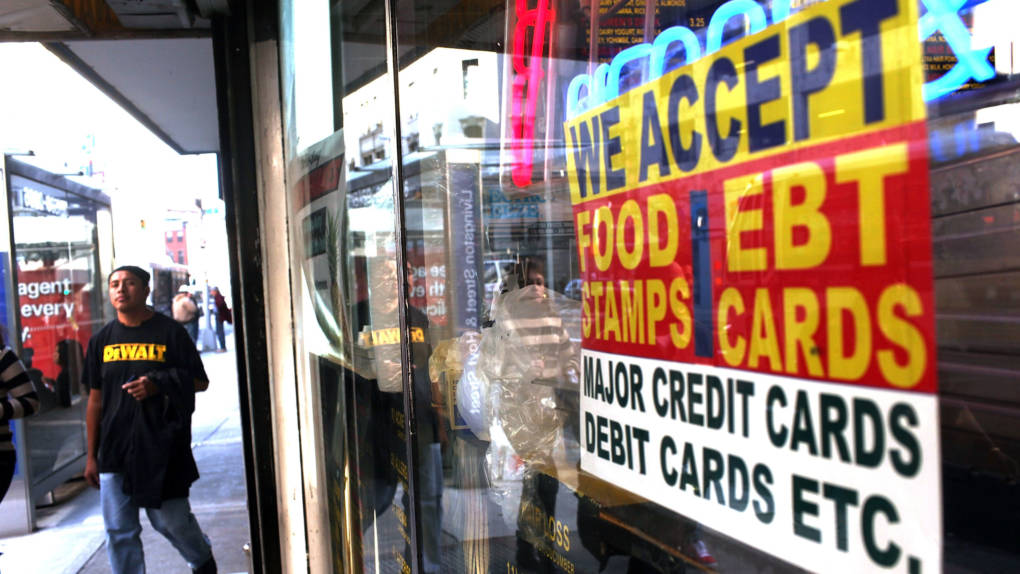
"content": "\u003cp>For roughly \u003ca href=\"https://www.fns.usda.gov/pd/supplemental-nutrition-assistance-program-snap\">40 million Americans\u003c/a>, SNAP benefits are a lifeline.\u003c/p>\n\u003cp>The Supplemental Nutrition Assistance Program, formerly known as food stamps, delivers about $60 billion in aid each year. And retailers that accept SNAP benefits are required to stock a variety of staple foods — including a minimum number of fruits and vegetables, meat, dairy and grain options.\u003c/p>\n\u003cp>Now, there's a controversy brewing over which foods count as staples. Should beef jerky, spray cheese and \u003cem>queso\u003c/em> dip count? The Trump administration has proposed a rule that would allow retailers to include these items.\u003c/p>\n\u003cp>\"The Trump administration would weaken what stores would have to offer,\" says \u003ca href=\"https://cspinet.org/biography/margo-wootan\">Margo Wootan\u003c/a> of the Center for Science in the Public Interest, a consumer advocacy group. She says this could result in fewer healthy options in convenience and corner stores where SNAP recipients spend about $3 billion in benefits each year. \u003c/p>\n\u003cp>A rule written during the Obama administration would require retailers to stock at least seven different products in each of four key food categories — fruits and vegetables, meat, dairy and grains. \u003c/p>\n\u003cp>[ad fullwidth]\u003c/p>\n\u003cp>Under the change proposed by the Trump administration, retailers could stock dried meats — such as beef jerky — and shelf-stable, processed cheese products to help them meet their meat and dairy requirements. And this may offset the need to offer as many fresh meat and dairy products. Wootan's complaint about this policy: \"Very few families would serve up a Slim Jim as the main course in a meal,\" she says. It's a snack.\u003c/p>\n\u003cp>As Wootan and I tour a convenience store in Washington, D.C., she points to aisles filled with snack food. \"Almost all of this is chips, snack cakes, candy,\" she says.\u003c/p>\n\u003cp>She says SNAP benefits are intended to provide people with foods they can cook at home. And it would be helpful if convenience stores made it possible for families to do \"a real shop for foods they can prepare into meals,\" Wootan says — more like a grocery store. \u003c/p>\n\u003cp>Studies have shown that a \u003ca href=\"http://thefoodtrust.org/uploads/media_items/access-to-healthy-food.original.pdf\">lack of easy access to healthy foods\u003c/a> — whether it's due to living in an urban \"food desert\" or in a rural area with no supermarket — is one contributor to poor nutrition and obesity.\u003c/p>\n\u003cp>And it's also true that in some areas, convenience stores fill a gap. \"We offer the majority of healthy foods,\" says Robert Forsyth, who operates the MotoMart chain of convenience stores across six Midwestern states, including Illinois, Wisconsin and Ohio. His family has been in the business for decades.\u003c/p>\n\u003cp>He says there was a time when you would only see cigarettes and candy bars at gas station stores. \"We've been in the business so long, we remember before convenience stores were really a thing,\" Forsyth says.\u003c/p>\n\u003cp>Now, people come in \"to buy orange juice and milk and — in our stores — apples, oranges, bananas,\" he says. He also points to an array of nuts, whole-grain breads and yogurts that his stores stock. \"Lots of good, healthy products,\" he says.\u003c/p>\n\u003cp>Forsyth supports the Trump administration's proposed rule changes. In a letter to the USDA, he asked the agency to give retailers even more flexibility in determining which foods meet the requirements. He also defends products such as beef jerky — which he says are popular, nutritious and affordable.\u003c/p>\n\u003cp>\"Affordability is a huge aspect,\" Forsyth says. He says he can only stay in business if he sells items that people want to buy. \"It doesn't do me any good to sell almond milk and goat cheese,\" because he says his customers don't want them. \u003c/p>\n\u003cp>\"You've got to meet SNAP recipients where they are,\" Forsyth says. And he doesn't like the idea of beef jerky or processed cheese being singled out. \"I think it's an elitist attitude.\" He says the rules written during the Obama administration would have hurt his business. \"The situation is the law would have squeezed out convenience store operators\" from being able to accept SNAP benefits. \u003c/p>\n\u003cp>He agrees that people should be taught more about good nutrition. \"We need to educate people on their choices and we need to make sure they have a variety of healthy choices to choose from,\" Forsyth says. But the rules shouldn't be so strict that they undermine his business. He says if convenience stores were squeezed out of some of the small towns where he operates, such as Plover, Wis., and Galion, Ohio, some of his customers who live miles from a major supermarket and don't have easy access to transportation would be left with fewer food-shopping options.\u003c/p>\n\u003cp>The\u003ca href=\"https://www.federalregister.gov/documents/2019/04/05/2019-06597/providing-regulatory-flexibility-for-retailers-in-the-supplemental-nutrition-assistance-program-snap\"> public comment period\u003c/a> on this proposed rule ends Tuesday. \u003c/p>\n\u003cp>\u003c/p>\n\u003cp>\u003ci>Copyright 2019 NPR. To see more, visit \u003ca href=\"https://www.npr.org/sections/thesalt/2019/06/04/729733146/how-a-fight-over-beef-jerky-reveals-tensions-over-snap-in-the-trump-era\">NPR.org\u003c/a>.\u003c/i>\u003c/p>\n\n",
"disqusIdentifier": "133858 https://ww2.kqed.org/bayareabites/?p=133858",
"disqusUrl": "https://ww2.kqed.org/bayareabites/2019/06/05/how-a-fight-over-beef-jerky-reveals-tensions-over-snap-in-the-trump-era/",
"stats": {
"hasVideo": false,
"hasChartOrMap": false,
"hasAudio": false,
"hasPolis": false,
"wordCount": 794,
"hasGoogleForm": false,
"hasGallery": false,
"hasHearkenModule": false,
"iframeSrcs": [],
"paragraphCount": 20
},
"modified": 1559751196,
"excerpt": "Retailers that accept SNAP benefits must stock a variety of staple foods, including a minimum number of fruits and vegetables, meat, dairy and grain options. Now there's a fight over what counts.",
"headData": {
"twImgId": "",
"twTitle": "",
"ogTitle": "",
"ogImgId": "",
"twDescription": "",
"description": "Retailers that accept SNAP benefits must stock a variety of staple foods, including a minimum number of fruits and vegetables, meat, dairy and grain options. Now there's a fight over what counts.",
"title": "How A Fight Over Beef Jerky Reveals Tensions Over SNAP In The Trump Era | KQED",
"ogDescription": "",
"schema": {
"@context": "https://schema.org",
"@type": "Article",
"headline": "How A Fight Over Beef Jerky Reveals Tensions Over SNAP In The Trump Era",
"datePublished": "2019-06-05T09:13:16-07:00",
"dateModified": "2019-06-05T09:13:16-07:00",
"image": "https://cdn.kqed.org/wp-content/uploads/2020/02/KQED-OG-Image@1x.png"
}
},
"guestAuthors": [],
"slug": "how-a-fight-over-beef-jerky-reveals-tensions-over-snap-in-the-trump-era",
"status": "publish",
"nprApiLink": "http://api.npr.org/query?id=729733146&apiKey=MDAxOTAwOTE4MDEyMTkxMDAzNjczZDljZA004",
"nprStoryDate": "Tue, 04 Jun 2019 18:04:19 -0400",
"nprLastModifiedDate": "Tue, 04 Jun 2019 19:08:11 -0400",
"nprHtmlLink": "https://www.npr.org/sections/thesalt/2019/06/04/729733146/how-a-fight-over-beef-jerky-reveals-tensions-over-snap-in-the-trump-era?ft=nprml&f=729733146",
"nprAudio": "https://ondemand.npr.org/anon.npr-mp3/npr/atc/2019/06/20190604_atc_convenience_stores_and_snap_benefits.mp3?orgId=1&topicId=1128&d=194&story=729733146&ft=nprml&f=729733146",
"nprImageAgency": "Getty Images",
"nprAudioM3u": "http://api.npr.org/m3u/1729794740-be8cc4.m3u?orgId=1&topicId=1128&d=194&story=729733146&ft=nprml&f=729733146",
"nprStoryId": "729733146",
"nprByline": "Allison Aubrey, NPR Food",
"audioTrackLength": 194,
"nprImageCredit": "Spencer Platt",
"nprRetrievedStory": "1",
"nprPubDate": "Tue, 04 Jun 2019 19:08:00 -0400",
"path": "/bayareabites/133858/how-a-fight-over-beef-jerky-reveals-tensions-over-snap-in-the-trump-era",
"audioUrl": "https://ondemand.npr.org/anon.npr-mp3/npr/atc/2019/06/20190604_atc_convenience_stores_and_snap_benefits.mp3?orgId=1&topicId=1128&d=194&story=729733146&ft=nprml&f=729733146",
"parsedContent": [
{
"type": "contentString",
"content": "\u003cdiv class=\"post-body\">\u003cp>\u003cp>For roughly \u003ca href=\"https://www.fns.usda.gov/pd/supplemental-nutrition-assistance-program-snap\">40 million Americans\u003c/a>, SNAP benefits are a lifeline.\u003c/p>\n\u003cp>The Supplemental Nutrition Assistance Program, formerly known as food stamps, delivers about $60 billion in aid each year. And retailers that accept SNAP benefits are required to stock a variety of staple foods — including a minimum number of fruits and vegetables, meat, dairy and grain options.\u003c/p>\n\u003cp>Now, there's a controversy brewing over which foods count as staples. Should beef jerky, spray cheese and \u003cem>queso\u003c/em> dip count? The Trump administration has proposed a rule that would allow retailers to include these items.\u003c/p>\n\u003cp>\"The Trump administration would weaken what stores would have to offer,\" says \u003ca href=\"https://cspinet.org/biography/margo-wootan\">Margo Wootan\u003c/a> of the Center for Science in the Public Interest, a consumer advocacy group. She says this could result in fewer healthy options in convenience and corner stores where SNAP recipients spend about $3 billion in benefits each year. \u003c/p>\n\u003cp>A rule written during the Obama administration would require retailers to stock at least seven different products in each of four key food categories — fruits and vegetables, meat, dairy and grains. \u003c/p>\n\u003cp>\u003c/p>\u003c/div>",
"attributes": {
"named": {},
"numeric": []
}
},
{
"type": "component",
"content": "",
"name": "ad",
"attributes": {
"named": {
"label": "fullwidth"
},
"numeric": [
"fullwidth"
]
}
},
{
"type": "contentString",
"content": "\u003cdiv class=\"post-body\">\u003cp>\u003c/p>\n\u003cp>Under the change proposed by the Trump administration, retailers could stock dried meats — such as beef jerky — and shelf-stable, processed cheese products to help them meet their meat and dairy requirements. And this may offset the need to offer as many fresh meat and dairy products. Wootan's complaint about this policy: \"Very few families would serve up a Slim Jim as the main course in a meal,\" she says. It's a snack.\u003c/p>\n\u003cp>As Wootan and I tour a convenience store in Washington, D.C., she points to aisles filled with snack food. \"Almost all of this is chips, snack cakes, candy,\" she says.\u003c/p>\n\u003cp>She says SNAP benefits are intended to provide people with foods they can cook at home. And it would be helpful if convenience stores made it possible for families to do \"a real shop for foods they can prepare into meals,\" Wootan says — more like a grocery store. \u003c/p>\n\u003cp>Studies have shown that a \u003ca href=\"http://thefoodtrust.org/uploads/media_items/access-to-healthy-food.original.pdf\">lack of easy access to healthy foods\u003c/a> — whether it's due to living in an urban \"food desert\" or in a rural area with no supermarket — is one contributor to poor nutrition and obesity.\u003c/p>\n\u003cp>And it's also true that in some areas, convenience stores fill a gap. \"We offer the majority of healthy foods,\" says Robert Forsyth, who operates the MotoMart chain of convenience stores across six Midwestern states, including Illinois, Wisconsin and Ohio. His family has been in the business for decades.\u003c/p>\n\u003cp>He says there was a time when you would only see cigarettes and candy bars at gas station stores. \"We've been in the business so long, we remember before convenience stores were really a thing,\" Forsyth says.\u003c/p>\n\u003cp>Now, people come in \"to buy orange juice and milk and — in our stores — apples, oranges, bananas,\" he says. He also points to an array of nuts, whole-grain breads and yogurts that his stores stock. \"Lots of good, healthy products,\" he says.\u003c/p>\n\u003cp>Forsyth supports the Trump administration's proposed rule changes. In a letter to the USDA, he asked the agency to give retailers even more flexibility in determining which foods meet the requirements. He also defends products such as beef jerky — which he says are popular, nutritious and affordable.\u003c/p>\n\u003cp>\"Affordability is a huge aspect,\" Forsyth says. He says he can only stay in business if he sells items that people want to buy. \"It doesn't do me any good to sell almond milk and goat cheese,\" because he says his customers don't want them. \u003c/p>\n\u003cp>\"You've got to meet SNAP recipients where they are,\" Forsyth says. And he doesn't like the idea of beef jerky or processed cheese being singled out. \"I think it's an elitist attitude.\" He says the rules written during the Obama administration would have hurt his business. \"The situation is the law would have squeezed out convenience store operators\" from being able to accept SNAP benefits. \u003c/p>\n\u003cp>He agrees that people should be taught more about good nutrition. \"We need to educate people on their choices and we need to make sure they have a variety of healthy choices to choose from,\" Forsyth says. But the rules shouldn't be so strict that they undermine his business. He says if convenience stores were squeezed out of some of the small towns where he operates, such as Plover, Wis., and Galion, Ohio, some of his customers who live miles from a major supermarket and don't have easy access to transportation would be left with fewer food-shopping options.\u003c/p>\n\u003cp>The\u003ca href=\"https://www.federalregister.gov/documents/2019/04/05/2019-06597/providing-regulatory-flexibility-for-retailers-in-the-supplemental-nutrition-assistance-program-snap\"> public comment period\u003c/a> on this proposed rule ends Tuesday. \u003c/p>\n\u003cp>\u003c/p>\n\u003cp>\u003ci>Copyright 2019 NPR. To see more, visit \u003ca href=\"https://www.npr.org/sections/thesalt/2019/06/04/729733146/how-a-fight-over-beef-jerky-reveals-tensions-over-snap-in-the-trump-era\">NPR.org\u003c/a>.\u003c/i>\u003c/p>\n\n\u003c/div>\u003c/p>",
"attributes": {
"named": {},
"numeric": []
}
}
],
"link": "/bayareabites/133858/how-a-fight-over-beef-jerky-reveals-tensions-over-snap-in-the-trump-era",
"authors": [
"byline_bayareabites_133858"
],
"categories": [
"bayareabites_3032",
"bayareabites_10028",
"bayareabites_1245",
"bayareabites_10916",
"bayareabites_2035"
],
"tags": [
"bayareabites_10011",
"bayareabites_16272",
"bayareabites_11838"
],
"featImg": "bayareabites_133859",
"label": "bayareabites"
},
"bayareabites_133812": {
"type": "posts",
"id": "bayareabites_133812",
"meta": {
"index": "posts_1716263798",
"site": "bayareabites",
"id": "133812",
"score": null,
"sort": [
1559243465000
]
},
"parent": 0,
"labelTerm": {
"site": "bayareabites"
},
"blocks": [],
"publishDate": 1559243465,
"format": "audio",
"disqusTitle": "Samin Nosrat Is Making Space At The Table",
"title": "Samin Nosrat Is Making Space At The Table",
"headTitle": "Bay Area Bites | KQED Food",
"content": "\u003cp>[aside postID='bayareabites_130841,bayareabites_131646' label='More Samin Nosrat News']\u003c/p>\n\u003cp>Because of her food journalism, the food world has been well aware of Samin Nosrat for several years. But she became a household name when two things happened: First, her book \u003cem>Salt, Fat, Acid Heat: Mastering The Art of Good Cooking\u003c/em> \u003ca href=\"https://www.saveur.com/cookbook-club-review-salt-fat-acid-heat\">became a runaway bestseller last year\u003c/a>. \u003c/p>\n\u003cp>The book explored the mysteries of cooking for the home chef, and garnered just about every award a cookbook could get. In the words of Nosrat's mentor, \u003ca href=\"http://www.chezpanisse.com/about/alice-waters/\">Alice Waters\u003c/a> (chef-owner of the legendary Berkeley restaurant Chez Panisse,) \u003cem>Salt, Fat, Acid, Heat\u003c/em> \"not only teaches you how to cook, but captures how it should feel to cook: full of exploration, spontaneity and joy.\"\u003c/p>\n\u003cp>https://ondemand.npr.org/anon.npr-mp3/npr/codeswitch/2019/05/20190529_codeswitch_1230am_samin_nosrat.mp3\u003c/p>\n\u003cp>As if that weren't enough, \u003ca href=\"https://youtu.be/2oKbs4jAf7M\">Nosrat filmed a four-part docuseries with Netflix last fall\u003c/a>, and which was also called \u003cem>Salt, Fat, Acid, Heat\u003c/em>. In it, she travels to Italy to explore the importance of fat (olive oil! Parmesan!); to Japan to see salt harvested and soy and miso fermented; then to Yucatán, Mexico to see how acid, in the form of sour oranges, enhances dishes; and finally back to California to show us how heat transforms meats and vegetables.\u003c/p>\n\u003cp>[ad fullwidth]\u003c/p>\n\u003cp>After the Netflix series, Nosrat became so well known it became hard to walk down the street or into her favorite grocery store without being stopped by fans and yes, people with questions. (So many questions!) And sometimes just thanks. She recalled the Iranian father in Oakland who thanked her for speaking to his daughters, who were Iranian and African American. \"Thank you for showing them what is possible,\" he told her.\u003c/p>\n\u003cp>Nosrat is that rare thing: a woman of color in the upper echelons of the snarky, hyper-competitive food world. Her columns appear regularly in \u003cem>The New York Times\u003c/em>, she travels the country lecturing about food and culture and doing cooking demonstrations. She is acutely aware of her unicorn status, and spends a lot of time thinking about how to push wider the door she's managed to open so she won't be the Only One in the public eye.\u003c/p>\n\u003cp>Recently she was in Los Angeles, and stopped by Shereen Marisol Meraji's home to cook and chat with Shereen and me in the backyard. Since summer's officially started, we asked her about \u003ca href=\"https://cooking.nytimes.com/recipes/1020213-mast-o-khiar-persian-cucumber-and-herb-yogurt\">Mast-o Khiar\u003c/a> and \u003ca href=\"https://cooking.nytimes.com/recipes/1020212-salad-e-shirazi-persian-cucumber-tomato-and-onion-salad?action=click&module=RecirculationRibbon&pgType=recipedetails&rank=4\">Salad-e Shirazi\u003c/a>, a couple of Persian dishes that work well on hot days. (These came from her \u003cem>New York Times\u003c/em> article \u003ca href=\"https://www.nytimes.com/2019/05/14/dining/persian-food-recipes-samin-nosrat.html\">Samin Nosrat's Ten Essential Persian Recipes\u003c/a> — you can get the recipes without having to go behind the paywall until June 12.) Her recipes are as delicious as her laugh, which burbles into conversation often and easily.\u003c/p>\n\u003cp>Here's an excerpt from our interview. It has been edited and condensed for clarity.\u003c/p>\n\u003chr>\n\u003cp>\u003cstrong>Code Switch:\u003c/strong> You were born and grew up in San Diego, the child of parents who immigrated from Iran. A lot of immigrant families, wherever they're from, try to get comfortable in their new country by cooking what they ate in the old one. But American grocery stores are...American. They probably were missing a lot of stuff your mom needed when she first got here, decades ago. Did she have to forage for ingredients? Do you have to now?\u003c/p>\n\u003cp>\u003cstrong>Samin Nosrat:\u003c/strong> My mom would go everywhere she could to find the right thing, but if it didn't turn up, you know, we'd use flour tortillas instead of lavash bread to make the \u003ca href=\"https://www.saltfatacidheat.com/heat/pavo-en-escabeche\">Tahdig\u003c/a>. So I think cooking is all about being scrappy, no matter where you're from and where you are. It's using what you've got to make something good. I think immigrants in general are put into a lot more challenging situations. But I think that lead to a lot of really incredible creativity when we went to school.\u003c/p>\n\u003cp>\u003cstrong>CS:\u003c/strong> Did you and your sister bring your lunch?\u003c/p>\n\u003cp>\u003cstrong>SN:\u003c/strong> Yeah. We had PB&J, but we also had these things called \u003cem>kotlets --\u003c/em> they're sort of like little meatloaf patties. And \u003ca href=\"https://www.bonappetit.com/recipe/persian-herb-and-leek-frittata\">\u003cem>kuku sabzi\u003c/em>\u003c/a> -- kind of a really herby, green frittata. [My mom] also made a lot of Iranian spaghetti.\u003c/p>\n\u003cp>\u003cstrong>CS:\u003c/strong> Iranian spaghetti?\u003c/p>\n\u003cp>\u003cstrong>SN:\u003c/strong> Yep, we call it espaghetti; it's like an Iranian fantasy of what Italian meat sauce is. It had chopped mushrooms, onions, beef (because there's no pork in Iran) and a ton of tomato sauce. And a ton of dried oregano. And she would cook it and then she would mix it and then she put it back in the pot and make tahdig out of it. So there's like a spaghetti tahdig which is really good. The pasta was absorbing the excess liquid from the sauce and it was super delicious! And for leftovers for school we would put the espaghetti in a pita pocket --double carbs!\u003c/p>\n\u003cp>\u003cstrong>CS:\u003c/strong> So food was one way your mother held onto her culture and passed it on to you. She also spoke Farsi to you, y'all went to Persian school...\u003c/p>\n\u003cp>\u003cstrong>SN:\u003c/strong> On \u003cem>Saturday\u003c/em>! While everyone else got to watch cartoons and hang out! But now I'm so grateful for it. I think she did such a good job — I was never ashamed I was Iranian, never embarrassed about it at all. So that was a nice thing. I did feel very different than everyone else in San Diego, though.\u003cbr>\n\u003cimg class=\"aligncenter size-full wp-image-133817\" src=\"https://ww2.kqed.org/bayareabites/wp-content/uploads/sites/24/2019/05/samin-nosrat-salad-e-shirazi-002-_custom-3864db6c5fa1e2fe93e7421059468b9d4cef3b2e-s700-c85.jpg\" alt=\"Salad-E Shirazi\" width=\"700\" height=\"436\" srcset=\"https://ww2.kqed.org/app/uploads/sites/24/2019/05/samin-nosrat-salad-e-shirazi-002-_custom-3864db6c5fa1e2fe93e7421059468b9d4cef3b2e-s700-c85.jpg 700w, https://ww2.kqed.org/app/uploads/sites/24/2019/05/samin-nosrat-salad-e-shirazi-002-_custom-3864db6c5fa1e2fe93e7421059468b9d4cef3b2e-s700-c85-160x100.jpg 160w\" sizes=\"(max-width: 700px) 100vw, 700px\">\u003cbr>\n\u003cstrong>CS:\u003c/strong> Iranian? Persian? Most of us don't know the culture very well, and we don't want to offend by using the wrong word. Or are they different words for the same thing?\u003c/p>\n\u003cp>\u003cstrong>SN:\u003c/strong> I tend to use both words, Persian and Iranian, interchangeably, but not everybody does that. To me, I feel like often we're forced to hide behind the term Persian to decide to create distance between this image of what Iranians are that has been perpetuated in the media, certainly for my entire lifetime, which is one of two things: a terrorist or [the reality show] \u003ca href=\"https://www.bravotv.com/shahs-of-sunset\">\u003cem>Shahs of Sunset\u003c/em>\u003c/a>. There's so much more! But you see one Iranian person and suddenly everyone uses that as the point of reference to know everything about your whole culture.\u003c/p>\n\u003cp>\u003cstrong>CS:\u003c/strong> Talk a little bit about the pressure of identity. You kind of stand out among your food world peers, none of whom look like you.\u003c/p>\n\u003cp>\u003cstrong>SN:\u003c/strong> It's so hard. It's really hard. I mean, I think about trying my best to convey in every word and action that I'm only representing me. But it doesn't matter what I say. You know because people are gonna perceive what they want to perceive.\u003c/p>\n\u003cp>The example I always use is this joke: True diversity is not when there's the excellent black person, the excellent Iranian chef or whatever. It's when there's as much black and brown and queer mediocrity as there is white mediocrity.\u003c/p>\n\u003cp>\u003cstrong>CS:\u003c/strong> We imagine that when these recipes came out, identified as Ten Essentials, you got a lot of feedback—and clapback—from your fellow Iranians. Maybe you used an ingredient they didn't or you cooked the dish a slightly different way and how dare you? That kind of thing?\u003c/p>\n\u003cp>\u003cstrong>SN:\u003c/strong> Most of the feedback has been positive, but there have been times when they weren't. Like my mom is in one of the episodes of Salt, Fat, Acid, Heat, and we cooked Persian rice together. It didn't turn out perfectly for many reasons, including television production is hard! My mom was on a schedule and we didn't have time to do it again. So in fact right after we took it out, I said—on camera—\"every Iranian lady in the world is going to have something to say about this!\" There was one tweet the other day where somebody was like \"Ok, she and her mother ruined the Tahdig on the show—what a waste of saffron!\"\u003c/p>\n\u003cp>I blocked him—then I unblocked him and retweeted it with a comment saying, \"Call me when \u003cem>you\u003c/em> take \u003cem>your \u003c/em>immigrant mother on camera and make a perfect tahdig!\"\u003cbr>\n\u003cimg class=\"aligncenter size-full wp-image-133818\" src=\"https://ww2.kqed.org/bayareabites/wp-content/uploads/sites/24/2019/05/samin-nosrat-mast-o-khiar-002-_custom-677458d7ac515b3a6596a3afee880f1b1b419e46-s700-c85.jpg\" alt=\"\" width=\"700\" height=\"436\" srcset=\"https://ww2.kqed.org/app/uploads/sites/24/2019/05/samin-nosrat-mast-o-khiar-002-_custom-677458d7ac515b3a6596a3afee880f1b1b419e46-s700-c85.jpg 700w, https://ww2.kqed.org/app/uploads/sites/24/2019/05/samin-nosrat-mast-o-khiar-002-_custom-677458d7ac515b3a6596a3afee880f1b1b419e46-s700-c85-160x100.jpg 160w\" sizes=\"(max-width: 700px) 100vw, 700px\">\u003cbr>\n\u003cstrong>CS:\u003c/strong> Sometimes when there's only one person from a certain background in a particular space, that pioneering person opens the door for others, so it isn't fused shut again. But some want to shut the door behind them, and be the Only One in the room.\u003c/p>\n\u003cp>\u003cstrong>SN:\u003c/strong> I don't want to be the only one, but there's something special about being the only one, right? I'm the child of immigrants, and there was always a garage filled with food, just in case, and you kept money under the mattress. You were always prepared, because you couldn't trust that you were being taken care of. So that translated into my life into a lot of opportunity hoarding. My first urge when I get asked to do things is, \"Oh this is my last shot; this is mine. I'm going to say yes to this, because if you don't ask me, who are you going to get?\"\u003c/p>\n\u003cp>But you know what? I had to calm down and trust that if I say \"no\" this time, it will come around again. Or another chance will. I'll get another shot, and it actually doesn't harm me at all to help somebody else. I have just gotten so much more out of sharing than I ever have from hoarding.\u003c/p>\n\u003cp>[ad floatright]\u003c/p>\n\u003cp>\u003ci>Copyright 2019 NPR. To see more, visit \u003ca href=\"https://www.npr.org/sections/codeswitch/2019/05/30/726375712/samin-nosrat-is-making-space-at-the-table\">NPR.org\u003c/a>.\u003c/i>\u003c/p>\n\n",
"disqusIdentifier": "133812 https://ww2.kqed.org/bayareabites/?p=133812",
"disqusUrl": "https://ww2.kqed.org/bayareabites/2019/05/30/samin-nosrat-is-making-space-at-the-table/",
"stats": {
"hasVideo": false,
"hasChartOrMap": false,
"hasAudio": false,
"hasPolis": false,
"wordCount": 1610,
"hasGoogleForm": false,
"hasGallery": false,
"hasHearkenModule": false,
"iframeSrcs": [],
"paragraphCount": 28
},
"modified": 1559243465,
"excerpt": "Nosrat is that rare thing: a woman of color in the upper echelons of the hyper-competitive food world. She is acutely aware of her unicorn status— and taking steps to try and change that.",
"headData": {
"twImgId": "",
"twTitle": "",
"ogTitle": "",
"ogImgId": "",
"twDescription": "",
"description": "Nosrat is that rare thing: a woman of color in the upper echelons of the hyper-competitive food world. She is acutely aware of her unicorn status— and taking steps to try and change that.",
"title": "Samin Nosrat Is Making Space At The Table | KQED",
"ogDescription": "",
"schema": {
"@context": "https://schema.org",
"@type": "Article",
"headline": "Samin Nosrat Is Making Space At The Table",
"datePublished": "2019-05-30T12:11:05-07:00",
"dateModified": "2019-05-30T12:11:05-07:00",
"image": "https://cdn.kqed.org/wp-content/uploads/2020/02/KQED-OG-Image@1x.png"
}
},
"guestAuthors": [],
"slug": "samin-nosrat-is-making-space-at-the-table",
"status": "publish",
"nprApiLink": "http://api.npr.org/query?id=726375712&apiKey=MDAxOTAwOTE4MDEyMTkxMDAzNjczZDljZA004",
"nprByline": "Karen Grigsby Bates",
"nprStoryDate": "Thu, 30 May 2019 14:00:17 -0400",
"nprLastModifiedDate": "Thu, 30 May 2019 14:00:17 -0400",
"nprHtmlLink": "https://www.npr.org/sections/codeswitch/2019/05/30/726375712/samin-nosrat-is-making-space-at-the-table?ft=nprml&f=726375712",
"nprAudio": "https://ondemand.npr.org/anon.npr-mp3/npr/codeswitch/2019/05/20190529_codeswitch_1230am_samin_nosrat.mp3?orgId=1&topicId=1015&d=1473&story=726375712&ft=nprml&f=726375712",
"audioTrackLength": 1473,
"nprImageAgency": "Shereen Marisol Meraji",
"nprAudioM3u": "http://api.npr.org/m3u/1728305727-706c0c.m3u?orgId=1&topicId=1015&d=1473&story=726375712&ft=nprml&f=726375712",
"nprStoryId": "726375712",
"nprRetrievedStory": "1",
"nprPubDate": "Thu, 30 May 2019 14:00:00 -0400",
"path": "/bayareabites/133812/samin-nosrat-is-making-space-at-the-table",
"audioUrl": "https://ondemand.npr.org/anon.npr-mp3/npr/codeswitch/2019/05/20190529_codeswitch_1230am_samin_nosrat.mp3?orgId=1&topicId=1015&d=1473&story=726375712&ft=nprml&f=726375712",
"parsedContent": [
{
"type": "contentString",
"content": "\u003cdiv class=\"post-body\">\u003cp>\u003cp>\u003c/p>\u003c/div>",
"attributes": {
"named": {},
"numeric": []
}
},
{
"type": "component",
"content": "",
"name": "aside",
"attributes": {
"named": {
"postid": "bayareabites_130841,bayareabites_131646",
"label": "More Samin Nosrat News "
},
"numeric": []
}
},
{
"type": "contentString",
"content": "\u003cdiv class=\"post-body\">\u003cp>\u003c/p>\n\u003cp>Because of her food journalism, the food world has been well aware of Samin Nosrat for several years. But she became a household name when two things happened: First, her book \u003cem>Salt, Fat, Acid Heat: Mastering The Art of Good Cooking\u003c/em> \u003ca href=\"https://www.saveur.com/cookbook-club-review-salt-fat-acid-heat\">became a runaway bestseller last year\u003c/a>. \u003c/p>\n\u003cp>The book explored the mysteries of cooking for the home chef, and garnered just about every award a cookbook could get. In the words of Nosrat's mentor, \u003ca href=\"http://www.chezpanisse.com/about/alice-waters/\">Alice Waters\u003c/a> (chef-owner of the legendary Berkeley restaurant Chez Panisse,) \u003cem>Salt, Fat, Acid, Heat\u003c/em> \"not only teaches you how to cook, but captures how it should feel to cook: full of exploration, spontaneity and joy.\"\u003c/p>\n\u003cp>\u003c/p>\u003c/div>",
"attributes": {
"named": {},
"numeric": []
}
},
{
"type": "component",
"content": "",
"name": "nprOneAudioLink",
"attributes": {
"named": {
"src": "https://ondemand.npr.org/anon.npr-mp3/npr/codeswitch/2019/05/20190529_codeswitch_1230am_samin_nosrat.mp3"
},
"numeric": []
}
},
{
"type": "contentString",
"content": "\u003cdiv class=\"post-body\">\u003cp>\u003c/p>\n\u003cp>As if that weren't enough, \u003ca href=\"https://youtu.be/2oKbs4jAf7M\">Nosrat filmed a four-part docuseries with Netflix last fall\u003c/a>, and which was also called \u003cem>Salt, Fat, Acid, Heat\u003c/em>. In it, she travels to Italy to explore the importance of fat (olive oil! Parmesan!); to Japan to see salt harvested and soy and miso fermented; then to Yucatán, Mexico to see how acid, in the form of sour oranges, enhances dishes; and finally back to California to show us how heat transforms meats and vegetables.\u003c/p>\n\u003cp>\u003c/p>\u003c/div>",
"attributes": {
"named": {},
"numeric": []
}
},
{
"type": "component",
"content": "",
"name": "ad",
"attributes": {
"named": {
"label": "fullwidth"
},
"numeric": [
"fullwidth"
]
}
},
{
"type": "contentString",
"content": "\u003cdiv class=\"post-body\">\u003cp>\u003c/p>\n\u003cp>After the Netflix series, Nosrat became so well known it became hard to walk down the street or into her favorite grocery store without being stopped by fans and yes, people with questions. (So many questions!) And sometimes just thanks. She recalled the Iranian father in Oakland who thanked her for speaking to his daughters, who were Iranian and African American. \"Thank you for showing them what is possible,\" he told her.\u003c/p>\n\u003cp>Nosrat is that rare thing: a woman of color in the upper echelons of the snarky, hyper-competitive food world. Her columns appear regularly in \u003cem>The New York Times\u003c/em>, she travels the country lecturing about food and culture and doing cooking demonstrations. She is acutely aware of her unicorn status, and spends a lot of time thinking about how to push wider the door she's managed to open so she won't be the Only One in the public eye.\u003c/p>\n\u003cp>Recently she was in Los Angeles, and stopped by Shereen Marisol Meraji's home to cook and chat with Shereen and me in the backyard. Since summer's officially started, we asked her about \u003ca href=\"https://cooking.nytimes.com/recipes/1020213-mast-o-khiar-persian-cucumber-and-herb-yogurt\">Mast-o Khiar\u003c/a> and \u003ca href=\"https://cooking.nytimes.com/recipes/1020212-salad-e-shirazi-persian-cucumber-tomato-and-onion-salad?action=click&module=RecirculationRibbon&pgType=recipedetails&rank=4\">Salad-e Shirazi\u003c/a>, a couple of Persian dishes that work well on hot days. (These came from her \u003cem>New York Times\u003c/em> article \u003ca href=\"https://www.nytimes.com/2019/05/14/dining/persian-food-recipes-samin-nosrat.html\">Samin Nosrat's Ten Essential Persian Recipes\u003c/a> — you can get the recipes without having to go behind the paywall until June 12.) Her recipes are as delicious as her laugh, which burbles into conversation often and easily.\u003c/p>\n\u003cp>Here's an excerpt from our interview. It has been edited and condensed for clarity.\u003c/p>\n\u003chr>\n\u003cp>\u003cstrong>Code Switch:\u003c/strong> You were born and grew up in San Diego, the child of parents who immigrated from Iran. A lot of immigrant families, wherever they're from, try to get comfortable in their new country by cooking what they ate in the old one. But American grocery stores are...American. They probably were missing a lot of stuff your mom needed when she first got here, decades ago. Did she have to forage for ingredients? Do you have to now?\u003c/p>\n\u003cp>\u003cstrong>Samin Nosrat:\u003c/strong> My mom would go everywhere she could to find the right thing, but if it didn't turn up, you know, we'd use flour tortillas instead of lavash bread to make the \u003ca href=\"https://www.saltfatacidheat.com/heat/pavo-en-escabeche\">Tahdig\u003c/a>. So I think cooking is all about being scrappy, no matter where you're from and where you are. It's using what you've got to make something good. I think immigrants in general are put into a lot more challenging situations. But I think that lead to a lot of really incredible creativity when we went to school.\u003c/p>\n\u003cp>\u003cstrong>CS:\u003c/strong> Did you and your sister bring your lunch?\u003c/p>\n\u003cp>\u003cstrong>SN:\u003c/strong> Yeah. We had PB&J, but we also had these things called \u003cem>kotlets --\u003c/em> they're sort of like little meatloaf patties. And \u003ca href=\"https://www.bonappetit.com/recipe/persian-herb-and-leek-frittata\">\u003cem>kuku sabzi\u003c/em>\u003c/a> -- kind of a really herby, green frittata. [My mom] also made a lot of Iranian spaghetti.\u003c/p>\n\u003cp>\u003cstrong>CS:\u003c/strong> Iranian spaghetti?\u003c/p>\n\u003cp>\u003cstrong>SN:\u003c/strong> Yep, we call it espaghetti; it's like an Iranian fantasy of what Italian meat sauce is. It had chopped mushrooms, onions, beef (because there's no pork in Iran) and a ton of tomato sauce. And a ton of dried oregano. And she would cook it and then she would mix it and then she put it back in the pot and make tahdig out of it. So there's like a spaghetti tahdig which is really good. The pasta was absorbing the excess liquid from the sauce and it was super delicious! And for leftovers for school we would put the espaghetti in a pita pocket --double carbs!\u003c/p>\n\u003cp>\u003cstrong>CS:\u003c/strong> So food was one way your mother held onto her culture and passed it on to you. She also spoke Farsi to you, y'all went to Persian school...\u003c/p>\n\u003cp>\u003cstrong>SN:\u003c/strong> On \u003cem>Saturday\u003c/em>! While everyone else got to watch cartoons and hang out! But now I'm so grateful for it. I think she did such a good job — I was never ashamed I was Iranian, never embarrassed about it at all. So that was a nice thing. I did feel very different than everyone else in San Diego, though.\u003cbr>\n\u003cimg class=\"aligncenter size-full wp-image-133817\" src=\"https://ww2.kqed.org/bayareabites/wp-content/uploads/sites/24/2019/05/samin-nosrat-salad-e-shirazi-002-_custom-3864db6c5fa1e2fe93e7421059468b9d4cef3b2e-s700-c85.jpg\" alt=\"Salad-E Shirazi\" width=\"700\" height=\"436\" srcset=\"https://ww2.kqed.org/app/uploads/sites/24/2019/05/samin-nosrat-salad-e-shirazi-002-_custom-3864db6c5fa1e2fe93e7421059468b9d4cef3b2e-s700-c85.jpg 700w, https://ww2.kqed.org/app/uploads/sites/24/2019/05/samin-nosrat-salad-e-shirazi-002-_custom-3864db6c5fa1e2fe93e7421059468b9d4cef3b2e-s700-c85-160x100.jpg 160w\" sizes=\"(max-width: 700px) 100vw, 700px\">\u003cbr>\n\u003cstrong>CS:\u003c/strong> Iranian? Persian? Most of us don't know the culture very well, and we don't want to offend by using the wrong word. Or are they different words for the same thing?\u003c/p>\n\u003cp>\u003cstrong>SN:\u003c/strong> I tend to use both words, Persian and Iranian, interchangeably, but not everybody does that. To me, I feel like often we're forced to hide behind the term Persian to decide to create distance between this image of what Iranians are that has been perpetuated in the media, certainly for my entire lifetime, which is one of two things: a terrorist or [the reality show] \u003ca href=\"https://www.bravotv.com/shahs-of-sunset\">\u003cem>Shahs of Sunset\u003c/em>\u003c/a>. There's so much more! But you see one Iranian person and suddenly everyone uses that as the point of reference to know everything about your whole culture.\u003c/p>\n\u003cp>\u003cstrong>CS:\u003c/strong> Talk a little bit about the pressure of identity. You kind of stand out among your food world peers, none of whom look like you.\u003c/p>\n\u003cp>\u003cstrong>SN:\u003c/strong> It's so hard. It's really hard. I mean, I think about trying my best to convey in every word and action that I'm only representing me. But it doesn't matter what I say. You know because people are gonna perceive what they want to perceive.\u003c/p>\n\u003cp>The example I always use is this joke: True diversity is not when there's the excellent black person, the excellent Iranian chef or whatever. It's when there's as much black and brown and queer mediocrity as there is white mediocrity.\u003c/p>\n\u003cp>\u003cstrong>CS:\u003c/strong> We imagine that when these recipes came out, identified as Ten Essentials, you got a lot of feedback—and clapback—from your fellow Iranians. Maybe you used an ingredient they didn't or you cooked the dish a slightly different way and how dare you? That kind of thing?\u003c/p>\n\u003cp>\u003cstrong>SN:\u003c/strong> Most of the feedback has been positive, but there have been times when they weren't. Like my mom is in one of the episodes of Salt, Fat, Acid, Heat, and we cooked Persian rice together. It didn't turn out perfectly for many reasons, including television production is hard! My mom was on a schedule and we didn't have time to do it again. So in fact right after we took it out, I said—on camera—\"every Iranian lady in the world is going to have something to say about this!\" There was one tweet the other day where somebody was like \"Ok, she and her mother ruined the Tahdig on the show—what a waste of saffron!\"\u003c/p>\n\u003cp>I blocked him—then I unblocked him and retweeted it with a comment saying, \"Call me when \u003cem>you\u003c/em> take \u003cem>your \u003c/em>immigrant mother on camera and make a perfect tahdig!\"\u003cbr>\n\u003cimg class=\"aligncenter size-full wp-image-133818\" src=\"https://ww2.kqed.org/bayareabites/wp-content/uploads/sites/24/2019/05/samin-nosrat-mast-o-khiar-002-_custom-677458d7ac515b3a6596a3afee880f1b1b419e46-s700-c85.jpg\" alt=\"\" width=\"700\" height=\"436\" srcset=\"https://ww2.kqed.org/app/uploads/sites/24/2019/05/samin-nosrat-mast-o-khiar-002-_custom-677458d7ac515b3a6596a3afee880f1b1b419e46-s700-c85.jpg 700w, https://ww2.kqed.org/app/uploads/sites/24/2019/05/samin-nosrat-mast-o-khiar-002-_custom-677458d7ac515b3a6596a3afee880f1b1b419e46-s700-c85-160x100.jpg 160w\" sizes=\"(max-width: 700px) 100vw, 700px\">\u003cbr>\n\u003cstrong>CS:\u003c/strong> Sometimes when there's only one person from a certain background in a particular space, that pioneering person opens the door for others, so it isn't fused shut again. But some want to shut the door behind them, and be the Only One in the room.\u003c/p>\n\u003cp>\u003cstrong>SN:\u003c/strong> I don't want to be the only one, but there's something special about being the only one, right? I'm the child of immigrants, and there was always a garage filled with food, just in case, and you kept money under the mattress. You were always prepared, because you couldn't trust that you were being taken care of. So that translated into my life into a lot of opportunity hoarding. My first urge when I get asked to do things is, \"Oh this is my last shot; this is mine. I'm going to say yes to this, because if you don't ask me, who are you going to get?\"\u003c/p>\n\u003cp>But you know what? I had to calm down and trust that if I say \"no\" this time, it will come around again. Or another chance will. I'll get another shot, and it actually doesn't harm me at all to help somebody else. I have just gotten so much more out of sharing than I ever have from hoarding.\u003c/p>\n\u003cp>\u003c/p>\u003c/div>",
"attributes": {
"named": {},
"numeric": []
}
},
{
"type": "component",
"content": "",
"name": "ad",
"attributes": {
"named": {
"label": "floatright"
},
"numeric": [
"floatright"
]
}
},
{
"type": "contentString",
"content": "\u003cdiv class=\"post-body\">\u003cp>\u003c/p>\n\u003cp>\u003ci>Copyright 2019 NPR. To see more, visit \u003ca href=\"https://www.npr.org/sections/codeswitch/2019/05/30/726375712/samin-nosrat-is-making-space-at-the-table\">NPR.org\u003c/a>.\u003c/i>\u003c/p>\n\n\u003c/div>\u003c/p>",
"attributes": {
"named": {},
"numeric": []
}
}
],
"link": "/bayareabites/133812/samin-nosrat-is-making-space-at-the-table",
"authors": [
"byline_bayareabites_133812"
],
"categories": [
"bayareabites_63",
"bayareabites_11028",
"bayareabites_10028",
"bayareabites_10916",
"bayareabites_1593"
],
"tags": [
"bayareabites_13366",
"bayareabites_11897",
"bayareabites_15182",
"bayareabites_16272",
"bayareabites_11896",
"bayareabites_4149"
],
"featImg": "bayareabites_133813",
"label": "bayareabites"
},
"bayareabites_133774": {
"type": "posts",
"id": "bayareabites_133774",
"meta": {
"index": "posts_1716263798",
"site": "bayareabites",
"id": "133774",
"score": null,
"sort": [
1559066084000
]
},
"parent": 0,
"labelTerm": {
"site": "bayareabites"
},
"blocks": [],
"publishDate": 1559066084,
"format": "standard",
"disqusTitle": "Beer Archaeologists Are Reviving Ancient Ales — With Some Strange Results",
"title": "Beer Archaeologists Are Reviving Ancient Ales — With Some Strange Results",
"headTitle": "Bay Area Bites | KQED Food",
"content": "\u003cp>[aside postID='bayareabites_117246,bayareabites_133710' label='More Beer on Bay Area Bites']\u003c/p>\n\u003cp>The closest that Travis Rupp came to getting fired from Avery Brewing Co. in Boulder, Colo., he says, was the time he tried to make chicha. The recipe for the Peruvian corn-based beer, cobbled together from bits of pre-Incan archaeological evidence, called for chewed corn partially fermented in spit. So, Rupp's first task had been to persuade his colleagues to gather round a bucket and offer up their chompers for the cause.\u003c/p>\n\u003cp>Once he got to brewing, the corn-quinoa-spit mixture gelatinized in a stainless steel tank, creating a dense blob equivalent in volume and texture to about seven bathtubs of polenta. Oops.\u003c/p>\n\u003cp>In another go, Rupp managed to avoid the brew's gelatinous fate, but encountered a new problem when it came time to drain the tank. \"It literally turned into cement in the pipes because the corn was so finely ground,\" says Rupp. \"People were a little cranky.\"\u003c/p>\n\u003cp>These are the kinds of sticky situations that come with trying to bring ancient flavors into modern times.\u003c/p>\n\u003cp>[ad fullwidth]\u003c/p>\n\u003cp>A self-proclaimed beer archaeologist, Rupp has traveled the world in search of clues as to how ancient civilizations made and consumed beer. With Avery Brewing Co., he has concocted eight of them in a series called \"Ales of Antiquity.\" The brews are served in Avery's restaurant and tasting room.\u003c/p>\n\u003cp>\"The one thing that we've been really quite surprised by is not a single one of them is undrinkable,\" he says. \"Every one of them has gotten done and we're like, 'That is so weird. That is just so cool.' \"\u003c/p>\n\u003cp>There's the \u003ca href=\"https://www.averybrewing.com/beers/ragnarsdrapa\">Viking-inspired beer\u003c/a> based on information gleaned from sagas and the debris of ancient shipwrecks. It's made with juniper branches and baker's yeast, which gives it a slight but surprising whiff of banana. (Rupp regrets that he had to ferment it in regular brewing equipment rather than a more historically accurate \u003ca href=\"http://www.posbeer.org/oppaat/sahti/equipment.php\">trough\u003c/a> made from a freshly cut and hollowed out juniper tree.)\u003c/p>\n\u003cp>Another, called\u003ca href=\"https://www.averybrewing.com/beers/beershepba\"> Beersheba,\u003c/a> is based on references and artifacts primarily from Israel. It involves three types of grain and pomegranate juice, in the style of King Zimri-Lim, who, Rupp read, was known to send slaves into the mountains to get snow for his \u003ca href=\"https://www.historytoday.com/greatest-library-alexandria\">icehouse\u003c/a> so that his beer could be served cold. It's one of Rupp's personal favorites, despite smelling a little like baby spit-up and tasting like a funky fruit rollup.\u003c/p>\n\u003cp>A beer called \u003ca href=\"https://www.averybrewing.com/beers/benedictus\">Benedictus\u003c/a> came about when Rupp teamed up with a couple of Italian monks to re-create a monastic \u003ca href=\"https://www.homebrewersassociation.org/homebrew-recipe/benedictus-gruit-ale/\">recipe\u003c/a> calling for wormwood and lavender and dating to A.D. 825.\u003cstrong> \u003c/strong>It smells like a spicy men's shampoo and tastes like drinking an herb garden. The Peruvian chicha, on the other hand, is sour and summery.\u003c/p>\n\u003cp>The brewery's latest is a porter meant to show what George Washington would have been swigging at Mount Vernon during his retirement years.\u003c/p>\n\u003cp>\"It's also maybe a little too drinkable, as I would attest on the first night that this got released,\" says Rupp.\u003c/p>\n\u003cp>Rupp is not alone in the world of beer archaeology. \u003ca href=\"https://www.penn.museum/sites/biomoleculararchaeology/\">Patrick McGovern\u003c/a> is scientific director of the Biomolecular Archaeology Project at the University of Pennsylvania Museum of Archaeology and Anthropology. The author of \u003cem>Ancient Brews: Rediscovered and Re-Created,\u003c/em> he is known as the \"Indiana Jones of Ancient Ales.\"\u003c/p>\n\u003cp>McGovern \u003ca href=\"https://www.penn.museum/sites/biomoleculararchaeology/?page_id=147\">took a swing\u003c/a> at ancient chicha, too, with the brewery Dogfish Head in Delaware. \"We chewed the red Peruvian corn for eight hours. The insides of our mouths were pretty cut up and our jaws were aching and so on, but it worked,\" he says. The final product involved peppercorns and wild strawberries. Dogfish Head has been \u003ca href=\"https://www.dogfish.com/brewery/beer/chicha\">making chicha ever since\u003c/a>, both serving it to customers at the brewery and shipping it out.\u003c/p>\n\u003cp>The trouble with re-creating ancient brews is that it's actually an impossible task, even for McGovern, who uses techniques like mass spectrometry and gas chromatography to figure out what an ancient vessel once contained.\u003c/p>\n\u003cp>\"You don't have 100% certainty by any means,\" says McGovern. \"The basic ingredients I think we can be pretty sure of. What we don't know about is likely microorganisms, the bittering agents, or other additives that we might have missed.\"\u003c/p>\n\u003cp>In a way, we will never truly be able to taste what King Midas was drinking, or the brews of Machu Picchu. Or even something much more recent, like George Washington's favorite porter.\u003c/p>\n\u003cp>\"I can't re-create what was on the individual's clothes the day that they were producing that beer that could have fallen into it. I can't re-create the yeast that's in the air, the yeast that's in some guy's beard as he's, you know, working over a brewing vat or something like that. I'll never be able to do that,\" says Rupp. \"But I can get as close as I can. I will do my damnedest to get as close as I can.\"\u003c/p>\n\u003cp>Rupp is now gearing up to tackle a controversial question among brewers: What did the original India pale ale really taste like? He is also planning trips to investigate the brewing traditions of Kazakhstan and Uruguay and exploring whether it might be possible to resurrect a beer that sank aboard a \u003ca href=\"https://www.vasamuseet.se/en\">Swedish ship\u003c/a> almost 400 years ago.\u003c/p>\n\u003cp>Someday, just for fun and if technology will allow it, Rupp would love to resurrect ancient yeast from Antarctic ice cores and brew something with it. To McGovern, on the other hand, \"the holy grail for ancient fermented beverages would be to discover and re-create a Paleolithic alcohol beverage. There's 2 million years there — at least — in which humans are probably drinking fermented beverages, and we don't have any containers.\"\u003c/p>\n\u003cp>Rupp's path to beer archaeology started in 2010, when he finished graduate school in classical history and started lecturing part time at the University of Colorado, Boulder. \u003c/p>\n\u003cp>\"Of course, that's not going to cut it paying the bills, so I was looking for other work,\" he says. Eventually, he wound up as a bartender at Avery Brewing Co., where he now oversees research and development and the wood barrel aging program while continuing to teach classes at the university on topics such as Pompeii and ancient sports.\u003c/p>\n\u003cp>Through his escapades into beer history, Rupp has concluded that we have beer history all wrong. First off, he says, \"There's a perception that ancient or historic beers were undrinkable and crap and thick and just bleh.\"\u003c/p>\n\u003cp>But Rupp maintains that the ancients wouldn't settle for \"mundane gruel\" any more than we would.\u003c/p>\n\u003cfigure id=\"attachment_133776\" class=\"wp-caption aligncenter\" style=\"max-width: 1920px\">\u003cimg src=\"https://ww2.kqed.org/bayareabites/wp-content/uploads/sites/24/2019/05/george-washington-porter-b1bbce95ec7040eed33ad79715975cb08d9e63ec-e1559065890184.jpg\" alt=\"The latest "Ale of Antiquity" was inspired by George Washington's preference for porters. Rupp says one historic account mentioned the president "drank porter and three glasses of wine and became quite boisterous by the end of the dinner."\" width=\"1920\" height=\"1440\" class=\"size-full wp-image-133776\">\u003cfigcaption class=\"wp-caption-text\">The latest \"Ale of Antiquity\" was inspired by George Washington's preference for porters. Rupp says one historic account mentioned the president \"drank porter and three glasses of wine and became quite boisterous by the end of the dinner.\" \u003ccite>(Courtesy of Travis Rupp)\u003c/cite>\u003c/figcaption>\u003c/figure>\n\u003cp>\"We know the Egyptians didn't do that. They actually record putting fruits and things into their beer to sweeten it and to literally varietize the beer,\" he says. And the Romans were quick to trash Egyptian brews.\u003c/p>\n\u003cp>\"They really stomp all over Egyptian beer. It was the cheap stuff that if you couldn't afford anything else, that's what you drank,\" says Rupp. \"This idea of literally valuing beer based on quality? They were doing that!\"\u003c/p>\n\u003cp>McGovern agrees. \"We think that humans have been basically the same from the beginning, in that we have the same sensory organs, we have the same response to alcohol with our brains, and so we would know what we like,\" he says. Cultural and individual preferences aside, he says, there's likely a through line in what humans think makes a good drink.\u003c/p>\n\u003cp>Then, there's another assumption: If a culture's records and art don't frequently and obviously reference beer, they probably didn't make or drink it.\u003c/p>\n\u003cp>But, Rupp asks, \"How many books have you read on milk? Do you know the history of the paper clip? No.\"\u003c/p>\n\u003cp>In some seemingly beerless societies, he says, it's possible the drink was so common that it didn't seem worth writing about. Or at least, didn't seem worth writing about to the highfalutin sliver of the population that could actually write.\u003c/p>\n\u003cp>The ancient Greeks, for example, aren't widely considered to have been beer drinkers because it doesn't come up in their written records — not the way wine and olives do.\u003c/p>\n\u003cp>Scholars studying ancient Greece concluded, Rupp says, \"that they didn't necessarily know what it was because they talk about it in a very strange way or that it was relegated to 'the barbarians.' \"\u003c/p>\n\u003cp>But after a two-year scavenger hunt through records and across archaeological sites, Rupp has come to believe that the Greeks were, indeed, brewers — at least during the Bronze Age. For example, decades-old excavation reports written by archaeologists working at the prehistoric settlement of Akrotiri mention vases containing \"imperfectly ground flour,\" including bits of seed husks.\u003c/p>\n\u003cp>\"Yet they were finding it right next to vases that had perfectly ground flour,\" says Rupp. \"Well, I know what that is because I work with it every day, and that's spent grain.\"\u003c/p>\n\u003cp>Combined with \u003ca href=\"https://link.springer.com/article/10.1007/s00334-017-0661-8\">recent finds\u003c/a>, it stands to reason, then, that the ancient Greeks might have been guzzling beer just like the Egyptians, Mesopotamians, Scandinavians, Romans and Babylonians.\u003c/p>\n\u003cp>\"I'm very open to the idea that the Greeks were making beer,\" says McGovern. \"I think they were \u003ca href=\"https://www.penn.museum/sites/biomoleculararchaeology/?page_id=143\">mixing it\u003c/a> ... with other things, too.\"\u003c/p>\n\u003cp>McGovern's \u003ca href=\"https://www.penn.museum/sites/biomoleculararchaeology/?page_id=143\">chemical analysis\u003c/a> of remains from a tomb in central Turkey dating to about 700 B.C. showed that King Midas of Greek mythology was drinking a mixture of grape wine, barley beer and honey mead — something like a drink called \u003ca href=\"https://www.penn.museum/sites/biomoleculararchaeology/?page_id=501\">Midas Touch\u003c/a> that McGovern concocted with Dogfish Head Brewery. In \u003cem>The\u003c/em> \u003cem>Iliad,\u003c/em> he says, a mixed beverage called \u003cem>kykeon\u003c/em> is given to soldiers injured in the battle of Troy. (As if the wine-beer-mead trio weren't enough, McGovern says there's good evidence the Greeks were topping off the mixed beverage with a sprinkling of grated cheese.)\u003c/p>\n\u003cp>And how about us? A thousand years from now, if beer archaeologists look back on our time, what beer might they assume Americans loved the most?\u003c/p>\n\u003cp>\"The craft beer industry is such a small blip on the historical radar right now,\" says Rupp. \"They're going to look at those most regularly and largely produced and it's going to be lagers, would be my guess.\"\u003c/p>\n\u003cp>[ad floatright]\u003c/p>\n\u003cp>\u003ci>Copyright 2019 NPR. To see more, visit \u003ca href=\"https://www.npr.org/sections/thesalt/2019/05/26/723983713/beer-archaeologists-are-reviving-ancient-ales-with-some-strange-results\">NPR.org.\u003c/a>\u003c/i>\u003c/p>\n\n",
"disqusIdentifier": "133774 https://ww2.kqed.org/bayareabites/?p=133774",
"disqusUrl": "https://ww2.kqed.org/bayareabites/2019/05/28/beer-archaeologists-are-reviving-ancient-ales-with-some-strange-results/",
"stats": {
"hasVideo": false,
"hasChartOrMap": false,
"hasAudio": false,
"hasPolis": false,
"wordCount": 1793,
"hasGoogleForm": false,
"hasGallery": false,
"hasHearkenModule": false,
"iframeSrcs": [],
"paragraphCount": 42
},
"modified": 1559066084,
"excerpt": "From pre-Incan to Viking-inspired to a George Washington porter, these beer scientists devote their resources toward re-creating age-old flavors. And sometimes that leads to some sticky situations.",
"headData": {
"twImgId": "",
"twTitle": "",
"ogTitle": "",
"ogImgId": "",
"twDescription": "",
"description": "From pre-Incan to Viking-inspired to a George Washington porter, these beer scientists devote their resources toward re-creating age-old flavors. And sometimes that leads to some sticky situations.",
"title": "Beer Archaeologists Are Reviving Ancient Ales — With Some Strange Results | KQED",
"ogDescription": "",
"schema": {
"@context": "https://schema.org",
"@type": "Article",
"headline": "Beer Archaeologists Are Reviving Ancient Ales — With Some Strange Results",
"datePublished": "2019-05-28T10:54:44-07:00",
"dateModified": "2019-05-28T10:54:44-07:00",
"image": "https://cdn.kqed.org/wp-content/uploads/2020/02/KQED-OG-Image@1x.png"
}
},
"guestAuthors": [],
"slug": "beer-archaeologists-are-reviving-ancient-ales-with-some-strange-results",
"status": "publish",
"nprApiLink": "http://api.npr.org/query?id=723983713&apiKey=MDAxOTAwOTE4MDEyMTkxMDAzNjczZDljZA004",
"nprByline": "Rae Ellen Bichell, KUNC",
"nprStoryDate": "Sun, 26 May 2019 07:00:52 -0400",
"nprLastModifiedDate": "Sun, 26 May 2019 07:00:52 -0400",
"nprHtmlLink": "https://www.npr.org/sections/thesalt/2019/05/26/723983713/beer-archaeologists-are-reviving-ancient-ales-with-some-strange-results?ft=nprml&f=723983713",
"nprImageAgency": "The Brewtography Project",
"nprImageCredit": "Dustin Hall",
"nprStoryId": "723983713",
"nprRetrievedStory": "1",
"nprPubDate": "Sun, 26 May 2019 07:00:00 -0400",
"path": "/bayareabites/133774/beer-archaeologists-are-reviving-ancient-ales-with-some-strange-results",
"audioTrackLength": null,
"parsedContent": [
{
"type": "contentString",
"content": "\u003cdiv class=\"post-body\">\u003cp>\u003cp>\u003c/p>\u003c/div>",
"attributes": {
"named": {},
"numeric": []
}
},
{
"type": "component",
"content": "",
"name": "aside",
"attributes": {
"named": {
"postid": "bayareabites_117246,bayareabites_133710",
"label": "More Beer on Bay Area Bites "
},
"numeric": []
}
},
{
"type": "contentString",
"content": "\u003cdiv class=\"post-body\">\u003cp>\u003c/p>\n\u003cp>The closest that Travis Rupp came to getting fired from Avery Brewing Co. in Boulder, Colo., he says, was the time he tried to make chicha. The recipe for the Peruvian corn-based beer, cobbled together from bits of pre-Incan archaeological evidence, called for chewed corn partially fermented in spit. So, Rupp's first task had been to persuade his colleagues to gather round a bucket and offer up their chompers for the cause.\u003c/p>\n\u003cp>Once he got to brewing, the corn-quinoa-spit mixture gelatinized in a stainless steel tank, creating a dense blob equivalent in volume and texture to about seven bathtubs of polenta. Oops.\u003c/p>\n\u003cp>In another go, Rupp managed to avoid the brew's gelatinous fate, but encountered a new problem when it came time to drain the tank. \"It literally turned into cement in the pipes because the corn was so finely ground,\" says Rupp. \"People were a little cranky.\"\u003c/p>\n\u003cp>These are the kinds of sticky situations that come with trying to bring ancient flavors into modern times.\u003c/p>\n\u003cp>\u003c/p>\u003c/div>",
"attributes": {
"named": {},
"numeric": []
}
},
{
"type": "component",
"content": "",
"name": "ad",
"attributes": {
"named": {
"label": "fullwidth"
},
"numeric": [
"fullwidth"
]
}
},
{
"type": "contentString",
"content": "\u003cdiv class=\"post-body\">\u003cp>\u003c/p>\n\u003cp>A self-proclaimed beer archaeologist, Rupp has traveled the world in search of clues as to how ancient civilizations made and consumed beer. With Avery Brewing Co., he has concocted eight of them in a series called \"Ales of Antiquity.\" The brews are served in Avery's restaurant and tasting room.\u003c/p>\n\u003cp>\"The one thing that we've been really quite surprised by is not a single one of them is undrinkable,\" he says. \"Every one of them has gotten done and we're like, 'That is so weird. That is just so cool.' \"\u003c/p>\n\u003cp>There's the \u003ca href=\"https://www.averybrewing.com/beers/ragnarsdrapa\">Viking-inspired beer\u003c/a> based on information gleaned from sagas and the debris of ancient shipwrecks. It's made with juniper branches and baker's yeast, which gives it a slight but surprising whiff of banana. (Rupp regrets that he had to ferment it in regular brewing equipment rather than a more historically accurate \u003ca href=\"http://www.posbeer.org/oppaat/sahti/equipment.php\">trough\u003c/a> made from a freshly cut and hollowed out juniper tree.)\u003c/p>\n\u003cp>Another, called\u003ca href=\"https://www.averybrewing.com/beers/beershepba\"> Beersheba,\u003c/a> is based on references and artifacts primarily from Israel. It involves three types of grain and pomegranate juice, in the style of King Zimri-Lim, who, Rupp read, was known to send slaves into the mountains to get snow for his \u003ca href=\"https://www.historytoday.com/greatest-library-alexandria\">icehouse\u003c/a> so that his beer could be served cold. It's one of Rupp's personal favorites, despite smelling a little like baby spit-up and tasting like a funky fruit rollup.\u003c/p>\n\u003cp>A beer called \u003ca href=\"https://www.averybrewing.com/beers/benedictus\">Benedictus\u003c/a> came about when Rupp teamed up with a couple of Italian monks to re-create a monastic \u003ca href=\"https://www.homebrewersassociation.org/homebrew-recipe/benedictus-gruit-ale/\">recipe\u003c/a> calling for wormwood and lavender and dating to A.D. 825.\u003cstrong> \u003c/strong>It smells like a spicy men's shampoo and tastes like drinking an herb garden. The Peruvian chicha, on the other hand, is sour and summery.\u003c/p>\n\u003cp>The brewery's latest is a porter meant to show what George Washington would have been swigging at Mount Vernon during his retirement years.\u003c/p>\n\u003cp>\"It's also maybe a little too drinkable, as I would attest on the first night that this got released,\" says Rupp.\u003c/p>\n\u003cp>Rupp is not alone in the world of beer archaeology. \u003ca href=\"https://www.penn.museum/sites/biomoleculararchaeology/\">Patrick McGovern\u003c/a> is scientific director of the Biomolecular Archaeology Project at the University of Pennsylvania Museum of Archaeology and Anthropology. The author of \u003cem>Ancient Brews: Rediscovered and Re-Created,\u003c/em> he is known as the \"Indiana Jones of Ancient Ales.\"\u003c/p>\n\u003cp>McGovern \u003ca href=\"https://www.penn.museum/sites/biomoleculararchaeology/?page_id=147\">took a swing\u003c/a> at ancient chicha, too, with the brewery Dogfish Head in Delaware. \"We chewed the red Peruvian corn for eight hours. The insides of our mouths were pretty cut up and our jaws were aching and so on, but it worked,\" he says. The final product involved peppercorns and wild strawberries. Dogfish Head has been \u003ca href=\"https://www.dogfish.com/brewery/beer/chicha\">making chicha ever since\u003c/a>, both serving it to customers at the brewery and shipping it out.\u003c/p>\n\u003cp>The trouble with re-creating ancient brews is that it's actually an impossible task, even for McGovern, who uses techniques like mass spectrometry and gas chromatography to figure out what an ancient vessel once contained.\u003c/p>\n\u003cp>\"You don't have 100% certainty by any means,\" says McGovern. \"The basic ingredients I think we can be pretty sure of. What we don't know about is likely microorganisms, the bittering agents, or other additives that we might have missed.\"\u003c/p>\n\u003cp>In a way, we will never truly be able to taste what King Midas was drinking, or the brews of Machu Picchu. Or even something much more recent, like George Washington's favorite porter.\u003c/p>\n\u003cp>\"I can't re-create what was on the individual's clothes the day that they were producing that beer that could have fallen into it. I can't re-create the yeast that's in the air, the yeast that's in some guy's beard as he's, you know, working over a brewing vat or something like that. I'll never be able to do that,\" says Rupp. \"But I can get as close as I can. I will do my damnedest to get as close as I can.\"\u003c/p>\n\u003cp>Rupp is now gearing up to tackle a controversial question among brewers: What did the original India pale ale really taste like? He is also planning trips to investigate the brewing traditions of Kazakhstan and Uruguay and exploring whether it might be possible to resurrect a beer that sank aboard a \u003ca href=\"https://www.vasamuseet.se/en\">Swedish ship\u003c/a> almost 400 years ago.\u003c/p>\n\u003cp>Someday, just for fun and if technology will allow it, Rupp would love to resurrect ancient yeast from Antarctic ice cores and brew something with it. To McGovern, on the other hand, \"the holy grail for ancient fermented beverages would be to discover and re-create a Paleolithic alcohol beverage. There's 2 million years there — at least — in which humans are probably drinking fermented beverages, and we don't have any containers.\"\u003c/p>\n\u003cp>Rupp's path to beer archaeology started in 2010, when he finished graduate school in classical history and started lecturing part time at the University of Colorado, Boulder. \u003c/p>\n\u003cp>\"Of course, that's not going to cut it paying the bills, so I was looking for other work,\" he says. Eventually, he wound up as a bartender at Avery Brewing Co., where he now oversees research and development and the wood barrel aging program while continuing to teach classes at the university on topics such as Pompeii and ancient sports.\u003c/p>\n\u003cp>Through his escapades into beer history, Rupp has concluded that we have beer history all wrong. First off, he says, \"There's a perception that ancient or historic beers were undrinkable and crap and thick and just bleh.\"\u003c/p>\n\u003cp>But Rupp maintains that the ancients wouldn't settle for \"mundane gruel\" any more than we would.\u003c/p>\n\u003cfigure id=\"attachment_133776\" class=\"wp-caption aligncenter\" style=\"max-width: 1920px\">\u003cimg src=\"https://ww2.kqed.org/bayareabites/wp-content/uploads/sites/24/2019/05/george-washington-porter-b1bbce95ec7040eed33ad79715975cb08d9e63ec-e1559065890184.jpg\" alt=\"The latest "Ale of Antiquity" was inspired by George Washington's preference for porters. Rupp says one historic account mentioned the president "drank porter and three glasses of wine and became quite boisterous by the end of the dinner."\" width=\"1920\" height=\"1440\" class=\"size-full wp-image-133776\">\u003cfigcaption class=\"wp-caption-text\">The latest \"Ale of Antiquity\" was inspired by George Washington's preference for porters. Rupp says one historic account mentioned the president \"drank porter and three glasses of wine and became quite boisterous by the end of the dinner.\" \u003ccite>(Courtesy of Travis Rupp)\u003c/cite>\u003c/figcaption>\u003c/figure>\n\u003cp>\"We know the Egyptians didn't do that. They actually record putting fruits and things into their beer to sweeten it and to literally varietize the beer,\" he says. And the Romans were quick to trash Egyptian brews.\u003c/p>\n\u003cp>\"They really stomp all over Egyptian beer. It was the cheap stuff that if you couldn't afford anything else, that's what you drank,\" says Rupp. \"This idea of literally valuing beer based on quality? They were doing that!\"\u003c/p>\n\u003cp>McGovern agrees. \"We think that humans have been basically the same from the beginning, in that we have the same sensory organs, we have the same response to alcohol with our brains, and so we would know what we like,\" he says. Cultural and individual preferences aside, he says, there's likely a through line in what humans think makes a good drink.\u003c/p>\n\u003cp>Then, there's another assumption: If a culture's records and art don't frequently and obviously reference beer, they probably didn't make or drink it.\u003c/p>\n\u003cp>But, Rupp asks, \"How many books have you read on milk? Do you know the history of the paper clip? No.\"\u003c/p>\n\u003cp>In some seemingly beerless societies, he says, it's possible the drink was so common that it didn't seem worth writing about. Or at least, didn't seem worth writing about to the highfalutin sliver of the population that could actually write.\u003c/p>\n\u003cp>The ancient Greeks, for example, aren't widely considered to have been beer drinkers because it doesn't come up in their written records — not the way wine and olives do.\u003c/p>\n\u003cp>Scholars studying ancient Greece concluded, Rupp says, \"that they didn't necessarily know what it was because they talk about it in a very strange way or that it was relegated to 'the barbarians.' \"\u003c/p>\n\u003cp>But after a two-year scavenger hunt through records and across archaeological sites, Rupp has come to believe that the Greeks were, indeed, brewers — at least during the Bronze Age. For example, decades-old excavation reports written by archaeologists working at the prehistoric settlement of Akrotiri mention vases containing \"imperfectly ground flour,\" including bits of seed husks.\u003c/p>\n\u003cp>\"Yet they were finding it right next to vases that had perfectly ground flour,\" says Rupp. \"Well, I know what that is because I work with it every day, and that's spent grain.\"\u003c/p>\n\u003cp>Combined with \u003ca href=\"https://link.springer.com/article/10.1007/s00334-017-0661-8\">recent finds\u003c/a>, it stands to reason, then, that the ancient Greeks might have been guzzling beer just like the Egyptians, Mesopotamians, Scandinavians, Romans and Babylonians.\u003c/p>\n\u003cp>\"I'm very open to the idea that the Greeks were making beer,\" says McGovern. \"I think they were \u003ca href=\"https://www.penn.museum/sites/biomoleculararchaeology/?page_id=143\">mixing it\u003c/a> ... with other things, too.\"\u003c/p>\n\u003cp>McGovern's \u003ca href=\"https://www.penn.museum/sites/biomoleculararchaeology/?page_id=143\">chemical analysis\u003c/a> of remains from a tomb in central Turkey dating to about 700 B.C. showed that King Midas of Greek mythology was drinking a mixture of grape wine, barley beer and honey mead — something like a drink called \u003ca href=\"https://www.penn.museum/sites/biomoleculararchaeology/?page_id=501\">Midas Touch\u003c/a> that McGovern concocted with Dogfish Head Brewery. In \u003cem>The\u003c/em> \u003cem>Iliad,\u003c/em> he says, a mixed beverage called \u003cem>kykeon\u003c/em> is given to soldiers injured in the battle of Troy. (As if the wine-beer-mead trio weren't enough, McGovern says there's good evidence the Greeks were topping off the mixed beverage with a sprinkling of grated cheese.)\u003c/p>\n\u003cp>And how about us? A thousand years from now, if beer archaeologists look back on our time, what beer might they assume Americans loved the most?\u003c/p>\n\u003cp>\"The craft beer industry is such a small blip on the historical radar right now,\" says Rupp. \"They're going to look at those most regularly and largely produced and it's going to be lagers, would be my guess.\"\u003c/p>\n\u003cp>\u003c/p>\u003c/div>",
"attributes": {
"named": {},
"numeric": []
}
},
{
"type": "component",
"content": "",
"name": "ad",
"attributes": {
"named": {
"label": "floatright"
},
"numeric": [
"floatright"
]
}
},
{
"type": "contentString",
"content": "\u003cdiv class=\"post-body\">\u003cp>\u003c/p>\n\u003cp>\u003ci>Copyright 2019 NPR. To see more, visit \u003ca href=\"https://www.npr.org/sections/thesalt/2019/05/26/723983713/beer-archaeologists-are-reviving-ancient-ales-with-some-strange-results\">NPR.org.\u003c/a>\u003c/i>\u003c/p>\n\n\u003c/div>\u003c/p>",
"attributes": {
"named": {},
"numeric": []
}
}
],
"link": "/bayareabites/133774/beer-archaeologists-are-reviving-ancient-ales-with-some-strange-results",
"authors": [
"byline_bayareabites_133774"
],
"categories": [
"bayareabites_301",
"bayareabites_13306",
"bayareabites_2090",
"bayareabites_10028",
"bayareabites_10916"
],
"tags": [
"bayareabites_14753",
"bayareabites_16272"
],
"featImg": "bayareabites_133775",
"label": "bayareabites"
},
"bayareabites_133710": {
"type": "posts",
"id": "bayareabites_133710",
"meta": {
"index": "posts_1716263798",
"site": "bayareabites",
"id": "133710",
"score": null,
"sort": [
1558475587000
]
},
"parent": 0,
"labelTerm": {
"site": "bayareabites"
},
"blocks": [],
"publishDate": 1558475587,
"format": "standard",
"disqusTitle": "Belgian Monastery Will Brew Beer Again, After A 220-Year Pause",
"title": "Belgian Monastery Will Brew Beer Again, After A 220-Year Pause",
"headTitle": "Bay Area Bites | KQED Food",
"content": "\u003cp>[aside postID='bayareabites_118750,bayareabites_117246' label='More Beer to Sip On']\u003c/p>\n\u003cp>The last time Belgium's Grimbergen Abbey brewed beer, the United States was only about 20 years old. But the abbey now plans to make beer again, and for inspiration, it will turn to the original recipes and brewing instructions in its archive of medieval texts.\u003c/p>\n\u003cp>After it was founded in 1128, the Norbertine abbey's fathers spent centuries making beer. But they were forced to stop when the abbey was destroyed in 1798. Now they want to get back into brewing — and to do it, they're hoping to use secrets they've gleaned from ancient books the abbey managed to preserve.\u003c/p>\n\u003cp>The Grimbergen name already appears on Belgian beer, thanks to licensing deals with two commercial breweries: Carlsberg brews Grimbergen beers for the international market, while Heineken-owned Alken-Maes brews for the domestic market in Belgium. The abbey gets part of those profits; now it wants to get directly involved in making the beer.\u003c/p>\n\u003cp>Sketching out a new alignment of traditional monastic brewing and corporate support, Father Karel Stautemas, the abbey's subprior, says he will get formal training to help run the new microbrewery.\u003c/p>\n\u003cp>[ad fullwidth]\u003c/p>\n\u003cp>\"Beer has always been part of life in the abbey and we are proud of the beers we have today,\" Father Karel said Tuesday as he announced plans for the new brewery.\u003c/p>\n\u003cp>Some of the books saved from the abbey's library date to the 12th century. Those that deal with brewing beer are in Latin and Old Dutch, making it hard to quickly identify which books should be brought to bear on the new project.\u003c/p>\n\u003cp>\"We've spent hours leafing through the books,\" Karel said, \"and have discovered ingredient lists for beers brewed in previous centuries, the hops used, the types of barrels and bottles, and even a list of the actual beers produced centuries ago.\"\u003c/p>\n\u003cp>The abbey is located in Grimbergen, a town about eight miles north of Brussels. The abbey has been destroyed several times since it was founded — most recently in 1798, when French soldiers destroyed the abbey and its brewery during a violent clampdown on the Catholic Church. (The area had recently been annexed by France.)\u003c/p>\n\u003cfigure id=\"attachment_133713\" class=\"wp-caption aligncenter\" style=\"max-width: 1600px\">\u003cimg src=\"https://ww2.kqed.org/bayareabites/wp-content/uploads/sites/24/2019/05/book-beer_wide-cab3950adddb942d19a6333d51acc4453e88d22c-s1600-c85.jpeg\" alt=\"The Grimbergen Abbey near Brussels aims to combine brewing traditions found in its ancient books with modern techniques.\" width=\"1600\" height=\"899\" class=\"size-full wp-image-133713\" srcset=\"https://ww2.kqed.org/app/uploads/sites/24/2019/05/book-beer_wide-cab3950adddb942d19a6333d51acc4453e88d22c-s1600-c85.jpeg 1600w, https://ww2.kqed.org/app/uploads/sites/24/2019/05/book-beer_wide-cab3950adddb942d19a6333d51acc4453e88d22c-s1600-c85-160x90.jpeg 160w, https://ww2.kqed.org/app/uploads/sites/24/2019/05/book-beer_wide-cab3950adddb942d19a6333d51acc4453e88d22c-s1600-c85-800x450.jpeg 800w, https://ww2.kqed.org/app/uploads/sites/24/2019/05/book-beer_wide-cab3950adddb942d19a6333d51acc4453e88d22c-s1600-c85-768x432.jpeg 768w, https://ww2.kqed.org/app/uploads/sites/24/2019/05/book-beer_wide-cab3950adddb942d19a6333d51acc4453e88d22c-s1600-c85-1020x573.jpeg 1020w, https://ww2.kqed.org/app/uploads/sites/24/2019/05/book-beer_wide-cab3950adddb942d19a6333d51acc4453e88d22c-s1600-c85-1200x674.jpeg 1200w\" sizes=\"(max-width: 1600px) 100vw, 1600px\">\u003cfigcaption class=\"wp-caption-text\">The Grimbergen Abbey near Brussels aims to combine brewing traditions found in its ancient books with modern techniques. \u003ccite>(Grimbergen Abbey)\u003c/cite>\u003c/figcaption>\u003c/figure>\n\u003cp>That 1798 attack was devastating — but before its library was destroyed, the abbey's quick-thinking fathers knocked a hole in a wall and ferried several hundred books to safety.\u003c/p>\n\u003cp>Despite the abbey's repeated destruction, it has always been rebuilt.\u003c/p>\n\u003cp>For centuries, Grimbergen Abbey has been associated with the symbol of a phoenix. Its fathers adopted the mythical animal as part of their coat of arms in 1629, after rebuilding the abbey following religious wars. The phoenix also reflects the abbey's Latin motto: \u003cem>ardet nec consumitur\u003c/em> — \"burned but not destroyed.\"\u003c/p>\n\u003cp>The new brewery will sit inside the abbey's walls, and it will include a bar and restaurant for visitors. It's slated to open in 2020, with Karel and five or six other workers producing relatively small batches of beer.\u003c/p>\n\u003cp>As for what the new beer will be like, it will use the same Belgian yeast Carlsberg currently uses to elicit rich, spicy notes in its Grimbergen brews. The abbey-produced beer will also undergo multiple fermentations and barrel aging to deepen its flavors. And the brewers will try to use local hops and some of the same approaches found in the abbey's library.\u003c/p>\n\u003cp>\"We're excited to use these books to bring back the medieval techniques and ingredients to create new beers,\" said Marc-Antoine Sochon of Carlsberg, who will be the new microbrewery's head brewer.\u003c/p>\n\u003cp>\u003c/p>\n\u003cp>\u003ci>Copyright 2019 NPR. To see more, visit \u003ca href=\"https://www.npr.org/sections/thesalt/2019/05/21/725439880/belgian-monastery-will-brew-beer-again-after-a-220-year-pause\">NPR.org\u003c/a>.\u003c/i>\u003c/p>\n\n",
"disqusIdentifier": "133710 https://ww2.kqed.org/bayareabites/?p=133710",
"disqusUrl": "https://ww2.kqed.org/bayareabites/2019/05/21/belgian-monastery-will-brew-beer-again-after-a-220-year-pause/",
"stats": {
"hasVideo": false,
"hasChartOrMap": false,
"hasAudio": false,
"hasPolis": false,
"wordCount": 636,
"hasGoogleForm": false,
"hasGallery": false,
"hasHearkenModule": false,
"iframeSrcs": [],
"paragraphCount": 18
},
"modified": 1558475587,
"excerpt": "The last time Belgium's Grimbergen Abbey brewed its own beer, the United States was only about 20 years old.",
"headData": {
"twImgId": "",
"twTitle": "",
"ogTitle": "",
"ogImgId": "",
"twDescription": "",
"description": "The last time Belgium's Grimbergen Abbey brewed its own beer, the United States was only about 20 years old.",
"title": "Belgian Monastery Will Brew Beer Again, After A 220-Year Pause | KQED",
"ogDescription": "",
"schema": {
"@context": "https://schema.org",
"@type": "Article",
"headline": "Belgian Monastery Will Brew Beer Again, After A 220-Year Pause",
"datePublished": "2019-05-21T14:53:07-07:00",
"dateModified": "2019-05-21T14:53:07-07:00",
"image": "https://cdn.kqed.org/wp-content/uploads/2020/02/KQED-OG-Image@1x.png"
}
},
"guestAuthors": [],
"slug": "belgian-monastery-will-brew-beer-again-after-a-220-year-pause",
"status": "publish",
"nprImageAgency": "Reuters",
"nprImageCredit": "Yves Herman",
"path": "/bayareabites/133710/belgian-monastery-will-brew-beer-again-after-a-220-year-pause",
"audioTrackLength": null,
"parsedContent": [
{
"type": "contentString",
"content": "\u003cdiv class=\"post-body\">\u003cp>\u003cp>\u003c/p>\u003c/div>",
"attributes": {
"named": {},
"numeric": []
}
},
{
"type": "component",
"content": "",
"name": "aside",
"attributes": {
"named": {
"postid": "bayareabites_118750,bayareabites_117246",
"label": "More Beer to Sip On "
},
"numeric": []
}
},
{
"type": "contentString",
"content": "\u003cdiv class=\"post-body\">\u003cp>\u003c/p>\n\u003cp>The last time Belgium's Grimbergen Abbey brewed beer, the United States was only about 20 years old. But the abbey now plans to make beer again, and for inspiration, it will turn to the original recipes and brewing instructions in its archive of medieval texts.\u003c/p>\n\u003cp>After it was founded in 1128, the Norbertine abbey's fathers spent centuries making beer. But they were forced to stop when the abbey was destroyed in 1798. Now they want to get back into brewing — and to do it, they're hoping to use secrets they've gleaned from ancient books the abbey managed to preserve.\u003c/p>\n\u003cp>The Grimbergen name already appears on Belgian beer, thanks to licensing deals with two commercial breweries: Carlsberg brews Grimbergen beers for the international market, while Heineken-owned Alken-Maes brews for the domestic market in Belgium. The abbey gets part of those profits; now it wants to get directly involved in making the beer.\u003c/p>\n\u003cp>Sketching out a new alignment of traditional monastic brewing and corporate support, Father Karel Stautemas, the abbey's subprior, says he will get formal training to help run the new microbrewery.\u003c/p>\n\u003cp>\u003c/p>\u003c/div>",
"attributes": {
"named": {},
"numeric": []
}
},
{
"type": "component",
"content": "",
"name": "ad",
"attributes": {
"named": {
"label": "fullwidth"
},
"numeric": [
"fullwidth"
]
}
},
{
"type": "contentString",
"content": "\u003cdiv class=\"post-body\">\u003cp>\u003c/p>\n\u003cp>\"Beer has always been part of life in the abbey and we are proud of the beers we have today,\" Father Karel said Tuesday as he announced plans for the new brewery.\u003c/p>\n\u003cp>Some of the books saved from the abbey's library date to the 12th century. Those that deal with brewing beer are in Latin and Old Dutch, making it hard to quickly identify which books should be brought to bear on the new project.\u003c/p>\n\u003cp>\"We've spent hours leafing through the books,\" Karel said, \"and have discovered ingredient lists for beers brewed in previous centuries, the hops used, the types of barrels and bottles, and even a list of the actual beers produced centuries ago.\"\u003c/p>\n\u003cp>The abbey is located in Grimbergen, a town about eight miles north of Brussels. The abbey has been destroyed several times since it was founded — most recently in 1798, when French soldiers destroyed the abbey and its brewery during a violent clampdown on the Catholic Church. (The area had recently been annexed by France.)\u003c/p>\n\u003cfigure id=\"attachment_133713\" class=\"wp-caption aligncenter\" style=\"max-width: 1600px\">\u003cimg src=\"https://ww2.kqed.org/bayareabites/wp-content/uploads/sites/24/2019/05/book-beer_wide-cab3950adddb942d19a6333d51acc4453e88d22c-s1600-c85.jpeg\" alt=\"The Grimbergen Abbey near Brussels aims to combine brewing traditions found in its ancient books with modern techniques.\" width=\"1600\" height=\"899\" class=\"size-full wp-image-133713\" srcset=\"https://ww2.kqed.org/app/uploads/sites/24/2019/05/book-beer_wide-cab3950adddb942d19a6333d51acc4453e88d22c-s1600-c85.jpeg 1600w, https://ww2.kqed.org/app/uploads/sites/24/2019/05/book-beer_wide-cab3950adddb942d19a6333d51acc4453e88d22c-s1600-c85-160x90.jpeg 160w, https://ww2.kqed.org/app/uploads/sites/24/2019/05/book-beer_wide-cab3950adddb942d19a6333d51acc4453e88d22c-s1600-c85-800x450.jpeg 800w, https://ww2.kqed.org/app/uploads/sites/24/2019/05/book-beer_wide-cab3950adddb942d19a6333d51acc4453e88d22c-s1600-c85-768x432.jpeg 768w, https://ww2.kqed.org/app/uploads/sites/24/2019/05/book-beer_wide-cab3950adddb942d19a6333d51acc4453e88d22c-s1600-c85-1020x573.jpeg 1020w, https://ww2.kqed.org/app/uploads/sites/24/2019/05/book-beer_wide-cab3950adddb942d19a6333d51acc4453e88d22c-s1600-c85-1200x674.jpeg 1200w\" sizes=\"(max-width: 1600px) 100vw, 1600px\">\u003cfigcaption class=\"wp-caption-text\">The Grimbergen Abbey near Brussels aims to combine brewing traditions found in its ancient books with modern techniques. \u003ccite>(Grimbergen Abbey)\u003c/cite>\u003c/figcaption>\u003c/figure>\n\u003cp>That 1798 attack was devastating — but before its library was destroyed, the abbey's quick-thinking fathers knocked a hole in a wall and ferried several hundred books to safety.\u003c/p>\n\u003cp>Despite the abbey's repeated destruction, it has always been rebuilt.\u003c/p>\n\u003cp>For centuries, Grimbergen Abbey has been associated with the symbol of a phoenix. Its fathers adopted the mythical animal as part of their coat of arms in 1629, after rebuilding the abbey following religious wars. The phoenix also reflects the abbey's Latin motto: \u003cem>ardet nec consumitur\u003c/em> — \"burned but not destroyed.\"\u003c/p>\n\u003cp>The new brewery will sit inside the abbey's walls, and it will include a bar and restaurant for visitors. It's slated to open in 2020, with Karel and five or six other workers producing relatively small batches of beer.\u003c/p>\n\u003cp>As for what the new beer will be like, it will use the same Belgian yeast Carlsberg currently uses to elicit rich, spicy notes in its Grimbergen brews. The abbey-produced beer will also undergo multiple fermentations and barrel aging to deepen its flavors. And the brewers will try to use local hops and some of the same approaches found in the abbey's library.\u003c/p>\n\u003cp>\"We're excited to use these books to bring back the medieval techniques and ingredients to create new beers,\" said Marc-Antoine Sochon of Carlsberg, who will be the new microbrewery's head brewer.\u003c/p>\n\u003cp>\u003c/p>\n\u003cp>\u003ci>Copyright 2019 NPR. To see more, visit \u003ca href=\"https://www.npr.org/sections/thesalt/2019/05/21/725439880/belgian-monastery-will-brew-beer-again-after-a-220-year-pause\">NPR.org\u003c/a>.\u003c/i>\u003c/p>\n\n\u003c/div>\u003c/p>",
"attributes": {
"named": {},
"numeric": []
}
}
],
"link": "/bayareabites/133710/belgian-monastery-will-brew-beer-again-after-a-220-year-pause",
"authors": [
"5403"
],
"categories": [
"bayareabites_301",
"bayareabites_13306",
"bayareabites_11028",
"bayareabites_2090",
"bayareabites_10028",
"bayareabites_10916"
],
"tags": [
"bayareabites_14753",
"bayareabites_13507",
"bayareabites_1608",
"bayareabites_16272"
],
"featImg": "bayareabites_133711",
"label": "bayareabites"
},
"bayareabites_133659": {
"type": "posts",
"id": "bayareabites_133659",
"meta": {
"index": "posts_1716263798",
"site": "bayareabites",
"id": "133659",
"score": null,
"sort": [
1558371474000
]
},
"parent": 0,
"labelTerm": {
"site": "bayareabites"
},
"blocks": [],
"publishDate": 1558371474,
"format": "standard",
"disqusTitle": "The Colonial Roots Of Pimiento Cheese",
"title": "The Colonial Roots Of Pimiento Cheese",
"headTitle": "Bay Area Bites | KQED Food",
"content": "\u003cp>\u003cimg class=\"aligncenter size-full wp-image-133675\" src=\"https://ww2.kqed.org/bayareabites/wp-content/uploads/sites/24/2019/05/nibopener_custom-a058de0c4bcc607056ccd783f0836a84edf9fe97-s1600-c85.jpg\" alt=\"A Filipina American discovers her favorite cheesy snack has a bloody origin story.\" width=\"1600\" height=\"2243\" srcset=\"https://ww2.kqed.org/app/uploads/sites/24/2019/05/nibopener_custom-a058de0c4bcc607056ccd783f0836a84edf9fe97-s1600-c85.jpg 1600w, https://ww2.kqed.org/app/uploads/sites/24/2019/05/nibopener_custom-a058de0c4bcc607056ccd783f0836a84edf9fe97-s1600-c85-160x224.jpg 160w, https://ww2.kqed.org/app/uploads/sites/24/2019/05/nibopener_custom-a058de0c4bcc607056ccd783f0836a84edf9fe97-s1600-c85-800x1122.jpg 800w, https://ww2.kqed.org/app/uploads/sites/24/2019/05/nibopener_custom-a058de0c4bcc607056ccd783f0836a84edf9fe97-s1600-c85-768x1077.jpg 768w, https://ww2.kqed.org/app/uploads/sites/24/2019/05/nibopener_custom-a058de0c4bcc607056ccd783f0836a84edf9fe97-s1600-c85-1020x1430.jpg 1020w, https://ww2.kqed.org/app/uploads/sites/24/2019/05/nibopener_custom-a058de0c4bcc607056ccd783f0836a84edf9fe97-s1600-c85-856x1200.jpg 856w\" sizes=\"(max-width: 1600px) 100vw, 1600px\">\u003cbr>\n\u003cimg class=\"aligncenter size-full wp-image-133676\" src=\"https://ww2.kqed.org/bayareabites/wp-content/uploads/sites/24/2019/05/escobar_feature_2fix_custom-c2ca7d8c4df4170035bc20fc5d572f3a59ab80d9-s1600-c85.jpg\" alt=\"When I was a kid, my Tito Maro would make us cheese pimiento, a popular sandwich in the Philippines.\" width=\"1600\" height=\"2205\" srcset=\"https://ww2.kqed.org/app/uploads/sites/24/2019/05/escobar_feature_2fix_custom-c2ca7d8c4df4170035bc20fc5d572f3a59ab80d9-s1600-c85.jpg 1600w, https://ww2.kqed.org/app/uploads/sites/24/2019/05/escobar_feature_2fix_custom-c2ca7d8c4df4170035bc20fc5d572f3a59ab80d9-s1600-c85-160x221.jpg 160w, https://ww2.kqed.org/app/uploads/sites/24/2019/05/escobar_feature_2fix_custom-c2ca7d8c4df4170035bc20fc5d572f3a59ab80d9-s1600-c85-800x1103.jpg 800w, https://ww2.kqed.org/app/uploads/sites/24/2019/05/escobar_feature_2fix_custom-c2ca7d8c4df4170035bc20fc5d572f3a59ab80d9-s1600-c85-768x1058.jpg 768w, https://ww2.kqed.org/app/uploads/sites/24/2019/05/escobar_feature_2fix_custom-c2ca7d8c4df4170035bc20fc5d572f3a59ab80d9-s1600-c85-1020x1406.jpg 1020w, https://ww2.kqed.org/app/uploads/sites/24/2019/05/escobar_feature_2fix_custom-c2ca7d8c4df4170035bc20fc5d572f3a59ab80d9-s1600-c85-871x1200.jpg 871w\" sizes=\"(max-width: 1600px) 100vw, 1600px\">\u003cbr>\n\u003cimg class=\"aligncenter size-full wp-image-133677\" src=\"https://ww2.kqed.org/bayareabites/wp-content/uploads/sites/24/2019/05/nib3_custom-f9c717b14d9430913c82be1e6650f580555e6b70-s1600-c85.jpg\" alt=\"As I grew older, I made pimiento cheese for friends, roommates and boyfriends. It was a way for me to share my culture with them.\" width=\"1600\" height=\"2184\" srcset=\"https://ww2.kqed.org/app/uploads/sites/24/2019/05/nib3_custom-f9c717b14d9430913c82be1e6650f580555e6b70-s1600-c85.jpg 1600w, https://ww2.kqed.org/app/uploads/sites/24/2019/05/nib3_custom-f9c717b14d9430913c82be1e6650f580555e6b70-s1600-c85-160x218.jpg 160w, https://ww2.kqed.org/app/uploads/sites/24/2019/05/nib3_custom-f9c717b14d9430913c82be1e6650f580555e6b70-s1600-c85-800x1092.jpg 800w, https://ww2.kqed.org/app/uploads/sites/24/2019/05/nib3_custom-f9c717b14d9430913c82be1e6650f580555e6b70-s1600-c85-768x1048.jpg 768w, https://ww2.kqed.org/app/uploads/sites/24/2019/05/nib3_custom-f9c717b14d9430913c82be1e6650f580555e6b70-s1600-c85-1020x1392.jpg 1020w, https://ww2.kqed.org/app/uploads/sites/24/2019/05/nib3_custom-f9c717b14d9430913c82be1e6650f580555e6b70-s1600-c85-879x1200.jpg 879w\" sizes=\"(max-width: 1600px) 100vw, 1600px\">\u003cbr>\n\u003cimg class=\"aligncenter size-full wp-image-133678\" src=\"https://ww2.kqed.org/bayareabites/wp-content/uploads/sites/24/2019/05/nib3a_custom-5d83c73ab88e525194fa977c986f652a24b2cbc5-s1600-c85.jpg\" alt=\"The Philippines was a Spanish colony for 400 years. After the Spanish-American war of 1898, the USA took possession of the colony.\" width=\"1600\" height=\"2388\" srcset=\"https://ww2.kqed.org/app/uploads/sites/24/2019/05/nib3a_custom-5d83c73ab88e525194fa977c986f652a24b2cbc5-s1600-c85.jpg 1600w, https://ww2.kqed.org/app/uploads/sites/24/2019/05/nib3a_custom-5d83c73ab88e525194fa977c986f652a24b2cbc5-s1600-c85-160x239.jpg 160w, https://ww2.kqed.org/app/uploads/sites/24/2019/05/nib3a_custom-5d83c73ab88e525194fa977c986f652a24b2cbc5-s1600-c85-800x1194.jpg 800w, https://ww2.kqed.org/app/uploads/sites/24/2019/05/nib3a_custom-5d83c73ab88e525194fa977c986f652a24b2cbc5-s1600-c85-768x1146.jpg 768w, https://ww2.kqed.org/app/uploads/sites/24/2019/05/nib3a_custom-5d83c73ab88e525194fa977c986f652a24b2cbc5-s1600-c85-1020x1522.jpg 1020w, https://ww2.kqed.org/app/uploads/sites/24/2019/05/nib3a_custom-5d83c73ab88e525194fa977c986f652a24b2cbc5-s1600-c85-804x1200.jpg 804w\" sizes=\"(max-width: 1600px) 100vw, 1600px\">\u003cbr>\n\u003cimg class=\"aligncenter size-full wp-image-133679\" src=\"https://ww2.kqed.org/bayareabites/wp-content/uploads/sites/24/2019/05/nib4new_custom-8a65e111d2b8e472fc5bc578e7eb75999772b274-s1600-c85.jpg\" alt=\"The USA didn't grant the Philippines independence for 44 years.\" width=\"1600\" height=\"2409\" srcset=\"https://ww2.kqed.org/app/uploads/sites/24/2019/05/nib4new_custom-8a65e111d2b8e472fc5bc578e7eb75999772b274-s1600-c85.jpg 1600w, https://ww2.kqed.org/app/uploads/sites/24/2019/05/nib4new_custom-8a65e111d2b8e472fc5bc578e7eb75999772b274-s1600-c85-160x241.jpg 160w, https://ww2.kqed.org/app/uploads/sites/24/2019/05/nib4new_custom-8a65e111d2b8e472fc5bc578e7eb75999772b274-s1600-c85-800x1205.jpg 800w, https://ww2.kqed.org/app/uploads/sites/24/2019/05/nib4new_custom-8a65e111d2b8e472fc5bc578e7eb75999772b274-s1600-c85-768x1156.jpg 768w, https://ww2.kqed.org/app/uploads/sites/24/2019/05/nib4new_custom-8a65e111d2b8e472fc5bc578e7eb75999772b274-s1600-c85-1020x1536.jpg 1020w, https://ww2.kqed.org/app/uploads/sites/24/2019/05/nib4new_custom-8a65e111d2b8e472fc5bc578e7eb75999772b274-s1600-c85-797x1200.jpg 797w\" sizes=\"(max-width: 1600px) 100vw, 1600px\">\u003cbr>\n\u003cimg class=\"aligncenter size-full wp-image-133680\" src=\"https://ww2.kqed.org/bayareabites/wp-content/uploads/sites/24/2019/05/nib5new_custom-807f6ab83059c78ec33923a182d084e23048975e-s1600-c85.jpg\" alt=\"With the American occupation came American imports of canned foods.\" width=\"1600\" height=\"2275\" srcset=\"https://ww2.kqed.org/app/uploads/sites/24/2019/05/nib5new_custom-807f6ab83059c78ec33923a182d084e23048975e-s1600-c85.jpg 1600w, https://ww2.kqed.org/app/uploads/sites/24/2019/05/nib5new_custom-807f6ab83059c78ec33923a182d084e23048975e-s1600-c85-160x228.jpg 160w, https://ww2.kqed.org/app/uploads/sites/24/2019/05/nib5new_custom-807f6ab83059c78ec33923a182d084e23048975e-s1600-c85-800x1138.jpg 800w, https://ww2.kqed.org/app/uploads/sites/24/2019/05/nib5new_custom-807f6ab83059c78ec33923a182d084e23048975e-s1600-c85-768x1092.jpg 768w, https://ww2.kqed.org/app/uploads/sites/24/2019/05/nib5new_custom-807f6ab83059c78ec33923a182d084e23048975e-s1600-c85-1020x1450.jpg 1020w, https://ww2.kqed.org/app/uploads/sites/24/2019/05/nib5new_custom-807f6ab83059c78ec33923a182d084e23048975e-s1600-c85-844x1200.jpg 844w\" sizes=\"(max-width: 1600px) 100vw, 1600px\">\u003cbr>\n\u003cimg class=\"aligncenter size-full wp-image-133681\" src=\"https://ww2.kqed.org/bayareabites/wp-content/uploads/sites/24/2019/05/nib6new_custom-a56ca0fb3cf1e7c714065cf512a2e8bf3a4e2731-s1600-c85.jpg\" alt=\"My mom says that my grandma would make it for special occasions in the '50s. She'd stuff it into pinwheel sandwiches for fancy cocktail parties.\" width=\"1600\" height=\"2317\" srcset=\"https://ww2.kqed.org/app/uploads/sites/24/2019/05/nib6new_custom-a56ca0fb3cf1e7c714065cf512a2e8bf3a4e2731-s1600-c85.jpg 1600w, https://ww2.kqed.org/app/uploads/sites/24/2019/05/nib6new_custom-a56ca0fb3cf1e7c714065cf512a2e8bf3a4e2731-s1600-c85-160x232.jpg 160w, https://ww2.kqed.org/app/uploads/sites/24/2019/05/nib6new_custom-a56ca0fb3cf1e7c714065cf512a2e8bf3a4e2731-s1600-c85-800x1159.jpg 800w, https://ww2.kqed.org/app/uploads/sites/24/2019/05/nib6new_custom-a56ca0fb3cf1e7c714065cf512a2e8bf3a4e2731-s1600-c85-768x1112.jpg 768w, https://ww2.kqed.org/app/uploads/sites/24/2019/05/nib6new_custom-a56ca0fb3cf1e7c714065cf512a2e8bf3a4e2731-s1600-c85-1020x1477.jpg 1020w, https://ww2.kqed.org/app/uploads/sites/24/2019/05/nib6new_custom-a56ca0fb3cf1e7c714065cf512a2e8bf3a4e2731-s1600-c85-829x1200.jpg 829w\" sizes=\"(max-width: 1600px) 100vw, 1600px\">\u003cbr>\n\u003cimg class=\"aligncenter size-full wp-image-133682\" src=\"https://ww2.kqed.org/bayareabites/wp-content/uploads/sites/24/2019/05/nib7new_custom-0a7e6c4fd10472880acd421d34548da61f67e255-s1600-c85.jpg\" alt=\"Over the generations, cheese pimiento became a regular part of the Filipino lunch tradition, enjoyed by the masses.\" width=\"1600\" height=\"2359\" srcset=\"https://ww2.kqed.org/app/uploads/sites/24/2019/05/nib7new_custom-0a7e6c4fd10472880acd421d34548da61f67e255-s1600-c85.jpg 1600w, https://ww2.kqed.org/app/uploads/sites/24/2019/05/nib7new_custom-0a7e6c4fd10472880acd421d34548da61f67e255-s1600-c85-160x236.jpg 160w, https://ww2.kqed.org/app/uploads/sites/24/2019/05/nib7new_custom-0a7e6c4fd10472880acd421d34548da61f67e255-s1600-c85-800x1180.jpg 800w, https://ww2.kqed.org/app/uploads/sites/24/2019/05/nib7new_custom-0a7e6c4fd10472880acd421d34548da61f67e255-s1600-c85-768x1132.jpg 768w, https://ww2.kqed.org/app/uploads/sites/24/2019/05/nib7new_custom-0a7e6c4fd10472880acd421d34548da61f67e255-s1600-c85-1020x1504.jpg 1020w, https://ww2.kqed.org/app/uploads/sites/24/2019/05/nib7new_custom-0a7e6c4fd10472880acd421d34548da61f67e255-s1600-c85-814x1200.jpg 814w\" sizes=\"(max-width: 1600px) 100vw, 1600px\">\u003cbr>\n\u003cimg class=\"aligncenter size-full wp-image-133683\" src=\"https://ww2.kqed.org/bayareabites/wp-content/uploads/sites/24/2019/05/nib8new_custom-cc1029a878204e61149d551eccc7a6b09e50e2f7-s1600-c85.jpg\" alt=\"But Gem Daus, a Filipino American professor of Asian American studies at the University of Maryland, reminds me that many long-standing Filipino foods aren't really Filipino.\" width=\"1600\" height=\"2261\" srcset=\"https://ww2.kqed.org/app/uploads/sites/24/2019/05/nib8new_custom-cc1029a878204e61149d551eccc7a6b09e50e2f7-s1600-c85.jpg 1600w, https://ww2.kqed.org/app/uploads/sites/24/2019/05/nib8new_custom-cc1029a878204e61149d551eccc7a6b09e50e2f7-s1600-c85-160x226.jpg 160w, https://ww2.kqed.org/app/uploads/sites/24/2019/05/nib8new_custom-cc1029a878204e61149d551eccc7a6b09e50e2f7-s1600-c85-800x1131.jpg 800w, https://ww2.kqed.org/app/uploads/sites/24/2019/05/nib8new_custom-cc1029a878204e61149d551eccc7a6b09e50e2f7-s1600-c85-768x1085.jpg 768w, https://ww2.kqed.org/app/uploads/sites/24/2019/05/nib8new_custom-cc1029a878204e61149d551eccc7a6b09e50e2f7-s1600-c85-1020x1441.jpg 1020w, https://ww2.kqed.org/app/uploads/sites/24/2019/05/nib8new_custom-cc1029a878204e61149d551eccc7a6b09e50e2f7-s1600-c85-849x1200.jpg 849w\" sizes=\"(max-width: 1600px) 100vw, 1600px\">\u003cbr>\n\u003cimg class=\"aligncenter size-full wp-image-133684\" src=\"https://ww2.kqed.org/bayareabites/wp-content/uploads/sites/24/2019/05/nib9new_custom-2910aef1d4e1a3bd4c9877f3b787a0e0ebb6d659-s1600-c85.jpg\" alt=\"But when each dish arrived — whether by force or by trade — Filipinos added their own little spin. They cook it to their tastes, adapting and improvising until it's far from its foreign origins.\" width=\"1600\" height=\"2266\" srcset=\"https://ww2.kqed.org/app/uploads/sites/24/2019/05/nib9new_custom-2910aef1d4e1a3bd4c9877f3b787a0e0ebb6d659-s1600-c85.jpg 1600w, https://ww2.kqed.org/app/uploads/sites/24/2019/05/nib9new_custom-2910aef1d4e1a3bd4c9877f3b787a0e0ebb6d659-s1600-c85-160x227.jpg 160w, https://ww2.kqed.org/app/uploads/sites/24/2019/05/nib9new_custom-2910aef1d4e1a3bd4c9877f3b787a0e0ebb6d659-s1600-c85-800x1133.jpg 800w, https://ww2.kqed.org/app/uploads/sites/24/2019/05/nib9new_custom-2910aef1d4e1a3bd4c9877f3b787a0e0ebb6d659-s1600-c85-768x1088.jpg 768w, https://ww2.kqed.org/app/uploads/sites/24/2019/05/nib9new_custom-2910aef1d4e1a3bd4c9877f3b787a0e0ebb6d659-s1600-c85-1020x1445.jpg 1020w, https://ww2.kqed.org/app/uploads/sites/24/2019/05/nib9new_custom-2910aef1d4e1a3bd4c9877f3b787a0e0ebb6d659-s1600-c85-847x1200.jpg 847w\" sizes=\"(max-width: 1600px) 100vw, 1600px\">\u003cbr>\n\u003cimg src=\"https://ww2.kqed.org/bayareabites/wp-content/uploads/sites/24/2019/05/nib10new_custom-fe83677a07c59a695643e0aff0fb3c6f0e4e7c90-s1600-c85.jpg\" alt=\"And pimiento cheese became cheese pimiento. There's not really much difference in the recipe — it's still cheese and mayo on bread — but we did remix the name.\" width=\"1600\" height=\"2207\" class=\"aligncenter size-full wp-image-133685\" srcset=\"https://ww2.kqed.org/app/uploads/sites/24/2019/05/nib10new_custom-fe83677a07c59a695643e0aff0fb3c6f0e4e7c90-s1600-c85.jpg 1600w, https://ww2.kqed.org/app/uploads/sites/24/2019/05/nib10new_custom-fe83677a07c59a695643e0aff0fb3c6f0e4e7c90-s1600-c85-160x221.jpg 160w, https://ww2.kqed.org/app/uploads/sites/24/2019/05/nib10new_custom-fe83677a07c59a695643e0aff0fb3c6f0e4e7c90-s1600-c85-800x1104.jpg 800w, https://ww2.kqed.org/app/uploads/sites/24/2019/05/nib10new_custom-fe83677a07c59a695643e0aff0fb3c6f0e4e7c90-s1600-c85-768x1059.jpg 768w, https://ww2.kqed.org/app/uploads/sites/24/2019/05/nib10new_custom-fe83677a07c59a695643e0aff0fb3c6f0e4e7c90-s1600-c85-1020x1407.jpg 1020w, https://ww2.kqed.org/app/uploads/sites/24/2019/05/nib10new_custom-fe83677a07c59a695643e0aff0fb3c6f0e4e7c90-s1600-c85-870x1200.jpg 870w\" sizes=\"(max-width: 1600px) 100vw, 1600px\">\u003cbr>\n\u003cimg src=\"https://ww2.kqed.org/bayareabites/wp-content/uploads/sites/24/2019/05/nib10_custom-a26493c34b64616aa3b1c0b1a6218d5487866c17-s1600-c85.jpg\" alt=\"Is my beloved pimiento cheese still good? I made a toasted sandwich recently — the same way Tito Maro made it.\" width=\"1600\" height=\"2353\" class=\"aligncenter size-full wp-image-133686\" srcset=\"https://ww2.kqed.org/app/uploads/sites/24/2019/05/nib10_custom-a26493c34b64616aa3b1c0b1a6218d5487866c17-s1600-c85.jpg 1600w, https://ww2.kqed.org/app/uploads/sites/24/2019/05/nib10_custom-a26493c34b64616aa3b1c0b1a6218d5487866c17-s1600-c85-160x235.jpg 160w, https://ww2.kqed.org/app/uploads/sites/24/2019/05/nib10_custom-a26493c34b64616aa3b1c0b1a6218d5487866c17-s1600-c85-800x1177.jpg 800w, https://ww2.kqed.org/app/uploads/sites/24/2019/05/nib10_custom-a26493c34b64616aa3b1c0b1a6218d5487866c17-s1600-c85-768x1129.jpg 768w, https://ww2.kqed.org/app/uploads/sites/24/2019/05/nib10_custom-a26493c34b64616aa3b1c0b1a6218d5487866c17-s1600-c85-1020x1500.jpg 1020w, https://ww2.kqed.org/app/uploads/sites/24/2019/05/nib10_custom-a26493c34b64616aa3b1c0b1a6218d5487866c17-s1600-c85-816x1200.jpg 816w\" sizes=\"(max-width: 1600px) 100vw, 1600px\">\u003cbr>\n[aside tag='cheese' label='More Cheesyness']\u003cbr>\n\u003cem>This illustrated story \u003c/em>\u003ca href=\"https://membership.thenib.com/empire\">\u003cem>originally appeared in The Nib\u003c/em>\u003c/a>\u003cem>.\u003c/em>\u003c/p>\n\u003cp>\u003ci>Copyright 2019 NPR. To see more, visit \u003ca href=\"https://www.npr.org/sections/thesalt/2019/05/19/724322542/the-colonial-roots-of-pimiento-cheese\">NPR.org\u003c/a>\u003c/i>\u003c/p>\n\u003cp>[ad fullwidth]\u003c/p>\u003cp>\u003c/p>\n",
"disqusIdentifier": "133659 https://ww2.kqed.org/bayareabites/?p=133659",
"disqusUrl": "https://ww2.kqed.org/bayareabites/2019/05/20/the-colonial-roots-of-pimiento-cheese/",
"stats": {
"hasVideo": false,
"hasChartOrMap": false,
"hasAudio": false,
"hasPolis": false,
"wordCount": 25,
"hasGoogleForm": false,
"hasGallery": false,
"hasHearkenModule": false,
"iframeSrcs": [],
"paragraphCount": 4
},
"modified": 1558371555,
"excerpt": "A Filipina American discovers her favorite cheesy snack has a bloody origin story.",
"headData": {
"twImgId": "",
"twTitle": "",
"ogTitle": "",
"ogImgId": "",
"twDescription": "",
"description": "A Filipina American discovers her favorite cheesy snack has a bloody origin story.",
"title": "The Colonial Roots Of Pimiento Cheese | KQED",
"ogDescription": "",
"schema": {
"@context": "https://schema.org",
"@type": "Article",
"headline": "The Colonial Roots Of Pimiento Cheese",
"datePublished": "2019-05-20T09:57:54-07:00",
"dateModified": "2019-05-20T09:59:15-07:00",
"image": "https://cdn.kqed.org/wp-content/uploads/2020/02/KQED-OG-Image@1x.png"
}
},
"guestAuthors": [],
"slug": "the-colonial-roots-of-pimiento-cheese",
"status": "publish",
"nprApiLink": "http://api.npr.org/query?id=724322542&apiKey=MDAxOTAwOTE4MDEyMTkxMDAzNjczZDljZA004",
"nprByline": "Trinidad Escobar, Malaka Gharib",
"nprStoryDate": "Sun, 19 May 2019 07:00:55 -0400",
"nprLastModifiedDate": "Sun, 19 May 2019 07:00:55 -0400",
"nprHtmlLink": "https://www.npr.org/sections/thesalt/2019/05/19/724322542/the-colonial-roots-of-pimiento-cheese?ft=nprml&f=724322542",
"nprImageAgency": "Trinidad Escobar",
"nprStoryId": "724322542",
"nprRetrievedStory": "1",
"nprPubDate": "Sun, 19 May 2019 07:00:00 -0400",
"path": "/bayareabites/133659/the-colonial-roots-of-pimiento-cheese",
"audioTrackLength": null,
"parsedContent": [
{
"type": "contentString",
"content": "\u003cdiv class=\"post-body\">\u003cp>\u003cp>\u003cimg class=\"aligncenter size-full wp-image-133675\" src=\"https://ww2.kqed.org/bayareabites/wp-content/uploads/sites/24/2019/05/nibopener_custom-a058de0c4bcc607056ccd783f0836a84edf9fe97-s1600-c85.jpg\" alt=\"A Filipina American discovers her favorite cheesy snack has a bloody origin story.\" width=\"1600\" height=\"2243\" srcset=\"https://ww2.kqed.org/app/uploads/sites/24/2019/05/nibopener_custom-a058de0c4bcc607056ccd783f0836a84edf9fe97-s1600-c85.jpg 1600w, https://ww2.kqed.org/app/uploads/sites/24/2019/05/nibopener_custom-a058de0c4bcc607056ccd783f0836a84edf9fe97-s1600-c85-160x224.jpg 160w, https://ww2.kqed.org/app/uploads/sites/24/2019/05/nibopener_custom-a058de0c4bcc607056ccd783f0836a84edf9fe97-s1600-c85-800x1122.jpg 800w, https://ww2.kqed.org/app/uploads/sites/24/2019/05/nibopener_custom-a058de0c4bcc607056ccd783f0836a84edf9fe97-s1600-c85-768x1077.jpg 768w, https://ww2.kqed.org/app/uploads/sites/24/2019/05/nibopener_custom-a058de0c4bcc607056ccd783f0836a84edf9fe97-s1600-c85-1020x1430.jpg 1020w, https://ww2.kqed.org/app/uploads/sites/24/2019/05/nibopener_custom-a058de0c4bcc607056ccd783f0836a84edf9fe97-s1600-c85-856x1200.jpg 856w\" sizes=\"(max-width: 1600px) 100vw, 1600px\">\u003cbr>\n\u003cimg class=\"aligncenter size-full wp-image-133676\" src=\"https://ww2.kqed.org/bayareabites/wp-content/uploads/sites/24/2019/05/escobar_feature_2fix_custom-c2ca7d8c4df4170035bc20fc5d572f3a59ab80d9-s1600-c85.jpg\" alt=\"When I was a kid, my Tito Maro would make us cheese pimiento, a popular sandwich in the Philippines.\" width=\"1600\" height=\"2205\" srcset=\"https://ww2.kqed.org/app/uploads/sites/24/2019/05/escobar_feature_2fix_custom-c2ca7d8c4df4170035bc20fc5d572f3a59ab80d9-s1600-c85.jpg 1600w, https://ww2.kqed.org/app/uploads/sites/24/2019/05/escobar_feature_2fix_custom-c2ca7d8c4df4170035bc20fc5d572f3a59ab80d9-s1600-c85-160x221.jpg 160w, https://ww2.kqed.org/app/uploads/sites/24/2019/05/escobar_feature_2fix_custom-c2ca7d8c4df4170035bc20fc5d572f3a59ab80d9-s1600-c85-800x1103.jpg 800w, https://ww2.kqed.org/app/uploads/sites/24/2019/05/escobar_feature_2fix_custom-c2ca7d8c4df4170035bc20fc5d572f3a59ab80d9-s1600-c85-768x1058.jpg 768w, https://ww2.kqed.org/app/uploads/sites/24/2019/05/escobar_feature_2fix_custom-c2ca7d8c4df4170035bc20fc5d572f3a59ab80d9-s1600-c85-1020x1406.jpg 1020w, https://ww2.kqed.org/app/uploads/sites/24/2019/05/escobar_feature_2fix_custom-c2ca7d8c4df4170035bc20fc5d572f3a59ab80d9-s1600-c85-871x1200.jpg 871w\" sizes=\"(max-width: 1600px) 100vw, 1600px\">\u003cbr>\n\u003cimg class=\"aligncenter size-full wp-image-133677\" src=\"https://ww2.kqed.org/bayareabites/wp-content/uploads/sites/24/2019/05/nib3_custom-f9c717b14d9430913c82be1e6650f580555e6b70-s1600-c85.jpg\" alt=\"As I grew older, I made pimiento cheese for friends, roommates and boyfriends. It was a way for me to share my culture with them.\" width=\"1600\" height=\"2184\" srcset=\"https://ww2.kqed.org/app/uploads/sites/24/2019/05/nib3_custom-f9c717b14d9430913c82be1e6650f580555e6b70-s1600-c85.jpg 1600w, https://ww2.kqed.org/app/uploads/sites/24/2019/05/nib3_custom-f9c717b14d9430913c82be1e6650f580555e6b70-s1600-c85-160x218.jpg 160w, https://ww2.kqed.org/app/uploads/sites/24/2019/05/nib3_custom-f9c717b14d9430913c82be1e6650f580555e6b70-s1600-c85-800x1092.jpg 800w, https://ww2.kqed.org/app/uploads/sites/24/2019/05/nib3_custom-f9c717b14d9430913c82be1e6650f580555e6b70-s1600-c85-768x1048.jpg 768w, https://ww2.kqed.org/app/uploads/sites/24/2019/05/nib3_custom-f9c717b14d9430913c82be1e6650f580555e6b70-s1600-c85-1020x1392.jpg 1020w, https://ww2.kqed.org/app/uploads/sites/24/2019/05/nib3_custom-f9c717b14d9430913c82be1e6650f580555e6b70-s1600-c85-879x1200.jpg 879w\" sizes=\"(max-width: 1600px) 100vw, 1600px\">\u003cbr>\n\u003cimg class=\"aligncenter size-full wp-image-133678\" src=\"https://ww2.kqed.org/bayareabites/wp-content/uploads/sites/24/2019/05/nib3a_custom-5d83c73ab88e525194fa977c986f652a24b2cbc5-s1600-c85.jpg\" alt=\"The Philippines was a Spanish colony for 400 years. After the Spanish-American war of 1898, the USA took possession of the colony.\" width=\"1600\" height=\"2388\" srcset=\"https://ww2.kqed.org/app/uploads/sites/24/2019/05/nib3a_custom-5d83c73ab88e525194fa977c986f652a24b2cbc5-s1600-c85.jpg 1600w, https://ww2.kqed.org/app/uploads/sites/24/2019/05/nib3a_custom-5d83c73ab88e525194fa977c986f652a24b2cbc5-s1600-c85-160x239.jpg 160w, https://ww2.kqed.org/app/uploads/sites/24/2019/05/nib3a_custom-5d83c73ab88e525194fa977c986f652a24b2cbc5-s1600-c85-800x1194.jpg 800w, https://ww2.kqed.org/app/uploads/sites/24/2019/05/nib3a_custom-5d83c73ab88e525194fa977c986f652a24b2cbc5-s1600-c85-768x1146.jpg 768w, https://ww2.kqed.org/app/uploads/sites/24/2019/05/nib3a_custom-5d83c73ab88e525194fa977c986f652a24b2cbc5-s1600-c85-1020x1522.jpg 1020w, https://ww2.kqed.org/app/uploads/sites/24/2019/05/nib3a_custom-5d83c73ab88e525194fa977c986f652a24b2cbc5-s1600-c85-804x1200.jpg 804w\" sizes=\"(max-width: 1600px) 100vw, 1600px\">\u003cbr>\n\u003cimg class=\"aligncenter size-full wp-image-133679\" src=\"https://ww2.kqed.org/bayareabites/wp-content/uploads/sites/24/2019/05/nib4new_custom-8a65e111d2b8e472fc5bc578e7eb75999772b274-s1600-c85.jpg\" alt=\"The USA didn't grant the Philippines independence for 44 years.\" width=\"1600\" height=\"2409\" srcset=\"https://ww2.kqed.org/app/uploads/sites/24/2019/05/nib4new_custom-8a65e111d2b8e472fc5bc578e7eb75999772b274-s1600-c85.jpg 1600w, https://ww2.kqed.org/app/uploads/sites/24/2019/05/nib4new_custom-8a65e111d2b8e472fc5bc578e7eb75999772b274-s1600-c85-160x241.jpg 160w, https://ww2.kqed.org/app/uploads/sites/24/2019/05/nib4new_custom-8a65e111d2b8e472fc5bc578e7eb75999772b274-s1600-c85-800x1205.jpg 800w, https://ww2.kqed.org/app/uploads/sites/24/2019/05/nib4new_custom-8a65e111d2b8e472fc5bc578e7eb75999772b274-s1600-c85-768x1156.jpg 768w, https://ww2.kqed.org/app/uploads/sites/24/2019/05/nib4new_custom-8a65e111d2b8e472fc5bc578e7eb75999772b274-s1600-c85-1020x1536.jpg 1020w, https://ww2.kqed.org/app/uploads/sites/24/2019/05/nib4new_custom-8a65e111d2b8e472fc5bc578e7eb75999772b274-s1600-c85-797x1200.jpg 797w\" sizes=\"(max-width: 1600px) 100vw, 1600px\">\u003cbr>\n\u003cimg class=\"aligncenter size-full wp-image-133680\" src=\"https://ww2.kqed.org/bayareabites/wp-content/uploads/sites/24/2019/05/nib5new_custom-807f6ab83059c78ec33923a182d084e23048975e-s1600-c85.jpg\" alt=\"With the American occupation came American imports of canned foods.\" width=\"1600\" height=\"2275\" srcset=\"https://ww2.kqed.org/app/uploads/sites/24/2019/05/nib5new_custom-807f6ab83059c78ec33923a182d084e23048975e-s1600-c85.jpg 1600w, https://ww2.kqed.org/app/uploads/sites/24/2019/05/nib5new_custom-807f6ab83059c78ec33923a182d084e23048975e-s1600-c85-160x228.jpg 160w, https://ww2.kqed.org/app/uploads/sites/24/2019/05/nib5new_custom-807f6ab83059c78ec33923a182d084e23048975e-s1600-c85-800x1138.jpg 800w, https://ww2.kqed.org/app/uploads/sites/24/2019/05/nib5new_custom-807f6ab83059c78ec33923a182d084e23048975e-s1600-c85-768x1092.jpg 768w, https://ww2.kqed.org/app/uploads/sites/24/2019/05/nib5new_custom-807f6ab83059c78ec33923a182d084e23048975e-s1600-c85-1020x1450.jpg 1020w, https://ww2.kqed.org/app/uploads/sites/24/2019/05/nib5new_custom-807f6ab83059c78ec33923a182d084e23048975e-s1600-c85-844x1200.jpg 844w\" sizes=\"(max-width: 1600px) 100vw, 1600px\">\u003cbr>\n\u003cimg class=\"aligncenter size-full wp-image-133681\" src=\"https://ww2.kqed.org/bayareabites/wp-content/uploads/sites/24/2019/05/nib6new_custom-a56ca0fb3cf1e7c714065cf512a2e8bf3a4e2731-s1600-c85.jpg\" alt=\"My mom says that my grandma would make it for special occasions in the '50s. She'd stuff it into pinwheel sandwiches for fancy cocktail parties.\" width=\"1600\" height=\"2317\" srcset=\"https://ww2.kqed.org/app/uploads/sites/24/2019/05/nib6new_custom-a56ca0fb3cf1e7c714065cf512a2e8bf3a4e2731-s1600-c85.jpg 1600w, https://ww2.kqed.org/app/uploads/sites/24/2019/05/nib6new_custom-a56ca0fb3cf1e7c714065cf512a2e8bf3a4e2731-s1600-c85-160x232.jpg 160w, https://ww2.kqed.org/app/uploads/sites/24/2019/05/nib6new_custom-a56ca0fb3cf1e7c714065cf512a2e8bf3a4e2731-s1600-c85-800x1159.jpg 800w, https://ww2.kqed.org/app/uploads/sites/24/2019/05/nib6new_custom-a56ca0fb3cf1e7c714065cf512a2e8bf3a4e2731-s1600-c85-768x1112.jpg 768w, https://ww2.kqed.org/app/uploads/sites/24/2019/05/nib6new_custom-a56ca0fb3cf1e7c714065cf512a2e8bf3a4e2731-s1600-c85-1020x1477.jpg 1020w, https://ww2.kqed.org/app/uploads/sites/24/2019/05/nib6new_custom-a56ca0fb3cf1e7c714065cf512a2e8bf3a4e2731-s1600-c85-829x1200.jpg 829w\" sizes=\"(max-width: 1600px) 100vw, 1600px\">\u003cbr>\n\u003cimg class=\"aligncenter size-full wp-image-133682\" src=\"https://ww2.kqed.org/bayareabites/wp-content/uploads/sites/24/2019/05/nib7new_custom-0a7e6c4fd10472880acd421d34548da61f67e255-s1600-c85.jpg\" alt=\"Over the generations, cheese pimiento became a regular part of the Filipino lunch tradition, enjoyed by the masses.\" width=\"1600\" height=\"2359\" srcset=\"https://ww2.kqed.org/app/uploads/sites/24/2019/05/nib7new_custom-0a7e6c4fd10472880acd421d34548da61f67e255-s1600-c85.jpg 1600w, https://ww2.kqed.org/app/uploads/sites/24/2019/05/nib7new_custom-0a7e6c4fd10472880acd421d34548da61f67e255-s1600-c85-160x236.jpg 160w, https://ww2.kqed.org/app/uploads/sites/24/2019/05/nib7new_custom-0a7e6c4fd10472880acd421d34548da61f67e255-s1600-c85-800x1180.jpg 800w, https://ww2.kqed.org/app/uploads/sites/24/2019/05/nib7new_custom-0a7e6c4fd10472880acd421d34548da61f67e255-s1600-c85-768x1132.jpg 768w, https://ww2.kqed.org/app/uploads/sites/24/2019/05/nib7new_custom-0a7e6c4fd10472880acd421d34548da61f67e255-s1600-c85-1020x1504.jpg 1020w, https://ww2.kqed.org/app/uploads/sites/24/2019/05/nib7new_custom-0a7e6c4fd10472880acd421d34548da61f67e255-s1600-c85-814x1200.jpg 814w\" sizes=\"(max-width: 1600px) 100vw, 1600px\">\u003cbr>\n\u003cimg class=\"aligncenter size-full wp-image-133683\" src=\"https://ww2.kqed.org/bayareabites/wp-content/uploads/sites/24/2019/05/nib8new_custom-cc1029a878204e61149d551eccc7a6b09e50e2f7-s1600-c85.jpg\" alt=\"But Gem Daus, a Filipino American professor of Asian American studies at the University of Maryland, reminds me that many long-standing Filipino foods aren't really Filipino.\" width=\"1600\" height=\"2261\" srcset=\"https://ww2.kqed.org/app/uploads/sites/24/2019/05/nib8new_custom-cc1029a878204e61149d551eccc7a6b09e50e2f7-s1600-c85.jpg 1600w, https://ww2.kqed.org/app/uploads/sites/24/2019/05/nib8new_custom-cc1029a878204e61149d551eccc7a6b09e50e2f7-s1600-c85-160x226.jpg 160w, https://ww2.kqed.org/app/uploads/sites/24/2019/05/nib8new_custom-cc1029a878204e61149d551eccc7a6b09e50e2f7-s1600-c85-800x1131.jpg 800w, https://ww2.kqed.org/app/uploads/sites/24/2019/05/nib8new_custom-cc1029a878204e61149d551eccc7a6b09e50e2f7-s1600-c85-768x1085.jpg 768w, https://ww2.kqed.org/app/uploads/sites/24/2019/05/nib8new_custom-cc1029a878204e61149d551eccc7a6b09e50e2f7-s1600-c85-1020x1441.jpg 1020w, https://ww2.kqed.org/app/uploads/sites/24/2019/05/nib8new_custom-cc1029a878204e61149d551eccc7a6b09e50e2f7-s1600-c85-849x1200.jpg 849w\" sizes=\"(max-width: 1600px) 100vw, 1600px\">\u003cbr>\n\u003cimg class=\"aligncenter size-full wp-image-133684\" src=\"https://ww2.kqed.org/bayareabites/wp-content/uploads/sites/24/2019/05/nib9new_custom-2910aef1d4e1a3bd4c9877f3b787a0e0ebb6d659-s1600-c85.jpg\" alt=\"But when each dish arrived — whether by force or by trade — Filipinos added their own little spin. They cook it to their tastes, adapting and improvising until it's far from its foreign origins.\" width=\"1600\" height=\"2266\" srcset=\"https://ww2.kqed.org/app/uploads/sites/24/2019/05/nib9new_custom-2910aef1d4e1a3bd4c9877f3b787a0e0ebb6d659-s1600-c85.jpg 1600w, https://ww2.kqed.org/app/uploads/sites/24/2019/05/nib9new_custom-2910aef1d4e1a3bd4c9877f3b787a0e0ebb6d659-s1600-c85-160x227.jpg 160w, https://ww2.kqed.org/app/uploads/sites/24/2019/05/nib9new_custom-2910aef1d4e1a3bd4c9877f3b787a0e0ebb6d659-s1600-c85-800x1133.jpg 800w, https://ww2.kqed.org/app/uploads/sites/24/2019/05/nib9new_custom-2910aef1d4e1a3bd4c9877f3b787a0e0ebb6d659-s1600-c85-768x1088.jpg 768w, https://ww2.kqed.org/app/uploads/sites/24/2019/05/nib9new_custom-2910aef1d4e1a3bd4c9877f3b787a0e0ebb6d659-s1600-c85-1020x1445.jpg 1020w, https://ww2.kqed.org/app/uploads/sites/24/2019/05/nib9new_custom-2910aef1d4e1a3bd4c9877f3b787a0e0ebb6d659-s1600-c85-847x1200.jpg 847w\" sizes=\"(max-width: 1600px) 100vw, 1600px\">\u003cbr>\n\u003cimg src=\"https://ww2.kqed.org/bayareabites/wp-content/uploads/sites/24/2019/05/nib10new_custom-fe83677a07c59a695643e0aff0fb3c6f0e4e7c90-s1600-c85.jpg\" alt=\"And pimiento cheese became cheese pimiento. There's not really much difference in the recipe — it's still cheese and mayo on bread — but we did remix the name.\" width=\"1600\" height=\"2207\" class=\"aligncenter size-full wp-image-133685\" srcset=\"https://ww2.kqed.org/app/uploads/sites/24/2019/05/nib10new_custom-fe83677a07c59a695643e0aff0fb3c6f0e4e7c90-s1600-c85.jpg 1600w, https://ww2.kqed.org/app/uploads/sites/24/2019/05/nib10new_custom-fe83677a07c59a695643e0aff0fb3c6f0e4e7c90-s1600-c85-160x221.jpg 160w, https://ww2.kqed.org/app/uploads/sites/24/2019/05/nib10new_custom-fe83677a07c59a695643e0aff0fb3c6f0e4e7c90-s1600-c85-800x1104.jpg 800w, https://ww2.kqed.org/app/uploads/sites/24/2019/05/nib10new_custom-fe83677a07c59a695643e0aff0fb3c6f0e4e7c90-s1600-c85-768x1059.jpg 768w, https://ww2.kqed.org/app/uploads/sites/24/2019/05/nib10new_custom-fe83677a07c59a695643e0aff0fb3c6f0e4e7c90-s1600-c85-1020x1407.jpg 1020w, https://ww2.kqed.org/app/uploads/sites/24/2019/05/nib10new_custom-fe83677a07c59a695643e0aff0fb3c6f0e4e7c90-s1600-c85-870x1200.jpg 870w\" sizes=\"(max-width: 1600px) 100vw, 1600px\">\u003cbr>\n\u003cimg src=\"https://ww2.kqed.org/bayareabites/wp-content/uploads/sites/24/2019/05/nib10_custom-a26493c34b64616aa3b1c0b1a6218d5487866c17-s1600-c85.jpg\" alt=\"Is my beloved pimiento cheese still good? I made a toasted sandwich recently — the same way Tito Maro made it.\" width=\"1600\" height=\"2353\" class=\"aligncenter size-full wp-image-133686\" srcset=\"https://ww2.kqed.org/app/uploads/sites/24/2019/05/nib10_custom-a26493c34b64616aa3b1c0b1a6218d5487866c17-s1600-c85.jpg 1600w, https://ww2.kqed.org/app/uploads/sites/24/2019/05/nib10_custom-a26493c34b64616aa3b1c0b1a6218d5487866c17-s1600-c85-160x235.jpg 160w, https://ww2.kqed.org/app/uploads/sites/24/2019/05/nib10_custom-a26493c34b64616aa3b1c0b1a6218d5487866c17-s1600-c85-800x1177.jpg 800w, https://ww2.kqed.org/app/uploads/sites/24/2019/05/nib10_custom-a26493c34b64616aa3b1c0b1a6218d5487866c17-s1600-c85-768x1129.jpg 768w, https://ww2.kqed.org/app/uploads/sites/24/2019/05/nib10_custom-a26493c34b64616aa3b1c0b1a6218d5487866c17-s1600-c85-1020x1500.jpg 1020w, https://ww2.kqed.org/app/uploads/sites/24/2019/05/nib10_custom-a26493c34b64616aa3b1c0b1a6218d5487866c17-s1600-c85-816x1200.jpg 816w\" sizes=\"(max-width: 1600px) 100vw, 1600px\">\u003cbr>\n\u003c/p>\u003c/div>",
"attributes": {
"named": {},
"numeric": []
}
},
{
"type": "component",
"content": "",
"name": "aside",
"attributes": {
"named": {
"tag": "cheese",
"label": "More Cheesyness "
},
"numeric": []
}
},
{
"type": "contentString",
"content": "\u003cdiv class=\"post-body\">\u003cp>\u003cbr>\n\u003cem>This illustrated story \u003c/em>\u003ca href=\"https://membership.thenib.com/empire\">\u003cem>originally appeared in The Nib\u003c/em>\u003c/a>\u003cem>.\u003c/em>\u003c/p>\n\u003cp>\u003ci>Copyright 2019 NPR. To see more, visit \u003ca href=\"https://www.npr.org/sections/thesalt/2019/05/19/724322542/the-colonial-roots-of-pimiento-cheese\">NPR.org\u003c/a>\u003c/i>\u003c/p>\n\u003cp>\u003c/p>\u003c/div>",
"attributes": {
"named": {},
"numeric": []
}
},
{
"type": "component",
"content": "",
"name": "ad",
"attributes": {
"named": {
"label": "fullwidth"
},
"numeric": [
"fullwidth"
]
}
},
{
"type": "contentString",
"content": "\u003cdiv class=\"post-body\">\u003cp>\u003c/p>\u003cp>\u003c/p>\n\u003c/div>\u003c/p>",
"attributes": {
"named": {},
"numeric": []
}
}
],
"link": "/bayareabites/133659/the-colonial-roots-of-pimiento-cheese",
"authors": [
"byline_bayareabites_133659"
],
"categories": [
"bayareabites_188",
"bayareabites_11028",
"bayareabites_2090",
"bayareabites_10916",
"bayareabites_2035"
],
"tags": [
"bayareabites_16272",
"bayareabites_382"
],
"featImg": "bayareabites_133660",
"label": "bayareabites"
},
"bayareabites_133593": {
"type": "posts",
"id": "bayareabites_133593",
"meta": {
"index": "posts_1716263798",
"site": "bayareabites",
"id": "133593",
"score": null,
"sort": [
1557769631000
]
},
"parent": 0,
"labelTerm": {
"site": "bayareabites"
},
"blocks": [],
"publishDate": 1557769631,
"format": "standard",
"disqusTitle": "Why Some Wineries Are Becoming 'Certified B Corp' — And What That Means",
"title": "Why Some Wineries Are Becoming 'Certified B Corp' — And What That Means",
"headTitle": "Bay Area Bites | KQED Food",
"content": "\u003cp>[aside postID='bayareabites_116520' label='The Science of Wine Tasting']\u003cbr>\nMany college students studying abroad focus more on soaking in the culture — and the local drinking scene — than on their future careers. But for Charles Brain and Walker Brown, their time as exchange students in South Africa in 2014 sparked something more.\u003c/p>\n\u003cp>They returned to the Western Cape two years later with the goal of developing a wine brand and bringing the cuvées they loved back to the U.S. However, they didn't want to simply start a winery in South Africa; they aimed to empower growers and laborers and, ultimately, create a unique platform that would benefit their partners in a socially responsible manner.\u003c/p>\n\u003cp>Under their label, Lubanzi Wines — which launched a mere three years ago — they set up protocols to ensure the well-being of their workers. As a testament to their commitment, in January, Lubanzi became one of just 25 wineries worldwide — and one of only 2,788 businesses — to become a \u003ca href=\"https://bcorporation.net/\">Certified B Corporation\u003c/a>.\u003c/p>\n\u003cp>While organic or biodynamic certifications are big buzzwords in winemaking today, B Corp calls for full transparency in the way a company conducts business — and not just in the vineyard. B Corp companies strive to be stewards of social change. As conversations around mindful winemaking continue to evolve, more wineries are aspiring to receive this certification.\u003c/p>\n\u003cp>B Corp was launched in 2006 by three friends who left their careers in private equity and business to help mission-driven businesses thrive. Within its first year, 19 businesses opted to get certified. Today, companies such as Toms shoes, Eileen Fisher, and Stumptown Coffee Roasters carry the seal. Its principles are built on what's often referred to as the three P's of sustainability: people, planet and profit. Certified B Corp companies are reevaluated every three years to ensure they maintain the standards of the program, which look at impact on communities, workers, customers and the environment. Every aspect of a business is analyzed, from supply chain to facilities to ingredients.\u003c/p>\n\u003cp>[ad fullwidth]\u003c/p>\n\u003cp>\"There's obviously a certain level of inequality that's pervasive throughout [South Africa], and I think everyone's got a responsibility to some degree to do whatever they can to improve the situation,\" explains Brain. One of Lubanzi's first initiatives was to set up a partnership with the nonprofit organization \u003ca href=\"http://www.pebblesproject.co.za/\">The Pebbles Project\u003c/a>, which focuses on the well-being of farmworkers in South Africa's wine industry. Fifty percent of Lubanzi's net profits help fund medical and dental care, after-school programs and infant development programs through The Pebbles Project. Soon after, the winery also became \u003ca href=\"http://www.fairforlife.org/pmws/indexDOM.php?client_id=fairforlife&page_id=home\">Fair for Life\u003c/a> fair trade certified.\u003c/p>\n\u003cp>\"After several years of making these wines and trying to build a following, we were [looking] for ways to communicate who we are and find our audience,\" says Brain. \"That's what led us to B Corp; it's a collection of companies that really share a set of values.\"\u003c/p>\n\u003cp>While many localized — and wine-specific certifications — with similar missions have formed over the years, such as \u003ca href=\"http://www.sipcertified.org/\">Sustainability in Practice\u003c/a> (SIP) in California's Central Coast and \u003ca href=\"https://napagreen.org/\">Napa Green\u003c/a> in Napa Valley, B Corp is unique in that it works across a global range of industries. Brain considers B Corp to be somewhat of a think tank and says he drew inspiration for Lubanzi's practices from companies such as New Belgium Brewing and Patagonia.\u003c/p>\n\u003cp>Like South Africa, the U.S. has its own history of farmworker inequality. In the 1960s and '70s, Cesar Chavez and \u003ca href=\"https://www.npr.org/sections/thesalt/2017/09/17/551490281/dolores-huerta-the-civil-rights-icon-who-showed-farmworkers-si-se-puede\">Dolores Huerta\u003c/a> fought for workers' rights and galvanized laborers into action through a series of boycotts and strikes, especially in California's grape-growing industry. Today, workers still struggle against wage and hour violations, as well as quality of life issues like affordable housing shortages. Wineries of all sizes and business models are finding ways to support what they call the \"backbone\" of the wine industry.\u003c/p>\n\u003cfigure id=\"attachment_133595\" class=\"wp-caption aligncenter\" style=\"max-width: 1696px\">\u003cimg src=\"https://ww2.kqed.org/bayareabites/wp-content/uploads/sites/24/2019/05/bcorp2-95b8686fd54614c02135005a7aa81fdf96f7c5f5.jpg\" alt=\"The grapes are all harvested using secateurs. Once a bucket is filled, it's poured into a truck. When the truck reaches capacity, it carries the grapes to the cellar.\" width=\"1696\" height=\"1272\" class=\"size-full wp-image-133595\" srcset=\"https://ww2.kqed.org/app/uploads/sites/24/2019/05/bcorp2-95b8686fd54614c02135005a7aa81fdf96f7c5f5.jpg 1696w, https://ww2.kqed.org/app/uploads/sites/24/2019/05/bcorp2-95b8686fd54614c02135005a7aa81fdf96f7c5f5-160x120.jpg 160w, https://ww2.kqed.org/app/uploads/sites/24/2019/05/bcorp2-95b8686fd54614c02135005a7aa81fdf96f7c5f5-800x600.jpg 800w, https://ww2.kqed.org/app/uploads/sites/24/2019/05/bcorp2-95b8686fd54614c02135005a7aa81fdf96f7c5f5-768x576.jpg 768w, https://ww2.kqed.org/app/uploads/sites/24/2019/05/bcorp2-95b8686fd54614c02135005a7aa81fdf96f7c5f5-1020x765.jpg 1020w, https://ww2.kqed.org/app/uploads/sites/24/2019/05/bcorp2-95b8686fd54614c02135005a7aa81fdf96f7c5f5-1200x900.jpg 1200w\" sizes=\"(max-width: 1696px) 100vw, 1696px\">\u003cfigcaption class=\"wp-caption-text\">The grapes are all harvested using secateurs. Once a bucket is filled, it's poured into a truck. When the truck reaches capacity, it carries the grapes to the cellar. \u003ccite>(Christopher Grava/Courtesy of Lubanzi Wines)\u003c/cite>\u003c/figcaption>\u003c/figure>\n\u003cp>A to Z Wineworks in Oregon became the first Certified B Corp winery in the world in 2014. When the winery first learned about certification, \"it just really felt natural to us,\" says Amy Prosenjak, president and CEO of A to Z Wineworks/Rex Hill. \"We were already thinking about the triple-bottom line [people, planet and profit]. We weren't just in it to make money; we wanted to do good things with that money.\"\u003c/p>\n\u003cp>The winery doesn't own vineyards, so it contracts with about 50 growers in the state, \"who then employ hundreds of [farmworkers] throughout the year,\" she explains. \"So we have a real stake in how ... workers are treated and viewed within the industry. [They are] a huge contributor to our success.\"\u003c/p>\n\u003cp>The winery provides financial support to the \u003ca href=\"https://virginiagarcia.org/who-we-are/virginia-garcia-memorial-foundation/the-foundation-board-of-directors/\">Virginia Garcia Memorial Foundation\u003c/a>, which offers health care to farmworkers and their families, as well as to \u003ca href=\"https://causaoregon.org/\">Causa Oregon\u003c/a>, a nonprofit advocacy group for immigrants' rights.\u003c/p>\n\u003cp>Second-generation run, Certified B Corp Sokol Blosser Vineyards in Oregon does own estate vineyards, but most of its labor is contracted out; like A to Z Wineworks, the vineyard supports farmworkers via nonprofit organizations. Sokol Blosser fundraises for ¡Salud!, a project through \u003ca href=\"http://tualityfoundation.org/\">Tuality Healthcare Foundation\u003c/a>, which gives medical and dental services to workers at both brick-and-mortar health centers and mobile health units. Sokol Blosser also hosts a mobile clinic on its property during harvest season.\u003c/p>\n\u003cp>Fetzer Vineyards in California, which received its B Corp certification in 2015, found that \"one of the benefits of the B Corp certification is that going through that assessment process gave us a really great tool to assess how we're doing in different areas of sustainability,\" says Elizabeth Drake, regenerative development manager for the company.\u003c/p>\n\u003cp>The winery, which counts about 35 people in its vineyard department — and about 350 total employees — implemented a number of programs to support workers' quality of life. One of its newest initiatives, the HEAL (Helping Employees Access Loans) Program, created in partnership with the Saving Bank of Mendocino County, provides funds for emergencies such as an unexpected medical surgery. Because the loan is paid back through automatic paycheck deductions, payments are made on time, \"[which] helps build credit, a huge benefit for an employee that might not have a good credit score or creditor experience,\" Drake says.\u003c/p>\n\u003cp>Since the 1990s, Fetzer has offered English as a second language (ESL) classes on its campus. \"[Workers'] schedules are built so they can attend classes during the workday,\" Drake says. An employee-run organic garden distributes fresh produce to all workers, ensuring access to healthy groceries.\u003c/p>\n\u003cp>However, while wineries continue to look into becoming Certified B Corp, Armando Elenes, secretary-treasurer for \u003ca href=\"https://ufw.org/\">United Farm Workers\u003c/a>, is dubious about B Corp's ability to \"move the needle\" in terms of legal and policy changes in regard to farmworkers' rights. \"At this point, it appears to us to be more window dressing,\" he says. \"It goes well with their branding and marketing, but when it comes to real-world workers and what changes they're making, it's not going there.\" He cites organizations such as the \u003ca href=\"https://equitablefood.org/\">Equitable Food Initiative\u003c/a> as a group that's making strides because of its high worker engagement. \"There's a worker leadership team that, along with management, [creates a set of benchmarks] and ensures that those components are being followed and enforced.\"\u003c/p>\n\u003cfigure id=\"attachment_133596\" class=\"wp-caption aligncenter\" style=\"max-width: 1647px\">\u003cimg src=\"https://ww2.kqed.org/bayareabites/wp-content/uploads/sites/24/2019/05/bcorp3-a50e37863bfaf62ac5e5bfd2a38ef18bfad44a85.jpg\" alt=\"Seasonal workers help with the harvest at the Shiraz vineyard. Most come from South Africa or Zimbabwe.\" width=\"1647\" height=\"1235\" class=\"size-full wp-image-133596\" srcset=\"https://ww2.kqed.org/app/uploads/sites/24/2019/05/bcorp3-a50e37863bfaf62ac5e5bfd2a38ef18bfad44a85.jpg 1647w, https://ww2.kqed.org/app/uploads/sites/24/2019/05/bcorp3-a50e37863bfaf62ac5e5bfd2a38ef18bfad44a85-160x120.jpg 160w, https://ww2.kqed.org/app/uploads/sites/24/2019/05/bcorp3-a50e37863bfaf62ac5e5bfd2a38ef18bfad44a85-800x600.jpg 800w, https://ww2.kqed.org/app/uploads/sites/24/2019/05/bcorp3-a50e37863bfaf62ac5e5bfd2a38ef18bfad44a85-768x576.jpg 768w, https://ww2.kqed.org/app/uploads/sites/24/2019/05/bcorp3-a50e37863bfaf62ac5e5bfd2a38ef18bfad44a85-1020x765.jpg 1020w, https://ww2.kqed.org/app/uploads/sites/24/2019/05/bcorp3-a50e37863bfaf62ac5e5bfd2a38ef18bfad44a85-1200x900.jpg 1200w\" sizes=\"(max-width: 1647px) 100vw, 1647px\">\u003cfigcaption class=\"wp-caption-text\">Seasonal workers help with the harvest at the Shiraz vineyard. Most come from South Africa or Zimbabwe. \u003ccite>(Christopher Grava/Courtesy of Lubanzi Wines)\u003c/cite>\u003c/figcaption>\u003c/figure>\n\u003cp>Andy Fyfe, senior manager for business development for B Lab, the organization that certifies and supports B Corporations, responded in an email: \"I would actually agree with his opinion that B Lab is not intended to be, nor should be the expert or the ultimate 'needle mover' for farm workers rights. [However], every Certified B Corporation must meet a legal requirement. They are required to change their legal charter to hold them accountable and consider the impact of their business decisions on \u003cem>all\u003c/em> stakeholders (including farm workers) and not just solely consider the interests of their shareholders (investors).\"\u003c/p>\n\u003cp>Brain, the Lubanzi Wines co-founder, sees B Corp as being a voice for the wine industry. \"There are a lot of wineries out there that are doing great things in terms of how they operate and how their wines are made but are getting lost when they're trying to talk to everyday people,\" he says. \"I think B Corp really offers a way for people like us — and people like A to Z Wineworks and like Sokol Blosser — to actually get through and connect with customers in a way that they understand.\"\u003cstrong> \u003c/strong>\u003c/p>\n\u003cp>\u003cem>Shana Clarke is a freelance wine, sake and cocktail journalist who regularly contributes to \u003c/em>Wine Enthusiast\u003cem>, \u003c/em>HuffPost\u003cem> and \u003c/em>Hemisphere\u003cem>, and is the wine editor for \u003c/em>\u003ca href=\"https://urldefense.proofpoint.com/v2/url?u=http-3A__inside.com_&d=DwMFaQ&c=E2nBno7hEddFhl23N5nD1Q&r=Xtci2Fudeb2mFuRu4fVJZeBvP4ufVbP6taPEukEjs-s&m=LhzkGPSU-pTr5Sk5hqIfKkKsVFfXbjrJrJgcjIIQMSY&s=wtGQUcXKHIZ1hGoOl2HQyfhtplZb4iDVHS_yAr6hi7M&e=\">\u003cem>inside.com\u003c/em>\u003c/a>\u003cem>. Follow her on Twitter and Instagram at \u003c/em>\u003ca href=\"https://urldefense.proofpoint.com/v2/url?u=https-3A__twitter.com_shanaspeakswine-3Flang-3Den&d=DwMFaQ&c=E2nBno7hEddFhl23N5nD1Q&r=Xtci2Fudeb2mFuRu4fVJZeBvP4ufVbP6taPEukEjs-s&m=LhzkGPSU-pTr5Sk5hqIfKkKsVFfXbjrJrJgcjIIQMSY&s=bRrni4v1_fONI2h4gmRLZ6HxPQO3v-XWeoTbCOyZBI8&e=\">\u003cem>@ShanaSpeaksWine\u003c/em>\u003c/a>\u003cem> and see more of her work on \u003c/em>\u003ca href=\"https://urldefense.proofpoint.com/v2/url?u=https-3A__www.shanaspeakswine.com_&d=DwMFaQ&c=E2nBno7hEddFhl23N5nD1Q&r=Xtci2Fudeb2mFuRu4fVJZeBvP4ufVbP6taPEukEjs-s&m=LhzkGPSU-pTr5Sk5hqIfKkKsVFfXbjrJrJgcjIIQMSY&s=DOIRI_qnmfBwbxaBDLIzr20mFgFaC_AgnfsuFEyI7OM&e=\">\u003cem>www.shanaspeakswine.com\u003c/em>\u003c/a>\u003cem>.\u003c/em> \u003c/p>\n\u003cp>[ad floatright]\u003c/p>\n\u003cp>\u003cb>Copyright 2019 NPR. To see more, visit \u003ca href=\"https://www.npr.org/sections/thesalt/2019/05/13/720665348/why-some-wineries-are-becoming-certified-b-corp-and-what-that-means\">NPR.org\u003c/a>.\u003c/b>\u003c/p>\n\n",
"disqusIdentifier": "133593 https://ww2.kqed.org/bayareabites/?p=133593",
"disqusUrl": "https://ww2.kqed.org/bayareabites/2019/05/13/why-some-wineries-are-becoming-certified-b-corp-and-what-that-means/",
"stats": {
"hasVideo": false,
"hasChartOrMap": false,
"hasAudio": false,
"hasPolis": false,
"wordCount": 1546,
"hasGoogleForm": false,
"hasGallery": false,
"hasHearkenModule": false,
"iframeSrcs": [],
"paragraphCount": 23
},
"modified": 1557769631,
"excerpt": "To be certified, a business must operate according to three principles of sustainability: people, planet and profit. B Corp wineries are investing in farmworkers, but some say it's still not enough.",
"headData": {
"twImgId": "",
"twTitle": "",
"ogTitle": "",
"ogImgId": "",
"twDescription": "",
"description": "To be certified, a business must operate according to three principles of sustainability: people, planet and profit. B Corp wineries are investing in farmworkers, but some say it's still not enough.",
"title": "Why Some Wineries Are Becoming 'Certified B Corp' — And What That Means | KQED",
"ogDescription": "",
"schema": {
"@context": "https://schema.org",
"@type": "Article",
"headline": "Why Some Wineries Are Becoming 'Certified B Corp' — And What That Means",
"datePublished": "2019-05-13T10:47:11-07:00",
"dateModified": "2019-05-13T10:47:11-07:00",
"image": "https://cdn.kqed.org/wp-content/uploads/2020/02/KQED-OG-Image@1x.png"
}
},
"guestAuthors": [],
"slug": "why-some-wineries-are-becoming-certified-b-corp-and-what-that-means",
"status": "publish",
"nprApiLink": "http://api.npr.org/query?id=720665348&apiKey=MDAxOTAwOTE4MDEyMTkxMDAzNjczZDljZA004",
"nprByline": "Shana Clarke, NPR Food",
"nprStoryDate": "Mon, 13 May 2019 07:00:00 -0400",
"nprLastModifiedDate": "Mon, 13 May 2019 13:17:34 -0400",
"nprHtmlLink": "https://www.npr.org/sections/thesalt/2019/05/13/720665348/why-some-wineries-are-becoming-certified-b-corp-and-what-that-means?ft=nprml&f=720665348",
"nprImageAgency": "Courtesy of Lubanzi Wines",
"nprImageCredit": "Christopher Grava",
"nprStoryId": "720665348",
"nprRetrievedStory": "1",
"nprPubDate": "Mon, 13 May 2019 13:17:00 -0400",
"path": "/bayareabites/133593/why-some-wineries-are-becoming-certified-b-corp-and-what-that-means",
"audioTrackLength": null,
"parsedContent": [
{
"type": "contentString",
"content": "\u003cdiv class=\"post-body\">\u003cp>\u003cp>\u003c/p>\u003c/div>",
"attributes": {
"named": {},
"numeric": []
}
},
{
"type": "component",
"content": "",
"name": "aside",
"attributes": {
"named": {
"postid": "bayareabites_116520",
"label": "The Science of Wine Tasting "
},
"numeric": []
}
},
{
"type": "contentString",
"content": "\u003cdiv class=\"post-body\">\u003cp>\u003cbr>\nMany college students studying abroad focus more on soaking in the culture — and the local drinking scene — than on their future careers. But for Charles Brain and Walker Brown, their time as exchange students in South Africa in 2014 sparked something more.\u003c/p>\n\u003cp>They returned to the Western Cape two years later with the goal of developing a wine brand and bringing the cuvées they loved back to the U.S. However, they didn't want to simply start a winery in South Africa; they aimed to empower growers and laborers and, ultimately, create a unique platform that would benefit their partners in a socially responsible manner.\u003c/p>\n\u003cp>Under their label, Lubanzi Wines — which launched a mere three years ago — they set up protocols to ensure the well-being of their workers. As a testament to their commitment, in January, Lubanzi became one of just 25 wineries worldwide — and one of only 2,788 businesses — to become a \u003ca href=\"https://bcorporation.net/\">Certified B Corporation\u003c/a>.\u003c/p>\n\u003cp>While organic or biodynamic certifications are big buzzwords in winemaking today, B Corp calls for full transparency in the way a company conducts business — and not just in the vineyard. B Corp companies strive to be stewards of social change. As conversations around mindful winemaking continue to evolve, more wineries are aspiring to receive this certification.\u003c/p>\n\u003cp>B Corp was launched in 2006 by three friends who left their careers in private equity and business to help mission-driven businesses thrive. Within its first year, 19 businesses opted to get certified. Today, companies such as Toms shoes, Eileen Fisher, and Stumptown Coffee Roasters carry the seal. Its principles are built on what's often referred to as the three P's of sustainability: people, planet and profit. Certified B Corp companies are reevaluated every three years to ensure they maintain the standards of the program, which look at impact on communities, workers, customers and the environment. Every aspect of a business is analyzed, from supply chain to facilities to ingredients.\u003c/p>\n\u003cp>\u003c/p>\u003c/div>",
"attributes": {
"named": {},
"numeric": []
}
},
{
"type": "component",
"content": "",
"name": "ad",
"attributes": {
"named": {
"label": "fullwidth"
},
"numeric": [
"fullwidth"
]
}
},
{
"type": "contentString",
"content": "\u003cdiv class=\"post-body\">\u003cp>\u003c/p>\n\u003cp>\"There's obviously a certain level of inequality that's pervasive throughout [South Africa], and I think everyone's got a responsibility to some degree to do whatever they can to improve the situation,\" explains Brain. One of Lubanzi's first initiatives was to set up a partnership with the nonprofit organization \u003ca href=\"http://www.pebblesproject.co.za/\">The Pebbles Project\u003c/a>, which focuses on the well-being of farmworkers in South Africa's wine industry. Fifty percent of Lubanzi's net profits help fund medical and dental care, after-school programs and infant development programs through The Pebbles Project. Soon after, the winery also became \u003ca href=\"http://www.fairforlife.org/pmws/indexDOM.php?client_id=fairforlife&page_id=home\">Fair for Life\u003c/a> fair trade certified.\u003c/p>\n\u003cp>\"After several years of making these wines and trying to build a following, we were [looking] for ways to communicate who we are and find our audience,\" says Brain. \"That's what led us to B Corp; it's a collection of companies that really share a set of values.\"\u003c/p>\n\u003cp>While many localized — and wine-specific certifications — with similar missions have formed over the years, such as \u003ca href=\"http://www.sipcertified.org/\">Sustainability in Practice\u003c/a> (SIP) in California's Central Coast and \u003ca href=\"https://napagreen.org/\">Napa Green\u003c/a> in Napa Valley, B Corp is unique in that it works across a global range of industries. Brain considers B Corp to be somewhat of a think tank and says he drew inspiration for Lubanzi's practices from companies such as New Belgium Brewing and Patagonia.\u003c/p>\n\u003cp>Like South Africa, the U.S. has its own history of farmworker inequality. In the 1960s and '70s, Cesar Chavez and \u003ca href=\"https://www.npr.org/sections/thesalt/2017/09/17/551490281/dolores-huerta-the-civil-rights-icon-who-showed-farmworkers-si-se-puede\">Dolores Huerta\u003c/a> fought for workers' rights and galvanized laborers into action through a series of boycotts and strikes, especially in California's grape-growing industry. Today, workers still struggle against wage and hour violations, as well as quality of life issues like affordable housing shortages. Wineries of all sizes and business models are finding ways to support what they call the \"backbone\" of the wine industry.\u003c/p>\n\u003cfigure id=\"attachment_133595\" class=\"wp-caption aligncenter\" style=\"max-width: 1696px\">\u003cimg src=\"https://ww2.kqed.org/bayareabites/wp-content/uploads/sites/24/2019/05/bcorp2-95b8686fd54614c02135005a7aa81fdf96f7c5f5.jpg\" alt=\"The grapes are all harvested using secateurs. Once a bucket is filled, it's poured into a truck. When the truck reaches capacity, it carries the grapes to the cellar.\" width=\"1696\" height=\"1272\" class=\"size-full wp-image-133595\" srcset=\"https://ww2.kqed.org/app/uploads/sites/24/2019/05/bcorp2-95b8686fd54614c02135005a7aa81fdf96f7c5f5.jpg 1696w, https://ww2.kqed.org/app/uploads/sites/24/2019/05/bcorp2-95b8686fd54614c02135005a7aa81fdf96f7c5f5-160x120.jpg 160w, https://ww2.kqed.org/app/uploads/sites/24/2019/05/bcorp2-95b8686fd54614c02135005a7aa81fdf96f7c5f5-800x600.jpg 800w, https://ww2.kqed.org/app/uploads/sites/24/2019/05/bcorp2-95b8686fd54614c02135005a7aa81fdf96f7c5f5-768x576.jpg 768w, https://ww2.kqed.org/app/uploads/sites/24/2019/05/bcorp2-95b8686fd54614c02135005a7aa81fdf96f7c5f5-1020x765.jpg 1020w, https://ww2.kqed.org/app/uploads/sites/24/2019/05/bcorp2-95b8686fd54614c02135005a7aa81fdf96f7c5f5-1200x900.jpg 1200w\" sizes=\"(max-width: 1696px) 100vw, 1696px\">\u003cfigcaption class=\"wp-caption-text\">The grapes are all harvested using secateurs. Once a bucket is filled, it's poured into a truck. When the truck reaches capacity, it carries the grapes to the cellar. \u003ccite>(Christopher Grava/Courtesy of Lubanzi Wines)\u003c/cite>\u003c/figcaption>\u003c/figure>\n\u003cp>A to Z Wineworks in Oregon became the first Certified B Corp winery in the world in 2014. When the winery first learned about certification, \"it just really felt natural to us,\" says Amy Prosenjak, president and CEO of A to Z Wineworks/Rex Hill. \"We were already thinking about the triple-bottom line [people, planet and profit]. We weren't just in it to make money; we wanted to do good things with that money.\"\u003c/p>\n\u003cp>The winery doesn't own vineyards, so it contracts with about 50 growers in the state, \"who then employ hundreds of [farmworkers] throughout the year,\" she explains. \"So we have a real stake in how ... workers are treated and viewed within the industry. [They are] a huge contributor to our success.\"\u003c/p>\n\u003cp>The winery provides financial support to the \u003ca href=\"https://virginiagarcia.org/who-we-are/virginia-garcia-memorial-foundation/the-foundation-board-of-directors/\">Virginia Garcia Memorial Foundation\u003c/a>, which offers health care to farmworkers and their families, as well as to \u003ca href=\"https://causaoregon.org/\">Causa Oregon\u003c/a>, a nonprofit advocacy group for immigrants' rights.\u003c/p>\n\u003cp>Second-generation run, Certified B Corp Sokol Blosser Vineyards in Oregon does own estate vineyards, but most of its labor is contracted out; like A to Z Wineworks, the vineyard supports farmworkers via nonprofit organizations. Sokol Blosser fundraises for ¡Salud!, a project through \u003ca href=\"http://tualityfoundation.org/\">Tuality Healthcare Foundation\u003c/a>, which gives medical and dental services to workers at both brick-and-mortar health centers and mobile health units. Sokol Blosser also hosts a mobile clinic on its property during harvest season.\u003c/p>\n\u003cp>Fetzer Vineyards in California, which received its B Corp certification in 2015, found that \"one of the benefits of the B Corp certification is that going through that assessment process gave us a really great tool to assess how we're doing in different areas of sustainability,\" says Elizabeth Drake, regenerative development manager for the company.\u003c/p>\n\u003cp>The winery, which counts about 35 people in its vineyard department — and about 350 total employees — implemented a number of programs to support workers' quality of life. One of its newest initiatives, the HEAL (Helping Employees Access Loans) Program, created in partnership with the Saving Bank of Mendocino County, provides funds for emergencies such as an unexpected medical surgery. Because the loan is paid back through automatic paycheck deductions, payments are made on time, \"[which] helps build credit, a huge benefit for an employee that might not have a good credit score or creditor experience,\" Drake says.\u003c/p>\n\u003cp>Since the 1990s, Fetzer has offered English as a second language (ESL) classes on its campus. \"[Workers'] schedules are built so they can attend classes during the workday,\" Drake says. An employee-run organic garden distributes fresh produce to all workers, ensuring access to healthy groceries.\u003c/p>\n\u003cp>However, while wineries continue to look into becoming Certified B Corp, Armando Elenes, secretary-treasurer for \u003ca href=\"https://ufw.org/\">United Farm Workers\u003c/a>, is dubious about B Corp's ability to \"move the needle\" in terms of legal and policy changes in regard to farmworkers' rights. \"At this point, it appears to us to be more window dressing,\" he says. \"It goes well with their branding and marketing, but when it comes to real-world workers and what changes they're making, it's not going there.\" He cites organizations such as the \u003ca href=\"https://equitablefood.org/\">Equitable Food Initiative\u003c/a> as a group that's making strides because of its high worker engagement. \"There's a worker leadership team that, along with management, [creates a set of benchmarks] and ensures that those components are being followed and enforced.\"\u003c/p>\n\u003cfigure id=\"attachment_133596\" class=\"wp-caption aligncenter\" style=\"max-width: 1647px\">\u003cimg src=\"https://ww2.kqed.org/bayareabites/wp-content/uploads/sites/24/2019/05/bcorp3-a50e37863bfaf62ac5e5bfd2a38ef18bfad44a85.jpg\" alt=\"Seasonal workers help with the harvest at the Shiraz vineyard. Most come from South Africa or Zimbabwe.\" width=\"1647\" height=\"1235\" class=\"size-full wp-image-133596\" srcset=\"https://ww2.kqed.org/app/uploads/sites/24/2019/05/bcorp3-a50e37863bfaf62ac5e5bfd2a38ef18bfad44a85.jpg 1647w, https://ww2.kqed.org/app/uploads/sites/24/2019/05/bcorp3-a50e37863bfaf62ac5e5bfd2a38ef18bfad44a85-160x120.jpg 160w, https://ww2.kqed.org/app/uploads/sites/24/2019/05/bcorp3-a50e37863bfaf62ac5e5bfd2a38ef18bfad44a85-800x600.jpg 800w, https://ww2.kqed.org/app/uploads/sites/24/2019/05/bcorp3-a50e37863bfaf62ac5e5bfd2a38ef18bfad44a85-768x576.jpg 768w, https://ww2.kqed.org/app/uploads/sites/24/2019/05/bcorp3-a50e37863bfaf62ac5e5bfd2a38ef18bfad44a85-1020x765.jpg 1020w, https://ww2.kqed.org/app/uploads/sites/24/2019/05/bcorp3-a50e37863bfaf62ac5e5bfd2a38ef18bfad44a85-1200x900.jpg 1200w\" sizes=\"(max-width: 1647px) 100vw, 1647px\">\u003cfigcaption class=\"wp-caption-text\">Seasonal workers help with the harvest at the Shiraz vineyard. Most come from South Africa or Zimbabwe. \u003ccite>(Christopher Grava/Courtesy of Lubanzi Wines)\u003c/cite>\u003c/figcaption>\u003c/figure>\n\u003cp>Andy Fyfe, senior manager for business development for B Lab, the organization that certifies and supports B Corporations, responded in an email: \"I would actually agree with his opinion that B Lab is not intended to be, nor should be the expert or the ultimate 'needle mover' for farm workers rights. [However], every Certified B Corporation must meet a legal requirement. They are required to change their legal charter to hold them accountable and consider the impact of their business decisions on \u003cem>all\u003c/em> stakeholders (including farm workers) and not just solely consider the interests of their shareholders (investors).\"\u003c/p>\n\u003cp>Brain, the Lubanzi Wines co-founder, sees B Corp as being a voice for the wine industry. \"There are a lot of wineries out there that are doing great things in terms of how they operate and how their wines are made but are getting lost when they're trying to talk to everyday people,\" he says. \"I think B Corp really offers a way for people like us — and people like A to Z Wineworks and like Sokol Blosser — to actually get through and connect with customers in a way that they understand.\"\u003cstrong> \u003c/strong>\u003c/p>\n\u003cp>\u003cem>Shana Clarke is a freelance wine, sake and cocktail journalist who regularly contributes to \u003c/em>Wine Enthusiast\u003cem>, \u003c/em>HuffPost\u003cem> and \u003c/em>Hemisphere\u003cem>, and is the wine editor for \u003c/em>\u003ca href=\"https://urldefense.proofpoint.com/v2/url?u=http-3A__inside.com_&d=DwMFaQ&c=E2nBno7hEddFhl23N5nD1Q&r=Xtci2Fudeb2mFuRu4fVJZeBvP4ufVbP6taPEukEjs-s&m=LhzkGPSU-pTr5Sk5hqIfKkKsVFfXbjrJrJgcjIIQMSY&s=wtGQUcXKHIZ1hGoOl2HQyfhtplZb4iDVHS_yAr6hi7M&e=\">\u003cem>inside.com\u003c/em>\u003c/a>\u003cem>. Follow her on Twitter and Instagram at \u003c/em>\u003ca href=\"https://urldefense.proofpoint.com/v2/url?u=https-3A__twitter.com_shanaspeakswine-3Flang-3Den&d=DwMFaQ&c=E2nBno7hEddFhl23N5nD1Q&r=Xtci2Fudeb2mFuRu4fVJZeBvP4ufVbP6taPEukEjs-s&m=LhzkGPSU-pTr5Sk5hqIfKkKsVFfXbjrJrJgcjIIQMSY&s=bRrni4v1_fONI2h4gmRLZ6HxPQO3v-XWeoTbCOyZBI8&e=\">\u003cem>@ShanaSpeaksWine\u003c/em>\u003c/a>\u003cem> and see more of her work on \u003c/em>\u003ca href=\"https://urldefense.proofpoint.com/v2/url?u=https-3A__www.shanaspeakswine.com_&d=DwMFaQ&c=E2nBno7hEddFhl23N5nD1Q&r=Xtci2Fudeb2mFuRu4fVJZeBvP4ufVbP6taPEukEjs-s&m=LhzkGPSU-pTr5Sk5hqIfKkKsVFfXbjrJrJgcjIIQMSY&s=DOIRI_qnmfBwbxaBDLIzr20mFgFaC_AgnfsuFEyI7OM&e=\">\u003cem>www.shanaspeakswine.com\u003c/em>\u003c/a>\u003cem>.\u003c/em> \u003c/p>\n\u003cp>\u003c/p>\u003c/div>",
"attributes": {
"named": {},
"numeric": []
}
},
{
"type": "component",
"content": "",
"name": "ad",
"attributes": {
"named": {
"label": "floatright"
},
"numeric": [
"floatright"
]
}
},
{
"type": "contentString",
"content": "\u003cdiv class=\"post-body\">\u003cp>\u003c/p>\n\u003cp>\u003cb>Copyright 2019 NPR. To see more, visit \u003ca href=\"https://www.npr.org/sections/thesalt/2019/05/13/720665348/why-some-wineries-are-becoming-certified-b-corp-and-what-that-means\">NPR.org\u003c/a>.\u003c/b>\u003c/p>\n\n\u003c/div>\u003c/p>",
"attributes": {
"named": {},
"numeric": []
}
}
],
"link": "/bayareabites/133593/why-some-wineries-are-becoming-certified-b-corp-and-what-that-means",
"authors": [
"byline_bayareabites_133593"
],
"categories": [
"bayareabites_1874",
"bayareabites_11028",
"bayareabites_10028",
"bayareabites_4084",
"bayareabites_2554",
"bayareabites_10916",
"bayareabites_358",
"bayareabites_60",
"bayareabites_119"
],
"tags": [
"bayareabites_16272",
"bayareabites_14748"
],
"featImg": "bayareabites_133594",
"label": "bayareabites"
},
"bayareabites_133521": {
"type": "posts",
"id": "bayareabites_133521",
"meta": {
"index": "posts_1716263798",
"site": "bayareabites",
"id": "133521",
"score": null,
"sort": [
1557171718000
]
},
"parent": 0,
"labelTerm": {
"site": "bayareabites"
},
"blocks": [],
"publishDate": 1557171718,
"format": "standard",
"disqusTitle": "Seafood Without The Sea: Will Lab-Grown Fish Hook Consumers?",
"title": "Seafood Without The Sea: Will Lab-Grown Fish Hook Consumers?",
"headTitle": "Bay Area Bites | KQED Food",
"content": "\u003cp>High-tech meat alternatives are grabbing a lot of headlines these days. Last month, the Impossible Burger marked a meatless milestone with its debut as a Burger King Whopper. Meanwhile, Lou Cooperhouse was in a San Diego office park quietly forging plans to disrupt another more fragmented and opaque sector of the food industry: seafood.\u003c/p>\n\u003cp>His company, BlueNalu (a play on a Hawaiian term that means both ocean waves and mindfulness), is racing to bring to market what's known as cell-based seafood --- that is, seafood grown from cells in a lab, not harvested from the oceans.\u003c/p>\n\u003cp>BlueNalu is aiming for serious scalability — a future where cities around the globe will be home to 150,000-square-foot facilities, each able to produce enough cell-based seafood to meet the consumption demands of more than 10 million nearby residents.\u003c/p>\n\u003cp>But unlike Impossible Foods, BlueNalu is not creating a\u003ca href=\"https://www.npr.org/sections/thesalt/2015/01/23/379124798/will-environmentalists-fall-for-faux-fish-made-from-plants\"> plant-based seafood alternative\u003c/a> like vegan Toona or shrimpless shrimp. Instead, Cooperhouse and his team are extracting a needle biopsy's worth of muscle cells from a single fish, such as a Patagonian toothfish, orange roughy and mahi-mahi. \u003c/p>\n\u003cp>Those cells are then carefully cultivated and fed a proprietary custom blend of liquid vitamins, amino acids and sugars. Eventually, the cells will grow into broad sheets of whole muscle tissue that can be cut into filets and sold fresh, frozen or packaged into other types of seafood entrees. \u003c/p>\n\u003cp>[ad fullwidth]\u003c/p>\n\u003cp>But unlike today's wild-caught or farmed fish options, BlueNalu's version of seafood will have no head, no tail, no bones, no blood. It's finfish, just without the swimming and breathing part. It's seafood without the sea.\u003c/p>\n\u003cp>The idea was compelling enough to prompt 58-year-old Cooperhouse to to abandon his lucrative consulting business and role as the executive director of the Rutgers Food Innovation Center, where he assisted scores of other start-ups (including Impossible Foods). In 2017, he formed a partnership with entrepreneurs Chris Somogyi and Chris Dammann, and together the team scored $4.5 million in seed funding.\u003c/p>\n\u003cp>\"Consumers are changing. They're looking at health. They're focused on the planet. This is not a fad or a trend — this is happening,\" says Cooperhouse. \"We will produce real seafood products directly from fish cells.\"\u003c/p>\n\u003cp>According to the Good Food Institute, a non-profit focused on animal-protein alternatives, BlueNalu is among a tiny handful of companies attempting this. Globally, there are roughly two dozen companies working on growing animal meat from cells, but most of them are looking at traditional livestock meats, like beef, chicken and lamb. Only six are focused on cell-based seafood, and three of them are based in California: BlueNalu is setting its sights on a variety of species, but especially those that cannot be easily farmed; Finless Foods is primarily focused on a bluefin tuna product; while the team at Wild Type is working on cell-based salmon. All are likely five to 10 years away from having actual product on the market.\u003c/p>\n\u003cp>Few of these cell-based seafood companies are able to offer tasteable products at this point, says Jen Lamy, sustainable seafood initiative manager with Good Food Institute. Indeed, at last month's Disruption in Food and Sustainability Summit in Singapore, only three people\u003ca href=\"https://www.channelnewsasia.com/news/singapore/siew-mai-goes-high-tech-singapore-s-first-cell-based-shrimp-11393320\"> were able to sample\u003c/a> \u003ca href=\"https://shiokmeats.com/\">Shiok Meat's\u003c/a> lab-grown shrimp, served in the form of traditional-looking shumai dumplings. (The rest of the audience only looked on, hoping for a shrimp-scented whiff.) Michael Selden, co-founder and CEO of Finless Foods, says they, too, are now at the stage where they have enough cell-grown bluefin tuna for sampling.\u003c/p>\n\u003cp>Cooperhouse says BlueNalu is not looking to replace wild-caught or farm-raised seafood, but is aiming to become a third alternative for seafood eaters. For vegans and vegetarians, it's a product that may blur the line. After all, in the case of BlueNalu, cells only need to be drawn from a fish once, not repeatedly, and the fish could theoretically be returned to the water. Grown without brains, organs, skin or any sentience, it's a product that may appeal to those who would normally opt for plant-based protein and — unlike some companies developing cellular meat — Cooperhouse says BlueNalu does not rely on fetal bovine serum to feed fish cells. \u003c/p>\n\u003cp>Even so, the fledgling cellular seafood industry is already poking a finger into the traditional seafood industry's most tender spots: illegal fishing and overfishing, warming ocean temperatures, ocean acidification, animal welfare and issues surrounding food waste. \u003c/p>\n\u003cp>Cooperhouse notes that cell-based seafood is free from potential contaminants that can be found in its ocean-caught counterparts — like mercury, toxins, pathogens and parasites, and even \"micro-particles of plastics,\" as the company's website notes.\u003c/p>\n\u003cp>Likewise, Finless Foods' website boasts that its product will require \"no commercial fishing from our precious oceans. No fish farming. No contaminants.\" And Good Food Institute's own\u003ca href=\"https://www.gfi.org/seafood\"> 39-page cell-based seafood report\u003c/a> begins with several pages of dire warnings of pressing environmental threats and worrisome risks to seafood-eaters — a lens through which the nonprofit make its case for growing the cell-based seafood market.\u003c/p>\n\u003cp>It's a market positioning that likely will not sit with the existing seafood industry.\u003c/p>\n\u003cp>\"If you're working on a revolutionary product in a lab, and your hope is to feed the world a healthy protein, tell people that. There's no need to scare people into your camp. Hyperbole is not transparency,\" warns Gavin Gibbons, spokesman for the National Fisheries Institute, a seafood industry trade group. \"Starting a marketing war will not sell seafood products. That will not be a successful road to go down.\"\u003c/p>\n\u003cp>Exactly what cell-based seafood will ultimately be called is also still up for grabs. A jumble of terms are already being floated: Lab-grown seafood, cultured seafood, clean seafood, slaughter-free seafood. BlueNalu\u003ca href=\"https://trademarks.justia.com/880/95/cellular-88095389.html\"> applied to trademark the term\u003c/a> \"cellular aquaculture,\" but Cooperhouse says it's unlikely to be approved\u003cstrong>, \u003c/strong>so the company is modifying its application to allow the term for use as a design mark instead. Finless Foods CEO Selden prefers the phrase \"clean seafood\" but says for now, his company is defaulting to the name the FDA uses: cell-based fish.\u003c/p>\n\u003cp>As for which government agency will regulate this new type of seafood? That's still somewhat murky. As of March, it appears that cell-based fish will fall within the Food and Drug Administration's oversight. But the specific details of what that will look like, how the products are to be labeled, or how inspections will be structured have\u003cstrong> \u003c/strong>not been sorted out yet.\u003c/p>\n\u003cp>Cooperhouse's partner in BlueNalu, Chris Somogyi, is confident the products won't end up languishing within the FDA for years, the way AquaBounty's genetically modified salmon did — in part because BlueNalu is not using any genetic modification.\u003c/p>\n\u003cp>\"We aren't using CRISPR technology. We aren't introducing new molecules into the diet. We're not introducing a new entity that doesn't exist in nature,\" he says. \"The approval will be about whether this is safe, clean and are the manufacturing processes reliable and accountable.\" \u003c/p>\n\u003cp>This part of the food industry is still so new that there's no existing trade association or lobbying group to champion cell-based meat and seafood with lawmakers and the public. But Selden says the companies within this sector are currently in the process of forming one.\u003c/p>\n\u003cp>\"We're working on the structure of it, but it's a bit slow and doesn't have a name yet,\" says Selden.\u003c/p>\n\u003cp>Finding a way to feed the world fresh, healthy and delicious seafood without harvesting the ocean's maxed-out or depleted stocks would seem to dovetail with ocean-facing NGOs that are working on serious issues of illegal fishing and habitat destruction. But so far, these groups are still lukewarm on cell-based fish.\u003c/p>\n\u003cp>Most, including Monterey Bay Aquarium's Seafood Watch, Ocean Foundation, WWF, Greenpeace and others say that for now, they're just keeping a close eye on the emerging sector. And until there's actual product available, Aaron A. McNevin, director of sustainable food for WWF, says trying to make side-by-side comparisons would be impossible.\u003c/p>\n\u003cp>\"Most alternative protein companies won't share their intellectual property without non-disclosure agreements, which is understandable,\" says McNevin. \"For example, cell culturing can be energy intensive. But we do not know the magnitude of energy it takes to culture a specific alternative, and there's no equivalency for greenhouse gas emissions vs. an amount of wild fish captured.\"\u003c/p>\n\u003cp>None of the ocean-related NGOs that NPR spoke with say they feel confident that cell-based seafood will live up to promises about reducing pressure on wild fish stocks. After all, the aquaculture side of the industry offered similar claims decades ago, but it would be difficult, for example, to prove that farm-raised salmon relieved any pressure on wild salmon stocks. Instead, we've just increased overall salmon consumption.\u003c/p>\n\u003cp>Tim Fitzgerald, director of impact for Environmental Defense Fund, says the group is also paying close attention to the advent of cell-based seafood. But he emphasized that EDF's efforts will remain focused on the recovery of wild fisheries — stocks that the U.N. says more than \u003ca href=\"https://urldefense.proofpoint.com/v2/url?u=http-3A__www.fao.org_3_I9540EN_i9540en.pdf&d=DwMFaQ&c=E2nBno7hEddFhl23N5nD1Q&r=csy4yufLKIminpmXiymfLw&m=5Cgpt3pOTTPpWvE8azS9mfVfpNDSiYunEIdMFkLUSlk&s=XTirHCum83G5nQXTZi9MaUhDQpf3SMgnua6xJ2BNMrg&e=\">3.2 billion people globally\u003c/a> depend upon for at least a portion of their protein.\u003c/p>\n\u003cp>But Cooperhouse insists there's more than enough room globally for all three — wild caught, aquaculture and cell-grown seafoods.\u003c/p>\n\u003cp>\"Catch, grow or make it, I'm not even sure we'll be able to meet demand,\" he says.\u003c/p>\n\u003cp>[ad floatright]\u003c/p>\n\u003cp>\u003cb>Copyright 2019 NPR. To see more, visit \u003ca href=\"https://www.npr.org/sections/thesalt/2019/05/05/720041152/seafood-without-the-sea-will-lab-grown-fish-hook-consumers\">NPR.org\u003c/a>.\u003c/b>\u003c/p>\n\n",
"disqusIdentifier": "133521 https://ww2.kqed.org/bayareabites/?p=133521",
"disqusUrl": "https://ww2.kqed.org/bayareabites/2019/05/06/seafood-without-the-sea-will-lab-grown-fish-hook-consumers/",
"stats": {
"hasVideo": false,
"hasChartOrMap": false,
"hasAudio": false,
"hasPolis": false,
"wordCount": 1630,
"hasGoogleForm": false,
"hasGallery": false,
"hasHearkenModule": false,
"iframeSrcs": [],
"paragraphCount": 32
},
"modified": 1557171718,
"excerpt": "The seafood industry has some well-publicized problems: from overfishing to contaminants that make their way into fish. Now, a handful of startups aim to offer a \"clean\" alternative grown from cells.",
"headData": {
"twImgId": "",
"twTitle": "",
"ogTitle": "",
"ogImgId": "",
"twDescription": "",
"description": "The seafood industry has some well-publicized problems: from overfishing to contaminants that make their way into fish. Now, a handful of startups aim to offer a "clean" alternative grown from cells.",
"title": "Seafood Without The Sea: Will Lab-Grown Fish Hook Consumers? | KQED",
"ogDescription": "",
"schema": {
"@context": "https://schema.org",
"@type": "Article",
"headline": "Seafood Without The Sea: Will Lab-Grown Fish Hook Consumers?",
"datePublished": "2019-05-06T12:41:58-07:00",
"dateModified": "2019-05-06T12:41:58-07:00",
"image": "https://cdn.kqed.org/wp-content/uploads/2020/02/KQED-OG-Image@1x.png"
}
},
"guestAuthors": [],
"slug": "seafood-without-the-sea-will-lab-grown-fish-hook-consumers",
"status": "publish",
"nprApiLink": "http://api.npr.org/query?id=720041152&apiKey=MDAxOTAwOTE4MDEyMTkxMDAzNjczZDljZA004",
"nprByline": "Clare Leschin-Hoar, NPR Food",
"nprStoryDate": "Sun, 05 May 2019 07:00:58 -0400",
"nprLastModifiedDate": "Mon, 06 May 2019 08:58:37 -0400",
"nprHtmlLink": "https://www.npr.org/sections/thesalt/2019/05/05/720041152/seafood-without-the-sea-will-lab-grown-fish-hook-consumers?ft=nprml&f=720041152",
"nprImageAgency": "The Boston Globe via Getty Images",
"nprImageCredit": " Bill Greene",
"nprStoryId": "720041152",
"nprRetrievedStory": "1",
"nprPubDate": "Mon, 06 May 2019 08:58:00 -0400",
"path": "/bayareabites/133521/seafood-without-the-sea-will-lab-grown-fish-hook-consumers",
"audioTrackLength": null,
"parsedContent": [
{
"type": "contentString",
"content": "\u003cdiv class=\"post-body\">\u003cp>\u003cp>High-tech meat alternatives are grabbing a lot of headlines these days. Last month, the Impossible Burger marked a meatless milestone with its debut as a Burger King Whopper. Meanwhile, Lou Cooperhouse was in a San Diego office park quietly forging plans to disrupt another more fragmented and opaque sector of the food industry: seafood.\u003c/p>\n\u003cp>His company, BlueNalu (a play on a Hawaiian term that means both ocean waves and mindfulness), is racing to bring to market what's known as cell-based seafood --- that is, seafood grown from cells in a lab, not harvested from the oceans.\u003c/p>\n\u003cp>BlueNalu is aiming for serious scalability — a future where cities around the globe will be home to 150,000-square-foot facilities, each able to produce enough cell-based seafood to meet the consumption demands of more than 10 million nearby residents.\u003c/p>\n\u003cp>But unlike Impossible Foods, BlueNalu is not creating a\u003ca href=\"https://www.npr.org/sections/thesalt/2015/01/23/379124798/will-environmentalists-fall-for-faux-fish-made-from-plants\"> plant-based seafood alternative\u003c/a> like vegan Toona or shrimpless shrimp. Instead, Cooperhouse and his team are extracting a needle biopsy's worth of muscle cells from a single fish, such as a Patagonian toothfish, orange roughy and mahi-mahi. \u003c/p>\n\u003cp>Those cells are then carefully cultivated and fed a proprietary custom blend of liquid vitamins, amino acids and sugars. Eventually, the cells will grow into broad sheets of whole muscle tissue that can be cut into filets and sold fresh, frozen or packaged into other types of seafood entrees. \u003c/p>\n\u003cp>\u003c/p>\u003c/div>",
"attributes": {
"named": {},
"numeric": []
}
},
{
"type": "component",
"content": "",
"name": "ad",
"attributes": {
"named": {
"label": "fullwidth"
},
"numeric": [
"fullwidth"
]
}
},
{
"type": "contentString",
"content": "\u003cdiv class=\"post-body\">\u003cp>\u003c/p>\n\u003cp>But unlike today's wild-caught or farmed fish options, BlueNalu's version of seafood will have no head, no tail, no bones, no blood. It's finfish, just without the swimming and breathing part. It's seafood without the sea.\u003c/p>\n\u003cp>The idea was compelling enough to prompt 58-year-old Cooperhouse to to abandon his lucrative consulting business and role as the executive director of the Rutgers Food Innovation Center, where he assisted scores of other start-ups (including Impossible Foods). In 2017, he formed a partnership with entrepreneurs Chris Somogyi and Chris Dammann, and together the team scored $4.5 million in seed funding.\u003c/p>\n\u003cp>\"Consumers are changing. They're looking at health. They're focused on the planet. This is not a fad or a trend — this is happening,\" says Cooperhouse. \"We will produce real seafood products directly from fish cells.\"\u003c/p>\n\u003cp>According to the Good Food Institute, a non-profit focused on animal-protein alternatives, BlueNalu is among a tiny handful of companies attempting this. Globally, there are roughly two dozen companies working on growing animal meat from cells, but most of them are looking at traditional livestock meats, like beef, chicken and lamb. Only six are focused on cell-based seafood, and three of them are based in California: BlueNalu is setting its sights on a variety of species, but especially those that cannot be easily farmed; Finless Foods is primarily focused on a bluefin tuna product; while the team at Wild Type is working on cell-based salmon. All are likely five to 10 years away from having actual product on the market.\u003c/p>\n\u003cp>Few of these cell-based seafood companies are able to offer tasteable products at this point, says Jen Lamy, sustainable seafood initiative manager with Good Food Institute. Indeed, at last month's Disruption in Food and Sustainability Summit in Singapore, only three people\u003ca href=\"https://www.channelnewsasia.com/news/singapore/siew-mai-goes-high-tech-singapore-s-first-cell-based-shrimp-11393320\"> were able to sample\u003c/a> \u003ca href=\"https://shiokmeats.com/\">Shiok Meat's\u003c/a> lab-grown shrimp, served in the form of traditional-looking shumai dumplings. (The rest of the audience only looked on, hoping for a shrimp-scented whiff.) Michael Selden, co-founder and CEO of Finless Foods, says they, too, are now at the stage where they have enough cell-grown bluefin tuna for sampling.\u003c/p>\n\u003cp>Cooperhouse says BlueNalu is not looking to replace wild-caught or farm-raised seafood, but is aiming to become a third alternative for seafood eaters. For vegans and vegetarians, it's a product that may blur the line. After all, in the case of BlueNalu, cells only need to be drawn from a fish once, not repeatedly, and the fish could theoretically be returned to the water. Grown without brains, organs, skin or any sentience, it's a product that may appeal to those who would normally opt for plant-based protein and — unlike some companies developing cellular meat — Cooperhouse says BlueNalu does not rely on fetal bovine serum to feed fish cells. \u003c/p>\n\u003cp>Even so, the fledgling cellular seafood industry is already poking a finger into the traditional seafood industry's most tender spots: illegal fishing and overfishing, warming ocean temperatures, ocean acidification, animal welfare and issues surrounding food waste. \u003c/p>\n\u003cp>Cooperhouse notes that cell-based seafood is free from potential contaminants that can be found in its ocean-caught counterparts — like mercury, toxins, pathogens and parasites, and even \"micro-particles of plastics,\" as the company's website notes.\u003c/p>\n\u003cp>Likewise, Finless Foods' website boasts that its product will require \"no commercial fishing from our precious oceans. No fish farming. No contaminants.\" And Good Food Institute's own\u003ca href=\"https://www.gfi.org/seafood\"> 39-page cell-based seafood report\u003c/a> begins with several pages of dire warnings of pressing environmental threats and worrisome risks to seafood-eaters — a lens through which the nonprofit make its case for growing the cell-based seafood market.\u003c/p>\n\u003cp>It's a market positioning that likely will not sit with the existing seafood industry.\u003c/p>\n\u003cp>\"If you're working on a revolutionary product in a lab, and your hope is to feed the world a healthy protein, tell people that. There's no need to scare people into your camp. Hyperbole is not transparency,\" warns Gavin Gibbons, spokesman for the National Fisheries Institute, a seafood industry trade group. \"Starting a marketing war will not sell seafood products. That will not be a successful road to go down.\"\u003c/p>\n\u003cp>Exactly what cell-based seafood will ultimately be called is also still up for grabs. A jumble of terms are already being floated: Lab-grown seafood, cultured seafood, clean seafood, slaughter-free seafood. BlueNalu\u003ca href=\"https://trademarks.justia.com/880/95/cellular-88095389.html\"> applied to trademark the term\u003c/a> \"cellular aquaculture,\" but Cooperhouse says it's unlikely to be approved\u003cstrong>, \u003c/strong>so the company is modifying its application to allow the term for use as a design mark instead. Finless Foods CEO Selden prefers the phrase \"clean seafood\" but says for now, his company is defaulting to the name the FDA uses: cell-based fish.\u003c/p>\n\u003cp>As for which government agency will regulate this new type of seafood? That's still somewhat murky. As of March, it appears that cell-based fish will fall within the Food and Drug Administration's oversight. But the specific details of what that will look like, how the products are to be labeled, or how inspections will be structured have\u003cstrong> \u003c/strong>not been sorted out yet.\u003c/p>\n\u003cp>Cooperhouse's partner in BlueNalu, Chris Somogyi, is confident the products won't end up languishing within the FDA for years, the way AquaBounty's genetically modified salmon did — in part because BlueNalu is not using any genetic modification.\u003c/p>\n\u003cp>\"We aren't using CRISPR technology. We aren't introducing new molecules into the diet. We're not introducing a new entity that doesn't exist in nature,\" he says. \"The approval will be about whether this is safe, clean and are the manufacturing processes reliable and accountable.\" \u003c/p>\n\u003cp>This part of the food industry is still so new that there's no existing trade association or lobbying group to champion cell-based meat and seafood with lawmakers and the public. But Selden says the companies within this sector are currently in the process of forming one.\u003c/p>\n\u003cp>\"We're working on the structure of it, but it's a bit slow and doesn't have a name yet,\" says Selden.\u003c/p>\n\u003cp>Finding a way to feed the world fresh, healthy and delicious seafood without harvesting the ocean's maxed-out or depleted stocks would seem to dovetail with ocean-facing NGOs that are working on serious issues of illegal fishing and habitat destruction. But so far, these groups are still lukewarm on cell-based fish.\u003c/p>\n\u003cp>Most, including Monterey Bay Aquarium's Seafood Watch, Ocean Foundation, WWF, Greenpeace and others say that for now, they're just keeping a close eye on the emerging sector. And until there's actual product available, Aaron A. McNevin, director of sustainable food for WWF, says trying to make side-by-side comparisons would be impossible.\u003c/p>\n\u003cp>\"Most alternative protein companies won't share their intellectual property without non-disclosure agreements, which is understandable,\" says McNevin. \"For example, cell culturing can be energy intensive. But we do not know the magnitude of energy it takes to culture a specific alternative, and there's no equivalency for greenhouse gas emissions vs. an amount of wild fish captured.\"\u003c/p>\n\u003cp>None of the ocean-related NGOs that NPR spoke with say they feel confident that cell-based seafood will live up to promises about reducing pressure on wild fish stocks. After all, the aquaculture side of the industry offered similar claims decades ago, but it would be difficult, for example, to prove that farm-raised salmon relieved any pressure on wild salmon stocks. Instead, we've just increased overall salmon consumption.\u003c/p>\n\u003cp>Tim Fitzgerald, director of impact for Environmental Defense Fund, says the group is also paying close attention to the advent of cell-based seafood. But he emphasized that EDF's efforts will remain focused on the recovery of wild fisheries — stocks that the U.N. says more than \u003ca href=\"https://urldefense.proofpoint.com/v2/url?u=http-3A__www.fao.org_3_I9540EN_i9540en.pdf&d=DwMFaQ&c=E2nBno7hEddFhl23N5nD1Q&r=csy4yufLKIminpmXiymfLw&m=5Cgpt3pOTTPpWvE8azS9mfVfpNDSiYunEIdMFkLUSlk&s=XTirHCum83G5nQXTZi9MaUhDQpf3SMgnua6xJ2BNMrg&e=\">3.2 billion people globally\u003c/a> depend upon for at least a portion of their protein.\u003c/p>\n\u003cp>But Cooperhouse insists there's more than enough room globally for all three — wild caught, aquaculture and cell-grown seafoods.\u003c/p>\n\u003cp>\"Catch, grow or make it, I'm not even sure we'll be able to meet demand,\" he says.\u003c/p>\n\u003cp>\u003c/p>\u003c/div>",
"attributes": {
"named": {},
"numeric": []
}
},
{
"type": "component",
"content": "",
"name": "ad",
"attributes": {
"named": {
"label": "floatright"
},
"numeric": [
"floatright"
]
}
},
{
"type": "contentString",
"content": "\u003cdiv class=\"post-body\">\u003cp>\u003c/p>\n\u003cp>\u003cb>Copyright 2019 NPR. To see more, visit \u003ca href=\"https://www.npr.org/sections/thesalt/2019/05/05/720041152/seafood-without-the-sea-will-lab-grown-fish-hook-consumers\">NPR.org\u003c/a>.\u003c/b>\u003c/p>\n\n\u003c/div>\u003c/p>",
"attributes": {
"named": {},
"numeric": []
}
}
],
"link": "/bayareabites/133521/seafood-without-the-sea-will-lab-grown-fish-hook-consumers",
"authors": [
"byline_bayareabites_133521"
],
"categories": [
"bayareabites_10028",
"bayareabites_12555",
"bayareabites_10916",
"bayareabites_358"
],
"tags": [
"bayareabites_16272",
"bayareabites_14756"
],
"featImg": "bayareabites_133522",
"label": "bayareabites"
},
"bayareabites_133366": {
"type": "posts",
"id": "bayareabites_133366",
"meta": {
"index": "posts_1716263798",
"site": "bayareabites",
"id": "133366",
"score": null,
"sort": [
1555963806000
]
},
"parent": 0,
"labelTerm": {
"site": "bayareabites"
},
"blocks": [],
"publishDate": 1555963806,
"format": "standard",
"disqusTitle": "Meal Kits Have Smaller Carbon Footprint Than Grocery Shopping, Study Says",
"title": "Meal Kits Have Smaller Carbon Footprint Than Grocery Shopping, Study Says",
"headTitle": "Bay Area Bites | KQED Food",
"content": "\u003cp>[aside postID=\"bayareabites_133310,lowdown_29456\" label=\"More About Plastics\"]\u003cbr>\nMeal kit delivery services like Blue Apron or HelloFresh promise gourmet meals without the hassle of shopping for ingredients. But the environmentally conscious consumer may feel guilty about seeing all the plastic and cardboard it takes to bring that Pork and Veggie Bibimbap to their doorstep.\u003c/p>\n\u003cp>That guilt may be misplaced, according to a new study. The researchers argue that, pound for pound, meal kit delivery services have a smaller carbon footprint than equivalent meals bought from a grocery store and prepared at home.\u003c/p>\n\u003cp>The study, published Monday in the scientific journal \u003ca href=\"https://www.journals.elsevier.com/resources-conservation-and-recycling\">\u003cem>Resources, Conservation and Recycling\u003c/em>\u003c/a>, examines the whole life-cycle — from farm to garbage can — of meal kits and their grocery store equivalents, and finds that, on average, grocery store meals produce 33% more greenhouse gas emissions than their equivalents from Blue Apron. Much of the reduced emissions stems from less food waste and a more streamlined supply chain, according to the study.\u003c/p>\n\u003cp>\"Folks are really focused on the plastics and packaging in meal kits,\" says \u003ca href=\"https://seas.umich.edu/research/faculty/shelie_miller\">Shelie Miller\u003c/a>, an environmental scientist at the University of Michigan who led the study. \"That's important, but it's not the full story.\"\u003c/p>\n\u003cp>\u003ca href=\"https://seas.umich.edu/student_profiles/brent_heard\">Brent Heard\u003c/a>, a PhD candidate at the University of Michigan and first author of the study, says, \"When you zoom out and look at the whole life cycle, packaging is a relatively small contributor to the overall environmental impacts of a meal. What really ends up mattering is the quantity of food wasted throughout the supply chain.\"\u003c/p>\n\u003cp>[ad fullwidth]\u003c/p>\n\u003cp>Food production has a huge carbon footprint. One study estimates it's responsible for \u003ca href=\"https://www.annualreviews.org/doi/abs/10.1146/annurev-environ-020411-130608\">19 to 29%\u003c/a> of annual greenhouse gas emissions. The plastic that keeps food fresh certainly contributes to food's carbon footprint. A small part of this is producing the plastic that keeps food fresh. But to get the whole picture, Heard says you need to consider emissions from fertilizer production, farm equipment and processing operations and how that food gets distributed.\u003c/p>\n\u003cp>A substantial chunk of food's carbon footprint is waste, much of which happens during distribution and consumption. According to a \u003ca href=\"http://www.fao.org/3/i3347e/i3347e.pdf\">U.N. report\u003c/a>, if food waste were a country, its production, processing and distribution would be the third largest emitter of greenhouse gases, just behind the U.S. and China. In a study from 2010, the USDA \u003ca href=\"https://www.ers.usda.gov/webdocs/publications/43833/43680_eib121.pdf?v=0\">estimated\u003c/a> that about 31% of the food produced in the U.S. is wasted, 10% occurring at the retail level, and 21% at the consumer level. (Losses on the farm and between the farm and retailer were not estimated due to data limitations for some of the food groups.)\u003c/p>\n\u003cp>The researchers thought that, perhaps, because meal kits generally deliver only the food you need for a meal, their larger plastic footprint could be offset by savings from reduced waste.\u003c/p>\n\u003cp>To find out, the study's authors ordered five meals from Blue Apron, and enlisted undergraduate researchers to purchase the necessary ingredients from grocery stores for the same recipes. Then they cooked both in parallel, and \"measured every bit of food, plastic, bits of cardboard, everything for each type of meal,\" says Miller. \"I think they had a lot of fun.\"\u003c/p>\n\u003cp>For the Blue Apron meals, all food provided was used. But grocery store meals required purchasing food in larger quantities than necessary (think a 12-pack of hamburger buns for a two-person meal). The researchers took these leftovers and estimated how much would eventually be wasted, based on USDA data about consumer habits.\u003c/p>\n\u003cp>For each meal type, the researchers fed their measurements into a life-cycle analysis — which incorporates existing data on emissions throughout the supply chain — to estimate the total emissions for each stage of the process: agricultural production, packaging production, distribution, supply chain losses (for example: unsold grocery store food), consumption and food waste.\u003c/p>\n\u003cp>It turned out that meal kits had more plastic waste than grocery store meals, but less food waste. Greenhouse gas emissions tied to distribution were also lower for kits, due to their streamlined supply chain. Grocery stores can't always predict demand, and so generally buy more food than they can sell. Meal kit services skip the brick-and-mortar stage altogether by shipping directly to the consumer, which cuts down on food waste and distribution emissions, according to the authors.\u003c/p>\n\u003cp>Of course, shipping meal kits to millions of households causes emissions. But these kits are delivered alongside other mail on normal routes, and the researchers found that this last stage of distribution accounted for 11% of grocery store meal emissions, but only 4% for meal kits.\u003c/p>\n\u003cp>\"This study is a good first step towards understanding the environmental impacts of meal kits,\" says Rebecca Boehm, an economist who studies food and environment at the Union of Concerned Scientists, \"but more research will be needed to understand the whole picture.\" She was not involved in the new study.\u003c/p>\n\u003cp>\"Even though it may seem like that pile of cardboard generated from a Blue Apron subscription is incredibly bad for the environment, that extra chicken breast bought from the grocery store that gets freezer-burned and finally gets thrown out is much worse, because of all the energy and materials that had to go into producing that chicken breast in the first place,\" Miller said in a press release from her university.\u003c/p>\n\u003cp>The kinds of foods purchased also affects the emissions profile. For emissions-intensive foods, like red meat, so much of their carbon footprint comes from just producing the food that meal kits didn't come out much ahead of grocery store-bought foods.\u003c/p>\n\u003cp>The outsized role of food production on emissions is consistent with \u003ca href=\"https://www.sciencedirect.com/science/article/abs/pii/S0306919217310552\">Boehm's research\u003c/a> as well. \"The largest share of emissions from U.S. household food purchases comes fairly early in the food supply chain at production,\" she says.\u003c/p>\n\u003cp>What if a consumer was extra vigilant against food waste, but still bought from the grocery store?\u003c/p>\n\u003cp>\"We didn't see that dramatically influencing results in any way or flipping the relationship,\" says Heard. He says this underlines the benefits of meal kits' direct-to-consumer supply chains in reducing food waste at grocery stores and distribution costs.\u003c/p>\n\u003cp>Boehm says future research should aim to incorporate more data on consumer behavior. For example, if a consumer stops by the grocery store on the way home from work, it can be difficult to assign emissions to grocery store food they eat at home. Boehm also notes that Americans are increasingly \u003ca href=\"https://www.ers.usda.gov/webdocs/publications/90228/eib-196.pdf\">eating at restaurants\u003c/a>, which could change the overall impact of meal kits compared with other meals.\u003c/p>\n\u003cp>Additionally, meal kit delivery services still have their environmental drawbacks. While much of the packaging material is recyclable, components like freezer packs can often be a hassle for consumers to figure out how to recycle.\u003c/p>\n\u003cp>Miller hopes this study will push people to think more carefully about a product's environmental impact. \"We really want to have people to think beyond just what their automatic gut reaction\" is in terms of whether a product is good or bad for the environment, Miller says.\u003c/p>\n\u003cp>\"Yes plastic is bad, but it's not necessarily the whole environmental story,\" Miller says. \"To understand the actual environmental impacts [of food production] and how to reduce them, we need to look at the whole system.\"\u003c/p>\n\u003cp>\u003cem>Jonathan Lambert is a freelance science journalist based in Washington, D.C. You can follow him on twitter @evolambert\u003c/em>\u003c/p>\n\u003cp>[ad floatright]\u003c/p>\n\u003cp>\u003cb>Copyright 2019 NPR. To see more, visit \u003ca href=\"https://www.npr.org/sections/thesalt/2019/04/22/716010599/meal-kits-have-smaller-carbon-footprint-than-grocery-shopping-study-says\">NPR.org\u003c/a>.\u003c/b>\u003c/p>\n\n",
"disqusIdentifier": "133366 https://ww2.kqed.org/bayareabites/?p=133366",
"disqusUrl": "https://ww2.kqed.org/bayareabites/2019/04/22/meal-kits-have-smaller-carbon-footprint-than-grocery-shopping-study-says/",
"stats": {
"hasVideo": false,
"hasChartOrMap": false,
"hasAudio": false,
"hasPolis": false,
"wordCount": 1248,
"hasGoogleForm": false,
"hasGallery": false,
"hasHearkenModule": false,
"iframeSrcs": [],
"paragraphCount": 27
},
"modified": 1555963806,
"excerpt": "While it may seem that heaps of plastic from meal kit delivery services make them less environmentally friendly than traditional grocery shopping, a new study suggests that's not necessarily true.",
"headData": {
"twImgId": "",
"twTitle": "",
"ogTitle": "",
"ogImgId": "",
"twDescription": "",
"description": "While it may seem that heaps of plastic from meal kit delivery services make them less environmentally friendly than traditional grocery shopping, a new study suggests that's not necessarily true.",
"title": "Meal Kits Have Smaller Carbon Footprint Than Grocery Shopping, Study Says | KQED",
"ogDescription": "",
"schema": {
"@context": "https://schema.org",
"@type": "Article",
"headline": "Meal Kits Have Smaller Carbon Footprint Than Grocery Shopping, Study Says",
"datePublished": "2019-04-22T13:10:06-07:00",
"dateModified": "2019-04-22T13:10:06-07:00",
"image": "https://cdn.kqed.org/wp-content/uploads/2020/02/KQED-OG-Image@1x.png"
}
},
"guestAuthors": [],
"slug": "meal-kits-have-smaller-carbon-footprint-than-grocery-shopping-study-says",
"status": "publish",
"nprApiLink": "http://api.npr.org/query?id=716010599&apiKey=MDAxOTAwOTE4MDEyMTkxMDAzNjczZDljZA004",
"nprByline": "Jonathan Lambert, NPR Food",
"nprStoryDate": "Mon, 22 Apr 2019 14:35:00 -0400",
"nprLastModifiedDate": "Mon, 22 Apr 2019 14:36:17 -0400",
"nprHtmlLink": "https://www.npr.org/sections/thesalt/2019/04/22/716010599/meal-kits-have-smaller-carbon-footprint-than-grocery-shopping-study-says?ft=nprml&f=716010599",
"nprImageAgency": "Portland Press Herald via Getty Images",
"nprImageCredit": "Derek Davis",
"nprStoryId": "716010599",
"nprRetrievedStory": "1",
"nprPubDate": "Mon, 22 Apr 2019 14:35:00 -0400",
"path": "/bayareabites/133366/meal-kits-have-smaller-carbon-footprint-than-grocery-shopping-study-says",
"audioTrackLength": null,
"parsedContent": [
{
"type": "contentString",
"content": "\u003cdiv class=\"post-body\">\u003cp>\u003cp>\u003c/p>\u003c/div>",
"attributes": {
"named": {},
"numeric": []
}
},
{
"type": "component",
"content": "",
"name": "aside",
"attributes": {
"named": {
"postid": "bayareabites_133310,lowdown_29456",
"label": "More About Plastics "
},
"numeric": []
}
},
{
"type": "contentString",
"content": "\u003cdiv class=\"post-body\">\u003cp>\u003cbr>\nMeal kit delivery services like Blue Apron or HelloFresh promise gourmet meals without the hassle of shopping for ingredients. But the environmentally conscious consumer may feel guilty about seeing all the plastic and cardboard it takes to bring that Pork and Veggie Bibimbap to their doorstep.\u003c/p>\n\u003cp>That guilt may be misplaced, according to a new study. The researchers argue that, pound for pound, meal kit delivery services have a smaller carbon footprint than equivalent meals bought from a grocery store and prepared at home.\u003c/p>\n\u003cp>The study, published Monday in the scientific journal \u003ca href=\"https://www.journals.elsevier.com/resources-conservation-and-recycling\">\u003cem>Resources, Conservation and Recycling\u003c/em>\u003c/a>, examines the whole life-cycle — from farm to garbage can — of meal kits and their grocery store equivalents, and finds that, on average, grocery store meals produce 33% more greenhouse gas emissions than their equivalents from Blue Apron. Much of the reduced emissions stems from less food waste and a more streamlined supply chain, according to the study.\u003c/p>\n\u003cp>\"Folks are really focused on the plastics and packaging in meal kits,\" says \u003ca href=\"https://seas.umich.edu/research/faculty/shelie_miller\">Shelie Miller\u003c/a>, an environmental scientist at the University of Michigan who led the study. \"That's important, but it's not the full story.\"\u003c/p>\n\u003cp>\u003ca href=\"https://seas.umich.edu/student_profiles/brent_heard\">Brent Heard\u003c/a>, a PhD candidate at the University of Michigan and first author of the study, says, \"When you zoom out and look at the whole life cycle, packaging is a relatively small contributor to the overall environmental impacts of a meal. What really ends up mattering is the quantity of food wasted throughout the supply chain.\"\u003c/p>\n\u003cp>\u003c/p>\u003c/div>",
"attributes": {
"named": {},
"numeric": []
}
},
{
"type": "component",
"content": "",
"name": "ad",
"attributes": {
"named": {
"label": "fullwidth"
},
"numeric": [
"fullwidth"
]
}
},
{
"type": "contentString",
"content": "\u003cdiv class=\"post-body\">\u003cp>\u003c/p>\n\u003cp>Food production has a huge carbon footprint. One study estimates it's responsible for \u003ca href=\"https://www.annualreviews.org/doi/abs/10.1146/annurev-environ-020411-130608\">19 to 29%\u003c/a> of annual greenhouse gas emissions. The plastic that keeps food fresh certainly contributes to food's carbon footprint. A small part of this is producing the plastic that keeps food fresh. But to get the whole picture, Heard says you need to consider emissions from fertilizer production, farm equipment and processing operations and how that food gets distributed.\u003c/p>\n\u003cp>A substantial chunk of food's carbon footprint is waste, much of which happens during distribution and consumption. According to a \u003ca href=\"http://www.fao.org/3/i3347e/i3347e.pdf\">U.N. report\u003c/a>, if food waste were a country, its production, processing and distribution would be the third largest emitter of greenhouse gases, just behind the U.S. and China. In a study from 2010, the USDA \u003ca href=\"https://www.ers.usda.gov/webdocs/publications/43833/43680_eib121.pdf?v=0\">estimated\u003c/a> that about 31% of the food produced in the U.S. is wasted, 10% occurring at the retail level, and 21% at the consumer level. (Losses on the farm and between the farm and retailer were not estimated due to data limitations for some of the food groups.)\u003c/p>\n\u003cp>The researchers thought that, perhaps, because meal kits generally deliver only the food you need for a meal, their larger plastic footprint could be offset by savings from reduced waste.\u003c/p>\n\u003cp>To find out, the study's authors ordered five meals from Blue Apron, and enlisted undergraduate researchers to purchase the necessary ingredients from grocery stores for the same recipes. Then they cooked both in parallel, and \"measured every bit of food, plastic, bits of cardboard, everything for each type of meal,\" says Miller. \"I think they had a lot of fun.\"\u003c/p>\n\u003cp>For the Blue Apron meals, all food provided was used. But grocery store meals required purchasing food in larger quantities than necessary (think a 12-pack of hamburger buns for a two-person meal). The researchers took these leftovers and estimated how much would eventually be wasted, based on USDA data about consumer habits.\u003c/p>\n\u003cp>For each meal type, the researchers fed their measurements into a life-cycle analysis — which incorporates existing data on emissions throughout the supply chain — to estimate the total emissions for each stage of the process: agricultural production, packaging production, distribution, supply chain losses (for example: unsold grocery store food), consumption and food waste.\u003c/p>\n\u003cp>It turned out that meal kits had more plastic waste than grocery store meals, but less food waste. Greenhouse gas emissions tied to distribution were also lower for kits, due to their streamlined supply chain. Grocery stores can't always predict demand, and so generally buy more food than they can sell. Meal kit services skip the brick-and-mortar stage altogether by shipping directly to the consumer, which cuts down on food waste and distribution emissions, according to the authors.\u003c/p>\n\u003cp>Of course, shipping meal kits to millions of households causes emissions. But these kits are delivered alongside other mail on normal routes, and the researchers found that this last stage of distribution accounted for 11% of grocery store meal emissions, but only 4% for meal kits.\u003c/p>\n\u003cp>\"This study is a good first step towards understanding the environmental impacts of meal kits,\" says Rebecca Boehm, an economist who studies food and environment at the Union of Concerned Scientists, \"but more research will be needed to understand the whole picture.\" She was not involved in the new study.\u003c/p>\n\u003cp>\"Even though it may seem like that pile of cardboard generated from a Blue Apron subscription is incredibly bad for the environment, that extra chicken breast bought from the grocery store that gets freezer-burned and finally gets thrown out is much worse, because of all the energy and materials that had to go into producing that chicken breast in the first place,\" Miller said in a press release from her university.\u003c/p>\n\u003cp>The kinds of foods purchased also affects the emissions profile. For emissions-intensive foods, like red meat, so much of their carbon footprint comes from just producing the food that meal kits didn't come out much ahead of grocery store-bought foods.\u003c/p>\n\u003cp>The outsized role of food production on emissions is consistent with \u003ca href=\"https://www.sciencedirect.com/science/article/abs/pii/S0306919217310552\">Boehm's research\u003c/a> as well. \"The largest share of emissions from U.S. household food purchases comes fairly early in the food supply chain at production,\" she says.\u003c/p>\n\u003cp>What if a consumer was extra vigilant against food waste, but still bought from the grocery store?\u003c/p>\n\u003cp>\"We didn't see that dramatically influencing results in any way or flipping the relationship,\" says Heard. He says this underlines the benefits of meal kits' direct-to-consumer supply chains in reducing food waste at grocery stores and distribution costs.\u003c/p>\n\u003cp>Boehm says future research should aim to incorporate more data on consumer behavior. For example, if a consumer stops by the grocery store on the way home from work, it can be difficult to assign emissions to grocery store food they eat at home. Boehm also notes that Americans are increasingly \u003ca href=\"https://www.ers.usda.gov/webdocs/publications/90228/eib-196.pdf\">eating at restaurants\u003c/a>, which could change the overall impact of meal kits compared with other meals.\u003c/p>\n\u003cp>Additionally, meal kit delivery services still have their environmental drawbacks. While much of the packaging material is recyclable, components like freezer packs can often be a hassle for consumers to figure out how to recycle.\u003c/p>\n\u003cp>Miller hopes this study will push people to think more carefully about a product's environmental impact. \"We really want to have people to think beyond just what their automatic gut reaction\" is in terms of whether a product is good or bad for the environment, Miller says.\u003c/p>\n\u003cp>\"Yes plastic is bad, but it's not necessarily the whole environmental story,\" Miller says. \"To understand the actual environmental impacts [of food production] and how to reduce them, we need to look at the whole system.\"\u003c/p>\n\u003cp>\u003cem>Jonathan Lambert is a freelance science journalist based in Washington, D.C. You can follow him on twitter @evolambert\u003c/em>\u003c/p>\n\u003cp>\u003c/p>\u003c/div>",
"attributes": {
"named": {},
"numeric": []
}
},
{
"type": "component",
"content": "",
"name": "ad",
"attributes": {
"named": {
"label": "floatright"
},
"numeric": [
"floatright"
]
}
},
{
"type": "contentString",
"content": "\u003cdiv class=\"post-body\">\u003cp>\u003c/p>\n\u003cp>\u003cb>Copyright 2019 NPR. To see more, visit \u003ca href=\"https://www.npr.org/sections/thesalt/2019/04/22/716010599/meal-kits-have-smaller-carbon-footprint-than-grocery-shopping-study-says\">NPR.org\u003c/a>.\u003c/b>\u003c/p>\n\n\u003c/div>\u003c/p>",
"attributes": {
"named": {},
"numeric": []
}
}
],
"link": "/bayareabites/133366/meal-kits-have-smaller-carbon-footprint-than-grocery-shopping-study-says",
"authors": [
"byline_bayareabites_133366"
],
"categories": [
"bayareabites_10028",
"bayareabites_4084",
"bayareabites_10916"
],
"tags": [
"bayareabites_16272",
"bayareabites_16390",
"bayareabites_14742"
],
"featImg": "bayareabites_133367",
"label": "bayareabites"
},
"bayareabites_133354": {
"type": "posts",
"id": "bayareabites_133354",
"meta": {
"index": "posts_1716263798",
"site": "bayareabites",
"id": "133354",
"score": null,
"sort": [
1555623193000
]
},
"parent": 0,
"labelTerm": {
"site": "bayareabites"
},
"blocks": [],
"publishDate": 1555623193,
"format": "audio",
"disqusTitle": "Can This Breakfast Cereal Help Save The Planet?",
"title": "Can This Breakfast Cereal Help Save The Planet?",
"headTitle": "Bay Area Bites | KQED Food",
"content": "\u003cp>This past week in San Francisco, food writers and environmentalists gathered to taste some breakfast cereal. \u003c/p>\n\u003cp>This particular cereal had an ingredient — the milled seeds of a little-known plant called \u003ca href=\"https://landinstitute.org/our-work/perennial-crops/kernza/\">Kernza\u003c/a> — that's the result of a radical campaign to reinvent agriculture and reverse an environmentally disastrous choice made by our distant ancestors.\u003c/p>\n\u003cp>https://ondemand.npr.org/anon.npr-mp3/npr/wesat/2019/04/20190413_wesat_can_this_breakfast_cereal_help_save_the_planet.mp3\u003cbr>\n[aside postID=\"bayareabites_112980\" label=\"More About Kernza\"]\u003c/p>\n\u003cp>The campaign began 40-some years ago with a scientist-environmentalist named \u003ca href=\"https://landinstitute.org/about-us/staff/wes-jackson/\">Wes Jackson\u003c/a>. He argued that humanity took a wrong turn, thousands of years ago, when it came to rely on crops like wheat and rice for basic sustenance. These \"annual\" crops need replanting each year, \"which means that if you're going to get your seed to germinate, you've got to destroy the vegetation at the surface,\" clearing away anything that might compete with the fragile seedlings, Jackson \u003ca href=\"https://www.youtube.com/watch?v=4hWjj_mQCS0\">said\u003c/a>.\u003c/p>\n\u003cp>As farmers use tillage tools or herbicides to get rid of competing vegetation, they inevitably wipe away habitat for birds and insects. Bare soil washes away and pollutes streams and rivers. Tilling the soil releases vast amounts of carbon dioxide into the atmosphere.\u003c/p>\n\u003cp>[ad fullwidth]\u003c/p>\n\u003cp>Jackson imagined a totally different style of farming. And he founded a small organization called \u003ca href=\"https://landinstitute.org/\">The Land Institute\u003c/a>, in Salina, Kan., to pursue the dream.\u003c/p>\n\u003cp>\u003ca href=\"https://landinstitute.org/about-us/staff/tim-crews/\">Tim Crews\u003c/a>, the institute's director of research, takes me on a little tour of the grounds at The Land Institute, and our first stop is a patch of native prairie. Crews gesture toward the carpet of grass, wildflowers and clover. \"This is the vegetation that actually builds soil. It's what created the rich soils that feed us, across the breadbasket of the Midwest,\" he says.\u003c/p>\n\u003cp>These plants don't require reseeding. Their roots go deep into the earth, live right through the winter, and send up fresh green stems every spring.\u003c/p>\n\u003cp>The Land Institute believes that we should be getting our staple foods from perennial plants like this. And they're feeling pretty excited at the Land Institute these days. They actually have some examples of grain from perennial plants to show off. \u003c/p>\n\u003cfigure id=\"attachment_133362\" class=\"wp-caption aligncenter\" style=\"max-width: 1600px\">\u003cimg src=\"https://ww2.kqed.org/bayareabites/wp-content/uploads/sites/24/2019/04/untitled-1_custom-4f870d54a7ec09eb57a01df1c1263a282feec35d-s1600-c85.jpg\" alt=\"Plant breeder Lee DeHaan in a greenhouse at the Land Institute in Salina, Kan. These plants were created by cross-pollinating intermediate wheatgrass and regular wheat.\" width=\"1600\" height=\"550\" class=\"size-full wp-image-133362\" srcset=\"https://ww2.kqed.org/app/uploads/sites/24/2019/04/untitled-1_custom-4f870d54a7ec09eb57a01df1c1263a282feec35d-s1600-c85.jpg 1600w, https://ww2.kqed.org/app/uploads/sites/24/2019/04/untitled-1_custom-4f870d54a7ec09eb57a01df1c1263a282feec35d-s1600-c85-160x55.jpg 160w, https://ww2.kqed.org/app/uploads/sites/24/2019/04/untitled-1_custom-4f870d54a7ec09eb57a01df1c1263a282feec35d-s1600-c85-800x275.jpg 800w, https://ww2.kqed.org/app/uploads/sites/24/2019/04/untitled-1_custom-4f870d54a7ec09eb57a01df1c1263a282feec35d-s1600-c85-768x264.jpg 768w, https://ww2.kqed.org/app/uploads/sites/24/2019/04/untitled-1_custom-4f870d54a7ec09eb57a01df1c1263a282feec35d-s1600-c85-1020x351.jpg 1020w, https://ww2.kqed.org/app/uploads/sites/24/2019/04/untitled-1_custom-4f870d54a7ec09eb57a01df1c1263a282feec35d-s1600-c85-1200x413.jpg 1200w\" sizes=\"(max-width: 1600px) 100vw, 1600px\">\u003cfigcaption class=\"wp-caption-text\">Plant breeder Lee DeHaan in a greenhouse at the Land Institute in Salina, Kan. These plants were created by cross-pollinating intermediate wheatgrass and regular wheat. \u003ccite>(Dan Charles/NPR)\u003c/cite>\u003c/figcaption>\u003c/figure>\n\u003cp>The first is Kernza. The plant's real name is intermediate wheatgrass, but that struck people as kind of clunky, so they renamed it. It's a distant relative of regular wheat. It's never been grown as a grain crop because it doesn't produce nearly as much seed as wheat. But it is a perennial.\u003c/p>\n\u003cp>For the past 15 years, plant breeder \u003ca href=\"https://landinstitute.org/about-us/staff/lee-dehaan/\">Lee DeHaan\u003c/a> has been cross-pollinating individual Kernza plants. He grows them in greenhouses and in open fields and selects the best offspring, paying particular attention to the size of the seeds they make. Bigger seeds means a bigger harvest to mill into flour.\u003c/p>\n\u003cp>He opens a paper bag to show me some recent results. \"As you can see, the seed is pretty small. It's about one-fifth the size of wheat,\" he says. \u003c/p>\n\u003cp>But he has been making progress. These seeds are twice as large as when the project started. The Land Institute has recruited farmers to grow Kernza in small fields (small for the Midwest, at least) of 40 acres or so. They're harvesting it with standard farm machinery.\u003c/p>\n\u003cp>DeHaan recalls the day, years ago, when he realized that Kernza might be more than a long-term scientific experiment. He was visiting a farmer who'd grown a field of Kernza. The farmer had just finished his wheat harvest, and DeHaan asked if he'd be willing to try to harvest the Kernza field with his combine. \"He was kind of skeptical, but he was willing to give it a shot,\" DeHaan recalls. \"I'm riding with him in the combine, and it's starting to fill up his bin in the back. He was almost giddy; he was starting to giggle about it. He couldn't believe it was working.\" They ended up with almost a full semitrailer load of Kernza grain.\u003c/p>\n\u003cp>Even more remarkable: General Mills, the company that makes Cheerios and Wheaties, now says it \u003ca href=\"https://www.generalmills.com/en/News/NewsReleases/Library/2017/March/kernza-3-7\">wants\u003c/a> to make cereal out of it. \u003c/p>\n\u003cfigure id=\"attachment_133357\" class=\"wp-caption aligncenter\" style=\"max-width: 1920px\">\u003cimg src=\"https://ww2.kqed.org/bayareabites/wp-content/uploads/sites/24/2019/04/img_8512.cr2_enl-ab51cb000fe0265881c100b5a48a2b6b40996849-e1555622794379.jpg\" alt=\"Grain from intermediate wheatgrass, or Kernza. The Land Institute is recruiting farmers to grow larger quantities of the grain for General Mills.\" width=\"1920\" height=\"1182\" class=\"size-full wp-image-133357\">\u003cfigcaption class=\"wp-caption-text\">Grain from intermediate wheatgrass, or Kernza. The Land Institute is recruiting farmers to grow larger quantities of the grain for General Mills. \u003ccite>(Dan Charles/NPR)\u003c/cite>\u003c/figcaption>\u003c/figure>\n\u003cp>\"I think the R&D team saw this lovely grain and thought, 'There is something we can do with it,' \" says Maria Carolina Comings, marketing director for General Mills' organic brand, Cascadian Farm. \u003c/p>\n\u003cp>In recent months, General Mills gathered up all the Kernza grain that it could find, milled it, and made 6,000 small boxes of cereal to hand out as samples — and at events like the one this week in San Francisco.\u003c/p>\n\u003cp>There's actually more regular wheat in this cereal than Kernza, and it looks and tastes kind of like Wheaties. It's pretty sweet. \u003c/p>\n\u003cp>But General Mills wants to market Kernza — eventually, when there's more of it available — as the first grain that grows like grass on the prairie, protecting the soil, taking carbon from the air and storing it in the earth. \u003c/p>\n\u003cp>\"We want to scale this and be able to find it on any grocery store, sitting on the same shelves\" alongside every other cereal put out by General Mills' Cascadian Farm brand, Comings says. \"You can start to be part of the solution to climate change by eating a cereal, which is just so lovely.\" \u003c/p>\n\u003cp>The Land Institute is recruiting farmers to grow larger quantities of Kernza, but they're telling people not to expect too much, too soon. \"Commercial production of Kernza in 2019 is akin to taking a car for a test drive when it's halfway down the assembly line,\" says \u003ca href=\"https://landinstitute.org/about-us/staff/fred-iutzi/\">Fred Iutzi\u003c/a>, the institute's president. For one thing, Kernza produces small harvests right now — perhaps 500 pounds per acre. By comparison, the average U.S. field of wheat yields about 4,000 pounds per acre. \u003c/p>\n\u003cp>But long-term, the Land Institute also has grand ambitions. \"Our goal is not for it to be a small-scale, niche thing,\" says Lee DeHaan. \"We have landscape-scale problems,\" and to make a real impact, perennial grains need to cover the landscape. \u003c/p>\n\u003cp>[ad floatright]\u003c/p>\n\u003cp>\u003cb>Copyright 2019 NPR. To see more, visit \u003ca href=\"https://www.npr.org/sections/thesalt/2019/04/13/711144729/can-this-breakfast-cereal-help-save-the-planet\">NPR.org\u003c/a>.\u003c/b>\u003c/p>\n\n",
"disqusIdentifier": "133354 https://ww2.kqed.org/bayareabites/?p=133354",
"disqusUrl": "https://ww2.kqed.org/bayareabites/2019/04/18/can-this-breakfast-cereal-help-save-the-planet/",
"stats": {
"hasVideo": false,
"hasChartOrMap": false,
"hasAudio": false,
"hasPolis": false,
"wordCount": 1088,
"hasGoogleForm": false,
"hasGallery": false,
"hasHearkenModule": false,
"iframeSrcs": [],
"paragraphCount": 24
},
"modified": 1555624244,
"excerpt": "Some environmentalists say food production needs a fundamental reboot, with crops that stay rooted in the soil for years, like Kernza, a prairie grass. Even General Mills says it likes the idea.",
"headData": {
"twImgId": "",
"twTitle": "",
"ogTitle": "",
"ogImgId": "",
"twDescription": "",
"description": "Some environmentalists say food production needs a fundamental reboot, with crops that stay rooted in the soil for years, like Kernza, a prairie grass. Even General Mills says it likes the idea.",
"title": "Can This Breakfast Cereal Help Save The Planet? | KQED",
"ogDescription": "",
"schema": {
"@context": "https://schema.org",
"@type": "Article",
"headline": "Can This Breakfast Cereal Help Save The Planet?",
"datePublished": "2019-04-18T14:33:13-07:00",
"dateModified": "2019-04-18T14:50:44-07:00",
"image": "https://cdn.kqed.org/wp-content/uploads/2020/02/KQED-OG-Image@1x.png"
}
},
"guestAuthors": [],
"slug": "can-this-breakfast-cereal-help-save-the-planet",
"status": "publish",
"nprApiLink": "http://api.npr.org/query?id=711144729&apiKey=MDAxOTAwOTE4MDEyMTkxMDAzNjczZDljZA004",
"templateType": "standard",
"nprStoryDate": "Sat, 13 Apr 2019 08:16:00 -0400",
"nprLastModifiedDate": "Sun, 14 Apr 2019 03:07:24 -0400",
"featuredImageType": "standard",
"nprHtmlLink": "https://www.npr.org/sections/thesalt/2019/04/13/711144729/can-this-breakfast-cereal-help-save-the-planet?ft=nprml&f=711144729",
"nprAudio": "https://ondemand.npr.org/anon.npr-mp3/npr/wesat/2019/04/20190413_wesat_can_this_breakfast_cereal_help_save_the_planet.mp3?orgId=1&topicId=1025&d=237&p=7&story=711144729&ft=nprml&f=711144729",
"nprImageAgency": "Olivia Sun/NPR",
"nprAudioM3u": "http://api.npr.org/m3u/1712997100-358c17.m3u?orgId=1&topicId=1025&d=237&p=7&story=711144729&ft=nprml&f=711144729",
"nprStoryId": "711144729",
"nprByline": "Dan Charles, Weekend Edition Saturday",
"audioTrackLength": 237,
"nprRetrievedStory": "1",
"nprPubDate": "Sun, 14 Apr 2019 03:07:00 -0400",
"path": "/bayareabites/133354/can-this-breakfast-cereal-help-save-the-planet",
"audioUrl": "https://ondemand.npr.org/anon.npr-mp3/npr/wesat/2019/04/20190413_wesat_can_this_breakfast_cereal_help_save_the_planet.mp3?orgId=1&topicId=1025&d=237&p=7&story=711144729&ft=nprml&f=711144729",
"parsedContent": [
{
"type": "contentString",
"content": "\u003cdiv class=\"post-body\">\u003cp>\u003cp>This past week in San Francisco, food writers and environmentalists gathered to taste some breakfast cereal. \u003c/p>\n\u003cp>This particular cereal had an ingredient — the milled seeds of a little-known plant called \u003ca href=\"https://landinstitute.org/our-work/perennial-crops/kernza/\">Kernza\u003c/a> — that's the result of a radical campaign to reinvent agriculture and reverse an environmentally disastrous choice made by our distant ancestors.\u003c/p>\n\u003cp>\u003c/p>\u003c/div>",
"attributes": {
"named": {},
"numeric": []
}
},
{
"type": "component",
"content": "",
"name": "nprOneAudioLink",
"attributes": {
"named": {
"src": "https://ondemand.npr.org/anon.npr-mp3/npr/wesat/2019/04/20190413_wesat_can_this_breakfast_cereal_help_save_the_planet.mp3"
},
"numeric": []
}
},
{
"type": "contentString",
"content": "\u003cdiv class=\"post-body\">\u003cp>\u003cbr>\n\u003c/p>\u003c/div>",
"attributes": {
"named": {},
"numeric": []
}
},
{
"type": "component",
"content": "",
"name": "aside",
"attributes": {
"named": {
"postid": "bayareabites_112980",
"label": "More About Kernza "
},
"numeric": []
}
},
{
"type": "contentString",
"content": "\u003cdiv class=\"post-body\">\u003cp>\u003c/p>\n\u003cp>The campaign began 40-some years ago with a scientist-environmentalist named \u003ca href=\"https://landinstitute.org/about-us/staff/wes-jackson/\">Wes Jackson\u003c/a>. He argued that humanity took a wrong turn, thousands of years ago, when it came to rely on crops like wheat and rice for basic sustenance. These \"annual\" crops need replanting each year, \"which means that if you're going to get your seed to germinate, you've got to destroy the vegetation at the surface,\" clearing away anything that might compete with the fragile seedlings, Jackson \u003ca href=\"https://www.youtube.com/watch?v=4hWjj_mQCS0\">said\u003c/a>.\u003c/p>\n\u003cp>As farmers use tillage tools or herbicides to get rid of competing vegetation, they inevitably wipe away habitat for birds and insects. Bare soil washes away and pollutes streams and rivers. Tilling the soil releases vast amounts of carbon dioxide into the atmosphere.\u003c/p>\n\u003cp>\u003c/p>\u003c/div>",
"attributes": {
"named": {},
"numeric": []
}
},
{
"type": "component",
"content": "",
"name": "ad",
"attributes": {
"named": {
"label": "fullwidth"
},
"numeric": [
"fullwidth"
]
}
},
{
"type": "contentString",
"content": "\u003cdiv class=\"post-body\">\u003cp>\u003c/p>\n\u003cp>Jackson imagined a totally different style of farming. And he founded a small organization called \u003ca href=\"https://landinstitute.org/\">The Land Institute\u003c/a>, in Salina, Kan., to pursue the dream.\u003c/p>\n\u003cp>\u003ca href=\"https://landinstitute.org/about-us/staff/tim-crews/\">Tim Crews\u003c/a>, the institute's director of research, takes me on a little tour of the grounds at The Land Institute, and our first stop is a patch of native prairie. Crews gesture toward the carpet of grass, wildflowers and clover. \"This is the vegetation that actually builds soil. It's what created the rich soils that feed us, across the breadbasket of the Midwest,\" he says.\u003c/p>\n\u003cp>These plants don't require reseeding. Their roots go deep into the earth, live right through the winter, and send up fresh green stems every spring.\u003c/p>\n\u003cp>The Land Institute believes that we should be getting our staple foods from perennial plants like this. And they're feeling pretty excited at the Land Institute these days. They actually have some examples of grain from perennial plants to show off. \u003c/p>\n\u003cfigure id=\"attachment_133362\" class=\"wp-caption aligncenter\" style=\"max-width: 1600px\">\u003cimg src=\"https://ww2.kqed.org/bayareabites/wp-content/uploads/sites/24/2019/04/untitled-1_custom-4f870d54a7ec09eb57a01df1c1263a282feec35d-s1600-c85.jpg\" alt=\"Plant breeder Lee DeHaan in a greenhouse at the Land Institute in Salina, Kan. These plants were created by cross-pollinating intermediate wheatgrass and regular wheat.\" width=\"1600\" height=\"550\" class=\"size-full wp-image-133362\" srcset=\"https://ww2.kqed.org/app/uploads/sites/24/2019/04/untitled-1_custom-4f870d54a7ec09eb57a01df1c1263a282feec35d-s1600-c85.jpg 1600w, https://ww2.kqed.org/app/uploads/sites/24/2019/04/untitled-1_custom-4f870d54a7ec09eb57a01df1c1263a282feec35d-s1600-c85-160x55.jpg 160w, https://ww2.kqed.org/app/uploads/sites/24/2019/04/untitled-1_custom-4f870d54a7ec09eb57a01df1c1263a282feec35d-s1600-c85-800x275.jpg 800w, https://ww2.kqed.org/app/uploads/sites/24/2019/04/untitled-1_custom-4f870d54a7ec09eb57a01df1c1263a282feec35d-s1600-c85-768x264.jpg 768w, https://ww2.kqed.org/app/uploads/sites/24/2019/04/untitled-1_custom-4f870d54a7ec09eb57a01df1c1263a282feec35d-s1600-c85-1020x351.jpg 1020w, https://ww2.kqed.org/app/uploads/sites/24/2019/04/untitled-1_custom-4f870d54a7ec09eb57a01df1c1263a282feec35d-s1600-c85-1200x413.jpg 1200w\" sizes=\"(max-width: 1600px) 100vw, 1600px\">\u003cfigcaption class=\"wp-caption-text\">Plant breeder Lee DeHaan in a greenhouse at the Land Institute in Salina, Kan. These plants were created by cross-pollinating intermediate wheatgrass and regular wheat. \u003ccite>(Dan Charles/NPR)\u003c/cite>\u003c/figcaption>\u003c/figure>\n\u003cp>The first is Kernza. The plant's real name is intermediate wheatgrass, but that struck people as kind of clunky, so they renamed it. It's a distant relative of regular wheat. It's never been grown as a grain crop because it doesn't produce nearly as much seed as wheat. But it is a perennial.\u003c/p>\n\u003cp>For the past 15 years, plant breeder \u003ca href=\"https://landinstitute.org/about-us/staff/lee-dehaan/\">Lee DeHaan\u003c/a> has been cross-pollinating individual Kernza plants. He grows them in greenhouses and in open fields and selects the best offspring, paying particular attention to the size of the seeds they make. Bigger seeds means a bigger harvest to mill into flour.\u003c/p>\n\u003cp>He opens a paper bag to show me some recent results. \"As you can see, the seed is pretty small. It's about one-fifth the size of wheat,\" he says. \u003c/p>\n\u003cp>But he has been making progress. These seeds are twice as large as when the project started. The Land Institute has recruited farmers to grow Kernza in small fields (small for the Midwest, at least) of 40 acres or so. They're harvesting it with standard farm machinery.\u003c/p>\n\u003cp>DeHaan recalls the day, years ago, when he realized that Kernza might be more than a long-term scientific experiment. He was visiting a farmer who'd grown a field of Kernza. The farmer had just finished his wheat harvest, and DeHaan asked if he'd be willing to try to harvest the Kernza field with his combine. \"He was kind of skeptical, but he was willing to give it a shot,\" DeHaan recalls. \"I'm riding with him in the combine, and it's starting to fill up his bin in the back. He was almost giddy; he was starting to giggle about it. He couldn't believe it was working.\" They ended up with almost a full semitrailer load of Kernza grain.\u003c/p>\n\u003cp>Even more remarkable: General Mills, the company that makes Cheerios and Wheaties, now says it \u003ca href=\"https://www.generalmills.com/en/News/NewsReleases/Library/2017/March/kernza-3-7\">wants\u003c/a> to make cereal out of it. \u003c/p>\n\u003cfigure id=\"attachment_133357\" class=\"wp-caption aligncenter\" style=\"max-width: 1920px\">\u003cimg src=\"https://ww2.kqed.org/bayareabites/wp-content/uploads/sites/24/2019/04/img_8512.cr2_enl-ab51cb000fe0265881c100b5a48a2b6b40996849-e1555622794379.jpg\" alt=\"Grain from intermediate wheatgrass, or Kernza. The Land Institute is recruiting farmers to grow larger quantities of the grain for General Mills.\" width=\"1920\" height=\"1182\" class=\"size-full wp-image-133357\">\u003cfigcaption class=\"wp-caption-text\">Grain from intermediate wheatgrass, or Kernza. The Land Institute is recruiting farmers to grow larger quantities of the grain for General Mills. \u003ccite>(Dan Charles/NPR)\u003c/cite>\u003c/figcaption>\u003c/figure>\n\u003cp>\"I think the R&D team saw this lovely grain and thought, 'There is something we can do with it,' \" says Maria Carolina Comings, marketing director for General Mills' organic brand, Cascadian Farm. \u003c/p>\n\u003cp>In recent months, General Mills gathered up all the Kernza grain that it could find, milled it, and made 6,000 small boxes of cereal to hand out as samples — and at events like the one this week in San Francisco.\u003c/p>\n\u003cp>There's actually more regular wheat in this cereal than Kernza, and it looks and tastes kind of like Wheaties. It's pretty sweet. \u003c/p>\n\u003cp>But General Mills wants to market Kernza — eventually, when there's more of it available — as the first grain that grows like grass on the prairie, protecting the soil, taking carbon from the air and storing it in the earth. \u003c/p>\n\u003cp>\"We want to scale this and be able to find it on any grocery store, sitting on the same shelves\" alongside every other cereal put out by General Mills' Cascadian Farm brand, Comings says. \"You can start to be part of the solution to climate change by eating a cereal, which is just so lovely.\" \u003c/p>\n\u003cp>The Land Institute is recruiting farmers to grow larger quantities of Kernza, but they're telling people not to expect too much, too soon. \"Commercial production of Kernza in 2019 is akin to taking a car for a test drive when it's halfway down the assembly line,\" says \u003ca href=\"https://landinstitute.org/about-us/staff/fred-iutzi/\">Fred Iutzi\u003c/a>, the institute's president. For one thing, Kernza produces small harvests right now — perhaps 500 pounds per acre. By comparison, the average U.S. field of wheat yields about 4,000 pounds per acre. \u003c/p>\n\u003cp>But long-term, the Land Institute also has grand ambitions. \"Our goal is not for it to be a small-scale, niche thing,\" says Lee DeHaan. \"We have landscape-scale problems,\" and to make a real impact, perennial grains need to cover the landscape. \u003c/p>\n\u003cp>\u003c/p>\u003c/div>",
"attributes": {
"named": {},
"numeric": []
}
},
{
"type": "component",
"content": "",
"name": "ad",
"attributes": {
"named": {
"label": "floatright"
},
"numeric": [
"floatright"
]
}
},
{
"type": "contentString",
"content": "\u003cdiv class=\"post-body\">\u003cp>\u003c/p>\n\u003cp>\u003cb>Copyright 2019 NPR. To see more, visit \u003ca href=\"https://www.npr.org/sections/thesalt/2019/04/13/711144729/can-this-breakfast-cereal-help-save-the-planet\">NPR.org\u003c/a>.\u003c/b>\u003c/p>\n\n\u003c/div>\u003c/p>",
"attributes": {
"named": {},
"numeric": []
}
}
],
"link": "/bayareabites/133354/can-this-breakfast-cereal-help-save-the-planet",
"authors": [
"byline_bayareabites_133354"
],
"categories": [
"bayareabites_10028",
"bayareabites_2554",
"bayareabites_1245",
"bayareabites_10916",
"bayareabites_358",
"bayareabites_60"
],
"featImg": "bayareabites_133355",
"label": "bayareabites"
},
"bayareabites_133318": {
"type": "posts",
"id": "bayareabites_133318",
"meta": {
"index": "posts_1716263798",
"site": "bayareabites",
"id": "133318",
"score": null,
"sort": [
1554828965000
]
},
"parent": 0,
"labelTerm": {
"site": "bayareabites"
},
"blocks": [],
"publishDate": 1554828965,
"format": "standard",
"disqusTitle": "Why A South Korean Brewery Moved To California To Make Korean Beer",
"title": "Why A South Korean Brewery Moved To California To Make Korean Beer",
"headTitle": "Bay Area Bites | KQED Food",
"content": "\u003cp>Booth Brewing, one of South Korea's most visible craft beer producers, doesn't make its beer where Korean beer giants Hite and OB produce their ubiquitous watery lagers. Instead, most of Booth's beers are brewed in Eureka, the California city near the Oregon border most known for redwood trees and marijuana cultivation.\u003cbr>\n[aside postID=\"bayareabites_117246,bayareabites_133140\" label=\"More Brews For You\"]\u003cbr>\nBooth launched in Seoul in 2013 after husband and wife team Sunghoo Yang, a former investment analyst, and Heeyoon Kim, a former doctor, wanted to help correct the dearth of craft beer in South Korea. Part of their impetus was \u003ca href=\"https://www.economist.com/business/2012/11/24/fiery-food-boring-beer\">an article\u003c/a> that ran a few years prior in \u003cem>The\u003c/em> \u003cem>Economist\u003c/em>. \"Brewing remains just about the only useful activity at which North Korea beats the South,\" the article concluded, while declaring North Korea's \u003ca href=\"https://www.nytimes.com/2008/03/10/business/worldbusiness/10iht-beer.1.10865644.html?_r=1&login=smartlock&auth=login-smartlock\">government-brewed Taedonggang\u003c/a> as more memorable than South Korea's beer offerings.\u003c/p>\n\u003cp>Like many South Koreans, Yang and Kim wanted to prove that conclusion wrong. So they teamed up with Daniel Tudor, the article's author, and opened a pub that served pizza and craft beer out of a Seoul alley. Their patriotic origin story and quirky branding — their bottles have colorful labels featuring the adventures of a blue creature called the Boothman — quickly attracted a fan base. Within the year, they expanded to four more locations.\u003c/p>\n\u003cp>\"Hoppy beers, it's an acquired taste,\" says Yang. \"The first time you try it, it's a little different and bitter, but then once you get the hang of it, you really appreciate the style and then people kind of get addicted to it.\" For many of their customers, trying American-style hoppy IPAs for the first time was a hard sell. \"I think half the customers, when they first came to our bar, thought our beer was too bitter, so they couldn't finish a pint. But then as time passed on, that wasn't a problem anymore,\" Yang says.\u003c/p>\n\u003cp>It was a good time to join the craft beer business. In the early 2000s, the Korean government started issuing microbrewery licenses, leading to a boom in brewpubs, usually offering German-style beers like wheat beers and Pilsners. But they were only allowed to sell their beer on the brewery premises. In 2014, the laws changed, allowing smaller breweries to finally distribute outside of their pubs.\u003c/p>\n\u003cfigure id=\"attachment_133320\" class=\"wp-caption aligncenter\" style=\"max-width: 1920px\">\u003cimg src=\"https://ww2.kqed.org/bayareabites/wp-content/uploads/sites/24/2019/04/eurekaseoul-hop-ale-series2-6eb0536c55f912d7ce5ab9d98bcb9086b0266071-e1554828453905.jpg\" alt=\"Booth's patriotic origin story and quirky branding — its cans and bottles have colorful labels featuring the adventures of a blue creature called the Boothman — quickly attracted a fan b\" width=\"1920\" height=\"1440\" class=\"size-full wp-image-133320\">\u003cfigcaption class=\"wp-caption-text\">Booth's patriotic origin story and quirky branding — its cans and bottles have colorful labels featuring the adventures of a blue creature called the Boothman — quickly attracted a fan b \u003ccite>(Courtesy of The Booth Brewing Co.)\u003c/cite>\u003c/figcaption>\u003c/figure>\n\u003cp>A few years ago, Booth was having its beers made off-site by a contract brewery. But the company wanted to grow, and to do that, it needed its own brewery. At the same time, Eureka's Lost Coast brewing, an American craft beer mainstay since 1989, was also growing. Yang and Kim were familiar with Lost Coast, and when that brewery announced its move to a bigger facility, the Booth founders heard the news. So they traveled across the world to buy Lost Coast's 30-barrel brew house, and started producing beer there in 2017.\u003c/p>\n\u003cp>[ad fullwidth]\u003c/p>\n\u003cp>Yes, shipping the beer back to Korea is expensive, Yang says. But it's actually a better business model for them, because of access to ingredients like hops. There wasn't a distributor in Korea, so they had to import their own, which sometimes didn't make it through customs. There was also a bigger pool of brewer talent in America. And it was cheaper for Booth to make beer overseas because of Korea's tax laws, which impose larger taxes on Korean-made beers than on imported ones, much to the irritation of local breweries.\u003c/p>\n\u003cp>While Booth also has a small, four-barrel brewing system in Korea, the majority of its beer is brewed in Eureka and shipped back, or distributed throughout Humboldt County, Calif., and the Bay Area. The company offers a variety of beers and enjoys collaborating with other breweries worldwide as well as producing limited edition beers, such as a smoothie IPA that benefits LGBT charities.\u003c/p>\n\u003cp>Booth's beer offerings are tailored to the two markets. The company doesn't push its hoppier IPAs in Korea, since they're more expensive to produce and not as price competitive as other options. And craft beer has become such an established part of American drinking culture that any decent bar is more likely to have a variety of craft beers than mass lagers like Budweiser, Yang points out. \"Whereas Korea, we're still in the stages where craft beer is something new, it's interesting to try, so it's something that you kind of opt for and maybe not go back to it for a while,\" he says.\u003c/p>\n\u003cp>There's a lot of excitement in the Korean beer scene, but it's still early. \"The craft market in Korea is growing steadily and has a pretty wide 'general awareness' in the country, but details and a real understanding is still lacking outside of a few small groups of hardcore fans,\" Erik Moynihan, CEO of Seoul-based Magpie Brewing, wrote in an email. He points to encouraging signs, like the fact that there's been a spike in the number of new breweries opening, and new laws allowing craft breweries to sell their products in grocery and convenience stores.\u003c/p>\n\u003cp>Recently, there have been discussions in the Korean craft beer scene about what defines a Korean brewery: If the owners aren't Korean nationals, does it still count? What about Booth and Korean breweries that make their beers in other countries? \"It's a whirlpool of opinion that we at Magpie are often caught up in as well,\" Moynihan says. \"Regardless, Booth was present at the beginning of the beer scene in Korea, and really had an impact on the attention (domestic and global) that our market has attracted.\"\u003c/p>\n\u003cp>And Booth — which considers itself a \"global company starting from Seoul,\" Kim wrote in an email — hopes to grow that market even more, with a taproom in Eureka slated to open this year, and possibly one in Los Angeles. The company also wants to expand into Southeast Asian countries like Vietnam, which have been slower to adopt craft beer than Korea has.\u003c/p>\n\u003cp>\"Trends are really fast,\" Yang says of Korea's relationship with craft beer. \"It catches on really fast, it goes away really fast, but we hope that this one's here to stay.\"\u003c/p>\n\u003cp>\u003cem>Shelby Pope is a freelance writer living and eating her way through Oakland, Calif. \u003c/em>\u003c/p>\n\u003cp>[ad floatright]\u003c/p>\n\u003cp>\u003cb>Copyright 2019 NPR. To see more, visit \u003ca href=\"https://www.npr.org/sections/thesalt/2019/04/09/696638173/why-a-south-korean-brewery-moved-to-california-to-make-korean-beer\">NPR.org\u003c/a>.\u003c/b>\u003c/p>\n\n",
"disqusIdentifier": "133318 https://ww2.kqed.org/bayareabites/?p=133318",
"disqusUrl": "https://ww2.kqed.org/bayareabites/2019/04/09/why-a-south-korean-brewery-moved-to-california-to-make-korean-beer/",
"stats": {
"hasVideo": false,
"hasChartOrMap": false,
"hasAudio": false,
"hasPolis": false,
"wordCount": 1113,
"hasGoogleForm": false,
"hasGallery": false,
"hasHearkenModule": false,
"iframeSrcs": [],
"paragraphCount": 16
},
"modified": 1554828965,
"excerpt": "The craft beer scene in Korea is still new, and while shipping beer back there is expensive, the company gained better access to hops and brewer talent in America, as well as a significant tax break.",
"headData": {
"twImgId": "",
"twTitle": "",
"ogTitle": "",
"ogImgId": "",
"twDescription": "",
"description": "The craft beer scene in Korea is still new, and while shipping beer back there is expensive, the company gained better access to hops and brewer talent in America, as well as a significant tax break.",
"title": "Why A South Korean Brewery Moved To California To Make Korean Beer | KQED",
"ogDescription": "",
"schema": {
"@context": "https://schema.org",
"@type": "Article",
"headline": "Why A South Korean Brewery Moved To California To Make Korean Beer",
"datePublished": "2019-04-09T09:56:05-07:00",
"dateModified": "2019-04-09T09:56:05-07:00",
"image": "https://cdn.kqed.org/wp-content/uploads/2020/02/KQED-OG-Image@1x.png"
}
},
"guestAuthors": [],
"slug": "why-a-south-korean-brewery-moved-to-california-to-make-korean-beer",
"status": "publish",
"nprApiLink": "http://api.npr.org/query?id=696638173&apiKey=MDAxOTAwOTE4MDEyMTkxMDAzNjczZDljZA004",
"nprByline": "Shelby Pope, NPR Food",
"nprStoryDate": "Tue, 09 Apr 2019 08:00:06 -0400",
"nprLastModifiedDate": "Tue, 09 Apr 2019 08:00:06 -0400",
"nprHtmlLink": "https://www.npr.org/sections/thesalt/2019/04/09/696638173/why-a-south-korean-brewery-moved-to-california-to-make-korean-beer?ft=nprml&f=696638173",
"nprImageAgency": "Courtesy of The Booth Brewing Co.",
"nprStoryId": "696638173",
"nprRetrievedStory": "1",
"nprPubDate": "Tue, 09 Apr 2019 08:00:00 -0400",
"path": "/bayareabites/133318/why-a-south-korean-brewery-moved-to-california-to-make-korean-beer",
"audioTrackLength": null,
"parsedContent": [
{
"type": "contentString",
"content": "\u003cdiv class=\"post-body\">\u003cp>\u003cp>Booth Brewing, one of South Korea's most visible craft beer producers, doesn't make its beer where Korean beer giants Hite and OB produce their ubiquitous watery lagers. Instead, most of Booth's beers are brewed in Eureka, the California city near the Oregon border most known for redwood trees and marijuana cultivation.\u003cbr>\n\u003c/p>\u003c/div>",
"attributes": {
"named": {},
"numeric": []
}
},
{
"type": "component",
"content": "",
"name": "aside",
"attributes": {
"named": {
"postid": "bayareabites_117246,bayareabites_133140",
"label": "More Brews For You "
},
"numeric": []
}
},
{
"type": "contentString",
"content": "\u003cdiv class=\"post-body\">\u003cp>\u003cbr>\nBooth launched in Seoul in 2013 after husband and wife team Sunghoo Yang, a former investment analyst, and Heeyoon Kim, a former doctor, wanted to help correct the dearth of craft beer in South Korea. Part of their impetus was \u003ca href=\"https://www.economist.com/business/2012/11/24/fiery-food-boring-beer\">an article\u003c/a> that ran a few years prior in \u003cem>The\u003c/em> \u003cem>Economist\u003c/em>. \"Brewing remains just about the only useful activity at which North Korea beats the South,\" the article concluded, while declaring North Korea's \u003ca href=\"https://www.nytimes.com/2008/03/10/business/worldbusiness/10iht-beer.1.10865644.html?_r=1&login=smartlock&auth=login-smartlock\">government-brewed Taedonggang\u003c/a> as more memorable than South Korea's beer offerings.\u003c/p>\n\u003cp>Like many South Koreans, Yang and Kim wanted to prove that conclusion wrong. So they teamed up with Daniel Tudor, the article's author, and opened a pub that served pizza and craft beer out of a Seoul alley. Their patriotic origin story and quirky branding — their bottles have colorful labels featuring the adventures of a blue creature called the Boothman — quickly attracted a fan base. Within the year, they expanded to four more locations.\u003c/p>\n\u003cp>\"Hoppy beers, it's an acquired taste,\" says Yang. \"The first time you try it, it's a little different and bitter, but then once you get the hang of it, you really appreciate the style and then people kind of get addicted to it.\" For many of their customers, trying American-style hoppy IPAs for the first time was a hard sell. \"I think half the customers, when they first came to our bar, thought our beer was too bitter, so they couldn't finish a pint. But then as time passed on, that wasn't a problem anymore,\" Yang says.\u003c/p>\n\u003cp>It was a good time to join the craft beer business. In the early 2000s, the Korean government started issuing microbrewery licenses, leading to a boom in brewpubs, usually offering German-style beers like wheat beers and Pilsners. But they were only allowed to sell their beer on the brewery premises. In 2014, the laws changed, allowing smaller breweries to finally distribute outside of their pubs.\u003c/p>\n\u003cfigure id=\"attachment_133320\" class=\"wp-caption aligncenter\" style=\"max-width: 1920px\">\u003cimg src=\"https://ww2.kqed.org/bayareabites/wp-content/uploads/sites/24/2019/04/eurekaseoul-hop-ale-series2-6eb0536c55f912d7ce5ab9d98bcb9086b0266071-e1554828453905.jpg\" alt=\"Booth's patriotic origin story and quirky branding — its cans and bottles have colorful labels featuring the adventures of a blue creature called the Boothman — quickly attracted a fan b\" width=\"1920\" height=\"1440\" class=\"size-full wp-image-133320\">\u003cfigcaption class=\"wp-caption-text\">Booth's patriotic origin story and quirky branding — its cans and bottles have colorful labels featuring the adventures of a blue creature called the Boothman — quickly attracted a fan b \u003ccite>(Courtesy of The Booth Brewing Co.)\u003c/cite>\u003c/figcaption>\u003c/figure>\n\u003cp>A few years ago, Booth was having its beers made off-site by a contract brewery. But the company wanted to grow, and to do that, it needed its own brewery. At the same time, Eureka's Lost Coast brewing, an American craft beer mainstay since 1989, was also growing. Yang and Kim were familiar with Lost Coast, and when that brewery announced its move to a bigger facility, the Booth founders heard the news. So they traveled across the world to buy Lost Coast's 30-barrel brew house, and started producing beer there in 2017.\u003c/p>\n\u003cp>\u003c/p>\u003c/div>",
"attributes": {
"named": {},
"numeric": []
}
},
{
"type": "component",
"content": "",
"name": "ad",
"attributes": {
"named": {
"label": "fullwidth"
},
"numeric": [
"fullwidth"
]
}
},
{
"type": "contentString",
"content": "\u003cdiv class=\"post-body\">\u003cp>\u003c/p>\n\u003cp>Yes, shipping the beer back to Korea is expensive, Yang says. But it's actually a better business model for them, because of access to ingredients like hops. There wasn't a distributor in Korea, so they had to import their own, which sometimes didn't make it through customs. There was also a bigger pool of brewer talent in America. And it was cheaper for Booth to make beer overseas because of Korea's tax laws, which impose larger taxes on Korean-made beers than on imported ones, much to the irritation of local breweries.\u003c/p>\n\u003cp>While Booth also has a small, four-barrel brewing system in Korea, the majority of its beer is brewed in Eureka and shipped back, or distributed throughout Humboldt County, Calif., and the Bay Area. The company offers a variety of beers and enjoys collaborating with other breweries worldwide as well as producing limited edition beers, such as a smoothie IPA that benefits LGBT charities.\u003c/p>\n\u003cp>Booth's beer offerings are tailored to the two markets. The company doesn't push its hoppier IPAs in Korea, since they're more expensive to produce and not as price competitive as other options. And craft beer has become such an established part of American drinking culture that any decent bar is more likely to have a variety of craft beers than mass lagers like Budweiser, Yang points out. \"Whereas Korea, we're still in the stages where craft beer is something new, it's interesting to try, so it's something that you kind of opt for and maybe not go back to it for a while,\" he says.\u003c/p>\n\u003cp>There's a lot of excitement in the Korean beer scene, but it's still early. \"The craft market in Korea is growing steadily and has a pretty wide 'general awareness' in the country, but details and a real understanding is still lacking outside of a few small groups of hardcore fans,\" Erik Moynihan, CEO of Seoul-based Magpie Brewing, wrote in an email. He points to encouraging signs, like the fact that there's been a spike in the number of new breweries opening, and new laws allowing craft breweries to sell their products in grocery and convenience stores.\u003c/p>\n\u003cp>Recently, there have been discussions in the Korean craft beer scene about what defines a Korean brewery: If the owners aren't Korean nationals, does it still count? What about Booth and Korean breweries that make their beers in other countries? \"It's a whirlpool of opinion that we at Magpie are often caught up in as well,\" Moynihan says. \"Regardless, Booth was present at the beginning of the beer scene in Korea, and really had an impact on the attention (domestic and global) that our market has attracted.\"\u003c/p>\n\u003cp>And Booth — which considers itself a \"global company starting from Seoul,\" Kim wrote in an email — hopes to grow that market even more, with a taproom in Eureka slated to open this year, and possibly one in Los Angeles. The company also wants to expand into Southeast Asian countries like Vietnam, which have been slower to adopt craft beer than Korea has.\u003c/p>\n\u003cp>\"Trends are really fast,\" Yang says of Korea's relationship with craft beer. \"It catches on really fast, it goes away really fast, but we hope that this one's here to stay.\"\u003c/p>\n\u003cp>\u003cem>Shelby Pope is a freelance writer living and eating her way through Oakland, Calif. \u003c/em>\u003c/p>\n\u003cp>\u003c/p>\u003c/div>",
"attributes": {
"named": {},
"numeric": []
}
},
{
"type": "component",
"content": "",
"name": "ad",
"attributes": {
"named": {
"label": "floatright"
},
"numeric": [
"floatright"
]
}
},
{
"type": "contentString",
"content": "\u003cdiv class=\"post-body\">\u003cp>\u003c/p>\n\u003cp>\u003cb>Copyright 2019 NPR. To see more, visit \u003ca href=\"https://www.npr.org/sections/thesalt/2019/04/09/696638173/why-a-south-korean-brewery-moved-to-california-to-make-korean-beer\">NPR.org\u003c/a>.\u003c/b>\u003c/p>\n\n\u003c/div>\u003c/p>",
"attributes": {
"named": {},
"numeric": []
}
}
],
"link": "/bayareabites/133318/why-a-south-korean-brewery-moved-to-california-to-make-korean-beer",
"authors": [
"byline_bayareabites_133318"
],
"categories": [
"bayareabites_301",
"bayareabites_13306",
"bayareabites_11028",
"bayareabites_10028",
"bayareabites_10916"
],
"tags": [
"bayareabites_14753",
"bayareabites_16391",
"bayareabites_11160",
"bayareabites_16272"
],
"featImg": "bayareabites_133319",
"label": "bayareabites"
},
"bayareabites_133310": {
"type": "posts",
"id": "bayareabites_133310",
"meta": {
"index": "posts_1716263798",
"site": "bayareabites",
"id": "133310",
"score": null,
"sort": [
1554827242000
]
},
"parent": 0,
"labelTerm": {
"site": "bayareabites"
},
"blocks": [],
"publishDate": 1554827242,
"format": "standard",
"disqusTitle": "Are Plastic Bag Bans Garbage?",
"title": "Are Plastic Bag Bans Garbage?",
"headTitle": "Bay Area Bites | KQED Food",
"content": "\u003cp>\u003cstrong>\u003cem>Editor's note:\u003c/em>\u003c/strong>\u003cem> This is an excerpt of Planet Money's newsletter. You can \u003c/em>\u003ca href=\"http://click.et.npr.org/?qs=0f58426c20711c96eb86962aa75f80d116a3dbe482b720309a0cfc7e38ea8c236c54255f4ce3e0281ef7d857a5b06cc77cc907a188052e76\">\u003cem>sign up here\u003c/em>\u003c/a>\u003cem>.\u003c/em>\u003cbr>\n[aside postID=\"lowdown_29456,bayareabites_132936\" label=\"More Info About Plastics\"]\u003cbr>\nIt was only about \u003ca href=\"http://click.et.npr.org/?qs=27fb6bddbcc09595f090eebf6b5b8677328b4160fa6c148256dee3a62fd75f97e141d7e9fdf2bdb9dcd7a701a47e920440c9b9defc150d9f\">40 years ago\u003c/a> that plastic bags became standard at U.S. grocery stores. This also made them standard in sewers, landfills, rivers and \u003ca href=\"http://click.et.npr.org/?qs=27fb6bddbcc095955ff14c30247bc135c72429f9b517947e287896f1eb36fdedbbe319afebc711e5a3a1f3f66cd951c3a2f8b5d915836425\">the Great Pacific Garbage Patch\u003c/a>. They clog drains and cause floods, litter landscapes and kill wildlife. The national movement to get rid of them is gaining steam — with \u003ca href=\"http://click.et.npr.org/?qs=27fb6bddbcc09595d0c737c7dc6c8e81882bfec1511b24d6e8f9ecbbb07fe99934c10907de22053de7b14b6936a0c21039a1380347958161\">more than 240 cities and counties\u003c/a> passing laws that ban or tax them since 2007. \u003ca href=\"http://click.et.npr.org/?qs=27fb6bddbcc09595c037fb4b66cd3cfa972ccadf1bd1040b6d42896c75f5ac763efda9caecd83cdcd01134bd8bc1f797599191683c0774d6\">New York\u003c/a> recently became the second U.S. state to ban them. But these bans may be hurting the environment more than helping it.\u003c/p>\n\u003cp>University of Sydney economist Rebecca Taylor started studying bag regulations because it seemed as though every time she moved for a new job — from Washington, D.C., to California, to Australia — bag restrictions were implemented shortly after. \"Yeah, these policies might be following me,\" she jokes. Taylor \u003ca href=\"http://click.et.npr.org/?qs=27fb6bddbcc0959585a9885c922bffd84687da04c992a51c68ef688dc70d231b0ef7c79b639e77b918c9fec52af5a407b36305c8ae9d9145\">recently published\u003c/a> a study of bag regulations in California. It's a classic tale of unintended consequences.\u003c/p>\n\u003ch3>\u003cstrong>Paper or plastic?\u003c/strong>\u003c/h3>\n\u003cp>Before California banned plastic shopping bags statewide in late 2016, a wave of \u003ca href=\"http://click.et.npr.org/?qs=27fb6bddbcc095958c514da571b7b53f3d2c5c1e4b74ded2c17c1e7d920323852a7d0ca168fcd9faf449bc07f86f58c92142dcae2c8ca4d6\">139 Californian cities and counties\u003c/a> implemented the policy themselves. Taylor and colleagues compared bag use in cities with bans to those without them. For six months, they spent weekends in grocery stores tallying the types of bags people carried out (she admits these weren't her wildest weekends). She also analyzed these stores' sales data.\u003c/p>\n\u003cp>Taylor found these bag bans did what they were supposed to do. People in the cities with the bans used fewer plastic bags, which led to about 40 million fewer pounds of plastic trash per year. But people who used to reuse their shopping bags for other purposes, like picking up dog poop or lining trash bins, still needed bags. \"What I found was that sales of garbage bags actually skyrocketed after plastic grocery bags were banned,\" she says. This was particularly the case for small, 4-gallon bags, which saw a 120 percent increase in sales after bans went into effect.\u003c/p>\n\u003ch2>Trash Bag Sales Jumped After Grocery Bag Bans\u003c/h2>\n\u003cfigure id=\"attachment_133315\" class=\"wp-caption aligncenter\" style=\"max-width: 1920px\">\u003cimg src=\"https://ww2.kqed.org/bayareabites/wp-content/uploads/sites/24/2019/04/Trash-Bag-Sales-Jumped-After-Grocery-Bag-Bans-e1554827044116.png\" alt=\"Source: Taylor, 2019, “Bag leakage: The effect of disposable carryout bag regulations on unregulated bags.” Researcher’s own analyses calculated based in part on data from The Nielsen Co. (US) LLC and marketing databases provided through the Nielsen Datasets at the Kilts Center for Marketing Data Center at The University of Chicago Booth School of Business. The conclusions drawn from the Nielsen data are those of the researcher and do not reflect the views of Nielsen. Nielsen is not responsible for, had no role in, and was not involved in analyzing and preparing the results reported herein.\" width=\"1920\" height=\"1079\" class=\"size-full wp-image-133315\">\u003cfigcaption class=\"wp-caption-text\">Source: Taylor, 2019, “Bag leakage: The effect of disposable carryout bag regulations on unregulated bags.” Researcher’s own analyses calculated based in part on data from The Nielsen Co. (US) LLC and marketing databases provided through the Nielsen Datasets at the Kilts Center for Marketing Data Center at The University of Chicago Booth School of Business. The conclusions drawn from the Nielsen data are those of the researcher and do not reflect the views of Nielsen. Nielsen is not responsible for, had no role in, and was not involved in analyzing and preparing the results reported herein. \u003ccite>(Koko Nakajima and Alyson Hurt/NPR)\u003c/cite>\u003c/figcaption>\u003c/figure>\n\u003cp>\u003ca href=\"https://apps.npr.org/dailygraphics/graphics/pm-plastic-bags-20190405?mode=childlink&utm_source=nprnews&utm_medium=app&utm_campaign=storyredirect\">\u003cem>\u003cstrong>Don't see the graphic above? Click here.\u003c/strong>\u003c/em>\u003c/a>\u003c/p>\n\u003cp>[ad fullwidth]\u003c/p>\n\u003cp>Trash bags are thick and use more plastic than typical shopping bags. \"So about 30 percent of the plastic that was eliminated by the ban comes back in the form of thicker garbage bags,\" Taylor says. On top of that, cities that banned plastic bags saw a surge in the use of paper bags, which she estimates resulted in about 80 million pounds of extra paper trash per year.\u003c/p>\n\u003cp>Plastic haters, it's time to brace yourselves. A \u003ca href=\"http://click.et.npr.org/?qs=27fb6bddbcc0959588e107f0dd2207a44cbbdc612ae8881a1e90f3e3653e87bb42fab1b8d02e71dfb416cbcc2a7fef7b31ad98fab4575785\">bunch\u003c/a> \u003ca href=\"http://click.et.npr.org/?qs=27fb6bddbcc09595b958d40e8bf45ade43c3abeb7a03e6ad5750e3e4a858c1e64d14ea15f6ea80783d4f5e64027b18176e23d30bf26da78a\">of\u003c/a> \u003ca href=\"http://click.et.npr.org/?qs=27fb6bddbcc09595878ccef3b3490cc049ee41812ef5c4aae26ee82a368fd2480d7a85a21fdc1cc4b7db8e0141ae27c1a946e113e74419ea\">studies\u003c/a> find that paper bags are actually worse for the environment. They require cutting down and processing trees, which involves lots of water, toxic chemicals, fuel and heavy machinery. While paper is biodegradable and avoids some of the problems of plastic, Taylor says, the huge increase of paper, together with the uptick in plastic trash bags, means banning plastic shopping bags increases greenhouse gas emissions. That said, these bans do reduce nonbiodegradable litter.\u003c/p>\n\u003ch3>\u003cstrong>Are tote bags killing us?\u003c/strong>\u003c/h3>\n\u003cp>What about reusable cloth bags? We know die-hard public radio fans love them! They've got to be great, right?\u003c/p>\n\u003cp>Nope. They can be even worse.\u003c/p>\n\u003cp>A \u003ca href=\"http://click.et.npr.org/?qs=27fb6bddbcc095959e202c8a5f6b81128b8dc59def3bf06cd51a07ef176319b33119075d17d659c296b95b18fa673641132a8dcd9dfaacc4\">2011 study\u003c/a> by the U.K. government found a person would have to reuse their cotton tote bag 131 times before it was better for climate change than using a plastic grocery bag once. The Danish government recently did \u003ca href=\"http://click.et.npr.org/?qs=27fb6bddbcc09595e0325dd395fd7be3b711c8bb1224a6723ab95153d26abdbd7606758f1b736d8036338ca82f56b0f7c9191544d8bdcb51\">a study\u003c/a> that took into account environmental impacts beyond simply greenhouse gas emissions, including water use, damage to ecosystems and air pollution. These factors make cloth bags even worse. They estimate you would have to use an organic cotton bag \u003cem>20,000 times\u003c/em> more than a plastic grocery bag to make using it better for the environment.\u003c/p>\n\u003cp>That said, the Danish government's estimate doesn't take into account the effects of bags littering land and sea, where plastic is clearly the worst offender.\u003c/p>\n\u003ch3>\u003cstrong>Stop depressing me. What should we do?\u003c/strong>\u003c/h3>\n\u003cp>The most environment-friendly way to carry groceries is to use the same bag over and over again. According to the Danish study, the best reusable ones are made from polyester or plastics like polypropylene. Those still have to be used dozens and dozens of times to be greener than plastic grocery bags, which have \u003ca href=\"http://click.et.npr.org/?qs=27fb6bddbcc095950476b0a8d5dd9b42f48813059c745045465075066f86e6c385be89af362ef0f57317053a3191765a5ecb49c42528925c\">the smallest carbon footprint\u003c/a> for a single use.\u003c/p>\n\u003cp>As for bag policies, Taylor says a fee is smarter than a ban. She has \u003ca href=\"http://click.et.npr.org/?qs=27fb6bddbcc09595ad5ff265b7133522d269b211af71322ab9613e6dbc8429036f6d146e847f31fe437c95125ec810b25aa538dbb68f6fbe\">a second paper\u003c/a> showing a small fee for bags is just as effective as a ban when it comes to encouraging use of reusable bags. But a fee offers flexibility for people who reuse plastic bags for garbage disposal or dog walking.\u003c/p>\n\u003cp>Taylor believes the recent legislation passed in New York is a bad version of the policy. It bans only plastic bags and gives free rein to using paper ones (\u003ca href=\"http://click.et.npr.org/?qs=27fb6bddbcc09595b933a02378175fe2cff042f510b693b5692697e5f185f6679d64063408f84e7d17de604b2074f04ef3709b50f399c7e1\">counties have the option\u003c/a> to impose a 5-cent fee on them). Taylor is concerned this will drive up paper use. The best policy, Taylor says, imposes a fee on both paper and plastic bags and encourages reuse.\u003c/p>\n\u003cp>This bag research makes public radio's love for tote bags awkward, doesn't it? It might be weird though if we started giving out plastic grocery bags.\u003c/p>\n\u003cp>\u003c/p>\n\u003cp>\u003cb>Copyright 2019 NPR. To see more, visit \u003ca href=\"https://www.npr.org/sections/money/2019/04/09/711181385/are-plastic-bag-bans-garbage\">NPR.org\u003c/a>.\u003c/b>\u003c/p>\n\n",
"disqusIdentifier": "133310 https://ww2.kqed.org/bayareabites/?p=133310",
"disqusUrl": "https://ww2.kqed.org/bayareabites/2019/04/09/are-plastic-bag-bans-garbage/",
"stats": {
"hasVideo": false,
"hasChartOrMap": false,
"hasAudio": false,
"hasPolis": false,
"wordCount": 1024,
"hasGoogleForm": false,
"hasGallery": false,
"hasHearkenModule": false,
"iframeSrcs": [],
"paragraphCount": 18
},
"modified": 1554827242,
"excerpt": "A national movement to ban plastic bags is gaining steam, but these restrictions may actually hurt the environment more than help it. Human nature, hard truths, and what kind of bag to use anyway?",
"headData": {
"twImgId": "",
"twTitle": "",
"ogTitle": "",
"ogImgId": "",
"twDescription": "",
"description": "A national movement to ban plastic bags is gaining steam, but these restrictions may actually hurt the environment more than help it. Human nature, hard truths, and what kind of bag to use anyway?",
"title": "Are Plastic Bag Bans Garbage? | KQED",
"ogDescription": "",
"schema": {
"@context": "https://schema.org",
"@type": "Article",
"headline": "Are Plastic Bag Bans Garbage?",
"datePublished": "2019-04-09T09:27:22-07:00",
"dateModified": "2019-04-09T09:27:22-07:00",
"image": "https://cdn.kqed.org/wp-content/uploads/2020/02/KQED-OG-Image@1x.png"
}
},
"guestAuthors": [],
"slug": "are-plastic-bag-bans-garbage",
"status": "publish",
"nprApiLink": "http://api.npr.org/query?id=711181385&apiKey=MDAxOTAwOTE4MDEyMTkxMDAzNjczZDljZA004",
"nprByline": "Greg Rosalsky, Planet Money",
"nprStoryDate": "Tue, 09 Apr 2019 08:04:41 -0400",
"nprLastModifiedDate": "Tue, 09 Apr 2019 10:02:02 -0400",
"nprHtmlLink": "https://www.npr.org/sections/money/2019/04/09/711181385/are-plastic-bag-bans-garbage?ft=nprml&f=711181385",
"nprImageAgency": "Getty Images",
"nprImageCredit": "Fiona Goodall",
"nprStoryId": "711181385",
"nprRetrievedStory": "1",
"nprPubDate": "Tue, 09 Apr 2019 10:01:00 -0400",
"path": "/bayareabites/133310/are-plastic-bag-bans-garbage",
"audioTrackLength": null,
"parsedContent": [
{
"type": "contentString",
"content": "\u003cdiv class=\"post-body\">\u003cp>\u003cp>\u003cstrong>\u003cem>Editor's note:\u003c/em>\u003c/strong>\u003cem> This is an excerpt of Planet Money's newsletter. You can \u003c/em>\u003ca href=\"http://click.et.npr.org/?qs=0f58426c20711c96eb86962aa75f80d116a3dbe482b720309a0cfc7e38ea8c236c54255f4ce3e0281ef7d857a5b06cc77cc907a188052e76\">\u003cem>sign up here\u003c/em>\u003c/a>\u003cem>.\u003c/em>\u003cbr>\n\u003c/p>\u003c/div>",
"attributes": {
"named": {},
"numeric": []
}
},
{
"type": "component",
"content": "",
"name": "aside",
"attributes": {
"named": {
"postid": "lowdown_29456,bayareabites_132936",
"label": "More Info About Plastics "
},
"numeric": []
}
},
{
"type": "contentString",
"content": "\u003cdiv class=\"post-body\">\u003cp>\u003cbr>\nIt was only about \u003ca href=\"http://click.et.npr.org/?qs=27fb6bddbcc09595f090eebf6b5b8677328b4160fa6c148256dee3a62fd75f97e141d7e9fdf2bdb9dcd7a701a47e920440c9b9defc150d9f\">40 years ago\u003c/a> that plastic bags became standard at U.S. grocery stores. This also made them standard in sewers, landfills, rivers and \u003ca href=\"http://click.et.npr.org/?qs=27fb6bddbcc095955ff14c30247bc135c72429f9b517947e287896f1eb36fdedbbe319afebc711e5a3a1f3f66cd951c3a2f8b5d915836425\">the Great Pacific Garbage Patch\u003c/a>. They clog drains and cause floods, litter landscapes and kill wildlife. The national movement to get rid of them is gaining steam — with \u003ca href=\"http://click.et.npr.org/?qs=27fb6bddbcc09595d0c737c7dc6c8e81882bfec1511b24d6e8f9ecbbb07fe99934c10907de22053de7b14b6936a0c21039a1380347958161\">more than 240 cities and counties\u003c/a> passing laws that ban or tax them since 2007. \u003ca href=\"http://click.et.npr.org/?qs=27fb6bddbcc09595c037fb4b66cd3cfa972ccadf1bd1040b6d42896c75f5ac763efda9caecd83cdcd01134bd8bc1f797599191683c0774d6\">New York\u003c/a> recently became the second U.S. state to ban them. But these bans may be hurting the environment more than helping it.\u003c/p>\n\u003cp>University of Sydney economist Rebecca Taylor started studying bag regulations because it seemed as though every time she moved for a new job — from Washington, D.C., to California, to Australia — bag restrictions were implemented shortly after. \"Yeah, these policies might be following me,\" she jokes. Taylor \u003ca href=\"http://click.et.npr.org/?qs=27fb6bddbcc0959585a9885c922bffd84687da04c992a51c68ef688dc70d231b0ef7c79b639e77b918c9fec52af5a407b36305c8ae9d9145\">recently published\u003c/a> a study of bag regulations in California. It's a classic tale of unintended consequences.\u003c/p>\n\u003ch3>\u003cstrong>Paper or plastic?\u003c/strong>\u003c/h3>\n\u003cp>Before California banned plastic shopping bags statewide in late 2016, a wave of \u003ca href=\"http://click.et.npr.org/?qs=27fb6bddbcc095958c514da571b7b53f3d2c5c1e4b74ded2c17c1e7d920323852a7d0ca168fcd9faf449bc07f86f58c92142dcae2c8ca4d6\">139 Californian cities and counties\u003c/a> implemented the policy themselves. Taylor and colleagues compared bag use in cities with bans to those without them. For six months, they spent weekends in grocery stores tallying the types of bags people carried out (she admits these weren't her wildest weekends). She also analyzed these stores' sales data.\u003c/p>\n\u003cp>Taylor found these bag bans did what they were supposed to do. People in the cities with the bans used fewer plastic bags, which led to about 40 million fewer pounds of plastic trash per year. But people who used to reuse their shopping bags for other purposes, like picking up dog poop or lining trash bins, still needed bags. \"What I found was that sales of garbage bags actually skyrocketed after plastic grocery bags were banned,\" she says. This was particularly the case for small, 4-gallon bags, which saw a 120 percent increase in sales after bans went into effect.\u003c/p>\n\u003ch2>Trash Bag Sales Jumped After Grocery Bag Bans\u003c/h2>\n\u003cfigure id=\"attachment_133315\" class=\"wp-caption aligncenter\" style=\"max-width: 1920px\">\u003cimg src=\"https://ww2.kqed.org/bayareabites/wp-content/uploads/sites/24/2019/04/Trash-Bag-Sales-Jumped-After-Grocery-Bag-Bans-e1554827044116.png\" alt=\"Source: Taylor, 2019, “Bag leakage: The effect of disposable carryout bag regulations on unregulated bags.” Researcher’s own analyses calculated based in part on data from The Nielsen Co. (US) LLC and marketing databases provided through the Nielsen Datasets at the Kilts Center for Marketing Data Center at The University of Chicago Booth School of Business. The conclusions drawn from the Nielsen data are those of the researcher and do not reflect the views of Nielsen. Nielsen is not responsible for, had no role in, and was not involved in analyzing and preparing the results reported herein.\" width=\"1920\" height=\"1079\" class=\"size-full wp-image-133315\">\u003cfigcaption class=\"wp-caption-text\">Source: Taylor, 2019, “Bag leakage: The effect of disposable carryout bag regulations on unregulated bags.” Researcher’s own analyses calculated based in part on data from The Nielsen Co. (US) LLC and marketing databases provided through the Nielsen Datasets at the Kilts Center for Marketing Data Center at The University of Chicago Booth School of Business. The conclusions drawn from the Nielsen data are those of the researcher and do not reflect the views of Nielsen. Nielsen is not responsible for, had no role in, and was not involved in analyzing and preparing the results reported herein. \u003ccite>(Koko Nakajima and Alyson Hurt/NPR)\u003c/cite>\u003c/figcaption>\u003c/figure>\n\u003cp>\u003ca href=\"https://apps.npr.org/dailygraphics/graphics/pm-plastic-bags-20190405?mode=childlink&utm_source=nprnews&utm_medium=app&utm_campaign=storyredirect\">\u003cem>\u003cstrong>Don't see the graphic above? Click here.\u003c/strong>\u003c/em>\u003c/a>\u003c/p>\n\u003cp>\u003c/p>\u003c/div>",
"attributes": {
"named": {},
"numeric": []
}
},
{
"type": "component",
"content": "",
"name": "ad",
"attributes": {
"named": {
"label": "fullwidth"
},
"numeric": [
"fullwidth"
]
}
},
{
"type": "contentString",
"content": "\u003cdiv class=\"post-body\">\u003cp>\u003c/p>\n\u003cp>Trash bags are thick and use more plastic than typical shopping bags. \"So about 30 percent of the plastic that was eliminated by the ban comes back in the form of thicker garbage bags,\" Taylor says. On top of that, cities that banned plastic bags saw a surge in the use of paper bags, which she estimates resulted in about 80 million pounds of extra paper trash per year.\u003c/p>\n\u003cp>Plastic haters, it's time to brace yourselves. A \u003ca href=\"http://click.et.npr.org/?qs=27fb6bddbcc0959588e107f0dd2207a44cbbdc612ae8881a1e90f3e3653e87bb42fab1b8d02e71dfb416cbcc2a7fef7b31ad98fab4575785\">bunch\u003c/a> \u003ca href=\"http://click.et.npr.org/?qs=27fb6bddbcc09595b958d40e8bf45ade43c3abeb7a03e6ad5750e3e4a858c1e64d14ea15f6ea80783d4f5e64027b18176e23d30bf26da78a\">of\u003c/a> \u003ca href=\"http://click.et.npr.org/?qs=27fb6bddbcc09595878ccef3b3490cc049ee41812ef5c4aae26ee82a368fd2480d7a85a21fdc1cc4b7db8e0141ae27c1a946e113e74419ea\">studies\u003c/a> find that paper bags are actually worse for the environment. They require cutting down and processing trees, which involves lots of water, toxic chemicals, fuel and heavy machinery. While paper is biodegradable and avoids some of the problems of plastic, Taylor says, the huge increase of paper, together with the uptick in plastic trash bags, means banning plastic shopping bags increases greenhouse gas emissions. That said, these bans do reduce nonbiodegradable litter.\u003c/p>\n\u003ch3>\u003cstrong>Are tote bags killing us?\u003c/strong>\u003c/h3>\n\u003cp>What about reusable cloth bags? We know die-hard public radio fans love them! They've got to be great, right?\u003c/p>\n\u003cp>Nope. They can be even worse.\u003c/p>\n\u003cp>A \u003ca href=\"http://click.et.npr.org/?qs=27fb6bddbcc095959e202c8a5f6b81128b8dc59def3bf06cd51a07ef176319b33119075d17d659c296b95b18fa673641132a8dcd9dfaacc4\">2011 study\u003c/a> by the U.K. government found a person would have to reuse their cotton tote bag 131 times before it was better for climate change than using a plastic grocery bag once. The Danish government recently did \u003ca href=\"http://click.et.npr.org/?qs=27fb6bddbcc09595e0325dd395fd7be3b711c8bb1224a6723ab95153d26abdbd7606758f1b736d8036338ca82f56b0f7c9191544d8bdcb51\">a study\u003c/a> that took into account environmental impacts beyond simply greenhouse gas emissions, including water use, damage to ecosystems and air pollution. These factors make cloth bags even worse. They estimate you would have to use an organic cotton bag \u003cem>20,000 times\u003c/em> more than a plastic grocery bag to make using it better for the environment.\u003c/p>\n\u003cp>That said, the Danish government's estimate doesn't take into account the effects of bags littering land and sea, where plastic is clearly the worst offender.\u003c/p>\n\u003ch3>\u003cstrong>Stop depressing me. What should we do?\u003c/strong>\u003c/h3>\n\u003cp>The most environment-friendly way to carry groceries is to use the same bag over and over again. According to the Danish study, the best reusable ones are made from polyester or plastics like polypropylene. Those still have to be used dozens and dozens of times to be greener than plastic grocery bags, which have \u003ca href=\"http://click.et.npr.org/?qs=27fb6bddbcc095950476b0a8d5dd9b42f48813059c745045465075066f86e6c385be89af362ef0f57317053a3191765a5ecb49c42528925c\">the smallest carbon footprint\u003c/a> for a single use.\u003c/p>\n\u003cp>As for bag policies, Taylor says a fee is smarter than a ban. She has \u003ca href=\"http://click.et.npr.org/?qs=27fb6bddbcc09595ad5ff265b7133522d269b211af71322ab9613e6dbc8429036f6d146e847f31fe437c95125ec810b25aa538dbb68f6fbe\">a second paper\u003c/a> showing a small fee for bags is just as effective as a ban when it comes to encouraging use of reusable bags. But a fee offers flexibility for people who reuse plastic bags for garbage disposal or dog walking.\u003c/p>\n\u003cp>Taylor believes the recent legislation passed in New York is a bad version of the policy. It bans only plastic bags and gives free rein to using paper ones (\u003ca href=\"http://click.et.npr.org/?qs=27fb6bddbcc09595b933a02378175fe2cff042f510b693b5692697e5f185f6679d64063408f84e7d17de604b2074f04ef3709b50f399c7e1\">counties have the option\u003c/a> to impose a 5-cent fee on them). Taylor is concerned this will drive up paper use. The best policy, Taylor says, imposes a fee on both paper and plastic bags and encourages reuse.\u003c/p>\n\u003cp>This bag research makes public radio's love for tote bags awkward, doesn't it? It might be weird though if we started giving out plastic grocery bags.\u003c/p>\n\u003cp>\u003c/p>\n\u003cp>\u003cb>Copyright 2019 NPR. To see more, visit \u003ca href=\"https://www.npr.org/sections/money/2019/04/09/711181385/are-plastic-bag-bans-garbage\">NPR.org\u003c/a>.\u003c/b>\u003c/p>\n\n\u003c/div>\u003c/p>",
"attributes": {
"named": {},
"numeric": []
}
}
],
"link": "/bayareabites/133310/are-plastic-bag-bans-garbage",
"authors": [
"byline_bayareabites_133310"
],
"categories": [
"bayareabites_1962",
"bayareabites_10028",
"bayareabites_4084",
"bayareabites_10916",
"bayareabites_358",
"bayareabites_60"
],
"tags": [
"bayareabites_836",
"bayareabites_8932",
"bayareabites_16272",
"bayareabites_16390",
"bayareabites_14742"
],
"featImg": "bayareabites_133311",
"label": "bayareabites"
},
"bayareabites_133231": {
"type": "posts",
"id": "bayareabites_133231",
"meta": {
"index": "posts_1716263798",
"site": "bayareabites",
"id": "133231",
"score": null,
"sort": [
1554231627000
]
},
"parent": 0,
"labelTerm": {
"site": "bayareabites"
},
"blocks": [],
"publishDate": 1554231627,
"format": "standard",
"disqusTitle": "Some In The Beef Industry Are Bucking The Widespread Use Of Antibiotics. Here's How",
"title": "Some In The Beef Industry Are Bucking The Widespread Use Of Antibiotics. Here's How",
"headTitle": "Bay Area Bites | KQED Food",
"content": "\u003cp>If you ate a hamburger today, or a high-priced steak, chances are it came from an animal that was fed an antibiotic during the last few months of its life.\u003cbr>\n[aside postID=\"news_11719669,bayareabites_131706\"]\u003cbr>\nThis is one of the most controversial uses of antibiotics in the entire food industry. There's growing pressure on the beef industry to stop doing this.\u003c/p>\n\u003cp>I wanted to know how hard that would be. My questions eventually led me to \u003ca href=\"http://zwtranch.com/pcf_nsb.php\">Phelps County Feeders\u003c/a>, a cattle feedlot near Kearney, Neb.\u003c/p>\n\u003cp>It was cold and wet on the day I visited. The weather had been bad for weeks. Joe Klute, the feedlot's co-owner, was unhappy because he knew his 15,000 cattle were miserable, too. And miserable cattle don't gain weight.\u003c/p>\n\u003cp>\"I mean, you spend all this time and energy and effort and money to put weight on them that you hope to get paid [for], and now it's all going to be gone,\" he said. \"Because of the weather stress.\"\u003c/p>\n\u003cp>We head out to look at the raw ingredients of beef-making: giant bales of hay; piles of chopped up, fermented corn stalks and leaves called silage; steaming, flattened kernels of corn. \"They get corn flakes for breakfast, just like we do,\" he says with a grin.\u003c/p>\n\u003cfigure id=\"attachment_133233\" class=\"wp-caption aligncenter\" style=\"max-width: 1920px\">\u003cimg class=\"size-full wp-image-133233\" src=\"https://ww2.kqed.org/bayareabites/wp-content/uploads/sites/24/2019/04/4_img_8421.cr2_enl-30f48eba3d80967d047f0d466d3cdee8b4265b67-e1554231360563.jpg\" alt=\"Steamed, flattened corn is fed to cattle to make them gain weight quickly. This diet can also lead to liver abscesses\" width=\"1920\" height=\"1175\">\u003cfigcaption class=\"wp-caption-text\">Steamed, flattened corn is fed to cattle to make them gain weight quickly. This diet can also lead to liver abscesses \u003ccite>(Dan Charles/NPR)\u003c/cite>\u003c/figcaption>\u003c/figure>\n\u003cp>And then there are the micro-ingredients, like vitamins. They get dissolved in water and mixed into the truckloads of corn and hay. \"On a 20,000-pound load, those micro-ingredients are going to be less than a pound,\" Klute says.\u003c/p>\n\u003cp>[ad fullwidth]\u003c/p>\n\u003cp>One of these micro-ingredients is an antibiotic called tylosin. It's in there because when cattle eat a high-calorie diet, with lots of grain — which they do in feedlots, to fatten them up quickly during the last four to six months of their life — many will develop abscesses on the liver.\u003c/p>\n\u003cp>\u003ca href=\"https://www.vet.k-state.edu/education/dmp/faculty-staff/faculty/nagaraja/\">T. G. Nagaraja\u003c/a>, at Kansas State University, has spent most of his life studying this process. Fermenting grain produces acid in the bovine stomach that's called the rumen, Nagaraja explains. When there's lots of it, the acids can damage the rumen wall. This lets bacteria escape into the bloodstream and travel to the liver, where they get trapped, multiply, and cause abscesses.\u003c/p>\n\u003cp>Liver abscesses don't usually kill cattle, but they slow the animals' growth and can make slaughtering operations more complicated.\u003c/p>\n\u003cp>Nagaraja says that when cattle are fed a standard feedlot diet, 20 percent or more of them typically develop liver abscesses. Tylosin cuts that percentage by more than half, to single digits.\u003c/p>\n\u003cp>This is, of course, great for the feedlot, but according to \u003ca href=\"https://publichealth.gwu.edu/departments/environmental-and-occupational-health/lance-price\">Lance Price\u003c/a>, director of the Antibiotic Resistance Action Center at George Washington University in Washington, D.C., it's not good at all for the rest of us.\u003c/p>\n\u003cfigure id=\"attachment_133234\" class=\"wp-caption aligncenter\" style=\"max-width: 1920px\">\u003cimg class=\"size-full wp-image-133234\" src=\"https://ww2.kqed.org/bayareabites/wp-content/uploads/sites/24/2019/04/22222_img_8399.cr2_enl-2268ebb8cf3d42ae125ef5849b3eb01b16bbf169-e1554231396784.jpg\" alt=\"At Corrin Farms, near Neola, Iowa, the cattle aren't fed antibiotics to control liver abscesses.\" width=\"1920\" height=\"1279\">\u003cfigcaption class=\"wp-caption-text\">At Corrin Farms, near Neola, Iowa, the cattle aren't fed antibiotics to control liver abscesses. \u003ccite>(Dan Charles/NPR)\u003c/cite>\u003c/figcaption>\u003c/figure>\n\u003cp>\"It's basically a public health decision that they're making,\" he says, and it's a bad one, undermining the effectiveness of drugs that people depend on.\u003c/p>\n\u003cp>Tylosin, for instance, is almost the same as an antibiotic that doctors often prescribe, called erythromycin. So when you feed tylosin to cattle, Price says, \"it puts pressure on all the bacteria in and on that animal. Those bacteria respond to the antibiotic and eventually become resistant to it.\"\u003c/p>\n\u003cp>Those antibiotic-resistant bacteria can migrate away from the feedlot, perhaps carried by animal waste. If the bacteria then infect people, they can't be treated with erythromycin.\u003c/p>\n\u003cp>The Food and Drug Administration has banned some uses of antibiotics in animals for exactly this \u003ca href=\"https://www.npr.org/sections/thesalt/2013/07/11/200870193/are-antibiotics-on-the-farm-risky-business\">reason\u003c/a>. Farmers can \u003ca href=\"https://www.fda.gov/animalveterinary/safetyhealth/antimicrobialresistance/\">no longer\u003c/a> use antibiotics to make cattle grow faster. Overall, their use of these drugs is \u003ca href=\"https://www.fda.gov/downloads/ForIndustry/UserFees/AnimalDrugUserFeeActADUFA/UCM628538.pdf\">down\u003c/a>. But farmers still can give antibiotics to treat or prevent diseases like liver abscesses.\u003c/p>\n\u003cp>This gets Lance Price kind of angry. \"We are \u003cem>creating\u003c/em> this disease,\" he says. \"We are creating liver abscesses by the way we're raising [cattle].\" Raise them differently, he says, and cattle wouldn't need tylosin.\u003c/p>\n\u003cp>In fact, it's being done. It's even being done at Phelps County Feeders. About 40 percent of the cattle at Joe Klute's cold, wet feedlot are not getting any tylosin, or any growth-promoting hormones. This beef gets sold as an \"all-natural\" product under the company's own brand: \u003ca href=\"https://www.nebraskastarbeef.com/\">Nebraska Star Beef\u003c/a>. The feedlot gets more money for it.\u003c/p>\n\u003cp>\"We decided, hey, it's another avenue of survival. It's another niche. Let's find this niche; let's try to be different,\" Klute says.\u003c/p>\n\u003cp>I also visited another, much smaller, feedlot in Iowa that's completely antibiotic-free. It grows cattle for the company \u003ca href=\"https://www.nimanranch.com/\">Niman Ranch\u003c/a>.\u003c/p>\n\u003cp>In both places, they're doing it pretty much the same way.\u003c/p>\n\u003cp>\"We change how the animals are fed, and we don't have to use tylosin,\" says John Tarpoff, vice president of beef for Niman Ranch.\u003c/p>\n\u003cp>They feed these cattle more hay and silage — and less energy-rich corn. This diet is easier on the animals' stomachs. \"The idea is, you have to protect the whole digestive system,\" Tarpoff says.\u003c/p>\n\u003cfigure id=\"attachment_133235\" class=\"wp-caption aligncenter\" style=\"max-width: 1920px\">\u003cimg class=\"size-full wp-image-133235\" src=\"https://ww2.kqed.org/bayareabites/wp-content/uploads/sites/24/2019/04/5_img_8466.cr2_enl-64ab32cc475119f4f011f83e8611f660ab135db3-e1554231426574.jpg\" alt=\"At Phelps County Feeders, trucks are loaded with hay, rolled corn kernels, corn silage, and dried distillers grains. The proportion varies, depending on which cattle are getting that feed.\" width=\"1920\" height=\"1182\">\u003cfigcaption class=\"wp-caption-text\">At Phelps County Feeders, trucks are loaded with hay, rolled corn kernels, corn silage, and dried distillers grains. The proportion varies, depending on which cattle are getting that feed. \u003ccite>(Dan Charles/NPR)\u003c/cite>\u003c/figcaption>\u003c/figure>\n\u003cp>But there's a trade-off. The animals grow more slowly when their diet is less energy-rich. To gain the same amount of weight, it can take these cattle about five months — as opposed to four months with conventional feeding. And some cattle — less than 10 percent of them — develop liver abscesses under this feeding regimen, too. That's about the same as in feedlots that use a high-energy diet combined with tylosin.\u003c/p>\n\u003cp>Another fly in the antibiotic-free ointment: Occasionally, cattle get sick with other diseases and need antibiotics. In that case, they're treated and their meat is no longer sold as \"natural.\" Tarpoff says this happens to fewer than 1 percent of Niman Ranch's cattle. At Phelps County Feeders, it's between 5 and 10 percent.\u003c/p>\n\u003cp>In case you're wondering, these antibiotic-free cattle still are getting plenty of grain in their diet. That's necessary, Tarpoff says, to produce the tender steaks that many consumers prefer.\u003c/p>\n\u003cp>Because of the longer time and extra feed required to raise cattle this way, it costs more. Tarpoff estimates that it's roughly 15 to 18 percent more. \"We get the complaint all the time, 'Gee, your product costs more than the other guy's,' \" he says. \"Well, yeah, it does.\"\u003c/p>\n\u003cp>Some big customers are \u003ca href=\"https://uspirg.org/sites/pirg/files/ChainReaction4_Report-10_17_18.pdf\">willing to pay\u003c/a> for antibiotic-free production. They include Whole Foods and the fast-food chain Shake Shack.\u003c/p>\n\u003cp>Last December, in perhaps the biggest shift in the industry away from antibiotics, McDonald's \u003ca href=\"https://news.mcdonalds.com/stories/using-our-scale-for-good/antibiotic-policy-beef-2018\">announced\u003c/a> that it's taking steps to cut antibiotic use by its beef suppliers.\u003c/p>\n\u003cp>I asked Tarpoff for his reaction. He sounded cautious.\u003c/p>\n\u003cp>\"It's not so easily done,\" he said. This industry, at least the mass-market part of it, has always been driven to cut costs. Cutting out the antibiotics will raise costs. \"It'll be interesting to see what happens,\" he says.\u003c/p>\n\u003cp>[ad floatright]\u003c/p>\n\u003cp>\u003cb>Copyright 2019 NPR. To see more, visit \u003ca href=\"https://www.npr.org/sections/thesalt/2019/04/02/707406946/some-in-the-beef-industry-are-bucking-the-widespread-use-of-antibiotics-heres-ho\">NPR.org\u003c/a>.\u003c/b>\u003c/p>\n\n",
"disqusIdentifier": "133231 https://ww2.kqed.org/bayareabites/?p=133231",
"disqusUrl": "https://ww2.kqed.org/bayareabites/2019/04/02/some-in-the-beef-industry-are-bucking-the-widespread-use-of-antibiotics-heres-how/",
"stats": {
"hasVideo": false,
"hasChartOrMap": false,
"hasAudio": false,
"hasPolis": false,
"wordCount": 1253,
"hasGoogleForm": false,
"hasGallery": false,
"hasHearkenModule": false,
"iframeSrcs": [],
"paragraphCount": 33
},
"modified": 1554231627,
"excerpt": "Most beef cattle receive antibiotics in their feed to prevent liver abscesses while eating a high-energy diet. There's growing pressure on feedlots to stop this — and some have. But it's costly.",
"headData": {
"twImgId": "",
"twTitle": "",
"ogTitle": "",
"ogImgId": "",
"twDescription": "",
"description": "Most beef cattle receive antibiotics in their feed to prevent liver abscesses while eating a high-energy diet. There's growing pressure on feedlots to stop this — and some have. But it's costly.",
"title": "Some In The Beef Industry Are Bucking The Widespread Use Of Antibiotics. Here's How | KQED",
"ogDescription": "",
"schema": {
"@context": "https://schema.org",
"@type": "Article",
"headline": "Some In The Beef Industry Are Bucking The Widespread Use Of Antibiotics. Here's How",
"datePublished": "2019-04-02T12:00:27-07:00",
"dateModified": "2019-04-02T12:00:27-07:00",
"image": "https://cdn.kqed.org/wp-content/uploads/2020/02/KQED-OG-Image@1x.png"
}
},
"guestAuthors": [],
"slug": "some-in-the-beef-industry-are-bucking-the-widespread-use-of-antibiotics-heres-how",
"status": "publish",
"nprApiLink": "http://api.npr.org/query?id=707406946&apiKey=MDAxOTAwOTE4MDEyMTkxMDAzNjczZDljZA004",
"nprByline": "Dan Charles, NPR Food",
"nprStoryDate": "Tue, 02 Apr 2019 14:14:51 -0400",
"nprLastModifiedDate": "Tue, 02 Apr 2019 14:14:51 -0400",
"nprHtmlLink": "https://www.npr.org/sections/thesalt/2019/04/02/707406946/some-in-the-beef-industry-are-bucking-the-widespread-use-of-antibiotics-heres-ho?ft=nprml&f=707406946",
"nprImageAgency": "Dan Charles/NPR",
"nprStoryId": "707406946",
"nprRetrievedStory": "1",
"nprPubDate": "Tue, 02 Apr 2019 14:14:00 -0400",
"path": "/bayareabites/133231/some-in-the-beef-industry-are-bucking-the-widespread-use-of-antibiotics-heres-how",
"audioTrackLength": null,
"parsedContent": [
{
"type": "contentString",
"content": "\u003cdiv class=\"post-body\">\u003cp>\u003cp>If you ate a hamburger today, or a high-priced steak, chances are it came from an animal that was fed an antibiotic during the last few months of its life.\u003cbr>\n\u003c/p>\u003c/div>",
"attributes": {
"named": {},
"numeric": []
}
},
{
"type": "component",
"content": "",
"name": "aside",
"attributes": {
"named": {
"postid": "news_11719669,bayareabites_131706",
"label": ""
},
"numeric": []
}
},
{
"type": "contentString",
"content": "\u003cdiv class=\"post-body\">\u003cp>\u003cbr>\nThis is one of the most controversial uses of antibiotics in the entire food industry. There's growing pressure on the beef industry to stop doing this.\u003c/p>\n\u003cp>I wanted to know how hard that would be. My questions eventually led me to \u003ca href=\"http://zwtranch.com/pcf_nsb.php\">Phelps County Feeders\u003c/a>, a cattle feedlot near Kearney, Neb.\u003c/p>\n\u003cp>It was cold and wet on the day I visited. The weather had been bad for weeks. Joe Klute, the feedlot's co-owner, was unhappy because he knew his 15,000 cattle were miserable, too. And miserable cattle don't gain weight.\u003c/p>\n\u003cp>\"I mean, you spend all this time and energy and effort and money to put weight on them that you hope to get paid [for], and now it's all going to be gone,\" he said. \"Because of the weather stress.\"\u003c/p>\n\u003cp>We head out to look at the raw ingredients of beef-making: giant bales of hay; piles of chopped up, fermented corn stalks and leaves called silage; steaming, flattened kernels of corn. \"They get corn flakes for breakfast, just like we do,\" he says with a grin.\u003c/p>\n\u003cfigure id=\"attachment_133233\" class=\"wp-caption aligncenter\" style=\"max-width: 1920px\">\u003cimg class=\"size-full wp-image-133233\" src=\"https://ww2.kqed.org/bayareabites/wp-content/uploads/sites/24/2019/04/4_img_8421.cr2_enl-30f48eba3d80967d047f0d466d3cdee8b4265b67-e1554231360563.jpg\" alt=\"Steamed, flattened corn is fed to cattle to make them gain weight quickly. This diet can also lead to liver abscesses\" width=\"1920\" height=\"1175\">\u003cfigcaption class=\"wp-caption-text\">Steamed, flattened corn is fed to cattle to make them gain weight quickly. This diet can also lead to liver abscesses \u003ccite>(Dan Charles/NPR)\u003c/cite>\u003c/figcaption>\u003c/figure>\n\u003cp>And then there are the micro-ingredients, like vitamins. They get dissolved in water and mixed into the truckloads of corn and hay. \"On a 20,000-pound load, those micro-ingredients are going to be less than a pound,\" Klute says.\u003c/p>\n\u003cp>\u003c/p>\u003c/div>",
"attributes": {
"named": {},
"numeric": []
}
},
{
"type": "component",
"content": "",
"name": "ad",
"attributes": {
"named": {
"label": "fullwidth"
},
"numeric": [
"fullwidth"
]
}
},
{
"type": "contentString",
"content": "\u003cdiv class=\"post-body\">\u003cp>\u003c/p>\n\u003cp>One of these micro-ingredients is an antibiotic called tylosin. It's in there because when cattle eat a high-calorie diet, with lots of grain — which they do in feedlots, to fatten them up quickly during the last four to six months of their life — many will develop abscesses on the liver.\u003c/p>\n\u003cp>\u003ca href=\"https://www.vet.k-state.edu/education/dmp/faculty-staff/faculty/nagaraja/\">T. G. Nagaraja\u003c/a>, at Kansas State University, has spent most of his life studying this process. Fermenting grain produces acid in the bovine stomach that's called the rumen, Nagaraja explains. When there's lots of it, the acids can damage the rumen wall. This lets bacteria escape into the bloodstream and travel to the liver, where they get trapped, multiply, and cause abscesses.\u003c/p>\n\u003cp>Liver abscesses don't usually kill cattle, but they slow the animals' growth and can make slaughtering operations more complicated.\u003c/p>\n\u003cp>Nagaraja says that when cattle are fed a standard feedlot diet, 20 percent or more of them typically develop liver abscesses. Tylosin cuts that percentage by more than half, to single digits.\u003c/p>\n\u003cp>This is, of course, great for the feedlot, but according to \u003ca href=\"https://publichealth.gwu.edu/departments/environmental-and-occupational-health/lance-price\">Lance Price\u003c/a>, director of the Antibiotic Resistance Action Center at George Washington University in Washington, D.C., it's not good at all for the rest of us.\u003c/p>\n\u003cfigure id=\"attachment_133234\" class=\"wp-caption aligncenter\" style=\"max-width: 1920px\">\u003cimg class=\"size-full wp-image-133234\" src=\"https://ww2.kqed.org/bayareabites/wp-content/uploads/sites/24/2019/04/22222_img_8399.cr2_enl-2268ebb8cf3d42ae125ef5849b3eb01b16bbf169-e1554231396784.jpg\" alt=\"At Corrin Farms, near Neola, Iowa, the cattle aren't fed antibiotics to control liver abscesses.\" width=\"1920\" height=\"1279\">\u003cfigcaption class=\"wp-caption-text\">At Corrin Farms, near Neola, Iowa, the cattle aren't fed antibiotics to control liver abscesses. \u003ccite>(Dan Charles/NPR)\u003c/cite>\u003c/figcaption>\u003c/figure>\n\u003cp>\"It's basically a public health decision that they're making,\" he says, and it's a bad one, undermining the effectiveness of drugs that people depend on.\u003c/p>\n\u003cp>Tylosin, for instance, is almost the same as an antibiotic that doctors often prescribe, called erythromycin. So when you feed tylosin to cattle, Price says, \"it puts pressure on all the bacteria in and on that animal. Those bacteria respond to the antibiotic and eventually become resistant to it.\"\u003c/p>\n\u003cp>Those antibiotic-resistant bacteria can migrate away from the feedlot, perhaps carried by animal waste. If the bacteria then infect people, they can't be treated with erythromycin.\u003c/p>\n\u003cp>The Food and Drug Administration has banned some uses of antibiotics in animals for exactly this \u003ca href=\"https://www.npr.org/sections/thesalt/2013/07/11/200870193/are-antibiotics-on-the-farm-risky-business\">reason\u003c/a>. Farmers can \u003ca href=\"https://www.fda.gov/animalveterinary/safetyhealth/antimicrobialresistance/\">no longer\u003c/a> use antibiotics to make cattle grow faster. Overall, their use of these drugs is \u003ca href=\"https://www.fda.gov/downloads/ForIndustry/UserFees/AnimalDrugUserFeeActADUFA/UCM628538.pdf\">down\u003c/a>. But farmers still can give antibiotics to treat or prevent diseases like liver abscesses.\u003c/p>\n\u003cp>This gets Lance Price kind of angry. \"We are \u003cem>creating\u003c/em> this disease,\" he says. \"We are creating liver abscesses by the way we're raising [cattle].\" Raise them differently, he says, and cattle wouldn't need tylosin.\u003c/p>\n\u003cp>In fact, it's being done. It's even being done at Phelps County Feeders. About 40 percent of the cattle at Joe Klute's cold, wet feedlot are not getting any tylosin, or any growth-promoting hormones. This beef gets sold as an \"all-natural\" product under the company's own brand: \u003ca href=\"https://www.nebraskastarbeef.com/\">Nebraska Star Beef\u003c/a>. The feedlot gets more money for it.\u003c/p>\n\u003cp>\"We decided, hey, it's another avenue of survival. It's another niche. Let's find this niche; let's try to be different,\" Klute says.\u003c/p>\n\u003cp>I also visited another, much smaller, feedlot in Iowa that's completely antibiotic-free. It grows cattle for the company \u003ca href=\"https://www.nimanranch.com/\">Niman Ranch\u003c/a>.\u003c/p>\n\u003cp>In both places, they're doing it pretty much the same way.\u003c/p>\n\u003cp>\"We change how the animals are fed, and we don't have to use tylosin,\" says John Tarpoff, vice president of beef for Niman Ranch.\u003c/p>\n\u003cp>They feed these cattle more hay and silage — and less energy-rich corn. This diet is easier on the animals' stomachs. \"The idea is, you have to protect the whole digestive system,\" Tarpoff says.\u003c/p>\n\u003cfigure id=\"attachment_133235\" class=\"wp-caption aligncenter\" style=\"max-width: 1920px\">\u003cimg class=\"size-full wp-image-133235\" src=\"https://ww2.kqed.org/bayareabites/wp-content/uploads/sites/24/2019/04/5_img_8466.cr2_enl-64ab32cc475119f4f011f83e8611f660ab135db3-e1554231426574.jpg\" alt=\"At Phelps County Feeders, trucks are loaded with hay, rolled corn kernels, corn silage, and dried distillers grains. The proportion varies, depending on which cattle are getting that feed.\" width=\"1920\" height=\"1182\">\u003cfigcaption class=\"wp-caption-text\">At Phelps County Feeders, trucks are loaded with hay, rolled corn kernels, corn silage, and dried distillers grains. The proportion varies, depending on which cattle are getting that feed. \u003ccite>(Dan Charles/NPR)\u003c/cite>\u003c/figcaption>\u003c/figure>\n\u003cp>But there's a trade-off. The animals grow more slowly when their diet is less energy-rich. To gain the same amount of weight, it can take these cattle about five months — as opposed to four months with conventional feeding. And some cattle — less than 10 percent of them — develop liver abscesses under this feeding regimen, too. That's about the same as in feedlots that use a high-energy diet combined with tylosin.\u003c/p>\n\u003cp>Another fly in the antibiotic-free ointment: Occasionally, cattle get sick with other diseases and need antibiotics. In that case, they're treated and their meat is no longer sold as \"natural.\" Tarpoff says this happens to fewer than 1 percent of Niman Ranch's cattle. At Phelps County Feeders, it's between 5 and 10 percent.\u003c/p>\n\u003cp>In case you're wondering, these antibiotic-free cattle still are getting plenty of grain in their diet. That's necessary, Tarpoff says, to produce the tender steaks that many consumers prefer.\u003c/p>\n\u003cp>Because of the longer time and extra feed required to raise cattle this way, it costs more. Tarpoff estimates that it's roughly 15 to 18 percent more. \"We get the complaint all the time, 'Gee, your product costs more than the other guy's,' \" he says. \"Well, yeah, it does.\"\u003c/p>\n\u003cp>Some big customers are \u003ca href=\"https://uspirg.org/sites/pirg/files/ChainReaction4_Report-10_17_18.pdf\">willing to pay\u003c/a> for antibiotic-free production. They include Whole Foods and the fast-food chain Shake Shack.\u003c/p>\n\u003cp>Last December, in perhaps the biggest shift in the industry away from antibiotics, McDonald's \u003ca href=\"https://news.mcdonalds.com/stories/using-our-scale-for-good/antibiotic-policy-beef-2018\">announced\u003c/a> that it's taking steps to cut antibiotic use by its beef suppliers.\u003c/p>\n\u003cp>I asked Tarpoff for his reaction. He sounded cautious.\u003c/p>\n\u003cp>\"It's not so easily done,\" he said. This industry, at least the mass-market part of it, has always been driven to cut costs. Cutting out the antibiotics will raise costs. \"It'll be interesting to see what happens,\" he says.\u003c/p>\n\u003cp>\u003c/p>\u003c/div>",
"attributes": {
"named": {},
"numeric": []
}
},
{
"type": "component",
"content": "",
"name": "ad",
"attributes": {
"named": {
"label": "floatright"
},
"numeric": [
"floatright"
]
}
},
{
"type": "contentString",
"content": "\u003cdiv class=\"post-body\">\u003cp>\u003c/p>\n\u003cp>\u003cb>Copyright 2019 NPR. To see more, visit \u003ca href=\"https://www.npr.org/sections/thesalt/2019/04/02/707406946/some-in-the-beef-industry-are-bucking-the-widespread-use-of-antibiotics-heres-ho\">NPR.org\u003c/a>.\u003c/b>\u003c/p>\n\n\u003c/div>\u003c/p>",
"attributes": {
"named": {},
"numeric": []
}
}
],
"link": "/bayareabites/133231/some-in-the-beef-industry-are-bucking-the-widespread-use-of-antibiotics-heres-how",
"authors": [
"byline_bayareabites_133231"
],
"categories": [
"bayareabites_1874",
"bayareabites_10028",
"bayareabites_1245",
"bayareabites_10916",
"bayareabites_358",
"bayareabites_60"
],
"tags": [
"bayareabites_11521",
"bayareabites_14775",
"bayareabites_16272",
"bayareabites_449",
"bayareabites_14756"
],
"featImg": "bayareabites_133232",
"label": "bayareabites"
}
},
"podcastsReducer": {
"isFetching": false,
"fetchFailed": false,
"hasFetched": false,
"podcasts": {}
},
"radioProgramsReducer": {
"isFetching": false,
"fetchFailed": false,
"hasFetched": false,
"radioPrograms": {}
},
"radioSearchSegmentsReducer": {},
"programsReducer": {
"all-things-considered": {
"id": "all-things-considered",
"title": "All Things Considered",
"info": "Every weekday, \u003cem>All Things Considered\u003c/em> hosts Robert Siegel, Audie Cornish, Ari Shapiro, and Kelly McEvers present the program's trademark mix of news, interviews, commentaries, reviews, and offbeat features. Michel Martin hosts on the weekends.",
"airtime": "MON-FRI 1pm-2pm, 4:30pm-6:30pm\u003cbr />SAT-SUN 5pm-6pm",
"imageSrc": "https://cdn.kqed.org/wp-content/uploads/2024/04/All-Things-Considered-Podcast-Tile-360x360-1.jpg",
"officialWebsiteLink": "https://www.npr.org/programs/all-things-considered/",
"meta": {
"site": "news",
"source": "npr"
},
"link": "/radio/program/all-things-considered"
},
"american-suburb-podcast": {
"id": "american-suburb-podcast",
"title": "American Suburb: The Podcast",
"tagline": "The flip side of gentrification, told through one town",
"info": "Gentrification is changing cities across America, forcing people from neighborhoods they have long called home. Call them the displaced. Now those priced out of the Bay Area are looking for a better life in an unlikely place. American Suburb follows this migration to one California town along the Delta, 45 miles from San Francisco. But is this once sleepy suburb ready for them?",
"imageSrc": "https://cdn.kqed.org/wp-content/uploads/2024/04/American-Suburb-Podcast-Tile-703x703-1.jpg",
"officialWebsiteLink": "/news/series/american-suburb-podcast",
"meta": {
"site": "news",
"source": "kqed",
"order": 19
},
"link": "/news/series/american-suburb-podcast/",
"subscribe": {
"npr": "https://rpb3r.app.goo.gl/RBrW",
"apple": "https://itunes.apple.com/WebObjects/MZStore.woa/wa/viewPodcast?mt=2&id=1287748328",
"tuneIn": "https://tunein.com/radio/American-Suburb-p1086805/",
"rss": "https://ww2.kqed.org/news/series/american-suburb-podcast/feed/podcast",
"google": "https://podcasts.google.com/feed/aHR0cHM6Ly9mZWVkcy5tZWdhcGhvbmUuZm0vS1FJTkMzMDExODgxNjA5"
}
},
"baycurious": {
"id": "baycurious",
"title": "Bay Curious",
"tagline": "Exploring the Bay Area, one question at a time",
"info": "KQED’s new podcast, Bay Curious, gets to the bottom of the mysteries — both profound and peculiar — that give the Bay Area its unique identity. And we’ll do it with your help! You ask the questions. You decide what Bay Curious investigates. And you join us on the journey to find the answers.",
"imageSrc": "https://cdn.kqed.org/wp-content/uploads/2024/04/Bay-Curious-Podcast-Tile-703x703-1.jpg",
"imageAlt": "KQED Bay Curious",
"officialWebsiteLink": "/news/series/baycurious",
"meta": {
"site": "news",
"source": "kqed",
"order": 3
},
"link": "/podcasts/baycurious",
"subscribe": {
"apple": "https://podcasts.apple.com/us/podcast/bay-curious/id1172473406",
"npr": "https://www.npr.org/podcasts/500557090/bay-curious",
"rss": "https://ww2.kqed.org/news/category/bay-curious-podcast/feed/podcast",
"amazon": "https://music.amazon.com/podcasts/9a90d476-aa04-455d-9a4c-0871ed6216d4/bay-curious",
"stitcher": "https://www.stitcher.com/podcast/kqed/bay-curious",
"spotify": "https://open.spotify.com/show/6O76IdmhixfijmhTZLIJ8k"
}
},
"bbc-world-service": {
"id": "bbc-world-service",
"title": "BBC World Service",
"info": "The day's top stories from BBC News compiled twice daily in the week, once at weekends.",
"airtime": "MON-FRI 9pm-10pm, TUE-FRI 1am-2am",
"imageSrc": "https://cdn.kqed.org/wp-content/uploads/2024/04/BBC-World-Service-Podcast-Tile-360x360-1.jpg",
"officialWebsiteLink": "https://www.bbc.co.uk/sounds/play/live:bbc_world_service",
"meta": {
"site": "news",
"source": "BBC World Service"
},
"link": "/radio/program/bbc-world-service",
"subscribe": {
"apple": "https://itunes.apple.com/us/podcast/global-news-podcast/id135067274?mt=2",
"tuneIn": "https://tunein.com/radio/BBC-World-Service-p455581/",
"rss": "https://podcasts.files.bbci.co.uk/p02nq0gn.rss"
}
},
"californiareport": {
"id": "californiareport",
"title": "The California Report",
"tagline": "California, day by day",
"info": "KQED’s statewide radio news program providing daily coverage of issues, trends and public policy decisions.",
"imageSrc": "https://cdn.kqed.org/wp-content/uploads/2024/04/The-California-Report-Podcast-Tile-703x703-1.jpg",
"imageAlt": "KQED The California Report",
"officialWebsiteLink": "/californiareport",
"meta": {
"site": "news",
"source": "kqed",
"order": 8
},
"link": "/californiareport",
"subscribe": {
"apple": "https://podcasts.apple.com/us/podcast/kqeds-the-california-report/id79681292",
"amazon": "https://music.amazon.com/podcasts/26099305-72af-4542-9dde-ac1807fe36d5/kqed-s-the-california-report",
"npr": "https://www.npr.org/podcasts/432285393/the-california-report",
"stitcher": "https://www.stitcher.com/podcast/kqedfm-kqeds-the-california-report-podcast-8838",
"rss": "https://ww2.kqed.org/news/tag/tcram/feed/podcast"
}
},
"californiareportmagazine": {
"id": "californiareportmagazine",
"title": "The California Report Magazine",
"tagline": "Your state, your stories",
"info": "Every week, The California Report Magazine takes you on a road trip for the ears: to visit the places and meet the people who make California unique. The in-depth storytelling podcast from the California Report.",
"airtime": "FRI 4:30pm-5pm, 6:30pm-7pm, 11pm-11:30pm",
"imageSrc": "https://cdn.kqed.org/wp-content/uploads/2024/04/The-California-Report-Magazine-Podcast-Tile-703x703-1.jpg",
"imageAlt": "KQED The California Report Magazine",
"officialWebsiteLink": "/californiareportmagazine",
"meta": {
"site": "news",
"source": "kqed",
"order": 10
},
"link": "/californiareportmagazine",
"subscribe": {
"apple": "https://podcasts.apple.com/us/podcast/the-california-report-magazine/id1314750545",
"google": "https://podcasts.google.com/feed/aHR0cHM6Ly9mZWVkcy5tZWdhcGhvbmUuZm0vS1FJTkM3NjkwNjk1OTAz",
"npr": "https://www.npr.org/podcasts/564733126/the-california-report-magazine",
"stitcher": "https://www.stitcher.com/podcast/kqed/the-california-report-magazine",
"rss": "https://ww2.kqed.org/news/tag/tcrmag/feed/podcast"
}
},
"city-arts": {
"id": "city-arts",
"title": "City Arts & Lectures",
"info": "A one-hour radio program to hear celebrated writers, artists and thinkers address contemporary ideas and values, often discussing the creative process. Please note: tapes or transcripts are not available",
"imageSrc": "https://ww2.kqed.org/radio/wp-content/uploads/sites/50/2018/05/cityartsandlecture-300x300.jpg",
"officialWebsiteLink": "https://www.cityarts.net/",
"airtime": "SUN 1pm-2pm, TUE 10pm, WED 1am",
"meta": {
"site": "news",
"source": "City Arts & Lectures"
},
"link": "https://www.cityarts.net",
"subscribe": {
"tuneIn": "https://tunein.com/radio/City-Arts-and-Lectures-p692/",
"rss": "https://www.cityarts.net/feed/"
}
},
"closealltabs": {
"id": "closealltabs",
"title": "Close All Tabs",
"tagline": "Your irreverent guide to the trends redefining our world",
"info": "Close All Tabs breaks down how digital culture shapes our world through thoughtful insights and irreverent humor.",
"imageSrc": "https://cdn.kqed.org/wp-content/uploads/2025/02/CAT_2_Tile-scaled.jpg",
"imageAlt": "KQED Close All Tabs",
"officialWebsiteLink": "/podcasts/closealltabs",
"meta": {
"site": "news",
"source": "kqed",
"order": 1
},
"link": "/podcasts/closealltabs",
"subscribe": {
"apple": "https://podcasts.apple.com/us/podcast/close-all-tabs/id214663465",
"rss": "https://feeds.megaphone.fm/KQINC6993880386",
"amazon": "https://music.amazon.com/podcasts/92d9d4ac-67a3-4eed-b10a-fb45d45b1ef2/close-all-tabs",
"spotify": "https://open.spotify.com/show/6LAJFHnGK1pYXYzv6SIol6?si=deb0cae19813417c"
}
},
"code-switch-life-kit": {
"id": "code-switch-life-kit",
"title": "Code Switch / Life Kit",
"info": "\u003cem>Code Switch\u003c/em>, which listeners will hear in the first part of the hour, has fearless and much-needed conversations about race. Hosted by journalists of color, the show tackles the subject of race head-on, exploring how it impacts every part of society — from politics and pop culture to history, sports and more.\u003cbr />\u003cbr />\u003cem>Life Kit\u003c/em>, which will be in the second part of the hour, guides you through spaces and feelings no one prepares you for — from finances to mental health, from workplace microaggressions to imposter syndrome, from relationships to parenting. The show features experts with real world experience and shares their knowledge. Because everyone needs a little help being human.\u003cbr />\u003cbr />\u003ca href=\"https://www.npr.org/podcasts/510312/codeswitch\">\u003cem>Code Switch\u003c/em> offical site and podcast\u003c/a>\u003cbr />\u003ca href=\"https://www.npr.org/lifekit\">\u003cem>Life Kit\u003c/em> offical site and podcast\u003c/a>\u003cbr />",
"airtime": "SUN 9pm-10pm",
"imageSrc": "https://cdn.kqed.org/wp-content/uploads/2024/04/Code-Switch-Life-Kit-Podcast-Tile-360x360-1.jpg",
"meta": {
"site": "radio",
"source": "npr"
},
"link": "/radio/program/code-switch-life-kit",
"subscribe": {
"apple": "https://podcasts.apple.com/podcast/1112190608?mt=2&at=11l79Y&ct=nprdirectory",
"google": "https://podcasts.google.com/feed/aHR0cHM6Ly93d3cubnByLm9yZy9yc3MvcG9kY2FzdC5waHA_aWQ9NTEwMzEy",
"spotify": "https://open.spotify.com/show/3bExJ9JQpkwNhoHvaIIuyV",
"rss": "https://feeds.npr.org/510312/podcast.xml"
}
},
"commonwealth-club": {
"id": "commonwealth-club",
"title": "Commonwealth Club of California Podcast",
"info": "The Commonwealth Club of California is the nation's oldest and largest public affairs forum. As a non-partisan forum, The Club brings to the public airwaves diverse viewpoints on important topics. The Club's weekly radio broadcast - the oldest in the U.S., dating back to 1924 - is carried across the nation on public radio stations and is now podcasting. Our website archive features audio of our recent programs, as well as selected speeches from our long and distinguished history. This podcast feed is usually updated twice a week and is always un-edited.",
"airtime": "THU 10pm, FRI 1am",
"imageSrc": "https://cdn.kqed.org/wp-content/uploads/2024/04/Commonwealth-Club-Podcast-Tile-360x360-1.jpg",
"officialWebsiteLink": "https://www.commonwealthclub.org/podcasts",
"meta": {
"site": "news",
"source": "Commonwealth Club of California"
},
"link": "/radio/program/commonwealth-club",
"subscribe": {
"apple": "https://itunes.apple.com/us/podcast/commonwealth-club-of-california-podcast/id976334034?mt=2",
"google": "https://podcasts.google.com/feed/aHR0cDovL3d3dy5jb21tb253ZWFsdGhjbHViLm9yZy9hdWRpby9wb2RjYXN0L3dlZWtseS54bWw",
"tuneIn": "https://tunein.com/radio/Commonwealth-Club-of-California-p1060/"
}
},
"forum": {
"id": "forum",
"title": "Forum",
"tagline": "The conversation starts here",
"info": "KQED’s live call-in program discussing local, state, national and international issues, as well as in-depth interviews.",
"airtime": "MON-FRI 9am-11am, 10pm-11pm",
"imageSrc": "https://cdn.kqed.org/wp-content/uploads/2024/04/Forum-Podcast-Tile-703x703-1.jpg",
"imageAlt": "KQED Forum with Mina Kim and Alexis Madrigal",
"officialWebsiteLink": "/forum",
"meta": {
"site": "news",
"source": "kqed",
"order": 9
},
"link": "/forum",
"subscribe": {
"apple": "https://podcasts.apple.com/us/podcast/kqeds-forum/id73329719",
"google": "https://podcasts.google.com/feed/aHR0cHM6Ly9mZWVkcy5tZWdhcGhvbmUuZm0vS1FJTkM5NTU3MzgxNjMz",
"npr": "https://www.npr.org/podcasts/432307980/forum",
"stitcher": "https://www.stitcher.com/podcast/kqedfm-kqeds-forum-podcast",
"rss": "https://feeds.megaphone.fm/KQINC9557381633"
}
},
"freakonomics-radio": {
"id": "freakonomics-radio",
"title": "Freakonomics Radio",
"info": "Freakonomics Radio is a one-hour award-winning podcast and public-radio project hosted by Stephen Dubner, with co-author Steve Levitt as a regular guest. It is produced in partnership with WNYC.",
"imageSrc": "https://ww2.kqed.org/news/wp-content/uploads/sites/10/2018/05/freakonomicsRadio.png",
"officialWebsiteLink": "http://freakonomics.com/",
"airtime": "SUN 1am-2am, SAT 3pm-4pm",
"meta": {
"site": "radio",
"source": "WNYC"
},
"link": "/radio/program/freakonomics-radio",
"subscribe": {
"npr": "https://rpb3r.app.goo.gl/4s8b",
"apple": "https://itunes.apple.com/us/podcast/freakonomics-radio/id354668519",
"tuneIn": "https://tunein.com/podcasts/WNYC-Podcasts/Freakonomics-Radio-p272293/",
"rss": "https://feeds.feedburner.com/freakonomicsradio"
}
},
"fresh-air": {
"id": "fresh-air",
"title": "Fresh Air",
"info": "Hosted by Terry Gross, \u003cem>Fresh Air from WHYY\u003c/em> is the Peabody Award-winning weekday magazine of contemporary arts and issues. One of public radio's most popular programs, Fresh Air features intimate conversations with today's biggest luminaries.",
"airtime": "MON-FRI 7pm-8pm",
"imageSrc": "https://cdn.kqed.org/wp-content/uploads/2024/04/Fresh-Air-Podcast-Tile-360x360-1.jpg",
"officialWebsiteLink": "https://www.npr.org/programs/fresh-air/",
"meta": {
"site": "radio",
"source": "npr"
},
"link": "/radio/program/fresh-air",
"subscribe": {
"npr": "https://rpb3r.app.goo.gl/4s8b",
"apple": "https://itunes.apple.com/WebObjects/MZStore.woa/wa/viewPodcast?s=143441&mt=2&id=214089682&at=11l79Y&ct=nprdirectory",
"tuneIn": "https://tunein.com/radio/Fresh-Air-p17/",
"rss": "https://feeds.npr.org/381444908/podcast.xml"
}
},
"here-and-now": {
"id": "here-and-now",
"title": "Here & Now",
"info": "A live production of NPR and WBUR Boston, in collaboration with stations across the country, Here & Now reflects the fluid world of news as it's happening in the middle of the day, with timely, in-depth news, interviews and conversation. Hosted by Robin Young, Jeremy Hobson and Tonya Mosley.",
"airtime": "MON-THU 11am-12pm",
"imageSrc": "https://cdn.kqed.org/wp-content/uploads/2024/04/Here-And-Now-Podcast-Tile-360x360-1.jpg",
"officialWebsiteLink": "http://www.wbur.org/hereandnow",
"meta": {
"site": "news",
"source": "npr"
},
"link": "/radio/program/here-and-now",
"subsdcribe": {
"apple": "https://itunes.apple.com/WebObjects/MZStore.woa/wa/viewPodcast?mt=2&id=426698661",
"tuneIn": "https://tunein.com/radio/Here--Now-p211/",
"rss": "https://feeds.npr.org/510051/podcast.xml"
}
},
"hidden-brain": {
"id": "hidden-brain",
"title": "Hidden Brain",
"info": "Shankar Vedantam uses science and storytelling to reveal the unconscious patterns that drive human behavior, shape our choices and direct our relationships.",
"imageSrc": "https://ww2.kqed.org/radio/wp-content/uploads/sites/50/2018/05/hiddenbrain.jpg",
"officialWebsiteLink": "https://www.npr.org/series/423302056/hidden-brain",
"airtime": "SUN 7pm-8pm",
"meta": {
"site": "news",
"source": "NPR"
},
"link": "/radio/program/hidden-brain",
"subscribe": {
"apple": "https://itunes.apple.com/us/podcast/hidden-brain/id1028908750?mt=2",
"tuneIn": "https://tunein.com/podcasts/Science-Podcasts/Hidden-Brain-p787503/",
"rss": "https://feeds.npr.org/510308/podcast.xml"
}
},
"how-i-built-this": {
"id": "how-i-built-this",
"title": "How I Built This with Guy Raz",
"info": "Guy Raz dives into the stories behind some of the world's best known companies. How I Built This weaves a narrative journey about innovators, entrepreneurs and idealists—and the movements they built.",
"imageSrc": "https://ww2.kqed.org/news/wp-content/uploads/sites/10/2018/05/howIBuiltThis.png",
"officialWebsiteLink": "https://www.npr.org/podcasts/510313/how-i-built-this",
"airtime": "SUN 7:30pm-8pm",
"meta": {
"site": "news",
"source": "npr"
},
"link": "/radio/program/how-i-built-this",
"subscribe": {
"npr": "https://rpb3r.app.goo.gl/3zxy",
"apple": "https://itunes.apple.com/us/podcast/how-i-built-this-with-guy-raz/id1150510297?mt=2",
"tuneIn": "https://tunein.com/podcasts/Arts--Culture-Podcasts/How-I-Built-This-p910896/",
"rss": "https://feeds.npr.org/510313/podcast.xml"
}
},
"hyphenacion": {
"id": "hyphenacion",
"title": "Hyphenación",
"tagline": "Where conversation and cultura meet",
"info": "What kind of no sabo word is Hyphenación? For us, it’s about living within a hyphenation. Like being a third-gen Mexican-American from the Texas border now living that Bay Area Chicano life. Like Xorje! Each week we bring together a couple of hyphenated Latinos to talk all about personal life choices: family, careers, relationships, belonging … everything is on the table. ",
"imageSrc": "https://cdn.kqed.org/wp-content/uploads/2025/03/Hyphenacion_FinalAssets_PodcastTile.png",
"imageAlt": "KQED Hyphenación",
"officialWebsiteLink": "/podcasts/hyphenacion",
"meta": {
"site": "news",
"source": "kqed",
"order": 15
},
"link": "/podcasts/hyphenacion",
"subscribe": {
"apple": "https://podcasts.apple.com/us/podcast/hyphenaci%C3%B3n/id1191591838",
"spotify": "https://open.spotify.com/show/2p3Fifq96nw9BPcmFdIq0o?si=39209f7b25774f38",
"youtube": "https://www.youtube.com/c/kqedarts",
"amazon": "https://music.amazon.com/podcasts/6c3dd23c-93fb-4aab-97ba-1725fa6315f1/hyphenaci%C3%B3n",
"rss": "https://feeds.megaphone.fm/KQINC2275451163"
}
},
"jerrybrown": {
"id": "jerrybrown",
"title": "The Political Mind of Jerry Brown",
"tagline": "Lessons from a lifetime in politics",
"info": "The Political Mind of Jerry Brown brings listeners the wisdom of the former Governor, Mayor, and presidential candidate. Scott Shafer interviewed Brown for more than 40 hours, covering the former governor's life and half-century in the political game – and Brown has some lessons he'd like to share. ",
"imageSrc": "https://cdn.kqed.org/wp-content/uploads/2024/04/The-Political-Mind-of-Jerry-Brown-Podcast-Tile-703x703-1.jpg",
"imageAlt": "KQED The Political Mind of Jerry Brown",
"officialWebsiteLink": "/podcasts/jerrybrown",
"meta": {
"site": "news",
"source": "kqed",
"order": 18
},
"link": "/podcasts/jerrybrown",
"subscribe": {
"npr": "https://www.npr.org/podcasts/790253322/the-political-mind-of-jerry-brown",
"apple": "https://itunes.apple.com/us/podcast/id1492194549",
"rss": "https://ww2.kqed.org/news/series/jerrybrown/feed/podcast/",
"tuneIn": "http://tun.in/pjGcK",
"stitcher": "https://www.stitcher.com/podcast/kqed/the-political-mind-of-jerry-brown",
"spotify": "https://open.spotify.com/show/54C1dmuyFyKMFttY6X2j6r?si=K8SgRCoISNK6ZbjpXrX5-w",
"amazon": "https://music.amazon.com/podcasts/44420f75-3b0e-4301-ab3b-16da6b09e543/the-political-mind-of-jerry-brown"
}
},
"latino-usa": {
"id": "latino-usa",
"title": "Latino USA",
"airtime": "MON 1am-2am, SUN 6pm-7pm",
"info": "Latino USA, the radio journal of news and culture, is the only national, English-language radio program produced from a Latino perspective.",
"imageSrc": "https://ww2.kqed.org/radio/wp-content/uploads/sites/50/2018/04/latinoUsa.jpg",
"officialWebsiteLink": "http://latinousa.org/",
"meta": {
"site": "news",
"source": "npr"
},
"link": "/radio/program/latino-usa",
"subscribe": {
"npr": "https://rpb3r.app.goo.gl/xtTd",
"apple": "https://itunes.apple.com/WebObjects/MZStore.woa/wa/viewPodcast?s=143441&mt=2&id=79681317&at=11l79Y&ct=nprdirectory",
"tuneIn": "https://tunein.com/radio/Latino-USA-p621/",
"rss": "https://feeds.npr.org/510016/podcast.xml"
}
},
"marketplace": {
"id": "marketplace",
"title": "Marketplace",
"info": "Our flagship program, helmed by Kai Ryssdal, examines what the day in money delivered, through stories, conversations, newsworthy numbers and more. Updated Monday through Friday at about 3:30 p.m. PT.",
"airtime": "MON-FRI 4pm-4:30pm, MON-WED 6:30pm-7pm",
"imageSrc": "https://cdn.kqed.org/wp-content/uploads/2024/04/Marketplace-Podcast-Tile-360x360-1.jpg",
"officialWebsiteLink": "https://www.marketplace.org/",
"meta": {
"site": "news",
"source": "American Public Media"
},
"link": "/radio/program/marketplace",
"subscribe": {
"apple": "https://itunes.apple.com/WebObjects/MZStore.woa/wa/viewPodcast?s=143441&mt=2&id=201853034&at=11l79Y&ct=nprdirectory",
"tuneIn": "https://tunein.com/radio/APM-Marketplace-p88/",
"rss": "https://feeds.publicradio.org/public_feeds/marketplace-pm/rss/rss"
}
},
"masters-of-scale": {
"id": "masters-of-scale",
"title": "Masters of Scale",
"info": "Masters of Scale is an original podcast in which LinkedIn co-founder and Greylock Partner Reid Hoffman sets out to describe and prove theories that explain how great entrepreneurs take their companies from zero to a gazillion in ingenious fashion.",
"airtime": "Every other Wednesday June 12 through October 16 at 8pm (repeats Thursdays at 2am)",
"imageSrc": "https://cdn.kqed.org/wp-content/uploads/2024/04/Masters-of-Scale-Podcast-Tile-360x360-1.jpg",
"officialWebsiteLink": "https://mastersofscale.com/",
"meta": {
"site": "radio",
"source": "WaitWhat"
},
"link": "/radio/program/masters-of-scale",
"subscribe": {
"apple": "http://mastersofscale.app.link/",
"rss": "https://rss.art19.com/masters-of-scale"
}
},
"mindshift": {
"id": "mindshift",
"title": "MindShift",
"tagline": "A podcast about the future of learning and how we raise our kids",
"info": "The MindShift podcast explores the innovations in education that are shaping how kids learn. Hosts Ki Sung and Katrina Schwartz introduce listeners to educators, researchers, parents and students who are developing effective ways to improve how kids learn. We cover topics like how fed-up administrators are developing surprising tactics to deal with classroom disruptions; how listening to podcasts are helping kids develop reading skills; the consequences of overparenting; and why interdisciplinary learning can engage students on all ends of the traditional achievement spectrum. This podcast is part of the MindShift education site, a division of KQED News. KQED is an NPR/PBS member station based in San Francisco. You can also visit the MindShift website for episodes and supplemental blog posts or tweet us \u003ca href=\"https://twitter.com/MindShiftKQED\">@MindShiftKQED\u003c/a> or visit us at \u003ca href=\"/mindshift\">MindShift.KQED.org\u003c/a>",
"imageSrc": "https://cdn.kqed.org/wp-content/uploads/2024/04/Mindshift-Podcast-Tile-703x703-1.jpg",
"imageAlt": "KQED MindShift: How We Will Learn",
"officialWebsiteLink": "/mindshift/",
"meta": {
"site": "news",
"source": "kqed",
"order": 12
},
"link": "/podcasts/mindshift",
"subscribe": {
"apple": "https://podcasts.apple.com/us/podcast/mindshift-podcast/id1078765985",
"google": "https://podcasts.google.com/feed/aHR0cHM6Ly9mZWVkcy5tZWdhcGhvbmUuZm0vS1FJTkM1NzY0NjAwNDI5",
"npr": "https://www.npr.org/podcasts/464615685/mind-shift-podcast",
"stitcher": "https://www.stitcher.com/podcast/kqed/stories-teachers-share",
"spotify": "https://open.spotify.com/show/0MxSpNYZKNprFLCl7eEtyx"
}
},
"morning-edition": {
"id": "morning-edition",
"title": "Morning Edition",
"info": "\u003cem>Morning Edition\u003c/em> takes listeners around the country and the world with multi-faceted stories and commentaries every weekday. Hosts Steve Inskeep, David Greene and Rachel Martin bring you the latest breaking news and features to prepare you for the day.",
"airtime": "MON-FRI 3am-9am",
"imageSrc": "https://cdn.kqed.org/wp-content/uploads/2024/04/Morning-Edition-Podcast-Tile-360x360-1.jpg",
"officialWebsiteLink": "https://www.npr.org/programs/morning-edition/",
"meta": {
"site": "news",
"source": "npr"
},
"link": "/radio/program/morning-edition"
},
"onourwatch": {
"id": "onourwatch",
"title": "On Our Watch",
"tagline": "Deeply-reported investigative journalism",
"info": "For decades, the process for how police police themselves has been inconsistent – if not opaque. In some states, like California, these proceedings were completely hidden. After a new police transparency law unsealed scores of internal affairs files, our reporters set out to examine these cases and the shadow world of police discipline. On Our Watch brings listeners into the rooms where officers are questioned and witnesses are interrogated to find out who this system is really protecting. Is it the officers, or the public they've sworn to serve?",
"imageSrc": "https://cdn.kqed.org/wp-content/uploads/2024/04/On-Our-Watch-Podcast-Tile-703x703-1.jpg",
"imageAlt": "On Our Watch from NPR and KQED",
"officialWebsiteLink": "/podcasts/onourwatch",
"meta": {
"site": "news",
"source": "kqed",
"order": 11
},
"link": "/podcasts/onourwatch",
"subscribe": {
"apple": "https://podcasts.apple.com/podcast/id1567098962",
"google": "https://podcasts.google.com/feed/aHR0cHM6Ly9mZWVkcy5ucHIub3JnLzUxMDM2MC9wb2RjYXN0LnhtbD9zYz1nb29nbGVwb2RjYXN0cw",
"npr": "https://rpb3r.app.goo.gl/onourwatch",
"spotify": "https://open.spotify.com/show/0OLWoyizopu6tY1XiuX70x",
"tuneIn": "https://tunein.com/radio/On-Our-Watch-p1436229/",
"stitcher": "https://www.stitcher.com/show/on-our-watch",
"rss": "https://feeds.npr.org/510360/podcast.xml"
}
},
"on-the-media": {
"id": "on-the-media",
"title": "On The Media",
"info": "Our weekly podcast explores how the media 'sausage' is made, casts an incisive eye on fluctuations in the marketplace of ideas, and examines threats to the freedom of information and expression in America and abroad. For one hour a week, the show tries to lift the veil from the process of \"making media,\" especially news media, because it's through that lens that we see the world and the world sees us",
"airtime": "SUN 2pm-3pm, MON 12am-1am",
"imageSrc": "https://ww2.kqed.org/radio/wp-content/uploads/sites/50/2018/04/onTheMedia.png",
"officialWebsiteLink": "https://www.wnycstudios.org/shows/otm",
"meta": {
"site": "news",
"source": "wnyc"
},
"link": "/radio/program/on-the-media",
"subscribe": {
"apple": "https://itunes.apple.com/us/podcast/on-the-media/id73330715?mt=2",
"tuneIn": "https://tunein.com/radio/On-the-Media-p69/",
"rss": "http://feeds.wnyc.org/onthemedia"
}
},
"pbs-newshour": {
"id": "pbs-newshour",
"title": "PBS NewsHour",
"info": "Analysis, background reports and updates from the PBS NewsHour putting today's news in context.",
"airtime": "MON-FRI 3pm-4pm",
"imageSrc": "https://cdn.kqed.org/wp-content/uploads/2024/04/PBS-News-Hour-Podcast-Tile-360x360-1.jpg",
"officialWebsiteLink": "https://www.pbs.org/newshour/",
"meta": {
"site": "news",
"source": "pbs"
},
"link": "/radio/program/pbs-newshour",
"subscribe": {
"apple": "https://itunes.apple.com/us/podcast/pbs-newshour-full-show/id394432287?mt=2",
"tuneIn": "https://tunein.com/radio/PBS-NewsHour---Full-Show-p425698/",
"rss": "https://www.pbs.org/newshour/feeds/rss/podcasts/show"
}
},
"perspectives": {
"id": "perspectives",
"title": "Perspectives",
"tagline": "KQED's series of daily listener commentaries since 1991",
"info": "KQED's series of daily listener commentaries since 1991.",
"imageSrc": "https://cdn.kqed.org/wp-content/uploads/2025/01/Perspectives_Tile_Final.jpg",
"imageAlt": "KQED Perspectives",
"officialWebsiteLink": "/perspectives/",
"meta": {
"site": "radio",
"source": "kqed",
"order": 14
},
"link": "/perspectives",
"subscribe": {
"apple": "https://podcasts.apple.com/us/podcast/id73801135",
"npr": "https://www.npr.org/podcasts/432309616/perspectives",
"rss": "https://ww2.kqed.org/perspectives/category/perspectives/feed/",
"google": "https://podcasts.google.com/feed/aHR0cHM6Ly93dzIua3FlZC5vcmcvcGVyc3BlY3RpdmVzL2NhdGVnb3J5L3BlcnNwZWN0aXZlcy9mZWVkLw"
}
},
"planet-money": {
"id": "planet-money",
"title": "Planet Money",
"info": "The economy explained. Imagine you could call up a friend and say, Meet me at the bar and tell me what's going on with the economy. Now imagine that's actually a fun evening.",
"airtime": "SUN 3pm-4pm",
"imageSrc": "https://ww2.kqed.org/radio/wp-content/uploads/sites/50/2018/04/planetmoney.jpg",
"officialWebsiteLink": "https://www.npr.org/sections/money/",
"meta": {
"site": "news",
"source": "npr"
},
"link": "/radio/program/planet-money",
"subscribe": {
"npr": "https://rpb3r.app.goo.gl/M4f5",
"apple": "https://itunes.apple.com/us/podcast/planet-money/id290783428?mt=2",
"tuneIn": "https://tunein.com/podcasts/Business--Economics-Podcasts/Planet-Money-p164680/",
"rss": "https://feeds.npr.org/510289/podcast.xml"
}
},
"politicalbreakdown": {
"id": "politicalbreakdown",
"title": "Political Breakdown",
"tagline": "Politics from a personal perspective",
"info": "Political Breakdown is a new series that explores the political intersection of California and the nation. Each week hosts Scott Shafer and Marisa Lagos are joined with a new special guest to unpack politics -- with personality — and offer an insider’s glimpse at how politics happens.",
"airtime": "THU 6:30pm-7pm",
"imageSrc": "https://cdn.kqed.org/wp-content/uploads/2024/04/Political-Breakdown-2024-Podcast-Tile-703x703-1.jpg",
"imageAlt": "KQED Political Breakdown",
"officialWebsiteLink": "/podcasts/politicalbreakdown",
"meta": {
"site": "radio",
"source": "kqed",
"order": 5
},
"link": "/podcasts/politicalbreakdown",
"subscribe": {
"apple": "https://podcasts.apple.com/us/podcast/political-breakdown/id1327641087",
"amazon": "https://music.amazon.com/podcasts/e0c2d153-ad36-4c8d-901d-f1da6a724824/political-breakdown",
"npr": "https://www.npr.org/podcasts/572155894/political-breakdown",
"stitcher": "https://www.stitcher.com/podcast/kqed/political-breakdown",
"spotify": "https://open.spotify.com/show/07RVyIjIdk2WDuVehvBMoN",
"rss": "https://ww2.kqed.org/news/tag/political-breakdown/feed/podcast"
}
},
"possible": {
"id": "possible",
"title": "Possible",
"info": "Possible is hosted by entrepreneur Reid Hoffman and writer Aria Finger. Together in Possible, Hoffman and Finger lead enlightening discussions about building a brighter collective future. The show features interviews with visionary guests like Trevor Noah, Sam Altman and Janette Sadik-Khan. Possible paints an optimistic portrait of the world we can create through science, policy, business, art and our shared humanity. It asks: What if everything goes right for once? How can we get there? Each episode also includes a short fiction story generated by advanced AI GPT-4, serving as a thought-provoking springboard to speculate how humanity could leverage technology for good.",
"airtime": "SUN 2pm",
"imageSrc": "https://cdn.kqed.org/wp-content/uploads/2024/04/Possible-Podcast-Tile-360x360-1.jpg",
"officialWebsiteLink": "https://www.possible.fm/",
"meta": {
"site": "news",
"source": "Possible"
},
"link": "/radio/program/possible",
"subscribe": {
"apple": "https://podcasts.apple.com/us/podcast/possible/id1677184070",
"spotify": "https://open.spotify.com/show/730YpdUSNlMyPQwNnyjp4k"
}
},
"pri-the-world": {
"id": "pri-the-world",
"title": "PRI's The World: Latest Edition",
"info": "Each weekday, host Marco Werman and his team of producers bring you the world's most interesting stories in an hour of radio that reminds us just how small our planet really is.",
"airtime": "MON-FRI 2pm-3pm",
"imageSrc": "https://cdn.kqed.org/wp-content/uploads/2024/04/The-World-Podcast-Tile-360x360-1.jpg",
"officialWebsiteLink": "https://www.pri.org/programs/the-world",
"meta": {
"site": "news",
"source": "PRI"
},
"link": "/radio/program/pri-the-world",
"subscribe": {
"apple": "https://itunes.apple.com/us/podcast/pris-the-world-latest-edition/id278196007?mt=2",
"tuneIn": "https://tunein.com/podcasts/News--Politics-Podcasts/PRIs-The-World-p24/",
"rss": "http://feeds.feedburner.com/pri/theworld"
}
},
"radiolab": {
"id": "radiolab",
"title": "Radiolab",
"info": "A two-time Peabody Award-winner, Radiolab is an investigation told through sounds and stories, and centered around one big idea. In the Radiolab world, information sounds like music and science and culture collide. Hosted by Jad Abumrad and Robert Krulwich, the show is designed for listeners who demand skepticism, but appreciate wonder. WNYC Studios is the producer of other leading podcasts including Freakonomics Radio, Death, Sex & Money, On the Media and many more.",
"airtime": "SUN 12am-1am, SAT 2pm-3pm",
"imageSrc": "https://ww2.kqed.org/radio/wp-content/uploads/sites/50/2018/04/radiolab1400.png",
"officialWebsiteLink": "https://www.wnycstudios.org/shows/radiolab/",
"meta": {
"site": "science",
"source": "WNYC"
},
"link": "/radio/program/radiolab",
"subscribe": {
"apple": "https://itunes.apple.com/us/podcast/radiolab/id152249110?mt=2",
"tuneIn": "https://tunein.com/radio/RadioLab-p68032/",
"rss": "https://feeds.wnyc.org/radiolab"
}
},
"reveal": {
"id": "reveal",
"title": "Reveal",
"info": "Created by The Center for Investigative Reporting and PRX, Reveal is public radios first one-hour weekly radio show and podcast dedicated to investigative reporting. Credible, fact based and without a partisan agenda, Reveal combines the power and artistry of driveway moment storytelling with data-rich reporting on critically important issues. The result is stories that inform and inspire, arming our listeners with information to right injustices, hold the powerful accountable and improve lives.Reveal is hosted by Al Letson and showcases the award-winning work of CIR and newsrooms large and small across the nation. In a radio and podcast market crowded with choices, Reveal focuses on important and often surprising stories that illuminate the world for our listeners.",
"airtime": "SAT 4pm-5pm",
"imageSrc": "https://ww2.kqed.org/radio/wp-content/uploads/sites/50/2018/04/reveal300px.png",
"officialWebsiteLink": "https://www.revealnews.org/episodes/",
"meta": {
"site": "news",
"source": "npr"
},
"link": "/radio/program/reveal",
"subscribe": {
"apple": "https://itunes.apple.com/us/podcast/reveal/id886009669",
"tuneIn": "https://tunein.com/radio/Reveal-p679597/",
"rss": "http://feeds.revealradio.org/revealpodcast"
}
},
"rightnowish": {
"id": "rightnowish",
"title": "Rightnowish",
"tagline": "Art is where you find it",
"info": "Rightnowish digs into life in the Bay Area right now… ish. Journalist Pendarvis Harshaw takes us to galleries painted on the sides of liquor stores in West Oakland. We'll dance in warehouses in the Bayview, make smoothies with kids in South Berkeley, and listen to classical music in a 1984 Cutlass Supreme in Richmond. Every week, Pen talks to movers and shakers about how the Bay Area shapes what they create, and how they shape the place we call home.",
"imageSrc": "https://cdn.kqed.org/wp-content/uploads/2024/04/Rightnowish-Podcast-Tile-500x500-1.jpg",
"imageAlt": "KQED Rightnowish with Pendarvis Harshaw",
"officialWebsiteLink": "/podcasts/rightnowish",
"meta": {
"site": "arts",
"source": "kqed",
"order": 16
},
"link": "/podcasts/rightnowish",
"subscribe": {
"npr": "https://www.npr.org/podcasts/721590300/rightnowish",
"rss": "https://ww2.kqed.org/arts/programs/rightnowish/feed/podcast",
"apple": "https://podcasts.apple.com/us/podcast/rightnowish/id1482187648",
"stitcher": "https://www.stitcher.com/podcast/kqed/rightnowish",
"google": "https://podcasts.google.com/feed/aHR0cHM6Ly9mZWVkcy5tZWdhcGhvbmUuZm0vS1FJTkMxMjU5MTY3NDc4",
"spotify": "https://open.spotify.com/show/7kEJuafTzTVan7B78ttz1I"
}
},
"science-friday": {
"id": "science-friday",
"title": "Science Friday",
"info": "Science Friday is a weekly science talk show, broadcast live over public radio stations nationwide. Each week, the show focuses on science topics that are in the news and tries to bring an educated, balanced discussion to bear on the scientific issues at hand. Panels of expert guests join host Ira Flatow, a veteran science journalist, to discuss science and to take questions from listeners during the call-in portion of the program.",
"airtime": "FRI 11am-1pm",
"imageSrc": "https://cdn.kqed.org/wp-content/uploads/2024/04/Science-Friday-Podcast-Tile-360x360-1.jpg",
"officialWebsiteLink": "https://www.wnycstudios.org/shows/science-friday",
"meta": {
"site": "news",
"source": "npr"
},
"link": "/radio/program/science-friday",
"subscribe": {
"apple": "https://itunes.apple.com/WebObjects/MZStore.woa/wa/viewPodcast?s=143441&mt=2&id=73329284&at=11l79Y&ct=nprdirectory",
"tuneIn": "https://tunein.com/radio/Science-Friday-p394/",
"rss": "http://feeds.wnyc.org/science-friday"
}
},
"snap-judgment": {
"id": "snap-judgment",
"title": "Snap Judgment",
"tagline": "Real stories with killer beats",
"info": "The Snap Judgment radio show and podcast mixes real stories with killer beats to produce cinematic, dramatic radio. Snap's musical brand of storytelling dares listeners to see the world through the eyes of another. This is storytelling... with a BEAT!! Snap first aired on public radio stations nationwide in July 2010. Today, Snap Judgment airs on over 450 public radio stations and is brought to the airwaves by KQED & PRX.",
"airtime": "SAT 1pm-2pm, 9pm-10pm",
"imageSrc": "https://cdn.kqed.org/wp-content/uploads/2024/05/Snap-Judgment-Podcast-Tile-703x703-1.jpg",
"imageAlt": "KQED Snap Judgment",
"officialWebsiteLink": "https://snapjudgment.org",
"meta": {
"site": "arts",
"source": "kqed",
"order": 4
},
"link": "https://snapjudgment.org",
"subscribe": {
"apple": "https://podcasts.apple.com/us/podcast/snap-judgment/id283657561",
"npr": "https://www.npr.org/podcasts/449018144/snap-judgment",
"stitcher": "https://www.pandora.com/podcast/snap-judgment/PC:241?source=stitcher-sunset",
"spotify": "https://open.spotify.com/show/3Cct7ZWmxHNAtLgBTqjC5v",
"rss": "https://snap.feed.snapjudgment.org/"
}
},
"soldout": {
"id": "soldout",
"title": "SOLD OUT: Rethinking Housing in America",
"tagline": "A new future for housing",
"info": "Sold Out: Rethinking Housing in America",
"imageSrc": "https://cdn.kqed.org/wp-content/uploads/2024/04/Sold-Out-Podcast-Tile-703x703-1.jpg",
"imageAlt": "KQED Sold Out: Rethinking Housing in America",
"officialWebsiteLink": "/podcasts/soldout",
"meta": {
"site": "news",
"source": "kqed",
"order": 13
},
"link": "/podcasts/soldout",
"subscribe": {
"npr": "https://www.npr.org/podcasts/911586047/s-o-l-d-o-u-t-a-new-future-for-housing",
"apple": "https://podcasts.apple.com/us/podcast/introducing-sold-out-rethinking-housing-in-america/id1531354937",
"rss": "https://feeds.megaphone.fm/soldout",
"spotify": "https://open.spotify.com/show/38dTBSk2ISFoPiyYNoKn1X",
"stitcher": "https://www.stitcher.com/podcast/kqed/sold-out-rethinking-housing-in-america",
"tunein": "https://tunein.com/radio/SOLD-OUT-Rethinking-Housing-in-America-p1365871/"
}
},
"spooked": {
"id": "spooked",
"title": "Spooked",
"tagline": "True-life supernatural stories",
"info": "",
"imageSrc": "https://cdn.kqed.org/wp-content/uploads/2024/10/Spooked-Podcast-Tile-703x703-1.jpg",
"imageAlt": "KQED Spooked",
"officialWebsiteLink": "https://spookedpodcast.org/",
"meta": {
"site": "news",
"source": "kqed",
"order": 7
},
"link": "https://spookedpodcast.org/",
"subscribe": {
"apple": "https://podcasts.apple.com/us/podcast/spooked/id1279361017",
"npr": "https://www.npr.org/podcasts/549547848/snap-judgment-presents-spooked",
"spotify": "https://open.spotify.com/show/76571Rfl3m7PLJQZKQIGCT",
"rss": "https://feeds.simplecast.com/TBotaapn"
}
},
"tech-nation": {
"id": "tech-nation",
"title": "Tech Nation Radio Podcast",
"info": "Tech Nation is a weekly public radio program, hosted by Dr. Moira Gunn. Founded in 1993, it has grown from a simple interview show to a multi-faceted production, featuring conversations with noted technology and science leaders, and a weekly science and technology-related commentary.",
"airtime": "FRI 10pm",
"imageSrc": "https://cdn.kqed.org/wp-content/uploads/2024/04/Tech-Nation-Radio-Podcast-Tile-360x360-1.jpg",
"officialWebsiteLink": "http://technation.podomatic.com/",
"meta": {
"site": "science",
"source": "Tech Nation Media"
},
"link": "/radio/program/tech-nation",
"subscribe": {
"rss": "https://technation.podomatic.com/rss2.xml"
}
},
"ted-radio-hour": {
"id": "ted-radio-hour",
"title": "TED Radio Hour",
"info": "The TED Radio Hour is a journey through fascinating ideas, astonishing inventions, fresh approaches to old problems, and new ways to think and create.",
"airtime": "SUN 3pm-4pm, SAT 10pm-11pm",
"imageSrc": "https://ww2.kqed.org/radio/wp-content/uploads/sites/50/2018/04/tedRadioHour.jpg",
"officialWebsiteLink": "https://www.npr.org/programs/ted-radio-hour/?showDate=2018-06-22",
"meta": {
"site": "news",
"source": "npr"
},
"link": "/radio/program/ted-radio-hour",
"subscribe": {
"npr": "https://rpb3r.app.goo.gl/8vsS",
"apple": "https://itunes.apple.com/WebObjects/MZStore.woa/wa/viewPodcast?s=143441&mt=2&id=523121474&at=11l79Y&ct=nprdirectory",
"tuneIn": "https://tunein.com/radio/TED-Radio-Hour-p418021/",
"rss": "https://feeds.npr.org/510298/podcast.xml"
}
},
"thebay": {
"id": "thebay",
"title": "The Bay",
"tagline": "Local news to keep you rooted",
"info": "Host Devin Katayama walks you through the biggest story of the day with reporters and newsmakers.",
"imageSrc": "https://cdn.kqed.org/wp-content/uploads/2024/04/The-Bay-Podcast-Tile-703x703-1.jpg",
"imageAlt": "KQED The Bay",
"officialWebsiteLink": "/podcasts/thebay",
"meta": {
"site": "radio",
"source": "kqed",
"order": 2
},
"link": "/podcasts/thebay",
"subscribe": {
"apple": "https://podcasts.apple.com/us/podcast/the-bay/id1350043452",
"amazon": "https://music.amazon.com/podcasts/d800ea4c-7a2c-42f2-b861-edaf78a5db0b/the-bay",
"npr": "https://www.npr.org/podcasts/586725995/the-bay",
"stitcher": "https://www.stitcher.com/podcast/kqed/the-bay",
"spotify": "https://open.spotify.com/show/4BIKBKIujizLHlIlBNaAqQ",
"rss": "https://feeds.megaphone.fm/KQINC8259786327"
}
},
"thelatest": {
"id": "thelatest",
"title": "The Latest",
"tagline": "Trusted local news in real time",
"info": "",
"imageSrc": "https://cdn.kqed.org/wp-content/uploads/2025/05/The-Latest-2025-Podcast-Tile-703x703-1.jpg",
"imageAlt": "KQED The Latest",
"officialWebsiteLink": "/thelatest",
"meta": {
"site": "news",
"source": "kqed",
"order": 6
},
"link": "/thelatest",
"subscribe": {
"apple": "https://podcasts.apple.com/us/podcast/the-latest-from-kqed/id1197721799",
"npr": "https://www.npr.org/podcasts/1257949365/the-latest-from-k-q-e-d",
"spotify": "https://open.spotify.com/show/5KIIXMgM9GTi5AepwOYvIZ?si=bd3053fec7244dba",
"rss": "https://feeds.megaphone.fm/KQINC9137121918"
}
},
"theleap": {
"id": "theleap",
"title": "The Leap",
"tagline": "What if you closed your eyes, and jumped?",
"info": "Stories about people making dramatic, risky changes, told by award-winning public radio reporter Judy Campbell.",
"imageSrc": "https://cdn.kqed.org/wp-content/uploads/2024/04/The-Leap-Podcast-Tile-703x703-1.jpg",
"imageAlt": "KQED The Leap",
"officialWebsiteLink": "/podcasts/theleap",
"meta": {
"site": "news",
"source": "kqed",
"order": 17
},
"link": "/podcasts/theleap",
"subscribe": {
"apple": "https://podcasts.apple.com/us/podcast/the-leap/id1046668171",
"npr": "https://www.npr.org/podcasts/447248267/the-leap",
"stitcher": "https://www.stitcher.com/podcast/kqed/the-leap",
"spotify": "https://open.spotify.com/show/3sSlVHHzU0ytLwuGs1SD1U",
"rss": "https://ww2.kqed.org/news/programs/the-leap/feed/podcast"
}
},
"the-moth-radio-hour": {
"id": "the-moth-radio-hour",
"title": "The Moth Radio Hour",
"info": "Since its launch in 1997, The Moth has presented thousands of true stories, told live and without notes, to standing-room-only crowds worldwide. Moth storytellers stand alone, under a spotlight, with only a microphone and a roomful of strangers. The storyteller and the audience embark on a high-wire act of shared experience which is both terrifying and exhilarating. Since 2008, The Moth podcast has featured many of our favorite stories told live on Moth stages around the country. For information on all of our programs and live events, visit themoth.org.",
"airtime": "SAT 8pm-9pm and SUN 11am-12pm",
"imageSrc": "https://ww2.kqed.org/radio/wp-content/uploads/sites/50/2018/04/theMoth.jpg",
"officialWebsiteLink": "https://themoth.org/",
"meta": {
"site": "arts",
"source": "prx"
},
"link": "/radio/program/the-moth-radio-hour",
"subscribe": {
"apple": "https://itunes.apple.com/us/podcast/the-moth-podcast/id275699983?mt=2",
"tuneIn": "https://tunein.com/radio/The-Moth-p273888/",
"rss": "http://feeds.themoth.org/themothpodcast"
}
},
"the-new-yorker-radio-hour": {
"id": "the-new-yorker-radio-hour",
"title": "The New Yorker Radio Hour",
"info": "The New Yorker Radio Hour is a weekly program presented by the magazine's editor, David Remnick, and produced by WNYC Studios and The New Yorker. Each episode features a diverse mix of interviews, profiles, storytelling, and an occasional burst of humor inspired by the magazine, and shaped by its writers, artists, and editors. This isn't a radio version of a magazine, but something all its own, reflecting the rich possibilities of audio storytelling and conversation. Theme music for the show was composed and performed by Merrill Garbus of tUnE-YArDs.",
"airtime": "SAT 10am-11am",
"imageSrc": "https://cdn.kqed.org/wp-content/uploads/2024/04/The-New-Yorker-Podcast-Tile-360x360-1.jpg",
"officialWebsiteLink": "https://www.wnycstudios.org/shows/tnyradiohour",
"meta": {
"site": "arts",
"source": "WNYC"
},
"link": "/radio/program/the-new-yorker-radio-hour",
"subscribe": {
"apple": "https://itunes.apple.com/us/podcast/id1050430296",
"tuneIn": "https://tunein.com/podcasts/WNYC-Podcasts/New-Yorker-Radio-Hour-p803804/",
"rss": "https://feeds.feedburner.com/newyorkerradiohour"
}
},
"the-sam-sanders-show": {
"id": "the-sam-sanders-show",
"title": "The Sam Sanders Show",
"info": "One of public radio's most dynamic voices, Sam Sanders helped launch The NPR Politics Podcast and hosted NPR's hit show It's Been A Minute. Now, the award-winning host returns with something brand new, The Sam Sanders Show. Every week, Sam Sanders and friends dig into the culture that shapes our lives: what's driving the biggest trends, how artists really think, and even the memes you can't stop scrolling past. Sam is beloved for his way of unpacking the world and bringing you up close to fresh currents and engaging conversations. The Sam Sanders Show is smart, funny and always a good time.",
"airtime": "FRI 12-1pm AND SAT 11am-12pm",
"imageSrc": "https://cdn.kqed.org/wp-content/uploads/2025/11/The-Sam-Sanders-Show-Podcast-Tile-400x400-1.jpg",
"officialWebsiteLink": "https://www.kcrw.com/shows/the-sam-sanders-show/latest",
"meta": {
"site": "arts",
"source": "KCRW"
},
"link": "https://www.kcrw.com/shows/the-sam-sanders-show/latest",
"subscribe": {
"rss": "https://feed.cdnstream1.com/zjb/feed/download/ac/28/59/ac28594c-e1d0-4231-8728-61865cdc80e8.xml"
}
},
"the-splendid-table": {
"id": "the-splendid-table",
"title": "The Splendid Table",
"info": "\u003cem>The Splendid Table\u003c/em> hosts our nation's conversations about cooking, sustainability and food culture.",
"imageSrc": "https://cdn.kqed.org/wp-content/uploads/2024/04/The-Splendid-Table-Podcast-Tile-360x360-1.jpg",
"officialWebsiteLink": "https://www.splendidtable.org/",
"airtime": "SUN 10-11 pm",
"meta": {
"site": "radio",
"source": "npr"
},
"link": "/radio/program/the-splendid-table"
},
"this-american-life": {
"id": "this-american-life",
"title": "This American Life",
"info": "This American Life is a weekly public radio show, heard by 2.2 million people on more than 500 stations. Another 2.5 million people download the weekly podcast. It is hosted by Ira Glass, produced in collaboration with Chicago Public Media, delivered to stations by PRX The Public Radio Exchange, and has won all of the major broadcasting awards.",
"airtime": "SAT 12pm-1pm, 7pm-8pm",
"imageSrc": "https://ww2.kqed.org/radio/wp-content/uploads/sites/50/2018/04/thisAmericanLife.png",
"officialWebsiteLink": "https://www.thisamericanlife.org/",
"meta": {
"site": "news",
"source": "wbez"
},
"link": "/radio/program/this-american-life",
"subscribe": {
"apple": "https://itunes.apple.com/WebObjects/MZStore.woa/wa/viewPodcast?s=143441&mt=2&id=201671138&at=11l79Y&ct=nprdirectory",
"rss": "https://www.thisamericanlife.org/podcast/rss.xml"
}
},
"tinydeskradio": {
"id": "tinydeskradio",
"title": "Tiny Desk Radio",
"info": "We're bringing the best of Tiny Desk to the airwaves, only on public radio.",
"airtime": "SUN 8pm and SAT 9pm",
"imageSrc": "https://cdn.kqed.org/wp-content/uploads/2025/04/300x300-For-Member-Station-Logo-Tiny-Desk-Radio-@2x.png",
"officialWebsiteLink": "https://www.npr.org/series/g-s1-52030/tiny-desk-radio",
"meta": {
"site": "news",
"source": "npr"
},
"link": "/radio/program/tinydeskradio",
"subscribe": {
"rss": "https://feeds.npr.org/g-s1-52030/rss.xml"
}
},
"wait-wait-dont-tell-me": {
"id": "wait-wait-dont-tell-me",
"title": "Wait Wait... Don't Tell Me!",
"info": "Peter Sagal and Bill Kurtis host the weekly NPR News quiz show alongside some of the best and brightest news and entertainment personalities.",
"airtime": "SUN 10am-11am, SAT 11am-12pm, SAT 6pm-7pm",
"imageSrc": "https://cdn.kqed.org/wp-content/uploads/2024/04/Wait-Wait-Podcast-Tile-300x300-1.jpg",
"officialWebsiteLink": "https://www.npr.org/programs/wait-wait-dont-tell-me/",
"meta": {
"site": "news",
"source": "npr"
},
"link": "/radio/program/wait-wait-dont-tell-me",
"subscribe": {
"npr": "https://rpb3r.app.goo.gl/Xogv",
"apple": "https://itunes.apple.com/WebObjects/MZStore.woa/wa/viewPodcast?s=143441&mt=2&id=121493804&at=11l79Y&ct=nprdirectory",
"tuneIn": "https://tunein.com/radio/Wait-Wait-Dont-Tell-Me-p46/",
"rss": "https://feeds.npr.org/344098539/podcast.xml"
}
},
"weekend-edition-saturday": {
"id": "weekend-edition-saturday",
"title": "Weekend Edition Saturday",
"info": "Weekend Edition Saturday wraps up the week's news and offers a mix of analysis and features on a wide range of topics, including arts, sports, entertainment, and human interest stories. The two-hour program is hosted by NPR's Peabody Award-winning Scott Simon.",
"airtime": "SAT 5am-10am",
"imageSrc": "https://cdn.kqed.org/wp-content/uploads/2024/04/Weekend-Edition-Podcast-Tile-360x360-1.jpg",
"officialWebsiteLink": "https://www.npr.org/programs/weekend-edition-saturday/",
"meta": {
"site": "news",
"source": "npr"
},
"link": "/radio/program/weekend-edition-saturday"
},
"weekend-edition-sunday": {
"id": "weekend-edition-sunday",
"title": "Weekend Edition Sunday",
"info": "Weekend Edition Sunday features interviews with newsmakers, artists, scientists, politicians, musicians, writers, theologians and historians. The program has covered news events from Nelson Mandela's 1990 release from a South African prison to the capture of Saddam Hussein.",
"airtime": "SUN 5am-10am",
"imageSrc": "https://cdn.kqed.org/wp-content/uploads/2024/04/Weekend-Edition-Podcast-Tile-360x360-1.jpg",
"officialWebsiteLink": "https://www.npr.org/programs/weekend-edition-sunday/",
"meta": {
"site": "news",
"source": "npr"
},
"link": "/radio/program/weekend-edition-sunday"
}
},
"racesReducer": {},
"racesGenElectionReducer": {},
"racesGenElection2026Reducer": {},
"racesGenElection2026PresidentialReducer": {},
"radioSchedulesReducer": {},
"listsReducer": {
"posts/bayareabites?category=npr-food": {
"isFetching": false,
"latestQuery": {
"from": 48,
"size": 12
},
"vitalsOnly": false,
"totalRequested": 12,
"isLoading": false,
"isLoadingMore": true,
"total": {
"value": 1108,
"relation": "eq"
},
"items": [
"bayareabites_133858",
"bayareabites_133812",
"bayareabites_133774",
"bayareabites_133710",
"bayareabites_133659",
"bayareabites_133593",
"bayareabites_133521",
"bayareabites_133366",
"bayareabites_133354",
"bayareabites_133318",
"bayareabites_133310",
"bayareabites_133231"
],
"complete": true
}
},
"recallGuideReducer": {
"intros": {},
"policy": {},
"candidates": {}
},
"savedArticleReducer": {
"articles": [],
"status": {}
},
"newslettersReducer": {
"isFetching": false,
"fetchFailed": false,
"hasFetched": false,
"newsletters": {},
"isSubscribing": false,
"isUnsubscribing": false,
"subscribedNewsletters": {}
},
"termsReducer": {
"about": {
"name": "About",
"type": "terms",
"id": "about",
"slug": "about",
"link": "/about",
"taxonomy": "site"
},
"arts": {
"name": "Arts & Culture",
"grouping": [
"arts",
"pop",
"trulyca"
],
"description": "KQED Arts provides daily in-depth coverage of the Bay Area's music, art, film, performing arts, literature and arts news, as well as cultural commentary and criticism.",
"type": "terms",
"id": "arts",
"slug": "arts",
"link": "/arts",
"taxonomy": "site"
},
"artschool": {
"name": "Art School",
"parent": "arts",
"type": "terms",
"id": "artschool",
"slug": "artschool",
"link": "/artschool",
"taxonomy": "site"
},
"bayareabites": {
"name": "KQED food",
"grouping": [
"food",
"bayareabites",
"checkplease"
],
"parent": "food",
"type": "terms",
"id": "bayareabites",
"slug": "bayareabites",
"link": "/food",
"taxonomy": "site"
},
"bayareahiphop": {
"name": "Bay Area Hiphop",
"type": "terms",
"id": "bayareahiphop",
"slug": "bayareahiphop",
"link": "/bayareahiphop",
"taxonomy": "site"
},
"campaign21": {
"name": "Campaign 21",
"type": "terms",
"id": "campaign21",
"slug": "campaign21",
"link": "/campaign21",
"taxonomy": "site"
},
"careers": {
"name": "Careers",
"type": "terms",
"id": "careers",
"slug": "careers",
"link": "/careers",
"taxonomy": "site"
},
"checkplease": {
"name": "KQED food",
"grouping": [
"food",
"bayareabites",
"checkplease"
],
"parent": "food",
"type": "terms",
"id": "checkplease",
"slug": "checkplease",
"link": "/food",
"taxonomy": "site"
},
"education": {
"name": "Education",
"grouping": [
"education"
],
"type": "terms",
"id": "education",
"slug": "education",
"link": "/education",
"taxonomy": "site"
},
"elections": {
"name": "Elections",
"type": "terms",
"id": "elections",
"slug": "elections",
"link": "/elections",
"taxonomy": "site"
},
"events": {
"name": "Events",
"type": "terms",
"id": "events",
"slug": "events",
"link": "/events",
"taxonomy": "site"
},
"event": {
"name": "Event",
"alias": "events",
"type": "terms",
"id": "event",
"slug": "event",
"link": "/event",
"taxonomy": "site"
},
"filmschoolshorts": {
"name": "Film School Shorts",
"type": "terms",
"id": "filmschoolshorts",
"slug": "filmschoolshorts",
"link": "/filmschoolshorts",
"taxonomy": "site"
},
"food": {
"name": "KQED food",
"grouping": [
"food",
"bayareabites",
"checkplease"
],
"type": "terms",
"id": "food",
"slug": "food",
"link": "/food",
"taxonomy": "site"
},
"forum": {
"name": "Forum",
"relatedContentQuery": "posts/forum?",
"parent": "news",
"type": "terms",
"id": "forum",
"slug": "forum",
"link": "/forum",
"taxonomy": "site"
},
"futureofyou": {
"name": "Future of You",
"grouping": [
"science",
"futureofyou"
],
"parent": "science",
"type": "terms",
"id": "futureofyou",
"slug": "futureofyou",
"link": "/futureofyou",
"taxonomy": "site"
},
"jpepinheart": {
"name": "KQED food",
"relatedContentQuery": "posts/food,bayareabites,checkplease",
"parent": "food",
"type": "terms",
"id": "jpepinheart",
"slug": "jpepinheart",
"link": "/food",
"taxonomy": "site"
},
"liveblog": {
"name": "Live Blog",
"type": "terms",
"id": "liveblog",
"slug": "liveblog",
"link": "/liveblog",
"taxonomy": "site"
},
"livetv": {
"name": "Live TV",
"parent": "tv",
"type": "terms",
"id": "livetv",
"slug": "livetv",
"link": "/livetv",
"taxonomy": "site"
},
"lowdown": {
"name": "The Lowdown",
"relatedContentQuery": "posts/lowdown?",
"parent": "news",
"type": "terms",
"id": "lowdown",
"slug": "lowdown",
"link": "/lowdown",
"taxonomy": "site"
},
"mindshift": {
"name": "Mindshift",
"parent": "news",
"description": "MindShift explores the future of education by highlighting the innovative – and sometimes counterintuitive – ways educators and parents are helping all children succeed.",
"type": "terms",
"id": "mindshift",
"slug": "mindshift",
"link": "/mindshift",
"taxonomy": "site"
},
"news": {
"name": "News",
"grouping": [
"news",
"forum"
],
"type": "terms",
"id": "news",
"slug": "news",
"link": "/news",
"taxonomy": "site"
},
"newsletters": {
"name": "newsletters",
"type": "terms",
"id": "newsletters",
"slug": "newsletters",
"link": "/newsletters",
"taxonomy": "site"
},
"perspectives": {
"name": "Perspectives",
"parent": "radio",
"type": "terms",
"id": "perspectives",
"slug": "perspectives",
"link": "/perspectives",
"taxonomy": "site"
},
"podcasts": {
"name": "Podcasts",
"type": "terms",
"id": "podcasts",
"slug": "podcasts",
"link": "/podcasts",
"taxonomy": "site"
},
"pop": {
"name": "Pop",
"parent": "arts",
"type": "terms",
"id": "pop",
"slug": "pop",
"link": "/pop",
"taxonomy": "site"
},
"pressroom": {
"name": "Pressroom",
"type": "terms",
"id": "pressroom",
"slug": "pressroom",
"link": "/pressroom",
"taxonomy": "site"
},
"quest": {
"name": "Quest",
"parent": "science",
"type": "terms",
"id": "quest",
"slug": "quest",
"link": "/quest",
"taxonomy": "site"
},
"radio": {
"name": "Radio",
"grouping": [
"forum",
"perspectives"
],
"description": "Listen to KQED Public Radio – home of Forum and The California Report – on 88.5 FM in San Francisco, 89.3 FM in Sacramento, 88.3 FM in Santa Rosa and 88.1 FM in Martinez.",
"type": "terms",
"id": "radio",
"slug": "radio",
"link": "/radio",
"taxonomy": "site"
},
"root": {
"name": "KQED",
"image": "https://ww2.kqed.org/app/uploads/2020/02/KQED-OG-Image@1x.png",
"imageWidth": 1200,
"imageHeight": 630,
"headData": {
"title": "KQED | News, Radio, Podcasts, TV | Public Media for Northern California",
"description": "KQED provides public radio, television, and independent reporting on issues that matter to the Bay Area. We’re the NPR and PBS member station for Northern California."
},
"type": "terms",
"id": "root",
"slug": "root",
"link": "/root",
"taxonomy": "site"
},
"science": {
"name": "Science",
"grouping": [
"science",
"futureofyou"
],
"description": "KQED Science brings you award-winning science and environment coverage from the Bay Area and beyond.",
"type": "terms",
"id": "science",
"slug": "science",
"link": "/science",
"taxonomy": "site"
},
"stateofhealth": {
"name": "State of Health",
"parent": "science",
"type": "terms",
"id": "stateofhealth",
"slug": "stateofhealth",
"link": "/stateofhealth",
"taxonomy": "site"
},
"support": {
"name": "Support",
"type": "terms",
"id": "support",
"slug": "support",
"link": "/support",
"taxonomy": "site"
},
"thedolist": {
"name": "The Do List",
"parent": "arts",
"type": "terms",
"id": "thedolist",
"slug": "thedolist",
"link": "/thedolist",
"taxonomy": "site"
},
"trulyca": {
"name": "Truly CA",
"grouping": [
"arts",
"pop",
"trulyca"
],
"parent": "arts",
"type": "terms",
"id": "trulyca",
"slug": "trulyca",
"link": "/trulyca",
"taxonomy": "site"
},
"tv": {
"name": "TV",
"type": "terms",
"id": "tv",
"slug": "tv",
"link": "/tv",
"taxonomy": "site"
},
"voterguide": {
"name": "Voter Guide",
"parent": "elections",
"alias": "elections",
"type": "terms",
"id": "voterguide",
"slug": "voterguide",
"link": "/voterguide",
"taxonomy": "site"
},
"guiaelectoral": {
"name": "Guia Electoral",
"parent": "elections",
"alias": "elections",
"type": "terms",
"id": "guiaelectoral",
"slug": "guiaelectoral",
"link": "/guiaelectoral",
"taxonomy": "site"
},
"bayareabites_category_npr-food": {
"isLoading": true
},
"bayareabites_10916": {
"type": "terms",
"id": "bayareabites_10916",
"meta": {
"index": "terms_1716263798",
"site": "bayareabites",
"id": "10916",
"found": true
},
"relationships": {},
"featImg": null,
"name": "NPR food",
"description": null,
"taxonomy": "category",
"headData": {
"twImgId": null,
"twTitle": null,
"ogTitle": null,
"ogImgId": null,
"twDescription": null,
"description": null,
"title": "NPR food Archives | KQED Bay Area Bites",
"ogDescription": null
},
"ttid": 5375,
"slug": "npr-food",
"isLoading": false,
"link": "/bayareabites/category/npr-food"
},
"bayareabites_3032": {
"type": "terms",
"id": "bayareabites_3032",
"meta": {
"index": "terms_1716263798",
"site": "bayareabites",
"id": "3032",
"found": true
},
"relationships": {},
"featImg": null,
"name": "food banks, hunger, volunteer",
"description": null,
"taxonomy": "category",
"headData": {
"twImgId": null,
"twTitle": null,
"ogTitle": null,
"ogImgId": null,
"twDescription": null,
"description": null,
"title": "food banks, hunger, volunteer Archives | KQED Bay Area Bites",
"ogDescription": null
},
"ttid": 2109,
"slug": "food-banks-hunger-volunteer",
"isLoading": false,
"link": "/bayareabites/category/food-banks-hunger-volunteer"
},
"bayareabites_10028": {
"type": "terms",
"id": "bayareabites_10028",
"meta": {
"index": "terms_1716263798",
"site": "bayareabites",
"id": "10028",
"found": true
},
"relationships": {},
"featImg": null,
"name": "food news",
"description": null,
"taxonomy": "category",
"headData": {
"twImgId": null,
"twTitle": null,
"ogTitle": null,
"ogImgId": null,
"twDescription": null,
"description": null,
"title": "food news Archives | KQED Bay Area Bites",
"ogDescription": null
},
"ttid": 8301,
"slug": "food-news",
"isLoading": false,
"link": "/bayareabites/category/food-news"
},
"bayareabites_1245": {
"type": "terms",
"id": "bayareabites_1245",
"meta": {
"index": "terms_1716263798",
"site": "bayareabites",
"id": "1245",
"found": true
},
"relationships": {},
"featImg": null,
"name": "health and nutrition",
"description": null,
"taxonomy": "category",
"headData": {
"twImgId": null,
"twTitle": null,
"ogTitle": null,
"ogImgId": null,
"twDescription": null,
"description": null,
"title": "health and nutrition Archives | KQED Bay Area Bites",
"ogDescription": null
},
"ttid": 1078,
"slug": "health-and-nutrition",
"isLoading": false,
"link": "/bayareabites/category/health-and-nutrition"
},
"bayareabites_2035": {
"type": "terms",
"id": "bayareabites_2035",
"meta": {
"index": "terms_1716263798",
"site": "bayareabites",
"id": "2035",
"found": true
},
"relationships": {},
"featImg": null,
"name": "politics, activism, food safety",
"description": null,
"taxonomy": "category",
"headData": {
"twImgId": null,
"twTitle": null,
"ogTitle": null,
"ogImgId": null,
"twDescription": null,
"description": null,
"title": "politics, activism, food safety Archives | KQED Bay Area Bites",
"ogDescription": null
},
"ttid": 943,
"slug": "politics-activism-food-safety",
"isLoading": false,
"link": "/bayareabites/category/politics-activism-food-safety"
},
"bayareabites_10011": {
"type": "terms",
"id": "bayareabites_10011",
"meta": {
"index": "terms_1716263798",
"site": "bayareabites",
"id": "10011",
"found": true
},
"relationships": {},
"featImg": null,
"name": "food stamps",
"description": null,
"taxonomy": "tag",
"headData": {
"twImgId": null,
"twTitle": null,
"ogTitle": null,
"ogImgId": null,
"twDescription": null,
"description": null,
"title": "food stamps Archives | KQED Bay Area Bites",
"ogDescription": null
},
"ttid": 4465,
"slug": "food-stamps",
"isLoading": false,
"link": "/bayareabites/tag/food-stamps"
},
"bayareabites_16272": {
"type": "terms",
"id": "bayareabites_16272",
"meta": {
"index": "terms_1716263798",
"site": "bayareabites",
"id": "16272",
"found": true
},
"relationships": {},
"featImg": null,
"name": "npr food",
"description": null,
"taxonomy": "tag",
"headData": {
"twImgId": null,
"twTitle": null,
"ogTitle": null,
"ogImgId": null,
"twDescription": null,
"description": null,
"title": "npr food Archives | KQED Bay Area Bites",
"ogDescription": null
},
"ttid": 100602,
"slug": "npr-food",
"isLoading": false,
"link": "/bayareabites/tag/npr-food"
},
"bayareabites_11838": {
"type": "terms",
"id": "bayareabites_11838",
"meta": {
"index": "terms_1716263798",
"site": "bayareabites",
"id": "11838",
"found": true
},
"relationships": {},
"featImg": null,
"name": "SNAP",
"description": null,
"taxonomy": "tag",
"headData": {
"twImgId": null,
"twTitle": null,
"ogTitle": null,
"ogImgId": null,
"twDescription": null,
"description": null,
"title": "SNAP Archives | KQED Bay Area Bites",
"ogDescription": null
},
"ttid": 6300,
"slug": "snap",
"isLoading": false,
"link": "/bayareabites/tag/snap"
},
"bayareabites_63": {
"type": "terms",
"id": "bayareabites_63",
"meta": {
"index": "terms_1716263798",
"site": "bayareabites",
"id": "63",
"found": true
},
"relationships": {},
"featImg": null,
"name": "chefs",
"description": null,
"taxonomy": "category",
"headData": {
"twImgId": null,
"twTitle": null,
"ogTitle": null,
"ogImgId": null,
"twDescription": null,
"description": null,
"title": "chefs Archives | KQED Bay Area Bites",
"ogDescription": null
},
"ttid": 27,
"slug": "chefs",
"isLoading": false,
"link": "/bayareabites/category/chefs"
},
"bayareabites_11028": {
"type": "terms",
"id": "bayareabites_11028",
"meta": {
"index": "terms_1716263798",
"site": "bayareabites",
"id": "11028",
"found": true
},
"relationships": {},
"featImg": null,
"name": "food art",
"description": null,
"taxonomy": "category",
"headData": {
"twImgId": null,
"twTitle": null,
"ogTitle": null,
"ogImgId": null,
"twDescription": null,
"description": null,
"title": "food art Archives | KQED Bay Area Bites",
"ogDescription": null
},
"ttid": 7736,
"slug": "food-art",
"isLoading": false,
"link": "/bayareabites/category/food-art"
},
"bayareabites_1593": {
"type": "terms",
"id": "bayareabites_1593",
"meta": {
"index": "terms_1716263798",
"site": "bayareabites",
"id": "1593",
"found": true
},
"relationships": {},
"featImg": null,
"name": "tv, film, video, photography",
"description": null,
"taxonomy": "category",
"headData": {
"twImgId": null,
"twTitle": null,
"ogTitle": null,
"ogImgId": null,
"twDescription": null,
"description": null,
"title": "tv, film, video, photography Archives | KQED Bay Area Bites",
"ogDescription": null
},
"ttid": 9,
"slug": "tv-film-video",
"isLoading": false,
"link": "/bayareabites/category/tv-film-video"
},
"bayareabites_13366": {
"type": "terms",
"id": "bayareabites_13366",
"meta": {
"index": "terms_1716263798",
"site": "bayareabites",
"id": "13366",
"found": true
},
"relationships": {},
"featImg": null,
"name": "code switch",
"description": null,
"taxonomy": "tag",
"headData": {
"twImgId": null,
"twTitle": null,
"ogTitle": null,
"ogImgId": null,
"twDescription": null,
"description": null,
"title": "code switch Archives | KQED Bay Area Bites",
"ogDescription": null
},
"ttid": 7835,
"slug": "code-switch",
"isLoading": false,
"link": "/bayareabites/tag/code-switch"
},
"bayareabites_11897": {
"type": "terms",
"id": "bayareabites_11897",
"meta": {
"index": "terms_1716263798",
"site": "bayareabites",
"id": "11897",
"found": true
},
"relationships": {},
"featImg": null,
"name": "iranian food",
"description": null,
"taxonomy": "tag",
"headData": {
"twImgId": null,
"twTitle": null,
"ogTitle": null,
"ogImgId": null,
"twDescription": null,
"description": null,
"title": "iranian food Archives | KQED Bay Area Bites",
"ogDescription": null
},
"ttid": 6359,
"slug": "iranian-food",
"isLoading": false,
"link": "/bayareabites/tag/iranian-food"
},
"bayareabites_15182": {
"type": "terms",
"id": "bayareabites_15182",
"meta": {
"index": "terms_1716263798",
"site": "bayareabites",
"id": "15182",
"found": true
},
"relationships": {},
"featImg": null,
"name": "Netflix",
"description": null,
"taxonomy": "tag",
"headData": {
"twImgId": null,
"twTitle": null,
"ogTitle": null,
"ogImgId": null,
"twDescription": null,
"description": null,
"title": "Netflix Archives | KQED Bay Area Bites",
"ogDescription": null
},
"ttid": 99512,
"slug": "netflix",
"isLoading": false,
"link": "/bayareabites/tag/netflix"
},
"bayareabites_11896": {
"type": "terms",
"id": "bayareabites_11896",
"meta": {
"index": "terms_1716263798",
"site": "bayareabites",
"id": "11896",
"found": true
},
"relationships": {},
"featImg": null,
"name": "persian food",
"description": null,
"taxonomy": "tag",
"headData": {
"twImgId": null,
"twTitle": null,
"ogTitle": null,
"ogImgId": null,
"twDescription": null,
"description": null,
"title": "persian food Archives | KQED Bay Area Bites",
"ogDescription": null
},
"ttid": 6358,
"slug": "persian-food",
"isLoading": false,
"link": "/bayareabites/tag/persian-food"
},
"bayareabites_4149": {
"type": "terms",
"id": "bayareabites_4149",
"meta": {
"index": "terms_1716263798",
"site": "bayareabites",
"id": "4149",
"found": true
},
"relationships": {},
"featImg": null,
"name": "samin nosrat",
"description": null,
"taxonomy": "tag",
"headData": {
"twImgId": null,
"twTitle": null,
"ogTitle": null,
"ogImgId": null,
"twDescription": null,
"description": null,
"title": "samin nosrat Archives | KQED Bay Area Bites",
"ogDescription": null
},
"ttid": 2601,
"slug": "samin-nosrat",
"isLoading": false,
"link": "/bayareabites/tag/samin-nosrat"
},
"bayareabites_301": {
"type": "terms",
"id": "bayareabites_301",
"meta": {
"index": "terms_1716263798",
"site": "bayareabites",
"id": "301",
"found": true
},
"relationships": {},
"featImg": null,
"name": "beer",
"description": "Beer",
"taxonomy": "category",
"headData": {
"twImgId": null,
"twTitle": null,
"ogTitle": null,
"ogImgId": null,
"twDescription": null,
"description": "beer",
"title": "beer Archives | KQED Bay Area Bites",
"ogDescription": null
},
"ttid": 1071,
"slug": "beer",
"isLoading": false,
"link": "/bayareabites/category/beer"
},
"bayareabites_13306": {
"type": "terms",
"id": "bayareabites_13306",
"meta": {
"index": "terms_1716263798",
"site": "bayareabites",
"id": "13306",
"found": true
},
"relationships": {},
"featImg": null,
"name": "beverages",
"description": null,
"taxonomy": "category",
"headData": {
"twImgId": null,
"twTitle": null,
"ogTitle": null,
"ogImgId": null,
"twDescription": null,
"description": null,
"title": "beverages Archives | KQED Bay Area Bites",
"ogDescription": null
},
"ttid": 7773,
"slug": "beverages",
"isLoading": false,
"link": "/bayareabites/category/beverages"
},
"bayareabites_2090": {
"type": "terms",
"id": "bayareabites_2090",
"meta": {
"index": "terms_1716263798",
"site": "bayareabites",
"id": "2090",
"found": true
},
"relationships": {},
"featImg": null,
"name": "food history and celebrities",
"description": null,
"taxonomy": "category",
"headData": {
"twImgId": null,
"twTitle": null,
"ogTitle": null,
"ogImgId": null,
"twDescription": null,
"description": null,
"title": "food history and celebrities Archives | KQED Bay Area Bites",
"ogDescription": null
},
"ttid": 1561,
"slug": "food-history-and-celebrities",
"isLoading": false,
"link": "/bayareabites/category/food-history-and-celebrities"
},
"bayareabites_14753": {
"type": "terms",
"id": "bayareabites_14753",
"meta": {
"index": "terms_1716263798",
"site": "bayareabites",
"id": "14753",
"found": true
},
"relationships": {},
"featImg": null,
"name": "beer",
"description": null,
"taxonomy": "tag",
"headData": {
"twImgId": null,
"twTitle": null,
"ogTitle": null,
"ogImgId": null,
"twDescription": null,
"description": null,
"title": "beer Archives | KQED Bay Area Bites",
"ogDescription": null
},
"ttid": 266,
"slug": "beer",
"isLoading": false,
"link": "/bayareabites/tag/beer"
},
"bayareabites_13507": {
"type": "terms",
"id": "bayareabites_13507",
"meta": {
"index": "terms_1716263798",
"site": "bayareabites",
"id": "13507",
"found": true
},
"relationships": {},
"featImg": null,
"name": "belgium",
"description": null,
"taxonomy": "tag",
"headData": {
"twImgId": null,
"twTitle": null,
"ogTitle": null,
"ogImgId": null,
"twDescription": null,
"description": null,
"title": "belgium Archives | KQED Bay Area Bites",
"ogDescription": null
},
"ttid": 7977,
"slug": "belgium",
"isLoading": false,
"link": "/bayareabites/tag/belgium"
},
"bayareabites_1608": {
"type": "terms",
"id": "bayareabites_1608",
"meta": {
"index": "terms_1716263798",
"site": "bayareabites",
"id": "1608",
"found": true
},
"relationships": {},
"featImg": null,
"name": "food history",
"description": null,
"taxonomy": "tag",
"headData": {
"twImgId": null,
"twTitle": null,
"ogTitle": null,
"ogImgId": null,
"twDescription": null,
"description": null,
"title": "food history Archives | KQED Bay Area Bites",
"ogDescription": null
},
"ttid": 1310,
"slug": "food-history",
"isLoading": false,
"link": "/bayareabites/tag/food-history"
},
"bayareabites_188": {
"type": "terms",
"id": "bayareabites_188",
"meta": {
"index": "terms_1716263798",
"site": "bayareabites",
"id": "188",
"found": true
},
"relationships": {},
"featImg": null,
"name": "cheese",
"description": null,
"taxonomy": "category",
"headData": {
"twImgId": null,
"twTitle": null,
"ogTitle": null,
"ogImgId": null,
"twDescription": null,
"description": null,
"title": "cheese Archives | KQED Bay Area Bites",
"ogDescription": null
},
"ttid": 5989,
"slug": "cheese",
"isLoading": false,
"link": "/bayareabites/category/cheese"
},
"bayareabites_382": {
"type": "terms",
"id": "bayareabites_382",
"meta": {
"index": "terms_1716263798",
"site": "bayareabites",
"id": "382",
"found": true
},
"relationships": {},
"featImg": null,
"name": "pimiento cheese",
"description": null,
"taxonomy": "tag",
"headData": {
"twImgId": null,
"twTitle": null,
"ogTitle": null,
"ogImgId": null,
"twDescription": null,
"description": null,
"title": "pimiento cheese Archives | KQED Bay Area Bites",
"ogDescription": null
},
"ttid": 347,
"slug": "pimiento-cheese",
"isLoading": false,
"link": "/bayareabites/tag/pimiento-cheese"
},
"bayareabites_1874": {
"type": "terms",
"id": "bayareabites_1874",
"meta": {
"index": "terms_1716263798",
"site": "bayareabites",
"id": "1874",
"found": true
},
"relationships": {},
"featImg": null,
"name": "farmers and farms",
"description": null,
"taxonomy": "category",
"headData": {
"twImgId": null,
"twTitle": null,
"ogTitle": null,
"ogImgId": null,
"twDescription": null,
"description": null,
"title": "farmers and farms Archives | KQED Bay Area Bites",
"ogDescription": null
},
"ttid": 1452,
"slug": "farmers-farmers-markets",
"isLoading": false,
"link": "/bayareabites/category/farmers-farmers-markets"
},
"bayareabites_4084": {
"type": "terms",
"id": "bayareabites_4084",
"meta": {
"index": "terms_1716263798",
"site": "bayareabites",
"id": "4084",
"found": true
},
"relationships": {},
"featImg": null,
"name": "food trends and technology",
"description": null,
"taxonomy": "category",
"headData": {
"twImgId": null,
"twTitle": null,
"ogTitle": null,
"ogImgId": null,
"twDescription": null,
"description": null,
"title": "food trends and technology Archives | KQED Bay Area Bites",
"ogDescription": null
},
"ttid": 2573,
"slug": "food-and-technology",
"isLoading": false,
"link": "/bayareabites/category/food-and-technology"
},
"bayareabites_2554": {
"type": "terms",
"id": "bayareabites_2554",
"meta": {
"index": "terms_1716263798",
"site": "bayareabites",
"id": "2554",
"found": true
},
"relationships": {},
"featImg": null,
"name": "gardening and urban farming",
"description": null,
"taxonomy": "category",
"headData": {
"twImgId": null,
"twTitle": null,
"ogTitle": null,
"ogImgId": null,
"twDescription": null,
"description": null,
"title": "gardening and urban farming Archives | KQED Bay Area Bites",
"ogDescription": null
},
"ttid": 1016,
"slug": "gardening-and-urban-farming",
"isLoading": false,
"link": "/bayareabites/category/gardening-and-urban-farming"
},
"bayareabites_358": {
"type": "terms",
"id": "bayareabites_358",
"meta": {
"index": "terms_1716263798",
"site": "bayareabites",
"id": "358",
"found": true
},
"relationships": {},
"featImg": null,
"name": "science",
"description": null,
"taxonomy": "category",
"headData": {
"twImgId": null,
"twTitle": null,
"ogTitle": null,
"ogImgId": null,
"twDescription": null,
"description": null,
"title": "science Archives | KQED Bay Area Bites",
"ogDescription": null
},
"ttid": 7943,
"slug": "science",
"isLoading": false,
"link": "/bayareabites/category/science"
},
"bayareabites_60": {
"type": "terms",
"id": "bayareabites_60",
"meta": {
"index": "terms_1716263798",
"site": "bayareabites",
"id": "60",
"found": true
},
"relationships": {},
"featImg": null,
"name": "sustainability, environment, climate change",
"description": null,
"taxonomy": "category",
"headData": {
"twImgId": null,
"twTitle": null,
"ogTitle": null,
"ogImgId": null,
"twDescription": null,
"description": null,
"title": "sustainability, environment, climate change Archives | KQED Bay Area Bites",
"ogDescription": null
},
"ttid": 23,
"slug": "sustainability",
"isLoading": false,
"link": "/bayareabites/category/sustainability"
},
"bayareabites_119": {
"type": "terms",
"id": "bayareabites_119",
"meta": {
"index": "terms_1716263798",
"site": "bayareabites",
"id": "119",
"found": true
},
"relationships": {},
"featImg": null,
"name": "wine",
"description": null,
"taxonomy": "category",
"headData": {
"twImgId": null,
"twTitle": null,
"ogTitle": null,
"ogImgId": null,
"twDescription": null,
"description": null,
"title": "wine Archives | KQED Bay Area Bites",
"ogDescription": null
},
"ttid": 83,
"slug": "wine",
"isLoading": false,
"link": "/bayareabites/category/wine"
},
"bayareabites_14748": {
"type": "terms",
"id": "bayareabites_14748",
"meta": {
"index": "terms_1716263798",
"site": "bayareabites",
"id": "14748",
"found": true
},
"relationships": {},
"featImg": null,
"name": "wine",
"description": null,
"taxonomy": "tag",
"headData": {
"twImgId": null,
"twTitle": null,
"ogTitle": null,
"ogImgId": null,
"twDescription": null,
"description": null,
"title": "wine Archives | KQED Bay Area Bites",
"ogDescription": null
},
"ttid": 930,
"slug": "wine",
"isLoading": false,
"link": "/bayareabites/tag/wine"
},
"bayareabites_12555": {
"type": "terms",
"id": "bayareabites_12555",
"meta": {
"index": "terms_1716263798",
"site": "bayareabites",
"id": "12555",
"found": true
},
"relationships": {},
"featImg": null,
"name": "marketing, advertising & labeling",
"description": null,
"taxonomy": "category",
"headData": {
"twImgId": null,
"twTitle": null,
"ogTitle": null,
"ogImgId": null,
"twDescription": null,
"description": null,
"title": "marketing, advertising & labeling Archives | KQED Bay Area Bites",
"ogDescription": null
},
"ttid": 7018,
"slug": "marketing-and-advertising",
"isLoading": false,
"link": "/bayareabites/category/marketing-and-advertising"
},
"bayareabites_14756": {
"type": "terms",
"id": "bayareabites_14756",
"meta": {
"index": "terms_1716263798",
"site": "bayareabites",
"id": "14756",
"found": true
},
"relationships": {},
"featImg": null,
"name": "science",
"description": null,
"taxonomy": "tag",
"headData": {
"twImgId": null,
"twTitle": null,
"ogTitle": null,
"ogImgId": null,
"twDescription": null,
"description": null,
"title": "science Archives | KQED Bay Area Bites",
"ogDescription": null
},
"ttid": 323,
"slug": "science",
"isLoading": false,
"link": "/bayareabites/tag/science"
},
"bayareabites_16390": {
"type": "terms",
"id": "bayareabites_16390",
"meta": {
"index": "terms_1716263798",
"site": "bayareabites",
"id": "16390",
"found": true
},
"relationships": {},
"featImg": null,
"name": "plastics",
"description": null,
"taxonomy": "tag",
"headData": {
"twImgId": null,
"twTitle": null,
"ogTitle": null,
"ogImgId": null,
"twDescription": null,
"description": null,
"title": "plastics Archives | KQED Bay Area Bites",
"ogDescription": null
},
"ttid": 100720,
"slug": "plastics",
"isLoading": false,
"link": "/bayareabites/tag/plastics"
},
"bayareabites_14742": {
"type": "terms",
"id": "bayareabites_14742",
"meta": {
"index": "terms_1716263798",
"site": "bayareabites",
"id": "14742",
"found": true
},
"relationships": {},
"featImg": null,
"name": "sustainability, environment, climate change",
"description": null,
"taxonomy": "tag",
"headData": {
"twImgId": null,
"twTitle": null,
"ogTitle": null,
"ogImgId": null,
"twDescription": null,
"description": null,
"title": "sustainability, environment, climate change Archives | KQED Bay Area Bites",
"ogDescription": null
},
"ttid": 818,
"slug": "sustainability",
"isLoading": false,
"link": "/bayareabites/tag/sustainability"
},
"bayareabites_16391": {
"type": "terms",
"id": "bayareabites_16391",
"meta": {
"index": "terms_1716263798",
"site": "bayareabites",
"id": "16391",
"found": true
},
"relationships": {},
"featImg": null,
"name": "Booth Brewing",
"description": null,
"taxonomy": "tag",
"headData": {
"twImgId": null,
"twTitle": null,
"ogTitle": null,
"ogImgId": null,
"twDescription": null,
"description": null,
"title": "Booth Brewing Archives | KQED Bay Area Bites",
"ogDescription": null
},
"ttid": 100721,
"slug": "booth-brewing",
"isLoading": false,
"link": "/bayareabites/tag/booth-brewing"
},
"bayareabites_11160": {
"type": "terms",
"id": "bayareabites_11160",
"meta": {
"index": "terms_1716263798",
"site": "bayareabites",
"id": "11160",
"found": true
},
"relationships": {},
"featImg": null,
"name": "craft beer",
"description": null,
"taxonomy": "tag",
"headData": {
"twImgId": null,
"twTitle": null,
"ogTitle": null,
"ogImgId": null,
"twDescription": null,
"description": null,
"title": "craft beer Archives | KQED Bay Area Bites",
"ogDescription": null
},
"ttid": 5619,
"slug": "craft-beer",
"isLoading": false,
"link": "/bayareabites/tag/craft-beer"
},
"bayareabites_1962": {
"type": "terms",
"id": "bayareabites_1962",
"meta": {
"index": "terms_1716263798",
"site": "bayareabites",
"id": "1962",
"found": true
},
"relationships": {},
"featImg": null,
"name": "economy and food costs",
"description": null,
"taxonomy": "category",
"headData": {
"twImgId": null,
"twTitle": null,
"ogTitle": null,
"ogImgId": null,
"twDescription": null,
"description": null,
"title": "economy and food costs Archives | KQED Bay Area Bites",
"ogDescription": null
},
"ttid": 1488,
"slug": "economy-and-food-costs",
"isLoading": false,
"link": "/bayareabites/category/economy-and-food-costs"
},
"bayareabites_836": {
"type": "terms",
"id": "bayareabites_836",
"meta": {
"index": "terms_1716263798",
"site": "bayareabites",
"id": "836",
"found": true
},
"relationships": {},
"featImg": null,
"name": "climate change",
"description": null,
"taxonomy": "tag",
"headData": {
"twImgId": null,
"twTitle": null,
"ogTitle": null,
"ogImgId": null,
"twDescription": null,
"description": null,
"title": "climate change Archives | KQED Bay Area Bites",
"ogDescription": null
},
"ttid": 834,
"slug": "climate-change",
"isLoading": false,
"link": "/bayareabites/tag/climate-change"
},
"bayareabites_8932": {
"type": "terms",
"id": "bayareabites_8932",
"meta": {
"index": "terms_1716263798",
"site": "bayareabites",
"id": "8932",
"found": true
},
"relationships": {},
"featImg": null,
"name": "environment",
"description": null,
"taxonomy": "tag",
"headData": {
"twImgId": null,
"twTitle": null,
"ogTitle": null,
"ogImgId": null,
"twDescription": null,
"description": null,
"title": "environment Archives | KQED Bay Area Bites",
"ogDescription": null
},
"ttid": 3385,
"slug": "environment",
"isLoading": false,
"link": "/bayareabites/tag/environment"
},
"bayareabites_11521": {
"type": "terms",
"id": "bayareabites_11521",
"meta": {
"index": "terms_1716263798",
"site": "bayareabites",
"id": "11521",
"found": true
},
"relationships": {},
"featImg": null,
"name": "antibiotics",
"description": null,
"taxonomy": "tag",
"headData": {
"twImgId": null,
"twTitle": null,
"ogTitle": null,
"ogImgId": null,
"twDescription": null,
"description": null,
"title": "antibiotics Archives | KQED Bay Area Bites",
"ogDescription": null
},
"ttid": 5982,
"slug": "antibiotics",
"isLoading": false,
"link": "/bayareabites/tag/antibiotics"
},
"bayareabites_14775": {
"type": "terms",
"id": "bayareabites_14775",
"meta": {
"index": "terms_1716263798",
"site": "bayareabites",
"id": "14775",
"found": true
},
"relationships": {},
"featImg": null,
"name": "food news",
"description": null,
"taxonomy": "tag",
"headData": {
"twImgId": null,
"twTitle": null,
"ogTitle": null,
"ogImgId": null,
"twDescription": null,
"description": null,
"title": "food news Archives | KQED Bay Area Bites",
"ogDescription": null
},
"ttid": 4482,
"slug": "food-news",
"isLoading": false,
"link": "/bayareabites/tag/food-news"
},
"bayareabites_449": {
"type": "terms",
"id": "bayareabites_449",
"meta": {
"index": "terms_1716263798",
"site": "bayareabites",
"id": "449",
"found": true
},
"relationships": {},
"featImg": null,
"name": "nutrition",
"description": null,
"taxonomy": "tag",
"headData": {
"twImgId": null,
"twTitle": null,
"ogTitle": null,
"ogImgId": null,
"twDescription": null,
"description": null,
"title": "nutrition Archives | KQED Bay Area Bites",
"ogDescription": null
},
"ttid": 414,
"slug": "nutrition",
"isLoading": false,
"link": "/bayareabites/tag/nutrition"
}
},
"userPermissionsReducer": {
"wpLoggedIn": false
},
"eventsReducer": {},
"fssReducer": {},
"tvDailyScheduleReducer": {},
"tvWeeklyScheduleReducer": {},
"tvPrimetimeScheduleReducer": {},
"tvMonthlyScheduleReducer": {},
"userAccountReducer": {
"user": {
"email": null,
"emailStatus": "EMAIL_UNVALIDATED",
"loggedStatus": "LOGGED_OUT",
"loggingChecked": false,
"articles": [],
"firstName": null,
"lastName": null,
"phoneNumber": null,
"fetchingMembership": false,
"membershipError": false,
"memberships": [
{
"id": null,
"startDate": null,
"firstName": null,
"lastName": null,
"familyNumber": null,
"memberNumber": null,
"memberSince": null,
"expirationDate": null,
"pfsEligible": false,
"isSustaining": false,
"membershipLevel": "Prospect",
"membershipStatus": "Non Member",
"lastGiftDate": null,
"renewalDate": null,
"lastDonationAmount": null
}
]
},
"authModal": {
"isOpen": false,
"view": "LANDING_VIEW"
},
"error": null
},
"youthMediaReducer": {},
"checkPleaseReducer": {
"filterData": {
"region": {
"key": "Restaurant Region",
"filters": [
"Any Region"
]
},
"cuisine": {
"key": "Restaurant Cuisine",
"filters": [
"Any Cuisine"
]
}
},
"restaurantDataById": {},
"restaurantIdsSorted": [],
"error": null
},
"userAgentReducer": {
"userAgent": "Mozilla/5.0 AppleWebKit/537.36 (KHTML, like Gecko; compatible; ClaudeBot/1.0; +claudebot@anthropic.com)",
"isBot": true
},
"requestOutcomesReducer": {
"notFound": []
},
"navPromosReducer": {
"isFetching": false,
"fetchFailed": false,
"hasFetched": true,
"promos": {
"news": {
"name": "2026 Voter Guide",
"link": "/voterguide",
"imageURL": "https://cdn.kqed.org/wp-content/uploads/2026/10/Nav-News-Nov2026ElectionCoverage@2x-7bd4aad4.png",
"description": "Get informed in minutes with our Voter Guide for California’s November 3 election."
},
"podcasts-radio": {},
"video-tv": {},
"events": {},
"support": {}
}
}
}