window.__IS_SSR__=true
window.__INITIAL_STATE__={
"attachmentsReducer": {
"audio_0": {
"type": "attachments",
"id": "audio_0",
"imgSizes": {
"kqedFullSize": {
"file": "https://ww2.kqed.org/news/wp-content/themes/KQED-unified/img/audio_bgs/background0.jpg"
}
}
},
"audio_1": {
"type": "attachments",
"id": "audio_1",
"imgSizes": {
"kqedFullSize": {
"file": "https://ww2.kqed.org/news/wp-content/themes/KQED-unified/img/audio_bgs/background1.jpg"
}
}
},
"audio_2": {
"type": "attachments",
"id": "audio_2",
"imgSizes": {
"kqedFullSize": {
"file": "https://ww2.kqed.org/news/wp-content/themes/KQED-unified/img/audio_bgs/background2.jpg"
}
}
},
"audio_3": {
"type": "attachments",
"id": "audio_3",
"imgSizes": {
"kqedFullSize": {
"file": "https://ww2.kqed.org/news/wp-content/themes/KQED-unified/img/audio_bgs/background3.jpg"
}
}
},
"audio_4": {
"type": "attachments",
"id": "audio_4",
"imgSizes": {
"kqedFullSize": {
"file": "https://ww2.kqed.org/news/wp-content/themes/KQED-unified/img/audio_bgs/background4.jpg"
}
}
},
"placeholder": {
"type": "attachments",
"id": "placeholder",
"imgSizes": {
"thumbnail": {
"file": "https://cdn.kqed.org/wp-content/uploads/2024/12/KQED-Default-Image-816638274-2000x1333-1-160x107.jpg",
"width": 160,
"height": 107,
"mimeType": "image/jpeg"
},
"medium": {
"file": "https://cdn.kqed.org/wp-content/uploads/2024/12/KQED-Default-Image-816638274-2000x1333-1-800x533.jpg",
"width": 800,
"height": 533,
"mimeType": "image/jpeg"
},
"medium_large": {
"file": "https://cdn.kqed.org/wp-content/uploads/2024/12/KQED-Default-Image-816638274-2000x1333-1-768x512.jpg",
"width": 768,
"height": 512,
"mimeType": "image/jpeg"
},
"large": {
"file": "https://cdn.kqed.org/wp-content/uploads/2024/12/KQED-Default-Image-816638274-2000x1333-1-1020x680.jpg",
"width": 1020,
"height": 680,
"mimeType": "image/jpeg"
},
"1536x1536": {
"file": "https://cdn.kqed.org/wp-content/uploads/2024/12/KQED-Default-Image-816638274-2000x1333-1-1536x1024.jpg",
"width": 1536,
"height": 1024,
"mimeType": "image/jpeg"
},
"fd-lrg": {
"file": "https://cdn.kqed.org/wp-content/uploads/2024/12/KQED-Default-Image-816638274-2000x1333-1-1536x1024.jpg",
"width": 1536,
"height": 1024,
"mimeType": "image/jpeg"
},
"fd-med": {
"file": "https://cdn.kqed.org/wp-content/uploads/2024/12/KQED-Default-Image-816638274-2000x1333-1-1020x680.jpg",
"width": 1020,
"height": 680,
"mimeType": "image/jpeg"
},
"fd-sm": {
"file": "https://cdn.kqed.org/wp-content/uploads/2024/12/KQED-Default-Image-816638274-2000x1333-1-800x533.jpg",
"width": 800,
"height": 533,
"mimeType": "image/jpeg"
},
"post-thumbnail": {
"file": "https://cdn.kqed.org/wp-content/uploads/2024/12/KQED-Default-Image-816638274-2000x1333-1-672x372.jpg",
"width": 672,
"height": 372,
"mimeType": "image/jpeg"
},
"twentyfourteen-full-width": {
"file": "https://cdn.kqed.org/wp-content/uploads/2024/12/KQED-Default-Image-816638274-2000x1333-1-1038x576.jpg",
"width": 1038,
"height": 576,
"mimeType": "image/jpeg"
},
"xxsmall": {
"file": "https://cdn.kqed.org/wp-content/uploads/2024/12/KQED-Default-Image-816638274-2000x1333-1-160x107.jpg",
"width": 160,
"height": 107,
"mimeType": "image/jpeg"
},
"xsmall": {
"file": "https://cdn.kqed.org/wp-content/uploads/2024/12/KQED-Default-Image-816638274-2000x1333-1-672x372.jpg",
"width": 672,
"height": 372,
"mimeType": "image/jpeg"
},
"small": {
"file": "https://cdn.kqed.org/wp-content/uploads/2024/12/KQED-Default-Image-816638274-2000x1333-1-672x372.jpg",
"width": 672,
"height": 372,
"mimeType": "image/jpeg"
},
"xlarge": {
"file": "https://cdn.kqed.org/wp-content/uploads/2024/12/KQED-Default-Image-816638274-2000x1333-1-1020x680.jpg",
"width": 1020,
"height": 680,
"mimeType": "image/jpeg"
},
"full-width": {
"file": "https://cdn.kqed.org/wp-content/uploads/2024/12/KQED-Default-Image-816638274-2000x1333-1-1920x1280.jpg",
"width": 1920,
"height": 1280,
"mimeType": "image/jpeg"
},
"guest-author-32": {
"file": "https://cdn.kqed.org/wp-content/uploads/2025/01/KQED-Default-Image-816638274-1333x1333-1-160x160.jpg",
"width": 32,
"height": 32,
"mimeType": "image/jpeg"
},
"guest-author-50": {
"file": "https://cdn.kqed.org/wp-content/uploads/2025/01/KQED-Default-Image-816638274-1333x1333-1-160x160.jpg",
"width": 50,
"height": 50,
"mimeType": "image/jpeg"
},
"guest-author-64": {
"file": "https://cdn.kqed.org/wp-content/uploads/2025/01/KQED-Default-Image-816638274-1333x1333-1-160x160.jpg",
"width": 64,
"height": 64,
"mimeType": "image/jpeg"
},
"guest-author-96": {
"file": "https://cdn.kqed.org/wp-content/uploads/2025/01/KQED-Default-Image-816638274-1333x1333-1-160x160.jpg",
"width": 96,
"height": 96,
"mimeType": "image/jpeg"
},
"guest-author-128": {
"file": "https://cdn.kqed.org/wp-content/uploads/2025/01/KQED-Default-Image-816638274-1333x1333-1-160x160.jpg",
"width": 128,
"height": 128,
"mimeType": "image/jpeg"
},
"detail": {
"file": "https://cdn.kqed.org/wp-content/uploads/2025/01/KQED-Default-Image-816638274-1333x1333-1-160x160.jpg",
"width": 160,
"height": 160,
"mimeType": "image/jpeg"
},
"kqedFullSize": {
"file": "https://cdn.kqed.org/wp-content/uploads/2024/12/KQED-Default-Image-816638274-2000x1333-1.jpg",
"width": 2000,
"height": 1333
}
}
},
"arts_13926028": {
"type": "attachments",
"id": "arts_13926028",
"meta": {
"index": "attachments_1716263798",
"site": "arts",
"id": "13926028",
"found": true
},
"parent": 13926026,
"imgSizes": {
"twentyfourteen-full-width": {
"file": "https://ww2.kqed.org/app/uploads/sites/2/2023/03/DSC05054-1038x576.jpg",
"width": 1038,
"mimeType": "image/jpeg",
"height": 576
},
"thumbnail": {
"file": "https://ww2.kqed.org/app/uploads/sites/2/2023/03/DSC05054-160x107.jpg",
"width": 160,
"mimeType": "image/jpeg",
"height": 107
},
"post-thumbnail": {
"file": "https://ww2.kqed.org/app/uploads/sites/2/2023/03/DSC05054-672x372.jpg",
"width": 672,
"mimeType": "image/jpeg",
"height": 372
},
"kqedFullSize": {
"file": "https://ww2.kqed.org/app/uploads/sites/2/2023/03/DSC05054-scaled.jpg",
"width": 2560,
"height": 1707
},
"2048x2048": {
"file": "https://ww2.kqed.org/app/uploads/sites/2/2023/03/DSC05054-2048x1365.jpg",
"width": 2048,
"mimeType": "image/jpeg",
"height": 1365
},
"large": {
"file": "https://ww2.kqed.org/app/uploads/sites/2/2023/03/DSC05054-1020x680.jpg",
"width": 1020,
"mimeType": "image/jpeg",
"height": 680
},
"1536x1536": {
"file": "https://ww2.kqed.org/app/uploads/sites/2/2023/03/DSC05054-1536x1024.jpg",
"width": 1536,
"mimeType": "image/jpeg",
"height": 1024
},
"full-width": {
"file": "https://ww2.kqed.org/app/uploads/sites/2/2023/03/DSC05054-1920x1280.jpg",
"width": 1920,
"mimeType": "image/jpeg",
"height": 1280
},
"medium": {
"file": "https://ww2.kqed.org/app/uploads/sites/2/2023/03/DSC05054-800x533.jpg",
"width": 800,
"mimeType": "image/jpeg",
"height": 533
},
"medium_large": {
"file": "https://ww2.kqed.org/app/uploads/sites/2/2023/03/DSC05054-768x512.jpg",
"width": 768,
"mimeType": "image/jpeg",
"height": 512
}
},
"publishDate": 1678387180,
"modified": 1678396359,
"caption": "Tribal Chairman Valentin Lopez looks at Juristac, sacred land for the Amah Mutsun Tribal Band,",
"description": "standing near the fence that separates the road from the historic sacred site known as Juristac in Santa Clara County.",
"title": "standing near the fence that separates the road from the historic sacred site known as Juristac in Santa Clara County.",
"credit": "Pendarvis Harshaw",
"status": "inherit",
"altTag": "Valentin Lopez, tribal chair leader of the Amah Mutsun tribal ban, standing near the fence that separates the road from the historic sacred site known as Juristac in Santa Clara County.",
"isLoading": false,
"fetchFailed": false
},
"arts_13919526": {
"type": "attachments",
"id": "arts_13919526",
"meta": {
"index": "attachments_1716263798",
"site": "arts",
"id": "13919526",
"found": true
},
"parent": 13919506,
"imgSizes": {
"twentyfourteen-full-width": {
"file": "https://ww2.kqed.org/app/uploads/sites/2/2022/09/Skatepark-Lesson-08.26.22-6-1038x576.jpg",
"width": 1038,
"mimeType": "image/jpeg",
"height": 576
},
"thumbnail": {
"file": "https://ww2.kqed.org/app/uploads/sites/2/2022/09/Skatepark-Lesson-08.26.22-6-160x97.jpg",
"width": 160,
"mimeType": "image/jpeg",
"height": 97
},
"post-thumbnail": {
"file": "https://ww2.kqed.org/app/uploads/sites/2/2022/09/Skatepark-Lesson-08.26.22-6-672x372.jpg",
"width": 672,
"mimeType": "image/jpeg",
"height": 372
},
"kqedFullSize": {
"file": "https://ww2.kqed.org/app/uploads/sites/2/2022/09/Skatepark-Lesson-08.26.22-6-scaled.jpg",
"width": 2560,
"height": 1553
},
"2048x2048": {
"file": "https://ww2.kqed.org/app/uploads/sites/2/2022/09/Skatepark-Lesson-08.26.22-6-2048x1242.jpg",
"width": 2048,
"mimeType": "image/jpeg",
"height": 1242
},
"large": {
"file": "https://ww2.kqed.org/app/uploads/sites/2/2022/09/Skatepark-Lesson-08.26.22-6-1020x619.jpg",
"width": 1020,
"mimeType": "image/jpeg",
"height": 619
},
"1536x1536": {
"file": "https://ww2.kqed.org/app/uploads/sites/2/2022/09/Skatepark-Lesson-08.26.22-6-1536x932.jpg",
"width": 1536,
"mimeType": "image/jpeg",
"height": 932
},
"full-width": {
"file": "https://ww2.kqed.org/app/uploads/sites/2/2022/09/Skatepark-Lesson-08.26.22-6-1920x1164.jpg",
"width": 1920,
"mimeType": "image/jpeg",
"height": 1164
},
"medium": {
"file": "https://ww2.kqed.org/app/uploads/sites/2/2022/09/Skatepark-Lesson-08.26.22-6-800x485.jpg",
"width": 800,
"mimeType": "image/jpeg",
"height": 485
},
"medium_large": {
"file": "https://ww2.kqed.org/app/uploads/sites/2/2022/09/Skatepark-Lesson-08.26.22-6-768x466.jpg",
"width": 768,
"mimeType": "image/jpeg",
"height": 466
}
},
"publishDate": 1663886465,
"modified": 1663886605,
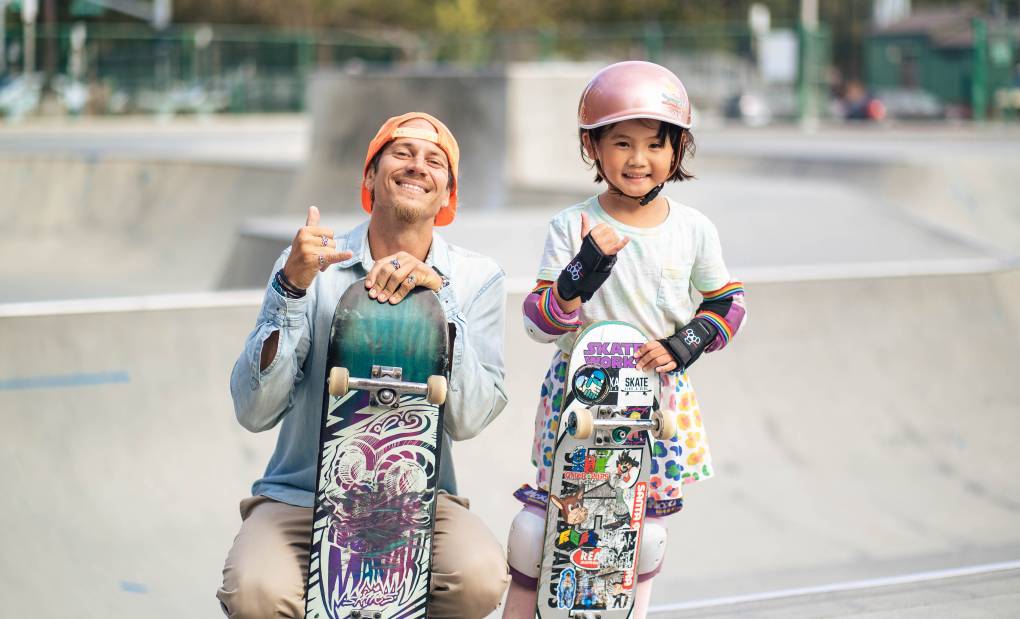
"caption": "Josh 'JB' Balogh and Grace Zheng during a skating lesson at Sunnyvale’s Fair Oaks Skate Park.",
"description": null,
"title": "Skatepark Lesson 08.26.22 -6",
"credit": "Joy Zheng",
"status": "inherit",
"altTag": "a man and a 6-year-old girl both pose holding skateboards at a skate park",
"isLoading": false,
"fetchFailed": false
},
"arts_13908961": {
"type": "attachments",
"id": "arts_13908961",
"meta": {
"index": "attachments_1716263798",
"site": "arts",
"id": "13908961",
"found": true
},
"parent": 13908947,
"imgSizes": {
"twentyfourteen-full-width": {
"file": "https://ww2.kqed.org/app/uploads/sites/2/2022/02/kinleaftea_main-1038x576.jpg",
"width": 1038,
"mimeType": "image/jpeg",
"height": 576
},
"thumbnail": {
"file": "https://ww2.kqed.org/app/uploads/sites/2/2022/02/kinleaftea_main-160x90.jpg",
"width": 160,
"mimeType": "image/jpeg",
"height": 90
},
"post-thumbnail": {
"file": "https://ww2.kqed.org/app/uploads/sites/2/2022/02/kinleaftea_main-672x372.jpg",
"width": 672,
"mimeType": "image/jpeg",
"height": 372
},
"kqedFullSize": {
"file": "https://ww2.kqed.org/app/uploads/sites/2/2022/02/kinleaftea_main-scaled.jpg",
"width": 2560,
"height": 1440
},
"2048x2048": {
"file": "https://ww2.kqed.org/app/uploads/sites/2/2022/02/kinleaftea_main-2048x1152.jpg",
"width": 2048,
"mimeType": "image/jpeg",
"height": 1152
},
"large": {
"file": "https://ww2.kqed.org/app/uploads/sites/2/2022/02/kinleaftea_main-1020x574.jpg",
"width": 1020,
"mimeType": "image/jpeg",
"height": 574
},
"1536x1536": {
"file": "https://ww2.kqed.org/app/uploads/sites/2/2022/02/kinleaftea_main-1536x864.jpg",
"width": 1536,
"mimeType": "image/jpeg",
"height": 864
},
"full-width": {
"file": "https://ww2.kqed.org/app/uploads/sites/2/2022/02/kinleaftea_main-1920x1080.jpg",
"width": 1920,
"mimeType": "image/jpeg",
"height": 1080
},
"medium": {
"file": "https://ww2.kqed.org/app/uploads/sites/2/2022/02/kinleaftea_main-800x450.jpg",
"width": 800,
"mimeType": "image/jpeg",
"height": 450
},
"medium_large": {
"file": "https://ww2.kqed.org/app/uploads/sites/2/2022/02/kinleaftea_main-768x432.jpg",
"width": 768,
"mimeType": "image/jpeg",
"height": 432
}
},
"publishDate": 1643926073,
"modified": 1643926228,
"caption": "For each of Kin Leaf's tea blends, Violet Diana Nguyen draws on memories from her Vietnamese American upbringing.",
"description": null,
"title": "kinleaftea_main",
"credit": "Violet Diana Nguyen",
"status": "inherit",
"altTag": "Kin Leaf Tea founder Violet Diana Nguyen poses with three canisters of her tea blends, in front of an ornamental fan.",
"isLoading": false,
"fetchFailed": false
},
"arts_13904839": {
"type": "attachments",
"id": "arts_13904839",
"meta": {
"index": "attachments_1716263798",
"site": "arts",
"id": "13904839",
"found": true
},
"parent": 13904835,
"imgSizes": {
"twentyfourteen-full-width": {
"file": "https://ww2.kqed.org/app/uploads/sites/2/2021/10/ThumbnailFeature-Image-San-Jose-Food-Project-1038x576.jpg",
"width": 1038,
"mimeType": "image/jpeg",
"height": 576
},
"thumbnail": {
"file": "https://ww2.kqed.org/app/uploads/sites/2/2021/10/ThumbnailFeature-Image-San-Jose-Food-Project-160x90.jpg",
"width": 160,
"mimeType": "image/jpeg",
"height": 90
},
"post-thumbnail": {
"file": "https://ww2.kqed.org/app/uploads/sites/2/2021/10/ThumbnailFeature-Image-San-Jose-Food-Project-672x372.jpg",
"width": 672,
"mimeType": "image/jpeg",
"height": 372
},
"kqedFullSize": {
"file": "https://ww2.kqed.org/app/uploads/sites/2/2021/10/ThumbnailFeature-Image-San-Jose-Food-Project.jpg",
"width": 1920,
"height": 1080
},
"large": {
"file": "https://ww2.kqed.org/app/uploads/sites/2/2021/10/ThumbnailFeature-Image-San-Jose-Food-Project-1020x574.jpg",
"width": 1020,
"mimeType": "image/jpeg",
"height": 574
},
"1536x1536": {
"file": "https://ww2.kqed.org/app/uploads/sites/2/2021/10/ThumbnailFeature-Image-San-Jose-Food-Project-1536x864.jpg",
"width": 1536,
"mimeType": "image/jpeg",
"height": 864
},
"medium": {
"file": "https://ww2.kqed.org/app/uploads/sites/2/2021/10/ThumbnailFeature-Image-San-Jose-Food-Project-800x450.jpg",
"width": 800,
"mimeType": "image/jpeg",
"height": 450
},
"medium_large": {
"file": "https://ww2.kqed.org/app/uploads/sites/2/2021/10/ThumbnailFeature-Image-San-Jose-Food-Project-768x432.jpg",
"width": 768,
"mimeType": "image/jpeg",
"height": 432
}
},
"publishDate": 1634678659,
"modified": 1634678815,
"caption": null,
"description": null,
"title": "{ThumbnailFeature Image} San Jose Food Project",
"credit": "Rebecca Kao",
"status": "inherit",
"altTag": "An illustration of various international foods such as pho and an Ethiopian veggie combo, with the following text overlaid: \"San Jose: The Bay Area's Great Immigrant Food City\"",
"isLoading": false,
"fetchFailed": false
},
"arts_13904840": {
"type": "attachments",
"id": "arts_13904840",
"meta": {
"index": "attachments_1716263798",
"site": "arts",
"id": "13904840",
"found": true
},
"parent": 13904835,
"imgSizes": {
"twentyfourteen-full-width": {
"file": "https://ww2.kqed.org/app/uploads/sites/2/2021/10/san-jose-illo_thien-pham-1038x576.jpg",
"width": 1038,
"mimeType": "image/jpeg",
"height": 576
},
"thumbnail": {
"file": "https://ww2.kqed.org/app/uploads/sites/2/2021/10/san-jose-illo_thien-pham-160x120.jpg",
"width": 160,
"mimeType": "image/jpeg",
"height": 120
},
"post-thumbnail": {
"file": "https://ww2.kqed.org/app/uploads/sites/2/2021/10/san-jose-illo_thien-pham-672x372.jpg",
"width": 672,
"mimeType": "image/jpeg",
"height": 372
},
"kqedFullSize": {
"file": "https://ww2.kqed.org/app/uploads/sites/2/2021/10/san-jose-illo_thien-pham-scaled.jpg",
"width": 2560,
"height": 1919
},
"2048x2048": {
"file": "https://ww2.kqed.org/app/uploads/sites/2/2021/10/san-jose-illo_thien-pham-2048x1535.jpg",
"width": 2048,
"mimeType": "image/jpeg",
"height": 1535
},
"large": {
"file": "https://ww2.kqed.org/app/uploads/sites/2/2021/10/san-jose-illo_thien-pham-1020x765.jpg",
"width": 1020,
"mimeType": "image/jpeg",
"height": 765
},
"1536x1536": {
"file": "https://ww2.kqed.org/app/uploads/sites/2/2021/10/san-jose-illo_thien-pham-1536x1151.jpg",
"width": 1536,
"mimeType": "image/jpeg",
"height": 1151
},
"full-width": {
"file": "https://ww2.kqed.org/app/uploads/sites/2/2021/10/san-jose-illo_thien-pham-1920x1439.jpg",
"width": 1920,
"mimeType": "image/jpeg",
"height": 1439
},
"medium": {
"file": "https://ww2.kqed.org/app/uploads/sites/2/2021/10/san-jose-illo_thien-pham-800x600.jpg",
"width": 800,
"mimeType": "image/jpeg",
"height": 600
},
"medium_large": {
"file": "https://ww2.kqed.org/app/uploads/sites/2/2021/10/san-jose-illo_thien-pham-768x576.jpg",
"width": 768,
"mimeType": "image/jpeg",
"height": 576
}
},
"publishDate": 1634679237,
"modified": 1634679456,
"caption": "\u003cem>(Illustration by Thien Pham)\u003c/em>",
"description": null,
"title": "san jose illo_thien pham",
"credit": null,
"status": "inherit",
"altTag": "An illustration of a spread of various international foods: a bowl of pho, a torta, an Ethiopian veggie combo plate, the cross section of a durian and so forth.",
"isLoading": false,
"fetchFailed": false
},
"arts_13858206": {
"type": "attachments",
"id": "arts_13858206",
"meta": {
"index": "attachments_1716263798",
"site": "arts",
"id": "13858206",
"found": true
},
"parent": 13857655,
"imgSizes": {
"twentyfourteen-full-width": {
"file": "https://ww2.kqed.org/app/uploads/sites/2/2019/05/SonsofKemet-1038x576.jpg",
"width": 1038,
"mimeType": "image/jpeg",
"height": 576
},
"thumbnail": {
"file": "https://ww2.kqed.org/app/uploads/sites/2/2019/05/SonsofKemet-160x90.jpg",
"width": 160,
"mimeType": "image/jpeg",
"height": 90
},
"post-thumbnail": {
"file": "https://ww2.kqed.org/app/uploads/sites/2/2019/05/SonsofKemet-672x372.jpg",
"width": 672,
"mimeType": "image/jpeg",
"height": 372
},
"kqedFullSize": {
"file": "https://ww2.kqed.org/app/uploads/sites/2/2019/05/SonsofKemet.jpg",
"width": 1182,
"height": 665
},
"large": {
"file": "https://ww2.kqed.org/app/uploads/sites/2/2019/05/SonsofKemet-1020x574.jpg",
"width": 1020,
"mimeType": "image/jpeg",
"height": 574
},
"medium": {
"file": "https://ww2.kqed.org/app/uploads/sites/2/2019/05/SonsofKemet-800x450.jpg",
"width": 800,
"mimeType": "image/jpeg",
"height": 450
},
"medium_large": {
"file": "https://ww2.kqed.org/app/uploads/sites/2/2019/05/SonsofKemet-768x432.jpg",
"width": 768,
"mimeType": "image/jpeg",
"height": 432
}
},
"publishDate": 1558723800,
"modified": 1558724035,
"caption": "British jazz sensations Sons of Kemet perform at this year's San Jose Jazz Summer Fest.",
"description": "British jazz sensations Sons of Kemet perform at this year's San Jose Jazz Summer Fest.",
"title": "SonsofKemet",
"credit": "Courtesy Sons of Kemet",
"status": "inherit",
"isLoading": false,
"fetchFailed": false
},
"arts_13833667": {
"type": "attachments",
"id": "arts_13833667",
"meta": {
"index": "attachments_1716263798",
"site": "arts",
"id": "13833667",
"found": true
},
"parent": 13833349,
"imgSizes": {
"small": {
"file": "https://ww2.kqed.org/app/uploads/sites/2/2018/05/Sonido-Clash-Fest-2017-Sister-Mantos-Cred-Samuel-Reyes-1-520x293.jpg",
"width": 520,
"mimeType": "image/jpeg",
"height": 293
},
"twentyfourteen-full-width": {
"file": "https://ww2.kqed.org/app/uploads/sites/2/2018/05/Sonido-Clash-Fest-2017-Sister-Mantos-Cred-Samuel-Reyes-1-1038x576.jpg",
"width": 1038,
"mimeType": "image/jpeg",
"height": 576
},
"thumbnail": {
"file": "https://ww2.kqed.org/app/uploads/sites/2/2018/05/Sonido-Clash-Fest-2017-Sister-Mantos-Cred-Samuel-Reyes-1-160x90.jpg",
"width": 160,
"mimeType": "image/jpeg",
"height": 90
},
"fd-sm": {
"file": "https://ww2.kqed.org/app/uploads/sites/2/2018/05/Sonido-Clash-Fest-2017-Sister-Mantos-Cred-Samuel-Reyes-1-960x540.jpg",
"width": 960,
"mimeType": "image/jpeg",
"height": 540
},
"post-thumbnail": {
"file": "https://ww2.kqed.org/app/uploads/sites/2/2018/05/Sonido-Clash-Fest-2017-Sister-Mantos-Cred-Samuel-Reyes-1-672x372.jpg",
"width": 672,
"mimeType": "image/jpeg",
"height": 372
},
"xsmall": {
"file": "https://ww2.kqed.org/app/uploads/sites/2/2018/05/Sonido-Clash-Fest-2017-Sister-Mantos-Cred-Samuel-Reyes-1-375x211.jpg",
"width": 375,
"mimeType": "image/jpeg",
"height": 211
},
"kqedFullSize": {
"file": "https://ww2.kqed.org/app/uploads/sites/2/2018/05/Sonido-Clash-Fest-2017-Sister-Mantos-Cred-Samuel-Reyes-1.jpg",
"width": 1920,
"height": 1080
},
"large": {
"file": "https://ww2.kqed.org/app/uploads/sites/2/2018/05/Sonido-Clash-Fest-2017-Sister-Mantos-Cred-Samuel-Reyes-1-1020x574.jpg",
"width": 1020,
"mimeType": "image/jpeg",
"height": 574
},
"xlarge": {
"file": "https://ww2.kqed.org/app/uploads/sites/2/2018/05/Sonido-Clash-Fest-2017-Sister-Mantos-Cred-Samuel-Reyes-1-1180x664.jpg",
"width": 1180,
"mimeType": "image/jpeg",
"height": 664
},
"complete_open_graph": {
"file": "https://ww2.kqed.org/app/uploads/sites/2/2018/05/Sonido-Clash-Fest-2017-Sister-Mantos-Cred-Samuel-Reyes-1-1200x675.jpg",
"width": 1200,
"mimeType": "image/jpeg",
"height": 675
},
"guest-author-50": {
"file": "https://ww2.kqed.org/app/uploads/sites/2/2018/05/Sonido-Clash-Fest-2017-Sister-Mantos-Cred-Samuel-Reyes-1-50x50.jpg",
"width": 50,
"mimeType": "image/jpeg",
"height": 50
},
"guest-author-96": {
"file": "https://ww2.kqed.org/app/uploads/sites/2/2018/05/Sonido-Clash-Fest-2017-Sister-Mantos-Cred-Samuel-Reyes-1-96x96.jpg",
"width": 96,
"mimeType": "image/jpeg",
"height": 96
},
"medium": {
"file": "https://ww2.kqed.org/app/uploads/sites/2/2018/05/Sonido-Clash-Fest-2017-Sister-Mantos-Cred-Samuel-Reyes-1-800x450.jpg",
"width": 800,
"mimeType": "image/jpeg",
"height": 450
},
"guest-author-64": {
"file": "https://ww2.kqed.org/app/uploads/sites/2/2018/05/Sonido-Clash-Fest-2017-Sister-Mantos-Cred-Samuel-Reyes-1-64x64.jpg",
"width": 64,
"mimeType": "image/jpeg",
"height": 64
},
"guest-author-32": {
"file": "https://ww2.kqed.org/app/uploads/sites/2/2018/05/Sonido-Clash-Fest-2017-Sister-Mantos-Cred-Samuel-Reyes-1-32x32.jpg",
"width": 32,
"mimeType": "image/jpeg",
"height": 32
},
"fd-lrg": {
"file": "https://ww2.kqed.org/app/uploads/sites/2/2018/05/Sonido-Clash-Fest-2017-Sister-Mantos-Cred-Samuel-Reyes-1-1920x1080.jpg",
"width": 1920,
"mimeType": "image/jpeg",
"height": 1080
},
"fd-med": {
"file": "https://ww2.kqed.org/app/uploads/sites/2/2018/05/Sonido-Clash-Fest-2017-Sister-Mantos-Cred-Samuel-Reyes-1-1180x664.jpg",
"width": 1180,
"mimeType": "image/jpeg",
"height": 664
},
"full-width": {
"file": "https://ww2.kqed.org/app/uploads/sites/2/2018/05/Sonido-Clash-Fest-2017-Sister-Mantos-Cred-Samuel-Reyes-1-1920x1080.jpg",
"width": 1920,
"mimeType": "image/jpeg",
"height": 1080
},
"detail": {
"file": "https://ww2.kqed.org/app/uploads/sites/2/2018/05/Sonido-Clash-Fest-2017-Sister-Mantos-Cred-Samuel-Reyes-1-150x150.jpg",
"width": 150,
"mimeType": "image/jpeg",
"height": 150
},
"medium_large": {
"file": "https://ww2.kqed.org/app/uploads/sites/2/2018/05/Sonido-Clash-Fest-2017-Sister-Mantos-Cred-Samuel-Reyes-1-768x432.jpg",
"width": 768,
"mimeType": "image/jpeg",
"height": 432
},
"guest-author-128": {
"file": "https://ww2.kqed.org/app/uploads/sites/2/2018/05/Sonido-Clash-Fest-2017-Sister-Mantos-Cred-Samuel-Reyes-1-128x128.jpg",
"width": 128,
"mimeType": "image/jpeg",
"height": 128
},
"xxsmall": {
"file": "https://ww2.kqed.org/app/uploads/sites/2/2018/05/Sonido-Clash-Fest-2017-Sister-Mantos-Cred-Samuel-Reyes-1-240x135.jpg",
"width": 240,
"mimeType": "image/jpeg",
"height": 135
}
},
"publishDate": 1527620487,
"modified": 1527620572,
"caption": "Sister Mantos perform at Sonido Clash 2017.",
"description": "Sister Mantos perform at Sonido Clash 2017.",
"title": "Sonido-Clash-Fest-2017-Sister-Mantos-Cred-Samuel-Reyes",
"credit": "Samuel Reyes",
"status": "inherit",
"isLoading": false,
"fetchFailed": false
},
"arts_13808628": {
"type": "attachments",
"id": "arts_13808628",
"meta": {
"index": "attachments_1716263798",
"site": "arts",
"id": "13808628",
"found": true
},
"parent": 13808627,
"imgSizes": {
"small": {
"file": "https://ww2.kqed.org/app/uploads/sites/2/2017/09/RS26520_DAVE_SANDERS-2-520x293.jpg",
"width": 520,
"mimeType": "image/jpeg",
"height": 293
},
"twentyfourteen-full-width": {
"file": "https://ww2.kqed.org/app/uploads/sites/2/2017/09/RS26520_DAVE_SANDERS-2-1038x576.jpg",
"width": 1038,
"mimeType": "image/jpeg",
"height": 576
},
"thumbnail": {
"file": "https://ww2.kqed.org/app/uploads/sites/2/2017/09/RS26520_DAVE_SANDERS-2-160x90.jpg",
"width": 160,
"mimeType": "image/jpeg",
"height": 90
},
"fd-sm": {
"file": "https://ww2.kqed.org/app/uploads/sites/2/2017/09/RS26520_DAVE_SANDERS-2-960x540.jpg",
"width": 960,
"mimeType": "image/jpeg",
"height": 540
},
"post-thumbnail": {
"file": "https://ww2.kqed.org/app/uploads/sites/2/2017/09/RS26520_DAVE_SANDERS-2-672x372.jpg",
"width": 672,
"mimeType": "image/jpeg",
"height": 372
},
"xsmall": {
"file": "https://ww2.kqed.org/app/uploads/sites/2/2017/09/RS26520_DAVE_SANDERS-2-375x211.jpg",
"width": 375,
"mimeType": "image/jpeg",
"height": 211
},
"kqedFullSize": {
"file": "https://ww2.kqed.org/app/uploads/sites/2/2017/09/RS26520_DAVE_SANDERS-2.jpg",
"width": 3840,
"height": 2160
},
"large": {
"file": "https://ww2.kqed.org/app/uploads/sites/2/2017/09/RS26520_DAVE_SANDERS-2-1020x574.jpg",
"width": 1020,
"mimeType": "image/jpeg",
"height": 574
},
"xlarge": {
"file": "https://ww2.kqed.org/app/uploads/sites/2/2017/09/RS26520_DAVE_SANDERS-2-1180x664.jpg",
"width": 1180,
"mimeType": "image/jpeg",
"height": 664
},
"guest-author-50": {
"file": "https://ww2.kqed.org/app/uploads/sites/2/2017/09/RS26520_DAVE_SANDERS-2-50x50.jpg",
"width": 50,
"mimeType": "image/jpeg",
"height": 50
},
"guest-author-96": {
"file": "https://ww2.kqed.org/app/uploads/sites/2/2017/09/RS26520_DAVE_SANDERS-2-96x96.jpg",
"width": 96,
"mimeType": "image/jpeg",
"height": 96
},
"medium": {
"file": "https://ww2.kqed.org/app/uploads/sites/2/2017/09/RS26520_DAVE_SANDERS-2-800x450.jpg",
"width": 800,
"mimeType": "image/jpeg",
"height": 450
},
"guest-author-64": {
"file": "https://ww2.kqed.org/app/uploads/sites/2/2017/09/RS26520_DAVE_SANDERS-2-64x64.jpg",
"width": 64,
"mimeType": "image/jpeg",
"height": 64
},
"guest-author-32": {
"file": "https://ww2.kqed.org/app/uploads/sites/2/2017/09/RS26520_DAVE_SANDERS-2-32x32.jpg",
"width": 32,
"mimeType": "image/jpeg",
"height": 32
},
"fd-lrg": {
"file": "https://ww2.kqed.org/app/uploads/sites/2/2017/09/RS26520_DAVE_SANDERS-2-1920x1080.jpg",
"width": 1920,
"mimeType": "image/jpeg",
"height": 1080
},
"fd-med": {
"file": "https://ww2.kqed.org/app/uploads/sites/2/2017/09/RS26520_DAVE_SANDERS-2-1180x664.jpg",
"width": 1180,
"mimeType": "image/jpeg",
"height": 664
},
"full-width": {
"file": "https://ww2.kqed.org/app/uploads/sites/2/2017/09/RS26520_DAVE_SANDERS-2-1920x1080.jpg",
"width": 1920,
"mimeType": "image/jpeg",
"height": 1080
},
"detail": {
"file": "https://ww2.kqed.org/app/uploads/sites/2/2017/09/RS26520_DAVE_SANDERS-2-150x150.jpg",
"width": 150,
"mimeType": "image/jpeg",
"height": 150
},
"medium_large": {
"file": "https://ww2.kqed.org/app/uploads/sites/2/2017/09/RS26520_DAVE_SANDERS-2-768x432.jpg",
"width": 768,
"mimeType": "image/jpeg",
"height": 432
},
"guest-author-128": {
"file": "https://ww2.kqed.org/app/uploads/sites/2/2017/09/RS26520_DAVE_SANDERS-2-128x128.jpg",
"width": 128,
"mimeType": "image/jpeg",
"height": 128
},
"xxsmall": {
"file": "https://ww2.kqed.org/app/uploads/sites/2/2017/09/RS26520_DAVE_SANDERS-2-240x135.jpg",
"width": 240,
"mimeType": "image/jpeg",
"height": 135
}
},
"publishDate": 1505455508,
"modified": 1505455898,
"caption": "Dave Sanders doesn’t regret his willingness to enlist. \"We did what our country wanted - the military portion of our country and the politicians. But, you know, the more I know, the sadder I get.\"",
"description": "Dave Sanders doesn’t regret his willingness to enlist. \"We did what our country wanted - the military portion of our country and the politicians. But, you know, the more I know, the sadder I get.\"",
"title": "RS26520_DAVE_SANDERS-2",
"credit": "Courtesy of Thomas Sanders",
"status": "inherit",
"isLoading": false,
"fetchFailed": false
}
},
"audioPlayerReducer": {
"postId": "stream_live",
"isPaused": true,
"isPlaying": false,
"pfsActive": false,
"pledgeModalIsOpen": true,
"playerDrawerIsOpen": false,
"liveAudioPlayStartedAt": 0,
"liveAudioPlayContext": ""
},
"authorsReducer": {
"byline_arts_13908947": {
"type": "authors",
"id": "byline_arts_13908947",
"meta": {
"override": true
},
"slug": "byline_arts_13908947",
"name": "Anthony Shu",
"isLoading": false
},
"rachael-myrow": {
"type": "authors",
"id": "251",
"meta": {
"index": "authors_1716337520",
"id": "251",
"found": true
},
"name": "Rachael Myrow",
"firstName": "Rachael",
"lastName": "Myrow",
"slug": "rachael-myrow",
"email": "rmyrow@kqed.org",
"display_author_email": true,
"staff_mastheads": [
"news"
],
"title": "Senior Editor of KQED's Silicon Valley News Desk",
"bio": "• I write and edit stories about how Silicon Valley power and policies shape everyday life in California. I’m also passionate about making Bay Area history and culture more accessible to a broad public. • I’ve been a journalist for most of my life, starting in high school with The Franklin Press in Los Angeles, where I grew up. While earning my first degree in English at UC Berkeley, I got my start in public radio at KALX-FM. After completing a second degree in journalism at Cal, I landed my first professional job at Marketplace, then moved on to KPCC (now LAist), and then KQED, where I hosted The California Report for more than seven years. • My reporting has appeared on NPR, The World, WBUR’s \u003ci>Here & Now\u003c/i>, and the BBC. I also guest host for KQED’s \u003ci>Forum\u003c/i>, as well as the Commonwealth Club in San Francisco. • I speak periodically on media, democracy and technology issues, and do voiceover work for documentaries and educational video projects. • Outside of the studio, you'll find me hiking Bay Area trails and whipping up Insta-ready meals in my kitchen. • I do not accept gifts, money, or favors from anyone connected to my reporting, I don't pay people for information, and I do not support or donate to political causes. • I strive to treat the people I report on with fairness, honesty, and respect. I also recognize there are often multiple sides to a story and work to verify information through multiple sources and documentation. If I get something wrong, I correct it.",
"avatar": "https://secure.gravatar.com/avatar/3ed8a3c5f26025e4a805ba634cda8cd764906b97438a6d9ce216b044e340da4e?s=600&d=blank&r=g",
"twitter": "rachaelmyrow",
"bluesky": null,
"facebook": null,
"instagram": null,
"linkedin": "https://www.linkedin.com/in/rachaelmyrow/",
"sites": [
{
"site": "arts",
"roles": [
"administrator"
]
},
{
"site": "news",
"roles": [
"edit_others_posts",
"editor"
]
},
{
"site": "futureofyou",
"roles": [
"editor"
]
},
{
"site": "bayareabites",
"roles": [
"editor"
]
},
{
"site": "stateofhealth",
"roles": [
"editor"
]
},
{
"site": "science",
"roles": [
"editor"
]
},
{
"site": "food",
"roles": [
"editor"
]
},
{
"site": "forum",
"roles": [
"editor"
]
},
{
"site": "liveblog",
"roles": [
"author"
]
}
],
"headData": {
"title": "Rachael Myrow | KQED",
"description": "Senior Editor of KQED's Silicon Valley News Desk",
"ogImgSrc": "https://secure.gravatar.com/avatar/3ed8a3c5f26025e4a805ba634cda8cd764906b97438a6d9ce216b044e340da4e?s=600&d=blank&r=g",
"twImgSrc": "https://secure.gravatar.com/avatar/3ed8a3c5f26025e4a805ba634cda8cd764906b97438a6d9ce216b044e340da4e?s=600&d=blank&r=g"
},
"isLoading": false,
"link": "/author/rachael-myrow"
},
"broos": {
"type": "authors",
"id": "3250",
"meta": {
"index": "authors_1716337520",
"id": "3250",
"found": true
},
"name": "Brandon Roos",
"firstName": "Brandon",
"lastName": "Roos",
"slug": "broos",
"email": "roos.b@sbcglobal.net",
"display_author_email": false,
"staff_mastheads": [],
"title": null,
"bio": null,
"avatar": "https://secure.gravatar.com/avatar/d3dd0b201284955bebf9395b371d1ad4?s=600&d=blank&r=g",
"twitter": null,
"facebook": null,
"instagram": null,
"linkedin": null,
"sites": [
{
"site": "arts",
"roles": [
"contributor"
]
}
],
"headData": {
"title": "Brandon Roos | KQED",
"description": null,
"ogImgSrc": "https://secure.gravatar.com/avatar/d3dd0b201284955bebf9395b371d1ad4?s=600&d=blank&r=g",
"twImgSrc": "https://secure.gravatar.com/avatar/d3dd0b201284955bebf9395b371d1ad4?s=600&d=blank&r=g"
},
"isLoading": false,
"link": "/author/broos"
},
"ogpenn": {
"type": "authors",
"id": "11491",
"meta": {
"index": "authors_1716337520",
"id": "11491",
"found": true
},
"name": "Pendarvis Harshaw",
"firstName": "Pendarvis",
"lastName": "Harshaw",
"slug": "ogpenn",
"email": "ogpenn@gmail.com",
"display_author_email": false,
"staff_mastheads": [
"arts"
],
"title": "Community Engagement Reporter",
"bio": "Pendarvis Harshaw is an educator, host and writer with KQED Arts.",
"avatar": "https://secure.gravatar.com/avatar/972b77ee8e3f346ae2b00622661187fbfabd059b5693bbdc1475ea7a722fd4cd?s=600&d=blank&r=g",
"twitter": null,
"bluesky": null,
"facebook": null,
"instagram": "ogpenn",
"linkedin": null,
"sites": [
{
"site": "arts",
"roles": [
"administrator"
]
},
{
"site": "news",
"roles": [
"editor"
]
},
{
"site": "bayareabites",
"roles": [
"author"
]
},
{
"site": "hiphop",
"roles": [
"editor"
]
}
],
"headData": {
"title": "Pendarvis Harshaw | KQED",
"description": "Community Engagement Reporter",
"ogImgSrc": "https://secure.gravatar.com/avatar/972b77ee8e3f346ae2b00622661187fbfabd059b5693bbdc1475ea7a722fd4cd?s=600&d=blank&r=g",
"twImgSrc": "https://secure.gravatar.com/avatar/972b77ee8e3f346ae2b00622661187fbfabd059b5693bbdc1475ea7a722fd4cd?s=600&d=blank&r=g"
},
"isLoading": false,
"link": "/author/ogpenn"
},
"mmedina": {
"type": "authors",
"id": "11528",
"meta": {
"index": "authors_1716337520",
"id": "11528",
"found": true
},
"name": "Marisol Medina-Cadena",
"firstName": "Marisol",
"lastName": "Medina-Cadena",
"slug": "mmedina",
"email": "mmedina@KQED.org",
"display_author_email": true,
"staff_mastheads": [],
"title": "Producer, Rightnowish Podcast",
"bio": "Marisol Medina-Cadena is a radio reporter and podcast producer. Before working at KQED, she produced for PBS member station, KCET, in Los Angeles. In 2017, Marisol won an Emmy Award for her work on the televised documentary, \u003cem>City Rising\u003c/em>, examining California's affordable housing crisis and the historical roots of gentrification.",
"avatar": "https://secure.gravatar.com/avatar/6c3db46a1cabb5e1fe9a365b5f4e681e?s=600&d=blank&r=g",
"twitter": "marisolreports",
"facebook": null,
"instagram": null,
"linkedin": null,
"sites": [
{
"site": "arts",
"roles": []
},
{
"site": "news",
"roles": [
"edit_others_posts"
]
}
],
"headData": {
"title": "Marisol Medina-Cadena | KQED",
"description": "Producer, Rightnowish Podcast",
"ogImgSrc": "https://secure.gravatar.com/avatar/6c3db46a1cabb5e1fe9a365b5f4e681e?s=600&d=blank&r=g",
"twImgSrc": "https://secure.gravatar.com/avatar/6c3db46a1cabb5e1fe9a365b5f4e681e?s=600&d=blank&r=g"
},
"isLoading": false,
"link": "/author/mmedina"
},
"ltsai": {
"type": "authors",
"id": "11743",
"meta": {
"index": "authors_1716337520",
"id": "11743",
"found": true
},
"name": "Luke Tsai",
"firstName": "Luke",
"lastName": "Tsai",
"slug": "ltsai",
"email": "ltsai@kqed.org",
"display_author_email": true,
"staff_mastheads": [
"arts"
],
"title": "Food Editor",
"bio": "Luke Tsai is KQED's food editor and resident stinky tofu connoisseur. Prior to KQED, he was an editor at Eater SF, \u003cem>San Francisco \u003c/em>magazine, and the \u003cem>East Bay Express\u003c/em>, and his work has also appeared in TASTE, the \u003cem>San Francisco Chronicle\u003c/em>, and the \u003cem>Best Food Writing\u003c/em> anthology. When he isn't writing or editing, you'll find him eating most everything he can get his hands on.",
"avatar": "https://secure.gravatar.com/avatar/1e59b45bf191526e7339d6ba46e33a57b2030d25c27660ecc64ea3cb863e34f7?s=600&d=blank&r=g",
"twitter": "theluketsai",
"bluesky": null,
"facebook": null,
"instagram": null,
"linkedin": null,
"sites": [
{
"site": "",
"roles": [
"editor"
]
},
{
"site": "arts",
"roles": [
"administrator"
]
},
{
"site": "news",
"roles": [
"editor",
"contributor"
]
},
{
"site": "bayareabites",
"roles": [
"editor"
]
},
{
"site": "food",
"roles": [
"editor"
]
}
],
"headData": {
"title": "Luke Tsai | KQED",
"description": "Food Editor",
"ogImgSrc": "https://secure.gravatar.com/avatar/1e59b45bf191526e7339d6ba46e33a57b2030d25c27660ecc64ea3cb863e34f7?s=600&d=blank&r=g",
"twImgSrc": "https://secure.gravatar.com/avatar/1e59b45bf191526e7339d6ba46e33a57b2030d25c27660ecc64ea3cb863e34f7?s=600&d=blank&r=g"
},
"isLoading": false,
"link": "/author/ltsai"
},
"vchung": {
"type": "authors",
"id": "11827",
"meta": {
"index": "authors_1716337520",
"id": "11827",
"found": true
},
"name": "Vicky Chung",
"firstName": "Victoria",
"lastName": "Chung",
"slug": "vchung",
"email": "vchung@kqed.org",
"display_author_email": false,
"staff_mastheads": [],
"title": "KQED Contributor",
"bio": "Vicky Chung is a social media associate for KQED. Born and raised in the Bay Area, she graduated with a B.A. in Communication Studies and a minor in Radio-Television-Film from San Jose State University. When she isn't binge-watching baking shows, you'll find her at an indie or pop concert.",
"avatar": "https://secure.gravatar.com/avatar/ed74ab7df687fc80491d49a97d157ca5?s=600&d=blank&r=g",
"twitter": "coldpizzasIice",
"facebook": null,
"instagram": null,
"linkedin": null,
"sites": [
{
"site": "arts",
"roles": [
"contributor"
]
}
],
"headData": {
"title": "Vicky Chung | KQED",
"description": "KQED Contributor",
"ogImgSrc": "https://secure.gravatar.com/avatar/ed74ab7df687fc80491d49a97d157ca5?s=600&d=blank&r=g",
"twImgSrc": "https://secure.gravatar.com/avatar/ed74ab7df687fc80491d49a97d157ca5?s=600&d=blank&r=g"
},
"isLoading": false,
"link": "/author/vchung"
}
},
"pagesReducer": {
"arts_tag_south-bay": {
"type": "terms",
"id": "arts_2475",
"meta": {
"index": "terms_1716263798",
"site": "arts",
"id": "2475",
"score": 7.0871468
},
"featImg": null,
"name": "South Bay",
"description": null,
"taxonomy": "tag",
"headData": {
"twImgId": null,
"twTitle": null,
"ogTitle": null,
"ogImgId": null,
"twDescription": null,
"description": null,
"title": "South Bay Archives | KQED Arts",
"ogDescription": null
},
"ttid": 2487,
"slug": "south-bay",
"isLoading": false,
"title": "South Bay",
"pageMeta": {
"site": "arts",
"WpPageTemplate": "page-topic-editorial",
"currentPage": 3
},
"blocks": [
{
"blockName": "kqed/post-list",
"attrs": {
"layout": "cardArticle2",
"query": "posts/arts?tag=south-bay",
"seeMore": false,
"paginated": true,
"page": 3
}
},
{
"blockName": "kqed/ad"
}
]
}
},
"pfsSessionReducer": {},
"postsReducer": {
"stream_live": {
"type": "live",
"id": "stream_live",
"audioUrl": "https://hls.kqed.org/hls/kqed_app/playlist.m3u8",
"title": "Live Stream",
"excerpt": "Live Stream information currently unavailable.",
"link": "/radio",
"featImg": "",
"label": {
"name": "KQED Live",
"link": "/"
}
},
"stream_kqedNewscast": {
"type": "posts",
"id": "stream_kqedNewscast",
"audioUrl": "https://www.kqed.org/.stream/anon/radio/RDnews/newscast.mp3?_=1",
"title": "KQED Newscast",
"featImg": "",
"label": {
"name": "88.5 FM",
"link": "/"
}
},
"arts_13926026": {
"type": "posts",
"id": "arts_13926026",
"meta": {
"index": "posts_1716263798",
"site": "arts",
"id": "13926026",
"score": null,
"sort": [
1678446043000
]
},
"guestAuthors": [],
"slug": "from-the-soil-juristac",
"title": "From The Soil: Protecting Sacred Land In The South Bay",
"publishDate": 1678446043,
"format": "audio",
"headTitle": "From The Soil: Protecting Sacred Land In The South Bay | KQED",
"labelTerm": {
"term": 8720,
"site": "arts"
},
"content": "\u003cp>At the southern edge of the South Bay in Santa Clara County, where the foothills of the Santa Cruz Mountains meet the town of Gilroy, there is a grassy pasture. Here, a small stream runs through acres of land while cattle graze and birds fly above.\u003c/p>\n\u003cp>This piece of land is a proposed mining site—but it’s also traditional ceremonial ground for the \u003ca href=\"https://amahmutsun.org/\" target=\"_blank\" rel=\"noopener\">Amah Mutsun Tribal Band\u003c/a>.\u003c/p>\n\u003cp>For over 200 years, the Amah Mutsun have been unable to access one of their most sacred sites, known as \u003ca href=\"https://www.protectjuristac.org/about/\">Juristac.\u003c/a>\u003c/p>\n\u003cp>\u003cspan style=\"font-weight: 400\">“Juristac translates to the place of the Big Head. \u003c/span>\u003cspan style=\"font-weight: 400\">Our most important ceremonies were Big Head ceremonies. And so this location is where our ancestors, for thousands and thousands of years, held Big Head dances and ceremony,” says Valentin Lopez, chairman of the Amah Mutsun Tribal Band.\u003c/span>\u003c/p>\n\u003cp>For the last seven years the tribal band has organized support from the local community, religious leaders, conservation groups and nearby city councils to stand in support against the development of the Sargent Quarry project, a proposal to use the land for mining purposes.\u003c/p>\n\u003cfigure id=\"attachment_13926062\" class=\"wp-caption alignnone\" style=\"max-width: 800px\">\u003cimg loading=\"lazy\" decoding=\"async\" class=\"wp-image-13926062 size-medium\" src=\"https://ww2.kqed.org/app/uploads/sites/2/2023/03/DSC05038-800x533.jpg\" alt=\"A view of Juristac's grassy fields with a stream running through it and cows grazing amongst rolling hills in the distance.\" width=\"800\" height=\"533\" srcset=\"https://cdn.kqed.org/wp-content/uploads/sites/2/2023/03/DSC05038-800x533.jpg 800w, https://cdn.kqed.org/wp-content/uploads/sites/2/2023/03/DSC05038-1020x680.jpg 1020w, https://cdn.kqed.org/wp-content/uploads/sites/2/2023/03/DSC05038-160x107.jpg 160w, https://cdn.kqed.org/wp-content/uploads/sites/2/2023/03/DSC05038-768x512.jpg 768w, https://cdn.kqed.org/wp-content/uploads/sites/2/2023/03/DSC05038-1536x1024.jpg 1536w, https://cdn.kqed.org/wp-content/uploads/sites/2/2023/03/DSC05038-2048x1365.jpg 2048w, https://cdn.kqed.org/wp-content/uploads/sites/2/2023/03/DSC05038-1920x1280.jpg 1920w\" sizes=\"(max-width: 800px) 100vw, 800px\">\u003cfigcaption class=\"wp-caption-text\">Juristac’s grasslands, oak woodland, freshwater ponds and streams offer vital habitat for an array of species. \u003ccite>(Pendarvis Harshaw)\u003c/cite>\u003c/figcaption>\u003c/figure>\n\u003cp>The Santa Clara Board of Supervisors is currently reviewing the proposed mining project’s \u003ca href=\"https://plandev.sccgov.org/policies-programs/smara/sargent\">environmental impact report\u003c/a>.\u003c/p>\n\u003cp>This week we hear from Valentin Lopez , the tribal chairman of the Amah Mutsun, speak about the historical and spiritual significance of Juristac, and the movement to protect the land for the Amah Mutsun.\u003c/p>\n\u003cp>\u003c!-- iframe plugin v.4.3 wordpress.org/plugins/iframe/ -->\u003cbr>\n\u003ciframe loading=\"lazy\" frameborder=\"0\" height=\"200\" scrolling=\"no\" src=\"https://playlist.megaphone.fm/?e=KQINC1911012959\" width=\"100%\" class=\"iframe-class\">\u003c/iframe>\u003c/p>\n\u003cp>\u003ca href=\"http://bit.ly/3J6DGQJ\">Read the episode transcript.\u003c/a>\u003c/p>\n\u003cp>\u003cem>Below are lightly edited excerpts of our conversation with Valentin Lopez. \u003c/em>\u003c/p>\n\u003cp>\u003cstrong>\u003cem>Marisol: The proposed plans for this mining project include making three open-pit quarries that would extend 250 feet deep in order to remove sand and gravel from this site, for the next 30 years. On a personal level, what did it feel like when you first heard about this private firm wanting to develop a mine? \u003c/em>\u003c/strong>\u003c/p>\n\u003cp>Valentin\u003cspan style=\"font-weight: 400\">: When we see this mining permit come in, we say that this is just the continuation of that brutality, that erasure, that destruction of the Amah Mutsun. \u003c/span>\u003cspan style=\"font-weight: 400\">When you look at our history in those periods of colonization, there were actually three periods of very brutal, brutal colonization in which the populations of our tribe was reduced by 96% to 98%.\u003c/span>\u003c/p>\n\u003cp>\u003cspan style=\"font-weight: 400\">The Spanish mission period, the Mexican period, and then the American California period. You know, all three of those periods wanted to destroy our spirituality. They wanted to destroy our culture. They wanted to destroy our Indigenous knowledge. They wanted to destroy our environments. F\u003c/span>\u003cspan style=\"font-weight: 400\">or example, just to the east of here, there were four natural lakes. We had seven villages at those four lakes and we had large populations at those lakes. But, they drained those lakes for agriculture. \u003c/span>\u003c/p>\n\u003cp>\u003cem>\u003cstrong>Marisol: What is like the ideal scenario to happen here? How do you want this land to be used? \u003c/strong>\u003c/em>\u003c/p>\n\u003cp>\u003cspan style=\"font-weight: 400\">Valentin: Well, the most important thing is to stop the mining permit from being approved. And then after that, finding a way for the conservation organizations to somehow come into possession of the lands so that we can ensure that it’s never again threatened by any development. \u003c/span>\u003c/p>\n\u003cp>\u003cspan style=\"font-weight: 400\">But then beyond that, we would like our tribe to have rights to return to these lands for ceremony, for managing and stewarding the land so that we can bring back our food plants and our medicine plants. But a\u003c/span>\u003cspan style=\"font-weight: 400\">lso education of the public to let them know about the true history of Amah Mutsun and the true history of Native American tribes in California.\u003c/span>\u003c/p>\n\u003cp>\u003cem>\u003cstrong>Marisol: How do you keep motivated to fight this long fight? \u003c/strong>\u003c/em>\u003c/p>\n\u003cp>\u003cspan style=\"font-weight: 400\">Valentin: I see the way that the one, two or three generations before me and what they had to deal with and the conditions they had to live in. \u003c/span>And I see the impact of the historic trauma that resulted from that history has impacted our members.\u003c/p>\n\u003cp>\u003cspan style=\"font-weight: 400\">For us to accept the laws of the county that allow them to destroy our most sacred site with the mining permit, we can’t accept that. \u003c/span>To allow them to have laws that they continue to keep us landless, to keep us in poverty, we can’t accept that.\u003c/p>\n\u003cfigure id=\"attachment_13926029\" class=\"wp-caption aligncenter\" style=\"max-width: 800px\">\u003cimg loading=\"lazy\" decoding=\"async\" class=\"wp-image-13926029 size-medium\" src=\"https://ww2.kqed.org/app/uploads/sites/2/2023/03/DSC05045-800x533.jpg\" alt=\"Amah Mutsun tribal chair leader Valentin Lopez looks at a green pasture where cattle graze on either side of a small stream; this is a sacred site for the tribe known as Juristac. \" width=\"800\" height=\"533\" srcset=\"https://cdn.kqed.org/wp-content/uploads/sites/2/2023/03/DSC05045-800x533.jpg 800w, https://cdn.kqed.org/wp-content/uploads/sites/2/2023/03/DSC05045-1020x680.jpg 1020w, https://cdn.kqed.org/wp-content/uploads/sites/2/2023/03/DSC05045-160x107.jpg 160w, https://cdn.kqed.org/wp-content/uploads/sites/2/2023/03/DSC05045-768x512.jpg 768w, https://cdn.kqed.org/wp-content/uploads/sites/2/2023/03/DSC05045-1536x1024.jpg 1536w, https://cdn.kqed.org/wp-content/uploads/sites/2/2023/03/DSC05045-2048x1365.jpg 2048w, https://cdn.kqed.org/wp-content/uploads/sites/2/2023/03/DSC05045-1920x1280.jpg 1920w\" sizes=\"(max-width: 800px) 100vw, 800px\">\u003cfigcaption class=\"wp-caption-text\">Amah Mutsun tribal chair leader Valentin Lopez looks at a green pasture where cattle graze on either side of a small stream; this is a sacred site known as Juristac. \u003ccite>(Pendarvis Harshaw)\u003c/cite>\u003c/figcaption>\u003c/figure>\n\u003cp> \u003c/p>\n\u003cp> \u003c/p>\n\u003cp>\u003cimg loading=\"lazy\" decoding=\"async\" class=\"aligncenter size-full wp-image-12127869\" src=\"https://ww2.kqed.org/app/uploads/sites/2/2016/09/Q.Logo_.Break_.jpg\" alt=\"\" width=\"800\" height=\"78\" srcset=\"https://cdn.kqed.org/wp-content/uploads/sites/2/2016/09/Q.Logo_.Break_.jpg 800w, https://cdn.kqed.org/wp-content/uploads/sites/2/2016/09/Q.Logo_.Break_-400x39.jpg 400w, https://cdn.kqed.org/wp-content/uploads/sites/2/2016/09/Q.Logo_.Break_-768x75.jpg 768w\" sizes=\"(max-width: 800px) 100vw, 800px\">\u003c/p>\n\u003cp>\u003cstrong>\u003cem>Rightnowish is an arts and culture podcast produced at KQED. Listen to it wherever you get your podcasts or click the play button at the top of this page and subscribe to the show on \u003ca href=\"https://www.npr.org/podcasts/721590300/rightnowish\">NPR One\u003c/a>, \u003ca href=\"https://open.spotify.com/show/7kEJuafTzTVan7B78ttz1I\">Spotify\u003c/a>, \u003ca href=\"https://podcasts.apple.com/us/podcast/rightnowish/id1482187648\">Apple Podcasts\u003c/a>, \u003ca href=\"https://tunein.com/podcasts/Arts--Culture-Podcasts/Rightnowish-p1258245/\">TuneIn\u003c/a>, \u003ca href=\"https://www.stitcher.com/podcast/kqed/rightnowish\">Stitcher\u003c/a> or wherever you get your podcasts. \u003c/em>\u003c/strong>\u003c/p>\n\u003cp>[ad fullwidth]=\u003c/p>\n\u003cp>\u003c/p>\n",
"blocks": [],
"excerpt": "The Amah Mutsun Tribal Band is organizing to protect their sacred ceremonial grounds known as Juristac.",
"status": "publish",
"parent": 0,
"modified": 1726771134,
"stats": {
"hasAudio": true,
"hasVideo": false,
"hasChartOrMap": false,
"iframeSrcs": [],
"hasGoogleForm": false,
"hasGallery": false,
"hasHearkenModule": false,
"hasPolis": false,
"paragraphCount": 23,
"wordCount": 810
},
"headData": {
"title": "From The Soil: Protecting Sacred Land In The South Bay | KQED",
"description": "The Amah Mutsun Tribal Band is organizing to protect their sacred ceremonial grounds known as Juristac.",
"ogTitle": "",
"ogDescription": "",
"ogImgId": "",
"twTitle": "",
"twDescription": "",
"twImgId": "",
"schema": {
"@context": "https://schema.org",
"@type": "Article",
"headline": "From The Soil: Protecting Sacred Land In The South Bay",
"datePublished": "2023-03-10T03:00:43-08:00",
"dateModified": "2024-09-19T11:38:54-07:00",
"image": "https://cdn.kqed.org/wp-content/uploads/2020/02/KQED-OG-Image@1x.png"
}
},
"audioUrl": "https://www.podtrac.com/pts/redirect.mp3/chrt.fm/track/A511B8/traffic.megaphone.fm/KQINC1911012959.mp3?updated=1678408117",
"sticky": false,
"subhead": "The Amah Mutsun Tribal Band is fighting to regain access to its sacred land.",
"excludeFromSiteSearch": "Include",
"articleAge": "0",
"path": "/arts/13926026/from-the-soil-juristac",
"audioTrackLength": null,
"parsedContent": [
{
"type": "contentString",
"content": "\u003cdiv class=\"post-body\">\u003cp>\u003cp>At the southern edge of the South Bay in Santa Clara County, where the foothills of the Santa Cruz Mountains meet the town of Gilroy, there is a grassy pasture. Here, a small stream runs through acres of land while cattle graze and birds fly above.\u003c/p>\n\u003cp>This piece of land is a proposed mining site—but it’s also traditional ceremonial ground for the \u003ca href=\"https://amahmutsun.org/\" target=\"_blank\" rel=\"noopener\">Amah Mutsun Tribal Band\u003c/a>.\u003c/p>\n\u003cp>For over 200 years, the Amah Mutsun have been unable to access one of their most sacred sites, known as \u003ca href=\"https://www.protectjuristac.org/about/\">Juristac.\u003c/a>\u003c/p>\n\u003cp>\u003cspan style=\"font-weight: 400\">“Juristac translates to the place of the Big Head. \u003c/span>\u003cspan style=\"font-weight: 400\">Our most important ceremonies were Big Head ceremonies. And so this location is where our ancestors, for thousands and thousands of years, held Big Head dances and ceremony,” says Valentin Lopez, chairman of the Amah Mutsun Tribal Band.\u003c/span>\u003c/p>\n\u003cp>For the last seven years the tribal band has organized support from the local community, religious leaders, conservation groups and nearby city councils to stand in support against the development of the Sargent Quarry project, a proposal to use the land for mining purposes.\u003c/p>\n\u003cfigure id=\"attachment_13926062\" class=\"wp-caption alignnone\" style=\"max-width: 800px\">\u003cimg loading=\"lazy\" decoding=\"async\" class=\"wp-image-13926062 size-medium\" src=\"https://ww2.kqed.org/app/uploads/sites/2/2023/03/DSC05038-800x533.jpg\" alt=\"A view of Juristac's grassy fields with a stream running through it and cows grazing amongst rolling hills in the distance.\" width=\"800\" height=\"533\" srcset=\"https://cdn.kqed.org/wp-content/uploads/sites/2/2023/03/DSC05038-800x533.jpg 800w, https://cdn.kqed.org/wp-content/uploads/sites/2/2023/03/DSC05038-1020x680.jpg 1020w, https://cdn.kqed.org/wp-content/uploads/sites/2/2023/03/DSC05038-160x107.jpg 160w, https://cdn.kqed.org/wp-content/uploads/sites/2/2023/03/DSC05038-768x512.jpg 768w, https://cdn.kqed.org/wp-content/uploads/sites/2/2023/03/DSC05038-1536x1024.jpg 1536w, https://cdn.kqed.org/wp-content/uploads/sites/2/2023/03/DSC05038-2048x1365.jpg 2048w, https://cdn.kqed.org/wp-content/uploads/sites/2/2023/03/DSC05038-1920x1280.jpg 1920w\" sizes=\"(max-width: 800px) 100vw, 800px\">\u003cfigcaption class=\"wp-caption-text\">Juristac’s grasslands, oak woodland, freshwater ponds and streams offer vital habitat for an array of species. \u003ccite>(Pendarvis Harshaw)\u003c/cite>\u003c/figcaption>\u003c/figure>\n\u003cp>The Santa Clara Board of Supervisors is currently reviewing the proposed mining project’s \u003ca href=\"https://plandev.sccgov.org/policies-programs/smara/sargent\">environmental impact report\u003c/a>.\u003c/p>\n\u003cp>This week we hear from Valentin Lopez , the tribal chairman of the Amah Mutsun, speak about the historical and spiritual significance of Juristac, and the movement to protect the land for the Amah Mutsun.\u003c/p>\n\u003cp>\u003c!-- iframe plugin v.4.3 wordpress.org/plugins/iframe/ -->\u003cbr>\n\u003ciframe loading=\"lazy\" frameborder=\"0\" height=\"200\" scrolling=\"no\" src=\"https://playlist.megaphone.fm/?e=KQINC1911012959\" width=\"100%\" class=\"iframe-class\">\u003c/iframe>\u003c/p>\n\u003cp>\u003ca href=\"http://bit.ly/3J6DGQJ\">Read the episode transcript.\u003c/a>\u003c/p>\n\u003cp>\u003cem>Below are lightly edited excerpts of our conversation with Valentin Lopez. \u003c/em>\u003c/p>\n\u003cp>\u003cstrong>\u003cem>Marisol: The proposed plans for this mining project include making three open-pit quarries that would extend 250 feet deep in order to remove sand and gravel from this site, for the next 30 years. On a personal level, what did it feel like when you first heard about this private firm wanting to develop a mine? \u003c/em>\u003c/strong>\u003c/p>\n\u003cp>Valentin\u003cspan style=\"font-weight: 400\">: When we see this mining permit come in, we say that this is just the continuation of that brutality, that erasure, that destruction of the Amah Mutsun. \u003c/span>\u003cspan style=\"font-weight: 400\">When you look at our history in those periods of colonization, there were actually three periods of very brutal, brutal colonization in which the populations of our tribe was reduced by 96% to 98%.\u003c/span>\u003c/p>\n\u003cp>\u003cspan style=\"font-weight: 400\">The Spanish mission period, the Mexican period, and then the American California period. You know, all three of those periods wanted to destroy our spirituality. They wanted to destroy our culture. They wanted to destroy our Indigenous knowledge. They wanted to destroy our environments. F\u003c/span>\u003cspan style=\"font-weight: 400\">or example, just to the east of here, there were four natural lakes. We had seven villages at those four lakes and we had large populations at those lakes. But, they drained those lakes for agriculture. \u003c/span>\u003c/p>\n\u003cp>\u003cem>\u003cstrong>Marisol: What is like the ideal scenario to happen here? How do you want this land to be used? \u003c/strong>\u003c/em>\u003c/p>\n\u003cp>\u003cspan style=\"font-weight: 400\">Valentin: Well, the most important thing is to stop the mining permit from being approved. And then after that, finding a way for the conservation organizations to somehow come into possession of the lands so that we can ensure that it’s never again threatened by any development. \u003c/span>\u003c/p>\n\u003cp>\u003cspan style=\"font-weight: 400\">But then beyond that, we would like our tribe to have rights to return to these lands for ceremony, for managing and stewarding the land so that we can bring back our food plants and our medicine plants. But a\u003c/span>\u003cspan style=\"font-weight: 400\">lso education of the public to let them know about the true history of Amah Mutsun and the true history of Native American tribes in California.\u003c/span>\u003c/p>\n\u003cp>\u003cem>\u003cstrong>Marisol: How do you keep motivated to fight this long fight? \u003c/strong>\u003c/em>\u003c/p>\n\u003cp>\u003cspan style=\"font-weight: 400\">Valentin: I see the way that the one, two or three generations before me and what they had to deal with and the conditions they had to live in. \u003c/span>And I see the impact of the historic trauma that resulted from that history has impacted our members.\u003c/p>\n\u003cp>\u003cspan style=\"font-weight: 400\">For us to accept the laws of the county that allow them to destroy our most sacred site with the mining permit, we can’t accept that. \u003c/span>To allow them to have laws that they continue to keep us landless, to keep us in poverty, we can’t accept that.\u003c/p>\n\u003cfigure id=\"attachment_13926029\" class=\"wp-caption aligncenter\" style=\"max-width: 800px\">\u003cimg loading=\"lazy\" decoding=\"async\" class=\"wp-image-13926029 size-medium\" src=\"https://ww2.kqed.org/app/uploads/sites/2/2023/03/DSC05045-800x533.jpg\" alt=\"Amah Mutsun tribal chair leader Valentin Lopez looks at a green pasture where cattle graze on either side of a small stream; this is a sacred site for the tribe known as Juristac. \" width=\"800\" height=\"533\" srcset=\"https://cdn.kqed.org/wp-content/uploads/sites/2/2023/03/DSC05045-800x533.jpg 800w, https://cdn.kqed.org/wp-content/uploads/sites/2/2023/03/DSC05045-1020x680.jpg 1020w, https://cdn.kqed.org/wp-content/uploads/sites/2/2023/03/DSC05045-160x107.jpg 160w, https://cdn.kqed.org/wp-content/uploads/sites/2/2023/03/DSC05045-768x512.jpg 768w, https://cdn.kqed.org/wp-content/uploads/sites/2/2023/03/DSC05045-1536x1024.jpg 1536w, https://cdn.kqed.org/wp-content/uploads/sites/2/2023/03/DSC05045-2048x1365.jpg 2048w, https://cdn.kqed.org/wp-content/uploads/sites/2/2023/03/DSC05045-1920x1280.jpg 1920w\" sizes=\"(max-width: 800px) 100vw, 800px\">\u003cfigcaption class=\"wp-caption-text\">Amah Mutsun tribal chair leader Valentin Lopez looks at a green pasture where cattle graze on either side of a small stream; this is a sacred site known as Juristac. \u003ccite>(Pendarvis Harshaw)\u003c/cite>\u003c/figcaption>\u003c/figure>\n\u003cp> \u003c/p>\n\u003cp> \u003c/p>\n\u003cp>\u003cimg loading=\"lazy\" decoding=\"async\" class=\"aligncenter size-full wp-image-12127869\" src=\"https://ww2.kqed.org/app/uploads/sites/2/2016/09/Q.Logo_.Break_.jpg\" alt=\"\" width=\"800\" height=\"78\" srcset=\"https://cdn.kqed.org/wp-content/uploads/sites/2/2016/09/Q.Logo_.Break_.jpg 800w, https://cdn.kqed.org/wp-content/uploads/sites/2/2016/09/Q.Logo_.Break_-400x39.jpg 400w, https://cdn.kqed.org/wp-content/uploads/sites/2/2016/09/Q.Logo_.Break_-768x75.jpg 768w\" sizes=\"(max-width: 800px) 100vw, 800px\">\u003c/p>\n\u003cp>\u003cstrong>\u003cem>Rightnowish is an arts and culture podcast produced at KQED. Listen to it wherever you get your podcasts or click the play button at the top of this page and subscribe to the show on \u003ca href=\"https://www.npr.org/podcasts/721590300/rightnowish\">NPR One\u003c/a>, \u003ca href=\"https://open.spotify.com/show/7kEJuafTzTVan7B78ttz1I\">Spotify\u003c/a>, \u003ca href=\"https://podcasts.apple.com/us/podcast/rightnowish/id1482187648\">Apple Podcasts\u003c/a>, \u003ca href=\"https://tunein.com/podcasts/Arts--Culture-Podcasts/Rightnowish-p1258245/\">TuneIn\u003c/a>, \u003ca href=\"https://www.stitcher.com/podcast/kqed/rightnowish\">Stitcher\u003c/a> or wherever you get your podcasts. \u003c/em>\u003c/strong>\u003c/p>\n\u003cp>\u003c/p>\u003c/div>",
"attributes": {
"named": {},
"numeric": []
}
},
{
"type": "component",
"content": "",
"name": "ad",
"attributes": {
"named": {
"label": "fullwidth"
},
"numeric": [
"fullwidth"
]
}
},
{
"type": "contentString",
"content": "\u003cdiv class=\"post-body\">\u003cp>=\u003c/p>\n\u003cp>\u003c/p>\n\u003c/div>\u003c/p>",
"attributes": {
"named": {},
"numeric": []
}
}
],
"link": "/arts/13926026/from-the-soil-juristac",
"authors": [
"11491",
"11528"
],
"programs": [
"arts_8720"
],
"categories": [
"arts_1",
"arts_7862",
"arts_21759"
],
"tags": [
"arts_19899",
"arts_8019",
"arts_7005",
"arts_3178",
"arts_6764",
"arts_2475"
],
"featImg": "arts_13926028",
"label": "arts_8720"
},
"arts_13919506": {
"type": "posts",
"id": "arts_13919506",
"meta": {
"index": "posts_1716263798",
"site": "arts",
"id": "13919506",
"score": null,
"sort": [
1663888739000
]
},
"guestAuthors": [],
"slug": "meet-josh-jb-balogh-the-south-bay-coach-making-skating-accessible-to-a-new-generation",
"title": "Meet Josh 'JB' Balogh, the South Bay Coach Making Skating Accessible to a New Generation",
"publishDate": 1663888739,
"format": "standard",
"headTitle": "Meet Josh ‘JB’ Balogh, the South Bay Coach Making Skating Accessible to a New Generation | KQED",
"labelTerm": {
"site": "arts"
},
"content": "\u003cp>Josh “JB” Balogh’s YouTube channel is impressive: there’s footage of him grinding on stair rails and doing 360-degree flips in the air, as if a thin piece of wood and four wheels give him gravity-defying powers. But when I meet him at Sunnyvale’s Fair Oaks Skate Park, the 36-year-old South Bay skateboarder is coaching a 6-year-old girl in a skirt, pink helmet and matching elbow and knee pads.\u003c/p>\n\u003cp>That 6-year-old is \u003ca href=\"https://www.instagram.com/cutemuffing/\" target=\"_blank\" rel=\"noopener noreferrer\">Grace Zheng\u003c/a>, a student of Balogh’s. The Zheng family discovered Balogh through his YouTube channel, \u003ca href=\"https://www.youtube.com/skateparklessons\">S\u003c/a>\u003ca href=\"https://www.youtube.com/skateparklessons\" target=\"_blank\" rel=\"noopener noreferrer\">kate Park Lessons\u003c/a>. His videos are all about skating—tutorials on the basics, explanations on complex tricks and more. Although Balogh has competed nationally, he’s gained most of his popularity through teaching. He started Skate Park Lessons in 2020 and, in the two years since, he’s amassed 66,000 YouTube subscribers. Balogh has also been holding in-person lessons—under the name Pro Skate Lessons—at Fair Oaks Park for nearly 20 years, making him a beloved figure in the Bay Area skate scene.\u003c/p>\n\u003cp>[aside postID=\"news_11653010,news_11698821\"]Balogh started skating at 9 years old in his Pennsylvania hometown and became a pro skater at 23 in the Bay Area. In 2008, he competed in the local division of the \u003ca href=\"http://www.timbrauch.com/contest.html\" target=\"_blank\" rel=\"noopener noreferrer\">10th Annual Tim Brauch Memorial Contest\u003c/a> and went on to place fifth in the professional category.\u003c/p>\n\u003cp>His experience with teaching started years before he began competing. In his teens, Balogh frequented the now-closed Vans Park at Milpitas’ Great Mall. At the age of 14, he caught the attention of the park’s seasoned skaters, performing tricks that were uncommon to see someone do at his age.\u003c/p>\n\u003cp>“People would come up to me and say, ‘You skate really well, how’d you learn so fast and so young? Can you help me?’” says Balogh. “They kept coming back and asking for more. Sometimes people would tip me, and eventually, it turned into a job.”\u003c/p>\n\u003cfigure id=\"attachment_13919538\" class=\"wp-caption aligncenter\" style=\"max-width: 800px\">\u003ca href=\"https://ww2.kqed.org/app/uploads/sites/2/2022/09/Skatepark-Lesson-08.26.22-3-scaled.jpg\">\u003cimg loading=\"lazy\" decoding=\"async\" class=\"size-medium wp-image-13919538\" src=\"https://ww2.kqed.org/app/uploads/sites/2/2022/09/Skatepark-Lesson-08.26.22-3-800x533.jpg\" alt=\"\" width=\"800\" height=\"533\" srcset=\"https://cdn.kqed.org/wp-content/uploads/sites/2/2022/09/Skatepark-Lesson-08.26.22-3-800x533.jpg 800w, https://cdn.kqed.org/wp-content/uploads/sites/2/2022/09/Skatepark-Lesson-08.26.22-3-1020x680.jpg 1020w, https://cdn.kqed.org/wp-content/uploads/sites/2/2022/09/Skatepark-Lesson-08.26.22-3-160x107.jpg 160w, https://cdn.kqed.org/wp-content/uploads/sites/2/2022/09/Skatepark-Lesson-08.26.22-3-768x512.jpg 768w, https://cdn.kqed.org/wp-content/uploads/sites/2/2022/09/Skatepark-Lesson-08.26.22-3-1536x1024.jpg 1536w, https://cdn.kqed.org/wp-content/uploads/sites/2/2022/09/Skatepark-Lesson-08.26.22-3-2048x1365.jpg 2048w, https://cdn.kqed.org/wp-content/uploads/sites/2/2022/09/Skatepark-Lesson-08.26.22-3-1920x1280.jpg 1920w\" sizes=\"(max-width: 800px) 100vw, 800px\">\u003c/a>\u003cfigcaption class=\"wp-caption-text\">Josh ‘JB’ Balogh has earned a cult following for both his online and in-person coaching. \u003ccite>(Joy Zheng)\u003c/cite>\u003c/figcaption>\u003c/figure>\n\u003cp>It only seemed natural that Balogh would pursue teaching full time. In 2008, he took a job at California’s largest skate park, San Jose’s Lake Cunningham Action Sports Park, where he ran lessons, camps and contests for kids and adults of all skill levels. Balogh has also taught for the YMCA and worked as a professional mentor through nonprofits in East San Jose. Throughout these different roles, Balogh continued to run Pro Skate Lessons.\u003c/p>\n\u003cp>“It’s awesome to watch people grow and go through life,” Balogh says. “A lot of guys that come here have troubles and they’re struggling. They spend a lot of time skating, and then they kinda find something else that they love, and then they start investing time into that. Hopefully, it builds good habits that allow them to succeed and do better.”\u003c/p>\n\u003cp>https://www.youtube.com/watch?v=1M1XywlWink\u003c/p>\n\u003cp>In the South Bay, skaters of all demographics, both experienced and new, can be seen dropping into bowls at local skate parks. Veteran pro skaters such as Circle-A Skateboards owner Bob Schmelzer and the world-renowned Steve “Cab” Caballero—once named “skater of the century” by \u003cem>Thrasher\u003c/em> magazine—helped shape the culture in San Jose and surrounding towns.\u003c/p>\n\u003cp>Meanwhile, new skaters are livening up the scene and forming female-, queer- and trans-friendly organizations, like \u003ca href=\"https://www.skatelikeagirl.com/\">Skate Like a Girl SF Bay Area\u003c/a>. Meetups are happening at suburban skate parks, schools, parking lots and just about any place with smooth asphalt. The skating scene is more alive than ever.\u003c/p>\n\u003cp>“Skating’s kinda changing and it’s starting to include a lot more people,” Balogh says. “It’s cool to see more people trying it here. A lot more people are falling in love with it.”\u003c/p>\n\u003cp>The clients that Balogh takes on reflect the diversity of the community. He teaches everybody ages 5 and up. A memorable recent student was a 70-year-old retired P.E. teacher: “He told his wife, ‘I need to learn how to [ride a] motorcycle or skateboard,’ and she was immediately like, ‘skateboard,’” recalls Balogh. “So he showed up for a lesson, I taught him how to skate, and he kind of ‘X’d’ it off his bucket list.”\u003c/p>\n\u003cp>In her pink skating ensemble, 6-year-old Grace defies the stereotypes of a female skater. “With skateboarding, you can also be pretty,” says Joy Zheng, Grace’s mom. “The ‘pretty’ and the sport are not opposite to each other.”\u003c/p>\n\u003cfigure id=\"attachment_13919542\" class=\"wp-caption aligncenter\" style=\"max-width: 800px\">\u003ca href=\"https://ww2.kqed.org/app/uploads/sites/2/2022/09/Skatepark-Lesson-08.26.22-5-1-scaled.jpg\">\u003cimg loading=\"lazy\" decoding=\"async\" class=\"size-medium wp-image-13919542\" src=\"https://ww2.kqed.org/app/uploads/sites/2/2022/09/Skatepark-Lesson-08.26.22-5-1-800x533.jpg\" alt=\"a young girl and a man do a trick in a skate park\" width=\"800\" height=\"533\" srcset=\"https://cdn.kqed.org/wp-content/uploads/sites/2/2022/09/Skatepark-Lesson-08.26.22-5-1-800x533.jpg 800w, https://cdn.kqed.org/wp-content/uploads/sites/2/2022/09/Skatepark-Lesson-08.26.22-5-1-1020x680.jpg 1020w, https://cdn.kqed.org/wp-content/uploads/sites/2/2022/09/Skatepark-Lesson-08.26.22-5-1-160x107.jpg 160w, https://cdn.kqed.org/wp-content/uploads/sites/2/2022/09/Skatepark-Lesson-08.26.22-5-1-768x512.jpg 768w, https://cdn.kqed.org/wp-content/uploads/sites/2/2022/09/Skatepark-Lesson-08.26.22-5-1-1536x1024.jpg 1536w, https://cdn.kqed.org/wp-content/uploads/sites/2/2022/09/Skatepark-Lesson-08.26.22-5-1-2048x1365.jpg 2048w, https://cdn.kqed.org/wp-content/uploads/sites/2/2022/09/Skatepark-Lesson-08.26.22-5-1-1920x1280.jpg 1920w\" sizes=\"(max-width: 800px) 100vw, 800px\">\u003c/a>\u003cfigcaption class=\"wp-caption-text\">Grace Zheng skating with Josh ‘JB’ Balogh. \u003ccite>(Joy Zheng)\u003c/cite>\u003c/figcaption>\u003c/figure>\n\u003cp>Watching Balogh’s lesson with Grace reminded me of my own experience with skating. Growing up, I had tried skateboarding a number of times, but hadn’t truly gotten into it until the beginning of the COVID-19 pandemic. Even now, in my twenties, the skating scene can seem just as intimidating as it was when I was a kid. I’d always felt that I had to know what I was doing.\u003c/p>\n\u003cp>Luckily for me, that changed when I came across Balogh’s YouTube channel. It was a one-stop shop for all skaters, including a beginner such as myself. Balogh and Skate Park Lessons’ teachings made skating, as well as skate parks, feel welcoming and accessible to all. That ethos is apparent in his teachings—both in his videos and even more so after I witnessed his in-person lesson with Grace.\u003c/p>\n\u003cp>Balogh has a unique, step-by-step way of teaching that any student can understand. “There are many skateboarding tutorials online—how to do this, how to do that,” Joy says. “But it seems like many of them are missing the key point. Why am I following your steps but can’t do your tricks? But [Balogh], he knows the key points, and he points them out. Like, ‘Oh! This is the part that I missed.’”\u003c/p>\n\u003cp>Most importantly, Balogh is driven by a higher purpose to help others, teaching the habits that have helped him in his life in addition to skating fundamentals. His purpose, combined with his talent and patience, ensure a new generation of skaters can take off.\u003c/p>\n\u003cp>[ad fullwidth]\u003c/p>\n\u003cp>[ad floatright]\u003c/p>\n",
"blocks": [],
"excerpt": "San Jose's skating scene is alive and well—and more inclusive than ever—thanks, in part, to the teachings of one veteran coach with a cult following. ",
"status": "publish",
"parent": 0,
"modified": 1726759290,
"stats": {
"hasAudio": false,
"hasVideo": true,
"hasChartOrMap": false,
"iframeSrcs": [],
"hasGoogleForm": false,
"hasGallery": false,
"hasHearkenModule": false,
"hasPolis": false,
"paragraphCount": 18,
"wordCount": 1119
},
"headData": {
"title": "Meet Josh 'JB' Balogh, the South Bay Coach Making Skating Accessible to a New Generation | KQED",
"description": "San Jose's skating scene is alive and well—and more inclusive than ever—thanks, in part, to the teachings of one veteran coach with a cult following. ",
"ogTitle": "",
"ogDescription": "",
"ogImgId": "",
"twTitle": "",
"twDescription": "",
"twImgId": "",
"schema": {
"@context": "https://schema.org",
"@type": "Article",
"headline": "Meet Josh 'JB' Balogh, the South Bay Coach Making Skating Accessible to a New Generation",
"datePublished": "2022-09-22T16:18:59-07:00",
"dateModified": "2024-09-19T08:21:30-07:00",
"image": "https://cdn.kqed.org/wp-content/uploads/2020/02/KQED-OG-Image@1x.png"
}
},
"sticky": false,
"WpOldSlug": "meet-%e2%80%8b%e2%80%8bjosh-jb-balogh-the-south-bay-coach-making-skating-accessible-to-a-new-generation",
"templateType": "standard",
"featuredImageType": "standard",
"excludeFromSiteSearch": "Include",
"showOnAuthorArchivePages": "No",
"path": "/arts/13919506/meet-josh-jb-balogh-the-south-bay-coach-making-skating-accessible-to-a-new-generation",
"audioTrackLength": null,
"parsedContent": [
{
"type": "contentString",
"content": "\u003cdiv class=\"post-body\">\u003cp>\u003cp>Josh “JB” Balogh’s YouTube channel is impressive: there’s footage of him grinding on stair rails and doing 360-degree flips in the air, as if a thin piece of wood and four wheels give him gravity-defying powers. But when I meet him at Sunnyvale’s Fair Oaks Skate Park, the 36-year-old South Bay skateboarder is coaching a 6-year-old girl in a skirt, pink helmet and matching elbow and knee pads.\u003c/p>\n\u003cp>That 6-year-old is \u003ca href=\"https://www.instagram.com/cutemuffing/\" target=\"_blank\" rel=\"noopener noreferrer\">Grace Zheng\u003c/a>, a student of Balogh’s. The Zheng family discovered Balogh through his YouTube channel, \u003ca href=\"https://www.youtube.com/skateparklessons\">S\u003c/a>\u003ca href=\"https://www.youtube.com/skateparklessons\" target=\"_blank\" rel=\"noopener noreferrer\">kate Park Lessons\u003c/a>. His videos are all about skating—tutorials on the basics, explanations on complex tricks and more. Although Balogh has competed nationally, he’s gained most of his popularity through teaching. He started Skate Park Lessons in 2020 and, in the two years since, he’s amassed 66,000 YouTube subscribers. Balogh has also been holding in-person lessons—under the name Pro Skate Lessons—at Fair Oaks Park for nearly 20 years, making him a beloved figure in the Bay Area skate scene.\u003c/p>\n\u003cp>\u003c/p>\u003c/div>",
"attributes": {
"named": {},
"numeric": []
}
},
{
"type": "component",
"content": "",
"name": "aside",
"attributes": {
"named": {
"postid": "news_11653010,news_11698821",
"label": ""
},
"numeric": []
}
},
{
"type": "contentString",
"content": "\u003cdiv class=\"post-body\">\u003cp>Balogh started skating at 9 years old in his Pennsylvania hometown and became a pro skater at 23 in the Bay Area. In 2008, he competed in the local division of the \u003ca href=\"http://www.timbrauch.com/contest.html\" target=\"_blank\" rel=\"noopener noreferrer\">10th Annual Tim Brauch Memorial Contest\u003c/a> and went on to place fifth in the professional category.\u003c/p>\n\u003cp>His experience with teaching started years before he began competing. In his teens, Balogh frequented the now-closed Vans Park at Milpitas’ Great Mall. At the age of 14, he caught the attention of the park’s seasoned skaters, performing tricks that were uncommon to see someone do at his age.\u003c/p>\n\u003cp>“People would come up to me and say, ‘You skate really well, how’d you learn so fast and so young? Can you help me?’” says Balogh. “They kept coming back and asking for more. Sometimes people would tip me, and eventually, it turned into a job.”\u003c/p>\n\u003cfigure id=\"attachment_13919538\" class=\"wp-caption aligncenter\" style=\"max-width: 800px\">\u003ca href=\"https://ww2.kqed.org/app/uploads/sites/2/2022/09/Skatepark-Lesson-08.26.22-3-scaled.jpg\">\u003cimg loading=\"lazy\" decoding=\"async\" class=\"size-medium wp-image-13919538\" src=\"https://ww2.kqed.org/app/uploads/sites/2/2022/09/Skatepark-Lesson-08.26.22-3-800x533.jpg\" alt=\"\" width=\"800\" height=\"533\" srcset=\"https://cdn.kqed.org/wp-content/uploads/sites/2/2022/09/Skatepark-Lesson-08.26.22-3-800x533.jpg 800w, https://cdn.kqed.org/wp-content/uploads/sites/2/2022/09/Skatepark-Lesson-08.26.22-3-1020x680.jpg 1020w, https://cdn.kqed.org/wp-content/uploads/sites/2/2022/09/Skatepark-Lesson-08.26.22-3-160x107.jpg 160w, https://cdn.kqed.org/wp-content/uploads/sites/2/2022/09/Skatepark-Lesson-08.26.22-3-768x512.jpg 768w, https://cdn.kqed.org/wp-content/uploads/sites/2/2022/09/Skatepark-Lesson-08.26.22-3-1536x1024.jpg 1536w, https://cdn.kqed.org/wp-content/uploads/sites/2/2022/09/Skatepark-Lesson-08.26.22-3-2048x1365.jpg 2048w, https://cdn.kqed.org/wp-content/uploads/sites/2/2022/09/Skatepark-Lesson-08.26.22-3-1920x1280.jpg 1920w\" sizes=\"(max-width: 800px) 100vw, 800px\">\u003c/a>\u003cfigcaption class=\"wp-caption-text\">Josh ‘JB’ Balogh has earned a cult following for both his online and in-person coaching. \u003ccite>(Joy Zheng)\u003c/cite>\u003c/figcaption>\u003c/figure>\n\u003cp>It only seemed natural that Balogh would pursue teaching full time. In 2008, he took a job at California’s largest skate park, San Jose’s Lake Cunningham Action Sports Park, where he ran lessons, camps and contests for kids and adults of all skill levels. Balogh has also taught for the YMCA and worked as a professional mentor through nonprofits in East San Jose. Throughout these different roles, Balogh continued to run Pro Skate Lessons.\u003c/p>\n\u003cp>“It’s awesome to watch people grow and go through life,” Balogh says. “A lot of guys that come here have troubles and they’re struggling. They spend a lot of time skating, and then they kinda find something else that they love, and then they start investing time into that. Hopefully, it builds good habits that allow them to succeed and do better.”\u003c/p>\u003c/p>\u003cp>\u003cspan class='utils-parseShortcode-shortcodes-__youtubeShortcode__embedYoutube'>\n \u003cspan class='utils-parseShortcode-shortcodes-__youtubeShortcode__embedYoutubeInside'>\n \u003ciframe\n loading='lazy'\n class='utils-parseShortcode-shortcodes-__youtubeShortcode__youtubePlayer'\n type='text/html'\n src='//www.youtube.com/embed/1M1XywlWink'\n title='//www.youtube.com/embed/1M1XywlWink'\n allowfullscreen='true'\n style='border:0;'>\u003c/iframe>\n \u003c/span>\n \u003c/span>\u003c/p>\u003cp>\u003cp>In the South Bay, skaters of all demographics, both experienced and new, can be seen dropping into bowls at local skate parks. Veteran pro skaters such as Circle-A Skateboards owner Bob Schmelzer and the world-renowned Steve “Cab” Caballero—once named “skater of the century” by \u003cem>Thrasher\u003c/em> magazine—helped shape the culture in San Jose and surrounding towns.\u003c/p>\n\u003cp>Meanwhile, new skaters are livening up the scene and forming female-, queer- and trans-friendly organizations, like \u003ca href=\"https://www.skatelikeagirl.com/\">Skate Like a Girl SF Bay Area\u003c/a>. Meetups are happening at suburban skate parks, schools, parking lots and just about any place with smooth asphalt. The skating scene is more alive than ever.\u003c/p>\n\u003cp>“Skating’s kinda changing and it’s starting to include a lot more people,” Balogh says. “It’s cool to see more people trying it here. A lot more people are falling in love with it.”\u003c/p>\n\u003cp>The clients that Balogh takes on reflect the diversity of the community. He teaches everybody ages 5 and up. A memorable recent student was a 70-year-old retired P.E. teacher: “He told his wife, ‘I need to learn how to [ride a] motorcycle or skateboard,’ and she was immediately like, ‘skateboard,’” recalls Balogh. “So he showed up for a lesson, I taught him how to skate, and he kind of ‘X’d’ it off his bucket list.”\u003c/p>\n\u003cp>In her pink skating ensemble, 6-year-old Grace defies the stereotypes of a female skater. “With skateboarding, you can also be pretty,” says Joy Zheng, Grace’s mom. “The ‘pretty’ and the sport are not opposite to each other.”\u003c/p>\n\u003cfigure id=\"attachment_13919542\" class=\"wp-caption aligncenter\" style=\"max-width: 800px\">\u003ca href=\"https://ww2.kqed.org/app/uploads/sites/2/2022/09/Skatepark-Lesson-08.26.22-5-1-scaled.jpg\">\u003cimg loading=\"lazy\" decoding=\"async\" class=\"size-medium wp-image-13919542\" src=\"https://ww2.kqed.org/app/uploads/sites/2/2022/09/Skatepark-Lesson-08.26.22-5-1-800x533.jpg\" alt=\"a young girl and a man do a trick in a skate park\" width=\"800\" height=\"533\" srcset=\"https://cdn.kqed.org/wp-content/uploads/sites/2/2022/09/Skatepark-Lesson-08.26.22-5-1-800x533.jpg 800w, https://cdn.kqed.org/wp-content/uploads/sites/2/2022/09/Skatepark-Lesson-08.26.22-5-1-1020x680.jpg 1020w, https://cdn.kqed.org/wp-content/uploads/sites/2/2022/09/Skatepark-Lesson-08.26.22-5-1-160x107.jpg 160w, https://cdn.kqed.org/wp-content/uploads/sites/2/2022/09/Skatepark-Lesson-08.26.22-5-1-768x512.jpg 768w, https://cdn.kqed.org/wp-content/uploads/sites/2/2022/09/Skatepark-Lesson-08.26.22-5-1-1536x1024.jpg 1536w, https://cdn.kqed.org/wp-content/uploads/sites/2/2022/09/Skatepark-Lesson-08.26.22-5-1-2048x1365.jpg 2048w, https://cdn.kqed.org/wp-content/uploads/sites/2/2022/09/Skatepark-Lesson-08.26.22-5-1-1920x1280.jpg 1920w\" sizes=\"(max-width: 800px) 100vw, 800px\">\u003c/a>\u003cfigcaption class=\"wp-caption-text\">Grace Zheng skating with Josh ‘JB’ Balogh. \u003ccite>(Joy Zheng)\u003c/cite>\u003c/figcaption>\u003c/figure>\n\u003cp>Watching Balogh’s lesson with Grace reminded me of my own experience with skating. Growing up, I had tried skateboarding a number of times, but hadn’t truly gotten into it until the beginning of the COVID-19 pandemic. Even now, in my twenties, the skating scene can seem just as intimidating as it was when I was a kid. I’d always felt that I had to know what I was doing.\u003c/p>\n\u003cp>Luckily for me, that changed when I came across Balogh’s YouTube channel. It was a one-stop shop for all skaters, including a beginner such as myself. Balogh and Skate Park Lessons’ teachings made skating, as well as skate parks, feel welcoming and accessible to all. That ethos is apparent in his teachings—both in his videos and even more so after I witnessed his in-person lesson with Grace.\u003c/p>\n\u003cp>Balogh has a unique, step-by-step way of teaching that any student can understand. “There are many skateboarding tutorials online—how to do this, how to do that,” Joy says. “But it seems like many of them are missing the key point. Why am I following your steps but can’t do your tricks? But [Balogh], he knows the key points, and he points them out. Like, ‘Oh! This is the part that I missed.’”\u003c/p>\n\u003cp>Most importantly, Balogh is driven by a higher purpose to help others, teaching the habits that have helped him in his life in addition to skating fundamentals. His purpose, combined with his talent and patience, ensure a new generation of skaters can take off.\u003c/p>\n\u003cp>\u003c/p>\u003c/div>",
"attributes": {
"named": {},
"numeric": []
}
},
{
"type": "component",
"content": "",
"name": "ad",
"attributes": {
"named": {
"label": "fullwidth"
},
"numeric": [
"fullwidth"
]
}
},
{
"type": "contentString",
"content": "\u003cdiv class=\"post-body\">\u003cp>\u003c/p>\n\u003cp>\u003c/p>\u003c/div>",
"attributes": {
"named": {},
"numeric": []
}
},
{
"type": "component",
"content": "",
"name": "ad",
"attributes": {
"named": {
"label": "floatright"
},
"numeric": [
"floatright"
]
}
},
{
"type": "contentString",
"content": "\u003cdiv class=\"post-body\">\u003cp>\u003c/p>\n\u003c/div>\u003c/p>",
"attributes": {
"named": {},
"numeric": []
}
}
],
"link": "/arts/13919506/meet-josh-jb-balogh-the-south-bay-coach-making-skating-accessible-to-a-new-generation",
"authors": [
"11827"
],
"categories": [
"arts_1",
"arts_13238"
],
"tags": [
"arts_10342",
"arts_10278",
"arts_1084",
"arts_1442",
"arts_2475",
"arts_14954"
],
"featImg": "arts_13919526",
"label": "arts"
},
"arts_13908947": {
"type": "posts",
"id": "arts_13908947",
"meta": {
"index": "posts_1716263798",
"site": "arts",
"id": "13908947",
"score": null,
"sort": [
1643929021000
]
},
"parent": 0,
"labelTerm": {},
"blocks": [],
"publishDate": 1643929021,
"format": "standard",
"title": "A Next-Gen Tea Company Blends Vietnamese American Memories to Create New Flavors",
"headTitle": "A Next-Gen Tea Company Blends Vietnamese American Memories to Create New Flavors | KQED",
"content": "\u003cp>\u003cspan style=\"font-weight: 400\">[dropcap]V[/dropcap]iolet Diana Nguyen has a vivid memory of dismounting from a moped onto the dirt road that led to her auntie’s house in Vietnam, where she sat down to a sumptuous spread of dragon fruit, longan and lychee while her relatives badgered her about her romantic life. \u003c/span>\u003c/p>\n\u003cp>\u003cspan style=\"font-weight: 400\">How do you translate a memory like that into a flavor or an aroma? \u003c/span>\u003cspan style=\"font-weight: 400\">That’s the type of question Nguyen attempts to answer when she creates tea blends for her new business, \u003c/span>\u003ca href=\"https://kinleaftea.com/\">\u003cspan style=\"font-weight: 400\">Kin Leaf Tea\u003c/span>\u003c/a>\u003cspan style=\"font-weight: 400\">. Frequently sold out since it launched in November 2021,\u003c/span> \u003cspan style=\"font-weight: 400\">the South Bay company offers blended loose leaf teas rooted in Nguyen’s Vietnamese American upbringing—her memories of pandan waffles and sugarcane juice from San Jose’s food courts and meals shared with family during childhood visits to Vietnam.\u003c/span>\u003c/p>\n\u003cp>\u003cspan style=\"font-weight: 400\">The company’s story begins at a place that has become\u003c/span>\u003ca href=\"https://www.eater.com/2019/11/5/20942192/bubble-tea-boba-asian-american-diaspora\"> \u003cspan style=\"font-weight: 400\">a crucial marker of identity for many of the Bay Area’s Asian Americans\u003c/span>\u003c/a>\u003cspan style=\"font-weight: 400\">: a boba shop. While working as a boba barista on the Peninsula in her early 20s, Nguyen found that the food service industry’s rapid pace, combined with an unlimited access to caffeine, caused her to develop an unhealthy relationship with tea. She would leave work with jitters. At home, Nguyen started to treat the process of brewing hot tea as a ritual, carefully watching the water turn golden. She found that slowly sipping a cup of tea with friends and family inspired thoughtful conversations too. “It really forced me to slow down, make smaller batches and brew them for one or two people,” Nguyen says. “In that moment of brewing, you have to be present.”\u003c/span>\u003c/p>\n\u003cp>\u003cspan style=\"font-weight: 400\">Nguyen remains an avid boba drinker, but she sees her new company as a retort to a fast-paced Silicon Valley fueled by caramelized tapioca pearls and 32-ounce cups of syrup-laden beverages. With Kin Leaf Tea, she wanted to combine the creative flavors found at boba shops with a more mindful approach, so she started exploring tea blends—mixtures of teas that may include flavorings like flowers, herbs and fruits. Typically, Nguyen says, these blends tend to use cheap filler ingredients and low-quality tea leaves that produce watery drinks. For example, lychee-flavored teas are often paired with overpowering amounts of rose: “It drove me nuts because I don’t want to drink potpourri on a daily basis.”\u003c/span>\u003c/p>\n\u003cfigure id=\"attachment_13908970\" class=\"wp-caption alignnone\" style=\"max-width: 2000px\">\u003cimg loading=\"lazy\" decoding=\"async\" class=\"size-full wp-image-13908970\" src=\"https://ww2.kqed.org/app/uploads/sites/2/2022/02/image_6483441-3.jpg\" alt='Hot water poured from a kettle into a white ceramic mug next to a canister of \"Milky Pandan\" tea leaves.' width=\"2000\" height=\"1333\" srcset=\"https://cdn.kqed.org/wp-content/uploads/sites/2/2022/02/image_6483441-3.jpg 2000w, https://cdn.kqed.org/wp-content/uploads/sites/2/2022/02/image_6483441-3-800x533.jpg 800w, https://cdn.kqed.org/wp-content/uploads/sites/2/2022/02/image_6483441-3-1020x680.jpg 1020w, https://cdn.kqed.org/wp-content/uploads/sites/2/2022/02/image_6483441-3-160x107.jpg 160w, https://cdn.kqed.org/wp-content/uploads/sites/2/2022/02/image_6483441-3-768x512.jpg 768w, https://cdn.kqed.org/wp-content/uploads/sites/2/2022/02/image_6483441-3-1536x1024.jpg 1536w, https://cdn.kqed.org/wp-content/uploads/sites/2/2022/02/image_6483441-3-1920x1280.jpg 1920w\" sizes=\"(max-width: 2000px) 100vw, 2000px\">\u003cfigcaption class=\"wp-caption-text\">The “Milky Pandan” blend is an ode to pandan waffles, a classic Vietnamese treat. \u003ccite>(Violet Diana Nguyen)\u003c/cite>\u003c/figcaption>\u003c/figure>\n\u003cp>\u003cspan style=\"font-weight: 400\">So, Nguyen set about the task of creating new tea blends using high-quality ingredients. For inspiration, she turned to her Vietnamese American childhood. After all, her aromatic school lunches and the family pictures she took amongst durian trees all served as a marker of difference for her when she was growing up. \u003c/span>\u003c/p>\n\u003cp>[ad fullwidth]\u003c/p>\n\u003cp>\u003cspan style=\"font-weight: 400\">Her process begins with matching each category of tea—black, white, oolong and so forth—to a specific memory. She asks herself, “What memories do I have, what sweets have I eaten, or what other foods are common in Asian culture or Vietnam?”\u003c/span>\u003c/p>\n\u003cp>\u003cspan style=\"font-weight: 400\">[pullquote size=\"large\" align=\"right\"]“Kin Leaf is a part of a movement that is changing the way both first-generation immigrants \u003cem>and\u003c/em> people unfamiliar with Vietnam understand Vietnamese culture.”[/pullquote]For example, the pool of coffee that sits at the bottom of Vietnamese bánh flan cà phê inspired Nguyen’s choice of similarly dark black tea leaves for Kin Leaf’s Black Amber blend. Then, in order to select the specific varieties of black tea in the blend, Nguyen attempted to recreate the flan’s sweetness, roasted flavor and soothing iced-coffee base. She eventually arrived at a mixture that minimized astringency and bitterness while embracing the dessert’s honey and caramel flavor profiles. Slivered almonds complement the tea leaves and add nuttiness. The blend evokes flan, Vietnamese coffee and sweetened condensed milk despite having no added sugar. \u003c/span>\u003c/p>\n\u003cp>\u003cspan style=\"font-weight: 400\">Kin Leaf Tea currently offers three other blends: Abundance, a celebration of the dried fruit and candies shared during the Lunar New Year; Lychee’s Pearls, which evokes fruit platters laid out during family visits; and Milky Pandan, an ode to one of Nguyen’s favorite childhood treats—the aromatic, bright green pandan waffle.\u003c/span>\u003c/p>\n\u003cp>\u003cspan style=\"font-weight: 400\">Each new blend requires weeks of experimentation. Sometimes, Nguyen explains, an ingredient’s effects can be unpredictable. Dried dragon fruit produced teas with a vibrant pink color but lacked flavor. Pandan added a pleasant, grassy aroma to oolong tea.\u003c/span>\u003c/p>\n\u003cp>\u003cspan style=\"font-weight: 400\">Drawing inspiration from other second-generation Asian American businesses in the Bay Area like\u003c/span>\u003ca href=\"https://www.socolachocolates.com/products/the-little-saigon-box\"> \u003cspan style=\"font-weight: 400\">Socola Chocolatier\u003c/span>\u003c/a>\u003cspan style=\"font-weight: 400\">, \u003c/span>\u003ca href=\"http://www.cabakehouse.com/\">\u003cspan style=\"font-weight: 400\">CA Bakehouse\u003c/span>\u003c/a>\u003cspan style=\"font-weight: 400\"> and \u003c/span>\u003ca href=\"https://christinescookie.com/\">\u003cspan style=\"font-weight: 400\">Christine’s Cookie Co.\u003c/span>\u003c/a>\u003cspan style=\"font-weight: 400\">, Nguyen believes Kin Leaf is a part of a movement that is changing the way both first-generation immigrants \u003cem>and\u003c/em> people unfamiliar with Vietnam understand Vietnamese culture. For instance, Nguyen is a fan of Socola’s “Little Saigon Box,” which uses unexpected flavors like ph\u003c/span>\u003cspan style=\"font-weight: 400\">ở and sriracha in its truffles.\u003c/span>\u003c/p>\n\u003cp>\u003cspan style=\"font-weight: 400\">On the other hand, when Nguyen told her relatives in Vietnam about the origins of Kin Leaf’s Milky Pandan blend, one of them was surprised that she would draw inspiration from such a common, everyday food. Why turn a waffle into a tea blend? Her response: “It takes a lot of experience with being proud of your heritage.” \u003c/span>\u003c/p>\n\u003cp>\u003cspan style=\"font-weight: 400\">[pullquote size=\"large\" align=\"right\"]“[Kin Leaf Tea] is me saying [to my parents], ‘This is what I learned from you and your work ethic.'”[/pullquote]Nguyen, who holds a master’s degree in sustainable international development, explains that academics often reduce developing countries like Vietnam to their agricultural and economic outputs. But second-generation businesses like Kin Leaf Tea believe there’s value in telling stories about their cultures’ everyday flavors. Nguyen struggles to find the right word to explain Kin Leaf’s relationship to Vietnamese culture—elevate, change, reshape? She knows that rich cultural traditions have long existed in Vietnam, but she also believes her worldview can inspire new ways to celebrate those traditions.\u003c/span>\u003c/p>\n\u003cp>\u003cspan style=\"font-weight: 400\">[aside postID='arts_13908681,arts_13904913,arts_13902507']For Nguyen, Kin Leaf Tea is all about “changing perspectives, getting people excited about something that has already been there, but showing them how it’s exciting to me because I see it differently.” Her tea blends are a way of publicly embracing dishes that she was mocked for throughout school, even in college. They honor and remix longstanding Vietnamese food traditions from the perspective of a second-generation Vietnamese American who has had to learn to love them.\u003c/span>\u003c/p>\n\u003cp>\u003cspan style=\"font-weight: 400\">A lifelong hustler, Nguyen credits her immigrant parents for inspiring her to turn this interest in tea into a business. Wanting to chip in while her mother worked tiring jobs in the fast-food industry, a younger Nguyen would fill up hundreds of water balloons and sell them for quarters. Now, Nguyen hopes that her parents can see Kin Leaf Tea as an expression of gratitude, even if\u003c/span>\u003ca href=\"https://www.huffpost.com/archive/ca/entry/proud-of-you-children-of-immigrant-parents_b_11397946\"> \u003cspan style=\"font-weight: 400\">cultural barriers make this a difficult conversation to have\u003c/span>\u003c/a>\u003cspan style=\"font-weight: 400\">. \u003c/span>\u003c/p>\n\u003cp>[ad floatright]\u003c/p>\n\u003cp>\u003cspan style=\"font-weight: 400\">“I feel that in Asian cultures, it’s very common to not express your feelings or your thoughts,” Nguyen explains. “[Kin Leaf Tea] is me saying [to my parents], ‘This is what I learned from you and your work ethic.’”\u003c/span>\u003c/p>\n\n",
"stats": {
"hasVideo": false,
"hasChartOrMap": false,
"hasAudio": false,
"hasPolis": false,
"wordCount": 1263,
"hasGoogleForm": false,
"hasGallery": false,
"hasHearkenModule": false,
"iframeSrcs": [],
"paragraphCount": 17
},
"modified": 1705007242,
"excerpt": "Kin Leaf Tea draws inspiration from pandan waffles and Vietnamese coffee flan.",
"headData": {
"twImgId": "",
"twTitle": "A Next-Gen Tea Company Blends Vietnamese American Memories to Create New Flavors",
"socialTitle": "Kin Leaf Tea Blends Vietnamese American Memories to Create New Flavors %%page%% %%sep%% KQED",
"ogTitle": "A Next-Gen Tea Company Blends Vietnamese American Memories to Create New Flavors",
"ogImgId": "",
"twDescription": "",
"description": "Kin Leaf Tea draws inspiration from pandan waffles and Vietnamese coffee flan.",
"title": "Kin Leaf Tea Blends Vietnamese American Memories to Create New Flavors | KQED",
"ogDescription": "",
"schema": {
"@context": "https://schema.org",
"@type": "Article",
"headline": "A Next-Gen Tea Company Blends Vietnamese American Memories to Create New Flavors",
"datePublished": "2022-02-03T14:57:01-08:00",
"dateModified": "2024-01-11T13:07:22-08:00",
"image": "https://cdn.kqed.org/wp-content/uploads/2020/02/KQED-OG-Image@1x.png"
}
},
"guestAuthors": [],
"slug": "kin-leaf-tea-vietnamese-american-san-jose",
"status": "publish",
"sourceUrl": "/food/",
"nprByline": "Anthony Shu",
"excludeFromSiteSearch": "Include",
"sticky": false,
"source": "Food",
"showOnAuthorArchivePages": "No",
"path": "/arts/13908947/kin-leaf-tea-vietnamese-american-san-jose",
"audioTrackLength": null,
"parsedContent": [
{
"type": "contentString",
"content": "\u003cdiv class=\"post-body\">\u003cp>\u003cp>\u003cspan style=\"font-weight: 400\">\u003c/p>\u003cp>\u003cspan class=\"utils-parseShortcode-shortcodes-__dropcapShortcode__dropcap\">V\u003c/span>\u003c/p>\u003cp>iolet Diana Nguyen has a vivid memory of dismounting from a moped onto the dirt road that led to her auntie’s house in Vietnam, where she sat down to a sumptuous spread of dragon fruit, longan and lychee while her relatives badgered her about her romantic life. \u003c/span>\u003c/p>\n\u003cp>\u003cspan style=\"font-weight: 400\">How do you translate a memory like that into a flavor or an aroma? \u003c/span>\u003cspan style=\"font-weight: 400\">That’s the type of question Nguyen attempts to answer when she creates tea blends for her new business, \u003c/span>\u003ca href=\"https://kinleaftea.com/\">\u003cspan style=\"font-weight: 400\">Kin Leaf Tea\u003c/span>\u003c/a>\u003cspan style=\"font-weight: 400\">. Frequently sold out since it launched in November 2021,\u003c/span> \u003cspan style=\"font-weight: 400\">the South Bay company offers blended loose leaf teas rooted in Nguyen’s Vietnamese American upbringing—her memories of pandan waffles and sugarcane juice from San Jose’s food courts and meals shared with family during childhood visits to Vietnam.\u003c/span>\u003c/p>\n\u003cp>\u003cspan style=\"font-weight: 400\">The company’s story begins at a place that has become\u003c/span>\u003ca href=\"https://www.eater.com/2019/11/5/20942192/bubble-tea-boba-asian-american-diaspora\"> \u003cspan style=\"font-weight: 400\">a crucial marker of identity for many of the Bay Area’s Asian Americans\u003c/span>\u003c/a>\u003cspan style=\"font-weight: 400\">: a boba shop. While working as a boba barista on the Peninsula in her early 20s, Nguyen found that the food service industry’s rapid pace, combined with an unlimited access to caffeine, caused her to develop an unhealthy relationship with tea. She would leave work with jitters. At home, Nguyen started to treat the process of brewing hot tea as a ritual, carefully watching the water turn golden. She found that slowly sipping a cup of tea with friends and family inspired thoughtful conversations too. “It really forced me to slow down, make smaller batches and brew them for one or two people,” Nguyen says. “In that moment of brewing, you have to be present.”\u003c/span>\u003c/p>\n\u003cp>\u003cspan style=\"font-weight: 400\">Nguyen remains an avid boba drinker, but she sees her new company as a retort to a fast-paced Silicon Valley fueled by caramelized tapioca pearls and 32-ounce cups of syrup-laden beverages. With Kin Leaf Tea, she wanted to combine the creative flavors found at boba shops with a more mindful approach, so she started exploring tea blends—mixtures of teas that may include flavorings like flowers, herbs and fruits. Typically, Nguyen says, these blends tend to use cheap filler ingredients and low-quality tea leaves that produce watery drinks. For example, lychee-flavored teas are often paired with overpowering amounts of rose: “It drove me nuts because I don’t want to drink potpourri on a daily basis.”\u003c/span>\u003c/p>\n\u003cfigure id=\"attachment_13908970\" class=\"wp-caption alignnone\" style=\"max-width: 2000px\">\u003cimg loading=\"lazy\" decoding=\"async\" class=\"size-full wp-image-13908970\" src=\"https://ww2.kqed.org/app/uploads/sites/2/2022/02/image_6483441-3.jpg\" alt='Hot water poured from a kettle into a white ceramic mug next to a canister of \"Milky Pandan\" tea leaves.' width=\"2000\" height=\"1333\" srcset=\"https://cdn.kqed.org/wp-content/uploads/sites/2/2022/02/image_6483441-3.jpg 2000w, https://cdn.kqed.org/wp-content/uploads/sites/2/2022/02/image_6483441-3-800x533.jpg 800w, https://cdn.kqed.org/wp-content/uploads/sites/2/2022/02/image_6483441-3-1020x680.jpg 1020w, https://cdn.kqed.org/wp-content/uploads/sites/2/2022/02/image_6483441-3-160x107.jpg 160w, https://cdn.kqed.org/wp-content/uploads/sites/2/2022/02/image_6483441-3-768x512.jpg 768w, https://cdn.kqed.org/wp-content/uploads/sites/2/2022/02/image_6483441-3-1536x1024.jpg 1536w, https://cdn.kqed.org/wp-content/uploads/sites/2/2022/02/image_6483441-3-1920x1280.jpg 1920w\" sizes=\"(max-width: 2000px) 100vw, 2000px\">\u003cfigcaption class=\"wp-caption-text\">The “Milky Pandan” blend is an ode to pandan waffles, a classic Vietnamese treat. \u003ccite>(Violet Diana Nguyen)\u003c/cite>\u003c/figcaption>\u003c/figure>\n\u003cp>\u003cspan style=\"font-weight: 400\">So, Nguyen set about the task of creating new tea blends using high-quality ingredients. For inspiration, she turned to her Vietnamese American childhood. After all, her aromatic school lunches and the family pictures she took amongst durian trees all served as a marker of difference for her when she was growing up. \u003c/span>\u003c/p>\n\u003cp>\u003c/p>\u003c/div>",
"attributes": {
"named": {},
"numeric": []
}
},
{
"type": "component",
"content": "",
"name": "ad",
"attributes": {
"named": {
"label": "fullwidth"
},
"numeric": [
"fullwidth"
]
}
},
{
"type": "contentString",
"content": "\u003cdiv class=\"post-body\">\u003cp>\u003c/p>\n\u003cp>\u003cspan style=\"font-weight: 400\">Her process begins with matching each category of tea—black, white, oolong and so forth—to a specific memory. She asks herself, “What memories do I have, what sweets have I eaten, or what other foods are common in Asian culture or Vietnam?”\u003c/span>\u003c/p>\n\u003cp>\u003cspan style=\"font-weight: 400\">\u003c/p>\u003c/div>",
"attributes": {
"named": {},
"numeric": []
}
},
{
"type": "component",
"content": "“Kin Leaf is a part of a movement that is changing the way both first-generation immigrants \u003cem>and\u003c/em> people unfamiliar with Vietnam understand Vietnamese culture.”",
"name": "pullquote",
"attributes": {
"named": {
"size": "large",
"align": "right",
"label": ""
},
"numeric": []
}
},
{
"type": "contentString",
"content": "\u003cdiv class=\"post-body\">\u003cp>For example, the pool of coffee that sits at the bottom of Vietnamese bánh flan cà phê inspired Nguyen’s choice of similarly dark black tea leaves for Kin Leaf’s Black Amber blend. Then, in order to select the specific varieties of black tea in the blend, Nguyen attempted to recreate the flan’s sweetness, roasted flavor and soothing iced-coffee base. She eventually arrived at a mixture that minimized astringency and bitterness while embracing the dessert’s honey and caramel flavor profiles. Slivered almonds complement the tea leaves and add nuttiness. The blend evokes flan, Vietnamese coffee and sweetened condensed milk despite having no added sugar. \u003c/span>\u003c/p>\n\u003cp>\u003cspan style=\"font-weight: 400\">Kin Leaf Tea currently offers three other blends: Abundance, a celebration of the dried fruit and candies shared during the Lunar New Year; Lychee’s Pearls, which evokes fruit platters laid out during family visits; and Milky Pandan, an ode to one of Nguyen’s favorite childhood treats—the aromatic, bright green pandan waffle.\u003c/span>\u003c/p>\n\u003cp>\u003cspan style=\"font-weight: 400\">Each new blend requires weeks of experimentation. Sometimes, Nguyen explains, an ingredient’s effects can be unpredictable. Dried dragon fruit produced teas with a vibrant pink color but lacked flavor. Pandan added a pleasant, grassy aroma to oolong tea.\u003c/span>\u003c/p>\n\u003cp>\u003cspan style=\"font-weight: 400\">Drawing inspiration from other second-generation Asian American businesses in the Bay Area like\u003c/span>\u003ca href=\"https://www.socolachocolates.com/products/the-little-saigon-box\"> \u003cspan style=\"font-weight: 400\">Socola Chocolatier\u003c/span>\u003c/a>\u003cspan style=\"font-weight: 400\">, \u003c/span>\u003ca href=\"http://www.cabakehouse.com/\">\u003cspan style=\"font-weight: 400\">CA Bakehouse\u003c/span>\u003c/a>\u003cspan style=\"font-weight: 400\"> and \u003c/span>\u003ca href=\"https://christinescookie.com/\">\u003cspan style=\"font-weight: 400\">Christine’s Cookie Co.\u003c/span>\u003c/a>\u003cspan style=\"font-weight: 400\">, Nguyen believes Kin Leaf is a part of a movement that is changing the way both first-generation immigrants \u003cem>and\u003c/em> people unfamiliar with Vietnam understand Vietnamese culture. For instance, Nguyen is a fan of Socola’s “Little Saigon Box,” which uses unexpected flavors like ph\u003c/span>\u003cspan style=\"font-weight: 400\">ở and sriracha in its truffles.\u003c/span>\u003c/p>\n\u003cp>\u003cspan style=\"font-weight: 400\">On the other hand, when Nguyen told her relatives in Vietnam about the origins of Kin Leaf’s Milky Pandan blend, one of them was surprised that she would draw inspiration from such a common, everyday food. Why turn a waffle into a tea blend? Her response: “It takes a lot of experience with being proud of your heritage.” \u003c/span>\u003c/p>\n\u003cp>\u003cspan style=\"font-weight: 400\">\u003c/p>\u003c/div>",
"attributes": {
"named": {},
"numeric": []
}
},
{
"type": "component",
"content": "“[Kin Leaf Tea] is me saying [to my parents], ‘This is what I learned from you and your work ethic.'”",
"name": "pullquote",
"attributes": {
"named": {
"size": "large",
"align": "right",
"label": ""
},
"numeric": []
}
},
{
"type": "contentString",
"content": "\u003cdiv class=\"post-body\">\u003cp>Nguyen, who holds a master’s degree in sustainable international development, explains that academics often reduce developing countries like Vietnam to their agricultural and economic outputs. But second-generation businesses like Kin Leaf Tea believe there’s value in telling stories about their cultures’ everyday flavors. Nguyen struggles to find the right word to explain Kin Leaf’s relationship to Vietnamese culture—elevate, change, reshape? She knows that rich cultural traditions have long existed in Vietnam, but she also believes her worldview can inspire new ways to celebrate those traditions.\u003c/span>\u003c/p>\n\u003cp>\u003cspan style=\"font-weight: 400\">\u003c/p>\u003c/div>",
"attributes": {
"named": {},
"numeric": []
}
},
{
"type": "component",
"content": "",
"name": "aside",
"attributes": {
"named": {
"postid": "arts_13908681,arts_13904913,arts_13902507",
"label": ""
},
"numeric": []
}
},
{
"type": "contentString",
"content": "\u003cdiv class=\"post-body\">\u003cp>For Nguyen, Kin Leaf Tea is all about “changing perspectives, getting people excited about something that has already been there, but showing them how it’s exciting to me because I see it differently.” Her tea blends are a way of publicly embracing dishes that she was mocked for throughout school, even in college. They honor and remix longstanding Vietnamese food traditions from the perspective of a second-generation Vietnamese American who has had to learn to love them.\u003c/span>\u003c/p>\n\u003cp>\u003cspan style=\"font-weight: 400\">A lifelong hustler, Nguyen credits her immigrant parents for inspiring her to turn this interest in tea into a business. Wanting to chip in while her mother worked tiring jobs in the fast-food industry, a younger Nguyen would fill up hundreds of water balloons and sell them for quarters. Now, Nguyen hopes that her parents can see Kin Leaf Tea as an expression of gratitude, even if\u003c/span>\u003ca href=\"https://www.huffpost.com/archive/ca/entry/proud-of-you-children-of-immigrant-parents_b_11397946\"> \u003cspan style=\"font-weight: 400\">cultural barriers make this a difficult conversation to have\u003c/span>\u003c/a>\u003cspan style=\"font-weight: 400\">. \u003c/span>\u003c/p>\n\u003cp>\u003c/p>\u003c/div>",
"attributes": {
"named": {},
"numeric": []
}
},
{
"type": "component",
"content": "",
"name": "ad",
"attributes": {
"named": {
"label": "floatright"
},
"numeric": [
"floatright"
]
}
},
{
"type": "contentString",
"content": "\u003cdiv class=\"post-body\">\u003cp>\u003c/p>\n\u003cp>\u003cspan style=\"font-weight: 400\">“I feel that in Asian cultures, it’s very common to not express your feelings or your thoughts,” Nguyen explains. “[Kin Leaf Tea] is me saying [to my parents], ‘This is what I learned from you and your work ethic.’”\u003c/span>\u003c/p>\n\n\u003c/div>\u003c/p>",
"attributes": {
"named": {},
"numeric": []
}
}
],
"link": "/arts/13908947/kin-leaf-tea-vietnamese-american-san-jose",
"authors": [
"byline_arts_13908947"
],
"categories": [
"arts_1",
"arts_12276"
],
"tags": [
"arts_4672",
"arts_14423",
"arts_10278",
"arts_1084",
"arts_2475",
"arts_4385"
],
"featImg": "arts_13908961",
"label": "source_arts_13908947"
},
"arts_13904835": {
"type": "posts",
"id": "arts_13904835",
"meta": {
"index": "posts_1716263798",
"site": "arts",
"id": "13904835",
"score": null,
"sort": [
1634747419000
]
},
"parent": 0,
"labelTerm": {},
"blocks": [],
"publishDate": 1634747419,
"format": "aside",
"title": "San Jose Is the Bay Area’s Great Immigrant Food City",
"headTitle": "San Jose Is the Bay Area’s Great Immigrant Food City | KQED",
"content": "\u003cfigure id=\"attachment_13904840\" class=\"wp-caption alignnone\" style=\"max-width: 2560px\">\u003cimg loading=\"lazy\" decoding=\"async\" class=\"size-full wp-image-13904840\" src=\"https://ww2.kqed.org/app/uploads/sites/2/2021/10/san-jose-illo_thien-pham-scaled.jpg\" alt=\"An illustration of a spread of various international foods: a bowl of pho, a torta, an Ethiopian veggie combo plate, the cross section of a durian and so forth.\" width=\"2560\" height=\"1919\" srcset=\"https://cdn.kqed.org/wp-content/uploads/sites/2/2021/10/san-jose-illo_thien-pham-scaled.jpg 2560w, https://cdn.kqed.org/wp-content/uploads/sites/2/2021/10/san-jose-illo_thien-pham-800x600.jpg 800w, https://cdn.kqed.org/wp-content/uploads/sites/2/2021/10/san-jose-illo_thien-pham-1020x765.jpg 1020w, https://cdn.kqed.org/wp-content/uploads/sites/2/2021/10/san-jose-illo_thien-pham-160x120.jpg 160w, https://cdn.kqed.org/wp-content/uploads/sites/2/2021/10/san-jose-illo_thien-pham-768x576.jpg 768w, https://cdn.kqed.org/wp-content/uploads/sites/2/2021/10/san-jose-illo_thien-pham-1536x1151.jpg 1536w, https://cdn.kqed.org/wp-content/uploads/sites/2/2021/10/san-jose-illo_thien-pham-2048x1535.jpg 2048w, https://cdn.kqed.org/wp-content/uploads/sites/2/2021/10/san-jose-illo_thien-pham-1920x1439.jpg 1920w\" sizes=\"(max-width: 2560px) 100vw, 2560px\">\u003cfigcaption class=\"wp-caption-text\">\u003cem>(Illustration by Thien Pham)\u003c/em>\u003c/figcaption>\u003c/figure>\n\u003cp>\u003cem>\u003ci data-stringify-type=\"italic\">KQED’s \u003c/i>\u003c/em>San Jose: The Bay Area’s Great Immigrant Food City\u003cem>\u003ci data-stringify-type=\"italic\"> is a \u003ca href=\"https://www.kqed.org/sanjosefood\">series of stories\u003c/a> exploring San Jose’s wonderfully diverse immigrant food scene. A new installment will post each weekday from Oct. 20–29. \u003c/i>\u003c/em>\u003c/p>\n\u003cp>\u003cspan style=\"font-weight: 400\">[dropcap]W[/dropcap]hen I talk about how I’d rather eat in San Jose than almost anywhere else in the Bay Area, I tend to get a lot of blank stares. In the eye of a certain beholder, the sprawling South Bay city is just a bland tech suburb—the “\u003c/span>\u003ca href=\"https://sanjosespotlight.com/jenkins-its-time-to-drop-the-capital-of-silicon-valley-slogan/\">\u003cspan style=\"font-weight: 400\">Capital of Silicon Valley\u003c/span>\u003c/a>\u003cspan style=\"font-weight: 400\">,” sure. But beyond that, a place of culture? And, more to the point, a destination-worthy dining scene? \u003c/span>\u003c/p>\n\u003cp>\u003cspan style=\"font-weight: 400\">But in the circles I run in—which is to say heavily Asian American and immigrant—San Jose has always held a different meaning. It’s where you go, rush hour traffic be damned, if you want to score an actually good bowl of ramen. It’s your early morning weekend pho destination when you don’t want to settle for some spot in Oakland or San Francisco that won’t even be 30 percent as satisfying. It’s where you’ve had the best Ethiopian meal you’d ever eaten in the Bay Area. The best pandan waffle. \u003c/span>\u003c/p>\n\u003cp>\u003cspan style=\"font-weight: 400\">San Jose is home to the only Somali restaurant in the entire Bay Area. It has not one but two H-Marts amid a sea of superlative ethnic supermarkets. When an outpost of the elusive \u003ca href=\"https://sf.eater.com/2015/3/16/8225249/din-tai-fung-westfield-valley-fair-san-jose\">Taiwanese xiao long bao chain Din Tai Fung\u003c/a> finally came to Northern California, it almost goes without saying where it opened: a mall in San Jose. \u003c/span>\u003c/p>\n\u003cp>\u003cspan style=\"font-weight: 400\">Indeed, if San Jose has any distinguishing characteristic, it’s that it is, far and away, the Bay Area’s greatest immigrant food city. \u003c/span>\u003c/p>\n\u003cp>[ad fullwidth]\u003c/p>\n\u003cp>\u003cspan style=\"font-weight: 400\">Somehow, though, this culinary identity gets left out of the broader, tech-heavy narrative of Silicon Valley. And, in a classic case of collective West Bay/East Bay bias, even San Jose’s most beloved taquerias and pho shops are rarely written up by the local food media. If you don’t spend a lot of time in San Jose, you probably haven’t even heard of them.\u003c/span>\u003c/p>\n\u003cfigure id=\"attachment_13904851\" class=\"wp-caption alignnone\" style=\"max-width: 2560px\">\u003cimg loading=\"lazy\" decoding=\"async\" class=\"size-full wp-image-13904851\" src=\"https://ww2.kqed.org/app/uploads/sites/2/2021/10/010_SanJose_JubbaSomaliRestaurant_10072021-scaled.jpg\" alt=\"Meat and vegetables sizzling on a hot flat-top grill.\" width=\"2560\" height=\"1707\" srcset=\"https://cdn.kqed.org/wp-content/uploads/sites/2/2021/10/010_SanJose_JubbaSomaliRestaurant_10072021-scaled.jpg 2560w, https://cdn.kqed.org/wp-content/uploads/sites/2/2021/10/010_SanJose_JubbaSomaliRestaurant_10072021-800x533.jpg 800w, https://cdn.kqed.org/wp-content/uploads/sites/2/2021/10/010_SanJose_JubbaSomaliRestaurant_10072021-1020x680.jpg 1020w, https://cdn.kqed.org/wp-content/uploads/sites/2/2021/10/010_SanJose_JubbaSomaliRestaurant_10072021-160x107.jpg 160w, https://cdn.kqed.org/wp-content/uploads/sites/2/2021/10/010_SanJose_JubbaSomaliRestaurant_10072021-768x512.jpg 768w, https://cdn.kqed.org/wp-content/uploads/sites/2/2021/10/010_SanJose_JubbaSomaliRestaurant_10072021-1536x1024.jpg 1536w, https://cdn.kqed.org/wp-content/uploads/sites/2/2021/10/010_SanJose_JubbaSomaliRestaurant_10072021-2048x1365.jpg 2048w, https://cdn.kqed.org/wp-content/uploads/sites/2/2021/10/010_SanJose_JubbaSomaliRestaurant_10072021-1920x1280.jpg 1920w\" sizes=\"(max-width: 2560px) 100vw, 2560px\">\u003cfigcaption class=\"wp-caption-text\">One of the signature dishes at Jubba, in San Jose, is the beef suqaar, a kind of Somali stir-fry. \u003ccite>(Beth LaBerge/KQED)\u003c/cite>\u003c/figcaption>\u003c/figure>\n\u003cp>\u003cspan style=\"font-weight: 400\">But folks who grew up in the city say it has been an immigrant food hub for as long as they can remember—even if it doesn’t get recognition for being, for instance, one of the Bay Area’s great Mexican food cities. Cecilia Chavez, an organizer with the San Jose-based nonprofit \u003ca href=\"https://www.siliconvalleydebug.org/\">Silicon Valley De-Bug\u003c/a>, grew up near what she calls the “food strip” in East San Jose—a mile-and-a-half stretch of Story Road where she recently counted 23 individual taco stands. “And that’s only the visible ones,” she says.\u003c/span>\u003c/p>\n\u003cp>\u003cspan style=\"font-weight: 400\">According to Chavez, food hubs like the predominantly Mexican and Vietnamese enclaves of East San Jose came into being, in large part, because those neighborhoods were the only areas in San Jose where working-class immigrants and refugees could afford to live and open businesses. “San Jose is this kind of hidden gem of food, just because of the nature of all of the low-income communities that have been marginalized into these pockets of [the city],” she says.\u003c/span>\u003c/p>\n\u003cp>\u003cspan style=\"font-weight: 400\">[pullquote size=\"large\" align=\"right\"]“If San Jose has any distinguishing characteristic, it’s that it is, far and away, the Bay Area’s greatest immigrant food city.”[/pullquote]And because of the geographic proximity of these neighborhoods, all these immigrant kids wound up going to school together and learning about each other’s foods instead of staying cloistered in their own enclaves. \u003c/span>\u003c/p>\n\u003cp>\u003cspan style=\"font-weight: 400\">\u003ca href=\"https://www.instagram.com/thiendog/?hl=en\">Thien Pham\u003c/a>, a high school teacher and \u003ca href=\"https://www.kqed.org/arts/13905153/underground-vietnamese-restaurants-social-media-san-jose\">comics artist\u003c/a>, was a kid when he arrived in the city in 1980, as part of the large wave of Vietnamese refugees who made their home in San Jose around that time—attracted, Pham says, by the weather and the prospect of good, dignified jobs in the burgeoning tech and electronics industries. \u003c/span>\u003c/p>\n\u003cp>\u003cspan style=\"font-weight: 400\">What he remembers is how enmeshed the different immigrant communities were. In particular, he says, “There was a real nice Mexican and Vietnamese cohabitation in San Jose. A lot of Vietnamese people got into eating Mexican food, and Mexican people got into eating Vietnamese food.” The flavors of the two cuisines were just so compatible—all these bold, spicy, saucy dishes served with rice. \u003c/span>\u003c/p>\n\u003cp>\u003cspan style=\"font-weight: 400\">One of Pham’s earliest restaurant memories was of the Vietnamese-Chinese noodle house Tung Kee, which was frequented almost exclusively by Vietnamese folks when it first opened on the ground floor of an apartment building. Now, it’s a successful chain, rebranded as \u003ca href=\"https://www.tknoodle.com/\">TK Noodle\u003c/a>, and Pham says whenever he goes to one of the San Jose locations, the dining room is always full of Mexican Americans: “I think that’s really neat.” Even in the multicultural Bay Area, it’s relatively rare to find that kind of confluence of different communities—but in San Jose, it just feels natural, Pham says.\u003c/span>\u003c/p>\n\u003cfigure id=\"attachment_13904850\" class=\"wp-caption alignnone\" style=\"max-width: 2560px\">\u003cimg loading=\"lazy\" decoding=\"async\" class=\"size-full wp-image-13904850\" src=\"https://ww2.kqed.org/app/uploads/sites/2/2021/10/028_SanJose_JubbaSomaliRestaurant_10072021-scaled.jpg\" alt=\"A woman wearing a face mask and a hajib prepares food over a flat-top griddle.\" width=\"2560\" height=\"1707\" srcset=\"https://cdn.kqed.org/wp-content/uploads/sites/2/2021/10/028_SanJose_JubbaSomaliRestaurant_10072021-scaled.jpg 2560w, https://cdn.kqed.org/wp-content/uploads/sites/2/2021/10/028_SanJose_JubbaSomaliRestaurant_10072021-800x533.jpg 800w, https://cdn.kqed.org/wp-content/uploads/sites/2/2021/10/028_SanJose_JubbaSomaliRestaurant_10072021-1020x680.jpg 1020w, https://cdn.kqed.org/wp-content/uploads/sites/2/2021/10/028_SanJose_JubbaSomaliRestaurant_10072021-160x107.jpg 160w, https://cdn.kqed.org/wp-content/uploads/sites/2/2021/10/028_SanJose_JubbaSomaliRestaurant_10072021-768x512.jpg 768w, https://cdn.kqed.org/wp-content/uploads/sites/2/2021/10/028_SanJose_JubbaSomaliRestaurant_10072021-1536x1024.jpg 1536w, https://cdn.kqed.org/wp-content/uploads/sites/2/2021/10/028_SanJose_JubbaSomaliRestaurant_10072021-2048x1366.jpg 2048w, https://cdn.kqed.org/wp-content/uploads/sites/2/2021/10/028_SanJose_JubbaSomaliRestaurant_10072021-1920x1280.jpg 1920w\" sizes=\"(max-width: 2560px) 100vw, 2560px\">\u003cfigcaption class=\"wp-caption-text\">Amina Nur opened Jubba Restaurant as a place where Somali immigrants could show off their culture and cuisine. \u003ccite>(Beth LaBerge/KQED)\u003c/cite>\u003c/figcaption>\u003c/figure>\n\u003cp>\u003cspan style=\"font-weight: 400\">For Sarah Ali, moving to the San Jose area when she was a kid was like day and night compared to her old life in New York, where, as Ali recalls, the weather was bad and there wasn’t much of a Somali community. San Jose, on the other hand, had a comparatively large Somali population that gathered every Friday at the masjid, or local prayer place, in Santa Clara. “It was nice to see other people who looked like me,” she says.\u003c/span>\u003c/p>\n\u003cp>\u003cspan style=\"font-weight: 400\">At the time, there wasn’t a Somali restaurant, though. And so, Ali’s mother, Amina Nur, opened Jubba Restaurant, which became a place where Somali Americans could introduce their culture to their friends. In the beginning, Ali says, Somali people were the only ones who ate there. But now? Now the restaurant brings in so many people of different backgrounds and ethnicities. Indeed, what Ali remembers about growing up in San Jose were all the different types of food she was exposed to as a kid: Indian, Italian, Afghan, Turkish, Thai. \u003c/span>\u003c/p>\n\u003cp>\u003cspan style=\"font-weight: 400\">“I feel like San Jose is the most diverse city in the whole world,” she says. “Honestly.”\u003c/span>\u003c/p>\n\u003cfigure id=\"attachment_13904870\" class=\"wp-caption alignnone\" style=\"max-width: 2560px\">\u003cimg loading=\"lazy\" decoding=\"async\" class=\"size-full wp-image-13904870\" src=\"https://ww2.kqed.org/app/uploads/sites/2/2021/10/025_SanJose_JubbaSomaliRestaurant_10072021-scaled.jpg\" alt=\"A plate of Somali-style goat suqaar—a kind of stir-fry—on a table.\" width=\"2560\" height=\"1707\" srcset=\"https://cdn.kqed.org/wp-content/uploads/sites/2/2021/10/025_SanJose_JubbaSomaliRestaurant_10072021-scaled.jpg 2560w, https://cdn.kqed.org/wp-content/uploads/sites/2/2021/10/025_SanJose_JubbaSomaliRestaurant_10072021-800x533.jpg 800w, https://cdn.kqed.org/wp-content/uploads/sites/2/2021/10/025_SanJose_JubbaSomaliRestaurant_10072021-1020x680.jpg 1020w, https://cdn.kqed.org/wp-content/uploads/sites/2/2021/10/025_SanJose_JubbaSomaliRestaurant_10072021-160x107.jpg 160w, https://cdn.kqed.org/wp-content/uploads/sites/2/2021/10/025_SanJose_JubbaSomaliRestaurant_10072021-768x512.jpg 768w, https://cdn.kqed.org/wp-content/uploads/sites/2/2021/10/025_SanJose_JubbaSomaliRestaurant_10072021-1536x1024.jpg 1536w, https://cdn.kqed.org/wp-content/uploads/sites/2/2021/10/025_SanJose_JubbaSomaliRestaurant_10072021-2048x1365.jpg 2048w, https://cdn.kqed.org/wp-content/uploads/sites/2/2021/10/025_SanJose_JubbaSomaliRestaurant_10072021-1920x1280.jpg 1920w\" sizes=\"(max-width: 2560px) 100vw, 2560px\">\u003cfigcaption class=\"wp-caption-text\">Jubba is the only restaurant in the Bay Area where diners can feast on Somali-style goat suqaar. \u003ccite>(Beth LaBerge/KQED)\u003c/cite>\u003c/figcaption>\u003c/figure>\n\u003cp>\u003cspan style=\"font-weight: 400\">[dropcap]I[/dropcap]f you want a taste of that diversity, all you need to do is bring a hearty appetite. A good food day in San Jose might start with one of the oversized conchas at Mexico Bakery, a little strip mall shop that holds the top spot in the city’s pantheon of great panaderías. Often still warm from the oven, the conchas are only surpassed by the bakery’s tortas, which rank among the finest and most monstrously sized in the entire Bay Area. One of them, the milanesa, contains—just barely!—no fewer than four layers of breaded steak, an entire avocado, a thick wedge of queso fresco and probably a half-dozen other fillings. It is a work of art. \u003c/span>\u003c/p>\n\u003cp>\u003cspan style=\"font-weight: 400\">From there, if you haven’t killed your appetite by eating more than half the sandwich, it’s a quick drive over to Pho Papa, which serves what’s probably my favorite pho in the Bay. You know the restaurant is serious about pho because there’s nothing else on the menu—no obligatory rice plates or imperial rolls. Just fresh noodles and the best-tasting, most clarifying broth. What Pho Papa is known for, however, is offering a whole, slow-simmered beef short rib as a preposterously rich accompaniment for your pho—a pho house trend that appears to have started in San Jose and still hasn’t extended very far outside its borders. Indeed, when it comes to what’s new and trendy in the Bay Area’s Vietnamese food scene, San Jose is where to go to stay ahead of the curve. \u003c/span>\u003c/p>\n\u003cfigure id=\"attachment_13904852\" class=\"wp-caption alignnone\" style=\"max-width: 2560px\">\u003cimg loading=\"lazy\" decoding=\"async\" class=\"size-full wp-image-13904852\" src=\"https://ww2.kqed.org/app/uploads/sites/2/2021/10/003_SanJose_MexicoBakery_10072021-scaled.jpg\" alt=\"A display case full of colorful pink pastries.\" width=\"2560\" height=\"1439\" srcset=\"https://cdn.kqed.org/wp-content/uploads/sites/2/2021/10/003_SanJose_MexicoBakery_10072021-scaled.jpg 2560w, https://cdn.kqed.org/wp-content/uploads/sites/2/2021/10/003_SanJose_MexicoBakery_10072021-800x450.jpg 800w, https://cdn.kqed.org/wp-content/uploads/sites/2/2021/10/003_SanJose_MexicoBakery_10072021-1020x573.jpg 1020w, https://cdn.kqed.org/wp-content/uploads/sites/2/2021/10/003_SanJose_MexicoBakery_10072021-160x90.jpg 160w, https://cdn.kqed.org/wp-content/uploads/sites/2/2021/10/003_SanJose_MexicoBakery_10072021-768x432.jpg 768w, https://cdn.kqed.org/wp-content/uploads/sites/2/2021/10/003_SanJose_MexicoBakery_10072021-1536x863.jpg 1536w, https://cdn.kqed.org/wp-content/uploads/sites/2/2021/10/003_SanJose_MexicoBakery_10072021-2048x1151.jpg 2048w, https://cdn.kqed.org/wp-content/uploads/sites/2/2021/10/003_SanJose_MexicoBakery_10072021-1920x1079.jpg 1920w\" sizes=\"(max-width: 2560px) 100vw, 2560px\">\u003cfigcaption class=\"wp-caption-text\">The colorful conchas and other sweets and pastries at Mexico Bakery are often still warm from the oven. \u003ccite>(Beth LaBerge/KQED)\u003c/cite>\u003c/figcaption>\u003c/figure>\n\u003cp>\u003cspan style=\"font-weight: 400\">If you have time to kill before your next meal, you could do a lot worse than spend the afternoon exploring one of the two all-Vietnamese malls on the Eastside, Grand Century or Vietnam Town, where you can pick up fresh-pressed sugarcane juice and some pandan waffles to snack on. \u003c/span>\u003c/p>\n\u003cp>\u003cspan style=\"font-weight: 400\">Eventually, if you have a craving for Somali food (or are curious to try it), you might find yourself schlepping across town to yet another strip mall, this one tucked in a residential neighborhood next to a light rail station. There, at Jubba, almost everyone gets an order of the restaurant’s sensationally crispy and well-spiced sambusas before tucking into a big plate of beef or chicken suqaar (a slightly tangy, savory stir-fry studded with baby corn and crunchy water chestnuts), or roasted goat meat over rice. Every meal comes with a little chaser of very sweet, very gingery hot tea to aid your digestion for the trip back home. \u003c/span>\u003c/p>\n\u003cp>\u003cspan style=\"font-weight: 400\">All that food, and you haven’t even begun to dig into the city’s wealth of exceptional Japanese cuisine, or its enviable regional Chinese restaurant scene, or its deep roster of drop-dead delicious Ethiopian spots. This is the flip side to San Jose’s identity as the “Capital of Silicon Valley”: Even today, the tech industry continues to bring new immigrant populations into San Jose—and where there are large pockets of immigrants, there’s bound to be good food. So, now the city has great Korean restaurants too. It has excellent Indian and Pakistani restaurants. \u003c/span>\u003c/p>\n\u003cp>\u003cspan style=\"font-weight: 400\">As Pham, the comics artist, puts it, “Immigrants have always been able to sniff out the restaurants that are amazing no matter where they are.”\u003c/span>\u003c/p>\n\u003cfigure id=\"attachment_13904854\" class=\"wp-caption alignnone\" style=\"max-width: 2560px\">\u003cimg loading=\"lazy\" decoding=\"async\" class=\"size-full wp-image-13904854\" src=\"https://ww2.kqed.org/app/uploads/sites/2/2021/10/005_SanJose_JubbaSomaliRestaurant_10072021-scaled.jpg\" alt=\"A samosa on a plate with a small container of green hot sauce.\" width=\"2560\" height=\"1707\" srcset=\"https://cdn.kqed.org/wp-content/uploads/sites/2/2021/10/005_SanJose_JubbaSomaliRestaurant_10072021-scaled.jpg 2560w, https://cdn.kqed.org/wp-content/uploads/sites/2/2021/10/005_SanJose_JubbaSomaliRestaurant_10072021-800x533.jpg 800w, https://cdn.kqed.org/wp-content/uploads/sites/2/2021/10/005_SanJose_JubbaSomaliRestaurant_10072021-1020x680.jpg 1020w, https://cdn.kqed.org/wp-content/uploads/sites/2/2021/10/005_SanJose_JubbaSomaliRestaurant_10072021-160x107.jpg 160w, https://cdn.kqed.org/wp-content/uploads/sites/2/2021/10/005_SanJose_JubbaSomaliRestaurant_10072021-768x512.jpg 768w, https://cdn.kqed.org/wp-content/uploads/sites/2/2021/10/005_SanJose_JubbaSomaliRestaurant_10072021-1536x1024.jpg 1536w, https://cdn.kqed.org/wp-content/uploads/sites/2/2021/10/005_SanJose_JubbaSomaliRestaurant_10072021-2048x1365.jpg 2048w, https://cdn.kqed.org/wp-content/uploads/sites/2/2021/10/005_SanJose_JubbaSomaliRestaurant_10072021-1920x1280.jpg 1920w\" sizes=\"(max-width: 2560px) 100vw, 2560px\">\u003cfigcaption class=\"wp-caption-text\">The sambusa at Jubba comes with a tub of deliciously tangy green hot sauce. \u003ccite>(Beth LaBerge/KQED)\u003c/cite>\u003c/figcaption>\u003c/figure>\n\u003cp>\u003cspan style=\"font-weight: 400\">[dropcap]G[/dropcap]iven this abundance of riches, why, then, is San Jose so rarely mentioned in the broader discourse about great Bay Area food cities? Part of it might have to do with the city’s geography, which is vast and spread out, and, in many stretches, laid out more like a suburb—strip mall after strip mall after strip mall. Never mind that much of the most delicious food in the U.S. can be found in suburban strip malls. San Jose’s immigrant enclaves just don’t fit the popular image of what an urban ethnic neighborhood ought to look like: There is no Chinatown equivalent.\u003c/span>\u003c/p>\n\u003cp>\u003cspan style=\"font-weight: 400\">Then there’s the fact, again, that the tech industry has become such a huge part of the city’s identity. \u003c/span>\u003c/p>\n\u003cp>\u003cspan style=\"font-weight: 400\">“I think we get overshadowed by Silicon Valley,” says Yosimar Reyes, a San Jose-based poet and activist who grew up in a mostly Mexican apartment complex in East San Jose. “Oftentimes we don’t really focus on what the ethnic makeup is of this city and who the subgroups and populations are that create the culture.” \u003c/span>\u003c/p>\n\u003cp>\u003cspan style=\"font-weight: 400\">Cities like Oakland and San Francisco have a certain cultural cachet, Reyes explains, due to their vibrant, long-established, diverse arts scenes. Historically, San Jose hasn’t had that kind of foundation—instead, it has “tech”—which spills over into how people think of the food scene: that it must be dull, that it must cater mainly to wealthy suburbanites. But now, Reyes says, that cultural landscape is changing too, with a new generation of visual artists, musicians and poets like himself. “We’re seeing the resurgence of local San Jose artists that are really making things happen and creating that culture for young people to see themselves in the city.”\u003c/span>\u003c/p>\n\u003cp>\u003cspan style=\"font-weight: 400\">And if the food media, at large, has a blind spot when it comes to the San Jose food scene, it’s at least in part because the only restaurants that send out press releases all seem to be located at Santana Row, San Jose’s splashy, behemothic outdoor mall that opened in the early 2000s. Designed to evoke the fountains and cobblestone streets of Europe, the mall exudes the simulacrum of charm—like a Downtown Disney—with its palm trees and vast swaths of outdoor seating. There’s food and culture here too, but it’s presented in the shiny package of an upscale chain restaurant or a celebrity chef’s fourth or fifth side venture. It’s a “non-place,” as one of my colleagues put it, where you can eat your poke bowl outdoors while facing a Tesla showroom or a Kate Spade boutique. (When the topic of Santana Row came up, every San Jose person I spoke to made the same scoffing sound.)\u003c/span>\u003c/p>\n\u003cp>\u003cspan style=\"font-weight: 400\">[pullquote size=\"large\" align=\"right\" citation=\"Thien Pham\"]“Immigrants have always been able to sniff out the restaurants that are amazing no matter where they are.”[/pullquote]In some ways, then, what’s more surprising than the fact that all of these immigrant food cultures took root in San Jose is how they’ve continued to thrive, even as the city has grown outlandishly expensive. After all, a place like Santana Row offers one very specific vision of San Jose—and it isn’t necessarily one that has working class immigrants at top of mind.\u003c/span>\u003c/p>\n\u003cp>\u003cspan style=\"font-weight: 400\">Here’s where San Jose’s geographic size works in its favor compared to places like Oakland or San Francisco, where the ongoing housing crisis has pushed many immigrants out into the distant suburbs. Chavez, the Silicon Valley De-Bug organizer, explains that the economics are a little bit different in San Jose. Yes, if you look on Zillow, you’ll have a hard time finding a house listed for less than a million dollars. But because there’s more space, the immigrant communities are able to make it work, often living three or four families in what was meant to be a single-family home. Drive through certain neighborhoods in San Jose, and you’ll find that nearly every home has a converted garage or unpermitted unit add-on.\u003c/span>\u003c/p>\n\u003cp>\u003cspan style=\"font-weight: 400\">Ultimately, Chavez says, the continued existence of these communities sustains all of the immigrant food businesses, including \u003ca href=\"https://www.kqed.org/arts/13904861/abuela-mexican-kitchen-undocumented-workers-san-jose\">a large number that operate informally\u003c/a>—just someone’s grandmother or uncle selling tacos or banh mi out of their apartment.\u003c/span>\u003c/p>\n\u003cp>\u003cspan style=\"font-weight: 400\">According to Chavez, there’s an expression for this in Spanish: “Nunca falta un roto para un descosido.” There is a lid for every pot. In other words, Chavez says, “There’s always going to be somebody catering to you. If there’s a big immigrant community in San Jose, which there is, there are going to be people catering to that community.”\u003c/span>\u003c/p>\n\u003cfigure id=\"attachment_13904856\" class=\"wp-caption alignnone\" style=\"max-width: 2560px\">\u003cimg loading=\"lazy\" decoding=\"async\" class=\"size-full wp-image-13904856\" src=\"https://ww2.kqed.org/app/uploads/sites/2/2021/10/005_SanJose_MexicoBakery_10072021-scaled.jpg\" alt=\"Interior of a Mexican bakery, with a display of cakes visible to the side.\" width=\"2560\" height=\"1707\" srcset=\"https://cdn.kqed.org/wp-content/uploads/sites/2/2021/10/005_SanJose_MexicoBakery_10072021-scaled.jpg 2560w, https://cdn.kqed.org/wp-content/uploads/sites/2/2021/10/005_SanJose_MexicoBakery_10072021-800x533.jpg 800w, https://cdn.kqed.org/wp-content/uploads/sites/2/2021/10/005_SanJose_MexicoBakery_10072021-1020x680.jpg 1020w, https://cdn.kqed.org/wp-content/uploads/sites/2/2021/10/005_SanJose_MexicoBakery_10072021-160x107.jpg 160w, https://cdn.kqed.org/wp-content/uploads/sites/2/2021/10/005_SanJose_MexicoBakery_10072021-768x512.jpg 768w, https://cdn.kqed.org/wp-content/uploads/sites/2/2021/10/005_SanJose_MexicoBakery_10072021-1536x1024.jpg 1536w, https://cdn.kqed.org/wp-content/uploads/sites/2/2021/10/005_SanJose_MexicoBakery_10072021-2048x1366.jpg 2048w, https://cdn.kqed.org/wp-content/uploads/sites/2/2021/10/005_SanJose_MexicoBakery_10072021-1920x1280.jpg 1920w\" sizes=\"(max-width: 2560px) 100vw, 2560px\">\u003cfigcaption class=\"wp-caption-text\">Known for its conchas and tortas, Mexico Bakery sits atop the pantheon of great San Jose panaderias. \u003ccite>(Beth LaBerge/KQED)\u003c/cite>\u003c/figcaption>\u003c/figure>\n\u003cp>\u003cspan style=\"font-weight: 400\">For Chavez, so much has already changed about San Jose since she was a kid. The parking lot where she learned to drive is now the site of townhouses. Legacy restaurants and other businesses have closed down, and new housing complexes are coming in—none of which, Chavez suspects, are going to be affordable. These are the reasons her organization advocates on behalf of working class immigrants.\u003c/span>\u003c/p>\n\u003cp>\u003cspan style=\"font-weight: 400\">“San Jose is not catering to its current population; it is trying to attract a new generation, a different type of community,” Chavez says. “We’re just trying to preserve the current community so that we can continue having some of these treasures.” \u003c/span>\u003c/p>\n\u003cp>\u003cspan style=\"font-weight: 400\">[aside postID='arts_13904861,arts_13904913,arts_13905153' label='More San Jose Food']In fact, several of Chavez’s own family members have had to leave San Jose and move out to the Central Valley, where it’s more affordable. When she visits them out in Madera or Manteca, they tell her that what they miss the most is the taco strip. “Those were the best tripas tacos,” they’ll reminisce. “This place had the hottest salsa.” \u003c/span>\u003c/p>\n\u003cp>\u003cspan style=\"font-weight: 400\">“A lot of people that have moved out now, that’s what sticks with them,” Chavez says. \u003c/span>\u003c/p>\n\u003cp>\u003cspan style=\"font-weight: 400\">The truth is that \u003c/span>\u003ci>\u003cspan style=\"font-weight: 400\">every\u003c/span>\u003c/i>\u003cspan style=\"font-weight: 400\"> Bay Area food city worth its salt is an immigrant food city at its heart: Richmond, Hayward, Fremont, Millbrae, Daly City, Santa Clara. All my favorites. All mostly overlooked in conversations about great Bay Area dining destinations. Every last one of them a treasure trove of immigrant mom-and-pops—Chinese, Filipino, Korean, Mexican, Salvadoran, Samoan and so much more. San Jose might be the greatest and most varied among these hubs, but it isn’t unique.\u003c/span>\u003c/p>\n\u003cp>\u003cspan style=\"font-weight: 400\">The truth is that the past, present and future of what’s best about eating in the Bay Area isn’t fine dining or California cuisine. It’s all of these immigrant food communities. That’s the legacy that needs to be preserved. That’s what makes San Jose such a special place. \u003c/span>\u003c/p>\n\u003cp>\u003cimg loading=\"lazy\" decoding=\"async\" class=\"aligncenter size-full wp-image-12904247\" src=\"https://ww2.kqed.org/app/uploads/sites/2/2017/03/Q.Logo_.Break_-400x39.jpg\" alt=\"\" width=\"400\" height=\"39\" srcset=\"https://cdn.kqed.org/wp-content/uploads/sites/2/2017/03/Q.Logo_.Break_-400x39.jpg 400w, https://cdn.kqed.org/wp-content/uploads/sites/2/2017/03/Q.Logo_.Break_-400x39-160x16.jpg 160w, https://cdn.kqed.org/wp-content/uploads/sites/2/2017/03/Q.Logo_.Break_-400x39-240x23.jpg 240w, https://cdn.kqed.org/wp-content/uploads/sites/2/2017/03/Q.Logo_.Break_-400x39-375x37.jpg 375w\" sizes=\"(max-width: 400px) 100vw, 400px\">\u003c/p>\n\u003cp>\u003cem>Luke Tsai is KQED’s food editor.\u003c/em>\u003c/p>\n\u003cp>[ad floatright]\u003c/p>\n\u003cp> \u003c/p>\n\n",
"stats": {
"hasVideo": false,
"hasChartOrMap": false,
"hasAudio": false,
"hasPolis": false,
"wordCount": 3022,
"hasGoogleForm": false,
"hasGallery": false,
"hasHearkenModule": false,
"iframeSrcs": [],
"paragraphCount": 40
},
"modified": 1705007593,
"excerpt": "There’s no better place in the Bay to sample all of the region’s diverse immigrant cuisines.",
"headData": {
"twImgId": "arts_13904840",
"twTitle": "",
"ogTitle": "",
"ogImgId": "arts_13904840",
"twDescription": "",
"description": "There’s no better place in the Bay to sample all of the region’s diverse immigrant cuisines.",
"title": "San Jose Is the Bay Area’s Great Immigrant Food City | KQED",
"ogDescription": "",
"schema": {
"@context": "https://schema.org",
"@type": "Article",
"headline": "San Jose Is the Bay Area’s Great Immigrant Food City",
"datePublished": "2021-10-20T09:30:19-07:00",
"dateModified": "2024-01-11T13:13:13-08:00",
"image": "https://cdn.kqed.org/wp-content/uploads/2020/02/KQED-OG-Image@1x.png"
}
},
"guestAuthors": [],
"slug": "san-jose-immigrant-food",
"status": "publish",
"sourceUrl": "https://www.kqed.org/food/",
"templateType": "standard",
"excludeFromSiteSearch": "Include",
"featuredImageType": "standard",
"sticky": false,
"source": "Food",
"articleAge": "0",
"path": "/arts/13904835/san-jose-immigrant-food",
"audioTrackLength": null,
"parsedContent": [
{
"type": "contentString",
"content": "\u003cdiv class=\"post-body\">\u003cp>\u003cfigure id=\"attachment_13904840\" class=\"wp-caption alignnone\" style=\"max-width: 2560px\">\u003cimg loading=\"lazy\" decoding=\"async\" class=\"size-full wp-image-13904840\" src=\"https://ww2.kqed.org/app/uploads/sites/2/2021/10/san-jose-illo_thien-pham-scaled.jpg\" alt=\"An illustration of a spread of various international foods: a bowl of pho, a torta, an Ethiopian veggie combo plate, the cross section of a durian and so forth.\" width=\"2560\" height=\"1919\" srcset=\"https://cdn.kqed.org/wp-content/uploads/sites/2/2021/10/san-jose-illo_thien-pham-scaled.jpg 2560w, https://cdn.kqed.org/wp-content/uploads/sites/2/2021/10/san-jose-illo_thien-pham-800x600.jpg 800w, https://cdn.kqed.org/wp-content/uploads/sites/2/2021/10/san-jose-illo_thien-pham-1020x765.jpg 1020w, https://cdn.kqed.org/wp-content/uploads/sites/2/2021/10/san-jose-illo_thien-pham-160x120.jpg 160w, https://cdn.kqed.org/wp-content/uploads/sites/2/2021/10/san-jose-illo_thien-pham-768x576.jpg 768w, https://cdn.kqed.org/wp-content/uploads/sites/2/2021/10/san-jose-illo_thien-pham-1536x1151.jpg 1536w, https://cdn.kqed.org/wp-content/uploads/sites/2/2021/10/san-jose-illo_thien-pham-2048x1535.jpg 2048w, https://cdn.kqed.org/wp-content/uploads/sites/2/2021/10/san-jose-illo_thien-pham-1920x1439.jpg 1920w\" sizes=\"(max-width: 2560px) 100vw, 2560px\">\u003cfigcaption class=\"wp-caption-text\">\u003cem>(Illustration by Thien Pham)\u003c/em>\u003c/figcaption>\u003c/figure>\n\u003cp>\u003cem>\u003ci data-stringify-type=\"italic\">KQED’s \u003c/i>\u003c/em>San Jose: The Bay Area’s Great Immigrant Food City\u003cem>\u003ci data-stringify-type=\"italic\"> is a \u003ca href=\"https://www.kqed.org/sanjosefood\">series of stories\u003c/a> exploring San Jose’s wonderfully diverse immigrant food scene. A new installment will post each weekday from Oct. 20–29. \u003c/i>\u003c/em>\u003c/p>\n\u003cp>\u003cspan style=\"font-weight: 400\">\u003c/p>\u003cp>\u003cspan class=\"utils-parseShortcode-shortcodes-__dropcapShortcode__dropcap\">W\u003c/span>\u003c/p>\u003cp>hen I talk about how I’d rather eat in San Jose than almost anywhere else in the Bay Area, I tend to get a lot of blank stares. In the eye of a certain beholder, the sprawling South Bay city is just a bland tech suburb—the “\u003c/span>\u003ca href=\"https://sanjosespotlight.com/jenkins-its-time-to-drop-the-capital-of-silicon-valley-slogan/\">\u003cspan style=\"font-weight: 400\">Capital of Silicon Valley\u003c/span>\u003c/a>\u003cspan style=\"font-weight: 400\">,” sure. But beyond that, a place of culture? And, more to the point, a destination-worthy dining scene? \u003c/span>\u003c/p>\n\u003cp>\u003cspan style=\"font-weight: 400\">But in the circles I run in—which is to say heavily Asian American and immigrant—San Jose has always held a different meaning. It’s where you go, rush hour traffic be damned, if you want to score an actually good bowl of ramen. It’s your early morning weekend pho destination when you don’t want to settle for some spot in Oakland or San Francisco that won’t even be 30 percent as satisfying. It’s where you’ve had the best Ethiopian meal you’d ever eaten in the Bay Area. The best pandan waffle. \u003c/span>\u003c/p>\n\u003cp>\u003cspan style=\"font-weight: 400\">San Jose is home to the only Somali restaurant in the entire Bay Area. It has not one but two H-Marts amid a sea of superlative ethnic supermarkets. When an outpost of the elusive \u003ca href=\"https://sf.eater.com/2015/3/16/8225249/din-tai-fung-westfield-valley-fair-san-jose\">Taiwanese xiao long bao chain Din Tai Fung\u003c/a> finally came to Northern California, it almost goes without saying where it opened: a mall in San Jose. \u003c/span>\u003c/p>\n\u003cp>\u003cspan style=\"font-weight: 400\">Indeed, if San Jose has any distinguishing characteristic, it’s that it is, far and away, the Bay Area’s greatest immigrant food city. \u003c/span>\u003c/p>\n\u003cp>\u003c/p>\u003c/div>",
"attributes": {
"named": {},
"numeric": []
}
},
{
"type": "component",
"content": "",
"name": "ad",
"attributes": {
"named": {
"label": "fullwidth"
},
"numeric": [
"fullwidth"
]
}
},
{
"type": "contentString",
"content": "\u003cdiv class=\"post-body\">\u003cp>\u003c/p>\n\u003cp>\u003cspan style=\"font-weight: 400\">Somehow, though, this culinary identity gets left out of the broader, tech-heavy narrative of Silicon Valley. And, in a classic case of collective West Bay/East Bay bias, even San Jose’s most beloved taquerias and pho shops are rarely written up by the local food media. If you don’t spend a lot of time in San Jose, you probably haven’t even heard of them.\u003c/span>\u003c/p>\n\u003cfigure id=\"attachment_13904851\" class=\"wp-caption alignnone\" style=\"max-width: 2560px\">\u003cimg loading=\"lazy\" decoding=\"async\" class=\"size-full wp-image-13904851\" src=\"https://ww2.kqed.org/app/uploads/sites/2/2021/10/010_SanJose_JubbaSomaliRestaurant_10072021-scaled.jpg\" alt=\"Meat and vegetables sizzling on a hot flat-top grill.\" width=\"2560\" height=\"1707\" srcset=\"https://cdn.kqed.org/wp-content/uploads/sites/2/2021/10/010_SanJose_JubbaSomaliRestaurant_10072021-scaled.jpg 2560w, https://cdn.kqed.org/wp-content/uploads/sites/2/2021/10/010_SanJose_JubbaSomaliRestaurant_10072021-800x533.jpg 800w, https://cdn.kqed.org/wp-content/uploads/sites/2/2021/10/010_SanJose_JubbaSomaliRestaurant_10072021-1020x680.jpg 1020w, https://cdn.kqed.org/wp-content/uploads/sites/2/2021/10/010_SanJose_JubbaSomaliRestaurant_10072021-160x107.jpg 160w, https://cdn.kqed.org/wp-content/uploads/sites/2/2021/10/010_SanJose_JubbaSomaliRestaurant_10072021-768x512.jpg 768w, https://cdn.kqed.org/wp-content/uploads/sites/2/2021/10/010_SanJose_JubbaSomaliRestaurant_10072021-1536x1024.jpg 1536w, https://cdn.kqed.org/wp-content/uploads/sites/2/2021/10/010_SanJose_JubbaSomaliRestaurant_10072021-2048x1365.jpg 2048w, https://cdn.kqed.org/wp-content/uploads/sites/2/2021/10/010_SanJose_JubbaSomaliRestaurant_10072021-1920x1280.jpg 1920w\" sizes=\"(max-width: 2560px) 100vw, 2560px\">\u003cfigcaption class=\"wp-caption-text\">One of the signature dishes at Jubba, in San Jose, is the beef suqaar, a kind of Somali stir-fry. \u003ccite>(Beth LaBerge/KQED)\u003c/cite>\u003c/figcaption>\u003c/figure>\n\u003cp>\u003cspan style=\"font-weight: 400\">But folks who grew up in the city say it has been an immigrant food hub for as long as they can remember—even if it doesn’t get recognition for being, for instance, one of the Bay Area’s great Mexican food cities. Cecilia Chavez, an organizer with the San Jose-based nonprofit \u003ca href=\"https://www.siliconvalleydebug.org/\">Silicon Valley De-Bug\u003c/a>, grew up near what she calls the “food strip” in East San Jose—a mile-and-a-half stretch of Story Road where she recently counted 23 individual taco stands. “And that’s only the visible ones,” she says.\u003c/span>\u003c/p>\n\u003cp>\u003cspan style=\"font-weight: 400\">According to Chavez, food hubs like the predominantly Mexican and Vietnamese enclaves of East San Jose came into being, in large part, because those neighborhoods were the only areas in San Jose where working-class immigrants and refugees could afford to live and open businesses. “San Jose is this kind of hidden gem of food, just because of the nature of all of the low-income communities that have been marginalized into these pockets of [the city],” she says.\u003c/span>\u003c/p>\n\u003cp>\u003cspan style=\"font-weight: 400\">\u003c/p>\u003c/div>",
"attributes": {
"named": {},
"numeric": []
}
},
{
"type": "component",
"content": "“If San Jose has any distinguishing characteristic, it’s that it is, far and away, the Bay Area’s greatest immigrant food city.”",
"name": "pullquote",
"attributes": {
"named": {
"size": "large",
"align": "right",
"label": ""
},
"numeric": []
}
},
{
"type": "contentString",
"content": "\u003cdiv class=\"post-body\">\u003cp>And because of the geographic proximity of these neighborhoods, all these immigrant kids wound up going to school together and learning about each other’s foods instead of staying cloistered in their own enclaves. \u003c/span>\u003c/p>\n\u003cp>\u003cspan style=\"font-weight: 400\">\u003ca href=\"https://www.instagram.com/thiendog/?hl=en\">Thien Pham\u003c/a>, a high school teacher and \u003ca href=\"https://www.kqed.org/arts/13905153/underground-vietnamese-restaurants-social-media-san-jose\">comics artist\u003c/a>, was a kid when he arrived in the city in 1980, as part of the large wave of Vietnamese refugees who made their home in San Jose around that time—attracted, Pham says, by the weather and the prospect of good, dignified jobs in the burgeoning tech and electronics industries. \u003c/span>\u003c/p>\n\u003cp>\u003cspan style=\"font-weight: 400\">What he remembers is how enmeshed the different immigrant communities were. In particular, he says, “There was a real nice Mexican and Vietnamese cohabitation in San Jose. A lot of Vietnamese people got into eating Mexican food, and Mexican people got into eating Vietnamese food.” The flavors of the two cuisines were just so compatible—all these bold, spicy, saucy dishes served with rice. \u003c/span>\u003c/p>\n\u003cp>\u003cspan style=\"font-weight: 400\">One of Pham’s earliest restaurant memories was of the Vietnamese-Chinese noodle house Tung Kee, which was frequented almost exclusively by Vietnamese folks when it first opened on the ground floor of an apartment building. Now, it’s a successful chain, rebranded as \u003ca href=\"https://www.tknoodle.com/\">TK Noodle\u003c/a>, and Pham says whenever he goes to one of the San Jose locations, the dining room is always full of Mexican Americans: “I think that’s really neat.” Even in the multicultural Bay Area, it’s relatively rare to find that kind of confluence of different communities—but in San Jose, it just feels natural, Pham says.\u003c/span>\u003c/p>\n\u003cfigure id=\"attachment_13904850\" class=\"wp-caption alignnone\" style=\"max-width: 2560px\">\u003cimg loading=\"lazy\" decoding=\"async\" class=\"size-full wp-image-13904850\" src=\"https://ww2.kqed.org/app/uploads/sites/2/2021/10/028_SanJose_JubbaSomaliRestaurant_10072021-scaled.jpg\" alt=\"A woman wearing a face mask and a hajib prepares food over a flat-top griddle.\" width=\"2560\" height=\"1707\" srcset=\"https://cdn.kqed.org/wp-content/uploads/sites/2/2021/10/028_SanJose_JubbaSomaliRestaurant_10072021-scaled.jpg 2560w, https://cdn.kqed.org/wp-content/uploads/sites/2/2021/10/028_SanJose_JubbaSomaliRestaurant_10072021-800x533.jpg 800w, https://cdn.kqed.org/wp-content/uploads/sites/2/2021/10/028_SanJose_JubbaSomaliRestaurant_10072021-1020x680.jpg 1020w, https://cdn.kqed.org/wp-content/uploads/sites/2/2021/10/028_SanJose_JubbaSomaliRestaurant_10072021-160x107.jpg 160w, https://cdn.kqed.org/wp-content/uploads/sites/2/2021/10/028_SanJose_JubbaSomaliRestaurant_10072021-768x512.jpg 768w, https://cdn.kqed.org/wp-content/uploads/sites/2/2021/10/028_SanJose_JubbaSomaliRestaurant_10072021-1536x1024.jpg 1536w, https://cdn.kqed.org/wp-content/uploads/sites/2/2021/10/028_SanJose_JubbaSomaliRestaurant_10072021-2048x1366.jpg 2048w, https://cdn.kqed.org/wp-content/uploads/sites/2/2021/10/028_SanJose_JubbaSomaliRestaurant_10072021-1920x1280.jpg 1920w\" sizes=\"(max-width: 2560px) 100vw, 2560px\">\u003cfigcaption class=\"wp-caption-text\">Amina Nur opened Jubba Restaurant as a place where Somali immigrants could show off their culture and cuisine. \u003ccite>(Beth LaBerge/KQED)\u003c/cite>\u003c/figcaption>\u003c/figure>\n\u003cp>\u003cspan style=\"font-weight: 400\">For Sarah Ali, moving to the San Jose area when she was a kid was like day and night compared to her old life in New York, where, as Ali recalls, the weather was bad and there wasn’t much of a Somali community. San Jose, on the other hand, had a comparatively large Somali population that gathered every Friday at the masjid, or local prayer place, in Santa Clara. “It was nice to see other people who looked like me,” she says.\u003c/span>\u003c/p>\n\u003cp>\u003cspan style=\"font-weight: 400\">At the time, there wasn’t a Somali restaurant, though. And so, Ali’s mother, Amina Nur, opened Jubba Restaurant, which became a place where Somali Americans could introduce their culture to their friends. In the beginning, Ali says, Somali people were the only ones who ate there. But now? Now the restaurant brings in so many people of different backgrounds and ethnicities. Indeed, what Ali remembers about growing up in San Jose were all the different types of food she was exposed to as a kid: Indian, Italian, Afghan, Turkish, Thai. \u003c/span>\u003c/p>\n\u003cp>\u003cspan style=\"font-weight: 400\">“I feel like San Jose is the most diverse city in the whole world,” she says. “Honestly.”\u003c/span>\u003c/p>\n\u003cfigure id=\"attachment_13904870\" class=\"wp-caption alignnone\" style=\"max-width: 2560px\">\u003cimg loading=\"lazy\" decoding=\"async\" class=\"size-full wp-image-13904870\" src=\"https://ww2.kqed.org/app/uploads/sites/2/2021/10/025_SanJose_JubbaSomaliRestaurant_10072021-scaled.jpg\" alt=\"A plate of Somali-style goat suqaar—a kind of stir-fry—on a table.\" width=\"2560\" height=\"1707\" srcset=\"https://cdn.kqed.org/wp-content/uploads/sites/2/2021/10/025_SanJose_JubbaSomaliRestaurant_10072021-scaled.jpg 2560w, https://cdn.kqed.org/wp-content/uploads/sites/2/2021/10/025_SanJose_JubbaSomaliRestaurant_10072021-800x533.jpg 800w, https://cdn.kqed.org/wp-content/uploads/sites/2/2021/10/025_SanJose_JubbaSomaliRestaurant_10072021-1020x680.jpg 1020w, https://cdn.kqed.org/wp-content/uploads/sites/2/2021/10/025_SanJose_JubbaSomaliRestaurant_10072021-160x107.jpg 160w, https://cdn.kqed.org/wp-content/uploads/sites/2/2021/10/025_SanJose_JubbaSomaliRestaurant_10072021-768x512.jpg 768w, https://cdn.kqed.org/wp-content/uploads/sites/2/2021/10/025_SanJose_JubbaSomaliRestaurant_10072021-1536x1024.jpg 1536w, https://cdn.kqed.org/wp-content/uploads/sites/2/2021/10/025_SanJose_JubbaSomaliRestaurant_10072021-2048x1365.jpg 2048w, https://cdn.kqed.org/wp-content/uploads/sites/2/2021/10/025_SanJose_JubbaSomaliRestaurant_10072021-1920x1280.jpg 1920w\" sizes=\"(max-width: 2560px) 100vw, 2560px\">\u003cfigcaption class=\"wp-caption-text\">Jubba is the only restaurant in the Bay Area where diners can feast on Somali-style goat suqaar. \u003ccite>(Beth LaBerge/KQED)\u003c/cite>\u003c/figcaption>\u003c/figure>\n\u003cp>\u003cspan style=\"font-weight: 400\">\u003c/p>\u003cp>\u003cspan class=\"utils-parseShortcode-shortcodes-__dropcapShortcode__dropcap\">I\u003c/span>\u003c/p>\u003cp>f you want a taste of that diversity, all you need to do is bring a hearty appetite. A good food day in San Jose might start with one of the oversized conchas at Mexico Bakery, a little strip mall shop that holds the top spot in the city’s pantheon of great panaderías. Often still warm from the oven, the conchas are only surpassed by the bakery’s tortas, which rank among the finest and most monstrously sized in the entire Bay Area. One of them, the milanesa, contains—just barely!—no fewer than four layers of breaded steak, an entire avocado, a thick wedge of queso fresco and probably a half-dozen other fillings. It is a work of art. \u003c/span>\u003c/p>\n\u003cp>\u003cspan style=\"font-weight: 400\">From there, if you haven’t killed your appetite by eating more than half the sandwich, it’s a quick drive over to Pho Papa, which serves what’s probably my favorite pho in the Bay. You know the restaurant is serious about pho because there’s nothing else on the menu—no obligatory rice plates or imperial rolls. Just fresh noodles and the best-tasting, most clarifying broth. What Pho Papa is known for, however, is offering a whole, slow-simmered beef short rib as a preposterously rich accompaniment for your pho—a pho house trend that appears to have started in San Jose and still hasn’t extended very far outside its borders. Indeed, when it comes to what’s new and trendy in the Bay Area’s Vietnamese food scene, San Jose is where to go to stay ahead of the curve. \u003c/span>\u003c/p>\n\u003cfigure id=\"attachment_13904852\" class=\"wp-caption alignnone\" style=\"max-width: 2560px\">\u003cimg loading=\"lazy\" decoding=\"async\" class=\"size-full wp-image-13904852\" src=\"https://ww2.kqed.org/app/uploads/sites/2/2021/10/003_SanJose_MexicoBakery_10072021-scaled.jpg\" alt=\"A display case full of colorful pink pastries.\" width=\"2560\" height=\"1439\" srcset=\"https://cdn.kqed.org/wp-content/uploads/sites/2/2021/10/003_SanJose_MexicoBakery_10072021-scaled.jpg 2560w, https://cdn.kqed.org/wp-content/uploads/sites/2/2021/10/003_SanJose_MexicoBakery_10072021-800x450.jpg 800w, https://cdn.kqed.org/wp-content/uploads/sites/2/2021/10/003_SanJose_MexicoBakery_10072021-1020x573.jpg 1020w, https://cdn.kqed.org/wp-content/uploads/sites/2/2021/10/003_SanJose_MexicoBakery_10072021-160x90.jpg 160w, https://cdn.kqed.org/wp-content/uploads/sites/2/2021/10/003_SanJose_MexicoBakery_10072021-768x432.jpg 768w, https://cdn.kqed.org/wp-content/uploads/sites/2/2021/10/003_SanJose_MexicoBakery_10072021-1536x863.jpg 1536w, https://cdn.kqed.org/wp-content/uploads/sites/2/2021/10/003_SanJose_MexicoBakery_10072021-2048x1151.jpg 2048w, https://cdn.kqed.org/wp-content/uploads/sites/2/2021/10/003_SanJose_MexicoBakery_10072021-1920x1079.jpg 1920w\" sizes=\"(max-width: 2560px) 100vw, 2560px\">\u003cfigcaption class=\"wp-caption-text\">The colorful conchas and other sweets and pastries at Mexico Bakery are often still warm from the oven. \u003ccite>(Beth LaBerge/KQED)\u003c/cite>\u003c/figcaption>\u003c/figure>\n\u003cp>\u003cspan style=\"font-weight: 400\">If you have time to kill before your next meal, you could do a lot worse than spend the afternoon exploring one of the two all-Vietnamese malls on the Eastside, Grand Century or Vietnam Town, where you can pick up fresh-pressed sugarcane juice and some pandan waffles to snack on. \u003c/span>\u003c/p>\n\u003cp>\u003cspan style=\"font-weight: 400\">Eventually, if you have a craving for Somali food (or are curious to try it), you might find yourself schlepping across town to yet another strip mall, this one tucked in a residential neighborhood next to a light rail station. There, at Jubba, almost everyone gets an order of the restaurant’s sensationally crispy and well-spiced sambusas before tucking into a big plate of beef or chicken suqaar (a slightly tangy, savory stir-fry studded with baby corn and crunchy water chestnuts), or roasted goat meat over rice. Every meal comes with a little chaser of very sweet, very gingery hot tea to aid your digestion for the trip back home. \u003c/span>\u003c/p>\n\u003cp>\u003cspan style=\"font-weight: 400\">All that food, and you haven’t even begun to dig into the city’s wealth of exceptional Japanese cuisine, or its enviable regional Chinese restaurant scene, or its deep roster of drop-dead delicious Ethiopian spots. This is the flip side to San Jose’s identity as the “Capital of Silicon Valley”: Even today, the tech industry continues to bring new immigrant populations into San Jose—and where there are large pockets of immigrants, there’s bound to be good food. So, now the city has great Korean restaurants too. It has excellent Indian and Pakistani restaurants. \u003c/span>\u003c/p>\n\u003cp>\u003cspan style=\"font-weight: 400\">As Pham, the comics artist, puts it, “Immigrants have always been able to sniff out the restaurants that are amazing no matter where they are.”\u003c/span>\u003c/p>\n\u003cfigure id=\"attachment_13904854\" class=\"wp-caption alignnone\" style=\"max-width: 2560px\">\u003cimg loading=\"lazy\" decoding=\"async\" class=\"size-full wp-image-13904854\" src=\"https://ww2.kqed.org/app/uploads/sites/2/2021/10/005_SanJose_JubbaSomaliRestaurant_10072021-scaled.jpg\" alt=\"A samosa on a plate with a small container of green hot sauce.\" width=\"2560\" height=\"1707\" srcset=\"https://cdn.kqed.org/wp-content/uploads/sites/2/2021/10/005_SanJose_JubbaSomaliRestaurant_10072021-scaled.jpg 2560w, https://cdn.kqed.org/wp-content/uploads/sites/2/2021/10/005_SanJose_JubbaSomaliRestaurant_10072021-800x533.jpg 800w, https://cdn.kqed.org/wp-content/uploads/sites/2/2021/10/005_SanJose_JubbaSomaliRestaurant_10072021-1020x680.jpg 1020w, https://cdn.kqed.org/wp-content/uploads/sites/2/2021/10/005_SanJose_JubbaSomaliRestaurant_10072021-160x107.jpg 160w, https://cdn.kqed.org/wp-content/uploads/sites/2/2021/10/005_SanJose_JubbaSomaliRestaurant_10072021-768x512.jpg 768w, https://cdn.kqed.org/wp-content/uploads/sites/2/2021/10/005_SanJose_JubbaSomaliRestaurant_10072021-1536x1024.jpg 1536w, https://cdn.kqed.org/wp-content/uploads/sites/2/2021/10/005_SanJose_JubbaSomaliRestaurant_10072021-2048x1365.jpg 2048w, https://cdn.kqed.org/wp-content/uploads/sites/2/2021/10/005_SanJose_JubbaSomaliRestaurant_10072021-1920x1280.jpg 1920w\" sizes=\"(max-width: 2560px) 100vw, 2560px\">\u003cfigcaption class=\"wp-caption-text\">The sambusa at Jubba comes with a tub of deliciously tangy green hot sauce. \u003ccite>(Beth LaBerge/KQED)\u003c/cite>\u003c/figcaption>\u003c/figure>\n\u003cp>\u003cspan style=\"font-weight: 400\">\u003c/p>\u003cp>\u003cspan class=\"utils-parseShortcode-shortcodes-__dropcapShortcode__dropcap\">G\u003c/span>\u003c/p>\u003cp>iven this abundance of riches, why, then, is San Jose so rarely mentioned in the broader discourse about great Bay Area food cities? Part of it might have to do with the city’s geography, which is vast and spread out, and, in many stretches, laid out more like a suburb—strip mall after strip mall after strip mall. Never mind that much of the most delicious food in the U.S. can be found in suburban strip malls. San Jose’s immigrant enclaves just don’t fit the popular image of what an urban ethnic neighborhood ought to look like: There is no Chinatown equivalent.\u003c/span>\u003c/p>\n\u003cp>\u003cspan style=\"font-weight: 400\">Then there’s the fact, again, that the tech industry has become such a huge part of the city’s identity. \u003c/span>\u003c/p>\n\u003cp>\u003cspan style=\"font-weight: 400\">“I think we get overshadowed by Silicon Valley,” says Yosimar Reyes, a San Jose-based poet and activist who grew up in a mostly Mexican apartment complex in East San Jose. “Oftentimes we don’t really focus on what the ethnic makeup is of this city and who the subgroups and populations are that create the culture.” \u003c/span>\u003c/p>\n\u003cp>\u003cspan style=\"font-weight: 400\">Cities like Oakland and San Francisco have a certain cultural cachet, Reyes explains, due to their vibrant, long-established, diverse arts scenes. Historically, San Jose hasn’t had that kind of foundation—instead, it has “tech”—which spills over into how people think of the food scene: that it must be dull, that it must cater mainly to wealthy suburbanites. But now, Reyes says, that cultural landscape is changing too, with a new generation of visual artists, musicians and poets like himself. “We’re seeing the resurgence of local San Jose artists that are really making things happen and creating that culture for young people to see themselves in the city.”\u003c/span>\u003c/p>\n\u003cp>\u003cspan style=\"font-weight: 400\">And if the food media, at large, has a blind spot when it comes to the San Jose food scene, it’s at least in part because the only restaurants that send out press releases all seem to be located at Santana Row, San Jose’s splashy, behemothic outdoor mall that opened in the early 2000s. Designed to evoke the fountains and cobblestone streets of Europe, the mall exudes the simulacrum of charm—like a Downtown Disney—with its palm trees and vast swaths of outdoor seating. There’s food and culture here too, but it’s presented in the shiny package of an upscale chain restaurant or a celebrity chef’s fourth or fifth side venture. It’s a “non-place,” as one of my colleagues put it, where you can eat your poke bowl outdoors while facing a Tesla showroom or a Kate Spade boutique. (When the topic of Santana Row came up, every San Jose person I spoke to made the same scoffing sound.)\u003c/span>\u003c/p>\n\u003cp>\u003cspan style=\"font-weight: 400\">\u003c/p>\u003c/div>",
"attributes": {
"named": {},
"numeric": []
}
},
{
"type": "component",
"content": "“Immigrants have always been able to sniff out the restaurants that are amazing no matter where they are.”",
"name": "pullquote",
"attributes": {
"named": {
"size": "large",
"align": "right",
"citation": "Thien Pham",
"label": ""
},
"numeric": []
}
},
{
"type": "contentString",
"content": "\u003cdiv class=\"post-body\">\u003cp>In some ways, then, what’s more surprising than the fact that all of these immigrant food cultures took root in San Jose is how they’ve continued to thrive, even as the city has grown outlandishly expensive. After all, a place like Santana Row offers one very specific vision of San Jose—and it isn’t necessarily one that has working class immigrants at top of mind.\u003c/span>\u003c/p>\n\u003cp>\u003cspan style=\"font-weight: 400\">Here’s where San Jose’s geographic size works in its favor compared to places like Oakland or San Francisco, where the ongoing housing crisis has pushed many immigrants out into the distant suburbs. Chavez, the Silicon Valley De-Bug organizer, explains that the economics are a little bit different in San Jose. Yes, if you look on Zillow, you’ll have a hard time finding a house listed for less than a million dollars. But because there’s more space, the immigrant communities are able to make it work, often living three or four families in what was meant to be a single-family home. Drive through certain neighborhoods in San Jose, and you’ll find that nearly every home has a converted garage or unpermitted unit add-on.\u003c/span>\u003c/p>\n\u003cp>\u003cspan style=\"font-weight: 400\">Ultimately, Chavez says, the continued existence of these communities sustains all of the immigrant food businesses, including \u003ca href=\"https://www.kqed.org/arts/13904861/abuela-mexican-kitchen-undocumented-workers-san-jose\">a large number that operate informally\u003c/a>—just someone’s grandmother or uncle selling tacos or banh mi out of their apartment.\u003c/span>\u003c/p>\n\u003cp>\u003cspan style=\"font-weight: 400\">According to Chavez, there’s an expression for this in Spanish: “Nunca falta un roto para un descosido.” There is a lid for every pot. In other words, Chavez says, “There’s always going to be somebody catering to you. If there’s a big immigrant community in San Jose, which there is, there are going to be people catering to that community.”\u003c/span>\u003c/p>\n\u003cfigure id=\"attachment_13904856\" class=\"wp-caption alignnone\" style=\"max-width: 2560px\">\u003cimg loading=\"lazy\" decoding=\"async\" class=\"size-full wp-image-13904856\" src=\"https://ww2.kqed.org/app/uploads/sites/2/2021/10/005_SanJose_MexicoBakery_10072021-scaled.jpg\" alt=\"Interior of a Mexican bakery, with a display of cakes visible to the side.\" width=\"2560\" height=\"1707\" srcset=\"https://cdn.kqed.org/wp-content/uploads/sites/2/2021/10/005_SanJose_MexicoBakery_10072021-scaled.jpg 2560w, https://cdn.kqed.org/wp-content/uploads/sites/2/2021/10/005_SanJose_MexicoBakery_10072021-800x533.jpg 800w, https://cdn.kqed.org/wp-content/uploads/sites/2/2021/10/005_SanJose_MexicoBakery_10072021-1020x680.jpg 1020w, https://cdn.kqed.org/wp-content/uploads/sites/2/2021/10/005_SanJose_MexicoBakery_10072021-160x107.jpg 160w, https://cdn.kqed.org/wp-content/uploads/sites/2/2021/10/005_SanJose_MexicoBakery_10072021-768x512.jpg 768w, https://cdn.kqed.org/wp-content/uploads/sites/2/2021/10/005_SanJose_MexicoBakery_10072021-1536x1024.jpg 1536w, https://cdn.kqed.org/wp-content/uploads/sites/2/2021/10/005_SanJose_MexicoBakery_10072021-2048x1366.jpg 2048w, https://cdn.kqed.org/wp-content/uploads/sites/2/2021/10/005_SanJose_MexicoBakery_10072021-1920x1280.jpg 1920w\" sizes=\"(max-width: 2560px) 100vw, 2560px\">\u003cfigcaption class=\"wp-caption-text\">Known for its conchas and tortas, Mexico Bakery sits atop the pantheon of great San Jose panaderias. \u003ccite>(Beth LaBerge/KQED)\u003c/cite>\u003c/figcaption>\u003c/figure>\n\u003cp>\u003cspan style=\"font-weight: 400\">For Chavez, so much has already changed about San Jose since she was a kid. The parking lot where she learned to drive is now the site of townhouses. Legacy restaurants and other businesses have closed down, and new housing complexes are coming in—none of which, Chavez suspects, are going to be affordable. These are the reasons her organization advocates on behalf of working class immigrants.\u003c/span>\u003c/p>\n\u003cp>\u003cspan style=\"font-weight: 400\">“San Jose is not catering to its current population; it is trying to attract a new generation, a different type of community,” Chavez says. “We’re just trying to preserve the current community so that we can continue having some of these treasures.” \u003c/span>\u003c/p>\n\u003cp>\u003cspan style=\"font-weight: 400\">\u003c/p>\u003c/div>",
"attributes": {
"named": {},
"numeric": []
}
},
{
"type": "component",
"content": "",
"name": "aside",
"attributes": {
"named": {
"postid": "arts_13904861,arts_13904913,arts_13905153",
"label": "More San Jose Food "
},
"numeric": []
}
},
{
"type": "contentString",
"content": "\u003cdiv class=\"post-body\">\u003cp>In fact, several of Chavez’s own family members have had to leave San Jose and move out to the Central Valley, where it’s more affordable. When she visits them out in Madera or Manteca, they tell her that what they miss the most is the taco strip. “Those were the best tripas tacos,” they’ll reminisce. “This place had the hottest salsa.” \u003c/span>\u003c/p>\n\u003cp>\u003cspan style=\"font-weight: 400\">“A lot of people that have moved out now, that’s what sticks with them,” Chavez says. \u003c/span>\u003c/p>\n\u003cp>\u003cspan style=\"font-weight: 400\">The truth is that \u003c/span>\u003ci>\u003cspan style=\"font-weight: 400\">every\u003c/span>\u003c/i>\u003cspan style=\"font-weight: 400\"> Bay Area food city worth its salt is an immigrant food city at its heart: Richmond, Hayward, Fremont, Millbrae, Daly City, Santa Clara. All my favorites. All mostly overlooked in conversations about great Bay Area dining destinations. Every last one of them a treasure trove of immigrant mom-and-pops—Chinese, Filipino, Korean, Mexican, Salvadoran, Samoan and so much more. San Jose might be the greatest and most varied among these hubs, but it isn’t unique.\u003c/span>\u003c/p>\n\u003cp>\u003cspan style=\"font-weight: 400\">The truth is that the past, present and future of what’s best about eating in the Bay Area isn’t fine dining or California cuisine. It’s all of these immigrant food communities. That’s the legacy that needs to be preserved. That’s what makes San Jose such a special place. \u003c/span>\u003c/p>\n\u003cp>\u003cimg loading=\"lazy\" decoding=\"async\" class=\"aligncenter size-full wp-image-12904247\" src=\"https://ww2.kqed.org/app/uploads/sites/2/2017/03/Q.Logo_.Break_-400x39.jpg\" alt=\"\" width=\"400\" height=\"39\" srcset=\"https://cdn.kqed.org/wp-content/uploads/sites/2/2017/03/Q.Logo_.Break_-400x39.jpg 400w, https://cdn.kqed.org/wp-content/uploads/sites/2/2017/03/Q.Logo_.Break_-400x39-160x16.jpg 160w, https://cdn.kqed.org/wp-content/uploads/sites/2/2017/03/Q.Logo_.Break_-400x39-240x23.jpg 240w, https://cdn.kqed.org/wp-content/uploads/sites/2/2017/03/Q.Logo_.Break_-400x39-375x37.jpg 375w\" sizes=\"(max-width: 400px) 100vw, 400px\">\u003c/p>\n\u003cp>\u003cem>Luke Tsai is KQED’s food editor.\u003c/em>\u003c/p>\n\u003cp>\u003c/p>\u003c/div>",
"attributes": {
"named": {},
"numeric": []
}
},
{
"type": "component",
"content": "",
"name": "ad",
"attributes": {
"named": {
"label": "floatright"
},
"numeric": [
"floatright"
]
}
},
{
"type": "contentString",
"content": "\u003cdiv class=\"post-body\">\u003cp>\u003c/p>\n\u003cp> \u003c/p>\n\n\u003c/div>\u003c/p>",
"attributes": {
"named": {},
"numeric": []
}
}
],
"link": "/arts/13904835/san-jose-immigrant-food",
"authors": [
"11743"
],
"categories": [
"arts_1",
"arts_12276"
],
"tags": [
"arts_10342",
"arts_21761",
"arts_10278",
"arts_1297",
"arts_14985",
"arts_1084",
"arts_15822",
"arts_3001",
"arts_2475",
"arts_15126"
],
"featImg": "arts_13904839",
"label": "source_arts_13904835"
},
"arts_13857655": {
"type": "posts",
"id": "arts_13857655",
"meta": {
"index": "posts_1716263798",
"site": "arts",
"id": "13857655",
"score": null,
"sort": [
1559142010000
]
},
"guestAuthors": [],
"slug": "summer-guide-2019-how-the-south-bay-plans-to-party-this-summer",
"title": "Summer Guide 2019: How the South Bay Plans to Party This Summer",
"publishDate": 1559142010,
"format": "standard",
"headTitle": "Summer Guide 2019: How the South Bay Plans to Party This Summer | KQED",
"labelTerm": {
"term": 140,
"site": "arts"
},
"content": "\u003cp>Summertime is the right time in the South Bay for getting outdoors, whether your jam is a movie, concert, or strolling after dinner through the art galleries and museums of downtown. People north of the Peninsula may wonder what’s worth driving so far south to see, but let them wonder. We’re drawing big crowds from the neighborhoods nearby as it is.\u003c/p>\n\u003cfigure id=\"attachment_13857558\" class=\"wp-caption aligncenter\" style=\"max-width: 1920px\">\u003cimg loading=\"lazy\" decoding=\"async\" class=\"size-full wp-image-13857558\" src=\"https://ww2.kqed.org/arts/wp-content/uploads/sites/2/2019/05/RS37171_citylights_silentsky_mariagieremarquis-qut.jpg\" alt=\"Henrietta (Maria Giere Marquis) is captivated by a look into the heavens.\" width=\"1920\" height=\"1280\" srcset=\"https://cdn.kqed.org/wp-content/uploads/sites/2/2019/05/RS37171_citylights_silentsky_mariagieremarquis-qut.jpg 1920w, https://cdn.kqed.org/wp-content/uploads/sites/2/2019/05/RS37171_citylights_silentsky_mariagieremarquis-qut-160x107.jpg 160w, https://cdn.kqed.org/wp-content/uploads/sites/2/2019/05/RS37171_citylights_silentsky_mariagieremarquis-qut-800x533.jpg 800w, https://cdn.kqed.org/wp-content/uploads/sites/2/2019/05/RS37171_citylights_silentsky_mariagieremarquis-qut-768x512.jpg 768w, https://cdn.kqed.org/wp-content/uploads/sites/2/2019/05/RS37171_citylights_silentsky_mariagieremarquis-qut-1020x680.jpg 1020w, https://cdn.kqed.org/wp-content/uploads/sites/2/2019/05/RS37171_citylights_silentsky_mariagieremarquis-qut-1200x800.jpg 1200w\" sizes=\"(max-width: 1920px) 100vw, 1920px\">\u003cfigcaption class=\"wp-caption-text\">Henrietta (Maria Giere Marquis) is captivated by a look into the heavens. \u003ccite>(Photo: Courtesy of Taylor Sanders)\u003c/cite>\u003c/figcaption>\u003c/figure>\n\u003ch2>Silent Sky\u003c/h2>\n\u003cp>\u003ci>May 16–June 16 \u003c/i>\u003cbr>\n\u003cem>City Lights Theater Company, San Jose\u003c/em>\u003cbr>\n\u003ca style=\"font-style: italic\" href=\"http://cltc.org/silent-sky/\" target=\"_blank\" rel=\"noopener\">More information\u003c/a>\u003c/p>\n\u003cp>The 2016 movie \u003cem>Hidden Figures\u003c/em> wasn’t the first to resurrect the previously underreported stories of lady giants of science. But now we’re definitely paying attention to what’s proving to be a rich and varied genre of entertainment, especially here in Silicon Valley. San Francisco playwright Lauren Gunderson’s \u003ca href=\"https://www.kqed.org/arts/13857555/silent-sky-shines-a-spotlight-on-a-woman-in-love-with-astronomy\" target=\"_blank\" rel=\"noopener\">\u003cem>Silent Sky\u003c/em>\u003c/a> focuses on a woman named Henrietta Swan Leavitt, whose scientific breakthroughs at the turn of the 20th century laid the ground for later revelations—like the idea that the universe is much bigger than our little solar system. The play is moving tribute to scientists of every stripe.\u003c/p>\n\u003cfigure id=\"attachment_13857666\" class=\"wp-caption aligncenter\" style=\"max-width: 638px\">\u003cimg loading=\"lazy\" decoding=\"async\" class=\"size-full wp-image-13857666\" src=\"https://ww2.kqed.org/arts/wp-content/uploads/sites/2/2019/05/D60xfioW0AABYHA.jpg-large-2.jpeg\" alt=\"Future Win will be performing live at this year's subZERO Festival in San Jose.\" width=\"638\" height=\"479\" srcset=\"https://cdn.kqed.org/wp-content/uploads/sites/2/2019/05/D60xfioW0AABYHA.jpg-large-2.jpeg 638w, https://cdn.kqed.org/wp-content/uploads/sites/2/2019/05/D60xfioW0AABYHA.jpg-large-2-160x120.jpeg 160w\" sizes=\"(max-width: 638px) 100vw, 638px\">\u003cfigcaption class=\"wp-caption-text\">Future Win will perform live at this year’s subZERO Festival in San Jose. \u003ccite>(Courtesy of Future Win)\u003c/cite>\u003c/figcaption>\u003c/figure>\n\u003ch2>SubZERO Festival\u003c/h2>\n\u003cp>\u003ci>June 7–8\u003c/i>\u003cbr>\n\u003cem>SoFA District, San Jose\u003c/em>\u003cbr>\n\u003ca style=\"font-style: italic\" href=\"https://www.subzerofestival.com\" target=\"_blank\" rel=\"noopener\">More information \u003c/a>\u003c/p>\n\u003cp>Produced by Two Fish Design, SubZERO is a “DIY, artistically bent, hi/lo-techno mashup where street meets geek.” Got it? Bands, dancers, visual artists and the people who love them will fill the streets of downtown San Jose with sound, as well as craft beer and food trucks. Also, there will be wood carving.\u003c/p>\n\u003cdiv class=\"mceTemp\">\u003c/div>\n\u003cp>[youtube https://www.youtube.com/watch?v=ilUCwLLdltQ]\u003c/p>\n\u003cp>[ad fullwidth]\u003cbr>\n\u003cstrong>Music in the Park\u003c/strong>\u003cbr>\n\u003cem>June 21–Aug. 23\u003cbr>\nPlaza de Caesar Chavez, San Jose\u003cbr>\n\u003ca href=\"https://sjdowntown.com/music-in-the-park/\" target=\"_blank\" rel=\"noopener\">More information\u003c/a>\u003c/em>\u003c/p>\n\u003cp>For Music in the Park, bring a blanket, sunglasses, a jacket (even San Jose can get chilly at night) and some pocket money for snacks. If you wear comfortable shoes, it’s an easy walk from the CalTrain station. This year’s line-up includes a range of artists, but they’re all chill, i.e. likely to please everybody in the family, from junior to grandma: The Delfonics, Ozomatli, Cuco and J Boog.\u003c/p>\n\u003cfigure id=\"attachment_13857659\" class=\"wp-caption aligncenter\" style=\"max-width: 2048px\">\u003cimg loading=\"lazy\" decoding=\"async\" class=\"size-full wp-image-13857659\" src=\"https://ww2.kqed.org/arts/wp-content/uploads/sites/2/2019/05/RS20453_Chidori_festival.jpg\" alt=\"The Chidori Band performs at the Obon festival in San Jose's Japantown on July 9, 2016.\" width=\"2048\" height=\"1368\" srcset=\"https://cdn.kqed.org/wp-content/uploads/sites/2/2019/05/RS20453_Chidori_festival.jpg 2048w, https://cdn.kqed.org/wp-content/uploads/sites/2/2019/05/RS20453_Chidori_festival-160x107.jpg 160w, https://cdn.kqed.org/wp-content/uploads/sites/2/2019/05/RS20453_Chidori_festival-800x534.jpg 800w, https://cdn.kqed.org/wp-content/uploads/sites/2/2019/05/RS20453_Chidori_festival-768x513.jpg 768w, https://cdn.kqed.org/wp-content/uploads/sites/2/2019/05/RS20453_Chidori_festival-1020x681.jpg 1020w, https://cdn.kqed.org/wp-content/uploads/sites/2/2019/05/RS20453_Chidori_festival-1200x802.jpg 1200w, https://cdn.kqed.org/wp-content/uploads/sites/2/2019/05/RS20453_Chidori_festival-1920x1282.jpg 1920w\" sizes=\"(max-width: 2048px) 100vw, 2048px\">\u003cfigcaption class=\"wp-caption-text\">The Chidori band performs at the Obon Festival in Japantown in San Jose on Saturday, July 9. \u003ccite>(James Tensuan/KQED)\u003c/cite>\u003c/figcaption>\u003c/figure>\n\u003ch2>San Jose Obon Festival\u003c/h2>\n\u003cp>\u003cem>July 13–14\u003cbr>\nSan Jose Buddhist Church\u003cbr>\n\u003ca href=\"http://www.sjbetsuin.com\" target=\"_blank\" rel=\"noopener\">More Information\u003c/a>\u003c/em>\u003c/p>\n\u003cp>In Japan, the Obon festival is one of year’s most significant religious and cultural events. In San Jose, it’s also a delightful opportunity for the South Bay’s Japanese Americans to celebrate one of the\u003ca href=\"https://www.kqed.org/forum/201503271000/125-years-of-history-and-culture-in-san-joses-japantown\" target=\"_blank\" rel=\"noopener\"> last remaining Japantowns\u003c/a> in the United States. Also, who doesn’t want to watch \u003ca href=\"https://taiko.org\" target=\"_blank\" rel=\"noopener\">San Jose Taiko\u003c/a> and the \u003ca href=\"https://chidoriband.com\" target=\"_blank\" rel=\"noopener\">San Jose Chidori Band\u003c/a> perform while eating teriyaki and tempura?\u003c/p>\n\u003cfigure id=\"attachment_13857661\" class=\"wp-caption aligncenter\" style=\"max-width: 1000px\">\u003cimg loading=\"lazy\" decoding=\"async\" class=\"size-full wp-image-13857661\" src=\"https://ww2.kqed.org/arts/wp-content/uploads/sites/2/2019/05/SantaLuciaWhite.png\" alt=\"Ceremonial huipil, Santa Lucía Utatlán, 1930’s/1940’s\" width=\"1000\" height=\"730\" srcset=\"https://cdn.kqed.org/wp-content/uploads/sites/2/2019/05/SantaLuciaWhite.png 1000w, https://cdn.kqed.org/wp-content/uploads/sites/2/2019/05/SantaLuciaWhite-160x117.png 160w, https://cdn.kqed.org/wp-content/uploads/sites/2/2019/05/SantaLuciaWhite-800x584.png 800w, https://cdn.kqed.org/wp-content/uploads/sites/2/2019/05/SantaLuciaWhite-768x561.png 768w\" sizes=\"(max-width: 1000px) 100vw, 1000px\">\u003cfigcaption class=\"wp-caption-text\">Ceremonial huipil, Santa Lucía Utatlán, 1930’s/1940’s \u003ccite>(Courtesy of Friends of the Ixchel Museum)\u003c/cite>\u003c/figcaption>\u003c/figure>\n\u003ch2>Mayan Traje: A Tradition in Transition\u003c/h2>\n\u003cp>\u003cem>July 21–Oct. 13\u003cbr>\nSan Jose Museum of Quilts and Textiles\u003cbr>\n\u003ca href=\"https://www.sjquiltmuseum.org/upcoming-exhibitions\" target=\"_blank\" rel=\"noopener\">More information \u003c/a>\u003c/em>\u003c/p>\n\u003cp id=\"yui_3_17_2_1_1558317826563_414\" class=\"\">The Maya of Guatemala are known worldwide for their distinctive \u003cem>trajes\u003c/em> (traditional clothing). These were once 100% village-specific, to the extent your hometown could be pegged based on the clothes you wore. Those days have faded, but there’s still a lot of Mayan pride in the tradition and a keen regard for the fact it’s considered “wearable art”. This exhibit focuses on contemporary clothing as well as historical samples dating back to the early 20th century, drawing from the rarely-displayed collection of the \u003ca href=\"http://www.ixchelfriends.org\" target=\"_blank\" rel=\"noopener\">Friends of the Ixchel Museum\u003c/a>.\u003c/p>\n\u003cfigure id=\"attachment_13816938\" class=\"wp-caption aligncenter\" style=\"max-width: 2400px\">\u003cimg loading=\"lazy\" decoding=\"async\" class=\"wp-image-13816938 size-full\" src=\"https://ww2.kqed.org/arts/wp-content/uploads/sites/2/2017/12/Gregory-Porter-e1512606114413.jpg\" alt=\"Gregory Porter is just one of a host of nationally known artists performing this year at the 30th annual San Jose Jazz Summer Fest.\" width=\"2400\" height=\"1734\" srcset=\"https://cdn.kqed.org/wp-content/uploads/sites/2/2017/12/Gregory-Porter-e1512606114413.jpg 2400w, https://cdn.kqed.org/wp-content/uploads/sites/2/2017/12/Gregory-Porter-e1512606114413-160x116.jpg 160w, https://cdn.kqed.org/wp-content/uploads/sites/2/2017/12/Gregory-Porter-e1512606114413-800x578.jpg 800w, https://cdn.kqed.org/wp-content/uploads/sites/2/2017/12/Gregory-Porter-e1512606114413-768x555.jpg 768w, https://cdn.kqed.org/wp-content/uploads/sites/2/2017/12/Gregory-Porter-e1512606114413-1020x737.jpg 1020w, https://cdn.kqed.org/wp-content/uploads/sites/2/2017/12/Gregory-Porter-e1512606114413-1920x1387.jpg 1920w, https://cdn.kqed.org/wp-content/uploads/sites/2/2017/12/Gregory-Porter-e1512606114413-1180x853.jpg 1180w, https://cdn.kqed.org/wp-content/uploads/sites/2/2017/12/Gregory-Porter-e1512606114413-960x694.jpg 960w, https://cdn.kqed.org/wp-content/uploads/sites/2/2017/12/Gregory-Porter-e1512606114413-240x173.jpg 240w, https://cdn.kqed.org/wp-content/uploads/sites/2/2017/12/Gregory-Porter-e1512606114413-375x271.jpg 375w, https://cdn.kqed.org/wp-content/uploads/sites/2/2017/12/Gregory-Porter-e1512606114413-520x376.jpg 520w\" sizes=\"(max-width: 2400px) 100vw, 2400px\">\u003cfigcaption class=\"wp-caption-text\">Gregory Porter is just one of a host of nationally known artists performing this year at the 30th annual San Jose Jazz Summer Fest. \u003ccite>(Photo: Courtesy of Gregory Porter)\u003c/cite>\u003c/figcaption>\u003c/figure>\n\u003ch2>San Jose Jazz Summer Fest\u003c/h2>\n\u003cp>\u003cem>Aug. 9–11\u003cbr>\nVarious venues, San Jose\u003cbr>\n\u003ca href=\"https://summerfest.sanjosejazz.org\" target=\"_blank\" rel=\"noopener\">More information\u003c/a>\u003cbr>\n\u003c/em>\u003c/p>\n\u003cp>My, how Summer Fest has grown. The 30 year-old San Jose institution now features 100+ performances in jazz, blues, Latin, R&B and more, at venues throughout downtown. This year, headliners include Dianne Reeves, Gregory Porter, Pink Martini, The O’Jays, Sons of Kemet, Monty Alexander and the Harlem-Kingston Express, Ivan Lins, and the Oakland Interfaith Gospel Choir. Don’t be intimidated! Just try to enjoy as much as you can. Venerable music critic Andy Gilbert suggests a couple South Bay acts, in case you want to support local jazz talent: San Jose vocalist \u003ca href=\"https://www.youtube.com/channel/UCel_i6Vb1cxU2tCSGz0bn7A\" target=\"_blank\" rel=\"noopener\">Amy Dabalos\u003c/a> (aka Amy D), and the \u003ca href=\"https://www.youtube.com/channel/UCN2aaLfyY7rar2gSksq08GQ\" target=\"_blank\" rel=\"noopener\">7th Street Big Band\u003c/a>.\u003c/p>\n\u003cfigure id=\"attachment_13858407\" class=\"wp-caption aligncenter\" style=\"max-width: 750px\">\u003cimg loading=\"lazy\" decoding=\"async\" src=\"https://ww2.kqed.org/arts/wp-content/uploads/sites/2/2019/05/NinaSky.jpg\" alt=\"Nina Sky headline this year's Sonido Clash festival in East Side San Jose.\" width=\"750\" height=\"464\" class=\"size-full wp-image-13858407\" srcset=\"https://cdn.kqed.org/wp-content/uploads/sites/2/2019/05/NinaSky.jpg 750w, https://cdn.kqed.org/wp-content/uploads/sites/2/2019/05/NinaSky-160x99.jpg 160w\" sizes=\"(max-width: 750px) 100vw, 750px\">\u003cfigcaption class=\"wp-caption-text\">Nina Sky headline this year’s Sonido Clash festival in East Side San Jose.\u003c/figcaption>\u003c/figure>\n\u003ch2>Sonido Clash Music Fest\u003c/h2>\n\u003cp>\u003cem>Sept. 1\u003c/em>\u003cbr>\n\u003cem>School of Arts & Culture, Mexican Heritage Plaza\u003c/em>\u003cbr>\n\u003ca href=\"http://sonidoclash.com\" target=\"_blank\" rel=\"noopener\">More Information\u003c/a>\u003c/p>\n\u003cp>This Latinx collective famous for “cumbia, soul, y más” never fails to deliver a pleasing, all-ages party mix on multiple stages. This year’s lineup includes Nina Sky, Katzo Oso, Ms Nina, Rudy Da Ana, San Cha, and many more. Also, word: this year, San Jose Jazz Summer Fest includes a Sonido Clash Stage. Really, there’s no excuse to miss these guys this summer.\u003c/p>\n\u003cfigure id=\"attachment_11911630\" class=\"wp-caption aligncenter\" style=\"max-width: 840px\">\u003cimg loading=\"lazy\" decoding=\"async\" class=\"wp-image-11911630 size-full\" src=\"https://ww2.kqed.org/arts/wp-content/uploads/sites/2/2016/08/Royal-Tenenbaums.jpg\" alt=\"'The Royal Tenenbaums' is one of a series of Wes Anderson films featured at History Park in San Jose this summer.\" width=\"840\" height=\"356\" srcset=\"https://cdn.kqed.org/wp-content/uploads/sites/2/2016/08/Royal-Tenenbaums.jpg 840w, https://cdn.kqed.org/wp-content/uploads/sites/2/2016/08/Royal-Tenenbaums-400x170.jpg 400w, https://cdn.kqed.org/wp-content/uploads/sites/2/2016/08/Royal-Tenenbaums-800x339.jpg 800w, https://cdn.kqed.org/wp-content/uploads/sites/2/2016/08/Royal-Tenenbaums-768x325.jpg 768w\" sizes=\"(max-width: 840px) 100vw, 840px\">\u003cfigcaption class=\"wp-caption-text\">‘The Royal Tenenbaums’ is one of a series of Wes Anderson films featured at History Park in San Jose this summer. \u003ccite>(Courtesy of the Roxie)\u003c/cite>\u003c/figcaption>\u003c/figure>\n\u003ch2>Flicks and Grooves\u003c/h2>\n\u003cp>\u003cem>May 10–Oct. 25\u003cbr>\nHistory Park, San Jose\u003cbr>\n\u003ca href=\"https://www.eventbrite.com/e/flicks-and-grooves-a-summertime-film-music-series-tickets-60093563466\" target=\"_blank\" rel=\"noopener\">More information\u003c/a>\u003c/em>\u003c/p>\n\u003cp>\u003cdel datetime=\"2019-06-20T22:04:36+00:00\">History San Jose hosts movies and music under the stars, and this year’s outdoor cinema lineup showcases the idiosyncratic genius of director \u003ca href=\"https://www.youtube.com/watch?v=nqfRmceGwUs\" target=\"_blank\" rel=\"noopener\">Wes Anderson\u003c/a> the second Friday of each month. Even if you’ve already seen all of Anderson’s films, they bear a second viewing, given the rich, detailed universes he creates. Though the series is already underway at press time, still to come are \u003cem>The Life Aquatic With Steve Zissou\u003c/em>, \u003cem>Rushmore\u003c/em>, \u003cem>The Grand Budapest Hotel\u003c/em>, \u003cem>The Royal Tenenbaums\u003c/em> and \u003cem>The Fantastic Mr. Fox\u003c/em>.\u003c/del>\u003c/p>\n\u003cp>\u003cstrong>UPDATE: the majority of Flicks and Grooves events have been canceled. \u003c/strong>\u003cem>\u003c/em>\u003c/p>\n\u003cp>\u003c/p>\n",
"blocks": [],
"excerpt": "Enjoying San Jose this summer could easily be a full-time job, what with this look ahead to good times for you and your crew.",
"status": "publish",
"parent": 0,
"modified": 1726766900,
"stats": {
"hasAudio": false,
"hasVideo": true,
"hasChartOrMap": false,
"iframeSrcs": [],
"hasGoogleForm": false,
"hasGallery": false,
"hasHearkenModule": false,
"hasPolis": false,
"paragraphCount": 19,
"wordCount": 1050
},
"headData": {
"title": "Summer Guide 2019: How the South Bay Plans to Party This Summer | KQED",
"description": "Enjoying San Jose this summer could easily be a full-time job, what with this look ahead to good times for you and your crew.",
"ogTitle": "",
"ogDescription": "",
"ogImgId": "",
"twTitle": "",
"twDescription": "",
"twImgId": "",
"schema": {
"@context": "https://schema.org",
"@type": "Article",
"headline": "Summer Guide 2019: How the South Bay Plans to Party This Summer",
"datePublished": "2019-05-29T08:00:10-07:00",
"dateModified": "2024-09-19T10:28:20-07:00",
"image": "https://cdn.kqed.org/wp-content/uploads/2020/02/KQED-OG-Image@1x.png"
}
},
"sticky": false,
"path": "/arts/13857655/summer-guide-2019-how-the-south-bay-plans-to-party-this-summer",
"audioTrackLength": null,
"parsedContent": [
{
"type": "contentString",
"content": "\u003cdiv class=\"post-body\">\u003cp>\u003cp>Summertime is the right time in the South Bay for getting outdoors, whether your jam is a movie, concert, or strolling after dinner through the art galleries and museums of downtown. People north of the Peninsula may wonder what’s worth driving so far south to see, but let them wonder. We’re drawing big crowds from the neighborhoods nearby as it is.\u003c/p>\n\u003cfigure id=\"attachment_13857558\" class=\"wp-caption aligncenter\" style=\"max-width: 1920px\">\u003cimg loading=\"lazy\" decoding=\"async\" class=\"size-full wp-image-13857558\" src=\"https://ww2.kqed.org/arts/wp-content/uploads/sites/2/2019/05/RS37171_citylights_silentsky_mariagieremarquis-qut.jpg\" alt=\"Henrietta (Maria Giere Marquis) is captivated by a look into the heavens.\" width=\"1920\" height=\"1280\" srcset=\"https://cdn.kqed.org/wp-content/uploads/sites/2/2019/05/RS37171_citylights_silentsky_mariagieremarquis-qut.jpg 1920w, https://cdn.kqed.org/wp-content/uploads/sites/2/2019/05/RS37171_citylights_silentsky_mariagieremarquis-qut-160x107.jpg 160w, https://cdn.kqed.org/wp-content/uploads/sites/2/2019/05/RS37171_citylights_silentsky_mariagieremarquis-qut-800x533.jpg 800w, https://cdn.kqed.org/wp-content/uploads/sites/2/2019/05/RS37171_citylights_silentsky_mariagieremarquis-qut-768x512.jpg 768w, https://cdn.kqed.org/wp-content/uploads/sites/2/2019/05/RS37171_citylights_silentsky_mariagieremarquis-qut-1020x680.jpg 1020w, https://cdn.kqed.org/wp-content/uploads/sites/2/2019/05/RS37171_citylights_silentsky_mariagieremarquis-qut-1200x800.jpg 1200w\" sizes=\"(max-width: 1920px) 100vw, 1920px\">\u003cfigcaption class=\"wp-caption-text\">Henrietta (Maria Giere Marquis) is captivated by a look into the heavens. \u003ccite>(Photo: Courtesy of Taylor Sanders)\u003c/cite>\u003c/figcaption>\u003c/figure>\n\u003ch2>Silent Sky\u003c/h2>\n\u003cp>\u003ci>May 16–June 16 \u003c/i>\u003cbr>\n\u003cem>City Lights Theater Company, San Jose\u003c/em>\u003cbr>\n\u003ca style=\"font-style: italic\" href=\"http://cltc.org/silent-sky/\" target=\"_blank\" rel=\"noopener\">More information\u003c/a>\u003c/p>\n\u003cp>The 2016 movie \u003cem>Hidden Figures\u003c/em> wasn’t the first to resurrect the previously underreported stories of lady giants of science. But now we’re definitely paying attention to what’s proving to be a rich and varied genre of entertainment, especially here in Silicon Valley. San Francisco playwright Lauren Gunderson’s \u003ca href=\"https://www.kqed.org/arts/13857555/silent-sky-shines-a-spotlight-on-a-woman-in-love-with-astronomy\" target=\"_blank\" rel=\"noopener\">\u003cem>Silent Sky\u003c/em>\u003c/a> focuses on a woman named Henrietta Swan Leavitt, whose scientific breakthroughs at the turn of the 20th century laid the ground for later revelations—like the idea that the universe is much bigger than our little solar system. The play is moving tribute to scientists of every stripe.\u003c/p>\n\u003cfigure id=\"attachment_13857666\" class=\"wp-caption aligncenter\" style=\"max-width: 638px\">\u003cimg loading=\"lazy\" decoding=\"async\" class=\"size-full wp-image-13857666\" src=\"https://ww2.kqed.org/arts/wp-content/uploads/sites/2/2019/05/D60xfioW0AABYHA.jpg-large-2.jpeg\" alt=\"Future Win will be performing live at this year's subZERO Festival in San Jose.\" width=\"638\" height=\"479\" srcset=\"https://cdn.kqed.org/wp-content/uploads/sites/2/2019/05/D60xfioW0AABYHA.jpg-large-2.jpeg 638w, https://cdn.kqed.org/wp-content/uploads/sites/2/2019/05/D60xfioW0AABYHA.jpg-large-2-160x120.jpeg 160w\" sizes=\"(max-width: 638px) 100vw, 638px\">\u003cfigcaption class=\"wp-caption-text\">Future Win will perform live at this year’s subZERO Festival in San Jose. \u003ccite>(Courtesy of Future Win)\u003c/cite>\u003c/figcaption>\u003c/figure>\n\u003ch2>SubZERO Festival\u003c/h2>\n\u003cp>\u003ci>June 7–8\u003c/i>\u003cbr>\n\u003cem>SoFA District, San Jose\u003c/em>\u003cbr>\n\u003ca style=\"font-style: italic\" href=\"https://www.subzerofestival.com\" target=\"_blank\" rel=\"noopener\">More information \u003c/a>\u003c/p>\n\u003cp>Produced by Two Fish Design, SubZERO is a “DIY, artistically bent, hi/lo-techno mashup where street meets geek.” Got it? Bands, dancers, visual artists and the people who love them will fill the streets of downtown San Jose with sound, as well as craft beer and food trucks. Also, there will be wood carving.\u003c/p>\n\u003cdiv class=\"mceTemp\">\u003c/div>\n\u003cp>\u003c/p>\u003cp>\u003cspan class='utils-parseShortcode-shortcodes-__youtubeShortcode__embedYoutube'>\n \u003cspan class='utils-parseShortcode-shortcodes-__youtubeShortcode__embedYoutubeInside'>\n \u003ciframe\n loading='lazy'\n class='utils-parseShortcode-shortcodes-__youtubeShortcode__youtubePlayer'\n type='text/html'\n src='//www.youtube.com/embed/ilUCwLLdltQ'\n title='//www.youtube.com/embed/ilUCwLLdltQ'\n allowfullscreen='true'\n style='border:0;'>\u003c/iframe>\n \u003c/span>\n \u003c/span>\u003c/p>\u003cp>\u003c/p>\n\u003cp>\u003c/p>\u003c/div>",
"attributes": {
"named": {},
"numeric": []
}
},
{
"type": "component",
"content": "",
"name": "ad",
"attributes": {
"named": {
"label": "fullwidth"
},
"numeric": [
"fullwidth"
]
}
},
{
"type": "contentString",
"content": "\u003cdiv class=\"post-body\">\u003cp>\u003cbr>\n\u003cstrong>Music in the Park\u003c/strong>\u003cbr>\n\u003cem>June 21–Aug. 23\u003cbr>\nPlaza de Caesar Chavez, San Jose\u003cbr>\n\u003ca href=\"https://sjdowntown.com/music-in-the-park/\" target=\"_blank\" rel=\"noopener\">More information\u003c/a>\u003c/em>\u003c/p>\n\u003cp>For Music in the Park, bring a blanket, sunglasses, a jacket (even San Jose can get chilly at night) and some pocket money for snacks. If you wear comfortable shoes, it’s an easy walk from the CalTrain station. This year’s line-up includes a range of artists, but they’re all chill, i.e. likely to please everybody in the family, from junior to grandma: The Delfonics, Ozomatli, Cuco and J Boog.\u003c/p>\n\u003cfigure id=\"attachment_13857659\" class=\"wp-caption aligncenter\" style=\"max-width: 2048px\">\u003cimg loading=\"lazy\" decoding=\"async\" class=\"size-full wp-image-13857659\" src=\"https://ww2.kqed.org/arts/wp-content/uploads/sites/2/2019/05/RS20453_Chidori_festival.jpg\" alt=\"The Chidori Band performs at the Obon festival in San Jose's Japantown on July 9, 2016.\" width=\"2048\" height=\"1368\" srcset=\"https://cdn.kqed.org/wp-content/uploads/sites/2/2019/05/RS20453_Chidori_festival.jpg 2048w, https://cdn.kqed.org/wp-content/uploads/sites/2/2019/05/RS20453_Chidori_festival-160x107.jpg 160w, https://cdn.kqed.org/wp-content/uploads/sites/2/2019/05/RS20453_Chidori_festival-800x534.jpg 800w, https://cdn.kqed.org/wp-content/uploads/sites/2/2019/05/RS20453_Chidori_festival-768x513.jpg 768w, https://cdn.kqed.org/wp-content/uploads/sites/2/2019/05/RS20453_Chidori_festival-1020x681.jpg 1020w, https://cdn.kqed.org/wp-content/uploads/sites/2/2019/05/RS20453_Chidori_festival-1200x802.jpg 1200w, https://cdn.kqed.org/wp-content/uploads/sites/2/2019/05/RS20453_Chidori_festival-1920x1282.jpg 1920w\" sizes=\"(max-width: 2048px) 100vw, 2048px\">\u003cfigcaption class=\"wp-caption-text\">The Chidori band performs at the Obon Festival in Japantown in San Jose on Saturday, July 9. \u003ccite>(James Tensuan/KQED)\u003c/cite>\u003c/figcaption>\u003c/figure>\n\u003ch2>San Jose Obon Festival\u003c/h2>\n\u003cp>\u003cem>July 13–14\u003cbr>\nSan Jose Buddhist Church\u003cbr>\n\u003ca href=\"http://www.sjbetsuin.com\" target=\"_blank\" rel=\"noopener\">More Information\u003c/a>\u003c/em>\u003c/p>\n\u003cp>In Japan, the Obon festival is one of year’s most significant religious and cultural events. In San Jose, it’s also a delightful opportunity for the South Bay’s Japanese Americans to celebrate one of the\u003ca href=\"https://www.kqed.org/forum/201503271000/125-years-of-history-and-culture-in-san-joses-japantown\" target=\"_blank\" rel=\"noopener\"> last remaining Japantowns\u003c/a> in the United States. Also, who doesn’t want to watch \u003ca href=\"https://taiko.org\" target=\"_blank\" rel=\"noopener\">San Jose Taiko\u003c/a> and the \u003ca href=\"https://chidoriband.com\" target=\"_blank\" rel=\"noopener\">San Jose Chidori Band\u003c/a> perform while eating teriyaki and tempura?\u003c/p>\n\u003cfigure id=\"attachment_13857661\" class=\"wp-caption aligncenter\" style=\"max-width: 1000px\">\u003cimg loading=\"lazy\" decoding=\"async\" class=\"size-full wp-image-13857661\" src=\"https://ww2.kqed.org/arts/wp-content/uploads/sites/2/2019/05/SantaLuciaWhite.png\" alt=\"Ceremonial huipil, Santa Lucía Utatlán, 1930’s/1940’s\" width=\"1000\" height=\"730\" srcset=\"https://cdn.kqed.org/wp-content/uploads/sites/2/2019/05/SantaLuciaWhite.png 1000w, https://cdn.kqed.org/wp-content/uploads/sites/2/2019/05/SantaLuciaWhite-160x117.png 160w, https://cdn.kqed.org/wp-content/uploads/sites/2/2019/05/SantaLuciaWhite-800x584.png 800w, https://cdn.kqed.org/wp-content/uploads/sites/2/2019/05/SantaLuciaWhite-768x561.png 768w\" sizes=\"(max-width: 1000px) 100vw, 1000px\">\u003cfigcaption class=\"wp-caption-text\">Ceremonial huipil, Santa Lucía Utatlán, 1930’s/1940’s \u003ccite>(Courtesy of Friends of the Ixchel Museum)\u003c/cite>\u003c/figcaption>\u003c/figure>\n\u003ch2>Mayan Traje: A Tradition in Transition\u003c/h2>\n\u003cp>\u003cem>July 21–Oct. 13\u003cbr>\nSan Jose Museum of Quilts and Textiles\u003cbr>\n\u003ca href=\"https://www.sjquiltmuseum.org/upcoming-exhibitions\" target=\"_blank\" rel=\"noopener\">More information \u003c/a>\u003c/em>\u003c/p>\n\u003cp id=\"yui_3_17_2_1_1558317826563_414\" class=\"\">The Maya of Guatemala are known worldwide for their distinctive \u003cem>trajes\u003c/em> (traditional clothing). These were once 100% village-specific, to the extent your hometown could be pegged based on the clothes you wore. Those days have faded, but there’s still a lot of Mayan pride in the tradition and a keen regard for the fact it’s considered “wearable art”. This exhibit focuses on contemporary clothing as well as historical samples dating back to the early 20th century, drawing from the rarely-displayed collection of the \u003ca href=\"http://www.ixchelfriends.org\" target=\"_blank\" rel=\"noopener\">Friends of the Ixchel Museum\u003c/a>.\u003c/p>\n\u003cfigure id=\"attachment_13816938\" class=\"wp-caption aligncenter\" style=\"max-width: 2400px\">\u003cimg loading=\"lazy\" decoding=\"async\" class=\"wp-image-13816938 size-full\" src=\"https://ww2.kqed.org/arts/wp-content/uploads/sites/2/2017/12/Gregory-Porter-e1512606114413.jpg\" alt=\"Gregory Porter is just one of a host of nationally known artists performing this year at the 30th annual San Jose Jazz Summer Fest.\" width=\"2400\" height=\"1734\" srcset=\"https://cdn.kqed.org/wp-content/uploads/sites/2/2017/12/Gregory-Porter-e1512606114413.jpg 2400w, https://cdn.kqed.org/wp-content/uploads/sites/2/2017/12/Gregory-Porter-e1512606114413-160x116.jpg 160w, https://cdn.kqed.org/wp-content/uploads/sites/2/2017/12/Gregory-Porter-e1512606114413-800x578.jpg 800w, https://cdn.kqed.org/wp-content/uploads/sites/2/2017/12/Gregory-Porter-e1512606114413-768x555.jpg 768w, https://cdn.kqed.org/wp-content/uploads/sites/2/2017/12/Gregory-Porter-e1512606114413-1020x737.jpg 1020w, https://cdn.kqed.org/wp-content/uploads/sites/2/2017/12/Gregory-Porter-e1512606114413-1920x1387.jpg 1920w, https://cdn.kqed.org/wp-content/uploads/sites/2/2017/12/Gregory-Porter-e1512606114413-1180x853.jpg 1180w, https://cdn.kqed.org/wp-content/uploads/sites/2/2017/12/Gregory-Porter-e1512606114413-960x694.jpg 960w, https://cdn.kqed.org/wp-content/uploads/sites/2/2017/12/Gregory-Porter-e1512606114413-240x173.jpg 240w, https://cdn.kqed.org/wp-content/uploads/sites/2/2017/12/Gregory-Porter-e1512606114413-375x271.jpg 375w, https://cdn.kqed.org/wp-content/uploads/sites/2/2017/12/Gregory-Porter-e1512606114413-520x376.jpg 520w\" sizes=\"(max-width: 2400px) 100vw, 2400px\">\u003cfigcaption class=\"wp-caption-text\">Gregory Porter is just one of a host of nationally known artists performing this year at the 30th annual San Jose Jazz Summer Fest. \u003ccite>(Photo: Courtesy of Gregory Porter)\u003c/cite>\u003c/figcaption>\u003c/figure>\n\u003ch2>San Jose Jazz Summer Fest\u003c/h2>\n\u003cp>\u003cem>Aug. 9–11\u003cbr>\nVarious venues, San Jose\u003cbr>\n\u003ca href=\"https://summerfest.sanjosejazz.org\" target=\"_blank\" rel=\"noopener\">More information\u003c/a>\u003cbr>\n\u003c/em>\u003c/p>\n\u003cp>My, how Summer Fest has grown. The 30 year-old San Jose institution now features 100+ performances in jazz, blues, Latin, R&B and more, at venues throughout downtown. This year, headliners include Dianne Reeves, Gregory Porter, Pink Martini, The O’Jays, Sons of Kemet, Monty Alexander and the Harlem-Kingston Express, Ivan Lins, and the Oakland Interfaith Gospel Choir. Don’t be intimidated! Just try to enjoy as much as you can. Venerable music critic Andy Gilbert suggests a couple South Bay acts, in case you want to support local jazz talent: San Jose vocalist \u003ca href=\"https://www.youtube.com/channel/UCel_i6Vb1cxU2tCSGz0bn7A\" target=\"_blank\" rel=\"noopener\">Amy Dabalos\u003c/a> (aka Amy D), and the \u003ca href=\"https://www.youtube.com/channel/UCN2aaLfyY7rar2gSksq08GQ\" target=\"_blank\" rel=\"noopener\">7th Street Big Band\u003c/a>.\u003c/p>\n\u003cfigure id=\"attachment_13858407\" class=\"wp-caption aligncenter\" style=\"max-width: 750px\">\u003cimg loading=\"lazy\" decoding=\"async\" src=\"https://ww2.kqed.org/arts/wp-content/uploads/sites/2/2019/05/NinaSky.jpg\" alt=\"Nina Sky headline this year's Sonido Clash festival in East Side San Jose.\" width=\"750\" height=\"464\" class=\"size-full wp-image-13858407\" srcset=\"https://cdn.kqed.org/wp-content/uploads/sites/2/2019/05/NinaSky.jpg 750w, https://cdn.kqed.org/wp-content/uploads/sites/2/2019/05/NinaSky-160x99.jpg 160w\" sizes=\"(max-width: 750px) 100vw, 750px\">\u003cfigcaption class=\"wp-caption-text\">Nina Sky headline this year’s Sonido Clash festival in East Side San Jose.\u003c/figcaption>\u003c/figure>\n\u003ch2>Sonido Clash Music Fest\u003c/h2>\n\u003cp>\u003cem>Sept. 1\u003c/em>\u003cbr>\n\u003cem>School of Arts & Culture, Mexican Heritage Plaza\u003c/em>\u003cbr>\n\u003ca href=\"http://sonidoclash.com\" target=\"_blank\" rel=\"noopener\">More Information\u003c/a>\u003c/p>\n\u003cp>This Latinx collective famous for “cumbia, soul, y más” never fails to deliver a pleasing, all-ages party mix on multiple stages. This year’s lineup includes Nina Sky, Katzo Oso, Ms Nina, Rudy Da Ana, San Cha, and many more. Also, word: this year, San Jose Jazz Summer Fest includes a Sonido Clash Stage. Really, there’s no excuse to miss these guys this summer.\u003c/p>\n\u003cfigure id=\"attachment_11911630\" class=\"wp-caption aligncenter\" style=\"max-width: 840px\">\u003cimg loading=\"lazy\" decoding=\"async\" class=\"wp-image-11911630 size-full\" src=\"https://ww2.kqed.org/arts/wp-content/uploads/sites/2/2016/08/Royal-Tenenbaums.jpg\" alt=\"'The Royal Tenenbaums' is one of a series of Wes Anderson films featured at History Park in San Jose this summer.\" width=\"840\" height=\"356\" srcset=\"https://cdn.kqed.org/wp-content/uploads/sites/2/2016/08/Royal-Tenenbaums.jpg 840w, https://cdn.kqed.org/wp-content/uploads/sites/2/2016/08/Royal-Tenenbaums-400x170.jpg 400w, https://cdn.kqed.org/wp-content/uploads/sites/2/2016/08/Royal-Tenenbaums-800x339.jpg 800w, https://cdn.kqed.org/wp-content/uploads/sites/2/2016/08/Royal-Tenenbaums-768x325.jpg 768w\" sizes=\"(max-width: 840px) 100vw, 840px\">\u003cfigcaption class=\"wp-caption-text\">‘The Royal Tenenbaums’ is one of a series of Wes Anderson films featured at History Park in San Jose this summer. \u003ccite>(Courtesy of the Roxie)\u003c/cite>\u003c/figcaption>\u003c/figure>\n\u003ch2>Flicks and Grooves\u003c/h2>\n\u003cp>\u003cem>May 10–Oct. 25\u003cbr>\nHistory Park, San Jose\u003cbr>\n\u003ca href=\"https://www.eventbrite.com/e/flicks-and-grooves-a-summertime-film-music-series-tickets-60093563466\" target=\"_blank\" rel=\"noopener\">More information\u003c/a>\u003c/em>\u003c/p>\n\u003cp>\u003cdel datetime=\"2019-06-20T22:04:36+00:00\">History San Jose hosts movies and music under the stars, and this year’s outdoor cinema lineup showcases the idiosyncratic genius of director \u003ca href=\"https://www.youtube.com/watch?v=nqfRmceGwUs\" target=\"_blank\" rel=\"noopener\">Wes Anderson\u003c/a> the second Friday of each month. Even if you’ve already seen all of Anderson’s films, they bear a second viewing, given the rich, detailed universes he creates. Though the series is already underway at press time, still to come are \u003cem>The Life Aquatic With Steve Zissou\u003c/em>, \u003cem>Rushmore\u003c/em>, \u003cem>The Grand Budapest Hotel\u003c/em>, \u003cem>The Royal Tenenbaums\u003c/em> and \u003cem>The Fantastic Mr. Fox\u003c/em>.\u003c/del>\u003c/p>\n\u003cp>\u003cstrong>UPDATE: the majority of Flicks and Grooves events have been canceled. \u003c/strong>\u003cem>\u003c/em>\u003c/p>\n\u003cp>\u003c/p>\n\u003c/div>\u003c/p>",
"attributes": {
"named": {},
"numeric": []
}
}
],
"link": "/arts/13857655/summer-guide-2019-how-the-south-bay-plans-to-party-this-summer",
"authors": [
"251"
],
"programs": [
"arts_140"
],
"categories": [
"arts_1",
"arts_74",
"arts_69",
"arts_70"
],
"tags": [
"arts_3343",
"arts_1118",
"arts_7455",
"arts_1694",
"arts_596",
"arts_1084",
"arts_2078",
"arts_2238",
"arts_2475"
],
"featImg": "arts_13858206",
"label": "arts_140"
},
"arts_13833349": {
"type": "posts",
"id": "arts_13833349",
"meta": {
"index": "posts_1716263798",
"site": "arts",
"id": "13833349",
"score": null,
"sort": [
1527623056000
]
},
"guestAuthors": [],
"slug": "south-bay-summer-sights-and-sounds-in-san-jose-and-beyond",
"title": "South Bay Summer: Sights and Sounds in San Jose and Beyond",
"publishDate": 1527623056,
"format": "image",
"headTitle": "South Bay Summer: Sights and Sounds in San Jose and Beyond | KQED",
"labelTerm": {
"site": "arts"
},
"content": "\u003cp>\u003ca href=\"https://www.kqed.org/arts/series/summer-guide-2018\">\u003cimg loading=\"lazy\" decoding=\"async\" class=\"alignright size-medium wp-image-13832925\" src=\"https://ww2.kqed.org/arts/wp-content/uploads/sites/2/2018/05/HotSummer_300x300px.jpg\" alt=\"\" width=\"300\" height=\"300\" srcset=\"https://cdn.kqed.org/wp-content/uploads/sites/2/2018/05/HotSummer_300x300px.jpg 300w, https://cdn.kqed.org/wp-content/uploads/sites/2/2018/05/HotSummer_300x300px-160x160.jpg 160w, https://cdn.kqed.org/wp-content/uploads/sites/2/2018/05/HotSummer_300x300px-240x240.jpg 240w, https://cdn.kqed.org/wp-content/uploads/sites/2/2018/05/HotSummer_300x300px-32x32.jpg 32w, https://cdn.kqed.org/wp-content/uploads/sites/2/2018/05/HotSummer_300x300px-50x50.jpg 50w, https://cdn.kqed.org/wp-content/uploads/sites/2/2018/05/HotSummer_300x300px-64x64.jpg 64w, https://cdn.kqed.org/wp-content/uploads/sites/2/2018/05/HotSummer_300x300px-96x96.jpg 96w, https://cdn.kqed.org/wp-content/uploads/sites/2/2018/05/HotSummer_300x300px-128x128.jpg 128w, https://cdn.kqed.org/wp-content/uploads/sites/2/2018/05/HotSummer_300x300px-150x150.jpg 150w\" sizes=\"(max-width: 300px) 100vw, 300px\">\u003c/a>\u003c/p>\n\u003cp>That amorphous swath of the Bay Area known as Silicon Valley conjures images of Facebook’s headquarters more than it does live music and art, but that’s not to say the South Bay doesn’t have a vibrant cultural landscape of its own.\u003c/p>\n\u003cp>Summer is a time when the valley’s creative spirit shines brightest. Typically dormant streets and parks spring to life, showcasing acts both local and global, and celebrating old and new traditions. With long-standing institutions and under-the-radar events, the South Bay offers a lot to explore. Here are our eight must-do summer activities.\u003c/p>\n\u003cdiv class=\"callout noborder\">\n\u003cfigure id=\"attachment_12228688\" class=\"wp-caption alignleft\" style=\"max-width: 640px\">\u003cimg loading=\"lazy\" decoding=\"async\" class=\"size-full wp-image-12228688\" src=\"https://ww2.kqed.org/arts/wp-content/uploads/sites/2/2016/10/Cellista_BirdCage_2014.jpg\" alt=\"\" width=\"640\" height=\"424\" srcset=\"https://cdn.kqed.org/wp-content/uploads/sites/2/2016/10/Cellista_BirdCage_2014.jpg 640w, https://cdn.kqed.org/wp-content/uploads/sites/2/2016/10/Cellista_BirdCage_2014-160x106.jpg 160w, https://cdn.kqed.org/wp-content/uploads/sites/2/2016/10/Cellista_BirdCage_2014-240x159.jpg 240w, https://cdn.kqed.org/wp-content/uploads/sites/2/2016/10/Cellista_BirdCage_2014-375x248.jpg 375w, https://cdn.kqed.org/wp-content/uploads/sites/2/2016/10/Cellista_BirdCage_2014-520x345.jpg 520w\" sizes=\"(max-width: 640px) 100vw, 640px\">\u003cfigcaption class=\"wp-caption-text\">Cellista art installation & performance at SubZERO Festival 2014. \u003ccite>(Cherri Lakey)\u003c/cite>\u003c/figcaption>\u003c/figure>\n\u003ch2>11th Annual SubZERO Festival\u003c/h2>\n\u003cp>\u003cem>June 1-2\u003cbr>\nSoFA District, San Jose.\u003cbr>\n\u003ca href=\"http://www.subzerofestival.com/\" target=\"_blank\" rel=\"noopener\">More Information\u003c/a>.\u003c/em>\u003c/p>\n\u003cp>SubZERO’s tagline is “a DIY, artistically bent, hi/lo-techno mashup where street meets geek,” and the festival has emerged as one of the most authentic platforms for San Jose’s creative community. After more than a decade, its only constant is how eclectic and weird the weekend can be. This June, Human Art Collective is back with body painting; Haptic Synapses craft live analog techno on the street; and the Santa Clara County poet laureate Mighty Mike McGee shares his work between musical acts on the main stage, which features Lumerians and Death Cheetah.\u003c/p>\n\u003c/div>\n\u003cp> \u003c/p>\n\u003chr>\n\u003cp> \u003c/p>\n\u003cdiv class=\"callout noborder\">\n\u003cfigure id=\"attachment_13833630\" class=\"wp-caption alignleft\" style=\"max-width: 800px\">\u003cimg loading=\"lazy\" decoding=\"async\" class=\"size-medium wp-image-13833630\" src=\"https://ww2.kqed.org/arts/wp-content/uploads/sites/2/2018/05/Mumlers-promo-1920x1200-cred-Andrew-Paynter-800x500.jpg\" alt=\"\" width=\"800\" height=\"500\" srcset=\"https://cdn.kqed.org/wp-content/uploads/sites/2/2018/05/Mumlers-promo-1920x1200-cred-Andrew-Paynter-800x500.jpg 800w, https://cdn.kqed.org/wp-content/uploads/sites/2/2018/05/Mumlers-promo-1920x1200-cred-Andrew-Paynter-160x100.jpg 160w, https://cdn.kqed.org/wp-content/uploads/sites/2/2018/05/Mumlers-promo-1920x1200-cred-Andrew-Paynter-768x480.jpg 768w, https://cdn.kqed.org/wp-content/uploads/sites/2/2018/05/Mumlers-promo-1920x1200-cred-Andrew-Paynter-1020x638.jpg 1020w, https://cdn.kqed.org/wp-content/uploads/sites/2/2018/05/Mumlers-promo-1920x1200-cred-Andrew-Paynter-1200x750.jpg 1200w, https://cdn.kqed.org/wp-content/uploads/sites/2/2018/05/Mumlers-promo-1920x1200-cred-Andrew-Paynter.jpg 1920w, https://cdn.kqed.org/wp-content/uploads/sites/2/2018/05/Mumlers-promo-1920x1200-cred-Andrew-Paynter-1180x738.jpg 1180w, https://cdn.kqed.org/wp-content/uploads/sites/2/2018/05/Mumlers-promo-1920x1200-cred-Andrew-Paynter-960x600.jpg 960w, https://cdn.kqed.org/wp-content/uploads/sites/2/2018/05/Mumlers-promo-1920x1200-cred-Andrew-Paynter-240x150.jpg 240w, https://cdn.kqed.org/wp-content/uploads/sites/2/2018/05/Mumlers-promo-1920x1200-cred-Andrew-Paynter-375x234.jpg 375w, https://cdn.kqed.org/wp-content/uploads/sites/2/2018/05/Mumlers-promo-1920x1200-cred-Andrew-Paynter-520x325.jpg 520w\" sizes=\"(max-width: 800px) 100vw, 800px\">\u003cfigcaption class=\"wp-caption-text\">The Mumlers, led by vocalist Will Sprott (third from R), reunite on June 16. \u003ccite>(Andrew Paynter)\u003c/cite>\u003c/figcaption>\u003c/figure>\n\u003ch2>The Mumlers\u003c/h2>\n\u003cp>\u003cem>June 16\u003cbr>\nThe Ritz, San Jose\u003cbr>\n\u003ca href=\"http://theritzsanjose.com/shows/\" target=\"_blank\" rel=\"noopener\">More Information\u003c/a>\u003c/em>\u003c/p>\n\u003cp>San Jose’s rich skateboarding community unites for a good cause next month, culminating in a rare reunion of South Bay indie rock favorites the Mumlers. This will be only their second performance over the past decade. Bandleader Will Sprott says the band has been busy with other projects—Sprott himself has been writing solo material and working with Oakland garage rock revivalists Shannon and the Clams—but he says the Mumlers are “getting back together to help raise cash for a friend.” The performance is a fundraiser in support of beloved local skater \u003ca href=\"https://www.youcaring.com/gerryjuan-1129508\" target=\"_blank\" rel=\"noopener\">Gerry Juan\u003c/a>.\u003c/p>\n\u003c/div>\n\u003cp> \u003c/p>\n\u003chr>\n\u003cp> \u003c/p>\n\u003cdiv class=\"callout noborder\">\n\u003cfigure id=\"attachment_11952824\" class=\"wp-caption alignleft\" style=\"max-width: 800px\">\u003cimg loading=\"lazy\" decoding=\"async\" class=\"size-medium wp-image-11952824\" src=\"https://ww2.kqed.org/arts/wp-content/uploads/sites/2/2016/08/upload-16691893189246341-e1471565326579-800x467.jpg\" alt=\"\" width=\"800\" height=\"467\" srcset=\"https://cdn.kqed.org/wp-content/uploads/sites/2/2016/08/upload-16691893189246341-e1471565326579-800x467.jpg 800w, https://cdn.kqed.org/wp-content/uploads/sites/2/2016/08/upload-16691893189246341-e1471565326579-400x234.jpg 400w, https://cdn.kqed.org/wp-content/uploads/sites/2/2016/08/upload-16691893189246341-e1471565326579-768x449.jpg 768w, https://cdn.kqed.org/wp-content/uploads/sites/2/2016/08/upload-16691893189246341-e1471565326579-960x561.jpg 960w, https://cdn.kqed.org/wp-content/uploads/sites/2/2016/08/upload-16691893189246341-e1471565326579.jpg 1017w\" sizes=\"(max-width: 800px) 100vw, 800px\">\u003cfigcaption class=\"wp-caption-text\">Tony! Toni! Toné!\u003c/figcaption>\u003c/figure>\n\u003ch2>Music in the Park: Tony! Toni! Tone!\u003c/h2>\n\u003cp>\u003cem>June 22.\u003cbr>\nPlaza de Cesar Chavez, San Jose\u003cbr>\n\u003ca href=\"https://sjdowntown.com/music-in-the-park/\" target=\"_blank\" rel=\"noopener\">More Information\u003c/a> \u003c/em>\u003c/p>\n\u003cp>Music in the Park may no longer be free, but the San Jose Downtown Association still presents live music at modest prices throughout the summer ($15 in advance for general admission; $35 for VIP). Legendary R&B trio Tony! Toni! Toné! from Oakland kicks off this year’s festival series at Plaza de Cesar Chavez on June 22. Don’t sleep on the stacked local undercard, which includes DJs Chale Brown and the CME, followed by neo-soul powerhouse No Water After Midnight—San Jose’s best kept musical secret.\u003c/p>\n\u003c/div>\n\u003cp> \u003c/p>\n\u003chr>\n\u003cp> \u003c/p>\n\u003cdiv class=\"callout noborder\">\n\u003cfigure id=\"attachment_13833628\" class=\"wp-caption alignleft\" style=\"max-width: 800px\">\u003cimg loading=\"lazy\" decoding=\"async\" class=\"size-medium wp-image-13833628\" src=\"https://ww2.kqed.org/arts/wp-content/uploads/sites/2/2018/05/RafaelFajardo-Crosser-and-La-Migra-1024x640-Courtesy-of-Artist-800x500.jpg\" alt=\"\" width=\"800\" height=\"500\" srcset=\"https://cdn.kqed.org/wp-content/uploads/sites/2/2018/05/RafaelFajardo-Crosser-and-La-Migra-1024x640-Courtesy-of-Artist-800x500.jpg 800w, https://cdn.kqed.org/wp-content/uploads/sites/2/2018/05/RafaelFajardo-Crosser-and-La-Migra-1024x640-Courtesy-of-Artist-160x100.jpg 160w, https://cdn.kqed.org/wp-content/uploads/sites/2/2018/05/RafaelFajardo-Crosser-and-La-Migra-1024x640-Courtesy-of-Artist-768x480.jpg 768w, https://cdn.kqed.org/wp-content/uploads/sites/2/2018/05/RafaelFajardo-Crosser-and-La-Migra-1024x640-Courtesy-of-Artist-1020x638.jpg 1020w, https://cdn.kqed.org/wp-content/uploads/sites/2/2018/05/RafaelFajardo-Crosser-and-La-Migra-1024x640-Courtesy-of-Artist-960x600.jpg 960w, https://cdn.kqed.org/wp-content/uploads/sites/2/2018/05/RafaelFajardo-Crosser-and-La-Migra-1024x640-Courtesy-of-Artist-240x150.jpg 240w, https://cdn.kqed.org/wp-content/uploads/sites/2/2018/05/RafaelFajardo-Crosser-and-La-Migra-1024x640-Courtesy-of-Artist-375x234.jpg 375w, https://cdn.kqed.org/wp-content/uploads/sites/2/2018/05/RafaelFajardo-Crosser-and-La-Migra-1024x640-Courtesy-of-Artist-520x325.jpg 520w, https://cdn.kqed.org/wp-content/uploads/sites/2/2018/05/RafaelFajardo-Crosser-and-La-Migra-1024x640-Courtesy-of-Artist.jpg 1024w\" sizes=\"(max-width: 800px) 100vw, 800px\">\u003cfigcaption class=\"wp-caption-text\">“Crosser” (2000) by Rafael Fajardo. \u003ccite>(Courtesy of the artist)\u003c/cite>\u003c/figcaption>\u003c/figure>\n\u003ch2>NextNewGames\u003c/h2>\n\u003cp>\u003cem>June 22 – Sept. 16\u003cbr>\nSan Jose Institute of Contemporary Art\u003cbr>\n\u003ca href=\"https://www.sjica.org/upcoming-exhibitions/nextnewgames/\" target=\"_blank\" rel=\"noopener\">More Information\u003c/a> \u003c/em>\u003c/p>\n\u003cp>In the next installment of the biannual “NextNew”\u003cem> \u003c/em>series, the San Jose Institute of Contemporary Art presents eight artists who create “a porous relationship between the imaginary land of the game space and that of the real world.” In “Liberty City,” creative duo COLL.EO bring game play in \u003cem>Grand Theft Auto \u003c/em>to a crawl, revealing a surprisingly active side to the extensive landscape by Rockstar Games designers. For a more hands-on experience, check out the work of Rafael Fajardo, whose two games provide contrasting glimpses into the experience of crossing the U.S.-Mexico border.\u003c/p>\n\u003c/div>\n\u003cp> \u003c/p>\n\u003chr>\n\u003cp> \u003c/p>\n\u003cdiv class=\"callout noborder\">\n\u003cfigure id=\"attachment_11872132\" class=\"wp-caption alignleft\" style=\"max-width: 800px\">\u003cimg loading=\"lazy\" decoding=\"async\" class=\"size-medium wp-image-11872132\" src=\"https://ww2.kqed.org/arts/wp-content/uploads/sites/2/2016/07/Chidori.MAIN_-800x500.jpg\" alt=\"The Chidori Band performs at the Obon festival in San Jose's Japantown on July 9, 2016.\" width=\"800\" height=\"500\" srcset=\"https://cdn.kqed.org/wp-content/uploads/sites/2/2016/07/Chidori.MAIN_-800x500.jpg 800w, https://cdn.kqed.org/wp-content/uploads/sites/2/2016/07/Chidori.MAIN_-400x250.jpg 400w, https://cdn.kqed.org/wp-content/uploads/sites/2/2016/07/Chidori.MAIN_-768x480.jpg 768w, https://cdn.kqed.org/wp-content/uploads/sites/2/2016/07/Chidori.MAIN_-1180x738.jpg 1180w, https://cdn.kqed.org/wp-content/uploads/sites/2/2016/07/Chidori.MAIN_.jpg 1920w, https://cdn.kqed.org/wp-content/uploads/sites/2/2016/07/Chidori.MAIN_-960x600.jpg 960w\" sizes=\"(max-width: 800px) 100vw, 800px\">\u003cfigcaption class=\"wp-caption-text\">The Chidori Band performs at the Obon festival in San Jose’s Japantown on July 9, 2016. \u003ccite>(James Tensuan/KQED)\u003c/cite>\u003c/figcaption>\u003c/figure>\n\u003ch2>San Jose Obon Festival\u003c/h2>\n\u003cp>\u003cem>July 14-15\u003cbr>\nSan Jose Buddhist Church Betsuin, San Jose\u003cbr>\n\u003ca href=\"http://www.jtown.org/events/2018/7/14/san-jose-obon-festival\" target=\"_blank\" rel=\"noopener\">More Information\u003c/a> \u003c/em>\u003c/p>\n\u003cp>The San Jose Obon Festival is the biggest weekend of the year for San Jose’s Japantown neighborhood. The fest coincides with the seasonal Buddhist tradition of honoring the spirits of ancestors. Yes, there are food and vendor booths, but the festival’s centerpiece is usually San Jose Taiko, who mix booming percussion with light and fluid choreography. They’ve been sharing the Japanese tradition of \u003cem>kumidaiko\u003c/em>, a drum performance style that’s been around since the ’50s, locally since 1973.\u003c/p>\n\u003c/div>\n\u003cp> \u003c/p>\n\u003chr>\n\u003cp> \u003c/p>\n\u003cdiv class=\"callout noborder\">\n\u003cfigure id=\"attachment_13833631\" class=\"wp-caption alignleft\" style=\"max-width: 800px\">\u003cimg loading=\"lazy\" decoding=\"async\" class=\"size-medium wp-image-13833631\" src=\"https://ww2.kqed.org/arts/wp-content/uploads/sites/2/2018/05/Pete-Escovedo-at-E-Spot-800x600.jpg\" alt=\"\" width=\"800\" height=\"600\" srcset=\"https://cdn.kqed.org/wp-content/uploads/sites/2/2018/05/Pete-Escovedo-at-E-Spot.jpg 800w, https://cdn.kqed.org/wp-content/uploads/sites/2/2018/05/Pete-Escovedo-at-E-Spot-160x120.jpg 160w, https://cdn.kqed.org/wp-content/uploads/sites/2/2018/05/Pete-Escovedo-at-E-Spot-768x576.jpg 768w, https://cdn.kqed.org/wp-content/uploads/sites/2/2018/05/Pete-Escovedo-at-E-Spot-240x180.jpg 240w, https://cdn.kqed.org/wp-content/uploads/sites/2/2018/05/Pete-Escovedo-at-E-Spot-375x281.jpg 375w, https://cdn.kqed.org/wp-content/uploads/sites/2/2018/05/Pete-Escovedo-at-E-Spot-520x390.jpg 520w\" sizes=\"(max-width: 800px) 100vw, 800px\">\u003cfigcaption class=\"wp-caption-text\">Pete Escovedo performs with his Latin Jazz Orchestra at the E Spot in Studio City, 2015. \u003ccite>(Pete Escovedo)\u003c/cite>\u003c/figcaption>\u003c/figure>\n\u003ch2>Pete Escovedo\u003c/h2>\n\u003cp>\u003cem>Aug. 22\u003cbr>\nTown Plaza, Los Gatos\u003cbr>\n\u003ca href=\"http://jazzontheplazz.com/2018-artists\" target=\"_blank\" rel=\"noopener\">More Information\u003c/a>\u003c/em>\u003c/p>\n\u003cp>Born into a highly musical family, percussionist Pete Escovedo emerged as a Latin jazz heavyweight after his work in the ’70s with Santana and Azteca. He’s remained a South Bay crowd favorite ever since. (Did I mention he once owned a Latin jazz club in SJ’s SoFA District?) He’s been a staple of Music in the Park’s programming over the years, and this year, fans can catch him at the more intimate Los Gatos Town Plaza. Escovedo and his band close out the free Jazz on the Plazz summer series, a Wednesday weekly that kicks off June 13. Bring a blanket or folding chair and make sure you arrive early to see a living legend up close.\u003c/p>\n\u003c/div>\n\u003cp> \u003c/p>\n\u003chr>\n\u003cp> \u003c/p>\n\u003cdiv class=\"callout noborder\">\u003cimg loading=\"lazy\" decoding=\"async\" class=\"alignleft size-medium wp-image-13833627\" src=\"https://ww2.kqed.org/arts/wp-content/uploads/sites/2/2018/05/Native-Gardens-KQED-1920x1200-TheatreWorks-800x500.jpg\" alt=\"\" width=\"800\" height=\"500\" srcset=\"https://cdn.kqed.org/wp-content/uploads/sites/2/2018/05/Native-Gardens-KQED-1920x1200-TheatreWorks-800x500.jpg 800w, https://cdn.kqed.org/wp-content/uploads/sites/2/2018/05/Native-Gardens-KQED-1920x1200-TheatreWorks-160x100.jpg 160w, https://cdn.kqed.org/wp-content/uploads/sites/2/2018/05/Native-Gardens-KQED-1920x1200-TheatreWorks-768x480.jpg 768w, https://cdn.kqed.org/wp-content/uploads/sites/2/2018/05/Native-Gardens-KQED-1920x1200-TheatreWorks-1020x638.jpg 1020w, https://cdn.kqed.org/wp-content/uploads/sites/2/2018/05/Native-Gardens-KQED-1920x1200-TheatreWorks-1200x750.jpg 1200w, https://cdn.kqed.org/wp-content/uploads/sites/2/2018/05/Native-Gardens-KQED-1920x1200-TheatreWorks.jpg 1920w, https://cdn.kqed.org/wp-content/uploads/sites/2/2018/05/Native-Gardens-KQED-1920x1200-TheatreWorks-1180x738.jpg 1180w, https://cdn.kqed.org/wp-content/uploads/sites/2/2018/05/Native-Gardens-KQED-1920x1200-TheatreWorks-960x600.jpg 960w, https://cdn.kqed.org/wp-content/uploads/sites/2/2018/05/Native-Gardens-KQED-1920x1200-TheatreWorks-240x150.jpg 240w, https://cdn.kqed.org/wp-content/uploads/sites/2/2018/05/Native-Gardens-KQED-1920x1200-TheatreWorks-375x234.jpg 375w, https://cdn.kqed.org/wp-content/uploads/sites/2/2018/05/Native-Gardens-KQED-1920x1200-TheatreWorks-520x325.jpg 520w\" sizes=\"(max-width: 800px) 100vw, 800px\">\n\u003ch2>Native Gardens\u003c/h2>\n\u003cp>\u003cem>Opens Aug. 22\u003cbr>\nCenter for Performing Arts, Mountain View\u003cbr>\n\u003ca href=\"https://www.theatreworks.org/201819-season/201819-season/native-gardens/\" target=\"_blank\" rel=\"noopener\">More Information\u003c/a> \u003c/em>\u003c/p>\n\u003cp>TheatreWorks’ regional premiere, the latest play by Mexican-born, Washington, D.C.-based playwright Karen Zacarías, sees a territorial dispute devolve into a comedic examination of class, race and privilege. An upwardly mobile Latino couple—attorney Pablo and his pregnant wife, doctoral candidate Tania—move next door to established D.C. couple Frank and Virginia, who have cultivated a stellar English garden in their backyard. When their long-standing property line comes into question, civility goes out the window. The play runs through Sept. 16.\u003c/p>\n\u003c/div>\n\u003cp> \u003c/p>\n\u003chr>\n\u003cp> \u003c/p>\n\u003cdiv class=\"callout noborder\">\n\u003cfigure id=\"attachment_13833809\" class=\"wp-caption alignleft\" style=\"max-width: 800px\">\u003cimg loading=\"lazy\" decoding=\"async\" class=\"size-medium wp-image-13833809\" src=\"https://ww2.kqed.org/arts/wp-content/uploads/sites/2/2018/05/Sonido-Clash-Fest-17-Sister-Mantos-Cred-Samuel-Reyes-800x500.jpg\" alt=\"Sister Mantos vocalist Oscar Miguel Santos performs at Second Annual Sonido Clash Festival, September 3, 2017. \" width=\"800\" height=\"500\" srcset=\"https://cdn.kqed.org/wp-content/uploads/sites/2/2018/05/Sonido-Clash-Fest-17-Sister-Mantos-Cred-Samuel-Reyes-800x500.jpg 800w, https://cdn.kqed.org/wp-content/uploads/sites/2/2018/05/Sonido-Clash-Fest-17-Sister-Mantos-Cred-Samuel-Reyes-160x100.jpg 160w, https://cdn.kqed.org/wp-content/uploads/sites/2/2018/05/Sonido-Clash-Fest-17-Sister-Mantos-Cred-Samuel-Reyes-768x480.jpg 768w, https://cdn.kqed.org/wp-content/uploads/sites/2/2018/05/Sonido-Clash-Fest-17-Sister-Mantos-Cred-Samuel-Reyes-1020x638.jpg 1020w, https://cdn.kqed.org/wp-content/uploads/sites/2/2018/05/Sonido-Clash-Fest-17-Sister-Mantos-Cred-Samuel-Reyes-1200x750.jpg 1200w, https://cdn.kqed.org/wp-content/uploads/sites/2/2018/05/Sonido-Clash-Fest-17-Sister-Mantos-Cred-Samuel-Reyes.jpg 1920w, https://cdn.kqed.org/wp-content/uploads/sites/2/2018/05/Sonido-Clash-Fest-17-Sister-Mantos-Cred-Samuel-Reyes-1180x738.jpg 1180w, https://cdn.kqed.org/wp-content/uploads/sites/2/2018/05/Sonido-Clash-Fest-17-Sister-Mantos-Cred-Samuel-Reyes-960x600.jpg 960w, https://cdn.kqed.org/wp-content/uploads/sites/2/2018/05/Sonido-Clash-Fest-17-Sister-Mantos-Cred-Samuel-Reyes-240x150.jpg 240w, https://cdn.kqed.org/wp-content/uploads/sites/2/2018/05/Sonido-Clash-Fest-17-Sister-Mantos-Cred-Samuel-Reyes-375x234.jpg 375w, https://cdn.kqed.org/wp-content/uploads/sites/2/2018/05/Sonido-Clash-Fest-17-Sister-Mantos-Cred-Samuel-Reyes-520x325.jpg 520w\" sizes=\"(max-width: 800px) 100vw, 800px\">\u003cfigcaption class=\"wp-caption-text\">Sister Mantos vocalist Oscar Miguel Santos performs at Second Annual Sonido Clash Festival, September 3, 2017. \u003ccite>(Samuel Reyes)\u003c/cite>\u003c/figcaption>\u003c/figure>\n\u003ch2>Sonido Clash Festival\u003c/h2>\n\u003cp>\u003cem>Sept. 2\u003cbr>\nMexican Heritage Plaza, San Jose\u003cbr>\n\u003ca href=\"http://sonidoclash.com/sonido-clash-music-fest/\" target=\"_blank\" rel=\"noopener\">More Information\u003c/a>\u003c/em>\u003c/p>\n\u003cp>Best known for their “Selenabration” tribute parties, which paid homage to Selena in San Jose and Oakland this year, the \u003ca href=\"https://www.kqed.org/arts/13806897/forget-despacito-sonido-clash-brings-latin-sounds-youve-never-heard\">Sonido Clash\u003c/a> collective has a reputation for curating Latinx sounds that honor the past while exploring the future of cumbia, Latin alternative and beyond. Presale passes for their third annual Sonido Clash Festival recently went on sale, but they have yet to reveal the acts for this summer’s festivities. Last year featured teenage heartthrob Cuco, “cholo goth” duo Prayers and Ecuadorian-American vocalist Helado Negro. Expect a similarly eclectic curation this September at Mexican Heritage Plaza.\u003c/p>\n\u003c/div>\n\u003cp>[ad fullwidth]\u003c/p>\u003cp>[ad floatright]\u003c/p>\n",
"blocks": [],
"excerpt": "Spending summer in the South Bay? We've rounded up the best festivals, concerts and art shows for your culture fix. ",
"status": "publish",
"parent": 0,
"modified": 1726771116,
"stats": {
"hasAudio": false,
"hasVideo": false,
"hasChartOrMap": false,
"iframeSrcs": [],
"hasGoogleForm": false,
"hasGallery": false,
"hasHearkenModule": false,
"hasPolis": false,
"paragraphCount": 21,
"wordCount": 1138
},
"headData": {
"title": "South Bay Summer: Sights and Sounds in San Jose and Beyond | KQED",
"description": "Spending summer in the South Bay? We've rounded up the best festivals, concerts and art shows for your culture fix. ",
"ogTitle": "",
"ogDescription": "",
"ogImgId": "",
"twTitle": "",
"twDescription": "",
"twImgId": "",
"schema": {
"@context": "https://schema.org",
"@type": "Article",
"headline": "South Bay Summer: Sights and Sounds in San Jose and Beyond",
"datePublished": "2018-05-29T12:44:16-07:00",
"dateModified": "2024-09-19T11:38:36-07:00",
"image": "https://cdn.kqed.org/wp-content/uploads/2020/02/KQED-OG-Image@1x.png"
}
},
"sticky": false,
"path": "/arts/13833349/south-bay-summer-sights-and-sounds-in-san-jose-and-beyond",
"audioTrackLength": null,
"parsedContent": [
{
"type": "contentString",
"content": "\u003cdiv class=\"post-body\">\u003cp>\u003cp>\u003ca href=\"https://www.kqed.org/arts/series/summer-guide-2018\">\u003cimg loading=\"lazy\" decoding=\"async\" class=\"alignright size-medium wp-image-13832925\" src=\"https://ww2.kqed.org/arts/wp-content/uploads/sites/2/2018/05/HotSummer_300x300px.jpg\" alt=\"\" width=\"300\" height=\"300\" srcset=\"https://cdn.kqed.org/wp-content/uploads/sites/2/2018/05/HotSummer_300x300px.jpg 300w, https://cdn.kqed.org/wp-content/uploads/sites/2/2018/05/HotSummer_300x300px-160x160.jpg 160w, https://cdn.kqed.org/wp-content/uploads/sites/2/2018/05/HotSummer_300x300px-240x240.jpg 240w, https://cdn.kqed.org/wp-content/uploads/sites/2/2018/05/HotSummer_300x300px-32x32.jpg 32w, https://cdn.kqed.org/wp-content/uploads/sites/2/2018/05/HotSummer_300x300px-50x50.jpg 50w, https://cdn.kqed.org/wp-content/uploads/sites/2/2018/05/HotSummer_300x300px-64x64.jpg 64w, https://cdn.kqed.org/wp-content/uploads/sites/2/2018/05/HotSummer_300x300px-96x96.jpg 96w, https://cdn.kqed.org/wp-content/uploads/sites/2/2018/05/HotSummer_300x300px-128x128.jpg 128w, https://cdn.kqed.org/wp-content/uploads/sites/2/2018/05/HotSummer_300x300px-150x150.jpg 150w\" sizes=\"(max-width: 300px) 100vw, 300px\">\u003c/a>\u003c/p>\n\u003cp>That amorphous swath of the Bay Area known as Silicon Valley conjures images of Facebook’s headquarters more than it does live music and art, but that’s not to say the South Bay doesn’t have a vibrant cultural landscape of its own.\u003c/p>\n\u003cp>Summer is a time when the valley’s creative spirit shines brightest. Typically dormant streets and parks spring to life, showcasing acts both local and global, and celebrating old and new traditions. With long-standing institutions and under-the-radar events, the South Bay offers a lot to explore. Here are our eight must-do summer activities.\u003c/p>\n\u003cdiv class=\"callout noborder\">\n\u003cfigure id=\"attachment_12228688\" class=\"wp-caption alignleft\" style=\"max-width: 640px\">\u003cimg loading=\"lazy\" decoding=\"async\" class=\"size-full wp-image-12228688\" src=\"https://ww2.kqed.org/arts/wp-content/uploads/sites/2/2016/10/Cellista_BirdCage_2014.jpg\" alt=\"\" width=\"640\" height=\"424\" srcset=\"https://cdn.kqed.org/wp-content/uploads/sites/2/2016/10/Cellista_BirdCage_2014.jpg 640w, https://cdn.kqed.org/wp-content/uploads/sites/2/2016/10/Cellista_BirdCage_2014-160x106.jpg 160w, https://cdn.kqed.org/wp-content/uploads/sites/2/2016/10/Cellista_BirdCage_2014-240x159.jpg 240w, https://cdn.kqed.org/wp-content/uploads/sites/2/2016/10/Cellista_BirdCage_2014-375x248.jpg 375w, https://cdn.kqed.org/wp-content/uploads/sites/2/2016/10/Cellista_BirdCage_2014-520x345.jpg 520w\" sizes=\"(max-width: 640px) 100vw, 640px\">\u003cfigcaption class=\"wp-caption-text\">Cellista art installation & performance at SubZERO Festival 2014. \u003ccite>(Cherri Lakey)\u003c/cite>\u003c/figcaption>\u003c/figure>\n\u003ch2>11th Annual SubZERO Festival\u003c/h2>\n\u003cp>\u003cem>June 1-2\u003cbr>\nSoFA District, San Jose.\u003cbr>\n\u003ca href=\"http://www.subzerofestival.com/\" target=\"_blank\" rel=\"noopener\">More Information\u003c/a>.\u003c/em>\u003c/p>\n\u003cp>SubZERO’s tagline is “a DIY, artistically bent, hi/lo-techno mashup where street meets geek,” and the festival has emerged as one of the most authentic platforms for San Jose’s creative community. After more than a decade, its only constant is how eclectic and weird the weekend can be. This June, Human Art Collective is back with body painting; Haptic Synapses craft live analog techno on the street; and the Santa Clara County poet laureate Mighty Mike McGee shares his work between musical acts on the main stage, which features Lumerians and Death Cheetah.\u003c/p>\n\u003c/div>\n\u003cp> \u003c/p>\n\u003chr>\n\u003cp> \u003c/p>\n\u003cdiv class=\"callout noborder\">\n\u003cfigure id=\"attachment_13833630\" class=\"wp-caption alignleft\" style=\"max-width: 800px\">\u003cimg loading=\"lazy\" decoding=\"async\" class=\"size-medium wp-image-13833630\" src=\"https://ww2.kqed.org/arts/wp-content/uploads/sites/2/2018/05/Mumlers-promo-1920x1200-cred-Andrew-Paynter-800x500.jpg\" alt=\"\" width=\"800\" height=\"500\" srcset=\"https://cdn.kqed.org/wp-content/uploads/sites/2/2018/05/Mumlers-promo-1920x1200-cred-Andrew-Paynter-800x500.jpg 800w, https://cdn.kqed.org/wp-content/uploads/sites/2/2018/05/Mumlers-promo-1920x1200-cred-Andrew-Paynter-160x100.jpg 160w, https://cdn.kqed.org/wp-content/uploads/sites/2/2018/05/Mumlers-promo-1920x1200-cred-Andrew-Paynter-768x480.jpg 768w, https://cdn.kqed.org/wp-content/uploads/sites/2/2018/05/Mumlers-promo-1920x1200-cred-Andrew-Paynter-1020x638.jpg 1020w, https://cdn.kqed.org/wp-content/uploads/sites/2/2018/05/Mumlers-promo-1920x1200-cred-Andrew-Paynter-1200x750.jpg 1200w, https://cdn.kqed.org/wp-content/uploads/sites/2/2018/05/Mumlers-promo-1920x1200-cred-Andrew-Paynter.jpg 1920w, https://cdn.kqed.org/wp-content/uploads/sites/2/2018/05/Mumlers-promo-1920x1200-cred-Andrew-Paynter-1180x738.jpg 1180w, https://cdn.kqed.org/wp-content/uploads/sites/2/2018/05/Mumlers-promo-1920x1200-cred-Andrew-Paynter-960x600.jpg 960w, https://cdn.kqed.org/wp-content/uploads/sites/2/2018/05/Mumlers-promo-1920x1200-cred-Andrew-Paynter-240x150.jpg 240w, https://cdn.kqed.org/wp-content/uploads/sites/2/2018/05/Mumlers-promo-1920x1200-cred-Andrew-Paynter-375x234.jpg 375w, https://cdn.kqed.org/wp-content/uploads/sites/2/2018/05/Mumlers-promo-1920x1200-cred-Andrew-Paynter-520x325.jpg 520w\" sizes=\"(max-width: 800px) 100vw, 800px\">\u003cfigcaption class=\"wp-caption-text\">The Mumlers, led by vocalist Will Sprott (third from R), reunite on June 16. \u003ccite>(Andrew Paynter)\u003c/cite>\u003c/figcaption>\u003c/figure>\n\u003ch2>The Mumlers\u003c/h2>\n\u003cp>\u003cem>June 16\u003cbr>\nThe Ritz, San Jose\u003cbr>\n\u003ca href=\"http://theritzsanjose.com/shows/\" target=\"_blank\" rel=\"noopener\">More Information\u003c/a>\u003c/em>\u003c/p>\n\u003cp>San Jose’s rich skateboarding community unites for a good cause next month, culminating in a rare reunion of South Bay indie rock favorites the Mumlers. This will be only their second performance over the past decade. Bandleader Will Sprott says the band has been busy with other projects—Sprott himself has been writing solo material and working with Oakland garage rock revivalists Shannon and the Clams—but he says the Mumlers are “getting back together to help raise cash for a friend.” The performance is a fundraiser in support of beloved local skater \u003ca href=\"https://www.youcaring.com/gerryjuan-1129508\" target=\"_blank\" rel=\"noopener\">Gerry Juan\u003c/a>.\u003c/p>\n\u003c/div>\n\u003cp> \u003c/p>\n\u003chr>\n\u003cp> \u003c/p>\n\u003cdiv class=\"callout noborder\">\n\u003cfigure id=\"attachment_11952824\" class=\"wp-caption alignleft\" style=\"max-width: 800px\">\u003cimg loading=\"lazy\" decoding=\"async\" class=\"size-medium wp-image-11952824\" src=\"https://ww2.kqed.org/arts/wp-content/uploads/sites/2/2016/08/upload-16691893189246341-e1471565326579-800x467.jpg\" alt=\"\" width=\"800\" height=\"467\" srcset=\"https://cdn.kqed.org/wp-content/uploads/sites/2/2016/08/upload-16691893189246341-e1471565326579-800x467.jpg 800w, https://cdn.kqed.org/wp-content/uploads/sites/2/2016/08/upload-16691893189246341-e1471565326579-400x234.jpg 400w, https://cdn.kqed.org/wp-content/uploads/sites/2/2016/08/upload-16691893189246341-e1471565326579-768x449.jpg 768w, https://cdn.kqed.org/wp-content/uploads/sites/2/2016/08/upload-16691893189246341-e1471565326579-960x561.jpg 960w, https://cdn.kqed.org/wp-content/uploads/sites/2/2016/08/upload-16691893189246341-e1471565326579.jpg 1017w\" sizes=\"(max-width: 800px) 100vw, 800px\">\u003cfigcaption class=\"wp-caption-text\">Tony! Toni! Toné!\u003c/figcaption>\u003c/figure>\n\u003ch2>Music in the Park: Tony! Toni! Tone!\u003c/h2>\n\u003cp>\u003cem>June 22.\u003cbr>\nPlaza de Cesar Chavez, San Jose\u003cbr>\n\u003ca href=\"https://sjdowntown.com/music-in-the-park/\" target=\"_blank\" rel=\"noopener\">More Information\u003c/a> \u003c/em>\u003c/p>\n\u003cp>Music in the Park may no longer be free, but the San Jose Downtown Association still presents live music at modest prices throughout the summer ($15 in advance for general admission; $35 for VIP). Legendary R&B trio Tony! Toni! Toné! from Oakland kicks off this year’s festival series at Plaza de Cesar Chavez on June 22. Don’t sleep on the stacked local undercard, which includes DJs Chale Brown and the CME, followed by neo-soul powerhouse No Water After Midnight—San Jose’s best kept musical secret.\u003c/p>\n\u003c/div>\n\u003cp> \u003c/p>\n\u003chr>\n\u003cp> \u003c/p>\n\u003cdiv class=\"callout noborder\">\n\u003cfigure id=\"attachment_13833628\" class=\"wp-caption alignleft\" style=\"max-width: 800px\">\u003cimg loading=\"lazy\" decoding=\"async\" class=\"size-medium wp-image-13833628\" src=\"https://ww2.kqed.org/arts/wp-content/uploads/sites/2/2018/05/RafaelFajardo-Crosser-and-La-Migra-1024x640-Courtesy-of-Artist-800x500.jpg\" alt=\"\" width=\"800\" height=\"500\" srcset=\"https://cdn.kqed.org/wp-content/uploads/sites/2/2018/05/RafaelFajardo-Crosser-and-La-Migra-1024x640-Courtesy-of-Artist-800x500.jpg 800w, https://cdn.kqed.org/wp-content/uploads/sites/2/2018/05/RafaelFajardo-Crosser-and-La-Migra-1024x640-Courtesy-of-Artist-160x100.jpg 160w, https://cdn.kqed.org/wp-content/uploads/sites/2/2018/05/RafaelFajardo-Crosser-and-La-Migra-1024x640-Courtesy-of-Artist-768x480.jpg 768w, https://cdn.kqed.org/wp-content/uploads/sites/2/2018/05/RafaelFajardo-Crosser-and-La-Migra-1024x640-Courtesy-of-Artist-1020x638.jpg 1020w, https://cdn.kqed.org/wp-content/uploads/sites/2/2018/05/RafaelFajardo-Crosser-and-La-Migra-1024x640-Courtesy-of-Artist-960x600.jpg 960w, https://cdn.kqed.org/wp-content/uploads/sites/2/2018/05/RafaelFajardo-Crosser-and-La-Migra-1024x640-Courtesy-of-Artist-240x150.jpg 240w, https://cdn.kqed.org/wp-content/uploads/sites/2/2018/05/RafaelFajardo-Crosser-and-La-Migra-1024x640-Courtesy-of-Artist-375x234.jpg 375w, https://cdn.kqed.org/wp-content/uploads/sites/2/2018/05/RafaelFajardo-Crosser-and-La-Migra-1024x640-Courtesy-of-Artist-520x325.jpg 520w, https://cdn.kqed.org/wp-content/uploads/sites/2/2018/05/RafaelFajardo-Crosser-and-La-Migra-1024x640-Courtesy-of-Artist.jpg 1024w\" sizes=\"(max-width: 800px) 100vw, 800px\">\u003cfigcaption class=\"wp-caption-text\">“Crosser” (2000) by Rafael Fajardo. \u003ccite>(Courtesy of the artist)\u003c/cite>\u003c/figcaption>\u003c/figure>\n\u003ch2>NextNewGames\u003c/h2>\n\u003cp>\u003cem>June 22 – Sept. 16\u003cbr>\nSan Jose Institute of Contemporary Art\u003cbr>\n\u003ca href=\"https://www.sjica.org/upcoming-exhibitions/nextnewgames/\" target=\"_blank\" rel=\"noopener\">More Information\u003c/a> \u003c/em>\u003c/p>\n\u003cp>In the next installment of the biannual “NextNew”\u003cem> \u003c/em>series, the San Jose Institute of Contemporary Art presents eight artists who create “a porous relationship between the imaginary land of the game space and that of the real world.” In “Liberty City,” creative duo COLL.EO bring game play in \u003cem>Grand Theft Auto \u003c/em>to a crawl, revealing a surprisingly active side to the extensive landscape by Rockstar Games designers. For a more hands-on experience, check out the work of Rafael Fajardo, whose two games provide contrasting glimpses into the experience of crossing the U.S.-Mexico border.\u003c/p>\n\u003c/div>\n\u003cp> \u003c/p>\n\u003chr>\n\u003cp> \u003c/p>\n\u003cdiv class=\"callout noborder\">\n\u003cfigure id=\"attachment_11872132\" class=\"wp-caption alignleft\" style=\"max-width: 800px\">\u003cimg loading=\"lazy\" decoding=\"async\" class=\"size-medium wp-image-11872132\" src=\"https://ww2.kqed.org/arts/wp-content/uploads/sites/2/2016/07/Chidori.MAIN_-800x500.jpg\" alt=\"The Chidori Band performs at the Obon festival in San Jose's Japantown on July 9, 2016.\" width=\"800\" height=\"500\" srcset=\"https://cdn.kqed.org/wp-content/uploads/sites/2/2016/07/Chidori.MAIN_-800x500.jpg 800w, https://cdn.kqed.org/wp-content/uploads/sites/2/2016/07/Chidori.MAIN_-400x250.jpg 400w, https://cdn.kqed.org/wp-content/uploads/sites/2/2016/07/Chidori.MAIN_-768x480.jpg 768w, https://cdn.kqed.org/wp-content/uploads/sites/2/2016/07/Chidori.MAIN_-1180x738.jpg 1180w, https://cdn.kqed.org/wp-content/uploads/sites/2/2016/07/Chidori.MAIN_.jpg 1920w, https://cdn.kqed.org/wp-content/uploads/sites/2/2016/07/Chidori.MAIN_-960x600.jpg 960w\" sizes=\"(max-width: 800px) 100vw, 800px\">\u003cfigcaption class=\"wp-caption-text\">The Chidori Band performs at the Obon festival in San Jose’s Japantown on July 9, 2016. \u003ccite>(James Tensuan/KQED)\u003c/cite>\u003c/figcaption>\u003c/figure>\n\u003ch2>San Jose Obon Festival\u003c/h2>\n\u003cp>\u003cem>July 14-15\u003cbr>\nSan Jose Buddhist Church Betsuin, San Jose\u003cbr>\n\u003ca href=\"http://www.jtown.org/events/2018/7/14/san-jose-obon-festival\" target=\"_blank\" rel=\"noopener\">More Information\u003c/a> \u003c/em>\u003c/p>\n\u003cp>The San Jose Obon Festival is the biggest weekend of the year for San Jose’s Japantown neighborhood. The fest coincides with the seasonal Buddhist tradition of honoring the spirits of ancestors. Yes, there are food and vendor booths, but the festival’s centerpiece is usually San Jose Taiko, who mix booming percussion with light and fluid choreography. They’ve been sharing the Japanese tradition of \u003cem>kumidaiko\u003c/em>, a drum performance style that’s been around since the ’50s, locally since 1973.\u003c/p>\n\u003c/div>\n\u003cp> \u003c/p>\n\u003chr>\n\u003cp> \u003c/p>\n\u003cdiv class=\"callout noborder\">\n\u003cfigure id=\"attachment_13833631\" class=\"wp-caption alignleft\" style=\"max-width: 800px\">\u003cimg loading=\"lazy\" decoding=\"async\" class=\"size-medium wp-image-13833631\" src=\"https://ww2.kqed.org/arts/wp-content/uploads/sites/2/2018/05/Pete-Escovedo-at-E-Spot-800x600.jpg\" alt=\"\" width=\"800\" height=\"600\" srcset=\"https://cdn.kqed.org/wp-content/uploads/sites/2/2018/05/Pete-Escovedo-at-E-Spot.jpg 800w, https://cdn.kqed.org/wp-content/uploads/sites/2/2018/05/Pete-Escovedo-at-E-Spot-160x120.jpg 160w, https://cdn.kqed.org/wp-content/uploads/sites/2/2018/05/Pete-Escovedo-at-E-Spot-768x576.jpg 768w, https://cdn.kqed.org/wp-content/uploads/sites/2/2018/05/Pete-Escovedo-at-E-Spot-240x180.jpg 240w, https://cdn.kqed.org/wp-content/uploads/sites/2/2018/05/Pete-Escovedo-at-E-Spot-375x281.jpg 375w, https://cdn.kqed.org/wp-content/uploads/sites/2/2018/05/Pete-Escovedo-at-E-Spot-520x390.jpg 520w\" sizes=\"(max-width: 800px) 100vw, 800px\">\u003cfigcaption class=\"wp-caption-text\">Pete Escovedo performs with his Latin Jazz Orchestra at the E Spot in Studio City, 2015. \u003ccite>(Pete Escovedo)\u003c/cite>\u003c/figcaption>\u003c/figure>\n\u003ch2>Pete Escovedo\u003c/h2>\n\u003cp>\u003cem>Aug. 22\u003cbr>\nTown Plaza, Los Gatos\u003cbr>\n\u003ca href=\"http://jazzontheplazz.com/2018-artists\" target=\"_blank\" rel=\"noopener\">More Information\u003c/a>\u003c/em>\u003c/p>\n\u003cp>Born into a highly musical family, percussionist Pete Escovedo emerged as a Latin jazz heavyweight after his work in the ’70s with Santana and Azteca. He’s remained a South Bay crowd favorite ever since. (Did I mention he once owned a Latin jazz club in SJ’s SoFA District?) He’s been a staple of Music in the Park’s programming over the years, and this year, fans can catch him at the more intimate Los Gatos Town Plaza. Escovedo and his band close out the free Jazz on the Plazz summer series, a Wednesday weekly that kicks off June 13. Bring a blanket or folding chair and make sure you arrive early to see a living legend up close.\u003c/p>\n\u003c/div>\n\u003cp> \u003c/p>\n\u003chr>\n\u003cp> \u003c/p>\n\u003cdiv class=\"callout noborder\">\u003cimg loading=\"lazy\" decoding=\"async\" class=\"alignleft size-medium wp-image-13833627\" src=\"https://ww2.kqed.org/arts/wp-content/uploads/sites/2/2018/05/Native-Gardens-KQED-1920x1200-TheatreWorks-800x500.jpg\" alt=\"\" width=\"800\" height=\"500\" srcset=\"https://cdn.kqed.org/wp-content/uploads/sites/2/2018/05/Native-Gardens-KQED-1920x1200-TheatreWorks-800x500.jpg 800w, https://cdn.kqed.org/wp-content/uploads/sites/2/2018/05/Native-Gardens-KQED-1920x1200-TheatreWorks-160x100.jpg 160w, https://cdn.kqed.org/wp-content/uploads/sites/2/2018/05/Native-Gardens-KQED-1920x1200-TheatreWorks-768x480.jpg 768w, https://cdn.kqed.org/wp-content/uploads/sites/2/2018/05/Native-Gardens-KQED-1920x1200-TheatreWorks-1020x638.jpg 1020w, https://cdn.kqed.org/wp-content/uploads/sites/2/2018/05/Native-Gardens-KQED-1920x1200-TheatreWorks-1200x750.jpg 1200w, https://cdn.kqed.org/wp-content/uploads/sites/2/2018/05/Native-Gardens-KQED-1920x1200-TheatreWorks.jpg 1920w, https://cdn.kqed.org/wp-content/uploads/sites/2/2018/05/Native-Gardens-KQED-1920x1200-TheatreWorks-1180x738.jpg 1180w, https://cdn.kqed.org/wp-content/uploads/sites/2/2018/05/Native-Gardens-KQED-1920x1200-TheatreWorks-960x600.jpg 960w, https://cdn.kqed.org/wp-content/uploads/sites/2/2018/05/Native-Gardens-KQED-1920x1200-TheatreWorks-240x150.jpg 240w, https://cdn.kqed.org/wp-content/uploads/sites/2/2018/05/Native-Gardens-KQED-1920x1200-TheatreWorks-375x234.jpg 375w, https://cdn.kqed.org/wp-content/uploads/sites/2/2018/05/Native-Gardens-KQED-1920x1200-TheatreWorks-520x325.jpg 520w\" sizes=\"(max-width: 800px) 100vw, 800px\">\n\u003ch2>Native Gardens\u003c/h2>\n\u003cp>\u003cem>Opens Aug. 22\u003cbr>\nCenter for Performing Arts, Mountain View\u003cbr>\n\u003ca href=\"https://www.theatreworks.org/201819-season/201819-season/native-gardens/\" target=\"_blank\" rel=\"noopener\">More Information\u003c/a> \u003c/em>\u003c/p>\n\u003cp>TheatreWorks’ regional premiere, the latest play by Mexican-born, Washington, D.C.-based playwright Karen Zacarías, sees a territorial dispute devolve into a comedic examination of class, race and privilege. An upwardly mobile Latino couple—attorney Pablo and his pregnant wife, doctoral candidate Tania—move next door to established D.C. couple Frank and Virginia, who have cultivated a stellar English garden in their backyard. When their long-standing property line comes into question, civility goes out the window. The play runs through Sept. 16.\u003c/p>\n\u003c/div>\n\u003cp> \u003c/p>\n\u003chr>\n\u003cp> \u003c/p>\n\u003cdiv class=\"callout noborder\">\n\u003cfigure id=\"attachment_13833809\" class=\"wp-caption alignleft\" style=\"max-width: 800px\">\u003cimg loading=\"lazy\" decoding=\"async\" class=\"size-medium wp-image-13833809\" src=\"https://ww2.kqed.org/arts/wp-content/uploads/sites/2/2018/05/Sonido-Clash-Fest-17-Sister-Mantos-Cred-Samuel-Reyes-800x500.jpg\" alt=\"Sister Mantos vocalist Oscar Miguel Santos performs at Second Annual Sonido Clash Festival, September 3, 2017. \" width=\"800\" height=\"500\" srcset=\"https://cdn.kqed.org/wp-content/uploads/sites/2/2018/05/Sonido-Clash-Fest-17-Sister-Mantos-Cred-Samuel-Reyes-800x500.jpg 800w, https://cdn.kqed.org/wp-content/uploads/sites/2/2018/05/Sonido-Clash-Fest-17-Sister-Mantos-Cred-Samuel-Reyes-160x100.jpg 160w, https://cdn.kqed.org/wp-content/uploads/sites/2/2018/05/Sonido-Clash-Fest-17-Sister-Mantos-Cred-Samuel-Reyes-768x480.jpg 768w, https://cdn.kqed.org/wp-content/uploads/sites/2/2018/05/Sonido-Clash-Fest-17-Sister-Mantos-Cred-Samuel-Reyes-1020x638.jpg 1020w, https://cdn.kqed.org/wp-content/uploads/sites/2/2018/05/Sonido-Clash-Fest-17-Sister-Mantos-Cred-Samuel-Reyes-1200x750.jpg 1200w, https://cdn.kqed.org/wp-content/uploads/sites/2/2018/05/Sonido-Clash-Fest-17-Sister-Mantos-Cred-Samuel-Reyes.jpg 1920w, https://cdn.kqed.org/wp-content/uploads/sites/2/2018/05/Sonido-Clash-Fest-17-Sister-Mantos-Cred-Samuel-Reyes-1180x738.jpg 1180w, https://cdn.kqed.org/wp-content/uploads/sites/2/2018/05/Sonido-Clash-Fest-17-Sister-Mantos-Cred-Samuel-Reyes-960x600.jpg 960w, https://cdn.kqed.org/wp-content/uploads/sites/2/2018/05/Sonido-Clash-Fest-17-Sister-Mantos-Cred-Samuel-Reyes-240x150.jpg 240w, https://cdn.kqed.org/wp-content/uploads/sites/2/2018/05/Sonido-Clash-Fest-17-Sister-Mantos-Cred-Samuel-Reyes-375x234.jpg 375w, https://cdn.kqed.org/wp-content/uploads/sites/2/2018/05/Sonido-Clash-Fest-17-Sister-Mantos-Cred-Samuel-Reyes-520x325.jpg 520w\" sizes=\"(max-width: 800px) 100vw, 800px\">\u003cfigcaption class=\"wp-caption-text\">Sister Mantos vocalist Oscar Miguel Santos performs at Second Annual Sonido Clash Festival, September 3, 2017. \u003ccite>(Samuel Reyes)\u003c/cite>\u003c/figcaption>\u003c/figure>\n\u003ch2>Sonido Clash Festival\u003c/h2>\n\u003cp>\u003cem>Sept. 2\u003cbr>\nMexican Heritage Plaza, San Jose\u003cbr>\n\u003ca href=\"http://sonidoclash.com/sonido-clash-music-fest/\" target=\"_blank\" rel=\"noopener\">More Information\u003c/a>\u003c/em>\u003c/p>\n\u003cp>Best known for their “Selenabration” tribute parties, which paid homage to Selena in San Jose and Oakland this year, the \u003ca href=\"https://www.kqed.org/arts/13806897/forget-despacito-sonido-clash-brings-latin-sounds-youve-never-heard\">Sonido Clash\u003c/a> collective has a reputation for curating Latinx sounds that honor the past while exploring the future of cumbia, Latin alternative and beyond. Presale passes for their third annual Sonido Clash Festival recently went on sale, but they have yet to reveal the acts for this summer’s festivities. Last year featured teenage heartthrob Cuco, “cholo goth” duo Prayers and Ecuadorian-American vocalist Helado Negro. Expect a similarly eclectic curation this September at Mexican Heritage Plaza.\u003c/p>\n\u003c/div>\n\u003cp>\u003c/p>\u003c/div>",
"attributes": {
"named": {},
"numeric": []
}
},
{
"type": "component",
"content": "",
"name": "ad",
"attributes": {
"named": {
"label": "fullwidth"
},
"numeric": [
"fullwidth"
]
}
},
{
"type": "contentString",
"content": "\u003cdiv class=\"post-body\">\u003cp>\u003c/p>\u003cp>\u003c/p>\u003c/div>",
"attributes": {
"named": {},
"numeric": []
}
},
{
"type": "component",
"content": "",
"name": "ad",
"attributes": {
"named": {
"label": "floatright"
},
"numeric": [
"floatright"
]
}
},
{
"type": "contentString",
"content": "\u003cdiv class=\"post-body\">\u003cp>\u003c/p>\n\u003c/div>\u003c/p>",
"attributes": {
"named": {},
"numeric": []
}
}
],
"link": "/arts/13833349/south-bay-summer-sights-and-sounds-in-san-jose-and-beyond",
"authors": [
"3250"
],
"categories": [
"arts_1",
"arts_235"
],
"tags": [
"arts_1118",
"arts_1006",
"arts_596",
"arts_3001",
"arts_2475"
],
"featImg": "arts_13833667",
"label": "arts"
},
"arts_13808627": {
"type": "posts",
"id": "arts_13808627",
"meta": {
"index": "posts_1716263798",
"site": "arts",
"id": "13808627",
"score": null,
"sort": [
1505494810000
]
},
"guestAuthors": [],
"slug": "photographic-portraits-bring-you-face-to-face-with-the-vietnam-war",
"title": "Photographic Portraits Bring You Face to Face With the Vietnam War",
"publishDate": 1505494810,
"format": "image",
"headTitle": "Photographic Portraits Bring You Face to Face With the Vietnam War | KQED",
"labelTerm": {
"site": "arts"
},
"content": "\u003cp>They’re older and grayer now, the men and women who stare unsmiling into the camera. Their figures, shot against a black background, are superimposed on jungle foliage. It looks as if they’ve been surprised, at night, in a private moment: remembering the Vietnam War.\u003c/p>\n\u003cp>That’s the feeling San Francisco Bay Area photographer \u003ca href=\"http://tomsandersphoto.com\" target=\"_blank\" rel=\"noopener noreferrer\">Thomas Sanders\u003c/a> is aiming for. As an undergraduate at Cal Poly San Luis Obispo, he started a series of portraits of World War II veterans that would eventually lead to a book called \u003ca href=\"http://tomsandersphoto.com/portfolio/\" target=\"_blank\" rel=\"noopener noreferrer\">\u003cem>The Last Good War\u003c/em>\u003c/a>. As a graduate student at San Jose State, Sanders launched \u003ca href=\"http://tomsandersphoto.com/vietnam-war/\" target=\"_blank\" rel=\"noopener noreferrer\">something similar\u003c/a> with U.S. veterans of the Vietnam War, as well as South Vietnamese veterans, and other Vietnamese refugees who came to California.\u003c/p>\n\u003cp>“The idea is that the viewer becomes emotionally enthralled by the portrait,” Sanders says. “Then, right next to the photo, is a brief history on that veteran or immigrant, and they get to learn an individual story about them.”\u003c/p>\n\u003cfigure id=\"attachment_13815358\" class=\"wp-caption aligncenter\" style=\"max-width: 800px\">\u003cimg loading=\"lazy\" decoding=\"async\" class=\"size-medium wp-image-13815358\" src=\"https://ww2.kqed.org/arts/wp-content/uploads/sites/2/2017/09/Thuy-B-800x450.jpg\" alt='Thuy B. says she will always miss her home country. During the Vietnam War, her family was forced to flee south to escape the advancing Viet Cong. \"People got panic-stricken. More and more people evacuated every day. My mother also made decision to leave for Saigon. It was a long, exhausting journey full of pain, stress, and fear.\"' width=\"800\" height=\"450\" srcset=\"https://cdn.kqed.org/wp-content/uploads/sites/2/2017/09/Thuy-B.jpg 800w, https://cdn.kqed.org/wp-content/uploads/sites/2/2017/09/Thuy-B-160x90.jpg 160w, https://cdn.kqed.org/wp-content/uploads/sites/2/2017/09/Thuy-B-768x432.jpg 768w, https://cdn.kqed.org/wp-content/uploads/sites/2/2017/09/Thuy-B-240x135.jpg 240w, https://cdn.kqed.org/wp-content/uploads/sites/2/2017/09/Thuy-B-375x211.jpg 375w, https://cdn.kqed.org/wp-content/uploads/sites/2/2017/09/Thuy-B-520x293.jpg 520w\" sizes=\"(max-width: 800px) 100vw, 800px\">\u003cfigcaption class=\"wp-caption-text\">Thuy B. says she will always miss her home country. During the Vietnam War, her family was forced to flee south to escape the advancing Viet Cong. “People got panic-stricken. More and more people evacuated every day. My mother also made decision to leave for Saigon. It was a long, exhausting journey full of pain, stress, and fear.” \u003ccite>(Thomas Sanders)\u003c/cite>\u003c/figcaption>\u003c/figure>\n\u003cp>Sanders has been working with veterans groups and the \u003ca href=\"http://www.sjelks.com/home/\" target=\"_blank\" rel=\"noopener noreferrer\">San Jose Elks Club\u003c/a> to identify people like 69 year-old Dave Sanders — no relation to Thomas — who brought a piece of shrapnel with him to the photo shoot. “From a 122 millimeter rocket that almost got me. Almost!”\u003c/p>\n\u003cp>Dave Sanders doesn’t have any illusions about the war, but he’s proud that he enlisted. He volunteered for military service right out of high school. “All of our friends were being drafted. So the inevitable was coming,” he says.\u003c/p>\n\u003cfigure id=\"attachment_13815359\" class=\"wp-caption alignright\" style=\"max-width: 800px\">\u003cimg loading=\"lazy\" decoding=\"async\" class=\"size-medium wp-image-13815359\" src=\"https://ww2.kqed.org/arts/wp-content/uploads/sites/2/2017/09/Rob-Petty-800x1200.jpg\" alt=\"Ron Petty was a helicopter pilot. The necklace he's holding is the bullet that hit him while he was flying in Vietnam. After medics pulled that bullet out of him, he put it on a chain. Photographer Thomas Sanders says he’s been taken by the fact many of his subjects carry grim mementos. "I think, the Vietnam veterans - some of them carry their war relics with them as a reminder that they’re living," he says.\" width=\"800\" height=\"1200\" srcset=\"https://cdn.kqed.org/wp-content/uploads/sites/2/2017/09/Rob-Petty.jpg 800w, https://cdn.kqed.org/wp-content/uploads/sites/2/2017/09/Rob-Petty-160x240.jpg 160w, https://cdn.kqed.org/wp-content/uploads/sites/2/2017/09/Rob-Petty-768x1152.jpg 768w, https://cdn.kqed.org/wp-content/uploads/sites/2/2017/09/Rob-Petty-240x360.jpg 240w, https://cdn.kqed.org/wp-content/uploads/sites/2/2017/09/Rob-Petty-375x563.jpg 375w, https://cdn.kqed.org/wp-content/uploads/sites/2/2017/09/Rob-Petty-520x780.jpg 520w\" sizes=\"(max-width: 800px) 100vw, 800px\">\u003cfigcaption class=\"wp-caption-text\">Ron Petty was a helicopter pilot. The necklace he’s holding is the bullet that hit him while he was flying in Vietnam. After medics pulled that bullet out of him, he put it on a chain. Photographer Thomas Sanders says he’s been taken by the fact many of his subjects carry grim mementos. “I think, the Vietnam veterans – some of them carry their war relics with them as a reminder that they’re living,” he says. \u003ccite>(Thomas Sanders)\u003c/cite>\u003c/figcaption>\u003c/figure>\n\u003cp>Sanders made it back in one piece from Vietnam after a one -year tour of duty from May of 1967 to May of 1968. He returned home 50 pounds lighter, but carrying the weight of post traumatic stress disorder.\u003c/p>\n\u003cp>[ad fullwidth]\u003c/p>\n\u003cp>“We did what our country wanted – the military portion of our country and the politicians – but, you know, the more I know, the sadder I get,” Sanders reflects. “I really have a lot of hate and discontent in my mind for people like McNamara, Westmoreland: those that sent other people to die.”\u003c/p>\n\u003cp>Army General William Westmoreland commanded U.S. forces from 1964 to 1968. Defense Secretary Robert McNamara was in charge in the administration in Washington , D.C.\u003c/p>\n\u003cp>I ask Dave Sanders, “If you had Robert McNamara sitting in front of you right now, what would you say to him?” He thinks for a moment, gathering himself. Then he says emphatically, “I’d kill the son-of-a-bitch, for the 58,000 guys that we have on a wall.\u003c/p>\n\u003cp>He’s talking about the American service members who died or went missing. Their names are etched on the polished black rock of the \u003ca href=\"https://www.nps.gov/vive/index.htm\" target=\"_blank\" rel=\"noopener noreferrer\">Vietnam Veterans Memorial\u003c/a> in Washington, D.C.\u003c/p>\n\u003cp>Thomas Sanders has photographed about 200 people for the Vietnam project so far, mostly in and around San Jose. The region is home to one of the largest populations of expatriate Vietnamese in the United States.\u003c/p>\n\u003cfigure id=\"attachment_13815357\" class=\"wp-caption aligncenter\" style=\"max-width: 800px\">\u003cimg loading=\"lazy\" decoding=\"async\" class=\"size-medium wp-image-13815357\" src=\"https://ww2.kqed.org/arts/wp-content/uploads/sites/2/2017/09/Vet-photos-Loc-800x450.jpg\" alt='Loc Vu, an 85-year-old retired colonel who served in the Army of the Republic of Vietnam, holds a bust of a South Vietnamese soldier at the Viet Museum in San Jose. \"This is a beautiful work from the museum,\" he says. \"It reminds me of the unknown soldier.\"' width=\"800\" height=\"450\" srcset=\"https://cdn.kqed.org/wp-content/uploads/sites/2/2017/09/Vet-photos-Loc.jpg 800w, https://cdn.kqed.org/wp-content/uploads/sites/2/2017/09/Vet-photos-Loc-160x90.jpg 160w, https://cdn.kqed.org/wp-content/uploads/sites/2/2017/09/Vet-photos-Loc-768x432.jpg 768w, https://cdn.kqed.org/wp-content/uploads/sites/2/2017/09/Vet-photos-Loc-240x135.jpg 240w, https://cdn.kqed.org/wp-content/uploads/sites/2/2017/09/Vet-photos-Loc-375x211.jpg 375w, https://cdn.kqed.org/wp-content/uploads/sites/2/2017/09/Vet-photos-Loc-520x293.jpg 520w\" sizes=\"(max-width: 800px) 100vw, 800px\">\u003cfigcaption class=\"wp-caption-text\">Loc Vu, an 85-year-old retired colonel who served in the Army of the Republic of Vietnam, holds a bust of a South Vietnamese soldier at the Viet Museum in San Jose. “This is a beautiful work from the museum,” he says. “It reminds me of the unknown soldier.” \u003ccite>(Thomas Sanders)\u003c/cite>\u003c/figcaption>\u003c/figure>\n\u003cp>People like Loc Vu, an 85-year-old retired colonel who served in the Army of the Republic of Vietnam, are eager to participate in the project.\u003c/p>\n\u003cp>Vu has a history of taking leadership roles. Not long after he arrived in San Jose in the mid-1970s, Vu took the helm of the \u003ca href=\"https://www.facebook.com/irccsanjose/\" target=\"_blank\" rel=\"noopener noreferrer\">Immigrant Resettlement and Cultural Center\u003c/a>. Now he runs the \u003ca href=\"http://www.mercurynews.com/2007/08/25/san-joses-new-vietnamese-museum-elicits-deep-emotions/\" target=\"_blank\" rel=\"noopener noreferrer\">Viet Museum\u003c/a> in San Jose’s History Park, a modest, re-purposed Victorian house stuffed to the gills with framed photos, maps, artwork, and other mementos from the Vietnam War.\u003c/p>\n\u003cp>[audio src=\"https://www.kqed.org/.stream/anon/radio/tcrmag/2017/09/TCRPM20170915seg2VietnamPortraits.mp3\" title=\"Vietnam Portraits\" program=\"The California Report\" image=\"https://ww2.kqed.org/arts/wp-content/uploads/sites/2/2017/09/RS26520_DAVE_SANDERS-2-1920x1080.jpg\"]\u003c/p>\n\u003cp>Every item, Vu says, tells a story. Four machine guns mounted on the wall, for instance, serve as pointed reminders of multi-national meddling in Vietnam. “One make by France. One make by Russia. One make by [the] Americans. One make by Chinese Communists. Given to the young Vietnamese, North and South, to die in the Vietnam War,” he says.\u003c/p>\n\u003cp>He adds that the concepts of “winning” or “losing” a war mean nothing to those who fight and die in them. “That is the lesson I want to bring to our children,” he says.\u003c/p>\n\u003cp>Vu has been a helpful community liaison for photographer Thomas Sanders, who is too young to have experienced the war, even as a news story.\u003c/p>\n\u003cfigure id=\"attachment_13815361\" class=\"wp-caption alignright\" style=\"max-width: 800px\">\u003cimg loading=\"lazy\" decoding=\"async\" class=\"size-medium wp-image-13815361\" src=\"https://ww2.kqed.org/arts/wp-content/uploads/sites/2/2017/09/Meal-LEtter-800x1200.jpg\" alt=\"Humidity disintegrated paper in the jungles of Vietnam. Resourceful American soldiers used alternatives like the sturdy cardboard wrappers their food rations came in to write letters home to loved ones.\" width=\"800\" height=\"1200\" srcset=\"https://cdn.kqed.org/wp-content/uploads/sites/2/2017/09/Meal-LEtter.jpg 800w, https://cdn.kqed.org/wp-content/uploads/sites/2/2017/09/Meal-LEtter-160x240.jpg 160w, https://cdn.kqed.org/wp-content/uploads/sites/2/2017/09/Meal-LEtter-768x1152.jpg 768w, https://cdn.kqed.org/wp-content/uploads/sites/2/2017/09/Meal-LEtter-240x360.jpg 240w, https://cdn.kqed.org/wp-content/uploads/sites/2/2017/09/Meal-LEtter-375x563.jpg 375w, https://cdn.kqed.org/wp-content/uploads/sites/2/2017/09/Meal-LEtter-520x780.jpg 520w\" sizes=\"(max-width: 800px) 100vw, 800px\">\u003cfigcaption class=\"wp-caption-text\">Humidity disintegrated paper in the jungles of Vietnam. Resourceful American soldiers used alternatives like the sturdy cardboard wrappers their food rations came in to write letters home to loved ones. \u003ccite>(Thomas Sanders)\u003c/cite>\u003c/figcaption>\u003c/figure>\n\u003cp>This project has taught Sanders some of that history.\u003c/p>\n\u003cp>Vu counts that as a personal win. He wants that kind of history lesson for second generation Vietnamese-Americans as well.\u003c/p>\n\u003cp>“I’m very worried our next generation in the United States do not remember why the Vietnamese are here: where they came from, when, and the reasons why,” he says.\u003c/p>\n\u003cp>As for Thomas Sanders, he hopes to publish some of the portraits in a book. He wants them to serve as a document for those too young to remember the war, and a memento for those too old to forget.\u003c/p>\n\u003cp>“It’s important that these Vietnam veterans and the immigrants get the opportunity to tell their story,” he says. “It’s therapeutic. It gives them the opportunity to be honored.”\u003c/p>\n\u003cp>\u003cimg loading=\"lazy\" decoding=\"async\" class=\"alignright size-medium wp-image-12127869\" src=\"https://ww2.kqed.org/arts/wp-content/uploads/sites/2/2016/09/Q.Logo_.Break_-800x78.jpg\" alt=\"\" width=\"800\" height=\"78\" srcset=\"https://cdn.kqed.org/wp-content/uploads/sites/2/2016/09/Q.Logo_.Break_.jpg 800w, https://cdn.kqed.org/wp-content/uploads/sites/2/2016/09/Q.Logo_.Break_-400x39.jpg 400w, https://cdn.kqed.org/wp-content/uploads/sites/2/2016/09/Q.Logo_.Break_-768x75.jpg 768w\" sizes=\"(max-width: 800px) 100vw, 800px\">\u003c/p>\n\u003cp>[ad floatright]\u003c/p>\n\u003cp>\u003cem>To see more stories and photographs from KQED’s series about the impact of the Vietnam War on the Bay Area and other communities in California, visit \u003ca href=\"https://ww2.kqed.org/arts/programs/vietnamwar/\" target=\"_blank\" rel=\"noopener noreferrer\">kqed.org/vietnamwar\u003c/a>. \u003c/em>\u003c/p>\n\n",
"blocks": [],
"excerpt": "Photographer Thomas Sanders is working on a series of portraits of those who survived the Vietnam War.",
"status": "publish",
"parent": 0,
"modified": 1729112024,
"stats": {
"hasAudio": true,
"hasVideo": false,
"hasChartOrMap": false,
"iframeSrcs": [],
"hasGoogleForm": false,
"hasGallery": false,
"hasHearkenModule": false,
"hasPolis": false,
"paragraphCount": 25,
"wordCount": 1210
},
"headData": {
"title": "Photographic Portraits Bring You Face to Face With the Vietnam War | KQED",
"description": "Photographer Thomas Sanders is working on a series of portraits of those who survived the Vietnam War.",
"ogTitle": "",
"ogDescription": "",
"ogImgId": "",
"twTitle": "",
"twDescription": "",
"twImgId": "",
"schema": {
"@context": "https://schema.org",
"@type": "Article",
"headline": "Photographic Portraits Bring You Face to Face With the Vietnam War",
"datePublished": "2017-09-15T10:00:10-07:00",
"dateModified": "2024-10-16T13:53:44-07:00",
"image": "https://cdn.kqed.org/wp-content/uploads/2020/02/KQED-OG-Image@1x.png"
}
},
"audioUrl": "https://www.kqed.org/.stream/anon/radio/tcrmag/2017/09/TCRPM20170915seg2VietnamPortraits.mp3",
"sticky": false,
"path": "/arts/13808627/photographic-portraits-bring-you-face-to-face-with-the-vietnam-war",
"audioDuration": null,
"audioTrackLength": null,
"parsedContent": [
{
"type": "contentString",
"content": "\u003cdiv class=\"post-body\">\u003cp>\u003cp>They’re older and grayer now, the men and women who stare unsmiling into the camera. Their figures, shot against a black background, are superimposed on jungle foliage. It looks as if they’ve been surprised, at night, in a private moment: remembering the Vietnam War.\u003c/p>\n\u003cp>That’s the feeling San Francisco Bay Area photographer \u003ca href=\"http://tomsandersphoto.com\" target=\"_blank\" rel=\"noopener noreferrer\">Thomas Sanders\u003c/a> is aiming for. As an undergraduate at Cal Poly San Luis Obispo, he started a series of portraits of World War II veterans that would eventually lead to a book called \u003ca href=\"http://tomsandersphoto.com/portfolio/\" target=\"_blank\" rel=\"noopener noreferrer\">\u003cem>The Last Good War\u003c/em>\u003c/a>. As a graduate student at San Jose State, Sanders launched \u003ca href=\"http://tomsandersphoto.com/vietnam-war/\" target=\"_blank\" rel=\"noopener noreferrer\">something similar\u003c/a> with U.S. veterans of the Vietnam War, as well as South Vietnamese veterans, and other Vietnamese refugees who came to California.\u003c/p>\n\u003cp>“The idea is that the viewer becomes emotionally enthralled by the portrait,” Sanders says. “Then, right next to the photo, is a brief history on that veteran or immigrant, and they get to learn an individual story about them.”\u003c/p>\n\u003cfigure id=\"attachment_13815358\" class=\"wp-caption aligncenter\" style=\"max-width: 800px\">\u003cimg loading=\"lazy\" decoding=\"async\" class=\"size-medium wp-image-13815358\" src=\"https://ww2.kqed.org/arts/wp-content/uploads/sites/2/2017/09/Thuy-B-800x450.jpg\" alt='Thuy B. says she will always miss her home country. During the Vietnam War, her family was forced to flee south to escape the advancing Viet Cong. \"People got panic-stricken. More and more people evacuated every day. My mother also made decision to leave for Saigon. It was a long, exhausting journey full of pain, stress, and fear.\"' width=\"800\" height=\"450\" srcset=\"https://cdn.kqed.org/wp-content/uploads/sites/2/2017/09/Thuy-B.jpg 800w, https://cdn.kqed.org/wp-content/uploads/sites/2/2017/09/Thuy-B-160x90.jpg 160w, https://cdn.kqed.org/wp-content/uploads/sites/2/2017/09/Thuy-B-768x432.jpg 768w, https://cdn.kqed.org/wp-content/uploads/sites/2/2017/09/Thuy-B-240x135.jpg 240w, https://cdn.kqed.org/wp-content/uploads/sites/2/2017/09/Thuy-B-375x211.jpg 375w, https://cdn.kqed.org/wp-content/uploads/sites/2/2017/09/Thuy-B-520x293.jpg 520w\" sizes=\"(max-width: 800px) 100vw, 800px\">\u003cfigcaption class=\"wp-caption-text\">Thuy B. says she will always miss her home country. During the Vietnam War, her family was forced to flee south to escape the advancing Viet Cong. “People got panic-stricken. More and more people evacuated every day. My mother also made decision to leave for Saigon. It was a long, exhausting journey full of pain, stress, and fear.” \u003ccite>(Thomas Sanders)\u003c/cite>\u003c/figcaption>\u003c/figure>\n\u003cp>Sanders has been working with veterans groups and the \u003ca href=\"http://www.sjelks.com/home/\" target=\"_blank\" rel=\"noopener noreferrer\">San Jose Elks Club\u003c/a> to identify people like 69 year-old Dave Sanders — no relation to Thomas — who brought a piece of shrapnel with him to the photo shoot. “From a 122 millimeter rocket that almost got me. Almost!”\u003c/p>\n\u003cp>Dave Sanders doesn’t have any illusions about the war, but he’s proud that he enlisted. He volunteered for military service right out of high school. “All of our friends were being drafted. So the inevitable was coming,” he says.\u003c/p>\n\u003cfigure id=\"attachment_13815359\" class=\"wp-caption alignright\" style=\"max-width: 800px\">\u003cimg loading=\"lazy\" decoding=\"async\" class=\"size-medium wp-image-13815359\" src=\"https://ww2.kqed.org/arts/wp-content/uploads/sites/2/2017/09/Rob-Petty-800x1200.jpg\" alt=\"Ron Petty was a helicopter pilot. The necklace he's holding is the bullet that hit him while he was flying in Vietnam. After medics pulled that bullet out of him, he put it on a chain. Photographer Thomas Sanders says he’s been taken by the fact many of his subjects carry grim mementos. "I think, the Vietnam veterans - some of them carry their war relics with them as a reminder that they’re living," he says.\" width=\"800\" height=\"1200\" srcset=\"https://cdn.kqed.org/wp-content/uploads/sites/2/2017/09/Rob-Petty.jpg 800w, https://cdn.kqed.org/wp-content/uploads/sites/2/2017/09/Rob-Petty-160x240.jpg 160w, https://cdn.kqed.org/wp-content/uploads/sites/2/2017/09/Rob-Petty-768x1152.jpg 768w, https://cdn.kqed.org/wp-content/uploads/sites/2/2017/09/Rob-Petty-240x360.jpg 240w, https://cdn.kqed.org/wp-content/uploads/sites/2/2017/09/Rob-Petty-375x563.jpg 375w, https://cdn.kqed.org/wp-content/uploads/sites/2/2017/09/Rob-Petty-520x780.jpg 520w\" sizes=\"(max-width: 800px) 100vw, 800px\">\u003cfigcaption class=\"wp-caption-text\">Ron Petty was a helicopter pilot. The necklace he’s holding is the bullet that hit him while he was flying in Vietnam. After medics pulled that bullet out of him, he put it on a chain. Photographer Thomas Sanders says he’s been taken by the fact many of his subjects carry grim mementos. “I think, the Vietnam veterans – some of them carry their war relics with them as a reminder that they’re living,” he says. \u003ccite>(Thomas Sanders)\u003c/cite>\u003c/figcaption>\u003c/figure>\n\u003cp>Sanders made it back in one piece from Vietnam after a one -year tour of duty from May of 1967 to May of 1968. He returned home 50 pounds lighter, but carrying the weight of post traumatic stress disorder.\u003c/p>\n\u003cp>\u003c/p>\u003c/div>",
"attributes": {
"named": {},
"numeric": []
}
},
{
"type": "component",
"content": "",
"name": "ad",
"attributes": {
"named": {
"label": "fullwidth"
},
"numeric": [
"fullwidth"
]
}
},
{
"type": "contentString",
"content": "\u003cdiv class=\"post-body\">\u003cp>\u003c/p>\n\u003cp>“We did what our country wanted – the military portion of our country and the politicians – but, you know, the more I know, the sadder I get,” Sanders reflects. “I really have a lot of hate and discontent in my mind for people like McNamara, Westmoreland: those that sent other people to die.”\u003c/p>\n\u003cp>Army General William Westmoreland commanded U.S. forces from 1964 to 1968. Defense Secretary Robert McNamara was in charge in the administration in Washington , D.C.\u003c/p>\n\u003cp>I ask Dave Sanders, “If you had Robert McNamara sitting in front of you right now, what would you say to him?” He thinks for a moment, gathering himself. Then he says emphatically, “I’d kill the son-of-a-bitch, for the 58,000 guys that we have on a wall.\u003c/p>\n\u003cp>He’s talking about the American service members who died or went missing. Their names are etched on the polished black rock of the \u003ca href=\"https://www.nps.gov/vive/index.htm\" target=\"_blank\" rel=\"noopener noreferrer\">Vietnam Veterans Memorial\u003c/a> in Washington, D.C.\u003c/p>\n\u003cp>Thomas Sanders has photographed about 200 people for the Vietnam project so far, mostly in and around San Jose. The region is home to one of the largest populations of expatriate Vietnamese in the United States.\u003c/p>\n\u003cfigure id=\"attachment_13815357\" class=\"wp-caption aligncenter\" style=\"max-width: 800px\">\u003cimg loading=\"lazy\" decoding=\"async\" class=\"size-medium wp-image-13815357\" src=\"https://ww2.kqed.org/arts/wp-content/uploads/sites/2/2017/09/Vet-photos-Loc-800x450.jpg\" alt='Loc Vu, an 85-year-old retired colonel who served in the Army of the Republic of Vietnam, holds a bust of a South Vietnamese soldier at the Viet Museum in San Jose. \"This is a beautiful work from the museum,\" he says. \"It reminds me of the unknown soldier.\"' width=\"800\" height=\"450\" srcset=\"https://cdn.kqed.org/wp-content/uploads/sites/2/2017/09/Vet-photos-Loc.jpg 800w, https://cdn.kqed.org/wp-content/uploads/sites/2/2017/09/Vet-photos-Loc-160x90.jpg 160w, https://cdn.kqed.org/wp-content/uploads/sites/2/2017/09/Vet-photos-Loc-768x432.jpg 768w, https://cdn.kqed.org/wp-content/uploads/sites/2/2017/09/Vet-photos-Loc-240x135.jpg 240w, https://cdn.kqed.org/wp-content/uploads/sites/2/2017/09/Vet-photos-Loc-375x211.jpg 375w, https://cdn.kqed.org/wp-content/uploads/sites/2/2017/09/Vet-photos-Loc-520x293.jpg 520w\" sizes=\"(max-width: 800px) 100vw, 800px\">\u003cfigcaption class=\"wp-caption-text\">Loc Vu, an 85-year-old retired colonel who served in the Army of the Republic of Vietnam, holds a bust of a South Vietnamese soldier at the Viet Museum in San Jose. “This is a beautiful work from the museum,” he says. “It reminds me of the unknown soldier.” \u003ccite>(Thomas Sanders)\u003c/cite>\u003c/figcaption>\u003c/figure>\n\u003cp>People like Loc Vu, an 85-year-old retired colonel who served in the Army of the Republic of Vietnam, are eager to participate in the project.\u003c/p>\n\u003cp>Vu has a history of taking leadership roles. Not long after he arrived in San Jose in the mid-1970s, Vu took the helm of the \u003ca href=\"https://www.facebook.com/irccsanjose/\" target=\"_blank\" rel=\"noopener noreferrer\">Immigrant Resettlement and Cultural Center\u003c/a>. Now he runs the \u003ca href=\"http://www.mercurynews.com/2007/08/25/san-joses-new-vietnamese-museum-elicits-deep-emotions/\" target=\"_blank\" rel=\"noopener noreferrer\">Viet Museum\u003c/a> in San Jose’s History Park, a modest, re-purposed Victorian house stuffed to the gills with framed photos, maps, artwork, and other mementos from the Vietnam War.\u003c/p>\n\u003cp>\u003c/p>\u003c/div>",
"attributes": {
"named": {},
"numeric": []
}
},
{
"type": "component",
"content": "",
"name": "audio",
"attributes": {
"named": {
"src": "https://www.kqed.org/.stream/anon/radio/tcrmag/2017/09/TCRPM20170915seg2VietnamPortraits.mp3",
"title": "Vietnam Portraits",
"program": "The California Report",
"image": "https://ww2.kqed.org/arts/wp-content/uploads/sites/2/2017/09/RS26520_DAVE_SANDERS-2-1920x1080.jpg",
"label": ""
},
"numeric": []
}
},
{
"type": "contentString",
"content": "\u003cdiv class=\"post-body\">\u003cp>\u003c/p>\n\u003cp>Every item, Vu says, tells a story. Four machine guns mounted on the wall, for instance, serve as pointed reminders of multi-national meddling in Vietnam. “One make by France. One make by Russia. One make by [the] Americans. One make by Chinese Communists. Given to the young Vietnamese, North and South, to die in the Vietnam War,” he says.\u003c/p>\n\u003cp>He adds that the concepts of “winning” or “losing” a war mean nothing to those who fight and die in them. “That is the lesson I want to bring to our children,” he says.\u003c/p>\n\u003cp>Vu has been a helpful community liaison for photographer Thomas Sanders, who is too young to have experienced the war, even as a news story.\u003c/p>\n\u003cfigure id=\"attachment_13815361\" class=\"wp-caption alignright\" style=\"max-width: 800px\">\u003cimg loading=\"lazy\" decoding=\"async\" class=\"size-medium wp-image-13815361\" src=\"https://ww2.kqed.org/arts/wp-content/uploads/sites/2/2017/09/Meal-LEtter-800x1200.jpg\" alt=\"Humidity disintegrated paper in the jungles of Vietnam. Resourceful American soldiers used alternatives like the sturdy cardboard wrappers their food rations came in to write letters home to loved ones.\" width=\"800\" height=\"1200\" srcset=\"https://cdn.kqed.org/wp-content/uploads/sites/2/2017/09/Meal-LEtter.jpg 800w, https://cdn.kqed.org/wp-content/uploads/sites/2/2017/09/Meal-LEtter-160x240.jpg 160w, https://cdn.kqed.org/wp-content/uploads/sites/2/2017/09/Meal-LEtter-768x1152.jpg 768w, https://cdn.kqed.org/wp-content/uploads/sites/2/2017/09/Meal-LEtter-240x360.jpg 240w, https://cdn.kqed.org/wp-content/uploads/sites/2/2017/09/Meal-LEtter-375x563.jpg 375w, https://cdn.kqed.org/wp-content/uploads/sites/2/2017/09/Meal-LEtter-520x780.jpg 520w\" sizes=\"(max-width: 800px) 100vw, 800px\">\u003cfigcaption class=\"wp-caption-text\">Humidity disintegrated paper in the jungles of Vietnam. Resourceful American soldiers used alternatives like the sturdy cardboard wrappers their food rations came in to write letters home to loved ones. \u003ccite>(Thomas Sanders)\u003c/cite>\u003c/figcaption>\u003c/figure>\n\u003cp>This project has taught Sanders some of that history.\u003c/p>\n\u003cp>Vu counts that as a personal win. He wants that kind of history lesson for second generation Vietnamese-Americans as well.\u003c/p>\n\u003cp>“I’m very worried our next generation in the United States do not remember why the Vietnamese are here: where they came from, when, and the reasons why,” he says.\u003c/p>\n\u003cp>As for Thomas Sanders, he hopes to publish some of the portraits in a book. He wants them to serve as a document for those too young to remember the war, and a memento for those too old to forget.\u003c/p>\n\u003cp>“It’s important that these Vietnam veterans and the immigrants get the opportunity to tell their story,” he says. “It’s therapeutic. It gives them the opportunity to be honored.”\u003c/p>\n\u003cp>\u003cimg loading=\"lazy\" decoding=\"async\" class=\"alignright size-medium wp-image-12127869\" src=\"https://ww2.kqed.org/arts/wp-content/uploads/sites/2/2016/09/Q.Logo_.Break_-800x78.jpg\" alt=\"\" width=\"800\" height=\"78\" srcset=\"https://cdn.kqed.org/wp-content/uploads/sites/2/2016/09/Q.Logo_.Break_.jpg 800w, https://cdn.kqed.org/wp-content/uploads/sites/2/2016/09/Q.Logo_.Break_-400x39.jpg 400w, https://cdn.kqed.org/wp-content/uploads/sites/2/2016/09/Q.Logo_.Break_-768x75.jpg 768w\" sizes=\"(max-width: 800px) 100vw, 800px\">\u003c/p>\n\u003cp>\u003c/p>\u003c/div>",
"attributes": {
"named": {},
"numeric": []
}
},
{
"type": "component",
"content": "",
"name": "ad",
"attributes": {
"named": {
"label": "floatright"
},
"numeric": [
"floatright"
]
}
},
{
"type": "contentString",
"content": "\u003cdiv class=\"post-body\">\u003cp>\u003c/p>\n\u003cp>\u003cem>To see more stories and photographs from KQED’s series about the impact of the Vietnam War on the Bay Area and other communities in California, visit \u003ca href=\"https://ww2.kqed.org/arts/programs/vietnamwar/\" target=\"_blank\" rel=\"noopener noreferrer\">kqed.org/vietnamwar\u003c/a>. \u003c/em>\u003c/p>\n\n\u003c/div>\u003c/p>",
"attributes": {
"named": {},
"numeric": []
}
}
],
"link": "/arts/13808627/photographic-portraits-bring-you-face-to-face-with-the-vietnam-war",
"authors": [
"251"
],
"categories": [
"arts_22352",
"arts_235",
"arts_70"
],
"tags": [
"arts_1118",
"arts_1773",
"arts_596",
"arts_822",
"arts_4642",
"arts_1084",
"arts_2475",
"arts_2473"
],
"featImg": "arts_13808628",
"label": "arts"
}
},
"podcastsReducer": {
"isFetching": false,
"fetchFailed": false,
"hasFetched": false,
"podcasts": {}
},
"radioProgramsReducer": {
"isFetching": false,
"fetchFailed": false,
"hasFetched": false,
"radioPrograms": {}
},
"radioSearchSegmentsReducer": {},
"programsReducer": {
"all-things-considered": {
"id": "all-things-considered",
"title": "All Things Considered",
"info": "Every weekday, \u003cem>All Things Considered\u003c/em> hosts Robert Siegel, Audie Cornish, Ari Shapiro, and Kelly McEvers present the program's trademark mix of news, interviews, commentaries, reviews, and offbeat features. Michel Martin hosts on the weekends.",
"airtime": "MON-FRI 1pm-2pm, 4:30pm-6:30pm\u003cbr />SAT-SUN 5pm-6pm",
"imageSrc": "https://cdn.kqed.org/wp-content/uploads/2024/04/All-Things-Considered-Podcast-Tile-360x360-1.jpg",
"officialWebsiteLink": "https://www.npr.org/programs/all-things-considered/",
"meta": {
"site": "news",
"source": "npr"
},
"link": "/radio/program/all-things-considered"
},
"american-suburb-podcast": {
"id": "american-suburb-podcast",
"title": "American Suburb: The Podcast",
"tagline": "The flip side of gentrification, told through one town",
"info": "Gentrification is changing cities across America, forcing people from neighborhoods they have long called home. Call them the displaced. Now those priced out of the Bay Area are looking for a better life in an unlikely place. American Suburb follows this migration to one California town along the Delta, 45 miles from San Francisco. But is this once sleepy suburb ready for them?",
"imageSrc": "https://cdn.kqed.org/wp-content/uploads/2024/04/American-Suburb-Podcast-Tile-703x703-1.jpg",
"officialWebsiteLink": "/news/series/american-suburb-podcast",
"meta": {
"site": "news",
"source": "kqed",
"order": 19
},
"link": "/news/series/american-suburb-podcast/",
"subscribe": {
"npr": "https://rpb3r.app.goo.gl/RBrW",
"apple": "https://itunes.apple.com/WebObjects/MZStore.woa/wa/viewPodcast?mt=2&id=1287748328",
"tuneIn": "https://tunein.com/radio/American-Suburb-p1086805/",
"rss": "https://ww2.kqed.org/news/series/american-suburb-podcast/feed/podcast",
"google": "https://podcasts.google.com/feed/aHR0cHM6Ly9mZWVkcy5tZWdhcGhvbmUuZm0vS1FJTkMzMDExODgxNjA5"
}
},
"baycurious": {
"id": "baycurious",
"title": "Bay Curious",
"tagline": "Exploring the Bay Area, one question at a time",
"info": "KQED’s new podcast, Bay Curious, gets to the bottom of the mysteries — both profound and peculiar — that give the Bay Area its unique identity. And we’ll do it with your help! You ask the questions. You decide what Bay Curious investigates. And you join us on the journey to find the answers.",
"imageSrc": "https://cdn.kqed.org/wp-content/uploads/2024/04/Bay-Curious-Podcast-Tile-703x703-1.jpg",
"imageAlt": "KQED Bay Curious",
"officialWebsiteLink": "/news/series/baycurious",
"meta": {
"site": "news",
"source": "kqed",
"order": 3
},
"link": "/podcasts/baycurious",
"subscribe": {
"apple": "https://podcasts.apple.com/us/podcast/bay-curious/id1172473406",
"npr": "https://www.npr.org/podcasts/500557090/bay-curious",
"rss": "https://ww2.kqed.org/news/category/bay-curious-podcast/feed/podcast",
"amazon": "https://music.amazon.com/podcasts/9a90d476-aa04-455d-9a4c-0871ed6216d4/bay-curious",
"stitcher": "https://www.stitcher.com/podcast/kqed/bay-curious",
"spotify": "https://open.spotify.com/show/6O76IdmhixfijmhTZLIJ8k"
}
},
"bbc-world-service": {
"id": "bbc-world-service",
"title": "BBC World Service",
"info": "The day's top stories from BBC News compiled twice daily in the week, once at weekends.",
"airtime": "MON-FRI 9pm-10pm, TUE-FRI 1am-2am",
"imageSrc": "https://cdn.kqed.org/wp-content/uploads/2024/04/BBC-World-Service-Podcast-Tile-360x360-1.jpg",
"officialWebsiteLink": "https://www.bbc.co.uk/sounds/play/live:bbc_world_service",
"meta": {
"site": "news",
"source": "BBC World Service"
},
"link": "/radio/program/bbc-world-service",
"subscribe": {
"apple": "https://itunes.apple.com/us/podcast/global-news-podcast/id135067274?mt=2",
"tuneIn": "https://tunein.com/radio/BBC-World-Service-p455581/",
"rss": "https://podcasts.files.bbci.co.uk/p02nq0gn.rss"
}
},
"californiareport": {
"id": "californiareport",
"title": "The California Report",
"tagline": "California, day by day",
"info": "KQED’s statewide radio news program providing daily coverage of issues, trends and public policy decisions.",
"imageSrc": "https://cdn.kqed.org/wp-content/uploads/2024/04/The-California-Report-Podcast-Tile-703x703-1.jpg",
"imageAlt": "KQED The California Report",
"officialWebsiteLink": "/californiareport",
"meta": {
"site": "news",
"source": "kqed",
"order": 8
},
"link": "/californiareport",
"subscribe": {
"apple": "https://podcasts.apple.com/us/podcast/kqeds-the-california-report/id79681292",
"amazon": "https://music.amazon.com/podcasts/26099305-72af-4542-9dde-ac1807fe36d5/kqed-s-the-california-report",
"npr": "https://www.npr.org/podcasts/432285393/the-california-report",
"stitcher": "https://www.stitcher.com/podcast/kqedfm-kqeds-the-california-report-podcast-8838",
"rss": "https://ww2.kqed.org/news/tag/tcram/feed/podcast"
}
},
"californiareportmagazine": {
"id": "californiareportmagazine",
"title": "The California Report Magazine",
"tagline": "Your state, your stories",
"info": "Every week, The California Report Magazine takes you on a road trip for the ears: to visit the places and meet the people who make California unique. The in-depth storytelling podcast from the California Report.",
"airtime": "FRI 4:30pm-5pm, 6:30pm-7pm, 11pm-11:30pm",
"imageSrc": "https://cdn.kqed.org/wp-content/uploads/2024/04/The-California-Report-Magazine-Podcast-Tile-703x703-1.jpg",
"imageAlt": "KQED The California Report Magazine",
"officialWebsiteLink": "/californiareportmagazine",
"meta": {
"site": "news",
"source": "kqed",
"order": 10
},
"link": "/californiareportmagazine",
"subscribe": {
"apple": "https://podcasts.apple.com/us/podcast/the-california-report-magazine/id1314750545",
"google": "https://podcasts.google.com/feed/aHR0cHM6Ly9mZWVkcy5tZWdhcGhvbmUuZm0vS1FJTkM3NjkwNjk1OTAz",
"npr": "https://www.npr.org/podcasts/564733126/the-california-report-magazine",
"stitcher": "https://www.stitcher.com/podcast/kqed/the-california-report-magazine",
"rss": "https://ww2.kqed.org/news/tag/tcrmag/feed/podcast"
}
},
"city-arts": {
"id": "city-arts",
"title": "City Arts & Lectures",
"info": "A one-hour radio program to hear celebrated writers, artists and thinkers address contemporary ideas and values, often discussing the creative process. Please note: tapes or transcripts are not available",
"imageSrc": "https://ww2.kqed.org/radio/wp-content/uploads/sites/50/2018/05/cityartsandlecture-300x300.jpg",
"officialWebsiteLink": "https://www.cityarts.net/",
"airtime": "SUN 1pm-2pm, TUE 10pm, WED 1am",
"meta": {
"site": "news",
"source": "City Arts & Lectures"
},
"link": "https://www.cityarts.net",
"subscribe": {
"tuneIn": "https://tunein.com/radio/City-Arts-and-Lectures-p692/",
"rss": "https://www.cityarts.net/feed/"
}
},
"closealltabs": {
"id": "closealltabs",
"title": "Close All Tabs",
"tagline": "Your irreverent guide to the trends redefining our world",
"info": "Close All Tabs breaks down how digital culture shapes our world through thoughtful insights and irreverent humor.",
"imageSrc": "https://cdn.kqed.org/wp-content/uploads/2025/02/CAT_2_Tile-scaled.jpg",
"imageAlt": "KQED Close All Tabs",
"officialWebsiteLink": "/podcasts/closealltabs",
"meta": {
"site": "news",
"source": "kqed",
"order": 1
},
"link": "/podcasts/closealltabs",
"subscribe": {
"apple": "https://podcasts.apple.com/us/podcast/close-all-tabs/id214663465",
"rss": "https://feeds.megaphone.fm/KQINC6993880386",
"amazon": "https://music.amazon.com/podcasts/92d9d4ac-67a3-4eed-b10a-fb45d45b1ef2/close-all-tabs",
"spotify": "https://open.spotify.com/show/6LAJFHnGK1pYXYzv6SIol6?si=deb0cae19813417c"
}
},
"code-switch-life-kit": {
"id": "code-switch-life-kit",
"title": "Code Switch / Life Kit",
"info": "\u003cem>Code Switch\u003c/em>, which listeners will hear in the first part of the hour, has fearless and much-needed conversations about race. Hosted by journalists of color, the show tackles the subject of race head-on, exploring how it impacts every part of society — from politics and pop culture to history, sports and more.\u003cbr />\u003cbr />\u003cem>Life Kit\u003c/em>, which will be in the second part of the hour, guides you through spaces and feelings no one prepares you for — from finances to mental health, from workplace microaggressions to imposter syndrome, from relationships to parenting. The show features experts with real world experience and shares their knowledge. Because everyone needs a little help being human.\u003cbr />\u003cbr />\u003ca href=\"https://www.npr.org/podcasts/510312/codeswitch\">\u003cem>Code Switch\u003c/em> offical site and podcast\u003c/a>\u003cbr />\u003ca href=\"https://www.npr.org/lifekit\">\u003cem>Life Kit\u003c/em> offical site and podcast\u003c/a>\u003cbr />",
"airtime": "SUN 9pm-10pm",
"imageSrc": "https://cdn.kqed.org/wp-content/uploads/2024/04/Code-Switch-Life-Kit-Podcast-Tile-360x360-1.jpg",
"meta": {
"site": "radio",
"source": "npr"
},
"link": "/radio/program/code-switch-life-kit",
"subscribe": {
"apple": "https://podcasts.apple.com/podcast/1112190608?mt=2&at=11l79Y&ct=nprdirectory",
"google": "https://podcasts.google.com/feed/aHR0cHM6Ly93d3cubnByLm9yZy9yc3MvcG9kY2FzdC5waHA_aWQ9NTEwMzEy",
"spotify": "https://open.spotify.com/show/3bExJ9JQpkwNhoHvaIIuyV",
"rss": "https://feeds.npr.org/510312/podcast.xml"
}
},
"commonwealth-club": {
"id": "commonwealth-club",
"title": "Commonwealth Club of California Podcast",
"info": "The Commonwealth Club of California is the nation's oldest and largest public affairs forum. As a non-partisan forum, The Club brings to the public airwaves diverse viewpoints on important topics. The Club's weekly radio broadcast - the oldest in the U.S., dating back to 1924 - is carried across the nation on public radio stations and is now podcasting. Our website archive features audio of our recent programs, as well as selected speeches from our long and distinguished history. This podcast feed is usually updated twice a week and is always un-edited.",
"airtime": "THU 10pm, FRI 1am",
"imageSrc": "https://cdn.kqed.org/wp-content/uploads/2024/04/Commonwealth-Club-Podcast-Tile-360x360-1.jpg",
"officialWebsiteLink": "https://www.commonwealthclub.org/podcasts",
"meta": {
"site": "news",
"source": "Commonwealth Club of California"
},
"link": "/radio/program/commonwealth-club",
"subscribe": {
"apple": "https://itunes.apple.com/us/podcast/commonwealth-club-of-california-podcast/id976334034?mt=2",
"google": "https://podcasts.google.com/feed/aHR0cDovL3d3dy5jb21tb253ZWFsdGhjbHViLm9yZy9hdWRpby9wb2RjYXN0L3dlZWtseS54bWw",
"tuneIn": "https://tunein.com/radio/Commonwealth-Club-of-California-p1060/"
}
},
"forum": {
"id": "forum",
"title": "Forum",
"tagline": "The conversation starts here",
"info": "KQED’s live call-in program discussing local, state, national and international issues, as well as in-depth interviews.",
"airtime": "MON-FRI 9am-11am, 10pm-11pm",
"imageSrc": "https://cdn.kqed.org/wp-content/uploads/2024/04/Forum-Podcast-Tile-703x703-1.jpg",
"imageAlt": "KQED Forum with Mina Kim and Alexis Madrigal",
"officialWebsiteLink": "/forum",
"meta": {
"site": "news",
"source": "kqed",
"order": 9
},
"link": "/forum",
"subscribe": {
"apple": "https://podcasts.apple.com/us/podcast/kqeds-forum/id73329719",
"google": "https://podcasts.google.com/feed/aHR0cHM6Ly9mZWVkcy5tZWdhcGhvbmUuZm0vS1FJTkM5NTU3MzgxNjMz",
"npr": "https://www.npr.org/podcasts/432307980/forum",
"stitcher": "https://www.stitcher.com/podcast/kqedfm-kqeds-forum-podcast",
"rss": "https://feeds.megaphone.fm/KQINC9557381633"
}
},
"freakonomics-radio": {
"id": "freakonomics-radio",
"title": "Freakonomics Radio",
"info": "Freakonomics Radio is a one-hour award-winning podcast and public-radio project hosted by Stephen Dubner, with co-author Steve Levitt as a regular guest. It is produced in partnership with WNYC.",
"imageSrc": "https://ww2.kqed.org/news/wp-content/uploads/sites/10/2018/05/freakonomicsRadio.png",
"officialWebsiteLink": "http://freakonomics.com/",
"airtime": "SUN 1am-2am, SAT 3pm-4pm",
"meta": {
"site": "radio",
"source": "WNYC"
},
"link": "/radio/program/freakonomics-radio",
"subscribe": {
"npr": "https://rpb3r.app.goo.gl/4s8b",
"apple": "https://itunes.apple.com/us/podcast/freakonomics-radio/id354668519",
"tuneIn": "https://tunein.com/podcasts/WNYC-Podcasts/Freakonomics-Radio-p272293/",
"rss": "https://feeds.feedburner.com/freakonomicsradio"
}
},
"fresh-air": {
"id": "fresh-air",
"title": "Fresh Air",
"info": "Hosted by Terry Gross, \u003cem>Fresh Air from WHYY\u003c/em> is the Peabody Award-winning weekday magazine of contemporary arts and issues. One of public radio's most popular programs, Fresh Air features intimate conversations with today's biggest luminaries.",
"airtime": "MON-FRI 7pm-8pm",
"imageSrc": "https://cdn.kqed.org/wp-content/uploads/2024/04/Fresh-Air-Podcast-Tile-360x360-1.jpg",
"officialWebsiteLink": "https://www.npr.org/programs/fresh-air/",
"meta": {
"site": "radio",
"source": "npr"
},
"link": "/radio/program/fresh-air",
"subscribe": {
"npr": "https://rpb3r.app.goo.gl/4s8b",
"apple": "https://itunes.apple.com/WebObjects/MZStore.woa/wa/viewPodcast?s=143441&mt=2&id=214089682&at=11l79Y&ct=nprdirectory",
"tuneIn": "https://tunein.com/radio/Fresh-Air-p17/",
"rss": "https://feeds.npr.org/381444908/podcast.xml"
}
},
"here-and-now": {
"id": "here-and-now",
"title": "Here & Now",
"info": "A live production of NPR and WBUR Boston, in collaboration with stations across the country, Here & Now reflects the fluid world of news as it's happening in the middle of the day, with timely, in-depth news, interviews and conversation. Hosted by Robin Young, Jeremy Hobson and Tonya Mosley.",
"airtime": "MON-THU 11am-12pm",
"imageSrc": "https://cdn.kqed.org/wp-content/uploads/2024/04/Here-And-Now-Podcast-Tile-360x360-1.jpg",
"officialWebsiteLink": "http://www.wbur.org/hereandnow",
"meta": {
"site": "news",
"source": "npr"
},
"link": "/radio/program/here-and-now",
"subsdcribe": {
"apple": "https://itunes.apple.com/WebObjects/MZStore.woa/wa/viewPodcast?mt=2&id=426698661",
"tuneIn": "https://tunein.com/radio/Here--Now-p211/",
"rss": "https://feeds.npr.org/510051/podcast.xml"
}
},
"hidden-brain": {
"id": "hidden-brain",
"title": "Hidden Brain",
"info": "Shankar Vedantam uses science and storytelling to reveal the unconscious patterns that drive human behavior, shape our choices and direct our relationships.",
"imageSrc": "https://ww2.kqed.org/radio/wp-content/uploads/sites/50/2018/05/hiddenbrain.jpg",
"officialWebsiteLink": "https://www.npr.org/series/423302056/hidden-brain",
"airtime": "SUN 7pm-8pm",
"meta": {
"site": "news",
"source": "NPR"
},
"link": "/radio/program/hidden-brain",
"subscribe": {
"apple": "https://itunes.apple.com/us/podcast/hidden-brain/id1028908750?mt=2",
"tuneIn": "https://tunein.com/podcasts/Science-Podcasts/Hidden-Brain-p787503/",
"rss": "https://feeds.npr.org/510308/podcast.xml"
}
},
"how-i-built-this": {
"id": "how-i-built-this",
"title": "How I Built This with Guy Raz",
"info": "Guy Raz dives into the stories behind some of the world's best known companies. How I Built This weaves a narrative journey about innovators, entrepreneurs and idealists—and the movements they built.",
"imageSrc": "https://ww2.kqed.org/news/wp-content/uploads/sites/10/2018/05/howIBuiltThis.png",
"officialWebsiteLink": "https://www.npr.org/podcasts/510313/how-i-built-this",
"airtime": "SUN 7:30pm-8pm",
"meta": {
"site": "news",
"source": "npr"
},
"link": "/radio/program/how-i-built-this",
"subscribe": {
"npr": "https://rpb3r.app.goo.gl/3zxy",
"apple": "https://itunes.apple.com/us/podcast/how-i-built-this-with-guy-raz/id1150510297?mt=2",
"tuneIn": "https://tunein.com/podcasts/Arts--Culture-Podcasts/How-I-Built-This-p910896/",
"rss": "https://feeds.npr.org/510313/podcast.xml"
}
},
"hyphenacion": {
"id": "hyphenacion",
"title": "Hyphenación",
"tagline": "Where conversation and cultura meet",
"info": "What kind of no sabo word is Hyphenación? For us, it’s about living within a hyphenation. Like being a third-gen Mexican-American from the Texas border now living that Bay Area Chicano life. Like Xorje! Each week we bring together a couple of hyphenated Latinos to talk all about personal life choices: family, careers, relationships, belonging … everything is on the table. ",
"imageSrc": "https://cdn.kqed.org/wp-content/uploads/2025/03/Hyphenacion_FinalAssets_PodcastTile.png",
"imageAlt": "KQED Hyphenación",
"officialWebsiteLink": "/podcasts/hyphenacion",
"meta": {
"site": "news",
"source": "kqed",
"order": 15
},
"link": "/podcasts/hyphenacion",
"subscribe": {
"apple": "https://podcasts.apple.com/us/podcast/hyphenaci%C3%B3n/id1191591838",
"spotify": "https://open.spotify.com/show/2p3Fifq96nw9BPcmFdIq0o?si=39209f7b25774f38",
"youtube": "https://www.youtube.com/c/kqedarts",
"amazon": "https://music.amazon.com/podcasts/6c3dd23c-93fb-4aab-97ba-1725fa6315f1/hyphenaci%C3%B3n",
"rss": "https://feeds.megaphone.fm/KQINC2275451163"
}
},
"jerrybrown": {
"id": "jerrybrown",
"title": "The Political Mind of Jerry Brown",
"tagline": "Lessons from a lifetime in politics",
"info": "The Political Mind of Jerry Brown brings listeners the wisdom of the former Governor, Mayor, and presidential candidate. Scott Shafer interviewed Brown for more than 40 hours, covering the former governor's life and half-century in the political game – and Brown has some lessons he'd like to share. ",
"imageSrc": "https://cdn.kqed.org/wp-content/uploads/2024/04/The-Political-Mind-of-Jerry-Brown-Podcast-Tile-703x703-1.jpg",
"imageAlt": "KQED The Political Mind of Jerry Brown",
"officialWebsiteLink": "/podcasts/jerrybrown",
"meta": {
"site": "news",
"source": "kqed",
"order": 18
},
"link": "/podcasts/jerrybrown",
"subscribe": {
"npr": "https://www.npr.org/podcasts/790253322/the-political-mind-of-jerry-brown",
"apple": "https://itunes.apple.com/us/podcast/id1492194549",
"rss": "https://ww2.kqed.org/news/series/jerrybrown/feed/podcast/",
"tuneIn": "http://tun.in/pjGcK",
"stitcher": "https://www.stitcher.com/podcast/kqed/the-political-mind-of-jerry-brown",
"spotify": "https://open.spotify.com/show/54C1dmuyFyKMFttY6X2j6r?si=K8SgRCoISNK6ZbjpXrX5-w",
"amazon": "https://music.amazon.com/podcasts/44420f75-3b0e-4301-ab3b-16da6b09e543/the-political-mind-of-jerry-brown"
}
},
"latino-usa": {
"id": "latino-usa",
"title": "Latino USA",
"airtime": "MON 1am-2am, SUN 6pm-7pm",
"info": "Latino USA, the radio journal of news and culture, is the only national, English-language radio program produced from a Latino perspective.",
"imageSrc": "https://ww2.kqed.org/radio/wp-content/uploads/sites/50/2018/04/latinoUsa.jpg",
"officialWebsiteLink": "http://latinousa.org/",
"meta": {
"site": "news",
"source": "npr"
},
"link": "/radio/program/latino-usa",
"subscribe": {
"npr": "https://rpb3r.app.goo.gl/xtTd",
"apple": "https://itunes.apple.com/WebObjects/MZStore.woa/wa/viewPodcast?s=143441&mt=2&id=79681317&at=11l79Y&ct=nprdirectory",
"tuneIn": "https://tunein.com/radio/Latino-USA-p621/",
"rss": "https://feeds.npr.org/510016/podcast.xml"
}
},
"marketplace": {
"id": "marketplace",
"title": "Marketplace",
"info": "Our flagship program, helmed by Kai Ryssdal, examines what the day in money delivered, through stories, conversations, newsworthy numbers and more. Updated Monday through Friday at about 3:30 p.m. PT.",
"airtime": "MON-FRI 4pm-4:30pm, MON-WED 6:30pm-7pm",
"imageSrc": "https://cdn.kqed.org/wp-content/uploads/2024/04/Marketplace-Podcast-Tile-360x360-1.jpg",
"officialWebsiteLink": "https://www.marketplace.org/",
"meta": {
"site": "news",
"source": "American Public Media"
},
"link": "/radio/program/marketplace",
"subscribe": {
"apple": "https://itunes.apple.com/WebObjects/MZStore.woa/wa/viewPodcast?s=143441&mt=2&id=201853034&at=11l79Y&ct=nprdirectory",
"tuneIn": "https://tunein.com/radio/APM-Marketplace-p88/",
"rss": "https://feeds.publicradio.org/public_feeds/marketplace-pm/rss/rss"
}
},
"masters-of-scale": {
"id": "masters-of-scale",
"title": "Masters of Scale",
"info": "Masters of Scale is an original podcast in which LinkedIn co-founder and Greylock Partner Reid Hoffman sets out to describe and prove theories that explain how great entrepreneurs take their companies from zero to a gazillion in ingenious fashion.",
"airtime": "Every other Wednesday June 12 through October 16 at 8pm (repeats Thursdays at 2am)",
"imageSrc": "https://cdn.kqed.org/wp-content/uploads/2024/04/Masters-of-Scale-Podcast-Tile-360x360-1.jpg",
"officialWebsiteLink": "https://mastersofscale.com/",
"meta": {
"site": "radio",
"source": "WaitWhat"
},
"link": "/radio/program/masters-of-scale",
"subscribe": {
"apple": "http://mastersofscale.app.link/",
"rss": "https://rss.art19.com/masters-of-scale"
}
},
"mindshift": {
"id": "mindshift",
"title": "MindShift",
"tagline": "A podcast about the future of learning and how we raise our kids",
"info": "The MindShift podcast explores the innovations in education that are shaping how kids learn. Hosts Ki Sung and Katrina Schwartz introduce listeners to educators, researchers, parents and students who are developing effective ways to improve how kids learn. We cover topics like how fed-up administrators are developing surprising tactics to deal with classroom disruptions; how listening to podcasts are helping kids develop reading skills; the consequences of overparenting; and why interdisciplinary learning can engage students on all ends of the traditional achievement spectrum. This podcast is part of the MindShift education site, a division of KQED News. KQED is an NPR/PBS member station based in San Francisco. You can also visit the MindShift website for episodes and supplemental blog posts or tweet us \u003ca href=\"https://twitter.com/MindShiftKQED\">@MindShiftKQED\u003c/a> or visit us at \u003ca href=\"/mindshift\">MindShift.KQED.org\u003c/a>",
"imageSrc": "https://cdn.kqed.org/wp-content/uploads/2024/04/Mindshift-Podcast-Tile-703x703-1.jpg",
"imageAlt": "KQED MindShift: How We Will Learn",
"officialWebsiteLink": "/mindshift/",
"meta": {
"site": "news",
"source": "kqed",
"order": 12
},
"link": "/podcasts/mindshift",
"subscribe": {
"apple": "https://podcasts.apple.com/us/podcast/mindshift-podcast/id1078765985",
"google": "https://podcasts.google.com/feed/aHR0cHM6Ly9mZWVkcy5tZWdhcGhvbmUuZm0vS1FJTkM1NzY0NjAwNDI5",
"npr": "https://www.npr.org/podcasts/464615685/mind-shift-podcast",
"stitcher": "https://www.stitcher.com/podcast/kqed/stories-teachers-share",
"spotify": "https://open.spotify.com/show/0MxSpNYZKNprFLCl7eEtyx"
}
},
"morning-edition": {
"id": "morning-edition",
"title": "Morning Edition",
"info": "\u003cem>Morning Edition\u003c/em> takes listeners around the country and the world with multi-faceted stories and commentaries every weekday. Hosts Steve Inskeep, David Greene and Rachel Martin bring you the latest breaking news and features to prepare you for the day.",
"airtime": "MON-FRI 3am-9am",
"imageSrc": "https://cdn.kqed.org/wp-content/uploads/2024/04/Morning-Edition-Podcast-Tile-360x360-1.jpg",
"officialWebsiteLink": "https://www.npr.org/programs/morning-edition/",
"meta": {
"site": "news",
"source": "npr"
},
"link": "/radio/program/morning-edition"
},
"onourwatch": {
"id": "onourwatch",
"title": "On Our Watch",
"tagline": "Deeply-reported investigative journalism",
"info": "For decades, the process for how police police themselves has been inconsistent – if not opaque. In some states, like California, these proceedings were completely hidden. After a new police transparency law unsealed scores of internal affairs files, our reporters set out to examine these cases and the shadow world of police discipline. On Our Watch brings listeners into the rooms where officers are questioned and witnesses are interrogated to find out who this system is really protecting. Is it the officers, or the public they've sworn to serve?",
"imageSrc": "https://cdn.kqed.org/wp-content/uploads/2024/04/On-Our-Watch-Podcast-Tile-703x703-1.jpg",
"imageAlt": "On Our Watch from NPR and KQED",
"officialWebsiteLink": "/podcasts/onourwatch",
"meta": {
"site": "news",
"source": "kqed",
"order": 11
},
"link": "/podcasts/onourwatch",
"subscribe": {
"apple": "https://podcasts.apple.com/podcast/id1567098962",
"google": "https://podcasts.google.com/feed/aHR0cHM6Ly9mZWVkcy5ucHIub3JnLzUxMDM2MC9wb2RjYXN0LnhtbD9zYz1nb29nbGVwb2RjYXN0cw",
"npr": "https://rpb3r.app.goo.gl/onourwatch",
"spotify": "https://open.spotify.com/show/0OLWoyizopu6tY1XiuX70x",
"tuneIn": "https://tunein.com/radio/On-Our-Watch-p1436229/",
"stitcher": "https://www.stitcher.com/show/on-our-watch",
"rss": "https://feeds.npr.org/510360/podcast.xml"
}
},
"on-the-media": {
"id": "on-the-media",
"title": "On The Media",
"info": "Our weekly podcast explores how the media 'sausage' is made, casts an incisive eye on fluctuations in the marketplace of ideas, and examines threats to the freedom of information and expression in America and abroad. For one hour a week, the show tries to lift the veil from the process of \"making media,\" especially news media, because it's through that lens that we see the world and the world sees us",
"airtime": "SUN 2pm-3pm, MON 12am-1am",
"imageSrc": "https://ww2.kqed.org/radio/wp-content/uploads/sites/50/2018/04/onTheMedia.png",
"officialWebsiteLink": "https://www.wnycstudios.org/shows/otm",
"meta": {
"site": "news",
"source": "wnyc"
},
"link": "/radio/program/on-the-media",
"subscribe": {
"apple": "https://itunes.apple.com/us/podcast/on-the-media/id73330715?mt=2",
"tuneIn": "https://tunein.com/radio/On-the-Media-p69/",
"rss": "http://feeds.wnyc.org/onthemedia"
}
},
"pbs-newshour": {
"id": "pbs-newshour",
"title": "PBS NewsHour",
"info": "Analysis, background reports and updates from the PBS NewsHour putting today's news in context.",
"airtime": "MON-FRI 3pm-4pm",
"imageSrc": "https://cdn.kqed.org/wp-content/uploads/2024/04/PBS-News-Hour-Podcast-Tile-360x360-1.jpg",
"officialWebsiteLink": "https://www.pbs.org/newshour/",
"meta": {
"site": "news",
"source": "pbs"
},
"link": "/radio/program/pbs-newshour",
"subscribe": {
"apple": "https://itunes.apple.com/us/podcast/pbs-newshour-full-show/id394432287?mt=2",
"tuneIn": "https://tunein.com/radio/PBS-NewsHour---Full-Show-p425698/",
"rss": "https://www.pbs.org/newshour/feeds/rss/podcasts/show"
}
},
"perspectives": {
"id": "perspectives",
"title": "Perspectives",
"tagline": "KQED's series of daily listener commentaries since 1991",
"info": "KQED's series of daily listener commentaries since 1991.",
"imageSrc": "https://cdn.kqed.org/wp-content/uploads/2025/01/Perspectives_Tile_Final.jpg",
"imageAlt": "KQED Perspectives",
"officialWebsiteLink": "/perspectives/",
"meta": {
"site": "radio",
"source": "kqed",
"order": 14
},
"link": "/perspectives",
"subscribe": {
"apple": "https://podcasts.apple.com/us/podcast/id73801135",
"npr": "https://www.npr.org/podcasts/432309616/perspectives",
"rss": "https://ww2.kqed.org/perspectives/category/perspectives/feed/",
"google": "https://podcasts.google.com/feed/aHR0cHM6Ly93dzIua3FlZC5vcmcvcGVyc3BlY3RpdmVzL2NhdGVnb3J5L3BlcnNwZWN0aXZlcy9mZWVkLw"
}
},
"planet-money": {
"id": "planet-money",
"title": "Planet Money",
"info": "The economy explained. Imagine you could call up a friend and say, Meet me at the bar and tell me what's going on with the economy. Now imagine that's actually a fun evening.",
"airtime": "SUN 3pm-4pm",
"imageSrc": "https://ww2.kqed.org/radio/wp-content/uploads/sites/50/2018/04/planetmoney.jpg",
"officialWebsiteLink": "https://www.npr.org/sections/money/",
"meta": {
"site": "news",
"source": "npr"
},
"link": "/radio/program/planet-money",
"subscribe": {
"npr": "https://rpb3r.app.goo.gl/M4f5",
"apple": "https://itunes.apple.com/us/podcast/planet-money/id290783428?mt=2",
"tuneIn": "https://tunein.com/podcasts/Business--Economics-Podcasts/Planet-Money-p164680/",
"rss": "https://feeds.npr.org/510289/podcast.xml"
}
},
"politicalbreakdown": {
"id": "politicalbreakdown",
"title": "Political Breakdown",
"tagline": "Politics from a personal perspective",
"info": "Political Breakdown is a new series that explores the political intersection of California and the nation. Each week hosts Scott Shafer and Marisa Lagos are joined with a new special guest to unpack politics -- with personality — and offer an insider’s glimpse at how politics happens.",
"airtime": "THU 6:30pm-7pm",
"imageSrc": "https://cdn.kqed.org/wp-content/uploads/2024/04/Political-Breakdown-2024-Podcast-Tile-703x703-1.jpg",
"imageAlt": "KQED Political Breakdown",
"officialWebsiteLink": "/podcasts/politicalbreakdown",
"meta": {
"site": "radio",
"source": "kqed",
"order": 5
},
"link": "/podcasts/politicalbreakdown",
"subscribe": {
"apple": "https://podcasts.apple.com/us/podcast/political-breakdown/id1327641087",
"amazon": "https://music.amazon.com/podcasts/e0c2d153-ad36-4c8d-901d-f1da6a724824/political-breakdown",
"npr": "https://www.npr.org/podcasts/572155894/political-breakdown",
"stitcher": "https://www.stitcher.com/podcast/kqed/political-breakdown",
"spotify": "https://open.spotify.com/show/07RVyIjIdk2WDuVehvBMoN",
"rss": "https://ww2.kqed.org/news/tag/political-breakdown/feed/podcast"
}
},
"possible": {
"id": "possible",
"title": "Possible",
"info": "Possible is hosted by entrepreneur Reid Hoffman and writer Aria Finger. Together in Possible, Hoffman and Finger lead enlightening discussions about building a brighter collective future. The show features interviews with visionary guests like Trevor Noah, Sam Altman and Janette Sadik-Khan. Possible paints an optimistic portrait of the world we can create through science, policy, business, art and our shared humanity. It asks: What if everything goes right for once? How can we get there? Each episode also includes a short fiction story generated by advanced AI GPT-4, serving as a thought-provoking springboard to speculate how humanity could leverage technology for good.",
"airtime": "SUN 2pm",
"imageSrc": "https://cdn.kqed.org/wp-content/uploads/2024/04/Possible-Podcast-Tile-360x360-1.jpg",
"officialWebsiteLink": "https://www.possible.fm/",
"meta": {
"site": "news",
"source": "Possible"
},
"link": "/radio/program/possible",
"subscribe": {
"apple": "https://podcasts.apple.com/us/podcast/possible/id1677184070",
"spotify": "https://open.spotify.com/show/730YpdUSNlMyPQwNnyjp4k"
}
},
"pri-the-world": {
"id": "pri-the-world",
"title": "PRI's The World: Latest Edition",
"info": "Each weekday, host Marco Werman and his team of producers bring you the world's most interesting stories in an hour of radio that reminds us just how small our planet really is.",
"airtime": "MON-FRI 2pm-3pm",
"imageSrc": "https://cdn.kqed.org/wp-content/uploads/2024/04/The-World-Podcast-Tile-360x360-1.jpg",
"officialWebsiteLink": "https://www.pri.org/programs/the-world",
"meta": {
"site": "news",
"source": "PRI"
},
"link": "/radio/program/pri-the-world",
"subscribe": {
"apple": "https://itunes.apple.com/us/podcast/pris-the-world-latest-edition/id278196007?mt=2",
"tuneIn": "https://tunein.com/podcasts/News--Politics-Podcasts/PRIs-The-World-p24/",
"rss": "http://feeds.feedburner.com/pri/theworld"
}
},
"radiolab": {
"id": "radiolab",
"title": "Radiolab",
"info": "A two-time Peabody Award-winner, Radiolab is an investigation told through sounds and stories, and centered around one big idea. In the Radiolab world, information sounds like music and science and culture collide. Hosted by Jad Abumrad and Robert Krulwich, the show is designed for listeners who demand skepticism, but appreciate wonder. WNYC Studios is the producer of other leading podcasts including Freakonomics Radio, Death, Sex & Money, On the Media and many more.",
"airtime": "SUN 12am-1am, SAT 2pm-3pm",
"imageSrc": "https://ww2.kqed.org/radio/wp-content/uploads/sites/50/2018/04/radiolab1400.png",
"officialWebsiteLink": "https://www.wnycstudios.org/shows/radiolab/",
"meta": {
"site": "science",
"source": "WNYC"
},
"link": "/radio/program/radiolab",
"subscribe": {
"apple": "https://itunes.apple.com/us/podcast/radiolab/id152249110?mt=2",
"tuneIn": "https://tunein.com/radio/RadioLab-p68032/",
"rss": "https://feeds.wnyc.org/radiolab"
}
},
"reveal": {
"id": "reveal",
"title": "Reveal",
"info": "Created by The Center for Investigative Reporting and PRX, Reveal is public radios first one-hour weekly radio show and podcast dedicated to investigative reporting. Credible, fact based and without a partisan agenda, Reveal combines the power and artistry of driveway moment storytelling with data-rich reporting on critically important issues. The result is stories that inform and inspire, arming our listeners with information to right injustices, hold the powerful accountable and improve lives.Reveal is hosted by Al Letson and showcases the award-winning work of CIR and newsrooms large and small across the nation. In a radio and podcast market crowded with choices, Reveal focuses on important and often surprising stories that illuminate the world for our listeners.",
"airtime": "SAT 4pm-5pm",
"imageSrc": "https://ww2.kqed.org/radio/wp-content/uploads/sites/50/2018/04/reveal300px.png",
"officialWebsiteLink": "https://www.revealnews.org/episodes/",
"meta": {
"site": "news",
"source": "npr"
},
"link": "/radio/program/reveal",
"subscribe": {
"apple": "https://itunes.apple.com/us/podcast/reveal/id886009669",
"tuneIn": "https://tunein.com/radio/Reveal-p679597/",
"rss": "http://feeds.revealradio.org/revealpodcast"
}
},
"rightnowish": {
"id": "rightnowish",
"title": "Rightnowish",
"tagline": "Art is where you find it",
"info": "Rightnowish digs into life in the Bay Area right now… ish. Journalist Pendarvis Harshaw takes us to galleries painted on the sides of liquor stores in West Oakland. We'll dance in warehouses in the Bayview, make smoothies with kids in South Berkeley, and listen to classical music in a 1984 Cutlass Supreme in Richmond. Every week, Pen talks to movers and shakers about how the Bay Area shapes what they create, and how they shape the place we call home.",
"imageSrc": "https://cdn.kqed.org/wp-content/uploads/2024/04/Rightnowish-Podcast-Tile-500x500-1.jpg",
"imageAlt": "KQED Rightnowish with Pendarvis Harshaw",
"officialWebsiteLink": "/podcasts/rightnowish",
"meta": {
"site": "arts",
"source": "kqed",
"order": 16
},
"link": "/podcasts/rightnowish",
"subscribe": {
"npr": "https://www.npr.org/podcasts/721590300/rightnowish",
"rss": "https://ww2.kqed.org/arts/programs/rightnowish/feed/podcast",
"apple": "https://podcasts.apple.com/us/podcast/rightnowish/id1482187648",
"stitcher": "https://www.stitcher.com/podcast/kqed/rightnowish",
"google": "https://podcasts.google.com/feed/aHR0cHM6Ly9mZWVkcy5tZWdhcGhvbmUuZm0vS1FJTkMxMjU5MTY3NDc4",
"spotify": "https://open.spotify.com/show/7kEJuafTzTVan7B78ttz1I"
}
},
"science-friday": {
"id": "science-friday",
"title": "Science Friday",
"info": "Science Friday is a weekly science talk show, broadcast live over public radio stations nationwide. Each week, the show focuses on science topics that are in the news and tries to bring an educated, balanced discussion to bear on the scientific issues at hand. Panels of expert guests join host Ira Flatow, a veteran science journalist, to discuss science and to take questions from listeners during the call-in portion of the program.",
"airtime": "FRI 11am-1pm",
"imageSrc": "https://cdn.kqed.org/wp-content/uploads/2024/04/Science-Friday-Podcast-Tile-360x360-1.jpg",
"officialWebsiteLink": "https://www.wnycstudios.org/shows/science-friday",
"meta": {
"site": "news",
"source": "npr"
},
"link": "/radio/program/science-friday",
"subscribe": {
"apple": "https://itunes.apple.com/WebObjects/MZStore.woa/wa/viewPodcast?s=143441&mt=2&id=73329284&at=11l79Y&ct=nprdirectory",
"tuneIn": "https://tunein.com/radio/Science-Friday-p394/",
"rss": "http://feeds.wnyc.org/science-friday"
}
},
"snap-judgment": {
"id": "snap-judgment",
"title": "Snap Judgment",
"tagline": "Real stories with killer beats",
"info": "The Snap Judgment radio show and podcast mixes real stories with killer beats to produce cinematic, dramatic radio. Snap's musical brand of storytelling dares listeners to see the world through the eyes of another. This is storytelling... with a BEAT!! Snap first aired on public radio stations nationwide in July 2010. Today, Snap Judgment airs on over 450 public radio stations and is brought to the airwaves by KQED & PRX.",
"airtime": "SAT 1pm-2pm, 9pm-10pm",
"imageSrc": "https://cdn.kqed.org/wp-content/uploads/2024/05/Snap-Judgment-Podcast-Tile-703x703-1.jpg",
"imageAlt": "KQED Snap Judgment",
"officialWebsiteLink": "https://snapjudgment.org",
"meta": {
"site": "arts",
"source": "kqed",
"order": 4
},
"link": "https://snapjudgment.org",
"subscribe": {
"apple": "https://podcasts.apple.com/us/podcast/snap-judgment/id283657561",
"npr": "https://www.npr.org/podcasts/449018144/snap-judgment",
"stitcher": "https://www.pandora.com/podcast/snap-judgment/PC:241?source=stitcher-sunset",
"spotify": "https://open.spotify.com/show/3Cct7ZWmxHNAtLgBTqjC5v",
"rss": "https://snap.feed.snapjudgment.org/"
}
},
"soldout": {
"id": "soldout",
"title": "SOLD OUT: Rethinking Housing in America",
"tagline": "A new future for housing",
"info": "Sold Out: Rethinking Housing in America",
"imageSrc": "https://cdn.kqed.org/wp-content/uploads/2024/04/Sold-Out-Podcast-Tile-703x703-1.jpg",
"imageAlt": "KQED Sold Out: Rethinking Housing in America",
"officialWebsiteLink": "/podcasts/soldout",
"meta": {
"site": "news",
"source": "kqed",
"order": 13
},
"link": "/podcasts/soldout",
"subscribe": {
"npr": "https://www.npr.org/podcasts/911586047/s-o-l-d-o-u-t-a-new-future-for-housing",
"apple": "https://podcasts.apple.com/us/podcast/introducing-sold-out-rethinking-housing-in-america/id1531354937",
"rss": "https://feeds.megaphone.fm/soldout",
"spotify": "https://open.spotify.com/show/38dTBSk2ISFoPiyYNoKn1X",
"stitcher": "https://www.stitcher.com/podcast/kqed/sold-out-rethinking-housing-in-america",
"tunein": "https://tunein.com/radio/SOLD-OUT-Rethinking-Housing-in-America-p1365871/"
}
},
"spooked": {
"id": "spooked",
"title": "Spooked",
"tagline": "True-life supernatural stories",
"info": "",
"imageSrc": "https://cdn.kqed.org/wp-content/uploads/2024/10/Spooked-Podcast-Tile-703x703-1.jpg",
"imageAlt": "KQED Spooked",
"officialWebsiteLink": "https://spookedpodcast.org/",
"meta": {
"site": "news",
"source": "kqed",
"order": 7
},
"link": "https://spookedpodcast.org/",
"subscribe": {
"apple": "https://podcasts.apple.com/us/podcast/spooked/id1279361017",
"npr": "https://www.npr.org/podcasts/549547848/snap-judgment-presents-spooked",
"spotify": "https://open.spotify.com/show/76571Rfl3m7PLJQZKQIGCT",
"rss": "https://feeds.simplecast.com/TBotaapn"
}
},
"tech-nation": {
"id": "tech-nation",
"title": "Tech Nation Radio Podcast",
"info": "Tech Nation is a weekly public radio program, hosted by Dr. Moira Gunn. Founded in 1993, it has grown from a simple interview show to a multi-faceted production, featuring conversations with noted technology and science leaders, and a weekly science and technology-related commentary.",
"airtime": "FRI 10pm",
"imageSrc": "https://cdn.kqed.org/wp-content/uploads/2024/04/Tech-Nation-Radio-Podcast-Tile-360x360-1.jpg",
"officialWebsiteLink": "http://technation.podomatic.com/",
"meta": {
"site": "science",
"source": "Tech Nation Media"
},
"link": "/radio/program/tech-nation",
"subscribe": {
"rss": "https://technation.podomatic.com/rss2.xml"
}
},
"ted-radio-hour": {
"id": "ted-radio-hour",
"title": "TED Radio Hour",
"info": "The TED Radio Hour is a journey through fascinating ideas, astonishing inventions, fresh approaches to old problems, and new ways to think and create.",
"airtime": "SUN 3pm-4pm, SAT 10pm-11pm",
"imageSrc": "https://ww2.kqed.org/radio/wp-content/uploads/sites/50/2018/04/tedRadioHour.jpg",
"officialWebsiteLink": "https://www.npr.org/programs/ted-radio-hour/?showDate=2018-06-22",
"meta": {
"site": "news",
"source": "npr"
},
"link": "/radio/program/ted-radio-hour",
"subscribe": {
"npr": "https://rpb3r.app.goo.gl/8vsS",
"apple": "https://itunes.apple.com/WebObjects/MZStore.woa/wa/viewPodcast?s=143441&mt=2&id=523121474&at=11l79Y&ct=nprdirectory",
"tuneIn": "https://tunein.com/radio/TED-Radio-Hour-p418021/",
"rss": "https://feeds.npr.org/510298/podcast.xml"
}
},
"thebay": {
"id": "thebay",
"title": "The Bay",
"tagline": "Local news to keep you rooted",
"info": "Host Devin Katayama walks you through the biggest story of the day with reporters and newsmakers.",
"imageSrc": "https://cdn.kqed.org/wp-content/uploads/2024/04/The-Bay-Podcast-Tile-703x703-1.jpg",
"imageAlt": "KQED The Bay",
"officialWebsiteLink": "/podcasts/thebay",
"meta": {
"site": "radio",
"source": "kqed",
"order": 2
},
"link": "/podcasts/thebay",
"subscribe": {
"apple": "https://podcasts.apple.com/us/podcast/the-bay/id1350043452",
"amazon": "https://music.amazon.com/podcasts/d800ea4c-7a2c-42f2-b861-edaf78a5db0b/the-bay",
"npr": "https://www.npr.org/podcasts/586725995/the-bay",
"stitcher": "https://www.stitcher.com/podcast/kqed/the-bay",
"spotify": "https://open.spotify.com/show/4BIKBKIujizLHlIlBNaAqQ",
"rss": "https://feeds.megaphone.fm/KQINC8259786327"
}
},
"thelatest": {
"id": "thelatest",
"title": "The Latest",
"tagline": "Trusted local news in real time",
"info": "",
"imageSrc": "https://cdn.kqed.org/wp-content/uploads/2025/05/The-Latest-2025-Podcast-Tile-703x703-1.jpg",
"imageAlt": "KQED The Latest",
"officialWebsiteLink": "/thelatest",
"meta": {
"site": "news",
"source": "kqed",
"order": 6
},
"link": "/thelatest",
"subscribe": {
"apple": "https://podcasts.apple.com/us/podcast/the-latest-from-kqed/id1197721799",
"npr": "https://www.npr.org/podcasts/1257949365/the-latest-from-k-q-e-d",
"spotify": "https://open.spotify.com/show/5KIIXMgM9GTi5AepwOYvIZ?si=bd3053fec7244dba",
"rss": "https://feeds.megaphone.fm/KQINC9137121918"
}
},
"theleap": {
"id": "theleap",
"title": "The Leap",
"tagline": "What if you closed your eyes, and jumped?",
"info": "Stories about people making dramatic, risky changes, told by award-winning public radio reporter Judy Campbell.",
"imageSrc": "https://cdn.kqed.org/wp-content/uploads/2024/04/The-Leap-Podcast-Tile-703x703-1.jpg",
"imageAlt": "KQED The Leap",
"officialWebsiteLink": "/podcasts/theleap",
"meta": {
"site": "news",
"source": "kqed",
"order": 17
},
"link": "/podcasts/theleap",
"subscribe": {
"apple": "https://podcasts.apple.com/us/podcast/the-leap/id1046668171",
"npr": "https://www.npr.org/podcasts/447248267/the-leap",
"stitcher": "https://www.stitcher.com/podcast/kqed/the-leap",
"spotify": "https://open.spotify.com/show/3sSlVHHzU0ytLwuGs1SD1U",
"rss": "https://ww2.kqed.org/news/programs/the-leap/feed/podcast"
}
},
"the-moth-radio-hour": {
"id": "the-moth-radio-hour",
"title": "The Moth Radio Hour",
"info": "Since its launch in 1997, The Moth has presented thousands of true stories, told live and without notes, to standing-room-only crowds worldwide. Moth storytellers stand alone, under a spotlight, with only a microphone and a roomful of strangers. The storyteller and the audience embark on a high-wire act of shared experience which is both terrifying and exhilarating. Since 2008, The Moth podcast has featured many of our favorite stories told live on Moth stages around the country. For information on all of our programs and live events, visit themoth.org.",
"airtime": "SAT 8pm-9pm and SUN 11am-12pm",
"imageSrc": "https://ww2.kqed.org/radio/wp-content/uploads/sites/50/2018/04/theMoth.jpg",
"officialWebsiteLink": "https://themoth.org/",
"meta": {
"site": "arts",
"source": "prx"
},
"link": "/radio/program/the-moth-radio-hour",
"subscribe": {
"apple": "https://itunes.apple.com/us/podcast/the-moth-podcast/id275699983?mt=2",
"tuneIn": "https://tunein.com/radio/The-Moth-p273888/",
"rss": "http://feeds.themoth.org/themothpodcast"
}
},
"the-new-yorker-radio-hour": {
"id": "the-new-yorker-radio-hour",
"title": "The New Yorker Radio Hour",
"info": "The New Yorker Radio Hour is a weekly program presented by the magazine's editor, David Remnick, and produced by WNYC Studios and The New Yorker. Each episode features a diverse mix of interviews, profiles, storytelling, and an occasional burst of humor inspired by the magazine, and shaped by its writers, artists, and editors. This isn't a radio version of a magazine, but something all its own, reflecting the rich possibilities of audio storytelling and conversation. Theme music for the show was composed and performed by Merrill Garbus of tUnE-YArDs.",
"airtime": "SAT 10am-11am",
"imageSrc": "https://cdn.kqed.org/wp-content/uploads/2024/04/The-New-Yorker-Podcast-Tile-360x360-1.jpg",
"officialWebsiteLink": "https://www.wnycstudios.org/shows/tnyradiohour",
"meta": {
"site": "arts",
"source": "WNYC"
},
"link": "/radio/program/the-new-yorker-radio-hour",
"subscribe": {
"apple": "https://itunes.apple.com/us/podcast/id1050430296",
"tuneIn": "https://tunein.com/podcasts/WNYC-Podcasts/New-Yorker-Radio-Hour-p803804/",
"rss": "https://feeds.feedburner.com/newyorkerradiohour"
}
},
"the-sam-sanders-show": {
"id": "the-sam-sanders-show",
"title": "The Sam Sanders Show",
"info": "One of public radio's most dynamic voices, Sam Sanders helped launch The NPR Politics Podcast and hosted NPR's hit show It's Been A Minute. Now, the award-winning host returns with something brand new, The Sam Sanders Show. Every week, Sam Sanders and friends dig into the culture that shapes our lives: what's driving the biggest trends, how artists really think, and even the memes you can't stop scrolling past. Sam is beloved for his way of unpacking the world and bringing you up close to fresh currents and engaging conversations. The Sam Sanders Show is smart, funny and always a good time.",
"airtime": "FRI 12-1pm AND SAT 11am-12pm",
"imageSrc": "https://cdn.kqed.org/wp-content/uploads/2025/11/The-Sam-Sanders-Show-Podcast-Tile-400x400-1.jpg",
"officialWebsiteLink": "https://www.kcrw.com/shows/the-sam-sanders-show/latest",
"meta": {
"site": "arts",
"source": "KCRW"
},
"link": "https://www.kcrw.com/shows/the-sam-sanders-show/latest",
"subscribe": {
"rss": "https://feed.cdnstream1.com/zjb/feed/download/ac/28/59/ac28594c-e1d0-4231-8728-61865cdc80e8.xml"
}
},
"the-splendid-table": {
"id": "the-splendid-table",
"title": "The Splendid Table",
"info": "\u003cem>The Splendid Table\u003c/em> hosts our nation's conversations about cooking, sustainability and food culture.",
"imageSrc": "https://cdn.kqed.org/wp-content/uploads/2024/04/The-Splendid-Table-Podcast-Tile-360x360-1.jpg",
"officialWebsiteLink": "https://www.splendidtable.org/",
"airtime": "SUN 10-11 pm",
"meta": {
"site": "radio",
"source": "npr"
},
"link": "/radio/program/the-splendid-table"
},
"this-american-life": {
"id": "this-american-life",
"title": "This American Life",
"info": "This American Life is a weekly public radio show, heard by 2.2 million people on more than 500 stations. Another 2.5 million people download the weekly podcast. It is hosted by Ira Glass, produced in collaboration with Chicago Public Media, delivered to stations by PRX The Public Radio Exchange, and has won all of the major broadcasting awards.",
"airtime": "SAT 12pm-1pm, 7pm-8pm",
"imageSrc": "https://ww2.kqed.org/radio/wp-content/uploads/sites/50/2018/04/thisAmericanLife.png",
"officialWebsiteLink": "https://www.thisamericanlife.org/",
"meta": {
"site": "news",
"source": "wbez"
},
"link": "/radio/program/this-american-life",
"subscribe": {
"apple": "https://itunes.apple.com/WebObjects/MZStore.woa/wa/viewPodcast?s=143441&mt=2&id=201671138&at=11l79Y&ct=nprdirectory",
"rss": "https://www.thisamericanlife.org/podcast/rss.xml"
}
},
"tinydeskradio": {
"id": "tinydeskradio",
"title": "Tiny Desk Radio",
"info": "We're bringing the best of Tiny Desk to the airwaves, only on public radio.",
"airtime": "SUN 8pm and SAT 9pm",
"imageSrc": "https://cdn.kqed.org/wp-content/uploads/2025/04/300x300-For-Member-Station-Logo-Tiny-Desk-Radio-@2x.png",
"officialWebsiteLink": "https://www.npr.org/series/g-s1-52030/tiny-desk-radio",
"meta": {
"site": "news",
"source": "npr"
},
"link": "/radio/program/tinydeskradio",
"subscribe": {
"rss": "https://feeds.npr.org/g-s1-52030/rss.xml"
}
},
"wait-wait-dont-tell-me": {
"id": "wait-wait-dont-tell-me",
"title": "Wait Wait... Don't Tell Me!",
"info": "Peter Sagal and Bill Kurtis host the weekly NPR News quiz show alongside some of the best and brightest news and entertainment personalities.",
"airtime": "SUN 10am-11am, SAT 11am-12pm, SAT 6pm-7pm",
"imageSrc": "https://cdn.kqed.org/wp-content/uploads/2024/04/Wait-Wait-Podcast-Tile-300x300-1.jpg",
"officialWebsiteLink": "https://www.npr.org/programs/wait-wait-dont-tell-me/",
"meta": {
"site": "news",
"source": "npr"
},
"link": "/radio/program/wait-wait-dont-tell-me",
"subscribe": {
"npr": "https://rpb3r.app.goo.gl/Xogv",
"apple": "https://itunes.apple.com/WebObjects/MZStore.woa/wa/viewPodcast?s=143441&mt=2&id=121493804&at=11l79Y&ct=nprdirectory",
"tuneIn": "https://tunein.com/radio/Wait-Wait-Dont-Tell-Me-p46/",
"rss": "https://feeds.npr.org/344098539/podcast.xml"
}
},
"weekend-edition-saturday": {
"id": "weekend-edition-saturday",
"title": "Weekend Edition Saturday",
"info": "Weekend Edition Saturday wraps up the week's news and offers a mix of analysis and features on a wide range of topics, including arts, sports, entertainment, and human interest stories. The two-hour program is hosted by NPR's Peabody Award-winning Scott Simon.",
"airtime": "SAT 5am-10am",
"imageSrc": "https://cdn.kqed.org/wp-content/uploads/2024/04/Weekend-Edition-Podcast-Tile-360x360-1.jpg",
"officialWebsiteLink": "https://www.npr.org/programs/weekend-edition-saturday/",
"meta": {
"site": "news",
"source": "npr"
},
"link": "/radio/program/weekend-edition-saturday"
},
"weekend-edition-sunday": {
"id": "weekend-edition-sunday",
"title": "Weekend Edition Sunday",
"info": "Weekend Edition Sunday features interviews with newsmakers, artists, scientists, politicians, musicians, writers, theologians and historians. The program has covered news events from Nelson Mandela's 1990 release from a South African prison to the capture of Saddam Hussein.",
"airtime": "SUN 5am-10am",
"imageSrc": "https://cdn.kqed.org/wp-content/uploads/2024/04/Weekend-Edition-Podcast-Tile-360x360-1.jpg",
"officialWebsiteLink": "https://www.npr.org/programs/weekend-edition-sunday/",
"meta": {
"site": "news",
"source": "npr"
},
"link": "/radio/program/weekend-edition-sunday"
}
},
"racesReducer": {},
"racesGenElectionReducer": {},
"racesGenElection2026Reducer": {},
"racesGeneralEl2026Reducer": {},
"radioSchedulesReducer": {},
"listsReducer": {
"posts/arts?tag=south-bay": {
"isFetching": false,
"latestQuery": {
"from": 24,
"size": 12
},
"vitalsOnly": false,
"totalRequested": 7,
"isLoading": false,
"isLoadingMore": true,
"total": {
"value": 31,
"relation": "eq"
},
"items": [
"arts_13926026",
"arts_13919506",
"arts_13908947",
"arts_13904835",
"arts_13857655",
"arts_13833349",
"arts_13808627"
],
"complete": true
}
},
"recallGuideReducer": {
"intros": {},
"policy": {},
"candidates": {}
},
"savedArticleReducer": {
"articles": [],
"status": {}
},
"newslettersReducer": {
"isFetching": false,
"fetchFailed": false,
"hasFetched": false,
"newsletters": {},
"isSubscribing": false,
"isUnsubscribing": false,
"subscribedNewsletters": {}
},
"termsReducer": {
"about": {
"name": "About",
"type": "terms",
"id": "about",
"slug": "about",
"link": "/about",
"taxonomy": "site"
},
"arts": {
"name": "Arts & Culture",
"grouping": [
"arts",
"pop",
"trulyca"
],
"description": "KQED Arts provides daily in-depth coverage of the Bay Area's music, art, film, performing arts, literature and arts news, as well as cultural commentary and criticism.",
"type": "terms",
"id": "arts",
"slug": "arts",
"link": "/arts",
"taxonomy": "site"
},
"artschool": {
"name": "Art School",
"parent": "arts",
"type": "terms",
"id": "artschool",
"slug": "artschool",
"link": "/artschool",
"taxonomy": "site"
},
"bayareabites": {
"name": "KQED food",
"grouping": [
"food",
"bayareabites",
"checkplease"
],
"parent": "food",
"type": "terms",
"id": "bayareabites",
"slug": "bayareabites",
"link": "/food",
"taxonomy": "site"
},
"bayareahiphop": {
"name": "Bay Area Hiphop",
"type": "terms",
"id": "bayareahiphop",
"slug": "bayareahiphop",
"link": "/bayareahiphop",
"taxonomy": "site"
},
"campaign21": {
"name": "Campaign 21",
"type": "terms",
"id": "campaign21",
"slug": "campaign21",
"link": "/campaign21",
"taxonomy": "site"
},
"careers": {
"name": "Careers",
"type": "terms",
"id": "careers",
"slug": "careers",
"link": "/careers",
"taxonomy": "site"
},
"checkplease": {
"name": "KQED food",
"grouping": [
"food",
"bayareabites",
"checkplease"
],
"parent": "food",
"type": "terms",
"id": "checkplease",
"slug": "checkplease",
"link": "/food",
"taxonomy": "site"
},
"education": {
"name": "Education",
"grouping": [
"education"
],
"type": "terms",
"id": "education",
"slug": "education",
"link": "/education",
"taxonomy": "site"
},
"elections": {
"name": "Elections",
"type": "terms",
"id": "elections",
"slug": "elections",
"link": "/elections",
"taxonomy": "site"
},
"events": {
"name": "Events",
"type": "terms",
"id": "events",
"slug": "events",
"link": "/events",
"taxonomy": "site"
},
"event": {
"name": "Event",
"alias": "events",
"type": "terms",
"id": "event",
"slug": "event",
"link": "/event",
"taxonomy": "site"
},
"filmschoolshorts": {
"name": "Film School Shorts",
"type": "terms",
"id": "filmschoolshorts",
"slug": "filmschoolshorts",
"link": "/filmschoolshorts",
"taxonomy": "site"
},
"food": {
"name": "KQED food",
"grouping": [
"food",
"bayareabites",
"checkplease"
],
"type": "terms",
"id": "food",
"slug": "food",
"link": "/food",
"taxonomy": "site"
},
"forum": {
"name": "Forum",
"relatedContentQuery": "posts/forum?",
"parent": "news",
"type": "terms",
"id": "forum",
"slug": "forum",
"link": "/forum",
"taxonomy": "site"
},
"futureofyou": {
"name": "Future of You",
"grouping": [
"science",
"futureofyou"
],
"parent": "science",
"type": "terms",
"id": "futureofyou",
"slug": "futureofyou",
"link": "/futureofyou",
"taxonomy": "site"
},
"jpepinheart": {
"name": "KQED food",
"relatedContentQuery": "posts/food,bayareabites,checkplease",
"parent": "food",
"type": "terms",
"id": "jpepinheart",
"slug": "jpepinheart",
"link": "/food",
"taxonomy": "site"
},
"liveblog": {
"name": "Live Blog",
"type": "terms",
"id": "liveblog",
"slug": "liveblog",
"link": "/liveblog",
"taxonomy": "site"
},
"livetv": {
"name": "Live TV",
"parent": "tv",
"type": "terms",
"id": "livetv",
"slug": "livetv",
"link": "/livetv",
"taxonomy": "site"
},
"lowdown": {
"name": "The Lowdown",
"relatedContentQuery": "posts/lowdown?",
"parent": "news",
"type": "terms",
"id": "lowdown",
"slug": "lowdown",
"link": "/lowdown",
"taxonomy": "site"
},
"mindshift": {
"name": "Mindshift",
"parent": "news",
"description": "MindShift explores the future of education by highlighting the innovative – and sometimes counterintuitive – ways educators and parents are helping all children succeed.",
"type": "terms",
"id": "mindshift",
"slug": "mindshift",
"link": "/mindshift",
"taxonomy": "site"
},
"news": {
"name": "News",
"grouping": [
"news",
"forum"
],
"type": "terms",
"id": "news",
"slug": "news",
"link": "/news",
"taxonomy": "site"
},
"newsletters": {
"name": "newsletters",
"type": "terms",
"id": "newsletters",
"slug": "newsletters",
"link": "/newsletters",
"taxonomy": "site"
},
"perspectives": {
"name": "Perspectives",
"parent": "radio",
"type": "terms",
"id": "perspectives",
"slug": "perspectives",
"link": "/perspectives",
"taxonomy": "site"
},
"podcasts": {
"name": "Podcasts",
"type": "terms",
"id": "podcasts",
"slug": "podcasts",
"link": "/podcasts",
"taxonomy": "site"
},
"pop": {
"name": "Pop",
"parent": "arts",
"type": "terms",
"id": "pop",
"slug": "pop",
"link": "/pop",
"taxonomy": "site"
},
"pressroom": {
"name": "Pressroom",
"type": "terms",
"id": "pressroom",
"slug": "pressroom",
"link": "/pressroom",
"taxonomy": "site"
},
"quest": {
"name": "Quest",
"parent": "science",
"type": "terms",
"id": "quest",
"slug": "quest",
"link": "/quest",
"taxonomy": "site"
},
"radio": {
"name": "Radio",
"grouping": [
"forum",
"perspectives"
],
"description": "Listen to KQED Public Radio – home of Forum and The California Report – on 88.5 FM in San Francisco, 89.3 FM in Sacramento, 88.3 FM in Santa Rosa and 88.1 FM in Martinez.",
"type": "terms",
"id": "radio",
"slug": "radio",
"link": "/radio",
"taxonomy": "site"
},
"root": {
"name": "KQED",
"image": "https://ww2.kqed.org/app/uploads/2020/02/KQED-OG-Image@1x.png",
"imageWidth": 1200,
"imageHeight": 630,
"headData": {
"title": "KQED | News, Radio, Podcasts, TV | Public Media for Northern California",
"description": "KQED provides public radio, television, and independent reporting on issues that matter to the Bay Area. We’re the NPR and PBS member station for Northern California."
},
"type": "terms",
"id": "root",
"slug": "root",
"link": "/root",
"taxonomy": "site"
},
"science": {
"name": "Science",
"grouping": [
"science",
"futureofyou"
],
"description": "KQED Science brings you award-winning science and environment coverage from the Bay Area and beyond.",
"type": "terms",
"id": "science",
"slug": "science",
"link": "/science",
"taxonomy": "site"
},
"stateofhealth": {
"name": "State of Health",
"parent": "science",
"type": "terms",
"id": "stateofhealth",
"slug": "stateofhealth",
"link": "/stateofhealth",
"taxonomy": "site"
},
"support": {
"name": "Support",
"type": "terms",
"id": "support",
"slug": "support",
"link": "/support",
"taxonomy": "site"
},
"thedolist": {
"name": "The Do List",
"parent": "arts",
"type": "terms",
"id": "thedolist",
"slug": "thedolist",
"link": "/thedolist",
"taxonomy": "site"
},
"trulyca": {
"name": "Truly CA",
"grouping": [
"arts",
"pop",
"trulyca"
],
"parent": "arts",
"type": "terms",
"id": "trulyca",
"slug": "trulyca",
"link": "/trulyca",
"taxonomy": "site"
},
"tv": {
"name": "TV",
"type": "terms",
"id": "tv",
"slug": "tv",
"link": "/tv",
"taxonomy": "site"
},
"voterguide": {
"name": "Voter Guide",
"parent": "elections",
"alias": "elections",
"type": "terms",
"id": "voterguide",
"slug": "voterguide",
"link": "/voterguide",
"taxonomy": "site"
},
"guiaelectoral": {
"name": "Guia Electoral",
"parent": "elections",
"alias": "elections",
"type": "terms",
"id": "guiaelectoral",
"slug": "guiaelectoral",
"link": "/guiaelectoral",
"taxonomy": "site"
},
"arts_tag_south-bay": {
"isLoading": true
},
"arts_2475": {
"type": "terms",
"id": "arts_2475",
"meta": {
"index": "terms_1716263798",
"site": "arts",
"id": "2475",
"found": true
},
"relationships": {},
"featImg": null,
"name": "South Bay",
"description": null,
"taxonomy": "tag",
"headData": {
"twImgId": null,
"twTitle": null,
"ogTitle": null,
"ogImgId": null,
"twDescription": null,
"description": null,
"title": "South Bay Archives | KQED Arts",
"ogDescription": null
},
"ttid": 2487,
"slug": "south-bay",
"isLoading": false,
"link": "/arts/tag/south-bay"
},
"source_arts_13908947": {
"type": "terms",
"id": "source_arts_13908947",
"meta": {
"override": true
},
"name": "Food",
"link": "/food/",
"isLoading": false
},
"source_arts_13904835": {
"type": "terms",
"id": "source_arts_13904835",
"meta": {
"override": true
},
"name": "Food",
"link": "https://www.kqed.org/food/",
"isLoading": false
},
"arts_8720": {
"type": "terms",
"id": "arts_8720",
"meta": {
"index": "terms_1716263798",
"site": "arts",
"id": "8720",
"found": true
},
"relationships": {},
"featImg": null,
"name": "Rightnowish",
"description": null,
"taxonomy": "program",
"headData": {
"twImgId": null,
"twTitle": null,
"ogTitle": null,
"ogImgId": null,
"twDescription": null,
"description": null,
"title": "Rightnowish Archives | KQED Arts",
"ogDescription": null
},
"ttid": 8732,
"slug": "rightnowish",
"isLoading": false,
"link": "/arts/program/rightnowish"
},
"arts_1": {
"type": "terms",
"id": "arts_1",
"meta": {
"index": "terms_1716263798",
"site": "arts",
"id": "1",
"found": true
},
"relationships": {},
"featImg": null,
"name": "Arts",
"description": null,
"taxonomy": "category",
"headData": {
"twImgId": null,
"twTitle": null,
"ogTitle": null,
"ogImgId": null,
"twDescription": null,
"description": null,
"title": "Arts Archives | KQED Arts",
"ogDescription": null
},
"ttid": 1,
"slug": "arts",
"isLoading": false,
"link": "/arts/category/arts"
},
"arts_7862": {
"type": "terms",
"id": "arts_7862",
"meta": {
"index": "terms_1716263798",
"site": "arts",
"id": "7862",
"found": true
},
"relationships": {},
"featImg": null,
"name": "History",
"description": null,
"taxonomy": "category",
"headData": {
"twImgId": null,
"twTitle": null,
"ogTitle": null,
"ogImgId": null,
"twDescription": null,
"description": null,
"title": "History Archives | KQED Arts",
"ogDescription": null
},
"ttid": 7874,
"slug": "history",
"isLoading": false,
"link": "/arts/category/history"
},
"arts_21759": {
"type": "terms",
"id": "arts_21759",
"meta": {
"index": "terms_1716263798",
"site": "arts",
"id": "21759",
"found": true
},
"relationships": {},
"featImg": null,
"name": "Podcast",
"description": null,
"taxonomy": "category",
"headData": {
"twImgId": null,
"twTitle": null,
"ogTitle": null,
"ogImgId": null,
"twDescription": null,
"description": null,
"title": "Podcast Archives | KQED Arts",
"ogDescription": null
},
"ttid": 21771,
"slug": "podcast",
"isLoading": false,
"link": "/arts/category/podcast"
},
"arts_19899": {
"type": "terms",
"id": "arts_19899",
"meta": {
"index": "terms_1716263798",
"site": "arts",
"id": "19899",
"found": true
},
"relationships": {},
"featImg": null,
"name": "#fromthesoil",
"description": null,
"taxonomy": "tag",
"headData": {
"twImgId": null,
"twTitle": null,
"ogTitle": null,
"ogImgId": null,
"twDescription": null,
"description": null,
"title": "#fromthesoil Archives | KQED Arts",
"ogDescription": null
},
"ttid": 19911,
"slug": "fromthesoil",
"isLoading": false,
"link": "/arts/tag/fromthesoil"
},
"arts_8019": {
"type": "terms",
"id": "arts_8019",
"meta": {
"index": "terms_1716263798",
"site": "arts",
"id": "8019",
"found": true
},
"relationships": {},
"featImg": null,
"name": "Gilroy",
"description": null,
"taxonomy": "tag",
"headData": {
"twImgId": null,
"twTitle": null,
"ogTitle": null,
"ogImgId": null,
"twDescription": null,
"description": null,
"title": "Gilroy Archives | KQED Arts",
"ogDescription": null
},
"ttid": 8031,
"slug": "gilroy",
"isLoading": false,
"link": "/arts/tag/gilroy"
},
"arts_7005": {
"type": "terms",
"id": "arts_7005",
"meta": {
"index": "terms_1716263798",
"site": "arts",
"id": "7005",
"found": true
},
"relationships": {},
"featImg": null,
"name": "Indigenous",
"description": null,
"taxonomy": "tag",
"headData": {
"twImgId": null,
"twTitle": null,
"ogTitle": null,
"ogImgId": null,
"twDescription": null,
"description": null,
"title": "Indigenous Archives | KQED Arts",
"ogDescription": null
},
"ttid": 7017,
"slug": "indigenous",
"isLoading": false,
"link": "/arts/tag/indigenous"
},
"arts_3178": {
"type": "terms",
"id": "arts_3178",
"meta": {
"index": "terms_1716263798",
"site": "arts",
"id": "3178",
"found": true
},
"relationships": {},
"featImg": null,
"name": "native american",
"description": null,
"taxonomy": "tag",
"headData": {
"twImgId": null,
"twTitle": null,
"ogTitle": null,
"ogImgId": null,
"twDescription": null,
"description": null,
"title": "native american Archives | KQED Arts",
"ogDescription": null
},
"ttid": 3190,
"slug": "native-american",
"isLoading": false,
"link": "/arts/tag/native-american"
},
"arts_6764": {
"type": "terms",
"id": "arts_6764",
"meta": {
"index": "terms_1716263798",
"site": "arts",
"id": "6764",
"found": true
},
"relationships": {},
"featImg": "https://ww2.kqed.org/app/uploads/sites/2/2019/02/Rightnowish-Link-for-Social.jpg",
"name": "Rightnowish",
"description": "Art is where you find it. Each week, follow lifelong Oaklander, Pendarvis Harshaw, on a brief but memorable trip through the Bay Area’s creative hubs. ",
"taxonomy": "tag",
"headData": {
"twImgId": null,
"twTitle": null,
"ogTitle": null,
"ogImgId": null,
"twDescription": null,
"description": "Art is where you find it. Each week, follow lifelong Oaklander, Pendarvis Harshaw, on a brief but memorable trip through the Bay Area’s creative hubs.",
"title": "Rightnowish Archives | KQED Arts",
"ogDescription": null
},
"ttid": 6776,
"slug": "rightnowish",
"isLoading": false,
"link": "/arts/tag/rightnowish"
},
"arts_13238": {
"type": "terms",
"id": "arts_13238",
"meta": {
"index": "terms_1716263798",
"site": "arts",
"id": "13238",
"found": true
},
"relationships": {},
"featImg": null,
"name": "Sports",
"description": null,
"taxonomy": "category",
"headData": {
"twImgId": null,
"twTitle": null,
"ogTitle": null,
"ogImgId": null,
"twDescription": null,
"description": null,
"title": "Sports Archives | KQED Arts",
"ogDescription": null
},
"ttid": 13250,
"slug": "sports",
"isLoading": false,
"link": "/arts/category/sports"
},
"arts_10342": {
"type": "terms",
"id": "arts_10342",
"meta": {
"index": "terms_1716263798",
"site": "arts",
"id": "10342",
"found": true
},
"relationships": {},
"featImg": null,
"name": "editorspick",
"description": null,
"taxonomy": "tag",
"headData": {
"twImgId": null,
"twTitle": null,
"ogTitle": null,
"ogImgId": null,
"twDescription": null,
"description": null,
"title": "editorspick Archives | KQED Arts",
"ogDescription": null
},
"ttid": 10354,
"slug": "editorspick",
"isLoading": false,
"link": "/arts/tag/editorspick"
},
"arts_10278": {
"type": "terms",
"id": "arts_10278",
"meta": {
"index": "terms_1716263798",
"site": "arts",
"id": "10278",
"found": true
},
"relationships": {},
"featImg": null,
"name": "featured-arts",
"description": null,
"taxonomy": "tag",
"headData": {
"twImgId": null,
"twTitle": null,
"ogTitle": null,
"ogImgId": null,
"twDescription": null,
"description": null,
"title": "featured-arts Archives | KQED Arts",
"ogDescription": null
},
"ttid": 10290,
"slug": "featured-arts",
"isLoading": false,
"link": "/arts/tag/featured-arts"
},
"arts_1084": {
"type": "terms",
"id": "arts_1084",
"meta": {
"index": "terms_1716263798",
"site": "arts",
"id": "1084",
"found": true
},
"relationships": {},
"featImg": null,
"name": "San Jose",
"description": null,
"taxonomy": "tag",
"headData": {
"twImgId": null,
"twTitle": null,
"ogTitle": null,
"ogImgId": null,
"twDescription": null,
"description": null,
"title": "San Jose Archives | KQED Arts",
"ogDescription": null
},
"ttid": 1101,
"slug": "san-jose",
"isLoading": false,
"link": "/arts/tag/san-jose"
},
"arts_1442": {
"type": "terms",
"id": "arts_1442",
"meta": {
"index": "terms_1716263798",
"site": "arts",
"id": "1442",
"found": true
},
"relationships": {},
"featImg": null,
"name": "skateboarding",
"description": null,
"taxonomy": "tag",
"headData": {
"twImgId": null,
"twTitle": null,
"ogTitle": null,
"ogImgId": null,
"twDescription": null,
"description": null,
"title": "skateboarding Archives | KQED Arts",
"ogDescription": null
},
"ttid": 1454,
"slug": "skateboarding",
"isLoading": false,
"link": "/arts/tag/skateboarding"
},
"arts_14954": {
"type": "terms",
"id": "arts_14954",
"meta": {
"index": "terms_1716263798",
"site": "arts",
"id": "14954",
"found": true
},
"relationships": {},
"featImg": null,
"name": "Sunnyvale",
"description": null,
"taxonomy": "tag",
"headData": {
"twImgId": null,
"twTitle": null,
"ogTitle": null,
"ogImgId": null,
"twDescription": null,
"description": null,
"title": "Sunnyvale Archives | KQED Arts",
"ogDescription": null
},
"ttid": 14966,
"slug": "sunnyvale",
"isLoading": false,
"link": "/arts/tag/sunnyvale"
},
"arts_12276": {
"type": "terms",
"id": "arts_12276",
"meta": {
"index": "terms_1716263798",
"site": "arts",
"id": "12276",
"found": true
},
"relationships": {},
"featImg": null,
"name": "Food",
"description": null,
"taxonomy": "category",
"headData": {
"twImgId": null,
"twTitle": null,
"ogTitle": null,
"ogImgId": null,
"twDescription": null,
"description": "Explore the Bay Area culinary scene through KQED's food stories, recipes, dining experiences, and stories from the diverse tastemakers that define the Bay's cuisines.",
"title": "Bay Area Food Archives, Articles, News, and Reviews | KQED",
"ogDescription": null
},
"ttid": 12288,
"slug": "food",
"isLoading": false,
"link": "/arts/category/food"
},
"arts_4672": {
"type": "terms",
"id": "arts_4672",
"meta": {
"index": "terms_1716263798",
"site": "arts",
"id": "4672",
"found": true
},
"relationships": {},
"featImg": null,
"name": "Asian American",
"description": null,
"taxonomy": "tag",
"headData": {
"twImgId": null,
"twTitle": null,
"ogTitle": null,
"ogImgId": null,
"twDescription": null,
"description": null,
"title": "Asian American Archives | KQED Arts",
"ogDescription": null
},
"ttid": 4684,
"slug": "asian-american",
"isLoading": false,
"link": "/arts/tag/asian-american"
},
"arts_14423": {
"type": "terms",
"id": "arts_14423",
"meta": {
"index": "terms_1716263798",
"site": "arts",
"id": "14423",
"found": true
},
"relationships": {},
"featImg": null,
"name": "boba",
"description": null,
"taxonomy": "tag",
"headData": {
"twImgId": null,
"twTitle": null,
"ogTitle": null,
"ogImgId": null,
"twDescription": null,
"description": null,
"title": "boba Archives | KQED Arts",
"ogDescription": null
},
"ttid": 14435,
"slug": "boba",
"isLoading": false,
"link": "/arts/tag/boba"
},
"arts_4385": {
"type": "terms",
"id": "arts_4385",
"meta": {
"index": "terms_1716263798",
"site": "arts",
"id": "4385",
"found": true
},
"relationships": {},
"featImg": null,
"name": "Vietnamese",
"description": null,
"taxonomy": "tag",
"headData": {
"twImgId": null,
"twTitle": null,
"ogTitle": null,
"ogImgId": null,
"twDescription": null,
"description": null,
"title": "Vietnamese Archives | KQED Arts",
"ogDescription": null
},
"ttid": 4397,
"slug": "vietnamese",
"isLoading": false,
"link": "/arts/tag/vietnamese"
},
"arts_21761": {
"type": "terms",
"id": "arts_21761",
"meta": {
"index": "terms_1716263798",
"site": "arts",
"id": "21761",
"found": true
},
"relationships": {},
"featImg": null,
"name": "ethiopian food",
"description": null,
"taxonomy": "tag",
"headData": {
"twImgId": null,
"twTitle": null,
"ogTitle": null,
"ogImgId": null,
"twDescription": null,
"description": null,
"title": "ethiopian food Archives | KQED Arts",
"ogDescription": null
},
"ttid": 21773,
"slug": "ethiopian-food",
"isLoading": false,
"link": "/arts/tag/ethiopian-food"
},
"arts_1297": {
"type": "terms",
"id": "arts_1297",
"meta": {
"index": "terms_1716263798",
"site": "arts",
"id": "1297",
"found": true
},
"relationships": {},
"featImg": null,
"name": "food",
"description": null,
"taxonomy": "tag",
"headData": {
"twImgId": null,
"twTitle": null,
"ogTitle": null,
"ogImgId": null,
"twDescription": null,
"description": null,
"title": "food Archives | KQED Arts",
"ogDescription": null
},
"ttid": 1309,
"slug": "food",
"isLoading": false,
"link": "/arts/tag/food"
},
"arts_14985": {
"type": "terms",
"id": "arts_14985",
"meta": {
"index": "terms_1716263798",
"site": "arts",
"id": "14985",
"found": true
},
"relationships": {},
"featImg": null,
"name": "mexican food",
"description": null,
"taxonomy": "tag",
"headData": {
"twImgId": null,
"twTitle": null,
"ogTitle": null,
"ogImgId": null,
"twDescription": null,
"description": null,
"title": "mexican food Archives | KQED Arts",
"ogDescription": null
},
"ttid": 14997,
"slug": "mexican-food",
"isLoading": false,
"link": "/arts/tag/mexican-food"
},
"arts_15822": {
"type": "terms",
"id": "arts_15822",
"meta": {
"index": "terms_1716263798",
"site": "arts",
"id": "15822",
"found": true
},
"relationships": {},
"featImg": null,
"name": "sanjosefood",
"description": null,
"taxonomy": "tag",
"headData": {
"twImgId": null,
"twTitle": null,
"ogTitle": null,
"ogImgId": null,
"twDescription": null,
"description": null,
"title": "sanjosefood Archives | KQED Arts",
"ogDescription": null
},
"ttid": 15834,
"slug": "sanjosefood",
"isLoading": false,
"link": "/arts/tag/sanjosefood"
},
"arts_3001": {
"type": "terms",
"id": "arts_3001",
"meta": {
"index": "terms_1716263798",
"site": "arts",
"id": "3001",
"found": true
},
"relationships": {},
"featImg": null,
"name": "silicon valley",
"description": null,
"taxonomy": "tag",
"headData": {
"twImgId": null,
"twTitle": null,
"ogTitle": null,
"ogImgId": null,
"twDescription": null,
"description": null,
"title": "silicon valley Archives | KQED Arts",
"ogDescription": null
},
"ttid": 3013,
"slug": "silicon-valley",
"isLoading": false,
"link": "/arts/tag/silicon-valley"
},
"arts_15126": {
"type": "terms",
"id": "arts_15126",
"meta": {
"index": "terms_1716263798",
"site": "arts",
"id": "15126",
"found": true
},
"relationships": {},
"featImg": null,
"name": "vietnamese food",
"description": null,
"taxonomy": "tag",
"headData": {
"twImgId": null,
"twTitle": null,
"ogTitle": null,
"ogImgId": null,
"twDescription": null,
"description": null,
"title": "vietnamese food Archives | KQED Arts",
"ogDescription": null
},
"ttid": 15138,
"slug": "vietnamese-food",
"isLoading": false,
"link": "/arts/tag/vietnamese-food"
},
"arts_140": {
"type": "terms",
"id": "arts_140",
"meta": {
"index": "terms_1716263798",
"site": "arts",
"id": "140",
"found": true
},
"relationships": {},
"name": "The Do List",
"slug": "the-do-list",
"taxonomy": "program",
"description": null,
"featImg": "https://cdn.kqed.org/wp-content/uploads/sites/2/2015/11/The-Do-LIst-logo-2014-horizontal-015.png",
"headData": {
"title": "The Do List Archives | KQED Arts",
"description": null,
"ogTitle": null,
"ogDescription": null,
"ogImgId": null,
"twTitle": null,
"twDescription": null,
"twImgId": null
},
"ttid": 141,
"isLoading": false,
"link": "/arts/program/the-do-list"
},
"arts_74": {
"type": "terms",
"id": "arts_74",
"meta": {
"index": "terms_1716263798",
"site": "arts",
"id": "74",
"found": true
},
"relationships": {},
"featImg": null,
"name": "Movies",
"description": null,
"taxonomy": "category",
"headData": {
"twImgId": null,
"twTitle": null,
"ogTitle": null,
"ogImgId": null,
"twDescription": null,
"description": null,
"title": "Movies Archives | KQED Arts",
"ogDescription": null
},
"ttid": 75,
"slug": "movies",
"isLoading": false,
"link": "/arts/category/movies"
},
"arts_69": {
"type": "terms",
"id": "arts_69",
"meta": {
"index": "terms_1716263798",
"site": "arts",
"id": "69",
"found": true
},
"relationships": {},
"featImg": null,
"name": "Music",
"description": null,
"taxonomy": "category",
"headData": {
"twImgId": null,
"twTitle": null,
"ogTitle": null,
"ogImgId": null,
"twDescription": null,
"description": null,
"title": "Music Archives | KQED Arts",
"ogDescription": null
},
"ttid": 70,
"slug": "music",
"isLoading": false,
"link": "/arts/category/music"
},
"arts_70": {
"type": "terms",
"id": "arts_70",
"meta": {
"index": "terms_1716263798",
"site": "arts",
"id": "70",
"found": true
},
"relationships": {},
"featImg": null,
"name": "Visual Arts",
"description": null,
"taxonomy": "category",
"headData": {
"twImgId": null,
"twTitle": null,
"ogTitle": null,
"ogImgId": null,
"twDescription": null,
"description": null,
"title": "Visual Arts Archives | KQED Arts",
"ogDescription": null
},
"ttid": 71,
"slug": "visualarts",
"isLoading": false,
"link": "/arts/category/visualarts"
},
"arts_3343": {
"type": "terms",
"id": "arts_3343",
"meta": {
"index": "terms_1716263798",
"site": "arts",
"id": "3343",
"found": true
},
"relationships": {},
"featImg": null,
"name": "City Lights Theater Company",
"description": null,
"taxonomy": "tag",
"headData": {
"twImgId": null,
"twTitle": null,
"ogTitle": null,
"ogImgId": null,
"twDescription": null,
"description": null,
"title": "City Lights Theater Company Archives | KQED Arts",
"ogDescription": null
},
"ttid": 3355,
"slug": "city-lights-theater-company",
"isLoading": false,
"link": "/arts/tag/city-lights-theater-company"
},
"arts_1118": {
"type": "terms",
"id": "arts_1118",
"meta": {
"index": "terms_1716263798",
"site": "arts",
"id": "1118",
"found": true
},
"relationships": {},
"featImg": null,
"name": "featured",
"description": null,
"taxonomy": "tag",
"headData": {
"twImgId": null,
"twTitle": null,
"ogTitle": null,
"ogImgId": null,
"twDescription": null,
"description": null,
"title": "featured Archives | KQED Arts",
"ogDescription": null
},
"ttid": 1135,
"slug": "featured",
"isLoading": false,
"link": "/arts/tag/featured"
},
"arts_7455": {
"type": "terms",
"id": "arts_7455",
"meta": {
"index": "terms_1716263798",
"site": "arts",
"id": "7455",
"found": true
},
"relationships": {},
"featImg": null,
"name": "hot summer guide 2019",
"description": null,
"taxonomy": "tag",
"headData": {
"twImgId": null,
"twTitle": null,
"ogTitle": null,
"ogImgId": null,
"twDescription": null,
"description": null,
"title": "hot summer guide 2019 Archives | KQED Arts",
"ogDescription": null
},
"ttid": 7467,
"slug": "hot-summer-guide-2019",
"isLoading": false,
"link": "/arts/tag/hot-summer-guide-2019"
},
"arts_1694": {
"type": "terms",
"id": "arts_1694",
"meta": {
"index": "terms_1716263798",
"site": "arts",
"id": "1694",
"found": true
},
"relationships": {},
"featImg": null,
"name": "music festivals",
"description": null,
"taxonomy": "tag",
"headData": {
"twImgId": null,
"twTitle": null,
"ogTitle": null,
"ogImgId": null,
"twDescription": null,
"description": null,
"title": "music festivals Archives | KQED Arts",
"ogDescription": null
},
"ttid": 1706,
"slug": "music-festivals",
"isLoading": false,
"link": "/arts/tag/music-festivals"
},
"arts_596": {
"type": "terms",
"id": "arts_596",
"meta": {
"index": "terms_1716263798",
"site": "arts",
"id": "596",
"found": true
},
"relationships": {},
"featImg": null,
"name": "ntv",
"description": null,
"taxonomy": "tag",
"headData": {
"twImgId": null,
"twTitle": null,
"ogTitle": null,
"ogImgId": null,
"twDescription": null,
"description": null,
"title": "ntv Archives | KQED Arts",
"ogDescription": null
},
"ttid": 602,
"slug": "ntv",
"isLoading": false,
"link": "/arts/tag/ntv"
},
"arts_2078": {
"type": "terms",
"id": "arts_2078",
"meta": {
"index": "terms_1716263798",
"site": "arts",
"id": "2078",
"found": true
},
"relationships": {},
"featImg": null,
"name": "san jose jazz",
"description": null,
"taxonomy": "tag",
"headData": {
"twImgId": null,
"twTitle": null,
"ogTitle": null,
"ogImgId": null,
"twDescription": null,
"description": null,
"title": "san jose jazz Archives | KQED Arts",
"ogDescription": null
},
"ttid": 2090,
"slug": "san-jose-jazz",
"isLoading": false,
"link": "/arts/tag/san-jose-jazz"
},
"arts_2238": {
"type": "terms",
"id": "arts_2238",
"meta": {
"index": "terms_1716263798",
"site": "arts",
"id": "2238",
"found": true
},
"relationships": {},
"featImg": null,
"name": "sonido clash",
"description": null,
"taxonomy": "tag",
"headData": {
"twImgId": null,
"twTitle": null,
"ogTitle": null,
"ogImgId": null,
"twDescription": null,
"description": null,
"title": "sonido clash Archives | KQED Arts",
"ogDescription": null
},
"ttid": 2250,
"slug": "sonido-clash",
"isLoading": false,
"link": "/arts/tag/sonido-clash"
},
"arts_235": {
"type": "terms",
"id": "arts_235",
"meta": {
"index": "terms_1716263798",
"site": "arts",
"id": "235",
"found": true
},
"relationships": {},
"featImg": null,
"name": "News",
"description": null,
"taxonomy": "category",
"headData": {
"twImgId": null,
"twTitle": null,
"ogTitle": null,
"ogImgId": null,
"twDescription": null,
"description": null,
"title": "News Archives | KQED Arts",
"ogDescription": null
},
"ttid": 236,
"slug": "news",
"isLoading": false,
"link": "/arts/category/news"
},
"arts_1006": {
"type": "terms",
"id": "arts_1006",
"meta": {
"index": "terms_1716263798",
"site": "arts",
"id": "1006",
"found": true
},
"relationships": {},
"featImg": null,
"name": "guide",
"description": null,
"taxonomy": "tag",
"headData": {
"twImgId": null,
"twTitle": null,
"ogTitle": null,
"ogImgId": null,
"twDescription": null,
"description": null,
"title": "guide Archives | KQED Arts",
"ogDescription": null
},
"ttid": 1023,
"slug": "guide",
"isLoading": false,
"link": "/arts/tag/guide"
},
"arts_22352": {
"type": "terms",
"id": "arts_22352",
"meta": {
"index": "terms_1716263798",
"site": "arts",
"id": "22352",
"found": true
},
"relationships": {},
"name": "Immigration",
"slug": "immigration",
"taxonomy": "category",
"description": null,
"featImg": null,
"headData": {
"title": "Immigration | KQED Arts",
"description": null,
"ogTitle": null,
"ogDescription": null,
"ogImgId": null,
"twTitle": null,
"twDescription": null,
"twImgId": null
},
"ttid": 22364,
"isLoading": false,
"link": "/arts/category/immigration"
},
"arts_1773": {
"type": "terms",
"id": "arts_1773",
"meta": {
"index": "terms_1716263798",
"site": "arts",
"id": "1773",
"found": true
},
"relationships": {},
"featImg": null,
"name": "immigration",
"description": null,
"taxonomy": "tag",
"headData": {
"twImgId": null,
"twTitle": null,
"ogTitle": null,
"ogImgId": null,
"twDescription": null,
"description": null,
"title": "immigration Archives | KQED Arts",
"ogDescription": null
},
"ttid": 1785,
"slug": "immigration",
"isLoading": false,
"link": "/arts/tag/immigration"
},
"arts_822": {
"type": "terms",
"id": "arts_822",
"meta": {
"index": "terms_1716263798",
"site": "arts",
"id": "822",
"found": true
},
"relationships": {},
"featImg": null,
"name": "photography",
"description": null,
"taxonomy": "tag",
"headData": {
"twImgId": null,
"twTitle": null,
"ogTitle": null,
"ogImgId": null,
"twDescription": null,
"description": null,
"title": "photography Archives | KQED Arts",
"ogDescription": null
},
"ttid": 840,
"slug": "photography",
"isLoading": false,
"link": "/arts/tag/photography"
},
"arts_4642": {
"type": "terms",
"id": "arts_4642",
"meta": {
"index": "terms_1716263798",
"site": "arts",
"id": "4642",
"found": true
},
"relationships": {},
"featImg": null,
"name": "Rachael Myrow",
"description": null,
"taxonomy": "tag",
"headData": {
"twImgId": null,
"twTitle": null,
"ogTitle": null,
"ogImgId": null,
"twDescription": null,
"description": null,
"title": "Rachael Myrow Archives | KQED Arts",
"ogDescription": null
},
"ttid": 4654,
"slug": "rachael-myrow",
"isLoading": false,
"link": "/arts/tag/rachael-myrow"
},
"arts_2473": {
"type": "terms",
"id": "arts_2473",
"meta": {
"index": "terms_1716263798",
"site": "arts",
"id": "2473",
"found": true
},
"relationships": {},
"featImg": null,
"name": "Vietnam",
"description": null,
"taxonomy": "tag",
"headData": {
"twImgId": null,
"twTitle": null,
"ogTitle": null,
"ogImgId": null,
"twDescription": null,
"description": null,
"title": "Vietnam Archives | KQED Arts",
"ogDescription": null
},
"ttid": 2485,
"slug": "vietnam",
"isLoading": false,
"link": "/arts/tag/vietnam"
}
},
"userPermissionsReducer": {
"wpLoggedIn": false
},
"eventsReducer": {},
"fssReducer": {},
"tvDailyScheduleReducer": {},
"tvWeeklyScheduleReducer": {},
"tvPrimetimeScheduleReducer": {},
"tvMonthlyScheduleReducer": {},
"userAccountReducer": {
"user": {
"email": null,
"emailStatus": "EMAIL_UNVALIDATED",
"loggedStatus": "LOGGED_OUT",
"loggingChecked": false,
"articles": [],
"firstName": null,
"lastName": null,
"phoneNumber": null,
"fetchingMembership": false,
"membershipError": false,
"memberships": [
{
"id": null,
"startDate": null,
"firstName": null,
"lastName": null,
"familyNumber": null,
"memberNumber": null,
"memberSince": null,
"expirationDate": null,
"pfsEligible": false,
"isSustaining": false,
"membershipLevel": "Prospect",
"membershipStatus": "Non Member",
"lastGiftDate": null,
"renewalDate": null,
"lastDonationAmount": null
}
]
},
"authModal": {
"isOpen": false,
"view": "LANDING_VIEW"
},
"error": null
},
"youthMediaReducer": {},
"checkPleaseReducer": {
"filterData": {
"region": {
"key": "Restaurant Region",
"filters": [
"Any Region"
]
},
"cuisine": {
"key": "Restaurant Cuisine",
"filters": [
"Any Cuisine"
]
}
},
"restaurantDataById": {},
"restaurantIdsSorted": [],
"error": null
},
"userAgentReducer": {
"userAgent": "Mozilla/5.0 AppleWebKit/537.36 (KHTML, like Gecko; compatible; ClaudeBot/1.0; +claudebot@anthropic.com)",
"isBot": true
},
"requestOutcomesReducer": {
"notFound": []
},
"navPromosReducer": {
"isFetching": false,
"fetchFailed": false,
"hasFetched": true,
"promos": {
"news": {
"name": "2026 Voter Guide",
"link": "/voterguide",
"imageURL": "https://cdn.kqed.org/wp-content/uploads/2026/10/Nav-News-Nov2026ElectionCoverage@2x-7bd4aad4.png",
"description": "Get informed in minutes with our Voter Guide for California’s November 3 election."
},
"podcasts-radio": {},
"video-tv": {},
"events": {},
"support": {}
}
}
}