window.__IS_SSR__=true
window.__INITIAL_STATE__={
"attachmentsReducer": {
"audio_0": {
"type": "attachments",
"id": "audio_0",
"imgSizes": {
"kqedFullSize": {
"file": "https://ww2.kqed.org/news/wp-content/themes/KQED-unified/img/audio_bgs/background0.jpg"
}
}
},
"audio_1": {
"type": "attachments",
"id": "audio_1",
"imgSizes": {
"kqedFullSize": {
"file": "https://ww2.kqed.org/news/wp-content/themes/KQED-unified/img/audio_bgs/background1.jpg"
}
}
},
"audio_2": {
"type": "attachments",
"id": "audio_2",
"imgSizes": {
"kqedFullSize": {
"file": "https://ww2.kqed.org/news/wp-content/themes/KQED-unified/img/audio_bgs/background2.jpg"
}
}
},
"audio_3": {
"type": "attachments",
"id": "audio_3",
"imgSizes": {
"kqedFullSize": {
"file": "https://ww2.kqed.org/news/wp-content/themes/KQED-unified/img/audio_bgs/background3.jpg"
}
}
},
"audio_4": {
"type": "attachments",
"id": "audio_4",
"imgSizes": {
"kqedFullSize": {
"file": "https://ww2.kqed.org/news/wp-content/themes/KQED-unified/img/audio_bgs/background4.jpg"
}
}
},
"placeholder": {
"type": "attachments",
"id": "placeholder",
"imgSizes": {
"thumbnail": {
"file": "https://cdn.kqed.org/wp-content/uploads/2024/12/KQED-Default-Image-816638274-2000x1333-1-160x107.jpg",
"width": 160,
"height": 107,
"mimeType": "image/jpeg"
},
"medium": {
"file": "https://cdn.kqed.org/wp-content/uploads/2024/12/KQED-Default-Image-816638274-2000x1333-1-800x533.jpg",
"width": 800,
"height": 533,
"mimeType": "image/jpeg"
},
"medium_large": {
"file": "https://cdn.kqed.org/wp-content/uploads/2024/12/KQED-Default-Image-816638274-2000x1333-1-768x512.jpg",
"width": 768,
"height": 512,
"mimeType": "image/jpeg"
},
"large": {
"file": "https://cdn.kqed.org/wp-content/uploads/2024/12/KQED-Default-Image-816638274-2000x1333-1-1020x680.jpg",
"width": 1020,
"height": 680,
"mimeType": "image/jpeg"
},
"1536x1536": {
"file": "https://cdn.kqed.org/wp-content/uploads/2024/12/KQED-Default-Image-816638274-2000x1333-1-1536x1024.jpg",
"width": 1536,
"height": 1024,
"mimeType": "image/jpeg"
},
"fd-lrg": {
"file": "https://cdn.kqed.org/wp-content/uploads/2024/12/KQED-Default-Image-816638274-2000x1333-1-1536x1024.jpg",
"width": 1536,
"height": 1024,
"mimeType": "image/jpeg"
},
"fd-med": {
"file": "https://cdn.kqed.org/wp-content/uploads/2024/12/KQED-Default-Image-816638274-2000x1333-1-1020x680.jpg",
"width": 1020,
"height": 680,
"mimeType": "image/jpeg"
},
"fd-sm": {
"file": "https://cdn.kqed.org/wp-content/uploads/2024/12/KQED-Default-Image-816638274-2000x1333-1-800x533.jpg",
"width": 800,
"height": 533,
"mimeType": "image/jpeg"
},
"post-thumbnail": {
"file": "https://cdn.kqed.org/wp-content/uploads/2024/12/KQED-Default-Image-816638274-2000x1333-1-672x372.jpg",
"width": 672,
"height": 372,
"mimeType": "image/jpeg"
},
"twentyfourteen-full-width": {
"file": "https://cdn.kqed.org/wp-content/uploads/2024/12/KQED-Default-Image-816638274-2000x1333-1-1038x576.jpg",
"width": 1038,
"height": 576,
"mimeType": "image/jpeg"
},
"xxsmall": {
"file": "https://cdn.kqed.org/wp-content/uploads/2024/12/KQED-Default-Image-816638274-2000x1333-1-160x107.jpg",
"width": 160,
"height": 107,
"mimeType": "image/jpeg"
},
"xsmall": {
"file": "https://cdn.kqed.org/wp-content/uploads/2024/12/KQED-Default-Image-816638274-2000x1333-1-672x372.jpg",
"width": 672,
"height": 372,
"mimeType": "image/jpeg"
},
"small": {
"file": "https://cdn.kqed.org/wp-content/uploads/2024/12/KQED-Default-Image-816638274-2000x1333-1-672x372.jpg",
"width": 672,
"height": 372,
"mimeType": "image/jpeg"
},
"xlarge": {
"file": "https://cdn.kqed.org/wp-content/uploads/2024/12/KQED-Default-Image-816638274-2000x1333-1-1020x680.jpg",
"width": 1020,
"height": 680,
"mimeType": "image/jpeg"
},
"full-width": {
"file": "https://cdn.kqed.org/wp-content/uploads/2024/12/KQED-Default-Image-816638274-2000x1333-1-1920x1280.jpg",
"width": 1920,
"height": 1280,
"mimeType": "image/jpeg"
},
"guest-author-32": {
"file": "https://cdn.kqed.org/wp-content/uploads/2025/01/KQED-Default-Image-816638274-1333x1333-1-160x160.jpg",
"width": 32,
"height": 32,
"mimeType": "image/jpeg"
},
"guest-author-50": {
"file": "https://cdn.kqed.org/wp-content/uploads/2025/01/KQED-Default-Image-816638274-1333x1333-1-160x160.jpg",
"width": 50,
"height": 50,
"mimeType": "image/jpeg"
},
"guest-author-64": {
"file": "https://cdn.kqed.org/wp-content/uploads/2025/01/KQED-Default-Image-816638274-1333x1333-1-160x160.jpg",
"width": 64,
"height": 64,
"mimeType": "image/jpeg"
},
"guest-author-96": {
"file": "https://cdn.kqed.org/wp-content/uploads/2025/01/KQED-Default-Image-816638274-1333x1333-1-160x160.jpg",
"width": 96,
"height": 96,
"mimeType": "image/jpeg"
},
"guest-author-128": {
"file": "https://cdn.kqed.org/wp-content/uploads/2025/01/KQED-Default-Image-816638274-1333x1333-1-160x160.jpg",
"width": 128,
"height": 128,
"mimeType": "image/jpeg"
},
"detail": {
"file": "https://cdn.kqed.org/wp-content/uploads/2025/01/KQED-Default-Image-816638274-1333x1333-1-160x160.jpg",
"width": 160,
"height": 160,
"mimeType": "image/jpeg"
},
"kqedFullSize": {
"file": "https://cdn.kqed.org/wp-content/uploads/2024/12/KQED-Default-Image-816638274-2000x1333-1.jpg",
"width": 2000,
"height": 1333
}
}
},
"arts_13933769": {
"type": "attachments",
"id": "arts_13933769",
"meta": {
"index": "attachments_1716263798",
"site": "arts",
"id": "13933769",
"found": true
},
"parent": 13933745,
"imgSizes": {
"twentyfourteen-full-width": {
"file": "https://ww2.kqed.org/app/uploads/sites/2/2023/08/tigon-banh-hoi-crop_LT-1038x576.jpg",
"width": 1038,
"mimeType": "image/jpeg",
"height": 576
},
"thumbnail": {
"file": "https://ww2.kqed.org/app/uploads/sites/2/2023/08/tigon-banh-hoi-crop_LT-160x100.jpg",
"width": 160,
"mimeType": "image/jpeg",
"height": 100
},
"post-thumbnail": {
"file": "https://ww2.kqed.org/app/uploads/sites/2/2023/08/tigon-banh-hoi-crop_LT-672x372.jpg",
"width": 672,
"mimeType": "image/jpeg",
"height": 372
},
"kqedFullSize": {
"file": "https://ww2.kqed.org/app/uploads/sites/2/2023/08/tigon-banh-hoi-crop_LT.jpg",
"width": 1920,
"height": 1200
},
"large": {
"file": "https://ww2.kqed.org/app/uploads/sites/2/2023/08/tigon-banh-hoi-crop_LT-1020x638.jpg",
"width": 1020,
"mimeType": "image/jpeg",
"height": 638
},
"1536x1536": {
"file": "https://ww2.kqed.org/app/uploads/sites/2/2023/08/tigon-banh-hoi-crop_LT-1536x960.jpg",
"width": 1536,
"mimeType": "image/jpeg",
"height": 960
},
"medium": {
"file": "https://ww2.kqed.org/app/uploads/sites/2/2023/08/tigon-banh-hoi-crop_LT-800x500.jpg",
"width": 800,
"mimeType": "image/jpeg",
"height": 500
},
"medium_large": {
"file": "https://ww2.kqed.org/app/uploads/sites/2/2023/08/tigon-banh-hoi-crop_LT-768x480.jpg",
"width": 768,
"mimeType": "image/jpeg",
"height": 480
}
},
"publishDate": 1692836117,
"modified": 1692836307,
"caption": "Tigon's make-your-own-spring-roll spread makes for a fun and refreshing communal dining experience.",
"description": null,
"title": "tigon banh hoi-crop_LT",
"credit": "Luke Tsai/KQED",
"status": "inherit",
"altTag": "An abundant platter of fillings for make-your-own Vietnamese spring rolls, with shrimp, beef, fried egg rolls and more.",
"isLoading": false,
"fetchFailed": false
},
"arts_13933333": {
"type": "attachments",
"id": "arts_13933333",
"meta": {
"index": "attachments_1716263798",
"site": "arts",
"id": "13933333",
"found": true
},
"parent": 13933261,
"imgSizes": {
"twentyfourteen-full-width": {
"file": "https://ww2.kqed.org/app/uploads/sites/2/2023/08/Mother-Tattoos-1038x576.png",
"width": 1038,
"mimeType": "image/png",
"height": 576
},
"thumbnail": {
"file": "https://ww2.kqed.org/app/uploads/sites/2/2023/08/Mother-Tattoos-160x106.png",
"width": 160,
"mimeType": "image/png",
"height": 106
},
"post-thumbnail": {
"file": "https://ww2.kqed.org/app/uploads/sites/2/2023/08/Mother-Tattoos-672x372.png",
"width": 672,
"mimeType": "image/png",
"height": 372
},
"kqedFullSize": {
"file": "https://ww2.kqed.org/app/uploads/sites/2/2023/08/Mother-Tattoos.png",
"width": 1646,
"height": 1090
},
"large": {
"file": "https://ww2.kqed.org/app/uploads/sites/2/2023/08/Mother-Tattoos-1020x675.png",
"width": 1020,
"mimeType": "image/png",
"height": 675
},
"1536x1536": {
"file": "https://ww2.kqed.org/app/uploads/sites/2/2023/08/Mother-Tattoos-1536x1017.png",
"width": 1536,
"mimeType": "image/png",
"height": 1017
},
"medium": {
"file": "https://ww2.kqed.org/app/uploads/sites/2/2023/08/Mother-Tattoos-800x530.png",
"width": 800,
"mimeType": "image/png",
"height": 530
},
"medium_large": {
"file": "https://ww2.kqed.org/app/uploads/sites/2/2023/08/Mother-Tattoos-768x509.png",
"width": 768,
"mimeType": "image/png",
"height": 509
}
},
"publishDate": 1692231968,
"modified": 1692302237,
"caption": "Chloe Sherman, ‘Mother Tattoos,’ 1993.",
"description": null,
"title": "Chloe Sherman, ‘Mother Tattoos,’ 1993.",
"credit": "Hatje Cantz",
"status": "inherit",
"altTag": "A close up image of an orange haired young woman embracing another woman with black hair from behind. The first woman has a tattoo of a female figure with a banner that says \"mother\" on her forearm. The woman she is embracing has a tattoo on her chest of a heart and flowers with a banner that says \"mother.\"",
"isLoading": false,
"fetchFailed": false
},
"arts_13933468": {
"type": "attachments",
"id": "arts_13933468",
"meta": {
"index": "attachments_1716263798",
"site": "arts",
"id": "13933468",
"found": true
},
"parent": 13933436,
"imgSizes": {
"twentyfourteen-full-width": {
"file": "https://ww2.kqed.org/app/uploads/sites/2/2023/08/RS67971_20230815-CottonSheep-43-JY-qut-1038x576.jpg",
"width": 1038,
"mimeType": "image/jpeg",
"height": 576
},
"thumbnail": {
"file": "https://ww2.kqed.org/app/uploads/sites/2/2023/08/RS67971_20230815-CottonSheep-43-JY-qut-160x107.jpg",
"width": 160,
"mimeType": "image/jpeg",
"height": 107
},
"post-thumbnail": {
"file": "https://ww2.kqed.org/app/uploads/sites/2/2023/08/RS67971_20230815-CottonSheep-43-JY-qut-672x372.jpg",
"width": 672,
"mimeType": "image/jpeg",
"height": 372
},
"kqedFullSize": {
"file": "https://ww2.kqed.org/app/uploads/sites/2/2023/08/RS67971_20230815-CottonSheep-43-JY-qut.jpg",
"width": 1920,
"height": 1280
},
"large": {
"file": "https://ww2.kqed.org/app/uploads/sites/2/2023/08/RS67971_20230815-CottonSheep-43-JY-qut-1020x680.jpg",
"width": 1020,
"mimeType": "image/jpeg",
"height": 680
},
"1536x1536": {
"file": "https://ww2.kqed.org/app/uploads/sites/2/2023/08/RS67971_20230815-CottonSheep-43-JY-qut-1536x1024.jpg",
"width": 1536,
"mimeType": "image/jpeg",
"height": 1024
},
"medium": {
"file": "https://ww2.kqed.org/app/uploads/sites/2/2023/08/RS67971_20230815-CottonSheep-43-JY-qut-800x533.jpg",
"width": 800,
"mimeType": "image/jpeg",
"height": 533
},
"medium_large": {
"file": "https://ww2.kqed.org/app/uploads/sites/2/2023/08/RS67971_20230815-CottonSheep-43-JY-qut-768x512.jpg",
"width": 768,
"mimeType": "image/jpeg",
"height": 512
}
},
"publishDate": 1692376281,
"modified": 1692377298,
"caption": "Rue Critchfield wraps a gift at his family’s store, Cotton Sheep in San Francisco on Tuesday, August 15, 2023.",
"description": null,
"title": "RS67971_20230815-CottonSheep-43-JY-qut",
"credit": "Juliana Yamada/KQED",
"status": "inherit",
"altTag": null,
"isLoading": false,
"fetchFailed": false
},
"arts_13933379": {
"type": "attachments",
"id": "arts_13933379",
"meta": {
"index": "attachments_1716263798",
"site": "arts",
"id": "13933379",
"found": true
},
"parent": 13933365,
"imgSizes": {
"twentyfourteen-full-width": {
"file": "https://ww2.kqed.org/app/uploads/sites/2/2023/08/RS67350_230727-BeijaFlorGallery-18-BL-qut-1038x576.jpg",
"width": 1038,
"mimeType": "image/jpeg",
"height": 576
},
"thumbnail": {
"file": "https://ww2.kqed.org/app/uploads/sites/2/2023/08/RS67350_230727-BeijaFlorGallery-18-BL-qut-160x107.jpg",
"width": 160,
"mimeType": "image/jpeg",
"height": 107
},
"post-thumbnail": {
"file": "https://ww2.kqed.org/app/uploads/sites/2/2023/08/RS67350_230727-BeijaFlorGallery-18-BL-qut-672x372.jpg",
"width": 672,
"mimeType": "image/jpeg",
"height": 372
},
"kqedFullSize": {
"file": "https://ww2.kqed.org/app/uploads/sites/2/2023/08/RS67350_230727-BeijaFlorGallery-18-BL-qut.jpg",
"width": 1920,
"height": 1280
},
"large": {
"file": "https://ww2.kqed.org/app/uploads/sites/2/2023/08/RS67350_230727-BeijaFlorGallery-18-BL-qut-1020x680.jpg",
"width": 1020,
"mimeType": "image/jpeg",
"height": 680
},
"1536x1536": {
"file": "https://ww2.kqed.org/app/uploads/sites/2/2023/08/RS67350_230727-BeijaFlorGallery-18-BL-qut-1536x1024.jpg",
"width": 1536,
"mimeType": "image/jpeg",
"height": 1024
},
"medium": {
"file": "https://ww2.kqed.org/app/uploads/sites/2/2023/08/RS67350_230727-BeijaFlorGallery-18-BL-qut-800x533.jpg",
"width": 800,
"mimeType": "image/jpeg",
"height": 533
},
"medium_large": {
"file": "https://ww2.kqed.org/app/uploads/sites/2/2023/08/RS67350_230727-BeijaFlorGallery-18-BL-qut-768x512.jpg",
"width": 768,
"mimeType": "image/jpeg",
"height": 512
}
},
"publishDate": 1692300378,
"modified": 1692301370,
"caption": "Jessica Alicia Cotrim poses for a portrait at Beija Flor Gallery in San Francisco's Excelsior neighborhood. ",
"description": null,
"title": "RS67350_230727-BeijaFlorGallery-18-BL-qut",
"credit": "Beth LaBerge/KQED",
"status": "inherit",
"altTag": "A woman with long hair wears a niners jacket and holds a bouquet of dahlias in front of a hummingbird painted on the wall.",
"isLoading": false,
"fetchFailed": false
},
"arts_13933292": {
"type": "attachments",
"id": "arts_13933292",
"meta": {
"index": "attachments_1716263798",
"site": "arts",
"id": "13933292",
"found": true
},
"parent": 13933283,
"imgSizes": {
"twentyfourteen-full-width": {
"file": "https://ww2.kqed.org/app/uploads/sites/2/2023/08/The-Lumpia-Company_photos-from-Kultivate-Labs-1038x576.jpg",
"width": 1038,
"mimeType": "image/jpeg",
"height": 576
},
"thumbnail": {
"file": "https://ww2.kqed.org/app/uploads/sites/2/2023/08/The-Lumpia-Company_photos-from-Kultivate-Labs-160x100.jpg",
"width": 160,
"mimeType": "image/jpeg",
"height": 100
},
"post-thumbnail": {
"file": "https://ww2.kqed.org/app/uploads/sites/2/2023/08/The-Lumpia-Company_photos-from-Kultivate-Labs-672x372.jpg",
"width": 672,
"mimeType": "image/jpeg",
"height": 372
},
"kqedFullSize": {
"file": "https://ww2.kqed.org/app/uploads/sites/2/2023/08/The-Lumpia-Company_photos-from-Kultivate-Labs.jpg",
"width": 1920,
"height": 1200
},
"large": {
"file": "https://ww2.kqed.org/app/uploads/sites/2/2023/08/The-Lumpia-Company_photos-from-Kultivate-Labs-1020x638.jpg",
"width": 1020,
"mimeType": "image/jpeg",
"height": 638
},
"1536x1536": {
"file": "https://ww2.kqed.org/app/uploads/sites/2/2023/08/The-Lumpia-Company_photos-from-Kultivate-Labs-1536x960.jpg",
"width": 1536,
"mimeType": "image/jpeg",
"height": 960
},
"medium": {
"file": "https://ww2.kqed.org/app/uploads/sites/2/2023/08/The-Lumpia-Company_photos-from-Kultivate-Labs-800x500.jpg",
"width": 800,
"mimeType": "image/jpeg",
"height": 500
},
"medium_large": {
"file": "https://ww2.kqed.org/app/uploads/sites/2/2023/08/The-Lumpia-Company_photos-from-Kultivate-Labs-768x480.jpg",
"width": 768,
"mimeType": "image/jpeg",
"height": 480
}
},
"publishDate": 1692217237,
"modified": 1692217393,
"caption": "One of the Lumpia Company's remixed lumpia. Founder Alex Retodo was a club promoter before he became a chef. He's one of the Bay Area's many Filipino American food entrepreneurs who have roots in the region's hip-hop scene.",
"description": null,
"title": "The Lumpia Company_photos from Kultivate Labs",
"credit": "Courtesy of Kultivate Labs",
"status": "inherit",
"altTag": "A plate of lumpia topped with slices of hard-boiled egg.",
"isLoading": false,
"fetchFailed": false
},
"arts_13933018": {
"type": "attachments",
"id": "arts_13933018",
"meta": {
"index": "attachments_1716263798",
"site": "arts",
"id": "13933018",
"found": true
},
"parent": 13933006,
"imgSizes": {
"twentyfourteen-full-width": {
"file": "https://ww2.kqed.org/app/uploads/sites/2/2023/08/hina-yakitori-skewers-1038x576.jpg",
"width": 1038,
"mimeType": "image/jpeg",
"height": 576
},
"thumbnail": {
"file": "https://ww2.kqed.org/app/uploads/sites/2/2023/08/hina-yakitori-skewers-160x90.jpg",
"width": 160,
"mimeType": "image/jpeg",
"height": 90
},
"post-thumbnail": {
"file": "https://ww2.kqed.org/app/uploads/sites/2/2023/08/hina-yakitori-skewers-672x372.jpg",
"width": 672,
"mimeType": "image/jpeg",
"height": 372
},
"kqedFullSize": {
"file": "https://ww2.kqed.org/app/uploads/sites/2/2023/08/hina-yakitori-skewers.jpg",
"width": 1920,
"height": 1080
},
"large": {
"file": "https://ww2.kqed.org/app/uploads/sites/2/2023/08/hina-yakitori-skewers-1020x574.jpg",
"width": 1020,
"mimeType": "image/jpeg",
"height": 574
},
"1536x1536": {
"file": "https://ww2.kqed.org/app/uploads/sites/2/2023/08/hina-yakitori-skewers-1536x864.jpg",
"width": 1536,
"mimeType": "image/jpeg",
"height": 864
},
"medium": {
"file": "https://ww2.kqed.org/app/uploads/sites/2/2023/08/hina-yakitori-skewers-800x450.jpg",
"width": 800,
"mimeType": "image/jpeg",
"height": 450
},
"medium_large": {
"file": "https://ww2.kqed.org/app/uploads/sites/2/2023/08/hina-yakitori-skewers-768x432.jpg",
"width": 768,
"mimeType": "image/jpeg",
"height": 432
}
},
"publishDate": 1691776172,
"modified": 1691776372,
"caption": "A trio of skewered chicken parts from a June 2023 dinner at San Francisco's Hina Yakitori, where about 15 different cuts of chicken are served over the course of an omakase-style tasting menu. The restaurant's last day of business will be Aug. 31.",
"description": null,
"title": "hina yakitori skewers",
"credit": "Janice Tsai",
"status": "inherit",
"altTag": "Three side-by-side images of chicken skewers: a thigh with green onion, the bisection of a sausage with whole grain mustard, and the crispy skin.",
"isLoading": false,
"fetchFailed": false
},
"arts_13931900": {
"type": "attachments",
"id": "arts_13931900",
"meta": {
"index": "attachments_1716263798",
"site": "arts",
"id": "13931900",
"found": true
},
"parent": 13931892,
"imgSizes": {
"twentyfourteen-full-width": {
"file": "https://ww2.kqed.org/app/uploads/sites/2/2023/07/GettyImages-1497327422-1038x576.jpg",
"width": 1038,
"mimeType": "image/jpeg",
"height": 576
},
"thumbnail": {
"file": "https://ww2.kqed.org/app/uploads/sites/2/2023/07/GettyImages-1497327422-160x107.jpg",
"width": 160,
"mimeType": "image/jpeg",
"height": 107
},
"post-thumbnail": {
"file": "https://ww2.kqed.org/app/uploads/sites/2/2023/07/GettyImages-1497327422-672x372.jpg",
"width": 672,
"mimeType": "image/jpeg",
"height": 372
},
"kqedFullSize": {
"file": "https://ww2.kqed.org/app/uploads/sites/2/2023/07/GettyImages-1497327422-scaled.jpg",
"width": 2560,
"height": 1706
},
"2048x2048": {
"file": "https://ww2.kqed.org/app/uploads/sites/2/2023/07/GettyImages-1497327422-2048x1365.jpg",
"width": 2048,
"mimeType": "image/jpeg",
"height": 1365
},
"large": {
"file": "https://ww2.kqed.org/app/uploads/sites/2/2023/07/GettyImages-1497327422-1020x680.jpg",
"width": 1020,
"mimeType": "image/jpeg",
"height": 680
},
"1536x1536": {
"file": "https://ww2.kqed.org/app/uploads/sites/2/2023/07/GettyImages-1497327422-1536x1024.jpg",
"width": 1536,
"mimeType": "image/jpeg",
"height": 1024
},
"full-width": {
"file": "https://ww2.kqed.org/app/uploads/sites/2/2023/07/GettyImages-1497327422-1920x1280.jpg",
"width": 1920,
"mimeType": "image/jpeg",
"height": 1280
},
"medium": {
"file": "https://ww2.kqed.org/app/uploads/sites/2/2023/07/GettyImages-1497327422-800x533.jpg",
"width": 800,
"mimeType": "image/jpeg",
"height": 533
},
"medium_large": {
"file": "https://ww2.kqed.org/app/uploads/sites/2/2023/07/GettyImages-1497327422-768x512.jpg",
"width": 768,
"mimeType": "image/jpeg",
"height": 512
}
},
"publishDate": 1689892543,
"modified": 1689893645,
"caption": "Taylor Swift performs onstage during her Eras Tour stop at Ford Field on June 9 in Detroit. The singer will perform at Levi's Stadium in Santa Clara — sorry, Swiftie Clara, on July 28 and 29.",
"description": null,
"title": "Taylor Swift | The Eras Tour - Detroit, MI",
"credit": "Scott Legato/TAS23/Getty Images for TAS Rights Management",
"status": "inherit",
"altTag": "Taylor Swift, a blonde woman in a sparkly dress, smiles on stage holding a microphone",
"isLoading": false,
"fetchFailed": false
},
"arts_13931738": {
"type": "attachments",
"id": "arts_13931738",
"meta": {
"index": "attachments_1716263798",
"site": "arts",
"id": "13931738",
"found": true
},
"title": "SunRa.Detroit.THUMB",
"publishDate": 1689624925,
"status": "inherit",
"parent": 13931735,
"modified": 1718640788,
"caption": "Sun Ra and his Sun Ra Archestra performing on September 23, 1978, at Hill Auditorium in Ann Arbor, Michigan.",
"credit": "Leni Sinclair/Getty Images",
"altTag": "A Black man in a loose-fitting, glittery wardrobe motions with his left hand while looking into the distance, beneath an arch-shaped, gold-hued sculpture",
"description": null,
"imgSizes": {
"medium": {
"file": "https://cdn.kqed.org/wp-content/uploads/sites/2/2023/07/SunRa.Detroit.THUMB_-800x450.jpg",
"width": 800,
"height": 450,
"mimeType": "image/jpeg"
},
"large": {
"file": "https://cdn.kqed.org/wp-content/uploads/sites/2/2023/07/SunRa.Detroit.THUMB_-1020x574.jpg",
"width": 1020,
"height": 574,
"mimeType": "image/jpeg"
},
"thumbnail": {
"file": "https://cdn.kqed.org/wp-content/uploads/sites/2/2023/07/SunRa.Detroit.THUMB_-160x90.jpg",
"width": 160,
"height": 90,
"mimeType": "image/jpeg"
},
"medium_large": {
"file": "https://cdn.kqed.org/wp-content/uploads/sites/2/2023/07/SunRa.Detroit.THUMB_-768x432.jpg",
"width": 768,
"height": 432,
"mimeType": "image/jpeg"
},
"post-thumbnail": {
"file": "https://cdn.kqed.org/wp-content/uploads/sites/2/2023/07/SunRa.Detroit.THUMB_-672x372.jpg",
"width": 672,
"height": 372,
"mimeType": "image/jpeg"
},
"kqedFullSize": {
"file": "https://cdn.kqed.org/wp-content/uploads/sites/2/2023/07/SunRa.Detroit.THUMB_.jpg",
"width": 1024,
"height": 576
}
},
"isLoading": false,
"fetchFailed": false
},
"arts_13931452": {
"type": "attachments",
"id": "arts_13931452",
"meta": {
"index": "attachments_1716263798",
"site": "arts",
"id": "13931452",
"found": true
},
"parent": 13931387,
"imgSizes": {
"twentyfourteen-full-width": {
"file": "https://ww2.kqed.org/app/uploads/sites/2/2023/07/DSC06377-1038x576.jpg",
"width": 1038,
"mimeType": "image/jpeg",
"height": 576
},
"thumbnail": {
"file": "https://ww2.kqed.org/app/uploads/sites/2/2023/07/DSC06377-160x107.jpg",
"width": 160,
"mimeType": "image/jpeg",
"height": 107
},
"post-thumbnail": {
"file": "https://ww2.kqed.org/app/uploads/sites/2/2023/07/DSC06377-672x372.jpg",
"width": 672,
"mimeType": "image/jpeg",
"height": 372
},
"kqedFullSize": {
"file": "https://ww2.kqed.org/app/uploads/sites/2/2023/07/DSC06377.jpg",
"width": 1616,
"height": 1080
},
"large": {
"file": "https://ww2.kqed.org/app/uploads/sites/2/2023/07/DSC06377-1020x682.jpg",
"width": 1020,
"mimeType": "image/jpeg",
"height": 682
},
"1536x1536": {
"file": "https://ww2.kqed.org/app/uploads/sites/2/2023/07/DSC06377-1536x1027.jpg",
"width": 1536,
"mimeType": "image/jpeg",
"height": 1027
},
"medium": {
"file": "https://ww2.kqed.org/app/uploads/sites/2/2023/07/DSC06377-800x535.jpg",
"width": 800,
"mimeType": "image/jpeg",
"height": 535
},
"medium_large": {
"file": "https://ww2.kqed.org/app/uploads/sites/2/2023/07/DSC06377-768x513.jpg",
"width": 768,
"mimeType": "image/jpeg",
"height": 513
}
},
"publishDate": 1689056753,
"modified": 1689092833,
"caption": "Keak Da Sneak is elated as the audience shows him love during his set at the Midway in San Francisco.",
"description": "Keak Da Sneak is elated as the audience shows him love during his set at the Midway in San Francisco.",
"title": "Keak Da Sneak is elated as the audience shows him love during his set at the Midway in San Francisco.",
"credit": "Pendarvis Harshaw",
"status": "inherit",
"altTag": "Keak Da Sneak is elated as the audience shows him love during his set at the Midway in San Francisco.",
"isLoading": false,
"fetchFailed": false
},
"arts_13931480": {
"type": "attachments",
"id": "arts_13931480",
"meta": {
"index": "attachments_1716263798",
"site": "arts",
"id": "13931480",
"found": true
},
"parent": 13931352,
"imgSizes": {
"twentyfourteen-full-width": {
"file": "https://ww2.kqed.org/app/uploads/sites/2/2023/07/TedBarrow.BayBridge-1038x576.jpg",
"width": 1038,
"mimeType": "image/jpeg",
"height": 576
},
"thumbnail": {
"file": "https://ww2.kqed.org/app/uploads/sites/2/2023/07/TedBarrow.BayBridge-160x89.jpg",
"width": 160,
"mimeType": "image/jpeg",
"height": 89
},
"post-thumbnail": {
"file": "https://ww2.kqed.org/app/uploads/sites/2/2023/07/TedBarrow.BayBridge-672x372.jpg",
"width": 672,
"mimeType": "image/jpeg",
"height": 372
},
"kqedFullSize": {
"file": "https://ww2.kqed.org/app/uploads/sites/2/2023/07/TedBarrow.BayBridge.jpg",
"width": 1710,
"height": 956
},
"large": {
"file": "https://ww2.kqed.org/app/uploads/sites/2/2023/07/TedBarrow.BayBridge-1020x570.jpg",
"width": 1020,
"mimeType": "image/jpeg",
"height": 570
},
"1536x1536": {
"file": "https://ww2.kqed.org/app/uploads/sites/2/2023/07/TedBarrow.BayBridge-1536x859.jpg",
"width": 1536,
"mimeType": "image/jpeg",
"height": 859
},
"medium": {
"file": "https://ww2.kqed.org/app/uploads/sites/2/2023/07/TedBarrow.BayBridge-800x447.jpg",
"width": 800,
"mimeType": "image/jpeg",
"height": 447
},
"medium_large": {
"file": "https://ww2.kqed.org/app/uploads/sites/2/2023/07/TedBarrow.BayBridge-768x429.jpg",
"width": 768,
"mimeType": "image/jpeg",
"height": 429
}
},
"publishDate": 1689097364,
"modified": 1689097603,
"caption": "Skateboarder and art historian Ted Barrow hosts 'This Old Ledge,' a video series from Thrasher magazine delving into the history of iconic skate spots in San Francisco. ",
"description": null,
"title": "TedBarrow.BayBridge",
"credit": "Courtesy Thrasher magazine",
"status": "inherit",
"altTag": "A man in a denim jacket and cap talks to the camera in front of the Bay Bridge",
"isLoading": false,
"fetchFailed": false
},
"arts_13931252": {
"type": "attachments",
"id": "arts_13931252",
"meta": {
"index": "attachments_1716263798",
"site": "arts",
"id": "13931252",
"found": true
},
"parent": 13931251,
"imgSizes": {
"twentyfourteen-full-width": {
"file": "https://ww2.kqed.org/app/uploads/sites/2/2023/07/gettyimages-1212955458-5c21098e2c992370bd618fdaa395a8daac5069ca-scaled-e1688683942215-1038x576.jpg",
"width": 1038,
"mimeType": "image/jpeg",
"height": 576
},
"thumbnail": {
"file": "https://ww2.kqed.org/app/uploads/sites/2/2023/07/gettyimages-1212955458-5c21098e2c992370bd618fdaa395a8daac5069ca-scaled-e1688683942215-160x120.jpg",
"width": 160,
"mimeType": "image/jpeg",
"height": 120
},
"post-thumbnail": {
"file": "https://ww2.kqed.org/app/uploads/sites/2/2023/07/gettyimages-1212955458-5c21098e2c992370bd618fdaa395a8daac5069ca-scaled-e1688683942215-672x372.jpg",
"width": 672,
"mimeType": "image/jpeg",
"height": 372
},
"kqedFullSize": {
"file": "https://ww2.kqed.org/app/uploads/sites/2/2023/07/gettyimages-1212955458-5c21098e2c992370bd618fdaa395a8daac5069ca-scaled-e1688683942215.jpg",
"width": 1920,
"height": 1440
},
"2048x2048": {
"file": "https://ww2.kqed.org/app/uploads/sites/2/2023/07/gettyimages-1212955458-5c21098e2c992370bd618fdaa395a8daac5069ca-2048x1536.jpg",
"width": 2048,
"mimeType": "image/jpeg",
"height": 1536
},
"large": {
"file": "https://ww2.kqed.org/app/uploads/sites/2/2023/07/gettyimages-1212955458-5c21098e2c992370bd618fdaa395a8daac5069ca-scaled-e1688683942215-1020x765.jpg",
"width": 1020,
"mimeType": "image/jpeg",
"height": 765
},
"1536x1536": {
"file": "https://ww2.kqed.org/app/uploads/sites/2/2023/07/gettyimages-1212955458-5c21098e2c992370bd618fdaa395a8daac5069ca-scaled-e1688683942215-1536x1152.jpg",
"width": 1536,
"mimeType": "image/jpeg",
"height": 1152
},
"full-width": {
"file": "https://ww2.kqed.org/app/uploads/sites/2/2023/07/gettyimages-1212955458-5c21098e2c992370bd618fdaa395a8daac5069ca-1920x1440.jpg",
"width": 1920,
"mimeType": "image/jpeg",
"height": 1440
},
"medium": {
"file": "https://ww2.kqed.org/app/uploads/sites/2/2023/07/gettyimages-1212955458-5c21098e2c992370bd618fdaa395a8daac5069ca-scaled-e1688683942215-800x600.jpg",
"width": 800,
"mimeType": "image/jpeg",
"height": 600
},
"medium_large": {
"file": "https://ww2.kqed.org/app/uploads/sites/2/2023/07/gettyimages-1212955458-5c21098e2c992370bd618fdaa395a8daac5069ca-scaled-e1688683942215-768x576.jpg",
"width": 768,
"mimeType": "image/jpeg",
"height": 576
}
},
"publishDate": 1688683609,
"modified": 1688684068,
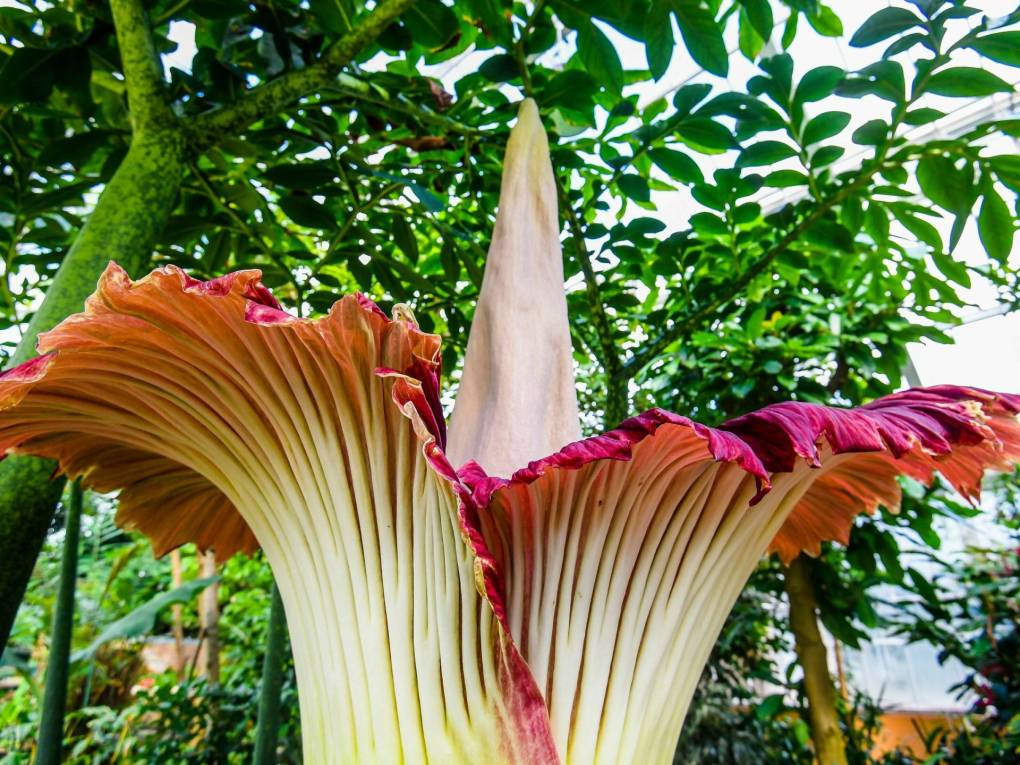
"caption": "A corpse flower blooms at the Belgian National Botanic Gardens in 2020.",
"description": "A picture taken on May 14, 2020 shows a Titan Arum flower that flourished the day before at the Belgian National Botanic Gardens in Meise. - The Titan Arum is the biggest flower on earth and it takes several years for the plant to make one single flower blossom. Particular to the flower is its strong, bad smell. (Photo by LAURIE DIEFFEMBACQ / BELGA / AFP) / Belgium OUT (Photo by )",
"title": "A corpse flower blooms at the Belgian National Botanic Gardens in 2020.",
"credit": "LAURIE DIEFFEMBACQ/BELGA/AFP via Getty Images",
"status": "inherit",
"altTag": "A close-up of a very large pink and yellow flower that resembles a huge cala lily.",
"isLoading": false,
"fetchFailed": false
},
"arts_13931462": {
"type": "attachments",
"id": "arts_13931462",
"meta": {
"index": "attachments_1716263798",
"site": "arts",
"id": "13931462",
"found": true
},
"parent": 13931387,
"imgSizes": {
"thumbnail": {
"file": "https://ww2.kqed.org/app/uploads/sites/2/2023/07/dsc06369_720-160x107.jpg",
"width": 160,
"mimeType": "image/jpeg",
"height": 107
},
"post-thumbnail": {
"file": "https://ww2.kqed.org/app/uploads/sites/2/2023/07/dsc06369_720-672x372.jpg",
"width": 672,
"mimeType": "image/jpeg",
"height": 372
},
"kqedFullSize": {
"file": "https://ww2.kqed.org/app/uploads/sites/2/2023/07/dsc06369_720.jpg",
"width": 720,
"height": 481
}
},
"publishDate": 1689086852,
"modified": 1689086918,
"caption": "People handed Dregs-One rolling trays, hats and other miscellaneous items for him to freestyle about, and he did so with ease. ",
"description": "People handed Dregs-One rolling trays, hats and other miscellaneous items for him to freestyle about, and he did so with ease. ",
"title": "People handed Dregs-One rolling trays, hats and other miscellaneous items for him to freestyle about, and he did so with ease.",
"credit": "Pendarvis Harshaw",
"status": "inherit",
"altTag": "People handed Dregs-One rolling trays, hats and other miscellaneous items for him to freestyle about, and he did so with ease.",
"isLoading": false,
"fetchFailed": false
}
},
"audioPlayerReducer": {
"postId": "stream_live",
"isPaused": true,
"isPlaying": false,
"pfsActive": false,
"pledgeModalIsOpen": true,
"playerDrawerIsOpen": false,
"liveAudioPlayStartedAt": 0,
"liveAudioPlayContext": ""
},
"authorsReducer": {
"byline_arts_13933436": {
"type": "authors",
"id": "byline_arts_13933436",
"meta": {
"override": true
},
"slug": "byline_arts_13933436",
"name": "Dario McCarty",
"isLoading": false
},
"byline_arts_13931352": {
"type": "authors",
"id": "byline_arts_13931352",
"meta": {
"override": true
},
"slug": "byline_arts_13931352",
"name": "José Vadi ",
"isLoading": false
},
"byline_arts_13931251": {
"type": "authors",
"id": "byline_arts_13931251",
"meta": {
"override": true
},
"slug": "byline_arts_13931251",
"name": "Manuela López Restrepo",
"isLoading": false
},
"gmeline": {
"type": "authors",
"id": "185",
"meta": {
"index": "authors_1716337520",
"id": "185",
"found": true
},
"name": "Gabe Meline",
"firstName": "Gabe",
"lastName": "Meline",
"slug": "gmeline",
"email": "gmeline@kqed.org",
"display_author_email": true,
"staff_mastheads": [
"arts"
],
"title": "Senior Editor, KQED Arts & Culture",
"bio": "Gabe Meline entered journalism at age 15 making photocopied zines, and has since earned awards from the Edward R. Murrow Awards, the Society for Professional Journalists, the Online Journalism Awards, the Association of Alternative Newsweeklies and the California Newspaper Publishers Association. Prior to KQED, he was the editor of the \u003cem>North Bay Bohemian\u003c/em> and a touring musician. He lives with his wife and daughter in his hometown of Santa Rosa, CA.",
"avatar": "https://secure.gravatar.com/avatar/5bebe57be0d8bc2dd318934feb47299e2d2d10cba28d09d8d7afb389a2ce2bdd?s=600&d=blank&r=g",
"twitter": null,
"bluesky": null,
"facebook": null,
"instagram": null,
"linkedin": null,
"sites": [
{
"site": "",
"roles": [
"editor"
]
},
{
"site": "arts",
"roles": [
"administrator"
]
},
{
"site": "artschool",
"roles": [
"editor"
]
},
{
"site": "news",
"roles": [
"author"
]
},
{
"site": "pop",
"roles": [
"editor"
]
},
{
"site": "bayareabites",
"roles": [
"editor"
]
},
{
"site": "food",
"roles": [
"editor"
]
},
{
"site": "forum",
"roles": [
"administrator"
]
},
{
"site": "liveblog",
"roles": [
"editor"
]
},
{
"site": "hiphop",
"roles": [
"editor"
]
}
],
"headData": {
"title": "Gabe Meline | KQED",
"description": "Senior Editor, KQED Arts & Culture",
"ogImgSrc": "https://secure.gravatar.com/avatar/5bebe57be0d8bc2dd318934feb47299e2d2d10cba28d09d8d7afb389a2ce2bdd?s=600&d=blank&r=g",
"twImgSrc": "https://secure.gravatar.com/avatar/5bebe57be0d8bc2dd318934feb47299e2d2d10cba28d09d8d7afb389a2ce2bdd?s=600&d=blank&r=g"
},
"isLoading": false,
"link": "/author/gmeline"
},
"esilvers": {
"type": "authors",
"id": "7237",
"meta": {
"index": "authors_1716337520",
"id": "7237",
"found": true
},
"name": "Emma Silvers",
"firstName": "Emma",
"lastName": "Silvers",
"slug": "esilvers",
"email": "esilvers@kqed.org",
"display_author_email": false,
"staff_mastheads": [],
"title": "KQED Contributor",
"bio": "Emma Silvers is an editor at KQED Arts and a former digital producer at KQED News. Born and raised in the Bay Area, she has previously been an arts and entertainment editor at the \u003cem>San Francisco Chronicle\u003c/em>, \u003cem>SF Weekly\u003c/em> and the \u003cem>San Francisco Bay Guardian.\u003c/em> \u003ca href=\"https://www.emmasilvers.com\">Her work\u003c/a> has also appeared in \u003cem>Rolling Stone\u003c/em>, Pitchfork and \u003cem>Mother Jones\u003c/em>. In 2017 she was the recipient of the Society of Professional Journalists-Northern California's award for arts and culture reporting. In 1993 she \u003ca href=\"https://www.kqed.org/pop/16759/wait-what-my-coworker-was-a-voice-over-hyperventilator-for-jurassic-park\">hyperventilated in \u003cem>Jurassic Park\u003c/em>\u003c/a>.",
"avatar": "https://secure.gravatar.com/avatar/247beada39b88ea5759db1f51dba05cf?s=600&d=blank&r=g",
"twitter": "emmaruthless",
"facebook": null,
"instagram": null,
"linkedin": null,
"sites": [
{
"site": "arts",
"roles": [
"editor"
]
},
{
"site": "news",
"roles": [
"editor"
]
},
{
"site": "pop",
"roles": [
"contributor"
]
},
{
"site": "bayareabites",
"roles": [
"editor"
]
},
{
"site": "food",
"roles": [
"contributor"
]
},
{
"site": "liveblog",
"roles": [
"editor"
]
}
],
"headData": {
"title": "Emma Silvers | KQED",
"description": "KQED Contributor",
"ogImgSrc": "https://secure.gravatar.com/avatar/247beada39b88ea5759db1f51dba05cf?s=600&d=blank&r=g",
"twImgSrc": "https://secure.gravatar.com/avatar/247beada39b88ea5759db1f51dba05cf?s=600&d=blank&r=g"
},
"isLoading": false,
"link": "/author/esilvers"
},
"ralexandra": {
"type": "authors",
"id": "11242",
"meta": {
"index": "authors_1716337520",
"id": "11242",
"found": true
},
"name": "Rae Alexandra",
"firstName": "Rae",
"lastName": "Alexandra",
"slug": "ralexandra",
"email": "ralexandra@kqed.org",
"display_author_email": true,
"staff_mastheads": [],
"title": "Reporter/Producer",
"bio": "Rae Alexandra is a Reporter/Producer for KQED Arts & Culture, and the creator/author of the \u003ca href=\"https://www.kqed.org/arts/program/rebel-girls-from-bay-area-history\">Rebel Girls From Bay Area History\u003c/a> and \u003ca href=\"https://www.kqed.org/bizarrebayarea\">Bizarre Bay Area\u003c/a> series. Her debut book, \u003ca href=\"https://citylights.com/politics-current-events-history/unsung-heroines35-women-who-changed/\">Unsung Heroines: 35 Women Who Changed the Bay Area\u003c/a> was published by City Lights in March 2026. In 2023, Rae was awarded an SPJ Excellence in Journalism Award for Arts & Culture. Rae was born and raised in Wales and subsequently — even after two decades in Northern California — still uses phrases that regularly baffle her coworkers.",
"avatar": "https://secure.gravatar.com/avatar/edfee8176c80cc0a382b051190f5341997df378a934a5774dcb0977732dfd401?s=600&d=blank&r=g",
"twitter": null,
"bluesky": null,
"facebook": null,
"instagram": null,
"linkedin": null,
"sites": [
{
"site": "arts",
"roles": [
"subscriber"
]
},
{
"site": "news",
"roles": [
"subscriber"
]
},
{
"site": "pop",
"roles": [
"subscriber"
]
},
{
"site": "bayareabites",
"roles": [
"subscriber"
]
},
{
"site": "science",
"roles": [
"subscriber"
]
}
],
"headData": {
"title": "Rae Alexandra | KQED",
"description": "Reporter/Producer",
"ogImgSrc": "https://secure.gravatar.com/avatar/edfee8176c80cc0a382b051190f5341997df378a934a5774dcb0977732dfd401?s=600&d=blank&r=g",
"twImgSrc": "https://secure.gravatar.com/avatar/edfee8176c80cc0a382b051190f5341997df378a934a5774dcb0977732dfd401?s=600&d=blank&r=g"
},
"isLoading": false,
"link": "/author/ralexandra"
},
"ogpenn": {
"type": "authors",
"id": "11491",
"meta": {
"index": "authors_1716337520",
"id": "11491",
"found": true
},
"name": "Pendarvis Harshaw",
"firstName": "Pendarvis",
"lastName": "Harshaw",
"slug": "ogpenn",
"email": "ogpenn@gmail.com",
"display_author_email": false,
"staff_mastheads": [
"arts"
],
"title": "Community Engagement Reporter",
"bio": "Pendarvis Harshaw is an educator, host and writer with KQED Arts.",
"avatar": "https://secure.gravatar.com/avatar/972b77ee8e3f346ae2b00622661187fbfabd059b5693bbdc1475ea7a722fd4cd?s=600&d=blank&r=g",
"twitter": null,
"bluesky": null,
"facebook": null,
"instagram": "ogpenn",
"linkedin": null,
"sites": [
{
"site": "arts",
"roles": [
"administrator"
]
},
{
"site": "news",
"roles": [
"editor"
]
},
{
"site": "bayareabites",
"roles": [
"author"
]
},
{
"site": "hiphop",
"roles": [
"editor"
]
}
],
"headData": {
"title": "Pendarvis Harshaw | KQED",
"description": "Community Engagement Reporter",
"ogImgSrc": "https://secure.gravatar.com/avatar/972b77ee8e3f346ae2b00622661187fbfabd059b5693bbdc1475ea7a722fd4cd?s=600&d=blank&r=g",
"twImgSrc": "https://secure.gravatar.com/avatar/972b77ee8e3f346ae2b00622661187fbfabd059b5693bbdc1475ea7a722fd4cd?s=600&d=blank&r=g"
},
"isLoading": false,
"link": "/author/ogpenn"
},
"mmedina": {
"type": "authors",
"id": "11528",
"meta": {
"index": "authors_1716337520",
"id": "11528",
"found": true
},
"name": "Marisol Medina-Cadena",
"firstName": "Marisol",
"lastName": "Medina-Cadena",
"slug": "mmedina",
"email": "mmedina@KQED.org",
"display_author_email": true,
"staff_mastheads": [],
"title": "Producer, Rightnowish Podcast",
"bio": "Marisol Medina-Cadena is a radio reporter and podcast producer. Before working at KQED, she produced for PBS member station, KCET, in Los Angeles. In 2017, Marisol won an Emmy Award for her work on the televised documentary, \u003cem>City Rising\u003c/em>, examining California's affordable housing crisis and the historical roots of gentrification.",
"avatar": "https://secure.gravatar.com/avatar/6c3db46a1cabb5e1fe9a365b5f4e681e?s=600&d=blank&r=g",
"twitter": "marisolreports",
"facebook": null,
"instagram": null,
"linkedin": null,
"sites": [
{
"site": "arts",
"roles": []
},
{
"site": "news",
"roles": [
"edit_others_posts"
]
}
],
"headData": {
"title": "Marisol Medina-Cadena | KQED",
"description": "Producer, Rightnowish Podcast",
"ogImgSrc": "https://secure.gravatar.com/avatar/6c3db46a1cabb5e1fe9a365b5f4e681e?s=600&d=blank&r=g",
"twImgSrc": "https://secure.gravatar.com/avatar/6c3db46a1cabb5e1fe9a365b5f4e681e?s=600&d=blank&r=g"
},
"isLoading": false,
"link": "/author/mmedina"
},
"ltsai": {
"type": "authors",
"id": "11743",
"meta": {
"index": "authors_1716337520",
"id": "11743",
"found": true
},
"name": "Luke Tsai",
"firstName": "Luke",
"lastName": "Tsai",
"slug": "ltsai",
"email": "ltsai@kqed.org",
"display_author_email": true,
"staff_mastheads": [
"arts"
],
"title": "Food Editor",
"bio": "Luke Tsai is KQED's food editor and resident stinky tofu connoisseur. Prior to KQED, he was an editor at Eater SF, \u003cem>San Francisco \u003c/em>magazine, and the \u003cem>East Bay Express\u003c/em>, and his work has also appeared in TASTE, the \u003cem>San Francisco Chronicle\u003c/em>, and the \u003cem>Best Food Writing\u003c/em> anthology. When he isn't writing or editing, you'll find him eating most everything he can get his hands on.",
"avatar": "https://secure.gravatar.com/avatar/1e59b45bf191526e7339d6ba46e33a57b2030d25c27660ecc64ea3cb863e34f7?s=600&d=blank&r=g",
"twitter": "theluketsai",
"bluesky": null,
"facebook": null,
"instagram": null,
"linkedin": null,
"sites": [
{
"site": "",
"roles": [
"editor"
]
},
{
"site": "arts",
"roles": [
"administrator"
]
},
{
"site": "news",
"roles": [
"editor",
"contributor"
]
},
{
"site": "bayareabites",
"roles": [
"editor"
]
},
{
"site": "food",
"roles": [
"editor"
]
}
],
"headData": {
"title": "Luke Tsai | KQED",
"description": "Food Editor",
"ogImgSrc": "https://secure.gravatar.com/avatar/1e59b45bf191526e7339d6ba46e33a57b2030d25c27660ecc64ea3cb863e34f7?s=600&d=blank&r=g",
"twImgSrc": "https://secure.gravatar.com/avatar/1e59b45bf191526e7339d6ba46e33a57b2030d25c27660ecc64ea3cb863e34f7?s=600&d=blank&r=g"
},
"isLoading": false,
"link": "/author/ltsai"
},
"achazaro": {
"type": "authors",
"id": "11748",
"meta": {
"index": "authors_1716337520",
"id": "11748",
"found": true
},
"name": "Alan Chazaro",
"firstName": "Alan",
"lastName": "Chazaro",
"slug": "achazaro",
"email": "agchazaro@gmail.com",
"display_author_email": true,
"staff_mastheads": [],
"title": "Food Writer and Reporter",
"bio": "Alan Chazaro is the author of \u003cem>This Is Not a Frank Ocean Cover Album\u003c/em> (Black Lawrence Press, 2019), \u003cem>Piñata Theory\u003c/em> (Black Lawrence Press, 2020), and \u003cem>Notes from the Eastern Span of the Bay Bridge\u003c/em> (Ghost City Press, 2021). He is a graduate of June Jordan’s Poetry for the People program at UC Berkeley and a former Lawrence Ferlinghetti Fellow at the University of San Francisco. He writes about sports, food, art, music, education, and culture while repping the Bay on \u003ca href=\"https://twitter.com/alan_chazaro\">Twitter\u003c/a> and \u003ca href=\"https://www.instagram.com/alan_chazaro/?hl=en\">Instagram\u003c/a> at @alan_chazaro.",
"avatar": "https://secure.gravatar.com/avatar/ea8b6dd970fc5c29e7a188e7d5861df7?s=600&d=blank&r=g",
"twitter": "alan_chazaro",
"facebook": null,
"instagram": null,
"linkedin": null,
"sites": [
{
"site": "arts",
"roles": [
"contributor"
]
},
{
"site": "news",
"roles": [
"editor"
]
}
],
"headData": {
"title": "Alan Chazaro | KQED",
"description": "Food Writer and Reporter",
"ogImgSrc": "https://secure.gravatar.com/avatar/ea8b6dd970fc5c29e7a188e7d5861df7?s=600&d=blank&r=g",
"twImgSrc": "https://secure.gravatar.com/avatar/ea8b6dd970fc5c29e7a188e7d5861df7?s=600&d=blank&r=g"
},
"isLoading": false,
"link": "/author/achazaro"
},
"xolivares": {
"type": "authors",
"id": "11874",
"meta": {
"index": "authors_1716337520",
"id": "11874",
"found": true
},
"name": "Xorje Olivares",
"firstName": "Xorje",
"lastName": "Olivares",
"slug": "xolivares",
"email": "xolivares@kqed.org",
"display_author_email": false,
"staff_mastheads": [],
"title": "KQED Contributor",
"bio": "Xorje Olivares is KQED's senior producer/editor for podcast development. He previously was a supervising producer at Lemonada Media and also spent 10 years as both an on-air personality and live producer for SiriusXM Radio. His written work has been published in Vice, Rolling Stone and Teen Vogue, among others. You can find him on Twitter and Instagram at @xorjeo.",
"avatar": "https://secure.gravatar.com/avatar/46b74ed252c58ca227b0f680d27b3731?s=600&d=blank&r=g",
"twitter": null,
"facebook": null,
"instagram": null,
"linkedin": null,
"sites": [
{
"site": "arts",
"roles": []
}
],
"headData": {
"title": "Xorje Olivares | KQED",
"description": "KQED Contributor",
"ogImgSrc": "https://secure.gravatar.com/avatar/46b74ed252c58ca227b0f680d27b3731?s=600&d=blank&r=g",
"twImgSrc": "https://secure.gravatar.com/avatar/46b74ed252c58ca227b0f680d27b3731?s=600&d=blank&r=g"
},
"isLoading": false,
"link": "/author/xolivares"
}
},
"pagesReducer": {
"arts_tag_san-francisco": {
"type": "terms",
"id": "arts_1146",
"meta": {
"index": "terms_1716263798",
"site": "arts",
"id": "1146",
"score": 6.7228413
},
"featImg": null,
"name": "San Francisco",
"description": null,
"taxonomy": "tag",
"headData": {
"twImgId": null,
"twTitle": null,
"ogTitle": null,
"ogImgId": null,
"twDescription": null,
"description": null,
"title": "San Francisco Archives | KQED Arts",
"ogDescription": null
},
"ttid": 701,
"slug": "san-francisco",
"isLoading": false,
"title": "San Francisco",
"pageMeta": {
"site": "arts",
"WpPageTemplate": "page-topic-editorial",
"currentPage": 35
},
"blocks": [
{
"blockName": "kqed/post-list",
"attrs": {
"layout": "cardArticle2",
"query": "posts/arts?tag=san-francisco",
"seeMore": false,
"paginated": true,
"page": 35
}
},
{
"blockName": "kqed/ad"
}
]
}
},
"pfsSessionReducer": {},
"postsReducer": {
"stream_live": {
"type": "live",
"id": "stream_live",
"audioUrl": "https://streams.kqed.org/kqedradio",
"title": "Live Stream",
"excerpt": "Live Stream information currently unavailable.",
"link": "/radio",
"featImg": "",
"label": {
"name": "KQED Live",
"link": "/"
}
},
"stream_kqedNewscast": {
"type": "posts",
"id": "stream_kqedNewscast",
"audioUrl": "https://www.kqed.org/.stream/anon/radio/RDnews/newscast.mp3?_=1",
"title": "KQED Newscast",
"featImg": "",
"label": {
"name": "88.5 FM",
"link": "/"
}
},
"arts_13933745": {
"type": "posts",
"id": "arts_13933745",
"meta": {
"index": "posts_1716263798",
"site": "arts",
"id": "13933745",
"score": null,
"sort": [
1692897902000
]
},
"parent": 0,
"labelTerm": {},
"blocks": [],
"publishDate": 1692897902,
"format": "standard",
"title": "A Bay Area Guide to Cold Dishes for Hot Weather",
"headTitle": "A Bay Area Guide to Cold Dishes for Hot Weather | KQED",
"content": "\u003cp>\u003cstrong>\u003cem>Find more of KQED’s picks for the \u003ca href=\"https://www.kqed.org/fallguide2023\">best fall 2023 events here\u003c/a>.\u003c/em>\u003c/strong>\u003c/p>\n\u003cp>Heading into fall, there are certain fundamental truths every Bay Arean knows: that summer here is (mostly) a lie. That September tomatoes are sacrosanct. And that the hottest damned day of the year often falls on some random weekday in October. This is the season of \u003ci>not\u003c/i> lighting our stoves, when mostly all we want to do is drink aguas frescas inside an air-conditioned room.\u003c/p>\n\u003cp>Thankfully, our local food scene is well prepared for this seasonal scorching. Here are 10 of my favorite dishes to beat the heat.\u003c/p>\n\u003cfigure id=\"attachment_13933770\" class=\"wp-caption alignnone\" style=\"max-width: 1920px\">\u003cimg loading=\"lazy\" decoding=\"async\" class=\"size-full wp-image-13933770\" src=\"https://ww2.kqed.org/app/uploads/sites/2/2023/08/soba-ichi-cold-soba_LT.jpg\" alt=\"A plate of cold soba with dipping sauce and a side of tempura.\" width=\"1920\" height=\"1440\" srcset=\"https://cdn.kqed.org/wp-content/uploads/sites/2/2023/08/soba-ichi-cold-soba_LT.jpg 1920w, https://cdn.kqed.org/wp-content/uploads/sites/2/2023/08/soba-ichi-cold-soba_LT-800x600.jpg 800w, https://cdn.kqed.org/wp-content/uploads/sites/2/2023/08/soba-ichi-cold-soba_LT-1020x765.jpg 1020w, https://cdn.kqed.org/wp-content/uploads/sites/2/2023/08/soba-ichi-cold-soba_LT-160x120.jpg 160w, https://cdn.kqed.org/wp-content/uploads/sites/2/2023/08/soba-ichi-cold-soba_LT-768x576.jpg 768w, https://cdn.kqed.org/wp-content/uploads/sites/2/2023/08/soba-ichi-cold-soba_LT-1536x1152.jpg 1536w\" sizes=\"(max-width: 1920px) 100vw, 1920px\">\u003cfigcaption class=\"wp-caption-text\">Slurping cold, slippery soba on a hot day is an A+ sensory experience. \u003ccite>(Luke Tsai/KQED)\u003c/cite>\u003c/figcaption>\u003c/figure>\n\u003ch2>Cold Soba at Soba Ichi\u003c/h2>\n\u003cp>\u003cem>2311A Magnolia St., Oakland\u003c/em>\u003c/p>\n\u003cp>Hot days were simply \u003ci>made \u003c/i>for cold noodles — or is it the other way around? Either way, it’s hard for me to separate the two, and the few times a year when Bay Area temperatures edge toward triple digits, I start thinking about heading to West Oakland’s \u003ca href=\"https://www.instagram.com/sobaichi_oakland/?hl=en\">Soba Ichi\u003c/a> for a plate of soba. The restaurant serves these traditional buckwheat noodles a number of ways, of course, but my favorite is when the noodles are served cold with a dashi-based dipping sauce. Slurping those cold, slippery noodles while the sweat drips down your face: That’s an A+ sensory experience right there. An ice-cold lemon chu-hi also doesn’t hurt.\u003c/p>\n\u003cfigure id=\"attachment_13933775\" class=\"wp-caption alignnone\" style=\"max-width: 1920px\">\u003cimg loading=\"lazy\" decoding=\"async\" class=\"size-full wp-image-13933775\" src=\"https://ww2.kqed.org/app/uploads/sites/2/2023/08/pucquio-cebiche_LT.jpg\" alt=\"An elegantly plated Peruvian cebiche: raw fish topped with a crinkled piece of fried trout skin, with trout roe and assorted seaweeds arranged on the plate.\" width=\"1920\" height=\"1440\" srcset=\"https://cdn.kqed.org/wp-content/uploads/sites/2/2023/08/pucquio-cebiche_LT.jpg 1920w, https://cdn.kqed.org/wp-content/uploads/sites/2/2023/08/pucquio-cebiche_LT-800x600.jpg 800w, https://cdn.kqed.org/wp-content/uploads/sites/2/2023/08/pucquio-cebiche_LT-1020x765.jpg 1020w, https://cdn.kqed.org/wp-content/uploads/sites/2/2023/08/pucquio-cebiche_LT-160x120.jpg 160w, https://cdn.kqed.org/wp-content/uploads/sites/2/2023/08/pucquio-cebiche_LT-768x576.jpg 768w, https://cdn.kqed.org/wp-content/uploads/sites/2/2023/08/pucquio-cebiche_LT-1536x1152.jpg 1536w\" sizes=\"(max-width: 1920px) 100vw, 1920px\">\u003cfigcaption class=\"wp-caption-text\">The trout cebiche is notable for its undercurrent of briny ocean umami. \u003ccite>(Luke Tsai/KQED)\u003c/cite>\u003c/figcaption>\u003c/figure>\n\u003ch2>Cebiche at Pucquio\u003c/h2>\n\u003cp>\u003cem>5337 College Ave., Oakland\u003c/em>\u003c/p>\n\u003cp>[ad fullwidth]\u003c/p>\n\u003cp>On a sweltering hot day, sometimes the only thing I want to eat is chilled seafood — say, a simple poke bowl or a classic, caper-studded “Sicilian sashimi” from Swan Oyster Depot (if I didn’t have to wait in line for two hours). For me, the apex of this genre can be found at \u003ca href=\"https://www.pucquio.com/\">Pucquio\u003c/a>, an often-slept-on Peruvian joint where every cebiche on the menu is a stone cold killer. You’ll want to get a couple of them to share: The classic cebiche de pescado (made with rockfish during my recent visit) is bright and bracing, super-charged with a zip of citrusy ají limo chile heat. My favorite, though, is the comparatively mellow trout cebiche, which comes topped with crispy trout skin, as well as marinated trout roe that adds an undercurrent of briny ocean umami. Eat with a spoon so you can get a bit of each component in every bite.\u003c/p>\n\u003cfigure id=\"attachment_13933777\" class=\"wp-caption alignnone\" style=\"max-width: 1920px\">\u003cimg loading=\"lazy\" decoding=\"async\" class=\"size-full wp-image-13933777\" src=\"https://ww2.kqed.org/app/uploads/sites/2/2023/08/tigon-banh-hoi-2_LT.jpg\" alt=\"A spread of Vietnamese spring roll fillings next to a plate covered with lettuce and herbs.\" width=\"1920\" height=\"1280\" srcset=\"https://cdn.kqed.org/wp-content/uploads/sites/2/2023/08/tigon-banh-hoi-2_LT.jpg 1920w, https://cdn.kqed.org/wp-content/uploads/sites/2/2023/08/tigon-banh-hoi-2_LT-800x533.jpg 800w, https://cdn.kqed.org/wp-content/uploads/sites/2/2023/08/tigon-banh-hoi-2_LT-1020x680.jpg 1020w, https://cdn.kqed.org/wp-content/uploads/sites/2/2023/08/tigon-banh-hoi-2_LT-160x107.jpg 160w, https://cdn.kqed.org/wp-content/uploads/sites/2/2023/08/tigon-banh-hoi-2_LT-768x512.jpg 768w, https://cdn.kqed.org/wp-content/uploads/sites/2/2023/08/tigon-banh-hoi-2_LT-1536x1024.jpg 1536w\" sizes=\"(max-width: 1920px) 100vw, 1920px\">\u003cfigcaption class=\"wp-caption-text\">Fresh herbs and vegetables keep Tigon’s bánh hỏi light and refreshing. \u003ccite>(Luke Tsai/KQED)\u003c/cite>\u003c/figcaption>\u003c/figure>\n\u003ch2>Bánh Hỏi Dặc Biệt at Tigon\u003c/h2>\n\u003cp>\u003cem>10086 San Pablo Ave., El Cerrito\u003c/em>\u003c/p>\n\u003cp>You might already know that fresh spring rolls are a Vietnamese hot-weather staple — something about the combination of pliable rice paper wrapping, crisp lettuce, fresh herbs and, often, cold meat or shrimp that makes for such a refreshing bite. The bánh hỏi đặc biệt platter at El Cerrito’s criminally underrated \u003ca href=\"https://eatattigon.com/\">Tigon\u003c/a> takes this general principle and kicks it up eight or nine notches. The base of the platter is the tidy little rice noodle bundles known as bánh hỏi, on top of which the chef has arranged a huge spread of beef, chicken, shrimp, crispy egg rolls and fried bean curd. You dip a round of rice paper in warm water; arrange your meats, noodles and fresh herbs and vegetables on top; and voilà — a make-your-own spring roll party that’s festive and communal, without anyone having to break a sweat. Note well: The $38.50 đặc biệt platter is probably enough food to feed a family of four, but there’s also an option to pick just one or two proteins if you come in a smaller group.\u003c/p>\n\u003cfigure id=\"attachment_13933772\" class=\"wp-caption alignnone\" style=\"max-width: 1920px\">\u003cimg loading=\"lazy\" decoding=\"async\" class=\"size-full wp-image-13933772\" src=\"https://ww2.kqed.org/app/uploads/sites/2/2023/08/fil-am-cuisine-skewers_LT.jpg\" alt=\"Hand holding a white plastic takeout container of saucy meat skewers arranged over a bed of white rice.\" width=\"1920\" height=\"1440\" srcset=\"https://cdn.kqed.org/wp-content/uploads/sites/2/2023/08/fil-am-cuisine-skewers_LT.jpg 1920w, https://cdn.kqed.org/wp-content/uploads/sites/2/2023/08/fil-am-cuisine-skewers_LT-800x600.jpg 800w, https://cdn.kqed.org/wp-content/uploads/sites/2/2023/08/fil-am-cuisine-skewers_LT-1020x765.jpg 1020w, https://cdn.kqed.org/wp-content/uploads/sites/2/2023/08/fil-am-cuisine-skewers_LT-160x120.jpg 160w, https://cdn.kqed.org/wp-content/uploads/sites/2/2023/08/fil-am-cuisine-skewers_LT-768x576.jpg 768w, https://cdn.kqed.org/wp-content/uploads/sites/2/2023/08/fil-am-cuisine-skewers_LT-1536x1152.jpg 1536w\" sizes=\"(max-width: 1920px) 100vw, 1920px\">\u003cfigcaption class=\"wp-caption-text\">Daly City’s Fil-Am Cuisine offers exquisite summer barbecue vibes all year round. \u003ccite>(Luke Tsai/KQED)\u003c/cite>\u003c/figcaption>\u003c/figure>\n\u003ch2>BBQ Skewers at Fil-Am Cuisine\u003c/h2>\n\u003cp>\u003cem>66 School St., Daly City\u003c/em>\u003c/p>\n\u003cp>Every time I step inside this Daly City meat stick institution, the smell of a \u003ca href=\"https://www.kqed.org/arts/13915306/bbq-in-the-bay-series-intro-multicultural-barbecue-bay-area\">summer barbecue\u003c/a> hits me like a tidal wave of nostalgia. Fil-Am Cuisine boasts the same kind of sweet, charred meat and friendly Asian aunties that I associate with family get-togethers from when I was a kid. Even the prices seem like they’ve been time-warped from the early ’90s. Connoisseurs of crispy, carbonized edges, this is your spot. And whether you walk away with a fistful of skewered chicken or pork (why not both?), you can’t go wrong. Cash only.\u003c/p>\n\u003cfigure id=\"attachment_13933771\" class=\"wp-caption alignnone\" style=\"max-width: 1920px\">\u003cimg loading=\"lazy\" decoding=\"async\" class=\"size-full wp-image-13933771\" src=\"https://ww2.kqed.org/app/uploads/sites/2/2023/08/messob-veggie-combo_LT.jpg\" alt=\"An Ethiopian veggie combo: six colorful spreads dolloped on an injera-lined metal plate.\" width=\"1920\" height=\"1440\" srcset=\"https://cdn.kqed.org/wp-content/uploads/sites/2/2023/08/messob-veggie-combo_LT.jpg 1920w, https://cdn.kqed.org/wp-content/uploads/sites/2/2023/08/messob-veggie-combo_LT-800x600.jpg 800w, https://cdn.kqed.org/wp-content/uploads/sites/2/2023/08/messob-veggie-combo_LT-1020x765.jpg 1020w, https://cdn.kqed.org/wp-content/uploads/sites/2/2023/08/messob-veggie-combo_LT-160x120.jpg 160w, https://cdn.kqed.org/wp-content/uploads/sites/2/2023/08/messob-veggie-combo_LT-768x576.jpg 768w, https://cdn.kqed.org/wp-content/uploads/sites/2/2023/08/messob-veggie-combo_LT-1536x1152.jpg 1536w\" sizes=\"(max-width: 1920px) 100vw, 1920px\">\u003cfigcaption class=\"wp-caption-text\">The cool, garlicky buticha — the scrambled egg–like dip in the front-left quadrant — is part of what makes Messob’s veggie combo one of the best around. \u003ccite>(Luke Tsai/KQED)\u003c/cite>\u003c/figcaption>\u003c/figure>\n\u003ch2>Buticha at Messob\u003c/h2>\n\u003cp>\u003cem>4301 Piedmont Ave., Oakland\u003c/em>\u003c/p>\n\u003cp>My friend and \u003ca href=\"https://www.kqed.org/author/rgebreyesus\">former KQED food writer\u003c/a> Ruth Gebreyesus first \u003ca href=\"https://eastbayexpress.com/the-curious-history-of-the-eritrean-and-ethiopian-veggie-combo-2-1/\">turned me on to\u003c/a> the buticha at \u003ca href=\"https://www.facebook.com/messobethiopianrestaurant/\">Messob\u003c/a>. This easy-to-miss slip of an Ethiopian restaurant serves what might be my favorite veggie combo in the Bay — especially the iteration that comes with a scoop of cool, refreshing buticha. At lesser restaurants, this cold chickpea flour dip often resembles an onion-y hummus, or a bland egg salad of sorts. Messob’s buticha is more flavorful by several orders of magnitude, with a texture akin to soft-scrambled eggs and a garlicky punch that had me dipping my injera back into it again and again.\u003c/p>\n\u003cp>https://www.instagram.com/p/CctQwzzPfZE/\u003c/p>\n\u003ch2>Some Like It Harra at Reem’s\u003c/h2>\n\u003cp>\u003cem>2901 Mission St., San Francisco\u003c/em>\u003c/p>\n\u003cp>There’s something uniquely pleasing about scooping up a cool dip or spread with a hunk of warm, fresh bread. In some ways, that’s the whole organizing principle around \u003ca href=\"https://www.reemscalifornia.com/\">Reem’s\u003c/a>, an Arab bakery where the hot pita alone is worth the trip to the Mission. One of my favorite ways to eat it is with \u003ca href=\"https://www.kcet.org/shows/the-migrant-kitchen/reem-assils-labneh\">labneh\u003c/a>, a strained yogurt dish that’s a classic hot-weather treat in much of the Arab world. For her “Some Like It Harra,” chef Reem Assil spices up the labneh with garlic chile morita oil, toasted sesame seeds and a jammy soft-boiled egg. Perfect for \u003ca href=\"https://www.instagram.com/p/CjHGICVJbv5/?hl=en\">pita dunking\u003c/a>. (\u003cem>Note: Reem’s Mission location is temporarily closed and is expected to reopen after Labor Day weekend. Its smaller kiosk in the Ferry Building remains open.\u003c/em>)\u003c/p>\n\u003cfigure id=\"attachment_13933779\" class=\"wp-caption alignnone\" style=\"max-width: 1920px\">\u003cimg loading=\"lazy\" decoding=\"async\" class=\"size-full wp-image-13933779\" src=\"https://ww2.kqed.org/app/uploads/sites/2/2023/08/mandalay-tea-leaf-salad_courtesyFB.jpg\" alt=\"A Burmese tea leaf salad, premixing, with piles of various seeds and nuts arranged on the plate.\" width=\"1920\" height=\"1914\" srcset=\"https://cdn.kqed.org/wp-content/uploads/sites/2/2023/08/mandalay-tea-leaf-salad_courtesyFB.jpg 1920w, https://cdn.kqed.org/wp-content/uploads/sites/2/2023/08/mandalay-tea-leaf-salad_courtesyFB-800x798.jpg 800w, https://cdn.kqed.org/wp-content/uploads/sites/2/2023/08/mandalay-tea-leaf-salad_courtesyFB-1020x1017.jpg 1020w, https://cdn.kqed.org/wp-content/uploads/sites/2/2023/08/mandalay-tea-leaf-salad_courtesyFB-160x160.jpg 160w, https://cdn.kqed.org/wp-content/uploads/sites/2/2023/08/mandalay-tea-leaf-salad_courtesyFB-768x766.jpg 768w, https://cdn.kqed.org/wp-content/uploads/sites/2/2023/08/mandalay-tea-leaf-salad_courtesyFB-1536x1531.jpg 1536w\" sizes=\"(max-width: 1920px) 100vw, 1920px\">\u003cfigcaption class=\"wp-caption-text\">Mandalay’s fermented tea leaf salad is probably the most flavorful version in San Francisco. \u003ccite>(Courtesy of Mandalay/Facebook)\u003c/cite>\u003c/figcaption>\u003c/figure>\n\u003ch2>Tea Leaf Salad at Mandalay\u003c/h2>\n\u003cp>\u003cem>4348 California St., San Francisco\u003c/em>\u003c/p>\n\u003cp>If you tell me it’s so hot that you just want to eat salad for dinner, I’ll take that to mean we should go out for Burmese food. After all, Burmese tea leaf salads are one of the jewels of the Bay Area’s immigrant food scene. My favorite is \u003ca href=\"https://www.mandalaysf.com/\">Mandalay’s\u003c/a> extra-pungent version, which isn’t cut with any lettuce — just cabbage, a huge dollop of fermented tea leaves, lime, shrimp powder and an assortment of nuts, seeds and other crunchy-toasty things. Forget your boring tossed salads: Here’s a salad that manages to be refreshing, nutritious \u003ci>and \u003c/i>righteously funky.\u003c/p>\n\u003cfigure id=\"attachment_13933773\" class=\"wp-caption alignnone\" style=\"max-width: 1920px\">\u003cimg loading=\"lazy\" decoding=\"async\" class=\"size-full wp-image-13933773\" src=\"https://ww2.kqed.org/app/uploads/sites/2/2023/08/shugetsu-tsukemen_LT.jpg\" alt=\"A bowl of cold ramen noodles topped with grilled pork belly and a halved soft-boiled egg, with dipping broth served in a separate small bowl on the side.\" width=\"1920\" height=\"1440\" srcset=\"https://cdn.kqed.org/wp-content/uploads/sites/2/2023/08/shugetsu-tsukemen_LT.jpg 1920w, https://cdn.kqed.org/wp-content/uploads/sites/2/2023/08/shugetsu-tsukemen_LT-800x600.jpg 800w, https://cdn.kqed.org/wp-content/uploads/sites/2/2023/08/shugetsu-tsukemen_LT-1020x765.jpg 1020w, https://cdn.kqed.org/wp-content/uploads/sites/2/2023/08/shugetsu-tsukemen_LT-160x120.jpg 160w, https://cdn.kqed.org/wp-content/uploads/sites/2/2023/08/shugetsu-tsukemen_LT-768x576.jpg 768w, https://cdn.kqed.org/wp-content/uploads/sites/2/2023/08/shugetsu-tsukemen_LT-1536x1152.jpg 1536w\" sizes=\"(max-width: 1920px) 100vw, 1920px\">\u003cfigcaption class=\"wp-caption-text\">For many ramen aficionados, tsukemen is the preferred choice for muggy days when you don’t want to drink a steaming-hot bowl of soup. \u003ccite>(Luke Tsai/KQED)\u003c/cite>\u003c/figcaption>\u003c/figure>\n\u003ch2>Tsukemen at Shugetsu\u003c/h2>\n\u003cp>\u003cem>2944 S. Norfolk St., San Mateo\u003c/em>\u003c/p>\n\u003cp>I don’t know if there’s such a thing as “too hot for ramen,” but if I’m sweating even \u003ci>before\u003c/i> I sit down at the noodle counter, I’ll look to see if the menu includes tsukemen, or dipping noodles. Just like the best tsukemen shops in Tokyo, \u003ca href=\"https://shugetsu-ca.com/\">Shugetsu\u003c/a> lets you have whatever size bowl of thick, house-made noodles you want (regular, large or XL) for the same price, with the option to request them cold, as is traditional — both for cooling-off purposes and so that the noodles maintain their springy texture. The idea with tsukemen is to dip the noodles into a super-concentrated broth, too salty and intense to drink on its own, coating each bite with the perfect amount of flavor and fat. This is where Shugetsu shines: The rich, tangy dipping broth, blasted with dried-scallop umami, is simply fantastic. Pro tip: When you’ve slurped up your last noodle, ask the server for the “soup-wari,” a kettle of plain chicken soup that they pour into your remaining dipping broth — diluting it just enough so you can drink it like a normal, if uncommonly tasty, soup.\u003c/p>\n\u003cfigure id=\"attachment_13933776\" class=\"wp-caption alignnone\" style=\"max-width: 1920px\">\u003cimg loading=\"lazy\" decoding=\"async\" class=\"size-full wp-image-13933776\" src=\"https://ww2.kqed.org/app/uploads/sites/2/2023/08/oks-deli-tuna-salad_LT.jpg\" alt=\"The cross section of a tuna salad sandwich made with thick slices of milkbread.\" width=\"1920\" height=\"1440\" srcset=\"https://cdn.kqed.org/wp-content/uploads/sites/2/2023/08/oks-deli-tuna-salad_LT.jpg 1920w, https://cdn.kqed.org/wp-content/uploads/sites/2/2023/08/oks-deli-tuna-salad_LT-800x600.jpg 800w, https://cdn.kqed.org/wp-content/uploads/sites/2/2023/08/oks-deli-tuna-salad_LT-1020x765.jpg 1020w, https://cdn.kqed.org/wp-content/uploads/sites/2/2023/08/oks-deli-tuna-salad_LT-160x120.jpg 160w, https://cdn.kqed.org/wp-content/uploads/sites/2/2023/08/oks-deli-tuna-salad_LT-768x576.jpg 768w, https://cdn.kqed.org/wp-content/uploads/sites/2/2023/08/oks-deli-tuna-salad_LT-1536x1152.jpg 1536w\" sizes=\"(max-width: 1920px) 100vw, 1920px\">\u003cfigcaption class=\"wp-caption-text\">The conbini-style tuna salad sandwich features Kewpie-style mayonnaise and thick, bouncy milkbread. \u003ccite>(Luke Tsai/KQED)\u003c/cite>\u003c/figcaption>\u003c/figure>\n\u003ch2>Konbini Tuna Salad Sandwich at Ok’s Deli\u003c/h2>\n\u003cp>\u003cem>3932 Telegraph Ave., Oakland\u003c/em>\u003c/p>\n\u003cp>Deli sandwich weather means a short break from our usual programming of cheesesteaks and hot pastrami: It’s cold cut weather. Egg salad weather. At Oakland’s newish \u003ca href=\"https://www.instagram.com/oksdeli/\">Ok’s Deli\u003c/a>, most of the sandwiches have some Asian American twist — and just about every one of them is a certified hit. Lately, I’ve been especially enamored with the deli’s take on a tuna salad sandwich, which takes all of the classic elements — line-caught tuna; pickles, onion and celery chopped super-fine; and lots and lots of mayo — and Asia-fies them ever so slightly through the lens of Japan’s incredible convenience store sandwiches. So, the house mayo is \u003ca href=\"https://thetakeout.com/my-chemical-dependence-on-japanese-kewpie-mayo-1798251538\">Kewpie\u003c/a>-adjacent. The bread is Ok’s delightfully bouncy house-made milk bread. And the sandwich, as a whole? Refreshing as a cool blast of convenience store AC.\u003c/p>\n\u003cfigure id=\"attachment_13933778\" class=\"wp-caption alignnone\" style=\"max-width: 1920px\">\u003cimg loading=\"lazy\" decoding=\"async\" class=\"size-full wp-image-13933778\" src=\"https://ww2.kqed.org/app/uploads/sites/2/2023/08/bn-chicken-samgyetang_lt.jpg\" alt=\"A steaming vessel of chicken ginseng soup with a whole cornish hen.\" width=\"1920\" height=\"1440\" srcset=\"https://cdn.kqed.org/wp-content/uploads/sites/2/2023/08/bn-chicken-samgyetang_lt.jpg 1920w, https://cdn.kqed.org/wp-content/uploads/sites/2/2023/08/bn-chicken-samgyetang_lt-800x600.jpg 800w, https://cdn.kqed.org/wp-content/uploads/sites/2/2023/08/bn-chicken-samgyetang_lt-1020x765.jpg 1020w, https://cdn.kqed.org/wp-content/uploads/sites/2/2023/08/bn-chicken-samgyetang_lt-160x120.jpg 160w, https://cdn.kqed.org/wp-content/uploads/sites/2/2023/08/bn-chicken-samgyetang_lt-768x576.jpg 768w, https://cdn.kqed.org/wp-content/uploads/sites/2/2023/08/bn-chicken-samgyetang_lt-1536x1152.jpg 1536w\" sizes=\"(max-width: 1920px) 100vw, 1920px\">\u003cfigcaption class=\"wp-caption-text\">‘Fight fire with fire’ with BN Chicken’s soul-replenishing samgyetang. \u003ccite>(Luke Tsai/KQED)\u003c/cite>\u003c/figcaption>\u003c/figure>\n\u003ch2>Samgyetang at BN Chicken\u003c/h2>\n\u003cp>\u003cem>2725 El Camino Real, Santa Clara\u003c/em>\u003c/p>\n\u003cp>[ad floatright]\u003c/p>\n\u003cp>For those who like to zig when everyone else is zagging, consider that in Korea, it’s customary to eat samgyetang — a bubbling-hot chicken and ginseng soup — on the very hottest days of the year. The idea is that causing yourself to sweat \u003ci>more\u003c/i> actually cools you down; meanwhile, the medicinal properties of the soup’s ginseng, garlic and dried jujubes help refill your stamina bar. It’s “\u003ca href=\"https://tastecooking.com/summer-koreans-fight-fire-fire/\">fighting fire with fire\u003c/a>,” as Koreans are fond of saying. And there’s no better place to do it than at Santa Clara’s \u003ca href=\"http://bnchicken.com/\">BN Chicken\u003c/a>, an entire restaurant dedicated to the steamy, soul-replenishing pleasures of samgyetang. The soup comes in a stone bowl, which keeps things boiling-hot for the duration of your meal. Rip into the whole Cornish hen to dig into the glutinous rice and aromatics stuffed inside, and dip chunks of the tender meat in salt as you go. And if the hot soup approach isn’t working for you? Not to worry: BN Chicken also serves a top-notch version of the bracingly vinegary, ice-cold noodle soup known as naengmyeon.\u003c/p>\n\n",
"stats": {
"hasVideo": false,
"hasChartOrMap": false,
"hasAudio": false,
"hasPolis": false,
"wordCount": 1910,
"hasGoogleForm": false,
"hasGallery": false,
"hasHearkenModule": false,
"iframeSrcs": [],
"paragraphCount": 25
},
"modified": 1705005108,
"excerpt": "What to eat this fall (when it’s actually hot).",
"headData": {
"twImgId": "",
"twTitle": "A Bay Area Guide to Cold Dishes for Hot Weather",
"socialTitle": "The Bay Area's Best Cold Dishes to Eat in Hot Weather %%page%% %%sep%% KQED",
"ogTitle": "A Bay Area Guide to Cold Dishes for Hot Weather",
"ogImgId": "",
"twDescription": "",
"description": "What to eat this fall (when it’s actually hot).",
"title": "The Bay Area's Best Cold Dishes to Eat in Hot Weather | KQED",
"ogDescription": "",
"schema": {
"@context": "https://schema.org",
"@type": "Article",
"headline": "A Bay Area Guide to Cold Dishes for Hot Weather",
"datePublished": "2023-08-24T10:25:02-07:00",
"dateModified": "2024-01-11T12:31:48-08:00",
"image": "https://cdn.kqed.org/wp-content/uploads/2020/02/KQED-OG-Image@1x.png"
}
},
"guestAuthors": [],
"slug": "cold-food-hot-weather-sf-bay-area-fall-2023",
"status": "publish",
"sourceUrl": "https://www.kqed.org/fallguide2023",
"templateType": "standard",
"excludeFromSiteSearch": "Include",
"featuredImageType": "standard",
"sticky": false,
"source": "Fall Guide 2023",
"articleAge": "0",
"path": "/arts/13933745/cold-food-hot-weather-sf-bay-area-fall-2023",
"audioTrackLength": null,
"parsedContent": [
{
"type": "contentString",
"content": "\u003cdiv class=\"post-body\">\u003cp>\u003cp>\u003cstrong>\u003cem>Find more of KQED’s picks for the \u003ca href=\"https://www.kqed.org/fallguide2023\">best fall 2023 events here\u003c/a>.\u003c/em>\u003c/strong>\u003c/p>\n\u003cp>Heading into fall, there are certain fundamental truths every Bay Arean knows: that summer here is (mostly) a lie. That September tomatoes are sacrosanct. And that the hottest damned day of the year often falls on some random weekday in October. This is the season of \u003ci>not\u003c/i> lighting our stoves, when mostly all we want to do is drink aguas frescas inside an air-conditioned room.\u003c/p>\n\u003cp>Thankfully, our local food scene is well prepared for this seasonal scorching. Here are 10 of my favorite dishes to beat the heat.\u003c/p>\n\u003cfigure id=\"attachment_13933770\" class=\"wp-caption alignnone\" style=\"max-width: 1920px\">\u003cimg loading=\"lazy\" decoding=\"async\" class=\"size-full wp-image-13933770\" src=\"https://ww2.kqed.org/app/uploads/sites/2/2023/08/soba-ichi-cold-soba_LT.jpg\" alt=\"A plate of cold soba with dipping sauce and a side of tempura.\" width=\"1920\" height=\"1440\" srcset=\"https://cdn.kqed.org/wp-content/uploads/sites/2/2023/08/soba-ichi-cold-soba_LT.jpg 1920w, https://cdn.kqed.org/wp-content/uploads/sites/2/2023/08/soba-ichi-cold-soba_LT-800x600.jpg 800w, https://cdn.kqed.org/wp-content/uploads/sites/2/2023/08/soba-ichi-cold-soba_LT-1020x765.jpg 1020w, https://cdn.kqed.org/wp-content/uploads/sites/2/2023/08/soba-ichi-cold-soba_LT-160x120.jpg 160w, https://cdn.kqed.org/wp-content/uploads/sites/2/2023/08/soba-ichi-cold-soba_LT-768x576.jpg 768w, https://cdn.kqed.org/wp-content/uploads/sites/2/2023/08/soba-ichi-cold-soba_LT-1536x1152.jpg 1536w\" sizes=\"(max-width: 1920px) 100vw, 1920px\">\u003cfigcaption class=\"wp-caption-text\">Slurping cold, slippery soba on a hot day is an A+ sensory experience. \u003ccite>(Luke Tsai/KQED)\u003c/cite>\u003c/figcaption>\u003c/figure>\n\u003ch2>Cold Soba at Soba Ichi\u003c/h2>\n\u003cp>\u003cem>2311A Magnolia St., Oakland\u003c/em>\u003c/p>\n\u003cp>Hot days were simply \u003ci>made \u003c/i>for cold noodles — or is it the other way around? Either way, it’s hard for me to separate the two, and the few times a year when Bay Area temperatures edge toward triple digits, I start thinking about heading to West Oakland’s \u003ca href=\"https://www.instagram.com/sobaichi_oakland/?hl=en\">Soba Ichi\u003c/a> for a plate of soba. The restaurant serves these traditional buckwheat noodles a number of ways, of course, but my favorite is when the noodles are served cold with a dashi-based dipping sauce. Slurping those cold, slippery noodles while the sweat drips down your face: That’s an A+ sensory experience right there. An ice-cold lemon chu-hi also doesn’t hurt.\u003c/p>\n\u003cfigure id=\"attachment_13933775\" class=\"wp-caption alignnone\" style=\"max-width: 1920px\">\u003cimg loading=\"lazy\" decoding=\"async\" class=\"size-full wp-image-13933775\" src=\"https://ww2.kqed.org/app/uploads/sites/2/2023/08/pucquio-cebiche_LT.jpg\" alt=\"An elegantly plated Peruvian cebiche: raw fish topped with a crinkled piece of fried trout skin, with trout roe and assorted seaweeds arranged on the plate.\" width=\"1920\" height=\"1440\" srcset=\"https://cdn.kqed.org/wp-content/uploads/sites/2/2023/08/pucquio-cebiche_LT.jpg 1920w, https://cdn.kqed.org/wp-content/uploads/sites/2/2023/08/pucquio-cebiche_LT-800x600.jpg 800w, https://cdn.kqed.org/wp-content/uploads/sites/2/2023/08/pucquio-cebiche_LT-1020x765.jpg 1020w, https://cdn.kqed.org/wp-content/uploads/sites/2/2023/08/pucquio-cebiche_LT-160x120.jpg 160w, https://cdn.kqed.org/wp-content/uploads/sites/2/2023/08/pucquio-cebiche_LT-768x576.jpg 768w, https://cdn.kqed.org/wp-content/uploads/sites/2/2023/08/pucquio-cebiche_LT-1536x1152.jpg 1536w\" sizes=\"(max-width: 1920px) 100vw, 1920px\">\u003cfigcaption class=\"wp-caption-text\">The trout cebiche is notable for its undercurrent of briny ocean umami. \u003ccite>(Luke Tsai/KQED)\u003c/cite>\u003c/figcaption>\u003c/figure>\n\u003ch2>Cebiche at Pucquio\u003c/h2>\n\u003cp>\u003cem>5337 College Ave., Oakland\u003c/em>\u003c/p>\n\u003cp>\u003c/p>\u003c/div>",
"attributes": {
"named": {},
"numeric": []
}
},
{
"type": "component",
"content": "",
"name": "ad",
"attributes": {
"named": {
"label": "fullwidth"
},
"numeric": [
"fullwidth"
]
}
},
{
"type": "contentString",
"content": "\u003cdiv class=\"post-body\">\u003cp>\u003c/p>\n\u003cp>On a sweltering hot day, sometimes the only thing I want to eat is chilled seafood — say, a simple poke bowl or a classic, caper-studded “Sicilian sashimi” from Swan Oyster Depot (if I didn’t have to wait in line for two hours). For me, the apex of this genre can be found at \u003ca href=\"https://www.pucquio.com/\">Pucquio\u003c/a>, an often-slept-on Peruvian joint where every cebiche on the menu is a stone cold killer. You’ll want to get a couple of them to share: The classic cebiche de pescado (made with rockfish during my recent visit) is bright and bracing, super-charged with a zip of citrusy ají limo chile heat. My favorite, though, is the comparatively mellow trout cebiche, which comes topped with crispy trout skin, as well as marinated trout roe that adds an undercurrent of briny ocean umami. Eat with a spoon so you can get a bit of each component in every bite.\u003c/p>\n\u003cfigure id=\"attachment_13933777\" class=\"wp-caption alignnone\" style=\"max-width: 1920px\">\u003cimg loading=\"lazy\" decoding=\"async\" class=\"size-full wp-image-13933777\" src=\"https://ww2.kqed.org/app/uploads/sites/2/2023/08/tigon-banh-hoi-2_LT.jpg\" alt=\"A spread of Vietnamese spring roll fillings next to a plate covered with lettuce and herbs.\" width=\"1920\" height=\"1280\" srcset=\"https://cdn.kqed.org/wp-content/uploads/sites/2/2023/08/tigon-banh-hoi-2_LT.jpg 1920w, https://cdn.kqed.org/wp-content/uploads/sites/2/2023/08/tigon-banh-hoi-2_LT-800x533.jpg 800w, https://cdn.kqed.org/wp-content/uploads/sites/2/2023/08/tigon-banh-hoi-2_LT-1020x680.jpg 1020w, https://cdn.kqed.org/wp-content/uploads/sites/2/2023/08/tigon-banh-hoi-2_LT-160x107.jpg 160w, https://cdn.kqed.org/wp-content/uploads/sites/2/2023/08/tigon-banh-hoi-2_LT-768x512.jpg 768w, https://cdn.kqed.org/wp-content/uploads/sites/2/2023/08/tigon-banh-hoi-2_LT-1536x1024.jpg 1536w\" sizes=\"(max-width: 1920px) 100vw, 1920px\">\u003cfigcaption class=\"wp-caption-text\">Fresh herbs and vegetables keep Tigon’s bánh hỏi light and refreshing. \u003ccite>(Luke Tsai/KQED)\u003c/cite>\u003c/figcaption>\u003c/figure>\n\u003ch2>Bánh Hỏi Dặc Biệt at Tigon\u003c/h2>\n\u003cp>\u003cem>10086 San Pablo Ave., El Cerrito\u003c/em>\u003c/p>\n\u003cp>You might already know that fresh spring rolls are a Vietnamese hot-weather staple — something about the combination of pliable rice paper wrapping, crisp lettuce, fresh herbs and, often, cold meat or shrimp that makes for such a refreshing bite. The bánh hỏi đặc biệt platter at El Cerrito’s criminally underrated \u003ca href=\"https://eatattigon.com/\">Tigon\u003c/a> takes this general principle and kicks it up eight or nine notches. The base of the platter is the tidy little rice noodle bundles known as bánh hỏi, on top of which the chef has arranged a huge spread of beef, chicken, shrimp, crispy egg rolls and fried bean curd. You dip a round of rice paper in warm water; arrange your meats, noodles and fresh herbs and vegetables on top; and voilà — a make-your-own spring roll party that’s festive and communal, without anyone having to break a sweat. Note well: The $38.50 đặc biệt platter is probably enough food to feed a family of four, but there’s also an option to pick just one or two proteins if you come in a smaller group.\u003c/p>\n\u003cfigure id=\"attachment_13933772\" class=\"wp-caption alignnone\" style=\"max-width: 1920px\">\u003cimg loading=\"lazy\" decoding=\"async\" class=\"size-full wp-image-13933772\" src=\"https://ww2.kqed.org/app/uploads/sites/2/2023/08/fil-am-cuisine-skewers_LT.jpg\" alt=\"Hand holding a white plastic takeout container of saucy meat skewers arranged over a bed of white rice.\" width=\"1920\" height=\"1440\" srcset=\"https://cdn.kqed.org/wp-content/uploads/sites/2/2023/08/fil-am-cuisine-skewers_LT.jpg 1920w, https://cdn.kqed.org/wp-content/uploads/sites/2/2023/08/fil-am-cuisine-skewers_LT-800x600.jpg 800w, https://cdn.kqed.org/wp-content/uploads/sites/2/2023/08/fil-am-cuisine-skewers_LT-1020x765.jpg 1020w, https://cdn.kqed.org/wp-content/uploads/sites/2/2023/08/fil-am-cuisine-skewers_LT-160x120.jpg 160w, https://cdn.kqed.org/wp-content/uploads/sites/2/2023/08/fil-am-cuisine-skewers_LT-768x576.jpg 768w, https://cdn.kqed.org/wp-content/uploads/sites/2/2023/08/fil-am-cuisine-skewers_LT-1536x1152.jpg 1536w\" sizes=\"(max-width: 1920px) 100vw, 1920px\">\u003cfigcaption class=\"wp-caption-text\">Daly City’s Fil-Am Cuisine offers exquisite summer barbecue vibes all year round. \u003ccite>(Luke Tsai/KQED)\u003c/cite>\u003c/figcaption>\u003c/figure>\n\u003ch2>BBQ Skewers at Fil-Am Cuisine\u003c/h2>\n\u003cp>\u003cem>66 School St., Daly City\u003c/em>\u003c/p>\n\u003cp>Every time I step inside this Daly City meat stick institution, the smell of a \u003ca href=\"https://www.kqed.org/arts/13915306/bbq-in-the-bay-series-intro-multicultural-barbecue-bay-area\">summer barbecue\u003c/a> hits me like a tidal wave of nostalgia. Fil-Am Cuisine boasts the same kind of sweet, charred meat and friendly Asian aunties that I associate with family get-togethers from when I was a kid. Even the prices seem like they’ve been time-warped from the early ’90s. Connoisseurs of crispy, carbonized edges, this is your spot. And whether you walk away with a fistful of skewered chicken or pork (why not both?), you can’t go wrong. Cash only.\u003c/p>\n\u003cfigure id=\"attachment_13933771\" class=\"wp-caption alignnone\" style=\"max-width: 1920px\">\u003cimg loading=\"lazy\" decoding=\"async\" class=\"size-full wp-image-13933771\" src=\"https://ww2.kqed.org/app/uploads/sites/2/2023/08/messob-veggie-combo_LT.jpg\" alt=\"An Ethiopian veggie combo: six colorful spreads dolloped on an injera-lined metal plate.\" width=\"1920\" height=\"1440\" srcset=\"https://cdn.kqed.org/wp-content/uploads/sites/2/2023/08/messob-veggie-combo_LT.jpg 1920w, https://cdn.kqed.org/wp-content/uploads/sites/2/2023/08/messob-veggie-combo_LT-800x600.jpg 800w, https://cdn.kqed.org/wp-content/uploads/sites/2/2023/08/messob-veggie-combo_LT-1020x765.jpg 1020w, https://cdn.kqed.org/wp-content/uploads/sites/2/2023/08/messob-veggie-combo_LT-160x120.jpg 160w, https://cdn.kqed.org/wp-content/uploads/sites/2/2023/08/messob-veggie-combo_LT-768x576.jpg 768w, https://cdn.kqed.org/wp-content/uploads/sites/2/2023/08/messob-veggie-combo_LT-1536x1152.jpg 1536w\" sizes=\"(max-width: 1920px) 100vw, 1920px\">\u003cfigcaption class=\"wp-caption-text\">The cool, garlicky buticha — the scrambled egg–like dip in the front-left quadrant — is part of what makes Messob’s veggie combo one of the best around. \u003ccite>(Luke Tsai/KQED)\u003c/cite>\u003c/figcaption>\u003c/figure>\n\u003ch2>Buticha at Messob\u003c/h2>\n\u003cp>\u003cem>4301 Piedmont Ave., Oakland\u003c/em>\u003c/p>\n\u003cp>My friend and \u003ca href=\"https://www.kqed.org/author/rgebreyesus\">former KQED food writer\u003c/a> Ruth Gebreyesus first \u003ca href=\"https://eastbayexpress.com/the-curious-history-of-the-eritrean-and-ethiopian-veggie-combo-2-1/\">turned me on to\u003c/a> the buticha at \u003ca href=\"https://www.facebook.com/messobethiopianrestaurant/\">Messob\u003c/a>. This easy-to-miss slip of an Ethiopian restaurant serves what might be my favorite veggie combo in the Bay — especially the iteration that comes with a scoop of cool, refreshing buticha. At lesser restaurants, this cold chickpea flour dip often resembles an onion-y hummus, or a bland egg salad of sorts. Messob’s buticha is more flavorful by several orders of magnitude, with a texture akin to soft-scrambled eggs and a garlicky punch that had me dipping my injera back into it again and again.\u003c/p>\u003c/p>\u003c/div>",
"attributes": {
"named": {},
"numeric": []
}
},
{
"type": "component",
"content": "",
"name": "instagramLink",
"attributes": {
"named": {
"instagramUrl": "https://www.instagram.com/p/CctQwzzPfZE/"
},
"numeric": []
}
},
{
"type": "contentString",
"content": "\u003cdiv class=\"post-body\">\u003cp>\u003ch2>Some Like It Harra at Reem’s\u003c/h2>\n\u003cp>\u003cem>2901 Mission St., San Francisco\u003c/em>\u003c/p>\n\u003cp>There’s something uniquely pleasing about scooping up a cool dip or spread with a hunk of warm, fresh bread. In some ways, that’s the whole organizing principle around \u003ca href=\"https://www.reemscalifornia.com/\">Reem’s\u003c/a>, an Arab bakery where the hot pita alone is worth the trip to the Mission. One of my favorite ways to eat it is with \u003ca href=\"https://www.kcet.org/shows/the-migrant-kitchen/reem-assils-labneh\">labneh\u003c/a>, a strained yogurt dish that’s a classic hot-weather treat in much of the Arab world. For her “Some Like It Harra,” chef Reem Assil spices up the labneh with garlic chile morita oil, toasted sesame seeds and a jammy soft-boiled egg. Perfect for \u003ca href=\"https://www.instagram.com/p/CjHGICVJbv5/?hl=en\">pita dunking\u003c/a>. (\u003cem>Note: Reem’s Mission location is temporarily closed and is expected to reopen after Labor Day weekend. Its smaller kiosk in the Ferry Building remains open.\u003c/em>)\u003c/p>\n\u003cfigure id=\"attachment_13933779\" class=\"wp-caption alignnone\" style=\"max-width: 1920px\">\u003cimg loading=\"lazy\" decoding=\"async\" class=\"size-full wp-image-13933779\" src=\"https://ww2.kqed.org/app/uploads/sites/2/2023/08/mandalay-tea-leaf-salad_courtesyFB.jpg\" alt=\"A Burmese tea leaf salad, premixing, with piles of various seeds and nuts arranged on the plate.\" width=\"1920\" height=\"1914\" srcset=\"https://cdn.kqed.org/wp-content/uploads/sites/2/2023/08/mandalay-tea-leaf-salad_courtesyFB.jpg 1920w, https://cdn.kqed.org/wp-content/uploads/sites/2/2023/08/mandalay-tea-leaf-salad_courtesyFB-800x798.jpg 800w, https://cdn.kqed.org/wp-content/uploads/sites/2/2023/08/mandalay-tea-leaf-salad_courtesyFB-1020x1017.jpg 1020w, https://cdn.kqed.org/wp-content/uploads/sites/2/2023/08/mandalay-tea-leaf-salad_courtesyFB-160x160.jpg 160w, https://cdn.kqed.org/wp-content/uploads/sites/2/2023/08/mandalay-tea-leaf-salad_courtesyFB-768x766.jpg 768w, https://cdn.kqed.org/wp-content/uploads/sites/2/2023/08/mandalay-tea-leaf-salad_courtesyFB-1536x1531.jpg 1536w\" sizes=\"(max-width: 1920px) 100vw, 1920px\">\u003cfigcaption class=\"wp-caption-text\">Mandalay’s fermented tea leaf salad is probably the most flavorful version in San Francisco. \u003ccite>(Courtesy of Mandalay/Facebook)\u003c/cite>\u003c/figcaption>\u003c/figure>\n\u003ch2>Tea Leaf Salad at Mandalay\u003c/h2>\n\u003cp>\u003cem>4348 California St., San Francisco\u003c/em>\u003c/p>\n\u003cp>If you tell me it’s so hot that you just want to eat salad for dinner, I’ll take that to mean we should go out for Burmese food. After all, Burmese tea leaf salads are one of the jewels of the Bay Area’s immigrant food scene. My favorite is \u003ca href=\"https://www.mandalaysf.com/\">Mandalay’s\u003c/a> extra-pungent version, which isn’t cut with any lettuce — just cabbage, a huge dollop of fermented tea leaves, lime, shrimp powder and an assortment of nuts, seeds and other crunchy-toasty things. Forget your boring tossed salads: Here’s a salad that manages to be refreshing, nutritious \u003ci>and \u003c/i>righteously funky.\u003c/p>\n\u003cfigure id=\"attachment_13933773\" class=\"wp-caption alignnone\" style=\"max-width: 1920px\">\u003cimg loading=\"lazy\" decoding=\"async\" class=\"size-full wp-image-13933773\" src=\"https://ww2.kqed.org/app/uploads/sites/2/2023/08/shugetsu-tsukemen_LT.jpg\" alt=\"A bowl of cold ramen noodles topped with grilled pork belly and a halved soft-boiled egg, with dipping broth served in a separate small bowl on the side.\" width=\"1920\" height=\"1440\" srcset=\"https://cdn.kqed.org/wp-content/uploads/sites/2/2023/08/shugetsu-tsukemen_LT.jpg 1920w, https://cdn.kqed.org/wp-content/uploads/sites/2/2023/08/shugetsu-tsukemen_LT-800x600.jpg 800w, https://cdn.kqed.org/wp-content/uploads/sites/2/2023/08/shugetsu-tsukemen_LT-1020x765.jpg 1020w, https://cdn.kqed.org/wp-content/uploads/sites/2/2023/08/shugetsu-tsukemen_LT-160x120.jpg 160w, https://cdn.kqed.org/wp-content/uploads/sites/2/2023/08/shugetsu-tsukemen_LT-768x576.jpg 768w, https://cdn.kqed.org/wp-content/uploads/sites/2/2023/08/shugetsu-tsukemen_LT-1536x1152.jpg 1536w\" sizes=\"(max-width: 1920px) 100vw, 1920px\">\u003cfigcaption class=\"wp-caption-text\">For many ramen aficionados, tsukemen is the preferred choice for muggy days when you don’t want to drink a steaming-hot bowl of soup. \u003ccite>(Luke Tsai/KQED)\u003c/cite>\u003c/figcaption>\u003c/figure>\n\u003ch2>Tsukemen at Shugetsu\u003c/h2>\n\u003cp>\u003cem>2944 S. Norfolk St., San Mateo\u003c/em>\u003c/p>\n\u003cp>I don’t know if there’s such a thing as “too hot for ramen,” but if I’m sweating even \u003ci>before\u003c/i> I sit down at the noodle counter, I’ll look to see if the menu includes tsukemen, or dipping noodles. Just like the best tsukemen shops in Tokyo, \u003ca href=\"https://shugetsu-ca.com/\">Shugetsu\u003c/a> lets you have whatever size bowl of thick, house-made noodles you want (regular, large or XL) for the same price, with the option to request them cold, as is traditional — both for cooling-off purposes and so that the noodles maintain their springy texture. The idea with tsukemen is to dip the noodles into a super-concentrated broth, too salty and intense to drink on its own, coating each bite with the perfect amount of flavor and fat. This is where Shugetsu shines: The rich, tangy dipping broth, blasted with dried-scallop umami, is simply fantastic. Pro tip: When you’ve slurped up your last noodle, ask the server for the “soup-wari,” a kettle of plain chicken soup that they pour into your remaining dipping broth — diluting it just enough so you can drink it like a normal, if uncommonly tasty, soup.\u003c/p>\n\u003cfigure id=\"attachment_13933776\" class=\"wp-caption alignnone\" style=\"max-width: 1920px\">\u003cimg loading=\"lazy\" decoding=\"async\" class=\"size-full wp-image-13933776\" src=\"https://ww2.kqed.org/app/uploads/sites/2/2023/08/oks-deli-tuna-salad_LT.jpg\" alt=\"The cross section of a tuna salad sandwich made with thick slices of milkbread.\" width=\"1920\" height=\"1440\" srcset=\"https://cdn.kqed.org/wp-content/uploads/sites/2/2023/08/oks-deli-tuna-salad_LT.jpg 1920w, https://cdn.kqed.org/wp-content/uploads/sites/2/2023/08/oks-deli-tuna-salad_LT-800x600.jpg 800w, https://cdn.kqed.org/wp-content/uploads/sites/2/2023/08/oks-deli-tuna-salad_LT-1020x765.jpg 1020w, https://cdn.kqed.org/wp-content/uploads/sites/2/2023/08/oks-deli-tuna-salad_LT-160x120.jpg 160w, https://cdn.kqed.org/wp-content/uploads/sites/2/2023/08/oks-deli-tuna-salad_LT-768x576.jpg 768w, https://cdn.kqed.org/wp-content/uploads/sites/2/2023/08/oks-deli-tuna-salad_LT-1536x1152.jpg 1536w\" sizes=\"(max-width: 1920px) 100vw, 1920px\">\u003cfigcaption class=\"wp-caption-text\">The conbini-style tuna salad sandwich features Kewpie-style mayonnaise and thick, bouncy milkbread. \u003ccite>(Luke Tsai/KQED)\u003c/cite>\u003c/figcaption>\u003c/figure>\n\u003ch2>Konbini Tuna Salad Sandwich at Ok’s Deli\u003c/h2>\n\u003cp>\u003cem>3932 Telegraph Ave., Oakland\u003c/em>\u003c/p>\n\u003cp>Deli sandwich weather means a short break from our usual programming of cheesesteaks and hot pastrami: It’s cold cut weather. Egg salad weather. At Oakland’s newish \u003ca href=\"https://www.instagram.com/oksdeli/\">Ok’s Deli\u003c/a>, most of the sandwiches have some Asian American twist — and just about every one of them is a certified hit. Lately, I’ve been especially enamored with the deli’s take on a tuna salad sandwich, which takes all of the classic elements — line-caught tuna; pickles, onion and celery chopped super-fine; and lots and lots of mayo — and Asia-fies them ever so slightly through the lens of Japan’s incredible convenience store sandwiches. So, the house mayo is \u003ca href=\"https://thetakeout.com/my-chemical-dependence-on-japanese-kewpie-mayo-1798251538\">Kewpie\u003c/a>-adjacent. The bread is Ok’s delightfully bouncy house-made milk bread. And the sandwich, as a whole? Refreshing as a cool blast of convenience store AC.\u003c/p>\n\u003cfigure id=\"attachment_13933778\" class=\"wp-caption alignnone\" style=\"max-width: 1920px\">\u003cimg loading=\"lazy\" decoding=\"async\" class=\"size-full wp-image-13933778\" src=\"https://ww2.kqed.org/app/uploads/sites/2/2023/08/bn-chicken-samgyetang_lt.jpg\" alt=\"A steaming vessel of chicken ginseng soup with a whole cornish hen.\" width=\"1920\" height=\"1440\" srcset=\"https://cdn.kqed.org/wp-content/uploads/sites/2/2023/08/bn-chicken-samgyetang_lt.jpg 1920w, https://cdn.kqed.org/wp-content/uploads/sites/2/2023/08/bn-chicken-samgyetang_lt-800x600.jpg 800w, https://cdn.kqed.org/wp-content/uploads/sites/2/2023/08/bn-chicken-samgyetang_lt-1020x765.jpg 1020w, https://cdn.kqed.org/wp-content/uploads/sites/2/2023/08/bn-chicken-samgyetang_lt-160x120.jpg 160w, https://cdn.kqed.org/wp-content/uploads/sites/2/2023/08/bn-chicken-samgyetang_lt-768x576.jpg 768w, https://cdn.kqed.org/wp-content/uploads/sites/2/2023/08/bn-chicken-samgyetang_lt-1536x1152.jpg 1536w\" sizes=\"(max-width: 1920px) 100vw, 1920px\">\u003cfigcaption class=\"wp-caption-text\">‘Fight fire with fire’ with BN Chicken’s soul-replenishing samgyetang. \u003ccite>(Luke Tsai/KQED)\u003c/cite>\u003c/figcaption>\u003c/figure>\n\u003ch2>Samgyetang at BN Chicken\u003c/h2>\n\u003cp>\u003cem>2725 El Camino Real, Santa Clara\u003c/em>\u003c/p>\n\u003cp>\u003c/p>\u003c/div>",
"attributes": {
"named": {},
"numeric": []
}
},
{
"type": "component",
"content": "",
"name": "ad",
"attributes": {
"named": {
"label": "floatright"
},
"numeric": [
"floatright"
]
}
},
{
"type": "contentString",
"content": "\u003cdiv class=\"post-body\">\u003cp>\u003c/p>\n\u003cp>For those who like to zig when everyone else is zagging, consider that in Korea, it’s customary to eat samgyetang — a bubbling-hot chicken and ginseng soup — on the very hottest days of the year. The idea is that causing yourself to sweat \u003ci>more\u003c/i> actually cools you down; meanwhile, the medicinal properties of the soup’s ginseng, garlic and dried jujubes help refill your stamina bar. It’s “\u003ca href=\"https://tastecooking.com/summer-koreans-fight-fire-fire/\">fighting fire with fire\u003c/a>,” as Koreans are fond of saying. And there’s no better place to do it than at Santa Clara’s \u003ca href=\"http://bnchicken.com/\">BN Chicken\u003c/a>, an entire restaurant dedicated to the steamy, soul-replenishing pleasures of samgyetang. The soup comes in a stone bowl, which keeps things boiling-hot for the duration of your meal. Rip into the whole Cornish hen to dig into the glutinous rice and aromatics stuffed inside, and dip chunks of the tender meat in salt as you go. And if the hot soup approach isn’t working for you? Not to worry: BN Chicken also serves a top-notch version of the bracingly vinegary, ice-cold noodle soup known as naengmyeon.\u003c/p>\n\n\u003c/div>\u003c/p>",
"attributes": {
"named": {},
"numeric": []
}
}
],
"link": "/arts/13933745/cold-food-hot-weather-sf-bay-area-fall-2023",
"authors": [
"11743"
],
"programs": [
"arts_140"
],
"categories": [
"arts_1",
"arts_12276"
],
"tags": [
"arts_2854",
"arts_19355",
"arts_21761",
"arts_21522",
"arts_10278",
"arts_14183",
"arts_1297",
"arts_21732",
"arts_1143",
"arts_1146",
"arts_585",
"arts_15126"
],
"featImg": "arts_13933769",
"label": "source_arts_13933745"
},
"arts_13933261": {
"type": "posts",
"id": "arts_13933261",
"meta": {
"index": "posts_1716263798",
"site": "arts",
"id": "13933261",
"score": null,
"sort": [
1692630030000
]
},
"guestAuthors": [],
"slug": "chloe-sherman-renegades-book-1990s-san-francisco-lesbian-queer-trans",
"title": "Chloe Sherman’s ‘Renegades’ Beautifully Conveys Queer Life in 1990s San Francisco",
"publishDate": 1692630030,
"format": "standard",
"headTitle": "Chloe Sherman’s ‘Renegades’ Beautifully Conveys Queer Life in 1990s San Francisco | KQED",
"labelTerm": {
"term": 140,
"site": "arts"
},
"content": "\u003cp>At the outset of \u003ca href=\"https://www.chloeshermanphotography.com/\">Chloe Sherman\u003c/a>’s new photography book \u003cem>Renegades\u003c/em>, there are three forewords. One by fellow photographer \u003ca href=\"https://art21.org/artist/catherine-opie/\">Catherine Opie\u003c/a>, one by writer (and former Blatz vocalist) \u003ca href=\"https://www.goodreads.com/author/show/4059815.Anna_Joy_Springer\">Anna Joy Springer\u003c/a>, and one by Tribe 8 vocalist and author \u003ca href=\"https://www.instagram.com/lynneeboy/?hl=en\">Lynn Breedlove\u003c/a>. All pay tribute to \u003ca href=\"https://www.kqed.org/arts/13915084/chloe-sherman-renegade-san-francisco-1990s-schlomer-haus\">Sherman’s disarming photographic style\u003c/a> and her knack for preserving everyday moments in queer Bay Area history. Breedlove’s words, however, go one step further, viscerally reveling in the memory of what it was to be young, rebellious and queer in 1990s San Francisco.\u003c/p>\n\u003cp>[aside postid='arts_13915084']“We came from around the country and the planet, tired of the crusades to be seen and not killed, from rural places, big cities,” Breedlove writes. “Even NYC and LA looked askance at our out-of-line gender assertions, as we stabbed flags into the dirt, some of us already transitioning, adopting pronouns, audaciously insisting we were gorgeous, terrifying, trifling with normativities, flying in the face of cisterns, tossing dynamite at binaries, then rebuilding ourselves from the bits.”\u003c/p>\n\u003cp>Breedlove’s searing introduction wholly reflects the 58 pages of photographs in \u003cem>Renegades\u003c/em>. But in truth, the book would have had just as much impact — and still succeeded in painting the very same picture that Breedlove does — even if accompanied by no words at all. Sherman’s colorful, intimate, impulsive and affectionate photos speak loudly for the wild, untethered souls in them, as well as the era they were living through.\u003c/p>\n\u003cfigure id=\"attachment_13933329\" class=\"wp-caption aligncenter\" style=\"max-width: 1556px\">\u003cimg loading=\"lazy\" decoding=\"async\" src=\"https://ww2.kqed.org/app/uploads/sites/2/2023/08/Cake-and-wig.png\" alt=\"An androgynous Black person wearing black t-shirt and jeans laughs closely to a white woman with long, messy, pink hair. They are both leaning over a mint green cake on a red table in a back yard.\" width=\"1556\" height=\"1030\" class=\"size-full wp-image-13933329\" srcset=\"https://cdn.kqed.org/wp-content/uploads/sites/2/2023/08/Cake-and-wig.png 1556w, https://cdn.kqed.org/wp-content/uploads/sites/2/2023/08/Cake-and-wig-800x530.png 800w, https://cdn.kqed.org/wp-content/uploads/sites/2/2023/08/Cake-and-wig-1020x675.png 1020w, https://cdn.kqed.org/wp-content/uploads/sites/2/2023/08/Cake-and-wig-160x106.png 160w, https://cdn.kqed.org/wp-content/uploads/sites/2/2023/08/Cake-and-wig-768x508.png 768w, https://cdn.kqed.org/wp-content/uploads/sites/2/2023/08/Cake-and-wig-1536x1017.png 1536w\" sizes=\"(max-width: 1556px) 100vw, 1556px\">\u003cfigcaption class=\"wp-caption-text\">Chloe Sherman, ’Birthday Cake With Wings,’ mid-90s. \u003ccite>(Hatje Cantz)\u003c/cite>\u003c/figcaption>\u003c/figure>\n\u003cp>The queer joy positively beams from these pictures, with a palpable and rollicking sense of newfound freedom and community. Viewing these images all in one sitting is like suddenly being invited into the coolest (and tightest) group of friends you’ve ever had. Those of Sherman’s pals who appear repeatedly — I don’t mind admitting that I grew rather attached to both \u003ca href=\"https://en.wikipedia.org/wiki/Harry_Dodge\">Harry Dodge\u003c/a> and Asia — begin to feel like characters to root for. Each appearance leaves a more detailed impression of their beautiful, unapologetic selves than the last.\u003c/p>\n\u003cp>[aside postid='arts_13902953']Sherman’s work also acts as a guide to queer San Francisco hotspots — some past (RIP \u003ca href=\"http://lostwomynsspace.blogspot.com/2014/07/red-doras-bearded-lady.html\">Bearded Lady Cafe\u003c/a>, \u003ca href=\"https://www.kqed.org/news/10501545/goodbye-lexington-owner-to-shut-doors-to-beloved-lesbian-bar\">The Lexington\u003c/a>), others still very present (hello \u003ca href=\"https://www.yelp.com/biz/hole-in-the-wall-saloon-san-francisco\">Hole in the Wall\u003c/a>, \u003ca href=\"https://www.yelp.com/biz/glama-rama-san-francisco-3\">Glamarama\u003c/a>, \u003ca href=\"http://www.blackandbluetattoo.com/\">Black & Blue Tattoo\u003c/a>). Well known figures from the city’s queer community also appear — including \u003ca href=\"https://www.kqed.org/arts/13835007/juanita-more-beloved-drag-mother-is-queering-san-francisco-politics\">Juanita More\u003c/a> looking like a silver screen goddess in 1999, \u003ca href=\"https://www.mothersf.com/home\">Mother\u003c/a> bar owner Malia Spanyol before she started running venues, and Lexington founder Lila Thirkield behind her brand new bar in 1998. Impossibly cool members of queercore bands like \u003ca href=\"https://en.wikipedia.org/wiki/Tribe_8\">Tribe 8\u003c/a> and \u003ca href=\"https://en.wikipedia.org/wiki/Cypher_in_the_Snow\">Cypher in the Snow\u003c/a> also make appearances.\u003c/p>\n\u003cfigure id=\"attachment_13933364\" class=\"wp-caption aligncenter\" style=\"max-width: 1572px\">\u003cimg loading=\"lazy\" decoding=\"async\" src=\"https://ww2.kqed.org/app/uploads/sites/2/2023/08/Screen-Shot-2023-08-17-at-11.51.05-AM.png\" alt=\"A woman in a red satin dressing gown reclines on a bed, her black messy hair pulled back, her lips painted red. She is talking on a green landline telephone and smoking a cigarette. A leaf-shaped ashtray sits at her hip.\" width=\"1572\" height=\"1048\" class=\"size-full wp-image-13933364\" srcset=\"https://cdn.kqed.org/wp-content/uploads/sites/2/2023/08/Screen-Shot-2023-08-17-at-11.51.05-AM.png 1572w, https://cdn.kqed.org/wp-content/uploads/sites/2/2023/08/Screen-Shot-2023-08-17-at-11.51.05-AM-800x533.png 800w, https://cdn.kqed.org/wp-content/uploads/sites/2/2023/08/Screen-Shot-2023-08-17-at-11.51.05-AM-1020x680.png 1020w, https://cdn.kqed.org/wp-content/uploads/sites/2/2023/08/Screen-Shot-2023-08-17-at-11.51.05-AM-160x107.png 160w, https://cdn.kqed.org/wp-content/uploads/sites/2/2023/08/Screen-Shot-2023-08-17-at-11.51.05-AM-768x512.png 768w, https://cdn.kqed.org/wp-content/uploads/sites/2/2023/08/Screen-Shot-2023-08-17-at-11.51.05-AM-1536x1024.png 1536w\" sizes=\"(max-width: 1572px) 100vw, 1572px\">\u003cfigcaption class=\"wp-caption-text\">Chloe Sherman, ‘Anna Joy Post Surgery at Home,’ 1997. \u003ccite>(Hatje Cantz)\u003c/cite>\u003c/figcaption>\u003c/figure>\n\u003cp>Though featured frequently, \u003cem>Renegades\u003c/em> isn’t just about queer San Francisco nightlife in the ’90s. Some of the most impactful images are of messy bedrooms with graffitied walls, group outings in classic cars, idyllic picnics with sunbathing and snacks, and casual frolics on the beach. It’s a reminder that not so long ago, San Francisco was a place with affordable rent where young bohemians could live, thriving on minimal wages and maximum fun. That Sherman can take us back to that time so vividly is a gift to us all.\u003c/p>\n\u003cp>[ad fullwidth]\u003c/p>\n\u003cp>\u003cimg loading=\"lazy\" decoding=\"async\" class=\"aligncenter size-medium wp-image-12127869\" src=\"https://ww2.kqed.org/arts/wp-content/uploads/sites/2/2016/09/Q.Logo_.Break_-800x78.jpg\" alt=\"\" width=\"800\" height=\"78\" srcset=\"https://cdn.kqed.org/wp-content/uploads/sites/2/2016/09/Q.Logo_.Break_.jpg 800w, https://cdn.kqed.org/wp-content/uploads/sites/2/2016/09/Q.Logo_.Break_-400x39.jpg 400w, https://cdn.kqed.org/wp-content/uploads/sites/2/2016/09/Q.Logo_.Break_-768x75.jpg 768w\" sizes=\"(max-width: 800px) 100vw, 800px\">\u003c/p>\n\u003cp>\u003cem>Chloe Sherman’s ‘\u003ca href=\"https://bookshop.org/p/books/chloe-sherman-renegades-chloe-sherman/19986751?\">Renegades\u003c/a>’ will be released by Hatje Cantz on Sept. 19, 2023.\u003c/em>\u003c/p>\n\u003cp>\u003cem>A launch and signing event for the book will be held at the San Francisco bar \u003ca href=\"https://www.mothersf.com/home\">Mother\u003c/a> (3079 16th St.) on Friday, Aug. 25 at 6 p.m. Sherman will also be signing copies of ‘Renegades’ at San Francisco’s \u003ca href=\"https://www.fabulosabooks.com/\">Fabulosa Books\u003c/a> (489 Castro St.) on Thursday, Sept. 28.\u003c/em>\u003c/p>\n\u003cp>\u003c/p>\n\u003cp>\u003cem>Sherman will be in conversation at the San Francisco Public Library’s \u003ca href=\"https://sfpl.org/locations/main-library/rooms/koret-auditorium\">Koret Auditorium\u003c/a> (100 Larkin St.) on Thursday, Oct. 5 at 6 p.m.\u003c/em>\u003c/p>\n\n",
"blocks": [],
"excerpt": "The photographer's new book is a joyful time capsule of lesbian, queer and trans life in the city, not so long ago.",
"status": "publish",
"parent": 0,
"modified": 1726771085,
"stats": {
"hasAudio": false,
"hasVideo": false,
"hasChartOrMap": false,
"iframeSrcs": [],
"hasGoogleForm": false,
"hasGallery": false,
"hasHearkenModule": false,
"hasPolis": false,
"paragraphCount": 12,
"wordCount": 667
},
"headData": {
"title": "Chloe Sherman’s Book Beautifully Conveys Queer Life in ’90s SF | KQED",
"description": "The photographer's new book is a joyful time capsule of lesbian, queer and trans life in the city, not so long ago.",
"ogTitle": "Chloe Sherman’s ‘Renegades’ Beautifully Conveys Queer Life in 1990s San Francisco",
"ogDescription": "",
"ogImgId": "",
"twTitle": "Chloe Sherman’s ‘Renegades’ Beautifully Conveys Queer Life in 1990s San Francisco",
"twDescription": "",
"twImgId": "",
"socialTitle": "Chloe Sherman’s Book Beautifully Conveys Queer Life in ’90s SF %%page%% %%sep%% KQED",
"schema": {
"@context": "https://schema.org",
"@type": "Article",
"headline": "Chloe Sherman’s ‘Renegades’ Beautifully Conveys Queer Life in 1990s San Francisco",
"datePublished": "2023-08-21T08:00:30-07:00",
"dateModified": "2024-09-19T11:38:05-07:00",
"image": "https://cdn.kqed.org/wp-content/uploads/2020/02/KQED-OG-Image@1x.png"
}
},
"sticky": false,
"templateType": "standard",
"featuredImageType": "standard",
"excludeFromSiteSearch": "Include",
"articleAge": "0",
"path": "/arts/13933261/chloe-sherman-renegades-book-1990s-san-francisco-lesbian-queer-trans",
"audioTrackLength": null,
"parsedContent": [
{
"type": "contentString",
"content": "\u003cdiv class=\"post-body\">\u003cp>\u003cp>At the outset of \u003ca href=\"https://www.chloeshermanphotography.com/\">Chloe Sherman\u003c/a>’s new photography book \u003cem>Renegades\u003c/em>, there are three forewords. One by fellow photographer \u003ca href=\"https://art21.org/artist/catherine-opie/\">Catherine Opie\u003c/a>, one by writer (and former Blatz vocalist) \u003ca href=\"https://www.goodreads.com/author/show/4059815.Anna_Joy_Springer\">Anna Joy Springer\u003c/a>, and one by Tribe 8 vocalist and author \u003ca href=\"https://www.instagram.com/lynneeboy/?hl=en\">Lynn Breedlove\u003c/a>. All pay tribute to \u003ca href=\"https://www.kqed.org/arts/13915084/chloe-sherman-renegade-san-francisco-1990s-schlomer-haus\">Sherman’s disarming photographic style\u003c/a> and her knack for preserving everyday moments in queer Bay Area history. Breedlove’s words, however, go one step further, viscerally reveling in the memory of what it was to be young, rebellious and queer in 1990s San Francisco.\u003c/p>\n\u003cp>\u003c/p>\u003c/div>",
"attributes": {
"named": {},
"numeric": []
}
},
{
"type": "component",
"content": "",
"name": "aside",
"attributes": {
"named": {
"postid": "arts_13915084",
"label": ""
},
"numeric": []
}
},
{
"type": "contentString",
"content": "\u003cdiv class=\"post-body\">\u003cp>“We came from around the country and the planet, tired of the crusades to be seen and not killed, from rural places, big cities,” Breedlove writes. “Even NYC and LA looked askance at our out-of-line gender assertions, as we stabbed flags into the dirt, some of us already transitioning, adopting pronouns, audaciously insisting we were gorgeous, terrifying, trifling with normativities, flying in the face of cisterns, tossing dynamite at binaries, then rebuilding ourselves from the bits.”\u003c/p>\n\u003cp>Breedlove’s searing introduction wholly reflects the 58 pages of photographs in \u003cem>Renegades\u003c/em>. But in truth, the book would have had just as much impact — and still succeeded in painting the very same picture that Breedlove does — even if accompanied by no words at all. Sherman’s colorful, intimate, impulsive and affectionate photos speak loudly for the wild, untethered souls in them, as well as the era they were living through.\u003c/p>\n\u003cfigure id=\"attachment_13933329\" class=\"wp-caption aligncenter\" style=\"max-width: 1556px\">\u003cimg loading=\"lazy\" decoding=\"async\" src=\"https://ww2.kqed.org/app/uploads/sites/2/2023/08/Cake-and-wig.png\" alt=\"An androgynous Black person wearing black t-shirt and jeans laughs closely to a white woman with long, messy, pink hair. They are both leaning over a mint green cake on a red table in a back yard.\" width=\"1556\" height=\"1030\" class=\"size-full wp-image-13933329\" srcset=\"https://cdn.kqed.org/wp-content/uploads/sites/2/2023/08/Cake-and-wig.png 1556w, https://cdn.kqed.org/wp-content/uploads/sites/2/2023/08/Cake-and-wig-800x530.png 800w, https://cdn.kqed.org/wp-content/uploads/sites/2/2023/08/Cake-and-wig-1020x675.png 1020w, https://cdn.kqed.org/wp-content/uploads/sites/2/2023/08/Cake-and-wig-160x106.png 160w, https://cdn.kqed.org/wp-content/uploads/sites/2/2023/08/Cake-and-wig-768x508.png 768w, https://cdn.kqed.org/wp-content/uploads/sites/2/2023/08/Cake-and-wig-1536x1017.png 1536w\" sizes=\"(max-width: 1556px) 100vw, 1556px\">\u003cfigcaption class=\"wp-caption-text\">Chloe Sherman, ’Birthday Cake With Wings,’ mid-90s. \u003ccite>(Hatje Cantz)\u003c/cite>\u003c/figcaption>\u003c/figure>\n\u003cp>The queer joy positively beams from these pictures, with a palpable and rollicking sense of newfound freedom and community. Viewing these images all in one sitting is like suddenly being invited into the coolest (and tightest) group of friends you’ve ever had. Those of Sherman’s pals who appear repeatedly — I don’t mind admitting that I grew rather attached to both \u003ca href=\"https://en.wikipedia.org/wiki/Harry_Dodge\">Harry Dodge\u003c/a> and Asia — begin to feel like characters to root for. Each appearance leaves a more detailed impression of their beautiful, unapologetic selves than the last.\u003c/p>\n\u003cp>\u003c/p>\u003c/div>",
"attributes": {
"named": {},
"numeric": []
}
},
{
"type": "component",
"content": "",
"name": "aside",
"attributes": {
"named": {
"postid": "arts_13902953",
"label": ""
},
"numeric": []
}
},
{
"type": "contentString",
"content": "\u003cdiv class=\"post-body\">\u003cp>Sherman’s work also acts as a guide to queer San Francisco hotspots — some past (RIP \u003ca href=\"http://lostwomynsspace.blogspot.com/2014/07/red-doras-bearded-lady.html\">Bearded Lady Cafe\u003c/a>, \u003ca href=\"https://www.kqed.org/news/10501545/goodbye-lexington-owner-to-shut-doors-to-beloved-lesbian-bar\">The Lexington\u003c/a>), others still very present (hello \u003ca href=\"https://www.yelp.com/biz/hole-in-the-wall-saloon-san-francisco\">Hole in the Wall\u003c/a>, \u003ca href=\"https://www.yelp.com/biz/glama-rama-san-francisco-3\">Glamarama\u003c/a>, \u003ca href=\"http://www.blackandbluetattoo.com/\">Black & Blue Tattoo\u003c/a>). Well known figures from the city’s queer community also appear — including \u003ca href=\"https://www.kqed.org/arts/13835007/juanita-more-beloved-drag-mother-is-queering-san-francisco-politics\">Juanita More\u003c/a> looking like a silver screen goddess in 1999, \u003ca href=\"https://www.mothersf.com/home\">Mother\u003c/a> bar owner Malia Spanyol before she started running venues, and Lexington founder Lila Thirkield behind her brand new bar in 1998. Impossibly cool members of queercore bands like \u003ca href=\"https://en.wikipedia.org/wiki/Tribe_8\">Tribe 8\u003c/a> and \u003ca href=\"https://en.wikipedia.org/wiki/Cypher_in_the_Snow\">Cypher in the Snow\u003c/a> also make appearances.\u003c/p>\n\u003cfigure id=\"attachment_13933364\" class=\"wp-caption aligncenter\" style=\"max-width: 1572px\">\u003cimg loading=\"lazy\" decoding=\"async\" src=\"https://ww2.kqed.org/app/uploads/sites/2/2023/08/Screen-Shot-2023-08-17-at-11.51.05-AM.png\" alt=\"A woman in a red satin dressing gown reclines on a bed, her black messy hair pulled back, her lips painted red. She is talking on a green landline telephone and smoking a cigarette. A leaf-shaped ashtray sits at her hip.\" width=\"1572\" height=\"1048\" class=\"size-full wp-image-13933364\" srcset=\"https://cdn.kqed.org/wp-content/uploads/sites/2/2023/08/Screen-Shot-2023-08-17-at-11.51.05-AM.png 1572w, https://cdn.kqed.org/wp-content/uploads/sites/2/2023/08/Screen-Shot-2023-08-17-at-11.51.05-AM-800x533.png 800w, https://cdn.kqed.org/wp-content/uploads/sites/2/2023/08/Screen-Shot-2023-08-17-at-11.51.05-AM-1020x680.png 1020w, https://cdn.kqed.org/wp-content/uploads/sites/2/2023/08/Screen-Shot-2023-08-17-at-11.51.05-AM-160x107.png 160w, https://cdn.kqed.org/wp-content/uploads/sites/2/2023/08/Screen-Shot-2023-08-17-at-11.51.05-AM-768x512.png 768w, https://cdn.kqed.org/wp-content/uploads/sites/2/2023/08/Screen-Shot-2023-08-17-at-11.51.05-AM-1536x1024.png 1536w\" sizes=\"(max-width: 1572px) 100vw, 1572px\">\u003cfigcaption class=\"wp-caption-text\">Chloe Sherman, ‘Anna Joy Post Surgery at Home,’ 1997. \u003ccite>(Hatje Cantz)\u003c/cite>\u003c/figcaption>\u003c/figure>\n\u003cp>Though featured frequently, \u003cem>Renegades\u003c/em> isn’t just about queer San Francisco nightlife in the ’90s. Some of the most impactful images are of messy bedrooms with graffitied walls, group outings in classic cars, idyllic picnics with sunbathing and snacks, and casual frolics on the beach. It’s a reminder that not so long ago, San Francisco was a place with affordable rent where young bohemians could live, thriving on minimal wages and maximum fun. That Sherman can take us back to that time so vividly is a gift to us all.\u003c/p>\n\u003cp>\u003c/p>\u003c/div>",
"attributes": {
"named": {},
"numeric": []
}
},
{
"type": "component",
"content": "",
"name": "ad",
"attributes": {
"named": {
"label": "fullwidth"
},
"numeric": [
"fullwidth"
]
}
},
{
"type": "contentString",
"content": "\u003cdiv class=\"post-body\">\u003cp>\u003c/p>\n\u003cp>\u003cimg loading=\"lazy\" decoding=\"async\" class=\"aligncenter size-medium wp-image-12127869\" src=\"https://ww2.kqed.org/arts/wp-content/uploads/sites/2/2016/09/Q.Logo_.Break_-800x78.jpg\" alt=\"\" width=\"800\" height=\"78\" srcset=\"https://cdn.kqed.org/wp-content/uploads/sites/2/2016/09/Q.Logo_.Break_.jpg 800w, https://cdn.kqed.org/wp-content/uploads/sites/2/2016/09/Q.Logo_.Break_-400x39.jpg 400w, https://cdn.kqed.org/wp-content/uploads/sites/2/2016/09/Q.Logo_.Break_-768x75.jpg 768w\" sizes=\"(max-width: 800px) 100vw, 800px\">\u003c/p>\n\u003cp>\u003cem>Chloe Sherman’s ‘\u003ca href=\"https://bookshop.org/p/books/chloe-sherman-renegades-chloe-sherman/19986751?\">Renegades\u003c/a>’ will be released by Hatje Cantz on Sept. 19, 2023.\u003c/em>\u003c/p>\n\u003cp>\u003cem>A launch and signing event for the book will be held at the San Francisco bar \u003ca href=\"https://www.mothersf.com/home\">Mother\u003c/a> (3079 16th St.) on Friday, Aug. 25 at 6 p.m. Sherman will also be signing copies of ‘Renegades’ at San Francisco’s \u003ca href=\"https://www.fabulosabooks.com/\">Fabulosa Books\u003c/a> (489 Castro St.) on Thursday, Sept. 28.\u003c/em>\u003c/p>\n\u003cp>\u003c/p>\n\u003cp>\u003cem>Sherman will be in conversation at the San Francisco Public Library’s \u003ca href=\"https://sfpl.org/locations/main-library/rooms/koret-auditorium\">Koret Auditorium\u003c/a> (100 Larkin St.) on Thursday, Oct. 5 at 6 p.m.\u003c/em>\u003c/p>\n\n\u003c/div>\u003c/p>",
"attributes": {
"named": {},
"numeric": []
}
}
],
"link": "/arts/13933261/chloe-sherman-renegades-book-1990s-san-francisco-lesbian-queer-trans",
"authors": [
"11242"
],
"programs": [
"arts_140"
],
"categories": [
"arts_1",
"arts_73"
],
"tags": [
"arts_17868",
"arts_3226",
"arts_822",
"arts_1146",
"arts_585"
],
"featImg": "arts_13933333",
"label": "arts_140"
},
"arts_13933436": {
"type": "posts",
"id": "arts_13933436",
"meta": {
"index": "posts_1716263798",
"site": "arts",
"id": "13933436",
"score": null,
"sort": [
1692379592000
]
},
"parent": 0,
"labelTerm": {
"site": "arts"
},
"blocks": [],
"publishDate": 1692379592,
"format": "standard",
"title": "How a San Francisco Family Helped Bring Japanese Denim to the U.S.",
"headTitle": "How a San Francisco Family Helped Bring Japanese Denim to the U.S. | KQED",
"content": "\u003cp>Japanese denim brand Kapital has a global following that includes \u003ca href=\"https://www.reddit.com/r/asaprocky/comments/1336c87/kapital_japanese_brand/\">A$AP Rocky\u003c/a> and Oklahoma City Thunder point guard \u003ca href=\"https://pausemag.co.uk/2021/03/spotted-shai-gilgeous-alexander-in-kapital-patchwork-zeal/\">Shai Gilgeous-Alexander\u003c/a> — so what makes it so special?\u003c/p>\n\u003cp>Thirtytwo-year-old Rue Critchfield explains it to me as we sit on a wooden staircase in the back patio of \u003ca href=\"https://cottonsheep.com/\">Cotton Sheep\u003c/a>, the San Francisco boutique he helps manage with his mother Eiko Mizuhara, sister Aria Mizuhara and father Victor Critchfield. Their store has carried the brand since 2004 and was the first in the United States to do so.\u003c/p>\n\u003cp>“The machines [Kapital] uses to create denim are the old looms that Americans used to use. You have to literally watch over them, they don’t just crank out rolls of fabric at the speed that modern machines do,” Rue tells me. “And they use real Japanese indigo. Sometimes it’s even the plant version, not the chemicalized dye.”\u003c/p>\n\u003cp>“We’re probably the one store where we encourage customers to touch everything,” he adds. “So you can feel the quality.”\u003c/p>\n\u003cfigure id=\"attachment_13933467\" class=\"wp-caption aligncenter\" style=\"max-width: 800px\">\u003cimg loading=\"lazy\" decoding=\"async\" class=\"size-medium wp-image-13933467\" src=\"https://ww2.kqed.org/app/uploads/sites/2/2023/08/RS67966_20230815-CottonSheep-38-JY-qut-800x533.jpg\" alt=\"A 32-year-old Asian American man in glasses sits in front of a display of high-end Japanese denim.\" width=\"800\" height=\"533\" srcset=\"https://cdn.kqed.org/wp-content/uploads/sites/2/2023/08/RS67966_20230815-CottonSheep-38-JY-qut-800x533.jpg 800w, https://cdn.kqed.org/wp-content/uploads/sites/2/2023/08/RS67966_20230815-CottonSheep-38-JY-qut-1020x680.jpg 1020w, https://cdn.kqed.org/wp-content/uploads/sites/2/2023/08/RS67966_20230815-CottonSheep-38-JY-qut-160x107.jpg 160w, https://cdn.kqed.org/wp-content/uploads/sites/2/2023/08/RS67966_20230815-CottonSheep-38-JY-qut-768x512.jpg 768w, https://cdn.kqed.org/wp-content/uploads/sites/2/2023/08/RS67966_20230815-CottonSheep-38-JY-qut-1536x1024.jpg 1536w, https://cdn.kqed.org/wp-content/uploads/sites/2/2023/08/RS67966_20230815-CottonSheep-38-JY-qut.jpg 1920w\" sizes=\"(max-width: 800px) 100vw, 800px\">\u003cfigcaption class=\"wp-caption-text\">Rue Critchfield sits for a portrait inside his family’s business, Cotton Sheep, in San Francisco on Tuesday, August 15, 2023. \u003ccite>(Juliana Yamada/KQED)\u003c/cite>\u003c/figcaption>\u003c/figure>\n\u003cp>Rue speaks with a gentle and understanding tone. He’s wearing a pair of canvas-colored Kapital carpenter pants (he tells me some pairs from the brand have been in his closet since high school), and his dad’s worn-in denim chore coat. It’s vintage, from years ago when his dad was a picker.\u003c/p>\n\u003cp>[ad fullwidth]\u003c/p>\n\u003cp>“When I was three, my parents bought a van and traveled through America buying vintage sneakers and Levi’s from thrift stores and flea markets to ship to Japan after they realized the Japanese market was crazy for American vintage,” explains Rue. “I remember I had maybe eight VHS tapes I’d watch on repeat on a tiny portable TV in the back of the van while my parents were picking.”\u003c/p>\n\u003cp>After a few years of this, Eiko and Victor decided to open Cotton Sheep. Eiko studied fashion at the Mode Gakuen in Nagoya, Japan, and worked as a stylist for TV companies in Tokyo in her youth. With the couple’s experience as pickers, it seemed like a natural next step.\u003c/p>\n\u003cp>“I think this sensibility of importing from one culture to the other, in order to provide things that one country has that the other wants, comes from my parent’s picking days,” Rue says. “This store is just a reversal of that.”\u003c/p>\n\u003cfigure id=\"attachment_13933264\" class=\"wp-caption aligncenter\" style=\"max-width: 800px\">\u003cimg loading=\"lazy\" decoding=\"async\" class=\"size-medium wp-image-13933264\" src=\"https://ww2.kqed.org/app/uploads/sites/2/2023/08/RS67975_20230815-CottonSheep-46-JY-KQED-800x533.jpg\" alt=\"Two people wearing hats looks at wares in a modern-looking clothing store.\" width=\"800\" height=\"533\" srcset=\"https://cdn.kqed.org/wp-content/uploads/sites/2/2023/08/RS67975_20230815-CottonSheep-46-JY-KQED-800x533.jpg 800w, https://cdn.kqed.org/wp-content/uploads/sites/2/2023/08/RS67975_20230815-CottonSheep-46-JY-KQED-1020x680.jpg 1020w, https://cdn.kqed.org/wp-content/uploads/sites/2/2023/08/RS67975_20230815-CottonSheep-46-JY-KQED-160x107.jpg 160w, https://cdn.kqed.org/wp-content/uploads/sites/2/2023/08/RS67975_20230815-CottonSheep-46-JY-KQED-768x512.jpg 768w, https://cdn.kqed.org/wp-content/uploads/sites/2/2023/08/RS67975_20230815-CottonSheep-46-JY-KQED-1536x1024.jpg 1536w, https://cdn.kqed.org/wp-content/uploads/sites/2/2023/08/RS67975_20230815-CottonSheep-46-JY-KQED-1920x1280.jpg 1920w, https://cdn.kqed.org/wp-content/uploads/sites/2/2023/08/RS67975_20230815-CottonSheep-46-JY-KQED.jpg 2000w\" sizes=\"(max-width: 800px) 100vw, 800px\">\u003cfigcaption class=\"wp-caption-text\">Employee Marco Verdin (right) helps Benny Raygoza (left) shop for bandanas at Cotton Sheep in San Francisco on August 15, 2023. Cotton Sheep imports denim and cotton items from Japan. \u003ccite>(Juliana Yamada/KQED)\u003c/cite>\u003c/figcaption>\u003c/figure>\n\u003cp>Cotton Sheep’s racks are jumbled with tweed coats, patchwork pants, patterned denim, silver jewelry and colorful side-bags from Kapital, Japanese bag-making company Porter, and Japanese jewelry designer Masato. It’s busy, in the way a vintage shop would be. The interior is covered by wood paneling that gives the feeling of a cozy wood cabin. The design of it, Rue tells me, is completely Eiko’s own.\u003c/p>\n\u003cp>“She had this vision: ‘I want California mixed with Georgia O’Keeffe’s home,” says Rue. “She got these big redwood slabs and flew in two Japanese carpenters. She housed them while they built it.”\u003c/p>\n\u003cp>Although Cotton Sheep is now known for being the first store states-side to carry Kapital, becoming a stockist for the brand wasn’t easy.\u003c/p>\n\u003cp>“When my mom first approached Kapital, they actually refused. They said, ‘We’ve never sold out of the country — we don’t know how it’ll be received or how you’ll style it,’” says Rue.\u003c/p>\n\u003cp>Stylistically, Kapital’s clothing features psychedelic patchwork, asymmetric and exaggerated cuts, and traditional Japanese denim-making techniques — like \u003cem>sashiko\u003c/em> stitching and \u003cem>boro\u003c/em> distressing — that the U.S. hadn’t seen prior.\u003c/p>\n\u003cfigure id=\"attachment_13933466\" class=\"wp-caption aligncenter\" style=\"max-width: 800px\">\u003cimg loading=\"lazy\" decoding=\"async\" class=\"size-medium wp-image-13933466\" src=\"https://ww2.kqed.org/app/uploads/sites/2/2023/08/RS67395_20230728-CottonSheep-19-JY-qut-800x533.jpg\" alt=\"\" width=\"800\" height=\"533\" srcset=\"https://cdn.kqed.org/wp-content/uploads/sites/2/2023/08/RS67395_20230728-CottonSheep-19-JY-qut-800x533.jpg 800w, https://cdn.kqed.org/wp-content/uploads/sites/2/2023/08/RS67395_20230728-CottonSheep-19-JY-qut-1020x680.jpg 1020w, https://cdn.kqed.org/wp-content/uploads/sites/2/2023/08/RS67395_20230728-CottonSheep-19-JY-qut-160x107.jpg 160w, https://cdn.kqed.org/wp-content/uploads/sites/2/2023/08/RS67395_20230728-CottonSheep-19-JY-qut-768x512.jpg 768w, https://cdn.kqed.org/wp-content/uploads/sites/2/2023/08/RS67395_20230728-CottonSheep-19-JY-qut-1536x1024.jpg 1536w, https://cdn.kqed.org/wp-content/uploads/sites/2/2023/08/RS67395_20230728-CottonSheep-19-JY-qut.jpg 1920w\" sizes=\"(max-width: 800px) 100vw, 800px\">\u003cfigcaption class=\"wp-caption-text\">Clothes hang on the walls at Cotton Sheep in San Francisco on Friday, July 28, 2023. Cotton Sheep’s merchandise consists of imported Japanese cotton and denim. \u003ccite>(Juliana Yamada/KQED)\u003c/cite>\u003c/figcaption>\u003c/figure>\n\u003cp>Still, Eiko wasn’t discouraged. After several asks, she negotiated a trip to Kapital’s showroom to just look at the clothes without buying.\u003c/p>\n\u003cp>“Most buyers are rushing during showroom time — they’re throwing things, not taking care. But my mom would button and fold everything nicely again after looking,” says Rue. “So Kiro [Hirata], Kapital’s owner, he’s observing and says, ‘If it’s her, I trust her. Let’s give it a shot — let’s make her our first international buyer.’”\u003c/p>\n\u003cp>Cotton Sheep found success early, but as Rue notes, it mostly carried what Eiko specialized in: womenswear. That is, until Rue graduated from nearby UC Berkeley and began working at the family store full-time.\u003c/p>\n\u003cp>“When I started ten years ago, we had maybe a three-foot-wide section of menswear,” says Rue. “Eventually, I convinced my mom to let me go to showrooms in Japan to bring more, and I started curating the men’s side. It’s funny — now that’s most of what we carry.”\u003c/p>\n\u003cfigure id=\"attachment_13933470\" class=\"wp-caption aligncenter\" style=\"max-width: 800px\">\u003cimg loading=\"lazy\" decoding=\"async\" class=\"size-medium wp-image-13933470\" src=\"https://ww2.kqed.org/app/uploads/sites/2/2023/08/RS67979_20230815-CottonSheep-51-JY-qut-800x533.jpg\" alt=\"\" width=\"800\" height=\"533\" srcset=\"https://cdn.kqed.org/wp-content/uploads/sites/2/2023/08/RS67979_20230815-CottonSheep-51-JY-qut-800x533.jpg 800w, https://cdn.kqed.org/wp-content/uploads/sites/2/2023/08/RS67979_20230815-CottonSheep-51-JY-qut-1020x680.jpg 1020w, https://cdn.kqed.org/wp-content/uploads/sites/2/2023/08/RS67979_20230815-CottonSheep-51-JY-qut-160x107.jpg 160w, https://cdn.kqed.org/wp-content/uploads/sites/2/2023/08/RS67979_20230815-CottonSheep-51-JY-qut-768x512.jpg 768w, https://cdn.kqed.org/wp-content/uploads/sites/2/2023/08/RS67979_20230815-CottonSheep-51-JY-qut-1536x1024.jpg 1536w, https://cdn.kqed.org/wp-content/uploads/sites/2/2023/08/RS67979_20230815-CottonSheep-51-JY-qut.jpg 1920w\" sizes=\"(max-width: 800px) 100vw, 800px\">\u003cfigcaption class=\"wp-caption-text\">Adrian Vicente (center) browses at Cotton Sheep with his friends in San Francisco on Tuesday, August 15, 2023. \u003ccite>(Juliana Yamada/KQED)\u003c/cite>\u003c/figcaption>\u003c/figure>\n\u003cp>This is one benefit of the store being family-owned: It evolves each time one of the family members steps in to help manage it, as it did when Rue’s 26-year-old sister Aria took the helm for a period a few years back.\u003c/p>\n\u003cp>“Aria connected our store — which before had an older clientele — to her aesthetic that appeals to the younger generation who are almost more hypebeast-y,” says Rue. He pauses to laugh: “I remember my mom was so confused. ‘Who are these kids coming in with all this cash? How are they buying $1,000 jackets?’”\u003c/p>\n\u003cp>Being family-owned also means the family gets to have more intimate relationships with their customers — who include local fashion enthusiasts like San Francisco \u003ca href=\"https://www.instagram.com/p/CrhSaLZpD2A/\">rap star Larry June\u003c/a>.\u003c/p>\n\u003cfigure id=\"attachment_13933469\" class=\"wp-caption aligncenter\" style=\"max-width: 800px\">\u003cimg loading=\"lazy\" decoding=\"async\" class=\"size-medium wp-image-13933469\" src=\"https://ww2.kqed.org/app/uploads/sites/2/2023/08/RS67972_20230815-CottonSheep-44-JY-qut-800x533.jpg\" alt=\"A close-up shot of a gift box filled with high-end denim. \" width=\"800\" height=\"533\" srcset=\"https://cdn.kqed.org/wp-content/uploads/sites/2/2023/08/RS67972_20230815-CottonSheep-44-JY-qut-800x533.jpg 800w, https://cdn.kqed.org/wp-content/uploads/sites/2/2023/08/RS67972_20230815-CottonSheep-44-JY-qut-1020x680.jpg 1020w, https://cdn.kqed.org/wp-content/uploads/sites/2/2023/08/RS67972_20230815-CottonSheep-44-JY-qut-160x107.jpg 160w, https://cdn.kqed.org/wp-content/uploads/sites/2/2023/08/RS67972_20230815-CottonSheep-44-JY-qut-768x512.jpg 768w, https://cdn.kqed.org/wp-content/uploads/sites/2/2023/08/RS67972_20230815-CottonSheep-44-JY-qut-1536x1024.jpg 1536w, https://cdn.kqed.org/wp-content/uploads/sites/2/2023/08/RS67972_20230815-CottonSheep-44-JY-qut.jpg 1920w\" sizes=\"(max-width: 800px) 100vw, 800px\">\u003cfigcaption class=\"wp-caption-text\">Rue Critchfield wraps a gift at his family’s store, Cotton Sheep in San Francisco on Tuesday, August 15, 2023. \u003ccite>(Juliana Yamada/KQED)\u003c/cite>\u003c/figcaption>\u003c/figure>\n\u003cp>“I’ve got customers I’ve sold to for 10 years. I know everything they own,” says Rue. “Sometimes during a showroom, I’ll text one of my customers like, ‘Hey, there’s some crazy stuff coming in — would this interest you?’ It’s very personal.”\u003c/p>\n\u003cp>Perhaps most importantly of all — considering father-son duo Toshikiyo and Kiro Hirata run Kapital — being family-owned might be what allowed Cotton Sheep to become the brand’s first international stockist in the first place.\u003c/p>\n\u003cp>“I think they saw we weren’t a corporation,” says Rue. “I believe they don’t want their products to go to just whoever.” [aside postid='arts_13932870']\u003c/p>\n\u003cp>If being family-owned has one downside, though, it’s the matter of succession. What will become of the store as they age? At least for now, Rue remains unconcerned.\u003c/p>\n\u003cp>“We can’t all work here forever. But how can you sell something so precious like this?” says Rue. “It’ll be interesting to see what happens, but for the time being nothing will change. And that’s exciting.”\u003c/p>\n\u003cp>\u003cimg loading=\"lazy\" decoding=\"async\" class=\"aligncenter size-medium wp-image-12127869\" src=\"https://ww2.kqed.org/app/uploads/sites/2/2016/09/Q.Logo_.Break_-800x78.jpg\" alt=\"\" width=\"800\" height=\"78\" srcset=\"https://cdn.kqed.org/wp-content/uploads/sites/2/2016/09/Q.Logo_.Break_.jpg 800w, https://cdn.kqed.org/wp-content/uploads/sites/2/2016/09/Q.Logo_.Break_-400x39.jpg 400w, https://cdn.kqed.org/wp-content/uploads/sites/2/2016/09/Q.Logo_.Break_-768x75.jpg 768w\" sizes=\"(max-width: 800px) 100vw, 800px\">\u003c/p>\n\u003cp>[ad floatright]\u003c/p>\n\u003cp>\u003cem>\u003ca href=\"https://cottonsheep.com/\">Cotton Sheep\u003c/a> is located at 572 Hayes St., San Francisco. \u003c/em>\u003c/p>\n\n",
"stats": {
"hasVideo": false,
"hasChartOrMap": false,
"hasAudio": false,
"hasPolis": false,
"wordCount": 1328,
"hasGoogleForm": false,
"hasGallery": false,
"hasHearkenModule": false,
"iframeSrcs": [],
"paragraphCount": 29
},
"modified": 1705005134,
"excerpt": "Hayes Valley’s Cotton Sheep stocks rare brands, and counts rap star Larry June among its clients.",
"headData": {
"twImgId": "",
"twTitle": "",
"ogTitle": "",
"ogImgId": "",
"twDescription": "",
"description": "Hayes Valley’s Cotton Sheep stocks rare brands, and counts rap star Larry June among its clients.",
"title": "How a San Francisco Family Helped Bring Japanese Denim to the U.S. | KQED",
"ogDescription": "",
"schema": {
"@context": "https://schema.org",
"@type": "Article",
"headline": "How a San Francisco Family Helped Bring Japanese Denim to the U.S.",
"datePublished": "2023-08-18T10:26:32-07:00",
"dateModified": "2024-01-11T12:32:14-08:00",
"image": "https://cdn.kqed.org/wp-content/uploads/2020/02/KQED-OG-Image@1x.png"
}
},
"guestAuthors": [],
"slug": "cotton-sheep-san-francisco-fashion-japanese-denim-kapital",
"status": "publish",
"templateType": "standard",
"nprByline": "Dario McCarty",
"excludeFromSiteSearch": "Include",
"featuredImageType": "standard",
"sticky": false,
"showOnAuthorArchivePages": "No",
"articleAge": "0",
"path": "/arts/13933436/cotton-sheep-san-francisco-fashion-japanese-denim-kapital",
"audioTrackLength": null,
"parsedContent": [
{
"type": "contentString",
"content": "\u003cdiv class=\"post-body\">\u003cp>\u003cp>Japanese denim brand Kapital has a global following that includes \u003ca href=\"https://www.reddit.com/r/asaprocky/comments/1336c87/kapital_japanese_brand/\">A$AP Rocky\u003c/a> and Oklahoma City Thunder point guard \u003ca href=\"https://pausemag.co.uk/2021/03/spotted-shai-gilgeous-alexander-in-kapital-patchwork-zeal/\">Shai Gilgeous-Alexander\u003c/a> — so what makes it so special?\u003c/p>\n\u003cp>Thirtytwo-year-old Rue Critchfield explains it to me as we sit on a wooden staircase in the back patio of \u003ca href=\"https://cottonsheep.com/\">Cotton Sheep\u003c/a>, the San Francisco boutique he helps manage with his mother Eiko Mizuhara, sister Aria Mizuhara and father Victor Critchfield. Their store has carried the brand since 2004 and was the first in the United States to do so.\u003c/p>\n\u003cp>“The machines [Kapital] uses to create denim are the old looms that Americans used to use. You have to literally watch over them, they don’t just crank out rolls of fabric at the speed that modern machines do,” Rue tells me. “And they use real Japanese indigo. Sometimes it’s even the plant version, not the chemicalized dye.”\u003c/p>\n\u003cp>“We’re probably the one store where we encourage customers to touch everything,” he adds. “So you can feel the quality.”\u003c/p>\n\u003cfigure id=\"attachment_13933467\" class=\"wp-caption aligncenter\" style=\"max-width: 800px\">\u003cimg loading=\"lazy\" decoding=\"async\" class=\"size-medium wp-image-13933467\" src=\"https://ww2.kqed.org/app/uploads/sites/2/2023/08/RS67966_20230815-CottonSheep-38-JY-qut-800x533.jpg\" alt=\"A 32-year-old Asian American man in glasses sits in front of a display of high-end Japanese denim.\" width=\"800\" height=\"533\" srcset=\"https://cdn.kqed.org/wp-content/uploads/sites/2/2023/08/RS67966_20230815-CottonSheep-38-JY-qut-800x533.jpg 800w, https://cdn.kqed.org/wp-content/uploads/sites/2/2023/08/RS67966_20230815-CottonSheep-38-JY-qut-1020x680.jpg 1020w, https://cdn.kqed.org/wp-content/uploads/sites/2/2023/08/RS67966_20230815-CottonSheep-38-JY-qut-160x107.jpg 160w, https://cdn.kqed.org/wp-content/uploads/sites/2/2023/08/RS67966_20230815-CottonSheep-38-JY-qut-768x512.jpg 768w, https://cdn.kqed.org/wp-content/uploads/sites/2/2023/08/RS67966_20230815-CottonSheep-38-JY-qut-1536x1024.jpg 1536w, https://cdn.kqed.org/wp-content/uploads/sites/2/2023/08/RS67966_20230815-CottonSheep-38-JY-qut.jpg 1920w\" sizes=\"(max-width: 800px) 100vw, 800px\">\u003cfigcaption class=\"wp-caption-text\">Rue Critchfield sits for a portrait inside his family’s business, Cotton Sheep, in San Francisco on Tuesday, August 15, 2023. \u003ccite>(Juliana Yamada/KQED)\u003c/cite>\u003c/figcaption>\u003c/figure>\n\u003cp>Rue speaks with a gentle and understanding tone. He’s wearing a pair of canvas-colored Kapital carpenter pants (he tells me some pairs from the brand have been in his closet since high school), and his dad’s worn-in denim chore coat. It’s vintage, from years ago when his dad was a picker.\u003c/p>\n\u003cp>\u003c/p>\u003c/div>",
"attributes": {
"named": {},
"numeric": []
}
},
{
"type": "component",
"content": "",
"name": "ad",
"attributes": {
"named": {
"label": "fullwidth"
},
"numeric": [
"fullwidth"
]
}
},
{
"type": "contentString",
"content": "\u003cdiv class=\"post-body\">\u003cp>\u003c/p>\n\u003cp>“When I was three, my parents bought a van and traveled through America buying vintage sneakers and Levi’s from thrift stores and flea markets to ship to Japan after they realized the Japanese market was crazy for American vintage,” explains Rue. “I remember I had maybe eight VHS tapes I’d watch on repeat on a tiny portable TV in the back of the van while my parents were picking.”\u003c/p>\n\u003cp>After a few years of this, Eiko and Victor decided to open Cotton Sheep. Eiko studied fashion at the Mode Gakuen in Nagoya, Japan, and worked as a stylist for TV companies in Tokyo in her youth. With the couple’s experience as pickers, it seemed like a natural next step.\u003c/p>\n\u003cp>“I think this sensibility of importing from one culture to the other, in order to provide things that one country has that the other wants, comes from my parent’s picking days,” Rue says. “This store is just a reversal of that.”\u003c/p>\n\u003cfigure id=\"attachment_13933264\" class=\"wp-caption aligncenter\" style=\"max-width: 800px\">\u003cimg loading=\"lazy\" decoding=\"async\" class=\"size-medium wp-image-13933264\" src=\"https://ww2.kqed.org/app/uploads/sites/2/2023/08/RS67975_20230815-CottonSheep-46-JY-KQED-800x533.jpg\" alt=\"Two people wearing hats looks at wares in a modern-looking clothing store.\" width=\"800\" height=\"533\" srcset=\"https://cdn.kqed.org/wp-content/uploads/sites/2/2023/08/RS67975_20230815-CottonSheep-46-JY-KQED-800x533.jpg 800w, https://cdn.kqed.org/wp-content/uploads/sites/2/2023/08/RS67975_20230815-CottonSheep-46-JY-KQED-1020x680.jpg 1020w, https://cdn.kqed.org/wp-content/uploads/sites/2/2023/08/RS67975_20230815-CottonSheep-46-JY-KQED-160x107.jpg 160w, https://cdn.kqed.org/wp-content/uploads/sites/2/2023/08/RS67975_20230815-CottonSheep-46-JY-KQED-768x512.jpg 768w, https://cdn.kqed.org/wp-content/uploads/sites/2/2023/08/RS67975_20230815-CottonSheep-46-JY-KQED-1536x1024.jpg 1536w, https://cdn.kqed.org/wp-content/uploads/sites/2/2023/08/RS67975_20230815-CottonSheep-46-JY-KQED-1920x1280.jpg 1920w, https://cdn.kqed.org/wp-content/uploads/sites/2/2023/08/RS67975_20230815-CottonSheep-46-JY-KQED.jpg 2000w\" sizes=\"(max-width: 800px) 100vw, 800px\">\u003cfigcaption class=\"wp-caption-text\">Employee Marco Verdin (right) helps Benny Raygoza (left) shop for bandanas at Cotton Sheep in San Francisco on August 15, 2023. Cotton Sheep imports denim and cotton items from Japan. \u003ccite>(Juliana Yamada/KQED)\u003c/cite>\u003c/figcaption>\u003c/figure>\n\u003cp>Cotton Sheep’s racks are jumbled with tweed coats, patchwork pants, patterned denim, silver jewelry and colorful side-bags from Kapital, Japanese bag-making company Porter, and Japanese jewelry designer Masato. It’s busy, in the way a vintage shop would be. The interior is covered by wood paneling that gives the feeling of a cozy wood cabin. The design of it, Rue tells me, is completely Eiko’s own.\u003c/p>\n\u003cp>“She had this vision: ‘I want California mixed with Georgia O’Keeffe’s home,” says Rue. “She got these big redwood slabs and flew in two Japanese carpenters. She housed them while they built it.”\u003c/p>\n\u003cp>Although Cotton Sheep is now known for being the first store states-side to carry Kapital, becoming a stockist for the brand wasn’t easy.\u003c/p>\n\u003cp>“When my mom first approached Kapital, they actually refused. They said, ‘We’ve never sold out of the country — we don’t know how it’ll be received or how you’ll style it,’” says Rue.\u003c/p>\n\u003cp>Stylistically, Kapital’s clothing features psychedelic patchwork, asymmetric and exaggerated cuts, and traditional Japanese denim-making techniques — like \u003cem>sashiko\u003c/em> stitching and \u003cem>boro\u003c/em> distressing — that the U.S. hadn’t seen prior.\u003c/p>\n\u003cfigure id=\"attachment_13933466\" class=\"wp-caption aligncenter\" style=\"max-width: 800px\">\u003cimg loading=\"lazy\" decoding=\"async\" class=\"size-medium wp-image-13933466\" src=\"https://ww2.kqed.org/app/uploads/sites/2/2023/08/RS67395_20230728-CottonSheep-19-JY-qut-800x533.jpg\" alt=\"\" width=\"800\" height=\"533\" srcset=\"https://cdn.kqed.org/wp-content/uploads/sites/2/2023/08/RS67395_20230728-CottonSheep-19-JY-qut-800x533.jpg 800w, https://cdn.kqed.org/wp-content/uploads/sites/2/2023/08/RS67395_20230728-CottonSheep-19-JY-qut-1020x680.jpg 1020w, https://cdn.kqed.org/wp-content/uploads/sites/2/2023/08/RS67395_20230728-CottonSheep-19-JY-qut-160x107.jpg 160w, https://cdn.kqed.org/wp-content/uploads/sites/2/2023/08/RS67395_20230728-CottonSheep-19-JY-qut-768x512.jpg 768w, https://cdn.kqed.org/wp-content/uploads/sites/2/2023/08/RS67395_20230728-CottonSheep-19-JY-qut-1536x1024.jpg 1536w, https://cdn.kqed.org/wp-content/uploads/sites/2/2023/08/RS67395_20230728-CottonSheep-19-JY-qut.jpg 1920w\" sizes=\"(max-width: 800px) 100vw, 800px\">\u003cfigcaption class=\"wp-caption-text\">Clothes hang on the walls at Cotton Sheep in San Francisco on Friday, July 28, 2023. Cotton Sheep’s merchandise consists of imported Japanese cotton and denim. \u003ccite>(Juliana Yamada/KQED)\u003c/cite>\u003c/figcaption>\u003c/figure>\n\u003cp>Still, Eiko wasn’t discouraged. After several asks, she negotiated a trip to Kapital’s showroom to just look at the clothes without buying.\u003c/p>\n\u003cp>“Most buyers are rushing during showroom time — they’re throwing things, not taking care. But my mom would button and fold everything nicely again after looking,” says Rue. “So Kiro [Hirata], Kapital’s owner, he’s observing and says, ‘If it’s her, I trust her. Let’s give it a shot — let’s make her our first international buyer.’”\u003c/p>\n\u003cp>Cotton Sheep found success early, but as Rue notes, it mostly carried what Eiko specialized in: womenswear. That is, until Rue graduated from nearby UC Berkeley and began working at the family store full-time.\u003c/p>\n\u003cp>“When I started ten years ago, we had maybe a three-foot-wide section of menswear,” says Rue. “Eventually, I convinced my mom to let me go to showrooms in Japan to bring more, and I started curating the men’s side. It’s funny — now that’s most of what we carry.”\u003c/p>\n\u003cfigure id=\"attachment_13933470\" class=\"wp-caption aligncenter\" style=\"max-width: 800px\">\u003cimg loading=\"lazy\" decoding=\"async\" class=\"size-medium wp-image-13933470\" src=\"https://ww2.kqed.org/app/uploads/sites/2/2023/08/RS67979_20230815-CottonSheep-51-JY-qut-800x533.jpg\" alt=\"\" width=\"800\" height=\"533\" srcset=\"https://cdn.kqed.org/wp-content/uploads/sites/2/2023/08/RS67979_20230815-CottonSheep-51-JY-qut-800x533.jpg 800w, https://cdn.kqed.org/wp-content/uploads/sites/2/2023/08/RS67979_20230815-CottonSheep-51-JY-qut-1020x680.jpg 1020w, https://cdn.kqed.org/wp-content/uploads/sites/2/2023/08/RS67979_20230815-CottonSheep-51-JY-qut-160x107.jpg 160w, https://cdn.kqed.org/wp-content/uploads/sites/2/2023/08/RS67979_20230815-CottonSheep-51-JY-qut-768x512.jpg 768w, https://cdn.kqed.org/wp-content/uploads/sites/2/2023/08/RS67979_20230815-CottonSheep-51-JY-qut-1536x1024.jpg 1536w, https://cdn.kqed.org/wp-content/uploads/sites/2/2023/08/RS67979_20230815-CottonSheep-51-JY-qut.jpg 1920w\" sizes=\"(max-width: 800px) 100vw, 800px\">\u003cfigcaption class=\"wp-caption-text\">Adrian Vicente (center) browses at Cotton Sheep with his friends in San Francisco on Tuesday, August 15, 2023. \u003ccite>(Juliana Yamada/KQED)\u003c/cite>\u003c/figcaption>\u003c/figure>\n\u003cp>This is one benefit of the store being family-owned: It evolves each time one of the family members steps in to help manage it, as it did when Rue’s 26-year-old sister Aria took the helm for a period a few years back.\u003c/p>\n\u003cp>“Aria connected our store — which before had an older clientele — to her aesthetic that appeals to the younger generation who are almost more hypebeast-y,” says Rue. He pauses to laugh: “I remember my mom was so confused. ‘Who are these kids coming in with all this cash? How are they buying $1,000 jackets?’”\u003c/p>\n\u003cp>Being family-owned also means the family gets to have more intimate relationships with their customers — who include local fashion enthusiasts like San Francisco \u003ca href=\"https://www.instagram.com/p/CrhSaLZpD2A/\">rap star Larry June\u003c/a>.\u003c/p>\n\u003cfigure id=\"attachment_13933469\" class=\"wp-caption aligncenter\" style=\"max-width: 800px\">\u003cimg loading=\"lazy\" decoding=\"async\" class=\"size-medium wp-image-13933469\" src=\"https://ww2.kqed.org/app/uploads/sites/2/2023/08/RS67972_20230815-CottonSheep-44-JY-qut-800x533.jpg\" alt=\"A close-up shot of a gift box filled with high-end denim. \" width=\"800\" height=\"533\" srcset=\"https://cdn.kqed.org/wp-content/uploads/sites/2/2023/08/RS67972_20230815-CottonSheep-44-JY-qut-800x533.jpg 800w, https://cdn.kqed.org/wp-content/uploads/sites/2/2023/08/RS67972_20230815-CottonSheep-44-JY-qut-1020x680.jpg 1020w, https://cdn.kqed.org/wp-content/uploads/sites/2/2023/08/RS67972_20230815-CottonSheep-44-JY-qut-160x107.jpg 160w, https://cdn.kqed.org/wp-content/uploads/sites/2/2023/08/RS67972_20230815-CottonSheep-44-JY-qut-768x512.jpg 768w, https://cdn.kqed.org/wp-content/uploads/sites/2/2023/08/RS67972_20230815-CottonSheep-44-JY-qut-1536x1024.jpg 1536w, https://cdn.kqed.org/wp-content/uploads/sites/2/2023/08/RS67972_20230815-CottonSheep-44-JY-qut.jpg 1920w\" sizes=\"(max-width: 800px) 100vw, 800px\">\u003cfigcaption class=\"wp-caption-text\">Rue Critchfield wraps a gift at his family’s store, Cotton Sheep in San Francisco on Tuesday, August 15, 2023. \u003ccite>(Juliana Yamada/KQED)\u003c/cite>\u003c/figcaption>\u003c/figure>\n\u003cp>“I’ve got customers I’ve sold to for 10 years. I know everything they own,” says Rue. “Sometimes during a showroom, I’ll text one of my customers like, ‘Hey, there’s some crazy stuff coming in — would this interest you?’ It’s very personal.”\u003c/p>\n\u003cp>Perhaps most importantly of all — considering father-son duo Toshikiyo and Kiro Hirata run Kapital — being family-owned might be what allowed Cotton Sheep to become the brand’s first international stockist in the first place.\u003c/p>\n\u003cp>“I think they saw we weren’t a corporation,” says Rue. “I believe they don’t want their products to go to just whoever.” \u003c/p>\u003c/div>",
"attributes": {
"named": {},
"numeric": []
}
},
{
"type": "component",
"content": "",
"name": "aside",
"attributes": {
"named": {
"postid": "arts_13932870",
"label": ""
},
"numeric": []
}
},
{
"type": "contentString",
"content": "\u003cdiv class=\"post-body\">\u003cp>\u003c/p>\n\u003cp>If being family-owned has one downside, though, it’s the matter of succession. What will become of the store as they age? At least for now, Rue remains unconcerned.\u003c/p>\n\u003cp>“We can’t all work here forever. But how can you sell something so precious like this?” says Rue. “It’ll be interesting to see what happens, but for the time being nothing will change. And that’s exciting.”\u003c/p>\n\u003cp>\u003cimg loading=\"lazy\" decoding=\"async\" class=\"aligncenter size-medium wp-image-12127869\" src=\"https://ww2.kqed.org/app/uploads/sites/2/2016/09/Q.Logo_.Break_-800x78.jpg\" alt=\"\" width=\"800\" height=\"78\" srcset=\"https://cdn.kqed.org/wp-content/uploads/sites/2/2016/09/Q.Logo_.Break_.jpg 800w, https://cdn.kqed.org/wp-content/uploads/sites/2/2016/09/Q.Logo_.Break_-400x39.jpg 400w, https://cdn.kqed.org/wp-content/uploads/sites/2/2016/09/Q.Logo_.Break_-768x75.jpg 768w\" sizes=\"(max-width: 800px) 100vw, 800px\">\u003c/p>\n\u003cp>\u003c/p>\u003c/div>",
"attributes": {
"named": {},
"numeric": []
}
},
{
"type": "component",
"content": "",
"name": "ad",
"attributes": {
"named": {
"label": "floatright"
},
"numeric": [
"floatright"
]
}
},
{
"type": "contentString",
"content": "\u003cdiv class=\"post-body\">\u003cp>\u003c/p>\n\u003cp>\u003cem>\u003ca href=\"https://cottonsheep.com/\">Cotton Sheep\u003c/a> is located at 572 Hayes St., San Francisco. \u003c/em>\u003c/p>\n\n\u003c/div>\u003c/p>",
"attributes": {
"named": {},
"numeric": []
}
}
],
"link": "/arts/13933436/cotton-sheep-san-francisco-fashion-japanese-denim-kapital",
"authors": [
"byline_arts_13933436"
],
"categories": [
"arts_1",
"arts_76"
],
"tags": [
"arts_1696",
"arts_10278",
"arts_1146"
],
"featImg": "arts_13933468",
"label": "arts"
},
"arts_13933365": {
"type": "posts",
"id": "arts_13933365",
"meta": {
"index": "posts_1716263798",
"site": "arts",
"id": "13933365",
"score": null,
"sort": [
1692352852000
]
},
"guestAuthors": [],
"slug": "adorned-florist-jessica-cotrim-on-letting-our-intuition-bloom",
"title": "Adorned: Florist Jessica Cotrim on Letting Our Intuition Bloom",
"publishDate": 1692352852,
"format": "audio",
"headTitle": "Adorned: Florist Jessica Cotrim on Letting Our Intuition Bloom | KQED",
"labelTerm": {
"term": 8720,
"site": "arts"
},
"content": "\u003cp>\u003ca href=\"#episode-transcript\">\u003ci>\u003cspan style=\"font-weight: 400\">View the full episode transcript.\u003c/span>\u003c/i>\u003c/a>\u003c/p>\n\u003cp>\u003cspan style=\"font-weight: 400\">The dahlia is San Francisco’s official flower and it’s also a favorite for the Excelsior raised floral designer, Jessica Alicia Cotrim. Her love for San Francisco and her neighborhood is on full display when you walk into her cozy shop, \u003ca href=\"https://www.beijaflordesigns.com/about-designer\">Beija Flor Flower Gallery\u003c/a>. Between the hanging dried roses, there’s Muni inspired artwork and pieces flaunting the 415 area code. The register table is adorned with hella stickers promoting local businesses and creatives. \u003c/span>\u003c/p>\n\u003cp>\u003cspan style=\"font-weight: 400\">Besides repping her San Francisco pride, Cotrim’s store honors her Brazilian and Salvadoran roots. When the words “beija” and “flor” are paired together in Brazilian Portuguese, it translates to hummingbird.\u003c/span>\u003cspan style=\"font-weight: 400\"> Cotrim says the symbolism of the hummingbird in Salvadoran and other Latino cultures represents the spirits of loved ones that have passed on. In this way, her business Beija Flor, honors her family’s lineage that shaped her craftsmanship and work ethic.\u003c/span>\u003c/p>\n\u003cfigure id=\"attachment_13933382\" class=\"wp-caption aligncenter\" style=\"max-width: 800px\">\u003cimg loading=\"lazy\" decoding=\"async\" class=\"wp-image-13933382 size-medium\" src=\"https://ww2.kqed.org/app/uploads/sites/2/2023/08/RS67351_230727-BeijaFlorGallery-16-BL-qut-800x533.jpg\" alt=\"A person with long black hair wearing a gold niners jacket and dress leans over buckets of flowers in a bright interior space. \" width=\"800\" height=\"533\" srcset=\"https://cdn.kqed.org/wp-content/uploads/sites/2/2023/08/RS67351_230727-BeijaFlorGallery-16-BL-qut-800x533.jpg 800w, https://cdn.kqed.org/wp-content/uploads/sites/2/2023/08/RS67351_230727-BeijaFlorGallery-16-BL-qut-1020x680.jpg 1020w, https://cdn.kqed.org/wp-content/uploads/sites/2/2023/08/RS67351_230727-BeijaFlorGallery-16-BL-qut-160x107.jpg 160w, https://cdn.kqed.org/wp-content/uploads/sites/2/2023/08/RS67351_230727-BeijaFlorGallery-16-BL-qut-768x512.jpg 768w, https://cdn.kqed.org/wp-content/uploads/sites/2/2023/08/RS67351_230727-BeijaFlorGallery-16-BL-qut-1536x1024.jpg 1536w, https://cdn.kqed.org/wp-content/uploads/sites/2/2023/08/RS67351_230727-BeijaFlorGallery-16-BL-qut.jpg 1920w\" sizes=\"(max-width: 800px) 100vw, 800px\">\u003cfigcaption class=\"wp-caption-text\">Jessica Alicia Cotrim prepares flowers for an arrangement at Beija Flor Gallery in San Francisco’s Excelsior neighborhood on July 27, 2023, a storefront and gallery with local art she owns and operates. \u003ccite>(Beth LaBerge/KQED)\u003c/cite>\u003c/figcaption>\u003c/figure>\n\u003cp>\u003cspan style=\"font-weight: 400\">When creating custom bouquets, Cotrim seeks to match customers’ energy and desires with flowers and she does that by tapping into her ancestral intuition to bring forth healing floral experiences. \u003c/span>\u003c/p>\n\u003cp>\u003cspan style=\"font-weight: 400\">“\u003c/span>\u003cspan style=\"font-weight: 400\">Dahlias are really good for grounding. The solidago… is known for encouragement, good luck, and success. So if you have that around, it might help you bring in financial stability. Yellow snapdragons are symbolically known for creativity… Eucalyptus is symbolically known for purification,” Cotrim informs me as I pick out stems for my own bouquet.\u003cbr>\n\u003c/span>\u003c/p>\n\u003cfigure id=\"attachment_13933384\" class=\"wp-caption aligncenter\" style=\"max-width: 800px\">\u003cimg loading=\"lazy\" decoding=\"async\" class=\"size-medium wp-image-13933384\" src=\"https://ww2.kqed.org/app/uploads/sites/2/2023/08/RS67343_230727-BeijaFlorGallery-09-BL-qut-800x533.jpg\" alt=\"\" width=\"800\" height=\"533\" srcset=\"https://cdn.kqed.org/wp-content/uploads/sites/2/2023/08/RS67343_230727-BeijaFlorGallery-09-BL-qut-800x533.jpg 800w, https://cdn.kqed.org/wp-content/uploads/sites/2/2023/08/RS67343_230727-BeijaFlorGallery-09-BL-qut-1020x680.jpg 1020w, https://cdn.kqed.org/wp-content/uploads/sites/2/2023/08/RS67343_230727-BeijaFlorGallery-09-BL-qut-160x107.jpg 160w, https://cdn.kqed.org/wp-content/uploads/sites/2/2023/08/RS67343_230727-BeijaFlorGallery-09-BL-qut-768x512.jpg 768w, https://cdn.kqed.org/wp-content/uploads/sites/2/2023/08/RS67343_230727-BeijaFlorGallery-09-BL-qut-1536x1024.jpg 1536w, https://cdn.kqed.org/wp-content/uploads/sites/2/2023/08/RS67343_230727-BeijaFlorGallery-09-BL-qut.jpg 1920w\" sizes=\"(max-width: 800px) 100vw, 800px\">\u003cfigcaption class=\"wp-caption-text\">Jessica Alicia Cotrim cuts eucalyptus for a bouquet. \u003ccite>(Beth LaBerge/KQED)\u003c/cite>\u003c/figcaption>\u003c/figure>\n\u003cp>\u003cspan style=\"font-weight: 400\">Jessica got started in the floral industry through a city job training program, known as New Door Ventures.\u003c/span>\u003cb> “\u003c/b>\u003cspan style=\"font-weight: 400\">When I started working with flowers, my first job did really upscale events and deliveries. I would see how happy [flowers] would make people. But I noticed really early on that it was a very specific type of people,” recalls Cotrim. “I just felt like there was more that flowers could do for our community that wasn’t really being done. I try to make sure that my people can always afford to bring in that little luxury into their lives and into their homes.”\u003cbr>\n[aside tag ='adorned' label= 'More From the Adorned Series' num='5']\u003c/span>\u003cspan style=\"font-weight: 400\">With the high costs of running a business, Jessica’s doing what she can to promote accessibility while still paying the bills. Cotrim sells $20 bouquets at pop up events around San Francisco. At her store, clients can also create bundles ranging from $10-50. \u003c/span>\u003c/p>\n\u003cp>\u003cspan style=\"font-weight: 400\">Her flower offerings range in price. So, in addition to designing for high end weddings and banquets, s\u003c/span>\u003cspan style=\"font-weight: 400\">he even offers delivered bouquets throughout the Bay Area starting at $70. And whenever she has leftover flowers from events, she puts out a bucket with a sign “Flowers for the Hood” offering them for free. \u003c/span>\u003c/p>\n\u003cp>\u003cspan style=\"font-weight: 400\">On this episode of Rightnowish, Jessica Alicia Cotrim talks to me about the ways flowers can promote wellness and how we can cultivate our intuition with the help of our flower friends. \u003c/span>\u003c/p>\n\u003cp>\u003c!-- iframe plugin v.4.3 wordpress.org/plugins/iframe/ -->\u003cbr>\n\u003ciframe loading=\"lazy\" frameborder=\"0\" height=\"200\" scrolling=\"no\" src=\"https://playlist.megaphone.fm/?e=KQINC8573961372&light=true\" width=\"100%\" class=\"iframe-class\">\u003c/iframe>\u003c/p>\n\u003ch2 id=\"episode-transcript\">Episode Transcript\u003c/h2>\n\u003cp>\u003cb>Jessica Cotrim: \u003c/b>\u003cspan style=\"font-weight: 400\">And if you want to mostly just like, gather them and then we can go back and, like, design them a little bit better. \u003c/span>\u003c/p>\n\u003cp>\u003cb>Marisol Medina-Cadena: \u003c/b>\u003cspan style=\"font-weight: 400\">Ok\u003c/span>\u003ci>\u003cspan style=\"font-weight: 400\">, \u003c/span>\u003c/i>\u003cspan style=\"font-weight: 400\">Yeah. That sounds like a plan. \u003c/span>\u003c/p>\n\u003cp>\u003ci>\u003cspan style=\"font-weight: 400\">[Music]\u003c/span>\u003c/i>\u003c/p>\n\u003cp>\u003cb>Marisol Medina-Cadena:\u003c/b>\u003cspan style=\"font-weight: 400\"> Hey Rightnowish listeners, welcome to the third episode of Adorned. Today we’re taking time to smell the roses and make bouquets with the help of Jessica Alicia Cotrim. She’s a floral designer and the owner of Beija Flor Flower Gallery in the Excelsior neighborhood.\u003c/span>\u003c/p>\n\u003cp>\u003cb>Jessica Cotrim:\u003c/b>\u003cspan style=\"font-weight: 400\"> The Excelsior in San Francisco is just really special to me, especially seeing how much it has changed and will continue to change. Just owning this store, this studio, in the neighborhood that I grew up in, it just makes it that it was a way for me to like, hold space in my community. \u003c/span>\u003c/p>\n\u003cp>\u003cb>Marisol\u003c/b> \u003cb>Medina-Cadena\u003c/b>\u003cspan style=\"font-weight: 400\">: Jessica’s custom flower arrangements also help folks express their emotions. If you need flowers for your altar, or to leave at the gravesite of your loved ones, She got you. If you want to celebrate your homies new promotion by sending them a bouquet, she got you too. Or maybe you just want to buy yourself some flowers, give yourself some TLC because you deserve that! Jessica can\u003c/span> \u003cspan style=\"font-weight: 400\">absolutely help with that\u003c/span>\u003cb>. \u003c/b>\u003c/p>\n\u003cp>\u003ci>\u003cspan style=\"font-weight: 400\">[Music]\u003c/span>\u003c/i>\u003c/p>\n\u003cp>\u003cb>Marisol Medina-Cadena: \u003c/b>\u003cspan style=\"font-weight: 400\">Whether it’s making elaborate arrangements for weddings or small bundles for a casual customer…Jessica takes her craft seriously. She knows that flowers can truly transform one’s space and mood. \u003c/span>\u003c/p>\n\u003cp>\u003cb>Jessica Cotrim:\u003c/b> \u003cspan style=\"font-weight: 400\">Sometimes when you’re, like ,in a city setting, it’s really hard to get those moments,\u003c/span> \u003cspan style=\"font-weight: 400\">getting out in nature,\u003c/span> \u003cspan style=\"font-weight: 400\">unless you, like intentionally, like drive somewhere for it. So I think, like, flower shops and creating bouquets of cut flowers are like a really nice way to like, get your hands in nature and creating with nature while still being within, like, the city setting.\u003c/span>\u003ci>\u003cspan style=\"font-weight: 400\"> \u003c/span>\u003c/i>\u003c/p>\n\u003cp>\u003cb>Marisol Medina-Cadena: \u003c/b>\u003cspan style=\"font-weight: 400\">In this episode, Jessica talks to me about the power of adorning our spaces with colorful flowers and how creating bouquets can help our intuition blossom. I’m your host Marisol Medina-Cadena. That conversation coming up right after this. \u003c/span>\u003c/p>\n\u003cp>\u003cspan style=\"font-weight: 400\">I’m looking at these sunflowers that you have toward the entrance of the shop. They’re really calling to me. You work with so many beautiful flowers. Do you have a favorite flower? \u003c/span>\u003c/p>\n\u003cp>\u003cb>Jessica Cotrim:\u003c/b>\u003cspan style=\"font-weight: 400\"> Growing up sunflowers were actually my favorite flowers, I actually have one tattooed on my finger [laughs] So they… they still hold the spot as like one of my favorites. But as I started working with flowers, it’s just really hard to pick one. So now I’ve developed a list of my top five favorites. So when people ask me. like what my favorite flower is, I just have to say them all. \u003c/span>\u003c/p>\n\u003cp>\u003cspan style=\"font-weight: 400\">So sunflowers are still on there. Dahlias. I’m in love with, um, there’s just so many different types of dahlias, and they’re also like the official flower of San Francisco, which is the reason that I like them a lot. \u003c/span>\u003ci>\u003cspan style=\"font-weight: 400\"> \u003c/span>\u003c/i>\u003c/p>\n\u003cp>\u003cspan style=\"font-weight: 400\">And then roses, but specifically light pink roses. For some reason, they just, like, bring this, like, softness to my space that I feel like I need sometimes. \u003c/span>\u003ci>\u003cspan style=\"font-weight: 400\"> \u003c/span>\u003c/i>\u003c/p>\n\u003cp>\u003cspan style=\"font-weight: 400\">Black calla lilies I love. I just think they’re, like, super unique and elegant…like a balance to remind you that like there is darkness in the world, but it’s beautiful too. And then my fifth favorite flower would be the King Protea. It just… it dries really beautifully. Yeah, it holds a lot of power. It’s kind of shaped like a crown. So it kind of reminds me of like royalty and power. So those are definitely my top five.\u003c/span>\u003ci>\u003cspan style=\"font-weight: 400\"> \u003c/span>\u003c/i>\u003c/p>\n\u003cp>\u003ci>\u003cspan style=\"font-weight: 400\">[Music]\u003c/span>\u003c/i>\u003c/p>\n\u003cp>\u003cb>Marisol Medina-Cadena:\u003c/b>\u003cspan style=\"font-weight: 400\"> Do you have suggestions for, like, places or how to use flowers in our homes to kind of bring a different mood or an energy? \u003c/span>\u003c/p>\n\u003cp>\u003cb>Jessica Cotrim: \u003c/b>\u003cspan style=\"font-weight: 400\">I think any room in the house should have flowers and can have flowers. I think that, you know, just their presence will bring like a little bit of a more, like, homier feel but somewhere near the entrance when you’re, when your guests are coming in or when you’re coming home at the end of the day, maybe having like a little table or something near your door and having an arrangement there is really special because they’re kind of like greeting you and creating like the energy for the space. \u003c/span>\u003c/p>\n\u003cp>\u003cspan style=\"font-weight: 400\">Bathrooms are really popular, like having like a nice small, bud vase, usually maybe something fragrant and whatnot. and like, kitchens are also another one where people love to have flowers a lot of times like, you know, just like on a counter you have like an island or something having like, a little vase of flowers somewhere in your kitchen. \u003c/span>\u003c/p>\n\u003cp>\u003cspan style=\"font-weight: 400\">And then I would say like your bedroom, like having something near your bed, maybe something a little more intentional, like looking into like the different symbolisms of flowers and having, like, eucalyptus or lavender or, like, flowers that help promote, like, rest and ease your mind at the end of the day and having that, like, near your like, your bed is definitely like, a great idea. \u003c/span>\u003c/p>\n\u003cp>\u003cb>Marisol Medina-Cadena: \u003c/b>\u003cspan style=\"font-weight: 400\">Why is that… that flowers, like, really have this impact on like, our mental health and and our wellness?\u003c/span>\u003ci>\u003cspan style=\"font-weight: 400\"> \u003c/span>\u003c/i>\u003c/p>\n\u003cp>\u003cb>Jessica Cotrim:\u003c/b> \u003cspan style=\"font-weight: 400\">The most basic reason is just that they’re really pretty to look at and they’re like the colors of them and how unique they are and how they’re such a gift from the earth. Like, they’re not trying. They’re just beautiful. And I think that people kind of pick up on that energy. And I think it subconsciously reminds people that things are just beautiful. \u003c/span>\u003c/p>\n\u003cp>\u003cspan style=\"font-weight: 400\">Buying flowers for yourself, I think that that’s like a really great thing that people can do to cheer themselves up. \u003c/span>\u003c/p>\n\u003cp>\u003cb>Marisol Medina-Cadena: \u003c/b>\u003cspan style=\"font-weight: 400\">Aside from buckets of fresh flowers, Jessica has adorned her shop with artwork made by her friends and other local artists. There’s spray painted canvases with the city’s 415 area code and collages with the old school transfer tickets Muni used to give. The space is \u003c/span>\u003ci>\u003cspan style=\"font-weight: 400\">steeped\u003c/span>\u003c/i>\u003cspan style=\"font-weight: 400\"> in San Francisco imagery, making it feel like a love letter to the city. \u003c/span>\u003c/p>\n\u003cp>\u003ci>\u003cspan style=\"font-weight: 400\">[Music]\u003c/span>\u003c/i>\u003c/p>\n\u003cp>\u003cb>Marisol Medina-Cadena: \u003c/b>\u003cspan style=\"font-weight: 400\">But Jessica doesn’t just rep her Frisco roots. She hangs a Brazilian flag and one from El Salvador in the shop to celebrate her mixed identity. \u003c/span>\u003c/p>\n\u003cp>\u003cb>Jessica Cotrim: \u003c/b>\u003cspan style=\"font-weight: 400\">You know, you always hear, like, people that are um born here but have family or like, first generation saying like, “no soy ni de aqui ni de alla.” When I think of myself, I think of me being from El Salvador, Brazil and San Francisco. And I feel like for me it’s like I’m split between three “no soy ni de aqui, ni de alla, ni de alla!” So I try to just bring all of it in and like, represent all of it as much as I can so that I don’t feel like I’m leaving out any of my culture and anything that I do. And so I just try to represent that everywhere. \u003c/span>\u003c/p>\n\u003cp>\u003cb>Marisol\u003c/b> \u003cb>Medina-Cadena\u003c/b>\u003cspan style=\"font-weight: 400\">: Let’s talk about the name of the place, Beija Flor. I know it has layers of meaning for you. Can you tell us what’s the story behind it? \u003c/span>\u003c/p>\n\u003cp>\u003cb>Jessica Cotrim: \u003c/b>\u003cspan style=\"font-weight: 400\">Yeah. So Beija Flor is a Portuguese word, Brazilian, Portuguese. And it basically means hummingbird. But when you take the two words apart, it also means to kiss a flower. So beija and flor and it kind of just came to me one day that it was just really powerful to me because my dad, being from Brazil and me not being as close to that side of my family as I am to my Salvadorian side. So just kind of trying to bring in that connection a little more. And just how significant like hummingbirds are overall in like Salvadorian culture, Mexican culture, Brazilian culture. \u003c/span>\u003c/p>\n\u003cp>\u003cspan style=\"font-weight: 400\">So yeah, definitely just the connection to like the afterlife and just like the spirit of people that aren’t here anymore is what I think of when I come across hummingbirds or when I think of hummingbirds. \u003c/span>\u003ci>\u003cspan style=\"font-weight: 400\"> \u003c/span>\u003c/i>\u003c/p>\n\u003cp>\u003cb>Marisol\u003c/b> \u003cb>Medina-Cadena\u003c/b>\u003cspan style=\"font-weight: 400\">: Were flowers kind of always a part of your life? \u003c/span>\u003c/p>\n\u003cp>\u003cb>Jessica Cotrim:\u003c/b>\u003cspan style=\"font-weight: 400\"> When my grandma first came into the country in the 80s, she actually worked at a flower shop in San Francisco. She’s always told me that. So I kind of always knew that there was like a little background of, like flower shop work there. And like, when she comes in here, she’s always like, “Oh, like I used to clean the leaves and the petals or do this or that or whatever.” So there’s that. \u003c/span>\u003c/p>\n\u003cp>\u003cspan style=\"font-weight: 400\">And my grandma on my dad’s side, and I think this is one of the reasons why sunflowers are my favorite flowers, is my grandma’s house in Brazil always had, like, really big, tall sunflowers in the front. She passed away a few years ago, so it’s kind of like I just associate sunflowers with her. That’s a really early memory of flowers for me. So I guess, like connections to my grandmothers a lot. \u003c/span>\u003c/p>\n\u003cp>\u003ci>\u003cspan style=\"font-weight: 400\">[Music]\u003c/span>\u003c/i>\u003c/p>\n\u003cp>\u003cb>Marisol Medina-Cadena: \u003c/b>\u003cspan style=\"font-weight: 400\">On your web site, you talk a lot about how when you’re designing floral arrangements, you also, like, tap into your ancestral intuition. And that really, like, resonated with me. And I’d love to hear you explain that or say more. \u003c/span>\u003c/p>\n\u003cp>\u003cb>Jessica Cotrim: \u003c/b>\u003cspan style=\"font-weight: 400\">I definitely think about it in like the spiritual way of your ancestors energy being around you. So yeah I feel like sometimes when I’m choosing to put like a rose next to a dahlia or something in a specific arrangement. And I’m not really, like, thinking about it. It’s just like a flow that’s coming out of me. And it’s just, it just comes out that way. I think it’s because of the way that like I appreciate flowers and and that and just like this this wisdom that’s in me but that it’s been passed down like through like from my people and from my culture. \u003c/span>\u003c/p>\n\u003cp>\u003cspan style=\"font-weight: 400\">So just like a really deep lineage of creativity and diversity and ways of doing things and thinking about things. And I feel like sometimes it’s not like a conscious decision. It’s just you’re this way because of your ancestors and that’s why your work comes out that way. \u003c/span>\u003ci>\u003cspan style=\"font-weight: 400\"> \u003c/span>\u003c/i>\u003c/p>\n\u003cp>\u003cb>Marisol Medina-Cadena\u003c/b>\u003cspan style=\"font-weight: 400\">: Hearing you talk about your intuition, I’m realizing, like, I feel a little separate from that right now. And I’m wondering, like, do you have maybe some advice about how I could cultivate that intuition again through flowers?\u003c/span>\u003c/p>\n\u003cp>\u003cb>Jessica Cotrim: \u003c/b>\u003cspan style=\"font-weight: 400\">One thing that I could definitely recommend is like visiting like a flower shop or, you know, looking up like local floral classes or like just being in a space where there is a variety of flowers for you to choose from and just kind of like spending your time with them or like, you know, just like admiring them and getting your hands dirty with them. So like letting yourself be attracted to different ones without not so much thinking like, oh, what will the end result be? \u003c/span>\u003c/p>\n\u003cp>\u003cspan style=\"font-weight: 400\">But just kind of like choosing flowers that are sticking out to you for, you know, for whatever reason… just be open to the fact that the decisions that you’re going to that you’re going to be making, even if you’re not thinking about the end result too much, is the right decision for you because you’re making it from a place that’s guided by like all this history.\u003c/span>\u003c/p>\n\u003cp>\u003cb>Marisol Medina-Cadena: \u003c/b>\u003cspan style=\"font-weight: 400\">Can we get our hands on some flowers and like, make a small bouquet together…\u003c/span>\u003c/p>\n\u003cp>\u003cb>Jessica Cotrim:\u003c/b>\u003cspan style=\"font-weight: 400\"> If you want, we can like have you choose some and then I can tell you what the different energies that you’re putting into, like, the bouquet that you’re making and whatnot. So we could definitely do that yeah. \u003c/span>\u003c/p>\n\u003cp>\u003ci>\u003cspan style=\"font-weight: 400\">[Music]\u003c/span>\u003c/i>\u003c/p>\n\u003cp>\u003cb>Marisol Medina-Cadena: \u003c/b>\u003cspan style=\"font-weight: 400\"> I choose some flowers that I’m drawn to…Jessica says they’ll each serve a different purpose in my bouquet, so the solidago I find will be my filler flower. It’s a green stem with clusters of bushy golden flowers. My secondary flower is called a snapdragon. I pick really tall ones to give the arrangement some height. I also select some eucalyptus to add some texture. Lastly, I pick two different colored dahlias as my focal flowers, including one that’s a deep plum purple. \u003c/span>\u003c/p>\n\u003cp>\u003cb>Jessica Cotrim:\u003c/b>\u003cspan style=\"font-weight: 400\"> the main thing you have here is the dahlias. So you’re attracted to like a very, like, elegant flower…which actually, this is funny because this was your intention, spiritual evolution. So what you’re trying to do is, like, tie in with like, your spiritual side and your intuition a little more. Dahlias are really good for, like, grounding and whatever. \u003c/span>\u003c/p>\n\u003cp>\u003cspan style=\"font-weight: 400\">The solidago, which is like the filler flower that you chose. That is known for, like, encouragement, good luck, success. So if you like, have that around, it might, like, help you bring in, like, financial stability and that kind of thing. And then the little yellow snapdragons, these are symbolically known for, like, creativity, which I think is really cool because you’re like, trying to be creative with the flowers right now. And then for the eucalyptus that we’re working with for the… the greenery, eucalyptus is symbolically known for like purification and the magical powers that is… that it has is for healing. \u003c/span>\u003c/p>\n\u003cp>\u003cb>Marisol Medina-Cadena: \u003c/b>\u003cspan style=\"font-weight: 400\">Cool\u003c/span>\u003ci>\u003cspan style=\"font-weight: 400\">, \u003c/span>\u003c/i>\u003cspan style=\"font-weight: 400\">It sounds like what I was called to are things that I’m trying to channel. So it was like this nice….Like I put out that energy and that’s what I got back. I’m attracting it. \u003c/span>\u003c/p>\n\u003cp>\u003cb>Jessica Cotrim: \u003c/b>\u003cspan style=\"font-weight: 400\">Yeah, definitely.\u003c/span>\u003c/p>\n\u003cp>\u003ci>\u003cspan style=\"font-weight: 400\">[Music] \u003c/span>\u003c/i>\u003c/p>\n\u003cp>\u003cb>Mariosl Medina-Cadena: \u003c/b>\u003cspan style=\"font-weight: 400\">Next, Jessica shows me how to assemble the individual stems I picked into an elegant bouquet. First, we start by removing all the leaves and petals on the lower parts of the stems ‘cause petals in the vase water ends up creating bacteria and we don’t want that.\u003c/span>\u003c/p>\n\u003cp>\u003ci>\u003cspan style=\"font-weight: 400\">[sounds of flowers being clipped and placed inside a vase]\u003c/span>\u003c/i>\u003c/p>\n\u003cp>\u003cb>Jessica Cotrim: \u003c/b>\u003cspan style=\"font-weight: 400\">So then once you have that stripped, the next thing I do is to go through and look at it and just make sure that nothing on it is like dying. So, like, let’s say it was like a rose you would cut, you would pluck off all the like wilting petals and whatever, which actually also is known to help flowers last longer because you’re kind of taking away the little parts of the flower and might be spending too much energy trying to heal or bring back. So if you take off like a leaf or a petal that is dying, you’re letting the flower concentrate on like… on the good parts, and then it’ll help it, like, last a little longer because it’s not wasting energy trying to bring that back. \u003c/span>\u003c/p>\n\u003cp>\u003cspan style=\"font-weight: 400\">So once you have, like, your stems and you’re like, okay, this seems like it’s ready to work with, um, I like to start with the greens because you kind of like, create this base. So you, um, yeah, you grab your greens so that, um, you have a little, like fluff to work with. After the greenery, I will go for the filler flower next because you’re still kind of creating like this little nest where you’re going to put like the focal flowers. \u003c/span>\u003c/p>\n\u003cp>\u003cspan style=\"font-weight: 400\">And since both of what we have left is dahlias. They’re both technically focal flowers, but since these are a little smaller, I would go with… in with these next. So usually I’m putting in like the larger flower last.\u003c/span>\u003c/p>\n\u003cp>\u003cspan style=\"font-weight: 400\">Because it’s, like, really like the star of the show. So once you have like everything kind of shape, then, you know, like where there’s space to really show off their focal flower. So I would do the little flower, the littler dahlias first.\u003c/span>\u003c/p>\n\u003cp>\u003cb>Marisol Medina-Cadena: \u003c/b>\u003cspan style=\"font-weight: 400\">They’re kind of like a sunrise color, which I think is why I was drawn to them, because they really pop with the yellow snapdragons. The snapdragons, almost kind of like this highlighter yellow. But then these are more soft. And so it’s this nice play.\u003c/span>\u003c/p>\n\u003cp>\u003cb>Jessica Cotrim: \u003c/b>\u003cspan style=\"font-weight: 400\">A little, like, sorbet, like sunset type of situation going on. And then you’re going to put it in like the darkness of the night. It’s like this whole process of the sun going down that you have going on. I love it. Yeah.\u003c/span>\u003c/p>\n\u003cp>\u003ci>\u003cspan style=\"font-weight: 400\">[Music]\u003c/span>\u003c/i>\u003cb> \u003c/b>\u003c/p>\n\u003cp>\u003ci>\u003cspan style=\"font-weight: 400\">[Clinking sounds of flowers being arranged in a vase]\u003c/span>\u003c/i>\u003c/p>\n\u003cp>\u003cb>Marisol: \u003c/b>\u003cspan style=\"font-weight: 400\">I kind of like the way like the flowers kind of hug each other. Just based on, like, where you put them. I like that.\u003c/span>\u003c/p>\n\u003cp>\u003cb>Jessica: \u003c/b>\u003cspan style=\"font-weight: 400\">Yeah, they definitely, like, play with each other and, like, um, just kind of like, vibe off each other. \u003c/span>\u003c/p>\n\u003cp>\u003cb>Marisol\u003c/b>\u003cspan style=\"font-weight: 400\">: \u003c/span>\u003cspan style=\"font-weight: 400\">I like it, I’m happy with it.\u003c/span>\u003c/p>\n\u003cp>\u003cb>Jessica Cotrim:\u003c/b> \u003cspan style=\"font-weight: 400\">It looks really beautiful. It’s definitely giving that, like, end of the day, like, all the vibes you need to get, like, a nice rest. \u003c/span>\u003ci>\u003cspan style=\"font-weight: 400\"> \u003c/span>\u003c/i>\u003cspan style=\"font-weight: 400\">Yeah, I love it. It’s so beautiful \u003c/span>\u003c/p>\n\u003cp>\u003cb>Marisol Medina-Cadena: \u003c/b>\u003cspan style=\"font-weight: 400\">Do you ever name your bouquets?\u003c/span>\u003c/p>\n\u003cp>\u003cb>Jessica Cotrim:\u003c/b>\u003cspan style=\"font-weight: 400\"> You know, on my website, um, certain, like, arrangements have names that I’ve put just to be able to, like, recognize them. But when I’m doing, like, hand ties and stuff like that, not really. you should give it a name.\u003c/span>\u003c/p>\n\u003cp>\u003cb>Marisol Medina-Cadena: \u003c/b>\u003cspan style=\"font-weight: 400\">I really like what you’re saying about sorbet. I don’t know. Is it cheesy to call her sorbet? \u003c/span>\u003c/p>\n\u003cp>\u003cb>Jessica Cotrim: \u003c/b>\u003cspan style=\"font-weight: 400\">No, I think it goes! sorbet. \u003c/span>\u003c/p>\n\u003cp>\u003cb>Marisol Medina-Cadena: \u003c/b>\u003cspan style=\"font-weight: 400\">Sorbet, I’m really feeling the sorbet. \u003c/span>\u003c/p>\n\u003cp>\u003cb>Jessica Cotrim:\u003c/b>\u003cspan style=\"font-weight: 400\"> Dahlia sorbet? \u003c/span>\u003c/p>\n\u003cp>\u003cb>Marisol Medina-Cadena: \u003c/b>\u003cspan style=\"font-weight: 400\">Dahlia sorbet!\u003c/span>\u003c/p>\n\u003cp>\u003cb>Jessica Cotrim: \u003c/b>\u003cspan style=\"font-weight: 400\">Yeah. You did a great job. I love it. Thank you. \u003c/span>\u003c/p>\n\u003cp>\u003ci>\u003cspan style=\"font-weight: 400\">[Music]\u003c/span>\u003c/i>\u003c/p>\n\u003cp>\u003cb>Marisol Medina-Cadena: \u003c/b>\u003cspan style=\"font-weight: 400\">As soon as I got home, I placed the flower bouquet in a glass vase to rest on my altar. With Jessica’s guidance on changing the water every 2 days and trimming the dead leaves, my bouquet lasted me a good 10 days. \u003c/span>\u003cspan style=\"font-weight: 400\">\u003cbr>\n\u003c/span>\u003cspan style=\"font-weight: 400\">\u003cbr>\n\u003c/span>\u003cspan style=\"font-weight: 400\">For me, putting flowers on my altar is a two fold offering, one to myself and one to my ancestors. It’s a way to tell them, I’m thinking of you. This abundance is for you and in turn is a mirror to remind myself there is beauty around me. \u003c/span>\u003c/p>\n\u003cp>\u003cspan style=\"font-weight: 400\">So big, big Thank you to Jessica Alica Cotrim for having me into your space and showing me the ways of the floral world. I learned so much from you! \u003c/span>\u003cspan style=\"font-weight: 400\">\u003cbr>\n\u003c/span>\u003cspan style=\"font-weight: 400\">\u003cbr>\n\u003c/span>\u003cspan style=\"font-weight: 400\">If you, RIghtnowish listeners, also want to learn from Jessica, she offers in person workshops on how to make your hand tied bouquets/ so be sure to follow her on instagram to stay in the loop for upcoming dates. Her handle is @beijiflorgallery \u003c/span>\u003c/p>\n\u003cp>\u003cspan style=\"font-weight: 400\">And For those of you who want to order yourself or a loved one a bouquet for pickup or delivery you can order directly on Jessica’s website at \u003c/span>\u003ca href=\"https://www.beijaflordesigns.com/flwrbookingform\">\u003cspan style=\"font-weight: 400\">https://www.beijaflordesigns.com\u003c/span>\u003c/a>\u003cspan style=\"font-weight: 400\"> (beija is spelled B-E-I-J-A)\u003c/span>\u003c/p>\n\u003cp>\u003ci>\u003cspan style=\"font-weight: 400\">[Music]\u003c/span>\u003c/i>\u003c/p>\n\u003cp>\u003cspan style=\"font-weight: 400\">Now time to give thanks to the whole squad that makes this show possible. \u003c/span>\u003c/p>\n\u003cp>\u003cspan style=\"font-weight: 400\">Xorje Olivares produced this episode.\u003c/span>\u003cspan style=\"font-weight: 400\">Chris Hambrick is our editor. \u003c/span>\u003cspan style=\"font-weight: 400\">Our engineer is Christopher Beale. \u003c/span>\u003c/p>\n\u003cp>\u003cspan style=\"font-weight: 400\">The Rightnowish team also includes Pendarvis Harshaw, Sheree Bishop, and Ryce Stoughtenborough . \u003c/span>\u003cspan style=\"font-weight: 400\">Additional support from Jen Chien, Katie Sprenger, Cesar Saldaña, and Holly Kernan.\u003c/span>\u003c/p>\n\u003cp>\u003cspan style=\"font-weight: 400\">I’m your host Marisol Medina-Cadena. Thanks so much for listening. If you enjoyed it, share the episode with a friend, or hit me up on twitter @marisolreports to let me know what your favorite flower is. \u003c/span>\u003c/p>\n\u003cp>\u003cspan style=\"font-weight: 400\">Rightnowish is a KQED production.\u003c/span>\u003cbr>\n\u003cimg loading=\"lazy\" decoding=\"async\" class=\"aligncenter size-full wp-image-12127869\" src=\"https://ww2.kqed.org/app/uploads/sites/2/2016/09/Q.Logo_.Break_.jpg\" alt=\"\" width=\"800\" height=\"78\" srcset=\"https://cdn.kqed.org/wp-content/uploads/sites/2/2016/09/Q.Logo_.Break_.jpg 800w, https://cdn.kqed.org/wp-content/uploads/sites/2/2016/09/Q.Logo_.Break_-400x39.jpg 400w, https://cdn.kqed.org/wp-content/uploads/sites/2/2016/09/Q.Logo_.Break_-768x75.jpg 768w\" sizes=\"(max-width: 800px) 100vw, 800px\">\u003c/p>\n\u003cp>\u003cstrong>\u003cem>Rightnowish is an arts and culture podcast produced at KQED. Listen to it wherever you get your podcasts or click the play button at the top of this page and subscribe to the show on \u003ca href=\"https://www.npr.org/podcasts/721590300/rightnowish\">NPR One\u003c/a>, \u003ca href=\"https://open.spotify.com/show/7kEJuafTzTVan7B78ttz1I\">Spotify\u003c/a>, \u003ca href=\"https://podcasts.apple.com/us/podcast/rightnowish/id1482187648\">Apple Podcasts\u003c/a>, \u003ca href=\"https://tunein.com/podcasts/Arts--Culture-Podcasts/Rightnowish-p1258245/\">TuneIn\u003c/a>, \u003ca href=\"https://www.stitcher.com/podcast/kqed/rightnowish\">Stitcher\u003c/a> or wherever you get your podcasts. \u003c/em>\u003c/strong>\u003c/p>\n\u003cp>[ad fullwidth]=\u003c/p>\n\u003cp>[ad floatright]\u003c/p>\n",
"blocks": [],
"excerpt": "Jessica Cotrim is adorning her San Francisco Excelsior district community with floral beauty.",
"status": "publish",
"parent": 0,
"modified": 1726757887,
"stats": {
"hasAudio": true,
"hasVideo": false,
"hasChartOrMap": false,
"iframeSrcs": [],
"hasGoogleForm": false,
"hasGallery": false,
"hasHearkenModule": false,
"hasPolis": false,
"paragraphCount": 93,
"wordCount": 4192
},
"headData": {
"title": "Adorned: Florist Jessica Cotrim on Letting Our Intuition Bloom | KQED",
"description": "On this episode of Rightnowish, Jessica Alicia Cotrim talks about the ways flowers can promote wellness and how we can cultivate our intuition with the help of our flower friends. ",
"ogTitle": "",
"ogDescription": "",
"ogImgId": "",
"twTitle": "",
"twDescription": "",
"twImgId": "",
"socialDescription": "On this episode of Rightnowish, Jessica Alicia Cotrim talks about the ways flowers can promote wellness and how we can cultivate our intuition with the help of our flower friends. ",
"schema": {
"@context": "https://schema.org",
"@type": "Article",
"headline": "Adorned: Florist Jessica Cotrim on Letting Our Intuition Bloom",
"datePublished": "2023-08-18T03:00:52-07:00",
"dateModified": "2024-09-19T07:58:07-07:00",
"image": "https://cdn.kqed.org/wp-content/uploads/2020/02/KQED-OG-Image@1x.png"
}
},
"audioUrl": "https://www.podtrac.com/pts/redirect.mp3/chrt.fm/track/G6C7C3/traffic.megaphone.fm/KQINC8573961372.mp3?updated=1692317666",
"sticky": false,
"excludeFromSiteSearch": "Include",
"articleAge": "0",
"path": "/arts/13933365/adorned-florist-jessica-cotrim-on-letting-our-intuition-bloom",
"audioTrackLength": null,
"parsedContent": [
{
"type": "contentString",
"content": "\u003cdiv class=\"post-body\">\u003cp>\u003cp>\u003ca href=\"#episode-transcript\">\u003ci>\u003cspan style=\"font-weight: 400\">View the full episode transcript.\u003c/span>\u003c/i>\u003c/a>\u003c/p>\n\u003cp>\u003cspan style=\"font-weight: 400\">The dahlia is San Francisco’s official flower and it’s also a favorite for the Excelsior raised floral designer, Jessica Alicia Cotrim. Her love for San Francisco and her neighborhood is on full display when you walk into her cozy shop, \u003ca href=\"https://www.beijaflordesigns.com/about-designer\">Beija Flor Flower Gallery\u003c/a>. Between the hanging dried roses, there’s Muni inspired artwork and pieces flaunting the 415 area code. The register table is adorned with hella stickers promoting local businesses and creatives. \u003c/span>\u003c/p>\n\u003cp>\u003cspan style=\"font-weight: 400\">Besides repping her San Francisco pride, Cotrim’s store honors her Brazilian and Salvadoran roots. When the words “beija” and “flor” are paired together in Brazilian Portuguese, it translates to hummingbird.\u003c/span>\u003cspan style=\"font-weight: 400\"> Cotrim says the symbolism of the hummingbird in Salvadoran and other Latino cultures represents the spirits of loved ones that have passed on. In this way, her business Beija Flor, honors her family’s lineage that shaped her craftsmanship and work ethic.\u003c/span>\u003c/p>\n\u003cfigure id=\"attachment_13933382\" class=\"wp-caption aligncenter\" style=\"max-width: 800px\">\u003cimg loading=\"lazy\" decoding=\"async\" class=\"wp-image-13933382 size-medium\" src=\"https://ww2.kqed.org/app/uploads/sites/2/2023/08/RS67351_230727-BeijaFlorGallery-16-BL-qut-800x533.jpg\" alt=\"A person with long black hair wearing a gold niners jacket and dress leans over buckets of flowers in a bright interior space. \" width=\"800\" height=\"533\" srcset=\"https://cdn.kqed.org/wp-content/uploads/sites/2/2023/08/RS67351_230727-BeijaFlorGallery-16-BL-qut-800x533.jpg 800w, https://cdn.kqed.org/wp-content/uploads/sites/2/2023/08/RS67351_230727-BeijaFlorGallery-16-BL-qut-1020x680.jpg 1020w, https://cdn.kqed.org/wp-content/uploads/sites/2/2023/08/RS67351_230727-BeijaFlorGallery-16-BL-qut-160x107.jpg 160w, https://cdn.kqed.org/wp-content/uploads/sites/2/2023/08/RS67351_230727-BeijaFlorGallery-16-BL-qut-768x512.jpg 768w, https://cdn.kqed.org/wp-content/uploads/sites/2/2023/08/RS67351_230727-BeijaFlorGallery-16-BL-qut-1536x1024.jpg 1536w, https://cdn.kqed.org/wp-content/uploads/sites/2/2023/08/RS67351_230727-BeijaFlorGallery-16-BL-qut.jpg 1920w\" sizes=\"(max-width: 800px) 100vw, 800px\">\u003cfigcaption class=\"wp-caption-text\">Jessica Alicia Cotrim prepares flowers for an arrangement at Beija Flor Gallery in San Francisco’s Excelsior neighborhood on July 27, 2023, a storefront and gallery with local art she owns and operates. \u003ccite>(Beth LaBerge/KQED)\u003c/cite>\u003c/figcaption>\u003c/figure>\n\u003cp>\u003cspan style=\"font-weight: 400\">When creating custom bouquets, Cotrim seeks to match customers’ energy and desires with flowers and she does that by tapping into her ancestral intuition to bring forth healing floral experiences. \u003c/span>\u003c/p>\n\u003cp>\u003cspan style=\"font-weight: 400\">“\u003c/span>\u003cspan style=\"font-weight: 400\">Dahlias are really good for grounding. The solidago… is known for encouragement, good luck, and success. So if you have that around, it might help you bring in financial stability. Yellow snapdragons are symbolically known for creativity… Eucalyptus is symbolically known for purification,” Cotrim informs me as I pick out stems for my own bouquet.\u003cbr>\n\u003c/span>\u003c/p>\n\u003cfigure id=\"attachment_13933384\" class=\"wp-caption aligncenter\" style=\"max-width: 800px\">\u003cimg loading=\"lazy\" decoding=\"async\" class=\"size-medium wp-image-13933384\" src=\"https://ww2.kqed.org/app/uploads/sites/2/2023/08/RS67343_230727-BeijaFlorGallery-09-BL-qut-800x533.jpg\" alt=\"\" width=\"800\" height=\"533\" srcset=\"https://cdn.kqed.org/wp-content/uploads/sites/2/2023/08/RS67343_230727-BeijaFlorGallery-09-BL-qut-800x533.jpg 800w, https://cdn.kqed.org/wp-content/uploads/sites/2/2023/08/RS67343_230727-BeijaFlorGallery-09-BL-qut-1020x680.jpg 1020w, https://cdn.kqed.org/wp-content/uploads/sites/2/2023/08/RS67343_230727-BeijaFlorGallery-09-BL-qut-160x107.jpg 160w, https://cdn.kqed.org/wp-content/uploads/sites/2/2023/08/RS67343_230727-BeijaFlorGallery-09-BL-qut-768x512.jpg 768w, https://cdn.kqed.org/wp-content/uploads/sites/2/2023/08/RS67343_230727-BeijaFlorGallery-09-BL-qut-1536x1024.jpg 1536w, https://cdn.kqed.org/wp-content/uploads/sites/2/2023/08/RS67343_230727-BeijaFlorGallery-09-BL-qut.jpg 1920w\" sizes=\"(max-width: 800px) 100vw, 800px\">\u003cfigcaption class=\"wp-caption-text\">Jessica Alicia Cotrim cuts eucalyptus for a bouquet. \u003ccite>(Beth LaBerge/KQED)\u003c/cite>\u003c/figcaption>\u003c/figure>\n\u003cp>\u003cspan style=\"font-weight: 400\">Jessica got started in the floral industry through a city job training program, known as New Door Ventures.\u003c/span>\u003cb> “\u003c/b>\u003cspan style=\"font-weight: 400\">When I started working with flowers, my first job did really upscale events and deliveries. I would see how happy [flowers] would make people. But I noticed really early on that it was a very specific type of people,” recalls Cotrim. “I just felt like there was more that flowers could do for our community that wasn’t really being done. I try to make sure that my people can always afford to bring in that little luxury into their lives and into their homes.”\u003cbr>\n\u003c/p>\u003c/div>",
"attributes": {
"named": {},
"numeric": []
}
},
{
"type": "component",
"content": "",
"name": "aside",
"attributes": {
"named": {
"tag": "adorned",
"label": "More From the Adorned Series ",
"num": "5"
},
"numeric": []
}
},
{
"type": "contentString",
"content": "\u003cdiv class=\"post-body\">\u003cp>\u003c/span>\u003cspan style=\"font-weight: 400\">With the high costs of running a business, Jessica’s doing what she can to promote accessibility while still paying the bills. Cotrim sells $20 bouquets at pop up events around San Francisco. At her store, clients can also create bundles ranging from $10-50. \u003c/span>\u003c/p>\n\u003cp>\u003cspan style=\"font-weight: 400\">Her flower offerings range in price. So, in addition to designing for high end weddings and banquets, s\u003c/span>\u003cspan style=\"font-weight: 400\">he even offers delivered bouquets throughout the Bay Area starting at $70. And whenever she has leftover flowers from events, she puts out a bucket with a sign “Flowers for the Hood” offering them for free. \u003c/span>\u003c/p>\n\u003cp>\u003cspan style=\"font-weight: 400\">On this episode of Rightnowish, Jessica Alicia Cotrim talks to me about the ways flowers can promote wellness and how we can cultivate our intuition with the help of our flower friends. \u003c/span>\u003c/p>\n\u003cp>\u003c!-- iframe plugin v.4.3 wordpress.org/plugins/iframe/ -->\u003cbr>\n\u003ciframe loading=\"lazy\" frameborder=\"0\" height=\"200\" scrolling=\"no\" src=\"https://playlist.megaphone.fm/?e=KQINC8573961372&light=true\" width=\"100%\" class=\"iframe-class\">\u003c/iframe>\u003c/div>",
"attributes": {
"named": {},
"numeric": []
}
},
{
"type": "contentString",
"content": "\u003cdiv class=\"post-content post-body\">\u003ch2 id=\"episode-transcript\">Episode Transcript\u003c/h2>\n\u003cp>\u003cb>Jessica Cotrim: \u003c/b>\u003cspan style=\"font-weight: 400\">And if you want to mostly just like, gather them and then we can go back and, like, design them a little bit better. \u003c/span>\u003c/p>\n\u003cp>\u003cb>Marisol Medina-Cadena: \u003c/b>\u003cspan style=\"font-weight: 400\">Ok\u003c/span>\u003ci>\u003cspan style=\"font-weight: 400\">, \u003c/span>\u003c/i>\u003cspan style=\"font-weight: 400\">Yeah. That sounds like a plan. \u003c/span>\u003c/p>\n\u003cp>\u003ci>\u003cspan style=\"font-weight: 400\">[Music]\u003c/span>\u003c/i>\u003c/p>\n\u003cp>\u003cb>Marisol Medina-Cadena:\u003c/b>\u003cspan style=\"font-weight: 400\"> Hey Rightnowish listeners, welcome to the third episode of Adorned. Today we’re taking time to smell the roses and make bouquets with the help of Jessica Alicia Cotrim. She’s a floral designer and the owner of Beija Flor Flower Gallery in the Excelsior neighborhood.\u003c/span>\u003c/p>\n\u003cp>\u003cb>Jessica Cotrim:\u003c/b>\u003cspan style=\"font-weight: 400\"> The Excelsior in San Francisco is just really special to me, especially seeing how much it has changed and will continue to change. Just owning this store, this studio, in the neighborhood that I grew up in, it just makes it that it was a way for me to like, hold space in my community. \u003c/span>\u003c/p>\n\u003cp>\u003cb>Marisol\u003c/b> \u003cb>Medina-Cadena\u003c/b>\u003cspan style=\"font-weight: 400\">: Jessica’s custom flower arrangements also help folks express their emotions. If you need flowers for your altar, or to leave at the gravesite of your loved ones, She got you. If you want to celebrate your homies new promotion by sending them a bouquet, she got you too. Or maybe you just want to buy yourself some flowers, give yourself some TLC because you deserve that! Jessica can\u003c/span> \u003cspan style=\"font-weight: 400\">absolutely help with that\u003c/span>\u003cb>. \u003c/b>\u003c/p>\n\u003cp>\u003ci>\u003cspan style=\"font-weight: 400\">[Music]\u003c/span>\u003c/i>\u003c/p>\n\u003cp>\u003cb>Marisol Medina-Cadena: \u003c/b>\u003cspan style=\"font-weight: 400\">Whether it’s making elaborate arrangements for weddings or small bundles for a casual customer…Jessica takes her craft seriously. She knows that flowers can truly transform one’s space and mood. \u003c/span>\u003c/p>\n\u003cp>\u003cb>Jessica Cotrim:\u003c/b> \u003cspan style=\"font-weight: 400\">Sometimes when you’re, like ,in a city setting, it’s really hard to get those moments,\u003c/span> \u003cspan style=\"font-weight: 400\">getting out in nature,\u003c/span> \u003cspan style=\"font-weight: 400\">unless you, like intentionally, like drive somewhere for it. So I think, like, flower shops and creating bouquets of cut flowers are like a really nice way to like, get your hands in nature and creating with nature while still being within, like, the city setting.\u003c/span>\u003ci>\u003cspan style=\"font-weight: 400\"> \u003c/span>\u003c/i>\u003c/p>\n\u003cp>\u003cb>Marisol Medina-Cadena: \u003c/b>\u003cspan style=\"font-weight: 400\">In this episode, Jessica talks to me about the power of adorning our spaces with colorful flowers and how creating bouquets can help our intuition blossom. I’m your host Marisol Medina-Cadena. That conversation coming up right after this. \u003c/span>\u003c/p>\n\u003cp>\u003cspan style=\"font-weight: 400\">I’m looking at these sunflowers that you have toward the entrance of the shop. They’re really calling to me. You work with so many beautiful flowers. Do you have a favorite flower? \u003c/span>\u003c/p>\n\u003cp>\u003cb>Jessica Cotrim:\u003c/b>\u003cspan style=\"font-weight: 400\"> Growing up sunflowers were actually my favorite flowers, I actually have one tattooed on my finger [laughs] So they… they still hold the spot as like one of my favorites. But as I started working with flowers, it’s just really hard to pick one. So now I’ve developed a list of my top five favorites. So when people ask me. like what my favorite flower is, I just have to say them all. \u003c/span>\u003c/p>\n\u003cp>\u003cspan style=\"font-weight: 400\">So sunflowers are still on there. Dahlias. I’m in love with, um, there’s just so many different types of dahlias, and they’re also like the official flower of San Francisco, which is the reason that I like them a lot. \u003c/span>\u003ci>\u003cspan style=\"font-weight: 400\"> \u003c/span>\u003c/i>\u003c/p>\n\u003cp>\u003cspan style=\"font-weight: 400\">And then roses, but specifically light pink roses. For some reason, they just, like, bring this, like, softness to my space that I feel like I need sometimes. \u003c/span>\u003ci>\u003cspan style=\"font-weight: 400\"> \u003c/span>\u003c/i>\u003c/p>\n\u003cp>\u003cspan style=\"font-weight: 400\">Black calla lilies I love. I just think they’re, like, super unique and elegant…like a balance to remind you that like there is darkness in the world, but it’s beautiful too. And then my fifth favorite flower would be the King Protea. It just… it dries really beautifully. Yeah, it holds a lot of power. It’s kind of shaped like a crown. So it kind of reminds me of like royalty and power. So those are definitely my top five.\u003c/span>\u003ci>\u003cspan style=\"font-weight: 400\"> \u003c/span>\u003c/i>\u003c/p>\n\u003cp>\u003ci>\u003cspan style=\"font-weight: 400\">[Music]\u003c/span>\u003c/i>\u003c/p>\n\u003cp>\u003cb>Marisol Medina-Cadena:\u003c/b>\u003cspan style=\"font-weight: 400\"> Do you have suggestions for, like, places or how to use flowers in our homes to kind of bring a different mood or an energy? \u003c/span>\u003c/p>\n\u003cp>\u003cb>Jessica Cotrim: \u003c/b>\u003cspan style=\"font-weight: 400\">I think any room in the house should have flowers and can have flowers. I think that, you know, just their presence will bring like a little bit of a more, like, homier feel but somewhere near the entrance when you’re, when your guests are coming in or when you’re coming home at the end of the day, maybe having like a little table or something near your door and having an arrangement there is really special because they’re kind of like greeting you and creating like the energy for the space. \u003c/span>\u003c/p>\n\u003cp>\u003cspan style=\"font-weight: 400\">Bathrooms are really popular, like having like a nice small, bud vase, usually maybe something fragrant and whatnot. and like, kitchens are also another one where people love to have flowers a lot of times like, you know, just like on a counter you have like an island or something having like, a little vase of flowers somewhere in your kitchen. \u003c/span>\u003c/p>\n\u003cp>\u003cspan style=\"font-weight: 400\">And then I would say like your bedroom, like having something near your bed, maybe something a little more intentional, like looking into like the different symbolisms of flowers and having, like, eucalyptus or lavender or, like, flowers that help promote, like, rest and ease your mind at the end of the day and having that, like, near your like, your bed is definitely like, a great idea. \u003c/span>\u003c/p>\n\u003cp>\u003cb>Marisol Medina-Cadena: \u003c/b>\u003cspan style=\"font-weight: 400\">Why is that… that flowers, like, really have this impact on like, our mental health and and our wellness?\u003c/span>\u003ci>\u003cspan style=\"font-weight: 400\"> \u003c/span>\u003c/i>\u003c/p>\n\u003cp>\u003cb>Jessica Cotrim:\u003c/b> \u003cspan style=\"font-weight: 400\">The most basic reason is just that they’re really pretty to look at and they’re like the colors of them and how unique they are and how they’re such a gift from the earth. Like, they’re not trying. They’re just beautiful. And I think that people kind of pick up on that energy. And I think it subconsciously reminds people that things are just beautiful. \u003c/span>\u003c/p>\n\u003cp>\u003cspan style=\"font-weight: 400\">Buying flowers for yourself, I think that that’s like a really great thing that people can do to cheer themselves up. \u003c/span>\u003c/p>\n\u003cp>\u003cb>Marisol Medina-Cadena: \u003c/b>\u003cspan style=\"font-weight: 400\">Aside from buckets of fresh flowers, Jessica has adorned her shop with artwork made by her friends and other local artists. There’s spray painted canvases with the city’s 415 area code and collages with the old school transfer tickets Muni used to give. The space is \u003c/span>\u003ci>\u003cspan style=\"font-weight: 400\">steeped\u003c/span>\u003c/i>\u003cspan style=\"font-weight: 400\"> in San Francisco imagery, making it feel like a love letter to the city. \u003c/span>\u003c/p>\n\u003cp>\u003ci>\u003cspan style=\"font-weight: 400\">[Music]\u003c/span>\u003c/i>\u003c/p>\n\u003cp>\u003cb>Marisol Medina-Cadena: \u003c/b>\u003cspan style=\"font-weight: 400\">But Jessica doesn’t just rep her Frisco roots. She hangs a Brazilian flag and one from El Salvador in the shop to celebrate her mixed identity. \u003c/span>\u003c/p>\n\u003cp>\u003cb>Jessica Cotrim: \u003c/b>\u003cspan style=\"font-weight: 400\">You know, you always hear, like, people that are um born here but have family or like, first generation saying like, “no soy ni de aqui ni de alla.” When I think of myself, I think of me being from El Salvador, Brazil and San Francisco. And I feel like for me it’s like I’m split between three “no soy ni de aqui, ni de alla, ni de alla!” So I try to just bring all of it in and like, represent all of it as much as I can so that I don’t feel like I’m leaving out any of my culture and anything that I do. And so I just try to represent that everywhere. \u003c/span>\u003c/p>\n\u003cp>\u003cb>Marisol\u003c/b> \u003cb>Medina-Cadena\u003c/b>\u003cspan style=\"font-weight: 400\">: Let’s talk about the name of the place, Beija Flor. I know it has layers of meaning for you. Can you tell us what’s the story behind it? \u003c/span>\u003c/p>\n\u003cp>\u003cb>Jessica Cotrim: \u003c/b>\u003cspan style=\"font-weight: 400\">Yeah. So Beija Flor is a Portuguese word, Brazilian, Portuguese. And it basically means hummingbird. But when you take the two words apart, it also means to kiss a flower. So beija and flor and it kind of just came to me one day that it was just really powerful to me because my dad, being from Brazil and me not being as close to that side of my family as I am to my Salvadorian side. So just kind of trying to bring in that connection a little more. And just how significant like hummingbirds are overall in like Salvadorian culture, Mexican culture, Brazilian culture. \u003c/span>\u003c/p>\n\u003cp>\u003cspan style=\"font-weight: 400\">So yeah, definitely just the connection to like the afterlife and just like the spirit of people that aren’t here anymore is what I think of when I come across hummingbirds or when I think of hummingbirds. \u003c/span>\u003ci>\u003cspan style=\"font-weight: 400\"> \u003c/span>\u003c/i>\u003c/p>\n\u003cp>\u003cb>Marisol\u003c/b> \u003cb>Medina-Cadena\u003c/b>\u003cspan style=\"font-weight: 400\">: Were flowers kind of always a part of your life? \u003c/span>\u003c/p>\n\u003cp>\u003cb>Jessica Cotrim:\u003c/b>\u003cspan style=\"font-weight: 400\"> When my grandma first came into the country in the 80s, she actually worked at a flower shop in San Francisco. She’s always told me that. So I kind of always knew that there was like a little background of, like flower shop work there. And like, when she comes in here, she’s always like, “Oh, like I used to clean the leaves and the petals or do this or that or whatever.” So there’s that. \u003c/span>\u003c/p>\n\u003cp>\u003cspan style=\"font-weight: 400\">And my grandma on my dad’s side, and I think this is one of the reasons why sunflowers are my favorite flowers, is my grandma’s house in Brazil always had, like, really big, tall sunflowers in the front. She passed away a few years ago, so it’s kind of like I just associate sunflowers with her. That’s a really early memory of flowers for me. So I guess, like connections to my grandmothers a lot. \u003c/span>\u003c/p>\n\u003cp>\u003ci>\u003cspan style=\"font-weight: 400\">[Music]\u003c/span>\u003c/i>\u003c/p>\n\u003cp>\u003cb>Marisol Medina-Cadena: \u003c/b>\u003cspan style=\"font-weight: 400\">On your web site, you talk a lot about how when you’re designing floral arrangements, you also, like, tap into your ancestral intuition. And that really, like, resonated with me. And I’d love to hear you explain that or say more. \u003c/span>\u003c/p>\n\u003cp>\u003cb>Jessica Cotrim: \u003c/b>\u003cspan style=\"font-weight: 400\">I definitely think about it in like the spiritual way of your ancestors energy being around you. So yeah I feel like sometimes when I’m choosing to put like a rose next to a dahlia or something in a specific arrangement. And I’m not really, like, thinking about it. It’s just like a flow that’s coming out of me. And it’s just, it just comes out that way. I think it’s because of the way that like I appreciate flowers and and that and just like this this wisdom that’s in me but that it’s been passed down like through like from my people and from my culture. \u003c/span>\u003c/p>\n\u003cp>\u003cspan style=\"font-weight: 400\">So just like a really deep lineage of creativity and diversity and ways of doing things and thinking about things. And I feel like sometimes it’s not like a conscious decision. It’s just you’re this way because of your ancestors and that’s why your work comes out that way. \u003c/span>\u003ci>\u003cspan style=\"font-weight: 400\"> \u003c/span>\u003c/i>\u003c/p>\n\u003cp>\u003cb>Marisol Medina-Cadena\u003c/b>\u003cspan style=\"font-weight: 400\">: Hearing you talk about your intuition, I’m realizing, like, I feel a little separate from that right now. And I’m wondering, like, do you have maybe some advice about how I could cultivate that intuition again through flowers?\u003c/span>\u003c/p>\n\u003cp>\u003cb>Jessica Cotrim: \u003c/b>\u003cspan style=\"font-weight: 400\">One thing that I could definitely recommend is like visiting like a flower shop or, you know, looking up like local floral classes or like just being in a space where there is a variety of flowers for you to choose from and just kind of like spending your time with them or like, you know, just like admiring them and getting your hands dirty with them. So like letting yourself be attracted to different ones without not so much thinking like, oh, what will the end result be? \u003c/span>\u003c/p>\n\u003cp>\u003cspan style=\"font-weight: 400\">But just kind of like choosing flowers that are sticking out to you for, you know, for whatever reason… just be open to the fact that the decisions that you’re going to that you’re going to be making, even if you’re not thinking about the end result too much, is the right decision for you because you’re making it from a place that’s guided by like all this history.\u003c/span>\u003c/p>\n\u003cp>\u003cb>Marisol Medina-Cadena: \u003c/b>\u003cspan style=\"font-weight: 400\">Can we get our hands on some flowers and like, make a small bouquet together…\u003c/span>\u003c/p>\n\u003cp>\u003cb>Jessica Cotrim:\u003c/b>\u003cspan style=\"font-weight: 400\"> If you want, we can like have you choose some and then I can tell you what the different energies that you’re putting into, like, the bouquet that you’re making and whatnot. So we could definitely do that yeah. \u003c/span>\u003c/p>\n\u003cp>\u003ci>\u003cspan style=\"font-weight: 400\">[Music]\u003c/span>\u003c/i>\u003c/p>\n\u003cp>\u003cb>Marisol Medina-Cadena: \u003c/b>\u003cspan style=\"font-weight: 400\"> I choose some flowers that I’m drawn to…Jessica says they’ll each serve a different purpose in my bouquet, so the solidago I find will be my filler flower. It’s a green stem with clusters of bushy golden flowers. My secondary flower is called a snapdragon. I pick really tall ones to give the arrangement some height. I also select some eucalyptus to add some texture. Lastly, I pick two different colored dahlias as my focal flowers, including one that’s a deep plum purple. \u003c/span>\u003c/p>\n\u003cp>\u003cb>Jessica Cotrim:\u003c/b>\u003cspan style=\"font-weight: 400\"> the main thing you have here is the dahlias. So you’re attracted to like a very, like, elegant flower…which actually, this is funny because this was your intention, spiritual evolution. So what you’re trying to do is, like, tie in with like, your spiritual side and your intuition a little more. Dahlias are really good for, like, grounding and whatever. \u003c/span>\u003c/p>\n\u003cp>\u003cspan style=\"font-weight: 400\">The solidago, which is like the filler flower that you chose. That is known for, like, encouragement, good luck, success. So if you like, have that around, it might, like, help you bring in, like, financial stability and that kind of thing. And then the little yellow snapdragons, these are symbolically known for, like, creativity, which I think is really cool because you’re like, trying to be creative with the flowers right now. And then for the eucalyptus that we’re working with for the… the greenery, eucalyptus is symbolically known for like purification and the magical powers that is… that it has is for healing. \u003c/span>\u003c/p>\n\u003cp>\u003cb>Marisol Medina-Cadena: \u003c/b>\u003cspan style=\"font-weight: 400\">Cool\u003c/span>\u003ci>\u003cspan style=\"font-weight: 400\">, \u003c/span>\u003c/i>\u003cspan style=\"font-weight: 400\">It sounds like what I was called to are things that I’m trying to channel. So it was like this nice….Like I put out that energy and that’s what I got back. I’m attracting it. \u003c/span>\u003c/p>\n\u003cp>\u003cb>Jessica Cotrim: \u003c/b>\u003cspan style=\"font-weight: 400\">Yeah, definitely.\u003c/span>\u003c/p>\n\u003cp>\u003ci>\u003cspan style=\"font-weight: 400\">[Music] \u003c/span>\u003c/i>\u003c/p>\n\u003cp>\u003cb>Mariosl Medina-Cadena: \u003c/b>\u003cspan style=\"font-weight: 400\">Next, Jessica shows me how to assemble the individual stems I picked into an elegant bouquet. First, we start by removing all the leaves and petals on the lower parts of the stems ‘cause petals in the vase water ends up creating bacteria and we don’t want that.\u003c/span>\u003c/p>\n\u003cp>\u003ci>\u003cspan style=\"font-weight: 400\">[sounds of flowers being clipped and placed inside a vase]\u003c/span>\u003c/i>\u003c/p>\n\u003cp>\u003cb>Jessica Cotrim: \u003c/b>\u003cspan style=\"font-weight: 400\">So then once you have that stripped, the next thing I do is to go through and look at it and just make sure that nothing on it is like dying. So, like, let’s say it was like a rose you would cut, you would pluck off all the like wilting petals and whatever, which actually also is known to help flowers last longer because you’re kind of taking away the little parts of the flower and might be spending too much energy trying to heal or bring back. So if you take off like a leaf or a petal that is dying, you’re letting the flower concentrate on like… on the good parts, and then it’ll help it, like, last a little longer because it’s not wasting energy trying to bring that back. \u003c/span>\u003c/p>\n\u003cp>\u003cspan style=\"font-weight: 400\">So once you have, like, your stems and you’re like, okay, this seems like it’s ready to work with, um, I like to start with the greens because you kind of like, create this base. So you, um, yeah, you grab your greens so that, um, you have a little, like fluff to work with. After the greenery, I will go for the filler flower next because you’re still kind of creating like this little nest where you’re going to put like the focal flowers. \u003c/span>\u003c/p>\n\u003cp>\u003cspan style=\"font-weight: 400\">And since both of what we have left is dahlias. They’re both technically focal flowers, but since these are a little smaller, I would go with… in with these next. So usually I’m putting in like the larger flower last.\u003c/span>\u003c/p>\n\u003cp>\u003cspan style=\"font-weight: 400\">Because it’s, like, really like the star of the show. So once you have like everything kind of shape, then, you know, like where there’s space to really show off their focal flower. So I would do the little flower, the littler dahlias first.\u003c/span>\u003c/p>\n\u003cp>\u003cb>Marisol Medina-Cadena: \u003c/b>\u003cspan style=\"font-weight: 400\">They’re kind of like a sunrise color, which I think is why I was drawn to them, because they really pop with the yellow snapdragons. The snapdragons, almost kind of like this highlighter yellow. But then these are more soft. And so it’s this nice play.\u003c/span>\u003c/p>\n\u003cp>\u003cb>Jessica Cotrim: \u003c/b>\u003cspan style=\"font-weight: 400\">A little, like, sorbet, like sunset type of situation going on. And then you’re going to put it in like the darkness of the night. It’s like this whole process of the sun going down that you have going on. I love it. Yeah.\u003c/span>\u003c/p>\n\u003cp>\u003ci>\u003cspan style=\"font-weight: 400\">[Music]\u003c/span>\u003c/i>\u003cb> \u003c/b>\u003c/p>\n\u003cp>\u003ci>\u003cspan style=\"font-weight: 400\">[Clinking sounds of flowers being arranged in a vase]\u003c/span>\u003c/i>\u003c/p>\n\u003cp>\u003cb>Marisol: \u003c/b>\u003cspan style=\"font-weight: 400\">I kind of like the way like the flowers kind of hug each other. Just based on, like, where you put them. I like that.\u003c/span>\u003c/p>\n\u003cp>\u003cb>Jessica: \u003c/b>\u003cspan style=\"font-weight: 400\">Yeah, they definitely, like, play with each other and, like, um, just kind of like, vibe off each other. \u003c/span>\u003c/p>\n\u003cp>\u003cb>Marisol\u003c/b>\u003cspan style=\"font-weight: 400\">: \u003c/span>\u003cspan style=\"font-weight: 400\">I like it, I’m happy with it.\u003c/span>\u003c/p>\n\u003cp>\u003cb>Jessica Cotrim:\u003c/b> \u003cspan style=\"font-weight: 400\">It looks really beautiful. It’s definitely giving that, like, end of the day, like, all the vibes you need to get, like, a nice rest. \u003c/span>\u003ci>\u003cspan style=\"font-weight: 400\"> \u003c/span>\u003c/i>\u003cspan style=\"font-weight: 400\">Yeah, I love it. It’s so beautiful \u003c/span>\u003c/p>\n\u003cp>\u003cb>Marisol Medina-Cadena: \u003c/b>\u003cspan style=\"font-weight: 400\">Do you ever name your bouquets?\u003c/span>\u003c/p>\n\u003cp>\u003cb>Jessica Cotrim:\u003c/b>\u003cspan style=\"font-weight: 400\"> You know, on my website, um, certain, like, arrangements have names that I’ve put just to be able to, like, recognize them. But when I’m doing, like, hand ties and stuff like that, not really. you should give it a name.\u003c/span>\u003c/p>\n\u003cp>\u003cb>Marisol Medina-Cadena: \u003c/b>\u003cspan style=\"font-weight: 400\">I really like what you’re saying about sorbet. I don’t know. Is it cheesy to call her sorbet? \u003c/span>\u003c/p>\n\u003cp>\u003cb>Jessica Cotrim: \u003c/b>\u003cspan style=\"font-weight: 400\">No, I think it goes! sorbet. \u003c/span>\u003c/p>\n\u003cp>\u003cb>Marisol Medina-Cadena: \u003c/b>\u003cspan style=\"font-weight: 400\">Sorbet, I’m really feeling the sorbet. \u003c/span>\u003c/p>\n\u003cp>\u003cb>Jessica Cotrim:\u003c/b>\u003cspan style=\"font-weight: 400\"> Dahlia sorbet? \u003c/span>\u003c/p>\n\u003cp>\u003cb>Marisol Medina-Cadena: \u003c/b>\u003cspan style=\"font-weight: 400\">Dahlia sorbet!\u003c/span>\u003c/p>\n\u003cp>\u003cb>Jessica Cotrim: \u003c/b>\u003cspan style=\"font-weight: 400\">Yeah. You did a great job. I love it. Thank you. \u003c/span>\u003c/p>\n\u003cp>\u003ci>\u003cspan style=\"font-weight: 400\">[Music]\u003c/span>\u003c/i>\u003c/p>\n\u003cp>\u003cb>Marisol Medina-Cadena: \u003c/b>\u003cspan style=\"font-weight: 400\">As soon as I got home, I placed the flower bouquet in a glass vase to rest on my altar. With Jessica’s guidance on changing the water every 2 days and trimming the dead leaves, my bouquet lasted me a good 10 days. \u003c/span>\u003cspan style=\"font-weight: 400\">\u003cbr>\n\u003c/span>\u003cspan style=\"font-weight: 400\">\u003cbr>\n\u003c/span>\u003cspan style=\"font-weight: 400\">For me, putting flowers on my altar is a two fold offering, one to myself and one to my ancestors. It’s a way to tell them, I’m thinking of you. This abundance is for you and in turn is a mirror to remind myself there is beauty around me. \u003c/span>\u003c/p>\n\u003cp>\u003cspan style=\"font-weight: 400\">So big, big Thank you to Jessica Alica Cotrim for having me into your space and showing me the ways of the floral world. I learned so much from you! \u003c/span>\u003cspan style=\"font-weight: 400\">\u003cbr>\n\u003c/span>\u003cspan style=\"font-weight: 400\">\u003cbr>\n\u003c/span>\u003cspan style=\"font-weight: 400\">If you, RIghtnowish listeners, also want to learn from Jessica, she offers in person workshops on how to make your hand tied bouquets/ so be sure to follow her on instagram to stay in the loop for upcoming dates. Her handle is @beijiflorgallery \u003c/span>\u003c/p>\n\u003cp>\u003cspan style=\"font-weight: 400\">And For those of you who want to order yourself or a loved one a bouquet for pickup or delivery you can order directly on Jessica’s website at \u003c/span>\u003ca href=\"https://www.beijaflordesigns.com/flwrbookingform\">\u003cspan style=\"font-weight: 400\">https://www.beijaflordesigns.com\u003c/span>\u003c/a>\u003cspan style=\"font-weight: 400\"> (beija is spelled B-E-I-J-A)\u003c/span>\u003c/p>\n\u003cp>\u003ci>\u003cspan style=\"font-weight: 400\">[Music]\u003c/span>\u003c/i>\u003c/p>\n\u003cp>\u003cspan style=\"font-weight: 400\">Now time to give thanks to the whole squad that makes this show possible. \u003c/span>\u003c/p>\n\u003cp>\u003cspan style=\"font-weight: 400\">Xorje Olivares produced this episode.\u003c/span>\u003cspan style=\"font-weight: 400\">Chris Hambrick is our editor. \u003c/span>\u003cspan style=\"font-weight: 400\">Our engineer is Christopher Beale. \u003c/span>\u003c/p>\n\u003cp>\u003cspan style=\"font-weight: 400\">The Rightnowish team also includes Pendarvis Harshaw, Sheree Bishop, and Ryce Stoughtenborough . \u003c/span>\u003cspan style=\"font-weight: 400\">Additional support from Jen Chien, Katie Sprenger, Cesar Saldaña, and Holly Kernan.\u003c/span>\u003c/p>\n\u003cp>\u003cspan style=\"font-weight: 400\">I’m your host Marisol Medina-Cadena. Thanks so much for listening. If you enjoyed it, share the episode with a friend, or hit me up on twitter @marisolreports to let me know what your favorite flower is. \u003c/span>\u003c/p>\n\u003cp>\u003cspan style=\"font-weight: 400\">Rightnowish is a KQED production.\u003c/span>\u003cbr>\n\u003cimg loading=\"lazy\" decoding=\"async\" class=\"aligncenter size-full wp-image-12127869\" src=\"https://ww2.kqed.org/app/uploads/sites/2/2016/09/Q.Logo_.Break_.jpg\" alt=\"\" width=\"800\" height=\"78\" srcset=\"https://cdn.kqed.org/wp-content/uploads/sites/2/2016/09/Q.Logo_.Break_.jpg 800w, https://cdn.kqed.org/wp-content/uploads/sites/2/2016/09/Q.Logo_.Break_-400x39.jpg 400w, https://cdn.kqed.org/wp-content/uploads/sites/2/2016/09/Q.Logo_.Break_-768x75.jpg 768w\" sizes=\"(max-width: 800px) 100vw, 800px\">\u003c/p>\n\u003cp>\u003cstrong>\u003cem>Rightnowish is an arts and culture podcast produced at KQED. Listen to it wherever you get your podcasts or click the play button at the top of this page and subscribe to the show on \u003ca href=\"https://www.npr.org/podcasts/721590300/rightnowish\">NPR One\u003c/a>, \u003ca href=\"https://open.spotify.com/show/7kEJuafTzTVan7B78ttz1I\">Spotify\u003c/a>, \u003ca href=\"https://podcasts.apple.com/us/podcast/rightnowish/id1482187648\">Apple Podcasts\u003c/a>, \u003ca href=\"https://tunein.com/podcasts/Arts--Culture-Podcasts/Rightnowish-p1258245/\">TuneIn\u003c/a>, \u003ca href=\"https://www.stitcher.com/podcast/kqed/rightnowish\">Stitcher\u003c/a> or wherever you get your podcasts. \u003c/em>\u003c/strong>\u003c/p>\n\u003cp>=\u003c/p>\n\u003cp>\u003c/p>\n\u003c/div>"
}
],
"link": "/arts/13933365/adorned-florist-jessica-cotrim-on-letting-our-intuition-bloom",
"authors": [
"11528",
"11874"
],
"programs": [
"arts_8720"
],
"categories": [
"arts_1",
"arts_21759"
],
"tags": [
"arts_21358",
"arts_21079",
"arts_5747",
"arts_1146",
"arts_21518"
],
"featImg": "arts_13933379",
"label": "arts_8720"
},
"arts_13933283": {
"type": "posts",
"id": "arts_13933283",
"meta": {
"index": "posts_1716263798",
"site": "arts",
"id": "13933283",
"score": null,
"sort": [
1692218306000
]
},
"parent": 0,
"labelTerm": {},
"blocks": [],
"publishDate": 1692218306,
"format": "standard",
"title": "Your Favorite Filipino American Chef Was Probably a DJ or B-Boy Back in the Day",
"headTitle": "Your Favorite Filipino American Chef Was Probably a DJ or B-Boy Back in the Day | KQED",
"content": "\u003cp>You can’t tell the story of \u003ca href=\"https://www.kqed.org/bayareahiphop\">Bay Area hip-hop\u003c/a> without a tip of the cap to all of the Filipino Americans who helped shape the scene — from the legion of \u003ca href=\"https://www.kqed.org/arts/13812554/how-daly-citys-filipino-mobile-dj-scene-changed-hip-hop-forever\">mobile DJ crews\u003c/a> and B-boys/B-girls to the influential \u003ca href=\"https://www.kqed.org/arts/13905208/a-new-generation-of-filipino-hip-hop-builds-on-a-deep-bay-area-legacy\">emcees\u003c/a>, \u003ca href=\"https://www.kqed.org/arts/13924042/nump-hyphy-i-gott-grapes-interview\">producers\u003c/a> and graffiti artists. It makes sense, then, that the 2023 edition of \u003ca href=\"https://www.undiscoveredsf.com/\">Undiscovered SF\u003c/a>, San Francisco’s preeminent Filipino American culture fest, is framed as a months-long celebration of hip-hop. This year is \u003ca href=\"https://www.kqed.org/arts/13932076/bay-area-hip-hop-50th-anniversary-celebrations\">hip-hop’s 50th anniversary\u003c/a>, after all.\u003c/p>\n\u003cp>Still, when the block party kicks off in the SoMa Pilipinas cultural district on Aug. 19, one of the biggest draws will be the same thing that attracts a crowd to any big Filipino gathering: the food.\u003c/p>\n\u003cp>And as Desi Danganan — executive director of \u003ca href=\"https://www.kultivatelabs.org/\">Kultivate Labs\u003c/a>, the nonprofit that organizes the event — explains it, the Bay Area’s vibrant Fil-Am food scene today is itself deeply rooted in the community’s ties to hip-hop. Back in the ’80s, among Filipino Americans in the Bay, “everyone and their mom was a DJ,” Danganan recalls. Then there was a stretch of time when it seemed like everyone became a club promoter. Danganan remembers when he was in his twenties, the promotion crews running the nightclubs in SoMa were 90% Filipino.\u003c/p>\n\u003cp>These days? Those same folks are operating some of the region’s most popular food trucks and pop-up restaurants.\u003c/p>\n\u003cp>“All of a sudden, the new DJ was the chef,” Danganan says. “Chefs started popping up, rave-style, in places that weren’t necessarily kitchens.” He describes something akin to a DJ/dancer/club promoter to chef pipeline: Alex Retodo was a club promoter before he started rolling lumpia at \u003ca href=\"https://www.thelumpiacompany.com/\">the Lumpia Company\u003c/a>, which he co-owns with E-40. Evan Kidera was a rapper before he co-founded \u003ca href=\"https://www.instagram.com/senorsisig\">Señor Sisig\u003c/a> — arguably the single \u003ca href=\"https://sf.eater.com/2019/11/4/20946482/senor-sisig-filipino-open-mission-sf\">most famous Bay Area food truck\u003c/a>. The couple behind Filipino-Japanese pop-up \u003ca href=\"https://www.instagram.com/oxandtiger/\">Ox and Tiger\u003c/a> were dancers before they were chefs. So were the co-founders of the Chase Center food stall \u003ca href=\"http://www.instagram.com/thesarapshop\">Sarap Shop\u003c/a>. And Undiscovered SF booked Rod Reyes, of the San Jose–based food truck \u003ca href=\"https://www.instagram.com/baryakitchen\">Barya Kitchen\u003c/a>, as a DJ for one of the festival’s earliest incarnations, before he’d even started his food business.\u003c/p>\n\u003cfigure id=\"attachment_13933294\" class=\"wp-caption alignnone\" style=\"max-width: 1920px\">\u003cimg loading=\"lazy\" decoding=\"async\" class=\"size-full wp-image-13933294\" src=\"https://ww2.kqed.org/app/uploads/sites/2/2023/08/KultivateLabs_Undscvrd_food.jpg\" alt=\"Pork sisig served with a slice of lemon and a mound of white rice.\" width=\"1920\" height=\"2511\" srcset=\"https://cdn.kqed.org/wp-content/uploads/sites/2/2023/08/KultivateLabs_Undscvrd_food.jpg 1920w, https://cdn.kqed.org/wp-content/uploads/sites/2/2023/08/KultivateLabs_Undscvrd_food-800x1046.jpg 800w, https://cdn.kqed.org/wp-content/uploads/sites/2/2023/08/KultivateLabs_Undscvrd_food-1020x1334.jpg 1020w, https://cdn.kqed.org/wp-content/uploads/sites/2/2023/08/KultivateLabs_Undscvrd_food-160x209.jpg 160w, https://cdn.kqed.org/wp-content/uploads/sites/2/2023/08/KultivateLabs_Undscvrd_food-768x1004.jpg 768w, https://cdn.kqed.org/wp-content/uploads/sites/2/2023/08/KultivateLabs_Undscvrd_food-1174x1536.jpg 1174w, https://cdn.kqed.org/wp-content/uploads/sites/2/2023/08/KultivateLabs_Undscvrd_food-1566x2048.jpg 1566w\" sizes=\"(max-width: 1920px) 100vw, 1920px\">\u003cfigcaption class=\"wp-caption-text\">A plate of pork sisig from a previous edition of Undiscovered SF. The annual festival has always celebrated the Bay Area’s Filipino street food scene. \u003ccite>(Courtesy of Kultivate Labs)\u003c/cite>\u003c/figcaption>\u003c/figure>\n\u003cp>The kind of trajectory that Danganan describes isn’t uniquely Filipino, of course. Some of it is rooted in the \u003ca href=\"https://www.kqed.org/arts/13907726/e-40-goon-with-the-spoon-bay-area-rappers-food-entrepreneurs-hustle\">entrepreneurial spirit and hustle culture\u003c/a> that undergirds the whole Bay Area hip-hop scene. And if the Bay Area’s Filipino American community produced some of the most \u003ca href=\"https://www.kqed.org/arts/10777508/top-5-tracks-born-from-the-bay-areas-filipino-mobile-dj-scene\">legendary DJs in hip-hop history\u003c/a>, it’s only natural that that kind of creativity would also translate into other artistic endeavors. “They’re really gifted at taking ingredients and \u003ca href=\"https://www.kqed.org/arts/13898436/uncle-tito-filipino-comfort-food-soma-opening\">remixing them\u003c/a> to create something new,” Danganan explains — say, a bacon cheeseburger lumpia or a sisig burrito. The only difference? “Now they’re not beats. They’re flavors.”\u003c/p>\n\u003cp>[ad fullwidth]\u003c/p>\n\u003cp>\u003cspan style=\"font-weight: 400\">[aside postID='arts_13907726,arts_13905208,arts_13923127']\u003c/span>All of the aforementioned DJ- or dancer-turned-chefs — and many more — will be on hand to sling food for at least one iteration of this year’s Undiscovered SF block party. Organizers decided hip-hop’s big birthday was too monumental to limit to a single afternoon, so it’ll host three separate parties over the course of the next three months. Each one will have a specific theme: Aug. 19 will be “Classics and Throwbacks.” Sept. 16 will focus on “The Future.” And Oct. 21 will be “The Present.”\u003c/p>\n\u003cp>Food highlights at \u003ca href=\"https://www.undiscoveredsf.com/\">Aug. 19’s kickoff event\u003c/a> will include Señor Sisig and \u003ca href=\"https://www.kqed.org/arts/13926749/tasty-tings-jamaican-beef-patties-sf-oakland\">Tasty Tings\u003c/a>, whose Jamaican-Filipina-Chinese-Creole owner incorporates Filipino ingredients like longaniza pork into her Jamaican patties. The September and October lineups will include Barya Kitchen and a special collaboration between Ox and Tiger, Sarap Shop and lechon specialist \u003ca href=\"https://www.instagram.com/jeepneyguy/\">Jeepney Guy\u003c/a>.\u003c/p>\n\u003cfigure id=\"attachment_13933297\" class=\"wp-caption alignnone\" style=\"max-width: 1920px\">\u003cimg loading=\"lazy\" decoding=\"async\" class=\"size-full wp-image-13933297\" src=\"https://ww2.kqed.org/app/uploads/sites/2/2023/08/Turontastic_photo-from-Kultivate-Labs.jpg\" alt=\"A paper tray of turon (banana lumpia) topped with ube ice cream and sprinkled with ube crumbles.\" width=\"1920\" height=\"1279\" srcset=\"https://cdn.kqed.org/wp-content/uploads/sites/2/2023/08/Turontastic_photo-from-Kultivate-Labs.jpg 1920w, https://cdn.kqed.org/wp-content/uploads/sites/2/2023/08/Turontastic_photo-from-Kultivate-Labs-800x533.jpg 800w, https://cdn.kqed.org/wp-content/uploads/sites/2/2023/08/Turontastic_photo-from-Kultivate-Labs-1020x679.jpg 1020w, https://cdn.kqed.org/wp-content/uploads/sites/2/2023/08/Turontastic_photo-from-Kultivate-Labs-160x107.jpg 160w, https://cdn.kqed.org/wp-content/uploads/sites/2/2023/08/Turontastic_photo-from-Kultivate-Labs-768x512.jpg 768w, https://cdn.kqed.org/wp-content/uploads/sites/2/2023/08/Turontastic_photo-from-Kultivate-Labs-1536x1023.jpg 1536w\" sizes=\"(max-width: 1920px) 100vw, 1920px\">\u003cfigcaption class=\"wp-caption-text\">Turontastic’s take on turon, or banana lumpia, topped with ube ice cream. \u003ccite>(Courtesy of Kultivate Labs)\u003c/cite>\u003c/figcaption>\u003c/figure>\n\u003cp>According to Danganan, one of the local Filipino food scene’s newest trends is the proliferation of sweets shops and bakery pop-ups, many of which cropped up during the pandemic. This, too, will be reflected at Undiscovered SF: There will be plenty of ube treats to be had.\u003c/p>\n\u003cp>Most of the offerings will come from small local purveyors, with one notable exception. In a classic case of knowing your audience, representatives from SPAM HQ will be on hand to pass out free samples of the brand’s new flavor — maple-flavored Spam — to the assembled crowd of \u003ca href=\"https://www.theatlantic.com/podcasts/archive/2022/03/spam-wwii-history-hormel-canned-meat/629416/\">noted canned meat lovers\u003c/a>.\u003c/p>\n\u003cp>\u003cimg loading=\"lazy\" decoding=\"async\" class=\"alignnone size-full wp-image-12127869\" src=\"https://ww2.kqed.org/app/uploads/sites/2/2016/09/Q.Logo_.Break_.jpg\" alt=\"\" width=\"800\" height=\"78\" srcset=\"https://cdn.kqed.org/wp-content/uploads/sites/2/2016/09/Q.Logo_.Break_.jpg 800w, https://cdn.kqed.org/wp-content/uploads/sites/2/2016/09/Q.Logo_.Break_-400x39.jpg 400w, https://cdn.kqed.org/wp-content/uploads/sites/2/2016/09/Q.Logo_.Break_-768x75.jpg 768w\" sizes=\"(max-width: 800px) 100vw, 800px\">\u003c/p>\n\u003cp>\u003c/p>\n\u003cp>\u003ca href=\"https://www.undiscoveredsf.com/\">\u003ci>Undiscovered SF\u003c/i>\u003c/a>\u003ci> will host block parties in the SoMa Pilipinas cultural district, at and around The Parks @5M (44 Mary St., San Francisco) on Aug. 19, Sep. 16 and Oct. 21, from noon to 6 p.m.. The all-ages event is free and open to the public, but you can reserve a free ticket (and commemorative pin) \u003c/i>\u003ca href=\"https://www.undiscoveredsf.com/store/undiscovered-block-party-pin-2023\">\u003ci>online\u003c/i>\u003c/a>\u003ci>.\u003c/i>\u003c/p>\n\n",
"stats": {
"hasVideo": false,
"hasChartOrMap": false,
"hasAudio": false,
"hasPolis": false,
"wordCount": 901,
"hasGoogleForm": false,
"hasGallery": false,
"hasHearkenModule": false,
"iframeSrcs": [],
"paragraphCount": 14
},
"modified": 1705005144,
"excerpt": "Undiscovered SF celebrates the hip-hop origins of the Bay Area Filipino food scene.",
"headData": {
"twImgId": "",
"twTitle": "Your Favorite Filipino American Chef Was Probably a DJ or B-Boy Back in the Day",
"socialTitle": "Undiscovered SF Celebrates Bay Area Filipino Food's Hip-Hop Origins %%page%% %%sep%% KQED",
"ogTitle": "Your Favorite Filipino American Chef Was Probably a DJ or B-Boy Back in the Day",
"ogImgId": "",
"twDescription": "",
"description": "Undiscovered SF celebrates the hip-hop origins of the Bay Area Filipino food scene.",
"title": "Undiscovered SF Celebrates Bay Area Filipino Food's Hip-Hop Origins | KQED",
"ogDescription": "",
"schema": {
"@context": "https://schema.org",
"@type": "Article",
"headline": "Your Favorite Filipino American Chef Was Probably a DJ or B-Boy Back in the Day",
"datePublished": "2023-08-16T13:38:26-07:00",
"dateModified": "2024-01-11T12:32:24-08:00",
"image": "https://cdn.kqed.org/wp-content/uploads/2020/02/KQED-OG-Image@1x.png"
}
},
"guestAuthors": [],
"slug": "undiscovered-sf-2023-filipino-culture-festival-food-hip-hop-anniversary-soma",
"status": "publish",
"sourceUrl": "https://www.kqed.org/food",
"excludeFromSiteSearch": "Include",
"sticky": false,
"source": "Food",
"articleAge": "0",
"path": "/arts/13933283/undiscovered-sf-2023-filipino-culture-festival-food-hip-hop-anniversary-soma",
"audioTrackLength": null,
"parsedContent": [
{
"type": "contentString",
"content": "\u003cdiv class=\"post-body\">\u003cp>\u003cp>You can’t tell the story of \u003ca href=\"https://www.kqed.org/bayareahiphop\">Bay Area hip-hop\u003c/a> without a tip of the cap to all of the Filipino Americans who helped shape the scene — from the legion of \u003ca href=\"https://www.kqed.org/arts/13812554/how-daly-citys-filipino-mobile-dj-scene-changed-hip-hop-forever\">mobile DJ crews\u003c/a> and B-boys/B-girls to the influential \u003ca href=\"https://www.kqed.org/arts/13905208/a-new-generation-of-filipino-hip-hop-builds-on-a-deep-bay-area-legacy\">emcees\u003c/a>, \u003ca href=\"https://www.kqed.org/arts/13924042/nump-hyphy-i-gott-grapes-interview\">producers\u003c/a> and graffiti artists. It makes sense, then, that the 2023 edition of \u003ca href=\"https://www.undiscoveredsf.com/\">Undiscovered SF\u003c/a>, San Francisco’s preeminent Filipino American culture fest, is framed as a months-long celebration of hip-hop. This year is \u003ca href=\"https://www.kqed.org/arts/13932076/bay-area-hip-hop-50th-anniversary-celebrations\">hip-hop’s 50th anniversary\u003c/a>, after all.\u003c/p>\n\u003cp>Still, when the block party kicks off in the SoMa Pilipinas cultural district on Aug. 19, one of the biggest draws will be the same thing that attracts a crowd to any big Filipino gathering: the food.\u003c/p>\n\u003cp>And as Desi Danganan — executive director of \u003ca href=\"https://www.kultivatelabs.org/\">Kultivate Labs\u003c/a>, the nonprofit that organizes the event — explains it, the Bay Area’s vibrant Fil-Am food scene today is itself deeply rooted in the community’s ties to hip-hop. Back in the ’80s, among Filipino Americans in the Bay, “everyone and their mom was a DJ,” Danganan recalls. Then there was a stretch of time when it seemed like everyone became a club promoter. Danganan remembers when he was in his twenties, the promotion crews running the nightclubs in SoMa were 90% Filipino.\u003c/p>\n\u003cp>These days? Those same folks are operating some of the region’s most popular food trucks and pop-up restaurants.\u003c/p>\n\u003cp>“All of a sudden, the new DJ was the chef,” Danganan says. “Chefs started popping up, rave-style, in places that weren’t necessarily kitchens.” He describes something akin to a DJ/dancer/club promoter to chef pipeline: Alex Retodo was a club promoter before he started rolling lumpia at \u003ca href=\"https://www.thelumpiacompany.com/\">the Lumpia Company\u003c/a>, which he co-owns with E-40. Evan Kidera was a rapper before he co-founded \u003ca href=\"https://www.instagram.com/senorsisig\">Señor Sisig\u003c/a> — arguably the single \u003ca href=\"https://sf.eater.com/2019/11/4/20946482/senor-sisig-filipino-open-mission-sf\">most famous Bay Area food truck\u003c/a>. The couple behind Filipino-Japanese pop-up \u003ca href=\"https://www.instagram.com/oxandtiger/\">Ox and Tiger\u003c/a> were dancers before they were chefs. So were the co-founders of the Chase Center food stall \u003ca href=\"http://www.instagram.com/thesarapshop\">Sarap Shop\u003c/a>. And Undiscovered SF booked Rod Reyes, of the San Jose–based food truck \u003ca href=\"https://www.instagram.com/baryakitchen\">Barya Kitchen\u003c/a>, as a DJ for one of the festival’s earliest incarnations, before he’d even started his food business.\u003c/p>\n\u003cfigure id=\"attachment_13933294\" class=\"wp-caption alignnone\" style=\"max-width: 1920px\">\u003cimg loading=\"lazy\" decoding=\"async\" class=\"size-full wp-image-13933294\" src=\"https://ww2.kqed.org/app/uploads/sites/2/2023/08/KultivateLabs_Undscvrd_food.jpg\" alt=\"Pork sisig served with a slice of lemon and a mound of white rice.\" width=\"1920\" height=\"2511\" srcset=\"https://cdn.kqed.org/wp-content/uploads/sites/2/2023/08/KultivateLabs_Undscvrd_food.jpg 1920w, https://cdn.kqed.org/wp-content/uploads/sites/2/2023/08/KultivateLabs_Undscvrd_food-800x1046.jpg 800w, https://cdn.kqed.org/wp-content/uploads/sites/2/2023/08/KultivateLabs_Undscvrd_food-1020x1334.jpg 1020w, https://cdn.kqed.org/wp-content/uploads/sites/2/2023/08/KultivateLabs_Undscvrd_food-160x209.jpg 160w, https://cdn.kqed.org/wp-content/uploads/sites/2/2023/08/KultivateLabs_Undscvrd_food-768x1004.jpg 768w, https://cdn.kqed.org/wp-content/uploads/sites/2/2023/08/KultivateLabs_Undscvrd_food-1174x1536.jpg 1174w, https://cdn.kqed.org/wp-content/uploads/sites/2/2023/08/KultivateLabs_Undscvrd_food-1566x2048.jpg 1566w\" sizes=\"(max-width: 1920px) 100vw, 1920px\">\u003cfigcaption class=\"wp-caption-text\">A plate of pork sisig from a previous edition of Undiscovered SF. The annual festival has always celebrated the Bay Area’s Filipino street food scene. \u003ccite>(Courtesy of Kultivate Labs)\u003c/cite>\u003c/figcaption>\u003c/figure>\n\u003cp>The kind of trajectory that Danganan describes isn’t uniquely Filipino, of course. Some of it is rooted in the \u003ca href=\"https://www.kqed.org/arts/13907726/e-40-goon-with-the-spoon-bay-area-rappers-food-entrepreneurs-hustle\">entrepreneurial spirit and hustle culture\u003c/a> that undergirds the whole Bay Area hip-hop scene. And if the Bay Area’s Filipino American community produced some of the most \u003ca href=\"https://www.kqed.org/arts/10777508/top-5-tracks-born-from-the-bay-areas-filipino-mobile-dj-scene\">legendary DJs in hip-hop history\u003c/a>, it’s only natural that that kind of creativity would also translate into other artistic endeavors. “They’re really gifted at taking ingredients and \u003ca href=\"https://www.kqed.org/arts/13898436/uncle-tito-filipino-comfort-food-soma-opening\">remixing them\u003c/a> to create something new,” Danganan explains — say, a bacon cheeseburger lumpia or a sisig burrito. The only difference? “Now they’re not beats. They’re flavors.”\u003c/p>\n\u003cp>\u003c/p>\u003c/div>",
"attributes": {
"named": {},
"numeric": []
}
},
{
"type": "component",
"content": "",
"name": "ad",
"attributes": {
"named": {
"label": "fullwidth"
},
"numeric": [
"fullwidth"
]
}
},
{
"type": "contentString",
"content": "\u003cdiv class=\"post-body\">\u003cp>\u003c/p>\n\u003cp>\u003cspan style=\"font-weight: 400\">\u003c/p>\u003c/div>",
"attributes": {
"named": {},
"numeric": []
}
},
{
"type": "component",
"content": "",
"name": "aside",
"attributes": {
"named": {
"postid": "arts_13907726,arts_13905208,arts_13923127",
"label": ""
},
"numeric": []
}
},
{
"type": "contentString",
"content": "\u003cdiv class=\"post-body\">\u003cp>\u003c/span>All of the aforementioned DJ- or dancer-turned-chefs — and many more — will be on hand to sling food for at least one iteration of this year’s Undiscovered SF block party. Organizers decided hip-hop’s big birthday was too monumental to limit to a single afternoon, so it’ll host three separate parties over the course of the next three months. Each one will have a specific theme: Aug. 19 will be “Classics and Throwbacks.” Sept. 16 will focus on “The Future.” And Oct. 21 will be “The Present.”\u003c/p>\n\u003cp>Food highlights at \u003ca href=\"https://www.undiscoveredsf.com/\">Aug. 19’s kickoff event\u003c/a> will include Señor Sisig and \u003ca href=\"https://www.kqed.org/arts/13926749/tasty-tings-jamaican-beef-patties-sf-oakland\">Tasty Tings\u003c/a>, whose Jamaican-Filipina-Chinese-Creole owner incorporates Filipino ingredients like longaniza pork into her Jamaican patties. The September and October lineups will include Barya Kitchen and a special collaboration between Ox and Tiger, Sarap Shop and lechon specialist \u003ca href=\"https://www.instagram.com/jeepneyguy/\">Jeepney Guy\u003c/a>.\u003c/p>\n\u003cfigure id=\"attachment_13933297\" class=\"wp-caption alignnone\" style=\"max-width: 1920px\">\u003cimg loading=\"lazy\" decoding=\"async\" class=\"size-full wp-image-13933297\" src=\"https://ww2.kqed.org/app/uploads/sites/2/2023/08/Turontastic_photo-from-Kultivate-Labs.jpg\" alt=\"A paper tray of turon (banana lumpia) topped with ube ice cream and sprinkled with ube crumbles.\" width=\"1920\" height=\"1279\" srcset=\"https://cdn.kqed.org/wp-content/uploads/sites/2/2023/08/Turontastic_photo-from-Kultivate-Labs.jpg 1920w, https://cdn.kqed.org/wp-content/uploads/sites/2/2023/08/Turontastic_photo-from-Kultivate-Labs-800x533.jpg 800w, https://cdn.kqed.org/wp-content/uploads/sites/2/2023/08/Turontastic_photo-from-Kultivate-Labs-1020x679.jpg 1020w, https://cdn.kqed.org/wp-content/uploads/sites/2/2023/08/Turontastic_photo-from-Kultivate-Labs-160x107.jpg 160w, https://cdn.kqed.org/wp-content/uploads/sites/2/2023/08/Turontastic_photo-from-Kultivate-Labs-768x512.jpg 768w, https://cdn.kqed.org/wp-content/uploads/sites/2/2023/08/Turontastic_photo-from-Kultivate-Labs-1536x1023.jpg 1536w\" sizes=\"(max-width: 1920px) 100vw, 1920px\">\u003cfigcaption class=\"wp-caption-text\">Turontastic’s take on turon, or banana lumpia, topped with ube ice cream. \u003ccite>(Courtesy of Kultivate Labs)\u003c/cite>\u003c/figcaption>\u003c/figure>\n\u003cp>According to Danganan, one of the local Filipino food scene’s newest trends is the proliferation of sweets shops and bakery pop-ups, many of which cropped up during the pandemic. This, too, will be reflected at Undiscovered SF: There will be plenty of ube treats to be had.\u003c/p>\n\u003cp>Most of the offerings will come from small local purveyors, with one notable exception. In a classic case of knowing your audience, representatives from SPAM HQ will be on hand to pass out free samples of the brand’s new flavor — maple-flavored Spam — to the assembled crowd of \u003ca href=\"https://www.theatlantic.com/podcasts/archive/2022/03/spam-wwii-history-hormel-canned-meat/629416/\">noted canned meat lovers\u003c/a>.\u003c/p>\n\u003cp>\u003cimg loading=\"lazy\" decoding=\"async\" class=\"alignnone size-full wp-image-12127869\" src=\"https://ww2.kqed.org/app/uploads/sites/2/2016/09/Q.Logo_.Break_.jpg\" alt=\"\" width=\"800\" height=\"78\" srcset=\"https://cdn.kqed.org/wp-content/uploads/sites/2/2016/09/Q.Logo_.Break_.jpg 800w, https://cdn.kqed.org/wp-content/uploads/sites/2/2016/09/Q.Logo_.Break_-400x39.jpg 400w, https://cdn.kqed.org/wp-content/uploads/sites/2/2016/09/Q.Logo_.Break_-768x75.jpg 768w\" sizes=\"(max-width: 800px) 100vw, 800px\">\u003c/p>\n\u003cp>\u003c/p>\n\u003cp>\u003ca href=\"https://www.undiscoveredsf.com/\">\u003ci>Undiscovered SF\u003c/i>\u003c/a>\u003ci> will host block parties in the SoMa Pilipinas cultural district, at and around The Parks @5M (44 Mary St., San Francisco) on Aug. 19, Sep. 16 and Oct. 21, from noon to 6 p.m.. The all-ages event is free and open to the public, but you can reserve a free ticket (and commemorative pin) \u003c/i>\u003ca href=\"https://www.undiscoveredsf.com/store/undiscovered-block-party-pin-2023\">\u003ci>online\u003c/i>\u003c/a>\u003ci>.\u003c/i>\u003c/p>\n\n\u003c/div>\u003c/p>",
"attributes": {
"named": {},
"numeric": []
}
}
],
"link": "/arts/13933283/undiscovered-sf-2023-filipino-culture-festival-food-hip-hop-anniversary-soma",
"authors": [
"11743"
],
"programs": [
"arts_140"
],
"categories": [
"arts_1",
"arts_12276"
],
"tags": [
"arts_8505",
"arts_14082",
"arts_10278",
"arts_2855",
"arts_14183",
"arts_1297",
"arts_16375",
"arts_17223",
"arts_1146",
"arts_4903",
"arts_8836",
"arts_20354",
"arts_20116",
"arts_585"
],
"featImg": "arts_13933292",
"label": "source_arts_13933283"
},
"arts_13933006": {
"type": "posts",
"id": "arts_13933006",
"meta": {
"index": "posts_1716263798",
"site": "arts",
"id": "13933006",
"score": null,
"sort": [
1691778153000
]
},
"parent": 0,
"labelTerm": {},
"blocks": [],
"publishDate": 1691778153,
"format": "standard",
"title": "Why Hina Yakitori Won’t Reopen in San Francisco",
"headTitle": "Why Hina Yakitori Won’t Reopen in San Francisco | KQED",
"content": "\u003cp>When \u003ca href=\"https://www.instagram.com/hinayakitori/\">Hina Yakitori\u003c/a> first opened on Divisadero Street in 2019, San Francisco’s general dining public had a hard time making heads or tails of the place. Here, it seemed, was a restaurant specializing in the kind of grilled chicken skewers you could find for $5 or $6 a pop at any izakaya in town. But at Hina, there wasn’t any a la carte menu at all — just an “omakase style” tasting menu that would run you well over $100 a person for about half a pasture-raised chicken’s worth of food.\u003c/p>\n\u003cp>As far as anyone could tell, it was the \u003ca href=\"https://sf.eater.com/2019/9/26/20883995/hina-yakitori-sf-open-japanese-chicken-skewer-restaurant-omakase\">first restaurant of its kind in the U.S.\u003c/a>\u003c/p>\n\u003cp>Of course, even back in 2019, anyone who’d eaten at a high-end yakitori restaurant in Japan understood, immediately, what kind of restaurant Hina was striving to be. And anyone who had eaten at chef Tommy Cleary’s earlier, more casual version of Hina in Oakland understood that Cleary was a chicken magician — and that once you saw, \u003ca href=\"https://eastbayexpress.com/hina-yakitori-in-oakland-works-magic-with-whole-chickens-and-a-charcoal-grill-2-1/\">as I’d seen\u003c/a>, how delicious he could make the “crisp-edged, earthy chicken heart and the fatty, cartilaginous tail,” you could never again think of grilled chicken as a boring menu option.\u003c/p>\n\u003cp>But now, after four years and a host of accolades, Hina Yakitori — or this iteration of it, at least — is shutting it down. Last week, the restaurant announced that its \u003ca href=\"https://www.instagram.com/p/CvizrtXpWnY/\">last day of dinner service will be Aug. 31\u003c/a>.\u003c/p>\n\u003cfigure id=\"attachment_13933019\" class=\"wp-caption alignnone\" style=\"max-width: 1920px\">\u003cimg loading=\"lazy\" decoding=\"async\" class=\"size-full wp-image-13933019\" src=\"https://ww2.kqed.org/app/uploads/sites/2/2023/08/hina_tommy-cleary.jpg\" alt=\"A yakitori chef in a baseball cap and apron turns chicken skewers over a smoky charcoal gril.\" width=\"1920\" height=\"2539\" srcset=\"https://cdn.kqed.org/wp-content/uploads/sites/2/2023/08/hina_tommy-cleary.jpg 1920w, https://cdn.kqed.org/wp-content/uploads/sites/2/2023/08/hina_tommy-cleary-800x1058.jpg 800w, https://cdn.kqed.org/wp-content/uploads/sites/2/2023/08/hina_tommy-cleary-1020x1349.jpg 1020w, https://cdn.kqed.org/wp-content/uploads/sites/2/2023/08/hina_tommy-cleary-160x212.jpg 160w, https://cdn.kqed.org/wp-content/uploads/sites/2/2023/08/hina_tommy-cleary-768x1016.jpg 768w, https://cdn.kqed.org/wp-content/uploads/sites/2/2023/08/hina_tommy-cleary-1162x1536.jpg 1162w, https://cdn.kqed.org/wp-content/uploads/sites/2/2023/08/hina_tommy-cleary-1549x2048.jpg 1549w\" sizes=\"(max-width: 1920px) 100vw, 1920px\">\u003cfigcaption class=\"wp-caption-text\">Chef Tommy Cleary has been on the vanguard of a burgeoning yakitori movement here in the U.S. \u003ccite>(Courtesy of Hina Yakitori)\u003c/cite>\u003c/figcaption>\u003c/figure>\n\u003cp>Cleary says the ownership group’s decision to close can largely be attributed to a particularly brutal July when, for the first time in the four years since Hina opened, the restaurant had empty seats even on Friday and Saturday nights. “It just fell off a cliff,” he says.\u003c/p>\n\u003cp>[ad fullwidth]\u003c/p>\n\u003cp>And at least anecdotally, it isn’t just Hina that’s struggling. Cleary says all of his friends who run restaurants in San Francisco have seen similar drop-offs in business. Even at the buzziest, most highly acclaimed fine-dining restaurants, Cleary says, “you can just walk in.”\u003c/p>\n\u003cp>While it’s hard to pinpoint a single root cause, Cleary says he can’t help but feel like Hina’s recent doldrums are somehow connected to the broader narrative about San Francisco that’s getting blasted out in the media and \u003ca href=\"https://sfstandard.com/2022/06/04/total-recall-the-wechat-infowars-over-chesa-boudin/\">across WeChat group chats\u003c/a> right now — that the whole city has turned into some kind of \u003ca href=\"https://www.kqed.org/news/11880951/sf-leaders-say-robbery-and-theft-are-down-despite-narratives-of-rampant-crime\">lawless wasteland\u003c/a>. “The image that’s portrayed of San Francisco is not a good one,” he says. “For people outside the area, it’s like a punching bag.”\u003c/p>\n\u003cfigure id=\"attachment_13933022\" class=\"wp-caption alignnone\" style=\"max-width: 1920px\">\u003cimg loading=\"lazy\" decoding=\"async\" class=\"size-full wp-image-13933022\" src=\"https://ww2.kqed.org/app/uploads/sites/2/2023/08/hina_crackling.jpg\" alt=\"A square of crispy chicken skin topped with caviar.\" width=\"1920\" height=\"1280\" srcset=\"https://cdn.kqed.org/wp-content/uploads/sites/2/2023/08/hina_crackling.jpg 1920w, https://cdn.kqed.org/wp-content/uploads/sites/2/2023/08/hina_crackling-800x533.jpg 800w, https://cdn.kqed.org/wp-content/uploads/sites/2/2023/08/hina_crackling-1020x680.jpg 1020w, https://cdn.kqed.org/wp-content/uploads/sites/2/2023/08/hina_crackling-160x107.jpg 160w, https://cdn.kqed.org/wp-content/uploads/sites/2/2023/08/hina_crackling-768x512.jpg 768w, https://cdn.kqed.org/wp-content/uploads/sites/2/2023/08/hina_crackling-1536x1024.jpg 1536w\" sizes=\"(max-width: 1920px) 100vw, 1920px\">\u003cfigcaption class=\"wp-caption-text\">A non-skewer course featured crispy chicken skin topped with caviar. \u003ccite>(Luke Tsai)\u003c/cite>\u003c/figcaption>\u003c/figure>\n\u003cp>For a restaurant like Hina — a destination, special occasion spot for most diners — the downtick in out-of-town visitors has taken its toll. For instance, Cleary says he used to get a big chunk of business from overseas Chinese tourists, but all of that has dried up in the past year. “Even my uncle in Japan was like, ‘What’s going on in San Francisco?’”\u003c/p>\n\u003cp>Now, Cleary says he’s certain he doesn’t want to open another restaurant in San Francisco in the foreseeable future. But that doesn’t necessarily mean the end of the road for Hina. Cleary says he’s mulling over four different options at this point: He might reopen Hina more or less as it was — a tiny, boutique, omakase-style yakitori restaurant. Alternatively, he might open a more casual 40- or 50-seat izakaya. Or he might revive the fried chicken sandwich concept that he’d pivoted to during the height of the pandemic, when his \u003ca href=\"https://sf.eater.com/2021/1/21/22241119/hina-yakitori-yagenbori-nashville-hot-chicken-japanese-shichimi-togarashi\">take on Nashville hot chicken\u003c/a>, seasoned with a Japanese shichimi togarashi spice blend, was one of San Francisco’s most delicious lunchtime takeout options. Whichever restaurant concept he settles on, he’ll look for a space somewhere in the East Bay or in the San Mateo area, where he grew up.\u003c/p>\n\u003cfigure id=\"attachment_13907206\" class=\"wp-caption alignnone\" style=\"max-width: 2560px\">\u003cimg loading=\"lazy\" decoding=\"async\" class=\"size-full wp-image-13907206\" src=\"https://ww2.kqed.org/app/uploads/sites/2/2021/12/hina_sandwich_LT-scaled.jpg\" alt=\"A fried chicken sandwich in a plastic takeout container.\" width=\"2560\" height=\"1920\" srcset=\"https://cdn.kqed.org/wp-content/uploads/sites/2/2021/12/hina_sandwich_LT-scaled.jpg 2560w, https://cdn.kqed.org/wp-content/uploads/sites/2/2021/12/hina_sandwich_LT-800x600.jpg 800w, https://cdn.kqed.org/wp-content/uploads/sites/2/2021/12/hina_sandwich_LT-1020x765.jpg 1020w, https://cdn.kqed.org/wp-content/uploads/sites/2/2021/12/hina_sandwich_LT-160x120.jpg 160w, https://cdn.kqed.org/wp-content/uploads/sites/2/2021/12/hina_sandwich_LT-768x576.jpg 768w, https://cdn.kqed.org/wp-content/uploads/sites/2/2021/12/hina_sandwich_LT-1536x1152.jpg 1536w, https://cdn.kqed.org/wp-content/uploads/sites/2/2021/12/hina_sandwich_LT-2048x1536.jpg 2048w, https://cdn.kqed.org/wp-content/uploads/sites/2/2021/12/hina_sandwich_LT-1920x1440.jpg 1920w\" sizes=\"(max-width: 2560px) 100vw, 2560px\">\u003cfigcaption class=\"wp-caption-text\">Cleary’s Yogenbori fried chicken sandwich is a Tokyo-Nashville hybrid. \u003ccite>(Luke Tsai)\u003c/cite>\u003c/figcaption>\u003c/figure>\n\u003cp>The fourth option would be the most unexpected: Cleary is getting married in Thailand this winter, and he says he might just pack everything up and move there outright. Hina Yakitori would do pretty well in Thailand, he thinks.\u003c/p>\n\u003cp>What has felt especially bittersweet, Cleary says, is how many longtime customers rushed to make reservations after the initial closure \u003ca href=\"https://www.instagram.com/p/CvizrtXpWnY/\">announcement\u003c/a>. Within a day and half, they were fully booked for the rest of the month — a last gasp of business that came too late to save the restaurant.\u003c/p>\n\u003cp>\u003cspan style=\"font-weight: 400\">[aside postID='arts_13907197,arts_13926203,arts_13929494']\u003c/span>Meanwhile, Cleary had already planned a whole month’s worth of\u003ca href=\"https://www.instagram.com/p/CvgpFjIr1M6/?img_index=1\"> special collaboration dinners\u003c/a> in August featuring yakitori chefs from around the country. The original idea was to hype the restaurant up during this sluggish stretch, but the dinners were also meant to be a showcase for the burgeoning yakitori movement here in the U.S. These days, a growing number of pop-ups and restaurants are helping to expand people’s consciousness of the wide range of artistry one can achieve with hot charcoal and skewered chicken parts.\u003c/p>\n\u003cp>Take one of the guest chefs, Ozzie Mendoza Diaz, a Puerto Rican chef who did street-side yakitori pop-ups in New Orleans for years and is now in the process of opening a yakitori-focused izakaya called \u003ca href=\"https://www.instagram.com/fowlmouth_pr/\">Fowlmouth\u003c/a> on the island, in San Juan. A self-taught chef, Mendoza Diaz says he was inspired by the similarity between yakitori and pinchos — Puerto Rico’s own version of grilled meat on a stick. “Meat on a stick is cross-cultural as hell,” he tells me. And so his take on yakitori expresses traditional Puerto Rican flavors through the lens of techniques that are distinctly Japanese: His chicken oyster skewer with pigeon pea miso is a play on Puerto Rican arroz con gandules; his “pincho de pega’o” rice cake skewer celebrates Puerto Rican and Japanese people’s mutual love for the crunchy rice at the bottom of the pot.\u003c/p>\n\u003cp>https://www.instagram.com/p/CU71KkZFrxT/\u003c/p>\n\u003cp>While Hina is already completely booked for its Aug. 17 collab dinner with Mendoza Diaz — as it is through the end of its run — diners desperate for one last meal can still put themselves \u003ca href=\"https://www.exploretock.com/hinayakitori\">on a waitlist\u003c/a>.\u003c/p>\n\u003cp>Hina, of course, has been on the vanguard of this new yakitori movement. Though the guest chef dinners weren’t originally planned as an out-with-a-bang farewell celebration, Cleary believes they’ll show how vibrant and diverse the American yakitori scene is becoming — and how much it’s already grown since Hina first opened on Divisadero with the city’s unlikeliest omakase menu.\u003c/p>\n\u003cp>“We were almost there,” Cleary says. “The whole idea was to elevate that style to show people that yakitori is not just a cheap street food. It’s up there with people who do sushi — it’s just as respectable.”\u003c/p>\n\u003cp>\u003cimg loading=\"lazy\" decoding=\"async\" class=\"alignnone size-full wp-image-12127869\" src=\"https://ww2.kqed.org/app/uploads/sites/2/2016/09/Q.Logo_.Break_.jpg\" alt=\"\" width=\"800\" height=\"78\" srcset=\"https://cdn.kqed.org/wp-content/uploads/sites/2/2016/09/Q.Logo_.Break_.jpg 800w, https://cdn.kqed.org/wp-content/uploads/sites/2/2016/09/Q.Logo_.Break_-400x39.jpg 400w, https://cdn.kqed.org/wp-content/uploads/sites/2/2016/09/Q.Logo_.Break_-768x75.jpg 768w\" sizes=\"(max-width: 800px) 100vw, 800px\">\u003c/p>\n\u003cp>[ad floatright]\u003c/p>\n\u003cp>\u003ca href=\"https://www.instagram.com/hinayakitori/\">\u003ci>Hina Yakitori’s\u003c/i>\u003c/a>\u003ci> last official day of business at 808 Divisadero St., San Francisco, is Aug. 31. The standard omakase-style yakitori tasting menu is $165 per person; the special collaboration dinners are $200 per person. While the restaurant is currently fully booked through the end of its run, customers can put themselves on a waitlist through \u003c/i>\u003ca href=\"https://www.exploretock.com/hinayakitori\">\u003ci>Tock\u003c/i>\u003c/a>\u003ci>. \u003c/i>\u003c/p>\n\n",
"stats": {
"hasVideo": false,
"hasChartOrMap": false,
"hasAudio": false,
"hasPolis": false,
"wordCount": 1303,
"hasGoogleForm": false,
"hasGallery": false,
"hasHearkenModule": false,
"iframeSrcs": [],
"paragraphCount": 20
},
"modified": 1705005159,
"excerpt": "The groundbreaking yakitori restaurant changed the way diners thought about grilled chicken on a stick.",
"headData": {
"twImgId": "",
"twTitle": "Why Hina Yakitori Won’t Reopen in San Francisco",
"socialTitle": "Hina Yakitori, SF's Chicken Omakase Restaurant, Is Closing%%page%% %%sep%% KQED",
"ogTitle": "Why Hina Yakitori Won’t Reopen in San Francisco",
"ogImgId": "",
"twDescription": "",
"description": "The groundbreaking yakitori restaurant changed the way diners thought about grilled chicken on a stick.",
"title": "Hina Yakitori, SF's Chicken Omakase Restaurant, Is Closing | KQED",
"ogDescription": "",
"schema": {
"@context": "https://schema.org",
"@type": "Article",
"headline": "Why Hina Yakitori Won’t Reopen in San Francisco",
"datePublished": "2023-08-11T11:22:33-07:00",
"dateModified": "2024-01-11T12:32:39-08:00",
"image": "https://cdn.kqed.org/wp-content/uploads/2020/02/KQED-OG-Image@1x.png"
}
},
"guestAuthors": [],
"slug": "hina-yakitori-closing-grilled-chicken-omakase-san-francisco",
"status": "publish",
"sourceUrl": "https://www.kqed.org/food",
"excludeFromSiteSearch": "Include",
"sticky": false,
"source": "Food",
"articleAge": "0",
"path": "/arts/13933006/hina-yakitori-closing-grilled-chicken-omakase-san-francisco",
"audioTrackLength": null,
"parsedContent": [
{
"type": "contentString",
"content": "\u003cdiv class=\"post-body\">\u003cp>\u003cp>When \u003ca href=\"https://www.instagram.com/hinayakitori/\">Hina Yakitori\u003c/a> first opened on Divisadero Street in 2019, San Francisco’s general dining public had a hard time making heads or tails of the place. Here, it seemed, was a restaurant specializing in the kind of grilled chicken skewers you could find for $5 or $6 a pop at any izakaya in town. But at Hina, there wasn’t any a la carte menu at all — just an “omakase style” tasting menu that would run you well over $100 a person for about half a pasture-raised chicken’s worth of food.\u003c/p>\n\u003cp>As far as anyone could tell, it was the \u003ca href=\"https://sf.eater.com/2019/9/26/20883995/hina-yakitori-sf-open-japanese-chicken-skewer-restaurant-omakase\">first restaurant of its kind in the U.S.\u003c/a>\u003c/p>\n\u003cp>Of course, even back in 2019, anyone who’d eaten at a high-end yakitori restaurant in Japan understood, immediately, what kind of restaurant Hina was striving to be. And anyone who had eaten at chef Tommy Cleary’s earlier, more casual version of Hina in Oakland understood that Cleary was a chicken magician — and that once you saw, \u003ca href=\"https://eastbayexpress.com/hina-yakitori-in-oakland-works-magic-with-whole-chickens-and-a-charcoal-grill-2-1/\">as I’d seen\u003c/a>, how delicious he could make the “crisp-edged, earthy chicken heart and the fatty, cartilaginous tail,” you could never again think of grilled chicken as a boring menu option.\u003c/p>\n\u003cp>But now, after four years and a host of accolades, Hina Yakitori — or this iteration of it, at least — is shutting it down. Last week, the restaurant announced that its \u003ca href=\"https://www.instagram.com/p/CvizrtXpWnY/\">last day of dinner service will be Aug. 31\u003c/a>.\u003c/p>\n\u003cfigure id=\"attachment_13933019\" class=\"wp-caption alignnone\" style=\"max-width: 1920px\">\u003cimg loading=\"lazy\" decoding=\"async\" class=\"size-full wp-image-13933019\" src=\"https://ww2.kqed.org/app/uploads/sites/2/2023/08/hina_tommy-cleary.jpg\" alt=\"A yakitori chef in a baseball cap and apron turns chicken skewers over a smoky charcoal gril.\" width=\"1920\" height=\"2539\" srcset=\"https://cdn.kqed.org/wp-content/uploads/sites/2/2023/08/hina_tommy-cleary.jpg 1920w, https://cdn.kqed.org/wp-content/uploads/sites/2/2023/08/hina_tommy-cleary-800x1058.jpg 800w, https://cdn.kqed.org/wp-content/uploads/sites/2/2023/08/hina_tommy-cleary-1020x1349.jpg 1020w, https://cdn.kqed.org/wp-content/uploads/sites/2/2023/08/hina_tommy-cleary-160x212.jpg 160w, https://cdn.kqed.org/wp-content/uploads/sites/2/2023/08/hina_tommy-cleary-768x1016.jpg 768w, https://cdn.kqed.org/wp-content/uploads/sites/2/2023/08/hina_tommy-cleary-1162x1536.jpg 1162w, https://cdn.kqed.org/wp-content/uploads/sites/2/2023/08/hina_tommy-cleary-1549x2048.jpg 1549w\" sizes=\"(max-width: 1920px) 100vw, 1920px\">\u003cfigcaption class=\"wp-caption-text\">Chef Tommy Cleary has been on the vanguard of a burgeoning yakitori movement here in the U.S. \u003ccite>(Courtesy of Hina Yakitori)\u003c/cite>\u003c/figcaption>\u003c/figure>\n\u003cp>Cleary says the ownership group’s decision to close can largely be attributed to a particularly brutal July when, for the first time in the four years since Hina opened, the restaurant had empty seats even on Friday and Saturday nights. “It just fell off a cliff,” he says.\u003c/p>\n\u003cp>\u003c/p>\u003c/div>",
"attributes": {
"named": {},
"numeric": []
}
},
{
"type": "component",
"content": "",
"name": "ad",
"attributes": {
"named": {
"label": "fullwidth"
},
"numeric": [
"fullwidth"
]
}
},
{
"type": "contentString",
"content": "\u003cdiv class=\"post-body\">\u003cp>\u003c/p>\n\u003cp>And at least anecdotally, it isn’t just Hina that’s struggling. Cleary says all of his friends who run restaurants in San Francisco have seen similar drop-offs in business. Even at the buzziest, most highly acclaimed fine-dining restaurants, Cleary says, “you can just walk in.”\u003c/p>\n\u003cp>While it’s hard to pinpoint a single root cause, Cleary says he can’t help but feel like Hina’s recent doldrums are somehow connected to the broader narrative about San Francisco that’s getting blasted out in the media and \u003ca href=\"https://sfstandard.com/2022/06/04/total-recall-the-wechat-infowars-over-chesa-boudin/\">across WeChat group chats\u003c/a> right now — that the whole city has turned into some kind of \u003ca href=\"https://www.kqed.org/news/11880951/sf-leaders-say-robbery-and-theft-are-down-despite-narratives-of-rampant-crime\">lawless wasteland\u003c/a>. “The image that’s portrayed of San Francisco is not a good one,” he says. “For people outside the area, it’s like a punching bag.”\u003c/p>\n\u003cfigure id=\"attachment_13933022\" class=\"wp-caption alignnone\" style=\"max-width: 1920px\">\u003cimg loading=\"lazy\" decoding=\"async\" class=\"size-full wp-image-13933022\" src=\"https://ww2.kqed.org/app/uploads/sites/2/2023/08/hina_crackling.jpg\" alt=\"A square of crispy chicken skin topped with caviar.\" width=\"1920\" height=\"1280\" srcset=\"https://cdn.kqed.org/wp-content/uploads/sites/2/2023/08/hina_crackling.jpg 1920w, https://cdn.kqed.org/wp-content/uploads/sites/2/2023/08/hina_crackling-800x533.jpg 800w, https://cdn.kqed.org/wp-content/uploads/sites/2/2023/08/hina_crackling-1020x680.jpg 1020w, https://cdn.kqed.org/wp-content/uploads/sites/2/2023/08/hina_crackling-160x107.jpg 160w, https://cdn.kqed.org/wp-content/uploads/sites/2/2023/08/hina_crackling-768x512.jpg 768w, https://cdn.kqed.org/wp-content/uploads/sites/2/2023/08/hina_crackling-1536x1024.jpg 1536w\" sizes=\"(max-width: 1920px) 100vw, 1920px\">\u003cfigcaption class=\"wp-caption-text\">A non-skewer course featured crispy chicken skin topped with caviar. \u003ccite>(Luke Tsai)\u003c/cite>\u003c/figcaption>\u003c/figure>\n\u003cp>For a restaurant like Hina — a destination, special occasion spot for most diners — the downtick in out-of-town visitors has taken its toll. For instance, Cleary says he used to get a big chunk of business from overseas Chinese tourists, but all of that has dried up in the past year. “Even my uncle in Japan was like, ‘What’s going on in San Francisco?’”\u003c/p>\n\u003cp>Now, Cleary says he’s certain he doesn’t want to open another restaurant in San Francisco in the foreseeable future. But that doesn’t necessarily mean the end of the road for Hina. Cleary says he’s mulling over four different options at this point: He might reopen Hina more or less as it was — a tiny, boutique, omakase-style yakitori restaurant. Alternatively, he might open a more casual 40- or 50-seat izakaya. Or he might revive the fried chicken sandwich concept that he’d pivoted to during the height of the pandemic, when his \u003ca href=\"https://sf.eater.com/2021/1/21/22241119/hina-yakitori-yagenbori-nashville-hot-chicken-japanese-shichimi-togarashi\">take on Nashville hot chicken\u003c/a>, seasoned with a Japanese shichimi togarashi spice blend, was one of San Francisco’s most delicious lunchtime takeout options. Whichever restaurant concept he settles on, he’ll look for a space somewhere in the East Bay or in the San Mateo area, where he grew up.\u003c/p>\n\u003cfigure id=\"attachment_13907206\" class=\"wp-caption alignnone\" style=\"max-width: 2560px\">\u003cimg loading=\"lazy\" decoding=\"async\" class=\"size-full wp-image-13907206\" src=\"https://ww2.kqed.org/app/uploads/sites/2/2021/12/hina_sandwich_LT-scaled.jpg\" alt=\"A fried chicken sandwich in a plastic takeout container.\" width=\"2560\" height=\"1920\" srcset=\"https://cdn.kqed.org/wp-content/uploads/sites/2/2021/12/hina_sandwich_LT-scaled.jpg 2560w, https://cdn.kqed.org/wp-content/uploads/sites/2/2021/12/hina_sandwich_LT-800x600.jpg 800w, https://cdn.kqed.org/wp-content/uploads/sites/2/2021/12/hina_sandwich_LT-1020x765.jpg 1020w, https://cdn.kqed.org/wp-content/uploads/sites/2/2021/12/hina_sandwich_LT-160x120.jpg 160w, https://cdn.kqed.org/wp-content/uploads/sites/2/2021/12/hina_sandwich_LT-768x576.jpg 768w, https://cdn.kqed.org/wp-content/uploads/sites/2/2021/12/hina_sandwich_LT-1536x1152.jpg 1536w, https://cdn.kqed.org/wp-content/uploads/sites/2/2021/12/hina_sandwich_LT-2048x1536.jpg 2048w, https://cdn.kqed.org/wp-content/uploads/sites/2/2021/12/hina_sandwich_LT-1920x1440.jpg 1920w\" sizes=\"(max-width: 2560px) 100vw, 2560px\">\u003cfigcaption class=\"wp-caption-text\">Cleary’s Yogenbori fried chicken sandwich is a Tokyo-Nashville hybrid. \u003ccite>(Luke Tsai)\u003c/cite>\u003c/figcaption>\u003c/figure>\n\u003cp>The fourth option would be the most unexpected: Cleary is getting married in Thailand this winter, and he says he might just pack everything up and move there outright. Hina Yakitori would do pretty well in Thailand, he thinks.\u003c/p>\n\u003cp>What has felt especially bittersweet, Cleary says, is how many longtime customers rushed to make reservations after the initial closure \u003ca href=\"https://www.instagram.com/p/CvizrtXpWnY/\">announcement\u003c/a>. Within a day and half, they were fully booked for the rest of the month — a last gasp of business that came too late to save the restaurant.\u003c/p>\n\u003cp>\u003cspan style=\"font-weight: 400\">\u003c/p>\u003c/div>",
"attributes": {
"named": {},
"numeric": []
}
},
{
"type": "component",
"content": "",
"name": "aside",
"attributes": {
"named": {
"postid": "arts_13907197,arts_13926203,arts_13929494",
"label": ""
},
"numeric": []
}
},
{
"type": "contentString",
"content": "\u003cdiv class=\"post-body\">\u003cp>\u003c/span>Meanwhile, Cleary had already planned a whole month’s worth of\u003ca href=\"https://www.instagram.com/p/CvgpFjIr1M6/?img_index=1\"> special collaboration dinners\u003c/a> in August featuring yakitori chefs from around the country. The original idea was to hype the restaurant up during this sluggish stretch, but the dinners were also meant to be a showcase for the burgeoning yakitori movement here in the U.S. These days, a growing number of pop-ups and restaurants are helping to expand people’s consciousness of the wide range of artistry one can achieve with hot charcoal and skewered chicken parts.\u003c/p>\n\u003cp>Take one of the guest chefs, Ozzie Mendoza Diaz, a Puerto Rican chef who did street-side yakitori pop-ups in New Orleans for years and is now in the process of opening a yakitori-focused izakaya called \u003ca href=\"https://www.instagram.com/fowlmouth_pr/\">Fowlmouth\u003c/a> on the island, in San Juan. A self-taught chef, Mendoza Diaz says he was inspired by the similarity between yakitori and pinchos — Puerto Rico’s own version of grilled meat on a stick. “Meat on a stick is cross-cultural as hell,” he tells me. And so his take on yakitori expresses traditional Puerto Rican flavors through the lens of techniques that are distinctly Japanese: His chicken oyster skewer with pigeon pea miso is a play on Puerto Rican arroz con gandules; his “pincho de pega’o” rice cake skewer celebrates Puerto Rican and Japanese people’s mutual love for the crunchy rice at the bottom of the pot.\u003c/p>\u003c/p>\u003c/div>",
"attributes": {
"named": {},
"numeric": []
}
},
{
"type": "component",
"content": "",
"name": "instagramLink",
"attributes": {
"named": {
"instagramUrl": "https://www.instagram.com/p/CU71KkZFrxT/"
},
"numeric": []
}
},
{
"type": "contentString",
"content": "\u003cdiv class=\"post-body\">\u003cp>\u003cp>While Hina is already completely booked for its Aug. 17 collab dinner with Mendoza Diaz — as it is through the end of its run — diners desperate for one last meal can still put themselves \u003ca href=\"https://www.exploretock.com/hinayakitori\">on a waitlist\u003c/a>.\u003c/p>\n\u003cp>Hina, of course, has been on the vanguard of this new yakitori movement. Though the guest chef dinners weren’t originally planned as an out-with-a-bang farewell celebration, Cleary believes they’ll show how vibrant and diverse the American yakitori scene is becoming — and how much it’s already grown since Hina first opened on Divisadero with the city’s unlikeliest omakase menu.\u003c/p>\n\u003cp>“We were almost there,” Cleary says. “The whole idea was to elevate that style to show people that yakitori is not just a cheap street food. It’s up there with people who do sushi — it’s just as respectable.”\u003c/p>\n\u003cp>\u003cimg loading=\"lazy\" decoding=\"async\" class=\"alignnone size-full wp-image-12127869\" src=\"https://ww2.kqed.org/app/uploads/sites/2/2016/09/Q.Logo_.Break_.jpg\" alt=\"\" width=\"800\" height=\"78\" srcset=\"https://cdn.kqed.org/wp-content/uploads/sites/2/2016/09/Q.Logo_.Break_.jpg 800w, https://cdn.kqed.org/wp-content/uploads/sites/2/2016/09/Q.Logo_.Break_-400x39.jpg 400w, https://cdn.kqed.org/wp-content/uploads/sites/2/2016/09/Q.Logo_.Break_-768x75.jpg 768w\" sizes=\"(max-width: 800px) 100vw, 800px\">\u003c/p>\n\u003cp>\u003c/p>\u003c/div>",
"attributes": {
"named": {},
"numeric": []
}
},
{
"type": "component",
"content": "",
"name": "ad",
"attributes": {
"named": {
"label": "floatright"
},
"numeric": [
"floatright"
]
}
},
{
"type": "contentString",
"content": "\u003cdiv class=\"post-body\">\u003cp>\u003c/p>\n\u003cp>\u003ca href=\"https://www.instagram.com/hinayakitori/\">\u003ci>Hina Yakitori’s\u003c/i>\u003c/a>\u003ci> last official day of business at 808 Divisadero St., San Francisco, is Aug. 31. The standard omakase-style yakitori tasting menu is $165 per person; the special collaboration dinners are $200 per person. While the restaurant is currently fully booked through the end of its run, customers can put themselves on a waitlist through \u003c/i>\u003ca href=\"https://www.exploretock.com/hinayakitori\">\u003ci>Tock\u003c/i>\u003c/a>\u003ci>. \u003c/i>\u003c/p>\n\n\u003c/div>\u003c/p>",
"attributes": {
"named": {},
"numeric": []
}
}
],
"link": "/arts/13933006/hina-yakitori-closing-grilled-chicken-omakase-san-francisco",
"authors": [
"11743"
],
"programs": [
"arts_140"
],
"categories": [
"arts_1",
"arts_12276"
],
"tags": [
"arts_10278",
"arts_1297",
"arts_21732",
"arts_1146",
"arts_18250",
"arts_585",
"arts_20006"
],
"featImg": "arts_13933018",
"label": "source_arts_13933006"
},
"arts_13931892": {
"type": "posts",
"id": "arts_13931892",
"meta": {
"index": "posts_1716263798",
"site": "arts",
"id": "13931892",
"score": null,
"sort": [
1689940848000
]
},
"guestAuthors": [],
"slug": "dear-city-leaders-stop-with-the-taylor-swift-pandering-already",
"title": "City Leaders, Please Stop With the Taylor Swift Pandering Already",
"publishDate": 1689940848,
"format": "standard",
"headTitle": "City Leaders, Please Stop With the Taylor Swift Pandering Already | KQED",
"labelTerm": {},
"content": "\u003cp>Have you heard? Have you somehow \u003cem>not\u003c/em> heard? Are you waking from a six-month-long coma and desperately need someone to explain the phrase “\u003ca href=\"https://www.nme.com/news/music/stepson-missing-billionaire-titanic-submarine-blink-182-concert-3458659\" target=\"_blank\" rel=\"noopener\">Blink-182 submarine stepson\u003c/a>”?\u003c/p>\n\u003cp>Never mind all that, for Taylor Swift is coming to town. Specifically, the singer’s Eras extravaganza will bring her to Levi’s Stadium in Santa Clara on July 28 and 29, events for which the cheapest ticket on Stubhub is currently $1,200 \u003cem>for a nosebleed seat behind the stage\u003c/em>.\u003c/p>\n\u003cp>In theory, Swift is simply on tour, the way other artists go on tour, in that she is traveling to different cities for musical performances. In practice, her fans crashed Ticketmaster in such a spectacular fashion that it \u003ca href=\"https://www.npr.org/2023/01/24/1150942804/taylor-swift-ticketmaster-senate-hearing-live-nation\" target=\"_blank\" rel=\"noopener\">led to a Senate hearing\u003c/a>, and what she’s bringing to town is more like a circus put on by a small yet powerful nation-state. This thing has its own infrastructure and jurisdiction; it is its own GDP. As of June, the tour was bringing in an average of $13 million per show, putting it on track for the \u003ca href=\"https://www.cnbc.com/2023/07/04/taylor-swift-eras-tour-set-to-earn-record-breaking-1-billion-dollars-in-sales.html#:~:text=Taylor%20Swift%20is%20already%20one,setting%20%241%20billion%20in%20sales.\">highest-grossing tour in music history\u003c/a>.\u003c/p>\n\u003cfigure id=\"attachment_13925513\" class=\"wp-caption aligncenter\" style=\"max-width: 1920px\">\u003cimg loading=\"lazy\" decoding=\"async\" class=\"size-full wp-image-13925513\" src=\"https://ww2.kqed.org/app/uploads/sites/2/2023/02/GettyImages-1425749504-scaled-e1677268803208.jpg\" alt=\"\" width=\"1920\" height=\"1280\" srcset=\"https://cdn.kqed.org/wp-content/uploads/sites/2/2023/02/GettyImages-1425749504-scaled-e1677268803208.jpg 1920w, https://cdn.kqed.org/wp-content/uploads/sites/2/2023/02/GettyImages-1425749504-scaled-e1677268803208-800x533.jpg 800w, https://cdn.kqed.org/wp-content/uploads/sites/2/2023/02/GettyImages-1425749504-scaled-e1677268803208-1020x680.jpg 1020w, https://cdn.kqed.org/wp-content/uploads/sites/2/2023/02/GettyImages-1425749504-scaled-e1677268803208-160x107.jpg 160w, https://cdn.kqed.org/wp-content/uploads/sites/2/2023/02/GettyImages-1425749504-scaled-e1677268803208-768x512.jpg 768w, https://cdn.kqed.org/wp-content/uploads/sites/2/2023/02/GettyImages-1425749504-scaled-e1677268803208-1536x1024.jpg 1536w\" sizes=\"(max-width: 1920px) 100vw, 1920px\">\u003cfigcaption class=\"wp-caption-text\">The pre-sale debacle that confounded fans trying to buy Taylor Swift tickets last November brought renewed scrutiny to the giant Ticketmaster. \u003ccite>(Terry Wyatt/Getty Images)\u003c/cite>\u003c/figcaption>\u003c/figure>\n\u003cp>Given the tour’s impact on local economies — her Chicago and Las Vegas shows were credited with briefly bringing tourism in those cities back to pre-pandemic levels — it makes sense that wherever Swift goes, politicians are stoked. Which is fine. Be stoked! Splurge on good seats, take the whole family, buy a \u003ca href=\"https://store.taylorswift.com/collections/taylor-swift-the-eras-tour-collection/products/taylor-swift-the-eras-tour-cropped-lavender-pullover\">$65 crop top\u003c/a>.\u003c/p>\n\u003cp>But please, I beg of you: \u003cem>Stop with the \u003ca href=\"https://www.billboard.com/lists/taylor-swift-eras-tour-cities-celebrating/glendale-arizona/\">corny-ass proclamations and city renamings and “honorary mayor” nonsense\u003c/a>.\u003c/em> I’m not sure which polls you’ve been reading, but none of the ones I’ve seen suggest that residents want their civic leaders to devote time and taxpayer dollars to working up a list of song references with their aides or daughters in a patronizing attempt to get said politician’s name in the news and ultimately appeal to white middle-class voters aged 18–42.\u003c/p>\n\u003cp>[ad fullwidth]\u003c/p>\n\u003cp>In Tampa, Swift was presented with a key to the city and named mayor for a day. Minneapolis officially became “Swiftie-apolis” for two days, while Nashville unveiled a bench with a plaque in honor of “Taylor Swift Homecoming Weekend.” Several other cities have named new streets for the singer; only New Jersey’s governor has declared that the \u003ca href=\"https://www.billboard.com/lists/taylor-swift-eras-tour-cities-celebrating/minneapolis-eras-tour/\">official state sandwich is now called a Taylor Swift Ham, Egg and Cheese\u003c/a>.\u003c/p>\n\u003cp>Santa Clara and San Francisco have both joined the fray in the past few days, getting in line to kneel in this embarrassing form of genuflection at the Altar of Swift. Santa Clara leaders, as a dozen headlines have told you by now, have \u003ca href=\"https://www.santaclaraca.gov/Home/Components/News/News/44597/3171\">temporarily renamed the city “Swiftie Clara”\u003c/a> and bestowed upon Swift an honorary mayorship. In San Francisco, Supervisor Matt Dorsey introduced, \u003ca href=\"https://www.tiktok.com/@sfstandard/video/7257635574117453099\">in a song title-laden speech\u003c/a>, a resolution that would make July 28–30 “Taylor Swift Weekend” in the city. I understand that this is supposed to be cringey-cute, but I cannot be alone here: my visceral reaction to said headlines is that they make me want to crawl under my desk and stay there forever.\u003c/p>\n\u003cp>[aside postID='pop_18933']Look, I get it. The tourism sector is struggling; the mall is closing; my friends back East keep gently asking if the streets are actually filled with zombies ransacking Walgreens. A positive, family-friendly event is coming to town, one that represents a weekend-long cash infusion for our hotels and restaurants, and maybe we \u003cem>should\u003c/em> all just feel grateful that Swift would deign to grace our poor, sad-sack city with her Midas touch.\u003c/p>\n\u003cp>But jeez, can we be grown-ups about it? Is it too much to ask our elected representatives — especially here in this supposed bastion of counterculture — to keep their attention trained on artists closer to home, on discussions about the value of live music and what the city can do to encourage a healthy arts scene that makes people want to come here and spend their money at our venues year-round?\u003c/p>\n\u003cfigure id=\"attachment_10900528\" class=\"wp-caption aligncenter\" style=\"max-width: 1100px\">\u003cimg loading=\"lazy\" decoding=\"async\" class=\"size-full wp-image-10900528\" src=\"https://ww2.kqed.org/app/uploads/sites/2/2015/08/TayMJ.jpg\" alt=\"Taylor Swift performs at Levi's Stadium, Aug. 14, 2015. \" width=\"1100\" height=\"619\" srcset=\"https://cdn.kqed.org/wp-content/uploads/sites/2/2015/08/TayMJ.jpg 1100w, https://cdn.kqed.org/wp-content/uploads/sites/2/2015/08/TayMJ-400x225.jpg 400w, https://cdn.kqed.org/wp-content/uploads/sites/2/2015/08/TayMJ-800x450.jpg 800w, https://cdn.kqed.org/wp-content/uploads/sites/2/2015/08/TayMJ-960x540.jpg 960w\" sizes=\"(max-width: 1100px) 100vw, 1100px\">\u003cfigcaption class=\"wp-caption-text\">Taylor Swift performs at Levi’s Stadium, Aug. 14, 2015. \u003ccite>(Emma Silvers/KQED)\u003c/cite>\u003c/figcaption>\u003c/figure>\n\u003cp>On the one hand, I’m well aware that I’m veering into Old Man Yells at Cloud territory here; “Taylor Swift Weekend” won’t hurt anyone. On the other, it improves absolutely nothing, except for — maybe? possibly? — the public image of the politicians, each of whom is hoping their proclamation speech goes viral, banking on media outlets \u003ca href=\"https://www.tiktok.com/@sfstandard/video/7257635574117453099\">reposting it without critique\u003c/a>.\u003c/p>\n\u003cp>[aside postid='arts_13931533']And here is where I acknowledge that I think Taylor Swift makes good pop songs, and I like a lot of them. While no one person should possess her current slice of market share — and while this tour illustrates so much of what’s currently broken and toxic about the music industry and perhaps, by extension, with free-market capitalism itself — none of that is exactly her fault. I respect her songwriting and her business acumen and this show is supposed to be impressive.\u003c/p>\n\u003cp>So if you have a spare $1,200 to $8,000 lying around, by all means, hit that resale ticket market, grab your clear backpack and go. \u003ca href=\"https://www.kqed.org/arts/10900446/live-review-taylor-swift-regular-super-normal-girl-like-you-and-me-at-levis-stadium\" target=\"_blank\" rel=\"noopener\">The last time I saw her was in 2015\u003c/a>, and instead of addressing the crowd as “Bay Area,” she kept saying stuff like “Thank you, Santa Clara, California!” Will she say “Swiftie Clara” this time? Or “Thank you for the Taylor Swift weekend, San Francisco”? Can someone record it and then we’ll play it on loop on a giant screen for people arriving at SFO? How can we milk this until the next tour?\u003c/p>\n\u003cp>\u003c/p>\n\u003cp>I’ll be in the fetal position under my desk if anyone has ideas.\u003c/p>\n\n",
"blocks": [],
"excerpt": "I can't be the only one who recoils at the words 'Swiftie Clara.'",
"status": "publish",
"parent": 0,
"modified": 1726758439,
"stats": {
"hasAudio": false,
"hasVideo": false,
"hasChartOrMap": false,
"iframeSrcs": [],
"hasGoogleForm": false,
"hasGallery": false,
"hasHearkenModule": false,
"hasPolis": false,
"paragraphCount": 15,
"wordCount": 1024
},
"headData": {
"title": "City Leaders, Please Stop With the Taylor Swift Pandering Already | KQED",
"description": "I can't be the only one who recoils at the words 'Swiftie Clara.'",
"ogTitle": "",
"ogDescription": "",
"ogImgId": "",
"twTitle": "",
"twDescription": "",
"twImgId": "",
"schema": {
"@context": "https://schema.org",
"@type": "Article",
"headline": "City Leaders, Please Stop With the Taylor Swift Pandering Already",
"datePublished": "2023-07-21T05:00:48-07:00",
"dateModified": "2024-09-19T08:07:19-07:00",
"image": "https://cdn.kqed.org/wp-content/uploads/2020/02/KQED-OG-Image@1x.png"
}
},
"source": "A rant",
"sourceUrl": "/artscommentary",
"sticky": false,
"templateType": "standard",
"featuredImageType": "standard",
"excludeFromSiteSearch": "Include",
"articleAge": "0",
"path": "/arts/13931892/dear-city-leaders-stop-with-the-taylor-swift-pandering-already",
"audioTrackLength": null,
"parsedContent": [
{
"type": "contentString",
"content": "\u003cdiv class=\"post-body\">\u003cp>\u003cp>Have you heard? Have you somehow \u003cem>not\u003c/em> heard? Are you waking from a six-month-long coma and desperately need someone to explain the phrase “\u003ca href=\"https://www.nme.com/news/music/stepson-missing-billionaire-titanic-submarine-blink-182-concert-3458659\" target=\"_blank\" rel=\"noopener\">Blink-182 submarine stepson\u003c/a>”?\u003c/p>\n\u003cp>Never mind all that, for Taylor Swift is coming to town. Specifically, the singer’s Eras extravaganza will bring her to Levi’s Stadium in Santa Clara on July 28 and 29, events for which the cheapest ticket on Stubhub is currently $1,200 \u003cem>for a nosebleed seat behind the stage\u003c/em>.\u003c/p>\n\u003cp>In theory, Swift is simply on tour, the way other artists go on tour, in that she is traveling to different cities for musical performances. In practice, her fans crashed Ticketmaster in such a spectacular fashion that it \u003ca href=\"https://www.npr.org/2023/01/24/1150942804/taylor-swift-ticketmaster-senate-hearing-live-nation\" target=\"_blank\" rel=\"noopener\">led to a Senate hearing\u003c/a>, and what she’s bringing to town is more like a circus put on by a small yet powerful nation-state. This thing has its own infrastructure and jurisdiction; it is its own GDP. As of June, the tour was bringing in an average of $13 million per show, putting it on track for the \u003ca href=\"https://www.cnbc.com/2023/07/04/taylor-swift-eras-tour-set-to-earn-record-breaking-1-billion-dollars-in-sales.html#:~:text=Taylor%20Swift%20is%20already%20one,setting%20%241%20billion%20in%20sales.\">highest-grossing tour in music history\u003c/a>.\u003c/p>\n\u003cfigure id=\"attachment_13925513\" class=\"wp-caption aligncenter\" style=\"max-width: 1920px\">\u003cimg loading=\"lazy\" decoding=\"async\" class=\"size-full wp-image-13925513\" src=\"https://ww2.kqed.org/app/uploads/sites/2/2023/02/GettyImages-1425749504-scaled-e1677268803208.jpg\" alt=\"\" width=\"1920\" height=\"1280\" srcset=\"https://cdn.kqed.org/wp-content/uploads/sites/2/2023/02/GettyImages-1425749504-scaled-e1677268803208.jpg 1920w, https://cdn.kqed.org/wp-content/uploads/sites/2/2023/02/GettyImages-1425749504-scaled-e1677268803208-800x533.jpg 800w, https://cdn.kqed.org/wp-content/uploads/sites/2/2023/02/GettyImages-1425749504-scaled-e1677268803208-1020x680.jpg 1020w, https://cdn.kqed.org/wp-content/uploads/sites/2/2023/02/GettyImages-1425749504-scaled-e1677268803208-160x107.jpg 160w, https://cdn.kqed.org/wp-content/uploads/sites/2/2023/02/GettyImages-1425749504-scaled-e1677268803208-768x512.jpg 768w, https://cdn.kqed.org/wp-content/uploads/sites/2/2023/02/GettyImages-1425749504-scaled-e1677268803208-1536x1024.jpg 1536w\" sizes=\"(max-width: 1920px) 100vw, 1920px\">\u003cfigcaption class=\"wp-caption-text\">The pre-sale debacle that confounded fans trying to buy Taylor Swift tickets last November brought renewed scrutiny to the giant Ticketmaster. \u003ccite>(Terry Wyatt/Getty Images)\u003c/cite>\u003c/figcaption>\u003c/figure>\n\u003cp>Given the tour’s impact on local economies — her Chicago and Las Vegas shows were credited with briefly bringing tourism in those cities back to pre-pandemic levels — it makes sense that wherever Swift goes, politicians are stoked. Which is fine. Be stoked! Splurge on good seats, take the whole family, buy a \u003ca href=\"https://store.taylorswift.com/collections/taylor-swift-the-eras-tour-collection/products/taylor-swift-the-eras-tour-cropped-lavender-pullover\">$65 crop top\u003c/a>.\u003c/p>\n\u003cp>But please, I beg of you: \u003cem>Stop with the \u003ca href=\"https://www.billboard.com/lists/taylor-swift-eras-tour-cities-celebrating/glendale-arizona/\">corny-ass proclamations and city renamings and “honorary mayor” nonsense\u003c/a>.\u003c/em> I’m not sure which polls you’ve been reading, but none of the ones I’ve seen suggest that residents want their civic leaders to devote time and taxpayer dollars to working up a list of song references with their aides or daughters in a patronizing attempt to get said politician’s name in the news and ultimately appeal to white middle-class voters aged 18–42.\u003c/p>\n\u003cp>\u003c/p>\u003c/div>",
"attributes": {
"named": {},
"numeric": []
}
},
{
"type": "component",
"content": "",
"name": "ad",
"attributes": {
"named": {
"label": "fullwidth"
},
"numeric": [
"fullwidth"
]
}
},
{
"type": "contentString",
"content": "\u003cdiv class=\"post-body\">\u003cp>\u003c/p>\n\u003cp>In Tampa, Swift was presented with a key to the city and named mayor for a day. Minneapolis officially became “Swiftie-apolis” for two days, while Nashville unveiled a bench with a plaque in honor of “Taylor Swift Homecoming Weekend.” Several other cities have named new streets for the singer; only New Jersey’s governor has declared that the \u003ca href=\"https://www.billboard.com/lists/taylor-swift-eras-tour-cities-celebrating/minneapolis-eras-tour/\">official state sandwich is now called a Taylor Swift Ham, Egg and Cheese\u003c/a>.\u003c/p>\n\u003cp>Santa Clara and San Francisco have both joined the fray in the past few days, getting in line to kneel in this embarrassing form of genuflection at the Altar of Swift. Santa Clara leaders, as a dozen headlines have told you by now, have \u003ca href=\"https://www.santaclaraca.gov/Home/Components/News/News/44597/3171\">temporarily renamed the city “Swiftie Clara”\u003c/a> and bestowed upon Swift an honorary mayorship. In San Francisco, Supervisor Matt Dorsey introduced, \u003ca href=\"https://www.tiktok.com/@sfstandard/video/7257635574117453099\">in a song title-laden speech\u003c/a>, a resolution that would make July 28–30 “Taylor Swift Weekend” in the city. I understand that this is supposed to be cringey-cute, but I cannot be alone here: my visceral reaction to said headlines is that they make me want to crawl under my desk and stay there forever.\u003c/p>\n\u003cp>\u003c/p>\u003c/div>",
"attributes": {
"named": {},
"numeric": []
}
},
{
"type": "component",
"content": "",
"name": "aside",
"attributes": {
"named": {
"postid": "pop_18933",
"label": ""
},
"numeric": []
}
},
{
"type": "contentString",
"content": "\u003cdiv class=\"post-body\">\u003cp>Look, I get it. The tourism sector is struggling; the mall is closing; my friends back East keep gently asking if the streets are actually filled with zombies ransacking Walgreens. A positive, family-friendly event is coming to town, one that represents a weekend-long cash infusion for our hotels and restaurants, and maybe we \u003cem>should\u003c/em> all just feel grateful that Swift would deign to grace our poor, sad-sack city with her Midas touch.\u003c/p>\n\u003cp>But jeez, can we be grown-ups about it? Is it too much to ask our elected representatives — especially here in this supposed bastion of counterculture — to keep their attention trained on artists closer to home, on discussions about the value of live music and what the city can do to encourage a healthy arts scene that makes people want to come here and spend their money at our venues year-round?\u003c/p>\n\u003cfigure id=\"attachment_10900528\" class=\"wp-caption aligncenter\" style=\"max-width: 1100px\">\u003cimg loading=\"lazy\" decoding=\"async\" class=\"size-full wp-image-10900528\" src=\"https://ww2.kqed.org/app/uploads/sites/2/2015/08/TayMJ.jpg\" alt=\"Taylor Swift performs at Levi's Stadium, Aug. 14, 2015. \" width=\"1100\" height=\"619\" srcset=\"https://cdn.kqed.org/wp-content/uploads/sites/2/2015/08/TayMJ.jpg 1100w, https://cdn.kqed.org/wp-content/uploads/sites/2/2015/08/TayMJ-400x225.jpg 400w, https://cdn.kqed.org/wp-content/uploads/sites/2/2015/08/TayMJ-800x450.jpg 800w, https://cdn.kqed.org/wp-content/uploads/sites/2/2015/08/TayMJ-960x540.jpg 960w\" sizes=\"(max-width: 1100px) 100vw, 1100px\">\u003cfigcaption class=\"wp-caption-text\">Taylor Swift performs at Levi’s Stadium, Aug. 14, 2015. \u003ccite>(Emma Silvers/KQED)\u003c/cite>\u003c/figcaption>\u003c/figure>\n\u003cp>On the one hand, I’m well aware that I’m veering into Old Man Yells at Cloud territory here; “Taylor Swift Weekend” won’t hurt anyone. On the other, it improves absolutely nothing, except for — maybe? possibly? — the public image of the politicians, each of whom is hoping their proclamation speech goes viral, banking on media outlets \u003ca href=\"https://www.tiktok.com/@sfstandard/video/7257635574117453099\">reposting it without critique\u003c/a>.\u003c/p>\n\u003cp>\u003c/p>\u003c/div>",
"attributes": {
"named": {},
"numeric": []
}
},
{
"type": "component",
"content": "",
"name": "aside",
"attributes": {
"named": {
"postid": "arts_13931533",
"label": ""
},
"numeric": []
}
},
{
"type": "contentString",
"content": "\u003cdiv class=\"post-body\">\u003cp>And here is where I acknowledge that I think Taylor Swift makes good pop songs, and I like a lot of them. While no one person should possess her current slice of market share — and while this tour illustrates so much of what’s currently broken and toxic about the music industry and perhaps, by extension, with free-market capitalism itself — none of that is exactly her fault. I respect her songwriting and her business acumen and this show is supposed to be impressive.\u003c/p>\n\u003cp>So if you have a spare $1,200 to $8,000 lying around, by all means, hit that resale ticket market, grab your clear backpack and go. \u003ca href=\"https://www.kqed.org/arts/10900446/live-review-taylor-swift-regular-super-normal-girl-like-you-and-me-at-levis-stadium\" target=\"_blank\" rel=\"noopener\">The last time I saw her was in 2015\u003c/a>, and instead of addressing the crowd as “Bay Area,” she kept saying stuff like “Thank you, Santa Clara, California!” Will she say “Swiftie Clara” this time? Or “Thank you for the Taylor Swift weekend, San Francisco”? Can someone record it and then we’ll play it on loop on a giant screen for people arriving at SFO? How can we milk this until the next tour?\u003c/p>\n\u003cp>\u003c/p>\n\u003cp>I’ll be in the fetal position under my desk if anyone has ideas.\u003c/p>\n\n\u003c/div>\u003c/p>",
"attributes": {
"named": {},
"numeric": []
}
}
],
"link": "/arts/13931892/dear-city-leaders-stop-with-the-taylor-swift-pandering-already",
"authors": [
"7237"
],
"categories": [
"arts_1",
"arts_2303"
],
"tags": [
"arts_11374",
"arts_14452",
"arts_21213",
"arts_10278",
"arts_16908",
"arts_5826",
"arts_1146",
"arts_3026",
"arts_4802"
],
"featImg": "arts_13931900",
"label": "source_arts_13931892"
},
"arts_13931735": {
"type": "posts",
"id": "arts_13931735",
"meta": {
"index": "posts_1716263798",
"site": "arts",
"id": "13931735",
"score": null,
"sort": [
1689625967000
]
},
"guestAuthors": [],
"slug": "sun-ra-where-to-begin",
"title": "A Beginner's Guide to Sun Ra",
"publishDate": 1689625967,
"format": "aside",
"headTitle": "A Beginner’s Guide to Sun Ra | KQED",
"labelTerm": {
"term": 140,
"site": "arts"
},
"content": "\u003cfigure id=\"attachment_13924298\" class=\"wp-caption aligncenter\" style=\"max-width: 1024px\">\u003cimg loading=\"lazy\" decoding=\"async\" src=\"https://ww2.kqed.org/app/uploads/sites/2/2023/01/GettyImages-486166770.jpg\" alt=\"\" width=\"1024\" height=\"660\" class=\"size-full wp-image-13924298\" srcset=\"https://cdn.kqed.org/wp-content/uploads/sites/2/2023/01/GettyImages-486166770.jpg 1024w, https://cdn.kqed.org/wp-content/uploads/sites/2/2023/01/GettyImages-486166770-800x516.jpg 800w, https://cdn.kqed.org/wp-content/uploads/sites/2/2023/01/GettyImages-486166770-1020x657.jpg 1020w, https://cdn.kqed.org/wp-content/uploads/sites/2/2023/01/GettyImages-486166770-160x103.jpg 160w, https://cdn.kqed.org/wp-content/uploads/sites/2/2023/01/GettyImages-486166770-768x495.jpg 768w\" sizes=\"auto, (max-width: 1024px) 100vw, 1024px\">\u003cfigcaption class=\"wp-caption-text\">Sun Ra and his Arkestra perform with a steel sculpture on September 23, 1978, at Hill Auditorium in Ann Arbor, Michigan. \u003ccite>(Leni Sinclair/Getty Images)\u003c/cite>\u003c/figcaption>\u003c/figure>\n\u003cp>The Sun Ra Arkestra comes to San Francisco this week, and if you’re like most people, \u003ca href=\"https://en.wikipedia.org/wiki/Sun_Ra_discography\">you probably find his discography overwhelming\u003c/a>. Even diehard fans of Sun Ra, the pianist and bandleader who departed this Earthly plane 30 years ago, regularly discover new material spread across hundreds of releases.\u003c/p>\n\u003cp>The vast world of Sun Ra’s spaceways is unlike anything in the history of recorded American music. Spanning over four decades, it keeps one foot in the big-band stylings of major figures like Fletcher Henderson and Duke Ellington, and one in the infinite universe of free jazz and electronic synthesizers.\u003c/p>\n\u003cp>[aside postID='arts_13931138']The band’s shows in San Francisco, in fact, are split along these lines: two nights of the “exploratory side of Sun Ra,” and two nights of a more traditional big-band sound. And while 99-year-old bandleader Marshall Allen won’t be on the stand (he recently stopped touring outside the Philadelphia area), the spirit of refined exploration should be wholly present.\u003c/p>\n\u003cp>For a newcomer, where to start? Below are five landmark Sun Ra compositions to start you on your journey.\u003c/p>\n\u003cp>https://www.youtube.com/watch?v=OK9CHK4Qmsw\u003c/p>\n\u003ch2>‘Sunology’\u003c/h2>\n\u003cp>An early tune that wouldn’t be out of place at the Savoy Ballroom in the late 1940s, Sun Ra referred to this as “a different kind of blues.” Note the Eastern influence and the wordplay of the title (“Sun-knowledge-y”), common markers in Sun Ra’s work.\u003c/p>\n\u003cp>[ad fullwidth]\u003c/p>\n\u003cp>https://www.youtube.com/watch?v=-cta8Jr2flk\u003c/p>\n\u003ch2>‘Fate in a Pleasant Mood’\u003c/h2>\n\u003cp>Another one of Sun Ra’s more big-band numbers, with traditional horn voicings that bend just a \u003cem>little\u003c/em> oblong. Imagine that it’s 1:49 a.m., the supper club’s about to close, and the couples on the dance floor are just as sleepy as the band. (A \u003ca href=\"https://www.youtube.com/watch?v=ZVn3wNFmXwQ\">1985 version\u003c/a> is more upbeat — and out there.)\u003c/p>\n\u003cp>https://www.youtube.com/watch?v=wUr2PoGa5Yc\u003c/p>\n\u003ch2>‘Interplanetary Music’\u003c/h2>\n\u003cp>Recorded in 1960, this shows the shape of Sun Ra’s music to come. Unusual instruments, rhythm and atmosphere over melody, and a repeating chant. In later live performances, this pivotal track would get a full workout.\u003c/p>\n\u003cp>https://www.youtube.com/watch?v=tfdORV1-qYI\u003c/p>\n\u003ch2>‘Strange Strings’\u003c/h2>\n\u003cp>Issued in 1967, \u003cem>Strange Strings\u003c/em> is the result of Sun Ra giving his band instruments they did not know how to play, rolling tape, and seeing what would happen. Echo effects and a giant pane of sheet metal round out the wild, improvised piece. \u003c/p>\n\u003cp>https://www.youtube.com/watch?v=CmY72PYQXek\u003c/p>\n\u003ch2>‘Space Is the Place’\u003c/h2>\n\u003cp>Sun Ra’s signature song, used in the 1974 film of the same name (\u003ca href=\"http://www.kqed.org/bayareahiphop/timeline#sun-ra-films-space-is-the-place-in-oakland\">filmed in Oakland\u003c/a>), also contains his defining ethos: “There is no limit to the things that you can do.” At Sun Ra’s funeral, mourners sang this song on the way out of the church, the melodic lines overlapping with one another to create a vision of infinity. \u003c/p>\n\u003cp>\u003cimg loading=\"lazy\" decoding=\"async\" src=\"https://ww2.kqed.org/app/uploads/sites/2/2016/09/Q.Logo_.Break_.jpg\" alt=\"\" width=\"800\" height=\"78\" class=\"aligncenter size-full wp-image-12127869\" srcset=\"https://cdn.kqed.org/wp-content/uploads/sites/2/2016/09/Q.Logo_.Break_.jpg 800w, https://cdn.kqed.org/wp-content/uploads/sites/2/2016/09/Q.Logo_.Break_-400x39.jpg 400w, https://cdn.kqed.org/wp-content/uploads/sites/2/2016/09/Q.Logo_.Break_-768x75.jpg 768w\" sizes=\"auto, (max-width: 800px) 100vw, 800px\">\u003c/p>\n\u003cp>\u003c/p>\n\u003cp>\u003cem>The Sun Ra Arkestra performs July 20–23 at SFJAZZ in San Francisco. \u003ca href=\"https://www.sfjazz.org/calendar/?month=7.2023&series=56108\">Details here\u003c/a>. \u003c/em>\u003c/p>\n\n",
"blocks": [],
"excerpt": "5 songs to know from the visionary of the outer spaceways.",
"status": "publish",
"parent": 0,
"modified": 1743093795,
"stats": {
"hasAudio": false,
"hasVideo": true,
"hasChartOrMap": false,
"iframeSrcs": [],
"hasGoogleForm": false,
"hasGallery": false,
"hasHearkenModule": false,
"hasPolis": false,
"paragraphCount": 13,
"wordCount": 562
},
"headData": {
"title": "A Beginner's Guide to Sun Ra | KQED",
"description": "5 songs to know from the visionary of the outer spaceways.",
"ogTitle": "",
"ogDescription": "",
"ogImgId": "",
"twTitle": "",
"twDescription": "",
"twImgId": "",
"schema": {
"@context": "https://schema.org",
"@type": "Article",
"headline": "A Beginner's Guide to Sun Ra",
"datePublished": "2023-07-17T13:32:47-07:00",
"dateModified": "2025-03-27T09:43:15-07:00",
"image": "https://cdn.kqed.org/wp-content/uploads/2020/02/KQED-OG-Image@1x.png"
}
},
"sticky": false,
"templateType": "standard",
"featuredImageType": "standard",
"excludeFromSiteSearch": "Include",
"articleAge": "0",
"path": "/arts/13931735/sun-ra-where-to-begin",
"audioTrackLength": null,
"parsedContent": [
{
"type": "contentString",
"content": "\u003cdiv class=\"post-body\">\u003cp>\u003cfigure id=\"attachment_13924298\" class=\"wp-caption aligncenter\" style=\"max-width: 1024px\">\u003cimg loading=\"lazy\" decoding=\"async\" src=\"https://ww2.kqed.org/app/uploads/sites/2/2023/01/GettyImages-486166770.jpg\" alt=\"\" width=\"1024\" height=\"660\" class=\"size-full wp-image-13924298\" srcset=\"https://cdn.kqed.org/wp-content/uploads/sites/2/2023/01/GettyImages-486166770.jpg 1024w, https://cdn.kqed.org/wp-content/uploads/sites/2/2023/01/GettyImages-486166770-800x516.jpg 800w, https://cdn.kqed.org/wp-content/uploads/sites/2/2023/01/GettyImages-486166770-1020x657.jpg 1020w, https://cdn.kqed.org/wp-content/uploads/sites/2/2023/01/GettyImages-486166770-160x103.jpg 160w, https://cdn.kqed.org/wp-content/uploads/sites/2/2023/01/GettyImages-486166770-768x495.jpg 768w\" sizes=\"auto, (max-width: 1024px) 100vw, 1024px\">\u003cfigcaption class=\"wp-caption-text\">Sun Ra and his Arkestra perform with a steel sculpture on September 23, 1978, at Hill Auditorium in Ann Arbor, Michigan. \u003ccite>(Leni Sinclair/Getty Images)\u003c/cite>\u003c/figcaption>\u003c/figure>\n\u003cp>The Sun Ra Arkestra comes to San Francisco this week, and if you’re like most people, \u003ca href=\"https://en.wikipedia.org/wiki/Sun_Ra_discography\">you probably find his discography overwhelming\u003c/a>. Even diehard fans of Sun Ra, the pianist and bandleader who departed this Earthly plane 30 years ago, regularly discover new material spread across hundreds of releases.\u003c/p>\n\u003cp>The vast world of Sun Ra’s spaceways is unlike anything in the history of recorded American music. Spanning over four decades, it keeps one foot in the big-band stylings of major figures like Fletcher Henderson and Duke Ellington, and one in the infinite universe of free jazz and electronic synthesizers.\u003c/p>\n\u003cp>\u003c/p>\u003c/div>",
"attributes": {
"named": {},
"numeric": []
}
},
{
"type": "component",
"content": "",
"name": "aside",
"attributes": {
"named": {
"postid": "arts_13931138",
"label": ""
},
"numeric": []
}
},
{
"type": "contentString",
"content": "\u003cdiv class=\"post-body\">\u003cp>The band’s shows in San Francisco, in fact, are split along these lines: two nights of the “exploratory side of Sun Ra,” and two nights of a more traditional big-band sound. And while 99-year-old bandleader Marshall Allen won’t be on the stand (he recently stopped touring outside the Philadelphia area), the spirit of refined exploration should be wholly present.\u003c/p>\n\u003cp>For a newcomer, where to start? Below are five landmark Sun Ra compositions to start you on your journey.\u003c/p>\u003c/p>\u003cp>\u003cspan class='utils-parseShortcode-shortcodes-__youtubeShortcode__embedYoutube'>\n \u003cspan class='utils-parseShortcode-shortcodes-__youtubeShortcode__embedYoutubeInside'>\n \u003ciframe\n loading='lazy'\n class='utils-parseShortcode-shortcodes-__youtubeShortcode__youtubePlayer'\n type='text/html'\n src='//www.youtube.com/embed/OK9CHK4Qmsw'\n title='//www.youtube.com/embed/OK9CHK4Qmsw'\n allowfullscreen='true'\n style='border:0;'>\u003c/iframe>\n \u003c/span>\n \u003c/span>\u003c/p>\u003cp>\u003ch2>‘Sunology’\u003c/h2>\n\u003cp>An early tune that wouldn’t be out of place at the Savoy Ballroom in the late 1940s, Sun Ra referred to this as “a different kind of blues.” Note the Eastern influence and the wordplay of the title (“Sun-knowledge-y”), common markers in Sun Ra’s work.\u003c/p>\n\u003cp>\u003c/p>\u003c/div>",
"attributes": {
"named": {},
"numeric": []
}
},
{
"type": "component",
"content": "",
"name": "ad",
"attributes": {
"named": {
"label": "fullwidth"
},
"numeric": [
"fullwidth"
]
}
},
{
"type": "contentString",
"content": "\u003cdiv class=\"post-body\">\u003cp>\u003c/p>\u003c/p>\u003cp>\u003cspan class='utils-parseShortcode-shortcodes-__youtubeShortcode__embedYoutube'>\n \u003cspan class='utils-parseShortcode-shortcodes-__youtubeShortcode__embedYoutubeInside'>\n \u003ciframe\n loading='lazy'\n class='utils-parseShortcode-shortcodes-__youtubeShortcode__youtubePlayer'\n type='text/html'\n src='//www.youtube.com/embed/-cta8Jr2flk'\n title='//www.youtube.com/embed/-cta8Jr2flk'\n allowfullscreen='true'\n style='border:0;'>\u003c/iframe>\n \u003c/span>\n \u003c/span>\u003c/p>\u003cp>\u003ch2>‘Fate in a Pleasant Mood’\u003c/h2>\n\u003cp>Another one of Sun Ra’s more big-band numbers, with traditional horn voicings that bend just a \u003cem>little\u003c/em> oblong. Imagine that it’s 1:49 a.m., the supper club’s about to close, and the couples on the dance floor are just as sleepy as the band. (A \u003ca href=\"https://www.youtube.com/watch?v=ZVn3wNFmXwQ\">1985 version\u003c/a> is more upbeat — and out there.)\u003c/p>\u003c/p>\u003cp>\u003cspan class='utils-parseShortcode-shortcodes-__youtubeShortcode__embedYoutube'>\n \u003cspan class='utils-parseShortcode-shortcodes-__youtubeShortcode__embedYoutubeInside'>\n \u003ciframe\n loading='lazy'\n class='utils-parseShortcode-shortcodes-__youtubeShortcode__youtubePlayer'\n type='text/html'\n src='//www.youtube.com/embed/wUr2PoGa5Yc'\n title='//www.youtube.com/embed/wUr2PoGa5Yc'\n allowfullscreen='true'\n style='border:0;'>\u003c/iframe>\n \u003c/span>\n \u003c/span>\u003c/p>\u003cp>\u003ch2>‘Interplanetary Music’\u003c/h2>\n\u003cp>Recorded in 1960, this shows the shape of Sun Ra’s music to come. Unusual instruments, rhythm and atmosphere over melody, and a repeating chant. In later live performances, this pivotal track would get a full workout.\u003c/p>\u003c/p>\u003cp>\u003cspan class='utils-parseShortcode-shortcodes-__youtubeShortcode__embedYoutube'>\n \u003cspan class='utils-parseShortcode-shortcodes-__youtubeShortcode__embedYoutubeInside'>\n \u003ciframe\n loading='lazy'\n class='utils-parseShortcode-shortcodes-__youtubeShortcode__youtubePlayer'\n type='text/html'\n src='//www.youtube.com/embed/tfdORV1-qYI'\n title='//www.youtube.com/embed/tfdORV1-qYI'\n allowfullscreen='true'\n style='border:0;'>\u003c/iframe>\n \u003c/span>\n \u003c/span>\u003c/p>\u003cp>\u003ch2>‘Strange Strings’\u003c/h2>\n\u003cp>Issued in 1967, \u003cem>Strange Strings\u003c/em> is the result of Sun Ra giving his band instruments they did not know how to play, rolling tape, and seeing what would happen. Echo effects and a giant pane of sheet metal round out the wild, improvised piece. \u003c/p>\u003c/p>\u003cp>\u003cspan class='utils-parseShortcode-shortcodes-__youtubeShortcode__embedYoutube'>\n \u003cspan class='utils-parseShortcode-shortcodes-__youtubeShortcode__embedYoutubeInside'>\n \u003ciframe\n loading='lazy'\n class='utils-parseShortcode-shortcodes-__youtubeShortcode__youtubePlayer'\n type='text/html'\n src='//www.youtube.com/embed/CmY72PYQXek'\n title='//www.youtube.com/embed/CmY72PYQXek'\n allowfullscreen='true'\n style='border:0;'>\u003c/iframe>\n \u003c/span>\n \u003c/span>\u003c/p>\u003cp>\u003ch2>‘Space Is the Place’\u003c/h2>\n\u003cp>Sun Ra’s signature song, used in the 1974 film of the same name (\u003ca href=\"http://www.kqed.org/bayareahiphop/timeline#sun-ra-films-space-is-the-place-in-oakland\">filmed in Oakland\u003c/a>), also contains his defining ethos: “There is no limit to the things that you can do.” At Sun Ra’s funeral, mourners sang this song on the way out of the church, the melodic lines overlapping with one another to create a vision of infinity. \u003c/p>\n\u003cp>\u003cimg loading=\"lazy\" decoding=\"async\" src=\"https://ww2.kqed.org/app/uploads/sites/2/2016/09/Q.Logo_.Break_.jpg\" alt=\"\" width=\"800\" height=\"78\" class=\"aligncenter size-full wp-image-12127869\" srcset=\"https://cdn.kqed.org/wp-content/uploads/sites/2/2016/09/Q.Logo_.Break_.jpg 800w, https://cdn.kqed.org/wp-content/uploads/sites/2/2016/09/Q.Logo_.Break_-400x39.jpg 400w, https://cdn.kqed.org/wp-content/uploads/sites/2/2016/09/Q.Logo_.Break_-768x75.jpg 768w\" sizes=\"auto, (max-width: 800px) 100vw, 800px\">\u003c/p>\n\u003cp>\u003c/p>\n\u003cp>\u003cem>The Sun Ra Arkestra performs July 20–23 at SFJAZZ in San Francisco. \u003ca href=\"https://www.sfjazz.org/calendar/?month=7.2023&series=56108\">Details here\u003c/a>. \u003c/em>\u003c/p>\n\n\u003c/div>\u003c/p>",
"attributes": {
"named": {},
"numeric": []
}
}
],
"link": "/arts/13931735/sun-ra-where-to-begin",
"authors": [
"185"
],
"programs": [
"arts_140"
],
"categories": [
"arts_1",
"arts_69"
],
"tags": [
"arts_11374",
"arts_10278",
"arts_1420",
"arts_7833",
"arts_1146",
"arts_2048",
"arts_22188",
"arts_585"
],
"featImg": "arts_13931738",
"label": "arts_140"
},
"arts_13931387": {
"type": "posts",
"id": "arts_13931387",
"meta": {
"index": "posts_1716263798",
"site": "arts",
"id": "13931387",
"score": null,
"sort": [
1689106905000
]
},
"guestAuthors": [],
"slug": "photos-history-of-the-bay-day-party-dregs-one-review",
"title": "Getting 'The Shot' at the History of the Bay Day Party",
"publishDate": 1689106905,
"format": "standard",
"headTitle": "Getting ‘The Shot’ at the History of the Bay Day Party | KQED",
"labelTerm": {
"site": "arts"
},
"content": "\u003cp>On the latest episode of the \u003ca href=\"https://www.youtube.com/playlist?list=PLrcnRVZo1Y9S-8xIlv8knxRcYwCqsu1OC\" target=\"_blank\" rel=\"noopener\">\u003cem>History of the Bay Podcast\u003c/em>\u003c/a>, host Dregs One talks with legendary hip-hop photographer \u003ca href=\"https://www.instagram.com/isawdray/?hl=en\">D-Ray\u003c/a>. Throughout the conversation, she drives home the notion that good photography is all about getting \u003cem>the shot\u003c/em>.\u003c/p>\n\u003cfigure id=\"attachment_13931453\" class=\"wp-caption aligncenter\" style=\"max-width: 800px\">\u003cimg loading=\"lazy\" decoding=\"async\" class=\"size-medium wp-image-13931453\" src=\"https://ww2.kqed.org/app/uploads/sites/2/2023/07/DSC06276-800x535.jpg\" alt=\"Legendary hip-hop photographer from Hayward, D-Ray, standing with influential San Francisco hip-hop engineer and artist manager D.E.O..\" width=\"800\" height=\"535\" srcset=\"https://cdn.kqed.org/wp-content/uploads/sites/2/2023/07/DSC06276-800x535.jpg 800w, https://cdn.kqed.org/wp-content/uploads/sites/2/2023/07/DSC06276-1020x682.jpg 1020w, https://cdn.kqed.org/wp-content/uploads/sites/2/2023/07/DSC06276-160x107.jpg 160w, https://cdn.kqed.org/wp-content/uploads/sites/2/2023/07/DSC06276-768x513.jpg 768w, https://cdn.kqed.org/wp-content/uploads/sites/2/2023/07/DSC06276-1536x1027.jpg 1536w, https://cdn.kqed.org/wp-content/uploads/sites/2/2023/07/DSC06276.jpg 1616w\" sizes=\"(max-width: 800px) 100vw, 800px\" />\u003cfigcaption class=\"wp-caption-text\">Legendary hip-hop photographer D-Ray stands with influential San Francisco hip-hop engineer and artist manager, D.E.O. \u003ccite>(Pendarvis Harshaw)\u003c/cite>\u003c/figcaption>\u003c/figure>\n\u003cp>She explains that access is a necessity, technical skills are important and cultural competency is key, but having the ability to get \u003cem>the shot\u003c/em> — one image that speaks to the overall spirit of the event — that’s what’s most important.\u003c/p>\n\u003cfigure id=\"attachment_13931465\" class=\"wp-caption aligncenter\" style=\"max-width: 800px\">\u003cimg loading=\"lazy\" decoding=\"async\" class=\"size-medium wp-image-13931465\" src=\"https://ww2.kqed.org/app/uploads/sites/2/2023/07/DSC06396-800x535.jpg\" alt=\"Members from the San Francisco collective Family Not a Group stop for a photo. \" width=\"800\" height=\"535\" srcset=\"https://cdn.kqed.org/wp-content/uploads/sites/2/2023/07/DSC06396-800x535.jpg 800w, https://cdn.kqed.org/wp-content/uploads/sites/2/2023/07/DSC06396-1020x682.jpg 1020w, https://cdn.kqed.org/wp-content/uploads/sites/2/2023/07/DSC06396-160x107.jpg 160w, https://cdn.kqed.org/wp-content/uploads/sites/2/2023/07/DSC06396-768x513.jpg 768w, https://cdn.kqed.org/wp-content/uploads/sites/2/2023/07/DSC06396-1536x1027.jpg 1536w, https://cdn.kqed.org/wp-content/uploads/sites/2/2023/07/DSC06396.jpg 1616w\" sizes=\"(max-width: 800px) 100vw, 800px\" />\u003cfigcaption class=\"wp-caption-text\">Members from the San Francisco collective Family Not a Group stop for a photo. \u003ccite>(Pendarvis Harshaw)\u003c/cite>\u003c/figcaption>\u003c/figure>\n\u003cp>On Sunday afternoon in San Francisco, The Midway was converted into a cathedral of Bay Area hip-hop culture as it hosted the first ever History of The Bay day party. A celebration of all aspects of Bay Area hip-hop culture, the event was organized by \u003ca href=\"https://www.instagram.com/dregs_one/\" target=\"_blank\" rel=\"noopener\">Dregs One\u003c/a>, \u003ca href=\"https://www.instagram.com/deo415/\" target=\"_blank\" rel=\"noopener\">D.E.O.\u003c/a> and the team behind the aforementioned podcast; and hosted by the lively brother from East Oakland, \u003ca href=\"https://www.instagram.com/lordrab/\" target=\"_blank\" rel=\"noopener\">Lord Rab\u003c/a> of \u003ca href=\"https://www.instagram.com/novultures/\" target=\"_blank\" rel=\"noopener\">No Vultures\u003c/a>.\u003c/p>\n\u003cfigure id=\"attachment_13931466\" class=\"wp-caption aligncenter\" style=\"max-width: 720px\">\u003cimg loading=\"lazy\" decoding=\"async\" class=\"size-full wp-image-13931466\" src=\"https://ww2.kqed.org/app/uploads/sites/2/2023/07/dsc06358_720.jpg\" alt=\"A whole bunch of SF Giants hats and peace signs.\" width=\"720\" height=\"481\" srcset=\"https://cdn.kqed.org/wp-content/uploads/sites/2/2023/07/dsc06358_720.jpg 720w, https://cdn.kqed.org/wp-content/uploads/sites/2/2023/07/dsc06358_720-160x107.jpg 160w\" sizes=\"(max-width: 720px) 100vw, 720px\" />\u003cfigcaption class=\"wp-caption-text\">A whole bunch of SF Giants hats and peace signs. \u003ccite>(Pendarvis Harshaw)\u003c/cite>\u003c/figcaption>\u003c/figure>\n\u003cp>Veteran rappers who’ve put on for the region for decades rocked the stage as fans and fellow artists packed into the quaint outdoor area and rapped along to their favorite songs bar for bar. Inside were panel discussions about the state of the culture and vendors selling clothing stitched with the game given to them from the soil. I walked laps around the venue, amongst acclaimed artists of all sorts, hunting for \u003cem>the shot\u003c/em>.\u003c/p>\n\u003cfigure id=\"attachment_13931458\" class=\"wp-caption alignnone\" style=\"max-width: 800px\">\u003cimg loading=\"lazy\" decoding=\"async\" class=\"size-medium wp-image-13931458\" src=\"https://ww2.kqed.org/app/uploads/sites/2/2023/07/DSC06298-800x1197.jpg\" alt=\"Bay Area hip-hop producer Koast wearing the region on his back. \" width=\"800\" height=\"1197\" srcset=\"https://cdn.kqed.org/wp-content/uploads/sites/2/2023/07/DSC06298-800x1197.jpg 800w, https://cdn.kqed.org/wp-content/uploads/sites/2/2023/07/DSC06298-1020x1526.jpg 1020w, https://cdn.kqed.org/wp-content/uploads/sites/2/2023/07/DSC06298-160x239.jpg 160w, https://cdn.kqed.org/wp-content/uploads/sites/2/2023/07/DSC06298-768x1149.jpg 768w, https://cdn.kqed.org/wp-content/uploads/sites/2/2023/07/DSC06298-1027x1536.jpg 1027w, https://cdn.kqed.org/wp-content/uploads/sites/2/2023/07/DSC06298.jpg 1080w\" sizes=\"(max-width: 800px) 100vw, 800px\" />\u003cfigcaption class=\"wp-caption-text\">Bay Area hip-hop producer Koast wearing the region on his back. \u003ccite>(Pendarvis Harshaw)\u003c/cite>\u003c/figcaption>\u003c/figure>\n\u003cp>I made images of Giants baseball hat brims pulled low over faces billowing clouds of smoke, photographed a woman with electric red hair rocking a pair of glowing golden “415” earrings, and snapped the moment when Nef The Pharoh asked the audience to raise their middle fingers.\u003c/p>\n\u003cfigure id=\"attachment_13931459\" class=\"wp-caption aligncenter\" style=\"max-width: 800px\">\u003cimg loading=\"lazy\" decoding=\"async\" class=\"size-medium wp-image-13931459\" src=\"https://ww2.kqed.org/app/uploads/sites/2/2023/07/DSC06344-800x535.jpg\" alt=\"Nef The Pharaoh asked audience members to show him their middle fingers and many of them responded accordingly. \" width=\"800\" height=\"535\" srcset=\"https://cdn.kqed.org/wp-content/uploads/sites/2/2023/07/DSC06344-800x535.jpg 800w, https://cdn.kqed.org/wp-content/uploads/sites/2/2023/07/DSC06344-1020x682.jpg 1020w, https://cdn.kqed.org/wp-content/uploads/sites/2/2023/07/DSC06344-160x107.jpg 160w, https://cdn.kqed.org/wp-content/uploads/sites/2/2023/07/DSC06344-768x513.jpg 768w, https://cdn.kqed.org/wp-content/uploads/sites/2/2023/07/DSC06344-1536x1027.jpg 1536w, https://cdn.kqed.org/wp-content/uploads/sites/2/2023/07/DSC06344.jpg 1616w\" sizes=\"(max-width: 800px) 100vw, 800px\" />\u003cfigcaption class=\"wp-caption-text\">Nef The Pharaoh asking audience members to hoist their middle fingers. \u003ccite>(Pendarvis Harshw)\u003c/cite>\u003c/figcaption>\u003c/figure>\n\u003cp>An \u003ca href=\"https://www.instagram.com/p/CugaXKBLWkp/?hl=en\">exhibition of Bay Area rap artifacts\u003c/a> in the hallway curated by \u003ca href=\"https://www.instagram.com/braincamping\">Anthony MacArthur\u003c/a>\u003cbr />\nshowcased a treasure trove of items: a copy of Paris’ \u003cem>The Devil Made Me Do It\u003c/em>, a Zion I flyer, a DVD of Mac Dre’s \u003cem>Treal TV\u003c/em>, an image of Rappin’ 4-Tay in \u003cem>Murder Dog\u003c/em> magazine, a tape of Souls of Mischief’s \u003cem>’93 Til Infinity\u003c/em>. Bruh, these fools even had a pair of Hammer pants on display.\u003c/p>\n\u003cfigure id=\"attachment_13931469\" class=\"wp-caption aligncenter\" style=\"max-width: 720px\">\u003cimg loading=\"lazy\" decoding=\"async\" class=\"size-full wp-image-13931469\" src=\"https://ww2.kqed.org/app/uploads/sites/2/2023/07/img_9240_720.jpg\" alt=\"A mini Tupac figurine and a copy of Souls of Mischief's classic '93 Til Infinity on display. \" width=\"720\" height=\"540\" srcset=\"https://cdn.kqed.org/wp-content/uploads/sites/2/2023/07/img_9240_720.jpg 720w, https://cdn.kqed.org/wp-content/uploads/sites/2/2023/07/img_9240_720-160x120.jpg 160w\" sizes=\"(max-width: 720px) 100vw, 720px\" />\u003cfigcaption class=\"wp-caption-text\">A mini Tupac figurine and a copy of Souls of Mischief’s classic ”93 Til Infinity’ on display. \u003ccite>(Pendarvis Harshaw)\u003c/cite>\u003c/figcaption>\u003c/figure>\n\u003cp>It was one big-ass reminder of Bay Area hip-hop’s global impact; supported by the fact some of these iconic artists were in the building.\u003c/p>\n\u003cfigure id=\"attachment_13931461\" class=\"wp-caption aligncenter\" style=\"max-width: 800px\">\u003cimg loading=\"lazy\" decoding=\"async\" class=\"size-medium wp-image-13931461\" src=\"https://ww2.kqed.org/app/uploads/sites/2/2023/07/IMG_9238-800x600.jpg\" alt=\"Hip-hop in the Bay on full display.\" width=\"800\" height=\"600\" srcset=\"https://cdn.kqed.org/wp-content/uploads/sites/2/2023/07/IMG_9238-800x600.jpg 800w, https://cdn.kqed.org/wp-content/uploads/sites/2/2023/07/IMG_9238-1020x765.jpg 1020w, https://cdn.kqed.org/wp-content/uploads/sites/2/2023/07/IMG_9238-160x120.jpg 160w, https://cdn.kqed.org/wp-content/uploads/sites/2/2023/07/IMG_9238-768x576.jpg 768w, https://cdn.kqed.org/wp-content/uploads/sites/2/2023/07/IMG_9238-1536x1152.jpg 1536w, https://cdn.kqed.org/wp-content/uploads/sites/2/2023/07/IMG_9238-2048x1536.jpg 2048w, https://cdn.kqed.org/wp-content/uploads/sites/2/2023/07/IMG_9238-1920x1440.jpg 1920w\" sizes=\"(max-width: 800px) 100vw, 800px\" />\u003cfigcaption class=\"wp-caption-text\">Hip-hop in the Bay on full display. \u003ccite>(Pendarvis Harshaw)\u003c/cite>\u003c/figcaption>\u003c/figure>\n\u003cp>As Yukmouth of the Luniz, San Quinn, RBL Posse, Mac Mall and more hit the stage, D-Ray, the photographer who inspired my photographic philosophy for the evening, stood on stage with her designer hand bag and camera. Earlier she’d spoken on a panel alongside renowned Oakland aerosol artist \u003ca href=\"https://www.instagram.com/ladimeuna/\" target=\"_blank\" rel=\"noopener\">Dime\u003c/a> of the \u003ca href=\"https://linktr.ee/fewandfarwomen\" target=\"_blank\" rel=\"noopener\">Few & Far Women collective\u003c/a>, pioneering Oakland lyricist \u003ca href=\"https://www.instagram.com/cmgflowz/\" target=\"_blank\" rel=\"noopener\">Carla “CMG” Green\u003c/a> of \u003ca href=\"https://www.instagram.com/consciousdaughters/\" target=\"_blank\" rel=\"noopener\">Conscious Daughters\u003c/a>, and KQED Arts’ associate editor \u003ca href=\"https://www.instagram.com/nananastia/\" target=\"_blank\" rel=\"noopener\">Nastia Voynovskaya\u003c/a>.\u003c/p>\n\u003cfigure id=\"attachment_13931464\" class=\"wp-caption alignnone\" style=\"max-width: 800px\">\u003cimg loading=\"lazy\" decoding=\"async\" class=\"size-medium wp-image-13931464\" src=\"https://ww2.kqed.org/app/uploads/sites/2/2023/07/DSC06233-800x535.jpg\" alt=\"The Baby Mama Mafia, a group comprised of lyricist Beastella, DJ Ella Baker and rapper The Booth Fairy, pose for a photo.\" width=\"800\" height=\"535\" srcset=\"https://cdn.kqed.org/wp-content/uploads/sites/2/2023/07/DSC06233-800x535.jpg 800w, https://cdn.kqed.org/wp-content/uploads/sites/2/2023/07/DSC06233-1020x682.jpg 1020w, https://cdn.kqed.org/wp-content/uploads/sites/2/2023/07/DSC06233-160x107.jpg 160w, https://cdn.kqed.org/wp-content/uploads/sites/2/2023/07/DSC06233-768x513.jpg 768w, https://cdn.kqed.org/wp-content/uploads/sites/2/2023/07/DSC06233-1536x1027.jpg 1536w, https://cdn.kqed.org/wp-content/uploads/sites/2/2023/07/DSC06233.jpg 1616w\" sizes=\"(max-width: 800px) 100vw, 800px\" />\u003cfigcaption class=\"wp-caption-text\">The Baby Mama Mafia, a group comprised of lyricist Beastella, DJ Ella Baker and rapper The Booth Fairy, pose for a photo. \u003ccite>(Pendarvis Harshaw)\u003c/cite>\u003c/figcaption>\u003c/figure>\n\u003cp>As East Oakland legend and \u003ca href=\"https://youtu.be/2GZbaXdK8Js?t=109\">king of the super duper hyphy hyphy\u003c/a> Keak The Sneak hit the stage, the audience erupted. With the crowd gathering ever closer to him, Keak, who uses a wheelchair after \u003ca href=\"https://www.kqed.org/arts/13849409/keak-da-sneak-heads-to-prison-no-compassion-for-disabilities-he-says\">surviving multiple gunshot wounds and a series of medical issues\u003c/a>, became hard to see.\u003c/p>\n\u003cfigure id=\"attachment_13931468\" class=\"wp-caption aligncenter\" style=\"max-width: 720px\">\u003cimg loading=\"lazy\" decoding=\"async\" class=\"size-full wp-image-13931468\" src=\"https://ww2.kqed.org/app/uploads/sites/2/2023/07/dsc06312_720.jpg\" alt=\"San Francisco lyricist San Quinn dropping bars with a mic in his hand and Fillmore stitched on his hat. \" width=\"720\" height=\"481\" srcset=\"https://cdn.kqed.org/wp-content/uploads/sites/2/2023/07/dsc06312_720.jpg 720w, https://cdn.kqed.org/wp-content/uploads/sites/2/2023/07/dsc06312_720-160x107.jpg 160w\" sizes=\"(max-width: 720px) 100vw, 720px\" />\u003cfigcaption class=\"wp-caption-text\">San Francisco lyricist San Quinn drops bars at the History of the Bay party. \u003ccite>(Pendarvis Harshaw)\u003c/cite>\u003c/figcaption>\u003c/figure>\n\u003cp>I stood 10 feet from the stage, periodically taking photos when the line of sight allowed for it while simultaneously rapping every lyric as Keak tore through his list of hits. At one point Keak paused to to appreciate the love from the crowd, and let out an exuberant smile. My camera clicked. I got \u003cem>the shot\u003c/em>.\u003c/p>\n\u003cfigure id=\"attachment_13931467\" class=\"wp-caption aligncenter\" style=\"max-width: 720px\">\u003cimg loading=\"lazy\" decoding=\"async\" class=\"size-full wp-image-13931467\" src=\"https://ww2.kqed.org/app/uploads/sites/2/2023/07/dsc06271_720.jpg\" alt=\"San Francisco lyricist and actress Tia Nomore poses for a photo.\" width=\"720\" height=\"481\" srcset=\"https://cdn.kqed.org/wp-content/uploads/sites/2/2023/07/dsc06271_720.jpg 720w, https://cdn.kqed.org/wp-content/uploads/sites/2/2023/07/dsc06271_720-160x107.jpg 160w\" sizes=\"(max-width: 720px) 100vw, 720px\" />\u003cfigcaption class=\"wp-caption-text\">San Francisco lyricist and actress Tia Nomore poses for a photo. \u003ccite>(Pendarvis Harshaw)\u003c/cite>\u003c/figcaption>\u003c/figure>\n\u003cp>The image of his smile was emblematic of the entire day: the joy of Bay Area hip-hop, personified. The event allowed me to meet \u003ca href=\"https://www.instagram.com/noah.haytin/?hl=en\" target=\"_blank\" rel=\"noopener\">designers behind logos\u003c/a> I’ve seen for decades and shake the hand of \u003ca href=\"https://www.kqed.org/arts/13895586/a-salute-to-san-francisco-rap\">lyricists I’ve been following for years\u003c/a>. Dregs One freestyled for a minute or two straight about miscellaneous objects that folks in the audience handed him, and you could hear people laughing at his punchlines. All afternoon I saw folks hugging, passing trees and taking selfies together.\u003c/p>\n\u003cfigure id=\"attachment_13931462\" class=\"wp-caption aligncenter\" style=\"max-width: 720px\">\u003cimg loading=\"lazy\" decoding=\"async\" class=\"size-full wp-image-13931462\" src=\"https://ww2.kqed.org/app/uploads/sites/2/2023/07/dsc06369_720.jpg\" alt=\"People handed Dregs-One rolling trays, hats and other miscellaneous items for him to freestyle about, and he did so with ease. \" width=\"720\" height=\"481\" srcset=\"https://cdn.kqed.org/wp-content/uploads/sites/2/2023/07/dsc06369_720.jpg 720w, https://cdn.kqed.org/wp-content/uploads/sites/2/2023/07/dsc06369_720-160x107.jpg 160w\" sizes=\"(max-width: 720px) 100vw, 720px\" />\u003cfigcaption class=\"wp-caption-text\">The audience handed Dregs One rolling trays, hats and other miscellaneous items as he freestyled about them with ease. \u003ccite>(Pendarvis Harshaw)\u003c/cite>\u003c/figcaption>\u003c/figure>\n\u003cp>After making the image of Keak’s smile, I took my eye away from my viewfinder and saw that D-Ray had left her position from the crowded stage. She was now in the audience, with me, in front of the stage — except she was \u003cem>right\u003c/em> in front, with a clear view of Keak, and at that very moment holding up her phone to take a portrait. Damn, I bet she has an even better angle of \u003cem>the shot\u003c/em>.\u003c/p>\n\u003cfigure id=\"attachment_13931463\" class=\"wp-caption aligncenter\" style=\"max-width: 800px\">\u003cimg loading=\"lazy\" decoding=\"async\" class=\"size-medium wp-image-13931463\" src=\"https://ww2.kqed.org/app/uploads/sites/2/2023/07/DSC06387-800x535.jpg\" alt=\"Legendary hip-hop photographer D-Ray gets "the shot" of Keak Da Sneak.\" width=\"800\" height=\"535\" srcset=\"https://cdn.kqed.org/wp-content/uploads/sites/2/2023/07/DSC06387-800x535.jpg 800w, https://cdn.kqed.org/wp-content/uploads/sites/2/2023/07/DSC06387-1020x682.jpg 1020w, https://cdn.kqed.org/wp-content/uploads/sites/2/2023/07/DSC06387-160x107.jpg 160w, https://cdn.kqed.org/wp-content/uploads/sites/2/2023/07/DSC06387-768x513.jpg 768w, https://cdn.kqed.org/wp-content/uploads/sites/2/2023/07/DSC06387-1536x1027.jpg 1536w, https://cdn.kqed.org/wp-content/uploads/sites/2/2023/07/DSC06387.jpg 1616w\" sizes=\"(max-width: 800px) 100vw, 800px\" />\u003cfigcaption class=\"wp-caption-text\">Legendary hip-hop photographer D-Ray makes a portrait of Keak Da Sneak. \u003ccite>(Pendarvis Harshaw)\u003c/cite>\u003c/figcaption>\u003c/figure>\n\u003cp>Again, access is a necessity, technical skills are important and cultural competency is key. But a big part of getting the shot it is simply about being at the right place at the right time. And for one overcast July day in San Francisco, the right place was an outdoor patio surrounded by folks celebrating the spirit of hip-hop in the Bay Area.\u003c/p>\n\u003cp>\u003cimg loading=\"lazy\" decoding=\"async\" src=\"https://ww2.kqed.org/app/uploads/sites/2/2016/09/Q.Logo_.Break_.jpg\" alt=\"\" width=\"800\" height=\"78\" class=\"aligncenter size-full wp-image-12127869\" srcset=\"https://cdn.kqed.org/wp-content/uploads/sites/2/2016/09/Q.Logo_.Break_.jpg 800w, https://cdn.kqed.org/wp-content/uploads/sites/2/2016/09/Q.Logo_.Break_-400x39.jpg 400w, https://cdn.kqed.org/wp-content/uploads/sites/2/2016/09/Q.Logo_.Break_-768x75.jpg 768w\" sizes=\"(max-width: 800px) 100vw, 800px\" />\u003c/p>\n",
"blocks": [],
"excerpt": "As Keak Da Sneak got love from the crowd, his smile reflected the whole day's spirit of Bay Area hip-hop.",
"status": "publish",
"parent": 0,
"modified": 1726758458,
"stats": {
"hasAudio": false,
"hasVideo": false,
"hasChartOrMap": false,
"iframeSrcs": [],
"hasGoogleForm": false,
"hasGallery": false,
"hasHearkenModule": false,
"hasPolis": false,
"paragraphCount": 14,
"wordCount": 1001
},
"headData": {
"title": "Photos: History of the Bay Day Party with Keak, Luniz, RBL and More | KQED",
"description": "Pendarvis Harshaw shares photos and reflections from Dregs One's July 9 party in San Francisco with Keak Da Sneak, RBL Posse, Luniz, Mac Mall and more.",
"ogTitle": "Getting 'The Shot' at the History of the Bay Day Party",
"ogDescription": "Pendarvis Harshaw shares photos and reflections from Dregs One's party in San Francisco with Keak Da Sneak, RBL Posse, Luniz, Mac Mall and more.",
"ogImgId": "",
"twTitle": "Getting 'The Shot' at the History of the Bay Day Party",
"twDescription": "Pendarvis Harshaw shares photos and reflections from Dregs One's party in San Francisco with Keak Da Sneak, RBL Posse, Luniz, Mac Mall and more.",
"twImgId": "",
"socialTitle": "Photos: History of the Bay Day Party with Keak, Luniz, RBL and More %%page%% %%sep%% KQED",
"socialDescription": "Pendarvis Harshaw shares photos and reflections from Dregs One's July 9 party in San Francisco with Keak Da Sneak, RBL Posse, Luniz, Mac Mall and more.",
"schema": {
"@context": "https://schema.org",
"@type": "Article",
"headline": "Getting 'The Shot' at the History of the Bay Day Party",
"datePublished": "2023-07-11T13:21:45-07:00",
"dateModified": "2024-09-19T08:07:38-07:00",
"image": "https://cdn.kqed.org/wp-content/uploads/2020/02/KQED-OG-Image@1x.png"
}
},
"sticky": false,
"templateType": "standard",
"featuredImageType": "standard",
"subhead": "The spirit of hip-hop was in the building and on the patio. ",
"excludeFromSiteSearch": "Include",
"articleAge": "0",
"path": "/arts/13931387/photos-history-of-the-bay-day-party-dregs-one-review",
"audioTrackLength": null,
"parsedContent": [
{
"type": "contentString",
"content": "\u003cdiv class=\"post-body\">\u003cp>\u003cp>On the latest episode of the \u003ca href=\"https://www.youtube.com/playlist?list=PLrcnRVZo1Y9S-8xIlv8knxRcYwCqsu1OC\" target=\"_blank\" rel=\"noopener\">\u003cem>History of the Bay Podcast\u003c/em>\u003c/a>, host Dregs One talks with legendary hip-hop photographer \u003ca href=\"https://www.instagram.com/isawdray/?hl=en\">D-Ray\u003c/a>. Throughout the conversation, she drives home the notion that good photography is all about getting \u003cem>the shot\u003c/em>.\u003c/p>\n\u003cfigure id=\"attachment_13931453\" class=\"wp-caption aligncenter\" style=\"max-width: 800px\">\u003cimg loading=\"lazy\" decoding=\"async\" class=\"size-medium wp-image-13931453\" src=\"https://ww2.kqed.org/app/uploads/sites/2/2023/07/DSC06276-800x535.jpg\" alt=\"Legendary hip-hop photographer from Hayward, D-Ray, standing with influential San Francisco hip-hop engineer and artist manager D.E.O..\" width=\"800\" height=\"535\" srcset=\"https://cdn.kqed.org/wp-content/uploads/sites/2/2023/07/DSC06276-800x535.jpg 800w, https://cdn.kqed.org/wp-content/uploads/sites/2/2023/07/DSC06276-1020x682.jpg 1020w, https://cdn.kqed.org/wp-content/uploads/sites/2/2023/07/DSC06276-160x107.jpg 160w, https://cdn.kqed.org/wp-content/uploads/sites/2/2023/07/DSC06276-768x513.jpg 768w, https://cdn.kqed.org/wp-content/uploads/sites/2/2023/07/DSC06276-1536x1027.jpg 1536w, https://cdn.kqed.org/wp-content/uploads/sites/2/2023/07/DSC06276.jpg 1616w\" sizes=\"(max-width: 800px) 100vw, 800px\" />\u003cfigcaption class=\"wp-caption-text\">Legendary hip-hop photographer D-Ray stands with influential San Francisco hip-hop engineer and artist manager, D.E.O. \u003ccite>(Pendarvis Harshaw)\u003c/cite>\u003c/figcaption>\u003c/figure>\n\u003cp>She explains that access is a necessity, technical skills are important and cultural competency is key, but having the ability to get \u003cem>the shot\u003c/em> — one image that speaks to the overall spirit of the event — that’s what’s most important.\u003c/p>\n\u003cfigure id=\"attachment_13931465\" class=\"wp-caption aligncenter\" style=\"max-width: 800px\">\u003cimg loading=\"lazy\" decoding=\"async\" class=\"size-medium wp-image-13931465\" src=\"https://ww2.kqed.org/app/uploads/sites/2/2023/07/DSC06396-800x535.jpg\" alt=\"Members from the San Francisco collective Family Not a Group stop for a photo. \" width=\"800\" height=\"535\" srcset=\"https://cdn.kqed.org/wp-content/uploads/sites/2/2023/07/DSC06396-800x535.jpg 800w, https://cdn.kqed.org/wp-content/uploads/sites/2/2023/07/DSC06396-1020x682.jpg 1020w, https://cdn.kqed.org/wp-content/uploads/sites/2/2023/07/DSC06396-160x107.jpg 160w, https://cdn.kqed.org/wp-content/uploads/sites/2/2023/07/DSC06396-768x513.jpg 768w, https://cdn.kqed.org/wp-content/uploads/sites/2/2023/07/DSC06396-1536x1027.jpg 1536w, https://cdn.kqed.org/wp-content/uploads/sites/2/2023/07/DSC06396.jpg 1616w\" sizes=\"(max-width: 800px) 100vw, 800px\" />\u003cfigcaption class=\"wp-caption-text\">Members from the San Francisco collective Family Not a Group stop for a photo. \u003ccite>(Pendarvis Harshaw)\u003c/cite>\u003c/figcaption>\u003c/figure>\n\u003cp>On Sunday afternoon in San Francisco, The Midway was converted into a cathedral of Bay Area hip-hop culture as it hosted the first ever History of The Bay day party. A celebration of all aspects of Bay Area hip-hop culture, the event was organized by \u003ca href=\"https://www.instagram.com/dregs_one/\" target=\"_blank\" rel=\"noopener\">Dregs One\u003c/a>, \u003ca href=\"https://www.instagram.com/deo415/\" target=\"_blank\" rel=\"noopener\">D.E.O.\u003c/a> and the team behind the aforementioned podcast; and hosted by the lively brother from East Oakland, \u003ca href=\"https://www.instagram.com/lordrab/\" target=\"_blank\" rel=\"noopener\">Lord Rab\u003c/a> of \u003ca href=\"https://www.instagram.com/novultures/\" target=\"_blank\" rel=\"noopener\">No Vultures\u003c/a>.\u003c/p>\n\u003cfigure id=\"attachment_13931466\" class=\"wp-caption aligncenter\" style=\"max-width: 720px\">\u003cimg loading=\"lazy\" decoding=\"async\" class=\"size-full wp-image-13931466\" src=\"https://ww2.kqed.org/app/uploads/sites/2/2023/07/dsc06358_720.jpg\" alt=\"A whole bunch of SF Giants hats and peace signs.\" width=\"720\" height=\"481\" srcset=\"https://cdn.kqed.org/wp-content/uploads/sites/2/2023/07/dsc06358_720.jpg 720w, https://cdn.kqed.org/wp-content/uploads/sites/2/2023/07/dsc06358_720-160x107.jpg 160w\" sizes=\"(max-width: 720px) 100vw, 720px\" />\u003cfigcaption class=\"wp-caption-text\">A whole bunch of SF Giants hats and peace signs. \u003ccite>(Pendarvis Harshaw)\u003c/cite>\u003c/figcaption>\u003c/figure>\n\u003cp>Veteran rappers who’ve put on for the region for decades rocked the stage as fans and fellow artists packed into the quaint outdoor area and rapped along to their favorite songs bar for bar. Inside were panel discussions about the state of the culture and vendors selling clothing stitched with the game given to them from the soil. I walked laps around the venue, amongst acclaimed artists of all sorts, hunting for \u003cem>the shot\u003c/em>.\u003c/p>\n\u003cfigure id=\"attachment_13931458\" class=\"wp-caption alignnone\" style=\"max-width: 800px\">\u003cimg loading=\"lazy\" decoding=\"async\" class=\"size-medium wp-image-13931458\" src=\"https://ww2.kqed.org/app/uploads/sites/2/2023/07/DSC06298-800x1197.jpg\" alt=\"Bay Area hip-hop producer Koast wearing the region on his back. \" width=\"800\" height=\"1197\" srcset=\"https://cdn.kqed.org/wp-content/uploads/sites/2/2023/07/DSC06298-800x1197.jpg 800w, https://cdn.kqed.org/wp-content/uploads/sites/2/2023/07/DSC06298-1020x1526.jpg 1020w, https://cdn.kqed.org/wp-content/uploads/sites/2/2023/07/DSC06298-160x239.jpg 160w, https://cdn.kqed.org/wp-content/uploads/sites/2/2023/07/DSC06298-768x1149.jpg 768w, https://cdn.kqed.org/wp-content/uploads/sites/2/2023/07/DSC06298-1027x1536.jpg 1027w, https://cdn.kqed.org/wp-content/uploads/sites/2/2023/07/DSC06298.jpg 1080w\" sizes=\"(max-width: 800px) 100vw, 800px\" />\u003cfigcaption class=\"wp-caption-text\">Bay Area hip-hop producer Koast wearing the region on his back. \u003ccite>(Pendarvis Harshaw)\u003c/cite>\u003c/figcaption>\u003c/figure>\n\u003cp>I made images of Giants baseball hat brims pulled low over faces billowing clouds of smoke, photographed a woman with electric red hair rocking a pair of glowing golden “415” earrings, and snapped the moment when Nef The Pharoh asked the audience to raise their middle fingers.\u003c/p>\n\u003cfigure id=\"attachment_13931459\" class=\"wp-caption aligncenter\" style=\"max-width: 800px\">\u003cimg loading=\"lazy\" decoding=\"async\" class=\"size-medium wp-image-13931459\" src=\"https://ww2.kqed.org/app/uploads/sites/2/2023/07/DSC06344-800x535.jpg\" alt=\"Nef The Pharaoh asked audience members to show him their middle fingers and many of them responded accordingly. \" width=\"800\" height=\"535\" srcset=\"https://cdn.kqed.org/wp-content/uploads/sites/2/2023/07/DSC06344-800x535.jpg 800w, https://cdn.kqed.org/wp-content/uploads/sites/2/2023/07/DSC06344-1020x682.jpg 1020w, https://cdn.kqed.org/wp-content/uploads/sites/2/2023/07/DSC06344-160x107.jpg 160w, https://cdn.kqed.org/wp-content/uploads/sites/2/2023/07/DSC06344-768x513.jpg 768w, https://cdn.kqed.org/wp-content/uploads/sites/2/2023/07/DSC06344-1536x1027.jpg 1536w, https://cdn.kqed.org/wp-content/uploads/sites/2/2023/07/DSC06344.jpg 1616w\" sizes=\"(max-width: 800px) 100vw, 800px\" />\u003cfigcaption class=\"wp-caption-text\">Nef The Pharaoh asking audience members to hoist their middle fingers. \u003ccite>(Pendarvis Harshw)\u003c/cite>\u003c/figcaption>\u003c/figure>\n\u003cp>An \u003ca href=\"https://www.instagram.com/p/CugaXKBLWkp/?hl=en\">exhibition of Bay Area rap artifacts\u003c/a> in the hallway curated by \u003ca href=\"https://www.instagram.com/braincamping\">Anthony MacArthur\u003c/a>\u003cbr />\nshowcased a treasure trove of items: a copy of Paris’ \u003cem>The Devil Made Me Do It\u003c/em>, a Zion I flyer, a DVD of Mac Dre’s \u003cem>Treal TV\u003c/em>, an image of Rappin’ 4-Tay in \u003cem>Murder Dog\u003c/em> magazine, a tape of Souls of Mischief’s \u003cem>’93 Til Infinity\u003c/em>. Bruh, these fools even had a pair of Hammer pants on display.\u003c/p>\n\u003cfigure id=\"attachment_13931469\" class=\"wp-caption aligncenter\" style=\"max-width: 720px\">\u003cimg loading=\"lazy\" decoding=\"async\" class=\"size-full wp-image-13931469\" src=\"https://ww2.kqed.org/app/uploads/sites/2/2023/07/img_9240_720.jpg\" alt=\"A mini Tupac figurine and a copy of Souls of Mischief's classic '93 Til Infinity on display. \" width=\"720\" height=\"540\" srcset=\"https://cdn.kqed.org/wp-content/uploads/sites/2/2023/07/img_9240_720.jpg 720w, https://cdn.kqed.org/wp-content/uploads/sites/2/2023/07/img_9240_720-160x120.jpg 160w\" sizes=\"(max-width: 720px) 100vw, 720px\" />\u003cfigcaption class=\"wp-caption-text\">A mini Tupac figurine and a copy of Souls of Mischief’s classic ”93 Til Infinity’ on display. \u003ccite>(Pendarvis Harshaw)\u003c/cite>\u003c/figcaption>\u003c/figure>\n\u003cp>It was one big-ass reminder of Bay Area hip-hop’s global impact; supported by the fact some of these iconic artists were in the building.\u003c/p>\n\u003cfigure id=\"attachment_13931461\" class=\"wp-caption aligncenter\" style=\"max-width: 800px\">\u003cimg loading=\"lazy\" decoding=\"async\" class=\"size-medium wp-image-13931461\" src=\"https://ww2.kqed.org/app/uploads/sites/2/2023/07/IMG_9238-800x600.jpg\" alt=\"Hip-hop in the Bay on full display.\" width=\"800\" height=\"600\" srcset=\"https://cdn.kqed.org/wp-content/uploads/sites/2/2023/07/IMG_9238-800x600.jpg 800w, https://cdn.kqed.org/wp-content/uploads/sites/2/2023/07/IMG_9238-1020x765.jpg 1020w, https://cdn.kqed.org/wp-content/uploads/sites/2/2023/07/IMG_9238-160x120.jpg 160w, https://cdn.kqed.org/wp-content/uploads/sites/2/2023/07/IMG_9238-768x576.jpg 768w, https://cdn.kqed.org/wp-content/uploads/sites/2/2023/07/IMG_9238-1536x1152.jpg 1536w, https://cdn.kqed.org/wp-content/uploads/sites/2/2023/07/IMG_9238-2048x1536.jpg 2048w, https://cdn.kqed.org/wp-content/uploads/sites/2/2023/07/IMG_9238-1920x1440.jpg 1920w\" sizes=\"(max-width: 800px) 100vw, 800px\" />\u003cfigcaption class=\"wp-caption-text\">Hip-hop in the Bay on full display. \u003ccite>(Pendarvis Harshaw)\u003c/cite>\u003c/figcaption>\u003c/figure>\n\u003cp>As Yukmouth of the Luniz, San Quinn, RBL Posse, Mac Mall and more hit the stage, D-Ray, the photographer who inspired my photographic philosophy for the evening, stood on stage with her designer hand bag and camera. Earlier she’d spoken on a panel alongside renowned Oakland aerosol artist \u003ca href=\"https://www.instagram.com/ladimeuna/\" target=\"_blank\" rel=\"noopener\">Dime\u003c/a> of the \u003ca href=\"https://linktr.ee/fewandfarwomen\" target=\"_blank\" rel=\"noopener\">Few & Far Women collective\u003c/a>, pioneering Oakland lyricist \u003ca href=\"https://www.instagram.com/cmgflowz/\" target=\"_blank\" rel=\"noopener\">Carla “CMG” Green\u003c/a> of \u003ca href=\"https://www.instagram.com/consciousdaughters/\" target=\"_blank\" rel=\"noopener\">Conscious Daughters\u003c/a>, and KQED Arts’ associate editor \u003ca href=\"https://www.instagram.com/nananastia/\" target=\"_blank\" rel=\"noopener\">Nastia Voynovskaya\u003c/a>.\u003c/p>\n\u003cfigure id=\"attachment_13931464\" class=\"wp-caption alignnone\" style=\"max-width: 800px\">\u003cimg loading=\"lazy\" decoding=\"async\" class=\"size-medium wp-image-13931464\" src=\"https://ww2.kqed.org/app/uploads/sites/2/2023/07/DSC06233-800x535.jpg\" alt=\"The Baby Mama Mafia, a group comprised of lyricist Beastella, DJ Ella Baker and rapper The Booth Fairy, pose for a photo.\" width=\"800\" height=\"535\" srcset=\"https://cdn.kqed.org/wp-content/uploads/sites/2/2023/07/DSC06233-800x535.jpg 800w, https://cdn.kqed.org/wp-content/uploads/sites/2/2023/07/DSC06233-1020x682.jpg 1020w, https://cdn.kqed.org/wp-content/uploads/sites/2/2023/07/DSC06233-160x107.jpg 160w, https://cdn.kqed.org/wp-content/uploads/sites/2/2023/07/DSC06233-768x513.jpg 768w, https://cdn.kqed.org/wp-content/uploads/sites/2/2023/07/DSC06233-1536x1027.jpg 1536w, https://cdn.kqed.org/wp-content/uploads/sites/2/2023/07/DSC06233.jpg 1616w\" sizes=\"(max-width: 800px) 100vw, 800px\" />\u003cfigcaption class=\"wp-caption-text\">The Baby Mama Mafia, a group comprised of lyricist Beastella, DJ Ella Baker and rapper The Booth Fairy, pose for a photo. \u003ccite>(Pendarvis Harshaw)\u003c/cite>\u003c/figcaption>\u003c/figure>\n\u003cp>As East Oakland legend and \u003ca href=\"https://youtu.be/2GZbaXdK8Js?t=109\">king of the super duper hyphy hyphy\u003c/a> Keak The Sneak hit the stage, the audience erupted. With the crowd gathering ever closer to him, Keak, who uses a wheelchair after \u003ca href=\"https://www.kqed.org/arts/13849409/keak-da-sneak-heads-to-prison-no-compassion-for-disabilities-he-says\">surviving multiple gunshot wounds and a series of medical issues\u003c/a>, became hard to see.\u003c/p>\n\u003cfigure id=\"attachment_13931468\" class=\"wp-caption aligncenter\" style=\"max-width: 720px\">\u003cimg loading=\"lazy\" decoding=\"async\" class=\"size-full wp-image-13931468\" src=\"https://ww2.kqed.org/app/uploads/sites/2/2023/07/dsc06312_720.jpg\" alt=\"San Francisco lyricist San Quinn dropping bars with a mic in his hand and Fillmore stitched on his hat. \" width=\"720\" height=\"481\" srcset=\"https://cdn.kqed.org/wp-content/uploads/sites/2/2023/07/dsc06312_720.jpg 720w, https://cdn.kqed.org/wp-content/uploads/sites/2/2023/07/dsc06312_720-160x107.jpg 160w\" sizes=\"(max-width: 720px) 100vw, 720px\" />\u003cfigcaption class=\"wp-caption-text\">San Francisco lyricist San Quinn drops bars at the History of the Bay party. \u003ccite>(Pendarvis Harshaw)\u003c/cite>\u003c/figcaption>\u003c/figure>\n\u003cp>I stood 10 feet from the stage, periodically taking photos when the line of sight allowed for it while simultaneously rapping every lyric as Keak tore through his list of hits. At one point Keak paused to to appreciate the love from the crowd, and let out an exuberant smile. My camera clicked. I got \u003cem>the shot\u003c/em>.\u003c/p>\n\u003cfigure id=\"attachment_13931467\" class=\"wp-caption aligncenter\" style=\"max-width: 720px\">\u003cimg loading=\"lazy\" decoding=\"async\" class=\"size-full wp-image-13931467\" src=\"https://ww2.kqed.org/app/uploads/sites/2/2023/07/dsc06271_720.jpg\" alt=\"San Francisco lyricist and actress Tia Nomore poses for a photo.\" width=\"720\" height=\"481\" srcset=\"https://cdn.kqed.org/wp-content/uploads/sites/2/2023/07/dsc06271_720.jpg 720w, https://cdn.kqed.org/wp-content/uploads/sites/2/2023/07/dsc06271_720-160x107.jpg 160w\" sizes=\"(max-width: 720px) 100vw, 720px\" />\u003cfigcaption class=\"wp-caption-text\">San Francisco lyricist and actress Tia Nomore poses for a photo. \u003ccite>(Pendarvis Harshaw)\u003c/cite>\u003c/figcaption>\u003c/figure>\n\u003cp>The image of his smile was emblematic of the entire day: the joy of Bay Area hip-hop, personified. The event allowed me to meet \u003ca href=\"https://www.instagram.com/noah.haytin/?hl=en\" target=\"_blank\" rel=\"noopener\">designers behind logos\u003c/a> I’ve seen for decades and shake the hand of \u003ca href=\"https://www.kqed.org/arts/13895586/a-salute-to-san-francisco-rap\">lyricists I’ve been following for years\u003c/a>. Dregs One freestyled for a minute or two straight about miscellaneous objects that folks in the audience handed him, and you could hear people laughing at his punchlines. All afternoon I saw folks hugging, passing trees and taking selfies together.\u003c/p>\n\u003cfigure id=\"attachment_13931462\" class=\"wp-caption aligncenter\" style=\"max-width: 720px\">\u003cimg loading=\"lazy\" decoding=\"async\" class=\"size-full wp-image-13931462\" src=\"https://ww2.kqed.org/app/uploads/sites/2/2023/07/dsc06369_720.jpg\" alt=\"People handed Dregs-One rolling trays, hats and other miscellaneous items for him to freestyle about, and he did so with ease. \" width=\"720\" height=\"481\" srcset=\"https://cdn.kqed.org/wp-content/uploads/sites/2/2023/07/dsc06369_720.jpg 720w, https://cdn.kqed.org/wp-content/uploads/sites/2/2023/07/dsc06369_720-160x107.jpg 160w\" sizes=\"(max-width: 720px) 100vw, 720px\" />\u003cfigcaption class=\"wp-caption-text\">The audience handed Dregs One rolling trays, hats and other miscellaneous items as he freestyled about them with ease. \u003ccite>(Pendarvis Harshaw)\u003c/cite>\u003c/figcaption>\u003c/figure>\n\u003cp>After making the image of Keak’s smile, I took my eye away from my viewfinder and saw that D-Ray had left her position from the crowded stage. She was now in the audience, with me, in front of the stage — except she was \u003cem>right\u003c/em> in front, with a clear view of Keak, and at that very moment holding up her phone to take a portrait. Damn, I bet she has an even better angle of \u003cem>the shot\u003c/em>.\u003c/p>\n\u003cfigure id=\"attachment_13931463\" class=\"wp-caption aligncenter\" style=\"max-width: 800px\">\u003cimg loading=\"lazy\" decoding=\"async\" class=\"size-medium wp-image-13931463\" src=\"https://ww2.kqed.org/app/uploads/sites/2/2023/07/DSC06387-800x535.jpg\" alt=\"Legendary hip-hop photographer D-Ray gets "the shot" of Keak Da Sneak.\" width=\"800\" height=\"535\" srcset=\"https://cdn.kqed.org/wp-content/uploads/sites/2/2023/07/DSC06387-800x535.jpg 800w, https://cdn.kqed.org/wp-content/uploads/sites/2/2023/07/DSC06387-1020x682.jpg 1020w, https://cdn.kqed.org/wp-content/uploads/sites/2/2023/07/DSC06387-160x107.jpg 160w, https://cdn.kqed.org/wp-content/uploads/sites/2/2023/07/DSC06387-768x513.jpg 768w, https://cdn.kqed.org/wp-content/uploads/sites/2/2023/07/DSC06387-1536x1027.jpg 1536w, https://cdn.kqed.org/wp-content/uploads/sites/2/2023/07/DSC06387.jpg 1616w\" sizes=\"(max-width: 800px) 100vw, 800px\" />\u003cfigcaption class=\"wp-caption-text\">Legendary hip-hop photographer D-Ray makes a portrait of Keak Da Sneak. \u003ccite>(Pendarvis Harshaw)\u003c/cite>\u003c/figcaption>\u003c/figure>\n\u003cp>Again, access is a necessity, technical skills are important and cultural competency is key. But a big part of getting the shot it is simply about being at the right place at the right time. And for one overcast July day in San Francisco, the right place was an outdoor patio surrounded by folks celebrating the spirit of hip-hop in the Bay Area.\u003c/p>\n\u003cp>\u003cimg loading=\"lazy\" decoding=\"async\" src=\"https://ww2.kqed.org/app/uploads/sites/2/2016/09/Q.Logo_.Break_.jpg\" alt=\"\" width=\"800\" height=\"78\" class=\"aligncenter size-full wp-image-12127869\" srcset=\"https://cdn.kqed.org/wp-content/uploads/sites/2/2016/09/Q.Logo_.Break_.jpg 800w, https://cdn.kqed.org/wp-content/uploads/sites/2/2016/09/Q.Logo_.Break_-400x39.jpg 400w, https://cdn.kqed.org/wp-content/uploads/sites/2/2016/09/Q.Logo_.Break_-768x75.jpg 768w\" sizes=\"(max-width: 800px) 100vw, 800px\" />\u003c/p>\n\u003c/div>\u003c/p>",
"attributes": {
"named": {},
"numeric": []
}
}
],
"link": "/arts/13931387/photos-history-of-the-bay-day-party-dregs-one-review",
"authors": [
"11491"
],
"categories": [
"arts_1",
"arts_69",
"arts_70"
],
"tags": [
"arts_1331",
"arts_19561",
"arts_831",
"arts_21047",
"arts_2173",
"arts_1146"
],
"featImg": "arts_13931452",
"label": "arts"
},
"arts_13931352": {
"type": "posts",
"id": "arts_13931352",
"meta": {
"index": "posts_1716263798",
"site": "arts",
"id": "13931352",
"score": null,
"sort": [
1689099404000
]
},
"guestAuthors": [],
"slug": "skateboarding-san-francisco-ted-barrow-thrasher",
"title": "Seeing San Francisco Through a Skateboarder’s Eyes",
"publishDate": 1689099404,
"format": "standard",
"headTitle": "Seeing San Francisco Through a Skateboarder’s Eyes | KQED",
"labelTerm": {
"site": "arts"
},
"content": "\u003cp>If you’ve ever walked around a city with a skateboarder, you’ve probably been inundated with comments about a concrete ledge’s history here, or the backstory of a set of stairs there. Through magazines and videos, skaters map the world according to the spots they skate. \u003c/p>\n\u003cp>Skaters are clerks to memorized libraries of not just existing skate spots, but potential spots, across our daily environment. Staircases become new measuring sticks for difficult tricks, and parking lot curbs become ageless playgrounds. As Dischord Records founder Ian MacKaye said in \u003ca href=\"https://www.youtube.com/watch?v=YYKYU-Qj_Ro\">a 2013 lecture to the Library of Congress\u003c/a>, skateboarding means “learning how to redefine the world around you.” \u003c/p>\n\u003cp>Viewers can now take a tour of San Francisco with this unique eye to the streets with art historian, writer and skateboarder \u003ca href=\"https://www.instagram.com/tedbarrow/?hl=en\">Ted Barrow\u003c/a> in \u003cem>Thrasher\u003c/em> magazine’s new web series “This Old Ledge.” Barrow offers a new way of seeing things most residents pass by every day, delivering onsite historical lessons on both the architectural and skateboarding history of key skate spots. Barrows’ seemingly freestyle, well-researched presentations are interspersed with archival photos from the San Francisco Public Library’s \u003ca href=\"https://sfpl.org/locations/main-library/sf-history-center/digital-collections\">Digital Archive\u003c/a> and \u003cem>Thrasher\u003c/em>’s \u003ca href=\"https://m.thrashermagazine.com/magazine/covers-archive/\">own\u003c/a>, telling the city’s history through those who have skated its streets. \u003c/p>\n\u003cp>https://www.youtube.com/watch?v=hXrdZ5kWRqs\u003c/p>\n\u003cp>Barrow is the professor who can skate and dress better than his students. With a bemused grin and sharp tongue, his commentaries are part snark, part self-deprecation. In one episode, dedicated to the \u003ca href=\"https://artandarchitecture-sf.com/embarcadero-ribbon.html\">Embarcadero Art Ribbon project\u003c/a> that became the skate spot Bay Blocks, Barrow details the “massive compromises” made to the project before construction, including gaps added between the concrete ledges for pedestrian accessibility — and opportunity. “It’s the gaps that activate this as a [skate] spot,” he says.\u003c/p>\n\u003cp>[ad fullwidth]\u003c/p>\n\u003cp>“All of a sudden these ideas crystallize around you,” Barrow tells me. “You can see the actual history of a built environment in a city and how people’s stories impacted the city through the juxtaposition of buildings and different spaces.” \u003c/p>\n\u003cfigure id=\"attachment_13931481\" class=\"wp-caption aligncenter\" style=\"max-width: 2560px\">\u003cimg loading=\"lazy\" decoding=\"async\" src=\"https://ww2.kqed.org/app/uploads/sites/2/2023/07/Thrasher.Triptych-scaled.jpg\" alt=\"\" width=\"2560\" height=\"1268\" class=\"size-full wp-image-13931481\" srcset=\"https://cdn.kqed.org/wp-content/uploads/sites/2/2023/07/Thrasher.Triptych-scaled.jpg 2560w, https://cdn.kqed.org/wp-content/uploads/sites/2/2023/07/Thrasher.Triptych-800x396.jpg 800w, https://cdn.kqed.org/wp-content/uploads/sites/2/2023/07/Thrasher.Triptych-1020x505.jpg 1020w, https://cdn.kqed.org/wp-content/uploads/sites/2/2023/07/Thrasher.Triptych-160x79.jpg 160w, https://cdn.kqed.org/wp-content/uploads/sites/2/2023/07/Thrasher.Triptych-768x381.jpg 768w, https://cdn.kqed.org/wp-content/uploads/sites/2/2023/07/Thrasher.Triptych-1536x761.jpg 1536w, https://cdn.kqed.org/wp-content/uploads/sites/2/2023/07/Thrasher.Triptych-2048x1015.jpg 2048w, https://cdn.kqed.org/wp-content/uploads/sites/2/2023/07/Thrasher.Triptych-1920x951.jpg 1920w\" sizes=\"(max-width: 2560px) 100vw, 2560px\">\u003cfigcaption class=\"wp-caption-text\">(L–R): Karl Watson, nollie 180 switch crooked grind at Pier 7, 1996; Chico Brenes, backside kickflip at Bay Blocks, 1997; Fred Gall, switch crooked grind at Hubba Hideout, 1995. \u003ccite>(Watson and Brenes: Luke Ogden; Gall: Gabe Morford; Courtesy Thrasher magazine)\u003c/cite>\u003c/figcaption>\u003c/figure>\n\u003cp>Barrow returned to the Bay Area a few years ago after many years in New York, teaching art history at such universities as Baruch and City College, while pursuing his PhD (he successfully defended his dissertation this year) and appearing in skate videos. He also gave walking tours, sneaking in skate references when describing the First Customs House where George Washington signed the Declaration of Independence.\u003c/p>\n\u003cp>“It always seemed like there was this very rich history that videos and interviews with skateboarders didn’t always fully address,” he says, particularly around “how we think about space and how we think about place.”\u003c/p>\n\u003cfigure id=\"attachment_13931484\" class=\"wp-caption aligncenter\" style=\"max-width: 1200px\">\u003cimg loading=\"lazy\" decoding=\"async\" src=\"https://ww2.kqed.org/app/uploads/sites/2/2023/07/Henry-Sanchez-left-and-John-Cardiel-right-at-Embarcadero_1992_Photo-by-Tobin-Yelland.jpg\" alt=\"Two teenage boys in baggy shirts on a concrete ledge\" width=\"1200\" height=\"786\" class=\"size-full wp-image-13931484\" srcset=\"https://cdn.kqed.org/wp-content/uploads/sites/2/2023/07/Henry-Sanchez-left-and-John-Cardiel-right-at-Embarcadero_1992_Photo-by-Tobin-Yelland.jpg 1200w, https://cdn.kqed.org/wp-content/uploads/sites/2/2023/07/Henry-Sanchez-left-and-John-Cardiel-right-at-Embarcadero_1992_Photo-by-Tobin-Yelland-800x524.jpg 800w, https://cdn.kqed.org/wp-content/uploads/sites/2/2023/07/Henry-Sanchez-left-and-John-Cardiel-right-at-Embarcadero_1992_Photo-by-Tobin-Yelland-1020x668.jpg 1020w, https://cdn.kqed.org/wp-content/uploads/sites/2/2023/07/Henry-Sanchez-left-and-John-Cardiel-right-at-Embarcadero_1992_Photo-by-Tobin-Yelland-160x105.jpg 160w, https://cdn.kqed.org/wp-content/uploads/sites/2/2023/07/Henry-Sanchez-left-and-John-Cardiel-right-at-Embarcadero_1992_Photo-by-Tobin-Yelland-768x503.jpg 768w\" sizes=\"(max-width: 1200px) 100vw, 1200px\">\u003cfigcaption class=\"wp-caption-text\">(L–R) Henry Sanchez and John Cardiel at Embarcadero, 1992. \u003ccite>(Tobin Yelland; Courtesy Thrasher magazine)\u003c/cite>\u003c/figcaption>\u003c/figure>\n\u003ch2>Revisiting landmarks of modern street skating\u003c/h2>\n\u003cp>“This Old Ledge” begins at Justin Herman Plaza, simply known to skaters as Embarcadero or Embarco. Designed in 1971 by modernist architect \u003ca href=\"https://www.kqed.org/arts/11316687/halprins-experiments-in-environment-still-radical-50-years-later\">Lawrence Halprin\u003c/a>, it’s one of several civic-minded projects designed by Halprin in response to a generation of failed urban renewal projects, describing it as a “total environment in which all the elements working together create a place for participation.” \u003c/p>\n\u003cp>Much of the plaza’s skateable features have changed over the years. But the silhouettes of former plaza obstacles are still visible along the bricks, Barrow shows, as are thousands of axle marks from skateboarders turning the plaza, from 1991 to 1994, into street skating’s modern laboratory of innovation. \u003c/p>\n\u003cp>[aside postID='arts_13916267']Reading these visual histories is “part of the intimidation of these skate spots,” Barrow explains. “They’re palimpsests: they’ve changed, things have been removed, but you can still read the history of skateboarding etched into those places.”\u003c/p>\n\u003cp>Researching the series, Barrow discovered how “the actual ledges and obstacles that people skated in the late ‘80s, early ‘90s weren’t there. And I always presumed that they were there.” \u003c/p>\n\u003cfigure id=\"attachment_13931482\" class=\"wp-caption aligncenter\" style=\"max-width: 1200px\">\u003cimg loading=\"lazy\" decoding=\"async\" src=\"https://ww2.kqed.org/app/uploads/sites/2/2023/07/Hubba-Hideout-destruction.jpg\" alt=\"A backhoe demolishes a large concrete walkway\" width=\"1200\" height=\"900\" class=\"size-full wp-image-13931482\" srcset=\"https://cdn.kqed.org/wp-content/uploads/sites/2/2023/07/Hubba-Hideout-destruction.jpg 1200w, https://cdn.kqed.org/wp-content/uploads/sites/2/2023/07/Hubba-Hideout-destruction-800x600.jpg 800w, https://cdn.kqed.org/wp-content/uploads/sites/2/2023/07/Hubba-Hideout-destruction-1020x765.jpg 1020w, https://cdn.kqed.org/wp-content/uploads/sites/2/2023/07/Hubba-Hideout-destruction-160x120.jpg 160w, https://cdn.kqed.org/wp-content/uploads/sites/2/2023/07/Hubba-Hideout-destruction-768x576.jpg 768w\" sizes=\"(max-width: 1200px) 100vw, 1200px\">\u003cfigcaption class=\"wp-caption-text\">After years as a formative skate spot, as detailed in ‘This Old Ledge,’ Hubba Hideout was eventually demolished. \u003ccite>(Courtesy Thrasher magazine)\u003c/cite>\u003c/figcaption>\u003c/figure>\n\u003cp>In a different episode, we follow Barrow to another skate spot Halprin unintentionally designed, Hubba Hideout. In 1976, Halprin joined a team to connect the Alcoa Building with the waterfront through a pedestrian bridge extending from the building, over Davis Street, and into a newly landscaped plaza. The X-braised Alcoa Building would eventually mark the spot for skaters to find the bridge’s “harsh, brutalist concrete” handrails going down some stairs into a plaza with Halprin’s signature red bricks. \u003c/p>\n\u003cp>Here, many would “hide out and smoke crack in the middle of one of the most profitable commercial districts in the world in broad daylight” explains Barrow. Hubba, \u003ca href=\"https://www.youtube.com/watch?v=pArkWvlAebg\">Bay Area slang for crack cocaine\u003c/a>, became skate lingo for any concrete ledge acting as a handrail downstairs.\u003c/p>\n\u003cp>\u003cem>Thrasher\u003c/em> magazine’s President, Tony Vitello, describes the now-defunct spot as “a proving ground,” with the nickname representative of San Francisco’s influence on skateboarding. “You could be at a [skatepark] planning meeting with some local government, and they’re talking about a hubba ledge.”\u003c/p>\n\u003cfigure id=\"attachment_13931483\" class=\"wp-caption aligncenter\" style=\"max-width: 1200px\">\u003cimg loading=\"lazy\" decoding=\"async\" src=\"https://ww2.kqed.org/app/uploads/sites/2/2023/07/Jack-Curtin_Switch-Nosegrind-at-Bay-Blocks_Photo-by-Dan-Zaslavsky.jpg\" alt=\"A man in a flannel shirt rides a skateboard high atop a concrete block\" width=\"1200\" height=\"799\" class=\"size-full wp-image-13931483\" srcset=\"https://cdn.kqed.org/wp-content/uploads/sites/2/2023/07/Jack-Curtin_Switch-Nosegrind-at-Bay-Blocks_Photo-by-Dan-Zaslavsky.jpg 1200w, https://cdn.kqed.org/wp-content/uploads/sites/2/2023/07/Jack-Curtin_Switch-Nosegrind-at-Bay-Blocks_Photo-by-Dan-Zaslavsky-800x533.jpg 800w, https://cdn.kqed.org/wp-content/uploads/sites/2/2023/07/Jack-Curtin_Switch-Nosegrind-at-Bay-Blocks_Photo-by-Dan-Zaslavsky-1020x679.jpg 1020w, https://cdn.kqed.org/wp-content/uploads/sites/2/2023/07/Jack-Curtin_Switch-Nosegrind-at-Bay-Blocks_Photo-by-Dan-Zaslavsky-160x107.jpg 160w, https://cdn.kqed.org/wp-content/uploads/sites/2/2023/07/Jack-Curtin_Switch-Nosegrind-at-Bay-Blocks_Photo-by-Dan-Zaslavsky-768x511.jpg 768w\" sizes=\"(max-width: 1200px) 100vw, 1200px\">\u003cfigcaption class=\"wp-caption-text\">Jack Curtin, switch nosegrind at Bay Blocks. \u003ccite>(Dan Zaslavsky; Courtesy Thrasher magazine)\u003c/cite>\u003c/figcaption>\u003c/figure>\n\u003ch2>A historian’s eye for design and context\u003c/h2>\n\u003cp>Part of Vitello’s inspiration for “This Old Ledge” came at jury duty. On the wall of the courthouse was a framed photo of an abandoned San Francisco mansion, the Old Koshland House on Washington Street, whose curved exterior hubba ledge was \u003ca href=\"https://64.media.tumblr.com/b52e8b45d1554d98e9978416f510d2a1/tumblr_nqglutAUZJ1sgg3dvo1_500.gifv\">briefly a popular skate spot\u003c/a>. The photo was “dated the day after the 1906 earthquake,” with notable damage to buildings nearby. Vitello then considered the popular St. Paul’s Cathedral in London, and found drawings from when the Cathedral was built. “The out ledge that \u003ca href=\"https://www.thrashermagazine.com/articles/videos/atlantic-drift-episode-2-st-paul-s/\">everyone has skated\u003c/a> is sitting there in the 1600s, from a period before skateboarding was even invented – that trips me out.” \u003c/p>\n\u003cp>Through original videos, \u003cem>Thrasher\u003c/em>’s “been pushing to expand further into personality and cultural stuff,” Vitello says, “beyond just ‘Here’s a [skate] video with music in the background.’” \u003c/p>\n\u003cp>This push isn’t only palpable across their nearly seven million Instagram followers, but in the magazine’s hiring a full-time archivist to help log \u003cem>Thrasher\u003c/em>’s entire photo and video history. Between these archives and the number of San Francisco skate spots replicated in skateparks worldwide, “San Francisco has had such an outsized influence on skateboarding,” Vitello says, “and therefore everything connected to our culture.” \u003c/p>\n\u003cfigure id=\"attachment_13931485\" class=\"wp-caption aligncenter\" style=\"max-width: 1118px\">\u003cimg loading=\"lazy\" decoding=\"async\" src=\"https://ww2.kqed.org/app/uploads/sites/2/2023/07/Skaters-at-Embarcadero_January-1992_photo-by-Kevin-Thatcher_419.jpg\" alt=\"Young boys sit on their skateboards amidst a concrete and brick plaza\" width=\"1118\" height=\"739\" class=\"size-full wp-image-13931485\" srcset=\"https://cdn.kqed.org/wp-content/uploads/sites/2/2023/07/Skaters-at-Embarcadero_January-1992_photo-by-Kevin-Thatcher_419.jpg 1118w, https://cdn.kqed.org/wp-content/uploads/sites/2/2023/07/Skaters-at-Embarcadero_January-1992_photo-by-Kevin-Thatcher_419-800x529.jpg 800w, https://cdn.kqed.org/wp-content/uploads/sites/2/2023/07/Skaters-at-Embarcadero_January-1992_photo-by-Kevin-Thatcher_419-1020x674.jpg 1020w, https://cdn.kqed.org/wp-content/uploads/sites/2/2023/07/Skaters-at-Embarcadero_January-1992_photo-by-Kevin-Thatcher_419-160x106.jpg 160w, https://cdn.kqed.org/wp-content/uploads/sites/2/2023/07/Skaters-at-Embarcadero_January-1992_photo-by-Kevin-Thatcher_419-768x508.jpg 768w\" sizes=\"(max-width: 1118px) 100vw, 1118px\">\u003cfigcaption class=\"wp-caption-text\">Skaters at Embarcadero, 1992. \u003ccite>(Kevin Thatcher; courtesy Thrasher magazine)\u003c/cite>\u003c/figcaption>\u003c/figure>\n\u003cp>Betsy Gordon, Project Manager at the Smithsonian’s National Museum of the American Indian, struck up a friendship with Barrow at the academic skate conference Pushing Boarders, where they both presented. She attests to his style of teaching: “I appreciate the fact that he has advanced skills and is very well-educated,” she says, “but never makes you feel stupid.”\u003c/p>\n\u003cp>Barrow recently contributed to \u003cem>\u003ca href=\"https://www.smithsonianstore.com/four-wheels-and-a-board-11042/\">Four Wheels and a Board: The Smithsonian History of Skateboarding\u003c/a>\u003c/em>, co-edited by Gordon. She looped in Barrow to write and contribute several pieces, including an introductory chapter to the 1990s section. “Not everybody can have that historian’s eye of seeing that context and say, ‘Oh, that trick for the ‘90s was really progressive’ with a sense of what was possible,” she says. \u003c/p>\n\u003cp>[aside postID='arts_13891248']Still, a skateboarder’s relationship with space evolves over time. \u003c/p>\n\u003cp>“Skateboarding is aging,” Gordon explains. “It was always very future-focused; now there’s more appreciation for history and what came before.” This ongoing relationship with space grounds Barrow’s deep historical knowledge into the present, making his onsite testimonies resonate that much deeper.\u003c/p>\n\u003cp>Vitello places that impact, and the project’s, into his everyday life.\u003c/p>\n\u003cp>“Sometimes you just forget to look up,” he explains. “I’ve found myself, even in a city I grew up in, looking up and looking at things a bit different.”\u003c/p>\n\u003cp>\u003cimg loading=\"lazy\" decoding=\"async\" src=\"https://ww2.kqed.org/app/uploads/sites/2/2016/09/Q.Logo_.Break_-800x78.jpg\" alt=\"\" width=\"800\" height=\"78\" class=\"aligncenter size-medium wp-image-12127869\" srcset=\"https://cdn.kqed.org/wp-content/uploads/sites/2/2016/09/Q.Logo_.Break_.jpg 800w, https://cdn.kqed.org/wp-content/uploads/sites/2/2016/09/Q.Logo_.Break_-400x39.jpg 400w, https://cdn.kqed.org/wp-content/uploads/sites/2/2016/09/Q.Logo_.Break_-768x75.jpg 768w\" sizes=\"(max-width: 800px) 100vw, 800px\">\u003c/p>\n\u003cp>[ad floatright]\u003c/p>\n\u003cp>\u003cem>‘This Old Ledge’ is on \u003ca href=\"https://www.thrashermagazine.com/articles/videos/\">Thrasher magazine’s website\u003c/a> and \u003ca href=\"https://www.youtube.com/@ThrasherMag/videos\">YouTube channel\u003c/a> now. New episodes drop each Wednesday. Ted Barrow also runs a Patreon, \u003ca href=\"https://www.patreon.com/beratethebirds\">Berate the Birds\u003c/a>, centered around art history and skateboarding. \u003c/em>\u003c/p>\n\n",
"blocks": [],
"excerpt": "Skateboarder and art historian Ted Barrow shares a skater’s view into the city’s built environment with ‘This Old Ledge.’",
"status": "publish",
"parent": 0,
"modified": 1726771092,
"stats": {
"hasAudio": false,
"hasVideo": true,
"hasChartOrMap": false,
"iframeSrcs": [],
"hasGoogleForm": false,
"hasGallery": false,
"hasHearkenModule": false,
"hasPolis": false,
"paragraphCount": 27,
"wordCount": 1491
},
"headData": {
"title": "Ted Barrow on Historic San Francisco Skate Spots in 'This Old Ledge' | KQED",
"description": "Thrasher magazine's new video series explores the history behind the Embarcadero, Bay Blocks, Hubba Hideout and more.",
"ogTitle": "Seeing San Francisco Through a Skateboarder’s Eyes",
"ogDescription": "Skateboarder and art historian Ted Barrow shares a skater’s view into the city’s built environment with ‘This Old Ledge.’",
"ogImgId": "",
"twTitle": "Seeing San Francisco Through a Skateboarder’s Eyes",
"twDescription": "Skateboarder and art historian Ted Barrow shares a skater’s view into the city’s built environment with ‘This Old Ledge.’",
"twImgId": "",
"socialTitle": "Ted Barrow on Historic San Francisco Skate Spots in 'This Old Ledge' %%page%% %%sep%% KQED",
"socialDescription": "Thrasher magazine's new video series explores the history behind the Embarcadero, Bay Blocks, Hubba Hideout and more.",
"schema": {
"@context": "https://schema.org",
"@type": "Article",
"headline": "Seeing San Francisco Through a Skateboarder’s Eyes",
"datePublished": "2023-07-11T11:16:44-07:00",
"dateModified": "2024-09-19T11:38:12-07:00",
"image": "https://cdn.kqed.org/wp-content/uploads/2020/02/KQED-OG-Image@1x.png"
}
},
"sticky": false,
"nprByline": "José Vadi ",
"templateType": "standard",
"featuredImageType": "standard",
"excludeFromSiteSearch": "Include",
"showOnAuthorArchivePages": "No",
"articleAge": "0",
"path": "/arts/13931352/skateboarding-san-francisco-ted-barrow-thrasher",
"audioTrackLength": null,
"parsedContent": [
{
"type": "contentString",
"content": "\u003cdiv class=\"post-body\">\u003cp>\u003cp>If you’ve ever walked around a city with a skateboarder, you’ve probably been inundated with comments about a concrete ledge’s history here, or the backstory of a set of stairs there. Through magazines and videos, skaters map the world according to the spots they skate. \u003c/p>\n\u003cp>Skaters are clerks to memorized libraries of not just existing skate spots, but potential spots, across our daily environment. Staircases become new measuring sticks for difficult tricks, and parking lot curbs become ageless playgrounds. As Dischord Records founder Ian MacKaye said in \u003ca href=\"https://www.youtube.com/watch?v=YYKYU-Qj_Ro\">a 2013 lecture to the Library of Congress\u003c/a>, skateboarding means “learning how to redefine the world around you.” \u003c/p>\n\u003cp>Viewers can now take a tour of San Francisco with this unique eye to the streets with art historian, writer and skateboarder \u003ca href=\"https://www.instagram.com/tedbarrow/?hl=en\">Ted Barrow\u003c/a> in \u003cem>Thrasher\u003c/em> magazine’s new web series “This Old Ledge.” Barrow offers a new way of seeing things most residents pass by every day, delivering onsite historical lessons on both the architectural and skateboarding history of key skate spots. Barrows’ seemingly freestyle, well-researched presentations are interspersed with archival photos from the San Francisco Public Library’s \u003ca href=\"https://sfpl.org/locations/main-library/sf-history-center/digital-collections\">Digital Archive\u003c/a> and \u003cem>Thrasher\u003c/em>’s \u003ca href=\"https://m.thrashermagazine.com/magazine/covers-archive/\">own\u003c/a>, telling the city’s history through those who have skated its streets. \u003c/p>\u003c/p>\u003cp>\u003cspan class='utils-parseShortcode-shortcodes-__youtubeShortcode__embedYoutube'>\n \u003cspan class='utils-parseShortcode-shortcodes-__youtubeShortcode__embedYoutubeInside'>\n \u003ciframe\n loading='lazy'\n class='utils-parseShortcode-shortcodes-__youtubeShortcode__youtubePlayer'\n type='text/html'\n src='//www.youtube.com/embed/hXrdZ5kWRqs'\n title='//www.youtube.com/embed/hXrdZ5kWRqs'\n allowfullscreen='true'\n style='border:0;'>\u003c/iframe>\n \u003c/span>\n \u003c/span>\u003c/p>\u003cp>\u003cp>Barrow is the professor who can skate and dress better than his students. With a bemused grin and sharp tongue, his commentaries are part snark, part self-deprecation. In one episode, dedicated to the \u003ca href=\"https://artandarchitecture-sf.com/embarcadero-ribbon.html\">Embarcadero Art Ribbon project\u003c/a> that became the skate spot Bay Blocks, Barrow details the “massive compromises” made to the project before construction, including gaps added between the concrete ledges for pedestrian accessibility — and opportunity. “It’s the gaps that activate this as a [skate] spot,” he says.\u003c/p>\n\u003cp>\u003c/p>\u003c/div>",
"attributes": {
"named": {},
"numeric": []
}
},
{
"type": "component",
"content": "",
"name": "ad",
"attributes": {
"named": {
"label": "fullwidth"
},
"numeric": [
"fullwidth"
]
}
},
{
"type": "contentString",
"content": "\u003cdiv class=\"post-body\">\u003cp>\u003c/p>\n\u003cp>“All of a sudden these ideas crystallize around you,” Barrow tells me. “You can see the actual history of a built environment in a city and how people’s stories impacted the city through the juxtaposition of buildings and different spaces.” \u003c/p>\n\u003cfigure id=\"attachment_13931481\" class=\"wp-caption aligncenter\" style=\"max-width: 2560px\">\u003cimg loading=\"lazy\" decoding=\"async\" src=\"https://ww2.kqed.org/app/uploads/sites/2/2023/07/Thrasher.Triptych-scaled.jpg\" alt=\"\" width=\"2560\" height=\"1268\" class=\"size-full wp-image-13931481\" srcset=\"https://cdn.kqed.org/wp-content/uploads/sites/2/2023/07/Thrasher.Triptych-scaled.jpg 2560w, https://cdn.kqed.org/wp-content/uploads/sites/2/2023/07/Thrasher.Triptych-800x396.jpg 800w, https://cdn.kqed.org/wp-content/uploads/sites/2/2023/07/Thrasher.Triptych-1020x505.jpg 1020w, https://cdn.kqed.org/wp-content/uploads/sites/2/2023/07/Thrasher.Triptych-160x79.jpg 160w, https://cdn.kqed.org/wp-content/uploads/sites/2/2023/07/Thrasher.Triptych-768x381.jpg 768w, https://cdn.kqed.org/wp-content/uploads/sites/2/2023/07/Thrasher.Triptych-1536x761.jpg 1536w, https://cdn.kqed.org/wp-content/uploads/sites/2/2023/07/Thrasher.Triptych-2048x1015.jpg 2048w, https://cdn.kqed.org/wp-content/uploads/sites/2/2023/07/Thrasher.Triptych-1920x951.jpg 1920w\" sizes=\"(max-width: 2560px) 100vw, 2560px\">\u003cfigcaption class=\"wp-caption-text\">(L–R): Karl Watson, nollie 180 switch crooked grind at Pier 7, 1996; Chico Brenes, backside kickflip at Bay Blocks, 1997; Fred Gall, switch crooked grind at Hubba Hideout, 1995. \u003ccite>(Watson and Brenes: Luke Ogden; Gall: Gabe Morford; Courtesy Thrasher magazine)\u003c/cite>\u003c/figcaption>\u003c/figure>\n\u003cp>Barrow returned to the Bay Area a few years ago after many years in New York, teaching art history at such universities as Baruch and City College, while pursuing his PhD (he successfully defended his dissertation this year) and appearing in skate videos. He also gave walking tours, sneaking in skate references when describing the First Customs House where George Washington signed the Declaration of Independence.\u003c/p>\n\u003cp>“It always seemed like there was this very rich history that videos and interviews with skateboarders didn’t always fully address,” he says, particularly around “how we think about space and how we think about place.”\u003c/p>\n\u003cfigure id=\"attachment_13931484\" class=\"wp-caption aligncenter\" style=\"max-width: 1200px\">\u003cimg loading=\"lazy\" decoding=\"async\" src=\"https://ww2.kqed.org/app/uploads/sites/2/2023/07/Henry-Sanchez-left-and-John-Cardiel-right-at-Embarcadero_1992_Photo-by-Tobin-Yelland.jpg\" alt=\"Two teenage boys in baggy shirts on a concrete ledge\" width=\"1200\" height=\"786\" class=\"size-full wp-image-13931484\" srcset=\"https://cdn.kqed.org/wp-content/uploads/sites/2/2023/07/Henry-Sanchez-left-and-John-Cardiel-right-at-Embarcadero_1992_Photo-by-Tobin-Yelland.jpg 1200w, https://cdn.kqed.org/wp-content/uploads/sites/2/2023/07/Henry-Sanchez-left-and-John-Cardiel-right-at-Embarcadero_1992_Photo-by-Tobin-Yelland-800x524.jpg 800w, https://cdn.kqed.org/wp-content/uploads/sites/2/2023/07/Henry-Sanchez-left-and-John-Cardiel-right-at-Embarcadero_1992_Photo-by-Tobin-Yelland-1020x668.jpg 1020w, https://cdn.kqed.org/wp-content/uploads/sites/2/2023/07/Henry-Sanchez-left-and-John-Cardiel-right-at-Embarcadero_1992_Photo-by-Tobin-Yelland-160x105.jpg 160w, https://cdn.kqed.org/wp-content/uploads/sites/2/2023/07/Henry-Sanchez-left-and-John-Cardiel-right-at-Embarcadero_1992_Photo-by-Tobin-Yelland-768x503.jpg 768w\" sizes=\"(max-width: 1200px) 100vw, 1200px\">\u003cfigcaption class=\"wp-caption-text\">(L–R) Henry Sanchez and John Cardiel at Embarcadero, 1992. \u003ccite>(Tobin Yelland; Courtesy Thrasher magazine)\u003c/cite>\u003c/figcaption>\u003c/figure>\n\u003ch2>Revisiting landmarks of modern street skating\u003c/h2>\n\u003cp>“This Old Ledge” begins at Justin Herman Plaza, simply known to skaters as Embarcadero or Embarco. Designed in 1971 by modernist architect \u003ca href=\"https://www.kqed.org/arts/11316687/halprins-experiments-in-environment-still-radical-50-years-later\">Lawrence Halprin\u003c/a>, it’s one of several civic-minded projects designed by Halprin in response to a generation of failed urban renewal projects, describing it as a “total environment in which all the elements working together create a place for participation.” \u003c/p>\n\u003cp>Much of the plaza’s skateable features have changed over the years. But the silhouettes of former plaza obstacles are still visible along the bricks, Barrow shows, as are thousands of axle marks from skateboarders turning the plaza, from 1991 to 1994, into street skating’s modern laboratory of innovation. \u003c/p>\n\u003cp>\u003c/p>\u003c/div>",
"attributes": {
"named": {},
"numeric": []
}
},
{
"type": "component",
"content": "",
"name": "aside",
"attributes": {
"named": {
"postid": "arts_13916267",
"label": ""
},
"numeric": []
}
},
{
"type": "contentString",
"content": "\u003cdiv class=\"post-body\">\u003cp>Reading these visual histories is “part of the intimidation of these skate spots,” Barrow explains. “They’re palimpsests: they’ve changed, things have been removed, but you can still read the history of skateboarding etched into those places.”\u003c/p>\n\u003cp>Researching the series, Barrow discovered how “the actual ledges and obstacles that people skated in the late ‘80s, early ‘90s weren’t there. And I always presumed that they were there.” \u003c/p>\n\u003cfigure id=\"attachment_13931482\" class=\"wp-caption aligncenter\" style=\"max-width: 1200px\">\u003cimg loading=\"lazy\" decoding=\"async\" src=\"https://ww2.kqed.org/app/uploads/sites/2/2023/07/Hubba-Hideout-destruction.jpg\" alt=\"A backhoe demolishes a large concrete walkway\" width=\"1200\" height=\"900\" class=\"size-full wp-image-13931482\" srcset=\"https://cdn.kqed.org/wp-content/uploads/sites/2/2023/07/Hubba-Hideout-destruction.jpg 1200w, https://cdn.kqed.org/wp-content/uploads/sites/2/2023/07/Hubba-Hideout-destruction-800x600.jpg 800w, https://cdn.kqed.org/wp-content/uploads/sites/2/2023/07/Hubba-Hideout-destruction-1020x765.jpg 1020w, https://cdn.kqed.org/wp-content/uploads/sites/2/2023/07/Hubba-Hideout-destruction-160x120.jpg 160w, https://cdn.kqed.org/wp-content/uploads/sites/2/2023/07/Hubba-Hideout-destruction-768x576.jpg 768w\" sizes=\"(max-width: 1200px) 100vw, 1200px\">\u003cfigcaption class=\"wp-caption-text\">After years as a formative skate spot, as detailed in ‘This Old Ledge,’ Hubba Hideout was eventually demolished. \u003ccite>(Courtesy Thrasher magazine)\u003c/cite>\u003c/figcaption>\u003c/figure>\n\u003cp>In a different episode, we follow Barrow to another skate spot Halprin unintentionally designed, Hubba Hideout. In 1976, Halprin joined a team to connect the Alcoa Building with the waterfront through a pedestrian bridge extending from the building, over Davis Street, and into a newly landscaped plaza. The X-braised Alcoa Building would eventually mark the spot for skaters to find the bridge’s “harsh, brutalist concrete” handrails going down some stairs into a plaza with Halprin’s signature red bricks. \u003c/p>\n\u003cp>Here, many would “hide out and smoke crack in the middle of one of the most profitable commercial districts in the world in broad daylight” explains Barrow. Hubba, \u003ca href=\"https://www.youtube.com/watch?v=pArkWvlAebg\">Bay Area slang for crack cocaine\u003c/a>, became skate lingo for any concrete ledge acting as a handrail downstairs.\u003c/p>\n\u003cp>\u003cem>Thrasher\u003c/em> magazine’s President, Tony Vitello, describes the now-defunct spot as “a proving ground,” with the nickname representative of San Francisco’s influence on skateboarding. “You could be at a [skatepark] planning meeting with some local government, and they’re talking about a hubba ledge.”\u003c/p>\n\u003cfigure id=\"attachment_13931483\" class=\"wp-caption aligncenter\" style=\"max-width: 1200px\">\u003cimg loading=\"lazy\" decoding=\"async\" src=\"https://ww2.kqed.org/app/uploads/sites/2/2023/07/Jack-Curtin_Switch-Nosegrind-at-Bay-Blocks_Photo-by-Dan-Zaslavsky.jpg\" alt=\"A man in a flannel shirt rides a skateboard high atop a concrete block\" width=\"1200\" height=\"799\" class=\"size-full wp-image-13931483\" srcset=\"https://cdn.kqed.org/wp-content/uploads/sites/2/2023/07/Jack-Curtin_Switch-Nosegrind-at-Bay-Blocks_Photo-by-Dan-Zaslavsky.jpg 1200w, https://cdn.kqed.org/wp-content/uploads/sites/2/2023/07/Jack-Curtin_Switch-Nosegrind-at-Bay-Blocks_Photo-by-Dan-Zaslavsky-800x533.jpg 800w, https://cdn.kqed.org/wp-content/uploads/sites/2/2023/07/Jack-Curtin_Switch-Nosegrind-at-Bay-Blocks_Photo-by-Dan-Zaslavsky-1020x679.jpg 1020w, https://cdn.kqed.org/wp-content/uploads/sites/2/2023/07/Jack-Curtin_Switch-Nosegrind-at-Bay-Blocks_Photo-by-Dan-Zaslavsky-160x107.jpg 160w, https://cdn.kqed.org/wp-content/uploads/sites/2/2023/07/Jack-Curtin_Switch-Nosegrind-at-Bay-Blocks_Photo-by-Dan-Zaslavsky-768x511.jpg 768w\" sizes=\"(max-width: 1200px) 100vw, 1200px\">\u003cfigcaption class=\"wp-caption-text\">Jack Curtin, switch nosegrind at Bay Blocks. \u003ccite>(Dan Zaslavsky; Courtesy Thrasher magazine)\u003c/cite>\u003c/figcaption>\u003c/figure>\n\u003ch2>A historian’s eye for design and context\u003c/h2>\n\u003cp>Part of Vitello’s inspiration for “This Old Ledge” came at jury duty. On the wall of the courthouse was a framed photo of an abandoned San Francisco mansion, the Old Koshland House on Washington Street, whose curved exterior hubba ledge was \u003ca href=\"https://64.media.tumblr.com/b52e8b45d1554d98e9978416f510d2a1/tumblr_nqglutAUZJ1sgg3dvo1_500.gifv\">briefly a popular skate spot\u003c/a>. The photo was “dated the day after the 1906 earthquake,” with notable damage to buildings nearby. Vitello then considered the popular St. Paul’s Cathedral in London, and found drawings from when the Cathedral was built. “The out ledge that \u003ca href=\"https://www.thrashermagazine.com/articles/videos/atlantic-drift-episode-2-st-paul-s/\">everyone has skated\u003c/a> is sitting there in the 1600s, from a period before skateboarding was even invented – that trips me out.” \u003c/p>\n\u003cp>Through original videos, \u003cem>Thrasher\u003c/em>’s “been pushing to expand further into personality and cultural stuff,” Vitello says, “beyond just ‘Here’s a [skate] video with music in the background.’” \u003c/p>\n\u003cp>This push isn’t only palpable across their nearly seven million Instagram followers, but in the magazine’s hiring a full-time archivist to help log \u003cem>Thrasher\u003c/em>’s entire photo and video history. Between these archives and the number of San Francisco skate spots replicated in skateparks worldwide, “San Francisco has had such an outsized influence on skateboarding,” Vitello says, “and therefore everything connected to our culture.” \u003c/p>\n\u003cfigure id=\"attachment_13931485\" class=\"wp-caption aligncenter\" style=\"max-width: 1118px\">\u003cimg loading=\"lazy\" decoding=\"async\" src=\"https://ww2.kqed.org/app/uploads/sites/2/2023/07/Skaters-at-Embarcadero_January-1992_photo-by-Kevin-Thatcher_419.jpg\" alt=\"Young boys sit on their skateboards amidst a concrete and brick plaza\" width=\"1118\" height=\"739\" class=\"size-full wp-image-13931485\" srcset=\"https://cdn.kqed.org/wp-content/uploads/sites/2/2023/07/Skaters-at-Embarcadero_January-1992_photo-by-Kevin-Thatcher_419.jpg 1118w, https://cdn.kqed.org/wp-content/uploads/sites/2/2023/07/Skaters-at-Embarcadero_January-1992_photo-by-Kevin-Thatcher_419-800x529.jpg 800w, https://cdn.kqed.org/wp-content/uploads/sites/2/2023/07/Skaters-at-Embarcadero_January-1992_photo-by-Kevin-Thatcher_419-1020x674.jpg 1020w, https://cdn.kqed.org/wp-content/uploads/sites/2/2023/07/Skaters-at-Embarcadero_January-1992_photo-by-Kevin-Thatcher_419-160x106.jpg 160w, https://cdn.kqed.org/wp-content/uploads/sites/2/2023/07/Skaters-at-Embarcadero_January-1992_photo-by-Kevin-Thatcher_419-768x508.jpg 768w\" sizes=\"(max-width: 1118px) 100vw, 1118px\">\u003cfigcaption class=\"wp-caption-text\">Skaters at Embarcadero, 1992. \u003ccite>(Kevin Thatcher; courtesy Thrasher magazine)\u003c/cite>\u003c/figcaption>\u003c/figure>\n\u003cp>Betsy Gordon, Project Manager at the Smithsonian’s National Museum of the American Indian, struck up a friendship with Barrow at the academic skate conference Pushing Boarders, where they both presented. She attests to his style of teaching: “I appreciate the fact that he has advanced skills and is very well-educated,” she says, “but never makes you feel stupid.”\u003c/p>\n\u003cp>Barrow recently contributed to \u003cem>\u003ca href=\"https://www.smithsonianstore.com/four-wheels-and-a-board-11042/\">Four Wheels and a Board: The Smithsonian History of Skateboarding\u003c/a>\u003c/em>, co-edited by Gordon. She looped in Barrow to write and contribute several pieces, including an introductory chapter to the 1990s section. “Not everybody can have that historian’s eye of seeing that context and say, ‘Oh, that trick for the ‘90s was really progressive’ with a sense of what was possible,” she says. \u003c/p>\n\u003cp>\u003c/p>\u003c/div>",
"attributes": {
"named": {},
"numeric": []
}
},
{
"type": "component",
"content": "",
"name": "aside",
"attributes": {
"named": {
"postid": "arts_13891248",
"label": ""
},
"numeric": []
}
},
{
"type": "contentString",
"content": "\u003cdiv class=\"post-body\">\u003cp>Still, a skateboarder’s relationship with space evolves over time. \u003c/p>\n\u003cp>“Skateboarding is aging,” Gordon explains. “It was always very future-focused; now there’s more appreciation for history and what came before.” This ongoing relationship with space grounds Barrow’s deep historical knowledge into the present, making his onsite testimonies resonate that much deeper.\u003c/p>\n\u003cp>Vitello places that impact, and the project’s, into his everyday life.\u003c/p>\n\u003cp>“Sometimes you just forget to look up,” he explains. “I’ve found myself, even in a city I grew up in, looking up and looking at things a bit different.”\u003c/p>\n\u003cp>\u003cimg loading=\"lazy\" decoding=\"async\" src=\"https://ww2.kqed.org/app/uploads/sites/2/2016/09/Q.Logo_.Break_-800x78.jpg\" alt=\"\" width=\"800\" height=\"78\" class=\"aligncenter size-medium wp-image-12127869\" srcset=\"https://cdn.kqed.org/wp-content/uploads/sites/2/2016/09/Q.Logo_.Break_.jpg 800w, https://cdn.kqed.org/wp-content/uploads/sites/2/2016/09/Q.Logo_.Break_-400x39.jpg 400w, https://cdn.kqed.org/wp-content/uploads/sites/2/2016/09/Q.Logo_.Break_-768x75.jpg 768w\" sizes=\"(max-width: 800px) 100vw, 800px\">\u003c/p>\n\u003cp>\u003c/p>\u003c/div>",
"attributes": {
"named": {},
"numeric": []
}
},
{
"type": "component",
"content": "",
"name": "ad",
"attributes": {
"named": {
"label": "floatright"
},
"numeric": [
"floatright"
]
}
},
{
"type": "contentString",
"content": "\u003cdiv class=\"post-body\">\u003cp>\u003c/p>\n\u003cp>\u003cem>‘This Old Ledge’ is on \u003ca href=\"https://www.thrashermagazine.com/articles/videos/\">Thrasher magazine’s website\u003c/a> and \u003ca href=\"https://www.youtube.com/@ThrasherMag/videos\">YouTube channel\u003c/a> now. New episodes drop each Wednesday. Ted Barrow also runs a Patreon, \u003ca href=\"https://www.patreon.com/beratethebirds\">Berate the Birds\u003c/a>, centered around art history and skateboarding. \u003c/em>\u003c/p>\n\n\u003c/div>\u003c/p>",
"attributes": {
"named": {},
"numeric": []
}
}
],
"link": "/arts/13931352/skateboarding-san-francisco-ted-barrow-thrasher",
"authors": [
"byline_arts_13931352"
],
"categories": [
"arts_1",
"arts_7862",
"arts_235",
"arts_13238"
],
"tags": [
"arts_4178",
"arts_11374",
"arts_10342",
"arts_10278",
"arts_1146",
"arts_1442"
],
"featImg": "arts_13931480",
"label": "arts"
},
"arts_13931251": {
"type": "posts",
"id": "arts_13931251",
"meta": {
"index": "posts_1716263798",
"site": "arts",
"id": "13931251",
"score": null,
"sort": [
1688684356000
]
},
"guestAuthors": [],
"slug": "corpse-flower-san-francisco-conservatory-of-flowers-golden-gate-park",
"title": "Unspeakably Stinky: A Corpse Flower is Blooming at SF’s Conservatory of Flowers",
"publishDate": 1688684356,
"format": "standard",
"headTitle": "Unspeakably Stinky: A Corpse Flower is Blooming at SF’s Conservatory of Flowers | KQED",
"labelTerm": {
"term": 140,
"site": "arts"
},
"content": "\u003cp>The Titan Arum, or corpse flower, has become a rockstar in the plant world for its unpredictable displays, and more notoriously, its putrid stench of rotting flesh.\u003c/p>\n\u003cp>\u003cstrong>What is it? \u003c/strong>The very large flowering plant is related to the calla lily, and in fact looks like a supersized and more macabre version, with a large central spike surrounded by a frilly maroon skirt of a leaf.\u003c/p>\n\u003cul>\n\u003cli>The Titan Arum is native only to the Indonesian island of Sumatra, but has become even more difficult to see in the wild due to habitat loss. In the last few decades, advances in technology and horticultural knowledge have allowed botanical gardens to cultivate the corpse flower more widely.\u003c/li>\n\u003cli>If you’re not familiar with why the flower has its distinctive name — when the corpse flower unfurls, tiny male and female flowers at the base of its large central spike emit a putrid odor, akin to rotting meat and stinky laundry.\u003c/li>\n\u003cli>Titan Arums have a fairly long and unpredictable flowering cycle, and they can take up to a decade before they flower for the first time. Even mature plants can go years between blooms. Essentially, they work on their own schedules — which is part of the excitement for viewers.\u003c/li>\n\u003c/ul>\n\u003cp>https://www.instagram.com/p/CuSUe7tvCS3/\u003c/p>\n\u003cp>\u003cstrong>What’s the big deal? \u003c/strong>Right now, two corpse flowers are blooming in California.\u003c/p>\n\u003cul>\n\u003cli>One is at San Francisco’s Conservatory of Flowers, while the other is at the San Diego Botanic Gardens.\u003c/li>\n\u003cli>The Conservatory’s corpse flower is named Scarlet, and last bloomed in 2019. She began blooming again earlier this week, and is \u003ca href=\"https://conservatoryofflowers.org/corpse-flower-2023/\">still standing tall\u003c/a> for her many visitors in San Francisco’s Golden Gate Park.\u003c/li>\n\u003cli>San Diego’s flower du jour last bloomed in 2021, and is already \u003ca href=\"https://sdbg.org/explore-our-plants/whats-in-bloom/corpse-plant/#live-stream\">noticeably more shriveled \u003c/a>than the peak event earlier this week. That’s because corpse flower blooms are brief, shining, stinky moments in time, typically lasting just a couple days.\u003c/li>\n\u003c/ul>\n\u003cp>\u003cstrong>What are people saying? \u003c/strong>Ari Novy, president and CEO at the San Diego Botanic Garden, spoke to NPR’s Daniel Estrin about witnessing the symphony of stench in real time.\u003c/p>\n\u003cp>[ad fullwidth]\u003c/p>\n\u003cp>His own description of the corpse flower’s perfume:\u003c/p>\n\u003cblockquote>\u003cp>The way I describe it is it smells like if you took your teenager’s dirty laundry and you put it in a big black garbage bag, and then you added in some hamburger meat, maybe some fish, a little garlic and some parmesan cheese. And you left that by the side of the road on a very hot desert day for about 24 hours. And then you came back to it. That’s not even exaggerating. That is really what the smell was.\u003c/p>\u003c/blockquote>\n\u003cp>On why the corpse flower has evolved to smell this rank:\u003c/p>\n\u003cblockquote>\u003cp>There are insects out there that really like the smell of rotting flesh or other fetid or rotting odors. And those insects can pollinate plants. There are several plants that utilize this strategy of using rotting flesh odors that humans find repulsive to attract a bunch of insects who actually love that smell.\u003c/p>\u003c/blockquote>\n\u003cp>On the public reaction to the bloom:\u003c/p>\n\u003cblockquote>\u003cp>This is like the rock star plant of the plant world. It’s kind of like a panda if you were in a zoo. It’s amazing, people come from all over the place. We had one bloom about 18 months ago and a guy saw it on the webcam in Texas and immediately got in his car so that he could make it for the blooming. And he drove day and night and got to San Diego 14 hours later. This plant really brings out people, and for a smell that’s so putrid and disgusting for human beings, somehow we’re still pretty attracted to it.\u003c/p>\u003c/blockquote>\n\u003chr>\n\u003cp>\u003cstrong>Want the full scoop on this stink? Hit the play button at the top of the page.\u003c/strong>\u003c/p>\n\u003chr>\n\u003cp>\u003c/p>\n\u003cp>\u003cstrong>\u003cbr>\nSo, what now?\u003c/strong>\u003c/p>\n\u003cul>\n\u003cli>If you’re local to either establishment and want to catch the tail end of the bloom, you better head out quickly; the flowers will continue to droop from here on out.\u003c/li>\n\u003cli>And if you were hoping to catch that signature stench, Novy says better luck next time: “At this point in the blooming cycle, it’s done with its formal flowering. The flowers have done their work and so it doesn’t have that much of a smell. There’s some residual, but the real pungent punch typically comes in the evening, early morning on the first and second nights of flowering.”\u003c/li>\n\u003c/ul>\n\u003cdiv class=\"fullattribution\">\u003cem>Copyright 2023 NPR. To see more,\u003ca href=\"https://www.npr.org\"> visit NPR\u003c/a>.\u003cimg decoding=\"async\" src=\"https://www.google-analytics.com/__utm.gif?utmac=UA-5828686-4&utmdt=Unspeakably+stinky+and+unpredictable%3A+two+corpse+flowers+are+blooming+in+the+U.S.&utme=8(APIKey)9(MDAxOTAwOTE4MDEyMTkxMDAzNjczZDljZA004)\">\u003c/em>\u003c/div>\n\n",
"blocks": [],
"excerpt": "The Titan Arum has become a rockstar in the plant world for its unpredictable displays and putrid stench of rotting flesh.",
"status": "publish",
"parent": 0,
"modified": 1726771095,
"stats": {
"hasAudio": false,
"hasVideo": false,
"hasChartOrMap": false,
"iframeSrcs": [],
"hasGoogleForm": false,
"hasGallery": false,
"hasHearkenModule": false,
"hasPolis": false,
"paragraphCount": 14,
"wordCount": 780
},
"headData": {
"title": "The Conservatory of Flowers’ Corpse Plant is Blooming in SF | KQED",
"description": "The Titan Arum has become a rockstar in the plant world for its unpredictable displays and putrid stench of rotting flesh.",
"ogTitle": "Unspeakably Stinky: A Corpse Flower is Blooming at SF’s Conservatory of Flowers",
"ogDescription": "",
"ogImgId": "",
"twTitle": "Unspeakably Stinky: A Corpse Flower is Blooming at SF’s Conservatory of Flowers",
"twDescription": "",
"twImgId": "",
"socialTitle": "The Conservatory of Flowers’ Corpse Plant is Blooming in SF%%page%% %%sep%% KQED",
"schema": {
"@context": "https://schema.org",
"@type": "Article",
"headline": "Unspeakably Stinky: A Corpse Flower is Blooming at SF’s Conservatory of Flowers",
"datePublished": "2023-07-06T15:59:16-07:00",
"dateModified": "2024-09-19T11:38:15-07:00",
"image": "https://cdn.kqed.org/wp-content/uploads/2020/02/KQED-OG-Image@1x.png"
}
},
"sticky": false,
"nprImageCredit": "Laurie Dieffembacq",
"nprByline": "Manuela López Restrepo",
"nprImageAgency": "BELGA/AFP via Getty Images",
"nprStoryId": "1186289347",
"nprApiLink": "http://api.npr.org/query?id=1186289347&apiKey=MDAxOTAwOTE4MDEyMTkxMDAzNjczZDljZA004",
"nprHtmlLink": "https://www.npr.org/2023/07/06/1186289347/corpse-flower-bloom-california-where-to-see-livestream-san-diego-francisco?ft=nprml&f=1186289347",
"nprRetrievedStory": "1",
"nprPubDate": "Thu, 06 Jul 2023 17:36:00 -0400",
"nprStoryDate": "Thu, 06 Jul 2023 17:36:57 -0400",
"nprLastModifiedDate": "Thu, 06 Jul 2023 17:36:57 -0400",
"nprAudio": "https://ondemand.npr.org/anon.npr-mp3/npr/atc/2023/07/20230706_atc_rare_corpse_flower_bloom_unleashes_putrid_smell_in_san_diego.mp3?orgId=1&topicId=1146&aggIds=1146155318&d=261&story=1186289347&ft=nprml&f=1186289347",
"nprAudioM3u": "http://api.npr.org/m3u/11186293383-9bc37b.m3u?orgId=1&topicId=1146&aggIds=1146155318&d=261&story=1186289347&ft=nprml&f=1186289347",
"templateType": "standard",
"featuredImageType": "standard",
"excludeFromSiteSearch": "Include",
"showOnAuthorArchivePages": "No",
"articleAge": "0",
"path": "/arts/13931251/corpse-flower-san-francisco-conservatory-of-flowers-golden-gate-park",
"audioUrl": "https://ondemand.npr.org/anon.npr-mp3/npr/atc/2023/07/20230706_atc_rare_corpse_flower_bloom_unleashes_putrid_smell_in_san_diego.mp3?orgId=1&topicId=1146&aggIds=1146155318&d=261&story=1186289347&ft=nprml&f=1186289347",
"audioTrackLength": null,
"parsedContent": [
{
"type": "contentString",
"content": "\u003cdiv class=\"post-body\">\u003cp>\u003cp>The Titan Arum, or corpse flower, has become a rockstar in the plant world for its unpredictable displays, and more notoriously, its putrid stench of rotting flesh.\u003c/p>\n\u003cp>\u003cstrong>What is it? \u003c/strong>The very large flowering plant is related to the calla lily, and in fact looks like a supersized and more macabre version, with a large central spike surrounded by a frilly maroon skirt of a leaf.\u003c/p>\n\u003cul>\n\u003cli>The Titan Arum is native only to the Indonesian island of Sumatra, but has become even more difficult to see in the wild due to habitat loss. In the last few decades, advances in technology and horticultural knowledge have allowed botanical gardens to cultivate the corpse flower more widely.\u003c/li>\n\u003cli>If you’re not familiar with why the flower has its distinctive name — when the corpse flower unfurls, tiny male and female flowers at the base of its large central spike emit a putrid odor, akin to rotting meat and stinky laundry.\u003c/li>\n\u003cli>Titan Arums have a fairly long and unpredictable flowering cycle, and they can take up to a decade before they flower for the first time. Even mature plants can go years between blooms. Essentially, they work on their own schedules — which is part of the excitement for viewers.\u003c/li>\n\u003c/ul>\u003c/p>\u003c/div>",
"attributes": {
"named": {},
"numeric": []
}
},
{
"type": "component",
"content": "",
"name": "instagramLink",
"attributes": {
"named": {
"instagramUrl": "https://www.instagram.com/p/CuSUe7tvCS3/"
},
"numeric": []
}
},
{
"type": "contentString",
"content": "\u003cdiv class=\"post-body\">\u003cp>\u003cp>\u003cstrong>What’s the big deal? \u003c/strong>Right now, two corpse flowers are blooming in California.\u003c/p>\n\u003cul>\n\u003cli>One is at San Francisco’s Conservatory of Flowers, while the other is at the San Diego Botanic Gardens.\u003c/li>\n\u003cli>The Conservatory’s corpse flower is named Scarlet, and last bloomed in 2019. She began blooming again earlier this week, and is \u003ca href=\"https://conservatoryofflowers.org/corpse-flower-2023/\">still standing tall\u003c/a> for her many visitors in San Francisco’s Golden Gate Park.\u003c/li>\n\u003cli>San Diego’s flower du jour last bloomed in 2021, and is already \u003ca href=\"https://sdbg.org/explore-our-plants/whats-in-bloom/corpse-plant/#live-stream\">noticeably more shriveled \u003c/a>than the peak event earlier this week. That’s because corpse flower blooms are brief, shining, stinky moments in time, typically lasting just a couple days.\u003c/li>\n\u003c/ul>\n\u003cp>\u003cstrong>What are people saying? \u003c/strong>Ari Novy, president and CEO at the San Diego Botanic Garden, spoke to NPR’s Daniel Estrin about witnessing the symphony of stench in real time.\u003c/p>\n\u003cp>\u003c/p>\u003c/div>",
"attributes": {
"named": {},
"numeric": []
}
},
{
"type": "component",
"content": "",
"name": "ad",
"attributes": {
"named": {
"label": "fullwidth"
},
"numeric": [
"fullwidth"
]
}
},
{
"type": "contentString",
"content": "\u003cdiv class=\"post-body\">\u003cp>\u003c/p>\n\u003cp>His own description of the corpse flower’s perfume:\u003c/p>\n\u003cblockquote>\u003cp>The way I describe it is it smells like if you took your teenager’s dirty laundry and you put it in a big black garbage bag, and then you added in some hamburger meat, maybe some fish, a little garlic and some parmesan cheese. And you left that by the side of the road on a very hot desert day for about 24 hours. And then you came back to it. That’s not even exaggerating. That is really what the smell was.\u003c/p>\u003c/blockquote>\n\u003cp>On why the corpse flower has evolved to smell this rank:\u003c/p>\n\u003cblockquote>\u003cp>There are insects out there that really like the smell of rotting flesh or other fetid or rotting odors. And those insects can pollinate plants. There are several plants that utilize this strategy of using rotting flesh odors that humans find repulsive to attract a bunch of insects who actually love that smell.\u003c/p>\u003c/blockquote>\n\u003cp>On the public reaction to the bloom:\u003c/p>\n\u003cblockquote>\u003cp>This is like the rock star plant of the plant world. It’s kind of like a panda if you were in a zoo. It’s amazing, people come from all over the place. We had one bloom about 18 months ago and a guy saw it on the webcam in Texas and immediately got in his car so that he could make it for the blooming. And he drove day and night and got to San Diego 14 hours later. This plant really brings out people, and for a smell that’s so putrid and disgusting for human beings, somehow we’re still pretty attracted to it.\u003c/p>\u003c/blockquote>\n\u003chr>\n\u003cp>\u003cstrong>Want the full scoop on this stink? Hit the play button at the top of the page.\u003c/strong>\u003c/p>\n\u003chr>\n\u003cp>\u003c/p>\n\u003cp>\u003cstrong>\u003cbr>\nSo, what now?\u003c/strong>\u003c/p>\n\u003cul>\n\u003cli>If you’re local to either establishment and want to catch the tail end of the bloom, you better head out quickly; the flowers will continue to droop from here on out.\u003c/li>\n\u003cli>And if you were hoping to catch that signature stench, Novy says better luck next time: “At this point in the blooming cycle, it’s done with its formal flowering. The flowers have done their work and so it doesn’t have that much of a smell. There’s some residual, but the real pungent punch typically comes in the evening, early morning on the first and second nights of flowering.”\u003c/li>\n\u003c/ul>\n\u003cdiv class=\"fullattribution\">\u003cem>Copyright 2023 NPR. To see more,\u003ca href=\"https://www.npr.org\"> visit NPR\u003c/a>.\u003cimg decoding=\"async\" src=\"https://www.google-analytics.com/__utm.gif?utmac=UA-5828686-4&utmdt=Unspeakably+stinky+and+unpredictable%3A+two+corpse+flowers+are+blooming+in+the+U.S.&utme=8(APIKey)9(MDAxOTAwOTE4MDEyMTkxMDAzNjczZDljZA004)\">\u003c/em>\u003c/div>\n\n\u003c/div>\u003c/p>",
"attributes": {
"named": {},
"numeric": []
}
}
],
"link": "/arts/13931251/corpse-flower-san-francisco-conservatory-of-flowers-golden-gate-park",
"authors": [
"byline_arts_13931251"
],
"programs": [
"arts_140"
],
"categories": [
"arts_1",
"arts_235"
],
"tags": [
"arts_18478",
"arts_21079",
"arts_2427",
"arts_16441",
"arts_9155",
"arts_1146",
"arts_585"
],
"featImg": "arts_13931252",
"label": "arts_140"
},
"arts_13931155": {
"type": "posts",
"id": "arts_13931155",
"meta": {
"index": "posts_1716263798",
"site": "arts",
"id": "13931155",
"score": null,
"sort": [
1688408855000
]
},
"guestAuthors": [],
"slug": "dregs-one-history-of-the-bay-intluniz-mac-mall-keak-da-sneak-midway",
"title": "Dregs One Turns ‘History of the Bay’ Into an Epic San Francisco Day Party",
"publishDate": 1688408855,
"format": "aside",
"headTitle": "Dregs One Turns ‘History of the Bay’ Into an Epic San Francisco Day Party | KQED",
"labelTerm": {
"term": 140,
"site": "arts"
},
"content": "\u003cdiv class=\"mceTemp\">\u003c/div>\n\u003cfigure id=\"attachment_13931462\" class=\"wp-caption alignnone\" style=\"max-width: 720px\">\u003cimg loading=\"lazy\" decoding=\"async\" class=\"size-full wp-image-13931462\" src=\"https://ww2.kqed.org/app/uploads/sites/2/2023/07/dsc06369_720.jpg\" alt=\"People handed Dregs-One rolling trays, hats and other miscellaneous items for him to freestyle about, and he did so with ease.\" width=\"720\" height=\"481\" srcset=\"https://cdn.kqed.org/wp-content/uploads/sites/2/2023/07/dsc06369_720.jpg 720w, https://cdn.kqed.org/wp-content/uploads/sites/2/2023/07/dsc06369_720-160x107.jpg 160w\" sizes=\"(max-width: 720px) 100vw, 720px\">\u003cfigcaption class=\"wp-caption-text\">People handed Dregs-One rolling trays, hats and other miscellaneous items for him to freestyle about, and he did so with ease. \u003ccite>(Pendarvis Harshaw)\u003c/cite>\u003c/figcaption>\u003c/figure>\n\u003cp>There aren’t many artists in the Bay Area stitching the fabrics of community more colorfully than rapper, graffiti writer and historian \u003ca href=\"https://www.instagram.com/dregs_one/?hl=en\">Dregs One\u003c/a>.\u003c/p>\n\u003cp>The proud San Francisco lyricist and social advocate has undertaken one of the more important preservation projects in recent memory with his podcast \u003ca href=\"https://podcasts.apple.com/us/podcast/history-of-the-bay/id1643362991\">History of the Bay\u003c/a>. The series invites an intergenerational cast of Bay Area personalities — including \u003ca href=\"https://www.youtube.com/watch?v=RuJ-CQU-MJE\">P-Lo\u003c/a>, \u003ca href=\"https://www.youtube.com/watch?v=vkK9dYcLjso\">Rocky Rivera\u003c/a> and \u003ca href=\"https://www.kqed.org/arts/13925761/magic-mike-richmond-calvin-t-rap-hip-hop\">Magic Mike\u003c/a> — to discuss their experiences in Bay Area hip-hop, culture and politics with a laid-back, in-the-know flavor.\u003c/p>\n\u003cp>[aside postID='arts_13931387']Having received attention for \u003ca href=\"https://www.kqed.org/arts/13916721/sucka-free-history-with-dregs-one\">archiving largely untold Bay Area rap stories\u003c/a>, Dregs is now expanding his platform to community events with the inaugural \u003ca href=\"https://www.tixr.com/groups/midwaysf/events/derby-of-san-francisco-presents-history-of-the-bay-with-luniz-dregs-one-more-71892\">History of the Bay Day Party\u003c/a>. From the looks of it, it’ll be a real-life Bay Area Player’s Holiday.\u003c/p>\n\u003cp>In the spirit of connecting the Bay Area’s vast galaxy of hip-hop, the event includes a multitude of guests. Oakland rap legends the Luniz headline the stage, with Keak Da Sneak, Nef the Pharaoh, Mac Mall, San Quinn and Dregs One himself rounding out the afternoon lineup. (Also on stage is a panel on women in Bay Area hip-hop, moderated by KQED’s own Nastia Voynovskaya, an editor for KQED’s Bay Area hip-hop history series \u003ca href=\"https://www.kqed.org/bayareahiphop\">That’s My Word\u003c/a>.)\u003c/p>\n\u003cp>Beyond music, the day showcases the many subterraneous layers in hip-hop: graffiti artists (featuring a real-time mural painted by \u003ca href=\"https://www.youtube.com/watch?v=KyHVKCClBBo\">Crayone\u003c/a>); disc jockeys (with DJ sets from Juice, Sean G and \u003ca href=\"https://www.kqed.org/arts/13910221/family-not-a-group-san-francisco-rap\">Family Not A Group’s Jenset\u003c/a>); and traditionally unheard voices (CMG from the \u003ca href=\"https://www.kqed.org/arts/13925177/the-conscious-daughters-raps-sucka-free-thelma-and-louise-rewrote-the-rules\">Conscious Daughters\u003c/a> and \u003ca href=\"https://www.instagram.com/isawdray/?hl=en\">D-Ray\u003c/a> discuss their roles as women making waves in the scene). Throw into the mix food, ice cream from Mitchell’s, a live podcast recording, and vendors such as Derby of San Francisco and \u003ca href=\"https://www.dyingbreedsf.com/\">Dying Breed\u003c/a> purveying wildly localized merch — think Starters-esque windbreaker jackets with “FRI$CO” and “415” stitched onto them — and you’ve got a full-on function.\u003c/p>\n\u003cp>[ad fullwidth]\u003c/p>\n\u003cp>[aside postID='arts_13923938,arts_13931108']With this summer marking the \u003ca href=\"https://www.kqed.org/arts/13923938/thats-my-word-intro\">50th anniversary of hip-hop\u003c/a>, it’s a more fitting time than ever for Dregs One to champion the musical genre and cultural lifestyle in block-party fashion. At its core, hip-hop is — and will hopefully always be — an empowering intersection for jubilant expression, self-love, knowledge and the occasional thizz dance in a space filled with other hip-hop heads who, like anyone, want to be seen and appreciated. There’s no better moment to tap in.\u003c/p>\n\u003cp>\u003cimg loading=\"lazy\" decoding=\"async\" class=\"aligncenter size-medium wp-image-12127869\" src=\"https://ww2.kqed.org/app/uploads/sites/2/2016/09/Q.Logo_.Break_-800x78.jpg\" alt=\"\" width=\"800\" height=\"78\" srcset=\"https://cdn.kqed.org/wp-content/uploads/sites/2/2016/09/Q.Logo_.Break_.jpg 800w, https://cdn.kqed.org/wp-content/uploads/sites/2/2016/09/Q.Logo_.Break_-400x39.jpg 400w, https://cdn.kqed.org/wp-content/uploads/sites/2/2016/09/Q.Logo_.Break_-768x75.jpg 768w\" sizes=\"(max-width: 800px) 100vw, 800px\">\u003c/p>\n\u003cp>\u003cem>The History of the Bay Day Party gets underway Sunday, July 9, at 2 p.m. at The Midway in San Francisco. \u003ca href=\"https://www.tixr.com/groups/midwaysf/events/derby-of-san-francisco-presents-history-of-the-bay-with-luniz-dregs-one-more-71892\">Details here\u003c/a>.\u003c/em>\u003c/p>\n\u003cp>\u003c/p>\n\u003cp>\u003cem>The \u003ca href=\"https://www.youtube.com/playlist?list=PLrcnRVZo1Y9S-8xIlv8knxRcYwCqsu1OC\">‘History of the Bay’ podcast\u003c/a> airs regularly with periodic live recordings at Amoeba Music in San Francisco. Abbreviated versions can be seen on \u003ca href=\"https://www.tiktok.com/@dregs_one\">Dregs One’s TikTok\u003c/a>.\u003c/em>\u003c/p>\n\n",
"blocks": [],
"excerpt": "Performances by the Luniz, Keak Da Sneak, Mac Mall and others celebrate the Bay Area's contributions to hip-hop.\r\n",
"status": "publish",
"parent": 0,
"modified": 1726758485,
"stats": {
"hasAudio": false,
"hasVideo": false,
"hasChartOrMap": false,
"iframeSrcs": [],
"hasGoogleForm": false,
"hasGallery": false,
"hasHearkenModule": false,
"hasPolis": false,
"paragraphCount": 11,
"wordCount": 523
},
"headData": {
"title": "Dregs One Turns ‘History of the Bay’ Into an Epic San Francisco Day Party | KQED",
"description": "Performances by the Luniz, Keak Da Sneak, Mac Mall and others celebrate the Bay Area's contributions to hip-hop.\r\n",
"ogTitle": "",
"ogDescription": "",
"ogImgId": "",
"twTitle": "",
"twDescription": "",
"twImgId": "",
"schema": {
"@context": "https://schema.org",
"@type": "Article",
"headline": "Dregs One Turns ‘History of the Bay’ Into an Epic San Francisco Day Party",
"datePublished": "2023-07-03T11:27:35-07:00",
"dateModified": "2024-09-19T08:08:05-07:00",
"image": "https://cdn.kqed.org/wp-content/uploads/2020/02/KQED-OG-Image@1x.png"
}
},
"sticky": false,
"WpOldSlug": "dregs-one-turns-history-of-the-bay-into-an-epic-san-francisco-day-party",
"templateType": "standard",
"featuredImageType": "standard",
"excludeFromSiteSearch": "Include",
"articleAge": "0",
"path": "/arts/13931155/dregs-one-history-of-the-bay-intluniz-mac-mall-keak-da-sneak-midway",
"audioTrackLength": null,
"parsedContent": [
{
"type": "contentString",
"content": "\u003cdiv class=\"post-body\">\u003cp>\u003cdiv class=\"mceTemp\">\u003c/div>\n\u003cfigure id=\"attachment_13931462\" class=\"wp-caption alignnone\" style=\"max-width: 720px\">\u003cimg loading=\"lazy\" decoding=\"async\" class=\"size-full wp-image-13931462\" src=\"https://ww2.kqed.org/app/uploads/sites/2/2023/07/dsc06369_720.jpg\" alt=\"People handed Dregs-One rolling trays, hats and other miscellaneous items for him to freestyle about, and he did so with ease.\" width=\"720\" height=\"481\" srcset=\"https://cdn.kqed.org/wp-content/uploads/sites/2/2023/07/dsc06369_720.jpg 720w, https://cdn.kqed.org/wp-content/uploads/sites/2/2023/07/dsc06369_720-160x107.jpg 160w\" sizes=\"(max-width: 720px) 100vw, 720px\">\u003cfigcaption class=\"wp-caption-text\">People handed Dregs-One rolling trays, hats and other miscellaneous items for him to freestyle about, and he did so with ease. \u003ccite>(Pendarvis Harshaw)\u003c/cite>\u003c/figcaption>\u003c/figure>\n\u003cp>There aren’t many artists in the Bay Area stitching the fabrics of community more colorfully than rapper, graffiti writer and historian \u003ca href=\"https://www.instagram.com/dregs_one/?hl=en\">Dregs One\u003c/a>.\u003c/p>\n\u003cp>The proud San Francisco lyricist and social advocate has undertaken one of the more important preservation projects in recent memory with his podcast \u003ca href=\"https://podcasts.apple.com/us/podcast/history-of-the-bay/id1643362991\">History of the Bay\u003c/a>. The series invites an intergenerational cast of Bay Area personalities — including \u003ca href=\"https://www.youtube.com/watch?v=RuJ-CQU-MJE\">P-Lo\u003c/a>, \u003ca href=\"https://www.youtube.com/watch?v=vkK9dYcLjso\">Rocky Rivera\u003c/a> and \u003ca href=\"https://www.kqed.org/arts/13925761/magic-mike-richmond-calvin-t-rap-hip-hop\">Magic Mike\u003c/a> — to discuss their experiences in Bay Area hip-hop, culture and politics with a laid-back, in-the-know flavor.\u003c/p>\n\u003cp>\u003c/p>\u003c/div>",
"attributes": {
"named": {},
"numeric": []
}
},
{
"type": "component",
"content": "",
"name": "aside",
"attributes": {
"named": {
"postid": "arts_13931387",
"label": ""
},
"numeric": []
}
},
{
"type": "contentString",
"content": "\u003cdiv class=\"post-body\">\u003cp>Having received attention for \u003ca href=\"https://www.kqed.org/arts/13916721/sucka-free-history-with-dregs-one\">archiving largely untold Bay Area rap stories\u003c/a>, Dregs is now expanding his platform to community events with the inaugural \u003ca href=\"https://www.tixr.com/groups/midwaysf/events/derby-of-san-francisco-presents-history-of-the-bay-with-luniz-dregs-one-more-71892\">History of the Bay Day Party\u003c/a>. From the looks of it, it’ll be a real-life Bay Area Player’s Holiday.\u003c/p>\n\u003cp>In the spirit of connecting the Bay Area’s vast galaxy of hip-hop, the event includes a multitude of guests. Oakland rap legends the Luniz headline the stage, with Keak Da Sneak, Nef the Pharaoh, Mac Mall, San Quinn and Dregs One himself rounding out the afternoon lineup. (Also on stage is a panel on women in Bay Area hip-hop, moderated by KQED’s own Nastia Voynovskaya, an editor for KQED’s Bay Area hip-hop history series \u003ca href=\"https://www.kqed.org/bayareahiphop\">That’s My Word\u003c/a>.)\u003c/p>\n\u003cp>Beyond music, the day showcases the many subterraneous layers in hip-hop: graffiti artists (featuring a real-time mural painted by \u003ca href=\"https://www.youtube.com/watch?v=KyHVKCClBBo\">Crayone\u003c/a>); disc jockeys (with DJ sets from Juice, Sean G and \u003ca href=\"https://www.kqed.org/arts/13910221/family-not-a-group-san-francisco-rap\">Family Not A Group’s Jenset\u003c/a>); and traditionally unheard voices (CMG from the \u003ca href=\"https://www.kqed.org/arts/13925177/the-conscious-daughters-raps-sucka-free-thelma-and-louise-rewrote-the-rules\">Conscious Daughters\u003c/a> and \u003ca href=\"https://www.instagram.com/isawdray/?hl=en\">D-Ray\u003c/a> discuss their roles as women making waves in the scene). Throw into the mix food, ice cream from Mitchell’s, a live podcast recording, and vendors such as Derby of San Francisco and \u003ca href=\"https://www.dyingbreedsf.com/\">Dying Breed\u003c/a> purveying wildly localized merch — think Starters-esque windbreaker jackets with “FRI$CO” and “415” stitched onto them — and you’ve got a full-on function.\u003c/p>\n\u003cp>\u003c/p>\u003c/div>",
"attributes": {
"named": {},
"numeric": []
}
},
{
"type": "component",
"content": "",
"name": "ad",
"attributes": {
"named": {
"label": "fullwidth"
},
"numeric": [
"fullwidth"
]
}
},
{
"type": "contentString",
"content": "\u003cdiv class=\"post-body\">\u003cp>\u003c/p>\n\u003cp>\u003c/p>\u003c/div>",
"attributes": {
"named": {},
"numeric": []
}
},
{
"type": "component",
"content": "",
"name": "aside",
"attributes": {
"named": {
"postid": "arts_13923938,arts_13931108",
"label": ""
},
"numeric": []
}
},
{
"type": "contentString",
"content": "\u003cdiv class=\"post-body\">\u003cp>With this summer marking the \u003ca href=\"https://www.kqed.org/arts/13923938/thats-my-word-intro\">50th anniversary of hip-hop\u003c/a>, it’s a more fitting time than ever for Dregs One to champion the musical genre and cultural lifestyle in block-party fashion. At its core, hip-hop is — and will hopefully always be — an empowering intersection for jubilant expression, self-love, knowledge and the occasional thizz dance in a space filled with other hip-hop heads who, like anyone, want to be seen and appreciated. There’s no better moment to tap in.\u003c/p>\n\u003cp>\u003cimg loading=\"lazy\" decoding=\"async\" class=\"aligncenter size-medium wp-image-12127869\" src=\"https://ww2.kqed.org/app/uploads/sites/2/2016/09/Q.Logo_.Break_-800x78.jpg\" alt=\"\" width=\"800\" height=\"78\" srcset=\"https://cdn.kqed.org/wp-content/uploads/sites/2/2016/09/Q.Logo_.Break_.jpg 800w, https://cdn.kqed.org/wp-content/uploads/sites/2/2016/09/Q.Logo_.Break_-400x39.jpg 400w, https://cdn.kqed.org/wp-content/uploads/sites/2/2016/09/Q.Logo_.Break_-768x75.jpg 768w\" sizes=\"(max-width: 800px) 100vw, 800px\">\u003c/p>\n\u003cp>\u003cem>The History of the Bay Day Party gets underway Sunday, July 9, at 2 p.m. at The Midway in San Francisco. \u003ca href=\"https://www.tixr.com/groups/midwaysf/events/derby-of-san-francisco-presents-history-of-the-bay-with-luniz-dregs-one-more-71892\">Details here\u003c/a>.\u003c/em>\u003c/p>\n\u003cp>\u003c/p>\n\u003cp>\u003cem>The \u003ca href=\"https://www.youtube.com/playlist?list=PLrcnRVZo1Y9S-8xIlv8knxRcYwCqsu1OC\">‘History of the Bay’ podcast\u003c/a> airs regularly with periodic live recordings at Amoeba Music in San Francisco. Abbreviated versions can be seen on \u003ca href=\"https://www.tiktok.com/@dregs_one\">Dregs One’s TikTok\u003c/a>.\u003c/em>\u003c/p>\n\n\u003c/div>\u003c/p>",
"attributes": {
"named": {},
"numeric": []
}
}
],
"link": "/arts/13931155/dregs-one-history-of-the-bay-intluniz-mac-mall-keak-da-sneak-midway",
"authors": [
"11748"
],
"programs": [
"arts_140"
],
"categories": [
"arts_1",
"arts_69"
],
"tags": [
"arts_8505",
"arts_20453",
"arts_19561",
"arts_10278",
"arts_903",
"arts_831",
"arts_21047",
"arts_2173",
"arts_6299",
"arts_19496",
"arts_4219",
"arts_1146",
"arts_14114",
"arts_585"
],
"featImg": "arts_13931462",
"label": "arts_140"
}
},
"podcastsReducer": {
"isFetching": false,
"fetchFailed": false,
"hasFetched": false,
"podcasts": {}
},
"radioProgramsReducer": {
"isFetching": false,
"fetchFailed": false,
"hasFetched": false,
"radioPrograms": {}
},
"radioSearchSegmentsReducer": {},
"programsReducer": {
"all-things-considered": {
"id": "all-things-considered",
"title": "All Things Considered",
"info": "Every weekday, \u003cem>All Things Considered\u003c/em> hosts Robert Siegel, Audie Cornish, Ari Shapiro, and Kelly McEvers present the program's trademark mix of news, interviews, commentaries, reviews, and offbeat features. Michel Martin hosts on the weekends.",
"airtime": "MON-FRI 1pm-2pm, 4:30pm-6:30pm\u003cbr />SAT-SUN 5pm-6pm",
"imageSrc": "https://cdn.kqed.org/wp-content/uploads/2024/04/All-Things-Considered-Podcast-Tile-360x360-1.jpg",
"officialWebsiteLink": "https://www.npr.org/programs/all-things-considered/",
"meta": {
"site": "news",
"source": "npr"
},
"link": "/radio/program/all-things-considered"
},
"american-suburb-podcast": {
"id": "american-suburb-podcast",
"title": "American Suburb: The Podcast",
"tagline": "The flip side of gentrification, told through one town",
"info": "Gentrification is changing cities across America, forcing people from neighborhoods they have long called home. Call them the displaced. Now those priced out of the Bay Area are looking for a better life in an unlikely place. American Suburb follows this migration to one California town along the Delta, 45 miles from San Francisco. But is this once sleepy suburb ready for them?",
"imageSrc": "https://cdn.kqed.org/wp-content/uploads/2024/04/American-Suburb-Podcast-Tile-703x703-1.jpg",
"officialWebsiteLink": "/news/series/american-suburb-podcast",
"meta": {
"site": "news",
"source": "kqed",
"order": 19
},
"link": "/news/series/american-suburb-podcast/",
"subscribe": {
"npr": "https://rpb3r.app.goo.gl/RBrW",
"apple": "https://itunes.apple.com/WebObjects/MZStore.woa/wa/viewPodcast?mt=2&id=1287748328",
"tuneIn": "https://tunein.com/radio/American-Suburb-p1086805/",
"rss": "https://ww2.kqed.org/news/series/american-suburb-podcast/feed/podcast",
"google": "https://podcasts.google.com/feed/aHR0cHM6Ly9mZWVkcy5tZWdhcGhvbmUuZm0vS1FJTkMzMDExODgxNjA5"
}
},
"baycurious": {
"id": "baycurious",
"title": "Bay Curious",
"tagline": "Exploring the Bay Area, one question at a time",
"info": "KQED’s new podcast, Bay Curious, gets to the bottom of the mysteries — both profound and peculiar — that give the Bay Area its unique identity. And we’ll do it with your help! You ask the questions. You decide what Bay Curious investigates. And you join us on the journey to find the answers.",
"imageSrc": "https://cdn.kqed.org/wp-content/uploads/2024/04/Bay-Curious-Podcast-Tile-703x703-1.jpg",
"imageAlt": "KQED Bay Curious",
"officialWebsiteLink": "/news/series/baycurious",
"meta": {
"site": "news",
"source": "kqed",
"order": 3
},
"link": "/podcasts/baycurious",
"subscribe": {
"apple": "https://podcasts.apple.com/us/podcast/bay-curious/id1172473406",
"npr": "https://www.npr.org/podcasts/500557090/bay-curious",
"rss": "https://ww2.kqed.org/news/category/bay-curious-podcast/feed/podcast",
"amazon": "https://music.amazon.com/podcasts/9a90d476-aa04-455d-9a4c-0871ed6216d4/bay-curious",
"stitcher": "https://www.stitcher.com/podcast/kqed/bay-curious",
"spotify": "https://open.spotify.com/show/6O76IdmhixfijmhTZLIJ8k"
}
},
"bbc-world-service": {
"id": "bbc-world-service",
"title": "BBC World Service",
"info": "The day's top stories from BBC News compiled twice daily in the week, once at weekends.",
"airtime": "MON-FRI 9pm-10pm, TUE-FRI 1am-2am",
"imageSrc": "https://cdn.kqed.org/wp-content/uploads/2024/04/BBC-World-Service-Podcast-Tile-360x360-1.jpg",
"officialWebsiteLink": "https://www.bbc.co.uk/sounds/play/live:bbc_world_service",
"meta": {
"site": "news",
"source": "BBC World Service"
},
"link": "/radio/program/bbc-world-service",
"subscribe": {
"apple": "https://itunes.apple.com/us/podcast/global-news-podcast/id135067274?mt=2",
"tuneIn": "https://tunein.com/radio/BBC-World-Service-p455581/",
"rss": "https://podcasts.files.bbci.co.uk/p02nq0gn.rss"
}
},
"californiareport": {
"id": "californiareport",
"title": "The California Report",
"tagline": "California, day by day",
"info": "KQED’s statewide radio news program providing daily coverage of issues, trends and public policy decisions.",
"imageSrc": "https://cdn.kqed.org/wp-content/uploads/2024/04/The-California-Report-Podcast-Tile-703x703-1.jpg",
"imageAlt": "KQED The California Report",
"officialWebsiteLink": "/californiareport",
"meta": {
"site": "news",
"source": "kqed",
"order": 8
},
"link": "/californiareport",
"subscribe": {
"apple": "https://podcasts.apple.com/us/podcast/kqeds-the-california-report/id79681292",
"amazon": "https://music.amazon.com/podcasts/26099305-72af-4542-9dde-ac1807fe36d5/kqed-s-the-california-report",
"npr": "https://www.npr.org/podcasts/432285393/the-california-report",
"stitcher": "https://www.stitcher.com/podcast/kqedfm-kqeds-the-california-report-podcast-8838",
"rss": "https://ww2.kqed.org/news/tag/tcram/feed/podcast"
}
},
"californiareportmagazine": {
"id": "californiareportmagazine",
"title": "The California Report Magazine",
"tagline": "Your state, your stories",
"info": "Every week, The California Report Magazine takes you on a road trip for the ears: to visit the places and meet the people who make California unique. The in-depth storytelling podcast from the California Report.",
"airtime": "FRI 4:30pm-5pm, 6:30pm-7pm, 11pm-11:30pm",
"imageSrc": "https://cdn.kqed.org/wp-content/uploads/2024/04/The-California-Report-Magazine-Podcast-Tile-703x703-1.jpg",
"imageAlt": "KQED The California Report Magazine",
"officialWebsiteLink": "/californiareportmagazine",
"meta": {
"site": "news",
"source": "kqed",
"order": 10
},
"link": "/californiareportmagazine",
"subscribe": {
"apple": "https://podcasts.apple.com/us/podcast/the-california-report-magazine/id1314750545",
"google": "https://podcasts.google.com/feed/aHR0cHM6Ly9mZWVkcy5tZWdhcGhvbmUuZm0vS1FJTkM3NjkwNjk1OTAz",
"npr": "https://www.npr.org/podcasts/564733126/the-california-report-magazine",
"stitcher": "https://www.stitcher.com/podcast/kqed/the-california-report-magazine",
"rss": "https://ww2.kqed.org/news/tag/tcrmag/feed/podcast"
}
},
"city-arts": {
"id": "city-arts",
"title": "City Arts & Lectures",
"info": "A one-hour radio program to hear celebrated writers, artists and thinkers address contemporary ideas and values, often discussing the creative process. Please note: tapes or transcripts are not available",
"imageSrc": "https://ww2.kqed.org/radio/wp-content/uploads/sites/50/2018/05/cityartsandlecture-300x300.jpg",
"officialWebsiteLink": "https://www.cityarts.net/",
"airtime": "SUN 1pm-2pm, TUE 10pm, WED 1am",
"meta": {
"site": "news",
"source": "City Arts & Lectures"
},
"link": "https://www.cityarts.net",
"subscribe": {
"tuneIn": "https://tunein.com/radio/City-Arts-and-Lectures-p692/",
"rss": "https://www.cityarts.net/feed/"
}
},
"closealltabs": {
"id": "closealltabs",
"title": "Close All Tabs",
"tagline": "Your irreverent guide to the trends redefining our world",
"info": "Close All Tabs breaks down how digital culture shapes our world through thoughtful insights and irreverent humor.",
"imageSrc": "https://cdn.kqed.org/wp-content/uploads/2025/02/CAT_2_Tile-scaled.jpg",
"imageAlt": "KQED Close All Tabs",
"officialWebsiteLink": "/podcasts/closealltabs",
"meta": {
"site": "news",
"source": "kqed",
"order": 1
},
"link": "/podcasts/closealltabs",
"subscribe": {
"apple": "https://podcasts.apple.com/us/podcast/close-all-tabs/id214663465",
"rss": "https://feeds.megaphone.fm/KQINC6993880386",
"amazon": "https://music.amazon.com/podcasts/92d9d4ac-67a3-4eed-b10a-fb45d45b1ef2/close-all-tabs",
"spotify": "https://open.spotify.com/show/6LAJFHnGK1pYXYzv6SIol6?si=deb0cae19813417c"
}
},
"code-switch-life-kit": {
"id": "code-switch-life-kit",
"title": "Code Switch / Life Kit",
"info": "\u003cem>Code Switch\u003c/em>, which listeners will hear in the first part of the hour, has fearless and much-needed conversations about race. Hosted by journalists of color, the show tackles the subject of race head-on, exploring how it impacts every part of society — from politics and pop culture to history, sports and more.\u003cbr />\u003cbr />\u003cem>Life Kit\u003c/em>, which will be in the second part of the hour, guides you through spaces and feelings no one prepares you for — from finances to mental health, from workplace microaggressions to imposter syndrome, from relationships to parenting. The show features experts with real world experience and shares their knowledge. Because everyone needs a little help being human.\u003cbr />\u003cbr />\u003ca href=\"https://www.npr.org/podcasts/510312/codeswitch\">\u003cem>Code Switch\u003c/em> offical site and podcast\u003c/a>\u003cbr />\u003ca href=\"https://www.npr.org/lifekit\">\u003cem>Life Kit\u003c/em> offical site and podcast\u003c/a>\u003cbr />",
"airtime": "SUN 9pm-10pm",
"imageSrc": "https://cdn.kqed.org/wp-content/uploads/2024/04/Code-Switch-Life-Kit-Podcast-Tile-360x360-1.jpg",
"meta": {
"site": "radio",
"source": "npr"
},
"link": "/radio/program/code-switch-life-kit",
"subscribe": {
"apple": "https://podcasts.apple.com/podcast/1112190608?mt=2&at=11l79Y&ct=nprdirectory",
"google": "https://podcasts.google.com/feed/aHR0cHM6Ly93d3cubnByLm9yZy9yc3MvcG9kY2FzdC5waHA_aWQ9NTEwMzEy",
"spotify": "https://open.spotify.com/show/3bExJ9JQpkwNhoHvaIIuyV",
"rss": "https://feeds.npr.org/510312/podcast.xml"
}
},
"commonwealth-club": {
"id": "commonwealth-club",
"title": "Commonwealth Club of California Podcast",
"info": "The Commonwealth Club of California is the nation's oldest and largest public affairs forum. As a non-partisan forum, The Club brings to the public airwaves diverse viewpoints on important topics. The Club's weekly radio broadcast - the oldest in the U.S., dating back to 1924 - is carried across the nation on public radio stations and is now podcasting. Our website archive features audio of our recent programs, as well as selected speeches from our long and distinguished history. This podcast feed is usually updated twice a week and is always un-edited.",
"airtime": "THU 10pm, FRI 1am",
"imageSrc": "https://cdn.kqed.org/wp-content/uploads/2024/04/Commonwealth-Club-Podcast-Tile-360x360-1.jpg",
"officialWebsiteLink": "https://www.commonwealthclub.org/podcasts",
"meta": {
"site": "news",
"source": "Commonwealth Club of California"
},
"link": "/radio/program/commonwealth-club",
"subscribe": {
"apple": "https://itunes.apple.com/us/podcast/commonwealth-club-of-california-podcast/id976334034?mt=2",
"google": "https://podcasts.google.com/feed/aHR0cDovL3d3dy5jb21tb253ZWFsdGhjbHViLm9yZy9hdWRpby9wb2RjYXN0L3dlZWtseS54bWw",
"tuneIn": "https://tunein.com/radio/Commonwealth-Club-of-California-p1060/"
}
},
"forum": {
"id": "forum",
"title": "Forum",
"tagline": "The conversation starts here",
"info": "KQED’s live call-in program discussing local, state, national and international issues, as well as in-depth interviews.",
"airtime": "MON-FRI 9am-11am, 10pm-11pm",
"imageSrc": "https://cdn.kqed.org/wp-content/uploads/2024/04/Forum-Podcast-Tile-703x703-1.jpg",
"imageAlt": "KQED Forum with Mina Kim and Alexis Madrigal",
"officialWebsiteLink": "/forum",
"meta": {
"site": "news",
"source": "kqed",
"order": 9
},
"link": "/forum",
"subscribe": {
"apple": "https://podcasts.apple.com/us/podcast/kqeds-forum/id73329719",
"google": "https://podcasts.google.com/feed/aHR0cHM6Ly9mZWVkcy5tZWdhcGhvbmUuZm0vS1FJTkM5NTU3MzgxNjMz",
"npr": "https://www.npr.org/podcasts/432307980/forum",
"stitcher": "https://www.stitcher.com/podcast/kqedfm-kqeds-forum-podcast",
"rss": "https://feeds.megaphone.fm/KQINC9557381633"
}
},
"freakonomics-radio": {
"id": "freakonomics-radio",
"title": "Freakonomics Radio",
"info": "Freakonomics Radio is a one-hour award-winning podcast and public-radio project hosted by Stephen Dubner, with co-author Steve Levitt as a regular guest. It is produced in partnership with WNYC.",
"imageSrc": "https://ww2.kqed.org/news/wp-content/uploads/sites/10/2018/05/freakonomicsRadio.png",
"officialWebsiteLink": "http://freakonomics.com/",
"airtime": "SUN 1am-2am, SAT 3pm-4pm",
"meta": {
"site": "radio",
"source": "WNYC"
},
"link": "/radio/program/freakonomics-radio",
"subscribe": {
"npr": "https://rpb3r.app.goo.gl/4s8b",
"apple": "https://itunes.apple.com/us/podcast/freakonomics-radio/id354668519",
"tuneIn": "https://tunein.com/podcasts/WNYC-Podcasts/Freakonomics-Radio-p272293/",
"rss": "https://feeds.feedburner.com/freakonomicsradio"
}
},
"fresh-air": {
"id": "fresh-air",
"title": "Fresh Air",
"info": "Hosted by Terry Gross, \u003cem>Fresh Air from WHYY\u003c/em> is the Peabody Award-winning weekday magazine of contemporary arts and issues. One of public radio's most popular programs, Fresh Air features intimate conversations with today's biggest luminaries.",
"airtime": "MON-FRI 7pm-8pm",
"imageSrc": "https://cdn.kqed.org/wp-content/uploads/2024/04/Fresh-Air-Podcast-Tile-360x360-1.jpg",
"officialWebsiteLink": "https://www.npr.org/programs/fresh-air/",
"meta": {
"site": "radio",
"source": "npr"
},
"link": "/radio/program/fresh-air",
"subscribe": {
"npr": "https://rpb3r.app.goo.gl/4s8b",
"apple": "https://itunes.apple.com/WebObjects/MZStore.woa/wa/viewPodcast?s=143441&mt=2&id=214089682&at=11l79Y&ct=nprdirectory",
"tuneIn": "https://tunein.com/radio/Fresh-Air-p17/",
"rss": "https://feeds.npr.org/381444908/podcast.xml"
}
},
"here-and-now": {
"id": "here-and-now",
"title": "Here & Now",
"info": "A live production of NPR and WBUR Boston, in collaboration with stations across the country, Here & Now reflects the fluid world of news as it's happening in the middle of the day, with timely, in-depth news, interviews and conversation. Hosted by Robin Young, Jeremy Hobson and Tonya Mosley.",
"airtime": "MON-THU 11am-12pm",
"imageSrc": "https://cdn.kqed.org/wp-content/uploads/2024/04/Here-And-Now-Podcast-Tile-360x360-1.jpg",
"officialWebsiteLink": "http://www.wbur.org/hereandnow",
"meta": {
"site": "news",
"source": "npr"
},
"link": "/radio/program/here-and-now",
"subsdcribe": {
"apple": "https://itunes.apple.com/WebObjects/MZStore.woa/wa/viewPodcast?mt=2&id=426698661",
"tuneIn": "https://tunein.com/radio/Here--Now-p211/",
"rss": "https://feeds.npr.org/510051/podcast.xml"
}
},
"hidden-brain": {
"id": "hidden-brain",
"title": "Hidden Brain",
"info": "Shankar Vedantam uses science and storytelling to reveal the unconscious patterns that drive human behavior, shape our choices and direct our relationships.",
"imageSrc": "https://ww2.kqed.org/radio/wp-content/uploads/sites/50/2018/05/hiddenbrain.jpg",
"officialWebsiteLink": "https://www.npr.org/series/423302056/hidden-brain",
"airtime": "SUN 7pm-8pm",
"meta": {
"site": "news",
"source": "NPR"
},
"link": "/radio/program/hidden-brain",
"subscribe": {
"apple": "https://itunes.apple.com/us/podcast/hidden-brain/id1028908750?mt=2",
"tuneIn": "https://tunein.com/podcasts/Science-Podcasts/Hidden-Brain-p787503/",
"rss": "https://feeds.npr.org/510308/podcast.xml"
}
},
"how-i-built-this": {
"id": "how-i-built-this",
"title": "How I Built This with Guy Raz",
"info": "Guy Raz dives into the stories behind some of the world's best known companies. How I Built This weaves a narrative journey about innovators, entrepreneurs and idealists—and the movements they built.",
"imageSrc": "https://ww2.kqed.org/news/wp-content/uploads/sites/10/2018/05/howIBuiltThis.png",
"officialWebsiteLink": "https://www.npr.org/podcasts/510313/how-i-built-this",
"airtime": "SUN 7:30pm-8pm",
"meta": {
"site": "news",
"source": "npr"
},
"link": "/radio/program/how-i-built-this",
"subscribe": {
"npr": "https://rpb3r.app.goo.gl/3zxy",
"apple": "https://itunes.apple.com/us/podcast/how-i-built-this-with-guy-raz/id1150510297?mt=2",
"tuneIn": "https://tunein.com/podcasts/Arts--Culture-Podcasts/How-I-Built-This-p910896/",
"rss": "https://feeds.npr.org/510313/podcast.xml"
}
},
"hyphenacion": {
"id": "hyphenacion",
"title": "Hyphenación",
"tagline": "Where conversation and cultura meet",
"info": "What kind of no sabo word is Hyphenación? For us, it’s about living within a hyphenation. Like being a third-gen Mexican-American from the Texas border now living that Bay Area Chicano life. Like Xorje! Each week we bring together a couple of hyphenated Latinos to talk all about personal life choices: family, careers, relationships, belonging … everything is on the table. ",
"imageSrc": "https://cdn.kqed.org/wp-content/uploads/2025/03/Hyphenacion_FinalAssets_PodcastTile.png",
"imageAlt": "KQED Hyphenación",
"officialWebsiteLink": "/podcasts/hyphenacion",
"meta": {
"site": "news",
"source": "kqed",
"order": 15
},
"link": "/podcasts/hyphenacion",
"subscribe": {
"apple": "https://podcasts.apple.com/us/podcast/hyphenaci%C3%B3n/id1191591838",
"spotify": "https://open.spotify.com/show/2p3Fifq96nw9BPcmFdIq0o?si=39209f7b25774f38",
"youtube": "https://www.youtube.com/c/kqedarts",
"amazon": "https://music.amazon.com/podcasts/6c3dd23c-93fb-4aab-97ba-1725fa6315f1/hyphenaci%C3%B3n",
"rss": "https://feeds.megaphone.fm/KQINC2275451163"
}
},
"jerrybrown": {
"id": "jerrybrown",
"title": "The Political Mind of Jerry Brown",
"tagline": "Lessons from a lifetime in politics",
"info": "The Political Mind of Jerry Brown brings listeners the wisdom of the former Governor, Mayor, and presidential candidate. Scott Shafer interviewed Brown for more than 40 hours, covering the former governor's life and half-century in the political game – and Brown has some lessons he'd like to share. ",
"imageSrc": "https://cdn.kqed.org/wp-content/uploads/2024/04/The-Political-Mind-of-Jerry-Brown-Podcast-Tile-703x703-1.jpg",
"imageAlt": "KQED The Political Mind of Jerry Brown",
"officialWebsiteLink": "/podcasts/jerrybrown",
"meta": {
"site": "news",
"source": "kqed",
"order": 18
},
"link": "/podcasts/jerrybrown",
"subscribe": {
"npr": "https://www.npr.org/podcasts/790253322/the-political-mind-of-jerry-brown",
"apple": "https://itunes.apple.com/us/podcast/id1492194549",
"rss": "https://ww2.kqed.org/news/series/jerrybrown/feed/podcast/",
"tuneIn": "http://tun.in/pjGcK",
"stitcher": "https://www.stitcher.com/podcast/kqed/the-political-mind-of-jerry-brown",
"spotify": "https://open.spotify.com/show/54C1dmuyFyKMFttY6X2j6r?si=K8SgRCoISNK6ZbjpXrX5-w",
"amazon": "https://music.amazon.com/podcasts/44420f75-3b0e-4301-ab3b-16da6b09e543/the-political-mind-of-jerry-brown"
}
},
"latino-usa": {
"id": "latino-usa",
"title": "Latino USA",
"airtime": "MON 1am-2am, SUN 6pm-7pm",
"info": "Latino USA, the radio journal of news and culture, is the only national, English-language radio program produced from a Latino perspective.",
"imageSrc": "https://ww2.kqed.org/radio/wp-content/uploads/sites/50/2018/04/latinoUsa.jpg",
"officialWebsiteLink": "http://latinousa.org/",
"meta": {
"site": "news",
"source": "npr"
},
"link": "/radio/program/latino-usa",
"subscribe": {
"npr": "https://rpb3r.app.goo.gl/xtTd",
"apple": "https://itunes.apple.com/WebObjects/MZStore.woa/wa/viewPodcast?s=143441&mt=2&id=79681317&at=11l79Y&ct=nprdirectory",
"tuneIn": "https://tunein.com/radio/Latino-USA-p621/",
"rss": "https://feeds.npr.org/510016/podcast.xml"
}
},
"marketplace": {
"id": "marketplace",
"title": "Marketplace",
"info": "Our flagship program, helmed by Kai Ryssdal, examines what the day in money delivered, through stories, conversations, newsworthy numbers and more. Updated Monday through Friday at about 3:30 p.m. PT.",
"airtime": "MON-FRI 4pm-4:30pm, MON-WED 6:30pm-7pm",
"imageSrc": "https://cdn.kqed.org/wp-content/uploads/2024/04/Marketplace-Podcast-Tile-360x360-1.jpg",
"officialWebsiteLink": "https://www.marketplace.org/",
"meta": {
"site": "news",
"source": "American Public Media"
},
"link": "/radio/program/marketplace",
"subscribe": {
"apple": "https://itunes.apple.com/WebObjects/MZStore.woa/wa/viewPodcast?s=143441&mt=2&id=201853034&at=11l79Y&ct=nprdirectory",
"tuneIn": "https://tunein.com/radio/APM-Marketplace-p88/",
"rss": "https://feeds.publicradio.org/public_feeds/marketplace-pm/rss/rss"
}
},
"masters-of-scale": {
"id": "masters-of-scale",
"title": "Masters of Scale",
"info": "Masters of Scale is an original podcast in which LinkedIn co-founder and Greylock Partner Reid Hoffman sets out to describe and prove theories that explain how great entrepreneurs take their companies from zero to a gazillion in ingenious fashion.",
"airtime": "Every other Wednesday June 12 through October 16 at 8pm (repeats Thursdays at 2am)",
"imageSrc": "https://cdn.kqed.org/wp-content/uploads/2024/04/Masters-of-Scale-Podcast-Tile-360x360-1.jpg",
"officialWebsiteLink": "https://mastersofscale.com/",
"meta": {
"site": "radio",
"source": "WaitWhat"
},
"link": "/radio/program/masters-of-scale",
"subscribe": {
"apple": "http://mastersofscale.app.link/",
"rss": "https://rss.art19.com/masters-of-scale"
}
},
"mindshift": {
"id": "mindshift",
"title": "MindShift",
"tagline": "A podcast about the future of learning and how we raise our kids",
"info": "The MindShift podcast explores the innovations in education that are shaping how kids learn. Hosts Ki Sung and Katrina Schwartz introduce listeners to educators, researchers, parents and students who are developing effective ways to improve how kids learn. We cover topics like how fed-up administrators are developing surprising tactics to deal with classroom disruptions; how listening to podcasts are helping kids develop reading skills; the consequences of overparenting; and why interdisciplinary learning can engage students on all ends of the traditional achievement spectrum. This podcast is part of the MindShift education site, a division of KQED News. KQED is an NPR/PBS member station based in San Francisco. You can also visit the MindShift website for episodes and supplemental blog posts or tweet us \u003ca href=\"https://twitter.com/MindShiftKQED\">@MindShiftKQED\u003c/a> or visit us at \u003ca href=\"/mindshift\">MindShift.KQED.org\u003c/a>",
"imageSrc": "https://cdn.kqed.org/wp-content/uploads/2024/04/Mindshift-Podcast-Tile-703x703-1.jpg",
"imageAlt": "KQED MindShift: How We Will Learn",
"officialWebsiteLink": "/mindshift/",
"meta": {
"site": "news",
"source": "kqed",
"order": 12
},
"link": "/podcasts/mindshift",
"subscribe": {
"apple": "https://podcasts.apple.com/us/podcast/mindshift-podcast/id1078765985",
"google": "https://podcasts.google.com/feed/aHR0cHM6Ly9mZWVkcy5tZWdhcGhvbmUuZm0vS1FJTkM1NzY0NjAwNDI5",
"npr": "https://www.npr.org/podcasts/464615685/mind-shift-podcast",
"stitcher": "https://www.stitcher.com/podcast/kqed/stories-teachers-share",
"spotify": "https://open.spotify.com/show/0MxSpNYZKNprFLCl7eEtyx"
}
},
"morning-edition": {
"id": "morning-edition",
"title": "Morning Edition",
"info": "\u003cem>Morning Edition\u003c/em> takes listeners around the country and the world with multi-faceted stories and commentaries every weekday. Hosts Steve Inskeep, David Greene and Rachel Martin bring you the latest breaking news and features to prepare you for the day.",
"airtime": "MON-FRI 3am-9am",
"imageSrc": "https://cdn.kqed.org/wp-content/uploads/2024/04/Morning-Edition-Podcast-Tile-360x360-1.jpg",
"officialWebsiteLink": "https://www.npr.org/programs/morning-edition/",
"meta": {
"site": "news",
"source": "npr"
},
"link": "/radio/program/morning-edition"
},
"onourwatch": {
"id": "onourwatch",
"title": "On Our Watch",
"tagline": "Deeply-reported investigative journalism",
"info": "For decades, the process for how police police themselves has been inconsistent – if not opaque. In some states, like California, these proceedings were completely hidden. After a new police transparency law unsealed scores of internal affairs files, our reporters set out to examine these cases and the shadow world of police discipline. On Our Watch brings listeners into the rooms where officers are questioned and witnesses are interrogated to find out who this system is really protecting. Is it the officers, or the public they've sworn to serve?",
"imageSrc": "https://cdn.kqed.org/wp-content/uploads/2024/04/On-Our-Watch-Podcast-Tile-703x703-1.jpg",
"imageAlt": "On Our Watch from NPR and KQED",
"officialWebsiteLink": "/podcasts/onourwatch",
"meta": {
"site": "news",
"source": "kqed",
"order": 11
},
"link": "/podcasts/onourwatch",
"subscribe": {
"apple": "https://podcasts.apple.com/podcast/id1567098962",
"google": "https://podcasts.google.com/feed/aHR0cHM6Ly9mZWVkcy5ucHIub3JnLzUxMDM2MC9wb2RjYXN0LnhtbD9zYz1nb29nbGVwb2RjYXN0cw",
"npr": "https://rpb3r.app.goo.gl/onourwatch",
"spotify": "https://open.spotify.com/show/0OLWoyizopu6tY1XiuX70x",
"tuneIn": "https://tunein.com/radio/On-Our-Watch-p1436229/",
"stitcher": "https://www.stitcher.com/show/on-our-watch",
"rss": "https://feeds.npr.org/510360/podcast.xml"
}
},
"on-the-media": {
"id": "on-the-media",
"title": "On The Media",
"info": "Our weekly podcast explores how the media 'sausage' is made, casts an incisive eye on fluctuations in the marketplace of ideas, and examines threats to the freedom of information and expression in America and abroad. For one hour a week, the show tries to lift the veil from the process of \"making media,\" especially news media, because it's through that lens that we see the world and the world sees us",
"airtime": "SUN 2pm-3pm, MON 12am-1am",
"imageSrc": "https://ww2.kqed.org/radio/wp-content/uploads/sites/50/2018/04/onTheMedia.png",
"officialWebsiteLink": "https://www.wnycstudios.org/shows/otm",
"meta": {
"site": "news",
"source": "wnyc"
},
"link": "/radio/program/on-the-media",
"subscribe": {
"apple": "https://itunes.apple.com/us/podcast/on-the-media/id73330715?mt=2",
"tuneIn": "https://tunein.com/radio/On-the-Media-p69/",
"rss": "http://feeds.wnyc.org/onthemedia"
}
},
"pbs-newshour": {
"id": "pbs-newshour",
"title": "PBS NewsHour",
"info": "Analysis, background reports and updates from the PBS NewsHour putting today's news in context.",
"airtime": "MON-FRI 3pm-4pm",
"imageSrc": "https://cdn.kqed.org/wp-content/uploads/2024/04/PBS-News-Hour-Podcast-Tile-360x360-1.jpg",
"officialWebsiteLink": "https://www.pbs.org/newshour/",
"meta": {
"site": "news",
"source": "pbs"
},
"link": "/radio/program/pbs-newshour",
"subscribe": {
"apple": "https://itunes.apple.com/us/podcast/pbs-newshour-full-show/id394432287?mt=2",
"tuneIn": "https://tunein.com/radio/PBS-NewsHour---Full-Show-p425698/",
"rss": "https://www.pbs.org/newshour/feeds/rss/podcasts/show"
}
},
"perspectives": {
"id": "perspectives",
"title": "Perspectives",
"tagline": "KQED's series of daily listener commentaries since 1991",
"info": "KQED's series of daily listener commentaries since 1991.",
"imageSrc": "https://cdn.kqed.org/wp-content/uploads/2025/01/Perspectives_Tile_Final.jpg",
"imageAlt": "KQED Perspectives",
"officialWebsiteLink": "/perspectives/",
"meta": {
"site": "radio",
"source": "kqed",
"order": 14
},
"link": "/perspectives",
"subscribe": {
"apple": "https://podcasts.apple.com/us/podcast/id73801135",
"npr": "https://www.npr.org/podcasts/432309616/perspectives",
"rss": "https://ww2.kqed.org/perspectives/category/perspectives/feed/",
"google": "https://podcasts.google.com/feed/aHR0cHM6Ly93dzIua3FlZC5vcmcvcGVyc3BlY3RpdmVzL2NhdGVnb3J5L3BlcnNwZWN0aXZlcy9mZWVkLw"
}
},
"planet-money": {
"id": "planet-money",
"title": "Planet Money",
"info": "The economy explained. Imagine you could call up a friend and say, Meet me at the bar and tell me what's going on with the economy. Now imagine that's actually a fun evening.",
"airtime": "SUN 3pm-4pm",
"imageSrc": "https://ww2.kqed.org/radio/wp-content/uploads/sites/50/2018/04/planetmoney.jpg",
"officialWebsiteLink": "https://www.npr.org/sections/money/",
"meta": {
"site": "news",
"source": "npr"
},
"link": "/radio/program/planet-money",
"subscribe": {
"npr": "https://rpb3r.app.goo.gl/M4f5",
"apple": "https://itunes.apple.com/us/podcast/planet-money/id290783428?mt=2",
"tuneIn": "https://tunein.com/podcasts/Business--Economics-Podcasts/Planet-Money-p164680/",
"rss": "https://feeds.npr.org/510289/podcast.xml"
}
},
"politicalbreakdown": {
"id": "politicalbreakdown",
"title": "Political Breakdown",
"tagline": "Politics from a personal perspective",
"info": "Political Breakdown is a new series that explores the political intersection of California and the nation. Each week hosts Scott Shafer and Marisa Lagos are joined with a new special guest to unpack politics -- with personality — and offer an insider’s glimpse at how politics happens.",
"airtime": "THU 6:30pm-7pm",
"imageSrc": "https://cdn.kqed.org/wp-content/uploads/2024/04/Political-Breakdown-2024-Podcast-Tile-703x703-1.jpg",
"imageAlt": "KQED Political Breakdown",
"officialWebsiteLink": "/podcasts/politicalbreakdown",
"meta": {
"site": "radio",
"source": "kqed",
"order": 5
},
"link": "/podcasts/politicalbreakdown",
"subscribe": {
"apple": "https://podcasts.apple.com/us/podcast/political-breakdown/id1327641087",
"amazon": "https://music.amazon.com/podcasts/e0c2d153-ad36-4c8d-901d-f1da6a724824/political-breakdown",
"npr": "https://www.npr.org/podcasts/572155894/political-breakdown",
"stitcher": "https://www.stitcher.com/podcast/kqed/political-breakdown",
"spotify": "https://open.spotify.com/show/07RVyIjIdk2WDuVehvBMoN",
"rss": "https://ww2.kqed.org/news/tag/political-breakdown/feed/podcast"
}
},
"possible": {
"id": "possible",
"title": "Possible",
"info": "Possible is hosted by entrepreneur Reid Hoffman and writer Aria Finger. Together in Possible, Hoffman and Finger lead enlightening discussions about building a brighter collective future. The show features interviews with visionary guests like Trevor Noah, Sam Altman and Janette Sadik-Khan. Possible paints an optimistic portrait of the world we can create through science, policy, business, art and our shared humanity. It asks: What if everything goes right for once? How can we get there? Each episode also includes a short fiction story generated by advanced AI GPT-4, serving as a thought-provoking springboard to speculate how humanity could leverage technology for good.",
"airtime": "SUN 2pm",
"imageSrc": "https://cdn.kqed.org/wp-content/uploads/2024/04/Possible-Podcast-Tile-360x360-1.jpg",
"officialWebsiteLink": "https://www.possible.fm/",
"meta": {
"site": "news",
"source": "Possible"
},
"link": "/radio/program/possible",
"subscribe": {
"apple": "https://podcasts.apple.com/us/podcast/possible/id1677184070",
"spotify": "https://open.spotify.com/show/730YpdUSNlMyPQwNnyjp4k"
}
},
"pri-the-world": {
"id": "pri-the-world",
"title": "PRI's The World: Latest Edition",
"info": "Each weekday, host Marco Werman and his team of producers bring you the world's most interesting stories in an hour of radio that reminds us just how small our planet really is.",
"airtime": "MON-FRI 2pm-3pm",
"imageSrc": "https://cdn.kqed.org/wp-content/uploads/2024/04/The-World-Podcast-Tile-360x360-1.jpg",
"officialWebsiteLink": "https://www.pri.org/programs/the-world",
"meta": {
"site": "news",
"source": "PRI"
},
"link": "/radio/program/pri-the-world",
"subscribe": {
"apple": "https://itunes.apple.com/us/podcast/pris-the-world-latest-edition/id278196007?mt=2",
"tuneIn": "https://tunein.com/podcasts/News--Politics-Podcasts/PRIs-The-World-p24/",
"rss": "http://feeds.feedburner.com/pri/theworld"
}
},
"radiolab": {
"id": "radiolab",
"title": "Radiolab",
"info": "A two-time Peabody Award-winner, Radiolab is an investigation told through sounds and stories, and centered around one big idea. In the Radiolab world, information sounds like music and science and culture collide. Hosted by Jad Abumrad and Robert Krulwich, the show is designed for listeners who demand skepticism, but appreciate wonder. WNYC Studios is the producer of other leading podcasts including Freakonomics Radio, Death, Sex & Money, On the Media and many more.",
"airtime": "SUN 12am-1am, SAT 2pm-3pm",
"imageSrc": "https://ww2.kqed.org/radio/wp-content/uploads/sites/50/2018/04/radiolab1400.png",
"officialWebsiteLink": "https://www.wnycstudios.org/shows/radiolab/",
"meta": {
"site": "science",
"source": "WNYC"
},
"link": "/radio/program/radiolab",
"subscribe": {
"apple": "https://itunes.apple.com/us/podcast/radiolab/id152249110?mt=2",
"tuneIn": "https://tunein.com/radio/RadioLab-p68032/",
"rss": "https://feeds.wnyc.org/radiolab"
}
},
"reveal": {
"id": "reveal",
"title": "Reveal",
"info": "Created by The Center for Investigative Reporting and PRX, Reveal is public radios first one-hour weekly radio show and podcast dedicated to investigative reporting. Credible, fact based and without a partisan agenda, Reveal combines the power and artistry of driveway moment storytelling with data-rich reporting on critically important issues. The result is stories that inform and inspire, arming our listeners with information to right injustices, hold the powerful accountable and improve lives.Reveal is hosted by Al Letson and showcases the award-winning work of CIR and newsrooms large and small across the nation. In a radio and podcast market crowded with choices, Reveal focuses on important and often surprising stories that illuminate the world for our listeners.",
"airtime": "SAT 4pm-5pm",
"imageSrc": "https://ww2.kqed.org/radio/wp-content/uploads/sites/50/2018/04/reveal300px.png",
"officialWebsiteLink": "https://www.revealnews.org/episodes/",
"meta": {
"site": "news",
"source": "npr"
},
"link": "/radio/program/reveal",
"subscribe": {
"apple": "https://itunes.apple.com/us/podcast/reveal/id886009669",
"tuneIn": "https://tunein.com/radio/Reveal-p679597/",
"rss": "http://feeds.revealradio.org/revealpodcast"
}
},
"rightnowish": {
"id": "rightnowish",
"title": "Rightnowish",
"tagline": "Art is where you find it",
"info": "Rightnowish digs into life in the Bay Area right now… ish. Journalist Pendarvis Harshaw takes us to galleries painted on the sides of liquor stores in West Oakland. We'll dance in warehouses in the Bayview, make smoothies with kids in South Berkeley, and listen to classical music in a 1984 Cutlass Supreme in Richmond. Every week, Pen talks to movers and shakers about how the Bay Area shapes what they create, and how they shape the place we call home.",
"imageSrc": "https://cdn.kqed.org/wp-content/uploads/2024/04/Rightnowish-Podcast-Tile-500x500-1.jpg",
"imageAlt": "KQED Rightnowish with Pendarvis Harshaw",
"officialWebsiteLink": "/podcasts/rightnowish",
"meta": {
"site": "arts",
"source": "kqed",
"order": 16
},
"link": "/podcasts/rightnowish",
"subscribe": {
"npr": "https://www.npr.org/podcasts/721590300/rightnowish",
"rss": "https://ww2.kqed.org/arts/programs/rightnowish/feed/podcast",
"apple": "https://podcasts.apple.com/us/podcast/rightnowish/id1482187648",
"stitcher": "https://www.stitcher.com/podcast/kqed/rightnowish",
"google": "https://podcasts.google.com/feed/aHR0cHM6Ly9mZWVkcy5tZWdhcGhvbmUuZm0vS1FJTkMxMjU5MTY3NDc4",
"spotify": "https://open.spotify.com/show/7kEJuafTzTVan7B78ttz1I"
}
},
"science-friday": {
"id": "science-friday",
"title": "Science Friday",
"info": "Science Friday is a weekly science talk show, broadcast live over public radio stations nationwide. Each week, the show focuses on science topics that are in the news and tries to bring an educated, balanced discussion to bear on the scientific issues at hand. Panels of expert guests join host Ira Flatow, a veteran science journalist, to discuss science and to take questions from listeners during the call-in portion of the program.",
"airtime": "FRI 11am-1pm",
"imageSrc": "https://cdn.kqed.org/wp-content/uploads/2024/04/Science-Friday-Podcast-Tile-360x360-1.jpg",
"officialWebsiteLink": "https://www.wnycstudios.org/shows/science-friday",
"meta": {
"site": "news",
"source": "npr"
},
"link": "/radio/program/science-friday",
"subscribe": {
"apple": "https://itunes.apple.com/WebObjects/MZStore.woa/wa/viewPodcast?s=143441&mt=2&id=73329284&at=11l79Y&ct=nprdirectory",
"tuneIn": "https://tunein.com/radio/Science-Friday-p394/",
"rss": "http://feeds.wnyc.org/science-friday"
}
},
"snap-judgment": {
"id": "snap-judgment",
"title": "Snap Judgment",
"tagline": "Real stories with killer beats",
"info": "The Snap Judgment radio show and podcast mixes real stories with killer beats to produce cinematic, dramatic radio. Snap's musical brand of storytelling dares listeners to see the world through the eyes of another. This is storytelling... with a BEAT!! Snap first aired on public radio stations nationwide in July 2010. Today, Snap Judgment airs on over 450 public radio stations and is brought to the airwaves by KQED & PRX.",
"airtime": "SAT 1pm-2pm, 9pm-10pm",
"imageSrc": "https://cdn.kqed.org/wp-content/uploads/2024/05/Snap-Judgment-Podcast-Tile-703x703-1.jpg",
"imageAlt": "KQED Snap Judgment",
"officialWebsiteLink": "https://snapjudgment.org",
"meta": {
"site": "arts",
"source": "kqed",
"order": 4
},
"link": "https://snapjudgment.org",
"subscribe": {
"apple": "https://podcasts.apple.com/us/podcast/snap-judgment/id283657561",
"npr": "https://www.npr.org/podcasts/449018144/snap-judgment",
"stitcher": "https://www.pandora.com/podcast/snap-judgment/PC:241?source=stitcher-sunset",
"spotify": "https://open.spotify.com/show/3Cct7ZWmxHNAtLgBTqjC5v",
"rss": "https://snap.feed.snapjudgment.org/"
}
},
"soldout": {
"id": "soldout",
"title": "SOLD OUT: Rethinking Housing in America",
"tagline": "A new future for housing",
"info": "Sold Out: Rethinking Housing in America",
"imageSrc": "https://cdn.kqed.org/wp-content/uploads/2024/04/Sold-Out-Podcast-Tile-703x703-1.jpg",
"imageAlt": "KQED Sold Out: Rethinking Housing in America",
"officialWebsiteLink": "/podcasts/soldout",
"meta": {
"site": "news",
"source": "kqed",
"order": 13
},
"link": "/podcasts/soldout",
"subscribe": {
"npr": "https://www.npr.org/podcasts/911586047/s-o-l-d-o-u-t-a-new-future-for-housing",
"apple": "https://podcasts.apple.com/us/podcast/introducing-sold-out-rethinking-housing-in-america/id1531354937",
"rss": "https://feeds.megaphone.fm/soldout",
"spotify": "https://open.spotify.com/show/38dTBSk2ISFoPiyYNoKn1X",
"stitcher": "https://www.stitcher.com/podcast/kqed/sold-out-rethinking-housing-in-america",
"tunein": "https://tunein.com/radio/SOLD-OUT-Rethinking-Housing-in-America-p1365871/"
}
},
"spooked": {
"id": "spooked",
"title": "Spooked",
"tagline": "True-life supernatural stories",
"info": "",
"imageSrc": "https://cdn.kqed.org/wp-content/uploads/2024/10/Spooked-Podcast-Tile-703x703-1.jpg",
"imageAlt": "KQED Spooked",
"officialWebsiteLink": "https://spookedpodcast.org/",
"meta": {
"site": "news",
"source": "kqed",
"order": 7
},
"link": "https://spookedpodcast.org/",
"subscribe": {
"apple": "https://podcasts.apple.com/us/podcast/spooked/id1279361017",
"npr": "https://www.npr.org/podcasts/549547848/snap-judgment-presents-spooked",
"spotify": "https://open.spotify.com/show/76571Rfl3m7PLJQZKQIGCT",
"rss": "https://feeds.simplecast.com/TBotaapn"
}
},
"tech-nation": {
"id": "tech-nation",
"title": "Tech Nation Radio Podcast",
"info": "Tech Nation is a weekly public radio program, hosted by Dr. Moira Gunn. Founded in 1993, it has grown from a simple interview show to a multi-faceted production, featuring conversations with noted technology and science leaders, and a weekly science and technology-related commentary.",
"airtime": "FRI 10pm",
"imageSrc": "https://cdn.kqed.org/wp-content/uploads/2024/04/Tech-Nation-Radio-Podcast-Tile-360x360-1.jpg",
"officialWebsiteLink": "http://technation.podomatic.com/",
"meta": {
"site": "science",
"source": "Tech Nation Media"
},
"link": "/radio/program/tech-nation",
"subscribe": {
"rss": "https://technation.podomatic.com/rss2.xml"
}
},
"ted-radio-hour": {
"id": "ted-radio-hour",
"title": "TED Radio Hour",
"info": "The TED Radio Hour is a journey through fascinating ideas, astonishing inventions, fresh approaches to old problems, and new ways to think and create.",
"airtime": "SUN 3pm-4pm, SAT 10pm-11pm",
"imageSrc": "https://ww2.kqed.org/radio/wp-content/uploads/sites/50/2018/04/tedRadioHour.jpg",
"officialWebsiteLink": "https://www.npr.org/programs/ted-radio-hour/?showDate=2018-06-22",
"meta": {
"site": "news",
"source": "npr"
},
"link": "/radio/program/ted-radio-hour",
"subscribe": {
"npr": "https://rpb3r.app.goo.gl/8vsS",
"apple": "https://itunes.apple.com/WebObjects/MZStore.woa/wa/viewPodcast?s=143441&mt=2&id=523121474&at=11l79Y&ct=nprdirectory",
"tuneIn": "https://tunein.com/radio/TED-Radio-Hour-p418021/",
"rss": "https://feeds.npr.org/510298/podcast.xml"
}
},
"thebay": {
"id": "thebay",
"title": "The Bay",
"tagline": "Local news to keep you rooted",
"info": "Host Devin Katayama walks you through the biggest story of the day with reporters and newsmakers.",
"imageSrc": "https://cdn.kqed.org/wp-content/uploads/2024/04/The-Bay-Podcast-Tile-703x703-1.jpg",
"imageAlt": "KQED The Bay",
"officialWebsiteLink": "/podcasts/thebay",
"meta": {
"site": "radio",
"source": "kqed",
"order": 2
},
"link": "/podcasts/thebay",
"subscribe": {
"apple": "https://podcasts.apple.com/us/podcast/the-bay/id1350043452",
"amazon": "https://music.amazon.com/podcasts/d800ea4c-7a2c-42f2-b861-edaf78a5db0b/the-bay",
"npr": "https://www.npr.org/podcasts/586725995/the-bay",
"stitcher": "https://www.stitcher.com/podcast/kqed/the-bay",
"spotify": "https://open.spotify.com/show/4BIKBKIujizLHlIlBNaAqQ",
"rss": "https://feeds.megaphone.fm/KQINC8259786327"
}
},
"thelatest": {
"id": "thelatest",
"title": "The Latest",
"tagline": "Trusted local news in real time",
"info": "",
"imageSrc": "https://cdn.kqed.org/wp-content/uploads/2025/05/The-Latest-2025-Podcast-Tile-703x703-1.jpg",
"imageAlt": "KQED The Latest",
"officialWebsiteLink": "/thelatest",
"meta": {
"site": "news",
"source": "kqed",
"order": 6
},
"link": "/thelatest",
"subscribe": {
"apple": "https://podcasts.apple.com/us/podcast/the-latest-from-kqed/id1197721799",
"npr": "https://www.npr.org/podcasts/1257949365/the-latest-from-k-q-e-d",
"spotify": "https://open.spotify.com/show/5KIIXMgM9GTi5AepwOYvIZ?si=bd3053fec7244dba",
"rss": "https://feeds.megaphone.fm/KQINC9137121918"
}
},
"theleap": {
"id": "theleap",
"title": "The Leap",
"tagline": "What if you closed your eyes, and jumped?",
"info": "Stories about people making dramatic, risky changes, told by award-winning public radio reporter Judy Campbell.",
"imageSrc": "https://cdn.kqed.org/wp-content/uploads/2024/04/The-Leap-Podcast-Tile-703x703-1.jpg",
"imageAlt": "KQED The Leap",
"officialWebsiteLink": "/podcasts/theleap",
"meta": {
"site": "news",
"source": "kqed",
"order": 17
},
"link": "/podcasts/theleap",
"subscribe": {
"apple": "https://podcasts.apple.com/us/podcast/the-leap/id1046668171",
"npr": "https://www.npr.org/podcasts/447248267/the-leap",
"stitcher": "https://www.stitcher.com/podcast/kqed/the-leap",
"spotify": "https://open.spotify.com/show/3sSlVHHzU0ytLwuGs1SD1U",
"rss": "https://ww2.kqed.org/news/programs/the-leap/feed/podcast"
}
},
"the-moth-radio-hour": {
"id": "the-moth-radio-hour",
"title": "The Moth Radio Hour",
"info": "Since its launch in 1997, The Moth has presented thousands of true stories, told live and without notes, to standing-room-only crowds worldwide. Moth storytellers stand alone, under a spotlight, with only a microphone and a roomful of strangers. The storyteller and the audience embark on a high-wire act of shared experience which is both terrifying and exhilarating. Since 2008, The Moth podcast has featured many of our favorite stories told live on Moth stages around the country. For information on all of our programs and live events, visit themoth.org.",
"airtime": "SAT 8pm-9pm and SUN 11am-12pm",
"imageSrc": "https://ww2.kqed.org/radio/wp-content/uploads/sites/50/2018/04/theMoth.jpg",
"officialWebsiteLink": "https://themoth.org/",
"meta": {
"site": "arts",
"source": "prx"
},
"link": "/radio/program/the-moth-radio-hour",
"subscribe": {
"apple": "https://itunes.apple.com/us/podcast/the-moth-podcast/id275699983?mt=2",
"tuneIn": "https://tunein.com/radio/The-Moth-p273888/",
"rss": "http://feeds.themoth.org/themothpodcast"
}
},
"the-new-yorker-radio-hour": {
"id": "the-new-yorker-radio-hour",
"title": "The New Yorker Radio Hour",
"info": "The New Yorker Radio Hour is a weekly program presented by the magazine's editor, David Remnick, and produced by WNYC Studios and The New Yorker. Each episode features a diverse mix of interviews, profiles, storytelling, and an occasional burst of humor inspired by the magazine, and shaped by its writers, artists, and editors. This isn't a radio version of a magazine, but something all its own, reflecting the rich possibilities of audio storytelling and conversation. Theme music for the show was composed and performed by Merrill Garbus of tUnE-YArDs.",
"airtime": "SAT 10am-11am",
"imageSrc": "https://cdn.kqed.org/wp-content/uploads/2024/04/The-New-Yorker-Podcast-Tile-360x360-1.jpg",
"officialWebsiteLink": "https://www.wnycstudios.org/shows/tnyradiohour",
"meta": {
"site": "arts",
"source": "WNYC"
},
"link": "/radio/program/the-new-yorker-radio-hour",
"subscribe": {
"apple": "https://itunes.apple.com/us/podcast/id1050430296",
"tuneIn": "https://tunein.com/podcasts/WNYC-Podcasts/New-Yorker-Radio-Hour-p803804/",
"rss": "https://feeds.feedburner.com/newyorkerradiohour"
}
},
"the-sam-sanders-show": {
"id": "the-sam-sanders-show",
"title": "The Sam Sanders Show",
"info": "One of public radio's most dynamic voices, Sam Sanders helped launch The NPR Politics Podcast and hosted NPR's hit show It's Been A Minute. Now, the award-winning host returns with something brand new, The Sam Sanders Show. Every week, Sam Sanders and friends dig into the culture that shapes our lives: what's driving the biggest trends, how artists really think, and even the memes you can't stop scrolling past. Sam is beloved for his way of unpacking the world and bringing you up close to fresh currents and engaging conversations. The Sam Sanders Show is smart, funny and always a good time.",
"airtime": "FRI 12-1pm AND SAT 11am-12pm",
"imageSrc": "https://cdn.kqed.org/wp-content/uploads/2025/11/The-Sam-Sanders-Show-Podcast-Tile-400x400-1.jpg",
"officialWebsiteLink": "https://www.kcrw.com/shows/the-sam-sanders-show/latest",
"meta": {
"site": "arts",
"source": "KCRW"
},
"link": "https://www.kcrw.com/shows/the-sam-sanders-show/latest",
"subscribe": {
"rss": "https://feed.cdnstream1.com/zjb/feed/download/ac/28/59/ac28594c-e1d0-4231-8728-61865cdc80e8.xml"
}
},
"the-splendid-table": {
"id": "the-splendid-table",
"title": "The Splendid Table",
"info": "\u003cem>The Splendid Table\u003c/em> hosts our nation's conversations about cooking, sustainability and food culture.",
"imageSrc": "https://cdn.kqed.org/wp-content/uploads/2024/04/The-Splendid-Table-Podcast-Tile-360x360-1.jpg",
"officialWebsiteLink": "https://www.splendidtable.org/",
"airtime": "SUN 10-11 pm",
"meta": {
"site": "radio",
"source": "npr"
},
"link": "/radio/program/the-splendid-table"
},
"this-american-life": {
"id": "this-american-life",
"title": "This American Life",
"info": "This American Life is a weekly public radio show, heard by 2.2 million people on more than 500 stations. Another 2.5 million people download the weekly podcast. It is hosted by Ira Glass, produced in collaboration with Chicago Public Media, delivered to stations by PRX The Public Radio Exchange, and has won all of the major broadcasting awards.",
"airtime": "SAT 12pm-1pm, 7pm-8pm",
"imageSrc": "https://ww2.kqed.org/radio/wp-content/uploads/sites/50/2018/04/thisAmericanLife.png",
"officialWebsiteLink": "https://www.thisamericanlife.org/",
"meta": {
"site": "news",
"source": "wbez"
},
"link": "/radio/program/this-american-life",
"subscribe": {
"apple": "https://itunes.apple.com/WebObjects/MZStore.woa/wa/viewPodcast?s=143441&mt=2&id=201671138&at=11l79Y&ct=nprdirectory",
"rss": "https://www.thisamericanlife.org/podcast/rss.xml"
}
},
"tinydeskradio": {
"id": "tinydeskradio",
"title": "Tiny Desk Radio",
"info": "We're bringing the best of Tiny Desk to the airwaves, only on public radio.",
"airtime": "SUN 8pm and SAT 9pm",
"imageSrc": "https://cdn.kqed.org/wp-content/uploads/2025/04/300x300-For-Member-Station-Logo-Tiny-Desk-Radio-@2x.png",
"officialWebsiteLink": "https://www.npr.org/series/g-s1-52030/tiny-desk-radio",
"meta": {
"site": "news",
"source": "npr"
},
"link": "/radio/program/tinydeskradio",
"subscribe": {
"rss": "https://feeds.npr.org/g-s1-52030/rss.xml"
}
},
"wait-wait-dont-tell-me": {
"id": "wait-wait-dont-tell-me",
"title": "Wait Wait... Don't Tell Me!",
"info": "Peter Sagal and Bill Kurtis host the weekly NPR News quiz show alongside some of the best and brightest news and entertainment personalities.",
"airtime": "SUN 10am-11am, SAT 11am-12pm, SAT 6pm-7pm",
"imageSrc": "https://cdn.kqed.org/wp-content/uploads/2024/04/Wait-Wait-Podcast-Tile-300x300-1.jpg",
"officialWebsiteLink": "https://www.npr.org/programs/wait-wait-dont-tell-me/",
"meta": {
"site": "news",
"source": "npr"
},
"link": "/radio/program/wait-wait-dont-tell-me",
"subscribe": {
"npr": "https://rpb3r.app.goo.gl/Xogv",
"apple": "https://itunes.apple.com/WebObjects/MZStore.woa/wa/viewPodcast?s=143441&mt=2&id=121493804&at=11l79Y&ct=nprdirectory",
"tuneIn": "https://tunein.com/radio/Wait-Wait-Dont-Tell-Me-p46/",
"rss": "https://feeds.npr.org/344098539/podcast.xml"
}
},
"weekend-edition-saturday": {
"id": "weekend-edition-saturday",
"title": "Weekend Edition Saturday",
"info": "Weekend Edition Saturday wraps up the week's news and offers a mix of analysis and features on a wide range of topics, including arts, sports, entertainment, and human interest stories. The two-hour program is hosted by NPR's Peabody Award-winning Scott Simon.",
"airtime": "SAT 5am-10am",
"imageSrc": "https://cdn.kqed.org/wp-content/uploads/2024/04/Weekend-Edition-Podcast-Tile-360x360-1.jpg",
"officialWebsiteLink": "https://www.npr.org/programs/weekend-edition-saturday/",
"meta": {
"site": "news",
"source": "npr"
},
"link": "/radio/program/weekend-edition-saturday"
},
"weekend-edition-sunday": {
"id": "weekend-edition-sunday",
"title": "Weekend Edition Sunday",
"info": "Weekend Edition Sunday features interviews with newsmakers, artists, scientists, politicians, musicians, writers, theologians and historians. The program has covered news events from Nelson Mandela's 1990 release from a South African prison to the capture of Saddam Hussein.",
"airtime": "SUN 5am-10am",
"imageSrc": "https://cdn.kqed.org/wp-content/uploads/2024/04/Weekend-Edition-Podcast-Tile-360x360-1.jpg",
"officialWebsiteLink": "https://www.npr.org/programs/weekend-edition-sunday/",
"meta": {
"site": "news",
"source": "npr"
},
"link": "/radio/program/weekend-edition-sunday"
}
},
"racesReducer": {},
"racesGenElectionReducer": {},
"racesGenElection2026Reducer": {},
"radioSchedulesReducer": {},
"listsReducer": {
"posts/arts?tag=san-francisco": {
"isFetching": false,
"latestQuery": {
"from": 408,
"size": 12
},
"vitalsOnly": false,
"totalRequested": 12,
"isLoading": false,
"isLoadingMore": true,
"total": {
"value": 616,
"relation": "eq"
},
"items": [
"arts_13933745",
"arts_13933261",
"arts_13933436",
"arts_13933365",
"arts_13933283",
"arts_13933006",
"arts_13931892",
"arts_13931735",
"arts_13931387",
"arts_13931352",
"arts_13931251",
"arts_13931155"
],
"complete": true
}
},
"recallGuideReducer": {
"intros": {},
"policy": {},
"candidates": {}
},
"savedArticleReducer": {
"articles": [],
"status": {}
},
"newslettersReducer": {
"isFetching": false,
"fetchFailed": false,
"hasFetched": false,
"newsletters": {},
"isSubscribing": false,
"isUnsubscribing": false,
"subscribedNewsletters": {}
},
"termsReducer": {
"about": {
"name": "About",
"type": "terms",
"id": "about",
"slug": "about",
"link": "/about",
"taxonomy": "site"
},
"arts": {
"name": "Arts & Culture",
"grouping": [
"arts",
"pop",
"trulyca"
],
"description": "KQED Arts provides daily in-depth coverage of the Bay Area's music, art, film, performing arts, literature and arts news, as well as cultural commentary and criticism.",
"type": "terms",
"id": "arts",
"slug": "arts",
"link": "/arts",
"taxonomy": "site"
},
"artschool": {
"name": "Art School",
"parent": "arts",
"type": "terms",
"id": "artschool",
"slug": "artschool",
"link": "/artschool",
"taxonomy": "site"
},
"bayareabites": {
"name": "KQED food",
"grouping": [
"food",
"bayareabites",
"checkplease"
],
"parent": "food",
"type": "terms",
"id": "bayareabites",
"slug": "bayareabites",
"link": "/food",
"taxonomy": "site"
},
"bayareahiphop": {
"name": "Bay Area Hiphop",
"type": "terms",
"id": "bayareahiphop",
"slug": "bayareahiphop",
"link": "/bayareahiphop",
"taxonomy": "site"
},
"campaign21": {
"name": "Campaign 21",
"type": "terms",
"id": "campaign21",
"slug": "campaign21",
"link": "/campaign21",
"taxonomy": "site"
},
"careers": {
"name": "Careers",
"type": "terms",
"id": "careers",
"slug": "careers",
"link": "/careers",
"taxonomy": "site"
},
"checkplease": {
"name": "KQED food",
"grouping": [
"food",
"bayareabites",
"checkplease"
],
"parent": "food",
"type": "terms",
"id": "checkplease",
"slug": "checkplease",
"link": "/food",
"taxonomy": "site"
},
"education": {
"name": "Education",
"grouping": [
"education"
],
"type": "terms",
"id": "education",
"slug": "education",
"link": "/education",
"taxonomy": "site"
},
"elections": {
"name": "Elections",
"type": "terms",
"id": "elections",
"slug": "elections",
"link": "/elections",
"taxonomy": "site"
},
"events": {
"name": "Events",
"type": "terms",
"id": "events",
"slug": "events",
"link": "/events",
"taxonomy": "site"
},
"event": {
"name": "Event",
"alias": "events",
"type": "terms",
"id": "event",
"slug": "event",
"link": "/event",
"taxonomy": "site"
},
"filmschoolshorts": {
"name": "Film School Shorts",
"type": "terms",
"id": "filmschoolshorts",
"slug": "filmschoolshorts",
"link": "/filmschoolshorts",
"taxonomy": "site"
},
"food": {
"name": "KQED food",
"grouping": [
"food",
"bayareabites",
"checkplease"
],
"type": "terms",
"id": "food",
"slug": "food",
"link": "/food",
"taxonomy": "site"
},
"forum": {
"name": "Forum",
"relatedContentQuery": "posts/forum?",
"parent": "news",
"type": "terms",
"id": "forum",
"slug": "forum",
"link": "/forum",
"taxonomy": "site"
},
"futureofyou": {
"name": "Future of You",
"grouping": [
"science",
"futureofyou"
],
"parent": "science",
"type": "terms",
"id": "futureofyou",
"slug": "futureofyou",
"link": "/futureofyou",
"taxonomy": "site"
},
"jpepinheart": {
"name": "KQED food",
"relatedContentQuery": "posts/food,bayareabites,checkplease",
"parent": "food",
"type": "terms",
"id": "jpepinheart",
"slug": "jpepinheart",
"link": "/food",
"taxonomy": "site"
},
"liveblog": {
"name": "Live Blog",
"type": "terms",
"id": "liveblog",
"slug": "liveblog",
"link": "/liveblog",
"taxonomy": "site"
},
"livetv": {
"name": "Live TV",
"parent": "tv",
"type": "terms",
"id": "livetv",
"slug": "livetv",
"link": "/livetv",
"taxonomy": "site"
},
"lowdown": {
"name": "The Lowdown",
"relatedContentQuery": "posts/lowdown?",
"parent": "news",
"type": "terms",
"id": "lowdown",
"slug": "lowdown",
"link": "/lowdown",
"taxonomy": "site"
},
"mindshift": {
"name": "Mindshift",
"parent": "news",
"description": "MindShift explores the future of education by highlighting the innovative – and sometimes counterintuitive – ways educators and parents are helping all children succeed.",
"type": "terms",
"id": "mindshift",
"slug": "mindshift",
"link": "/mindshift",
"taxonomy": "site"
},
"news": {
"name": "News",
"grouping": [
"news",
"forum"
],
"type": "terms",
"id": "news",
"slug": "news",
"link": "/news",
"taxonomy": "site"
},
"newsletters": {
"name": "newsletters",
"type": "terms",
"id": "newsletters",
"slug": "newsletters",
"link": "/newsletters",
"taxonomy": "site"
},
"perspectives": {
"name": "Perspectives",
"parent": "radio",
"type": "terms",
"id": "perspectives",
"slug": "perspectives",
"link": "/perspectives",
"taxonomy": "site"
},
"podcasts": {
"name": "Podcasts",
"type": "terms",
"id": "podcasts",
"slug": "podcasts",
"link": "/podcasts",
"taxonomy": "site"
},
"pop": {
"name": "Pop",
"parent": "arts",
"type": "terms",
"id": "pop",
"slug": "pop",
"link": "/pop",
"taxonomy": "site"
},
"pressroom": {
"name": "Pressroom",
"type": "terms",
"id": "pressroom",
"slug": "pressroom",
"link": "/pressroom",
"taxonomy": "site"
},
"quest": {
"name": "Quest",
"parent": "science",
"type": "terms",
"id": "quest",
"slug": "quest",
"link": "/quest",
"taxonomy": "site"
},
"radio": {
"name": "Radio",
"grouping": [
"forum",
"perspectives"
],
"description": "Listen to KQED Public Radio – home of Forum and The California Report – on 88.5 FM in San Francisco, 89.3 FM in Sacramento, 88.3 FM in Santa Rosa and 88.1 FM in Martinez.",
"type": "terms",
"id": "radio",
"slug": "radio",
"link": "/radio",
"taxonomy": "site"
},
"root": {
"name": "KQED",
"image": "https://ww2.kqed.org/app/uploads/2020/02/KQED-OG-Image@1x.png",
"imageWidth": 1200,
"imageHeight": 630,
"headData": {
"title": "KQED | News, Radio, Podcasts, TV | Public Media for Northern California",
"description": "KQED provides public radio, television, and independent reporting on issues that matter to the Bay Area. We’re the NPR and PBS member station for Northern California."
},
"type": "terms",
"id": "root",
"slug": "root",
"link": "/root",
"taxonomy": "site"
},
"science": {
"name": "Science",
"grouping": [
"science",
"futureofyou"
],
"description": "KQED Science brings you award-winning science and environment coverage from the Bay Area and beyond.",
"type": "terms",
"id": "science",
"slug": "science",
"link": "/science",
"taxonomy": "site"
},
"stateofhealth": {
"name": "State of Health",
"parent": "science",
"type": "terms",
"id": "stateofhealth",
"slug": "stateofhealth",
"link": "/stateofhealth",
"taxonomy": "site"
},
"support": {
"name": "Support",
"type": "terms",
"id": "support",
"slug": "support",
"link": "/support",
"taxonomy": "site"
},
"thedolist": {
"name": "The Do List",
"parent": "arts",
"type": "terms",
"id": "thedolist",
"slug": "thedolist",
"link": "/thedolist",
"taxonomy": "site"
},
"trulyca": {
"name": "Truly CA",
"grouping": [
"arts",
"pop",
"trulyca"
],
"parent": "arts",
"type": "terms",
"id": "trulyca",
"slug": "trulyca",
"link": "/trulyca",
"taxonomy": "site"
},
"tv": {
"name": "TV",
"type": "terms",
"id": "tv",
"slug": "tv",
"link": "/tv",
"taxonomy": "site"
},
"voterguide": {
"name": "Voter Guide",
"parent": "elections",
"alias": "elections",
"type": "terms",
"id": "voterguide",
"slug": "voterguide",
"link": "/voterguide",
"taxonomy": "site"
},
"guiaelectoral": {
"name": "Guia Electoral",
"parent": "elections",
"alias": "elections",
"type": "terms",
"id": "guiaelectoral",
"slug": "guiaelectoral",
"link": "/guiaelectoral",
"taxonomy": "site"
},
"arts_tag_san-francisco": {
"isLoading": true
},
"arts_1146": {
"type": "terms",
"id": "arts_1146",
"meta": {
"index": "terms_1716263798",
"site": "arts",
"id": "1146",
"found": true
},
"relationships": {},
"featImg": null,
"name": "San Francisco",
"description": null,
"taxonomy": "tag",
"headData": {
"twImgId": null,
"twTitle": null,
"ogTitle": null,
"ogImgId": null,
"twDescription": null,
"description": null,
"title": "San Francisco Archives | KQED Arts",
"ogDescription": null
},
"ttid": 701,
"slug": "san-francisco",
"isLoading": false,
"link": "/arts/tag/san-francisco"
},
"source_arts_13933745": {
"type": "terms",
"id": "source_arts_13933745",
"meta": {
"override": true
},
"name": "Fall Guide 2023",
"link": "https://www.kqed.org/fallguide2023",
"isLoading": false
},
"source_arts_13933283": {
"type": "terms",
"id": "source_arts_13933283",
"meta": {
"override": true
},
"name": "Food",
"link": "https://www.kqed.org/food",
"isLoading": false
},
"source_arts_13933006": {
"type": "terms",
"id": "source_arts_13933006",
"meta": {
"override": true
},
"name": "Food",
"link": "https://www.kqed.org/food",
"isLoading": false
},
"source_arts_13931892": {
"type": "terms",
"id": "source_arts_13931892",
"meta": {
"override": true
},
"name": "A rant",
"link": "/artscommentary",
"isLoading": false
},
"arts_140": {
"type": "terms",
"id": "arts_140",
"meta": {
"index": "terms_1716263798",
"site": "arts",
"id": "140",
"found": true
},
"relationships": {},
"name": "The Do List",
"slug": "the-do-list",
"taxonomy": "program",
"description": null,
"featImg": "https://cdn.kqed.org/wp-content/uploads/sites/2/2015/11/The-Do-LIst-logo-2014-horizontal-015.png",
"headData": {
"title": "The Do List Archives | KQED Arts",
"description": null,
"ogTitle": null,
"ogDescription": null,
"ogImgId": null,
"twTitle": null,
"twDescription": null,
"twImgId": null
},
"ttid": 141,
"isLoading": false,
"link": "/arts/program/the-do-list"
},
"arts_1": {
"type": "terms",
"id": "arts_1",
"meta": {
"index": "terms_1716263798",
"site": "arts",
"id": "1",
"found": true
},
"relationships": {},
"featImg": null,
"name": "Arts",
"description": null,
"taxonomy": "category",
"headData": {
"twImgId": null,
"twTitle": null,
"ogTitle": null,
"ogImgId": null,
"twDescription": null,
"description": null,
"title": "Arts Archives | KQED Arts",
"ogDescription": null
},
"ttid": 1,
"slug": "arts",
"isLoading": false,
"link": "/arts/category/arts"
},
"arts_12276": {
"type": "terms",
"id": "arts_12276",
"meta": {
"index": "terms_1716263798",
"site": "arts",
"id": "12276",
"found": true
},
"relationships": {},
"featImg": null,
"name": "Food",
"description": null,
"taxonomy": "category",
"headData": {
"twImgId": null,
"twTitle": null,
"ogTitle": null,
"ogImgId": null,
"twDescription": null,
"description": "Explore the Bay Area culinary scene through KQED's food stories, recipes, dining experiences, and stories from the diverse tastemakers that define the Bay's cuisines.",
"title": "Bay Area Food Archives, Articles, News, and Reviews | KQED",
"ogDescription": null
},
"ttid": 12288,
"slug": "food",
"isLoading": false,
"link": "/arts/category/food"
},
"arts_2854": {
"type": "terms",
"id": "arts_2854",
"meta": {
"index": "terms_1716263798",
"site": "arts",
"id": "2854",
"found": true
},
"relationships": {},
"featImg": null,
"name": "daly city",
"description": null,
"taxonomy": "tag",
"headData": {
"twImgId": null,
"twTitle": null,
"ogTitle": null,
"ogImgId": null,
"twDescription": null,
"description": null,
"title": "daly city Archives | KQED Arts",
"ogDescription": null
},
"ttid": 2866,
"slug": "daly-city",
"isLoading": false,
"link": "/arts/tag/daly-city"
},
"arts_19355": {
"type": "terms",
"id": "arts_19355",
"meta": {
"index": "terms_1716263798",
"site": "arts",
"id": "19355",
"found": true
},
"relationships": {},
"featImg": null,
"name": "El Cerrito",
"description": null,
"taxonomy": "tag",
"headData": {
"twImgId": null,
"twTitle": null,
"ogTitle": null,
"ogImgId": null,
"twDescription": null,
"description": null,
"title": "El Cerrito Archives | KQED Arts",
"ogDescription": null
},
"ttid": 19367,
"slug": "el-cerrito",
"isLoading": false,
"link": "/arts/tag/el-cerrito"
},
"arts_21761": {
"type": "terms",
"id": "arts_21761",
"meta": {
"index": "terms_1716263798",
"site": "arts",
"id": "21761",
"found": true
},
"relationships": {},
"featImg": null,
"name": "ethiopian food",
"description": null,
"taxonomy": "tag",
"headData": {
"twImgId": null,
"twTitle": null,
"ogTitle": null,
"ogImgId": null,
"twDescription": null,
"description": null,
"title": "ethiopian food Archives | KQED Arts",
"ogDescription": null
},
"ttid": 21773,
"slug": "ethiopian-food",
"isLoading": false,
"link": "/arts/tag/ethiopian-food"
},
"arts_21522": {
"type": "terms",
"id": "arts_21522",
"meta": {
"index": "terms_1716263798",
"site": "arts",
"id": "21522",
"found": true
},
"relationships": {},
"featImg": null,
"name": "fallguide2023",
"description": null,
"taxonomy": "tag",
"headData": {
"twImgId": null,
"twTitle": null,
"ogTitle": null,
"ogImgId": null,
"twDescription": null,
"description": null,
"title": "fallguide2023 Archives | KQED Arts",
"ogDescription": null
},
"ttid": 21534,
"slug": "fallguide2023",
"isLoading": false,
"link": "/arts/tag/fallguide2023"
},
"arts_10278": {
"type": "terms",
"id": "arts_10278",
"meta": {
"index": "terms_1716263798",
"site": "arts",
"id": "10278",
"found": true
},
"relationships": {},
"featImg": null,
"name": "featured-arts",
"description": null,
"taxonomy": "tag",
"headData": {
"twImgId": null,
"twTitle": null,
"ogTitle": null,
"ogImgId": null,
"twDescription": null,
"description": null,
"title": "featured-arts Archives | KQED Arts",
"ogDescription": null
},
"ttid": 10290,
"slug": "featured-arts",
"isLoading": false,
"link": "/arts/tag/featured-arts"
},
"arts_14183": {
"type": "terms",
"id": "arts_14183",
"meta": {
"index": "terms_1716263798",
"site": "arts",
"id": "14183",
"found": true
},
"relationships": {},
"featImg": null,
"name": "Filipino food",
"description": null,
"taxonomy": "tag",
"headData": {
"twImgId": null,
"twTitle": null,
"ogTitle": null,
"ogImgId": null,
"twDescription": null,
"description": null,
"title": "Filipino food Archives | KQED Arts",
"ogDescription": null
},
"ttid": 14195,
"slug": "filipino-food",
"isLoading": false,
"link": "/arts/tag/filipino-food"
},
"arts_1297": {
"type": "terms",
"id": "arts_1297",
"meta": {
"index": "terms_1716263798",
"site": "arts",
"id": "1297",
"found": true
},
"relationships": {},
"featImg": null,
"name": "food",
"description": null,
"taxonomy": "tag",
"headData": {
"twImgId": null,
"twTitle": null,
"ogTitle": null,
"ogImgId": null,
"twDescription": null,
"description": null,
"title": "food Archives | KQED Arts",
"ogDescription": null
},
"ttid": 1309,
"slug": "food",
"isLoading": false,
"link": "/arts/tag/food"
},
"arts_21732": {
"type": "terms",
"id": "arts_21732",
"meta": {
"index": "terms_1716263798",
"site": "arts",
"id": "21732",
"found": true
},
"relationships": {},
"featImg": null,
"name": "japanese food",
"description": null,
"taxonomy": "tag",
"headData": {
"twImgId": null,
"twTitle": null,
"ogTitle": null,
"ogImgId": null,
"twDescription": null,
"description": null,
"title": "japanese food Archives | KQED Arts",
"ogDescription": null
},
"ttid": 21744,
"slug": "japanese-food",
"isLoading": false,
"link": "/arts/tag/japanese-food"
},
"arts_1143": {
"type": "terms",
"id": "arts_1143",
"meta": {
"index": "terms_1716263798",
"site": "arts",
"id": "1143",
"found": true
},
"relationships": {},
"featImg": null,
"name": "Oakland",
"description": null,
"taxonomy": "tag",
"headData": {
"twImgId": null,
"twTitle": null,
"ogTitle": null,
"ogImgId": null,
"twDescription": null,
"description": null,
"title": "Oakland Archives | KQED Arts",
"ogDescription": null
},
"ttid": 692,
"slug": "oakland",
"isLoading": false,
"link": "/arts/tag/oakland"
},
"arts_585": {
"type": "terms",
"id": "arts_585",
"meta": {
"index": "terms_1716263798",
"site": "arts",
"id": "585",
"found": true
},
"relationships": {},
"featImg": null,
"name": "thedolist",
"description": null,
"taxonomy": "tag",
"headData": {
"twImgId": null,
"twTitle": null,
"ogTitle": null,
"ogImgId": null,
"twDescription": null,
"description": null,
"title": "thedolist Archives | KQED Arts",
"ogDescription": null
},
"ttid": 590,
"slug": "thedolist",
"isLoading": false,
"link": "/arts/tag/thedolist"
},
"arts_15126": {
"type": "terms",
"id": "arts_15126",
"meta": {
"index": "terms_1716263798",
"site": "arts",
"id": "15126",
"found": true
},
"relationships": {},
"featImg": null,
"name": "vietnamese food",
"description": null,
"taxonomy": "tag",
"headData": {
"twImgId": null,
"twTitle": null,
"ogTitle": null,
"ogImgId": null,
"twDescription": null,
"description": null,
"title": "vietnamese food Archives | KQED Arts",
"ogDescription": null
},
"ttid": 15138,
"slug": "vietnamese-food",
"isLoading": false,
"link": "/arts/tag/vietnamese-food"
},
"arts_73": {
"type": "terms",
"id": "arts_73",
"meta": {
"index": "terms_1716263798",
"site": "arts",
"id": "73",
"found": true
},
"relationships": {},
"featImg": null,
"name": "Books",
"description": null,
"taxonomy": "category",
"headData": {
"twImgId": null,
"twTitle": null,
"ogTitle": null,
"ogImgId": null,
"twDescription": null,
"description": null,
"title": "Books Archives | KQED Arts",
"ogDescription": null
},
"ttid": 74,
"slug": "literature",
"isLoading": false,
"link": "/arts/category/literature"
},
"arts_17868": {
"type": "terms",
"id": "arts_17868",
"meta": {
"index": "terms_1716263798",
"site": "arts",
"id": "17868",
"found": true
},
"relationships": {},
"featImg": null,
"name": "Chloe Sherman",
"description": null,
"taxonomy": "tag",
"headData": {
"twImgId": null,
"twTitle": null,
"ogTitle": null,
"ogImgId": null,
"twDescription": null,
"description": null,
"title": "Chloe Sherman Archives | KQED Arts",
"ogDescription": null
},
"ttid": 17880,
"slug": "chloe-sherman",
"isLoading": false,
"link": "/arts/tag/chloe-sherman"
},
"arts_3226": {
"type": "terms",
"id": "arts_3226",
"meta": {
"index": "terms_1716263798",
"site": "arts",
"id": "3226",
"found": true
},
"relationships": {},
"name": "LGBTQ+",
"slug": "lgbtq",
"taxonomy": "tag",
"description": null,
"featImg": null,
"headData": {
"title": "LGBTQ+ | KQED Arts",
"description": null,
"ogTitle": null,
"ogDescription": null,
"ogImgId": null,
"twTitle": null,
"twDescription": null,
"twImgId": null
},
"ttid": 3238,
"isLoading": false,
"link": "/arts/tag/lgbtq"
},
"arts_822": {
"type": "terms",
"id": "arts_822",
"meta": {
"index": "terms_1716263798",
"site": "arts",
"id": "822",
"found": true
},
"relationships": {},
"featImg": null,
"name": "photography",
"description": null,
"taxonomy": "tag",
"headData": {
"twImgId": null,
"twTitle": null,
"ogTitle": null,
"ogImgId": null,
"twDescription": null,
"description": null,
"title": "photography Archives | KQED Arts",
"ogDescription": null
},
"ttid": 840,
"slug": "photography",
"isLoading": false,
"link": "/arts/tag/photography"
},
"arts_76": {
"type": "terms",
"id": "arts_76",
"meta": {
"index": "terms_1716263798",
"site": "arts",
"id": "76",
"found": true
},
"relationships": {},
"featImg": null,
"name": "Fashion/Design",
"description": null,
"taxonomy": "category",
"headData": {
"twImgId": null,
"twTitle": null,
"ogTitle": null,
"ogImgId": null,
"twDescription": null,
"description": null,
"title": "Fashion/Design Archives | KQED Arts",
"ogDescription": null
},
"ttid": 77,
"slug": "design",
"isLoading": false,
"link": "/arts/category/design"
},
"arts_1696": {
"type": "terms",
"id": "arts_1696",
"meta": {
"index": "terms_1716263798",
"site": "arts",
"id": "1696",
"found": true
},
"relationships": {},
"featImg": null,
"name": "fashion",
"description": null,
"taxonomy": "tag",
"headData": {
"twImgId": null,
"twTitle": null,
"ogTitle": null,
"ogImgId": null,
"twDescription": null,
"description": null,
"title": "fashion Archives | KQED Arts",
"ogDescription": null
},
"ttid": 1708,
"slug": "fashion",
"isLoading": false,
"link": "/arts/tag/fashion"
},
"arts_8720": {
"type": "terms",
"id": "arts_8720",
"meta": {
"index": "terms_1716263798",
"site": "arts",
"id": "8720",
"found": true
},
"relationships": {},
"featImg": null,
"name": "Rightnowish",
"description": null,
"taxonomy": "program",
"headData": {
"twImgId": null,
"twTitle": null,
"ogTitle": null,
"ogImgId": null,
"twDescription": null,
"description": null,
"title": "Rightnowish Archives | KQED Arts",
"ogDescription": null
},
"ttid": 8732,
"slug": "rightnowish",
"isLoading": false,
"link": "/arts/program/rightnowish"
},
"arts_21759": {
"type": "terms",
"id": "arts_21759",
"meta": {
"index": "terms_1716263798",
"site": "arts",
"id": "21759",
"found": true
},
"relationships": {},
"featImg": null,
"name": "Podcast",
"description": null,
"taxonomy": "category",
"headData": {
"twImgId": null,
"twTitle": null,
"ogTitle": null,
"ogImgId": null,
"twDescription": null,
"description": null,
"title": "Podcast Archives | KQED Arts",
"ogDescription": null
},
"ttid": 21771,
"slug": "podcast",
"isLoading": false,
"link": "/arts/category/podcast"
},
"arts_21358": {
"type": "terms",
"id": "arts_21358",
"meta": {
"index": "terms_1716263798",
"site": "arts",
"id": "21358",
"found": true
},
"relationships": {},
"featImg": null,
"name": "#adorned",
"description": null,
"taxonomy": "tag",
"headData": {
"twImgId": null,
"twTitle": null,
"ogTitle": null,
"ogImgId": null,
"twDescription": null,
"description": null,
"title": "#adorned Archives | KQED Arts",
"ogDescription": null
},
"ttid": 21370,
"slug": "adorned",
"isLoading": false,
"link": "/arts/tag/adorned"
},
"arts_21079": {
"type": "terms",
"id": "arts_21079",
"meta": {
"index": "terms_1716263798",
"site": "arts",
"id": "21079",
"found": true
},
"relationships": {},
"featImg": null,
"name": "flowers",
"description": null,
"taxonomy": "tag",
"headData": {
"twImgId": null,
"twTitle": null,
"ogTitle": null,
"ogImgId": null,
"twDescription": null,
"description": null,
"title": "flowers Archives | KQED Arts",
"ogDescription": null
},
"ttid": 21091,
"slug": "flowers",
"isLoading": false,
"link": "/arts/tag/flowers"
},
"arts_5747": {
"type": "terms",
"id": "arts_5747",
"meta": {
"index": "terms_1716263798",
"site": "arts",
"id": "5747",
"found": true
},
"relationships": {},
"featImg": null,
"name": "latinx",
"description": null,
"taxonomy": "tag",
"headData": {
"twImgId": null,
"twTitle": null,
"ogTitle": null,
"ogImgId": null,
"twDescription": null,
"description": null,
"title": "latinx Archives | KQED Arts",
"ogDescription": null
},
"ttid": 5759,
"slug": "latinx",
"isLoading": false,
"link": "/arts/tag/latinx"
},
"arts_21518": {
"type": "terms",
"id": "arts_21518",
"meta": {
"index": "terms_1716263798",
"site": "arts",
"id": "21518",
"found": true
},
"relationships": {},
"featImg": null,
"name": "wellness",
"description": null,
"taxonomy": "tag",
"headData": {
"twImgId": null,
"twTitle": null,
"ogTitle": null,
"ogImgId": null,
"twDescription": null,
"description": null,
"title": "wellness Archives | KQED Arts",
"ogDescription": null
},
"ttid": 21530,
"slug": "wellness",
"isLoading": false,
"link": "/arts/tag/wellness"
},
"arts_8505": {
"type": "terms",
"id": "arts_8505",
"meta": {
"index": "terms_1716263798",
"site": "arts",
"id": "8505",
"found": true
},
"relationships": {},
"featImg": null,
"name": "bay area hip-hop",
"description": null,
"taxonomy": "tag",
"headData": {
"twImgId": null,
"twTitle": null,
"ogTitle": null,
"ogImgId": null,
"twDescription": null,
"description": null,
"title": "bay area hip-hop Archives | KQED Arts",
"ogDescription": null
},
"ttid": 8517,
"slug": "bay-area-hip-hop",
"isLoading": false,
"link": "/arts/tag/bay-area-hip-hop"
},
"arts_14082": {
"type": "terms",
"id": "arts_14082",
"meta": {
"index": "terms_1716263798",
"site": "arts",
"id": "14082",
"found": true
},
"relationships": {},
"featImg": null,
"name": "desi danganan",
"description": null,
"taxonomy": "tag",
"headData": {
"twImgId": null,
"twTitle": null,
"ogTitle": null,
"ogImgId": null,
"twDescription": null,
"description": null,
"title": "desi danganan Archives | KQED Arts",
"ogDescription": null
},
"ttid": 14094,
"slug": "desi-danganan",
"isLoading": false,
"link": "/arts/tag/desi-danganan"
},
"arts_2855": {
"type": "terms",
"id": "arts_2855",
"meta": {
"index": "terms_1716263798",
"site": "arts",
"id": "2855",
"found": true
},
"relationships": {},
"featImg": null,
"name": "Filipino",
"description": null,
"taxonomy": "tag",
"headData": {
"twImgId": null,
"twTitle": null,
"ogTitle": null,
"ogImgId": null,
"twDescription": null,
"description": null,
"title": "Filipino Archives | KQED Arts",
"ogDescription": null
},
"ttid": 2867,
"slug": "filipino",
"isLoading": false,
"link": "/arts/tag/filipino"
},
"arts_16375": {
"type": "terms",
"id": "arts_16375",
"meta": {
"index": "terms_1716263798",
"site": "arts",
"id": "16375",
"found": true
},
"relationships": {},
"featImg": null,
"name": "lumpia company",
"description": null,
"taxonomy": "tag",
"headData": {
"twImgId": null,
"twTitle": null,
"ogTitle": null,
"ogImgId": null,
"twDescription": null,
"description": null,
"title": "lumpia company Archives | KQED Arts",
"ogDescription": null
},
"ttid": 16387,
"slug": "lumpia-company",
"isLoading": false,
"link": "/arts/tag/lumpia-company"
},
"arts_17223": {
"type": "terms",
"id": "arts_17223",
"meta": {
"index": "terms_1716263798",
"site": "arts",
"id": "17223",
"found": true
},
"relationships": {},
"featImg": null,
"name": "mobile djs",
"description": null,
"taxonomy": "tag",
"headData": {
"twImgId": null,
"twTitle": null,
"ogTitle": null,
"ogImgId": null,
"twDescription": null,
"description": null,
"title": "mobile djs Archives | KQED Arts",
"ogDescription": null
},
"ttid": 17235,
"slug": "mobile-djs",
"isLoading": false,
"link": "/arts/tag/mobile-djs"
},
"arts_4903": {
"type": "terms",
"id": "arts_4903",
"meta": {
"index": "terms_1716263798",
"site": "arts",
"id": "4903",
"found": true
},
"relationships": {},
"featImg": null,
"name": "soma",
"description": null,
"taxonomy": "tag",
"headData": {
"twImgId": null,
"twTitle": null,
"ogTitle": null,
"ogImgId": null,
"twDescription": null,
"description": null,
"title": "soma Archives | KQED Arts",
"ogDescription": null
},
"ttid": 4915,
"slug": "soma",
"isLoading": false,
"link": "/arts/tag/soma"
},
"arts_8836": {
"type": "terms",
"id": "arts_8836",
"meta": {
"index": "terms_1716263798",
"site": "arts",
"id": "8836",
"found": true
},
"relationships": {},
"featImg": null,
"name": "SOMA Pilipinas",
"description": null,
"taxonomy": "tag",
"headData": {
"twImgId": null,
"twTitle": null,
"ogTitle": null,
"ogImgId": null,
"twDescription": null,
"description": null,
"title": "SOMA Pilipinas Archives | KQED Arts",
"ogDescription": null
},
"ttid": 8848,
"slug": "soma-pilipinas",
"isLoading": false,
"link": "/arts/tag/soma-pilipinas"
},
"arts_20354": {
"type": "terms",
"id": "arts_20354",
"meta": {
"index": "terms_1716263798",
"site": "arts",
"id": "20354",
"found": true
},
"relationships": {},
"featImg": null,
"name": "spam",
"description": null,
"taxonomy": "tag",
"headData": {
"twImgId": null,
"twTitle": null,
"ogTitle": null,
"ogImgId": null,
"twDescription": null,
"description": null,
"title": "spam Archives | KQED Arts",
"ogDescription": null
},
"ttid": 20366,
"slug": "spam",
"isLoading": false,
"link": "/arts/tag/spam"
},
"arts_20116": {
"type": "terms",
"id": "arts_20116",
"meta": {
"index": "terms_1716263798",
"site": "arts",
"id": "20116",
"found": true
},
"relationships": {},
"featImg": null,
"name": "tasty tings",
"description": null,
"taxonomy": "tag",
"headData": {
"twImgId": null,
"twTitle": null,
"ogTitle": null,
"ogImgId": null,
"twDescription": null,
"description": null,
"title": "tasty tings Archives | KQED Arts",
"ogDescription": null
},
"ttid": 20128,
"slug": "tasty-tings",
"isLoading": false,
"link": "/arts/tag/tasty-tings"
},
"arts_18250": {
"type": "terms",
"id": "arts_18250",
"meta": {
"index": "terms_1716263798",
"site": "arts",
"id": "18250",
"found": true
},
"relationships": {},
"featImg": null,
"name": "tasting menu",
"description": null,
"taxonomy": "tag",
"headData": {
"twImgId": null,
"twTitle": null,
"ogTitle": null,
"ogImgId": null,
"twDescription": null,
"description": null,
"title": "tasting menu Archives | KQED Arts",
"ogDescription": null
},
"ttid": 18262,
"slug": "tasting-menu",
"isLoading": false,
"link": "/arts/tag/tasting-menu"
},
"arts_20006": {
"type": "terms",
"id": "arts_20006",
"meta": {
"index": "terms_1716263798",
"site": "arts",
"id": "20006",
"found": true
},
"relationships": {},
"featImg": null,
"name": "Tommy Cleary",
"description": null,
"taxonomy": "tag",
"headData": {
"twImgId": null,
"twTitle": null,
"ogTitle": null,
"ogImgId": null,
"twDescription": null,
"description": null,
"title": "Tommy Cleary Archives | KQED Arts",
"ogDescription": null
},
"ttid": 20018,
"slug": "tommy-cleary",
"isLoading": false,
"link": "/arts/tag/tommy-cleary"
},
"arts_2303": {
"type": "terms",
"id": "arts_2303",
"meta": {
"index": "terms_1716263798",
"site": "arts",
"id": "2303",
"found": true
},
"relationships": {},
"featImg": null,
"name": "Commentary",
"description": null,
"taxonomy": "category",
"headData": {
"twImgId": null,
"twTitle": null,
"ogTitle": null,
"ogImgId": null,
"twDescription": null,
"description": null,
"title": "Commentary Archives | KQED Arts",
"ogDescription": null
},
"ttid": 2315,
"slug": "commentary",
"isLoading": false,
"link": "/arts/category/commentary"
},
"arts_11374": {
"type": "terms",
"id": "arts_11374",
"meta": {
"index": "terms_1716263798",
"site": "arts",
"id": "11374",
"found": true
},
"relationships": {},
"featImg": null,
"name": "arts-featured",
"description": null,
"taxonomy": "tag",
"headData": {
"twImgId": null,
"twTitle": null,
"ogTitle": null,
"ogImgId": null,
"twDescription": null,
"description": null,
"title": "arts-featured Archives | KQED Arts",
"ogDescription": null
},
"ttid": 11386,
"slug": "arts-featured",
"isLoading": false,
"link": "/arts/tag/arts-featured"
},
"arts_14452": {
"type": "terms",
"id": "arts_14452",
"meta": {
"index": "terms_1716263798",
"site": "arts",
"id": "14452",
"found": true
},
"relationships": {},
"featImg": null,
"name": "artscommentary",
"description": null,
"taxonomy": "tag",
"headData": {
"twImgId": null,
"twTitle": null,
"ogTitle": null,
"ogImgId": null,
"twDescription": null,
"description": null,
"title": "artscommentary Archives | KQED Arts",
"ogDescription": null
},
"ttid": 14464,
"slug": "artscommentary",
"isLoading": false,
"link": "/arts/tag/artscommentary"
},
"arts_21213": {
"type": "terms",
"id": "arts_21213",
"meta": {
"index": "terms_1716263798",
"site": "arts",
"id": "21213",
"found": true
},
"relationships": {},
"featImg": null,
"name": "Eras tour",
"description": null,
"taxonomy": "tag",
"headData": {
"twImgId": null,
"twTitle": null,
"ogTitle": null,
"ogImgId": null,
"twDescription": null,
"description": null,
"title": "Eras tour Archives | KQED Arts",
"ogDescription": null
},
"ttid": 21225,
"slug": "eras-tour",
"isLoading": false,
"link": "/arts/tag/eras-tour"
},
"arts_16908": {
"type": "terms",
"id": "arts_16908",
"meta": {
"index": "terms_1716263798",
"site": "arts",
"id": "16908",
"found": true
},
"relationships": {},
"featImg": null,
"name": "levi's stadium",
"description": null,
"taxonomy": "tag",
"headData": {
"twImgId": null,
"twTitle": null,
"ogTitle": null,
"ogImgId": null,
"twDescription": null,
"description": null,
"title": "levi's stadium Archives | KQED Arts",
"ogDescription": null
},
"ttid": 16920,
"slug": "levis-stadium",
"isLoading": false,
"link": "/arts/tag/levis-stadium"
},
"arts_5826": {
"type": "terms",
"id": "arts_5826",
"meta": {
"index": "terms_1716263798",
"site": "arts",
"id": "5826",
"found": true
},
"relationships": {},
"featImg": null,
"name": "politics",
"description": null,
"taxonomy": "tag",
"headData": {
"twImgId": null,
"twTitle": null,
"ogTitle": null,
"ogImgId": null,
"twDescription": null,
"description": null,
"title": "politics Archives | KQED Arts",
"ogDescription": null
},
"ttid": 5838,
"slug": "politics",
"isLoading": false,
"link": "/arts/tag/politics"
},
"arts_3026": {
"type": "terms",
"id": "arts_3026",
"meta": {
"index": "terms_1716263798",
"site": "arts",
"id": "3026",
"found": true
},
"relationships": {},
"featImg": null,
"name": "Taylor Swift",
"description": null,
"taxonomy": "tag",
"headData": {
"twImgId": null,
"twTitle": null,
"ogTitle": null,
"ogImgId": null,
"twDescription": null,
"description": null,
"title": "Taylor Swift Archives | KQED Arts",
"ogDescription": null
},
"ttid": 3038,
"slug": "taylor-swift",
"isLoading": false,
"link": "/arts/tag/taylor-swift"
},
"arts_4802": {
"type": "terms",
"id": "arts_4802",
"meta": {
"index": "terms_1716263798",
"site": "arts",
"id": "4802",
"found": true
},
"relationships": {},
"featImg": null,
"name": "ticketmaster",
"description": null,
"taxonomy": "tag",
"headData": {
"twImgId": null,
"twTitle": null,
"ogTitle": null,
"ogImgId": null,
"twDescription": null,
"description": null,
"title": "ticketmaster Archives | KQED Arts",
"ogDescription": null
},
"ttid": 4814,
"slug": "ticketmaster",
"isLoading": false,
"link": "/arts/tag/ticketmaster"
},
"arts_69": {
"type": "terms",
"id": "arts_69",
"meta": {
"index": "terms_1716263798",
"site": "arts",
"id": "69",
"found": true
},
"relationships": {},
"featImg": null,
"name": "Music",
"description": null,
"taxonomy": "category",
"headData": {
"twImgId": null,
"twTitle": null,
"ogTitle": null,
"ogImgId": null,
"twDescription": null,
"description": null,
"title": "Music Archives | KQED Arts",
"ogDescription": null
},
"ttid": 70,
"slug": "music",
"isLoading": false,
"link": "/arts/category/music"
},
"arts_1420": {
"type": "terms",
"id": "arts_1420",
"meta": {
"index": "terms_1716263798",
"site": "arts",
"id": "1420",
"found": true
},
"relationships": {},
"featImg": null,
"name": "jazz",
"description": null,
"taxonomy": "tag",
"headData": {
"twImgId": null,
"twTitle": null,
"ogTitle": null,
"ogImgId": null,
"twDescription": null,
"description": null,
"title": "jazz Archives | KQED Arts",
"ogDescription": null
},
"ttid": 1432,
"slug": "jazz",
"isLoading": false,
"link": "/arts/tag/jazz"
},
"arts_7833": {
"type": "terms",
"id": "arts_7833",
"meta": {
"index": "terms_1716263798",
"site": "arts",
"id": "7833",
"found": true
},
"relationships": {},
"featImg": null,
"name": "marshall allen",
"description": null,
"taxonomy": "tag",
"headData": {
"twImgId": null,
"twTitle": null,
"ogTitle": null,
"ogImgId": null,
"twDescription": null,
"description": null,
"title": "marshall allen Archives | KQED Arts",
"ogDescription": null
},
"ttid": 7845,
"slug": "marshall-allen",
"isLoading": false,
"link": "/arts/tag/marshall-allen"
},
"arts_2048": {
"type": "terms",
"id": "arts_2048",
"meta": {
"index": "terms_1716263798",
"site": "arts",
"id": "2048",
"found": true
},
"relationships": {},
"featImg": null,
"name": "SFJAZZ",
"description": null,
"taxonomy": "tag",
"headData": {
"twImgId": null,
"twTitle": null,
"ogTitle": null,
"ogImgId": null,
"twDescription": null,
"description": null,
"title": "SFJAZZ Archives | KQED Arts",
"ogDescription": null
},
"ttid": 2060,
"slug": "sfjazz",
"isLoading": false,
"link": "/arts/tag/sfjazz"
},
"arts_22188": {
"type": "terms",
"id": "arts_22188",
"meta": {
"index": "terms_1716263798",
"site": "arts",
"id": "22188",
"found": true
},
"relationships": {},
"name": "sun ra",
"slug": "sun-ra",
"taxonomy": "tag",
"description": null,
"featImg": null,
"headData": {
"title": "sun ra Archives | KQED Arts",
"description": null,
"ogTitle": null,
"ogDescription": null,
"ogImgId": null,
"twTitle": null,
"twDescription": null,
"twImgId": null
},
"ttid": 22200,
"isLoading": false,
"link": "/arts/tag/sun-ra"
},
"arts_70": {
"type": "terms",
"id": "arts_70",
"meta": {
"index": "terms_1716263798",
"site": "arts",
"id": "70",
"found": true
},
"relationships": {},
"featImg": null,
"name": "Visual Arts",
"description": null,
"taxonomy": "category",
"headData": {
"twImgId": null,
"twTitle": null,
"ogTitle": null,
"ogImgId": null,
"twDescription": null,
"description": null,
"title": "Visual Arts Archives | KQED Arts",
"ogDescription": null
},
"ttid": 71,
"slug": "visualarts",
"isLoading": false,
"link": "/arts/category/visualarts"
},
"arts_1331": {
"type": "terms",
"id": "arts_1331",
"meta": {
"index": "terms_1716263798",
"site": "arts",
"id": "1331",
"found": true
},
"relationships": {},
"featImg": null,
"name": "bay area",
"description": null,
"taxonomy": "tag",
"headData": {
"twImgId": null,
"twTitle": null,
"ogTitle": null,
"ogImgId": null,
"twDescription": null,
"description": null,
"title": "bay area Archives | KQED Arts",
"ogDescription": null
},
"ttid": 1343,
"slug": "bay-area",
"isLoading": false,
"link": "/arts/tag/bay-area"
},
"arts_19561": {
"type": "terms",
"id": "arts_19561",
"meta": {
"index": "terms_1716263798",
"site": "arts",
"id": "19561",
"found": true
},
"relationships": {},
"featImg": null,
"name": "D-Ray",
"description": null,
"taxonomy": "tag",
"headData": {
"twImgId": null,
"twTitle": null,
"ogTitle": null,
"ogImgId": null,
"twDescription": null,
"description": null,
"title": "D-Ray Archives | KQED Arts",
"ogDescription": null
},
"ttid": 19573,
"slug": "d-ray",
"isLoading": false,
"link": "/arts/tag/d-ray"
},
"arts_831": {
"type": "terms",
"id": "arts_831",
"meta": {
"index": "terms_1716263798",
"site": "arts",
"id": "831",
"found": true
},
"relationships": {},
"featImg": null,
"name": "Hip Hop",
"description": null,
"taxonomy": "tag",
"headData": {
"twImgId": null,
"twTitle": null,
"socialTitle": "Fresh Off the Streets: Get Amped by the Bay's Hottest Hip-Hop Stories",
"ogTitle": null,
"ogImgId": null,
"twDescription": null,
"description": "Discover rising stars, hidden gems, and live events that'll keep your head nodding. Find your next favorite local hip hop artist right here.",
"metaRobotsNoIndex": "index",
"title": "Fresh Off the Streets: Get Amped by the Bay's Hottest Hip-Hop Stories",
"ogDescription": null
},
"ttid": 849,
"slug": "hip-hop",
"isLoading": false,
"link": "/arts/tag/hip-hop"
},
"arts_21047": {
"type": "terms",
"id": "arts_21047",
"meta": {
"index": "terms_1716263798",
"site": "arts",
"id": "21047",
"found": true
},
"relationships": {},
"featImg": null,
"name": "History of the Bay",
"description": null,
"taxonomy": "tag",
"headData": {
"twImgId": null,
"twTitle": null,
"ogTitle": null,
"ogImgId": null,
"twDescription": null,
"description": null,
"title": "History of the Bay Archives | KQED Arts",
"ogDescription": null
},
"ttid": 21059,
"slug": "history-of-the-bay",
"isLoading": false,
"link": "/arts/tag/history-of-the-bay"
},
"arts_2173": {
"type": "terms",
"id": "arts_2173",
"meta": {
"index": "terms_1716263798",
"site": "arts",
"id": "2173",
"found": true
},
"relationships": {},
"featImg": null,
"name": "keak da sneak",
"description": null,
"taxonomy": "tag",
"headData": {
"twImgId": null,
"twTitle": null,
"ogTitle": null,
"ogImgId": null,
"twDescription": null,
"description": null,
"title": "keak da sneak Archives | KQED Arts",
"ogDescription": null
},
"ttid": 2185,
"slug": "keak-da-sneak",
"isLoading": false,
"link": "/arts/tag/keak-da-sneak"
},
"arts_7862": {
"type": "terms",
"id": "arts_7862",
"meta": {
"index": "terms_1716263798",
"site": "arts",
"id": "7862",
"found": true
},
"relationships": {},
"featImg": null,
"name": "History",
"description": null,
"taxonomy": "category",
"headData": {
"twImgId": null,
"twTitle": null,
"ogTitle": null,
"ogImgId": null,
"twDescription": null,
"description": null,
"title": "History Archives | KQED Arts",
"ogDescription": null
},
"ttid": 7874,
"slug": "history",
"isLoading": false,
"link": "/arts/category/history"
},
"arts_235": {
"type": "terms",
"id": "arts_235",
"meta": {
"index": "terms_1716263798",
"site": "arts",
"id": "235",
"found": true
},
"relationships": {},
"featImg": null,
"name": "News",
"description": null,
"taxonomy": "category",
"headData": {
"twImgId": null,
"twTitle": null,
"ogTitle": null,
"ogImgId": null,
"twDescription": null,
"description": null,
"title": "News Archives | KQED Arts",
"ogDescription": null
},
"ttid": 236,
"slug": "news",
"isLoading": false,
"link": "/arts/category/news"
},
"arts_13238": {
"type": "terms",
"id": "arts_13238",
"meta": {
"index": "terms_1716263798",
"site": "arts",
"id": "13238",
"found": true
},
"relationships": {},
"featImg": null,
"name": "Sports",
"description": null,
"taxonomy": "category",
"headData": {
"twImgId": null,
"twTitle": null,
"ogTitle": null,
"ogImgId": null,
"twDescription": null,
"description": null,
"title": "Sports Archives | KQED Arts",
"ogDescription": null
},
"ttid": 13250,
"slug": "sports",
"isLoading": false,
"link": "/arts/category/sports"
},
"arts_4178": {
"type": "terms",
"id": "arts_4178",
"meta": {
"index": "terms_1716263798",
"site": "arts",
"id": "4178",
"found": true
},
"relationships": {},
"featImg": null,
"name": "architecture",
"description": null,
"taxonomy": "tag",
"headData": {
"twImgId": null,
"twTitle": null,
"ogTitle": null,
"ogImgId": null,
"twDescription": null,
"description": null,
"title": "architecture Archives | KQED Arts",
"ogDescription": null
},
"ttid": 4190,
"slug": "architecture",
"isLoading": false,
"link": "/arts/tag/architecture"
},
"arts_10342": {
"type": "terms",
"id": "arts_10342",
"meta": {
"index": "terms_1716263798",
"site": "arts",
"id": "10342",
"found": true
},
"relationships": {},
"featImg": null,
"name": "editorspick",
"description": null,
"taxonomy": "tag",
"headData": {
"twImgId": null,
"twTitle": null,
"ogTitle": null,
"ogImgId": null,
"twDescription": null,
"description": null,
"title": "editorspick Archives | KQED Arts",
"ogDescription": null
},
"ttid": 10354,
"slug": "editorspick",
"isLoading": false,
"link": "/arts/tag/editorspick"
},
"arts_1442": {
"type": "terms",
"id": "arts_1442",
"meta": {
"index": "terms_1716263798",
"site": "arts",
"id": "1442",
"found": true
},
"relationships": {},
"featImg": null,
"name": "skateboarding",
"description": null,
"taxonomy": "tag",
"headData": {
"twImgId": null,
"twTitle": null,
"ogTitle": null,
"ogImgId": null,
"twDescription": null,
"description": null,
"title": "skateboarding Archives | KQED Arts",
"ogDescription": null
},
"ttid": 1454,
"slug": "skateboarding",
"isLoading": false,
"link": "/arts/tag/skateboarding"
},
"arts_18478": {
"type": "terms",
"id": "arts_18478",
"meta": {
"index": "terms_1716263798",
"site": "arts",
"id": "18478",
"found": true
},
"relationships": {},
"featImg": null,
"name": "Conservatory of Flowers",
"description": null,
"taxonomy": "tag",
"headData": {
"twImgId": null,
"twTitle": null,
"ogTitle": null,
"ogImgId": null,
"twDescription": null,
"description": null,
"title": "Conservatory of Flowers Archives | KQED Arts",
"ogDescription": null
},
"ttid": 18490,
"slug": "conservatory-of-flowers",
"isLoading": false,
"link": "/arts/tag/conservatory-of-flowers"
},
"arts_2427": {
"type": "terms",
"id": "arts_2427",
"meta": {
"index": "terms_1716263798",
"site": "arts",
"id": "2427",
"found": true
},
"relationships": {},
"featImg": null,
"name": "Golden Gate Park",
"description": null,
"taxonomy": "tag",
"headData": {
"twImgId": null,
"twTitle": null,
"ogTitle": null,
"ogImgId": null,
"twDescription": null,
"description": null,
"title": "Golden Gate Park Archives | KQED Arts",
"ogDescription": null
},
"ttid": 2439,
"slug": "golden-gate-park",
"isLoading": false,
"link": "/arts/tag/golden-gate-park"
},
"arts_16441": {
"type": "terms",
"id": "arts_16441",
"meta": {
"index": "terms_1716263798",
"site": "arts",
"id": "16441",
"found": true
},
"relationships": {},
"featImg": null,
"name": "horticulture",
"description": null,
"taxonomy": "tag",
"headData": {
"twImgId": null,
"twTitle": null,
"ogTitle": null,
"ogImgId": null,
"twDescription": null,
"description": null,
"title": "horticulture Archives | KQED Arts",
"ogDescription": null
},
"ttid": 16453,
"slug": "horticulture",
"isLoading": false,
"link": "/arts/tag/horticulture"
},
"arts_9155": {
"type": "terms",
"id": "arts_9155",
"meta": {
"index": "terms_1716263798",
"site": "arts",
"id": "9155",
"found": true
},
"relationships": {},
"featImg": null,
"name": "san diego",
"description": null,
"taxonomy": "tag",
"headData": {
"twImgId": null,
"twTitle": null,
"ogTitle": null,
"ogImgId": null,
"twDescription": null,
"description": null,
"title": "san diego Archives | KQED Arts",
"ogDescription": null
},
"ttid": 9167,
"slug": "san-diego",
"isLoading": false,
"link": "/arts/tag/san-diego"
},
"arts_20453": {
"type": "terms",
"id": "arts_20453",
"meta": {
"index": "terms_1716263798",
"site": "arts",
"id": "20453",
"found": true
},
"relationships": {},
"featImg": null,
"name": "conscious daughters",
"description": null,
"taxonomy": "tag",
"headData": {
"twImgId": null,
"twTitle": null,
"ogTitle": null,
"ogImgId": null,
"twDescription": null,
"description": null,
"title": "conscious daughters Archives | KQED Arts",
"ogDescription": null
},
"ttid": 20465,
"slug": "conscious-daughters",
"isLoading": false,
"link": "/arts/tag/conscious-daughters"
},
"arts_903": {
"type": "terms",
"id": "arts_903",
"meta": {
"index": "terms_1716263798",
"site": "arts",
"id": "903",
"found": true
},
"relationships": {},
"featImg": null,
"name": "graffiti",
"description": null,
"taxonomy": "tag",
"headData": {
"twImgId": null,
"twTitle": null,
"ogTitle": null,
"ogImgId": null,
"twDescription": null,
"description": null,
"title": "graffiti Archives | KQED Arts",
"ogDescription": null
},
"ttid": 921,
"slug": "graffiti",
"isLoading": false,
"link": "/arts/tag/graffiti"
},
"arts_6299": {
"type": "terms",
"id": "arts_6299",
"meta": {
"index": "terms_1716263798",
"site": "arts",
"id": "6299",
"found": true
},
"relationships": {},
"featImg": null,
"name": "luniz",
"description": null,
"taxonomy": "tag",
"headData": {
"twImgId": null,
"twTitle": null,
"ogTitle": null,
"ogImgId": null,
"twDescription": null,
"description": null,
"title": "luniz Archives | KQED Arts",
"ogDescription": null
},
"ttid": 6311,
"slug": "luniz",
"isLoading": false,
"link": "/arts/tag/luniz"
},
"arts_19496": {
"type": "terms",
"id": "arts_19496",
"meta": {
"index": "terms_1716263798",
"site": "arts",
"id": "19496",
"found": true
},
"relationships": {},
"featImg": null,
"name": "mac mall",
"description": null,
"taxonomy": "tag",
"headData": {
"twImgId": null,
"twTitle": null,
"ogTitle": null,
"ogImgId": null,
"twDescription": null,
"description": null,
"title": "mac mall Archives | KQED Arts",
"ogDescription": null
},
"ttid": 19508,
"slug": "mac-mall",
"isLoading": false,
"link": "/arts/tag/mac-mall"
},
"arts_4219": {
"type": "terms",
"id": "arts_4219",
"meta": {
"index": "terms_1716263798",
"site": "arts",
"id": "4219",
"found": true
},
"relationships": {},
"featImg": null,
"name": "rocky rivera",
"description": null,
"taxonomy": "tag",
"headData": {
"twImgId": null,
"twTitle": null,
"ogTitle": null,
"ogImgId": null,
"twDescription": null,
"description": null,
"title": "rocky rivera Archives | KQED Arts",
"ogDescription": null
},
"ttid": 4231,
"slug": "rocky-rivera",
"isLoading": false,
"link": "/arts/tag/rocky-rivera"
},
"arts_14114": {
"type": "terms",
"id": "arts_14114",
"meta": {
"index": "terms_1716263798",
"site": "arts",
"id": "14114",
"found": true
},
"relationships": {},
"featImg": null,
"name": "san quinn",
"description": null,
"taxonomy": "tag",
"headData": {
"twImgId": null,
"twTitle": null,
"ogTitle": null,
"ogImgId": null,
"twDescription": null,
"description": null,
"title": "san quinn Archives | KQED Arts",
"ogDescription": null
},
"ttid": 14126,
"slug": "san-quinn",
"isLoading": false,
"link": "/arts/tag/san-quinn"
}
},
"userPermissionsReducer": {
"wpLoggedIn": false
},
"eventsReducer": {},
"fssReducer": {},
"tvDailyScheduleReducer": {},
"tvWeeklyScheduleReducer": {},
"tvPrimetimeScheduleReducer": {},
"tvMonthlyScheduleReducer": {},
"userAccountReducer": {
"user": {
"email": null,
"emailStatus": "EMAIL_UNVALIDATED",
"loggedStatus": "LOGGED_OUT",
"loggingChecked": false,
"articles": [],
"firstName": null,
"lastName": null,
"phoneNumber": null,
"fetchingMembership": false,
"membershipError": false,
"memberships": [
{
"id": null,
"startDate": null,
"firstName": null,
"lastName": null,
"familyNumber": null,
"memberNumber": null,
"memberSince": null,
"expirationDate": null,
"pfsEligible": false,
"isSustaining": false,
"membershipLevel": "Prospect",
"membershipStatus": "Non Member",
"lastGiftDate": null,
"renewalDate": null,
"lastDonationAmount": null
}
]
},
"authModal": {
"isOpen": false,
"view": "LANDING_VIEW"
},
"error": null
},
"youthMediaReducer": {},
"checkPleaseReducer": {
"filterData": {
"region": {
"key": "Restaurant Region",
"filters": [
"Any Region"
]
},
"cuisine": {
"key": "Restaurant Cuisine",
"filters": [
"Any Cuisine"
]
}
},
"restaurantDataById": {},
"restaurantIdsSorted": [],
"error": null
},
"userAgentReducer": {
"userAgent": "Mozilla/5.0 AppleWebKit/537.36 (KHTML, like Gecko; compatible; ClaudeBot/1.0; +claudebot@anthropic.com)",
"isBot": true
},
"requestOutcomesReducer": {
"notFound": []
}
}