window.__IS_SSR__=true
window.__INITIAL_STATE__={
"attachmentsReducer": {
"audio_0": {
"type": "attachments",
"id": "audio_0",
"imgSizes": {
"kqedFullSize": {
"file": "https://ww2.kqed.org/news/wp-content/themes/KQED-unified/img/audio_bgs/background0.jpg"
}
}
},
"audio_1": {
"type": "attachments",
"id": "audio_1",
"imgSizes": {
"kqedFullSize": {
"file": "https://ww2.kqed.org/news/wp-content/themes/KQED-unified/img/audio_bgs/background1.jpg"
}
}
},
"audio_2": {
"type": "attachments",
"id": "audio_2",
"imgSizes": {
"kqedFullSize": {
"file": "https://ww2.kqed.org/news/wp-content/themes/KQED-unified/img/audio_bgs/background2.jpg"
}
}
},
"audio_3": {
"type": "attachments",
"id": "audio_3",
"imgSizes": {
"kqedFullSize": {
"file": "https://ww2.kqed.org/news/wp-content/themes/KQED-unified/img/audio_bgs/background3.jpg"
}
}
},
"audio_4": {
"type": "attachments",
"id": "audio_4",
"imgSizes": {
"kqedFullSize": {
"file": "https://ww2.kqed.org/news/wp-content/themes/KQED-unified/img/audio_bgs/background4.jpg"
}
}
},
"placeholder": {
"type": "attachments",
"id": "placeholder",
"imgSizes": {
"thumbnail": {
"file": "https://cdn.kqed.org/wp-content/uploads/2024/12/KQED-Default-Image-816638274-2000x1333-1-160x107.jpg",
"width": 160,
"height": 107,
"mimeType": "image/jpeg"
},
"medium": {
"file": "https://cdn.kqed.org/wp-content/uploads/2024/12/KQED-Default-Image-816638274-2000x1333-1-800x533.jpg",
"width": 800,
"height": 533,
"mimeType": "image/jpeg"
},
"medium_large": {
"file": "https://cdn.kqed.org/wp-content/uploads/2024/12/KQED-Default-Image-816638274-2000x1333-1-768x512.jpg",
"width": 768,
"height": 512,
"mimeType": "image/jpeg"
},
"large": {
"file": "https://cdn.kqed.org/wp-content/uploads/2024/12/KQED-Default-Image-816638274-2000x1333-1-1020x680.jpg",
"width": 1020,
"height": 680,
"mimeType": "image/jpeg"
},
"1536x1536": {
"file": "https://cdn.kqed.org/wp-content/uploads/2024/12/KQED-Default-Image-816638274-2000x1333-1-1536x1024.jpg",
"width": 1536,
"height": 1024,
"mimeType": "image/jpeg"
},
"fd-lrg": {
"file": "https://cdn.kqed.org/wp-content/uploads/2024/12/KQED-Default-Image-816638274-2000x1333-1-1536x1024.jpg",
"width": 1536,
"height": 1024,
"mimeType": "image/jpeg"
},
"fd-med": {
"file": "https://cdn.kqed.org/wp-content/uploads/2024/12/KQED-Default-Image-816638274-2000x1333-1-1020x680.jpg",
"width": 1020,
"height": 680,
"mimeType": "image/jpeg"
},
"fd-sm": {
"file": "https://cdn.kqed.org/wp-content/uploads/2024/12/KQED-Default-Image-816638274-2000x1333-1-800x533.jpg",
"width": 800,
"height": 533,
"mimeType": "image/jpeg"
},
"post-thumbnail": {
"file": "https://cdn.kqed.org/wp-content/uploads/2024/12/KQED-Default-Image-816638274-2000x1333-1-672x372.jpg",
"width": 672,
"height": 372,
"mimeType": "image/jpeg"
},
"twentyfourteen-full-width": {
"file": "https://cdn.kqed.org/wp-content/uploads/2024/12/KQED-Default-Image-816638274-2000x1333-1-1038x576.jpg",
"width": 1038,
"height": 576,
"mimeType": "image/jpeg"
},
"xxsmall": {
"file": "https://cdn.kqed.org/wp-content/uploads/2024/12/KQED-Default-Image-816638274-2000x1333-1-160x107.jpg",
"width": 160,
"height": 107,
"mimeType": "image/jpeg"
},
"xsmall": {
"file": "https://cdn.kqed.org/wp-content/uploads/2024/12/KQED-Default-Image-816638274-2000x1333-1-672x372.jpg",
"width": 672,
"height": 372,
"mimeType": "image/jpeg"
},
"small": {
"file": "https://cdn.kqed.org/wp-content/uploads/2024/12/KQED-Default-Image-816638274-2000x1333-1-672x372.jpg",
"width": 672,
"height": 372,
"mimeType": "image/jpeg"
},
"xlarge": {
"file": "https://cdn.kqed.org/wp-content/uploads/2024/12/KQED-Default-Image-816638274-2000x1333-1-1020x680.jpg",
"width": 1020,
"height": 680,
"mimeType": "image/jpeg"
},
"full-width": {
"file": "https://cdn.kqed.org/wp-content/uploads/2024/12/KQED-Default-Image-816638274-2000x1333-1-1920x1280.jpg",
"width": 1920,
"height": 1280,
"mimeType": "image/jpeg"
},
"guest-author-32": {
"file": "https://cdn.kqed.org/wp-content/uploads/2025/01/KQED-Default-Image-816638274-1333x1333-1-160x160.jpg",
"width": 32,
"height": 32,
"mimeType": "image/jpeg"
},
"guest-author-50": {
"file": "https://cdn.kqed.org/wp-content/uploads/2025/01/KQED-Default-Image-816638274-1333x1333-1-160x160.jpg",
"width": 50,
"height": 50,
"mimeType": "image/jpeg"
},
"guest-author-64": {
"file": "https://cdn.kqed.org/wp-content/uploads/2025/01/KQED-Default-Image-816638274-1333x1333-1-160x160.jpg",
"width": 64,
"height": 64,
"mimeType": "image/jpeg"
},
"guest-author-96": {
"file": "https://cdn.kqed.org/wp-content/uploads/2025/01/KQED-Default-Image-816638274-1333x1333-1-160x160.jpg",
"width": 96,
"height": 96,
"mimeType": "image/jpeg"
},
"guest-author-128": {
"file": "https://cdn.kqed.org/wp-content/uploads/2025/01/KQED-Default-Image-816638274-1333x1333-1-160x160.jpg",
"width": 128,
"height": 128,
"mimeType": "image/jpeg"
},
"detail": {
"file": "https://cdn.kqed.org/wp-content/uploads/2025/01/KQED-Default-Image-816638274-1333x1333-1-160x160.jpg",
"width": 160,
"height": 160,
"mimeType": "image/jpeg"
},
"kqedFullSize": {
"file": "https://cdn.kqed.org/wp-content/uploads/2024/12/KQED-Default-Image-816638274-2000x1333-1.jpg",
"width": 2000,
"height": 1333
}
}
},
"arts_13951147": {
"type": "attachments",
"id": "arts_13951147",
"meta": {
"index": "attachments_1716263798",
"site": "arts",
"id": "13951147",
"found": true
},
"parent": 13951141,
"imgSizes": {
"twentyfourteen-full-width": {
"file": "https://cdn.kqed.org/wp-content/uploads/sites/2/2024/01/Sohla-El-Waylly-featured-1038x576.jpg",
"width": 1038,
"mimeType": "image/jpeg",
"height": 576
},
"thumbnail": {
"file": "https://cdn.kqed.org/wp-content/uploads/sites/2/2024/01/Sohla-El-Waylly-featured-160x100.jpg",
"width": 160,
"mimeType": "image/jpeg",
"height": 100
},
"post-thumbnail": {
"file": "https://cdn.kqed.org/wp-content/uploads/sites/2/2024/01/Sohla-El-Waylly-featured-672x372.jpg",
"width": 672,
"mimeType": "image/jpeg",
"height": 372
},
"kqedFullSize": {
"file": "https://cdn.kqed.org/wp-content/uploads/sites/2/2024/01/Sohla-El-Waylly-featured.jpg",
"width": 2000,
"height": 1250
},
"large": {
"file": "https://cdn.kqed.org/wp-content/uploads/sites/2/2024/01/Sohla-El-Waylly-featured-1020x638.jpg",
"width": 1020,
"mimeType": "image/jpeg",
"height": 638
},
"1536x1536": {
"file": "https://cdn.kqed.org/wp-content/uploads/sites/2/2024/01/Sohla-El-Waylly-featured-1536x960.jpg",
"width": 1536,
"mimeType": "image/jpeg",
"height": 960
},
"full-width": {
"file": "https://cdn.kqed.org/wp-content/uploads/sites/2/2024/01/Sohla-El-Waylly-featured-1920x1200.jpg",
"width": 1920,
"mimeType": "image/jpeg",
"height": 1200
},
"medium": {
"file": "https://cdn.kqed.org/wp-content/uploads/sites/2/2024/01/Sohla-El-Waylly-featured-800x500.jpg",
"width": 800,
"mimeType": "image/jpeg",
"height": 500
},
"medium_large": {
"file": "https://cdn.kqed.org/wp-content/uploads/sites/2/2024/01/Sohla-El-Waylly-featured-768x480.jpg",
"width": 768,
"mimeType": "image/jpeg",
"height": 480
}
},
"publishDate": 1706557785,
"modified": 1706559420,
"caption": "After her much-publicized departure from Bon Appetit, Sohla El-Waylly has gone on to star in several food shows — and, now, her first cookbook: 'Start Here.'",
"description": null,
"title": "Sohla El-Waylly featured",
"credit": "Book cover courtesy of Penguin Random House; El-Waylly's author photo courtesy of Laura Murray",
"status": "inherit",
"altTag": "On the left, the book cover for the 'Start Here' cookbook by Sohla El-Waylly, with a subtitle that reads, \"Instructions for Becoming a Better Cook.\" On the right, a photo of El-Waylly posing with whipped cream dripping down into a bowl from a metal whisk.",
"isLoading": false,
"fetchFailed": false
},
"arts_13950837": {
"type": "attachments",
"id": "arts_13950837",
"meta": {
"index": "attachments_1716263798",
"site": "arts",
"id": "13950837",
"found": true
},
"parent": 13950832,
"imgSizes": {
"twentyfourteen-full-width": {
"file": "https://cdn.kqed.org/wp-content/uploads/sites/2/2024/01/delirama-OG-2-crop-1038x576.jpg",
"width": 1038,
"mimeType": "image/jpeg",
"height": 576
},
"thumbnail": {
"file": "https://cdn.kqed.org/wp-content/uploads/sites/2/2024/01/delirama-OG-2-crop-160x100.jpg",
"width": 160,
"mimeType": "image/jpeg",
"height": 100
},
"post-thumbnail": {
"file": "https://cdn.kqed.org/wp-content/uploads/sites/2/2024/01/delirama-OG-2-crop-672x372.jpg",
"width": 672,
"mimeType": "image/jpeg",
"height": 372
},
"kqedFullSize": {
"file": "https://cdn.kqed.org/wp-content/uploads/sites/2/2024/01/delirama-OG-2-crop.jpg",
"width": 2000,
"height": 1250
},
"large": {
"file": "https://cdn.kqed.org/wp-content/uploads/sites/2/2024/01/delirama-OG-2-crop-1020x638.jpg",
"width": 1020,
"mimeType": "image/jpeg",
"height": 638
},
"1536x1536": {
"file": "https://cdn.kqed.org/wp-content/uploads/sites/2/2024/01/delirama-OG-2-crop-1536x960.jpg",
"width": 1536,
"mimeType": "image/jpeg",
"height": 960
},
"full-width": {
"file": "https://cdn.kqed.org/wp-content/uploads/sites/2/2024/01/delirama-OG-2-crop-1920x1200.jpg",
"width": 1920,
"mimeType": "image/jpeg",
"height": 1200
},
"medium": {
"file": "https://cdn.kqed.org/wp-content/uploads/sites/2/2024/01/delirama-OG-2-crop-800x500.jpg",
"width": 800,
"mimeType": "image/jpeg",
"height": 500
},
"medium_large": {
"file": "https://cdn.kqed.org/wp-content/uploads/sites/2/2024/01/delirama-OG-2-crop-768x480.jpg",
"width": 768,
"mimeType": "image/jpeg",
"height": 480
}
},
"publishDate": 1706048170,
"modified": 1706048272,
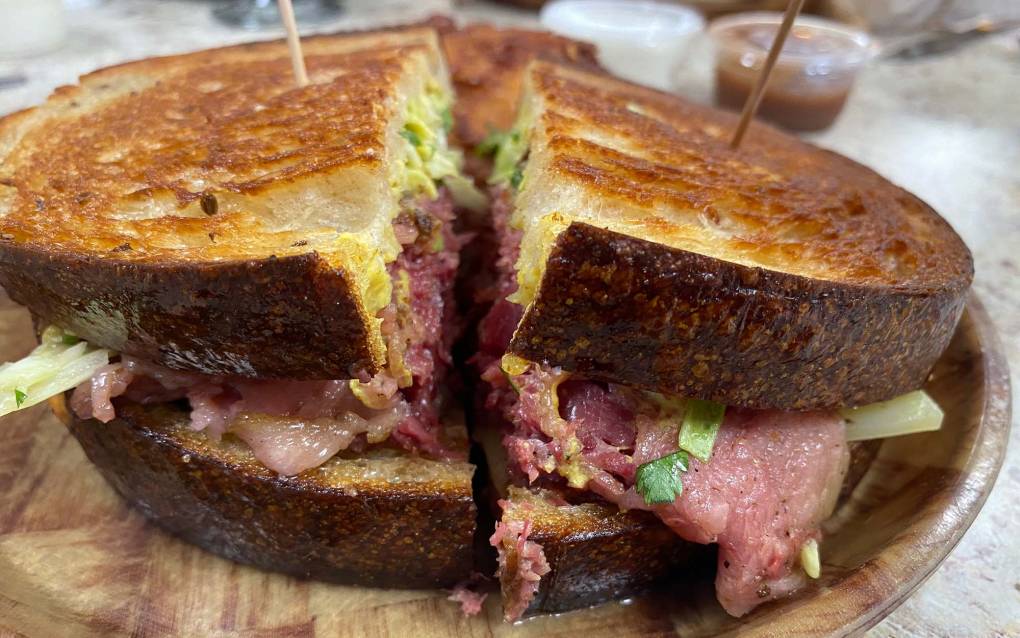
"caption": "The \"OG\" pastrami sandwich at Delirama, which announced the sudden closure of its Solano Ave. restaurant in Berkeley.",
"description": null,
"title": "delirama OG 2-crop",
"credit": "Luke Tsai/KQED",
"status": "inherit",
"altTag": "A pastrami sandwich on thick, griddled rye bread, served on a faux wood plate.",
"isLoading": false,
"fetchFailed": false
},
"arts_13950673": {
"type": "attachments",
"id": "arts_13950673",
"meta": {
"index": "attachments_1716263798",
"site": "arts",
"id": "13950673",
"found": true
},
"parent": 13950436,
"imgSizes": {
"twentyfourteen-full-width": {
"file": "https://cdn.kqed.org/wp-content/uploads/sites/2/2024/01/Hella-Hungry-—-Feature-Image-1920x1080-1-1038x576.jpg",
"width": 1038,
"mimeType": "image/jpeg",
"height": 576
},
"thumbnail": {
"file": "https://cdn.kqed.org/wp-content/uploads/sites/2/2024/01/Hella-Hungry-—-Feature-Image-1920x1080-1-160x90.jpg",
"width": 160,
"mimeType": "image/jpeg",
"height": 90
},
"post-thumbnail": {
"file": "https://cdn.kqed.org/wp-content/uploads/sites/2/2024/01/Hella-Hungry-—-Feature-Image-1920x1080-1-672x372.jpg",
"width": 672,
"mimeType": "image/jpeg",
"height": 372
},
"kqedFullSize": {
"file": "https://cdn.kqed.org/wp-content/uploads/sites/2/2024/01/Hella-Hungry-—-Feature-Image-1920x1080-1.jpg",
"width": 1920,
"height": 1080
},
"large": {
"file": "https://cdn.kqed.org/wp-content/uploads/sites/2/2024/01/Hella-Hungry-—-Feature-Image-1920x1080-1-1020x574.jpg",
"width": 1020,
"mimeType": "image/jpeg",
"height": 574
},
"1536x1536": {
"file": "https://cdn.kqed.org/wp-content/uploads/sites/2/2024/01/Hella-Hungry-—-Feature-Image-1920x1080-1-1536x864.jpg",
"width": 1536,
"mimeType": "image/jpeg",
"height": 864
},
"medium": {
"file": "https://cdn.kqed.org/wp-content/uploads/sites/2/2024/01/Hella-Hungry-—-Feature-Image-1920x1080-1-800x450.jpg",
"width": 800,
"mimeType": "image/jpeg",
"height": 450
},
"medium_large": {
"file": "https://cdn.kqed.org/wp-content/uploads/sites/2/2024/01/Hella-Hungry-—-Feature-Image-1920x1080-1-768x432.jpg",
"width": 768,
"mimeType": "image/jpeg",
"height": 432
}
},
"publishDate": 1705693913,
"modified": 1705694206,
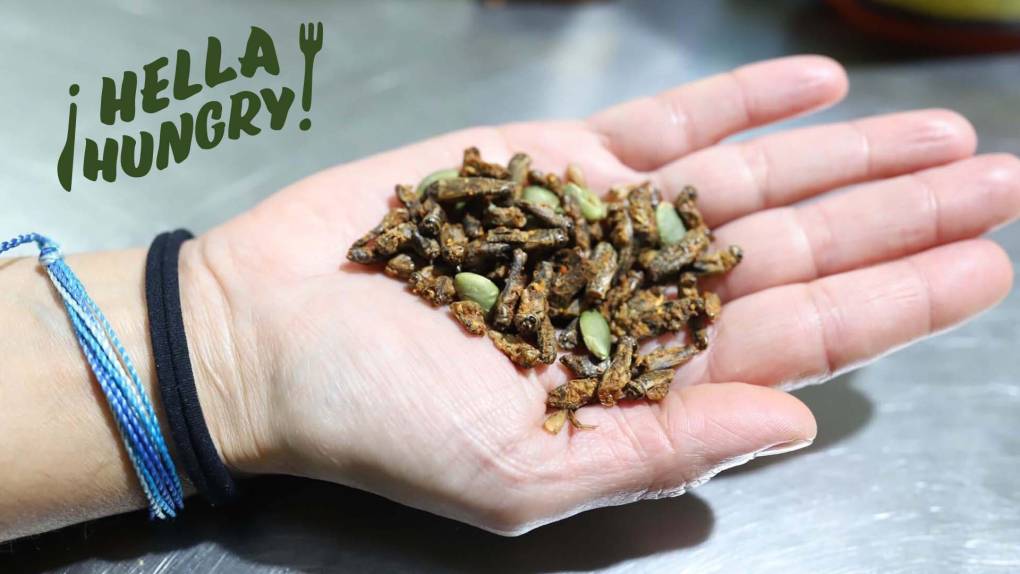
"caption": "Don Bugito founder Monica Martinez believes her edible insect snacks — including the toasted chile-lime crickets with pumpkin seeds pictured here — can be part of a more sustainable food supply.",
"description": null,
"title": "Hella Hungry — Feature Image (1920x1080)",
"credit": "Alan Chazaro/KQED",
"status": "inherit",
"altTag": "An outstretched hand holds dozens of toasted crickets mixed with pumpkin seeds. In the top left there is a \"Hella Hungry\" logo.",
"isLoading": false,
"fetchFailed": false
},
"arts_13950584": {
"type": "attachments",
"id": "arts_13950584",
"meta": {
"index": "attachments_1716263798",
"site": "arts",
"id": "13950584",
"found": true
},
"parent": 13950577,
"imgSizes": {
"twentyfourteen-full-width": {
"file": "https://cdn.kqed.org/wp-content/uploads/sites/2/2024/01/halal-king-chicken-mendi-1038x576.jpg",
"width": 1038,
"mimeType": "image/jpeg",
"height": 576
},
"thumbnail": {
"file": "https://cdn.kqed.org/wp-content/uploads/sites/2/2024/01/halal-king-chicken-mendi-160x110.jpg",
"width": 160,
"mimeType": "image/jpeg",
"height": 110
},
"post-thumbnail": {
"file": "https://cdn.kqed.org/wp-content/uploads/sites/2/2024/01/halal-king-chicken-mendi-672x372.jpg",
"width": 672,
"mimeType": "image/jpeg",
"height": 372
},
"kqedFullSize": {
"file": "https://cdn.kqed.org/wp-content/uploads/sites/2/2024/01/halal-king-chicken-mendi.jpg",
"width": 2000,
"height": 1375
},
"large": {
"file": "https://cdn.kqed.org/wp-content/uploads/sites/2/2024/01/halal-king-chicken-mendi-1020x701.jpg",
"width": 1020,
"mimeType": "image/jpeg",
"height": 701
},
"1536x1536": {
"file": "https://cdn.kqed.org/wp-content/uploads/sites/2/2024/01/halal-king-chicken-mendi-1536x1056.jpg",
"width": 1536,
"mimeType": "image/jpeg",
"height": 1056
},
"full-width": {
"file": "https://cdn.kqed.org/wp-content/uploads/sites/2/2024/01/halal-king-chicken-mendi-1920x1320.jpg",
"width": 1920,
"mimeType": "image/jpeg",
"height": 1320
},
"medium": {
"file": "https://cdn.kqed.org/wp-content/uploads/sites/2/2024/01/halal-king-chicken-mendi-800x550.jpg",
"width": 800,
"mimeType": "image/jpeg",
"height": 550
},
"medium_large": {
"file": "https://cdn.kqed.org/wp-content/uploads/sites/2/2024/01/halal-king-chicken-mendi-768x528.jpg",
"width": 768,
"mimeType": "image/jpeg",
"height": 528
}
},
"publishDate": 1705619320,
"modified": 1705619473,
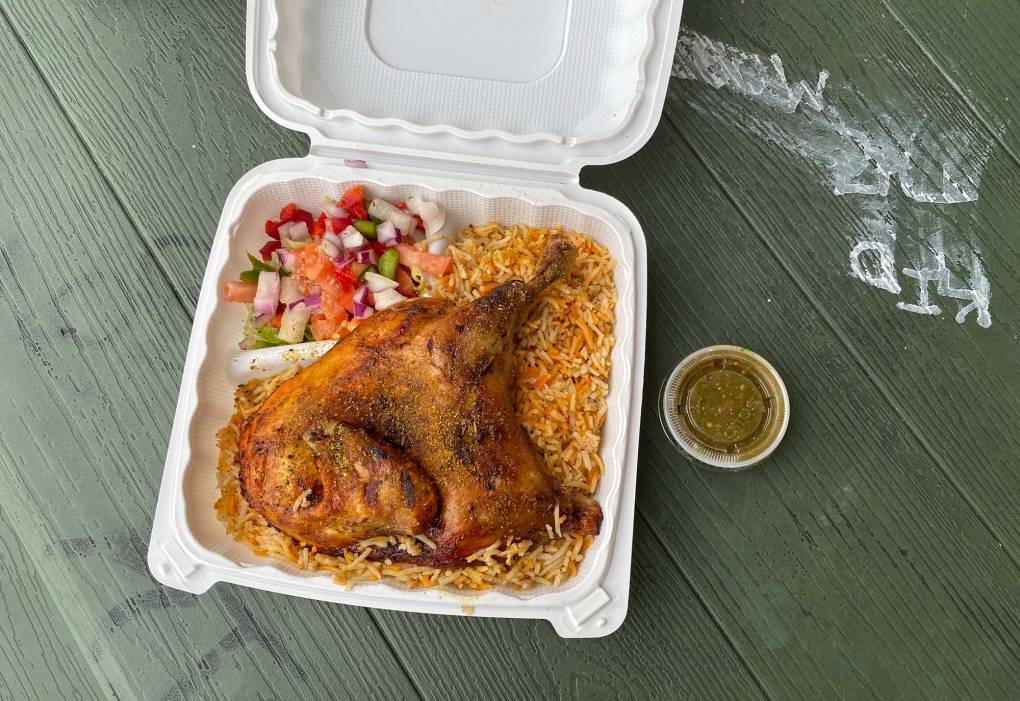
"caption": "Halal King's chicken mendi is one of the many surprisingly homey Yemeni dishes customers can find at a gas station convenience store in Richmond.",
"description": null,
"title": "halal king chicken mendi",
"credit": "Luke Tsai/KQED",
"status": "inherit",
"altTag": "On a picnic table: half a roast chicken over a bed of orange-tinted seasoned rice, served in a plastic takeout container with a small tub of green hot sauce on the side.",
"isLoading": false,
"fetchFailed": false
},
"arts_13950368": {
"type": "attachments",
"id": "arts_13950368",
"meta": {
"index": "attachments_1716263798",
"site": "arts",
"id": "13950368",
"found": true
},
"parent": 13950363,
"imgSizes": {
"twentyfourteen-full-width": {
"file": "https://cdn.kqed.org/wp-content/uploads/sites/2/2024/01/GettyImages-1504991138-1038x576.jpg",
"width": 1038,
"mimeType": "image/jpeg",
"height": 576
},
"thumbnail": {
"file": "https://cdn.kqed.org/wp-content/uploads/sites/2/2024/01/GettyImages-1504991138-160x107.jpg",
"width": 160,
"mimeType": "image/jpeg",
"height": 107
},
"post-thumbnail": {
"file": "https://cdn.kqed.org/wp-content/uploads/sites/2/2024/01/GettyImages-1504991138-672x372.jpg",
"width": 672,
"mimeType": "image/jpeg",
"height": 372
},
"kqedFullSize": {
"file": "https://cdn.kqed.org/wp-content/uploads/sites/2/2024/01/GettyImages-1504991138-scaled.jpg",
"width": 2560,
"height": 1708
},
"2048x2048": {
"file": "https://cdn.kqed.org/wp-content/uploads/sites/2/2024/01/GettyImages-1504991138-2048x1367.jpg",
"width": 2048,
"mimeType": "image/jpeg",
"height": 1367
},
"large": {
"file": "https://cdn.kqed.org/wp-content/uploads/sites/2/2024/01/GettyImages-1504991138-1020x681.jpg",
"width": 1020,
"mimeType": "image/jpeg",
"height": 681
},
"1536x1536": {
"file": "https://cdn.kqed.org/wp-content/uploads/sites/2/2024/01/GettyImages-1504991138-1536x1025.jpg",
"width": 1536,
"mimeType": "image/jpeg",
"height": 1025
},
"full-width": {
"file": "https://cdn.kqed.org/wp-content/uploads/sites/2/2024/01/GettyImages-1504991138-1920x1281.jpg",
"width": 1920,
"mimeType": "image/jpeg",
"height": 1281
},
"medium": {
"file": "https://cdn.kqed.org/wp-content/uploads/sites/2/2024/01/GettyImages-1504991138-800x534.jpg",
"width": 800,
"mimeType": "image/jpeg",
"height": 534
},
"medium_large": {
"file": "https://cdn.kqed.org/wp-content/uploads/sites/2/2024/01/GettyImages-1504991138-768x513.jpg",
"width": 768,
"mimeType": "image/jpeg",
"height": 513
}
},
"publishDate": 1705093896,
"modified": 1705094014,
"caption": "TikTok food reviewer Keith Lee, pictured at a WNBA game in 2023, held a mirror up to the Bay Area's problems this week in a video posted to 15 million followers.",
"description": null,
"title": "GettyImages-1504991138",
"credit": "Ethan Miller/Getty Images",
"status": "inherit",
"altTag": null,
"isLoading": false,
"fetchFailed": false
},
"arts_13940518": {
"type": "attachments",
"id": "arts_13940518",
"meta": {
"index": "attachments_1716263798",
"site": "arts",
"id": "13940518",
"found": true
},
"parent": 13940501,
"imgSizes": {
"twentyfourteen-full-width": {
"file": "https://cdn.kqed.org/wp-content/uploads/sites/2/2024/01/rocky-island-spread-1038x576.jpg",
"width": 1038,
"mimeType": "image/jpeg",
"height": 576
},
"thumbnail": {
"file": "https://cdn.kqed.org/wp-content/uploads/sites/2/2024/01/rocky-island-spread-160x90.jpg",
"width": 160,
"mimeType": "image/jpeg",
"height": 90
},
"post-thumbnail": {
"file": "https://cdn.kqed.org/wp-content/uploads/sites/2/2024/01/rocky-island-spread-672x372.jpg",
"width": 672,
"mimeType": "image/jpeg",
"height": 372
},
"kqedFullSize": {
"file": "https://cdn.kqed.org/wp-content/uploads/sites/2/2024/01/rocky-island-spread.jpg",
"width": 2000,
"height": 1125
},
"large": {
"file": "https://cdn.kqed.org/wp-content/uploads/sites/2/2024/01/rocky-island-spread-1020x574.jpg",
"width": 1020,
"mimeType": "image/jpeg",
"height": 574
},
"1536x1536": {
"file": "https://cdn.kqed.org/wp-content/uploads/sites/2/2024/01/rocky-island-spread-1536x864.jpg",
"width": 1536,
"mimeType": "image/jpeg",
"height": 864
},
"full-width": {
"file": "https://cdn.kqed.org/wp-content/uploads/sites/2/2024/01/rocky-island-spread-1920x1080.jpg",
"width": 1920,
"mimeType": "image/jpeg",
"height": 1080
},
"medium": {
"file": "https://cdn.kqed.org/wp-content/uploads/sites/2/2024/01/rocky-island-spread-800x450.jpg",
"width": 800,
"mimeType": "image/jpeg",
"height": 450
},
"medium_large": {
"file": "https://cdn.kqed.org/wp-content/uploads/sites/2/2024/01/rocky-island-spread-768x432.jpg",
"width": 768,
"mimeType": "image/jpeg",
"height": 432
}
},
"publishDate": 1705010629,
"modified": 1705010774,
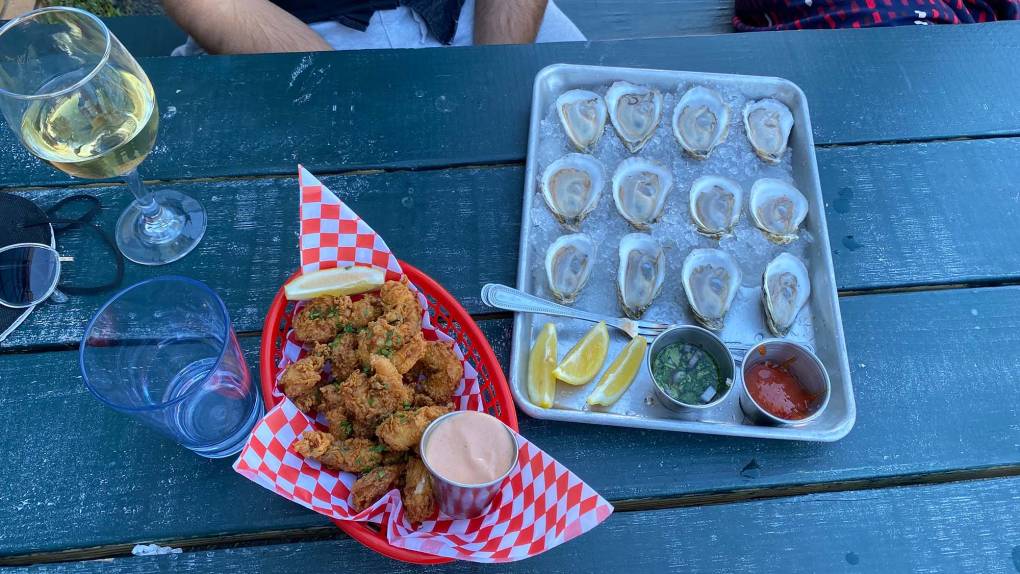
"caption": "Eating oysters outdoors at Rocky Island Oyster Co. was a quintessential Richmond waterfront experience. The restaurant has reopened as The Salty Pearl, in Oakland's Jack London neighborhood.",
"description": null,
"title": "rocky island spread",
"credit": "Luke Tsai/KQED",
"status": "inherit",
"altTag": "A tray of raw oysters on the half shell and a basket of fried shrimp on a picnic table.",
"isLoading": false,
"fetchFailed": false
},
"arts_13940177": {
"type": "attachments",
"id": "arts_13940177",
"meta": {
"index": "attachments_1716263798",
"site": "arts",
"id": "13940177",
"found": true
},
"parent": 13940127,
"imgSizes": {
"twentyfourteen-full-width": {
"file": "https://cdn.kqed.org/wp-content/uploads/sites/2/2024/01/ube-cannoli_crop-1038x576.jpg",
"width": 1038,
"mimeType": "image/jpeg",
"height": 576
},
"thumbnail": {
"file": "https://cdn.kqed.org/wp-content/uploads/sites/2/2024/01/ube-cannoli_crop-160x90.jpg",
"width": 160,
"mimeType": "image/jpeg",
"height": 90
},
"post-thumbnail": {
"file": "https://cdn.kqed.org/wp-content/uploads/sites/2/2024/01/ube-cannoli_crop-672x372.jpg",
"width": 672,
"mimeType": "image/jpeg",
"height": 372
},
"kqedFullSize": {
"file": "https://cdn.kqed.org/wp-content/uploads/sites/2/2024/01/ube-cannoli_crop.jpg",
"width": 1920,
"height": 1080
},
"large": {
"file": "https://cdn.kqed.org/wp-content/uploads/sites/2/2024/01/ube-cannoli_crop-1020x574.jpg",
"width": 1020,
"mimeType": "image/jpeg",
"height": 574
},
"1536x1536": {
"file": "https://cdn.kqed.org/wp-content/uploads/sites/2/2024/01/ube-cannoli_crop-1536x864.jpg",
"width": 1536,
"mimeType": "image/jpeg",
"height": 864
},
"medium": {
"file": "https://cdn.kqed.org/wp-content/uploads/sites/2/2024/01/ube-cannoli_crop-800x450.jpg",
"width": 800,
"mimeType": "image/jpeg",
"height": 450
},
"medium_large": {
"file": "https://cdn.kqed.org/wp-content/uploads/sites/2/2024/01/ube-cannoli_crop-768x432.jpg",
"width": 768,
"mimeType": "image/jpeg",
"height": 432
}
},
"publishDate": 1704770669,
"modified": 1704826521,
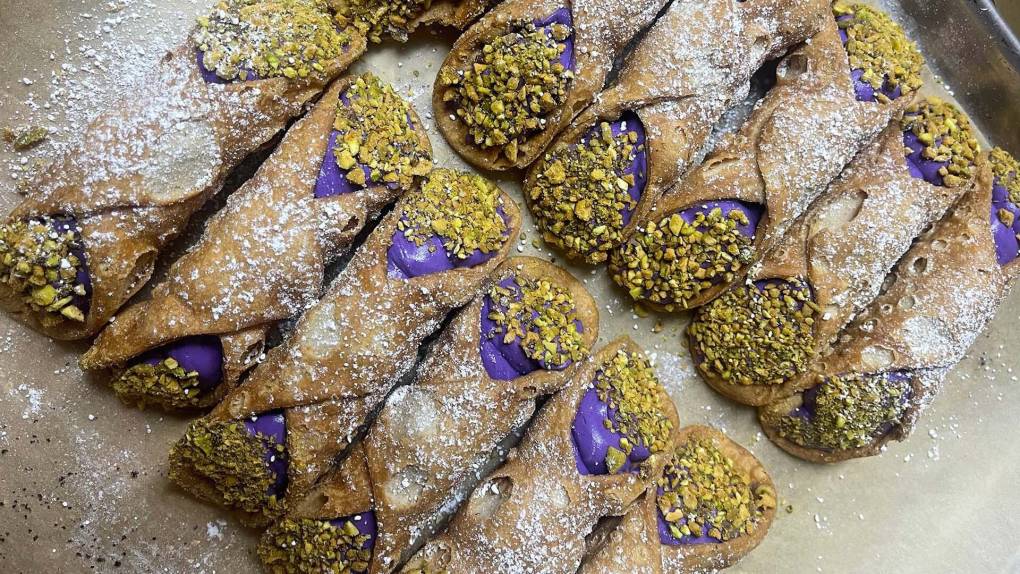
"caption": "As a pop-up, Macs By Icky went viral with their variety of Filipino-forward desserts, like ube cannoli.",
"description": null,
"title": "ube-cannoli_crop",
"credit": "Courtesy of Victoria Sablan",
"status": "inherit",
"altTag": "a tray of ube-flavored cannolis with pistachio crumbs",
"isLoading": false,
"fetchFailed": false
},
"arts_13940135": {
"type": "attachments",
"id": "arts_13940135",
"meta": {
"index": "attachments_1716263798",
"site": "arts",
"id": "13940135",
"found": true
},
"parent": 13940133,
"imgSizes": {
"twentyfourteen-full-width": {
"file": "https://cdn.kqed.org/wp-content/uploads/sites/2/2024/01/9780593533055_Interior_Image_3_495221-1038x576.jpg",
"width": 1038,
"mimeType": "image/jpeg",
"height": 576
},
"thumbnail": {
"file": "https://cdn.kqed.org/wp-content/uploads/sites/2/2024/01/9780593533055_Interior_Image_3_495221-160x90.jpg",
"width": 160,
"mimeType": "image/jpeg",
"height": 90
},
"post-thumbnail": {
"file": "https://cdn.kqed.org/wp-content/uploads/sites/2/2024/01/9780593533055_Interior_Image_3_495221-672x372.jpg",
"width": 672,
"mimeType": "image/jpeg",
"height": 372
},
"kqedFullSize": {
"file": "https://cdn.kqed.org/wp-content/uploads/sites/2/2024/01/9780593533055_Interior_Image_3_495221.jpg",
"width": 2000,
"height": 1125
},
"large": {
"file": "https://cdn.kqed.org/wp-content/uploads/sites/2/2024/01/9780593533055_Interior_Image_3_495221-1020x574.jpg",
"width": 1020,
"mimeType": "image/jpeg",
"height": 574
},
"1536x1536": {
"file": "https://cdn.kqed.org/wp-content/uploads/sites/2/2024/01/9780593533055_Interior_Image_3_495221-1536x864.jpg",
"width": 1536,
"mimeType": "image/jpeg",
"height": 864
},
"full-width": {
"file": "https://cdn.kqed.org/wp-content/uploads/sites/2/2024/01/9780593533055_Interior_Image_3_495221-1920x1080.jpg",
"width": 1920,
"mimeType": "image/jpeg",
"height": 1080
},
"medium": {
"file": "https://cdn.kqed.org/wp-content/uploads/sites/2/2024/01/9780593533055_Interior_Image_3_495221-800x450.jpg",
"width": 800,
"mimeType": "image/jpeg",
"height": 450
},
"medium_large": {
"file": "https://cdn.kqed.org/wp-content/uploads/sites/2/2024/01/9780593533055_Interior_Image_3_495221-768x432.jpg",
"width": 768,
"mimeType": "image/jpeg",
"height": 432
}
},
"publishDate": 1704740605,
"modified": 1704740827,
"caption": "The protagonist of Ying Chang Compestine's new children's book, 'Ra Pu Zel and the Stinky Tofu,' is a spunky Chinese princess who loves eating delicious food above all else.",
"description": null,
"title": "9780593533055_Interior_Image_3_495221",
"credit": "Crystal Kung/Penguin Random House",
"status": "inherit",
"altTag": "Illustration of a Chinese princess playing with her pet dog.",
"isLoading": false,
"fetchFailed": false
},
"arts_13939696": {
"type": "attachments",
"id": "arts_13939696",
"meta": {
"index": "attachments_1716263798",
"site": "arts",
"id": "13939696",
"found": true
},
"parent": 13939695,
"imgSizes": {
"twentyfourteen-full-width": {
"file": "https://cdn.kqed.org/wp-content/uploads/sites/2/2023/12/gogl-mogl-3fe066549522873d431c3cf6032ac4fd5c44560a-1038x576.jpe",
"width": 1038,
"mimeType": "image/jpeg",
"height": 576
},
"thumbnail": {
"file": "https://cdn.kqed.org/wp-content/uploads/sites/2/2023/12/gogl-mogl-3fe066549522873d431c3cf6032ac4fd5c44560a-160x120.jpe",
"width": 160,
"mimeType": "image/jpeg",
"height": 120
},
"post-thumbnail": {
"file": "https://cdn.kqed.org/wp-content/uploads/sites/2/2023/12/gogl-mogl-3fe066549522873d431c3cf6032ac4fd5c44560a-672x372.jpe",
"width": 672,
"mimeType": "image/jpeg",
"height": 372
},
"kqedFullSize": {
"file": "https://cdn.kqed.org/wp-content/uploads/sites/2/2023/12/gogl-mogl-3fe066549522873d431c3cf6032ac4fd5c44560a-scaled.jpe",
"width": 2560,
"height": 1920
},
"2048x2048": {
"file": "https://cdn.kqed.org/wp-content/uploads/sites/2/2023/12/gogl-mogl-3fe066549522873d431c3cf6032ac4fd5c44560a-2048x1536.jpe",
"width": 2048,
"mimeType": "image/jpeg",
"height": 1536
},
"large": {
"file": "https://cdn.kqed.org/wp-content/uploads/sites/2/2023/12/gogl-mogl-3fe066549522873d431c3cf6032ac4fd5c44560a-1020x765.jpe",
"width": 1020,
"mimeType": "image/jpeg",
"height": 765
},
"1536x1536": {
"file": "https://cdn.kqed.org/wp-content/uploads/sites/2/2023/12/gogl-mogl-3fe066549522873d431c3cf6032ac4fd5c44560a-1536x1152.jpe",
"width": 1536,
"mimeType": "image/jpeg",
"height": 1152
},
"full-width": {
"file": "https://cdn.kqed.org/wp-content/uploads/sites/2/2023/12/gogl-mogl-3fe066549522873d431c3cf6032ac4fd5c44560a-1920x1440.jpe",
"width": 1920,
"mimeType": "image/jpeg",
"height": 1440
},
"medium": {
"file": "https://cdn.kqed.org/wp-content/uploads/sites/2/2023/12/gogl-mogl-3fe066549522873d431c3cf6032ac4fd5c44560a-800x600.jpe",
"width": 800,
"mimeType": "image/jpeg",
"height": 600
},
"medium_large": {
"file": "https://cdn.kqed.org/wp-content/uploads/sites/2/2023/12/gogl-mogl-3fe066549522873d431c3cf6032ac4fd5c44560a-768x576.jpe",
"width": 768,
"mimeType": "image/jpeg",
"height": 576
}
},
"publishDate": 1703016292,
"modified": 1703018194,
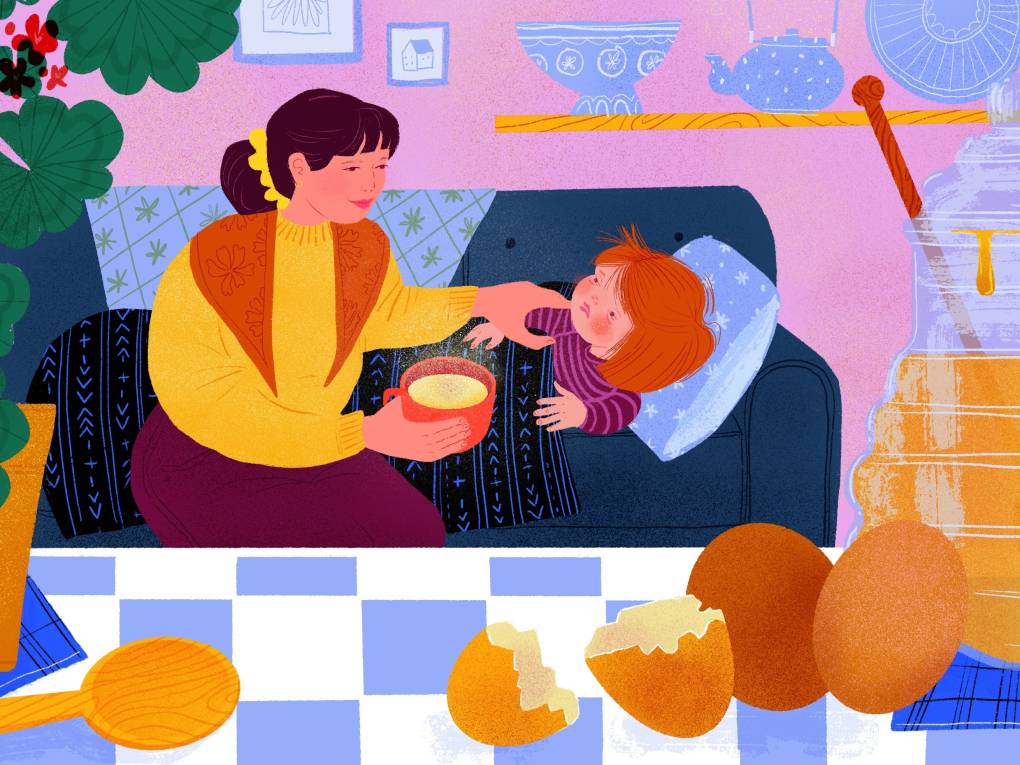
"caption": "\"I always compare dishes from our childhood as like a warm blanket,\" says Polish food writer Michał Korkosz of gogl-mogl. \"They remind you when you were the happiest in your life.\"",
"description": null,
"title": "\"I always compare dishes from our childhood as like a warm blanket,\" says Polish food writer Michał Korkosz of gogl-mogl. \"They remind you when you were the happiest in your life.\"",
"credit": "Sophia Pappas for NPR",
"status": "inherit",
"altTag": "An illustration showing a mother feeding her child a hot cup of gogl-mogl.",
"isLoading": false,
"fetchFailed": false
},
"arts_13939480": {
"type": "attachments",
"id": "arts_13939480",
"meta": {
"index": "attachments_1716263798",
"site": "arts",
"id": "13939480",
"found": true
},
"parent": 13939388,
"imgSizes": {
"twentyfourteen-full-width": {
"file": "https://cdn.kqed.org/wp-content/uploads/sites/2/2023/12/Hella-Hungry-—-Feature-Image-1920x1080-1-1038x576.jpg",
"width": 1038,
"mimeType": "image/jpeg",
"height": 576
},
"thumbnail": {
"file": "https://cdn.kqed.org/wp-content/uploads/sites/2/2023/12/Hella-Hungry-—-Feature-Image-1920x1080-1-160x90.jpg",
"width": 160,
"mimeType": "image/jpeg",
"height": 90
},
"post-thumbnail": {
"file": "https://cdn.kqed.org/wp-content/uploads/sites/2/2023/12/Hella-Hungry-—-Feature-Image-1920x1080-1-672x372.jpg",
"width": 672,
"mimeType": "image/jpeg",
"height": 372
},
"kqedFullSize": {
"file": "https://cdn.kqed.org/wp-content/uploads/sites/2/2023/12/Hella-Hungry-—-Feature-Image-1920x1080-1.jpg",
"width": 1920,
"height": 1080
},
"large": {
"file": "https://cdn.kqed.org/wp-content/uploads/sites/2/2023/12/Hella-Hungry-—-Feature-Image-1920x1080-1-1020x574.jpg",
"width": 1020,
"mimeType": "image/jpeg",
"height": 574
},
"1536x1536": {
"file": "https://cdn.kqed.org/wp-content/uploads/sites/2/2023/12/Hella-Hungry-—-Feature-Image-1920x1080-1-1536x864.jpg",
"width": 1536,
"mimeType": "image/jpeg",
"height": 864
},
"medium": {
"file": "https://cdn.kqed.org/wp-content/uploads/sites/2/2023/12/Hella-Hungry-—-Feature-Image-1920x1080-1-800x450.jpg",
"width": 800,
"mimeType": "image/jpeg",
"height": 450
},
"medium_large": {
"file": "https://cdn.kqed.org/wp-content/uploads/sites/2/2023/12/Hella-Hungry-—-Feature-Image-1920x1080-1-768x432.jpg",
"width": 768,
"mimeType": "image/jpeg",
"height": 432
}
},
"publishDate": 1702588828,
"modified": 1702665025,
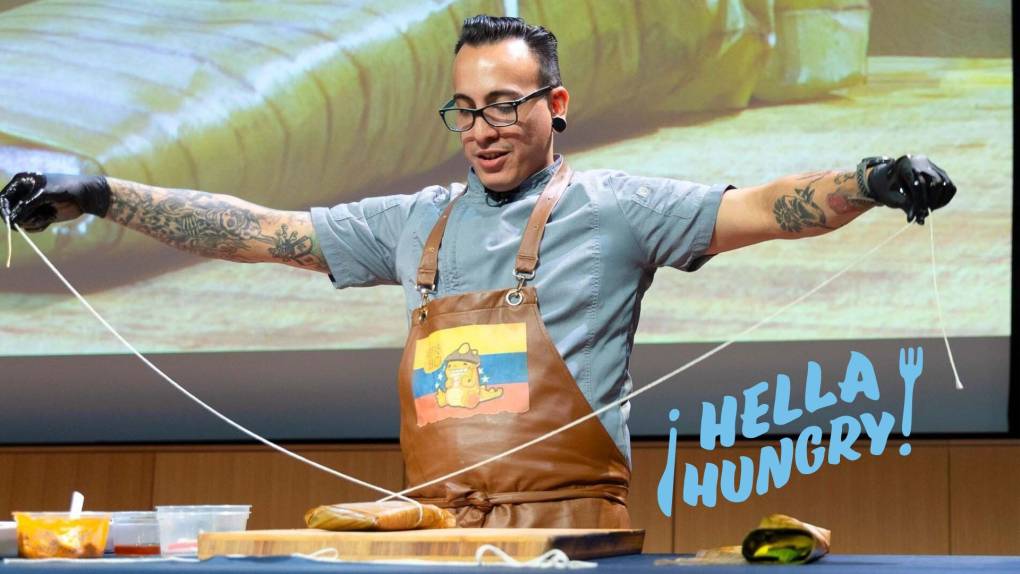
"caption": "Victor Aguilera demonstrates his technique for tying up Venezuelan hallacas at a KQED live event on Dec. 12, 2023. Aguilera's business, Arepas en Bici, specializes in homemade Venezuelan foods.",
"description": null,
"title": "Hella Hungry — Feature Image (1920x1080)",
"credit": "Estefany Gonzalez for KQED",
"status": "inherit",
"altTag": "A man with his arms outstretched wraps twine around a leaf-wrapped hallaca.",
"isLoading": false,
"fetchFailed": false
},
"arts_13939428": {
"type": "attachments",
"id": "arts_13939428",
"meta": {
"index": "attachments_1716263798",
"site": "arts",
"id": "13939428",
"found": true
},
"parent": 13939383,
"imgSizes": {
"twentyfourteen-full-width": {
"file": "https://cdn.kqed.org/wp-content/uploads/sites/2/2023/12/Timberland-Scan-crop_RR-1038x576.jpg",
"width": 1038,
"mimeType": "image/jpeg",
"height": 576
},
"thumbnail": {
"file": "https://cdn.kqed.org/wp-content/uploads/sites/2/2023/12/Timberland-Scan-crop_RR-160x90.jpg",
"width": 160,
"mimeType": "image/jpeg",
"height": 90
},
"post-thumbnail": {
"file": "https://cdn.kqed.org/wp-content/uploads/sites/2/2023/12/Timberland-Scan-crop_RR-672x372.jpg",
"width": 672,
"mimeType": "image/jpeg",
"height": 372
},
"kqedFullSize": {
"file": "https://cdn.kqed.org/wp-content/uploads/sites/2/2023/12/Timberland-Scan-crop_RR.jpg",
"width": 2000,
"height": 1125
},
"large": {
"file": "https://cdn.kqed.org/wp-content/uploads/sites/2/2023/12/Timberland-Scan-crop_RR-1020x574.jpg",
"width": 1020,
"mimeType": "image/jpeg",
"height": 574
},
"1536x1536": {
"file": "https://cdn.kqed.org/wp-content/uploads/sites/2/2023/12/Timberland-Scan-crop_RR-1536x864.jpg",
"width": 1536,
"mimeType": "image/jpeg",
"height": 864
},
"full-width": {
"file": "https://cdn.kqed.org/wp-content/uploads/sites/2/2023/12/Timberland-Scan-crop_RR-1920x1080.jpg",
"width": 1920,
"mimeType": "image/jpeg",
"height": 1080
},
"medium": {
"file": "https://cdn.kqed.org/wp-content/uploads/sites/2/2023/12/Timberland-Scan-crop_RR-800x450.jpg",
"width": 800,
"mimeType": "image/jpeg",
"height": 450
},
"medium_large": {
"file": "https://cdn.kqed.org/wp-content/uploads/sites/2/2023/12/Timberland-Scan-crop_RR-768x432.jpg",
"width": 768,
"mimeType": "image/jpeg",
"height": 432
}
},
"publishDate": 1702579071,
"modified": 1702579258,
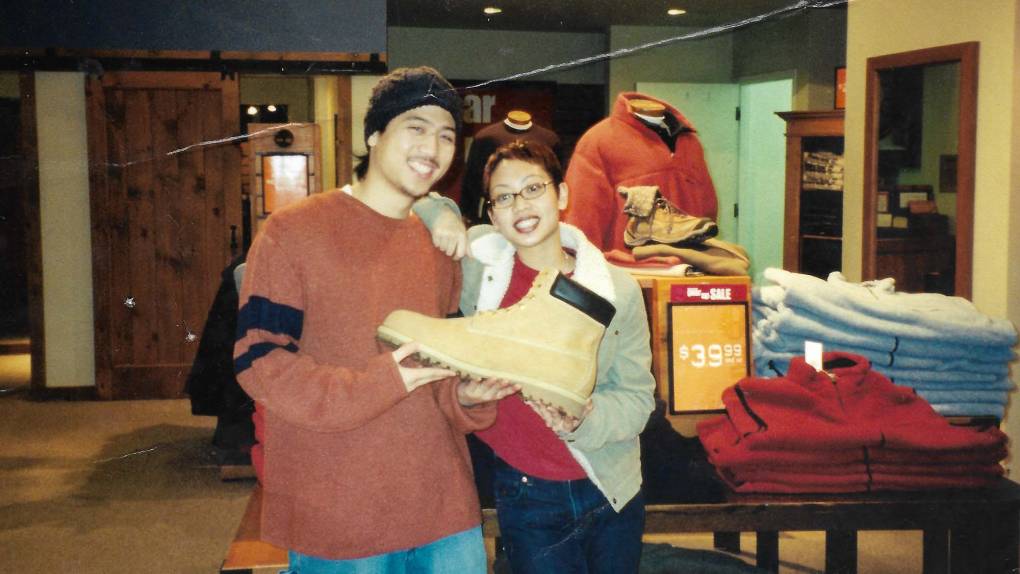
"caption": "A young Rocky Rivera (right) poses with her beloved wheat color Timberland boot. She worked in the downtown San Francisco Timberland store in the early 2000s.",
"description": null,
"title": "Timberland Scan-crop_RR",
"credit": "Courtesy of Rocky Rivera",
"status": "inherit",
"altTag": "A young man and woman pose for a photo inside a clothing store while holding a oversized Timberland work boot.",
"isLoading": false,
"fetchFailed": false
},
"arts_13939067": {
"type": "attachments",
"id": "arts_13939067",
"meta": {
"index": "attachments_1716263798",
"site": "arts",
"id": "13939067",
"found": true
},
"parent": 0,
"imgSizes": {
"twentyfourteen-full-width": {
"file": "https://cdn.kqed.org/wp-content/uploads/sites/2/2023/12/20231206-Sugar-n-Spice-055-JY-KQED-1038x576.jpg",
"width": 1038,
"mimeType": "image/jpeg",
"height": 576
},
"thumbnail": {
"file": "https://cdn.kqed.org/wp-content/uploads/sites/2/2023/12/20231206-Sugar-n-Spice-055-JY-KQED-160x107.jpg",
"width": 160,
"mimeType": "image/jpeg",
"height": 107
},
"post-thumbnail": {
"file": "https://cdn.kqed.org/wp-content/uploads/sites/2/2023/12/20231206-Sugar-n-Spice-055-JY-KQED-672x372.jpg",
"width": 672,
"mimeType": "image/jpeg",
"height": 372
},
"kqedFullSize": {
"file": "https://cdn.kqed.org/wp-content/uploads/sites/2/2023/12/20231206-Sugar-n-Spice-055-JY-KQED.jpg",
"width": 2000,
"height": 1333
},
"large": {
"file": "https://cdn.kqed.org/wp-content/uploads/sites/2/2023/12/20231206-Sugar-n-Spice-055-JY-KQED-1020x680.jpg",
"width": 1020,
"mimeType": "image/jpeg",
"height": 680
},
"1536x1536": {
"file": "https://cdn.kqed.org/wp-content/uploads/sites/2/2023/12/20231206-Sugar-n-Spice-055-JY-KQED-1536x1024.jpg",
"width": 1536,
"mimeType": "image/jpeg",
"height": 1024
},
"full-width": {
"file": "https://cdn.kqed.org/wp-content/uploads/sites/2/2023/12/20231206-Sugar-n-Spice-055-JY-KQED-1920x1280.jpg",
"width": 1920,
"mimeType": "image/jpeg",
"height": 1280
},
"medium": {
"file": "https://cdn.kqed.org/wp-content/uploads/sites/2/2023/12/20231206-Sugar-n-Spice-055-JY-KQED-800x533.jpg",
"width": 800,
"mimeType": "image/jpeg",
"height": 533
},
"medium_large": {
"file": "https://cdn.kqed.org/wp-content/uploads/sites/2/2023/12/20231206-Sugar-n-Spice-055-JY-KQED-768x512.jpg",
"width": 768,
"mimeType": "image/jpeg",
"height": 512
}
},
"publishDate": 1701966757,
"modified": 1702404160,
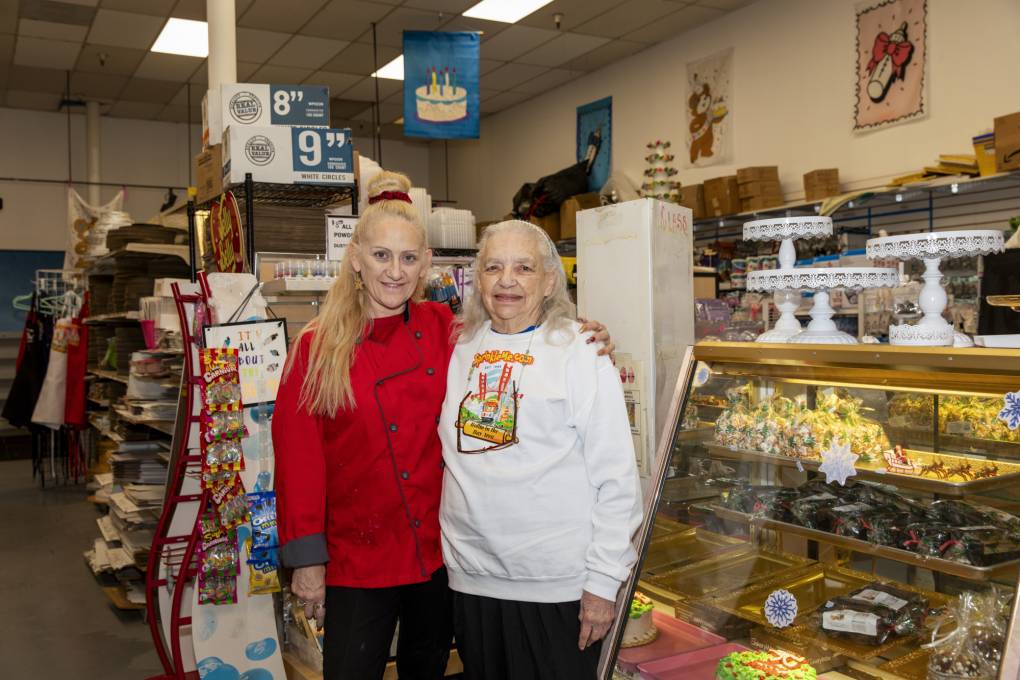
"caption": "Joey Rogers (left) and her mother Jeanné Lutz pose for a portrait at Rogers’ Daly City baking supply store, Sugar ’n Spice, on Wednesday, Dec. 6, 2023. Open for nearly 30 years, the shop sells a huge variety of cake and cookie decorating supplies.",
"description": null,
"title": "Sugar ’n Spice",
"credit": "Juliana Yamada/KQED",
"status": "inherit",
"altTag": "A woman in a red chef's coat poses her arm around the should of an older woman in a white sweatshirt that reads, \"SprinkleMe.com.\" They are standing next to the front display case of a baking supply shop.",
"isLoading": false,
"fetchFailed": false
}
},
"audioPlayerReducer": {
"postId": "stream_live",
"isPaused": true,
"isPlaying": false,
"pfsActive": false,
"pledgeModalIsOpen": true,
"playerDrawerIsOpen": false,
"liveAudioPlayStartedAt": 0,
"liveAudioPlayContext": ""
},
"authorsReducer": {
"byline_arts_13939695": {
"type": "authors",
"id": "byline_arts_13939695",
"meta": {
"override": true
},
"slug": "byline_arts_13939695",
"name": "Deena Prichep",
"isLoading": false
},
"ltsai": {
"type": "authors",
"id": "11743",
"meta": {
"index": "authors_1716337520",
"id": "11743",
"found": true
},
"name": "Luke Tsai",
"firstName": "Luke",
"lastName": "Tsai",
"slug": "ltsai",
"email": "ltsai@kqed.org",
"display_author_email": true,
"staff_mastheads": [
"arts"
],
"title": "Food Editor",
"bio": "Luke Tsai is KQED's food editor and resident stinky tofu connoisseur. Prior to KQED, he was an editor at Eater SF, \u003cem>San Francisco \u003c/em>magazine, and the \u003cem>East Bay Express\u003c/em>, and his work has also appeared in TASTE, the \u003cem>San Francisco Chronicle\u003c/em>, and the \u003cem>Best Food Writing\u003c/em> anthology. When he isn't writing or editing, you'll find him eating most everything he can get his hands on.",
"avatar": "https://secure.gravatar.com/avatar/1e59b45bf191526e7339d6ba46e33a57b2030d25c27660ecc64ea3cb863e34f7?s=600&d=blank&r=g",
"twitter": "theluketsai",
"bluesky": null,
"facebook": null,
"instagram": null,
"linkedin": null,
"sites": [
{
"site": "",
"roles": [
"editor"
]
},
{
"site": "arts",
"roles": [
"administrator"
]
},
{
"site": "news",
"roles": [
"editor",
"contributor"
]
},
{
"site": "bayareabites",
"roles": [
"editor"
]
},
{
"site": "food",
"roles": [
"editor"
]
}
],
"headData": {
"title": "Luke Tsai | KQED",
"description": "Food Editor",
"ogImgSrc": "https://secure.gravatar.com/avatar/1e59b45bf191526e7339d6ba46e33a57b2030d25c27660ecc64ea3cb863e34f7?s=600&d=blank&r=g",
"twImgSrc": "https://secure.gravatar.com/avatar/1e59b45bf191526e7339d6ba46e33a57b2030d25c27660ecc64ea3cb863e34f7?s=600&d=blank&r=g"
},
"isLoading": false,
"link": "/author/ltsai"
},
"achazaro": {
"type": "authors",
"id": "11748",
"meta": {
"index": "authors_1716337520",
"id": "11748",
"found": true
},
"name": "Alan Chazaro",
"firstName": "Alan",
"lastName": "Chazaro",
"slug": "achazaro",
"email": "agchazaro@gmail.com",
"display_author_email": true,
"staff_mastheads": [],
"title": "Food Writer and Reporter",
"bio": "Alan Chazaro is the author of \u003cem>This Is Not a Frank Ocean Cover Album\u003c/em> (Black Lawrence Press, 2019), \u003cem>Piñata Theory\u003c/em> (Black Lawrence Press, 2020), and \u003cem>Notes from the Eastern Span of the Bay Bridge\u003c/em> (Ghost City Press, 2021). He is a graduate of June Jordan’s Poetry for the People program at UC Berkeley and a former Lawrence Ferlinghetti Fellow at the University of San Francisco. He writes about sports, food, art, music, education, and culture while repping the Bay on \u003ca href=\"https://twitter.com/alan_chazaro\">Twitter\u003c/a> and \u003ca href=\"https://www.instagram.com/alan_chazaro/?hl=en\">Instagram\u003c/a> at @alan_chazaro.",
"avatar": "https://secure.gravatar.com/avatar/ea8b6dd970fc5c29e7a188e7d5861df7?s=600&d=blank&r=g",
"twitter": "alan_chazaro",
"facebook": null,
"instagram": null,
"linkedin": null,
"sites": [
{
"site": "arts",
"roles": [
"contributor"
]
},
{
"site": "news",
"roles": [
"editor"
]
}
],
"headData": {
"title": "Alan Chazaro | KQED",
"description": "Food Writer and Reporter",
"ogImgSrc": "https://secure.gravatar.com/avatar/ea8b6dd970fc5c29e7a188e7d5861df7?s=600&d=blank&r=g",
"twImgSrc": "https://secure.gravatar.com/avatar/ea8b6dd970fc5c29e7a188e7d5861df7?s=600&d=blank&r=g"
},
"isLoading": false,
"link": "/author/achazaro"
},
"rockyrivera": {
"type": "authors",
"id": "11846",
"meta": {
"index": "authors_1716337520",
"id": "11846",
"found": true
},
"name": "Rocky Rivera",
"firstName": "Rocky",
"lastName": "Rivera",
"slug": "rockyrivera",
"email": "ms.rocky.rivera@gmail.com",
"display_author_email": false,
"staff_mastheads": [],
"title": "KQED Contributor",
"bio": "Rocky Rivera is a journalist, emcee, author and activist from San Francisco. She has released four albums through her label, Beatrock Music, and a ten-volume mixtape series with DJ Roza. She released her first book in 2021, entitled \u003cem>Snakeskin: Essays by Rocky Rivera\u003c/em>. Her latest album dropped in September 2024 and is called \"Long Kiss Goodnight\" with emcee/producer Otayo Dubb. She currently writes the Frisco Foodies column as a love letter to her hometown.",
"avatar": "https://secure.gravatar.com/avatar/946241ee2c59e6040607dfc75240d91b?s=600&d=blank&r=g",
"twitter": null,
"facebook": "https://m.facebook.com/rockyriveramusic",
"instagram": "https://instagram.com/rockyrivera",
"linkedin": "https://www.linkedin.com/in/krishtinedeleon/",
"sites": [
{
"site": "arts",
"roles": [
"author"
]
}
],
"headData": {
"title": "Rocky Rivera | KQED",
"description": "KQED Contributor",
"ogImgSrc": "https://secure.gravatar.com/avatar/946241ee2c59e6040607dfc75240d91b?s=600&d=blank&r=g",
"twImgSrc": "https://secure.gravatar.com/avatar/946241ee2c59e6040607dfc75240d91b?s=600&d=blank&r=g"
},
"isLoading": false,
"link": "/author/rockyrivera"
},
"omayeda": {
"type": "authors",
"id": "11872",
"meta": {
"index": "authors_1716337520",
"id": "11872",
"found": true
},
"name": "Olivia Cruz Mayeda",
"firstName": "Olivia Cruz",
"lastName": "Mayeda",
"slug": "omayeda",
"email": "omayeda@kqed.org",
"display_author_email": false,
"staff_mastheads": [],
"title": "Reporter",
"bio": "Olivia Cruz Mayeda is a journalist covering style, culture and reparations in the Bay Area, a place that has been home to her family for over 100 years. Her writing has also appeared in the \u003cem>San Francisco Chronicle\u003c/em> and \u003cem>El Tecolote\u003c/em>.",
"avatar": "https://secure.gravatar.com/avatar/a8c0baa30219ce1071a9474f4c14141f?s=600&d=blank&r=g",
"twitter": null,
"facebook": null,
"instagram": null,
"linkedin": null,
"sites": [
{
"site": "arts",
"roles": [
"contributor"
]
}
],
"headData": {
"title": "Olivia Cruz Mayeda | KQED",
"description": "Reporter",
"ogImgSrc": "https://secure.gravatar.com/avatar/a8c0baa30219ce1071a9474f4c14141f?s=600&d=blank&r=g",
"twImgSrc": "https://secure.gravatar.com/avatar/a8c0baa30219ce1071a9474f4c14141f?s=600&d=blank&r=g"
},
"isLoading": false,
"link": "/author/omayeda"
},
"bduffett": {
"type": "authors",
"id": "11902",
"meta": {
"index": "authors_1716337520",
"id": "11902",
"found": true
},
"name": "Becky Duffett",
"firstName": "Becky",
"lastName": "Duffett",
"slug": "bduffett",
"email": "duffettr@gmail.com",
"display_author_email": false,
"staff_mastheads": [],
"title": "KQED Contributor",
"bio": null,
"avatar": "https://secure.gravatar.com/avatar/e5baf1733e81ecc5f55104a3c095028c?s=600&d=blank&r=g",
"twitter": null,
"facebook": null,
"instagram": null,
"linkedin": null,
"sites": [
{
"site": "arts",
"roles": [
"contributor"
]
}
],
"headData": {
"title": "Becky Duffett | KQED",
"description": "KQED Contributor",
"ogImgSrc": "https://secure.gravatar.com/avatar/e5baf1733e81ecc5f55104a3c095028c?s=600&d=blank&r=g",
"twImgSrc": "https://secure.gravatar.com/avatar/e5baf1733e81ecc5f55104a3c095028c?s=600&d=blank&r=g"
},
"isLoading": false,
"link": "/author/bduffett"
}
},
"pagesReducer": {
"arts_tag_food": {
"type": "terms",
"id": "arts_1297",
"meta": {
"index": "terms_1716263798",
"site": "arts",
"id": "1297",
"score": 7.4242826
},
"featImg": null,
"name": "food",
"description": null,
"taxonomy": "tag",
"headData": {
"twImgId": null,
"twTitle": null,
"ogTitle": null,
"ogImgId": null,
"twDescription": null,
"description": null,
"title": "food Archives | KQED Arts",
"ogDescription": null
},
"ttid": 1309,
"slug": "food",
"isLoading": false,
"title": "food",
"pageMeta": {
"site": "arts",
"WpPageTemplate": "page-topic-editorial",
"currentPage": 22
},
"blocks": [
{
"blockName": "kqed/post-list",
"attrs": {
"layout": "cardArticle2",
"query": "posts/arts?tag=food",
"seeMore": false,
"paginated": true,
"page": 22
}
},
{
"blockName": "kqed/ad"
}
]
}
},
"pfsSessionReducer": {},
"postsReducer": {
"stream_live": {
"type": "live",
"id": "stream_live",
"audioUrl": "https://streams.kqed.org/kqedradio",
"title": "Live Stream",
"excerpt": "Live Stream information currently unavailable.",
"link": "/radio",
"featImg": "",
"label": {
"name": "KQED Live",
"link": "/"
}
},
"stream_kqedNewscast": {
"type": "posts",
"id": "stream_kqedNewscast",
"audioUrl": "https://www.kqed.org/.stream/anon/radio/RDnews/newscast.mp3?_=1",
"title": "KQED Newscast",
"featImg": "",
"label": {
"name": "88.5 FM",
"link": "/"
}
},
"arts_13951141": {
"type": "posts",
"id": "arts_13951141",
"meta": {
"index": "posts_1716263798",
"site": "arts",
"id": "13951141",
"score": null,
"sort": [
1706559285000
]
},
"parent": 0,
"labelTerm": {},
"blocks": [],
"publishDate": 1706559285,
"format": "standard",
"title": "Sohla El-Waylly Cements Her Starring Role With a Thrilling Debut Cookbook",
"headTitle": "Sohla El-Waylly Cements Her Starring Role With a Thrilling Debut Cookbook | KQED",
"content": "\u003cp>Sohla El-Waylly is a culinary maverick of our time: She knows how to deactivate the surface starches of rice for the perfect pilaf, she’s made crudités sexy by sheer force of will and she’s spoken truth to power with lasting impacts.\u003c/p>\n\u003cp>El-Waylly’s highly-anticipated first cookbook, \u003ci>Start Here: Instructions for Becoming a Better Cook\u003c/i>, is the this-is-just-the-beginning hat tip of a chef who’s quickly won over the hearts of home cooks all over the world — and who’s already planning her next book.\u003c/p>\n\u003cp>Back in 2020, El-Waylly said she wasn’t being equitably compensated for her work as an assistant food editor at Bon Appetit, a public statement that became a part of a much larger racial reckoning in food media. It also launched \u003ca href=\"https://www.youtube.com/watch?v=RNnBPM0Y9gU&ab_channel=Natalie\">fan-made supercuts\u003c/a> of every time El-Waylly was called over by white colleagues to temper chocolate or give her expert advice on using masa harina, all uncompensated. It’s the classic story of an undervalued woman of color shamelessly confused with the other South Asian woman in the office by her own boss — but onstage at the 92nd Street Y \u003ca href=\"https://www.youtube.com/watch?v=5sj7L30851Q&ab_channel=LisaPhamFlowers\">for the whole internet to see\u003c/a>.\u003c/p>\n\u003cp>El-Waylly launched herself out of Bon Appetit and into everywhere else: \u003ca href=\"https://www.youtube.com/watch?v=8i7fVY596mY&t=152s\">Food 52\u003c/a>, the History Channel, the \u003ca href=\"https://www.youtube.com/watch?v=ybNex3XsgFc&t=73s&ab_channel=NYTCooking\">New York Times Cooking channel\u003c/a>, the \u003ca href=\"https://www.youtube.com/watch?v=XXnlVlkkkxM&ab_channel=BabishCulinaryUniverse\">Babish Culinary Universe\u003c/a> and an HBO series that she co-hosted with actor Dan Levy. Her obvious culinary mastery that doesn’t stop at how to cook something but why you cook it that way — on a chemical level — coupled with her punchy witticisms and flaky salt-of-the-earth sincerity has earned her prime time in the pantheon of unmistakably cool internet personalities.\u003c/p>\n\u003cp>“I always struggled to learn the way I was \u003ci>supposed\u003c/i> to learn, whether in the high school geography class I had to repeat or in a restaurant kitchen following a chef’s blunt commands,” she writes in the book’s introduction.\u003c/p>\n\u003cp>[ad fullwidth]\u003c/p>\n\u003cp>What emerges from El-Waylly’s candid trove of fumbles and failures is a person who really knows what she’s talking about — who can tell you exactly where you went wrong because she’s been there herself.\u003c/p>\n\u003cp>Ahead of her San Francisco book tour appearances on January 29 and 30, I talked to El-Waylly about how to host a dinner party that will cure winter blues and what she ate the last time she visited the Bay, as a depressed undergrad over 20 years ago.\u003c/p>\n\u003cp>\u003ci>This interview has been edited for length and clarity\u003c/i>.\u003c/p>\n\u003cp style=\"text-align: center\">********\u003c/p>\n\u003cp>\u003cb>OLIVIA CRUZ MAYEDA:\u003c/b> Your new cookbook weaves in guidance and anecdotes that feel resonant in the kitchen and outside it, too. What do you hope people take with them from \u003ci>Start Here\u003c/i> as they move through the world?\u003c/p>\n\u003cp>\u003cb>SOHLA EL-WAYLLY: \u003c/b>I think the biggest message is that you’re going to mess up, and it’s going to be okay — that’s the main thing. I think that a lot of times people don’t even try stuff because they’re afraid of failing or just not being good at it. But I think it’s important to remember that everyone’s terrible at everything in the beginning, and you just have to push through that phase of maybe making a lot of bad food, and it will eventually get good. I think that really applies to everything in life.\u003c/p>\n\u003cblockquote class=\"tiktok-embed\" style=\"max-width: 605px;min-width: 325px\" cite=\"https://www.tiktok.com/@sohlae/video/7283990481220963626\" data-video-id=\"7283990481220963626\">\n\u003csection>\u003ca title=\"@sohlae\" href=\"https://www.tiktok.com/@sohlae?refer=embed\" target=\"_blank\" rel=\"noopener\">@sohlae\u003c/a> Here’s another peek from my cookbook, START HERE! (Have you preordered yet!?) In it, I teach you techniques, so eventually you won’t need recipes any more! Like this method for the best crispy, juicy, seared & braised chicken thighs. Make it like me with salsa verde and zucchini, or make it your own with cauliflower & curry, carrots & bone broth, or however the hell you want! Photos @Laura hi \u003ca title=\"♬ Sweet Dreams - Trinix\" href=\"https://www.tiktok.com/music/Sweet-Dreams-6795037315535210498?refer=embed\" target=\"_blank\" rel=\"noopener\">♬ Sweet Dreams – Trinix\u003c/a>\u003c/section>\n\u003c/blockquote>\n\u003cp>[tiktok]\u003c/p>\n\u003cp>\u003cb>The \u003c/b>\u003cb>\u003ci>New York Times\u003c/i>\u003c/b>\u003cb> called your cookbook “the new \u003c/b>\u003cb>\u003ci>Joy of Cooking\u003c/i>\u003c/b>\u003cb>.” What cookbooks or food personalities most influenced you when you were starting out?\u003c/b>\u003c/p>\n\u003cp>Every day after school, I’d watch Jacques Torres. He had this show on PBS called “Desert Circus.” It had a really fun intro, and he’d roll around on roller skates. He did a chocolate sculpture once, and he had all these molds. And then he was like, “Anything can be a mold.” And he grabbed that air conditioner filter and molded chocolate on that, so then I went and I grabbed the filter out of the air conditioner! A lot of people can be a little rigid and, especially with pastry, be like, “You have to get this piping tip,” you know, “and you need this cake pan.” But he showed how you can make things work with what you have. And I feel like that really inspired me.\u003c/p>\n\u003cp>\u003cb>What are you looking forward to during your visit to the Bay Area? Any foods in particular?\u003c/b>\u003c/p>\n\u003cp>Well, I haven’t been in a really long time, but I went to school at UC Irvine. And I was really depressed. So the thing to do was to just drive to San Francisco all the way up [the Pacific Coast Highway]. And then get clam chowder at, like, five in the morning. I want to go to that pier that I went to and try to get some clam chowder.\u003c/p>\n\u003cp>\u003cb>I first encountered your work when you were still working at Bon Appetit, where you were part of a racial reckoning at the publication but also in food media at large. Do you feel like any meaningful change has happened since then?\u003c/b>\u003c/p>\n\u003cp>It does feel like there’s more diverse voices that are out there now. But I think that the biggest thing — and I don’t even think this has anything to do with anything I did or anything that happened — is just that people have their own platforms now. With social media, the people are picking who gets to be uplifted. I really like that there’s a lot of cool independent creators who I don’t think would have had a huge voice with traditional media. One of my favorite people is — Black Forager is her handle — \u003ca href=\"https://www.tiktok.com/@alexisnikole?lang=en\">Alexis Nicole\u003c/a>. I love her. I learn so much from her videos. And she’s someone that did it completely on her own, and the people picked her. I just love that there’s more and more voices like that because we don’t need the traditional media anymore.\u003c/p>\n\u003cp>\u003ci>I\u003c/i> only exist because of the people who support me. I know that. And it’s really heartwarming that I have this support and this really loving community. And it’s also scary because I hope I’m giving them enough, you know what I mean? I totally exist because of individuals who believe in me, not because of one big, faceless corporation.\u003c/p>\n\u003cp>https://www.instagram.com/p/CzKW8Xov-Or/?igsh=ZWI2YzEzYmMxYg%3D%3D\u003c/p>\n\u003cp>\u003cb>There’s so much heaviness in the world right now from the Congo to Sudan to Palestine. You signed onto — along with Berkeley chef Samin Nosrat — the \u003c/b>\u003ca href=\"https://www.hospitality-for-humanity.com/\">\u003cb>Hospitality for Humanity\u003c/b>\u003c/a>\u003cb> pledge, a coalition of food and beverage workers calling for a ceasefire in Gaza, co-organized by another Bay Area chef, Reem Assil. How do you hope food and chefs can play a role in social justice and political organizing?\u003c/b>\u003c/p>\n\u003cp>It’s tough. I feel like a lot of what happens is people just repost things, which I also was doing for a while, but I stopped because I saw a lot of prominent people who posted misinformation by accident with the best intentions because we’re not journalists, we’re not politicians. It’s easy to not know exactly what’s a real post.\u003c/p>\n\u003cp>So I think the better way is just to focus on bringing awareness with what we do best, which is food. And I think it’s really important, especially with what’s happening in Palestine, to humanize the people there by just sharing more of their culture. I like talking about the food and celebrating the positive things that are happening over there.\u003c/p>\n\u003cp>\u003cb>I love the deep dives into food history and food science that feel like throughlines in your work. Is there anything you’ve been nerding out about recently?\u003c/b>\u003c/p>\n\u003cp>\u003cspan style=\"font-weight: 400\">[aside postID='arts_13921460,arts_13919177,arts_13926618']\u003c/span>Well, I’m currently working on my next book. The first one, I knew exactly what I wanted the book to accomplish. So for the next book, I don’t really have a plan, and I’m just letting myself learn about things that are interesting to me, and I’m just cooking stuff that I’m into. So I’ve just really been into princess cake lately. I’ve always seen them, but the ones from the grocery store are usually not very good, if we’re being totally honest. That marzipan is a little stale. But making a fresh one kind of blew me away with how delicious it is. So now I just want to learn more about princess cake and marzipan. I want to be someone where anytime you come over to my house — even if it’s a Tuesday — I made you a princess cake.\u003c/p>\n\u003cp>\u003cb>I’m having a small dinner party tomorrow with a few friends. What’s a menu from recipes in your book that you’d recommend for a vibey but not super high-maintenance dinner to cure our winter blues?\u003c/b>\u003c/p>\n\u003cp>I think for appetizers, there’s a shrimp cocktail in the book that’s really fun, and broiled oysters. But most of the time when we have people over, I can’t wrap my head around all that. So I’ll make a quick crudités plate. I love having some crunchy veg before a meal because it’s kind of like palate cleanser vibes. Try radishes and some Asian pear. There’s a ranch fun dip recipe in the book using pistachios — that’s fantastic. So put all the veggies on ice and get a nice glass bowl for the fun dip. People don’t give crudités respect, but you can make it really sexy.\u003c/p>\n\u003cp>For the main, maybe make those braised short ribs. You can make them the same day, but they are a lot better if you dry-brine them tonight. And then I really like to serve that with steamed vegetables, like some really nice broccolini and carrots.\u003c/p>\n\u003cp>And then dessert: I think you should go for the chocolate pudding pie.\u003c/p>\n\u003cp>\u003cimg loading=\"lazy\" decoding=\"async\" class=\"alignnone size-full wp-image-12127869\" src=\"https://cdn.kqed.org/wp-content/uploads/sites/2/2016/09/Q.Logo_.Break_.jpg\" alt=\"\" width=\"800\" height=\"78\" srcset=\"https://cdn.kqed.org/wp-content/uploads/sites/2/2016/09/Q.Logo_.Break_.jpg 800w, https://cdn.kqed.org/wp-content/uploads/sites/2/2016/09/Q.Logo_.Break_-400x39.jpg 400w, https://cdn.kqed.org/wp-content/uploads/sites/2/2016/09/Q.Logo_.Break_-768x75.jpg 768w\" sizes=\"(max-width: 800px) 100vw, 800px\">\u003c/p>\n\u003cp>[ad floatright]\u003c/p>\n\u003cp>\u003ci>El-Waylly will be signing copies of \u003c/i>Start Here\u003ci> at \u003c/i>\u003ca href=\"https://omnivorebooks.myshopify.com/products/sohla-el-waylly-book-signing-start-here-instructions-for-becoming-a-better-cook\">\u003ci>Omnivore Books\u003c/i>\u003c/a>\u003ci> (3885 Cesar Chavez St., San Francisco) at 4 p.m. on January 30, following her \u003c/i>\u003ca href=\"https://www.jccsf.org/event/sohla-el-waylly-start-here/\">\u003ci>sold-out book event\u003c/i>\u003c/a>\u003ci> at the Jewish Community Center of San Francisco on January 29.\u003c/i>\u003c/p>\n\n",
"stats": {
"hasVideo": false,
"hasChartOrMap": false,
"hasAudio": false,
"hasPolis": false,
"wordCount": 1892,
"hasGoogleForm": false,
"hasGallery": false,
"hasHearkenModule": false,
"iframeSrcs": [],
"paragraphCount": 31
},
"modified": 1706559431,
"excerpt": "The culinary maverick reflects on transformations in food media, Palestine and her next cookbook. ",
"headData": {
"twImgId": "",
"twTitle": "",
"ogTitle": "",
"ogImgId": "",
"twDescription": "",
"description": "The culinary maverick reflects on transformations in food media, Palestine and her next cookbook. ",
"title": "Sohla El-Waylly Cements Her Starring Role With a Thrilling Debut Cookbook | KQED",
"ogDescription": "",
"schema": {
"@context": "https://schema.org",
"@type": "Article",
"headline": "Sohla El-Waylly Cements Her Starring Role With a Thrilling Debut Cookbook",
"datePublished": "2024-01-29T12:14:45-08:00",
"dateModified": "2024-01-29T12:17:11-08:00",
"image": "https://cdn.kqed.org/wp-content/uploads/2020/02/KQED-OG-Image@1x.png"
}
},
"guestAuthors": [],
"slug": "sohla-el-waylly-cookbook-start-here-bay-area-interview",
"status": "publish",
"sourceUrl": "https://www.kqed.org/food",
"excludeFromSiteSearch": "Include",
"sticky": false,
"source": "Food",
"articleAge": "0",
"path": "/arts/13951141/sohla-el-waylly-cookbook-start-here-bay-area-interview",
"audioTrackLength": null,
"parsedContent": [
{
"type": "contentString",
"content": "\u003cdiv class=\"post-body\">\u003cp>\u003cp>Sohla El-Waylly is a culinary maverick of our time: She knows how to deactivate the surface starches of rice for the perfect pilaf, she’s made crudités sexy by sheer force of will and she’s spoken truth to power with lasting impacts.\u003c/p>\n\u003cp>El-Waylly’s highly-anticipated first cookbook, \u003ci>Start Here: Instructions for Becoming a Better Cook\u003c/i>, is the this-is-just-the-beginning hat tip of a chef who’s quickly won over the hearts of home cooks all over the world — and who’s already planning her next book.\u003c/p>\n\u003cp>Back in 2020, El-Waylly said she wasn’t being equitably compensated for her work as an assistant food editor at Bon Appetit, a public statement that became a part of a much larger racial reckoning in food media. It also launched \u003ca href=\"https://www.youtube.com/watch?v=RNnBPM0Y9gU&ab_channel=Natalie\">fan-made supercuts\u003c/a> of every time El-Waylly was called over by white colleagues to temper chocolate or give her expert advice on using masa harina, all uncompensated. It’s the classic story of an undervalued woman of color shamelessly confused with the other South Asian woman in the office by her own boss — but onstage at the 92nd Street Y \u003ca href=\"https://www.youtube.com/watch?v=5sj7L30851Q&ab_channel=LisaPhamFlowers\">for the whole internet to see\u003c/a>.\u003c/p>\n\u003cp>El-Waylly launched herself out of Bon Appetit and into everywhere else: \u003ca href=\"https://www.youtube.com/watch?v=8i7fVY596mY&t=152s\">Food 52\u003c/a>, the History Channel, the \u003ca href=\"https://www.youtube.com/watch?v=ybNex3XsgFc&t=73s&ab_channel=NYTCooking\">New York Times Cooking channel\u003c/a>, the \u003ca href=\"https://www.youtube.com/watch?v=XXnlVlkkkxM&ab_channel=BabishCulinaryUniverse\">Babish Culinary Universe\u003c/a> and an HBO series that she co-hosted with actor Dan Levy. Her obvious culinary mastery that doesn’t stop at how to cook something but why you cook it that way — on a chemical level — coupled with her punchy witticisms and flaky salt-of-the-earth sincerity has earned her prime time in the pantheon of unmistakably cool internet personalities.\u003c/p>\n\u003cp>“I always struggled to learn the way I was \u003ci>supposed\u003c/i> to learn, whether in the high school geography class I had to repeat or in a restaurant kitchen following a chef’s blunt commands,” she writes in the book’s introduction.\u003c/p>\n\u003cp>\u003c/p>\u003c/div>",
"attributes": {
"named": {},
"numeric": []
}
},
{
"type": "component",
"content": "",
"name": "ad",
"attributes": {
"named": {
"label": "fullwidth"
},
"numeric": [
"fullwidth"
]
}
},
{
"type": "contentString",
"content": "\u003cdiv class=\"post-body\">\u003cp>\u003c/p>\n\u003cp>What emerges from El-Waylly’s candid trove of fumbles and failures is a person who really knows what she’s talking about — who can tell you exactly where you went wrong because she’s been there herself.\u003c/p>\n\u003cp>Ahead of her San Francisco book tour appearances on January 29 and 30, I talked to El-Waylly about how to host a dinner party that will cure winter blues and what she ate the last time she visited the Bay, as a depressed undergrad over 20 years ago.\u003c/p>\n\u003cp>\u003ci>This interview has been edited for length and clarity\u003c/i>.\u003c/p>\n\u003cp style=\"text-align: center\">********\u003c/p>\n\u003cp>\u003cb>OLIVIA CRUZ MAYEDA:\u003c/b> Your new cookbook weaves in guidance and anecdotes that feel resonant in the kitchen and outside it, too. What do you hope people take with them from \u003ci>Start Here\u003c/i> as they move through the world?\u003c/p>\n\u003cp>\u003cb>SOHLA EL-WAYLLY: \u003c/b>I think the biggest message is that you’re going to mess up, and it’s going to be okay — that’s the main thing. I think that a lot of times people don’t even try stuff because they’re afraid of failing or just not being good at it. But I think it’s important to remember that everyone’s terrible at everything in the beginning, and you just have to push through that phase of maybe making a lot of bad food, and it will eventually get good. I think that really applies to everything in life.\u003c/p>\n\u003cblockquote class=\"tiktok-embed\" style=\"max-width: 605px;min-width: 325px\" cite=\"https://www.tiktok.com/@sohlae/video/7283990481220963626\" data-video-id=\"7283990481220963626\">\n\u003csection>\u003ca title=\"@sohlae\" href=\"https://www.tiktok.com/@sohlae?refer=embed\" target=\"_blank\" rel=\"noopener\">@sohlae\u003c/a> Here’s another peek from my cookbook, START HERE! (Have you preordered yet!?) In it, I teach you techniques, so eventually you won’t need recipes any more! Like this method for the best crispy, juicy, seared & braised chicken thighs. Make it like me with salsa verde and zucchini, or make it your own with cauliflower & curry, carrots & bone broth, or however the hell you want! Photos @Laura hi \u003ca title=\"♬ Sweet Dreams - Trinix\" href=\"https://www.tiktok.com/music/Sweet-Dreams-6795037315535210498?refer=embed\" target=\"_blank\" rel=\"noopener\">♬ Sweet Dreams – Trinix\u003c/a>\u003c/section>\n\u003c/blockquote>\n\u003cp>\u003c/p>\u003c/div>",
"attributes": {
"named": {},
"numeric": []
}
},
{
"type": "component",
"content": "",
"name": "tiktok",
"attributes": {
"named": {
"label": ""
},
"numeric": []
}
},
{
"type": "contentString",
"content": "\u003cdiv class=\"post-body\">\u003cp>\u003c/p>\n\u003cp>\u003cb>The \u003c/b>\u003cb>\u003ci>New York Times\u003c/i>\u003c/b>\u003cb> called your cookbook “the new \u003c/b>\u003cb>\u003ci>Joy of Cooking\u003c/i>\u003c/b>\u003cb>.” What cookbooks or food personalities most influenced you when you were starting out?\u003c/b>\u003c/p>\n\u003cp>Every day after school, I’d watch Jacques Torres. He had this show on PBS called “Desert Circus.” It had a really fun intro, and he’d roll around on roller skates. He did a chocolate sculpture once, and he had all these molds. And then he was like, “Anything can be a mold.” And he grabbed that air conditioner filter and molded chocolate on that, so then I went and I grabbed the filter out of the air conditioner! A lot of people can be a little rigid and, especially with pastry, be like, “You have to get this piping tip,” you know, “and you need this cake pan.” But he showed how you can make things work with what you have. And I feel like that really inspired me.\u003c/p>\n\u003cp>\u003cb>What are you looking forward to during your visit to the Bay Area? Any foods in particular?\u003c/b>\u003c/p>\n\u003cp>Well, I haven’t been in a really long time, but I went to school at UC Irvine. And I was really depressed. So the thing to do was to just drive to San Francisco all the way up [the Pacific Coast Highway]. And then get clam chowder at, like, five in the morning. I want to go to that pier that I went to and try to get some clam chowder.\u003c/p>\n\u003cp>\u003cb>I first encountered your work when you were still working at Bon Appetit, where you were part of a racial reckoning at the publication but also in food media at large. Do you feel like any meaningful change has happened since then?\u003c/b>\u003c/p>\n\u003cp>It does feel like there’s more diverse voices that are out there now. But I think that the biggest thing — and I don’t even think this has anything to do with anything I did or anything that happened — is just that people have their own platforms now. With social media, the people are picking who gets to be uplifted. I really like that there’s a lot of cool independent creators who I don’t think would have had a huge voice with traditional media. One of my favorite people is — Black Forager is her handle — \u003ca href=\"https://www.tiktok.com/@alexisnikole?lang=en\">Alexis Nicole\u003c/a>. I love her. I learn so much from her videos. And she’s someone that did it completely on her own, and the people picked her. I just love that there’s more and more voices like that because we don’t need the traditional media anymore.\u003c/p>\n\u003cp>\u003ci>I\u003c/i> only exist because of the people who support me. I know that. And it’s really heartwarming that I have this support and this really loving community. And it’s also scary because I hope I’m giving them enough, you know what I mean? I totally exist because of individuals who believe in me, not because of one big, faceless corporation.\u003c/p>\u003c/p>\u003c/div>",
"attributes": {
"named": {},
"numeric": []
}
},
{
"type": "component",
"content": "",
"name": "instagramLink",
"attributes": {
"named": {
"instagramUrl": "https://www.instagram.com/p/CzKW8Xov-Or/?igsh=ZWI2YzEzYmMxYg%3D%3D"
},
"numeric": []
}
},
{
"type": "contentString",
"content": "\u003cdiv class=\"post-body\">\u003cp>\u003cp>\u003cb>There’s so much heaviness in the world right now from the Congo to Sudan to Palestine. You signed onto — along with Berkeley chef Samin Nosrat — the \u003c/b>\u003ca href=\"https://www.hospitality-for-humanity.com/\">\u003cb>Hospitality for Humanity\u003c/b>\u003c/a>\u003cb> pledge, a coalition of food and beverage workers calling for a ceasefire in Gaza, co-organized by another Bay Area chef, Reem Assil. How do you hope food and chefs can play a role in social justice and political organizing?\u003c/b>\u003c/p>\n\u003cp>It’s tough. I feel like a lot of what happens is people just repost things, which I also was doing for a while, but I stopped because I saw a lot of prominent people who posted misinformation by accident with the best intentions because we’re not journalists, we’re not politicians. It’s easy to not know exactly what’s a real post.\u003c/p>\n\u003cp>So I think the better way is just to focus on bringing awareness with what we do best, which is food. And I think it’s really important, especially with what’s happening in Palestine, to humanize the people there by just sharing more of their culture. I like talking about the food and celebrating the positive things that are happening over there.\u003c/p>\n\u003cp>\u003cb>I love the deep dives into food history and food science that feel like throughlines in your work. Is there anything you’ve been nerding out about recently?\u003c/b>\u003c/p>\n\u003cp>\u003cspan style=\"font-weight: 400\">\u003c/p>\u003c/div>",
"attributes": {
"named": {},
"numeric": []
}
},
{
"type": "component",
"content": "",
"name": "aside",
"attributes": {
"named": {
"postid": "arts_13921460,arts_13919177,arts_13926618",
"label": ""
},
"numeric": []
}
},
{
"type": "contentString",
"content": "\u003cdiv class=\"post-body\">\u003cp>\u003c/span>Well, I’m currently working on my next book. The first one, I knew exactly what I wanted the book to accomplish. So for the next book, I don’t really have a plan, and I’m just letting myself learn about things that are interesting to me, and I’m just cooking stuff that I’m into. So I’ve just really been into princess cake lately. I’ve always seen them, but the ones from the grocery store are usually not very good, if we’re being totally honest. That marzipan is a little stale. But making a fresh one kind of blew me away with how delicious it is. So now I just want to learn more about princess cake and marzipan. I want to be someone where anytime you come over to my house — even if it’s a Tuesday — I made you a princess cake.\u003c/p>\n\u003cp>\u003cb>I’m having a small dinner party tomorrow with a few friends. What’s a menu from recipes in your book that you’d recommend for a vibey but not super high-maintenance dinner to cure our winter blues?\u003c/b>\u003c/p>\n\u003cp>I think for appetizers, there’s a shrimp cocktail in the book that’s really fun, and broiled oysters. But most of the time when we have people over, I can’t wrap my head around all that. So I’ll make a quick crudités plate. I love having some crunchy veg before a meal because it’s kind of like palate cleanser vibes. Try radishes and some Asian pear. There’s a ranch fun dip recipe in the book using pistachios — that’s fantastic. So put all the veggies on ice and get a nice glass bowl for the fun dip. People don’t give crudités respect, but you can make it really sexy.\u003c/p>\n\u003cp>For the main, maybe make those braised short ribs. You can make them the same day, but they are a lot better if you dry-brine them tonight. And then I really like to serve that with steamed vegetables, like some really nice broccolini and carrots.\u003c/p>\n\u003cp>And then dessert: I think you should go for the chocolate pudding pie.\u003c/p>\n\u003cp>\u003cimg loading=\"lazy\" decoding=\"async\" class=\"alignnone size-full wp-image-12127869\" src=\"https://cdn.kqed.org/wp-content/uploads/sites/2/2016/09/Q.Logo_.Break_.jpg\" alt=\"\" width=\"800\" height=\"78\" srcset=\"https://cdn.kqed.org/wp-content/uploads/sites/2/2016/09/Q.Logo_.Break_.jpg 800w, https://cdn.kqed.org/wp-content/uploads/sites/2/2016/09/Q.Logo_.Break_-400x39.jpg 400w, https://cdn.kqed.org/wp-content/uploads/sites/2/2016/09/Q.Logo_.Break_-768x75.jpg 768w\" sizes=\"(max-width: 800px) 100vw, 800px\">\u003c/p>\n\u003cp>\u003c/p>\u003c/div>",
"attributes": {
"named": {},
"numeric": []
}
},
{
"type": "component",
"content": "",
"name": "ad",
"attributes": {
"named": {
"label": "floatright"
},
"numeric": [
"floatright"
]
}
},
{
"type": "contentString",
"content": "\u003cdiv class=\"post-body\">\u003cp>\u003c/p>\n\u003cp>\u003ci>El-Waylly will be signing copies of \u003c/i>Start Here\u003ci> at \u003c/i>\u003ca href=\"https://omnivorebooks.myshopify.com/products/sohla-el-waylly-book-signing-start-here-instructions-for-becoming-a-better-cook\">\u003ci>Omnivore Books\u003c/i>\u003c/a>\u003ci> (3885 Cesar Chavez St., San Francisco) at 4 p.m. on January 30, following her \u003c/i>\u003ca href=\"https://www.jccsf.org/event/sohla-el-waylly-start-here/\">\u003ci>sold-out book event\u003c/i>\u003c/a>\u003ci> at the Jewish Community Center of San Francisco on January 29.\u003c/i>\u003c/p>\n\n\u003c/div>\u003c/p>",
"attributes": {
"named": {},
"numeric": []
}
}
],
"link": "/arts/13951141/sohla-el-waylly-cookbook-start-here-bay-area-interview",
"authors": [
"11872"
],
"programs": [
"arts_140"
],
"categories": [
"arts_1",
"arts_12276"
],
"tags": [
"arts_16106",
"arts_10278",
"arts_1297",
"arts_1050",
"arts_989",
"arts_585"
],
"featImg": "arts_13951147",
"label": "source_arts_13951141"
},
"arts_13950832": {
"type": "posts",
"id": "arts_13950832",
"meta": {
"index": "posts_1716263798",
"site": "arts",
"id": "13950832",
"score": null,
"sort": [
1706049380000
]
},
"guestAuthors": [],
"slug": "delirama-pastrami-berkeley-solano-closed",
"title": "The Bay Area’s Top Pastrami Shop Has Closed",
"publishDate": 1706049380,
"format": "standard",
"headTitle": "The Bay Area’s Top Pastrami Shop Has Closed | KQED",
"labelTerm": {},
"content": "\u003cp>New York has Katz’s. L.A. has Langer’s. The Bay Area, on the other hand, has never really had a true destination pastrami spot — at least not until \u003ca href=\"https://www.kqed.org/arts/13917120/delirama-pastrami-berkeley-opening-hella-hungry\">Delirama opened\u003c/a> its cheery Solano Avenue storefront in \u003ca href=\"https://www.kqed.org/arts/tag/berkeley\">Berkeley\u003c/a> two summers ago. Biting into the restaurant’s “OG” sandwich for the first time, I could imagine a future, 10 or 20 years from now, when Delirama would be exactly that: the kind of beloved neighborhood institution that out-of-towners would plan road trips around.\u003c/p>\n\u003cp>Now, that pastrami-scented fever dream has been put on hold, as the deli has closed, according to an announcement posted on \u003ca href=\"https://www.instagram.com/p/C2cvTALxHyy/\">Instagram\u003c/a> today.\u003c/p>\n\u003cp>Delirama was a labor of love for Cash Caris and Anahita Cann, who started the pop-up \u003ca href=\"https://www.instagram.com/pyrospastrami/?hl=en\">Pyro’s Pastrami\u003c/a> in 2020 as a vehicle for Caris’ lifelong love affair with the Jewish deli smoked meat staple. The couple opened their brick-and-mortar storefront in August of 2022, with an all-things-pastrami menu — pastrami pizza! pastrami tacos! pastrami-fat potato chips! — that drew lines around the block from day one.\u003c/p>\n\u003cfigure id=\"attachment_13950839\" class=\"wp-caption alignnone\" style=\"max-width: 2000px\">\u003cimg loading=\"lazy\" decoding=\"async\" class=\"size-full wp-image-13950839\" src=\"https://cdn.kqed.org/wp-content/uploads/sites/2/2024/01/delirama-line.jpg\" alt=\"A long line of customers wait outside Delirama restaurant.\" width=\"2000\" height=\"2000\" srcset=\"https://cdn.kqed.org/wp-content/uploads/sites/2/2024/01/delirama-line.jpg 2000w, https://cdn.kqed.org/wp-content/uploads/sites/2/2024/01/delirama-line-800x800.jpg 800w, https://cdn.kqed.org/wp-content/uploads/sites/2/2024/01/delirama-line-1020x1020.jpg 1020w, https://cdn.kqed.org/wp-content/uploads/sites/2/2024/01/delirama-line-160x160.jpg 160w, https://cdn.kqed.org/wp-content/uploads/sites/2/2024/01/delirama-line-768x768.jpg 768w, https://cdn.kqed.org/wp-content/uploads/sites/2/2024/01/delirama-line-1536x1536.jpg 1536w, https://cdn.kqed.org/wp-content/uploads/sites/2/2024/01/delirama-line-1920x1920.jpg 1920w\" sizes=\"(max-width: 2000px) 100vw, 2000px\">\u003cfigcaption class=\"wp-caption-text\">In its early days, Delirama often attracted long lines during the lunch rush. \u003ccite>(Luke Tsai/KQED)\u003c/cite>\u003c/figcaption>\u003c/figure>\n\u003cp>This was a rare instance where reality lived up to hype. A pastrami sandwich at Delirama became my go-to leisurely “island day” lunch, for those rare occasions when, say, my family was out of town and I had no responsibilities to attend to. I’d snag a seat at the window and luxuriate over one of Caris’ two-handed sandwiches: thick slices of butter-griddled rye bread, a swipe of mustard and a big pile of lusciously fatty, crisp-edged pastrami.\u003c/p>\n\u003cp>\u003cspan style=\"color: #2b2b2b;font-weight: 400\">\u003cb>\u003cstrong>\u003cspan style=\"font-weight: 400\">[aside postID='arts_13917120,arts_13921917']\u003c/span>\u003c/strong>\u003c/b>\u003c/span>Keeping a small restaurant afloat is always a precarious enterprise, but Delirama was pushed to the brink by a particularly disastrous turn of events: Last March, a \u003ca href=\"https://abc7news.com/delirama-berkeley-bay-area-power-outages-gofundme-pg-e/13038723/\">four-day power outage\u003c/a> caused all of the food in their walk-in fridge to spoil, including 2,000 pounds of the brisket Caris brines and smokes to make the restaurant’s pastrami. At the time, Caris told the \u003ca href=\"https://www.sfchronicle.com/food/restaurants/article/spoiled-pastrami-delirama-17858366.php\">\u003ci>Chronicle\u003c/i>\u003c/a> they’d been counting on that pastrami to generate $100,000 of revenue.\u003c/p>\n\u003cp>[ad fullwidth]\u003c/p>\n\u003cp>Delirama held on for another 10 months after that, diversifying its menu with additional non-pastrami items and, more recently, rolling out a budget version of its signature pastrami sandwich bulked up by a layer of those pastrami-fat chips. In the end, it wasn’t enough.\u003c/p>\n\u003cp>“The truth is that what I was trying to do was impossible and the longer I did it the more apparent it became,” Caris wrote in the Instagram post announcing the closure.\u003c/p>\n\u003cfigure id=\"attachment_13921981\" class=\"wp-caption alignnone\" style=\"max-width: 1920px\">\u003cimg loading=\"lazy\" decoding=\"async\" class=\"size-full wp-image-13921981\" src=\"https://cdn.kqed.org/wp-content/uploads/sites/2/2022/11/delirama_og.jpg\" alt=\"A massive sandwich overflowing with pastrami and slaw.\" width=\"1920\" height=\"1440\" srcset=\"https://cdn.kqed.org/wp-content/uploads/sites/2/2022/11/delirama_og.jpg 1920w, https://cdn.kqed.org/wp-content/uploads/sites/2/2022/11/delirama_og-800x600.jpg 800w, https://cdn.kqed.org/wp-content/uploads/sites/2/2022/11/delirama_og-1020x765.jpg 1020w, https://cdn.kqed.org/wp-content/uploads/sites/2/2022/11/delirama_og-160x120.jpg 160w, https://cdn.kqed.org/wp-content/uploads/sites/2/2022/11/delirama_og-768x576.jpg 768w, https://cdn.kqed.org/wp-content/uploads/sites/2/2022/11/delirama_og-1536x1152.jpg 1536w\" sizes=\"(max-width: 1920px) 100vw, 1920px\">\u003cfigcaption class=\"wp-caption-text\">Another view of the OG. \u003ccite>(Luke Tsai/KQED)\u003c/cite>\u003c/figcaption>\u003c/figure>\n\u003cp>Which isn’t to say that his dream of a pastrami empire is necessarily over. The deli’s planned expansion into Oakland, \u003ca href=\"https://www.sfchronicle.com/food/restaurants/article/delirama-oakland-18375892.php\">Delirama Jr.\u003c/a>, appears to still be on track for later this year. For now, Caris and Cann haven’t given up the Solano Avenue space either, but are instead planning to transition it into some\u003ca href=\"https://www.instagram.com/p/C2cvTALxHyy/c/17972485691662429/r/18018311552012808/\"> new, non-deli restaurant concept\u003c/a>. And who knows? In the past, Caris has said he \u003ca href=\"https://www.kqed.org/arts/13917120/delirama-pastrami-berkeley-opening-hella-hungry\">would love to bring Delirama to San Jose\u003c/a>, where he grew up.\u003c/p>\n\u003cp>What’s clear, however, is that Delirama was a successful proof of concept in at least one sense: Its popularity — along with the sizable local followings for established pastrami institutions like Saul’s in Berkeley and The Refuge on the Peninsula — showed that there’s a real hunger for high-quality pastrami in the Bay.\u003c/p>\n\u003cp>\u003c/p>\n\u003cp>In the meantime, a bit of good news: Until Caris and Cann finalize their new plans for the space, the Solano Avenue spot will continue to sell fresh rye bread and pastrami by the pound, Friday through Sunday, 11 a.m.–3 p.m.\u003c/p>\n\n",
"blocks": [],
"excerpt": "Delirama’s pastrami sandwiches were the closest thing the Bay Area had to a Katz’s or Langer’s.",
"status": "publish",
"parent": 0,
"modified": 1720803622,
"stats": {
"hasAudio": false,
"hasVideo": false,
"hasChartOrMap": false,
"iframeSrcs": [],
"hasGoogleForm": false,
"hasGallery": false,
"hasHearkenModule": false,
"hasPolis": false,
"paragraphCount": 12,
"wordCount": 663
},
"headData": {
"title": "Delirama, the Bay Area’s Top Pastrami Shop, Has Closed | KQED",
"description": "Delirama’s pastrami sandwiches were the closest thing the Bay Area had to a Katz’s or Langer’s.",
"ogTitle": "The Bay Area’s Top Pastrami Shop Has Closed",
"ogDescription": "",
"ogImgId": "",
"twTitle": "The Bay Area’s Top Pastrami Shop Has Closed",
"twDescription": "",
"twImgId": "",
"socialTitle": "Delirama, the Bay Area’s Top Pastrami Shop, Has Closed %%page%% %%sep%% KQED",
"schema": {
"@context": "https://schema.org",
"@type": "Article",
"headline": "The Bay Area’s Top Pastrami Shop Has Closed",
"datePublished": "2024-01-23T14:36:20-08:00",
"dateModified": "2024-07-12T10:00:22-07:00",
"image": "https://cdn.kqed.org/wp-content/uploads/2020/02/KQED-OG-Image@1x.png"
}
},
"source": "Food",
"sourceUrl": "https://www.kqed.org/food",
"sticky": false,
"templateType": "standard",
"featuredImageType": "standard",
"excludeFromSiteSearch": "Include",
"articleAge": "0",
"path": "/arts/13950832/delirama-pastrami-berkeley-solano-closed",
"audioTrackLength": null,
"parsedContent": [
{
"type": "contentString",
"content": "\u003cdiv class=\"post-body\">\u003cp>\u003cp>New York has Katz’s. L.A. has Langer’s. The Bay Area, on the other hand, has never really had a true destination pastrami spot — at least not until \u003ca href=\"https://www.kqed.org/arts/13917120/delirama-pastrami-berkeley-opening-hella-hungry\">Delirama opened\u003c/a> its cheery Solano Avenue storefront in \u003ca href=\"https://www.kqed.org/arts/tag/berkeley\">Berkeley\u003c/a> two summers ago. Biting into the restaurant’s “OG” sandwich for the first time, I could imagine a future, 10 or 20 years from now, when Delirama would be exactly that: the kind of beloved neighborhood institution that out-of-towners would plan road trips around.\u003c/p>\n\u003cp>Now, that pastrami-scented fever dream has been put on hold, as the deli has closed, according to an announcement posted on \u003ca href=\"https://www.instagram.com/p/C2cvTALxHyy/\">Instagram\u003c/a> today.\u003c/p>\n\u003cp>Delirama was a labor of love for Cash Caris and Anahita Cann, who started the pop-up \u003ca href=\"https://www.instagram.com/pyrospastrami/?hl=en\">Pyro’s Pastrami\u003c/a> in 2020 as a vehicle for Caris’ lifelong love affair with the Jewish deli smoked meat staple. The couple opened their brick-and-mortar storefront in August of 2022, with an all-things-pastrami menu — pastrami pizza! pastrami tacos! pastrami-fat potato chips! — that drew lines around the block from day one.\u003c/p>\n\u003cfigure id=\"attachment_13950839\" class=\"wp-caption alignnone\" style=\"max-width: 2000px\">\u003cimg loading=\"lazy\" decoding=\"async\" class=\"size-full wp-image-13950839\" src=\"https://cdn.kqed.org/wp-content/uploads/sites/2/2024/01/delirama-line.jpg\" alt=\"A long line of customers wait outside Delirama restaurant.\" width=\"2000\" height=\"2000\" srcset=\"https://cdn.kqed.org/wp-content/uploads/sites/2/2024/01/delirama-line.jpg 2000w, https://cdn.kqed.org/wp-content/uploads/sites/2/2024/01/delirama-line-800x800.jpg 800w, https://cdn.kqed.org/wp-content/uploads/sites/2/2024/01/delirama-line-1020x1020.jpg 1020w, https://cdn.kqed.org/wp-content/uploads/sites/2/2024/01/delirama-line-160x160.jpg 160w, https://cdn.kqed.org/wp-content/uploads/sites/2/2024/01/delirama-line-768x768.jpg 768w, https://cdn.kqed.org/wp-content/uploads/sites/2/2024/01/delirama-line-1536x1536.jpg 1536w, https://cdn.kqed.org/wp-content/uploads/sites/2/2024/01/delirama-line-1920x1920.jpg 1920w\" sizes=\"(max-width: 2000px) 100vw, 2000px\">\u003cfigcaption class=\"wp-caption-text\">In its early days, Delirama often attracted long lines during the lunch rush. \u003ccite>(Luke Tsai/KQED)\u003c/cite>\u003c/figcaption>\u003c/figure>\n\u003cp>This was a rare instance where reality lived up to hype. A pastrami sandwich at Delirama became my go-to leisurely “island day” lunch, for those rare occasions when, say, my family was out of town and I had no responsibilities to attend to. I’d snag a seat at the window and luxuriate over one of Caris’ two-handed sandwiches: thick slices of butter-griddled rye bread, a swipe of mustard and a big pile of lusciously fatty, crisp-edged pastrami.\u003c/p>\n\u003cp>\u003cspan style=\"color: #2b2b2b;font-weight: 400\">\u003cb>\u003cstrong>\u003cspan style=\"font-weight: 400\">\u003c/p>\u003c/div>",
"attributes": {
"named": {},
"numeric": []
}
},
{
"type": "component",
"content": "",
"name": "aside",
"attributes": {
"named": {
"postid": "arts_13917120,arts_13921917",
"label": ""
},
"numeric": []
}
},
{
"type": "contentString",
"content": "\u003cdiv class=\"post-body\">\u003cp>\u003c/span>\u003c/strong>\u003c/b>\u003c/span>Keeping a small restaurant afloat is always a precarious enterprise, but Delirama was pushed to the brink by a particularly disastrous turn of events: Last March, a \u003ca href=\"https://abc7news.com/delirama-berkeley-bay-area-power-outages-gofundme-pg-e/13038723/\">four-day power outage\u003c/a> caused all of the food in their walk-in fridge to spoil, including 2,000 pounds of the brisket Caris brines and smokes to make the restaurant’s pastrami. At the time, Caris told the \u003ca href=\"https://www.sfchronicle.com/food/restaurants/article/spoiled-pastrami-delirama-17858366.php\">\u003ci>Chronicle\u003c/i>\u003c/a> they’d been counting on that pastrami to generate $100,000 of revenue.\u003c/p>\n\u003cp>\u003c/p>\u003c/div>",
"attributes": {
"named": {},
"numeric": []
}
},
{
"type": "component",
"content": "",
"name": "ad",
"attributes": {
"named": {
"label": "fullwidth"
},
"numeric": [
"fullwidth"
]
}
},
{
"type": "contentString",
"content": "\u003cdiv class=\"post-body\">\u003cp>\u003c/p>\n\u003cp>Delirama held on for another 10 months after that, diversifying its menu with additional non-pastrami items and, more recently, rolling out a budget version of its signature pastrami sandwich bulked up by a layer of those pastrami-fat chips. In the end, it wasn’t enough.\u003c/p>\n\u003cp>“The truth is that what I was trying to do was impossible and the longer I did it the more apparent it became,” Caris wrote in the Instagram post announcing the closure.\u003c/p>\n\u003cfigure id=\"attachment_13921981\" class=\"wp-caption alignnone\" style=\"max-width: 1920px\">\u003cimg loading=\"lazy\" decoding=\"async\" class=\"size-full wp-image-13921981\" src=\"https://cdn.kqed.org/wp-content/uploads/sites/2/2022/11/delirama_og.jpg\" alt=\"A massive sandwich overflowing with pastrami and slaw.\" width=\"1920\" height=\"1440\" srcset=\"https://cdn.kqed.org/wp-content/uploads/sites/2/2022/11/delirama_og.jpg 1920w, https://cdn.kqed.org/wp-content/uploads/sites/2/2022/11/delirama_og-800x600.jpg 800w, https://cdn.kqed.org/wp-content/uploads/sites/2/2022/11/delirama_og-1020x765.jpg 1020w, https://cdn.kqed.org/wp-content/uploads/sites/2/2022/11/delirama_og-160x120.jpg 160w, https://cdn.kqed.org/wp-content/uploads/sites/2/2022/11/delirama_og-768x576.jpg 768w, https://cdn.kqed.org/wp-content/uploads/sites/2/2022/11/delirama_og-1536x1152.jpg 1536w\" sizes=\"(max-width: 1920px) 100vw, 1920px\">\u003cfigcaption class=\"wp-caption-text\">Another view of the OG. \u003ccite>(Luke Tsai/KQED)\u003c/cite>\u003c/figcaption>\u003c/figure>\n\u003cp>Which isn’t to say that his dream of a pastrami empire is necessarily over. The deli’s planned expansion into Oakland, \u003ca href=\"https://www.sfchronicle.com/food/restaurants/article/delirama-oakland-18375892.php\">Delirama Jr.\u003c/a>, appears to still be on track for later this year. For now, Caris and Cann haven’t given up the Solano Avenue space either, but are instead planning to transition it into some\u003ca href=\"https://www.instagram.com/p/C2cvTALxHyy/c/17972485691662429/r/18018311552012808/\"> new, non-deli restaurant concept\u003c/a>. And who knows? In the past, Caris has said he \u003ca href=\"https://www.kqed.org/arts/13917120/delirama-pastrami-berkeley-opening-hella-hungry\">would love to bring Delirama to San Jose\u003c/a>, where he grew up.\u003c/p>\n\u003cp>What’s clear, however, is that Delirama was a successful proof of concept in at least one sense: Its popularity — along with the sizable local followings for established pastrami institutions like Saul’s in Berkeley and The Refuge on the Peninsula — showed that there’s a real hunger for high-quality pastrami in the Bay.\u003c/p>\n\u003cp>\u003c/p>\n\u003cp>In the meantime, a bit of good news: Until Caris and Cann finalize their new plans for the space, the Solano Avenue spot will continue to sell fresh rye bread and pastrami by the pound, Friday through Sunday, 11 a.m.–3 p.m.\u003c/p>\n\n\u003c/div>\u003c/p>",
"attributes": {
"named": {},
"numeric": []
}
}
],
"link": "/arts/13950832/delirama-pastrami-berkeley-solano-closed",
"authors": [
"11743"
],
"categories": [
"arts_1",
"arts_12276",
"arts_235"
],
"tags": [
"arts_1270",
"arts_10331",
"arts_1297",
"arts_18242",
"arts_22211"
],
"featImg": "arts_13950837",
"label": "source_arts_13950832"
},
"arts_13950436": {
"type": "posts",
"id": "arts_13950436",
"meta": {
"index": "posts_1716263798",
"site": "arts",
"id": "13950436",
"score": null,
"sort": [
1705695097000
]
},
"guestAuthors": [],
"slug": "edible-insects-don-bugito-crickets-mealworms-snacks-san-mateo-hella-hungry",
"title": "This San Mateo ‘Snackeria’ Wants to Popularize Edible Insects",
"publishDate": 1705695097,
"format": "standard",
"headTitle": "This San Mateo ‘Snackeria’ Wants to Popularize Edible Insects | KQED",
"labelTerm": {},
"content": "\u003cp>\u003cstrong>\u003ci>¡Hella Hungry! is a series of interviews with Bay Area foodmakers exploring the region’s culinary innovations through the mouth of a first-generation local.\u003c/i>\u003c/strong>\u003c/p>\n\u003cp>If you live in the Bay Area, you probably don’t think of crickets and mealworms as snacks. That’s because munching on insects isn’t particularly accessible or socially commonplace for most Californians.\u003c/p>\n\u003cp>But with her snack company, \u003ca href=\"https://www.instagram.com/donbugito/?hl=en\">Don Bugito\u003c/a>, Monica Martinez is modernizing the Mesoamerican insect diet for today’s eaters — and it’s more delicious than you might imagine.\u003c/p>\n\u003cp>As the founder of one of the region’s only edible insect companies, Martinez has steadily grown her vision to expand North America’s palate. After immigrating from Mexico City to attend design school on the East Coast, Martinez anchored herself along San Francisco’s shores over a decade ago, teaching courses on industrial design and insect-based alternative diets at the California College of Arts. She currently operates the only mealworm (i.e., dark beetle larva) farm in the Bay Area — in Oakland — where her small team cultivates insects to produce snacks like toasted mealworms, coconut brittle crickets with amaranth, chile-lime crickets with pumpkin seeds and chocolate-covered crickets.\u003c/p>\n\u003cfigure id=\"attachment_13950661\" class=\"wp-caption alignnone\" style=\"max-width: 2000px\">\u003cimg loading=\"lazy\" decoding=\"async\" class=\"size-full wp-image-13950661\" src=\"https://cdn.kqed.org/wp-content/uploads/sites/2/2024/01/don-bugito_monica.jpg\" alt=\"\" width=\"2000\" height=\"1333\" srcset=\"https://cdn.kqed.org/wp-content/uploads/sites/2/2024/01/don-bugito_monica.jpg 2000w, https://cdn.kqed.org/wp-content/uploads/sites/2/2024/01/don-bugito_monica-800x533.jpg 800w, https://cdn.kqed.org/wp-content/uploads/sites/2/2024/01/don-bugito_monica-1020x680.jpg 1020w, https://cdn.kqed.org/wp-content/uploads/sites/2/2024/01/don-bugito_monica-160x107.jpg 160w, https://cdn.kqed.org/wp-content/uploads/sites/2/2024/01/don-bugito_monica-768x512.jpg 768w, https://cdn.kqed.org/wp-content/uploads/sites/2/2024/01/don-bugito_monica-1536x1024.jpg 1536w, https://cdn.kqed.org/wp-content/uploads/sites/2/2024/01/don-bugito_monica-1920x1280.jpg 1920w\" sizes=\"(max-width: 2000px) 100vw, 2000px\">\u003cfigcaption class=\"wp-caption-text\">Martinez has been an innovator in the edible insect movement for over a decade. \u003ccite>(Alan Chazaro/KQED)\u003c/cite>\u003c/figcaption>\u003c/figure>\n\u003cp>Martinez’s innovative approach has attracted attention from outlets like the \u003ca href=\"https://www.nytimes.com/2010/09/22/dining/22bug.html\">\u003ci>New York Times\u003c/i>\u003c/a>\u003ci>, \u003c/i>\u003ca href=\"https://video.vice.com/en_us/video/eating-insects-to-save-the-world/60dcaea6c0270c3fe86479b1\">\u003ci>VICE\u003c/i>\u003c/a> and \u003ca href=\"https://www.cnbc.com/2020/02/14/bug-protein-how-entrepreneurs-are-persuading-americans-to-eat-insects.html\">\u003ci>CNBC\u003c/i>\u003c/a>, but she says the Bay Area hasn’t fully caught on yet — ironically, most of her business comes from outside this region. But that lack of local awareness hasn’t prevented her from distributing her culinary passion from her chic food innovation space in San Mateo.\u003c/p>\n\u003cp>[ad fullwidth]\u003c/p>\n\u003cp>You may not be used to seeing your housemates munch on a chile-doused cricket yet. But that doesn’t mean it isn’t a viable option — one report predicts that \u003ca href=\"https://www.businessinsider.com/eating-insects-set-to-become-8-billion-business-barclays-2019-6#:~:text=Edible%20insects%20are%20set%20to,sustainable%20alternatives%20to%20traditional%20meat.\">the edible bug business could be worth $8 billion by 2030\u003c/a>. It isn’t about the profit for Martinez, though. She’s more concerned with providing an alternative to the planet’s current, unsustainable food sources. In Mexico, for example, chapulines (large grasshoppers) have long been a prevalent botana. The tradition just hasn’t migrated across the border in the same way that tamales, tostadas, tortas and other forms of Mexican cuisine have. Martinez wants to change that. And I’m all for it.\u003c/p>\n\u003cp>With the New Year underway, I visited the madly creative, ever-hungry insect advocate at her production plant to learn more about the joys and challenges of convincing Bay Area eaters to snack on toasted crickets instead of Hot Cheetos. The former professor schooled me on all of that — and so much more.\u003c/p>\n\u003cp>\u003ci>This interview has been edited for length and clarity.\u003c/i>\u003c/p>\n\u003cp style=\"text-align: center\">********\u003c/p>\n\u003cp>\u003cb>ALAN CHAZARO: Where does the name Don Bugito come from? And how do you explain what you do as a foodmaker?\u003c/b>\u003c/p>\n\u003cp>\u003cb>MONICA MARTINEZ:\u003c/b> Don Bugito, as a name, is a play on words. It comes from “don.” In Mexico, that’s how you address an elder with respect. Bugito comes from bug and “ito,” which means small in Spanish. It’s like the big little guy — it’s little but is such a big, powerful food. We’re a business trying to bring diversity into our food systems. Reviving native American ingredients and celebrating the tradition of entomophagy.\u003c/p>\n\u003cp>\u003cb>Sorry, ento-what?\u003c/b>\u003c/p>\n\u003cp>Entomophagy. There’s a line of academia that studies the culture of eating insects. In Mexico, it’s very common. We want to revive that — pre-Columbian, pre-Hispanic cuisines that aren’t well known in the United States. [U.S. residents] are not aware of indigenous Mexican culinary traditions outside of tacos and tamales. There’s also venison, rabbit, fish, insects — all these proteins that were here before we had pork, cows, chicken. That includes North American Native people. We’re celebrating that.\u003c/p>\n\u003cfigure id=\"attachment_13950669\" class=\"wp-caption alignnone\" style=\"max-width: 2000px\">\u003cimg loading=\"lazy\" decoding=\"async\" class=\"size-full wp-image-13950669\" src=\"https://cdn.kqed.org/wp-content/uploads/sites/2/2024/01/don-bugito-snack.jpg\" alt=\"a foodmaker displays edible insects in her hands\" width=\"2000\" height=\"1333\" srcset=\"https://cdn.kqed.org/wp-content/uploads/sites/2/2024/01/don-bugito-snack.jpg 2000w, https://cdn.kqed.org/wp-content/uploads/sites/2/2024/01/don-bugito-snack-800x533.jpg 800w, https://cdn.kqed.org/wp-content/uploads/sites/2/2024/01/don-bugito-snack-1020x680.jpg 1020w, https://cdn.kqed.org/wp-content/uploads/sites/2/2024/01/don-bugito-snack-160x107.jpg 160w, https://cdn.kqed.org/wp-content/uploads/sites/2/2024/01/don-bugito-snack-768x512.jpg 768w, https://cdn.kqed.org/wp-content/uploads/sites/2/2024/01/don-bugito-snack-1536x1024.jpg 1536w, https://cdn.kqed.org/wp-content/uploads/sites/2/2024/01/don-bugito-snack-1920x1280.jpg 1920w\" sizes=\"(max-width: 2000px) 100vw, 2000px\">\u003cfigcaption class=\"wp-caption-text\">Martinez shows a piece of coconut brittle baked with crickets. \u003ccite>(Alan Chazaro/KQED)\u003c/cite>\u003c/figcaption>\u003c/figure>\n\u003cp>\u003cb>I don’t know any other edible insect food companies in the Bay Area. How did you start out? \u003c/b>\u003c/p>\n\u003cp>We launched in 2011 at the SF Street Food Festival. I was a street food vendor making tacos and tostadas with chile-lime crickets, larvae tacos and mealworm vanilla ice cream.\u003c/p>\n\u003cp>\u003cb>Do you still serve insect-based dinners?\u003c/b>\u003c/p>\n\u003cp>I sometimes host private dinners, but it’s a lot of work. That’s how I started out though. It was a great way to test if Americans were ready for insects, and we sold out. It made me realize Americans will eat insects (laughs). When I worked as a street vendor, I was one of the only ones selling organic [insect-based meals] at the time, competing with fried chicken. It wasn’t easy.\u003c/p>\n\u003cp>\u003cb>How did your upbringing influence your food making?\u003c/b>\u003c/p>\n\u003cp>When I moved from Mexico City to Boston for school, the first thing I felt was homesick for food. No avocados, no Mexican restaurants. There was just one outside of the city, and it was owned by Indians. It wasn’t even Mexican food. I remember the cafe on campus and had culture shock because the food was horrible. I asked the chef why it was so bad and where it came from. He pointed at the freezer. That made me realize like, wait a minute, there’s a disconnect where our food comes from in New England versus Mexico. My practice started to evolve from there.\u003c/p>\n\u003cp>\u003cspan style=\"font-weight: 400\">[aside postID='arts_13925233,arts_13903531,arts_13922141']\u003c/span>When I went back to Mexico to visit, I would go to markets and ask about everything. I’ve been going to farmers markets since growing up. There’s people giving you fresh crema and tostadas, smelling fresh cilantro, preparing fresh meat. That was growing up in Mexico City, an immense city with incredibly fresh, fast-moving food. There is so much demand that the freshness there can’t be replicated anywhere. So I was feeling miserable with the frozen foods in Boston. I was thinking about how food moves in a city. How many tons of product come in and get distributed to supply millions?\u003c/p>\n\u003cp>There’s a super large market in Mexico City called Central de Abasto. They have a school, a hospital; it’s like a city that’s probably bigger than San Francisco (laughs). That’s where I started to get an understanding. When I decided to do Don Bugito, I didn’t have a culinary background. I only had memories from childhood, and that was the flavors I grew up with in Mexico. I knew crunchy things: chile, lime, amaranth, nuts, chocolate, paletas, alegrias. That’s sold on every corner in the city. Don Bugito started with that.\u003c/p>\n\u003cfigure id=\"attachment_13950671\" class=\"wp-caption alignnone\" style=\"max-width: 2000px\">\u003cimg loading=\"lazy\" decoding=\"async\" class=\"size-full wp-image-13950671\" src=\"https://cdn.kqed.org/wp-content/uploads/sites/2/2024/01/don-bugito-tacos.jpg\" alt=\"a plate of two tacos topped with edible insects\" width=\"2000\" height=\"1331\" srcset=\"https://cdn.kqed.org/wp-content/uploads/sites/2/2024/01/don-bugito-tacos.jpg 2000w, https://cdn.kqed.org/wp-content/uploads/sites/2/2024/01/don-bugito-tacos-800x532.jpg 800w, https://cdn.kqed.org/wp-content/uploads/sites/2/2024/01/don-bugito-tacos-1020x679.jpg 1020w, https://cdn.kqed.org/wp-content/uploads/sites/2/2024/01/don-bugito-tacos-160x106.jpg 160w, https://cdn.kqed.org/wp-content/uploads/sites/2/2024/01/don-bugito-tacos-768x511.jpg 768w, https://cdn.kqed.org/wp-content/uploads/sites/2/2024/01/don-bugito-tacos-1536x1022.jpg 1536w, https://cdn.kqed.org/wp-content/uploads/sites/2/2024/01/don-bugito-tacos-1920x1278.jpg 1920w\" sizes=\"(max-width: 2000px) 100vw, 2000px\">\u003cfigcaption class=\"wp-caption-text\">Martinez started out by selling insect-topped tacos around San Francisco as a graduate of La Cocina. \u003ccite>(Courtesy of La Cocina)\u003c/cite>\u003c/figcaption>\u003c/figure>\n\u003cp>\u003cb>How has being in the Bay Area shaped Don Bugito, and how has your business model changed in the past 13 years?\u003c/b>\u003c/p>\n\u003cp>We went from street vending to packaging online deliveries in an organic way. There was no Shopify when I started. But that’s huge now for businesses. We were one of the first to do that. Square, too. I remember talking to three engineers at Square when they first started out about getting into their system. They invited me and gave lessons on how to use their gadget to charge people, step by step. Being in the Bay Area helped with that. It was a smooth process and in our backyard. I see how big it’s all grown since then. Everything moves way faster now. There was Amazon, but you couldn’t sell edible insect snacks 13 years ago. It wasn’t that kind of platform. Now I can’t imagine my business without any of those.\u003c/p>\n\u003cp>I didn’t come here to run a food business. But here, I can celebrate local farming. Support local systems. Create jobs. It does suit me very well to be here. Now we have a farm in Oakland.\u003c/p>\n\u003cp>\u003cb>Tell me more about your insect farm.\u003c/b>\u003c/p>\n\u003cp>We have an urban farm in shipping containers. Our goal is not to replicate industrial farming practices. We use modular systems for small batches. No hormones or antibiotics. We allow the insects to follow their natural life cycles. We respect that. We tap into that to save resources. We call our farm a “holistic farm.” We are an organic farm, zero waste. Nothing gets thrown out. The poop is fertilizer. We are the only insect farm around here.\u003c/p>\n\u003cp>\u003cb>What are the challenges of running the only urban edible insect farm in the Bay Area, and how has it helped your business grow?\u003c/b>\u003c/p>\n\u003cp>A challenge for us has always been sourcing insects. I worked with a couple insect farms in Texas at the beginning, but I was concerned with sustainability. They supplied crickets. I wanted non-GMO and organic insects, but it wasn’t offered back then. In 2017, I launched Mighty Bugito Farms — we just finally launched the domain and are developing the brand. We farm organic crickets and organic mealworms. Don Bugito will become a smaller brand within that. We also make fertilizer from insect poop. We’re also launching a pet food line.\u003c/p>\n\u003cfigure id=\"attachment_13950670\" class=\"wp-caption alignnone\" style=\"max-width: 2000px\">\u003cimg loading=\"lazy\" decoding=\"async\" class=\"size-full wp-image-13950670\" src=\"https://cdn.kqed.org/wp-content/uploads/sites/2/2024/01/don-bugito_packages.jpg\" alt=\"Insect snacks in colorful packaging displayed on a table.\" width=\"2000\" height=\"1333\" srcset=\"https://cdn.kqed.org/wp-content/uploads/sites/2/2024/01/don-bugito_packages.jpg 2000w, https://cdn.kqed.org/wp-content/uploads/sites/2/2024/01/don-bugito_packages-800x533.jpg 800w, https://cdn.kqed.org/wp-content/uploads/sites/2/2024/01/don-bugito_packages-1020x680.jpg 1020w, https://cdn.kqed.org/wp-content/uploads/sites/2/2024/01/don-bugito_packages-160x107.jpg 160w, https://cdn.kqed.org/wp-content/uploads/sites/2/2024/01/don-bugito_packages-768x512.jpg 768w, https://cdn.kqed.org/wp-content/uploads/sites/2/2024/01/don-bugito_packages-1536x1024.jpg 1536w, https://cdn.kqed.org/wp-content/uploads/sites/2/2024/01/don-bugito_packages-1920x1280.jpg 1920w\" sizes=\"(max-width: 2000px) 100vw, 2000px\">\u003cfigcaption class=\"wp-caption-text\">Don Bugito distributes a range of insect-based snacks nationally. \u003ccite>(Alan Chazaro/KQED)\u003c/cite>\u003c/figcaption>\u003c/figure>\n\u003cp>\u003cb>You have a background in visual art and also taught design at the California College of Arts for nearly a decade. How does that influence your culinary art?\u003c/b>\u003c/p>\n\u003cp>Don Bugito came out as a project for alternative farming — for farms to cultivate their own insects for alternative kitchens. I presented that at a gallery in New York when I was an artist. Next door, there was a place called Brooklyn Kitchen. Now it’s super famous. They found out about the edible insects exhibit and hosted a dinner. The\u003ci> New York Times\u003c/i> found out, and we did an exclusive during the beginning of the edible insect movement in the U.S., around 2009, 2010. Andrew Zimmern from Food Network’s \u003ci>Bizarre Foods\u003c/i> read the story and asked me to cook lunch for him. We cooked for him in our apartment in San Francisco. I told him I wanted to launch a food truck. I felt like I had to deliver, since it was on national TV (laughs). I joined La Cocina and enrolled. They were like “What? Edible insects?” And that’s how we became a business.\u003c/p>\n\u003cp>[pullquote size=\"large\" align=\"right\" citation=\"Monica Martinez\"]‘We don’t preach about only eating insects. … But if you have one cricket salad a week, that makes an impact in the long run.’[/pullquote]But it hasn’t been easy. I never left art. My career is an artistic endeavor, not always about making money. I still feel like an artist. I have a good friend [who is] a designer, and I told her I don’t have studio practice, so I’m not an artist. And she told me my studio is my insect farm. Before Don Bugito, I wasn’t in an industrial kitchen, and so I burned my hand in a steamer. I was used to being in shops and galleries. So I switched my mindset and started to treat my business like an art design project. I’ve been teaching classes on food systems the whole time: the future of foods, biodesign, everything related to the environment, agriculture, food. Agriculture. It goes beyond having a snack package. How does it affect us? Our health? Our environment?\u003c/p>\n\u003cp>\u003cb>Why are insects the right solution for our future in food?\u003c/b>\u003c/p>\n\u003cp>I don’t want the world to start eating only insects because that can be catastrophic. We don’t preach about only eating insects. We want a balanced diet and respect for the environment. You can eat meat — go for it. But if you have one cricket salad a week, that makes an impact in the long run.\u003c/p>\n\u003cp>Insects are the future of food because they’re sustainable. They use little energy to yield large amounts of protein. You can replace conventional protein with insects. Again, we don’t preach only that, but it’s possible. If the world collapses tomorrow, I have an insect farm that barely uses any resources to create protein. Insects don’t need water. Very little amounts. The amount of food they need is very little in comparison to a cow. They eat a diet of cereals and can even eat waste if needed. We have thousands of mealworms in a small amount of space. They’re easy to store.\u003c/p>\n\u003cfigure id=\"attachment_13950672\" class=\"wp-caption alignnone\" style=\"max-width: 2000px\">\u003cimg loading=\"lazy\" decoding=\"async\" class=\"size-full wp-image-13950672\" src=\"https://cdn.kqed.org/wp-content/uploads/sites/2/2024/01/don-bugito-mealworms.jpg\" alt=\"A plastic bin full of thousands of frozen mealworms.\" width=\"2000\" height=\"1333\" srcset=\"https://cdn.kqed.org/wp-content/uploads/sites/2/2024/01/don-bugito-mealworms.jpg 2000w, https://cdn.kqed.org/wp-content/uploads/sites/2/2024/01/don-bugito-mealworms-800x533.jpg 800w, https://cdn.kqed.org/wp-content/uploads/sites/2/2024/01/don-bugito-mealworms-1020x680.jpg 1020w, https://cdn.kqed.org/wp-content/uploads/sites/2/2024/01/don-bugito-mealworms-160x107.jpg 160w, https://cdn.kqed.org/wp-content/uploads/sites/2/2024/01/don-bugito-mealworms-768x512.jpg 768w, https://cdn.kqed.org/wp-content/uploads/sites/2/2024/01/don-bugito-mealworms-1536x1024.jpg 1536w, https://cdn.kqed.org/wp-content/uploads/sites/2/2024/01/don-bugito-mealworms-1920x1280.jpg 1920w\" sizes=\"(max-width: 2000px) 100vw, 2000px\">\u003cfigcaption class=\"wp-caption-text\">A freshly frozen batch of mealworms arrive for preparation at Don Bugito’s San Mateo facility. \u003ccite>(Alan Chazaro/KQED)\u003c/cite>\u003c/figcaption>\u003c/figure>\n\u003cp>When we were cooking at the SF Street Food Festival, we used to arrive with a few boxes, but my neighbors carried large containers of heavy meat. How far do you transport that? How much energy does that take? Insects can be cultivated anywhere, in small spaces, and moved easily. Genetically, they are far more removed from humans so there’s less risk of cross contamination. You’ve heard of avian flu, mad cow disease. That affects humans. There is less risk of that with bugs. That’s all very positive.\u003c/p>\n\u003cp>\u003cimg loading=\"lazy\" decoding=\"async\" class=\"alignnone size-full wp-image-12127869\" src=\"https://cdn.kqed.org/wp-content/uploads/sites/2/2016/09/Q.Logo_.Break_.jpg\" alt=\"\" width=\"800\" height=\"78\" srcset=\"https://cdn.kqed.org/wp-content/uploads/sites/2/2016/09/Q.Logo_.Break_.jpg 800w, https://cdn.kqed.org/wp-content/uploads/sites/2/2016/09/Q.Logo_.Break_-400x39.jpg 400w, https://cdn.kqed.org/wp-content/uploads/sites/2/2016/09/Q.Logo_.Break_-768x75.jpg 768w\" sizes=\"(max-width: 800px) 100vw, 800px\">\u003c/p>\n\u003cp>[ad floatright]\u003c/p>\n\u003cp>\u003ca href=\"https://www.instagram.com/donbugito/?hl=en\">\u003ci>Don Bugito\u003c/i>\u003c/a>\u003ci> is based in San Mateo and \u003c/i>\u003ca href=\"https://www.donbugito.com/collections/all\">\u003ci>available online\u003c/i>\u003c/a>\u003ci>. Its products can also be purchased locally at Berkeley Bowl (Berkeley), Foodhall (SF), Casa Lucas (SF), the Ferry Building (SF), Mandela (Oakland) and Rancho Gordo (Napa).\u003c/i>\u003c/p>\n\n",
"blocks": [],
"excerpt": "Don Bugito has been leading the edible insect movement in the U.S. for over a decade — and it's expanding.",
"status": "publish",
"parent": 0,
"modified": 1727131781,
"stats": {
"hasAudio": false,
"hasVideo": false,
"hasChartOrMap": false,
"iframeSrcs": [],
"hasGoogleForm": false,
"hasGallery": false,
"hasHearkenModule": false,
"hasPolis": false,
"paragraphCount": 38,
"wordCount": 2330
},
"headData": {
"title": "Don Bugito Is Making Edible Insect Snacks in San Mateo | KQED",
"description": "Don Bugito has been leading the edible insect movement in the U.S. for over a decade — and it's expanding.",
"ogTitle": "This San Mateo ‘Snackeria’ Wants to Popularize Edible Insects",
"ogDescription": "",
"ogImgId": "",
"twTitle": "This San Mateo ‘Snackeria’ Wants to Popularize Edible Insects",
"twDescription": "",
"twImgId": "",
"socialTitle": "Don Bugito Is Making Edible Insect Snacks in San Mateo %%page%% %%sep%% KQED",
"schema": {
"@context": "https://schema.org",
"@type": "Article",
"headline": "This San Mateo ‘Snackeria’ Wants to Popularize Edible Insects",
"datePublished": "2024-01-19T12:11:37-08:00",
"dateModified": "2024-09-23T15:49:41-07:00",
"image": "https://cdn.kqed.org/wp-content/uploads/2020/02/KQED-OG-Image@1x.png"
}
},
"source": "Food",
"sourceUrl": "https://www.kqed.org/food",
"sticky": false,
"excludeFromSiteSearch": "Include",
"articleAge": "0",
"path": "/arts/13950436/edible-insects-don-bugito-crickets-mealworms-snacks-san-mateo-hella-hungry",
"audioTrackLength": null,
"parsedContent": [
{
"type": "contentString",
"content": "\u003cdiv class=\"post-body\">\u003cp>\u003cp>\u003cstrong>\u003ci>¡Hella Hungry! is a series of interviews with Bay Area foodmakers exploring the region’s culinary innovations through the mouth of a first-generation local.\u003c/i>\u003c/strong>\u003c/p>\n\u003cp>If you live in the Bay Area, you probably don’t think of crickets and mealworms as snacks. That’s because munching on insects isn’t particularly accessible or socially commonplace for most Californians.\u003c/p>\n\u003cp>But with her snack company, \u003ca href=\"https://www.instagram.com/donbugito/?hl=en\">Don Bugito\u003c/a>, Monica Martinez is modernizing the Mesoamerican insect diet for today’s eaters — and it’s more delicious than you might imagine.\u003c/p>\n\u003cp>As the founder of one of the region’s only edible insect companies, Martinez has steadily grown her vision to expand North America’s palate. After immigrating from Mexico City to attend design school on the East Coast, Martinez anchored herself along San Francisco’s shores over a decade ago, teaching courses on industrial design and insect-based alternative diets at the California College of Arts. She currently operates the only mealworm (i.e., dark beetle larva) farm in the Bay Area — in Oakland — where her small team cultivates insects to produce snacks like toasted mealworms, coconut brittle crickets with amaranth, chile-lime crickets with pumpkin seeds and chocolate-covered crickets.\u003c/p>\n\u003cfigure id=\"attachment_13950661\" class=\"wp-caption alignnone\" style=\"max-width: 2000px\">\u003cimg loading=\"lazy\" decoding=\"async\" class=\"size-full wp-image-13950661\" src=\"https://cdn.kqed.org/wp-content/uploads/sites/2/2024/01/don-bugito_monica.jpg\" alt=\"\" width=\"2000\" height=\"1333\" srcset=\"https://cdn.kqed.org/wp-content/uploads/sites/2/2024/01/don-bugito_monica.jpg 2000w, https://cdn.kqed.org/wp-content/uploads/sites/2/2024/01/don-bugito_monica-800x533.jpg 800w, https://cdn.kqed.org/wp-content/uploads/sites/2/2024/01/don-bugito_monica-1020x680.jpg 1020w, https://cdn.kqed.org/wp-content/uploads/sites/2/2024/01/don-bugito_monica-160x107.jpg 160w, https://cdn.kqed.org/wp-content/uploads/sites/2/2024/01/don-bugito_monica-768x512.jpg 768w, https://cdn.kqed.org/wp-content/uploads/sites/2/2024/01/don-bugito_monica-1536x1024.jpg 1536w, https://cdn.kqed.org/wp-content/uploads/sites/2/2024/01/don-bugito_monica-1920x1280.jpg 1920w\" sizes=\"(max-width: 2000px) 100vw, 2000px\">\u003cfigcaption class=\"wp-caption-text\">Martinez has been an innovator in the edible insect movement for over a decade. \u003ccite>(Alan Chazaro/KQED)\u003c/cite>\u003c/figcaption>\u003c/figure>\n\u003cp>Martinez’s innovative approach has attracted attention from outlets like the \u003ca href=\"https://www.nytimes.com/2010/09/22/dining/22bug.html\">\u003ci>New York Times\u003c/i>\u003c/a>\u003ci>, \u003c/i>\u003ca href=\"https://video.vice.com/en_us/video/eating-insects-to-save-the-world/60dcaea6c0270c3fe86479b1\">\u003ci>VICE\u003c/i>\u003c/a> and \u003ca href=\"https://www.cnbc.com/2020/02/14/bug-protein-how-entrepreneurs-are-persuading-americans-to-eat-insects.html\">\u003ci>CNBC\u003c/i>\u003c/a>, but she says the Bay Area hasn’t fully caught on yet — ironically, most of her business comes from outside this region. But that lack of local awareness hasn’t prevented her from distributing her culinary passion from her chic food innovation space in San Mateo.\u003c/p>\n\u003cp>\u003c/p>\u003c/div>",
"attributes": {
"named": {},
"numeric": []
}
},
{
"type": "component",
"content": "",
"name": "ad",
"attributes": {
"named": {
"label": "fullwidth"
},
"numeric": [
"fullwidth"
]
}
},
{
"type": "contentString",
"content": "\u003cdiv class=\"post-body\">\u003cp>\u003c/p>\n\u003cp>You may not be used to seeing your housemates munch on a chile-doused cricket yet. But that doesn’t mean it isn’t a viable option — one report predicts that \u003ca href=\"https://www.businessinsider.com/eating-insects-set-to-become-8-billion-business-barclays-2019-6#:~:text=Edible%20insects%20are%20set%20to,sustainable%20alternatives%20to%20traditional%20meat.\">the edible bug business could be worth $8 billion by 2030\u003c/a>. It isn’t about the profit for Martinez, though. She’s more concerned with providing an alternative to the planet’s current, unsustainable food sources. In Mexico, for example, chapulines (large grasshoppers) have long been a prevalent botana. The tradition just hasn’t migrated across the border in the same way that tamales, tostadas, tortas and other forms of Mexican cuisine have. Martinez wants to change that. And I’m all for it.\u003c/p>\n\u003cp>With the New Year underway, I visited the madly creative, ever-hungry insect advocate at her production plant to learn more about the joys and challenges of convincing Bay Area eaters to snack on toasted crickets instead of Hot Cheetos. The former professor schooled me on all of that — and so much more.\u003c/p>\n\u003cp>\u003ci>This interview has been edited for length and clarity.\u003c/i>\u003c/p>\n\u003cp style=\"text-align: center\">********\u003c/p>\n\u003cp>\u003cb>ALAN CHAZARO: Where does the name Don Bugito come from? And how do you explain what you do as a foodmaker?\u003c/b>\u003c/p>\n\u003cp>\u003cb>MONICA MARTINEZ:\u003c/b> Don Bugito, as a name, is a play on words. It comes from “don.” In Mexico, that’s how you address an elder with respect. Bugito comes from bug and “ito,” which means small in Spanish. It’s like the big little guy — it’s little but is such a big, powerful food. We’re a business trying to bring diversity into our food systems. Reviving native American ingredients and celebrating the tradition of entomophagy.\u003c/p>\n\u003cp>\u003cb>Sorry, ento-what?\u003c/b>\u003c/p>\n\u003cp>Entomophagy. There’s a line of academia that studies the culture of eating insects. In Mexico, it’s very common. We want to revive that — pre-Columbian, pre-Hispanic cuisines that aren’t well known in the United States. [U.S. residents] are not aware of indigenous Mexican culinary traditions outside of tacos and tamales. There’s also venison, rabbit, fish, insects — all these proteins that were here before we had pork, cows, chicken. That includes North American Native people. We’re celebrating that.\u003c/p>\n\u003cfigure id=\"attachment_13950669\" class=\"wp-caption alignnone\" style=\"max-width: 2000px\">\u003cimg loading=\"lazy\" decoding=\"async\" class=\"size-full wp-image-13950669\" src=\"https://cdn.kqed.org/wp-content/uploads/sites/2/2024/01/don-bugito-snack.jpg\" alt=\"a foodmaker displays edible insects in her hands\" width=\"2000\" height=\"1333\" srcset=\"https://cdn.kqed.org/wp-content/uploads/sites/2/2024/01/don-bugito-snack.jpg 2000w, https://cdn.kqed.org/wp-content/uploads/sites/2/2024/01/don-bugito-snack-800x533.jpg 800w, https://cdn.kqed.org/wp-content/uploads/sites/2/2024/01/don-bugito-snack-1020x680.jpg 1020w, https://cdn.kqed.org/wp-content/uploads/sites/2/2024/01/don-bugito-snack-160x107.jpg 160w, https://cdn.kqed.org/wp-content/uploads/sites/2/2024/01/don-bugito-snack-768x512.jpg 768w, https://cdn.kqed.org/wp-content/uploads/sites/2/2024/01/don-bugito-snack-1536x1024.jpg 1536w, https://cdn.kqed.org/wp-content/uploads/sites/2/2024/01/don-bugito-snack-1920x1280.jpg 1920w\" sizes=\"(max-width: 2000px) 100vw, 2000px\">\u003cfigcaption class=\"wp-caption-text\">Martinez shows a piece of coconut brittle baked with crickets. \u003ccite>(Alan Chazaro/KQED)\u003c/cite>\u003c/figcaption>\u003c/figure>\n\u003cp>\u003cb>I don’t know any other edible insect food companies in the Bay Area. How did you start out? \u003c/b>\u003c/p>\n\u003cp>We launched in 2011 at the SF Street Food Festival. I was a street food vendor making tacos and tostadas with chile-lime crickets, larvae tacos and mealworm vanilla ice cream.\u003c/p>\n\u003cp>\u003cb>Do you still serve insect-based dinners?\u003c/b>\u003c/p>\n\u003cp>I sometimes host private dinners, but it’s a lot of work. That’s how I started out though. It was a great way to test if Americans were ready for insects, and we sold out. It made me realize Americans will eat insects (laughs). When I worked as a street vendor, I was one of the only ones selling organic [insect-based meals] at the time, competing with fried chicken. It wasn’t easy.\u003c/p>\n\u003cp>\u003cb>How did your upbringing influence your food making?\u003c/b>\u003c/p>\n\u003cp>When I moved from Mexico City to Boston for school, the first thing I felt was homesick for food. No avocados, no Mexican restaurants. There was just one outside of the city, and it was owned by Indians. It wasn’t even Mexican food. I remember the cafe on campus and had culture shock because the food was horrible. I asked the chef why it was so bad and where it came from. He pointed at the freezer. That made me realize like, wait a minute, there’s a disconnect where our food comes from in New England versus Mexico. My practice started to evolve from there.\u003c/p>\n\u003cp>\u003cspan style=\"font-weight: 400\">\u003c/p>\u003c/div>",
"attributes": {
"named": {},
"numeric": []
}
},
{
"type": "component",
"content": "",
"name": "aside",
"attributes": {
"named": {
"postid": "arts_13925233,arts_13903531,arts_13922141",
"label": ""
},
"numeric": []
}
},
{
"type": "contentString",
"content": "\u003cdiv class=\"post-body\">\u003cp>\u003c/span>When I went back to Mexico to visit, I would go to markets and ask about everything. I’ve been going to farmers markets since growing up. There’s people giving you fresh crema and tostadas, smelling fresh cilantro, preparing fresh meat. That was growing up in Mexico City, an immense city with incredibly fresh, fast-moving food. There is so much demand that the freshness there can’t be replicated anywhere. So I was feeling miserable with the frozen foods in Boston. I was thinking about how food moves in a city. How many tons of product come in and get distributed to supply millions?\u003c/p>\n\u003cp>There’s a super large market in Mexico City called Central de Abasto. They have a school, a hospital; it’s like a city that’s probably bigger than San Francisco (laughs). That’s where I started to get an understanding. When I decided to do Don Bugito, I didn’t have a culinary background. I only had memories from childhood, and that was the flavors I grew up with in Mexico. I knew crunchy things: chile, lime, amaranth, nuts, chocolate, paletas, alegrias. That’s sold on every corner in the city. Don Bugito started with that.\u003c/p>\n\u003cfigure id=\"attachment_13950671\" class=\"wp-caption alignnone\" style=\"max-width: 2000px\">\u003cimg loading=\"lazy\" decoding=\"async\" class=\"size-full wp-image-13950671\" src=\"https://cdn.kqed.org/wp-content/uploads/sites/2/2024/01/don-bugito-tacos.jpg\" alt=\"a plate of two tacos topped with edible insects\" width=\"2000\" height=\"1331\" srcset=\"https://cdn.kqed.org/wp-content/uploads/sites/2/2024/01/don-bugito-tacos.jpg 2000w, https://cdn.kqed.org/wp-content/uploads/sites/2/2024/01/don-bugito-tacos-800x532.jpg 800w, https://cdn.kqed.org/wp-content/uploads/sites/2/2024/01/don-bugito-tacos-1020x679.jpg 1020w, https://cdn.kqed.org/wp-content/uploads/sites/2/2024/01/don-bugito-tacos-160x106.jpg 160w, https://cdn.kqed.org/wp-content/uploads/sites/2/2024/01/don-bugito-tacos-768x511.jpg 768w, https://cdn.kqed.org/wp-content/uploads/sites/2/2024/01/don-bugito-tacos-1536x1022.jpg 1536w, https://cdn.kqed.org/wp-content/uploads/sites/2/2024/01/don-bugito-tacos-1920x1278.jpg 1920w\" sizes=\"(max-width: 2000px) 100vw, 2000px\">\u003cfigcaption class=\"wp-caption-text\">Martinez started out by selling insect-topped tacos around San Francisco as a graduate of La Cocina. \u003ccite>(Courtesy of La Cocina)\u003c/cite>\u003c/figcaption>\u003c/figure>\n\u003cp>\u003cb>How has being in the Bay Area shaped Don Bugito, and how has your business model changed in the past 13 years?\u003c/b>\u003c/p>\n\u003cp>We went from street vending to packaging online deliveries in an organic way. There was no Shopify when I started. But that’s huge now for businesses. We were one of the first to do that. Square, too. I remember talking to three engineers at Square when they first started out about getting into their system. They invited me and gave lessons on how to use their gadget to charge people, step by step. Being in the Bay Area helped with that. It was a smooth process and in our backyard. I see how big it’s all grown since then. Everything moves way faster now. There was Amazon, but you couldn’t sell edible insect snacks 13 years ago. It wasn’t that kind of platform. Now I can’t imagine my business without any of those.\u003c/p>\n\u003cp>I didn’t come here to run a food business. But here, I can celebrate local farming. Support local systems. Create jobs. It does suit me very well to be here. Now we have a farm in Oakland.\u003c/p>\n\u003cp>\u003cb>Tell me more about your insect farm.\u003c/b>\u003c/p>\n\u003cp>We have an urban farm in shipping containers. Our goal is not to replicate industrial farming practices. We use modular systems for small batches. No hormones or antibiotics. We allow the insects to follow their natural life cycles. We respect that. We tap into that to save resources. We call our farm a “holistic farm.” We are an organic farm, zero waste. Nothing gets thrown out. The poop is fertilizer. We are the only insect farm around here.\u003c/p>\n\u003cp>\u003cb>What are the challenges of running the only urban edible insect farm in the Bay Area, and how has it helped your business grow?\u003c/b>\u003c/p>\n\u003cp>A challenge for us has always been sourcing insects. I worked with a couple insect farms in Texas at the beginning, but I was concerned with sustainability. They supplied crickets. I wanted non-GMO and organic insects, but it wasn’t offered back then. In 2017, I launched Mighty Bugito Farms — we just finally launched the domain and are developing the brand. We farm organic crickets and organic mealworms. Don Bugito will become a smaller brand within that. We also make fertilizer from insect poop. We’re also launching a pet food line.\u003c/p>\n\u003cfigure id=\"attachment_13950670\" class=\"wp-caption alignnone\" style=\"max-width: 2000px\">\u003cimg loading=\"lazy\" decoding=\"async\" class=\"size-full wp-image-13950670\" src=\"https://cdn.kqed.org/wp-content/uploads/sites/2/2024/01/don-bugito_packages.jpg\" alt=\"Insect snacks in colorful packaging displayed on a table.\" width=\"2000\" height=\"1333\" srcset=\"https://cdn.kqed.org/wp-content/uploads/sites/2/2024/01/don-bugito_packages.jpg 2000w, https://cdn.kqed.org/wp-content/uploads/sites/2/2024/01/don-bugito_packages-800x533.jpg 800w, https://cdn.kqed.org/wp-content/uploads/sites/2/2024/01/don-bugito_packages-1020x680.jpg 1020w, https://cdn.kqed.org/wp-content/uploads/sites/2/2024/01/don-bugito_packages-160x107.jpg 160w, https://cdn.kqed.org/wp-content/uploads/sites/2/2024/01/don-bugito_packages-768x512.jpg 768w, https://cdn.kqed.org/wp-content/uploads/sites/2/2024/01/don-bugito_packages-1536x1024.jpg 1536w, https://cdn.kqed.org/wp-content/uploads/sites/2/2024/01/don-bugito_packages-1920x1280.jpg 1920w\" sizes=\"(max-width: 2000px) 100vw, 2000px\">\u003cfigcaption class=\"wp-caption-text\">Don Bugito distributes a range of insect-based snacks nationally. \u003ccite>(Alan Chazaro/KQED)\u003c/cite>\u003c/figcaption>\u003c/figure>\n\u003cp>\u003cb>You have a background in visual art and also taught design at the California College of Arts for nearly a decade. How does that influence your culinary art?\u003c/b>\u003c/p>\n\u003cp>Don Bugito came out as a project for alternative farming — for farms to cultivate their own insects for alternative kitchens. I presented that at a gallery in New York when I was an artist. Next door, there was a place called Brooklyn Kitchen. Now it’s super famous. They found out about the edible insects exhibit and hosted a dinner. The\u003ci> New York Times\u003c/i> found out, and we did an exclusive during the beginning of the edible insect movement in the U.S., around 2009, 2010. Andrew Zimmern from Food Network’s \u003ci>Bizarre Foods\u003c/i> read the story and asked me to cook lunch for him. We cooked for him in our apartment in San Francisco. I told him I wanted to launch a food truck. I felt like I had to deliver, since it was on national TV (laughs). I joined La Cocina and enrolled. They were like “What? Edible insects?” And that’s how we became a business.\u003c/p>\n\u003cp>\u003c/p>\u003c/div>",
"attributes": {
"named": {},
"numeric": []
}
},
{
"type": "component",
"content": "‘We don’t preach about only eating insects. … But if you have one cricket salad a week, that makes an impact in the long run.’",
"name": "pullquote",
"attributes": {
"named": {
"size": "large",
"align": "right",
"citation": "Monica Martinez",
"label": ""
},
"numeric": []
}
},
{
"type": "contentString",
"content": "\u003cdiv class=\"post-body\">\u003cp>But it hasn’t been easy. I never left art. My career is an artistic endeavor, not always about making money. I still feel like an artist. I have a good friend [who is] a designer, and I told her I don’t have studio practice, so I’m not an artist. And she told me my studio is my insect farm. Before Don Bugito, I wasn’t in an industrial kitchen, and so I burned my hand in a steamer. I was used to being in shops and galleries. So I switched my mindset and started to treat my business like an art design project. I’ve been teaching classes on food systems the whole time: the future of foods, biodesign, everything related to the environment, agriculture, food. Agriculture. It goes beyond having a snack package. How does it affect us? Our health? Our environment?\u003c/p>\n\u003cp>\u003cb>Why are insects the right solution for our future in food?\u003c/b>\u003c/p>\n\u003cp>I don’t want the world to start eating only insects because that can be catastrophic. We don’t preach about only eating insects. We want a balanced diet and respect for the environment. You can eat meat — go for it. But if you have one cricket salad a week, that makes an impact in the long run.\u003c/p>\n\u003cp>Insects are the future of food because they’re sustainable. They use little energy to yield large amounts of protein. You can replace conventional protein with insects. Again, we don’t preach only that, but it’s possible. If the world collapses tomorrow, I have an insect farm that barely uses any resources to create protein. Insects don’t need water. Very little amounts. The amount of food they need is very little in comparison to a cow. They eat a diet of cereals and can even eat waste if needed. We have thousands of mealworms in a small amount of space. They’re easy to store.\u003c/p>\n\u003cfigure id=\"attachment_13950672\" class=\"wp-caption alignnone\" style=\"max-width: 2000px\">\u003cimg loading=\"lazy\" decoding=\"async\" class=\"size-full wp-image-13950672\" src=\"https://cdn.kqed.org/wp-content/uploads/sites/2/2024/01/don-bugito-mealworms.jpg\" alt=\"A plastic bin full of thousands of frozen mealworms.\" width=\"2000\" height=\"1333\" srcset=\"https://cdn.kqed.org/wp-content/uploads/sites/2/2024/01/don-bugito-mealworms.jpg 2000w, https://cdn.kqed.org/wp-content/uploads/sites/2/2024/01/don-bugito-mealworms-800x533.jpg 800w, https://cdn.kqed.org/wp-content/uploads/sites/2/2024/01/don-bugito-mealworms-1020x680.jpg 1020w, https://cdn.kqed.org/wp-content/uploads/sites/2/2024/01/don-bugito-mealworms-160x107.jpg 160w, https://cdn.kqed.org/wp-content/uploads/sites/2/2024/01/don-bugito-mealworms-768x512.jpg 768w, https://cdn.kqed.org/wp-content/uploads/sites/2/2024/01/don-bugito-mealworms-1536x1024.jpg 1536w, https://cdn.kqed.org/wp-content/uploads/sites/2/2024/01/don-bugito-mealworms-1920x1280.jpg 1920w\" sizes=\"(max-width: 2000px) 100vw, 2000px\">\u003cfigcaption class=\"wp-caption-text\">A freshly frozen batch of mealworms arrive for preparation at Don Bugito’s San Mateo facility. \u003ccite>(Alan Chazaro/KQED)\u003c/cite>\u003c/figcaption>\u003c/figure>\n\u003cp>When we were cooking at the SF Street Food Festival, we used to arrive with a few boxes, but my neighbors carried large containers of heavy meat. How far do you transport that? How much energy does that take? Insects can be cultivated anywhere, in small spaces, and moved easily. Genetically, they are far more removed from humans so there’s less risk of cross contamination. You’ve heard of avian flu, mad cow disease. That affects humans. There is less risk of that with bugs. That’s all very positive.\u003c/p>\n\u003cp>\u003cimg loading=\"lazy\" decoding=\"async\" class=\"alignnone size-full wp-image-12127869\" src=\"https://cdn.kqed.org/wp-content/uploads/sites/2/2016/09/Q.Logo_.Break_.jpg\" alt=\"\" width=\"800\" height=\"78\" srcset=\"https://cdn.kqed.org/wp-content/uploads/sites/2/2016/09/Q.Logo_.Break_.jpg 800w, https://cdn.kqed.org/wp-content/uploads/sites/2/2016/09/Q.Logo_.Break_-400x39.jpg 400w, https://cdn.kqed.org/wp-content/uploads/sites/2/2016/09/Q.Logo_.Break_-768x75.jpg 768w\" sizes=\"(max-width: 800px) 100vw, 800px\">\u003c/p>\n\u003cp>\u003c/p>\u003c/div>",
"attributes": {
"named": {},
"numeric": []
}
},
{
"type": "component",
"content": "",
"name": "ad",
"attributes": {
"named": {
"label": "floatright"
},
"numeric": [
"floatright"
]
}
},
{
"type": "contentString",
"content": "\u003cdiv class=\"post-body\">\u003cp>\u003c/p>\n\u003cp>\u003ca href=\"https://www.instagram.com/donbugito/?hl=en\">\u003ci>Don Bugito\u003c/i>\u003c/a>\u003ci> is based in San Mateo and \u003c/i>\u003ca href=\"https://www.donbugito.com/collections/all\">\u003ci>available online\u003c/i>\u003c/a>\u003ci>. Its products can also be purchased locally at Berkeley Bowl (Berkeley), Foodhall (SF), Casa Lucas (SF), the Ferry Building (SF), Mandela (Oakland) and Rancho Gordo (Napa).\u003c/i>\u003c/p>\n\n\u003c/div>\u003c/p>",
"attributes": {
"named": {},
"numeric": []
}
}
],
"link": "/arts/13950436/edible-insects-don-bugito-crickets-mealworms-snacks-san-mateo-hella-hungry",
"authors": [
"11748"
],
"series": [
"arts_22307"
],
"categories": [
"arts_1",
"arts_12276"
],
"tags": [
"arts_14476",
"arts_10278",
"arts_1297",
"arts_17573",
"arts_7005",
"arts_14985",
"arts_1143",
"arts_21881",
"arts_11711"
],
"featImg": "arts_13950673",
"label": "source_arts_13950436"
},
"arts_13950577": {
"type": "posts",
"id": "arts_13950577",
"meta": {
"index": "posts_1716263798",
"site": "arts",
"id": "13950577",
"score": null,
"sort": [
1705620597000
]
},
"parent": 0,
"labelTerm": {},
"blocks": [],
"publishDate": 1705620597,
"format": "standard",
"title": "A Richmond Gas Station Slings Some of the Tastiest Yemeni Food in the Bay",
"headTitle": "A Richmond Gas Station Slings Some of the Tastiest Yemeni Food in the Bay | KQED",
"content": "\u003cp>The Kwik Serv on Carlson Boulevard in \u003ca href=\"https://www.kqed.org/arts/tag/richmond\">Richmond\u003c/a> isn’t likely to make any local guidebooks, unless they’re curating for niche interests like “Inexpensive Gas Just off the Freeway” or “Bitcoin ATM Access.”\u003c/p>\n\u003cp>Lately, however, the gas station convenience store has drawn visitors for something a bit more unexpected: \u003ca href=\"https://www.tiktok.com/@halalkingkitchen\">Halal King Kitchen\u003c/a>, a takeout window that serves some of the Bay Area’s tastiest Yemeni food.\u003c/p>\n\u003cp>One could make the case that this scrappy intersection marks the apex of fine gas station and liquor store cuisine. Just across the street, amid shelves lined with Hot Cheetos and six-packs of Modelo Especial, the Carlson Food Market houses a combination taqueria and Krispy Krunchy Chicken (i.e., the people’s choice for gas station fried chicken). Then, last spring, Halal King opened inside the Kwik Serv and began hawking even rarer delicacies — saucy, aromatic stews infused with fenugreek; a full Yemeni breakfast menu; and the crowd favorite, chicken mendi, one of the most sublime versions of takeout chicken and rice I’ve had in the Bay.\u003c/p>\n\u003cfigure id=\"attachment_13950583\" class=\"wp-caption alignnone\" style=\"max-width: 2000px\">\u003cimg loading=\"lazy\" decoding=\"async\" class=\"size-full wp-image-13950583\" src=\"https://cdn.kqed.org/wp-content/uploads/sites/2/2024/01/halal-king-facade.jpg\" alt='The facade of a gas station convenience store, with a big sign for \"Halal King Kitchen.\"' width=\"2000\" height=\"1500\" srcset=\"https://cdn.kqed.org/wp-content/uploads/sites/2/2024/01/halal-king-facade.jpg 2000w, https://cdn.kqed.org/wp-content/uploads/sites/2/2024/01/halal-king-facade-800x600.jpg 800w, https://cdn.kqed.org/wp-content/uploads/sites/2/2024/01/halal-king-facade-1020x765.jpg 1020w, https://cdn.kqed.org/wp-content/uploads/sites/2/2024/01/halal-king-facade-160x120.jpg 160w, https://cdn.kqed.org/wp-content/uploads/sites/2/2024/01/halal-king-facade-768x576.jpg 768w, https://cdn.kqed.org/wp-content/uploads/sites/2/2024/01/halal-king-facade-1536x1152.jpg 1536w, https://cdn.kqed.org/wp-content/uploads/sites/2/2024/01/halal-king-facade-1920x1440.jpg 1920w\" sizes=\"(max-width: 2000px) 100vw, 2000px\">\u003cfigcaption class=\"wp-caption-text\">Halal King has been inspiring gas station customers to do a double-take since it opened in the spring of 2023. \u003ccite>(Luke Tsai/KQED)\u003c/cite>\u003c/figcaption>\u003c/figure>\n\u003cp>The restaurant is a joint effort between owner Ali Mused and his uncle, Hamdan Mousa, who is the head chef. After immigrating from Yemen to Oakland eight years ago, Mousa cut his teeth cooking at Yemen Kitchen, a staple in San Francisco’s Tenderloin District. Last year, Mousa’s friend, the owner of the Kwik Serv, asked if he’d like to take over the convenience store kitchen. Mused came on to run the business side of things, and before long, the big “Halal King” sign on the store’s facade — and the tantalizing smell of cumin and roast chicken — started causing gas station customers to do a double-take as they pulled up to the pumps.\u003c/p>\n\u003cp>Yemeni food shares a number of dishes in common with other Arabic cuisines, and some of our region’s best-loved \u003ca href=\"https://www.facebook.com/p/Salam-Halal-Market-Restaurant-100051575176191/\">halal markets\u003c/a> and \u003ca href=\"https://eastbayexpress.com/oasis-grill-open-on-grand-avenue-2-1/\">shawarma-and-kebab shops\u003c/a> have Yemeni roots, even if they don’t advertise themselves as such. What sets Halal King apart from the crowd is its focus on the cuisine’s homier, more distinct dishes. As Mused puts it, “Every Yemeni dish is home food. You’ll never leave the restaurant without feeling full.”\u003c/p>\n\u003cp>[ad fullwidth]\u003c/p>\n\u003cp>\u003cspan style=\"color: #2b2b2b;font-weight: 400\">\u003cb>\u003cstrong>\u003cspan style=\"font-weight: 400\">[aside postID='arts_13931303,arts_13931115,arts_13928345']\u003c/span>\u003c/strong>\u003c/b>\u003c/span>Part of what that entails is a kind of generosity and hospitality not typically associated with gas station food — for instance, the cup of hot, sweet Yemeni tea that Mousa hands you after taking your order. By far the most popular dish among Halal King’s Yemeni customers is the chicken mendi (often spelled “mandi”), which comes with a half roast chicken, dusted with cumin, that has taut, crispy skin and meat so tender and succulent that it falls apart at the slightest touch. This is served over a bed of seasoned rice, with a tub of the zippy, tomato and cilantro–based Yemeni hot sauce known as zahawiq on the side — “basically salsa with no onions,” Mused explains.\u003c/p>\n\u003cp>It \u003ci>is\u003c/i> a lot of food, but it’s also supremely difficult to stop yourself from devouring the whole thing in one sitting. By the time I was done, there was nothing left but a neat pile of bones, completely picked clean.\u003c/p>\n\u003cp>Mousa also makes a fantastic version of salta (aka “saltah”), the fenugreek stew often described as Yemen’s national dish. It’s a cozy, soupy stew, loaded with shredded chicken and faintly medicinal in its herbaceousness — the perfect thing to sop up with rounds of pita on a blustery winter night.\u003c/p>\n\u003cfigure id=\"attachment_13950579\" class=\"wp-caption alignnone\" style=\"max-width: 2000px\">\u003cimg loading=\"lazy\" decoding=\"async\" class=\"size-full wp-image-13950579\" src=\"https://cdn.kqed.org/wp-content/uploads/sites/2/2024/01/halal-king-breakfast.jpg\" alt=\"Two round plastic takeout containers on a picnic table. To the left is foul, a soupy, orange-hued bean stew. To the right is the shakshouka eggs, a kind of chunky vegetable scramble.\" width=\"2000\" height=\"1500\" srcset=\"https://cdn.kqed.org/wp-content/uploads/sites/2/2024/01/halal-king-breakfast.jpg 2000w, https://cdn.kqed.org/wp-content/uploads/sites/2/2024/01/halal-king-breakfast-800x600.jpg 800w, https://cdn.kqed.org/wp-content/uploads/sites/2/2024/01/halal-king-breakfast-1020x765.jpg 1020w, https://cdn.kqed.org/wp-content/uploads/sites/2/2024/01/halal-king-breakfast-160x120.jpg 160w, https://cdn.kqed.org/wp-content/uploads/sites/2/2024/01/halal-king-breakfast-768x576.jpg 768w, https://cdn.kqed.org/wp-content/uploads/sites/2/2024/01/halal-king-breakfast-1536x1152.jpg 1536w, https://cdn.kqed.org/wp-content/uploads/sites/2/2024/01/halal-king-breakfast-1920x1440.jpg 1920w\" sizes=\"(max-width: 2000px) 100vw, 2000px\">\u003cfigcaption class=\"wp-caption-text\">Two of Halal King’s traditional Yemeni breakfast dishes — foul and shakshouka eggs — on the picnic table outside the restaurant. \u003ccite>(Luke Tsai/KQED)\u003c/cite>\u003c/figcaption>\u003c/figure>\n\u003cp>This is almost certainly also the only gas station in the Bay that serves a full Yemeni breakfast menu — and, with traditional offerings like sautéed liver, one that doesn’t make any concessions to the Western palate. On a recent morning, I enjoyed Mousa’s pleasantly spicy Yemeni version of foul — the classic Arabic bean stew — and an order of shakshouka eggs, which turned out not to be the tomato sauce–poached eggs I expected. Instead, it was a kind of chunky scramble, studded with onions, tomatoes and peppers. All together, it made for one of the most satisfying breakfasts I’d eaten in months — all the heartier because it came with an entire bag of pita.\u003c/p>\n\u003cp>Mused estimates that Halal King’s customer base is about “50% Yemeni and 50% American,” with many of the Yemeni customers traveling a long distance for his uncle’s food, having followed him from his Yemen Kitchen days. In that way, this Richmond gas station has become a destination restaurant for chicken mendi and salta devotees.\u003c/p>\n\u003cp>For locals who just stumble on this food because they happen to be low on gas at the right time and place? It’s the very best kind of surprise.\u003c/p>\n\u003cfigure id=\"attachment_13950582\" class=\"wp-caption alignnone\" style=\"max-width: 1920px\">\u003cimg loading=\"lazy\" decoding=\"async\" class=\"size-full wp-image-13950582\" src=\"https://cdn.kqed.org/wp-content/uploads/sites/2/2024/01/halal-king-gas-station-scaled.jpg\" alt='Sign advertising the \"Kwik Serv\" gas station, with sign for \"Halal King Kitchen\" underneath. In the background, the sign for Carlson Food Market advertises Krispy Krunchy Chicken.' width=\"1920\" height=\"2560\" srcset=\"https://cdn.kqed.org/wp-content/uploads/sites/2/2024/01/halal-king-gas-station-scaled.jpg 1920w, https://cdn.kqed.org/wp-content/uploads/sites/2/2024/01/halal-king-gas-station-800x1067.jpg 800w, https://cdn.kqed.org/wp-content/uploads/sites/2/2024/01/halal-king-gas-station-1020x1360.jpg 1020w, https://cdn.kqed.org/wp-content/uploads/sites/2/2024/01/halal-king-gas-station-160x213.jpg 160w, https://cdn.kqed.org/wp-content/uploads/sites/2/2024/01/halal-king-gas-station-768x1024.jpg 768w, https://cdn.kqed.org/wp-content/uploads/sites/2/2024/01/halal-king-gas-station-1152x1536.jpg 1152w, https://cdn.kqed.org/wp-content/uploads/sites/2/2024/01/halal-king-gas-station-1536x2048.jpg 1536w\" sizes=\"(max-width: 1920px) 100vw, 1920px\">\u003cfigcaption class=\"wp-caption-text\">The apex of fine gas station cuisine. \u003ccite>(Luke Tsai/KQED)\u003c/cite>\u003c/figcaption>\u003c/figure>\n\u003cp>\u003cimg loading=\"lazy\" decoding=\"async\" class=\"alignnone size-full wp-image-12127869\" src=\"https://cdn.kqed.org/wp-content/uploads/sites/2/2016/09/Q.Logo_.Break_.jpg\" alt=\"\" width=\"800\" height=\"78\" srcset=\"https://cdn.kqed.org/wp-content/uploads/sites/2/2016/09/Q.Logo_.Break_.jpg 800w, https://cdn.kqed.org/wp-content/uploads/sites/2/2016/09/Q.Logo_.Break_-400x39.jpg 400w, https://cdn.kqed.org/wp-content/uploads/sites/2/2016/09/Q.Logo_.Break_-768x75.jpg 768w\" sizes=\"(max-width: 800px) 100vw, 800px\">\u003c/p>\n\u003cp>\u003c/p>\n\u003cp>\u003ca href=\"https://www.tiktok.com/@halalkingkitchen\">\u003ci>Halal King Kitchen\u003c/i>\u003c/a>\u003ci> is open at the Kwik Serv gas station convenience store (1503 Carlson Blvd., Richmond) Tuesday through Sunday, 10 a.m.–10 p.m.\u003c/i>\u003c/p>\n\n",
"stats": {
"hasVideo": false,
"hasChartOrMap": false,
"hasAudio": false,
"hasPolis": false,
"wordCount": 933,
"hasGoogleForm": false,
"hasGallery": false,
"hasHearkenModule": false,
"iframeSrcs": [],
"paragraphCount": 15
},
"modified": 1705621968,
"excerpt": "Halal King’s chicken mendi is the apex of takeout chicken and rice.",
"headData": {
"twImgId": "",
"twTitle": "",
"ogTitle": "",
"ogImgId": "",
"twDescription": "",
"description": "Halal King’s chicken mendi is the apex of takeout chicken and rice.",
"title": "A Richmond Gas Station Slings Some of the Tastiest Yemeni Food in the Bay | KQED",
"ogDescription": "",
"schema": {
"@context": "https://schema.org",
"@type": "Article",
"headline": "A Richmond Gas Station Slings Some of the Tastiest Yemeni Food in the Bay",
"datePublished": "2024-01-18T15:29:57-08:00",
"dateModified": "2024-01-18T15:52:48-08:00",
"image": "https://cdn.kqed.org/wp-content/uploads/2020/02/KQED-OG-Image@1x.png"
}
},
"guestAuthors": [],
"slug": "halal-king-yemeni-restaurant-gas-station-richmond",
"status": "publish",
"sourceUrl": "https://www.kqed.org/food",
"excludeFromSiteSearch": "Include",
"sticky": false,
"source": "Food",
"articleAge": "0",
"path": "/arts/13950577/halal-king-yemeni-restaurant-gas-station-richmond",
"audioTrackLength": null,
"parsedContent": [
{
"type": "contentString",
"content": "\u003cdiv class=\"post-body\">\u003cp>\u003cp>The Kwik Serv on Carlson Boulevard in \u003ca href=\"https://www.kqed.org/arts/tag/richmond\">Richmond\u003c/a> isn’t likely to make any local guidebooks, unless they’re curating for niche interests like “Inexpensive Gas Just off the Freeway” or “Bitcoin ATM Access.”\u003c/p>\n\u003cp>Lately, however, the gas station convenience store has drawn visitors for something a bit more unexpected: \u003ca href=\"https://www.tiktok.com/@halalkingkitchen\">Halal King Kitchen\u003c/a>, a takeout window that serves some of the Bay Area’s tastiest Yemeni food.\u003c/p>\n\u003cp>One could make the case that this scrappy intersection marks the apex of fine gas station and liquor store cuisine. Just across the street, amid shelves lined with Hot Cheetos and six-packs of Modelo Especial, the Carlson Food Market houses a combination taqueria and Krispy Krunchy Chicken (i.e., the people’s choice for gas station fried chicken). Then, last spring, Halal King opened inside the Kwik Serv and began hawking even rarer delicacies — saucy, aromatic stews infused with fenugreek; a full Yemeni breakfast menu; and the crowd favorite, chicken mendi, one of the most sublime versions of takeout chicken and rice I’ve had in the Bay.\u003c/p>\n\u003cfigure id=\"attachment_13950583\" class=\"wp-caption alignnone\" style=\"max-width: 2000px\">\u003cimg loading=\"lazy\" decoding=\"async\" class=\"size-full wp-image-13950583\" src=\"https://cdn.kqed.org/wp-content/uploads/sites/2/2024/01/halal-king-facade.jpg\" alt='The facade of a gas station convenience store, with a big sign for \"Halal King Kitchen.\"' width=\"2000\" height=\"1500\" srcset=\"https://cdn.kqed.org/wp-content/uploads/sites/2/2024/01/halal-king-facade.jpg 2000w, https://cdn.kqed.org/wp-content/uploads/sites/2/2024/01/halal-king-facade-800x600.jpg 800w, https://cdn.kqed.org/wp-content/uploads/sites/2/2024/01/halal-king-facade-1020x765.jpg 1020w, https://cdn.kqed.org/wp-content/uploads/sites/2/2024/01/halal-king-facade-160x120.jpg 160w, https://cdn.kqed.org/wp-content/uploads/sites/2/2024/01/halal-king-facade-768x576.jpg 768w, https://cdn.kqed.org/wp-content/uploads/sites/2/2024/01/halal-king-facade-1536x1152.jpg 1536w, https://cdn.kqed.org/wp-content/uploads/sites/2/2024/01/halal-king-facade-1920x1440.jpg 1920w\" sizes=\"(max-width: 2000px) 100vw, 2000px\">\u003cfigcaption class=\"wp-caption-text\">Halal King has been inspiring gas station customers to do a double-take since it opened in the spring of 2023. \u003ccite>(Luke Tsai/KQED)\u003c/cite>\u003c/figcaption>\u003c/figure>\n\u003cp>The restaurant is a joint effort between owner Ali Mused and his uncle, Hamdan Mousa, who is the head chef. After immigrating from Yemen to Oakland eight years ago, Mousa cut his teeth cooking at Yemen Kitchen, a staple in San Francisco’s Tenderloin District. Last year, Mousa’s friend, the owner of the Kwik Serv, asked if he’d like to take over the convenience store kitchen. Mused came on to run the business side of things, and before long, the big “Halal King” sign on the store’s facade — and the tantalizing smell of cumin and roast chicken — started causing gas station customers to do a double-take as they pulled up to the pumps.\u003c/p>\n\u003cp>Yemeni food shares a number of dishes in common with other Arabic cuisines, and some of our region’s best-loved \u003ca href=\"https://www.facebook.com/p/Salam-Halal-Market-Restaurant-100051575176191/\">halal markets\u003c/a> and \u003ca href=\"https://eastbayexpress.com/oasis-grill-open-on-grand-avenue-2-1/\">shawarma-and-kebab shops\u003c/a> have Yemeni roots, even if they don’t advertise themselves as such. What sets Halal King apart from the crowd is its focus on the cuisine’s homier, more distinct dishes. As Mused puts it, “Every Yemeni dish is home food. You’ll never leave the restaurant without feeling full.”\u003c/p>\n\u003cp>\u003c/p>\u003c/div>",
"attributes": {
"named": {},
"numeric": []
}
},
{
"type": "component",
"content": "",
"name": "ad",
"attributes": {
"named": {
"label": "fullwidth"
},
"numeric": [
"fullwidth"
]
}
},
{
"type": "contentString",
"content": "\u003cdiv class=\"post-body\">\u003cp>\u003c/p>\n\u003cp>\u003cspan style=\"color: #2b2b2b;font-weight: 400\">\u003cb>\u003cstrong>\u003cspan style=\"font-weight: 400\">\u003c/p>\u003c/div>",
"attributes": {
"named": {},
"numeric": []
}
},
{
"type": "component",
"content": "",
"name": "aside",
"attributes": {
"named": {
"postid": "arts_13931303,arts_13931115,arts_13928345",
"label": ""
},
"numeric": []
}
},
{
"type": "contentString",
"content": "\u003cdiv class=\"post-body\">\u003cp>\u003c/span>\u003c/strong>\u003c/b>\u003c/span>Part of what that entails is a kind of generosity and hospitality not typically associated with gas station food — for instance, the cup of hot, sweet Yemeni tea that Mousa hands you after taking your order. By far the most popular dish among Halal King’s Yemeni customers is the chicken mendi (often spelled “mandi”), which comes with a half roast chicken, dusted with cumin, that has taut, crispy skin and meat so tender and succulent that it falls apart at the slightest touch. This is served over a bed of seasoned rice, with a tub of the zippy, tomato and cilantro–based Yemeni hot sauce known as zahawiq on the side — “basically salsa with no onions,” Mused explains.\u003c/p>\n\u003cp>It \u003ci>is\u003c/i> a lot of food, but it’s also supremely difficult to stop yourself from devouring the whole thing in one sitting. By the time I was done, there was nothing left but a neat pile of bones, completely picked clean.\u003c/p>\n\u003cp>Mousa also makes a fantastic version of salta (aka “saltah”), the fenugreek stew often described as Yemen’s national dish. It’s a cozy, soupy stew, loaded with shredded chicken and faintly medicinal in its herbaceousness — the perfect thing to sop up with rounds of pita on a blustery winter night.\u003c/p>\n\u003cfigure id=\"attachment_13950579\" class=\"wp-caption alignnone\" style=\"max-width: 2000px\">\u003cimg loading=\"lazy\" decoding=\"async\" class=\"size-full wp-image-13950579\" src=\"https://cdn.kqed.org/wp-content/uploads/sites/2/2024/01/halal-king-breakfast.jpg\" alt=\"Two round plastic takeout containers on a picnic table. To the left is foul, a soupy, orange-hued bean stew. To the right is the shakshouka eggs, a kind of chunky vegetable scramble.\" width=\"2000\" height=\"1500\" srcset=\"https://cdn.kqed.org/wp-content/uploads/sites/2/2024/01/halal-king-breakfast.jpg 2000w, https://cdn.kqed.org/wp-content/uploads/sites/2/2024/01/halal-king-breakfast-800x600.jpg 800w, https://cdn.kqed.org/wp-content/uploads/sites/2/2024/01/halal-king-breakfast-1020x765.jpg 1020w, https://cdn.kqed.org/wp-content/uploads/sites/2/2024/01/halal-king-breakfast-160x120.jpg 160w, https://cdn.kqed.org/wp-content/uploads/sites/2/2024/01/halal-king-breakfast-768x576.jpg 768w, https://cdn.kqed.org/wp-content/uploads/sites/2/2024/01/halal-king-breakfast-1536x1152.jpg 1536w, https://cdn.kqed.org/wp-content/uploads/sites/2/2024/01/halal-king-breakfast-1920x1440.jpg 1920w\" sizes=\"(max-width: 2000px) 100vw, 2000px\">\u003cfigcaption class=\"wp-caption-text\">Two of Halal King’s traditional Yemeni breakfast dishes — foul and shakshouka eggs — on the picnic table outside the restaurant. \u003ccite>(Luke Tsai/KQED)\u003c/cite>\u003c/figcaption>\u003c/figure>\n\u003cp>This is almost certainly also the only gas station in the Bay that serves a full Yemeni breakfast menu — and, with traditional offerings like sautéed liver, one that doesn’t make any concessions to the Western palate. On a recent morning, I enjoyed Mousa’s pleasantly spicy Yemeni version of foul — the classic Arabic bean stew — and an order of shakshouka eggs, which turned out not to be the tomato sauce–poached eggs I expected. Instead, it was a kind of chunky scramble, studded with onions, tomatoes and peppers. All together, it made for one of the most satisfying breakfasts I’d eaten in months — all the heartier because it came with an entire bag of pita.\u003c/p>\n\u003cp>Mused estimates that Halal King’s customer base is about “50% Yemeni and 50% American,” with many of the Yemeni customers traveling a long distance for his uncle’s food, having followed him from his Yemen Kitchen days. In that way, this Richmond gas station has become a destination restaurant for chicken mendi and salta devotees.\u003c/p>\n\u003cp>For locals who just stumble on this food because they happen to be low on gas at the right time and place? It’s the very best kind of surprise.\u003c/p>\n\u003cfigure id=\"attachment_13950582\" class=\"wp-caption alignnone\" style=\"max-width: 1920px\">\u003cimg loading=\"lazy\" decoding=\"async\" class=\"size-full wp-image-13950582\" src=\"https://cdn.kqed.org/wp-content/uploads/sites/2/2024/01/halal-king-gas-station-scaled.jpg\" alt='Sign advertising the \"Kwik Serv\" gas station, with sign for \"Halal King Kitchen\" underneath. In the background, the sign for Carlson Food Market advertises Krispy Krunchy Chicken.' width=\"1920\" height=\"2560\" srcset=\"https://cdn.kqed.org/wp-content/uploads/sites/2/2024/01/halal-king-gas-station-scaled.jpg 1920w, https://cdn.kqed.org/wp-content/uploads/sites/2/2024/01/halal-king-gas-station-800x1067.jpg 800w, https://cdn.kqed.org/wp-content/uploads/sites/2/2024/01/halal-king-gas-station-1020x1360.jpg 1020w, https://cdn.kqed.org/wp-content/uploads/sites/2/2024/01/halal-king-gas-station-160x213.jpg 160w, https://cdn.kqed.org/wp-content/uploads/sites/2/2024/01/halal-king-gas-station-768x1024.jpg 768w, https://cdn.kqed.org/wp-content/uploads/sites/2/2024/01/halal-king-gas-station-1152x1536.jpg 1152w, https://cdn.kqed.org/wp-content/uploads/sites/2/2024/01/halal-king-gas-station-1536x2048.jpg 1536w\" sizes=\"(max-width: 1920px) 100vw, 1920px\">\u003cfigcaption class=\"wp-caption-text\">The apex of fine gas station cuisine. \u003ccite>(Luke Tsai/KQED)\u003c/cite>\u003c/figcaption>\u003c/figure>\n\u003cp>\u003cimg loading=\"lazy\" decoding=\"async\" class=\"alignnone size-full wp-image-12127869\" src=\"https://cdn.kqed.org/wp-content/uploads/sites/2/2016/09/Q.Logo_.Break_.jpg\" alt=\"\" width=\"800\" height=\"78\" srcset=\"https://cdn.kqed.org/wp-content/uploads/sites/2/2016/09/Q.Logo_.Break_.jpg 800w, https://cdn.kqed.org/wp-content/uploads/sites/2/2016/09/Q.Logo_.Break_-400x39.jpg 400w, https://cdn.kqed.org/wp-content/uploads/sites/2/2016/09/Q.Logo_.Break_-768x75.jpg 768w\" sizes=\"(max-width: 800px) 100vw, 800px\">\u003c/p>\n\u003cp>\u003c/p>\n\u003cp>\u003ca href=\"https://www.tiktok.com/@halalkingkitchen\">\u003ci>Halal King Kitchen\u003c/i>\u003c/a>\u003ci> is open at the Kwik Serv gas station convenience store (1503 Carlson Blvd., Richmond) Tuesday through Sunday, 10 a.m.–10 p.m.\u003c/i>\u003c/p>\n\n\u003c/div>\u003c/p>",
"attributes": {
"named": {},
"numeric": []
}
}
],
"link": "/arts/13950577/halal-king-yemeni-restaurant-gas-station-richmond",
"authors": [
"11743"
],
"categories": [
"arts_1",
"arts_12276"
],
"tags": [
"arts_10278",
"arts_1297",
"arts_2479"
],
"featImg": "arts_13950584",
"label": "source_arts_13950577"
},
"arts_13950363": {
"type": "posts",
"id": "arts_13950363",
"meta": {
"index": "posts_1716263798",
"site": "arts",
"id": "13950363",
"score": null,
"sort": [
1705097563000
]
},
"guestAuthors": [],
"slug": "keith-lee-tiktok-oakland-sf-bay-area-struggles",
"title": "What Keith Lee’s Sudden Exit From the Bay Area Says About Our Struggles",
"publishDate": 1705097563,
"format": "standard",
"headTitle": "What Keith Lee’s Sudden Exit From the Bay Area Says About Our Struggles | KQED",
"labelTerm": {},
"content": "\u003cp>[dropcap]I[/dropcap] didn’t want to start the year like this. I’m not the type of person who likes to feed into negativity, and I want to be clear: I absolutely love the Bay, where I was born and raised since 1987. I have the old Bay Bridge tattooed on my right arm to remind me where I come from — a symbol of what we’ve long stood for as an interconnected region.\u003c/p>\n\u003cp>\u003cimg loading=\"lazy\" decoding=\"async\" class=\"alignright size-full wp-image-13927875\" src=\"https://cdn.kqed.org/wp-content/uploads/sites/2/2023/04/Alan.Chazaro.headshot.jpg\" alt=\"\" width=\"180\" height=\"207\" srcset=\"https://cdn.kqed.org/wp-content/uploads/sites/2/2023/04/Alan.Chazaro.headshot.jpg 180w, https://cdn.kqed.org/wp-content/uploads/sites/2/2023/04/Alan.Chazaro.headshot-160x184.jpg 160w\" sizes=\"(max-width: 180px) 100vw, 180px\">But at times, I hate it here, too. And after viral TikTok influencer \u003ca href=\"https://www.tiktok.com/@keith_lee125\">Keith Lee\u003c/a> suddenly cut his visit to the Bay Area short on Thursday, just twelve days into 2024, I can’t help but wonder: Are the Bay Area’s struggles actually worse than we’ve been telling ourselves?\u003c/p>\n\u003cp>Lee, a former MMA fighter from Detroit, has built up a national following for his blunt, plainspoken food review videos, which he films inside his car. With more than 15 million followers on TikTok, the young tastemaker can completely change a restaurant’s fortunes with a single positive mention — especially the largely unknown, mostly Black-owned mom-and-pop businesses that he reviews. He’s been dubbed “\u003ca href=\"https://www.sfchronicle.com/food/restaurants/article/keith-lee-bay-area-restaurants-18592120.php\">the internet’s most famous food critic\u003c/a>,” and there’s even a term to describe a restaurant he’s visited: It’s been “Keith Lee-d.”\u003c/p>\n\u003cp>So, when Lee announced that his first review tour of 2024 would be a trip to the Bay Area, local food lovers were positively giddy. But less than a week after he arrived, Lee unexpectedly cut his visit short, citing lackluster food, an allergic reaction and general shock and dismay at the living conditions he found in the Bay.\u003c/p>\n\u003cp>By all accounts, it’s unlike Lee. He’s generally seen as conscientious, with no history of mindlessly tarnishing small businesses, let alone diminishing an entire region.\u003c/p>\n\u003cp>[ad fullwidth]\u003c/p>\n\u003cp>But the Bay Area unsettled him. This is the first time Lee has ended a trip on short notice, explaining, in a \u003ca href=\"https://www.tiktok.com/@keith_lee125/video/7323079692276288798?lang=en\">farewell video\u003c/a>, that he “[doesn’t] believe the Bay is a place for tourists right now… the people of the Bay are just focused on \u003cem>surviving\u003c/em>.”\u003c/p>\n\u003cblockquote class=\"tiktok-embed\" style=\"max-width: 605px;min-width: 325px\" cite=\"https://www.tiktok.com/@keith_lee125/video/7323079692276288798\" data-video-id=\"7323079692276288798\">\n\u003csection>\u003ca title=\"@keith_lee125\" href=\"https://www.tiktok.com/@keith_lee125?refer=embed\" target=\"_blank\" rel=\"noopener\">@keith_lee125\u003c/a> Bay Area taste test 💕 would you try it ? 💕 \u003ca title=\"foodcritic\" href=\"https://www.tiktok.com/tag/foodcritic?refer=embed\" target=\"_blank\" rel=\"noopener\">#foodcritic\u003c/a> \u003ca title=\"♬ original sound - Keith Lee\" href=\"https://www.tiktok.com/music/original-sound-7323079767438871327?refer=embed\" target=\"_blank\" rel=\"noopener\">♬ original sound – Keith Lee\u003c/a>\u003c/section>\n\u003c/blockquote>\n\u003cp>[tiktok][dropcap]A[/dropcap]lthough I’m a food writer by title, I practically never watch food videos online, and I generally don’t care if Lee — or any other critic or influencer — thinks a greasy pouch of French fries should be scored a 7.2 or a 6.7. Ironically, I don’t really want to hear in detail about the food itself. Food either smacks, or it doesn’t. Rather, it’s the people, and the contexts — social, racial, economic, cultural — that feed my sense of wholeness, and which requires nuance and perspective to appreciate.\u003c/p>\n\u003cp>Perhaps there’s something to be said for why, despite the Bay Area’s sparkling reputation as a food destination, Lee seemed unable to find very much that was even half-decent to eat. But when he implied, for basically the first time in his career, that the Bay Area is too out of pocket, too distressed, too dysfunctional, too disarrayed, too unsafe, too \u003cem>everything\u003c/em> except whatever trendy food-take people wanted to hear, I felt him. His seeming dissatisfaction with the Bay Area wasn’t even mostly about the food. It was about our living conditions.\u003c/p>\n\u003cp>I was born in the Bay to immigrant parents, raised in the Bay with hella types of friends and have seen a lot of shit here. But you can’t tell me that right now, in 2024, the Bay Area isn’t more overpriced, overcrowded and unlivable than it has been at any other point in my lifetime — even the food is often outrageously expensive.\u003c/p>\n\u003cp>And that doesn’t exist in a vacuum. Check the housing prices. The other day, my dad genuinely asked me why I don’t consider buying a mobile home for my family because it’s “still affordable.” My wife and I have a son, and we both have master’s degrees. We’ve worked tremendously hard as first-generation college graduates. And we can’t afford much more than a room or two here. Many people here don’t have the time or money to chase after the most trending meal. They don’t even have regular access to meals. Period.\u003c/p>\n\u003cp>[aside postID='arts_13939383,arts_13907726,arts_13906384']How many more people living in tents do we have to pass by before we reach a collective tipping point? I know I’m not alone in feeling a sense of dystopia, even as a proud local. Neither is Lee in feeling that way as a curious outsider. And his comments are bringing that to light in a compassionate way.\u003c/p>\n\u003cp>Thursday night’s social media feeds provided ample evidence that Lee struck a nerve. I’ve never seen a piece of food content stir up more debate among Bay Area thought leaders, particularly in the local hip-hop community. Oakland lyricist Tajai from the mighty Souls of Mischief chimed in, agreeing with Lee: “This is not to be a doomsayer or be negative about the Bay, but I think we’ve gotten used to some shit, y’all, that is not normal.” In a \u003ca href=\"https://twitter.com/RapNoir/status/1745696413043093755\">brief video\u003c/a>, he references a major Latin American city that’s twice the size of the Bay Area — and how we have a “600% higher homeless rate” than a “developing nation.”\u003c/p>\n\u003cp>Popular San Francisco artist Stunnaman02 \u003ca href=\"https://twitter.com/stunnaman02/status/1745694988510679086\">got in on it as well\u003c/a>: “Keith Lee’s synopsis of The Bay was necessary. Humbling, environmentally The Bay is a shell of itself. Overpriced, not as crackin as it has been in the past, and economically Oakland is being stripped unfortunately.”\u003c/p>\n\u003cp>East Oakland rapper ALLBLACK said he was “\u003ca href=\"https://twitter.com/22NDWAYS/status/1745653462811935223\">embarrassed\u003c/a>.”\u003c/p>\n\u003cp>Of course, other people made jokes about it all. Some posted clips from movies like \u003cem>Next Friday\u003c/em> (“\u003ca href=\"https://twitter.com/Numbah1/status/1745688458960728386\">we live raw\u003c/a>”); others affirmed Lee’s synopsis but with extra spice (“I 100% agree. This mf [Bay Area] is \u003ca href=\"https://twitter.com/marismenu/status/1745699350146421210\">raggedy\u003c/a>!”); more than a few called out his poor choices (“respectfully \u003ca href=\"https://twitter.com/paocarisweat/status/1745731992350781515\">keith lee kinda be eating anywhere\u003c/a>”); and some just playfully owned the crappiness of it all (“\u003ca href=\"https://twitter.com/KhadijahTaine/status/1745692611636343262\">Bay Area can’t never keep anything\u003c/a>, the Raiders, The A’s, The Warriors, Keith Lee. Nothing.”).\u003c/p>\n\u003cp>And Dr. Ameer Hasan Loggins, a postdoctoral scholar at Stanford University, pointed out that “\u003ca href=\"https://twitter.com/LeftSentThis/status/1745710522077716604\">some of y’all are focused on the food, when Lee was focused on the effects of structural inequality\u003c/a>.”\u003c/p>\n\u003cp>https://twitter.com/RunJuly/status/1745692576274145790\u003c/p>\n\u003cp>These are all valid takes. And they all speak to a certain part of my Bay Area soul, upbringing and loyalty. There’s even a part of me that is like, \u003cem>man, who even is Keith Lee, and what does he know about us and our food scene?\u003c/em> And there’s been no shortage of Bay Area defenders hopping online to lightly condemn, or at minimum question, Lee’s take.\u003c/p>\n\u003cp>Rexx Life Raj’s manager, Ari Simon, \u003ca href=\"https://twitter.com/RexxLifeAri/status/1745691709479223314\">stuck his chest out for the Bay\u003c/a>: “I fw Keith Lee but I think him cutting early reflects more on him than us… Sounds like bro bought into doomloop narrative and psyched himself out / was doin anything with not a lot of help lol (that sf burger spot).” Ari concluded that the issue is with Lee’s \u003ca href=\"https://twitter.com/RexxLifeAri/status/1745694175482486874\">poor taste\u003c/a>, rather than the Bay Area’s shortcomings (“I’m either blaming lack of palette [sic] or lack of planning”).\u003c/p>\n\u003cp>There were plenty of comments along those lines — those who took up arms for our zip codes and were, to a degree, unwilling to hear Lee’s polite criticisms. But what many upset folks are missing is that Lee wasn’t necessarily saying the food here is trash. Instead, he’s fixated on something more important. He’s saying that the state of our day-to-day living — crime, safety, congestion, cost, tents, burned-out cars — is, in his eyes, precariously unwell, and bordering on social crisis.\u003c/p>\n\u003cp>But he also gave the Bay some deserved props, too. How could you not?\u003c/p>\n\u003cp>“The people from the Bay were absolutely amazing, and I’ll never forget the hospitality and the love that y’all showed me,” he said. Facts.\u003c/p>\n\u003cfigure id=\"attachment_13902366\" class=\"wp-caption alignnone\" style=\"max-width: 1560px\">\u003cimg loading=\"lazy\" decoding=\"async\" class=\"size-full wp-image-13902366\" src=\"https://cdn.kqed.org/wp-content/uploads/sites/2/2021/09/202001-Oakff-AliciaRodriguez-082-1.jpg\" alt=\"Women laugh and smile at a street fair in Oakland.\" width=\"1560\" height=\"1067\" srcset=\"https://cdn.kqed.org/wp-content/uploads/sites/2/2021/09/202001-Oakff-AliciaRodriguez-082-1.jpg 1560w, https://cdn.kqed.org/wp-content/uploads/sites/2/2021/09/202001-Oakff-AliciaRodriguez-082-1-800x547.jpg 800w, https://cdn.kqed.org/wp-content/uploads/sites/2/2021/09/202001-Oakff-AliciaRodriguez-082-1-1020x698.jpg 1020w, https://cdn.kqed.org/wp-content/uploads/sites/2/2021/09/202001-Oakff-AliciaRodriguez-082-1-160x109.jpg 160w, https://cdn.kqed.org/wp-content/uploads/sites/2/2021/09/202001-Oakff-AliciaRodriguez-082-1-768x525.jpg 768w, https://cdn.kqed.org/wp-content/uploads/sites/2/2021/09/202001-Oakff-AliciaRodriguez-082-1-1536x1051.jpg 1536w\" sizes=\"(max-width: 1560px) 100vw, 1560px\">\u003cfigcaption class=\"wp-caption-text\">Festival-goers attend First Friday in Oakland. \u003ccite>(Oakland First Fridays/\u003ca href=\"https://www.aliciarphoto.com/\" target=\"_blank\">Alicia Rodriguez\u003c/a>)\u003c/cite>\u003c/figcaption>\u003c/figure>\n\u003cp>[dropcap]T[/dropcap]he Bay is special. It is diverse, flavorful and full of sauce. We dance a little different. This is the home of where game recognizes game. But the Bay Area is also struggling, and that’s okay to admit.\u003c/p>\n\u003cp>I’m glad Keith Lee used his platform to bring attention to what really matters. It’s not just about what dish makes a good Instagram story. It’s not just about the succulence of those adobo wings at your favorite Filipino joint. It’s also about the conditions in which we are living — the amount of hours we’re working, the rent we’re paying, all while seeing our friends get pushed out, watching our parents and siblings sacrifice and make that longer commute just to stay on the edges of it all, having new neighbors move in and old ones get evicted, dodging a weaving car on the freeway, constantly generating side hustles, hoping that your window doesn’t get bipped even when there’s nothing in your car.\u003c/p>\n\u003cp>Lately, more than ever, I’ve been wondering: Is the Bay Area going to be okay? The gas and housing prices will come back down, right? People in need will receive care and support services, right? We can’t just keep running around and speeding through red lights while it’s all getting harder to sustain our families everyday, right? I guess we are all just either ignoring the madness, or participating in it.\u003c/p>\n\u003cp>[ad floatright]\u003c/p>\n\u003cp>At least for one food influencer, who’s extensively traveled the country and seen his fair share of both struggling and thriving areas, the Bay Area in its current state doesn’t seem to be living up to its full potential and has become unwelcoming to many outsiders. And right now, maybe we should stop biting into a burger for a moment — no matter how good we think it is — and chew on that instead.\u003c/p>\n\n",
"blocks": [],
"excerpt": "The viral food influencer didn’t enjoy his time in the Bay Area — and it mostly didn’t have to do with the food.",
"status": "publish",
"parent": 0,
"modified": 1726757350,
"stats": {
"hasAudio": false,
"hasVideo": false,
"hasChartOrMap": false,
"iframeSrcs": [],
"hasGoogleForm": false,
"hasGallery": false,
"hasHearkenModule": false,
"hasPolis": false,
"paragraphCount": 27,
"wordCount": 1827
},
"headData": {
"title": "What Keith Lee’s Sudden Exit From the Bay Area Says About Our Struggles | KQED",
"description": "The viral food influencer didn’t enjoy his time in the Bay Area — and it mostly didn’t have to do with the food.",
"ogTitle": "",
"ogDescription": "",
"ogImgId": "",
"twTitle": "",
"twDescription": "",
"twImgId": "",
"schema": {
"@context": "https://schema.org",
"@type": "Article",
"headline": "What Keith Lee’s Sudden Exit From the Bay Area Says About Our Struggles",
"datePublished": "2024-01-12T14:12:43-08:00",
"dateModified": "2024-09-19T07:49:10-07:00",
"image": "https://cdn.kqed.org/wp-content/uploads/2020/02/KQED-OG-Image@1x.png"
}
},
"source": "Commentary ",
"sourceUrl": "https://www.kqed.org/artscommentary",
"sticky": false,
"templateType": "standard",
"featuredImageType": "standard",
"excludeFromSiteSearch": "Include",
"articleAge": "0",
"path": "/arts/13950363/keith-lee-tiktok-oakland-sf-bay-area-struggles",
"audioTrackLength": null,
"parsedContent": [
{
"type": "contentString",
"content": "\u003cdiv class=\"post-body\">\u003cp>\u003cp>\u003c/p>\u003cp>\u003cspan class=\"utils-parseShortcode-shortcodes-__dropcapShortcode__dropcap\">I\u003c/span>\u003c/p>\u003cp> didn’t want to start the year like this. I’m not the type of person who likes to feed into negativity, and I want to be clear: I absolutely love the Bay, where I was born and raised since 1987. I have the old Bay Bridge tattooed on my right arm to remind me where I come from — a symbol of what we’ve long stood for as an interconnected region.\u003c/p>\n\u003cp>\u003cimg loading=\"lazy\" decoding=\"async\" class=\"alignright size-full wp-image-13927875\" src=\"https://cdn.kqed.org/wp-content/uploads/sites/2/2023/04/Alan.Chazaro.headshot.jpg\" alt=\"\" width=\"180\" height=\"207\" srcset=\"https://cdn.kqed.org/wp-content/uploads/sites/2/2023/04/Alan.Chazaro.headshot.jpg 180w, https://cdn.kqed.org/wp-content/uploads/sites/2/2023/04/Alan.Chazaro.headshot-160x184.jpg 160w\" sizes=\"(max-width: 180px) 100vw, 180px\">But at times, I hate it here, too. And after viral TikTok influencer \u003ca href=\"https://www.tiktok.com/@keith_lee125\">Keith Lee\u003c/a> suddenly cut his visit to the Bay Area short on Thursday, just twelve days into 2024, I can’t help but wonder: Are the Bay Area’s struggles actually worse than we’ve been telling ourselves?\u003c/p>\n\u003cp>Lee, a former MMA fighter from Detroit, has built up a national following for his blunt, plainspoken food review videos, which he films inside his car. With more than 15 million followers on TikTok, the young tastemaker can completely change a restaurant’s fortunes with a single positive mention — especially the largely unknown, mostly Black-owned mom-and-pop businesses that he reviews. He’s been dubbed “\u003ca href=\"https://www.sfchronicle.com/food/restaurants/article/keith-lee-bay-area-restaurants-18592120.php\">the internet’s most famous food critic\u003c/a>,” and there’s even a term to describe a restaurant he’s visited: It’s been “Keith Lee-d.”\u003c/p>\n\u003cp>So, when Lee announced that his first review tour of 2024 would be a trip to the Bay Area, local food lovers were positively giddy. But less than a week after he arrived, Lee unexpectedly cut his visit short, citing lackluster food, an allergic reaction and general shock and dismay at the living conditions he found in the Bay.\u003c/p>\n\u003cp>By all accounts, it’s unlike Lee. He’s generally seen as conscientious, with no history of mindlessly tarnishing small businesses, let alone diminishing an entire region.\u003c/p>\n\u003cp>\u003c/p>\u003c/div>",
"attributes": {
"named": {},
"numeric": []
}
},
{
"type": "component",
"content": "",
"name": "ad",
"attributes": {
"named": {
"label": "fullwidth"
},
"numeric": [
"fullwidth"
]
}
},
{
"type": "contentString",
"content": "\u003cdiv class=\"post-body\">\u003cp>\u003c/p>\n\u003cp>But the Bay Area unsettled him. This is the first time Lee has ended a trip on short notice, explaining, in a \u003ca href=\"https://www.tiktok.com/@keith_lee125/video/7323079692276288798?lang=en\">farewell video\u003c/a>, that he “[doesn’t] believe the Bay is a place for tourists right now… the people of the Bay are just focused on \u003cem>surviving\u003c/em>.”\u003c/p>\n\u003cblockquote class=\"tiktok-embed\" style=\"max-width: 605px;min-width: 325px\" cite=\"https://www.tiktok.com/@keith_lee125/video/7323079692276288798\" data-video-id=\"7323079692276288798\">\n\u003csection>\u003ca title=\"@keith_lee125\" href=\"https://www.tiktok.com/@keith_lee125?refer=embed\" target=\"_blank\" rel=\"noopener\">@keith_lee125\u003c/a> Bay Area taste test 💕 would you try it ? 💕 \u003ca title=\"foodcritic\" href=\"https://www.tiktok.com/tag/foodcritic?refer=embed\" target=\"_blank\" rel=\"noopener\">#foodcritic\u003c/a> \u003ca title=\"♬ original sound - Keith Lee\" href=\"https://www.tiktok.com/music/original-sound-7323079767438871327?refer=embed\" target=\"_blank\" rel=\"noopener\">♬ original sound – Keith Lee\u003c/a>\u003c/section>\n\u003c/blockquote>\n\u003cp>\u003c/p>\u003c/div>",
"attributes": {
"named": {},
"numeric": []
}
},
{
"type": "component",
"content": "",
"name": "tiktok",
"attributes": {
"named": {
"label": ""
},
"numeric": []
}
},
{
"type": "contentString",
"content": "\u003cdiv class=\"post-body\">\u003cp>\u003c/p>\u003cp>\u003cspan class=\"utils-parseShortcode-shortcodes-__dropcapShortcode__dropcap\">A\u003c/span>\u003c/p>\u003cp>lthough I’m a food writer by title, I practically never watch food videos online, and I generally don’t care if Lee — or any other critic or influencer — thinks a greasy pouch of French fries should be scored a 7.2 or a 6.7. Ironically, I don’t really want to hear in detail about the food itself. Food either smacks, or it doesn’t. Rather, it’s the people, and the contexts — social, racial, economic, cultural — that feed my sense of wholeness, and which requires nuance and perspective to appreciate.\u003c/p>\n\u003cp>Perhaps there’s something to be said for why, despite the Bay Area’s sparkling reputation as a food destination, Lee seemed unable to find very much that was even half-decent to eat. But when he implied, for basically the first time in his career, that the Bay Area is too out of pocket, too distressed, too dysfunctional, too disarrayed, too unsafe, too \u003cem>everything\u003c/em> except whatever trendy food-take people wanted to hear, I felt him. His seeming dissatisfaction with the Bay Area wasn’t even mostly about the food. It was about our living conditions.\u003c/p>\n\u003cp>I was born in the Bay to immigrant parents, raised in the Bay with hella types of friends and have seen a lot of shit here. But you can’t tell me that right now, in 2024, the Bay Area isn’t more overpriced, overcrowded and unlivable than it has been at any other point in my lifetime — even the food is often outrageously expensive.\u003c/p>\n\u003cp>And that doesn’t exist in a vacuum. Check the housing prices. The other day, my dad genuinely asked me why I don’t consider buying a mobile home for my family because it’s “still affordable.” My wife and I have a son, and we both have master’s degrees. We’ve worked tremendously hard as first-generation college graduates. And we can’t afford much more than a room or two here. Many people here don’t have the time or money to chase after the most trending meal. They don’t even have regular access to meals. Period.\u003c/p>\n\u003cp>\u003c/p>\u003c/div>",
"attributes": {
"named": {},
"numeric": []
}
},
{
"type": "component",
"content": "",
"name": "aside",
"attributes": {
"named": {
"postid": "arts_13939383,arts_13907726,arts_13906384",
"label": ""
},
"numeric": []
}
},
{
"type": "contentString",
"content": "\u003cdiv class=\"post-body\">\u003cp>How many more people living in tents do we have to pass by before we reach a collective tipping point? I know I’m not alone in feeling a sense of dystopia, even as a proud local. Neither is Lee in feeling that way as a curious outsider. And his comments are bringing that to light in a compassionate way.\u003c/p>\n\u003cp>Thursday night’s social media feeds provided ample evidence that Lee struck a nerve. I’ve never seen a piece of food content stir up more debate among Bay Area thought leaders, particularly in the local hip-hop community. Oakland lyricist Tajai from the mighty Souls of Mischief chimed in, agreeing with Lee: “This is not to be a doomsayer or be negative about the Bay, but I think we’ve gotten used to some shit, y’all, that is not normal.” In a \u003ca href=\"https://twitter.com/RapNoir/status/1745696413043093755\">brief video\u003c/a>, he references a major Latin American city that’s twice the size of the Bay Area — and how we have a “600% higher homeless rate” than a “developing nation.”\u003c/p>\n\u003cp>Popular San Francisco artist Stunnaman02 \u003ca href=\"https://twitter.com/stunnaman02/status/1745694988510679086\">got in on it as well\u003c/a>: “Keith Lee’s synopsis of The Bay was necessary. Humbling, environmentally The Bay is a shell of itself. Overpriced, not as crackin as it has been in the past, and economically Oakland is being stripped unfortunately.”\u003c/p>\n\u003cp>East Oakland rapper ALLBLACK said he was “\u003ca href=\"https://twitter.com/22NDWAYS/status/1745653462811935223\">embarrassed\u003c/a>.”\u003c/p>\n\u003cp>Of course, other people made jokes about it all. Some posted clips from movies like \u003cem>Next Friday\u003c/em> (“\u003ca href=\"https://twitter.com/Numbah1/status/1745688458960728386\">we live raw\u003c/a>”); others affirmed Lee’s synopsis but with extra spice (“I 100% agree. This mf [Bay Area] is \u003ca href=\"https://twitter.com/marismenu/status/1745699350146421210\">raggedy\u003c/a>!”); more than a few called out his poor choices (“respectfully \u003ca href=\"https://twitter.com/paocarisweat/status/1745731992350781515\">keith lee kinda be eating anywhere\u003c/a>”); and some just playfully owned the crappiness of it all (“\u003ca href=\"https://twitter.com/KhadijahTaine/status/1745692611636343262\">Bay Area can’t never keep anything\u003c/a>, the Raiders, The A’s, The Warriors, Keith Lee. Nothing.”).\u003c/p>\n\u003cp>And Dr. Ameer Hasan Loggins, a postdoctoral scholar at Stanford University, pointed out that “\u003ca href=\"https://twitter.com/LeftSentThis/status/1745710522077716604\">some of y’all are focused on the food, when Lee was focused on the effects of structural inequality\u003c/a>.”\u003c/p>\u003c/p>\u003c/div>",
"attributes": {
"named": {},
"numeric": []
}
},
{
"type": "component",
"content": "",
"name": "singleTwitterStatus",
"attributes": {
"named": {
"id": "1745692576274145790"
},
"numeric": []
}
},
{
"type": "contentString",
"content": "\u003cdiv class=\"post-body\">\u003cp>\n\u003cp>These are all valid takes. And they all speak to a certain part of my Bay Area soul, upbringing and loyalty. There’s even a part of me that is like, \u003cem>man, who even is Keith Lee, and what does he know about us and our food scene?\u003c/em> And there’s been no shortage of Bay Area defenders hopping online to lightly condemn, or at minimum question, Lee’s take.\u003c/p>\n\u003cp>Rexx Life Raj’s manager, Ari Simon, \u003ca href=\"https://twitter.com/RexxLifeAri/status/1745691709479223314\">stuck his chest out for the Bay\u003c/a>: “I fw Keith Lee but I think him cutting early reflects more on him than us… Sounds like bro bought into doomloop narrative and psyched himself out / was doin anything with not a lot of help lol (that sf burger spot).” Ari concluded that the issue is with Lee’s \u003ca href=\"https://twitter.com/RexxLifeAri/status/1745694175482486874\">poor taste\u003c/a>, rather than the Bay Area’s shortcomings (“I’m either blaming lack of palette [sic] or lack of planning”).\u003c/p>\n\u003cp>There were plenty of comments along those lines — those who took up arms for our zip codes and were, to a degree, unwilling to hear Lee’s polite criticisms. But what many upset folks are missing is that Lee wasn’t necessarily saying the food here is trash. Instead, he’s fixated on something more important. He’s saying that the state of our day-to-day living — crime, safety, congestion, cost, tents, burned-out cars — is, in his eyes, precariously unwell, and bordering on social crisis.\u003c/p>\n\u003cp>But he also gave the Bay some deserved props, too. How could you not?\u003c/p>\n\u003cp>“The people from the Bay were absolutely amazing, and I’ll never forget the hospitality and the love that y’all showed me,” he said. Facts.\u003c/p>\n\u003cfigure id=\"attachment_13902366\" class=\"wp-caption alignnone\" style=\"max-width: 1560px\">\u003cimg loading=\"lazy\" decoding=\"async\" class=\"size-full wp-image-13902366\" src=\"https://cdn.kqed.org/wp-content/uploads/sites/2/2021/09/202001-Oakff-AliciaRodriguez-082-1.jpg\" alt=\"Women laugh and smile at a street fair in Oakland.\" width=\"1560\" height=\"1067\" srcset=\"https://cdn.kqed.org/wp-content/uploads/sites/2/2021/09/202001-Oakff-AliciaRodriguez-082-1.jpg 1560w, https://cdn.kqed.org/wp-content/uploads/sites/2/2021/09/202001-Oakff-AliciaRodriguez-082-1-800x547.jpg 800w, https://cdn.kqed.org/wp-content/uploads/sites/2/2021/09/202001-Oakff-AliciaRodriguez-082-1-1020x698.jpg 1020w, https://cdn.kqed.org/wp-content/uploads/sites/2/2021/09/202001-Oakff-AliciaRodriguez-082-1-160x109.jpg 160w, https://cdn.kqed.org/wp-content/uploads/sites/2/2021/09/202001-Oakff-AliciaRodriguez-082-1-768x525.jpg 768w, https://cdn.kqed.org/wp-content/uploads/sites/2/2021/09/202001-Oakff-AliciaRodriguez-082-1-1536x1051.jpg 1536w\" sizes=\"(max-width: 1560px) 100vw, 1560px\">\u003cfigcaption class=\"wp-caption-text\">Festival-goers attend First Friday in Oakland. \u003ccite>(Oakland First Fridays/\u003ca href=\"https://www.aliciarphoto.com/\" target=\"_blank\">Alicia Rodriguez\u003c/a>)\u003c/cite>\u003c/figcaption>\u003c/figure>\n\u003cp>\u003c/p>\u003cp>\u003cspan class=\"utils-parseShortcode-shortcodes-__dropcapShortcode__dropcap\">T\u003c/span>\u003c/p>\u003cp>he Bay is special. It is diverse, flavorful and full of sauce. We dance a little different. This is the home of where game recognizes game. But the Bay Area is also struggling, and that’s okay to admit.\u003c/p>\n\u003cp>I’m glad Keith Lee used his platform to bring attention to what really matters. It’s not just about what dish makes a good Instagram story. It’s not just about the succulence of those adobo wings at your favorite Filipino joint. It’s also about the conditions in which we are living — the amount of hours we’re working, the rent we’re paying, all while seeing our friends get pushed out, watching our parents and siblings sacrifice and make that longer commute just to stay on the edges of it all, having new neighbors move in and old ones get evicted, dodging a weaving car on the freeway, constantly generating side hustles, hoping that your window doesn’t get bipped even when there’s nothing in your car.\u003c/p>\n\u003cp>Lately, more than ever, I’ve been wondering: Is the Bay Area going to be okay? The gas and housing prices will come back down, right? People in need will receive care and support services, right? We can’t just keep running around and speeding through red lights while it’s all getting harder to sustain our families everyday, right? I guess we are all just either ignoring the madness, or participating in it.\u003c/p>\n\u003cp>\u003c/p>\u003c/div>",
"attributes": {
"named": {},
"numeric": []
}
},
{
"type": "component",
"content": "",
"name": "ad",
"attributes": {
"named": {
"label": "floatright"
},
"numeric": [
"floatright"
]
}
},
{
"type": "contentString",
"content": "\u003cdiv class=\"post-body\">\u003cp>\u003c/p>\n\u003cp>At least for one food influencer, who’s extensively traveled the country and seen his fair share of both struggling and thriving areas, the Bay Area in its current state doesn’t seem to be living up to its full potential and has become unwelcoming to many outsiders. And right now, maybe we should stop biting into a burger for a moment — no matter how good we think it is — and chew on that instead.\u003c/p>\n\n\u003c/div>\u003c/p>",
"attributes": {
"named": {},
"numeric": []
}
}
],
"link": "/arts/13950363/keith-lee-tiktok-oakland-sf-bay-area-struggles",
"authors": [
"11748"
],
"categories": [
"arts_1",
"arts_12276"
],
"tags": [
"arts_16989",
"arts_14452",
"arts_2767",
"arts_10342",
"arts_10278",
"arts_1297",
"arts_8017"
],
"featImg": "arts_13950368",
"label": "source_arts_13950363"
},
"arts_13940501": {
"type": "posts",
"id": "arts_13940501",
"meta": {
"index": "posts_1716263798",
"site": "arts",
"id": "13940501",
"score": null,
"sort": [
1705014833000
]
},
"guestAuthors": [],
"slug": "oysters-oakland-rocky-island-salty-pearl-jack-london",
"title": "One of the Bay Area’s Best Oyster Shacks Is Reopening in Oakland",
"publishDate": 1705014833,
"format": "standard",
"headTitle": "One of the Bay Area’s Best Oyster Shacks Is Reopening in Oakland | KQED",
"labelTerm": {},
"content": "\u003cp>During its brief heyday on the \u003ca href=\"https://www.kqed.org/arts/tag/richmond\">Richmond\u003c/a> waterfront, \u003ca href=\"https://www.instagram.com/rockyislandoysterco/?hl=en\">Rocky Island Oyster Co\u003c/a>. offered one of the most gorgeous outdoor dining experiences in the entire Bay. You’d sit outside at a picnic table slurping up a big tray of bracingly briny Massachusetts oysters, with a picture-perfect panoramic view of the Bay in front of you and a string of twinkle lights casting their little spell overhead.\u003c/p>\n\u003cp>It was, as they say, a whole vibe.\u003c/p>\n\u003cp>\u003cspan style=\"font-weight: 400\">[aside postID='arts_13909648,arts_13921917']\u003c/span>And, unfortunately, it turned out to be short-lived, when Rocky Island and all of the other restaurants that shared the \u003ca href=\"https://www.facebook.com/p/Assemble-Marketplace-100083072865350/?paipv=0&eav=AfYNFMuhq2g6gSGS9gJiBhUggidkFdo7U4PKHl130lqtQTzzLZQdBQaiVBJ5-V8WiME&_rdr\">Craneway Pavilion’s food hall\u003c/a> were pushed out last summer in favor of a \u003ca href=\"https://www.sfchronicle.com/bayarea/article/pickleball-craneway-pavilion-richmond-18201808.php\">45,000-foot private pickleball club\u003c/a> with an attached restaurant claiming to offer a more “\u003ca href=\"https://www.facebook.com/photo/?fbid=242759525169808&set=pcb.242759641836463\">elevated dining experience\u003c/a>.” (Now, the future of said pickleball club is up in the air, after the city of Richmond rejected its \u003ca href=\"https://www.pbdevgroup.com/pbccraneway\">Orange County-based developer’s\u003c/a> plans for being \u003ca href=\"https://www.sfchronicle.com/bayarea/article/pickleball-center-nixed-east-bay-18289756.php\">insufficiently beneficial to the general public\u003c/a>.)\u003c/p>\n\u003cp>“It was pretty dark for a little while,” Rocky Island owner Danny Pirello says about suddenly being forced to close up shop.\u003c/p>\n\u003cp>The good news is that it didn’t take Pirello too long to find a new home for his business. This weekend, his new restaurant, \u003ca href=\"https://www.instagram.com/thesalty_pearl/?hl=en\">The Salty Pearl\u003c/a>, will open in Oakland, just a block away from the Jack London waterfront in a space that Pirello and his team will sublease from a longtime \u003ca href=\"https://plantedtable.com/\">vegan catering company\u003c/a>.\u003c/p>\n\u003cfigure id=\"attachment_13940512\" class=\"wp-caption alignnone\" style=\"max-width: 2000px\">\u003cimg loading=\"lazy\" decoding=\"async\" class=\"size-full wp-image-13940512\" src=\"https://cdn.kqed.org/wp-content/uploads/sites/2/2024/01/rocky-island-crudo.jpg\" alt=\"Seafood crudo topped with capers and red onions, served in a shallow white bowl.\" width=\"2000\" height=\"1500\" srcset=\"https://cdn.kqed.org/wp-content/uploads/sites/2/2024/01/rocky-island-crudo.jpg 2000w, https://cdn.kqed.org/wp-content/uploads/sites/2/2024/01/rocky-island-crudo-800x600.jpg 800w, https://cdn.kqed.org/wp-content/uploads/sites/2/2024/01/rocky-island-crudo-1020x765.jpg 1020w, https://cdn.kqed.org/wp-content/uploads/sites/2/2024/01/rocky-island-crudo-160x120.jpg 160w, https://cdn.kqed.org/wp-content/uploads/sites/2/2024/01/rocky-island-crudo-768x576.jpg 768w, https://cdn.kqed.org/wp-content/uploads/sites/2/2024/01/rocky-island-crudo-1536x1152.jpg 1536w, https://cdn.kqed.org/wp-content/uploads/sites/2/2024/01/rocky-island-crudo-1920x1440.jpg 1920w\" sizes=\"auto, (max-width: 2000px) 100vw, 2000px\">\u003cfigcaption class=\"wp-caption-text\">The Italian-style fish crudo at Rocky Island — now The Salty Dog — is a knockout. \u003ccite>(Luke Tsai/KQED)\u003c/cite>\u003c/figcaption>\u003c/figure>\n\u003cp>The \u003ca href=\"https://www.saltypearl.us/menus\">menu\u003c/a> will be largely the same as Rocky Island’s. The oysters — mostly varieties that Pirello ships in overnight from New England, where he grew up — and the stunning, Swan Oyster Depot–inspired fish crudo are the headliners. There won’t be fish and chips until the restaurant installs a deep fryer, and in the meantime Pirello has added a burger, clams casino and a couple of additional salads.\u003c/p>\n\u003cp>[ad fullwidth]\u003c/p>\n\u003cp>For now, most of the seating is indoors, but by the summertime, when the weather gets nicer, he hopes to set up seven or eight tables outside.\u003c/p>\n\u003cp>As Pirello puts it, “We want The Salty Pearl to be a cute date spot version of what we were doing at Rocky Island.”\u003c/p>\n\u003cfigure id=\"attachment_13940519\" class=\"wp-caption alignnone\" style=\"max-width: 2000px\">\u003cimg loading=\"lazy\" decoding=\"async\" class=\"size-full wp-image-13940519\" src=\"https://cdn.kqed.org/wp-content/uploads/sites/2/2024/01/rocky-island-platter.jpg\" alt=\"A big tray of oysters, crudo, and shrimp cocktail.\" width=\"2000\" height=\"1500\" srcset=\"https://cdn.kqed.org/wp-content/uploads/sites/2/2024/01/rocky-island-platter.jpg 2000w, https://cdn.kqed.org/wp-content/uploads/sites/2/2024/01/rocky-island-platter-800x600.jpg 800w, https://cdn.kqed.org/wp-content/uploads/sites/2/2024/01/rocky-island-platter-1020x765.jpg 1020w, https://cdn.kqed.org/wp-content/uploads/sites/2/2024/01/rocky-island-platter-160x120.jpg 160w, https://cdn.kqed.org/wp-content/uploads/sites/2/2024/01/rocky-island-platter-768x576.jpg 768w, https://cdn.kqed.org/wp-content/uploads/sites/2/2024/01/rocky-island-platter-1536x1152.jpg 1536w, https://cdn.kqed.org/wp-content/uploads/sites/2/2024/01/rocky-island-platter-1920x1440.jpg 1920w\" sizes=\"auto, (max-width: 2000px) 100vw, 2000px\">\u003cfigcaption class=\"wp-caption-text\">Like Rocky Island before it, The Salty Dog will specialize in abundant trays of fresh seafood. \u003ccite>(Luke Tsai/KQED)\u003c/cite>\u003c/figcaption>\u003c/figure>\n\u003cp>In many ways, however, Pirello’s heart is still in Richmond, where \u003ca href=\"https://www.kqed.org/arts/13909648/rocky-island-oyster-bar-richmond-waterfront-view-lobster-roll\">his dream of bringing a New England–style oyster shack to the East Bay\u003c/a> first came to fruition. It was amazing, he says, to have the local community so wholeheartedly embrace that vision, even if the restaurant was only able to stay open for a year and a half. As a result, Pirello says he’s committed to doing whatever it takes to open a new iteration of Rocky Island in Richmond someday down the road.\u003c/p>\n\u003cp>Meanwhile, Rich City oyster lovers haven’t been left entirely in the lurch: Not long after the restaurant closed, Pirello started operating Rocky Island as a weekend food truck pop-up at \u003ca href=\"https://www.instagram.com/windchaserwineco/?hl=en\">Windchaser Wine Co.\u003c/a>, just a little further down the Richmond waterfront, with live music and dollar oyster specials. Those pop-ups will start up again on Sundays in March.\u003c/p>\n\u003cp>“It’s become this cool Richmond hang,” Pirello says.\u003c/p>\n\u003cp>\u003cimg loading=\"lazy\" decoding=\"async\" class=\"alignnone size-full wp-image-12127869\" src=\"https://cdn.kqed.org/wp-content/uploads/sites/2/2016/09/Q.Logo_.Break_.jpg\" alt=\"\" width=\"800\" height=\"78\" srcset=\"https://cdn.kqed.org/wp-content/uploads/sites/2/2016/09/Q.Logo_.Break_.jpg 800w, https://cdn.kqed.org/wp-content/uploads/sites/2/2016/09/Q.Logo_.Break_-400x39.jpg 400w, https://cdn.kqed.org/wp-content/uploads/sites/2/2016/09/Q.Logo_.Break_-768x75.jpg 768w\" sizes=\"auto, (max-width: 800px) 100vw, 800px\">\u003c/p>\n\u003cp>\u003c/p>\n\u003cp>\u003cem>\u003ca href=\"https://www.saltypearl.us/\">The Salty Pearl’s\u003c/a> grand opening will be held on Friday, Jan. 12, 4–9 p.m., and Saturday, Jan. 13, 5–9 p.m. Moving forward the restaurant will be open at 550 2nd St. in Oakland Thursdays and Fridays, 4–9 p.m., and Saturdays from 5–9 p.m.\u003c/em>\u003c/p>\n\n",
"blocks": [],
"excerpt": "The Salty Pearl debuts in Oakland this weekend. ",
"status": "publish",
"parent": 0,
"modified": 1734120733,
"stats": {
"hasAudio": false,
"hasVideo": false,
"hasChartOrMap": false,
"iframeSrcs": [],
"hasGoogleForm": false,
"hasGallery": false,
"hasHearkenModule": false,
"hasPolis": false,
"paragraphCount": 15,
"wordCount": 643
},
"headData": {
"title": "One of the Best Oyster Bars In the Bay Area Reopens in Oakland | KQED",
"description": "The Salty Pearl debuts in Oakland this weekend. ",
"ogTitle": "One of the Bay Area’s Best Oyster Shacks Is Reopening in Oakland",
"ogDescription": "",
"ogImgId": "",
"twTitle": "One of the Bay Area’s Best Oyster Shacks Is Reopening in Oakland",
"twDescription": "",
"twImgId": "",
"socialTitle": "One of the Best Oyster Bars In the Bay Area Reopens in Oakland %%page%% %%sep%% KQED",
"schema": {
"@context": "https://schema.org",
"@type": "Article",
"headline": "One of the Bay Area’s Best Oyster Shacks Is Reopening in Oakland",
"datePublished": "2024-01-11T15:13:53-08:00",
"dateModified": "2024-12-13T12:12:13-08:00",
"image": "https://cdn.kqed.org/wp-content/uploads/2020/02/KQED-OG-Image@1x.png"
}
},
"source": "Food",
"sourceUrl": "https://www.kqed.org/food",
"sticky": false,
"templateType": "standard",
"featuredImageType": "standard",
"excludeFromSiteSearch": "Include",
"articleAge": "0",
"path": "/arts/13940501/oysters-oakland-rocky-island-salty-pearl-jack-london",
"audioTrackLength": null,
"parsedContent": [
{
"type": "contentString",
"content": "\u003cdiv class=\"post-body\">\u003cp>\u003cp>During its brief heyday on the \u003ca href=\"https://www.kqed.org/arts/tag/richmond\">Richmond\u003c/a> waterfront, \u003ca href=\"https://www.instagram.com/rockyislandoysterco/?hl=en\">Rocky Island Oyster Co\u003c/a>. offered one of the most gorgeous outdoor dining experiences in the entire Bay. You’d sit outside at a picnic table slurping up a big tray of bracingly briny Massachusetts oysters, with a picture-perfect panoramic view of the Bay in front of you and a string of twinkle lights casting their little spell overhead.\u003c/p>\n\u003cp>It was, as they say, a whole vibe.\u003c/p>\n\u003cp>\u003cspan style=\"font-weight: 400\">\u003c/p>\u003c/div>",
"attributes": {
"named": {},
"numeric": []
}
},
{
"type": "component",
"content": "",
"name": "aside",
"attributes": {
"named": {
"postid": "arts_13909648,arts_13921917",
"label": ""
},
"numeric": []
}
},
{
"type": "contentString",
"content": "\u003cdiv class=\"post-body\">\u003cp>\u003c/span>And, unfortunately, it turned out to be short-lived, when Rocky Island and all of the other restaurants that shared the \u003ca href=\"https://www.facebook.com/p/Assemble-Marketplace-100083072865350/?paipv=0&eav=AfYNFMuhq2g6gSGS9gJiBhUggidkFdo7U4PKHl130lqtQTzzLZQdBQaiVBJ5-V8WiME&_rdr\">Craneway Pavilion’s food hall\u003c/a> were pushed out last summer in favor of a \u003ca href=\"https://www.sfchronicle.com/bayarea/article/pickleball-craneway-pavilion-richmond-18201808.php\">45,000-foot private pickleball club\u003c/a> with an attached restaurant claiming to offer a more “\u003ca href=\"https://www.facebook.com/photo/?fbid=242759525169808&set=pcb.242759641836463\">elevated dining experience\u003c/a>.” (Now, the future of said pickleball club is up in the air, after the city of Richmond rejected its \u003ca href=\"https://www.pbdevgroup.com/pbccraneway\">Orange County-based developer’s\u003c/a> plans for being \u003ca href=\"https://www.sfchronicle.com/bayarea/article/pickleball-center-nixed-east-bay-18289756.php\">insufficiently beneficial to the general public\u003c/a>.)\u003c/p>\n\u003cp>“It was pretty dark for a little while,” Rocky Island owner Danny Pirello says about suddenly being forced to close up shop.\u003c/p>\n\u003cp>The good news is that it didn’t take Pirello too long to find a new home for his business. This weekend, his new restaurant, \u003ca href=\"https://www.instagram.com/thesalty_pearl/?hl=en\">The Salty Pearl\u003c/a>, will open in Oakland, just a block away from the Jack London waterfront in a space that Pirello and his team will sublease from a longtime \u003ca href=\"https://plantedtable.com/\">vegan catering company\u003c/a>.\u003c/p>\n\u003cfigure id=\"attachment_13940512\" class=\"wp-caption alignnone\" style=\"max-width: 2000px\">\u003cimg loading=\"lazy\" decoding=\"async\" class=\"size-full wp-image-13940512\" src=\"https://cdn.kqed.org/wp-content/uploads/sites/2/2024/01/rocky-island-crudo.jpg\" alt=\"Seafood crudo topped with capers and red onions, served in a shallow white bowl.\" width=\"2000\" height=\"1500\" srcset=\"https://cdn.kqed.org/wp-content/uploads/sites/2/2024/01/rocky-island-crudo.jpg 2000w, https://cdn.kqed.org/wp-content/uploads/sites/2/2024/01/rocky-island-crudo-800x600.jpg 800w, https://cdn.kqed.org/wp-content/uploads/sites/2/2024/01/rocky-island-crudo-1020x765.jpg 1020w, https://cdn.kqed.org/wp-content/uploads/sites/2/2024/01/rocky-island-crudo-160x120.jpg 160w, https://cdn.kqed.org/wp-content/uploads/sites/2/2024/01/rocky-island-crudo-768x576.jpg 768w, https://cdn.kqed.org/wp-content/uploads/sites/2/2024/01/rocky-island-crudo-1536x1152.jpg 1536w, https://cdn.kqed.org/wp-content/uploads/sites/2/2024/01/rocky-island-crudo-1920x1440.jpg 1920w\" sizes=\"auto, (max-width: 2000px) 100vw, 2000px\">\u003cfigcaption class=\"wp-caption-text\">The Italian-style fish crudo at Rocky Island — now The Salty Dog — is a knockout. \u003ccite>(Luke Tsai/KQED)\u003c/cite>\u003c/figcaption>\u003c/figure>\n\u003cp>The \u003ca href=\"https://www.saltypearl.us/menus\">menu\u003c/a> will be largely the same as Rocky Island’s. The oysters — mostly varieties that Pirello ships in overnight from New England, where he grew up — and the stunning, Swan Oyster Depot–inspired fish crudo are the headliners. There won’t be fish and chips until the restaurant installs a deep fryer, and in the meantime Pirello has added a burger, clams casino and a couple of additional salads.\u003c/p>\n\u003cp>\u003c/p>\u003c/div>",
"attributes": {
"named": {},
"numeric": []
}
},
{
"type": "component",
"content": "",
"name": "ad",
"attributes": {
"named": {
"label": "fullwidth"
},
"numeric": [
"fullwidth"
]
}
},
{
"type": "contentString",
"content": "\u003cdiv class=\"post-body\">\u003cp>\u003c/p>\n\u003cp>For now, most of the seating is indoors, but by the summertime, when the weather gets nicer, he hopes to set up seven or eight tables outside.\u003c/p>\n\u003cp>As Pirello puts it, “We want The Salty Pearl to be a cute date spot version of what we were doing at Rocky Island.”\u003c/p>\n\u003cfigure id=\"attachment_13940519\" class=\"wp-caption alignnone\" style=\"max-width: 2000px\">\u003cimg loading=\"lazy\" decoding=\"async\" class=\"size-full wp-image-13940519\" src=\"https://cdn.kqed.org/wp-content/uploads/sites/2/2024/01/rocky-island-platter.jpg\" alt=\"A big tray of oysters, crudo, and shrimp cocktail.\" width=\"2000\" height=\"1500\" srcset=\"https://cdn.kqed.org/wp-content/uploads/sites/2/2024/01/rocky-island-platter.jpg 2000w, https://cdn.kqed.org/wp-content/uploads/sites/2/2024/01/rocky-island-platter-800x600.jpg 800w, https://cdn.kqed.org/wp-content/uploads/sites/2/2024/01/rocky-island-platter-1020x765.jpg 1020w, https://cdn.kqed.org/wp-content/uploads/sites/2/2024/01/rocky-island-platter-160x120.jpg 160w, https://cdn.kqed.org/wp-content/uploads/sites/2/2024/01/rocky-island-platter-768x576.jpg 768w, https://cdn.kqed.org/wp-content/uploads/sites/2/2024/01/rocky-island-platter-1536x1152.jpg 1536w, https://cdn.kqed.org/wp-content/uploads/sites/2/2024/01/rocky-island-platter-1920x1440.jpg 1920w\" sizes=\"auto, (max-width: 2000px) 100vw, 2000px\">\u003cfigcaption class=\"wp-caption-text\">Like Rocky Island before it, The Salty Dog will specialize in abundant trays of fresh seafood. \u003ccite>(Luke Tsai/KQED)\u003c/cite>\u003c/figcaption>\u003c/figure>\n\u003cp>In many ways, however, Pirello’s heart is still in Richmond, where \u003ca href=\"https://www.kqed.org/arts/13909648/rocky-island-oyster-bar-richmond-waterfront-view-lobster-roll\">his dream of bringing a New England–style oyster shack to the East Bay\u003c/a> first came to fruition. It was amazing, he says, to have the local community so wholeheartedly embrace that vision, even if the restaurant was only able to stay open for a year and a half. As a result, Pirello says he’s committed to doing whatever it takes to open a new iteration of Rocky Island in Richmond someday down the road.\u003c/p>\n\u003cp>Meanwhile, Rich City oyster lovers haven’t been left entirely in the lurch: Not long after the restaurant closed, Pirello started operating Rocky Island as a weekend food truck pop-up at \u003ca href=\"https://www.instagram.com/windchaserwineco/?hl=en\">Windchaser Wine Co.\u003c/a>, just a little further down the Richmond waterfront, with live music and dollar oyster specials. Those pop-ups will start up again on Sundays in March.\u003c/p>\n\u003cp>“It’s become this cool Richmond hang,” Pirello says.\u003c/p>\n\u003cp>\u003cimg loading=\"lazy\" decoding=\"async\" class=\"alignnone size-full wp-image-12127869\" src=\"https://cdn.kqed.org/wp-content/uploads/sites/2/2016/09/Q.Logo_.Break_.jpg\" alt=\"\" width=\"800\" height=\"78\" srcset=\"https://cdn.kqed.org/wp-content/uploads/sites/2/2016/09/Q.Logo_.Break_.jpg 800w, https://cdn.kqed.org/wp-content/uploads/sites/2/2016/09/Q.Logo_.Break_-400x39.jpg 400w, https://cdn.kqed.org/wp-content/uploads/sites/2/2016/09/Q.Logo_.Break_-768x75.jpg 768w\" sizes=\"auto, (max-width: 800px) 100vw, 800px\">\u003c/p>\n\u003cp>\u003c/p>\n\u003cp>\u003cem>\u003ca href=\"https://www.saltypearl.us/\">The Salty Pearl’s\u003c/a> grand opening will be held on Friday, Jan. 12, 4–9 p.m., and Saturday, Jan. 13, 5–9 p.m. Moving forward the restaurant will be open at 550 2nd St. in Oakland Thursdays and Fridays, 4–9 p.m., and Saturdays from 5–9 p.m.\u003c/em>\u003c/p>\n\n\u003c/div>\u003c/p>",
"attributes": {
"named": {},
"numeric": []
}
}
],
"link": "/arts/13940501/oysters-oakland-rocky-island-salty-pearl-jack-london",
"authors": [
"11743"
],
"programs": [
"arts_140"
],
"categories": [
"arts_1",
"arts_12276"
],
"tags": [
"arts_10278",
"arts_1297",
"arts_1143",
"arts_22384",
"arts_14089",
"arts_10902",
"arts_2479",
"arts_585"
],
"featImg": "arts_13940518",
"label": "source_arts_13940501"
},
"arts_13940127": {
"type": "posts",
"id": "arts_13940127",
"meta": {
"index": "posts_1716263798",
"site": "arts",
"id": "13940127",
"score": null,
"sort": [
1704827424000
]
},
"parent": 0,
"labelTerm": {},
"blocks": [],
"publishDate": 1704827424,
"format": "standard",
"title": "Cult Favorite Filipino Dessert Pop-Up Opens First Storefront in Union City",
"headTitle": "Cult Favorite Filipino Dessert Pop-Up Opens First Storefront in Union City | KQED",
"content": "\u003cp>If any food craze has grown since the start of the pandemic, it’s the deliciously colorful injection of everyone’s favorite Filipino ingredient: \u003ca href=\"https://www.kqed.org/arts/13912001/ube-festival-filipino-kapwa-gardens-yum-yams-san-francisco-marleys-treats\">ube\u003c/a>. In recent years, the yam has made its purply splash in \u003ca href=\"https://www.kqed.org/news/11963721/how-sfs-rize-up-sourdough-puts-black-bakers-on-the-map\">sourdough bread\u003c/a>, lemonade, \u003ca href=\"https://www.kqed.org/arts/13926618/mayumu-abi-balingit-filipino-desserts-cookbook-bay-area-san-jose\">tres leches cake\u003c/a>, cookies, grilled cheese sandwiches and good old-fashioned American holiday \u003ca href=\"https://www.kqed.org/arts/13938798/filipino-christmas-pies-sweet-condesa-sf-pinay-pie-lady\">pies\u003c/a>.\u003c/p>\n\u003cp>As writer Jessica Reyes put it in a recent \u003ca href=\"https://www.pastemagazine.com/food/ube/ube-just-keeps-getting-more-popular\">\u003cem>Paste \u003c/em>article\u003c/a>, “Ube isn’t exactly the newest food trend anymore, but it’s getting more popular by the year.”\u003c/p>\n\u003cp>Among local foodmakers serving the sweet treat, \u003ca href=\"http://link\">Macs By Icky’s\u003c/a> creativity has stood out. The modest Union City pop-up has set trends with out-of-pocket desserts like its ube cannoli, ube muddy mix and — \u003ca href=\"https://www.kqed.org/arts/13929263/ube-choco-taco-macs-by-icky-filipino-union-city\">its biggest viral creation\u003c/a> — the ube choco taco.\u003c/p>\n\u003cp>Now, the shop’s Filipino purveyors have been rewarded for their culinary ingenuity and community amplification with their first brick and mortar: Macs By Icky Cafe. The new storefront will have its grand opening in Union City on Saturday, Jan. 13, after a limited test run at the end of December.\u003c/p>\n\u003cfigure id=\"attachment_13929323\" class=\"wp-caption alignnone\" style=\"max-width: 1920px\">\u003cimg loading=\"lazy\" decoding=\"async\" class=\"size-full wp-image-13929323\" src=\"https://cdn.kqed.org/wp-content/uploads/sites/2/2023/05/ube-choco-taco.jpg\" alt=\"Three ice cream tacos in assorted flavors.\" width=\"1920\" height=\"1080\" srcset=\"https://cdn.kqed.org/wp-content/uploads/sites/2/2023/05/ube-choco-taco.jpg 1920w, https://cdn.kqed.org/wp-content/uploads/sites/2/2023/05/ube-choco-taco-800x450.jpg 800w, https://cdn.kqed.org/wp-content/uploads/sites/2/2023/05/ube-choco-taco-1020x574.jpg 1020w, https://cdn.kqed.org/wp-content/uploads/sites/2/2023/05/ube-choco-taco-160x90.jpg 160w, https://cdn.kqed.org/wp-content/uploads/sites/2/2023/05/ube-choco-taco-768x432.jpg 768w, https://cdn.kqed.org/wp-content/uploads/sites/2/2023/05/ube-choco-taco-1536x864.jpg 1536w\" sizes=\"(max-width: 1920px) 100vw, 1920px\">\u003cfigcaption class=\"wp-caption-text\">Macs by Icky is known for its Bay Area take on the famous Klondike’s Choco Taco. The frozen treats are available in several flavors — including, most strikingly, a version that features crushed pistachios and ube ice cream (right). \u003ccite>(Courtesy of Macs by Icky)\u003c/cite>\u003c/figcaption>\u003c/figure>\n\u003cp>Macs By Icky began as a home kitchen project when Victoria Sablan casually made a batch of ube-infused treats to give to her pharmacy staff during National Nurses Week. After an explosion of requests for more, she launched the business as a side hustle with her husband, Frank, in 2019.\u003c/p>\n\u003cp>[ad fullwidth]\u003c/p>\n\u003cp>“We couldn’t keep up with the demand at first. People [would] hunt us down at pop-up events,” Sablan says. Eventually, her passion grew into a regular pop-up series at Union City’s \u003ca href=\"https://www.instagram.com/birdhausbeergarden/\">Birdhaus\u003c/a> dubbed “UC The Vibes.”\u003c/p>\n\u003cp>The menu at the new cafe will feature many of the sugary items that initially put Macs By Icky on the map, including the aforementioned choco tacos. But the Sablans are also adding new desserts, beverages and even savory bites to the mix. New items include calamansi iced tea, cinnamon sugar croissant waffles, ube-vanilla swirl soft serve, dragon fruit lemonade, espresso drinks and tocino Spam sliders.\u003c/p>\n\u003cfigure id=\"attachment_13940210\" class=\"wp-caption alignnone\" style=\"max-width: 1920px\">\u003cimg loading=\"lazy\" decoding=\"async\" class=\"size-full wp-image-13940210\" src=\"https://cdn.kqed.org/wp-content/uploads/sites/2/2024/01/macs-by-icky-sandwich_crop.jpg\" alt=\"a breakfast sandwich with melting cheese displayed on a table\" width=\"1920\" height=\"1920\" srcset=\"https://cdn.kqed.org/wp-content/uploads/sites/2/2024/01/macs-by-icky-sandwich_crop.jpg 1920w, https://cdn.kqed.org/wp-content/uploads/sites/2/2024/01/macs-by-icky-sandwich_crop-800x800.jpg 800w, https://cdn.kqed.org/wp-content/uploads/sites/2/2024/01/macs-by-icky-sandwich_crop-1020x1020.jpg 1020w, https://cdn.kqed.org/wp-content/uploads/sites/2/2024/01/macs-by-icky-sandwich_crop-160x160.jpg 160w, https://cdn.kqed.org/wp-content/uploads/sites/2/2024/01/macs-by-icky-sandwich_crop-768x768.jpg 768w, https://cdn.kqed.org/wp-content/uploads/sites/2/2024/01/macs-by-icky-sandwich_crop-1536x1536.jpg 1536w\" sizes=\"(max-width: 1920px) 100vw, 1920px\">\u003cfigcaption class=\"wp-caption-text\">For the first time, Macs By Icky will be serving breakfast sandwiches and other savory items. \u003ccite>(Courtesy of Victoria Sablan)\u003c/cite>\u003c/figcaption>\u003c/figure>\n\u003cp>Of course, \u003ca href=\"https://www.kqed.org/arts/13919707/ellis-creamery-filipino-ice-cream-bakery-halo-halo-gas-station-tracy\">traditional Filipino favorites like halo-halo and pandasal\u003c/a> will be copiously supplied as well. And for hypebeasts who enjoy being well fed, there will be a commemorative merch drop from \u003ca href=\"https://www.instagram.com/whocaressupplyco/?hl=en\">Who Cares? Supply Co.\u003c/a> (the prótegés of \u003ca href=\"https://www.kqed.org/arts/13935114/everybody-eats-streetwear-food-festival-savs-sf\">Bay Area Filipino streetwear savant, Mike Liwang\u003c/a>) on opening day.\u003c/p>\n\u003cp>\u003cspan style=\"font-weight: 400\">[aside postID='arts_13929263,arts_13938479']\u003c/span>The cafe is poetically located inside the Loyola Building, \u003ca href=\"https://www.eastbaytimes.com/2006/12/30/exhibit-honors-first-mayor-of-alvarado-prominent-filipino-wwii-vet-owned-auto-shop-and-restaurant/\">a historic building for local Filipinos\u003c/a> that formerly housed Paddy’s Coffee Shop, which Sablan frequented as a teenager. The Sablans first pursued the space on a whim in September of 2023, after being encouraged by friends. The couple didn’t anticipate starting the New Year with a new storefront, but when one thing led to another, they found themselves signing a lease on the same exact day as their dating anniversary.\u003c/p>\n\u003cp>At a time when restaurants and small businesses seem to be struggling more than ever, it’s an encouraging sign to see Macs By Icky — a homegrown, DIY operation in an overlooked East Bay suburb — taking a major step forward.\u003c/p>\n\u003cfigure id=\"attachment_13940209\" class=\"wp-caption alignnone\" style=\"max-width: 1920px\">\u003cimg loading=\"lazy\" decoding=\"async\" class=\"size-full wp-image-13940209\" src=\"https://cdn.kqed.org/wp-content/uploads/sites/2/2024/01/macs-by-icky-owners_crop.jpg\" alt=\"a young Filipino couple stands in their newly opened cafe\" width=\"1920\" height=\"1920\" srcset=\"https://cdn.kqed.org/wp-content/uploads/sites/2/2024/01/macs-by-icky-owners_crop.jpg 1920w, https://cdn.kqed.org/wp-content/uploads/sites/2/2024/01/macs-by-icky-owners_crop-800x800.jpg 800w, https://cdn.kqed.org/wp-content/uploads/sites/2/2024/01/macs-by-icky-owners_crop-1020x1020.jpg 1020w, https://cdn.kqed.org/wp-content/uploads/sites/2/2024/01/macs-by-icky-owners_crop-160x160.jpg 160w, https://cdn.kqed.org/wp-content/uploads/sites/2/2024/01/macs-by-icky-owners_crop-768x768.jpg 768w, https://cdn.kqed.org/wp-content/uploads/sites/2/2024/01/macs-by-icky-owners_crop-1536x1536.jpg 1536w\" sizes=\"(max-width: 1920px) 100vw, 1920px\">\u003cfigcaption class=\"wp-caption-text\">Victoria Sablan and her husband, Frank, celebrate their opening of Macs By Icky Cafe in Union City. \u003ccite>(Courtesy of Victoria Sablan)\u003c/cite>\u003c/figcaption>\u003c/figure>\n\u003cp>Perhaps the only thing sweeter than ube right now is the Sablans’ commitment to giving their hometown something to be proud of. They’ve already received tremendous community support throughout their announcement and soft opening, and they’re grateful for the love they’ve gotten from their diaspora and beyond.\u003c/p>\n\u003cp>“It feels right because it’s what we know, what we grew up around,” Sablan says. “We are grateful for the community that stands behind us. [The Loyola Building] is truly a gem in Union City. It’s a historic Filipino building in our city and we wanted to keep that history going.”\u003c/p>\n\u003cp>\u003ci>\u003cimg loading=\"lazy\" decoding=\"async\" class=\"alignnone size-full wp-image-12127869\" src=\"https://cdn.kqed.org/wp-content/uploads/sites/2/2016/09/Q.Logo_.Break_.jpg\" alt=\"\" width=\"800\" height=\"78\" srcset=\"https://cdn.kqed.org/wp-content/uploads/sites/2/2016/09/Q.Logo_.Break_.jpg 800w, https://cdn.kqed.org/wp-content/uploads/sites/2/2016/09/Q.Logo_.Break_-400x39.jpg 400w, https://cdn.kqed.org/wp-content/uploads/sites/2/2016/09/Q.Logo_.Break_-768x75.jpg 768w\" sizes=\"(max-width: 800px) 100vw, 800px\">\u003c/i>\u003c/p>\n\u003cp>\u003cem>\u003ca href=\"http://link\">Macs By Icky Cafe\u003c/a> (3900 Smith St., Union City) will host its grand opening on Sat., Jan. 13, from noon to 5 p.m. \u003ca href=\"https://www.eventbrite.com/e/macs-by-icky-cafe-grand-opening-tickets-767839046257\">RSVP here\u003c/a>.\u003c/em>\u003c/p>\n\u003cp>\u003c/p>\n\u003cp>\u003cem>KQED Live’s “Desserts and DJs” event on Wednesday, Feb. 14, will feature Macs By Icky, as well as other Filipino food makers and DJs. \u003ca href=\"https://www.kqed.org/event/3948\">Tickets here\u003c/a>.\u003c/em>\u003c/p>\n\n",
"stats": {
"hasVideo": false,
"hasChartOrMap": false,
"hasAudio": false,
"hasPolis": false,
"wordCount": 794,
"hasGoogleForm": false,
"hasGallery": false,
"hasHearkenModule": false,
"iframeSrcs": [],
"paragraphCount": 17
},
"modified": 1716247586,
"excerpt": "Ube-vanilla soft serve, tocino Spam sliders and calamansi iced tea headline the grand opening of Macs By Icky Cafe.",
"headData": {
"twImgId": "",
"twTitle": "Cult Favorite Filipino Dessert Pop-Up Opens First Storefront in Union City",
"socialTitle": "Macs By Icky Filipino Dessert Pop-Up Opens Cafe in Union City %%page%% %%sep%% KQED",
"ogTitle": "Cult Favorite Filipino Dessert Pop-Up Opens First Storefront in Union City",
"ogImgId": "",
"twDescription": "",
"description": "Ube-vanilla soft serve, tocino Spam sliders and calamansi iced tea headline the grand opening of Macs By Icky Cafe.",
"title": "Macs By Icky Filipino Dessert Pop-Up Opens Cafe in Union City | KQED",
"ogDescription": "",
"schema": {
"@context": "https://schema.org",
"@type": "Article",
"headline": "Cult Favorite Filipino Dessert Pop-Up Opens First Storefront in Union City",
"datePublished": "2024-01-09T11:10:24-08:00",
"dateModified": "2024-05-20T16:26:26-07:00",
"image": "https://cdn.kqed.org/wp-content/uploads/2020/02/KQED-OG-Image@1x.png"
}
},
"guestAuthors": [],
"slug": "macs-by-icky-cafe-filipino-desserts-union-city-brick-and-mortar",
"status": "publish",
"sourceUrl": "https://www.kqed.org/food",
"excludeFromSiteSearch": "Include",
"sticky": false,
"source": "Food",
"articleAge": "0",
"path": "/arts/13940127/macs-by-icky-cafe-filipino-desserts-union-city-brick-and-mortar",
"audioTrackLength": null,
"parsedContent": [
{
"type": "contentString",
"content": "\u003cdiv class=\"post-body\">\u003cp>\u003cp>If any food craze has grown since the start of the pandemic, it’s the deliciously colorful injection of everyone’s favorite Filipino ingredient: \u003ca href=\"https://www.kqed.org/arts/13912001/ube-festival-filipino-kapwa-gardens-yum-yams-san-francisco-marleys-treats\">ube\u003c/a>. In recent years, the yam has made its purply splash in \u003ca href=\"https://www.kqed.org/news/11963721/how-sfs-rize-up-sourdough-puts-black-bakers-on-the-map\">sourdough bread\u003c/a>, lemonade, \u003ca href=\"https://www.kqed.org/arts/13926618/mayumu-abi-balingit-filipino-desserts-cookbook-bay-area-san-jose\">tres leches cake\u003c/a>, cookies, grilled cheese sandwiches and good old-fashioned American holiday \u003ca href=\"https://www.kqed.org/arts/13938798/filipino-christmas-pies-sweet-condesa-sf-pinay-pie-lady\">pies\u003c/a>.\u003c/p>\n\u003cp>As writer Jessica Reyes put it in a recent \u003ca href=\"https://www.pastemagazine.com/food/ube/ube-just-keeps-getting-more-popular\">\u003cem>Paste \u003c/em>article\u003c/a>, “Ube isn’t exactly the newest food trend anymore, but it’s getting more popular by the year.”\u003c/p>\n\u003cp>Among local foodmakers serving the sweet treat, \u003ca href=\"http://link\">Macs By Icky’s\u003c/a> creativity has stood out. The modest Union City pop-up has set trends with out-of-pocket desserts like its ube cannoli, ube muddy mix and — \u003ca href=\"https://www.kqed.org/arts/13929263/ube-choco-taco-macs-by-icky-filipino-union-city\">its biggest viral creation\u003c/a> — the ube choco taco.\u003c/p>\n\u003cp>Now, the shop’s Filipino purveyors have been rewarded for their culinary ingenuity and community amplification with their first brick and mortar: Macs By Icky Cafe. The new storefront will have its grand opening in Union City on Saturday, Jan. 13, after a limited test run at the end of December.\u003c/p>\n\u003cfigure id=\"attachment_13929323\" class=\"wp-caption alignnone\" style=\"max-width: 1920px\">\u003cimg loading=\"lazy\" decoding=\"async\" class=\"size-full wp-image-13929323\" src=\"https://cdn.kqed.org/wp-content/uploads/sites/2/2023/05/ube-choco-taco.jpg\" alt=\"Three ice cream tacos in assorted flavors.\" width=\"1920\" height=\"1080\" srcset=\"https://cdn.kqed.org/wp-content/uploads/sites/2/2023/05/ube-choco-taco.jpg 1920w, https://cdn.kqed.org/wp-content/uploads/sites/2/2023/05/ube-choco-taco-800x450.jpg 800w, https://cdn.kqed.org/wp-content/uploads/sites/2/2023/05/ube-choco-taco-1020x574.jpg 1020w, https://cdn.kqed.org/wp-content/uploads/sites/2/2023/05/ube-choco-taco-160x90.jpg 160w, https://cdn.kqed.org/wp-content/uploads/sites/2/2023/05/ube-choco-taco-768x432.jpg 768w, https://cdn.kqed.org/wp-content/uploads/sites/2/2023/05/ube-choco-taco-1536x864.jpg 1536w\" sizes=\"(max-width: 1920px) 100vw, 1920px\">\u003cfigcaption class=\"wp-caption-text\">Macs by Icky is known for its Bay Area take on the famous Klondike’s Choco Taco. The frozen treats are available in several flavors — including, most strikingly, a version that features crushed pistachios and ube ice cream (right). \u003ccite>(Courtesy of Macs by Icky)\u003c/cite>\u003c/figcaption>\u003c/figure>\n\u003cp>Macs By Icky began as a home kitchen project when Victoria Sablan casually made a batch of ube-infused treats to give to her pharmacy staff during National Nurses Week. After an explosion of requests for more, she launched the business as a side hustle with her husband, Frank, in 2019.\u003c/p>\n\u003cp>\u003c/p>\u003c/div>",
"attributes": {
"named": {},
"numeric": []
}
},
{
"type": "component",
"content": "",
"name": "ad",
"attributes": {
"named": {
"label": "fullwidth"
},
"numeric": [
"fullwidth"
]
}
},
{
"type": "contentString",
"content": "\u003cdiv class=\"post-body\">\u003cp>\u003c/p>\n\u003cp>“We couldn’t keep up with the demand at first. People [would] hunt us down at pop-up events,” Sablan says. Eventually, her passion grew into a regular pop-up series at Union City’s \u003ca href=\"https://www.instagram.com/birdhausbeergarden/\">Birdhaus\u003c/a> dubbed “UC The Vibes.”\u003c/p>\n\u003cp>The menu at the new cafe will feature many of the sugary items that initially put Macs By Icky on the map, including the aforementioned choco tacos. But the Sablans are also adding new desserts, beverages and even savory bites to the mix. New items include calamansi iced tea, cinnamon sugar croissant waffles, ube-vanilla swirl soft serve, dragon fruit lemonade, espresso drinks and tocino Spam sliders.\u003c/p>\n\u003cfigure id=\"attachment_13940210\" class=\"wp-caption alignnone\" style=\"max-width: 1920px\">\u003cimg loading=\"lazy\" decoding=\"async\" class=\"size-full wp-image-13940210\" src=\"https://cdn.kqed.org/wp-content/uploads/sites/2/2024/01/macs-by-icky-sandwich_crop.jpg\" alt=\"a breakfast sandwich with melting cheese displayed on a table\" width=\"1920\" height=\"1920\" srcset=\"https://cdn.kqed.org/wp-content/uploads/sites/2/2024/01/macs-by-icky-sandwich_crop.jpg 1920w, https://cdn.kqed.org/wp-content/uploads/sites/2/2024/01/macs-by-icky-sandwich_crop-800x800.jpg 800w, https://cdn.kqed.org/wp-content/uploads/sites/2/2024/01/macs-by-icky-sandwich_crop-1020x1020.jpg 1020w, https://cdn.kqed.org/wp-content/uploads/sites/2/2024/01/macs-by-icky-sandwich_crop-160x160.jpg 160w, https://cdn.kqed.org/wp-content/uploads/sites/2/2024/01/macs-by-icky-sandwich_crop-768x768.jpg 768w, https://cdn.kqed.org/wp-content/uploads/sites/2/2024/01/macs-by-icky-sandwich_crop-1536x1536.jpg 1536w\" sizes=\"(max-width: 1920px) 100vw, 1920px\">\u003cfigcaption class=\"wp-caption-text\">For the first time, Macs By Icky will be serving breakfast sandwiches and other savory items. \u003ccite>(Courtesy of Victoria Sablan)\u003c/cite>\u003c/figcaption>\u003c/figure>\n\u003cp>Of course, \u003ca href=\"https://www.kqed.org/arts/13919707/ellis-creamery-filipino-ice-cream-bakery-halo-halo-gas-station-tracy\">traditional Filipino favorites like halo-halo and pandasal\u003c/a> will be copiously supplied as well. And for hypebeasts who enjoy being well fed, there will be a commemorative merch drop from \u003ca href=\"https://www.instagram.com/whocaressupplyco/?hl=en\">Who Cares? Supply Co.\u003c/a> (the prótegés of \u003ca href=\"https://www.kqed.org/arts/13935114/everybody-eats-streetwear-food-festival-savs-sf\">Bay Area Filipino streetwear savant, Mike Liwang\u003c/a>) on opening day.\u003c/p>\n\u003cp>\u003cspan style=\"font-weight: 400\">\u003c/p>\u003c/div>",
"attributes": {
"named": {},
"numeric": []
}
},
{
"type": "component",
"content": "",
"name": "aside",
"attributes": {
"named": {
"postid": "arts_13929263,arts_13938479",
"label": ""
},
"numeric": []
}
},
{
"type": "contentString",
"content": "\u003cdiv class=\"post-body\">\u003cp>\u003c/span>The cafe is poetically located inside the Loyola Building, \u003ca href=\"https://www.eastbaytimes.com/2006/12/30/exhibit-honors-first-mayor-of-alvarado-prominent-filipino-wwii-vet-owned-auto-shop-and-restaurant/\">a historic building for local Filipinos\u003c/a> that formerly housed Paddy’s Coffee Shop, which Sablan frequented as a teenager. The Sablans first pursued the space on a whim in September of 2023, after being encouraged by friends. The couple didn’t anticipate starting the New Year with a new storefront, but when one thing led to another, they found themselves signing a lease on the same exact day as their dating anniversary.\u003c/p>\n\u003cp>At a time when restaurants and small businesses seem to be struggling more than ever, it’s an encouraging sign to see Macs By Icky — a homegrown, DIY operation in an overlooked East Bay suburb — taking a major step forward.\u003c/p>\n\u003cfigure id=\"attachment_13940209\" class=\"wp-caption alignnone\" style=\"max-width: 1920px\">\u003cimg loading=\"lazy\" decoding=\"async\" class=\"size-full wp-image-13940209\" src=\"https://cdn.kqed.org/wp-content/uploads/sites/2/2024/01/macs-by-icky-owners_crop.jpg\" alt=\"a young Filipino couple stands in their newly opened cafe\" width=\"1920\" height=\"1920\" srcset=\"https://cdn.kqed.org/wp-content/uploads/sites/2/2024/01/macs-by-icky-owners_crop.jpg 1920w, https://cdn.kqed.org/wp-content/uploads/sites/2/2024/01/macs-by-icky-owners_crop-800x800.jpg 800w, https://cdn.kqed.org/wp-content/uploads/sites/2/2024/01/macs-by-icky-owners_crop-1020x1020.jpg 1020w, https://cdn.kqed.org/wp-content/uploads/sites/2/2024/01/macs-by-icky-owners_crop-160x160.jpg 160w, https://cdn.kqed.org/wp-content/uploads/sites/2/2024/01/macs-by-icky-owners_crop-768x768.jpg 768w, https://cdn.kqed.org/wp-content/uploads/sites/2/2024/01/macs-by-icky-owners_crop-1536x1536.jpg 1536w\" sizes=\"(max-width: 1920px) 100vw, 1920px\">\u003cfigcaption class=\"wp-caption-text\">Victoria Sablan and her husband, Frank, celebrate their opening of Macs By Icky Cafe in Union City. \u003ccite>(Courtesy of Victoria Sablan)\u003c/cite>\u003c/figcaption>\u003c/figure>\n\u003cp>Perhaps the only thing sweeter than ube right now is the Sablans’ commitment to giving their hometown something to be proud of. They’ve already received tremendous community support throughout their announcement and soft opening, and they’re grateful for the love they’ve gotten from their diaspora and beyond.\u003c/p>\n\u003cp>“It feels right because it’s what we know, what we grew up around,” Sablan says. “We are grateful for the community that stands behind us. [The Loyola Building] is truly a gem in Union City. It’s a historic Filipino building in our city and we wanted to keep that history going.”\u003c/p>\n\u003cp>\u003ci>\u003cimg loading=\"lazy\" decoding=\"async\" class=\"alignnone size-full wp-image-12127869\" src=\"https://cdn.kqed.org/wp-content/uploads/sites/2/2016/09/Q.Logo_.Break_.jpg\" alt=\"\" width=\"800\" height=\"78\" srcset=\"https://cdn.kqed.org/wp-content/uploads/sites/2/2016/09/Q.Logo_.Break_.jpg 800w, https://cdn.kqed.org/wp-content/uploads/sites/2/2016/09/Q.Logo_.Break_-400x39.jpg 400w, https://cdn.kqed.org/wp-content/uploads/sites/2/2016/09/Q.Logo_.Break_-768x75.jpg 768w\" sizes=\"(max-width: 800px) 100vw, 800px\">\u003c/i>\u003c/p>\n\u003cp>\u003cem>\u003ca href=\"http://link\">Macs By Icky Cafe\u003c/a> (3900 Smith St., Union City) will host its grand opening on Sat., Jan. 13, from noon to 5 p.m. \u003ca href=\"https://www.eventbrite.com/e/macs-by-icky-cafe-grand-opening-tickets-767839046257\">RSVP here\u003c/a>.\u003c/em>\u003c/p>\n\u003cp>\u003c/p>\n\u003cp>\u003cem>KQED Live’s “Desserts and DJs” event on Wednesday, Feb. 14, will feature Macs By Icky, as well as other Filipino food makers and DJs. \u003ca href=\"https://www.kqed.org/event/3948\">Tickets here\u003c/a>.\u003c/em>\u003c/p>\n\n\u003c/div>\u003c/p>",
"attributes": {
"named": {},
"numeric": []
}
}
],
"link": "/arts/13940127/macs-by-icky-cafe-filipino-desserts-union-city-brick-and-mortar",
"authors": [
"11748"
],
"programs": [
"arts_140"
],
"categories": [
"arts_1",
"arts_12276"
],
"tags": [
"arts_22144",
"arts_14183",
"arts_1297",
"arts_22078",
"arts_14089",
"arts_585",
"arts_16240",
"arts_18037"
],
"featImg": "arts_13940177",
"label": "source_arts_13940127"
},
"arts_13940133": {
"type": "posts",
"id": "arts_13940133",
"meta": {
"index": "posts_1716263798",
"site": "arts",
"id": "13940133",
"score": null,
"sort": [
1704741958000
]
},
"parent": 0,
"labelTerm": {},
"blocks": [],
"publishDate": 1704741958,
"format": "standard",
"title": "Stinky Tofu Is the Unlikely Star of a New Children’s Book",
"headTitle": "Stinky Tofu Is the Unlikely Star of a New Children’s Book | KQED",
"content": "\u003cp>In my years as the Bay Area’s most dedicated stinky tofu evangelist, I have preached the pungent virtues of fermented bean curd to anyone who would listen — in blog posts and glossy magazine features, on obscure internet \u003ca href=\"https://www.kqed.org/arts/13910817/chowhound-shutting-down-rip\">discussion forums\u003c/a> and \u003ca href=\"https://www.kqed.org/forum/2010101893028/all-you-can-eat-funky-foods-we-arent-supposed-to-love-but-do\">live public radio\u003c/a>. And in real life, I’ve wheedled friends, family members and random Taipei night market strangers into at least giving the dish a fair shake.\u003c/p>\n\u003cp>What I never expected, though, was for stinky tofu to be the subject — and the unlikely hero — of a children’s book published here in the United States.\u003c/p>\n\u003cp>But that’s precisely what East Bay author Ying Chang Compestine has created with \u003ca href=\"https://www.penguinrandomhouse.com/books/710497/ra-pu-zel-and-the-stinky-tofu-by-ying-chang-compestine-illustrated-by-crystal-kung/\">\u003ci>Ra Pu Zel and the Stinky Tofu\u003c/i>\u003c/a>, her new riff on the classic Rapunzel fairy tale.\u003c/p>\n\u003cfigure id=\"attachment_13940137\" class=\"wp-caption alignnone\" style=\"max-width: 2000px\">\u003cimg loading=\"lazy\" decoding=\"async\" class=\"size-full wp-image-13940137\" src=\"https://cdn.kqed.org/wp-content/uploads/sites/2/2024/01/ra-pu-zel-cover.jpg\" alt=\"Cover of the children's book 'Ra Pu Zel and the Stinky Tofu' shows a princess with a long, black braid surrounded by many bowls of Chinese food.\" width=\"2000\" height=\"1995\" srcset=\"https://cdn.kqed.org/wp-content/uploads/sites/2/2024/01/ra-pu-zel-cover.jpg 2000w, https://cdn.kqed.org/wp-content/uploads/sites/2/2024/01/ra-pu-zel-cover-800x798.jpg 800w, https://cdn.kqed.org/wp-content/uploads/sites/2/2024/01/ra-pu-zel-cover-1020x1017.jpg 1020w, https://cdn.kqed.org/wp-content/uploads/sites/2/2024/01/ra-pu-zel-cover-160x160.jpg 160w, https://cdn.kqed.org/wp-content/uploads/sites/2/2024/01/ra-pu-zel-cover-768x766.jpg 768w, https://cdn.kqed.org/wp-content/uploads/sites/2/2024/01/ra-pu-zel-cover-1536x1532.jpg 1536w, https://cdn.kqed.org/wp-content/uploads/sites/2/2024/01/ra-pu-zel-cover-1920x1915.jpg 1920w\" sizes=\"(max-width: 2000px) 100vw, 2000px\">\u003cfigcaption class=\"wp-caption-text\">Compestine’s book is a retelling of ‘Rapunzel.’ \u003ccite>(Courtesy of Penguin Random House)\u003c/cite>\u003c/figcaption>\u003c/figure>\n\u003cp>Compestine is no stranger to writing about Chinese food: She’s a seasoned cookbook author who used to be a food editor for Martha Stewart’s \u003ci>Whole Living\u003c/i>, and her more recent pivot to writing \u003ca href=\"https://www.yingc.com/picture-books.html\">stories for children\u003c/a> has been almost entirely food-centric\u003ci>.\u003c/i> And fried stinky tofu, specifically, was one of Compestine’s favorite childhood treats, sold by street vendors throughout her hometown of Wuhan, China.\u003c/p>\n\u003cp>Compestine explains that when she was growing up in Wuhan during the Cultural Revolution in the late ’60s and early ’70s, the Communist Party had banned all Western books, including fairy tales like “Rapunzel.” But Compestine and her friends would read the stories in secret, then regale each other with their own retellings. She remembers especially loving Rapunzel’s dress: “We all had to wear Mao’s uniform,” she recalls. “I never had colorful clothes or long hair.”\u003c/p>\n\u003cp>[ad fullwidth]\u003c/p>\n\u003cp>What Compestine found boring, however, even as a young girl, was the standard storyline about a princess falling for a handsome prince. In the “Rapunzel” stories that she improvised as a child, the prince was only ever able to win over his beloved through her belly, with a steady supply of candy and snacks — including, of course, stinky tofu, which remains a popular local delicacy in Wuhan.\u003c/p>\n\u003cp>“Food was on my mind at the time,” Compestine says. “I was hungry.”\u003c/p>\n\u003cp>\u003cspan style=\"font-weight: 400\">[aside postID='arts_13937806,arts_13924997,arts_13897272']\u003c/span>In many ways, then, \u003ci>Ra Pu Zel and the Stinky Tofu\u003c/i> is just a more fully realized version of those early retellings, brought to vivid life through Pixar character designer \u003ca href=\"https://www.instagram.com/crystaleatsyourbrain/?hl=en\">Crystal Kung\u003c/a>’s delightfully expressive, watercolor-like illustrations. In Compestine’s version of “Rapunzel,” Pu Zel, the princess heroine, isn’t kidnapped by an evil witch. Instead, she locks \u003ci>herself\u003c/i> in the high tower because it’s the only place where she isn’t burdened by the demands and expectations of the imperial court — and where she’s free to cook and eat what she likes.\u003c/p>\n\u003cp>As for the young street vendor who (spoiler alert) finally entices the spunky princess to come down again? Let’s just say that it’s a refreshing change from most portrayals of stinky tofu here in the West, where the pungent dish is still largely relegated to some category of extreme eating — something so gross and funky that only the most adventurous eaters would dare to give it a try.\u003c/p>\n\u003cp>But for Taiwanese Americans like myself, in particular, the night market staple is a point of national pride and, more simply, just a delicious everyday food. I often talk about what a radicalizing moment it was for me when a surprisingly \u003ca href=\"https://www.youtube.com/watch?v=XjGZg4gHOJw\">weak-sauce Andrew Zimmern\u003c/a> was so disgusted by stinky tofu on \u003ci>Bizarre Foods\u003c/i> that he couldn’t swallow a single bite.\u003c/p>\n\u003cp>What I love, then, about \u003ci>Ra Pu Zel and the Stinky Tofu \u003c/i>is how little Compestine dwells on the strangeness or stinkiness of the dish. “It smells like a sweaty ox!” exclaims one old man. But within the span of a few sentences, Pu Zel is admiring how delicious and “irresistible” the tofu is.\u003c/p>\n\u003cfigure id=\"attachment_13940138\" class=\"wp-caption alignnone\" style=\"max-width: 2000px\">\u003cimg loading=\"lazy\" decoding=\"async\" class=\"size-full wp-image-13940138\" src=\"https://cdn.kqed.org/wp-content/uploads/sites/2/2024/01/9780593533055_Interior_Image_5_495223.jpg\" alt=\"A spread from a picture book shows a young chef cooking a big pot of stinky tofu, as birds and squirrels flee from the dish's strong odor.\" width=\"2000\" height=\"1000\" srcset=\"https://cdn.kqed.org/wp-content/uploads/sites/2/2024/01/9780593533055_Interior_Image_5_495223.jpg 2000w, https://cdn.kqed.org/wp-content/uploads/sites/2/2024/01/9780593533055_Interior_Image_5_495223-800x400.jpg 800w, https://cdn.kqed.org/wp-content/uploads/sites/2/2024/01/9780593533055_Interior_Image_5_495223-1020x510.jpg 1020w, https://cdn.kqed.org/wp-content/uploads/sites/2/2024/01/9780593533055_Interior_Image_5_495223-160x80.jpg 160w, https://cdn.kqed.org/wp-content/uploads/sites/2/2024/01/9780593533055_Interior_Image_5_495223-768x384.jpg 768w, https://cdn.kqed.org/wp-content/uploads/sites/2/2024/01/9780593533055_Interior_Image_5_495223-1536x768.jpg 1536w, https://cdn.kqed.org/wp-content/uploads/sites/2/2024/01/9780593533055_Interior_Image_5_495223-1920x960.jpg 1920w\" sizes=\"(max-width: 2000px) 100vw, 2000px\">\u003cfigcaption class=\"wp-caption-text\">In the end, a delicious pot of stinky tofu is what saves the day. \u003ccite>(Courtesy of Penguin Random House)\u003c/cite>\u003c/figcaption>\u003c/figure>\n\u003cp>Ultimately, Compestine says her goal wasn’t necessarily to convince every child who reads the book to eat stinky tofu. She finished the book during the pandemic, right around the time when Wuhan was receiving so much \u003ca href=\"https://www.latimes.com/california/story/2021-03-20/hundreds-gather-in-san-francisco-for-rally-against-anti-asian-attacks-racism\">negative publicity\u003c/a> — and when there was a wave of anti-Asian sentiment here in the U.S. “Through my book, I want people to understand my hometown,” she says. “And I wanted to portray a very strong female character. I wanted to change the perception that Asians are weak.”\u003c/p>\n\u003cp>And if readers feel inspired to eat a big plate of tofu after they finish the book? There’s a (non-stinky) recipe in the back.\u003c/p>\n\u003cp>\u003cimg loading=\"lazy\" decoding=\"async\" class=\"alignnone size-full wp-image-12127869\" src=\"https://cdn.kqed.org/wp-content/uploads/sites/2/2016/09/Q.Logo_.Break_.jpg\" alt=\"\" width=\"800\" height=\"78\" srcset=\"https://cdn.kqed.org/wp-content/uploads/sites/2/2016/09/Q.Logo_.Break_.jpg 800w, https://cdn.kqed.org/wp-content/uploads/sites/2/2016/09/Q.Logo_.Break_-400x39.jpg 400w, https://cdn.kqed.org/wp-content/uploads/sites/2/2016/09/Q.Logo_.Break_-768x75.jpg 768w\" sizes=\"(max-width: 800px) 100vw, 800px\">\u003c/p>\n\u003cp>\u003c/p>\n\u003cp>\u003cem>\u003ca href=\"https://www.penguinrandomhouse.com/books/710497/ra-pu-zel-and-the-stinky-tofu-by-ying-chang-compestine-illustrated-by-crystal-kung/\">Ra Pu Zel and the Stinky Tofu\u003c/a> is available where books are sold. Compestine and Kung, the illustrator, will appear at Hicklebee’s (1378 Lincoln Ave., San José) on Saturday, Jan. 13, for storytime and a drawing demonstration.\u003c/em>\u003c/p>\n\n",
"stats": {
"hasVideo": false,
"hasChartOrMap": false,
"hasAudio": false,
"hasPolis": false,
"wordCount": 879,
"hasGoogleForm": false,
"hasGallery": false,
"hasHearkenModule": false,
"iframeSrcs": [],
"paragraphCount": 17
},
"modified": 1705002919,
"excerpt": "An East Bay author offers a delicious new spin on ‘Rapunzel.’",
"headData": {
"twImgId": "",
"twTitle": "",
"ogTitle": "",
"ogImgId": "",
"twDescription": "",
"description": "An East Bay author offers a delicious new spin on ‘Rapunzel.’",
"title": "Stinky Tofu Is the Unlikely Star of a New Children’s Book | KQED",
"ogDescription": "",
"schema": {
"@context": "https://schema.org",
"@type": "Article",
"headline": "Stinky Tofu Is the Unlikely Star of a New Children’s Book",
"datePublished": "2024-01-08T11:25:58-08:00",
"dateModified": "2024-01-11T11:55:19-08:00",
"image": "https://cdn.kqed.org/wp-content/uploads/2020/02/KQED-OG-Image@1x.png"
}
},
"guestAuthors": [],
"slug": "stinky-tofu-childrens-book-ra-pu-zel",
"status": "publish",
"sourceUrl": "https://www.kqed.org/food",
"excludeFromSiteSearch": "Include",
"sticky": false,
"source": "Food",
"articleAge": "0",
"path": "/arts/13940133/stinky-tofu-childrens-book-ra-pu-zel",
"audioTrackLength": null,
"parsedContent": [
{
"type": "contentString",
"content": "\u003cdiv class=\"post-body\">\u003cp>\u003cp>In my years as the Bay Area’s most dedicated stinky tofu evangelist, I have preached the pungent virtues of fermented bean curd to anyone who would listen — in blog posts and glossy magazine features, on obscure internet \u003ca href=\"https://www.kqed.org/arts/13910817/chowhound-shutting-down-rip\">discussion forums\u003c/a> and \u003ca href=\"https://www.kqed.org/forum/2010101893028/all-you-can-eat-funky-foods-we-arent-supposed-to-love-but-do\">live public radio\u003c/a>. And in real life, I’ve wheedled friends, family members and random Taipei night market strangers into at least giving the dish a fair shake.\u003c/p>\n\u003cp>What I never expected, though, was for stinky tofu to be the subject — and the unlikely hero — of a children’s book published here in the United States.\u003c/p>\n\u003cp>But that’s precisely what East Bay author Ying Chang Compestine has created with \u003ca href=\"https://www.penguinrandomhouse.com/books/710497/ra-pu-zel-and-the-stinky-tofu-by-ying-chang-compestine-illustrated-by-crystal-kung/\">\u003ci>Ra Pu Zel and the Stinky Tofu\u003c/i>\u003c/a>, her new riff on the classic Rapunzel fairy tale.\u003c/p>\n\u003cfigure id=\"attachment_13940137\" class=\"wp-caption alignnone\" style=\"max-width: 2000px\">\u003cimg loading=\"lazy\" decoding=\"async\" class=\"size-full wp-image-13940137\" src=\"https://cdn.kqed.org/wp-content/uploads/sites/2/2024/01/ra-pu-zel-cover.jpg\" alt=\"Cover of the children's book 'Ra Pu Zel and the Stinky Tofu' shows a princess with a long, black braid surrounded by many bowls of Chinese food.\" width=\"2000\" height=\"1995\" srcset=\"https://cdn.kqed.org/wp-content/uploads/sites/2/2024/01/ra-pu-zel-cover.jpg 2000w, https://cdn.kqed.org/wp-content/uploads/sites/2/2024/01/ra-pu-zel-cover-800x798.jpg 800w, https://cdn.kqed.org/wp-content/uploads/sites/2/2024/01/ra-pu-zel-cover-1020x1017.jpg 1020w, https://cdn.kqed.org/wp-content/uploads/sites/2/2024/01/ra-pu-zel-cover-160x160.jpg 160w, https://cdn.kqed.org/wp-content/uploads/sites/2/2024/01/ra-pu-zel-cover-768x766.jpg 768w, https://cdn.kqed.org/wp-content/uploads/sites/2/2024/01/ra-pu-zel-cover-1536x1532.jpg 1536w, https://cdn.kqed.org/wp-content/uploads/sites/2/2024/01/ra-pu-zel-cover-1920x1915.jpg 1920w\" sizes=\"(max-width: 2000px) 100vw, 2000px\">\u003cfigcaption class=\"wp-caption-text\">Compestine’s book is a retelling of ‘Rapunzel.’ \u003ccite>(Courtesy of Penguin Random House)\u003c/cite>\u003c/figcaption>\u003c/figure>\n\u003cp>Compestine is no stranger to writing about Chinese food: She’s a seasoned cookbook author who used to be a food editor for Martha Stewart’s \u003ci>Whole Living\u003c/i>, and her more recent pivot to writing \u003ca href=\"https://www.yingc.com/picture-books.html\">stories for children\u003c/a> has been almost entirely food-centric\u003ci>.\u003c/i> And fried stinky tofu, specifically, was one of Compestine’s favorite childhood treats, sold by street vendors throughout her hometown of Wuhan, China.\u003c/p>\n\u003cp>Compestine explains that when she was growing up in Wuhan during the Cultural Revolution in the late ’60s and early ’70s, the Communist Party had banned all Western books, including fairy tales like “Rapunzel.” But Compestine and her friends would read the stories in secret, then regale each other with their own retellings. She remembers especially loving Rapunzel’s dress: “We all had to wear Mao’s uniform,” she recalls. “I never had colorful clothes or long hair.”\u003c/p>\n\u003cp>\u003c/p>\u003c/div>",
"attributes": {
"named": {},
"numeric": []
}
},
{
"type": "component",
"content": "",
"name": "ad",
"attributes": {
"named": {
"label": "fullwidth"
},
"numeric": [
"fullwidth"
]
}
},
{
"type": "contentString",
"content": "\u003cdiv class=\"post-body\">\u003cp>\u003c/p>\n\u003cp>What Compestine found boring, however, even as a young girl, was the standard storyline about a princess falling for a handsome prince. In the “Rapunzel” stories that she improvised as a child, the prince was only ever able to win over his beloved through her belly, with a steady supply of candy and snacks — including, of course, stinky tofu, which remains a popular local delicacy in Wuhan.\u003c/p>\n\u003cp>“Food was on my mind at the time,” Compestine says. “I was hungry.”\u003c/p>\n\u003cp>\u003cspan style=\"font-weight: 400\">\u003c/p>\u003c/div>",
"attributes": {
"named": {},
"numeric": []
}
},
{
"type": "component",
"content": "",
"name": "aside",
"attributes": {
"named": {
"postid": "arts_13937806,arts_13924997,arts_13897272",
"label": ""
},
"numeric": []
}
},
{
"type": "contentString",
"content": "\u003cdiv class=\"post-body\">\u003cp>\u003c/span>In many ways, then, \u003ci>Ra Pu Zel and the Stinky Tofu\u003c/i> is just a more fully realized version of those early retellings, brought to vivid life through Pixar character designer \u003ca href=\"https://www.instagram.com/crystaleatsyourbrain/?hl=en\">Crystal Kung\u003c/a>’s delightfully expressive, watercolor-like illustrations. In Compestine’s version of “Rapunzel,” Pu Zel, the princess heroine, isn’t kidnapped by an evil witch. Instead, she locks \u003ci>herself\u003c/i> in the high tower because it’s the only place where she isn’t burdened by the demands and expectations of the imperial court — and where she’s free to cook and eat what she likes.\u003c/p>\n\u003cp>As for the young street vendor who (spoiler alert) finally entices the spunky princess to come down again? Let’s just say that it’s a refreshing change from most portrayals of stinky tofu here in the West, where the pungent dish is still largely relegated to some category of extreme eating — something so gross and funky that only the most adventurous eaters would dare to give it a try.\u003c/p>\n\u003cp>But for Taiwanese Americans like myself, in particular, the night market staple is a point of national pride and, more simply, just a delicious everyday food. I often talk about what a radicalizing moment it was for me when a surprisingly \u003ca href=\"https://www.youtube.com/watch?v=XjGZg4gHOJw\">weak-sauce Andrew Zimmern\u003c/a> was so disgusted by stinky tofu on \u003ci>Bizarre Foods\u003c/i> that he couldn’t swallow a single bite.\u003c/p>\n\u003cp>What I love, then, about \u003ci>Ra Pu Zel and the Stinky Tofu \u003c/i>is how little Compestine dwells on the strangeness or stinkiness of the dish. “It smells like a sweaty ox!” exclaims one old man. But within the span of a few sentences, Pu Zel is admiring how delicious and “irresistible” the tofu is.\u003c/p>\n\u003cfigure id=\"attachment_13940138\" class=\"wp-caption alignnone\" style=\"max-width: 2000px\">\u003cimg loading=\"lazy\" decoding=\"async\" class=\"size-full wp-image-13940138\" src=\"https://cdn.kqed.org/wp-content/uploads/sites/2/2024/01/9780593533055_Interior_Image_5_495223.jpg\" alt=\"A spread from a picture book shows a young chef cooking a big pot of stinky tofu, as birds and squirrels flee from the dish's strong odor.\" width=\"2000\" height=\"1000\" srcset=\"https://cdn.kqed.org/wp-content/uploads/sites/2/2024/01/9780593533055_Interior_Image_5_495223.jpg 2000w, https://cdn.kqed.org/wp-content/uploads/sites/2/2024/01/9780593533055_Interior_Image_5_495223-800x400.jpg 800w, https://cdn.kqed.org/wp-content/uploads/sites/2/2024/01/9780593533055_Interior_Image_5_495223-1020x510.jpg 1020w, https://cdn.kqed.org/wp-content/uploads/sites/2/2024/01/9780593533055_Interior_Image_5_495223-160x80.jpg 160w, https://cdn.kqed.org/wp-content/uploads/sites/2/2024/01/9780593533055_Interior_Image_5_495223-768x384.jpg 768w, https://cdn.kqed.org/wp-content/uploads/sites/2/2024/01/9780593533055_Interior_Image_5_495223-1536x768.jpg 1536w, https://cdn.kqed.org/wp-content/uploads/sites/2/2024/01/9780593533055_Interior_Image_5_495223-1920x960.jpg 1920w\" sizes=\"(max-width: 2000px) 100vw, 2000px\">\u003cfigcaption class=\"wp-caption-text\">In the end, a delicious pot of stinky tofu is what saves the day. \u003ccite>(Courtesy of Penguin Random House)\u003c/cite>\u003c/figcaption>\u003c/figure>\n\u003cp>Ultimately, Compestine says her goal wasn’t necessarily to convince every child who reads the book to eat stinky tofu. She finished the book during the pandemic, right around the time when Wuhan was receiving so much \u003ca href=\"https://www.latimes.com/california/story/2021-03-20/hundreds-gather-in-san-francisco-for-rally-against-anti-asian-attacks-racism\">negative publicity\u003c/a> — and when there was a wave of anti-Asian sentiment here in the U.S. “Through my book, I want people to understand my hometown,” she says. “And I wanted to portray a very strong female character. I wanted to change the perception that Asians are weak.”\u003c/p>\n\u003cp>And if readers feel inspired to eat a big plate of tofu after they finish the book? There’s a (non-stinky) recipe in the back.\u003c/p>\n\u003cp>\u003cimg loading=\"lazy\" decoding=\"async\" class=\"alignnone size-full wp-image-12127869\" src=\"https://cdn.kqed.org/wp-content/uploads/sites/2/2016/09/Q.Logo_.Break_.jpg\" alt=\"\" width=\"800\" height=\"78\" srcset=\"https://cdn.kqed.org/wp-content/uploads/sites/2/2016/09/Q.Logo_.Break_.jpg 800w, https://cdn.kqed.org/wp-content/uploads/sites/2/2016/09/Q.Logo_.Break_-400x39.jpg 400w, https://cdn.kqed.org/wp-content/uploads/sites/2/2016/09/Q.Logo_.Break_-768x75.jpg 768w\" sizes=\"(max-width: 800px) 100vw, 800px\">\u003c/p>\n\u003cp>\u003c/p>\n\u003cp>\u003cem>\u003ca href=\"https://www.penguinrandomhouse.com/books/710497/ra-pu-zel-and-the-stinky-tofu-by-ying-chang-compestine-illustrated-by-crystal-kung/\">Ra Pu Zel and the Stinky Tofu\u003c/a> is available where books are sold. Compestine and Kung, the illustrator, will appear at Hicklebee’s (1378 Lincoln Ave., San José) on Saturday, Jan. 13, for storytime and a drawing demonstration.\u003c/em>\u003c/p>\n\n\u003c/div>\u003c/p>",
"attributes": {
"named": {},
"numeric": []
}
}
],
"link": "/arts/13940133/stinky-tofu-childrens-book-ra-pu-zel",
"authors": [
"11743"
],
"programs": [
"arts_140"
],
"categories": [
"arts_1",
"arts_73",
"arts_12276"
],
"tags": [
"arts_4672",
"arts_7446",
"arts_1683",
"arts_21727",
"arts_10278",
"arts_1297",
"arts_15151",
"arts_585"
],
"featImg": "arts_13940135",
"label": "source_arts_13940133"
},
"arts_13939695": {
"type": "posts",
"id": "arts_13939695",
"meta": {
"index": "posts_1716263798",
"site": "arts",
"id": "13939695",
"score": null,
"sort": [
1703018384000
]
},
"guestAuthors": [],
"slug": "gogl-mogl-old-world-home-remedy",
"title": "Gogl-Mogl: Old World Home Remedy That May Comfort — Even If It Doesn’t Cure",
"publishDate": 1703018384,
"format": "standard",
"headTitle": "Gogl-Mogl: Old World Home Remedy That May Comfort — Even If It Doesn’t Cure | KQED",
"labelTerm": {},
"content": "\u003cp>As long as there have been scratchy throats, runny noses, and hacking coughs, there have been \u003ca href=\"https://www.npr.org/2012/11/29/166186751/tried-and-true-trick-for-beating-a-cold\">home remedies\u003c/a> different cultures have turned to hoping to feel better. Chicken soup, ginger tea, mustard plasters. And for those with family roots in Eastern Europe \u003ci>\u003cspan style=\"font-weight: 400\">—\u003c/span>\u003c/i> a drink known as gogl-mogl.\u003c/p>\n\u003cp>Also called goggle-moggle, kogel mogel, guggle muggle, גאָגל-מאָגל, the drink is basically like a hot eggnog, or sabayon, thinned out to be drinkable. It’s widely been used as a remedy in Ashkenazi Jewish communities. While the drink exists in non-Jewish communities as well, it’s usually seen as more of a dessert.\u003c/p>\n\u003cp>\u003ca href=\"https://www.circle.org/yiddish-instructor-profiles/eve-jochnowitz\">Eve Jochnowitz\u003c/a>, a Yiddish teacher and Jewish culinary ethnographer, jokes that gogl-mogl “seems to be one of those things like chicken soup \u003ci>\u003cspan style=\"font-weight: 400\">—\u003c/span>\u003c/i> it’s always been there.”\u003c/p>\n\u003cp>\u003ciframe loading=\"lazy\" title=\"Bubbe's Remedy For the Common Cold\" width=\"640\" height=\"360\" src=\"https://www.youtube.com/embed/qdY6hDm65sQ?feature=oembed\" frameborder=\"0\" allow=\"accelerometer; autoplay; clipboard-write; encrypted-media; gyroscope; picture-in-picture; web-share\" referrerpolicy=\"strict-origin-when-cross-origin\" allowfullscreen>\u003c/iframe>\u003c/p>\n\u003cp>Jochnowitz says the most common version begins with sugar or honey mixed with egg yolks, and then beaten into hot milk.\u003c/p>\n\u003cp>[ad fullwidth]\u003c/p>\n\u003cp>There are slightly different versions \u003ci>\u003cspan style=\"font-weight: 400\">—\u003c/span>\u003c/i> sometimes a shot of brandy or slivovitz was thrown in; sometimes chocolate or butter was added. Jochnowitz says gogl-mogl was found across Europe.\u003c/p>\n\u003cp>[aside postid='arts_13939138']“Over the entire Yiddish-speaking world \u003ci>\u003cspan style=\"font-weight: 400\">—\u003c/span>\u003c/i> from Czechoslovakia in the West, as far as the borders of the Russian Empire in the East, I would say.”\u003c/p>\n\u003cp>And with immigration, gogl-mogl made its way into America. The late New York City Mayor Ed Koch \u003ca href=\"https://www.wnyc.org/story/265827-ed-kochs-cold-remedy/\">gave out \u003c/a>his version at a press conference in 1987. A unique version, it should be noted, that forgoes the eggs and milk, and instead mixes the honey and booze into some fresh-squeezed citrus (he notes that as an elected official he wouldn’t drink alcohol on the job, but would have gogl-mogl to recuperate overnight).\u003c/p>\n\u003cp>In a \u003ca href=\"https://www.npr.org/2023/11/08/1197958402/fresh-air-draft-11-08-2023\">recent interview on WHYY’s Fresh Air\u003c/a>, singer Barbra Streisand recalled her mother recommending it after her first real gig.\u003c/p>\n\u003cp>“The first thing she said, I remember, was ‘Your voice needs eggs. You have to use a gogl-mogl, cause your voice needs to be stronger.'”\u003c/p>\n\u003cp>In \u003ca href=\"https://www.yiddishbookcenter.org/collections/oral-histories/excerpts/woh-ex-0001038/cantor-father-s-guggle-muggle-kol-nidre\">an oral history with the Yiddish Book Center\u003c/a>, Al Rosen, a WWII veteran, remembers how his father would also prepare gogl-mogl to coat his throat before his role chanting Kol Nidre, the melodic service ushering in the high holiday of Yom Kippur.\u003c/p>\n\u003cp>Now some people have sweet memories of parents and grandparents bringing a gogl-mogl to their sickbed. But a lot of people dreaded it.\u003c/p>\n\u003cp>“What the people who have negative recollections seem to have in common is that the egg yolk was not beaten with the sugar,” observes Eve Jochnowitz. “You would put in a whole egg yolk, and the idea was that you would swallow the whole egg yolk while you drank the hot beverage. And that doesn’t sound quite as fabulous.”\u003c/p>\n\u003cp>\u003ca href=\"https://jwa.org/encyclopedia/article/kirshenblatt-gimblett-barbara\">Barbara Kirshenblatt-Gimblett\u003c/a>, curator at POLIN Museum of the History of Polish Jews, remembers being given gogl-mogl for chest colds during the harsh winters of her Toronto childhood. And it was \u003cem>not\u003c/em> a pleasant experience.\u003c/p>\n\u003cp>“Oh no, hell no,” she laughs. “No, no.”\u003c/p>\n\u003cp>But she does acknowledge it had a soothing warmth. And she wonders about its future.\u003c/p>\n\u003cp>“I’m curious to what extent gogl-mogl persists among an American-born generation \u003ci>\u003cspan style=\"font-weight: 400\">—\u003c/span>\u003c/i> especially people who were born, let’s say, 20, 30 years ago. And to what extent it’s a legacy of mothers, grandmothers, great-grandmothers from Europe.”\u003c/p>\n\u003cp>Culinary ethnographer Eve Jochnowitz says the steepest decline probably came in the 1970s, as the immigrant generation aged. Access to over-the-counter medicines, and a lower tolerance for giving raw eggs and alcohol to children also may have played a role.\u003c/p>\n\u003cp>According to \u003ca href=\"https://www.instagram.com/michal_korkosz/?hl=en\">Michał Korkosz\u003c/a>, a food writer in Poland, you can still find the dessert version of gogl-mogl in Eastern Europe. Though even then, it’s seen as a relic of the past, hearkening back to Communist times when you couldn’t find any sweets in the stores.\u003c/p>\n\u003cp>The Polish version is more like an egg foam \u003ci>\u003cspan style=\"font-weight: 400\">—\u003c/span>\u003c/i> a cloud of just whipped eggs and sugar, like the beginning of a sponge cake.\u003c/p>\n\u003cp>“It’s so fluffy, it’s so creamy,” waxes Korkosz. “It has its richness.”\u003c/p>\n\u003cp>But Korkosz notes that sometimes, when someone was sick, his grandmother would pour in a little hot milk \u003ci>\u003cspan style=\"font-weight: 400\">—\u003c/span>\u003c/i> turning this dessert into a remedy.\u003c/p>\n\u003cp>“Sweet treat, but somehow milk makes it a medicine, right?” he laughs.\u003c/p>\n\u003cp>Which raises the question \u003ci>\u003cspan style=\"font-weight: 400\">—\u003c/span>\u003c/i> does gogl-mogl actually do anything, medicinally? \u003ca href=\"https://uvahealth.com/findadoctor/Diane-Pappas-1548339179\">Dr. Diane Pappas\u003c/a> is a pediatrician at the University of Virginia who researches cough management in kids. She says… meh?\u003c/p>\n\u003cp>“We don’t have any really good evidence that honey does a whole lot for cough,” explains Pappas. “There’s a few studies that say it might help a little bit. They’re not great quality, but it’s really all we have.”\u003c/p>\n\u003cp>But it might not be anything special about the honey.\u003c/p>\n\u003cp>“There is some suggestion that just the fact that you have some kind of viscous liquid kind of coating and calming and soothing your throat and increasing saliva and whatever, that those things can also help comfort someone with a cough or cold symptoms.”\u003c/p>\n\u003cp>Pappas says if you want a gogl-mogl, go for it. Calories and warm fluids always help. And as long as the egg is fully cooked, and you’re not giving honey to infants, it’s fine.\u003c/p>\n\u003cp>“I don’t know that there are downsides \u003ci>\u003cspan style=\"font-weight: 400\">—\u003c/span>\u003c/i> unless you put the alcohol in it,” says Pappas. “Don’t know that there’s a huge upside either.”\u003c/p>\n\u003cp>Pappas says while she can’t ethically \u003cem>prescribe \u003c/em>placebos \u003ci>\u003cspan style=\"font-weight: 400\">—\u003c/span>\u003c/i> that effect can play a role in all sorts of things people take hoping to feel better.\u003c/p>\n\u003cp>And Polish food writer Michał Korkosz says there’s also the comfort of tradition.\u003c/p>\n\u003cp>“I always compare dishes from our childhood as like a warm blanket. They’re so cozy, and so delicious, and they remind you when you were the happiest in your life.”\u003c/p>\n\u003cp>\u003c/p>\n\u003cp>Which may be the perfect thing, when you’re feeling crummy.\u003c/p>\n\u003cdiv class=\"fullattribution\">\u003cem>Copyright 2023 NPR. To see more, \u003ca href=\"https://www.npr.org\">visit NPR\u003c/a>.\u003cimg decoding=\"async\" src=\"https://www.google-analytics.com/__utm.gif?utmac=UA-5828686-4&utmdt=Gogl-mogl%3A+old+world+home+remedy+that+may+comfort+%E2%80%94+even+if+it+doesn%27t+cure+&utme=8(APIKey)9(MDAxOTAwOTE4MDEyMTkxMDAzNjczZDljZA004)\">\u003c/em>\u003c/div>\n\n",
"blocks": [],
"excerpt": "Made of eggs, milk and honey, the drink was reviled and beloved by those who remember it from childhood.",
"status": "publish",
"parent": 0,
"modified": 1726757391,
"stats": {
"hasAudio": false,
"hasVideo": true,
"hasChartOrMap": false,
"iframeSrcs": [],
"hasGoogleForm": false,
"hasGallery": false,
"hasHearkenModule": false,
"hasPolis": false,
"paragraphCount": 35,
"wordCount": 1094
},
"headData": {
"title": "Gogl-Mogl Is a Comforting Old World Home Remedy | KQED",
"description": "Made of eggs, milk and honey, the drink was reviled and beloved by those who remember it from childhood.",
"ogTitle": "Gogl-Mogl: Old World Home Remedy That May Comfort — Even If It Doesn’t Cure",
"ogDescription": "",
"ogImgId": "",
"twTitle": "Gogl-Mogl: Old World Home Remedy That May Comfort — Even If It Doesn’t Cure",
"twDescription": "",
"twImgId": "",
"socialTitle": "Gogl-Mogl Is a Comforting Old World Home Remedy %%page%% %%sep%% KQED",
"schema": {
"@context": "https://schema.org",
"@type": "Article",
"headline": "Gogl-Mogl: Old World Home Remedy That May Comfort — Even If It Doesn’t Cure",
"datePublished": "2023-12-19T12:39:44-08:00",
"dateModified": "2024-09-19T07:49:51-07:00",
"image": "https://cdn.kqed.org/wp-content/uploads/2020/02/KQED-OG-Image@1x.png"
}
},
"source": "Food",
"sourceUrl": "https://www.kqed.org/food",
"sticky": false,
"nprByline": "Deena Prichep",
"nprImageAgency": "Sophia Pappas for NPR ",
"nprStoryId": "1220080531",
"nprApiLink": "http://api.npr.org/query?id=1220080531&apiKey=MDAxOTAwOTE4MDEyMTkxMDAzNjczZDljZA004",
"nprHtmlLink": "https://www.npr.org/2023/12/19/1220080531/gogl-mogl-eastern-european-home-remedy-cold?ft=nprml&f=1220080531",
"nprRetrievedStory": "1",
"nprPubDate": "Tue, 19 Dec 2023 08:43:00 -0500",
"nprStoryDate": "Tue, 19 Dec 2023 05:31:01 -0500",
"nprLastModifiedDate": "Tue, 19 Dec 2023 08:43:07 -0500",
"nprAudio": "https://play.podtrac.com/npr-1088064796/ondemand.npr.org/anon.npr-mp3/npr/me/2023/11/20231130_me_gogl-mogl.mp3?orgId=1&topicId=1053&d=229&story=1220080531&ft=nprml&f=1220080531",
"nprAudioM3u": "http://api.npr.org/m3u/11220157268-3d19d2.m3u?orgId=1&topicId=1053&d=229&story=1220080531&ft=nprml&f=1220080531",
"excludeFromSiteSearch": "Include",
"showOnAuthorArchivePages": "No",
"articleAge": "0",
"path": "/arts/13939695/gogl-mogl-old-world-home-remedy",
"audioUrl": "https://play.podtrac.com/npr-1088064796/ondemand.npr.org/anon.npr-mp3/npr/me/2023/11/20231130_me_gogl-mogl.mp3?orgId=1&topicId=1053&d=229&story=1220080531&ft=nprml&f=1220080531",
"audioTrackLength": null,
"parsedContent": [
{
"type": "contentString",
"content": "\u003cdiv class=\"post-body\">\u003cp>\u003cp>As long as there have been scratchy throats, runny noses, and hacking coughs, there have been \u003ca href=\"https://www.npr.org/2012/11/29/166186751/tried-and-true-trick-for-beating-a-cold\">home remedies\u003c/a> different cultures have turned to hoping to feel better. Chicken soup, ginger tea, mustard plasters. And for those with family roots in Eastern Europe \u003ci>\u003cspan style=\"font-weight: 400\">—\u003c/span>\u003c/i> a drink known as gogl-mogl.\u003c/p>\n\u003cp>Also called goggle-moggle, kogel mogel, guggle muggle, גאָגל-מאָגל, the drink is basically like a hot eggnog, or sabayon, thinned out to be drinkable. It’s widely been used as a remedy in Ashkenazi Jewish communities. While the drink exists in non-Jewish communities as well, it’s usually seen as more of a dessert.\u003c/p>\n\u003cp>\u003ca href=\"https://www.circle.org/yiddish-instructor-profiles/eve-jochnowitz\">Eve Jochnowitz\u003c/a>, a Yiddish teacher and Jewish culinary ethnographer, jokes that gogl-mogl “seems to be one of those things like chicken soup \u003ci>\u003cspan style=\"font-weight: 400\">—\u003c/span>\u003c/i> it’s always been there.”\u003c/p>\n\u003cp>\u003ciframe loading=\"lazy\" title=\"Bubbe's Remedy For the Common Cold\" width=\"640\" height=\"360\" src=\"https://www.youtube.com/embed/qdY6hDm65sQ?feature=oembed\" frameborder=\"0\" allow=\"accelerometer; autoplay; clipboard-write; encrypted-media; gyroscope; picture-in-picture; web-share\" referrerpolicy=\"strict-origin-when-cross-origin\" allowfullscreen>\u003c/iframe>\u003c/p>\n\u003cp>Jochnowitz says the most common version begins with sugar or honey mixed with egg yolks, and then beaten into hot milk.\u003c/p>\n\u003cp>\u003c/p>\u003c/div>",
"attributes": {
"named": {},
"numeric": []
}
},
{
"type": "component",
"content": "",
"name": "ad",
"attributes": {
"named": {
"label": "fullwidth"
},
"numeric": [
"fullwidth"
]
}
},
{
"type": "contentString",
"content": "\u003cdiv class=\"post-body\">\u003cp>\u003c/p>\n\u003cp>There are slightly different versions \u003ci>\u003cspan style=\"font-weight: 400\">—\u003c/span>\u003c/i> sometimes a shot of brandy or slivovitz was thrown in; sometimes chocolate or butter was added. Jochnowitz says gogl-mogl was found across Europe.\u003c/p>\n\u003cp>\u003c/p>\u003c/div>",
"attributes": {
"named": {},
"numeric": []
}
},
{
"type": "component",
"content": "",
"name": "aside",
"attributes": {
"named": {
"postid": "arts_13939138",
"label": ""
},
"numeric": []
}
},
{
"type": "contentString",
"content": "\u003cdiv class=\"post-body\">\u003cp>“Over the entire Yiddish-speaking world \u003ci>\u003cspan style=\"font-weight: 400\">—\u003c/span>\u003c/i> from Czechoslovakia in the West, as far as the borders of the Russian Empire in the East, I would say.”\u003c/p>\n\u003cp>And with immigration, gogl-mogl made its way into America. The late New York City Mayor Ed Koch \u003ca href=\"https://www.wnyc.org/story/265827-ed-kochs-cold-remedy/\">gave out \u003c/a>his version at a press conference in 1987. A unique version, it should be noted, that forgoes the eggs and milk, and instead mixes the honey and booze into some fresh-squeezed citrus (he notes that as an elected official he wouldn’t drink alcohol on the job, but would have gogl-mogl to recuperate overnight).\u003c/p>\n\u003cp>In a \u003ca href=\"https://www.npr.org/2023/11/08/1197958402/fresh-air-draft-11-08-2023\">recent interview on WHYY’s Fresh Air\u003c/a>, singer Barbra Streisand recalled her mother recommending it after her first real gig.\u003c/p>\n\u003cp>“The first thing she said, I remember, was ‘Your voice needs eggs. You have to use a gogl-mogl, cause your voice needs to be stronger.'”\u003c/p>\n\u003cp>In \u003ca href=\"https://www.yiddishbookcenter.org/collections/oral-histories/excerpts/woh-ex-0001038/cantor-father-s-guggle-muggle-kol-nidre\">an oral history with the Yiddish Book Center\u003c/a>, Al Rosen, a WWII veteran, remembers how his father would also prepare gogl-mogl to coat his throat before his role chanting Kol Nidre, the melodic service ushering in the high holiday of Yom Kippur.\u003c/p>\n\u003cp>Now some people have sweet memories of parents and grandparents bringing a gogl-mogl to their sickbed. But a lot of people dreaded it.\u003c/p>\n\u003cp>“What the people who have negative recollections seem to have in common is that the egg yolk was not beaten with the sugar,” observes Eve Jochnowitz. “You would put in a whole egg yolk, and the idea was that you would swallow the whole egg yolk while you drank the hot beverage. And that doesn’t sound quite as fabulous.”\u003c/p>\n\u003cp>\u003ca href=\"https://jwa.org/encyclopedia/article/kirshenblatt-gimblett-barbara\">Barbara Kirshenblatt-Gimblett\u003c/a>, curator at POLIN Museum of the History of Polish Jews, remembers being given gogl-mogl for chest colds during the harsh winters of her Toronto childhood. And it was \u003cem>not\u003c/em> a pleasant experience.\u003c/p>\n\u003cp>“Oh no, hell no,” she laughs. “No, no.”\u003c/p>\n\u003cp>But she does acknowledge it had a soothing warmth. And she wonders about its future.\u003c/p>\n\u003cp>“I’m curious to what extent gogl-mogl persists among an American-born generation \u003ci>\u003cspan style=\"font-weight: 400\">—\u003c/span>\u003c/i> especially people who were born, let’s say, 20, 30 years ago. And to what extent it’s a legacy of mothers, grandmothers, great-grandmothers from Europe.”\u003c/p>\n\u003cp>Culinary ethnographer Eve Jochnowitz says the steepest decline probably came in the 1970s, as the immigrant generation aged. Access to over-the-counter medicines, and a lower tolerance for giving raw eggs and alcohol to children also may have played a role.\u003c/p>\n\u003cp>According to \u003ca href=\"https://www.instagram.com/michal_korkosz/?hl=en\">Michał Korkosz\u003c/a>, a food writer in Poland, you can still find the dessert version of gogl-mogl in Eastern Europe. Though even then, it’s seen as a relic of the past, hearkening back to Communist times when you couldn’t find any sweets in the stores.\u003c/p>\n\u003cp>The Polish version is more like an egg foam \u003ci>\u003cspan style=\"font-weight: 400\">—\u003c/span>\u003c/i> a cloud of just whipped eggs and sugar, like the beginning of a sponge cake.\u003c/p>\n\u003cp>“It’s so fluffy, it’s so creamy,” waxes Korkosz. “It has its richness.”\u003c/p>\n\u003cp>But Korkosz notes that sometimes, when someone was sick, his grandmother would pour in a little hot milk \u003ci>\u003cspan style=\"font-weight: 400\">—\u003c/span>\u003c/i> turning this dessert into a remedy.\u003c/p>\n\u003cp>“Sweet treat, but somehow milk makes it a medicine, right?” he laughs.\u003c/p>\n\u003cp>Which raises the question \u003ci>\u003cspan style=\"font-weight: 400\">—\u003c/span>\u003c/i> does gogl-mogl actually do anything, medicinally? \u003ca href=\"https://uvahealth.com/findadoctor/Diane-Pappas-1548339179\">Dr. Diane Pappas\u003c/a> is a pediatrician at the University of Virginia who researches cough management in kids. She says… meh?\u003c/p>\n\u003cp>“We don’t have any really good evidence that honey does a whole lot for cough,” explains Pappas. “There’s a few studies that say it might help a little bit. They’re not great quality, but it’s really all we have.”\u003c/p>\n\u003cp>But it might not be anything special about the honey.\u003c/p>\n\u003cp>“There is some suggestion that just the fact that you have some kind of viscous liquid kind of coating and calming and soothing your throat and increasing saliva and whatever, that those things can also help comfort someone with a cough or cold symptoms.”\u003c/p>\n\u003cp>Pappas says if you want a gogl-mogl, go for it. Calories and warm fluids always help. And as long as the egg is fully cooked, and you’re not giving honey to infants, it’s fine.\u003c/p>\n\u003cp>“I don’t know that there are downsides \u003ci>\u003cspan style=\"font-weight: 400\">—\u003c/span>\u003c/i> unless you put the alcohol in it,” says Pappas. “Don’t know that there’s a huge upside either.”\u003c/p>\n\u003cp>Pappas says while she can’t ethically \u003cem>prescribe \u003c/em>placebos \u003ci>\u003cspan style=\"font-weight: 400\">—\u003c/span>\u003c/i> that effect can play a role in all sorts of things people take hoping to feel better.\u003c/p>\n\u003cp>And Polish food writer Michał Korkosz says there’s also the comfort of tradition.\u003c/p>\n\u003cp>“I always compare dishes from our childhood as like a warm blanket. They’re so cozy, and so delicious, and they remind you when you were the happiest in your life.”\u003c/p>\n\u003cp>\u003c/p>\n\u003cp>Which may be the perfect thing, when you’re feeling crummy.\u003c/p>\n\u003cdiv class=\"fullattribution\">\u003cem>Copyright 2023 NPR. To see more, \u003ca href=\"https://www.npr.org\">visit NPR\u003c/a>.\u003cimg decoding=\"async\" src=\"https://www.google-analytics.com/__utm.gif?utmac=UA-5828686-4&utmdt=Gogl-mogl%3A+old+world+home+remedy+that+may+comfort+%E2%80%94+even+if+it+doesn%27t+cure+&utme=8(APIKey)9(MDAxOTAwOTE4MDEyMTkxMDAzNjczZDljZA004)\">\u003c/em>\u003c/div>\n\n\u003c/div>\u003c/p>",
"attributes": {
"named": {},
"numeric": []
}
}
],
"link": "/arts/13939695/gogl-mogl-old-world-home-remedy",
"authors": [
"byline_arts_13939695"
],
"categories": [
"arts_1",
"arts_12276"
],
"tags": [
"arts_1297"
],
"affiliates": [
"arts_137"
],
"featImg": "arts_13939696",
"label": "source_arts_13939695"
},
"arts_13939388": {
"type": "posts",
"id": "arts_13939388",
"meta": {
"index": "posts_1716263798",
"site": "arts",
"id": "13939388",
"score": null,
"sort": [
1702666355000
]
},
"guestAuthors": [],
"slug": "tamales-venezuelan-hallacas-christmas-arepas-en-bici-hella-hungry",
"title": "Sorry, Tamales: Venezuelans Say Hallacas Are the Ultimate Christmas Dish",
"publishDate": 1702666355,
"format": "standard",
"headTitle": "Sorry, Tamales: Venezuelans Say Hallacas Are the Ultimate Christmas Dish | KQED",
"labelTerm": {},
"content": "\u003cp>\u003cstrong>\u003ci>¡Hella Hungry! is a column about Bay Area foodmakers, exploring the region’s culinary cultures through the mouth of a first-generation local.\u003c/i>\u003c/strong>\u003c/p>\n\u003cp>As the son of Mexican immigrants — with one parent currently living in México and the other obsessively watching the Mexican soccer league’s playoffs as I write this — I’m about to get lambasted for saying the following: Forget about Mexican tamales on Nochebuena.\u003c/p>\n\u003cp>This year, I’m going for Venezuelan hallacas.\u003c/p>\n\u003cp>To be fair, hallacas are tamale-esque — masa-thick, meat-stuffed and delicately wrapped in banana leaves that are boiled and dispersed like little edible gifts around a table of hungry-mouthed, happy-eyed recipients.\u003c/p>\n\u003cp>But in the words of San Francisco-based foodmaker and Venezuelan immigrant Victor Aguilera, \u003ca href=\"https://sf.eater.com/2020/11/13/21562592/arepas-en-bici-bike-delivery-venezuelan-hallacas-pan-de-jamon-christmas-thanksgiving\">hallacas are much more than “Venezuelan tamales.”\u003c/a> For starters, they’re heftier. That’s because they’re filled with guiso (a flavorful stew), veggies and a panoply of proteins (including a trifecta of chicken, beef and pork).\u003c/p>\n\u003cp>[ad fullwidth]\u003c/p>\n\u003cp>Aguilera — who opened his food operation, \u003ca href=\"https://www.instagram.com/arepasenbici/?hl=en\">Arepas en Bici\u003c/a>, during the COVID peak of shelter in place by \u003ca href=\"https://video.vice.com/en_us/video/the-chef-who-makes-and-delivers-his-own-food/61dda8ae3522aa50d007101c\">delivering homemade arepas\u003c/a> on his bicycle, up and down San Francisco’s steeply angled avenues — learned how to make hallacas and other Venezuelan holiday favorites, like pan de jamón, from his grandmother in Venezuela.\u003c/p>\n\u003cfigure id=\"attachment_13939532\" class=\"wp-caption alignnone\" style=\"max-width: 1920px\">\u003cimg loading=\"lazy\" decoding=\"async\" class=\"size-full wp-image-13939532\" src=\"https://cdn.kqed.org/wp-content/uploads/sites/2/2023/12/hallacas3_estefany-gonzalez.jpg\" alt='A drag performer in a bright orange dress, a chef wearing glasses, and a journalist in white sneakers sit on stage. The words \"Arepas en Bici\" are projected onto the screen behind them.' width=\"1920\" height=\"1280\" srcset=\"https://cdn.kqed.org/wp-content/uploads/sites/2/2023/12/hallacas3_estefany-gonzalez.jpg 1920w, https://cdn.kqed.org/wp-content/uploads/sites/2/2023/12/hallacas3_estefany-gonzalez-800x533.jpg 800w, https://cdn.kqed.org/wp-content/uploads/sites/2/2023/12/hallacas3_estefany-gonzalez-1020x680.jpg 1020w, https://cdn.kqed.org/wp-content/uploads/sites/2/2023/12/hallacas3_estefany-gonzalez-160x107.jpg 160w, https://cdn.kqed.org/wp-content/uploads/sites/2/2023/12/hallacas3_estefany-gonzalez-768x512.jpg 768w, https://cdn.kqed.org/wp-content/uploads/sites/2/2023/12/hallacas3_estefany-gonzalez-1536x1024.jpg 1536w\" sizes=\"(max-width: 1920px) 100vw, 1920px\">\u003cfigcaption class=\"wp-caption-text\">Drag performer Dulce de Leche and KQED Arts staff writer Alan Chazaro interviewed Aguilera (center) on stage during a tamal-themed KQED event. \u003ccite>(Estefany Gonzalez for KQED)\u003c/cite>\u003c/figcaption>\u003c/figure>\n\u003cp>Earlier this week, KQED hosted Aguilera — along with the chefs behind \u003ca href=\"https://www.instagram.com/omsabor/?hl=en\">Om Sabor\u003c/a> and \u003ca href=\"https://www.instagram.com/popoca.oakland/?hl=en\">Popoca\u003c/a> — for a live event focused on holiday culinary traditions and the joy of hosting a good old-fashioned \u003ca href=\"https://blogs.loc.gov/inside_adams/2022/12/tamales-and-tamaladas/\">tamalada\u003c/a>. I spoke with Aguilera to learn more about his memories of home, music, rum and — Venezuela’s Nochebuena centerpiece — hallacas.\u003c/p>\n\u003cp>\u003ci>This interview has been edited for length and clarity.\u003c/i>\u003c/p>\n\u003cp style=\"text-align: center\">********\u003c/p>\n\u003cp>\u003cb>Alan Chazaro: What exactly are hallacas? They were served at KQED’s “\u003ca href=\"https://www.kqed.org/event/3597?gad_source=1&gclid=Cj0KCQiA7OqrBhD9ARIsAK3UXh1BwWOgtjp0_B0D-I3oiHUf1cdU0O0obKLIm-8Ihut-TVzWK5ChRTEaAmY1EALw_wcB\">Celebrating the Holidays with Tamales\u003c/a>” live event. But they’re not tamales.\u003c/b>\u003c/p>\n\u003cp>\u003cb>Victor Aguilera:\u003c/b> Hallacas are a Venezuelan holiday food, traditionally served every Christmas, like tamales. Now that there are more Venezuelans in the U.S., they’re also being made for Thanksgiving as well. Sometimes they’re eaten at other times of the year, but it’s really mostly for the holidays with your family. The inside is very different from tamales. A tamal might have one protein and maybe cheese with salsa in the dough. Sometimes it can get dry, or if you’re lucky, it’s moist and has that juicy fat.\u003c/p>\n\u003cp>In hallacas, the filling is chicken, beef and pork — all three. It’s slow-cooked in a guiso, which is like a stew, using African- and French-influenced spices. You get this nice, beautiful guiso and then you put that in the hallaca. You add some raw onions, peppers, olives and raisins, then you stuff that in the plantain leaf and wrap it all in butcher’s twine and you boil it.\u003c/p>\n\u003cp>\u003cb>I love that. What does using a plantain leaf add to the flavor profile, as opposed to using a corn husk, which is more commonly seen throughout Northern Mexico and here in California?\u003c/b>\u003c/p>\n\u003cp>I believe it’s moister. It gives a fresher, more dense flavor to the masa. If you think about it, there are more cuisines that use plantain leaves for their dishes as well. Steamed fish in Vietnam and rice cakes around different Asian countries. They like wrap food and other items in plantain leaves. It gives a nice, woody flavor.\u003c/p>\n\u003cp>\u003cb>Arepas en Bici is a clever name. You started out by actually selling arepas on your bicicleta, or bici, around San Francisco. Tell us about how that happened. And are you still pedaling around?\u003c/b>\u003c/p>\n\u003cp>During the pandemic, I got laid off like everybody, and during a month of uncertainty — and, really, just survival mode kicking in —with the help of my fiancée, we started Arepas en Bici. We had $63 and started the business just by selling arepas on Instagram. I made a menu and had maybe two clients per day at first. Two weeks later I had an \u003ca href=\"https://sf.eater.com/2020/4/22/21230298/arepas-en-bici-venezuelan-bicycle-delivery-san-francisco\">interview\u003c/a> [with now KQED Food editor, Luke Tsai] at Eater SF and that gave like 2,000 followers added in less than a month. We had orders back to back to back. The laws were not fully in effect about what we could or couldn’t do, but we did our best trying to keep it all safe by making food at home and delivering it by bicycle. I was on \u003ca href=\"https://www.goodmorningamerica.com/food/story/make-chef-victor-aguileras-delicious-home-chicken-avocado-71755150\">\u003ci>Good Morning America\u003c/i>\u003c/a> and \u003ca href=\"https://www.telemundoareadelabahia.com/noticias/local/arepas-en-bicicleta-en-san-francisco/2077519/\">Telemundo\u003c/a>.\u003c/p>\n\u003cp>Now we’re three years in, and as restaurants have opened again, business slowed down for us and we had to readjust. We’re not really operating from home anymore. I do some prep work, but usually we are [popping up] at different event spaces. We haven’t found our own location yet, unfortunately. But that’s the goal. We do private dinners and services. Catering. We’re about to work at a concert with about 200 people, serving holiday food and arepas as a seasonal menu, with pernil and asado negro.\u003c/p>\n\u003cp>\u003cb>What sort of Northern California influences have you introduced to your Venezuelan recipes?\u003c/b>\u003c/p>\n\u003cp>We do lots of Venezuelan cuisine in a California farm-to-table setting; I also work with cannabis in food, too, using oils. Everything right now is farm to table. Two months ago, we switched to fully organic. I usually go to \u003ca href=\"https://www.instagram.com/heartofthecityfm/\">Heart of the City Farmers Market\u003c/a> for my ingredients. If not, we’re using \u003ca href=\"https://www.instagram.com/biritesf/\">Bi Rite\u003c/a> or \u003ca href=\"https://www.instagram.com/gussmarket/\">Gus’s\u003c/a>, which is purchased from local sources and farmers. That makes it easier for me. For my hallacas, I offer another version, it’s not the regular one — it’s vegan. That’s not common in Venezuela. We love our meat (laughs). But here in the Bay Area, there are many varieties of clientele, and I want everyone to try Venezuelan traditions.\u003c/p>\n\u003cp>\u003cb>Prior to Arepas en Bici, how long had you been living in the Bay? What are the challenges of being a small business owner here?\u003c/b>\u003c/p>\n\u003cp>I was born in Venezuela and raised there, then moved to the U.S. when I was 12. I was in Florida for a while, and have now been in San Francisco for seven years. I would love to make it out in the Bay Area, even though it seems to be getting harder, but we’re trying to push to stay here.\u003c/p>\n\u003cfigure id=\"attachment_13939534\" class=\"wp-caption alignnone\" style=\"max-width: 1920px\">\u003cimg loading=\"lazy\" decoding=\"async\" class=\"size-full wp-image-13939534\" src=\"https://cdn.kqed.org/wp-content/uploads/sites/2/2023/12/hallacas1_estefany-gonzalez.jpg\" alt=\"A chef in a brown apron shows off two banana leaf-wrapped hallacas on a wooden cutting board.\" width=\"1920\" height=\"1280\" srcset=\"https://cdn.kqed.org/wp-content/uploads/sites/2/2023/12/hallacas1_estefany-gonzalez.jpg 1920w, https://cdn.kqed.org/wp-content/uploads/sites/2/2023/12/hallacas1_estefany-gonzalez-800x533.jpg 800w, https://cdn.kqed.org/wp-content/uploads/sites/2/2023/12/hallacas1_estefany-gonzalez-1020x680.jpg 1020w, https://cdn.kqed.org/wp-content/uploads/sites/2/2023/12/hallacas1_estefany-gonzalez-160x107.jpg 160w, https://cdn.kqed.org/wp-content/uploads/sites/2/2023/12/hallacas1_estefany-gonzalez-768x512.jpg 768w, https://cdn.kqed.org/wp-content/uploads/sites/2/2023/12/hallacas1_estefany-gonzalez-1536x1024.jpg 1536w\" sizes=\"(max-width: 1920px) 100vw, 1920px\">\u003cfigcaption class=\"wp-caption-text\">Aguilera shows off the finished dish: two banana leaf–wrapped hallacas. \u003ccite>(Estefany Gonzalez for KQED)\u003c/cite>\u003c/figcaption>\u003c/figure>\n\u003cp>\u003cb>I’d never heard of hallacas prior to this. Are there other Venezuelan places serving them around here?\u003c/b>\u003c/p>\n\u003cp>As far as I know, I was one of the first to bring them to this area, as mentioned in the \u003ca href=\"https://sf.eater.com/2020/11/13/21562592/arepas-en-bici-bike-delivery-venezuelan-hallacas-pan-de-jamon-christmas-thanksgiving\">Eater SF\u003c/a> article, but now there are more independent sellers doing it, too. There is an amazing chef who is doing Chinese Venezuelan food at \u003ca href=\"https://www.instagram.com/cantoosf/\">Cantoo\u003c/a>. That’s actually very common in Venezuela. I miss eating Venezuelan Chinese food. As a kid I was not very into it, but now I eat it way more, and it reminds me of home.\u003c/p>\n\u003cp>\u003cb>What other memories remind you of Venezuela, particularly during the holidays?\u003c/b>\u003c/p>\n\u003cp>So there’s three dishes together: hallacas, pan de jamón, and our version of coquito, which is called ponche de crema and is made with Venezuelan rum. It’s like our eggnog. For the pan de jamón, it’s freshly baked rolls with homemade dough, filled with ham, bacon, olives and raisins with a panela glaze I make that is brushed on the inside and outside. It’s crispy. It’s sweet. It’s savory.\u003c/p>\n\u003cp>\u003cspan style=\"font-weight: 400\">[aside postID='arts_13938479,arts_13930138,arts_13913355']\u003c/span>At the table, the family comes together for all of this. Everyone helps in preparing the meal, and you go up the ranks as you get older. You get different responsibilities in making the hallacas. First, it’s cleaning the leaves. After that, you put the masa on the leaves. The next person puts the guiso inside. Next, the little ingredients are added. Finally, the wrapping and tying the hallaca. That’s where you spill your family gossip and have some ponche or Venezuelan rum while listening to Venezuelan Christmas music. Our holiday music isn’t always promoted very much, but we listen to \u003ca href=\"https://www.caracaschronicles.com/2021/12/01/gaita-the-ultimate-venezuelan-holiday-music/\">gaita\u003c/a>.\u003c/p>\n\u003cp>The nice part is you can freeze and store the hallacas after, and they last for months and months. Usually, at the end of December, you have an extra 20 and eat them throughout the next year. I actually had a client the other day, and he sent me a picture of one he bought the year before. And he ate it. I was scared for him, but he said it still tasted good. I was like, I wouldn’t eat that, but it’s cool to know they last that long.\u003c/p>\n\u003cp>\u003cimg loading=\"lazy\" decoding=\"async\" class=\"alignnone size-full wp-image-12127869\" src=\"https://cdn.kqed.org/wp-content/uploads/sites/2/2016/09/Q.Logo_.Break_.jpg\" alt=\"\" width=\"800\" height=\"78\" srcset=\"https://cdn.kqed.org/wp-content/uploads/sites/2/2016/09/Q.Logo_.Break_.jpg 800w, https://cdn.kqed.org/wp-content/uploads/sites/2/2016/09/Q.Logo_.Break_-400x39.jpg 400w, https://cdn.kqed.org/wp-content/uploads/sites/2/2016/09/Q.Logo_.Break_-768x75.jpg 768w\" sizes=\"(max-width: 800px) 100vw, 800px\">\u003c/p>\n\u003cp>\u003ca href=\"https://www.arepasenbici.com/\">\u003ci>Arepas en Bici\u003c/i>\u003c/a>\u003ci> is currently taking orders from its \u003c/i>\u003ci>annual \u003ca href=\"https://www.arepasenbici.com/holidaymenu\">holiday menu\u003c/a> until Dec. 20\u003c/i>\u003ci>. Check its \u003ca href=\"https://www.arepasenbici.com/popups\">calendar\u003c/a> or reach out directly to learn about future events, catering and private dinners.\u003c/i>\u003c/p>\n\u003cp>[ad floatright]\u003c/p>\n\u003cp>https://www.youtube.com/watch?v=ylrLD0hBR8U\u003c/p>\n\n",
"blocks": [],
"excerpt": "A Venezuelan chef shares his evolving holiday traditions.\r\n",
"status": "publish",
"parent": 0,
"modified": 1727131790,
"stats": {
"hasAudio": false,
"hasVideo": true,
"hasChartOrMap": false,
"iframeSrcs": [],
"hasGoogleForm": false,
"hasGallery": false,
"hasHearkenModule": false,
"hasPolis": false,
"paragraphCount": 30,
"wordCount": 1594
},
"headData": {
"title": "Forget Tamales: Venezuelan Hallacas Are the Best Christmas Dish | KQED",
"description": "A Venezuelan chef shares his evolving holiday traditions.\r\n",
"ogTitle": "Sorry, Tamales: Venezuelans Say Hallacas Are the Ultimate Christmas Dish",
"ogDescription": "",
"ogImgId": "",
"twTitle": "Sorry, Tamales: Venezuelans Say Hallacas Are the Ultimate Christmas Dish",
"twDescription": "",
"twImgId": "",
"socialTitle": "Forget Tamales: Venezuelan Hallacas Are the Best Christmas Dish %%page%% %%sep%% KQED",
"schema": {
"@context": "https://schema.org",
"@type": "Article",
"headline": "Sorry, Tamales: Venezuelans Say Hallacas Are the Ultimate Christmas Dish",
"datePublished": "2023-12-15T10:52:35-08:00",
"dateModified": "2024-09-23T15:49:50-07:00",
"image": "https://cdn.kqed.org/wp-content/uploads/2020/02/KQED-OG-Image@1x.png"
}
},
"source": "Food",
"sourceUrl": "https://www.kqed.org/food",
"sticky": false,
"excludeFromSiteSearch": "Include",
"articleAge": "0",
"path": "/arts/13939388/tamales-venezuelan-hallacas-christmas-arepas-en-bici-hella-hungry",
"audioTrackLength": null,
"parsedContent": [
{
"type": "contentString",
"content": "\u003cdiv class=\"post-body\">\u003cp>\u003cp>\u003cstrong>\u003ci>¡Hella Hungry! is a column about Bay Area foodmakers, exploring the region’s culinary cultures through the mouth of a first-generation local.\u003c/i>\u003c/strong>\u003c/p>\n\u003cp>As the son of Mexican immigrants — with one parent currently living in México and the other obsessively watching the Mexican soccer league’s playoffs as I write this — I’m about to get lambasted for saying the following: Forget about Mexican tamales on Nochebuena.\u003c/p>\n\u003cp>This year, I’m going for Venezuelan hallacas.\u003c/p>\n\u003cp>To be fair, hallacas are tamale-esque — masa-thick, meat-stuffed and delicately wrapped in banana leaves that are boiled and dispersed like little edible gifts around a table of hungry-mouthed, happy-eyed recipients.\u003c/p>\n\u003cp>But in the words of San Francisco-based foodmaker and Venezuelan immigrant Victor Aguilera, \u003ca href=\"https://sf.eater.com/2020/11/13/21562592/arepas-en-bici-bike-delivery-venezuelan-hallacas-pan-de-jamon-christmas-thanksgiving\">hallacas are much more than “Venezuelan tamales.”\u003c/a> For starters, they’re heftier. That’s because they’re filled with guiso (a flavorful stew), veggies and a panoply of proteins (including a trifecta of chicken, beef and pork).\u003c/p>\n\u003cp>\u003c/p>\u003c/div>",
"attributes": {
"named": {},
"numeric": []
}
},
{
"type": "component",
"content": "",
"name": "ad",
"attributes": {
"named": {
"label": "fullwidth"
},
"numeric": [
"fullwidth"
]
}
},
{
"type": "contentString",
"content": "\u003cdiv class=\"post-body\">\u003cp>\u003c/p>\n\u003cp>Aguilera — who opened his food operation, \u003ca href=\"https://www.instagram.com/arepasenbici/?hl=en\">Arepas en Bici\u003c/a>, during the COVID peak of shelter in place by \u003ca href=\"https://video.vice.com/en_us/video/the-chef-who-makes-and-delivers-his-own-food/61dda8ae3522aa50d007101c\">delivering homemade arepas\u003c/a> on his bicycle, up and down San Francisco’s steeply angled avenues — learned how to make hallacas and other Venezuelan holiday favorites, like pan de jamón, from his grandmother in Venezuela.\u003c/p>\n\u003cfigure id=\"attachment_13939532\" class=\"wp-caption alignnone\" style=\"max-width: 1920px\">\u003cimg loading=\"lazy\" decoding=\"async\" class=\"size-full wp-image-13939532\" src=\"https://cdn.kqed.org/wp-content/uploads/sites/2/2023/12/hallacas3_estefany-gonzalez.jpg\" alt='A drag performer in a bright orange dress, a chef wearing glasses, and a journalist in white sneakers sit on stage. The words \"Arepas en Bici\" are projected onto the screen behind them.' width=\"1920\" height=\"1280\" srcset=\"https://cdn.kqed.org/wp-content/uploads/sites/2/2023/12/hallacas3_estefany-gonzalez.jpg 1920w, https://cdn.kqed.org/wp-content/uploads/sites/2/2023/12/hallacas3_estefany-gonzalez-800x533.jpg 800w, https://cdn.kqed.org/wp-content/uploads/sites/2/2023/12/hallacas3_estefany-gonzalez-1020x680.jpg 1020w, https://cdn.kqed.org/wp-content/uploads/sites/2/2023/12/hallacas3_estefany-gonzalez-160x107.jpg 160w, https://cdn.kqed.org/wp-content/uploads/sites/2/2023/12/hallacas3_estefany-gonzalez-768x512.jpg 768w, https://cdn.kqed.org/wp-content/uploads/sites/2/2023/12/hallacas3_estefany-gonzalez-1536x1024.jpg 1536w\" sizes=\"(max-width: 1920px) 100vw, 1920px\">\u003cfigcaption class=\"wp-caption-text\">Drag performer Dulce de Leche and KQED Arts staff writer Alan Chazaro interviewed Aguilera (center) on stage during a tamal-themed KQED event. \u003ccite>(Estefany Gonzalez for KQED)\u003c/cite>\u003c/figcaption>\u003c/figure>\n\u003cp>Earlier this week, KQED hosted Aguilera — along with the chefs behind \u003ca href=\"https://www.instagram.com/omsabor/?hl=en\">Om Sabor\u003c/a> and \u003ca href=\"https://www.instagram.com/popoca.oakland/?hl=en\">Popoca\u003c/a> — for a live event focused on holiday culinary traditions and the joy of hosting a good old-fashioned \u003ca href=\"https://blogs.loc.gov/inside_adams/2022/12/tamales-and-tamaladas/\">tamalada\u003c/a>. I spoke with Aguilera to learn more about his memories of home, music, rum and — Venezuela’s Nochebuena centerpiece — hallacas.\u003c/p>\n\u003cp>\u003ci>This interview has been edited for length and clarity.\u003c/i>\u003c/p>\n\u003cp style=\"text-align: center\">********\u003c/p>\n\u003cp>\u003cb>Alan Chazaro: What exactly are hallacas? They were served at KQED’s “\u003ca href=\"https://www.kqed.org/event/3597?gad_source=1&gclid=Cj0KCQiA7OqrBhD9ARIsAK3UXh1BwWOgtjp0_B0D-I3oiHUf1cdU0O0obKLIm-8Ihut-TVzWK5ChRTEaAmY1EALw_wcB\">Celebrating the Holidays with Tamales\u003c/a>” live event. But they’re not tamales.\u003c/b>\u003c/p>\n\u003cp>\u003cb>Victor Aguilera:\u003c/b> Hallacas are a Venezuelan holiday food, traditionally served every Christmas, like tamales. Now that there are more Venezuelans in the U.S., they’re also being made for Thanksgiving as well. Sometimes they’re eaten at other times of the year, but it’s really mostly for the holidays with your family. The inside is very different from tamales. A tamal might have one protein and maybe cheese with salsa in the dough. Sometimes it can get dry, or if you’re lucky, it’s moist and has that juicy fat.\u003c/p>\n\u003cp>In hallacas, the filling is chicken, beef and pork — all three. It’s slow-cooked in a guiso, which is like a stew, using African- and French-influenced spices. You get this nice, beautiful guiso and then you put that in the hallaca. You add some raw onions, peppers, olives and raisins, then you stuff that in the plantain leaf and wrap it all in butcher’s twine and you boil it.\u003c/p>\n\u003cp>\u003cb>I love that. What does using a plantain leaf add to the flavor profile, as opposed to using a corn husk, which is more commonly seen throughout Northern Mexico and here in California?\u003c/b>\u003c/p>\n\u003cp>I believe it’s moister. It gives a fresher, more dense flavor to the masa. If you think about it, there are more cuisines that use plantain leaves for their dishes as well. Steamed fish in Vietnam and rice cakes around different Asian countries. They like wrap food and other items in plantain leaves. It gives a nice, woody flavor.\u003c/p>\n\u003cp>\u003cb>Arepas en Bici is a clever name. You started out by actually selling arepas on your bicicleta, or bici, around San Francisco. Tell us about how that happened. And are you still pedaling around?\u003c/b>\u003c/p>\n\u003cp>During the pandemic, I got laid off like everybody, and during a month of uncertainty — and, really, just survival mode kicking in —with the help of my fiancée, we started Arepas en Bici. We had $63 and started the business just by selling arepas on Instagram. I made a menu and had maybe two clients per day at first. Two weeks later I had an \u003ca href=\"https://sf.eater.com/2020/4/22/21230298/arepas-en-bici-venezuelan-bicycle-delivery-san-francisco\">interview\u003c/a> [with now KQED Food editor, Luke Tsai] at Eater SF and that gave like 2,000 followers added in less than a month. We had orders back to back to back. The laws were not fully in effect about what we could or couldn’t do, but we did our best trying to keep it all safe by making food at home and delivering it by bicycle. I was on \u003ca href=\"https://www.goodmorningamerica.com/food/story/make-chef-victor-aguileras-delicious-home-chicken-avocado-71755150\">\u003ci>Good Morning America\u003c/i>\u003c/a> and \u003ca href=\"https://www.telemundoareadelabahia.com/noticias/local/arepas-en-bicicleta-en-san-francisco/2077519/\">Telemundo\u003c/a>.\u003c/p>\n\u003cp>Now we’re three years in, and as restaurants have opened again, business slowed down for us and we had to readjust. We’re not really operating from home anymore. I do some prep work, but usually we are [popping up] at different event spaces. We haven’t found our own location yet, unfortunately. But that’s the goal. We do private dinners and services. Catering. We’re about to work at a concert with about 200 people, serving holiday food and arepas as a seasonal menu, with pernil and asado negro.\u003c/p>\n\u003cp>\u003cb>What sort of Northern California influences have you introduced to your Venezuelan recipes?\u003c/b>\u003c/p>\n\u003cp>We do lots of Venezuelan cuisine in a California farm-to-table setting; I also work with cannabis in food, too, using oils. Everything right now is farm to table. Two months ago, we switched to fully organic. I usually go to \u003ca href=\"https://www.instagram.com/heartofthecityfm/\">Heart of the City Farmers Market\u003c/a> for my ingredients. If not, we’re using \u003ca href=\"https://www.instagram.com/biritesf/\">Bi Rite\u003c/a> or \u003ca href=\"https://www.instagram.com/gussmarket/\">Gus’s\u003c/a>, which is purchased from local sources and farmers. That makes it easier for me. For my hallacas, I offer another version, it’s not the regular one — it’s vegan. That’s not common in Venezuela. We love our meat (laughs). But here in the Bay Area, there are many varieties of clientele, and I want everyone to try Venezuelan traditions.\u003c/p>\n\u003cp>\u003cb>Prior to Arepas en Bici, how long had you been living in the Bay? What are the challenges of being a small business owner here?\u003c/b>\u003c/p>\n\u003cp>I was born in Venezuela and raised there, then moved to the U.S. when I was 12. I was in Florida for a while, and have now been in San Francisco for seven years. I would love to make it out in the Bay Area, even though it seems to be getting harder, but we’re trying to push to stay here.\u003c/p>\n\u003cfigure id=\"attachment_13939534\" class=\"wp-caption alignnone\" style=\"max-width: 1920px\">\u003cimg loading=\"lazy\" decoding=\"async\" class=\"size-full wp-image-13939534\" src=\"https://cdn.kqed.org/wp-content/uploads/sites/2/2023/12/hallacas1_estefany-gonzalez.jpg\" alt=\"A chef in a brown apron shows off two banana leaf-wrapped hallacas on a wooden cutting board.\" width=\"1920\" height=\"1280\" srcset=\"https://cdn.kqed.org/wp-content/uploads/sites/2/2023/12/hallacas1_estefany-gonzalez.jpg 1920w, https://cdn.kqed.org/wp-content/uploads/sites/2/2023/12/hallacas1_estefany-gonzalez-800x533.jpg 800w, https://cdn.kqed.org/wp-content/uploads/sites/2/2023/12/hallacas1_estefany-gonzalez-1020x680.jpg 1020w, https://cdn.kqed.org/wp-content/uploads/sites/2/2023/12/hallacas1_estefany-gonzalez-160x107.jpg 160w, https://cdn.kqed.org/wp-content/uploads/sites/2/2023/12/hallacas1_estefany-gonzalez-768x512.jpg 768w, https://cdn.kqed.org/wp-content/uploads/sites/2/2023/12/hallacas1_estefany-gonzalez-1536x1024.jpg 1536w\" sizes=\"(max-width: 1920px) 100vw, 1920px\">\u003cfigcaption class=\"wp-caption-text\">Aguilera shows off the finished dish: two banana leaf–wrapped hallacas. \u003ccite>(Estefany Gonzalez for KQED)\u003c/cite>\u003c/figcaption>\u003c/figure>\n\u003cp>\u003cb>I’d never heard of hallacas prior to this. Are there other Venezuelan places serving them around here?\u003c/b>\u003c/p>\n\u003cp>As far as I know, I was one of the first to bring them to this area, as mentioned in the \u003ca href=\"https://sf.eater.com/2020/11/13/21562592/arepas-en-bici-bike-delivery-venezuelan-hallacas-pan-de-jamon-christmas-thanksgiving\">Eater SF\u003c/a> article, but now there are more independent sellers doing it, too. There is an amazing chef who is doing Chinese Venezuelan food at \u003ca href=\"https://www.instagram.com/cantoosf/\">Cantoo\u003c/a>. That’s actually very common in Venezuela. I miss eating Venezuelan Chinese food. As a kid I was not very into it, but now I eat it way more, and it reminds me of home.\u003c/p>\n\u003cp>\u003cb>What other memories remind you of Venezuela, particularly during the holidays?\u003c/b>\u003c/p>\n\u003cp>So there’s three dishes together: hallacas, pan de jamón, and our version of coquito, which is called ponche de crema and is made with Venezuelan rum. It’s like our eggnog. For the pan de jamón, it’s freshly baked rolls with homemade dough, filled with ham, bacon, olives and raisins with a panela glaze I make that is brushed on the inside and outside. It’s crispy. It’s sweet. It’s savory.\u003c/p>\n\u003cp>\u003cspan style=\"font-weight: 400\">\u003c/p>\u003c/div>",
"attributes": {
"named": {},
"numeric": []
}
},
{
"type": "component",
"content": "",
"name": "aside",
"attributes": {
"named": {
"postid": "arts_13938479,arts_13930138,arts_13913355",
"label": ""
},
"numeric": []
}
},
{
"type": "contentString",
"content": "\u003cdiv class=\"post-body\">\u003cp>\u003c/span>At the table, the family comes together for all of this. Everyone helps in preparing the meal, and you go up the ranks as you get older. You get different responsibilities in making the hallacas. First, it’s cleaning the leaves. After that, you put the masa on the leaves. The next person puts the guiso inside. Next, the little ingredients are added. Finally, the wrapping and tying the hallaca. That’s where you spill your family gossip and have some ponche or Venezuelan rum while listening to Venezuelan Christmas music. Our holiday music isn’t always promoted very much, but we listen to \u003ca href=\"https://www.caracaschronicles.com/2021/12/01/gaita-the-ultimate-venezuelan-holiday-music/\">gaita\u003c/a>.\u003c/p>\n\u003cp>The nice part is you can freeze and store the hallacas after, and they last for months and months. Usually, at the end of December, you have an extra 20 and eat them throughout the next year. I actually had a client the other day, and he sent me a picture of one he bought the year before. And he ate it. I was scared for him, but he said it still tasted good. I was like, I wouldn’t eat that, but it’s cool to know they last that long.\u003c/p>\n\u003cp>\u003cimg loading=\"lazy\" decoding=\"async\" class=\"alignnone size-full wp-image-12127869\" src=\"https://cdn.kqed.org/wp-content/uploads/sites/2/2016/09/Q.Logo_.Break_.jpg\" alt=\"\" width=\"800\" height=\"78\" srcset=\"https://cdn.kqed.org/wp-content/uploads/sites/2/2016/09/Q.Logo_.Break_.jpg 800w, https://cdn.kqed.org/wp-content/uploads/sites/2/2016/09/Q.Logo_.Break_-400x39.jpg 400w, https://cdn.kqed.org/wp-content/uploads/sites/2/2016/09/Q.Logo_.Break_-768x75.jpg 768w\" sizes=\"(max-width: 800px) 100vw, 800px\">\u003c/p>\n\u003cp>\u003ca href=\"https://www.arepasenbici.com/\">\u003ci>Arepas en Bici\u003c/i>\u003c/a>\u003ci> is currently taking orders from its \u003c/i>\u003ci>annual \u003ca href=\"https://www.arepasenbici.com/holidaymenu\">holiday menu\u003c/a> until Dec. 20\u003c/i>\u003ci>. Check its \u003ca href=\"https://www.arepasenbici.com/popups\">calendar\u003c/a> or reach out directly to learn about future events, catering and private dinners.\u003c/i>\u003c/p>\n\u003cp>\u003c/p>\u003c/div>",
"attributes": {
"named": {},
"numeric": []
}
},
{
"type": "component",
"content": "",
"name": "ad",
"attributes": {
"named": {
"label": "floatright"
},
"numeric": [
"floatright"
]
}
},
{
"type": "contentString",
"content": "\u003cdiv class=\"post-body\">\u003cp>\u003c/p>\u003c/p>\u003cp>\u003cspan class='utils-parseShortcode-shortcodes-__youtubeShortcode__embedYoutube'>\n \u003cspan class='utils-parseShortcode-shortcodes-__youtubeShortcode__embedYoutubeInside'>\n \u003ciframe\n loading='lazy'\n class='utils-parseShortcode-shortcodes-__youtubeShortcode__youtubePlayer'\n type='text/html'\n src='//www.youtube.com/embed/ylrLD0hBR8U'\n title='//www.youtube.com/embed/ylrLD0hBR8U'\n allowfullscreen='true'\n style='border:0;'>\u003c/iframe>\n \u003c/span>\n \u003c/span>\u003c/p>\u003cp>\n\u003c/div>\u003c/p>",
"attributes": {
"named": {},
"numeric": []
}
}
],
"link": "/arts/13939388/tamales-venezuelan-hallacas-christmas-arepas-en-bici-hella-hungry",
"authors": [
"11748"
],
"series": [
"arts_22307"
],
"categories": [
"arts_1",
"arts_12276"
],
"tags": [
"arts_21798",
"arts_3388",
"arts_10278",
"arts_1297",
"arts_17573",
"arts_3247",
"arts_21729",
"arts_21799"
],
"featImg": "arts_13939480",
"label": "source_arts_13939388"
},
"arts_13939383": {
"type": "posts",
"id": "arts_13939383",
"meta": {
"index": "posts_1716263798",
"site": "arts",
"id": "13939383",
"score": null,
"sort": [
1702584960000
]
},
"parent": 0,
"labelTerm": {},
"blocks": [],
"publishDate": 1702584960,
"format": "standard",
"title": "The Downtown San Francisco I Loved Was a Holiday Wonderland",
"headTitle": "The Downtown San Francisco I Loved Was a Holiday Wonderland | KQED",
"content": "\u003cp>\u003cstrong>\u003cem>Frisco Foodies is a recurring column in which a San Francisco local shares food memories of growing up in a now rapidly changing city.\u003c/em>\u003c/strong>\u003c/p>\n\u003cp>[dropcap]T[/dropcap]his holiday season, my teenage son asked for his first pair of classic wheat Timberland boots. Favored by construction workers and rap legends, Timberlands are prized for their lifelong durability and rugged aesthetic. I should know — I’ve had my own pair of wheats on ice for over twenty years. The style of shoe is canon in hip-hop history; when I interviewed the Wu-Tang Clan for \u003ci>The Source\u003c/i> in 2007, they mentioned that their performance fee back then, split between the nine original members, was sometimes only enough for a pair of Timbs.\u003c/p>\n\u003cp>In the early 2000s, when I worked as a retail associate at Timberland’s downtown San Francisco store, I learned that only the classics were resoleable for life, and that they were water-resistant enough to withstand a quick downpour but not a heavy deluge. They were a good investment, I told my son, but please let Mom pick them out. I wanted him to have a lasting pair.\u003c/p>\n\u003cp>I loved that downtown Timberland job and have fond memories of taking the J-Church train from Mission Terrace over Dolores Park and through the Castro, before it finally dropped me off at Market & Powell. I was convinced it was the most beautiful Muni line in the city, and the holiday season, with the Embarcadero skyline lit up, made the trip even more festive. It was just close enough to Union Square to feel the holiday cheer in the crisp winter air and hear a melancholy Coltrane song from a street performer’s saxophone. The store itself was small enough for me to form lasting relationships there. And the employee discount was good enough to allow me to play Santa during the holidays.\u003c/p>\n\u003cfigure id=\"attachment_13939440\" class=\"wp-caption alignnone\" style=\"max-width: 2000px\">\u003cimg loading=\"lazy\" decoding=\"async\" class=\"size-full wp-image-13939440\" src=\"https://cdn.kqed.org/wp-content/uploads/sites/2/2023/12/timberland-tag_RR.jpg\" alt='Over a box a Timberland boots, a hand holds up an engraved leather name tag that reads \"Krishtine\"' width=\"2000\" height=\"1983\" srcset=\"https://cdn.kqed.org/wp-content/uploads/sites/2/2023/12/timberland-tag_RR.jpg 2000w, https://cdn.kqed.org/wp-content/uploads/sites/2/2023/12/timberland-tag_RR-800x793.jpg 800w, https://cdn.kqed.org/wp-content/uploads/sites/2/2023/12/timberland-tag_RR-1020x1011.jpg 1020w, https://cdn.kqed.org/wp-content/uploads/sites/2/2023/12/timberland-tag_RR-160x159.jpg 160w, https://cdn.kqed.org/wp-content/uploads/sites/2/2023/12/timberland-tag_RR-768x761.jpg 768w, https://cdn.kqed.org/wp-content/uploads/sites/2/2023/12/timberland-tag_RR-1536x1523.jpg 1536w, https://cdn.kqed.org/wp-content/uploads/sites/2/2023/12/timberland-tag_RR-1920x1904.jpg 1920w\" sizes=\"(max-width: 2000px) 100vw, 2000px\">\u003cfigcaption class=\"wp-caption-text\">A relic of the downtown San Francisco of the early 2000s. \u003ccite>(Courtesy of Rocky Rivera)\u003c/cite>\u003c/figcaption>\u003c/figure>\n\u003cp>Fast forward to 2023 and I haven’t stepped foot in downtown for years — not since the pandemic accelerated the neighborhood’s retail apocalypse. What used to be the prime destination for Christmas shopping now has to contend with two-day Amazon Prime shipping and a barrage of Fox News reports about the whole area being an open-air drug market. Cop cars park on the corner next to Louis Vuitton, hoping to deter roving gangs of juvenile shoplifters known for their \u003ca href=\"https://www.ktvu.com/news/video-shows-san-franciscos-union-square-louis-vuitton-store-after-it-was-emptied-out-by-thieves\">chaotic smash-and-grabs\u003c/a>. Even a high-end supermarket couldn’t save its customers from \u003ca href=\"https://www.nytimes.com/2023/04/30/us/san-francisco-whole-foods-crime-economy.html\">“machete-wielding” assailants and drug users overdosing in the bathroom\u003c/a> — though locals might wonder who Whole Foods was trying to cater to downtown in the first place.\u003c/p>\n\u003cp>[ad fullwidth]\u003c/p>\n\u003cp>The neighborhood’s food scene isn’t doing much better. Chefs lament about how the lack of foot traffic and downtown office workers has shut down both trendy power-lunch spots (\u003ca href=\"https://www.sfchronicle.com/food/restaurants/article/barbacco-italian-san-francisco-18376833.php\">Barbacco\u003c/a>) and beloved family-run staples (\u003ca href=\"https://www.sfchronicle.com/food/restaurants/article/turtle-tower-vietnamese-closed-18519642.php\">Turtle Tower\u003c/a>). The nearby San Francisco Shopping Centre Mall is a shell of itself — about \u003ca href=\"https://www.nytimes.com/2023/06/14/business/westfield-mall-sf.html\">45 percent empty\u003c/a> after the Nordstrom closed over the summer. Even during the lunch rush, the food court often feels deserted.\u003c/p>\n\u003cp>\u003cspan style=\"font-weight: 400\">[aside postID='arts_13929836,arts_13923127,arts_13921079']\u003c/span>The downtown I remember had shoplifters, drug users, scammers and weirdos, too — that part hasn’t changed as much as today’s news headlines might lead you to believe. But back when I worked downtown, I could spend my half-hour lunch breaks on a $2.50 slice combo at Blondie’s Pizza or splurge on a $15 roast chicken with mashed potatoes at Wolfgang Puck’s bistro in the Macy’s Cellar. Sometimes I’d have clam chowder in a sourdough bowl at Boudin; other days, I would save my pennies and meet my family for a celebratory dinner at Tad’s Steakhouse. When I was really broke, there was always the McDonald’s on Powell, where the old Filipino manongs used to hang out and watch the tourists on cable cars go past — not to mention the countless corner stores that sold bagels, coffee and sandwiches next to the Swisher Sweet cigars I used to wrap my blunts.\u003c/p>\n\u003cp>Most of these places are gone or relocated from where they originally stood. Even the McDonald’s are \u003ca href=\"https://sfstandard.com/2023/10/31/downtown-san-francisco-mcdonalds-closes/\">shutting down\u003c/a>. And the Timberland store I loved so much? That’s gone as well. My engraved leather name tag and pristine-condition wheats are all that remain of that era of downtown San Francisco.\u003c/p>\n\u003ch2>\u003cb>‘Make the City Better’\u003c/b>\u003c/h2>\n\u003cp>“No one remembers, right before the pandemic, how many restaurants were closing, how many chefs burned out, how bad business was, how bad the rent was,” says Christian Ciscle, a chef and longtime San Francisco resident who owns \u003ca href=\"https://www.instagram.com/sfchickenbox/?hl=en\">SF Chickenbox \u003c/a>— a restaurant known for its perfectly golden-fried chicken, homemade hot sauces and chewy-pillowy mochi muffins. I’ve followed Ciscle’s seasoned breadcrumb trail from Little Skillet, where he served chicken and waffles to clubgoers at 330 Ritch, to Wing Wings in Lower Haight and now his new location in North Beach.\u003c/p>\n\u003cfigure id=\"attachment_13937770\" class=\"wp-caption alignnone\" style=\"max-width: 2000px\">\u003cimg loading=\"lazy\" decoding=\"async\" class=\"size-full wp-image-13937770\" src=\"https://cdn.kqed.org/wp-content/uploads/sites/2/2023/11/231108-SUCK-FLEA-MARKET-AC-05-KQED.jpg\" alt=\"A person in a baseball cap stands in the doorway of a city building.\" width=\"2000\" height=\"1333\" srcset=\"https://cdn.kqed.org/wp-content/uploads/sites/2/2023/11/231108-SUCK-FLEA-MARKET-AC-05-KQED.jpg 2000w, https://cdn.kqed.org/wp-content/uploads/sites/2/2023/11/231108-SUCK-FLEA-MARKET-AC-05-KQED-800x533.jpg 800w, https://cdn.kqed.org/wp-content/uploads/sites/2/2023/11/231108-SUCK-FLEA-MARKET-AC-05-KQED-1020x680.jpg 1020w, https://cdn.kqed.org/wp-content/uploads/sites/2/2023/11/231108-SUCK-FLEA-MARKET-AC-05-KQED-160x107.jpg 160w, https://cdn.kqed.org/wp-content/uploads/sites/2/2023/11/231108-SUCK-FLEA-MARKET-AC-05-KQED-768x512.jpg 768w, https://cdn.kqed.org/wp-content/uploads/sites/2/2023/11/231108-SUCK-FLEA-MARKET-AC-05-KQED-1536x1024.jpg 1536w, https://cdn.kqed.org/wp-content/uploads/sites/2/2023/11/231108-SUCK-FLEA-MARKET-AC-05-KQED-1920x1280.jpg 1920w\" sizes=\"(max-width: 2000px) 100vw, 2000px\">\u003cfigcaption class=\"wp-caption-text\">Christian Ciscle stands outside of the 332 Pine St. location of his latest project, Sucka Flea, a pop-up flea and swap market. \u003ccite>(Aryk Copley for KQED)\u003c/cite>\u003c/figcaption>\u003c/figure>\n\u003cp>Ciscle believes the mental health crisis and crime that have always existed in San Francisco are now compounded by the \u003ca href=\"https://www.sfexaminer.com/news/cocaine-buffets-and-meth-poop-meet-twitter-s-rising-anti-san-francisco-influencers/article_723ddc00-24b0-11ed-bfc5-732c1fb7fc07.html\">constant barrage of videos\u003c/a> that serve as fuel for conservative media outlets looking to blame progressive politicians. Experiencing even one incident first-hand is enough to make a liberal store owner switch ideologies to welcome increased police presence — an approach Ciscle believes doesn’t actually deter property crime but instead targets the most vulnerable. “There’s truth to how bad it is, but unhoused people didn’t make [downtown] bad,” he says. “What made them unhoused did.”\u003c/p>\n\u003cp>Downtown San Francisco has never been an ideal place for a food business, in Ciscle’s opinion: “It was always dead after 5 p.m. on weekdays and weekends. It was never a place to do business, unless you’re Tyler Florence.” And when the pandemic hit and business came to a screeching halt, he saw how vulnerable everyone was to closing down. “Nobody was bulletproof,” he says. “Everyone had to reassess their business model, their values.”\u003c/p>\n\u003cfigure id=\"attachment_13937771\" class=\"wp-caption alignnone\" style=\"max-width: 2000px\">\u003cimg loading=\"lazy\" decoding=\"async\" class=\"size-full wp-image-13937771\" src=\"https://cdn.kqed.org/wp-content/uploads/sites/2/2023/11/231108-SUCK-FLEA-MARKET-AC-06-KQED.jpg\" alt=\"A group of people stand stand outside of a city building.\" width=\"2000\" height=\"1333\" srcset=\"https://cdn.kqed.org/wp-content/uploads/sites/2/2023/11/231108-SUCK-FLEA-MARKET-AC-06-KQED.jpg 2000w, https://cdn.kqed.org/wp-content/uploads/sites/2/2023/11/231108-SUCK-FLEA-MARKET-AC-06-KQED-800x533.jpg 800w, https://cdn.kqed.org/wp-content/uploads/sites/2/2023/11/231108-SUCK-FLEA-MARKET-AC-06-KQED-1020x680.jpg 1020w, https://cdn.kqed.org/wp-content/uploads/sites/2/2023/11/231108-SUCK-FLEA-MARKET-AC-06-KQED-160x107.jpg 160w, https://cdn.kqed.org/wp-content/uploads/sites/2/2023/11/231108-SUCK-FLEA-MARKET-AC-06-KQED-768x512.jpg 768w, https://cdn.kqed.org/wp-content/uploads/sites/2/2023/11/231108-SUCK-FLEA-MARKET-AC-06-KQED-1536x1024.jpg 1536w, https://cdn.kqed.org/wp-content/uploads/sites/2/2023/11/231108-SUCK-FLEA-MARKET-AC-06-KQED-1920x1280.jpg 1920w\" sizes=\"(max-width: 2000px) 100vw, 2000px\">\u003cfigcaption class=\"wp-caption-text\">Vendors take a break outside of 332 Pine St. from the Sucka Flea market in San Francisco, Calif. on Nov. 5, 2023. \u003ccite>(Aryk Copley for KQED)\u003c/cite>\u003c/figcaption>\u003c/figure>\n\u003cp>Luckily, a newly created nonprofit called \u003ca href=\"https://sfnewdeal.org/\">SF New Deal\u003c/a> supported food businesses by paying them to provide meals for various community orgs. It paid SF Chickenbox for 200 meals a day — a source of money Ciscle could rely on in unsteady times, enabling him to keep his business open. Earlier this year, the program evolved into \u003ca href=\"https://www.vibrantsf.org/how-we-work\">Vacant to Vibrant\u003c/a> (V2V), a new initiative that tries to activate empty office spaces to accommodate small business pop-ups.\u003c/p>\n\u003cp>[pullquote size=\"large\" align=\"right\" citation=\"Christian Ciscle\"]‘Unhoused people didn’t make downtown bad. What made them unhoused did.’[/pullquote]Ciscle didn’t want to expand SF Chickenbox into downtown. But his experience throwing community festivals in years past made him perk up at the prospect of doing more than just food. The V2V program would allow him to utilize his long-standing relationships with vendors, artists, DJs and local artisans. So Ciscle created Sucka Flea, a pop-up flea market (and homage to San Francisco’s “Sucka Free” alias) that would also include local food vendors like \u003ca href=\"https://www.kqed.org/arts/13928804/hyphy-iceez-icee-slushy-filipino-hip-hop-mission-district-sf\">Hyphy Iceez\u003c/a> and \u003ca href=\"https://www.kqed.org/arts/13926749/tasty-tings-jamaican-beef-patties-sf-oakland\">Tasty Tings\u003c/a>. The flea market’s last event of the year — a \u003ca href=\"https://www.instagram.com/p/C0f3tPKLJZt/\">holiday-themed market\u003c/a> — will take place at Hub Embarcadero (Howard St. and Embarcadero) on Saturday, Dec. 16.\u003c/p>\n\u003cp>For jewelry designer \u003ca href=\"https://www.kqed.org/arts/13932647/rightnowish-presents-adorned-the-art-of-self-expression-affirmation\">Chelsea Macalino-Calalay\u003c/a>, Sucka Flea has provided a consistent space to sell her wares. At the Pine Street pop-up, her colorful baubles catch the eye of my five-year-old daughter, who otherwise would have no business in the Financial District on a Sunday afternoon. Macalino-Calalay is one of the thousands of Filipino Americans who were displaced from SoMa’s Manilatown enclave that once spanned ten city blocks to the International Hotel on Kearny Street. Macalino-Calalay’s family emigrated in the late ’60s and early ’70s. Her grandfather’s siblings were first employed as sign-painters at the Thomas Swan Sign Company when it was on Howard Street, then as food and service industry workers.\u003c/p>\n\u003cfigure id=\"attachment_13939443\" class=\"wp-caption alignnone\" style=\"max-width: 1920px\">\u003cimg loading=\"lazy\" decoding=\"async\" class=\"size-full wp-image-13939443\" src=\"https://cdn.kqed.org/wp-content/uploads/sites/2/2023/12/L1002703-qut.jpg\" alt=\"A smiling vendor greets a customer at an indoor flea market.\" width=\"1920\" height=\"1280\" srcset=\"https://cdn.kqed.org/wp-content/uploads/sites/2/2023/12/L1002703-qut.jpg 1920w, https://cdn.kqed.org/wp-content/uploads/sites/2/2023/12/L1002703-qut-800x533.jpg 800w, https://cdn.kqed.org/wp-content/uploads/sites/2/2023/12/L1002703-qut-1020x680.jpg 1020w, https://cdn.kqed.org/wp-content/uploads/sites/2/2023/12/L1002703-qut-160x107.jpg 160w, https://cdn.kqed.org/wp-content/uploads/sites/2/2023/12/L1002703-qut-768x512.jpg 768w, https://cdn.kqed.org/wp-content/uploads/sites/2/2023/12/L1002703-qut-1536x1024.jpg 1536w\" sizes=\"(max-width: 1920px) 100vw, 1920px\">\u003cfigcaption class=\"wp-caption-text\">The author chats with vendors Chelsea Macalino-Calalay (center) and Dante Kaleo during the November edition of Sucka Flea’s downtown pop-up. \u003ccite>(Aryk Copley for KQED)\u003c/cite>\u003c/figcaption>\u003c/figure>\n\u003cp>“I used to be a crepe chef and a cake decorator and a hostess and a waitress. So I worked in food, too. It showed me a lot about work ethic as well as perseverance,” she recalls with pride. “But it also showed me what I don’t want in a work environment.”\u003c/p>\n\u003cp>\u003cspan style=\"font-weight: 400\">[aside postID='arts_13933833']\u003c/span>Macalino-Calalay remembers downtown San Francisco as the place her family squeezed into on weekends, patronizing the fresh Filipino food at Aling Mary’s Unimart, relishing her lola’s home cooking, and enjoying meals from the McDonald’s on Bryant, where her father worked as a manager with an all-Filipino staff. Community orgs like West Bay, Soma Pilipinas and United Playaz helped her as a young girl, and Macalino-Calalay is seeing a resurgence of these kinds of resources that she hopes will continue.\u003c/p>\n\u003cp>When asked if things are better or worse today, she pauses. “From someone who didn’t grow up in SF, ‘worse’ is very subjective. Things being worse just looks like us not being there,” she says about her family of SF locals, who are now scattered throughout the East Bay and Outer Mission. Some are still in the SoMa, where her jewelry is now being shown in a special exhibit at SFMOMA with artist Pacita Abad. It’s a full-circle moment for a Frisco girl, who used to see parts of the museum being painted below the front steps of her family home on Langton Street.\u003c/p>\n\u003cfigure id=\"attachment_13937768\" class=\"wp-caption alignnone\" style=\"max-width: 2000px\">\u003cimg loading=\"lazy\" decoding=\"async\" class=\"size-full wp-image-13937768\" src=\"https://cdn.kqed.org/wp-content/uploads/sites/2/2023/11/231108-SUCK-FLEA-MARKET-AC-03-KQED.jpg\" alt=\"A person poses for a photo holding up a bowl of food in an indoor setting.\" width=\"2000\" height=\"1333\" srcset=\"https://cdn.kqed.org/wp-content/uploads/sites/2/2023/11/231108-SUCK-FLEA-MARKET-AC-03-KQED.jpg 2000w, https://cdn.kqed.org/wp-content/uploads/sites/2/2023/11/231108-SUCK-FLEA-MARKET-AC-03-KQED-800x533.jpg 800w, https://cdn.kqed.org/wp-content/uploads/sites/2/2023/11/231108-SUCK-FLEA-MARKET-AC-03-KQED-1020x680.jpg 1020w, https://cdn.kqed.org/wp-content/uploads/sites/2/2023/11/231108-SUCK-FLEA-MARKET-AC-03-KQED-160x107.jpg 160w, https://cdn.kqed.org/wp-content/uploads/sites/2/2023/11/231108-SUCK-FLEA-MARKET-AC-03-KQED-768x512.jpg 768w, https://cdn.kqed.org/wp-content/uploads/sites/2/2023/11/231108-SUCK-FLEA-MARKET-AC-03-KQED-1536x1024.jpg 1536w, https://cdn.kqed.org/wp-content/uploads/sites/2/2023/11/231108-SUCK-FLEA-MARKET-AC-03-KQED-1920x1280.jpg 1920w\" sizes=\"(max-width: 2000px) 100vw, 2000px\">\u003cfigcaption class=\"wp-caption-text\">Tanya Herrera (left) and Catherine Pham enjoy taking photos with some vintage collectibles. \u003ccite>(Aryk Copley for KQED)\u003c/cite>\u003c/figcaption>\u003c/figure>\n\u003cp>Meanwhile, \u003ca href=\"https://www.instagram.com/whackdonuts/?hl=en\">Whack Donuts\u003c/a> owner Vandor Hill, a born-and-raised San Franciscan, \u003ca href=\"https://www.sfchronicle.com/food/restaurants/article/downtown-sf-pop-ups-18392057.php\">opened his own temporary pop-up shop\u003c/a> through the V2V program. who sells delectable-looking peach cobbler doughnuts and Donkey Kong bread doughnuts, alongside trendy flavors like Thai tea and horchata. While he has appreciated the opportunity, He believes first-time business owners in San Francisco need even more support from City Hall — and actual follow-through from local politicians. “Like the Bobby Byrd song, ‘Saying It and Doing It Are Two Different Things.’ The mayor along with the Board of Supervisors have been saying a lot in terms of enforcing law and the homeless situation, but have yet to really make any lasting moves for improving these topics,” he says.\u003c/p>\n\u003cp>Ciscle, for his part, believes pandemic-era programs like SF New Deal and Vacant to Vibrant are proof that money is out there for local food business owners: “There’s billionaires blocks away from us right now that could literally fund some shit and make it better — not that they should be running the city,” he says. “There’s money to fund programs out there, not just locking people up. To feed people, put people in houses. Make the city better.”\u003c/p>\n\u003cp>“People are more concerned with seeing [the unhoused] on the street,” Ciscle says. “They’re gonna put a planter on the sidewalk there so they can’t sleep and then be mad it gets knocked over or graffiti-ed up. And now we have two problems.”\u003c/p>\n\u003cfigure id=\"attachment_13937769\" class=\"wp-caption alignnone\" style=\"max-width: 2000px\">\u003cimg loading=\"lazy\" decoding=\"async\" class=\"size-full wp-image-13937769\" src=\"https://cdn.kqed.org/wp-content/uploads/sites/2/2023/11/231108-SUCK-FLEA-MARKET-AC-04-KQED.jpg\" alt=\"A person with long hair laughs while sitting at a table talking to someone else.\" width=\"2000\" height=\"1333\" srcset=\"https://cdn.kqed.org/wp-content/uploads/sites/2/2023/11/231108-SUCK-FLEA-MARKET-AC-04-KQED.jpg 2000w, https://cdn.kqed.org/wp-content/uploads/sites/2/2023/11/231108-SUCK-FLEA-MARKET-AC-04-KQED-800x533.jpg 800w, https://cdn.kqed.org/wp-content/uploads/sites/2/2023/11/231108-SUCK-FLEA-MARKET-AC-04-KQED-1020x680.jpg 1020w, https://cdn.kqed.org/wp-content/uploads/sites/2/2023/11/231108-SUCK-FLEA-MARKET-AC-04-KQED-160x107.jpg 160w, https://cdn.kqed.org/wp-content/uploads/sites/2/2023/11/231108-SUCK-FLEA-MARKET-AC-04-KQED-768x512.jpg 768w, https://cdn.kqed.org/wp-content/uploads/sites/2/2023/11/231108-SUCK-FLEA-MARKET-AC-04-KQED-1536x1024.jpg 1536w, https://cdn.kqed.org/wp-content/uploads/sites/2/2023/11/231108-SUCK-FLEA-MARKET-AC-04-KQED-1920x1280.jpg 1920w\" sizes=\"(max-width: 2000px) 100vw, 2000px\">\u003cfigcaption class=\"wp-caption-text\">Nina Parks gives the author a tarot card reading. \u003ccite>(Aryk Copley for KQED)\u003c/cite>\u003c/figcaption>\u003c/figure>\n\u003cp>For now, Sucka Flea is occupying some of these empty spaces and providing small business owners with shared foot traffic and community. It can’t fix all of the problems facing downtown San Francisco, but it’s a start. After all, creating a family-friendly space that attracts folks from all over the Bay Area to shop downtown is no small feat — and \u003ca href=\"https://www.instagram.com/reel/C05JjsuvGK0/?igshid=MzRlODBiNWFlZA%3D%3D\">spending holiday shopping dollars with local vendors\u003c/a> seems more sustainable than throwing it away on chain restaurants and national department stores that never felt connected to community residents anyway. In a small way, the flea market has brought back some of that old holiday spirit I remember from my own time working in the neighborhood.\u003c/p>\n\u003cp>At the last flea market we attended, my son found a vintage button-down Ben Davis — another Frisco workwear staple — to go with the Timbs that he has yet to receive. Though I don’t consider my own pair vintage, I guess you can say those boots have walked many hills and seen a lot of change. Hopefully they’ll last long enough to live through a revitalization of downtown SF that is truly for the people who built it.\u003c/p>\n\u003cp>\u003cimg loading=\"lazy\" decoding=\"async\" class=\"alignnone size-full wp-image-12127869\" src=\"https://cdn.kqed.org/wp-content/uploads/sites/2/2016/09/Q.Logo_.Break_.jpg\" alt=\"\" width=\"800\" height=\"78\" srcset=\"https://cdn.kqed.org/wp-content/uploads/sites/2/2016/09/Q.Logo_.Break_.jpg 800w, https://cdn.kqed.org/wp-content/uploads/sites/2/2016/09/Q.Logo_.Break_-400x39.jpg 400w, https://cdn.kqed.org/wp-content/uploads/sites/2/2016/09/Q.Logo_.Break_-768x75.jpg 768w\" sizes=\"(max-width: 800px) 100vw, 800px\">\u003c/p>\n\u003cp>\u003ca href=\"https://www.suckaflea.com/\">\u003ci>Sucka Flea\u003c/i>\u003c/a>\u003ci>’s pop-up holiday market will take place on Saturday, Dec. 16, 10 a.m.–4 p.m., at Howard Street and Embarcadero in San Francisco. The downtown pop-up is normally held at 332 Pine St. Its Mission District outpost will have its next event at CityStation SF (701 Valencia St.) on Jan. 14.\u003c/i>\u003c/p>\n\u003cp>[ad floatright]\u003c/p>\n\u003cp>\u003cem>\u003ca href=\"https://www.kqed.org/arts/13921079/mom-tribute-dia-de-los-muertos-filipino-food-altar-frisco-foodies\">Rocky Rivera\u003c/a> is a journalist, emcee, author and activist from San Francisco. She has four musical projects out, three of those with her label Beatrock Music. She released her first book last year, entitled \u003c/em>Snakeskin: Essays by Rocky Rivera\u003cem>.\u003c/em>\u003c/p>\n\n",
"stats": {
"hasVideo": false,
"hasChartOrMap": false,
"hasAudio": false,
"hasPolis": false,
"wordCount": 2358,
"hasGoogleForm": false,
"hasGallery": false,
"hasHearkenModule": false,
"iframeSrcs": [],
"paragraphCount": 27
},
"modified": 1705002975,
"excerpt": "The new Sucka Flea pop-up flea market is helping to bring that feeling back.",
"headData": {
"twImgId": "",
"twTitle": "The Downtown San Francisco I Loved Was a Holiday Wonderland",
"socialTitle": "A New Flea Market Brings Holiday Spirit to Downtown San Francisco %%page%% %%sep%% KQED",
"ogTitle": "The Downtown San Francisco I Loved Was a Holiday Wonderland",
"ogImgId": "",
"twDescription": "",
"description": "The new Sucka Flea pop-up flea market is helping to bring that feeling back.",
"title": "A New Flea Market Brings Holiday Spirit to Downtown San Francisco | KQED",
"ogDescription": "",
"schema": {
"@context": "https://schema.org",
"@type": "Article",
"headline": "The Downtown San Francisco I Loved Was a Holiday Wonderland",
"datePublished": "2023-12-14T12:16:00-08:00",
"dateModified": "2024-01-11T11:56:15-08:00",
"image": "https://cdn.kqed.org/wp-content/uploads/2020/02/KQED-OG-Image@1x.png"
}
},
"guestAuthors": [],
"slug": "downtown-san-francisco-doom-spiral-sucka-flea-market-holiday-spirit",
"status": "publish",
"sourceUrl": "https://www.kqed.org/arts/tag/frisco-foodies",
"templateType": "standard",
"excludeFromSiteSearch": "Include",
"featuredImageType": "standard",
"sticky": false,
"source": "Frisco Foodies",
"articleAge": "0",
"path": "/arts/13939383/downtown-san-francisco-doom-spiral-sucka-flea-market-holiday-spirit",
"audioTrackLength": null,
"parsedContent": [
{
"type": "contentString",
"content": "\u003cdiv class=\"post-body\">\u003cp>\u003cp>\u003cstrong>\u003cem>Frisco Foodies is a recurring column in which a San Francisco local shares food memories of growing up in a now rapidly changing city.\u003c/em>\u003c/strong>\u003c/p>\n\u003cp>\u003c/p>\u003cp>\u003cspan class=\"utils-parseShortcode-shortcodes-__dropcapShortcode__dropcap\">T\u003c/span>\u003c/p>\u003cp>his holiday season, my teenage son asked for his first pair of classic wheat Timberland boots. Favored by construction workers and rap legends, Timberlands are prized for their lifelong durability and rugged aesthetic. I should know — I’ve had my own pair of wheats on ice for over twenty years. The style of shoe is canon in hip-hop history; when I interviewed the Wu-Tang Clan for \u003ci>The Source\u003c/i> in 2007, they mentioned that their performance fee back then, split between the nine original members, was sometimes only enough for a pair of Timbs.\u003c/p>\n\u003cp>In the early 2000s, when I worked as a retail associate at Timberland’s downtown San Francisco store, I learned that only the classics were resoleable for life, and that they were water-resistant enough to withstand a quick downpour but not a heavy deluge. They were a good investment, I told my son, but please let Mom pick them out. I wanted him to have a lasting pair.\u003c/p>\n\u003cp>I loved that downtown Timberland job and have fond memories of taking the J-Church train from Mission Terrace over Dolores Park and through the Castro, before it finally dropped me off at Market & Powell. I was convinced it was the most beautiful Muni line in the city, and the holiday season, with the Embarcadero skyline lit up, made the trip even more festive. It was just close enough to Union Square to feel the holiday cheer in the crisp winter air and hear a melancholy Coltrane song from a street performer’s saxophone. The store itself was small enough for me to form lasting relationships there. And the employee discount was good enough to allow me to play Santa during the holidays.\u003c/p>\n\u003cfigure id=\"attachment_13939440\" class=\"wp-caption alignnone\" style=\"max-width: 2000px\">\u003cimg loading=\"lazy\" decoding=\"async\" class=\"size-full wp-image-13939440\" src=\"https://cdn.kqed.org/wp-content/uploads/sites/2/2023/12/timberland-tag_RR.jpg\" alt='Over a box a Timberland boots, a hand holds up an engraved leather name tag that reads \"Krishtine\"' width=\"2000\" height=\"1983\" srcset=\"https://cdn.kqed.org/wp-content/uploads/sites/2/2023/12/timberland-tag_RR.jpg 2000w, https://cdn.kqed.org/wp-content/uploads/sites/2/2023/12/timberland-tag_RR-800x793.jpg 800w, https://cdn.kqed.org/wp-content/uploads/sites/2/2023/12/timberland-tag_RR-1020x1011.jpg 1020w, https://cdn.kqed.org/wp-content/uploads/sites/2/2023/12/timberland-tag_RR-160x159.jpg 160w, https://cdn.kqed.org/wp-content/uploads/sites/2/2023/12/timberland-tag_RR-768x761.jpg 768w, https://cdn.kqed.org/wp-content/uploads/sites/2/2023/12/timberland-tag_RR-1536x1523.jpg 1536w, https://cdn.kqed.org/wp-content/uploads/sites/2/2023/12/timberland-tag_RR-1920x1904.jpg 1920w\" sizes=\"(max-width: 2000px) 100vw, 2000px\">\u003cfigcaption class=\"wp-caption-text\">A relic of the downtown San Francisco of the early 2000s. \u003ccite>(Courtesy of Rocky Rivera)\u003c/cite>\u003c/figcaption>\u003c/figure>\n\u003cp>Fast forward to 2023 and I haven’t stepped foot in downtown for years — not since the pandemic accelerated the neighborhood’s retail apocalypse. What used to be the prime destination for Christmas shopping now has to contend with two-day Amazon Prime shipping and a barrage of Fox News reports about the whole area being an open-air drug market. Cop cars park on the corner next to Louis Vuitton, hoping to deter roving gangs of juvenile shoplifters known for their \u003ca href=\"https://www.ktvu.com/news/video-shows-san-franciscos-union-square-louis-vuitton-store-after-it-was-emptied-out-by-thieves\">chaotic smash-and-grabs\u003c/a>. Even a high-end supermarket couldn’t save its customers from \u003ca href=\"https://www.nytimes.com/2023/04/30/us/san-francisco-whole-foods-crime-economy.html\">“machete-wielding” assailants and drug users overdosing in the bathroom\u003c/a> — though locals might wonder who Whole Foods was trying to cater to downtown in the first place.\u003c/p>\n\u003cp>\u003c/p>\u003c/div>",
"attributes": {
"named": {},
"numeric": []
}
},
{
"type": "component",
"content": "",
"name": "ad",
"attributes": {
"named": {
"label": "fullwidth"
},
"numeric": [
"fullwidth"
]
}
},
{
"type": "contentString",
"content": "\u003cdiv class=\"post-body\">\u003cp>\u003c/p>\n\u003cp>The neighborhood’s food scene isn’t doing much better. Chefs lament about how the lack of foot traffic and downtown office workers has shut down both trendy power-lunch spots (\u003ca href=\"https://www.sfchronicle.com/food/restaurants/article/barbacco-italian-san-francisco-18376833.php\">Barbacco\u003c/a>) and beloved family-run staples (\u003ca href=\"https://www.sfchronicle.com/food/restaurants/article/turtle-tower-vietnamese-closed-18519642.php\">Turtle Tower\u003c/a>). The nearby San Francisco Shopping Centre Mall is a shell of itself — about \u003ca href=\"https://www.nytimes.com/2023/06/14/business/westfield-mall-sf.html\">45 percent empty\u003c/a> after the Nordstrom closed over the summer. Even during the lunch rush, the food court often feels deserted.\u003c/p>\n\u003cp>\u003cspan style=\"font-weight: 400\">\u003c/p>\u003c/div>",
"attributes": {
"named": {},
"numeric": []
}
},
{
"type": "component",
"content": "",
"name": "aside",
"attributes": {
"named": {
"postid": "arts_13929836,arts_13923127,arts_13921079",
"label": ""
},
"numeric": []
}
},
{
"type": "contentString",
"content": "\u003cdiv class=\"post-body\">\u003cp>\u003c/span>The downtown I remember had shoplifters, drug users, scammers and weirdos, too — that part hasn’t changed as much as today’s news headlines might lead you to believe. But back when I worked downtown, I could spend my half-hour lunch breaks on a $2.50 slice combo at Blondie’s Pizza or splurge on a $15 roast chicken with mashed potatoes at Wolfgang Puck’s bistro in the Macy’s Cellar. Sometimes I’d have clam chowder in a sourdough bowl at Boudin; other days, I would save my pennies and meet my family for a celebratory dinner at Tad’s Steakhouse. When I was really broke, there was always the McDonald’s on Powell, where the old Filipino manongs used to hang out and watch the tourists on cable cars go past — not to mention the countless corner stores that sold bagels, coffee and sandwiches next to the Swisher Sweet cigars I used to wrap my blunts.\u003c/p>\n\u003cp>Most of these places are gone or relocated from where they originally stood. Even the McDonald’s are \u003ca href=\"https://sfstandard.com/2023/10/31/downtown-san-francisco-mcdonalds-closes/\">shutting down\u003c/a>. And the Timberland store I loved so much? That’s gone as well. My engraved leather name tag and pristine-condition wheats are all that remain of that era of downtown San Francisco.\u003c/p>\n\u003ch2>\u003cb>‘Make the City Better’\u003c/b>\u003c/h2>\n\u003cp>“No one remembers, right before the pandemic, how many restaurants were closing, how many chefs burned out, how bad business was, how bad the rent was,” says Christian Ciscle, a chef and longtime San Francisco resident who owns \u003ca href=\"https://www.instagram.com/sfchickenbox/?hl=en\">SF Chickenbox \u003c/a>— a restaurant known for its perfectly golden-fried chicken, homemade hot sauces and chewy-pillowy mochi muffins. I’ve followed Ciscle’s seasoned breadcrumb trail from Little Skillet, where he served chicken and waffles to clubgoers at 330 Ritch, to Wing Wings in Lower Haight and now his new location in North Beach.\u003c/p>\n\u003cfigure id=\"attachment_13937770\" class=\"wp-caption alignnone\" style=\"max-width: 2000px\">\u003cimg loading=\"lazy\" decoding=\"async\" class=\"size-full wp-image-13937770\" src=\"https://cdn.kqed.org/wp-content/uploads/sites/2/2023/11/231108-SUCK-FLEA-MARKET-AC-05-KQED.jpg\" alt=\"A person in a baseball cap stands in the doorway of a city building.\" width=\"2000\" height=\"1333\" srcset=\"https://cdn.kqed.org/wp-content/uploads/sites/2/2023/11/231108-SUCK-FLEA-MARKET-AC-05-KQED.jpg 2000w, https://cdn.kqed.org/wp-content/uploads/sites/2/2023/11/231108-SUCK-FLEA-MARKET-AC-05-KQED-800x533.jpg 800w, https://cdn.kqed.org/wp-content/uploads/sites/2/2023/11/231108-SUCK-FLEA-MARKET-AC-05-KQED-1020x680.jpg 1020w, https://cdn.kqed.org/wp-content/uploads/sites/2/2023/11/231108-SUCK-FLEA-MARKET-AC-05-KQED-160x107.jpg 160w, https://cdn.kqed.org/wp-content/uploads/sites/2/2023/11/231108-SUCK-FLEA-MARKET-AC-05-KQED-768x512.jpg 768w, https://cdn.kqed.org/wp-content/uploads/sites/2/2023/11/231108-SUCK-FLEA-MARKET-AC-05-KQED-1536x1024.jpg 1536w, https://cdn.kqed.org/wp-content/uploads/sites/2/2023/11/231108-SUCK-FLEA-MARKET-AC-05-KQED-1920x1280.jpg 1920w\" sizes=\"(max-width: 2000px) 100vw, 2000px\">\u003cfigcaption class=\"wp-caption-text\">Christian Ciscle stands outside of the 332 Pine St. location of his latest project, Sucka Flea, a pop-up flea and swap market. \u003ccite>(Aryk Copley for KQED)\u003c/cite>\u003c/figcaption>\u003c/figure>\n\u003cp>Ciscle believes the mental health crisis and crime that have always existed in San Francisco are now compounded by the \u003ca href=\"https://www.sfexaminer.com/news/cocaine-buffets-and-meth-poop-meet-twitter-s-rising-anti-san-francisco-influencers/article_723ddc00-24b0-11ed-bfc5-732c1fb7fc07.html\">constant barrage of videos\u003c/a> that serve as fuel for conservative media outlets looking to blame progressive politicians. Experiencing even one incident first-hand is enough to make a liberal store owner switch ideologies to welcome increased police presence — an approach Ciscle believes doesn’t actually deter property crime but instead targets the most vulnerable. “There’s truth to how bad it is, but unhoused people didn’t make [downtown] bad,” he says. “What made them unhoused did.”\u003c/p>\n\u003cp>Downtown San Francisco has never been an ideal place for a food business, in Ciscle’s opinion: “It was always dead after 5 p.m. on weekdays and weekends. It was never a place to do business, unless you’re Tyler Florence.” And when the pandemic hit and business came to a screeching halt, he saw how vulnerable everyone was to closing down. “Nobody was bulletproof,” he says. “Everyone had to reassess their business model, their values.”\u003c/p>\n\u003cfigure id=\"attachment_13937771\" class=\"wp-caption alignnone\" style=\"max-width: 2000px\">\u003cimg loading=\"lazy\" decoding=\"async\" class=\"size-full wp-image-13937771\" src=\"https://cdn.kqed.org/wp-content/uploads/sites/2/2023/11/231108-SUCK-FLEA-MARKET-AC-06-KQED.jpg\" alt=\"A group of people stand stand outside of a city building.\" width=\"2000\" height=\"1333\" srcset=\"https://cdn.kqed.org/wp-content/uploads/sites/2/2023/11/231108-SUCK-FLEA-MARKET-AC-06-KQED.jpg 2000w, https://cdn.kqed.org/wp-content/uploads/sites/2/2023/11/231108-SUCK-FLEA-MARKET-AC-06-KQED-800x533.jpg 800w, https://cdn.kqed.org/wp-content/uploads/sites/2/2023/11/231108-SUCK-FLEA-MARKET-AC-06-KQED-1020x680.jpg 1020w, https://cdn.kqed.org/wp-content/uploads/sites/2/2023/11/231108-SUCK-FLEA-MARKET-AC-06-KQED-160x107.jpg 160w, https://cdn.kqed.org/wp-content/uploads/sites/2/2023/11/231108-SUCK-FLEA-MARKET-AC-06-KQED-768x512.jpg 768w, https://cdn.kqed.org/wp-content/uploads/sites/2/2023/11/231108-SUCK-FLEA-MARKET-AC-06-KQED-1536x1024.jpg 1536w, https://cdn.kqed.org/wp-content/uploads/sites/2/2023/11/231108-SUCK-FLEA-MARKET-AC-06-KQED-1920x1280.jpg 1920w\" sizes=\"(max-width: 2000px) 100vw, 2000px\">\u003cfigcaption class=\"wp-caption-text\">Vendors take a break outside of 332 Pine St. from the Sucka Flea market in San Francisco, Calif. on Nov. 5, 2023. \u003ccite>(Aryk Copley for KQED)\u003c/cite>\u003c/figcaption>\u003c/figure>\n\u003cp>Luckily, a newly created nonprofit called \u003ca href=\"https://sfnewdeal.org/\">SF New Deal\u003c/a> supported food businesses by paying them to provide meals for various community orgs. It paid SF Chickenbox for 200 meals a day — a source of money Ciscle could rely on in unsteady times, enabling him to keep his business open. Earlier this year, the program evolved into \u003ca href=\"https://www.vibrantsf.org/how-we-work\">Vacant to Vibrant\u003c/a> (V2V), a new initiative that tries to activate empty office spaces to accommodate small business pop-ups.\u003c/p>\n\u003cp>\u003c/p>\u003c/div>",
"attributes": {
"named": {},
"numeric": []
}
},
{
"type": "component",
"content": "‘Unhoused people didn’t make downtown bad. What made them unhoused did.’",
"name": "pullquote",
"attributes": {
"named": {
"size": "large",
"align": "right",
"citation": "Christian Ciscle",
"label": ""
},
"numeric": []
}
},
{
"type": "contentString",
"content": "\u003cdiv class=\"post-body\">\u003cp>Ciscle didn’t want to expand SF Chickenbox into downtown. But his experience throwing community festivals in years past made him perk up at the prospect of doing more than just food. The V2V program would allow him to utilize his long-standing relationships with vendors, artists, DJs and local artisans. So Ciscle created Sucka Flea, a pop-up flea market (and homage to San Francisco’s “Sucka Free” alias) that would also include local food vendors like \u003ca href=\"https://www.kqed.org/arts/13928804/hyphy-iceez-icee-slushy-filipino-hip-hop-mission-district-sf\">Hyphy Iceez\u003c/a> and \u003ca href=\"https://www.kqed.org/arts/13926749/tasty-tings-jamaican-beef-patties-sf-oakland\">Tasty Tings\u003c/a>. The flea market’s last event of the year — a \u003ca href=\"https://www.instagram.com/p/C0f3tPKLJZt/\">holiday-themed market\u003c/a> — will take place at Hub Embarcadero (Howard St. and Embarcadero) on Saturday, Dec. 16.\u003c/p>\n\u003cp>For jewelry designer \u003ca href=\"https://www.kqed.org/arts/13932647/rightnowish-presents-adorned-the-art-of-self-expression-affirmation\">Chelsea Macalino-Calalay\u003c/a>, Sucka Flea has provided a consistent space to sell her wares. At the Pine Street pop-up, her colorful baubles catch the eye of my five-year-old daughter, who otherwise would have no business in the Financial District on a Sunday afternoon. Macalino-Calalay is one of the thousands of Filipino Americans who were displaced from SoMa’s Manilatown enclave that once spanned ten city blocks to the International Hotel on Kearny Street. Macalino-Calalay’s family emigrated in the late ’60s and early ’70s. Her grandfather’s siblings were first employed as sign-painters at the Thomas Swan Sign Company when it was on Howard Street, then as food and service industry workers.\u003c/p>\n\u003cfigure id=\"attachment_13939443\" class=\"wp-caption alignnone\" style=\"max-width: 1920px\">\u003cimg loading=\"lazy\" decoding=\"async\" class=\"size-full wp-image-13939443\" src=\"https://cdn.kqed.org/wp-content/uploads/sites/2/2023/12/L1002703-qut.jpg\" alt=\"A smiling vendor greets a customer at an indoor flea market.\" width=\"1920\" height=\"1280\" srcset=\"https://cdn.kqed.org/wp-content/uploads/sites/2/2023/12/L1002703-qut.jpg 1920w, https://cdn.kqed.org/wp-content/uploads/sites/2/2023/12/L1002703-qut-800x533.jpg 800w, https://cdn.kqed.org/wp-content/uploads/sites/2/2023/12/L1002703-qut-1020x680.jpg 1020w, https://cdn.kqed.org/wp-content/uploads/sites/2/2023/12/L1002703-qut-160x107.jpg 160w, https://cdn.kqed.org/wp-content/uploads/sites/2/2023/12/L1002703-qut-768x512.jpg 768w, https://cdn.kqed.org/wp-content/uploads/sites/2/2023/12/L1002703-qut-1536x1024.jpg 1536w\" sizes=\"(max-width: 1920px) 100vw, 1920px\">\u003cfigcaption class=\"wp-caption-text\">The author chats with vendors Chelsea Macalino-Calalay (center) and Dante Kaleo during the November edition of Sucka Flea’s downtown pop-up. \u003ccite>(Aryk Copley for KQED)\u003c/cite>\u003c/figcaption>\u003c/figure>\n\u003cp>“I used to be a crepe chef and a cake decorator and a hostess and a waitress. So I worked in food, too. It showed me a lot about work ethic as well as perseverance,” she recalls with pride. “But it also showed me what I don’t want in a work environment.”\u003c/p>\n\u003cp>\u003cspan style=\"font-weight: 400\">\u003c/p>\u003c/div>",
"attributes": {
"named": {},
"numeric": []
}
},
{
"type": "component",
"content": "",
"name": "aside",
"attributes": {
"named": {
"postid": "arts_13933833",
"label": ""
},
"numeric": []
}
},
{
"type": "contentString",
"content": "\u003cdiv class=\"post-body\">\u003cp>\u003c/span>Macalino-Calalay remembers downtown San Francisco as the place her family squeezed into on weekends, patronizing the fresh Filipino food at Aling Mary’s Unimart, relishing her lola’s home cooking, and enjoying meals from the McDonald’s on Bryant, where her father worked as a manager with an all-Filipino staff. Community orgs like West Bay, Soma Pilipinas and United Playaz helped her as a young girl, and Macalino-Calalay is seeing a resurgence of these kinds of resources that she hopes will continue.\u003c/p>\n\u003cp>When asked if things are better or worse today, she pauses. “From someone who didn’t grow up in SF, ‘worse’ is very subjective. Things being worse just looks like us not being there,” she says about her family of SF locals, who are now scattered throughout the East Bay and Outer Mission. Some are still in the SoMa, where her jewelry is now being shown in a special exhibit at SFMOMA with artist Pacita Abad. It’s a full-circle moment for a Frisco girl, who used to see parts of the museum being painted below the front steps of her family home on Langton Street.\u003c/p>\n\u003cfigure id=\"attachment_13937768\" class=\"wp-caption alignnone\" style=\"max-width: 2000px\">\u003cimg loading=\"lazy\" decoding=\"async\" class=\"size-full wp-image-13937768\" src=\"https://cdn.kqed.org/wp-content/uploads/sites/2/2023/11/231108-SUCK-FLEA-MARKET-AC-03-KQED.jpg\" alt=\"A person poses for a photo holding up a bowl of food in an indoor setting.\" width=\"2000\" height=\"1333\" srcset=\"https://cdn.kqed.org/wp-content/uploads/sites/2/2023/11/231108-SUCK-FLEA-MARKET-AC-03-KQED.jpg 2000w, https://cdn.kqed.org/wp-content/uploads/sites/2/2023/11/231108-SUCK-FLEA-MARKET-AC-03-KQED-800x533.jpg 800w, https://cdn.kqed.org/wp-content/uploads/sites/2/2023/11/231108-SUCK-FLEA-MARKET-AC-03-KQED-1020x680.jpg 1020w, https://cdn.kqed.org/wp-content/uploads/sites/2/2023/11/231108-SUCK-FLEA-MARKET-AC-03-KQED-160x107.jpg 160w, https://cdn.kqed.org/wp-content/uploads/sites/2/2023/11/231108-SUCK-FLEA-MARKET-AC-03-KQED-768x512.jpg 768w, https://cdn.kqed.org/wp-content/uploads/sites/2/2023/11/231108-SUCK-FLEA-MARKET-AC-03-KQED-1536x1024.jpg 1536w, https://cdn.kqed.org/wp-content/uploads/sites/2/2023/11/231108-SUCK-FLEA-MARKET-AC-03-KQED-1920x1280.jpg 1920w\" sizes=\"(max-width: 2000px) 100vw, 2000px\">\u003cfigcaption class=\"wp-caption-text\">Tanya Herrera (left) and Catherine Pham enjoy taking photos with some vintage collectibles. \u003ccite>(Aryk Copley for KQED)\u003c/cite>\u003c/figcaption>\u003c/figure>\n\u003cp>Meanwhile, \u003ca href=\"https://www.instagram.com/whackdonuts/?hl=en\">Whack Donuts\u003c/a> owner Vandor Hill, a born-and-raised San Franciscan, \u003ca href=\"https://www.sfchronicle.com/food/restaurants/article/downtown-sf-pop-ups-18392057.php\">opened his own temporary pop-up shop\u003c/a> through the V2V program. who sells delectable-looking peach cobbler doughnuts and Donkey Kong bread doughnuts, alongside trendy flavors like Thai tea and horchata. While he has appreciated the opportunity, He believes first-time business owners in San Francisco need even more support from City Hall — and actual follow-through from local politicians. “Like the Bobby Byrd song, ‘Saying It and Doing It Are Two Different Things.’ The mayor along with the Board of Supervisors have been saying a lot in terms of enforcing law and the homeless situation, but have yet to really make any lasting moves for improving these topics,” he says.\u003c/p>\n\u003cp>Ciscle, for his part, believes pandemic-era programs like SF New Deal and Vacant to Vibrant are proof that money is out there for local food business owners: “There’s billionaires blocks away from us right now that could literally fund some shit and make it better — not that they should be running the city,” he says. “There’s money to fund programs out there, not just locking people up. To feed people, put people in houses. Make the city better.”\u003c/p>\n\u003cp>“People are more concerned with seeing [the unhoused] on the street,” Ciscle says. “They’re gonna put a planter on the sidewalk there so they can’t sleep and then be mad it gets knocked over or graffiti-ed up. And now we have two problems.”\u003c/p>\n\u003cfigure id=\"attachment_13937769\" class=\"wp-caption alignnone\" style=\"max-width: 2000px\">\u003cimg loading=\"lazy\" decoding=\"async\" class=\"size-full wp-image-13937769\" src=\"https://cdn.kqed.org/wp-content/uploads/sites/2/2023/11/231108-SUCK-FLEA-MARKET-AC-04-KQED.jpg\" alt=\"A person with long hair laughs while sitting at a table talking to someone else.\" width=\"2000\" height=\"1333\" srcset=\"https://cdn.kqed.org/wp-content/uploads/sites/2/2023/11/231108-SUCK-FLEA-MARKET-AC-04-KQED.jpg 2000w, https://cdn.kqed.org/wp-content/uploads/sites/2/2023/11/231108-SUCK-FLEA-MARKET-AC-04-KQED-800x533.jpg 800w, https://cdn.kqed.org/wp-content/uploads/sites/2/2023/11/231108-SUCK-FLEA-MARKET-AC-04-KQED-1020x680.jpg 1020w, https://cdn.kqed.org/wp-content/uploads/sites/2/2023/11/231108-SUCK-FLEA-MARKET-AC-04-KQED-160x107.jpg 160w, https://cdn.kqed.org/wp-content/uploads/sites/2/2023/11/231108-SUCK-FLEA-MARKET-AC-04-KQED-768x512.jpg 768w, https://cdn.kqed.org/wp-content/uploads/sites/2/2023/11/231108-SUCK-FLEA-MARKET-AC-04-KQED-1536x1024.jpg 1536w, https://cdn.kqed.org/wp-content/uploads/sites/2/2023/11/231108-SUCK-FLEA-MARKET-AC-04-KQED-1920x1280.jpg 1920w\" sizes=\"(max-width: 2000px) 100vw, 2000px\">\u003cfigcaption class=\"wp-caption-text\">Nina Parks gives the author a tarot card reading. \u003ccite>(Aryk Copley for KQED)\u003c/cite>\u003c/figcaption>\u003c/figure>\n\u003cp>For now, Sucka Flea is occupying some of these empty spaces and providing small business owners with shared foot traffic and community. It can’t fix all of the problems facing downtown San Francisco, but it’s a start. After all, creating a family-friendly space that attracts folks from all over the Bay Area to shop downtown is no small feat — and \u003ca href=\"https://www.instagram.com/reel/C05JjsuvGK0/?igshid=MzRlODBiNWFlZA%3D%3D\">spending holiday shopping dollars with local vendors\u003c/a> seems more sustainable than throwing it away on chain restaurants and national department stores that never felt connected to community residents anyway. In a small way, the flea market has brought back some of that old holiday spirit I remember from my own time working in the neighborhood.\u003c/p>\n\u003cp>At the last flea market we attended, my son found a vintage button-down Ben Davis — another Frisco workwear staple — to go with the Timbs that he has yet to receive. Though I don’t consider my own pair vintage, I guess you can say those boots have walked many hills and seen a lot of change. Hopefully they’ll last long enough to live through a revitalization of downtown SF that is truly for the people who built it.\u003c/p>\n\u003cp>\u003cimg loading=\"lazy\" decoding=\"async\" class=\"alignnone size-full wp-image-12127869\" src=\"https://cdn.kqed.org/wp-content/uploads/sites/2/2016/09/Q.Logo_.Break_.jpg\" alt=\"\" width=\"800\" height=\"78\" srcset=\"https://cdn.kqed.org/wp-content/uploads/sites/2/2016/09/Q.Logo_.Break_.jpg 800w, https://cdn.kqed.org/wp-content/uploads/sites/2/2016/09/Q.Logo_.Break_-400x39.jpg 400w, https://cdn.kqed.org/wp-content/uploads/sites/2/2016/09/Q.Logo_.Break_-768x75.jpg 768w\" sizes=\"(max-width: 800px) 100vw, 800px\">\u003c/p>\n\u003cp>\u003ca href=\"https://www.suckaflea.com/\">\u003ci>Sucka Flea\u003c/i>\u003c/a>\u003ci>’s pop-up holiday market will take place on Saturday, Dec. 16, 10 a.m.–4 p.m., at Howard Street and Embarcadero in San Francisco. The downtown pop-up is normally held at 332 Pine St. Its Mission District outpost will have its next event at CityStation SF (701 Valencia St.) on Jan. 14.\u003c/i>\u003c/p>\n\u003cp>\u003c/p>\u003c/div>",
"attributes": {
"named": {},
"numeric": []
}
},
{
"type": "component",
"content": "",
"name": "ad",
"attributes": {
"named": {
"label": "floatright"
},
"numeric": [
"floatright"
]
}
},
{
"type": "contentString",
"content": "\u003cdiv class=\"post-body\">\u003cp>\u003c/p>\n\u003cp>\u003cem>\u003ca href=\"https://www.kqed.org/arts/13921079/mom-tribute-dia-de-los-muertos-filipino-food-altar-frisco-foodies\">Rocky Rivera\u003c/a> is a journalist, emcee, author and activist from San Francisco. She has four musical projects out, three of those with her label Beatrock Music. She released her first book last year, entitled \u003c/em>Snakeskin: Essays by Rocky Rivera\u003cem>.\u003c/em>\u003c/p>\n\n\u003c/div>\u003c/p>",
"attributes": {
"named": {},
"numeric": []
}
}
],
"link": "/arts/13939383/downtown-san-francisco-doom-spiral-sucka-flea-market-holiday-spirit",
"authors": [
"11846"
],
"programs": [
"arts_140"
],
"categories": [
"arts_1",
"arts_12276"
],
"tags": [
"arts_10278",
"arts_19125",
"arts_1297",
"arts_18971",
"arts_10166",
"arts_10426",
"arts_14089",
"arts_1146",
"arts_585"
],
"featImg": "arts_13939428",
"label": "source_arts_13939383"
},
"arts_13939223": {
"type": "posts",
"id": "arts_13939223",
"meta": {
"index": "posts_1716263798",
"site": "arts",
"id": "13939223",
"score": null,
"sort": [
1702407508000
]
},
"guestAuthors": [],
"slug": "christmas-cookie-decorating-holiday-sprinkles-daly-city",
"title": "For the Finest Sprinkles and Cookie Decorating Supplies, Drive to Daly City",
"publishDate": 1702407508,
"format": "standard",
"headTitle": "For the Finest Sprinkles and Cookie Decorating Supplies, Drive to Daly City | KQED",
"labelTerm": {},
"content": "\u003cp>For all those baking cookies this holiday season, the time has come to rummage for cookie cutters, food coloring and sprinkles. Friends often ask, where’s the best place to get decorating supplies? Well, allow me to share what sprinkles queen Gillian Shaw Lundgren of \u003ca href=\"https://blackjetbakery.com/\">Black Jet Baking Co.\u003c/a> once told me: The best resource isn’t in San Francisco. It’s just south in Daly City. Sugar ’n Spice might be the largest and oldest baking supply store in the Bay Area, open at this location for 29 years, with a history dating back 50 years.\u003c/p>\n\u003cp>In a strip mall just off 280, pull up to a faded storefront with a gingerbread man over the door. Step inside for an explosion of more than a hundred different varieties of sprinkles. “It’s kind of an experience,” Shaw Lundgren confides. “You’re sort of stepping back in time to a different way that people used to do pastry. Everybody that’s in there is excited to be in there.”\u003c/p>\n\u003cp>At the heart of the business, there’s a mother-daughter duo. The mother is Jeanné Lutz, who’s “kind of old school and Italian,” according to her family, and worked the register well into her 80s. She went to UCSF, became a nurse and got into baking as a hobby in the ’60s. Lutz opened the original Sugar ’n Spice in 1973, as a tiny shop at 33rd Avenue and Balboa Street in the Richmond District. At one point she had three locations across San Francisco, San Mateo and Petaluma. She closed the original following a fire in 1994 and initially planned to retire.\u003c/p>\n\u003cfigure id=\"attachment_13939066\" class=\"wp-caption alignnone\" style=\"max-width: 2000px\">\u003cimg loading=\"lazy\" decoding=\"async\" class=\"size-full wp-image-13939066\" src=\"https://cdn.kqed.org/wp-content/uploads/sites/2/2023/12/20231206-Sugar-n-Spice-050-JY-KQED.jpg\" alt=\"A woman in a red chef's jacket pours sprinkles over a tray of peppermint bark.\" width=\"2000\" height=\"1333\" srcset=\"https://cdn.kqed.org/wp-content/uploads/sites/2/2023/12/20231206-Sugar-n-Spice-050-JY-KQED.jpg 2000w, https://cdn.kqed.org/wp-content/uploads/sites/2/2023/12/20231206-Sugar-n-Spice-050-JY-KQED-800x533.jpg 800w, https://cdn.kqed.org/wp-content/uploads/sites/2/2023/12/20231206-Sugar-n-Spice-050-JY-KQED-1020x680.jpg 1020w, https://cdn.kqed.org/wp-content/uploads/sites/2/2023/12/20231206-Sugar-n-Spice-050-JY-KQED-160x107.jpg 160w, https://cdn.kqed.org/wp-content/uploads/sites/2/2023/12/20231206-Sugar-n-Spice-050-JY-KQED-768x512.jpg 768w, https://cdn.kqed.org/wp-content/uploads/sites/2/2023/12/20231206-Sugar-n-Spice-050-JY-KQED-1536x1024.jpg 1536w, https://cdn.kqed.org/wp-content/uploads/sites/2/2023/12/20231206-Sugar-n-Spice-050-JY-KQED-1920x1280.jpg 1920w\" sizes=\"(max-width: 2000px) 100vw, 2000px\">\u003cfigcaption class=\"wp-caption-text\">Rogers pours sprinkles on a tray of peppermint bark. \u003ccite>(Juliana Yamada/KQED)\u003c/cite>\u003c/figcaption>\u003c/figure>\n\u003cp>The daughter is Joey Rogers, who often rings up purchases with a fabulous manicure. She graduated early from high school at 14 years old and completed the baking and pastry program California Culinary Academy before attending UC Berkeley and becoming an accountant. “I hated it,” Rogers says. So, she quit and returned to baking and teaching instead, even traveling to cake competitions in Las Vegas in the ’80s. Her pastry students would ask for supplies, and she knew all the vendors. But it wasn’t until her mother closed her stores and came down with cancer that Rogers finally felt inspired to carry on the family business. She opened her own shop — also called Sugar ‘n Spice — at the current Daly City location in 1994.\u003c/p>\n\u003cp>\u003cspan style=\"color: #2b2b2b;font-weight: 400\">\u003cb>\u003cstrong>\u003cspan style=\"font-weight: 400\">[aside postID='arts_13939138,arts_13938798']\u003c/span>\u003c/strong>\u003c/b>\u003c/span>Lutz, for her part, has survived three rounds of treatments, celebrated her 90th birthday in August and only recently hung up her apron. Even if it was only sitting in the shop for half an hour, “it’s kind of been her therapy over the years,” Rogers says. “With every bout of cancer she’s really sick, then she would come in after treatments, and it was giving her the will to live.” Rogers also has seven sons who “were raised cutting their teeth on these counters.” Her youngest, Chance, now 15 years old, isn’t too cool to hang out at cake shows.\u003c/p>\n\u003cp>[ad fullwidth]\u003c/p>\n\u003cp>Today, Sugar ’n Spice prides itself on being a one-stop shop to cover all your baking needs. You can find essential ingredients, including flour, sugar and chocolate. Decorations to take creations over the top, such as sprinkles, food coloring and more. Trusty tools from every size of round pan to every shape of cookie cutter. Plus packaging, with cake boxes, cookie bags and ribbons to tie it all up in a bow.\u003c/p>\n\u003cfigure id=\"attachment_13939239\" class=\"wp-caption alignnone\" style=\"max-width: 1920px\">\u003cimg loading=\"lazy\" decoding=\"async\" class=\"size-full wp-image-13939239\" src=\"https://cdn.kqed.org/wp-content/uploads/sites/2/2023/12/20231206-Sugar-n-Spice-071-JY-qut.jpg\" alt=\"A display of holiday-themed cookie cutters hanging from hooks.\" width=\"1920\" height=\"1280\" srcset=\"https://cdn.kqed.org/wp-content/uploads/sites/2/2023/12/20231206-Sugar-n-Spice-071-JY-qut.jpg 1920w, https://cdn.kqed.org/wp-content/uploads/sites/2/2023/12/20231206-Sugar-n-Spice-071-JY-qut-800x533.jpg 800w, https://cdn.kqed.org/wp-content/uploads/sites/2/2023/12/20231206-Sugar-n-Spice-071-JY-qut-1020x680.jpg 1020w, https://cdn.kqed.org/wp-content/uploads/sites/2/2023/12/20231206-Sugar-n-Spice-071-JY-qut-160x107.jpg 160w, https://cdn.kqed.org/wp-content/uploads/sites/2/2023/12/20231206-Sugar-n-Spice-071-JY-qut-768x512.jpg 768w, https://cdn.kqed.org/wp-content/uploads/sites/2/2023/12/20231206-Sugar-n-Spice-071-JY-qut-1536x1024.jpg 1536w\" sizes=\"(max-width: 1920px) 100vw, 1920px\">\u003cfigcaption class=\"wp-caption-text\">Cookie cutters in every size and shape you can imagine. \u003ccite>(Juliana Yamada/KQED)\u003c/cite>\u003c/figcaption>\u003c/figure>\n\u003cfigure id=\"attachment_13939241\" class=\"wp-caption alignnone\" style=\"max-width: 1920px\">\u003cimg loading=\"lazy\" decoding=\"async\" class=\"size-full wp-image-13939241\" src=\"https://cdn.kqed.org/wp-content/uploads/sites/2/2023/12/20231206-Sugar-n-Spice-076-JY-qut.jpg\" alt=\"A shelf displaying a variety of colorful sprinkles in small jars and large plastic bags.\" width=\"1920\" height=\"1280\" srcset=\"https://cdn.kqed.org/wp-content/uploads/sites/2/2023/12/20231206-Sugar-n-Spice-076-JY-qut.jpg 1920w, https://cdn.kqed.org/wp-content/uploads/sites/2/2023/12/20231206-Sugar-n-Spice-076-JY-qut-800x533.jpg 800w, https://cdn.kqed.org/wp-content/uploads/sites/2/2023/12/20231206-Sugar-n-Spice-076-JY-qut-1020x680.jpg 1020w, https://cdn.kqed.org/wp-content/uploads/sites/2/2023/12/20231206-Sugar-n-Spice-076-JY-qut-160x107.jpg 160w, https://cdn.kqed.org/wp-content/uploads/sites/2/2023/12/20231206-Sugar-n-Spice-076-JY-qut-768x512.jpg 768w, https://cdn.kqed.org/wp-content/uploads/sites/2/2023/12/20231206-Sugar-n-Spice-076-JY-qut-1536x1024.jpg 1536w\" sizes=\"(max-width: 1920px) 100vw, 1920px\">\u003cfigcaption class=\"wp-caption-text\">Just a small sample of Sugar ‘n Spice’s vast sprinkle selection, which includes 102 different varieties in all. \u003ccite>(Juliana Yamada/KQED)\u003c/cite>\u003c/figcaption>\u003c/figure>\n\u003cp>In particular, shoppers drop jaws in the sprinkles aisle. Rogers stocks 102 different varieties of sprinkles, swapping them seasonally, so there’s always a new thrill. They range from tiny nonpareils the size of seeds to cupcake toppers shaped like Easter bunnies or Santa’s face. The mixes tend to be the most popular — like the Thanksgiving mix, which tosses together autumnal brown, orange and gold sprinkles, punctuated with mini pumpkins and maple leaves.\u003c/p>\n\u003cp>Black Jet’s Shaw Lundgren has been a fan of the shop for over a decade, especially before she opened her own storefront. At that time, Amazon Prime didn’t exist, Michaels didn’t offer much and her business was too small to order wholesale. Sugar ’n Spice offered a few cake boards or boxes, without having to order a hundred. Even now, Shaw Lundgren swings through for small quantities of sprinkles, especially seasonal shapes like footballs. “It’s really reasonably priced,” she says. “They’ve figured out how to sell to home bakers, where you don’t need to buy a ridiculous amount.”\u003c/p>\n\u003cfigure id=\"attachment_13939070\" class=\"wp-caption alignnone\" style=\"max-width: 2000px\">\u003cimg loading=\"lazy\" decoding=\"async\" class=\"size-full wp-image-13939070\" src=\"https://cdn.kqed.org/wp-content/uploads/sites/2/2023/12/20231206-Sugar-n-Spice-081-JY-KQED.jpg\" alt='Display case in a cookie decorating and baking supply shop. A sticker on the glass reads, \"Happy Holidays.\"' width=\"2000\" height=\"1333\" srcset=\"https://cdn.kqed.org/wp-content/uploads/sites/2/2023/12/20231206-Sugar-n-Spice-081-JY-KQED.jpg 2000w, https://cdn.kqed.org/wp-content/uploads/sites/2/2023/12/20231206-Sugar-n-Spice-081-JY-KQED-800x533.jpg 800w, https://cdn.kqed.org/wp-content/uploads/sites/2/2023/12/20231206-Sugar-n-Spice-081-JY-KQED-1020x680.jpg 1020w, https://cdn.kqed.org/wp-content/uploads/sites/2/2023/12/20231206-Sugar-n-Spice-081-JY-KQED-160x107.jpg 160w, https://cdn.kqed.org/wp-content/uploads/sites/2/2023/12/20231206-Sugar-n-Spice-081-JY-KQED-768x512.jpg 768w, https://cdn.kqed.org/wp-content/uploads/sites/2/2023/12/20231206-Sugar-n-Spice-081-JY-KQED-1536x1024.jpg 1536w, https://cdn.kqed.org/wp-content/uploads/sites/2/2023/12/20231206-Sugar-n-Spice-081-JY-KQED-1920x1280.jpg 1920w\" sizes=\"(max-width: 2000px) 100vw, 2000px\">\u003cfigcaption class=\"wp-caption-text\">The holiday-themed front display case. \u003ccite>(Juliana Yamada/KQED)\u003c/cite>\u003c/figcaption>\u003c/figure>\n\u003cp>Across the Bay Area, there are a few other baking supply stores, including the Cake Works in San Jose, open since 1975. Nancy’s Fancy’s in Santa Rosa carries baking supplies, folded into a wider selection of party supplies. Several others have closed over the years, including Spun Sugar in Berkeley, which \u003ca href=\"https://www.berkeleyside.org/2022/07/01/inspire-sailing-berkeley-marina-alternative-technologies-worker-co-op#bittersweet-end-for-longtime-candymaking-and-cake-business\">shuttered\u003c/a> in 2022.\u003c/p>\n\u003cp>But Sugar ’n Spice still bustles through the holidays, doing ten times its usual business in November and December. It welcomes home bakers and pastry chefs alike — including a few from fancy hotels, though Rogers declined to drop names. Certain regulars have been coming for decades or generations. They still remember taking classes with Rogers’ mother and now send their kids to \u003ca href=\"https://sprinkleme.com/shop/ols/categories/classes\">her camps\u003c/a>.\u003c/p>\n\u003cfigure id=\"attachment_13939242\" class=\"wp-caption alignnone\" style=\"max-width: 1920px\">\u003cimg loading=\"lazy\" decoding=\"async\" class=\"size-full wp-image-13939242\" src=\"https://cdn.kqed.org/wp-content/uploads/sites/2/2023/12/20231206-Sugar-n-Spice-078-JY-qut.jpg\" alt=\"The sign outside a baking supply shop reads "Sugar 'n Spice" with a picture of a gingerbread man underneath.\" width=\"1920\" height=\"1280\" srcset=\"https://cdn.kqed.org/wp-content/uploads/sites/2/2023/12/20231206-Sugar-n-Spice-078-JY-qut.jpg 1920w, https://cdn.kqed.org/wp-content/uploads/sites/2/2023/12/20231206-Sugar-n-Spice-078-JY-qut-800x533.jpg 800w, https://cdn.kqed.org/wp-content/uploads/sites/2/2023/12/20231206-Sugar-n-Spice-078-JY-qut-1020x680.jpg 1020w, https://cdn.kqed.org/wp-content/uploads/sites/2/2023/12/20231206-Sugar-n-Spice-078-JY-qut-160x107.jpg 160w, https://cdn.kqed.org/wp-content/uploads/sites/2/2023/12/20231206-Sugar-n-Spice-078-JY-qut-768x512.jpg 768w, https://cdn.kqed.org/wp-content/uploads/sites/2/2023/12/20231206-Sugar-n-Spice-078-JY-qut-1536x1024.jpg 1536w\" sizes=\"(max-width: 1920px) 100vw, 1920px\">\u003cfigcaption class=\"wp-caption-text\">Holiday cookie enthusiasts flock to the Daly City strip mall shop during its busy winter season. \u003ccite>(Juliana Yamada/KQED)\u003c/cite>\u003c/figcaption>\u003c/figure>\n\u003cp>More beginners walk in at this time of year. “Everybody who never goes into their kitchen during the rest of the year, they’re in their kitchen now,” Rogers sighs. Many flash an Instagram photo of a cake or cookie and ask, “How do I make this?” Rogers does her best to guide them in the right direction. She says one really buys cookbooks anymore. They go straight to YouTube and make a dozen mistakes before signing up for one of her classes. “I don’t say that you can’t learn something on the internet! But everybody’s not a visual learner.”\u003c/p>\n\u003cp>From her vantage point across the counter, Rogers likes to ask what you’re making. She loves to see photos of customer creations. “No matter what you’re trying to do, whether it’s the first time, this is the place to come to get your stuff,” Rogers says. “There are so many more possibilities here than you would find at the grocery store.”\u003c/p>\n\u003cfigure id=\"attachment_13939069\" class=\"wp-caption alignnone\" style=\"max-width: 2000px\">\u003cimg loading=\"lazy\" decoding=\"async\" class=\"size-full wp-image-13939069\" src=\"https://cdn.kqed.org/wp-content/uploads/sites/2/2023/12/20231206-Sugar-n-Spice-064-JY-KQED.jpg\" alt=\"A woman in a red chef's jacket poses next to the counter of a baking supply shop.\" width=\"2000\" height=\"1333\" srcset=\"https://cdn.kqed.org/wp-content/uploads/sites/2/2023/12/20231206-Sugar-n-Spice-064-JY-KQED.jpg 2000w, https://cdn.kqed.org/wp-content/uploads/sites/2/2023/12/20231206-Sugar-n-Spice-064-JY-KQED-800x533.jpg 800w, https://cdn.kqed.org/wp-content/uploads/sites/2/2023/12/20231206-Sugar-n-Spice-064-JY-KQED-1020x680.jpg 1020w, https://cdn.kqed.org/wp-content/uploads/sites/2/2023/12/20231206-Sugar-n-Spice-064-JY-KQED-160x107.jpg 160w, https://cdn.kqed.org/wp-content/uploads/sites/2/2023/12/20231206-Sugar-n-Spice-064-JY-KQED-768x512.jpg 768w, https://cdn.kqed.org/wp-content/uploads/sites/2/2023/12/20231206-Sugar-n-Spice-064-JY-KQED-1536x1024.jpg 1536w, https://cdn.kqed.org/wp-content/uploads/sites/2/2023/12/20231206-Sugar-n-Spice-064-JY-KQED-1920x1280.jpg 1920w\" sizes=\"(max-width: 2000px) 100vw, 2000px\">\u003cfigcaption class=\"wp-caption-text\">‘This is the place to come get your stuff,’ says Rogers, who loves helping customers with their baking projects. \u003ccite>(Juliana Yamada/KQED)\u003c/cite>\u003c/figcaption>\u003c/figure>\n\u003cp>\u003cimg loading=\"lazy\" decoding=\"async\" class=\"alignnone size-full wp-image-12127869\" src=\"https://cdn.kqed.org/wp-content/uploads/sites/2/2016/09/Q.Logo_.Break_.jpg\" alt=\"\" width=\"800\" height=\"78\" srcset=\"https://cdn.kqed.org/wp-content/uploads/sites/2/2016/09/Q.Logo_.Break_.jpg 800w, https://cdn.kqed.org/wp-content/uploads/sites/2/2016/09/Q.Logo_.Break_-400x39.jpg 400w, https://cdn.kqed.org/wp-content/uploads/sites/2/2016/09/Q.Logo_.Break_-768x75.jpg 768w\" sizes=\"(max-width: 800px) 100vw, 800px\">\u003c/p>\n\u003cp>[ad floatright]\u003c/p>\n\u003cp>\u003ci>Sugar ’n Spice is located at \u003c/i>\u003ci>2965 Junipero Serra Blvd. in Daly City.\u003c/i>\u003c/p>\n\n",
"blocks": [],
"excerpt": "Sugar ’n Spice is one of the Bay Area’s oldest baking supply stores, and ‘it’s kind of an experience.’ ",
"status": "publish",
"parent": 0,
"modified": 1720644030,
"stats": {
"hasAudio": false,
"hasVideo": false,
"hasChartOrMap": false,
"iframeSrcs": [],
"hasGoogleForm": false,
"hasGallery": false,
"hasHearkenModule": false,
"hasPolis": false,
"paragraphCount": 16,
"wordCount": 1235
},
"headData": {
"title": "The Bay Area's Best Christmas Cookie Decorating Supplies Are in Daly City | KQED",
"description": "Sugar ’n Spice is one of the Bay Area’s oldest baking supply stores, and ‘it’s kind of an experience.’ ",
"ogTitle": "For the Finest Sprinkles and Cookie Decorating Supplies, Drive to Daly City",
"ogDescription": "",
"ogImgId": "",
"twTitle": "For the Finest Sprinkles and Cookie Decorating Supplies, Drive to Daly City",
"twDescription": "",
"twImgId": "",
"socialTitle": "The Bay Area's Best Christmas Cookie Decorating Supplies Are in Daly City%%page%% %%sep%% KQED",
"schema": {
"@context": "https://schema.org",
"@type": "Article",
"headline": "For the Finest Sprinkles and Cookie Decorating Supplies, Drive to Daly City",
"datePublished": "2023-12-12T10:58:28-08:00",
"dateModified": "2024-07-10T13:40:30-07:00",
"image": "https://cdn.kqed.org/wp-content/uploads/2020/02/KQED-OG-Image@1x.png"
}
},
"source": "Food",
"sourceUrl": "https://www.kqed.org/food",
"sticky": false,
"excludeFromSiteSearch": "Include",
"showOnAuthorArchivePages": "No",
"articleAge": "0",
"path": "/arts/13939223/christmas-cookie-decorating-holiday-sprinkles-daly-city",
"audioTrackLength": null,
"parsedContent": [
{
"type": "contentString",
"content": "\u003cdiv class=\"post-body\">\u003cp>\u003cp>For all those baking cookies this holiday season, the time has come to rummage for cookie cutters, food coloring and sprinkles. Friends often ask, where’s the best place to get decorating supplies? Well, allow me to share what sprinkles queen Gillian Shaw Lundgren of \u003ca href=\"https://blackjetbakery.com/\">Black Jet Baking Co.\u003c/a> once told me: The best resource isn’t in San Francisco. It’s just south in Daly City. Sugar ’n Spice might be the largest and oldest baking supply store in the Bay Area, open at this location for 29 years, with a history dating back 50 years.\u003c/p>\n\u003cp>In a strip mall just off 280, pull up to a faded storefront with a gingerbread man over the door. Step inside for an explosion of more than a hundred different varieties of sprinkles. “It’s kind of an experience,” Shaw Lundgren confides. “You’re sort of stepping back in time to a different way that people used to do pastry. Everybody that’s in there is excited to be in there.”\u003c/p>\n\u003cp>At the heart of the business, there’s a mother-daughter duo. The mother is Jeanné Lutz, who’s “kind of old school and Italian,” according to her family, and worked the register well into her 80s. She went to UCSF, became a nurse and got into baking as a hobby in the ’60s. Lutz opened the original Sugar ’n Spice in 1973, as a tiny shop at 33rd Avenue and Balboa Street in the Richmond District. At one point she had three locations across San Francisco, San Mateo and Petaluma. She closed the original following a fire in 1994 and initially planned to retire.\u003c/p>\n\u003cfigure id=\"attachment_13939066\" class=\"wp-caption alignnone\" style=\"max-width: 2000px\">\u003cimg loading=\"lazy\" decoding=\"async\" class=\"size-full wp-image-13939066\" src=\"https://cdn.kqed.org/wp-content/uploads/sites/2/2023/12/20231206-Sugar-n-Spice-050-JY-KQED.jpg\" alt=\"A woman in a red chef's jacket pours sprinkles over a tray of peppermint bark.\" width=\"2000\" height=\"1333\" srcset=\"https://cdn.kqed.org/wp-content/uploads/sites/2/2023/12/20231206-Sugar-n-Spice-050-JY-KQED.jpg 2000w, https://cdn.kqed.org/wp-content/uploads/sites/2/2023/12/20231206-Sugar-n-Spice-050-JY-KQED-800x533.jpg 800w, https://cdn.kqed.org/wp-content/uploads/sites/2/2023/12/20231206-Sugar-n-Spice-050-JY-KQED-1020x680.jpg 1020w, https://cdn.kqed.org/wp-content/uploads/sites/2/2023/12/20231206-Sugar-n-Spice-050-JY-KQED-160x107.jpg 160w, https://cdn.kqed.org/wp-content/uploads/sites/2/2023/12/20231206-Sugar-n-Spice-050-JY-KQED-768x512.jpg 768w, https://cdn.kqed.org/wp-content/uploads/sites/2/2023/12/20231206-Sugar-n-Spice-050-JY-KQED-1536x1024.jpg 1536w, https://cdn.kqed.org/wp-content/uploads/sites/2/2023/12/20231206-Sugar-n-Spice-050-JY-KQED-1920x1280.jpg 1920w\" sizes=\"(max-width: 2000px) 100vw, 2000px\">\u003cfigcaption class=\"wp-caption-text\">Rogers pours sprinkles on a tray of peppermint bark. \u003ccite>(Juliana Yamada/KQED)\u003c/cite>\u003c/figcaption>\u003c/figure>\n\u003cp>The daughter is Joey Rogers, who often rings up purchases with a fabulous manicure. She graduated early from high school at 14 years old and completed the baking and pastry program California Culinary Academy before attending UC Berkeley and becoming an accountant. “I hated it,” Rogers says. So, she quit and returned to baking and teaching instead, even traveling to cake competitions in Las Vegas in the ’80s. Her pastry students would ask for supplies, and she knew all the vendors. But it wasn’t until her mother closed her stores and came down with cancer that Rogers finally felt inspired to carry on the family business. She opened her own shop — also called Sugar ‘n Spice — at the current Daly City location in 1994.\u003c/p>\n\u003cp>\u003cspan style=\"color: #2b2b2b;font-weight: 400\">\u003cb>\u003cstrong>\u003cspan style=\"font-weight: 400\">\u003c/p>\u003c/div>",
"attributes": {
"named": {},
"numeric": []
}
},
{
"type": "component",
"content": "",
"name": "aside",
"attributes": {
"named": {
"postid": "arts_13939138,arts_13938798",
"label": ""
},
"numeric": []
}
},
{
"type": "contentString",
"content": "\u003cdiv class=\"post-body\">\u003cp>\u003c/span>\u003c/strong>\u003c/b>\u003c/span>Lutz, for her part, has survived three rounds of treatments, celebrated her 90th birthday in August and only recently hung up her apron. Even if it was only sitting in the shop for half an hour, “it’s kind of been her therapy over the years,” Rogers says. “With every bout of cancer she’s really sick, then she would come in after treatments, and it was giving her the will to live.” Rogers also has seven sons who “were raised cutting their teeth on these counters.” Her youngest, Chance, now 15 years old, isn’t too cool to hang out at cake shows.\u003c/p>\n\u003cp>\u003c/p>\u003c/div>",
"attributes": {
"named": {},
"numeric": []
}
},
{
"type": "component",
"content": "",
"name": "ad",
"attributes": {
"named": {
"label": "fullwidth"
},
"numeric": [
"fullwidth"
]
}
},
{
"type": "contentString",
"content": "\u003cdiv class=\"post-body\">\u003cp>\u003c/p>\n\u003cp>Today, Sugar ’n Spice prides itself on being a one-stop shop to cover all your baking needs. You can find essential ingredients, including flour, sugar and chocolate. Decorations to take creations over the top, such as sprinkles, food coloring and more. Trusty tools from every size of round pan to every shape of cookie cutter. Plus packaging, with cake boxes, cookie bags and ribbons to tie it all up in a bow.\u003c/p>\n\u003cfigure id=\"attachment_13939239\" class=\"wp-caption alignnone\" style=\"max-width: 1920px\">\u003cimg loading=\"lazy\" decoding=\"async\" class=\"size-full wp-image-13939239\" src=\"https://cdn.kqed.org/wp-content/uploads/sites/2/2023/12/20231206-Sugar-n-Spice-071-JY-qut.jpg\" alt=\"A display of holiday-themed cookie cutters hanging from hooks.\" width=\"1920\" height=\"1280\" srcset=\"https://cdn.kqed.org/wp-content/uploads/sites/2/2023/12/20231206-Sugar-n-Spice-071-JY-qut.jpg 1920w, https://cdn.kqed.org/wp-content/uploads/sites/2/2023/12/20231206-Sugar-n-Spice-071-JY-qut-800x533.jpg 800w, https://cdn.kqed.org/wp-content/uploads/sites/2/2023/12/20231206-Sugar-n-Spice-071-JY-qut-1020x680.jpg 1020w, https://cdn.kqed.org/wp-content/uploads/sites/2/2023/12/20231206-Sugar-n-Spice-071-JY-qut-160x107.jpg 160w, https://cdn.kqed.org/wp-content/uploads/sites/2/2023/12/20231206-Sugar-n-Spice-071-JY-qut-768x512.jpg 768w, https://cdn.kqed.org/wp-content/uploads/sites/2/2023/12/20231206-Sugar-n-Spice-071-JY-qut-1536x1024.jpg 1536w\" sizes=\"(max-width: 1920px) 100vw, 1920px\">\u003cfigcaption class=\"wp-caption-text\">Cookie cutters in every size and shape you can imagine. \u003ccite>(Juliana Yamada/KQED)\u003c/cite>\u003c/figcaption>\u003c/figure>\n\u003cfigure id=\"attachment_13939241\" class=\"wp-caption alignnone\" style=\"max-width: 1920px\">\u003cimg loading=\"lazy\" decoding=\"async\" class=\"size-full wp-image-13939241\" src=\"https://cdn.kqed.org/wp-content/uploads/sites/2/2023/12/20231206-Sugar-n-Spice-076-JY-qut.jpg\" alt=\"A shelf displaying a variety of colorful sprinkles in small jars and large plastic bags.\" width=\"1920\" height=\"1280\" srcset=\"https://cdn.kqed.org/wp-content/uploads/sites/2/2023/12/20231206-Sugar-n-Spice-076-JY-qut.jpg 1920w, https://cdn.kqed.org/wp-content/uploads/sites/2/2023/12/20231206-Sugar-n-Spice-076-JY-qut-800x533.jpg 800w, https://cdn.kqed.org/wp-content/uploads/sites/2/2023/12/20231206-Sugar-n-Spice-076-JY-qut-1020x680.jpg 1020w, https://cdn.kqed.org/wp-content/uploads/sites/2/2023/12/20231206-Sugar-n-Spice-076-JY-qut-160x107.jpg 160w, https://cdn.kqed.org/wp-content/uploads/sites/2/2023/12/20231206-Sugar-n-Spice-076-JY-qut-768x512.jpg 768w, https://cdn.kqed.org/wp-content/uploads/sites/2/2023/12/20231206-Sugar-n-Spice-076-JY-qut-1536x1024.jpg 1536w\" sizes=\"(max-width: 1920px) 100vw, 1920px\">\u003cfigcaption class=\"wp-caption-text\">Just a small sample of Sugar ‘n Spice’s vast sprinkle selection, which includes 102 different varieties in all. \u003ccite>(Juliana Yamada/KQED)\u003c/cite>\u003c/figcaption>\u003c/figure>\n\u003cp>In particular, shoppers drop jaws in the sprinkles aisle. Rogers stocks 102 different varieties of sprinkles, swapping them seasonally, so there’s always a new thrill. They range from tiny nonpareils the size of seeds to cupcake toppers shaped like Easter bunnies or Santa’s face. The mixes tend to be the most popular — like the Thanksgiving mix, which tosses together autumnal brown, orange and gold sprinkles, punctuated with mini pumpkins and maple leaves.\u003c/p>\n\u003cp>Black Jet’s Shaw Lundgren has been a fan of the shop for over a decade, especially before she opened her own storefront. At that time, Amazon Prime didn’t exist, Michaels didn’t offer much and her business was too small to order wholesale. Sugar ’n Spice offered a few cake boards or boxes, without having to order a hundred. Even now, Shaw Lundgren swings through for small quantities of sprinkles, especially seasonal shapes like footballs. “It’s really reasonably priced,” she says. “They’ve figured out how to sell to home bakers, where you don’t need to buy a ridiculous amount.”\u003c/p>\n\u003cfigure id=\"attachment_13939070\" class=\"wp-caption alignnone\" style=\"max-width: 2000px\">\u003cimg loading=\"lazy\" decoding=\"async\" class=\"size-full wp-image-13939070\" src=\"https://cdn.kqed.org/wp-content/uploads/sites/2/2023/12/20231206-Sugar-n-Spice-081-JY-KQED.jpg\" alt='Display case in a cookie decorating and baking supply shop. A sticker on the glass reads, \"Happy Holidays.\"' width=\"2000\" height=\"1333\" srcset=\"https://cdn.kqed.org/wp-content/uploads/sites/2/2023/12/20231206-Sugar-n-Spice-081-JY-KQED.jpg 2000w, https://cdn.kqed.org/wp-content/uploads/sites/2/2023/12/20231206-Sugar-n-Spice-081-JY-KQED-800x533.jpg 800w, https://cdn.kqed.org/wp-content/uploads/sites/2/2023/12/20231206-Sugar-n-Spice-081-JY-KQED-1020x680.jpg 1020w, https://cdn.kqed.org/wp-content/uploads/sites/2/2023/12/20231206-Sugar-n-Spice-081-JY-KQED-160x107.jpg 160w, https://cdn.kqed.org/wp-content/uploads/sites/2/2023/12/20231206-Sugar-n-Spice-081-JY-KQED-768x512.jpg 768w, https://cdn.kqed.org/wp-content/uploads/sites/2/2023/12/20231206-Sugar-n-Spice-081-JY-KQED-1536x1024.jpg 1536w, https://cdn.kqed.org/wp-content/uploads/sites/2/2023/12/20231206-Sugar-n-Spice-081-JY-KQED-1920x1280.jpg 1920w\" sizes=\"(max-width: 2000px) 100vw, 2000px\">\u003cfigcaption class=\"wp-caption-text\">The holiday-themed front display case. \u003ccite>(Juliana Yamada/KQED)\u003c/cite>\u003c/figcaption>\u003c/figure>\n\u003cp>Across the Bay Area, there are a few other baking supply stores, including the Cake Works in San Jose, open since 1975. Nancy’s Fancy’s in Santa Rosa carries baking supplies, folded into a wider selection of party supplies. Several others have closed over the years, including Spun Sugar in Berkeley, which \u003ca href=\"https://www.berkeleyside.org/2022/07/01/inspire-sailing-berkeley-marina-alternative-technologies-worker-co-op#bittersweet-end-for-longtime-candymaking-and-cake-business\">shuttered\u003c/a> in 2022.\u003c/p>\n\u003cp>But Sugar ’n Spice still bustles through the holidays, doing ten times its usual business in November and December. It welcomes home bakers and pastry chefs alike — including a few from fancy hotels, though Rogers declined to drop names. Certain regulars have been coming for decades or generations. They still remember taking classes with Rogers’ mother and now send their kids to \u003ca href=\"https://sprinkleme.com/shop/ols/categories/classes\">her camps\u003c/a>.\u003c/p>\n\u003cfigure id=\"attachment_13939242\" class=\"wp-caption alignnone\" style=\"max-width: 1920px\">\u003cimg loading=\"lazy\" decoding=\"async\" class=\"size-full wp-image-13939242\" src=\"https://cdn.kqed.org/wp-content/uploads/sites/2/2023/12/20231206-Sugar-n-Spice-078-JY-qut.jpg\" alt=\"The sign outside a baking supply shop reads "Sugar 'n Spice" with a picture of a gingerbread man underneath.\" width=\"1920\" height=\"1280\" srcset=\"https://cdn.kqed.org/wp-content/uploads/sites/2/2023/12/20231206-Sugar-n-Spice-078-JY-qut.jpg 1920w, https://cdn.kqed.org/wp-content/uploads/sites/2/2023/12/20231206-Sugar-n-Spice-078-JY-qut-800x533.jpg 800w, https://cdn.kqed.org/wp-content/uploads/sites/2/2023/12/20231206-Sugar-n-Spice-078-JY-qut-1020x680.jpg 1020w, https://cdn.kqed.org/wp-content/uploads/sites/2/2023/12/20231206-Sugar-n-Spice-078-JY-qut-160x107.jpg 160w, https://cdn.kqed.org/wp-content/uploads/sites/2/2023/12/20231206-Sugar-n-Spice-078-JY-qut-768x512.jpg 768w, https://cdn.kqed.org/wp-content/uploads/sites/2/2023/12/20231206-Sugar-n-Spice-078-JY-qut-1536x1024.jpg 1536w\" sizes=\"(max-width: 1920px) 100vw, 1920px\">\u003cfigcaption class=\"wp-caption-text\">Holiday cookie enthusiasts flock to the Daly City strip mall shop during its busy winter season. \u003ccite>(Juliana Yamada/KQED)\u003c/cite>\u003c/figcaption>\u003c/figure>\n\u003cp>More beginners walk in at this time of year. “Everybody who never goes into their kitchen during the rest of the year, they’re in their kitchen now,” Rogers sighs. Many flash an Instagram photo of a cake or cookie and ask, “How do I make this?” Rogers does her best to guide them in the right direction. She says one really buys cookbooks anymore. They go straight to YouTube and make a dozen mistakes before signing up for one of her classes. “I don’t say that you can’t learn something on the internet! But everybody’s not a visual learner.”\u003c/p>\n\u003cp>From her vantage point across the counter, Rogers likes to ask what you’re making. She loves to see photos of customer creations. “No matter what you’re trying to do, whether it’s the first time, this is the place to come to get your stuff,” Rogers says. “There are so many more possibilities here than you would find at the grocery store.”\u003c/p>\n\u003cfigure id=\"attachment_13939069\" class=\"wp-caption alignnone\" style=\"max-width: 2000px\">\u003cimg loading=\"lazy\" decoding=\"async\" class=\"size-full wp-image-13939069\" src=\"https://cdn.kqed.org/wp-content/uploads/sites/2/2023/12/20231206-Sugar-n-Spice-064-JY-KQED.jpg\" alt=\"A woman in a red chef's jacket poses next to the counter of a baking supply shop.\" width=\"2000\" height=\"1333\" srcset=\"https://cdn.kqed.org/wp-content/uploads/sites/2/2023/12/20231206-Sugar-n-Spice-064-JY-KQED.jpg 2000w, https://cdn.kqed.org/wp-content/uploads/sites/2/2023/12/20231206-Sugar-n-Spice-064-JY-KQED-800x533.jpg 800w, https://cdn.kqed.org/wp-content/uploads/sites/2/2023/12/20231206-Sugar-n-Spice-064-JY-KQED-1020x680.jpg 1020w, https://cdn.kqed.org/wp-content/uploads/sites/2/2023/12/20231206-Sugar-n-Spice-064-JY-KQED-160x107.jpg 160w, https://cdn.kqed.org/wp-content/uploads/sites/2/2023/12/20231206-Sugar-n-Spice-064-JY-KQED-768x512.jpg 768w, https://cdn.kqed.org/wp-content/uploads/sites/2/2023/12/20231206-Sugar-n-Spice-064-JY-KQED-1536x1024.jpg 1536w, https://cdn.kqed.org/wp-content/uploads/sites/2/2023/12/20231206-Sugar-n-Spice-064-JY-KQED-1920x1280.jpg 1920w\" sizes=\"(max-width: 2000px) 100vw, 2000px\">\u003cfigcaption class=\"wp-caption-text\">‘This is the place to come get your stuff,’ says Rogers, who loves helping customers with their baking projects. \u003ccite>(Juliana Yamada/KQED)\u003c/cite>\u003c/figcaption>\u003c/figure>\n\u003cp>\u003cimg loading=\"lazy\" decoding=\"async\" class=\"alignnone size-full wp-image-12127869\" src=\"https://cdn.kqed.org/wp-content/uploads/sites/2/2016/09/Q.Logo_.Break_.jpg\" alt=\"\" width=\"800\" height=\"78\" srcset=\"https://cdn.kqed.org/wp-content/uploads/sites/2/2016/09/Q.Logo_.Break_.jpg 800w, https://cdn.kqed.org/wp-content/uploads/sites/2/2016/09/Q.Logo_.Break_-400x39.jpg 400w, https://cdn.kqed.org/wp-content/uploads/sites/2/2016/09/Q.Logo_.Break_-768x75.jpg 768w\" sizes=\"(max-width: 800px) 100vw, 800px\">\u003c/p>\n\u003cp>\u003c/p>\u003c/div>",
"attributes": {
"named": {},
"numeric": []
}
},
{
"type": "component",
"content": "",
"name": "ad",
"attributes": {
"named": {
"label": "floatright"
},
"numeric": [
"floatright"
]
}
},
{
"type": "contentString",
"content": "\u003cdiv class=\"post-body\">\u003cp>\u003c/p>\n\u003cp>\u003ci>Sugar ’n Spice is located at \u003c/i>\u003ci>2965 Junipero Serra Blvd. in Daly City.\u003c/i>\u003c/p>\n\n\u003c/div>\u003c/p>",
"attributes": {
"named": {},
"numeric": []
}
}
],
"link": "/arts/13939223/christmas-cookie-decorating-holiday-sprinkles-daly-city",
"authors": [
"11902"
],
"categories": [
"arts_1",
"arts_12276",
"arts_235"
],
"tags": [
"arts_3388",
"arts_17208",
"arts_2854",
"arts_10278",
"arts_1297",
"arts_21754",
"arts_3247"
],
"featImg": "arts_13939067",
"label": "source_arts_13939223"
}
},
"podcastsReducer": {
"isFetching": false,
"fetchFailed": false,
"hasFetched": false,
"podcasts": {}
},
"radioProgramsReducer": {
"isFetching": false,
"fetchFailed": false,
"hasFetched": false,
"radioPrograms": {}
},
"radioSearchSegmentsReducer": {},
"programsReducer": {
"all-things-considered": {
"id": "all-things-considered",
"title": "All Things Considered",
"info": "Every weekday, \u003cem>All Things Considered\u003c/em> hosts Robert Siegel, Audie Cornish, Ari Shapiro, and Kelly McEvers present the program's trademark mix of news, interviews, commentaries, reviews, and offbeat features. Michel Martin hosts on the weekends.",
"airtime": "MON-FRI 1pm-2pm, 4:30pm-6:30pm\u003cbr />SAT-SUN 5pm-6pm",
"imageSrc": "https://cdn.kqed.org/wp-content/uploads/2024/04/All-Things-Considered-Podcast-Tile-360x360-1.jpg",
"officialWebsiteLink": "https://www.npr.org/programs/all-things-considered/",
"meta": {
"site": "news",
"source": "npr"
},
"link": "/radio/program/all-things-considered"
},
"american-suburb-podcast": {
"id": "american-suburb-podcast",
"title": "American Suburb: The Podcast",
"tagline": "The flip side of gentrification, told through one town",
"info": "Gentrification is changing cities across America, forcing people from neighborhoods they have long called home. Call them the displaced. Now those priced out of the Bay Area are looking for a better life in an unlikely place. American Suburb follows this migration to one California town along the Delta, 45 miles from San Francisco. But is this once sleepy suburb ready for them?",
"imageSrc": "https://cdn.kqed.org/wp-content/uploads/2024/04/American-Suburb-Podcast-Tile-703x703-1.jpg",
"officialWebsiteLink": "/news/series/american-suburb-podcast",
"meta": {
"site": "news",
"source": "kqed",
"order": 19
},
"link": "/news/series/american-suburb-podcast/",
"subscribe": {
"npr": "https://rpb3r.app.goo.gl/RBrW",
"apple": "https://itunes.apple.com/WebObjects/MZStore.woa/wa/viewPodcast?mt=2&id=1287748328",
"tuneIn": "https://tunein.com/radio/American-Suburb-p1086805/",
"rss": "https://ww2.kqed.org/news/series/american-suburb-podcast/feed/podcast",
"google": "https://podcasts.google.com/feed/aHR0cHM6Ly9mZWVkcy5tZWdhcGhvbmUuZm0vS1FJTkMzMDExODgxNjA5"
}
},
"baycurious": {
"id": "baycurious",
"title": "Bay Curious",
"tagline": "Exploring the Bay Area, one question at a time",
"info": "KQED’s new podcast, Bay Curious, gets to the bottom of the mysteries — both profound and peculiar — that give the Bay Area its unique identity. And we’ll do it with your help! You ask the questions. You decide what Bay Curious investigates. And you join us on the journey to find the answers.",
"imageSrc": "https://cdn.kqed.org/wp-content/uploads/2024/04/Bay-Curious-Podcast-Tile-703x703-1.jpg",
"imageAlt": "KQED Bay Curious",
"officialWebsiteLink": "/news/series/baycurious",
"meta": {
"site": "news",
"source": "kqed",
"order": 3
},
"link": "/podcasts/baycurious",
"subscribe": {
"apple": "https://podcasts.apple.com/us/podcast/bay-curious/id1172473406",
"npr": "https://www.npr.org/podcasts/500557090/bay-curious",
"rss": "https://ww2.kqed.org/news/category/bay-curious-podcast/feed/podcast",
"amazon": "https://music.amazon.com/podcasts/9a90d476-aa04-455d-9a4c-0871ed6216d4/bay-curious",
"stitcher": "https://www.stitcher.com/podcast/kqed/bay-curious",
"spotify": "https://open.spotify.com/show/6O76IdmhixfijmhTZLIJ8k"
}
},
"bbc-world-service": {
"id": "bbc-world-service",
"title": "BBC World Service",
"info": "The day's top stories from BBC News compiled twice daily in the week, once at weekends.",
"airtime": "MON-FRI 9pm-10pm, TUE-FRI 1am-2am",
"imageSrc": "https://cdn.kqed.org/wp-content/uploads/2024/04/BBC-World-Service-Podcast-Tile-360x360-1.jpg",
"officialWebsiteLink": "https://www.bbc.co.uk/sounds/play/live:bbc_world_service",
"meta": {
"site": "news",
"source": "BBC World Service"
},
"link": "/radio/program/bbc-world-service",
"subscribe": {
"apple": "https://itunes.apple.com/us/podcast/global-news-podcast/id135067274?mt=2",
"tuneIn": "https://tunein.com/radio/BBC-World-Service-p455581/",
"rss": "https://podcasts.files.bbci.co.uk/p02nq0gn.rss"
}
},
"californiareport": {
"id": "californiareport",
"title": "The California Report",
"tagline": "California, day by day",
"info": "KQED’s statewide radio news program providing daily coverage of issues, trends and public policy decisions.",
"imageSrc": "https://cdn.kqed.org/wp-content/uploads/2024/04/The-California-Report-Podcast-Tile-703x703-1.jpg",
"imageAlt": "KQED The California Report",
"officialWebsiteLink": "/californiareport",
"meta": {
"site": "news",
"source": "kqed",
"order": 8
},
"link": "/californiareport",
"subscribe": {
"apple": "https://podcasts.apple.com/us/podcast/kqeds-the-california-report/id79681292",
"amazon": "https://music.amazon.com/podcasts/26099305-72af-4542-9dde-ac1807fe36d5/kqed-s-the-california-report",
"npr": "https://www.npr.org/podcasts/432285393/the-california-report",
"stitcher": "https://www.stitcher.com/podcast/kqedfm-kqeds-the-california-report-podcast-8838",
"rss": "https://ww2.kqed.org/news/tag/tcram/feed/podcast"
}
},
"californiareportmagazine": {
"id": "californiareportmagazine",
"title": "The California Report Magazine",
"tagline": "Your state, your stories",
"info": "Every week, The California Report Magazine takes you on a road trip for the ears: to visit the places and meet the people who make California unique. The in-depth storytelling podcast from the California Report.",
"airtime": "FRI 4:30pm-5pm, 6:30pm-7pm, 11pm-11:30pm",
"imageSrc": "https://cdn.kqed.org/wp-content/uploads/2024/04/The-California-Report-Magazine-Podcast-Tile-703x703-1.jpg",
"imageAlt": "KQED The California Report Magazine",
"officialWebsiteLink": "/californiareportmagazine",
"meta": {
"site": "news",
"source": "kqed",
"order": 10
},
"link": "/californiareportmagazine",
"subscribe": {
"apple": "https://podcasts.apple.com/us/podcast/the-california-report-magazine/id1314750545",
"google": "https://podcasts.google.com/feed/aHR0cHM6Ly9mZWVkcy5tZWdhcGhvbmUuZm0vS1FJTkM3NjkwNjk1OTAz",
"npr": "https://www.npr.org/podcasts/564733126/the-california-report-magazine",
"stitcher": "https://www.stitcher.com/podcast/kqed/the-california-report-magazine",
"rss": "https://ww2.kqed.org/news/tag/tcrmag/feed/podcast"
}
},
"city-arts": {
"id": "city-arts",
"title": "City Arts & Lectures",
"info": "A one-hour radio program to hear celebrated writers, artists and thinkers address contemporary ideas and values, often discussing the creative process. Please note: tapes or transcripts are not available",
"imageSrc": "https://ww2.kqed.org/radio/wp-content/uploads/sites/50/2018/05/cityartsandlecture-300x300.jpg",
"officialWebsiteLink": "https://www.cityarts.net/",
"airtime": "SUN 1pm-2pm, TUE 10pm, WED 1am",
"meta": {
"site": "news",
"source": "City Arts & Lectures"
},
"link": "https://www.cityarts.net",
"subscribe": {
"tuneIn": "https://tunein.com/radio/City-Arts-and-Lectures-p692/",
"rss": "https://www.cityarts.net/feed/"
}
},
"closealltabs": {
"id": "closealltabs",
"title": "Close All Tabs",
"tagline": "Your irreverent guide to the trends redefining our world",
"info": "Close All Tabs breaks down how digital culture shapes our world through thoughtful insights and irreverent humor.",
"imageSrc": "https://cdn.kqed.org/wp-content/uploads/2025/02/CAT_2_Tile-scaled.jpg",
"imageAlt": "KQED Close All Tabs",
"officialWebsiteLink": "/podcasts/closealltabs",
"meta": {
"site": "news",
"source": "kqed",
"order": 1
},
"link": "/podcasts/closealltabs",
"subscribe": {
"apple": "https://podcasts.apple.com/us/podcast/close-all-tabs/id214663465",
"rss": "https://feeds.megaphone.fm/KQINC6993880386",
"amazon": "https://music.amazon.com/podcasts/92d9d4ac-67a3-4eed-b10a-fb45d45b1ef2/close-all-tabs",
"spotify": "https://open.spotify.com/show/6LAJFHnGK1pYXYzv6SIol6?si=deb0cae19813417c"
}
},
"code-switch-life-kit": {
"id": "code-switch-life-kit",
"title": "Code Switch / Life Kit",
"info": "\u003cem>Code Switch\u003c/em>, which listeners will hear in the first part of the hour, has fearless and much-needed conversations about race. Hosted by journalists of color, the show tackles the subject of race head-on, exploring how it impacts every part of society — from politics and pop culture to history, sports and more.\u003cbr />\u003cbr />\u003cem>Life Kit\u003c/em>, which will be in the second part of the hour, guides you through spaces and feelings no one prepares you for — from finances to mental health, from workplace microaggressions to imposter syndrome, from relationships to parenting. The show features experts with real world experience and shares their knowledge. Because everyone needs a little help being human.\u003cbr />\u003cbr />\u003ca href=\"https://www.npr.org/podcasts/510312/codeswitch\">\u003cem>Code Switch\u003c/em> offical site and podcast\u003c/a>\u003cbr />\u003ca href=\"https://www.npr.org/lifekit\">\u003cem>Life Kit\u003c/em> offical site and podcast\u003c/a>\u003cbr />",
"airtime": "SUN 9pm-10pm",
"imageSrc": "https://cdn.kqed.org/wp-content/uploads/2024/04/Code-Switch-Life-Kit-Podcast-Tile-360x360-1.jpg",
"meta": {
"site": "radio",
"source": "npr"
},
"link": "/radio/program/code-switch-life-kit",
"subscribe": {
"apple": "https://podcasts.apple.com/podcast/1112190608?mt=2&at=11l79Y&ct=nprdirectory",
"google": "https://podcasts.google.com/feed/aHR0cHM6Ly93d3cubnByLm9yZy9yc3MvcG9kY2FzdC5waHA_aWQ9NTEwMzEy",
"spotify": "https://open.spotify.com/show/3bExJ9JQpkwNhoHvaIIuyV",
"rss": "https://feeds.npr.org/510312/podcast.xml"
}
},
"commonwealth-club": {
"id": "commonwealth-club",
"title": "Commonwealth Club of California Podcast",
"info": "The Commonwealth Club of California is the nation's oldest and largest public affairs forum. As a non-partisan forum, The Club brings to the public airwaves diverse viewpoints on important topics. The Club's weekly radio broadcast - the oldest in the U.S., dating back to 1924 - is carried across the nation on public radio stations and is now podcasting. Our website archive features audio of our recent programs, as well as selected speeches from our long and distinguished history. This podcast feed is usually updated twice a week and is always un-edited.",
"airtime": "THU 10pm, FRI 1am",
"imageSrc": "https://cdn.kqed.org/wp-content/uploads/2024/04/Commonwealth-Club-Podcast-Tile-360x360-1.jpg",
"officialWebsiteLink": "https://www.commonwealthclub.org/podcasts",
"meta": {
"site": "news",
"source": "Commonwealth Club of California"
},
"link": "/radio/program/commonwealth-club",
"subscribe": {
"apple": "https://itunes.apple.com/us/podcast/commonwealth-club-of-california-podcast/id976334034?mt=2",
"google": "https://podcasts.google.com/feed/aHR0cDovL3d3dy5jb21tb253ZWFsdGhjbHViLm9yZy9hdWRpby9wb2RjYXN0L3dlZWtseS54bWw",
"tuneIn": "https://tunein.com/radio/Commonwealth-Club-of-California-p1060/"
}
},
"forum": {
"id": "forum",
"title": "Forum",
"tagline": "The conversation starts here",
"info": "KQED’s live call-in program discussing local, state, national and international issues, as well as in-depth interviews.",
"airtime": "MON-FRI 9am-11am, 10pm-11pm",
"imageSrc": "https://cdn.kqed.org/wp-content/uploads/2024/04/Forum-Podcast-Tile-703x703-1.jpg",
"imageAlt": "KQED Forum with Mina Kim and Alexis Madrigal",
"officialWebsiteLink": "/forum",
"meta": {
"site": "news",
"source": "kqed",
"order": 9
},
"link": "/forum",
"subscribe": {
"apple": "https://podcasts.apple.com/us/podcast/kqeds-forum/id73329719",
"google": "https://podcasts.google.com/feed/aHR0cHM6Ly9mZWVkcy5tZWdhcGhvbmUuZm0vS1FJTkM5NTU3MzgxNjMz",
"npr": "https://www.npr.org/podcasts/432307980/forum",
"stitcher": "https://www.stitcher.com/podcast/kqedfm-kqeds-forum-podcast",
"rss": "https://feeds.megaphone.fm/KQINC9557381633"
}
},
"freakonomics-radio": {
"id": "freakonomics-radio",
"title": "Freakonomics Radio",
"info": "Freakonomics Radio is a one-hour award-winning podcast and public-radio project hosted by Stephen Dubner, with co-author Steve Levitt as a regular guest. It is produced in partnership with WNYC.",
"imageSrc": "https://ww2.kqed.org/news/wp-content/uploads/sites/10/2018/05/freakonomicsRadio.png",
"officialWebsiteLink": "http://freakonomics.com/",
"airtime": "SUN 1am-2am, SAT 3pm-4pm",
"meta": {
"site": "radio",
"source": "WNYC"
},
"link": "/radio/program/freakonomics-radio",
"subscribe": {
"npr": "https://rpb3r.app.goo.gl/4s8b",
"apple": "https://itunes.apple.com/us/podcast/freakonomics-radio/id354668519",
"tuneIn": "https://tunein.com/podcasts/WNYC-Podcasts/Freakonomics-Radio-p272293/",
"rss": "https://feeds.feedburner.com/freakonomicsradio"
}
},
"fresh-air": {
"id": "fresh-air",
"title": "Fresh Air",
"info": "Hosted by Terry Gross, \u003cem>Fresh Air from WHYY\u003c/em> is the Peabody Award-winning weekday magazine of contemporary arts and issues. One of public radio's most popular programs, Fresh Air features intimate conversations with today's biggest luminaries.",
"airtime": "MON-FRI 7pm-8pm",
"imageSrc": "https://cdn.kqed.org/wp-content/uploads/2024/04/Fresh-Air-Podcast-Tile-360x360-1.jpg",
"officialWebsiteLink": "https://www.npr.org/programs/fresh-air/",
"meta": {
"site": "radio",
"source": "npr"
},
"link": "/radio/program/fresh-air",
"subscribe": {
"npr": "https://rpb3r.app.goo.gl/4s8b",
"apple": "https://itunes.apple.com/WebObjects/MZStore.woa/wa/viewPodcast?s=143441&mt=2&id=214089682&at=11l79Y&ct=nprdirectory",
"tuneIn": "https://tunein.com/radio/Fresh-Air-p17/",
"rss": "https://feeds.npr.org/381444908/podcast.xml"
}
},
"here-and-now": {
"id": "here-and-now",
"title": "Here & Now",
"info": "A live production of NPR and WBUR Boston, in collaboration with stations across the country, Here & Now reflects the fluid world of news as it's happening in the middle of the day, with timely, in-depth news, interviews and conversation. Hosted by Robin Young, Jeremy Hobson and Tonya Mosley.",
"airtime": "MON-THU 11am-12pm",
"imageSrc": "https://cdn.kqed.org/wp-content/uploads/2024/04/Here-And-Now-Podcast-Tile-360x360-1.jpg",
"officialWebsiteLink": "http://www.wbur.org/hereandnow",
"meta": {
"site": "news",
"source": "npr"
},
"link": "/radio/program/here-and-now",
"subsdcribe": {
"apple": "https://itunes.apple.com/WebObjects/MZStore.woa/wa/viewPodcast?mt=2&id=426698661",
"tuneIn": "https://tunein.com/radio/Here--Now-p211/",
"rss": "https://feeds.npr.org/510051/podcast.xml"
}
},
"hidden-brain": {
"id": "hidden-brain",
"title": "Hidden Brain",
"info": "Shankar Vedantam uses science and storytelling to reveal the unconscious patterns that drive human behavior, shape our choices and direct our relationships.",
"imageSrc": "https://ww2.kqed.org/radio/wp-content/uploads/sites/50/2018/05/hiddenbrain.jpg",
"officialWebsiteLink": "https://www.npr.org/series/423302056/hidden-brain",
"airtime": "SUN 7pm-8pm",
"meta": {
"site": "news",
"source": "NPR"
},
"link": "/radio/program/hidden-brain",
"subscribe": {
"apple": "https://itunes.apple.com/us/podcast/hidden-brain/id1028908750?mt=2",
"tuneIn": "https://tunein.com/podcasts/Science-Podcasts/Hidden-Brain-p787503/",
"rss": "https://feeds.npr.org/510308/podcast.xml"
}
},
"how-i-built-this": {
"id": "how-i-built-this",
"title": "How I Built This with Guy Raz",
"info": "Guy Raz dives into the stories behind some of the world's best known companies. How I Built This weaves a narrative journey about innovators, entrepreneurs and idealists—and the movements they built.",
"imageSrc": "https://ww2.kqed.org/news/wp-content/uploads/sites/10/2018/05/howIBuiltThis.png",
"officialWebsiteLink": "https://www.npr.org/podcasts/510313/how-i-built-this",
"airtime": "SUN 7:30pm-8pm",
"meta": {
"site": "news",
"source": "npr"
},
"link": "/radio/program/how-i-built-this",
"subscribe": {
"npr": "https://rpb3r.app.goo.gl/3zxy",
"apple": "https://itunes.apple.com/us/podcast/how-i-built-this-with-guy-raz/id1150510297?mt=2",
"tuneIn": "https://tunein.com/podcasts/Arts--Culture-Podcasts/How-I-Built-This-p910896/",
"rss": "https://feeds.npr.org/510313/podcast.xml"
}
},
"hyphenacion": {
"id": "hyphenacion",
"title": "Hyphenación",
"tagline": "Where conversation and cultura meet",
"info": "What kind of no sabo word is Hyphenación? For us, it’s about living within a hyphenation. Like being a third-gen Mexican-American from the Texas border now living that Bay Area Chicano life. Like Xorje! Each week we bring together a couple of hyphenated Latinos to talk all about personal life choices: family, careers, relationships, belonging … everything is on the table. ",
"imageSrc": "https://cdn.kqed.org/wp-content/uploads/2025/03/Hyphenacion_FinalAssets_PodcastTile.png",
"imageAlt": "KQED Hyphenación",
"officialWebsiteLink": "/podcasts/hyphenacion",
"meta": {
"site": "news",
"source": "kqed",
"order": 15
},
"link": "/podcasts/hyphenacion",
"subscribe": {
"apple": "https://podcasts.apple.com/us/podcast/hyphenaci%C3%B3n/id1191591838",
"spotify": "https://open.spotify.com/show/2p3Fifq96nw9BPcmFdIq0o?si=39209f7b25774f38",
"youtube": "https://www.youtube.com/c/kqedarts",
"amazon": "https://music.amazon.com/podcasts/6c3dd23c-93fb-4aab-97ba-1725fa6315f1/hyphenaci%C3%B3n",
"rss": "https://feeds.megaphone.fm/KQINC2275451163"
}
},
"jerrybrown": {
"id": "jerrybrown",
"title": "The Political Mind of Jerry Brown",
"tagline": "Lessons from a lifetime in politics",
"info": "The Political Mind of Jerry Brown brings listeners the wisdom of the former Governor, Mayor, and presidential candidate. Scott Shafer interviewed Brown for more than 40 hours, covering the former governor's life and half-century in the political game – and Brown has some lessons he'd like to share. ",
"imageSrc": "https://cdn.kqed.org/wp-content/uploads/2024/04/The-Political-Mind-of-Jerry-Brown-Podcast-Tile-703x703-1.jpg",
"imageAlt": "KQED The Political Mind of Jerry Brown",
"officialWebsiteLink": "/podcasts/jerrybrown",
"meta": {
"site": "news",
"source": "kqed",
"order": 18
},
"link": "/podcasts/jerrybrown",
"subscribe": {
"npr": "https://www.npr.org/podcasts/790253322/the-political-mind-of-jerry-brown",
"apple": "https://itunes.apple.com/us/podcast/id1492194549",
"rss": "https://ww2.kqed.org/news/series/jerrybrown/feed/podcast/",
"tuneIn": "http://tun.in/pjGcK",
"stitcher": "https://www.stitcher.com/podcast/kqed/the-political-mind-of-jerry-brown",
"spotify": "https://open.spotify.com/show/54C1dmuyFyKMFttY6X2j6r?si=K8SgRCoISNK6ZbjpXrX5-w",
"amazon": "https://music.amazon.com/podcasts/44420f75-3b0e-4301-ab3b-16da6b09e543/the-political-mind-of-jerry-brown"
}
},
"latino-usa": {
"id": "latino-usa",
"title": "Latino USA",
"airtime": "MON 1am-2am, SUN 6pm-7pm",
"info": "Latino USA, the radio journal of news and culture, is the only national, English-language radio program produced from a Latino perspective.",
"imageSrc": "https://ww2.kqed.org/radio/wp-content/uploads/sites/50/2018/04/latinoUsa.jpg",
"officialWebsiteLink": "http://latinousa.org/",
"meta": {
"site": "news",
"source": "npr"
},
"link": "/radio/program/latino-usa",
"subscribe": {
"npr": "https://rpb3r.app.goo.gl/xtTd",
"apple": "https://itunes.apple.com/WebObjects/MZStore.woa/wa/viewPodcast?s=143441&mt=2&id=79681317&at=11l79Y&ct=nprdirectory",
"tuneIn": "https://tunein.com/radio/Latino-USA-p621/",
"rss": "https://feeds.npr.org/510016/podcast.xml"
}
},
"marketplace": {
"id": "marketplace",
"title": "Marketplace",
"info": "Our flagship program, helmed by Kai Ryssdal, examines what the day in money delivered, through stories, conversations, newsworthy numbers and more. Updated Monday through Friday at about 3:30 p.m. PT.",
"airtime": "MON-FRI 4pm-4:30pm, MON-WED 6:30pm-7pm",
"imageSrc": "https://cdn.kqed.org/wp-content/uploads/2024/04/Marketplace-Podcast-Tile-360x360-1.jpg",
"officialWebsiteLink": "https://www.marketplace.org/",
"meta": {
"site": "news",
"source": "American Public Media"
},
"link": "/radio/program/marketplace",
"subscribe": {
"apple": "https://itunes.apple.com/WebObjects/MZStore.woa/wa/viewPodcast?s=143441&mt=2&id=201853034&at=11l79Y&ct=nprdirectory",
"tuneIn": "https://tunein.com/radio/APM-Marketplace-p88/",
"rss": "https://feeds.publicradio.org/public_feeds/marketplace-pm/rss/rss"
}
},
"masters-of-scale": {
"id": "masters-of-scale",
"title": "Masters of Scale",
"info": "Masters of Scale is an original podcast in which LinkedIn co-founder and Greylock Partner Reid Hoffman sets out to describe and prove theories that explain how great entrepreneurs take their companies from zero to a gazillion in ingenious fashion.",
"airtime": "Every other Wednesday June 12 through October 16 at 8pm (repeats Thursdays at 2am)",
"imageSrc": "https://cdn.kqed.org/wp-content/uploads/2024/04/Masters-of-Scale-Podcast-Tile-360x360-1.jpg",
"officialWebsiteLink": "https://mastersofscale.com/",
"meta": {
"site": "radio",
"source": "WaitWhat"
},
"link": "/radio/program/masters-of-scale",
"subscribe": {
"apple": "http://mastersofscale.app.link/",
"rss": "https://rss.art19.com/masters-of-scale"
}
},
"mindshift": {
"id": "mindshift",
"title": "MindShift",
"tagline": "A podcast about the future of learning and how we raise our kids",
"info": "The MindShift podcast explores the innovations in education that are shaping how kids learn. Hosts Ki Sung and Katrina Schwartz introduce listeners to educators, researchers, parents and students who are developing effective ways to improve how kids learn. We cover topics like how fed-up administrators are developing surprising tactics to deal with classroom disruptions; how listening to podcasts are helping kids develop reading skills; the consequences of overparenting; and why interdisciplinary learning can engage students on all ends of the traditional achievement spectrum. This podcast is part of the MindShift education site, a division of KQED News. KQED is an NPR/PBS member station based in San Francisco. You can also visit the MindShift website for episodes and supplemental blog posts or tweet us \u003ca href=\"https://twitter.com/MindShiftKQED\">@MindShiftKQED\u003c/a> or visit us at \u003ca href=\"/mindshift\">MindShift.KQED.org\u003c/a>",
"imageSrc": "https://cdn.kqed.org/wp-content/uploads/2024/04/Mindshift-Podcast-Tile-703x703-1.jpg",
"imageAlt": "KQED MindShift: How We Will Learn",
"officialWebsiteLink": "/mindshift/",
"meta": {
"site": "news",
"source": "kqed",
"order": 12
},
"link": "/podcasts/mindshift",
"subscribe": {
"apple": "https://podcasts.apple.com/us/podcast/mindshift-podcast/id1078765985",
"google": "https://podcasts.google.com/feed/aHR0cHM6Ly9mZWVkcy5tZWdhcGhvbmUuZm0vS1FJTkM1NzY0NjAwNDI5",
"npr": "https://www.npr.org/podcasts/464615685/mind-shift-podcast",
"stitcher": "https://www.stitcher.com/podcast/kqed/stories-teachers-share",
"spotify": "https://open.spotify.com/show/0MxSpNYZKNprFLCl7eEtyx"
}
},
"morning-edition": {
"id": "morning-edition",
"title": "Morning Edition",
"info": "\u003cem>Morning Edition\u003c/em> takes listeners around the country and the world with multi-faceted stories and commentaries every weekday. Hosts Steve Inskeep, David Greene and Rachel Martin bring you the latest breaking news and features to prepare you for the day.",
"airtime": "MON-FRI 3am-9am",
"imageSrc": "https://cdn.kqed.org/wp-content/uploads/2024/04/Morning-Edition-Podcast-Tile-360x360-1.jpg",
"officialWebsiteLink": "https://www.npr.org/programs/morning-edition/",
"meta": {
"site": "news",
"source": "npr"
},
"link": "/radio/program/morning-edition"
},
"onourwatch": {
"id": "onourwatch",
"title": "On Our Watch",
"tagline": "Deeply-reported investigative journalism",
"info": "For decades, the process for how police police themselves has been inconsistent – if not opaque. In some states, like California, these proceedings were completely hidden. After a new police transparency law unsealed scores of internal affairs files, our reporters set out to examine these cases and the shadow world of police discipline. On Our Watch brings listeners into the rooms where officers are questioned and witnesses are interrogated to find out who this system is really protecting. Is it the officers, or the public they've sworn to serve?",
"imageSrc": "https://cdn.kqed.org/wp-content/uploads/2024/04/On-Our-Watch-Podcast-Tile-703x703-1.jpg",
"imageAlt": "On Our Watch from NPR and KQED",
"officialWebsiteLink": "/podcasts/onourwatch",
"meta": {
"site": "news",
"source": "kqed",
"order": 11
},
"link": "/podcasts/onourwatch",
"subscribe": {
"apple": "https://podcasts.apple.com/podcast/id1567098962",
"google": "https://podcasts.google.com/feed/aHR0cHM6Ly9mZWVkcy5ucHIub3JnLzUxMDM2MC9wb2RjYXN0LnhtbD9zYz1nb29nbGVwb2RjYXN0cw",
"npr": "https://rpb3r.app.goo.gl/onourwatch",
"spotify": "https://open.spotify.com/show/0OLWoyizopu6tY1XiuX70x",
"tuneIn": "https://tunein.com/radio/On-Our-Watch-p1436229/",
"stitcher": "https://www.stitcher.com/show/on-our-watch",
"rss": "https://feeds.npr.org/510360/podcast.xml"
}
},
"on-the-media": {
"id": "on-the-media",
"title": "On The Media",
"info": "Our weekly podcast explores how the media 'sausage' is made, casts an incisive eye on fluctuations in the marketplace of ideas, and examines threats to the freedom of information and expression in America and abroad. For one hour a week, the show tries to lift the veil from the process of \"making media,\" especially news media, because it's through that lens that we see the world and the world sees us",
"airtime": "SUN 2pm-3pm, MON 12am-1am",
"imageSrc": "https://ww2.kqed.org/radio/wp-content/uploads/sites/50/2018/04/onTheMedia.png",
"officialWebsiteLink": "https://www.wnycstudios.org/shows/otm",
"meta": {
"site": "news",
"source": "wnyc"
},
"link": "/radio/program/on-the-media",
"subscribe": {
"apple": "https://itunes.apple.com/us/podcast/on-the-media/id73330715?mt=2",
"tuneIn": "https://tunein.com/radio/On-the-Media-p69/",
"rss": "http://feeds.wnyc.org/onthemedia"
}
},
"pbs-newshour": {
"id": "pbs-newshour",
"title": "PBS NewsHour",
"info": "Analysis, background reports and updates from the PBS NewsHour putting today's news in context.",
"airtime": "MON-FRI 3pm-4pm",
"imageSrc": "https://cdn.kqed.org/wp-content/uploads/2024/04/PBS-News-Hour-Podcast-Tile-360x360-1.jpg",
"officialWebsiteLink": "https://www.pbs.org/newshour/",
"meta": {
"site": "news",
"source": "pbs"
},
"link": "/radio/program/pbs-newshour",
"subscribe": {
"apple": "https://itunes.apple.com/us/podcast/pbs-newshour-full-show/id394432287?mt=2",
"tuneIn": "https://tunein.com/radio/PBS-NewsHour---Full-Show-p425698/",
"rss": "https://www.pbs.org/newshour/feeds/rss/podcasts/show"
}
},
"perspectives": {
"id": "perspectives",
"title": "Perspectives",
"tagline": "KQED's series of daily listener commentaries since 1991",
"info": "KQED's series of daily listener commentaries since 1991.",
"imageSrc": "https://cdn.kqed.org/wp-content/uploads/2025/01/Perspectives_Tile_Final.jpg",
"imageAlt": "KQED Perspectives",
"officialWebsiteLink": "/perspectives/",
"meta": {
"site": "radio",
"source": "kqed",
"order": 14
},
"link": "/perspectives",
"subscribe": {
"apple": "https://podcasts.apple.com/us/podcast/id73801135",
"npr": "https://www.npr.org/podcasts/432309616/perspectives",
"rss": "https://ww2.kqed.org/perspectives/category/perspectives/feed/",
"google": "https://podcasts.google.com/feed/aHR0cHM6Ly93dzIua3FlZC5vcmcvcGVyc3BlY3RpdmVzL2NhdGVnb3J5L3BlcnNwZWN0aXZlcy9mZWVkLw"
}
},
"planet-money": {
"id": "planet-money",
"title": "Planet Money",
"info": "The economy explained. Imagine you could call up a friend and say, Meet me at the bar and tell me what's going on with the economy. Now imagine that's actually a fun evening.",
"airtime": "SUN 3pm-4pm",
"imageSrc": "https://ww2.kqed.org/radio/wp-content/uploads/sites/50/2018/04/planetmoney.jpg",
"officialWebsiteLink": "https://www.npr.org/sections/money/",
"meta": {
"site": "news",
"source": "npr"
},
"link": "/radio/program/planet-money",
"subscribe": {
"npr": "https://rpb3r.app.goo.gl/M4f5",
"apple": "https://itunes.apple.com/us/podcast/planet-money/id290783428?mt=2",
"tuneIn": "https://tunein.com/podcasts/Business--Economics-Podcasts/Planet-Money-p164680/",
"rss": "https://feeds.npr.org/510289/podcast.xml"
}
},
"politicalbreakdown": {
"id": "politicalbreakdown",
"title": "Political Breakdown",
"tagline": "Politics from a personal perspective",
"info": "Political Breakdown is a new series that explores the political intersection of California and the nation. Each week hosts Scott Shafer and Marisa Lagos are joined with a new special guest to unpack politics -- with personality — and offer an insider’s glimpse at how politics happens.",
"airtime": "THU 6:30pm-7pm",
"imageSrc": "https://cdn.kqed.org/wp-content/uploads/2024/04/Political-Breakdown-2024-Podcast-Tile-703x703-1.jpg",
"imageAlt": "KQED Political Breakdown",
"officialWebsiteLink": "/podcasts/politicalbreakdown",
"meta": {
"site": "radio",
"source": "kqed",
"order": 5
},
"link": "/podcasts/politicalbreakdown",
"subscribe": {
"apple": "https://podcasts.apple.com/us/podcast/political-breakdown/id1327641087",
"amazon": "https://music.amazon.com/podcasts/e0c2d153-ad36-4c8d-901d-f1da6a724824/political-breakdown",
"npr": "https://www.npr.org/podcasts/572155894/political-breakdown",
"stitcher": "https://www.stitcher.com/podcast/kqed/political-breakdown",
"spotify": "https://open.spotify.com/show/07RVyIjIdk2WDuVehvBMoN",
"rss": "https://ww2.kqed.org/news/tag/political-breakdown/feed/podcast"
}
},
"possible": {
"id": "possible",
"title": "Possible",
"info": "Possible is hosted by entrepreneur Reid Hoffman and writer Aria Finger. Together in Possible, Hoffman and Finger lead enlightening discussions about building a brighter collective future. The show features interviews with visionary guests like Trevor Noah, Sam Altman and Janette Sadik-Khan. Possible paints an optimistic portrait of the world we can create through science, policy, business, art and our shared humanity. It asks: What if everything goes right for once? How can we get there? Each episode also includes a short fiction story generated by advanced AI GPT-4, serving as a thought-provoking springboard to speculate how humanity could leverage technology for good.",
"airtime": "SUN 2pm",
"imageSrc": "https://cdn.kqed.org/wp-content/uploads/2024/04/Possible-Podcast-Tile-360x360-1.jpg",
"officialWebsiteLink": "https://www.possible.fm/",
"meta": {
"site": "news",
"source": "Possible"
},
"link": "/radio/program/possible",
"subscribe": {
"apple": "https://podcasts.apple.com/us/podcast/possible/id1677184070",
"spotify": "https://open.spotify.com/show/730YpdUSNlMyPQwNnyjp4k"
}
},
"pri-the-world": {
"id": "pri-the-world",
"title": "PRI's The World: Latest Edition",
"info": "Each weekday, host Marco Werman and his team of producers bring you the world's most interesting stories in an hour of radio that reminds us just how small our planet really is.",
"airtime": "MON-FRI 2pm-3pm",
"imageSrc": "https://cdn.kqed.org/wp-content/uploads/2024/04/The-World-Podcast-Tile-360x360-1.jpg",
"officialWebsiteLink": "https://www.pri.org/programs/the-world",
"meta": {
"site": "news",
"source": "PRI"
},
"link": "/radio/program/pri-the-world",
"subscribe": {
"apple": "https://itunes.apple.com/us/podcast/pris-the-world-latest-edition/id278196007?mt=2",
"tuneIn": "https://tunein.com/podcasts/News--Politics-Podcasts/PRIs-The-World-p24/",
"rss": "http://feeds.feedburner.com/pri/theworld"
}
},
"radiolab": {
"id": "radiolab",
"title": "Radiolab",
"info": "A two-time Peabody Award-winner, Radiolab is an investigation told through sounds and stories, and centered around one big idea. In the Radiolab world, information sounds like music and science and culture collide. Hosted by Jad Abumrad and Robert Krulwich, the show is designed for listeners who demand skepticism, but appreciate wonder. WNYC Studios is the producer of other leading podcasts including Freakonomics Radio, Death, Sex & Money, On the Media and many more.",
"airtime": "SUN 12am-1am, SAT 2pm-3pm",
"imageSrc": "https://ww2.kqed.org/radio/wp-content/uploads/sites/50/2018/04/radiolab1400.png",
"officialWebsiteLink": "https://www.wnycstudios.org/shows/radiolab/",
"meta": {
"site": "science",
"source": "WNYC"
},
"link": "/radio/program/radiolab",
"subscribe": {
"apple": "https://itunes.apple.com/us/podcast/radiolab/id152249110?mt=2",
"tuneIn": "https://tunein.com/radio/RadioLab-p68032/",
"rss": "https://feeds.wnyc.org/radiolab"
}
},
"reveal": {
"id": "reveal",
"title": "Reveal",
"info": "Created by The Center for Investigative Reporting and PRX, Reveal is public radios first one-hour weekly radio show and podcast dedicated to investigative reporting. Credible, fact based and without a partisan agenda, Reveal combines the power and artistry of driveway moment storytelling with data-rich reporting on critically important issues. The result is stories that inform and inspire, arming our listeners with information to right injustices, hold the powerful accountable and improve lives.Reveal is hosted by Al Letson and showcases the award-winning work of CIR and newsrooms large and small across the nation. In a radio and podcast market crowded with choices, Reveal focuses on important and often surprising stories that illuminate the world for our listeners.",
"airtime": "SAT 4pm-5pm",
"imageSrc": "https://ww2.kqed.org/radio/wp-content/uploads/sites/50/2018/04/reveal300px.png",
"officialWebsiteLink": "https://www.revealnews.org/episodes/",
"meta": {
"site": "news",
"source": "npr"
},
"link": "/radio/program/reveal",
"subscribe": {
"apple": "https://itunes.apple.com/us/podcast/reveal/id886009669",
"tuneIn": "https://tunein.com/radio/Reveal-p679597/",
"rss": "http://feeds.revealradio.org/revealpodcast"
}
},
"rightnowish": {
"id": "rightnowish",
"title": "Rightnowish",
"tagline": "Art is where you find it",
"info": "Rightnowish digs into life in the Bay Area right now… ish. Journalist Pendarvis Harshaw takes us to galleries painted on the sides of liquor stores in West Oakland. We'll dance in warehouses in the Bayview, make smoothies with kids in South Berkeley, and listen to classical music in a 1984 Cutlass Supreme in Richmond. Every week, Pen talks to movers and shakers about how the Bay Area shapes what they create, and how they shape the place we call home.",
"imageSrc": "https://cdn.kqed.org/wp-content/uploads/2024/04/Rightnowish-Podcast-Tile-500x500-1.jpg",
"imageAlt": "KQED Rightnowish with Pendarvis Harshaw",
"officialWebsiteLink": "/podcasts/rightnowish",
"meta": {
"site": "arts",
"source": "kqed",
"order": 16
},
"link": "/podcasts/rightnowish",
"subscribe": {
"npr": "https://www.npr.org/podcasts/721590300/rightnowish",
"rss": "https://ww2.kqed.org/arts/programs/rightnowish/feed/podcast",
"apple": "https://podcasts.apple.com/us/podcast/rightnowish/id1482187648",
"stitcher": "https://www.stitcher.com/podcast/kqed/rightnowish",
"google": "https://podcasts.google.com/feed/aHR0cHM6Ly9mZWVkcy5tZWdhcGhvbmUuZm0vS1FJTkMxMjU5MTY3NDc4",
"spotify": "https://open.spotify.com/show/7kEJuafTzTVan7B78ttz1I"
}
},
"science-friday": {
"id": "science-friday",
"title": "Science Friday",
"info": "Science Friday is a weekly science talk show, broadcast live over public radio stations nationwide. Each week, the show focuses on science topics that are in the news and tries to bring an educated, balanced discussion to bear on the scientific issues at hand. Panels of expert guests join host Ira Flatow, a veteran science journalist, to discuss science and to take questions from listeners during the call-in portion of the program.",
"airtime": "FRI 11am-1pm",
"imageSrc": "https://cdn.kqed.org/wp-content/uploads/2024/04/Science-Friday-Podcast-Tile-360x360-1.jpg",
"officialWebsiteLink": "https://www.wnycstudios.org/shows/science-friday",
"meta": {
"site": "news",
"source": "npr"
},
"link": "/radio/program/science-friday",
"subscribe": {
"apple": "https://itunes.apple.com/WebObjects/MZStore.woa/wa/viewPodcast?s=143441&mt=2&id=73329284&at=11l79Y&ct=nprdirectory",
"tuneIn": "https://tunein.com/radio/Science-Friday-p394/",
"rss": "http://feeds.wnyc.org/science-friday"
}
},
"snap-judgment": {
"id": "snap-judgment",
"title": "Snap Judgment",
"tagline": "Real stories with killer beats",
"info": "The Snap Judgment radio show and podcast mixes real stories with killer beats to produce cinematic, dramatic radio. Snap's musical brand of storytelling dares listeners to see the world through the eyes of another. This is storytelling... with a BEAT!! Snap first aired on public radio stations nationwide in July 2010. Today, Snap Judgment airs on over 450 public radio stations and is brought to the airwaves by KQED & PRX.",
"airtime": "SAT 1pm-2pm, 9pm-10pm",
"imageSrc": "https://cdn.kqed.org/wp-content/uploads/2024/05/Snap-Judgment-Podcast-Tile-703x703-1.jpg",
"imageAlt": "KQED Snap Judgment",
"officialWebsiteLink": "https://snapjudgment.org",
"meta": {
"site": "arts",
"source": "kqed",
"order": 4
},
"link": "https://snapjudgment.org",
"subscribe": {
"apple": "https://podcasts.apple.com/us/podcast/snap-judgment/id283657561",
"npr": "https://www.npr.org/podcasts/449018144/snap-judgment",
"stitcher": "https://www.pandora.com/podcast/snap-judgment/PC:241?source=stitcher-sunset",
"spotify": "https://open.spotify.com/show/3Cct7ZWmxHNAtLgBTqjC5v",
"rss": "https://snap.feed.snapjudgment.org/"
}
},
"soldout": {
"id": "soldout",
"title": "SOLD OUT: Rethinking Housing in America",
"tagline": "A new future for housing",
"info": "Sold Out: Rethinking Housing in America",
"imageSrc": "https://cdn.kqed.org/wp-content/uploads/2024/04/Sold-Out-Podcast-Tile-703x703-1.jpg",
"imageAlt": "KQED Sold Out: Rethinking Housing in America",
"officialWebsiteLink": "/podcasts/soldout",
"meta": {
"site": "news",
"source": "kqed",
"order": 13
},
"link": "/podcasts/soldout",
"subscribe": {
"npr": "https://www.npr.org/podcasts/911586047/s-o-l-d-o-u-t-a-new-future-for-housing",
"apple": "https://podcasts.apple.com/us/podcast/introducing-sold-out-rethinking-housing-in-america/id1531354937",
"rss": "https://feeds.megaphone.fm/soldout",
"spotify": "https://open.spotify.com/show/38dTBSk2ISFoPiyYNoKn1X",
"stitcher": "https://www.stitcher.com/podcast/kqed/sold-out-rethinking-housing-in-america",
"tunein": "https://tunein.com/radio/SOLD-OUT-Rethinking-Housing-in-America-p1365871/"
}
},
"spooked": {
"id": "spooked",
"title": "Spooked",
"tagline": "True-life supernatural stories",
"info": "",
"imageSrc": "https://cdn.kqed.org/wp-content/uploads/2024/10/Spooked-Podcast-Tile-703x703-1.jpg",
"imageAlt": "KQED Spooked",
"officialWebsiteLink": "https://spookedpodcast.org/",
"meta": {
"site": "news",
"source": "kqed",
"order": 7
},
"link": "https://spookedpodcast.org/",
"subscribe": {
"apple": "https://podcasts.apple.com/us/podcast/spooked/id1279361017",
"npr": "https://www.npr.org/podcasts/549547848/snap-judgment-presents-spooked",
"spotify": "https://open.spotify.com/show/76571Rfl3m7PLJQZKQIGCT",
"rss": "https://feeds.simplecast.com/TBotaapn"
}
},
"tech-nation": {
"id": "tech-nation",
"title": "Tech Nation Radio Podcast",
"info": "Tech Nation is a weekly public radio program, hosted by Dr. Moira Gunn. Founded in 1993, it has grown from a simple interview show to a multi-faceted production, featuring conversations with noted technology and science leaders, and a weekly science and technology-related commentary.",
"airtime": "FRI 10pm",
"imageSrc": "https://cdn.kqed.org/wp-content/uploads/2024/04/Tech-Nation-Radio-Podcast-Tile-360x360-1.jpg",
"officialWebsiteLink": "http://technation.podomatic.com/",
"meta": {
"site": "science",
"source": "Tech Nation Media"
},
"link": "/radio/program/tech-nation",
"subscribe": {
"rss": "https://technation.podomatic.com/rss2.xml"
}
},
"ted-radio-hour": {
"id": "ted-radio-hour",
"title": "TED Radio Hour",
"info": "The TED Radio Hour is a journey through fascinating ideas, astonishing inventions, fresh approaches to old problems, and new ways to think and create.",
"airtime": "SUN 3pm-4pm, SAT 10pm-11pm",
"imageSrc": "https://ww2.kqed.org/radio/wp-content/uploads/sites/50/2018/04/tedRadioHour.jpg",
"officialWebsiteLink": "https://www.npr.org/programs/ted-radio-hour/?showDate=2018-06-22",
"meta": {
"site": "news",
"source": "npr"
},
"link": "/radio/program/ted-radio-hour",
"subscribe": {
"npr": "https://rpb3r.app.goo.gl/8vsS",
"apple": "https://itunes.apple.com/WebObjects/MZStore.woa/wa/viewPodcast?s=143441&mt=2&id=523121474&at=11l79Y&ct=nprdirectory",
"tuneIn": "https://tunein.com/radio/TED-Radio-Hour-p418021/",
"rss": "https://feeds.npr.org/510298/podcast.xml"
}
},
"thebay": {
"id": "thebay",
"title": "The Bay",
"tagline": "Local news to keep you rooted",
"info": "Host Devin Katayama walks you through the biggest story of the day with reporters and newsmakers.",
"imageSrc": "https://cdn.kqed.org/wp-content/uploads/2024/04/The-Bay-Podcast-Tile-703x703-1.jpg",
"imageAlt": "KQED The Bay",
"officialWebsiteLink": "/podcasts/thebay",
"meta": {
"site": "radio",
"source": "kqed",
"order": 2
},
"link": "/podcasts/thebay",
"subscribe": {
"apple": "https://podcasts.apple.com/us/podcast/the-bay/id1350043452",
"amazon": "https://music.amazon.com/podcasts/d800ea4c-7a2c-42f2-b861-edaf78a5db0b/the-bay",
"npr": "https://www.npr.org/podcasts/586725995/the-bay",
"stitcher": "https://www.stitcher.com/podcast/kqed/the-bay",
"spotify": "https://open.spotify.com/show/4BIKBKIujizLHlIlBNaAqQ",
"rss": "https://feeds.megaphone.fm/KQINC8259786327"
}
},
"thelatest": {
"id": "thelatest",
"title": "The Latest",
"tagline": "Trusted local news in real time",
"info": "",
"imageSrc": "https://cdn.kqed.org/wp-content/uploads/2025/05/The-Latest-2025-Podcast-Tile-703x703-1.jpg",
"imageAlt": "KQED The Latest",
"officialWebsiteLink": "/thelatest",
"meta": {
"site": "news",
"source": "kqed",
"order": 6
},
"link": "/thelatest",
"subscribe": {
"apple": "https://podcasts.apple.com/us/podcast/the-latest-from-kqed/id1197721799",
"npr": "https://www.npr.org/podcasts/1257949365/the-latest-from-k-q-e-d",
"spotify": "https://open.spotify.com/show/5KIIXMgM9GTi5AepwOYvIZ?si=bd3053fec7244dba",
"rss": "https://feeds.megaphone.fm/KQINC9137121918"
}
},
"theleap": {
"id": "theleap",
"title": "The Leap",
"tagline": "What if you closed your eyes, and jumped?",
"info": "Stories about people making dramatic, risky changes, told by award-winning public radio reporter Judy Campbell.",
"imageSrc": "https://cdn.kqed.org/wp-content/uploads/2024/04/The-Leap-Podcast-Tile-703x703-1.jpg",
"imageAlt": "KQED The Leap",
"officialWebsiteLink": "/podcasts/theleap",
"meta": {
"site": "news",
"source": "kqed",
"order": 17
},
"link": "/podcasts/theleap",
"subscribe": {
"apple": "https://podcasts.apple.com/us/podcast/the-leap/id1046668171",
"npr": "https://www.npr.org/podcasts/447248267/the-leap",
"stitcher": "https://www.stitcher.com/podcast/kqed/the-leap",
"spotify": "https://open.spotify.com/show/3sSlVHHzU0ytLwuGs1SD1U",
"rss": "https://ww2.kqed.org/news/programs/the-leap/feed/podcast"
}
},
"the-moth-radio-hour": {
"id": "the-moth-radio-hour",
"title": "The Moth Radio Hour",
"info": "Since its launch in 1997, The Moth has presented thousands of true stories, told live and without notes, to standing-room-only crowds worldwide. Moth storytellers stand alone, under a spotlight, with only a microphone and a roomful of strangers. The storyteller and the audience embark on a high-wire act of shared experience which is both terrifying and exhilarating. Since 2008, The Moth podcast has featured many of our favorite stories told live on Moth stages around the country. For information on all of our programs and live events, visit themoth.org.",
"airtime": "SAT 8pm-9pm and SUN 11am-12pm",
"imageSrc": "https://ww2.kqed.org/radio/wp-content/uploads/sites/50/2018/04/theMoth.jpg",
"officialWebsiteLink": "https://themoth.org/",
"meta": {
"site": "arts",
"source": "prx"
},
"link": "/radio/program/the-moth-radio-hour",
"subscribe": {
"apple": "https://itunes.apple.com/us/podcast/the-moth-podcast/id275699983?mt=2",
"tuneIn": "https://tunein.com/radio/The-Moth-p273888/",
"rss": "http://feeds.themoth.org/themothpodcast"
}
},
"the-new-yorker-radio-hour": {
"id": "the-new-yorker-radio-hour",
"title": "The New Yorker Radio Hour",
"info": "The New Yorker Radio Hour is a weekly program presented by the magazine's editor, David Remnick, and produced by WNYC Studios and The New Yorker. Each episode features a diverse mix of interviews, profiles, storytelling, and an occasional burst of humor inspired by the magazine, and shaped by its writers, artists, and editors. This isn't a radio version of a magazine, but something all its own, reflecting the rich possibilities of audio storytelling and conversation. Theme music for the show was composed and performed by Merrill Garbus of tUnE-YArDs.",
"airtime": "SAT 10am-11am",
"imageSrc": "https://cdn.kqed.org/wp-content/uploads/2024/04/The-New-Yorker-Podcast-Tile-360x360-1.jpg",
"officialWebsiteLink": "https://www.wnycstudios.org/shows/tnyradiohour",
"meta": {
"site": "arts",
"source": "WNYC"
},
"link": "/radio/program/the-new-yorker-radio-hour",
"subscribe": {
"apple": "https://itunes.apple.com/us/podcast/id1050430296",
"tuneIn": "https://tunein.com/podcasts/WNYC-Podcasts/New-Yorker-Radio-Hour-p803804/",
"rss": "https://feeds.feedburner.com/newyorkerradiohour"
}
},
"the-sam-sanders-show": {
"id": "the-sam-sanders-show",
"title": "The Sam Sanders Show",
"info": "One of public radio's most dynamic voices, Sam Sanders helped launch The NPR Politics Podcast and hosted NPR's hit show It's Been A Minute. Now, the award-winning host returns with something brand new, The Sam Sanders Show. Every week, Sam Sanders and friends dig into the culture that shapes our lives: what's driving the biggest trends, how artists really think, and even the memes you can't stop scrolling past. Sam is beloved for his way of unpacking the world and bringing you up close to fresh currents and engaging conversations. The Sam Sanders Show is smart, funny and always a good time.",
"airtime": "FRI 12-1pm AND SAT 11am-12pm",
"imageSrc": "https://cdn.kqed.org/wp-content/uploads/2025/11/The-Sam-Sanders-Show-Podcast-Tile-400x400-1.jpg",
"officialWebsiteLink": "https://www.kcrw.com/shows/the-sam-sanders-show/latest",
"meta": {
"site": "arts",
"source": "KCRW"
},
"link": "https://www.kcrw.com/shows/the-sam-sanders-show/latest",
"subscribe": {
"rss": "https://feed.cdnstream1.com/zjb/feed/download/ac/28/59/ac28594c-e1d0-4231-8728-61865cdc80e8.xml"
}
},
"the-splendid-table": {
"id": "the-splendid-table",
"title": "The Splendid Table",
"info": "\u003cem>The Splendid Table\u003c/em> hosts our nation's conversations about cooking, sustainability and food culture.",
"imageSrc": "https://cdn.kqed.org/wp-content/uploads/2024/04/The-Splendid-Table-Podcast-Tile-360x360-1.jpg",
"officialWebsiteLink": "https://www.splendidtable.org/",
"airtime": "SUN 10-11 pm",
"meta": {
"site": "radio",
"source": "npr"
},
"link": "/radio/program/the-splendid-table"
},
"this-american-life": {
"id": "this-american-life",
"title": "This American Life",
"info": "This American Life is a weekly public radio show, heard by 2.2 million people on more than 500 stations. Another 2.5 million people download the weekly podcast. It is hosted by Ira Glass, produced in collaboration with Chicago Public Media, delivered to stations by PRX The Public Radio Exchange, and has won all of the major broadcasting awards.",
"airtime": "SAT 12pm-1pm, 7pm-8pm",
"imageSrc": "https://ww2.kqed.org/radio/wp-content/uploads/sites/50/2018/04/thisAmericanLife.png",
"officialWebsiteLink": "https://www.thisamericanlife.org/",
"meta": {
"site": "news",
"source": "wbez"
},
"link": "/radio/program/this-american-life",
"subscribe": {
"apple": "https://itunes.apple.com/WebObjects/MZStore.woa/wa/viewPodcast?s=143441&mt=2&id=201671138&at=11l79Y&ct=nprdirectory",
"rss": "https://www.thisamericanlife.org/podcast/rss.xml"
}
},
"tinydeskradio": {
"id": "tinydeskradio",
"title": "Tiny Desk Radio",
"info": "We're bringing the best of Tiny Desk to the airwaves, only on public radio.",
"airtime": "SUN 8pm and SAT 9pm",
"imageSrc": "https://cdn.kqed.org/wp-content/uploads/2025/04/300x300-For-Member-Station-Logo-Tiny-Desk-Radio-@2x.png",
"officialWebsiteLink": "https://www.npr.org/series/g-s1-52030/tiny-desk-radio",
"meta": {
"site": "news",
"source": "npr"
},
"link": "/radio/program/tinydeskradio",
"subscribe": {
"rss": "https://feeds.npr.org/g-s1-52030/rss.xml"
}
},
"wait-wait-dont-tell-me": {
"id": "wait-wait-dont-tell-me",
"title": "Wait Wait... Don't Tell Me!",
"info": "Peter Sagal and Bill Kurtis host the weekly NPR News quiz show alongside some of the best and brightest news and entertainment personalities.",
"airtime": "SUN 10am-11am, SAT 11am-12pm, SAT 6pm-7pm",
"imageSrc": "https://cdn.kqed.org/wp-content/uploads/2024/04/Wait-Wait-Podcast-Tile-300x300-1.jpg",
"officialWebsiteLink": "https://www.npr.org/programs/wait-wait-dont-tell-me/",
"meta": {
"site": "news",
"source": "npr"
},
"link": "/radio/program/wait-wait-dont-tell-me",
"subscribe": {
"npr": "https://rpb3r.app.goo.gl/Xogv",
"apple": "https://itunes.apple.com/WebObjects/MZStore.woa/wa/viewPodcast?s=143441&mt=2&id=121493804&at=11l79Y&ct=nprdirectory",
"tuneIn": "https://tunein.com/radio/Wait-Wait-Dont-Tell-Me-p46/",
"rss": "https://feeds.npr.org/344098539/podcast.xml"
}
},
"weekend-edition-saturday": {
"id": "weekend-edition-saturday",
"title": "Weekend Edition Saturday",
"info": "Weekend Edition Saturday wraps up the week's news and offers a mix of analysis and features on a wide range of topics, including arts, sports, entertainment, and human interest stories. The two-hour program is hosted by NPR's Peabody Award-winning Scott Simon.",
"airtime": "SAT 5am-10am",
"imageSrc": "https://cdn.kqed.org/wp-content/uploads/2024/04/Weekend-Edition-Podcast-Tile-360x360-1.jpg",
"officialWebsiteLink": "https://www.npr.org/programs/weekend-edition-saturday/",
"meta": {
"site": "news",
"source": "npr"
},
"link": "/radio/program/weekend-edition-saturday"
},
"weekend-edition-sunday": {
"id": "weekend-edition-sunday",
"title": "Weekend Edition Sunday",
"info": "Weekend Edition Sunday features interviews with newsmakers, artists, scientists, politicians, musicians, writers, theologians and historians. The program has covered news events from Nelson Mandela's 1990 release from a South African prison to the capture of Saddam Hussein.",
"airtime": "SUN 5am-10am",
"imageSrc": "https://cdn.kqed.org/wp-content/uploads/2024/04/Weekend-Edition-Podcast-Tile-360x360-1.jpg",
"officialWebsiteLink": "https://www.npr.org/programs/weekend-edition-sunday/",
"meta": {
"site": "news",
"source": "npr"
},
"link": "/radio/program/weekend-edition-sunday"
}
},
"racesReducer": {},
"racesGenElectionReducer": {},
"racesGenElection2026Reducer": {},
"radioSchedulesReducer": {},
"listsReducer": {
"posts/arts?tag=food": {
"isFetching": false,
"latestQuery": {
"from": 252,
"size": 12
},
"vitalsOnly": false,
"totalRequested": 12,
"isLoading": false,
"isLoadingMore": true,
"total": {
"value": 481,
"relation": "eq"
},
"items": [
"arts_13951141",
"arts_13950832",
"arts_13950436",
"arts_13950577",
"arts_13950363",
"arts_13940501",
"arts_13940127",
"arts_13940133",
"arts_13939695",
"arts_13939388",
"arts_13939383",
"arts_13939223"
],
"complete": true
}
},
"recallGuideReducer": {
"intros": {},
"policy": {},
"candidates": {}
},
"savedArticleReducer": {
"articles": [],
"status": {}
},
"newslettersReducer": {
"isFetching": false,
"fetchFailed": false,
"hasFetched": false,
"newsletters": {},
"isSubscribing": false,
"isUnsubscribing": false,
"subscribedNewsletters": {}
},
"termsReducer": {
"about": {
"name": "About",
"type": "terms",
"id": "about",
"slug": "about",
"link": "/about",
"taxonomy": "site"
},
"arts": {
"name": "Arts & Culture",
"grouping": [
"arts",
"pop",
"trulyca"
],
"description": "KQED Arts provides daily in-depth coverage of the Bay Area's music, art, film, performing arts, literature and arts news, as well as cultural commentary and criticism.",
"type": "terms",
"id": "arts",
"slug": "arts",
"link": "/arts",
"taxonomy": "site"
},
"artschool": {
"name": "Art School",
"parent": "arts",
"type": "terms",
"id": "artschool",
"slug": "artschool",
"link": "/artschool",
"taxonomy": "site"
},
"bayareabites": {
"name": "KQED food",
"grouping": [
"food",
"bayareabites",
"checkplease"
],
"parent": "food",
"type": "terms",
"id": "bayareabites",
"slug": "bayareabites",
"link": "/food",
"taxonomy": "site"
},
"bayareahiphop": {
"name": "Bay Area Hiphop",
"type": "terms",
"id": "bayareahiphop",
"slug": "bayareahiphop",
"link": "/bayareahiphop",
"taxonomy": "site"
},
"campaign21": {
"name": "Campaign 21",
"type": "terms",
"id": "campaign21",
"slug": "campaign21",
"link": "/campaign21",
"taxonomy": "site"
},
"careers": {
"name": "Careers",
"type": "terms",
"id": "careers",
"slug": "careers",
"link": "/careers",
"taxonomy": "site"
},
"checkplease": {
"name": "KQED food",
"grouping": [
"food",
"bayareabites",
"checkplease"
],
"parent": "food",
"type": "terms",
"id": "checkplease",
"slug": "checkplease",
"link": "/food",
"taxonomy": "site"
},
"education": {
"name": "Education",
"grouping": [
"education"
],
"type": "terms",
"id": "education",
"slug": "education",
"link": "/education",
"taxonomy": "site"
},
"elections": {
"name": "Elections",
"type": "terms",
"id": "elections",
"slug": "elections",
"link": "/elections",
"taxonomy": "site"
},
"events": {
"name": "Events",
"type": "terms",
"id": "events",
"slug": "events",
"link": "/events",
"taxonomy": "site"
},
"event": {
"name": "Event",
"alias": "events",
"type": "terms",
"id": "event",
"slug": "event",
"link": "/event",
"taxonomy": "site"
},
"filmschoolshorts": {
"name": "Film School Shorts",
"type": "terms",
"id": "filmschoolshorts",
"slug": "filmschoolshorts",
"link": "/filmschoolshorts",
"taxonomy": "site"
},
"food": {
"name": "KQED food",
"grouping": [
"food",
"bayareabites",
"checkplease"
],
"type": "terms",
"id": "food",
"slug": "food",
"link": "/food",
"taxonomy": "site"
},
"forum": {
"name": "Forum",
"relatedContentQuery": "posts/forum?",
"parent": "news",
"type": "terms",
"id": "forum",
"slug": "forum",
"link": "/forum",
"taxonomy": "site"
},
"futureofyou": {
"name": "Future of You",
"grouping": [
"science",
"futureofyou"
],
"parent": "science",
"type": "terms",
"id": "futureofyou",
"slug": "futureofyou",
"link": "/futureofyou",
"taxonomy": "site"
},
"jpepinheart": {
"name": "KQED food",
"relatedContentQuery": "posts/food,bayareabites,checkplease",
"parent": "food",
"type": "terms",
"id": "jpepinheart",
"slug": "jpepinheart",
"link": "/food",
"taxonomy": "site"
},
"liveblog": {
"name": "Live Blog",
"type": "terms",
"id": "liveblog",
"slug": "liveblog",
"link": "/liveblog",
"taxonomy": "site"
},
"livetv": {
"name": "Live TV",
"parent": "tv",
"type": "terms",
"id": "livetv",
"slug": "livetv",
"link": "/livetv",
"taxonomy": "site"
},
"lowdown": {
"name": "The Lowdown",
"relatedContentQuery": "posts/lowdown?",
"parent": "news",
"type": "terms",
"id": "lowdown",
"slug": "lowdown",
"link": "/lowdown",
"taxonomy": "site"
},
"mindshift": {
"name": "Mindshift",
"parent": "news",
"description": "MindShift explores the future of education by highlighting the innovative – and sometimes counterintuitive – ways educators and parents are helping all children succeed.",
"type": "terms",
"id": "mindshift",
"slug": "mindshift",
"link": "/mindshift",
"taxonomy": "site"
},
"news": {
"name": "News",
"grouping": [
"news",
"forum"
],
"type": "terms",
"id": "news",
"slug": "news",
"link": "/news",
"taxonomy": "site"
},
"newsletters": {
"name": "newsletters",
"type": "terms",
"id": "newsletters",
"slug": "newsletters",
"link": "/newsletters",
"taxonomy": "site"
},
"perspectives": {
"name": "Perspectives",
"parent": "radio",
"type": "terms",
"id": "perspectives",
"slug": "perspectives",
"link": "/perspectives",
"taxonomy": "site"
},
"podcasts": {
"name": "Podcasts",
"type": "terms",
"id": "podcasts",
"slug": "podcasts",
"link": "/podcasts",
"taxonomy": "site"
},
"pop": {
"name": "Pop",
"parent": "arts",
"type": "terms",
"id": "pop",
"slug": "pop",
"link": "/pop",
"taxonomy": "site"
},
"pressroom": {
"name": "Pressroom",
"type": "terms",
"id": "pressroom",
"slug": "pressroom",
"link": "/pressroom",
"taxonomy": "site"
},
"quest": {
"name": "Quest",
"parent": "science",
"type": "terms",
"id": "quest",
"slug": "quest",
"link": "/quest",
"taxonomy": "site"
},
"radio": {
"name": "Radio",
"grouping": [
"forum",
"perspectives"
],
"description": "Listen to KQED Public Radio – home of Forum and The California Report – on 88.5 FM in San Francisco, 89.3 FM in Sacramento, 88.3 FM in Santa Rosa and 88.1 FM in Martinez.",
"type": "terms",
"id": "radio",
"slug": "radio",
"link": "/radio",
"taxonomy": "site"
},
"root": {
"name": "KQED",
"image": "https://ww2.kqed.org/app/uploads/2020/02/KQED-OG-Image@1x.png",
"imageWidth": 1200,
"imageHeight": 630,
"headData": {
"title": "KQED | News, Radio, Podcasts, TV | Public Media for Northern California",
"description": "KQED provides public radio, television, and independent reporting on issues that matter to the Bay Area. We’re the NPR and PBS member station for Northern California."
},
"type": "terms",
"id": "root",
"slug": "root",
"link": "/root",
"taxonomy": "site"
},
"science": {
"name": "Science",
"grouping": [
"science",
"futureofyou"
],
"description": "KQED Science brings you award-winning science and environment coverage from the Bay Area and beyond.",
"type": "terms",
"id": "science",
"slug": "science",
"link": "/science",
"taxonomy": "site"
},
"stateofhealth": {
"name": "State of Health",
"parent": "science",
"type": "terms",
"id": "stateofhealth",
"slug": "stateofhealth",
"link": "/stateofhealth",
"taxonomy": "site"
},
"support": {
"name": "Support",
"type": "terms",
"id": "support",
"slug": "support",
"link": "/support",
"taxonomy": "site"
},
"thedolist": {
"name": "The Do List",
"parent": "arts",
"type": "terms",
"id": "thedolist",
"slug": "thedolist",
"link": "/thedolist",
"taxonomy": "site"
},
"trulyca": {
"name": "Truly CA",
"grouping": [
"arts",
"pop",
"trulyca"
],
"parent": "arts",
"type": "terms",
"id": "trulyca",
"slug": "trulyca",
"link": "/trulyca",
"taxonomy": "site"
},
"tv": {
"name": "TV",
"type": "terms",
"id": "tv",
"slug": "tv",
"link": "/tv",
"taxonomy": "site"
},
"voterguide": {
"name": "Voter Guide",
"parent": "elections",
"alias": "elections",
"type": "terms",
"id": "voterguide",
"slug": "voterguide",
"link": "/voterguide",
"taxonomy": "site"
},
"guiaelectoral": {
"name": "Guia Electoral",
"parent": "elections",
"alias": "elections",
"type": "terms",
"id": "guiaelectoral",
"slug": "guiaelectoral",
"link": "/guiaelectoral",
"taxonomy": "site"
},
"arts_tag_food": {
"isLoading": true
},
"arts_1297": {
"type": "terms",
"id": "arts_1297",
"meta": {
"index": "terms_1716263798",
"site": "arts",
"id": "1297",
"found": true
},
"relationships": {},
"featImg": null,
"name": "food",
"description": null,
"taxonomy": "tag",
"headData": {
"twImgId": null,
"twTitle": null,
"ogTitle": null,
"ogImgId": null,
"twDescription": null,
"description": null,
"title": "food Archives | KQED Arts",
"ogDescription": null
},
"ttid": 1309,
"slug": "food",
"isLoading": false,
"link": "/arts/tag/food"
},
"source_arts_13951141": {
"type": "terms",
"id": "source_arts_13951141",
"meta": {
"override": true
},
"name": "Food",
"link": "https://www.kqed.org/food",
"isLoading": false
},
"source_arts_13950832": {
"type": "terms",
"id": "source_arts_13950832",
"meta": {
"override": true
},
"name": "Food",
"link": "https://www.kqed.org/food",
"isLoading": false
},
"source_arts_13950436": {
"type": "terms",
"id": "source_arts_13950436",
"meta": {
"override": true
},
"name": "Food",
"link": "https://www.kqed.org/food",
"isLoading": false
},
"source_arts_13950577": {
"type": "terms",
"id": "source_arts_13950577",
"meta": {
"override": true
},
"name": "Food",
"link": "https://www.kqed.org/food",
"isLoading": false
},
"source_arts_13950363": {
"type": "terms",
"id": "source_arts_13950363",
"meta": {
"override": true
},
"name": "Commentary ",
"link": "https://www.kqed.org/artscommentary",
"isLoading": false
},
"source_arts_13940501": {
"type": "terms",
"id": "source_arts_13940501",
"meta": {
"override": true
},
"name": "Food",
"link": "https://www.kqed.org/food",
"isLoading": false
},
"source_arts_13940127": {
"type": "terms",
"id": "source_arts_13940127",
"meta": {
"override": true
},
"name": "Food",
"link": "https://www.kqed.org/food",
"isLoading": false
},
"source_arts_13940133": {
"type": "terms",
"id": "source_arts_13940133",
"meta": {
"override": true
},
"name": "Food",
"link": "https://www.kqed.org/food",
"isLoading": false
},
"source_arts_13939695": {
"type": "terms",
"id": "source_arts_13939695",
"meta": {
"override": true
},
"name": "Food",
"link": "https://www.kqed.org/food",
"isLoading": false
},
"source_arts_13939388": {
"type": "terms",
"id": "source_arts_13939388",
"meta": {
"override": true
},
"name": "Food",
"link": "https://www.kqed.org/food",
"isLoading": false
},
"source_arts_13939383": {
"type": "terms",
"id": "source_arts_13939383",
"meta": {
"override": true
},
"name": "Frisco Foodies",
"link": "https://www.kqed.org/arts/tag/frisco-foodies",
"isLoading": false
},
"source_arts_13939223": {
"type": "terms",
"id": "source_arts_13939223",
"meta": {
"override": true
},
"name": "Food",
"link": "https://www.kqed.org/food",
"isLoading": false
},
"arts_140": {
"type": "terms",
"id": "arts_140",
"meta": {
"index": "terms_1716263798",
"site": "arts",
"id": "140",
"found": true
},
"relationships": {},
"name": "The Do List",
"slug": "the-do-list",
"taxonomy": "program",
"description": null,
"featImg": "https://cdn.kqed.org/wp-content/uploads/sites/2/2015/11/The-Do-LIst-logo-2014-horizontal-015.png",
"headData": {
"title": "The Do List Archives | KQED Arts",
"description": null,
"ogTitle": null,
"ogDescription": null,
"ogImgId": null,
"twTitle": null,
"twDescription": null,
"twImgId": null
},
"ttid": 141,
"isLoading": false,
"link": "/arts/program/the-do-list"
},
"arts_1": {
"type": "terms",
"id": "arts_1",
"meta": {
"index": "terms_1716263798",
"site": "arts",
"id": "1",
"found": true
},
"relationships": {},
"featImg": null,
"name": "Arts",
"description": null,
"taxonomy": "category",
"headData": {
"twImgId": null,
"twTitle": null,
"ogTitle": null,
"ogImgId": null,
"twDescription": null,
"description": null,
"title": "Arts Archives | KQED Arts",
"ogDescription": null
},
"ttid": 1,
"slug": "arts",
"isLoading": false,
"link": "/arts/category/arts"
},
"arts_12276": {
"type": "terms",
"id": "arts_12276",
"meta": {
"index": "terms_1716263798",
"site": "arts",
"id": "12276",
"found": true
},
"relationships": {},
"featImg": null,
"name": "Food",
"description": null,
"taxonomy": "category",
"headData": {
"twImgId": null,
"twTitle": null,
"ogTitle": null,
"ogImgId": null,
"twDescription": null,
"description": "Explore the Bay Area culinary scene through KQED's food stories, recipes, dining experiences, and stories from the diverse tastemakers that define the Bay's cuisines.",
"title": "Bay Area Food Archives, Articles, News, and Reviews | KQED",
"ogDescription": null
},
"ttid": 12288,
"slug": "food",
"isLoading": false,
"link": "/arts/category/food"
},
"arts_16106": {
"type": "terms",
"id": "arts_16106",
"meta": {
"index": "terms_1716263798",
"site": "arts",
"id": "16106",
"found": true
},
"relationships": {},
"featImg": null,
"name": "cookbook",
"description": null,
"taxonomy": "tag",
"headData": {
"twImgId": null,
"twTitle": null,
"ogTitle": null,
"ogImgId": null,
"twDescription": null,
"description": null,
"title": "cookbook Archives | KQED Arts",
"ogDescription": null
},
"ttid": 16118,
"slug": "cookbook",
"isLoading": false,
"link": "/arts/tag/cookbook"
},
"arts_10278": {
"type": "terms",
"id": "arts_10278",
"meta": {
"index": "terms_1716263798",
"site": "arts",
"id": "10278",
"found": true
},
"relationships": {},
"featImg": null,
"name": "featured-arts",
"description": null,
"taxonomy": "tag",
"headData": {
"twImgId": null,
"twTitle": null,
"ogTitle": null,
"ogImgId": null,
"twDescription": null,
"description": null,
"title": "featured-arts Archives | KQED Arts",
"ogDescription": null
},
"ttid": 10290,
"slug": "featured-arts",
"isLoading": false,
"link": "/arts/tag/featured-arts"
},
"arts_1050": {
"type": "terms",
"id": "arts_1050",
"meta": {
"index": "terms_1716263798",
"site": "arts",
"id": "1050",
"found": true
},
"relationships": {},
"featImg": null,
"name": "interview",
"description": null,
"taxonomy": "tag",
"headData": {
"twImgId": null,
"twTitle": null,
"ogTitle": null,
"ogImgId": null,
"twDescription": null,
"description": null,
"title": "interview Archives | KQED Arts",
"ogDescription": null
},
"ttid": 1067,
"slug": "interview",
"isLoading": false,
"link": "/arts/tag/interview"
},
"arts_989": {
"type": "terms",
"id": "arts_989",
"meta": {
"index": "terms_1716263798",
"site": "arts",
"id": "989",
"found": true
},
"relationships": {},
"featImg": null,
"name": "Q&A",
"description": null,
"taxonomy": "tag",
"headData": {
"twImgId": null,
"twTitle": null,
"ogTitle": null,
"ogImgId": null,
"twDescription": null,
"description": null,
"title": "Q&A Archives | KQED Arts",
"ogDescription": null
},
"ttid": 1007,
"slug": "qa",
"isLoading": false,
"link": "/arts/tag/qa"
},
"arts_585": {
"type": "terms",
"id": "arts_585",
"meta": {
"index": "terms_1716263798",
"site": "arts",
"id": "585",
"found": true
},
"relationships": {},
"featImg": null,
"name": "thedolist",
"description": null,
"taxonomy": "tag",
"headData": {
"twImgId": null,
"twTitle": null,
"ogTitle": null,
"ogImgId": null,
"twDescription": null,
"description": null,
"title": "thedolist Archives | KQED Arts",
"ogDescription": null
},
"ttid": 590,
"slug": "thedolist",
"isLoading": false,
"link": "/arts/tag/thedolist"
},
"arts_21866": {
"type": "terms",
"id": "arts_21866",
"meta": {
"index": "terms_1716263798",
"site": "arts",
"id": "21866",
"found": true
},
"relationships": {},
"featImg": null,
"name": "Arts and Culture",
"description": null,
"taxonomy": "interest",
"headData": {
"twImgId": null,
"twTitle": null,
"ogTitle": null,
"ogImgId": null,
"twDescription": null,
"description": null,
"title": "Arts and Culture Archives | KQED Arts",
"ogDescription": null
},
"ttid": 21878,
"slug": "arts-and-culture",
"isLoading": false,
"link": "/arts/interest/arts-and-culture"
},
"arts_21865": {
"type": "terms",
"id": "arts_21865",
"meta": {
"index": "terms_1716263798",
"site": "arts",
"id": "21865",
"found": true
},
"relationships": {},
"featImg": null,
"name": "Food and Drink",
"description": null,
"taxonomy": "interest",
"headData": {
"twImgId": null,
"twTitle": null,
"ogTitle": null,
"ogImgId": null,
"twDescription": null,
"description": null,
"title": "Food and Drink Archives | KQED Arts",
"ogDescription": null
},
"ttid": 21877,
"slug": "food-and-drink",
"isLoading": false,
"link": "/arts/interest/food-and-drink"
},
"arts_235": {
"type": "terms",
"id": "arts_235",
"meta": {
"index": "terms_1716263798",
"site": "arts",
"id": "235",
"found": true
},
"relationships": {},
"featImg": null,
"name": "News",
"description": null,
"taxonomy": "category",
"headData": {
"twImgId": null,
"twTitle": null,
"ogTitle": null,
"ogImgId": null,
"twDescription": null,
"description": null,
"title": "News Archives | KQED Arts",
"ogDescription": null
},
"ttid": 236,
"slug": "news",
"isLoading": false,
"link": "/arts/category/news"
},
"arts_1270": {
"type": "terms",
"id": "arts_1270",
"meta": {
"index": "terms_1716263798",
"site": "arts",
"id": "1270",
"found": true
},
"relationships": {},
"featImg": null,
"name": "Berkeley",
"description": null,
"taxonomy": "tag",
"headData": {
"twImgId": null,
"twTitle": null,
"ogTitle": null,
"ogImgId": null,
"twDescription": null,
"description": null,
"title": "Berkeley Archives | KQED Arts",
"ogDescription": null
},
"ttid": 1282,
"slug": "berkeley",
"isLoading": false,
"link": "/arts/tag/berkeley"
},
"arts_10331": {
"type": "terms",
"id": "arts_10331",
"meta": {
"index": "terms_1716263798",
"site": "arts",
"id": "10331",
"found": true
},
"relationships": {},
"featImg": null,
"name": "closures",
"description": null,
"taxonomy": "tag",
"headData": {
"twImgId": null,
"twTitle": null,
"ogTitle": null,
"ogImgId": null,
"twDescription": null,
"description": null,
"title": "closures Archives | KQED Arts",
"ogDescription": null
},
"ttid": 10343,
"slug": "closures",
"isLoading": false,
"link": "/arts/tag/closures"
},
"arts_18242": {
"type": "terms",
"id": "arts_18242",
"meta": {
"index": "terms_1716263798",
"site": "arts",
"id": "18242",
"found": true
},
"relationships": {},
"featImg": null,
"name": "Pastrami",
"description": null,
"taxonomy": "tag",
"headData": {
"twImgId": null,
"twTitle": null,
"ogTitle": null,
"ogImgId": null,
"twDescription": null,
"description": null,
"title": "Pastrami Archives | KQED Arts",
"ogDescription": null
},
"ttid": 18254,
"slug": "pastrami",
"isLoading": false,
"link": "/arts/tag/pastrami"
},
"arts_22211": {
"type": "terms",
"id": "arts_22211",
"meta": {
"index": "terms_1716263798",
"site": "arts",
"id": "22211",
"found": true
},
"relationships": {},
"name": "sandwiches",
"slug": "sandwiches",
"taxonomy": "tag",
"description": null,
"featImg": null,
"headData": {
"title": "sandwiches Archives | KQED Arts",
"description": null,
"ogTitle": null,
"ogDescription": null,
"ogImgId": null,
"twTitle": null,
"twDescription": null,
"twImgId": null
},
"ttid": 22223,
"isLoading": false,
"link": "/arts/tag/sandwiches"
},
"arts_22307": {
"type": "terms",
"id": "arts_22307",
"meta": {
"index": "terms_1716263798",
"site": "arts",
"id": "22307",
"found": true
},
"relationships": {},
"name": "¡Hella Hungry!",
"slug": "hella-hungry",
"taxonomy": "series",
"description": null,
"featImg": null,
"headData": {
"title": "¡Hella Hungry! | KQED Arts",
"description": null,
"ogTitle": null,
"ogDescription": null,
"ogImgId": null,
"twTitle": null,
"twDescription": null,
"twImgId": null
},
"ttid": 22319,
"isLoading": false,
"link": "/arts/series/hella-hungry"
},
"arts_14476": {
"type": "terms",
"id": "arts_14476",
"meta": {
"index": "terms_1716263798",
"site": "arts",
"id": "14476",
"found": true
},
"relationships": {},
"featImg": null,
"name": "farm",
"description": null,
"taxonomy": "tag",
"headData": {
"twImgId": null,
"twTitle": null,
"ogTitle": null,
"ogImgId": null,
"twDescription": null,
"description": null,
"title": "farm Archives | KQED Arts",
"ogDescription": null
},
"ttid": 14488,
"slug": "farm",
"isLoading": false,
"link": "/arts/tag/farm"
},
"arts_17573": {
"type": "terms",
"id": "arts_17573",
"meta": {
"index": "terms_1716263798",
"site": "arts",
"id": "17573",
"found": true
},
"relationships": {},
"featImg": null,
"name": "hella hungry",
"description": null,
"taxonomy": "tag",
"headData": {
"twImgId": null,
"twTitle": null,
"socialTitle": "From Tamales to Trendy Toasts: Hella Hungry Tours Bay Area Flavors",
"ogTitle": null,
"ogImgId": null,
"twDescription": null,
"description": "KQED's food blog, Hella Hungry, dives into the Bay Area's diverse culinary scene. Discover hidden gems, meet passionate chefs, and explore the stories behind the flavors.",
"metaRobotsNoIndex": "index",
"title": "From Tamales to Trendy Toasts: Hella Hungry Tours Bay Area Flavors",
"ogDescription": null
},
"ttid": 17585,
"slug": "hella-hungry",
"isLoading": false,
"link": "/arts/tag/hella-hungry"
},
"arts_7005": {
"type": "terms",
"id": "arts_7005",
"meta": {
"index": "terms_1716263798",
"site": "arts",
"id": "7005",
"found": true
},
"relationships": {},
"featImg": null,
"name": "Indigenous",
"description": null,
"taxonomy": "tag",
"headData": {
"twImgId": null,
"twTitle": null,
"ogTitle": null,
"ogImgId": null,
"twDescription": null,
"description": null,
"title": "Indigenous Archives | KQED Arts",
"ogDescription": null
},
"ttid": 7017,
"slug": "indigenous",
"isLoading": false,
"link": "/arts/tag/indigenous"
},
"arts_14985": {
"type": "terms",
"id": "arts_14985",
"meta": {
"index": "terms_1716263798",
"site": "arts",
"id": "14985",
"found": true
},
"relationships": {},
"featImg": null,
"name": "mexican food",
"description": null,
"taxonomy": "tag",
"headData": {
"twImgId": null,
"twTitle": null,
"ogTitle": null,
"ogImgId": null,
"twDescription": null,
"description": null,
"title": "mexican food Archives | KQED Arts",
"ogDescription": null
},
"ttid": 14997,
"slug": "mexican-food",
"isLoading": false,
"link": "/arts/tag/mexican-food"
},
"arts_1143": {
"type": "terms",
"id": "arts_1143",
"meta": {
"index": "terms_1716263798",
"site": "arts",
"id": "1143",
"found": true
},
"relationships": {},
"featImg": null,
"name": "Oakland",
"description": null,
"taxonomy": "tag",
"headData": {
"twImgId": null,
"twTitle": null,
"ogTitle": null,
"ogImgId": null,
"twDescription": null,
"description": null,
"title": "Oakland Archives | KQED Arts",
"ogDescription": null
},
"ttid": 692,
"slug": "oakland",
"isLoading": false,
"link": "/arts/tag/oakland"
},
"arts_21881": {
"type": "terms",
"id": "arts_21881",
"meta": {
"index": "terms_1716263798",
"site": "arts",
"id": "21881",
"found": true
},
"relationships": {},
"featImg": null,
"name": "San Mateo",
"description": null,
"taxonomy": "tag",
"headData": {
"twImgId": null,
"twTitle": null,
"ogTitle": null,
"ogImgId": null,
"twDescription": null,
"description": null,
"title": "San Mateo Archives | KQED Arts",
"ogDescription": null
},
"ttid": 21893,
"slug": "san-mateo",
"isLoading": false,
"link": "/arts/tag/san-mateo"
},
"arts_11711": {
"type": "terms",
"id": "arts_11711",
"meta": {
"index": "terms_1716263798",
"site": "arts",
"id": "11711",
"found": true
},
"relationships": {},
"featImg": null,
"name": "sustainability",
"description": null,
"taxonomy": "tag",
"headData": {
"twImgId": null,
"twTitle": null,
"ogTitle": null,
"ogImgId": null,
"twDescription": null,
"description": null,
"title": "sustainability Archives | KQED Arts",
"ogDescription": null
},
"ttid": 11723,
"slug": "sustainability",
"isLoading": false,
"link": "/arts/tag/sustainability"
},
"arts_2479": {
"type": "terms",
"id": "arts_2479",
"meta": {
"index": "terms_1716263798",
"site": "arts",
"id": "2479",
"found": true
},
"relationships": {},
"featImg": null,
"name": "Richmond",
"description": null,
"taxonomy": "tag",
"headData": {
"twImgId": null,
"twTitle": null,
"ogTitle": null,
"ogImgId": null,
"twDescription": null,
"description": null,
"title": "Richmond Archives | KQED Arts",
"ogDescription": null
},
"ttid": 2491,
"slug": "richmond",
"isLoading": false,
"link": "/arts/tag/richmond"
},
"arts_16989": {
"type": "terms",
"id": "arts_16989",
"meta": {
"index": "terms_1716263798",
"site": "arts",
"id": "16989",
"found": true
},
"relationships": {},
"featImg": null,
"name": "arts commentary",
"description": null,
"taxonomy": "tag",
"headData": {
"twImgId": null,
"twTitle": null,
"ogTitle": null,
"ogImgId": null,
"twDescription": null,
"description": null,
"title": "arts commentary Archives | KQED Arts",
"ogDescription": null
},
"ttid": 17001,
"slug": "arts-commentary",
"isLoading": false,
"link": "/arts/tag/arts-commentary"
},
"arts_14452": {
"type": "terms",
"id": "arts_14452",
"meta": {
"index": "terms_1716263798",
"site": "arts",
"id": "14452",
"found": true
},
"relationships": {},
"featImg": null,
"name": "artscommentary",
"description": null,
"taxonomy": "tag",
"headData": {
"twImgId": null,
"twTitle": null,
"ogTitle": null,
"ogImgId": null,
"twDescription": null,
"description": null,
"title": "artscommentary Archives | KQED Arts",
"ogDescription": null
},
"ttid": 14464,
"slug": "artscommentary",
"isLoading": false,
"link": "/arts/tag/artscommentary"
},
"arts_2767": {
"type": "terms",
"id": "arts_2767",
"meta": {
"index": "terms_1716263798",
"site": "arts",
"id": "2767",
"found": true
},
"relationships": {},
"featImg": null,
"name": "commentary",
"description": null,
"taxonomy": "tag",
"headData": {
"twImgId": null,
"twTitle": null,
"ogTitle": null,
"ogImgId": null,
"twDescription": null,
"description": null,
"title": "commentary Archives | KQED Arts",
"ogDescription": null
},
"ttid": 2779,
"slug": "commentary",
"isLoading": false,
"link": "/arts/tag/commentary"
},
"arts_10342": {
"type": "terms",
"id": "arts_10342",
"meta": {
"index": "terms_1716263798",
"site": "arts",
"id": "10342",
"found": true
},
"relationships": {},
"featImg": null,
"name": "editorspick",
"description": null,
"taxonomy": "tag",
"headData": {
"twImgId": null,
"twTitle": null,
"ogTitle": null,
"ogImgId": null,
"twDescription": null,
"description": null,
"title": "editorspick Archives | KQED Arts",
"ogDescription": null
},
"ttid": 10354,
"slug": "editorspick",
"isLoading": false,
"link": "/arts/tag/editorspick"
},
"arts_8017": {
"type": "terms",
"id": "arts_8017",
"meta": {
"index": "terms_1716263798",
"site": "arts",
"id": "8017",
"found": true
},
"relationships": {},
"featImg": null,
"name": "tiktok",
"description": null,
"taxonomy": "tag",
"headData": {
"twImgId": null,
"twTitle": null,
"ogTitle": null,
"ogImgId": null,
"twDescription": null,
"description": null,
"title": "tiktok Archives | KQED Arts",
"ogDescription": null
},
"ttid": 8029,
"slug": "tiktok",
"isLoading": false,
"link": "/arts/tag/tiktok"
},
"arts_22384": {
"type": "terms",
"id": "arts_22384",
"meta": {
"index": "terms_1716263798",
"site": "arts",
"id": "22384",
"found": true
},
"relationships": {},
"name": "oysters",
"slug": "oysters",
"taxonomy": "tag",
"description": null,
"featImg": null,
"headData": {
"title": "oysters | KQED Arts",
"description": null,
"ogTitle": null,
"ogDescription": null,
"ogImgId": null,
"twTitle": null,
"twDescription": null,
"twImgId": null
},
"ttid": 22396,
"isLoading": false,
"link": "/arts/tag/oysters"
},
"arts_14089": {
"type": "terms",
"id": "arts_14089",
"meta": {
"index": "terms_1716263798",
"site": "arts",
"id": "14089",
"found": true
},
"relationships": {},
"featImg": null,
"name": "pop-up",
"description": null,
"taxonomy": "tag",
"headData": {
"twImgId": null,
"twTitle": null,
"ogTitle": null,
"ogImgId": null,
"twDescription": null,
"description": null,
"title": "pop-up Archives | KQED Arts",
"ogDescription": null
},
"ttid": 14101,
"slug": "pop-up",
"isLoading": false,
"link": "/arts/tag/pop-up"
},
"arts_10902": {
"type": "terms",
"id": "arts_10902",
"meta": {
"index": "terms_1716263798",
"site": "arts",
"id": "10902",
"found": true
},
"relationships": {},
"featImg": null,
"name": "reopening",
"description": null,
"taxonomy": "tag",
"headData": {
"twImgId": null,
"twTitle": null,
"ogTitle": null,
"ogImgId": null,
"twDescription": null,
"description": null,
"title": "reopening Archives | KQED Arts",
"ogDescription": null
},
"ttid": 10914,
"slug": "reopening",
"isLoading": false,
"link": "/arts/tag/reopening"
},
"arts_22144": {
"type": "terms",
"id": "arts_22144",
"meta": {
"index": "terms_1716263798",
"site": "arts",
"id": "22144",
"found": true
},
"relationships": {},
"featImg": null,
"name": "dessert",
"description": null,
"taxonomy": "tag",
"headData": {
"twImgId": null,
"twTitle": null,
"ogTitle": null,
"ogImgId": null,
"twDescription": null,
"description": null,
"title": "dessert Archives | KQED Arts",
"ogDescription": null
},
"ttid": 22156,
"slug": "dessert",
"isLoading": false,
"link": "/arts/tag/dessert"
},
"arts_14183": {
"type": "terms",
"id": "arts_14183",
"meta": {
"index": "terms_1716263798",
"site": "arts",
"id": "14183",
"found": true
},
"relationships": {},
"featImg": null,
"name": "Filipino food",
"description": null,
"taxonomy": "tag",
"headData": {
"twImgId": null,
"twTitle": null,
"ogTitle": null,
"ogImgId": null,
"twDescription": null,
"description": null,
"title": "Filipino food Archives | KQED Arts",
"ogDescription": null
},
"ttid": 14195,
"slug": "filipino-food",
"isLoading": false,
"link": "/arts/tag/filipino-food"
},
"arts_22078": {
"type": "terms",
"id": "arts_22078",
"meta": {
"index": "terms_1716263798",
"site": "arts",
"id": "22078",
"found": true
},
"relationships": {},
"featImg": null,
"name": "ice cream",
"description": null,
"taxonomy": "tag",
"headData": {
"twImgId": null,
"twTitle": null,
"ogTitle": null,
"ogImgId": null,
"twDescription": null,
"description": null,
"title": "ice cream Archives | KQED Arts",
"ogDescription": null
},
"ttid": 22090,
"slug": "ice-cream",
"isLoading": false,
"link": "/arts/tag/ice-cream"
},
"arts_16240": {
"type": "terms",
"id": "arts_16240",
"meta": {
"index": "terms_1716263798",
"site": "arts",
"id": "16240",
"found": true
},
"relationships": {},
"featImg": null,
"name": "ube",
"description": null,
"taxonomy": "tag",
"headData": {
"twImgId": null,
"twTitle": null,
"ogTitle": null,
"ogImgId": null,
"twDescription": null,
"description": null,
"title": "ube Archives | KQED Arts",
"ogDescription": null
},
"ttid": 16252,
"slug": "ube",
"isLoading": false,
"link": "/arts/tag/ube"
},
"arts_18037": {
"type": "terms",
"id": "arts_18037",
"meta": {
"index": "terms_1716263798",
"site": "arts",
"id": "18037",
"found": true
},
"relationships": {},
"featImg": null,
"name": "Union City",
"description": null,
"taxonomy": "tag",
"headData": {
"twImgId": null,
"twTitle": null,
"ogTitle": null,
"ogImgId": null,
"twDescription": null,
"description": null,
"title": "Union City Archives | KQED Arts",
"ogDescription": null
},
"ttid": 18049,
"slug": "union-city",
"isLoading": false,
"link": "/arts/tag/union-city"
},
"arts_73": {
"type": "terms",
"id": "arts_73",
"meta": {
"index": "terms_1716263798",
"site": "arts",
"id": "73",
"found": true
},
"relationships": {},
"featImg": null,
"name": "Books",
"description": null,
"taxonomy": "category",
"headData": {
"twImgId": null,
"twTitle": null,
"ogTitle": null,
"ogImgId": null,
"twDescription": null,
"description": null,
"title": "Books Archives | KQED Arts",
"ogDescription": null
},
"ttid": 74,
"slug": "literature",
"isLoading": false,
"link": "/arts/category/literature"
},
"arts_4672": {
"type": "terms",
"id": "arts_4672",
"meta": {
"index": "terms_1716263798",
"site": "arts",
"id": "4672",
"found": true
},
"relationships": {},
"featImg": null,
"name": "Asian American",
"description": null,
"taxonomy": "tag",
"headData": {
"twImgId": null,
"twTitle": null,
"ogTitle": null,
"ogImgId": null,
"twDescription": null,
"description": null,
"title": "Asian American Archives | KQED Arts",
"ogDescription": null
},
"ttid": 4684,
"slug": "asian-american",
"isLoading": false,
"link": "/arts/tag/asian-american"
},
"arts_7446": {
"type": "terms",
"id": "arts_7446",
"meta": {
"index": "terms_1716263798",
"site": "arts",
"id": "7446",
"found": true
},
"relationships": {},
"featImg": null,
"name": "book review",
"description": null,
"taxonomy": "tag",
"headData": {
"twImgId": null,
"twTitle": null,
"socialTitle": "Bay Area's Literary Lens: KQED Unpacks Top Reads & Hidden Gems",
"ogTitle": null,
"ogImgId": null,
"twDescription": null,
"description": "Bay Area's literary scene comes alive on KQED! Dive into reviews of local authors, uncover regional voices, and explore themes that resonate with the Bay Area.",
"metaRobotsNoIndex": "index",
"title": "Bay Area's Literary Lens: KQED Unpacks Top Reads & Hidden Gems",
"ogDescription": null
},
"ttid": 7458,
"slug": "book-review",
"isLoading": false,
"link": "/arts/tag/book-review"
},
"arts_1683": {
"type": "terms",
"id": "arts_1683",
"meta": {
"index": "terms_1716263798",
"site": "arts",
"id": "1683",
"found": true
},
"relationships": {},
"featImg": null,
"name": "childrens books",
"description": null,
"taxonomy": "tag",
"headData": {
"twImgId": null,
"twTitle": null,
"ogTitle": null,
"ogImgId": null,
"twDescription": null,
"description": null,
"title": "childrens books Archives | KQED Arts",
"ogDescription": null
},
"ttid": 1695,
"slug": "childrens-books",
"isLoading": false,
"link": "/arts/tag/childrens-books"
},
"arts_21727": {
"type": "terms",
"id": "arts_21727",
"meta": {
"index": "terms_1716263798",
"site": "arts",
"id": "21727",
"found": true
},
"relationships": {},
"featImg": null,
"name": "chinese food",
"description": null,
"taxonomy": "tag",
"headData": {
"twImgId": null,
"twTitle": null,
"ogTitle": null,
"ogImgId": null,
"twDescription": null,
"description": null,
"title": "chinese food Archives | KQED Arts",
"ogDescription": null
},
"ttid": 21739,
"slug": "chinese-food",
"isLoading": false,
"link": "/arts/tag/chinese-food"
},
"arts_15151": {
"type": "terms",
"id": "arts_15151",
"meta": {
"index": "terms_1716263798",
"site": "arts",
"id": "15151",
"found": true
},
"relationships": {},
"featImg": null,
"name": "taiwanese food",
"description": null,
"taxonomy": "tag",
"headData": {
"twImgId": null,
"twTitle": null,
"ogTitle": null,
"ogImgId": null,
"twDescription": null,
"description": null,
"title": "taiwanese food Archives | KQED Arts",
"ogDescription": null
},
"ttid": 15163,
"slug": "taiwanese-food",
"isLoading": false,
"link": "/arts/tag/taiwanese-food"
},
"arts_137": {
"type": "terms",
"id": "arts_137",
"meta": {
"index": "terms_1716263798",
"site": "arts",
"id": "137",
"found": true
},
"relationships": {},
"featImg": "https://ww2.kqed.org/app/uploads/sites/2/2014/04/logo-npr-lg1.png",
"name": "NPR",
"description": null,
"taxonomy": "affiliate",
"headData": {
"twImgId": null,
"twTitle": null,
"ogTitle": null,
"ogImgId": null,
"twDescription": null,
"description": null,
"title": "NPR Archives | KQED Arts",
"ogDescription": null
},
"ttid": 138,
"slug": "npr",
"isLoading": false,
"link": "/arts/affiliate/npr"
},
"arts_21798": {
"type": "terms",
"id": "arts_21798",
"meta": {
"index": "terms_1716263798",
"site": "arts",
"id": "21798",
"found": true
},
"relationships": {},
"featImg": null,
"name": "Arepas en Bici",
"description": null,
"taxonomy": "tag",
"headData": {
"twImgId": null,
"twTitle": null,
"ogTitle": null,
"ogImgId": null,
"twDescription": null,
"description": null,
"title": "Arepas en Bici Archives | KQED Arts",
"ogDescription": null
},
"ttid": 21810,
"slug": "arepas-en-bici",
"isLoading": false,
"link": "/arts/tag/arepas-en-bici"
},
"arts_3388": {
"type": "terms",
"id": "arts_3388",
"meta": {
"index": "terms_1716263798",
"site": "arts",
"id": "3388",
"found": true
},
"relationships": {},
"featImg": null,
"name": "christmas",
"description": null,
"taxonomy": "tag",
"headData": {
"twImgId": null,
"twTitle": null,
"ogTitle": null,
"ogImgId": null,
"twDescription": null,
"description": null,
"title": "christmas Archives | KQED Arts",
"ogDescription": null
},
"ttid": 3400,
"slug": "christmas",
"isLoading": false,
"link": "/arts/tag/christmas"
},
"arts_3247": {
"type": "terms",
"id": "arts_3247",
"meta": {
"index": "terms_1716263798",
"site": "arts",
"id": "3247",
"found": true
},
"relationships": {},
"featImg": null,
"name": "holidays",
"description": null,
"taxonomy": "tag",
"headData": {
"twImgId": null,
"twTitle": null,
"ogTitle": null,
"ogImgId": null,
"twDescription": null,
"description": null,
"title": "holidays Archives | KQED Arts",
"ogDescription": null
},
"ttid": 3259,
"slug": "holidays",
"isLoading": false,
"link": "/arts/tag/holidays"
},
"arts_21729": {
"type": "terms",
"id": "arts_21729",
"meta": {
"index": "terms_1716263798",
"site": "arts",
"id": "21729",
"found": true
},
"relationships": {},
"featImg": null,
"name": "tamales",
"description": null,
"taxonomy": "tag",
"headData": {
"twImgId": null,
"twTitle": null,
"ogTitle": null,
"ogImgId": null,
"twDescription": null,
"description": null,
"title": "tamales Archives | KQED Arts",
"ogDescription": null
},
"ttid": 21741,
"slug": "tamales",
"isLoading": false,
"link": "/arts/tag/tamales"
},
"arts_21799": {
"type": "terms",
"id": "arts_21799",
"meta": {
"index": "terms_1716263798",
"site": "arts",
"id": "21799",
"found": true
},
"relationships": {},
"featImg": null,
"name": "Venezuela",
"description": null,
"taxonomy": "tag",
"headData": {
"twImgId": null,
"twTitle": null,
"ogTitle": null,
"ogImgId": null,
"twDescription": null,
"description": null,
"title": "Venezuela Archives | KQED Arts",
"ogDescription": null
},
"ttid": 21811,
"slug": "venezuela",
"isLoading": false,
"link": "/arts/tag/venezuela"
},
"arts_19125": {
"type": "terms",
"id": "arts_19125",
"meta": {
"index": "terms_1716263798",
"site": "arts",
"id": "19125",
"found": true
},
"relationships": {},
"featImg": null,
"name": "flea markets",
"description": null,
"taxonomy": "tag",
"headData": {
"twImgId": null,
"twTitle": null,
"ogTitle": null,
"ogImgId": null,
"twDescription": null,
"description": null,
"title": "flea markets Archives | KQED Arts",
"ogDescription": null
},
"ttid": 19137,
"slug": "flea-markets",
"isLoading": false,
"link": "/arts/tag/flea-markets"
},
"arts_18971": {
"type": "terms",
"id": "arts_18971",
"meta": {
"index": "terms_1716263798",
"site": "arts",
"id": "18971",
"found": true
},
"relationships": {},
"featImg": null,
"name": "frisco foodies",
"description": null,
"taxonomy": "tag",
"headData": {
"twImgId": null,
"twTitle": null,
"ogTitle": null,
"ogImgId": null,
"twDescription": null,
"description": null,
"title": "frisco foodies Archives | KQED Arts",
"ogDescription": null
},
"ttid": 18983,
"slug": "frisco-foodies",
"isLoading": false,
"link": "/arts/tag/frisco-foodies"
},
"arts_10166": {
"type": "terms",
"id": "arts_10166",
"meta": {
"index": "terms_1716263798",
"site": "arts",
"id": "10166",
"found": true
},
"relationships": {},
"featImg": null,
"name": "pandemic",
"description": null,
"taxonomy": "tag",
"headData": {
"twImgId": null,
"twTitle": null,
"ogTitle": null,
"ogImgId": null,
"twDescription": null,
"description": null,
"title": "pandemic Archives | KQED Arts",
"ogDescription": null
},
"ttid": 10178,
"slug": "pandemic",
"isLoading": false,
"link": "/arts/tag/pandemic"
},
"arts_10426": {
"type": "terms",
"id": "arts_10426",
"meta": {
"index": "terms_1716263798",
"site": "arts",
"id": "10426",
"found": true
},
"relationships": {},
"featImg": null,
"name": "personal essay",
"description": null,
"taxonomy": "tag",
"headData": {
"twImgId": null,
"twTitle": null,
"ogTitle": null,
"ogImgId": null,
"twDescription": null,
"description": null,
"title": "personal essay Archives | KQED Arts",
"ogDescription": null
},
"ttid": 10438,
"slug": "personal-essay",
"isLoading": false,
"link": "/arts/tag/personal-essay"
},
"arts_1146": {
"type": "terms",
"id": "arts_1146",
"meta": {
"index": "terms_1716263798",
"site": "arts",
"id": "1146",
"found": true
},
"relationships": {},
"featImg": null,
"name": "San Francisco",
"description": null,
"taxonomy": "tag",
"headData": {
"twImgId": null,
"twTitle": null,
"ogTitle": null,
"ogImgId": null,
"twDescription": null,
"description": null,
"title": "San Francisco Archives | KQED Arts",
"ogDescription": null
},
"ttid": 701,
"slug": "san-francisco",
"isLoading": false,
"link": "/arts/tag/san-francisco"
},
"arts_17208": {
"type": "terms",
"id": "arts_17208",
"meta": {
"index": "terms_1716263798",
"site": "arts",
"id": "17208",
"found": true
},
"relationships": {},
"featImg": null,
"name": "cookies",
"description": null,
"taxonomy": "tag",
"headData": {
"twImgId": null,
"twTitle": null,
"ogTitle": null,
"ogImgId": null,
"twDescription": null,
"description": null,
"title": "cookies Archives | KQED Arts",
"ogDescription": null
},
"ttid": 17220,
"slug": "cookies",
"isLoading": false,
"link": "/arts/tag/cookies"
},
"arts_2854": {
"type": "terms",
"id": "arts_2854",
"meta": {
"index": "terms_1716263798",
"site": "arts",
"id": "2854",
"found": true
},
"relationships": {},
"featImg": null,
"name": "daly city",
"description": null,
"taxonomy": "tag",
"headData": {
"twImgId": null,
"twTitle": null,
"ogTitle": null,
"ogImgId": null,
"twDescription": null,
"description": null,
"title": "daly city Archives | KQED Arts",
"ogDescription": null
},
"ttid": 2866,
"slug": "daly-city",
"isLoading": false,
"link": "/arts/tag/daly-city"
},
"arts_21754": {
"type": "terms",
"id": "arts_21754",
"meta": {
"index": "terms_1716263798",
"site": "arts",
"id": "21754",
"found": true
},
"relationships": {},
"featImg": null,
"name": "Holiday Shopping",
"description": null,
"taxonomy": "tag",
"headData": {
"twImgId": null,
"twTitle": null,
"ogTitle": null,
"ogImgId": null,
"twDescription": null,
"description": null,
"title": "Holiday Shopping Archives | KQED Arts",
"ogDescription": null
},
"ttid": 21766,
"slug": "holiday-shopping",
"isLoading": false,
"link": "/arts/tag/holiday-shopping"
}
},
"userPermissionsReducer": {
"wpLoggedIn": false
},
"eventsReducer": {},
"fssReducer": {},
"tvDailyScheduleReducer": {},
"tvWeeklyScheduleReducer": {},
"tvPrimetimeScheduleReducer": {},
"tvMonthlyScheduleReducer": {},
"userAccountReducer": {
"user": {
"email": null,
"emailStatus": "EMAIL_UNVALIDATED",
"loggedStatus": "LOGGED_OUT",
"loggingChecked": false,
"articles": [],
"firstName": null,
"lastName": null,
"phoneNumber": null,
"fetchingMembership": false,
"membershipError": false,
"memberships": [
{
"id": null,
"startDate": null,
"firstName": null,
"lastName": null,
"familyNumber": null,
"memberNumber": null,
"memberSince": null,
"expirationDate": null,
"pfsEligible": false,
"isSustaining": false,
"membershipLevel": "Prospect",
"membershipStatus": "Non Member",
"lastGiftDate": null,
"renewalDate": null,
"lastDonationAmount": null
}
]
},
"authModal": {
"isOpen": false,
"view": "LANDING_VIEW"
},
"error": null
},
"youthMediaReducer": {},
"checkPleaseReducer": {
"filterData": {
"region": {
"key": "Restaurant Region",
"filters": [
"Any Region"
]
},
"cuisine": {
"key": "Restaurant Cuisine",
"filters": [
"Any Cuisine"
]
}
},
"restaurantDataById": {},
"restaurantIdsSorted": [],
"error": null
},
"userAgentReducer": {
"userAgent": "Mozilla/5.0 AppleWebKit/537.36 (KHTML, like Gecko; compatible; ClaudeBot/1.0; +claudebot@anthropic.com)",
"isBot": true
},
"requestOutcomesReducer": {
"notFound": []
}
}