window.__IS_SSR__=true
window.__INITIAL_STATE__={
"attachmentsReducer": {
"audio_0": {
"type": "attachments",
"id": "audio_0",
"imgSizes": {
"kqedFullSize": {
"file": "https://ww2.kqed.org/news/wp-content/themes/KQED-unified/img/audio_bgs/background0.jpg"
}
}
},
"audio_1": {
"type": "attachments",
"id": "audio_1",
"imgSizes": {
"kqedFullSize": {
"file": "https://ww2.kqed.org/news/wp-content/themes/KQED-unified/img/audio_bgs/background1.jpg"
}
}
},
"audio_2": {
"type": "attachments",
"id": "audio_2",
"imgSizes": {
"kqedFullSize": {
"file": "https://ww2.kqed.org/news/wp-content/themes/KQED-unified/img/audio_bgs/background2.jpg"
}
}
},
"audio_3": {
"type": "attachments",
"id": "audio_3",
"imgSizes": {
"kqedFullSize": {
"file": "https://ww2.kqed.org/news/wp-content/themes/KQED-unified/img/audio_bgs/background3.jpg"
}
}
},
"audio_4": {
"type": "attachments",
"id": "audio_4",
"imgSizes": {
"kqedFullSize": {
"file": "https://ww2.kqed.org/news/wp-content/themes/KQED-unified/img/audio_bgs/background4.jpg"
}
}
},
"placeholder": {
"type": "attachments",
"id": "placeholder",
"imgSizes": {
"thumbnail": {
"file": "https://cdn.kqed.org/wp-content/uploads/2024/12/KQED-Default-Image-816638274-2000x1333-1-160x107.jpg",
"width": 160,
"height": 107,
"mimeType": "image/jpeg"
},
"medium": {
"file": "https://cdn.kqed.org/wp-content/uploads/2024/12/KQED-Default-Image-816638274-2000x1333-1-800x533.jpg",
"width": 800,
"height": 533,
"mimeType": "image/jpeg"
},
"medium_large": {
"file": "https://cdn.kqed.org/wp-content/uploads/2024/12/KQED-Default-Image-816638274-2000x1333-1-768x512.jpg",
"width": 768,
"height": 512,
"mimeType": "image/jpeg"
},
"large": {
"file": "https://cdn.kqed.org/wp-content/uploads/2024/12/KQED-Default-Image-816638274-2000x1333-1-1020x680.jpg",
"width": 1020,
"height": 680,
"mimeType": "image/jpeg"
},
"1536x1536": {
"file": "https://cdn.kqed.org/wp-content/uploads/2024/12/KQED-Default-Image-816638274-2000x1333-1-1536x1024.jpg",
"width": 1536,
"height": 1024,
"mimeType": "image/jpeg"
},
"fd-lrg": {
"file": "https://cdn.kqed.org/wp-content/uploads/2024/12/KQED-Default-Image-816638274-2000x1333-1-1536x1024.jpg",
"width": 1536,
"height": 1024,
"mimeType": "image/jpeg"
},
"fd-med": {
"file": "https://cdn.kqed.org/wp-content/uploads/2024/12/KQED-Default-Image-816638274-2000x1333-1-1020x680.jpg",
"width": 1020,
"height": 680,
"mimeType": "image/jpeg"
},
"fd-sm": {
"file": "https://cdn.kqed.org/wp-content/uploads/2024/12/KQED-Default-Image-816638274-2000x1333-1-800x533.jpg",
"width": 800,
"height": 533,
"mimeType": "image/jpeg"
},
"post-thumbnail": {
"file": "https://cdn.kqed.org/wp-content/uploads/2024/12/KQED-Default-Image-816638274-2000x1333-1-672x372.jpg",
"width": 672,
"height": 372,
"mimeType": "image/jpeg"
},
"twentyfourteen-full-width": {
"file": "https://cdn.kqed.org/wp-content/uploads/2024/12/KQED-Default-Image-816638274-2000x1333-1-1038x576.jpg",
"width": 1038,
"height": 576,
"mimeType": "image/jpeg"
},
"xxsmall": {
"file": "https://cdn.kqed.org/wp-content/uploads/2024/12/KQED-Default-Image-816638274-2000x1333-1-160x107.jpg",
"width": 160,
"height": 107,
"mimeType": "image/jpeg"
},
"xsmall": {
"file": "https://cdn.kqed.org/wp-content/uploads/2024/12/KQED-Default-Image-816638274-2000x1333-1-672x372.jpg",
"width": 672,
"height": 372,
"mimeType": "image/jpeg"
},
"small": {
"file": "https://cdn.kqed.org/wp-content/uploads/2024/12/KQED-Default-Image-816638274-2000x1333-1-672x372.jpg",
"width": 672,
"height": 372,
"mimeType": "image/jpeg"
},
"xlarge": {
"file": "https://cdn.kqed.org/wp-content/uploads/2024/12/KQED-Default-Image-816638274-2000x1333-1-1020x680.jpg",
"width": 1020,
"height": 680,
"mimeType": "image/jpeg"
},
"full-width": {
"file": "https://cdn.kqed.org/wp-content/uploads/2024/12/KQED-Default-Image-816638274-2000x1333-1-1920x1280.jpg",
"width": 1920,
"height": 1280,
"mimeType": "image/jpeg"
},
"guest-author-32": {
"file": "https://cdn.kqed.org/wp-content/uploads/2025/01/KQED-Default-Image-816638274-1333x1333-1-160x160.jpg",
"width": 32,
"height": 32,
"mimeType": "image/jpeg"
},
"guest-author-50": {
"file": "https://cdn.kqed.org/wp-content/uploads/2025/01/KQED-Default-Image-816638274-1333x1333-1-160x160.jpg",
"width": 50,
"height": 50,
"mimeType": "image/jpeg"
},
"guest-author-64": {
"file": "https://cdn.kqed.org/wp-content/uploads/2025/01/KQED-Default-Image-816638274-1333x1333-1-160x160.jpg",
"width": 64,
"height": 64,
"mimeType": "image/jpeg"
},
"guest-author-96": {
"file": "https://cdn.kqed.org/wp-content/uploads/2025/01/KQED-Default-Image-816638274-1333x1333-1-160x160.jpg",
"width": 96,
"height": 96,
"mimeType": "image/jpeg"
},
"guest-author-128": {
"file": "https://cdn.kqed.org/wp-content/uploads/2025/01/KQED-Default-Image-816638274-1333x1333-1-160x160.jpg",
"width": 128,
"height": 128,
"mimeType": "image/jpeg"
},
"detail": {
"file": "https://cdn.kqed.org/wp-content/uploads/2025/01/KQED-Default-Image-816638274-1333x1333-1-160x160.jpg",
"width": 160,
"height": 160,
"mimeType": "image/jpeg"
},
"kqedFullSize": {
"file": "https://cdn.kqed.org/wp-content/uploads/2024/12/KQED-Default-Image-816638274-2000x1333-1.jpg",
"width": 2000,
"height": 1333
}
}
},
"arts_13923156": {
"type": "attachments",
"id": "arts_13923156",
"meta": {
"index": "attachments_1716263798",
"site": "arts",
"id": "13923156",
"found": true
},
"parent": 13923154,
"imgSizes": {
"thumbnail": {
"file": "https://ww2.kqed.org/app/uploads/sites/2/2022/12/BessieSmith-160x90.jpg",
"width": 160,
"mimeType": "image/jpeg",
"height": 90
},
"post-thumbnail": {
"file": "https://ww2.kqed.org/app/uploads/sites/2/2022/12/BessieSmith-672x372.jpg",
"width": 672,
"mimeType": "image/jpeg",
"height": 372
},
"kqedFullSize": {
"file": "https://ww2.kqed.org/app/uploads/sites/2/2022/12/BessieSmith.jpg",
"width": 1024,
"height": 574
},
"large": {
"file": "https://ww2.kqed.org/app/uploads/sites/2/2022/12/BessieSmith-1020x572.jpg",
"width": 1020,
"mimeType": "image/jpeg",
"height": 572
},
"medium": {
"file": "https://ww2.kqed.org/app/uploads/sites/2/2022/12/BessieSmith-800x448.jpg",
"width": 800,
"mimeType": "image/jpeg",
"height": 448
},
"medium_large": {
"file": "https://ww2.kqed.org/app/uploads/sites/2/2022/12/BessieSmith-768x431.jpg",
"width": 768,
"mimeType": "image/jpeg",
"height": 431
}
},
"publishDate": 1672423647,
"modified": 1672423929,
"caption": "Bessie Smith's compositions 'Back Water Blues,' 'Preaching the Blues' and 'Foolish Man Blues' are among the thousands of works to enter the public domain in 2023. ",
"description": null,
"title": "BessieSmith",
"credit": "Carl Van Vechten / Van Vechten Collection at Library of Congress",
"status": "inherit",
"altTag": "A Black woman with hair pulled back and in elegant clothing and earrings",
"isLoading": false,
"fetchFailed": false
},
"arts_13923118": {
"type": "attachments",
"id": "arts_13923118",
"meta": {
"index": "attachments_1716263798",
"site": "arts",
"id": "13923118",
"found": true
},
"parent": 13923117,
"imgSizes": {
"twentyfourteen-full-width": {
"file": "https://ww2.kqed.org/app/uploads/sites/2/2022/12/untitled-design-16-_wide-4b6651c18985df104919995663aae21824251512-1038x576.jpg",
"width": 1038,
"mimeType": "image/jpeg",
"height": 576
},
"thumbnail": {
"file": "https://ww2.kqed.org/app/uploads/sites/2/2022/12/untitled-design-16-_wide-4b6651c18985df104919995663aae21824251512-160x90.jpg",
"width": 160,
"mimeType": "image/jpeg",
"height": 90
},
"post-thumbnail": {
"file": "https://ww2.kqed.org/app/uploads/sites/2/2022/12/untitled-design-16-_wide-4b6651c18985df104919995663aae21824251512-672x372.jpg",
"width": 672,
"mimeType": "image/jpeg",
"height": 372
},
"kqedFullSize": {
"file": "https://ww2.kqed.org/app/uploads/sites/2/2022/12/untitled-design-16-_wide-4b6651c18985df104919995663aae21824251512.jpg",
"width": 1917,
"height": 1078
},
"large": {
"file": "https://ww2.kqed.org/app/uploads/sites/2/2022/12/untitled-design-16-_wide-4b6651c18985df104919995663aae21824251512-1020x574.jpg",
"width": 1020,
"mimeType": "image/jpeg",
"height": 574
},
"1536x1536": {
"file": "https://ww2.kqed.org/app/uploads/sites/2/2022/12/untitled-design-16-_wide-4b6651c18985df104919995663aae21824251512-1536x864.jpg",
"width": 1536,
"mimeType": "image/jpeg",
"height": 864
},
"medium": {
"file": "https://ww2.kqed.org/app/uploads/sites/2/2022/12/untitled-design-16-_wide-4b6651c18985df104919995663aae21824251512-800x450.jpg",
"width": 800,
"mimeType": "image/jpeg",
"height": 450
},
"medium_large": {
"file": "https://ww2.kqed.org/app/uploads/sites/2/2022/12/untitled-design-16-_wide-4b6651c18985df104919995663aae21824251512-768x432.jpg",
"width": 768,
"mimeType": "image/jpeg",
"height": 432
}
},
"publishDate": 1672340941,
"modified": 1672341735,
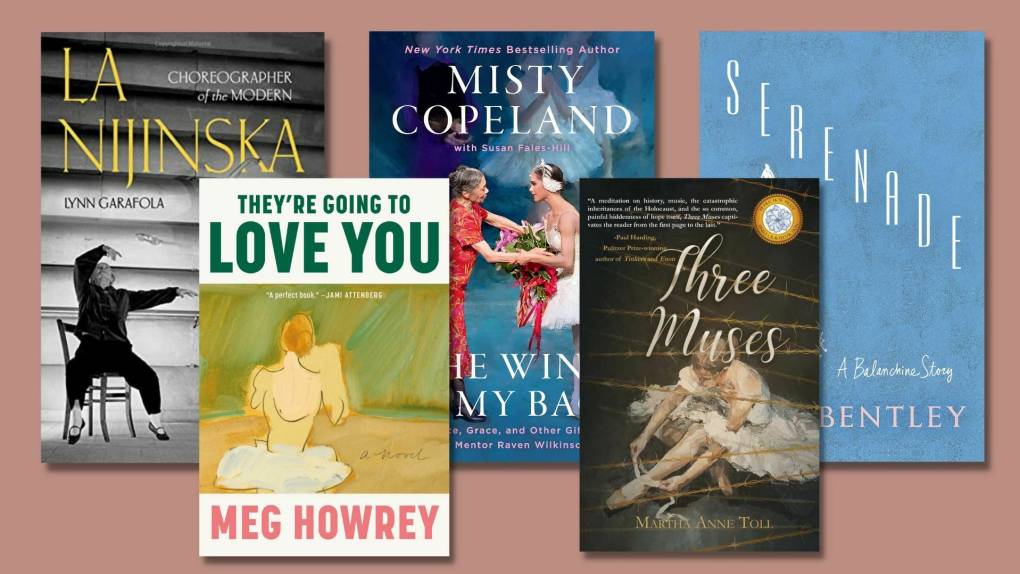
"caption": "‘La Nijinska’ by Lynn Garafola, ‘They're Going to Love You’ by Meg Howrey, ‘The Wind at My Back’ by Misty Copeland, ‘Three Muses’ by Martha Anne Toll and ‘Serenade’ by Toni Bentley.",
"description": null,
"title": "‘La Nijinska’ by Lynn Garafola, ‘They’re Going to Love You’ by Meg Howrey, ‘The Wind at My Back’ by Misty Copeland, ‘Three Muses’ by Martha Anne Toll and ‘Serenade’ by Toni Bentley.",
"credit": "Meghan Collins Sullivan/NPR",
"status": "inherit",
"altTag": "Five books about dance arranged alongside one another.",
"isLoading": false,
"fetchFailed": false
},
"arts_13922644": {
"type": "attachments",
"id": "arts_13922644",
"meta": {
"index": "attachments_1716263798",
"site": "arts",
"id": "13922644",
"found": true
},
"parent": 13922643,
"imgSizes": {
"twentyfourteen-full-width": {
"file": "https://ww2.kqed.org/app/uploads/sites/2/2022/12/copy-of-copy-of-copy-of-unnamed-design_wide-42bfb66f1f5ac2909047ff07825bc800d6cd3a17-1038x576.jpg",
"width": 1038,
"mimeType": "image/jpeg",
"height": 576
},
"thumbnail": {
"file": "https://ww2.kqed.org/app/uploads/sites/2/2022/12/copy-of-copy-of-copy-of-unnamed-design_wide-42bfb66f1f5ac2909047ff07825bc800d6cd3a17-160x90.jpg",
"width": 160,
"mimeType": "image/jpeg",
"height": 90
},
"post-thumbnail": {
"file": "https://ww2.kqed.org/app/uploads/sites/2/2022/12/copy-of-copy-of-copy-of-unnamed-design_wide-42bfb66f1f5ac2909047ff07825bc800d6cd3a17-672x372.jpg",
"width": 672,
"mimeType": "image/jpeg",
"height": 372
},
"kqedFullSize": {
"file": "https://ww2.kqed.org/app/uploads/sites/2/2022/12/copy-of-copy-of-copy-of-unnamed-design_wide-42bfb66f1f5ac2909047ff07825bc800d6cd3a17.jpg",
"width": 1916,
"height": 1078
},
"large": {
"file": "https://ww2.kqed.org/app/uploads/sites/2/2022/12/copy-of-copy-of-copy-of-unnamed-design_wide-42bfb66f1f5ac2909047ff07825bc800d6cd3a17-1020x574.jpg",
"width": 1020,
"mimeType": "image/jpeg",
"height": 574
},
"1536x1536": {
"file": "https://ww2.kqed.org/app/uploads/sites/2/2022/12/copy-of-copy-of-copy-of-unnamed-design_wide-42bfb66f1f5ac2909047ff07825bc800d6cd3a17-1536x864.jpg",
"width": 1536,
"mimeType": "image/jpeg",
"height": 864
},
"medium": {
"file": "https://ww2.kqed.org/app/uploads/sites/2/2022/12/copy-of-copy-of-copy-of-unnamed-design_wide-42bfb66f1f5ac2909047ff07825bc800d6cd3a17-800x450.jpg",
"width": 800,
"mimeType": "image/jpeg",
"height": 450
},
"medium_large": {
"file": "https://ww2.kqed.org/app/uploads/sites/2/2022/12/copy-of-copy-of-copy-of-unnamed-design_wide-42bfb66f1f5ac2909047ff07825bc800d6cd3a17-768x432.jpg",
"width": 768,
"mimeType": "image/jpeg",
"height": 432
}
},
"publishDate": 1670891496,
"modified": 1670927088,
"caption": "‘A Dangerous Business’ and ‘Remarkably Bright Creatures.’",
"description": null,
"title": "‘A Dangerous Business’ and ‘Remarkably Bright Creatures.’",
"credit": "Penguin Random House/ Ecco",
"status": "inherit",
"altTag": "The book covers of novel by Jane Smiley and Shelby Van Pelt.",
"isLoading": false,
"fetchFailed": false
},
"arts_13921987": {
"type": "attachments",
"id": "arts_13921987",
"meta": {
"index": "attachments_1716263798",
"site": "arts",
"id": "13921987",
"found": true
},
"parent": 13921986,
"imgSizes": {
"twentyfourteen-full-width": {
"file": "https://ww2.kqed.org/app/uploads/sites/2/2022/11/untitled-design-15-_wide-1b1c0d25a154d8724e5fe27e0b94def6552c34e4-1038x576.jpg",
"width": 1038,
"mimeType": "image/jpeg",
"height": 576
},
"thumbnail": {
"file": "https://ww2.kqed.org/app/uploads/sites/2/2022/11/untitled-design-15-_wide-1b1c0d25a154d8724e5fe27e0b94def6552c34e4-160x90.jpg",
"width": 160,
"mimeType": "image/jpeg",
"height": 90
},
"post-thumbnail": {
"file": "https://ww2.kqed.org/app/uploads/sites/2/2022/11/untitled-design-15-_wide-1b1c0d25a154d8724e5fe27e0b94def6552c34e4-672x372.jpg",
"width": 672,
"mimeType": "image/jpeg",
"height": 372
},
"kqedFullSize": {
"file": "https://ww2.kqed.org/app/uploads/sites/2/2022/11/untitled-design-15-_wide-1b1c0d25a154d8724e5fe27e0b94def6552c34e4.jpg",
"width": 1911,
"height": 1075
},
"large": {
"file": "https://ww2.kqed.org/app/uploads/sites/2/2022/11/untitled-design-15-_wide-1b1c0d25a154d8724e5fe27e0b94def6552c34e4-1020x574.jpg",
"width": 1020,
"mimeType": "image/jpeg",
"height": 574
},
"1536x1536": {
"file": "https://ww2.kqed.org/app/uploads/sites/2/2022/11/untitled-design-15-_wide-1b1c0d25a154d8724e5fe27e0b94def6552c34e4-1536x864.jpg",
"width": 1536,
"mimeType": "image/jpeg",
"height": 864
},
"medium": {
"file": "https://ww2.kqed.org/app/uploads/sites/2/2022/11/untitled-design-15-_wide-1b1c0d25a154d8724e5fe27e0b94def6552c34e4-800x450.jpg",
"width": 800,
"mimeType": "image/jpeg",
"height": 450
},
"medium_large": {
"file": "https://ww2.kqed.org/app/uploads/sites/2/2022/11/untitled-design-15-_wide-1b1c0d25a154d8724e5fe27e0b94def6552c34e4-768x432.jpg",
"width": 768,
"mimeType": "image/jpeg",
"height": 432
}
},
"publishDate": 1669655301,
"modified": 1669656405,
"caption": null,
"description": null,
"title": "Books covers.",
"credit": "Meghan Collins Sullivan/NPR",
"status": "inherit",
"altTag": "'Design Classics,' 'Treasures of Ukraine,' 'A Book of Days,' 'The Letters of Lucian Freud,' 'Lucian Freud' and 'Shocking: The Surreal World of Elsa Schiaparelli' lie arranged on a red background.",
"isLoading": false,
"fetchFailed": false
},
"arts_13921849": {
"type": "attachments",
"id": "arts_13921849",
"meta": {
"index": "attachments_1716263798",
"site": "arts",
"id": "13921849",
"found": true
},
"parent": 13921830,
"imgSizes": {
"twentyfourteen-full-width": {
"file": "https://ww2.kqed.org/app/uploads/sites/2/2022/11/aesthetica-crop-1038x576.jpg",
"width": 1038,
"mimeType": "image/jpeg",
"height": 576
},
"thumbnail": {
"file": "https://ww2.kqed.org/app/uploads/sites/2/2022/11/aesthetica-crop-160x90.jpg",
"width": 160,
"mimeType": "image/jpeg",
"height": 90
},
"post-thumbnail": {
"file": "https://ww2.kqed.org/app/uploads/sites/2/2022/11/aesthetica-crop-672x372.jpg",
"width": 672,
"mimeType": "image/jpeg",
"height": 372
},
"kqedFullSize": {
"file": "https://ww2.kqed.org/app/uploads/sites/2/2022/11/aesthetica-crop.jpg",
"width": 2200,
"height": 1238
},
"2048x2048": {
"file": "https://ww2.kqed.org/app/uploads/sites/2/2022/11/aesthetica-crop-2048x1152.jpg",
"width": 2048,
"mimeType": "image/jpeg",
"height": 1152
},
"large": {
"file": "https://ww2.kqed.org/app/uploads/sites/2/2022/11/aesthetica-crop-1020x574.jpg",
"width": 1020,
"mimeType": "image/jpeg",
"height": 574
},
"1536x1536": {
"file": "https://ww2.kqed.org/app/uploads/sites/2/2022/11/aesthetica-crop-1536x864.jpg",
"width": 1536,
"mimeType": "image/jpeg",
"height": 864
},
"full-width": {
"file": "https://ww2.kqed.org/app/uploads/sites/2/2022/11/aesthetica-crop-1920x1080.jpg",
"width": 1920,
"mimeType": "image/jpeg",
"height": 1080
},
"medium": {
"file": "https://ww2.kqed.org/app/uploads/sites/2/2022/11/aesthetica-crop-800x450.jpg",
"width": 800,
"mimeType": "image/jpeg",
"height": 450
},
"medium_large": {
"file": "https://ww2.kqed.org/app/uploads/sites/2/2022/11/aesthetica-crop-768x432.jpg",
"width": 768,
"mimeType": "image/jpeg",
"height": 432
}
},
"publishDate": 1669139467,
"modified": 1669139942,
"caption": "'Aesthetica' by Allie Rowbottom. ",
"description": null,
"title": "aesthetica crop",
"credit": "Penguin Randomhouse",
"status": "inherit",
"altTag": null,
"isLoading": false,
"fetchFailed": false
},
"arts_13921750": {
"type": "attachments",
"id": "arts_13921750",
"meta": {
"index": "attachments_1716263798",
"site": "arts",
"id": "13921750",
"found": true
},
"parent": 13921749,
"imgSizes": {
"twentyfourteen-full-width": {
"file": "https://ww2.kqed.org/app/uploads/sites/2/2022/11/didion-2-2-013f0ec958d9d545d1ebb36ba1b693d80880a876-1038x576.jpg",
"width": 1038,
"mimeType": "image/jpeg",
"height": 576
},
"thumbnail": {
"file": "https://ww2.kqed.org/app/uploads/sites/2/2022/11/didion-2-2-013f0ec958d9d545d1ebb36ba1b693d80880a876-160x120.jpg",
"width": 160,
"mimeType": "image/jpeg",
"height": 120
},
"post-thumbnail": {
"file": "https://ww2.kqed.org/app/uploads/sites/2/2022/11/didion-2-2-013f0ec958d9d545d1ebb36ba1b693d80880a876-672x372.jpg",
"width": 672,
"mimeType": "image/jpeg",
"height": 372
},
"kqedFullSize": {
"file": "https://ww2.kqed.org/app/uploads/sites/2/2022/11/didion-2-2-013f0ec958d9d545d1ebb36ba1b693d80880a876.jpg",
"width": 1814,
"height": 1360
},
"large": {
"file": "https://ww2.kqed.org/app/uploads/sites/2/2022/11/didion-2-2-013f0ec958d9d545d1ebb36ba1b693d80880a876-1020x765.jpg",
"width": 1020,
"mimeType": "image/jpeg",
"height": 765
},
"1536x1536": {
"file": "https://ww2.kqed.org/app/uploads/sites/2/2022/11/didion-2-2-013f0ec958d9d545d1ebb36ba1b693d80880a876-1536x1152.jpg",
"width": 1536,
"mimeType": "image/jpeg",
"height": 1152
},
"medium": {
"file": "https://ww2.kqed.org/app/uploads/sites/2/2022/11/didion-2-2-013f0ec958d9d545d1ebb36ba1b693d80880a876-800x600.jpg",
"width": 800,
"mimeType": "image/jpeg",
"height": 600
},
"medium_large": {
"file": "https://ww2.kqed.org/app/uploads/sites/2/2022/11/didion-2-2-013f0ec958d9d545d1ebb36ba1b693d80880a876-768x576.jpg",
"width": 768,
"mimeType": "image/jpeg",
"height": 576
}
},
"publishDate": 1668712458,
"modified": 1668713020,
"caption": "The auction featured a number of items from the office where Joan Didion worked, including two electric typewriters that sold for $5,500 and $6,000, respectively.",
"description": null,
"title": "The auction featured a number of items from the office where Joan Didion worked, including two electric typewriters that sold for $5,500 and $6,000, respectively.",
"credit": "Jim Zarroli/For NPR",
"status": "inherit",
"altTag": "A desk, typewriter and office minutiae, all painstakingly labeled and on display.",
"isLoading": false,
"fetchFailed": false
},
"arts_13062222": {
"type": "attachments",
"id": "arts_13062222",
"meta": {
"index": "attachments_1716263798",
"site": "arts",
"id": "13062222",
"found": true
},
"parent": 13062008,
"imgSizes": {
"small": {
"file": "https://ww2.kqed.org/app/uploads/sites/2/2017/04/Paul-Madonna2016HiRes-520x389.jpg",
"width": 520,
"mimeType": "image/jpeg",
"height": 389
},
"twentyfourteen-full-width": {
"file": "https://ww2.kqed.org/app/uploads/sites/2/2017/04/Paul-Madonna2016HiRes-1038x576.jpg",
"width": 1038,
"mimeType": "image/jpeg",
"height": 576
},
"thumbnail": {
"file": "https://ww2.kqed.org/app/uploads/sites/2/2017/04/Paul-Madonna2016HiRes-160x120.jpg",
"width": 160,
"mimeType": "image/jpeg",
"height": 120
},
"fd-sm": {
"file": "https://ww2.kqed.org/app/uploads/sites/2/2017/04/Paul-Madonna2016HiRes-960x718.jpg",
"width": 960,
"mimeType": "image/jpeg",
"height": 718
},
"post-thumbnail": {
"file": "https://ww2.kqed.org/app/uploads/sites/2/2017/04/Paul-Madonna2016HiRes-672x372.jpg",
"width": 672,
"mimeType": "image/jpeg",
"height": 372
},
"xsmall": {
"file": "https://ww2.kqed.org/app/uploads/sites/2/2017/04/Paul-Madonna2016HiRes-375x281.jpg",
"width": 375,
"mimeType": "image/jpeg",
"height": 281
},
"kqedFullSize": {
"file": "https://ww2.kqed.org/app/uploads/sites/2/2017/04/Paul-Madonna2016HiRes.jpg",
"width": 1800,
"height": 1347
},
"large": {
"file": "https://ww2.kqed.org/app/uploads/sites/2/2017/04/Paul-Madonna2016HiRes-1020x763.jpg",
"width": 1020,
"mimeType": "image/jpeg",
"height": 763
},
"xlarge": {
"file": "https://ww2.kqed.org/app/uploads/sites/2/2017/04/Paul-Madonna2016HiRes-1180x883.jpg",
"width": 1180,
"mimeType": "image/jpeg",
"height": 883
},
"guest-author-50": {
"file": "https://ww2.kqed.org/app/uploads/sites/2/2017/04/Paul-Madonna2016HiRes-50x50.jpg",
"width": 50,
"mimeType": "image/jpeg",
"height": 50
},
"guest-author-96": {
"file": "https://ww2.kqed.org/app/uploads/sites/2/2017/04/Paul-Madonna2016HiRes-96x96.jpg",
"width": 96,
"mimeType": "image/jpeg",
"height": 96
},
"medium": {
"file": "https://ww2.kqed.org/app/uploads/sites/2/2017/04/Paul-Madonna2016HiRes-800x599.jpg",
"width": 800,
"mimeType": "image/jpeg",
"height": 599
},
"guest-author-64": {
"file": "https://ww2.kqed.org/app/uploads/sites/2/2017/04/Paul-Madonna2016HiRes-64x64.jpg",
"width": 64,
"mimeType": "image/jpeg",
"height": 64
},
"guest-author-32": {
"file": "https://ww2.kqed.org/app/uploads/sites/2/2017/04/Paul-Madonna2016HiRes-32x32.jpg",
"width": 32,
"mimeType": "image/jpeg",
"height": 32
},
"fd-med": {
"file": "https://ww2.kqed.org/app/uploads/sites/2/2017/04/Paul-Madonna2016HiRes-1180x883.jpg",
"width": 1180,
"mimeType": "image/jpeg",
"height": 883
},
"detail": {
"file": "https://ww2.kqed.org/app/uploads/sites/2/2017/04/Paul-Madonna2016HiRes-150x150.jpg",
"width": 150,
"mimeType": "image/jpeg",
"height": 150
},
"medium_large": {
"file": "https://ww2.kqed.org/app/uploads/sites/2/2017/04/Paul-Madonna2016HiRes-768x575.jpg",
"width": 768,
"mimeType": "image/jpeg",
"height": 575
},
"guest-author-128": {
"file": "https://ww2.kqed.org/app/uploads/sites/2/2017/04/Paul-Madonna2016HiRes-128x128.jpg",
"width": 128,
"mimeType": "image/jpeg",
"height": 128
},
"xxsmall": {
"file": "https://ww2.kqed.org/app/uploads/sites/2/2017/04/Paul-Madonna2016HiRes-240x180.jpg",
"width": 240,
"mimeType": "image/jpeg",
"height": 180
}
},
"publishDate": 1492359814,
"modified": 1668544239,
"caption": "Paul Madonna in 2017.",
"description": null,
"title": "Paul Madonna in 2017.",
"credit": null,
"status": "inherit",
"altTag": "A 30-something-year-old man with rectangular spectacles and a light beard sits at a diner table wearing a winter coat.",
"isLoading": false,
"fetchFailed": false
},
"arts_13921269": {
"type": "attachments",
"id": "arts_13921269",
"meta": {
"index": "attachments_1716263798",
"site": "arts",
"id": "13921269",
"found": true
},
"parent": 13921268,
"imgSizes": {
"twentyfourteen-full-width": {
"file": "https://ww2.kqed.org/app/uploads/sites/2/2022/11/untitled-design-13-_wide-77fceb5a92b448dd2d499c6c8d26a3bd7dc520a1-1038x576.jpg",
"width": 1038,
"mimeType": "image/jpeg",
"height": 576
},
"thumbnail": {
"file": "https://ww2.kqed.org/app/uploads/sites/2/2022/11/untitled-design-13-_wide-77fceb5a92b448dd2d499c6c8d26a3bd7dc520a1-160x90.jpg",
"width": 160,
"mimeType": "image/jpeg",
"height": 90
},
"post-thumbnail": {
"file": "https://ww2.kqed.org/app/uploads/sites/2/2022/11/untitled-design-13-_wide-77fceb5a92b448dd2d499c6c8d26a3bd7dc520a1-672x372.jpg",
"width": 672,
"mimeType": "image/jpeg",
"height": 372
},
"kqedFullSize": {
"file": "https://ww2.kqed.org/app/uploads/sites/2/2022/11/untitled-design-13-_wide-77fceb5a92b448dd2d499c6c8d26a3bd7dc520a1.jpg",
"width": 1917,
"height": 1078
},
"large": {
"file": "https://ww2.kqed.org/app/uploads/sites/2/2022/11/untitled-design-13-_wide-77fceb5a92b448dd2d499c6c8d26a3bd7dc520a1-1020x574.jpg",
"width": 1020,
"mimeType": "image/jpeg",
"height": 574
},
"1536x1536": {
"file": "https://ww2.kqed.org/app/uploads/sites/2/2022/11/untitled-design-13-_wide-77fceb5a92b448dd2d499c6c8d26a3bd7dc520a1-1536x864.jpg",
"width": 1536,
"mimeType": "image/jpeg",
"height": 864
},
"medium": {
"file": "https://ww2.kqed.org/app/uploads/sites/2/2022/11/untitled-design-13-_wide-77fceb5a92b448dd2d499c6c8d26a3bd7dc520a1-800x450.jpg",
"width": 800,
"mimeType": "image/jpeg",
"height": 450
},
"medium_large": {
"file": "https://ww2.kqed.org/app/uploads/sites/2/2022/11/untitled-design-13-_wide-77fceb5a92b448dd2d499c6c8d26a3bd7dc520a1-768x432.jpg",
"width": 768,
"mimeType": "image/jpeg",
"height": 432
}
},
"publishDate": 1667500329,
"modified": 1667500867,
"caption": "Books on Iran and the struggles of Iranian women.",
"description": null,
"title": "Books on Iran and the struggles of Iranian women.",
"credit": "Meghan Collins Sullivan/NPR",
"status": "inherit",
"altTag": null,
"isLoading": false,
"fetchFailed": false
},
"arts_13921199": {
"type": "attachments",
"id": "arts_13921199",
"meta": {
"index": "attachments_1716263798",
"site": "arts",
"id": "13921199",
"found": true
},
"parent": 13921196,
"imgSizes": {
"twentyfourteen-full-width": {
"file": "https://ww2.kqed.org/app/uploads/sites/2/2022/11/Screen-Shot-2022-11-01-at-6.17.43-PM-1038x576.png",
"width": 1038,
"mimeType": "image/png",
"height": 576
},
"thumbnail": {
"file": "https://ww2.kqed.org/app/uploads/sites/2/2022/11/Screen-Shot-2022-11-01-at-6.17.43-PM-160x95.png",
"width": 160,
"mimeType": "image/png",
"height": 95
},
"post-thumbnail": {
"file": "https://ww2.kqed.org/app/uploads/sites/2/2022/11/Screen-Shot-2022-11-01-at-6.17.43-PM-672x372.png",
"width": 672,
"mimeType": "image/png",
"height": 372
},
"kqedFullSize": {
"file": "https://ww2.kqed.org/app/uploads/sites/2/2022/11/Screen-Shot-2022-11-01-at-6.17.43-PM.png",
"width": 2438,
"height": 1444
},
"2048x2048": {
"file": "https://ww2.kqed.org/app/uploads/sites/2/2022/11/Screen-Shot-2022-11-01-at-6.17.43-PM-2048x1213.png",
"width": 2048,
"mimeType": "image/png",
"height": 1213
},
"large": {
"file": "https://ww2.kqed.org/app/uploads/sites/2/2022/11/Screen-Shot-2022-11-01-at-6.17.43-PM-1020x604.png",
"width": 1020,
"mimeType": "image/png",
"height": 604
},
"1536x1536": {
"file": "https://ww2.kqed.org/app/uploads/sites/2/2022/11/Screen-Shot-2022-11-01-at-6.17.43-PM-1536x910.png",
"width": 1536,
"mimeType": "image/png",
"height": 910
},
"full-width": {
"file": "https://ww2.kqed.org/app/uploads/sites/2/2022/11/Screen-Shot-2022-11-01-at-6.17.43-PM-1920x1137.png",
"width": 1920,
"mimeType": "image/png",
"height": 1137
},
"medium": {
"file": "https://ww2.kqed.org/app/uploads/sites/2/2022/11/Screen-Shot-2022-11-01-at-6.17.43-PM-800x474.png",
"width": 800,
"mimeType": "image/png",
"height": 474
},
"medium_large": {
"file": "https://ww2.kqed.org/app/uploads/sites/2/2022/11/Screen-Shot-2022-11-01-at-6.17.43-PM-768x455.png",
"width": 768,
"mimeType": "image/png",
"height": 455
}
},
"publishDate": 1667351889,
"modified": 1667351994,
"caption": "Julie Powell attends a screening of 'Julie & Julia' at the Paley Center For Media on August 4, 2009 in New York City.",
"description": null,
"title": "Julie Powell attends a screening of 'Julie & Julia' at the Paley Center For Media on August 4, 2009 in New York City.",
"credit": "Astrid Stawiarz/Getty Images",
"status": "inherit",
"altTag": "A smiling white woman with shoulder length brown hair stands next to a movie poster for 'Julie & Julia'. She is wearing a casual blue dress and minimal make-up.",
"isLoading": false,
"fetchFailed": false
},
"arts_13921043": {
"type": "attachments",
"id": "arts_13921043",
"meta": {
"index": "attachments_1716263798",
"site": "arts",
"id": "13921043",
"found": true
},
"parent": 13920973,
"imgSizes": {
"twentyfourteen-full-width": {
"file": "https://ww2.kqed.org/app/uploads/sites/2/2022/10/Dodger-and-Sparky-1038x576.jpg",
"width": 1038,
"mimeType": "image/jpeg",
"height": 576
},
"thumbnail": {
"file": "https://ww2.kqed.org/app/uploads/sites/2/2022/10/Dodger-and-Sparky-160x99.jpg",
"width": 160,
"mimeType": "image/jpeg",
"height": 99
},
"post-thumbnail": {
"file": "https://ww2.kqed.org/app/uploads/sites/2/2022/10/Dodger-and-Sparky-672x372.jpg",
"width": 672,
"mimeType": "image/jpeg",
"height": 372
},
"kqedFullSize": {
"file": "https://ww2.kqed.org/app/uploads/sites/2/2022/10/Dodger-and-Sparky-scaled-e1666981911444.jpg",
"width": 1920,
"height": 1188
},
"2048x2048": {
"file": "https://ww2.kqed.org/app/uploads/sites/2/2022/10/Dodger-and-Sparky-2048x1267.jpg",
"width": 2048,
"mimeType": "image/jpeg",
"height": 1267
},
"large": {
"file": "https://ww2.kqed.org/app/uploads/sites/2/2022/10/Dodger-and-Sparky-1020x631.jpg",
"width": 1020,
"mimeType": "image/jpeg",
"height": 631
},
"1536x1536": {
"file": "https://ww2.kqed.org/app/uploads/sites/2/2022/10/Dodger-and-Sparky-1536x951.jpg",
"width": 1536,
"mimeType": "image/jpeg",
"height": 951
},
"full-width": {
"file": "https://ww2.kqed.org/app/uploads/sites/2/2022/10/Dodger-and-Sparky-1920x1188.jpg",
"width": 1920,
"mimeType": "image/jpeg",
"height": 1188
},
"medium": {
"file": "https://ww2.kqed.org/app/uploads/sites/2/2022/10/Dodger-and-Sparky-800x495.jpg",
"width": 800,
"mimeType": "image/jpeg",
"height": 495
},
"medium_large": {
"file": "https://ww2.kqed.org/app/uploads/sites/2/2022/10/Dodger-and-Sparky-768x475.jpg",
"width": 768,
"mimeType": "image/jpeg",
"height": 475
}
},
"publishDate": 1666981697,
"modified": 1666981945,
"caption": "(L) 'Man Who is Avoiding the Draft'; (R) Marilee Trabioli, as seen in 'Haight Ashbury Portraits 1967-1968' ",
"description": null,
"title": "(L) 'Man Who is Avoiding the Draft'; (R) Marilee Trabioli, as seen in 'Haight Ashbury Portraits 1967-1968'",
"credit": "Elaine Mayes",
"status": "inherit",
"altTag": "A young man with chin length hair sits listlessly on a front stoop; a woman wearing jeans, a denim vest and a white shirt tied up to reveal her stomach stands in a doorway in a masculine stance.",
"isLoading": false,
"fetchFailed": false
},
"arts_13921102": {
"type": "attachments",
"id": "arts_13921102",
"meta": {
"index": "attachments_1716263798",
"site": "arts",
"id": "13921102",
"found": true
},
"parent": 13921101,
"imgSizes": {
"twentyfourteen-full-width": {
"file": "https://ww2.kqed.org/app/uploads/sites/2/2022/10/reallyinto_horror_final_wide-9ed7b12856618208ce221e03ce0113e122562cf1-1038x576.jpg",
"width": 1038,
"mimeType": "image/jpeg",
"height": 576
},
"thumbnail": {
"file": "https://ww2.kqed.org/app/uploads/sites/2/2022/10/reallyinto_horror_final_wide-9ed7b12856618208ce221e03ce0113e122562cf1-160x90.jpg",
"width": 160,
"mimeType": "image/jpeg",
"height": 90
},
"post-thumbnail": {
"file": "https://ww2.kqed.org/app/uploads/sites/2/2022/10/reallyinto_horror_final_wide-9ed7b12856618208ce221e03ce0113e122562cf1-672x372.jpg",
"width": 672,
"mimeType": "image/jpeg",
"height": 372
},
"kqedFullSize": {
"file": "https://ww2.kqed.org/app/uploads/sites/2/2022/10/reallyinto_horror_final_wide-9ed7b12856618208ce221e03ce0113e122562cf1-scaled-e1667246868364.jpg",
"width": 1920,
"height": 1080
},
"2048x2048": {
"file": "https://ww2.kqed.org/app/uploads/sites/2/2022/10/reallyinto_horror_final_wide-9ed7b12856618208ce221e03ce0113e122562cf1-2048x1152.jpg",
"width": 2048,
"mimeType": "image/jpeg",
"height": 1152
},
"large": {
"file": "https://ww2.kqed.org/app/uploads/sites/2/2022/10/reallyinto_horror_final_wide-9ed7b12856618208ce221e03ce0113e122562cf1-1020x574.jpg",
"width": 1020,
"mimeType": "image/jpeg",
"height": 574
},
"1536x1536": {
"file": "https://ww2.kqed.org/app/uploads/sites/2/2022/10/reallyinto_horror_final_wide-9ed7b12856618208ce221e03ce0113e122562cf1-1536x864.jpg",
"width": 1536,
"mimeType": "image/jpeg",
"height": 864
},
"full-width": {
"file": "https://ww2.kqed.org/app/uploads/sites/2/2022/10/reallyinto_horror_final_wide-9ed7b12856618208ce221e03ce0113e122562cf1-1920x1080.jpg",
"width": 1920,
"mimeType": "image/jpeg",
"height": 1080
},
"medium": {
"file": "https://ww2.kqed.org/app/uploads/sites/2/2022/10/reallyinto_horror_final_wide-9ed7b12856618208ce221e03ce0113e122562cf1-800x450.jpg",
"width": 800,
"mimeType": "image/jpeg",
"height": 450
},
"medium_large": {
"file": "https://ww2.kqed.org/app/uploads/sites/2/2022/10/reallyinto_horror_final_wide-9ed7b12856618208ce221e03ce0113e122562cf1-768x432.jpg",
"width": 768,
"mimeType": "image/jpeg",
"height": 432
}
},
"publishDate": 1667246089,
"modified": 1667246940,
"caption": "NPR's Nikki Jones can't go one week without watching a horror film.",
"description": null,
"title": "NPR's Nikki Jones can't go one week without watching a horror film.",
"credit": "Josie Norton for NPR",
"status": "inherit",
"altTag": "Animated view of multiple TV screens. Some show static, others show glimpses of horror movies, including 'Psycho.'",
"isLoading": false,
"fetchFailed": false
},
"arts_13921087": {
"type": "attachments",
"id": "arts_13921087",
"meta": {
"index": "attachments_1716263798",
"site": "arts",
"id": "13921087",
"found": true
},
"parent": 13921086,
"imgSizes": {
"twentyfourteen-full-width": {
"file": "https://ww2.kqed.org/app/uploads/sites/2/2022/10/rlstein_npr_0068_custom-fe9d55dda651ca08fd719af6eea67a847f0a0d85-1038x576.jpg",
"width": 1038,
"mimeType": "image/jpeg",
"height": 576
},
"thumbnail": {
"file": "https://ww2.kqed.org/app/uploads/sites/2/2022/10/rlstein_npr_0068_custom-fe9d55dda651ca08fd719af6eea67a847f0a0d85-160x128.jpg",
"width": 160,
"mimeType": "image/jpeg",
"height": 128
},
"post-thumbnail": {
"file": "https://ww2.kqed.org/app/uploads/sites/2/2022/10/rlstein_npr_0068_custom-fe9d55dda651ca08fd719af6eea67a847f0a0d85-672x372.jpg",
"width": 672,
"mimeType": "image/jpeg",
"height": 372
},
"kqedFullSize": {
"file": "https://ww2.kqed.org/app/uploads/sites/2/2022/10/rlstein_npr_0068_custom-fe9d55dda651ca08fd719af6eea67a847f0a0d85-scaled-e1667240474914.jpg",
"width": 1920,
"height": 1535
},
"2048x2048": {
"file": "https://ww2.kqed.org/app/uploads/sites/2/2022/10/rlstein_npr_0068_custom-fe9d55dda651ca08fd719af6eea67a847f0a0d85-2048x1638.jpg",
"width": 2048,
"mimeType": "image/jpeg",
"height": 1638
},
"large": {
"file": "https://ww2.kqed.org/app/uploads/sites/2/2022/10/rlstein_npr_0068_custom-fe9d55dda651ca08fd719af6eea67a847f0a0d85-1020x816.jpg",
"width": 1020,
"mimeType": "image/jpeg",
"height": 816
},
"1536x1536": {
"file": "https://ww2.kqed.org/app/uploads/sites/2/2022/10/rlstein_npr_0068_custom-fe9d55dda651ca08fd719af6eea67a847f0a0d85-1536x1228.jpg",
"width": 1536,
"mimeType": "image/jpeg",
"height": 1228
},
"full-width": {
"file": "https://ww2.kqed.org/app/uploads/sites/2/2022/10/rlstein_npr_0068_custom-fe9d55dda651ca08fd719af6eea67a847f0a0d85-1920x1535.jpg",
"width": 1920,
"mimeType": "image/jpeg",
"height": 1535
},
"medium": {
"file": "https://ww2.kqed.org/app/uploads/sites/2/2022/10/rlstein_npr_0068_custom-fe9d55dda651ca08fd719af6eea67a847f0a0d85-800x640.jpg",
"width": 800,
"mimeType": "image/jpeg",
"height": 640
},
"medium_large": {
"file": "https://ww2.kqed.org/app/uploads/sites/2/2022/10/rlstein_npr_0068_custom-fe9d55dda651ca08fd719af6eea67a847f0a0d85-768x614.jpg",
"width": 768,
"mimeType": "image/jpeg",
"height": 614
}
},
"publishDate": 1667239913,
"modified": 1667240561,
"caption": "The 'Goosebumps' series continues to have its hooks, tentacles, or some other creepy tendrils around fans today.",
"description": null,
"title": "The 'Goosebumps' series continues to have its hooks, tentacles, or some other creepy tendrils around fans today.",
"credit": "Christopher Gregory-Rivera for NPR",
"status": "inherit",
"altTag": "A senior bespectacled man, dressed all in black, stands in a darkened room before an expansive bookcase. His figure is lit from underneath.",
"isLoading": false,
"fetchFailed": false
}
},
"audioPlayerReducer": {
"postId": "stream_live",
"isPaused": true,
"isPlaying": false,
"pfsActive": false,
"pledgeModalIsOpen": true,
"playerDrawerIsOpen": false,
"liveAudioPlayStartedAt": 0,
"liveAudioPlayContext": ""
},
"authorsReducer": {
"byline_arts_13923154": {
"type": "authors",
"id": "byline_arts_13923154",
"meta": {
"override": true
},
"slug": "byline_arts_13923154",
"name": "Associated Press",
"isLoading": false
},
"byline_arts_13923117": {
"type": "authors",
"id": "byline_arts_13923117",
"meta": {
"override": true
},
"slug": "byline_arts_13923117",
"name": "Sophie Bress",
"isLoading": false
},
"byline_arts_13922643": {
"type": "authors",
"id": "byline_arts_13922643",
"meta": {
"override": true
},
"slug": "byline_arts_13922643",
"name": "Maureen Corrigan",
"isLoading": false
},
"byline_arts_13921986": {
"type": "authors",
"id": "byline_arts_13921986",
"meta": {
"override": true
},
"slug": "byline_arts_13921986",
"name": "Heller McAlpin",
"isLoading": false
},
"byline_arts_13921749": {
"type": "authors",
"id": "byline_arts_13921749",
"meta": {
"override": true
},
"slug": "byline_arts_13921749",
"name": "Jim Zarroli",
"isLoading": false
},
"byline_arts_13921268": {
"type": "authors",
"id": "byline_arts_13921268",
"meta": {
"override": true
},
"slug": "byline_arts_13921268",
"name": "Soraya Sarhaddi Nelson",
"isLoading": false
},
"byline_arts_13921196": {
"type": "authors",
"id": "byline_arts_13921196",
"meta": {
"override": true
},
"slug": "byline_arts_13921196",
"name": "Mark Kennedy",
"isLoading": false
},
"byline_arts_13921101": {
"type": "authors",
"id": "byline_arts_13921101",
"meta": {
"override": true
},
"slug": "byline_arts_13921101",
"name": "Nikki Jones",
"isLoading": false
},
"byline_arts_13921086": {
"type": "authors",
"id": "byline_arts_13921086",
"meta": {
"override": true
},
"slug": "byline_arts_13921086",
"name": "Andrew Limbong",
"isLoading": false
},
"ralexandra": {
"type": "authors",
"id": "11242",
"meta": {
"index": "authors_1716337520",
"id": "11242",
"found": true
},
"name": "Rae Alexandra",
"firstName": "Rae",
"lastName": "Alexandra",
"slug": "ralexandra",
"email": "rae-alexandra@outlook.com",
"display_author_email": true,
"staff_mastheads": [],
"title": "Former Staff Writer and Reporter, KQED Arts & Culture",
"bio": "Rae Alexandra is the creator and author of the series \u003ca href=\"https://www.kqed.org/arts/program/rebel-girls-from-bay-area-history\">Rebel Girls From Bay Area History\u003c/a> and \u003ca href=\"https://www.kqed.org/bizarrebayarea\">Bizarre Bay Area\u003c/a>. Her debut book, \u003ca href=\"https://citylights.com/politics-current-events-history/unsung-heroines35-women-who-changed/\">Unsung Heroines: 35 Women Who Changed the Bay Area\u003c/a> was published by City Lights in March 2026. In 2023, Rae was awarded an SPJ Excellence in Journalism Award for Arts & Culture. Rae was born and raised in Wales and subsequently — even after two decades in Northern California — still uses phrases that regularly baffle her coworkers.",
"avatar": "https://secure.gravatar.com/avatar/4cfcc3e7d8f591d2193600c92003ff8b3519bc2d4aebb2c04075082fd1cc0838?s=600&d=blank&r=g",
"twitter": null,
"bluesky": null,
"facebook": null,
"instagram": null,
"linkedin": null,
"sites": [
{
"site": "arts",
"roles": [
"contributor"
]
},
{
"site": "news",
"roles": [
"subscriber"
]
},
{
"site": "pop",
"roles": [
"subscriber"
]
},
{
"site": "bayareabites",
"roles": [
"subscriber"
]
},
{
"site": "science",
"roles": [
"subscriber"
]
}
],
"headData": {
"title": "Rae Alexandra | KQED",
"description": "Former Staff Writer and Reporter, KQED Arts & Culture",
"ogImgSrc": "https://secure.gravatar.com/avatar/4cfcc3e7d8f591d2193600c92003ff8b3519bc2d4aebb2c04075082fd1cc0838?s=600&d=blank&r=g",
"twImgSrc": "https://secure.gravatar.com/avatar/4cfcc3e7d8f591d2193600c92003ff8b3519bc2d4aebb2c04075082fd1cc0838?s=600&d=blank&r=g"
},
"isLoading": false,
"link": "/author/ralexandra"
},
"nelias": {
"type": "authors",
"id": "11990",
"meta": {
"index": "authors_1716337520",
"id": "11990",
"found": true
},
"name": "Naomi Elias",
"firstName": "Naomi",
"lastName": "Elias",
"slug": "nelias",
"email": "naomielias09@gmail.com",
"display_author_email": false,
"staff_mastheads": [],
"title": "KQED Contributor",
"bio": null,
"avatar": "https://secure.gravatar.com/avatar/182770e03ab93f0fdf3c264ad3d088daf0198dd3bc8e1ccd1a008b81387410c1?s=600&d=blank&r=g",
"twitter": null,
"bluesky": null,
"facebook": null,
"instagram": null,
"linkedin": null,
"sites": [
{
"site": "arts",
"roles": [
"contributor"
]
}
],
"headData": {
"title": "Naomi Elias | KQED",
"description": "KQED Contributor",
"ogImgSrc": "https://secure.gravatar.com/avatar/182770e03ab93f0fdf3c264ad3d088daf0198dd3bc8e1ccd1a008b81387410c1?s=600&d=blank&r=g",
"twImgSrc": "https://secure.gravatar.com/avatar/182770e03ab93f0fdf3c264ad3d088daf0198dd3bc8e1ccd1a008b81387410c1?s=600&d=blank&r=g"
},
"isLoading": false,
"link": "/author/nelias"
}
},
"pagesReducer": {
"arts_category_literature": {
"type": "terms",
"id": "arts_73",
"meta": {
"index": "terms_1716263798",
"site": "arts",
"id": "73",
"score": 12.794945
},
"featImg": null,
"name": "Books",
"description": null,
"taxonomy": "category",
"headData": {
"twImgId": null,
"twTitle": null,
"ogTitle": null,
"ogImgId": null,
"twDescription": null,
"description": null,
"title": "Books Archives | KQED Arts",
"ogDescription": null
},
"ttid": 74,
"slug": "literature",
"isLoading": false,
"title": "Books",
"pageMeta": {
"site": "arts",
"WpPageTemplate": "page-topic-editorial",
"currentPage": 38
},
"blocks": [
{
"blockName": "kqed/post-list",
"attrs": {
"layout": "cardArticle2",
"query": "posts/arts?category=literature",
"seeMore": false,
"paginated": true,
"page": 38
}
},
{
"blockName": "kqed/ad"
}
]
}
},
"pfsSessionReducer": {},
"postsReducer": {
"stream_live": {
"type": "live",
"id": "stream_live",
"audioUrl": "https://hls.kqed.org/hls/kqed_app/playlist.m3u8",
"title": "Live Stream",
"excerpt": "Live Stream information currently unavailable.",
"link": "/radio",
"featImg": "",
"label": {
"name": "KQED Live",
"link": "/"
}
},
"stream_kqedNewscast": {
"type": "posts",
"id": "stream_kqedNewscast",
"audioUrl": "https://www.kqed.org/.stream/anon/radio/RDnews/newscast.mp3?_=1",
"title": "KQED Newscast",
"featImg": "",
"label": {
"name": "88.5 FM",
"link": "/"
}
},
"arts_13923154": {
"type": "posts",
"id": "arts_13923154",
"meta": {
"index": "posts_1716263798",
"site": "arts",
"id": "13923154",
"score": null,
"sort": [
1672423946000
]
},
"parent": 0,
"labelTerm": {
"site": "arts"
},
"blocks": [],
"publishDate": 1672423946,
"format": "standard",
"title": "2023 Public Domain Debuts: 'Sherlock Holmes,' 'Metropolis,' Bessie Smith, Faulkner, Many More",
"headTitle": "2023 Public Domain Debuts: ‘Sherlock Holmes,’ ‘Metropolis,’ Bessie Smith, Faulkner, Many More | KQED",
"content": "\u003cp>Sherlock Holmes is finally free to the American public in 2023.\u003c/p>\n\u003cp>The \u003ca href=\"https://apnews.com/article/4c2c6715242e4965ba245d6af8d6a075\">long-running contested copyright dispute\u003c/a> over Sir Arthur Conan Doyle’s tales of a whipsmart detective will finally come to an end as the 1927 copyrights expiring Jan. 1 include Conan Doyle’s last Sherlock Holmes work.\u003c/p>\n\u003cp>Alongside the short-story collection \u003cem>The Case-Book of Sherlock Holmes\u003c/em>, books such as Virginia Woolf’s \u003cem>To The Lighthouse\u003c/em>, Ernest Hemingway’s \u003cem>Men Without Women\u003c/em>, William Faulkner’s \u003cem>Mosquitoes\u003c/em> and Agatha Christie’s \u003cem>The Big Four\u003c/em> — an Hercule Poirot mystery — will become public domain as the calendar turns to 2023.\u003c/p>\n\u003cp>Once a work enters the public domain it can legally be shared, performed, reused, repurposed or sampled without permission or cost. The works from 1927 were originally supposed to be copyrighted for 75 years, but the 1998 Copyright Term Extension Act delayed opening them up for an additional 20 years.\u003c/p>\n\u003cp>While many prominent works on the list used those extra two decades to earn their copyright holders good money, a Duke University expert says the copyright protections also applied to “all of the works whose commercial viability had long subsided.”\u003c/p>\n\u003cp>[ad fullwidth]\u003c/p>\n\u003cp>“For the vast majority—probably 99%—of works from 1927, no copyright holder financially benefited from continued copyright. Yet they remained off limits, for no good reason,” Jennifer Jenkins, director of Duke’s Center for the Study of the Public Domain, wrote in a blog post heralding “\u003ca href=\"https://web.law.duke.edu/cspd/publicdomainday/2023/#fn2text\">Public Domain Day 2023\u003c/a>.”\u003c/p>\n\u003cp>That long U.S. copyright period meant many works that would now become available have \u003ca href=\"https://apnews.com/article/silent-movies-lobby-cards-f5e267501f7de367b530f530279b28f5\">long since been lost\u003c/a>, because they were not profitable to maintain by the legal owners, but couldn’t be used by others. On the Duke list are such “lost” films like Victor Fleming’s \u003cem>The Way of All Flesh\u003c/em> and Tod Browning’s \u003cem>London After Midnight\u003c/em>.\u003c/p>\n\u003cp>1927 portended the silent film era’s end with the release of the first “talkie” — a film with dialogue in it. That was \u003cem>The Jazz Singer\u003c/em>, the historic first feature-length film with synchronized dialogue also notorious for Al Jolson’s blackface performance.\u003c/p>\n\u003cp>In addition to the Alan Crosland-directed film, other movies like \u003cem>Wings\u003c/em> — directed by William A. Wellman and the “outstanding production” winner at the very first Oscars — and Fritz Lang’s seminal science-fiction classic \u003cem>Metropolis\u003c/em> will enter the public domain.\u003c/p>\n\u003cp>Musical compositions — the music and lyrics found on sheet music, not the sound recordings — on the list include hits from Broadway musicals like “Funny Face” and jazz standards from the likes of legends like Louis Armstrong and Duke Ellington, in addition to Irving Berlin’s “Puttin’ on the Ritz” and “(I Scream You Scream, We All Scream for) Ice Cream” by Howard Johnson, Billy Moll and Robert A. King.\u003c/p>\n\u003cp>Duke’s Center for the Public Domain highlighted notable books, movies and musical compositions entering the public domain — just a fraction of the thousands due to be unleashed in 2023.\u003c/p>\n\u003ch2>Books\u003c/h2>\n\u003cp>— \u003cem>The Gangs of New York\u003c/em>, by Herbert Asbury (original publication)\u003c/p>\n\u003cp>— \u003cem>Death Comes for the Archbishop\u003c/em>, by Willa Cather\u003c/p>\n\u003cp>— \u003cem>The Big Four\u003c/em>, by Agatha Christie\u003c/p>\n\u003cp>— \u003cem>The Tower Treasure\u003c/em>, the first Hardy Boys mystery by the pseudonymous Franklin W. Dixon\u003c/p>\n\u003cp>— \u003cem>The Case-Book of Sherlock Holmes\u003c/em>, by Arthur Conan Doyle\u003c/p>\n\u003cp>— \u003cem>Copper Sun\u003c/em>, by Countee Cullen\u003c/p>\n\u003cp>— \u003cem>Mosquitoes\u003c/em>, by William Faulkner\u003c/p>\n\u003cp>— \u003cem>Men Without Women\u003c/em>, by Ernest Hemingway\u003c/p>\n\u003cp>— \u003cem>Der Steppenwolf\u003c/em>, by Herman Hesse (in German)\u003c/p>\n\u003cp>— \u003cem>Amerika\u003c/em>, by Franz Kafka (in German)\u003c/p>\n\u003cp>— \u003cem>Now We Are Six\u003c/em>, by A.A. Milne with illustrations from E.H. Shepard\u003c/p>\n\u003cp>— \u003cem>Le Temps retrouvé\u003c/em>, by Marcel Proust (in French)\u003c/p>\n\u003cp>— \u003cem>Twilight Sleep\u003c/em>, by Edith Wharton\u003c/p>\n\u003cp>— \u003cem>The Bridge of San Luis Rey\u003c/em>, by Thornton Wilder\u003c/p>\n\u003cp>— \u003cem>To The Lighthouse\u003c/em>, by Virginia Woolf\u003c/p>\n\u003ch2>Movies\u003c/h2>\n\u003cp>— \u003cem>7th Heaven\u003c/em>, directed by Frank Borzage\u003c/p>\n\u003cp>— \u003cem>The Battle of the Century\u003c/em>, a Laurel and Hardy film directed by Clyde Bruckman\u003c/p>\n\u003cp>— \u003cem>The Kid Brother\u003c/em>, directed by Ted Wilde\u003c/p>\n\u003cp>— \u003cem>The Jazz Singer\u003c/em>, directed by Alan Crosland\u003c/p>\n\u003cp>— \u003cem>The Lodger: A Story of the London Fog\u003c/em>, directed by Alfred Hitchcock\u003c/p>\n\u003cp>— \u003cem>Metropolis\u003c/em>, directed by Fritz Lang\u003c/p>\n\u003cp>— \u003cem>Sunrise\u003c/em>, directed by F.W. Murnau\u003c/p>\n\u003cp>— \u003cem>Upstream\u003c/em>, directed by John Ford\u003c/p>\n\u003cp>— \u003cem>Wings\u003c/em>, directed by William A. Wellman\u003c/p>\n\u003ch2>Musical Compositions\u003c/h2>\n\u003cp>— “Back Water Blues,” “Preaching the Blues” and “Foolish Man Blues” (Bessie Smith)\u003c/p>\n\u003cp>— “The Best Things in Life Are Free,” from the musical \u003cem>Good News\u003c/em> (George Gard “Buddy” De Sylva, Lew Brown, Ray Henderson)\u003c/p>\n\u003cp>— “Billy Goat Stomp,” “Hyena Stomp” and “Jungle Blues” (Ferdinand Joseph Morton)\u003c/p>\n\u003cp>— “Black and Tan Fantasy” and “East St. Louis Toodle-O” (Bub Miley, Duke Ellington)\u003c/p>\n\u003cp>— “Can’t Help Lovin’ Dat Man” and “Ol’ Man River,” from the musical \u003cem>Show Boat\u003c/em> (Oscar Hammerstein II, Jerome Kern)\u003c/p>\n\u003cp>— “Diane” (Erno Rapee, Lew Pollack)\u003c/p>\n\u003cp>— “Funny Face” and “’S Wonderful,” from the musical \u003cem>Funny Face\u003c/em> (Ira and George Gershwin)\u003c/p>\n\u003cp>— “(I Scream You Scream, We All Scream for) Ice Cream” (Howard Johnson, Billy Moll, Robert A. King)\u003c/p>\n\u003cp>— “Mississippi Mud” (Harry Barris, James Cavanaugh)\u003c/p>\n\u003cp>— “My Blue Heaven” (George Whiting, Walter Donaldson)\u003c/p>\n\u003cp>— “Potato Head Blues” and “Gully Low Blues” (Louis Armstrong)\u003c/p>\n\u003cp>— “Puttin’ on the Ritz” (Irving Berlin)\u003c/p>\n\u003cp>\u003c/p>\n\u003cp>— “Rusty Pail Blues,” “Sloppy Water Blues” and “Soothin’ Syrup Stomp” (Thomas Waller)\u003c/p>\n\n",
"stats": {
"hasVideo": false,
"hasChartOrMap": false,
"hasAudio": false,
"hasPolis": false,
"wordCount": 967,
"hasGoogleForm": false,
"hasGallery": false,
"hasHearkenModule": false,
"iframeSrcs": [],
"paragraphCount": 50
},
"modified": 1705006022,
"excerpt": "Thousands of books, movies and musical compositions will enter the public domain in 2023.",
"headData": {
"twImgId": "",
"twTitle": "",
"ogTitle": "",
"ogImgId": "",
"twDescription": "",
"description": "Thousands of books, movies and musical compositions will enter the public domain in 2023.",
"title": "2023 Public Domain Debuts: 'Sherlock Holmes,' 'Metropolis,' Bessie Smith, Faulkner, Many More | KQED",
"ogDescription": "",
"schema": {
"@context": "https://schema.org",
"@type": "Article",
"headline": "2023 Public Domain Debuts: 'Sherlock Holmes,' 'Metropolis,' Bessie Smith, Faulkner, Many More",
"datePublished": "2022-12-30T10:12:26-08:00",
"dateModified": "2024-01-11T12:47:02-08:00",
"image": "https://cdn.kqed.org/wp-content/uploads/2020/02/KQED-OG-Image@1x.png"
}
},
"guestAuthors": [],
"slug": "2023-public-domain-debuts-sherlock-holmes-metropolis-bessie-smith-faulkner-many-more",
"status": "publish",
"templateType": "standard",
"nprByline": "Associated Press",
"excludeFromSiteSearch": "Include",
"featuredImageType": "standard",
"sticky": false,
"showOnAuthorArchivePages": "No",
"articleAge": "0",
"path": "/arts/13923154/2023-public-domain-debuts-sherlock-holmes-metropolis-bessie-smith-faulkner-many-more",
"audioTrackLength": null,
"parsedContent": [
{
"type": "contentString",
"content": "\u003cdiv class=\"post-body\">\u003cp>\u003cp>Sherlock Holmes is finally free to the American public in 2023.\u003c/p>\n\u003cp>The \u003ca href=\"https://apnews.com/article/4c2c6715242e4965ba245d6af8d6a075\">long-running contested copyright dispute\u003c/a> over Sir Arthur Conan Doyle’s tales of a whipsmart detective will finally come to an end as the 1927 copyrights expiring Jan. 1 include Conan Doyle’s last Sherlock Holmes work.\u003c/p>\n\u003cp>Alongside the short-story collection \u003cem>The Case-Book of Sherlock Holmes\u003c/em>, books such as Virginia Woolf’s \u003cem>To The Lighthouse\u003c/em>, Ernest Hemingway’s \u003cem>Men Without Women\u003c/em>, William Faulkner’s \u003cem>Mosquitoes\u003c/em> and Agatha Christie’s \u003cem>The Big Four\u003c/em> — an Hercule Poirot mystery — will become public domain as the calendar turns to 2023.\u003c/p>\n\u003cp>Once a work enters the public domain it can legally be shared, performed, reused, repurposed or sampled without permission or cost. The works from 1927 were originally supposed to be copyrighted for 75 years, but the 1998 Copyright Term Extension Act delayed opening them up for an additional 20 years.\u003c/p>\n\u003cp>While many prominent works on the list used those extra two decades to earn their copyright holders good money, a Duke University expert says the copyright protections also applied to “all of the works whose commercial viability had long subsided.”\u003c/p>\n\u003cp>\u003c/p>\u003c/div>",
"attributes": {
"named": {},
"numeric": []
}
},
{
"type": "component",
"content": "",
"name": "ad",
"attributes": {
"named": {
"label": "fullwidth"
},
"numeric": [
"fullwidth"
]
}
},
{
"type": "contentString",
"content": "\u003cdiv class=\"post-body\">\u003cp>\u003c/p>\n\u003cp>“For the vast majority—probably 99%—of works from 1927, no copyright holder financially benefited from continued copyright. Yet they remained off limits, for no good reason,” Jennifer Jenkins, director of Duke’s Center for the Study of the Public Domain, wrote in a blog post heralding “\u003ca href=\"https://web.law.duke.edu/cspd/publicdomainday/2023/#fn2text\">Public Domain Day 2023\u003c/a>.”\u003c/p>\n\u003cp>That long U.S. copyright period meant many works that would now become available have \u003ca href=\"https://apnews.com/article/silent-movies-lobby-cards-f5e267501f7de367b530f530279b28f5\">long since been lost\u003c/a>, because they were not profitable to maintain by the legal owners, but couldn’t be used by others. On the Duke list are such “lost” films like Victor Fleming’s \u003cem>The Way of All Flesh\u003c/em> and Tod Browning’s \u003cem>London After Midnight\u003c/em>.\u003c/p>\n\u003cp>1927 portended the silent film era’s end with the release of the first “talkie” — a film with dialogue in it. That was \u003cem>The Jazz Singer\u003c/em>, the historic first feature-length film with synchronized dialogue also notorious for Al Jolson’s blackface performance.\u003c/p>\n\u003cp>In addition to the Alan Crosland-directed film, other movies like \u003cem>Wings\u003c/em> — directed by William A. Wellman and the “outstanding production” winner at the very first Oscars — and Fritz Lang’s seminal science-fiction classic \u003cem>Metropolis\u003c/em> will enter the public domain.\u003c/p>\n\u003cp>Musical compositions — the music and lyrics found on sheet music, not the sound recordings — on the list include hits from Broadway musicals like “Funny Face” and jazz standards from the likes of legends like Louis Armstrong and Duke Ellington, in addition to Irving Berlin’s “Puttin’ on the Ritz” and “(I Scream You Scream, We All Scream for) Ice Cream” by Howard Johnson, Billy Moll and Robert A. King.\u003c/p>\n\u003cp>Duke’s Center for the Public Domain highlighted notable books, movies and musical compositions entering the public domain — just a fraction of the thousands due to be unleashed in 2023.\u003c/p>\n\u003ch2>Books\u003c/h2>\n\u003cp>— \u003cem>The Gangs of New York\u003c/em>, by Herbert Asbury (original publication)\u003c/p>\n\u003cp>— \u003cem>Death Comes for the Archbishop\u003c/em>, by Willa Cather\u003c/p>\n\u003cp>— \u003cem>The Big Four\u003c/em>, by Agatha Christie\u003c/p>\n\u003cp>— \u003cem>The Tower Treasure\u003c/em>, the first Hardy Boys mystery by the pseudonymous Franklin W. Dixon\u003c/p>\n\u003cp>— \u003cem>The Case-Book of Sherlock Holmes\u003c/em>, by Arthur Conan Doyle\u003c/p>\n\u003cp>— \u003cem>Copper Sun\u003c/em>, by Countee Cullen\u003c/p>\n\u003cp>— \u003cem>Mosquitoes\u003c/em>, by William Faulkner\u003c/p>\n\u003cp>— \u003cem>Men Without Women\u003c/em>, by Ernest Hemingway\u003c/p>\n\u003cp>— \u003cem>Der Steppenwolf\u003c/em>, by Herman Hesse (in German)\u003c/p>\n\u003cp>— \u003cem>Amerika\u003c/em>, by Franz Kafka (in German)\u003c/p>\n\u003cp>— \u003cem>Now We Are Six\u003c/em>, by A.A. Milne with illustrations from E.H. Shepard\u003c/p>\n\u003cp>— \u003cem>Le Temps retrouvé\u003c/em>, by Marcel Proust (in French)\u003c/p>\n\u003cp>— \u003cem>Twilight Sleep\u003c/em>, by Edith Wharton\u003c/p>\n\u003cp>— \u003cem>The Bridge of San Luis Rey\u003c/em>, by Thornton Wilder\u003c/p>\n\u003cp>— \u003cem>To The Lighthouse\u003c/em>, by Virginia Woolf\u003c/p>\n\u003ch2>Movies\u003c/h2>\n\u003cp>— \u003cem>7th Heaven\u003c/em>, directed by Frank Borzage\u003c/p>\n\u003cp>— \u003cem>The Battle of the Century\u003c/em>, a Laurel and Hardy film directed by Clyde Bruckman\u003c/p>\n\u003cp>— \u003cem>The Kid Brother\u003c/em>, directed by Ted Wilde\u003c/p>\n\u003cp>— \u003cem>The Jazz Singer\u003c/em>, directed by Alan Crosland\u003c/p>\n\u003cp>— \u003cem>The Lodger: A Story of the London Fog\u003c/em>, directed by Alfred Hitchcock\u003c/p>\n\u003cp>— \u003cem>Metropolis\u003c/em>, directed by Fritz Lang\u003c/p>\n\u003cp>— \u003cem>Sunrise\u003c/em>, directed by F.W. Murnau\u003c/p>\n\u003cp>— \u003cem>Upstream\u003c/em>, directed by John Ford\u003c/p>\n\u003cp>— \u003cem>Wings\u003c/em>, directed by William A. Wellman\u003c/p>\n\u003ch2>Musical Compositions\u003c/h2>\n\u003cp>— “Back Water Blues,” “Preaching the Blues” and “Foolish Man Blues” (Bessie Smith)\u003c/p>\n\u003cp>— “The Best Things in Life Are Free,” from the musical \u003cem>Good News\u003c/em> (George Gard “Buddy” De Sylva, Lew Brown, Ray Henderson)\u003c/p>\n\u003cp>— “Billy Goat Stomp,” “Hyena Stomp” and “Jungle Blues” (Ferdinand Joseph Morton)\u003c/p>\n\u003cp>— “Black and Tan Fantasy” and “East St. Louis Toodle-O” (Bub Miley, Duke Ellington)\u003c/p>\n\u003cp>— “Can’t Help Lovin’ Dat Man” and “Ol’ Man River,” from the musical \u003cem>Show Boat\u003c/em> (Oscar Hammerstein II, Jerome Kern)\u003c/p>\n\u003cp>— “Diane” (Erno Rapee, Lew Pollack)\u003c/p>\n\u003cp>— “Funny Face” and “’S Wonderful,” from the musical \u003cem>Funny Face\u003c/em> (Ira and George Gershwin)\u003c/p>\n\u003cp>— “(I Scream You Scream, We All Scream for) Ice Cream” (Howard Johnson, Billy Moll, Robert A. King)\u003c/p>\n\u003cp>— “Mississippi Mud” (Harry Barris, James Cavanaugh)\u003c/p>\n\u003cp>— “My Blue Heaven” (George Whiting, Walter Donaldson)\u003c/p>\n\u003cp>— “Potato Head Blues” and “Gully Low Blues” (Louis Armstrong)\u003c/p>\n\u003cp>— “Puttin’ on the Ritz” (Irving Berlin)\u003c/p>\n\u003cp>\u003c/p>\n\u003cp>— “Rusty Pail Blues,” “Sloppy Water Blues” and “Soothin’ Syrup Stomp” (Thomas Waller)\u003c/p>\n\n\u003c/div>\u003c/p>",
"attributes": {
"named": {},
"numeric": []
}
}
],
"link": "/arts/13923154/2023-public-domain-debuts-sherlock-holmes-metropolis-bessie-smith-faulkner-many-more",
"authors": [
"byline_arts_13923154"
],
"categories": [
"arts_1",
"arts_73",
"arts_74",
"arts_69"
],
"tags": [
"arts_11374"
],
"featImg": "arts_13923156",
"label": "arts"
},
"arts_13923117": {
"type": "posts",
"id": "arts_13923117",
"meta": {
"index": "posts_1716263798",
"site": "arts",
"id": "13923117",
"score": null,
"sort": [
1672345526000
]
},
"parent": 0,
"labelTerm": {
"site": "arts",
"term": 137
},
"blocks": [],
"publishDate": 1672345526,
"format": "standard",
"title": "2022 Was a Big Year For Dance Books: Here Are 5 to Check Out",
"headTitle": "2022 Was a Big Year For Dance Books: Here Are 5 to Check Out | KQED",
"content": "\u003cp>It’s not often you find whole sections of bookstores or libraries devoted to books on dance. But this doesn’t mean that there’s a shortage of good books on the topic — especially this year.\u003c/p>\n\u003cp>2022 was particularly prosperous for books about ballet, with many notable memoirs, biographies, and works of fiction making their debuts. So, we’re taking a moment to highlight some of those. Our selection of titles sheds light not only on some of the form’s most iconic figures, but also provides a glimpse into the state of ballet culture today — and the direction it will be heading next year and for years to come.\u003c/p>\n\u003ch3>\u003cem>The Wind at My Back\u003c/em>\u003c/h3>\n\u003cp>[aside postid='arts_11295559']When all eyes were on Misty Copeland in advance of her promotion to principal dancer at American Ballet Theatre — which made her the first Black woman to achieve the highest rank in the iconic company — audiences saw an inspirational woman, a beautiful dancer, and a watershed event for the overwhelmingly white art form. What they didn’t see however, were Copeland’s private struggles with imposter syndrome, internalized trauma, and the still present systemic racism in the ballet world.\u003c/p>\n\u003cp>In her latest book, Copeland (writing with with Susan Fales-Hill) candidly recounts these experiences with the same grace and strength that imbue her dancing, all while paying homage to her mentor, Raven Wilkinson, and the many other Black ballerinas that laid the foundation for Copeland to soar. Part memoir, part tribute to the late Wilkinson, who toured the country with the Ballet Russe de Monte-Carlo during the height of the Civil Rights Movement, \u003cem>The Wind at My Back\u003c/em> chronicles Copeland’s relationship with her mentor, draws parallels between their paths in dance, and ends with a call to action. Through Wilkinson, Copeland taps into her deeper purpose of being a role model for other ballet dancers of color, and her words tell readers exactly what it will take to continue to move the form forward and ensure bright futures for these young artists.\u003c/p>\n\u003ch3>\u003cem>They’re Going to Love You\u003c/em>\u003c/h3>\n\u003cp>In this novel by Meg Howrey, Carlisle Martin — born to a ballerina mother and a balletomane father — dreams of dancing with the New York City Ballet. After her parent’s separation, the NYC home her father shares with his partner, James, becomes a place of wonder — and someplace she wants to belong, but doesn’t quite feel at home. After her above-average height dashes her hopes of ballet stardom, and a betrayal estranges her from her father and James, Carlisle charts her own path, moves to Los Angeles, and starts her career as a choreographer. When she receives the news that her father is dying, she is forced to reckon with her past, all while preparing for the biggest commission of her career.\u003c/p>\n\u003cp>[ad fullwidth]\u003c/p>\n\u003cp>\u003cem>They’re Going to Love You\u003c/em> oscillates between present-day reflections and flashbacks to Carlisle’s life as an adolescent and young adult, ultimately emerging as a beautiful and relatable portrait of a woman, her regrets, and her successes. As Howrey unflinchingly and honestly dives into the intricacies of relationships and the inevitable growing pains that come with life, she also mines her history as a ballet dancer to deliver an honest portrayal of the dance world, the realities of working artists, and the obstacles facing female choreographers, revealing real-world truths through a fictional setting.\u003c/p>\n\u003ch3>\u003cem>La Nijinska \u003c/em>\u003c/h3>\n\u003cp>[aside postid='arts_13920190']Most balletomanes are familiar with Vaslav Nijinsky, the famous 20th-century dancer and choreographer who was widely hailed for his virtuosity and who made waves with his original works. Fewer though, are intimately familiar with his sister, Bronislava Nijinska, despite the fact that, as author and dance historian Lynn Garafola asserts, her myriad contributions far outweighed Nijinsky’s comparatively brief foray into the limelight.\u003c/p>\n\u003cp>\u003cem>La Nijinska \u003c/em>is the first biography written about the female choreographer, who created nearly 80 original ballets and was a guiding force for the development of 20th-century modernism. The book mines interviews, archival reviews, reflections of the dancers who worked with Nijinska, and the choreographer’s own letters and diaries to paint a picture of the prolific dancemaker. Nijinska is wholly deserving of the nearly 500-page opus, which, given today’s movement to foster and support women choreographers, comes at just the right time.\u003c/p>\n\u003ch3>\u003cem>Three Muses\u003c/em>\u003c/h3>\n\u003cp>Author Martha Anne Toll’s first novel uses a post-WWII ballet world as the backdrop to weave an intimate portrait of romance and heartbreak. \u003cem>Three Muses \u003c/em>follows prima ballerina Katya Symanova, who is immersed in an abusive yet creatively generative relationship with choreographer Boris Yanakov, as she meets and falls in love with John Curtin, a young psychiatrist and Holocaust survivor.\u003c/p>\n\u003cp>Toll’s novel is not only notable for its poignant prose, clever foreshadowing, and deeply moving ending, it also comments on many of the harsher truths present in the ballet world, acknowledging the reality without glamorizing it. The author, a freelance book critic who has written reviews for NPR, not only uses a true-to-life version of the 1950s dance world as her stage, she uses choreography as a key element of the plot, with the dances she creates for her characters perfectly echoing their inner lives.\u003c/p>\n\u003ch3>\u003cem>Serenade\u003c/em>\u003c/h3>\n\u003cp>[aside postid='arts_13909322']In the ballet world, George Balanchine, the co-founder of the New York City Ballet, has almost been raised to superhuman status. His signature modern, plotless approach to dancemaking is still widely lauded, his choreography is performed by some of the most successful dancers and companies, and words like “legend,” “icon” and “seminal” are often used to describe him. Hearing about Balanchine from someone who actually knew him and danced for him — like author Toni Bentley — is a breath of fresh air, revealing the human behind the history.\u003c/p>\n\u003cp>Bentley’s \u003cem>Serenade \u003c/em>is grounded by a minute-by-minute recollection of Balanchine’s 1934 masterpiece of the same name, interspersed with the author’s own memories of the choreographer, stories from his past, as well as forays into topics like the development of the pointe shoe, the life and work of composer Pyotr Ilyich Tchaikovsky, and the choreography of Marius Petipa. Bentley’s words not only illuminate Balanchine, they also unveil the lifelong devotion, love and unending fascination that come along with a career in ballet.\u003c/p>\n\u003chr>\n\u003cp>[ad floatright]\u003c/p>\n\u003cp>\u003cem>Sophie Bress is a dance writer and former dancer based in Utah. She holds a master’s degree in arts journalism from the University of Southern California and writes for ‘Dance Magazine,’ ‘Fjord Review,’ ‘Pointe’ and others. \u003c/em>\u003c/p>\n\u003cdiv class=\"fullattribution\">\u003cem>Copyright 2022 NPR. To see more, \u003ca href=\"https://www.npr.org\" target=\"_blank\" rel=\"noopener noreferrer\">visit NPR\u003c/a>.\u003cimg decoding=\"async\" src=\"https://www.google-analytics.com/__utm.gif?utmac=UA-5828686-4&utmdt=2022+was+a+big+year+for+dance+books%3A+Here+are+5+to+check+out&utme=8(APIKey)9(MDAxOTAwOTE4MDEyMTkxMDAzNjczZDljZA004)\">\u003c/em>\u003c/div>\n\n",
"stats": {
"hasVideo": false,
"hasChartOrMap": false,
"hasAudio": false,
"hasPolis": false,
"wordCount": 1147,
"hasGoogleForm": false,
"hasGallery": false,
"hasHearkenModule": false,
"iframeSrcs": [],
"paragraphCount": 15
},
"modified": 1705006025,
"excerpt": "These books shed light on some of dance's most iconic figures and provide a glimpse into the state of ballet culture today — and the direction it's heading next year and for years to come.",
"headData": {
"twImgId": "",
"twTitle": "",
"ogTitle": "",
"ogImgId": "",
"twDescription": "",
"description": "These books shed light on some of dance's most iconic figures and provide a glimpse into the state of ballet culture today — and the direction it's heading next year and for years to come.",
"title": "2022 Was a Big Year For Dance Books: Here Are 5 to Check Out | KQED",
"ogDescription": "",
"schema": {
"@context": "https://schema.org",
"@type": "Article",
"headline": "2022 Was a Big Year For Dance Books: Here Are 5 to Check Out",
"datePublished": "2022-12-29T12:25:26-08:00",
"dateModified": "2024-01-11T12:47:05-08:00",
"image": "https://cdn.kqed.org/wp-content/uploads/2020/02/KQED-OG-Image@1x.png"
}
},
"guestAuthors": [],
"slug": "2022-was-a-big-year-for-dance-books-here-are-5-to-check-out",
"status": "publish",
"nprApiLink": "http://api.npr.org/query?id=1145320605&apiKey=MDAxOTAwOTE4MDEyMTkxMDAzNjczZDljZA004",
"templateType": "standard",
"nprStoryDate": "Sat, 24 Dec 2022 06:00:09 -0500",
"excludeFromSiteSearch": "Include",
"nprLastModifiedDate": "Sat, 24 Dec 2022 06:00:09 -0500",
"featuredImageType": "standard",
"nprHtmlLink": "https://www.npr.org/2022/12/24/1145320605/2022-was-a-big-year-for-dance-books-here-are-5-to-check-out?ft=nprml&f=1145320605",
"nprImageAgency": "NPR",
"nprStoryId": "1145320605",
"nprByline": "Sophie Bress",
"sticky": false,
"nprImageCredit": "Meghan Collins Sullivan",
"showOnAuthorArchivePages": "No",
"articleAge": "0",
"nprRetrievedStory": "1",
"nprPubDate": "Sat, 24 Dec 2022 06:00:00 -0500",
"path": "/arts/13923117/2022-was-a-big-year-for-dance-books-here-are-5-to-check-out",
"audioTrackLength": null,
"parsedContent": [
{
"type": "contentString",
"content": "\u003cdiv class=\"post-body\">\u003cp>\u003cp>It’s not often you find whole sections of bookstores or libraries devoted to books on dance. But this doesn’t mean that there’s a shortage of good books on the topic — especially this year.\u003c/p>\n\u003cp>2022 was particularly prosperous for books about ballet, with many notable memoirs, biographies, and works of fiction making their debuts. So, we’re taking a moment to highlight some of those. Our selection of titles sheds light not only on some of the form’s most iconic figures, but also provides a glimpse into the state of ballet culture today — and the direction it will be heading next year and for years to come.\u003c/p>\n\u003ch3>\u003cem>The Wind at My Back\u003c/em>\u003c/h3>\n\u003cp>\u003c/p>\u003c/div>",
"attributes": {
"named": {},
"numeric": []
}
},
{
"type": "component",
"content": "",
"name": "aside",
"attributes": {
"named": {
"postid": "arts_11295559",
"label": ""
},
"numeric": []
}
},
{
"type": "contentString",
"content": "\u003cdiv class=\"post-body\">\u003cp>When all eyes were on Misty Copeland in advance of her promotion to principal dancer at American Ballet Theatre — which made her the first Black woman to achieve the highest rank in the iconic company — audiences saw an inspirational woman, a beautiful dancer, and a watershed event for the overwhelmingly white art form. What they didn’t see however, were Copeland’s private struggles with imposter syndrome, internalized trauma, and the still present systemic racism in the ballet world.\u003c/p>\n\u003cp>In her latest book, Copeland (writing with with Susan Fales-Hill) candidly recounts these experiences with the same grace and strength that imbue her dancing, all while paying homage to her mentor, Raven Wilkinson, and the many other Black ballerinas that laid the foundation for Copeland to soar. Part memoir, part tribute to the late Wilkinson, who toured the country with the Ballet Russe de Monte-Carlo during the height of the Civil Rights Movement, \u003cem>The Wind at My Back\u003c/em> chronicles Copeland’s relationship with her mentor, draws parallels between their paths in dance, and ends with a call to action. Through Wilkinson, Copeland taps into her deeper purpose of being a role model for other ballet dancers of color, and her words tell readers exactly what it will take to continue to move the form forward and ensure bright futures for these young artists.\u003c/p>\n\u003ch3>\u003cem>They’re Going to Love You\u003c/em>\u003c/h3>\n\u003cp>In this novel by Meg Howrey, Carlisle Martin — born to a ballerina mother and a balletomane father — dreams of dancing with the New York City Ballet. After her parent’s separation, the NYC home her father shares with his partner, James, becomes a place of wonder — and someplace she wants to belong, but doesn’t quite feel at home. After her above-average height dashes her hopes of ballet stardom, and a betrayal estranges her from her father and James, Carlisle charts her own path, moves to Los Angeles, and starts her career as a choreographer. When she receives the news that her father is dying, she is forced to reckon with her past, all while preparing for the biggest commission of her career.\u003c/p>\n\u003cp>\u003c/p>\u003c/div>",
"attributes": {
"named": {},
"numeric": []
}
},
{
"type": "component",
"content": "",
"name": "ad",
"attributes": {
"named": {
"label": "fullwidth"
},
"numeric": [
"fullwidth"
]
}
},
{
"type": "contentString",
"content": "\u003cdiv class=\"post-body\">\u003cp>\u003c/p>\n\u003cp>\u003cem>They’re Going to Love You\u003c/em> oscillates between present-day reflections and flashbacks to Carlisle’s life as an adolescent and young adult, ultimately emerging as a beautiful and relatable portrait of a woman, her regrets, and her successes. As Howrey unflinchingly and honestly dives into the intricacies of relationships and the inevitable growing pains that come with life, she also mines her history as a ballet dancer to deliver an honest portrayal of the dance world, the realities of working artists, and the obstacles facing female choreographers, revealing real-world truths through a fictional setting.\u003c/p>\n\u003ch3>\u003cem>La Nijinska \u003c/em>\u003c/h3>\n\u003cp>\u003c/p>\u003c/div>",
"attributes": {
"named": {},
"numeric": []
}
},
{
"type": "component",
"content": "",
"name": "aside",
"attributes": {
"named": {
"postid": "arts_13920190",
"label": ""
},
"numeric": []
}
},
{
"type": "contentString",
"content": "\u003cdiv class=\"post-body\">\u003cp>Most balletomanes are familiar with Vaslav Nijinsky, the famous 20th-century dancer and choreographer who was widely hailed for his virtuosity and who made waves with his original works. Fewer though, are intimately familiar with his sister, Bronislava Nijinska, despite the fact that, as author and dance historian Lynn Garafola asserts, her myriad contributions far outweighed Nijinsky’s comparatively brief foray into the limelight.\u003c/p>\n\u003cp>\u003cem>La Nijinska \u003c/em>is the first biography written about the female choreographer, who created nearly 80 original ballets and was a guiding force for the development of 20th-century modernism. The book mines interviews, archival reviews, reflections of the dancers who worked with Nijinska, and the choreographer’s own letters and diaries to paint a picture of the prolific dancemaker. Nijinska is wholly deserving of the nearly 500-page opus, which, given today’s movement to foster and support women choreographers, comes at just the right time.\u003c/p>\n\u003ch3>\u003cem>Three Muses\u003c/em>\u003c/h3>\n\u003cp>Author Martha Anne Toll’s first novel uses a post-WWII ballet world as the backdrop to weave an intimate portrait of romance and heartbreak. \u003cem>Three Muses \u003c/em>follows prima ballerina Katya Symanova, who is immersed in an abusive yet creatively generative relationship with choreographer Boris Yanakov, as she meets and falls in love with John Curtin, a young psychiatrist and Holocaust survivor.\u003c/p>\n\u003cp>Toll’s novel is not only notable for its poignant prose, clever foreshadowing, and deeply moving ending, it also comments on many of the harsher truths present in the ballet world, acknowledging the reality without glamorizing it. The author, a freelance book critic who has written reviews for NPR, not only uses a true-to-life version of the 1950s dance world as her stage, she uses choreography as a key element of the plot, with the dances she creates for her characters perfectly echoing their inner lives.\u003c/p>\n\u003ch3>\u003cem>Serenade\u003c/em>\u003c/h3>\n\u003cp>\u003c/p>\u003c/div>",
"attributes": {
"named": {},
"numeric": []
}
},
{
"type": "component",
"content": "",
"name": "aside",
"attributes": {
"named": {
"postid": "arts_13909322",
"label": ""
},
"numeric": []
}
},
{
"type": "contentString",
"content": "\u003cdiv class=\"post-body\">\u003cp>In the ballet world, George Balanchine, the co-founder of the New York City Ballet, has almost been raised to superhuman status. His signature modern, plotless approach to dancemaking is still widely lauded, his choreography is performed by some of the most successful dancers and companies, and words like “legend,” “icon” and “seminal” are often used to describe him. Hearing about Balanchine from someone who actually knew him and danced for him — like author Toni Bentley — is a breath of fresh air, revealing the human behind the history.\u003c/p>\n\u003cp>Bentley’s \u003cem>Serenade \u003c/em>is grounded by a minute-by-minute recollection of Balanchine’s 1934 masterpiece of the same name, interspersed with the author’s own memories of the choreographer, stories from his past, as well as forays into topics like the development of the pointe shoe, the life and work of composer Pyotr Ilyich Tchaikovsky, and the choreography of Marius Petipa. Bentley’s words not only illuminate Balanchine, they also unveil the lifelong devotion, love and unending fascination that come along with a career in ballet.\u003c/p>\n\u003chr>\n\u003cp>\u003c/p>\u003c/div>",
"attributes": {
"named": {},
"numeric": []
}
},
{
"type": "component",
"content": "",
"name": "ad",
"attributes": {
"named": {
"label": "floatright"
},
"numeric": [
"floatright"
]
}
},
{
"type": "contentString",
"content": "\u003cdiv class=\"post-body\">\u003cp>\u003c/p>\n\u003cp>\u003cem>Sophie Bress is a dance writer and former dancer based in Utah. She holds a master’s degree in arts journalism from the University of Southern California and writes for ‘Dance Magazine,’ ‘Fjord Review,’ ‘Pointe’ and others. \u003c/em>\u003c/p>\n\u003cdiv class=\"fullattribution\">\u003cem>Copyright 2022 NPR. To see more, \u003ca href=\"https://www.npr.org\" target=\"_blank\" rel=\"noopener noreferrer\">visit NPR\u003c/a>.\u003cimg decoding=\"async\" src=\"https://www.google-analytics.com/__utm.gif?utmac=UA-5828686-4&utmdt=2022+was+a+big+year+for+dance+books%3A+Here+are+5+to+check+out&utme=8(APIKey)9(MDAxOTAwOTE4MDEyMTkxMDAzNjczZDljZA004)\">\u003c/em>\u003c/div>\n\n\u003c/div>\u003c/p>",
"attributes": {
"named": {},
"numeric": []
}
}
],
"link": "/arts/13923117/2022-was-a-big-year-for-dance-books-here-are-5-to-check-out",
"authors": [
"byline_arts_13923117"
],
"categories": [
"arts_1",
"arts_73",
"arts_966"
],
"tags": [
"arts_3245",
"arts_879",
"arts_19306"
],
"affiliates": [
"arts_137"
],
"featImg": "arts_13923118",
"label": "arts_137"
},
"arts_13922643": {
"type": "posts",
"id": "arts_13922643",
"meta": {
"index": "posts_1716263798",
"site": "arts",
"id": "13922643",
"score": null,
"sort": [
1670946099000
]
},
"parent": 0,
"labelTerm": {
"site": "arts",
"term": 137
},
"blocks": [],
"publishDate": 1670946099,
"format": "standard",
"title": "Looking For a Twist on the Whodunit? Two Mysteries Veer Into Uncharted Territory",
"headTitle": "Looking For a Twist on the Whodunit? Two Mysteries Veer Into Uncharted Territory | KQED",
"content": "\u003cp>For holiday gift-giving or reading, I’ve got two non-traditional mysteries to recommend: One is genre-bending; the other features a detective who specializes in underwater investigations.\u003c/p>\n\u003cp>Jane Smiley has been a shape-shifter all throughout her long career: Her fiction has spanned domestic dramas like her Pulitzer Prize-winning novel, \u003cem>A Thousand Acres\u003c/em>; to her academic satire, \u003cem>Moo\u003c/em>; to speculative Norse history in \u003cem>The Greenlanders.\u003c/em> Her latest novel is a mash-up of a Western, a serial killer mystery and a feminist erotic romp.\u003c/p>\n\u003cfigure id=\"attachment_13922661\" class=\"wp-caption aligncenter\" style=\"max-width: 338px\">\u003cimg loading=\"lazy\" decoding=\"async\" class=\"size-full wp-image-13922661\" src=\"https://ww2.kqed.org/app/uploads/sites/2/2022/12/51O67KEiMmL.jpg\" alt=\"A book cover showing a cove on a beach.\" width=\"338\" height=\"500\" srcset=\"https://cdn.kqed.org/wp-content/uploads/sites/2/2022/12/51O67KEiMmL.jpg 338w, https://cdn.kqed.org/wp-content/uploads/sites/2/2022/12/51O67KEiMmL-160x237.jpg 160w\" sizes=\"(max-width: 338px) 100vw, 338px\">\u003cfigcaption class=\"wp-caption-text\">‘A Dangerous Business,’ by Jane Smiley. \u003ccite>(Penguin Random House)\u003c/cite>\u003c/figcaption>\u003c/figure>\n\u003cp>\u003cem>A Dangerous Business\u003c/em> is set in Monterey, during the Gold Rush era. Heroine Eliza Ripple is a young widow whose brutish husband was killed in a bar fight. Eliza shed no tears; in fact, she’s happy earning her living in a local bordello. Not since Miss Kitty on \u003cem>Gunsmoke\u003c/em> hosted Marshal Dillon, Chester and Doc every night at the Longbranch Saloon has life in a bawdy house seemed so amiable.\u003c/p>\n\u003cp>[aside postid='arts_13921986']But the atmosphere quickly shifts from risqué to downright risky after two fellow working girls go missing. Eliza’s boss, a madam who exudes the world-weary wisdom of someone who’s been around the block more than once, tells her: “Between you and me, being a woman is a dangerous business, and don’t let anyone tell you otherwise.”\u003c/p>\n\u003cp>Around this same time, Eliza is befriended by another young woman named Jean who offers her services at “The Pearly Gates,” a bordello that “attend[s] to the needs of ladies, not men.” Jean sometimes wears men’s clothes and avails herself of male privileges, like taking Eliza on long walks down to the docks and into the surrounding woodlands. She also introduces Eliza to Edgar Allan Poe’s detective stories, starting with “The Murders in the Rue Morgue.” Soon enough, Eliza and Jean will be emulating Poe’s detective, Monsieur Dupin, as they take it upon themselves to investigate the mystery of the missing girls — a mystery the male authorities in Monterey are content to ignore.\u003c/p>\n\u003cp>[ad fullwidth]\u003c/p>\n\u003cp>The solution to the serial killings turns out to be “utterly unexpected”; but it’s really the story of Eliza that commands attention: a woman stranded at the edge of the Pacific who’s determined to hold onto her newfound autonomy.\u003c/p>\n\u003cfigure id=\"attachment_13922662\" class=\"wp-caption aligncenter\" style=\"max-width: 331px\">\u003cimg loading=\"lazy\" decoding=\"async\" class=\"size-full wp-image-13922662\" src=\"https://ww2.kqed.org/app/uploads/sites/2/2022/12/51fMaH1tRyL.jpg\" alt=\"A book cover with art depicting a large orange octopus under the water with a woman watching on.\" width=\"331\" height=\"500\" srcset=\"https://cdn.kqed.org/wp-content/uploads/sites/2/2022/12/51fMaH1tRyL.jpg 331w, https://cdn.kqed.org/wp-content/uploads/sites/2/2022/12/51fMaH1tRyL-160x242.jpg 160w\" sizes=\"(max-width: 331px) 100vw, 331px\">\u003cfigcaption class=\"wp-caption-text\">‘Remarkably Bright Creatures,’ by Shelby Van Pelt \u003ccite>(Ecco)\u003c/cite>\u003c/figcaption>\u003c/figure>\n\u003cp>I missed Shelby Van Pelt’s debut novel \u003cem>Remarkably Bright Creatures \u003c/em>when it came out this past May, but its weird premise kept calling to me. An elderly woman named Tova works nights at an aquarium on the Puget Sound; she doesn’t need the job, but scrubbing floors and fish tanks keeps her mind off her teenage son’s disappearance 30 years ago.\u003c/p>\n\u003cp>Watching Tova from his tank is the aquarium’s main attraction — a giant Pacific octopus named Marcellus. One night, Tova frees Marcellus from a near fatal entanglement with a power cord; in return, Marcellus silently resolves to use his knowledge of the sea and his superior memory for faces and objects to help Tova discover the truth about her son’s fate.\u003c/p>\n\u003cp>[aside postid='arts_13921830']I had my doubts about this detecting duo of janitor and tentacled gumshoe: I thought it might be too cute. But, as Marcellus might joke, I was a sucker for thinking so. His voice, which alternates with chapters featuring Tova and other characters, is scornful and sad. Here’s a snippet of Marcellus’ introduction:\u003c/p>\n\u003cblockquote>\u003cp>Each evening, I await the click of the overhead lights, leaving only the glow from the main tank. Not perfect, but close enough.\u003c/p>\n\u003cp>Almost-darkness, like the middle-bottom of the sea. I lived there before I was captured and imprisoned. …\u003c/p>\n\u003cp>I must advise you that our time together may be brief. The plaque [on my tank] states … the average life span of a giant Pacific octopus. Four years. …\u003c/p>\n\u003cp>I was brought here as a juvenile. I shall die here, in this tank. At the very most, one hundred and sixty days remain until my sentence is complete.\u003c/p>\u003c/blockquote>\n\u003cp>\u003c/p>\n\u003cp>Like a noir detective, Marcellus looks the ultimate deadline of death in the eye and doesn’t blink. Both of these strange and freshly-imagined stories go deeper into uncharted territory for the mystery novel.\u003c/p>\n\u003cdiv class=\"fullattribution\">\u003cem>Copyright 2022 Fresh Air. To see more, visit \u003ca href=\"http://www.npr.org/programs/fresh-air/\" target=\"_blank\" rel=\"noopener noreferrer\">Fresh Air\u003c/a>.\u003cimg decoding=\"async\" src=\"https://www.google-analytics.com/__utm.gif?utmac=UA-5828686-4&utmdt=Looking+for+a+twist+on+the+whodunit%3F+Two+mysteries+veer+into+uncharted+territory+&utme=8(APIKey)9(MDAxOTAwOTE4MDEyMTkxMDAzNjczZDljZA004)\">\u003c/em>\u003c/div>\n\n",
"stats": {
"hasVideo": false,
"hasChartOrMap": false,
"hasAudio": false,
"hasPolis": false,
"wordCount": 762,
"hasGoogleForm": false,
"hasGallery": false,
"hasHearkenModule": false,
"iframeSrcs": [],
"paragraphCount": 16
},
"modified": 1705006061,
"excerpt": "Jane Smiley’s feminist thriller, ‘A Dangerous Business,’ is set in a Monterey bordello during the Gold Rush.",
"headData": {
"twImgId": "",
"twTitle": "",
"ogTitle": "",
"ogImgId": "",
"twDescription": "",
"description": "Jane Smiley’s feminist thriller, ‘A Dangerous Business,’ is set in a Monterey bordello during the Gold Rush.",
"title": "Looking For a Twist on the Whodunit? Two Mysteries Veer Into Uncharted Territory | KQED",
"ogDescription": "",
"schema": {
"@context": "https://schema.org",
"@type": "Article",
"headline": "Looking For a Twist on the Whodunit? Two Mysteries Veer Into Uncharted Territory",
"datePublished": "2022-12-13T07:41:39-08:00",
"dateModified": "2024-01-11T12:47:41-08:00",
"image": "https://cdn.kqed.org/wp-content/uploads/2020/02/KQED-OG-Image@1x.png"
}
},
"guestAuthors": [],
"slug": "looking-for-a-twist-on-the-whodunit-two-mysteries-veer-into-uncharted-territory",
"status": "publish",
"nprApiLink": "http://api.npr.org/query?id=1142209963&apiKey=MDAxOTAwOTE4MDEyMTkxMDAzNjczZDljZA004",
"templateType": "standard",
"nprStoryDate": "Mon, 12 Dec 2022 13:15:25 -0500",
"excludeFromSiteSearch": "Include",
"nprLastModifiedDate": "Mon, 12 Dec 2022 18:54:11 -0500",
"featuredImageType": "standard",
"nprHtmlLink": "https://www.npr.org/2022/12/12/1142209963/book-review-jane-smiley-shelby-van-pelt-remarkably-bright-creatures?ft=nprml&f=1142209963",
"nprAudio": "https://ondemand.npr.org/anon.npr-mp3/npr/fa/2022/12/20221212_fa_3255ffb8-cc6e-4e07-846e-fd447028fc3e.mp3?orgId=427869011&topicId=1034&d=378&p=13&story=1142209963&ft=nprml&f=1142209963",
"nprImageAgency": "NPR",
"nprAudioM3u": "http://api.npr.org/m3u/11142275045-71df39.m3u?orgId=427869011&topicId=1034&d=378&p=13&story=1142209963&ft=nprml&f=1142209963",
"nprStoryId": "1142209963",
"nprByline": "Maureen Corrigan",
"sticky": false,
"showOnAuthorArchivePages": "No",
"nprRetrievedStory": "1",
"nprPubDate": "Mon, 12 Dec 2022 18:54:00 -0500",
"path": "/arts/13922643/looking-for-a-twist-on-the-whodunit-two-mysteries-veer-into-uncharted-territory",
"audioUrl": "https://ondemand.npr.org/anon.npr-mp3/npr/fa/2022/12/20221212_fa_3255ffb8-cc6e-4e07-846e-fd447028fc3e.mp3?orgId=427869011&topicId=1034&d=378&p=13&story=1142209963&ft=nprml&f=1142209963",
"audioTrackLength": null,
"parsedContent": [
{
"type": "contentString",
"content": "\u003cdiv class=\"post-body\">\u003cp>\u003cp>For holiday gift-giving or reading, I’ve got two non-traditional mysteries to recommend: One is genre-bending; the other features a detective who specializes in underwater investigations.\u003c/p>\n\u003cp>Jane Smiley has been a shape-shifter all throughout her long career: Her fiction has spanned domestic dramas like her Pulitzer Prize-winning novel, \u003cem>A Thousand Acres\u003c/em>; to her academic satire, \u003cem>Moo\u003c/em>; to speculative Norse history in \u003cem>The Greenlanders.\u003c/em> Her latest novel is a mash-up of a Western, a serial killer mystery and a feminist erotic romp.\u003c/p>\n\u003cfigure id=\"attachment_13922661\" class=\"wp-caption aligncenter\" style=\"max-width: 338px\">\u003cimg loading=\"lazy\" decoding=\"async\" class=\"size-full wp-image-13922661\" src=\"https://ww2.kqed.org/app/uploads/sites/2/2022/12/51O67KEiMmL.jpg\" alt=\"A book cover showing a cove on a beach.\" width=\"338\" height=\"500\" srcset=\"https://cdn.kqed.org/wp-content/uploads/sites/2/2022/12/51O67KEiMmL.jpg 338w, https://cdn.kqed.org/wp-content/uploads/sites/2/2022/12/51O67KEiMmL-160x237.jpg 160w\" sizes=\"(max-width: 338px) 100vw, 338px\">\u003cfigcaption class=\"wp-caption-text\">‘A Dangerous Business,’ by Jane Smiley. \u003ccite>(Penguin Random House)\u003c/cite>\u003c/figcaption>\u003c/figure>\n\u003cp>\u003cem>A Dangerous Business\u003c/em> is set in Monterey, during the Gold Rush era. Heroine Eliza Ripple is a young widow whose brutish husband was killed in a bar fight. Eliza shed no tears; in fact, she’s happy earning her living in a local bordello. Not since Miss Kitty on \u003cem>Gunsmoke\u003c/em> hosted Marshal Dillon, Chester and Doc every night at the Longbranch Saloon has life in a bawdy house seemed so amiable.\u003c/p>\n\u003cp>\u003c/p>\u003c/div>",
"attributes": {
"named": {},
"numeric": []
}
},
{
"type": "component",
"content": "",
"name": "aside",
"attributes": {
"named": {
"postid": "arts_13921986",
"label": ""
},
"numeric": []
}
},
{
"type": "contentString",
"content": "\u003cdiv class=\"post-body\">\u003cp>But the atmosphere quickly shifts from risqué to downright risky after two fellow working girls go missing. Eliza’s boss, a madam who exudes the world-weary wisdom of someone who’s been around the block more than once, tells her: “Between you and me, being a woman is a dangerous business, and don’t let anyone tell you otherwise.”\u003c/p>\n\u003cp>Around this same time, Eliza is befriended by another young woman named Jean who offers her services at “The Pearly Gates,” a bordello that “attend[s] to the needs of ladies, not men.” Jean sometimes wears men’s clothes and avails herself of male privileges, like taking Eliza on long walks down to the docks and into the surrounding woodlands. She also introduces Eliza to Edgar Allan Poe’s detective stories, starting with “The Murders in the Rue Morgue.” Soon enough, Eliza and Jean will be emulating Poe’s detective, Monsieur Dupin, as they take it upon themselves to investigate the mystery of the missing girls — a mystery the male authorities in Monterey are content to ignore.\u003c/p>\n\u003cp>\u003c/p>\u003c/div>",
"attributes": {
"named": {},
"numeric": []
}
},
{
"type": "component",
"content": "",
"name": "ad",
"attributes": {
"named": {
"label": "fullwidth"
},
"numeric": [
"fullwidth"
]
}
},
{
"type": "contentString",
"content": "\u003cdiv class=\"post-body\">\u003cp>\u003c/p>\n\u003cp>The solution to the serial killings turns out to be “utterly unexpected”; but it’s really the story of Eliza that commands attention: a woman stranded at the edge of the Pacific who’s determined to hold onto her newfound autonomy.\u003c/p>\n\u003cfigure id=\"attachment_13922662\" class=\"wp-caption aligncenter\" style=\"max-width: 331px\">\u003cimg loading=\"lazy\" decoding=\"async\" class=\"size-full wp-image-13922662\" src=\"https://ww2.kqed.org/app/uploads/sites/2/2022/12/51fMaH1tRyL.jpg\" alt=\"A book cover with art depicting a large orange octopus under the water with a woman watching on.\" width=\"331\" height=\"500\" srcset=\"https://cdn.kqed.org/wp-content/uploads/sites/2/2022/12/51fMaH1tRyL.jpg 331w, https://cdn.kqed.org/wp-content/uploads/sites/2/2022/12/51fMaH1tRyL-160x242.jpg 160w\" sizes=\"(max-width: 331px) 100vw, 331px\">\u003cfigcaption class=\"wp-caption-text\">‘Remarkably Bright Creatures,’ by Shelby Van Pelt \u003ccite>(Ecco)\u003c/cite>\u003c/figcaption>\u003c/figure>\n\u003cp>I missed Shelby Van Pelt’s debut novel \u003cem>Remarkably Bright Creatures \u003c/em>when it came out this past May, but its weird premise kept calling to me. An elderly woman named Tova works nights at an aquarium on the Puget Sound; she doesn’t need the job, but scrubbing floors and fish tanks keeps her mind off her teenage son’s disappearance 30 years ago.\u003c/p>\n\u003cp>Watching Tova from his tank is the aquarium’s main attraction — a giant Pacific octopus named Marcellus. One night, Tova frees Marcellus from a near fatal entanglement with a power cord; in return, Marcellus silently resolves to use his knowledge of the sea and his superior memory for faces and objects to help Tova discover the truth about her son’s fate.\u003c/p>\n\u003cp>\u003c/p>\u003c/div>",
"attributes": {
"named": {},
"numeric": []
}
},
{
"type": "component",
"content": "",
"name": "aside",
"attributes": {
"named": {
"postid": "arts_13921830",
"label": ""
},
"numeric": []
}
},
{
"type": "contentString",
"content": "\u003cdiv class=\"post-body\">\u003cp>I had my doubts about this detecting duo of janitor and tentacled gumshoe: I thought it might be too cute. But, as Marcellus might joke, I was a sucker for thinking so. His voice, which alternates with chapters featuring Tova and other characters, is scornful and sad. Here’s a snippet of Marcellus’ introduction:\u003c/p>\n\u003cblockquote>\u003cp>Each evening, I await the click of the overhead lights, leaving only the glow from the main tank. Not perfect, but close enough.\u003c/p>\n\u003cp>Almost-darkness, like the middle-bottom of the sea. I lived there before I was captured and imprisoned. …\u003c/p>\n\u003cp>I must advise you that our time together may be brief. The plaque [on my tank] states … the average life span of a giant Pacific octopus. Four years. …\u003c/p>\n\u003cp>I was brought here as a juvenile. I shall die here, in this tank. At the very most, one hundred and sixty days remain until my sentence is complete.\u003c/p>\u003c/blockquote>\n\u003cp>\u003c/p>\n\u003cp>Like a noir detective, Marcellus looks the ultimate deadline of death in the eye and doesn’t blink. Both of these strange and freshly-imagined stories go deeper into uncharted territory for the mystery novel.\u003c/p>\n\u003cdiv class=\"fullattribution\">\u003cem>Copyright 2022 Fresh Air. To see more, visit \u003ca href=\"http://www.npr.org/programs/fresh-air/\" target=\"_blank\" rel=\"noopener noreferrer\">Fresh Air\u003c/a>.\u003cimg decoding=\"async\" src=\"https://www.google-analytics.com/__utm.gif?utmac=UA-5828686-4&utmdt=Looking+for+a+twist+on+the+whodunit%3F+Two+mysteries+veer+into+uncharted+territory+&utme=8(APIKey)9(MDAxOTAwOTE4MDEyMTkxMDAzNjczZDljZA004)\">\u003c/em>\u003c/div>\n\n\u003c/div>\u003c/p>",
"attributes": {
"named": {},
"numeric": []
}
}
],
"link": "/arts/13922643/looking-for-a-twist-on-the-whodunit-two-mysteries-veer-into-uncharted-territory",
"authors": [
"byline_arts_13922643"
],
"categories": [
"arts_1",
"arts_73",
"arts_75"
],
"tags": [
"arts_5221"
],
"affiliates": [
"arts_137"
],
"featImg": "arts_13922644",
"label": "arts_137"
},
"arts_13921986": {
"type": "posts",
"id": "arts_13921986",
"meta": {
"index": "posts_1716263798",
"site": "arts",
"id": "13921986",
"score": null,
"sort": [
1669656756000
]
},
"parent": 0,
"labelTerm": {
"site": "arts",
"term": 137
},
"blocks": [],
"publishDate": 1669656756,
"format": "standard",
"title": "A Visual Feast: 6 Favorite Coffee Table and Gift Books of 2022",
"headTitle": "A Visual Feast: 6 Favorite Coffee Table and Gift Books of 2022 | KQED",
"content": "\u003cp>This year’s selection of visual delights highlights the work of artists and designers who have made an enduring impact.\u003c/p>\n\u003cp>[aside postid='arts_13921830']Painter Lucian Freud’s centenary is commemorated with a sumptuous retrospective, plus a complementary volume that features his often playfully illustrated personal correspondence. A book about fashion designer Elsa Schiaparelli explores how her avant-garde designs, often in collaboration with Surrealist artists, continue to wield influence and make waves, while a huge compendium of design classics showcases beautiful and innovative tools for living, from hairpins and wooden spoons to Eames chairs and Porsches. On a smaller scale, a yearbook of 366 snapshots by Patti Smith focuses on what has mattered most in her life.\u003c/p>\n\u003cp>And, last but not least, Ukraine’s rich cultural heritage is the subject of a compact survey, which reminds us that there is so much more than grain and oil at stake in the country’s ongoing war for sovereignty.\u003c/p>\n\u003ch3>\u003cem>Lucian Freud\u003c/em>\u003c/h3>\n\u003cp>The award for most eye-popping — and back-breaking — coffee table book of the year goes to \u003cem>Lucian Freud\u003c/em>\u003cem>, \u003c/em> a career retrospective of the British painter who died in 2011. Published in time to mark the 100th anniversary of his birth, it vividly captures what Martin Gayford, a longtime interpreter of Freud’s work, calls “one of the great marathon performances of art history.”\u003c/p>\n\u003cp>This massive, large format volume feels particularly apt for Freud’s famously corpulent nudes of Leigh Bowery and Sue Tilley (a.k.a. the Benefits Supervisor). There’s also plenty of space for his unflinching sequential studies of his mother aging over nearly two decades, his controversial nudes of some of his 14 children, and his many portraits of people with their pets, including his first wife, Kitty Garman, cuddling — yes — a kitty.\u003c/p>\n\u003cp>[ad fullwidth]\u003c/p>\n\u003cp>Freud’s work is never boring, though his aesthetic is not for everyone. Gayford points out in his introduction that “Truth, not beauty, was the star he steered by.” A lifelong champion of “naturalistic painting done from life,” he was a such a painstakingly slow worker that sitting for him was a grueling months-long commitment that demanded incredible fortitude and patience.\u003c/p>\n\u003cp>This book — some 480 full-color reproductions organized chronologically — contains treasures and surprises in each period, including landscapes and animals you wouldn’t necessarily associate with Freud.\u003c/p>\n\u003cp>The self-portraits alone tell quite a story, beginning with a broad-faced, dark-haired lad at age 17 in 1939. His body turns more sinewy and his face craggier through the decades, but the paintings still retain their ability to snag our attention — including the 1993 full frontal portrait of the artist working in the buff, padding around his studio in laceless boots.\u003c/p>\n\u003cp>A late self-portrait, “The Painter Surprised by a Naked Admirer,” offers a graphic depiction of both Freud’s hold on women and his priorities, a man whose focus on his art eclipsed everything else in his life. It captures a supplicant, naked young woman clinging to the artist’s pants leg, trying to distract him from his work in his paint-splattered studio lined with a bank of crumpled white rags. Poor girl.\u003c/p>\n\u003ch3>\u003cem>Love Lucian: The Letters of Lucian Freud 1939-1954\u003c/em>\u003c/h3>\n\u003cp>If you’re hungry for more about Freud, \u003cem>Love Lucian: The Letters of Lucian Freud 1939-1954\u003c/em> offers an inviting portrait of the artist as a young man through facsimiles of his handwritten, often lavishly embellished personal correspondence.\u003c/p>\n\u003cp>[aside postid='arts_13921268']Although not a biography, this richly illustrated and annotated book provides background, period photographs and reproductions of the artist’s portraits of his correspondents — including his first two wives, Kitty Garman and Caroline Blackwood, and his friend from his art school days, poet Stephen Spender.\u003c/p>\n\u003cp>Particularly fascinating is a letter to his grandparents, Sigmund and Martha Freud, meticulously and colorfully penned in German in 1932, when he was 10, thanking them for their gift of 15 Deutschmarks and some T-shirts. Another letter, also in German, to his father in 1939, ends with: “Air Raid Warning: PLEASE SEND ME MONEY.”\u003c/p>\n\u003ch3>\u003cem>Shocking: The Surreal World of Elsa Schiaparelli\u003c/em>\u003c/h3>\n\u003cp>\u003cem>Shocking: The Surreal World of Elsa Schiaparelli \u003c/em> is an alluring tribute to the inventive designer who was so far ahead of her time she’s still avant-garde nearly 50 years after her death. Born in 1890 to an erudite, aristocratic Italian family, she created her eponymous fashion house in Paris in 1927, and made her mark with eccentric, playful, and often Surrealist trompe-l’oeil designs. Her stylistic innovations included user-friendly wraparound dresses, culottes, and mix-and-match separates, while collaborations with artists like Salvador Dalí and Jean Cocteau blurred the line between clothing and art.\u003c/p>\n\u003cp>[aside postid='arts_13920973']\u003cem>Shocking \u003c/em>includes trenchant essays on Schiaparelli’s life, achievements, and influence, but it’s the photographs and images — like the pink gloves with black leather fingernails and the black gloves with pink patch nails from 1937 juxtaposed with Man Ray’s 1935 black-and-white photograph, “Hands Painted by Pablo Picasso” — that will grab your attention.\u003c/p>\n\u003cp>Particularly alluring is a 1938 photograph of Helena Rubinstein wearing a baby pink, short-sleeved bolero jacket embroidered with a network of acrobats suspended from a criss-crossed chain of what look like mice, and a ring of dancing circus elephants encircling its cropped waist. And then there are Schiaparelli’s signature lopsided, porkpie, pointed, knotted and dotty hats — surely inspiration for Dr. Seuss and Maira Kalman. Fabulous.\u003c/p>\n\u003ch3>\u003cem>1000 Design Classics\u003c/em>\u003c/h3>\n\u003cp>For hours of happy browsing, it’s hard to top Phaidon’s \u003cem>1000 Design Classics,\u003c/em> an updated edition of their original three-volume visual history. This chronological collection of iconic chairs, light fixtures, cars, toys, tools, timepieces, tableware, telephones, and technology — which date from 1663 to the present — feels as if MoMA’s design gallery has been expanded to fill an IKEA store.\u003c/p>\n\u003cp>Many of these objects are such a part of our daily lives that we rarely stop to think about who created them — like the scissors designed by Zhang Xiaoquan in 17th century China; the safety pin, designed by New Yorker Walter Hunt in 1849 because he was frustrated by flimsy, prickly straight pins; and the key-opening sardine can, which J. Osterhoudt created in 1866.\u003c/p>\n\u003cp>[aside postid='arts_13920759']It’s not just the visuals that make this book so compelling: The accompanying brief histories supply fascinating context. Ever wonder about all those ruffle-edged metal caps keeping the fizz in your soda? In 1891, an American named William Painter created the reliably leakproof, airtight cap to seal beer bottles. It was called the Crown Cap because that’s what it looked like when inverted. During Prohibition, Painter’s company switched to soft drinks in order to stay afloat.\u003c/p>\n\u003cp>In fact, an astounding number of items featured in this book are still in wide use — including playing jacks, Moleskine notebooks, clothespins, and Thonet chairs, which all date from the 1850s.\u003c/p>\n\u003cp>Other designs that have passed the test of time include Swiss Army knives (1891); paperclips (1899); the elegant Zeroll ice cream scoop, with its patented antifreeze-filled handle, created by Sherman L. Kelly in 1935; and Lego modular interlocking building bricks, whose 1958 injected-molded plastic design by Godtfred Kirk Christiansen evolved from his father’s earlier wooden toy blocks. (The name Lego is from the Danish, “\u003cem>leg godt,”\u003c/em> meaning “play well.”)\u003c/p>\n\u003cp>The book is filled with hundreds of items still in production, including many in modified form — such as the Kitchenaid mixer first introduced in 1937 and, of course, the iPhone, born in 2007. As for items that are no longer produced — sports cars and racing boats, in particular — many have become coveted collectibles. Time will tell whether more recent designs, such as Iranian-French designer India Mahdavi’s Charlotte Armchair (2014), named for the dessert it resembles — Charlotte Russe — will endure.\u003c/p>\n\u003ch3>\u003cem>A Book of Days\u003c/em>\u003c/h3>\n\u003cp>Appealingly compact and personal, Patti Smith’s \u003cem>A Book of Days\u003c/em> is a curated collection of 366 photographs arranged to span a calendar year. This mix of Polaroids from her now-retired Land camera and cellphone snapshots, which she began posting on her popular Instagram account (thisispattismith) in 2018, provide a window into what matters to the writer and performer.\u003c/p>\n\u003cp>The overall mood is contemplative and nostalgic. The caption beneath an old pay phone captures the tone: “With heaven’s dime I would call time past.”\u003c/p>\n\u003cp>[aside postid='arts_13867088']The book is filled with memories and associations, often tied to specific dates. Smith marks the birthdays of dozens of friends, loved ones, and people she admires with poignant tributes. Many are no longer with us — including her husband, Fred Sonic Smith, her former lover, Robert Mapplethorpe, and her former lover and friend, Sam Shepard — and his literary hero, Samuel Beckett. But she also salutes many who are still alive, including her two children, Bob Dylan, Joan Baez, and Yoko Ono.\u003c/p>\n\u003cp>We learn a lot about Smith by what she chooses to include. A favorite book from childhood, \u003cem>Around the World in 1,000 Pictures, \u003c/em>helped inspire her lifelong wanderlust\u003cem>. \u003c/em>\u003c/p>\n\u003cp>Among the memorabilia pictured: her mother’s key ring, her father’s coffee cup, and “an image of pure happiness” — Smith on her first bicycle in 1951. Mapplethorpe, the subject of \u003cem>Just Kids,\u003c/em> her 2010 National Book Award-winning memoir, is well-represented by several talismans, including a Valentine’s Day card from 1968 and the striking photograph he took of Smith for her \u003cem>Horses \u003c/em> album cover in 1975. One surprising memento is a traditional string of pearls — a 40th birthday gift from her husband.\u003c/p>\n\u003cp>Smith likes to visit the farflung gravesites of her literary touchstones, including James Joyce in Zurich, Susan Sontag in Paris’ Montparnasse Cemetery, and William S. Burroughs, whose modest headstone in St. Louis is dwarfed by the imposing monument to his grandfather, also William S. Burroughs, inventor of the adding machine.\u003c/p>\n\u003cp>She also has a penchant for photographing more temporary resting places — the spartan beds of famous artists — including her own in Rockaway, New York.\u003c/p>\n\u003cp>\u003cem>A\u003c/em> \u003cem>Book of Days\u003c/em> adds up to an oblique but moving memoir by an artist whose response to her own losses is encapsulated in her comment commemorating 9/11: “We bend to remember the departed, then rise to embrace the living.”\u003c/p>\n\u003ch3>\u003cem>Treasures of Ukraine: A Nation’s Cultural Heritage\u003c/em>\u003c/h3>\n\u003cp>\u003cem>Treasures of Ukraine\u003c/em>, a brief overview of Ukraine’s rich cultural history from prehistoric times through the present, is a timely reminder of how much is at stake in the ongoing war with Russia. In the 30-plus years since the country’s independence following the breakup of the Soviet Union, Ukraine has revived its language and embraced its history and culture after decades of enforced Russification.\u003c/p>\n\u003cp>Although readers will be most familiar with the traditional folk art textiles embroidered with geometric ornamental motifs and the gorgeous, elaborately hand-decorated \u003cem>pysanky\u003c/em> Easter eggs and earthenware bowls, this book features a broad range of Ukrainian art.\u003c/p>\n\u003cp>[aside postid='arts_13909903']For centuries, decorative clay pots and jugs were fabricated by peasants not just for personal use, but in exchange for food, or as tributes for their landowners. Beautiful beige and green ceramic stove tiles were produced in the west Ukraine city of Kosiv, its largest center of arts and crafts.\u003c/p>\n\u003cp>Much of Ukraine’s art is tied to religion — including cathedrals and Byzantine icons, whose aesthetic was connected with its eastern Christian inheritance. In the late 19th and early 20th centuries, Christian imagery was infused with folk art in carved wooden figurines.\u003c/p>\n\u003cp>[ad floatright]\u003c/p>\n\u003cp>But as this book shows, Ukraine is no stranger to Modernism, Art Nouveau or the Avant-garde. The monumental, early 20th century murals of Mikhailo Boichuk and his followers, the Boichukists — including propaganda commissioned by the then-new Bolshevik regime — are oddly evocative of WPA projects in the U.S.\u003c/p>\n\u003cdiv class=\"fullattribution\">\u003cem>Copyright 2022 NPR. To see more, \u003ca href=\"https://www.npr.org\" target=\"_blank\" rel=\"noopener noreferrer\">visit NPR\u003c/a>.\u003cimg decoding=\"async\" src=\"https://www.google-analytics.com/__utm.gif?utmac=UA-5828686-4&utmdt=A+visual+feast%3A+6+favorite+coffee+table+and+gift+books+of+2022&utme=8(APIKey)9(MDAxOTAwOTE4MDEyMTkxMDAzNjczZDljZA004)\">\u003c/em>\u003c/div>\n\n",
"stats": {
"hasVideo": false,
"hasChartOrMap": false,
"hasAudio": false,
"hasPolis": false,
"wordCount": 2065,
"hasGoogleForm": false,
"hasGallery": false,
"hasHearkenModule": false,
"iframeSrcs": [],
"paragraphCount": 36
},
"modified": 1705006125,
"excerpt": "This year's selection of visual delights highlights the work of Lucian Freud, Elsa Schiaparelli and Patti Smith.",
"headData": {
"twImgId": "",
"twTitle": "",
"ogTitle": "",
"ogImgId": "",
"twDescription": "",
"description": "This year's selection of visual delights highlights the work of Lucian Freud, Elsa Schiaparelli and Patti Smith.",
"title": "A Visual Feast: 6 Favorite Coffee Table and Gift Books of 2022 | KQED",
"ogDescription": "",
"schema": {
"@context": "https://schema.org",
"@type": "Article",
"headline": "A Visual Feast: 6 Favorite Coffee Table and Gift Books of 2022",
"datePublished": "2022-11-28T09:32:36-08:00",
"dateModified": "2024-01-11T12:48:45-08:00",
"image": "https://cdn.kqed.org/wp-content/uploads/2020/02/KQED-OG-Image@1x.png"
}
},
"guestAuthors": [],
"slug": "a-visual-feast-6-favorite-coffee-table-and-gift-books-of-2022",
"status": "publish",
"nprApiLink": "http://api.npr.org/query?id=1137344177&apiKey=MDAxOTAwOTE4MDEyMTkxMDAzNjczZDljZA004",
"templateType": "standard",
"nprStoryDate": "Sat, 26 Nov 2022 07:00:06 -0500",
"excludeFromSiteSearch": "Include",
"nprLastModifiedDate": "Sat, 26 Nov 2022 07:00:06 -0500",
"featuredImageType": "standard",
"nprHtmlLink": "https://www.npr.org/2022/11/26/1137344177/a-visual-feast-6-favorite-coffee-table-and-gift-books-of-2022?ft=nprml&f=1137344177",
"nprImageAgency": "NPR",
"nprStoryId": "1137344177",
"nprByline": "Heller McAlpin",
"sticky": false,
"nprImageCredit": "Meghan Collins Sullivan",
"showOnAuthorArchivePages": "No",
"nprRetrievedStory": "1",
"nprPubDate": "Sat, 26 Nov 2022 07:00:00 -0500",
"path": "/arts/13921986/a-visual-feast-6-favorite-coffee-table-and-gift-books-of-2022",
"audioTrackLength": null,
"parsedContent": [
{
"type": "contentString",
"content": "\u003cdiv class=\"post-body\">\u003cp>\u003cp>This year’s selection of visual delights highlights the work of artists and designers who have made an enduring impact.\u003c/p>\n\u003cp>\u003c/p>\u003c/div>",
"attributes": {
"named": {},
"numeric": []
}
},
{
"type": "component",
"content": "",
"name": "aside",
"attributes": {
"named": {
"postid": "arts_13921830",
"label": ""
},
"numeric": []
}
},
{
"type": "contentString",
"content": "\u003cdiv class=\"post-body\">\u003cp>Painter Lucian Freud’s centenary is commemorated with a sumptuous retrospective, plus a complementary volume that features his often playfully illustrated personal correspondence. A book about fashion designer Elsa Schiaparelli explores how her avant-garde designs, often in collaboration with Surrealist artists, continue to wield influence and make waves, while a huge compendium of design classics showcases beautiful and innovative tools for living, from hairpins and wooden spoons to Eames chairs and Porsches. On a smaller scale, a yearbook of 366 snapshots by Patti Smith focuses on what has mattered most in her life.\u003c/p>\n\u003cp>And, last but not least, Ukraine’s rich cultural heritage is the subject of a compact survey, which reminds us that there is so much more than grain and oil at stake in the country’s ongoing war for sovereignty.\u003c/p>\n\u003ch3>\u003cem>Lucian Freud\u003c/em>\u003c/h3>\n\u003cp>The award for most eye-popping — and back-breaking — coffee table book of the year goes to \u003cem>Lucian Freud\u003c/em>\u003cem>, \u003c/em> a career retrospective of the British painter who died in 2011. Published in time to mark the 100th anniversary of his birth, it vividly captures what Martin Gayford, a longtime interpreter of Freud’s work, calls “one of the great marathon performances of art history.”\u003c/p>\n\u003cp>This massive, large format volume feels particularly apt for Freud’s famously corpulent nudes of Leigh Bowery and Sue Tilley (a.k.a. the Benefits Supervisor). There’s also plenty of space for his unflinching sequential studies of his mother aging over nearly two decades, his controversial nudes of some of his 14 children, and his many portraits of people with their pets, including his first wife, Kitty Garman, cuddling — yes — a kitty.\u003c/p>\n\u003cp>\u003c/p>\u003c/div>",
"attributes": {
"named": {},
"numeric": []
}
},
{
"type": "component",
"content": "",
"name": "ad",
"attributes": {
"named": {
"label": "fullwidth"
},
"numeric": [
"fullwidth"
]
}
},
{
"type": "contentString",
"content": "\u003cdiv class=\"post-body\">\u003cp>\u003c/p>\n\u003cp>Freud’s work is never boring, though his aesthetic is not for everyone. Gayford points out in his introduction that “Truth, not beauty, was the star he steered by.” A lifelong champion of “naturalistic painting done from life,” he was a such a painstakingly slow worker that sitting for him was a grueling months-long commitment that demanded incredible fortitude and patience.\u003c/p>\n\u003cp>This book — some 480 full-color reproductions organized chronologically — contains treasures and surprises in each period, including landscapes and animals you wouldn’t necessarily associate with Freud.\u003c/p>\n\u003cp>The self-portraits alone tell quite a story, beginning with a broad-faced, dark-haired lad at age 17 in 1939. His body turns more sinewy and his face craggier through the decades, but the paintings still retain their ability to snag our attention — including the 1993 full frontal portrait of the artist working in the buff, padding around his studio in laceless boots.\u003c/p>\n\u003cp>A late self-portrait, “The Painter Surprised by a Naked Admirer,” offers a graphic depiction of both Freud’s hold on women and his priorities, a man whose focus on his art eclipsed everything else in his life. It captures a supplicant, naked young woman clinging to the artist’s pants leg, trying to distract him from his work in his paint-splattered studio lined with a bank of crumpled white rags. Poor girl.\u003c/p>\n\u003ch3>\u003cem>Love Lucian: The Letters of Lucian Freud 1939-1954\u003c/em>\u003c/h3>\n\u003cp>If you’re hungry for more about Freud, \u003cem>Love Lucian: The Letters of Lucian Freud 1939-1954\u003c/em> offers an inviting portrait of the artist as a young man through facsimiles of his handwritten, often lavishly embellished personal correspondence.\u003c/p>\n\u003cp>\u003c/p>\u003c/div>",
"attributes": {
"named": {},
"numeric": []
}
},
{
"type": "component",
"content": "",
"name": "aside",
"attributes": {
"named": {
"postid": "arts_13921268",
"label": ""
},
"numeric": []
}
},
{
"type": "contentString",
"content": "\u003cdiv class=\"post-body\">\u003cp>Although not a biography, this richly illustrated and annotated book provides background, period photographs and reproductions of the artist’s portraits of his correspondents — including his first two wives, Kitty Garman and Caroline Blackwood, and his friend from his art school days, poet Stephen Spender.\u003c/p>\n\u003cp>Particularly fascinating is a letter to his grandparents, Sigmund and Martha Freud, meticulously and colorfully penned in German in 1932, when he was 10, thanking them for their gift of 15 Deutschmarks and some T-shirts. Another letter, also in German, to his father in 1939, ends with: “Air Raid Warning: PLEASE SEND ME MONEY.”\u003c/p>\n\u003ch3>\u003cem>Shocking: The Surreal World of Elsa Schiaparelli\u003c/em>\u003c/h3>\n\u003cp>\u003cem>Shocking: The Surreal World of Elsa Schiaparelli \u003c/em> is an alluring tribute to the inventive designer who was so far ahead of her time she’s still avant-garde nearly 50 years after her death. Born in 1890 to an erudite, aristocratic Italian family, she created her eponymous fashion house in Paris in 1927, and made her mark with eccentric, playful, and often Surrealist trompe-l’oeil designs. Her stylistic innovations included user-friendly wraparound dresses, culottes, and mix-and-match separates, while collaborations with artists like Salvador Dalí and Jean Cocteau blurred the line between clothing and art.\u003c/p>\n\u003cp>\u003c/p>\u003c/div>",
"attributes": {
"named": {},
"numeric": []
}
},
{
"type": "component",
"content": "",
"name": "aside",
"attributes": {
"named": {
"postid": "arts_13920973",
"label": ""
},
"numeric": []
}
},
{
"type": "contentString",
"content": "\u003cdiv class=\"post-body\">\u003cp>\u003cem>Shocking \u003c/em>includes trenchant essays on Schiaparelli’s life, achievements, and influence, but it’s the photographs and images — like the pink gloves with black leather fingernails and the black gloves with pink patch nails from 1937 juxtaposed with Man Ray’s 1935 black-and-white photograph, “Hands Painted by Pablo Picasso” — that will grab your attention.\u003c/p>\n\u003cp>Particularly alluring is a 1938 photograph of Helena Rubinstein wearing a baby pink, short-sleeved bolero jacket embroidered with a network of acrobats suspended from a criss-crossed chain of what look like mice, and a ring of dancing circus elephants encircling its cropped waist. And then there are Schiaparelli’s signature lopsided, porkpie, pointed, knotted and dotty hats — surely inspiration for Dr. Seuss and Maira Kalman. Fabulous.\u003c/p>\n\u003ch3>\u003cem>1000 Design Classics\u003c/em>\u003c/h3>\n\u003cp>For hours of happy browsing, it’s hard to top Phaidon’s \u003cem>1000 Design Classics,\u003c/em> an updated edition of their original three-volume visual history. This chronological collection of iconic chairs, light fixtures, cars, toys, tools, timepieces, tableware, telephones, and technology — which date from 1663 to the present — feels as if MoMA’s design gallery has been expanded to fill an IKEA store.\u003c/p>\n\u003cp>Many of these objects are such a part of our daily lives that we rarely stop to think about who created them — like the scissors designed by Zhang Xiaoquan in 17th century China; the safety pin, designed by New Yorker Walter Hunt in 1849 because he was frustrated by flimsy, prickly straight pins; and the key-opening sardine can, which J. Osterhoudt created in 1866.\u003c/p>\n\u003cp>\u003c/p>\u003c/div>",
"attributes": {
"named": {},
"numeric": []
}
},
{
"type": "component",
"content": "",
"name": "aside",
"attributes": {
"named": {
"postid": "arts_13920759",
"label": ""
},
"numeric": []
}
},
{
"type": "contentString",
"content": "\u003cdiv class=\"post-body\">\u003cp>It’s not just the visuals that make this book so compelling: The accompanying brief histories supply fascinating context. Ever wonder about all those ruffle-edged metal caps keeping the fizz in your soda? In 1891, an American named William Painter created the reliably leakproof, airtight cap to seal beer bottles. It was called the Crown Cap because that’s what it looked like when inverted. During Prohibition, Painter’s company switched to soft drinks in order to stay afloat.\u003c/p>\n\u003cp>In fact, an astounding number of items featured in this book are still in wide use — including playing jacks, Moleskine notebooks, clothespins, and Thonet chairs, which all date from the 1850s.\u003c/p>\n\u003cp>Other designs that have passed the test of time include Swiss Army knives (1891); paperclips (1899); the elegant Zeroll ice cream scoop, with its patented antifreeze-filled handle, created by Sherman L. Kelly in 1935; and Lego modular interlocking building bricks, whose 1958 injected-molded plastic design by Godtfred Kirk Christiansen evolved from his father’s earlier wooden toy blocks. (The name Lego is from the Danish, “\u003cem>leg godt,”\u003c/em> meaning “play well.”)\u003c/p>\n\u003cp>The book is filled with hundreds of items still in production, including many in modified form — such as the Kitchenaid mixer first introduced in 1937 and, of course, the iPhone, born in 2007. As for items that are no longer produced — sports cars and racing boats, in particular — many have become coveted collectibles. Time will tell whether more recent designs, such as Iranian-French designer India Mahdavi’s Charlotte Armchair (2014), named for the dessert it resembles — Charlotte Russe — will endure.\u003c/p>\n\u003ch3>\u003cem>A Book of Days\u003c/em>\u003c/h3>\n\u003cp>Appealingly compact and personal, Patti Smith’s \u003cem>A Book of Days\u003c/em> is a curated collection of 366 photographs arranged to span a calendar year. This mix of Polaroids from her now-retired Land camera and cellphone snapshots, which she began posting on her popular Instagram account (thisispattismith) in 2018, provide a window into what matters to the writer and performer.\u003c/p>\n\u003cp>The overall mood is contemplative and nostalgic. The caption beneath an old pay phone captures the tone: “With heaven’s dime I would call time past.”\u003c/p>\n\u003cp>\u003c/p>\u003c/div>",
"attributes": {
"named": {},
"numeric": []
}
},
{
"type": "component",
"content": "",
"name": "aside",
"attributes": {
"named": {
"postid": "arts_13867088",
"label": ""
},
"numeric": []
}
},
{
"type": "contentString",
"content": "\u003cdiv class=\"post-body\">\u003cp>The book is filled with memories and associations, often tied to specific dates. Smith marks the birthdays of dozens of friends, loved ones, and people she admires with poignant tributes. Many are no longer with us — including her husband, Fred Sonic Smith, her former lover, Robert Mapplethorpe, and her former lover and friend, Sam Shepard — and his literary hero, Samuel Beckett. But she also salutes many who are still alive, including her two children, Bob Dylan, Joan Baez, and Yoko Ono.\u003c/p>\n\u003cp>We learn a lot about Smith by what she chooses to include. A favorite book from childhood, \u003cem>Around the World in 1,000 Pictures, \u003c/em>helped inspire her lifelong wanderlust\u003cem>. \u003c/em>\u003c/p>\n\u003cp>Among the memorabilia pictured: her mother’s key ring, her father’s coffee cup, and “an image of pure happiness” — Smith on her first bicycle in 1951. Mapplethorpe, the subject of \u003cem>Just Kids,\u003c/em> her 2010 National Book Award-winning memoir, is well-represented by several talismans, including a Valentine’s Day card from 1968 and the striking photograph he took of Smith for her \u003cem>Horses \u003c/em> album cover in 1975. One surprising memento is a traditional string of pearls — a 40th birthday gift from her husband.\u003c/p>\n\u003cp>Smith likes to visit the farflung gravesites of her literary touchstones, including James Joyce in Zurich, Susan Sontag in Paris’ Montparnasse Cemetery, and William S. Burroughs, whose modest headstone in St. Louis is dwarfed by the imposing monument to his grandfather, also William S. Burroughs, inventor of the adding machine.\u003c/p>\n\u003cp>She also has a penchant for photographing more temporary resting places — the spartan beds of famous artists — including her own in Rockaway, New York.\u003c/p>\n\u003cp>\u003cem>A\u003c/em> \u003cem>Book of Days\u003c/em> adds up to an oblique but moving memoir by an artist whose response to her own losses is encapsulated in her comment commemorating 9/11: “We bend to remember the departed, then rise to embrace the living.”\u003c/p>\n\u003ch3>\u003cem>Treasures of Ukraine: A Nation’s Cultural Heritage\u003c/em>\u003c/h3>\n\u003cp>\u003cem>Treasures of Ukraine\u003c/em>, a brief overview of Ukraine’s rich cultural history from prehistoric times through the present, is a timely reminder of how much is at stake in the ongoing war with Russia. In the 30-plus years since the country’s independence following the breakup of the Soviet Union, Ukraine has revived its language and embraced its history and culture after decades of enforced Russification.\u003c/p>\n\u003cp>Although readers will be most familiar with the traditional folk art textiles embroidered with geometric ornamental motifs and the gorgeous, elaborately hand-decorated \u003cem>pysanky\u003c/em> Easter eggs and earthenware bowls, this book features a broad range of Ukrainian art.\u003c/p>\n\u003cp>\u003c/p>\u003c/div>",
"attributes": {
"named": {},
"numeric": []
}
},
{
"type": "component",
"content": "",
"name": "aside",
"attributes": {
"named": {
"postid": "arts_13909903",
"label": ""
},
"numeric": []
}
},
{
"type": "contentString",
"content": "\u003cdiv class=\"post-body\">\u003cp>For centuries, decorative clay pots and jugs were fabricated by peasants not just for personal use, but in exchange for food, or as tributes for their landowners. Beautiful beige and green ceramic stove tiles were produced in the west Ukraine city of Kosiv, its largest center of arts and crafts.\u003c/p>\n\u003cp>Much of Ukraine’s art is tied to religion — including cathedrals and Byzantine icons, whose aesthetic was connected with its eastern Christian inheritance. In the late 19th and early 20th centuries, Christian imagery was infused with folk art in carved wooden figurines.\u003c/p>\n\u003cp>\u003c/p>\u003c/div>",
"attributes": {
"named": {},
"numeric": []
}
},
{
"type": "component",
"content": "",
"name": "ad",
"attributes": {
"named": {
"label": "floatright"
},
"numeric": [
"floatright"
]
}
},
{
"type": "contentString",
"content": "\u003cdiv class=\"post-body\">\u003cp>\u003c/p>\n\u003cp>But as this book shows, Ukraine is no stranger to Modernism, Art Nouveau or the Avant-garde. The monumental, early 20th century murals of Mikhailo Boichuk and his followers, the Boichukists — including propaganda commissioned by the then-new Bolshevik regime — are oddly evocative of WPA projects in the U.S.\u003c/p>\n\u003cdiv class=\"fullattribution\">\u003cem>Copyright 2022 NPR. To see more, \u003ca href=\"https://www.npr.org\" target=\"_blank\" rel=\"noopener noreferrer\">visit NPR\u003c/a>.\u003cimg decoding=\"async\" src=\"https://www.google-analytics.com/__utm.gif?utmac=UA-5828686-4&utmdt=A+visual+feast%3A+6+favorite+coffee+table+and+gift+books+of+2022&utme=8(APIKey)9(MDAxOTAwOTE4MDEyMTkxMDAzNjczZDljZA004)\">\u003c/em>\u003c/div>\n\n\u003c/div>\u003c/p>",
"attributes": {
"named": {},
"numeric": []
}
}
],
"link": "/arts/13921986/a-visual-feast-6-favorite-coffee-table-and-gift-books-of-2022",
"authors": [
"byline_arts_13921986"
],
"categories": [
"arts_1",
"arts_73"
],
"tags": [
"arts_905",
"arts_16761"
],
"affiliates": [
"arts_137"
],
"featImg": "arts_13921987",
"label": "arts_137"
},
"arts_13921830": {
"type": "posts",
"id": "arts_13921830",
"meta": {
"index": "posts_1716263798",
"site": "arts",
"id": "13921830",
"score": null,
"sort": [
1669142097000
]
},
"guestAuthors": [],
"slug": "aesthetica-allie-rowbottom-novel-penguin-randomhouse",
"title": "Plastic Surgery Meets Suspense in Allie Rowbottom’s ‘Aesthetica’",
"publishDate": 1669142097,
"format": "aside",
"headTitle": "Plastic Surgery Meets Suspense in Allie Rowbottom’s ‘Aesthetica’ | KQED",
"labelTerm": {
"site": "arts"
},
"content": "\u003cfigure id=\"attachment_13921853\" class=\"wp-caption aligncenter\" style=\"max-width: 800px\">\u003cimg loading=\"lazy\" decoding=\"async\" class=\"size-medium wp-image-13921853\" src=\"https://ww2.kqed.org/app/uploads/sites/2/2022/11/Aesthetica-comp-800x1200.jpg\" alt=\"The cover of Allie Rowbottom's 'Aesthetica' shows a distorted, surgically enhanced face.\" width=\"800\" height=\"1200\" srcset=\"https://cdn.kqed.org/wp-content/uploads/sites/2/2022/11/Aesthetica-comp-800x1200.jpg 800w, https://cdn.kqed.org/wp-content/uploads/sites/2/2022/11/Aesthetica-comp-1020x1530.jpg 1020w, https://cdn.kqed.org/wp-content/uploads/sites/2/2022/11/Aesthetica-comp-160x240.jpg 160w, https://cdn.kqed.org/wp-content/uploads/sites/2/2022/11/Aesthetica-comp-768x1152.jpg 768w, https://cdn.kqed.org/wp-content/uploads/sites/2/2022/11/Aesthetica-comp-1024x1536.jpg 1024w, https://cdn.kqed.org/wp-content/uploads/sites/2/2022/11/Aesthetica-comp-1365x2048.jpg 1365w, https://cdn.kqed.org/wp-content/uploads/sites/2/2022/11/Aesthetica-comp-1920x2880.jpg 1920w, https://cdn.kqed.org/wp-content/uploads/sites/2/2022/11/Aesthetica-comp-scaled.jpg 1707w\" sizes=\"auto, (max-width: 800px) 100vw, 800px\">\u003cfigcaption class=\"wp-caption-text\">In Allie Rowbottom’s ‘Aesthetica,’ a former influencer wants to reverse her plastic surgery. \u003ccite>(Penguin Randomhouse)\u003c/cite>\u003c/figcaption>\u003c/figure>\n\u003cp>In Robert Zemeckis’ 1992 black comedy \u003cem>Death Becomes Her\u003c/em>, Meryl Streep plays Madeline Ashton, an aging Hollywood actress who pays a pretty penny for an elixir from a mysterious rejuvenation expert (Isabella Rossellini’s Lisle Von Rhuman). The elixir not only de-ages her, but also immortalizes her youth.\u003c/p>\n\u003cp>In the pivotal transformation scene, she drinks the glowing pink potion and her butt is instantly lifted to a perkier position. The liver spots on her hand disappear. The gap between her breasts closes. And the skin on her face tightens and is visibly more supple, as if the collagen she naturally lost as she aged was returned to her. In sheer elation she exclaims, “I’m a girl!”\u003c/p>\n\u003cfigure id=\"attachment_13921851\" class=\"wp-caption alignright\" style=\"max-width: 800px\">\u003cimg loading=\"lazy\" decoding=\"async\" class=\"size-medium wp-image-13921851\" src=\"https://ww2.kqed.org/app/uploads/sites/2/2022/11/Allie-Rowbottom_credit-Roeg-Cohen-800x998.jpg\" alt=\"\" width=\"800\" height=\"998\" srcset=\"https://cdn.kqed.org/wp-content/uploads/sites/2/2022/11/Allie-Rowbottom_credit-Roeg-Cohen-800x998.jpg 800w, https://cdn.kqed.org/wp-content/uploads/sites/2/2022/11/Allie-Rowbottom_credit-Roeg-Cohen-1020x1272.jpg 1020w, https://cdn.kqed.org/wp-content/uploads/sites/2/2022/11/Allie-Rowbottom_credit-Roeg-Cohen-160x200.jpg 160w, https://cdn.kqed.org/wp-content/uploads/sites/2/2022/11/Allie-Rowbottom_credit-Roeg-Cohen-768x958.jpg 768w, https://cdn.kqed.org/wp-content/uploads/sites/2/2022/11/Allie-Rowbottom_credit-Roeg-Cohen-1231x1536.jpg 1231w, https://cdn.kqed.org/wp-content/uploads/sites/2/2022/11/Allie-Rowbottom_credit-Roeg-Cohen-1642x2048.jpg 1642w, https://cdn.kqed.org/wp-content/uploads/sites/2/2022/11/Allie-Rowbottom_credit-Roeg-Cohen-1920x2395.jpg 1920w\" sizes=\"auto, (max-width: 800px) 100vw, 800px\">\u003cfigcaption class=\"wp-caption-text\">Author Allie Rowbottom. \u003ccite>(Roeg Cohen)\u003c/cite>\u003c/figcaption>\u003c/figure>\n\u003cp>In 2022, these body transformations are possible through surgical lifts of the butt, breasts and face, or digitally through apps like Facetune, which has been downloaded upwards of 200 million times. In writer Allie Rowbottom’s debut novel, \u003cem>Aesthetica\u003c/em>, there is an equally desirable and dangerous inverse surgery, one that restores bodies by undoing previous procedures. In her fictional world, the magic potion is an edit button with the power to delete.\u003c/p>\n\u003cp>\u003cem>Aesthetica\u003c/em>’s protagonist, Anna Wrey, is a 35-year-old former Instagram influencer who has elected to have the Aesthetica surgery — a costly and experimental procedure that is only available in Los Angeles. That’s in the present day, in 2032. Back in 2017, she is a hungry but naive 19-year-old who gets wrapped up in Los Angeles’s influencer cult(ure) and is catapulted into mid-tier celebrity status with the help of a much older manager-boyfriend named Jake, who constantly uses and mispronounces the word “aesthetic.” The timing is a useful frame as Anna comes of age in a not-long-ago era, which \u003cem>The New Yorker\u003c/em>’s Jia Tolentino declared “\u003ca href=\"https://www.newyorker.com/culture/decade-in-review/the-age-of-instagram-face\" target=\"_blank\" rel=\"noopener noreferrer\">The Age of Instagram Face\u003c/a>” in a 2019 essay. Readers can readily remember the clashing cultural mores, aesthetic goals and feminist beliefs that we continue to grapple with today.\u003c/p>\n\u003cp>Media outlets that cover beauty constantly announce new trends as pathways to the ideal body. The Brazilian butt lift came to define the 2010s despite worryingly high mortality rates. And more recently, as \u003ca href=\"https://nypost.com/2022/11/02/heroin-chic-is-back-and-curvy-bodies-big-butts-are-out/\" target=\"_blank\" rel=\"noopener noreferrer\">\u003cem>The New York Post\u003c/em> noted crassly\u003c/a>, some celebrities have returned to the “heroin-chic” thinness of ’90s supermodels. The constant stream of new beauty and body trends, some cyclical, some diametrically opposed, are a reminder that the concept of an ideal body was only ever meant to be a marketing goldmine, not an achievable goal. On TikTok, videos tagged ‘plastic surgery’ have reached over 15 billion views and birthed a cottage industry of plastic surgeons analyzing people’s faces.\u003c/p>\n\u003cp>[ad fullwidth]\u003c/p>\n\u003cp>\u003cem>Aesthetica\u003c/em> opens with Anna — already scheduled for the surgery that’s going to “free” her — instinctively playing the same speculative game on young girls in her eyeline. This is the beauty industrial matrix.\u003c/p>\n\u003cp>The book moves fluidly between Anna’s last year as a teen and her present day, on the eve of surgery. Through flashbacks we learn how Jake helps her build a social following and her body (the modifications she will later want Aesthetica™ to reverse). We also learn that something bad happened, bad enough for a reporter to be presently sniffing around her seeking a quote. In a simpler novel, this would be the impetus for a standard but thin revenge narrative: A woman goes after the man who wronged her and gets a happy ending. But Rowbottom’s writing is more complex, less obvious and in accordance with Wes Craven’s ideology of horror: “Horror films don’t create fear, they release it.”\u003c/p>\n\u003cp>We know something bad happened — something to do with Jake, something traumatic enough to make her abandon Instagram as a platform and life path, and something involving other women — but not exactly what. Rowbottom releases fear into her novel using tried and true horror notes. Not cheap jump scares, but haunting ambiguity, psychological turmoil, the slow buildup and unfolding of information around the incident. This way of building up terror is horrendously effective. As I read, I felt uneasy, waiting for more information but also afraid to receive it — a credit to Alfred Hitchcock’s belief that “there is no terror in the bang, only in the anticipation of it.” [aside postid='arts_13921562']\u003c/p>\n\u003cp>This is what makes the book work so well: There are several undercurrents allowed to throb simultaneously. There’s the Jake storyline, which could reductively be referred to as a #MeToo plot; Anna’s relationship with her mother and her illness; early female bonding in Houston; and her post-Instagram retirement life working at a beauty counter in the days leading up to the surgery.\u003c/p>\n\u003cp>Rowbottom’s writing is not some cliché-ridden, girl-power critique of the global beauty industry. The industry is such an obvious villain that a moral argument against it would be an easy lay-up. \u003cem>Aesthetica\u003c/em>’s appeal is that it is difficult. It doesn’t critique Anna. Neither her desire nor her regret are pathologized, simply explored. \u003cem>Aesthetica\u003c/em> is concerned with showing you who the characters are, how they rub against each other, how their lives and purposes bleed into each other and create mess. It is interested in that mess and contradiction.\u003c/p>\n\u003cp>What Zemeckis’ film and Rowbottom’s book both understand is that the most interesting part of the beauty industrial matrix is the way it has altered women’s relationships to other women. In the film, Streep and Goldie Hawn (who plays Helen Sharp) portray two women whose intense personal rivalry has been the defining relationship in each of their lives. Ashton steals Sharp’s fiancé away, not because she is interested in him but because Sharp desires him. Through a complicated need to both best each other and be each other, Sharp’s desires become Ashton’s desires.\u003c/p>\n\u003cp>In Rowbottom’s book, Anna’s also self-aware enough to know, “it was always about the women…whether or not I was better than them. Sexier, but not sluttier, my wants smaller, my body smaller, though not too small.” Her relationships to the other women in the book are rendered with lacerating emotional precision. The strife is between Anna and her ailing mother, her childhood friend whose athletic body she envied, and other women she sees and consumes by the pool, on the street, on screens. She studies the exact way models adjust themselves to meet a camera’s eye or a man’s. “My body was the result of those other women’s bodies,” she thinks to herself. [aside postid='arts_13921805']\u003c/p>\n\u003cp>Many women want to look like girls, and the beauty-industrial complex sells the lie that girlhood is a commodity that can be returned to you. It has convinced us all to see our bodies as capital. When Ashton shouts “I’m a girl,” it’s with the same gusto someone would use to announce they won the lottery. Rowbottom’s protagonist sees influencing as a social ladder, a financial parachute that will help her escape and become as free as she imagines rich people to be. In one characteristically witty line from her internal monologue mid-coitus with Jake she muses, “I was close to power, but not fully in possession of it, neither a child nor a woman, and not yet a wolf.” A clever riff and escalation of Britney Spears’ iconic song lyric that encapsulates the teetering she does throughout the novel, a woman caught between the drive to invent herself and the cost of that reinvention.\u003c/p>\n\u003cp>The human body has so many needs. It feels hungry, cold, dry, love-starved. Our lives are spent attending to these needs. What makes the beauty-industrial complex so formidable is it long-ago determined which of those needs was the easiest to exploit. It’s a lucrative hamster wheel and even though it has been exposed — articles abound about the industry’s dystopian labor conditions, and studies show how social media is contributing to rising rates of depression in girls, its chief users — it continues to run apace.\u003c/p>\n\u003cp>[ad floatright]\u003c/p>\n\u003cp>When some people realize they’re on a hamster wheel, they run harder. Are they trying to escape? To convince themselves they have agency and are not trapped, but choosing to be part of it? \u003cem>Aesthetica\u003c/em> works because Rowbottom sees and understands the whole iceberg, or in this case, the whole wheel.\u003c/p>\n\n",
"blocks": [],
"excerpt": "With its haunting ambiguity and psychological turmoil, the novel examines the beauty industry beyond its surface. ",
"status": "publish",
"parent": 0,
"modified": 1769540635,
"stats": {
"hasAudio": false,
"hasVideo": false,
"hasChartOrMap": false,
"iframeSrcs": [],
"hasGoogleForm": false,
"hasGallery": false,
"hasHearkenModule": false,
"hasPolis": false,
"paragraphCount": 17,
"wordCount": 1501
},
"headData": {
"title": "Review: Allie Rowbottom's Debut Novel 'Aesthetica' | KQED",
"description": "With its haunting ambiguity and psychological turmoil, the novel examines the beauty industry beyond its surface. ",
"ogTitle": "Plastic Surgery Meets Suspense in Allie Rowbottom’s ‘Aesthetica’",
"ogDescription": "",
"ogImgId": "",
"twTitle": "Plastic Surgery Meets Suspense in Allie Rowbottom’s ‘Aesthetica’",
"twDescription": "",
"twImgId": "",
"socialTitle": "Review: Allie Rowbottom's Debut Novel 'Aesthetica' %%page%% %%sep%% KQED",
"schema": {
"@context": "https://schema.org",
"@type": "Article",
"headline": "Plastic Surgery Meets Suspense in Allie Rowbottom’s ‘Aesthetica’",
"datePublished": "2022-11-22T10:34:57-08:00",
"dateModified": "2026-01-27T11:03:55-08:00",
"image": "https://cdn.kqed.org/wp-content/uploads/2020/02/KQED-OG-Image@1x.png"
}
},
"primaryCategory": {
"termId": 1,
"slug": "arts",
"name": "Arts"
},
"sticky": false,
"templateType": "standard",
"featuredImageType": "standard",
"excludeFromSiteSearch": "Include",
"showOnAuthorArchivePages": "No",
"articleAge": "0",
"path": "/arts/13921830/aesthetica-allie-rowbottom-novel-penguin-randomhouse",
"audioTrackLength": null,
"parsedContent": [
{
"type": "contentString",
"content": "\u003cdiv class=\"post-body\">\u003cp>\u003cfigure id=\"attachment_13921853\" class=\"wp-caption aligncenter\" style=\"max-width: 800px\">\u003cimg loading=\"lazy\" decoding=\"async\" class=\"size-medium wp-image-13921853\" src=\"https://ww2.kqed.org/app/uploads/sites/2/2022/11/Aesthetica-comp-800x1200.jpg\" alt=\"The cover of Allie Rowbottom's 'Aesthetica' shows a distorted, surgically enhanced face.\" width=\"800\" height=\"1200\" srcset=\"https://cdn.kqed.org/wp-content/uploads/sites/2/2022/11/Aesthetica-comp-800x1200.jpg 800w, https://cdn.kqed.org/wp-content/uploads/sites/2/2022/11/Aesthetica-comp-1020x1530.jpg 1020w, https://cdn.kqed.org/wp-content/uploads/sites/2/2022/11/Aesthetica-comp-160x240.jpg 160w, https://cdn.kqed.org/wp-content/uploads/sites/2/2022/11/Aesthetica-comp-768x1152.jpg 768w, https://cdn.kqed.org/wp-content/uploads/sites/2/2022/11/Aesthetica-comp-1024x1536.jpg 1024w, https://cdn.kqed.org/wp-content/uploads/sites/2/2022/11/Aesthetica-comp-1365x2048.jpg 1365w, https://cdn.kqed.org/wp-content/uploads/sites/2/2022/11/Aesthetica-comp-1920x2880.jpg 1920w, https://cdn.kqed.org/wp-content/uploads/sites/2/2022/11/Aesthetica-comp-scaled.jpg 1707w\" sizes=\"auto, (max-width: 800px) 100vw, 800px\">\u003cfigcaption class=\"wp-caption-text\">In Allie Rowbottom’s ‘Aesthetica,’ a former influencer wants to reverse her plastic surgery. \u003ccite>(Penguin Randomhouse)\u003c/cite>\u003c/figcaption>\u003c/figure>\n\u003cp>In Robert Zemeckis’ 1992 black comedy \u003cem>Death Becomes Her\u003c/em>, Meryl Streep plays Madeline Ashton, an aging Hollywood actress who pays a pretty penny for an elixir from a mysterious rejuvenation expert (Isabella Rossellini’s Lisle Von Rhuman). The elixir not only de-ages her, but also immortalizes her youth.\u003c/p>\n\u003cp>In the pivotal transformation scene, she drinks the glowing pink potion and her butt is instantly lifted to a perkier position. The liver spots on her hand disappear. The gap between her breasts closes. And the skin on her face tightens and is visibly more supple, as if the collagen she naturally lost as she aged was returned to her. In sheer elation she exclaims, “I’m a girl!”\u003c/p>\n\u003cfigure id=\"attachment_13921851\" class=\"wp-caption alignright\" style=\"max-width: 800px\">\u003cimg loading=\"lazy\" decoding=\"async\" class=\"size-medium wp-image-13921851\" src=\"https://ww2.kqed.org/app/uploads/sites/2/2022/11/Allie-Rowbottom_credit-Roeg-Cohen-800x998.jpg\" alt=\"\" width=\"800\" height=\"998\" srcset=\"https://cdn.kqed.org/wp-content/uploads/sites/2/2022/11/Allie-Rowbottom_credit-Roeg-Cohen-800x998.jpg 800w, https://cdn.kqed.org/wp-content/uploads/sites/2/2022/11/Allie-Rowbottom_credit-Roeg-Cohen-1020x1272.jpg 1020w, https://cdn.kqed.org/wp-content/uploads/sites/2/2022/11/Allie-Rowbottom_credit-Roeg-Cohen-160x200.jpg 160w, https://cdn.kqed.org/wp-content/uploads/sites/2/2022/11/Allie-Rowbottom_credit-Roeg-Cohen-768x958.jpg 768w, https://cdn.kqed.org/wp-content/uploads/sites/2/2022/11/Allie-Rowbottom_credit-Roeg-Cohen-1231x1536.jpg 1231w, https://cdn.kqed.org/wp-content/uploads/sites/2/2022/11/Allie-Rowbottom_credit-Roeg-Cohen-1642x2048.jpg 1642w, https://cdn.kqed.org/wp-content/uploads/sites/2/2022/11/Allie-Rowbottom_credit-Roeg-Cohen-1920x2395.jpg 1920w\" sizes=\"auto, (max-width: 800px) 100vw, 800px\">\u003cfigcaption class=\"wp-caption-text\">Author Allie Rowbottom. \u003ccite>(Roeg Cohen)\u003c/cite>\u003c/figcaption>\u003c/figure>\n\u003cp>In 2022, these body transformations are possible through surgical lifts of the butt, breasts and face, or digitally through apps like Facetune, which has been downloaded upwards of 200 million times. In writer Allie Rowbottom’s debut novel, \u003cem>Aesthetica\u003c/em>, there is an equally desirable and dangerous inverse surgery, one that restores bodies by undoing previous procedures. In her fictional world, the magic potion is an edit button with the power to delete.\u003c/p>\n\u003cp>\u003cem>Aesthetica\u003c/em>’s protagonist, Anna Wrey, is a 35-year-old former Instagram influencer who has elected to have the Aesthetica surgery — a costly and experimental procedure that is only available in Los Angeles. That’s in the present day, in 2032. Back in 2017, she is a hungry but naive 19-year-old who gets wrapped up in Los Angeles’s influencer cult(ure) and is catapulted into mid-tier celebrity status with the help of a much older manager-boyfriend named Jake, who constantly uses and mispronounces the word “aesthetic.” The timing is a useful frame as Anna comes of age in a not-long-ago era, which \u003cem>The New Yorker\u003c/em>’s Jia Tolentino declared “\u003ca href=\"https://www.newyorker.com/culture/decade-in-review/the-age-of-instagram-face\" target=\"_blank\" rel=\"noopener noreferrer\">The Age of Instagram Face\u003c/a>” in a 2019 essay. Readers can readily remember the clashing cultural mores, aesthetic goals and feminist beliefs that we continue to grapple with today.\u003c/p>\n\u003cp>Media outlets that cover beauty constantly announce new trends as pathways to the ideal body. The Brazilian butt lift came to define the 2010s despite worryingly high mortality rates. And more recently, as \u003ca href=\"https://nypost.com/2022/11/02/heroin-chic-is-back-and-curvy-bodies-big-butts-are-out/\" target=\"_blank\" rel=\"noopener noreferrer\">\u003cem>The New York Post\u003c/em> noted crassly\u003c/a>, some celebrities have returned to the “heroin-chic” thinness of ’90s supermodels. The constant stream of new beauty and body trends, some cyclical, some diametrically opposed, are a reminder that the concept of an ideal body was only ever meant to be a marketing goldmine, not an achievable goal. On TikTok, videos tagged ‘plastic surgery’ have reached over 15 billion views and birthed a cottage industry of plastic surgeons analyzing people’s faces.\u003c/p>\n\u003cp>\u003c/p>\u003c/div>",
"attributes": {
"named": {},
"numeric": []
}
},
{
"type": "component",
"content": "",
"name": "ad",
"attributes": {
"named": {
"label": "fullwidth"
},
"numeric": [
"fullwidth"
]
}
},
{
"type": "contentString",
"content": "\u003cdiv class=\"post-body\">\u003cp>\u003c/p>\n\u003cp>\u003cem>Aesthetica\u003c/em> opens with Anna — already scheduled for the surgery that’s going to “free” her — instinctively playing the same speculative game on young girls in her eyeline. This is the beauty industrial matrix.\u003c/p>\n\u003cp>The book moves fluidly between Anna’s last year as a teen and her present day, on the eve of surgery. Through flashbacks we learn how Jake helps her build a social following and her body (the modifications she will later want Aesthetica™ to reverse). We also learn that something bad happened, bad enough for a reporter to be presently sniffing around her seeking a quote. In a simpler novel, this would be the impetus for a standard but thin revenge narrative: A woman goes after the man who wronged her and gets a happy ending. But Rowbottom’s writing is more complex, less obvious and in accordance with Wes Craven’s ideology of horror: “Horror films don’t create fear, they release it.”\u003c/p>\n\u003cp>We know something bad happened — something to do with Jake, something traumatic enough to make her abandon Instagram as a platform and life path, and something involving other women — but not exactly what. Rowbottom releases fear into her novel using tried and true horror notes. Not cheap jump scares, but haunting ambiguity, psychological turmoil, the slow buildup and unfolding of information around the incident. This way of building up terror is horrendously effective. As I read, I felt uneasy, waiting for more information but also afraid to receive it — a credit to Alfred Hitchcock’s belief that “there is no terror in the bang, only in the anticipation of it.” \u003c/p>\u003c/div>",
"attributes": {
"named": {},
"numeric": []
}
},
{
"type": "component",
"content": "",
"name": "aside",
"attributes": {
"named": {
"postid": "arts_13921562",
"label": ""
},
"numeric": []
}
},
{
"type": "contentString",
"content": "\u003cdiv class=\"post-body\">\u003cp>\u003c/p>\n\u003cp>This is what makes the book work so well: There are several undercurrents allowed to throb simultaneously. There’s the Jake storyline, which could reductively be referred to as a #MeToo plot; Anna’s relationship with her mother and her illness; early female bonding in Houston; and her post-Instagram retirement life working at a beauty counter in the days leading up to the surgery.\u003c/p>\n\u003cp>Rowbottom’s writing is not some cliché-ridden, girl-power critique of the global beauty industry. The industry is such an obvious villain that a moral argument against it would be an easy lay-up. \u003cem>Aesthetica\u003c/em>’s appeal is that it is difficult. It doesn’t critique Anna. Neither her desire nor her regret are pathologized, simply explored. \u003cem>Aesthetica\u003c/em> is concerned with showing you who the characters are, how they rub against each other, how their lives and purposes bleed into each other and create mess. It is interested in that mess and contradiction.\u003c/p>\n\u003cp>What Zemeckis’ film and Rowbottom’s book both understand is that the most interesting part of the beauty industrial matrix is the way it has altered women’s relationships to other women. In the film, Streep and Goldie Hawn (who plays Helen Sharp) portray two women whose intense personal rivalry has been the defining relationship in each of their lives. Ashton steals Sharp’s fiancé away, not because she is interested in him but because Sharp desires him. Through a complicated need to both best each other and be each other, Sharp’s desires become Ashton’s desires.\u003c/p>\n\u003cp>In Rowbottom’s book, Anna’s also self-aware enough to know, “it was always about the women…whether or not I was better than them. Sexier, but not sluttier, my wants smaller, my body smaller, though not too small.” Her relationships to the other women in the book are rendered with lacerating emotional precision. The strife is between Anna and her ailing mother, her childhood friend whose athletic body she envied, and other women she sees and consumes by the pool, on the street, on screens. She studies the exact way models adjust themselves to meet a camera’s eye or a man’s. “My body was the result of those other women’s bodies,” she thinks to herself. \u003c/p>\u003c/div>",
"attributes": {
"named": {},
"numeric": []
}
},
{
"type": "component",
"content": "",
"name": "aside",
"attributes": {
"named": {
"postid": "arts_13921805",
"label": ""
},
"numeric": []
}
},
{
"type": "contentString",
"content": "\u003cdiv class=\"post-body\">\u003cp>\u003c/p>\n\u003cp>Many women want to look like girls, and the beauty-industrial complex sells the lie that girlhood is a commodity that can be returned to you. It has convinced us all to see our bodies as capital. When Ashton shouts “I’m a girl,” it’s with the same gusto someone would use to announce they won the lottery. Rowbottom’s protagonist sees influencing as a social ladder, a financial parachute that will help her escape and become as free as she imagines rich people to be. In one characteristically witty line from her internal monologue mid-coitus with Jake she muses, “I was close to power, but not fully in possession of it, neither a child nor a woman, and not yet a wolf.” A clever riff and escalation of Britney Spears’ iconic song lyric that encapsulates the teetering she does throughout the novel, a woman caught between the drive to invent herself and the cost of that reinvention.\u003c/p>\n\u003cp>The human body has so many needs. It feels hungry, cold, dry, love-starved. Our lives are spent attending to these needs. What makes the beauty-industrial complex so formidable is it long-ago determined which of those needs was the easiest to exploit. It’s a lucrative hamster wheel and even though it has been exposed — articles abound about the industry’s dystopian labor conditions, and studies show how social media is contributing to rising rates of depression in girls, its chief users — it continues to run apace.\u003c/p>\n\u003cp>\u003c/p>\u003c/div>",
"attributes": {
"named": {},
"numeric": []
}
},
{
"type": "component",
"content": "",
"name": "ad",
"attributes": {
"named": {
"label": "floatright"
},
"numeric": [
"floatright"
]
}
},
{
"type": "contentString",
"content": "\u003cdiv class=\"post-body\">\u003cp>\u003c/p>\n\u003cp>When some people realize they’re on a hamster wheel, they run harder. Are they trying to escape? To convince themselves they have agency and are not trapped, but choosing to be part of it? \u003cem>Aesthetica\u003c/em> works because Rowbottom sees and understands the whole iceberg, or in this case, the whole wheel.\u003c/p>\n\n\u003c/div>\u003c/p>",
"attributes": {
"named": {},
"numeric": []
}
}
],
"link": "/arts/13921830/aesthetica-allie-rowbottom-novel-penguin-randomhouse",
"authors": [
"11990"
],
"categories": [
"arts_1",
"arts_73"
],
"tags": [
"arts_6612",
"arts_7446",
"arts_10278",
"arts_2305"
],
"featImg": "arts_13921849",
"label": "arts"
},
"arts_13921749": {
"type": "posts",
"id": "arts_13921749",
"meta": {
"index": "posts_1716263798",
"site": "arts",
"id": "13921749",
"score": null,
"sort": [
1668713277000
]
},
"parent": 0,
"labelTerm": {
"site": "arts",
"term": 137
},
"blocks": [],
"publishDate": 1668713277,
"format": "standard",
"title": "Joan Didion’s Possessions Sell for Eye-Popping Prices at Auction",
"headTitle": "Joan Didion’s Possessions Sell for Eye-Popping Prices at Auction | KQED",
"content": "\u003cp>A pair of faux tortoiseshell sunglasses worn by Joan Didion in a Celine ad sold for $27,000 Wednesday, one of a number of items fetching eye-popping prices at an auction of the late author’s furniture, books and household items\u003c/p>\n\u003cp>The \u003ca href=\"https://www.bidsquare.com/auctions/stair-galleries/an-american-icon-property-from-the-collection-of-joan-didion-10565#catalog\">auction\u003c/a>, at Stair Galleries in Hudson, N.Y., netted nearly $2 million, with even ordinary possessions selling for many times the galleries’ estimated price, evidence of the continuing fascination with Didion’s life and works.\u003c/p>\n\u003cp>[aside postid='arts_13907549']Didion and her husband, author John Gregory Dunne, were friends with many actors, writers and artists, and the auction included signed works by Richard Diebenkorn, Richard Serra, Jennifer Bartlett and Annie Leibovitz.\u003c/p>\n\u003cp>A lithograph by artist Cy Twombly sold for $50,000, nearly ten times the estimated price, while a Diebenkorn work fetched $85,000.\u003c/p>\n\u003cp>Even more surprising were the prices fetched for a number of routine possessions, for no apparent reason other than their connection to Didion and Dunne.\u003c/p>\n\u003cp>[ad fullwidth]\u003c/p>\n\u003cp>A pair of leather wastebaskets went for $5,500, a Random House dictionary for $11,000. A group of desk items, including scissors, a box of pens and a clipboard, brought in $4,250. A collection of seashells went for $7,000.\u003c/p>\n\u003cp>A small desk clock estimated to be worth no more than $200 ended up going for $35,000, while a silver Revere-style bowl engraved with the monogram JJD and thought to be worth no more than $350 sold for $30,000, nearly 100 times the galleries’ estimate.\u003c/p>\n\u003cp>The item fetching the most money was an oil painting of Didion done by a fan, based on the book jacket cover for her novel \u003cem>A Book of Common Prayer\u003c/em>. Didion hung it in a prominent place in the New York City apartment she shared with Dunne and was sometimes photographed near it. It sold for $110,000.\u003c/p>\n\u003cp>The high prices come at a time when Didion’s popularity is surging. During her decades-long career, she was a much-feted and very influential author, turning out screenplays, best-selling novels and several much-admired books of essays.\u003c/p>\n\u003cp>[aside postid='arts_13891888']But since her death last December at age 87, her popularity has only seemed to grow, especially among young people, said Lisa Thomas, Stair’s director of fine arts.\u003c/p>\n\u003cp>“This young generation of 20- and 30-somethings who are really interested in what was happening culturally, artistically, in the late ‘60s and ‘70s, they’re all interested in her and they’re all reading her anew,” Thomas said.\u003c/p>\n\u003cp>“There are a lot of amazing writers from that period, but Didion seems to be the one that has really persisted. People carry around tote bags in New York City with Joan Didion’s face on it,” said Kelly Burdick, executive editor of the literary magazine Lapham’s Quarterly.\u003c/p>\n\u003cp>Burdick was one of thousands of people who turned out to see the items being sold in the days leading up to the auction.\u003c/p>\n\u003cp>“It’s so incredible to be in this space. To see it all. But just being here is goosebump inducing,” said Ellie Reid, 30, one recent afternoon. She had taken the day off from her job in Vermont and driven more than three hours to see the exhibition.\u003c/p>\n\u003cp>“I have all her books, and there are a couple that I leave one chapter unread because I don’t want to finish reading her and there’s not going to be anything else after that.”\u003c/p>\n\u003cp>Among the most poignant items sold yesterday was the small drop-leaf table where Dunne was sitting when he had a fatal heart attack in 2003, an event Didion wrote about in her much-celebrated treatise on grief, \u003cem>The Year of Magical Thinking\u003c/em>. It sold for $4,250.\u003c/p>\n\u003cp>\u003c/p>\n\u003cp>Didion suffered from Parkinson’s disease, and proceeds from the sale will go to Parkinson’s research and care at Columbia University and Columbia/Presbyterian Hospital, as well as to the Sacramento Historical Society, for the benefit of a scholarship fund for women writers at Sacramento City College.\u003c/p>\n\u003cdiv class=\"fullattribution\">\u003cem>Copyright 2022 NPR. To see more, \u003ca href=\"https://www.npr.org/\" target=\"_blank\" rel=\"noopener noreferrer\">visit NPR\u003c/a>.\u003cimg decoding=\"async\" src=\"https://www.google-analytics.com/__utm.gif?utmac=UA-5828686-4&utmdt=Writer+Joan+Didion%27s+possessions+sell+for+eye-popping+prices+at+auction&utme=8(APIKey)9(MDAxOTAwOTE4MDEyMTkxMDAzNjczZDljZA004)\">\u003c/em>\u003c/div>\n\n",
"stats": {
"hasVideo": false,
"hasChartOrMap": false,
"hasAudio": false,
"hasPolis": false,
"wordCount": 708,
"hasGoogleForm": false,
"hasGallery": false,
"hasHearkenModule": false,
"iframeSrcs": [],
"paragraphCount": 19
},
"modified": 1705006147,
"excerpt": "Proceeds from the sale will, in part, go to the Sacramento Historical Society for a scholarship fund for women writers.",
"headData": {
"twImgId": "",
"twTitle": "",
"ogTitle": "",
"ogImgId": "",
"twDescription": "",
"description": "Proceeds from the sale will, in part, go to the Sacramento Historical Society for a scholarship fund for women writers.",
"title": "Joan Didion’s Possessions Sell for Eye-Popping Prices at Auction | KQED",
"ogDescription": "",
"schema": {
"@context": "https://schema.org",
"@type": "Article",
"headline": "Joan Didion’s Possessions Sell for Eye-Popping Prices at Auction",
"datePublished": "2022-11-17T11:27:57-08:00",
"dateModified": "2024-01-11T12:49:07-08:00",
"image": "https://cdn.kqed.org/wp-content/uploads/2020/02/KQED-OG-Image@1x.png"
}
},
"guestAuthors": [],
"slug": "joan-didions-possessions-sell-for-eye-popping-prices-at-auction",
"status": "publish",
"nprApiLink": "http://api.npr.org/query?id=1137076801&apiKey=MDAxOTAwOTE4MDEyMTkxMDAzNjczZDljZA004",
"templateType": "standard",
"nprStoryDate": "Wed, 16 Nov 2022 05:01:00 -0500",
"excludeFromSiteSearch": "Include",
"nprLastModifiedDate": "Thu, 17 Nov 2022 09:21:05 -0500",
"featuredImageType": "standard",
"nprHtmlLink": "https://www.npr.org/2022/11/16/1137076801/writer-joan-didions-possessions-sell-for-eye-popping-prices-at-auction?ft=nprml&f=1137076801",
"nprAudio": "https://ondemand.npr.org/anon.npr-mp3/npr/me/2022/11/20221116_me_didion_auction.mp3?orgId=1&topicId=1032&d=232&p=3&story=1137076801&ft=nprml&f=1137076801",
"nprImageAgency": "For NPR",
"nprAudioM3u": "http://api.npr.org/m3u/11137076802-2fc6c8.m3u?orgId=1&topicId=1032&d=232&p=3&story=1137076801&ft=nprml&f=1137076801",
"nprStoryId": "1137076801",
"nprByline": "Jim Zarroli",
"sticky": false,
"nprImageCredit": "Jim Zarroli",
"showOnAuthorArchivePages": "No",
"nprRetrievedStory": "1",
"nprPubDate": "Thu, 17 Nov 2022 09:21:00 -0500",
"path": "/arts/13921749/joan-didions-possessions-sell-for-eye-popping-prices-at-auction",
"audioUrl": "https://ondemand.npr.org/anon.npr-mp3/npr/me/2022/11/20221116_me_didion_auction.mp3?orgId=1&topicId=1032&d=232&p=3&story=1137076801&ft=nprml&f=1137076801",
"audioTrackLength": null,
"parsedContent": [
{
"type": "contentString",
"content": "\u003cdiv class=\"post-body\">\u003cp>\u003cp>A pair of faux tortoiseshell sunglasses worn by Joan Didion in a Celine ad sold for $27,000 Wednesday, one of a number of items fetching eye-popping prices at an auction of the late author’s furniture, books and household items\u003c/p>\n\u003cp>The \u003ca href=\"https://www.bidsquare.com/auctions/stair-galleries/an-american-icon-property-from-the-collection-of-joan-didion-10565#catalog\">auction\u003c/a>, at Stair Galleries in Hudson, N.Y., netted nearly $2 million, with even ordinary possessions selling for many times the galleries’ estimated price, evidence of the continuing fascination with Didion’s life and works.\u003c/p>\n\u003cp>\u003c/p>\u003c/div>",
"attributes": {
"named": {},
"numeric": []
}
},
{
"type": "component",
"content": "",
"name": "aside",
"attributes": {
"named": {
"postid": "arts_13907549",
"label": ""
},
"numeric": []
}
},
{
"type": "contentString",
"content": "\u003cdiv class=\"post-body\">\u003cp>Didion and her husband, author John Gregory Dunne, were friends with many actors, writers and artists, and the auction included signed works by Richard Diebenkorn, Richard Serra, Jennifer Bartlett and Annie Leibovitz.\u003c/p>\n\u003cp>A lithograph by artist Cy Twombly sold for $50,000, nearly ten times the estimated price, while a Diebenkorn work fetched $85,000.\u003c/p>\n\u003cp>Even more surprising were the prices fetched for a number of routine possessions, for no apparent reason other than their connection to Didion and Dunne.\u003c/p>\n\u003cp>\u003c/p>\u003c/div>",
"attributes": {
"named": {},
"numeric": []
}
},
{
"type": "component",
"content": "",
"name": "ad",
"attributes": {
"named": {
"label": "fullwidth"
},
"numeric": [
"fullwidth"
]
}
},
{
"type": "contentString",
"content": "\u003cdiv class=\"post-body\">\u003cp>\u003c/p>\n\u003cp>A pair of leather wastebaskets went for $5,500, a Random House dictionary for $11,000. A group of desk items, including scissors, a box of pens and a clipboard, brought in $4,250. A collection of seashells went for $7,000.\u003c/p>\n\u003cp>A small desk clock estimated to be worth no more than $200 ended up going for $35,000, while a silver Revere-style bowl engraved with the monogram JJD and thought to be worth no more than $350 sold for $30,000, nearly 100 times the galleries’ estimate.\u003c/p>\n\u003cp>The item fetching the most money was an oil painting of Didion done by a fan, based on the book jacket cover for her novel \u003cem>A Book of Common Prayer\u003c/em>. Didion hung it in a prominent place in the New York City apartment she shared with Dunne and was sometimes photographed near it. It sold for $110,000.\u003c/p>\n\u003cp>The high prices come at a time when Didion’s popularity is surging. During her decades-long career, she was a much-feted and very influential author, turning out screenplays, best-selling novels and several much-admired books of essays.\u003c/p>\n\u003cp>\u003c/p>\u003c/div>",
"attributes": {
"named": {},
"numeric": []
}
},
{
"type": "component",
"content": "",
"name": "aside",
"attributes": {
"named": {
"postid": "arts_13891888",
"label": ""
},
"numeric": []
}
},
{
"type": "contentString",
"content": "\u003cdiv class=\"post-body\">\u003cp>But since her death last December at age 87, her popularity has only seemed to grow, especially among young people, said Lisa Thomas, Stair’s director of fine arts.\u003c/p>\n\u003cp>“This young generation of 20- and 30-somethings who are really interested in what was happening culturally, artistically, in the late ‘60s and ‘70s, they’re all interested in her and they’re all reading her anew,” Thomas said.\u003c/p>\n\u003cp>“There are a lot of amazing writers from that period, but Didion seems to be the one that has really persisted. People carry around tote bags in New York City with Joan Didion’s face on it,” said Kelly Burdick, executive editor of the literary magazine Lapham’s Quarterly.\u003c/p>\n\u003cp>Burdick was one of thousands of people who turned out to see the items being sold in the days leading up to the auction.\u003c/p>\n\u003cp>“It’s so incredible to be in this space. To see it all. But just being here is goosebump inducing,” said Ellie Reid, 30, one recent afternoon. She had taken the day off from her job in Vermont and driven more than three hours to see the exhibition.\u003c/p>\n\u003cp>“I have all her books, and there are a couple that I leave one chapter unread because I don’t want to finish reading her and there’s not going to be anything else after that.”\u003c/p>\n\u003cp>Among the most poignant items sold yesterday was the small drop-leaf table where Dunne was sitting when he had a fatal heart attack in 2003, an event Didion wrote about in her much-celebrated treatise on grief, \u003cem>The Year of Magical Thinking\u003c/em>. It sold for $4,250.\u003c/p>\n\u003cp>\u003c/p>\n\u003cp>Didion suffered from Parkinson’s disease, and proceeds from the sale will go to Parkinson’s research and care at Columbia University and Columbia/Presbyterian Hospital, as well as to the Sacramento Historical Society, for the benefit of a scholarship fund for women writers at Sacramento City College.\u003c/p>\n\u003cdiv class=\"fullattribution\">\u003cem>Copyright 2022 NPR. To see more, \u003ca href=\"https://www.npr.org/\" target=\"_blank\" rel=\"noopener noreferrer\">visit NPR\u003c/a>.\u003cimg decoding=\"async\" src=\"https://www.google-analytics.com/__utm.gif?utmac=UA-5828686-4&utmdt=Writer+Joan+Didion%27s+possessions+sell+for+eye-popping+prices+at+auction&utme=8(APIKey)9(MDAxOTAwOTE4MDEyMTkxMDAzNjczZDljZA004)\">\u003c/em>\u003c/div>\n\n\u003c/div>\u003c/p>",
"attributes": {
"named": {},
"numeric": []
}
}
],
"link": "/arts/13921749/joan-didions-possessions-sell-for-eye-popping-prices-at-auction",
"authors": [
"byline_arts_13921749"
],
"categories": [
"arts_1",
"arts_73"
],
"tags": [
"arts_10744",
"arts_928"
],
"affiliates": [
"arts_137"
],
"featImg": "arts_13921750",
"label": "arts_137"
},
"arts_13921623": {
"type": "posts",
"id": "arts_13921623",
"meta": {
"index": "posts_1716263798",
"site": "arts",
"id": "13921623",
"score": null,
"sort": [
1668557609000
]
},
"guestAuthors": [],
"slug": "paul-madonna-go-fund-me-hit-and-run",
"title": "Friends Rally Around SF Artist Paul Madonna After McLaren Park Hit-and-Run",
"publishDate": 1668557609,
"format": "standard",
"headTitle": "Friends Rally Around SF Artist Paul Madonna After McLaren Park Hit-and-Run | KQED",
"labelTerm": {
"site": "arts"
},
"content": "\u003cp>Family and friends of Paul Madonna are rallying together after the beloved San Francisco artist and author was seriously injured in a hit-and-run collision in McLaren Park.\u003c/p>\n\u003cp>Madonna was making his daily drive home through the park when his smart car was struck by a Mercedes Benz driving at approximately 65 miles per hour in the wrong lane. After the Mercedes sped off, witnesses came to Madonna’s aid and called the emergency services, as well as his wife of 21 years, Joen. Madonna subsequently underwent four hours of emergency surgery to repair major internal injuries.\u003c/p>\n\u003cp>“It’s 10 days he’s been in the hospital and last night was the first night he was able to sit up in a chair and eat a meal,” Joen tells KQED Arts. “Paul is really strong, he’s very resilient. I feel like we’ve just turned the ship to where he understands that he’s the one that gets to dictate his recovery; that he will be able to do it. It’s the first day where he’s really been able to feel that kind of power and autonomy over his life again.”\u003c/p>\n\u003cp>In addition to his internal injuries — including a collapsed lung — Madonna also sustained a broken nose, a shattered right heel, injuries to his shoulder and leg, as well as a torn carotid artery and brain blood bleed. The artist was in the ICU for three days. He is expected to be in a wheelchair for several months.\u003c/p>\n\u003cp>Joen, the executive director of \u003ca href=\"https://www.artspan.org/home\">ArtSpan\u003c/a>, was due to travel to a speaking engagement the day of her husband’s accident. She feels fortunate that she wasn’t already mid-flight or in another city when the hit-and-run occurred, but is still reeling from the horror of that afternoon.\u003c/p>\n\u003cp>[ad fullwidth]\u003c/p>\n\u003cp>“Where the crash happened is about a quarter mile from where we live,” she says. “It is a very, very surreal experience to walk out the door and have sirens screaming down the street. And then going to the scene where your husband has just gotten some good Samaritans to call you. That phone call, he was just yelling ‘J, I’ve been hit! J, come! Come! I’ve been hit!’”\u003c/p>\n\u003cp>Joen arrived at McLaren Park in time to see Madonna placed in the ambulance, but was not permitted to accompany him because of COVID protocols. It took Joen three and a half hours to get a full explanation of her husband’s injuries. She spent that time with friends who happen to live across the street from SF General. Those friends have since provided her with a key so that she can come and go from their home as she needs, while Madonna remains in the hospital.\u003c/p>\n\u003cp>Visiting hours, even for Joen, remain restricted because of COVID protocols, but Madonna is already finding ways to reach his loved ones. “I have exchanged some texts with Paul, so he is communicative,” Madonna’s longtime friend John Hessen tells KQED Arts, “but he’s not ready to talk on the phone just yet. The one good piece of news that I did get is that his drawing hand was miraculously not injured, even though most of the rest of him was.”\u003c/p>\n\u003cp>News of the Nov. 6 accident came to light after the Madonnas’ friend Kathryn Patterson started a \u003ca href=\"https://www.gofundme.com/f/paul-madonna-recovery-fund?qid=8487383f5e421a2feaa65cc90bf0c399\">Go Fund Me campaign\u003c/a>. The fundraiser is asking for donations to help the couple with expenses as Madonna recovers from his substantial injuries, and Joen takes time off work to assist him. The campaign raised more than $72,000 in its first 24 hours.\u003c/p>\n\u003cp>[aside postid='arts_13914459']Hessen is encouraging those that want to help the Madonna family to either donate to the Go Fund Me campaign, or to buy books, prints and holiday gifts from \u003ca href=\"https://paul-madonna.myshopify.com/\" target=\"_blank\" rel=\"noopener noreferrer\">Madonna’s website\u003c/a>. Hessen and other friends will be assisting Joen in filling those orders while the artist is unable to do so himself. “We’re going to fill the holes as needed,” Hessen says.\u003c/p>\n\u003cp>“Paul’s just one of those people you meet that really stands out,” Hessen continues. “He’s a genuine, kind, interesting, honest, good guy. He’s brilliantly talented as well. He’s just one of those people you want to hang onto if you get the chance.”\u003c/p>\n\u003cp>Madonna is best known for his \u003cem>All Over Coffee\u003c/em> column that ran for 11 years in the \u003cem>San Francisco Chronicle\u003c/em>. The artist has authored \u003ca href=\"https://paulmadonna.com/031016/page_books.htm\">eight books\u003c/a>, including \u003ca href=\"https://www.bloomsbury.com/us/spirits-of-san-francisco-9781635575880/\">\u003cem>Spirits of San Francisco\u003c/em>\u003c/a> and his most recent, \u003ca href=\"https://www.kqed.org/arts/13914459/paul-madonna-interview-all-over-coffee-san-francisco-you-know-exactly-review\">\u003cem>You Know Exactly\u003c/em>\u003c/a>.\u003c/p>\n\u003cp>SFPD’s Accident Investigation Unit is currently investigating the hit-and-run. Joen hopes that felony charges for the Mercedes driver will result.\u003c/p>\n\u003cp>\u003c/p>\n\u003cp>“[SFPD] can’t tell us very much because it’s an active investigation,” Joen says. “But we really, really hope that justice is served. What Paul is going through, through no fault of his own, is an absolute crime.”\u003c/p>\n\n",
"blocks": [],
"excerpt": "‘He is alive, which is wonderful news,’ Madonna's longtime friend John Hessen told KQED Arts.",
"status": "publish",
"parent": 0,
"modified": 1726771165,
"stats": {
"hasAudio": false,
"hasVideo": false,
"hasChartOrMap": false,
"iframeSrcs": [],
"hasGoogleForm": false,
"hasGallery": false,
"hasHearkenModule": false,
"hasPolis": false,
"paragraphCount": 16,
"wordCount": 871
},
"headData": {
"title": "SF Artist Paul Madonna in Hospital after Hit-and-Run | KQED",
"description": "‘He is alive, which is wonderful news,’ Madonna's longtime friend John Hessen told KQED Arts.",
"ogTitle": "Friends Rally around SF Artist Paul Madonna after McLaren Park Hit-and-Run",
"ogDescription": "",
"ogImgId": "",
"twTitle": "Friends Rally around SF Artist Paul Madonna after McLaren Park Hit-and-Run",
"twDescription": "",
"twImgId": "",
"socialTitle": "SF Artist Paul Madonna in Hospital after Hit-and-Run %%page%% %%sep%% KQED",
"schema": {
"@context": "https://schema.org",
"@type": "Article",
"headline": "Friends Rally Around SF Artist Paul Madonna After McLaren Park Hit-and-Run",
"datePublished": "2022-11-15T16:13:29-08:00",
"dateModified": "2024-09-19T11:39:25-07:00",
"image": "https://cdn.kqed.org/wp-content/uploads/2020/02/KQED-OG-Image@1x.png"
}
},
"sticky": false,
"templateType": "standard",
"featuredImageType": "standard",
"excludeFromSiteSearch": "Include",
"path": "/arts/13921623/paul-madonna-go-fund-me-hit-and-run",
"audioTrackLength": null,
"parsedContent": [
{
"type": "contentString",
"content": "\u003cdiv class=\"post-body\">\u003cp>\u003cp>Family and friends of Paul Madonna are rallying together after the beloved San Francisco artist and author was seriously injured in a hit-and-run collision in McLaren Park.\u003c/p>\n\u003cp>Madonna was making his daily drive home through the park when his smart car was struck by a Mercedes Benz driving at approximately 65 miles per hour in the wrong lane. After the Mercedes sped off, witnesses came to Madonna’s aid and called the emergency services, as well as his wife of 21 years, Joen. Madonna subsequently underwent four hours of emergency surgery to repair major internal injuries.\u003c/p>\n\u003cp>“It’s 10 days he’s been in the hospital and last night was the first night he was able to sit up in a chair and eat a meal,” Joen tells KQED Arts. “Paul is really strong, he’s very resilient. I feel like we’ve just turned the ship to where he understands that he’s the one that gets to dictate his recovery; that he will be able to do it. It’s the first day where he’s really been able to feel that kind of power and autonomy over his life again.”\u003c/p>\n\u003cp>In addition to his internal injuries — including a collapsed lung — Madonna also sustained a broken nose, a shattered right heel, injuries to his shoulder and leg, as well as a torn carotid artery and brain blood bleed. The artist was in the ICU for three days. He is expected to be in a wheelchair for several months.\u003c/p>\n\u003cp>Joen, the executive director of \u003ca href=\"https://www.artspan.org/home\">ArtSpan\u003c/a>, was due to travel to a speaking engagement the day of her husband’s accident. She feels fortunate that she wasn’t already mid-flight or in another city when the hit-and-run occurred, but is still reeling from the horror of that afternoon.\u003c/p>\n\u003cp>\u003c/p>\u003c/div>",
"attributes": {
"named": {},
"numeric": []
}
},
{
"type": "component",
"content": "",
"name": "ad",
"attributes": {
"named": {
"label": "fullwidth"
},
"numeric": [
"fullwidth"
]
}
},
{
"type": "contentString",
"content": "\u003cdiv class=\"post-body\">\u003cp>\u003c/p>\n\u003cp>“Where the crash happened is about a quarter mile from where we live,” she says. “It is a very, very surreal experience to walk out the door and have sirens screaming down the street. And then going to the scene where your husband has just gotten some good Samaritans to call you. That phone call, he was just yelling ‘J, I’ve been hit! J, come! Come! I’ve been hit!’”\u003c/p>\n\u003cp>Joen arrived at McLaren Park in time to see Madonna placed in the ambulance, but was not permitted to accompany him because of COVID protocols. It took Joen three and a half hours to get a full explanation of her husband’s injuries. She spent that time with friends who happen to live across the street from SF General. Those friends have since provided her with a key so that she can come and go from their home as she needs, while Madonna remains in the hospital.\u003c/p>\n\u003cp>Visiting hours, even for Joen, remain restricted because of COVID protocols, but Madonna is already finding ways to reach his loved ones. “I have exchanged some texts with Paul, so he is communicative,” Madonna’s longtime friend John Hessen tells KQED Arts, “but he’s not ready to talk on the phone just yet. The one good piece of news that I did get is that his drawing hand was miraculously not injured, even though most of the rest of him was.”\u003c/p>\n\u003cp>News of the Nov. 6 accident came to light after the Madonnas’ friend Kathryn Patterson started a \u003ca href=\"https://www.gofundme.com/f/paul-madonna-recovery-fund?qid=8487383f5e421a2feaa65cc90bf0c399\">Go Fund Me campaign\u003c/a>. The fundraiser is asking for donations to help the couple with expenses as Madonna recovers from his substantial injuries, and Joen takes time off work to assist him. The campaign raised more than $72,000 in its first 24 hours.\u003c/p>\n\u003cp>\u003c/p>\u003c/div>",
"attributes": {
"named": {},
"numeric": []
}
},
{
"type": "component",
"content": "",
"name": "aside",
"attributes": {
"named": {
"postid": "arts_13914459",
"label": ""
},
"numeric": []
}
},
{
"type": "contentString",
"content": "\u003cdiv class=\"post-body\">\u003cp>Hessen is encouraging those that want to help the Madonna family to either donate to the Go Fund Me campaign, or to buy books, prints and holiday gifts from \u003ca href=\"https://paul-madonna.myshopify.com/\" target=\"_blank\" rel=\"noopener noreferrer\">Madonna’s website\u003c/a>. Hessen and other friends will be assisting Joen in filling those orders while the artist is unable to do so himself. “We’re going to fill the holes as needed,” Hessen says.\u003c/p>\n\u003cp>“Paul’s just one of those people you meet that really stands out,” Hessen continues. “He’s a genuine, kind, interesting, honest, good guy. He’s brilliantly talented as well. He’s just one of those people you want to hang onto if you get the chance.”\u003c/p>\n\u003cp>Madonna is best known for his \u003cem>All Over Coffee\u003c/em> column that ran for 11 years in the \u003cem>San Francisco Chronicle\u003c/em>. The artist has authored \u003ca href=\"https://paulmadonna.com/031016/page_books.htm\">eight books\u003c/a>, including \u003ca href=\"https://www.bloomsbury.com/us/spirits-of-san-francisco-9781635575880/\">\u003cem>Spirits of San Francisco\u003c/em>\u003c/a> and his most recent, \u003ca href=\"https://www.kqed.org/arts/13914459/paul-madonna-interview-all-over-coffee-san-francisco-you-know-exactly-review\">\u003cem>You Know Exactly\u003c/em>\u003c/a>.\u003c/p>\n\u003cp>SFPD’s Accident Investigation Unit is currently investigating the hit-and-run. Joen hopes that felony charges for the Mercedes driver will result.\u003c/p>\n\u003cp>\u003c/p>\n\u003cp>“[SFPD] can’t tell us very much because it’s an active investigation,” Joen says. “But we really, really hope that justice is served. What Paul is going through, through no fault of his own, is an absolute crime.”\u003c/p>\n\n\u003c/div>\u003c/p>",
"attributes": {
"named": {},
"numeric": []
}
}
],
"link": "/arts/13921623/paul-madonna-go-fund-me-hit-and-run",
"authors": [
"11242"
],
"categories": [
"arts_1",
"arts_73",
"arts_235"
],
"tags": [
"arts_4516",
"arts_1942",
"arts_10342",
"arts_10278",
"arts_1146"
],
"featImg": "arts_13062222",
"label": "arts"
},
"arts_13921268": {
"type": "posts",
"id": "arts_13921268",
"meta": {
"index": "posts_1716263798",
"site": "arts",
"id": "13921268",
"score": null,
"sort": [
1667501125000
]
},
"parent": 0,
"labelTerm": {
"site": "arts",
"term": 137
},
"blocks": [],
"publishDate": 1667501125,
"format": "standard",
"title": "10 Books to Read to Learn About Women's Plight in Iran",
"headTitle": "10 Books to Read to Learn About Women’s Plight in Iran | KQED",
"content": "\u003cp>Mass \u003ca href=\"https://www.npr.org/2022/10/29/1131830324/india-hijab-iran-protests\">demonstrations\u003c/a> happening in Iran were sparked by the death of a 22-year-old woman named Mahsa “Jina” Amini, in a Tehran hospital on Sept. 16, two days after her arrest by Islamic Republic authorities for failing to properly cover her hair.\u003c/p>\n\u003cp>Hijab is mandatory in Iran and is enforced by “vice-and-virtue” squads. Iranian officials claim she suffered a heart attack, but witnesses at the police station and her relatives say Amini was severely beaten while she was in custody.\u003c/p>\n\u003cp>[aside postid='arts_13920137']Videos and posts on social media and independent news reports show the resulting Iranian protests — the largest since 2009 — are being violently and often fatally suppressed by Iranian security forces. Many women and girls at these demonstrations have removed their own headscarves in public and cut or shaved their hair. The images and reports have spurred solidarity protests around the world.\u003c/p>\n\u003cp>But the uprising in Iran is about much more than mandatory hijab.\u003c/p>\n\u003cp>We have put together a reading list that can offer insight into Iranian women and what is happening in their country. This list of 10 books was complied with the help of fellow Iranian friends and family, including journalist and author Nazila Fathi; refugee and migration law expert Parastou Hassouri, comedian Maz Jobrani, and Maryam Haghbin, a Montessori field consultant (and also my cousin). Many are memoirs by women who were forced to flee Iran:\u003c/p>\n\u003cp>[ad fullwidth]\u003c/p>\n\u003cp>\u003cem>\u003cstrong>Persepolis (I and II)\u003c/strong> \u003c/em>by Marjane Satrapi, a French-Iranian illustrator and children’s author. The engaging memoir told in comics as well as its film adaptation are about her childhood in Iran and adolescence in Europe — and describe how the four-decade old revolution that toppled the Shah ended up oppressing the public it purported to liberate, especially women.\u003c/p>\n\u003cp>\u003cstrong>\u003cem>Until We Are Free: My Fight for Human Rights in Iran\u003c/em>\u003c/strong> by Shirin Ebadi, the 2003 Nobel Peace Prize winner and judge who because of her sex was forced from office in the Islamic Republic — yet remained defiant. This is her second memoir.\u003c/p>\n\u003cp>\u003cstrong>\u003cem>Iran Awakening: One Woman’s Journey to Reclaim her Life and Country\u003c/em>\u003c/strong> by Shirin Ebadi (with journalist Azadeh Moaveni). Her first memoir, chronicling her earlier years and how the Iranian revolution that so many embraced turned into a theocracy.\u003c/p>\n\u003cp>\u003cstrong>\u003cem>The Lonely War: One Woman’s Account of the Struggle for Modern Iran,\u003c/em> \u003c/strong>by Nazila Fathi, a former \u003cem>New York Times\u003c/em> reporter who seamlessly weaves her compelling story as a journalist ultimately forced to flee her native Iran with the post-revolution history of her country.\u003c/p>\n\u003cp>\u003cstrong>\u003cem>My Prison, My Home: One Woman’s Story of Captivity in Iran\u003c/em>\u003c/strong> by Haleh Esfandiari, an Iranian-American scholar and former director of the Middle East Program at the Woodrow Wilson Center. The memoir delves into her arrest on false charges and her time at the notorious Evin Prison.\u003c/p>\n\u003cp>\u003cstrong>\u003cem>Reconstructed Lives: Women and Iran’s Islamic Revolution\u003c/em> \u003c/strong>by Haleh Esfandiari, who presents interviews with Iranian professional and working women and their dramatic accounts about what has happened to them following the 1979 revolution.\u003c/p>\n\u003cp>\u003cem>\u003cstrong>Women and Revolution in Iran\u003c/strong> \u003c/em>by Guity Nashat, a historian and researcher who edited this collection of essays featuring various perspectives on the participation of women in the 1979 Islamic revolution in Iran and its complexities.\u003c/p>\n\u003cp>\u003cstrong>\u003cem>Between Warrior Brother and Veiled Sister: Islamic Fundamentalism and the Politics of Patriarchy in Iran\u003c/em>\u003c/strong> by Minoo Moallem, a professor of gender and women’s studies at the University of California at Berkeley. She analyzes modern Iran and, while critical of the treatment of women, sets aside stereotypes of Islam and Muslims as fanatical and backward.\u003c/p>\n\u003cp>\u003cstrong>\u003cem>Honeymoon in Tehran: Two Years of Love and Danger in Iran\u003c/em>\u003c/strong> by Azadeh Moaveni, former journalist who directs the Gender and Conflict Program at the International Crisis Group. This is her second memoir, an engaging account of her personal and professional life in Tehran during the rise of populist President Mahmoud Ahmadinejad.\u003c/p>\n\u003cp>\u003c/p>\n\u003cp>\u003cstrong>\u003cem>Reading Lolita in Tehran \u003c/em>\u003c/strong>by Azar Nafisi, an English literature professor. This bestselling memoir about a clandestine book club she hosts at her home in Tehran draws readers in, but has been criticized by many in the Iranian diaspora and some non-Iranians for portraying Iranian themes through a narrow, Western lens.\u003c/p>\n\u003cdiv class=\"fullattribution\">\u003cem>Copyright 2022 NPR. To see more, \u003ca href=\"https://www.npr.org\" target=\"_blank\" rel=\"noopener noreferrer\">visit NPR\u003c/a>.\u003cimg decoding=\"async\" src=\"https://www.google-analytics.com/__utm.gif?utmac=UA-5828686-4&utmdt=10+books+to+read+to+learn+about+women%27s+plight+in+Iran&utme=8(APIKey)9(MDAxOTAwOTE4MDEyMTkxMDAzNjczZDljZA004)\">\u003c/em>\u003c/div>\n\n",
"stats": {
"hasVideo": false,
"hasChartOrMap": false,
"hasAudio": false,
"hasPolis": false,
"wordCount": 725,
"hasGoogleForm": false,
"hasGallery": false,
"hasHearkenModule": false,
"iframeSrcs": [],
"paragraphCount": 17
},
"modified": 1705006192,
"excerpt": "The latest uprising in Iran is about much more than mandatory hijab.",
"headData": {
"twImgId": "",
"twTitle": "",
"ogTitle": "",
"ogImgId": "",
"twDescription": "",
"description": "The latest uprising in Iran is about much more than mandatory hijab.",
"title": "10 Books to Read to Learn About Women's Plight in Iran | KQED",
"ogDescription": "",
"schema": {
"@context": "https://schema.org",
"@type": "Article",
"headline": "10 Books to Read to Learn About Women's Plight in Iran",
"datePublished": "2022-11-03T11:45:25-07:00",
"dateModified": "2024-01-11T12:49:52-08:00",
"image": "https://cdn.kqed.org/wp-content/uploads/2020/02/KQED-OG-Image@1x.png"
}
},
"guestAuthors": [],
"slug": "10-books-to-read-to-learn-about-womens-plight-in-iran",
"status": "publish",
"nprApiLink": "http://api.npr.org/query?id=1133056694&apiKey=MDAxOTAwOTE4MDEyMTkxMDAzNjczZDljZA004",
"templateType": "standard",
"nprStoryDate": "Thu, 03 Nov 2022 10:50:15 -0400",
"excludeFromSiteSearch": "Include",
"nprLastModifiedDate": "Thu, 03 Nov 2022 10:50:15 -0400",
"featuredImageType": "standard",
"nprHtmlLink": "https://www.npr.org/2022/11/03/1133056694/10-books-to-read-to-learn-about-womens-plight-in-iran?ft=nprml&f=1133056694",
"nprImageAgency": "NPR",
"nprStoryId": "1133056694",
"nprByline": "Soraya Sarhaddi Nelson",
"sticky": false,
"nprImageCredit": "Meghan Collins Sullivan",
"showOnAuthorArchivePages": "No",
"nprRetrievedStory": "1",
"nprPubDate": "Thu, 03 Nov 2022 10:50:00 -0400",
"path": "/arts/13921268/10-books-to-read-to-learn-about-womens-plight-in-iran",
"audioTrackLength": null,
"parsedContent": [
{
"type": "contentString",
"content": "\u003cdiv class=\"post-body\">\u003cp>\u003cp>Mass \u003ca href=\"https://www.npr.org/2022/10/29/1131830324/india-hijab-iran-protests\">demonstrations\u003c/a> happening in Iran were sparked by the death of a 22-year-old woman named Mahsa “Jina” Amini, in a Tehran hospital on Sept. 16, two days after her arrest by Islamic Republic authorities for failing to properly cover her hair.\u003c/p>\n\u003cp>Hijab is mandatory in Iran and is enforced by “vice-and-virtue” squads. Iranian officials claim she suffered a heart attack, but witnesses at the police station and her relatives say Amini was severely beaten while she was in custody.\u003c/p>\n\u003cp>\u003c/p>\u003c/div>",
"attributes": {
"named": {},
"numeric": []
}
},
{
"type": "component",
"content": "",
"name": "aside",
"attributes": {
"named": {
"postid": "arts_13920137",
"label": ""
},
"numeric": []
}
},
{
"type": "contentString",
"content": "\u003cdiv class=\"post-body\">\u003cp>Videos and posts on social media and independent news reports show the resulting Iranian protests — the largest since 2009 — are being violently and often fatally suppressed by Iranian security forces. Many women and girls at these demonstrations have removed their own headscarves in public and cut or shaved their hair. The images and reports have spurred solidarity protests around the world.\u003c/p>\n\u003cp>But the uprising in Iran is about much more than mandatory hijab.\u003c/p>\n\u003cp>We have put together a reading list that can offer insight into Iranian women and what is happening in their country. This list of 10 books was complied with the help of fellow Iranian friends and family, including journalist and author Nazila Fathi; refugee and migration law expert Parastou Hassouri, comedian Maz Jobrani, and Maryam Haghbin, a Montessori field consultant (and also my cousin). Many are memoirs by women who were forced to flee Iran:\u003c/p>\n\u003cp>\u003c/p>\u003c/div>",
"attributes": {
"named": {},
"numeric": []
}
},
{
"type": "component",
"content": "",
"name": "ad",
"attributes": {
"named": {
"label": "fullwidth"
},
"numeric": [
"fullwidth"
]
}
},
{
"type": "contentString",
"content": "\u003cdiv class=\"post-body\">\u003cp>\u003c/p>\n\u003cp>\u003cem>\u003cstrong>Persepolis (I and II)\u003c/strong> \u003c/em>by Marjane Satrapi, a French-Iranian illustrator and children’s author. The engaging memoir told in comics as well as its film adaptation are about her childhood in Iran and adolescence in Europe — and describe how the four-decade old revolution that toppled the Shah ended up oppressing the public it purported to liberate, especially women.\u003c/p>\n\u003cp>\u003cstrong>\u003cem>Until We Are Free: My Fight for Human Rights in Iran\u003c/em>\u003c/strong> by Shirin Ebadi, the 2003 Nobel Peace Prize winner and judge who because of her sex was forced from office in the Islamic Republic — yet remained defiant. This is her second memoir.\u003c/p>\n\u003cp>\u003cstrong>\u003cem>Iran Awakening: One Woman’s Journey to Reclaim her Life and Country\u003c/em>\u003c/strong> by Shirin Ebadi (with journalist Azadeh Moaveni). Her first memoir, chronicling her earlier years and how the Iranian revolution that so many embraced turned into a theocracy.\u003c/p>\n\u003cp>\u003cstrong>\u003cem>The Lonely War: One Woman’s Account of the Struggle for Modern Iran,\u003c/em> \u003c/strong>by Nazila Fathi, a former \u003cem>New York Times\u003c/em> reporter who seamlessly weaves her compelling story as a journalist ultimately forced to flee her native Iran with the post-revolution history of her country.\u003c/p>\n\u003cp>\u003cstrong>\u003cem>My Prison, My Home: One Woman’s Story of Captivity in Iran\u003c/em>\u003c/strong> by Haleh Esfandiari, an Iranian-American scholar and former director of the Middle East Program at the Woodrow Wilson Center. The memoir delves into her arrest on false charges and her time at the notorious Evin Prison.\u003c/p>\n\u003cp>\u003cstrong>\u003cem>Reconstructed Lives: Women and Iran’s Islamic Revolution\u003c/em> \u003c/strong>by Haleh Esfandiari, who presents interviews with Iranian professional and working women and their dramatic accounts about what has happened to them following the 1979 revolution.\u003c/p>\n\u003cp>\u003cem>\u003cstrong>Women and Revolution in Iran\u003c/strong> \u003c/em>by Guity Nashat, a historian and researcher who edited this collection of essays featuring various perspectives on the participation of women in the 1979 Islamic revolution in Iran and its complexities.\u003c/p>\n\u003cp>\u003cstrong>\u003cem>Between Warrior Brother and Veiled Sister: Islamic Fundamentalism and the Politics of Patriarchy in Iran\u003c/em>\u003c/strong> by Minoo Moallem, a professor of gender and women’s studies at the University of California at Berkeley. She analyzes modern Iran and, while critical of the treatment of women, sets aside stereotypes of Islam and Muslims as fanatical and backward.\u003c/p>\n\u003cp>\u003cstrong>\u003cem>Honeymoon in Tehran: Two Years of Love and Danger in Iran\u003c/em>\u003c/strong> by Azadeh Moaveni, former journalist who directs the Gender and Conflict Program at the International Crisis Group. This is her second memoir, an engaging account of her personal and professional life in Tehran during the rise of populist President Mahmoud Ahmadinejad.\u003c/p>\n\u003cp>\u003c/p>\n\u003cp>\u003cstrong>\u003cem>Reading Lolita in Tehran \u003c/em>\u003c/strong>by Azar Nafisi, an English literature professor. This bestselling memoir about a clandestine book club she hosts at her home in Tehran draws readers in, but has been criticized by many in the Iranian diaspora and some non-Iranians for portraying Iranian themes through a narrow, Western lens.\u003c/p>\n\u003cdiv class=\"fullattribution\">\u003cem>Copyright 2022 NPR. To see more, \u003ca href=\"https://www.npr.org\" target=\"_blank\" rel=\"noopener noreferrer\">visit NPR\u003c/a>.\u003cimg decoding=\"async\" src=\"https://www.google-analytics.com/__utm.gif?utmac=UA-5828686-4&utmdt=10+books+to+read+to+learn+about+women%27s+plight+in+Iran&utme=8(APIKey)9(MDAxOTAwOTE4MDEyMTkxMDAzNjczZDljZA004)\">\u003c/em>\u003c/div>\n\n\u003c/div>\u003c/p>",
"attributes": {
"named": {},
"numeric": []
}
}
],
"link": "/arts/13921268/10-books-to-read-to-learn-about-womens-plight-in-iran",
"authors": [
"byline_arts_13921268"
],
"categories": [
"arts_1",
"arts_73"
],
"tags": [
"arts_1942",
"arts_1494",
"arts_19000",
"arts_1756"
],
"affiliates": [
"arts_137"
],
"featImg": "arts_13921269",
"label": "arts_137"
},
"arts_13921196": {
"type": "posts",
"id": "arts_13921196",
"meta": {
"index": "posts_1716263798",
"site": "arts",
"id": "13921196",
"score": null,
"sort": [
1667352137000
]
},
"parent": 0,
"labelTerm": {},
"blocks": [],
"publishDate": 1667352137,
"format": "standard",
"title": "Julie Powell, Food Writer of ‘Julie & Julia,’ Dies at 49",
"headTitle": "Julie Powell, Food Writer of ‘Julie & Julia,’ Dies at 49 | KQED",
"content": "\u003cp>Food writer Julie Powell, who became an internet darling after blogging for a year about making every recipe in Julia Child’s \u003cem>Mastering the Art of French Cooking\u003c/em>, leading to a book deal and a film adaptation, has died. She was 49.\u003c/p>\n\u003cp>Powell died of cardiac arrest Oct. 26 at her home in upstate New York, the \u003cem>New York Times\u003c/em> reported. Her death was confirmed by Judy Clain, Powell’s email and editor in chief of Little, Brown.\u003c/p>\n\u003cp>“She was a brilliant writer and a daring, original person and she will not be forgotten,” Clain said in a statement. “We are sending our deepest condolences to all who knew and loved Julie, whether personally or through the deep connections she forged with readers of her memoirs.”\u003c/p>\n\u003cp>Powell’s 2005 book \u003cem>Julie & Julia: 365 Days, 524 Recipes, 1 Tiny Apartment Kitchen\u003c/em> became the hit, Nora Ephron-directed film \u003cem>Julie & Julia\u003c/em>, with the author portrayed in the movie by Amy Adams and Meryl Streep as Child.\u003c/p>\n\u003cp>https://www.youtube.com/watch?v=ozRK7VXQl-k\u003c/p>\n\u003cp>[ad fullwidth]\u003c/p>\n\u003cp>Her sophomore and last effort — titled \u003cem>Cleaving: A Story of Marriage, Meat and Obsession\u003c/em> — was a bit jarring in its honesty. Powell revealed she had an affair, the pain of loving two men at once, of her fondness for sadomasochism and even a bout of self-punishing sex with a stranger.\u003c/p>\n\u003cp>“People coming from the movie \u003cem>Julie & Julia\u003c/em> and picking up \u003cem>Cleaving\u003c/em> are going to be in for some emotional whiplash,” she told the Associated Press in 2009. “I don’t believe it’s going to be a Nora Ephron movie.”\u003c/p>\n\u003cp>Powell began her affair in 2004 as she was putting the finishing touches on her first book, a time she writes when she was “starry-eyed and vaguely discontented and had too much time on my hands.”\u003c/p>\n\u003cfigure id=\"attachment_13921198\" class=\"wp-caption aligncenter\" style=\"max-width: 800px\">\u003cimg loading=\"lazy\" decoding=\"async\" class=\"size-medium wp-image-13921198\" src=\"https://ww2.kqed.org/app/uploads/sites/2/2022/11/GettyImages-526172052-800x532.jpg\" alt=\"A woman dressed casually smiles while holding up a book. A sign behind her reads 'Cleaving, Julie Powell.'\" width=\"800\" height=\"532\">\u003cfigcaption class=\"wp-caption-text\">Julie Powell attending a ‘Cleaving’ book signing at Barnes and Noble in New York City. \u003ccite>(Lars Niki/ Corbis via Getty Images)\u003c/cite>\u003c/figcaption>\u003c/figure>\n\u003cp>By 2006, she had landed an apprenticeship at a butcher shop two hours north of New York City, which offered an escape from her crumbling marriage and a place to explore her childhood curiosity with butchers.\u003c/p>\n\u003cp>“The way they held a knife in their hand was like an extension of themselves,” she said. “I’m a very clumsy person. I don’t play sports. That kind of physical skill is really foreign to me, and I’m really envious of that.”\u003c/p>\n\u003cp>[aside postid='bayareabites_6046']The book explores the link between butchering and her own tortured romantic life. At one point, while cutting the connective tissue on a pig’s leg, she writes: “It’s sad, but a relief as well, to know that two things so closely bound together can separate with so little violence, leaving smooth surfaces instead of bloody shreds.”\u003c/p>\n\u003cp>Her book tapped into the growing interest in old school butchery and her experience slicing meat actually resulted in her eating less of it. She was an advocate for humanely raised and slaughtered animals.\u003c/p>\n\u003cp>“People want to get their hands dirty. People want to participate in the process. People want to know where their food is coming from,” Powell said. “People don’t want the mystery anymore.”\u003c/p>\n\u003cp>She is survived by her husband, Eric.\u003c/p>\n\u003cp>\u003c/p>\n\u003cp>\u003cem>Copyright 2022 Associate Press.\u003c/em>\u003c/p>\n\n",
"stats": {
"hasVideo": true,
"hasChartOrMap": false,
"hasAudio": false,
"hasPolis": false,
"wordCount": 581,
"hasGoogleForm": false,
"hasGallery": false,
"hasHearkenModule": false,
"iframeSrcs": [],
"paragraphCount": 16
},
"modified": 1705006196,
"excerpt": "The author, who prompted a resurgence of interest in the recipes of Julia Child, has died.",
"headData": {
"twImgId": "",
"twTitle": "",
"ogTitle": "",
"ogImgId": "",
"twDescription": "",
"description": "The author, who prompted a resurgence of interest in the recipes of Julia Child, has died.",
"title": "Julie Powell, Food Writer of ‘Julie & Julia,’ Dies at 49 | KQED",
"ogDescription": "",
"schema": {
"@context": "https://schema.org",
"@type": "Article",
"headline": "Julie Powell, Food Writer of ‘Julie & Julia,’ Dies at 49",
"datePublished": "2022-11-01T18:22:17-07:00",
"dateModified": "2024-01-11T12:49:56-08:00",
"image": "https://cdn.kqed.org/wp-content/uploads/2020/02/KQED-OG-Image@1x.png"
}
},
"guestAuthors": [],
"slug": "julie-powell-food-writer-of-julie-julia-dies-at-49",
"status": "publish",
"sourceUrl": "/food/",
"templateType": "standard",
"nprByline": "Mark Kennedy",
"excludeFromSiteSearch": "Include",
"featuredImageType": "standard",
"sticky": false,
"source": "Food",
"showOnAuthorArchivePages": "No",
"path": "/arts/13921196/julie-powell-food-writer-of-julie-julia-dies-at-49",
"audioTrackLength": null,
"parsedContent": [
{
"type": "contentString",
"content": "\u003cdiv class=\"post-body\">\u003cp>\u003cp>Food writer Julie Powell, who became an internet darling after blogging for a year about making every recipe in Julia Child’s \u003cem>Mastering the Art of French Cooking\u003c/em>, leading to a book deal and a film adaptation, has died. She was 49.\u003c/p>\n\u003cp>Powell died of cardiac arrest Oct. 26 at her home in upstate New York, the \u003cem>New York Times\u003c/em> reported. Her death was confirmed by Judy Clain, Powell’s email and editor in chief of Little, Brown.\u003c/p>\n\u003cp>“She was a brilliant writer and a daring, original person and she will not be forgotten,” Clain said in a statement. “We are sending our deepest condolences to all who knew and loved Julie, whether personally or through the deep connections she forged with readers of her memoirs.”\u003c/p>\n\u003cp>Powell’s 2005 book \u003cem>Julie & Julia: 365 Days, 524 Recipes, 1 Tiny Apartment Kitchen\u003c/em> became the hit, Nora Ephron-directed film \u003cem>Julie & Julia\u003c/em>, with the author portrayed in the movie by Amy Adams and Meryl Streep as Child.\u003c/p>\u003c/p>\u003cp>\u003cspan class='utils-parseShortcode-shortcodes-__youtubeShortcode__embedYoutube'>\n \u003cspan class='utils-parseShortcode-shortcodes-__youtubeShortcode__embedYoutubeInside'>\n \u003ciframe\n loading='lazy'\n class='utils-parseShortcode-shortcodes-__youtubeShortcode__youtubePlayer'\n type='text/html'\n src='//www.youtube.com/embed/ozRK7VXQl-k'\n title='//www.youtube.com/embed/ozRK7VXQl-k'\n allowfullscreen='true'\n style='border:0;'>\u003c/iframe>\n \u003c/span>\n \u003c/span>\u003c/p>\u003cp>\u003cp>\u003c/p>\u003c/div>",
"attributes": {
"named": {},
"numeric": []
}
},
{
"type": "component",
"content": "",
"name": "ad",
"attributes": {
"named": {
"label": "fullwidth"
},
"numeric": [
"fullwidth"
]
}
},
{
"type": "contentString",
"content": "\u003cdiv class=\"post-body\">\u003cp>\u003c/p>\n\u003cp>Her sophomore and last effort — titled \u003cem>Cleaving: A Story of Marriage, Meat and Obsession\u003c/em> — was a bit jarring in its honesty. Powell revealed she had an affair, the pain of loving two men at once, of her fondness for sadomasochism and even a bout of self-punishing sex with a stranger.\u003c/p>\n\u003cp>“People coming from the movie \u003cem>Julie & Julia\u003c/em> and picking up \u003cem>Cleaving\u003c/em> are going to be in for some emotional whiplash,” she told the Associated Press in 2009. “I don’t believe it’s going to be a Nora Ephron movie.”\u003c/p>\n\u003cp>Powell began her affair in 2004 as she was putting the finishing touches on her first book, a time she writes when she was “starry-eyed and vaguely discontented and had too much time on my hands.”\u003c/p>\n\u003cfigure id=\"attachment_13921198\" class=\"wp-caption aligncenter\" style=\"max-width: 800px\">\u003cimg loading=\"lazy\" decoding=\"async\" class=\"size-medium wp-image-13921198\" src=\"https://ww2.kqed.org/app/uploads/sites/2/2022/11/GettyImages-526172052-800x532.jpg\" alt=\"A woman dressed casually smiles while holding up a book. A sign behind her reads 'Cleaving, Julie Powell.'\" width=\"800\" height=\"532\">\u003cfigcaption class=\"wp-caption-text\">Julie Powell attending a ‘Cleaving’ book signing at Barnes and Noble in New York City. \u003ccite>(Lars Niki/ Corbis via Getty Images)\u003c/cite>\u003c/figcaption>\u003c/figure>\n\u003cp>By 2006, she had landed an apprenticeship at a butcher shop two hours north of New York City, which offered an escape from her crumbling marriage and a place to explore her childhood curiosity with butchers.\u003c/p>\n\u003cp>“The way they held a knife in their hand was like an extension of themselves,” she said. “I’m a very clumsy person. I don’t play sports. That kind of physical skill is really foreign to me, and I’m really envious of that.”\u003c/p>\n\u003cp>\u003c/p>\u003c/div>",
"attributes": {
"named": {},
"numeric": []
}
},
{
"type": "component",
"content": "",
"name": "aside",
"attributes": {
"named": {
"postid": "bayareabites_6046",
"label": ""
},
"numeric": []
}
},
{
"type": "contentString",
"content": "\u003cdiv class=\"post-body\">\u003cp>The book explores the link between butchering and her own tortured romantic life. At one point, while cutting the connective tissue on a pig’s leg, she writes: “It’s sad, but a relief as well, to know that two things so closely bound together can separate with so little violence, leaving smooth surfaces instead of bloody shreds.”\u003c/p>\n\u003cp>Her book tapped into the growing interest in old school butchery and her experience slicing meat actually resulted in her eating less of it. She was an advocate for humanely raised and slaughtered animals.\u003c/p>\n\u003cp>“People want to get their hands dirty. People want to participate in the process. People want to know where their food is coming from,” Powell said. “People don’t want the mystery anymore.”\u003c/p>\n\u003cp>She is survived by her husband, Eric.\u003c/p>\n\u003cp>\u003c/p>\n\u003cp>\u003cem>Copyright 2022 Associate Press.\u003c/em>\u003c/p>\n\n\u003c/div>\u003c/p>",
"attributes": {
"named": {},
"numeric": []
}
}
],
"link": "/arts/13921196/julie-powell-food-writer-of-julie-julia-dies-at-49",
"authors": [
"byline_arts_13921196"
],
"categories": [
"arts_1",
"arts_73",
"arts_12276",
"arts_1564"
],
"featImg": "arts_13921199",
"label": "source_arts_13921196"
},
"arts_13920973": {
"type": "posts",
"id": "arts_13920973",
"meta": {
"index": "posts_1716263798",
"site": "arts",
"id": "13920973",
"score": null,
"sort": [
1667315098000
]
},
"guestAuthors": [],
"slug": "haight-ashbury-photography-elaine-mayes-summer-of-love-san-francisco",
"title": "Elaine Mayes’ Portraits Offer a Starker View of the Haight’s Summer of Love",
"publishDate": 1667315098,
"format": "standard",
"headTitle": "Elaine Mayes’ Portraits Offer a Starker View of the Haight’s Summer of Love | KQED",
"labelTerm": {
"site": "arts"
},
"content": "\u003cp>A pretty young woman, age 18, sits cross-legged on a pillow-strewn nook. Her long blonde hair is parted in the center, her slender arms are neatly arranged in her lap, but her facial expression is forlorn.\u003c/p>\n\u003cp>Another young woman sits cross-legged on the grass in Golden Gate Park. Her curly hair is parted in the middle and her wrists decorated with beads, but her face is downbeat.\u003c/p>\n\u003cp>A 16-year-old boy, shirtless underneath a velvet jacket, leans against a tree, arms folded defensively in front of him, looking cynical and serious.\u003c/p>\n\u003cfigure id=\"attachment_13921000\" class=\"wp-caption aligncenter\" style=\"max-width: 800px\">\u003cimg loading=\"lazy\" decoding=\"async\" class=\"size-medium wp-image-13921000\" src=\"https://ww2.kqed.org/app/uploads/sites/2/2022/10/Frank-and-Ruth-800x400.jpg\" alt=\"\" width=\"800\" height=\"400\" srcset=\"https://cdn.kqed.org/wp-content/uploads/sites/2/2022/10/Frank-and-Ruth-800x400.jpg 800w, https://cdn.kqed.org/wp-content/uploads/sites/2/2022/10/Frank-and-Ruth-1020x510.jpg 1020w, https://cdn.kqed.org/wp-content/uploads/sites/2/2022/10/Frank-and-Ruth-160x80.jpg 160w, https://cdn.kqed.org/wp-content/uploads/sites/2/2022/10/Frank-and-Ruth-768x384.jpg 768w, https://cdn.kqed.org/wp-content/uploads/sites/2/2022/10/Frank-and-Ruth-1536x768.jpg 1536w, https://cdn.kqed.org/wp-content/uploads/sites/2/2022/10/Frank-and-Ruth-2048x1024.jpg 2048w, https://cdn.kqed.org/wp-content/uploads/sites/2/2022/10/Frank-and-Ruth-1920x960.jpg 1920w\" sizes=\"(max-width: 800px) 100vw, 800px\">\u003cfigcaption class=\"wp-caption-text\">Frank French (L) and Ruth Murphy (R), two of the young subjects of Elaine Mayes’ new book, ‘Haight Ashbury Portraits 1967-1968’. \u003ccite>(Elaine Mayes)\u003c/cite>\u003c/figcaption>\u003c/figure>\n\u003cp>\u003ca href=\"https://www.elainemayesphoto.com/\" target=\"_blank\" rel=\"noopener noreferrer\">Elaine Mayes\u003c/a>’ new book, \u003ca href=\"https://www.damianieditore.com/en-US/product/836\" target=\"_blank\" rel=\"noopener noreferrer\">\u003cem>Haight Ashbury Portraits 1967-1968\u003c/em>\u003c/a>, is full of photographs like these. They are of young people caught in an historic moment. Teenagers in the midst of rebelling against the status quo while also being simultaneously crushed by it. There are a few exceptions to the rule, but the vast majority of Mayes’ subjects carry an air of concern that belies their youthful features.\u003c/p>\n\u003cp>Mayes’ images offer a more measured depiction of the Summer of Love than is typically presented in these kinds of retrospectives. In her introduction to the 43 images collected here, the photographer explains that she simply asked her subjects “to pose or sit naturally, to look into the camera and project their image onto the film.” The results speak volumes about the stress placed on young people in the era of the draft.\u003c/p>\n\u003cfigure id=\"attachment_13921005\" class=\"wp-caption aligncenter\" style=\"max-width: 800px\">\u003cimg loading=\"lazy\" decoding=\"async\" class=\"size-medium wp-image-13921005\" src=\"https://ww2.kqed.org/app/uploads/sites/2/2022/10/Rebel-and-Cathleen-800x400.jpg\" alt=\"A Black man wearing denim jeans and jacket standing in a wooded area; a teenage girl sitting on a leather couch in a simple white robe.\" width=\"800\" height=\"400\">\u003cfigcaption class=\"wp-caption-text\">Rebel (L) and Cathleen (R), two young people living in the Haight in 1968. \u003ccite>(Elaine Mayes)\u003c/cite>\u003c/figcaption>\u003c/figure>\n\u003cp>Mayes’ Haight Ashbury photography isn’t concerned with directly documenting the hedonism of the period. There is no carefree dancing in the park here, no nudity and — despite \u003ca href=\"https://www.kqed.org/arts/13310178/she-photographed-jimi-hendrix-without-knowing-his-name\" target=\"_blank\" rel=\"noopener noreferrer\">Mayes also being known for her Monterey Pop photos\u003c/a> — no live music.\u003c/p>\n\u003cp>[ad fullwidth]\u003c/p>\n\u003cp>Instead, Mayes catches the individuals at the center of a whirlwind in quiet, contemplative repose, after the music, the party, the protest has stopped. The aura of the time is captured in the small details — peace signs hanging around necks, messages scrawled on walls about love and war and religion. Subjects sit in rooms decorated with rock ‘n’ roll posters, with guitars, empty cups and dirty ashtrays strewn around them. A few of Mayes’ male subjects remain nameless because they were avoiding the draft at the time she took the picture.\u003c/p>\n\u003cfigure id=\"attachment_13921001\" class=\"wp-caption aligncenter\" style=\"max-width: 800px\">\u003cimg loading=\"lazy\" decoding=\"async\" class=\"size-medium wp-image-13921001\" src=\"https://ww2.kqed.org/app/uploads/sites/2/2022/10/Screen-Shot-2022-10-27-at-2.01.26-PM-800x568.png\" alt=\"\" width=\"800\" height=\"568\" srcset=\"https://cdn.kqed.org/wp-content/uploads/sites/2/2022/10/Screen-Shot-2022-10-27-at-2.01.26-PM-800x568.png 800w, https://cdn.kqed.org/wp-content/uploads/sites/2/2022/10/Screen-Shot-2022-10-27-at-2.01.26-PM-1020x724.png 1020w, https://cdn.kqed.org/wp-content/uploads/sites/2/2022/10/Screen-Shot-2022-10-27-at-2.01.26-PM-160x114.png 160w, https://cdn.kqed.org/wp-content/uploads/sites/2/2022/10/Screen-Shot-2022-10-27-at-2.01.26-PM-768x545.png 768w, https://cdn.kqed.org/wp-content/uploads/sites/2/2022/10/Screen-Shot-2022-10-27-at-2.01.26-PM-1536x1090.png 1536w, https://cdn.kqed.org/wp-content/uploads/sites/2/2022/10/Screen-Shot-2022-10-27-at-2.01.26-PM.png 1620w\" sizes=\"(max-width: 800px) 100vw, 800px\">\u003cfigcaption class=\"wp-caption-text\">(L-R) Shari Maynard 19, Red Pappas 18, Stefanie Wyatt 17, Michael 20, and Sean Herrick 18, gather on Haight Street front steps in August 1968. \u003ccite>(Elaine Mayes)\u003c/cite>\u003c/figcaption>\u003c/figure>\n\u003cp>[aside postid='arts_13310178']Mayes’ work doesn’t offer the broad overview or the depth that Jim Marshall’s collection of photos did in his excellent 2014 book,\u003cem> \u003ca href=\"https://www.jimmarshallphotographyllc.com/haight-love-rock-and-revolution\">The Haight: Love, Rock and Revolution\u003c/a>\u003c/em>. But it does offer a quieter, more introspective view of the kids who were there. Kids that — as \u003cem>Haight Ashbury Portraits 1967-1968\u003c/em> so brilliantly encapsulates — were often lost and simply trying to find their place in a world that was pushing down hard on their young shoulders.\u003c/p>\n\u003cp>\u003cimg loading=\"lazy\" decoding=\"async\" class=\"aligncenter size-medium wp-image-12127869\" src=\"https://ww2.kqed.org/arts/wp-content/uploads/sites/2/2016/09/Q.Logo_.Break_-800x78.jpg\" alt=\"\" width=\"800\" height=\"78\" srcset=\"https://cdn.kqed.org/wp-content/uploads/sites/2/2016/09/Q.Logo_.Break_.jpg 800w, https://cdn.kqed.org/wp-content/uploads/sites/2/2016/09/Q.Logo_.Break_-400x39.jpg 400w, https://cdn.kqed.org/wp-content/uploads/sites/2/2016/09/Q.Logo_.Break_-768x75.jpg 768w\" sizes=\"(max-width: 800px) 100vw, 800px\">\u003c/p>\n\u003cp>\u003c/p>\n\u003cp>\u003cem>‘Haight Ashbury Portraits 1967-1968’ by Elaine Mayes is out Nov. 8, 2022, published by Damiani.\u003c/em>\u003c/p>\n\n",
"blocks": [],
"excerpt": "Mayes' new book looks beyond peace and love, documenting the stress of young people in the Vietnam War era.",
"status": "publish",
"parent": 0,
"modified": 1726771169,
"stats": {
"hasAudio": false,
"hasVideo": false,
"hasChartOrMap": false,
"iframeSrcs": [],
"hasGoogleForm": false,
"hasGallery": false,
"hasHearkenModule": false,
"hasPolis": false,
"paragraphCount": 12,
"wordCount": 557
},
"headData": {
"title": "Review: 'Haight Ashbury Portraits 1967-1968' by Elaine Mayes | KQED",
"description": "Mayes' new book looks beyond peace and love, documenting the stress of young people in the Vietnam War era.",
"ogTitle": "Elaine Mayes’ Portraits Offer a Starker View of the Haight’s Summer of Love",
"ogDescription": "",
"ogImgId": "",
"twTitle": "Elaine Mayes’ Portraits Offer a Starker View of the Haight’s Summer of Love",
"twDescription": "",
"twImgId": "",
"socialTitle": "Review: 'Haight Ashbury Portraits 1967-1968' by Elaine Mayes %%page%% %%sep%% KQED",
"schema": {
"@context": "https://schema.org",
"@type": "Article",
"headline": "Elaine Mayes’ Portraits Offer a Starker View of the Haight’s Summer of Love",
"datePublished": "2022-11-01T08:04:58-07:00",
"dateModified": "2024-09-19T11:39:29-07:00",
"image": "https://cdn.kqed.org/wp-content/uploads/2020/02/KQED-OG-Image@1x.png"
}
},
"sticky": false,
"templateType": "standard",
"featuredImageType": "standard",
"excludeFromSiteSearch": "Include",
"articleAge": "0",
"path": "/arts/13920973/haight-ashbury-photography-elaine-mayes-summer-of-love-san-francisco",
"audioTrackLength": null,
"parsedContent": [
{
"type": "contentString",
"content": "\u003cdiv class=\"post-body\">\u003cp>\u003cp>A pretty young woman, age 18, sits cross-legged on a pillow-strewn nook. Her long blonde hair is parted in the center, her slender arms are neatly arranged in her lap, but her facial expression is forlorn.\u003c/p>\n\u003cp>Another young woman sits cross-legged on the grass in Golden Gate Park. Her curly hair is parted in the middle and her wrists decorated with beads, but her face is downbeat.\u003c/p>\n\u003cp>A 16-year-old boy, shirtless underneath a velvet jacket, leans against a tree, arms folded defensively in front of him, looking cynical and serious.\u003c/p>\n\u003cfigure id=\"attachment_13921000\" class=\"wp-caption aligncenter\" style=\"max-width: 800px\">\u003cimg loading=\"lazy\" decoding=\"async\" class=\"size-medium wp-image-13921000\" src=\"https://ww2.kqed.org/app/uploads/sites/2/2022/10/Frank-and-Ruth-800x400.jpg\" alt=\"\" width=\"800\" height=\"400\" srcset=\"https://cdn.kqed.org/wp-content/uploads/sites/2/2022/10/Frank-and-Ruth-800x400.jpg 800w, https://cdn.kqed.org/wp-content/uploads/sites/2/2022/10/Frank-and-Ruth-1020x510.jpg 1020w, https://cdn.kqed.org/wp-content/uploads/sites/2/2022/10/Frank-and-Ruth-160x80.jpg 160w, https://cdn.kqed.org/wp-content/uploads/sites/2/2022/10/Frank-and-Ruth-768x384.jpg 768w, https://cdn.kqed.org/wp-content/uploads/sites/2/2022/10/Frank-and-Ruth-1536x768.jpg 1536w, https://cdn.kqed.org/wp-content/uploads/sites/2/2022/10/Frank-and-Ruth-2048x1024.jpg 2048w, https://cdn.kqed.org/wp-content/uploads/sites/2/2022/10/Frank-and-Ruth-1920x960.jpg 1920w\" sizes=\"(max-width: 800px) 100vw, 800px\">\u003cfigcaption class=\"wp-caption-text\">Frank French (L) and Ruth Murphy (R), two of the young subjects of Elaine Mayes’ new book, ‘Haight Ashbury Portraits 1967-1968’. \u003ccite>(Elaine Mayes)\u003c/cite>\u003c/figcaption>\u003c/figure>\n\u003cp>\u003ca href=\"https://www.elainemayesphoto.com/\" target=\"_blank\" rel=\"noopener noreferrer\">Elaine Mayes\u003c/a>’ new book, \u003ca href=\"https://www.damianieditore.com/en-US/product/836\" target=\"_blank\" rel=\"noopener noreferrer\">\u003cem>Haight Ashbury Portraits 1967-1968\u003c/em>\u003c/a>, is full of photographs like these. They are of young people caught in an historic moment. Teenagers in the midst of rebelling against the status quo while also being simultaneously crushed by it. There are a few exceptions to the rule, but the vast majority of Mayes’ subjects carry an air of concern that belies their youthful features.\u003c/p>\n\u003cp>Mayes’ images offer a more measured depiction of the Summer of Love than is typically presented in these kinds of retrospectives. In her introduction to the 43 images collected here, the photographer explains that she simply asked her subjects “to pose or sit naturally, to look into the camera and project their image onto the film.” The results speak volumes about the stress placed on young people in the era of the draft.\u003c/p>\n\u003cfigure id=\"attachment_13921005\" class=\"wp-caption aligncenter\" style=\"max-width: 800px\">\u003cimg loading=\"lazy\" decoding=\"async\" class=\"size-medium wp-image-13921005\" src=\"https://ww2.kqed.org/app/uploads/sites/2/2022/10/Rebel-and-Cathleen-800x400.jpg\" alt=\"A Black man wearing denim jeans and jacket standing in a wooded area; a teenage girl sitting on a leather couch in a simple white robe.\" width=\"800\" height=\"400\">\u003cfigcaption class=\"wp-caption-text\">Rebel (L) and Cathleen (R), two young people living in the Haight in 1968. \u003ccite>(Elaine Mayes)\u003c/cite>\u003c/figcaption>\u003c/figure>\n\u003cp>Mayes’ Haight Ashbury photography isn’t concerned with directly documenting the hedonism of the period. There is no carefree dancing in the park here, no nudity and — despite \u003ca href=\"https://www.kqed.org/arts/13310178/she-photographed-jimi-hendrix-without-knowing-his-name\" target=\"_blank\" rel=\"noopener noreferrer\">Mayes also being known for her Monterey Pop photos\u003c/a> — no live music.\u003c/p>\n\u003cp>\u003c/p>\u003c/div>",
"attributes": {
"named": {},
"numeric": []
}
},
{
"type": "component",
"content": "",
"name": "ad",
"attributes": {
"named": {
"label": "fullwidth"
},
"numeric": [
"fullwidth"
]
}
},
{
"type": "contentString",
"content": "\u003cdiv class=\"post-body\">\u003cp>\u003c/p>\n\u003cp>Instead, Mayes catches the individuals at the center of a whirlwind in quiet, contemplative repose, after the music, the party, the protest has stopped. The aura of the time is captured in the small details — peace signs hanging around necks, messages scrawled on walls about love and war and religion. Subjects sit in rooms decorated with rock ‘n’ roll posters, with guitars, empty cups and dirty ashtrays strewn around them. A few of Mayes’ male subjects remain nameless because they were avoiding the draft at the time she took the picture.\u003c/p>\n\u003cfigure id=\"attachment_13921001\" class=\"wp-caption aligncenter\" style=\"max-width: 800px\">\u003cimg loading=\"lazy\" decoding=\"async\" class=\"size-medium wp-image-13921001\" src=\"https://ww2.kqed.org/app/uploads/sites/2/2022/10/Screen-Shot-2022-10-27-at-2.01.26-PM-800x568.png\" alt=\"\" width=\"800\" height=\"568\" srcset=\"https://cdn.kqed.org/wp-content/uploads/sites/2/2022/10/Screen-Shot-2022-10-27-at-2.01.26-PM-800x568.png 800w, https://cdn.kqed.org/wp-content/uploads/sites/2/2022/10/Screen-Shot-2022-10-27-at-2.01.26-PM-1020x724.png 1020w, https://cdn.kqed.org/wp-content/uploads/sites/2/2022/10/Screen-Shot-2022-10-27-at-2.01.26-PM-160x114.png 160w, https://cdn.kqed.org/wp-content/uploads/sites/2/2022/10/Screen-Shot-2022-10-27-at-2.01.26-PM-768x545.png 768w, https://cdn.kqed.org/wp-content/uploads/sites/2/2022/10/Screen-Shot-2022-10-27-at-2.01.26-PM-1536x1090.png 1536w, https://cdn.kqed.org/wp-content/uploads/sites/2/2022/10/Screen-Shot-2022-10-27-at-2.01.26-PM.png 1620w\" sizes=\"(max-width: 800px) 100vw, 800px\">\u003cfigcaption class=\"wp-caption-text\">(L-R) Shari Maynard 19, Red Pappas 18, Stefanie Wyatt 17, Michael 20, and Sean Herrick 18, gather on Haight Street front steps in August 1968. \u003ccite>(Elaine Mayes)\u003c/cite>\u003c/figcaption>\u003c/figure>\n\u003cp>\u003c/p>\u003c/div>",
"attributes": {
"named": {},
"numeric": []
}
},
{
"type": "component",
"content": "",
"name": "aside",
"attributes": {
"named": {
"postid": "arts_13310178",
"label": ""
},
"numeric": []
}
},
{
"type": "contentString",
"content": "\u003cdiv class=\"post-body\">\u003cp>Mayes’ work doesn’t offer the broad overview or the depth that Jim Marshall’s collection of photos did in his excellent 2014 book,\u003cem> \u003ca href=\"https://www.jimmarshallphotographyllc.com/haight-love-rock-and-revolution\">The Haight: Love, Rock and Revolution\u003c/a>\u003c/em>. But it does offer a quieter, more introspective view of the kids who were there. Kids that — as \u003cem>Haight Ashbury Portraits 1967-1968\u003c/em> so brilliantly encapsulates — were often lost and simply trying to find their place in a world that was pushing down hard on their young shoulders.\u003c/p>\n\u003cp>\u003cimg loading=\"lazy\" decoding=\"async\" class=\"aligncenter size-medium wp-image-12127869\" src=\"https://ww2.kqed.org/arts/wp-content/uploads/sites/2/2016/09/Q.Logo_.Break_-800x78.jpg\" alt=\"\" width=\"800\" height=\"78\" srcset=\"https://cdn.kqed.org/wp-content/uploads/sites/2/2016/09/Q.Logo_.Break_.jpg 800w, https://cdn.kqed.org/wp-content/uploads/sites/2/2016/09/Q.Logo_.Break_-400x39.jpg 400w, https://cdn.kqed.org/wp-content/uploads/sites/2/2016/09/Q.Logo_.Break_-768x75.jpg 768w\" sizes=\"(max-width: 800px) 100vw, 800px\">\u003c/p>\n\u003cp>\u003c/p>\n\u003cp>\u003cem>‘Haight Ashbury Portraits 1967-1968’ by Elaine Mayes is out Nov. 8, 2022, published by Damiani.\u003c/em>\u003c/p>\n\n\u003c/div>\u003c/p>",
"attributes": {
"named": {},
"numeric": []
}
}
],
"link": "/arts/13920973/haight-ashbury-photography-elaine-mayes-summer-of-love-san-francisco",
"authors": [
"11242"
],
"categories": [
"arts_1",
"arts_73",
"arts_7862",
"arts_75"
],
"tags": [
"arts_5426",
"arts_10278",
"arts_822",
"arts_1146",
"arts_1761",
"arts_901"
],
"featImg": "arts_13921043",
"label": "arts"
},
"arts_13921101": {
"type": "posts",
"id": "arts_13921101",
"meta": {
"index": "posts_1716263798",
"site": "arts",
"id": "13921101",
"score": null,
"sort": [
1667247708000
]
},
"parent": 0,
"labelTerm": {
"site": "arts",
"term": 137
},
"blocks": [],
"publishDate": 1667247708,
"format": "standard",
"title": "My Mom Passed Down Her Love of Horror to Me — And a Big Lesson About Courage",
"headTitle": "My Mom Passed Down Her Love of Horror to Me — And a Big Lesson About Courage | KQED",
"content": "\u003cp>I can’t go one week without watching a horror film.\u003c/p>\n\u003cp>I’m really into horror, whether it’s books or films. At age 12 my girlfriends were living by Judy Blume, but I was reading Stephen King thrillers for the second time.\u003c/p>\n\u003cp>[aside postid='arts_13904911']The first time I got detention in high school was for reading Clive Barker’s \u003cem>The Damnation Game \u003c/em>instead of the assigned book\u003cem>.\u003c/em> I thought I was slick too, sliding my newest horror book into my looseleaf notebook. I was so engrossed that I gasped in the middle of class, much to the dismay of my classmates and teacher. It was sort of hilarious. He took my book and handed me detention. I learned that he was a horror fan, and we chatted about our favorite authors. He ended up reading my book during detention and thanked me for turning him on to someone new.\u003c/p>\n\u003cp>My taste in films runs the gamut with classics like \u003cem>The Texas Chainsaw Massacre\u003c/em> and \u003cem>The Shining\u003c/em> to found footage films like \u003cem>Butterfly Kisses \u003c/em>and\u003cem> The Lost Footage of Leah Sullivan\u003c/em>. For the former, I cower in fear while enjoying the adrenaline rush. For the latter, I sometimes have fantasies of tossing my television through my living room window for wasting 75 to 90 minutes of my life. But yet I consistently (and dare I say, obsessively) want more.\u003c/p>\n\u003cp>My love of all things horror started when my mom let me read her “spooky books” (her endearing term for horror novels).\u003c/p>\n\u003cp>[ad fullwidth]\u003c/p>\n\u003cp>I waited with bated breath for my mom to finish her latest spooky read, because I knew that I got it next. I’d insert myself into this fictional world of monsters and demons living in terror to turn the next page. My mother read \u003cem>The Exorcist \u003c/em>by William Peter Blatty, and it definitely spooked her. I developed the courage to read it years later, then saw the movie against her wishes. It was the scariest movie I’ve ever watched to this day, and the only horror film I refuse to rewatch.\u003c/p>\n\u003ch3>Escaping a real-life monster\u003c/h3>\n\u003cfigure id=\"attachment_13921104\" class=\"wp-caption alignright\" style=\"max-width: 313px\">\u003cimg loading=\"lazy\" decoding=\"async\" class=\"size-full wp-image-13921104\" src=\"https://ww2.kqed.org/app/uploads/sites/2/2022/10/prom-night_vert-f6caba0a74f5edf1ab2dbb15344573c6a33daa40.jpe\" alt=\"A middle-aged Black woman helps a younger smiling Black woman put on a white prom-style dress.\" width=\"313\" height=\"417\" srcset=\"https://cdn.kqed.org/wp-content/uploads/sites/2/2022/10/prom-night_vert-f6caba0a74f5edf1ab2dbb15344573c6a33daa40.jpe 313w, https://cdn.kqed.org/wp-content/uploads/sites/2/2022/10/prom-night_vert-f6caba0a74f5edf1ab2dbb15344573c6a33daa40-160x213.jpe 160w\" sizes=\"(max-width: 313px) 100vw, 313px\">\u003cfigcaption class=\"wp-caption-text\">Prom night, 1990. We watched ‘Re-Animator’ when I got home. \u003ccite>(Nikki Jones)\u003c/cite>\u003c/figcaption>\u003c/figure>\n\u003cp>It took me years to fully realize why my mother loved those spooky books so much. Those horror stories gave my mother the courage to leave her abuser.\u003c/p>\n\u003cp>While my mother was putting on a brave face, she was dealing with her very own monster. I believe that her escapism into the horror genre allowed her to face her reality within a controlled environment.\u003c/p>\n\u003cp>She knew that her life wasn’t in danger when she read these books. Her empathy toward the characters being chased by monsters and possessed by demons, and the happy ending (well, sometimes) for these protagonists, is what I believe allowed her to think that she too can escape the monster on his way home from work, and have a happy ending.\u003c/p>\n\u003cp>My mother found her strength through reading these books. She built courage, faced her fear, and learned to fight. It was a form of catharsis for her. Purge and purification. The purging of her negative emotions like fear, anxiety, and low self-esteem. The purification of her newfound emotions of bravery, needing to annihilate her monster.\u003c/p>\n\u003ch3>Where my love of horror films began\u003c/h3>\n\u003cp>Novelists like Clive Barker and Stephen King dominated our little bookshelves, but it was a book by Jeffrey Konvitz that tilted me on my axis. \u003cem>The Sentinel\u003c/em> was written in 1977. I remember my mother hiding it in the freezer because she didn’t want me to read it. Of course I saw this as a challenge. Unfortunately, I did not get a chance to read that book until I was an adult. However, I did something much worse: I saw the movie. And that, dear reader, is where my love for 1970s and ‘80s horror films began.\u003c/p>\n\u003cp>https://www.youtube.com/watch?v=Z0YdJNeNXLE\u003c/p>\n\u003cp>This movie has everything: big movie stars like Cristina Raines, Burgess Meredith, Ava Gardner, Chris Sarandon and an adorably young Beverly D’Angelo. It had supermodels, penthouse apartments overlooking Central Park and a blind priest. And it had demons, both metaphorical and physical. This movie scared the bejesus out of me. And I wanted more.\u003c/p>\n\u003cp>In the days before streaming, you would visit video stores to rent your movies. We had Blockbuster, Erol’s Video and a ton of mom and pop shops. Every Friday, my mother and I would hit up these video stores for the best horror VHS tapes. She introduced me to movies like \u003cem>Ghost Story, Amityville Horror, Re-Animator, The Evil Dead \u003c/em>and so much more\u003cem>. \u003c/em>\u003c/p>\n\u003ch3>Passing down a love of horror\u003c/h3>\n\u003cp>I still watch these movies, typically in the early morning on the weekends while my husband and daughter are still sleeping. I think about my mother and feel a sense of calm and peace. I remember Bruce Campbell bringing her to tears through her laughter in \u003cem>The Evil Dead. \u003c/em>When it’s snowing outside, I’ll watch \u003cem>Ghost Story,\u003c/em> because she and I both loved the beauty of the snow in the film.\u003c/p>\n\u003cp>[aside postid='pop_109009']There are newer films that I’ve grown to love and/or respect — almost anything made by A24, Ari Aster, Blumhouse and Jordan Peele. Foreign horror, absolutely! IFC Midnight, holy smokes!\u003c/p>\n\u003cp>When I watch these newer films, I think about her reactions if she were alive today. I believe that my mother would be the biggest Jordan Peele fan because of \u003cem>Us. \u003c/em>She’d probably check out \u003cem>Hereditary \u003c/em>twice. \u003cem>Speak No Evil\u003c/em> would leave her speechless.\u003c/p>\n\u003cp>\u003c/p>\n\u003cp>My mother passed down her love of horror to me. These books and films gave her courage, and she wanted me to live courageously. In her eyes, this genre would help her help me to be the strong and independent woman that I am today. She was right.\u003c/p>\n\u003cdiv class=\"fullattribution\">\u003cem>Copyright 2022 NPR. To see more, \u003ca href=\"https://www.npr.org\" target=\"_blank\" rel=\"noopener noreferrer\">visit NPR\u003c/a>.\u003cimg decoding=\"async\" src=\"https://www.google-analytics.com/__utm.gif?utmac=UA-5828686-4&utmdt=My+mom+passed+down+her+love+of+horror+to+me+%E2%80%94+and+a+big+lesson+about+courage&utme=8(APIKey)9(MDAxOTAwOTE4MDEyMTkxMDAzNjczZDljZA004)\">\u003c/em>\u003c/div>\n\n",
"stats": {
"hasVideo": true,
"hasChartOrMap": false,
"hasAudio": false,
"hasPolis": false,
"wordCount": 1013,
"hasGoogleForm": false,
"hasGallery": false,
"hasHearkenModule": false,
"iframeSrcs": [],
"paragraphCount": 19
},
"modified": 1705006204,
"excerpt": "It took me years to realize why my mom loved scary books so much — they gave her the courage to leave her abuser.",
"headData": {
"twImgId": "",
"twTitle": "",
"ogTitle": "",
"ogImgId": "",
"twDescription": "",
"description": "It took me years to realize why my mom loved scary books so much — they gave her the courage to leave her abuser.",
"title": "My Mom Passed Down Her Love of Horror to Me — And a Big Lesson About Courage | KQED",
"ogDescription": "",
"schema": {
"@context": "https://schema.org",
"@type": "Article",
"headline": "My Mom Passed Down Her Love of Horror to Me — And a Big Lesson About Courage",
"datePublished": "2022-10-31T13:21:48-07:00",
"dateModified": "2024-01-11T12:50:04-08:00",
"image": "https://cdn.kqed.org/wp-content/uploads/2020/02/KQED-OG-Image@1x.png"
}
},
"guestAuthors": [],
"slug": "my-mom-passed-down-her-love-of-horror-to-me-and-a-big-lesson-about-courage",
"status": "publish",
"nprApiLink": "http://api.npr.org/query?id=1128375155&apiKey=MDAxOTAwOTE4MDEyMTkxMDAzNjczZDljZA004",
"templateType": "standard",
"nprStoryDate": "Sun, 30 Oct 2022 08:00:39 -0400",
"excludeFromSiteSearch": "Include",
"nprLastModifiedDate": "Sun, 30 Oct 2022 08:00:39 -0400",
"featuredImageType": "standard",
"nprHtmlLink": "https://www.npr.org/2022/10/30/1128375155/horror-movies-scary-books?ft=nprml&f=1128375155",
"nprImageAgency": "Josie Norton for NPR",
"nprStoryId": "1128375155",
"nprByline": "Nikki Jones",
"sticky": false,
"showOnAuthorArchivePages": "No",
"nprRetrievedStory": "1",
"nprPubDate": "Sun, 30 Oct 2022 08:00:00 -0400",
"path": "/arts/13921101/my-mom-passed-down-her-love-of-horror-to-me-and-a-big-lesson-about-courage",
"audioTrackLength": null,
"parsedContent": [
{
"type": "contentString",
"content": "\u003cdiv class=\"post-body\">\u003cp>\u003cp>I can’t go one week without watching a horror film.\u003c/p>\n\u003cp>I’m really into horror, whether it’s books or films. At age 12 my girlfriends were living by Judy Blume, but I was reading Stephen King thrillers for the second time.\u003c/p>\n\u003cp>\u003c/p>\u003c/div>",
"attributes": {
"named": {},
"numeric": []
}
},
{
"type": "component",
"content": "",
"name": "aside",
"attributes": {
"named": {
"postid": "arts_13904911",
"label": ""
},
"numeric": []
}
},
{
"type": "contentString",
"content": "\u003cdiv class=\"post-body\">\u003cp>The first time I got detention in high school was for reading Clive Barker’s \u003cem>The Damnation Game \u003c/em>instead of the assigned book\u003cem>.\u003c/em> I thought I was slick too, sliding my newest horror book into my looseleaf notebook. I was so engrossed that I gasped in the middle of class, much to the dismay of my classmates and teacher. It was sort of hilarious. He took my book and handed me detention. I learned that he was a horror fan, and we chatted about our favorite authors. He ended up reading my book during detention and thanked me for turning him on to someone new.\u003c/p>\n\u003cp>My taste in films runs the gamut with classics like \u003cem>The Texas Chainsaw Massacre\u003c/em> and \u003cem>The Shining\u003c/em> to found footage films like \u003cem>Butterfly Kisses \u003c/em>and\u003cem> The Lost Footage of Leah Sullivan\u003c/em>. For the former, I cower in fear while enjoying the adrenaline rush. For the latter, I sometimes have fantasies of tossing my television through my living room window for wasting 75 to 90 minutes of my life. But yet I consistently (and dare I say, obsessively) want more.\u003c/p>\n\u003cp>My love of all things horror started when my mom let me read her “spooky books” (her endearing term for horror novels).\u003c/p>\n\u003cp>\u003c/p>\u003c/div>",
"attributes": {
"named": {},
"numeric": []
}
},
{
"type": "component",
"content": "",
"name": "ad",
"attributes": {
"named": {
"label": "fullwidth"
},
"numeric": [
"fullwidth"
]
}
},
{
"type": "contentString",
"content": "\u003cdiv class=\"post-body\">\u003cp>\u003c/p>\n\u003cp>I waited with bated breath for my mom to finish her latest spooky read, because I knew that I got it next. I’d insert myself into this fictional world of monsters and demons living in terror to turn the next page. My mother read \u003cem>The Exorcist \u003c/em>by William Peter Blatty, and it definitely spooked her. I developed the courage to read it years later, then saw the movie against her wishes. It was the scariest movie I’ve ever watched to this day, and the only horror film I refuse to rewatch.\u003c/p>\n\u003ch3>Escaping a real-life monster\u003c/h3>\n\u003cfigure id=\"attachment_13921104\" class=\"wp-caption alignright\" style=\"max-width: 313px\">\u003cimg loading=\"lazy\" decoding=\"async\" class=\"size-full wp-image-13921104\" src=\"https://ww2.kqed.org/app/uploads/sites/2/2022/10/prom-night_vert-f6caba0a74f5edf1ab2dbb15344573c6a33daa40.jpe\" alt=\"A middle-aged Black woman helps a younger smiling Black woman put on a white prom-style dress.\" width=\"313\" height=\"417\" srcset=\"https://cdn.kqed.org/wp-content/uploads/sites/2/2022/10/prom-night_vert-f6caba0a74f5edf1ab2dbb15344573c6a33daa40.jpe 313w, https://cdn.kqed.org/wp-content/uploads/sites/2/2022/10/prom-night_vert-f6caba0a74f5edf1ab2dbb15344573c6a33daa40-160x213.jpe 160w\" sizes=\"(max-width: 313px) 100vw, 313px\">\u003cfigcaption class=\"wp-caption-text\">Prom night, 1990. We watched ‘Re-Animator’ when I got home. \u003ccite>(Nikki Jones)\u003c/cite>\u003c/figcaption>\u003c/figure>\n\u003cp>It took me years to fully realize why my mother loved those spooky books so much. Those horror stories gave my mother the courage to leave her abuser.\u003c/p>\n\u003cp>While my mother was putting on a brave face, she was dealing with her very own monster. I believe that her escapism into the horror genre allowed her to face her reality within a controlled environment.\u003c/p>\n\u003cp>She knew that her life wasn’t in danger when she read these books. Her empathy toward the characters being chased by monsters and possessed by demons, and the happy ending (well, sometimes) for these protagonists, is what I believe allowed her to think that she too can escape the monster on his way home from work, and have a happy ending.\u003c/p>\n\u003cp>My mother found her strength through reading these books. She built courage, faced her fear, and learned to fight. It was a form of catharsis for her. Purge and purification. The purging of her negative emotions like fear, anxiety, and low self-esteem. The purification of her newfound emotions of bravery, needing to annihilate her monster.\u003c/p>\n\u003ch3>Where my love of horror films began\u003c/h3>\n\u003cp>Novelists like Clive Barker and Stephen King dominated our little bookshelves, but it was a book by Jeffrey Konvitz that tilted me on my axis. \u003cem>The Sentinel\u003c/em> was written in 1977. I remember my mother hiding it in the freezer because she didn’t want me to read it. Of course I saw this as a challenge. Unfortunately, I did not get a chance to read that book until I was an adult. However, I did something much worse: I saw the movie. And that, dear reader, is where my love for 1970s and ‘80s horror films began.\u003c/p>\u003c/p>\u003cp>\u003cspan class='utils-parseShortcode-shortcodes-__youtubeShortcode__embedYoutube'>\n \u003cspan class='utils-parseShortcode-shortcodes-__youtubeShortcode__embedYoutubeInside'>\n \u003ciframe\n loading='lazy'\n class='utils-parseShortcode-shortcodes-__youtubeShortcode__youtubePlayer'\n type='text/html'\n src='//www.youtube.com/embed/Z0YdJNeNXLE'\n title='//www.youtube.com/embed/Z0YdJNeNXLE'\n allowfullscreen='true'\n style='border:0;'>\u003c/iframe>\n \u003c/span>\n \u003c/span>\u003c/p>\u003cp>\u003cp>This movie has everything: big movie stars like Cristina Raines, Burgess Meredith, Ava Gardner, Chris Sarandon and an adorably young Beverly D’Angelo. It had supermodels, penthouse apartments overlooking Central Park and a blind priest. And it had demons, both metaphorical and physical. This movie scared the bejesus out of me. And I wanted more.\u003c/p>\n\u003cp>In the days before streaming, you would visit video stores to rent your movies. We had Blockbuster, Erol’s Video and a ton of mom and pop shops. Every Friday, my mother and I would hit up these video stores for the best horror VHS tapes. She introduced me to movies like \u003cem>Ghost Story, Amityville Horror, Re-Animator, The Evil Dead \u003c/em>and so much more\u003cem>. \u003c/em>\u003c/p>\n\u003ch3>Passing down a love of horror\u003c/h3>\n\u003cp>I still watch these movies, typically in the early morning on the weekends while my husband and daughter are still sleeping. I think about my mother and feel a sense of calm and peace. I remember Bruce Campbell bringing her to tears through her laughter in \u003cem>The Evil Dead. \u003c/em>When it’s snowing outside, I’ll watch \u003cem>Ghost Story,\u003c/em> because she and I both loved the beauty of the snow in the film.\u003c/p>\n\u003cp>\u003c/p>\u003c/div>",
"attributes": {
"named": {},
"numeric": []
}
},
{
"type": "component",
"content": "",
"name": "aside",
"attributes": {
"named": {
"postid": "pop_109009",
"label": ""
},
"numeric": []
}
},
{
"type": "contentString",
"content": "\u003cdiv class=\"post-body\">\u003cp>There are newer films that I’ve grown to love and/or respect — almost anything made by A24, Ari Aster, Blumhouse and Jordan Peele. Foreign horror, absolutely! IFC Midnight, holy smokes!\u003c/p>\n\u003cp>When I watch these newer films, I think about her reactions if she were alive today. I believe that my mother would be the biggest Jordan Peele fan because of \u003cem>Us. \u003c/em>She’d probably check out \u003cem>Hereditary \u003c/em>twice. \u003cem>Speak No Evil\u003c/em> would leave her speechless.\u003c/p>\n\u003cp>\u003c/p>\n\u003cp>My mother passed down her love of horror to me. These books and films gave her courage, and she wanted me to live courageously. In her eyes, this genre would help her help me to be the strong and independent woman that I am today. She was right.\u003c/p>\n\u003cdiv class=\"fullattribution\">\u003cem>Copyright 2022 NPR. To see more, \u003ca href=\"https://www.npr.org\" target=\"_blank\" rel=\"noopener noreferrer\">visit NPR\u003c/a>.\u003cimg decoding=\"async\" src=\"https://www.google-analytics.com/__utm.gif?utmac=UA-5828686-4&utmdt=My+mom+passed+down+her+love+of+horror+to+me+%E2%80%94+and+a+big+lesson+about+courage&utme=8(APIKey)9(MDAxOTAwOTE4MDEyMTkxMDAzNjczZDljZA004)\">\u003c/em>\u003c/div>\n\n\u003c/div>\u003c/p>",
"attributes": {
"named": {},
"numeric": []
}
}
],
"link": "/arts/13921101/my-mom-passed-down-her-love-of-horror-to-me-and-a-big-lesson-about-courage",
"authors": [
"byline_arts_13921101"
],
"categories": [
"arts_1",
"arts_73",
"arts_74",
"arts_75"
],
"tags": [
"arts_928",
"arts_977",
"arts_5087"
],
"affiliates": [
"arts_137"
],
"featImg": "arts_13921102",
"label": "arts_137"
},
"arts_13921086": {
"type": "posts",
"id": "arts_13921086",
"meta": {
"index": "posts_1716263798",
"site": "arts",
"id": "13921086",
"score": null,
"sort": [
1667241382000
]
},
"parent": 0,
"labelTerm": {
"site": "arts",
"term": 137
},
"blocks": [],
"publishDate": 1667241382,
"format": "standard",
"title": "‘Goosebumps’ is Turning 30 — The Scariest Part is How Old That Makes You",
"headTitle": "‘Goosebumps’ is Turning 30 — The Scariest Part is How Old That Makes You | KQED",
"content": "\u003cp>There are plenty of cockroaches in New York City, but at R.L. Stine’s house, you’ll find a 3 foot one.\u003c/p>\n\u003cp>OK, not an actual roach. It was just one of the many horror-based knick knacks lying around his office, which was filled with \u003cem>Goosebumps\u003c/em> lunchboxes and dolls and, of course, books.\u003c/p>\n\u003cp>[aside postid='arts_13888122']Was that slight mis-direct about the roach kind of cheap? An easy way to (hopefully) hook a reader? Absolutely. But it’s the kind of thing that Stine has built his career on — cheap tricks and teases. “\u003cem>Goosebumps\u003c/em> is mostly teases,” he says.\u003c/p>\n\u003cp>“I don’t really want to terrify kids. It’s not what I really want. If I think a scene is getting too scary, too intense, I throw in something funny.”\u003c/p>\n\u003cp>Stine’s mega-popular kids book series \u003cem>Goosebumps\u003c/em> turns 30 this year. It’s a franchise that’s spawned TV shows, movies and even more books. And even if its popularity has waned in recent years (“I don’t have the same sales as the ‘90s. We \u003cem>love\u003c/em> the ‘90s,” he says), the series continues to have its hooks, tentacles, or some other creepy tendrils around fans today.\u003c/p>\n\u003ch3>Coming to terms with becoming nostalgia\u003c/h3>\n\u003cfigure id=\"attachment_13921089\" class=\"wp-caption aligncenter\" style=\"max-width: 800px\">\u003cimg loading=\"lazy\" decoding=\"async\" class=\"size-medium wp-image-13921089\" src=\"https://ww2.kqed.org/app/uploads/sites/2/2022/10/rlstein_npr_0129-988d40ff0578e23bcbd1d718385f8f16173c5071-800x600.jpg\" alt=\"\" width=\"800\" height=\"600\">\u003cfigcaption class=\"wp-caption-text\">Bookshelves are filled with ‘Goosebumps’ books and fun-filled knick knacks in Stine’s home. \u003ccite>(Christopher Gregory-Rivera for NPR)\u003c/cite>\u003c/figcaption>\u003c/figure>\n\u003cp>Stine is celebrating the anniversary with a \u003ca href=\"https://us.macmillan.com/books/9781250836267/stinetinglers\">couple of\u003c/a> \u003ca href=\"https://shop.scholastic.com/parent-ecommerce/books/goosebumps-slappy-beware-9781338847079.html\">new books\u003c/a> and a handful of appearances. When we met, he was fresh from an appearance at New York City Comic Con, meeting and greeting a hoard of fans, and he was getting ready to appear at the Library of Congress to take questions from children. In a way, Stine is in a sweet spot with his audience — his original fan base is now old enough to be sharing \u003cem>Goosebumps\u003c/em> with their own kids. “You get old. That’s a tough pill to swallow,” he says. “Terrible. But what a thrill. I get to scare a lot of generations, don’t I?”\u003c/p>\n\u003cp>[ad fullwidth]\u003c/p>\n\u003cp>Stine is originally from Ohio. He moved to New York with big dreams of becoming a writer — just not the type of writer he became. He started out as a humorist, editing a kids magazine at Scholastic. One day in the ‘80s, he was having lunch with his friend Jean Feiwel, who was also an editor at Scholastic. She was supposed to be working on a horror book for teens called \u003cem>Blind Date\u003c/em>, but the author had just dropped out. Desperate, she told Stine that \u003cem>he\u003c/em> could write a horror novel for teenagers.\u003c/p>\n\u003cp>“I didn’t know what she was talking about,” he says. “‘What’s a horror novel for teenagers?’”\u003c/p>\n\u003cp>“I was on a timeline,” recalls Feiwel. “I said ‘You know, like any blind date, it could turn horrific, so I’m sure you could find the horror in it. And the humor in it.’”\u003c/p>\n\u003cp>Stine ran to a nearby bookstore and picked up anyone who was writing teen horror — Christopher Pike, Lois Duncan. He was a quick study. Feiwel guesses that he got the book written in about a week: “And I said, ‘Oh my God, you’ve got a whole new career here.’”\u003c/p>\n\u003ch3>What the first ‘Goosebumps’ book got wrong\u003c/h3>\n\u003cfigure id=\"attachment_13921088\" class=\"wp-caption aligncenter\" style=\"max-width: 800px\">\u003cimg loading=\"lazy\" decoding=\"async\" class=\"size-medium wp-image-13921088\" src=\"https://ww2.kqed.org/app/uploads/sites/2/2022/10/rlstein_npr_0093_custom-a29d47b5ea29b5110b5fd9b30dc3dc2ec9ecaea9-800x599.jpg\" alt=\"A senior gentleman, dressed in all black and wearing spectacles, sits in an armchair next to a life-size skeleton. Behind him are packed bookshelves and a window.\" width=\"800\" height=\"599\">\u003cfigcaption class=\"wp-caption-text\">Horror author R.L. Stine sits next to a skeleton in his home in New York City. Stine’s mega-popular kids book series ‘Goosebumps’ turns 30 this year. \u003ccite>(Christopher Gregory-Rivera for NPR)\u003c/cite>\u003c/figcaption>\u003c/figure>\n\u003cp>While \u003cem>Blind Date\u003c/em> worked for teenagers, Stine shifted to writing a series for younger kids, at an age range book industry people call “middle grade.” The first \u003cem>Goosebumps\u003c/em> book\u003cem> Welcome to Dead House\u003c/em> was published in 1992. It’s about a family who moves into a creaky old house in a small town. Early on, Amanda has to go out looking for her brother, who’s gone missing. She finds him in a graveyard, of course.\u003c/p>\n\u003cblockquote>\u003cp>I stepped down from the car, took a few steps onto the grass and called to him. At first he didn’t react to my shouts. He seemed to be ducking and dodging through the tombstones. He would run in one direction, then cut to the side, then head in another direction.\u003c/p>\n\u003cp>Why was he doing that?\u003c/p>\n\u003cp>I took another few steps — and then stopped, gripped with fear.\u003c/p>\n\u003cp>I suddenly realized why Josh was darting and ducking like that, running so wildly through the tombstones. He was being chased.\u003c/p>\n\u003cp>Someone or — something — was after him.\u003c/p>\u003c/blockquote>\n\u003cp>Stine now says he thinks this book is actually too scary — he hadn’t quite nailed down the balance between funny and frightful — but it had an effect on lots of young readers, like India Hill Brown. “I remember reading it as a kid, it was so scary,” says Brown. “And I remember reading it as an adult, it was so scary,” she laughs.\u003c/p>\n\u003cp>Brown \u003ca href=\"https://indiahillbrown.com/\">is the author\u003c/a> of two horror books for kids — \u003cem>The Forgotten Girl\u003c/em> and \u003cem>The Girl in the Lake\u003c/em>. She’d actually returned to \u003cem>Welcome to Dead House\u003c/em> when working on her first book, during a rough patch of writer’s block. It helped her focus on “what made me love middle grade horror.”\u003c/p>\n\u003cp>[aside postid='arts_13901163']It’s an interesting age, before you’ve realized that growing up is kind of awful. You’re on the precipice of not wanting to be a kid anymore — which is why \u003cem>Goosebumps\u003c/em> protagonists tend to be 12 years old — just a little older than the target age range. You want to have a little independence, a touch of agency, but also feel safe. “My one rule for writing for 7 to 11 year olds is they can’t think it’s going to be real. They have to know it’s a fantasy. And then I can go pretty far with the scares,” says Stine.\u003c/p>\n\u003cp>It took a while for the \u003cem>Goosebumps\u003c/em> hype train to take off, but when it did, it hit big. It inspired a kids TV show, merch and — to a certain type of superfan — the books themselves became collectables.\u003c/p>\n\u003cp>“I remember scouring bookstores each month when the next \u003cem>Goosebumps\u003c/em> was supposed to come out,” superfan Brian Stelter tells me.\u003c/p>\n\u003cp>Stelter is best known for being the former chief media correspondent for CNN and host of the show \u003cem>Reliable Sources\u003c/em>, but in the world of \u003cem>Goosebumps\u003c/em> he’s famous for having created the fansite \u003ca href=\"https://web.archive.org/web/19980504145909/http://thebumps.com:80/\">The Bumps\u003c/a>. It wasn’t just any \u003cem>Goosebumps\u003c/em> fansite: Stelter, slightly biased, called it the “number one unofficial \u003cem>Goosebumps\u003c/em> website.” To Stelter, the fact that he had competition online shows the power and reach of Stine’s books. “There were all these websites, including my own, that were \u003cem>obsessed\u003c/em> with his creations and wanting to talk and share even more about them.”\u003c/p>\n\u003cp>Feiwel, the former Scholastic editor, said with \u003cem>Goosebumps\u003c/em>, Stine pulled off a spectacular feat. Nobody back then was writing horror for middle grade kids. And Stine got them — boys in particular — reading.\u003c/p>\n\u003ch3>When parents tried to ban ‘Goosebumps’\u003c/h3>\n\u003cfigure id=\"attachment_13921090\" class=\"wp-caption aligncenter\" style=\"max-width: 800px\">\u003cimg loading=\"lazy\" decoding=\"async\" class=\"size-medium wp-image-13921090\" src=\"https://ww2.kqed.org/app/uploads/sites/2/2022/10/gb-welcometodeadhouse_custom-7cbce1a4b868fe9f3205d288b3300ab3ee1e1cf1-800x1168.jpg\" alt=\"A pink and purple book cover decorated with a forboding haunted house.\" width=\"800\" height=\"1168\" srcset=\"https://cdn.kqed.org/wp-content/uploads/sites/2/2022/10/gb-welcometodeadhouse_custom-7cbce1a4b868fe9f3205d288b3300ab3ee1e1cf1-800x1168.jpg 800w, https://cdn.kqed.org/wp-content/uploads/sites/2/2022/10/gb-welcometodeadhouse_custom-7cbce1a4b868fe9f3205d288b3300ab3ee1e1cf1-160x234.jpg 160w, https://cdn.kqed.org/wp-content/uploads/sites/2/2022/10/gb-welcometodeadhouse_custom-7cbce1a4b868fe9f3205d288b3300ab3ee1e1cf1-768x1121.jpg 768w, https://cdn.kqed.org/wp-content/uploads/sites/2/2022/10/gb-welcometodeadhouse_custom-7cbce1a4b868fe9f3205d288b3300ab3ee1e1cf1.jpg 822w\" sizes=\"(max-width: 800px) 100vw, 800px\">\u003cfigcaption class=\"wp-caption-text\">The first ‘Goosebumps’ book, ‘Welcome to Dead House,’ was published in 1992. \u003ccite>(Scholastic)\u003c/cite>\u003c/figcaption>\u003c/figure>\n\u003cp>In 1997, a small group of parents in a Minneapolis suburb tried to get \u003ca href=\"https://archive.mpr.org/stories/1997/01/15/goosebumpshearing-whether-ban-scary-books\">\u003cem>Goosebumps\u003c/em> pulled from elementary school libraries\u003c/a>. They claimed that the series wasn’t fostering healthy values in children, and that it was too scary. Stine chalked that up to parents who were just frightened by the covers, and didn’t actually read the books. The push to restrict the books eventually failed.\u003c/p>\n\u003cp>[aside postid='arts_13918019']“We had so much support from teachers, librarians and reading teachers who saw that kids really went for them,” says Stine. “It really helped us a lot back then. They were always right behind \u003cem>Goosebumps\u003c/em>.”\u003c/p>\n\u003cp>Now would be the part of the profile where I tie something Stine said to a bigger story going on in the news — like the \u003ca href=\"https://www.npr.org/2022/09/19/1123156201/new-report-finds-a-coordinated-rise-in-attempted-book-bans\">recent rash of book bannings\u003c/a>. Or maybe land on a tidy summation of Stine’s work that points to a deeper meaning — like how ‘Goosebumps\u003cem>,’\u003c/em> like all good horror, actually plays off deeper, eternal fears: Do my friends like me? Are my parents acting weird?\u003c/p>\n\u003cp>[ad floatright]\u003c/p>\n\u003cp>But \u003cem>Goosebumps\u003c/em>, for the past 30 years, has consistently, stubbornly, avoided deeper meanings or bigger lessons. In a way, those parents had a point. Stine wasn’t interested in teaching kids healthy values. He’s never been interested in teaching kids anything. Other than: Keep reading to find out what happens next.\u003c/p>\n\u003cdiv class=\"fullattribution\">\u003cem>Copyright 2022 NPR. To see more, \u003ca href=\"https://www.npr.org\" target=\"_blank\" rel=\"noopener noreferrer\">visit NPR\u003c/a>.\u003cimg decoding=\"async\" src=\"https://www.google-analytics.com/__utm.gif?utmac=UA-5828686-4&utmdt=%27Goosebumps%27+is+turning+30+%E2%80%94+the+scariest+part+is+how+old+that+makes+you&utme=8(APIKey)9(MDAxOTAwOTE4MDEyMTkxMDAzNjczZDljZA004)\">\u003c/em>\u003c/div>\n\n",
"stats": {
"hasVideo": false,
"hasChartOrMap": false,
"hasAudio": false,
"hasPolis": false,
"wordCount": 1535,
"hasGoogleForm": false,
"hasGallery": false,
"hasHearkenModule": false,
"iframeSrcs": [],
"paragraphCount": 29
},
"modified": 1705006206,
"excerpt": "R.L. Stine's mega-popular series has spawned TV shows, movies and many, many books.",
"headData": {
"twImgId": "",
"twTitle": "",
"ogTitle": "",
"ogImgId": "",
"twDescription": "",
"description": "R.L. Stine's mega-popular series has spawned TV shows, movies and many, many books.",
"title": "‘Goosebumps’ is Turning 30 — The Scariest Part is How Old That Makes You | KQED",
"ogDescription": "",
"schema": {
"@context": "https://schema.org",
"@type": "Article",
"headline": "‘Goosebumps’ is Turning 30 — The Scariest Part is How Old That Makes You",
"datePublished": "2022-10-31T11:36:22-07:00",
"dateModified": "2024-01-11T12:50:06-08:00",
"image": "https://cdn.kqed.org/wp-content/uploads/2020/02/KQED-OG-Image@1x.png"
}
},
"guestAuthors": [],
"slug": "goosebumps-is-turning-30-the-scariest-part-is-how-old-that-makes-you",
"status": "publish",
"nprApiLink": "http://api.npr.org/query?id=1131442078&apiKey=MDAxOTAwOTE4MDEyMTkxMDAzNjczZDljZA004",
"templateType": "standard",
"nprStoryDate": "Mon, 31 Oct 2022 09:40:44 -0400",
"excludeFromSiteSearch": "Include",
"nprLastModifiedDate": "Mon, 31 Oct 2022 14:11:05 -0400",
"featuredImageType": "standard",
"nprHtmlLink": "https://www.npr.org/2022/10/31/1131442078/goosebumps-rl-stine-horror-books-kids?ft=nprml&f=1131442078",
"nprImageAgency": "Christopher Gregory-Rivera for NPR",
"nprStoryId": "1131442078",
"nprByline": "Andrew Limbong",
"sticky": false,
"showOnAuthorArchivePages": "No",
"nprRetrievedStory": "1",
"nprPubDate": "Mon, 31 Oct 2022 14:11:00 -0400",
"path": "/arts/13921086/goosebumps-is-turning-30-the-scariest-part-is-how-old-that-makes-you",
"audioTrackLength": null,
"parsedContent": [
{
"type": "contentString",
"content": "\u003cdiv class=\"post-body\">\u003cp>\u003cp>There are plenty of cockroaches in New York City, but at R.L. Stine’s house, you’ll find a 3 foot one.\u003c/p>\n\u003cp>OK, not an actual roach. It was just one of the many horror-based knick knacks lying around his office, which was filled with \u003cem>Goosebumps\u003c/em> lunchboxes and dolls and, of course, books.\u003c/p>\n\u003cp>\u003c/p>\u003c/div>",
"attributes": {
"named": {},
"numeric": []
}
},
{
"type": "component",
"content": "",
"name": "aside",
"attributes": {
"named": {
"postid": "arts_13888122",
"label": ""
},
"numeric": []
}
},
{
"type": "contentString",
"content": "\u003cdiv class=\"post-body\">\u003cp>Was that slight mis-direct about the roach kind of cheap? An easy way to (hopefully) hook a reader? Absolutely. But it’s the kind of thing that Stine has built his career on — cheap tricks and teases. “\u003cem>Goosebumps\u003c/em> is mostly teases,” he says.\u003c/p>\n\u003cp>“I don’t really want to terrify kids. It’s not what I really want. If I think a scene is getting too scary, too intense, I throw in something funny.”\u003c/p>\n\u003cp>Stine’s mega-popular kids book series \u003cem>Goosebumps\u003c/em> turns 30 this year. It’s a franchise that’s spawned TV shows, movies and even more books. And even if its popularity has waned in recent years (“I don’t have the same sales as the ‘90s. We \u003cem>love\u003c/em> the ‘90s,” he says), the series continues to have its hooks, tentacles, or some other creepy tendrils around fans today.\u003c/p>\n\u003ch3>Coming to terms with becoming nostalgia\u003c/h3>\n\u003cfigure id=\"attachment_13921089\" class=\"wp-caption aligncenter\" style=\"max-width: 800px\">\u003cimg loading=\"lazy\" decoding=\"async\" class=\"size-medium wp-image-13921089\" src=\"https://ww2.kqed.org/app/uploads/sites/2/2022/10/rlstein_npr_0129-988d40ff0578e23bcbd1d718385f8f16173c5071-800x600.jpg\" alt=\"\" width=\"800\" height=\"600\">\u003cfigcaption class=\"wp-caption-text\">Bookshelves are filled with ‘Goosebumps’ books and fun-filled knick knacks in Stine’s home. \u003ccite>(Christopher Gregory-Rivera for NPR)\u003c/cite>\u003c/figcaption>\u003c/figure>\n\u003cp>Stine is celebrating the anniversary with a \u003ca href=\"https://us.macmillan.com/books/9781250836267/stinetinglers\">couple of\u003c/a> \u003ca href=\"https://shop.scholastic.com/parent-ecommerce/books/goosebumps-slappy-beware-9781338847079.html\">new books\u003c/a> and a handful of appearances. When we met, he was fresh from an appearance at New York City Comic Con, meeting and greeting a hoard of fans, and he was getting ready to appear at the Library of Congress to take questions from children. In a way, Stine is in a sweet spot with his audience — his original fan base is now old enough to be sharing \u003cem>Goosebumps\u003c/em> with their own kids. “You get old. That’s a tough pill to swallow,” he says. “Terrible. But what a thrill. I get to scare a lot of generations, don’t I?”\u003c/p>\n\u003cp>\u003c/p>\u003c/div>",
"attributes": {
"named": {},
"numeric": []
}
},
{
"type": "component",
"content": "",
"name": "ad",
"attributes": {
"named": {
"label": "fullwidth"
},
"numeric": [
"fullwidth"
]
}
},
{
"type": "contentString",
"content": "\u003cdiv class=\"post-body\">\u003cp>\u003c/p>\n\u003cp>Stine is originally from Ohio. He moved to New York with big dreams of becoming a writer — just not the type of writer he became. He started out as a humorist, editing a kids magazine at Scholastic. One day in the ‘80s, he was having lunch with his friend Jean Feiwel, who was also an editor at Scholastic. She was supposed to be working on a horror book for teens called \u003cem>Blind Date\u003c/em>, but the author had just dropped out. Desperate, she told Stine that \u003cem>he\u003c/em> could write a horror novel for teenagers.\u003c/p>\n\u003cp>“I didn’t know what she was talking about,” he says. “‘What’s a horror novel for teenagers?’”\u003c/p>\n\u003cp>“I was on a timeline,” recalls Feiwel. “I said ‘You know, like any blind date, it could turn horrific, so I’m sure you could find the horror in it. And the humor in it.’”\u003c/p>\n\u003cp>Stine ran to a nearby bookstore and picked up anyone who was writing teen horror — Christopher Pike, Lois Duncan. He was a quick study. Feiwel guesses that he got the book written in about a week: “And I said, ‘Oh my God, you’ve got a whole new career here.’”\u003c/p>\n\u003ch3>What the first ‘Goosebumps’ book got wrong\u003c/h3>\n\u003cfigure id=\"attachment_13921088\" class=\"wp-caption aligncenter\" style=\"max-width: 800px\">\u003cimg loading=\"lazy\" decoding=\"async\" class=\"size-medium wp-image-13921088\" src=\"https://ww2.kqed.org/app/uploads/sites/2/2022/10/rlstein_npr_0093_custom-a29d47b5ea29b5110b5fd9b30dc3dc2ec9ecaea9-800x599.jpg\" alt=\"A senior gentleman, dressed in all black and wearing spectacles, sits in an armchair next to a life-size skeleton. Behind him are packed bookshelves and a window.\" width=\"800\" height=\"599\">\u003cfigcaption class=\"wp-caption-text\">Horror author R.L. Stine sits next to a skeleton in his home in New York City. Stine’s mega-popular kids book series ‘Goosebumps’ turns 30 this year. \u003ccite>(Christopher Gregory-Rivera for NPR)\u003c/cite>\u003c/figcaption>\u003c/figure>\n\u003cp>While \u003cem>Blind Date\u003c/em> worked for teenagers, Stine shifted to writing a series for younger kids, at an age range book industry people call “middle grade.” The first \u003cem>Goosebumps\u003c/em> book\u003cem> Welcome to Dead House\u003c/em> was published in 1992. It’s about a family who moves into a creaky old house in a small town. Early on, Amanda has to go out looking for her brother, who’s gone missing. She finds him in a graveyard, of course.\u003c/p>\n\u003cblockquote>\u003cp>I stepped down from the car, took a few steps onto the grass and called to him. At first he didn’t react to my shouts. He seemed to be ducking and dodging through the tombstones. He would run in one direction, then cut to the side, then head in another direction.\u003c/p>\n\u003cp>Why was he doing that?\u003c/p>\n\u003cp>I took another few steps — and then stopped, gripped with fear.\u003c/p>\n\u003cp>I suddenly realized why Josh was darting and ducking like that, running so wildly through the tombstones. He was being chased.\u003c/p>\n\u003cp>Someone or — something — was after him.\u003c/p>\u003c/blockquote>\n\u003cp>Stine now says he thinks this book is actually too scary — he hadn’t quite nailed down the balance between funny and frightful — but it had an effect on lots of young readers, like India Hill Brown. “I remember reading it as a kid, it was so scary,” says Brown. “And I remember reading it as an adult, it was so scary,” she laughs.\u003c/p>\n\u003cp>Brown \u003ca href=\"https://indiahillbrown.com/\">is the author\u003c/a> of two horror books for kids — \u003cem>The Forgotten Girl\u003c/em> and \u003cem>The Girl in the Lake\u003c/em>. She’d actually returned to \u003cem>Welcome to Dead House\u003c/em> when working on her first book, during a rough patch of writer’s block. It helped her focus on “what made me love middle grade horror.”\u003c/p>\n\u003cp>\u003c/p>\u003c/div>",
"attributes": {
"named": {},
"numeric": []
}
},
{
"type": "component",
"content": "",
"name": "aside",
"attributes": {
"named": {
"postid": "arts_13901163",
"label": ""
},
"numeric": []
}
},
{
"type": "contentString",
"content": "\u003cdiv class=\"post-body\">\u003cp>It’s an interesting age, before you’ve realized that growing up is kind of awful. You’re on the precipice of not wanting to be a kid anymore — which is why \u003cem>Goosebumps\u003c/em> protagonists tend to be 12 years old — just a little older than the target age range. You want to have a little independence, a touch of agency, but also feel safe. “My one rule for writing for 7 to 11 year olds is they can’t think it’s going to be real. They have to know it’s a fantasy. And then I can go pretty far with the scares,” says Stine.\u003c/p>\n\u003cp>It took a while for the \u003cem>Goosebumps\u003c/em> hype train to take off, but when it did, it hit big. It inspired a kids TV show, merch and — to a certain type of superfan — the books themselves became collectables.\u003c/p>\n\u003cp>“I remember scouring bookstores each month when the next \u003cem>Goosebumps\u003c/em> was supposed to come out,” superfan Brian Stelter tells me.\u003c/p>\n\u003cp>Stelter is best known for being the former chief media correspondent for CNN and host of the show \u003cem>Reliable Sources\u003c/em>, but in the world of \u003cem>Goosebumps\u003c/em> he’s famous for having created the fansite \u003ca href=\"https://web.archive.org/web/19980504145909/http://thebumps.com:80/\">The Bumps\u003c/a>. It wasn’t just any \u003cem>Goosebumps\u003c/em> fansite: Stelter, slightly biased, called it the “number one unofficial \u003cem>Goosebumps\u003c/em> website.” To Stelter, the fact that he had competition online shows the power and reach of Stine’s books. “There were all these websites, including my own, that were \u003cem>obsessed\u003c/em> with his creations and wanting to talk and share even more about them.”\u003c/p>\n\u003cp>Feiwel, the former Scholastic editor, said with \u003cem>Goosebumps\u003c/em>, Stine pulled off a spectacular feat. Nobody back then was writing horror for middle grade kids. And Stine got them — boys in particular — reading.\u003c/p>\n\u003ch3>When parents tried to ban ‘Goosebumps’\u003c/h3>\n\u003cfigure id=\"attachment_13921090\" class=\"wp-caption aligncenter\" style=\"max-width: 800px\">\u003cimg loading=\"lazy\" decoding=\"async\" class=\"size-medium wp-image-13921090\" src=\"https://ww2.kqed.org/app/uploads/sites/2/2022/10/gb-welcometodeadhouse_custom-7cbce1a4b868fe9f3205d288b3300ab3ee1e1cf1-800x1168.jpg\" alt=\"A pink and purple book cover decorated with a forboding haunted house.\" width=\"800\" height=\"1168\" srcset=\"https://cdn.kqed.org/wp-content/uploads/sites/2/2022/10/gb-welcometodeadhouse_custom-7cbce1a4b868fe9f3205d288b3300ab3ee1e1cf1-800x1168.jpg 800w, https://cdn.kqed.org/wp-content/uploads/sites/2/2022/10/gb-welcometodeadhouse_custom-7cbce1a4b868fe9f3205d288b3300ab3ee1e1cf1-160x234.jpg 160w, https://cdn.kqed.org/wp-content/uploads/sites/2/2022/10/gb-welcometodeadhouse_custom-7cbce1a4b868fe9f3205d288b3300ab3ee1e1cf1-768x1121.jpg 768w, https://cdn.kqed.org/wp-content/uploads/sites/2/2022/10/gb-welcometodeadhouse_custom-7cbce1a4b868fe9f3205d288b3300ab3ee1e1cf1.jpg 822w\" sizes=\"(max-width: 800px) 100vw, 800px\">\u003cfigcaption class=\"wp-caption-text\">The first ‘Goosebumps’ book, ‘Welcome to Dead House,’ was published in 1992. \u003ccite>(Scholastic)\u003c/cite>\u003c/figcaption>\u003c/figure>\n\u003cp>In 1997, a small group of parents in a Minneapolis suburb tried to get \u003ca href=\"https://archive.mpr.org/stories/1997/01/15/goosebumpshearing-whether-ban-scary-books\">\u003cem>Goosebumps\u003c/em> pulled from elementary school libraries\u003c/a>. They claimed that the series wasn’t fostering healthy values in children, and that it was too scary. Stine chalked that up to parents who were just frightened by the covers, and didn’t actually read the books. The push to restrict the books eventually failed.\u003c/p>\n\u003cp>\u003c/p>\u003c/div>",
"attributes": {
"named": {},
"numeric": []
}
},
{
"type": "component",
"content": "",
"name": "aside",
"attributes": {
"named": {
"postid": "arts_13918019",
"label": ""
},
"numeric": []
}
},
{
"type": "contentString",
"content": "\u003cdiv class=\"post-body\">\u003cp>“We had so much support from teachers, librarians and reading teachers who saw that kids really went for them,” says Stine. “It really helped us a lot back then. They were always right behind \u003cem>Goosebumps\u003c/em>.”\u003c/p>\n\u003cp>Now would be the part of the profile where I tie something Stine said to a bigger story going on in the news — like the \u003ca href=\"https://www.npr.org/2022/09/19/1123156201/new-report-finds-a-coordinated-rise-in-attempted-book-bans\">recent rash of book bannings\u003c/a>. Or maybe land on a tidy summation of Stine’s work that points to a deeper meaning — like how ‘Goosebumps\u003cem>,’\u003c/em> like all good horror, actually plays off deeper, eternal fears: Do my friends like me? Are my parents acting weird?\u003c/p>\n\u003cp>\u003c/p>\u003c/div>",
"attributes": {
"named": {},
"numeric": []
}
},
{
"type": "component",
"content": "",
"name": "ad",
"attributes": {
"named": {
"label": "floatright"
},
"numeric": [
"floatright"
]
}
},
{
"type": "contentString",
"content": "\u003cdiv class=\"post-body\">\u003cp>\u003c/p>\n\u003cp>But \u003cem>Goosebumps\u003c/em>, for the past 30 years, has consistently, stubbornly, avoided deeper meanings or bigger lessons. In a way, those parents had a point. Stine wasn’t interested in teaching kids healthy values. He’s never been interested in teaching kids anything. Other than: Keep reading to find out what happens next.\u003c/p>\n\u003cdiv class=\"fullattribution\">\u003cem>Copyright 2022 NPR. To see more, \u003ca href=\"https://www.npr.org\" target=\"_blank\" rel=\"noopener noreferrer\">visit NPR\u003c/a>.\u003cimg decoding=\"async\" src=\"https://www.google-analytics.com/__utm.gif?utmac=UA-5828686-4&utmdt=%27Goosebumps%27+is+turning+30+%E2%80%94+the+scariest+part+is+how+old+that+makes+you&utme=8(APIKey)9(MDAxOTAwOTE4MDEyMTkxMDAzNjczZDljZA004)\">\u003c/em>\u003c/div>\n\n\u003c/div>\u003c/p>",
"attributes": {
"named": {},
"numeric": []
}
}
],
"link": "/arts/13921086/goosebumps-is-turning-30-the-scariest-part-is-how-old-that-makes-you",
"authors": [
"byline_arts_13921086"
],
"categories": [
"arts_1",
"arts_73",
"arts_75"
],
"tags": [
"arts_1942",
"arts_10278",
"arts_5087",
"arts_10527"
],
"affiliates": [
"arts_137"
],
"featImg": "arts_13921087",
"label": "arts_137"
}
},
"podcastsReducer": {
"isFetching": false,
"fetchFailed": false,
"hasFetched": false,
"podcasts": {}
},
"radioProgramsReducer": {
"isFetching": false,
"fetchFailed": false,
"hasFetched": false,
"radioPrograms": {}
},
"radioSearchSegmentsReducer": {},
"programsReducer": {
"all-things-considered": {
"id": "all-things-considered",
"title": "All Things Considered",
"info": "Every weekday, \u003cem>All Things Considered\u003c/em> hosts Robert Siegel, Audie Cornish, Ari Shapiro, and Kelly McEvers present the program's trademark mix of news, interviews, commentaries, reviews, and offbeat features. Michel Martin hosts on the weekends.",
"airtime": "MON-FRI 1pm-2pm, 4:30pm-6:30pm\u003cbr />SAT-SUN 5pm-6pm",
"imageSrc": "https://cdn.kqed.org/wp-content/uploads/2024/04/All-Things-Considered-Podcast-Tile-360x360-1.jpg",
"officialWebsiteLink": "https://www.npr.org/programs/all-things-considered/",
"meta": {
"site": "news",
"source": "npr"
},
"link": "/radio/program/all-things-considered"
},
"american-suburb-podcast": {
"id": "american-suburb-podcast",
"title": "American Suburb: The Podcast",
"tagline": "The flip side of gentrification, told through one town",
"info": "Gentrification is changing cities across America, forcing people from neighborhoods they have long called home. Call them the displaced. Now those priced out of the Bay Area are looking for a better life in an unlikely place. American Suburb follows this migration to one California town along the Delta, 45 miles from San Francisco. But is this once sleepy suburb ready for them?",
"imageSrc": "https://cdn.kqed.org/wp-content/uploads/2024/04/American-Suburb-Podcast-Tile-703x703-1.jpg",
"officialWebsiteLink": "/news/series/american-suburb-podcast",
"meta": {
"site": "news",
"source": "kqed",
"order": 19
},
"link": "/news/series/american-suburb-podcast/",
"subscribe": {
"npr": "https://rpb3r.app.goo.gl/RBrW",
"apple": "https://itunes.apple.com/WebObjects/MZStore.woa/wa/viewPodcast?mt=2&id=1287748328",
"tuneIn": "https://tunein.com/radio/American-Suburb-p1086805/",
"rss": "https://ww2.kqed.org/news/series/american-suburb-podcast/feed/podcast",
"google": "https://podcasts.google.com/feed/aHR0cHM6Ly9mZWVkcy5tZWdhcGhvbmUuZm0vS1FJTkMzMDExODgxNjA5"
}
},
"baycurious": {
"id": "baycurious",
"title": "Bay Curious",
"tagline": "Exploring the Bay Area, one question at a time",
"info": "KQED’s new podcast, Bay Curious, gets to the bottom of the mysteries — both profound and peculiar — that give the Bay Area its unique identity. And we’ll do it with your help! You ask the questions. You decide what Bay Curious investigates. And you join us on the journey to find the answers.",
"imageSrc": "https://cdn.kqed.org/wp-content/uploads/2024/04/Bay-Curious-Podcast-Tile-703x703-1.jpg",
"imageAlt": "KQED Bay Curious",
"officialWebsiteLink": "/news/series/baycurious",
"meta": {
"site": "news",
"source": "kqed",
"order": 3
},
"link": "/podcasts/baycurious",
"subscribe": {
"apple": "https://podcasts.apple.com/us/podcast/bay-curious/id1172473406",
"npr": "https://www.npr.org/podcasts/500557090/bay-curious",
"rss": "https://ww2.kqed.org/news/category/bay-curious-podcast/feed/podcast",
"amazon": "https://music.amazon.com/podcasts/9a90d476-aa04-455d-9a4c-0871ed6216d4/bay-curious",
"stitcher": "https://www.stitcher.com/podcast/kqed/bay-curious",
"spotify": "https://open.spotify.com/show/6O76IdmhixfijmhTZLIJ8k"
}
},
"bbc-world-service": {
"id": "bbc-world-service",
"title": "BBC World Service",
"info": "The day's top stories from BBC News compiled twice daily in the week, once at weekends.",
"airtime": "MON-FRI 9pm-10pm, TUE-FRI 1am-2am",
"imageSrc": "https://cdn.kqed.org/wp-content/uploads/2024/04/BBC-World-Service-Podcast-Tile-360x360-1.jpg",
"officialWebsiteLink": "https://www.bbc.co.uk/sounds/play/live:bbc_world_service",
"meta": {
"site": "news",
"source": "BBC World Service"
},
"link": "/radio/program/bbc-world-service",
"subscribe": {
"apple": "https://itunes.apple.com/us/podcast/global-news-podcast/id135067274?mt=2",
"tuneIn": "https://tunein.com/radio/BBC-World-Service-p455581/",
"rss": "https://podcasts.files.bbci.co.uk/p02nq0gn.rss"
}
},
"californiareport": {
"id": "californiareport",
"title": "The California Report",
"tagline": "California, day by day",
"info": "KQED’s statewide radio news program providing daily coverage of issues, trends and public policy decisions.",
"imageSrc": "https://cdn.kqed.org/wp-content/uploads/2024/04/The-California-Report-Podcast-Tile-703x703-1.jpg",
"imageAlt": "KQED The California Report",
"officialWebsiteLink": "/californiareport",
"meta": {
"site": "news",
"source": "kqed",
"order": 8
},
"link": "/californiareport",
"subscribe": {
"apple": "https://podcasts.apple.com/us/podcast/kqeds-the-california-report/id79681292",
"amazon": "https://music.amazon.com/podcasts/26099305-72af-4542-9dde-ac1807fe36d5/kqed-s-the-california-report",
"npr": "https://www.npr.org/podcasts/432285393/the-california-report",
"stitcher": "https://www.stitcher.com/podcast/kqedfm-kqeds-the-california-report-podcast-8838",
"rss": "https://ww2.kqed.org/news/tag/tcram/feed/podcast"
}
},
"californiareportmagazine": {
"id": "californiareportmagazine",
"title": "The California Report Magazine",
"tagline": "Your state, your stories",
"info": "Every week, The California Report Magazine takes you on a road trip for the ears: to visit the places and meet the people who make California unique. The in-depth storytelling podcast from the California Report.",
"airtime": "FRI 4:30pm-5pm, 6:30pm-7pm, 11pm-11:30pm",
"imageSrc": "https://cdn.kqed.org/wp-content/uploads/2024/04/The-California-Report-Magazine-Podcast-Tile-703x703-1.jpg",
"imageAlt": "KQED The California Report Magazine",
"officialWebsiteLink": "/californiareportmagazine",
"meta": {
"site": "news",
"source": "kqed",
"order": 10
},
"link": "/californiareportmagazine",
"subscribe": {
"apple": "https://podcasts.apple.com/us/podcast/the-california-report-magazine/id1314750545",
"google": "https://podcasts.google.com/feed/aHR0cHM6Ly9mZWVkcy5tZWdhcGhvbmUuZm0vS1FJTkM3NjkwNjk1OTAz",
"npr": "https://www.npr.org/podcasts/564733126/the-california-report-magazine",
"stitcher": "https://www.stitcher.com/podcast/kqed/the-california-report-magazine",
"rss": "https://ww2.kqed.org/news/tag/tcrmag/feed/podcast"
}
},
"city-arts": {
"id": "city-arts",
"title": "City Arts & Lectures",
"info": "A one-hour radio program to hear celebrated writers, artists and thinkers address contemporary ideas and values, often discussing the creative process. Please note: tapes or transcripts are not available",
"imageSrc": "https://ww2.kqed.org/radio/wp-content/uploads/sites/50/2018/05/cityartsandlecture-300x300.jpg",
"officialWebsiteLink": "https://www.cityarts.net/",
"airtime": "SUN 1pm-2pm, TUE 10pm, WED 1am",
"meta": {
"site": "news",
"source": "City Arts & Lectures"
},
"link": "https://www.cityarts.net",
"subscribe": {
"tuneIn": "https://tunein.com/radio/City-Arts-and-Lectures-p692/",
"rss": "https://www.cityarts.net/feed/"
}
},
"closealltabs": {
"id": "closealltabs",
"title": "Close All Tabs",
"tagline": "Your irreverent guide to the trends redefining our world",
"info": "Close All Tabs breaks down how digital culture shapes our world through thoughtful insights and irreverent humor.",
"imageSrc": "https://cdn.kqed.org/wp-content/uploads/2025/02/CAT_2_Tile-scaled.jpg",
"imageAlt": "KQED Close All Tabs",
"officialWebsiteLink": "/podcasts/closealltabs",
"meta": {
"site": "news",
"source": "kqed",
"order": 1
},
"link": "/podcasts/closealltabs",
"subscribe": {
"apple": "https://podcasts.apple.com/us/podcast/close-all-tabs/id214663465",
"rss": "https://feeds.megaphone.fm/KQINC6993880386",
"amazon": "https://music.amazon.com/podcasts/92d9d4ac-67a3-4eed-b10a-fb45d45b1ef2/close-all-tabs",
"spotify": "https://open.spotify.com/show/6LAJFHnGK1pYXYzv6SIol6?si=deb0cae19813417c"
}
},
"code-switch-life-kit": {
"id": "code-switch-life-kit",
"title": "Code Switch / Life Kit",
"info": "\u003cem>Code Switch\u003c/em>, which listeners will hear in the first part of the hour, has fearless and much-needed conversations about race. Hosted by journalists of color, the show tackles the subject of race head-on, exploring how it impacts every part of society — from politics and pop culture to history, sports and more.\u003cbr />\u003cbr />\u003cem>Life Kit\u003c/em>, which will be in the second part of the hour, guides you through spaces and feelings no one prepares you for — from finances to mental health, from workplace microaggressions to imposter syndrome, from relationships to parenting. The show features experts with real world experience and shares their knowledge. Because everyone needs a little help being human.\u003cbr />\u003cbr />\u003ca href=\"https://www.npr.org/podcasts/510312/codeswitch\">\u003cem>Code Switch\u003c/em> offical site and podcast\u003c/a>\u003cbr />\u003ca href=\"https://www.npr.org/lifekit\">\u003cem>Life Kit\u003c/em> offical site and podcast\u003c/a>\u003cbr />",
"airtime": "SUN 9pm-10pm",
"imageSrc": "https://cdn.kqed.org/wp-content/uploads/2024/04/Code-Switch-Life-Kit-Podcast-Tile-360x360-1.jpg",
"meta": {
"site": "radio",
"source": "npr"
},
"link": "/radio/program/code-switch-life-kit",
"subscribe": {
"apple": "https://podcasts.apple.com/podcast/1112190608?mt=2&at=11l79Y&ct=nprdirectory",
"google": "https://podcasts.google.com/feed/aHR0cHM6Ly93d3cubnByLm9yZy9yc3MvcG9kY2FzdC5waHA_aWQ9NTEwMzEy",
"spotify": "https://open.spotify.com/show/3bExJ9JQpkwNhoHvaIIuyV",
"rss": "https://feeds.npr.org/510312/podcast.xml"
}
},
"commonwealth-club": {
"id": "commonwealth-club",
"title": "Commonwealth Club of California Podcast",
"info": "The Commonwealth Club of California is the nation's oldest and largest public affairs forum. As a non-partisan forum, The Club brings to the public airwaves diverse viewpoints on important topics. The Club's weekly radio broadcast - the oldest in the U.S., dating back to 1924 - is carried across the nation on public radio stations and is now podcasting. Our website archive features audio of our recent programs, as well as selected speeches from our long and distinguished history. This podcast feed is usually updated twice a week and is always un-edited.",
"airtime": "THU 10pm, FRI 1am",
"imageSrc": "https://cdn.kqed.org/wp-content/uploads/2024/04/Commonwealth-Club-Podcast-Tile-360x360-1.jpg",
"officialWebsiteLink": "https://www.commonwealthclub.org/podcasts",
"meta": {
"site": "news",
"source": "Commonwealth Club of California"
},
"link": "/radio/program/commonwealth-club",
"subscribe": {
"apple": "https://itunes.apple.com/us/podcast/commonwealth-club-of-california-podcast/id976334034?mt=2",
"google": "https://podcasts.google.com/feed/aHR0cDovL3d3dy5jb21tb253ZWFsdGhjbHViLm9yZy9hdWRpby9wb2RjYXN0L3dlZWtseS54bWw",
"tuneIn": "https://tunein.com/radio/Commonwealth-Club-of-California-p1060/"
}
},
"forum": {
"id": "forum",
"title": "Forum",
"tagline": "The conversation starts here",
"info": "KQED’s live call-in program discussing local, state, national and international issues, as well as in-depth interviews.",
"airtime": "MON-FRI 9am-11am, 10pm-11pm",
"imageSrc": "https://cdn.kqed.org/wp-content/uploads/2024/04/Forum-Podcast-Tile-703x703-1.jpg",
"imageAlt": "KQED Forum with Mina Kim and Alexis Madrigal",
"officialWebsiteLink": "/forum",
"meta": {
"site": "news",
"source": "kqed",
"order": 9
},
"link": "/forum",
"subscribe": {
"apple": "https://podcasts.apple.com/us/podcast/kqeds-forum/id73329719",
"google": "https://podcasts.google.com/feed/aHR0cHM6Ly9mZWVkcy5tZWdhcGhvbmUuZm0vS1FJTkM5NTU3MzgxNjMz",
"npr": "https://www.npr.org/podcasts/432307980/forum",
"stitcher": "https://www.stitcher.com/podcast/kqedfm-kqeds-forum-podcast",
"rss": "https://feeds.megaphone.fm/KQINC9557381633"
}
},
"freakonomics-radio": {
"id": "freakonomics-radio",
"title": "Freakonomics Radio",
"info": "Freakonomics Radio is a one-hour award-winning podcast and public-radio project hosted by Stephen Dubner, with co-author Steve Levitt as a regular guest. It is produced in partnership with WNYC.",
"imageSrc": "https://ww2.kqed.org/news/wp-content/uploads/sites/10/2018/05/freakonomicsRadio.png",
"officialWebsiteLink": "http://freakonomics.com/",
"airtime": "SUN 1am-2am, SAT 3pm-4pm",
"meta": {
"site": "radio",
"source": "WNYC"
},
"link": "/radio/program/freakonomics-radio",
"subscribe": {
"npr": "https://rpb3r.app.goo.gl/4s8b",
"apple": "https://itunes.apple.com/us/podcast/freakonomics-radio/id354668519",
"tuneIn": "https://tunein.com/podcasts/WNYC-Podcasts/Freakonomics-Radio-p272293/",
"rss": "https://feeds.feedburner.com/freakonomicsradio"
}
},
"fresh-air": {
"id": "fresh-air",
"title": "Fresh Air",
"info": "Hosted by Terry Gross, \u003cem>Fresh Air from WHYY\u003c/em> is the Peabody Award-winning weekday magazine of contemporary arts and issues. One of public radio's most popular programs, Fresh Air features intimate conversations with today's biggest luminaries.",
"airtime": "MON-FRI 7pm-8pm",
"imageSrc": "https://cdn.kqed.org/wp-content/uploads/2024/04/Fresh-Air-Podcast-Tile-360x360-1.jpg",
"officialWebsiteLink": "https://www.npr.org/programs/fresh-air/",
"meta": {
"site": "radio",
"source": "npr"
},
"link": "/radio/program/fresh-air",
"subscribe": {
"npr": "https://rpb3r.app.goo.gl/4s8b",
"apple": "https://itunes.apple.com/WebObjects/MZStore.woa/wa/viewPodcast?s=143441&mt=2&id=214089682&at=11l79Y&ct=nprdirectory",
"tuneIn": "https://tunein.com/radio/Fresh-Air-p17/",
"rss": "https://feeds.npr.org/381444908/podcast.xml"
}
},
"here-and-now": {
"id": "here-and-now",
"title": "Here & Now",
"info": "A live production of NPR and WBUR Boston, in collaboration with stations across the country, Here & Now reflects the fluid world of news as it's happening in the middle of the day, with timely, in-depth news, interviews and conversation. Hosted by Robin Young, Jeremy Hobson and Tonya Mosley.",
"airtime": "MON-THU 11am-12pm",
"imageSrc": "https://cdn.kqed.org/wp-content/uploads/2024/04/Here-And-Now-Podcast-Tile-360x360-1.jpg",
"officialWebsiteLink": "http://www.wbur.org/hereandnow",
"meta": {
"site": "news",
"source": "npr"
},
"link": "/radio/program/here-and-now",
"subsdcribe": {
"apple": "https://itunes.apple.com/WebObjects/MZStore.woa/wa/viewPodcast?mt=2&id=426698661",
"tuneIn": "https://tunein.com/radio/Here--Now-p211/",
"rss": "https://feeds.npr.org/510051/podcast.xml"
}
},
"hidden-brain": {
"id": "hidden-brain",
"title": "Hidden Brain",
"info": "Shankar Vedantam uses science and storytelling to reveal the unconscious patterns that drive human behavior, shape our choices and direct our relationships.",
"imageSrc": "https://ww2.kqed.org/radio/wp-content/uploads/sites/50/2018/05/hiddenbrain.jpg",
"officialWebsiteLink": "https://www.npr.org/series/423302056/hidden-brain",
"airtime": "SUN 7pm-8pm",
"meta": {
"site": "news",
"source": "NPR"
},
"link": "/radio/program/hidden-brain",
"subscribe": {
"apple": "https://itunes.apple.com/us/podcast/hidden-brain/id1028908750?mt=2",
"tuneIn": "https://tunein.com/podcasts/Science-Podcasts/Hidden-Brain-p787503/",
"rss": "https://feeds.npr.org/510308/podcast.xml"
}
},
"how-i-built-this": {
"id": "how-i-built-this",
"title": "How I Built This with Guy Raz",
"info": "Guy Raz dives into the stories behind some of the world's best known companies. How I Built This weaves a narrative journey about innovators, entrepreneurs and idealists—and the movements they built.",
"imageSrc": "https://ww2.kqed.org/news/wp-content/uploads/sites/10/2018/05/howIBuiltThis.png",
"officialWebsiteLink": "https://www.npr.org/podcasts/510313/how-i-built-this",
"airtime": "SUN 7:30pm-8pm",
"meta": {
"site": "news",
"source": "npr"
},
"link": "/radio/program/how-i-built-this",
"subscribe": {
"npr": "https://rpb3r.app.goo.gl/3zxy",
"apple": "https://itunes.apple.com/us/podcast/how-i-built-this-with-guy-raz/id1150510297?mt=2",
"tuneIn": "https://tunein.com/podcasts/Arts--Culture-Podcasts/How-I-Built-This-p910896/",
"rss": "https://feeds.npr.org/510313/podcast.xml"
}
},
"hyphenacion": {
"id": "hyphenacion",
"title": "Hyphenación",
"tagline": "Where conversation and cultura meet",
"info": "What kind of no sabo word is Hyphenación? For us, it’s about living within a hyphenation. Like being a third-gen Mexican-American from the Texas border now living that Bay Area Chicano life. Like Xorje! Each week we bring together a couple of hyphenated Latinos to talk all about personal life choices: family, careers, relationships, belonging … everything is on the table. ",
"imageSrc": "https://cdn.kqed.org/wp-content/uploads/2025/03/Hyphenacion_FinalAssets_PodcastTile.png",
"imageAlt": "KQED Hyphenación",
"officialWebsiteLink": "/podcasts/hyphenacion",
"meta": {
"site": "news",
"source": "kqed",
"order": 15
},
"link": "/podcasts/hyphenacion",
"subscribe": {
"apple": "https://podcasts.apple.com/us/podcast/hyphenaci%C3%B3n/id1191591838",
"spotify": "https://open.spotify.com/show/2p3Fifq96nw9BPcmFdIq0o?si=39209f7b25774f38",
"youtube": "https://www.youtube.com/c/kqedarts",
"amazon": "https://music.amazon.com/podcasts/6c3dd23c-93fb-4aab-97ba-1725fa6315f1/hyphenaci%C3%B3n",
"rss": "https://feeds.megaphone.fm/KQINC2275451163"
}
},
"jerrybrown": {
"id": "jerrybrown",
"title": "The Political Mind of Jerry Brown",
"tagline": "Lessons from a lifetime in politics",
"info": "The Political Mind of Jerry Brown brings listeners the wisdom of the former Governor, Mayor, and presidential candidate. Scott Shafer interviewed Brown for more than 40 hours, covering the former governor's life and half-century in the political game – and Brown has some lessons he'd like to share. ",
"imageSrc": "https://cdn.kqed.org/wp-content/uploads/2024/04/The-Political-Mind-of-Jerry-Brown-Podcast-Tile-703x703-1.jpg",
"imageAlt": "KQED The Political Mind of Jerry Brown",
"officialWebsiteLink": "/podcasts/jerrybrown",
"meta": {
"site": "news",
"source": "kqed",
"order": 18
},
"link": "/podcasts/jerrybrown",
"subscribe": {
"npr": "https://www.npr.org/podcasts/790253322/the-political-mind-of-jerry-brown",
"apple": "https://itunes.apple.com/us/podcast/id1492194549",
"rss": "https://ww2.kqed.org/news/series/jerrybrown/feed/podcast/",
"tuneIn": "http://tun.in/pjGcK",
"stitcher": "https://www.stitcher.com/podcast/kqed/the-political-mind-of-jerry-brown",
"spotify": "https://open.spotify.com/show/54C1dmuyFyKMFttY6X2j6r?si=K8SgRCoISNK6ZbjpXrX5-w",
"amazon": "https://music.amazon.com/podcasts/44420f75-3b0e-4301-ab3b-16da6b09e543/the-political-mind-of-jerry-brown"
}
},
"latino-usa": {
"id": "latino-usa",
"title": "Latino USA",
"airtime": "MON 1am-2am, SUN 6pm-7pm",
"info": "Latino USA, the radio journal of news and culture, is the only national, English-language radio program produced from a Latino perspective.",
"imageSrc": "https://ww2.kqed.org/radio/wp-content/uploads/sites/50/2018/04/latinoUsa.jpg",
"officialWebsiteLink": "http://latinousa.org/",
"meta": {
"site": "news",
"source": "npr"
},
"link": "/radio/program/latino-usa",
"subscribe": {
"npr": "https://rpb3r.app.goo.gl/xtTd",
"apple": "https://itunes.apple.com/WebObjects/MZStore.woa/wa/viewPodcast?s=143441&mt=2&id=79681317&at=11l79Y&ct=nprdirectory",
"tuneIn": "https://tunein.com/radio/Latino-USA-p621/",
"rss": "https://feeds.npr.org/510016/podcast.xml"
}
},
"marketplace": {
"id": "marketplace",
"title": "Marketplace",
"info": "Our flagship program, helmed by Kai Ryssdal, examines what the day in money delivered, through stories, conversations, newsworthy numbers and more. Updated Monday through Friday at about 3:30 p.m. PT.",
"airtime": "MON-FRI 4pm-4:30pm, MON-WED 6:30pm-7pm",
"imageSrc": "https://cdn.kqed.org/wp-content/uploads/2024/04/Marketplace-Podcast-Tile-360x360-1.jpg",
"officialWebsiteLink": "https://www.marketplace.org/",
"meta": {
"site": "news",
"source": "American Public Media"
},
"link": "/radio/program/marketplace",
"subscribe": {
"apple": "https://itunes.apple.com/WebObjects/MZStore.woa/wa/viewPodcast?s=143441&mt=2&id=201853034&at=11l79Y&ct=nprdirectory",
"tuneIn": "https://tunein.com/radio/APM-Marketplace-p88/",
"rss": "https://feeds.publicradio.org/public_feeds/marketplace-pm/rss/rss"
}
},
"masters-of-scale": {
"id": "masters-of-scale",
"title": "Masters of Scale",
"info": "Masters of Scale is an original podcast in which LinkedIn co-founder and Greylock Partner Reid Hoffman sets out to describe and prove theories that explain how great entrepreneurs take their companies from zero to a gazillion in ingenious fashion.",
"airtime": "Every other Wednesday June 12 through October 16 at 8pm (repeats Thursdays at 2am)",
"imageSrc": "https://cdn.kqed.org/wp-content/uploads/2024/04/Masters-of-Scale-Podcast-Tile-360x360-1.jpg",
"officialWebsiteLink": "https://mastersofscale.com/",
"meta": {
"site": "radio",
"source": "WaitWhat"
},
"link": "/radio/program/masters-of-scale",
"subscribe": {
"apple": "http://mastersofscale.app.link/",
"rss": "https://rss.art19.com/masters-of-scale"
}
},
"mindshift": {
"id": "mindshift",
"title": "MindShift",
"tagline": "A podcast about the future of learning and how we raise our kids",
"info": "The MindShift podcast explores the innovations in education that are shaping how kids learn. Hosts Ki Sung and Katrina Schwartz introduce listeners to educators, researchers, parents and students who are developing effective ways to improve how kids learn. We cover topics like how fed-up administrators are developing surprising tactics to deal with classroom disruptions; how listening to podcasts are helping kids develop reading skills; the consequences of overparenting; and why interdisciplinary learning can engage students on all ends of the traditional achievement spectrum. This podcast is part of the MindShift education site, a division of KQED News. KQED is an NPR/PBS member station based in San Francisco. You can also visit the MindShift website for episodes and supplemental blog posts or tweet us \u003ca href=\"https://twitter.com/MindShiftKQED\">@MindShiftKQED\u003c/a> or visit us at \u003ca href=\"/mindshift\">MindShift.KQED.org\u003c/a>",
"imageSrc": "https://cdn.kqed.org/wp-content/uploads/2024/04/Mindshift-Podcast-Tile-703x703-1.jpg",
"imageAlt": "KQED MindShift: How We Will Learn",
"officialWebsiteLink": "/mindshift/",
"meta": {
"site": "news",
"source": "kqed",
"order": 12
},
"link": "/podcasts/mindshift",
"subscribe": {
"apple": "https://podcasts.apple.com/us/podcast/mindshift-podcast/id1078765985",
"google": "https://podcasts.google.com/feed/aHR0cHM6Ly9mZWVkcy5tZWdhcGhvbmUuZm0vS1FJTkM1NzY0NjAwNDI5",
"npr": "https://www.npr.org/podcasts/464615685/mind-shift-podcast",
"stitcher": "https://www.stitcher.com/podcast/kqed/stories-teachers-share",
"spotify": "https://open.spotify.com/show/0MxSpNYZKNprFLCl7eEtyx"
}
},
"morning-edition": {
"id": "morning-edition",
"title": "Morning Edition",
"info": "\u003cem>Morning Edition\u003c/em> takes listeners around the country and the world with multi-faceted stories and commentaries every weekday. Hosts Steve Inskeep, David Greene and Rachel Martin bring you the latest breaking news and features to prepare you for the day.",
"airtime": "MON-FRI 3am-9am",
"imageSrc": "https://cdn.kqed.org/wp-content/uploads/2024/04/Morning-Edition-Podcast-Tile-360x360-1.jpg",
"officialWebsiteLink": "https://www.npr.org/programs/morning-edition/",
"meta": {
"site": "news",
"source": "npr"
},
"link": "/radio/program/morning-edition"
},
"onourwatch": {
"id": "onourwatch",
"title": "On Our Watch",
"tagline": "Deeply-reported investigative journalism",
"info": "For decades, the process for how police police themselves has been inconsistent – if not opaque. In some states, like California, these proceedings were completely hidden. After a new police transparency law unsealed scores of internal affairs files, our reporters set out to examine these cases and the shadow world of police discipline. On Our Watch brings listeners into the rooms where officers are questioned and witnesses are interrogated to find out who this system is really protecting. Is it the officers, or the public they've sworn to serve?",
"imageSrc": "https://cdn.kqed.org/wp-content/uploads/2024/04/On-Our-Watch-Podcast-Tile-703x703-1.jpg",
"imageAlt": "On Our Watch from NPR and KQED",
"officialWebsiteLink": "/podcasts/onourwatch",
"meta": {
"site": "news",
"source": "kqed",
"order": 11
},
"link": "/podcasts/onourwatch",
"subscribe": {
"apple": "https://podcasts.apple.com/podcast/id1567098962",
"google": "https://podcasts.google.com/feed/aHR0cHM6Ly9mZWVkcy5ucHIub3JnLzUxMDM2MC9wb2RjYXN0LnhtbD9zYz1nb29nbGVwb2RjYXN0cw",
"npr": "https://rpb3r.app.goo.gl/onourwatch",
"spotify": "https://open.spotify.com/show/0OLWoyizopu6tY1XiuX70x",
"tuneIn": "https://tunein.com/radio/On-Our-Watch-p1436229/",
"stitcher": "https://www.stitcher.com/show/on-our-watch",
"rss": "https://feeds.npr.org/510360/podcast.xml"
}
},
"on-the-media": {
"id": "on-the-media",
"title": "On The Media",
"info": "Our weekly podcast explores how the media 'sausage' is made, casts an incisive eye on fluctuations in the marketplace of ideas, and examines threats to the freedom of information and expression in America and abroad. For one hour a week, the show tries to lift the veil from the process of \"making media,\" especially news media, because it's through that lens that we see the world and the world sees us",
"airtime": "SUN 2pm-3pm, MON 12am-1am",
"imageSrc": "https://ww2.kqed.org/radio/wp-content/uploads/sites/50/2018/04/onTheMedia.png",
"officialWebsiteLink": "https://www.wnycstudios.org/shows/otm",
"meta": {
"site": "news",
"source": "wnyc"
},
"link": "/radio/program/on-the-media",
"subscribe": {
"apple": "https://itunes.apple.com/us/podcast/on-the-media/id73330715?mt=2",
"tuneIn": "https://tunein.com/radio/On-the-Media-p69/",
"rss": "http://feeds.wnyc.org/onthemedia"
}
},
"pbs-newshour": {
"id": "pbs-newshour",
"title": "PBS NewsHour",
"info": "Analysis, background reports and updates from the PBS NewsHour putting today's news in context.",
"airtime": "MON-FRI 3pm-4pm",
"imageSrc": "https://cdn.kqed.org/wp-content/uploads/2024/04/PBS-News-Hour-Podcast-Tile-360x360-1.jpg",
"officialWebsiteLink": "https://www.pbs.org/newshour/",
"meta": {
"site": "news",
"source": "pbs"
},
"link": "/radio/program/pbs-newshour",
"subscribe": {
"apple": "https://itunes.apple.com/us/podcast/pbs-newshour-full-show/id394432287?mt=2",
"tuneIn": "https://tunein.com/radio/PBS-NewsHour---Full-Show-p425698/",
"rss": "https://www.pbs.org/newshour/feeds/rss/podcasts/show"
}
},
"perspectives": {
"id": "perspectives",
"title": "Perspectives",
"tagline": "KQED's series of daily listener commentaries since 1991",
"info": "KQED's series of daily listener commentaries since 1991.",
"imageSrc": "https://cdn.kqed.org/wp-content/uploads/2025/01/Perspectives_Tile_Final.jpg",
"imageAlt": "KQED Perspectives",
"officialWebsiteLink": "/perspectives/",
"meta": {
"site": "radio",
"source": "kqed",
"order": 14
},
"link": "/perspectives",
"subscribe": {
"apple": "https://podcasts.apple.com/us/podcast/id73801135",
"npr": "https://www.npr.org/podcasts/432309616/perspectives",
"rss": "https://ww2.kqed.org/perspectives/category/perspectives/feed/",
"google": "https://podcasts.google.com/feed/aHR0cHM6Ly93dzIua3FlZC5vcmcvcGVyc3BlY3RpdmVzL2NhdGVnb3J5L3BlcnNwZWN0aXZlcy9mZWVkLw"
}
},
"planet-money": {
"id": "planet-money",
"title": "Planet Money",
"info": "The economy explained. Imagine you could call up a friend and say, Meet me at the bar and tell me what's going on with the economy. Now imagine that's actually a fun evening.",
"airtime": "SUN 3pm-4pm",
"imageSrc": "https://ww2.kqed.org/radio/wp-content/uploads/sites/50/2018/04/planetmoney.jpg",
"officialWebsiteLink": "https://www.npr.org/sections/money/",
"meta": {
"site": "news",
"source": "npr"
},
"link": "/radio/program/planet-money",
"subscribe": {
"npr": "https://rpb3r.app.goo.gl/M4f5",
"apple": "https://itunes.apple.com/us/podcast/planet-money/id290783428?mt=2",
"tuneIn": "https://tunein.com/podcasts/Business--Economics-Podcasts/Planet-Money-p164680/",
"rss": "https://feeds.npr.org/510289/podcast.xml"
}
},
"politicalbreakdown": {
"id": "politicalbreakdown",
"title": "Political Breakdown",
"tagline": "Politics from a personal perspective",
"info": "Political Breakdown is a new series that explores the political intersection of California and the nation. Each week hosts Scott Shafer and Marisa Lagos are joined with a new special guest to unpack politics -- with personality — and offer an insider’s glimpse at how politics happens.",
"airtime": "THU 6:30pm-7pm",
"imageSrc": "https://cdn.kqed.org/wp-content/uploads/2024/04/Political-Breakdown-2024-Podcast-Tile-703x703-1.jpg",
"imageAlt": "KQED Political Breakdown",
"officialWebsiteLink": "/podcasts/politicalbreakdown",
"meta": {
"site": "radio",
"source": "kqed",
"order": 5
},
"link": "/podcasts/politicalbreakdown",
"subscribe": {
"apple": "https://podcasts.apple.com/us/podcast/political-breakdown/id1327641087",
"amazon": "https://music.amazon.com/podcasts/e0c2d153-ad36-4c8d-901d-f1da6a724824/political-breakdown",
"npr": "https://www.npr.org/podcasts/572155894/political-breakdown",
"stitcher": "https://www.stitcher.com/podcast/kqed/political-breakdown",
"spotify": "https://open.spotify.com/show/07RVyIjIdk2WDuVehvBMoN",
"rss": "https://ww2.kqed.org/news/tag/political-breakdown/feed/podcast"
}
},
"possible": {
"id": "possible",
"title": "Possible",
"info": "Possible is hosted by entrepreneur Reid Hoffman and writer Aria Finger. Together in Possible, Hoffman and Finger lead enlightening discussions about building a brighter collective future. The show features interviews with visionary guests like Trevor Noah, Sam Altman and Janette Sadik-Khan. Possible paints an optimistic portrait of the world we can create through science, policy, business, art and our shared humanity. It asks: What if everything goes right for once? How can we get there? Each episode also includes a short fiction story generated by advanced AI GPT-4, serving as a thought-provoking springboard to speculate how humanity could leverage technology for good.",
"airtime": "SUN 2pm",
"imageSrc": "https://cdn.kqed.org/wp-content/uploads/2024/04/Possible-Podcast-Tile-360x360-1.jpg",
"officialWebsiteLink": "https://www.possible.fm/",
"meta": {
"site": "news",
"source": "Possible"
},
"link": "/radio/program/possible",
"subscribe": {
"apple": "https://podcasts.apple.com/us/podcast/possible/id1677184070",
"spotify": "https://open.spotify.com/show/730YpdUSNlMyPQwNnyjp4k"
}
},
"pri-the-world": {
"id": "pri-the-world",
"title": "PRI's The World: Latest Edition",
"info": "Each weekday, host Marco Werman and his team of producers bring you the world's most interesting stories in an hour of radio that reminds us just how small our planet really is.",
"airtime": "MON-FRI 2pm-3pm",
"imageSrc": "https://cdn.kqed.org/wp-content/uploads/2024/04/The-World-Podcast-Tile-360x360-1.jpg",
"officialWebsiteLink": "https://www.pri.org/programs/the-world",
"meta": {
"site": "news",
"source": "PRI"
},
"link": "/radio/program/pri-the-world",
"subscribe": {
"apple": "https://itunes.apple.com/us/podcast/pris-the-world-latest-edition/id278196007?mt=2",
"tuneIn": "https://tunein.com/podcasts/News--Politics-Podcasts/PRIs-The-World-p24/",
"rss": "http://feeds.feedburner.com/pri/theworld"
}
},
"radiolab": {
"id": "radiolab",
"title": "Radiolab",
"info": "A two-time Peabody Award-winner, Radiolab is an investigation told through sounds and stories, and centered around one big idea. In the Radiolab world, information sounds like music and science and culture collide. Hosted by Jad Abumrad and Robert Krulwich, the show is designed for listeners who demand skepticism, but appreciate wonder. WNYC Studios is the producer of other leading podcasts including Freakonomics Radio, Death, Sex & Money, On the Media and many more.",
"airtime": "SUN 12am-1am, SAT 2pm-3pm",
"imageSrc": "https://ww2.kqed.org/radio/wp-content/uploads/sites/50/2018/04/radiolab1400.png",
"officialWebsiteLink": "https://www.wnycstudios.org/shows/radiolab/",
"meta": {
"site": "science",
"source": "WNYC"
},
"link": "/radio/program/radiolab",
"subscribe": {
"apple": "https://itunes.apple.com/us/podcast/radiolab/id152249110?mt=2",
"tuneIn": "https://tunein.com/radio/RadioLab-p68032/",
"rss": "https://feeds.wnyc.org/radiolab"
}
},
"reveal": {
"id": "reveal",
"title": "Reveal",
"info": "Created by The Center for Investigative Reporting and PRX, Reveal is public radios first one-hour weekly radio show and podcast dedicated to investigative reporting. Credible, fact based and without a partisan agenda, Reveal combines the power and artistry of driveway moment storytelling with data-rich reporting on critically important issues. The result is stories that inform and inspire, arming our listeners with information to right injustices, hold the powerful accountable and improve lives.Reveal is hosted by Al Letson and showcases the award-winning work of CIR and newsrooms large and small across the nation. In a radio and podcast market crowded with choices, Reveal focuses on important and often surprising stories that illuminate the world for our listeners.",
"airtime": "SAT 4pm-5pm",
"imageSrc": "https://ww2.kqed.org/radio/wp-content/uploads/sites/50/2018/04/reveal300px.png",
"officialWebsiteLink": "https://www.revealnews.org/episodes/",
"meta": {
"site": "news",
"source": "npr"
},
"link": "/radio/program/reveal",
"subscribe": {
"apple": "https://itunes.apple.com/us/podcast/reveal/id886009669",
"tuneIn": "https://tunein.com/radio/Reveal-p679597/",
"rss": "http://feeds.revealradio.org/revealpodcast"
}
},
"rightnowish": {
"id": "rightnowish",
"title": "Rightnowish",
"tagline": "Art is where you find it",
"info": "Rightnowish digs into life in the Bay Area right now… ish. Journalist Pendarvis Harshaw takes us to galleries painted on the sides of liquor stores in West Oakland. We'll dance in warehouses in the Bayview, make smoothies with kids in South Berkeley, and listen to classical music in a 1984 Cutlass Supreme in Richmond. Every week, Pen talks to movers and shakers about how the Bay Area shapes what they create, and how they shape the place we call home.",
"imageSrc": "https://cdn.kqed.org/wp-content/uploads/2024/04/Rightnowish-Podcast-Tile-500x500-1.jpg",
"imageAlt": "KQED Rightnowish with Pendarvis Harshaw",
"officialWebsiteLink": "/podcasts/rightnowish",
"meta": {
"site": "arts",
"source": "kqed",
"order": 16
},
"link": "/podcasts/rightnowish",
"subscribe": {
"npr": "https://www.npr.org/podcasts/721590300/rightnowish",
"rss": "https://ww2.kqed.org/arts/programs/rightnowish/feed/podcast",
"apple": "https://podcasts.apple.com/us/podcast/rightnowish/id1482187648",
"stitcher": "https://www.stitcher.com/podcast/kqed/rightnowish",
"google": "https://podcasts.google.com/feed/aHR0cHM6Ly9mZWVkcy5tZWdhcGhvbmUuZm0vS1FJTkMxMjU5MTY3NDc4",
"spotify": "https://open.spotify.com/show/7kEJuafTzTVan7B78ttz1I"
}
},
"science-friday": {
"id": "science-friday",
"title": "Science Friday",
"info": "Science Friday is a weekly science talk show, broadcast live over public radio stations nationwide. Each week, the show focuses on science topics that are in the news and tries to bring an educated, balanced discussion to bear on the scientific issues at hand. Panels of expert guests join host Ira Flatow, a veteran science journalist, to discuss science and to take questions from listeners during the call-in portion of the program.",
"airtime": "FRI 11am-1pm",
"imageSrc": "https://cdn.kqed.org/wp-content/uploads/2024/04/Science-Friday-Podcast-Tile-360x360-1.jpg",
"officialWebsiteLink": "https://www.wnycstudios.org/shows/science-friday",
"meta": {
"site": "news",
"source": "npr"
},
"link": "/radio/program/science-friday",
"subscribe": {
"apple": "https://itunes.apple.com/WebObjects/MZStore.woa/wa/viewPodcast?s=143441&mt=2&id=73329284&at=11l79Y&ct=nprdirectory",
"tuneIn": "https://tunein.com/radio/Science-Friday-p394/",
"rss": "http://feeds.wnyc.org/science-friday"
}
},
"snap-judgment": {
"id": "snap-judgment",
"title": "Snap Judgment",
"tagline": "Real stories with killer beats",
"info": "The Snap Judgment radio show and podcast mixes real stories with killer beats to produce cinematic, dramatic radio. Snap's musical brand of storytelling dares listeners to see the world through the eyes of another. This is storytelling... with a BEAT!! Snap first aired on public radio stations nationwide in July 2010. Today, Snap Judgment airs on over 450 public radio stations and is brought to the airwaves by KQED & PRX.",
"airtime": "SAT 1pm-2pm, 9pm-10pm",
"imageSrc": "https://cdn.kqed.org/wp-content/uploads/2024/05/Snap-Judgment-Podcast-Tile-703x703-1.jpg",
"imageAlt": "KQED Snap Judgment",
"officialWebsiteLink": "https://snapjudgment.org",
"meta": {
"site": "arts",
"source": "kqed",
"order": 4
},
"link": "https://snapjudgment.org",
"subscribe": {
"apple": "https://podcasts.apple.com/us/podcast/snap-judgment/id283657561",
"npr": "https://www.npr.org/podcasts/449018144/snap-judgment",
"stitcher": "https://www.pandora.com/podcast/snap-judgment/PC:241?source=stitcher-sunset",
"spotify": "https://open.spotify.com/show/3Cct7ZWmxHNAtLgBTqjC5v",
"rss": "https://snap.feed.snapjudgment.org/"
}
},
"soldout": {
"id": "soldout",
"title": "SOLD OUT: Rethinking Housing in America",
"tagline": "A new future for housing",
"info": "Sold Out: Rethinking Housing in America",
"imageSrc": "https://cdn.kqed.org/wp-content/uploads/2024/04/Sold-Out-Podcast-Tile-703x703-1.jpg",
"imageAlt": "KQED Sold Out: Rethinking Housing in America",
"officialWebsiteLink": "/podcasts/soldout",
"meta": {
"site": "news",
"source": "kqed",
"order": 13
},
"link": "/podcasts/soldout",
"subscribe": {
"npr": "https://www.npr.org/podcasts/911586047/s-o-l-d-o-u-t-a-new-future-for-housing",
"apple": "https://podcasts.apple.com/us/podcast/introducing-sold-out-rethinking-housing-in-america/id1531354937",
"rss": "https://feeds.megaphone.fm/soldout",
"spotify": "https://open.spotify.com/show/38dTBSk2ISFoPiyYNoKn1X",
"stitcher": "https://www.stitcher.com/podcast/kqed/sold-out-rethinking-housing-in-america",
"tunein": "https://tunein.com/radio/SOLD-OUT-Rethinking-Housing-in-America-p1365871/"
}
},
"spooked": {
"id": "spooked",
"title": "Spooked",
"tagline": "True-life supernatural stories",
"info": "",
"imageSrc": "https://cdn.kqed.org/wp-content/uploads/2024/10/Spooked-Podcast-Tile-703x703-1.jpg",
"imageAlt": "KQED Spooked",
"officialWebsiteLink": "https://spookedpodcast.org/",
"meta": {
"site": "news",
"source": "kqed",
"order": 7
},
"link": "https://spookedpodcast.org/",
"subscribe": {
"apple": "https://podcasts.apple.com/us/podcast/spooked/id1279361017",
"npr": "https://www.npr.org/podcasts/549547848/snap-judgment-presents-spooked",
"spotify": "https://open.spotify.com/show/76571Rfl3m7PLJQZKQIGCT",
"rss": "https://feeds.simplecast.com/TBotaapn"
}
},
"tech-nation": {
"id": "tech-nation",
"title": "Tech Nation Radio Podcast",
"info": "Tech Nation is a weekly public radio program, hosted by Dr. Moira Gunn. Founded in 1993, it has grown from a simple interview show to a multi-faceted production, featuring conversations with noted technology and science leaders, and a weekly science and technology-related commentary.",
"airtime": "FRI 10pm",
"imageSrc": "https://cdn.kqed.org/wp-content/uploads/2024/04/Tech-Nation-Radio-Podcast-Tile-360x360-1.jpg",
"officialWebsiteLink": "http://technation.podomatic.com/",
"meta": {
"site": "science",
"source": "Tech Nation Media"
},
"link": "/radio/program/tech-nation",
"subscribe": {
"rss": "https://technation.podomatic.com/rss2.xml"
}
},
"ted-radio-hour": {
"id": "ted-radio-hour",
"title": "TED Radio Hour",
"info": "The TED Radio Hour is a journey through fascinating ideas, astonishing inventions, fresh approaches to old problems, and new ways to think and create.",
"airtime": "SUN 3pm-4pm, SAT 10pm-11pm",
"imageSrc": "https://ww2.kqed.org/radio/wp-content/uploads/sites/50/2018/04/tedRadioHour.jpg",
"officialWebsiteLink": "https://www.npr.org/programs/ted-radio-hour/?showDate=2018-06-22",
"meta": {
"site": "news",
"source": "npr"
},
"link": "/radio/program/ted-radio-hour",
"subscribe": {
"npr": "https://rpb3r.app.goo.gl/8vsS",
"apple": "https://itunes.apple.com/WebObjects/MZStore.woa/wa/viewPodcast?s=143441&mt=2&id=523121474&at=11l79Y&ct=nprdirectory",
"tuneIn": "https://tunein.com/radio/TED-Radio-Hour-p418021/",
"rss": "https://feeds.npr.org/510298/podcast.xml"
}
},
"thebay": {
"id": "thebay",
"title": "The Bay",
"tagline": "Local news to keep you rooted",
"info": "Host Devin Katayama walks you through the biggest story of the day with reporters and newsmakers.",
"imageSrc": "https://cdn.kqed.org/wp-content/uploads/2024/04/The-Bay-Podcast-Tile-703x703-1.jpg",
"imageAlt": "KQED The Bay",
"officialWebsiteLink": "/podcasts/thebay",
"meta": {
"site": "radio",
"source": "kqed",
"order": 2
},
"link": "/podcasts/thebay",
"subscribe": {
"apple": "https://podcasts.apple.com/us/podcast/the-bay/id1350043452",
"amazon": "https://music.amazon.com/podcasts/d800ea4c-7a2c-42f2-b861-edaf78a5db0b/the-bay",
"npr": "https://www.npr.org/podcasts/586725995/the-bay",
"stitcher": "https://www.stitcher.com/podcast/kqed/the-bay",
"spotify": "https://open.spotify.com/show/4BIKBKIujizLHlIlBNaAqQ",
"rss": "https://feeds.megaphone.fm/KQINC8259786327"
}
},
"thelatest": {
"id": "thelatest",
"title": "The Latest",
"tagline": "Trusted local news in real time",
"info": "",
"imageSrc": "https://cdn.kqed.org/wp-content/uploads/2025/05/The-Latest-2025-Podcast-Tile-703x703-1.jpg",
"imageAlt": "KQED The Latest",
"officialWebsiteLink": "/thelatest",
"meta": {
"site": "news",
"source": "kqed",
"order": 6
},
"link": "/thelatest",
"subscribe": {
"apple": "https://podcasts.apple.com/us/podcast/the-latest-from-kqed/id1197721799",
"npr": "https://www.npr.org/podcasts/1257949365/the-latest-from-k-q-e-d",
"spotify": "https://open.spotify.com/show/5KIIXMgM9GTi5AepwOYvIZ?si=bd3053fec7244dba",
"rss": "https://feeds.megaphone.fm/KQINC9137121918"
}
},
"theleap": {
"id": "theleap",
"title": "The Leap",
"tagline": "What if you closed your eyes, and jumped?",
"info": "Stories about people making dramatic, risky changes, told by award-winning public radio reporter Judy Campbell.",
"imageSrc": "https://cdn.kqed.org/wp-content/uploads/2024/04/The-Leap-Podcast-Tile-703x703-1.jpg",
"imageAlt": "KQED The Leap",
"officialWebsiteLink": "/podcasts/theleap",
"meta": {
"site": "news",
"source": "kqed",
"order": 17
},
"link": "/podcasts/theleap",
"subscribe": {
"apple": "https://podcasts.apple.com/us/podcast/the-leap/id1046668171",
"npr": "https://www.npr.org/podcasts/447248267/the-leap",
"stitcher": "https://www.stitcher.com/podcast/kqed/the-leap",
"spotify": "https://open.spotify.com/show/3sSlVHHzU0ytLwuGs1SD1U",
"rss": "https://ww2.kqed.org/news/programs/the-leap/feed/podcast"
}
},
"the-moth-radio-hour": {
"id": "the-moth-radio-hour",
"title": "The Moth Radio Hour",
"info": "Since its launch in 1997, The Moth has presented thousands of true stories, told live and without notes, to standing-room-only crowds worldwide. Moth storytellers stand alone, under a spotlight, with only a microphone and a roomful of strangers. The storyteller and the audience embark on a high-wire act of shared experience which is both terrifying and exhilarating. Since 2008, The Moth podcast has featured many of our favorite stories told live on Moth stages around the country. For information on all of our programs and live events, visit themoth.org.",
"airtime": "SAT 8pm-9pm and SUN 11am-12pm",
"imageSrc": "https://ww2.kqed.org/radio/wp-content/uploads/sites/50/2018/04/theMoth.jpg",
"officialWebsiteLink": "https://themoth.org/",
"meta": {
"site": "arts",
"source": "prx"
},
"link": "/radio/program/the-moth-radio-hour",
"subscribe": {
"apple": "https://itunes.apple.com/us/podcast/the-moth-podcast/id275699983?mt=2",
"tuneIn": "https://tunein.com/radio/The-Moth-p273888/",
"rss": "http://feeds.themoth.org/themothpodcast"
}
},
"the-new-yorker-radio-hour": {
"id": "the-new-yorker-radio-hour",
"title": "The New Yorker Radio Hour",
"info": "The New Yorker Radio Hour is a weekly program presented by the magazine's editor, David Remnick, and produced by WNYC Studios and The New Yorker. Each episode features a diverse mix of interviews, profiles, storytelling, and an occasional burst of humor inspired by the magazine, and shaped by its writers, artists, and editors. This isn't a radio version of a magazine, but something all its own, reflecting the rich possibilities of audio storytelling and conversation. Theme music for the show was composed and performed by Merrill Garbus of tUnE-YArDs.",
"airtime": "SAT 10am-11am",
"imageSrc": "https://cdn.kqed.org/wp-content/uploads/2024/04/The-New-Yorker-Podcast-Tile-360x360-1.jpg",
"officialWebsiteLink": "https://www.wnycstudios.org/shows/tnyradiohour",
"meta": {
"site": "arts",
"source": "WNYC"
},
"link": "/radio/program/the-new-yorker-radio-hour",
"subscribe": {
"apple": "https://itunes.apple.com/us/podcast/id1050430296",
"tuneIn": "https://tunein.com/podcasts/WNYC-Podcasts/New-Yorker-Radio-Hour-p803804/",
"rss": "https://feeds.feedburner.com/newyorkerradiohour"
}
},
"the-sam-sanders-show": {
"id": "the-sam-sanders-show",
"title": "The Sam Sanders Show",
"info": "One of public radio's most dynamic voices, Sam Sanders helped launch The NPR Politics Podcast and hosted NPR's hit show It's Been A Minute. Now, the award-winning host returns with something brand new, The Sam Sanders Show. Every week, Sam Sanders and friends dig into the culture that shapes our lives: what's driving the biggest trends, how artists really think, and even the memes you can't stop scrolling past. Sam is beloved for his way of unpacking the world and bringing you up close to fresh currents and engaging conversations. The Sam Sanders Show is smart, funny and always a good time.",
"airtime": "FRI 12-1pm AND SAT 11am-12pm",
"imageSrc": "https://cdn.kqed.org/wp-content/uploads/2025/11/The-Sam-Sanders-Show-Podcast-Tile-400x400-1.jpg",
"officialWebsiteLink": "https://www.kcrw.com/shows/the-sam-sanders-show/latest",
"meta": {
"site": "arts",
"source": "KCRW"
},
"link": "https://www.kcrw.com/shows/the-sam-sanders-show/latest",
"subscribe": {
"rss": "https://feed.cdnstream1.com/zjb/feed/download/ac/28/59/ac28594c-e1d0-4231-8728-61865cdc80e8.xml"
}
},
"the-splendid-table": {
"id": "the-splendid-table",
"title": "The Splendid Table",
"info": "\u003cem>The Splendid Table\u003c/em> hosts our nation's conversations about cooking, sustainability and food culture.",
"imageSrc": "https://cdn.kqed.org/wp-content/uploads/2024/04/The-Splendid-Table-Podcast-Tile-360x360-1.jpg",
"officialWebsiteLink": "https://www.splendidtable.org/",
"airtime": "SUN 10-11 pm",
"meta": {
"site": "radio",
"source": "npr"
},
"link": "/radio/program/the-splendid-table"
},
"this-american-life": {
"id": "this-american-life",
"title": "This American Life",
"info": "This American Life is a weekly public radio show, heard by 2.2 million people on more than 500 stations. Another 2.5 million people download the weekly podcast. It is hosted by Ira Glass, produced in collaboration with Chicago Public Media, delivered to stations by PRX The Public Radio Exchange, and has won all of the major broadcasting awards.",
"airtime": "SAT 12pm-1pm, 7pm-8pm",
"imageSrc": "https://ww2.kqed.org/radio/wp-content/uploads/sites/50/2018/04/thisAmericanLife.png",
"officialWebsiteLink": "https://www.thisamericanlife.org/",
"meta": {
"site": "news",
"source": "wbez"
},
"link": "/radio/program/this-american-life",
"subscribe": {
"apple": "https://itunes.apple.com/WebObjects/MZStore.woa/wa/viewPodcast?s=143441&mt=2&id=201671138&at=11l79Y&ct=nprdirectory",
"rss": "https://www.thisamericanlife.org/podcast/rss.xml"
}
},
"tinydeskradio": {
"id": "tinydeskradio",
"title": "Tiny Desk Radio",
"info": "We're bringing the best of Tiny Desk to the airwaves, only on public radio.",
"airtime": "SUN 8pm and SAT 9pm",
"imageSrc": "https://cdn.kqed.org/wp-content/uploads/2025/04/300x300-For-Member-Station-Logo-Tiny-Desk-Radio-@2x.png",
"officialWebsiteLink": "https://www.npr.org/series/g-s1-52030/tiny-desk-radio",
"meta": {
"site": "news",
"source": "npr"
},
"link": "/radio/program/tinydeskradio",
"subscribe": {
"rss": "https://feeds.npr.org/g-s1-52030/rss.xml"
}
},
"wait-wait-dont-tell-me": {
"id": "wait-wait-dont-tell-me",
"title": "Wait Wait... Don't Tell Me!",
"info": "Peter Sagal and Bill Kurtis host the weekly NPR News quiz show alongside some of the best and brightest news and entertainment personalities.",
"airtime": "SUN 10am-11am, SAT 11am-12pm, SAT 6pm-7pm",
"imageSrc": "https://cdn.kqed.org/wp-content/uploads/2024/04/Wait-Wait-Podcast-Tile-300x300-1.jpg",
"officialWebsiteLink": "https://www.npr.org/programs/wait-wait-dont-tell-me/",
"meta": {
"site": "news",
"source": "npr"
},
"link": "/radio/program/wait-wait-dont-tell-me",
"subscribe": {
"npr": "https://rpb3r.app.goo.gl/Xogv",
"apple": "https://itunes.apple.com/WebObjects/MZStore.woa/wa/viewPodcast?s=143441&mt=2&id=121493804&at=11l79Y&ct=nprdirectory",
"tuneIn": "https://tunein.com/radio/Wait-Wait-Dont-Tell-Me-p46/",
"rss": "https://feeds.npr.org/344098539/podcast.xml"
}
},
"weekend-edition-saturday": {
"id": "weekend-edition-saturday",
"title": "Weekend Edition Saturday",
"info": "Weekend Edition Saturday wraps up the week's news and offers a mix of analysis and features on a wide range of topics, including arts, sports, entertainment, and human interest stories. The two-hour program is hosted by NPR's Peabody Award-winning Scott Simon.",
"airtime": "SAT 5am-10am",
"imageSrc": "https://cdn.kqed.org/wp-content/uploads/2024/04/Weekend-Edition-Podcast-Tile-360x360-1.jpg",
"officialWebsiteLink": "https://www.npr.org/programs/weekend-edition-saturday/",
"meta": {
"site": "news",
"source": "npr"
},
"link": "/radio/program/weekend-edition-saturday"
},
"weekend-edition-sunday": {
"id": "weekend-edition-sunday",
"title": "Weekend Edition Sunday",
"info": "Weekend Edition Sunday features interviews with newsmakers, artists, scientists, politicians, musicians, writers, theologians and historians. The program has covered news events from Nelson Mandela's 1990 release from a South African prison to the capture of Saddam Hussein.",
"airtime": "SUN 5am-10am",
"imageSrc": "https://cdn.kqed.org/wp-content/uploads/2024/04/Weekend-Edition-Podcast-Tile-360x360-1.jpg",
"officialWebsiteLink": "https://www.npr.org/programs/weekend-edition-sunday/",
"meta": {
"site": "news",
"source": "npr"
},
"link": "/radio/program/weekend-edition-sunday"
}
},
"racesReducer": {},
"racesGenElectionReducer": {},
"racesGenElection2026Reducer": {},
"racesGeneralEl2026Reducer": {},
"radioSchedulesReducer": {},
"listsReducer": {
"posts/arts?category=literature": {
"isFetching": false,
"latestQuery": {
"from": 444,
"size": 12
},
"vitalsOnly": false,
"totalRequested": 12,
"isLoading": false,
"isLoadingMore": true,
"total": {
"value": 1936,
"relation": "eq"
},
"items": [
"arts_13923154",
"arts_13923117",
"arts_13922643",
"arts_13921986",
"arts_13921830",
"arts_13921749",
"arts_13921623",
"arts_13921268",
"arts_13921196",
"arts_13920973",
"arts_13921101",
"arts_13921086"
],
"complete": true
}
},
"recallGuideReducer": {
"intros": {},
"policy": {},
"candidates": {}
},
"savedArticleReducer": {
"articles": [],
"status": {}
},
"newslettersReducer": {
"isFetching": false,
"fetchFailed": false,
"hasFetched": false,
"newsletters": {},
"isSubscribing": false,
"isUnsubscribing": false,
"subscribedNewsletters": {}
},
"termsReducer": {
"about": {
"name": "About",
"type": "terms",
"id": "about",
"slug": "about",
"link": "/about",
"taxonomy": "site"
},
"arts": {
"name": "Arts & Culture",
"grouping": [
"arts",
"pop",
"trulyca"
],
"description": "KQED Arts provides daily in-depth coverage of the Bay Area's music, art, film, performing arts, literature and arts news, as well as cultural commentary and criticism.",
"type": "terms",
"id": "arts",
"slug": "arts",
"link": "/arts",
"taxonomy": "site"
},
"artschool": {
"name": "Art School",
"parent": "arts",
"type": "terms",
"id": "artschool",
"slug": "artschool",
"link": "/artschool",
"taxonomy": "site"
},
"bayareabites": {
"name": "KQED food",
"grouping": [
"food",
"bayareabites",
"checkplease"
],
"parent": "food",
"type": "terms",
"id": "bayareabites",
"slug": "bayareabites",
"link": "/food",
"taxonomy": "site"
},
"bayareahiphop": {
"name": "Bay Area Hiphop",
"type": "terms",
"id": "bayareahiphop",
"slug": "bayareahiphop",
"link": "/bayareahiphop",
"taxonomy": "site"
},
"campaign21": {
"name": "Campaign 21",
"type": "terms",
"id": "campaign21",
"slug": "campaign21",
"link": "/campaign21",
"taxonomy": "site"
},
"careers": {
"name": "Careers",
"type": "terms",
"id": "careers",
"slug": "careers",
"link": "/careers",
"taxonomy": "site"
},
"checkplease": {
"name": "KQED food",
"grouping": [
"food",
"bayareabites",
"checkplease"
],
"parent": "food",
"type": "terms",
"id": "checkplease",
"slug": "checkplease",
"link": "/food",
"taxonomy": "site"
},
"education": {
"name": "Education",
"grouping": [
"education"
],
"type": "terms",
"id": "education",
"slug": "education",
"link": "/education",
"taxonomy": "site"
},
"elections": {
"name": "Elections",
"type": "terms",
"id": "elections",
"slug": "elections",
"link": "/elections",
"taxonomy": "site"
},
"events": {
"name": "Events",
"type": "terms",
"id": "events",
"slug": "events",
"link": "/events",
"taxonomy": "site"
},
"event": {
"name": "Event",
"alias": "events",
"type": "terms",
"id": "event",
"slug": "event",
"link": "/event",
"taxonomy": "site"
},
"filmschoolshorts": {
"name": "Film School Shorts",
"type": "terms",
"id": "filmschoolshorts",
"slug": "filmschoolshorts",
"link": "/filmschoolshorts",
"taxonomy": "site"
},
"food": {
"name": "KQED food",
"grouping": [
"food",
"bayareabites",
"checkplease"
],
"type": "terms",
"id": "food",
"slug": "food",
"link": "/food",
"taxonomy": "site"
},
"forum": {
"name": "Forum",
"relatedContentQuery": "posts/forum?",
"parent": "news",
"type": "terms",
"id": "forum",
"slug": "forum",
"link": "/forum",
"taxonomy": "site"
},
"futureofyou": {
"name": "Future of You",
"grouping": [
"science",
"futureofyou"
],
"parent": "science",
"type": "terms",
"id": "futureofyou",
"slug": "futureofyou",
"link": "/futureofyou",
"taxonomy": "site"
},
"jpepinheart": {
"name": "KQED food",
"relatedContentQuery": "posts/food,bayareabites,checkplease",
"parent": "food",
"type": "terms",
"id": "jpepinheart",
"slug": "jpepinheart",
"link": "/food",
"taxonomy": "site"
},
"liveblog": {
"name": "Live Blog",
"type": "terms",
"id": "liveblog",
"slug": "liveblog",
"link": "/liveblog",
"taxonomy": "site"
},
"livetv": {
"name": "Live TV",
"parent": "tv",
"type": "terms",
"id": "livetv",
"slug": "livetv",
"link": "/livetv",
"taxonomy": "site"
},
"lowdown": {
"name": "The Lowdown",
"relatedContentQuery": "posts/lowdown?",
"parent": "news",
"type": "terms",
"id": "lowdown",
"slug": "lowdown",
"link": "/lowdown",
"taxonomy": "site"
},
"mindshift": {
"name": "Mindshift",
"parent": "news",
"description": "MindShift explores the future of education by highlighting the innovative – and sometimes counterintuitive – ways educators and parents are helping all children succeed.",
"type": "terms",
"id": "mindshift",
"slug": "mindshift",
"link": "/mindshift",
"taxonomy": "site"
},
"news": {
"name": "News",
"grouping": [
"news",
"forum"
],
"type": "terms",
"id": "news",
"slug": "news",
"link": "/news",
"taxonomy": "site"
},
"newsletters": {
"name": "newsletters",
"type": "terms",
"id": "newsletters",
"slug": "newsletters",
"link": "/newsletters",
"taxonomy": "site"
},
"perspectives": {
"name": "Perspectives",
"parent": "radio",
"type": "terms",
"id": "perspectives",
"slug": "perspectives",
"link": "/perspectives",
"taxonomy": "site"
},
"podcasts": {
"name": "Podcasts",
"type": "terms",
"id": "podcasts",
"slug": "podcasts",
"link": "/podcasts",
"taxonomy": "site"
},
"pop": {
"name": "Pop",
"parent": "arts",
"type": "terms",
"id": "pop",
"slug": "pop",
"link": "/pop",
"taxonomy": "site"
},
"pressroom": {
"name": "Pressroom",
"type": "terms",
"id": "pressroom",
"slug": "pressroom",
"link": "/pressroom",
"taxonomy": "site"
},
"quest": {
"name": "Quest",
"parent": "science",
"type": "terms",
"id": "quest",
"slug": "quest",
"link": "/quest",
"taxonomy": "site"
},
"radio": {
"name": "Radio",
"grouping": [
"forum",
"perspectives"
],
"description": "Listen to KQED Public Radio – home of Forum and The California Report – on 88.5 FM in San Francisco, 89.3 FM in Sacramento, 88.3 FM in Santa Rosa and 88.1 FM in Martinez.",
"type": "terms",
"id": "radio",
"slug": "radio",
"link": "/radio",
"taxonomy": "site"
},
"root": {
"name": "KQED",
"image": "https://ww2.kqed.org/app/uploads/2020/02/KQED-OG-Image@1x.png",
"imageWidth": 1200,
"imageHeight": 630,
"headData": {
"title": "KQED | News, Radio, Podcasts, TV | Public Media for Northern California",
"description": "KQED provides public radio, television, and independent reporting on issues that matter to the Bay Area. We’re the NPR and PBS member station for Northern California."
},
"type": "terms",
"id": "root",
"slug": "root",
"link": "/root",
"taxonomy": "site"
},
"science": {
"name": "Science",
"grouping": [
"science",
"futureofyou"
],
"description": "KQED Science brings you award-winning science and environment coverage from the Bay Area and beyond.",
"type": "terms",
"id": "science",
"slug": "science",
"link": "/science",
"taxonomy": "site"
},
"stateofhealth": {
"name": "State of Health",
"parent": "science",
"type": "terms",
"id": "stateofhealth",
"slug": "stateofhealth",
"link": "/stateofhealth",
"taxonomy": "site"
},
"support": {
"name": "Support",
"type": "terms",
"id": "support",
"slug": "support",
"link": "/support",
"taxonomy": "site"
},
"thedolist": {
"name": "The Do List",
"parent": "arts",
"type": "terms",
"id": "thedolist",
"slug": "thedolist",
"link": "/thedolist",
"taxonomy": "site"
},
"trulyca": {
"name": "Truly CA",
"grouping": [
"arts",
"pop",
"trulyca"
],
"parent": "arts",
"type": "terms",
"id": "trulyca",
"slug": "trulyca",
"link": "/trulyca",
"taxonomy": "site"
},
"tv": {
"name": "TV",
"type": "terms",
"id": "tv",
"slug": "tv",
"link": "/tv",
"taxonomy": "site"
},
"voterguide": {
"name": "Voter Guide",
"parent": "elections",
"alias": "elections",
"type": "terms",
"id": "voterguide",
"slug": "voterguide",
"link": "/voterguide",
"taxonomy": "site"
},
"guiaelectoral": {
"name": "Guia Electoral",
"parent": "elections",
"alias": "elections",
"type": "terms",
"id": "guiaelectoral",
"slug": "guiaelectoral",
"link": "/guiaelectoral",
"taxonomy": "site"
},
"arts_category_literature": {
"isLoading": true
},
"arts_73": {
"type": "terms",
"id": "arts_73",
"meta": {
"index": "terms_1716263798",
"site": "arts",
"id": "73",
"found": true
},
"relationships": {},
"featImg": null,
"name": "Books",
"description": null,
"taxonomy": "category",
"headData": {
"twImgId": null,
"twTitle": null,
"ogTitle": null,
"ogImgId": null,
"twDescription": null,
"description": null,
"title": "Books Archives | KQED Arts",
"ogDescription": null
},
"ttid": 74,
"slug": "literature",
"isLoading": false,
"link": "/arts/category/literature"
},
"source_arts_13921196": {
"type": "terms",
"id": "source_arts_13921196",
"meta": {
"override": true
},
"name": "Food",
"link": "/food/",
"isLoading": false
},
"arts_1": {
"type": "terms",
"id": "arts_1",
"meta": {
"index": "terms_1716263798",
"site": "arts",
"id": "1",
"found": true
},
"relationships": {},
"featImg": null,
"name": "Arts",
"description": null,
"taxonomy": "category",
"headData": {
"twImgId": null,
"twTitle": null,
"ogTitle": null,
"ogImgId": null,
"twDescription": null,
"description": null,
"title": "Arts Archives | KQED Arts",
"ogDescription": null
},
"ttid": 1,
"slug": "arts",
"isLoading": false,
"link": "/arts/category/arts"
},
"arts_74": {
"type": "terms",
"id": "arts_74",
"meta": {
"index": "terms_1716263798",
"site": "arts",
"id": "74",
"found": true
},
"relationships": {},
"featImg": null,
"name": "Movies",
"description": null,
"taxonomy": "category",
"headData": {
"twImgId": null,
"twTitle": null,
"ogTitle": null,
"ogImgId": null,
"twDescription": null,
"description": null,
"title": "Movies Archives | KQED Arts",
"ogDescription": null
},
"ttid": 75,
"slug": "movies",
"isLoading": false,
"link": "/arts/category/movies"
},
"arts_69": {
"type": "terms",
"id": "arts_69",
"meta": {
"index": "terms_1716263798",
"site": "arts",
"id": "69",
"found": true
},
"relationships": {},
"featImg": null,
"name": "Music",
"description": null,
"taxonomy": "category",
"headData": {
"twImgId": null,
"twTitle": null,
"ogTitle": null,
"ogImgId": null,
"twDescription": null,
"description": null,
"title": "Music Archives | KQED Arts",
"ogDescription": null
},
"ttid": 70,
"slug": "music",
"isLoading": false,
"link": "/arts/category/music"
},
"arts_11374": {
"type": "terms",
"id": "arts_11374",
"meta": {
"index": "terms_1716263798",
"site": "arts",
"id": "11374",
"found": true
},
"relationships": {},
"featImg": null,
"name": "arts-featured",
"description": null,
"taxonomy": "tag",
"headData": {
"twImgId": null,
"twTitle": null,
"ogTitle": null,
"ogImgId": null,
"twDescription": null,
"description": null,
"title": "arts-featured Archives | KQED Arts",
"ogDescription": null
},
"ttid": 11386,
"slug": "arts-featured",
"isLoading": false,
"link": "/arts/tag/arts-featured"
},
"arts_966": {
"type": "terms",
"id": "arts_966",
"meta": {
"index": "terms_1716263798",
"site": "arts",
"id": "966",
"found": true
},
"relationships": {},
"featImg": null,
"name": "Dance",
"description": null,
"taxonomy": "category",
"headData": {
"twImgId": null,
"twTitle": null,
"ogTitle": null,
"ogImgId": null,
"twDescription": null,
"description": null,
"title": "Dance Archives | KQED Arts",
"ogDescription": null
},
"ttid": 984,
"slug": "dance",
"isLoading": false,
"link": "/arts/category/dance"
},
"arts_3245": {
"type": "terms",
"id": "arts_3245",
"meta": {
"index": "terms_1716263798",
"site": "arts",
"id": "3245",
"found": true
},
"relationships": {},
"featImg": null,
"name": "ballet",
"description": null,
"taxonomy": "tag",
"headData": {
"twImgId": null,
"twTitle": null,
"ogTitle": null,
"ogImgId": null,
"twDescription": null,
"description": null,
"title": "ballet Archives | KQED Arts",
"ogDescription": null
},
"ttid": 3257,
"slug": "ballet",
"isLoading": false,
"link": "/arts/tag/ballet"
},
"arts_879": {
"type": "terms",
"id": "arts_879",
"meta": {
"index": "terms_1716263798",
"site": "arts",
"id": "879",
"found": true
},
"relationships": {},
"featImg": null,
"name": "dance",
"description": "Covering dance events in the Bay Area and more.",
"taxonomy": "tag",
"headData": {
"twImgId": null,
"twTitle": null,
"ogTitle": null,
"ogImgId": null,
"twDescription": null,
"description": "Covering dance events in the Bay Area and more.",
"title": "dance Archives | KQED Arts",
"ogDescription": null
},
"ttid": 897,
"slug": "dance",
"isLoading": false,
"link": "/arts/tag/dance"
},
"arts_19306": {
"type": "terms",
"id": "arts_19306",
"meta": {
"index": "terms_1716263798",
"site": "arts",
"id": "19306",
"found": true
},
"relationships": {},
"featImg": null,
"name": "Misty Copeland",
"description": null,
"taxonomy": "tag",
"headData": {
"twImgId": null,
"twTitle": null,
"ogTitle": null,
"ogImgId": null,
"twDescription": null,
"description": null,
"title": "Misty Copeland Archives | KQED Arts",
"ogDescription": null
},
"ttid": 19318,
"slug": "misty-copeland",
"isLoading": false,
"link": "/arts/tag/misty-copeland"
},
"arts_137": {
"type": "terms",
"id": "arts_137",
"meta": {
"index": "terms_1716263798",
"site": "arts",
"id": "137",
"found": true
},
"relationships": {},
"featImg": "https://ww2.kqed.org/app/uploads/sites/2/2014/04/logo-npr-lg1.png",
"name": "NPR",
"description": null,
"taxonomy": "affiliate",
"headData": {
"twImgId": null,
"twTitle": null,
"ogTitle": null,
"ogImgId": null,
"twDescription": null,
"description": null,
"title": "NPR Archives | KQED Arts",
"ogDescription": null
},
"ttid": 138,
"slug": "npr",
"isLoading": false,
"link": "/arts/affiliate/npr"
},
"arts_75": {
"type": "terms",
"id": "arts_75",
"meta": {
"index": "terms_1716263798",
"site": "arts",
"id": "75",
"found": true
},
"relationships": {},
"featImg": null,
"name": "Pop Culture",
"description": null,
"taxonomy": "category",
"headData": {
"twImgId": null,
"twTitle": null,
"ogTitle": null,
"ogImgId": null,
"twDescription": null,
"description": null,
"title": "Pop Culture Archives | KQED Arts",
"ogDescription": null
},
"ttid": 76,
"slug": "popculture",
"isLoading": false,
"link": "/arts/category/popculture"
},
"arts_5221": {
"type": "terms",
"id": "arts_5221",
"meta": {
"index": "terms_1716263798",
"site": "arts",
"id": "5221",
"found": true
},
"relationships": {},
"featImg": null,
"name": "fiction",
"description": null,
"taxonomy": "tag",
"headData": {
"twImgId": null,
"twTitle": null,
"ogTitle": null,
"ogImgId": null,
"twDescription": null,
"description": null,
"title": "fiction Archives | KQED Arts",
"ogDescription": null
},
"ttid": 5233,
"slug": "fiction",
"isLoading": false,
"link": "/arts/tag/fiction"
},
"arts_905": {
"type": "terms",
"id": "arts_905",
"meta": {
"index": "terms_1716263798",
"site": "arts",
"id": "905",
"found": true
},
"relationships": {},
"featImg": null,
"name": "rock",
"description": null,
"taxonomy": "tag",
"headData": {
"twImgId": null,
"twTitle": null,
"ogTitle": null,
"ogImgId": null,
"twDescription": null,
"description": null,
"title": "rock Archives | KQED Arts",
"ogDescription": null
},
"ttid": 923,
"slug": "rock",
"isLoading": false,
"link": "/arts/tag/rock"
},
"arts_16761": {
"type": "terms",
"id": "arts_16761",
"meta": {
"index": "terms_1716263798",
"site": "arts",
"id": "16761",
"found": true
},
"relationships": {},
"featImg": null,
"name": "Ukraine",
"description": null,
"taxonomy": "tag",
"headData": {
"twImgId": null,
"twTitle": null,
"ogTitle": null,
"ogImgId": null,
"twDescription": null,
"description": null,
"title": "Ukraine Archives | KQED Arts",
"ogDescription": null
},
"ttid": 16773,
"slug": "ukraine",
"isLoading": false,
"link": "/arts/tag/ukraine"
},
"arts_6612": {
"type": "terms",
"id": "arts_6612",
"meta": {
"index": "terms_1716263798",
"site": "arts",
"id": "6612",
"found": true
},
"relationships": {},
"featImg": null,
"name": "beauty",
"description": null,
"taxonomy": "tag",
"headData": {
"twImgId": null,
"twTitle": null,
"ogTitle": null,
"ogImgId": null,
"twDescription": null,
"description": null,
"title": "beauty Archives | KQED Arts",
"ogDescription": null
},
"ttid": 6624,
"slug": "beauty",
"isLoading": false,
"link": "/arts/tag/beauty"
},
"arts_7446": {
"type": "terms",
"id": "arts_7446",
"meta": {
"index": "terms_1716263798",
"site": "arts",
"id": "7446",
"found": true
},
"relationships": {},
"featImg": null,
"name": "book review",
"description": null,
"taxonomy": "tag",
"headData": {
"twImgId": null,
"twTitle": null,
"socialTitle": "Bay Area's Literary Lens: KQED Unpacks Top Reads & Hidden Gems",
"ogTitle": null,
"ogImgId": null,
"twDescription": null,
"description": "Bay Area's literary scene comes alive on KQED! Dive into reviews of local authors, uncover regional voices, and explore themes that resonate with the Bay Area.",
"metaRobotsNoIndex": "index",
"title": "Bay Area's Literary Lens: KQED Unpacks Top Reads & Hidden Gems",
"ogDescription": null
},
"ttid": 7458,
"slug": "book-review",
"isLoading": false,
"link": "/arts/tag/book-review"
},
"arts_10278": {
"type": "terms",
"id": "arts_10278",
"meta": {
"index": "terms_1716263798",
"site": "arts",
"id": "10278",
"found": true
},
"relationships": {},
"featImg": null,
"name": "featured-arts",
"description": null,
"taxonomy": "tag",
"headData": {
"twImgId": null,
"twTitle": null,
"ogTitle": null,
"ogImgId": null,
"twDescription": null,
"description": null,
"title": "featured-arts Archives | KQED Arts",
"ogDescription": null
},
"ttid": 10290,
"slug": "featured-arts",
"isLoading": false,
"link": "/arts/tag/featured-arts"
},
"arts_2305": {
"type": "terms",
"id": "arts_2305",
"meta": {
"index": "terms_1716263798",
"site": "arts",
"id": "2305",
"found": true
},
"relationships": {},
"featImg": null,
"name": "internet",
"description": null,
"taxonomy": "tag",
"headData": {
"twImgId": null,
"twTitle": null,
"ogTitle": null,
"ogImgId": null,
"twDescription": null,
"description": null,
"title": "internet Archives | KQED Arts",
"ogDescription": null
},
"ttid": 2317,
"slug": "internet",
"isLoading": false,
"link": "/arts/tag/internet"
},
"arts_10744": {
"type": "terms",
"id": "arts_10744",
"meta": {
"index": "terms_1716263798",
"site": "arts",
"id": "10744",
"found": true
},
"relationships": {},
"featImg": null,
"name": "auction",
"description": null,
"taxonomy": "tag",
"headData": {
"twImgId": null,
"twTitle": null,
"ogTitle": null,
"ogImgId": null,
"twDescription": null,
"description": null,
"title": "auction Archives | KQED Arts",
"ogDescription": null
},
"ttid": 10756,
"slug": "auction",
"isLoading": false,
"link": "/arts/tag/auction"
},
"arts_928": {
"type": "terms",
"id": "arts_928",
"meta": {
"index": "terms_1716263798",
"site": "arts",
"id": "928",
"found": true
},
"relationships": {},
"featImg": null,
"name": "books",
"description": null,
"taxonomy": "tag",
"headData": {
"twImgId": null,
"twTitle": null,
"ogTitle": null,
"ogImgId": null,
"twDescription": null,
"description": null,
"title": "books Archives | KQED Arts",
"ogDescription": null
},
"ttid": 946,
"slug": "books",
"isLoading": false,
"link": "/arts/tag/books"
},
"arts_235": {
"type": "terms",
"id": "arts_235",
"meta": {
"index": "terms_1716263798",
"site": "arts",
"id": "235",
"found": true
},
"relationships": {},
"featImg": null,
"name": "News",
"description": null,
"taxonomy": "category",
"headData": {
"twImgId": null,
"twTitle": null,
"ogTitle": null,
"ogImgId": null,
"twDescription": null,
"description": null,
"title": "News Archives | KQED Arts",
"ogDescription": null
},
"ttid": 236,
"slug": "news",
"isLoading": false,
"link": "/arts/category/news"
},
"arts_4516": {
"type": "terms",
"id": "arts_4516",
"meta": {
"index": "terms_1716263798",
"site": "arts",
"id": "4516",
"found": true
},
"relationships": {},
"featImg": null,
"name": "bay area artists",
"description": null,
"taxonomy": "tag",
"headData": {
"twImgId": null,
"twTitle": null,
"ogTitle": null,
"ogImgId": null,
"twDescription": null,
"description": null,
"title": "bay area artists Archives | KQED Arts",
"ogDescription": null
},
"ttid": 4528,
"slug": "bay-area-artists",
"isLoading": false,
"link": "/arts/tag/bay-area-artists"
},
"arts_1942": {
"type": "terms",
"id": "arts_1942",
"meta": {
"index": "terms_1716263798",
"site": "arts",
"id": "1942",
"found": true
},
"relationships": {},
"featImg": null,
"name": "comics",
"description": null,
"taxonomy": "tag",
"headData": {
"twImgId": null,
"twTitle": null,
"ogTitle": null,
"ogImgId": null,
"twDescription": null,
"description": null,
"title": "comics Archives | KQED Arts",
"ogDescription": null
},
"ttid": 1954,
"slug": "comics",
"isLoading": false,
"link": "/arts/tag/comics"
},
"arts_10342": {
"type": "terms",
"id": "arts_10342",
"meta": {
"index": "terms_1716263798",
"site": "arts",
"id": "10342",
"found": true
},
"relationships": {},
"featImg": null,
"name": "editorspick",
"description": null,
"taxonomy": "tag",
"headData": {
"twImgId": null,
"twTitle": null,
"ogTitle": null,
"ogImgId": null,
"twDescription": null,
"description": null,
"title": "editorspick Archives | KQED Arts",
"ogDescription": null
},
"ttid": 10354,
"slug": "editorspick",
"isLoading": false,
"link": "/arts/tag/editorspick"
},
"arts_1146": {
"type": "terms",
"id": "arts_1146",
"meta": {
"index": "terms_1716263798",
"site": "arts",
"id": "1146",
"found": true
},
"relationships": {},
"featImg": null,
"name": "San Francisco",
"description": null,
"taxonomy": "tag",
"headData": {
"twImgId": null,
"twTitle": null,
"ogTitle": null,
"ogImgId": null,
"twDescription": null,
"description": null,
"title": "San Francisco Archives | KQED Arts",
"ogDescription": null
},
"ttid": 701,
"slug": "san-francisco",
"isLoading": false,
"link": "/arts/tag/san-francisco"
},
"arts_1494": {
"type": "terms",
"id": "arts_1494",
"meta": {
"index": "terms_1716263798",
"site": "arts",
"id": "1494",
"found": true
},
"relationships": {},
"featImg": null,
"name": "Iran",
"description": null,
"taxonomy": "tag",
"headData": {
"twImgId": null,
"twTitle": null,
"ogTitle": null,
"ogImgId": null,
"twDescription": null,
"description": null,
"title": "Iran Archives | KQED Arts",
"ogDescription": null
},
"ttid": 1506,
"slug": "iran",
"isLoading": false,
"link": "/arts/tag/iran"
},
"arts_19000": {
"type": "terms",
"id": "arts_19000",
"meta": {
"index": "terms_1716263798",
"site": "arts",
"id": "19000",
"found": true
},
"relationships": {},
"featImg": null,
"name": "Mahsa Amini",
"description": null,
"taxonomy": "tag",
"headData": {
"twImgId": null,
"twTitle": null,
"ogTitle": null,
"ogImgId": null,
"twDescription": null,
"description": null,
"title": "Mahsa Amini Archives | KQED Arts",
"ogDescription": null
},
"ttid": 19012,
"slug": "mahsa-amini",
"isLoading": false,
"link": "/arts/tag/mahsa-amini"
},
"arts_1756": {
"type": "terms",
"id": "arts_1756",
"meta": {
"index": "terms_1716263798",
"site": "arts",
"id": "1756",
"found": true
},
"relationships": {},
"featImg": null,
"name": "protest",
"description": null,
"taxonomy": "tag",
"headData": {
"twImgId": null,
"twTitle": null,
"ogTitle": null,
"ogImgId": null,
"twDescription": null,
"description": null,
"title": "protest Archives | KQED Arts",
"ogDescription": null
},
"ttid": 1768,
"slug": "protest",
"isLoading": false,
"link": "/arts/tag/protest"
},
"arts_12276": {
"type": "terms",
"id": "arts_12276",
"meta": {
"index": "terms_1716263798",
"site": "arts",
"id": "12276",
"found": true
},
"relationships": {},
"featImg": null,
"name": "Food",
"description": null,
"taxonomy": "category",
"headData": {
"twImgId": null,
"twTitle": null,
"ogTitle": null,
"ogImgId": null,
"twDescription": null,
"description": "Explore the Bay Area culinary scene through KQED's food stories, recipes, dining experiences, and stories from the diverse tastemakers that define the Bay's cuisines.",
"title": "Bay Area Food Archives, Articles, News, and Reviews | KQED",
"ogDescription": null
},
"ttid": 12288,
"slug": "food",
"isLoading": false,
"link": "/arts/category/food"
},
"arts_1564": {
"type": "terms",
"id": "arts_1564",
"meta": {
"index": "terms_1716263798",
"site": "arts",
"id": "1564",
"found": true
},
"relationships": {},
"featImg": null,
"name": "Remembrance",
"description": null,
"taxonomy": "category",
"headData": {
"twImgId": null,
"twTitle": null,
"ogTitle": null,
"ogImgId": null,
"twDescription": null,
"description": null,
"title": "Remembrance Archives | KQED Arts",
"ogDescription": null
},
"ttid": 1576,
"slug": "remembrance",
"isLoading": false,
"link": "/arts/category/remembrance"
},
"arts_7862": {
"type": "terms",
"id": "arts_7862",
"meta": {
"index": "terms_1716263798",
"site": "arts",
"id": "7862",
"found": true
},
"relationships": {},
"featImg": null,
"name": "History",
"description": null,
"taxonomy": "category",
"headData": {
"twImgId": null,
"twTitle": null,
"ogTitle": null,
"ogImgId": null,
"twDescription": null,
"description": null,
"title": "History Archives | KQED Arts",
"ogDescription": null
},
"ttid": 7874,
"slug": "history",
"isLoading": false,
"link": "/arts/category/history"
},
"arts_5426": {
"type": "terms",
"id": "arts_5426",
"meta": {
"index": "terms_1716263798",
"site": "arts",
"id": "5426",
"found": true
},
"relationships": {},
"name": "1960s",
"slug": "1960s",
"taxonomy": "tag",
"description": null,
"featImg": null,
"headData": {
"title": "1960s | KQED Arts",
"description": null,
"ogTitle": null,
"ogDescription": null,
"ogImgId": null,
"twTitle": null,
"twDescription": null,
"twImgId": null
},
"ttid": 5438,
"isLoading": false,
"link": "/arts/tag/1960s"
},
"arts_822": {
"type": "terms",
"id": "arts_822",
"meta": {
"index": "terms_1716263798",
"site": "arts",
"id": "822",
"found": true
},
"relationships": {},
"featImg": null,
"name": "photography",
"description": null,
"taxonomy": "tag",
"headData": {
"twImgId": null,
"twTitle": null,
"ogTitle": null,
"ogImgId": null,
"twDescription": null,
"description": null,
"title": "photography Archives | KQED Arts",
"ogDescription": null
},
"ttid": 840,
"slug": "photography",
"isLoading": false,
"link": "/arts/tag/photography"
},
"arts_1761": {
"type": "terms",
"id": "arts_1761",
"meta": {
"index": "terms_1716263798",
"site": "arts",
"id": "1761",
"found": true
},
"relationships": {},
"featImg": null,
"name": "summer of love",
"description": null,
"taxonomy": "tag",
"headData": {
"twImgId": null,
"twTitle": null,
"ogTitle": null,
"ogImgId": null,
"twDescription": null,
"description": null,
"title": "summer of love Archives | KQED Arts",
"ogDescription": null
},
"ttid": 1773,
"slug": "summer-of-love",
"isLoading": false,
"link": "/arts/tag/summer-of-love"
},
"arts_901": {
"type": "terms",
"id": "arts_901",
"meta": {
"index": "terms_1716263798",
"site": "arts",
"id": "901",
"found": true
},
"relationships": {},
"featImg": null,
"name": "visual art",
"description": null,
"taxonomy": "tag",
"headData": {
"twImgId": null,
"twTitle": null,
"ogTitle": null,
"ogImgId": null,
"twDescription": null,
"description": null,
"title": "visual art Archives | KQED Arts",
"ogDescription": null
},
"ttid": 919,
"slug": "visual-art",
"isLoading": false,
"link": "/arts/tag/visual-art"
},
"arts_977": {
"type": "terms",
"id": "arts_977",
"meta": {
"index": "terms_1716263798",
"site": "arts",
"id": "977",
"found": true
},
"relationships": {},
"name": "Film",
"slug": "film",
"taxonomy": "tag",
"description": null,
"featImg": null,
"headData": {
"title": "Film Archives | KQED Arts",
"description": null,
"ogTitle": null,
"ogDescription": null,
"ogImgId": null,
"twTitle": null,
"twDescription": null,
"twImgId": null
},
"ttid": 995,
"isLoading": false,
"link": "/arts/tag/film"
},
"arts_5087": {
"type": "terms",
"id": "arts_5087",
"meta": {
"index": "terms_1716263798",
"site": "arts",
"id": "5087",
"found": true
},
"relationships": {},
"featImg": null,
"name": "horror",
"description": null,
"taxonomy": "tag",
"headData": {
"twImgId": null,
"twTitle": null,
"ogTitle": null,
"ogImgId": null,
"twDescription": null,
"description": null,
"title": "horror Archives | KQED Arts",
"ogDescription": null
},
"ttid": 5099,
"slug": "horror",
"isLoading": false,
"link": "/arts/tag/horror"
},
"arts_10527": {
"type": "terms",
"id": "arts_10527",
"meta": {
"index": "terms_1716263798",
"site": "arts",
"id": "10527",
"found": true
},
"relationships": {},
"featImg": null,
"name": "kids books",
"description": null,
"taxonomy": "tag",
"headData": {
"twImgId": null,
"twTitle": null,
"ogTitle": null,
"ogImgId": null,
"twDescription": null,
"description": null,
"title": "kids books Archives | KQED Arts",
"ogDescription": null
},
"ttid": 10539,
"slug": "kids-books",
"isLoading": false,
"link": "/arts/tag/kids-books"
}
},
"userPermissionsReducer": {
"wpLoggedIn": false
},
"eventsReducer": {},
"fssReducer": {},
"tvDailyScheduleReducer": {},
"tvWeeklyScheduleReducer": {},
"tvPrimetimeScheduleReducer": {},
"tvMonthlyScheduleReducer": {},
"userAccountReducer": {
"user": {
"email": null,
"emailStatus": "EMAIL_UNVALIDATED",
"loggedStatus": "LOGGED_OUT",
"loggingChecked": false,
"articles": [],
"firstName": null,
"lastName": null,
"phoneNumber": null,
"fetchingMembership": false,
"membershipError": false,
"memberships": [
{
"id": null,
"startDate": null,
"firstName": null,
"lastName": null,
"familyNumber": null,
"memberNumber": null,
"memberSince": null,
"expirationDate": null,
"pfsEligible": false,
"isSustaining": false,
"membershipLevel": "Prospect",
"membershipStatus": "Non Member",
"lastGiftDate": null,
"renewalDate": null,
"lastDonationAmount": null
}
]
},
"authModal": {
"isOpen": false,
"view": "LANDING_VIEW"
},
"error": null
},
"youthMediaReducer": {},
"checkPleaseReducer": {
"filterData": {
"region": {
"key": "Restaurant Region",
"filters": [
"Any Region"
]
},
"cuisine": {
"key": "Restaurant Cuisine",
"filters": [
"Any Cuisine"
]
}
},
"restaurantDataById": {},
"restaurantIdsSorted": [],
"error": null
},
"userAgentReducer": {
"userAgent": "Mozilla/5.0 AppleWebKit/537.36 (KHTML, like Gecko; compatible; ClaudeBot/1.0; +claudebot@anthropic.com)",
"isBot": true
},
"requestOutcomesReducer": {
"notFound": []
},
"navPromosReducer": {
"isFetching": false,
"fetchFailed": false,
"hasFetched": true,
"promos": {
"news": {},
"podcasts-radio": {},
"video-tv": {},
"events": {},
"support": {
"name": "Shop exclusive Bay Area offers",
"link": "https://shop.kqed.org/",
"imageURL": "https://cdn.kqed.org/wp-content/uploads/2026/11/Nav-Support-KQED-Marketplace@2x-e29b8111.png",
"description": "100% of net proceeds go to support KQED’s mission."
}
}
}
}