window.__IS_SSR__=true
window.__INITIAL_STATE__={
"attachmentsReducer": {
"audio_0": {
"type": "attachments",
"id": "audio_0",
"imgSizes": {
"kqedFullSize": {
"file": "https://ww2.kqed.org/news/wp-content/themes/KQED-unified/img/audio_bgs/background0.jpg"
}
}
},
"audio_1": {
"type": "attachments",
"id": "audio_1",
"imgSizes": {
"kqedFullSize": {
"file": "https://ww2.kqed.org/news/wp-content/themes/KQED-unified/img/audio_bgs/background1.jpg"
}
}
},
"audio_2": {
"type": "attachments",
"id": "audio_2",
"imgSizes": {
"kqedFullSize": {
"file": "https://ww2.kqed.org/news/wp-content/themes/KQED-unified/img/audio_bgs/background2.jpg"
}
}
},
"audio_3": {
"type": "attachments",
"id": "audio_3",
"imgSizes": {
"kqedFullSize": {
"file": "https://ww2.kqed.org/news/wp-content/themes/KQED-unified/img/audio_bgs/background3.jpg"
}
}
},
"audio_4": {
"type": "attachments",
"id": "audio_4",
"imgSizes": {
"kqedFullSize": {
"file": "https://ww2.kqed.org/news/wp-content/themes/KQED-unified/img/audio_bgs/background4.jpg"
}
}
},
"placeholder": {
"type": "attachments",
"id": "placeholder",
"imgSizes": {
"thumbnail": {
"file": "https://cdn.kqed.org/wp-content/uploads/2024/12/KQED-Default-Image-816638274-2000x1333-1-160x107.jpg",
"width": 160,
"height": 107,
"mimeType": "image/jpeg"
},
"medium": {
"file": "https://cdn.kqed.org/wp-content/uploads/2024/12/KQED-Default-Image-816638274-2000x1333-1-800x533.jpg",
"width": 800,
"height": 533,
"mimeType": "image/jpeg"
},
"medium_large": {
"file": "https://cdn.kqed.org/wp-content/uploads/2024/12/KQED-Default-Image-816638274-2000x1333-1-768x512.jpg",
"width": 768,
"height": 512,
"mimeType": "image/jpeg"
},
"large": {
"file": "https://cdn.kqed.org/wp-content/uploads/2024/12/KQED-Default-Image-816638274-2000x1333-1-1020x680.jpg",
"width": 1020,
"height": 680,
"mimeType": "image/jpeg"
},
"1536x1536": {
"file": "https://cdn.kqed.org/wp-content/uploads/2024/12/KQED-Default-Image-816638274-2000x1333-1-1536x1024.jpg",
"width": 1536,
"height": 1024,
"mimeType": "image/jpeg"
},
"fd-lrg": {
"file": "https://cdn.kqed.org/wp-content/uploads/2024/12/KQED-Default-Image-816638274-2000x1333-1-1536x1024.jpg",
"width": 1536,
"height": 1024,
"mimeType": "image/jpeg"
},
"fd-med": {
"file": "https://cdn.kqed.org/wp-content/uploads/2024/12/KQED-Default-Image-816638274-2000x1333-1-1020x680.jpg",
"width": 1020,
"height": 680,
"mimeType": "image/jpeg"
},
"fd-sm": {
"file": "https://cdn.kqed.org/wp-content/uploads/2024/12/KQED-Default-Image-816638274-2000x1333-1-800x533.jpg",
"width": 800,
"height": 533,
"mimeType": "image/jpeg"
},
"post-thumbnail": {
"file": "https://cdn.kqed.org/wp-content/uploads/2024/12/KQED-Default-Image-816638274-2000x1333-1-672x372.jpg",
"width": 672,
"height": 372,
"mimeType": "image/jpeg"
},
"twentyfourteen-full-width": {
"file": "https://cdn.kqed.org/wp-content/uploads/2024/12/KQED-Default-Image-816638274-2000x1333-1-1038x576.jpg",
"width": 1038,
"height": 576,
"mimeType": "image/jpeg"
},
"xxsmall": {
"file": "https://cdn.kqed.org/wp-content/uploads/2024/12/KQED-Default-Image-816638274-2000x1333-1-160x107.jpg",
"width": 160,
"height": 107,
"mimeType": "image/jpeg"
},
"xsmall": {
"file": "https://cdn.kqed.org/wp-content/uploads/2024/12/KQED-Default-Image-816638274-2000x1333-1-672x372.jpg",
"width": 672,
"height": 372,
"mimeType": "image/jpeg"
},
"small": {
"file": "https://cdn.kqed.org/wp-content/uploads/2024/12/KQED-Default-Image-816638274-2000x1333-1-672x372.jpg",
"width": 672,
"height": 372,
"mimeType": "image/jpeg"
},
"xlarge": {
"file": "https://cdn.kqed.org/wp-content/uploads/2024/12/KQED-Default-Image-816638274-2000x1333-1-1020x680.jpg",
"width": 1020,
"height": 680,
"mimeType": "image/jpeg"
},
"full-width": {
"file": "https://cdn.kqed.org/wp-content/uploads/2024/12/KQED-Default-Image-816638274-2000x1333-1-1920x1280.jpg",
"width": 1920,
"height": 1280,
"mimeType": "image/jpeg"
},
"guest-author-32": {
"file": "https://cdn.kqed.org/wp-content/uploads/2025/01/KQED-Default-Image-816638274-1333x1333-1-160x160.jpg",
"width": 32,
"height": 32,
"mimeType": "image/jpeg"
},
"guest-author-50": {
"file": "https://cdn.kqed.org/wp-content/uploads/2025/01/KQED-Default-Image-816638274-1333x1333-1-160x160.jpg",
"width": 50,
"height": 50,
"mimeType": "image/jpeg"
},
"guest-author-64": {
"file": "https://cdn.kqed.org/wp-content/uploads/2025/01/KQED-Default-Image-816638274-1333x1333-1-160x160.jpg",
"width": 64,
"height": 64,
"mimeType": "image/jpeg"
},
"guest-author-96": {
"file": "https://cdn.kqed.org/wp-content/uploads/2025/01/KQED-Default-Image-816638274-1333x1333-1-160x160.jpg",
"width": 96,
"height": 96,
"mimeType": "image/jpeg"
},
"guest-author-128": {
"file": "https://cdn.kqed.org/wp-content/uploads/2025/01/KQED-Default-Image-816638274-1333x1333-1-160x160.jpg",
"width": 128,
"height": 128,
"mimeType": "image/jpeg"
},
"detail": {
"file": "https://cdn.kqed.org/wp-content/uploads/2025/01/KQED-Default-Image-816638274-1333x1333-1-160x160.jpg",
"width": 160,
"height": 160,
"mimeType": "image/jpeg"
},
"kqedFullSize": {
"file": "https://cdn.kqed.org/wp-content/uploads/2024/12/KQED-Default-Image-816638274-2000x1333-1.jpg",
"width": 2000,
"height": 1333
}
}
},
"arts_10090202": {
"type": "attachments",
"id": "arts_10090202",
"meta": {
"index": "attachments_1716263798",
"site": "arts",
"id": "10090202",
"found": true
},
"parent": 90202,
"imgSizes": {
"kqedFullSize": {
"file": "https://ww2.kqed.org/app/uploads/sites/2/2012/04/wayne2484.jpg",
"width": 248,
"height": 140
},
"detail": {
"file": "https://ww2.kqed.org/app/uploads/sites/2/2012/04/wayne2484-75x75.jpg",
"width": 75,
"mimeType": "image/jpeg",
"height": 75
}
},
"publishDate": 1333672950,
"modified": 1333672950,
"caption": null,
"description": null,
"title": "Wayne Koestenbaum and 'The Anatomy of Harpo Marx'-",
"credit": null,
"status": "inherit",
"isLoading": false,
"fetchFailed": false
},
"arts_10089834": {
"type": "attachments",
"id": "arts_10089834",
"meta": {
"index": "attachments_1716263798",
"site": "arts",
"id": "10089834",
"found": true
},
"parent": 89834,
"imgSizes": {
"kqedFullSize": {
"file": "https://ww2.kqed.org/app/uploads/sites/2/2012/04/one-more-2484.jpg",
"width": 248,
"height": 140
},
"detail": {
"file": "https://ww2.kqed.org/app/uploads/sites/2/2012/04/one-more-2484-75x75.jpg",
"width": 75,
"mimeType": "image/jpeg",
"height": 75
}
},
"publishDate": 1333496888,
"modified": 1333496888,
"caption": null,
"description": null,
"title": "More from One More for the People-",
"credit": null,
"status": "inherit",
"isLoading": false,
"fetchFailed": false
},
"arts_10089143": {
"type": "attachments",
"id": "arts_10089143",
"meta": {
"index": "attachments_1716263798",
"site": "arts",
"id": "10089143",
"found": true
},
"parent": 89143,
"imgSizes": {
"kqedFullSize": {
"file": "https://ww2.kqed.org/app/uploads/sites/2/2012/03/miragerec.jpg",
"width": 248,
"height": 140
},
"guest-author-96": {
"file": "https://ww2.kqed.org/app/uploads/sites/2/2012/03/miragerec-96x96.jpg",
"width": 96,
"mimeType": "image/jpeg",
"height": 96
},
"guest-author-64": {
"file": "https://ww2.kqed.org/app/uploads/sites/2/2012/03/miragerec-64x64.jpg",
"width": 64,
"mimeType": "image/jpeg",
"height": 64
},
"detail": {
"file": "https://ww2.kqed.org/app/uploads/sites/2/2012/03/miragerec-75x75.jpg",
"width": 75,
"mimeType": "image/jpeg",
"height": 75
},
"guest-author-32": {
"file": "https://ww2.kqed.org/app/uploads/sites/2/2012/03/miragerec-32x32.jpg",
"width": 32,
"mimeType": "image/jpeg",
"height": 32
},
"guest-author-128": {
"file": "https://ww2.kqed.org/app/uploads/sites/2/2012/03/miragerec-128x128.jpg",
"width": 128,
"mimeType": "image/jpeg",
"height": 128
}
},
"publishDate": 1332899138,
"modified": 1332899138,
"caption": null,
"description": null,
"title": "The Mirage-",
"credit": null,
"status": "inherit",
"isLoading": false,
"fetchFailed": false
},
"arts_10088472": {
"type": "attachments",
"id": "arts_10088472",
"meta": {
"index": "attachments_1716263798",
"site": "arts",
"id": "10088472",
"found": true
},
"parent": 88472,
"imgSizes": {
"kqedFullSize": {
"file": "https://ww2.kqed.org/app/uploads/sites/2/2012/03/bybloodrec.jpg",
"width": 248,
"height": 140
},
"guest-author-96": {
"file": "https://ww2.kqed.org/app/uploads/sites/2/2012/03/bybloodrec-96x96.jpg",
"width": 96,
"mimeType": "image/jpeg",
"height": 96
},
"guest-author-64": {
"file": "https://ww2.kqed.org/app/uploads/sites/2/2012/03/bybloodrec-64x64.jpg",
"width": 64,
"mimeType": "image/jpeg",
"height": 64
},
"detail": {
"file": "https://ww2.kqed.org/app/uploads/sites/2/2012/03/bybloodrec-75x75.jpg",
"width": 75,
"mimeType": "image/jpeg",
"height": 75
},
"guest-author-32": {
"file": "https://ww2.kqed.org/app/uploads/sites/2/2012/03/bybloodrec-32x32.jpg",
"width": 32,
"mimeType": "image/jpeg",
"height": 32
},
"guest-author-128": {
"file": "https://ww2.kqed.org/app/uploads/sites/2/2012/03/bybloodrec-128x128.jpg",
"width": 128,
"mimeType": "image/jpeg",
"height": 128
}
},
"publishDate": 1332291851,
"modified": 1332291851,
"caption": null,
"description": null,
"title": "By Blood-",
"credit": null,
"status": "inherit",
"isLoading": false,
"fetchFailed": false
},
"arts_10087586": {
"type": "attachments",
"id": "arts_10087586",
"meta": {
"index": "attachments_1716263798",
"site": "arts",
"id": "10087586",
"found": true
},
"parent": 87586,
"imgSizes": {
"kqedFullSize": {
"file": "https://ww2.kqed.org/app/uploads/sites/2/2012/03/babygeisharec.jpg",
"width": 248,
"height": 140
},
"guest-author-96": {
"file": "https://ww2.kqed.org/app/uploads/sites/2/2012/03/babygeisharec-96x96.jpg",
"width": 96,
"mimeType": "image/jpeg",
"height": 96
},
"guest-author-64": {
"file": "https://ww2.kqed.org/app/uploads/sites/2/2012/03/babygeisharec-64x64.jpg",
"width": 64,
"mimeType": "image/jpeg",
"height": 64
},
"detail": {
"file": "https://ww2.kqed.org/app/uploads/sites/2/2012/03/babygeisharec-75x75.jpg",
"width": 75,
"mimeType": "image/jpeg",
"height": 75
},
"guest-author-32": {
"file": "https://ww2.kqed.org/app/uploads/sites/2/2012/03/babygeisharec-32x32.jpg",
"width": 32,
"mimeType": "image/jpeg",
"height": 32
},
"guest-author-128": {
"file": "https://ww2.kqed.org/app/uploads/sites/2/2012/03/babygeisharec-128x128.jpg",
"width": 128,
"mimeType": "image/jpeg",
"height": 128
}
},
"publishDate": 1331672953,
"modified": 1331672953,
"caption": null,
"description": null,
"title": "Baby Geisha-",
"credit": null,
"status": "inherit",
"isLoading": false,
"fetchFailed": false
},
"arts_10087494": {
"type": "attachments",
"id": "arts_10087494",
"meta": {
"index": "attachments_1716263798",
"site": "arts",
"id": "10087494",
"found": true
},
"parent": 87494,
"imgSizes": {
"kqedFullSize": {
"file": "https://ww2.kqed.org/app/uploads/sites/2/2012/03/geoffdyer-248.jpg",
"width": 248,
"height": 140
},
"guest-author-96": {
"file": "https://ww2.kqed.org/app/uploads/sites/2/2012/03/geoffdyer-248-96x96.jpg",
"width": 96,
"mimeType": "image/jpeg",
"height": 96
},
"guest-author-64": {
"file": "https://ww2.kqed.org/app/uploads/sites/2/2012/03/geoffdyer-248-64x64.jpg",
"width": 64,
"mimeType": "image/jpeg",
"height": 64
},
"detail": {
"file": "https://ww2.kqed.org/app/uploads/sites/2/2012/03/geoffdyer-248-75x75.jpg",
"width": 75,
"mimeType": "image/jpeg",
"height": 75
},
"guest-author-32": {
"file": "https://ww2.kqed.org/app/uploads/sites/2/2012/03/geoffdyer-248-32x32.jpg",
"width": 32,
"mimeType": "image/jpeg",
"height": 32
},
"guest-author-128": {
"file": "https://ww2.kqed.org/app/uploads/sites/2/2012/03/geoffdyer-248-128x128.jpg",
"width": 128,
"mimeType": "image/jpeg",
"height": 128
}
},
"publishDate": 1331603162,
"modified": 1331603162,
"caption": null,
"description": null,
"title": "Geoff Dyer: Zoning In-",
"credit": null,
"status": "inherit",
"isLoading": false,
"fetchFailed": false
},
"arts_10086960": {
"type": "attachments",
"id": "arts_10086960",
"meta": {
"index": "attachments_1716263798",
"site": "arts",
"id": "10086960",
"found": true
},
"parent": 86960,
"imgSizes": {
"kqedFullSize": {
"file": "https://ww2.kqed.org/app/uploads/sites/2/2012/03/driftingrec.jpg",
"width": 248,
"height": 140
},
"guest-author-96": {
"file": "https://ww2.kqed.org/app/uploads/sites/2/2012/03/driftingrec-96x96.jpg",
"width": 96,
"mimeType": "image/jpeg",
"height": 96
},
"guest-author-64": {
"file": "https://ww2.kqed.org/app/uploads/sites/2/2012/03/driftingrec-64x64.jpg",
"width": 64,
"mimeType": "image/jpeg",
"height": 64
},
"detail": {
"file": "https://ww2.kqed.org/app/uploads/sites/2/2012/03/driftingrec-75x75.jpg",
"width": 75,
"mimeType": "image/jpeg",
"height": 75
},
"guest-author-32": {
"file": "https://ww2.kqed.org/app/uploads/sites/2/2012/03/driftingrec-32x32.jpg",
"width": 32,
"mimeType": "image/jpeg",
"height": 32
},
"guest-author-128": {
"file": "https://ww2.kqed.org/app/uploads/sites/2/2012/03/driftingrec-128x128.jpg",
"width": 128,
"mimeType": "image/jpeg",
"height": 128
}
},
"publishDate": 1331069897,
"modified": 1331069897,
"caption": null,
"description": null,
"title": "Drifting House-",
"credit": null,
"status": "inherit",
"isLoading": false,
"fetchFailed": false
},
"arts_10086081": {
"type": "attachments",
"id": "arts_10086081",
"meta": {
"index": "attachments_1716263798",
"site": "arts",
"id": "10086081",
"found": true
},
"parent": 86081,
"imgSizes": {
"kqedFullSize": {
"file": "https://ww2.kqed.org/app/uploads/sites/2/2012/02/one-more-2486.jpg",
"width": 248,
"height": 140
},
"detail": {
"file": "https://ww2.kqed.org/app/uploads/sites/2/2012/02/one-more-2486-75x75.jpg",
"width": 75,
"mimeType": "image/jpeg",
"height": 75
}
},
"publishDate": 1330460150,
"modified": 1330460150,
"caption": null,
"description": null,
"title": "One More for the People-",
"credit": null,
"status": "inherit",
"isLoading": false,
"fetchFailed": false
},
"arts_10085508": {
"type": "attachments",
"id": "arts_10085508",
"meta": {
"index": "attachments_1716263798",
"site": "arts",
"id": "10085508",
"found": true
},
"parent": 85508,
"imgSizes": {
"kqedFullSize": {
"file": "https://ww2.kqed.org/app/uploads/sites/2/2012/02/author-author-248x140.jpg",
"width": 248,
"height": 140
},
"guest-author-96": {
"file": "https://ww2.kqed.org/app/uploads/sites/2/2012/02/author-author-248x140-96x96.jpg",
"width": 96,
"mimeType": "image/jpeg",
"height": 96
},
"guest-author-64": {
"file": "https://ww2.kqed.org/app/uploads/sites/2/2012/02/author-author-248x140-64x64.jpg",
"width": 64,
"mimeType": "image/jpeg",
"height": 64
},
"detail": {
"file": "https://ww2.kqed.org/app/uploads/sites/2/2012/02/author-author-248x140-75x75.jpg",
"width": 75,
"mimeType": "image/jpeg",
"height": 75
},
"guest-author-32": {
"file": "https://ww2.kqed.org/app/uploads/sites/2/2012/02/author-author-248x140-32x32.jpg",
"width": 32,
"mimeType": "image/jpeg",
"height": 32
},
"guest-author-128": {
"file": "https://ww2.kqed.org/app/uploads/sites/2/2012/02/author-author-248x140-128x128.jpg",
"width": 128,
"mimeType": "image/jpeg",
"height": 128
}
},
"publishDate": 1329896747,
"modified": 1329896747,
"caption": null,
"description": null,
"title": "Best of The Writers' Block: LGBT Edition-",
"credit": null,
"status": "inherit",
"isLoading": false,
"fetchFailed": false
},
"arts_10085457": {
"type": "attachments",
"id": "arts_10085457",
"meta": {
"index": "attachments_1716263798",
"site": "arts",
"id": "10085457",
"found": true
},
"parent": 85457,
"imgSizes": {
"kqedFullSize": {
"file": "https://ww2.kqed.org/app/uploads/sites/2/2012/02/wwtrec.jpg",
"width": 248,
"height": 140
},
"guest-author-96": {
"file": "https://ww2.kqed.org/app/uploads/sites/2/2012/02/wwtrec-96x96.jpg",
"width": 96,
"mimeType": "image/jpeg",
"height": 96
},
"guest-author-64": {
"file": "https://ww2.kqed.org/app/uploads/sites/2/2012/02/wwtrec-64x64.jpg",
"width": 64,
"mimeType": "image/jpeg",
"height": 64
},
"detail": {
"file": "https://ww2.kqed.org/app/uploads/sites/2/2012/02/wwtrec-75x75.jpg",
"width": 75,
"mimeType": "image/jpeg",
"height": 75
},
"guest-author-32": {
"file": "https://ww2.kqed.org/app/uploads/sites/2/2012/02/wwtrec-32x32.jpg",
"width": 32,
"mimeType": "image/jpeg",
"height": 32
},
"guest-author-128": {
"file": "https://ww2.kqed.org/app/uploads/sites/2/2012/02/wwtrec-128x128.jpg",
"width": 128,
"mimeType": "image/jpeg",
"height": 128
}
},
"publishDate": 1329865007,
"modified": 1329865007,
"caption": null,
"description": null,
"title": "What We Talk About When We Talk About Anne Frank-",
"credit": null,
"status": "inherit",
"isLoading": false,
"fetchFailed": false
},
"arts_10085256": {
"type": "attachments",
"id": "arts_10085256",
"meta": {
"index": "attachments_1716263798",
"site": "arts",
"id": "10085256",
"found": true
},
"parent": 85256,
"imgSizes": {
"kqedFullSize": {
"file": "https://ww2.kqed.org/app/uploads/sites/2/2012/02/mairarec4.jpg",
"width": 248,
"height": 140
},
"detail": {
"file": "https://ww2.kqed.org/app/uploads/sites/2/2012/02/mairarec4-75x75.jpg",
"width": 75,
"mimeType": "image/jpeg",
"height": 75
}
},
"publishDate": 1329691367,
"modified": 1329691367,
"caption": null,
"description": null,
"title": "Q+A with Maira Kalman-",
"credit": null,
"status": "inherit",
"isLoading": false,
"fetchFailed": false
},
"arts_10085031": {
"type": "attachments",
"id": "arts_10085031",
"meta": {
"index": "attachments_1716263798",
"site": "arts",
"id": "10085031",
"found": true
},
"parent": 85031,
"imgSizes": {
"thumbnail": {
"file": "https://ww2.kqed.org/app/uploads/sites/2/2012/02/poetry-640x360-400x225.jpg",
"width": 400,
"mimeType": "image/jpeg",
"height": 225
},
"kqedFullSize": {
"file": "https://ww2.kqed.org/app/uploads/sites/2/2012/02/poetry-640x360.jpg",
"width": 640,
"height": 360
},
"guest-author-96": {
"file": "https://ww2.kqed.org/app/uploads/sites/2/2012/02/poetry-640x360-96x96.jpg",
"width": 96,
"mimeType": "image/jpeg",
"height": 96
},
"medium": {
"file": "https://ww2.kqed.org/app/uploads/sites/2/2012/02/poetry-640x360-300x168.jpg",
"width": 300,
"mimeType": "image/jpeg",
"height": 168
},
"guest-author-64": {
"file": "https://ww2.kqed.org/app/uploads/sites/2/2012/02/poetry-640x360-64x64.jpg",
"width": 64,
"mimeType": "image/jpeg",
"height": 64
},
"detail": {
"file": "https://ww2.kqed.org/app/uploads/sites/2/2012/02/poetry-640x360-75x75.jpg",
"width": 75,
"mimeType": "image/jpeg",
"height": 75
},
"guest-author-32": {
"file": "https://ww2.kqed.org/app/uploads/sites/2/2012/02/poetry-640x360-32x32.jpg",
"width": 32,
"mimeType": "image/jpeg",
"height": 32
},
"guest-author-128": {
"file": "https://ww2.kqed.org/app/uploads/sites/2/2012/02/poetry-640x360-128x128.jpg",
"width": 128,
"mimeType": "image/jpeg",
"height": 128
}
},
"publishDate": 1329431943,
"modified": 1329431943,
"caption": null,
"description": null,
"title": "Poetry Inside Out-",
"credit": null,
"status": "inherit",
"isLoading": false,
"fetchFailed": false
}
},
"audioPlayerReducer": {
"postId": "stream_live",
"isPaused": true,
"isPlaying": false,
"pfsActive": false,
"pledgeModalIsOpen": true,
"playerDrawerIsOpen": false,
"liveAudioPlayStartedAt": 0,
"liveAudioPlayContext": ""
},
"authorsReducer": {
"byline_arts_89834": {
"type": "authors",
"id": "byline_arts_89834",
"meta": {
"override": true
},
"slug": "byline_arts_89834",
"name": "Martha Grover",
"isLoading": false
},
"byline_arts_89143": {
"type": "authors",
"id": "byline_arts_89143",
"meta": {
"override": true
},
"slug": "byline_arts_89143",
"name": "Matt Ruff",
"isLoading": false
},
"byline_arts_88472": {
"type": "authors",
"id": "byline_arts_88472",
"meta": {
"override": true
},
"slug": "byline_arts_88472",
"name": "Ellen Ullman",
"isLoading": false
},
"byline_arts_87586": {
"type": "authors",
"id": "byline_arts_87586",
"meta": {
"override": true
},
"slug": "byline_arts_87586",
"name": "Trinie Dalton",
"isLoading": false
},
"byline_arts_86960": {
"type": "authors",
"id": "byline_arts_86960",
"meta": {
"override": true
},
"slug": "byline_arts_86960",
"name": "Krys Lee",
"isLoading": false
},
"byline_arts_86081": {
"type": "authors",
"id": "byline_arts_86081",
"meta": {
"override": true
},
"slug": "byline_arts_86081",
"name": "Martha Grover",
"isLoading": false
},
"byline_arts_85457": {
"type": "authors",
"id": "byline_arts_85457",
"meta": {
"override": true
},
"slug": "byline_arts_85457",
"name": "Nathan Englander",
"isLoading": false
},
"ehapsis": {
"type": "authors",
"id": "27",
"meta": {
"index": "authors_1716337520",
"id": "27",
"found": true
},
"name": "Emmanuel Hapsis",
"firstName": "Emmanuel",
"lastName": "Hapsis",
"slug": "ehapsis",
"email": "ehapsis@kqed.org",
"display_author_email": false,
"staff_mastheads": [],
"title": "KQED Contributor",
"bio": "Emmanuel Hapsis is the creator and editor of KQED Pop and also the host of \u003cem>\u003ca href=\"https://itunes.apple.com/us/podcast/the-cooler/id1041117499?mt=2\">The Cooler\u003c/a>\u003c/em>. He studied creative writing at University of Maryland and went on to receive his MFA in the field from California College of the Arts. In his free time, he sings his heart out at karaoke.",
"avatar": "https://secure.gravatar.com/avatar/6302b6f7ef8b2dcd3acd9e2c6bc570b7?s=600&d=blank&r=g",
"twitter": "xcusemybeauty",
"facebook": null,
"instagram": null,
"linkedin": null,
"sites": [
{
"site": "arts",
"roles": [
"Contributor",
"subscriber"
]
},
{
"site": "pop",
"roles": [
"contributor"
]
}
],
"headData": {
"title": "Emmanuel Hapsis | KQED",
"description": "KQED Contributor",
"ogImgSrc": "https://secure.gravatar.com/avatar/6302b6f7ef8b2dcd3acd9e2c6bc570b7?s=600&d=blank&r=g",
"twImgSrc": "https://secure.gravatar.com/avatar/6302b6f7ef8b2dcd3acd9e2c6bc570b7?s=600&d=blank&r=g"
},
"isLoading": false,
"link": "/author/ehapsis"
},
"jkiefer": {
"type": "authors",
"id": "36",
"meta": {
"index": "authors_1716337520",
"id": "36",
"found": true
},
"name": "Jonathan Kiefer",
"firstName": "Jonathan",
"lastName": "Kiefer",
"slug": "jkiefer",
"email": "FAKE_jkiefer@kqed.org",
"display_author_email": false,
"staff_mastheads": [],
"title": null,
"bio": "Look, Jonathan Kiefer doesn't like this any more than you do. But he'd read your little bio blurb if you asked him to, so just humor him, ok? Kiefer lives in San Francisco, but hasn't always. He has been a pop-culture columnist for \u003ci>San Francisco\u003c/i> magazine and an arts-and-culture editor for the \u003ci>Sacramento News & Review\u003c/i>. He still is a contributing editor at \u003ci>Maisonneuve\u003c/i> magazine and a movie critic for publications of various size, shape, disposition and value to humanity. These include, but hopefully are not limited to, \u003ci>SF Weekly\u003c/i>, the \u003ci>San Francisco Chronicle\u003c/i>, Salon, \u003ci>The New Republic\u003c/i>, \u003ci>Film Quarterly\u003c/i> and the \u003ci>New York Times Book Review\u003c/i>. Kiefer lucked into being a contributor to the 2007 Sierra Club Books anthology \u003cb>A Leaky Tent Is a Piece of Paradise: 20 Young Writers on Finding a Place in the Natural World\u003c/b>, and his book about the cinema of the San Francisco Bay Area is forthcoming (no, seriously) from City Lights Books.",
"avatar": "https://secure.gravatar.com/avatar/bef0468ea1d2f2aa212f89baa570e8e3?s=600&d=blank&r=g",
"twitter": null,
"facebook": null,
"instagram": null,
"linkedin": null,
"sites": [
{
"site": "arts",
"roles": [
"Contributor",
"subscriber"
]
}
],
"headData": {
"title": "Jonathan Kiefer | KQED",
"description": null,
"ogImgSrc": "https://secure.gravatar.com/avatar/bef0468ea1d2f2aa212f89baa570e8e3?s=600&d=blank&r=g",
"twImgSrc": "https://secure.gravatar.com/avatar/bef0468ea1d2f2aa212f89baa570e8e3?s=600&d=blank&r=g"
},
"isLoading": false,
"link": "/author/jkiefer"
},
"kqedarts": {
"type": "authors",
"id": "92",
"meta": {
"index": "authors_1716337520",
"id": "92",
"found": true
},
"name": "KQED Arts",
"firstName": "KQED",
"lastName": "Arts",
"slug": "kqedarts",
"email": "arts@kqed.org",
"display_author_email": false,
"staff_mastheads": [],
"title": "KQED Staff",
"bio": null,
"avatar": "https://secure.gravatar.com/avatar/321c9ebfeb7736f9e55366a6d3399ab0?s=600&d=blank&r=g",
"twitter": null,
"facebook": null,
"instagram": "https://www.instagram.com/kqed_arts/",
"linkedin": null,
"sites": [
{
"site": "arts",
"roles": [
"contributor"
]
},
{
"site": "pop",
"roles": [
"contributor"
]
},
{
"site": "science",
"roles": [
"author"
]
},
{
"site": "food",
"roles": [
"contributor"
]
}
],
"headData": {
"title": "KQED Arts | KQED",
"description": "KQED Staff",
"ogImgSrc": "https://secure.gravatar.com/avatar/321c9ebfeb7736f9e55366a6d3399ab0?s=600&d=blank&r=g",
"twImgSrc": "https://secure.gravatar.com/avatar/321c9ebfeb7736f9e55366a6d3399ab0?s=600&d=blank&r=g"
},
"isLoading": false,
"link": "/author/kqedarts"
}
},
"pagesReducer": {
"arts_category_literature": {
"type": "terms",
"id": "arts_73",
"meta": {
"index": "terms_1716263798",
"site": "arts",
"id": "73",
"score": 12.797771
},
"featImg": null,
"name": "Books",
"description": null,
"taxonomy": "category",
"headData": {
"twImgId": null,
"twTitle": null,
"ogTitle": null,
"ogImgId": null,
"twDescription": null,
"description": null,
"title": "Books Archives | KQED Arts",
"ogDescription": null
},
"ttid": 74,
"slug": "literature",
"isLoading": false,
"title": "Books",
"pageMeta": {
"site": "arts",
"WpPageTemplate": "page-topic-editorial",
"currentPage": 118
},
"blocks": [
{
"blockName": "kqed/post-list",
"attrs": {
"layout": "cardArticle2",
"query": "posts/arts?category=literature",
"seeMore": false,
"paginated": true,
"page": 118
}
},
{
"blockName": "kqed/ad"
}
]
}
},
"pfsSessionReducer": {},
"postsReducer": {
"stream_live": {
"type": "live",
"id": "stream_live",
"audioUrl": "https://streams.kqed.org/kqedradio",
"title": "Live Stream",
"excerpt": "Live Stream information currently unavailable.",
"link": "/radio",
"featImg": "",
"label": {
"name": "KQED Live",
"link": "/"
}
},
"stream_kqedNewscast": {
"type": "posts",
"id": "stream_kqedNewscast",
"audioUrl": "https://www.kqed.org/.stream/anon/radio/RDnews/newscast.mp3?_=1",
"title": "KQED Newscast",
"featImg": "",
"label": {
"name": "88.5 FM",
"link": "/"
}
},
"arts_90202": {
"type": "posts",
"id": "arts_90202",
"meta": {
"index": "posts_1716263798",
"site": "arts",
"id": "90202",
"score": null,
"sort": [
1333672950000
]
},
"parent": 0,
"labelTerm": {
"site": "arts"
},
"blocks": [],
"publishDate": 1333672950,
"format": "standard",
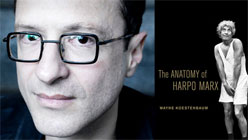
"title": "Wayne Koestenbaum and 'The Anatomy of Harpo Marx'",
"headTitle": "Wayne Koestenbaum and ‘The Anatomy of Harpo Marx’ | KQED",
"content": "\u003cp>It’s no secret that scholarly books on cinema can be deadening, and any play-by-play account of 13 movie comedies sanctioned by a university press might reasonably seem like one to avoid. Not so \u003ci>The Anatomy of Harpo Marx\u003c/i>, from the poet and cultural critic Wayne Koestenbaum, and published by UC Press, which has the nerve not to be just another impersonal, theory-glazed boredom generator. Instead it’s a zesty and deeply literate joy to read.\u003c/p>\n\u003cp>Just as his previous nonfiction work, \u003ci>Humiliation\u003c/i>, seemed like an apotheosis of new literary possibility in the age of overshare, so Koestenbaum’s new book reinvigorates film studies. There’s no special trick to it, really, just his own eruditely intimate way of seeing in the silent Marx bother a profound physical presence.\u003c/p>\n\u003cp>“As Andy Warhol filmed a man sleeping, and called it \u003ci>Sleep\u003c/i>,” Koestenbaum writes, “I want to commit media-heist, to steal a man from his native silence and transplant him into words, if only for the pleasure of taking illusory possession of a physical self-sureness that can never be mine.” By casting his project in such confessional terms, Koestenbaum makes a sort of pact with subject and reader alike. He proceeds not just as an insightful scholar but also as a brainy, randy, vulnerable flirt.\u003c/p>\n\u003cp>Unpacking the famous screen comedian’s nonverbal lyricism is of course a worthy academic undertaking, and Koestenbaum’s subjective musings neatly disguise his rigor. It’s his alertness to “foreshadowings that appear when we view earlier artifacts in hindsight” that allows Koestenbaum to coin the phrase “Kristallnacht Preview” for a given moment of 1933’s \u003ci>Duck Soup\u003c/i>, in which “Harpo apprehends catastrophe.” Later, he writes, “I will lean on the Nazi theme; Harpo leans on it too. Harpo was a comic genius before the Third Reich came along, but the Third Reich gave Harpo’s anarchy extra pointedness.” And of course those retrospective foreshadowings continue into subsequent epochs; in 1937’s \u003ci>A Day at the Races\u003c/i>, for instance, “he has the traumatized expression of Jackie Kennedy on Air Force One as LBJ is sworn into the presidency.”\u003c/p>\n\u003cp> \u003c/p>\n\u003cp>[ad fullwidth]\u003c/p>\n\u003cp>Obviously that analysis may be subject to debate; what matters most is the peculiar and palpable force of Koestenbaum’s investment — the “ecstatic clarity” to be had from studying a screen persona through one’s own history-sharpened lens. Diaristic and deceptively digressive, \u003ci>The Anatomy of Harpo Marx\u003c/i> becomes a secondary celebration of context itself. Yet it never loses sight of the endlessly watchable man, the endlessly meaningful mannerisms, in all those movies. And if Koestenbaum seems like exactly the right writer for this job, it’s as much for the refinement of his appreciation as for his recognition of what makes something appreciation-worthy to begin with. As he rightly puts it, “Harpo beams upward at you, whoever you are.”\u003c/p>\n\u003cp>Wayne Koestenbaum discusses \u003ci>The Anatomy of Harpo Marx\u003c/i> at 7:30 p.m. Wednesday, April 11, 2012, at the San Francisco Art Institute, and his new book of poems, \u003ci>Blue Stranger With Mosaic Background\u003c/i>, 7 p.m. Thursday April 12, 2012, at City Lights in San Francisco. For \u003ca href=\"http://www.sfai.edu/\">more information\u003c/a>, visit sfai.edu and citylights.com.\u003c/p>\n\u003cp>\u003c/p>\n\u003cp> \u003c/p>\n\n",
"stats": {
"hasVideo": false,
"hasChartOrMap": false,
"hasAudio": false,
"hasPolis": false,
"wordCount": 569,
"hasGoogleForm": false,
"hasGallery": false,
"hasHearkenModule": false,
"iframeSrcs": [],
"paragraphCount": 8
},
"modified": 1705050806,
"excerpt": "\u003ci>The Anatomy of Harpo Marx\u003c/i>, from the poet and cultural critic Wayne Koestenbaum, has the nerve not to be just another impersonal, theory-glazed boredom generator. Instead it's a zesty and deeply literate joy to read.",
"headData": {
"twImgId": "",
"twTitle": "",
"ogTitle": "",
"ogImgId": "",
"twDescription": "",
"description": "The Anatomy of Harpo Marx, from the poet and cultural critic Wayne Koestenbaum, has the nerve not to be just another impersonal, theory-glazed boredom generator. Instead it's a zesty and deeply literate joy to read.",
"title": "Wayne Koestenbaum and 'The Anatomy of Harpo Marx' | KQED",
"ogDescription": "",
"schema": {
"@context": "https://schema.org",
"@type": "Article",
"headline": "Wayne Koestenbaum and 'The Anatomy of Harpo Marx'",
"datePublished": "2012-04-05T17:42:30-07:00",
"dateModified": "2024-01-12T01:13:26-08:00",
"image": "https://cdn.kqed.org/wp-content/uploads/2020/02/KQED-OG-Image@1x.png"
}
},
"guestAuthors": [],
"slug": "wayne_koestenbaum_and_the_anatomy_of_harpo_marx",
"status": "publish",
"sourceUrl": "http://www.kqed.org/arts/category/literature/",
"sticky": false,
"path": "/arts/90202/wayne_koestenbaum_and_the_anatomy_of_harpo_marx",
"audioTrackLength": null,
"parsedContent": [
{
"type": "contentString",
"content": "\u003cdiv class=\"post-body\">\u003cp>\u003cp>It’s no secret that scholarly books on cinema can be deadening, and any play-by-play account of 13 movie comedies sanctioned by a university press might reasonably seem like one to avoid. Not so \u003ci>The Anatomy of Harpo Marx\u003c/i>, from the poet and cultural critic Wayne Koestenbaum, and published by UC Press, which has the nerve not to be just another impersonal, theory-glazed boredom generator. Instead it’s a zesty and deeply literate joy to read.\u003c/p>\n\u003cp>Just as his previous nonfiction work, \u003ci>Humiliation\u003c/i>, seemed like an apotheosis of new literary possibility in the age of overshare, so Koestenbaum’s new book reinvigorates film studies. There’s no special trick to it, really, just his own eruditely intimate way of seeing in the silent Marx bother a profound physical presence.\u003c/p>\n\u003cp>“As Andy Warhol filmed a man sleeping, and called it \u003ci>Sleep\u003c/i>,” Koestenbaum writes, “I want to commit media-heist, to steal a man from his native silence and transplant him into words, if only for the pleasure of taking illusory possession of a physical self-sureness that can never be mine.” By casting his project in such confessional terms, Koestenbaum makes a sort of pact with subject and reader alike. He proceeds not just as an insightful scholar but also as a brainy, randy, vulnerable flirt.\u003c/p>\n\u003cp>Unpacking the famous screen comedian’s nonverbal lyricism is of course a worthy academic undertaking, and Koestenbaum’s subjective musings neatly disguise his rigor. It’s his alertness to “foreshadowings that appear when we view earlier artifacts in hindsight” that allows Koestenbaum to coin the phrase “Kristallnacht Preview” for a given moment of 1933’s \u003ci>Duck Soup\u003c/i>, in which “Harpo apprehends catastrophe.” Later, he writes, “I will lean on the Nazi theme; Harpo leans on it too. Harpo was a comic genius before the Third Reich came along, but the Third Reich gave Harpo’s anarchy extra pointedness.” And of course those retrospective foreshadowings continue into subsequent epochs; in 1937’s \u003ci>A Day at the Races\u003c/i>, for instance, “he has the traumatized expression of Jackie Kennedy on Air Force One as LBJ is sworn into the presidency.”\u003c/p>\n\u003cp> \u003c/p>\n\u003cp>\u003c/p>\u003c/div>",
"attributes": {
"named": {},
"numeric": []
}
},
{
"type": "component",
"content": "",
"name": "ad",
"attributes": {
"named": {
"label": "fullwidth"
},
"numeric": [
"fullwidth"
]
}
},
{
"type": "contentString",
"content": "\u003cdiv class=\"post-body\">\u003cp>\u003c/p>\n\u003cp>Obviously that analysis may be subject to debate; what matters most is the peculiar and palpable force of Koestenbaum’s investment — the “ecstatic clarity” to be had from studying a screen persona through one’s own history-sharpened lens. Diaristic and deceptively digressive, \u003ci>The Anatomy of Harpo Marx\u003c/i> becomes a secondary celebration of context itself. Yet it never loses sight of the endlessly watchable man, the endlessly meaningful mannerisms, in all those movies. And if Koestenbaum seems like exactly the right writer for this job, it’s as much for the refinement of his appreciation as for his recognition of what makes something appreciation-worthy to begin with. As he rightly puts it, “Harpo beams upward at you, whoever you are.”\u003c/p>\n\u003cp>Wayne Koestenbaum discusses \u003ci>The Anatomy of Harpo Marx\u003c/i> at 7:30 p.m. Wednesday, April 11, 2012, at the San Francisco Art Institute, and his new book of poems, \u003ci>Blue Stranger With Mosaic Background\u003c/i>, 7 p.m. Thursday April 12, 2012, at City Lights in San Francisco. For \u003ca href=\"http://www.sfai.edu/\">more information\u003c/a>, visit sfai.edu and citylights.com.\u003c/p>\n\u003cp>\u003c/p>\n\u003cp> \u003c/p>\n\n\u003c/div>\u003c/p>",
"attributes": {
"named": {},
"numeric": []
}
}
],
"link": "/arts/90202/wayne_koestenbaum_and_the_anatomy_of_harpo_marx",
"authors": [
"36"
],
"categories": [
"arts_73"
],
"featImg": "arts_10090202",
"label": "arts"
},
"arts_89834": {
"type": "posts",
"id": "arts_89834",
"meta": {
"index": "posts_1716263798",
"site": "arts",
"id": "89834",
"score": null,
"sort": [
1333496888000
]
},
"guestAuthors": [],
"slug": "more_from_one_more_for_the_people",
"title": "More from One More for the People",
"publishDate": 1333496888,
"format": "audio",
"headTitle": "More from One More for the People | KQED",
"labelTerm": {
"site": "arts"
},
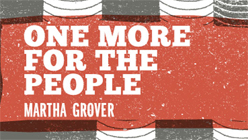
"content": "\u003cp>Eight years in the making, \u003ci>One More for the People\u003c/i> is the first collection of Martha Grover’s zine \u003ci>Somnambulist\u003c/i>. Playful, wry, and conversational, \u003ci>One More for the People\u003c/i> chronicles three generations in the life of the Grover family. As these idiosyncratic characters reluctantly confront adulthood, one Grover is always there to take notes. But after she’s diagnosed with a rare, potentially fatal disease (whose 81 side effects include dramatic changes to her appearance, not to mention the dreaded possibility of having to move back home), her story becomes something unexpected: a survival guide. In the spirit of Lucy Grealy’s \u003ci>Autobiography of a Face\u003c/i>, Grover transforms her own misfortune into a tale as unsettling as it is entertaining.\u003c/p>\n\u003cp>[ad fullwidth]\u003c/p>\u003cp>\u003c/p>\n",
"blocks": [],
"excerpt": "Martha Grover reads \"Swedish Massage,\" a story from her new collection, \u003ci>One More for the People\u003c/i>.",
"status": "publish",
"parent": 0,
"modified": 1726705837,
"stats": {
"hasAudio": false,
"hasVideo": false,
"hasChartOrMap": false,
"iframeSrcs": [],
"hasGoogleForm": false,
"hasGallery": false,
"hasHearkenModule": false,
"hasPolis": false,
"paragraphCount": 3,
"wordCount": 125
},
"headData": {
"title": "More from One More for the People | KQED",
"description": "Martha Grover reads "Swedish Massage," a story from her new collection, One More for the People.",
"ogTitle": "",
"ogDescription": "",
"ogImgId": "",
"twTitle": "",
"twDescription": "",
"twImgId": "",
"schema": {
"@context": "https://schema.org",
"@type": "Article",
"headline": "More from One More for the People",
"datePublished": "2012-04-03T16:48:08-07:00",
"dateModified": "2024-09-18T17:30:37-07:00",
"image": "https://cdn.kqed.org/wp-content/uploads/2020/02/KQED-OG-Image@1x.png"
}
},
"sourceUrl": "http://www.kqed.org/arts/programs/writersblock/",
"audioUrl": "http://podcastdownload.npr.org/anon.npr-podcasts/podcast/151/510076/149964880/KQED_149964880.mp3",
"sticky": false,
"nprByline": "Martha Grover",
"path": "/arts/89834/more_from_one_more_for_the_people",
"audioTrackLength": null,
"parsedContent": [
{
"type": "contentString",
"content": "\u003cdiv class=\"post-body\">\u003cp>\u003cp>Eight years in the making, \u003ci>One More for the People\u003c/i> is the first collection of Martha Grover’s zine \u003ci>Somnambulist\u003c/i>. Playful, wry, and conversational, \u003ci>One More for the People\u003c/i> chronicles three generations in the life of the Grover family. As these idiosyncratic characters reluctantly confront adulthood, one Grover is always there to take notes. But after she’s diagnosed with a rare, potentially fatal disease (whose 81 side effects include dramatic changes to her appearance, not to mention the dreaded possibility of having to move back home), her story becomes something unexpected: a survival guide. In the spirit of Lucy Grealy’s \u003ci>Autobiography of a Face\u003c/i>, Grover transforms her own misfortune into a tale as unsettling as it is entertaining.\u003c/p>\n\u003cp>\u003c/p>\u003c/div>",
"attributes": {
"named": {},
"numeric": []
}
},
{
"type": "component",
"content": "",
"name": "ad",
"attributes": {
"named": {
"label": "fullwidth"
},
"numeric": [
"fullwidth"
]
}
},
{
"type": "contentString",
"content": "\u003cdiv class=\"post-body\">\u003cp>\u003c/p>\u003cp>\u003c/p>\n\u003c/div>\u003c/p>",
"attributes": {
"named": {},
"numeric": []
}
}
],
"link": "/arts/89834/more_from_one_more_for_the_people",
"authors": [
"byline_arts_89834"
],
"categories": [
"arts_73"
],
"tags": [
"arts_330"
],
"featImg": "arts_10089834",
"label": "arts"
},
"arts_89143": {
"type": "posts",
"id": "arts_89143",
"meta": {
"index": "posts_1716263798",
"site": "arts",
"id": "89143",
"score": null,
"sort": [
1332899138000
]
},
"guestAuthors": [],
"slug": "the_mirage",
"title": "The Mirage",
"publishDate": 1332899138,
"format": "audio",
"headTitle": "The Mirage | KQED",
"labelTerm": {
"site": "arts"
},
"content": "\u003cp>11/9/2001: Christian fundamentalists hijack four jetliners. They fly two into the Tigris and Euphrates World Trade Towers in Baghdad, and a third into the Arab Defense Ministry in Riyadh. The fourth plane, believed to be bound for Mecca, is brought down by its passengers.\u003c/p>\n\u003cp>The United Arab States declares a War on Terror. Arabian and Persian troops invade the Eastern Seaboard and establish a Green Zone in Washington, D.C….\u003c/p>\n\u003cp>Summer, 2009: Arab Homeland Security agent Mustafa al Baghdadi interrogates a captured suicide bomber. The prisoner claims that the world they are living in is a mirage — in the real world, America is a superpower, and the Arab states are just a collection of “backward third-world countries.” A search of the bomber’s apartment turns up a copy of \u003ci>The New York Times\u003c/i>, dated September 12, 2001, that appears to support his claim.\u003c/p>\n\u003cp>Other captured terrorists have been telling the same story. The president wants answers, but Mustafa soon discovers he’s not the only interested party. The gangster Saddam Hussein is conducting his own investigation. And the head of the Senate Intelligence Committee — a war hero named Osama bin Laden — will stop at nothing to hide the truth. As Mustafa and his colleagues venture deeper into the unsettling world of terrorism, politics, and espionage, they are confronted with questions without any rational answers, and the terrifying possibility that their world is not what it seems.\u003c/p>\n\u003cp>[ad fullwidth]\u003c/p>\u003cp>\u003c/p>\n",
"blocks": [],
"excerpt": "Matt Ruff reads a passage from \u003ci>The Mirage\u003c/i>, a mind-bending novel in which an alternate history of 9/11 and its aftermath uncovers startling truths about America and the Middle East.",
"status": "publish",
"parent": 0,
"modified": 1726705841,
"stats": {
"hasAudio": false,
"hasVideo": false,
"hasChartOrMap": false,
"iframeSrcs": [],
"hasGoogleForm": false,
"hasGallery": false,
"hasHearkenModule": false,
"hasPolis": false,
"paragraphCount": 6,
"wordCount": 249
},
"headData": {
"title": "The Mirage | KQED",
"description": "Matt Ruff reads a passage from The Mirage, a mind-bending novel in which an alternate history of 9/11 and its aftermath uncovers startling truths about America and the Middle East.",
"ogTitle": "",
"ogDescription": "",
"ogImgId": "",
"twTitle": "",
"twDescription": "",
"twImgId": "",
"schema": {
"@context": "https://schema.org",
"@type": "Article",
"headline": "The Mirage",
"datePublished": "2012-03-27T18:45:38-07:00",
"dateModified": "2024-09-18T17:30:41-07:00",
"image": "https://cdn.kqed.org/wp-content/uploads/2020/02/KQED-OG-Image@1x.png"
}
},
"sourceUrl": "http://www.kqed.org/arts/programs/writersblock/",
"audioUrl": "http://podcastdownload.npr.org/anon.npr-podcasts/podcast/151/510076/149514482/KQED_149514482.mp3",
"sticky": false,
"nprByline": "Matt Ruff",
"path": "/arts/89143/the_mirage",
"audioTrackLength": null,
"parsedContent": [
{
"type": "contentString",
"content": "\u003cdiv class=\"post-body\">\u003cp>\u003cp>11/9/2001: Christian fundamentalists hijack four jetliners. They fly two into the Tigris and Euphrates World Trade Towers in Baghdad, and a third into the Arab Defense Ministry in Riyadh. The fourth plane, believed to be bound for Mecca, is brought down by its passengers.\u003c/p>\n\u003cp>The United Arab States declares a War on Terror. Arabian and Persian troops invade the Eastern Seaboard and establish a Green Zone in Washington, D.C….\u003c/p>\n\u003cp>Summer, 2009: Arab Homeland Security agent Mustafa al Baghdadi interrogates a captured suicide bomber. The prisoner claims that the world they are living in is a mirage — in the real world, America is a superpower, and the Arab states are just a collection of “backward third-world countries.” A search of the bomber’s apartment turns up a copy of \u003ci>The New York Times\u003c/i>, dated September 12, 2001, that appears to support his claim.\u003c/p>\n\u003cp>Other captured terrorists have been telling the same story. The president wants answers, but Mustafa soon discovers he’s not the only interested party. The gangster Saddam Hussein is conducting his own investigation. And the head of the Senate Intelligence Committee — a war hero named Osama bin Laden — will stop at nothing to hide the truth. As Mustafa and his colleagues venture deeper into the unsettling world of terrorism, politics, and espionage, they are confronted with questions without any rational answers, and the terrifying possibility that their world is not what it seems.\u003c/p>\n\u003cp>\u003c/p>\u003c/div>",
"attributes": {
"named": {},
"numeric": []
}
},
{
"type": "component",
"content": "",
"name": "ad",
"attributes": {
"named": {
"label": "fullwidth"
},
"numeric": [
"fullwidth"
]
}
},
{
"type": "contentString",
"content": "\u003cdiv class=\"post-body\">\u003cp>\u003c/p>\u003cp>\u003c/p>\n\u003c/div>\u003c/p>",
"attributes": {
"named": {},
"numeric": []
}
}
],
"link": "/arts/89143/the_mirage",
"authors": [
"byline_arts_89143"
],
"categories": [
"arts_73"
],
"tags": [
"arts_330"
],
"featImg": "arts_10089143",
"label": "arts"
},
"arts_88472": {
"type": "posts",
"id": "arts_88472",
"meta": {
"index": "posts_1716263798",
"site": "arts",
"id": "88472",
"score": null,
"sort": [
1332291851000
]
},
"guestAuthors": [],
"slug": "by_blood",
"title": "By Blood",
"publishDate": 1332291851,
"format": "audio",
"headTitle": "By Blood | KQED",
"labelTerm": {
"site": "arts"
},
"content": "\u003cp>The award-winning writer returns with a major, absorbing, atmospheric novel that takes on the most dramatic and profoundly personal subject matter. San Francisco in the 1970s. Free love has given way to radical feminism, psychedelic ecstasy to hard-edged gloom. The Zodiac Killer stalks the streets. A disgraced professor takes an office in a downtown tower to plot his return. But the walls are thin and he’s distracted by voices from next door — his neighbor is a psychologist, and one of her patients dislikes the hum of the white-noise machine. And so he begins to hear about the patient’s troubles with her female lover, her conflicts with her adoptive, avowedly WASP family, and her quest to track down her birth mother. The professor is not just absorbed but enraptured. And the further he is pulled into the patient’s recounting of her dramas — and the most profound questions of her own identity — the more he needs the story to move forward. The patient’s questions about her birth family have led her to a Catholic charity that trafficked freshly baptized orphans out of Germany after World War II. But confronted with this new self — “I have no idea what it means to say ‘I’m a Jew'” — the patient finds her search stalled. Armed with the few details he’s gleaned, the professor takes up the quest and quickly finds the patient’s mother in records from a German displaced-persons camp. But he can’t let on that he’s been eavesdropping, so he mocks up a reply from an adoption agency the patient has contacted and drops it in the mail. Through the wall, he hears how his dear patient is energized by the news, and so is he. He unearths more clues and invests more and more in this secret, fraught, triangular relationship: himself, the patient, and her therapist, who is herself German. His research leads them deep into the history of displaced-persons camps, of postwar Zionism, and — most troubling of all — of the Nazi Lebensborn program.\u003c/p>\n\u003cp>With ferocious intelligence and an enthralling, magnetic prose, Ellen Ullman weaves a dark and brilliant, intensely personal novel that feels as big and timeless as it is sharp and timely. It is an ambitious work that establishes her as a major writer.\u003c/p>\n\u003cp>[ad fullwidth]\u003c/p>\u003cp>\u003c/p>\n",
"blocks": [],
"excerpt": "Ellen Ullman reads a passage from her latest novel, \u003ci>By Blood\u003c/i>, about a disgraced professor who becomes enraptured by the troubles of his psychologist neighbor's patient.",
"status": "publish",
"parent": 0,
"modified": 1726705845,
"stats": {
"hasAudio": false,
"hasVideo": false,
"hasChartOrMap": false,
"iframeSrcs": [],
"hasGoogleForm": false,
"hasGallery": false,
"hasHearkenModule": false,
"hasPolis": false,
"paragraphCount": 4,
"wordCount": 408
},
"headData": {
"title": "By Blood | KQED",
"description": "Ellen Ullman reads a passage from her latest novel, By Blood, about a disgraced professor who becomes enraptured by the troubles of his psychologist neighbor's patient.",
"ogTitle": "",
"ogDescription": "",
"ogImgId": "",
"twTitle": "",
"twDescription": "",
"twImgId": "",
"schema": {
"@context": "https://schema.org",
"@type": "Article",
"headline": "By Blood",
"datePublished": "2012-03-20T18:04:11-07:00",
"dateModified": "2024-09-18T17:30:45-07:00",
"image": "https://cdn.kqed.org/wp-content/uploads/2020/02/KQED-OG-Image@1x.png"
}
},
"sourceUrl": "http://www.kqed.org/arts/programs/writersblock/",
"audioUrl": "http://podcastdownload.npr.org/anon.npr-podcasts/podcast/151/510076/149049429/KQED_149049429.mp3",
"sticky": false,
"nprByline": "Ellen Ullman",
"path": "/arts/88472/by_blood",
"audioTrackLength": null,
"parsedContent": [
{
"type": "contentString",
"content": "\u003cdiv class=\"post-body\">\u003cp>\u003cp>The award-winning writer returns with a major, absorbing, atmospheric novel that takes on the most dramatic and profoundly personal subject matter. San Francisco in the 1970s. Free love has given way to radical feminism, psychedelic ecstasy to hard-edged gloom. The Zodiac Killer stalks the streets. A disgraced professor takes an office in a downtown tower to plot his return. But the walls are thin and he’s distracted by voices from next door — his neighbor is a psychologist, and one of her patients dislikes the hum of the white-noise machine. And so he begins to hear about the patient’s troubles with her female lover, her conflicts with her adoptive, avowedly WASP family, and her quest to track down her birth mother. The professor is not just absorbed but enraptured. And the further he is pulled into the patient’s recounting of her dramas — and the most profound questions of her own identity — the more he needs the story to move forward. The patient’s questions about her birth family have led her to a Catholic charity that trafficked freshly baptized orphans out of Germany after World War II. But confronted with this new self — “I have no idea what it means to say ‘I’m a Jew'” — the patient finds her search stalled. Armed with the few details he’s gleaned, the professor takes up the quest and quickly finds the patient’s mother in records from a German displaced-persons camp. But he can’t let on that he’s been eavesdropping, so he mocks up a reply from an adoption agency the patient has contacted and drops it in the mail. Through the wall, he hears how his dear patient is energized by the news, and so is he. He unearths more clues and invests more and more in this secret, fraught, triangular relationship: himself, the patient, and her therapist, who is herself German. His research leads them deep into the history of displaced-persons camps, of postwar Zionism, and — most troubling of all — of the Nazi Lebensborn program.\u003c/p>\n\u003cp>With ferocious intelligence and an enthralling, magnetic prose, Ellen Ullman weaves a dark and brilliant, intensely personal novel that feels as big and timeless as it is sharp and timely. It is an ambitious work that establishes her as a major writer.\u003c/p>\n\u003cp>\u003c/p>\u003c/div>",
"attributes": {
"named": {},
"numeric": []
}
},
{
"type": "component",
"content": "",
"name": "ad",
"attributes": {
"named": {
"label": "fullwidth"
},
"numeric": [
"fullwidth"
]
}
},
{
"type": "contentString",
"content": "\u003cdiv class=\"post-body\">\u003cp>\u003c/p>\u003cp>\u003c/p>\n\u003c/div>\u003c/p>",
"attributes": {
"named": {},
"numeric": []
}
}
],
"link": "/arts/88472/by_blood",
"authors": [
"byline_arts_88472"
],
"categories": [
"arts_73"
],
"tags": [
"arts_330"
],
"featImg": "arts_10088472",
"label": "arts"
},
"arts_87586": {
"type": "posts",
"id": "arts_87586",
"meta": {
"index": "posts_1716263798",
"site": "arts",
"id": "87586",
"score": null,
"sort": [
1331672953000
]
},
"guestAuthors": [],
"slug": "baby_geisha",
"title": "Baby Geisha",
"publishDate": 1331672953,
"format": "audio",
"headTitle": "Baby Geisha | KQED",
"labelTerm": {
"site": "arts"
},
"content": "\u003cp>\u003ci>Baby Geisha\u003c/i> is a collection of thirteen sexually-charged stories that roam from the Coney Island Ferris wheel to the Greek Isles.\u003c/p>\n\u003cp>True to Dalton’s form, the stories in \u003ci>Baby Geisha\u003c/i> are distinctly imagined while also representing a more grounded approach in the author’s style. There’s the Joan Didion-obsessed starving journalist of ‘Pura Vida,’ struggling to maintain a relationship with her performance artist sisters (or anyone, for that matter), on assignment in Costa Rica to write an article on sloth-hugging. ‘Millennium Chill’ is about a woman who discovers that her body heat is mysteriously linked to that of an elderly beggar.\u003c/p>\n\u003cp>\u003ci>Baby Geisha\u003c/i> serves to underline Dalton’s reputation as a remarkable stylist and original artist.\u003c/p>\n\u003cp>[ad fullwidth]\u003c/p>\u003cp>\u003c/p>\n",
"blocks": [],
"excerpt": "Trinie Dalton reads \"Escape Mushroom Style,\" a story from her new collection, \u003ci>Baby Geisha\u003c/i>.",
"status": "publish",
"parent": 0,
"modified": 1726705848,
"stats": {
"hasAudio": false,
"hasVideo": false,
"hasChartOrMap": false,
"iframeSrcs": [],
"hasGoogleForm": false,
"hasGallery": false,
"hasHearkenModule": false,
"hasPolis": false,
"paragraphCount": 5,
"wordCount": 131
},
"headData": {
"title": "Baby Geisha | KQED",
"description": "Trinie Dalton reads "Escape Mushroom Style," a story from her new collection, Baby Geisha.",
"ogTitle": "",
"ogDescription": "",
"ogImgId": "",
"twTitle": "",
"twDescription": "",
"twImgId": "",
"schema": {
"@context": "https://schema.org",
"@type": "Article",
"headline": "Baby Geisha",
"datePublished": "2012-03-13T14:09:13-07:00",
"dateModified": "2024-09-18T17:30:48-07:00",
"image": "https://cdn.kqed.org/wp-content/uploads/2020/02/KQED-OG-Image@1x.png"
}
},
"sourceUrl": "http://www.kqed.org/arts/programs/writersblock/",
"audioUrl": "http://podcastdownload.npr.org/anon.npr-podcasts/podcast/151/510076/148551372/KQED_148551372.mp3",
"sticky": false,
"nprByline": "Trinie Dalton",
"path": "/arts/87586/baby_geisha",
"audioTrackLength": null,
"parsedContent": [
{
"type": "contentString",
"content": "\u003cdiv class=\"post-body\">\u003cp>\u003cp>\u003ci>Baby Geisha\u003c/i> is a collection of thirteen sexually-charged stories that roam from the Coney Island Ferris wheel to the Greek Isles.\u003c/p>\n\u003cp>True to Dalton’s form, the stories in \u003ci>Baby Geisha\u003c/i> are distinctly imagined while also representing a more grounded approach in the author’s style. There’s the Joan Didion-obsessed starving journalist of ‘Pura Vida,’ struggling to maintain a relationship with her performance artist sisters (or anyone, for that matter), on assignment in Costa Rica to write an article on sloth-hugging. ‘Millennium Chill’ is about a woman who discovers that her body heat is mysteriously linked to that of an elderly beggar.\u003c/p>\n\u003cp>\u003ci>Baby Geisha\u003c/i> serves to underline Dalton’s reputation as a remarkable stylist and original artist.\u003c/p>\n\u003cp>\u003c/p>\u003c/div>",
"attributes": {
"named": {},
"numeric": []
}
},
{
"type": "component",
"content": "",
"name": "ad",
"attributes": {
"named": {
"label": "fullwidth"
},
"numeric": [
"fullwidth"
]
}
},
{
"type": "contentString",
"content": "\u003cdiv class=\"post-body\">\u003cp>\u003c/p>\u003cp>\u003c/p>\n\u003c/div>\u003c/p>",
"attributes": {
"named": {},
"numeric": []
}
}
],
"link": "/arts/87586/baby_geisha",
"authors": [
"byline_arts_87586"
],
"categories": [
"arts_73"
],
"tags": [
"arts_330"
],
"featImg": "arts_10087586",
"label": "arts"
},
"arts_87494": {
"type": "posts",
"id": "arts_87494",
"meta": {
"index": "posts_1716263798",
"site": "arts",
"id": "87494",
"score": null,
"sort": [
1331599562000
]
},
"parent": 0,
"labelTerm": {
"site": "arts"
},
"blocks": [],
"publishDate": 1331599562,
"format": "standard",
"title": "Geoff Dyer: Zoning In",
"headTitle": "Geoff Dyer: Zoning In | KQED",
"content": "\u003cp>Last spring, as a matter of friendly procedure, KQED Arts \u003ca href=\"http://www.kqed.org/arts/literature/article.jsp?essid=55208\">asked the British writer Geoff Dyer which movie he would choose to live inside\u003c/a>. In retrospect it seems obvious that Andrei Tarkovsky’s \u003ci>Stalker\u003c/i> was Dyer’s answer.\u003c/p>\n\u003cp>\u003ci>Stalker\u003c/i> is a long, slow, metaphysical Russian film from 1979. (“Andrei Tarkovsky” in Russian means “long, slow, metaphysical.”) It involves three men on a trip to a forbidden place, each for private personal reasons. Stalker is the name of the character who leads expeditions to this place, where deep desires are said to get fulfilled.\u003c/p>\n\u003cp>Today, what’s so special about the film, aside from it being a great cine-poet’s mesmerizing road movie of the Soviet twilight, is the fact that Dyer has written a book about it. Dyer is one of those rare geniuses who writes well about everything because he always winds up writing about himself. The navel into which he gazes is the world’s as well as his own. Thus is he very possibly the only living English-speaking person who can hold forth at length on Tarkovsky without boring the hell out of you.\u003c/p>\n\u003cp>\u003ci>Zona\u003c/i>, the newest of Dyer’s nimble nonfiction category-busters, describes itself as “A Book About a Film About a Journey to a Room.” It is that, and also an essay about wish fulfillment, the management of time, and the variable likelihood of perception-expanding cinema, among other art forms, to exist in our lives. In short, it is Dyer’s characteristically digressive memoir of what Tarkovsky’s movie has meant to him, which is a lot.\u003c/p>\n\u003cp>\u003c/p>\u003ccenter>\u003cimg decoding=\"async\" src=\"http://a.s.kqed.net/img/arts/blog/stalker.jpg\" style=\"margin-bottom: 10px;\" alt=\"\">\u003cbr>\u003ci>Stalker\u003c/i>, Andrei Tarkovsky, 1980.\u003cbr>\u003c/center>\n\u003cp>Historically, \u003ci>Stalker\u003c/i> was a beleaguered beast, heavily rewritten, reshot, and, fatefully, relocated to just downriver of a chemical plant whose toxicity may later have caused the filmmaker’s fatal cancer. Tarkovsky also had a heart attack during postproduction, and was prone, as Dyer gently puts it, to “megalomaniacal uncertainties.”\u003c/p>\n\u003cp>[ad fullwidth]\u003c/p>\n\u003cp>Aren’t we all? One of the real joys of reading \u003ci>Zona\u003c/i>, thanks to its peculiar candor, is picking up on how even Dyer’s most enthused engagement still seems a lot like fidgety reluctance. Another of Tarkovsky’s trio is a washed-up writer seeking inspiration. “Maybe by going to the Zone he’ll be rejuvenated,” Dyer writes. “Man, I know how he feels. I could do with a piece of that action myself. I mean, do you think I would be spending my time summarizing the action of a film almost devoid of action — not frame by frame, perhaps, but certainly take by take — if I was capable of writing anything else? In my way I am going to the Room — following these three to the Room — to save myself.”\u003c/p>\n\u003cp>\u003c/p>\u003ccenter>\u003cimg decoding=\"async\" src=\"http://a.s.kqed.net/img/arts/blog/zona.jpg\" style=\"margin-bottom: 10px;\" alt=\"\">\u003c/center>\n\u003cp>Dyer’s own stalkers surely will have noticed \u003ci>Stalker\u003c/i> references piling up in his previous writings, and maybe even presaged a whole book coming on. But then, who ever knows? He’s flighty. One of Dyer’s earlier books is called \u003ci>Yoga for People Who Can’t Be Bothered to Do It\u003c/i>. Another, \u003ci>Out of Sheer Rage\u003c/i>, is a biography of D.H. Lawrence by an author who couldn’t be bothered to do it. (Of course, in the end, he did. Sort of.) One essay in his recent collection, \u003ci>Otherwise Known as the Human Condition\u003c/i>, extemporized the proto-book proposal for \u003ci>Great Pastries of the World: A Personal View\u003c/i>. Was that a threat, or a promise?\u003c/p>\n\u003cp>Anyway, \u003ci>Zona\u003c/i> is here now, and briefly so is its author, for a panel discussion at the Stanford Humanities Center, a book signing at the Cerrito Theatre in El Cerrito, and, in between, a dialogue with fellow brilliant Brit and exhaustive film commentator David Thomson at Tosca in San Francisco (this last courtesy of Litquake’s Epicenter series of author events, here co-presented by \u003ci>The Believer\u003c/i>).\u003c/p>\n\u003cp>Like Dyer’s book, these events demand no previous familiarity with the film he describes as “synonymous both with cinema’s claims to high art and a test of the viewer’s ability to appreciate it as such.” All that’s required, to get a conversation started at least, is merely the “capacity to survive at the challenging peaks of human achievement.” Zone into that.\u003c/p>\n\u003cp>\u003c/p>\n\u003cp>Geoff Dyer reads from and discusses \u003ci>Zona\u003c/i> at 5:30pm TONIGHT, Tuesday, March 13, 2012, at the Stanford Humanities Center in Palo Alto; 7pm Wednesday, March 14, 2012, at Tosca Cafe in San Francisco (\u003ca href=\"http://www.litquake.org/festival/epicenter\">more info at litquake.org\u003c/a>); and 6:30pm March 15, 2012, at the Cerrito Theatre in El Cerrito. For \u003ca href=\"http://geoffdyer.com/events/\"> more information\u003c/a> visit geoffdyer.com.\u003c/p>\n\n",
"stats": {
"hasVideo": false,
"hasChartOrMap": false,
"hasAudio": false,
"hasPolis": false,
"wordCount": 803,
"hasGoogleForm": false,
"hasGallery": false,
"hasHearkenModule": false,
"iframeSrcs": [],
"paragraphCount": 14
},
"modified": 1705050852,
"excerpt": "Author Geoff Dyer is in town for three speaking engagements this week concerning \u003ci>Zona\u003c/i>, his latest novel inspired by Russian filmmaker Anrei Tarkovsky's \u003ci>Stalker\u003c/i>.",
"headData": {
"twImgId": "",
"twTitle": "",
"ogTitle": "",
"ogImgId": "",
"twDescription": "",
"description": "Author Geoff Dyer is in town for three speaking engagements this week concerning Zona, his latest novel inspired by Russian filmmaker Anrei Tarkovsky's Stalker.",
"title": "Geoff Dyer: Zoning In | KQED",
"ogDescription": "",
"schema": {
"@context": "https://schema.org",
"@type": "Article",
"headline": "Geoff Dyer: Zoning In",
"datePublished": "2012-03-12T17:46:02-07:00",
"dateModified": "2024-01-12T01:14:12-08:00",
"image": "https://cdn.kqed.org/wp-content/uploads/2020/02/KQED-OG-Image@1x.png"
}
},
"guestAuthors": [],
"slug": "geoff_dyer_zoning_in",
"status": "publish",
"sourceUrl": "http://www.kqed.org/arts/category/literature/literature-event/",
"sticky": false,
"path": "/arts/87494/geoff_dyer_zoning_in",
"audioTrackLength": null,
"parsedContent": [
{
"type": "contentString",
"content": "\u003cdiv class=\"post-body\">\u003cp>\u003cp>Last spring, as a matter of friendly procedure, KQED Arts \u003ca href=\"http://www.kqed.org/arts/literature/article.jsp?essid=55208\">asked the British writer Geoff Dyer which movie he would choose to live inside\u003c/a>. In retrospect it seems obvious that Andrei Tarkovsky’s \u003ci>Stalker\u003c/i> was Dyer’s answer.\u003c/p>\n\u003cp>\u003ci>Stalker\u003c/i> is a long, slow, metaphysical Russian film from 1979. (“Andrei Tarkovsky” in Russian means “long, slow, metaphysical.”) It involves three men on a trip to a forbidden place, each for private personal reasons. Stalker is the name of the character who leads expeditions to this place, where deep desires are said to get fulfilled.\u003c/p>\n\u003cp>Today, what’s so special about the film, aside from it being a great cine-poet’s mesmerizing road movie of the Soviet twilight, is the fact that Dyer has written a book about it. Dyer is one of those rare geniuses who writes well about everything because he always winds up writing about himself. The navel into which he gazes is the world’s as well as his own. Thus is he very possibly the only living English-speaking person who can hold forth at length on Tarkovsky without boring the hell out of you.\u003c/p>\n\u003cp>\u003ci>Zona\u003c/i>, the newest of Dyer’s nimble nonfiction category-busters, describes itself as “A Book About a Film About a Journey to a Room.” It is that, and also an essay about wish fulfillment, the management of time, and the variable likelihood of perception-expanding cinema, among other art forms, to exist in our lives. In short, it is Dyer’s characteristically digressive memoir of what Tarkovsky’s movie has meant to him, which is a lot.\u003c/p>\n\u003cp>\u003c/p>\u003ccenter>\u003cimg decoding=\"async\" src=\"http://a.s.kqed.net/img/arts/blog/stalker.jpg\" style=\"margin-bottom: 10px;\" alt=\"\">\u003cbr>\u003ci>Stalker\u003c/i>, Andrei Tarkovsky, 1980.\u003cbr>\u003c/center>\n\u003cp>Historically, \u003ci>Stalker\u003c/i> was a beleaguered beast, heavily rewritten, reshot, and, fatefully, relocated to just downriver of a chemical plant whose toxicity may later have caused the filmmaker’s fatal cancer. Tarkovsky also had a heart attack during postproduction, and was prone, as Dyer gently puts it, to “megalomaniacal uncertainties.”\u003c/p>\n\u003cp>\u003c/p>\u003c/div>",
"attributes": {
"named": {},
"numeric": []
}
},
{
"type": "component",
"content": "",
"name": "ad",
"attributes": {
"named": {
"label": "fullwidth"
},
"numeric": [
"fullwidth"
]
}
},
{
"type": "contentString",
"content": "\u003cdiv class=\"post-body\">\u003cp>\u003c/p>\n\u003cp>Aren’t we all? One of the real joys of reading \u003ci>Zona\u003c/i>, thanks to its peculiar candor, is picking up on how even Dyer’s most enthused engagement still seems a lot like fidgety reluctance. Another of Tarkovsky’s trio is a washed-up writer seeking inspiration. “Maybe by going to the Zone he’ll be rejuvenated,” Dyer writes. “Man, I know how he feels. I could do with a piece of that action myself. I mean, do you think I would be spending my time summarizing the action of a film almost devoid of action — not frame by frame, perhaps, but certainly take by take — if I was capable of writing anything else? In my way I am going to the Room — following these three to the Room — to save myself.”\u003c/p>\n\u003cp>\u003c/p>\u003ccenter>\u003cimg decoding=\"async\" src=\"http://a.s.kqed.net/img/arts/blog/zona.jpg\" style=\"margin-bottom: 10px;\" alt=\"\">\u003c/center>\n\u003cp>Dyer’s own stalkers surely will have noticed \u003ci>Stalker\u003c/i> references piling up in his previous writings, and maybe even presaged a whole book coming on. But then, who ever knows? He’s flighty. One of Dyer’s earlier books is called \u003ci>Yoga for People Who Can’t Be Bothered to Do It\u003c/i>. Another, \u003ci>Out of Sheer Rage\u003c/i>, is a biography of D.H. Lawrence by an author who couldn’t be bothered to do it. (Of course, in the end, he did. Sort of.) One essay in his recent collection, \u003ci>Otherwise Known as the Human Condition\u003c/i>, extemporized the proto-book proposal for \u003ci>Great Pastries of the World: A Personal View\u003c/i>. Was that a threat, or a promise?\u003c/p>\n\u003cp>Anyway, \u003ci>Zona\u003c/i> is here now, and briefly so is its author, for a panel discussion at the Stanford Humanities Center, a book signing at the Cerrito Theatre in El Cerrito, and, in between, a dialogue with fellow brilliant Brit and exhaustive film commentator David Thomson at Tosca in San Francisco (this last courtesy of Litquake’s Epicenter series of author events, here co-presented by \u003ci>The Believer\u003c/i>).\u003c/p>\n\u003cp>Like Dyer’s book, these events demand no previous familiarity with the film he describes as “synonymous both with cinema’s claims to high art and a test of the viewer’s ability to appreciate it as such.” All that’s required, to get a conversation started at least, is merely the “capacity to survive at the challenging peaks of human achievement.” Zone into that.\u003c/p>\n\u003cp>\u003c/p>\n\u003cp>Geoff Dyer reads from and discusses \u003ci>Zona\u003c/i> at 5:30pm TONIGHT, Tuesday, March 13, 2012, at the Stanford Humanities Center in Palo Alto; 7pm Wednesday, March 14, 2012, at Tosca Cafe in San Francisco (\u003ca href=\"http://www.litquake.org/festival/epicenter\">more info at litquake.org\u003c/a>); and 6:30pm March 15, 2012, at the Cerrito Theatre in El Cerrito. For \u003ca href=\"http://geoffdyer.com/events/\"> more information\u003c/a> visit geoffdyer.com.\u003c/p>\n\n\u003c/div>\u003c/p>",
"attributes": {
"named": {},
"numeric": []
}
}
],
"link": "/arts/87494/geoff_dyer_zoning_in",
"authors": [
"128"
],
"categories": [
"arts_73"
],
"featImg": "arts_10087494",
"label": "arts"
},
"arts_86960": {
"type": "posts",
"id": "arts_86960",
"meta": {
"index": "posts_1716263798",
"site": "arts",
"id": "86960",
"score": null,
"sort": [
1331069897000
]
},
"guestAuthors": [],
"slug": "drifting_house",
"title": "Drifting House",
"publishDate": 1331069897,
"format": "audio",
"headTitle": "Drifting House | KQED",
"labelTerm": {
"site": "arts"
},
"content": "\u003cp>Alternating between the lives of Koreans struggling through seventy years of turbulent, post-World War II history in their homeland and the communities of Korean immigrants grappling with assimilation in the United States, Krys Lee’s haunting debut story collection \u003ci>Drifting House\u003c/i> weaves together intricate tales of family and love, abandonment and loss on both sides of the Pacific. In the title story, children escaping famine in North Korea are forced to make unthinkable sacrifices to survive. The tales set in America reveal the immigrants’ unmoored existence, playing out in cramped apartments and Koreatown strip malls, from the abandoned wife in “A Temporary Marriage” who enters into a sham marriage to find her kidnapped daughter to the makeshift family in “At the Edge of the World” which is fractured when a shaman from the old country moves in next door.\u003c/p>\n\u003cp>[ad fullwidth]\u003c/p>\u003cp>\u003c/p>\n",
"blocks": [],
"excerpt": "Krys Lee reads a passage from \u003ci>Drifting House\u003c/i> about a South Korean woman who goes to America in search of her daughter whom she believes has been kidnapped.",
"status": "publish",
"parent": 0,
"modified": 1726705854,
"stats": {
"hasAudio": false,
"hasVideo": false,
"hasChartOrMap": false,
"iframeSrcs": [],
"hasGoogleForm": false,
"hasGallery": false,
"hasHearkenModule": false,
"hasPolis": false,
"paragraphCount": 3,
"wordCount": 148
},
"headData": {
"title": "Drifting House | KQED",
"description": "Krys Lee reads a passage from Drifting House about a South Korean woman who goes to America in search of her daughter whom she believes has been kidnapped.",
"ogTitle": "",
"ogDescription": "",
"ogImgId": "",
"twTitle": "",
"twDescription": "",
"twImgId": "",
"schema": {
"@context": "https://schema.org",
"@type": "Article",
"headline": "Drifting House",
"datePublished": "2012-03-06T13:38:17-08:00",
"dateModified": "2024-09-18T17:30:54-07:00",
"image": "https://cdn.kqed.org/wp-content/uploads/2020/02/KQED-OG-Image@1x.png"
}
},
"sourceUrl": "http://www.kqed.org/arts/programs/writersblock/",
"audioUrl": "http://podcastdownload.npr.org/anon.npr-podcasts/podcast/151/510076/148091600/KQED_148091600.mp3",
"sticky": false,
"nprByline": "Krys Lee",
"path": "/arts/86960/drifting_house",
"audioTrackLength": null,
"parsedContent": [
{
"type": "contentString",
"content": "\u003cdiv class=\"post-body\">\u003cp>\u003cp>Alternating between the lives of Koreans struggling through seventy years of turbulent, post-World War II history in their homeland and the communities of Korean immigrants grappling with assimilation in the United States, Krys Lee’s haunting debut story collection \u003ci>Drifting House\u003c/i> weaves together intricate tales of family and love, abandonment and loss on both sides of the Pacific. In the title story, children escaping famine in North Korea are forced to make unthinkable sacrifices to survive. The tales set in America reveal the immigrants’ unmoored existence, playing out in cramped apartments and Koreatown strip malls, from the abandoned wife in “A Temporary Marriage” who enters into a sham marriage to find her kidnapped daughter to the makeshift family in “At the Edge of the World” which is fractured when a shaman from the old country moves in next door.\u003c/p>\n\u003cp>\u003c/p>\u003c/div>",
"attributes": {
"named": {},
"numeric": []
}
},
{
"type": "component",
"content": "",
"name": "ad",
"attributes": {
"named": {
"label": "fullwidth"
},
"numeric": [
"fullwidth"
]
}
},
{
"type": "contentString",
"content": "\u003cdiv class=\"post-body\">\u003cp>\u003c/p>\u003cp>\u003c/p>\n\u003c/div>\u003c/p>",
"attributes": {
"named": {},
"numeric": []
}
}
],
"link": "/arts/86960/drifting_house",
"authors": [
"byline_arts_86960"
],
"categories": [
"arts_73"
],
"tags": [
"arts_330"
],
"featImg": "arts_10086960",
"label": "arts"
},
"arts_86081": {
"type": "posts",
"id": "arts_86081",
"meta": {
"index": "posts_1716263798",
"site": "arts",
"id": "86081",
"score": null,
"sort": [
1330460150000
]
},
"guestAuthors": [],
"slug": "one_more_for_the_people",
"title": "One More for the People",
"publishDate": 1330460150,
"format": "audio",
"headTitle": "One More for the People | KQED",
"labelTerm": {
"site": "arts"
},
"content": "\u003cp>Eight years in the making, \u003ci>One More for the People\u003c/i> is the first collection of Martha Grover’s zine \u003ci>Somnambulist\u003c/i>. Playful, wry, and conversational, \u003ci>One More for the People\u003c/i> chronicles three generations in the life of the Grover family. As these idiosyncratic characters reluctantly confront adulthood, one Grover is always there to take notes. But after she’s diagnosed with a rare, potentially fatal disease (whose 81 side effects include dramatic changes to her appearance, not to mention the dreaded possibility of having to move back home), her story becomes something unexpected: a survival guide. In the spirit of Lucy Grealy’s \u003ci>Autobiography of a Face\u003c/i>, Grover transforms her own misfortune into a tale as unsettling as it is entertaining.\u003c/p>\n\u003cp>[ad fullwidth]\u003c/p>\u003cp>\u003c/p>\n",
"blocks": [],
"excerpt": "Martha Grover reads \"Fifteen Things I'm Not Putting on My OkCupid Profile,\" a story from her new collection, \u003ci>One More for the People\u003c/i>.",
"status": "publish",
"parent": 0,
"modified": 1726705859,
"stats": {
"hasAudio": false,
"hasVideo": false,
"hasChartOrMap": false,
"iframeSrcs": [],
"hasGoogleForm": false,
"hasGallery": false,
"hasHearkenModule": false,
"hasPolis": false,
"paragraphCount": 3,
"wordCount": 125
},
"headData": {
"title": "One More for the People | KQED",
"description": "Martha Grover reads "Fifteen Things I'm Not Putting on My OkCupid Profile," a story from her new collection, One More for the People.",
"ogTitle": "",
"ogDescription": "",
"ogImgId": "",
"twTitle": "",
"twDescription": "",
"twImgId": "",
"schema": {
"@context": "https://schema.org",
"@type": "Article",
"headline": "One More for the People",
"datePublished": "2012-02-28T12:15:50-08:00",
"dateModified": "2024-09-18T17:30:59-07:00",
"image": "https://cdn.kqed.org/wp-content/uploads/2020/02/KQED-OG-Image@1x.png"
}
},
"sourceUrl": "http://www.kqed.org/arts/programs/writersblock/",
"audioUrl": "http://podcastdownload.npr.org/anon.npr-podcasts/podcast/151/510076/147606932/KQED_147606932.mp3",
"sticky": false,
"nprByline": "Martha Grover",
"path": "/arts/86081/one_more_for_the_people",
"audioTrackLength": null,
"parsedContent": [
{
"type": "contentString",
"content": "\u003cdiv class=\"post-body\">\u003cp>\u003cp>Eight years in the making, \u003ci>One More for the People\u003c/i> is the first collection of Martha Grover’s zine \u003ci>Somnambulist\u003c/i>. Playful, wry, and conversational, \u003ci>One More for the People\u003c/i> chronicles three generations in the life of the Grover family. As these idiosyncratic characters reluctantly confront adulthood, one Grover is always there to take notes. But after she’s diagnosed with a rare, potentially fatal disease (whose 81 side effects include dramatic changes to her appearance, not to mention the dreaded possibility of having to move back home), her story becomes something unexpected: a survival guide. In the spirit of Lucy Grealy’s \u003ci>Autobiography of a Face\u003c/i>, Grover transforms her own misfortune into a tale as unsettling as it is entertaining.\u003c/p>\n\u003cp>\u003c/p>\u003c/div>",
"attributes": {
"named": {},
"numeric": []
}
},
{
"type": "component",
"content": "",
"name": "ad",
"attributes": {
"named": {
"label": "fullwidth"
},
"numeric": [
"fullwidth"
]
}
},
{
"type": "contentString",
"content": "\u003cdiv class=\"post-body\">\u003cp>\u003c/p>\u003cp>\u003c/p>\n\u003c/div>\u003c/p>",
"attributes": {
"named": {},
"numeric": []
}
}
],
"link": "/arts/86081/one_more_for_the_people",
"authors": [
"byline_arts_86081"
],
"categories": [
"arts_73"
],
"tags": [
"arts_330"
],
"featImg": "arts_10086081",
"label": "arts"
},
"arts_85508": {
"type": "posts",
"id": "arts_85508",
"meta": {
"index": "posts_1716263798",
"site": "arts",
"id": "85508",
"score": null,
"sort": [
1329896747000
]
},
"guestAuthors": [],
"slug": "best_of_the_writers_block_lgbt_edition",
"title": "Best of The Writers' Block: LGBT Edition",
"publishDate": 1329896747,
"format": "audio",
"headTitle": "Best of The Writers’ Block: LGBT Edition | KQED",
"labelTerm": {
"site": "arts"
},
"content": "\u003cp>\u003ca href=\"http://www.kqed.org/a/forum/R201202221000\">Christopher Bram’s appearance on KQED’s Forum\u003c/a>, in which he discusses gay writers who changed America, got me thinking about which queer writers left a mark on \u003ci>The Writers’ Block\u003c/i> over the years. Here’s a rundown of episodes that I can’t forget.\u003c/p>\n\u003cp>I’m guessing I don’t have to sell you on \u003cb>David Sedaris\u003c/b>. Hating Sedaris is like hating \u003ca href=\"http://s3-ak.buzzfed.com/static/enhanced/terminal05/2012/2/21/13/enhanced-buzz-27228-1329847665-24.jpg\">this cat eating ice cream while wearing shades and a cool hat\u003c/a>: IMPOSSIBLE. Laugh it up with these two episodes from the man who can even make drowning mice endearing.\u003c/p>\n\u003cp>\u003cimg decoding=\"async\" alt=\"\" src=\"http://www.kqed.org/assets/img/arts/programs/writersblock/quick-email-200x200.jpg\">\u003c/p>\n\u003cp>\u003cb>John Waters\u003c/b> has built a career on pushing buttons and offending sensibilities and that’s why we love him. In person, his pencil-thin mustache is more immaculate than you can imagine and his sardonic charm is downright punishing. If you haven’t read his collection of essays, \u003ci>Role Models\u003c/i>, get thee to a bookstore! Right after you listen to these two hilarious episodes, of course.\u003c/p>\n\u003cp>\u003cimg decoding=\"async\" alt=\"\" src=\"http://www.kqed.org/assets/img/arts/programs/writersblock/john-waters.jpg\">\u003c/p>\n\u003cp>[ad fullwidth]\u003c/p>\n\u003cp>San Francisco is a place for the black sheep in every family and \u003cb>Michelle Tea\u003c/b> is our fairy godmother. Her writing style is unapologetic, gutsy, and all her own. For her episode, she read an exclusive excerpt from her forthcoming book. If you can’t wait for that to come out, you should head over to \u003ca href=\"http://www.xojane.com/author/michelle-tea\">xojane and read her column about getting pregnant\u003c/a>. Her baby is so lucky.\u003c/p>\n\u003cp>\u003cimg decoding=\"async\" alt=\"\" src=\"http://www.kqed.org/assets/img/arts/blog/black-wave-200x200.jpg\">\u003c/p>\n\u003cp>Were you a snotty mess when you watched \u003ci>The Hours\u003c/i>? Well, you have \u003cb>Michael Cunningham\u003c/b> to thank for that emotional breakdown. Listen to him read from his last novel, \u003ci>Nightfall\u003c/i>, if your heartstrings can take it.\u003c/p>\n\u003cp>\u003cimg decoding=\"async\" alt=\"\" src=\"http://www.kqed.org/assets/img/arts/programs/writersblock/michael-cunningham.jpg\">\u003c/p>\n\u003cp>\u003cb>Terry Castle\u003c/b> is smarter than you. A top-notch critic and cultural commentator, her last essay collection, \u003ci>The Professor\u003c/i>, is full of sass and brains. In this episode, Castle reads “Desperately Seeking Susan,” a no-holds-barred account of her friendship with Susan Sontag.\u003c/p>\n\u003cp>\u003cimg decoding=\"async\" alt=\"\" src=\"http://www.kqed.org/assets/img/arts/blog/terry-castle-200x200.jpg\">\u003c/p>\n\u003cp>\u003c/p>\n\u003cp>For all of my other favorite readings, click \u003ca href=\"http://www.kqed.org/arts/programs/writersblock/archive.jsp\">here\u003c/a>.\u003c/p>\n\n",
"blocks": [],
"excerpt": "Christopher Bram's appearance on KQED's Forum, in which he discusses gay writers who changed America, got me thinking about which queer writers left a mark on \u003ci>The Writers' Block\u003c/i> over the years. Here's a rundown of episodes that I can't forget.",
"status": "publish",
"parent": 0,
"modified": 1726705864,
"stats": {
"hasAudio": false,
"hasVideo": false,
"hasChartOrMap": false,
"iframeSrcs": [],
"hasGoogleForm": false,
"hasGallery": false,
"hasHearkenModule": false,
"hasPolis": false,
"paragraphCount": 14,
"wordCount": 331
},
"headData": {
"title": "Best of The Writers' Block: LGBT Edition | KQED",
"description": "Christopher Bram's appearance on KQED's Forum, in which he discusses gay writers who changed America, got me thinking about which queer writers left a mark on The Writers' Block over the years. Here's a rundown of episodes that I can't forget.",
"ogTitle": "",
"ogDescription": "",
"ogImgId": "",
"twTitle": "",
"twDescription": "",
"twImgId": "",
"schema": {
"@context": "https://schema.org",
"@type": "Article",
"headline": "Best of The Writers' Block: LGBT Edition",
"datePublished": "2012-02-21T23:45:47-08:00",
"dateModified": "2024-09-18T17:31:04-07:00",
"image": "https://cdn.kqed.org/wp-content/uploads/2020/02/KQED-OG-Image@1x.png"
}
},
"sourceUrl": "http://www.kqed.org/arts/programs/writersblock/",
"sticky": false,
"path": "/arts/85508/best_of_the_writers_block_lgbt_edition",
"audioTrackLength": null,
"parsedContent": [
{
"type": "contentString",
"content": "\u003cdiv class=\"post-body\">\u003cp>\u003cp>\u003ca href=\"http://www.kqed.org/a/forum/R201202221000\">Christopher Bram’s appearance on KQED’s Forum\u003c/a>, in which he discusses gay writers who changed America, got me thinking about which queer writers left a mark on \u003ci>The Writers’ Block\u003c/i> over the years. Here’s a rundown of episodes that I can’t forget.\u003c/p>\n\u003cp>I’m guessing I don’t have to sell you on \u003cb>David Sedaris\u003c/b>. Hating Sedaris is like hating \u003ca href=\"http://s3-ak.buzzfed.com/static/enhanced/terminal05/2012/2/21/13/enhanced-buzz-27228-1329847665-24.jpg\">this cat eating ice cream while wearing shades and a cool hat\u003c/a>: IMPOSSIBLE. Laugh it up with these two episodes from the man who can even make drowning mice endearing.\u003c/p>\n\u003cp>\u003cimg decoding=\"async\" alt=\"\" src=\"http://www.kqed.org/assets/img/arts/programs/writersblock/quick-email-200x200.jpg\">\u003c/p>\n\u003cp>\u003cb>John Waters\u003c/b> has built a career on pushing buttons and offending sensibilities and that’s why we love him. In person, his pencil-thin mustache is more immaculate than you can imagine and his sardonic charm is downright punishing. If you haven’t read his collection of essays, \u003ci>Role Models\u003c/i>, get thee to a bookstore! Right after you listen to these two hilarious episodes, of course.\u003c/p>\n\u003cp>\u003cimg decoding=\"async\" alt=\"\" src=\"http://www.kqed.org/assets/img/arts/programs/writersblock/john-waters.jpg\">\u003c/p>\n\u003cp>\u003c/p>\u003c/div>",
"attributes": {
"named": {},
"numeric": []
}
},
{
"type": "component",
"content": "",
"name": "ad",
"attributes": {
"named": {
"label": "fullwidth"
},
"numeric": [
"fullwidth"
]
}
},
{
"type": "contentString",
"content": "\u003cdiv class=\"post-body\">\u003cp>\u003c/p>\n\u003cp>San Francisco is a place for the black sheep in every family and \u003cb>Michelle Tea\u003c/b> is our fairy godmother. Her writing style is unapologetic, gutsy, and all her own. For her episode, she read an exclusive excerpt from her forthcoming book. If you can’t wait for that to come out, you should head over to \u003ca href=\"http://www.xojane.com/author/michelle-tea\">xojane and read her column about getting pregnant\u003c/a>. Her baby is so lucky.\u003c/p>\n\u003cp>\u003cimg decoding=\"async\" alt=\"\" src=\"http://www.kqed.org/assets/img/arts/blog/black-wave-200x200.jpg\">\u003c/p>\n\u003cp>Were you a snotty mess when you watched \u003ci>The Hours\u003c/i>? Well, you have \u003cb>Michael Cunningham\u003c/b> to thank for that emotional breakdown. Listen to him read from his last novel, \u003ci>Nightfall\u003c/i>, if your heartstrings can take it.\u003c/p>\n\u003cp>\u003cimg decoding=\"async\" alt=\"\" src=\"http://www.kqed.org/assets/img/arts/programs/writersblock/michael-cunningham.jpg\">\u003c/p>\n\u003cp>\u003cb>Terry Castle\u003c/b> is smarter than you. A top-notch critic and cultural commentator, her last essay collection, \u003ci>The Professor\u003c/i>, is full of sass and brains. In this episode, Castle reads “Desperately Seeking Susan,” a no-holds-barred account of her friendship with Susan Sontag.\u003c/p>\n\u003cp>\u003cimg decoding=\"async\" alt=\"\" src=\"http://www.kqed.org/assets/img/arts/blog/terry-castle-200x200.jpg\">\u003c/p>\n\u003cp>\u003c/p>\n\u003cp>For all of my other favorite readings, click \u003ca href=\"http://www.kqed.org/arts/programs/writersblock/archive.jsp\">here\u003c/a>.\u003c/p>\n\n\u003c/div>\u003c/p>",
"attributes": {
"named": {},
"numeric": []
}
}
],
"link": "/arts/85508/best_of_the_writers_block_lgbt_edition",
"authors": [
"92"
],
"categories": [
"arts_73"
],
"tags": [
"arts_330"
],
"featImg": "arts_10085508",
"label": "arts"
},
"arts_85457": {
"type": "posts",
"id": "arts_85457",
"meta": {
"index": "posts_1716263798",
"site": "arts",
"id": "85457",
"score": null,
"sort": [
1329865007000
]
},
"guestAuthors": [],
"slug": "what_we_talk_about_when_we_talk_about_anne_frank",
"title": "What We Talk About When We Talk About Anne Frank",
"publishDate": 1329865007,
"format": "audio",
"headTitle": "What We Talk About When We Talk About Anne Frank | KQED",
"labelTerm": {
"site": "arts"
},
"content": "\u003cp>These eight new stories from the celebrated novelist and short-story writer Nathan Englander display a gifted young author grappling with the great questions of modern life, with a command of language and the imagination that place Englander at the very forefront of contemporary American fiction.\u003c/p>\n\u003cp>The title story, inspired by Raymond Carver’s masterpiece, is a provocative portrait of two marriages in which the Holocaust is played out as a devastating parlor game. In the outlandishly dark “Camp Sundown,” vigilante justice is undertaken by a group of geriatric campers in a bucolic summer enclave. “Free Fruit for Young Widows” is a small, sharp study in evil, lovingly told by a father to a son. “Sister Hills” chronicles the history of Israel’s settlements from the eve of the Yom Kippur War through the present, a political fable constructed around the tale of two mothers who strike a terrible bargain to save a child. Marking a return to two of Englander’s classic themes, “Peep Show” and “How We Avenged the Blums” wrestle with sexual longing and ingenuity in the face of adversity and peril. And “Everything I Know About My Family on My Mother’s Side” is suffused with an intimacy and tenderness that break new ground for a writer who seems constantly to be expanding the parameters of what he can achieve in the short form.\u003c/p>\n\u003cp>Beautiful and courageous, funny and achingly sad, Englander’s work is a revelation.\u003c/p>\n\u003cp>[ad fullwidth]\u003c/p>\u003cp>\u003c/p>\n",
"blocks": [],
"excerpt": "Nathan Englander reads a passage from his latest story collection, \u003ci>What We Talk About When We Talk About Anne Frank\u003c/i>.",
"status": "publish",
"parent": 0,
"modified": 1726705875,
"stats": {
"hasAudio": false,
"hasVideo": false,
"hasChartOrMap": false,
"iframeSrcs": [],
"hasGoogleForm": false,
"hasGallery": false,
"hasHearkenModule": false,
"hasPolis": false,
"paragraphCount": 5,
"wordCount": 260
},
"headData": {
"title": "What We Talk About When We Talk About Anne Frank | KQED",
"description": "Nathan Englander reads a passage from his latest story collection, What We Talk About When We Talk About Anne Frank.",
"ogTitle": "",
"ogDescription": "",
"ogImgId": "",
"twTitle": "",
"twDescription": "",
"twImgId": "",
"schema": {
"@context": "https://schema.org",
"@type": "Article",
"headline": "What We Talk About When We Talk About Anne Frank",
"datePublished": "2012-02-21T14:56:47-08:00",
"dateModified": "2024-09-18T17:31:15-07:00",
"image": "https://cdn.kqed.org/wp-content/uploads/2020/02/KQED-OG-Image@1x.png"
}
},
"sourceUrl": "http://www.kqed.org/arts/programs/writersblock/",
"audioUrl": "http://podcastdownload.npr.org/anon.npr-podcasts/podcast/151/510076/147244160/KQED_147244160.mp3",
"sticky": false,
"nprByline": "Nathan Englander",
"path": "/arts/85457/what_we_talk_about_when_we_talk_about_anne_frank",
"audioTrackLength": null,
"parsedContent": [
{
"type": "contentString",
"content": "\u003cdiv class=\"post-body\">\u003cp>\u003cp>These eight new stories from the celebrated novelist and short-story writer Nathan Englander display a gifted young author grappling with the great questions of modern life, with a command of language and the imagination that place Englander at the very forefront of contemporary American fiction.\u003c/p>\n\u003cp>The title story, inspired by Raymond Carver’s masterpiece, is a provocative portrait of two marriages in which the Holocaust is played out as a devastating parlor game. In the outlandishly dark “Camp Sundown,” vigilante justice is undertaken by a group of geriatric campers in a bucolic summer enclave. “Free Fruit for Young Widows” is a small, sharp study in evil, lovingly told by a father to a son. “Sister Hills” chronicles the history of Israel’s settlements from the eve of the Yom Kippur War through the present, a political fable constructed around the tale of two mothers who strike a terrible bargain to save a child. Marking a return to two of Englander’s classic themes, “Peep Show” and “How We Avenged the Blums” wrestle with sexual longing and ingenuity in the face of adversity and peril. And “Everything I Know About My Family on My Mother’s Side” is suffused with an intimacy and tenderness that break new ground for a writer who seems constantly to be expanding the parameters of what he can achieve in the short form.\u003c/p>\n\u003cp>Beautiful and courageous, funny and achingly sad, Englander’s work is a revelation.\u003c/p>\n\u003cp>\u003c/p>\u003c/div>",
"attributes": {
"named": {},
"numeric": []
}
},
{
"type": "component",
"content": "",
"name": "ad",
"attributes": {
"named": {
"label": "fullwidth"
},
"numeric": [
"fullwidth"
]
}
},
{
"type": "contentString",
"content": "\u003cdiv class=\"post-body\">\u003cp>\u003c/p>\u003cp>\u003c/p>\n\u003c/div>\u003c/p>",
"attributes": {
"named": {},
"numeric": []
}
}
],
"link": "/arts/85457/what_we_talk_about_when_we_talk_about_anne_frank",
"authors": [
"byline_arts_85457"
],
"categories": [
"arts_73"
],
"tags": [
"arts_330"
],
"featImg": "arts_10085457",
"label": "arts"
},
"arts_85256": {
"type": "posts",
"id": "arts_85256",
"meta": {
"index": "posts_1716263798",
"site": "arts",
"id": "85256",
"score": null,
"sort": [
1329691367000
]
},
"parent": 0,
"labelTerm": {
"site": "arts"
},
"blocks": [],
"publishDate": 1329691367,
"format": "standard",
"title": "Q+A with Maira Kalman",
"headTitle": "Q+A with Maira Kalman | KQED",
"content": "\u003cp>In honor of Presidents’ Day, check out this Q+A with Maira Kalman, illustrator, contributor to \u003ci>The New York Times\u003c/i> and \u003ci>The New Yorker\u003c/i>, and, most importantly, staunch lover of Abe Lincoln.\u003c/p>\n\u003cp>\u003cb>As someone with his own bloated infatuation with Abe Lincoln, you don’treally have to sell me on this particular tall drink of water, but whatdraws you to writing about Abraham?\u003c/b>\u003c/p>\n\u003cp>\u003cb>Maira Kalman:\u003c/b> He looks strange and brilliant. With very smart sharp eyes. And I love sharp eyes.\u003c/p>\n\u003cp>\u003cimg decoding=\"async\" src=\"http://timeoutnewyorkkids.com/sites/default/files/imagecache/timeout_492x330/lookingatlincoln.jpg\">\u003c/p>\n\u003cp>\u003cb>You’ve also written and illustrated tales of other presidents andhistorical figures. Where does your fascination with history stem from?\u003c/b>\u003c/p>\n\u003cp>[ad fullwidth]\u003c/p>\n\u003cp>\u003cb>MK:\u003c/b> I never was interested in history, because I just wasn’t, but I was sent on an assignment for \u003ci>The New York Times\u003c/i> and we decided I would do something I had no interest in. I would be naive.\u003c/p>\n\u003cp>[youtube http://www.youtube.com/watch?v=3yIGeEq12nQ&version=3&hl=en_US&rel=0]\u003c/p>\n\u003cp>\u003cb>What’s something that has shocked you to discover in researching Lincolnor some of your other subjects?\u003c/b>\u003c/p>\n\u003cp>\u003cb>MK:\u003c/b> How smart they were. How sophisticated. How they read Lucretius and Spinoza (Jefferson). How much Lincoln loved Shakespeare. And Mozart.They were thinkers of a very high order.\u003c/p>\n\u003cp>\u003cimg decoding=\"async\" src=\"http://www.chroniclebooks.com/blog/wp-content/uploads/2_lincoln_kalman.jpg\">\u003c/p>\n\u003cp>\u003cb>If you could visit any other time period and place in history, whichwould it be and what would you do there?\u003c/b>\u003c/p>\n\u003cp>\u003cb>MK:\u003c/b> I would like to visit Hadrian in ancient Rome. I think we would walk around and look at the Pantheon together and have a tea or coffee somewhere. Visit Versailles and hang around the court for a few weeks.\u003c/p>\n\u003cp>\u003cimg decoding=\"async\" src=\"http://farm3.static.flickr.com/2763/4408587189_ffd79a225b.jpg\">\u003c/p>\n\u003cp>\u003cb>What’s the last work of art you fell in love with?\u003c/b>\u003c/p>\n\u003cp>\u003cb>MK:\u003c/b> I am reading \u003ci>Remembrance of Things Past\u003c/i> — really reading — and I am besotted and madly in love with M. Proust. I don’t know what is going on half the time, but the way he goes on is like a blood transfusion. I am filled with the music of the words.\u003c/p>\n\u003cp>\u003cb>What are you working on right now?\u003c/b>\u003c/p>\n\u003cp>\u003c/p>\n\u003cp>\u003cb>MK:\u003c/b> Right now, I am getting ready to go to my friend’s house and play Scrabble. Tomorrow, I will sketch ideas for a \u003ci>New Yorker\u003c/i> cover. And then I will sew a felt bag for my iPad.\u003c/p>\n\n",
"stats": {
"hasVideo": true,
"hasChartOrMap": false,
"hasAudio": false,
"hasPolis": false,
"wordCount": 384,
"hasGoogleForm": false,
"hasGallery": false,
"hasHearkenModule": false,
"iframeSrcs": [],
"paragraphCount": 19
},
"modified": 1705050908,
"excerpt": "In honor of Presidents' Day, check out this Q+A with Maira Kalman, illustrator, contributor to \u003ci>The New York Times\u003c/i> and \u003ci>The New Yorker\u003c/i>, and, most importantly, staunch lover of Abe Lincoln.",
"headData": {
"twImgId": "",
"twTitle": "",
"ogTitle": "",
"ogImgId": "",
"twDescription": "",
"description": "In honor of Presidents' Day, check out this Q+A with Maira Kalman, illustrator, contributor to The New York Times and The New Yorker, and, most importantly, staunch lover of Abe Lincoln.",
"title": "Q+A with Maira Kalman | KQED",
"ogDescription": "",
"schema": {
"@context": "https://schema.org",
"@type": "Article",
"headline": "Q+A with Maira Kalman",
"datePublished": "2012-02-19T14:42:47-08:00",
"dateModified": "2024-01-12T01:15:08-08:00",
"image": "https://cdn.kqed.org/wp-content/uploads/2020/02/KQED-OG-Image@1x.png"
}
},
"guestAuthors": [],
"slug": "qa_with_maira_kalman",
"status": "publish",
"sourceUrl": "http://www.kqed.org/arts/category/literature/",
"sticky": false,
"path": "/arts/85256/qa_with_maira_kalman",
"audioTrackLength": null,
"parsedContent": [
{
"type": "contentString",
"content": "\u003cdiv class=\"post-body\">\u003cp>\u003cp>In honor of Presidents’ Day, check out this Q+A with Maira Kalman, illustrator, contributor to \u003ci>The New York Times\u003c/i> and \u003ci>The New Yorker\u003c/i>, and, most importantly, staunch lover of Abe Lincoln.\u003c/p>\n\u003cp>\u003cb>As someone with his own bloated infatuation with Abe Lincoln, you don’treally have to sell me on this particular tall drink of water, but whatdraws you to writing about Abraham?\u003c/b>\u003c/p>\n\u003cp>\u003cb>Maira Kalman:\u003c/b> He looks strange and brilliant. With very smart sharp eyes. And I love sharp eyes.\u003c/p>\n\u003cp>\u003cimg decoding=\"async\" src=\"http://timeoutnewyorkkids.com/sites/default/files/imagecache/timeout_492x330/lookingatlincoln.jpg\">\u003c/p>\n\u003cp>\u003cb>You’ve also written and illustrated tales of other presidents andhistorical figures. Where does your fascination with history stem from?\u003c/b>\u003c/p>\n\u003cp>\u003c/p>\u003c/div>",
"attributes": {
"named": {},
"numeric": []
}
},
{
"type": "component",
"content": "",
"name": "ad",
"attributes": {
"named": {
"label": "fullwidth"
},
"numeric": [
"fullwidth"
]
}
},
{
"type": "contentString",
"content": "\u003cdiv class=\"post-body\">\u003cp>\u003c/p>\n\u003cp>\u003cb>MK:\u003c/b> I never was interested in history, because I just wasn’t, but I was sent on an assignment for \u003ci>The New York Times\u003c/i> and we decided I would do something I had no interest in. I would be naive.\u003c/p>\n\u003cp>\u003c/p>\u003cp>\u003cspan class='utils-parseShortcode-shortcodes-__youtubeShortcode__embedYoutube'>\n \u003cspan class='utils-parseShortcode-shortcodes-__youtubeShortcode__embedYoutubeInside'>\n \u003ciframe\n loading='lazy'\n class='utils-parseShortcode-shortcodes-__youtubeShortcode__youtubePlayer'\n type='text/html'\n src='//www.youtube.com/embed/3yIGeEq12nQ'\n title='//www.youtube.com/embed/3yIGeEq12nQ'\n allowfullscreen='true'\n style='border:0;'>\u003c/iframe>\n \u003c/span>\n \u003c/span>\u003c/p>\u003cp>\u003c/p>\n\u003cp>\u003cb>What’s something that has shocked you to discover in researching Lincolnor some of your other subjects?\u003c/b>\u003c/p>\n\u003cp>\u003cb>MK:\u003c/b> How smart they were. How sophisticated. How they read Lucretius and Spinoza (Jefferson). How much Lincoln loved Shakespeare. And Mozart.They were thinkers of a very high order.\u003c/p>\n\u003cp>\u003cimg decoding=\"async\" src=\"http://www.chroniclebooks.com/blog/wp-content/uploads/2_lincoln_kalman.jpg\">\u003c/p>\n\u003cp>\u003cb>If you could visit any other time period and place in history, whichwould it be and what would you do there?\u003c/b>\u003c/p>\n\u003cp>\u003cb>MK:\u003c/b> I would like to visit Hadrian in ancient Rome. I think we would walk around and look at the Pantheon together and have a tea or coffee somewhere. Visit Versailles and hang around the court for a few weeks.\u003c/p>\n\u003cp>\u003cimg decoding=\"async\" src=\"http://farm3.static.flickr.com/2763/4408587189_ffd79a225b.jpg\">\u003c/p>\n\u003cp>\u003cb>What’s the last work of art you fell in love with?\u003c/b>\u003c/p>\n\u003cp>\u003cb>MK:\u003c/b> I am reading \u003ci>Remembrance of Things Past\u003c/i> — really reading — and I am besotted and madly in love with M. Proust. I don’t know what is going on half the time, but the way he goes on is like a blood transfusion. I am filled with the music of the words.\u003c/p>\n\u003cp>\u003cb>What are you working on right now?\u003c/b>\u003c/p>\n\u003cp>\u003c/p>\n\u003cp>\u003cb>MK:\u003c/b> Right now, I am getting ready to go to my friend’s house and play Scrabble. Tomorrow, I will sketch ideas for a \u003ci>New Yorker\u003c/i> cover. And then I will sew a felt bag for my iPad.\u003c/p>\n\n\u003c/div>\u003c/p>",
"attributes": {
"named": {},
"numeric": []
}
}
],
"link": "/arts/85256/qa_with_maira_kalman",
"authors": [
"27"
],
"categories": [
"arts_73"
],
"featImg": "arts_10085256",
"label": "arts"
},
"arts_85031": {
"type": "posts",
"id": "arts_85031",
"meta": {
"index": "posts_1716263798",
"site": "arts",
"id": "85031",
"score": null,
"sort": [
1329431943000
]
},
"parent": 0,
"labelTerm": {
"site": "arts"
},
"blocks": [],
"publishDate": 1329431943,
"format": "standard",
"title": "Poetry Inside Out",
"headTitle": "Poetry Inside Out | KQED",
"content": "\u003cp>\u003cstrong>Poetry Inside Out\u003c/strong> captures the struggle of bilingual kids who are crossing boundaries of culture and language within Bay Area public schools. The documentary follows several ethnically diverse students in San Francisco and Oakland over a year-long period. Coming from families where English may be the second or even third language, Carmen, Ke’Shae, Gentail, Caroline, Ricardo, and their friends create imaginative worlds of dragons, space aliens, love, and death in a unique writing program based on literary translation. The students’ spirited and insightful poems transcend their imperfect urban world.\u003c/p>\n\u003cp>Funders\u003cbr>Creative Work Fund\u003cbr>San Francisco Arts Commission Cultural Equity Grant Program\u003c/p>\n\u003cp>[ad fullwidth]\u003c/p>\u003cp>\u003c/p>\n",
"stats": {
"hasVideo": false,
"hasChartOrMap": false,
"hasAudio": false,
"hasPolis": false,
"wordCount": 105,
"hasGoogleForm": false,
"hasGallery": false,
"hasHearkenModule": false,
"iframeSrcs": [],
"paragraphCount": 4
},
"modified": 1705050915,
"excerpt": "View Joyce Lee's short film, \u003cb>Poetry Inside Out\u003c/b>, which captures the struggle of bilingual kids who are crossing boundaries of culture and language within Bay Area public schools.",
"headData": {
"twImgId": "",
"twTitle": "",
"ogTitle": "",
"ogImgId": "",
"twDescription": "",
"description": "View Joyce Lee's short film, Poetry Inside Out, which captures the struggle of bilingual kids who are crossing boundaries of culture and language within Bay Area public schools.",
"title": "Poetry Inside Out | KQED",
"ogDescription": "",
"schema": {
"@context": "https://schema.org",
"@type": "Article",
"headline": "Poetry Inside Out",
"datePublished": "2012-02-16T14:39:03-08:00",
"dateModified": "2024-01-12T01:15:15-08:00",
"image": "https://cdn.kqed.org/wp-content/uploads/2020/02/KQED-OG-Image@1x.png"
}
},
"guestAuthors": [],
"slug": "poetry_inside_out",
"status": "publish",
"sourceUrl": "http://www.kqed.org/arts/programs/trulycashorts/",
"sticky": false,
"path": "/arts/85031/poetry_inside_out",
"audioTrackLength": null,
"parsedContent": [
{
"type": "contentString",
"content": "\u003cdiv class=\"post-body\">\u003cp>\u003cp>\u003cstrong>Poetry Inside Out\u003c/strong> captures the struggle of bilingual kids who are crossing boundaries of culture and language within Bay Area public schools. The documentary follows several ethnically diverse students in San Francisco and Oakland over a year-long period. Coming from families where English may be the second or even third language, Carmen, Ke’Shae, Gentail, Caroline, Ricardo, and their friends create imaginative worlds of dragons, space aliens, love, and death in a unique writing program based on literary translation. The students’ spirited and insightful poems transcend their imperfect urban world.\u003c/p>\n\u003cp>Funders\u003cbr>Creative Work Fund\u003cbr>San Francisco Arts Commission Cultural Equity Grant Program\u003c/p>\n\u003cp>\u003c/p>\u003c/div>",
"attributes": {
"named": {},
"numeric": []
}
},
{
"type": "component",
"content": "",
"name": "ad",
"attributes": {
"named": {
"label": "fullwidth"
},
"numeric": [
"fullwidth"
]
}
},
{
"type": "contentString",
"content": "\u003cdiv class=\"post-body\">\u003cp>\u003c/p>\u003cp>\u003c/p>\n\u003c/div>\u003c/p>",
"attributes": {
"named": {},
"numeric": []
}
}
],
"link": "/arts/85031/poetry_inside_out",
"authors": [
"92"
],
"categories": [
"arts_73",
"arts_74"
],
"tags": [
"arts_345"
],
"featImg": "arts_10085031",
"label": "arts"
}
},
"podcastsReducer": {
"isFetching": false,
"fetchFailed": false,
"hasFetched": false,
"podcasts": {}
},
"radioProgramsReducer": {
"isFetching": false,
"fetchFailed": false,
"hasFetched": false,
"radioPrograms": {}
},
"radioSearchSegmentsReducer": {},
"programsReducer": {
"all-things-considered": {
"id": "all-things-considered",
"title": "All Things Considered",
"info": "Every weekday, \u003cem>All Things Considered\u003c/em> hosts Robert Siegel, Audie Cornish, Ari Shapiro, and Kelly McEvers present the program's trademark mix of news, interviews, commentaries, reviews, and offbeat features. Michel Martin hosts on the weekends.",
"airtime": "MON-FRI 1pm-2pm, 4:30pm-6:30pm\u003cbr />SAT-SUN 5pm-6pm",
"imageSrc": "https://cdn.kqed.org/wp-content/uploads/2024/04/All-Things-Considered-Podcast-Tile-360x360-1.jpg",
"officialWebsiteLink": "https://www.npr.org/programs/all-things-considered/",
"meta": {
"site": "news",
"source": "npr"
},
"link": "/radio/program/all-things-considered"
},
"american-suburb-podcast": {
"id": "american-suburb-podcast",
"title": "American Suburb: The Podcast",
"tagline": "The flip side of gentrification, told through one town",
"info": "Gentrification is changing cities across America, forcing people from neighborhoods they have long called home. Call them the displaced. Now those priced out of the Bay Area are looking for a better life in an unlikely place. American Suburb follows this migration to one California town along the Delta, 45 miles from San Francisco. But is this once sleepy suburb ready for them?",
"imageSrc": "https://cdn.kqed.org/wp-content/uploads/2024/04/American-Suburb-Podcast-Tile-703x703-1.jpg",
"officialWebsiteLink": "/news/series/american-suburb-podcast",
"meta": {
"site": "news",
"source": "kqed",
"order": 19
},
"link": "/news/series/american-suburb-podcast/",
"subscribe": {
"npr": "https://rpb3r.app.goo.gl/RBrW",
"apple": "https://itunes.apple.com/WebObjects/MZStore.woa/wa/viewPodcast?mt=2&id=1287748328",
"tuneIn": "https://tunein.com/radio/American-Suburb-p1086805/",
"rss": "https://ww2.kqed.org/news/series/american-suburb-podcast/feed/podcast",
"google": "https://podcasts.google.com/feed/aHR0cHM6Ly9mZWVkcy5tZWdhcGhvbmUuZm0vS1FJTkMzMDExODgxNjA5"
}
},
"baycurious": {
"id": "baycurious",
"title": "Bay Curious",
"tagline": "Exploring the Bay Area, one question at a time",
"info": "KQED’s new podcast, Bay Curious, gets to the bottom of the mysteries — both profound and peculiar — that give the Bay Area its unique identity. And we’ll do it with your help! You ask the questions. You decide what Bay Curious investigates. And you join us on the journey to find the answers.",
"imageSrc": "https://cdn.kqed.org/wp-content/uploads/2024/04/Bay-Curious-Podcast-Tile-703x703-1.jpg",
"imageAlt": "KQED Bay Curious",
"officialWebsiteLink": "/news/series/baycurious",
"meta": {
"site": "news",
"source": "kqed",
"order": 3
},
"link": "/podcasts/baycurious",
"subscribe": {
"apple": "https://podcasts.apple.com/us/podcast/bay-curious/id1172473406",
"npr": "https://www.npr.org/podcasts/500557090/bay-curious",
"rss": "https://ww2.kqed.org/news/category/bay-curious-podcast/feed/podcast",
"amazon": "https://music.amazon.com/podcasts/9a90d476-aa04-455d-9a4c-0871ed6216d4/bay-curious",
"stitcher": "https://www.stitcher.com/podcast/kqed/bay-curious",
"spotify": "https://open.spotify.com/show/6O76IdmhixfijmhTZLIJ8k"
}
},
"bbc-world-service": {
"id": "bbc-world-service",
"title": "BBC World Service",
"info": "The day's top stories from BBC News compiled twice daily in the week, once at weekends.",
"airtime": "MON-FRI 9pm-10pm, TUE-FRI 1am-2am",
"imageSrc": "https://cdn.kqed.org/wp-content/uploads/2024/04/BBC-World-Service-Podcast-Tile-360x360-1.jpg",
"officialWebsiteLink": "https://www.bbc.co.uk/sounds/play/live:bbc_world_service",
"meta": {
"site": "news",
"source": "BBC World Service"
},
"link": "/radio/program/bbc-world-service",
"subscribe": {
"apple": "https://itunes.apple.com/us/podcast/global-news-podcast/id135067274?mt=2",
"tuneIn": "https://tunein.com/radio/BBC-World-Service-p455581/",
"rss": "https://podcasts.files.bbci.co.uk/p02nq0gn.rss"
}
},
"californiareport": {
"id": "californiareport",
"title": "The California Report",
"tagline": "California, day by day",
"info": "KQED’s statewide radio news program providing daily coverage of issues, trends and public policy decisions.",
"imageSrc": "https://cdn.kqed.org/wp-content/uploads/2024/04/The-California-Report-Podcast-Tile-703x703-1.jpg",
"imageAlt": "KQED The California Report",
"officialWebsiteLink": "/californiareport",
"meta": {
"site": "news",
"source": "kqed",
"order": 8
},
"link": "/californiareport",
"subscribe": {
"apple": "https://podcasts.apple.com/us/podcast/kqeds-the-california-report/id79681292",
"amazon": "https://music.amazon.com/podcasts/26099305-72af-4542-9dde-ac1807fe36d5/kqed-s-the-california-report",
"npr": "https://www.npr.org/podcasts/432285393/the-california-report",
"stitcher": "https://www.stitcher.com/podcast/kqedfm-kqeds-the-california-report-podcast-8838",
"rss": "https://ww2.kqed.org/news/tag/tcram/feed/podcast"
}
},
"californiareportmagazine": {
"id": "californiareportmagazine",
"title": "The California Report Magazine",
"tagline": "Your state, your stories",
"info": "Every week, The California Report Magazine takes you on a road trip for the ears: to visit the places and meet the people who make California unique. The in-depth storytelling podcast from the California Report.",
"airtime": "FRI 4:30pm-5pm, 6:30pm-7pm, 11pm-11:30pm",
"imageSrc": "https://cdn.kqed.org/wp-content/uploads/2024/04/The-California-Report-Magazine-Podcast-Tile-703x703-1.jpg",
"imageAlt": "KQED The California Report Magazine",
"officialWebsiteLink": "/californiareportmagazine",
"meta": {
"site": "news",
"source": "kqed",
"order": 10
},
"link": "/californiareportmagazine",
"subscribe": {
"apple": "https://podcasts.apple.com/us/podcast/the-california-report-magazine/id1314750545",
"google": "https://podcasts.google.com/feed/aHR0cHM6Ly9mZWVkcy5tZWdhcGhvbmUuZm0vS1FJTkM3NjkwNjk1OTAz",
"npr": "https://www.npr.org/podcasts/564733126/the-california-report-magazine",
"stitcher": "https://www.stitcher.com/podcast/kqed/the-california-report-magazine",
"rss": "https://ww2.kqed.org/news/tag/tcrmag/feed/podcast"
}
},
"city-arts": {
"id": "city-arts",
"title": "City Arts & Lectures",
"info": "A one-hour radio program to hear celebrated writers, artists and thinkers address contemporary ideas and values, often discussing the creative process. Please note: tapes or transcripts are not available",
"imageSrc": "https://ww2.kqed.org/radio/wp-content/uploads/sites/50/2018/05/cityartsandlecture-300x300.jpg",
"officialWebsiteLink": "https://www.cityarts.net/",
"airtime": "SUN 1pm-2pm, TUE 10pm, WED 1am",
"meta": {
"site": "news",
"source": "City Arts & Lectures"
},
"link": "https://www.cityarts.net",
"subscribe": {
"tuneIn": "https://tunein.com/radio/City-Arts-and-Lectures-p692/",
"rss": "https://www.cityarts.net/feed/"
}
},
"closealltabs": {
"id": "closealltabs",
"title": "Close All Tabs",
"tagline": "Your irreverent guide to the trends redefining our world",
"info": "Close All Tabs breaks down how digital culture shapes our world through thoughtful insights and irreverent humor.",
"imageSrc": "https://cdn.kqed.org/wp-content/uploads/2025/02/CAT_2_Tile-scaled.jpg",
"imageAlt": "KQED Close All Tabs",
"officialWebsiteLink": "/podcasts/closealltabs",
"meta": {
"site": "news",
"source": "kqed",
"order": 1
},
"link": "/podcasts/closealltabs",
"subscribe": {
"apple": "https://podcasts.apple.com/us/podcast/close-all-tabs/id214663465",
"rss": "https://feeds.megaphone.fm/KQINC6993880386",
"amazon": "https://music.amazon.com/podcasts/92d9d4ac-67a3-4eed-b10a-fb45d45b1ef2/close-all-tabs",
"spotify": "https://open.spotify.com/show/6LAJFHnGK1pYXYzv6SIol6?si=deb0cae19813417c"
}
},
"code-switch-life-kit": {
"id": "code-switch-life-kit",
"title": "Code Switch / Life Kit",
"info": "\u003cem>Code Switch\u003c/em>, which listeners will hear in the first part of the hour, has fearless and much-needed conversations about race. Hosted by journalists of color, the show tackles the subject of race head-on, exploring how it impacts every part of society — from politics and pop culture to history, sports and more.\u003cbr />\u003cbr />\u003cem>Life Kit\u003c/em>, which will be in the second part of the hour, guides you through spaces and feelings no one prepares you for — from finances to mental health, from workplace microaggressions to imposter syndrome, from relationships to parenting. The show features experts with real world experience and shares their knowledge. Because everyone needs a little help being human.\u003cbr />\u003cbr />\u003ca href=\"https://www.npr.org/podcasts/510312/codeswitch\">\u003cem>Code Switch\u003c/em> offical site and podcast\u003c/a>\u003cbr />\u003ca href=\"https://www.npr.org/lifekit\">\u003cem>Life Kit\u003c/em> offical site and podcast\u003c/a>\u003cbr />",
"airtime": "SUN 9pm-10pm",
"imageSrc": "https://cdn.kqed.org/wp-content/uploads/2024/04/Code-Switch-Life-Kit-Podcast-Tile-360x360-1.jpg",
"meta": {
"site": "radio",
"source": "npr"
},
"link": "/radio/program/code-switch-life-kit",
"subscribe": {
"apple": "https://podcasts.apple.com/podcast/1112190608?mt=2&at=11l79Y&ct=nprdirectory",
"google": "https://podcasts.google.com/feed/aHR0cHM6Ly93d3cubnByLm9yZy9yc3MvcG9kY2FzdC5waHA_aWQ9NTEwMzEy",
"spotify": "https://open.spotify.com/show/3bExJ9JQpkwNhoHvaIIuyV",
"rss": "https://feeds.npr.org/510312/podcast.xml"
}
},
"commonwealth-club": {
"id": "commonwealth-club",
"title": "Commonwealth Club of California Podcast",
"info": "The Commonwealth Club of California is the nation's oldest and largest public affairs forum. As a non-partisan forum, The Club brings to the public airwaves diverse viewpoints on important topics. The Club's weekly radio broadcast - the oldest in the U.S., dating back to 1924 - is carried across the nation on public radio stations and is now podcasting. Our website archive features audio of our recent programs, as well as selected speeches from our long and distinguished history. This podcast feed is usually updated twice a week and is always un-edited.",
"airtime": "THU 10pm, FRI 1am",
"imageSrc": "https://cdn.kqed.org/wp-content/uploads/2024/04/Commonwealth-Club-Podcast-Tile-360x360-1.jpg",
"officialWebsiteLink": "https://www.commonwealthclub.org/podcasts",
"meta": {
"site": "news",
"source": "Commonwealth Club of California"
},
"link": "/radio/program/commonwealth-club",
"subscribe": {
"apple": "https://itunes.apple.com/us/podcast/commonwealth-club-of-california-podcast/id976334034?mt=2",
"google": "https://podcasts.google.com/feed/aHR0cDovL3d3dy5jb21tb253ZWFsdGhjbHViLm9yZy9hdWRpby9wb2RjYXN0L3dlZWtseS54bWw",
"tuneIn": "https://tunein.com/radio/Commonwealth-Club-of-California-p1060/"
}
},
"forum": {
"id": "forum",
"title": "Forum",
"tagline": "The conversation starts here",
"info": "KQED’s live call-in program discussing local, state, national and international issues, as well as in-depth interviews.",
"airtime": "MON-FRI 9am-11am, 10pm-11pm",
"imageSrc": "https://cdn.kqed.org/wp-content/uploads/2024/04/Forum-Podcast-Tile-703x703-1.jpg",
"imageAlt": "KQED Forum with Mina Kim and Alexis Madrigal",
"officialWebsiteLink": "/forum",
"meta": {
"site": "news",
"source": "kqed",
"order": 9
},
"link": "/forum",
"subscribe": {
"apple": "https://podcasts.apple.com/us/podcast/kqeds-forum/id73329719",
"google": "https://podcasts.google.com/feed/aHR0cHM6Ly9mZWVkcy5tZWdhcGhvbmUuZm0vS1FJTkM5NTU3MzgxNjMz",
"npr": "https://www.npr.org/podcasts/432307980/forum",
"stitcher": "https://www.stitcher.com/podcast/kqedfm-kqeds-forum-podcast",
"rss": "https://feeds.megaphone.fm/KQINC9557381633"
}
},
"freakonomics-radio": {
"id": "freakonomics-radio",
"title": "Freakonomics Radio",
"info": "Freakonomics Radio is a one-hour award-winning podcast and public-radio project hosted by Stephen Dubner, with co-author Steve Levitt as a regular guest. It is produced in partnership with WNYC.",
"imageSrc": "https://ww2.kqed.org/news/wp-content/uploads/sites/10/2018/05/freakonomicsRadio.png",
"officialWebsiteLink": "http://freakonomics.com/",
"airtime": "SUN 1am-2am, SAT 3pm-4pm",
"meta": {
"site": "radio",
"source": "WNYC"
},
"link": "/radio/program/freakonomics-radio",
"subscribe": {
"npr": "https://rpb3r.app.goo.gl/4s8b",
"apple": "https://itunes.apple.com/us/podcast/freakonomics-radio/id354668519",
"tuneIn": "https://tunein.com/podcasts/WNYC-Podcasts/Freakonomics-Radio-p272293/",
"rss": "https://feeds.feedburner.com/freakonomicsradio"
}
},
"fresh-air": {
"id": "fresh-air",
"title": "Fresh Air",
"info": "Hosted by Terry Gross, \u003cem>Fresh Air from WHYY\u003c/em> is the Peabody Award-winning weekday magazine of contemporary arts and issues. One of public radio's most popular programs, Fresh Air features intimate conversations with today's biggest luminaries.",
"airtime": "MON-FRI 7pm-8pm",
"imageSrc": "https://cdn.kqed.org/wp-content/uploads/2024/04/Fresh-Air-Podcast-Tile-360x360-1.jpg",
"officialWebsiteLink": "https://www.npr.org/programs/fresh-air/",
"meta": {
"site": "radio",
"source": "npr"
},
"link": "/radio/program/fresh-air",
"subscribe": {
"npr": "https://rpb3r.app.goo.gl/4s8b",
"apple": "https://itunes.apple.com/WebObjects/MZStore.woa/wa/viewPodcast?s=143441&mt=2&id=214089682&at=11l79Y&ct=nprdirectory",
"tuneIn": "https://tunein.com/radio/Fresh-Air-p17/",
"rss": "https://feeds.npr.org/381444908/podcast.xml"
}
},
"here-and-now": {
"id": "here-and-now",
"title": "Here & Now",
"info": "A live production of NPR and WBUR Boston, in collaboration with stations across the country, Here & Now reflects the fluid world of news as it's happening in the middle of the day, with timely, in-depth news, interviews and conversation. Hosted by Robin Young, Jeremy Hobson and Tonya Mosley.",
"airtime": "MON-THU 11am-12pm",
"imageSrc": "https://cdn.kqed.org/wp-content/uploads/2024/04/Here-And-Now-Podcast-Tile-360x360-1.jpg",
"officialWebsiteLink": "http://www.wbur.org/hereandnow",
"meta": {
"site": "news",
"source": "npr"
},
"link": "/radio/program/here-and-now",
"subsdcribe": {
"apple": "https://itunes.apple.com/WebObjects/MZStore.woa/wa/viewPodcast?mt=2&id=426698661",
"tuneIn": "https://tunein.com/radio/Here--Now-p211/",
"rss": "https://feeds.npr.org/510051/podcast.xml"
}
},
"hidden-brain": {
"id": "hidden-brain",
"title": "Hidden Brain",
"info": "Shankar Vedantam uses science and storytelling to reveal the unconscious patterns that drive human behavior, shape our choices and direct our relationships.",
"imageSrc": "https://ww2.kqed.org/radio/wp-content/uploads/sites/50/2018/05/hiddenbrain.jpg",
"officialWebsiteLink": "https://www.npr.org/series/423302056/hidden-brain",
"airtime": "SUN 7pm-8pm",
"meta": {
"site": "news",
"source": "NPR"
},
"link": "/radio/program/hidden-brain",
"subscribe": {
"apple": "https://itunes.apple.com/us/podcast/hidden-brain/id1028908750?mt=2",
"tuneIn": "https://tunein.com/podcasts/Science-Podcasts/Hidden-Brain-p787503/",
"rss": "https://feeds.npr.org/510308/podcast.xml"
}
},
"how-i-built-this": {
"id": "how-i-built-this",
"title": "How I Built This with Guy Raz",
"info": "Guy Raz dives into the stories behind some of the world's best known companies. How I Built This weaves a narrative journey about innovators, entrepreneurs and idealists—and the movements they built.",
"imageSrc": "https://ww2.kqed.org/news/wp-content/uploads/sites/10/2018/05/howIBuiltThis.png",
"officialWebsiteLink": "https://www.npr.org/podcasts/510313/how-i-built-this",
"airtime": "SUN 7:30pm-8pm",
"meta": {
"site": "news",
"source": "npr"
},
"link": "/radio/program/how-i-built-this",
"subscribe": {
"npr": "https://rpb3r.app.goo.gl/3zxy",
"apple": "https://itunes.apple.com/us/podcast/how-i-built-this-with-guy-raz/id1150510297?mt=2",
"tuneIn": "https://tunein.com/podcasts/Arts--Culture-Podcasts/How-I-Built-This-p910896/",
"rss": "https://feeds.npr.org/510313/podcast.xml"
}
},
"hyphenacion": {
"id": "hyphenacion",
"title": "Hyphenación",
"tagline": "Where conversation and cultura meet",
"info": "What kind of no sabo word is Hyphenación? For us, it’s about living within a hyphenation. Like being a third-gen Mexican-American from the Texas border now living that Bay Area Chicano life. Like Xorje! Each week we bring together a couple of hyphenated Latinos to talk all about personal life choices: family, careers, relationships, belonging … everything is on the table. ",
"imageSrc": "https://cdn.kqed.org/wp-content/uploads/2025/03/Hyphenacion_FinalAssets_PodcastTile.png",
"imageAlt": "KQED Hyphenación",
"officialWebsiteLink": "/podcasts/hyphenacion",
"meta": {
"site": "news",
"source": "kqed",
"order": 15
},
"link": "/podcasts/hyphenacion",
"subscribe": {
"apple": "https://podcasts.apple.com/us/podcast/hyphenaci%C3%B3n/id1191591838",
"spotify": "https://open.spotify.com/show/2p3Fifq96nw9BPcmFdIq0o?si=39209f7b25774f38",
"youtube": "https://www.youtube.com/c/kqedarts",
"amazon": "https://music.amazon.com/podcasts/6c3dd23c-93fb-4aab-97ba-1725fa6315f1/hyphenaci%C3%B3n",
"rss": "https://feeds.megaphone.fm/KQINC2275451163"
}
},
"jerrybrown": {
"id": "jerrybrown",
"title": "The Political Mind of Jerry Brown",
"tagline": "Lessons from a lifetime in politics",
"info": "The Political Mind of Jerry Brown brings listeners the wisdom of the former Governor, Mayor, and presidential candidate. Scott Shafer interviewed Brown for more than 40 hours, covering the former governor's life and half-century in the political game – and Brown has some lessons he'd like to share. ",
"imageSrc": "https://cdn.kqed.org/wp-content/uploads/2024/04/The-Political-Mind-of-Jerry-Brown-Podcast-Tile-703x703-1.jpg",
"imageAlt": "KQED The Political Mind of Jerry Brown",
"officialWebsiteLink": "/podcasts/jerrybrown",
"meta": {
"site": "news",
"source": "kqed",
"order": 18
},
"link": "/podcasts/jerrybrown",
"subscribe": {
"npr": "https://www.npr.org/podcasts/790253322/the-political-mind-of-jerry-brown",
"apple": "https://itunes.apple.com/us/podcast/id1492194549",
"rss": "https://ww2.kqed.org/news/series/jerrybrown/feed/podcast/",
"tuneIn": "http://tun.in/pjGcK",
"stitcher": "https://www.stitcher.com/podcast/kqed/the-political-mind-of-jerry-brown",
"spotify": "https://open.spotify.com/show/54C1dmuyFyKMFttY6X2j6r?si=K8SgRCoISNK6ZbjpXrX5-w",
"amazon": "https://music.amazon.com/podcasts/44420f75-3b0e-4301-ab3b-16da6b09e543/the-political-mind-of-jerry-brown"
}
},
"latino-usa": {
"id": "latino-usa",
"title": "Latino USA",
"airtime": "MON 1am-2am, SUN 6pm-7pm",
"info": "Latino USA, the radio journal of news and culture, is the only national, English-language radio program produced from a Latino perspective.",
"imageSrc": "https://ww2.kqed.org/radio/wp-content/uploads/sites/50/2018/04/latinoUsa.jpg",
"officialWebsiteLink": "http://latinousa.org/",
"meta": {
"site": "news",
"source": "npr"
},
"link": "/radio/program/latino-usa",
"subscribe": {
"npr": "https://rpb3r.app.goo.gl/xtTd",
"apple": "https://itunes.apple.com/WebObjects/MZStore.woa/wa/viewPodcast?s=143441&mt=2&id=79681317&at=11l79Y&ct=nprdirectory",
"tuneIn": "https://tunein.com/radio/Latino-USA-p621/",
"rss": "https://feeds.npr.org/510016/podcast.xml"
}
},
"marketplace": {
"id": "marketplace",
"title": "Marketplace",
"info": "Our flagship program, helmed by Kai Ryssdal, examines what the day in money delivered, through stories, conversations, newsworthy numbers and more. Updated Monday through Friday at about 3:30 p.m. PT.",
"airtime": "MON-FRI 4pm-4:30pm, MON-WED 6:30pm-7pm",
"imageSrc": "https://cdn.kqed.org/wp-content/uploads/2024/04/Marketplace-Podcast-Tile-360x360-1.jpg",
"officialWebsiteLink": "https://www.marketplace.org/",
"meta": {
"site": "news",
"source": "American Public Media"
},
"link": "/radio/program/marketplace",
"subscribe": {
"apple": "https://itunes.apple.com/WebObjects/MZStore.woa/wa/viewPodcast?s=143441&mt=2&id=201853034&at=11l79Y&ct=nprdirectory",
"tuneIn": "https://tunein.com/radio/APM-Marketplace-p88/",
"rss": "https://feeds.publicradio.org/public_feeds/marketplace-pm/rss/rss"
}
},
"masters-of-scale": {
"id": "masters-of-scale",
"title": "Masters of Scale",
"info": "Masters of Scale is an original podcast in which LinkedIn co-founder and Greylock Partner Reid Hoffman sets out to describe and prove theories that explain how great entrepreneurs take their companies from zero to a gazillion in ingenious fashion.",
"airtime": "Every other Wednesday June 12 through October 16 at 8pm (repeats Thursdays at 2am)",
"imageSrc": "https://cdn.kqed.org/wp-content/uploads/2024/04/Masters-of-Scale-Podcast-Tile-360x360-1.jpg",
"officialWebsiteLink": "https://mastersofscale.com/",
"meta": {
"site": "radio",
"source": "WaitWhat"
},
"link": "/radio/program/masters-of-scale",
"subscribe": {
"apple": "http://mastersofscale.app.link/",
"rss": "https://rss.art19.com/masters-of-scale"
}
},
"mindshift": {
"id": "mindshift",
"title": "MindShift",
"tagline": "A podcast about the future of learning and how we raise our kids",
"info": "The MindShift podcast explores the innovations in education that are shaping how kids learn. Hosts Ki Sung and Katrina Schwartz introduce listeners to educators, researchers, parents and students who are developing effective ways to improve how kids learn. We cover topics like how fed-up administrators are developing surprising tactics to deal with classroom disruptions; how listening to podcasts are helping kids develop reading skills; the consequences of overparenting; and why interdisciplinary learning can engage students on all ends of the traditional achievement spectrum. This podcast is part of the MindShift education site, a division of KQED News. KQED is an NPR/PBS member station based in San Francisco. You can also visit the MindShift website for episodes and supplemental blog posts or tweet us \u003ca href=\"https://twitter.com/MindShiftKQED\">@MindShiftKQED\u003c/a> or visit us at \u003ca href=\"/mindshift\">MindShift.KQED.org\u003c/a>",
"imageSrc": "https://cdn.kqed.org/wp-content/uploads/2024/04/Mindshift-Podcast-Tile-703x703-1.jpg",
"imageAlt": "KQED MindShift: How We Will Learn",
"officialWebsiteLink": "/mindshift/",
"meta": {
"site": "news",
"source": "kqed",
"order": 12
},
"link": "/podcasts/mindshift",
"subscribe": {
"apple": "https://podcasts.apple.com/us/podcast/mindshift-podcast/id1078765985",
"google": "https://podcasts.google.com/feed/aHR0cHM6Ly9mZWVkcy5tZWdhcGhvbmUuZm0vS1FJTkM1NzY0NjAwNDI5",
"npr": "https://www.npr.org/podcasts/464615685/mind-shift-podcast",
"stitcher": "https://www.stitcher.com/podcast/kqed/stories-teachers-share",
"spotify": "https://open.spotify.com/show/0MxSpNYZKNprFLCl7eEtyx"
}
},
"morning-edition": {
"id": "morning-edition",
"title": "Morning Edition",
"info": "\u003cem>Morning Edition\u003c/em> takes listeners around the country and the world with multi-faceted stories and commentaries every weekday. Hosts Steve Inskeep, David Greene and Rachel Martin bring you the latest breaking news and features to prepare you for the day.",
"airtime": "MON-FRI 3am-9am",
"imageSrc": "https://cdn.kqed.org/wp-content/uploads/2024/04/Morning-Edition-Podcast-Tile-360x360-1.jpg",
"officialWebsiteLink": "https://www.npr.org/programs/morning-edition/",
"meta": {
"site": "news",
"source": "npr"
},
"link": "/radio/program/morning-edition"
},
"onourwatch": {
"id": "onourwatch",
"title": "On Our Watch",
"tagline": "Deeply-reported investigative journalism",
"info": "For decades, the process for how police police themselves has been inconsistent – if not opaque. In some states, like California, these proceedings were completely hidden. After a new police transparency law unsealed scores of internal affairs files, our reporters set out to examine these cases and the shadow world of police discipline. On Our Watch brings listeners into the rooms where officers are questioned and witnesses are interrogated to find out who this system is really protecting. Is it the officers, or the public they've sworn to serve?",
"imageSrc": "https://cdn.kqed.org/wp-content/uploads/2024/04/On-Our-Watch-Podcast-Tile-703x703-1.jpg",
"imageAlt": "On Our Watch from NPR and KQED",
"officialWebsiteLink": "/podcasts/onourwatch",
"meta": {
"site": "news",
"source": "kqed",
"order": 11
},
"link": "/podcasts/onourwatch",
"subscribe": {
"apple": "https://podcasts.apple.com/podcast/id1567098962",
"google": "https://podcasts.google.com/feed/aHR0cHM6Ly9mZWVkcy5ucHIub3JnLzUxMDM2MC9wb2RjYXN0LnhtbD9zYz1nb29nbGVwb2RjYXN0cw",
"npr": "https://rpb3r.app.goo.gl/onourwatch",
"spotify": "https://open.spotify.com/show/0OLWoyizopu6tY1XiuX70x",
"tuneIn": "https://tunein.com/radio/On-Our-Watch-p1436229/",
"stitcher": "https://www.stitcher.com/show/on-our-watch",
"rss": "https://feeds.npr.org/510360/podcast.xml"
}
},
"on-the-media": {
"id": "on-the-media",
"title": "On The Media",
"info": "Our weekly podcast explores how the media 'sausage' is made, casts an incisive eye on fluctuations in the marketplace of ideas, and examines threats to the freedom of information and expression in America and abroad. For one hour a week, the show tries to lift the veil from the process of \"making media,\" especially news media, because it's through that lens that we see the world and the world sees us",
"airtime": "SUN 2pm-3pm, MON 12am-1am",
"imageSrc": "https://ww2.kqed.org/radio/wp-content/uploads/sites/50/2018/04/onTheMedia.png",
"officialWebsiteLink": "https://www.wnycstudios.org/shows/otm",
"meta": {
"site": "news",
"source": "wnyc"
},
"link": "/radio/program/on-the-media",
"subscribe": {
"apple": "https://itunes.apple.com/us/podcast/on-the-media/id73330715?mt=2",
"tuneIn": "https://tunein.com/radio/On-the-Media-p69/",
"rss": "http://feeds.wnyc.org/onthemedia"
}
},
"pbs-newshour": {
"id": "pbs-newshour",
"title": "PBS NewsHour",
"info": "Analysis, background reports and updates from the PBS NewsHour putting today's news in context.",
"airtime": "MON-FRI 3pm-4pm",
"imageSrc": "https://cdn.kqed.org/wp-content/uploads/2024/04/PBS-News-Hour-Podcast-Tile-360x360-1.jpg",
"officialWebsiteLink": "https://www.pbs.org/newshour/",
"meta": {
"site": "news",
"source": "pbs"
},
"link": "/radio/program/pbs-newshour",
"subscribe": {
"apple": "https://itunes.apple.com/us/podcast/pbs-newshour-full-show/id394432287?mt=2",
"tuneIn": "https://tunein.com/radio/PBS-NewsHour---Full-Show-p425698/",
"rss": "https://www.pbs.org/newshour/feeds/rss/podcasts/show"
}
},
"perspectives": {
"id": "perspectives",
"title": "Perspectives",
"tagline": "KQED's series of daily listener commentaries since 1991",
"info": "KQED's series of daily listener commentaries since 1991.",
"imageSrc": "https://cdn.kqed.org/wp-content/uploads/2025/01/Perspectives_Tile_Final.jpg",
"imageAlt": "KQED Perspectives",
"officialWebsiteLink": "/perspectives/",
"meta": {
"site": "radio",
"source": "kqed",
"order": 14
},
"link": "/perspectives",
"subscribe": {
"apple": "https://podcasts.apple.com/us/podcast/id73801135",
"npr": "https://www.npr.org/podcasts/432309616/perspectives",
"rss": "https://ww2.kqed.org/perspectives/category/perspectives/feed/",
"google": "https://podcasts.google.com/feed/aHR0cHM6Ly93dzIua3FlZC5vcmcvcGVyc3BlY3RpdmVzL2NhdGVnb3J5L3BlcnNwZWN0aXZlcy9mZWVkLw"
}
},
"planet-money": {
"id": "planet-money",
"title": "Planet Money",
"info": "The economy explained. Imagine you could call up a friend and say, Meet me at the bar and tell me what's going on with the economy. Now imagine that's actually a fun evening.",
"airtime": "SUN 3pm-4pm",
"imageSrc": "https://ww2.kqed.org/radio/wp-content/uploads/sites/50/2018/04/planetmoney.jpg",
"officialWebsiteLink": "https://www.npr.org/sections/money/",
"meta": {
"site": "news",
"source": "npr"
},
"link": "/radio/program/planet-money",
"subscribe": {
"npr": "https://rpb3r.app.goo.gl/M4f5",
"apple": "https://itunes.apple.com/us/podcast/planet-money/id290783428?mt=2",
"tuneIn": "https://tunein.com/podcasts/Business--Economics-Podcasts/Planet-Money-p164680/",
"rss": "https://feeds.npr.org/510289/podcast.xml"
}
},
"politicalbreakdown": {
"id": "politicalbreakdown",
"title": "Political Breakdown",
"tagline": "Politics from a personal perspective",
"info": "Political Breakdown is a new series that explores the political intersection of California and the nation. Each week hosts Scott Shafer and Marisa Lagos are joined with a new special guest to unpack politics -- with personality — and offer an insider’s glimpse at how politics happens.",
"airtime": "THU 6:30pm-7pm",
"imageSrc": "https://cdn.kqed.org/wp-content/uploads/2024/04/Political-Breakdown-2024-Podcast-Tile-703x703-1.jpg",
"imageAlt": "KQED Political Breakdown",
"officialWebsiteLink": "/podcasts/politicalbreakdown",
"meta": {
"site": "radio",
"source": "kqed",
"order": 5
},
"link": "/podcasts/politicalbreakdown",
"subscribe": {
"apple": "https://podcasts.apple.com/us/podcast/political-breakdown/id1327641087",
"amazon": "https://music.amazon.com/podcasts/e0c2d153-ad36-4c8d-901d-f1da6a724824/political-breakdown",
"npr": "https://www.npr.org/podcasts/572155894/political-breakdown",
"stitcher": "https://www.stitcher.com/podcast/kqed/political-breakdown",
"spotify": "https://open.spotify.com/show/07RVyIjIdk2WDuVehvBMoN",
"rss": "https://ww2.kqed.org/news/tag/political-breakdown/feed/podcast"
}
},
"possible": {
"id": "possible",
"title": "Possible",
"info": "Possible is hosted by entrepreneur Reid Hoffman and writer Aria Finger. Together in Possible, Hoffman and Finger lead enlightening discussions about building a brighter collective future. The show features interviews with visionary guests like Trevor Noah, Sam Altman and Janette Sadik-Khan. Possible paints an optimistic portrait of the world we can create through science, policy, business, art and our shared humanity. It asks: What if everything goes right for once? How can we get there? Each episode also includes a short fiction story generated by advanced AI GPT-4, serving as a thought-provoking springboard to speculate how humanity could leverage technology for good.",
"airtime": "SUN 2pm",
"imageSrc": "https://cdn.kqed.org/wp-content/uploads/2024/04/Possible-Podcast-Tile-360x360-1.jpg",
"officialWebsiteLink": "https://www.possible.fm/",
"meta": {
"site": "news",
"source": "Possible"
},
"link": "/radio/program/possible",
"subscribe": {
"apple": "https://podcasts.apple.com/us/podcast/possible/id1677184070",
"spotify": "https://open.spotify.com/show/730YpdUSNlMyPQwNnyjp4k"
}
},
"pri-the-world": {
"id": "pri-the-world",
"title": "PRI's The World: Latest Edition",
"info": "Each weekday, host Marco Werman and his team of producers bring you the world's most interesting stories in an hour of radio that reminds us just how small our planet really is.",
"airtime": "MON-FRI 2pm-3pm",
"imageSrc": "https://cdn.kqed.org/wp-content/uploads/2024/04/The-World-Podcast-Tile-360x360-1.jpg",
"officialWebsiteLink": "https://www.pri.org/programs/the-world",
"meta": {
"site": "news",
"source": "PRI"
},
"link": "/radio/program/pri-the-world",
"subscribe": {
"apple": "https://itunes.apple.com/us/podcast/pris-the-world-latest-edition/id278196007?mt=2",
"tuneIn": "https://tunein.com/podcasts/News--Politics-Podcasts/PRIs-The-World-p24/",
"rss": "http://feeds.feedburner.com/pri/theworld"
}
},
"radiolab": {
"id": "radiolab",
"title": "Radiolab",
"info": "A two-time Peabody Award-winner, Radiolab is an investigation told through sounds and stories, and centered around one big idea. In the Radiolab world, information sounds like music and science and culture collide. Hosted by Jad Abumrad and Robert Krulwich, the show is designed for listeners who demand skepticism, but appreciate wonder. WNYC Studios is the producer of other leading podcasts including Freakonomics Radio, Death, Sex & Money, On the Media and many more.",
"airtime": "SUN 12am-1am, SAT 2pm-3pm",
"imageSrc": "https://ww2.kqed.org/radio/wp-content/uploads/sites/50/2018/04/radiolab1400.png",
"officialWebsiteLink": "https://www.wnycstudios.org/shows/radiolab/",
"meta": {
"site": "science",
"source": "WNYC"
},
"link": "/radio/program/radiolab",
"subscribe": {
"apple": "https://itunes.apple.com/us/podcast/radiolab/id152249110?mt=2",
"tuneIn": "https://tunein.com/radio/RadioLab-p68032/",
"rss": "https://feeds.wnyc.org/radiolab"
}
},
"reveal": {
"id": "reveal",
"title": "Reveal",
"info": "Created by The Center for Investigative Reporting and PRX, Reveal is public radios first one-hour weekly radio show and podcast dedicated to investigative reporting. Credible, fact based and without a partisan agenda, Reveal combines the power and artistry of driveway moment storytelling with data-rich reporting on critically important issues. The result is stories that inform and inspire, arming our listeners with information to right injustices, hold the powerful accountable and improve lives.Reveal is hosted by Al Letson and showcases the award-winning work of CIR and newsrooms large and small across the nation. In a radio and podcast market crowded with choices, Reveal focuses on important and often surprising stories that illuminate the world for our listeners.",
"airtime": "SAT 4pm-5pm",
"imageSrc": "https://ww2.kqed.org/radio/wp-content/uploads/sites/50/2018/04/reveal300px.png",
"officialWebsiteLink": "https://www.revealnews.org/episodes/",
"meta": {
"site": "news",
"source": "npr"
},
"link": "/radio/program/reveal",
"subscribe": {
"apple": "https://itunes.apple.com/us/podcast/reveal/id886009669",
"tuneIn": "https://tunein.com/radio/Reveal-p679597/",
"rss": "http://feeds.revealradio.org/revealpodcast"
}
},
"rightnowish": {
"id": "rightnowish",
"title": "Rightnowish",
"tagline": "Art is where you find it",
"info": "Rightnowish digs into life in the Bay Area right now… ish. Journalist Pendarvis Harshaw takes us to galleries painted on the sides of liquor stores in West Oakland. We'll dance in warehouses in the Bayview, make smoothies with kids in South Berkeley, and listen to classical music in a 1984 Cutlass Supreme in Richmond. Every week, Pen talks to movers and shakers about how the Bay Area shapes what they create, and how they shape the place we call home.",
"imageSrc": "https://cdn.kqed.org/wp-content/uploads/2024/04/Rightnowish-Podcast-Tile-500x500-1.jpg",
"imageAlt": "KQED Rightnowish with Pendarvis Harshaw",
"officialWebsiteLink": "/podcasts/rightnowish",
"meta": {
"site": "arts",
"source": "kqed",
"order": 16
},
"link": "/podcasts/rightnowish",
"subscribe": {
"npr": "https://www.npr.org/podcasts/721590300/rightnowish",
"rss": "https://ww2.kqed.org/arts/programs/rightnowish/feed/podcast",
"apple": "https://podcasts.apple.com/us/podcast/rightnowish/id1482187648",
"stitcher": "https://www.stitcher.com/podcast/kqed/rightnowish",
"google": "https://podcasts.google.com/feed/aHR0cHM6Ly9mZWVkcy5tZWdhcGhvbmUuZm0vS1FJTkMxMjU5MTY3NDc4",
"spotify": "https://open.spotify.com/show/7kEJuafTzTVan7B78ttz1I"
}
},
"science-friday": {
"id": "science-friday",
"title": "Science Friday",
"info": "Science Friday is a weekly science talk show, broadcast live over public radio stations nationwide. Each week, the show focuses on science topics that are in the news and tries to bring an educated, balanced discussion to bear on the scientific issues at hand. Panels of expert guests join host Ira Flatow, a veteran science journalist, to discuss science and to take questions from listeners during the call-in portion of the program.",
"airtime": "FRI 11am-1pm",
"imageSrc": "https://cdn.kqed.org/wp-content/uploads/2024/04/Science-Friday-Podcast-Tile-360x360-1.jpg",
"officialWebsiteLink": "https://www.wnycstudios.org/shows/science-friday",
"meta": {
"site": "news",
"source": "npr"
},
"link": "/radio/program/science-friday",
"subscribe": {
"apple": "https://itunes.apple.com/WebObjects/MZStore.woa/wa/viewPodcast?s=143441&mt=2&id=73329284&at=11l79Y&ct=nprdirectory",
"tuneIn": "https://tunein.com/radio/Science-Friday-p394/",
"rss": "http://feeds.wnyc.org/science-friday"
}
},
"snap-judgment": {
"id": "snap-judgment",
"title": "Snap Judgment",
"tagline": "Real stories with killer beats",
"info": "The Snap Judgment radio show and podcast mixes real stories with killer beats to produce cinematic, dramatic radio. Snap's musical brand of storytelling dares listeners to see the world through the eyes of another. This is storytelling... with a BEAT!! Snap first aired on public radio stations nationwide in July 2010. Today, Snap Judgment airs on over 450 public radio stations and is brought to the airwaves by KQED & PRX.",
"airtime": "SAT 1pm-2pm, 9pm-10pm",
"imageSrc": "https://cdn.kqed.org/wp-content/uploads/2024/05/Snap-Judgment-Podcast-Tile-703x703-1.jpg",
"imageAlt": "KQED Snap Judgment",
"officialWebsiteLink": "https://snapjudgment.org",
"meta": {
"site": "arts",
"source": "kqed",
"order": 4
},
"link": "https://snapjudgment.org",
"subscribe": {
"apple": "https://podcasts.apple.com/us/podcast/snap-judgment/id283657561",
"npr": "https://www.npr.org/podcasts/449018144/snap-judgment",
"stitcher": "https://www.pandora.com/podcast/snap-judgment/PC:241?source=stitcher-sunset",
"spotify": "https://open.spotify.com/show/3Cct7ZWmxHNAtLgBTqjC5v",
"rss": "https://snap.feed.snapjudgment.org/"
}
},
"soldout": {
"id": "soldout",
"title": "SOLD OUT: Rethinking Housing in America",
"tagline": "A new future for housing",
"info": "Sold Out: Rethinking Housing in America",
"imageSrc": "https://cdn.kqed.org/wp-content/uploads/2024/04/Sold-Out-Podcast-Tile-703x703-1.jpg",
"imageAlt": "KQED Sold Out: Rethinking Housing in America",
"officialWebsiteLink": "/podcasts/soldout",
"meta": {
"site": "news",
"source": "kqed",
"order": 13
},
"link": "/podcasts/soldout",
"subscribe": {
"npr": "https://www.npr.org/podcasts/911586047/s-o-l-d-o-u-t-a-new-future-for-housing",
"apple": "https://podcasts.apple.com/us/podcast/introducing-sold-out-rethinking-housing-in-america/id1531354937",
"rss": "https://feeds.megaphone.fm/soldout",
"spotify": "https://open.spotify.com/show/38dTBSk2ISFoPiyYNoKn1X",
"stitcher": "https://www.stitcher.com/podcast/kqed/sold-out-rethinking-housing-in-america",
"tunein": "https://tunein.com/radio/SOLD-OUT-Rethinking-Housing-in-America-p1365871/"
}
},
"spooked": {
"id": "spooked",
"title": "Spooked",
"tagline": "True-life supernatural stories",
"info": "",
"imageSrc": "https://cdn.kqed.org/wp-content/uploads/2024/10/Spooked-Podcast-Tile-703x703-1.jpg",
"imageAlt": "KQED Spooked",
"officialWebsiteLink": "https://spookedpodcast.org/",
"meta": {
"site": "news",
"source": "kqed",
"order": 7
},
"link": "https://spookedpodcast.org/",
"subscribe": {
"apple": "https://podcasts.apple.com/us/podcast/spooked/id1279361017",
"npr": "https://www.npr.org/podcasts/549547848/snap-judgment-presents-spooked",
"spotify": "https://open.spotify.com/show/76571Rfl3m7PLJQZKQIGCT",
"rss": "https://feeds.simplecast.com/TBotaapn"
}
},
"tech-nation": {
"id": "tech-nation",
"title": "Tech Nation Radio Podcast",
"info": "Tech Nation is a weekly public radio program, hosted by Dr. Moira Gunn. Founded in 1993, it has grown from a simple interview show to a multi-faceted production, featuring conversations with noted technology and science leaders, and a weekly science and technology-related commentary.",
"airtime": "FRI 10pm",
"imageSrc": "https://cdn.kqed.org/wp-content/uploads/2024/04/Tech-Nation-Radio-Podcast-Tile-360x360-1.jpg",
"officialWebsiteLink": "http://technation.podomatic.com/",
"meta": {
"site": "science",
"source": "Tech Nation Media"
},
"link": "/radio/program/tech-nation",
"subscribe": {
"rss": "https://technation.podomatic.com/rss2.xml"
}
},
"ted-radio-hour": {
"id": "ted-radio-hour",
"title": "TED Radio Hour",
"info": "The TED Radio Hour is a journey through fascinating ideas, astonishing inventions, fresh approaches to old problems, and new ways to think and create.",
"airtime": "SUN 3pm-4pm, SAT 10pm-11pm",
"imageSrc": "https://ww2.kqed.org/radio/wp-content/uploads/sites/50/2018/04/tedRadioHour.jpg",
"officialWebsiteLink": "https://www.npr.org/programs/ted-radio-hour/?showDate=2018-06-22",
"meta": {
"site": "news",
"source": "npr"
},
"link": "/radio/program/ted-radio-hour",
"subscribe": {
"npr": "https://rpb3r.app.goo.gl/8vsS",
"apple": "https://itunes.apple.com/WebObjects/MZStore.woa/wa/viewPodcast?s=143441&mt=2&id=523121474&at=11l79Y&ct=nprdirectory",
"tuneIn": "https://tunein.com/radio/TED-Radio-Hour-p418021/",
"rss": "https://feeds.npr.org/510298/podcast.xml"
}
},
"thebay": {
"id": "thebay",
"title": "The Bay",
"tagline": "Local news to keep you rooted",
"info": "Host Devin Katayama walks you through the biggest story of the day with reporters and newsmakers.",
"imageSrc": "https://cdn.kqed.org/wp-content/uploads/2024/04/The-Bay-Podcast-Tile-703x703-1.jpg",
"imageAlt": "KQED The Bay",
"officialWebsiteLink": "/podcasts/thebay",
"meta": {
"site": "radio",
"source": "kqed",
"order": 2
},
"link": "/podcasts/thebay",
"subscribe": {
"apple": "https://podcasts.apple.com/us/podcast/the-bay/id1350043452",
"amazon": "https://music.amazon.com/podcasts/d800ea4c-7a2c-42f2-b861-edaf78a5db0b/the-bay",
"npr": "https://www.npr.org/podcasts/586725995/the-bay",
"stitcher": "https://www.stitcher.com/podcast/kqed/the-bay",
"spotify": "https://open.spotify.com/show/4BIKBKIujizLHlIlBNaAqQ",
"rss": "https://feeds.megaphone.fm/KQINC8259786327"
}
},
"thelatest": {
"id": "thelatest",
"title": "The Latest",
"tagline": "Trusted local news in real time",
"info": "",
"imageSrc": "https://cdn.kqed.org/wp-content/uploads/2025/05/The-Latest-2025-Podcast-Tile-703x703-1.jpg",
"imageAlt": "KQED The Latest",
"officialWebsiteLink": "/thelatest",
"meta": {
"site": "news",
"source": "kqed",
"order": 6
},
"link": "/thelatest",
"subscribe": {
"apple": "https://podcasts.apple.com/us/podcast/the-latest-from-kqed/id1197721799",
"npr": "https://www.npr.org/podcasts/1257949365/the-latest-from-k-q-e-d",
"spotify": "https://open.spotify.com/show/5KIIXMgM9GTi5AepwOYvIZ?si=bd3053fec7244dba",
"rss": "https://feeds.megaphone.fm/KQINC9137121918"
}
},
"theleap": {
"id": "theleap",
"title": "The Leap",
"tagline": "What if you closed your eyes, and jumped?",
"info": "Stories about people making dramatic, risky changes, told by award-winning public radio reporter Judy Campbell.",
"imageSrc": "https://cdn.kqed.org/wp-content/uploads/2024/04/The-Leap-Podcast-Tile-703x703-1.jpg",
"imageAlt": "KQED The Leap",
"officialWebsiteLink": "/podcasts/theleap",
"meta": {
"site": "news",
"source": "kqed",
"order": 17
},
"link": "/podcasts/theleap",
"subscribe": {
"apple": "https://podcasts.apple.com/us/podcast/the-leap/id1046668171",
"npr": "https://www.npr.org/podcasts/447248267/the-leap",
"stitcher": "https://www.stitcher.com/podcast/kqed/the-leap",
"spotify": "https://open.spotify.com/show/3sSlVHHzU0ytLwuGs1SD1U",
"rss": "https://ww2.kqed.org/news/programs/the-leap/feed/podcast"
}
},
"the-moth-radio-hour": {
"id": "the-moth-radio-hour",
"title": "The Moth Radio Hour",
"info": "Since its launch in 1997, The Moth has presented thousands of true stories, told live and without notes, to standing-room-only crowds worldwide. Moth storytellers stand alone, under a spotlight, with only a microphone and a roomful of strangers. The storyteller and the audience embark on a high-wire act of shared experience which is both terrifying and exhilarating. Since 2008, The Moth podcast has featured many of our favorite stories told live on Moth stages around the country. For information on all of our programs and live events, visit themoth.org.",
"airtime": "SAT 8pm-9pm and SUN 11am-12pm",
"imageSrc": "https://ww2.kqed.org/radio/wp-content/uploads/sites/50/2018/04/theMoth.jpg",
"officialWebsiteLink": "https://themoth.org/",
"meta": {
"site": "arts",
"source": "prx"
},
"link": "/radio/program/the-moth-radio-hour",
"subscribe": {
"apple": "https://itunes.apple.com/us/podcast/the-moth-podcast/id275699983?mt=2",
"tuneIn": "https://tunein.com/radio/The-Moth-p273888/",
"rss": "http://feeds.themoth.org/themothpodcast"
}
},
"the-new-yorker-radio-hour": {
"id": "the-new-yorker-radio-hour",
"title": "The New Yorker Radio Hour",
"info": "The New Yorker Radio Hour is a weekly program presented by the magazine's editor, David Remnick, and produced by WNYC Studios and The New Yorker. Each episode features a diverse mix of interviews, profiles, storytelling, and an occasional burst of humor inspired by the magazine, and shaped by its writers, artists, and editors. This isn't a radio version of a magazine, but something all its own, reflecting the rich possibilities of audio storytelling and conversation. Theme music for the show was composed and performed by Merrill Garbus of tUnE-YArDs.",
"airtime": "SAT 10am-11am",
"imageSrc": "https://cdn.kqed.org/wp-content/uploads/2024/04/The-New-Yorker-Podcast-Tile-360x360-1.jpg",
"officialWebsiteLink": "https://www.wnycstudios.org/shows/tnyradiohour",
"meta": {
"site": "arts",
"source": "WNYC"
},
"link": "/radio/program/the-new-yorker-radio-hour",
"subscribe": {
"apple": "https://itunes.apple.com/us/podcast/id1050430296",
"tuneIn": "https://tunein.com/podcasts/WNYC-Podcasts/New-Yorker-Radio-Hour-p803804/",
"rss": "https://feeds.feedburner.com/newyorkerradiohour"
}
},
"the-sam-sanders-show": {
"id": "the-sam-sanders-show",
"title": "The Sam Sanders Show",
"info": "One of public radio's most dynamic voices, Sam Sanders helped launch The NPR Politics Podcast and hosted NPR's hit show It's Been A Minute. Now, the award-winning host returns with something brand new, The Sam Sanders Show. Every week, Sam Sanders and friends dig into the culture that shapes our lives: what's driving the biggest trends, how artists really think, and even the memes you can't stop scrolling past. Sam is beloved for his way of unpacking the world and bringing you up close to fresh currents and engaging conversations. The Sam Sanders Show is smart, funny and always a good time.",
"airtime": "FRI 12-1pm AND SAT 11am-12pm",
"imageSrc": "https://cdn.kqed.org/wp-content/uploads/2025/11/The-Sam-Sanders-Show-Podcast-Tile-400x400-1.jpg",
"officialWebsiteLink": "https://www.kcrw.com/shows/the-sam-sanders-show/latest",
"meta": {
"site": "arts",
"source": "KCRW"
},
"link": "https://www.kcrw.com/shows/the-sam-sanders-show/latest",
"subscribe": {
"rss": "https://feed.cdnstream1.com/zjb/feed/download/ac/28/59/ac28594c-e1d0-4231-8728-61865cdc80e8.xml"
}
},
"the-splendid-table": {
"id": "the-splendid-table",
"title": "The Splendid Table",
"info": "\u003cem>The Splendid Table\u003c/em> hosts our nation's conversations about cooking, sustainability and food culture.",
"imageSrc": "https://cdn.kqed.org/wp-content/uploads/2024/04/The-Splendid-Table-Podcast-Tile-360x360-1.jpg",
"officialWebsiteLink": "https://www.splendidtable.org/",
"airtime": "SUN 10-11 pm",
"meta": {
"site": "radio",
"source": "npr"
},
"link": "/radio/program/the-splendid-table"
},
"this-american-life": {
"id": "this-american-life",
"title": "This American Life",
"info": "This American Life is a weekly public radio show, heard by 2.2 million people on more than 500 stations. Another 2.5 million people download the weekly podcast. It is hosted by Ira Glass, produced in collaboration with Chicago Public Media, delivered to stations by PRX The Public Radio Exchange, and has won all of the major broadcasting awards.",
"airtime": "SAT 12pm-1pm, 7pm-8pm",
"imageSrc": "https://ww2.kqed.org/radio/wp-content/uploads/sites/50/2018/04/thisAmericanLife.png",
"officialWebsiteLink": "https://www.thisamericanlife.org/",
"meta": {
"site": "news",
"source": "wbez"
},
"link": "/radio/program/this-american-life",
"subscribe": {
"apple": "https://itunes.apple.com/WebObjects/MZStore.woa/wa/viewPodcast?s=143441&mt=2&id=201671138&at=11l79Y&ct=nprdirectory",
"rss": "https://www.thisamericanlife.org/podcast/rss.xml"
}
},
"tinydeskradio": {
"id": "tinydeskradio",
"title": "Tiny Desk Radio",
"info": "We're bringing the best of Tiny Desk to the airwaves, only on public radio.",
"airtime": "SUN 8pm and SAT 9pm",
"imageSrc": "https://cdn.kqed.org/wp-content/uploads/2025/04/300x300-For-Member-Station-Logo-Tiny-Desk-Radio-@2x.png",
"officialWebsiteLink": "https://www.npr.org/series/g-s1-52030/tiny-desk-radio",
"meta": {
"site": "news",
"source": "npr"
},
"link": "/radio/program/tinydeskradio",
"subscribe": {
"rss": "https://feeds.npr.org/g-s1-52030/rss.xml"
}
},
"wait-wait-dont-tell-me": {
"id": "wait-wait-dont-tell-me",
"title": "Wait Wait... Don't Tell Me!",
"info": "Peter Sagal and Bill Kurtis host the weekly NPR News quiz show alongside some of the best and brightest news and entertainment personalities.",
"airtime": "SUN 10am-11am, SAT 11am-12pm, SAT 6pm-7pm",
"imageSrc": "https://cdn.kqed.org/wp-content/uploads/2024/04/Wait-Wait-Podcast-Tile-300x300-1.jpg",
"officialWebsiteLink": "https://www.npr.org/programs/wait-wait-dont-tell-me/",
"meta": {
"site": "news",
"source": "npr"
},
"link": "/radio/program/wait-wait-dont-tell-me",
"subscribe": {
"npr": "https://rpb3r.app.goo.gl/Xogv",
"apple": "https://itunes.apple.com/WebObjects/MZStore.woa/wa/viewPodcast?s=143441&mt=2&id=121493804&at=11l79Y&ct=nprdirectory",
"tuneIn": "https://tunein.com/radio/Wait-Wait-Dont-Tell-Me-p46/",
"rss": "https://feeds.npr.org/344098539/podcast.xml"
}
},
"weekend-edition-saturday": {
"id": "weekend-edition-saturday",
"title": "Weekend Edition Saturday",
"info": "Weekend Edition Saturday wraps up the week's news and offers a mix of analysis and features on a wide range of topics, including arts, sports, entertainment, and human interest stories. The two-hour program is hosted by NPR's Peabody Award-winning Scott Simon.",
"airtime": "SAT 5am-10am",
"imageSrc": "https://cdn.kqed.org/wp-content/uploads/2024/04/Weekend-Edition-Podcast-Tile-360x360-1.jpg",
"officialWebsiteLink": "https://www.npr.org/programs/weekend-edition-saturday/",
"meta": {
"site": "news",
"source": "npr"
},
"link": "/radio/program/weekend-edition-saturday"
},
"weekend-edition-sunday": {
"id": "weekend-edition-sunday",
"title": "Weekend Edition Sunday",
"info": "Weekend Edition Sunday features interviews with newsmakers, artists, scientists, politicians, musicians, writers, theologians and historians. The program has covered news events from Nelson Mandela's 1990 release from a South African prison to the capture of Saddam Hussein.",
"airtime": "SUN 5am-10am",
"imageSrc": "https://cdn.kqed.org/wp-content/uploads/2024/04/Weekend-Edition-Podcast-Tile-360x360-1.jpg",
"officialWebsiteLink": "https://www.npr.org/programs/weekend-edition-sunday/",
"meta": {
"site": "news",
"source": "npr"
},
"link": "/radio/program/weekend-edition-sunday"
}
},
"racesReducer": {},
"racesGenElectionReducer": {},
"racesGenElection2026Reducer": {},
"racesGenElection2026PresidentialReducer": {},
"radioSchedulesReducer": {},
"listsReducer": {
"posts/arts?category=literature": {
"isFetching": false,
"latestQuery": {
"from": 1404,
"size": 12
},
"vitalsOnly": false,
"totalRequested": 12,
"isLoading": false,
"isLoadingMore": true,
"total": {
"value": 1928,
"relation": "eq"
},
"items": [
"arts_90202",
"arts_89834",
"arts_89143",
"arts_88472",
"arts_87586",
"arts_87494",
"arts_86960",
"arts_86081",
"arts_85508",
"arts_85457",
"arts_85256",
"arts_85031"
],
"complete": true
}
},
"recallGuideReducer": {
"intros": {},
"policy": {},
"candidates": {}
},
"savedArticleReducer": {
"articles": [],
"status": {}
},
"newslettersReducer": {
"isFetching": false,
"fetchFailed": false,
"hasFetched": false,
"newsletters": {},
"isSubscribing": false,
"isUnsubscribing": false,
"subscribedNewsletters": {}
},
"termsReducer": {
"about": {
"name": "About",
"type": "terms",
"id": "about",
"slug": "about",
"link": "/about",
"taxonomy": "site"
},
"arts": {
"name": "Arts & Culture",
"grouping": [
"arts",
"pop",
"trulyca"
],
"description": "KQED Arts provides daily in-depth coverage of the Bay Area's music, art, film, performing arts, literature and arts news, as well as cultural commentary and criticism.",
"type": "terms",
"id": "arts",
"slug": "arts",
"link": "/arts",
"taxonomy": "site"
},
"artschool": {
"name": "Art School",
"parent": "arts",
"type": "terms",
"id": "artschool",
"slug": "artschool",
"link": "/artschool",
"taxonomy": "site"
},
"bayareabites": {
"name": "KQED food",
"grouping": [
"food",
"bayareabites",
"checkplease"
],
"parent": "food",
"type": "terms",
"id": "bayareabites",
"slug": "bayareabites",
"link": "/food",
"taxonomy": "site"
},
"bayareahiphop": {
"name": "Bay Area Hiphop",
"type": "terms",
"id": "bayareahiphop",
"slug": "bayareahiphop",
"link": "/bayareahiphop",
"taxonomy": "site"
},
"campaign21": {
"name": "Campaign 21",
"type": "terms",
"id": "campaign21",
"slug": "campaign21",
"link": "/campaign21",
"taxonomy": "site"
},
"careers": {
"name": "Careers",
"type": "terms",
"id": "careers",
"slug": "careers",
"link": "/careers",
"taxonomy": "site"
},
"checkplease": {
"name": "KQED food",
"grouping": [
"food",
"bayareabites",
"checkplease"
],
"parent": "food",
"type": "terms",
"id": "checkplease",
"slug": "checkplease",
"link": "/food",
"taxonomy": "site"
},
"education": {
"name": "Education",
"grouping": [
"education"
],
"type": "terms",
"id": "education",
"slug": "education",
"link": "/education",
"taxonomy": "site"
},
"elections": {
"name": "Elections",
"type": "terms",
"id": "elections",
"slug": "elections",
"link": "/elections",
"taxonomy": "site"
},
"events": {
"name": "Events",
"type": "terms",
"id": "events",
"slug": "events",
"link": "/events",
"taxonomy": "site"
},
"event": {
"name": "Event",
"alias": "events",
"type": "terms",
"id": "event",
"slug": "event",
"link": "/event",
"taxonomy": "site"
},
"filmschoolshorts": {
"name": "Film School Shorts",
"type": "terms",
"id": "filmschoolshorts",
"slug": "filmschoolshorts",
"link": "/filmschoolshorts",
"taxonomy": "site"
},
"food": {
"name": "KQED food",
"grouping": [
"food",
"bayareabites",
"checkplease"
],
"type": "terms",
"id": "food",
"slug": "food",
"link": "/food",
"taxonomy": "site"
},
"forum": {
"name": "Forum",
"relatedContentQuery": "posts/forum?",
"parent": "news",
"type": "terms",
"id": "forum",
"slug": "forum",
"link": "/forum",
"taxonomy": "site"
},
"futureofyou": {
"name": "Future of You",
"grouping": [
"science",
"futureofyou"
],
"parent": "science",
"type": "terms",
"id": "futureofyou",
"slug": "futureofyou",
"link": "/futureofyou",
"taxonomy": "site"
},
"jpepinheart": {
"name": "KQED food",
"relatedContentQuery": "posts/food,bayareabites,checkplease",
"parent": "food",
"type": "terms",
"id": "jpepinheart",
"slug": "jpepinheart",
"link": "/food",
"taxonomy": "site"
},
"liveblog": {
"name": "Live Blog",
"type": "terms",
"id": "liveblog",
"slug": "liveblog",
"link": "/liveblog",
"taxonomy": "site"
},
"livetv": {
"name": "Live TV",
"parent": "tv",
"type": "terms",
"id": "livetv",
"slug": "livetv",
"link": "/livetv",
"taxonomy": "site"
},
"lowdown": {
"name": "The Lowdown",
"relatedContentQuery": "posts/lowdown?",
"parent": "news",
"type": "terms",
"id": "lowdown",
"slug": "lowdown",
"link": "/lowdown",
"taxonomy": "site"
},
"mindshift": {
"name": "Mindshift",
"parent": "news",
"description": "MindShift explores the future of education by highlighting the innovative – and sometimes counterintuitive – ways educators and parents are helping all children succeed.",
"type": "terms",
"id": "mindshift",
"slug": "mindshift",
"link": "/mindshift",
"taxonomy": "site"
},
"news": {
"name": "News",
"grouping": [
"news",
"forum"
],
"type": "terms",
"id": "news",
"slug": "news",
"link": "/news",
"taxonomy": "site"
},
"newsletters": {
"name": "newsletters",
"type": "terms",
"id": "newsletters",
"slug": "newsletters",
"link": "/newsletters",
"taxonomy": "site"
},
"perspectives": {
"name": "Perspectives",
"parent": "radio",
"type": "terms",
"id": "perspectives",
"slug": "perspectives",
"link": "/perspectives",
"taxonomy": "site"
},
"podcasts": {
"name": "Podcasts",
"type": "terms",
"id": "podcasts",
"slug": "podcasts",
"link": "/podcasts",
"taxonomy": "site"
},
"pop": {
"name": "Pop",
"parent": "arts",
"type": "terms",
"id": "pop",
"slug": "pop",
"link": "/pop",
"taxonomy": "site"
},
"pressroom": {
"name": "Pressroom",
"type": "terms",
"id": "pressroom",
"slug": "pressroom",
"link": "/pressroom",
"taxonomy": "site"
},
"quest": {
"name": "Quest",
"parent": "science",
"type": "terms",
"id": "quest",
"slug": "quest",
"link": "/quest",
"taxonomy": "site"
},
"radio": {
"name": "Radio",
"grouping": [
"forum",
"perspectives"
],
"description": "Listen to KQED Public Radio – home of Forum and The California Report – on 88.5 FM in San Francisco, 89.3 FM in Sacramento, 88.3 FM in Santa Rosa and 88.1 FM in Martinez.",
"type": "terms",
"id": "radio",
"slug": "radio",
"link": "/radio",
"taxonomy": "site"
},
"root": {
"name": "KQED",
"image": "https://ww2.kqed.org/app/uploads/2020/02/KQED-OG-Image@1x.png",
"imageWidth": 1200,
"imageHeight": 630,
"headData": {
"title": "KQED | News, Radio, Podcasts, TV | Public Media for Northern California",
"description": "KQED provides public radio, television, and independent reporting on issues that matter to the Bay Area. We’re the NPR and PBS member station for Northern California."
},
"type": "terms",
"id": "root",
"slug": "root",
"link": "/root",
"taxonomy": "site"
},
"science": {
"name": "Science",
"grouping": [
"science",
"futureofyou"
],
"description": "KQED Science brings you award-winning science and environment coverage from the Bay Area and beyond.",
"type": "terms",
"id": "science",
"slug": "science",
"link": "/science",
"taxonomy": "site"
},
"stateofhealth": {
"name": "State of Health",
"parent": "science",
"type": "terms",
"id": "stateofhealth",
"slug": "stateofhealth",
"link": "/stateofhealth",
"taxonomy": "site"
},
"support": {
"name": "Support",
"type": "terms",
"id": "support",
"slug": "support",
"link": "/support",
"taxonomy": "site"
},
"thedolist": {
"name": "The Do List",
"parent": "arts",
"type": "terms",
"id": "thedolist",
"slug": "thedolist",
"link": "/thedolist",
"taxonomy": "site"
},
"trulyca": {
"name": "Truly CA",
"grouping": [
"arts",
"pop",
"trulyca"
],
"parent": "arts",
"type": "terms",
"id": "trulyca",
"slug": "trulyca",
"link": "/trulyca",
"taxonomy": "site"
},
"tv": {
"name": "TV",
"type": "terms",
"id": "tv",
"slug": "tv",
"link": "/tv",
"taxonomy": "site"
},
"voterguide": {
"name": "Voter Guide",
"parent": "elections",
"alias": "elections",
"type": "terms",
"id": "voterguide",
"slug": "voterguide",
"link": "/voterguide",
"taxonomy": "site"
},
"guiaelectoral": {
"name": "Guia Electoral",
"parent": "elections",
"alias": "elections",
"type": "terms",
"id": "guiaelectoral",
"slug": "guiaelectoral",
"link": "/guiaelectoral",
"taxonomy": "site"
},
"arts_category_literature": {
"isLoading": true
},
"arts_73": {
"type": "terms",
"id": "arts_73",
"meta": {
"index": "terms_1716263798",
"site": "arts",
"id": "73",
"found": true
},
"relationships": {},
"featImg": null,
"name": "Books",
"description": null,
"taxonomy": "category",
"headData": {
"twImgId": null,
"twTitle": null,
"ogTitle": null,
"ogImgId": null,
"twDescription": null,
"description": null,
"title": "Books Archives | KQED Arts",
"ogDescription": null
},
"ttid": 74,
"slug": "literature",
"isLoading": false,
"link": "/arts/category/literature"
},
"arts_330": {
"type": "terms",
"id": "arts_330",
"meta": {
"index": "terms_1716263798",
"site": "arts",
"id": "330",
"found": true
},
"relationships": {},
"featImg": null,
"name": "The Writers' Block",
"description": null,
"taxonomy": "tag",
"headData": {
"twImgId": null,
"twTitle": null,
"ogTitle": null,
"ogImgId": null,
"twDescription": null,
"description": null,
"title": "The Writers' Block Archives | KQED Arts",
"ogDescription": null
},
"ttid": 331,
"slug": "writersblock",
"isLoading": false,
"link": "/arts/tag/writersblock"
},
"arts_74": {
"type": "terms",
"id": "arts_74",
"meta": {
"index": "terms_1716263798",
"site": "arts",
"id": "74",
"found": true
},
"relationships": {},
"featImg": null,
"name": "Movies",
"description": null,
"taxonomy": "category",
"headData": {
"twImgId": null,
"twTitle": null,
"ogTitle": null,
"ogImgId": null,
"twDescription": null,
"description": null,
"title": "Movies Archives | KQED Arts",
"ogDescription": null
},
"ttid": 75,
"slug": "movies",
"isLoading": false,
"link": "/arts/category/movies"
},
"arts_345": {
"type": "terms",
"id": "arts_345",
"meta": {
"index": "terms_1716263798",
"site": "arts",
"id": "345",
"found": true
},
"relationships": {},
"featImg": null,
"name": "Truly CA Shorts",
"description": null,
"taxonomy": "tag",
"headData": {
"twImgId": null,
"twTitle": null,
"ogTitle": null,
"ogImgId": null,
"twDescription": null,
"description": null,
"title": "Truly CA Shorts Archives | KQED Arts",
"ogDescription": null
},
"ttid": 346,
"slug": "trulycashorts",
"isLoading": false,
"link": "/arts/tag/trulycashorts"
}
},
"userPermissionsReducer": {
"wpLoggedIn": false
},
"eventsReducer": {},
"fssReducer": {},
"tvDailyScheduleReducer": {},
"tvWeeklyScheduleReducer": {},
"tvPrimetimeScheduleReducer": {},
"tvMonthlyScheduleReducer": {},
"userAccountReducer": {
"user": {
"email": null,
"emailStatus": "EMAIL_UNVALIDATED",
"loggedStatus": "LOGGED_OUT",
"loggingChecked": false,
"articles": [],
"firstName": null,
"lastName": null,
"phoneNumber": null,
"fetchingMembership": false,
"membershipError": false,
"memberships": [
{
"id": null,
"startDate": null,
"firstName": null,
"lastName": null,
"familyNumber": null,
"memberNumber": null,
"memberSince": null,
"expirationDate": null,
"pfsEligible": false,
"isSustaining": false,
"membershipLevel": "Prospect",
"membershipStatus": "Non Member",
"lastGiftDate": null,
"renewalDate": null,
"lastDonationAmount": null
}
]
},
"authModal": {
"isOpen": false,
"view": "LANDING_VIEW"
},
"error": null
},
"youthMediaReducer": {},
"checkPleaseReducer": {
"filterData": {
"region": {
"key": "Restaurant Region",
"filters": [
"Any Region"
]
},
"cuisine": {
"key": "Restaurant Cuisine",
"filters": [
"Any Cuisine"
]
}
},
"restaurantDataById": {},
"restaurantIdsSorted": [],
"error": null
},
"userAgentReducer": {
"userAgent": "Mozilla/5.0 AppleWebKit/537.36 (KHTML, like Gecko; compatible; ClaudeBot/1.0; +claudebot@anthropic.com)",
"isBot": true
},
"requestOutcomesReducer": {
"notFound": []
}
}