window.__IS_SSR__=true
window.__INITIAL_STATE__={
"attachmentsReducer": {
"audio_0": {
"type": "attachments",
"id": "audio_0",
"imgSizes": {
"kqedFullSize": {
"file": "https://ww2.kqed.org/news/wp-content/themes/KQED-unified/img/audio_bgs/background0.jpg"
}
}
},
"audio_1": {
"type": "attachments",
"id": "audio_1",
"imgSizes": {
"kqedFullSize": {
"file": "https://ww2.kqed.org/news/wp-content/themes/KQED-unified/img/audio_bgs/background1.jpg"
}
}
},
"audio_2": {
"type": "attachments",
"id": "audio_2",
"imgSizes": {
"kqedFullSize": {
"file": "https://ww2.kqed.org/news/wp-content/themes/KQED-unified/img/audio_bgs/background2.jpg"
}
}
},
"audio_3": {
"type": "attachments",
"id": "audio_3",
"imgSizes": {
"kqedFullSize": {
"file": "https://ww2.kqed.org/news/wp-content/themes/KQED-unified/img/audio_bgs/background3.jpg"
}
}
},
"audio_4": {
"type": "attachments",
"id": "audio_4",
"imgSizes": {
"kqedFullSize": {
"file": "https://ww2.kqed.org/news/wp-content/themes/KQED-unified/img/audio_bgs/background4.jpg"
}
}
},
"placeholder": {
"type": "attachments",
"id": "placeholder",
"imgSizes": {
"thumbnail": {
"file": "https://cdn.kqed.org/wp-content/uploads/2024/12/KQED-Default-Image-816638274-2000x1333-1-160x107.jpg",
"width": 160,
"height": 107,
"mimeType": "image/jpeg"
},
"medium": {
"file": "https://cdn.kqed.org/wp-content/uploads/2024/12/KQED-Default-Image-816638274-2000x1333-1-800x533.jpg",
"width": 800,
"height": 533,
"mimeType": "image/jpeg"
},
"medium_large": {
"file": "https://cdn.kqed.org/wp-content/uploads/2024/12/KQED-Default-Image-816638274-2000x1333-1-768x512.jpg",
"width": 768,
"height": 512,
"mimeType": "image/jpeg"
},
"large": {
"file": "https://cdn.kqed.org/wp-content/uploads/2024/12/KQED-Default-Image-816638274-2000x1333-1-1020x680.jpg",
"width": 1020,
"height": 680,
"mimeType": "image/jpeg"
},
"1536x1536": {
"file": "https://cdn.kqed.org/wp-content/uploads/2024/12/KQED-Default-Image-816638274-2000x1333-1-1536x1024.jpg",
"width": 1536,
"height": 1024,
"mimeType": "image/jpeg"
},
"fd-lrg": {
"file": "https://cdn.kqed.org/wp-content/uploads/2024/12/KQED-Default-Image-816638274-2000x1333-1-1536x1024.jpg",
"width": 1536,
"height": 1024,
"mimeType": "image/jpeg"
},
"fd-med": {
"file": "https://cdn.kqed.org/wp-content/uploads/2024/12/KQED-Default-Image-816638274-2000x1333-1-1020x680.jpg",
"width": 1020,
"height": 680,
"mimeType": "image/jpeg"
},
"fd-sm": {
"file": "https://cdn.kqed.org/wp-content/uploads/2024/12/KQED-Default-Image-816638274-2000x1333-1-800x533.jpg",
"width": 800,
"height": 533,
"mimeType": "image/jpeg"
},
"post-thumbnail": {
"file": "https://cdn.kqed.org/wp-content/uploads/2024/12/KQED-Default-Image-816638274-2000x1333-1-672x372.jpg",
"width": 672,
"height": 372,
"mimeType": "image/jpeg"
},
"twentyfourteen-full-width": {
"file": "https://cdn.kqed.org/wp-content/uploads/2024/12/KQED-Default-Image-816638274-2000x1333-1-1038x576.jpg",
"width": 1038,
"height": 576,
"mimeType": "image/jpeg"
},
"xxsmall": {
"file": "https://cdn.kqed.org/wp-content/uploads/2024/12/KQED-Default-Image-816638274-2000x1333-1-160x107.jpg",
"width": 160,
"height": 107,
"mimeType": "image/jpeg"
},
"xsmall": {
"file": "https://cdn.kqed.org/wp-content/uploads/2024/12/KQED-Default-Image-816638274-2000x1333-1-672x372.jpg",
"width": 672,
"height": 372,
"mimeType": "image/jpeg"
},
"small": {
"file": "https://cdn.kqed.org/wp-content/uploads/2024/12/KQED-Default-Image-816638274-2000x1333-1-672x372.jpg",
"width": 672,
"height": 372,
"mimeType": "image/jpeg"
},
"xlarge": {
"file": "https://cdn.kqed.org/wp-content/uploads/2024/12/KQED-Default-Image-816638274-2000x1333-1-1020x680.jpg",
"width": 1020,
"height": 680,
"mimeType": "image/jpeg"
},
"full-width": {
"file": "https://cdn.kqed.org/wp-content/uploads/2024/12/KQED-Default-Image-816638274-2000x1333-1-1920x1280.jpg",
"width": 1920,
"height": 1280,
"mimeType": "image/jpeg"
},
"guest-author-32": {
"file": "https://cdn.kqed.org/wp-content/uploads/2025/01/KQED-Default-Image-816638274-1333x1333-1-160x160.jpg",
"width": 32,
"height": 32,
"mimeType": "image/jpeg"
},
"guest-author-50": {
"file": "https://cdn.kqed.org/wp-content/uploads/2025/01/KQED-Default-Image-816638274-1333x1333-1-160x160.jpg",
"width": 50,
"height": 50,
"mimeType": "image/jpeg"
},
"guest-author-64": {
"file": "https://cdn.kqed.org/wp-content/uploads/2025/01/KQED-Default-Image-816638274-1333x1333-1-160x160.jpg",
"width": 64,
"height": 64,
"mimeType": "image/jpeg"
},
"guest-author-96": {
"file": "https://cdn.kqed.org/wp-content/uploads/2025/01/KQED-Default-Image-816638274-1333x1333-1-160x160.jpg",
"width": 96,
"height": 96,
"mimeType": "image/jpeg"
},
"guest-author-128": {
"file": "https://cdn.kqed.org/wp-content/uploads/2025/01/KQED-Default-Image-816638274-1333x1333-1-160x160.jpg",
"width": 128,
"height": 128,
"mimeType": "image/jpeg"
},
"detail": {
"file": "https://cdn.kqed.org/wp-content/uploads/2025/01/KQED-Default-Image-816638274-1333x1333-1-160x160.jpg",
"width": 160,
"height": 160,
"mimeType": "image/jpeg"
},
"kqedFullSize": {
"file": "https://cdn.kqed.org/wp-content/uploads/2024/12/KQED-Default-Image-816638274-2000x1333-1.jpg",
"width": 2000,
"height": 1333
}
}
},
"arts_13951068": {
"type": "attachments",
"id": "arts_13951068",
"meta": {
"index": "attachments_1716263798",
"site": "arts",
"id": "13951068",
"found": true
},
"parent": 13951067,
"imgSizes": {
"twentyfourteen-full-width": {
"file": "https://cdn.kqed.org/wp-content/uploads/sites/2/2024/01/masters_of_the_air_photo_010402-ec2108b69b89c7f91b792bed70c470ac2fb7cbcb-1038x576.jpg",
"width": 1038,
"mimeType": "image/jpeg",
"height": 576
},
"thumbnail": {
"file": "https://cdn.kqed.org/wp-content/uploads/sites/2/2024/01/masters_of_the_air_photo_010402-ec2108b69b89c7f91b792bed70c470ac2fb7cbcb-160x120.jpg",
"width": 160,
"mimeType": "image/jpeg",
"height": 120
},
"post-thumbnail": {
"file": "https://cdn.kqed.org/wp-content/uploads/sites/2/2024/01/masters_of_the_air_photo_010402-ec2108b69b89c7f91b792bed70c470ac2fb7cbcb-672x372.jpg",
"width": 672,
"mimeType": "image/jpeg",
"height": 372
},
"kqedFullSize": {
"file": "https://cdn.kqed.org/wp-content/uploads/sites/2/2024/01/masters_of_the_air_photo_010402-ec2108b69b89c7f91b792bed70c470ac2fb7cbcb-e1706297936359.jpg",
"width": 1920,
"height": 1439
},
"2048x2048": {
"file": "https://cdn.kqed.org/wp-content/uploads/sites/2/2024/01/masters_of_the_air_photo_010402-ec2108b69b89c7f91b792bed70c470ac2fb7cbcb-2048x1535.jpg",
"width": 2048,
"mimeType": "image/jpeg",
"height": 1535
},
"large": {
"file": "https://cdn.kqed.org/wp-content/uploads/sites/2/2024/01/masters_of_the_air_photo_010402-ec2108b69b89c7f91b792bed70c470ac2fb7cbcb-1020x765.jpg",
"width": 1020,
"mimeType": "image/jpeg",
"height": 765
},
"1536x1536": {
"file": "https://cdn.kqed.org/wp-content/uploads/sites/2/2024/01/masters_of_the_air_photo_010402-ec2108b69b89c7f91b792bed70c470ac2fb7cbcb-1536x1151.jpg",
"width": 1536,
"mimeType": "image/jpeg",
"height": 1151
},
"full-width": {
"file": "https://cdn.kqed.org/wp-content/uploads/sites/2/2024/01/masters_of_the_air_photo_010402-ec2108b69b89c7f91b792bed70c470ac2fb7cbcb-1920x1439.jpg",
"width": 1920,
"mimeType": "image/jpeg",
"height": 1439
},
"medium": {
"file": "https://cdn.kqed.org/wp-content/uploads/sites/2/2024/01/masters_of_the_air_photo_010402-ec2108b69b89c7f91b792bed70c470ac2fb7cbcb-800x600.jpg",
"width": 800,
"mimeType": "image/jpeg",
"height": 600
},
"medium_large": {
"file": "https://cdn.kqed.org/wp-content/uploads/sites/2/2024/01/masters_of_the_air_photo_010402-ec2108b69b89c7f91b792bed70c470ac2fb7cbcb-768x576.jpg",
"width": 768,
"mimeType": "image/jpeg",
"height": 576
}
},
"publishDate": 1706297166,
"modified": 1706298094,
"caption": "Callum Turner in ‘Masters of the Air.’",
"description": null,
"title": "Callum Turner in ‘Masters of the Air.’",
"credit": "Apple TV+",
"status": "inherit",
"altTag": "A 1940s-era American pilot stands smiling on the tarmac.",
"isLoading": false,
"fetchFailed": false
},
"arts_13950995": {
"type": "attachments",
"id": "arts_13950995",
"meta": {
"index": "attachments_1716263798",
"site": "arts",
"id": "13950995",
"found": true
},
"parent": 13950994,
"imgSizes": {
"twentyfourteen-full-width": {
"file": "https://cdn.kqed.org/wp-content/uploads/sites/2/2024/01/totem-7fbaf43a3632dd149ab8874eceade534f09a8f1e-1038x576.jpg",
"width": 1038,
"mimeType": "image/jpeg",
"height": 576
},
"thumbnail": {
"file": "https://cdn.kqed.org/wp-content/uploads/sites/2/2024/01/totem-7fbaf43a3632dd149ab8874eceade534f09a8f1e-160x120.jpg",
"width": 160,
"mimeType": "image/jpeg",
"height": 120
},
"post-thumbnail": {
"file": "https://cdn.kqed.org/wp-content/uploads/sites/2/2024/01/totem-7fbaf43a3632dd149ab8874eceade534f09a8f1e-672x372.jpg",
"width": 672,
"mimeType": "image/jpeg",
"height": 372
},
"kqedFullSize": {
"file": "https://cdn.kqed.org/wp-content/uploads/sites/2/2024/01/totem-7fbaf43a3632dd149ab8874eceade534f09a8f1e.jpg",
"width": 1043,
"height": 782
},
"large": {
"file": "https://cdn.kqed.org/wp-content/uploads/sites/2/2024/01/totem-7fbaf43a3632dd149ab8874eceade534f09a8f1e-1020x765.jpg",
"width": 1020,
"mimeType": "image/jpeg",
"height": 765
},
"medium": {
"file": "https://cdn.kqed.org/wp-content/uploads/sites/2/2024/01/totem-7fbaf43a3632dd149ab8874eceade534f09a8f1e-800x600.jpg",
"width": 800,
"mimeType": "image/jpeg",
"height": 600
},
"medium_large": {
"file": "https://cdn.kqed.org/wp-content/uploads/sites/2/2024/01/totem-7fbaf43a3632dd149ab8874eceade534f09a8f1e-768x576.jpg",
"width": 768,
"mimeType": "image/jpeg",
"height": 576
}
},
"publishDate": 1706216057,
"modified": 1706218162,
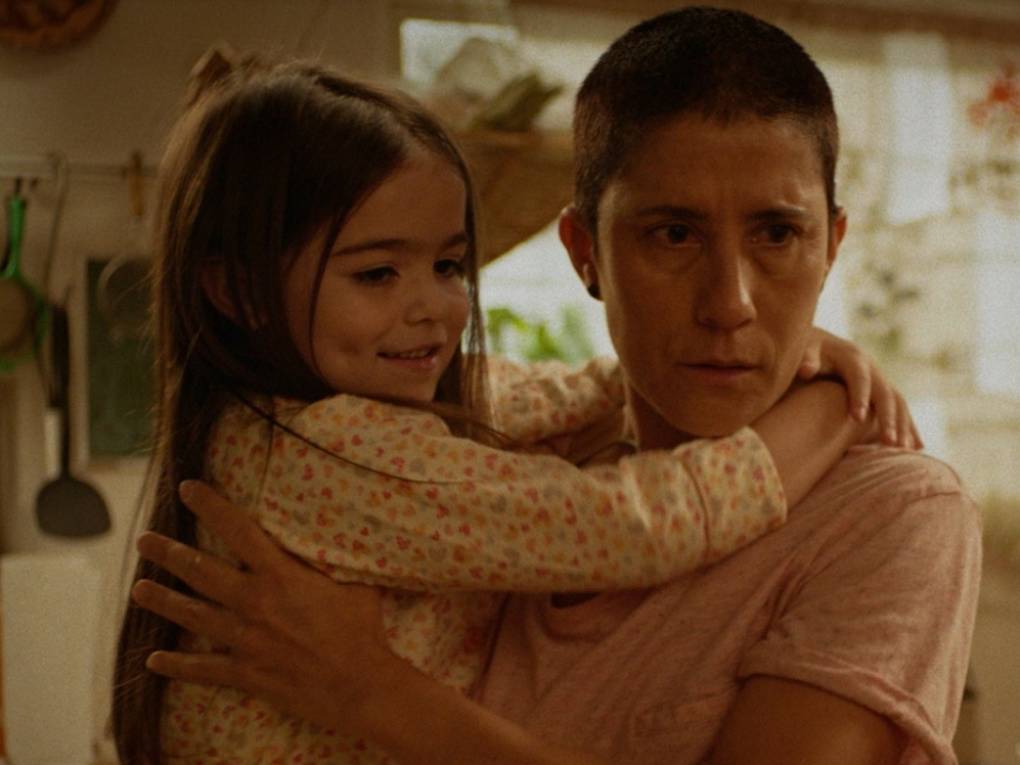
"caption": "Naíma Sentíes and Montserrat Marañon in ‘Tótem.’",
"description": null,
"title": "Naíma Sentíes and Montserrat Marañon in Tótem.",
"credit": "Limerencia",
"status": "inherit",
"altTag": "A sickly looking person with a shaved head holds a small girl. The child is smiling.",
"isLoading": false,
"fetchFailed": false
},
"arts_13950975": {
"type": "attachments",
"id": "arts_13950975",
"meta": {
"index": "attachments_1716263798",
"site": "arts",
"id": "13950975",
"found": true
},
"parent": 13950974,
"imgSizes": {
"twentyfourteen-full-width": {
"file": "https://cdn.kqed.org/wp-content/uploads/sites/2/2024/01/xpat_s1_ut_1_210823_wonjup_00000r_3000_custom-417b479d9b288243c80549585532777fd04f1fac-1038x576.jpg",
"width": 1038,
"mimeType": "image/jpeg",
"height": 576
},
"thumbnail": {
"file": "https://cdn.kqed.org/wp-content/uploads/sites/2/2024/01/xpat_s1_ut_1_210823_wonjup_00000r_3000_custom-417b479d9b288243c80549585532777fd04f1fac-160x107.jpg",
"width": 160,
"mimeType": "image/jpeg",
"height": 107
},
"post-thumbnail": {
"file": "https://cdn.kqed.org/wp-content/uploads/sites/2/2024/01/xpat_s1_ut_1_210823_wonjup_00000r_3000_custom-417b479d9b288243c80549585532777fd04f1fac-672x372.jpg",
"width": 672,
"mimeType": "image/jpeg",
"height": 372
},
"kqedFullSize": {
"file": "https://cdn.kqed.org/wp-content/uploads/sites/2/2024/01/xpat_s1_ut_1_210823_wonjup_00000r_3000_custom-417b479d9b288243c80549585532777fd04f1fac-scaled-e1706211747409.jpg",
"width": 1920,
"height": 1281
},
"2048x2048": {
"file": "https://cdn.kqed.org/wp-content/uploads/sites/2/2024/01/xpat_s1_ut_1_210823_wonjup_00000r_3000_custom-417b479d9b288243c80549585532777fd04f1fac-2048x1366.jpg",
"width": 2048,
"mimeType": "image/jpeg",
"height": 1366
},
"large": {
"file": "https://cdn.kqed.org/wp-content/uploads/sites/2/2024/01/xpat_s1_ut_1_210823_wonjup_00000r_3000_custom-417b479d9b288243c80549585532777fd04f1fac-1020x680.jpg",
"width": 1020,
"mimeType": "image/jpeg",
"height": 680
},
"1536x1536": {
"file": "https://cdn.kqed.org/wp-content/uploads/sites/2/2024/01/xpat_s1_ut_1_210823_wonjup_00000r_3000_custom-417b479d9b288243c80549585532777fd04f1fac-1536x1025.jpg",
"width": 1536,
"mimeType": "image/jpeg",
"height": 1025
},
"full-width": {
"file": "https://cdn.kqed.org/wp-content/uploads/sites/2/2024/01/xpat_s1_ut_1_210823_wonjup_00000r_3000_custom-417b479d9b288243c80549585532777fd04f1fac-1920x1281.jpg",
"width": 1920,
"mimeType": "image/jpeg",
"height": 1281
},
"medium": {
"file": "https://cdn.kqed.org/wp-content/uploads/sites/2/2024/01/xpat_s1_ut_1_210823_wonjup_00000r_3000_custom-417b479d9b288243c80549585532777fd04f1fac-800x534.jpg",
"width": 800,
"mimeType": "image/jpeg",
"height": 534
},
"medium_large": {
"file": "https://cdn.kqed.org/wp-content/uploads/sites/2/2024/01/xpat_s1_ut_1_210823_wonjup_00000r_3000_custom-417b479d9b288243c80549585532777fd04f1fac-768x512.jpg",
"width": 768,
"mimeType": "image/jpeg",
"height": 512
}
},
"publishDate": 1706210971,
"modified": 1706211857,
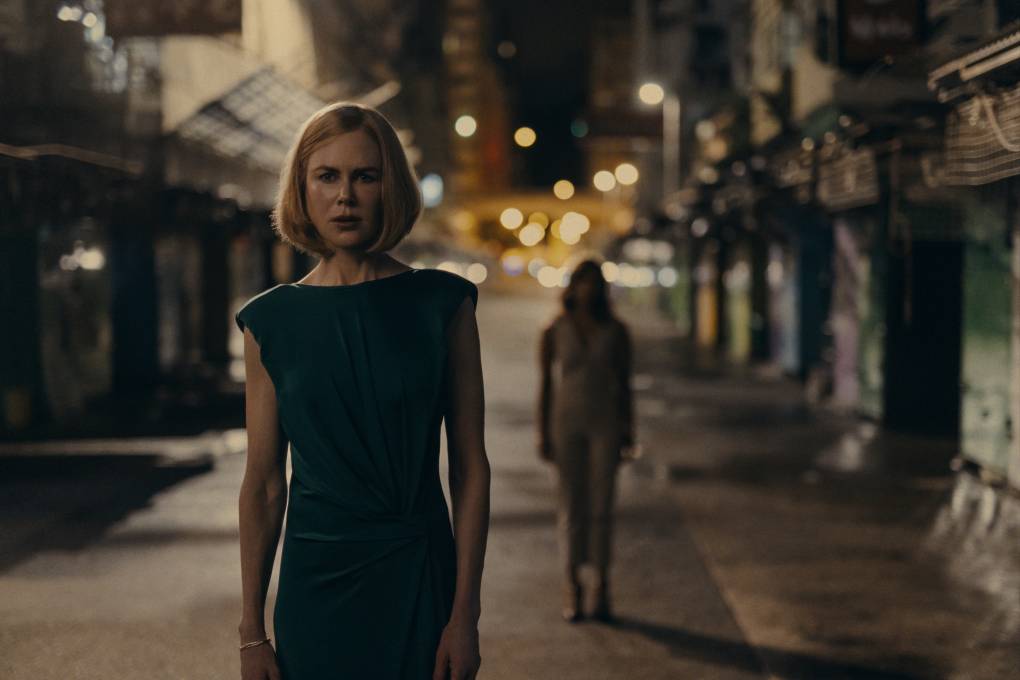
"caption": "Margaret (Nicole Kidman) is an expat American living in Hong Kong, grieving as a mother and a wife.",
"description": null,
"title": "Margaret (Nicole Kidman) is an expat American living in Hong Kong, grieving as a mother and a wife.",
"credit": "Prime Video",
"status": "inherit",
"altTag": "A slender middle aged white woman stands in a quiet dimly lit street. A figure lurks behind her.",
"isLoading": false,
"fetchFailed": false
},
"arts_13939926": {
"type": "attachments",
"id": "arts_13939926",
"meta": {
"index": "attachments_1716263798",
"site": "arts",
"id": "13939926",
"found": true
},
"parent": 13938158,
"imgSizes": {
"twentyfourteen-full-width": {
"file": "https://cdn.kqed.org/wp-content/uploads/sites/2/2023/12/Screen-Shot-2023-12-29-at-11.15.23-AM-1038x576.png",
"width": 1038,
"mimeType": "image/png",
"height": 576
},
"thumbnail": {
"file": "https://cdn.kqed.org/wp-content/uploads/sites/2/2023/12/Screen-Shot-2023-12-29-at-11.15.23-AM-160x102.png",
"width": 160,
"mimeType": "image/png",
"height": 102
},
"post-thumbnail": {
"file": "https://cdn.kqed.org/wp-content/uploads/sites/2/2023/12/Screen-Shot-2023-12-29-at-11.15.23-AM-672x372.png",
"width": 672,
"mimeType": "image/png",
"height": 372
},
"kqedFullSize": {
"file": "https://cdn.kqed.org/wp-content/uploads/sites/2/2023/12/Screen-Shot-2023-12-29-at-11.15.23-AM.png",
"width": 1804,
"height": 1146
},
"large": {
"file": "https://cdn.kqed.org/wp-content/uploads/sites/2/2023/12/Screen-Shot-2023-12-29-at-11.15.23-AM-1020x648.png",
"width": 1020,
"mimeType": "image/png",
"height": 648
},
"1536x1536": {
"file": "https://cdn.kqed.org/wp-content/uploads/sites/2/2023/12/Screen-Shot-2023-12-29-at-11.15.23-AM-1536x976.png",
"width": 1536,
"mimeType": "image/png",
"height": 976
},
"medium": {
"file": "https://cdn.kqed.org/wp-content/uploads/sites/2/2023/12/Screen-Shot-2023-12-29-at-11.15.23-AM-800x508.png",
"width": 800,
"mimeType": "image/png",
"height": 508
},
"medium_large": {
"file": "https://cdn.kqed.org/wp-content/uploads/sites/2/2023/12/Screen-Shot-2023-12-29-at-11.15.23-AM-768x488.png",
"width": 768,
"mimeType": "image/png",
"height": 488
}
},
"publishDate": 1703848567,
"modified": 1706034121,
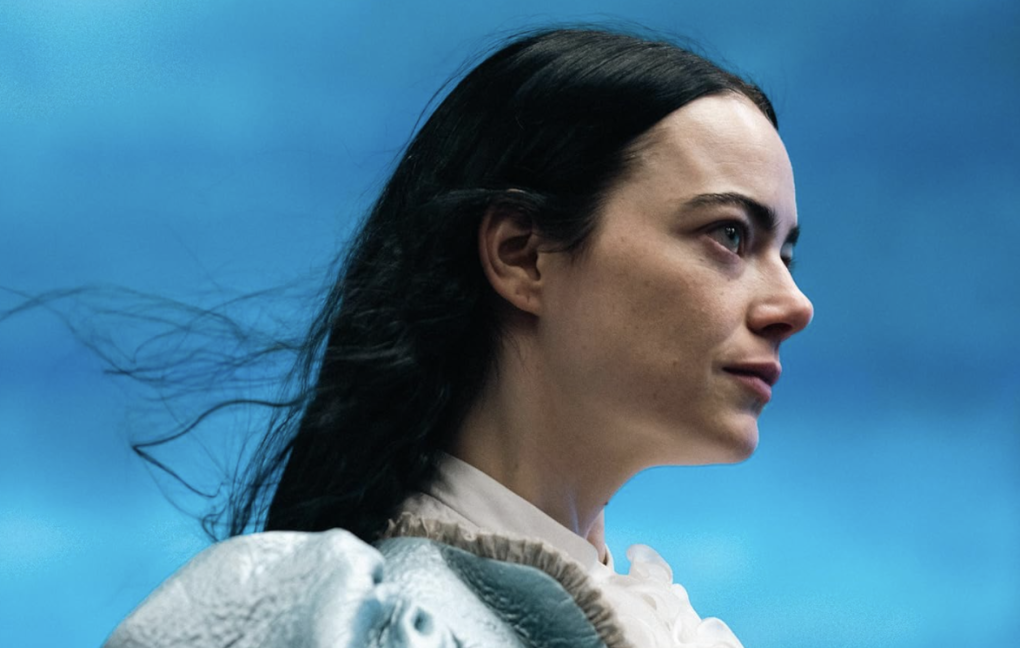
"caption": "Emma Stone starring as Bella Baxter in ‘Poor Things.’",
"description": null,
"title": "Emma Stone starring as Bella Baxter in ‘Poor Things.’",
"credit": "Searchlight Films",
"status": "inherit",
"altTag": "A pale woman with long black hair stands in side profile before a blue sky.",
"isLoading": false,
"fetchFailed": false
},
"arts_13813029": {
"type": "attachments",
"id": "arts_13813029",
"meta": {
"index": "attachments_1716263798",
"site": "arts",
"id": "13813029",
"found": true
},
"parent": 13813015,
"imgSizes": {
"small": {
"file": "https://ww2.kqed.org/app/uploads/sites/2/2017/10/SR.Fire_.Getty_-520x347.jpg",
"width": 520,
"mimeType": "image/jpeg",
"height": 347
},
"twentyfourteen-full-width": {
"file": "https://ww2.kqed.org/app/uploads/sites/2/2017/10/SR.Fire_.Getty_-1038x576.jpg",
"width": 1038,
"mimeType": "image/jpeg",
"height": 576
},
"thumbnail": {
"file": "https://ww2.kqed.org/app/uploads/sites/2/2017/10/SR.Fire_.Getty_-160x107.jpg",
"width": 160,
"mimeType": "image/jpeg",
"height": 107
},
"fd-sm": {
"file": "https://ww2.kqed.org/app/uploads/sites/2/2017/10/SR.Fire_.Getty_-960x640.jpg",
"width": 960,
"mimeType": "image/jpeg",
"height": 640
},
"post-thumbnail": {
"file": "https://ww2.kqed.org/app/uploads/sites/2/2017/10/SR.Fire_.Getty_-672x372.jpg",
"width": 672,
"mimeType": "image/jpeg",
"height": 372
},
"xsmall": {
"file": "https://ww2.kqed.org/app/uploads/sites/2/2017/10/SR.Fire_.Getty_-375x250.jpg",
"width": 375,
"mimeType": "image/jpeg",
"height": 250
},
"kqedFullSize": {
"file": "https://ww2.kqed.org/app/uploads/sites/2/2017/10/SR.Fire_.Getty_.jpg",
"width": 1100,
"height": 733
},
"large": {
"file": "https://ww2.kqed.org/app/uploads/sites/2/2017/10/SR.Fire_.Getty_-1020x680.jpg",
"width": 1020,
"mimeType": "image/jpeg",
"height": 680
},
"guest-author-50": {
"file": "https://ww2.kqed.org/app/uploads/sites/2/2017/10/SR.Fire_.Getty_-50x50.jpg",
"width": 50,
"mimeType": "image/jpeg",
"height": 50
},
"guest-author-96": {
"file": "https://ww2.kqed.org/app/uploads/sites/2/2017/10/SR.Fire_.Getty_-96x96.jpg",
"width": 96,
"mimeType": "image/jpeg",
"height": 96
},
"medium": {
"file": "https://ww2.kqed.org/app/uploads/sites/2/2017/10/SR.Fire_.Getty_-800x533.jpg",
"width": 800,
"mimeType": "image/jpeg",
"height": 533
},
"guest-author-64": {
"file": "https://ww2.kqed.org/app/uploads/sites/2/2017/10/SR.Fire_.Getty_-64x64.jpg",
"width": 64,
"mimeType": "image/jpeg",
"height": 64
},
"guest-author-32": {
"file": "https://ww2.kqed.org/app/uploads/sites/2/2017/10/SR.Fire_.Getty_-32x32.jpg",
"width": 32,
"mimeType": "image/jpeg",
"height": 32
},
"detail": {
"file": "https://ww2.kqed.org/app/uploads/sites/2/2017/10/SR.Fire_.Getty_-150x150.jpg",
"width": 150,
"mimeType": "image/jpeg",
"height": 150
},
"medium_large": {
"file": "https://ww2.kqed.org/app/uploads/sites/2/2017/10/SR.Fire_.Getty_-768x512.jpg",
"width": 768,
"mimeType": "image/jpeg",
"height": 512
},
"guest-author-128": {
"file": "https://ww2.kqed.org/app/uploads/sites/2/2017/10/SR.Fire_.Getty_-128x128.jpg",
"width": 128,
"mimeType": "image/jpeg",
"height": 128
},
"xxsmall": {
"file": "https://ww2.kqed.org/app/uploads/sites/2/2017/10/SR.Fire_.Getty_-240x160.jpg",
"width": 240,
"mimeType": "image/jpeg",
"height": 160
}
},
"publishDate": 1509311551,
"modified": 1509390945,
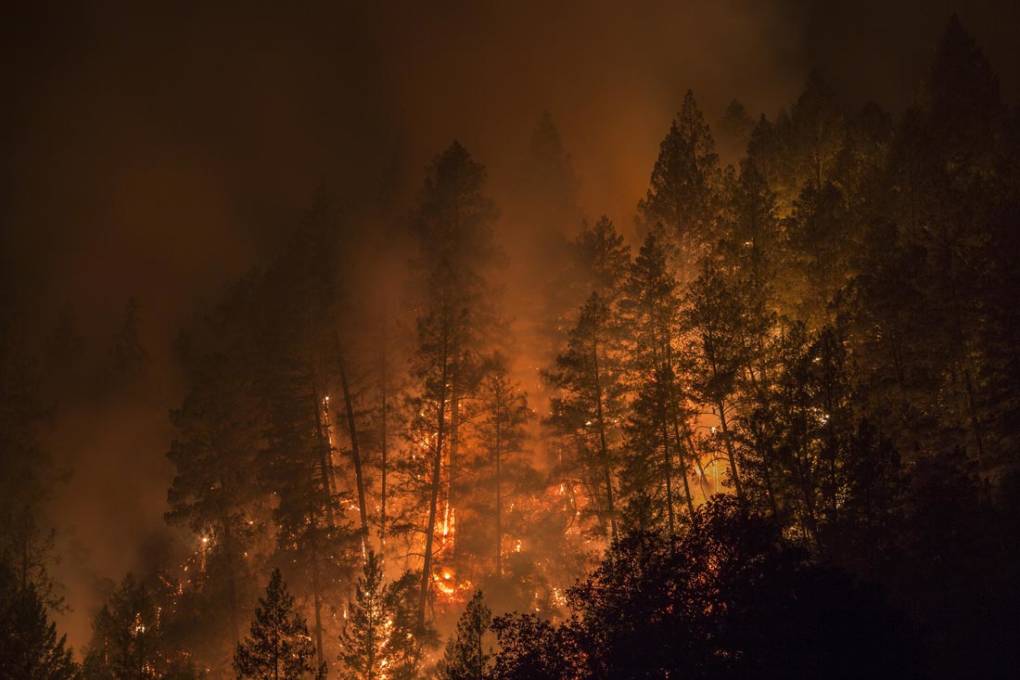
"caption": "Wildfire rages through trees toward the valley on Oct. 8, 2017.",
"description": "Wildfire creeps through the forest, down Wildfire rages through trees toward the valley on Oct. 8, 2017. ",
"title": "SR.Fire.Getty",
"credit": "David McNew/Getty Images",
"status": "inherit",
"isLoading": false,
"fetchFailed": false
},
"arts_13950704": {
"type": "attachments",
"id": "arts_13950704",
"meta": {
"index": "attachments_1716263798",
"site": "arts",
"id": "13950704",
"found": true
},
"parent": 13950698,
"imgSizes": {
"twentyfourteen-full-width": {
"file": "https://cdn.kqed.org/wp-content/uploads/sites/2/2024/01/Screen-Shot-2024-01-22-at-10.33.28-AM-1038x576.png",
"width": 1038,
"mimeType": "image/png",
"height": 576
},
"thumbnail": {
"file": "https://cdn.kqed.org/wp-content/uploads/sites/2/2024/01/Screen-Shot-2024-01-22-at-10.33.28-AM-160x115.png",
"width": 160,
"mimeType": "image/png",
"height": 115
},
"post-thumbnail": {
"file": "https://cdn.kqed.org/wp-content/uploads/sites/2/2024/01/Screen-Shot-2024-01-22-at-10.33.28-AM-672x372.png",
"width": 672,
"mimeType": "image/png",
"height": 372
},
"kqedFullSize": {
"file": "https://cdn.kqed.org/wp-content/uploads/sites/2/2024/01/Screen-Shot-2024-01-22-at-10.33.28-AM.png",
"width": 1394,
"height": 1000
},
"large": {
"file": "https://cdn.kqed.org/wp-content/uploads/sites/2/2024/01/Screen-Shot-2024-01-22-at-10.33.28-AM-1020x732.png",
"width": 1020,
"mimeType": "image/png",
"height": 732
},
"medium": {
"file": "https://cdn.kqed.org/wp-content/uploads/sites/2/2024/01/Screen-Shot-2024-01-22-at-10.33.28-AM-800x574.png",
"width": 800,
"mimeType": "image/png",
"height": 574
},
"medium_large": {
"file": "https://cdn.kqed.org/wp-content/uploads/sites/2/2024/01/Screen-Shot-2024-01-22-at-10.33.28-AM-768x551.png",
"width": 768,
"mimeType": "image/png",
"height": 551
}
},
"publishDate": 1705948426,
"modified": 1705948501,
"caption": "A moment from ‘The Eyes and the Impossible.’",
"description": null,
"title": "A moment from ‘The Eyes and the Impossible.’",
"credit": "Knopf Books for Young Readers",
"status": "inherit",
"altTag": "An illustration of a dog running through the woods.",
"isLoading": false,
"fetchFailed": false
},
"arts_13950650": {
"type": "attachments",
"id": "arts_13950650",
"meta": {
"index": "attachments_1716263798",
"site": "arts",
"id": "13950650",
"found": true
},
"parent": 13950649,
"imgSizes": {
"twentyfourteen-full-width": {
"file": "https://cdn.kqed.org/wp-content/uploads/sites/2/2024/01/itycs-key-still-1-0cd3f1f4b8b171def4b92aebaa527771455c681a-1038x576.jpg",
"width": 1038,
"mimeType": "image/jpeg",
"height": 576
},
"thumbnail": {
"file": "https://cdn.kqed.org/wp-content/uploads/sites/2/2024/01/itycs-key-still-1-0cd3f1f4b8b171def4b92aebaa527771455c681a-160x120.jpg",
"width": 160,
"mimeType": "image/jpeg",
"height": 120
},
"post-thumbnail": {
"file": "https://cdn.kqed.org/wp-content/uploads/sites/2/2024/01/itycs-key-still-1-0cd3f1f4b8b171def4b92aebaa527771455c681a-672x372.jpg",
"width": 672,
"mimeType": "image/jpeg",
"height": 372
},
"kqedFullSize": {
"file": "https://cdn.kqed.org/wp-content/uploads/sites/2/2024/01/itycs-key-still-1-0cd3f1f4b8b171def4b92aebaa527771455c681a-scaled-e1705691735208.jpg",
"width": 1920,
"height": 1440
},
"2048x2048": {
"file": "https://cdn.kqed.org/wp-content/uploads/sites/2/2024/01/itycs-key-still-1-0cd3f1f4b8b171def4b92aebaa527771455c681a-2048x1536.jpg",
"width": 2048,
"mimeType": "image/jpeg",
"height": 1536
},
"large": {
"file": "https://cdn.kqed.org/wp-content/uploads/sites/2/2024/01/itycs-key-still-1-0cd3f1f4b8b171def4b92aebaa527771455c681a-1020x765.jpg",
"width": 1020,
"mimeType": "image/jpeg",
"height": 765
},
"1536x1536": {
"file": "https://cdn.kqed.org/wp-content/uploads/sites/2/2024/01/itycs-key-still-1-0cd3f1f4b8b171def4b92aebaa527771455c681a-1536x1152.jpg",
"width": 1536,
"mimeType": "image/jpeg",
"height": 1152
},
"full-width": {
"file": "https://cdn.kqed.org/wp-content/uploads/sites/2/2024/01/itycs-key-still-1-0cd3f1f4b8b171def4b92aebaa527771455c681a-1920x1440.jpg",
"width": 1920,
"mimeType": "image/jpeg",
"height": 1440
},
"medium": {
"file": "https://cdn.kqed.org/wp-content/uploads/sites/2/2024/01/itycs-key-still-1-0cd3f1f4b8b171def4b92aebaa527771455c681a-800x600.jpg",
"width": 800,
"mimeType": "image/jpeg",
"height": 600
},
"medium_large": {
"file": "https://cdn.kqed.org/wp-content/uploads/sites/2/2024/01/itycs-key-still-1-0cd3f1f4b8b171def4b92aebaa527771455c681a-768x576.jpg",
"width": 768,
"mimeType": "image/jpeg",
"height": 576
}
},
"publishDate": 1705690048,
"modified": 1705691810,
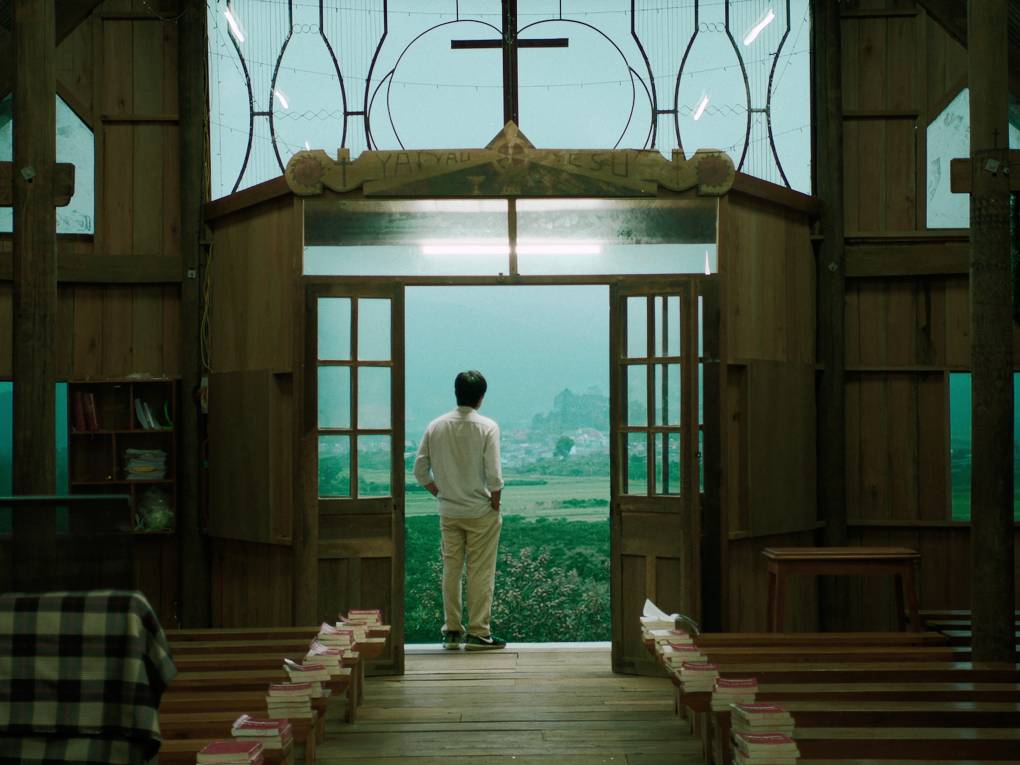
"caption": "Le Phong Vu plays Thien, a young man looking for answers in the Vietnamese countryside.",
"description": null,
"title": "Le Phong Vu plays Thien, a young man looking for answers in the Vietnamese countryside.",
"credit": "Cercamon",
"status": "inherit",
"altTag": "A man stands framed in the doorway of a church entrance. He is gazing out over green and misty fields.",
"isLoading": false,
"fetchFailed": false
},
"arts_13950549": {
"type": "attachments",
"id": "arts_13950549",
"meta": {
"index": "attachments_1716263798",
"site": "arts",
"id": "13950549",
"found": true
},
"parent": 13950548,
"imgSizes": {
"twentyfourteen-full-width": {
"file": "https://cdn.kqed.org/wp-content/uploads/sites/2/2024/01/ap24017746177407_custom-0a7f1e7b8c78472c7e80b98e2b81acd69bd73be3-1-1038x576.jpg",
"width": 1038,
"mimeType": "image/jpeg",
"height": 576
},
"thumbnail": {
"file": "https://cdn.kqed.org/wp-content/uploads/sites/2/2024/01/ap24017746177407_custom-0a7f1e7b8c78472c7e80b98e2b81acd69bd73be3-1-160x107.jpg",
"width": 160,
"mimeType": "image/jpeg",
"height": 107
},
"post-thumbnail": {
"file": "https://cdn.kqed.org/wp-content/uploads/sites/2/2024/01/ap24017746177407_custom-0a7f1e7b8c78472c7e80b98e2b81acd69bd73be3-1-672x372.jpg",
"width": 672,
"mimeType": "image/jpeg",
"height": 372
},
"kqedFullSize": {
"file": "https://cdn.kqed.org/wp-content/uploads/sites/2/2024/01/ap24017746177407_custom-0a7f1e7b8c78472c7e80b98e2b81acd69bd73be3-1-scaled-e1705600952518.jpg",
"width": 1920,
"height": 1279
},
"2048x2048": {
"file": "https://cdn.kqed.org/wp-content/uploads/sites/2/2024/01/ap24017746177407_custom-0a7f1e7b8c78472c7e80b98e2b81acd69bd73be3-1-2048x1364.jpg",
"width": 2048,
"mimeType": "image/jpeg",
"height": 1364
},
"large": {
"file": "https://cdn.kqed.org/wp-content/uploads/sites/2/2024/01/ap24017746177407_custom-0a7f1e7b8c78472c7e80b98e2b81acd69bd73be3-1-1020x679.jpg",
"width": 1020,
"mimeType": "image/jpeg",
"height": 679
},
"1536x1536": {
"file": "https://cdn.kqed.org/wp-content/uploads/sites/2/2024/01/ap24017746177407_custom-0a7f1e7b8c78472c7e80b98e2b81acd69bd73be3-1-1536x1023.jpg",
"width": 1536,
"mimeType": "image/jpeg",
"height": 1023
},
"full-width": {
"file": "https://cdn.kqed.org/wp-content/uploads/sites/2/2024/01/ap24017746177407_custom-0a7f1e7b8c78472c7e80b98e2b81acd69bd73be3-1-1920x1279.jpg",
"width": 1920,
"mimeType": "image/jpeg",
"height": 1279
},
"medium": {
"file": "https://cdn.kqed.org/wp-content/uploads/sites/2/2024/01/ap24017746177407_custom-0a7f1e7b8c78472c7e80b98e2b81acd69bd73be3-1-800x533.jpg",
"width": 800,
"mimeType": "image/jpeg",
"height": 533
},
"medium_large": {
"file": "https://cdn.kqed.org/wp-content/uploads/sites/2/2024/01/ap24017746177407_custom-0a7f1e7b8c78472c7e80b98e2b81acd69bd73be3-1-768x511.jpg",
"width": 768,
"mimeType": "image/jpeg",
"height": 511
}
},
"publishDate": 1705600741,
"modified": 1705601020,
"caption": "Golden State Warriors assistant coach Dejan Milojević smiles during an NBA preseason basketball game against the Denver Nuggets San Francisco, Friday, Oct. 14, 2022.",
"description": null,
"title": "Golden State Warriors assistant coach Dejan Milojević smiles during an NBA preseason basketball game against the Denver Nuggets San Francisco, Friday, Oct. 14, 2022.",
"credit": null,
"status": "inherit",
"altTag": "A man wearing a gre hoodie stands on a court holding a basketball.",
"isLoading": false,
"fetchFailed": false
},
"arts_13950423": {
"type": "attachments",
"id": "arts_13950423",
"meta": {
"index": "attachments_1716263798",
"site": "arts",
"id": "13950423",
"found": true
},
"parent": 13950422,
"imgSizes": {
"twentyfourteen-full-width": {
"file": "https://cdn.kqed.org/wp-content/uploads/sites/2/2024/01/criminal_record_photo_010303-415b17d5788b4604237233f5d503a6778176787c-1038x576.jpg",
"width": 1038,
"mimeType": "image/jpeg",
"height": 576
},
"thumbnail": {
"file": "https://cdn.kqed.org/wp-content/uploads/sites/2/2024/01/criminal_record_photo_010303-415b17d5788b4604237233f5d503a6778176787c-160x120.jpg",
"width": 160,
"mimeType": "image/jpeg",
"height": 120
},
"post-thumbnail": {
"file": "https://cdn.kqed.org/wp-content/uploads/sites/2/2024/01/criminal_record_photo_010303-415b17d5788b4604237233f5d503a6778176787c-672x372.jpg",
"width": 672,
"mimeType": "image/jpeg",
"height": 372
},
"kqedFullSize": {
"file": "https://cdn.kqed.org/wp-content/uploads/sites/2/2024/01/criminal_record_photo_010303-415b17d5788b4604237233f5d503a6778176787c-scaled-e1705435014868.jpg",
"width": 1920,
"height": 1440
},
"2048x2048": {
"file": "https://cdn.kqed.org/wp-content/uploads/sites/2/2024/01/criminal_record_photo_010303-415b17d5788b4604237233f5d503a6778176787c-2048x1536.jpg",
"width": 2048,
"mimeType": "image/jpeg",
"height": 1536
},
"large": {
"file": "https://cdn.kqed.org/wp-content/uploads/sites/2/2024/01/criminal_record_photo_010303-415b17d5788b4604237233f5d503a6778176787c-1020x765.jpg",
"width": 1020,
"mimeType": "image/jpeg",
"height": 765
},
"1536x1536": {
"file": "https://cdn.kqed.org/wp-content/uploads/sites/2/2024/01/criminal_record_photo_010303-415b17d5788b4604237233f5d503a6778176787c-1536x1152.jpg",
"width": 1536,
"mimeType": "image/jpeg",
"height": 1152
},
"full-width": {
"file": "https://cdn.kqed.org/wp-content/uploads/sites/2/2024/01/criminal_record_photo_010303-415b17d5788b4604237233f5d503a6778176787c-1920x1440.jpg",
"width": 1920,
"mimeType": "image/jpeg",
"height": 1440
},
"medium": {
"file": "https://cdn.kqed.org/wp-content/uploads/sites/2/2024/01/criminal_record_photo_010303-415b17d5788b4604237233f5d503a6778176787c-800x600.jpg",
"width": 800,
"mimeType": "image/jpeg",
"height": 600
},
"medium_large": {
"file": "https://cdn.kqed.org/wp-content/uploads/sites/2/2024/01/criminal_record_photo_010303-415b17d5788b4604237233f5d503a6778176787c-768x576.jpg",
"width": 768,
"mimeType": "image/jpeg",
"height": 576
}
},
"publishDate": 1705434544,
"modified": 1705435077,
"caption": "Cush Jumbo stars as June Lenker in ‘Criminal Record.’",
"description": null,
"title": "Cush Jumbo stars as June Lenker in ‘Criminal Record.’",
"credit": "AppleTV+",
"status": "inherit",
"altTag": "A Black female police officer with a shaved head stands in front of a graffiti'd shop front.",
"isLoading": false,
"fetchFailed": false
},
"arts_13950401": {
"type": "attachments",
"id": "arts_13950401",
"meta": {
"index": "attachments_1716263798",
"site": "arts",
"id": "13950401",
"found": true
},
"parent": 13950400,
"imgSizes": {
"twentyfourteen-full-width": {
"file": "https://cdn.kqed.org/wp-content/uploads/sites/2/2021/12/dodos-and-pain_final_wide-bf80d6bc988405beb04d0af9992fe64ec1c56574-1038x576.jpg",
"width": 1038,
"mimeType": "image/jpeg",
"height": 576
},
"thumbnail": {
"file": "https://cdn.kqed.org/wp-content/uploads/sites/2/2021/12/dodos-and-pain_final_wide-bf80d6bc988405beb04d0af9992fe64ec1c56574-160x90.jpg",
"width": 160,
"mimeType": "image/jpeg",
"height": 90
},
"post-thumbnail": {
"file": "https://cdn.kqed.org/wp-content/uploads/sites/2/2021/12/dodos-and-pain_final_wide-bf80d6bc988405beb04d0af9992fe64ec1c56574-672x372.jpg",
"width": 672,
"mimeType": "image/jpeg",
"height": 372
},
"kqedFullSize": {
"file": "https://cdn.kqed.org/wp-content/uploads/sites/2/2021/12/dodos-and-pain_final_wide-bf80d6bc988405beb04d0af9992fe64ec1c56574-scaled-e1705433335653.jpg",
"width": 1920,
"height": 1080
},
"2048x2048": {
"file": "https://cdn.kqed.org/wp-content/uploads/sites/2/2021/12/dodos-and-pain_final_wide-bf80d6bc988405beb04d0af9992fe64ec1c56574-2048x1152.jpg",
"width": 2048,
"mimeType": "image/jpeg",
"height": 1152
},
"large": {
"file": "https://cdn.kqed.org/wp-content/uploads/sites/2/2021/12/dodos-and-pain_final_wide-bf80d6bc988405beb04d0af9992fe64ec1c56574-1020x574.jpg",
"width": 1020,
"mimeType": "image/jpeg",
"height": 574
},
"1536x1536": {
"file": "https://cdn.kqed.org/wp-content/uploads/sites/2/2021/12/dodos-and-pain_final_wide-bf80d6bc988405beb04d0af9992fe64ec1c56574-1536x864.jpg",
"width": 1536,
"mimeType": "image/jpeg",
"height": 864
},
"full-width": {
"file": "https://cdn.kqed.org/wp-content/uploads/sites/2/2021/12/dodos-and-pain_final_wide-bf80d6bc988405beb04d0af9992fe64ec1c56574-1920x1080.jpg",
"width": 1920,
"mimeType": "image/jpeg",
"height": 1080
},
"medium": {
"file": "https://cdn.kqed.org/wp-content/uploads/sites/2/2021/12/dodos-and-pain_final_wide-bf80d6bc988405beb04d0af9992fe64ec1c56574-800x450.jpg",
"width": 800,
"mimeType": "image/jpeg",
"height": 450
},
"medium_large": {
"file": "https://cdn.kqed.org/wp-content/uploads/sites/2/2021/12/dodos-and-pain_final_wide-bf80d6bc988405beb04d0af9992fe64ec1c56574-768x432.jpg",
"width": 768,
"mimeType": "image/jpeg",
"height": 432
}
},
"publishDate": 1705430705,
"modified": 1705433416,
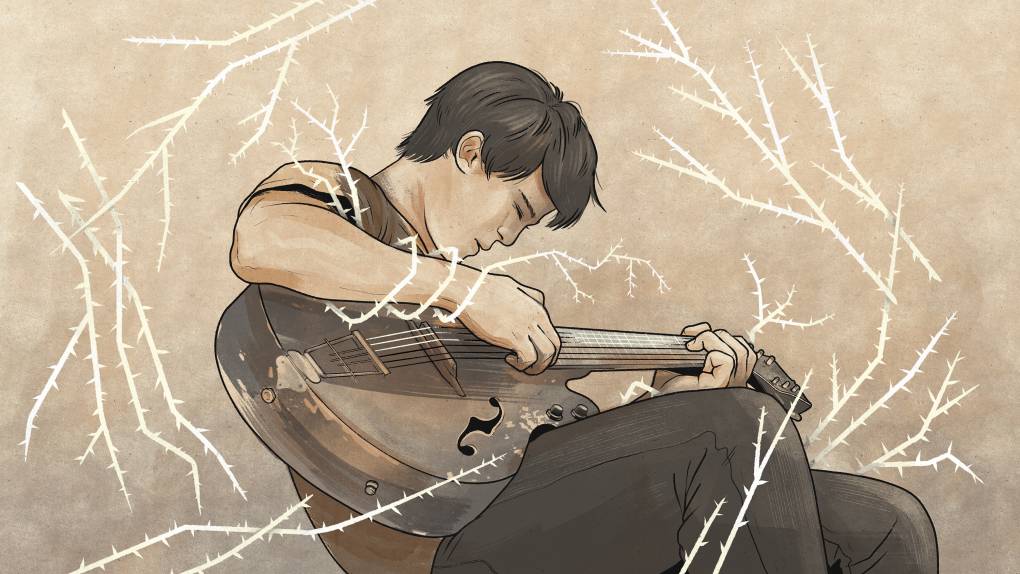
"caption": "Meric Long of The Dodos found his voice in a distinctive guitar style. While writing the new album ‘Grizzly Peak,’ he watched that ability begin to slip away.",
"description": null,
"title": "Meric Long of The Dodos found his voice in a distinctive guitar style. While writing the new album ‘Grizzly Peak,’ he watched that ability begin to slip away.",
"credit": "Shane Tolentino for NPR",
"status": "inherit",
"altTag": "A sepia-toned illustration of a man playing guitar, hunched over and restricted by imaginary vines.",
"isLoading": false,
"fetchFailed": false
},
"arts_13950385": {
"type": "attachments",
"id": "arts_13950385",
"meta": {
"index": "attachments_1716263798",
"site": "arts",
"id": "13950385",
"found": true
},
"parent": 13950384,
"imgSizes": {
"twentyfourteen-full-width": {
"file": "https://cdn.kqed.org/wp-content/uploads/sites/2/2024/01/gettyimages-1936409310-975a52e77fc2cbd604fec9283af1622e3d585073-1038x576.jpg",
"width": 1038,
"mimeType": "image/jpeg",
"height": 576
},
"thumbnail": {
"file": "https://cdn.kqed.org/wp-content/uploads/sites/2/2024/01/gettyimages-1936409310-975a52e77fc2cbd604fec9283af1622e3d585073-160x120.jpg",
"width": 160,
"mimeType": "image/jpeg",
"height": 120
},
"post-thumbnail": {
"file": "https://cdn.kqed.org/wp-content/uploads/sites/2/2024/01/gettyimages-1936409310-975a52e77fc2cbd604fec9283af1622e3d585073-672x372.jpg",
"width": 672,
"mimeType": "image/jpeg",
"height": 372
},
"kqedFullSize": {
"file": "https://cdn.kqed.org/wp-content/uploads/sites/2/2024/01/gettyimages-1936409310-975a52e77fc2cbd604fec9283af1622e3d585073-scaled-e1705399970954.jpg",
"width": 1920,
"height": 1440
},
"2048x2048": {
"file": "https://cdn.kqed.org/wp-content/uploads/sites/2/2024/01/gettyimages-1936409310-975a52e77fc2cbd604fec9283af1622e3d585073-2048x1536.jpg",
"width": 2048,
"mimeType": "image/jpeg",
"height": 1536
},
"large": {
"file": "https://cdn.kqed.org/wp-content/uploads/sites/2/2024/01/gettyimages-1936409310-975a52e77fc2cbd604fec9283af1622e3d585073-1020x765.jpg",
"width": 1020,
"mimeType": "image/jpeg",
"height": 765
},
"1536x1536": {
"file": "https://cdn.kqed.org/wp-content/uploads/sites/2/2024/01/gettyimages-1936409310-975a52e77fc2cbd604fec9283af1622e3d585073-1536x1152.jpg",
"width": 1536,
"mimeType": "image/jpeg",
"height": 1152
},
"full-width": {
"file": "https://cdn.kqed.org/wp-content/uploads/sites/2/2024/01/gettyimages-1936409310-975a52e77fc2cbd604fec9283af1622e3d585073-1920x1440.jpg",
"width": 1920,
"mimeType": "image/jpeg",
"height": 1440
},
"medium": {
"file": "https://cdn.kqed.org/wp-content/uploads/sites/2/2024/01/gettyimages-1936409310-975a52e77fc2cbd604fec9283af1622e3d585073-800x600.jpg",
"width": 800,
"mimeType": "image/jpeg",
"height": 600
},
"medium_large": {
"file": "https://cdn.kqed.org/wp-content/uploads/sites/2/2024/01/gettyimages-1936409310-975a52e77fc2cbd604fec9283af1622e3d585073-768x576.jpg",
"width": 768,
"mimeType": "image/jpeg",
"height": 576
}
},
"publishDate": 1705399445,
"modified": 1705399998,
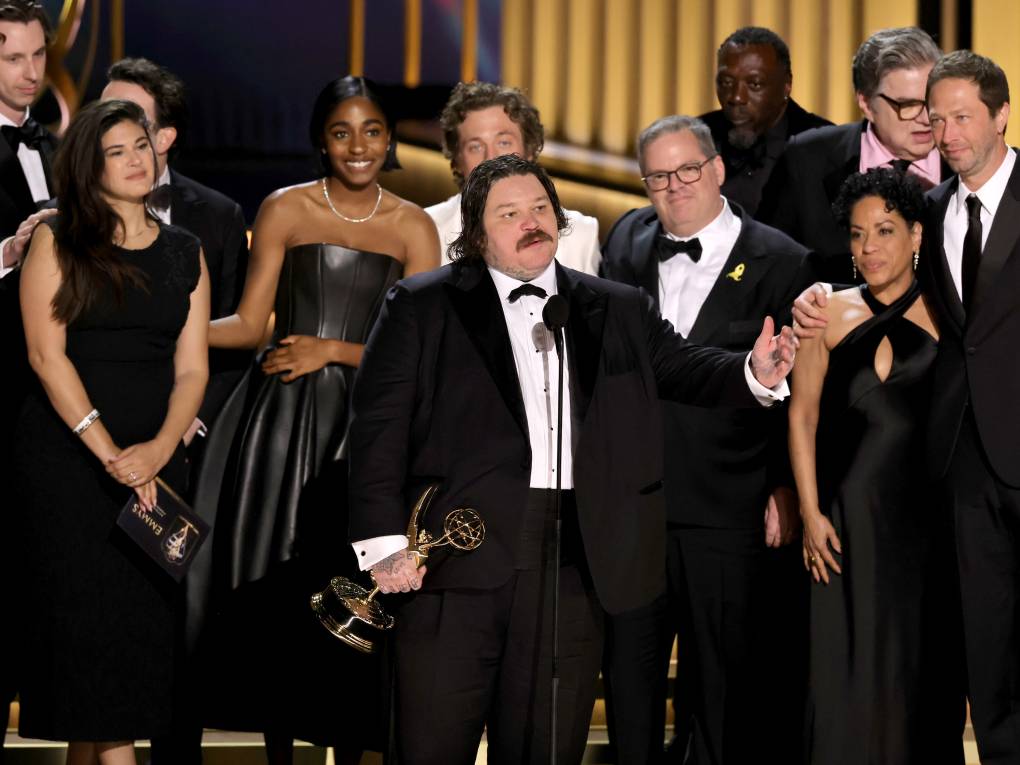
"caption": "(L-R) Christopher Storer, Joanna Calo, Ayo Edebiri, Matty Matheson, Jeremy Allen White, Tyson Bidner, Edwin Lee Gibson, Liza Colón-Zayas, Oliver Platt, and Ebon Moss-Bachrach accept the Outstanding Comedy Series award for ‘The Bear’ onstage during the 75th Primetime Emmy Awards at Peacock Theater in LA, Jan. 15, 2024.",
"description": null,
"title": "(L-R) Christopher Storer, Joanna Calo, Ayo Edebiri, Matty Matheson, Jeremy Allen White, Tyson Bidner, Edwin Lee Gibson, Liza Colón-Zayas, Oliver Platt, and Ebon Moss-Bachrach accept the Outstanding Comedy Series award for ‘The Bear’ onstage during the 75th Primetime Emmy Awards at Peacock Theater in LA, Jan. 15, 2024.",
"credit": "Kevin Winter/ Getty Images",
"status": "inherit",
"altTag": "Men and women of various ages and races crowd onto a stage behind a large white man with a mustache who is clutching a trophy.",
"isLoading": false,
"fetchFailed": false
},
"arts_13950353": {
"type": "attachments",
"id": "arts_13950353",
"meta": {
"index": "attachments_1716263798",
"site": "arts",
"id": "13950353",
"found": true
},
"parent": 13950352,
"imgSizes": {
"twentyfourteen-full-width": {
"file": "https://cdn.kqed.org/wp-content/uploads/sites/2/2024/01/gettyimages-1131020303_custom-cef5341cf46143bfdc86c65f96184144e02303f0-1038x576.jpg",
"width": 1038,
"mimeType": "image/jpeg",
"height": 576
},
"thumbnail": {
"file": "https://cdn.kqed.org/wp-content/uploads/sites/2/2024/01/gettyimages-1131020303_custom-cef5341cf46143bfdc86c65f96184144e02303f0-160x108.jpg",
"width": 160,
"mimeType": "image/jpeg",
"height": 108
},
"post-thumbnail": {
"file": "https://cdn.kqed.org/wp-content/uploads/sites/2/2024/01/gettyimages-1131020303_custom-cef5341cf46143bfdc86c65f96184144e02303f0-672x372.jpg",
"width": 672,
"mimeType": "image/jpeg",
"height": 372
},
"kqedFullSize": {
"file": "https://cdn.kqed.org/wp-content/uploads/sites/2/2024/01/gettyimages-1131020303_custom-cef5341cf46143bfdc86c65f96184144e02303f0-scaled-e1705084926659.jpg",
"width": 1920,
"height": 1301
},
"2048x2048": {
"file": "https://cdn.kqed.org/wp-content/uploads/sites/2/2024/01/gettyimages-1131020303_custom-cef5341cf46143bfdc86c65f96184144e02303f0-2048x1388.jpg",
"width": 2048,
"mimeType": "image/jpeg",
"height": 1388
},
"large": {
"file": "https://cdn.kqed.org/wp-content/uploads/sites/2/2024/01/gettyimages-1131020303_custom-cef5341cf46143bfdc86c65f96184144e02303f0-1020x691.jpg",
"width": 1020,
"mimeType": "image/jpeg",
"height": 691
},
"1536x1536": {
"file": "https://cdn.kqed.org/wp-content/uploads/sites/2/2024/01/gettyimages-1131020303_custom-cef5341cf46143bfdc86c65f96184144e02303f0-1536x1041.jpg",
"width": 1536,
"mimeType": "image/jpeg",
"height": 1041
},
"full-width": {
"file": "https://cdn.kqed.org/wp-content/uploads/sites/2/2024/01/gettyimages-1131020303_custom-cef5341cf46143bfdc86c65f96184144e02303f0-1920x1301.jpg",
"width": 1920,
"mimeType": "image/jpeg",
"height": 1301
},
"medium": {
"file": "https://cdn.kqed.org/wp-content/uploads/sites/2/2024/01/gettyimages-1131020303_custom-cef5341cf46143bfdc86c65f96184144e02303f0-800x542.jpg",
"width": 800,
"mimeType": "image/jpeg",
"height": 542
},
"medium_large": {
"file": "https://cdn.kqed.org/wp-content/uploads/sites/2/2024/01/gettyimages-1131020303_custom-cef5341cf46143bfdc86c65f96184144e02303f0-768x520.jpg",
"width": 768,
"mimeType": "image/jpeg",
"height": 520
}
},
"publishDate": 1705083613,
"modified": 1705084938,
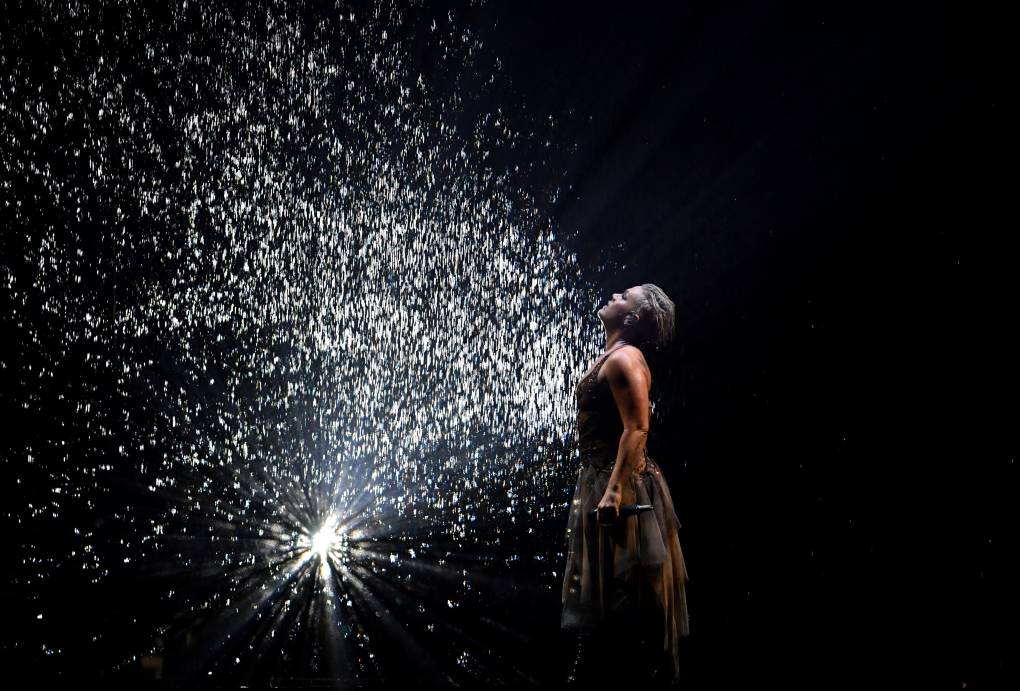
"caption": "Pink’s 2009 pop hit ‘Sober’ may be the best known song about sobriety. She’s shown above at The BRIT Awards in London in 2019.",
"description": null,
"title": "Pink’s 2009 pop hit ‘Sober’ may be the best known song about sobriety. She’s shown above at The BRIT Awards in London in 2019.",
"credit": "Gareth Cattermole/ Getty Images",
"status": "inherit",
"altTag": "A woman stands on a dark stage getting showered with spot-lit droplets of water.",
"isLoading": false,
"fetchFailed": false
}
},
"audioPlayerReducer": {
"postId": "stream_live",
"isPaused": true,
"isPlaying": false,
"pfsActive": false,
"pledgeModalIsOpen": true,
"playerDrawerIsOpen": false,
"liveAudioPlayStartedAt": 0,
"liveAudioPlayContext": ""
},
"authorsReducer": {
"byline_arts_13951067": {
"type": "authors",
"id": "byline_arts_13951067",
"meta": {
"override": true
},
"slug": "byline_arts_13951067",
"name": "David Bianculli",
"isLoading": false
},
"byline_arts_13950994": {
"type": "authors",
"id": "byline_arts_13950994",
"meta": {
"override": true
},
"slug": "byline_arts_13950994",
"name": "John Powers",
"isLoading": false
},
"byline_arts_13950974": {
"type": "authors",
"id": "byline_arts_13950974",
"meta": {
"override": true
},
"slug": "byline_arts_13950974",
"name": "Linda Holmes",
"isLoading": false
},
"byline_arts_13950768": {
"type": "authors",
"id": "byline_arts_13950768",
"meta": {
"override": true
},
"slug": "byline_arts_13950768",
"name": "Linda Holmes",
"isLoading": false
},
"byline_arts_13950717": {
"type": "authors",
"id": "byline_arts_13950717",
"meta": {
"override": true
},
"slug": "byline_arts_13950717",
"name": "Kristen Martin",
"isLoading": false
},
"byline_arts_13950698": {
"type": "authors",
"id": "byline_arts_13950698",
"meta": {
"override": true
},
"slug": "byline_arts_13950698",
"name": "Anastasia Tsioulcas",
"isLoading": false
},
"byline_arts_13950649": {
"type": "authors",
"id": "byline_arts_13950649",
"meta": {
"override": true
},
"slug": "byline_arts_13950649",
"name": "Justin Chang",
"isLoading": false
},
"byline_arts_13950548": {
"type": "authors",
"id": "byline_arts_13950548",
"meta": {
"override": true
},
"slug": "byline_arts_13950548",
"name": "Ayana Archie",
"isLoading": false
},
"byline_arts_13950422": {
"type": "authors",
"id": "byline_arts_13950422",
"meta": {
"override": true
},
"slug": "byline_arts_13950422",
"name": "John Powers",
"isLoading": false
},
"byline_arts_13950400": {
"type": "authors",
"id": "byline_arts_13950400",
"meta": {
"override": true
},
"slug": "byline_arts_13950400",
"name": "Grayson Haver Currin",
"isLoading": false
},
"byline_arts_13950384": {
"type": "authors",
"id": "byline_arts_13950384",
"meta": {
"override": true
},
"slug": "byline_arts_13950384",
"name": "Linda Holmes",
"isLoading": false
},
"byline_arts_13950352": {
"type": "authors",
"id": "byline_arts_13950352",
"meta": {
"override": true
},
"slug": "byline_arts_13950352",
"name": "Neda Ulaby",
"isLoading": false
}
},
"pagesReducer": {
"arts_affiliate_npr": {
"type": "terms",
"id": "arts_137",
"meta": {
"index": "terms_1716263798",
"site": "arts",
"id": "137",
"score": 14.257292
},
"featImg": "https://ww2.kqed.org/app/uploads/sites/2/2014/04/logo-npr-lg1.png",
"name": "NPR",
"description": null,
"taxonomy": "affiliate",
"headData": {
"twImgId": null,
"twTitle": null,
"ogTitle": null,
"ogImgId": null,
"twDescription": null,
"description": null,
"title": "NPR Archives | KQED Arts",
"ogDescription": null
},
"ttid": 138,
"slug": "npr",
"isLoading": false,
"title": "NPR",
"pageMeta": {
"site": "arts",
"WpPageTemplate": "page-topic-editorial",
"currentPage": 33
},
"blocks": [
{
"blockName": "kqed/post-list",
"attrs": {
"layout": "cardArticle2",
"query": "posts/arts?affiliate=npr",
"seeMore": false,
"paginated": true,
"page": 33
}
},
{
"blockName": "kqed/ad"
}
]
}
},
"pfsSessionReducer": {},
"postsReducer": {
"stream_live": {
"type": "live",
"id": "stream_live",
"audioUrl": "https://streams.kqed.org/kqedradio",
"title": "Live Stream",
"excerpt": "Live Stream information currently unavailable.",
"link": "/radio",
"featImg": "",
"label": {
"name": "KQED Live",
"link": "/"
}
},
"stream_kqedNewscast": {
"type": "posts",
"id": "stream_kqedNewscast",
"audioUrl": "https://www.kqed.org/.stream/anon/radio/RDnews/newscast.mp3?_=1",
"title": "KQED Newscast",
"featImg": "",
"label": {
"name": "88.5 FM",
"link": "/"
}
},
"arts_13951067": {
"type": "posts",
"id": "arts_13951067",
"meta": {
"index": "posts_1716263798",
"site": "arts",
"id": "13951067",
"score": null,
"sort": [
1706298701000
]
},
"parent": 0,
"labelTerm": {
"site": "arts",
"term": 140
},
"blocks": [],
"publishDate": 1706298701,
"format": "aside",
"title": "Spielberg and Hanks Soar Into World War II Skies in ‘Masters of the Air’",
"headTitle": "Spielberg and Hanks Soar Into World War II Skies in ‘Masters of the Air’ | KQED",
"content": "\u003cfigure id=\"attachment_13951072\" class=\"wp-caption aligncenter\" style=\"max-width: 1570px\">\u003cimg loading=\"lazy\" decoding=\"async\" class=\"size-full wp-image-13951072\" src=\"https://cdn.kqed.org/wp-content/uploads/sites/2/2024/01/Screen-Shot-2024-01-26-at-11.40.31-AM.png\" alt=\"Close up of two 1940s-era pilots stand on the tarmac under blue skies.\" width=\"1570\" height=\"1060\" srcset=\"https://cdn.kqed.org/wp-content/uploads/sites/2/2024/01/Screen-Shot-2024-01-26-at-11.40.31-AM.png 1570w, https://cdn.kqed.org/wp-content/uploads/sites/2/2024/01/Screen-Shot-2024-01-26-at-11.40.31-AM-800x540.png 800w, https://cdn.kqed.org/wp-content/uploads/sites/2/2024/01/Screen-Shot-2024-01-26-at-11.40.31-AM-1020x689.png 1020w, https://cdn.kqed.org/wp-content/uploads/sites/2/2024/01/Screen-Shot-2024-01-26-at-11.40.31-AM-160x108.png 160w, https://cdn.kqed.org/wp-content/uploads/sites/2/2024/01/Screen-Shot-2024-01-26-at-11.40.31-AM-768x519.png 768w, https://cdn.kqed.org/wp-content/uploads/sites/2/2024/01/Screen-Shot-2024-01-26-at-11.40.31-AM-1536x1037.png 1536w\" sizes=\"(max-width: 1570px) 100vw, 1570px\">\u003cfigcaption class=\"wp-caption-text\">Austin Butler and Callum Turner in ‘Masters of the Air.’ \u003ccite>(Apple TV+)\u003c/cite>\u003c/figcaption>\u003c/figure>\n\u003cp>In the 1990s,\u003ca href=\"https://www.npr.org/2022/11/09/1134314093/steven-spielberg-fabelmans\"> Steven Spielberg\u003c/a> directed two unforgettably powerful films about World War II: \u003cem>Schindler’s List\u003c/em>, in 1993, and \u003cem>Saving Private Ryan\u003c/em>, in 1998. \u003cem>Saving Private Ryan \u003c/em>starred \u003ca href=\"https://www.npr.org/2016/04/26/475573489/tom-hanks-says-self-doubt-is-a-high-wire-act-that-we-all-walk\">Tom Hanks\u003c/a>, and Hanks and Spielberg weren’t through with their obsession with World War II dramas; they were just beginning.\u003c/p>\n\u003cp>[aside postid='arts_13950974']Teaming with Gary Goetzman, they produced two impressive, captivating HBO miniseries about World War II: \u003cem>Band of Brothers, \u003c/em>in 2001, followed nine years later by \u003ca href=\"https://www.npr.org/2010/03/11/124499816/hanks-spielberg-strike-out-for-the-pacific\">\u003cem>The Pacific\u003c/em>\u003c/a>\u003cem>.\u003c/em> Both miniseries did what \u003cem>Saving Private Ryan \u003c/em>also had accomplished so brilliantly: They allowed the audience to experience the intensity and brutality of wartime. Not just allowed us, but forced us, in unrelenting battle sequences that gave new meaning to the phrase “you are there.”\u003c/p>\n\u003cp>Those dramas also delivered large helpings of surprise, and of loss. We got to know, and care deeply about, their soldiers and marines — and then, without warning, many of them were taken away from us.\u003c/p>\n\u003cp>\u003cem>Masters of the Air\u003c/em> is the newest entry in this World War II project by Spielberg, Hanks and company. It’s every bit equal to, and boasts precisely the same strengths as, those previous offerings. It’s presented by Apple TV+ this time, rolled out weekly after the Jan. 26 two-episode premiere. And because \u003cem>Masters of the Air\u003c/em>, like \u003cem>Band of Brothers\u003c/em> and \u003cem>The Pacific,\u003c/em> is a limited miniseries, even the main characters are at risk of dying at any time — and some do.\u003c/p>\n\u003cp>Two of the primary characters share a similar nickname — a confusing gimmick that’s explained early on. There’s Gale “Buck” Cleven, played by Austin Butler, and John “Bucky” Egan, played by Callum Turner. Bucky had the nickname first, and gave the shorter name, “Buck,” to his friend just to annoy him — until it stuck. Bucky is a loudmouth hothead; Buck is more quiet and private. But they’re good friends, and great pilots.\u003c/p>\n\u003cp>[ad fullwidth]\u003c/p>\n\u003cp>Butler empowers Buck with the undeniable charisma of an old-fashioned movie star, like a bomber pilot-James Dean. Butler’s breakout starring role was as Elvis Presley in \u003ca href=\"https://www.npr.org/2022/06/23/1106734497/elvis-review-baz-luhrmann\">\u003cem>Elvis\u003c/em>\u003c/a>\u003cem>,\u003c/em> and here, even without the trappings of show-biz flash and glitz, he’s just as magnetic.\u003c/p>\n\u003cp>But Butler’s not carrying this story, or fighting this war, alone. Turner’s Bucky matches him throughout — and so does Anthony Boyle, who plays a young navigator named Harry Crosby. And a lot more players contribute greatly: This is a large cast, doing justice to a very big story.\u003c/p>\n\u003cp>https://www.youtube.com/watch?v=lA-1JCRguZ0\u003c/p>\n\u003cp>\u003cem>Masters of the Air \u003c/em>is based on the book by Donald L. Miller. Several talented directors traded off working on various episodes, but all were adapted for TV by screenwriter John Orloff. His narrative not only follows the leading characters during World War II, but makes time, over its nine episodes, to weave in such familiar wartime narratives as the \u003ca href=\"https://www.npr.org/2011/04/11/135177510/tuskegee-airmen-rock-stars-of-american-history\">Tuskegee Airmen\u003c/a> and the Great Escape. Lots of time is spent airborne, in one thrilling mission after another, but there also are scenes set in briefing rooms, barracks, rest and recreation spots, even German prisoner of war camps.\u003c/p>\n\u003cp>\u003c/p>\n\u003cp>\u003cem>[aside postid='arts_13940076']Masters of the Air \u003c/em>finds drama in all those places. And it’s nice to know that this miniseries, like its predecessors, is being rolled out in weekly installments. These hours of television are like the Air Force missions themselves: They’re such intense experiences, it’s nice to have a little time between them to reflect … and to breathe.\u003c/p>\n\u003cdiv class=\"fullattribution\">\u003cem>Copyright 2024 Fresh Air. To see more, visit \u003ca href=\"http://www.npr.org/programs/fresh-air/\">Fresh Air\u003c/a>.\u003cimg decoding=\"async\" src=\"https://www.google-analytics.com/__utm.gif?utmac=UA-5828686-4&utmdt=Spielberg+and+Hanks+take+to+the+World+War+II+skies+in+%27Masters+of+the+Air%27&utme=8(APIKey)9(MDAxOTAwOTE4MDEyMTkxMDAzNjczZDljZA004)\">\u003c/em>\u003c/div>\n\n",
"stats": {
"hasVideo": true,
"hasChartOrMap": false,
"hasAudio": false,
"hasPolis": false,
"wordCount": 639,
"hasGoogleForm": false,
"hasGallery": false,
"hasHearkenModule": false,
"iframeSrcs": [],
"paragraphCount": 11
},
"modified": 1706305523,
"excerpt": "The new Apple TV+ miniseries about fighter pilots captures thrilling airborne missions — but also finds drama on the ground.",
"headData": {
"twImgId": "",
"twTitle": "Spielberg and Hanks Take to the World War II Skies in ‘Masters of the Air’",
"socialTitle": "‘Masters of the Air’ Review: Spielberg Soars Into WW2 Skies %%page%% %%sep%% KQED",
"ogTitle": "Spielberg and Hanks Take to the World War II Skies in ‘Masters of the Air’",
"ogImgId": "",
"twDescription": "",
"description": "The new Apple TV+ miniseries about fighter pilots captures thrilling airborne missions — but also finds drama on the ground.",
"title": "‘Masters of the Air’ Review: Spielberg Soars Into WW2 Skies | KQED",
"ogDescription": "",
"schema": {
"@context": "https://schema.org",
"@type": "Article",
"headline": "Spielberg and Hanks Soar Into World War II Skies in ‘Masters of the Air’",
"datePublished": "2024-01-26T11:51:41-08:00",
"dateModified": "2024-01-26T13:45:23-08:00",
"image": "https://cdn.kqed.org/wp-content/uploads/2020/02/KQED-OG-Image@1x.png"
}
},
"guestAuthors": [],
"slug": "masters-of-the-air-spielberg-tom-hanks-world-war-ii-series-appletv",
"status": "publish",
"nprApiLink": "http://api.npr.org/query?id=1226859205&apiKey=MDAxOTAwOTE4MDEyMTkxMDAzNjczZDljZA004",
"templateType": "standard",
"nprStoryDate": "Fri, 26 Jan 2024 05:00:46 -0500",
"excludeFromSiteSearch": "Include",
"nprLastModifiedDate": "Fri, 26 Jan 2024 05:00:46 -0500",
"featuredImageType": "standard",
"nprHtmlLink": "https://www.npr.org/2024/01/26/1226859205/masters-of-the-air-review-spielberg-hanks?ft=nprml&f=1226859205",
"nprAudio": "https://play.podtrac.com/npr-191676894/ondemand.npr.org/anon.npr-mp3/npr/fa/2024/01/20240126_fa_ac3e200b-51eb-4204-9e2c-fd8de75e67ff.mp3?orgId=427869011&topicId=1163&d=386&p=13&story=1226859205&ft=nprml&f=1226859205",
"nprImageAgency": "Apple TV+",
"nprAudioM3u": "http://api.npr.org/m3u/11227177156-fae457.m3u?orgId=427869011&topicId=1163&d=386&p=13&story=1226859205&ft=nprml&f=1226859205",
"nprStoryId": "1226859205",
"nprByline": "David Bianculli",
"sticky": false,
"showOnAuthorArchivePages": "No",
"articleAge": "0",
"nprRetrievedStory": "1",
"nprPubDate": "Fri, 26 Jan 2024 13:23:00 -0500",
"path": "/arts/13951067/masters-of-the-air-spielberg-tom-hanks-world-war-ii-series-appletv",
"audioUrl": "https://play.podtrac.com/npr-191676894/ondemand.npr.org/anon.npr-mp3/npr/fa/2024/01/20240126_fa_ac3e200b-51eb-4204-9e2c-fd8de75e67ff.mp3?orgId=427869011&topicId=1163&d=386&p=13&story=1226859205&ft=nprml&f=1226859205",
"audioTrackLength": null,
"parsedContent": [
{
"type": "contentString",
"content": "\u003cdiv class=\"post-body\">\u003cp>\u003cfigure id=\"attachment_13951072\" class=\"wp-caption aligncenter\" style=\"max-width: 1570px\">\u003cimg loading=\"lazy\" decoding=\"async\" class=\"size-full wp-image-13951072\" src=\"https://cdn.kqed.org/wp-content/uploads/sites/2/2024/01/Screen-Shot-2024-01-26-at-11.40.31-AM.png\" alt=\"Close up of two 1940s-era pilots stand on the tarmac under blue skies.\" width=\"1570\" height=\"1060\" srcset=\"https://cdn.kqed.org/wp-content/uploads/sites/2/2024/01/Screen-Shot-2024-01-26-at-11.40.31-AM.png 1570w, https://cdn.kqed.org/wp-content/uploads/sites/2/2024/01/Screen-Shot-2024-01-26-at-11.40.31-AM-800x540.png 800w, https://cdn.kqed.org/wp-content/uploads/sites/2/2024/01/Screen-Shot-2024-01-26-at-11.40.31-AM-1020x689.png 1020w, https://cdn.kqed.org/wp-content/uploads/sites/2/2024/01/Screen-Shot-2024-01-26-at-11.40.31-AM-160x108.png 160w, https://cdn.kqed.org/wp-content/uploads/sites/2/2024/01/Screen-Shot-2024-01-26-at-11.40.31-AM-768x519.png 768w, https://cdn.kqed.org/wp-content/uploads/sites/2/2024/01/Screen-Shot-2024-01-26-at-11.40.31-AM-1536x1037.png 1536w\" sizes=\"(max-width: 1570px) 100vw, 1570px\">\u003cfigcaption class=\"wp-caption-text\">Austin Butler and Callum Turner in ‘Masters of the Air.’ \u003ccite>(Apple TV+)\u003c/cite>\u003c/figcaption>\u003c/figure>\n\u003cp>In the 1990s,\u003ca href=\"https://www.npr.org/2022/11/09/1134314093/steven-spielberg-fabelmans\"> Steven Spielberg\u003c/a> directed two unforgettably powerful films about World War II: \u003cem>Schindler’s List\u003c/em>, in 1993, and \u003cem>Saving Private Ryan\u003c/em>, in 1998. \u003cem>Saving Private Ryan \u003c/em>starred \u003ca href=\"https://www.npr.org/2016/04/26/475573489/tom-hanks-says-self-doubt-is-a-high-wire-act-that-we-all-walk\">Tom Hanks\u003c/a>, and Hanks and Spielberg weren’t through with their obsession with World War II dramas; they were just beginning.\u003c/p>\n\u003cp>\u003c/p>\u003c/div>",
"attributes": {
"named": {},
"numeric": []
}
},
{
"type": "component",
"content": "",
"name": "aside",
"attributes": {
"named": {
"postid": "arts_13950974",
"label": ""
},
"numeric": []
}
},
{
"type": "contentString",
"content": "\u003cdiv class=\"post-body\">\u003cp>Teaming with Gary Goetzman, they produced two impressive, captivating HBO miniseries about World War II: \u003cem>Band of Brothers, \u003c/em>in 2001, followed nine years later by \u003ca href=\"https://www.npr.org/2010/03/11/124499816/hanks-spielberg-strike-out-for-the-pacific\">\u003cem>The Pacific\u003c/em>\u003c/a>\u003cem>.\u003c/em> Both miniseries did what \u003cem>Saving Private Ryan \u003c/em>also had accomplished so brilliantly: They allowed the audience to experience the intensity and brutality of wartime. Not just allowed us, but forced us, in unrelenting battle sequences that gave new meaning to the phrase “you are there.”\u003c/p>\n\u003cp>Those dramas also delivered large helpings of surprise, and of loss. We got to know, and care deeply about, their soldiers and marines — and then, without warning, many of them were taken away from us.\u003c/p>\n\u003cp>\u003cem>Masters of the Air\u003c/em> is the newest entry in this World War II project by Spielberg, Hanks and company. It’s every bit equal to, and boasts precisely the same strengths as, those previous offerings. It’s presented by Apple TV+ this time, rolled out weekly after the Jan. 26 two-episode premiere. And because \u003cem>Masters of the Air\u003c/em>, like \u003cem>Band of Brothers\u003c/em> and \u003cem>The Pacific,\u003c/em> is a limited miniseries, even the main characters are at risk of dying at any time — and some do.\u003c/p>\n\u003cp>Two of the primary characters share a similar nickname — a confusing gimmick that’s explained early on. There’s Gale “Buck” Cleven, played by Austin Butler, and John “Bucky” Egan, played by Callum Turner. Bucky had the nickname first, and gave the shorter name, “Buck,” to his friend just to annoy him — until it stuck. Bucky is a loudmouth hothead; Buck is more quiet and private. But they’re good friends, and great pilots.\u003c/p>\n\u003cp>\u003c/p>\u003c/div>",
"attributes": {
"named": {},
"numeric": []
}
},
{
"type": "component",
"content": "",
"name": "ad",
"attributes": {
"named": {
"label": "fullwidth"
},
"numeric": [
"fullwidth"
]
}
},
{
"type": "contentString",
"content": "\u003cdiv class=\"post-body\">\u003cp>\u003c/p>\n\u003cp>Butler empowers Buck with the undeniable charisma of an old-fashioned movie star, like a bomber pilot-James Dean. Butler’s breakout starring role was as Elvis Presley in \u003ca href=\"https://www.npr.org/2022/06/23/1106734497/elvis-review-baz-luhrmann\">\u003cem>Elvis\u003c/em>\u003c/a>\u003cem>,\u003c/em> and here, even without the trappings of show-biz flash and glitz, he’s just as magnetic.\u003c/p>\n\u003cp>But Butler’s not carrying this story, or fighting this war, alone. Turner’s Bucky matches him throughout — and so does Anthony Boyle, who plays a young navigator named Harry Crosby. And a lot more players contribute greatly: This is a large cast, doing justice to a very big story.\u003c/p>\u003c/p>\u003cp>\u003cspan class='utils-parseShortcode-shortcodes-__youtubeShortcode__embedYoutube'>\n \u003cspan class='utils-parseShortcode-shortcodes-__youtubeShortcode__embedYoutubeInside'>\n \u003ciframe\n loading='lazy'\n class='utils-parseShortcode-shortcodes-__youtubeShortcode__youtubePlayer'\n type='text/html'\n src='//www.youtube.com/embed/lA-1JCRguZ0'\n title='//www.youtube.com/embed/lA-1JCRguZ0'\n allowfullscreen='true'\n style='border:0;'>\u003c/iframe>\n \u003c/span>\n \u003c/span>\u003c/p>\u003cp>\u003cp>\u003cem>Masters of the Air \u003c/em>is based on the book by Donald L. Miller. Several talented directors traded off working on various episodes, but all were adapted for TV by screenwriter John Orloff. His narrative not only follows the leading characters during World War II, but makes time, over its nine episodes, to weave in such familiar wartime narratives as the \u003ca href=\"https://www.npr.org/2011/04/11/135177510/tuskegee-airmen-rock-stars-of-american-history\">Tuskegee Airmen\u003c/a> and the Great Escape. Lots of time is spent airborne, in one thrilling mission after another, but there also are scenes set in briefing rooms, barracks, rest and recreation spots, even German prisoner of war camps.\u003c/p>\n\u003cp>\u003c/p>\n\u003cp>\u003cem>\u003c/p>\u003c/div>",
"attributes": {
"named": {},
"numeric": []
}
},
{
"type": "component",
"content": "",
"name": "aside",
"attributes": {
"named": {
"postid": "arts_13940076",
"label": ""
},
"numeric": []
}
},
{
"type": "contentString",
"content": "\u003cdiv class=\"post-body\">\u003cp>Masters of the Air \u003c/em>finds drama in all those places. And it’s nice to know that this miniseries, like its predecessors, is being rolled out in weekly installments. These hours of television are like the Air Force missions themselves: They’re such intense experiences, it’s nice to have a little time between them to reflect … and to breathe.\u003c/p>\n\u003cdiv class=\"fullattribution\">\u003cem>Copyright 2024 Fresh Air. To see more, visit \u003ca href=\"http://www.npr.org/programs/fresh-air/\">Fresh Air\u003c/a>.\u003cimg decoding=\"async\" src=\"https://www.google-analytics.com/__utm.gif?utmac=UA-5828686-4&utmdt=Spielberg+and+Hanks+take+to+the+World+War+II+skies+in+%27Masters+of+the+Air%27&utme=8(APIKey)9(MDAxOTAwOTE4MDEyMTkxMDAzNjczZDljZA004)\">\u003c/em>\u003c/div>\n\n\u003c/div>\u003c/p>",
"attributes": {
"named": {},
"numeric": []
}
}
],
"link": "/arts/13951067/masters-of-the-air-spielberg-tom-hanks-world-war-ii-series-appletv",
"authors": [
"byline_arts_13951067"
],
"programs": [
"arts_140"
],
"categories": [
"arts_1",
"arts_75",
"arts_990"
],
"tags": [
"arts_9222",
"arts_769",
"arts_585",
"arts_3038"
],
"affiliates": [
"arts_137"
],
"featImg": "arts_13951068",
"label": "arts_140"
},
"arts_13950994": {
"type": "posts",
"id": "arts_13950994",
"meta": {
"index": "posts_1716263798",
"site": "arts",
"id": "13950994",
"score": null,
"sort": [
1706218486000
]
},
"parent": 0,
"labelTerm": {
"site": "arts",
"term": 140
},
"blocks": [],
"publishDate": 1706218486,
"format": "standard",
"title": "‘Tótem’ Invites You to a Family Birthday Party — But Death Has RSVP’d, Too",
"headTitle": "‘Tótem’ Invites You to a Family Birthday Party — But Death Has RSVP’d, Too | KQED",
"content": "\u003cp>There’s a scene in the movie adaption of \u003ca href=\"https://www.npr.org/2023/11/11/1212467268/michael-cunninghams-new-novel-is-his-first-in-almost-a-decade\">Michael Cunningham\u003c/a>‘s novel \u003cem>The Hours\u003c/em> when Virginia Woolf is talking to her husband, Leonard, about the book that would become \u003cem>Mrs. Dalloway\u003c/em>. After she tells him she’s going to kill off a major character, Leonard asks her why. “Someone has to die,” she replies, “in order that the rest of us should value life more.”\u003c/p>\n\u003cp>The same tango between life and death takes center stage in \u003cem>Tótem\u003c/em>, the radiant second feature by the terrific Mexican filmmaker Lila Avilés. Set over the course of a single, life-changing day, this ensemble film thrums with a lively, chaotic intimacy. Heartrending without being sentimental, it offers an even more touching vision of Mexican family life than you got in \u003ca href=\"https://www.npr.org/2018/12/13/676190124/in-roma-a-director-recreates-the-city-and-the-caretaker-of-his-youth\">Alfonso Cuarón\u003c/a>‘s \u003ca href=\"https://www.npr.org/2018/11/30/672194755/overly-orchestrated-roma-is-an-epic-of-everyday-life-in-mexico\">\u003cem>Roma\u003c/em>\u003c/a>.\u003c/p>\n\u003cp>[aside postid='arts_13950649']Our heroine is Sol — played by Naíma Sentíes — a 7-year-old girl who, unlike most movie kids, is neither cute nor sassy but exudes a natural watchfulness and gravity. As the action begins, she’s surrounded by brightly colored balloons in a car with her mother, who tells her to hold her breath and make a wish. Sol wishes “for daddy not to die.” It’s not clear whether she knows what his dying really means.\u003c/p>\n\u003cp>We soon reach her grandfather’s, a large middle-class house where the family is preparing to have a birthday party for Sol’s father, Tona (Mateo García Elizondo), a 30-something artist who’s being devoured by a terminal disease. Sol keeps asking to see him but is told she must wait. The emaciated Tona remains sequestered with his nurse, fighting pain and mustering the energy to face the guests who keep arriving to celebrate him.\u003c/p>\n\u003cp>Sol passes the time watching the adults. While her aunt Alejandra is busy dyeing her hair, her other aunt Nuri is making a cake that looks like a Van Gogh painting, lubricating her efforts with glasses of wine. Out in the garden, grandpa is obsessively pruning a bonsai that he will give to Tona as a present, though both know this gift will outlive the recipient.\u003c/p>\n\u003cp>[ad fullwidth]\u003c/p>\n\u003cp>As the hours go by, the house gets fuller and rowdier — complete with family bickering and in-jokes — yet we never forget that Death is also a guest at the party. At one point, Sol takes her mom’s phone and asks Siri, “How will the world end?”\u003c/p>\n\u003cp>https://www.youtube.com/watch?v=3zTLbBUJTeE\u003c/p>\n\u003cp>Whenever I tell my friends they just have to see \u003cem>Tótem\u003c/em>, they always say something like, “Wow, a movie about death. Sounds fun!” In fact, the movie isn’t remotely funereal. Avilés fills its fleeting 95 minutes with all sorts of nifty stuff. There are scorpions and drones, a scene-stealing cat, a spirited pantomime from a Donizetti opera, even a visit from a scamming psychic who Alejandra has hired to cleanse the negative spirits from the house. “I also sell Tupperware,” she announces.\u003c/p>\n\u003cp>[aside postid='arts_13950901']Avilés first came on the world scene with her 2018 feature debut, \u003cem>The Chambermaid\u003c/em>, a smart, witty story about a woman doing drudge work at a luxury hotel in Mexico City that felt as inhuman as the spaceship in \u003cem>2001\u003c/em>. She spreads her wings even wider in \u003cem>Tótem\u003c/em>, which tackles many more characters and traces more flickering emotions.\u003c/p>\n\u003cp>In following Sol’s long day’s journey into night, when the birthday boy finally appears and she finally gets to see her father, Avilés deftly juggles Sol’s childish view with the complexity of what the adults are going through. Graced with Diego Tenorio’s luminous camerawork, Avilés moves from character to character with enormous delicacy, revealing gossamer threads of personal connection and, like a crack portraitist, catching faces at their most revealing. Like Woolf, she’s attuned to the richness of the fleeting moment.\u003c/p>\n\u003cp>Even as we feel Tona’s pain, and the pain of those who yearn to forget they’re going to lose him, Avilés fills \u003cem>Tótem\u003c/em> with the pulsing fecundity of the natural order — gaudy flowers and busy insects, sly cats and dopey-faced goldfish, not to mention the human beings who have assembled to soften their grief. At the heart of it all is Sol, who comes to a piercing awareness of the thrilling and chilling polarity of being alive. In the end, \u003cem>Tótem\u003c/em> isn’t really a movie about death. It’s a movie about living.\u003c/p>\n\u003cdiv class=\"fullattribution\">\u003cem>Copyright 2024 Fresh Air. To see more, visit \u003ca href=\"http://www.npr.org/programs/fresh-air/\">Fresh Air\u003c/a>.\u003cimg decoding=\"async\" src=\"https://www.google-analytics.com/__utm.gif?utmac=UA-5828686-4&utmdt=%27T%C3%B3tem%27+invites+you+to+a+family+birthday+party+%E2%80%94+but+Death+has+RSVP%27d%2C+too&utme=8(APIKey)9(MDAxOTAwOTE4MDEyMTkxMDAzNjczZDljZA004)\">\u003c/em>\u003c/div>\n\u003cp>\u003c/p>\n\u003cp>\u003cimg loading=\"lazy\" decoding=\"async\" class=\"aligncenter size-medium wp-image-12127869\" src=\"https://ww2.kqed.org/arts/wp-content/uploads/sites/2/2016/09/Q.Logo_.Break_-800x78.jpg\" alt=\"\" width=\"800\" height=\"78\" srcset=\"https://cdn.kqed.org/wp-content/uploads/sites/2/2016/09/Q.Logo_.Break_.jpg 800w, https://cdn.kqed.org/wp-content/uploads/sites/2/2016/09/Q.Logo_.Break_-400x39.jpg 400w, https://cdn.kqed.org/wp-content/uploads/sites/2/2016/09/Q.Logo_.Break_-768x75.jpg 768w\" sizes=\"(max-width: 800px) 100vw, 800px\">\u003c/p>\n\u003cdiv>\u003cem>‘Tótem’ is released nationwide on Jan. 26, 2024.\u003c/em>\u003c/div>\n\n",
"stats": {
"hasVideo": true,
"hasChartOrMap": false,
"hasAudio": false,
"hasPolis": false,
"wordCount": 828,
"hasGoogleForm": false,
"hasGallery": false,
"hasHearkenModule": false,
"iframeSrcs": [],
"paragraphCount": 13
},
"modified": 1706218486,
"excerpt": "The action takes place at the birthday party of a father who's dying of cancer. But ‘Tótem’ is a lot more about life than death.",
"headData": {
"twImgId": "",
"twTitle": "‘Tótem’ Invites You to a Family Birthday Party — But Death Has RSVP’d, Too",
"socialTitle": "‘Tótem’ Review: Lila Avilés’ Movie Uses Death to Talk About Life %%page%% %%sep%% KQED",
"ogTitle": "‘Tótem’ Invites You to a Family Birthday Party — But Death Has RSVP’d, Too",
"ogImgId": "",
"twDescription": "",
"description": "The action takes place at the birthday party of a father who's dying of cancer. But ‘Tótem’ is a lot more about life than death.",
"title": "‘Tótem’ Review: Lila Avilés’ Movie Uses Death to Talk About Life | KQED",
"ogDescription": "",
"schema": {
"@context": "https://schema.org",
"@type": "Article",
"headline": "‘Tótem’ Invites You to a Family Birthday Party — But Death Has RSVP’d, Too",
"datePublished": "2024-01-25T13:34:46-08:00",
"dateModified": "2024-01-25T13:34:46-08:00",
"image": "https://cdn.kqed.org/wp-content/uploads/2020/02/KQED-OG-Image@1x.png"
}
},
"guestAuthors": [],
"slug": "totem-movie-review-lila-aviles",
"status": "publish",
"nprApiLink": "http://api.npr.org/query?id=1226817598&apiKey=MDAxOTAwOTE4MDEyMTkxMDAzNjczZDljZA004",
"templateType": "standard",
"nprStoryDate": "Thu, 25 Jan 2024 13:37:58 -0500",
"excludeFromSiteSearch": "Include",
"nprLastModifiedDate": "Thu, 25 Jan 2024 13:38:14 -0500",
"featuredImageType": "standard",
"nprHtmlLink": "https://www.npr.org/2024/01/25/1226817598/totem-film-review?ft=nprml&f=1226817598",
"nprAudio": "https://play.podtrac.com/npr-1069977606/ondemand.npr.org/anon.npr-mp3/npr/fa/2024/01/20240125_fa_46cadd30-66f8-4af9-8e00-a70556b6da00.mp3?orgId=427869011&topicId=4467349&d=359&p=13&story=1226817598&ft=nprml&f=1226817598",
"nprImageAgency": "Limerencia",
"nprAudioM3u": "http://api.npr.org/m3u/11226893662-664b3e.m3u?orgId=427869011&topicId=4467349&d=359&p=13&story=1226817598&ft=nprml&f=1226817598",
"nprStoryId": "1226817598",
"nprByline": "John Powers",
"sticky": false,
"showOnAuthorArchivePages": "No",
"articleAge": "0",
"nprRetrievedStory": "1",
"nprPubDate": "Thu, 25 Jan 2024 13:50:00 -0500",
"path": "/arts/13950994/totem-movie-review-lila-aviles",
"audioUrl": "https://play.podtrac.com/npr-1069977606/ondemand.npr.org/anon.npr-mp3/npr/fa/2024/01/20240125_fa_46cadd30-66f8-4af9-8e00-a70556b6da00.mp3?orgId=427869011&topicId=4467349&d=359&p=13&story=1226817598&ft=nprml&f=1226817598",
"audioTrackLength": null,
"parsedContent": [
{
"type": "contentString",
"content": "\u003cdiv class=\"post-body\">\u003cp>\u003cp>There’s a scene in the movie adaption of \u003ca href=\"https://www.npr.org/2023/11/11/1212467268/michael-cunninghams-new-novel-is-his-first-in-almost-a-decade\">Michael Cunningham\u003c/a>‘s novel \u003cem>The Hours\u003c/em> when Virginia Woolf is talking to her husband, Leonard, about the book that would become \u003cem>Mrs. Dalloway\u003c/em>. After she tells him she’s going to kill off a major character, Leonard asks her why. “Someone has to die,” she replies, “in order that the rest of us should value life more.”\u003c/p>\n\u003cp>The same tango between life and death takes center stage in \u003cem>Tótem\u003c/em>, the radiant second feature by the terrific Mexican filmmaker Lila Avilés. Set over the course of a single, life-changing day, this ensemble film thrums with a lively, chaotic intimacy. Heartrending without being sentimental, it offers an even more touching vision of Mexican family life than you got in \u003ca href=\"https://www.npr.org/2018/12/13/676190124/in-roma-a-director-recreates-the-city-and-the-caretaker-of-his-youth\">Alfonso Cuarón\u003c/a>‘s \u003ca href=\"https://www.npr.org/2018/11/30/672194755/overly-orchestrated-roma-is-an-epic-of-everyday-life-in-mexico\">\u003cem>Roma\u003c/em>\u003c/a>.\u003c/p>\n\u003cp>\u003c/p>\u003c/div>",
"attributes": {
"named": {},
"numeric": []
}
},
{
"type": "component",
"content": "",
"name": "aside",
"attributes": {
"named": {
"postid": "arts_13950649",
"label": ""
},
"numeric": []
}
},
{
"type": "contentString",
"content": "\u003cdiv class=\"post-body\">\u003cp>Our heroine is Sol — played by Naíma Sentíes — a 7-year-old girl who, unlike most movie kids, is neither cute nor sassy but exudes a natural watchfulness and gravity. As the action begins, she’s surrounded by brightly colored balloons in a car with her mother, who tells her to hold her breath and make a wish. Sol wishes “for daddy not to die.” It’s not clear whether she knows what his dying really means.\u003c/p>\n\u003cp>We soon reach her grandfather’s, a large middle-class house where the family is preparing to have a birthday party for Sol’s father, Tona (Mateo García Elizondo), a 30-something artist who’s being devoured by a terminal disease. Sol keeps asking to see him but is told she must wait. The emaciated Tona remains sequestered with his nurse, fighting pain and mustering the energy to face the guests who keep arriving to celebrate him.\u003c/p>\n\u003cp>Sol passes the time watching the adults. While her aunt Alejandra is busy dyeing her hair, her other aunt Nuri is making a cake that looks like a Van Gogh painting, lubricating her efforts with glasses of wine. Out in the garden, grandpa is obsessively pruning a bonsai that he will give to Tona as a present, though both know this gift will outlive the recipient.\u003c/p>\n\u003cp>\u003c/p>\u003c/div>",
"attributes": {
"named": {},
"numeric": []
}
},
{
"type": "component",
"content": "",
"name": "ad",
"attributes": {
"named": {
"label": "fullwidth"
},
"numeric": [
"fullwidth"
]
}
},
{
"type": "contentString",
"content": "\u003cdiv class=\"post-body\">\u003cp>\u003c/p>\n\u003cp>As the hours go by, the house gets fuller and rowdier — complete with family bickering and in-jokes — yet we never forget that Death is also a guest at the party. At one point, Sol takes her mom’s phone and asks Siri, “How will the world end?”\u003c/p>\u003c/p>\u003cp>\u003cspan class='utils-parseShortcode-shortcodes-__youtubeShortcode__embedYoutube'>\n \u003cspan class='utils-parseShortcode-shortcodes-__youtubeShortcode__embedYoutubeInside'>\n \u003ciframe\n loading='lazy'\n class='utils-parseShortcode-shortcodes-__youtubeShortcode__youtubePlayer'\n type='text/html'\n src='//www.youtube.com/embed/3zTLbBUJTeE'\n title='//www.youtube.com/embed/3zTLbBUJTeE'\n allowfullscreen='true'\n style='border:0;'>\u003c/iframe>\n \u003c/span>\n \u003c/span>\u003c/p>\u003cp>\u003cp>Whenever I tell my friends they just have to see \u003cem>Tótem\u003c/em>, they always say something like, “Wow, a movie about death. Sounds fun!” In fact, the movie isn’t remotely funereal. Avilés fills its fleeting 95 minutes with all sorts of nifty stuff. There are scorpions and drones, a scene-stealing cat, a spirited pantomime from a Donizetti opera, even a visit from a scamming psychic who Alejandra has hired to cleanse the negative spirits from the house. “I also sell Tupperware,” she announces.\u003c/p>\n\u003cp>\u003c/p>\u003c/div>",
"attributes": {
"named": {},
"numeric": []
}
},
{
"type": "component",
"content": "",
"name": "aside",
"attributes": {
"named": {
"postid": "arts_13950901",
"label": ""
},
"numeric": []
}
},
{
"type": "contentString",
"content": "\u003cdiv class=\"post-body\">\u003cp>Avilés first came on the world scene with her 2018 feature debut, \u003cem>The Chambermaid\u003c/em>, a smart, witty story about a woman doing drudge work at a luxury hotel in Mexico City that felt as inhuman as the spaceship in \u003cem>2001\u003c/em>. She spreads her wings even wider in \u003cem>Tótem\u003c/em>, which tackles many more characters and traces more flickering emotions.\u003c/p>\n\u003cp>In following Sol’s long day’s journey into night, when the birthday boy finally appears and she finally gets to see her father, Avilés deftly juggles Sol’s childish view with the complexity of what the adults are going through. Graced with Diego Tenorio’s luminous camerawork, Avilés moves from character to character with enormous delicacy, revealing gossamer threads of personal connection and, like a crack portraitist, catching faces at their most revealing. Like Woolf, she’s attuned to the richness of the fleeting moment.\u003c/p>\n\u003cp>Even as we feel Tona’s pain, and the pain of those who yearn to forget they’re going to lose him, Avilés fills \u003cem>Tótem\u003c/em> with the pulsing fecundity of the natural order — gaudy flowers and busy insects, sly cats and dopey-faced goldfish, not to mention the human beings who have assembled to soften their grief. At the heart of it all is Sol, who comes to a piercing awareness of the thrilling and chilling polarity of being alive. In the end, \u003cem>Tótem\u003c/em> isn’t really a movie about death. It’s a movie about living.\u003c/p>\n\u003cdiv class=\"fullattribution\">\u003cem>Copyright 2024 Fresh Air. To see more, visit \u003ca href=\"http://www.npr.org/programs/fresh-air/\">Fresh Air\u003c/a>.\u003cimg decoding=\"async\" src=\"https://www.google-analytics.com/__utm.gif?utmac=UA-5828686-4&utmdt=%27T%C3%B3tem%27+invites+you+to+a+family+birthday+party+%E2%80%94+but+Death+has+RSVP%27d%2C+too&utme=8(APIKey)9(MDAxOTAwOTE4MDEyMTkxMDAzNjczZDljZA004)\">\u003c/em>\u003c/div>\n\u003cp>\u003c/p>\n\u003cp>\u003cimg loading=\"lazy\" decoding=\"async\" class=\"aligncenter size-medium wp-image-12127869\" src=\"https://ww2.kqed.org/arts/wp-content/uploads/sites/2/2016/09/Q.Logo_.Break_-800x78.jpg\" alt=\"\" width=\"800\" height=\"78\" srcset=\"https://cdn.kqed.org/wp-content/uploads/sites/2/2016/09/Q.Logo_.Break_.jpg 800w, https://cdn.kqed.org/wp-content/uploads/sites/2/2016/09/Q.Logo_.Break_-400x39.jpg 400w, https://cdn.kqed.org/wp-content/uploads/sites/2/2016/09/Q.Logo_.Break_-768x75.jpg 768w\" sizes=\"(max-width: 800px) 100vw, 800px\">\u003c/p>\n\u003cdiv>\u003cem>‘Tótem’ is released nationwide on Jan. 26, 2024.\u003c/em>\u003c/div>\n\n\u003c/div>\u003c/p>",
"attributes": {
"named": {},
"numeric": []
}
}
],
"link": "/arts/13950994/totem-movie-review-lila-aviles",
"authors": [
"byline_arts_13950994"
],
"programs": [
"arts_140"
],
"categories": [
"arts_1",
"arts_74",
"arts_75"
],
"tags": [
"arts_5573",
"arts_769",
"arts_585"
],
"affiliates": [
"arts_137"
],
"featImg": "arts_13950995",
"label": "arts_140"
},
"arts_13950974": {
"type": "posts",
"id": "arts_13950974",
"meta": {
"index": "posts_1716263798",
"site": "arts",
"id": "13950974",
"score": null,
"sort": [
1706212657000
]
},
"parent": 0,
"labelTerm": {
"site": "arts",
"term": 137
},
"blocks": [],
"publishDate": 1706212657,
"format": "standard",
"title": "Nicole Kidman Leads an Ensemble of Privileged, Disconnected American ‘Expats’",
"headTitle": "Nicole Kidman Leads an Ensemble of Privileged, Disconnected American ‘Expats’ | KQED",
"content": "\u003cp>Nicole Kidman has done a lot of different things in film: she’s been a horny schemer in \u003cem>Malice\u003c/em>, a strong-willed young Irish immigrant in \u003cem>Far and Away\u003c/em>, she was even Virginia Woolf in \u003cem>The Hours\u003c/em>. But in television, she specializes in women who are rich and haunted. Haunted by a nightmarish marriage in \u003cem>Big Little Lies\u003c/em>, haunted by the possibility that her husband is a murderer in \u003cem>The Undoing\u003c/em>, and now haunted by a tragedy in \u003cem>Expats\u003c/em>, the splashy Amazon series adapted from Janice Y.K. Lee’s 2016 novel \u003cem>The Expatriates\u003c/em>, about three American women who are not from Hong Kong, but live there.\u003c/p>\n\u003cp>Kidman plays Margaret, a landscape architect. When we meet her, Margaret seems to be in a fog, barely engaged with her son and daughter, or with her husband, Clarke (Brian Tee). Clarke’s job is the reason the family has come from New York to Hong Kong, and at the opening of the series, he’s secretly seeking comfort in a church because something bad has happened. When an innocent question about a child named “Gus” causes Margaret to flee a room, the nature of that something bad begins to emerge.\u003c/p>\n\u003cp>[aside postid='arts_13950422']Hilary (Sarayu Blue) lives in the same fancy building as Margaret, and it’s clear they’ve been friends, although now, there is tension between them. Margaret has hurt Hilary somehow, and Hilary is finding it difficult to reconcile. Hilary and her husband, David (Jack Huston), have been trying to have a baby around the edges of her busy professional life and his questionable trustworthiness. Their marriage is in trouble, in both ways Hilary knows about and ways she doesn’t, yet.\u003c/p>\n\u003cp>Mercy (Ji-young Yoo) is a young woman working catering jobs who not infrequently finds herself explaining to people she meets that she isn’t local, and isn’t Korean but Korean American, and doesn’t speak Cantonese. She provides a voiceover prologue to the series that makes it clear that she feels very guilty about something, and that she’s having trouble moving on from it.\u003c/p>\n\u003cp>https://www.youtube.com/watch?v=whHb3ClSdrQ\u003c/p>\n\u003ch3>Production (sour) notes\u003c/h3>\n\u003cp>At this point, it’s worth taking a moment to note the lengthy and sometimes stormy history of this production. \u003cem>The Expatriates \u003c/em>was published in 2016, and \u003ca href=\"https://deadline.com/2017/02/nicole-kidman-produce-star-the-expatriates-tv-series-adaptation-1201904571/\">news that Nicole Kidman’s production company had acquired the rights emerged\u003c/a> in early 2017 — just before the premiere of \u003cem>Big Little Lies \u003c/em>on HBO. The final major piece of the \u003cem>Expats \u003c/em>puzzle slid into place in late December 2019, when Lulu Wang, just months after the release of her film \u003cem>The Farewell\u003c/em>, came on board to direct, write and executive produce “multiple episodes.”\u003c/p>\n\u003cp>[ad fullwidth]\u003c/p>\n\u003cp>During filming in 2021, Kidman and several crew members got an exemption allowing them to avoid the COVID quarantine rules that applied to everyone else upon arrival in Hong Kong. As \u003cem>The New York Times \u003c/em>reported at the time, \u003ca href=\"https://www.nytimes.com/2021/08/20/world/asia/nicole-kidman-hong-kong.html\">there was anger not only among the city’s residents, but in its legislature\u003c/a>. It was a bitter pill, it seems, that this production about rich outsiders who paid little attention to the lives of ordinary people in Hong Kong was being given a blessing to hand-wave regulations meant to protect those same ordinary people.\u003c/p>\n\u003cp>[aside postid='arts_13940076']Perhaps most important, filming was taking place — and airing \u003cem>is\u003c/em> taking place — during a dangerous and painful time in Hong Kong’s history. (It’s a massive story defying a quick summary, but \u003ca href=\"https://www.npr.org/2023/12/08/1218100617/beijing-tightens-its-political-grip-on-hong-kong\">one recent update came\u003c/a> from NPR’s Emily Feng in December. The headline: “Beijing tightens its political grip on Hong Kong.”) In an \u003ca href=\"https://www.hollywoodreporter.com/tv/tv-features/lulu-wang-interview-amazon-expats-1235791025/\">interview\u003c/a> with \u003cem>The Hollywood Reporter\u003c/em>, Wang talked about the fact that the show “interrogates privilege” and described how the show was shot during the pandemic. She did not, however, say much about filming and airing a show largely about oblivious rich people when this is the political backdrop.\u003c/p>\n\u003cp>Of course, given past reporting on how censorship has \u003ca href=\"https://www.washingtonpost.com/world/2023/11/20/india-netflix-amazon-movies-self-censorship/\">affected Amazon’s content decisions in India\u003c/a>, growing \u003ca href=\"https://www.reuters.com/world/china/hong-kong-film-makers-say-censorship-law-spooks-investors-actors-2023-06-28/\">censorship laws in Hong Kong\u003c/a>, and China’s treatment of disfavored speech and groups (again, \u003ca href=\"https://www.npr.org/2023/10/25/1208391460/china-suppresses-feminist-lgbtq-groups-outside-china-they-seek-to-rebuild\">here’s Emily Feng\u003c/a>), it’s hard to believe Wang and the rest of the writers had anything like a free hand in dealing with politics while they shot in Hong Kong. And nobody seems eager to disclose what the limitations might have been.\u003c/p>\n\u003cfigure id=\"attachment_13950976\" class=\"wp-caption aligncenter\" style=\"max-width: 1920px\">\u003cimg loading=\"lazy\" decoding=\"async\" class=\"size-full wp-image-13950976\" src=\"https://cdn.kqed.org/wp-content/uploads/sites/2/2024/01/xpat_s1_ut_220510_wilgle_00080r_crop_f_3000_custom-f7507f1ddeb6550b686f3f117d84b1127948dbe4-scaled-e1706211908130.jpg\" alt=\"A white woman and an Asian woman sit across from each other in a restaurant. A woman wearing a mask and headphones around her neck stands between them.\" width=\"1920\" height=\"1279\">\u003cfigcaption class=\"wp-caption-text\">Lulu Wang (center) directs Ji-young Yoo and Nicole Kidman as Mercy and Margaret. \u003ccite>(Glen Wilson/ Prime Video)\u003c/cite>\u003c/figcaption>\u003c/figure>\n\u003ch3>If you can’t say anything important, should you say nothing at all?\u003c/h3>\n\u003cp>What there is of an effort to address the fraught politics of contemporary Hong Kong comes in the fifth episode, “Central.” A double-length installment, it switches the focus to a set of characters we’ve never or rarely spent time with before: a couple of Hong Kong students, a rich Hong Kong woman who’s trying to find a new “helper” for her house, and the two “helpers” who work for Margaret and Hilary’s families. Essie (Ruby Ruiz) and Puri (Amelyn Pardenilla) are both Filipina, so they too are far from home, but their circumstances are very different from the ones Margaret and Hilary face. Over the course of one long night that includes a power outage, protests swell … and then they rather quietly subside. Someone is arrested and it’s worrying, but he’s unharmed.\u003c/p>\n\u003cp>Maybe it’s better than nothing that \u003cem>Expats \u003c/em>acknowledges the existence of the strife in Hong Kong, even if it does so \u003cem>very \u003c/em>nonspecifically, focusing on the broader notion that there are protests and there is disruption, rather than saying much about what the protests are about. (Again, it’s hard not to wonder whether a fairly dispassionate presentation of protests as a historical fact devoid of detail was a freely made choice.) But this episode feels attached to the series like a rabbit’s foot to a keychain, more for the blessings it’s supposed to bring than for its function. So, maybe it’s not better than nothing. Maybe doubling down on the degree to which Hilary and Margaret, in particular, are ignoring the city under their feet would have made more sense.\u003c/p>\n\u003cp>[aside postid='arts_13940189']Some of the early publicity around this series suggested that it was a satire. The book may well be a satire, but this series is not a satire. Margaret and Hilary are selfish, and the existence of the expats we meet implicates them in a variety of destructive systems as they throw parties and talk only to each other, enjoying the parts of life in Hong Kong that are pleasurable and avoiding the parts that are not. But mostly, Hilary and Margaret are presented as sympathetic, as our protagonists, guilty of excess but little culpability for their circumstances, much like the women in \u003cem>Big Little Lies\u003c/em>. Kidman’s gift for portraying the grief that Margaret tries to bury under a layer of ice isn’t witty, quite; it’s her pain that dominates.\u003c/p>\n\u003cp>The writing of the series cannot seem to lower its pH and satirize these women, or even to let go of any claim they might have to victimhood. Margaret’s passing interest in news reports about crackdowns on protests is distasteful, but it’s not connected to her story; it’s just a flaw here, like a short temper. In individual moments, our three women — Hilary and Margaret at least — may be presented as insensitive, but that doesn’t make the series an incisive critique of them. Sour milk does not satirize the dairy industry just because it tastes bad.\u003c/p>\n\u003cp>Mercy is a different story. Mercy is interesting, because while she’s also an expat, she’s quite a different kind. Yoo imbues her with complex, guilt-ridden believability, making her an outwardly confident young woman with a thick hide that she hobbles off to repair after something hurts her. It’s the strongest performance in the series, and it’s the one that holds up best under the strain of the show’s uncertain footing.\u003c/p>\n\u003cfigure id=\"attachment_13950977\" class=\"wp-caption aligncenter\" style=\"max-width: 1920px\">\u003cimg loading=\"lazy\" decoding=\"async\" class=\"size-full wp-image-13950977\" src=\"https://cdn.kqed.org/wp-content/uploads/sites/2/2024/01/xpat_s1_ut_1_210802_wonjup_00000r_3000_custom-0e5f05edfe5a19f59cd05e9c20541c53ef1782c4-scaled-e1706212056535.jpg\" alt=\"A family gathers around a table, seated casually, and chats.\" width=\"1920\" height=\"1279\">\u003cfigcaption class=\"wp-caption-text\">The series only occasionally takes a wider view of the city and its population, but the focus unfortunately remains too narrowiy focused on a particular kind of expat struggle. \u003ccite>(Prime Video)\u003c/cite>\u003c/figcaption>\u003c/figure>\n\u003ch3>Marriage, Privilege, Redux?\u003c/h3>\n\u003cp>The most perplexing thing about \u003cem>Expats \u003c/em>is that its story has almost nothing to do with the fact that these women are expats. You could pack up this series and fly it to Manhattan, tell the same core stories about these three women (Margaret’s loss, Mercy’s guilt, Hilary’s marriage), and change … almost nothing. In fact, you could ship it to Monterey to be the third season of \u003cem>Big Little Lies\u003c/em>, and it would have a lot in common with the other seasons (tragedy, guilt, marriage).\u003c/p>\n\u003cp>Perhaps in an effort to avoid saying the wrong thing about expats, or about Hong Kong, \u003cem>Expats\u003c/em> winds up saying nothing about those things at all. The insularity of a woman living abroad who doesn’t speak the local language is a perhaps ironic mirror of the insularity of a story that doesn’t take much notice of its setting other than as scenery.\u003c/p>\n\u003cp>There was probably a different vision for this show at some point. A vision of it as glamorous and gorgeous and darkly funny (darkly funny like \u003cem>The Farewell \u003c/em>was), making affluent people who are expats or even just tourists squirm in recognition. But along the way, it became something far less interesting than that: a good-looking rich-people melodrama. Moreover, it’s a project that invites you, right from its title, to be bewildered by its indifference to life in Hong Kong. It’s like showing up at a billionaire’s house and taking 100 pictures of the koi pond from every angle, while the house is burning down behind you. There’s nothing wrong with the photos you’ve taken, but there is the feeling you could have captured something far more worthy of your attention by just turning your head.\u003c/p>\n\u003cdiv class=\"fullattribution\">\u003cem>Copyright 2024 NPR. To see more, \u003ca href=\"https://www.npr.org\">visit NPR\u003c/a>.\u003cimg decoding=\"async\" src=\"https://www.google-analytics.com/__utm.gif?utmac=UA-5828686-4&utmdt=Nicole+Kidman+leads+an+ensemble+of+privileged%2C+disconnected+American+%27Expats%27&utme=8(APIKey)9(MDAxOTAwOTE4MDEyMTkxMDAzNjczZDljZA004)\">\u003c/em>\u003c/div>\n\u003cp>[ad floatright]\u003c/p>\n\u003cp>\u003cimg loading=\"lazy\" decoding=\"async\" class=\"aligncenter size-medium wp-image-12127869\" src=\"https://ww2.kqed.org/arts/wp-content/uploads/sites/2/2016/09/Q.Logo_.Break_-800x78.jpg\" alt=\"\" width=\"800\" height=\"78\" srcset=\"https://cdn.kqed.org/wp-content/uploads/sites/2/2016/09/Q.Logo_.Break_.jpg 800w, https://cdn.kqed.org/wp-content/uploads/sites/2/2016/09/Q.Logo_.Break_-400x39.jpg 400w, https://cdn.kqed.org/wp-content/uploads/sites/2/2016/09/Q.Logo_.Break_-768x75.jpg 768w\" sizes=\"(max-width: 800px) 100vw, 800px\">\u003cem>‘Expats’ begins streaming on Prime Video on Jan. 26, 2024.\u003c/em>\u003c/p>\n\n",
"stats": {
"hasVideo": true,
"hasChartOrMap": false,
"hasAudio": false,
"hasPolis": false,
"wordCount": 1773,
"hasGoogleForm": false,
"hasGallery": false,
"hasHearkenModule": false,
"iframeSrcs": [],
"paragraphCount": 19
},
"modified": 1706578116,
"excerpt": "The TV adaptation of the 2016 novel ‘The Expatriates’ tells the stories of several women navigating expat ennui.",
"headData": {
"twImgId": "",
"twTitle": "Nicole Kidman Leads an Ensemble of Privileged, Disconnected American ‘Expats’",
"socialTitle": "‘Expats’ Review: New Prime Series Sometimes Misses the Mark %%page%% %%sep%% KQED",
"ogTitle": "Nicole Kidman Leads an Ensemble of Privileged, Disconnected American ‘Expats’",
"ogImgId": "",
"twDescription": "",
"description": "The TV adaptation of the 2016 novel ‘The Expatriates’ tells the stories of several women navigating expat ennui.",
"title": "‘Expats’ Review: New Prime Series Sometimes Misses the Mark | KQED",
"ogDescription": "",
"schema": {
"@context": "https://schema.org",
"@type": "Article",
"headline": "Nicole Kidman Leads an Ensemble of Privileged, Disconnected American ‘Expats’",
"datePublished": "2024-01-25T11:57:37-08:00",
"dateModified": "2024-01-29T17:28:36-08:00",
"image": "https://cdn.kqed.org/wp-content/uploads/2020/02/KQED-OG-Image@1x.png"
}
},
"guestAuthors": [],
"slug": "nicole-kidman-leads-an-ensemble-of-privileged-disconnected-american-expats",
"status": "publish",
"nprApiLink": "http://api.npr.org/query?id=1226666037&apiKey=MDAxOTAwOTE4MDEyMTkxMDAzNjczZDljZA004",
"templateType": "standard",
"nprStoryDate": "Thu, 25 Jan 2024 07:00:12 -0500",
"excludeFromSiteSearch": "Include",
"nprLastModifiedDate": "Thu, 25 Jan 2024 07:00:12 -0500",
"featuredImageType": "standard",
"nprHtmlLink": "https://www.npr.org/2024/01/25/1226666037/expats-review-nicole-kidman?ft=nprml&f=1226666037",
"nprImageAgency": "Prime Video",
"nprStoryId": "1226666037",
"nprByline": "Linda Holmes",
"sticky": false,
"showOnAuthorArchivePages": "No",
"articleAge": "0",
"nprRetrievedStory": "1",
"nprPubDate": "Thu, 25 Jan 2024 07:00:00 -0500",
"path": "/arts/13950974/nicole-kidman-leads-an-ensemble-of-privileged-disconnected-american-expats",
"audioTrackLength": null,
"parsedContent": [
{
"type": "contentString",
"content": "\u003cdiv class=\"post-body\">\u003cp>\u003cp>Nicole Kidman has done a lot of different things in film: she’s been a horny schemer in \u003cem>Malice\u003c/em>, a strong-willed young Irish immigrant in \u003cem>Far and Away\u003c/em>, she was even Virginia Woolf in \u003cem>The Hours\u003c/em>. But in television, she specializes in women who are rich and haunted. Haunted by a nightmarish marriage in \u003cem>Big Little Lies\u003c/em>, haunted by the possibility that her husband is a murderer in \u003cem>The Undoing\u003c/em>, and now haunted by a tragedy in \u003cem>Expats\u003c/em>, the splashy Amazon series adapted from Janice Y.K. Lee’s 2016 novel \u003cem>The Expatriates\u003c/em>, about three American women who are not from Hong Kong, but live there.\u003c/p>\n\u003cp>Kidman plays Margaret, a landscape architect. When we meet her, Margaret seems to be in a fog, barely engaged with her son and daughter, or with her husband, Clarke (Brian Tee). Clarke’s job is the reason the family has come from New York to Hong Kong, and at the opening of the series, he’s secretly seeking comfort in a church because something bad has happened. When an innocent question about a child named “Gus” causes Margaret to flee a room, the nature of that something bad begins to emerge.\u003c/p>\n\u003cp>\u003c/p>\u003c/div>",
"attributes": {
"named": {},
"numeric": []
}
},
{
"type": "component",
"content": "",
"name": "aside",
"attributes": {
"named": {
"postid": "arts_13950422",
"label": ""
},
"numeric": []
}
},
{
"type": "contentString",
"content": "\u003cdiv class=\"post-body\">\u003cp>Hilary (Sarayu Blue) lives in the same fancy building as Margaret, and it’s clear they’ve been friends, although now, there is tension between them. Margaret has hurt Hilary somehow, and Hilary is finding it difficult to reconcile. Hilary and her husband, David (Jack Huston), have been trying to have a baby around the edges of her busy professional life and his questionable trustworthiness. Their marriage is in trouble, in both ways Hilary knows about and ways she doesn’t, yet.\u003c/p>\n\u003cp>Mercy (Ji-young Yoo) is a young woman working catering jobs who not infrequently finds herself explaining to people she meets that she isn’t local, and isn’t Korean but Korean American, and doesn’t speak Cantonese. She provides a voiceover prologue to the series that makes it clear that she feels very guilty about something, and that she’s having trouble moving on from it.\u003c/p>\u003c/p>\u003cp>\u003cspan class='utils-parseShortcode-shortcodes-__youtubeShortcode__embedYoutube'>\n \u003cspan class='utils-parseShortcode-shortcodes-__youtubeShortcode__embedYoutubeInside'>\n \u003ciframe\n loading='lazy'\n class='utils-parseShortcode-shortcodes-__youtubeShortcode__youtubePlayer'\n type='text/html'\n src='//www.youtube.com/embed/whHb3ClSdrQ'\n title='//www.youtube.com/embed/whHb3ClSdrQ'\n allowfullscreen='true'\n style='border:0;'>\u003c/iframe>\n \u003c/span>\n \u003c/span>\u003c/p>\u003cp>\u003ch3>Production (sour) notes\u003c/h3>\n\u003cp>At this point, it’s worth taking a moment to note the lengthy and sometimes stormy history of this production. \u003cem>The Expatriates \u003c/em>was published in 2016, and \u003ca href=\"https://deadline.com/2017/02/nicole-kidman-produce-star-the-expatriates-tv-series-adaptation-1201904571/\">news that Nicole Kidman’s production company had acquired the rights emerged\u003c/a> in early 2017 — just before the premiere of \u003cem>Big Little Lies \u003c/em>on HBO. The final major piece of the \u003cem>Expats \u003c/em>puzzle slid into place in late December 2019, when Lulu Wang, just months after the release of her film \u003cem>The Farewell\u003c/em>, came on board to direct, write and executive produce “multiple episodes.”\u003c/p>\n\u003cp>\u003c/p>\u003c/div>",
"attributes": {
"named": {},
"numeric": []
}
},
{
"type": "component",
"content": "",
"name": "ad",
"attributes": {
"named": {
"label": "fullwidth"
},
"numeric": [
"fullwidth"
]
}
},
{
"type": "contentString",
"content": "\u003cdiv class=\"post-body\">\u003cp>\u003c/p>\n\u003cp>During filming in 2021, Kidman and several crew members got an exemption allowing them to avoid the COVID quarantine rules that applied to everyone else upon arrival in Hong Kong. As \u003cem>The New York Times \u003c/em>reported at the time, \u003ca href=\"https://www.nytimes.com/2021/08/20/world/asia/nicole-kidman-hong-kong.html\">there was anger not only among the city’s residents, but in its legislature\u003c/a>. It was a bitter pill, it seems, that this production about rich outsiders who paid little attention to the lives of ordinary people in Hong Kong was being given a blessing to hand-wave regulations meant to protect those same ordinary people.\u003c/p>\n\u003cp>\u003c/p>\u003c/div>",
"attributes": {
"named": {},
"numeric": []
}
},
{
"type": "component",
"content": "",
"name": "aside",
"attributes": {
"named": {
"postid": "arts_13940076",
"label": ""
},
"numeric": []
}
},
{
"type": "contentString",
"content": "\u003cdiv class=\"post-body\">\u003cp>Perhaps most important, filming was taking place — and airing \u003cem>is\u003c/em> taking place — during a dangerous and painful time in Hong Kong’s history. (It’s a massive story defying a quick summary, but \u003ca href=\"https://www.npr.org/2023/12/08/1218100617/beijing-tightens-its-political-grip-on-hong-kong\">one recent update came\u003c/a> from NPR’s Emily Feng in December. The headline: “Beijing tightens its political grip on Hong Kong.”) In an \u003ca href=\"https://www.hollywoodreporter.com/tv/tv-features/lulu-wang-interview-amazon-expats-1235791025/\">interview\u003c/a> with \u003cem>The Hollywood Reporter\u003c/em>, Wang talked about the fact that the show “interrogates privilege” and described how the show was shot during the pandemic. She did not, however, say much about filming and airing a show largely about oblivious rich people when this is the political backdrop.\u003c/p>\n\u003cp>Of course, given past reporting on how censorship has \u003ca href=\"https://www.washingtonpost.com/world/2023/11/20/india-netflix-amazon-movies-self-censorship/\">affected Amazon’s content decisions in India\u003c/a>, growing \u003ca href=\"https://www.reuters.com/world/china/hong-kong-film-makers-say-censorship-law-spooks-investors-actors-2023-06-28/\">censorship laws in Hong Kong\u003c/a>, and China’s treatment of disfavored speech and groups (again, \u003ca href=\"https://www.npr.org/2023/10/25/1208391460/china-suppresses-feminist-lgbtq-groups-outside-china-they-seek-to-rebuild\">here’s Emily Feng\u003c/a>), it’s hard to believe Wang and the rest of the writers had anything like a free hand in dealing with politics while they shot in Hong Kong. And nobody seems eager to disclose what the limitations might have been.\u003c/p>\n\u003cfigure id=\"attachment_13950976\" class=\"wp-caption aligncenter\" style=\"max-width: 1920px\">\u003cimg loading=\"lazy\" decoding=\"async\" class=\"size-full wp-image-13950976\" src=\"https://cdn.kqed.org/wp-content/uploads/sites/2/2024/01/xpat_s1_ut_220510_wilgle_00080r_crop_f_3000_custom-f7507f1ddeb6550b686f3f117d84b1127948dbe4-scaled-e1706211908130.jpg\" alt=\"A white woman and an Asian woman sit across from each other in a restaurant. A woman wearing a mask and headphones around her neck stands between them.\" width=\"1920\" height=\"1279\">\u003cfigcaption class=\"wp-caption-text\">Lulu Wang (center) directs Ji-young Yoo and Nicole Kidman as Mercy and Margaret. \u003ccite>(Glen Wilson/ Prime Video)\u003c/cite>\u003c/figcaption>\u003c/figure>\n\u003ch3>If you can’t say anything important, should you say nothing at all?\u003c/h3>\n\u003cp>What there is of an effort to address the fraught politics of contemporary Hong Kong comes in the fifth episode, “Central.” A double-length installment, it switches the focus to a set of characters we’ve never or rarely spent time with before: a couple of Hong Kong students, a rich Hong Kong woman who’s trying to find a new “helper” for her house, and the two “helpers” who work for Margaret and Hilary’s families. Essie (Ruby Ruiz) and Puri (Amelyn Pardenilla) are both Filipina, so they too are far from home, but their circumstances are very different from the ones Margaret and Hilary face. Over the course of one long night that includes a power outage, protests swell … and then they rather quietly subside. Someone is arrested and it’s worrying, but he’s unharmed.\u003c/p>\n\u003cp>Maybe it’s better than nothing that \u003cem>Expats \u003c/em>acknowledges the existence of the strife in Hong Kong, even if it does so \u003cem>very \u003c/em>nonspecifically, focusing on the broader notion that there are protests and there is disruption, rather than saying much about what the protests are about. (Again, it’s hard not to wonder whether a fairly dispassionate presentation of protests as a historical fact devoid of detail was a freely made choice.) But this episode feels attached to the series like a rabbit’s foot to a keychain, more for the blessings it’s supposed to bring than for its function. So, maybe it’s not better than nothing. Maybe doubling down on the degree to which Hilary and Margaret, in particular, are ignoring the city under their feet would have made more sense.\u003c/p>\n\u003cp>\u003c/p>\u003c/div>",
"attributes": {
"named": {},
"numeric": []
}
},
{
"type": "component",
"content": "",
"name": "aside",
"attributes": {
"named": {
"postid": "arts_13940189",
"label": ""
},
"numeric": []
}
},
{
"type": "contentString",
"content": "\u003cdiv class=\"post-body\">\u003cp>Some of the early publicity around this series suggested that it was a satire. The book may well be a satire, but this series is not a satire. Margaret and Hilary are selfish, and the existence of the expats we meet implicates them in a variety of destructive systems as they throw parties and talk only to each other, enjoying the parts of life in Hong Kong that are pleasurable and avoiding the parts that are not. But mostly, Hilary and Margaret are presented as sympathetic, as our protagonists, guilty of excess but little culpability for their circumstances, much like the women in \u003cem>Big Little Lies\u003c/em>. Kidman’s gift for portraying the grief that Margaret tries to bury under a layer of ice isn’t witty, quite; it’s her pain that dominates.\u003c/p>\n\u003cp>The writing of the series cannot seem to lower its pH and satirize these women, or even to let go of any claim they might have to victimhood. Margaret’s passing interest in news reports about crackdowns on protests is distasteful, but it’s not connected to her story; it’s just a flaw here, like a short temper. In individual moments, our three women — Hilary and Margaret at least — may be presented as insensitive, but that doesn’t make the series an incisive critique of them. Sour milk does not satirize the dairy industry just because it tastes bad.\u003c/p>\n\u003cp>Mercy is a different story. Mercy is interesting, because while she’s also an expat, she’s quite a different kind. Yoo imbues her with complex, guilt-ridden believability, making her an outwardly confident young woman with a thick hide that she hobbles off to repair after something hurts her. It’s the strongest performance in the series, and it’s the one that holds up best under the strain of the show’s uncertain footing.\u003c/p>\n\u003cfigure id=\"attachment_13950977\" class=\"wp-caption aligncenter\" style=\"max-width: 1920px\">\u003cimg loading=\"lazy\" decoding=\"async\" class=\"size-full wp-image-13950977\" src=\"https://cdn.kqed.org/wp-content/uploads/sites/2/2024/01/xpat_s1_ut_1_210802_wonjup_00000r_3000_custom-0e5f05edfe5a19f59cd05e9c20541c53ef1782c4-scaled-e1706212056535.jpg\" alt=\"A family gathers around a table, seated casually, and chats.\" width=\"1920\" height=\"1279\">\u003cfigcaption class=\"wp-caption-text\">The series only occasionally takes a wider view of the city and its population, but the focus unfortunately remains too narrowiy focused on a particular kind of expat struggle. \u003ccite>(Prime Video)\u003c/cite>\u003c/figcaption>\u003c/figure>\n\u003ch3>Marriage, Privilege, Redux?\u003c/h3>\n\u003cp>The most perplexing thing about \u003cem>Expats \u003c/em>is that its story has almost nothing to do with the fact that these women are expats. You could pack up this series and fly it to Manhattan, tell the same core stories about these three women (Margaret’s loss, Mercy’s guilt, Hilary’s marriage), and change … almost nothing. In fact, you could ship it to Monterey to be the third season of \u003cem>Big Little Lies\u003c/em>, and it would have a lot in common with the other seasons (tragedy, guilt, marriage).\u003c/p>\n\u003cp>Perhaps in an effort to avoid saying the wrong thing about expats, or about Hong Kong, \u003cem>Expats\u003c/em> winds up saying nothing about those things at all. The insularity of a woman living abroad who doesn’t speak the local language is a perhaps ironic mirror of the insularity of a story that doesn’t take much notice of its setting other than as scenery.\u003c/p>\n\u003cp>There was probably a different vision for this show at some point. A vision of it as glamorous and gorgeous and darkly funny (darkly funny like \u003cem>The Farewell \u003c/em>was), making affluent people who are expats or even just tourists squirm in recognition. But along the way, it became something far less interesting than that: a good-looking rich-people melodrama. Moreover, it’s a project that invites you, right from its title, to be bewildered by its indifference to life in Hong Kong. It’s like showing up at a billionaire’s house and taking 100 pictures of the koi pond from every angle, while the house is burning down behind you. There’s nothing wrong with the photos you’ve taken, but there is the feeling you could have captured something far more worthy of your attention by just turning your head.\u003c/p>\n\u003cdiv class=\"fullattribution\">\u003cem>Copyright 2024 NPR. To see more, \u003ca href=\"https://www.npr.org\">visit NPR\u003c/a>.\u003cimg decoding=\"async\" src=\"https://www.google-analytics.com/__utm.gif?utmac=UA-5828686-4&utmdt=Nicole+Kidman+leads+an+ensemble+of+privileged%2C+disconnected+American+%27Expats%27&utme=8(APIKey)9(MDAxOTAwOTE4MDEyMTkxMDAzNjczZDljZA004)\">\u003c/em>\u003c/div>\n\u003cp>\u003c/p>\u003c/div>",
"attributes": {
"named": {},
"numeric": []
}
},
{
"type": "component",
"content": "",
"name": "ad",
"attributes": {
"named": {
"label": "floatright"
},
"numeric": [
"floatright"
]
}
},
{
"type": "contentString",
"content": "\u003cdiv class=\"post-body\">\u003cp>\u003c/p>\n\u003cp>\u003cimg loading=\"lazy\" decoding=\"async\" class=\"aligncenter size-medium wp-image-12127869\" src=\"https://ww2.kqed.org/arts/wp-content/uploads/sites/2/2016/09/Q.Logo_.Break_-800x78.jpg\" alt=\"\" width=\"800\" height=\"78\" srcset=\"https://cdn.kqed.org/wp-content/uploads/sites/2/2016/09/Q.Logo_.Break_.jpg 800w, https://cdn.kqed.org/wp-content/uploads/sites/2/2016/09/Q.Logo_.Break_-400x39.jpg 400w, https://cdn.kqed.org/wp-content/uploads/sites/2/2016/09/Q.Logo_.Break_-768x75.jpg 768w\" sizes=\"(max-width: 800px) 100vw, 800px\">\u003cem>‘Expats’ begins streaming on Prime Video on Jan. 26, 2024.\u003c/em>\u003c/p>\n\n\u003c/div>\u003c/p>",
"attributes": {
"named": {},
"numeric": []
}
}
],
"link": "/arts/13950974/nicole-kidman-leads-an-ensemble-of-privileged-disconnected-american-expats",
"authors": [
"byline_arts_13950974"
],
"categories": [
"arts_1",
"arts_75",
"arts_990"
],
"tags": [
"arts_5391",
"arts_10521",
"arts_769"
],
"affiliates": [
"arts_137"
],
"featImg": "arts_13950975",
"label": "arts_137"
},
"arts_13950768": {
"type": "posts",
"id": "arts_13950768",
"meta": {
"index": "posts_1716263798",
"site": "arts",
"id": "13950768",
"score": null,
"sort": [
1706034167000
]
},
"parent": 0,
"labelTerm": {
"site": "arts",
"term": 137
},
"blocks": [],
"publishDate": 1706034167,
"format": "standard",
"title": "Takeaways From the Oscar Nominations: Heavy Hitters Rewarded, Plus Some Surprises",
"headTitle": "Takeaways From the Oscar Nominations: Heavy Hitters Rewarded, Plus Some Surprises | KQED",
"content": "\u003cp>The Oscar nominations \u003ca href=\"https://www.npr.org/2024/01/23/1226291911/oscar-nominations-full-list-2024-academy-awards-oppenheimer-barbie\">were announced Tuesday morning,\u003c/a> and most of the heavy hitters were richly rewarded. A man was nominated for playing a doll; a woman was nominated for playing a baby (sort of). Ten pictures will vie to be considered best. Let’s talk about what happened.\u003c/p>\n\u003cfigure id=\"attachment_13950765\" class=\"wp-caption aligncenter\" style=\"max-width: 1920px\">\u003cimg loading=\"lazy\" decoding=\"async\" class=\"size-full wp-image-13950765\" src=\"https://cdn.kqed.org/wp-content/uploads/sites/2/2024/01/oppenheimer_custom-fd7831f143e8f0c1ce5b2501e075edede609f851-e1706032770529.jpg\" alt=\"A white man wearing a suit stands in the desert and gazes up at the sky.\" width=\"1920\" height=\"1342\">\u003cfigcaption class=\"wp-caption-text\">‘Oppenheimer’ received 13 Oscar nominations. Above, Cillian Murphy as J. Robert Oppenheimer. \u003ccite>(Universal Pictures)\u003c/cite>\u003c/figcaption>\u003c/figure>\n\u003ch2>All hail ‘Oppenheimer’\u003c/h2>\n\u003cp>Whether Christopher Nolan is your speed or not, the Academy loves him. \u003ca href=\"https://www.kqed.org/arts/13931577/in-oppenheimer-christopher-nolan-builds-a-thrilling-serious-blockbuster-for-adults\">\u003cem>Oppenheimer\u003c/em>\u003c/a>, his drama about the man who developed the atomic bomb, led all films with 13 nominations in both what are sometimes considered “major” categories (like best picture, best director, best actor and adapted screenplay) and “technical” categories (like sound, production design, and visual effects). It’s not a record; a couple of other films, including \u003cem>Titanic\u003c/em>, have received 14. Still, it’s a very big total. In another year, \u003ca href=\"https://www.kqed.org/arts/13938158/poor-things-movie-review-emma-stone-bella-baxter-mark-ruffalo-willem-dafoe\">\u003cem>Poor Things\u003c/em>\u003c/a>’ 11 nominations or \u003ca href=\"https://www.kqed.org/arts/13936628/killers-of-the-flower-moon-review-martin-scorsese-robert-deniro-lily-gladstone-epic\">\u003cem>Killers of the Flower Moon\u003c/em>\u003c/a>’s 10 might have led the nominations. But not up against this kind of — forgive the phrase — explosive acclaim.\u003c/p>\n\u003cfigure id=\"attachment_13950767\" class=\"wp-caption aligncenter\" style=\"max-width: 1920px\">\u003cimg loading=\"lazy\" decoding=\"async\" class=\"size-full wp-image-13950767\" src=\"https://cdn.kqed.org/wp-content/uploads/sites/2/2024/01/rev-1-tcp-05246_high_res_jpeg-39d035f3da6390febef1d0db9344ed0d5c3cab74-scaled-e1706032868144.jpe\" alt=\"Two Black women sit outdoors in the sun, their heads leaning on one another. They look dejected.\" width=\"1920\" height=\"1440\">\u003cfigcaption class=\"wp-caption-text\">Sofia (Danielle Brooks) and Celie (Fantasia Barrino) in the 2023 reincarnation of ‘The Color Purple.’ Brooks was nominated for her supporting performance. \u003ccite>(Eli Adé/ Warner Bros. Pictures)\u003c/cite>\u003c/figcaption>\u003c/figure>\n\u003ch2>A couple of contenders came up empty or nearly so\u003c/h2>\n\u003cp>There were a lot of films that elbowed their way into big nominations; that’s what you get when you start with 10 best picture nominees. But both \u003ca href=\"https://www.kqed.org/arts/13950482/ava-duvernay-origin-caste-our-discontents-isabel-wilkerson\">\u003cem>Origin\u003c/em>\u003c/a>, the latest film from director Ava DuVernay, and \u003ca href=\"https://www.kqed.org/arts/13939701/all-of-us-strangers-review-andrew-scott-paul-mescal\">\u003cem>All of Us Strangers\u003c/em>\u003c/a>, the love story starring Andrew Scott and Paul Mescal, were left out of the nominations. \u003ca href=\"https://www.kqed.org/arts/13939793/the-color-purple-successfully-squeezes-popular-entertainment-out-of-art\">\u003cem>The Color Purple\u003c/em>\u003c/a> musical adaptation was nominated only for Danielle Brooks’ supporting performance — a richly deserved nod, by the way.\u003c/p>\n\u003cfigure id=\"attachment_13950772\" class=\"wp-caption aligncenter\" style=\"max-width: 1920px\">\u003cimg loading=\"lazy\" decoding=\"async\" class=\"size-full wp-image-13950772\" src=\"https://cdn.kqed.org/wp-content/uploads/sites/2/2024/01/killers_of_the_flower_moon_photo_0101_custom-5f825ca5758ef8a2b1dac0cf1112b1c4ed07dac7-scaled-e1706032979687.jpg\" alt=\"An Indigenous woman and a white man in a suit sit at a heavy wood dining table. China cabinets line the wall behind them.\" width=\"1920\" height=\"1202\">\u003cfigcaption class=\"wp-caption-text\">Many of the acting nominees are first-timers, including Lily Gladstone, shown here with Leonardo DiCaprio in ‘Killers of the Flower Moon.’ \u003ccite>(Apple TV+)\u003c/cite>\u003c/figcaption>\u003c/figure>\n\u003ch2>A lot of the acting nominees are first-timers\u003c/h2>\n\u003cp>There are 10 first-time acting nominees: Emily Blunt (\u003cem>Oppenheimer\u003c/em>), Danielle Brooks (\u003cem>The Color Purple\u003c/em>), Sterling K. Brown (\u003ca href=\"https://www.kqed.org/arts/13938160\">\u003cem>American Fiction\u003c/em>\u003c/a>), \u003ca href=\"https://www.kqed.org/arts/13909135/colman-domingo-strand-theater-valentines-euphoria-walking-dead-zola\">Colman Domingo\u003c/a> (\u003ca href=\"https://www.kqed.org/arts/13937499/bayard-rustin-biopic-review-colman-domingo-civil-rights\">\u003cem>Rustin\u003c/em>\u003c/a>), America Ferrera (\u003ca href=\"https://www.kqed.org/arts/13931753/allan-doll-michael-cera-greta-gerwig-barbie-movie-review\">\u003cem>Barbie\u003c/em>\u003c/a>), Lily Gladstone (\u003cem>Killers of the Flower Moon\u003c/em>), Sandra Hüller (\u003ca href=\"https://www.kqed.org/arts/13936363/anatomy-of-a-fall-movie-review-sandra-huller-palme-dor-france\">\u003cem>Anatomy of a Fall\u003c/em>\u003c/a>), Cillian Murphy (\u003cem>Oppenheimer\u003c/em>), Da’Vine Joy Randolph (\u003ca href=\"https://www.kqed.org/arts/13937046/alexander-payne-keeps-real-emotion-at-bay-in-the-coyly-comic-holdovers\">\u003cem>The Holdovers\u003c/em>\u003c/a>) and Jeffrey Wright (\u003cem>American Fiction\u003c/em>). They’re a fascinating mix of familiar good actors who you might be surprised are first-timers (Blunt, Domingo, Wright, Murphy), folks who did great work on television before they got much recognition in film (Ferrera, Brown, Brooks), and people who probably feel like relative newcomers to a lot of Oscar voters even though they are emphatically not (Gladstone, Randolph, Hüller).\u003c/p>\n\u003cfigure id=\"attachment_13950774\" class=\"wp-caption aligncenter\" style=\"max-width: 1920px\">\u003cimg loading=\"lazy\" decoding=\"async\" class=\"size-full wp-image-13950774\" src=\"https://cdn.kqed.org/wp-content/uploads/sites/2/2024/01/anatomy-of-a-fall-cannes_custom-677310d4f9219b221154d99206c40220c5d6759a-scaled-e1706033081360.jpg\" alt=\"A white woman stands wearing warm clothing, a snow-capped mountain in the distance. A man is at her side, turned away from her.\" width=\"1920\" height=\"1079\">\u003cfigcaption class=\"wp-caption-text\">French filmmaker Justine Triet was nominated for best director for ‘Anatomy of a Fall,’ about a writer (played by Sandra Hüller, above) accused of murdering her husband. \u003ccite>(NEON)\u003c/cite>\u003c/figcaption>\u003c/figure>\n\u003ch2>One woman director is in, a couple of others are out\u003c/h2>\n\u003cp>French filmmaker Justine Triet was nominated for best director for \u003cem>Anatomy of a Fall\u003c/em>, the devastating story of a woman suspected of being responsible for the death of her husband. But both Greta Gerwig, who directed the much-nominated \u003cem>Barbie\u003c/em>, and Celine Song, who directed the beautiful best picture nominee \u003ca href=\"https://www.kqed.org/arts/13930006/past-lives-is-a-gorgeous-meditation-on-love-chance-and-the-choices-we-make\">\u003cem>Past Lives\u003c/em>\u003c/a>, were left out of the category. Both their lead actresses, Margot Robbie and Greta Lee, went without nominations in that category, too.\u003c/p>\n\u003cfigure id=\"attachment_13950775\" class=\"wp-caption aligncenter\" style=\"max-width: 2395px\">\u003cimg loading=\"lazy\" decoding=\"async\" class=\"size-full wp-image-13950775\" src=\"https://cdn.kqed.org/wp-content/uploads/sites/2/2024/01/barbie-oppenheimer_wide-c10222cd8e257474847e3ee7754df9e035860948.jpg\" alt=\"Two images side by side. One of a smiling blonde white woman in a pink dress, the other of a serious man sitting squarely at a brown desk.\" width=\"2395\" height=\"1347\" srcset=\"https://cdn.kqed.org/wp-content/uploads/sites/2/2024/01/barbie-oppenheimer_wide-c10222cd8e257474847e3ee7754df9e035860948.jpg 2395w, https://cdn.kqed.org/wp-content/uploads/sites/2/2024/01/barbie-oppenheimer_wide-c10222cd8e257474847e3ee7754df9e035860948-800x450.jpg 800w, https://cdn.kqed.org/wp-content/uploads/sites/2/2024/01/barbie-oppenheimer_wide-c10222cd8e257474847e3ee7754df9e035860948-1020x574.jpg 1020w, https://cdn.kqed.org/wp-content/uploads/sites/2/2024/01/barbie-oppenheimer_wide-c10222cd8e257474847e3ee7754df9e035860948-160x90.jpg 160w, https://cdn.kqed.org/wp-content/uploads/sites/2/2024/01/barbie-oppenheimer_wide-c10222cd8e257474847e3ee7754df9e035860948-768x432.jpg 768w, https://cdn.kqed.org/wp-content/uploads/sites/2/2024/01/barbie-oppenheimer_wide-c10222cd8e257474847e3ee7754df9e035860948-1536x864.jpg 1536w, https://cdn.kqed.org/wp-content/uploads/sites/2/2024/01/barbie-oppenheimer_wide-c10222cd8e257474847e3ee7754df9e035860948-2048x1152.jpg 2048w, https://cdn.kqed.org/wp-content/uploads/sites/2/2024/01/barbie-oppenheimer_wide-c10222cd8e257474847e3ee7754df9e035860948-1920x1080.jpg 1920w\" sizes=\"(max-width: 2395px) 100vw, 2395px\">\u003cfigcaption class=\"wp-caption-text\">Remember Barbenheimer? \u003ccite>(Jaap Buitendijk, Warner Bros. / Melinda Sue Gordon, Universal Pictures)\u003c/cite>\u003c/figcaption>\u003c/figure>\n\u003ch2>Barbenheimer turned out fine for everybody\u003c/h2>\n\u003cp>It’s funny to look back now and remember that \u003ca href=\"https://www.kqed.org/arts/13931677/barbenheimer-barbie-oppenheimer-box-office-greta-gerwig-christopher-nolan\">the showdown between \u003cem>Barbie\u003c/em> and \u003cem>Oppenheimer\u003c/em>\u003c/a>, because they opened the same weekend, was ever treated as any kind of either-or competition that would have a single victor. They both made a ton of money, though \u003ca href=\"https://www.kqed.org/arts/13931981/greta-gerwig-box-office-record-female-directors\">\u003cem>Barbie\u003c/em> made more\u003c/a>; they both received a bunch of Oscar nominations, though \u003cem>Oppenheimer\u003c/em> received more. (\u003cem>Barbie\u003c/em> had eight, including one for Ryan Gosling’s extraordinarily silly supporting work as Ken. More true comedy nominations, please!) They were very different kinds of “event” pictures we could stand to have more of: well-made, surprising, vibrant and memorable, in completely different ways.\u003c/p>\n\u003cfigure id=\"attachment_13950777\" class=\"wp-caption aligncenter\" style=\"max-width: 2348px\">\u003cimg loading=\"lazy\" decoding=\"async\" class=\"size-full wp-image-13950777\" src=\"https://cdn.kqed.org/wp-content/uploads/sites/2/2024/01/zoneofinterst_custom-034c8ae0b103675db59066bfc0650c9a69499f90.jpg\" alt=\"A woman in 1940-era clothing stands in a walled garden clutching a baby. A dog stands behind them.\" width=\"2348\" height=\"1306\" srcset=\"https://cdn.kqed.org/wp-content/uploads/sites/2/2024/01/zoneofinterst_custom-034c8ae0b103675db59066bfc0650c9a69499f90.jpg 2348w, https://cdn.kqed.org/wp-content/uploads/sites/2/2024/01/zoneofinterst_custom-034c8ae0b103675db59066bfc0650c9a69499f90-800x445.jpg 800w, https://cdn.kqed.org/wp-content/uploads/sites/2/2024/01/zoneofinterst_custom-034c8ae0b103675db59066bfc0650c9a69499f90-1020x567.jpg 1020w, https://cdn.kqed.org/wp-content/uploads/sites/2/2024/01/zoneofinterst_custom-034c8ae0b103675db59066bfc0650c9a69499f90-160x89.jpg 160w, https://cdn.kqed.org/wp-content/uploads/sites/2/2024/01/zoneofinterst_custom-034c8ae0b103675db59066bfc0650c9a69499f90-768x427.jpg 768w, https://cdn.kqed.org/wp-content/uploads/sites/2/2024/01/zoneofinterst_custom-034c8ae0b103675db59066bfc0650c9a69499f90-1536x854.jpg 1536w, https://cdn.kqed.org/wp-content/uploads/sites/2/2024/01/zoneofinterst_custom-034c8ae0b103675db59066bfc0650c9a69499f90-2048x1139.jpg 2048w, https://cdn.kqed.org/wp-content/uploads/sites/2/2024/01/zoneofinterst_custom-034c8ae0b103675db59066bfc0650c9a69499f90-1038x576.jpg 1038w, https://cdn.kqed.org/wp-content/uploads/sites/2/2024/01/zoneofinterst_custom-034c8ae0b103675db59066bfc0650c9a69499f90-1920x1068.jpg 1920w\" sizes=\"(max-width: 2348px) 100vw, 2348px\">\u003cfigcaption class=\"wp-caption-text\">Sandra Hüller plays a mother who lives next door to Auschwitz in ‘The Zone of Interest.’ \u003ccite>(A24)\u003c/cite>\u003c/figcaption>\u003c/figure>\n\u003ch2>International films continue to perform well\u003c/h2>\n\u003cp>In 2018, Alfonso Cuarón’s \u003cem>Roma\u003c/em> was only the fifth non-English-language film to ever be nominated for both best international film and best picture. But just since then, there have been four more: \u003cem>Parasite\u003c/em>, \u003cem>Drive My Car\u003c/em>, \u003cem>All Quiet on the Western Front\u003c/em> and now \u003ca href=\"https://www.kqed.org/arts/13940387/the-zone-of-interest-movie-review\">\u003cem>The Zone of Interest\u003c/em>\u003c/a>, the disturbing study of a family living happily just outside the walls of Auschwitz, where the father is commandant. The short version? There’s no longer any reason to suspect that a film with subtitles won’t be nominated for best picture, which is a great development.\u003c/p>\n\u003cfigure id=\"attachment_13950779\" class=\"wp-caption aligncenter\" style=\"max-width: 1920px\">\u003cimg loading=\"lazy\" decoding=\"async\" class=\"size-full wp-image-13950779\" src=\"https://cdn.kqed.org/wp-content/uploads/sites/2/2024/01/ij_dod_dtlr2_uhd_r709f_stills_230405.088296-1-_custom-454eb63e13f95f1d3be680076bcb27ac7f602a10-scaled-e1706033430838.jpg\" alt=\"An older white man wearing a distinctive hat sits in a vehicle looking worried. Behind him, a woman and tween child sit.\" width=\"1920\" height=\"803\">\u003cfigcaption class=\"wp-caption-text\">‘Indiana Jones and the Dial of Destiny’ starring Harrison Ford (above) brought composer John Williams his 54th Oscar nomination. \u003ccite>(Lucasfilm Ltd.)\u003c/cite>\u003c/figcaption>\u003c/figure>\n\u003ch2>John Williams and Thelma Schoonmaker set (or keep extending) records\u003c/h2>\n\u003cp>Williams, who has written much of the most beloved rousing movie music of the last 60 or so years, received his 54th nomination for the score of \u003cem>\u003ca href=\"https://www.kqed.org/arts/13930931/harrison-ford-gets-a-swashbuckling-sendoff-in-indiana-jones-and-the-dial-of-destiny\">Indiana Jones and the Dial of Destiny\u003c/a>\u003c/em>. It’s more nominations than any other living person has. And Schoonmaker, longtime collaborator of Martin Scorsese, became the most nominated editor ever when she was recognized for the ninth time, for his film \u003cem>Killers of the Flower Moon\u003c/em>. (She’s won for \u003cem>Raging Bull\u003c/em>, \u003cem>The Aviator\u003c/em> and \u003cem>The Departed\u003c/em>.) Both Williams and Schoonmaker are examples of essential collaborators without whom celebrated directors could not do their work, whether they’re making tragic epics or swashbuckling adventures.\u003c/p>\n\u003cp>[ad fullwidth]\u003c/p>\n\u003cp>\u003c/p>\n\u003cp>\u003cem>Copyright 2024 \u003ca href=\"https://www.npr.org\">NPR\u003c/a>.\u003c/em>\u003c/p>\n\n",
"stats": {
"hasVideo": false,
"hasChartOrMap": false,
"hasAudio": false,
"hasPolis": false,
"wordCount": 991,
"hasGoogleForm": false,
"hasGallery": false,
"hasHearkenModule": false,
"iframeSrcs": [],
"paragraphCount": 11
},
"modified": 1706035617,
"excerpt": "’Oppenheimer,’ Christopher Nolan’s drama about the man who developed the atomic bomb, led with 13 nominations.",
"headData": {
"twImgId": "",
"twTitle": "Takeaways From the Oscar Nominations: Heavy Hitters Rewarded, Plus Some Surprises",
"socialTitle": "Oscar Nominations Analysis: Some Surprises and a Few Snubs %%page%% %%sep%% KQED",
"ogTitle": "Takeaways From the Oscar Nominations: Heavy Hitters Rewarded, Plus Some Surprises",
"ogImgId": "",
"twDescription": "",
"description": "’Oppenheimer,’ Christopher Nolan’s drama about the man who developed the atomic bomb, led with 13 nominations.",
"title": "Oscar Nominations Analysis: Some Surprises and a Few Snubs | KQED",
"ogDescription": "",
"schema": {
"@context": "https://schema.org",
"@type": "Article",
"headline": "Takeaways From the Oscar Nominations: Heavy Hitters Rewarded, Plus Some Surprises",
"datePublished": "2024-01-23T10:22:47-08:00",
"dateModified": "2024-01-23T10:46:57-08:00",
"image": "https://cdn.kqed.org/wp-content/uploads/2020/02/KQED-OG-Image@1x.png"
}
},
"guestAuthors": [],
"slug": "2024-oscar-nominations",
"status": "publish",
"nprApiLink": "http://api.npr.org/query?id=1226287545&apiKey=MDAxOTAwOTE4MDEyMTkxMDAzNjczZDljZA004",
"templateType": "standard",
"nprStoryDate": "Tue, 23 Jan 2024 11:06:08 -0500",
"excludeFromSiteSearch": "Include",
"nprLastModifiedDate": "Tue, 23 Jan 2024 12:21:52 -0500",
"featuredImageType": "standard",
"nprHtmlLink": "https://www.npr.org/2024/01/23/1226287545/oscar-nominations-oppenheimer-surprises-snubs?ft=nprml&f=1226287545",
"nprImageAgency": "Universal Pictures",
"nprStoryId": "1226287545",
"nprByline": "Linda Holmes",
"sticky": false,
"showOnAuthorArchivePages": "No",
"articleAge": "0",
"nprRetrievedStory": "1",
"nprPubDate": "Tue, 23 Jan 2024 12:21:00 -0500",
"path": "/arts/13950768/2024-oscar-nominations",
"audioTrackLength": null,
"parsedContent": [
{
"type": "contentString",
"content": "\u003cdiv class=\"post-body\">\u003cp>\u003cp>The Oscar nominations \u003ca href=\"https://www.npr.org/2024/01/23/1226291911/oscar-nominations-full-list-2024-academy-awards-oppenheimer-barbie\">were announced Tuesday morning,\u003c/a> and most of the heavy hitters were richly rewarded. A man was nominated for playing a doll; a woman was nominated for playing a baby (sort of). Ten pictures will vie to be considered best. Let’s talk about what happened.\u003c/p>\n\u003cfigure id=\"attachment_13950765\" class=\"wp-caption aligncenter\" style=\"max-width: 1920px\">\u003cimg loading=\"lazy\" decoding=\"async\" class=\"size-full wp-image-13950765\" src=\"https://cdn.kqed.org/wp-content/uploads/sites/2/2024/01/oppenheimer_custom-fd7831f143e8f0c1ce5b2501e075edede609f851-e1706032770529.jpg\" alt=\"A white man wearing a suit stands in the desert and gazes up at the sky.\" width=\"1920\" height=\"1342\">\u003cfigcaption class=\"wp-caption-text\">‘Oppenheimer’ received 13 Oscar nominations. Above, Cillian Murphy as J. Robert Oppenheimer. \u003ccite>(Universal Pictures)\u003c/cite>\u003c/figcaption>\u003c/figure>\n\u003ch2>All hail ‘Oppenheimer’\u003c/h2>\n\u003cp>Whether Christopher Nolan is your speed or not, the Academy loves him. \u003ca href=\"https://www.kqed.org/arts/13931577/in-oppenheimer-christopher-nolan-builds-a-thrilling-serious-blockbuster-for-adults\">\u003cem>Oppenheimer\u003c/em>\u003c/a>, his drama about the man who developed the atomic bomb, led all films with 13 nominations in both what are sometimes considered “major” categories (like best picture, best director, best actor and adapted screenplay) and “technical” categories (like sound, production design, and visual effects). It’s not a record; a couple of other films, including \u003cem>Titanic\u003c/em>, have received 14. Still, it’s a very big total. In another year, \u003ca href=\"https://www.kqed.org/arts/13938158/poor-things-movie-review-emma-stone-bella-baxter-mark-ruffalo-willem-dafoe\">\u003cem>Poor Things\u003c/em>\u003c/a>’ 11 nominations or \u003ca href=\"https://www.kqed.org/arts/13936628/killers-of-the-flower-moon-review-martin-scorsese-robert-deniro-lily-gladstone-epic\">\u003cem>Killers of the Flower Moon\u003c/em>\u003c/a>’s 10 might have led the nominations. But not up against this kind of — forgive the phrase — explosive acclaim.\u003c/p>\n\u003cfigure id=\"attachment_13950767\" class=\"wp-caption aligncenter\" style=\"max-width: 1920px\">\u003cimg loading=\"lazy\" decoding=\"async\" class=\"size-full wp-image-13950767\" src=\"https://cdn.kqed.org/wp-content/uploads/sites/2/2024/01/rev-1-tcp-05246_high_res_jpeg-39d035f3da6390febef1d0db9344ed0d5c3cab74-scaled-e1706032868144.jpe\" alt=\"Two Black women sit outdoors in the sun, their heads leaning on one another. They look dejected.\" width=\"1920\" height=\"1440\">\u003cfigcaption class=\"wp-caption-text\">Sofia (Danielle Brooks) and Celie (Fantasia Barrino) in the 2023 reincarnation of ‘The Color Purple.’ Brooks was nominated for her supporting performance. \u003ccite>(Eli Adé/ Warner Bros. Pictures)\u003c/cite>\u003c/figcaption>\u003c/figure>\n\u003ch2>A couple of contenders came up empty or nearly so\u003c/h2>\n\u003cp>There were a lot of films that elbowed their way into big nominations; that’s what you get when you start with 10 best picture nominees. But both \u003ca href=\"https://www.kqed.org/arts/13950482/ava-duvernay-origin-caste-our-discontents-isabel-wilkerson\">\u003cem>Origin\u003c/em>\u003c/a>, the latest film from director Ava DuVernay, and \u003ca href=\"https://www.kqed.org/arts/13939701/all-of-us-strangers-review-andrew-scott-paul-mescal\">\u003cem>All of Us Strangers\u003c/em>\u003c/a>, the love story starring Andrew Scott and Paul Mescal, were left out of the nominations. \u003ca href=\"https://www.kqed.org/arts/13939793/the-color-purple-successfully-squeezes-popular-entertainment-out-of-art\">\u003cem>The Color Purple\u003c/em>\u003c/a> musical adaptation was nominated only for Danielle Brooks’ supporting performance — a richly deserved nod, by the way.\u003c/p>\n\u003cfigure id=\"attachment_13950772\" class=\"wp-caption aligncenter\" style=\"max-width: 1920px\">\u003cimg loading=\"lazy\" decoding=\"async\" class=\"size-full wp-image-13950772\" src=\"https://cdn.kqed.org/wp-content/uploads/sites/2/2024/01/killers_of_the_flower_moon_photo_0101_custom-5f825ca5758ef8a2b1dac0cf1112b1c4ed07dac7-scaled-e1706032979687.jpg\" alt=\"An Indigenous woman and a white man in a suit sit at a heavy wood dining table. China cabinets line the wall behind them.\" width=\"1920\" height=\"1202\">\u003cfigcaption class=\"wp-caption-text\">Many of the acting nominees are first-timers, including Lily Gladstone, shown here with Leonardo DiCaprio in ‘Killers of the Flower Moon.’ \u003ccite>(Apple TV+)\u003c/cite>\u003c/figcaption>\u003c/figure>\n\u003ch2>A lot of the acting nominees are first-timers\u003c/h2>\n\u003cp>There are 10 first-time acting nominees: Emily Blunt (\u003cem>Oppenheimer\u003c/em>), Danielle Brooks (\u003cem>The Color Purple\u003c/em>), Sterling K. Brown (\u003ca href=\"https://www.kqed.org/arts/13938160\">\u003cem>American Fiction\u003c/em>\u003c/a>), \u003ca href=\"https://www.kqed.org/arts/13909135/colman-domingo-strand-theater-valentines-euphoria-walking-dead-zola\">Colman Domingo\u003c/a> (\u003ca href=\"https://www.kqed.org/arts/13937499/bayard-rustin-biopic-review-colman-domingo-civil-rights\">\u003cem>Rustin\u003c/em>\u003c/a>), America Ferrera (\u003ca href=\"https://www.kqed.org/arts/13931753/allan-doll-michael-cera-greta-gerwig-barbie-movie-review\">\u003cem>Barbie\u003c/em>\u003c/a>), Lily Gladstone (\u003cem>Killers of the Flower Moon\u003c/em>), Sandra Hüller (\u003ca href=\"https://www.kqed.org/arts/13936363/anatomy-of-a-fall-movie-review-sandra-huller-palme-dor-france\">\u003cem>Anatomy of a Fall\u003c/em>\u003c/a>), Cillian Murphy (\u003cem>Oppenheimer\u003c/em>), Da’Vine Joy Randolph (\u003ca href=\"https://www.kqed.org/arts/13937046/alexander-payne-keeps-real-emotion-at-bay-in-the-coyly-comic-holdovers\">\u003cem>The Holdovers\u003c/em>\u003c/a>) and Jeffrey Wright (\u003cem>American Fiction\u003c/em>). They’re a fascinating mix of familiar good actors who you might be surprised are first-timers (Blunt, Domingo, Wright, Murphy), folks who did great work on television before they got much recognition in film (Ferrera, Brown, Brooks), and people who probably feel like relative newcomers to a lot of Oscar voters even though they are emphatically not (Gladstone, Randolph, Hüller).\u003c/p>\n\u003cfigure id=\"attachment_13950774\" class=\"wp-caption aligncenter\" style=\"max-width: 1920px\">\u003cimg loading=\"lazy\" decoding=\"async\" class=\"size-full wp-image-13950774\" src=\"https://cdn.kqed.org/wp-content/uploads/sites/2/2024/01/anatomy-of-a-fall-cannes_custom-677310d4f9219b221154d99206c40220c5d6759a-scaled-e1706033081360.jpg\" alt=\"A white woman stands wearing warm clothing, a snow-capped mountain in the distance. A man is at her side, turned away from her.\" width=\"1920\" height=\"1079\">\u003cfigcaption class=\"wp-caption-text\">French filmmaker Justine Triet was nominated for best director for ‘Anatomy of a Fall,’ about a writer (played by Sandra Hüller, above) accused of murdering her husband. \u003ccite>(NEON)\u003c/cite>\u003c/figcaption>\u003c/figure>\n\u003ch2>One woman director is in, a couple of others are out\u003c/h2>\n\u003cp>French filmmaker Justine Triet was nominated for best director for \u003cem>Anatomy of a Fall\u003c/em>, the devastating story of a woman suspected of being responsible for the death of her husband. But both Greta Gerwig, who directed the much-nominated \u003cem>Barbie\u003c/em>, and Celine Song, who directed the beautiful best picture nominee \u003ca href=\"https://www.kqed.org/arts/13930006/past-lives-is-a-gorgeous-meditation-on-love-chance-and-the-choices-we-make\">\u003cem>Past Lives\u003c/em>\u003c/a>, were left out of the category. Both their lead actresses, Margot Robbie and Greta Lee, went without nominations in that category, too.\u003c/p>\n\u003cfigure id=\"attachment_13950775\" class=\"wp-caption aligncenter\" style=\"max-width: 2395px\">\u003cimg loading=\"lazy\" decoding=\"async\" class=\"size-full wp-image-13950775\" src=\"https://cdn.kqed.org/wp-content/uploads/sites/2/2024/01/barbie-oppenheimer_wide-c10222cd8e257474847e3ee7754df9e035860948.jpg\" alt=\"Two images side by side. One of a smiling blonde white woman in a pink dress, the other of a serious man sitting squarely at a brown desk.\" width=\"2395\" height=\"1347\" srcset=\"https://cdn.kqed.org/wp-content/uploads/sites/2/2024/01/barbie-oppenheimer_wide-c10222cd8e257474847e3ee7754df9e035860948.jpg 2395w, https://cdn.kqed.org/wp-content/uploads/sites/2/2024/01/barbie-oppenheimer_wide-c10222cd8e257474847e3ee7754df9e035860948-800x450.jpg 800w, https://cdn.kqed.org/wp-content/uploads/sites/2/2024/01/barbie-oppenheimer_wide-c10222cd8e257474847e3ee7754df9e035860948-1020x574.jpg 1020w, https://cdn.kqed.org/wp-content/uploads/sites/2/2024/01/barbie-oppenheimer_wide-c10222cd8e257474847e3ee7754df9e035860948-160x90.jpg 160w, https://cdn.kqed.org/wp-content/uploads/sites/2/2024/01/barbie-oppenheimer_wide-c10222cd8e257474847e3ee7754df9e035860948-768x432.jpg 768w, https://cdn.kqed.org/wp-content/uploads/sites/2/2024/01/barbie-oppenheimer_wide-c10222cd8e257474847e3ee7754df9e035860948-1536x864.jpg 1536w, https://cdn.kqed.org/wp-content/uploads/sites/2/2024/01/barbie-oppenheimer_wide-c10222cd8e257474847e3ee7754df9e035860948-2048x1152.jpg 2048w, https://cdn.kqed.org/wp-content/uploads/sites/2/2024/01/barbie-oppenheimer_wide-c10222cd8e257474847e3ee7754df9e035860948-1920x1080.jpg 1920w\" sizes=\"(max-width: 2395px) 100vw, 2395px\">\u003cfigcaption class=\"wp-caption-text\">Remember Barbenheimer? \u003ccite>(Jaap Buitendijk, Warner Bros. / Melinda Sue Gordon, Universal Pictures)\u003c/cite>\u003c/figcaption>\u003c/figure>\n\u003ch2>Barbenheimer turned out fine for everybody\u003c/h2>\n\u003cp>It’s funny to look back now and remember that \u003ca href=\"https://www.kqed.org/arts/13931677/barbenheimer-barbie-oppenheimer-box-office-greta-gerwig-christopher-nolan\">the showdown between \u003cem>Barbie\u003c/em> and \u003cem>Oppenheimer\u003c/em>\u003c/a>, because they opened the same weekend, was ever treated as any kind of either-or competition that would have a single victor. They both made a ton of money, though \u003ca href=\"https://www.kqed.org/arts/13931981/greta-gerwig-box-office-record-female-directors\">\u003cem>Barbie\u003c/em> made more\u003c/a>; they both received a bunch of Oscar nominations, though \u003cem>Oppenheimer\u003c/em> received more. (\u003cem>Barbie\u003c/em> had eight, including one for Ryan Gosling’s extraordinarily silly supporting work as Ken. More true comedy nominations, please!) They were very different kinds of “event” pictures we could stand to have more of: well-made, surprising, vibrant and memorable, in completely different ways.\u003c/p>\n\u003cfigure id=\"attachment_13950777\" class=\"wp-caption aligncenter\" style=\"max-width: 2348px\">\u003cimg loading=\"lazy\" decoding=\"async\" class=\"size-full wp-image-13950777\" src=\"https://cdn.kqed.org/wp-content/uploads/sites/2/2024/01/zoneofinterst_custom-034c8ae0b103675db59066bfc0650c9a69499f90.jpg\" alt=\"A woman in 1940-era clothing stands in a walled garden clutching a baby. A dog stands behind them.\" width=\"2348\" height=\"1306\" srcset=\"https://cdn.kqed.org/wp-content/uploads/sites/2/2024/01/zoneofinterst_custom-034c8ae0b103675db59066bfc0650c9a69499f90.jpg 2348w, https://cdn.kqed.org/wp-content/uploads/sites/2/2024/01/zoneofinterst_custom-034c8ae0b103675db59066bfc0650c9a69499f90-800x445.jpg 800w, https://cdn.kqed.org/wp-content/uploads/sites/2/2024/01/zoneofinterst_custom-034c8ae0b103675db59066bfc0650c9a69499f90-1020x567.jpg 1020w, https://cdn.kqed.org/wp-content/uploads/sites/2/2024/01/zoneofinterst_custom-034c8ae0b103675db59066bfc0650c9a69499f90-160x89.jpg 160w, https://cdn.kqed.org/wp-content/uploads/sites/2/2024/01/zoneofinterst_custom-034c8ae0b103675db59066bfc0650c9a69499f90-768x427.jpg 768w, https://cdn.kqed.org/wp-content/uploads/sites/2/2024/01/zoneofinterst_custom-034c8ae0b103675db59066bfc0650c9a69499f90-1536x854.jpg 1536w, https://cdn.kqed.org/wp-content/uploads/sites/2/2024/01/zoneofinterst_custom-034c8ae0b103675db59066bfc0650c9a69499f90-2048x1139.jpg 2048w, https://cdn.kqed.org/wp-content/uploads/sites/2/2024/01/zoneofinterst_custom-034c8ae0b103675db59066bfc0650c9a69499f90-1038x576.jpg 1038w, https://cdn.kqed.org/wp-content/uploads/sites/2/2024/01/zoneofinterst_custom-034c8ae0b103675db59066bfc0650c9a69499f90-1920x1068.jpg 1920w\" sizes=\"(max-width: 2348px) 100vw, 2348px\">\u003cfigcaption class=\"wp-caption-text\">Sandra Hüller plays a mother who lives next door to Auschwitz in ‘The Zone of Interest.’ \u003ccite>(A24)\u003c/cite>\u003c/figcaption>\u003c/figure>\n\u003ch2>International films continue to perform well\u003c/h2>\n\u003cp>In 2018, Alfonso Cuarón’s \u003cem>Roma\u003c/em> was only the fifth non-English-language film to ever be nominated for both best international film and best picture. But just since then, there have been four more: \u003cem>Parasite\u003c/em>, \u003cem>Drive My Car\u003c/em>, \u003cem>All Quiet on the Western Front\u003c/em> and now \u003ca href=\"https://www.kqed.org/arts/13940387/the-zone-of-interest-movie-review\">\u003cem>The Zone of Interest\u003c/em>\u003c/a>, the disturbing study of a family living happily just outside the walls of Auschwitz, where the father is commandant. The short version? There’s no longer any reason to suspect that a film with subtitles won’t be nominated for best picture, which is a great development.\u003c/p>\n\u003cfigure id=\"attachment_13950779\" class=\"wp-caption aligncenter\" style=\"max-width: 1920px\">\u003cimg loading=\"lazy\" decoding=\"async\" class=\"size-full wp-image-13950779\" src=\"https://cdn.kqed.org/wp-content/uploads/sites/2/2024/01/ij_dod_dtlr2_uhd_r709f_stills_230405.088296-1-_custom-454eb63e13f95f1d3be680076bcb27ac7f602a10-scaled-e1706033430838.jpg\" alt=\"An older white man wearing a distinctive hat sits in a vehicle looking worried. Behind him, a woman and tween child sit.\" width=\"1920\" height=\"803\">\u003cfigcaption class=\"wp-caption-text\">‘Indiana Jones and the Dial of Destiny’ starring Harrison Ford (above) brought composer John Williams his 54th Oscar nomination. \u003ccite>(Lucasfilm Ltd.)\u003c/cite>\u003c/figcaption>\u003c/figure>\n\u003ch2>John Williams and Thelma Schoonmaker set (or keep extending) records\u003c/h2>\n\u003cp>Williams, who has written much of the most beloved rousing movie music of the last 60 or so years, received his 54th nomination for the score of \u003cem>\u003ca href=\"https://www.kqed.org/arts/13930931/harrison-ford-gets-a-swashbuckling-sendoff-in-indiana-jones-and-the-dial-of-destiny\">Indiana Jones and the Dial of Destiny\u003c/a>\u003c/em>. It’s more nominations than any other living person has. And Schoonmaker, longtime collaborator of Martin Scorsese, became the most nominated editor ever when she was recognized for the ninth time, for his film \u003cem>Killers of the Flower Moon\u003c/em>. (She’s won for \u003cem>Raging Bull\u003c/em>, \u003cem>The Aviator\u003c/em> and \u003cem>The Departed\u003c/em>.) Both Williams and Schoonmaker are examples of essential collaborators without whom celebrated directors could not do their work, whether they’re making tragic epics or swashbuckling adventures.\u003c/p>\n\u003cp>\u003c/p>\u003c/div>",
"attributes": {
"named": {},
"numeric": []
}
},
{
"type": "component",
"content": "",
"name": "ad",
"attributes": {
"named": {
"label": "fullwidth"
},
"numeric": [
"fullwidth"
]
}
},
{
"type": "contentString",
"content": "\u003cdiv class=\"post-body\">\u003cp>\u003c/p>\n\u003cp>\u003c/p>\n\u003cp>\u003cem>Copyright 2024 \u003ca href=\"https://www.npr.org\">NPR\u003c/a>.\u003c/em>\u003c/p>\n\n\u003c/div>\u003c/p>",
"attributes": {
"named": {},
"numeric": []
}
}
],
"link": "/arts/13950768/2024-oscar-nominations",
"authors": [
"byline_arts_13950768"
],
"categories": [
"arts_1",
"arts_74",
"arts_75"
],
"tags": [
"arts_21823",
"arts_3701",
"arts_9943",
"arts_3698"
],
"affiliates": [
"arts_137"
],
"featImg": "arts_13939926",
"label": "arts_137"
},
"arts_13950717": {
"type": "posts",
"id": "arts_13950717",
"meta": {
"index": "posts_1716263798",
"site": "arts",
"id": "13950717",
"score": null,
"sort": [
1705954424000
]
},
"guestAuthors": [],
"slug": "the-last-fire-season-describes-living-through-the-2020-wildfires",
"title": "‘The Last Fire Season’ Describes Living Through the 2020 Wildfires",
"publishDate": 1705954424,
"format": "aside",
"headTitle": "‘The Last Fire Season’ Describes Living Through the 2020 Wildfires | KQED",
"labelTerm": {
"term": 140,
"site": "arts"
},
"content": "\u003cfigure id=\"attachment_13950723\" class=\"wp-caption aligncenter\" style=\"max-width: 848px\">\u003cimg loading=\"lazy\" decoding=\"async\" class=\"size-full wp-image-13950723\" src=\"https://cdn.kqed.org/wp-content/uploads/sites/2/2024/01/Screen-Shot-2024-01-22-at-11.09.59-AM.png\" alt=\"Cover of ‘The Last Fire Season.’ Text and a poppy illustration.\" width=\"848\" height=\"1214\" srcset=\"https://cdn.kqed.org/wp-content/uploads/sites/2/2024/01/Screen-Shot-2024-01-22-at-11.09.59-AM.png 848w, https://cdn.kqed.org/wp-content/uploads/sites/2/2024/01/Screen-Shot-2024-01-22-at-11.09.59-AM-800x1145.png 800w, https://cdn.kqed.org/wp-content/uploads/sites/2/2024/01/Screen-Shot-2024-01-22-at-11.09.59-AM-160x229.png 160w, https://cdn.kqed.org/wp-content/uploads/sites/2/2024/01/Screen-Shot-2024-01-22-at-11.09.59-AM-768x1099.png 768w\" sizes=\"(max-width: 848px) 100vw, 848px\">\u003cfigcaption class=\"wp-caption-text\">‘The Last Fire Season.’ \u003ccite>(Pantheon)\u003c/cite>\u003c/figcaption>\u003c/figure>\n\u003cp>Manjula Martin woke before dawn one morning in mid-August, 2020, in her home in West Sonoma County to a dry lightning storm.\u003c/p>\n\u003cp>“Above the redwoods fathomless clouds lingered like silence,” she writes. “From inside them the furious sky hurled its energy at millions of acres of dry, deep wood.” The forest surrounding her was all-too ready to burn.\u003c/p>\n\u003cp>[aside postid='arts_13845560']Martin (no relation to this reviewer) had lived through many prior Northern California fire seasons — she grew up in Santa Cruz, had lived in the Bay Area on and off throughout her adulthood, and had settled in her current home with her partner in 2017. But she knew immediately that this lightning storm represented an unprecedented danger, because its strikes hit “a landscape that was overgrown, dry from drought, and experiencing record-breaking heat and high winds.” She and Max began to pack, preparing to evacuate.\u003c/p>\n\u003cp>Thus begins \u003cem>The Last Fire Season\u003c/em>, a melding of memoir, natural history, and reportage that traces four months in 2020 when wildfires in California broke records, burning more than 4 million acres. Those lightning strikes — more than 10,000 of them — were responsible for 650 wildfires large enough to be named; one such fire, the August Complex, became the first recorded “gigafire” in the state’s modern history, spanning more than a million acres. Martin lived a few miles south of the Walbridge Fire, part of the LNU Lightning Complex, in a former logging camp and vacation resort that was a “fire trap” filled with wooden houses.\u003c/p>\n\u003cp>A former managing editor of the literary magazine \u003cem>Zoetrope\u003c/em>, Martin records what it was like to live through and alongside these conflagrations with a lyrical attention to detail and through a deeply personal lens. \u003cem>The Last Fire Season \u003c/em>unfolds in four major sections, one for each month of August through November 2020, tracing the movement of wildfires, placing them in ecological and human history, and grappling with their repercussions. As she recounts months spent dodging and being followed by wildfires, months when the siren on her local firehouse blared almost daily and when smoke overwhelmed her senses, Martin reflects on what it means to make one’s home in a place that is destined to burn, and to live “inside a damaged body on a damaged planet.”\u003c/p>\n\u003cp>[ad fullwidth]\u003c/p>\n\u003cp>[aside postid='science_1984200']Indeed, \u003cem>The Last Fire Season \u003c/em>is just as much about learning to live with chronic pain as with fire. Martin settled in the house in the forest when she was amid a cascading series of “atypical” medical crises — during the removal of her IUD, one of the device’s small plastic arms became lodged in the wall of her uterus, leading to infection and eventually necessitating a hysterectomy. As her scars healed but her pain did not, she tended a flower and fruit tree garden in her yard, casting it as her “companion in damage and renewal.”\u003c/p>\n\u003cp>Martin had learned from her father, an organic horticulturalist, that while we typically think of gardening as creation, it is in fact an act of human intervention — pruning a tree, for instance, allows a gardener to manipulate how it grows. In intervening on the land while living in a body that had itself been intervened on, she developed an understanding of the physical world “in terms beyond \u003cem>well \u003c/em>or \u003cem>unwell\u003c/em>, \u003cem>fertile \u003c/em>or \u003cem>sterile\u003c/em>, \u003cem>whole \u003c/em>or \u003cem>broken\u003c/em>.”\u003c/p>\n\u003cp>This perspective melds with Martin’s nuanced way of seeing fire as both something to fear and as a necessary element in the evolution of the Earth’s ecosystems. As she acknowledges, the Native peoples who first inhabited the land we now know as California had long appreciated the essential power of fire, using it as both a land management tool and an aspect of spiritual practice. When colonists displaced California’s Indigenous peoples and sought to eliminate their ways of life, they also “erased or pushed underground millennia of traditional ecological knowledge,” including how to wield fire for land protection and renewal. Using prescribed burns — or “good fire” — to clear hazardous fuel like dry underbrush is in fact key to preventing and limiting out-of-control wildfires like the ones that had Martin in a state of anxiety throughout the late summer and fall of 2020.\u003c/p>\n\u003cp>[aside postid='arts_13882943']While \u003cem>The Last Fire Season \u003c/em>is organized around those tense months when bad fire threatened the garden and forest that Martin had grown so attached to, some of the most effective passages come when she pulls back from the stream of her daily life to weave in research or reporting. Flash-forwards bring the reader along to observe a cross-cultural exchange of ecological knowledge between a group of Lake County Pomo Indians and Indigenous Mexican people, to encounter the aftermath of the 2020 fires in the Big Basin Redwoods State Park, and to witness a prescribed burn on an oak woodland near Martin’s home. These chapters both deepen the engagement with the question of how to live with fire and offer needed texture to a narrative that at times gets tedious in its granular observance of the present and the personal.\u003c/p>\n\u003cp>Zooming out also helps Martin come to terms with staying in Northern California amid climate change and the megafire era, and with her injuries and pain. For much of the book, these threads of inquiry proceed in parallel; when they synthesize, they truly sing. “Both manners of living with uncontrollable events required me to let go of any sense of an ending,” Martin writes. \u003cem>The Last Fire Season \u003c/em>eschews a redemptive arc in favor of witnessing and sitting with the discomfort of reality, with understanding that, as Martin puts it, “what happened to the land would happen to me.”\u003c/p>\n\u003cp>\u003c/p>\n\u003cp>\u003cem>Kristen Martin is working on a book on American orphanhood for Bold Type Books. Her writing has also appeared in ‘The New York Times Magazine’, ‘The Believer,’ ‘The Baffler,’ and elsewhere. She tweets at \u003ca href=\"https://urldefense.com/v3/__https:/twitter.com/kwistent__;!!Iwwt!H7wVnVZJJ3Dpum-jMLKuML7ytU_beY4dKPJxSUqeEvWf7VKkck5_W8HNUX_Y2g%24\">@kwistent\u003c/a>.\u003c/em>\u003c/p>\n\u003cdiv class=\"fullattribution\">\u003cem>Copyright 2024 NPR. To see more, \u003ca href=\"https://www.npr.org.\">visit NPR\u003c/a>.\u003cimg decoding=\"async\" src=\"https://www.google-analytics.com/__utm.gif?utmac=UA-5828686-4&utmdt=%27The+Last+Fire+Season%27+describes+what+it+was+like+to+live+through+Calif.%27s+wildfires&utme=8(APIKey)9(MDAxOTAwOTE4MDEyMTkxMDAzNjczZDljZA004)\">\u003c/em>\u003c/div>\n\n",
"blocks": [],
"excerpt": "Recounting months spent dodging wildfires, Manjula Martin considers what it means to create a home in a place destined to burn.",
"status": "publish",
"parent": 0,
"modified": 1726771036,
"stats": {
"hasAudio": false,
"hasVideo": false,
"hasChartOrMap": false,
"iframeSrcs": [],
"hasGoogleForm": false,
"hasGallery": false,
"hasHearkenModule": false,
"hasPolis": false,
"paragraphCount": 13,
"wordCount": 1049
},
"headData": {
"title": "‘The Last Fire Season’ Describes Living Through the 2020 Wildfires | KQED",
"description": "Recounting months spent dodging wildfires, Manjula Martin considers what it means to create a home in a place destined to burn.",
"ogTitle": "",
"ogDescription": "",
"ogImgId": "",
"twTitle": "",
"twDescription": "",
"twImgId": "",
"schema": {
"@context": "https://schema.org",
"@type": "Article",
"headline": "‘The Last Fire Season’ Describes Living Through the 2020 Wildfires",
"datePublished": "2024-01-22T12:13:44-08:00",
"dateModified": "2024-09-19T11:37:16-07:00",
"image": "https://cdn.kqed.org/wp-content/uploads/2020/02/KQED-OG-Image@1x.png"
}
},
"sticky": false,
"nprByline": "Kristen Martin",
"nprImageAgency": "Pantheon",
"nprStoryId": "1224441938",
"nprApiLink": "http://api.npr.org/query?id=1224441938&apiKey=MDAxOTAwOTE4MDEyMTkxMDAzNjczZDljZA004",
"nprHtmlLink": "https://www.npr.org/2024/01/18/1224441938/book-review-manjula-martin-the-last-fire-season-on-california-wildfires?ft=nprml&f=1224441938",
"nprRetrievedStory": "1",
"nprPubDate": "Thu, 18 Jan 2024 08:18:00 -0500",
"nprStoryDate": "Thu, 18 Jan 2024 08:18:20 -0500",
"nprLastModifiedDate": "Thu, 18 Jan 2024 08:18:20 -0500",
"templateType": "standard",
"featuredImageType": "standard",
"excludeFromSiteSearch": "Include",
"showOnAuthorArchivePages": "No",
"articleAge": "0",
"path": "/arts/13950717/the-last-fire-season-describes-living-through-the-2020-wildfires",
"audioTrackLength": null,
"parsedContent": [
{
"type": "contentString",
"content": "\u003cdiv class=\"post-body\">\u003cp>\u003cfigure id=\"attachment_13950723\" class=\"wp-caption aligncenter\" style=\"max-width: 848px\">\u003cimg loading=\"lazy\" decoding=\"async\" class=\"size-full wp-image-13950723\" src=\"https://cdn.kqed.org/wp-content/uploads/sites/2/2024/01/Screen-Shot-2024-01-22-at-11.09.59-AM.png\" alt=\"Cover of ‘The Last Fire Season.’ Text and a poppy illustration.\" width=\"848\" height=\"1214\" srcset=\"https://cdn.kqed.org/wp-content/uploads/sites/2/2024/01/Screen-Shot-2024-01-22-at-11.09.59-AM.png 848w, https://cdn.kqed.org/wp-content/uploads/sites/2/2024/01/Screen-Shot-2024-01-22-at-11.09.59-AM-800x1145.png 800w, https://cdn.kqed.org/wp-content/uploads/sites/2/2024/01/Screen-Shot-2024-01-22-at-11.09.59-AM-160x229.png 160w, https://cdn.kqed.org/wp-content/uploads/sites/2/2024/01/Screen-Shot-2024-01-22-at-11.09.59-AM-768x1099.png 768w\" sizes=\"(max-width: 848px) 100vw, 848px\">\u003cfigcaption class=\"wp-caption-text\">‘The Last Fire Season.’ \u003ccite>(Pantheon)\u003c/cite>\u003c/figcaption>\u003c/figure>\n\u003cp>Manjula Martin woke before dawn one morning in mid-August, 2020, in her home in West Sonoma County to a dry lightning storm.\u003c/p>\n\u003cp>“Above the redwoods fathomless clouds lingered like silence,” she writes. “From inside them the furious sky hurled its energy at millions of acres of dry, deep wood.” The forest surrounding her was all-too ready to burn.\u003c/p>\n\u003cp>\u003c/p>\u003c/div>",
"attributes": {
"named": {},
"numeric": []
}
},
{
"type": "component",
"content": "",
"name": "aside",
"attributes": {
"named": {
"postid": "arts_13845560",
"label": ""
},
"numeric": []
}
},
{
"type": "contentString",
"content": "\u003cdiv class=\"post-body\">\u003cp>Martin (no relation to this reviewer) had lived through many prior Northern California fire seasons — she grew up in Santa Cruz, had lived in the Bay Area on and off throughout her adulthood, and had settled in her current home with her partner in 2017. But she knew immediately that this lightning storm represented an unprecedented danger, because its strikes hit “a landscape that was overgrown, dry from drought, and experiencing record-breaking heat and high winds.” She and Max began to pack, preparing to evacuate.\u003c/p>\n\u003cp>Thus begins \u003cem>The Last Fire Season\u003c/em>, a melding of memoir, natural history, and reportage that traces four months in 2020 when wildfires in California broke records, burning more than 4 million acres. Those lightning strikes — more than 10,000 of them — were responsible for 650 wildfires large enough to be named; one such fire, the August Complex, became the first recorded “gigafire” in the state’s modern history, spanning more than a million acres. Martin lived a few miles south of the Walbridge Fire, part of the LNU Lightning Complex, in a former logging camp and vacation resort that was a “fire trap” filled with wooden houses.\u003c/p>\n\u003cp>A former managing editor of the literary magazine \u003cem>Zoetrope\u003c/em>, Martin records what it was like to live through and alongside these conflagrations with a lyrical attention to detail and through a deeply personal lens. \u003cem>The Last Fire Season \u003c/em>unfolds in four major sections, one for each month of August through November 2020, tracing the movement of wildfires, placing them in ecological and human history, and grappling with their repercussions. As she recounts months spent dodging and being followed by wildfires, months when the siren on her local firehouse blared almost daily and when smoke overwhelmed her senses, Martin reflects on what it means to make one’s home in a place that is destined to burn, and to live “inside a damaged body on a damaged planet.”\u003c/p>\n\u003cp>\u003c/p>\u003c/div>",
"attributes": {
"named": {},
"numeric": []
}
},
{
"type": "component",
"content": "",
"name": "ad",
"attributes": {
"named": {
"label": "fullwidth"
},
"numeric": [
"fullwidth"
]
}
},
{
"type": "contentString",
"content": "\u003cdiv class=\"post-body\">\u003cp>\u003c/p>\n\u003cp>\u003c/p>\u003c/div>",
"attributes": {
"named": {},
"numeric": []
}
},
{
"type": "component",
"content": "",
"name": "aside",
"attributes": {
"named": {
"postid": "science_1984200",
"label": ""
},
"numeric": []
}
},
{
"type": "contentString",
"content": "\u003cdiv class=\"post-body\">\u003cp>Indeed, \u003cem>The Last Fire Season \u003c/em>is just as much about learning to live with chronic pain as with fire. Martin settled in the house in the forest when she was amid a cascading series of “atypical” medical crises — during the removal of her IUD, one of the device’s small plastic arms became lodged in the wall of her uterus, leading to infection and eventually necessitating a hysterectomy. As her scars healed but her pain did not, she tended a flower and fruit tree garden in her yard, casting it as her “companion in damage and renewal.”\u003c/p>\n\u003cp>Martin had learned from her father, an organic horticulturalist, that while we typically think of gardening as creation, it is in fact an act of human intervention — pruning a tree, for instance, allows a gardener to manipulate how it grows. In intervening on the land while living in a body that had itself been intervened on, she developed an understanding of the physical world “in terms beyond \u003cem>well \u003c/em>or \u003cem>unwell\u003c/em>, \u003cem>fertile \u003c/em>or \u003cem>sterile\u003c/em>, \u003cem>whole \u003c/em>or \u003cem>broken\u003c/em>.”\u003c/p>\n\u003cp>This perspective melds with Martin’s nuanced way of seeing fire as both something to fear and as a necessary element in the evolution of the Earth’s ecosystems. As she acknowledges, the Native peoples who first inhabited the land we now know as California had long appreciated the essential power of fire, using it as both a land management tool and an aspect of spiritual practice. When colonists displaced California’s Indigenous peoples and sought to eliminate their ways of life, they also “erased or pushed underground millennia of traditional ecological knowledge,” including how to wield fire for land protection and renewal. Using prescribed burns — or “good fire” — to clear hazardous fuel like dry underbrush is in fact key to preventing and limiting out-of-control wildfires like the ones that had Martin in a state of anxiety throughout the late summer and fall of 2020.\u003c/p>\n\u003cp>\u003c/p>\u003c/div>",
"attributes": {
"named": {},
"numeric": []
}
},
{
"type": "component",
"content": "",
"name": "aside",
"attributes": {
"named": {
"postid": "arts_13882943",
"label": ""
},
"numeric": []
}
},
{
"type": "contentString",
"content": "\u003cdiv class=\"post-body\">\u003cp>While \u003cem>The Last Fire Season \u003c/em>is organized around those tense months when bad fire threatened the garden and forest that Martin had grown so attached to, some of the most effective passages come when she pulls back from the stream of her daily life to weave in research or reporting. Flash-forwards bring the reader along to observe a cross-cultural exchange of ecological knowledge between a group of Lake County Pomo Indians and Indigenous Mexican people, to encounter the aftermath of the 2020 fires in the Big Basin Redwoods State Park, and to witness a prescribed burn on an oak woodland near Martin’s home. These chapters both deepen the engagement with the question of how to live with fire and offer needed texture to a narrative that at times gets tedious in its granular observance of the present and the personal.\u003c/p>\n\u003cp>Zooming out also helps Martin come to terms with staying in Northern California amid climate change and the megafire era, and with her injuries and pain. For much of the book, these threads of inquiry proceed in parallel; when they synthesize, they truly sing. “Both manners of living with uncontrollable events required me to let go of any sense of an ending,” Martin writes. \u003cem>The Last Fire Season \u003c/em>eschews a redemptive arc in favor of witnessing and sitting with the discomfort of reality, with understanding that, as Martin puts it, “what happened to the land would happen to me.”\u003c/p>\n\u003cp>\u003c/p>\n\u003cp>\u003cem>Kristen Martin is working on a book on American orphanhood for Bold Type Books. Her writing has also appeared in ‘The New York Times Magazine’, ‘The Believer,’ ‘The Baffler,’ and elsewhere. She tweets at \u003ca href=\"https://urldefense.com/v3/__https:/twitter.com/kwistent__;!!Iwwt!H7wVnVZJJ3Dpum-jMLKuML7ytU_beY4dKPJxSUqeEvWf7VKkck5_W8HNUX_Y2g%24\">@kwistent\u003c/a>.\u003c/em>\u003c/p>\n\u003cdiv class=\"fullattribution\">\u003cem>Copyright 2024 NPR. To see more, \u003ca href=\"https://www.npr.org.\">visit NPR\u003c/a>.\u003cimg decoding=\"async\" src=\"https://www.google-analytics.com/__utm.gif?utmac=UA-5828686-4&utmdt=%27The+Last+Fire+Season%27+describes+what+it+was+like+to+live+through+Calif.%27s+wildfires&utme=8(APIKey)9(MDAxOTAwOTE4MDEyMTkxMDAzNjczZDljZA004)\">\u003c/em>\u003c/div>\n\n\u003c/div>\u003c/p>",
"attributes": {
"named": {},
"numeric": []
}
}
],
"link": "/arts/13950717/the-last-fire-season-describes-living-through-the-2020-wildfires",
"authors": [
"byline_arts_13950717"
],
"programs": [
"arts_140"
],
"categories": [
"arts_1",
"arts_73"
],
"tags": [
"arts_585",
"arts_6024"
],
"affiliates": [
"arts_137"
],
"featImg": "arts_13813029",
"label": "arts_140"
},
"arts_13950698": {
"type": "posts",
"id": "arts_13950698",
"meta": {
"index": "posts_1716263798",
"site": "arts",
"id": "13950698",
"score": null,
"sort": [
1705948826000
]
},
"guestAuthors": [],
"slug": "dave-eggers-wins-top-childrens-literature-award-for-the-eyes-and-the-impossible",
"title": "Dave Eggers Wins Top Children’s Literature Award for ‘The Eyes and the Impossible’",
"publishDate": 1705948826,
"format": "standard",
"headTitle": "Dave Eggers Wins Top Children’s Literature Award for ‘The Eyes and the Impossible’ | KQED",
"labelTerm": {
"term": 137,
"site": "arts"
},
"content": "\u003cp>The top awards for children’s literature in 2024 were \u003ca href=\"https://www.ala.unikron.com/\">announced Monday\u003c/a> at the American Library Association’s annual Youth Media Awards. Author Dave Eggers won the John Newbery Medal, which is given to the most distinguished American children’s book published the previous year, for his middle grade book \u003cem>The Eyes and the Impossible\u003c/em>, which was illustrated by Shawn Harris. Author and illustrator Vashti Harrison won the Randolph Caldecott Medal for the most distinguished American picture book for children, for her book \u003cem>Big\u003c/em>.\u003c/p>\n\u003cp>In an interview with \u003ca href=\"https://www.npr.org/2023/05/09/1175071465/author-dave-eggers-channels-a-stray-dog-for-his-new-book\">\u003cem>All Things Considered\u003c/em>\u003c/a> last May, Eggers said that writing from the voice of a stray dog, as he does in \u003cem>The Eyes and the Impossible\u003c/em>, was “the most sort of liberating and joyful kind of writing I’ve ever done.”\u003c/p>\n\u003cfigure id=\"attachment_13950701\" class=\"wp-caption aligncenter\" style=\"max-width: 1028px\">\u003cimg loading=\"lazy\" decoding=\"async\" class=\"size-full wp-image-13950701\" src=\"https://cdn.kqed.org/wp-content/uploads/sites/2/2024/01/Screen-Shot-2024-01-22-at-10.31.01-AM.png\" alt=\"A book cover featuring an illustration of a dog running through the woods.\" width=\"1028\" height=\"1214\" srcset=\"https://cdn.kqed.org/wp-content/uploads/sites/2/2024/01/Screen-Shot-2024-01-22-at-10.31.01-AM.png 1028w, https://cdn.kqed.org/wp-content/uploads/sites/2/2024/01/Screen-Shot-2024-01-22-at-10.31.01-AM-800x945.png 800w, https://cdn.kqed.org/wp-content/uploads/sites/2/2024/01/Screen-Shot-2024-01-22-at-10.31.01-AM-1020x1205.png 1020w, https://cdn.kqed.org/wp-content/uploads/sites/2/2024/01/Screen-Shot-2024-01-22-at-10.31.01-AM-160x189.png 160w, https://cdn.kqed.org/wp-content/uploads/sites/2/2024/01/Screen-Shot-2024-01-22-at-10.31.01-AM-768x907.png 768w\" sizes=\"(max-width: 1028px) 100vw, 1028px\">\u003cfigcaption class=\"wp-caption-text\">‘The Eyes and the Impossible.’ \u003ccite>(Knopf Books for Young Readers)\u003c/cite>\u003c/figcaption>\u003c/figure>\n\u003cp>Harrison, in her own \u003ca href=\"https://www.npr.org/2023/05/02/1173477768/author-illustrator-vashti-harrison-wants-her-book-and-the-word-big-to-affirm-kid\">\u003cem>All Things Considered\u003c/em>\u003c/a> interview last May, said that the impetus for \u003cem>Big\u003c/em>, which follows a little girl growing up, was “to make a story that followed a child on a journey towards self-love.” Both \u003ca href=\"https://apps.npr.org/best-books/#year=2023&book=260\">\u003cem>The Eyes and the Impossible\u003c/em>\u003c/a> and \u003ca href=\"#ks/#year=2023&book=47\">\u003cem>Big \u003c/em>\u003c/a>were also named as two of NPR’s \u003ca href=\"https://apps.npr.org/best-books/#year=2023&book=260\">Books We Love\u003c/a> in 2023.\u003c/p>\n\u003cp>[aside postid='arts_13950449']Harrison is the first Black woman to win the Caldecott Medal; her book \u003cem>Big\u003c/em> was also awarded both Coretta Scott King author and illustrator honors on Monday as well.\u003c/p>\n\u003cp>Five other Newbery honor books were also named Monday: \u003ca href=\"https://apps.npr.org/best-books/#year=2023&book=7\">\u003cem>Eagle Drums\u003c/em>,\u003c/a> written and illustrated by Nasuġraq Rainey Hopson; \u003cem>Elf Dog and Owl Head\u003c/em>, written by M.T. Anderson and illustrated by Junyi Wu; \u003ca href=\"https://apps.npr.org/best-books/#year=2023&book=164\">\u003cem>Mexikid: A Graphic Memoir\u003c/em>, \u003c/a>written and illustrated by Pedro Martín; \u003cem>Simon Sort of Says\u003c/em>, written by Erin Bow; and \u003cem>The Many Assassinations of Samir, the Seller of Dreams\u003c/em>, written by Daniel Nayeri and illustrated by Daniel Miyares.\u003c/p>\n\u003cp>[ad fullwidth]\u003c/p>\n\u003cp>\u003c/p>\n\u003cp>Four other books took Caldecott honors: \u003cem>In Every Life\u003c/em>, illustrated and written by Marla Frazee; \u003ca href=\"https://apps.npr.org/best-books/#year=2023&book=135\">\u003cem>Jovita Wore Pants: The Story of a Mexican Freedom Fighter\u003c/em>,\u003c/a> illustrated by Molly Mendoza and written by Aida Salazar; \u003ca href=\"https://apps.npr.org/best-books/#year=2023&book=325\">\u003cem>There Was a Party for Langston\u003c/em>,\u003c/a> illustrated by Jerome Pumphrey and Jarrett Pumphrey, and written by Jason Reynolds; and \u003cem>The Truth About Dragons\u003c/em>, illustrated by Hanna Cha, and written by Julie Leung.\u003c/p>\n\u003cdiv class=\"fullattribution\">\u003cem>Copyright 2024 NPR. To see more, \u003ca href=\"https://www.npr.org\">visit NPR\u003c/a>.\u003cimg decoding=\"async\" src=\"https://www.google-analytics.com/__utm.gif?utmac=UA-5828686-4&utmdt=Dave+Eggers+wins+Newbery%2C+Vashti+Harrison+wins+Caldecott+in+2024+kids%27+lit+prizes&utme=8(APIKey)9(MDAxOTAwOTE4MDEyMTkxMDAzNjczZDljZA004)\">\u003c/em>\u003c/div>\n\n",
"blocks": [],
"excerpt": "The San Francisco-based author won the John Newbery Medal for his tale about a stray dog.",
"status": "publish",
"parent": 0,
"modified": 1726771037,
"stats": {
"hasAudio": false,
"hasVideo": false,
"hasChartOrMap": false,
"iframeSrcs": [],
"hasGoogleForm": false,
"hasGallery": false,
"hasHearkenModule": false,
"hasPolis": false,
"paragraphCount": 8,
"wordCount": 390
},
"headData": {
"title": "Dave Eggers Wins Top Children’s Literature Award for ‘The Eyes and the Impossible’ | KQED",
"description": "The San Francisco-based author won the John Newbery Medal for his tale about a stray dog.",
"ogTitle": "",
"ogDescription": "",
"ogImgId": "",
"twTitle": "",
"twDescription": "",
"twImgId": "",
"schema": {
"@context": "https://schema.org",
"@type": "Article",
"headline": "Dave Eggers Wins Top Children’s Literature Award for ‘The Eyes and the Impossible’",
"datePublished": "2024-01-22T10:40:26-08:00",
"dateModified": "2024-09-19T11:37:17-07:00",
"image": "https://cdn.kqed.org/wp-content/uploads/2020/02/KQED-OG-Image@1x.png"
}
},
"sticky": false,
"nprByline": "Anastasia Tsioulcas",
"nprStoryId": "1226051457",
"nprApiLink": "http://api.npr.org/query?id=1226051457&apiKey=MDAxOTAwOTE4MDEyMTkxMDAzNjczZDljZA004",
"nprHtmlLink": "https://www.npr.org/2024/01/22/1226051457/newbery-caldecott-win-dave-eggers-vashti-harrison?ft=nprml&f=1226051457",
"nprRetrievedStory": "1",
"nprPubDate": "Mon, 22 Jan 2024 12:05:00 -0500",
"nprStoryDate": "Mon, 22 Jan 2024 11:44:44 -0500",
"nprLastModifiedDate": "Mon, 22 Jan 2024 12:05:35 -0500",
"templateType": "standard",
"featuredImageType": "standard",
"excludeFromSiteSearch": "Include",
"showOnAuthorArchivePages": "No",
"articleAge": "0",
"path": "/arts/13950698/dave-eggers-wins-top-childrens-literature-award-for-the-eyes-and-the-impossible",
"audioTrackLength": null,
"parsedContent": [
{
"type": "contentString",
"content": "\u003cdiv class=\"post-body\">\u003cp>\u003cp>The top awards for children’s literature in 2024 were \u003ca href=\"https://www.ala.unikron.com/\">announced Monday\u003c/a> at the American Library Association’s annual Youth Media Awards. Author Dave Eggers won the John Newbery Medal, which is given to the most distinguished American children’s book published the previous year, for his middle grade book \u003cem>The Eyes and the Impossible\u003c/em>, which was illustrated by Shawn Harris. Author and illustrator Vashti Harrison won the Randolph Caldecott Medal for the most distinguished American picture book for children, for her book \u003cem>Big\u003c/em>.\u003c/p>\n\u003cp>In an interview with \u003ca href=\"https://www.npr.org/2023/05/09/1175071465/author-dave-eggers-channels-a-stray-dog-for-his-new-book\">\u003cem>All Things Considered\u003c/em>\u003c/a> last May, Eggers said that writing from the voice of a stray dog, as he does in \u003cem>The Eyes and the Impossible\u003c/em>, was “the most sort of liberating and joyful kind of writing I’ve ever done.”\u003c/p>\n\u003cfigure id=\"attachment_13950701\" class=\"wp-caption aligncenter\" style=\"max-width: 1028px\">\u003cimg loading=\"lazy\" decoding=\"async\" class=\"size-full wp-image-13950701\" src=\"https://cdn.kqed.org/wp-content/uploads/sites/2/2024/01/Screen-Shot-2024-01-22-at-10.31.01-AM.png\" alt=\"A book cover featuring an illustration of a dog running through the woods.\" width=\"1028\" height=\"1214\" srcset=\"https://cdn.kqed.org/wp-content/uploads/sites/2/2024/01/Screen-Shot-2024-01-22-at-10.31.01-AM.png 1028w, https://cdn.kqed.org/wp-content/uploads/sites/2/2024/01/Screen-Shot-2024-01-22-at-10.31.01-AM-800x945.png 800w, https://cdn.kqed.org/wp-content/uploads/sites/2/2024/01/Screen-Shot-2024-01-22-at-10.31.01-AM-1020x1205.png 1020w, https://cdn.kqed.org/wp-content/uploads/sites/2/2024/01/Screen-Shot-2024-01-22-at-10.31.01-AM-160x189.png 160w, https://cdn.kqed.org/wp-content/uploads/sites/2/2024/01/Screen-Shot-2024-01-22-at-10.31.01-AM-768x907.png 768w\" sizes=\"(max-width: 1028px) 100vw, 1028px\">\u003cfigcaption class=\"wp-caption-text\">‘The Eyes and the Impossible.’ \u003ccite>(Knopf Books for Young Readers)\u003c/cite>\u003c/figcaption>\u003c/figure>\n\u003cp>Harrison, in her own \u003ca href=\"https://www.npr.org/2023/05/02/1173477768/author-illustrator-vashti-harrison-wants-her-book-and-the-word-big-to-affirm-kid\">\u003cem>All Things Considered\u003c/em>\u003c/a> interview last May, said that the impetus for \u003cem>Big\u003c/em>, which follows a little girl growing up, was “to make a story that followed a child on a journey towards self-love.” Both \u003ca href=\"https://apps.npr.org/best-books/#year=2023&book=260\">\u003cem>The Eyes and the Impossible\u003c/em>\u003c/a> and \u003ca href=\"#ks/#year=2023&book=47\">\u003cem>Big \u003c/em>\u003c/a>were also named as two of NPR’s \u003ca href=\"https://apps.npr.org/best-books/#year=2023&book=260\">Books We Love\u003c/a> in 2023.\u003c/p>\n\u003cp>\u003c/p>\u003c/div>",
"attributes": {
"named": {},
"numeric": []
}
},
{
"type": "component",
"content": "",
"name": "aside",
"attributes": {
"named": {
"postid": "arts_13950449",
"label": ""
},
"numeric": []
}
},
{
"type": "contentString",
"content": "\u003cdiv class=\"post-body\">\u003cp>Harrison is the first Black woman to win the Caldecott Medal; her book \u003cem>Big\u003c/em> was also awarded both Coretta Scott King author and illustrator honors on Monday as well.\u003c/p>\n\u003cp>Five other Newbery honor books were also named Monday: \u003ca href=\"https://apps.npr.org/best-books/#year=2023&book=7\">\u003cem>Eagle Drums\u003c/em>,\u003c/a> written and illustrated by Nasuġraq Rainey Hopson; \u003cem>Elf Dog and Owl Head\u003c/em>, written by M.T. Anderson and illustrated by Junyi Wu; \u003ca href=\"https://apps.npr.org/best-books/#year=2023&book=164\">\u003cem>Mexikid: A Graphic Memoir\u003c/em>, \u003c/a>written and illustrated by Pedro Martín; \u003cem>Simon Sort of Says\u003c/em>, written by Erin Bow; and \u003cem>The Many Assassinations of Samir, the Seller of Dreams\u003c/em>, written by Daniel Nayeri and illustrated by Daniel Miyares.\u003c/p>\n\u003cp>\u003c/p>\u003c/div>",
"attributes": {
"named": {},
"numeric": []
}
},
{
"type": "component",
"content": "",
"name": "ad",
"attributes": {
"named": {
"label": "fullwidth"
},
"numeric": [
"fullwidth"
]
}
},
{
"type": "contentString",
"content": "\u003cdiv class=\"post-body\">\u003cp>\u003c/p>\n\u003cp>\u003c/p>\n\u003cp>Four other books took Caldecott honors: \u003cem>In Every Life\u003c/em>, illustrated and written by Marla Frazee; \u003ca href=\"https://apps.npr.org/best-books/#year=2023&book=135\">\u003cem>Jovita Wore Pants: The Story of a Mexican Freedom Fighter\u003c/em>,\u003c/a> illustrated by Molly Mendoza and written by Aida Salazar; \u003ca href=\"https://apps.npr.org/best-books/#year=2023&book=325\">\u003cem>There Was a Party for Langston\u003c/em>,\u003c/a> illustrated by Jerome Pumphrey and Jarrett Pumphrey, and written by Jason Reynolds; and \u003cem>The Truth About Dragons\u003c/em>, illustrated by Hanna Cha, and written by Julie Leung.\u003c/p>\n\u003cdiv class=\"fullattribution\">\u003cem>Copyright 2024 NPR. To see more, \u003ca href=\"https://www.npr.org\">visit NPR\u003c/a>.\u003cimg decoding=\"async\" src=\"https://www.google-analytics.com/__utm.gif?utmac=UA-5828686-4&utmdt=Dave+Eggers+wins+Newbery%2C+Vashti+Harrison+wins+Caldecott+in+2024+kids%27+lit+prizes&utme=8(APIKey)9(MDAxOTAwOTE4MDEyMTkxMDAzNjczZDljZA004)\">\u003c/em>\u003c/div>\n\n\u003c/div>\u003c/p>",
"attributes": {
"named": {},
"numeric": []
}
}
],
"link": "/arts/13950698/dave-eggers-wins-top-childrens-literature-award-for-the-eyes-and-the-impossible",
"authors": [
"byline_arts_13950698"
],
"categories": [
"arts_1",
"arts_73",
"arts_75"
],
"tags": [
"arts_9943",
"arts_21882"
],
"affiliates": [
"arts_137"
],
"featImg": "arts_13950704",
"label": "arts_137"
},
"arts_13950649": {
"type": "posts",
"id": "arts_13950649",
"meta": {
"index": "posts_1716263798",
"site": "arts",
"id": "13950649",
"score": null,
"sort": [
1705691854000
]
},
"parent": 0,
"labelTerm": {
"site": "arts",
"term": 140
},
"blocks": [],
"publishDate": 1705691854,
"format": "standard",
"title": "‘Inside the Yellow Cocoon Shell’ Is a Film Where a Big Screen Makes a Big Difference",
"headTitle": "‘Inside the Yellow Cocoon Shell’ Is a Film Where a Big Screen Makes a Big Difference | KQED",
"content": "\u003cp>I try not to be too dogmatic these days about telling people that there are certain movies they should see only on the big screen. That said, if there is one movie right now that you should see in a theater if you can, it’s the transfixing new drama \u003cem>Inside the Yellow Cocoon Shell\u003c/em>, from the Vietnamese writer and director Phạm Thiên Ân.\u003c/p>\n\u003cp>It’s the kind of film that envelops you with its gorgeous images and hypnotic rhythms, and it requires close, wide-awake attention to work its peculiar magic. Give it that attention, and you may find it as overwhelming as I did — an experience that makes you feel as if you’ve been quietly transported to another world.\u003c/p>\n\u003cp>[aside postid='arts_13950482']The story begins in Saigon in 2018, at a bustling outdoor dining area next door to a soccer game. Amid the crowd, three young men are having a meal and some heavy spiritual conversation. Two of them talk about matters of faith and destiny, while a third one, named Thien, mostly remains silent and looks none too interested in the discussion. Suddenly, there’s a loud crash, and the camera pans sideways to reveal the wreckage of a fatal motorbike collision. Nearly everyone runs over to see if they can help — everyone, that is, except Thien, who remains at his table, lost in thought.\u003c/p>\n\u003cp>It’s as if Thien, who’s played by the actor Le Phong Vu, doesn’t realize yet that he’s the protagonist of this movie, or that his life is about to take a major swerve. A few hours later, Thien is informed that the woman killed in the accident was none other than his sister-in-law, Teresa. Is it some cruel coincidence that he was there when it happened, but showed such indifference? Was it an act of divine grace that spared the life of Teresa’s 5-year-old son, Dao, who survived the crash with barely a scrape?\u003c/p>\n\u003cp>Either way, Thien must deal with the fallout by temporarily taking care of his nephew. And so begins a mysterious journey into the Vietnamese countryside, where Thien and Dao attend memorial services for Teresa, who was an observant Catholic.\u003c/p>\n\u003cp>[ad fullwidth]\u003c/p>\n\u003cp>Along the way, Thien reunites with old friends, including an old flame who’s now a nun. He tries to find his brother, Teresa’s estranged husband, who apparently hasn’t been seen for years. But it gradually becomes clear that Thien isn’t just looking for a person. He’s lost, too — and now he’s searching for himself.\u003c/p>\n\u003cp>https://www.youtube.com/watch?v=IqdAUaqbhmk\u003c/p>\n\u003cp>The beauty of \u003cem>Inside the Yellow Cocoon Shell\u003c/em> is the way director Phạm invites us to search alongside Thien. Most of the movie is composed in long, unbroken takes, to quietly mesmerizing effect: By refusing to cut away or break his story into easily digestible segments, Phạm leaves you feeling as though you’re experiencing life through his characters’ eyes.\u003c/p>\n\u003cp>There’s one extraordinary shot that runs more than 20 minutes, in which Thien rides his bike down a dirt road, stops at the home of a village elder and goes inside for some conversation. You’re struck at first by the jaw-dropping virtuosity of the camerawork, but after a while, you forget about the technique and are simply caught up in the older man’s story. He talks about his lifelong efforts to perform acts of goodness and decency, in repentance for the violence he committed as a soldier during the Vietnam War.\u003c/p>\n\u003cp>\u003cem>[aside postid='arts_13940387']Inside the Yellow Cocoon Shell\u003c/em> is deeply invested in questions of good and evil, mortality and immortality. But while the movie offers a fascinating portrait of Vietnamese Christianity, unfolding in village homes crowded with Jesus paintings and figurines, it never suggests that the truth can be found within one religious tradition or doctrine. Taking in this movie, with its stunning landscapes and soundscapes, I was often reminded of the Thai filmmaker Apichatpong Weerasethakul, whose films, like \u003ca href=\"https://www.npr.org/2022/05/13/1098496509/memoria-is-a-marvelously-strange-sonic-detective-story\">\u003cem>Memoria\u003c/em> \u003c/a>or \u003cem>Syndromes and a Century\u003c/em>, are steeped in his Buddhist worldview.\u003c/p>\n\u003cp>\u003c/p>\n\u003cp>As Thien’s journey continues, the narrative seems to slip between past and present, dream and reality, in ways that are baffling but also intoxicating. What matters here, finally, isn’t whether Thien finds the answers to his questions; what matters is that, after so many years of apparent apathy, he’s asking those questions at all. \u003cem>Inside the Yellow Cocoon Shell\u003c/em> is an entrancing work of art, but it’s also wise enough to leave its deepest mysteries unsolved.\u003c/p>\n\u003cdiv class=\"fullattribution\">Copyright 2024 Fresh Air. To see more, visit \u003ca href=\"http://www.npr.org/programs/fresh-air/\">Fresh Air\u003c/a>.\u003cimg decoding=\"async\" src=\"https://www.google-analytics.com/__utm.gif?utmac=UA-5828686-4&utmdt=%27Inside+the+Yellow+Cocoon+Shell%27+is+a+film+where+a+big+screen+makes+a+big+difference&utme=8(APIKey)9(MDAxOTAwOTE4MDEyMTkxMDAzNjczZDljZA004)\">\u003c/div>\n\n",
"stats": {
"hasVideo": true,
"hasChartOrMap": false,
"hasAudio": false,
"hasPolis": false,
"wordCount": 812,
"hasGoogleForm": false,
"hasGallery": false,
"hasHearkenModule": false,
"iframeSrcs": [],
"paragraphCount": 12
},
"modified": 1705691854,
"excerpt": "Long, unbroken takes depict a man's journey into the Vietnamese countryside with his young nephew. The effect is mesmerizing.",
"headData": {
"twImgId": "",
"twTitle": "‘Inside the Yellow Cocoon Shell’ Is a Film Where a Big Screen Makes a Big Difference",
"socialTitle": "‘Inside the Yellow Cocoon Shell’ Review: A Meditative Masterpiece %%page%% %%sep%% KQED",
"ogTitle": "‘Inside the Yellow Cocoon Shell’ Is a Film Where a Big Screen Makes a Big Difference",
"ogImgId": "",
"twDescription": "",
"description": "Long, unbroken takes depict a man's journey into the Vietnamese countryside with his young nephew. The effect is mesmerizing.",
"title": "‘Inside the Yellow Cocoon Shell’ Review: A Meditative Masterpiece | KQED",
"ogDescription": "",
"schema": {
"@context": "https://schema.org",
"@type": "Article",
"headline": "‘Inside the Yellow Cocoon Shell’ Is a Film Where a Big Screen Makes a Big Difference",
"datePublished": "2024-01-19T11:17:34-08:00",
"dateModified": "2024-01-19T11:17:34-08:00",
"image": "https://cdn.kqed.org/wp-content/uploads/2020/02/KQED-OG-Image@1x.png"
}
},
"guestAuthors": [],
"slug": "inside-the-yellow-cocoon-shell-vietnamese-movie-review-pham-thien-an",
"status": "publish",
"nprApiLink": "http://api.npr.org/query?id=1225325475&apiKey=MDAxOTAwOTE4MDEyMTkxMDAzNjczZDljZA004",
"templateType": "standard",
"nprStoryDate": "Fri, 19 Jan 2024 05:00:26 -0500",
"excludeFromSiteSearch": "Include",
"nprLastModifiedDate": "Fri, 19 Jan 2024 05:00:26 -0500",
"featuredImageType": "standard",
"nprHtmlLink": "https://www.npr.org/2024/01/19/1225325475/inside-the-yellow-cocoon-shell-review?ft=nprml&f=1225325475",
"nprImageAgency": "Cercamon",
"nprStoryId": "1225325475",
"nprByline": "Justin Chang",
"sticky": false,
"showOnAuthorArchivePages": "No",
"articleAge": "0",
"nprRetrievedStory": "1",
"nprPubDate": "Fri, 19 Jan 2024 05:00:00 -0500",
"path": "/arts/13950649/inside-the-yellow-cocoon-shell-vietnamese-movie-review-pham-thien-an",
"audioTrackLength": null,
"parsedContent": [
{
"type": "contentString",
"content": "\u003cdiv class=\"post-body\">\u003cp>\u003cp>I try not to be too dogmatic these days about telling people that there are certain movies they should see only on the big screen. That said, if there is one movie right now that you should see in a theater if you can, it’s the transfixing new drama \u003cem>Inside the Yellow Cocoon Shell\u003c/em>, from the Vietnamese writer and director Phạm Thiên Ân.\u003c/p>\n\u003cp>It’s the kind of film that envelops you with its gorgeous images and hypnotic rhythms, and it requires close, wide-awake attention to work its peculiar magic. Give it that attention, and you may find it as overwhelming as I did — an experience that makes you feel as if you’ve been quietly transported to another world.\u003c/p>\n\u003cp>\u003c/p>\u003c/div>",
"attributes": {
"named": {},
"numeric": []
}
},
{
"type": "component",
"content": "",
"name": "aside",
"attributes": {
"named": {
"postid": "arts_13950482",
"label": ""
},
"numeric": []
}
},
{
"type": "contentString",
"content": "\u003cdiv class=\"post-body\">\u003cp>The story begins in Saigon in 2018, at a bustling outdoor dining area next door to a soccer game. Amid the crowd, three young men are having a meal and some heavy spiritual conversation. Two of them talk about matters of faith and destiny, while a third one, named Thien, mostly remains silent and looks none too interested in the discussion. Suddenly, there’s a loud crash, and the camera pans sideways to reveal the wreckage of a fatal motorbike collision. Nearly everyone runs over to see if they can help — everyone, that is, except Thien, who remains at his table, lost in thought.\u003c/p>\n\u003cp>It’s as if Thien, who’s played by the actor Le Phong Vu, doesn’t realize yet that he’s the protagonist of this movie, or that his life is about to take a major swerve. A few hours later, Thien is informed that the woman killed in the accident was none other than his sister-in-law, Teresa. Is it some cruel coincidence that he was there when it happened, but showed such indifference? Was it an act of divine grace that spared the life of Teresa’s 5-year-old son, Dao, who survived the crash with barely a scrape?\u003c/p>\n\u003cp>Either way, Thien must deal with the fallout by temporarily taking care of his nephew. And so begins a mysterious journey into the Vietnamese countryside, where Thien and Dao attend memorial services for Teresa, who was an observant Catholic.\u003c/p>\n\u003cp>\u003c/p>\u003c/div>",
"attributes": {
"named": {},
"numeric": []
}
},
{
"type": "component",
"content": "",
"name": "ad",
"attributes": {
"named": {
"label": "fullwidth"
},
"numeric": [
"fullwidth"
]
}
},
{
"type": "contentString",
"content": "\u003cdiv class=\"post-body\">\u003cp>\u003c/p>\n\u003cp>Along the way, Thien reunites with old friends, including an old flame who’s now a nun. He tries to find his brother, Teresa’s estranged husband, who apparently hasn’t been seen for years. But it gradually becomes clear that Thien isn’t just looking for a person. He’s lost, too — and now he’s searching for himself.\u003c/p>\u003c/p>\u003cp>\u003cspan class='utils-parseShortcode-shortcodes-__youtubeShortcode__embedYoutube'>\n \u003cspan class='utils-parseShortcode-shortcodes-__youtubeShortcode__embedYoutubeInside'>\n \u003ciframe\n loading='lazy'\n class='utils-parseShortcode-shortcodes-__youtubeShortcode__youtubePlayer'\n type='text/html'\n src='//www.youtube.com/embed/IqdAUaqbhmk'\n title='//www.youtube.com/embed/IqdAUaqbhmk'\n allowfullscreen='true'\n style='border:0;'>\u003c/iframe>\n \u003c/span>\n \u003c/span>\u003c/p>\u003cp>\u003cp>The beauty of \u003cem>Inside the Yellow Cocoon Shell\u003c/em> is the way director Phạm invites us to search alongside Thien. Most of the movie is composed in long, unbroken takes, to quietly mesmerizing effect: By refusing to cut away or break his story into easily digestible segments, Phạm leaves you feeling as though you’re experiencing life through his characters’ eyes.\u003c/p>\n\u003cp>There’s one extraordinary shot that runs more than 20 minutes, in which Thien rides his bike down a dirt road, stops at the home of a village elder and goes inside for some conversation. You’re struck at first by the jaw-dropping virtuosity of the camerawork, but after a while, you forget about the technique and are simply caught up in the older man’s story. He talks about his lifelong efforts to perform acts of goodness and decency, in repentance for the violence he committed as a soldier during the Vietnam War.\u003c/p>\n\u003cp>\u003cem>\u003c/p>\u003c/div>",
"attributes": {
"named": {},
"numeric": []
}
},
{
"type": "component",
"content": "",
"name": "aside",
"attributes": {
"named": {
"postid": "arts_13940387",
"label": ""
},
"numeric": []
}
},
{
"type": "contentString",
"content": "\u003cdiv class=\"post-body\">\u003cp>Inside the Yellow Cocoon Shell\u003c/em> is deeply invested in questions of good and evil, mortality and immortality. But while the movie offers a fascinating portrait of Vietnamese Christianity, unfolding in village homes crowded with Jesus paintings and figurines, it never suggests that the truth can be found within one religious tradition or doctrine. Taking in this movie, with its stunning landscapes and soundscapes, I was often reminded of the Thai filmmaker Apichatpong Weerasethakul, whose films, like \u003ca href=\"https://www.npr.org/2022/05/13/1098496509/memoria-is-a-marvelously-strange-sonic-detective-story\">\u003cem>Memoria\u003c/em> \u003c/a>or \u003cem>Syndromes and a Century\u003c/em>, are steeped in his Buddhist worldview.\u003c/p>\n\u003cp>\u003c/p>\n\u003cp>As Thien’s journey continues, the narrative seems to slip between past and present, dream and reality, in ways that are baffling but also intoxicating. What matters here, finally, isn’t whether Thien finds the answers to his questions; what matters is that, after so many years of apparent apathy, he’s asking those questions at all. \u003cem>Inside the Yellow Cocoon Shell\u003c/em> is an entrancing work of art, but it’s also wise enough to leave its deepest mysteries unsolved.\u003c/p>\n\u003cdiv class=\"fullattribution\">Copyright 2024 Fresh Air. To see more, visit \u003ca href=\"http://www.npr.org/programs/fresh-air/\">Fresh Air\u003c/a>.\u003cimg decoding=\"async\" src=\"https://www.google-analytics.com/__utm.gif?utmac=UA-5828686-4&utmdt=%27Inside+the+Yellow+Cocoon+Shell%27+is+a+film+where+a+big+screen+makes+a+big+difference&utme=8(APIKey)9(MDAxOTAwOTE4MDEyMTkxMDAzNjczZDljZA004)\">\u003c/div>\n\n\u003c/div>\u003c/p>",
"attributes": {
"named": {},
"numeric": []
}
}
],
"link": "/arts/13950649/inside-the-yellow-cocoon-shell-vietnamese-movie-review-pham-thien-an",
"authors": [
"byline_arts_13950649"
],
"programs": [
"arts_140"
],
"categories": [
"arts_1",
"arts_74",
"arts_75"
],
"tags": [
"arts_585",
"arts_2473"
],
"affiliates": [
"arts_137"
],
"featImg": "arts_13950650",
"label": "arts_140"
},
"arts_13950548": {
"type": "posts",
"id": "arts_13950548",
"meta": {
"index": "posts_1716263798",
"site": "arts",
"id": "13950548",
"score": null,
"sort": [
1705601175000
]
},
"parent": 0,
"labelTerm": {
"site": "arts",
"term": 137
},
"blocks": [],
"publishDate": 1705601175,
"format": "standard",
"title": "Dejan Milojević, the Golden State Warriors Assistant Coach, Has Died at 46",
"headTitle": "Dejan Milojević, the Golden State Warriors Assistant Coach, Has Died at 46 | KQED",
"content": "\u003cp>Dejan Milojević, an assistant coach for the Golden State Warriors, died unexpectedly from a heart attack on Wednesday. He was 46.\u003c/p>\n\u003cp>The team said Wednesday morning Milojević had been hospitalized the night before during a team dinner in Salt Lake City. About an hour after the team’s announcement, \u003ca href=\"https://twitter.com/WarriorsPR/status/1747649384089808930\">the NBA postponed\u003c/a> the Warriors’ Wednesday night game against the Utah Jazz.\u003c/p>\n\u003cp>At about 3:30 p.m., the team announced Milojević’s death.\u003c/p>\n\u003cp>“We are absolutely devastated by Dejan’s sudden passing,” head coach Steve Kerr said. “This is a shocking tragic blow for everyone associated with the Warriors and an incredibly difficult time for his family, friends, and all of us who had the incredible pleasure to work with him.”\u003c/p>\n\u003cp>Kerr added, “In addition to being a terrific basketball coach, Dejan was one of the most positive and beautiful human beings I have ever known, someone who brought joy and light to every single day with his passion and energy.”\u003c/p>\n\u003cp>[ad fullwidth]\u003c/p>\n\u003cp>Milojević is survived by his wife, Natasa, and his children, Nikola and Masa.\u003c/p>\n\u003cp>Milojević, a native of Belgrade, Serbia, was in his third season as the assistant coach with the Warriors. Before that, he spent one season as the head coach of the Budućnost team in the Adriatic Basketball Association league in Montenegro. He additionally was the head coach for the Mega Basket team, in Belgrade for eight years, and participated in summer leagues for the Atlanta Hawks, San Antonio Spurs and Houston Rockets.\u003c/p>\n\u003cp>“The NBA mourns the sudden passing of Golden State assistant coach Dejan Milojević, a beloved colleague and dear friend to so many in the global basketball community,” NBA Commissioner Adam Silver said.\u003c/p>\n\u003cp>Prior to his coaching career, Milojević played professional basketball for 14 seasons internationally, and was named the most valuable player of the Adriatic league three times in a row, from 2004 to 2006.\u003c/p>\n\u003cp>“The ABA Liga family is deeply saddened by the too-early passing of Dejan Milojević, we express our deepest condolences to his loved ones,” \u003ca href=\"https://www.aba-liga.com/news/50286/the-aba-league-family-mourns-the-loss-of-dejan-milojevic/\">the Adriatic league said.\u003c/a> “Dejan was a player, coach, and most importantly a great man, he gave us many legendary memories both on and off the court.”\u003c/p>\n\u003cp>\u003c/p>\n\u003cp>The ABA league said it would hold a minute of silence for Milojević in several of its games, while the Los Angeles Lakers \u003ca href=\"https://youtu.be/8kd7MSWDmWA?si=82DMlnbp6SiPOBfB\">held a minute of silence\u003c/a> for Milojević in its Wednesday night game against the Dallas Mavericks.\u003c/p>\n\u003cdiv class=\"fullattribution\">\u003cem>Copyright 2024 NPR. To see more, \u003ca href=\"https://www.npr.org\">visit NPR\u003c/a>.\u003cimg decoding=\"async\" src=\"https://www.google-analytics.com/__utm.gif?utmac=UA-5828686-4&utmdt=Dejan+Milojevi%C4%87%2C+the+Golden+State+Warriors+assistant+coach%2C+has+died+at+46&utme=8(APIKey)9(MDAxOTAwOTE4MDEyMTkxMDAzNjczZDljZA004)\">\u003c/em>\u003c/div>\n\n",
"stats": {
"hasVideo": false,
"hasChartOrMap": false,
"hasAudio": false,
"hasPolis": false,
"wordCount": 438,
"hasGoogleForm": false,
"hasGallery": false,
"hasHearkenModule": false,
"iframeSrcs": [],
"paragraphCount": 13
},
"modified": 1705601175,
"excerpt": "Milojević was in his third season with the Warriors. He won three MVPs in the Adriatic Basketball Association as a player.",
"headData": {
"twImgId": "",
"twTitle": "",
"ogTitle": "",
"ogImgId": "",
"twDescription": "",
"description": "Milojević was in his third season with the Warriors. He won three MVPs in the Adriatic Basketball Association as a player.",
"title": "Dejan Milojević, the Golden State Warriors Assistant Coach, Has Died at 46 | KQED",
"ogDescription": "",
"schema": {
"@context": "https://schema.org",
"@type": "Article",
"headline": "Dejan Milojević, the Golden State Warriors Assistant Coach, Has Died at 46",
"datePublished": "2024-01-18T10:06:15-08:00",
"dateModified": "2024-01-18T10:06:15-08:00",
"image": "https://cdn.kqed.org/wp-content/uploads/2020/02/KQED-OG-Image@1x.png"
}
},
"guestAuthors": [],
"slug": "dejan-milojevic-the-golden-state-warriors-assistant-coach-has-died-at-46",
"status": "publish",
"nprApiLink": "http://api.npr.org/query?id=1225310327&apiKey=MDAxOTAwOTE4MDEyMTkxMDAzNjczZDljZA004",
"templateType": "standard",
"nprStoryDate": "Thu, 18 Jan 2024 04:35:55 -0500",
"excludeFromSiteSearch": "Include",
"nprLastModifiedDate": "Thu, 18 Jan 2024 04:35:55 -0500",
"featuredImageType": "standard",
"nprHtmlLink": "https://www.npr.org/2024/01/18/1225310327/golden-state-warriors-assistant-coach-dies?ft=nprml&f=1225310327",
"nprImageAgency": "AP",
"nprStoryId": "1225310327",
"nprByline": "Ayana Archie",
"sticky": false,
"nprImageCredit": "Jeff Chiu",
"showOnAuthorArchivePages": "No",
"articleAge": "0",
"nprRetrievedStory": "1",
"nprPubDate": "Thu, 18 Jan 2024 04:35:00 -0500",
"path": "/arts/13950548/dejan-milojevic-the-golden-state-warriors-assistant-coach-has-died-at-46",
"audioTrackLength": null,
"parsedContent": [
{
"type": "contentString",
"content": "\u003cdiv class=\"post-body\">\u003cp>\u003cp>Dejan Milojević, an assistant coach for the Golden State Warriors, died unexpectedly from a heart attack on Wednesday. He was 46.\u003c/p>\n\u003cp>The team said Wednesday morning Milojević had been hospitalized the night before during a team dinner in Salt Lake City. About an hour after the team’s announcement, \u003ca href=\"https://twitter.com/WarriorsPR/status/1747649384089808930\">the NBA postponed\u003c/a> the Warriors’ Wednesday night game against the Utah Jazz.\u003c/p>\n\u003cp>At about 3:30 p.m., the team announced Milojević’s death.\u003c/p>\n\u003cp>“We are absolutely devastated by Dejan’s sudden passing,” head coach Steve Kerr said. “This is a shocking tragic blow for everyone associated with the Warriors and an incredibly difficult time for his family, friends, and all of us who had the incredible pleasure to work with him.”\u003c/p>\n\u003cp>Kerr added, “In addition to being a terrific basketball coach, Dejan was one of the most positive and beautiful human beings I have ever known, someone who brought joy and light to every single day with his passion and energy.”\u003c/p>\n\u003cp>\u003c/p>\u003c/div>",
"attributes": {
"named": {},
"numeric": []
}
},
{
"type": "component",
"content": "",
"name": "ad",
"attributes": {
"named": {
"label": "fullwidth"
},
"numeric": [
"fullwidth"
]
}
},
{
"type": "contentString",
"content": "\u003cdiv class=\"post-body\">\u003cp>\u003c/p>\n\u003cp>Milojević is survived by his wife, Natasa, and his children, Nikola and Masa.\u003c/p>\n\u003cp>Milojević, a native of Belgrade, Serbia, was in his third season as the assistant coach with the Warriors. Before that, he spent one season as the head coach of the Budućnost team in the Adriatic Basketball Association league in Montenegro. He additionally was the head coach for the Mega Basket team, in Belgrade for eight years, and participated in summer leagues for the Atlanta Hawks, San Antonio Spurs and Houston Rockets.\u003c/p>\n\u003cp>“The NBA mourns the sudden passing of Golden State assistant coach Dejan Milojević, a beloved colleague and dear friend to so many in the global basketball community,” NBA Commissioner Adam Silver said.\u003c/p>\n\u003cp>Prior to his coaching career, Milojević played professional basketball for 14 seasons internationally, and was named the most valuable player of the Adriatic league three times in a row, from 2004 to 2006.\u003c/p>\n\u003cp>“The ABA Liga family is deeply saddened by the too-early passing of Dejan Milojević, we express our deepest condolences to his loved ones,” \u003ca href=\"https://www.aba-liga.com/news/50286/the-aba-league-family-mourns-the-loss-of-dejan-milojevic/\">the Adriatic league said.\u003c/a> “Dejan was a player, coach, and most importantly a great man, he gave us many legendary memories both on and off the court.”\u003c/p>\n\u003cp>\u003c/p>\n\u003cp>The ABA league said it would hold a minute of silence for Milojević in several of its games, while the Los Angeles Lakers \u003ca href=\"https://youtu.be/8kd7MSWDmWA?si=82DMlnbp6SiPOBfB\">held a minute of silence\u003c/a> for Milojević in its Wednesday night game against the Dallas Mavericks.\u003c/p>\n\u003cdiv class=\"fullattribution\">\u003cem>Copyright 2024 NPR. To see more, \u003ca href=\"https://www.npr.org\">visit NPR\u003c/a>.\u003cimg decoding=\"async\" src=\"https://www.google-analytics.com/__utm.gif?utmac=UA-5828686-4&utmdt=Dejan+Milojevi%C4%87%2C+the+Golden+State+Warriors+assistant+coach%2C+has+died+at+46&utme=8(APIKey)9(MDAxOTAwOTE4MDEyMTkxMDAzNjczZDljZA004)\">\u003c/em>\u003c/div>\n\n\u003c/div>\u003c/p>",
"attributes": {
"named": {},
"numeric": []
}
}
],
"link": "/arts/13950548/dejan-milojevic-the-golden-state-warriors-assistant-coach-has-died-at-46",
"authors": [
"byline_arts_13950548"
],
"categories": [
"arts_1",
"arts_235",
"arts_1564",
"arts_13238"
],
"tags": [
"arts_5786",
"arts_9346",
"arts_3298"
],
"affiliates": [
"arts_137"
],
"featImg": "arts_13950549",
"label": "arts_137"
},
"arts_13950422": {
"type": "posts",
"id": "arts_13950422",
"meta": {
"index": "posts_1716263798",
"site": "arts",
"id": "13950422",
"score": null,
"sort": [
1705437042000
]
},
"parent": 0,
"labelTerm": {
"site": "arts",
"term": 140
},
"blocks": [],
"publishDate": 1705437042,
"format": "standard",
"title": "High-Power Detectives Clash Over a Questionable Conviction in ‘Criminal Record’",
"headTitle": "High-Power Detectives Clash Over a Questionable Conviction in ‘Criminal Record’ | KQED",
"content": "\u003cp>In the third of \u003cem>The Godfather\u003c/em> movies, the aging Michael Corleone is trying to rein in his young nephew Vincent, a hothead who’s burning to murder some guy who crossed him. “Never hate your enemies,” Michael tells him sagely, “It clouds your judgment.”\u003c/p>\n\u003cp>This philosophy gets put to the test in \u003cem>Criminal Record\u003c/em>, an enjoyable new crime series on AppleTV+, about two smart, driven London cops who become archrivals. It stars two of the best British actors on TV: Cush Jumbo, whom you’ll know as Lucca Quinn on \u003ca href=\"https://www.npr.org/2016/05/09/477330290/7-years-later-good-wife-ends-as-it-began-with-betrayal-and-uncertainty\">\u003cem>The Good Wife\u003c/em>\u003c/a> and \u003cem>The Good Fight\u003c/em>, and Peter Capaldi, of \u003ca href=\"https://www.npr.org/2017/12/25/573415852/doctor-who-says-goodbye-to-peter-capaldi-as-show-prepares-for-first-female-docto\">\u003cem>Doctor Who\u003c/em>\u003c/a> and \u003cem>The Thick of It\u003c/em> fame. Their characters wage a battle that goes beyond the simply personal to touch on questions about the ethics, and politics, of police work.\u003c/p>\n\u003cp>[aside postid='arts_13940189']Jumbo plays Detective Sergeant June Lenker, a biracial woman in a largely white police station. She overhears an emergency call in which a terrified woman says that her boyfriend bragged about once killing another woman and getting away with it — the wrong man has been imprisoned for the crime. Taking this claim seriously, June checks the records and decides the victim of this injustice is a Black man named Errol Mathis.\u003c/p>\n\u003cp>Doing her due diligence, she visits the officer who handled the original case a decade ago. That’s Capaldi’s character, Det. Chief Inspector Daniel Hegarty, a man as self-contained and calculating as June is headlong and passionate. Bridling at her implication that he might’ve jailed an innocent man, he scoffs at her impulsiveness in reading so much into an anonymous call.\u003c/p>\n\u003cp>Naturally, the two take an instant dislike to one another, and over the next seven episodes, they wage guerrilla war. Convinced Hegarty is not telling the truth, June secretly throws herself into the Mathis case in ways that violate department protocol; meanwhile Hegarty uses his wiles — and dodgy underlings — to stop her from finding information that will cause him trouble. Knowing she’s over-eager, he places snares in her path to discredit her.\u003c/p>\n\u003cp>[ad fullwidth]\u003c/p>\n\u003cp>https://www.youtube.com/watch?v=G_sohSQWHvg\u003c/p>\n\u003cp>Like so many cop shows these days, \u003cem>Criminal Record\u003c/em> aspires to being more than an ordinary police procedural. To that end, both of its antagonists must deal with confusing personal lives. While Hegarty wrangles a troubled daughter and reckless cronies, June often feels stranded. At home, she has a nice white husband who doesn’t always see his own unconscious biases. At work, she’s treated with various degrees of bigotry by old-school white male cops; meanwhile, some fellow Black officers allege June is being favored because of her lighter skin.\u003c/p>\n\u003cp>Now, I’d like to be able to say that \u003cem>Criminal Record\u003c/em> offers the revelatory vividness of acclaimed hits like \u003ca href=\"https://www.npr.org/2023/05/23/1177647906/happy-valley-review\">\u003cem>Happy Valley\u003c/em>\u003c/a> and \u003ca href=\"https://www.npr.org/2021/05/30/1001577416/mare-of-easttown-your-finale-questions-answered\">\u003cem>Mare of Easttown\u003c/em>\u003c/a>, but, in fact, the show’s creator, Paul Rutman, doesn’t dig as deep as he should. He touches on tricky themes, like white supremacist cops, then drops them without fully playing out their implications.\u003c/p>\n\u003cp>[aside postid='arts_13940076']But the show is elevated by its leads. Jumbo is a charismatically sleek actress who’s sturdy enough to hold her own with Capaldi, a cagey old scene stealer who revels in the chance to play an unreadable tactician like Hegarty. Where Jumbo’s June carries her integrity like a flaming torch, it’s less clear what we’re to make of the hatchet-faced Hegarty, whose air of poised mastery feels like an attempt to contain chaos. He’s the more interesting character because we don’t know what makes him tick. Is he corrupt? Is he a racist who treated Mathis unjustly because he’s Black? Or could he simply be protecting his reputation for being a great detective?\u003c/p>\n\u003cp>\u003c/p>\n\u003cp>As usually happens in crime stories, the climax is not wholly satisfying — the twists are too neatly tied. \u003cem>Criminal Record\u003c/em> hits its peak in the middle episodes when both June and Hegarty are at their most frazzled and devious. While hatred may indeed cloud a person’s judgment, a story is always more fun when its antagonists crackle with genuine dislike.\u003c/p>\n\u003cdiv class=\"fullattribution\">\u003cem>Copyright 2024 Fresh Air. To see more, visit \u003ca href=\"http://www.npr.org/programs/fresh-air/\">Fresh Air\u003c/a>.\u003cimg decoding=\"async\" src=\"https://www.google-analytics.com/__utm.gif?utmac=UA-5828686-4&utmdt=High-power+detectives+clash+over+a+questionable+conviction+in+%27Criminal+Record%27&utme=8(APIKey)9(MDAxOTAwOTE4MDEyMTkxMDAzNjczZDljZA004)\">\u003c/em>\u003c/div>\n\n",
"stats": {
"hasVideo": true,
"hasChartOrMap": false,
"hasAudio": false,
"hasPolis": false,
"wordCount": 728,
"hasGoogleForm": false,
"hasGallery": false,
"hasHearkenModule": false,
"iframeSrcs": [],
"paragraphCount": 11
},
"modified": 1705435378,
"excerpt": "This UK miniseries centers on an old murder case that may need to be reopened. The two antagonists crackle with genuine dislike.",
"headData": {
"twImgId": "",
"twTitle": "",
"socialTitle": "‘Criminal Record’ Review: AppleTV+ Show Pits Cop Against Cop %%page%% %%sep%% KQED",
"ogTitle": "",
"ogImgId": "",
"twDescription": "",
"description": "This UK miniseries centers on an old murder case that may need to be reopened. The two antagonists crackle with genuine dislike.",
"title": "‘Criminal Record’ Review: AppleTV+ Show Pits Cop Against Cop | KQED",
"ogDescription": "",
"schema": {
"@context": "https://schema.org",
"@type": "Article",
"headline": "High-Power Detectives Clash Over a Questionable Conviction in ‘Criminal Record’",
"datePublished": "2024-01-16T12:30:42-08:00",
"dateModified": "2024-01-16T12:02:58-08:00",
"image": "https://cdn.kqed.org/wp-content/uploads/2020/02/KQED-OG-Image@1x.png"
}
},
"guestAuthors": [],
"slug": "criminal-record-appletv-peter-capaldi-cush-jumbo-uk-police-series",
"status": "publish",
"nprApiLink": "http://api.npr.org/query?id=1224406290&apiKey=MDAxOTAwOTE4MDEyMTkxMDAzNjczZDljZA004",
"templateType": "standard",
"nprStoryDate": "Tue, 16 Jan 2024 12:55:21 -0500",
"excludeFromSiteSearch": "Include",
"nprLastModifiedDate": "Tue, 16 Jan 2024 12:55:35 -0500",
"featuredImageType": "standard",
"nprHtmlLink": "https://www.npr.org/2024/01/16/1224406290/criminal-record-review-cush-jumbo?ft=nprml&f=1224406290",
"nprAudio": "https://play.podtrac.com/npr-1069977606/ondemand.npr.org/anon.npr-mp3/npr/fa/2024/01/20240116_fa_b3e69637-2b04-44ad-adb4-16ef69fd8698.mp3?orgId=427869011&topicId=1163&d=420&p=13&story=1224406290&ft=nprml&f=1224406290",
"nprImageAgency": "AppleTV+",
"nprAudioM3u": "http://api.npr.org/m3u/11224995268-7722dc.m3u?orgId=427869011&topicId=1163&d=420&p=13&story=1224406290&ft=nprml&f=1224406290",
"nprStoryId": "1224406290",
"nprByline": "John Powers",
"sticky": false,
"showOnAuthorArchivePages": "No",
"articleAge": "0",
"nprRetrievedStory": "1",
"nprPubDate": "Tue, 16 Jan 2024 14:28:00 -0500",
"path": "/arts/13950422/criminal-record-appletv-peter-capaldi-cush-jumbo-uk-police-series",
"audioUrl": "https://play.podtrac.com/npr-1069977606/ondemand.npr.org/anon.npr-mp3/npr/fa/2024/01/20240116_fa_b3e69637-2b04-44ad-adb4-16ef69fd8698.mp3?orgId=427869011&topicId=1163&d=420&p=13&story=1224406290&ft=nprml&f=1224406290",
"audioTrackLength": null,
"parsedContent": [
{
"type": "contentString",
"content": "\u003cdiv class=\"post-body\">\u003cp>\u003cp>In the third of \u003cem>The Godfather\u003c/em> movies, the aging Michael Corleone is trying to rein in his young nephew Vincent, a hothead who’s burning to murder some guy who crossed him. “Never hate your enemies,” Michael tells him sagely, “It clouds your judgment.”\u003c/p>\n\u003cp>This philosophy gets put to the test in \u003cem>Criminal Record\u003c/em>, an enjoyable new crime series on AppleTV+, about two smart, driven London cops who become archrivals. It stars two of the best British actors on TV: Cush Jumbo, whom you’ll know as Lucca Quinn on \u003ca href=\"https://www.npr.org/2016/05/09/477330290/7-years-later-good-wife-ends-as-it-began-with-betrayal-and-uncertainty\">\u003cem>The Good Wife\u003c/em>\u003c/a> and \u003cem>The Good Fight\u003c/em>, and Peter Capaldi, of \u003ca href=\"https://www.npr.org/2017/12/25/573415852/doctor-who-says-goodbye-to-peter-capaldi-as-show-prepares-for-first-female-docto\">\u003cem>Doctor Who\u003c/em>\u003c/a> and \u003cem>The Thick of It\u003c/em> fame. Their characters wage a battle that goes beyond the simply personal to touch on questions about the ethics, and politics, of police work.\u003c/p>\n\u003cp>\u003c/p>\u003c/div>",
"attributes": {
"named": {},
"numeric": []
}
},
{
"type": "component",
"content": "",
"name": "aside",
"attributes": {
"named": {
"postid": "arts_13940189",
"label": ""
},
"numeric": []
}
},
{
"type": "contentString",
"content": "\u003cdiv class=\"post-body\">\u003cp>Jumbo plays Detective Sergeant June Lenker, a biracial woman in a largely white police station. She overhears an emergency call in which a terrified woman says that her boyfriend bragged about once killing another woman and getting away with it — the wrong man has been imprisoned for the crime. Taking this claim seriously, June checks the records and decides the victim of this injustice is a Black man named Errol Mathis.\u003c/p>\n\u003cp>Doing her due diligence, she visits the officer who handled the original case a decade ago. That’s Capaldi’s character, Det. Chief Inspector Daniel Hegarty, a man as self-contained and calculating as June is headlong and passionate. Bridling at her implication that he might’ve jailed an innocent man, he scoffs at her impulsiveness in reading so much into an anonymous call.\u003c/p>\n\u003cp>Naturally, the two take an instant dislike to one another, and over the next seven episodes, they wage guerrilla war. Convinced Hegarty is not telling the truth, June secretly throws herself into the Mathis case in ways that violate department protocol; meanwhile Hegarty uses his wiles — and dodgy underlings — to stop her from finding information that will cause him trouble. Knowing she’s over-eager, he places snares in her path to discredit her.\u003c/p>\n\u003cp>\u003c/p>\u003c/div>",
"attributes": {
"named": {},
"numeric": []
}
},
{
"type": "component",
"content": "",
"name": "ad",
"attributes": {
"named": {
"label": "fullwidth"
},
"numeric": [
"fullwidth"
]
}
},
{
"type": "contentString",
"content": "\u003cdiv class=\"post-body\">\u003cp>\u003c/p>\u003c/p>\u003cp>\u003cspan class='utils-parseShortcode-shortcodes-__youtubeShortcode__embedYoutube'>\n \u003cspan class='utils-parseShortcode-shortcodes-__youtubeShortcode__embedYoutubeInside'>\n \u003ciframe\n loading='lazy'\n class='utils-parseShortcode-shortcodes-__youtubeShortcode__youtubePlayer'\n type='text/html'\n src='//www.youtube.com/embed/G_sohSQWHvg'\n title='//www.youtube.com/embed/G_sohSQWHvg'\n allowfullscreen='true'\n style='border:0;'>\u003c/iframe>\n \u003c/span>\n \u003c/span>\u003c/p>\u003cp>\u003cp>Like so many cop shows these days, \u003cem>Criminal Record\u003c/em> aspires to being more than an ordinary police procedural. To that end, both of its antagonists must deal with confusing personal lives. While Hegarty wrangles a troubled daughter and reckless cronies, June often feels stranded. At home, she has a nice white husband who doesn’t always see his own unconscious biases. At work, she’s treated with various degrees of bigotry by old-school white male cops; meanwhile, some fellow Black officers allege June is being favored because of her lighter skin.\u003c/p>\n\u003cp>Now, I’d like to be able to say that \u003cem>Criminal Record\u003c/em> offers the revelatory vividness of acclaimed hits like \u003ca href=\"https://www.npr.org/2023/05/23/1177647906/happy-valley-review\">\u003cem>Happy Valley\u003c/em>\u003c/a> and \u003ca href=\"https://www.npr.org/2021/05/30/1001577416/mare-of-easttown-your-finale-questions-answered\">\u003cem>Mare of Easttown\u003c/em>\u003c/a>, but, in fact, the show’s creator, Paul Rutman, doesn’t dig as deep as he should. He touches on tricky themes, like white supremacist cops, then drops them without fully playing out their implications.\u003c/p>\n\u003cp>\u003c/p>\u003c/div>",
"attributes": {
"named": {},
"numeric": []
}
},
{
"type": "component",
"content": "",
"name": "aside",
"attributes": {
"named": {
"postid": "arts_13940076",
"label": ""
},
"numeric": []
}
},
{
"type": "contentString",
"content": "\u003cdiv class=\"post-body\">\u003cp>But the show is elevated by its leads. Jumbo is a charismatically sleek actress who’s sturdy enough to hold her own with Capaldi, a cagey old scene stealer who revels in the chance to play an unreadable tactician like Hegarty. Where Jumbo’s June carries her integrity like a flaming torch, it’s less clear what we’re to make of the hatchet-faced Hegarty, whose air of poised mastery feels like an attempt to contain chaos. He’s the more interesting character because we don’t know what makes him tick. Is he corrupt? Is he a racist who treated Mathis unjustly because he’s Black? Or could he simply be protecting his reputation for being a great detective?\u003c/p>\n\u003cp>\u003c/p>\n\u003cp>As usually happens in crime stories, the climax is not wholly satisfying — the twists are too neatly tied. \u003cem>Criminal Record\u003c/em> hits its peak in the middle episodes when both June and Hegarty are at their most frazzled and devious. While hatred may indeed cloud a person’s judgment, a story is always more fun when its antagonists crackle with genuine dislike.\u003c/p>\n\u003cdiv class=\"fullattribution\">\u003cem>Copyright 2024 Fresh Air. To see more, visit \u003ca href=\"http://www.npr.org/programs/fresh-air/\">Fresh Air\u003c/a>.\u003cimg decoding=\"async\" src=\"https://www.google-analytics.com/__utm.gif?utmac=UA-5828686-4&utmdt=High-power+detectives+clash+over+a+questionable+conviction+in+%27Criminal+Record%27&utme=8(APIKey)9(MDAxOTAwOTE4MDEyMTkxMDAzNjczZDljZA004)\">\u003c/em>\u003c/div>\n\n\u003c/div>\u003c/p>",
"attributes": {
"named": {},
"numeric": []
}
}
],
"link": "/arts/13950422/criminal-record-appletv-peter-capaldi-cush-jumbo-uk-police-series",
"authors": [
"byline_arts_13950422"
],
"programs": [
"arts_140"
],
"categories": [
"arts_1",
"arts_75",
"arts_990"
],
"tags": [
"arts_585",
"arts_5292"
],
"affiliates": [
"arts_137"
],
"featImg": "arts_13950423",
"label": "arts_140"
},
"arts_13950400": {
"type": "posts",
"id": "arts_13950400",
"meta": {
"index": "posts_1716263798",
"site": "arts",
"id": "13950400",
"score": null,
"sort": [
1705433552000
]
},
"guestAuthors": [],
"slug": "when-making-music-breaks-your-body",
"title": "When Making Music Breaks Your Body",
"publishDate": 1705433552,
"format": "standard",
"headTitle": "When Making Music Breaks Your Body | KQED",
"labelTerm": {
"term": 137,
"site": "arts"
},
"content": "\u003cp>\u003ca href=\"https://www.youtube.com/watch?v=c-ca62-xYZQ\">[dropcap]M[/dropcap]eric Long\u003c/a> had been playing guitar for three years when he realized the instrument could be more than his hobby — it could be his way of communicating, too, of feeling he had something important to say.\u003c/p>\n\u003cp>At a high-school friend’s house party, Long, then an anxious teenager, smoked too much weed and meandered on an acoustic guitar for several uninterrupted hours. He assumed he was improvising for no one. But people listened, captivated by the sudden volubility of a 16-year-old who considered himself awkward and uneasy.\u003c/p>\n\u003cp>“I always thought, if I say anything, I am going to say something stupid,” Long remembers with a laugh. “I realized \u003cem>that\u003c/em> moment is what it felt like to speak and have people value what you were saying.” Even now, when he talks to other parents at the daycare of his 5-year-old daughter, Tegra, the guitar gives him something to discuss, a “cool job”-as-icebreaker. “If I could walk into every socially awkward situation with a guitar,” he admits, “I would.”\u003c/p>\n\u003cp>[aside postid='arts_13937745']When Long started \u003ca href=\"https://www.kqed.org/arts/10376697/the-dodos-balance-grief-and-cathartic-joy-on-new-album-individ\">The Dodos\u003c/a>, his Bay Area duo with drummer Logan Kroeber, in the mid-2000s, that feeling was still driving him. Having fallen in love with fingerstyle guitar — playing the strings directly, without the aid of a pick — in his early 20s, he resolved to take it to an unconventional extreme: He wanted, as he put it before a recent weekday rehearsal, for “every string to sound like a different drum.” The idea became the pair’s animating mission, the spiritual center of ecstatic songs that felt too mighty to be dubbed “acoustic rock.” As Long yowled quarterlife missives about\u003ca href=\"https://www.youtube.com/watch?v=LhUwsznwNHk\"> sleeping in\u003c/a>,\u003ca href=\"https://www.youtube.com/watch?v=VQ53P2MDFv4\"> breaking up\u003c/a> or\u003ca href=\"https://www.youtube.com/watch?v=cq4cbJJXLzc\"> questioning God\u003c/a>, he clawed and hammered the strings, with Kroeber throwing jabs at each strum like a welterweight bullying his opponent.\u003c/p>\n\u003cp>Toward the end of the aughts, those punchy songs briefly made The Dodos rising indie rock stars. Their distinctive concerts — Long seated, his body unnaturally warped around the guitar like a tree swallowing an old metal sign — made them festival favorites, playing 100 shows per year at their peak. But despite the popularity and seven full-length records, Long felt like he’d never truly captured his guitar the way he’d hoped. In August 2019, a month before his 39th birthday, he realized he might have only one more chance.\u003c/p>\n\u003cp>[ad fullwidth]\u003c/p>\n\u003cp>He and his wife, Noela, had taken Tegra to Spain to spend the summer at his in-laws’ sylvan cottage, and he’d been playing lots of guitar in the woods. He was working on “Annie,” a plaintive new number about seeking forgiveness within a doomed relationship, when his left pinky refused to stretch across the frets. “I had experienced pain there before, but I had always forced myself through it,” Long remembers. “This didn’t \u003cem>just\u003c/em> hurt. It was a limitation.” Back home in Oakland a month later, a blood test confirmed rheumatoid arthritis — an autoimmune condition with punishing effects on the joints. What’s more, his decade-plus of aggressive guitar playing had, almost certainly, been quietly exacerbating the damage.\u003c/p>\n\u003cp>In mid-November, The Dodos issued the kinetic \u003ca href=\"https://dodosmusic.bandcamp.com/album/grizzly-peak\">\u003cem>Grizzly Peak\u003c/em>\u003c/a>, their eighth album and, likely, their last. The duo’s imminent end underscores a little-publicized truth about making music — it can, and often does, wreck bodies.\u003c/p>\n\u003cfigure id=\"attachment_13950405\" class=\"wp-caption aligncenter\" style=\"max-width: 1920px\">\u003cimg loading=\"lazy\" decoding=\"async\" class=\"size-full wp-image-13950405\" src=\"https://cdn.kqed.org/wp-content/uploads/sites/2/2021/12/91a1252_wide-8088a427523bacf569ad8f25fd78118958b1b055-e1705431596745.jpg\" alt=\"Two men stand on a shoreline, industrial cranes lines up across the water from them.\" width=\"1920\" height=\"1080\">\u003cfigcaption class=\"wp-caption-text\">‘It’s easy for me to take for granted what he does,’ Logan Kroeber (right) says of his Dodos bandmate Meric Long. ‘He’s so talented that I don’t think about physical limitations. But he’s been putting his fingers through the wringer for decades.’ \u003ccite>(Sheila Gim/ Courtesy of the artist)\u003c/cite>\u003c/figcaption>\u003c/figure>\n\u003cp>“I started writing down all the things wrong with me that I can attribute to playing in\u003ca href=\"https://www.npr.org/artists/103879634/superchunk\"> Superchunk\u003c/a>,” says Laura Ballance, the North Carolina band’s bassist for three decades. Ballance \u003ca href=\"https://indyweek.com/music/features/superchunk-bassist-merge-co-founder-laura-ballance-bows-touring-music-empowered/\">quit touring in 2013\u003c/a> after dealing with hearing loss and hyperacusis, where certain sounds become incredibly grating. Her full index of ailments includes COPD, bone spurs in the neck, bunions in the feet, a crooked spine and, she quips, self-diagnosed brain damage. She’s been off the road nearly a decade, but the time away hasn’t magically fixed her. Hearing woes mean it’s still hard to see bands live, hindering her ability to run\u003ca href=\"https://www.npr.org/sections/world-cafe/2015/01/07/375616835/merge-records-at-25\"> Merge Records\u003c/a>, the label she co-founded.\u003c/p>\n\u003cp>Hearing loss and tinnitus, tendonitis and arthritis, mouth calluses and vocal cord nodules: These are only a sliver of the vast collection of maladies a musical life can bring. A 2017 study of more than 700 orchestral musicians in Germany found that two-thirds of them endured chronic pain, many for at least five years. And while it’s fairly well understood that music careers are an endurance sport, requiring rigorous practice and few days off, the physical consequences often go unadvertised, hidden from fans for the sake of shows that must go on.\u003c/p>\n\u003cp>“We all abuse ourselves for the sake of performance, but nobody talks about it,” Ballance says. “I’m not the only one.”\u003c/p>\n\u003cp>[dropcap]N[/dropcap]ear the end of 1981,\u003ca href=\"https://www.npr.org/2014/12/06/368712552/not-my-job-e-street-drummer-max-weinberg-gets-quizzed-on-new-jersey\"> Max Weinberg\u003c/a> felt like \u003cem>he\u003c/em> might actually be the only person injured by making music. By that point, Weinberg had been the drummer in Bruce Springsteen’s E Street Band for nearly a decade, earning the moniker “Mighty Max” for his gusto behind the kit. As the group finished a sprawling tour of arenas and auditoriums for \u003cem>The River\u003c/em>, Weinberg noticed that the space between his thumb and index finger on both hands — where he gripped his sticks for three hours every night — ached, the sinew inflamed. At one point, he couldn’t open his hands at all, even when he pushed against his fingers.\u003c/p>\n\u003cp>When Weinberg learned about Leon Fleisher,\u003ca href=\"https://www.npr.org/sections/deceptivecadence/2020/08/02/702978476/leon-fleisher-the-pianist-who-reinvented-himself-dies-at-92\"> the classical pianist who developed a left-hand repertoire after losing the use of his right\u003c/a>, he realized he might have a chance at recovery, too. He went looking for help. The first doctor he saw told him to find another line of work. The second, esteemed St. Luke’s–Roosevelt hand surgeon Richard Eaton, knew better. A condition known as trigger finger had morphed into severe cases of tendonitis and tenosynovitis; Weinberg underwent seven operations in two years.\u003c/p>\n\u003cp>“I had unusual demands as a drummer, playing at a very high intensity level,” Weinberg says. “But it wasn’t from playing hard — it was from playing incorrectly. I lacked a finessed technique.”\u003c/p>\n\u003cfigure id=\"attachment_13950408\" class=\"wp-caption aligncenter\" style=\"max-width: 1460px\">\u003cimg loading=\"lazy\" decoding=\"async\" class=\"size-full wp-image-13950408\" src=\"https://cdn.kqed.org/wp-content/uploads/sites/2/2024/01/Screen-Shot-2024-01-16-at-11.00.56-AM.png\" alt=\"A senior man wearing round spectacles cries out enthusiastically while playing the drums.\" width=\"1460\" height=\"902\" srcset=\"https://cdn.kqed.org/wp-content/uploads/sites/2/2024/01/Screen-Shot-2024-01-16-at-11.00.56-AM.png 1460w, https://cdn.kqed.org/wp-content/uploads/sites/2/2024/01/Screen-Shot-2024-01-16-at-11.00.56-AM-800x494.png 800w, https://cdn.kqed.org/wp-content/uploads/sites/2/2024/01/Screen-Shot-2024-01-16-at-11.00.56-AM-1020x630.png 1020w, https://cdn.kqed.org/wp-content/uploads/sites/2/2024/01/Screen-Shot-2024-01-16-at-11.00.56-AM-160x99.png 160w, https://cdn.kqed.org/wp-content/uploads/sites/2/2024/01/Screen-Shot-2024-01-16-at-11.00.56-AM-768x474.png 768w\" sizes=\"(max-width: 1460px) 100vw, 1460px\">\u003cfigcaption class=\"wp-caption-text\">Max Weinberg first realized his drumming style could be hurting his hands in the early ’80s. ‘There was an obsessive prejudice on the part of musicians to hide their injuries,’ he says. ‘You would suck it up, play through the pain.’ \u003ccite>(Max Weinberg Collection/ Courtesy of the artist)\u003c/cite>\u003c/figcaption>\u003c/figure>\n\u003cp>After these surgeries, Weinberg became a public apostle for the awareness of such injuries. He offered interviews about his struggles, served on the board of the\u003ca href=\"https://www.local802afm.org/allegro/articles/miller-institute-offers-high-quality-medical-care-for-musicians/\"> Miller Healthcare Institute for Performing Artists\u003c/a> and became a zealot for a regimen of warming up, cooling down and improving technique. In 1986, U2 drummer Larry Mullen Jr. told Weinberg he had endured intense pain for a year, especially while playing “\u003ca href=\"https://www.youtube.com/watch?v=LHcP4MWABGY\">Pride (In the Name of Love)\u003c/a>.” Weinberg sent him to his surgeon, who said exploratory surgery might be necessary.\u003c/p>\n\u003cp>“There was an obsessive prejudice on the part of musicians to hide their injuries. You would suck it up, play through the pain,” Weinberg remembers. “No one was talking about it, so I took the spotlight of the E Street Band and shined it on performance-related injuries. There are so many conservative things you can do to help.”\u003c/p>\n\u003cp>[aside postid='arts_13937219']Still, nearly four decades later, 25-year-old guitarist\u003ca href=\"https://www.npr.org/2021/10/19/1046415242/yasmin-williams-tiny-desk-home-concerts\"> Yasmin Williams\u003c/a> encountered similar isolation and confusion when her right thumb began aching, locking and spasming. Williams’ star has risen quickly during the last year, multiplying schedule demands in spite of COVID-19. She assumed she was just too busy. But when she struggled even to open a bag of chips after a string of fall shows, she posted to social media, wondering if other guitarists had experienced similar pain.\u003c/p>\n\u003cp>“I was asking for advice, but I didn’t think other musicians had the same problem,” she says, laughing at her own naivete. “Turns out most of my musician friends have had surgery or extended periods where they couldn’t play or sing. I don’t hear about that at all.”\u003c/p>\n\u003cp>And yet, even after a doctor diagnosed her with focal tendinosis, Williams herself became reluctant to speak about her symptoms in public. She feared it would cause booking agents — already under financial strain from the pandemic — to think twice about offering contracts, lest she become one of those performers infamous for canceling. “We’re treated like athletes who are supposed to just push through pain to make people feel entertained,” Williams says. “But talking about pain shows that you’re real.”\u003c/p>\n\u003cfigure id=\"attachment_13950409\" class=\"wp-caption aligncenter\" style=\"max-width: 1168px\">\u003cimg loading=\"lazy\" decoding=\"async\" class=\"size-full wp-image-13950409\" src=\"https://cdn.kqed.org/wp-content/uploads/sites/2/2024/01/Screen-Shot-2024-01-16-at-11.06.29-AM.png\" alt=\"A Black woman wearing a Hawaiian shirt stands clutching the neck of a guitar, while looking off to one side.\" width=\"1168\" height=\"722\" srcset=\"https://cdn.kqed.org/wp-content/uploads/sites/2/2024/01/Screen-Shot-2024-01-16-at-11.06.29-AM.png 1168w, https://cdn.kqed.org/wp-content/uploads/sites/2/2024/01/Screen-Shot-2024-01-16-at-11.06.29-AM-800x495.png 800w, https://cdn.kqed.org/wp-content/uploads/sites/2/2024/01/Screen-Shot-2024-01-16-at-11.06.29-AM-1020x631.png 1020w, https://cdn.kqed.org/wp-content/uploads/sites/2/2024/01/Screen-Shot-2024-01-16-at-11.06.29-AM-160x99.png 160w, https://cdn.kqed.org/wp-content/uploads/sites/2/2024/01/Screen-Shot-2024-01-16-at-11.06.29-AM-768x475.png 768w\" sizes=\"(max-width: 1168px) 100vw, 1168px\">\u003cfigcaption class=\"wp-caption-text\">‘We’re treated like athletes who are supposed to just push through pain to make people feel entertained,’ says guitarist Yasmin Williams, who developed tendon damage touring her latest album. \u003ccite>(Zach Pigg/ Courtesy of the artist)\u003c/cite>\u003c/figcaption>\u003c/figure>\n\u003cp>\u003ca href=\"https://www.npr.org/artists/16168987/leo-kottke\">Leo Kottke\u003c/a>, the 76-year-old acoustic guitar titan, knows the shame such suffering can bring. A Navy veteran discharged due to hearing loss, Kottke once played 23 consecutive nights in Germany with a raging fever, penicillin pumping through his veins. Part of being a performer, he assumed, was working hurt. In the late ’70s, he opened a college concert for blues legend \u003ca href=\"https://www.youtube.com/watch?v=NdgrQoZHnNY\">Son House\u003c/a>, by then an ailing septuagenarian unable to stand much. In a fit of frustration with his instrument, House tossed his heavy steel guitar down in a clatter and slowly willed himself out of his chair, as he improvised a haunting a cappella tale about bats flying from a deep well. Not yet 30, Kottke was both flummoxed and inspired. “It was perfect Greek tragedy,” he says.\u003c/p>\n\u003cp>But a decade later, on a small stage in Denver, Kottke’s right arm froze, so that it felt like he was “playing guitar with a baseball bat.” He’d long used fingerpicks — small metal or plastic pieces worn on the fingertips that make it easier to strike a string — which meant his wrist was constantly turned inward, straining his forearm. Kottke dropped the picks to save his wrist, but it took three years for him to feel satisfied with the sound. He never told the crowds about his dissatisfaction or discomfort, fearing they wouldn’t like any musician who hurt too badly to be good.\u003c/p>\n\u003cp>“It’s the only time I’ve ever \u003cem>acted\u003c/em> like I was having a good time,” Kottke says from his home in Minneapolis, weeks before joining jazz drummer Dave King and\u003ca href=\"https://www.youtube.com/watch?v=gBCV3RFWCAA\"> Phish bassist Mike Gordon\u003c/a> for separate duo stands. “The guitar saved my life as a child, and the prospect of losing it propelled me to keep being a disaster.”\u003c/p>\n\u003cp>It seems almost counterintuitive for musicians to feel shame discussing their woes, since pain enjoys such a mythical stature in art at large, the impetus behind so many tormented masterworks. Frida Kahlo’s\u003ca href=\"https://well.blogs.nytimes.com/2008/04/22/pain-as-an-art-form/\"> splintered skeleton\u003c/a> prompted many of her most acclaimed paintings. George Orwell\u003ca href=\"https://www.smithsonianmag.com/smart-news/george-orwell-wrote-1984-while-dying-tuberculosis-180962608/\"> endured\u003c/a> the final stages of tuberculosis to finish \u003cem>1984\u003c/em>. Herman Melville’s many ailments and the impact they had on his work, especially after \u003cem>Moby-Dick\u003c/em>, remain a topic of\u003ca href=\"https://pubmed.ncbi.nlm.nih.gov/18463061/\"> scientific debate\u003c/a>.\u003c/p>\n\u003cp>[aside postid='pop_107245']Similar stories pour from modern music, as though proof our heroes possess a tenacity we cannot comprehend. There was Neil Young’s\u003ca href=\"https://www.loudersound.com/features/injury-and-intrigue-the-story-of-harvest-the-album-neil-young-loved-then-came-to-hate\"> back pain\u003c/a>, the partial source of \u003cem>Harvest\u003c/em>‘s acoustic canter. There is Iggy Pop’s\u003ca href=\"https://www.wweek.com/music/2017/08/15/an-annotated-history-of-iggy-pops-body/\"> battle-scarred body\u003c/a>, a testimonial to the rigors of rock. There was Björk’s vocal polyp and her insistence that its\u003ca href=\"https://www.azcentral.com/story/entertainment/people/2015/05/05/bjork-surgery-changed-my-voice/26917405/\"> surgical removal\u003c/a> widened her range. When icons like \u003ca href=\"https://www.kqed.org/arts/13810185/tom-petty-dead-at-66\">Tom Petty\u003c/a> or \u003ca href=\"https://www.kqed.org/arts/11514048/publicist-confirms-pop-superstar-prince-dies-at-his-minnesota-home\">Prince\u003c/a> die from painkiller overdoses, fans ascribe meaning to the tragedy — \u003ca href=\"https://www.kqed.org/pop/107245/celebrity-fentanyl-use-isnt-rooted-in-hedonism-its-desperation\">relief from the torment\u003c/a> that allowed them to help us.\u003c/p>\n\u003cp>But Chad Clark wants no part of the idea that artists need to suffer more than the average person just to work, that pain is a necessary part of the process. The leader of the Washington, D.C., band Beauty Pill, Clark nearly died in 2007\u003ca href=\"https://www.npr.org/sections/therecord/2015/04/26/401470798/it-crackles-with-life-beauty-pill-returns\"> when his heart began tearing apart from a viral infection\u003c/a>. Doctors split his sternum for emergency surgery. He was dumbfounded when he encountered fans daydreaming about the music his brush with mortality might inspire.\u003c/p>\n\u003cp>“I didn’t want people to see it in this romantic way,” Clark says, after a long walk with his dog, Stanley. “It gets offensive, the way people view artists as alien creatures with special abilities. I didn’t survive the virus because I am a superhuman artist. I was just hoping to live.”\u003c/p>\n\u003cp>[dropcap]W[/dropcap]hen Long’s pinky froze for the first time in Spain, he was confused, then angry, and, soon, more motivated than he’d ever been.\u003c/p>\n\u003cp>Spurred by his arthritis diagnosis, he stopped drinking and changed his diet. He was glad to have health insurance, a relative rarity for musicians who command small or midsized audiences. But he also understood that the window for The Dodos’ original quest — to make guitar music in which each string sounds like a drum — was rapidly closing. For two decades, fingerpicking the guitar had been his identity. Knowing he might be on the cusp of losing that ability, he wanted to get it right, no matter the work it took.\u003c/p>\n\u003cp>[aside postid='arts_13937804']He surveyed almost every audio engineer The Dodos had ever employed, and fellow experts at the Oakland studios where he now works as an engineer, asking how to capture the sound he had long imagined. After Tegra went to bed each evening, he would head for his soundproofed garage, sometimes writing and experimenting until 3 a.m. Playing as he recorded could be painful for his hands, but “the possibility that I was going to make it to the other side,” he remembers, “was the feeling I was after. The rest of the world didn’t exist. That completely saved me.”\u003c/p>\n\u003cp>Long was so focused on pushing past pain and self-pity that The Dodos were nearly done recording \u003cem>Grizzly Peak \u003c/em>before Kroeber learned of his bandmate’s condition — let alone that many of these songs were tentative goodbyes to the band itself. But the drummer says he understood, having weathered his own “Tiger Balm years,” when performing entailed slathering so much of the Singaporean analgesic on his sore joints that he often smelled like a menthol manufacturer. He still loves being a band, but he hates to see it punish Long.\u003c/p>\n\u003cp>“It’s easy for me to take for granted what he does. He’s so talented that I don’t think about physical limitations,” Kroeber says. “But he’s been putting his fingers through the wringer for decades. How long could I expect him to perform at that level?”\u003c/p>\n\u003cfigure id=\"attachment_10376824\" class=\"wp-caption aligncenter\" style=\"max-width: 800px\">\u003cimg loading=\"lazy\" decoding=\"async\" class=\"size-full wp-image-10376824\" src=\"https://cdn.kqed.org/wp-content/uploads/sites/2/2015/02/MericOLWeb.jpg\" alt=\"A man wearing a red t-shirt stands on a stage in the woods singing into a microphone and playing a guitar. \" width=\"800\" height=\"572\" srcset=\"https://cdn.kqed.org/wp-content/uploads/sites/2/2015/02/MericOLWeb.jpg 800w, https://cdn.kqed.org/wp-content/uploads/sites/2/2015/02/MericOLWeb-400x286.jpg 400w\" sizes=\"(max-width: 800px) 100vw, 800px\">\u003cfigcaption class=\"wp-caption-text\">The Dodos’ Meric Long performing at the Outside Lands festival in Golden Gate Park, 2009. \u003ccite>(Gabe Meline)\u003c/cite>\u003c/figcaption>\u003c/figure>\n\u003cp>\u003cem>Grizzly Peak\u003c/em>, released Nov. 12, does make good on The Dodos’ original aim. Its 10 songs suspend listeners like marionettes above the guitar’s sound hole, most every strum rumbling like a little earthquake. The album rumbles open with “\u003ca href=\"https://www.youtube.com/watch?v=rtQ4NVgeMY0\">Annie\u003c/a>,” the song Long was writing when it all went wrong. Riffing directly on the pain behind the scenes, the surging “\u003ca href=\"https://www.youtube.com/watch?v=RhOEATwrihI\">Pale Horizon\u003c/a>” is an anthem against old age and the long odds it can impose. Kroeber’s kick drum mirrors the guitar’s every movement on “\u003ca href=\"https://www.youtube.com/watch?v=ZtNFM9uHPJg\">Sustainer\u003c/a>,” one friend helping another fend off reality’s blues. “I never had much to say, but I said it with a guitar,” Long sings at one point, soundtracking his own crisis.\u003c/p>\n\u003cp>Working through existential angst on record isn’t new for the band, who over the last decade has alternately added vibraphone, electronics and electric guitar — partly to evolve beyond its initial charge, partly in answer to changing tastes and shrinking crowds. Long took to asking himself after every record if the duo was simply finished. (He has done this so much that, despite the diagnosis, Kroeber gives The Dodos a 65% chance of continuing.) But he always returned to the question of what he would be without the instrument: “Who am I then?” he remembers thinking. “What do I have to add?”\u003c/p>\n\u003cp>If nothing else, arthritis may have given him an answer — a reason to see himself as more than a guitarist. The arduousness of recording this album has rippled into his work as an audio engineer, motivating him to help other guitarists sound great. And he has his family. On the overcast eve of the first leg of the \u003cem>Grizzly Peak\u003c/em> tour, he sounded sullen about leaving home for the first time in more than two years. He had just given his dog, Maple, a bath, speaking about it like atonement for his impending departure.\u003c/p>\n\u003cp>[aside postid='arts_13871243']Kottke understands Long’s predicament — and its possibilities. When he stopped using fingerpicks to stave off tendonitis, he realized he could feel the guitar’s strings again, a change that has arguably made him a better player in time. “Your deficiency is what defines you,” he says. “And it’s often what liberates you. It gives you a way in.” Max Weinberg says he relearned how to hold his sticks and passed the lesson on to his son Jay, the drummer of Slipknot. His credo for safe drumming is steadfast: “Remain as relaxed as you can.”\u003c/p>\n\u003cp>Williams, the young guitarist, will soon get her first steroid injection, and she’s developing the sort of warmup routine Weinberg insists every musician should have for their sport of choice. Burdened by the heft of the guitar after surgery, Clark incorporated more electronics into Beauty Pill and began writing songs without instruments altogether, singing into his cell phone. “Disability is not the end of the story at all,” Clark says. “And if your art can lead people to a more optimistic outlook, that is a profound value.”\u003c/p>\n\u003cp>Earlier this year, with \u003cem>Grizzly Peak \u003c/em>done and any concerts then months away, Long left his guitars alone for a while, focusing on family, work and the rest of life. When he finally sat down to play, curling his body around the instrument’s body, his back locked so badly he couldn’t move. He made his way into bed, and stayed there for 24 hours — a daylong reminder of the pain his career has inflicted.\u003c/p>\n\u003cp>[ad floatright]\u003c/p>\n\u003cp>Long’s diagnosis may very well end The Dodos and prevent him from being a guitarist in the future. But it has allowed him to consider what else he is, and can become. “My fundamental relationship with guitar was so simple. Now that it’s taken away, I’ve realized it’s OK if I don’t have anything else to say with it,” he says. “I found other ways to talk — without the guitar.”\u003c/p>\n\u003cdiv class=\"fullattribution\">\u003cem>Copyright 2024 NPR. To see more, \u003ca href=\"https://www.npr.org\">visit NPR\u003c/a>.\u003cimg decoding=\"async\" src=\"https://www.google-analytics.com/__utm.gif?utmac=UA-5828686-4&utmdt=When+Making+Music+Breaks+Your+Body&utme=8(APIKey)9(MDAxOTAwOTE4MDEyMTkxMDAzNjczZDljZA004)\">\u003c/em>\u003c/div>\n\n",
"blocks": [],
"excerpt": "An arthritis diagnosis means the latest album by The Dodos is likely its last — a reminder of the physical strains on musicians.",
"status": "publish",
"parent": 0,
"modified": 1726771041,
"stats": {
"hasAudio": false,
"hasVideo": false,
"hasChartOrMap": false,
"iframeSrcs": [],
"hasGoogleForm": false,
"hasGallery": false,
"hasHearkenModule": false,
"hasPolis": false,
"paragraphCount": 39,
"wordCount": 3360
},
"headData": {
"title": "When Making Music Breaks Your Body | KQED",
"description": "An arthritis diagnosis means the latest album by The Dodos is likely its last — a reminder of the physical strains on musicians.",
"ogTitle": "",
"ogDescription": "",
"ogImgId": "",
"twTitle": "",
"twDescription": "",
"twImgId": "",
"schema": {
"@context": "https://schema.org",
"@type": "Article",
"headline": "When Making Music Breaks Your Body",
"datePublished": "2024-01-16T11:32:32-08:00",
"dateModified": "2024-09-19T11:37:21-07:00",
"image": "https://cdn.kqed.org/wp-content/uploads/2020/02/KQED-OG-Image@1x.png"
}
},
"sticky": false,
"nprByline": "Grayson Haver Currin",
"nprImageAgency": "Shane Tolentino for NPR",
"nprStoryId": "1060584024",
"nprApiLink": "http://api.npr.org/query?id=1060584024&apiKey=MDAxOTAwOTE4MDEyMTkxMDAzNjczZDljZA004",
"nprHtmlLink": "https://www.npr.org/2021/12/04/1060584024/dodos-grizzly-peak-chronic-pain-music-career-hidden-costs?ft=nprml&f=1060584024",
"nprRetrievedStory": "1",
"nprPubDate": "Mon, 06 Dec 2021 15:58:00 -0500",
"nprStoryDate": "Sat, 04 Dec 2021 05:00:30 -0500",
"nprLastModifiedDate": "Mon, 06 Dec 2021 15:58:50 -0500",
"templateType": "standard",
"featuredImageType": "standard",
"excludeFromSiteSearch": "Include",
"showOnAuthorArchivePages": "No",
"articleAge": "0",
"path": "/arts/13950400/when-making-music-breaks-your-body",
"audioTrackLength": null,
"parsedContent": [
{
"type": "contentString",
"content": "\u003cdiv class=\"post-body\">\u003cp>\u003cp>\u003ca href=\"https://www.youtube.com/watch?v=c-ca62-xYZQ\">\u003c/p>\u003cp>\u003cspan class=\"utils-parseShortcode-shortcodes-__dropcapShortcode__dropcap\">M\u003c/span>\u003c/p>\u003cp>eric Long\u003c/a> had been playing guitar for three years when he realized the instrument could be more than his hobby — it could be his way of communicating, too, of feeling he had something important to say.\u003c/p>\n\u003cp>At a high-school friend’s house party, Long, then an anxious teenager, smoked too much weed and meandered on an acoustic guitar for several uninterrupted hours. He assumed he was improvising for no one. But people listened, captivated by the sudden volubility of a 16-year-old who considered himself awkward and uneasy.\u003c/p>\n\u003cp>“I always thought, if I say anything, I am going to say something stupid,” Long remembers with a laugh. “I realized \u003cem>that\u003c/em> moment is what it felt like to speak and have people value what you were saying.” Even now, when he talks to other parents at the daycare of his 5-year-old daughter, Tegra, the guitar gives him something to discuss, a “cool job”-as-icebreaker. “If I could walk into every socially awkward situation with a guitar,” he admits, “I would.”\u003c/p>\n\u003cp>\u003c/p>\u003c/div>",
"attributes": {
"named": {},
"numeric": []
}
},
{
"type": "component",
"content": "",
"name": "aside",
"attributes": {
"named": {
"postid": "arts_13937745",
"label": ""
},
"numeric": []
}
},
{
"type": "contentString",
"content": "\u003cdiv class=\"post-body\">\u003cp>When Long started \u003ca href=\"https://www.kqed.org/arts/10376697/the-dodos-balance-grief-and-cathartic-joy-on-new-album-individ\">The Dodos\u003c/a>, his Bay Area duo with drummer Logan Kroeber, in the mid-2000s, that feeling was still driving him. Having fallen in love with fingerstyle guitar — playing the strings directly, without the aid of a pick — in his early 20s, he resolved to take it to an unconventional extreme: He wanted, as he put it before a recent weekday rehearsal, for “every string to sound like a different drum.” The idea became the pair’s animating mission, the spiritual center of ecstatic songs that felt too mighty to be dubbed “acoustic rock.” As Long yowled quarterlife missives about\u003ca href=\"https://www.youtube.com/watch?v=LhUwsznwNHk\"> sleeping in\u003c/a>,\u003ca href=\"https://www.youtube.com/watch?v=VQ53P2MDFv4\"> breaking up\u003c/a> or\u003ca href=\"https://www.youtube.com/watch?v=cq4cbJJXLzc\"> questioning God\u003c/a>, he clawed and hammered the strings, with Kroeber throwing jabs at each strum like a welterweight bullying his opponent.\u003c/p>\n\u003cp>Toward the end of the aughts, those punchy songs briefly made The Dodos rising indie rock stars. Their distinctive concerts — Long seated, his body unnaturally warped around the guitar like a tree swallowing an old metal sign — made them festival favorites, playing 100 shows per year at their peak. But despite the popularity and seven full-length records, Long felt like he’d never truly captured his guitar the way he’d hoped. In August 2019, a month before his 39th birthday, he realized he might have only one more chance.\u003c/p>\n\u003cp>\u003c/p>\u003c/div>",
"attributes": {
"named": {},
"numeric": []
}
},
{
"type": "component",
"content": "",
"name": "ad",
"attributes": {
"named": {
"label": "fullwidth"
},
"numeric": [
"fullwidth"
]
}
},
{
"type": "contentString",
"content": "\u003cdiv class=\"post-body\">\u003cp>\u003c/p>\n\u003cp>He and his wife, Noela, had taken Tegra to Spain to spend the summer at his in-laws’ sylvan cottage, and he’d been playing lots of guitar in the woods. He was working on “Annie,” a plaintive new number about seeking forgiveness within a doomed relationship, when his left pinky refused to stretch across the frets. “I had experienced pain there before, but I had always forced myself through it,” Long remembers. “This didn’t \u003cem>just\u003c/em> hurt. It was a limitation.” Back home in Oakland a month later, a blood test confirmed rheumatoid arthritis — an autoimmune condition with punishing effects on the joints. What’s more, his decade-plus of aggressive guitar playing had, almost certainly, been quietly exacerbating the damage.\u003c/p>\n\u003cp>In mid-November, The Dodos issued the kinetic \u003ca href=\"https://dodosmusic.bandcamp.com/album/grizzly-peak\">\u003cem>Grizzly Peak\u003c/em>\u003c/a>, their eighth album and, likely, their last. The duo’s imminent end underscores a little-publicized truth about making music — it can, and often does, wreck bodies.\u003c/p>\n\u003cfigure id=\"attachment_13950405\" class=\"wp-caption aligncenter\" style=\"max-width: 1920px\">\u003cimg loading=\"lazy\" decoding=\"async\" class=\"size-full wp-image-13950405\" src=\"https://cdn.kqed.org/wp-content/uploads/sites/2/2021/12/91a1252_wide-8088a427523bacf569ad8f25fd78118958b1b055-e1705431596745.jpg\" alt=\"Two men stand on a shoreline, industrial cranes lines up across the water from them.\" width=\"1920\" height=\"1080\">\u003cfigcaption class=\"wp-caption-text\">‘It’s easy for me to take for granted what he does,’ Logan Kroeber (right) says of his Dodos bandmate Meric Long. ‘He’s so talented that I don’t think about physical limitations. But he’s been putting his fingers through the wringer for decades.’ \u003ccite>(Sheila Gim/ Courtesy of the artist)\u003c/cite>\u003c/figcaption>\u003c/figure>\n\u003cp>“I started writing down all the things wrong with me that I can attribute to playing in\u003ca href=\"https://www.npr.org/artists/103879634/superchunk\"> Superchunk\u003c/a>,” says Laura Ballance, the North Carolina band’s bassist for three decades. Ballance \u003ca href=\"https://indyweek.com/music/features/superchunk-bassist-merge-co-founder-laura-ballance-bows-touring-music-empowered/\">quit touring in 2013\u003c/a> after dealing with hearing loss and hyperacusis, where certain sounds become incredibly grating. Her full index of ailments includes COPD, bone spurs in the neck, bunions in the feet, a crooked spine and, she quips, self-diagnosed brain damage. She’s been off the road nearly a decade, but the time away hasn’t magically fixed her. Hearing woes mean it’s still hard to see bands live, hindering her ability to run\u003ca href=\"https://www.npr.org/sections/world-cafe/2015/01/07/375616835/merge-records-at-25\"> Merge Records\u003c/a>, the label she co-founded.\u003c/p>\n\u003cp>Hearing loss and tinnitus, tendonitis and arthritis, mouth calluses and vocal cord nodules: These are only a sliver of the vast collection of maladies a musical life can bring. A 2017 study of more than 700 orchestral musicians in Germany found that two-thirds of them endured chronic pain, many for at least five years. And while it’s fairly well understood that music careers are an endurance sport, requiring rigorous practice and few days off, the physical consequences often go unadvertised, hidden from fans for the sake of shows that must go on.\u003c/p>\n\u003cp>“We all abuse ourselves for the sake of performance, but nobody talks about it,” Ballance says. “I’m not the only one.”\u003c/p>\n\u003cp>\u003c/p>\u003cp>\u003cspan class=\"utils-parseShortcode-shortcodes-__dropcapShortcode__dropcap\">N\u003c/span>\u003c/p>\u003cp>ear the end of 1981,\u003ca href=\"https://www.npr.org/2014/12/06/368712552/not-my-job-e-street-drummer-max-weinberg-gets-quizzed-on-new-jersey\"> Max Weinberg\u003c/a> felt like \u003cem>he\u003c/em> might actually be the only person injured by making music. By that point, Weinberg had been the drummer in Bruce Springsteen’s E Street Band for nearly a decade, earning the moniker “Mighty Max” for his gusto behind the kit. As the group finished a sprawling tour of arenas and auditoriums for \u003cem>The River\u003c/em>, Weinberg noticed that the space between his thumb and index finger on both hands — where he gripped his sticks for three hours every night — ached, the sinew inflamed. At one point, he couldn’t open his hands at all, even when he pushed against his fingers.\u003c/p>\n\u003cp>When Weinberg learned about Leon Fleisher,\u003ca href=\"https://www.npr.org/sections/deceptivecadence/2020/08/02/702978476/leon-fleisher-the-pianist-who-reinvented-himself-dies-at-92\"> the classical pianist who developed a left-hand repertoire after losing the use of his right\u003c/a>, he realized he might have a chance at recovery, too. He went looking for help. The first doctor he saw told him to find another line of work. The second, esteemed St. Luke’s–Roosevelt hand surgeon Richard Eaton, knew better. A condition known as trigger finger had morphed into severe cases of tendonitis and tenosynovitis; Weinberg underwent seven operations in two years.\u003c/p>\n\u003cp>“I had unusual demands as a drummer, playing at a very high intensity level,” Weinberg says. “But it wasn’t from playing hard — it was from playing incorrectly. I lacked a finessed technique.”\u003c/p>\n\u003cfigure id=\"attachment_13950408\" class=\"wp-caption aligncenter\" style=\"max-width: 1460px\">\u003cimg loading=\"lazy\" decoding=\"async\" class=\"size-full wp-image-13950408\" src=\"https://cdn.kqed.org/wp-content/uploads/sites/2/2024/01/Screen-Shot-2024-01-16-at-11.00.56-AM.png\" alt=\"A senior man wearing round spectacles cries out enthusiastically while playing the drums.\" width=\"1460\" height=\"902\" srcset=\"https://cdn.kqed.org/wp-content/uploads/sites/2/2024/01/Screen-Shot-2024-01-16-at-11.00.56-AM.png 1460w, https://cdn.kqed.org/wp-content/uploads/sites/2/2024/01/Screen-Shot-2024-01-16-at-11.00.56-AM-800x494.png 800w, https://cdn.kqed.org/wp-content/uploads/sites/2/2024/01/Screen-Shot-2024-01-16-at-11.00.56-AM-1020x630.png 1020w, https://cdn.kqed.org/wp-content/uploads/sites/2/2024/01/Screen-Shot-2024-01-16-at-11.00.56-AM-160x99.png 160w, https://cdn.kqed.org/wp-content/uploads/sites/2/2024/01/Screen-Shot-2024-01-16-at-11.00.56-AM-768x474.png 768w\" sizes=\"(max-width: 1460px) 100vw, 1460px\">\u003cfigcaption class=\"wp-caption-text\">Max Weinberg first realized his drumming style could be hurting his hands in the early ’80s. ‘There was an obsessive prejudice on the part of musicians to hide their injuries,’ he says. ‘You would suck it up, play through the pain.’ \u003ccite>(Max Weinberg Collection/ Courtesy of the artist)\u003c/cite>\u003c/figcaption>\u003c/figure>\n\u003cp>After these surgeries, Weinberg became a public apostle for the awareness of such injuries. He offered interviews about his struggles, served on the board of the\u003ca href=\"https://www.local802afm.org/allegro/articles/miller-institute-offers-high-quality-medical-care-for-musicians/\"> Miller Healthcare Institute for Performing Artists\u003c/a> and became a zealot for a regimen of warming up, cooling down and improving technique. In 1986, U2 drummer Larry Mullen Jr. told Weinberg he had endured intense pain for a year, especially while playing “\u003ca href=\"https://www.youtube.com/watch?v=LHcP4MWABGY\">Pride (In the Name of Love)\u003c/a>.” Weinberg sent him to his surgeon, who said exploratory surgery might be necessary.\u003c/p>\n\u003cp>“There was an obsessive prejudice on the part of musicians to hide their injuries. You would suck it up, play through the pain,” Weinberg remembers. “No one was talking about it, so I took the spotlight of the E Street Band and shined it on performance-related injuries. There are so many conservative things you can do to help.”\u003c/p>\n\u003cp>\u003c/p>\u003c/div>",
"attributes": {
"named": {},
"numeric": []
}
},
{
"type": "component",
"content": "",
"name": "aside",
"attributes": {
"named": {
"postid": "arts_13937219",
"label": ""
},
"numeric": []
}
},
{
"type": "contentString",
"content": "\u003cdiv class=\"post-body\">\u003cp>Still, nearly four decades later, 25-year-old guitarist\u003ca href=\"https://www.npr.org/2021/10/19/1046415242/yasmin-williams-tiny-desk-home-concerts\"> Yasmin Williams\u003c/a> encountered similar isolation and confusion when her right thumb began aching, locking and spasming. Williams’ star has risen quickly during the last year, multiplying schedule demands in spite of COVID-19. She assumed she was just too busy. But when she struggled even to open a bag of chips after a string of fall shows, she posted to social media, wondering if other guitarists had experienced similar pain.\u003c/p>\n\u003cp>“I was asking for advice, but I didn’t think other musicians had the same problem,” she says, laughing at her own naivete. “Turns out most of my musician friends have had surgery or extended periods where they couldn’t play or sing. I don’t hear about that at all.”\u003c/p>\n\u003cp>And yet, even after a doctor diagnosed her with focal tendinosis, Williams herself became reluctant to speak about her symptoms in public. She feared it would cause booking agents — already under financial strain from the pandemic — to think twice about offering contracts, lest she become one of those performers infamous for canceling. “We’re treated like athletes who are supposed to just push through pain to make people feel entertained,” Williams says. “But talking about pain shows that you’re real.”\u003c/p>\n\u003cfigure id=\"attachment_13950409\" class=\"wp-caption aligncenter\" style=\"max-width: 1168px\">\u003cimg loading=\"lazy\" decoding=\"async\" class=\"size-full wp-image-13950409\" src=\"https://cdn.kqed.org/wp-content/uploads/sites/2/2024/01/Screen-Shot-2024-01-16-at-11.06.29-AM.png\" alt=\"A Black woman wearing a Hawaiian shirt stands clutching the neck of a guitar, while looking off to one side.\" width=\"1168\" height=\"722\" srcset=\"https://cdn.kqed.org/wp-content/uploads/sites/2/2024/01/Screen-Shot-2024-01-16-at-11.06.29-AM.png 1168w, https://cdn.kqed.org/wp-content/uploads/sites/2/2024/01/Screen-Shot-2024-01-16-at-11.06.29-AM-800x495.png 800w, https://cdn.kqed.org/wp-content/uploads/sites/2/2024/01/Screen-Shot-2024-01-16-at-11.06.29-AM-1020x631.png 1020w, https://cdn.kqed.org/wp-content/uploads/sites/2/2024/01/Screen-Shot-2024-01-16-at-11.06.29-AM-160x99.png 160w, https://cdn.kqed.org/wp-content/uploads/sites/2/2024/01/Screen-Shot-2024-01-16-at-11.06.29-AM-768x475.png 768w\" sizes=\"(max-width: 1168px) 100vw, 1168px\">\u003cfigcaption class=\"wp-caption-text\">‘We’re treated like athletes who are supposed to just push through pain to make people feel entertained,’ says guitarist Yasmin Williams, who developed tendon damage touring her latest album. \u003ccite>(Zach Pigg/ Courtesy of the artist)\u003c/cite>\u003c/figcaption>\u003c/figure>\n\u003cp>\u003ca href=\"https://www.npr.org/artists/16168987/leo-kottke\">Leo Kottke\u003c/a>, the 76-year-old acoustic guitar titan, knows the shame such suffering can bring. A Navy veteran discharged due to hearing loss, Kottke once played 23 consecutive nights in Germany with a raging fever, penicillin pumping through his veins. Part of being a performer, he assumed, was working hurt. In the late ’70s, he opened a college concert for blues legend \u003ca href=\"https://www.youtube.com/watch?v=NdgrQoZHnNY\">Son House\u003c/a>, by then an ailing septuagenarian unable to stand much. In a fit of frustration with his instrument, House tossed his heavy steel guitar down in a clatter and slowly willed himself out of his chair, as he improvised a haunting a cappella tale about bats flying from a deep well. Not yet 30, Kottke was both flummoxed and inspired. “It was perfect Greek tragedy,” he says.\u003c/p>\n\u003cp>But a decade later, on a small stage in Denver, Kottke’s right arm froze, so that it felt like he was “playing guitar with a baseball bat.” He’d long used fingerpicks — small metal or plastic pieces worn on the fingertips that make it easier to strike a string — which meant his wrist was constantly turned inward, straining his forearm. Kottke dropped the picks to save his wrist, but it took three years for him to feel satisfied with the sound. He never told the crowds about his dissatisfaction or discomfort, fearing they wouldn’t like any musician who hurt too badly to be good.\u003c/p>\n\u003cp>“It’s the only time I’ve ever \u003cem>acted\u003c/em> like I was having a good time,” Kottke says from his home in Minneapolis, weeks before joining jazz drummer Dave King and\u003ca href=\"https://www.youtube.com/watch?v=gBCV3RFWCAA\"> Phish bassist Mike Gordon\u003c/a> for separate duo stands. “The guitar saved my life as a child, and the prospect of losing it propelled me to keep being a disaster.”\u003c/p>\n\u003cp>It seems almost counterintuitive for musicians to feel shame discussing their woes, since pain enjoys such a mythical stature in art at large, the impetus behind so many tormented masterworks. Frida Kahlo’s\u003ca href=\"https://well.blogs.nytimes.com/2008/04/22/pain-as-an-art-form/\"> splintered skeleton\u003c/a> prompted many of her most acclaimed paintings. George Orwell\u003ca href=\"https://www.smithsonianmag.com/smart-news/george-orwell-wrote-1984-while-dying-tuberculosis-180962608/\"> endured\u003c/a> the final stages of tuberculosis to finish \u003cem>1984\u003c/em>. Herman Melville’s many ailments and the impact they had on his work, especially after \u003cem>Moby-Dick\u003c/em>, remain a topic of\u003ca href=\"https://pubmed.ncbi.nlm.nih.gov/18463061/\"> scientific debate\u003c/a>.\u003c/p>\n\u003cp>\u003c/p>\u003c/div>",
"attributes": {
"named": {},
"numeric": []
}
},
{
"type": "component",
"content": "",
"name": "aside",
"attributes": {
"named": {
"postid": "pop_107245",
"label": ""
},
"numeric": []
}
},
{
"type": "contentString",
"content": "\u003cdiv class=\"post-body\">\u003cp>Similar stories pour from modern music, as though proof our heroes possess a tenacity we cannot comprehend. There was Neil Young’s\u003ca href=\"https://www.loudersound.com/features/injury-and-intrigue-the-story-of-harvest-the-album-neil-young-loved-then-came-to-hate\"> back pain\u003c/a>, the partial source of \u003cem>Harvest\u003c/em>‘s acoustic canter. There is Iggy Pop’s\u003ca href=\"https://www.wweek.com/music/2017/08/15/an-annotated-history-of-iggy-pops-body/\"> battle-scarred body\u003c/a>, a testimonial to the rigors of rock. There was Björk’s vocal polyp and her insistence that its\u003ca href=\"https://www.azcentral.com/story/entertainment/people/2015/05/05/bjork-surgery-changed-my-voice/26917405/\"> surgical removal\u003c/a> widened her range. When icons like \u003ca href=\"https://www.kqed.org/arts/13810185/tom-petty-dead-at-66\">Tom Petty\u003c/a> or \u003ca href=\"https://www.kqed.org/arts/11514048/publicist-confirms-pop-superstar-prince-dies-at-his-minnesota-home\">Prince\u003c/a> die from painkiller overdoses, fans ascribe meaning to the tragedy — \u003ca href=\"https://www.kqed.org/pop/107245/celebrity-fentanyl-use-isnt-rooted-in-hedonism-its-desperation\">relief from the torment\u003c/a> that allowed them to help us.\u003c/p>\n\u003cp>But Chad Clark wants no part of the idea that artists need to suffer more than the average person just to work, that pain is a necessary part of the process. The leader of the Washington, D.C., band Beauty Pill, Clark nearly died in 2007\u003ca href=\"https://www.npr.org/sections/therecord/2015/04/26/401470798/it-crackles-with-life-beauty-pill-returns\"> when his heart began tearing apart from a viral infection\u003c/a>. Doctors split his sternum for emergency surgery. He was dumbfounded when he encountered fans daydreaming about the music his brush with mortality might inspire.\u003c/p>\n\u003cp>“I didn’t want people to see it in this romantic way,” Clark says, after a long walk with his dog, Stanley. “It gets offensive, the way people view artists as alien creatures with special abilities. I didn’t survive the virus because I am a superhuman artist. I was just hoping to live.”\u003c/p>\n\u003cp>\u003c/p>\u003cp>\u003cspan class=\"utils-parseShortcode-shortcodes-__dropcapShortcode__dropcap\">W\u003c/span>\u003c/p>\u003cp>hen Long’s pinky froze for the first time in Spain, he was confused, then angry, and, soon, more motivated than he’d ever been.\u003c/p>\n\u003cp>Spurred by his arthritis diagnosis, he stopped drinking and changed his diet. He was glad to have health insurance, a relative rarity for musicians who command small or midsized audiences. But he also understood that the window for The Dodos’ original quest — to make guitar music in which each string sounds like a drum — was rapidly closing. For two decades, fingerpicking the guitar had been his identity. Knowing he might be on the cusp of losing that ability, he wanted to get it right, no matter the work it took.\u003c/p>\n\u003cp>\u003c/p>\u003c/div>",
"attributes": {
"named": {},
"numeric": []
}
},
{
"type": "component",
"content": "",
"name": "aside",
"attributes": {
"named": {
"postid": "arts_13937804",
"label": ""
},
"numeric": []
}
},
{
"type": "contentString",
"content": "\u003cdiv class=\"post-body\">\u003cp>He surveyed almost every audio engineer The Dodos had ever employed, and fellow experts at the Oakland studios where he now works as an engineer, asking how to capture the sound he had long imagined. After Tegra went to bed each evening, he would head for his soundproofed garage, sometimes writing and experimenting until 3 a.m. Playing as he recorded could be painful for his hands, but “the possibility that I was going to make it to the other side,” he remembers, “was the feeling I was after. The rest of the world didn’t exist. That completely saved me.”\u003c/p>\n\u003cp>Long was so focused on pushing past pain and self-pity that The Dodos were nearly done recording \u003cem>Grizzly Peak \u003c/em>before Kroeber learned of his bandmate’s condition — let alone that many of these songs were tentative goodbyes to the band itself. But the drummer says he understood, having weathered his own “Tiger Balm years,” when performing entailed slathering so much of the Singaporean analgesic on his sore joints that he often smelled like a menthol manufacturer. He still loves being a band, but he hates to see it punish Long.\u003c/p>\n\u003cp>“It’s easy for me to take for granted what he does. He’s so talented that I don’t think about physical limitations,” Kroeber says. “But he’s been putting his fingers through the wringer for decades. How long could I expect him to perform at that level?”\u003c/p>\n\u003cfigure id=\"attachment_10376824\" class=\"wp-caption aligncenter\" style=\"max-width: 800px\">\u003cimg loading=\"lazy\" decoding=\"async\" class=\"size-full wp-image-10376824\" src=\"https://cdn.kqed.org/wp-content/uploads/sites/2/2015/02/MericOLWeb.jpg\" alt=\"A man wearing a red t-shirt stands on a stage in the woods singing into a microphone and playing a guitar. \" width=\"800\" height=\"572\" srcset=\"https://cdn.kqed.org/wp-content/uploads/sites/2/2015/02/MericOLWeb.jpg 800w, https://cdn.kqed.org/wp-content/uploads/sites/2/2015/02/MericOLWeb-400x286.jpg 400w\" sizes=\"(max-width: 800px) 100vw, 800px\">\u003cfigcaption class=\"wp-caption-text\">The Dodos’ Meric Long performing at the Outside Lands festival in Golden Gate Park, 2009. \u003ccite>(Gabe Meline)\u003c/cite>\u003c/figcaption>\u003c/figure>\n\u003cp>\u003cem>Grizzly Peak\u003c/em>, released Nov. 12, does make good on The Dodos’ original aim. Its 10 songs suspend listeners like marionettes above the guitar’s sound hole, most every strum rumbling like a little earthquake. The album rumbles open with “\u003ca href=\"https://www.youtube.com/watch?v=rtQ4NVgeMY0\">Annie\u003c/a>,” the song Long was writing when it all went wrong. Riffing directly on the pain behind the scenes, the surging “\u003ca href=\"https://www.youtube.com/watch?v=RhOEATwrihI\">Pale Horizon\u003c/a>” is an anthem against old age and the long odds it can impose. Kroeber’s kick drum mirrors the guitar’s every movement on “\u003ca href=\"https://www.youtube.com/watch?v=ZtNFM9uHPJg\">Sustainer\u003c/a>,” one friend helping another fend off reality’s blues. “I never had much to say, but I said it with a guitar,” Long sings at one point, soundtracking his own crisis.\u003c/p>\n\u003cp>Working through existential angst on record isn’t new for the band, who over the last decade has alternately added vibraphone, electronics and electric guitar — partly to evolve beyond its initial charge, partly in answer to changing tastes and shrinking crowds. Long took to asking himself after every record if the duo was simply finished. (He has done this so much that, despite the diagnosis, Kroeber gives The Dodos a 65% chance of continuing.) But he always returned to the question of what he would be without the instrument: “Who am I then?” he remembers thinking. “What do I have to add?”\u003c/p>\n\u003cp>If nothing else, arthritis may have given him an answer — a reason to see himself as more than a guitarist. The arduousness of recording this album has rippled into his work as an audio engineer, motivating him to help other guitarists sound great. And he has his family. On the overcast eve of the first leg of the \u003cem>Grizzly Peak\u003c/em> tour, he sounded sullen about leaving home for the first time in more than two years. He had just given his dog, Maple, a bath, speaking about it like atonement for his impending departure.\u003c/p>\n\u003cp>\u003c/p>\u003c/div>",
"attributes": {
"named": {},
"numeric": []
}
},
{
"type": "component",
"content": "",
"name": "aside",
"attributes": {
"named": {
"postid": "arts_13871243",
"label": ""
},
"numeric": []
}
},
{
"type": "contentString",
"content": "\u003cdiv class=\"post-body\">\u003cp>Kottke understands Long’s predicament — and its possibilities. When he stopped using fingerpicks to stave off tendonitis, he realized he could feel the guitar’s strings again, a change that has arguably made him a better player in time. “Your deficiency is what defines you,” he says. “And it’s often what liberates you. It gives you a way in.” Max Weinberg says he relearned how to hold his sticks and passed the lesson on to his son Jay, the drummer of Slipknot. His credo for safe drumming is steadfast: “Remain as relaxed as you can.”\u003c/p>\n\u003cp>Williams, the young guitarist, will soon get her first steroid injection, and she’s developing the sort of warmup routine Weinberg insists every musician should have for their sport of choice. Burdened by the heft of the guitar after surgery, Clark incorporated more electronics into Beauty Pill and began writing songs without instruments altogether, singing into his cell phone. “Disability is not the end of the story at all,” Clark says. “And if your art can lead people to a more optimistic outlook, that is a profound value.”\u003c/p>\n\u003cp>Earlier this year, with \u003cem>Grizzly Peak \u003c/em>done and any concerts then months away, Long left his guitars alone for a while, focusing on family, work and the rest of life. When he finally sat down to play, curling his body around the instrument’s body, his back locked so badly he couldn’t move. He made his way into bed, and stayed there for 24 hours — a daylong reminder of the pain his career has inflicted.\u003c/p>\n\u003cp>\u003c/p>\u003c/div>",
"attributes": {
"named": {},
"numeric": []
}
},
{
"type": "component",
"content": "",
"name": "ad",
"attributes": {
"named": {
"label": "floatright"
},
"numeric": [
"floatright"
]
}
},
{
"type": "contentString",
"content": "\u003cdiv class=\"post-body\">\u003cp>\u003c/p>\n\u003cp>Long’s diagnosis may very well end The Dodos and prevent him from being a guitarist in the future. But it has allowed him to consider what else he is, and can become. “My fundamental relationship with guitar was so simple. Now that it’s taken away, I’ve realized it’s OK if I don’t have anything else to say with it,” he says. “I found other ways to talk — without the guitar.”\u003c/p>\n\u003cdiv class=\"fullattribution\">\u003cem>Copyright 2024 NPR. To see more, \u003ca href=\"https://www.npr.org\">visit NPR\u003c/a>.\u003cimg decoding=\"async\" src=\"https://www.google-analytics.com/__utm.gif?utmac=UA-5828686-4&utmdt=When+Making+Music+Breaks+Your+Body&utme=8(APIKey)9(MDAxOTAwOTE4MDEyMTkxMDAzNjczZDljZA004)\">\u003c/em>\u003c/div>\n\n\u003c/div>\u003c/p>",
"attributes": {
"named": {},
"numeric": []
}
}
],
"link": "/arts/13950400/when-making-music-breaks-your-body",
"authors": [
"byline_arts_13950400"
],
"categories": [
"arts_1",
"arts_69"
],
"tags": [
"arts_9598"
],
"affiliates": [
"arts_137"
],
"featImg": "arts_13950401",
"label": "arts_137"
},
"arts_13950384": {
"type": "posts",
"id": "arts_13950384",
"meta": {
"index": "posts_1716263798",
"site": "arts",
"id": "13950384",
"score": null,
"sort": [
1705400019000
]
},
"parent": 0,
"labelTerm": {
"site": "arts",
"term": 137
},
"blocks": [],
"publishDate": 1705400019,
"format": "standard",
"title": "Six Takeaways From the Return of the Emmys",
"headTitle": "Six Takeaways From the Return of the Emmys | KQED",
"content": "\u003cp>The 75th Emmy Awards offered up nothing in the way of real surprise; practically every prize went to the frontrunner. Perhaps the closest the night came to a moment worth an eyebrow-raise was the In Memoriam segment that included a mournful rendition of the \u003cem>Friends \u003c/em>theme song. Obviously, a very well-meaning attempt to recognize Matthew Perry, but that is not a song that translates into tears. The delay of this ceremony from September to now also meant that a lot of these frontrunners are fresh off Golden Globe and Critics’ Choice awards, making their wins seem even a little more obvious.\u003c/p>\n\u003cp>Still, like every Emmy night, there were some notable developments.\u003c/p>\n\u003cp>1. Three big shows dominated the major categories given out Monday night: \u003cem>Succession \u003c/em>in drama, \u003cem>The Bear \u003c/em>in comedy, and \u003cem>Beef \u003c/em>in limited series. All three won the big prize in their category as best series. All three won both directing and writing awards. All three won multiple acting awards — two for \u003cem>Beef \u003c/em>(its two leads), three for \u003cem>The Bear \u003c/em>(its three principals), and three for \u003cem>Succession \u003c/em>(three members of its gazillion-person cast). Only four wins out of the 21 handed out in these three categories went to any other shows: Jennifer Coolidge for \u003cem>The White Lotus\u003c/em>, Paul Walter Hauser for \u003cem>Black Bird\u003c/em>, Quinta Brunson for \u003cem>Abbott Elementary\u003c/em> and Niecy Nash-Betts for \u003cem>Dahmer — Monster: The Jeffrey Dahmer Story\u003c/em>. It seemed like maybe \u003cem>Ted Lasso \u003c/em>might be in the race for its (likely) final season, or \u003cem>The Last Of Us \u003c/em>might make a strong showing for its adaptation of a stunning video game. But it was not to be. This was a night for the favorites to fully dominate.\u003c/p>\n\u003cp>https://www.youtube.com/watch?v=vbmxLOnrRbU\u003c/p>\n\u003cp>2. Coolidge’s win for her supporting work in \u003cem>The White Lotus \u003c/em>wasn’t unexpected, given that she won last year, but along with the rest of the night, it did come as a real blow to \u003cem>Better Call Saul \u003c/em>fans, myself included. Many people who hoped against hope that Rhea Seehorn would win the trophy in her last shot for the work she did as Kim Wexler. In fact, \u003cem>Saul\u003c/em> — a show a lot of its admirers think is better than \u003cem>Breaking Bad\u003c/em>, from which it was spun off — won no Emmys at all. It ends an acclaimed six-season run with 53 nominations and no awards. Perhaps that’s only fitting for a show that’s about a bottom-feeder and repeat loser like Jimmy McGill, but those who know, know. \u003cem>Especially\u003c/em> about Rhea Seehorn.\u003c/p>\n\u003cp>[ad fullwidth]\u003c/p>\n\u003cp>https://www.youtube.com/watch?v=k_wz0SEH6Vg\u003c/p>\n\u003cp>3. In place of the orchestra playing people off to trim runaway speeches, they decided this year to have host Anthony Anderson’s mother stand up in the audience and start yelling at them. The moment she did it to Jennifer Coolidge, it was more than clear that this was going to be terribly awkward. The producers didn’t continue with it, fortunately. It’s not clear whether they ever intended to. Perhaps they didn’t, or perhaps they instantly realized it was not going to land the way they hoped. Seriously, just play the music.[aside postid='arts_13940099']\u003c/p>\n\u003cp>4. It’s often been the case that awards shows include a good number of Black actors as presenters, or as hosts like Anderson, but then don’t actually reward their work. Not so with these Emmys. Three of the first four women to take the stage as winners — Ayo Edebiri, Quinta Brunson, and Niecy Nash-Betts — were Black, and the ceremony’s look back at 75 years of Emmys included beloved icons like Arsenio Hall and Marla Gibbs as well as influential shows like \u003cem>Good Times\u003c/em> and \u003cem>Martin\u003c/em>. Anderson called it “like MLK Day and Juneteenth rolled into one.”\u003c/p>\n\u003cp>https://www.youtube.com/watch?v=jOJNgHgKnFs\u003c/p>\n\u003cp>5. Most coverage of the Emmys goes to a handful of major categories, but there’s always plenty going on up and down the list. One story of note: With a win for his special \u003cem>Elton John Live: Farewell from Dodger Stadium\u003c/em>, Elton John reached a made-up status that it’s hard not to admire anyway — the EGOT.\u003c/p>\n\u003cp>6. At the 75th Emmys, it made sense to do a lot of remembering of the TV of the past. Some of this worked really well, like getting to see old sets (or rough approximations of old sets) or reunions, like the one between Rob Reiner and Sally Struthers. Some of it was a little effortful, like Anderson doing a skit with Dylan McDermott about \u003cem>American Horror Story\u003c/em>. But on a generous curve of how “and now, we salute television!” stuff usually goes, it gets a solid B-plus.\u003c/p>\n\u003cp>\u003c/p>\n\u003cp>https://www.youtube.com/watch?v=UANVcCKl_Ck\u003c/p>\n\u003cdiv class=\"fullattribution\">\u003cem>Copyright 2024 NPR. To see more, \u003ca href=\"https://www.npr.org\">visit NPR\u003c/a>.\u003cimg decoding=\"async\" src=\"https://www.google-analytics.com/__utm.gif?utmac=UA-5828686-4&utmdt=Six+takeaways+from+the+return+of+the+Emmys&utme=8(APIKey)9(MDAxOTAwOTE4MDEyMTkxMDAzNjczZDljZA004)\">\u003c/em>\u003c/div>\n\n",
"stats": {
"hasVideo": true,
"hasChartOrMap": false,
"hasAudio": false,
"hasPolis": false,
"wordCount": 830,
"hasGoogleForm": false,
"hasGallery": false,
"hasHearkenModule": false,
"iframeSrcs": [],
"paragraphCount": 10
},
"modified": 1705401358,
"excerpt": "The 75th Emmy Awards offered up nothing in the way of real surprise. ‘Succession,’ ‘The Bear’ and ‘Beef’ all dominated.",
"headData": {
"twImgId": "",
"twTitle": "Six Takeaways From the Return of the Emmys",
"socialTitle": "Emmy Awards 2024: Winners, Losers and a Heap of TV Nostalgia %%page%% %%sep%% KQED",
"ogTitle": "Six Takeaways From the Return of the Emmys",
"ogImgId": "",
"twDescription": "",
"description": "The 75th Emmy Awards offered up nothing in the way of real surprise. ‘Succession,’ ‘The Bear’ and ‘Beef’ all dominated.",
"title": "Emmy Awards 2024: Winners, Losers and a Heap of TV Nostalgia | KQED",
"ogDescription": "",
"schema": {
"@context": "https://schema.org",
"@type": "Article",
"headline": "Six Takeaways From the Return of the Emmys",
"datePublished": "2024-01-16T02:13:39-08:00",
"dateModified": "2024-01-16T02:35:58-08:00",
"image": "https://cdn.kqed.org/wp-content/uploads/2020/02/KQED-OG-Image@1x.png"
}
},
"guestAuthors": [],
"slug": "six-takeaways-from-the-return-of-the-emmys",
"status": "publish",
"nprApiLink": "http://api.npr.org/query?id=1224865471&apiKey=MDAxOTAwOTE4MDEyMTkxMDAzNjczZDljZA004",
"templateType": "standard",
"nprStoryDate": "Tue, 16 Jan 2024 01:00:00 -0500",
"excludeFromSiteSearch": "Include",
"nprLastModifiedDate": "Tue, 16 Jan 2024 01:29:31 -0500",
"featuredImageType": "standard",
"nprHtmlLink": "https://www.npr.org/2024/01/16/1224865471/emmys-awards-succession-beef-the-bear?ft=nprml&f=1224865471",
"nprImageAgency": "Getty Images",
"nprStoryId": "1224865471",
"nprByline": "Linda Holmes",
"sticky": false,
"nprImageCredit": "Kevin Winter",
"showOnAuthorArchivePages": "No",
"articleAge": "0",
"nprRetrievedStory": "1",
"nprPubDate": "Tue, 16 Jan 2024 01:29:00 -0500",
"path": "/arts/13950384/six-takeaways-from-the-return-of-the-emmys",
"audioTrackLength": null,
"parsedContent": [
{
"type": "contentString",
"content": "\u003cdiv class=\"post-body\">\u003cp>\u003cp>The 75th Emmy Awards offered up nothing in the way of real surprise; practically every prize went to the frontrunner. Perhaps the closest the night came to a moment worth an eyebrow-raise was the In Memoriam segment that included a mournful rendition of the \u003cem>Friends \u003c/em>theme song. Obviously, a very well-meaning attempt to recognize Matthew Perry, but that is not a song that translates into tears. The delay of this ceremony from September to now also meant that a lot of these frontrunners are fresh off Golden Globe and Critics’ Choice awards, making their wins seem even a little more obvious.\u003c/p>\n\u003cp>Still, like every Emmy night, there were some notable developments.\u003c/p>\n\u003cp>1. Three big shows dominated the major categories given out Monday night: \u003cem>Succession \u003c/em>in drama, \u003cem>The Bear \u003c/em>in comedy, and \u003cem>Beef \u003c/em>in limited series. All three won the big prize in their category as best series. All three won both directing and writing awards. All three won multiple acting awards — two for \u003cem>Beef \u003c/em>(its two leads), three for \u003cem>The Bear \u003c/em>(its three principals), and three for \u003cem>Succession \u003c/em>(three members of its gazillion-person cast). Only four wins out of the 21 handed out in these three categories went to any other shows: Jennifer Coolidge for \u003cem>The White Lotus\u003c/em>, Paul Walter Hauser for \u003cem>Black Bird\u003c/em>, Quinta Brunson for \u003cem>Abbott Elementary\u003c/em> and Niecy Nash-Betts for \u003cem>Dahmer — Monster: The Jeffrey Dahmer Story\u003c/em>. It seemed like maybe \u003cem>Ted Lasso \u003c/em>might be in the race for its (likely) final season, or \u003cem>The Last Of Us \u003c/em>might make a strong showing for its adaptation of a stunning video game. But it was not to be. This was a night for the favorites to fully dominate.\u003c/p>\u003c/p>\u003cp>\u003cspan class='utils-parseShortcode-shortcodes-__youtubeShortcode__embedYoutube'>\n \u003cspan class='utils-parseShortcode-shortcodes-__youtubeShortcode__embedYoutubeInside'>\n \u003ciframe\n loading='lazy'\n class='utils-parseShortcode-shortcodes-__youtubeShortcode__youtubePlayer'\n type='text/html'\n src='//www.youtube.com/embed/vbmxLOnrRbU'\n title='//www.youtube.com/embed/vbmxLOnrRbU'\n allowfullscreen='true'\n style='border:0;'>\u003c/iframe>\n \u003c/span>\n \u003c/span>\u003c/p>\u003cp>\u003cp>2. Coolidge’s win for her supporting work in \u003cem>The White Lotus \u003c/em>wasn’t unexpected, given that she won last year, but along with the rest of the night, it did come as a real blow to \u003cem>Better Call Saul \u003c/em>fans, myself included. Many people who hoped against hope that Rhea Seehorn would win the trophy in her last shot for the work she did as Kim Wexler. In fact, \u003cem>Saul\u003c/em> — a show a lot of its admirers think is better than \u003cem>Breaking Bad\u003c/em>, from which it was spun off — won no Emmys at all. It ends an acclaimed six-season run with 53 nominations and no awards. Perhaps that’s only fitting for a show that’s about a bottom-feeder and repeat loser like Jimmy McGill, but those who know, know. \u003cem>Especially\u003c/em> about Rhea Seehorn.\u003c/p>\n\u003cp>\u003c/p>\u003c/div>",
"attributes": {
"named": {},
"numeric": []
}
},
{
"type": "component",
"content": "",
"name": "ad",
"attributes": {
"named": {
"label": "fullwidth"
},
"numeric": [
"fullwidth"
]
}
},
{
"type": "contentString",
"content": "\u003cdiv class=\"post-body\">\u003cp>\u003c/p>\u003c/p>\u003cp>\u003cspan class='utils-parseShortcode-shortcodes-__youtubeShortcode__embedYoutube'>\n \u003cspan class='utils-parseShortcode-shortcodes-__youtubeShortcode__embedYoutubeInside'>\n \u003ciframe\n loading='lazy'\n class='utils-parseShortcode-shortcodes-__youtubeShortcode__youtubePlayer'\n type='text/html'\n src='//www.youtube.com/embed/k_wz0SEH6Vg'\n title='//www.youtube.com/embed/k_wz0SEH6Vg'\n allowfullscreen='true'\n style='border:0;'>\u003c/iframe>\n \u003c/span>\n \u003c/span>\u003c/p>\u003cp>\u003cp>3. In place of the orchestra playing people off to trim runaway speeches, they decided this year to have host Anthony Anderson’s mother stand up in the audience and start yelling at them. The moment she did it to Jennifer Coolidge, it was more than clear that this was going to be terribly awkward. The producers didn’t continue with it, fortunately. It’s not clear whether they ever intended to. Perhaps they didn’t, or perhaps they instantly realized it was not going to land the way they hoped. Seriously, just play the music.\u003c/p>\u003c/div>",
"attributes": {
"named": {},
"numeric": []
}
},
{
"type": "component",
"content": "",
"name": "aside",
"attributes": {
"named": {
"postid": "arts_13940099",
"label": ""
},
"numeric": []
}
},
{
"type": "contentString",
"content": "\u003cdiv class=\"post-body\">\u003cp>\u003c/p>\n\u003cp>4. It’s often been the case that awards shows include a good number of Black actors as presenters, or as hosts like Anderson, but then don’t actually reward their work. Not so with these Emmys. Three of the first four women to take the stage as winners — Ayo Edebiri, Quinta Brunson, and Niecy Nash-Betts — were Black, and the ceremony’s look back at 75 years of Emmys included beloved icons like Arsenio Hall and Marla Gibbs as well as influential shows like \u003cem>Good Times\u003c/em> and \u003cem>Martin\u003c/em>. Anderson called it “like MLK Day and Juneteenth rolled into one.”\u003c/p>\u003c/p>\u003cp>\u003cspan class='utils-parseShortcode-shortcodes-__youtubeShortcode__embedYoutube'>\n \u003cspan class='utils-parseShortcode-shortcodes-__youtubeShortcode__embedYoutubeInside'>\n \u003ciframe\n loading='lazy'\n class='utils-parseShortcode-shortcodes-__youtubeShortcode__youtubePlayer'\n type='text/html'\n src='//www.youtube.com/embed/jOJNgHgKnFs'\n title='//www.youtube.com/embed/jOJNgHgKnFs'\n allowfullscreen='true'\n style='border:0;'>\u003c/iframe>\n \u003c/span>\n \u003c/span>\u003c/p>\u003cp>\u003cp>5. Most coverage of the Emmys goes to a handful of major categories, but there’s always plenty going on up and down the list. One story of note: With a win for his special \u003cem>Elton John Live: Farewell from Dodger Stadium\u003c/em>, Elton John reached a made-up status that it’s hard not to admire anyway — the EGOT.\u003c/p>\n\u003cp>6. At the 75th Emmys, it made sense to do a lot of remembering of the TV of the past. Some of this worked really well, like getting to see old sets (or rough approximations of old sets) or reunions, like the one between Rob Reiner and Sally Struthers. Some of it was a little effortful, like Anderson doing a skit with Dylan McDermott about \u003cem>American Horror Story\u003c/em>. But on a generous curve of how “and now, we salute television!” stuff usually goes, it gets a solid B-plus.\u003c/p>\n\u003cp>\u003c/p>\u003c/p>\u003cp>\u003cspan class='utils-parseShortcode-shortcodes-__youtubeShortcode__embedYoutube'>\n \u003cspan class='utils-parseShortcode-shortcodes-__youtubeShortcode__embedYoutubeInside'>\n \u003ciframe\n loading='lazy'\n class='utils-parseShortcode-shortcodes-__youtubeShortcode__youtubePlayer'\n type='text/html'\n src='//www.youtube.com/embed/UANVcCKl_Ck'\n title='//www.youtube.com/embed/UANVcCKl_Ck'\n allowfullscreen='true'\n style='border:0;'>\u003c/iframe>\n \u003c/span>\n \u003c/span>\u003c/p>\u003cp>\u003cdiv class=\"fullattribution\">\u003cem>Copyright 2024 NPR. To see more, \u003ca href=\"https://www.npr.org\">visit NPR\u003c/a>.\u003cimg decoding=\"async\" src=\"https://www.google-analytics.com/__utm.gif?utmac=UA-5828686-4&utmdt=Six+takeaways+from+the+return+of+the+Emmys&utme=8(APIKey)9(MDAxOTAwOTE4MDEyMTkxMDAzNjczZDljZA004)\">\u003c/em>\u003c/div>\n\n\u003c/div>\u003c/p>",
"attributes": {
"named": {},
"numeric": []
}
}
],
"link": "/arts/13950384/six-takeaways-from-the-return-of-the-emmys",
"authors": [
"byline_arts_13950384"
],
"categories": [
"arts_1",
"arts_75",
"arts_990"
],
"tags": [
"arts_9943",
"arts_8417"
],
"affiliates": [
"arts_137"
],
"featImg": "arts_13950385",
"label": "arts_137"
},
"arts_13950352": {
"type": "posts",
"id": "arts_13950352",
"meta": {
"index": "posts_1716263798",
"site": "arts",
"id": "13950352",
"score": null,
"sort": [
1705091050000
]
},
"parent": 0,
"labelTerm": {
"site": "arts",
"term": 140
},
"blocks": [],
"publishDate": 1705091050,
"format": "standard",
"title": "For Dry January, Some Great Songs About Not Drinking",
"headTitle": "For Dry January, Some Great Songs About Not Drinking | KQED",
"content": "\u003cp>For those who’ve discovered that Dry January has been more excruciating than expected, we have help: a dive into great songs that explore sobriety.\u003c/p>\n\u003cp>“I’m coming up on five years sober so this is all extremely personal to me,” says music critic Sasha Frere-Jones, who worked at \u003cem>The New Yorker\u003c/em> for a decade. His 2023 memoir \u003cem>Earlier\u003c/em> reflects on his coming of age in New York City, his trajectory as a writer and musician, his family and his recovery from alcohol abuse.\u003c/p>\n\u003cp>[aside postid='arts_13940247']Even as someone actively working a 12 step program, Frere-Jones says his first instinct was to reject the idea of good songs about not drinking.\u003c/p>\n\u003cp>“Music sort of makes me drunk, and I don’t want to think about sobriety when I listen to music,” he says. “Don’t preach to me. Don’t tell me what to do. I don’t want that in my music.”\u003c/p>\n\u003cp>He associated drinking with certain artists he loved, such as Elliott Smith.\u003c/p>\n\u003cp>[ad fullwidth]\u003c/p>\n\u003cp>“That was my guy,” he says. “I don’t think anyone has ever written about drinking better than Elliott.” In “\u003ca href=\"https://www.youtube.com/watch?v=n5g-91mwiNs\">Between The Bars”\u003c/a> Smith appears to be singing to the alcohol itself: “Drink up, baby, look at the stars / I’ll kiss you again, between the bars / When I’m where I’m seeing you there with your hands in the air / Waiting to finally be caught.”\u003c/p>\n\u003cp>https://www.youtube.com/watch?v=n5g-91mwiNs\u003c/p>\n\u003cp>\u003ca href=\"https://www.kqed.org/arts/12973085/two-decades-after-its-release-elliott-smiths-eitheror-is-still-both\">Elliott Smith\u003c/a>, along with musicians such as \u003ca href=\"https://www.kqed.org/pop/tag/amy-winehouse\">Amy Winehouse\u003c/a>, was known for music that seemed to romanticize abusing alcohol and drugs. It should go without saying that both of them are dead, after years of heartbreaking addiction.\u003c/p>\n\u003ch2>\u003cstrong>So what are the good sobriety songs?\u003c/strong>\u003c/h2>\n\u003cp>When asked to identify good songs about not drinking, Frere-Jones was at first stumped. Then he remembered \u003ca href=\"https://www.youtube.com/watch?v=gsAu-nOg3Tw\">“Straight Edge,” by Minor Threat, \u003c/a>the Washington, D.C., punk band founded in 1980 by Ian MacKaye. It mocks the predictability and commercialism of using drugs and alcohol to escape the world.\u003c/p>\n\u003cp>https://www.youtube.com/watch?v=gsAu-nOg3Tw\u003c/p>\n\u003cp>“It’s such an amazing piece of music.” Frere-Jones says. “The reason we talk about straight edge punks is because of this song. And I am roughly the age that Ian MacKaye is. He sang it as a teenager and I heard it as a teenager.”\u003c/p>\n\u003cp>Many years later, during a horrible time of his life, Frere-Jones was in a hospital psychiatric ward when he first heard the song \u003ca href=\"https://www.youtube.com/watch?v=dG_BWKHRx8s\">“I’m Blessed,” by Charlie Wilson\u003c/a>.\u003c/p>\n\u003cp>https://www.youtube.com/watch?v=dG_BWKHRx8s\u003c/p>\n\u003cp>“We would all get together and they would play us songs,” he remembers. “And it was grim. A lot of people in that room were in extremely bad shape. And this amazing woman kept playing ‘I’m Blessed.’ And the first time I heard it, I was like, ‘Lady, this is a little too cheerful.’”\u003c/p>\n\u003cp>“But then I fell in love with the song,” he continues. “I had to get over myself and absorb it as a song. I know Charlie’s story and I think it is a sobriety song.”\u003c/p>\n\u003cp>[aside postid='arts_13940429']Charlie Wilson was the successful lead singer of the \u003ca href=\"https://www.npr.org/artists/1052300888/the-gap-band\">Gap Band\u003c/a>, known for crossover R&B hits in the late 1970s. Then he became addicted to alcohol, cocaine and crack.\u003c/p>\n\u003cp>“He ended up very unhoused,” Frere-Jones says. “He ended up in really, really dire, dire straits, like no-joke stuff. He suffered greatly when he was using.”\u003c/p>\n\u003cp>But the singer met a drug counselor he ended up marrying. He has remained sober for decades. “And he’s just so happy. [‘I’m Blessed’] definitely makes being sober sound pretty great,” Frere-Jones says.\u003c/p>\n\u003ch2>\u003cstrong>Sobriety as a state of mind\u003c/strong>\u003c/h2>\n\u003cp>He suggests the best known sobriety song may be \u003ca href=\"https://www.youtube.com/watch?v=nJ3ZM8FDBlg\">Pink’s “Sober.”\u003c/a> Her 2009 pop hit was also nominated for a Grammy. Pink has been open about her past substance abuse, and the song refers to it, with lyrics such as, “Why do I feel this party’s over?/ No pain inside/ You’re like perfection/ But how do I feel this good sober?”\u003c/p>\n\u003cp>https://www.youtube.com/watch?v=nJ3ZM8FDBlg\u003c/p>\n\u003cp>“I don’t think there’s anyone who has gotten sober who doesn’t understand every single word of this song,” Frere-Jones notes. “And it’s also really good because it goes back and forth, from the specific to the general. Also, I just love Pink and I think it’s catchy. I’m inclined to believe anything Pink says.”\u003c/p>\n\u003cp>Pink is among a surprising number of celebrity musicians, all women, who have written songs entitled “Sober” in the past few years. They include \u003ca href=\"https://www.youtube.com/watch?v=_jNWHOf5gpA\">Kelly Clarkson,\u003c/a>\u003ca href=\"https://www.youtube.com/watch?v=vORIohoI4m0\"> Demi Lovato,\u003c/a> \u003ca href=\"https://www.youtube.com/watch?v=Nj5o7kFH6u4\">Selena Gomez \u003c/a>and \u003ca href=\"https://www.youtube.com/watch?v=UvgigkaSCZA\">Lorde\u003c/a>.\u003c/p>\n\u003cp>https://www.youtube.com/watch?v=Be4ci589Guk\u003c/p>\n\u003cp>“I did not expect there to be so many songs simply called, ‘Sober,’” Frere-Jones admits. “A lot of them are using sober or sobriety as a metaphor or state of mind. It’s interesting, the gender divide. I mean, I don’t think we have that many male pop stars, to be frank. But the men don’t have songs called ‘Sober.’”\u003c/p>\n\u003cp>Frere-Jones suggests these musicians may be staring down the shame and stigma of addiction. “I feel like women are just, in general, stronger and more honest,” he says. “I’m not surprised that the women are more like, ‘Yeah, I got sober, here’s my song,’ and the guys have to be like, ‘What’s a clever way of saying this?’”\u003c/p>\n\u003cp>https://www.youtube.com/watch?v=vORIohoI4m0&t=2s\u003c/p>\n\u003cp>“\u003ca href=\"https://www.youtube.com/watch?v=vORIohoI4m0\">The Demi Lovato one\u003c/a> is really pretty raw,” he adds. “It almost isn’t a song. It’s like a Tumblr post, and I mean that in the most admiring way. I feel like her public [struggles] have been very agonized, really agitated and touching. And in some ways, [the song is] one of the most important because if it’s too euphemistic, people ignore it. Demi Lovato is just like saying it out loud, in plain language. And I think that’s really powerful.”\u003c/p>\n\u003ch2>\u003cstrong>Songs of recovery\u003c/strong>\u003c/h2>\n\u003cp>If you want to hear both men and women singing about sobriety, you will find that in country music. “Rap and country are two great American genres in that they contain the most evidence of daily life, and they often are where things show up the fastest,” Frere-Jones says. He describes Kenny Chesney’s 1998 hit, \u003ca href=\"https://www.youtube.com/watch?v=jqo0aVgKHRo\">“That’s Why I’m Here,” \u003c/a>as “the single most AA meeting song I’ve ever heard,” a joyful song about recovery.\u003c/p>\n\u003cp>https://www.youtube.com/watch?v=jqo0aVgKHRo\u003c/p>\n\u003cp>\u003ca href=\"https://www.youtube.com/watch?v=zSmOvYzSeaQ\">Aerosmith’s “Amazing,”\u003c/a> by Steven Tyler, is another buoyant song about how sobriety feels.\u003c/p>\n\u003cp>“We say it in meetings and we don’t say it in the world enough,” Frere-Jones observes. “Like, bro, you’re not going to be white knuckling. You’re not thinking about what you’re missing. You’re living this incredibly juicy, pleasurable, amazing life.”\u003c/p>\n\u003cp>Maybe, he adds, sober musicians should be writing more songs about that.\u003c/p>\n\u003cp>https://www.youtube.com/watch?v=zSmOvYzSeaQ\u003c/p>\n\u003cp>“There should be like, songs about having sex sober. There should be songs about ‘… and then I had all my money when I woke up in the morning ’cause I didn’t spend it.’ And complete gratitude.”\u003c/p>\n\u003cp>There is one sober song Sasha Frere-Jones especially wishes he could hear — the one Elliott Smith did not live long enough to write, about how good it feels to be sober and alive.\u003c/p>\n\u003cp>[ad floatright]\u003c/p>\n\u003cp>\u003cem>Edited for the radio and web by \u003c/em>\u003ca href=\"https://www.npr.org/people/349241810/rose-friedman\">\u003cem>Rose Friedman\u003c/em>\u003c/a>\u003cem>, produced for the web by \u003c/em>\u003ca href=\"https://www.npr.org/people/348743704/beth-novey\">\u003cem>Beth Novey\u003c/em>\u003c/a>\u003cem>.\u003c/em>\u003c/p>\n\u003cdiv class=\"fullattribution\">\u003cem>Copyright 2024 NPR. To see more, \u003ca href=\"https://www.npr.org\">visit NPR\u003c/a>.\u003cimg decoding=\"async\" src=\"https://www.google-analytics.com/__utm.gif?utmac=UA-5828686-4&utmdt=For+Dry+January%2C+we+ask+a+music+critic+for+great+songs+about+not+drinking&utme=8(APIKey)9(MDAxOTAwOTE4MDEyMTkxMDAzNjczZDljZA004)\">\u003c/em>\u003c/div>\n\n",
"stats": {
"hasVideo": true,
"hasChartOrMap": false,
"hasAudio": false,
"hasPolis": false,
"wordCount": 1419,
"hasGoogleForm": false,
"hasGallery": false,
"hasHearkenModule": false,
"iframeSrcs": [],
"paragraphCount": 30
},
"modified": 1705085380,
"excerpt": "Plenty of songs celebrate drinking. But what about music that finds joy in — well, not drinking? Music critic Sasha Frere-Jones reflects upon a few songs that have been meaningful to his sobriety.",
"headData": {
"twImgId": "",
"twTitle": "For Dry January, Some Great Songs About Not Drinking",
"socialTitle": "Songs About Sobriety to Get You Through Dry January %%page%% %%sep%% KQED",
"ogTitle": "For Dry January, Some Great Songs About Not Drinking",
"ogImgId": "",
"twDescription": "",
"description": "Plenty of songs celebrate drinking. But what about music that finds joy in — well, not drinking? Music critic Sasha Frere-Jones reflects upon a few songs that have been meaningful to his sobriety.",
"title": "Songs About Sobriety to Get You Through Dry January | KQED",
"ogDescription": "",
"schema": {
"@context": "https://schema.org",
"@type": "Article",
"headline": "For Dry January, Some Great Songs About Not Drinking",
"datePublished": "2024-01-12T12:24:10-08:00",
"dateModified": "2024-01-12T10:49:40-08:00",
"image": "https://cdn.kqed.org/wp-content/uploads/2020/02/KQED-OG-Image@1x.png"
}
},
"guestAuthors": [],
"slug": "for-dry-january-some-great-songs-about-not-drinking",
"status": "publish",
"nprApiLink": "http://api.npr.org/query?id=1222874944&apiKey=MDAxOTAwOTE4MDEyMTkxMDAzNjczZDljZA004",
"templateType": "standard",
"nprStoryDate": "Thu, 11 Jan 2024 05:01:07 -0500",
"excludeFromSiteSearch": "Include",
"nprLastModifiedDate": "Thu, 11 Jan 2024 09:58:19 -0500",
"featuredImageType": "standard",
"nprHtmlLink": "https://www.npr.org/2024/01/11/1222874944/dry-january-songs-alcohol-sober?ft=nprml&f=1222874944",
"nprAudio": "https://play.podtrac.com/npr-191676894/ondemand.npr.org/anon.npr-mp3/npr/me/2024/01/20240111_me_for_dry_january_we_ask_a_music_critic_for_great_songs_about_not_drinking.mp3?orgId=1&topicId=1008&d=423&p=3&story=1222874944&ft=nprml&f=1222874944",
"nprImageAgency": "Getty Images",
"nprAudioM3u": "http://api.npr.org/m3u/11224126517-c45544.m3u?orgId=1&topicId=1008&d=423&p=3&story=1222874944&ft=nprml&f=1222874944",
"nprStoryId": "1222874944",
"nprByline": "Neda Ulaby",
"sticky": false,
"nprImageCredit": "Gareth Cattermole",
"showOnAuthorArchivePages": "No",
"articleAge": "0",
"nprRetrievedStory": "1",
"nprPubDate": "Thu, 11 Jan 2024 09:58:00 -0500",
"path": "/arts/13950352/for-dry-january-some-great-songs-about-not-drinking",
"audioUrl": "https://play.podtrac.com/npr-191676894/ondemand.npr.org/anon.npr-mp3/npr/me/2024/01/20240111_me_for_dry_january_we_ask_a_music_critic_for_great_songs_about_not_drinking.mp3?orgId=1&topicId=1008&d=423&p=3&story=1222874944&ft=nprml&f=1222874944",
"audioTrackLength": null,
"parsedContent": [
{
"type": "contentString",
"content": "\u003cdiv class=\"post-body\">\u003cp>\u003cp>For those who’ve discovered that Dry January has been more excruciating than expected, we have help: a dive into great songs that explore sobriety.\u003c/p>\n\u003cp>“I’m coming up on five years sober so this is all extremely personal to me,” says music critic Sasha Frere-Jones, who worked at \u003cem>The New Yorker\u003c/em> for a decade. His 2023 memoir \u003cem>Earlier\u003c/em> reflects on his coming of age in New York City, his trajectory as a writer and musician, his family and his recovery from alcohol abuse.\u003c/p>\n\u003cp>\u003c/p>\u003c/div>",
"attributes": {
"named": {},
"numeric": []
}
},
{
"type": "component",
"content": "",
"name": "aside",
"attributes": {
"named": {
"postid": "arts_13940247",
"label": ""
},
"numeric": []
}
},
{
"type": "contentString",
"content": "\u003cdiv class=\"post-body\">\u003cp>Even as someone actively working a 12 step program, Frere-Jones says his first instinct was to reject the idea of good songs about not drinking.\u003c/p>\n\u003cp>“Music sort of makes me drunk, and I don’t want to think about sobriety when I listen to music,” he says. “Don’t preach to me. Don’t tell me what to do. I don’t want that in my music.”\u003c/p>\n\u003cp>He associated drinking with certain artists he loved, such as Elliott Smith.\u003c/p>\n\u003cp>\u003c/p>\u003c/div>",
"attributes": {
"named": {},
"numeric": []
}
},
{
"type": "component",
"content": "",
"name": "ad",
"attributes": {
"named": {
"label": "fullwidth"
},
"numeric": [
"fullwidth"
]
}
},
{
"type": "contentString",
"content": "\u003cdiv class=\"post-body\">\u003cp>\u003c/p>\n\u003cp>“That was my guy,” he says. “I don’t think anyone has ever written about drinking better than Elliott.” In “\u003ca href=\"https://www.youtube.com/watch?v=n5g-91mwiNs\">Between The Bars”\u003c/a> Smith appears to be singing to the alcohol itself: “Drink up, baby, look at the stars / I’ll kiss you again, between the bars / When I’m where I’m seeing you there with your hands in the air / Waiting to finally be caught.”\u003c/p>\u003c/p>\u003cp>\u003cspan class='utils-parseShortcode-shortcodes-__youtubeShortcode__embedYoutube'>\n \u003cspan class='utils-parseShortcode-shortcodes-__youtubeShortcode__embedYoutubeInside'>\n \u003ciframe\n loading='lazy'\n class='utils-parseShortcode-shortcodes-__youtubeShortcode__youtubePlayer'\n type='text/html'\n src='//www.youtube.com/embed/n5g-91mwiNs'\n title='//www.youtube.com/embed/n5g-91mwiNs'\n allowfullscreen='true'\n style='border:0;'>\u003c/iframe>\n \u003c/span>\n \u003c/span>\u003c/p>\u003cp>\u003cp>\u003ca href=\"https://www.kqed.org/arts/12973085/two-decades-after-its-release-elliott-smiths-eitheror-is-still-both\">Elliott Smith\u003c/a>, along with musicians such as \u003ca href=\"https://www.kqed.org/pop/tag/amy-winehouse\">Amy Winehouse\u003c/a>, was known for music that seemed to romanticize abusing alcohol and drugs. It should go without saying that both of them are dead, after years of heartbreaking addiction.\u003c/p>\n\u003ch2>\u003cstrong>So what are the good sobriety songs?\u003c/strong>\u003c/h2>\n\u003cp>When asked to identify good songs about not drinking, Frere-Jones was at first stumped. Then he remembered \u003ca href=\"https://www.youtube.com/watch?v=gsAu-nOg3Tw\">“Straight Edge,” by Minor Threat, \u003c/a>the Washington, D.C., punk band founded in 1980 by Ian MacKaye. It mocks the predictability and commercialism of using drugs and alcohol to escape the world.\u003c/p>\u003c/p>\u003cp>\u003cspan class='utils-parseShortcode-shortcodes-__youtubeShortcode__embedYoutube'>\n \u003cspan class='utils-parseShortcode-shortcodes-__youtubeShortcode__embedYoutubeInside'>\n \u003ciframe\n loading='lazy'\n class='utils-parseShortcode-shortcodes-__youtubeShortcode__youtubePlayer'\n type='text/html'\n src='//www.youtube.com/embed/gsAu-nOg3Tw'\n title='//www.youtube.com/embed/gsAu-nOg3Tw'\n allowfullscreen='true'\n style='border:0;'>\u003c/iframe>\n \u003c/span>\n \u003c/span>\u003c/p>\u003cp>\u003cp>“It’s such an amazing piece of music.” Frere-Jones says. “The reason we talk about straight edge punks is because of this song. And I am roughly the age that Ian MacKaye is. He sang it as a teenager and I heard it as a teenager.”\u003c/p>\n\u003cp>Many years later, during a horrible time of his life, Frere-Jones was in a hospital psychiatric ward when he first heard the song \u003ca href=\"https://www.youtube.com/watch?v=dG_BWKHRx8s\">“I’m Blessed,” by Charlie Wilson\u003c/a>.\u003c/p>\u003c/p>\u003cp>\u003cspan class='utils-parseShortcode-shortcodes-__youtubeShortcode__embedYoutube'>\n \u003cspan class='utils-parseShortcode-shortcodes-__youtubeShortcode__embedYoutubeInside'>\n \u003ciframe\n loading='lazy'\n class='utils-parseShortcode-shortcodes-__youtubeShortcode__youtubePlayer'\n type='text/html'\n src='//www.youtube.com/embed/dG_BWKHRx8s'\n title='//www.youtube.com/embed/dG_BWKHRx8s'\n allowfullscreen='true'\n style='border:0;'>\u003c/iframe>\n \u003c/span>\n \u003c/span>\u003c/p>\u003cp>\u003cp>“We would all get together and they would play us songs,” he remembers. “And it was grim. A lot of people in that room were in extremely bad shape. And this amazing woman kept playing ‘I’m Blessed.’ And the first time I heard it, I was like, ‘Lady, this is a little too cheerful.’”\u003c/p>\n\u003cp>“But then I fell in love with the song,” he continues. “I had to get over myself and absorb it as a song. I know Charlie’s story and I think it is a sobriety song.”\u003c/p>\n\u003cp>\u003c/p>\u003c/div>",
"attributes": {
"named": {},
"numeric": []
}
},
{
"type": "component",
"content": "",
"name": "aside",
"attributes": {
"named": {
"postid": "arts_13940429",
"label": ""
},
"numeric": []
}
},
{
"type": "contentString",
"content": "\u003cdiv class=\"post-body\">\u003cp>Charlie Wilson was the successful lead singer of the \u003ca href=\"https://www.npr.org/artists/1052300888/the-gap-band\">Gap Band\u003c/a>, known for crossover R&B hits in the late 1970s. Then he became addicted to alcohol, cocaine and crack.\u003c/p>\n\u003cp>“He ended up very unhoused,” Frere-Jones says. “He ended up in really, really dire, dire straits, like no-joke stuff. He suffered greatly when he was using.”\u003c/p>\n\u003cp>But the singer met a drug counselor he ended up marrying. He has remained sober for decades. “And he’s just so happy. [‘I’m Blessed’] definitely makes being sober sound pretty great,” Frere-Jones says.\u003c/p>\n\u003ch2>\u003cstrong>Sobriety as a state of mind\u003c/strong>\u003c/h2>\n\u003cp>He suggests the best known sobriety song may be \u003ca href=\"https://www.youtube.com/watch?v=nJ3ZM8FDBlg\">Pink’s “Sober.”\u003c/a> Her 2009 pop hit was also nominated for a Grammy. Pink has been open about her past substance abuse, and the song refers to it, with lyrics such as, “Why do I feel this party’s over?/ No pain inside/ You’re like perfection/ But how do I feel this good sober?”\u003c/p>\u003c/p>\u003cp>\u003cspan class='utils-parseShortcode-shortcodes-__youtubeShortcode__embedYoutube'>\n \u003cspan class='utils-parseShortcode-shortcodes-__youtubeShortcode__embedYoutubeInside'>\n \u003ciframe\n loading='lazy'\n class='utils-parseShortcode-shortcodes-__youtubeShortcode__youtubePlayer'\n type='text/html'\n src='//www.youtube.com/embed/nJ3ZM8FDBlg'\n title='//www.youtube.com/embed/nJ3ZM8FDBlg'\n allowfullscreen='true'\n style='border:0;'>\u003c/iframe>\n \u003c/span>\n \u003c/span>\u003c/p>\u003cp>\u003cp>“I don’t think there’s anyone who has gotten sober who doesn’t understand every single word of this song,” Frere-Jones notes. “And it’s also really good because it goes back and forth, from the specific to the general. Also, I just love Pink and I think it’s catchy. I’m inclined to believe anything Pink says.”\u003c/p>\n\u003cp>Pink is among a surprising number of celebrity musicians, all women, who have written songs entitled “Sober” in the past few years. They include \u003ca href=\"https://www.youtube.com/watch?v=_jNWHOf5gpA\">Kelly Clarkson,\u003c/a>\u003ca href=\"https://www.youtube.com/watch?v=vORIohoI4m0\"> Demi Lovato,\u003c/a> \u003ca href=\"https://www.youtube.com/watch?v=Nj5o7kFH6u4\">Selena Gomez \u003c/a>and \u003ca href=\"https://www.youtube.com/watch?v=UvgigkaSCZA\">Lorde\u003c/a>.\u003c/p>\u003c/p>\u003cp>\u003cspan class='utils-parseShortcode-shortcodes-__youtubeShortcode__embedYoutube'>\n \u003cspan class='utils-parseShortcode-shortcodes-__youtubeShortcode__embedYoutubeInside'>\n \u003ciframe\n loading='lazy'\n class='utils-parseShortcode-shortcodes-__youtubeShortcode__youtubePlayer'\n type='text/html'\n src='//www.youtube.com/embed/Be4ci589Guk'\n title='//www.youtube.com/embed/Be4ci589Guk'\n allowfullscreen='true'\n style='border:0;'>\u003c/iframe>\n \u003c/span>\n \u003c/span>\u003c/p>\u003cp>\u003cp>“I did not expect there to be so many songs simply called, ‘Sober,’” Frere-Jones admits. “A lot of them are using sober or sobriety as a metaphor or state of mind. It’s interesting, the gender divide. I mean, I don’t think we have that many male pop stars, to be frank. But the men don’t have songs called ‘Sober.’”\u003c/p>\n\u003cp>Frere-Jones suggests these musicians may be staring down the shame and stigma of addiction. “I feel like women are just, in general, stronger and more honest,” he says. “I’m not surprised that the women are more like, ‘Yeah, I got sober, here’s my song,’ and the guys have to be like, ‘What’s a clever way of saying this?’”\u003c/p>\u003c/p>\u003cp>\u003cspan class='utils-parseShortcode-shortcodes-__youtubeShortcode__embedYoutube'>\n \u003cspan class='utils-parseShortcode-shortcodes-__youtubeShortcode__embedYoutubeInside'>\n \u003ciframe\n loading='lazy'\n class='utils-parseShortcode-shortcodes-__youtubeShortcode__youtubePlayer'\n type='text/html'\n src='//www.youtube.com/embed/vORIohoI4m0'\n title='//www.youtube.com/embed/vORIohoI4m0'\n allowfullscreen='true'\n style='border:0;'>\u003c/iframe>\n \u003c/span>\n \u003c/span>\u003c/p>\u003cp>\u003cp>“\u003ca href=\"https://www.youtube.com/watch?v=vORIohoI4m0\">The Demi Lovato one\u003c/a> is really pretty raw,” he adds. “It almost isn’t a song. It’s like a Tumblr post, and I mean that in the most admiring way. I feel like her public [struggles] have been very agonized, really agitated and touching. And in some ways, [the song is] one of the most important because if it’s too euphemistic, people ignore it. Demi Lovato is just like saying it out loud, in plain language. And I think that’s really powerful.”\u003c/p>\n\u003ch2>\u003cstrong>Songs of recovery\u003c/strong>\u003c/h2>\n\u003cp>If you want to hear both men and women singing about sobriety, you will find that in country music. “Rap and country are two great American genres in that they contain the most evidence of daily life, and they often are where things show up the fastest,” Frere-Jones says. He describes Kenny Chesney’s 1998 hit, \u003ca href=\"https://www.youtube.com/watch?v=jqo0aVgKHRo\">“That’s Why I’m Here,” \u003c/a>as “the single most AA meeting song I’ve ever heard,” a joyful song about recovery.\u003c/p>\u003c/p>\u003cp>\u003cspan class='utils-parseShortcode-shortcodes-__youtubeShortcode__embedYoutube'>\n \u003cspan class='utils-parseShortcode-shortcodes-__youtubeShortcode__embedYoutubeInside'>\n \u003ciframe\n loading='lazy'\n class='utils-parseShortcode-shortcodes-__youtubeShortcode__youtubePlayer'\n type='text/html'\n src='//www.youtube.com/embed/jqo0aVgKHRo'\n title='//www.youtube.com/embed/jqo0aVgKHRo'\n allowfullscreen='true'\n style='border:0;'>\u003c/iframe>\n \u003c/span>\n \u003c/span>\u003c/p>\u003cp>\u003cp>\u003ca href=\"https://www.youtube.com/watch?v=zSmOvYzSeaQ\">Aerosmith’s “Amazing,”\u003c/a> by Steven Tyler, is another buoyant song about how sobriety feels.\u003c/p>\n\u003cp>“We say it in meetings and we don’t say it in the world enough,” Frere-Jones observes. “Like, bro, you’re not going to be white knuckling. You’re not thinking about what you’re missing. You’re living this incredibly juicy, pleasurable, amazing life.”\u003c/p>\n\u003cp>Maybe, he adds, sober musicians should be writing more songs about that.\u003c/p>\u003c/p>\u003cp>\u003cspan class='utils-parseShortcode-shortcodes-__youtubeShortcode__embedYoutube'>\n \u003cspan class='utils-parseShortcode-shortcodes-__youtubeShortcode__embedYoutubeInside'>\n \u003ciframe\n loading='lazy'\n class='utils-parseShortcode-shortcodes-__youtubeShortcode__youtubePlayer'\n type='text/html'\n src='//www.youtube.com/embed/zSmOvYzSeaQ'\n title='//www.youtube.com/embed/zSmOvYzSeaQ'\n allowfullscreen='true'\n style='border:0;'>\u003c/iframe>\n \u003c/span>\n \u003c/span>\u003c/p>\u003cp>\u003cp>“There should be like, songs about having sex sober. There should be songs about ‘… and then I had all my money when I woke up in the morning ’cause I didn’t spend it.’ And complete gratitude.”\u003c/p>\n\u003cp>There is one sober song Sasha Frere-Jones especially wishes he could hear — the one Elliott Smith did not live long enough to write, about how good it feels to be sober and alive.\u003c/p>\n\u003cp>\u003c/p>\u003c/div>",
"attributes": {
"named": {},
"numeric": []
}
},
{
"type": "component",
"content": "",
"name": "ad",
"attributes": {
"named": {
"label": "floatright"
},
"numeric": [
"floatright"
]
}
},
{
"type": "contentString",
"content": "\u003cdiv class=\"post-body\">\u003cp>\u003c/p>\n\u003cp>\u003cem>Edited for the radio and web by \u003c/em>\u003ca href=\"https://www.npr.org/people/349241810/rose-friedman\">\u003cem>Rose Friedman\u003c/em>\u003c/a>\u003cem>, produced for the web by \u003c/em>\u003ca href=\"https://www.npr.org/people/348743704/beth-novey\">\u003cem>Beth Novey\u003c/em>\u003c/a>\u003cem>.\u003c/em>\u003c/p>\n\u003cdiv class=\"fullattribution\">\u003cem>Copyright 2024 NPR. To see more, \u003ca href=\"https://www.npr.org\">visit NPR\u003c/a>.\u003cimg decoding=\"async\" src=\"https://www.google-analytics.com/__utm.gif?utmac=UA-5828686-4&utmdt=For+Dry+January%2C+we+ask+a+music+critic+for+great+songs+about+not+drinking&utme=8(APIKey)9(MDAxOTAwOTE4MDEyMTkxMDAzNjczZDljZA004)\">\u003c/em>\u003c/div>\n\n\u003c/div>\u003c/p>",
"attributes": {
"named": {},
"numeric": []
}
}
],
"link": "/arts/13950352/for-dry-january-some-great-songs-about-not-drinking",
"authors": [
"byline_arts_13950352"
],
"programs": [
"arts_140"
],
"categories": [
"arts_1",
"arts_69",
"arts_75"
],
"tags": [
"arts_585"
],
"affiliates": [
"arts_137"
],
"featImg": "arts_13950353",
"label": "arts_140"
}
},
"podcastsReducer": {
"isFetching": false,
"fetchFailed": false,
"hasFetched": false,
"podcasts": {}
},
"radioProgramsReducer": {
"isFetching": false,
"fetchFailed": false,
"hasFetched": false,
"radioPrograms": {}
},
"radioSearchSegmentsReducer": {},
"programsReducer": {
"all-things-considered": {
"id": "all-things-considered",
"title": "All Things Considered",
"info": "Every weekday, \u003cem>All Things Considered\u003c/em> hosts Robert Siegel, Audie Cornish, Ari Shapiro, and Kelly McEvers present the program's trademark mix of news, interviews, commentaries, reviews, and offbeat features. Michel Martin hosts on the weekends.",
"airtime": "MON-FRI 1pm-2pm, 4:30pm-6:30pm\u003cbr />SAT-SUN 5pm-6pm",
"imageSrc": "https://cdn.kqed.org/wp-content/uploads/2024/04/All-Things-Considered-Podcast-Tile-360x360-1.jpg",
"officialWebsiteLink": "https://www.npr.org/programs/all-things-considered/",
"meta": {
"site": "news",
"source": "npr"
},
"link": "/radio/program/all-things-considered"
},
"american-suburb-podcast": {
"id": "american-suburb-podcast",
"title": "American Suburb: The Podcast",
"tagline": "The flip side of gentrification, told through one town",
"info": "Gentrification is changing cities across America, forcing people from neighborhoods they have long called home. Call them the displaced. Now those priced out of the Bay Area are looking for a better life in an unlikely place. American Suburb follows this migration to one California town along the Delta, 45 miles from San Francisco. But is this once sleepy suburb ready for them?",
"imageSrc": "https://cdn.kqed.org/wp-content/uploads/2024/04/American-Suburb-Podcast-Tile-703x703-1.jpg",
"officialWebsiteLink": "/news/series/american-suburb-podcast",
"meta": {
"site": "news",
"source": "kqed",
"order": 19
},
"link": "/news/series/american-suburb-podcast/",
"subscribe": {
"npr": "https://rpb3r.app.goo.gl/RBrW",
"apple": "https://itunes.apple.com/WebObjects/MZStore.woa/wa/viewPodcast?mt=2&id=1287748328",
"tuneIn": "https://tunein.com/radio/American-Suburb-p1086805/",
"rss": "https://ww2.kqed.org/news/series/american-suburb-podcast/feed/podcast",
"google": "https://podcasts.google.com/feed/aHR0cHM6Ly9mZWVkcy5tZWdhcGhvbmUuZm0vS1FJTkMzMDExODgxNjA5"
}
},
"baycurious": {
"id": "baycurious",
"title": "Bay Curious",
"tagline": "Exploring the Bay Area, one question at a time",
"info": "KQED’s new podcast, Bay Curious, gets to the bottom of the mysteries — both profound and peculiar — that give the Bay Area its unique identity. And we’ll do it with your help! You ask the questions. You decide what Bay Curious investigates. And you join us on the journey to find the answers.",
"imageSrc": "https://cdn.kqed.org/wp-content/uploads/2024/04/Bay-Curious-Podcast-Tile-703x703-1.jpg",
"imageAlt": "KQED Bay Curious",
"officialWebsiteLink": "/news/series/baycurious",
"meta": {
"site": "news",
"source": "kqed",
"order": 3
},
"link": "/podcasts/baycurious",
"subscribe": {
"apple": "https://podcasts.apple.com/us/podcast/bay-curious/id1172473406",
"npr": "https://www.npr.org/podcasts/500557090/bay-curious",
"rss": "https://ww2.kqed.org/news/category/bay-curious-podcast/feed/podcast",
"amazon": "https://music.amazon.com/podcasts/9a90d476-aa04-455d-9a4c-0871ed6216d4/bay-curious",
"stitcher": "https://www.stitcher.com/podcast/kqed/bay-curious",
"spotify": "https://open.spotify.com/show/6O76IdmhixfijmhTZLIJ8k"
}
},
"bbc-world-service": {
"id": "bbc-world-service",
"title": "BBC World Service",
"info": "The day's top stories from BBC News compiled twice daily in the week, once at weekends.",
"airtime": "MON-FRI 9pm-10pm, TUE-FRI 1am-2am",
"imageSrc": "https://cdn.kqed.org/wp-content/uploads/2024/04/BBC-World-Service-Podcast-Tile-360x360-1.jpg",
"officialWebsiteLink": "https://www.bbc.co.uk/sounds/play/live:bbc_world_service",
"meta": {
"site": "news",
"source": "BBC World Service"
},
"link": "/radio/program/bbc-world-service",
"subscribe": {
"apple": "https://itunes.apple.com/us/podcast/global-news-podcast/id135067274?mt=2",
"tuneIn": "https://tunein.com/radio/BBC-World-Service-p455581/",
"rss": "https://podcasts.files.bbci.co.uk/p02nq0gn.rss"
}
},
"californiareport": {
"id": "californiareport",
"title": "The California Report",
"tagline": "California, day by day",
"info": "KQED’s statewide radio news program providing daily coverage of issues, trends and public policy decisions.",
"imageSrc": "https://cdn.kqed.org/wp-content/uploads/2024/04/The-California-Report-Podcast-Tile-703x703-1.jpg",
"imageAlt": "KQED The California Report",
"officialWebsiteLink": "/californiareport",
"meta": {
"site": "news",
"source": "kqed",
"order": 8
},
"link": "/californiareport",
"subscribe": {
"apple": "https://podcasts.apple.com/us/podcast/kqeds-the-california-report/id79681292",
"amazon": "https://music.amazon.com/podcasts/26099305-72af-4542-9dde-ac1807fe36d5/kqed-s-the-california-report",
"npr": "https://www.npr.org/podcasts/432285393/the-california-report",
"stitcher": "https://www.stitcher.com/podcast/kqedfm-kqeds-the-california-report-podcast-8838",
"rss": "https://ww2.kqed.org/news/tag/tcram/feed/podcast"
}
},
"californiareportmagazine": {
"id": "californiareportmagazine",
"title": "The California Report Magazine",
"tagline": "Your state, your stories",
"info": "Every week, The California Report Magazine takes you on a road trip for the ears: to visit the places and meet the people who make California unique. The in-depth storytelling podcast from the California Report.",
"airtime": "FRI 4:30pm-5pm, 6:30pm-7pm, 11pm-11:30pm",
"imageSrc": "https://cdn.kqed.org/wp-content/uploads/2024/04/The-California-Report-Magazine-Podcast-Tile-703x703-1.jpg",
"imageAlt": "KQED The California Report Magazine",
"officialWebsiteLink": "/californiareportmagazine",
"meta": {
"site": "news",
"source": "kqed",
"order": 10
},
"link": "/californiareportmagazine",
"subscribe": {
"apple": "https://podcasts.apple.com/us/podcast/the-california-report-magazine/id1314750545",
"google": "https://podcasts.google.com/feed/aHR0cHM6Ly9mZWVkcy5tZWdhcGhvbmUuZm0vS1FJTkM3NjkwNjk1OTAz",
"npr": "https://www.npr.org/podcasts/564733126/the-california-report-magazine",
"stitcher": "https://www.stitcher.com/podcast/kqed/the-california-report-magazine",
"rss": "https://ww2.kqed.org/news/tag/tcrmag/feed/podcast"
}
},
"city-arts": {
"id": "city-arts",
"title": "City Arts & Lectures",
"info": "A one-hour radio program to hear celebrated writers, artists and thinkers address contemporary ideas and values, often discussing the creative process. Please note: tapes or transcripts are not available",
"imageSrc": "https://ww2.kqed.org/radio/wp-content/uploads/sites/50/2018/05/cityartsandlecture-300x300.jpg",
"officialWebsiteLink": "https://www.cityarts.net/",
"airtime": "SUN 1pm-2pm, TUE 10pm, WED 1am",
"meta": {
"site": "news",
"source": "City Arts & Lectures"
},
"link": "https://www.cityarts.net",
"subscribe": {
"tuneIn": "https://tunein.com/radio/City-Arts-and-Lectures-p692/",
"rss": "https://www.cityarts.net/feed/"
}
},
"closealltabs": {
"id": "closealltabs",
"title": "Close All Tabs",
"tagline": "Your irreverent guide to the trends redefining our world",
"info": "Close All Tabs breaks down how digital culture shapes our world through thoughtful insights and irreverent humor.",
"imageSrc": "https://cdn.kqed.org/wp-content/uploads/2025/02/CAT_2_Tile-scaled.jpg",
"imageAlt": "KQED Close All Tabs",
"officialWebsiteLink": "/podcasts/closealltabs",
"meta": {
"site": "news",
"source": "kqed",
"order": 1
},
"link": "/podcasts/closealltabs",
"subscribe": {
"apple": "https://podcasts.apple.com/us/podcast/close-all-tabs/id214663465",
"rss": "https://feeds.megaphone.fm/KQINC6993880386",
"amazon": "https://music.amazon.com/podcasts/92d9d4ac-67a3-4eed-b10a-fb45d45b1ef2/close-all-tabs",
"spotify": "https://open.spotify.com/show/6LAJFHnGK1pYXYzv6SIol6?si=deb0cae19813417c"
}
},
"code-switch-life-kit": {
"id": "code-switch-life-kit",
"title": "Code Switch / Life Kit",
"info": "\u003cem>Code Switch\u003c/em>, which listeners will hear in the first part of the hour, has fearless and much-needed conversations about race. Hosted by journalists of color, the show tackles the subject of race head-on, exploring how it impacts every part of society — from politics and pop culture to history, sports and more.\u003cbr />\u003cbr />\u003cem>Life Kit\u003c/em>, which will be in the second part of the hour, guides you through spaces and feelings no one prepares you for — from finances to mental health, from workplace microaggressions to imposter syndrome, from relationships to parenting. The show features experts with real world experience and shares their knowledge. Because everyone needs a little help being human.\u003cbr />\u003cbr />\u003ca href=\"https://www.npr.org/podcasts/510312/codeswitch\">\u003cem>Code Switch\u003c/em> offical site and podcast\u003c/a>\u003cbr />\u003ca href=\"https://www.npr.org/lifekit\">\u003cem>Life Kit\u003c/em> offical site and podcast\u003c/a>\u003cbr />",
"airtime": "SUN 9pm-10pm",
"imageSrc": "https://cdn.kqed.org/wp-content/uploads/2024/04/Code-Switch-Life-Kit-Podcast-Tile-360x360-1.jpg",
"meta": {
"site": "radio",
"source": "npr"
},
"link": "/radio/program/code-switch-life-kit",
"subscribe": {
"apple": "https://podcasts.apple.com/podcast/1112190608?mt=2&at=11l79Y&ct=nprdirectory",
"google": "https://podcasts.google.com/feed/aHR0cHM6Ly93d3cubnByLm9yZy9yc3MvcG9kY2FzdC5waHA_aWQ9NTEwMzEy",
"spotify": "https://open.spotify.com/show/3bExJ9JQpkwNhoHvaIIuyV",
"rss": "https://feeds.npr.org/510312/podcast.xml"
}
},
"commonwealth-club": {
"id": "commonwealth-club",
"title": "Commonwealth Club of California Podcast",
"info": "The Commonwealth Club of California is the nation's oldest and largest public affairs forum. As a non-partisan forum, The Club brings to the public airwaves diverse viewpoints on important topics. The Club's weekly radio broadcast - the oldest in the U.S., dating back to 1924 - is carried across the nation on public radio stations and is now podcasting. Our website archive features audio of our recent programs, as well as selected speeches from our long and distinguished history. This podcast feed is usually updated twice a week and is always un-edited.",
"airtime": "THU 10pm, FRI 1am",
"imageSrc": "https://cdn.kqed.org/wp-content/uploads/2024/04/Commonwealth-Club-Podcast-Tile-360x360-1.jpg",
"officialWebsiteLink": "https://www.commonwealthclub.org/podcasts",
"meta": {
"site": "news",
"source": "Commonwealth Club of California"
},
"link": "/radio/program/commonwealth-club",
"subscribe": {
"apple": "https://itunes.apple.com/us/podcast/commonwealth-club-of-california-podcast/id976334034?mt=2",
"google": "https://podcasts.google.com/feed/aHR0cDovL3d3dy5jb21tb253ZWFsdGhjbHViLm9yZy9hdWRpby9wb2RjYXN0L3dlZWtseS54bWw",
"tuneIn": "https://tunein.com/radio/Commonwealth-Club-of-California-p1060/"
}
},
"forum": {
"id": "forum",
"title": "Forum",
"tagline": "The conversation starts here",
"info": "KQED’s live call-in program discussing local, state, national and international issues, as well as in-depth interviews.",
"airtime": "MON-FRI 9am-11am, 10pm-11pm",
"imageSrc": "https://cdn.kqed.org/wp-content/uploads/2024/04/Forum-Podcast-Tile-703x703-1.jpg",
"imageAlt": "KQED Forum with Mina Kim and Alexis Madrigal",
"officialWebsiteLink": "/forum",
"meta": {
"site": "news",
"source": "kqed",
"order": 9
},
"link": "/forum",
"subscribe": {
"apple": "https://podcasts.apple.com/us/podcast/kqeds-forum/id73329719",
"google": "https://podcasts.google.com/feed/aHR0cHM6Ly9mZWVkcy5tZWdhcGhvbmUuZm0vS1FJTkM5NTU3MzgxNjMz",
"npr": "https://www.npr.org/podcasts/432307980/forum",
"stitcher": "https://www.stitcher.com/podcast/kqedfm-kqeds-forum-podcast",
"rss": "https://feeds.megaphone.fm/KQINC9557381633"
}
},
"freakonomics-radio": {
"id": "freakonomics-radio",
"title": "Freakonomics Radio",
"info": "Freakonomics Radio is a one-hour award-winning podcast and public-radio project hosted by Stephen Dubner, with co-author Steve Levitt as a regular guest. It is produced in partnership with WNYC.",
"imageSrc": "https://ww2.kqed.org/news/wp-content/uploads/sites/10/2018/05/freakonomicsRadio.png",
"officialWebsiteLink": "http://freakonomics.com/",
"airtime": "SUN 1am-2am, SAT 3pm-4pm",
"meta": {
"site": "radio",
"source": "WNYC"
},
"link": "/radio/program/freakonomics-radio",
"subscribe": {
"npr": "https://rpb3r.app.goo.gl/4s8b",
"apple": "https://itunes.apple.com/us/podcast/freakonomics-radio/id354668519",
"tuneIn": "https://tunein.com/podcasts/WNYC-Podcasts/Freakonomics-Radio-p272293/",
"rss": "https://feeds.feedburner.com/freakonomicsradio"
}
},
"fresh-air": {
"id": "fresh-air",
"title": "Fresh Air",
"info": "Hosted by Terry Gross, \u003cem>Fresh Air from WHYY\u003c/em> is the Peabody Award-winning weekday magazine of contemporary arts and issues. One of public radio's most popular programs, Fresh Air features intimate conversations with today's biggest luminaries.",
"airtime": "MON-FRI 7pm-8pm",
"imageSrc": "https://cdn.kqed.org/wp-content/uploads/2024/04/Fresh-Air-Podcast-Tile-360x360-1.jpg",
"officialWebsiteLink": "https://www.npr.org/programs/fresh-air/",
"meta": {
"site": "radio",
"source": "npr"
},
"link": "/radio/program/fresh-air",
"subscribe": {
"npr": "https://rpb3r.app.goo.gl/4s8b",
"apple": "https://itunes.apple.com/WebObjects/MZStore.woa/wa/viewPodcast?s=143441&mt=2&id=214089682&at=11l79Y&ct=nprdirectory",
"tuneIn": "https://tunein.com/radio/Fresh-Air-p17/",
"rss": "https://feeds.npr.org/381444908/podcast.xml"
}
},
"here-and-now": {
"id": "here-and-now",
"title": "Here & Now",
"info": "A live production of NPR and WBUR Boston, in collaboration with stations across the country, Here & Now reflects the fluid world of news as it's happening in the middle of the day, with timely, in-depth news, interviews and conversation. Hosted by Robin Young, Jeremy Hobson and Tonya Mosley.",
"airtime": "MON-THU 11am-12pm",
"imageSrc": "https://cdn.kqed.org/wp-content/uploads/2024/04/Here-And-Now-Podcast-Tile-360x360-1.jpg",
"officialWebsiteLink": "http://www.wbur.org/hereandnow",
"meta": {
"site": "news",
"source": "npr"
},
"link": "/radio/program/here-and-now",
"subsdcribe": {
"apple": "https://itunes.apple.com/WebObjects/MZStore.woa/wa/viewPodcast?mt=2&id=426698661",
"tuneIn": "https://tunein.com/radio/Here--Now-p211/",
"rss": "https://feeds.npr.org/510051/podcast.xml"
}
},
"hidden-brain": {
"id": "hidden-brain",
"title": "Hidden Brain",
"info": "Shankar Vedantam uses science and storytelling to reveal the unconscious patterns that drive human behavior, shape our choices and direct our relationships.",
"imageSrc": "https://ww2.kqed.org/radio/wp-content/uploads/sites/50/2018/05/hiddenbrain.jpg",
"officialWebsiteLink": "https://www.npr.org/series/423302056/hidden-brain",
"airtime": "SUN 7pm-8pm",
"meta": {
"site": "news",
"source": "NPR"
},
"link": "/radio/program/hidden-brain",
"subscribe": {
"apple": "https://itunes.apple.com/us/podcast/hidden-brain/id1028908750?mt=2",
"tuneIn": "https://tunein.com/podcasts/Science-Podcasts/Hidden-Brain-p787503/",
"rss": "https://feeds.npr.org/510308/podcast.xml"
}
},
"how-i-built-this": {
"id": "how-i-built-this",
"title": "How I Built This with Guy Raz",
"info": "Guy Raz dives into the stories behind some of the world's best known companies. How I Built This weaves a narrative journey about innovators, entrepreneurs and idealists—and the movements they built.",
"imageSrc": "https://ww2.kqed.org/news/wp-content/uploads/sites/10/2018/05/howIBuiltThis.png",
"officialWebsiteLink": "https://www.npr.org/podcasts/510313/how-i-built-this",
"airtime": "SUN 7:30pm-8pm",
"meta": {
"site": "news",
"source": "npr"
},
"link": "/radio/program/how-i-built-this",
"subscribe": {
"npr": "https://rpb3r.app.goo.gl/3zxy",
"apple": "https://itunes.apple.com/us/podcast/how-i-built-this-with-guy-raz/id1150510297?mt=2",
"tuneIn": "https://tunein.com/podcasts/Arts--Culture-Podcasts/How-I-Built-This-p910896/",
"rss": "https://feeds.npr.org/510313/podcast.xml"
}
},
"hyphenacion": {
"id": "hyphenacion",
"title": "Hyphenación",
"tagline": "Where conversation and cultura meet",
"info": "What kind of no sabo word is Hyphenación? For us, it’s about living within a hyphenation. Like being a third-gen Mexican-American from the Texas border now living that Bay Area Chicano life. Like Xorje! Each week we bring together a couple of hyphenated Latinos to talk all about personal life choices: family, careers, relationships, belonging … everything is on the table. ",
"imageSrc": "https://cdn.kqed.org/wp-content/uploads/2025/03/Hyphenacion_FinalAssets_PodcastTile.png",
"imageAlt": "KQED Hyphenación",
"officialWebsiteLink": "/podcasts/hyphenacion",
"meta": {
"site": "news",
"source": "kqed",
"order": 15
},
"link": "/podcasts/hyphenacion",
"subscribe": {
"apple": "https://podcasts.apple.com/us/podcast/hyphenaci%C3%B3n/id1191591838",
"spotify": "https://open.spotify.com/show/2p3Fifq96nw9BPcmFdIq0o?si=39209f7b25774f38",
"youtube": "https://www.youtube.com/c/kqedarts",
"amazon": "https://music.amazon.com/podcasts/6c3dd23c-93fb-4aab-97ba-1725fa6315f1/hyphenaci%C3%B3n",
"rss": "https://feeds.megaphone.fm/KQINC2275451163"
}
},
"jerrybrown": {
"id": "jerrybrown",
"title": "The Political Mind of Jerry Brown",
"tagline": "Lessons from a lifetime in politics",
"info": "The Political Mind of Jerry Brown brings listeners the wisdom of the former Governor, Mayor, and presidential candidate. Scott Shafer interviewed Brown for more than 40 hours, covering the former governor's life and half-century in the political game – and Brown has some lessons he'd like to share. ",
"imageSrc": "https://cdn.kqed.org/wp-content/uploads/2024/04/The-Political-Mind-of-Jerry-Brown-Podcast-Tile-703x703-1.jpg",
"imageAlt": "KQED The Political Mind of Jerry Brown",
"officialWebsiteLink": "/podcasts/jerrybrown",
"meta": {
"site": "news",
"source": "kqed",
"order": 18
},
"link": "/podcasts/jerrybrown",
"subscribe": {
"npr": "https://www.npr.org/podcasts/790253322/the-political-mind-of-jerry-brown",
"apple": "https://itunes.apple.com/us/podcast/id1492194549",
"rss": "https://ww2.kqed.org/news/series/jerrybrown/feed/podcast/",
"tuneIn": "http://tun.in/pjGcK",
"stitcher": "https://www.stitcher.com/podcast/kqed/the-political-mind-of-jerry-brown",
"spotify": "https://open.spotify.com/show/54C1dmuyFyKMFttY6X2j6r?si=K8SgRCoISNK6ZbjpXrX5-w",
"amazon": "https://music.amazon.com/podcasts/44420f75-3b0e-4301-ab3b-16da6b09e543/the-political-mind-of-jerry-brown"
}
},
"latino-usa": {
"id": "latino-usa",
"title": "Latino USA",
"airtime": "MON 1am-2am, SUN 6pm-7pm",
"info": "Latino USA, the radio journal of news and culture, is the only national, English-language radio program produced from a Latino perspective.",
"imageSrc": "https://ww2.kqed.org/radio/wp-content/uploads/sites/50/2018/04/latinoUsa.jpg",
"officialWebsiteLink": "http://latinousa.org/",
"meta": {
"site": "news",
"source": "npr"
},
"link": "/radio/program/latino-usa",
"subscribe": {
"npr": "https://rpb3r.app.goo.gl/xtTd",
"apple": "https://itunes.apple.com/WebObjects/MZStore.woa/wa/viewPodcast?s=143441&mt=2&id=79681317&at=11l79Y&ct=nprdirectory",
"tuneIn": "https://tunein.com/radio/Latino-USA-p621/",
"rss": "https://feeds.npr.org/510016/podcast.xml"
}
},
"marketplace": {
"id": "marketplace",
"title": "Marketplace",
"info": "Our flagship program, helmed by Kai Ryssdal, examines what the day in money delivered, through stories, conversations, newsworthy numbers and more. Updated Monday through Friday at about 3:30 p.m. PT.",
"airtime": "MON-FRI 4pm-4:30pm, MON-WED 6:30pm-7pm",
"imageSrc": "https://cdn.kqed.org/wp-content/uploads/2024/04/Marketplace-Podcast-Tile-360x360-1.jpg",
"officialWebsiteLink": "https://www.marketplace.org/",
"meta": {
"site": "news",
"source": "American Public Media"
},
"link": "/radio/program/marketplace",
"subscribe": {
"apple": "https://itunes.apple.com/WebObjects/MZStore.woa/wa/viewPodcast?s=143441&mt=2&id=201853034&at=11l79Y&ct=nprdirectory",
"tuneIn": "https://tunein.com/radio/APM-Marketplace-p88/",
"rss": "https://feeds.publicradio.org/public_feeds/marketplace-pm/rss/rss"
}
},
"masters-of-scale": {
"id": "masters-of-scale",
"title": "Masters of Scale",
"info": "Masters of Scale is an original podcast in which LinkedIn co-founder and Greylock Partner Reid Hoffman sets out to describe and prove theories that explain how great entrepreneurs take their companies from zero to a gazillion in ingenious fashion.",
"airtime": "Every other Wednesday June 12 through October 16 at 8pm (repeats Thursdays at 2am)",
"imageSrc": "https://cdn.kqed.org/wp-content/uploads/2024/04/Masters-of-Scale-Podcast-Tile-360x360-1.jpg",
"officialWebsiteLink": "https://mastersofscale.com/",
"meta": {
"site": "radio",
"source": "WaitWhat"
},
"link": "/radio/program/masters-of-scale",
"subscribe": {
"apple": "http://mastersofscale.app.link/",
"rss": "https://rss.art19.com/masters-of-scale"
}
},
"mindshift": {
"id": "mindshift",
"title": "MindShift",
"tagline": "A podcast about the future of learning and how we raise our kids",
"info": "The MindShift podcast explores the innovations in education that are shaping how kids learn. Hosts Ki Sung and Katrina Schwartz introduce listeners to educators, researchers, parents and students who are developing effective ways to improve how kids learn. We cover topics like how fed-up administrators are developing surprising tactics to deal with classroom disruptions; how listening to podcasts are helping kids develop reading skills; the consequences of overparenting; and why interdisciplinary learning can engage students on all ends of the traditional achievement spectrum. This podcast is part of the MindShift education site, a division of KQED News. KQED is an NPR/PBS member station based in San Francisco. You can also visit the MindShift website for episodes and supplemental blog posts or tweet us \u003ca href=\"https://twitter.com/MindShiftKQED\">@MindShiftKQED\u003c/a> or visit us at \u003ca href=\"/mindshift\">MindShift.KQED.org\u003c/a>",
"imageSrc": "https://cdn.kqed.org/wp-content/uploads/2024/04/Mindshift-Podcast-Tile-703x703-1.jpg",
"imageAlt": "KQED MindShift: How We Will Learn",
"officialWebsiteLink": "/mindshift/",
"meta": {
"site": "news",
"source": "kqed",
"order": 12
},
"link": "/podcasts/mindshift",
"subscribe": {
"apple": "https://podcasts.apple.com/us/podcast/mindshift-podcast/id1078765985",
"google": "https://podcasts.google.com/feed/aHR0cHM6Ly9mZWVkcy5tZWdhcGhvbmUuZm0vS1FJTkM1NzY0NjAwNDI5",
"npr": "https://www.npr.org/podcasts/464615685/mind-shift-podcast",
"stitcher": "https://www.stitcher.com/podcast/kqed/stories-teachers-share",
"spotify": "https://open.spotify.com/show/0MxSpNYZKNprFLCl7eEtyx"
}
},
"morning-edition": {
"id": "morning-edition",
"title": "Morning Edition",
"info": "\u003cem>Morning Edition\u003c/em> takes listeners around the country and the world with multi-faceted stories and commentaries every weekday. Hosts Steve Inskeep, David Greene and Rachel Martin bring you the latest breaking news and features to prepare you for the day.",
"airtime": "MON-FRI 3am-9am",
"imageSrc": "https://cdn.kqed.org/wp-content/uploads/2024/04/Morning-Edition-Podcast-Tile-360x360-1.jpg",
"officialWebsiteLink": "https://www.npr.org/programs/morning-edition/",
"meta": {
"site": "news",
"source": "npr"
},
"link": "/radio/program/morning-edition"
},
"onourwatch": {
"id": "onourwatch",
"title": "On Our Watch",
"tagline": "Deeply-reported investigative journalism",
"info": "For decades, the process for how police police themselves has been inconsistent – if not opaque. In some states, like California, these proceedings were completely hidden. After a new police transparency law unsealed scores of internal affairs files, our reporters set out to examine these cases and the shadow world of police discipline. On Our Watch brings listeners into the rooms where officers are questioned and witnesses are interrogated to find out who this system is really protecting. Is it the officers, or the public they've sworn to serve?",
"imageSrc": "https://cdn.kqed.org/wp-content/uploads/2024/04/On-Our-Watch-Podcast-Tile-703x703-1.jpg",
"imageAlt": "On Our Watch from NPR and KQED",
"officialWebsiteLink": "/podcasts/onourwatch",
"meta": {
"site": "news",
"source": "kqed",
"order": 11
},
"link": "/podcasts/onourwatch",
"subscribe": {
"apple": "https://podcasts.apple.com/podcast/id1567098962",
"google": "https://podcasts.google.com/feed/aHR0cHM6Ly9mZWVkcy5ucHIub3JnLzUxMDM2MC9wb2RjYXN0LnhtbD9zYz1nb29nbGVwb2RjYXN0cw",
"npr": "https://rpb3r.app.goo.gl/onourwatch",
"spotify": "https://open.spotify.com/show/0OLWoyizopu6tY1XiuX70x",
"tuneIn": "https://tunein.com/radio/On-Our-Watch-p1436229/",
"stitcher": "https://www.stitcher.com/show/on-our-watch",
"rss": "https://feeds.npr.org/510360/podcast.xml"
}
},
"on-the-media": {
"id": "on-the-media",
"title": "On The Media",
"info": "Our weekly podcast explores how the media 'sausage' is made, casts an incisive eye on fluctuations in the marketplace of ideas, and examines threats to the freedom of information and expression in America and abroad. For one hour a week, the show tries to lift the veil from the process of \"making media,\" especially news media, because it's through that lens that we see the world and the world sees us",
"airtime": "SUN 2pm-3pm, MON 12am-1am",
"imageSrc": "https://ww2.kqed.org/radio/wp-content/uploads/sites/50/2018/04/onTheMedia.png",
"officialWebsiteLink": "https://www.wnycstudios.org/shows/otm",
"meta": {
"site": "news",
"source": "wnyc"
},
"link": "/radio/program/on-the-media",
"subscribe": {
"apple": "https://itunes.apple.com/us/podcast/on-the-media/id73330715?mt=2",
"tuneIn": "https://tunein.com/radio/On-the-Media-p69/",
"rss": "http://feeds.wnyc.org/onthemedia"
}
},
"pbs-newshour": {
"id": "pbs-newshour",
"title": "PBS NewsHour",
"info": "Analysis, background reports and updates from the PBS NewsHour putting today's news in context.",
"airtime": "MON-FRI 3pm-4pm",
"imageSrc": "https://cdn.kqed.org/wp-content/uploads/2024/04/PBS-News-Hour-Podcast-Tile-360x360-1.jpg",
"officialWebsiteLink": "https://www.pbs.org/newshour/",
"meta": {
"site": "news",
"source": "pbs"
},
"link": "/radio/program/pbs-newshour",
"subscribe": {
"apple": "https://itunes.apple.com/us/podcast/pbs-newshour-full-show/id394432287?mt=2",
"tuneIn": "https://tunein.com/radio/PBS-NewsHour---Full-Show-p425698/",
"rss": "https://www.pbs.org/newshour/feeds/rss/podcasts/show"
}
},
"perspectives": {
"id": "perspectives",
"title": "Perspectives",
"tagline": "KQED's series of daily listener commentaries since 1991",
"info": "KQED's series of daily listener commentaries since 1991.",
"imageSrc": "https://cdn.kqed.org/wp-content/uploads/2025/01/Perspectives_Tile_Final.jpg",
"imageAlt": "KQED Perspectives",
"officialWebsiteLink": "/perspectives/",
"meta": {
"site": "radio",
"source": "kqed",
"order": 14
},
"link": "/perspectives",
"subscribe": {
"apple": "https://podcasts.apple.com/us/podcast/id73801135",
"npr": "https://www.npr.org/podcasts/432309616/perspectives",
"rss": "https://ww2.kqed.org/perspectives/category/perspectives/feed/",
"google": "https://podcasts.google.com/feed/aHR0cHM6Ly93dzIua3FlZC5vcmcvcGVyc3BlY3RpdmVzL2NhdGVnb3J5L3BlcnNwZWN0aXZlcy9mZWVkLw"
}
},
"planet-money": {
"id": "planet-money",
"title": "Planet Money",
"info": "The economy explained. Imagine you could call up a friend and say, Meet me at the bar and tell me what's going on with the economy. Now imagine that's actually a fun evening.",
"airtime": "SUN 3pm-4pm",
"imageSrc": "https://ww2.kqed.org/radio/wp-content/uploads/sites/50/2018/04/planetmoney.jpg",
"officialWebsiteLink": "https://www.npr.org/sections/money/",
"meta": {
"site": "news",
"source": "npr"
},
"link": "/radio/program/planet-money",
"subscribe": {
"npr": "https://rpb3r.app.goo.gl/M4f5",
"apple": "https://itunes.apple.com/us/podcast/planet-money/id290783428?mt=2",
"tuneIn": "https://tunein.com/podcasts/Business--Economics-Podcasts/Planet-Money-p164680/",
"rss": "https://feeds.npr.org/510289/podcast.xml"
}
},
"politicalbreakdown": {
"id": "politicalbreakdown",
"title": "Political Breakdown",
"tagline": "Politics from a personal perspective",
"info": "Political Breakdown is a new series that explores the political intersection of California and the nation. Each week hosts Scott Shafer and Marisa Lagos are joined with a new special guest to unpack politics -- with personality — and offer an insider’s glimpse at how politics happens.",
"airtime": "THU 6:30pm-7pm",
"imageSrc": "https://cdn.kqed.org/wp-content/uploads/2024/04/Political-Breakdown-2024-Podcast-Tile-703x703-1.jpg",
"imageAlt": "KQED Political Breakdown",
"officialWebsiteLink": "/podcasts/politicalbreakdown",
"meta": {
"site": "radio",
"source": "kqed",
"order": 5
},
"link": "/podcasts/politicalbreakdown",
"subscribe": {
"apple": "https://podcasts.apple.com/us/podcast/political-breakdown/id1327641087",
"amazon": "https://music.amazon.com/podcasts/e0c2d153-ad36-4c8d-901d-f1da6a724824/political-breakdown",
"npr": "https://www.npr.org/podcasts/572155894/political-breakdown",
"stitcher": "https://www.stitcher.com/podcast/kqed/political-breakdown",
"spotify": "https://open.spotify.com/show/07RVyIjIdk2WDuVehvBMoN",
"rss": "https://ww2.kqed.org/news/tag/political-breakdown/feed/podcast"
}
},
"possible": {
"id": "possible",
"title": "Possible",
"info": "Possible is hosted by entrepreneur Reid Hoffman and writer Aria Finger. Together in Possible, Hoffman and Finger lead enlightening discussions about building a brighter collective future. The show features interviews with visionary guests like Trevor Noah, Sam Altman and Janette Sadik-Khan. Possible paints an optimistic portrait of the world we can create through science, policy, business, art and our shared humanity. It asks: What if everything goes right for once? How can we get there? Each episode also includes a short fiction story generated by advanced AI GPT-4, serving as a thought-provoking springboard to speculate how humanity could leverage technology for good.",
"airtime": "SUN 2pm",
"imageSrc": "https://cdn.kqed.org/wp-content/uploads/2024/04/Possible-Podcast-Tile-360x360-1.jpg",
"officialWebsiteLink": "https://www.possible.fm/",
"meta": {
"site": "news",
"source": "Possible"
},
"link": "/radio/program/possible",
"subscribe": {
"apple": "https://podcasts.apple.com/us/podcast/possible/id1677184070",
"spotify": "https://open.spotify.com/show/730YpdUSNlMyPQwNnyjp4k"
}
},
"pri-the-world": {
"id": "pri-the-world",
"title": "PRI's The World: Latest Edition",
"info": "Each weekday, host Marco Werman and his team of producers bring you the world's most interesting stories in an hour of radio that reminds us just how small our planet really is.",
"airtime": "MON-FRI 2pm-3pm",
"imageSrc": "https://cdn.kqed.org/wp-content/uploads/2024/04/The-World-Podcast-Tile-360x360-1.jpg",
"officialWebsiteLink": "https://www.pri.org/programs/the-world",
"meta": {
"site": "news",
"source": "PRI"
},
"link": "/radio/program/pri-the-world",
"subscribe": {
"apple": "https://itunes.apple.com/us/podcast/pris-the-world-latest-edition/id278196007?mt=2",
"tuneIn": "https://tunein.com/podcasts/News--Politics-Podcasts/PRIs-The-World-p24/",
"rss": "http://feeds.feedburner.com/pri/theworld"
}
},
"radiolab": {
"id": "radiolab",
"title": "Radiolab",
"info": "A two-time Peabody Award-winner, Radiolab is an investigation told through sounds and stories, and centered around one big idea. In the Radiolab world, information sounds like music and science and culture collide. Hosted by Jad Abumrad and Robert Krulwich, the show is designed for listeners who demand skepticism, but appreciate wonder. WNYC Studios is the producer of other leading podcasts including Freakonomics Radio, Death, Sex & Money, On the Media and many more.",
"airtime": "SUN 12am-1am, SAT 2pm-3pm",
"imageSrc": "https://ww2.kqed.org/radio/wp-content/uploads/sites/50/2018/04/radiolab1400.png",
"officialWebsiteLink": "https://www.wnycstudios.org/shows/radiolab/",
"meta": {
"site": "science",
"source": "WNYC"
},
"link": "/radio/program/radiolab",
"subscribe": {
"apple": "https://itunes.apple.com/us/podcast/radiolab/id152249110?mt=2",
"tuneIn": "https://tunein.com/radio/RadioLab-p68032/",
"rss": "https://feeds.wnyc.org/radiolab"
}
},
"reveal": {
"id": "reveal",
"title": "Reveal",
"info": "Created by The Center for Investigative Reporting and PRX, Reveal is public radios first one-hour weekly radio show and podcast dedicated to investigative reporting. Credible, fact based and without a partisan agenda, Reveal combines the power and artistry of driveway moment storytelling with data-rich reporting on critically important issues. The result is stories that inform and inspire, arming our listeners with information to right injustices, hold the powerful accountable and improve lives.Reveal is hosted by Al Letson and showcases the award-winning work of CIR and newsrooms large and small across the nation. In a radio and podcast market crowded with choices, Reveal focuses on important and often surprising stories that illuminate the world for our listeners.",
"airtime": "SAT 4pm-5pm",
"imageSrc": "https://ww2.kqed.org/radio/wp-content/uploads/sites/50/2018/04/reveal300px.png",
"officialWebsiteLink": "https://www.revealnews.org/episodes/",
"meta": {
"site": "news",
"source": "npr"
},
"link": "/radio/program/reveal",
"subscribe": {
"apple": "https://itunes.apple.com/us/podcast/reveal/id886009669",
"tuneIn": "https://tunein.com/radio/Reveal-p679597/",
"rss": "http://feeds.revealradio.org/revealpodcast"
}
},
"rightnowish": {
"id": "rightnowish",
"title": "Rightnowish",
"tagline": "Art is where you find it",
"info": "Rightnowish digs into life in the Bay Area right now… ish. Journalist Pendarvis Harshaw takes us to galleries painted on the sides of liquor stores in West Oakland. We'll dance in warehouses in the Bayview, make smoothies with kids in South Berkeley, and listen to classical music in a 1984 Cutlass Supreme in Richmond. Every week, Pen talks to movers and shakers about how the Bay Area shapes what they create, and how they shape the place we call home.",
"imageSrc": "https://cdn.kqed.org/wp-content/uploads/2024/04/Rightnowish-Podcast-Tile-500x500-1.jpg",
"imageAlt": "KQED Rightnowish with Pendarvis Harshaw",
"officialWebsiteLink": "/podcasts/rightnowish",
"meta": {
"site": "arts",
"source": "kqed",
"order": 16
},
"link": "/podcasts/rightnowish",
"subscribe": {
"npr": "https://www.npr.org/podcasts/721590300/rightnowish",
"rss": "https://ww2.kqed.org/arts/programs/rightnowish/feed/podcast",
"apple": "https://podcasts.apple.com/us/podcast/rightnowish/id1482187648",
"stitcher": "https://www.stitcher.com/podcast/kqed/rightnowish",
"google": "https://podcasts.google.com/feed/aHR0cHM6Ly9mZWVkcy5tZWdhcGhvbmUuZm0vS1FJTkMxMjU5MTY3NDc4",
"spotify": "https://open.spotify.com/show/7kEJuafTzTVan7B78ttz1I"
}
},
"science-friday": {
"id": "science-friday",
"title": "Science Friday",
"info": "Science Friday is a weekly science talk show, broadcast live over public radio stations nationwide. Each week, the show focuses on science topics that are in the news and tries to bring an educated, balanced discussion to bear on the scientific issues at hand. Panels of expert guests join host Ira Flatow, a veteran science journalist, to discuss science and to take questions from listeners during the call-in portion of the program.",
"airtime": "FRI 11am-1pm",
"imageSrc": "https://cdn.kqed.org/wp-content/uploads/2024/04/Science-Friday-Podcast-Tile-360x360-1.jpg",
"officialWebsiteLink": "https://www.wnycstudios.org/shows/science-friday",
"meta": {
"site": "news",
"source": "npr"
},
"link": "/radio/program/science-friday",
"subscribe": {
"apple": "https://itunes.apple.com/WebObjects/MZStore.woa/wa/viewPodcast?s=143441&mt=2&id=73329284&at=11l79Y&ct=nprdirectory",
"tuneIn": "https://tunein.com/radio/Science-Friday-p394/",
"rss": "http://feeds.wnyc.org/science-friday"
}
},
"snap-judgment": {
"id": "snap-judgment",
"title": "Snap Judgment",
"tagline": "Real stories with killer beats",
"info": "The Snap Judgment radio show and podcast mixes real stories with killer beats to produce cinematic, dramatic radio. Snap's musical brand of storytelling dares listeners to see the world through the eyes of another. This is storytelling... with a BEAT!! Snap first aired on public radio stations nationwide in July 2010. Today, Snap Judgment airs on over 450 public radio stations and is brought to the airwaves by KQED & PRX.",
"airtime": "SAT 1pm-2pm, 9pm-10pm",
"imageSrc": "https://cdn.kqed.org/wp-content/uploads/2024/05/Snap-Judgment-Podcast-Tile-703x703-1.jpg",
"imageAlt": "KQED Snap Judgment",
"officialWebsiteLink": "https://snapjudgment.org",
"meta": {
"site": "arts",
"source": "kqed",
"order": 4
},
"link": "https://snapjudgment.org",
"subscribe": {
"apple": "https://podcasts.apple.com/us/podcast/snap-judgment/id283657561",
"npr": "https://www.npr.org/podcasts/449018144/snap-judgment",
"stitcher": "https://www.pandora.com/podcast/snap-judgment/PC:241?source=stitcher-sunset",
"spotify": "https://open.spotify.com/show/3Cct7ZWmxHNAtLgBTqjC5v",
"rss": "https://snap.feed.snapjudgment.org/"
}
},
"soldout": {
"id": "soldout",
"title": "SOLD OUT: Rethinking Housing in America",
"tagline": "A new future for housing",
"info": "Sold Out: Rethinking Housing in America",
"imageSrc": "https://cdn.kqed.org/wp-content/uploads/2024/04/Sold-Out-Podcast-Tile-703x703-1.jpg",
"imageAlt": "KQED Sold Out: Rethinking Housing in America",
"officialWebsiteLink": "/podcasts/soldout",
"meta": {
"site": "news",
"source": "kqed",
"order": 13
},
"link": "/podcasts/soldout",
"subscribe": {
"npr": "https://www.npr.org/podcasts/911586047/s-o-l-d-o-u-t-a-new-future-for-housing",
"apple": "https://podcasts.apple.com/us/podcast/introducing-sold-out-rethinking-housing-in-america/id1531354937",
"rss": "https://feeds.megaphone.fm/soldout",
"spotify": "https://open.spotify.com/show/38dTBSk2ISFoPiyYNoKn1X",
"stitcher": "https://www.stitcher.com/podcast/kqed/sold-out-rethinking-housing-in-america",
"tunein": "https://tunein.com/radio/SOLD-OUT-Rethinking-Housing-in-America-p1365871/"
}
},
"spooked": {
"id": "spooked",
"title": "Spooked",
"tagline": "True-life supernatural stories",
"info": "",
"imageSrc": "https://cdn.kqed.org/wp-content/uploads/2024/10/Spooked-Podcast-Tile-703x703-1.jpg",
"imageAlt": "KQED Spooked",
"officialWebsiteLink": "https://spookedpodcast.org/",
"meta": {
"site": "news",
"source": "kqed",
"order": 7
},
"link": "https://spookedpodcast.org/",
"subscribe": {
"apple": "https://podcasts.apple.com/us/podcast/spooked/id1279361017",
"npr": "https://www.npr.org/podcasts/549547848/snap-judgment-presents-spooked",
"spotify": "https://open.spotify.com/show/76571Rfl3m7PLJQZKQIGCT",
"rss": "https://feeds.simplecast.com/TBotaapn"
}
},
"tech-nation": {
"id": "tech-nation",
"title": "Tech Nation Radio Podcast",
"info": "Tech Nation is a weekly public radio program, hosted by Dr. Moira Gunn. Founded in 1993, it has grown from a simple interview show to a multi-faceted production, featuring conversations with noted technology and science leaders, and a weekly science and technology-related commentary.",
"airtime": "FRI 10pm",
"imageSrc": "https://cdn.kqed.org/wp-content/uploads/2024/04/Tech-Nation-Radio-Podcast-Tile-360x360-1.jpg",
"officialWebsiteLink": "http://technation.podomatic.com/",
"meta": {
"site": "science",
"source": "Tech Nation Media"
},
"link": "/radio/program/tech-nation",
"subscribe": {
"rss": "https://technation.podomatic.com/rss2.xml"
}
},
"ted-radio-hour": {
"id": "ted-radio-hour",
"title": "TED Radio Hour",
"info": "The TED Radio Hour is a journey through fascinating ideas, astonishing inventions, fresh approaches to old problems, and new ways to think and create.",
"airtime": "SUN 3pm-4pm, SAT 10pm-11pm",
"imageSrc": "https://ww2.kqed.org/radio/wp-content/uploads/sites/50/2018/04/tedRadioHour.jpg",
"officialWebsiteLink": "https://www.npr.org/programs/ted-radio-hour/?showDate=2018-06-22",
"meta": {
"site": "news",
"source": "npr"
},
"link": "/radio/program/ted-radio-hour",
"subscribe": {
"npr": "https://rpb3r.app.goo.gl/8vsS",
"apple": "https://itunes.apple.com/WebObjects/MZStore.woa/wa/viewPodcast?s=143441&mt=2&id=523121474&at=11l79Y&ct=nprdirectory",
"tuneIn": "https://tunein.com/radio/TED-Radio-Hour-p418021/",
"rss": "https://feeds.npr.org/510298/podcast.xml"
}
},
"thebay": {
"id": "thebay",
"title": "The Bay",
"tagline": "Local news to keep you rooted",
"info": "Host Devin Katayama walks you through the biggest story of the day with reporters and newsmakers.",
"imageSrc": "https://cdn.kqed.org/wp-content/uploads/2024/04/The-Bay-Podcast-Tile-703x703-1.jpg",
"imageAlt": "KQED The Bay",
"officialWebsiteLink": "/podcasts/thebay",
"meta": {
"site": "radio",
"source": "kqed",
"order": 2
},
"link": "/podcasts/thebay",
"subscribe": {
"apple": "https://podcasts.apple.com/us/podcast/the-bay/id1350043452",
"amazon": "https://music.amazon.com/podcasts/d800ea4c-7a2c-42f2-b861-edaf78a5db0b/the-bay",
"npr": "https://www.npr.org/podcasts/586725995/the-bay",
"stitcher": "https://www.stitcher.com/podcast/kqed/the-bay",
"spotify": "https://open.spotify.com/show/4BIKBKIujizLHlIlBNaAqQ",
"rss": "https://feeds.megaphone.fm/KQINC8259786327"
}
},
"thelatest": {
"id": "thelatest",
"title": "The Latest",
"tagline": "Trusted local news in real time",
"info": "",
"imageSrc": "https://cdn.kqed.org/wp-content/uploads/2025/05/The-Latest-2025-Podcast-Tile-703x703-1.jpg",
"imageAlt": "KQED The Latest",
"officialWebsiteLink": "/thelatest",
"meta": {
"site": "news",
"source": "kqed",
"order": 6
},
"link": "/thelatest",
"subscribe": {
"apple": "https://podcasts.apple.com/us/podcast/the-latest-from-kqed/id1197721799",
"npr": "https://www.npr.org/podcasts/1257949365/the-latest-from-k-q-e-d",
"spotify": "https://open.spotify.com/show/5KIIXMgM9GTi5AepwOYvIZ?si=bd3053fec7244dba",
"rss": "https://feeds.megaphone.fm/KQINC9137121918"
}
},
"theleap": {
"id": "theleap",
"title": "The Leap",
"tagline": "What if you closed your eyes, and jumped?",
"info": "Stories about people making dramatic, risky changes, told by award-winning public radio reporter Judy Campbell.",
"imageSrc": "https://cdn.kqed.org/wp-content/uploads/2024/04/The-Leap-Podcast-Tile-703x703-1.jpg",
"imageAlt": "KQED The Leap",
"officialWebsiteLink": "/podcasts/theleap",
"meta": {
"site": "news",
"source": "kqed",
"order": 17
},
"link": "/podcasts/theleap",
"subscribe": {
"apple": "https://podcasts.apple.com/us/podcast/the-leap/id1046668171",
"npr": "https://www.npr.org/podcasts/447248267/the-leap",
"stitcher": "https://www.stitcher.com/podcast/kqed/the-leap",
"spotify": "https://open.spotify.com/show/3sSlVHHzU0ytLwuGs1SD1U",
"rss": "https://ww2.kqed.org/news/programs/the-leap/feed/podcast"
}
},
"the-moth-radio-hour": {
"id": "the-moth-radio-hour",
"title": "The Moth Radio Hour",
"info": "Since its launch in 1997, The Moth has presented thousands of true stories, told live and without notes, to standing-room-only crowds worldwide. Moth storytellers stand alone, under a spotlight, with only a microphone and a roomful of strangers. The storyteller and the audience embark on a high-wire act of shared experience which is both terrifying and exhilarating. Since 2008, The Moth podcast has featured many of our favorite stories told live on Moth stages around the country. For information on all of our programs and live events, visit themoth.org.",
"airtime": "SAT 8pm-9pm and SUN 11am-12pm",
"imageSrc": "https://ww2.kqed.org/radio/wp-content/uploads/sites/50/2018/04/theMoth.jpg",
"officialWebsiteLink": "https://themoth.org/",
"meta": {
"site": "arts",
"source": "prx"
},
"link": "/radio/program/the-moth-radio-hour",
"subscribe": {
"apple": "https://itunes.apple.com/us/podcast/the-moth-podcast/id275699983?mt=2",
"tuneIn": "https://tunein.com/radio/The-Moth-p273888/",
"rss": "http://feeds.themoth.org/themothpodcast"
}
},
"the-new-yorker-radio-hour": {
"id": "the-new-yorker-radio-hour",
"title": "The New Yorker Radio Hour",
"info": "The New Yorker Radio Hour is a weekly program presented by the magazine's editor, David Remnick, and produced by WNYC Studios and The New Yorker. Each episode features a diverse mix of interviews, profiles, storytelling, and an occasional burst of humor inspired by the magazine, and shaped by its writers, artists, and editors. This isn't a radio version of a magazine, but something all its own, reflecting the rich possibilities of audio storytelling and conversation. Theme music for the show was composed and performed by Merrill Garbus of tUnE-YArDs.",
"airtime": "SAT 10am-11am",
"imageSrc": "https://cdn.kqed.org/wp-content/uploads/2024/04/The-New-Yorker-Podcast-Tile-360x360-1.jpg",
"officialWebsiteLink": "https://www.wnycstudios.org/shows/tnyradiohour",
"meta": {
"site": "arts",
"source": "WNYC"
},
"link": "/radio/program/the-new-yorker-radio-hour",
"subscribe": {
"apple": "https://itunes.apple.com/us/podcast/id1050430296",
"tuneIn": "https://tunein.com/podcasts/WNYC-Podcasts/New-Yorker-Radio-Hour-p803804/",
"rss": "https://feeds.feedburner.com/newyorkerradiohour"
}
},
"the-sam-sanders-show": {
"id": "the-sam-sanders-show",
"title": "The Sam Sanders Show",
"info": "One of public radio's most dynamic voices, Sam Sanders helped launch The NPR Politics Podcast and hosted NPR's hit show It's Been A Minute. Now, the award-winning host returns with something brand new, The Sam Sanders Show. Every week, Sam Sanders and friends dig into the culture that shapes our lives: what's driving the biggest trends, how artists really think, and even the memes you can't stop scrolling past. Sam is beloved for his way of unpacking the world and bringing you up close to fresh currents and engaging conversations. The Sam Sanders Show is smart, funny and always a good time.",
"airtime": "FRI 12-1pm AND SAT 11am-12pm",
"imageSrc": "https://cdn.kqed.org/wp-content/uploads/2025/11/The-Sam-Sanders-Show-Podcast-Tile-400x400-1.jpg",
"officialWebsiteLink": "https://www.kcrw.com/shows/the-sam-sanders-show/latest",
"meta": {
"site": "arts",
"source": "KCRW"
},
"link": "https://www.kcrw.com/shows/the-sam-sanders-show/latest",
"subscribe": {
"rss": "https://feed.cdnstream1.com/zjb/feed/download/ac/28/59/ac28594c-e1d0-4231-8728-61865cdc80e8.xml"
}
},
"the-splendid-table": {
"id": "the-splendid-table",
"title": "The Splendid Table",
"info": "\u003cem>The Splendid Table\u003c/em> hosts our nation's conversations about cooking, sustainability and food culture.",
"imageSrc": "https://cdn.kqed.org/wp-content/uploads/2024/04/The-Splendid-Table-Podcast-Tile-360x360-1.jpg",
"officialWebsiteLink": "https://www.splendidtable.org/",
"airtime": "SUN 10-11 pm",
"meta": {
"site": "radio",
"source": "npr"
},
"link": "/radio/program/the-splendid-table"
},
"this-american-life": {
"id": "this-american-life",
"title": "This American Life",
"info": "This American Life is a weekly public radio show, heard by 2.2 million people on more than 500 stations. Another 2.5 million people download the weekly podcast. It is hosted by Ira Glass, produced in collaboration with Chicago Public Media, delivered to stations by PRX The Public Radio Exchange, and has won all of the major broadcasting awards.",
"airtime": "SAT 12pm-1pm, 7pm-8pm",
"imageSrc": "https://ww2.kqed.org/radio/wp-content/uploads/sites/50/2018/04/thisAmericanLife.png",
"officialWebsiteLink": "https://www.thisamericanlife.org/",
"meta": {
"site": "news",
"source": "wbez"
},
"link": "/radio/program/this-american-life",
"subscribe": {
"apple": "https://itunes.apple.com/WebObjects/MZStore.woa/wa/viewPodcast?s=143441&mt=2&id=201671138&at=11l79Y&ct=nprdirectory",
"rss": "https://www.thisamericanlife.org/podcast/rss.xml"
}
},
"tinydeskradio": {
"id": "tinydeskradio",
"title": "Tiny Desk Radio",
"info": "We're bringing the best of Tiny Desk to the airwaves, only on public radio.",
"airtime": "SUN 8pm and SAT 9pm",
"imageSrc": "https://cdn.kqed.org/wp-content/uploads/2025/04/300x300-For-Member-Station-Logo-Tiny-Desk-Radio-@2x.png",
"officialWebsiteLink": "https://www.npr.org/series/g-s1-52030/tiny-desk-radio",
"meta": {
"site": "news",
"source": "npr"
},
"link": "/radio/program/tinydeskradio",
"subscribe": {
"rss": "https://feeds.npr.org/g-s1-52030/rss.xml"
}
},
"wait-wait-dont-tell-me": {
"id": "wait-wait-dont-tell-me",
"title": "Wait Wait... Don't Tell Me!",
"info": "Peter Sagal and Bill Kurtis host the weekly NPR News quiz show alongside some of the best and brightest news and entertainment personalities.",
"airtime": "SUN 10am-11am, SAT 11am-12pm, SAT 6pm-7pm",
"imageSrc": "https://cdn.kqed.org/wp-content/uploads/2024/04/Wait-Wait-Podcast-Tile-300x300-1.jpg",
"officialWebsiteLink": "https://www.npr.org/programs/wait-wait-dont-tell-me/",
"meta": {
"site": "news",
"source": "npr"
},
"link": "/radio/program/wait-wait-dont-tell-me",
"subscribe": {
"npr": "https://rpb3r.app.goo.gl/Xogv",
"apple": "https://itunes.apple.com/WebObjects/MZStore.woa/wa/viewPodcast?s=143441&mt=2&id=121493804&at=11l79Y&ct=nprdirectory",
"tuneIn": "https://tunein.com/radio/Wait-Wait-Dont-Tell-Me-p46/",
"rss": "https://feeds.npr.org/344098539/podcast.xml"
}
},
"weekend-edition-saturday": {
"id": "weekend-edition-saturday",
"title": "Weekend Edition Saturday",
"info": "Weekend Edition Saturday wraps up the week's news and offers a mix of analysis and features on a wide range of topics, including arts, sports, entertainment, and human interest stories. The two-hour program is hosted by NPR's Peabody Award-winning Scott Simon.",
"airtime": "SAT 5am-10am",
"imageSrc": "https://cdn.kqed.org/wp-content/uploads/2024/04/Weekend-Edition-Podcast-Tile-360x360-1.jpg",
"officialWebsiteLink": "https://www.npr.org/programs/weekend-edition-saturday/",
"meta": {
"site": "news",
"source": "npr"
},
"link": "/radio/program/weekend-edition-saturday"
},
"weekend-edition-sunday": {
"id": "weekend-edition-sunday",
"title": "Weekend Edition Sunday",
"info": "Weekend Edition Sunday features interviews with newsmakers, artists, scientists, politicians, musicians, writers, theologians and historians. The program has covered news events from Nelson Mandela's 1990 release from a South African prison to the capture of Saddam Hussein.",
"airtime": "SUN 5am-10am",
"imageSrc": "https://cdn.kqed.org/wp-content/uploads/2024/04/Weekend-Edition-Podcast-Tile-360x360-1.jpg",
"officialWebsiteLink": "https://www.npr.org/programs/weekend-edition-sunday/",
"meta": {
"site": "news",
"source": "npr"
},
"link": "/radio/program/weekend-edition-sunday"
}
},
"racesReducer": {},
"racesGenElectionReducer": {},
"racesGenElection2026Reducer": {},
"racesGenElection2026PresidentialReducer": {},
"radioSchedulesReducer": {},
"listsReducer": {
"posts/arts?affiliate=npr": {
"isFetching": false,
"latestQuery": {
"from": 384,
"size": 12
},
"vitalsOnly": false,
"totalRequested": 12,
"isLoading": false,
"isLoadingMore": true,
"total": {
"value": 2513,
"relation": "eq"
},
"items": [
"arts_13951067",
"arts_13950994",
"arts_13950974",
"arts_13950768",
"arts_13950717",
"arts_13950698",
"arts_13950649",
"arts_13950548",
"arts_13950422",
"arts_13950400",
"arts_13950384",
"arts_13950352"
],
"complete": true
}
},
"recallGuideReducer": {
"intros": {},
"policy": {},
"candidates": {}
},
"savedArticleReducer": {
"articles": [],
"status": {}
},
"newslettersReducer": {
"isFetching": false,
"fetchFailed": false,
"hasFetched": false,
"newsletters": {},
"isSubscribing": false,
"isUnsubscribing": false,
"subscribedNewsletters": {}
},
"termsReducer": {
"about": {
"name": "About",
"type": "terms",
"id": "about",
"slug": "about",
"link": "/about",
"taxonomy": "site"
},
"arts": {
"name": "Arts & Culture",
"grouping": [
"arts",
"pop",
"trulyca"
],
"description": "KQED Arts provides daily in-depth coverage of the Bay Area's music, art, film, performing arts, literature and arts news, as well as cultural commentary and criticism.",
"type": "terms",
"id": "arts",
"slug": "arts",
"link": "/arts",
"taxonomy": "site"
},
"artschool": {
"name": "Art School",
"parent": "arts",
"type": "terms",
"id": "artschool",
"slug": "artschool",
"link": "/artschool",
"taxonomy": "site"
},
"bayareabites": {
"name": "KQED food",
"grouping": [
"food",
"bayareabites",
"checkplease"
],
"parent": "food",
"type": "terms",
"id": "bayareabites",
"slug": "bayareabites",
"link": "/food",
"taxonomy": "site"
},
"bayareahiphop": {
"name": "Bay Area Hiphop",
"type": "terms",
"id": "bayareahiphop",
"slug": "bayareahiphop",
"link": "/bayareahiphop",
"taxonomy": "site"
},
"campaign21": {
"name": "Campaign 21",
"type": "terms",
"id": "campaign21",
"slug": "campaign21",
"link": "/campaign21",
"taxonomy": "site"
},
"careers": {
"name": "Careers",
"type": "terms",
"id": "careers",
"slug": "careers",
"link": "/careers",
"taxonomy": "site"
},
"checkplease": {
"name": "KQED food",
"grouping": [
"food",
"bayareabites",
"checkplease"
],
"parent": "food",
"type": "terms",
"id": "checkplease",
"slug": "checkplease",
"link": "/food",
"taxonomy": "site"
},
"education": {
"name": "Education",
"grouping": [
"education"
],
"type": "terms",
"id": "education",
"slug": "education",
"link": "/education",
"taxonomy": "site"
},
"elections": {
"name": "Elections",
"type": "terms",
"id": "elections",
"slug": "elections",
"link": "/elections",
"taxonomy": "site"
},
"events": {
"name": "Events",
"type": "terms",
"id": "events",
"slug": "events",
"link": "/events",
"taxonomy": "site"
},
"event": {
"name": "Event",
"alias": "events",
"type": "terms",
"id": "event",
"slug": "event",
"link": "/event",
"taxonomy": "site"
},
"filmschoolshorts": {
"name": "Film School Shorts",
"type": "terms",
"id": "filmschoolshorts",
"slug": "filmschoolshorts",
"link": "/filmschoolshorts",
"taxonomy": "site"
},
"food": {
"name": "KQED food",
"grouping": [
"food",
"bayareabites",
"checkplease"
],
"type": "terms",
"id": "food",
"slug": "food",
"link": "/food",
"taxonomy": "site"
},
"forum": {
"name": "Forum",
"relatedContentQuery": "posts/forum?",
"parent": "news",
"type": "terms",
"id": "forum",
"slug": "forum",
"link": "/forum",
"taxonomy": "site"
},
"futureofyou": {
"name": "Future of You",
"grouping": [
"science",
"futureofyou"
],
"parent": "science",
"type": "terms",
"id": "futureofyou",
"slug": "futureofyou",
"link": "/futureofyou",
"taxonomy": "site"
},
"jpepinheart": {
"name": "KQED food",
"relatedContentQuery": "posts/food,bayareabites,checkplease",
"parent": "food",
"type": "terms",
"id": "jpepinheart",
"slug": "jpepinheart",
"link": "/food",
"taxonomy": "site"
},
"liveblog": {
"name": "Live Blog",
"type": "terms",
"id": "liveblog",
"slug": "liveblog",
"link": "/liveblog",
"taxonomy": "site"
},
"livetv": {
"name": "Live TV",
"parent": "tv",
"type": "terms",
"id": "livetv",
"slug": "livetv",
"link": "/livetv",
"taxonomy": "site"
},
"lowdown": {
"name": "The Lowdown",
"relatedContentQuery": "posts/lowdown?",
"parent": "news",
"type": "terms",
"id": "lowdown",
"slug": "lowdown",
"link": "/lowdown",
"taxonomy": "site"
},
"mindshift": {
"name": "Mindshift",
"parent": "news",
"description": "MindShift explores the future of education by highlighting the innovative – and sometimes counterintuitive – ways educators and parents are helping all children succeed.",
"type": "terms",
"id": "mindshift",
"slug": "mindshift",
"link": "/mindshift",
"taxonomy": "site"
},
"news": {
"name": "News",
"grouping": [
"news",
"forum"
],
"type": "terms",
"id": "news",
"slug": "news",
"link": "/news",
"taxonomy": "site"
},
"newsletters": {
"name": "newsletters",
"type": "terms",
"id": "newsletters",
"slug": "newsletters",
"link": "/newsletters",
"taxonomy": "site"
},
"perspectives": {
"name": "Perspectives",
"parent": "radio",
"type": "terms",
"id": "perspectives",
"slug": "perspectives",
"link": "/perspectives",
"taxonomy": "site"
},
"podcasts": {
"name": "Podcasts",
"type": "terms",
"id": "podcasts",
"slug": "podcasts",
"link": "/podcasts",
"taxonomy": "site"
},
"pop": {
"name": "Pop",
"parent": "arts",
"type": "terms",
"id": "pop",
"slug": "pop",
"link": "/pop",
"taxonomy": "site"
},
"pressroom": {
"name": "Pressroom",
"type": "terms",
"id": "pressroom",
"slug": "pressroom",
"link": "/pressroom",
"taxonomy": "site"
},
"quest": {
"name": "Quest",
"parent": "science",
"type": "terms",
"id": "quest",
"slug": "quest",
"link": "/quest",
"taxonomy": "site"
},
"radio": {
"name": "Radio",
"grouping": [
"forum",
"perspectives"
],
"description": "Listen to KQED Public Radio – home of Forum and The California Report – on 88.5 FM in San Francisco, 89.3 FM in Sacramento, 88.3 FM in Santa Rosa and 88.1 FM in Martinez.",
"type": "terms",
"id": "radio",
"slug": "radio",
"link": "/radio",
"taxonomy": "site"
},
"root": {
"name": "KQED",
"image": "https://ww2.kqed.org/app/uploads/2020/02/KQED-OG-Image@1x.png",
"imageWidth": 1200,
"imageHeight": 630,
"headData": {
"title": "KQED | News, Radio, Podcasts, TV | Public Media for Northern California",
"description": "KQED provides public radio, television, and independent reporting on issues that matter to the Bay Area. We’re the NPR and PBS member station for Northern California."
},
"type": "terms",
"id": "root",
"slug": "root",
"link": "/root",
"taxonomy": "site"
},
"science": {
"name": "Science",
"grouping": [
"science",
"futureofyou"
],
"description": "KQED Science brings you award-winning science and environment coverage from the Bay Area and beyond.",
"type": "terms",
"id": "science",
"slug": "science",
"link": "/science",
"taxonomy": "site"
},
"stateofhealth": {
"name": "State of Health",
"parent": "science",
"type": "terms",
"id": "stateofhealth",
"slug": "stateofhealth",
"link": "/stateofhealth",
"taxonomy": "site"
},
"support": {
"name": "Support",
"type": "terms",
"id": "support",
"slug": "support",
"link": "/support",
"taxonomy": "site"
},
"thedolist": {
"name": "The Do List",
"parent": "arts",
"type": "terms",
"id": "thedolist",
"slug": "thedolist",
"link": "/thedolist",
"taxonomy": "site"
},
"trulyca": {
"name": "Truly CA",
"grouping": [
"arts",
"pop",
"trulyca"
],
"parent": "arts",
"type": "terms",
"id": "trulyca",
"slug": "trulyca",
"link": "/trulyca",
"taxonomy": "site"
},
"tv": {
"name": "TV",
"type": "terms",
"id": "tv",
"slug": "tv",
"link": "/tv",
"taxonomy": "site"
},
"voterguide": {
"name": "Voter Guide",
"parent": "elections",
"alias": "elections",
"type": "terms",
"id": "voterguide",
"slug": "voterguide",
"link": "/voterguide",
"taxonomy": "site"
},
"guiaelectoral": {
"name": "Guia Electoral",
"parent": "elections",
"alias": "elections",
"type": "terms",
"id": "guiaelectoral",
"slug": "guiaelectoral",
"link": "/guiaelectoral",
"taxonomy": "site"
},
"arts_affiliate_npr": {
"isLoading": true
},
"arts_137": {
"type": "terms",
"id": "arts_137",
"meta": {
"index": "terms_1716263798",
"site": "arts",
"id": "137",
"found": true
},
"relationships": {},
"featImg": "https://ww2.kqed.org/app/uploads/sites/2/2014/04/logo-npr-lg1.png",
"name": "NPR",
"description": null,
"taxonomy": "affiliate",
"headData": {
"twImgId": null,
"twTitle": null,
"ogTitle": null,
"ogImgId": null,
"twDescription": null,
"description": null,
"title": "NPR Archives | KQED Arts",
"ogDescription": null
},
"ttid": 138,
"slug": "npr",
"isLoading": false,
"link": "/arts/affiliate/npr"
},
"arts_140": {
"type": "terms",
"id": "arts_140",
"meta": {
"index": "terms_1716263798",
"site": "arts",
"id": "140",
"found": true
},
"relationships": {},
"name": "The Do List",
"slug": "the-do-list",
"taxonomy": "program",
"description": null,
"featImg": "https://cdn.kqed.org/wp-content/uploads/sites/2/2015/11/The-Do-LIst-logo-2014-horizontal-015.png",
"headData": {
"title": "The Do List Archives | KQED Arts",
"description": null,
"ogTitle": null,
"ogDescription": null,
"ogImgId": null,
"twTitle": null,
"twDescription": null,
"twImgId": null
},
"ttid": 141,
"isLoading": false,
"link": "/arts/program/the-do-list"
},
"arts_1": {
"type": "terms",
"id": "arts_1",
"meta": {
"index": "terms_1716263798",
"site": "arts",
"id": "1",
"found": true
},
"relationships": {},
"featImg": null,
"name": "Arts",
"description": null,
"taxonomy": "category",
"headData": {
"twImgId": null,
"twTitle": null,
"ogTitle": null,
"ogImgId": null,
"twDescription": null,
"description": null,
"title": "Arts Archives | KQED Arts",
"ogDescription": null
},
"ttid": 1,
"slug": "arts",
"isLoading": false,
"link": "/arts/category/arts"
},
"arts_75": {
"type": "terms",
"id": "arts_75",
"meta": {
"index": "terms_1716263798",
"site": "arts",
"id": "75",
"found": true
},
"relationships": {},
"featImg": null,
"name": "Pop Culture",
"description": null,
"taxonomy": "category",
"headData": {
"twImgId": null,
"twTitle": null,
"ogTitle": null,
"ogImgId": null,
"twDescription": null,
"description": null,
"title": "Pop Culture Archives | KQED Arts",
"ogDescription": null
},
"ttid": 76,
"slug": "popculture",
"isLoading": false,
"link": "/arts/category/popculture"
},
"arts_990": {
"type": "terms",
"id": "arts_990",
"meta": {
"index": "terms_1716263798",
"site": "arts",
"id": "990",
"found": true
},
"relationships": {},
"featImg": null,
"name": "TV",
"description": null,
"taxonomy": "category",
"headData": {
"twImgId": null,
"twTitle": null,
"ogTitle": null,
"ogImgId": null,
"twDescription": null,
"description": null,
"title": "TV Archives | KQED Arts",
"ogDescription": null
},
"ttid": 1008,
"slug": "tv",
"isLoading": false,
"link": "/arts/category/tv"
},
"arts_9222": {
"type": "terms",
"id": "arts_9222",
"meta": {
"index": "terms_1716263798",
"site": "arts",
"id": "9222",
"found": true
},
"relationships": {},
"featImg": null,
"name": "Apple TV+",
"description": null,
"taxonomy": "tag",
"headData": {
"twImgId": null,
"twTitle": null,
"ogTitle": null,
"ogImgId": null,
"twDescription": null,
"description": null,
"title": "Apple TV+ Archives | KQED Arts",
"ogDescription": null
},
"ttid": 9234,
"slug": "apple-tv",
"isLoading": false,
"link": "/arts/tag/apple-tv"
},
"arts_769": {
"type": "terms",
"id": "arts_769",
"meta": {
"index": "terms_1716263798",
"site": "arts",
"id": "769",
"found": true
},
"relationships": {},
"featImg": null,
"name": "review",
"description": null,
"taxonomy": "tag",
"headData": {
"twImgId": null,
"twTitle": null,
"ogTitle": null,
"ogImgId": null,
"twDescription": null,
"description": null,
"title": "review Archives | KQED Arts",
"ogDescription": null
},
"ttid": 787,
"slug": "review",
"isLoading": false,
"link": "/arts/tag/review"
},
"arts_585": {
"type": "terms",
"id": "arts_585",
"meta": {
"index": "terms_1716263798",
"site": "arts",
"id": "585",
"found": true
},
"relationships": {},
"featImg": null,
"name": "thedolist",
"description": null,
"taxonomy": "tag",
"headData": {
"twImgId": null,
"twTitle": null,
"ogTitle": null,
"ogImgId": null,
"twDescription": null,
"description": null,
"title": "thedolist Archives | KQED Arts",
"ogDescription": null
},
"ttid": 590,
"slug": "thedolist",
"isLoading": false,
"link": "/arts/tag/thedolist"
},
"arts_3038": {
"type": "terms",
"id": "arts_3038",
"meta": {
"index": "terms_1716263798",
"site": "arts",
"id": "3038",
"found": true
},
"relationships": {},
"featImg": null,
"name": "World War II",
"description": null,
"taxonomy": "tag",
"headData": {
"twImgId": null,
"twTitle": null,
"ogTitle": null,
"ogImgId": null,
"twDescription": null,
"description": null,
"title": "World War II Archives | KQED Arts",
"ogDescription": null
},
"ttid": 3050,
"slug": "world-war-ii",
"isLoading": false,
"link": "/arts/tag/world-war-ii"
},
"arts_74": {
"type": "terms",
"id": "arts_74",
"meta": {
"index": "terms_1716263798",
"site": "arts",
"id": "74",
"found": true
},
"relationships": {},
"featImg": null,
"name": "Movies",
"description": null,
"taxonomy": "category",
"headData": {
"twImgId": null,
"twTitle": null,
"ogTitle": null,
"ogImgId": null,
"twDescription": null,
"description": null,
"title": "Movies Archives | KQED Arts",
"ogDescription": null
},
"ttid": 75,
"slug": "movies",
"isLoading": false,
"link": "/arts/category/movies"
},
"arts_5573": {
"type": "terms",
"id": "arts_5573",
"meta": {
"index": "terms_1716263798",
"site": "arts",
"id": "5573",
"found": true
},
"relationships": {},
"featImg": null,
"name": "mexico",
"description": null,
"taxonomy": "tag",
"headData": {
"twImgId": null,
"twTitle": null,
"ogTitle": null,
"ogImgId": null,
"twDescription": null,
"description": null,
"title": "mexico Archives | KQED Arts",
"ogDescription": null
},
"ttid": 5585,
"slug": "mexico",
"isLoading": false,
"link": "/arts/tag/mexico"
},
"arts_5391": {
"type": "terms",
"id": "arts_5391",
"meta": {
"index": "terms_1716263798",
"site": "arts",
"id": "5391",
"found": true
},
"relationships": {},
"featImg": null,
"name": "china",
"description": null,
"taxonomy": "tag",
"headData": {
"twImgId": null,
"twTitle": null,
"ogTitle": null,
"ogImgId": null,
"twDescription": null,
"description": null,
"title": "china Archives | KQED Arts",
"ogDescription": null
},
"ttid": 5403,
"slug": "china",
"isLoading": false,
"link": "/arts/tag/china"
},
"arts_10521": {
"type": "terms",
"id": "arts_10521",
"meta": {
"index": "terms_1716263798",
"site": "arts",
"id": "10521",
"found": true
},
"relationships": {},
"featImg": null,
"name": "Prime Video",
"description": null,
"taxonomy": "tag",
"headData": {
"twImgId": null,
"twTitle": null,
"ogTitle": null,
"ogImgId": null,
"twDescription": null,
"description": null,
"title": "Prime Video Archives | KQED Arts",
"ogDescription": null
},
"ttid": 10533,
"slug": "prime-video",
"isLoading": false,
"link": "/arts/tag/prime-video"
},
"arts_21823": {
"type": "terms",
"id": "arts_21823",
"meta": {
"index": "terms_1716263798",
"site": "arts",
"id": "21823",
"found": true
},
"relationships": {},
"featImg": null,
"name": "2024",
"description": null,
"taxonomy": "tag",
"headData": {
"twImgId": null,
"twTitle": null,
"ogTitle": null,
"ogImgId": null,
"twDescription": null,
"description": null,
"title": "2024 Archives | KQED Arts",
"ogDescription": null
},
"ttid": 21835,
"slug": "2024",
"isLoading": false,
"link": "/arts/tag/2024"
},
"arts_3701": {
"type": "terms",
"id": "arts_3701",
"meta": {
"index": "terms_1716263798",
"site": "arts",
"id": "3701",
"found": true
},
"relationships": {},
"featImg": null,
"name": "academy awards",
"description": null,
"taxonomy": "tag",
"headData": {
"twImgId": null,
"twTitle": null,
"ogTitle": null,
"ogImgId": null,
"twDescription": null,
"description": null,
"title": "academy awards Archives | KQED Arts",
"ogDescription": null
},
"ttid": 3713,
"slug": "academy-awards",
"isLoading": false,
"link": "/arts/tag/academy-awards"
},
"arts_9943": {
"type": "terms",
"id": "arts_9943",
"meta": {
"index": "terms_1716263798",
"site": "arts",
"id": "9943",
"found": true
},
"relationships": {},
"featImg": null,
"name": "Awards",
"description": null,
"taxonomy": "tag",
"headData": {
"twImgId": null,
"twTitle": null,
"ogTitle": null,
"ogImgId": null,
"twDescription": null,
"description": null,
"title": "Awards Archives | KQED Arts",
"ogDescription": null
},
"ttid": 9955,
"slug": "awards",
"isLoading": false,
"link": "/arts/tag/awards"
},
"arts_3698": {
"type": "terms",
"id": "arts_3698",
"meta": {
"index": "terms_1716263798",
"site": "arts",
"id": "3698",
"found": true
},
"relationships": {},
"featImg": null,
"name": "oscars",
"description": null,
"taxonomy": "tag",
"headData": {
"twImgId": null,
"twTitle": null,
"ogTitle": null,
"ogImgId": null,
"twDescription": null,
"description": null,
"title": "oscars Archives | KQED Arts",
"ogDescription": null
},
"ttid": 3710,
"slug": "oscars",
"isLoading": false,
"link": "/arts/tag/oscars"
},
"arts_73": {
"type": "terms",
"id": "arts_73",
"meta": {
"index": "terms_1716263798",
"site": "arts",
"id": "73",
"found": true
},
"relationships": {},
"featImg": null,
"name": "Books",
"description": null,
"taxonomy": "category",
"headData": {
"twImgId": null,
"twTitle": null,
"ogTitle": null,
"ogImgId": null,
"twDescription": null,
"description": null,
"title": "Books Archives | KQED Arts",
"ogDescription": null
},
"ttid": 74,
"slug": "literature",
"isLoading": false,
"link": "/arts/category/literature"
},
"arts_6024": {
"type": "terms",
"id": "arts_6024",
"meta": {
"index": "terms_1716263798",
"site": "arts",
"id": "6024",
"found": true
},
"relationships": {},
"featImg": null,
"name": "wildfires",
"description": null,
"taxonomy": "tag",
"headData": {
"twImgId": null,
"twTitle": null,
"ogTitle": null,
"ogImgId": null,
"twDescription": null,
"description": null,
"title": "wildfires Archives | KQED Arts",
"ogDescription": null
},
"ttid": 6036,
"slug": "wildfires",
"isLoading": false,
"link": "/arts/tag/wildfires"
},
"arts_21882": {
"type": "terms",
"id": "arts_21882",
"meta": {
"index": "terms_1716263798",
"site": "arts",
"id": "21882",
"found": true
},
"relationships": {},
"featImg": null,
"name": "Dave Eggers",
"description": null,
"taxonomy": "tag",
"headData": {
"twImgId": null,
"twTitle": null,
"ogTitle": null,
"ogImgId": null,
"twDescription": null,
"description": null,
"title": "Dave Eggers Archives | KQED Arts",
"ogDescription": null
},
"ttid": 21894,
"slug": "dave-eggers",
"isLoading": false,
"link": "/arts/tag/dave-eggers"
},
"arts_2473": {
"type": "terms",
"id": "arts_2473",
"meta": {
"index": "terms_1716263798",
"site": "arts",
"id": "2473",
"found": true
},
"relationships": {},
"featImg": null,
"name": "Vietnam",
"description": null,
"taxonomy": "tag",
"headData": {
"twImgId": null,
"twTitle": null,
"ogTitle": null,
"ogImgId": null,
"twDescription": null,
"description": null,
"title": "Vietnam Archives | KQED Arts",
"ogDescription": null
},
"ttid": 2485,
"slug": "vietnam",
"isLoading": false,
"link": "/arts/tag/vietnam"
},
"arts_235": {
"type": "terms",
"id": "arts_235",
"meta": {
"index": "terms_1716263798",
"site": "arts",
"id": "235",
"found": true
},
"relationships": {},
"featImg": null,
"name": "News",
"description": null,
"taxonomy": "category",
"headData": {
"twImgId": null,
"twTitle": null,
"ogTitle": null,
"ogImgId": null,
"twDescription": null,
"description": null,
"title": "News Archives | KQED Arts",
"ogDescription": null
},
"ttid": 236,
"slug": "news",
"isLoading": false,
"link": "/arts/category/news"
},
"arts_1564": {
"type": "terms",
"id": "arts_1564",
"meta": {
"index": "terms_1716263798",
"site": "arts",
"id": "1564",
"found": true
},
"relationships": {},
"featImg": null,
"name": "Remembrance",
"description": null,
"taxonomy": "category",
"headData": {
"twImgId": null,
"twTitle": null,
"ogTitle": null,
"ogImgId": null,
"twDescription": null,
"description": null,
"title": "Remembrance Archives | KQED Arts",
"ogDescription": null
},
"ttid": 1576,
"slug": "remembrance",
"isLoading": false,
"link": "/arts/category/remembrance"
},
"arts_13238": {
"type": "terms",
"id": "arts_13238",
"meta": {
"index": "terms_1716263798",
"site": "arts",
"id": "13238",
"found": true
},
"relationships": {},
"featImg": null,
"name": "Sports",
"description": null,
"taxonomy": "category",
"headData": {
"twImgId": null,
"twTitle": null,
"ogTitle": null,
"ogImgId": null,
"twDescription": null,
"description": null,
"title": "Sports Archives | KQED Arts",
"ogDescription": null
},
"ttid": 13250,
"slug": "sports",
"isLoading": false,
"link": "/arts/category/sports"
},
"arts_5786": {
"type": "terms",
"id": "arts_5786",
"meta": {
"index": "terms_1716263798",
"site": "arts",
"id": "5786",
"found": true
},
"relationships": {},
"featImg": null,
"name": "Basketball",
"description": null,
"taxonomy": "tag",
"headData": {
"twImgId": null,
"twTitle": null,
"ogTitle": null,
"ogImgId": null,
"twDescription": null,
"description": null,
"title": "Basketball Archives | KQED Arts",
"ogDescription": null
},
"ttid": 5798,
"slug": "basketball",
"isLoading": false,
"link": "/arts/tag/basketball"
},
"arts_9346": {
"type": "terms",
"id": "arts_9346",
"meta": {
"index": "terms_1716263798",
"site": "arts",
"id": "9346",
"found": true
},
"relationships": {},
"featImg": null,
"name": "golden state warriors",
"description": null,
"taxonomy": "tag",
"headData": {
"twImgId": null,
"twTitle": null,
"ogTitle": null,
"ogImgId": null,
"twDescription": null,
"description": null,
"title": "golden state warriors Archives | KQED Arts",
"ogDescription": null
},
"ttid": 9358,
"slug": "golden-state-warriors",
"isLoading": false,
"link": "/arts/tag/golden-state-warriors"
},
"arts_3298": {
"type": "terms",
"id": "arts_3298",
"meta": {
"index": "terms_1716263798",
"site": "arts",
"id": "3298",
"found": true
},
"relationships": {},
"featImg": null,
"name": "warriors",
"description": null,
"taxonomy": "tag",
"headData": {
"twImgId": null,
"twTitle": null,
"ogTitle": null,
"ogImgId": null,
"twDescription": null,
"description": null,
"title": "warriors Archives | KQED Arts",
"ogDescription": null
},
"ttid": 3310,
"slug": "warriors",
"isLoading": false,
"link": "/arts/tag/warriors"
},
"arts_5292": {
"type": "terms",
"id": "arts_5292",
"meta": {
"index": "terms_1716263798",
"site": "arts",
"id": "5292",
"found": true
},
"relationships": {},
"featImg": null,
"name": "uk",
"description": null,
"taxonomy": "tag",
"headData": {
"twImgId": null,
"twTitle": null,
"ogTitle": null,
"ogImgId": null,
"twDescription": null,
"description": null,
"title": "uk Archives | KQED Arts",
"ogDescription": null
},
"ttid": 5304,
"slug": "uk",
"isLoading": false,
"link": "/arts/tag/uk"
},
"arts_69": {
"type": "terms",
"id": "arts_69",
"meta": {
"index": "terms_1716263798",
"site": "arts",
"id": "69",
"found": true
},
"relationships": {},
"featImg": null,
"name": "Music",
"description": null,
"taxonomy": "category",
"headData": {
"twImgId": null,
"twTitle": null,
"ogTitle": null,
"ogImgId": null,
"twDescription": null,
"description": null,
"title": "Music Archives | KQED Arts",
"ogDescription": null
},
"ttid": 70,
"slug": "music",
"isLoading": false,
"link": "/arts/category/music"
},
"arts_9598": {
"type": "terms",
"id": "arts_9598",
"meta": {
"index": "terms_1716263798",
"site": "arts",
"id": "9598",
"found": true
},
"relationships": {},
"featImg": null,
"name": "health",
"description": null,
"taxonomy": "tag",
"headData": {
"twImgId": null,
"twTitle": null,
"ogTitle": null,
"ogImgId": null,
"twDescription": null,
"description": null,
"title": "health Archives | KQED Arts",
"ogDescription": null
},
"ttid": 9610,
"slug": "health",
"isLoading": false,
"link": "/arts/tag/health"
},
"arts_8417": {
"type": "terms",
"id": "arts_8417",
"meta": {
"index": "terms_1716263798",
"site": "arts",
"id": "8417",
"found": true
},
"relationships": {},
"featImg": null,
"name": "awards shows",
"description": null,
"taxonomy": "tag",
"headData": {
"twImgId": null,
"twTitle": null,
"ogTitle": null,
"ogImgId": null,
"twDescription": null,
"description": null,
"title": "awards shows Archives | KQED Arts",
"ogDescription": null
},
"ttid": 8429,
"slug": "awards-shows",
"isLoading": false,
"link": "/arts/tag/awards-shows"
}
},
"userPermissionsReducer": {
"wpLoggedIn": false
},
"eventsReducer": {},
"fssReducer": {},
"tvDailyScheduleReducer": {},
"tvWeeklyScheduleReducer": {},
"tvPrimetimeScheduleReducer": {},
"tvMonthlyScheduleReducer": {},
"userAccountReducer": {
"user": {
"email": null,
"emailStatus": "EMAIL_UNVALIDATED",
"loggedStatus": "LOGGED_OUT",
"loggingChecked": false,
"articles": [],
"firstName": null,
"lastName": null,
"phoneNumber": null,
"fetchingMembership": false,
"membershipError": false,
"memberships": [
{
"id": null,
"startDate": null,
"firstName": null,
"lastName": null,
"familyNumber": null,
"memberNumber": null,
"memberSince": null,
"expirationDate": null,
"pfsEligible": false,
"isSustaining": false,
"membershipLevel": "Prospect",
"membershipStatus": "Non Member",
"lastGiftDate": null,
"renewalDate": null,
"lastDonationAmount": null
}
]
},
"authModal": {
"isOpen": false,
"view": "LANDING_VIEW"
},
"error": null
},
"youthMediaReducer": {},
"checkPleaseReducer": {
"filterData": {
"region": {
"key": "Restaurant Region",
"filters": [
"Any Region"
]
},
"cuisine": {
"key": "Restaurant Cuisine",
"filters": [
"Any Cuisine"
]
}
},
"restaurantDataById": {},
"restaurantIdsSorted": [],
"error": null
},
"userAgentReducer": {
"userAgent": "Mozilla/5.0 AppleWebKit/537.36 (KHTML, like Gecko; compatible; ClaudeBot/1.0; +claudebot@anthropic.com)",
"isBot": true
},
"requestOutcomesReducer": {
"notFound": []
}
}