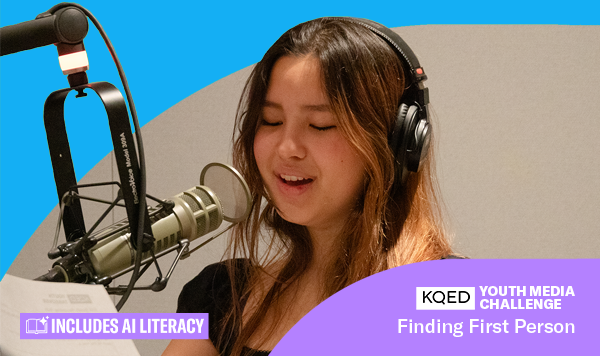
FINDING FIRST PERSON IS A PERSONAL NARRATIVE MEDIA UNIT FROM KQED’S EDUCATION TEAM THAT TAKES A DIFFERENT APPROACH TO AI LITERACY.
SAN FRANCISCO, CA – The education team at KQED, the public media station serving the San Francisco Bay Area, has introduced Finding First Person: Telling My Story in the Age of AI, a free, standards-aligned personal narrative media unit for high school English, ethnic studies and media arts classes, or anywhere else students tell their own stories in the personal narrative genre. The curriculum is designed to help students build narrative agency, defined as the human ability to recognize, value and retain ownership of our own unique voice, especially in a world where AI chatbots are designed to simulate human voice.
Co-created with high school students, Finding First Person provides instruction and strategies that help students explore narrative agency and reflect on if, when and how to use AI throughout the creative process. Building self-knowledge and strengthening student voice is what narrative agency is all about.
The unit does not assume a pro- or anti-AI stance. Instead, it opens classroom conversations about AI that invite analysis and critical thinking. Throughout the 15-lesson sequence, students explore ways to identify and strengthen their voice and identity through reflecting on their personal values, reading about AI’s evolving role in society, critically evaluating AI chatbot outputs, and more. The unit ends by asking students to create an audio essay or short video reflecting on their own experiences and perspectives on AI and personal agency. They then share their media beyond the classroom on the Youth Media Challenge Showcase, adding their voices to the national AI conversation.
Unpacking the Concept of Narrative Agency
“Narrative agency puts the student first and the AI tool later,” says Rachel Roberson, Senior Program Manager at KQED and co-developer of this program. “It’s important for students to understand and make choices based on their own unique experiences, values, ideas, and knowledge. Those choices are particularly important in a world where AI systems like chatbots are designed to simulate our voices and viewpoints in a way that could take over the creative process.”
Roberson also noted that many educators worry about AI cheating or doing the work for students: “The concerns we as educators have about AI are valid, but blanket bans only drive the issue away from our classrooms. Whereas narrative agency helps students take ownership of their own perspectives, and reflect on how they use AI as learners and members of society.”
One of the students who helped write the unit, Shilynn BaFarlough, discovered through the process of exploring narrative agency and developing the curriculum that “AI should not replace my own voice. I should be the person deciding what I want to say, what experiences I want to share, and what my perspective is.” This is what narrative agency looks like in practice.
About the Finding First Person Curriculum and Teacher Toolkit
The curriculum and teacher toolkit for the unit includes:
- Customizable student-facing slides.
- Daily process reflections and class materials, including graphic organizers, note-catchers, assignment sheets, and other student materials.
- Daily lesson plans with learning objectives, standards alignments, and detailed lesson agendas.
- Rubrics and checklists for assessments, including the media project.
- Detailed instructions for submitting student work to the KQED Youth Media Showcase.
Twelve teachers across the U.S. are currently being recruited to field test Finding First Person and KQED is planning several professional learning opportunities for educators, including a free webinar on January 26, 2027, on edWeb, the popular educator PD hub. KQED will also be presenting about narrative agency and Finding First Person at several education conferences this spring, including the California Association of Teachers of English and CALIE (formerly CUE).
Additional details about the Finding First Person curriculum and professional learning are available online.
Support
Support for Finding First Person is provided by the Jim Boyce Charitable Trust, Charlotte Cheng and Brian Cervenka, Susan and Thomas Harrington, the Robert and Shirley Harris Family Foundation, Gayle McKinney Peterson, the Stuart Foundation, Young Futures, an anonymous donor, and the members of KQED.
About KQED
KQED serves the people of Northern California with a public-supported alternative to commercial media. An NPR and PBS affiliate based in San Francisco, KQED is home to one of the most listened-to public radio stations in the nation, one of the highest-rated public television services and an award-winning education program helping students and educators thrive in 21st-century classrooms. A trusted news source and leader and innovator in interactive technology, KQED takes people of all ages on journeys of exploration — exposing them to new people, places and ideas. www.kqed.org
Media Contact
Janelle Kim, [email protected]
Senior Marketing and Communications Manager, Education, KQED