window.__IS_SSR__=true
window.__INITIAL_STATE__={
"attachmentsReducer": {
"audio_0": {
"type": "attachments",
"id": "audio_0",
"imgSizes": {
"kqedFullSize": {
"file": "https://ww2.kqed.org/news/wp-content/themes/KQED-unified/img/audio_bgs/background0.jpg"
}
}
},
"audio_1": {
"type": "attachments",
"id": "audio_1",
"imgSizes": {
"kqedFullSize": {
"file": "https://ww2.kqed.org/news/wp-content/themes/KQED-unified/img/audio_bgs/background1.jpg"
}
}
},
"audio_2": {
"type": "attachments",
"id": "audio_2",
"imgSizes": {
"kqedFullSize": {
"file": "https://ww2.kqed.org/news/wp-content/themes/KQED-unified/img/audio_bgs/background2.jpg"
}
}
},
"audio_3": {
"type": "attachments",
"id": "audio_3",
"imgSizes": {
"kqedFullSize": {
"file": "https://ww2.kqed.org/news/wp-content/themes/KQED-unified/img/audio_bgs/background3.jpg"
}
}
},
"audio_4": {
"type": "attachments",
"id": "audio_4",
"imgSizes": {
"kqedFullSize": {
"file": "https://ww2.kqed.org/news/wp-content/themes/KQED-unified/img/audio_bgs/background4.jpg"
}
}
},
"placeholder": {
"type": "attachments",
"id": "placeholder",
"imgSizes": {
"thumbnail": {
"file": "https://cdn.kqed.org/wp-content/uploads/2024/12/KQED-Default-Image-816638274-2000x1333-1-160x107.jpg",
"width": 160,
"height": 107,
"mimeType": "image/jpeg"
},
"medium": {
"file": "https://cdn.kqed.org/wp-content/uploads/2024/12/KQED-Default-Image-816638274-2000x1333-1-800x533.jpg",
"width": 800,
"height": 533,
"mimeType": "image/jpeg"
},
"medium_large": {
"file": "https://cdn.kqed.org/wp-content/uploads/2024/12/KQED-Default-Image-816638274-2000x1333-1-768x512.jpg",
"width": 768,
"height": 512,
"mimeType": "image/jpeg"
},
"large": {
"file": "https://cdn.kqed.org/wp-content/uploads/2024/12/KQED-Default-Image-816638274-2000x1333-1-1020x680.jpg",
"width": 1020,
"height": 680,
"mimeType": "image/jpeg"
},
"1536x1536": {
"file": "https://cdn.kqed.org/wp-content/uploads/2024/12/KQED-Default-Image-816638274-2000x1333-1-1536x1024.jpg",
"width": 1536,
"height": 1024,
"mimeType": "image/jpeg"
},
"fd-lrg": {
"file": "https://cdn.kqed.org/wp-content/uploads/2024/12/KQED-Default-Image-816638274-2000x1333-1-1536x1024.jpg",
"width": 1536,
"height": 1024,
"mimeType": "image/jpeg"
},
"fd-med": {
"file": "https://cdn.kqed.org/wp-content/uploads/2024/12/KQED-Default-Image-816638274-2000x1333-1-1020x680.jpg",
"width": 1020,
"height": 680,
"mimeType": "image/jpeg"
},
"fd-sm": {
"file": "https://cdn.kqed.org/wp-content/uploads/2024/12/KQED-Default-Image-816638274-2000x1333-1-800x533.jpg",
"width": 800,
"height": 533,
"mimeType": "image/jpeg"
},
"post-thumbnail": {
"file": "https://cdn.kqed.org/wp-content/uploads/2024/12/KQED-Default-Image-816638274-2000x1333-1-672x372.jpg",
"width": 672,
"height": 372,
"mimeType": "image/jpeg"
},
"twentyfourteen-full-width": {
"file": "https://cdn.kqed.org/wp-content/uploads/2024/12/KQED-Default-Image-816638274-2000x1333-1-1038x576.jpg",
"width": 1038,
"height": 576,
"mimeType": "image/jpeg"
},
"xxsmall": {
"file": "https://cdn.kqed.org/wp-content/uploads/2024/12/KQED-Default-Image-816638274-2000x1333-1-160x107.jpg",
"width": 160,
"height": 107,
"mimeType": "image/jpeg"
},
"xsmall": {
"file": "https://cdn.kqed.org/wp-content/uploads/2024/12/KQED-Default-Image-816638274-2000x1333-1-672x372.jpg",
"width": 672,
"height": 372,
"mimeType": "image/jpeg"
},
"small": {
"file": "https://cdn.kqed.org/wp-content/uploads/2024/12/KQED-Default-Image-816638274-2000x1333-1-672x372.jpg",
"width": 672,
"height": 372,
"mimeType": "image/jpeg"
},
"xlarge": {
"file": "https://cdn.kqed.org/wp-content/uploads/2024/12/KQED-Default-Image-816638274-2000x1333-1-1020x680.jpg",
"width": 1020,
"height": 680,
"mimeType": "image/jpeg"
},
"full-width": {
"file": "https://cdn.kqed.org/wp-content/uploads/2024/12/KQED-Default-Image-816638274-2000x1333-1-1920x1280.jpg",
"width": 1920,
"height": 1280,
"mimeType": "image/jpeg"
},
"guest-author-32": {
"file": "https://cdn.kqed.org/wp-content/uploads/2025/01/KQED-Default-Image-816638274-1333x1333-1-160x160.jpg",
"width": 32,
"height": 32,
"mimeType": "image/jpeg"
},
"guest-author-50": {
"file": "https://cdn.kqed.org/wp-content/uploads/2025/01/KQED-Default-Image-816638274-1333x1333-1-160x160.jpg",
"width": 50,
"height": 50,
"mimeType": "image/jpeg"
},
"guest-author-64": {
"file": "https://cdn.kqed.org/wp-content/uploads/2025/01/KQED-Default-Image-816638274-1333x1333-1-160x160.jpg",
"width": 64,
"height": 64,
"mimeType": "image/jpeg"
},
"guest-author-96": {
"file": "https://cdn.kqed.org/wp-content/uploads/2025/01/KQED-Default-Image-816638274-1333x1333-1-160x160.jpg",
"width": 96,
"height": 96,
"mimeType": "image/jpeg"
},
"guest-author-128": {
"file": "https://cdn.kqed.org/wp-content/uploads/2025/01/KQED-Default-Image-816638274-1333x1333-1-160x160.jpg",
"width": 128,
"height": 128,
"mimeType": "image/jpeg"
},
"detail": {
"file": "https://cdn.kqed.org/wp-content/uploads/2025/01/KQED-Default-Image-816638274-1333x1333-1-160x160.jpg",
"width": 160,
"height": 160,
"mimeType": "image/jpeg"
},
"kqedFullSize": {
"file": "https://cdn.kqed.org/wp-content/uploads/2024/12/KQED-Default-Image-816638274-2000x1333-1.jpg",
"width": 2000,
"height": 1333
}
}
},
"news_11997993": {
"type": "attachments",
"id": "news_11997993",
"meta": {
"index": "attachments_1716263798",
"site": "news",
"id": "11997993",
"found": true
},
"title": "230808-SanFranciscoCityHall-12-BL_qed",
"publishDate": 1722366432,
"status": "inherit",
"parent": 0,
"modified": 1722366444,
"caption": "City Hall in San Francisco can be seen through a fence on Van Ness Avenue on Aug. 8, 2023.",
"credit": "Beth LaBerge/KQED",
"altTag": null,
"description": null,
"imgSizes": {
"medium": {
"file": "https://cdn.kqed.org/wp-content/uploads/sites/10/2024/07/230808-SanFranciscoCityHall-12-BL_qed-800x533.jpg",
"width": 800,
"height": 533,
"mimeType": "image/jpeg"
},
"large": {
"file": "https://cdn.kqed.org/wp-content/uploads/sites/10/2024/07/230808-SanFranciscoCityHall-12-BL_qed-1020x680.jpg",
"width": 1020,
"height": 680,
"mimeType": "image/jpeg"
},
"thumbnail": {
"file": "https://cdn.kqed.org/wp-content/uploads/sites/10/2024/07/230808-SanFranciscoCityHall-12-BL_qed-160x107.jpg",
"width": 160,
"height": 107,
"mimeType": "image/jpeg"
},
"1536x1536": {
"file": "https://cdn.kqed.org/wp-content/uploads/sites/10/2024/07/230808-SanFranciscoCityHall-12-BL_qed-1536x1024.jpg",
"width": 1536,
"height": 1024,
"mimeType": "image/jpeg"
},
"post-thumbnail": {
"file": "https://cdn.kqed.org/wp-content/uploads/sites/10/2024/07/230808-SanFranciscoCityHall-12-BL_qed-672x372.jpg",
"width": 672,
"height": 372,
"mimeType": "image/jpeg"
},
"twentyfourteen-full-width": {
"file": "https://cdn.kqed.org/wp-content/uploads/sites/10/2024/07/230808-SanFranciscoCityHall-12-BL_qed-1038x576.jpg",
"width": 1038,
"height": 576,
"mimeType": "image/jpeg"
},
"full-width": {
"file": "https://cdn.kqed.org/wp-content/uploads/sites/10/2024/07/230808-SanFranciscoCityHall-12-BL_qed-1920x1280.jpg",
"width": 1920,
"height": 1280,
"mimeType": "image/jpeg"
},
"kqedFullSize": {
"file": "https://cdn.kqed.org/wp-content/uploads/sites/10/2024/07/230808-SanFranciscoCityHall-12-BL_qed.jpg",
"width": 2000,
"height": 1333
}
},
"isLoading": false,
"fetchFailed": false
},
"news_11997137": {
"type": "attachments",
"id": "news_11997137",
"meta": {
"index": "attachments_1716263798",
"site": "news",
"id": "11997137",
"found": true
},
"title": "The Tenderloin Police station along Eddy St, on Wednesday May 30, 2012, in San Francisco, Ca. San Francisco Mayor Ed Lee, will announce he has a six year plan to restore police staffing to 1971 levels.",
"publishDate": 1721845272,
"status": "inherit",
"parent": 11997127,
"modified": 1721845324,
"caption": "The Tenderloin Police station along Eddy Street, on May 30, 2012, in San Francisco.",
"credit": "Michael Macor/The San Francisco Chronicle via Getty Images",
"altTag": null,
"description": null,
"imgSizes": {
"medium": {
"file": "https://cdn.kqed.org/wp-content/uploads/sites/10/2024/07/SFPDTenderloinStation-800x526.jpg",
"width": 800,
"height": 526,
"mimeType": "image/jpeg"
},
"large": {
"file": "https://cdn.kqed.org/wp-content/uploads/sites/10/2024/07/SFPDTenderloinStation-1020x671.jpg",
"width": 1020,
"height": 671,
"mimeType": "image/jpeg"
},
"thumbnail": {
"file": "https://cdn.kqed.org/wp-content/uploads/sites/10/2024/07/SFPDTenderloinStation-160x105.jpg",
"width": 160,
"height": 105,
"mimeType": "image/jpeg"
},
"1536x1536": {
"file": "https://cdn.kqed.org/wp-content/uploads/sites/10/2024/07/SFPDTenderloinStation-1536x1010.jpg",
"width": 1536,
"height": 1010,
"mimeType": "image/jpeg"
},
"post-thumbnail": {
"file": "https://cdn.kqed.org/wp-content/uploads/sites/10/2024/07/SFPDTenderloinStation-672x372.jpg",
"width": 672,
"height": 372,
"mimeType": "image/jpeg"
},
"twentyfourteen-full-width": {
"file": "https://cdn.kqed.org/wp-content/uploads/sites/10/2024/07/SFPDTenderloinStation-1038x576.jpg",
"width": 1038,
"height": 576,
"mimeType": "image/jpeg"
},
"full-width": {
"file": "https://cdn.kqed.org/wp-content/uploads/sites/10/2024/07/SFPDTenderloinStation-1920x1262.jpg",
"width": 1920,
"height": 1262,
"mimeType": "image/jpeg"
},
"kqedFullSize": {
"file": "https://cdn.kqed.org/wp-content/uploads/sites/10/2024/07/SFPDTenderloinStation.jpg",
"width": 2000,
"height": 1315
}
},
"isLoading": false,
"fetchFailed": false
},
"news_11996679": {
"type": "attachments",
"id": "news_11996679",
"meta": {
"index": "attachments_1716263798",
"site": "news",
"id": "11996679",
"found": true
},
"title": "Red and blue lights of police car in night time, crime scene. Night patrolling the city. Abstract blurry image.",
"publishDate": 1721667064,
"status": "inherit",
"parent": 11996667,
"modified": 1721667392,
"caption": "San Francisco police officers fatally shot a man overnight near Willow Street and Van Ness Avenue, authorities said.",
"credit": "Evgen Prozhyrko/Getty Images",
"altTag": null,
"description": null,
"imgSizes": {
"medium": {
"file": "https://cdn.kqed.org/wp-content/uploads/sites/10/2024/07/PoliceLights-800x602.jpg",
"width": 800,
"height": 602,
"mimeType": "image/jpeg"
},
"large": {
"file": "https://cdn.kqed.org/wp-content/uploads/sites/10/2024/07/PoliceLights-1020x767.jpg",
"width": 1020,
"height": 767,
"mimeType": "image/jpeg"
},
"thumbnail": {
"file": "https://cdn.kqed.org/wp-content/uploads/sites/10/2024/07/PoliceLights-160x120.jpg",
"width": 160,
"height": 120,
"mimeType": "image/jpeg"
},
"1536x1536": {
"file": "https://cdn.kqed.org/wp-content/uploads/sites/10/2024/07/PoliceLights-1536x1155.jpg",
"width": 1536,
"height": 1155,
"mimeType": "image/jpeg"
},
"post-thumbnail": {
"file": "https://cdn.kqed.org/wp-content/uploads/sites/10/2024/07/PoliceLights-672x372.jpg",
"width": 672,
"height": 372,
"mimeType": "image/jpeg"
},
"twentyfourteen-full-width": {
"file": "https://cdn.kqed.org/wp-content/uploads/sites/10/2024/07/PoliceLights-1038x576.jpg",
"width": 1038,
"height": 576,
"mimeType": "image/jpeg"
},
"full-width": {
"file": "https://cdn.kqed.org/wp-content/uploads/sites/10/2024/07/PoliceLights-1920x1444.jpg",
"width": 1920,
"height": 1444,
"mimeType": "image/jpeg"
},
"kqedFullSize": {
"file": "https://cdn.kqed.org/wp-content/uploads/sites/10/2024/07/PoliceLights.jpg",
"width": 2000,
"height": 1504
}
},
"isLoading": false,
"fetchFailed": false
},
"news_11996216": {
"type": "attachments",
"id": "news_11996216",
"meta": {
"index": "attachments_1716263798",
"site": "news",
"id": "11996216",
"found": true
},
"title": "San Francisco Police Arrest Suspect In Murder Of Tech Executive Bob Lee",
"publishDate": 1721322759,
"status": "inherit",
"parent": 11996211,
"modified": 1721342680,
"caption": "San Francisco police Chief William Scott speaks during a press conference at San Francisco Police headquarters on April 13, 2023. ",
"credit": "Justin Sullivan/Getty Images",
"altTag": null,
"description": null,
"imgSizes": {
"medium": {
"file": "https://cdn.kqed.org/wp-content/uploads/sites/10/2024/07/SFPoliceChief2024-800x550.jpg",
"width": 800,
"height": 550,
"mimeType": "image/jpeg"
},
"large": {
"file": "https://cdn.kqed.org/wp-content/uploads/sites/10/2024/07/SFPoliceChief2024-1020x701.jpg",
"width": 1020,
"height": 701,
"mimeType": "image/jpeg"
},
"thumbnail": {
"file": "https://cdn.kqed.org/wp-content/uploads/sites/10/2024/07/SFPoliceChief2024-160x110.jpg",
"width": 160,
"height": 110,
"mimeType": "image/jpeg"
},
"1536x1536": {
"file": "https://cdn.kqed.org/wp-content/uploads/sites/10/2024/07/SFPoliceChief2024-1536x1056.jpg",
"width": 1536,
"height": 1056,
"mimeType": "image/jpeg"
},
"post-thumbnail": {
"file": "https://cdn.kqed.org/wp-content/uploads/sites/10/2024/07/SFPoliceChief2024-672x372.jpg",
"width": 672,
"height": 372,
"mimeType": "image/jpeg"
},
"twentyfourteen-full-width": {
"file": "https://cdn.kqed.org/wp-content/uploads/sites/10/2024/07/SFPoliceChief2024-1038x576.jpg",
"width": 1038,
"height": 576,
"mimeType": "image/jpeg"
},
"full-width": {
"file": "https://cdn.kqed.org/wp-content/uploads/sites/10/2024/07/SFPoliceChief2024-1920x1320.jpg",
"width": 1920,
"height": 1320,
"mimeType": "image/jpeg"
},
"kqedFullSize": {
"file": "https://cdn.kqed.org/wp-content/uploads/sites/10/2024/07/SFPoliceChief2024.jpg",
"width": 2000,
"height": 1375
}
},
"isLoading": false,
"fetchFailed": false
},
"news_11996083": {
"type": "attachments",
"id": "news_11996083",
"meta": {
"index": "attachments_1716263798",
"site": "news",
"id": "11996083",
"found": true
},
"title": "SFPD",
"publishDate": 1721246365,
"status": "inherit",
"parent": 11996060,
"modified": 1743029026,
"caption": "Law enforcement arrested about 40 people in a large drug raid at Market and Van Ness in San Francisco last week, but prosecutors say there isn’t enough evidence to file charges.",
"credit": "Alex Emslie/KQED",
"altTag": null,
"description": null,
"imgSizes": {
"medium": {
"file": "https://cdn.kqed.org/wp-content/uploads/sites/10/2024/07/SFPD-800x600.jpg",
"width": 800,
"height": 600,
"mimeType": "image/jpeg"
},
"large": {
"file": "https://cdn.kqed.org/wp-content/uploads/sites/10/2024/07/SFPD-1020x765.jpg",
"width": 1020,
"height": 765,
"mimeType": "image/jpeg"
},
"thumbnail": {
"file": "https://cdn.kqed.org/wp-content/uploads/sites/10/2024/07/SFPD-160x120.jpg",
"width": 160,
"height": 120,
"mimeType": "image/jpeg"
},
"1536x1536": {
"file": "https://cdn.kqed.org/wp-content/uploads/sites/10/2024/07/SFPD-1536x1152.jpg",
"width": 1536,
"height": 1152,
"mimeType": "image/jpeg"
},
"post-thumbnail": {
"file": "https://cdn.kqed.org/wp-content/uploads/sites/10/2024/07/SFPD-672x372.jpg",
"width": 672,
"height": 372,
"mimeType": "image/jpeg"
},
"twentyfourteen-full-width": {
"file": "https://cdn.kqed.org/wp-content/uploads/sites/10/2024/07/SFPD-1038x576.jpg",
"width": 1038,
"height": 576,
"mimeType": "image/jpeg"
},
"full-width": {
"file": "https://cdn.kqed.org/wp-content/uploads/sites/10/2024/07/SFPD-1920x1440.jpg",
"width": 1920,
"height": 1440,
"mimeType": "image/jpeg"
},
"kqedFullSize": {
"file": "https://cdn.kqed.org/wp-content/uploads/sites/10/2024/07/SFPD.jpg",
"width": 2000,
"height": 1500
}
},
"isLoading": false,
"fetchFailed": false
},
"news_11990060": {
"type": "attachments",
"id": "news_11990060",
"meta": {
"index": "attachments_1716263798",
"site": "news",
"id": "11990060",
"found": true
},
"title": "GettyImages-1212814457_qut",
"publishDate": 1718232780,
"status": "inherit",
"parent": 11989977,
"modified": 1718235036,
"caption": "San Francisco Mayor London Breed speaks as San Francisco Police Chief William Scott looks on during a press conference in San Francisco City Hall on March 16, 2020.",
"credit": "Justin Sullivan/Getty Images",
"altTag": null,
"description": null,
"imgSizes": {
"medium": {
"file": "https://cdn.kqed.org/wp-content/uploads/sites/10/2024/06/GettyImages-1212814457_qut-800x533.jpg",
"width": 800,
"height": 533,
"mimeType": "image/jpeg"
},
"large": {
"file": "https://cdn.kqed.org/wp-content/uploads/sites/10/2024/06/GettyImages-1212814457_qut-1020x680.jpg",
"width": 1020,
"height": 680,
"mimeType": "image/jpeg"
},
"thumbnail": {
"file": "https://cdn.kqed.org/wp-content/uploads/sites/10/2024/06/GettyImages-1212814457_qut-160x107.jpg",
"width": 160,
"height": 107,
"mimeType": "image/jpeg"
},
"1536x1536": {
"file": "https://cdn.kqed.org/wp-content/uploads/sites/10/2024/06/GettyImages-1212814457_qut-1536x1024.jpg",
"width": 1536,
"height": 1024,
"mimeType": "image/jpeg"
},
"post-thumbnail": {
"file": "https://cdn.kqed.org/wp-content/uploads/sites/10/2024/06/GettyImages-1212814457_qut-672x372.jpg",
"width": 672,
"height": 372,
"mimeType": "image/jpeg"
},
"twentyfourteen-full-width": {
"file": "https://cdn.kqed.org/wp-content/uploads/sites/10/2024/06/GettyImages-1212814457_qut-1038x576.jpg",
"width": 1038,
"height": 576,
"mimeType": "image/jpeg"
},
"kqedFullSize": {
"file": "https://cdn.kqed.org/wp-content/uploads/sites/10/2024/06/GettyImages-1212814457_qut.jpg",
"width": 1920,
"height": 1280
}
},
"isLoading": false,
"fetchFailed": false
},
"news_11987931": {
"type": "attachments",
"id": "news_11987931",
"meta": {
"index": "attachments_1716263798",
"site": "news",
"id": "11987931",
"found": true
},
"title": "BreedLeeStefani_qut",
"publishDate": 1716924016,
"status": "inherit",
"parent": 12077653,
"modified": 1774629873,
"caption": "Ivy Lee (center), flanked by San Francisco Mayor London Breed (left) and Supervisor Catherine Stefani, was announced as director of the city's new Office of Victim and Witness Rights at a press conference in the West Portal neighborhood on May 28.",
"credit": "Joe Fitzgerald Rodriguez/KQED",
"altTag": null,
"description": null,
"imgSizes": {
"medium": {
"file": "https://cdn.kqed.org/wp-content/uploads/sites/10/2024/05/BreedLeeStefani_qut-800x530.jpg",
"width": 800,
"height": 530,
"mimeType": "image/jpeg"
},
"large": {
"file": "https://cdn.kqed.org/wp-content/uploads/sites/10/2024/05/BreedLeeStefani_qut-1020x676.jpg",
"width": 1020,
"height": 676,
"mimeType": "image/jpeg"
},
"thumbnail": {
"file": "https://cdn.kqed.org/wp-content/uploads/sites/10/2024/05/BreedLeeStefani_qut-160x106.jpg",
"width": 160,
"height": 106,
"mimeType": "image/jpeg"
},
"1536x1536": {
"file": "https://cdn.kqed.org/wp-content/uploads/sites/10/2024/05/BreedLeeStefani_qut-1536x1018.jpg",
"width": 1536,
"height": 1018,
"mimeType": "image/jpeg"
},
"post-thumbnail": {
"file": "https://cdn.kqed.org/wp-content/uploads/sites/10/2024/05/BreedLeeStefani_qut-672x372.jpg",
"width": 672,
"height": 372,
"mimeType": "image/jpeg"
},
"twentyfourteen-full-width": {
"file": "https://cdn.kqed.org/wp-content/uploads/sites/10/2024/05/BreedLeeStefani_qut-1038x576.jpg",
"width": 1038,
"height": 576,
"mimeType": "image/jpeg"
},
"kqedFullSize": {
"file": "https://cdn.kqed.org/wp-content/uploads/sites/10/2024/05/BreedLeeStefani_qut.jpg",
"width": 1920,
"height": 1273
}
},
"isLoading": false,
"fetchFailed": false
},
"news_11985597": {
"type": "attachments",
"id": "news_11985597",
"meta": {
"index": "attachments_1716263798",
"site": "news",
"id": "11985597",
"found": true
},
"parent": 11985525,
"imgSizes": {
"twentyfourteen-full-width": {
"file": "https://cdn.kqed.org/wp-content/uploads/sites/10/2024/05/GettyImages-1298810105_qut-1038x576.jpg",
"width": 1038,
"mimeType": "image/jpeg",
"height": 576
},
"thumbnail": {
"file": "https://cdn.kqed.org/wp-content/uploads/sites/10/2024/05/GettyImages-1298810105_qut-160x107.jpg",
"width": 160,
"mimeType": "image/jpeg",
"height": 107
},
"post-thumbnail": {
"file": "https://cdn.kqed.org/wp-content/uploads/sites/10/2024/05/GettyImages-1298810105_qut-672x372.jpg",
"width": 672,
"mimeType": "image/jpeg",
"height": 372
},
"kqedFullSize": {
"file": "https://cdn.kqed.org/wp-content/uploads/sites/10/2024/05/GettyImages-1298810105_qut.jpg",
"width": 1920,
"height": 1280
},
"large": {
"file": "https://cdn.kqed.org/wp-content/uploads/sites/10/2024/05/GettyImages-1298810105_qut-1020x680.jpg",
"width": 1020,
"mimeType": "image/jpeg",
"height": 680
},
"1536x1536": {
"file": "https://cdn.kqed.org/wp-content/uploads/sites/10/2024/05/GettyImages-1298810105_qut-1536x1024.jpg",
"width": 1536,
"mimeType": "image/jpeg",
"height": 1024
},
"medium": {
"file": "https://cdn.kqed.org/wp-content/uploads/sites/10/2024/05/GettyImages-1298810105_qut-800x533.jpg",
"width": 800,
"mimeType": "image/jpeg",
"height": 533
}
},
"publishDate": 1715292400,
"modified": 1715293689,
"caption": "District 9 supervisor Hillary Ronen looks over at District 10 supervisor Shamann Walton during a committee meeting at City Hall on May 16, 2019, in San Francisco, California.",
"description": null,
"title": "District 9 supervisor Hillary Ronen looks over at District 10 supervisor Shamann Walton during a committee meeting at City Hall Thursday, May 16, 2019, in San Francisco, Calif. The S.F. Government Audit and Oversight Committee discussed ordinance that wou",
"credit": "Santiago Mejia/San Francisco Chronicle via Getty Images",
"status": "inherit",
"altTag": null,
"isLoading": false,
"fetchFailed": false
},
"news_11960409": {
"type": "attachments",
"id": "news_11960409",
"meta": {
"index": "attachments_1716263798",
"site": "news",
"id": "11960409",
"found": true
},
"parent": 11960406,
"imgSizes": {
"twentyfourteen-full-width": {
"file": "https://cdn.kqed.org/wp-content/uploads/sites/10/2023/09/RS67750_230808-SanFranciscoCityHall-19-BL-qut-1038x576.jpg",
"width": 1038,
"mimeType": "image/jpeg",
"height": 576
},
"thumbnail": {
"file": "https://cdn.kqed.org/wp-content/uploads/sites/10/2023/09/RS67750_230808-SanFranciscoCityHall-19-BL-qut-160x107.jpg",
"width": 160,
"mimeType": "image/jpeg",
"height": 107
},
"post-thumbnail": {
"file": "https://cdn.kqed.org/wp-content/uploads/sites/10/2023/09/RS67750_230808-SanFranciscoCityHall-19-BL-qut-672x372.jpg",
"width": 672,
"mimeType": "image/jpeg",
"height": 372
},
"kqedFullSize": {
"file": "https://cdn.kqed.org/wp-content/uploads/sites/10/2023/09/RS67750_230808-SanFranciscoCityHall-19-BL-qut.jpg",
"width": 1920,
"height": 1280
},
"large": {
"file": "https://cdn.kqed.org/wp-content/uploads/sites/10/2023/09/RS67750_230808-SanFranciscoCityHall-19-BL-qut-1020x680.jpg",
"width": 1020,
"mimeType": "image/jpeg",
"height": 680
},
"1536x1536": {
"file": "https://cdn.kqed.org/wp-content/uploads/sites/10/2023/09/RS67750_230808-SanFranciscoCityHall-19-BL-qut-1536x1024.jpg",
"width": 1536,
"mimeType": "image/jpeg",
"height": 1024
},
"medium": {
"file": "https://cdn.kqed.org/wp-content/uploads/sites/10/2023/09/RS67750_230808-SanFranciscoCityHall-19-BL-qut-800x533.jpg",
"width": 800,
"mimeType": "image/jpeg",
"height": 533
}
},
"publishDate": 1694131442,
"modified": 1709340288,
"caption": "A Muni bus passes by City Hall in San Francisco on Aug. 8, 2023.",
"description": null,
"title": "A Muni bus passes by City Hall in San Francisco on Aug. 8, 2023.",
"credit": "Beth LaBerge/KQED",
"status": "inherit",
"altTag": "A building with intricate pillars in front, as well as a red and white city bus.",
"isLoading": false,
"fetchFailed": false
},
"news_11977189": {
"type": "attachments",
"id": "news_11977189",
"meta": {
"index": "attachments_1716263798",
"site": "news",
"id": "11977189",
"found": true
},
"parent": 11977185,
"imgSizes": {
"twentyfourteen-full-width": {
"file": "https://cdn.kqed.org/wp-content/uploads/sites/10/2024/02/PROP-E_AH_CM_01-1038x576.jpg",
"width": 1038,
"mimeType": "image/jpeg",
"height": 576
},
"thumbnail": {
"file": "https://cdn.kqed.org/wp-content/uploads/sites/10/2024/02/PROP-E_AH_CM_01-160x107.jpg",
"width": 160,
"mimeType": "image/jpeg",
"height": 107
},
"post-thumbnail": {
"file": "https://cdn.kqed.org/wp-content/uploads/sites/10/2024/02/PROP-E_AH_CM_01-672x372.jpg",
"width": 672,
"mimeType": "image/jpeg",
"height": 372
},
"kqedFullSize": {
"file": "https://cdn.kqed.org/wp-content/uploads/sites/10/2024/02/PROP-E_AH_CM_01.jpg",
"width": 2000,
"height": 1333
},
"large": {
"file": "https://cdn.kqed.org/wp-content/uploads/sites/10/2024/02/PROP-E_AH_CM_01-1020x680.jpg",
"width": 1020,
"mimeType": "image/jpeg",
"height": 680
},
"1536x1536": {
"file": "https://cdn.kqed.org/wp-content/uploads/sites/10/2024/02/PROP-E_AH_CM_01-1536x1024.jpg",
"width": 1536,
"mimeType": "image/jpeg",
"height": 1024
},
"full-width": {
"file": "https://cdn.kqed.org/wp-content/uploads/sites/10/2024/02/PROP-E_AH_CM_01-1920x1280.jpg",
"width": 1920,
"mimeType": "image/jpeg",
"height": 1280
},
"medium": {
"file": "https://cdn.kqed.org/wp-content/uploads/sites/10/2024/02/PROP-E_AH_CM_01-800x533.jpg",
"width": 800,
"mimeType": "image/jpeg",
"height": 533
}
},
"publishDate": 1709055856,
"modified": 1709056206,
"caption": null,
"description": null,
"title": "PROP-E_AH_CM_01",
"credit": "Courtesy of Adriana Heldiz, CalMatters; iStock; Skydio",
"status": "inherit",
"altTag": "An illustration of a police officer holding a gun with part of a highway.",
"isLoading": false,
"fetchFailed": false
},
"news_11961411": {
"type": "attachments",
"id": "news_11961411",
"meta": {
"index": "attachments_1716263798",
"site": "news",
"id": "11961411",
"found": true
},
"title": "230913-SFPDStaff-011-BL-KQED",
"publishDate": 1694810146,
"status": "inherit",
"parent": 12063157,
"modified": 1762466664,
"caption": "Edward Siu, president of the Chinatown Merchants United Association, stands on a busy corner of Stockton Street in San Francisco's Chinatown neighborhood on Sept. 13, 2023. He says SFPD command turnover is so fast that he can't remember all the names of the police leaders he's given community tours to.",
"credit": "Beth LaBerge/KQED",
"altTag": "A person with glasses is photographed as other people pass on a busy city sidewalk.",
"description": null,
"imgSizes": {
"medium": {
"file": "https://cdn.kqed.org/wp-content/uploads/sites/10/2023/09/230913-SFPDStaff-011-BL-KQED-800x533.jpg",
"width": 800,
"height": 533,
"mimeType": "image/jpeg"
},
"large": {
"file": "https://cdn.kqed.org/wp-content/uploads/sites/10/2023/09/230913-SFPDStaff-011-BL-KQED-1020x680.jpg",
"width": 1020,
"height": 680,
"mimeType": "image/jpeg"
},
"thumbnail": {
"file": "https://cdn.kqed.org/wp-content/uploads/sites/10/2023/09/230913-SFPDStaff-011-BL-KQED-160x107.jpg",
"width": 160,
"height": 107,
"mimeType": "image/jpeg"
},
"1536x1536": {
"file": "https://cdn.kqed.org/wp-content/uploads/sites/10/2023/09/230913-SFPDStaff-011-BL-KQED-1536x1024.jpg",
"width": 1536,
"height": 1024,
"mimeType": "image/jpeg"
},
"post-thumbnail": {
"file": "https://cdn.kqed.org/wp-content/uploads/sites/10/2023/09/230913-SFPDStaff-011-BL-KQED-672x372.jpg",
"width": 672,
"height": 372,
"mimeType": "image/jpeg"
},
"twentyfourteen-full-width": {
"file": "https://cdn.kqed.org/wp-content/uploads/sites/10/2023/09/230913-SFPDStaff-011-BL-KQED-1038x576.jpg",
"width": 1038,
"height": 576,
"mimeType": "image/jpeg"
},
"full-width": {
"file": "https://cdn.kqed.org/wp-content/uploads/sites/10/2023/09/230913-SFPDStaff-011-BL-KQED-1920x1280.jpg",
"width": 1920,
"height": 1280,
"mimeType": "image/jpeg"
},
"kqedFullSize": {
"file": "https://cdn.kqed.org/wp-content/uploads/sites/10/2023/09/230913-SFPDStaff-011-BL-KQED.jpg",
"width": 2000,
"height": 1333
}
},
"isLoading": false,
"fetchFailed": false
},
"news_11961454": {
"type": "attachments",
"id": "news_11961454",
"meta": {
"index": "attachments_1716263798",
"site": "news",
"id": "11961454",
"found": true
},
"parent": 11961449,
"imgSizes": {
"twentyfourteen-full-width": {
"file": "https://ww2.kqed.org/app/uploads/sites/10/2023/09/GettyImages-1236922203-1038x576.jpg",
"width": 1038,
"mimeType": "image/jpeg",
"height": 576
},
"thumbnail": {
"file": "https://ww2.kqed.org/app/uploads/sites/10/2023/09/GettyImages-1236922203-160x107.jpg",
"width": 160,
"mimeType": "image/jpeg",
"height": 107
},
"post-thumbnail": {
"file": "https://ww2.kqed.org/app/uploads/sites/10/2023/09/GettyImages-1236922203-672x372.jpg",
"width": 672,
"mimeType": "image/jpeg",
"height": 372
},
"kqedFullSize": {
"file": "https://ww2.kqed.org/app/uploads/sites/10/2023/09/GettyImages-1236922203-scaled.jpg",
"width": 2560,
"height": 1707
},
"2048x2048": {
"file": "https://ww2.kqed.org/app/uploads/sites/10/2023/09/GettyImages-1236922203-2048x1366.jpg",
"width": 2048,
"mimeType": "image/jpeg",
"height": 1366
},
"large": {
"file": "https://ww2.kqed.org/app/uploads/sites/10/2023/09/GettyImages-1236922203-1020x680.jpg",
"width": 1020,
"mimeType": "image/jpeg",
"height": 680
},
"1536x1536": {
"file": "https://ww2.kqed.org/app/uploads/sites/10/2023/09/GettyImages-1236922203-1536x1024.jpg",
"width": 1536,
"mimeType": "image/jpeg",
"height": 1024
},
"full-width": {
"file": "https://ww2.kqed.org/app/uploads/sites/10/2023/09/GettyImages-1236922203-1920x1281.jpg",
"width": 1920,
"mimeType": "image/jpeg",
"height": 1281
},
"medium": {
"file": "https://ww2.kqed.org/app/uploads/sites/10/2023/09/GettyImages-1236922203-800x534.jpg",
"width": 800,
"mimeType": "image/jpeg",
"height": 534
}
},
"publishDate": 1694819931,
"modified": 1694820004,
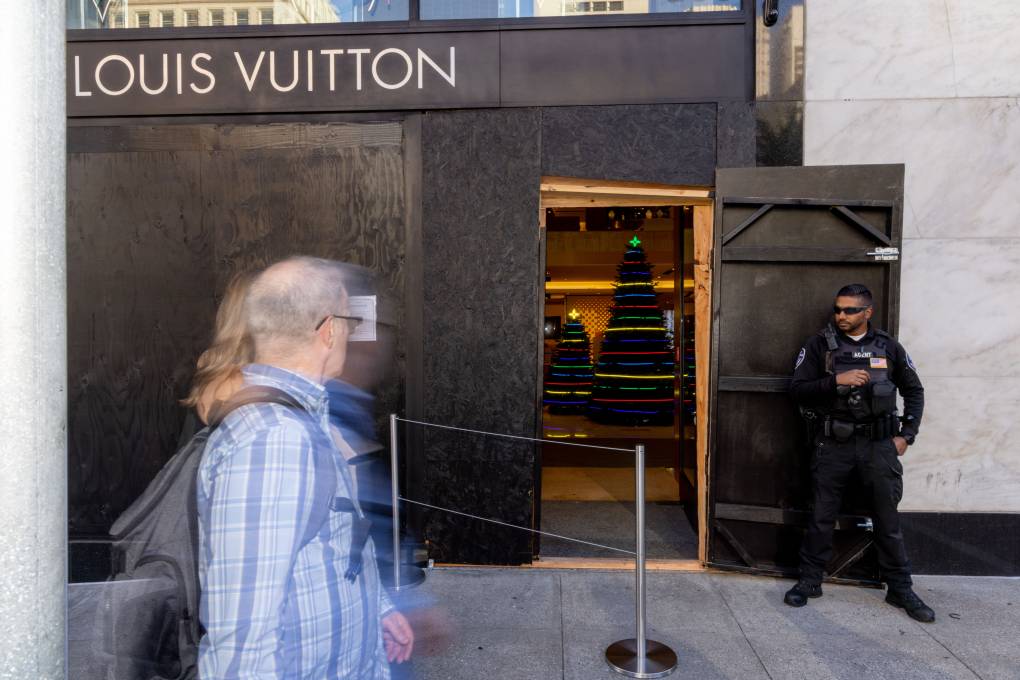
"caption": "A security guard outside the Louis Vuitton store in downtown San Francisco, which had increased its security following a string of thefts.",
"description": null,
"title": "Businesses In San Francisco Board Up In Response To Recent String Of Robberies",
"credit": "Ethan Swope/Getty Images",
"status": "inherit",
"altTag": "the boarded up windows of a Louis Vuitton store with a security guard out front",
"isLoading": false,
"fetchFailed": false
}
},
"audioPlayerReducer": {
"postId": "stream_live",
"isPaused": true,
"isPlaying": false,
"pfsActive": false,
"pledgeModalIsOpen": true,
"playerDrawerIsOpen": false,
"liveAudioPlayStartedAt": 0,
"liveAudioPlayContext": ""
},
"authorsReducer": {
"byline_news_11977185": {
"type": "authors",
"id": "byline_news_11977185",
"meta": {
"override": true
},
"slug": "byline_news_11977185",
"name": "Khari Johnson",
"isLoading": false
},
"byline_news_11961449": {
"type": "authors",
"id": "byline_news_11961449",
"meta": {
"override": true
},
"slug": "byline_news_11961449",
"name": "Trân Nguyễn\u003cbr>The Associated Press",
"isLoading": false
},
"dcronin": {
"type": "authors",
"id": "11362",
"meta": {
"index": "authors_1716337520",
"id": "11362",
"found": true
},
"name": "Dana Cronin",
"firstName": "Dana",
"lastName": "Cronin",
"slug": "dcronin",
"email": "dcronin@KQED.org",
"display_author_email": true,
"staff_mastheads": [],
"title": "KQED Contributor",
"bio": "Dana Cronin is a reporter for KQED News. She loves writing stories about climate change, environmental issues, food and agriculture. She's reported across the country, from Colorado to Washington D.C. to Illinois, and has won numerous awards for her coverage. Her work is regularly featured on national broadcasts, including NPR’s Morning Edition, All Things Considered, PBS Newshour and Science Friday. She lives in Oakland and has an avocado tree in her back yard.",
"avatar": "https://secure.gravatar.com/avatar/bcf89e3455ff7235f96ab6fa7258dd95?s=600&d=blank&r=g",
"twitter": "DanaHCronin",
"facebook": null,
"instagram": null,
"linkedin": null,
"sites": [
{
"site": "arts",
"roles": [
"author"
]
},
{
"site": "news",
"roles": [
"editor"
]
},
{
"site": "science",
"roles": [
"author"
]
},
{
"site": "liveblog",
"roles": [
"author"
]
}
],
"headData": {
"title": "Dana Cronin | KQED",
"description": "KQED Contributor",
"ogImgSrc": "https://secure.gravatar.com/avatar/bcf89e3455ff7235f96ab6fa7258dd95?s=600&d=blank&r=g",
"twImgSrc": "https://secure.gravatar.com/avatar/bcf89e3455ff7235f96ab6fa7258dd95?s=600&d=blank&r=g"
},
"isLoading": false,
"link": "/author/dcronin"
},
"jrodriguez": {
"type": "authors",
"id": "11690",
"meta": {
"index": "authors_1716337520",
"id": "11690",
"found": true
},
"name": "Joe Fitzgerald Rodriguez",
"firstName": "Joe",
"lastName": "Fitzgerald Rodriguez",
"slug": "jrodriguez",
"email": "jrodriguez@kqed.org",
"display_author_email": true,
"staff_mastheads": [
"news"
],
"title": "Reporter and Producer",
"bio": "Joe Fitzgerald Rodriguez is a reporter and digital producer for KQED covering politics. Joe most recently wrote for the \u003cem>San Francisco Examiner\u003c/em> as a political columnist covering The City. He was raised in San Francisco and has spent his reporting career in his beloved, foggy, city by the bay. Joe was 12-years-old when he conducted his first interview in journalism, grilling former San Francisco Mayor Willie Brown for the Marina Middle School newspaper, \u003cem>The Penguin Press, \u003c/em>and he continues to report on the San Francisco Bay Area to this day.",
"avatar": "https://secure.gravatar.com/avatar/2247beb0564c1e9c62228d5649d2edac?s=600&d=blank&r=g",
"twitter": "FitztheReporter",
"facebook": null,
"instagram": "https://www.instagram.com/fitzthereporter/",
"linkedin": null,
"sites": [
{
"site": "",
"roles": [
"editor"
]
},
{
"site": "arts",
"roles": [
"editor"
]
},
{
"site": "news",
"roles": [
"editor"
]
},
{
"site": "science",
"roles": [
"editor"
]
},
{
"site": "elections",
"roles": [
"editor"
]
},
{
"site": "liveblog",
"roles": [
"editor"
]
}
],
"headData": {
"title": "Joe Fitzgerald Rodriguez | KQED",
"description": "Reporter and Producer",
"ogImgSrc": "https://secure.gravatar.com/avatar/2247beb0564c1e9c62228d5649d2edac?s=600&d=blank&r=g",
"twImgSrc": "https://secure.gravatar.com/avatar/2247beb0564c1e9c62228d5649d2edac?s=600&d=blank&r=g"
},
"isLoading": false,
"link": "/author/jrodriguez"
},
"naltenberg": {
"type": "authors",
"id": "11896",
"meta": {
"index": "authors_1716337520",
"id": "11896",
"found": true
},
"name": "Nik Altenberg",
"firstName": "Nik",
"lastName": "Altenberg",
"slug": "naltenberg",
"email": "naltenberg@kqed.org",
"display_author_email": false,
"staff_mastheads": [],
"title": "KQED Contributor",
"bio": "Nik Altenberg is an on-call reporter for KQED and a copy editor and fact checker for Santa Cruz Local. Nik’s reporting interests include policing, public health, environment, immigration, housing and the places where these issues intersect.",
"avatar": "https://secure.gravatar.com/avatar/e391b3a18ce4a53a7ca3f3065c74418b?s=600&d=blank&r=g",
"twitter": null,
"facebook": null,
"instagram": "https://www.instagram.com/nikaltenberg/",
"linkedin": null,
"sites": [
{
"site": "news",
"roles": []
}
],
"headData": {
"title": "Nik Altenberg | KQED",
"description": "KQED Contributor",
"ogImgSrc": "https://secure.gravatar.com/avatar/e391b3a18ce4a53a7ca3f3065c74418b?s=600&d=blank&r=g",
"twImgSrc": "https://secure.gravatar.com/avatar/e391b3a18ce4a53a7ca3f3065c74418b?s=600&d=blank&r=g"
},
"isLoading": false,
"link": "/author/naltenberg"
},
"opalma": {
"type": "authors",
"id": "11897",
"meta": {
"index": "authors_1716337520",
"id": "11897",
"found": true
},
"name": "Oscar Palma",
"firstName": "Oscar",
"lastName": "Palma",
"slug": "opalma",
"email": "opalma@kqed.org",
"display_author_email": false,
"staff_mastheads": [],
"title": "KQED Contributor",
"bio": "Oscar Palma is a newscast intern at KQED, a freelance reporter and former Spanish editor for Golden Gate Xpress. Oscar is interested in environmental and community journalism. Some of his personal interests are bicycles, film, and Latin American literature and punk, his work has previously appeared in El Tecolote, KQED and The Frisc.",
"avatar": "https://secure.gravatar.com/avatar/d488e9b9f94b80f7b78e2896064827ab?s=600&d=blank&r=g",
"twitter": null,
"facebook": null,
"instagram": null,
"linkedin": null,
"sites": [
{
"site": "news",
"roles": [
"author"
]
}
],
"headData": {
"title": "Oscar Palma | KQED",
"description": "KQED Contributor",
"ogImgSrc": "https://secure.gravatar.com/avatar/d488e9b9f94b80f7b78e2896064827ab?s=600&d=blank&r=g",
"twImgSrc": "https://secure.gravatar.com/avatar/d488e9b9f94b80f7b78e2896064827ab?s=600&d=blank&r=g"
},
"isLoading": false,
"link": "/author/opalma"
},
"kdebenedetti": {
"type": "authors",
"id": "11913",
"meta": {
"index": "authors_1716337520",
"id": "11913",
"found": true
},
"name": "Katie DeBenedetti",
"firstName": "Katie",
"lastName": "DeBenedetti",
"slug": "kdebenedetti",
"email": "kdebenedetti@kqed.org",
"display_author_email": false,
"staff_mastheads": [
"news",
"science"
],
"title": "KQED Contributor",
"bio": "Katie DeBenedetti is a digital reporter covering daily news for the Express Desk. Prior to joining KQED as a culture reporting intern in January 2024, she covered education and city government for the Napa Valley Register.",
"avatar": "https://secure.gravatar.com/avatar/6e31073cb8f7e4214ab03f42771d0f45?s=600&d=blank&r=g",
"twitter": null,
"facebook": null,
"instagram": null,
"linkedin": null,
"sites": [
{
"site": "news",
"roles": [
"author"
]
},
{
"site": "science",
"roles": [
"author"
]
},
{
"site": "liveblog",
"roles": [
"author"
]
}
],
"headData": {
"title": "Katie DeBenedetti | KQED",
"description": "KQED Contributor",
"ogImgSrc": "https://secure.gravatar.com/avatar/6e31073cb8f7e4214ab03f42771d0f45?s=600&d=blank&r=g",
"twImgSrc": "https://secure.gravatar.com/avatar/6e31073cb8f7e4214ab03f42771d0f45?s=600&d=blank&r=g"
},
"isLoading": false,
"link": "/author/kdebenedetti"
}
},
"pagesReducer": {
"news_tag_san-francisco-police-department": {
"type": "terms",
"id": "news_545",
"meta": {
"index": "terms_1716263798",
"site": "news",
"id": "545",
"score": 9.892363
},
"featImg": null,
"name": "San Francisco Police Department",
"description": null,
"taxonomy": "tag",
"headData": {
"twImgId": null,
"twTitle": null,
"ogTitle": null,
"ogImgId": null,
"twDescription": null,
"description": null,
"title": "San Francisco Police Department Archives | KQED News",
"ogDescription": null
},
"ttid": 554,
"slug": "san-francisco-police-department",
"isLoading": false,
"title": "San Francisco Police Department",
"pageMeta": {
"site": "news",
"WpPageTemplate": "page-topic-editorial",
"currentPage": 6
},
"blocks": [
{
"blockName": "kqed/post-list",
"attrs": {
"layout": "cardArticle2",
"query": "posts/news?tag=san-francisco-police-department",
"seeMore": false,
"paginated": true,
"page": 6
}
},
{
"blockName": "kqed/ad"
}
]
}
},
"pfsSessionReducer": {},
"postsReducer": {
"stream_live": {
"type": "live",
"id": "stream_live",
"audioUrl": "https://streams.kqed.org/kqedradio",
"title": "Live Stream",
"excerpt": "Live Stream information currently unavailable.",
"link": "/radio",
"featImg": "",
"label": {
"name": "KQED Live",
"link": "/"
}
},
"stream_kqedNewscast": {
"type": "posts",
"id": "stream_kqedNewscast",
"audioUrl": "https://www.kqed.org/.stream/anon/radio/RDnews/newscast.mp3?_=1",
"title": "KQED Newscast",
"featImg": "",
"label": {
"name": "88.5 FM",
"link": "/"
}
},
"news_11997977": {
"type": "posts",
"id": "news_11997977",
"meta": {
"index": "posts_1716263798",
"site": "news",
"id": "11997977",
"score": null,
"sort": [
1722369637000
]
},
"guestAuthors": [],
"slug": "former-head-of-sfpd-linked-nonprofit-arrested-over-alleged-misuse-of-700000",
"title": "Former Head of SFPD-Linked Nonprofit Arrested Over Alleged Misuse of $700,000",
"publishDate": 1722369637,
"format": "standard",
"headTitle": "Former Head of SFPD-Linked Nonprofit Arrested Over Alleged Misuse of $700,000 | KQED",
"labelTerm": {
"site": "news"
},
"content": "\u003cp>\u003cem>Updated 1:17 p.m. Tuesday\u003c/em>\u003c/p>\n\u003cp>The former executive director of a shuttered \u003ca href=\"https://www.kqed.org/news/11977841/former-sf-safe-employees-file-labor-complaint-against-defunct-nonprofit\">San Francisco police-affiliated nonprofit\u003c/a> was arrested Tuesday and accused of misusing over $700,000 of the organization’s funds, the San Francisco district attorney’s office announced.\u003c/p>\n\u003cp>Kyra Worthy, 49, faces 34 felony counts related to the misuse of public money, submitting fraudulent invoices to a city department, theft and wage theft, among other charges. She took the helm of SF SAFE, a crime prevention organization created by and later partnered with the San Francisco Police Department, at the end of 2017.\u003c/p>\n\u003cp>SF SAFE’s board fired Worthy and shut down the decades-old organization in January after \u003ca href=\"https://www.sf.gov/sites/default/files/2024-01/Police%20Department%20SF%20SAFE%20Assessment%2001.18.24.pdf\">a city audit\u003c/a> found it had misused nearly $80,000 in taxpayer money for lavish gift boxes, a trip to Lake Tahoe, and other expenses deemed ineligible or excessive. The report also said SFPD “did not adequately review invoices or supporting documentation” to ensure that public funds from a five-year grant agreement with SF SAFE were being spent properly.\u003c/p>\n\u003cp>Police officials asked the district attorney’s office to investigate due to SFPD’s relationship with the nonprofit, and the office found that the total amount of money misused by Worthy during her tenure at SF SAFE was more than $700,000, according to Tuesday’s announcement.\u003c/p>\n\u003cp>[ad fullwidth]\u003c/p>\n\u003cp>The majority of the misused funds, totaling more than half a million dollars, came from the Office of Employment of Workforce Development and should have been paid to two city-contracted organizations affiliated with the Latino Task Force, a group of Mission District-based nonprofits. In March, the group announced that SF SAFE owed it $625,000 for training services.\u003c/p>\n\u003cp>Worthy is also accused of spending over $100,000 of the organization’s funds for personal use, including rent in 2018 and more than $90,000 spent on a home healthcare worker for her parents in North Carolina in 2019 and 2020, leading to a charge of grand theft by embezzlement.\u003c/p>\n\u003cp>Additionally, she faces 24 felony counts of wage theft against SF SAFE employees related to allegations that she stopped withholding and paying $80,000 in workers’ payroll taxes between September 2023 and January 2024, when the organization closed.[aside postID=news_11977841 hero='https://cdn.kqed.org/wp-content/uploads/sites/10/2023/09/RS67750_230808-SanFranciscoCityHall-19-BL-qut-1020x680.jpg']An affidavit in support of Worthy’s arrest shows that Worthy repeatedly stole and misspent nonprofit funds during her time at SF SAFE, ultimately leading to the organization being unable to meet its financial obligations, the DA’s office said. Even as the nonprofit was running out of money, the affidavit alleges, she spent lavishly, including over $350,000 on gift boxes in 2022 and 2023 and nearly $50,000 on catering for a holiday party with an open bar and prime rib carving station.\u003c/p>\n\u003cp>When she took the helm of SF SAFE at the end of 2017, the organization had reserves in excess of $300,000.\u003c/p>\n\u003cp>“Despite SF SAFE receiving millions of dollars in public and private funds over the next five years, Ms. Worthy’s theft and mismanagement resulted in the 48-year-old charity having no assets and ceasing operations in January of 2024,” the DA’s office’s statement said.\u003c/p>\n\u003cp>San Francisco Police Commissioner Kevin Benedicto said SFPD would likely be monitoring nonprofit partners’ spending more closely as a result.\u003c/p>\n\u003cp>“I think there are sort of repercussions that are going to echo in the department that are going to influence the commission,” he told KQED. “In general, you’re going to see more inquiries and more requests to make sure that we’re conducting oversight responsibilities for nonprofits.”\u003c/p>\n\u003cp>He also said that he’s committed to ensuring that SF SAFE’s duties, which include operating a network of public safety cameras and conducting community outreach, are continued, either by the department or another partner organization.\u003c/p>\n\u003cp>Worthy was booked into San Francisco County Jail on Tuesday afternoon. Her bail is listed at $100,000.\u003c/p>\n\u003cp>\u003cem>KQED’s \u003ca href=\"https://www.kqed.org/author/ahall\">Alex Hall\u003c/a> contributed to this report.\u003c/em>\u003c/p>\n\u003cp>\u003c/p>\n",
"blocks": [],
"excerpt": "Kyra Worthy, who led SF SAFE before it was abruptly shut down this year, faces 34 felony charges. Her alleged misuse of funds led to the organization’s demise, investigators said.",
"status": "publish",
"parent": 0,
"modified": 1722372730,
"stats": {
"hasAudio": false,
"hasVideo": false,
"hasChartOrMap": false,
"iframeSrcs": [],
"hasGoogleForm": false,
"hasGallery": false,
"hasHearkenModule": false,
"hasPolis": false,
"paragraphCount": 17,
"wordCount": 704
},
"headData": {
"title": "Former Head of SFPD-Linked Nonprofit Arrested Over Alleged Misuse of $700,000 | KQED",
"description": "Kyra Worthy, who led SF SAFE before it was abruptly shut down this year, faces 34 felony charges. Her alleged misuse of funds led to the organization’s demise, investigators said.",
"ogTitle": "",
"ogDescription": "",
"ogImgId": "",
"twTitle": "",
"twDescription": "",
"twImgId": "",
"schema": {
"@context": "https://schema.org",
"@type": "NewsArticle",
"headline": "Former Head of SFPD-Linked Nonprofit Arrested Over Alleged Misuse of $700,000",
"datePublished": "2024-07-30T13:00:37-07:00",
"dateModified": "2024-07-30T13:52:10-07:00",
"image": "https://cdn.kqed.org/wp-content/uploads/2020/02/KQED-OG-Image@1x.png",
"isAccessibleForFree": "True",
"publisher": {
"@type": "NewsMediaOrganization",
"@id": "https://www.kqed.org/#organization",
"name": "KQED",
"logo": "https://cdn.kqed.org/wp-content/uploads/2020/02/KQED-OG-Image@1x.png",
"url": "https://www.kqed.org",
"sameAs": [
"https://www.facebook.com/KQED",
"https://twitter.com/KQED",
"https://www.instagram.com/kqed/",
"https://www.tiktok.com/@kqedofficial",
"https://www.linkedin.com/company/kqed",
"https://www.youtube.com/channel/UCeC0IOo7i1P_61zVUWbJ4nw"
]
}
}
},
"sticky": false,
"nprStoryId": "kqed-11997977",
"excludeFromSiteSearch": "Include",
"articleAge": "0",
"path": "/news/11997977/former-head-of-sfpd-linked-nonprofit-arrested-over-alleged-misuse-of-700000",
"audioTrackLength": null,
"parsedContent": [
{
"type": "contentString",
"content": "\u003cdiv class=\"post-body\">\u003cp>\u003cp>\u003cem>Updated 1:17 p.m. Tuesday\u003c/em>\u003c/p>\n\u003cp>The former executive director of a shuttered \u003ca href=\"https://www.kqed.org/news/11977841/former-sf-safe-employees-file-labor-complaint-against-defunct-nonprofit\">San Francisco police-affiliated nonprofit\u003c/a> was arrested Tuesday and accused of misusing over $700,000 of the organization’s funds, the San Francisco district attorney’s office announced.\u003c/p>\n\u003cp>Kyra Worthy, 49, faces 34 felony counts related to the misuse of public money, submitting fraudulent invoices to a city department, theft and wage theft, among other charges. She took the helm of SF SAFE, a crime prevention organization created by and later partnered with the San Francisco Police Department, at the end of 2017.\u003c/p>\n\u003cp>SF SAFE’s board fired Worthy and shut down the decades-old organization in January after \u003ca href=\"https://www.sf.gov/sites/default/files/2024-01/Police%20Department%20SF%20SAFE%20Assessment%2001.18.24.pdf\">a city audit\u003c/a> found it had misused nearly $80,000 in taxpayer money for lavish gift boxes, a trip to Lake Tahoe, and other expenses deemed ineligible or excessive. The report also said SFPD “did not adequately review invoices or supporting documentation” to ensure that public funds from a five-year grant agreement with SF SAFE were being spent properly.\u003c/p>\n\u003cp>Police officials asked the district attorney’s office to investigate due to SFPD’s relationship with the nonprofit, and the office found that the total amount of money misused by Worthy during her tenure at SF SAFE was more than $700,000, according to Tuesday’s announcement.\u003c/p>\n\u003cp>\u003c/p>\u003c/div>",
"attributes": {
"named": {},
"numeric": []
}
},
{
"type": "component",
"content": "",
"name": "ad",
"attributes": {
"named": {
"label": "fullwidth"
},
"numeric": [
"fullwidth"
]
}
},
{
"type": "contentString",
"content": "\u003cdiv class=\"post-body\">\u003cp>\u003c/p>\n\u003cp>The majority of the misused funds, totaling more than half a million dollars, came from the Office of Employment of Workforce Development and should have been paid to two city-contracted organizations affiliated with the Latino Task Force, a group of Mission District-based nonprofits. In March, the group announced that SF SAFE owed it $625,000 for training services.\u003c/p>\n\u003cp>Worthy is also accused of spending over $100,000 of the organization’s funds for personal use, including rent in 2018 and more than $90,000 spent on a home healthcare worker for her parents in North Carolina in 2019 and 2020, leading to a charge of grand theft by embezzlement.\u003c/p>\n\u003cp>Additionally, she faces 24 felony counts of wage theft against SF SAFE employees related to allegations that she stopped withholding and paying $80,000 in workers’ payroll taxes between September 2023 and January 2024, when the organization closed.\u003c/p>\u003c/div>",
"attributes": {
"named": {},
"numeric": []
}
},
{
"type": "component",
"content": "",
"name": "aside",
"attributes": {
"named": {
"postid": "news_11977841",
"hero": "https://cdn.kqed.org/wp-content/uploads/sites/10/2023/09/RS67750_230808-SanFranciscoCityHall-19-BL-qut-1020x680.jpg",
"label": ""
},
"numeric": []
}
},
{
"type": "contentString",
"content": "\u003cdiv class=\"post-body\">\u003cp>An affidavit in support of Worthy’s arrest shows that Worthy repeatedly stole and misspent nonprofit funds during her time at SF SAFE, ultimately leading to the organization being unable to meet its financial obligations, the DA’s office said. Even as the nonprofit was running out of money, the affidavit alleges, she spent lavishly, including over $350,000 on gift boxes in 2022 and 2023 and nearly $50,000 on catering for a holiday party with an open bar and prime rib carving station.\u003c/p>\n\u003cp>When she took the helm of SF SAFE at the end of 2017, the organization had reserves in excess of $300,000.\u003c/p>\n\u003cp>“Despite SF SAFE receiving millions of dollars in public and private funds over the next five years, Ms. Worthy’s theft and mismanagement resulted in the 48-year-old charity having no assets and ceasing operations in January of 2024,” the DA’s office’s statement said.\u003c/p>\n\u003cp>San Francisco Police Commissioner Kevin Benedicto said SFPD would likely be monitoring nonprofit partners’ spending more closely as a result.\u003c/p>\n\u003cp>“I think there are sort of repercussions that are going to echo in the department that are going to influence the commission,” he told KQED. “In general, you’re going to see more inquiries and more requests to make sure that we’re conducting oversight responsibilities for nonprofits.”\u003c/p>\n\u003cp>He also said that he’s committed to ensuring that SF SAFE’s duties, which include operating a network of public safety cameras and conducting community outreach, are continued, either by the department or another partner organization.\u003c/p>\n\u003cp>Worthy was booked into San Francisco County Jail on Tuesday afternoon. Her bail is listed at $100,000.\u003c/p>\n\u003cp>\u003cem>KQED’s \u003ca href=\"https://www.kqed.org/author/ahall\">Alex Hall\u003c/a> contributed to this report.\u003c/em>\u003c/p>\n\u003cp>\u003c/p>\n\u003c/div>\u003c/p>",
"attributes": {
"named": {},
"numeric": []
}
}
],
"link": "/news/11997977/former-head-of-sfpd-linked-nonprofit-arrested-over-alleged-misuse-of-700000",
"authors": [
"11913"
],
"categories": [
"news_8"
],
"tags": [
"news_31298",
"news_27626",
"news_23052",
"news_3424",
"news_116",
"news_38",
"news_559",
"news_545"
],
"featImg": "news_11997993",
"label": "news"
},
"news_11997127": {
"type": "posts",
"id": "news_11997127",
"meta": {
"index": "posts_1716263798",
"site": "news",
"id": "11997127",
"score": null,
"sort": [
1721845450000
]
},
"guestAuthors": [],
"slug": "video-of-sfpd-shooting-fleeing-man-doesnt-prove-self-defense-expert-says",
"title": "Video of SFPD Shooting Fleeing Man Doesn't Prove Self-Defense, Expert Says",
"publishDate": 1721845450,
"format": "standard",
"headTitle": "Video of SFPD Shooting Fleeing Man Doesn’t Prove Self-Defense, Expert Says | KQED",
"labelTerm": {
"site": "news"
},
"content": "\u003cp>Video that appears to show San Francisco police fatally shooting a man who was running away in the Tenderloin this week does not on its own show enough evidence to justify lethal force, according to a criminal law expert.\u003c/p>\n\u003cp>Officers \u003ca href=\"https://www.kqed.org/news/11996667/sf-police-fatally-shoot-man-near-civic-center-while-investigating-armed-robbery\">were responding to an armed robbery\u003c/a> before the shooting, according to the San Francisco Police Department. In the video from a neighbor’s security camera, \u003ca href=\"https://sfstandard.com/2024/07/22/video-san-francsico-police-shooting-tenderloin/\">obtained by the \u003cem>San Francisco Standard\u003c/em>\u003c/a>, the man is seen running away after a brief encounter with police. One officer yells “stop” before firing four shots, and the man collapses to the ground.\u003c/p>\n\u003cp>The man, whom police have still not identified, died at a hospital. It’s the first fatal shooting by San Francisco police so far this year.\u003c/p>\n\u003cp>\u003ca href=\"https://www.sanfranciscopolice.org/news/northern-district-officer-involved-shooting-24-077\">In a statement\u003c/a>, SFPD said the man wielded a gun, and the \u003cem>Standard\u003c/em> reported that a source with knowledge of the incident said the man pointed it at an officer.\u003c/p>\n\u003cp>[ad fullwidth]\u003c/p>\n\u003cp>According to Stanford criminal law expert Robert Weisberg, the video alone is too ambiguous to prove the officers acted in self-defense or that the suspect had a gun at all.\u003c/p>\n\u003cp>“It could be that they found a gun on him, ultimately, but it’s going to be hard to prove that he ever actually aimed it at the police,” he said. “I don’t think the video reveals that.”[aside postID=news_11996211 hero='https://cdn.kqed.org/wp-content/uploads/sites/10/2024/07/SFPoliceChief2024-1020x701.jpg']The video shows the man briefly turn around toward the officers before he continues running away. In a tweet, the San Francisco Police Officers Association suggested the man fired at the officers at that moment and that they \u003ca href=\"https://x.com/SanFranciscoPOA/status/1815497300971778324\">acted in self-defense\u003c/a>.\u003c/p>\n\u003cp>“When the officer fires, we can see the muzzle flash after the first shot, and the sound of the officer’s firearm is distinctly different than the subject’s firearm,” the POA wrote.\u003c/p>\n\u003cp>Even if the man did have a gun and shot it at the officer, there’s still the question of why the officer shot him while he was running away, Weisberg said.\u003c/p>\n\u003cp>“It’s possible that the suspect was the one being accused of the robbery,” he said. “And under most state laws and in California law, even if the officer reasonably inferred that the suspect had committed a felony and was running away to avoid arrest, the officer still could not use deadly force unless something in the circumstances indicated that the suspect, even in running away, posed a threat of deadly force to other people.”\u003c/p>\n\u003cp>The facts are still unclear based on the video, Weisberg said.\u003c/p>\n\u003cp>The shooting is still under investigation by various agencies, including the District Attorney’s Office, the Chief Medical Examiner’s Office and the Department of Police Accountability. None of the agencies responded to a request for further comment. The department plans to hold a town hall within the week.\u003c/p>\n\u003cp>\u003cem>KQED’s \u003ca href=\"https://www.kqed.org/author/calam\">Christopher Alam\u003c/a> contributed to this report.\u003c/em>\u003c/p>\n\u003cp>\u003c/p>\n",
"blocks": [],
"excerpt": "After San Francisco police fatally shot a man who they said was armed, surveillance video of the incident does not contain enough evidence to justify lethal force, according to a Stanford criminal law expert.",
"status": "publish",
"parent": 0,
"modified": 1721858798,
"stats": {
"hasAudio": false,
"hasVideo": false,
"hasChartOrMap": false,
"iframeSrcs": [],
"hasGoogleForm": false,
"hasGallery": false,
"hasHearkenModule": false,
"hasPolis": false,
"paragraphCount": 14,
"wordCount": 517
},
"headData": {
"title": "Video of SFPD Shooting Fleeing Man Doesn't Prove Self-Defense, Expert Says | KQED",
"description": "After San Francisco police fatally shot a man who they said was armed, surveillance video of the incident does not contain enough evidence to justify lethal force, according to a Stanford criminal law expert.",
"ogTitle": "",
"ogDescription": "",
"ogImgId": "",
"twTitle": "",
"twDescription": "",
"twImgId": "",
"schema": {
"@context": "https://schema.org",
"@type": "NewsArticle",
"headline": "Video of SFPD Shooting Fleeing Man Doesn't Prove Self-Defense, Expert Says",
"datePublished": "2024-07-24T11:24:10-07:00",
"dateModified": "2024-07-24T15:06:38-07:00",
"image": "https://cdn.kqed.org/wp-content/uploads/2020/02/KQED-OG-Image@1x.png",
"isAccessibleForFree": "True",
"publisher": {
"@type": "NewsMediaOrganization",
"@id": "https://www.kqed.org/#organization",
"name": "KQED",
"logo": "https://cdn.kqed.org/wp-content/uploads/2020/02/KQED-OG-Image@1x.png",
"url": "https://www.kqed.org",
"sameAs": [
"https://www.facebook.com/KQED",
"https://twitter.com/KQED",
"https://www.instagram.com/kqed/",
"https://www.tiktok.com/@kqedofficial",
"https://www.linkedin.com/company/kqed",
"https://www.youtube.com/channel/UCeC0IOo7i1P_61zVUWbJ4nw"
]
}
}
},
"sticky": false,
"nprStoryId": "kqed-11997127",
"excludeFromSiteSearch": "Include",
"articleAge": "0",
"path": "/news/11997127/video-of-sfpd-shooting-fleeing-man-doesnt-prove-self-defense-expert-says",
"audioTrackLength": null,
"parsedContent": [
{
"type": "contentString",
"content": "\u003cdiv class=\"post-body\">\u003cp>\u003cp>Video that appears to show San Francisco police fatally shooting a man who was running away in the Tenderloin this week does not on its own show enough evidence to justify lethal force, according to a criminal law expert.\u003c/p>\n\u003cp>Officers \u003ca href=\"https://www.kqed.org/news/11996667/sf-police-fatally-shoot-man-near-civic-center-while-investigating-armed-robbery\">were responding to an armed robbery\u003c/a> before the shooting, according to the San Francisco Police Department. In the video from a neighbor’s security camera, \u003ca href=\"https://sfstandard.com/2024/07/22/video-san-francsico-police-shooting-tenderloin/\">obtained by the \u003cem>San Francisco Standard\u003c/em>\u003c/a>, the man is seen running away after a brief encounter with police. One officer yells “stop” before firing four shots, and the man collapses to the ground.\u003c/p>\n\u003cp>The man, whom police have still not identified, died at a hospital. It’s the first fatal shooting by San Francisco police so far this year.\u003c/p>\n\u003cp>\u003ca href=\"https://www.sanfranciscopolice.org/news/northern-district-officer-involved-shooting-24-077\">In a statement\u003c/a>, SFPD said the man wielded a gun, and the \u003cem>Standard\u003c/em> reported that a source with knowledge of the incident said the man pointed it at an officer.\u003c/p>\n\u003cp>\u003c/p>\u003c/div>",
"attributes": {
"named": {},
"numeric": []
}
},
{
"type": "component",
"content": "",
"name": "ad",
"attributes": {
"named": {
"label": "fullwidth"
},
"numeric": [
"fullwidth"
]
}
},
{
"type": "contentString",
"content": "\u003cdiv class=\"post-body\">\u003cp>\u003c/p>\n\u003cp>According to Stanford criminal law expert Robert Weisberg, the video alone is too ambiguous to prove the officers acted in self-defense or that the suspect had a gun at all.\u003c/p>\n\u003cp>“It could be that they found a gun on him, ultimately, but it’s going to be hard to prove that he ever actually aimed it at the police,” he said. “I don’t think the video reveals that.”\u003c/p>\u003c/div>",
"attributes": {
"named": {},
"numeric": []
}
},
{
"type": "component",
"content": "",
"name": "aside",
"attributes": {
"named": {
"postid": "news_11996211",
"hero": "https://cdn.kqed.org/wp-content/uploads/sites/10/2024/07/SFPoliceChief2024-1020x701.jpg",
"label": ""
},
"numeric": []
}
},
{
"type": "contentString",
"content": "\u003cdiv class=\"post-body\">\u003cp>The video shows the man briefly turn around toward the officers before he continues running away. In a tweet, the San Francisco Police Officers Association suggested the man fired at the officers at that moment and that they \u003ca href=\"https://x.com/SanFranciscoPOA/status/1815497300971778324\">acted in self-defense\u003c/a>.\u003c/p>\n\u003cp>“When the officer fires, we can see the muzzle flash after the first shot, and the sound of the officer’s firearm is distinctly different than the subject’s firearm,” the POA wrote.\u003c/p>\n\u003cp>Even if the man did have a gun and shot it at the officer, there’s still the question of why the officer shot him while he was running away, Weisberg said.\u003c/p>\n\u003cp>“It’s possible that the suspect was the one being accused of the robbery,” he said. “And under most state laws and in California law, even if the officer reasonably inferred that the suspect had committed a felony and was running away to avoid arrest, the officer still could not use deadly force unless something in the circumstances indicated that the suspect, even in running away, posed a threat of deadly force to other people.”\u003c/p>\n\u003cp>The facts are still unclear based on the video, Weisberg said.\u003c/p>\n\u003cp>The shooting is still under investigation by various agencies, including the District Attorney’s Office, the Chief Medical Examiner’s Office and the Department of Police Accountability. None of the agencies responded to a request for further comment. The department plans to hold a town hall within the week.\u003c/p>\n\u003cp>\u003cem>KQED’s \u003ca href=\"https://www.kqed.org/author/calam\">Christopher Alam\u003c/a> contributed to this report.\u003c/em>\u003c/p>\n\u003cp>\u003c/p>\n\u003c/div>\u003c/p>",
"attributes": {
"named": {},
"numeric": []
}
}
],
"link": "/news/11997127/video-of-sfpd-shooting-fleeing-man-doesnt-prove-self-defense-expert-says",
"authors": [
"11362"
],
"categories": [
"news_8"
],
"tags": [
"news_17626",
"news_22850",
"news_18046",
"news_38",
"news_545",
"news_1928"
],
"featImg": "news_11997137",
"label": "news"
},
"news_11996667": {
"type": "posts",
"id": "news_11996667",
"meta": {
"index": "posts_1716263798",
"site": "news",
"id": "11996667",
"score": null,
"sort": [
1721667480000
]
},
"guestAuthors": [],
"slug": "sf-police-fatally-shoot-man-near-civic-center-while-investigating-armed-robbery",
"title": "SF Police Fatally Shoot Man Near Civic Center While Investigating Armed Robbery",
"publishDate": 1721667480,
"format": "standard",
"headTitle": "SF Police Fatally Shoot Man Near Civic Center While Investigating Armed Robbery | KQED",
"labelTerm": {
"site": "news"
},
"content": "\u003cp>\u003cem>Updated 1:53 p.m. Monday\u003c/em>\u003c/p>\n\u003cp>\u003ca href=\"https://www.kqed.org/news/tag/san-francisco-police-department\">San Francisco police\u003c/a> officers fatally shot a man overnight near Civic Center while responding to an armed robbery, according to the Police Department.\u003c/p>\n\u003cp>SFPD officers found the armed man near Willow Street and Van Ness Avenue, and shooting ensued, police said in a press release. It was not clear whether the man fired his weapon.\u003c/p>\n\u003cp>Surveillance video \u003ca href=\"https://sfstandard.com/2024/07/22/video-san-francsico-police-shooting-tenderloin/\">obtained by the San Francisco Standard\u003c/a> shows police officers yelling “stop” as the man runs away from them. In the video, the officers fire four shots, and the man eventually collapses to the ground. As he lies on the ground, officers yell “drop it” and “let me see your hands.”\u003c/p>\n\u003cp>[ad fullwidth]\u003c/p>\n\u003cp>The man was transported with life-threatening injuries to the hospital, where he died, according to police. No other information, including the man’s name, was immediately available.[aside postID=news_11996211 hero='https://cdn.kqed.org/wp-content/uploads/sites/10/2024/07/SFPoliceChief2024-1020x701.jpg']Multiple agencies are investigating the shooting, including the District Attorney’s Office, the Chief Medical Examiner’s Office and the Department of Police Accountability. None of the agencies immediately responded to a request for further comment.\u003c/p>\n\u003cp>The police department plans to hold a town hall meeting within 10 days.\u003c/p>\n\u003cp>There has been at least one other shooting by San Francisco police so far this year. A \u003ca href=\"https://www.sanfranciscopolice.org/news/bayview-district-officer-involved-shooting-24-055\">non-fatal shooting\u003c/a> occurred in the Bayview neighborhood in May.\u003c/p>\n\u003cp>Last year, there were five shootings by SFPD, according to the department, and in 2022, there were four.\u003c/p>\n\u003cp>\u003c/p>\n",
"blocks": [],
"excerpt": "San Francisco police officers fatally shot a man overnight near Willow Street and Van Ness Avenue, authorities said.",
"status": "publish",
"parent": 0,
"modified": 1721681601,
"stats": {
"hasAudio": false,
"hasVideo": false,
"hasChartOrMap": false,
"iframeSrcs": [],
"hasGoogleForm": false,
"hasGallery": false,
"hasHearkenModule": false,
"hasPolis": false,
"paragraphCount": 10,
"wordCount": 264
},
"headData": {
"title": "SF Police Fatally Shoot Man Near Civic Center While Investigating Armed Robbery | KQED",
"description": "San Francisco police officers fatally shot a man overnight near Willow Street and Van Ness Avenue, authorities said.",
"ogTitle": "",
"ogDescription": "",
"ogImgId": "",
"twTitle": "",
"twDescription": "",
"twImgId": "",
"schema": {
"@context": "https://schema.org",
"@type": "NewsArticle",
"headline": "SF Police Fatally Shoot Man Near Civic Center While Investigating Armed Robbery",
"datePublished": "2024-07-22T09:58:00-07:00",
"dateModified": "2024-07-22T13:53:21-07:00",
"image": "https://cdn.kqed.org/wp-content/uploads/2020/02/KQED-OG-Image@1x.png",
"isAccessibleForFree": "True",
"publisher": {
"@type": "NewsMediaOrganization",
"@id": "https://www.kqed.org/#organization",
"name": "KQED",
"logo": "https://cdn.kqed.org/wp-content/uploads/2020/02/KQED-OG-Image@1x.png",
"url": "https://www.kqed.org",
"sameAs": [
"https://www.facebook.com/KQED",
"https://twitter.com/KQED",
"https://www.instagram.com/kqed/",
"https://www.tiktok.com/@kqedofficial",
"https://www.linkedin.com/company/kqed",
"https://www.youtube.com/channel/UCeC0IOo7i1P_61zVUWbJ4nw"
]
}
}
},
"sticky": false,
"nprStoryId": "kqed-11996667",
"excludeFromSiteSearch": "Include",
"articleAge": "0",
"path": "/news/11996667/sf-police-fatally-shoot-man-near-civic-center-while-investigating-armed-robbery",
"audioTrackLength": null,
"parsedContent": [
{
"type": "contentString",
"content": "\u003cdiv class=\"post-body\">\u003cp>\u003cp>\u003cem>Updated 1:53 p.m. Monday\u003c/em>\u003c/p>\n\u003cp>\u003ca href=\"https://www.kqed.org/news/tag/san-francisco-police-department\">San Francisco police\u003c/a> officers fatally shot a man overnight near Civic Center while responding to an armed robbery, according to the Police Department.\u003c/p>\n\u003cp>SFPD officers found the armed man near Willow Street and Van Ness Avenue, and shooting ensued, police said in a press release. It was not clear whether the man fired his weapon.\u003c/p>\n\u003cp>Surveillance video \u003ca href=\"https://sfstandard.com/2024/07/22/video-san-francsico-police-shooting-tenderloin/\">obtained by the San Francisco Standard\u003c/a> shows police officers yelling “stop” as the man runs away from them. In the video, the officers fire four shots, and the man eventually collapses to the ground. As he lies on the ground, officers yell “drop it” and “let me see your hands.”\u003c/p>\n\u003cp>\u003c/p>\u003c/div>",
"attributes": {
"named": {},
"numeric": []
}
},
{
"type": "component",
"content": "",
"name": "ad",
"attributes": {
"named": {
"label": "fullwidth"
},
"numeric": [
"fullwidth"
]
}
},
{
"type": "contentString",
"content": "\u003cdiv class=\"post-body\">\u003cp>\u003c/p>\n\u003cp>The man was transported with life-threatening injuries to the hospital, where he died, according to police. No other information, including the man’s name, was immediately available.\u003c/p>\u003c/div>",
"attributes": {
"named": {},
"numeric": []
}
},
{
"type": "component",
"content": "",
"name": "aside",
"attributes": {
"named": {
"postid": "news_11996211",
"hero": "https://cdn.kqed.org/wp-content/uploads/sites/10/2024/07/SFPoliceChief2024-1020x701.jpg",
"label": ""
},
"numeric": []
}
},
{
"type": "contentString",
"content": "\u003cdiv class=\"post-body\">\u003cp>Multiple agencies are investigating the shooting, including the District Attorney’s Office, the Chief Medical Examiner’s Office and the Department of Police Accountability. None of the agencies immediately responded to a request for further comment.\u003c/p>\n\u003cp>The police department plans to hold a town hall meeting within 10 days.\u003c/p>\n\u003cp>There has been at least one other shooting by San Francisco police so far this year. A \u003ca href=\"https://www.sanfranciscopolice.org/news/bayview-district-officer-involved-shooting-24-055\">non-fatal shooting\u003c/a> occurred in the Bayview neighborhood in May.\u003c/p>\n\u003cp>Last year, there were five shootings by SFPD, according to the department, and in 2022, there were four.\u003c/p>\n\u003cp>\u003c/p>\n\u003c/div>\u003c/p>",
"attributes": {
"named": {},
"numeric": []
}
}
],
"link": "/news/11996667/sf-police-fatally-shoot-man-near-civic-center-while-investigating-armed-robbery",
"authors": [
"11362"
],
"categories": [
"news_8"
],
"tags": [
"news_21536",
"news_17626",
"news_6104",
"news_38",
"news_545"
],
"featImg": "news_11996679",
"label": "news"
},
"news_11996211": {
"type": "posts",
"id": "news_11996211",
"meta": {
"index": "posts_1716263798",
"site": "news",
"id": "11996211",
"score": null,
"sort": [
1721341647000
]
},
"guestAuthors": [],
"slug": "san-francisco-crime-is-down-significantly-but-its-not-clear-trend-will-last",
"title": "San Francisco Crime Is Down Significantly, But It’s Not Clear Trend Will Last",
"publishDate": 1721341647,
"format": "standard",
"headTitle": "San Francisco Crime Is Down Significantly, But It’s Not Clear Trend Will Last | KQED",
"labelTerm": {
"site": "news"
},
"content": "\u003cp>Despite pervasive “doom loop” chatter around \u003ca href=\"https://www.kqed.org/news/tag/san-francisco\">San Francisco\u003c/a>’s struggling downtown, car break-ins and a public drug crisis, new police data shows crime in the city was considerably down in the first half of 2024. However, whether that foreshadows a prolonged trend or is just the result of a few good months is still unknown.\u003c/p>\n\u003cp>New year-to-date figures from the San Francisco Police Department show double-digit percentage decreases in reports of both violent and property crime. Overall, the city has reported around 9,000 fewer crimes through mid-July this year than during the same period last year, representing a 32% decrease, Chief William Scott told a Wednesday evening meeting of the Police Commission.\u003c/p>\n\u003cp>“The property crimes … are really the reason that we have such a significant drop in overall crime,” he said during the meeting.\u003c/p>\n\u003cp>Property crimes are down 34% from last year. The largest decrease has been in personal property theft, which is 41% lower. Burglaries are also down 18%.\u003c/p>\n\u003cp>[ad fullwidth]\u003c/p>\n\u003cp>Violent crime is down, though not as sharply, by 11%. Preliminary data shows one of the biggest decreases was among gun-related crimes — gun violence dropped nearly 30%, with a total of 86 fatal and non-fatal shooting victims through mid-July.\u003c/p>\n\u003cp>Gun violence had spiked during the COVID-19 pandemic, reaching more than 120 victims by this time of year in both 2023 and 2021. This year’s total is still 20, higher than both 2019 and 2020.\u003c/p>\n\u003cp>Homicides, which also increased in the years after the pandemic began, appear to be down 38% from last year. There were 17 killings through the end of June, the lowest for this period since before 2015, the earliest data that could be found online.\u003c/p>\n\u003cp>Keith Humphreys, a professor and member of Stanford’s Council on Criminal Justice, said the increase in murders during the pandemic was likely linked to the public health crisis, so the declining numbers go hand in hand with the recovery.[aside postID=news_11996060 hero='https://cdn.kqed.org/wp-content/uploads/sites/10/2024/07/SFPD-1020x765.jpg']“There are many cities around the U.S. that are having record drops in murder — that’s not specific to San Francisco. I think that is what happens when structure to life returns,” he told KQED. “People, particularly young males, are more occupied during the day in work or in school, people are out on the streets, the streets aren’t deserted.”\u003c/p>\n\u003cp>Data from the district attorney’s office shows that the number of incidents reported to SFPD that result in an arrest has increased since 2021, when the rate was around 5%. This year’s arrest rate has hovered around 8.5% — the highest since 2015.\u003c/p>\n\u003cp>What the decrease in crime could mean in the long term remains unclear.\u003c/p>\n\u003cp>“We could be seeing the start of a downturn that will persist, but we could also just be seeing a little blip in the vicissitudes of crime,” said Heather Harris, a fellow at the Public Policy Institute of California.\u003c/p>\n\u003cp>The accuracy of preliminary crime data \u003cspan style=\"margin: 0px;padding: 0px\">has also been called into question recently. In Oakland, an \u003ca href=\"https://www.sfchronicle.com/crime/article/oakland-police-data-reports-19545681.php\" target=\"_blank\" rel=\"noopener\">investigation by the \u003c/a>\u003ca href=\"https://www.sfchronicle.com/crime/article/oakland-police-data-reports-19545681.php\" target=\"_blank\" rel=\"noopener\">\u003cem>San Francisco Chronicle\u003c/em>\u003c/a> showed that the city was significantly underreporting its crime numbers \u003c/span>and has been for years. San Francisco’s data was found to be more accurate, though most years, the numbers do rise slightly once finalized.\u003c/p>\n\u003cp>“The clearest thing that I can really say is that it’s encouraging that it looks like the number of [gun violence] incidents is coming down in 2024, but it’s not clear that that’s going to be the case for the next six months of 2024,” Harris said. “We have to wait and see what happens … but attributing too much to one data point is always a mistake, so you should interpret it cautiously.”\u003c/p>\n\u003cp>\u003c/p>\n",
"blocks": [],
"excerpt": "Driven largely by a steep decline in property crimes, San Francisco has reported around 9,000 fewer crimes so far in 2024 than during the same period last year.",
"status": "publish",
"parent": 0,
"modified": 1721343744,
"stats": {
"hasAudio": false,
"hasVideo": false,
"hasChartOrMap": false,
"iframeSrcs": [],
"hasGoogleForm": false,
"hasGallery": false,
"hasHearkenModule": false,
"hasPolis": false,
"paragraphCount": 15,
"wordCount": 675
},
"headData": {
"title": "San Francisco Crime Is Down Significantly, But It’s Not Clear Trend Will Last | KQED",
"description": "Driven largely by a steep decline in property crimes, San Francisco has reported around 9,000 fewer crimes so far in 2024 than during the same period last year.",
"ogTitle": "",
"ogDescription": "",
"ogImgId": "",
"twTitle": "",
"twDescription": "",
"twImgId": "",
"schema": {
"@context": "https://schema.org",
"@type": "NewsArticle",
"headline": "San Francisco Crime Is Down Significantly, But It’s Not Clear Trend Will Last",
"datePublished": "2024-07-18T15:27:27-07:00",
"dateModified": "2024-07-18T16:02:24-07:00",
"image": "https://cdn.kqed.org/wp-content/uploads/2020/02/KQED-OG-Image@1x.png",
"isAccessibleForFree": "True",
"publisher": {
"@type": "NewsMediaOrganization",
"@id": "https://www.kqed.org/#organization",
"name": "KQED",
"logo": "https://cdn.kqed.org/wp-content/uploads/2020/02/KQED-OG-Image@1x.png",
"url": "https://www.kqed.org",
"sameAs": [
"https://www.facebook.com/KQED",
"https://twitter.com/KQED",
"https://www.instagram.com/kqed/",
"https://www.tiktok.com/@kqedofficial",
"https://www.linkedin.com/company/kqed",
"https://www.youtube.com/channel/UCeC0IOo7i1P_61zVUWbJ4nw"
]
}
}
},
"sticky": false,
"nprStoryId": "kqed-11996211",
"excludeFromSiteSearch": "Include",
"articleAge": "0",
"path": "/news/11996211/san-francisco-crime-is-down-significantly-but-its-not-clear-trend-will-last",
"audioTrackLength": null,
"parsedContent": [
{
"type": "contentString",
"content": "\u003cdiv class=\"post-body\">\u003cp>\u003cp>Despite pervasive “doom loop” chatter around \u003ca href=\"https://www.kqed.org/news/tag/san-francisco\">San Francisco\u003c/a>’s struggling downtown, car break-ins and a public drug crisis, new police data shows crime in the city was considerably down in the first half of 2024. However, whether that foreshadows a prolonged trend or is just the result of a few good months is still unknown.\u003c/p>\n\u003cp>New year-to-date figures from the San Francisco Police Department show double-digit percentage decreases in reports of both violent and property crime. Overall, the city has reported around 9,000 fewer crimes through mid-July this year than during the same period last year, representing a 32% decrease, Chief William Scott told a Wednesday evening meeting of the Police Commission.\u003c/p>\n\u003cp>“The property crimes … are really the reason that we have such a significant drop in overall crime,” he said during the meeting.\u003c/p>\n\u003cp>Property crimes are down 34% from last year. The largest decrease has been in personal property theft, which is 41% lower. Burglaries are also down 18%.\u003c/p>\n\u003cp>\u003c/p>\u003c/div>",
"attributes": {
"named": {},
"numeric": []
}
},
{
"type": "component",
"content": "",
"name": "ad",
"attributes": {
"named": {
"label": "fullwidth"
},
"numeric": [
"fullwidth"
]
}
},
{
"type": "contentString",
"content": "\u003cdiv class=\"post-body\">\u003cp>\u003c/p>\n\u003cp>Violent crime is down, though not as sharply, by 11%. Preliminary data shows one of the biggest decreases was among gun-related crimes — gun violence dropped nearly 30%, with a total of 86 fatal and non-fatal shooting victims through mid-July.\u003c/p>\n\u003cp>Gun violence had spiked during the COVID-19 pandemic, reaching more than 120 victims by this time of year in both 2023 and 2021. This year’s total is still 20, higher than both 2019 and 2020.\u003c/p>\n\u003cp>Homicides, which also increased in the years after the pandemic began, appear to be down 38% from last year. There were 17 killings through the end of June, the lowest for this period since before 2015, the earliest data that could be found online.\u003c/p>\n\u003cp>Keith Humphreys, a professor and member of Stanford’s Council on Criminal Justice, said the increase in murders during the pandemic was likely linked to the public health crisis, so the declining numbers go hand in hand with the recovery.\u003c/p>\u003c/div>",
"attributes": {
"named": {},
"numeric": []
}
},
{
"type": "component",
"content": "",
"name": "aside",
"attributes": {
"named": {
"postid": "news_11996060",
"hero": "https://cdn.kqed.org/wp-content/uploads/sites/10/2024/07/SFPD-1020x765.jpg",
"label": ""
},
"numeric": []
}
},
{
"type": "contentString",
"content": "\u003cdiv class=\"post-body\">\u003cp>“There are many cities around the U.S. that are having record drops in murder — that’s not specific to San Francisco. I think that is what happens when structure to life returns,” he told KQED. “People, particularly young males, are more occupied during the day in work or in school, people are out on the streets, the streets aren’t deserted.”\u003c/p>\n\u003cp>Data from the district attorney’s office shows that the number of incidents reported to SFPD that result in an arrest has increased since 2021, when the rate was around 5%. This year’s arrest rate has hovered around 8.5% — the highest since 2015.\u003c/p>\n\u003cp>What the decrease in crime could mean in the long term remains unclear.\u003c/p>\n\u003cp>“We could be seeing the start of a downturn that will persist, but we could also just be seeing a little blip in the vicissitudes of crime,” said Heather Harris, a fellow at the Public Policy Institute of California.\u003c/p>\n\u003cp>The accuracy of preliminary crime data \u003cspan style=\"margin: 0px;padding: 0px\">has also been called into question recently. In Oakland, an \u003ca href=\"https://www.sfchronicle.com/crime/article/oakland-police-data-reports-19545681.php\" target=\"_blank\" rel=\"noopener\">investigation by the \u003c/a>\u003ca href=\"https://www.sfchronicle.com/crime/article/oakland-police-data-reports-19545681.php\" target=\"_blank\" rel=\"noopener\">\u003cem>San Francisco Chronicle\u003c/em>\u003c/a> showed that the city was significantly underreporting its crime numbers \u003c/span>and has been for years. San Francisco’s data was found to be more accurate, though most years, the numbers do rise slightly once finalized.\u003c/p>\n\u003cp>“The clearest thing that I can really say is that it’s encouraging that it looks like the number of [gun violence] incidents is coming down in 2024, but it’s not clear that that’s going to be the case for the next six months of 2024,” Harris said. “We have to wait and see what happens … but attributing too much to one data point is always a mistake, so you should interpret it cautiously.”\u003c/p>\n\u003cp>\u003c/p>\n\u003c/div>\u003c/p>",
"attributes": {
"named": {},
"numeric": []
}
}
],
"link": "/news/11996211/san-francisco-crime-is-down-significantly-but-its-not-clear-trend-will-last",
"authors": [
"11913"
],
"categories": [
"news_8"
],
"tags": [
"news_17626",
"news_27626",
"news_38",
"news_545",
"news_4138"
],
"featImg": "news_11996216",
"label": "news"
},
"news_11996060": {
"type": "posts",
"id": "news_11996060",
"meta": {
"index": "posts_1716263798",
"site": "news",
"id": "11996060",
"score": null,
"sort": [
1721257518000
]
},
"guestAuthors": [],
"slug": "san-francisco-police-are-now-restricted-from-certain-traffic-stops-heres-why",
"title": "San Francisco Police Are Now Restricted From Certain Traffic Stops. Here's Why",
"publishDate": 1721257518,
"format": "standard",
"headTitle": "San Francisco Police Are Now Restricted From Certain Traffic Stops. Here’s Why | KQED",
"labelTerm": {
"site": "news"
},
"content": "\u003cp>\u003cem>Updated 10 a.m. Thursday\u003c/em>\u003c/p>\n\u003cp>A new \u003ca href=\"https://www.kqed.org/news/tag/san-francisco-police-department\">San Francisco Police Department\u003c/a> policy limiting stops for certain traffic violations took effect Wednesday, aiming to reduce disproportionate over-policing of Black and Latino people.\u003c/p>\n\u003cp>But while the policy marks a win for the citizen-led Police Commission, it’s also one of the last the panel approved independently before voters passed a measure placed on the March ballot by Mayor London Breed that markedly reduced its power.\u003c/p>\n\u003cp>The policy restricts “pretextual stops,” or traffic stops for low-level violations that officers use to investigate whether the person was involved in an unrelated crime, often based on little more than speculation.\u003c/p>\n\u003cp>Data shows that the stops, which generally do not result in a traffic citation, can lead to violence and even death, according to Eleana Binder, a policy manager at Glide’s Center for Social Justice.\u003c/p>\n\u003cp>[ad fullwidth]\u003c/p>\n\u003cp>“We are trying to stop these extended interactions that can lead to searches because they really don’t have a strong basis in public safety,” she told KQED. “Black and Latino drivers are more likely to be stopped and searched, but they are actually less likely to be found with any sort of contraband compared to white drivers.”\u003c/p>\n\u003cp>The new rule specifically prohibits officers from pulling over drivers for having one non-working tail light, an item hanging from a rearview mirror or one missing license plate, among other violations. It also completely bans biased stops.\u003c/p>\n\u003cp>The specific restrictions laid out in the San Francisco policy build on \u003ca href=\"https://www.kqed.org/news/11974283/police-can-no-longer-ask-do-you-know-why-i-pulled-you-over-in-california-heres-why\">a state law that took effect this year\u003c/a> in an attempt to limit pretextual stops. Under Assembly Bill 2773, officers are required in most cases to state the reason for a stop before asking further questions. \u003c/p>\n\u003cp>Max Carter-Oberstone, the vice president of the San Francisco Police Commission, said the policy mirrors others passed across the country, including in more conservative jurisdictions like Virginia and Fayetteville, North Carolina. In addition to reducing racially biased stops, it will also conserve resources at a time when police staffing is low, he said.\u003c/p>\n\u003cp>Though the Police Commission proposed and passed the new policy in San Francisco, its power to lead such proposals has been considerably reduced by Breed’s Proposition E.[aside postID=news_11989977 hero='https://cdn.kqed.org/wp-content/uploads/sites/10/2024/06/GettyImages-1212814457_qut-1020x680.jpg']Under that ballot measure, the Police Commission must hold a public hearing at all 10 district stations before amending the department’s procedures and the chief of police — a position appointed by the mayor — has veto power over the hearing process.\u003c/p>\n\u003cp>Carter-Oberstone said that would make passing the pretext ban now more difficult.\u003c/p>\n\u003cp>“Chief [Bill] Scott supported the pretext policy, so maybe he would continue to support it under the Prop. E regime; it’s very hard to say,” Carter-Oberstone said. “But it certainly would take away some of the commission’s power to put it into place.”\u003c/p>\n\u003cp>Breed and Carter-Oberstone have previously butted heads over his vote for the Police Commission’s president in 2022, and the mayor \u003ca href=\"https://www.kqed.org/news/11978236/propositions-e-and-f-in-san-francisco-appear-headed-for-victory\">has said\u003c/a> that the commission has gone “too far” on some reforms.\u003c/p>\n\u003cp>Carter-Oberstone couldn’t say whether the proposition was a direct response to the pretext proposal, which drew backlash from the union representing San Francisco police officers. But he said it did seem “politically motivated.”\u003c/p>\n\u003cp>“Residents of the city should know that any policy from here on out that comes out of the commission essentially only made it because of the chief’s approval and the mayor’s approval,” he told KQED. “I think the mayor of the city, whoever that person might be after January, as well as Mayor Breed now, owns every single policy that comes out of this commission going forward.”\u003c/p>\n\u003cp>\u003c/p>\n",
"blocks": [],
"excerpt": "The policy limiting 'pretextual stops' was initiated by the citizen-led Police Commission. But soon after, the panel’s powers were sharply curtailed by Proposition E.",
"status": "publish",
"parent": 0,
"modified": 1721321950,
"stats": {
"hasAudio": false,
"hasVideo": false,
"hasChartOrMap": false,
"iframeSrcs": [],
"hasGoogleForm": false,
"hasGallery": false,
"hasHearkenModule": false,
"hasPolis": false,
"paragraphCount": 17,
"wordCount": 659
},
"headData": {
"title": "San Francisco Police Are Now Restricted From Certain Traffic Stops. Here's Why | KQED",
"description": "The policy limiting 'pretextual stops' was initiated by the citizen-led Police Commission. But soon after, the panel’s powers were sharply curtailed by Proposition E.",
"ogTitle": "",
"ogDescription": "",
"ogImgId": "",
"twTitle": "",
"twDescription": "",
"twImgId": "",
"schema": {
"@context": "https://schema.org",
"@type": "NewsArticle",
"headline": "San Francisco Police Are Now Restricted From Certain Traffic Stops. Here's Why",
"datePublished": "2024-07-17T16:05:18-07:00",
"dateModified": "2024-07-18T09:59:10-07:00",
"image": "https://cdn.kqed.org/wp-content/uploads/2020/02/KQED-OG-Image@1x.png",
"isAccessibleForFree": "True",
"publisher": {
"@type": "NewsMediaOrganization",
"@id": "https://www.kqed.org/#organization",
"name": "KQED",
"logo": "https://cdn.kqed.org/wp-content/uploads/2020/02/KQED-OG-Image@1x.png",
"url": "https://www.kqed.org",
"sameAs": [
"https://www.facebook.com/KQED",
"https://twitter.com/KQED",
"https://www.instagram.com/kqed/",
"https://www.tiktok.com/@kqedofficial",
"https://www.linkedin.com/company/kqed",
"https://www.youtube.com/channel/UCeC0IOo7i1P_61zVUWbJ4nw"
]
}
}
},
"sticky": false,
"nprStoryId": "kqed-11996060",
"excludeFromSiteSearch": "Include",
"articleAge": "0",
"path": "/news/11996060/san-francisco-police-are-now-restricted-from-certain-traffic-stops-heres-why",
"audioTrackLength": null,
"parsedContent": [
{
"type": "contentString",
"content": "\u003cdiv class=\"post-body\">\u003cp>\u003cp>\u003cem>Updated 10 a.m. Thursday\u003c/em>\u003c/p>\n\u003cp>A new \u003ca href=\"https://www.kqed.org/news/tag/san-francisco-police-department\">San Francisco Police Department\u003c/a> policy limiting stops for certain traffic violations took effect Wednesday, aiming to reduce disproportionate over-policing of Black and Latino people.\u003c/p>\n\u003cp>But while the policy marks a win for the citizen-led Police Commission, it’s also one of the last the panel approved independently before voters passed a measure placed on the March ballot by Mayor London Breed that markedly reduced its power.\u003c/p>\n\u003cp>The policy restricts “pretextual stops,” or traffic stops for low-level violations that officers use to investigate whether the person was involved in an unrelated crime, often based on little more than speculation.\u003c/p>\n\u003cp>Data shows that the stops, which generally do not result in a traffic citation, can lead to violence and even death, according to Eleana Binder, a policy manager at Glide’s Center for Social Justice.\u003c/p>\n\u003cp>\u003c/p>\u003c/div>",
"attributes": {
"named": {},
"numeric": []
}
},
{
"type": "component",
"content": "",
"name": "ad",
"attributes": {
"named": {
"label": "fullwidth"
},
"numeric": [
"fullwidth"
]
}
},
{
"type": "contentString",
"content": "\u003cdiv class=\"post-body\">\u003cp>\u003c/p>\n\u003cp>“We are trying to stop these extended interactions that can lead to searches because they really don’t have a strong basis in public safety,” she told KQED. “Black and Latino drivers are more likely to be stopped and searched, but they are actually less likely to be found with any sort of contraband compared to white drivers.”\u003c/p>\n\u003cp>The new rule specifically prohibits officers from pulling over drivers for having one non-working tail light, an item hanging from a rearview mirror or one missing license plate, among other violations. It also completely bans biased stops.\u003c/p>\n\u003cp>The specific restrictions laid out in the San Francisco policy build on \u003ca href=\"https://www.kqed.org/news/11974283/police-can-no-longer-ask-do-you-know-why-i-pulled-you-over-in-california-heres-why\">a state law that took effect this year\u003c/a> in an attempt to limit pretextual stops. Under Assembly Bill 2773, officers are required in most cases to state the reason for a stop before asking further questions. \u003c/p>\n\u003cp>Max Carter-Oberstone, the vice president of the San Francisco Police Commission, said the policy mirrors others passed across the country, including in more conservative jurisdictions like Virginia and Fayetteville, North Carolina. In addition to reducing racially biased stops, it will also conserve resources at a time when police staffing is low, he said.\u003c/p>\n\u003cp>Though the Police Commission proposed and passed the new policy in San Francisco, its power to lead such proposals has been considerably reduced by Breed’s Proposition E.\u003c/p>\u003c/div>",
"attributes": {
"named": {},
"numeric": []
}
},
{
"type": "component",
"content": "",
"name": "aside",
"attributes": {
"named": {
"postid": "news_11989977",
"hero": "https://cdn.kqed.org/wp-content/uploads/sites/10/2024/06/GettyImages-1212814457_qut-1020x680.jpg",
"label": ""
},
"numeric": []
}
},
{
"type": "contentString",
"content": "\u003cdiv class=\"post-body\">\u003cp>Under that ballot measure, the Police Commission must hold a public hearing at all 10 district stations before amending the department’s procedures and the chief of police — a position appointed by the mayor — has veto power over the hearing process.\u003c/p>\n\u003cp>Carter-Oberstone said that would make passing the pretext ban now more difficult.\u003c/p>\n\u003cp>“Chief [Bill] Scott supported the pretext policy, so maybe he would continue to support it under the Prop. E regime; it’s very hard to say,” Carter-Oberstone said. “But it certainly would take away some of the commission’s power to put it into place.”\u003c/p>\n\u003cp>Breed and Carter-Oberstone have previously butted heads over his vote for the Police Commission’s president in 2022, and the mayor \u003ca href=\"https://www.kqed.org/news/11978236/propositions-e-and-f-in-san-francisco-appear-headed-for-victory\">has said\u003c/a> that the commission has gone “too far” on some reforms.\u003c/p>\n\u003cp>Carter-Oberstone couldn’t say whether the proposition was a direct response to the pretext proposal, which drew backlash from the union representing San Francisco police officers. But he said it did seem “politically motivated.”\u003c/p>\n\u003cp>“Residents of the city should know that any policy from here on out that comes out of the commission essentially only made it because of the chief’s approval and the mayor’s approval,” he told KQED. “I think the mayor of the city, whoever that person might be after January, as well as Mayor Breed now, owns every single policy that comes out of this commission going forward.”\u003c/p>\n\u003cp>\u003c/p>\n\u003c/div>\u003c/p>",
"attributes": {
"named": {},
"numeric": []
}
}
],
"link": "/news/11996060/san-francisco-police-are-now-restricted-from-certain-traffic-stops-heres-why",
"authors": [
"11913"
],
"categories": [
"news_8"
],
"tags": [
"news_17626",
"news_27626",
"news_38",
"news_545"
],
"featImg": "news_11996083",
"label": "news"
},
"news_11989977": {
"type": "posts",
"id": "news_11989977",
"meta": {
"index": "posts_1716263798",
"site": "news",
"id": "11989977",
"score": null,
"sort": [
1718235161000
]
},
"guestAuthors": [],
"slug": "san-franciscos-new-license-plate-readers-are-leading-to-arrests-and-concerns-about-privacy",
"title": "San Francisco's New License Plate Readers Are Leading to Arrests — and Concerns About Privacy",
"publishDate": 1718235161,
"format": "standard",
"headTitle": "San Francisco’s New License Plate Readers Are Leading to Arrests — and Concerns About Privacy | KQED",
"labelTerm": {
"site": "news"
},
"content": "\u003cp>San Francisco police announced Monday that they’ve installed 100 automated license plate readers and have made several arrests since beginning to install them in March. The cameras sit near intersections and photograph every car, checking license plate numbers against a database of vehicles reported stolen or linked to a suspected crime.\u003c/p>\n\u003cp>Mayor London Breed touted the early results as a success, but advocates warn the technology, and others that San Francisco police are planning to implement, are a concerning shift toward mass surveillance without sufficient transparency.\u003c/p>\n\u003cp>“The early results we’re seeing are extraordinary because we are using 21st-century technology to help us combat some of our challenges related to crime, and it’s making a big difference,” Breed said in an interview with KQED on Wednesday.\u003c/p>\n\u003cp>[ad fullwidth]\u003c/p>\n\u003cp>Police have used the cameras to make several arrests, including a sexual assault suspect by San José police whose car was identified by ALPR cameras in San Francisco last week. They also arrested a woman who had a warrant after a camera identified her car.\u003c/p>\n\u003cp>“These 100 cameras have been a massive help to our police department,” Police Chief William Scott said \u003ca href=\"https://twitter.com/SFPD/status/1800936845825671280\">in a statement on Monday\u003c/a>. “In just a few weeks, we’ve received thousands of hits on stolen or wanted vehicles.”\u003c/p>\n\u003cp>Crime is down in San Francisco this year. There were 13% fewer violent crimes and 33% fewer property crimes from January through May compared with the same period last year, according to a Wednesday \u003ca href=\"https://www.sf.gov/news/san-franciscos-new-public-safety-camera-technology-delivering-early-results\">statement\u003c/a> from the mayor’s office. Violent and property crimes are also down in all regions of the U.S. in the first three months of the year, \u003ca href=\"https://www.fbi.gov/news/press-releases/fbi-releases-2024-quarterly-crime-report-and-use-of-force-data-update\">according to data released\u003c/a> by the FBI on Monday.\u003c/p>\n\u003cp>When asked about this, Breed maintained that the increased police response in the city is having an effect.\u003c/p>\n\u003cp>“The numbers — in terms of an over 85% arrest rate for homicides — that’s not happening in other cities around the country,” Breed said. “That is directly attributed to a lot of the work that we’re doing to increase our capacity to make arrests.”\u003c/p>\n\u003ch2>Privacy concerns about mass surveillance\u003c/h2>\n\u003cp>The technology is “eroding our civil liberties and our privacy,” Saira Hussain, senior staff attorney for the San Francisco-based Electronic Frontier Foundation, told KQED.\u003c/p>\n\u003cp>“When you have a network of hundreds of cameras around a densely populated city, you’re going to inevitably start to understand patterns of how somebody’s moving about and being able to track their movements at a very granular level,” Hussain said. “It starts to look like a mass surveillance technology that is basically a dragnet, and it is identifying everybody who is driving around — not the very, very small percentage of people who may be engaged in criminal activity.”\u003c/p>\n\u003cp>In response to a question about privacy, Breed said, “We are using what we have at our disposal to help us combat issues around crime. And sometimes there are trade-offs if we want to make sure that we are using this technology in a way that’s going to help make our streets safer.”\u003c/p>\n\u003cp>Hussain said she wants San Francisco police to share the data on how the technology has been used and what the outcomes have been.\u003c/p>\n\u003cp>“We should not just merely say, ‘Well, the technology exists, so we should just use it.’ I’d also again posit back on the police department. I want to see what the stats are,” Hussain said. “The studies that are out there have shown that actually automated license plate readers do not have a discernible effect on solving crime.”\u003c/p>\n\u003cp>A city ordinance requires San Francisco police to disclose an annual report on using ALPRs. Hussain and her colleagues submitted requests for public records for these reports, which the police could not produce. The city’s Sunshine Ordinance Task Force ruled last year that \u003ca href=\"https://www.sfgov.org/sunshine/sites/default/files/SOTF_ORDER_22080.pdf\">police were in violation of that ordinance (PDF)\u003c/a>.\u003c/p>\n\u003cp>The automated license plate readers, or ALPRs, are just one part of a broader shift toward using new surveillance technologies for policing in San Francisco.\u003c/p>\n\u003cp>[aside label=\"Related Stories\" postID=\"news_11977185,news_11983813,news_11956244\"]“Our goal is to maximize our use of technology to fight crime more effectively and with more precision,” Scott said in the Monday statement. “We will be integrating our ALPR network with our other technologies, including technologies voters approved in March under Proposition E, like drones and public safety cameras.”\u003c/p>\n\u003cp>\u003ca href=\"https://www.kqed.org/news/11977185/police-want-drones-in-car-chases-how-sfs-prop-e-could-affect-that\">Proposition E\u003c/a> loosened restrictions on police chases and authorized police to use drones and other technologies to combat crime. Breed said one target for the use of drones is sideshows.\u003c/p>\n\u003cp>“Drones are going to be really useful in terms of sideshows because not only will we be able to send drones into those locations, but they’ll be able to follow the various suspects once the sideshows have departed from the areas,” Breed said. “It’s so important that we continue to be as aggressive as we can, use all the tools that we have at our disposal in order to continue to reduce crime in San Francisco.”\u003c/p>\n\u003cp>Hussain said the increased use of these technologies serves to normalize mass surveillance.\u003c/p>\n\u003cp>“When you combine things like drones, and automated license plate readers, other types of technology, it really does begin to identify people as they’re moving about the city,” Hussain said. “And that really starts to look like, rather than an identifiable crime prevention tool, just trying to put everybody under a cloud of suspicion in order to pick out the very small number of incidents in which there is wrongdoing.”\u003c/p>\n\u003cp>Police plan to install 300 more readers throughout the city in the coming weeks.\u003c/p>\n\u003cp>\u003c/p>\n",
"blocks": [],
"excerpt": "Police have installed 100 automated license plate readers in the city, and plan to install 300 more. ",
"status": "publish",
"parent": 0,
"modified": 1722986740,
"stats": {
"hasAudio": false,
"hasVideo": false,
"hasChartOrMap": false,
"iframeSrcs": [],
"hasGoogleForm": false,
"hasGallery": false,
"hasHearkenModule": false,
"hasPolis": false,
"paragraphCount": 23,
"wordCount": 993
},
"headData": {
"title": "San Francisco's New License Plate Readers Are Leading to Arrests — and Concerns About Privacy | KQED",
"description": "Police have installed 100 automated license plate readers in the city, and plan to install 300 more. ",
"ogTitle": "",
"ogDescription": "",
"ogImgId": "",
"twTitle": "",
"twDescription": "",
"twImgId": "",
"schema": {
"@context": "https://schema.org",
"@type": "NewsArticle",
"headline": "San Francisco's New License Plate Readers Are Leading to Arrests — and Concerns About Privacy",
"datePublished": "2024-06-12T16:32:41-07:00",
"dateModified": "2024-08-06T16:25:40-07:00",
"image": "https://cdn.kqed.org/wp-content/uploads/2020/02/KQED-OG-Image@1x.png",
"isAccessibleForFree": "True",
"publisher": {
"@type": "NewsMediaOrganization",
"@id": "https://www.kqed.org/#organization",
"name": "KQED",
"logo": "https://cdn.kqed.org/wp-content/uploads/2020/02/KQED-OG-Image@1x.png",
"url": "https://www.kqed.org",
"sameAs": [
"https://www.facebook.com/KQED",
"https://twitter.com/KQED",
"https://www.instagram.com/kqed/",
"https://www.tiktok.com/@kqedofficial",
"https://www.linkedin.com/company/kqed",
"https://www.youtube.com/channel/UCeC0IOo7i1P_61zVUWbJ4nw"
]
}
}
},
"sticky": false,
"nprStoryId": "kqed-11989977",
"excludeFromSiteSearch": "Include",
"articleAge": "0",
"path": "/news/11989977/san-franciscos-new-license-plate-readers-are-leading-to-arrests-and-concerns-about-privacy",
"audioTrackLength": null,
"parsedContent": [
{
"type": "contentString",
"content": "\u003cdiv class=\"post-body\">\u003cp>\u003cp>San Francisco police announced Monday that they’ve installed 100 automated license plate readers and have made several arrests since beginning to install them in March. The cameras sit near intersections and photograph every car, checking license plate numbers against a database of vehicles reported stolen or linked to a suspected crime.\u003c/p>\n\u003cp>Mayor London Breed touted the early results as a success, but advocates warn the technology, and others that San Francisco police are planning to implement, are a concerning shift toward mass surveillance without sufficient transparency.\u003c/p>\n\u003cp>“The early results we’re seeing are extraordinary because we are using 21st-century technology to help us combat some of our challenges related to crime, and it’s making a big difference,” Breed said in an interview with KQED on Wednesday.\u003c/p>\n\u003cp>\u003c/p>\u003c/div>",
"attributes": {
"named": {},
"numeric": []
}
},
{
"type": "component",
"content": "",
"name": "ad",
"attributes": {
"named": {
"label": "fullwidth"
},
"numeric": [
"fullwidth"
]
}
},
{
"type": "contentString",
"content": "\u003cdiv class=\"post-body\">\u003cp>\u003c/p>\n\u003cp>Police have used the cameras to make several arrests, including a sexual assault suspect by San José police whose car was identified by ALPR cameras in San Francisco last week. They also arrested a woman who had a warrant after a camera identified her car.\u003c/p>\n\u003cp>“These 100 cameras have been a massive help to our police department,” Police Chief William Scott said \u003ca href=\"https://twitter.com/SFPD/status/1800936845825671280\">in a statement on Monday\u003c/a>. “In just a few weeks, we’ve received thousands of hits on stolen or wanted vehicles.”\u003c/p>\n\u003cp>Crime is down in San Francisco this year. There were 13% fewer violent crimes and 33% fewer property crimes from January through May compared with the same period last year, according to a Wednesday \u003ca href=\"https://www.sf.gov/news/san-franciscos-new-public-safety-camera-technology-delivering-early-results\">statement\u003c/a> from the mayor’s office. Violent and property crimes are also down in all regions of the U.S. in the first three months of the year, \u003ca href=\"https://www.fbi.gov/news/press-releases/fbi-releases-2024-quarterly-crime-report-and-use-of-force-data-update\">according to data released\u003c/a> by the FBI on Monday.\u003c/p>\n\u003cp>When asked about this, Breed maintained that the increased police response in the city is having an effect.\u003c/p>\n\u003cp>“The numbers — in terms of an over 85% arrest rate for homicides — that’s not happening in other cities around the country,” Breed said. “That is directly attributed to a lot of the work that we’re doing to increase our capacity to make arrests.”\u003c/p>\n\u003ch2>Privacy concerns about mass surveillance\u003c/h2>\n\u003cp>The technology is “eroding our civil liberties and our privacy,” Saira Hussain, senior staff attorney for the San Francisco-based Electronic Frontier Foundation, told KQED.\u003c/p>\n\u003cp>“When you have a network of hundreds of cameras around a densely populated city, you’re going to inevitably start to understand patterns of how somebody’s moving about and being able to track their movements at a very granular level,” Hussain said. “It starts to look like a mass surveillance technology that is basically a dragnet, and it is identifying everybody who is driving around — not the very, very small percentage of people who may be engaged in criminal activity.”\u003c/p>\n\u003cp>In response to a question about privacy, Breed said, “We are using what we have at our disposal to help us combat issues around crime. And sometimes there are trade-offs if we want to make sure that we are using this technology in a way that’s going to help make our streets safer.”\u003c/p>\n\u003cp>Hussain said she wants San Francisco police to share the data on how the technology has been used and what the outcomes have been.\u003c/p>\n\u003cp>“We should not just merely say, ‘Well, the technology exists, so we should just use it.’ I’d also again posit back on the police department. I want to see what the stats are,” Hussain said. “The studies that are out there have shown that actually automated license plate readers do not have a discernible effect on solving crime.”\u003c/p>\n\u003cp>A city ordinance requires San Francisco police to disclose an annual report on using ALPRs. Hussain and her colleagues submitted requests for public records for these reports, which the police could not produce. The city’s Sunshine Ordinance Task Force ruled last year that \u003ca href=\"https://www.sfgov.org/sunshine/sites/default/files/SOTF_ORDER_22080.pdf\">police were in violation of that ordinance (PDF)\u003c/a>.\u003c/p>\n\u003cp>The automated license plate readers, or ALPRs, are just one part of a broader shift toward using new surveillance technologies for policing in San Francisco.\u003c/p>\n\u003cp>\u003c/p>\u003c/div>",
"attributes": {
"named": {},
"numeric": []
}
},
{
"type": "component",
"content": "",
"name": "aside",
"attributes": {
"named": {
"label": "Related Stories ",
"postid": "news_11977185,news_11983813,news_11956244"
},
"numeric": []
}
},
{
"type": "contentString",
"content": "\u003cdiv class=\"post-body\">\u003cp>“Our goal is to maximize our use of technology to fight crime more effectively and with more precision,” Scott said in the Monday statement. “We will be integrating our ALPR network with our other technologies, including technologies voters approved in March under Proposition E, like drones and public safety cameras.”\u003c/p>\n\u003cp>\u003ca href=\"https://www.kqed.org/news/11977185/police-want-drones-in-car-chases-how-sfs-prop-e-could-affect-that\">Proposition E\u003c/a> loosened restrictions on police chases and authorized police to use drones and other technologies to combat crime. Breed said one target for the use of drones is sideshows.\u003c/p>\n\u003cp>“Drones are going to be really useful in terms of sideshows because not only will we be able to send drones into those locations, but they’ll be able to follow the various suspects once the sideshows have departed from the areas,” Breed said. “It’s so important that we continue to be as aggressive as we can, use all the tools that we have at our disposal in order to continue to reduce crime in San Francisco.”\u003c/p>\n\u003cp>Hussain said the increased use of these technologies serves to normalize mass surveillance.\u003c/p>\n\u003cp>“When you combine things like drones, and automated license plate readers, other types of technology, it really does begin to identify people as they’re moving about the city,” Hussain said. “And that really starts to look like, rather than an identifiable crime prevention tool, just trying to put everybody under a cloud of suspicion in order to pick out the very small number of incidents in which there is wrongdoing.”\u003c/p>\n\u003cp>Police plan to install 300 more readers throughout the city in the coming weeks.\u003c/p>\n\u003cp>\u003c/p>\n\u003c/div>\u003c/p>",
"attributes": {
"named": {},
"numeric": []
}
}
],
"link": "/news/11989977/san-franciscos-new-license-plate-readers-are-leading-to-arrests-and-concerns-about-privacy",
"authors": [
"11896"
],
"categories": [
"news_8"
],
"tags": [
"news_32939",
"news_18538",
"news_30069",
"news_6931",
"news_1859",
"news_38",
"news_545"
],
"featImg": "news_11990060",
"label": "news"
},
"news_11987959": {
"type": "posts",
"id": "news_11987959",
"meta": {
"index": "posts_1716263798",
"site": "news",
"id": "11987959",
"score": null,
"sort": [
1716934156000
]
},
"guestAuthors": [],
"slug": "after-falling-short-sf-will-revamp-office-aimed-at-helping-sexual-assault-victims",
"title": "After Falling Short, SF Will Revamp Office Aimed at Helping Sexual Assault Victims",
"publishDate": 1716934156,
"format": "standard",
"headTitle": "After Falling Short, SF Will Revamp Office Aimed at Helping Sexual Assault Victims | KQED",
"labelTerm": {
"site": "news"
},
"content": "\u003cp>San Francisco Mayor London Breed and Supervisor Hillary Ronen on Tuesday outlined the beginnings of a plan to reform the Office of Sexual Harassment and Assault Response and Prevention, or SHARP, which has \u003ca href=\"https://www.kqed.org/news/11985525/failures-of-sf-office-on-sexual-assault-complaints-draw-scrutiny\">come under recent scrutiny\u003c/a> over its shortcomings since it was established six years ago.\u003c/p>\n\u003cp>Officials have said SHARP has failed in its mandate to help survivors of sexual harassment and assault navigate San Francisco’s bureaucratic systems, to report city officers should they fail to help, and to suggest policy reforms for government agencies to better help victims.\u003c/p>\n\u003cp>SHARP will be folded into a new office, the San Francisco Office of Victim and Witness Rights, which aims to help victims of all types of crime. Ronen’s office plans to introduce legislation in the coming weeks that will merge the entities and “clarify [the office’s] duties and powers to ensure it is best able to meet the needs of survivors,” she told KQED.\u003c/p>\n\u003cp>The new office’s inaugural director will be Ivy Lee, an attorney and former policy adviser to Breed, the mayor announced during a press conference on Tuesday at the West Portal Recreation Center.\u003c/p>\n\u003cp>“This office will have one purpose, which is to try to make government work better for survivors,” Lee said.\u003c/p>\n\u003cp>[ad fullwidth]\u003c/p>\n\u003cp>Most recently, Lee was Breed’s policy adviser on public safety and victims’ rights. She also served on the City College of San Francisco Board of Trustees and as a legislative aide of former Supervisors Jane Kim and Norman Yee.\u003c/p>\n\u003cp>Ronen created SHARP in 2018 to respond to sexual assault victims who said the San Francisco Police Department did not adequately investigate their claims. The office’s deficiencies came to light in \u003ca href=\"https://www.sfchronicle.com/crime/article/sf-sharp-sex-assault-response-19429042.php\">a scathing investigation by the \u003cem>San Francisco Chronicle\u003c/em>\u003c/a>, which found SHARP did not propose any policy changes to the three largest city agencies that sexual assault survivors often encounter: the San Francisco Police Department, the district attorney’s office or San Francisco General Hospital.\u003c/p>\n\u003cp>[aside label=\"related coverage\" tag=\"sexual-assault\"]“Setting up SHARP was never easy. But Ivy is that person because she has the diplomacy, she has the credibility, she has the relationships,” Ronen said at Tuesday’s press conference. “That’s why I know SHARP is going to succeed like it never has before.”\u003c/p>\n\u003cp>Lee told KQED that SHARP would need a larger staff to do enough outreach to victims; right now, it has only two employees, \u003ca href=\"https://www.sharp-sf.org/our-team\">according to its website\u003c/a>.\u003c/p>\n\u003cp>“If we are going to have that public-facing aspect, you need to be staffed up appropriately,” Lee said. “If we want to help victims, then ask them what they need, ask them what they want, resource it, and deliver it.”\u003c/p>\n\u003cp>The creation of the Office of Victim and Witness Rights was mandated by the June 2022 voter passage of Proposition D, which was authored by Supervisor Catherine Stefani, who is running for state Assembly. Discussions of victims’ needs were at a fever pitch during 2022 as people debated the efficacy of former District Attorney Chesa Boudin, who was \u003ca href=\"https://www.kqed.org/news/11916212/chesa-boudin-recall-sf-voters-on-track-to-oust-district-attorney\">recalled in that same election\u003c/a>.\u003c/p>\n\u003cp>Surveys conducted after Proposition D’s passage showed a need for the new office to represent victims broadly, according to the mayor’s office: San Franciscans said they experienced challenges navigating the criminal legal process, had unmet emotional and mental health support needs, and lacked access to emergency financial relief after a traumatic or violent event.\u003c/p>\n\u003cp>SHARP is similar to the new Office of Victim and Witness Rights in purpose; only its focus is more narrowly tailored to help sexual assault survivors. In a City Hall hearing earlier this month, supervisors asked its leaders why SHARP hadn’t carried out its mission.\u003c/p>\n\u003cp>Sheryl Evans Davis, the executive director of the Human Rights Commission, which oversees SHARP, said the office instead focused on community education and prevention.\u003c/p>\n\u003cp>\u003c/p>\n\u003cp>“We are apologetic and regretful, but we are also committed to doing better,” Davis said in the hearing. “We’ve had some shortcomings here.”\u003c/p>\n\n",
"blocks": [],
"excerpt": "San Francisco Mayor London Breed announced the inaugural director of the new Office of Victim and Witness Rights, which will take over the city's goal of helping survivors navigate bureaucracy.",
"status": "publish",
"parent": 0,
"modified": 1716937437,
"stats": {
"hasAudio": false,
"hasVideo": false,
"hasChartOrMap": false,
"iframeSrcs": [],
"hasGoogleForm": false,
"hasGallery": false,
"hasHearkenModule": false,
"hasPolis": false,
"paragraphCount": 17,
"wordCount": 692
},
"headData": {
"title": "After Falling Short, SF Will Revamp Office Aimed at Helping Sexual Assault Victims | KQED",
"description": "San Francisco Mayor London Breed announced the inaugural director of the new Office of Victim and Witness Rights, which will take over the city's goal of helping survivors navigate bureaucracy.",
"ogTitle": "",
"ogDescription": "",
"ogImgId": "",
"twTitle": "",
"twDescription": "",
"twImgId": "",
"schema": {
"@context": "https://schema.org",
"@type": "NewsArticle",
"headline": "After Falling Short, SF Will Revamp Office Aimed at Helping Sexual Assault Victims",
"datePublished": "2024-05-28T15:09:16-07:00",
"dateModified": "2024-05-28T16:03:57-07:00",
"image": "https://cdn.kqed.org/wp-content/uploads/2020/02/KQED-OG-Image@1x.png",
"isAccessibleForFree": "True",
"publisher": {
"@type": "NewsMediaOrganization",
"@id": "https://www.kqed.org/#organization",
"name": "KQED",
"logo": "https://cdn.kqed.org/wp-content/uploads/2020/02/KQED-OG-Image@1x.png",
"url": "https://www.kqed.org",
"sameAs": [
"https://www.facebook.com/KQED",
"https://twitter.com/KQED",
"https://www.instagram.com/kqed/",
"https://www.tiktok.com/@kqedofficial",
"https://www.linkedin.com/company/kqed",
"https://www.youtube.com/channel/UCeC0IOo7i1P_61zVUWbJ4nw"
]
}
}
},
"sticky": false,
"nprStoryId": "kqed-11987959",
"excludeFromSiteSearch": "Include",
"articleAge": "0",
"path": "/news/11987959/after-falling-short-sf-will-revamp-office-aimed-at-helping-sexual-assault-victims",
"audioTrackLength": null,
"parsedContent": [
{
"type": "contentString",
"content": "\u003cdiv class=\"post-body\">\u003cp>\u003cp>San Francisco Mayor London Breed and Supervisor Hillary Ronen on Tuesday outlined the beginnings of a plan to reform the Office of Sexual Harassment and Assault Response and Prevention, or SHARP, which has \u003ca href=\"https://www.kqed.org/news/11985525/failures-of-sf-office-on-sexual-assault-complaints-draw-scrutiny\">come under recent scrutiny\u003c/a> over its shortcomings since it was established six years ago.\u003c/p>\n\u003cp>Officials have said SHARP has failed in its mandate to help survivors of sexual harassment and assault navigate San Francisco’s bureaucratic systems, to report city officers should they fail to help, and to suggest policy reforms for government agencies to better help victims.\u003c/p>\n\u003cp>SHARP will be folded into a new office, the San Francisco Office of Victim and Witness Rights, which aims to help victims of all types of crime. Ronen’s office plans to introduce legislation in the coming weeks that will merge the entities and “clarify [the office’s] duties and powers to ensure it is best able to meet the needs of survivors,” she told KQED.\u003c/p>\n\u003cp>The new office’s inaugural director will be Ivy Lee, an attorney and former policy adviser to Breed, the mayor announced during a press conference on Tuesday at the West Portal Recreation Center.\u003c/p>\n\u003cp>“This office will have one purpose, which is to try to make government work better for survivors,” Lee said.\u003c/p>\n\u003cp>\u003c/p>\u003c/div>",
"attributes": {
"named": {},
"numeric": []
}
},
{
"type": "component",
"content": "",
"name": "ad",
"attributes": {
"named": {
"label": "fullwidth"
},
"numeric": [
"fullwidth"
]
}
},
{
"type": "contentString",
"content": "\u003cdiv class=\"post-body\">\u003cp>\u003c/p>\n\u003cp>Most recently, Lee was Breed’s policy adviser on public safety and victims’ rights. She also served on the City College of San Francisco Board of Trustees and as a legislative aide of former Supervisors Jane Kim and Norman Yee.\u003c/p>\n\u003cp>Ronen created SHARP in 2018 to respond to sexual assault victims who said the San Francisco Police Department did not adequately investigate their claims. The office’s deficiencies came to light in \u003ca href=\"https://www.sfchronicle.com/crime/article/sf-sharp-sex-assault-response-19429042.php\">a scathing investigation by the \u003cem>San Francisco Chronicle\u003c/em>\u003c/a>, which found SHARP did not propose any policy changes to the three largest city agencies that sexual assault survivors often encounter: the San Francisco Police Department, the district attorney’s office or San Francisco General Hospital.\u003c/p>\n\u003cp>\u003c/p>\u003c/div>",
"attributes": {
"named": {},
"numeric": []
}
},
{
"type": "component",
"content": "",
"name": "aside",
"attributes": {
"named": {
"label": "related coverage ",
"tag": "sexual-assault"
},
"numeric": []
}
},
{
"type": "contentString",
"content": "\u003cdiv class=\"post-body\">\u003cp>“Setting up SHARP was never easy. But Ivy is that person because she has the diplomacy, she has the credibility, she has the relationships,” Ronen said at Tuesday’s press conference. “That’s why I know SHARP is going to succeed like it never has before.”\u003c/p>\n\u003cp>Lee told KQED that SHARP would need a larger staff to do enough outreach to victims; right now, it has only two employees, \u003ca href=\"https://www.sharp-sf.org/our-team\">according to its website\u003c/a>.\u003c/p>\n\u003cp>“If we are going to have that public-facing aspect, you need to be staffed up appropriately,” Lee said. “If we want to help victims, then ask them what they need, ask them what they want, resource it, and deliver it.”\u003c/p>\n\u003cp>The creation of the Office of Victim and Witness Rights was mandated by the June 2022 voter passage of Proposition D, which was authored by Supervisor Catherine Stefani, who is running for state Assembly. Discussions of victims’ needs were at a fever pitch during 2022 as people debated the efficacy of former District Attorney Chesa Boudin, who was \u003ca href=\"https://www.kqed.org/news/11916212/chesa-boudin-recall-sf-voters-on-track-to-oust-district-attorney\">recalled in that same election\u003c/a>.\u003c/p>\n\u003cp>Surveys conducted after Proposition D’s passage showed a need for the new office to represent victims broadly, according to the mayor’s office: San Franciscans said they experienced challenges navigating the criminal legal process, had unmet emotional and mental health support needs, and lacked access to emergency financial relief after a traumatic or violent event.\u003c/p>\n\u003cp>SHARP is similar to the new Office of Victim and Witness Rights in purpose; only its focus is more narrowly tailored to help sexual assault survivors. In a City Hall hearing earlier this month, supervisors asked its leaders why SHARP hadn’t carried out its mission.\u003c/p>\n\u003cp>Sheryl Evans Davis, the executive director of the Human Rights Commission, which oversees SHARP, said the office instead focused on community education and prevention.\u003c/p>\n\u003cp>\u003c/p>\n\u003cp>“We are apologetic and regretful, but we are also committed to doing better,” Davis said in the hearing. “We’ve had some shortcomings here.”\u003c/p>\n\n\u003c/div>\u003c/p>",
"attributes": {
"named": {},
"numeric": []
}
}
],
"link": "/news/11987959/after-falling-short-sf-will-revamp-office-aimed-at-helping-sexual-assault-victims",
"authors": [
"11690"
],
"categories": [
"news_6188",
"news_8",
"news_13"
],
"tags": [
"news_24298",
"news_6931",
"news_38",
"news_545",
"news_1527"
],
"featImg": "news_11987931",
"label": "news"
},
"news_11985525": {
"type": "posts",
"id": "news_11985525",
"meta": {
"index": "posts_1716263798",
"site": "news",
"id": "11985525",
"score": null,
"sort": [
1715292640000
]
},
"parent": 0,
"labelTerm": {
"site": "news"
},
"blocks": [],
"publishDate": 1715292640,
"format": "standard",
"title": "Failures of SF Office on Sexual Assault Complaints Draw Scrutiny",
"headTitle": "Failures of SF Office on Sexual Assault Complaints Draw Scrutiny | KQED",
"content": "\u003cp>Six years after San Francisco created an office meant to help sexual assault survivors and hold city departments accountable for their handling of complaints, the Board of Supervisors is digging into why the initiative hasn’t appeared to bring about meaningful change.\u003c/p>\n\u003cp>In a City Hall hearing on Thursday morning, supervisors questioned those in charge of the Office of Sexual Harassment and Assault Response and Prevention, or SHARP, following high-profile allegations against a rising local political star and a \u003ca href=\"https://www.sfchronicle.com/crime/article/sf-sharp-sex-assault-response-19429042.php\">\u003cem>San Francisco Chronicle\u003c/em> review of public records\u003c/a> finding that SHARP fell far short of its mission.\u003c/p>\n\u003cp>The office is mandated to help survivors navigate San Francisco’s bureaucratic systems and report city officers should they fail to help. SHARP was also tasked with suggesting policy reforms for government agencies to better help victims; it has proposed no such policies for the San Francisco Police Department, the district attorney’s office or San Francisco General Hospital, the three largest city agencies that sexual assault survivors often encounter, the \u003cem>Chronicle\u003c/em> reported.\u003c/p>\n\u003cp>Sheryl Evans Davis, the executive director of the Human Rights Commission, which oversees SHARP, said during the hearing that although officials have performed meaningful community outreach, SHARP didn’t meet its mission to reform city government.\u003c/p>\n\u003cp>“We are apologetic and regretful, but we are also committed to doing better,” Davis said. “We’ve had some shortcomings here.”\u003c/p>\n\u003cp>[ad fullwidth]\u003c/p>\n\u003cp>During the hearing, Supervisor Hillary Ronen, who led SHARP’s creation in 2018, said she will soon introduce legislation to house SHARP within a new city agency, the Office of Victim and Witness Rights. The legislation will also require SHARP to report regularly on its efforts and enhance the office’s confidentiality powers to better protect survivors who come forward.\u003c/p>\n\u003cp>“SHARP was supposed to look inward at our departments, and we just lost sight of it,” Ronen said.\u003c/p>\n\u003cp>Ronen called for the hearing after \u003ca href=\"https://sfstandard.com/2024/04/16/san-francisco-housing-jon-jacobo-accused-of-sex-crimes-abuse/\">an April report by the\u003cem> San Francisco Standard\u003c/em>\u003c/a> revealed that multiple women had reported alleged stalking, abuse and rape by Jon Jacobo, a rising star in local progressive politics — and that three of them filed separate police reports that appear to have languished.\u003c/p>\n\u003cfigure id=\"attachment_11985594\" class=\"wp-caption alignnone\" style=\"max-width: 1920px\">\u003cimg loading=\"lazy\" decoding=\"async\" class=\"wp-image-11985594 size-full\" src=\"https://cdn.kqed.org/wp-content/uploads/sites/10/2024/05/231122-MissionStVendors-04-BL_qut.jpg\" alt=\"\" width=\"1920\" height=\"1280\" srcset=\"https://cdn.kqed.org/wp-content/uploads/sites/10/2024/05/231122-MissionStVendors-04-BL_qut.jpg 1920w, https://cdn.kqed.org/wp-content/uploads/sites/10/2024/05/231122-MissionStVendors-04-BL_qut-800x533.jpg 800w, https://cdn.kqed.org/wp-content/uploads/sites/10/2024/05/231122-MissionStVendors-04-BL_qut-1020x680.jpg 1020w, https://cdn.kqed.org/wp-content/uploads/sites/10/2024/05/231122-MissionStVendors-04-BL_qut-160x107.jpg 160w, https://cdn.kqed.org/wp-content/uploads/sites/10/2024/05/231122-MissionStVendors-04-BL_qut-1536x1024.jpg 1536w\" sizes=\"(max-width: 1920px) 100vw, 1920px\">\u003cfigcaption class=\"wp-caption-text\">Jon Jacobo speaks alongside members of the recently formed Mission Vendor Association at the 24th Street BART plaza during a press conference in San Francisco on Nov. 22, 2023, condemning an upcoming rule banning vending on Mission Street. \u003ccite>(Beth LaBerge/KQED)\u003c/cite>\u003c/figcaption>\u003c/figure>\n\u003cp>More allegations gripped San Francisco’s political scene over the next month: Sexual misconduct accusations emerged against Kevin Ortiz, the co-chair of the San Francisco Latinx Democratic Club, an advocacy group, and a rape allegation from 2010, \u003ca href=\"https://sfstandard.com/2024/05/06/san-francisco-neighbors-powerful-political-group-crisis/\">resurfaced against Jay Cheng\u003c/a>, the head of Neighbors for a Better San Francisco, a moderate Democrat-aligned political group. The San Francisco Democratic Party created a committee to look into sexual misconduct in its ranks, \u003ca href=\"https://sfstandard.com/2024/05/02/san-francisco-democrats-metoo-sexual-assault-rape/\">which met for the first time last week\u003c/a>.\u003c/p>\n\u003cp>While headlines have focused on the Democratic Party, the hearing’s scope was wider. Supervisors said they wanted to discuss how best to help victims and did not focus on the multiple accusations against San Francisco Democrats.\u003c/p>\n\u003cp>The San Francisco Police Department presented data showing sexual assault cases in San Francisco \u003ca href=\"https://sfgov.legistar.com/View.ashx?M=F&ID=12912024&GUID=DFED6FEE-ABB8-477E-9C60-6FD2496E5AA0\">have risen since SHARP was created\u003c/a>. In 2020, 712 sexual assault cases were reported to SFPD, and by 2023, the number of cases rose to 1,062. Of those assaults, 223 were forcible rape.\u003c/p>\n\u003cp>[aside label=\"related coverage\" tag=\"sexual-assault\"]“The numbers we just saw from the police department, they’re outrageous,” Ronen said.\u003c/p>\n\u003cp>Ronen said SHARP’s failures stem from its failure to hire people with expertise in reforming government. Its staffers have strong community outreach experience, she said, but since there are only two of them, the office may need to hire more.\u003c/p>\n\u003cp>Over the last five years, the office has received 72 complaints about city responses to victims through the SHARP website and 187 complaints through community engagement. The office is handling 33 ongoing investigations.\u003c/p>\n\u003cp>During public comment in Thursday’s hearing, Luis Gutierrez-Mock, a local advocate, said more needs to be done about people who are widely known to have allegations of sexual harassment or rape.\u003c/p>\n\u003cp>\u003c/p>\n\u003cp>“For many of us here, we were friends and community members of Jon Jacobo, and what was done to hold him accountable?” Gutierrez-Mock said.\u003c/p>\n\n",
"stats": {
"hasVideo": false,
"hasChartOrMap": false,
"hasAudio": false,
"hasPolis": false,
"wordCount": 738,
"hasGoogleForm": false,
"hasGallery": false,
"hasHearkenModule": false,
"iframeSrcs": [],
"paragraphCount": 18
},
"modified": 1715296387,
"excerpt": "Six years after San Francisco created the Office of Sexual Harassment and Assault Response and Prevention, or SHARP, high-profile allegations underscore its shortcomings.",
"headData": {
"twImgId": "",
"twTitle": "",
"ogTitle": "",
"ogImgId": "",
"twDescription": "",
"description": "Six years after San Francisco created the Office of Sexual Harassment and Assault Response and Prevention, or SHARP, high-profile allegations underscore its shortcomings.",
"title": "Failures of SF Office on Sexual Assault Complaints Draw Scrutiny | KQED",
"ogDescription": "",
"schema": {
"@context": "https://schema.org",
"@type": "NewsArticle",
"headline": "Failures of SF Office on Sexual Assault Complaints Draw Scrutiny",
"datePublished": "2024-05-09T15:10:40-07:00",
"dateModified": "2024-05-09T16:13:07-07:00",
"image": "https://cdn.kqed.org/wp-content/uploads/2020/02/KQED-OG-Image@1x.png",
"isAccessibleForFree": "True",
"publisher": {
"@type": "NewsMediaOrganization",
"@id": "https://www.kqed.org/#organization",
"name": "KQED",
"logo": "https://cdn.kqed.org/wp-content/uploads/2020/02/KQED-OG-Image@1x.png",
"url": "https://www.kqed.org",
"sameAs": [
"https://www.facebook.com/KQED",
"https://twitter.com/KQED",
"https://www.instagram.com/kqed/",
"https://www.tiktok.com/@kqedofficial",
"https://www.linkedin.com/company/kqed",
"https://www.youtube.com/channel/UCeC0IOo7i1P_61zVUWbJ4nw"
]
}
}
},
"guestAuthors": [],
"slug": "failures-of-sf-office-on-sexual-assault-complaints-draw-scrutiny",
"status": "publish",
"excludeFromSiteSearch": "Include",
"sticky": false,
"articleAge": "0",
"nprStoryId": "kqed-11985525",
"path": "/news/11985525/failures-of-sf-office-on-sexual-assault-complaints-draw-scrutiny",
"audioTrackLength": null,
"parsedContent": [
{
"type": "contentString",
"content": "\u003cdiv class=\"post-body\">\u003cp>\u003cp>Six years after San Francisco created an office meant to help sexual assault survivors and hold city departments accountable for their handling of complaints, the Board of Supervisors is digging into why the initiative hasn’t appeared to bring about meaningful change.\u003c/p>\n\u003cp>In a City Hall hearing on Thursday morning, supervisors questioned those in charge of the Office of Sexual Harassment and Assault Response and Prevention, or SHARP, following high-profile allegations against a rising local political star and a \u003ca href=\"https://www.sfchronicle.com/crime/article/sf-sharp-sex-assault-response-19429042.php\">\u003cem>San Francisco Chronicle\u003c/em> review of public records\u003c/a> finding that SHARP fell far short of its mission.\u003c/p>\n\u003cp>The office is mandated to help survivors navigate San Francisco’s bureaucratic systems and report city officers should they fail to help. SHARP was also tasked with suggesting policy reforms for government agencies to better help victims; it has proposed no such policies for the San Francisco Police Department, the district attorney’s office or San Francisco General Hospital, the three largest city agencies that sexual assault survivors often encounter, the \u003cem>Chronicle\u003c/em> reported.\u003c/p>\n\u003cp>Sheryl Evans Davis, the executive director of the Human Rights Commission, which oversees SHARP, said during the hearing that although officials have performed meaningful community outreach, SHARP didn’t meet its mission to reform city government.\u003c/p>\n\u003cp>“We are apologetic and regretful, but we are also committed to doing better,” Davis said. “We’ve had some shortcomings here.”\u003c/p>\n\u003cp>\u003c/p>\u003c/div>",
"attributes": {
"named": {},
"numeric": []
}
},
{
"type": "component",
"content": "",
"name": "ad",
"attributes": {
"named": {
"label": "fullwidth"
},
"numeric": [
"fullwidth"
]
}
},
{
"type": "contentString",
"content": "\u003cdiv class=\"post-body\">\u003cp>\u003c/p>\n\u003cp>During the hearing, Supervisor Hillary Ronen, who led SHARP’s creation in 2018, said she will soon introduce legislation to house SHARP within a new city agency, the Office of Victim and Witness Rights. The legislation will also require SHARP to report regularly on its efforts and enhance the office’s confidentiality powers to better protect survivors who come forward.\u003c/p>\n\u003cp>“SHARP was supposed to look inward at our departments, and we just lost sight of it,” Ronen said.\u003c/p>\n\u003cp>Ronen called for the hearing after \u003ca href=\"https://sfstandard.com/2024/04/16/san-francisco-housing-jon-jacobo-accused-of-sex-crimes-abuse/\">an April report by the\u003cem> San Francisco Standard\u003c/em>\u003c/a> revealed that multiple women had reported alleged stalking, abuse and rape by Jon Jacobo, a rising star in local progressive politics — and that three of them filed separate police reports that appear to have languished.\u003c/p>\n\u003cfigure id=\"attachment_11985594\" class=\"wp-caption alignnone\" style=\"max-width: 1920px\">\u003cimg loading=\"lazy\" decoding=\"async\" class=\"wp-image-11985594 size-full\" src=\"https://cdn.kqed.org/wp-content/uploads/sites/10/2024/05/231122-MissionStVendors-04-BL_qut.jpg\" alt=\"\" width=\"1920\" height=\"1280\" srcset=\"https://cdn.kqed.org/wp-content/uploads/sites/10/2024/05/231122-MissionStVendors-04-BL_qut.jpg 1920w, https://cdn.kqed.org/wp-content/uploads/sites/10/2024/05/231122-MissionStVendors-04-BL_qut-800x533.jpg 800w, https://cdn.kqed.org/wp-content/uploads/sites/10/2024/05/231122-MissionStVendors-04-BL_qut-1020x680.jpg 1020w, https://cdn.kqed.org/wp-content/uploads/sites/10/2024/05/231122-MissionStVendors-04-BL_qut-160x107.jpg 160w, https://cdn.kqed.org/wp-content/uploads/sites/10/2024/05/231122-MissionStVendors-04-BL_qut-1536x1024.jpg 1536w\" sizes=\"(max-width: 1920px) 100vw, 1920px\">\u003cfigcaption class=\"wp-caption-text\">Jon Jacobo speaks alongside members of the recently formed Mission Vendor Association at the 24th Street BART plaza during a press conference in San Francisco on Nov. 22, 2023, condemning an upcoming rule banning vending on Mission Street. \u003ccite>(Beth LaBerge/KQED)\u003c/cite>\u003c/figcaption>\u003c/figure>\n\u003cp>More allegations gripped San Francisco’s political scene over the next month: Sexual misconduct accusations emerged against Kevin Ortiz, the co-chair of the San Francisco Latinx Democratic Club, an advocacy group, and a rape allegation from 2010, \u003ca href=\"https://sfstandard.com/2024/05/06/san-francisco-neighbors-powerful-political-group-crisis/\">resurfaced against Jay Cheng\u003c/a>, the head of Neighbors for a Better San Francisco, a moderate Democrat-aligned political group. The San Francisco Democratic Party created a committee to look into sexual misconduct in its ranks, \u003ca href=\"https://sfstandard.com/2024/05/02/san-francisco-democrats-metoo-sexual-assault-rape/\">which met for the first time last week\u003c/a>.\u003c/p>\n\u003cp>While headlines have focused on the Democratic Party, the hearing’s scope was wider. Supervisors said they wanted to discuss how best to help victims and did not focus on the multiple accusations against San Francisco Democrats.\u003c/p>\n\u003cp>The San Francisco Police Department presented data showing sexual assault cases in San Francisco \u003ca href=\"https://sfgov.legistar.com/View.ashx?M=F&ID=12912024&GUID=DFED6FEE-ABB8-477E-9C60-6FD2496E5AA0\">have risen since SHARP was created\u003c/a>. In 2020, 712 sexual assault cases were reported to SFPD, and by 2023, the number of cases rose to 1,062. Of those assaults, 223 were forcible rape.\u003c/p>\n\u003cp>\u003c/p>\u003c/div>",
"attributes": {
"named": {},
"numeric": []
}
},
{
"type": "component",
"content": "",
"name": "aside",
"attributes": {
"named": {
"label": "related coverage ",
"tag": "sexual-assault"
},
"numeric": []
}
},
{
"type": "contentString",
"content": "\u003cdiv class=\"post-body\">\u003cp>“The numbers we just saw from the police department, they’re outrageous,” Ronen said.\u003c/p>\n\u003cp>Ronen said SHARP’s failures stem from its failure to hire people with expertise in reforming government. Its staffers have strong community outreach experience, she said, but since there are only two of them, the office may need to hire more.\u003c/p>\n\u003cp>Over the last five years, the office has received 72 complaints about city responses to victims through the SHARP website and 187 complaints through community engagement. The office is handling 33 ongoing investigations.\u003c/p>\n\u003cp>During public comment in Thursday’s hearing, Luis Gutierrez-Mock, a local advocate, said more needs to be done about people who are widely known to have allegations of sexual harassment or rape.\u003c/p>\n\u003cp>\u003c/p>\n\u003cp>“For many of us here, we were friends and community members of Jon Jacobo, and what was done to hold him accountable?” Gutierrez-Mock said.\u003c/p>\n\n\u003c/div>\u003c/p>",
"attributes": {
"named": {},
"numeric": []
}
}
],
"link": "/news/11985525/failures-of-sf-office-on-sexual-assault-complaints-draw-scrutiny",
"authors": [
"11690"
],
"categories": [
"news_6188",
"news_8",
"news_13"
],
"tags": [
"news_38",
"news_545",
"news_1527"
],
"featImg": "news_11985597",
"label": "news"
},
"news_11977841": {
"type": "posts",
"id": "news_11977841",
"meta": {
"index": "posts_1716263798",
"site": "news",
"id": "11977841",
"score": null,
"sort": [
1709340800000
]
},
"guestAuthors": [],
"slug": "former-sf-safe-employees-file-labor-complaint-against-defunct-nonprofit",
"title": "Former SF SAFE Employees File Labor Complaint Against Defunct Nonprofit",
"publishDate": 1709340800,
"format": "standard",
"headTitle": "Former SF SAFE Employees File Labor Complaint Against Defunct Nonprofit | KQED",
"labelTerm": {
"site": "news"
},
"content": "\u003cp>About a dozen former employees of SF SAFE, a police-affiliated nonprofit that abruptly shut down last month, gathered at City Hall on Thursday to file an official complaint in an effort to recover lost wages and benefits.\u003c/p>\n\u003cp>The decades-old crime prevention organization abruptly closed its doors in January and laid off much of its staff after an \u003ca href=\"https://www.sf.gov/sites/default/files/2024-01/Police%20Department%20SF%20SAFE%20Assessment%2001.18.24.pdf\">official audit\u003c/a> found it had \u003ca href=\"https://sfstandard.com/2024/01/18/san-francisco-police-wrongly-paid-nonprofit-79k-for-lavish-expenses-report-finds/\">misused nearly $80,000 of taxpayer money\u003c/a> — funded by SFPD — for “excessive” expenditures, including a trip to Lake Tahoe, luxurious gift boxes and limo services.\u003c/p>\n\u003cp>Joshua Miles, a former employee, said he’s still waiting to get paid for at least a week of work and 50 hours of vacation and sick time.\u003c/p>\n\u003cp>“It is a total injustice for us to put in work for a company or organization, and because of someone else’s actions, we fall under unpaid. That’s totally unfair,” he said.\u003c/p>\n\u003cp>SF SAFE stands for Safety Awareness for Everyone, which SFPD describes as its “nonprofit community engagement arm.” It remains unclear if the organization’s closure is permanent or not.\u003c/p>\n\u003cp>[ad fullwidth]\u003c/p>\n\u003cp>Patrick Mulligan, the director of the city’s Office of Labor Standards Enforcement, which helped former SF SAFE employees fill out claim forms, said he couldn’t comment on the case because it is an open investigation but suggested it would not be resolved anytime soon, as his office is currently backlogged with at least 200 other cases.\u003c/p>\n\u003cp>Some former employees also said they experienced poor working conditions at SF SAFE.\u003c/p>\n\u003cp>“It was terrible. Honestly, I wish I’d never worked here,” said Miles, who had been at the nonprofit for eight months. He said at one point on the job, a man waiting for service acted as if he was going to pull a gun on him, an incident Miles reported but received no response about.\u003c/p>\n\u003cp>Kyra Worthy, SF SAFE’s former executive director for the last six years, was fired by its board shortly after the audit came out following allegations that the nonprofit \u003ca href=\"https://sfstandard.com/2024/01/31/san-francisco-safe-castro-community-on-patrol-missing-funds/\">hadn’t been paying some of the partner organizations\u003c/a> it worked with and that its bank accounts were depleted, with indications of check forgery also thrown in the mix, the \u003cem>SF Standard\u003c/em> reported.\u003c/p>\n\u003cp>Since then, the \u003ca href=\"https://missionlocal.org/2024/01/sfpd-contractor-accused-of-stiffing-mission-nonprofit-625/\">SF Latino Task Force\u003c/a> has also claimed that SF SAFE owes them $625,000 for training services. And a florist business in the Mission District said the group owes it nearly $20,000 for a large number of flowers purchased.\u003c/p>\n\u003cp>Neither Worthy nor the lawyers for SF SAFE replied to a request for comment.\u003c/p>\n\u003cp>Despite his negative experience working at SF SAFE, Miles, the former employee, said he greatly appreciates his former coworkers and their ongoing unity.\u003c/p>\n\u003cp>“It means everything because if we weren’t all united here right now, we’d probably be just swept under the rug,” he said. “But since we’re coming together as a unit and a group, I believe they have to hear us out.”\u003c/p>\n\u003cp>Gina Guitron, another former employee, said she is still owed $10,000 in back pay. She said Worthy, the former executive director, also created a toxic environment by pitting staff members against each other and not providing health insurance to employees who were hired within the second half of last year.\u003c/p>\n\u003cp>\u003c/p>\n\u003cp>“I just really hope it does get resolved with the right people,” Guitron said. “We will find somebody to get justice.”\u003c/p>\n\n",
"blocks": [],
"excerpt": "More than a dozen former employees are seeking back pay from the decades-old crime prevention organization, which abruptly closed its doors in January after an audit found it had misused taxpayer funding. ",
"status": "publish",
"parent": 0,
"modified": 1730229713,
"stats": {
"hasAudio": false,
"hasVideo": false,
"hasChartOrMap": false,
"iframeSrcs": [],
"hasGoogleForm": false,
"hasGallery": false,
"hasHearkenModule": false,
"hasPolis": false,
"paragraphCount": 17,
"wordCount": 596
},
"headData": {
"title": "Former SF SAFE Employees File Labor Complaint Against Defunct Nonprofit | KQED",
"description": "More than a dozen former employees are seeking back pay from the decades-old crime prevention organization, which abruptly closed its doors in January after an audit found it had misused taxpayer funding. ",
"ogTitle": "",
"ogDescription": "",
"ogImgId": "",
"twTitle": "",
"twDescription": "",
"twImgId": "",
"schema": {
"@context": "https://schema.org",
"@type": "NewsArticle",
"headline": "Former SF SAFE Employees File Labor Complaint Against Defunct Nonprofit",
"datePublished": "2024-03-01T16:53:20-08:00",
"dateModified": "2024-10-29T12:21:53-07:00",
"image": "https://cdn.kqed.org/wp-content/uploads/2020/02/KQED-OG-Image@1x.png",
"isAccessibleForFree": "True",
"publisher": {
"@type": "NewsMediaOrganization",
"@id": "https://www.kqed.org/#organization",
"name": "KQED",
"logo": "https://cdn.kqed.org/wp-content/uploads/2020/02/KQED-OG-Image@1x.png",
"url": "https://www.kqed.org",
"sameAs": [
"https://www.facebook.com/KQED",
"https://twitter.com/KQED",
"https://www.instagram.com/kqed/",
"https://www.tiktok.com/@kqedofficial",
"https://www.linkedin.com/company/kqed",
"https://www.youtube.com/channel/UCeC0IOo7i1P_61zVUWbJ4nw"
]
}
}
},
"sticky": false,
"excludeFromSiteSearch": "Include",
"articleAge": "0",
"path": "/news/11977841/former-sf-safe-employees-file-labor-complaint-against-defunct-nonprofit",
"audioTrackLength": null,
"parsedContent": [
{
"type": "contentString",
"content": "\u003cdiv class=\"post-body\">\u003cp>\u003cp>About a dozen former employees of SF SAFE, a police-affiliated nonprofit that abruptly shut down last month, gathered at City Hall on Thursday to file an official complaint in an effort to recover lost wages and benefits.\u003c/p>\n\u003cp>The decades-old crime prevention organization abruptly closed its doors in January and laid off much of its staff after an \u003ca href=\"https://www.sf.gov/sites/default/files/2024-01/Police%20Department%20SF%20SAFE%20Assessment%2001.18.24.pdf\">official audit\u003c/a> found it had \u003ca href=\"https://sfstandard.com/2024/01/18/san-francisco-police-wrongly-paid-nonprofit-79k-for-lavish-expenses-report-finds/\">misused nearly $80,000 of taxpayer money\u003c/a> — funded by SFPD — for “excessive” expenditures, including a trip to Lake Tahoe, luxurious gift boxes and limo services.\u003c/p>\n\u003cp>Joshua Miles, a former employee, said he’s still waiting to get paid for at least a week of work and 50 hours of vacation and sick time.\u003c/p>\n\u003cp>“It is a total injustice for us to put in work for a company or organization, and because of someone else’s actions, we fall under unpaid. That’s totally unfair,” he said.\u003c/p>\n\u003cp>SF SAFE stands for Safety Awareness for Everyone, which SFPD describes as its “nonprofit community engagement arm.” It remains unclear if the organization’s closure is permanent or not.\u003c/p>\n\u003cp>\u003c/p>\u003c/div>",
"attributes": {
"named": {},
"numeric": []
}
},
{
"type": "component",
"content": "",
"name": "ad",
"attributes": {
"named": {
"label": "fullwidth"
},
"numeric": [
"fullwidth"
]
}
},
{
"type": "contentString",
"content": "\u003cdiv class=\"post-body\">\u003cp>\u003c/p>\n\u003cp>Patrick Mulligan, the director of the city’s Office of Labor Standards Enforcement, which helped former SF SAFE employees fill out claim forms, said he couldn’t comment on the case because it is an open investigation but suggested it would not be resolved anytime soon, as his office is currently backlogged with at least 200 other cases.\u003c/p>\n\u003cp>Some former employees also said they experienced poor working conditions at SF SAFE.\u003c/p>\n\u003cp>“It was terrible. Honestly, I wish I’d never worked here,” said Miles, who had been at the nonprofit for eight months. He said at one point on the job, a man waiting for service acted as if he was going to pull a gun on him, an incident Miles reported but received no response about.\u003c/p>\n\u003cp>Kyra Worthy, SF SAFE’s former executive director for the last six years, was fired by its board shortly after the audit came out following allegations that the nonprofit \u003ca href=\"https://sfstandard.com/2024/01/31/san-francisco-safe-castro-community-on-patrol-missing-funds/\">hadn’t been paying some of the partner organizations\u003c/a> it worked with and that its bank accounts were depleted, with indications of check forgery also thrown in the mix, the \u003cem>SF Standard\u003c/em> reported.\u003c/p>\n\u003cp>Since then, the \u003ca href=\"https://missionlocal.org/2024/01/sfpd-contractor-accused-of-stiffing-mission-nonprofit-625/\">SF Latino Task Force\u003c/a> has also claimed that SF SAFE owes them $625,000 for training services. And a florist business in the Mission District said the group owes it nearly $20,000 for a large number of flowers purchased.\u003c/p>\n\u003cp>Neither Worthy nor the lawyers for SF SAFE replied to a request for comment.\u003c/p>\n\u003cp>Despite his negative experience working at SF SAFE, Miles, the former employee, said he greatly appreciates his former coworkers and their ongoing unity.\u003c/p>\n\u003cp>“It means everything because if we weren’t all united here right now, we’d probably be just swept under the rug,” he said. “But since we’re coming together as a unit and a group, I believe they have to hear us out.”\u003c/p>\n\u003cp>Gina Guitron, another former employee, said she is still owed $10,000 in back pay. She said Worthy, the former executive director, also created a toxic environment by pitting staff members against each other and not providing health insurance to employees who were hired within the second half of last year.\u003c/p>\n\u003cp>\u003c/p>\n\u003cp>“I just really hope it does get resolved with the right people,” Guitron said. “We will find somebody to get justice.”\u003c/p>\n\n\u003c/div>\u003c/p>",
"attributes": {
"named": {},
"numeric": []
}
}
],
"link": "/news/11977841/former-sf-safe-employees-file-labor-complaint-against-defunct-nonprofit",
"authors": [
"11897"
],
"categories": [
"news_8"
],
"tags": [
"news_38",
"news_28545",
"news_545",
"news_20331"
],
"featImg": "news_11960409",
"label": "news"
},
"news_11977185": {
"type": "posts",
"id": "news_11977185",
"meta": {
"index": "posts_1716263798",
"site": "news",
"id": "11977185",
"score": null,
"sort": [
1709078449000
]
},
"guestAuthors": [],
"slug": "police-want-drones-in-car-chases-how-sfs-prop-e-could-affect-that",
"title": "SF's Proposition E Could Weaken Police Policy on Drones in Car Chases",
"publishDate": 1709078449,
"format": "standard",
"headTitle": "SF’s Proposition E Could Weaken Police Policy on Drones in Car Chases | KQED",
"labelTerm": {},
"content": "\u003cp>Two months ago, a robbery suspect in a high-speed car chase struck Ciara Keegan’s Honda CR-V while fleeing police. Keegan, 25, had been on the phone with her boyfriend, making dinner plans, when she saw the suspect’s car bearing down on hers.\u003c/p>\n\u003cp>“All (my boyfriend) heard was the crash, my screams, the sirens of police cars,” Keegan told CalMatters in a phone interview. Seeing smoke after the crash, she worried that her car would set on fire. “As I was being loaded into the ambulance, I saw the other car completely \u003ca href=\"https://www.cbsnews.com/sanfrancisco/news/san-francisco-police-pursuit-after-chinatown-robbery-ends-in-fiery-oakland-crash/\">engulfed in flames\u003c/a>,” she said.\u003c/p>\n\u003cp>[pullquote size=\"medium\" align=\"right\" citation=\"Matt Cagle, senior staff attorney, Northern California chapter of the ACLU\"]‘The idea of having drivers flee police cars as well as having to look over the shoulder to figure out where the police drone is as well doesn’t seem like a recipe for safer police car chases or public safety generally for pedestrians and people in the city’[/pullquote]The chase ended in Oakland but began in Chinatown in San Francisco, where in March voters will decide on Proposition E. The wide-ranging measure would loosen restrictions put on police use of surveillance technology in 2019 and allow police to use drones in high-speed chases, among other things. The local measure could have statewide implications for law enforcement, as policies adopted in one California city can be copied elsewhere.\u003c/p>\n\u003cp>“What we’re seeing in San Francisco isn’t limited to San Francisco,” said Saira Hussain, a senior staff attorney at the Electronic Frontier Foundation, a nonprofit digital rights advocacy group. “It has implications for other cities and jurisdictions as well.”\u003c/p>\n\u003cp>Police and Proposition E supporters say using drones in car chases will reduce injuries. Keegan is skeptical.\u003c/p>\n\u003cp>[ad fullwidth]\u003c/p>\n\u003cp>“I’m worried police chases will increase in frequency, and more people will get hurt, and there will be less safeguards for the general public, and San Franciscans will be treated like collateral damage,” said Keegan, who was born and raised in San Francisco.\u003c/p>\n\u003cp>\u003ca href=\"https://www.sf.gov/sites/default/files/2023-10/20231017_PoliceDepartmentMeasure.pdf?_gl=1*1giu43p*_ga*MzE5ODgwNzU5LjE3MDU5NTgxNTg.*_ga_BT9NDE0NFC*MTcwNjEyNzY5OS4yLjAuMTcwNjEyNzY5OS4wLjAuMA..*_ga_63SCS846YP*MTcwNjEyNzY5OS4yLjAuMTcwNjEyNzY5OS4wLjAuMA..\">Proposition E\u003c/a> would allow police to test surveillance technology for a year or more unless the County Board of Supervisors intervenes and gives police the power to deploy cameras and drones without oversight. Proposition E rolls back \u003ca href=\"https://www.nytimes.com/2019/05/14/us/facial-recognition-ban-san-francisco.html\">a 2019 law\u003c/a> that bans the use of face recognition by police and requires public disclosure and debate before police obtain new forms of surveillance technology.\u003c/p>\n\u003cp>“This is an important moment where powerful interests are trying to attack oversight and limitations on their power,” said Matt Cagle, a senior staff attorney for the Northern California chapter of the American Civil Liberties Union.\u003c/p>\n\u003cp>San Francisco is one of the largest major cities to adopt surveillance technology oversight championed by the ACLU. In recent years, half a dozen cities, from Oakland and Berkeley in the Bay Area to San Diego in southern California, have adopted similar policies, but efforts are underway to reduce those powers. In December 2023, San Diego Mayor Todd Gloria \u003ca href=\"https://www.kpbs.org/news/public-safety/2023/12/22/gloria-pushes-for-substantial-changes-to-san-diegos-surveillance-technology-rules\">proposed\u003c/a> amendments that civil liberty advocates argue water down surveillance technology oversight. Hussein points to \u003ca href=\"https://leginfo.legislature.ca.gov/faces/billTextClient.xhtml?bill_id=202320240AB2014#99INT\">AB 2014\u003c/a>, a bill proposed last month by Assemblymember Stephanie Nguyen, a Democrat from Elk Grove, as another attempt in this vein. That bill would enable unarmed drone donations from the US military to state and local law enforcement agencies.\u003c/p>\n\u003cp>San Francisco set a standard for civil liberties protections when it passed a law that makes public comment and local governing body approval of new police uses of surveillance technology, Hussain said. She said that if Proposition E passes, it has implications in other parts of California where lawmakers may consider a policy that puts unilateral decision-making power about tech adoption in the hands of police.\u003c/p>\n\u003cp>The pendulum has swung toward public oversight in recent years and rightfully so, said Yes on Proposition E spokesperson Joe Arellano, but people are fed up with seeing small businesses get burglarized. He said Proposition E gives police the power to initiate the pursuit of people accused of committing property crimes but doesn’t make it a mandate.\u003c/p>\n\u003cp>Police currently have the discretion to pursue any suspect deemed a risk to public safety regardless of the crime they’re suspected of committing.\u003c/p>\n\u003cp>“Our officers are highly trained and should be trusted to make smart decisions about these incidents,” Arellano said.\u003c/p>\n\u003cp>Reggie Jones-Sawyer, the Democrat assembly member from Los Angeles and \u003ca href=\"https://calmatters.org/politics/2023/08/california-legislature-jones-sawyer/\">chair of the public safety committee,\u003c/a> said measures like Proposition E could have unintended consequences.\u003c/p>\n\u003cp>“You could implement this [Prop. E] and find out later that it causes more problems than you anticipated,” said Jones-Sawyer, who recalled being \u003ca href=\"https://news.bloomberglaw.com/privacy-and-data-security/california-at-crossroads-over-policing-and-facial-recognition\">falsely identified\u003c/a> as a criminal by face recognition along with other members of the California legislature back in 2019. “That showed a flaw, so with any new technology, whether it’s drones or others, we really need to look at all the ramifications that can come about.”\u003c/p>\n\u003ch2>Drones in car chases\u003c/h2>\n\u003cp>There were 42 San Francisco car chases in 2023, according to California Highway Patrol records obtained by CalMatters. By comparison, 28 car chases a year occurred on average from 2018 to 2022. There was also a higher-than-average number of injuries and deaths last year.\u003c/p>\n\u003cp>Now Proposition E, which is supported \u003ca href=\"https://www.nbcbayarea.com/decision-2024/san-francisco-mayor-london-breed-prop-e/3434049/\">by San Francisco Mayor London Breed\u003c/a> and bankrolled with more than \u003ca href=\"https://www.sfchronicle.com/sf/article/march-2024-prop-e-tech-money-conway-larsen-police-18570659.php\">$300,000 from tech tycoons\u003c/a>, asks voters to change vehicle pursuit policy to allow police to chase suspects for misdemeanor crimes and use drones along with or in lieu of vehicular pursuits. Police in many major cities limit pursuits to violent crimes and suspects who pose a serious threat to public safety.\u003c/p>\n\u003cp>High-speed vehicle pursuits resulted in 56 collisions from 2018 to 2022 in San Francisco. Forty percent of chases resulted in a collision, and 1 in 6 chases resulted in an injury to a suspect driver, police officer, or bystander, according to the California Highway Patrol.\u003c/p>\n\u003cp>Vehicle pursuits of suspects led to 52 deaths statewide in 2021, according to a \u003ca href=\"https://www.chp.ca.gov/Documents/2022%20Police%20Pursuits%20Report%20to%20the%20Legislature%203.pdf\">highway patrol report\u003c/a>, and roughly 1 in 3 crashes involving police pursuit of a suspect resulted in an injury.\u003c/p>\n\u003cp>Supporters say drones can play a role in high-speed vehicle pursuits and possibly reduce injuries to bystanders and police officers by reducing the number of police vehicles involved. The ACLU and other groups that oppose Proposition E say it guts hard-won reforms and endangers the public, officers, and suspects by authorizing high-speed chases for low-level crimes in one of the densest cities in the country.\u003c/p>\n\u003cp>Cagle says he wants proof that drone involvement in police car chases won’t make things worse.\u003c/p>\n\u003cp>“The idea of having drivers flee police cars as well as having to look over the shoulder to figure out where the police drone is as well doesn’t seem like a recipe for safer police car chases or public safety generally for pedestrians and people in the city,” he said.\u003c/p>\n\u003cp>A \u003ca href=\"https://www.aclu.org/documents/eye-in-the-sky-policing-needs-strict-limits\">2023 ACLU report\u003c/a> found that more than 1,400 police departments in the U.S. use drones today and that drone-as-a-first-responder programs are on the rise. In 2017, the Chula Vista Police Department in San Diego was the \u003ca href=\"https://venturebeat.com/ai/drones-are-changing-the-way-police-respond-to-911-calls/\">first in the nation\u003c/a> to receive a federal aviation administration exemption allowing drones to operate outside of the sight range of their pilots. So far this year, the Chula Vista Police Department has sent drones in response to roughly a quarter of 911 calls for service. Elsewhere in California, police in \u003ca href=\"https://www.fremont.gov/government/citywide-initiatives/public-safety-initiatives/drone-as-first-responders-dfr\">Fremont\u003c/a>, San Pablo, and Santa Monica are exploring drone-as-a-first-responder programs.\u003c/p>\n\u003cp>The claim that drones can stop high-speed vehicle pursuits features prominently in promotional material distributed by companies that sell drones to police. At a debut in San Francisco’s Marina District last fall, \u003ca href=\"https://www.wired.com/story/new-autonomous-drone-for-cops-can-track-you-in-the-dark/\">Skydio introduced X-10\u003c/a>, a drone that can fly in the dark at speeds of 45 miles per hour. Once X-10 locks on a target, the drone can follow people and vehicles from high in the air, so speed isn’t as much of a factor.\u003c/p>\n\u003cp>Skydio CEO Adam Bry discussed ongoing efforts to enable drone-as-a-first-responder programs in other U.S. cities, including New York, where vehicle pursuits are on the rise and police envision autonomous drone deployments. Skydio partners with Axon, a company whose AI ethics oversight board resigned in protest following a pitch for autonomous Taser-mounted drones.\u003c/p>\n\u003cp>The California Highway Patrol \u003ca href=\"https://www.chp.ca.gov/Documents/2022%20Police%20Pursuits%20Report%20to%20the%20Legislature%203.pdf\">found\u003c/a> that suspect apprehension is more likely with aerial support. In Los Angeles, police prioritize air support from helicopters when considering whether to pursue a fleeing suspect or known risk to public safety.\u003c/p>\n\u003cp>But an LAPD review ordered last year by the Board of Police Commissioners following a rise in injuries found that 1 in 4 vehicle pursuits end in a collision, and half of the people injured are bystanders. Los Angeles allows high-speed pursuits for misdemeanors, as Proposition E would allow in San Francisco. San Francisco Chief Bill Scott told the police commission the department is developing a drone use policy but currently does not use drones or helicopters.\u003c/p>\n\u003cp>At the same meeting, Department of Police Accountability Policy Director Janelle Caywood evaluated the department’s vehicle pursuit policy and compiled a report on vehicle pursuit best practices.\u003c/p>\n\u003cp>She called the current vehicle pursuit policy average compared to other U.S. cities. She also noted that injuries and deaths are on the rise in some major cities. In New York City, police pursuits are \u003ca href=\"https://www.caranddriver.com/news/a44477538/police-chases-up-new-york-los-angeles/\">up 600%\u003c/a>.\u003c/p>\n\u003cp>Caywood recommended using drones to reduce the need for pursuits and de-escalate incidents. If use is limited to crimes in progress and vehicular pursuits, she told the commission that drone use may be worth discussing but that drones should go through the surveillance tech oversight process put into place in 2019 to ensure safe use and protection of civil liberties. She also recommends exploring the use of devices that shoot GPS trackers at fleeing vehicles.\u003c/p>\n\u003cp>Cagle said he fears increased drone use could result in privacy violations and higher levels of surveillance of communities of color. Community members expressed a similar concern in 2022 when arguing that \u003ca href=\"https://www.wired.com/story/san-franciscos-killer-police-robots-threaten-the-citys-most-vulnerable/\">San Francisco’s police department should not have access to killer robots\u003c/a>.\u003c/p>\n\u003cp>Chinese for Affirmative Action is a civil rights group based in San Francisco that’s part of a coalition of community groups, including the ACLU, that oppose Proposition E.\u003c/p>\n\u003cp>“We’ve seen how police chases have led to the deaths and injuries of our community members in San Francisco,” said the group’s community safety and justice policy manager, Nhi Nguyen, in an email.\u003c/p>\n\u003cp>Nguyen believes that if Proposition E passes, it could have implications for other municipalities when elected officials try to expand tools for local police in an election year. She argues the root cause of public safety concerns is access to housing, education, health care and economic opportunity. “We can’t police chase and surveillance our way out of socio-economic problems,” she said.\u003c/p>\n\u003ch2>Body cameras and use of force\u003c/h2>\n\u003cp>If passed, Proposition E would also allow \u003ca href=\"https://calmatters.org/justice/2023/04/california-police-shooting-videos/\">body-worn cameras\u003c/a> to satisfy reporting requirements in incidents involving police use of force.\u003c/p>\n\u003cp>The San Francisco Police Department is 18 times as likely to use force on Black residents compared to white residents and five times as likely to use force on Hispanic residents compared to white residents, according to \u003ca href=\"https://missionlocal.org/2023/11/sfpd-cant-explain-massive-racial-force-disparities/\">data released in November 2023\u003c/a>.\u003c/p>\n\u003cp>A \u003ca href=\"https://oag.ca.gov/system/files/media/ripa-board-report-2022.pdf\">2022 California Racial and Identity Profiling Advisory Board report\u003c/a> also found that the department is more likely to use force against people who identify as transgender and people with mental health conditions.\u003c/p>\n\u003cp>Proposition E will make it harder for community members to know how many use-of-force incidents are taking place in San Francisco, which puts lives at risk, said Sana Sethi, spokesperson for the SF Rising Action Fund, which also opposes the measure. She fears other cities may adopt similar policies and expand surveillance if Proposition E passes.\u003c/p>\n\u003cp>Since crime in San Francisco attracts so much media attention, she’s concerned that passage of Proposition E will amplify a narrative that distracts from evidence-based solutions to crime reduction like access to housing, health care, and substance abuse treatment.\u003c/p>\n\u003cp>[ad floatright]\u003c/p>\n\u003cp>“Prop. E would bring a new standard of lack of oversight on harmful tactics, not only here, but throughout California,” Sethi said.\u003c/p>\n\n",
"blocks": [],
"excerpt": "Despite higher than average number of police pursuits in 2023, Proposition E would weaken existing policy and allow drone use. Opponents say that’s a risk to public safety that could have a ripple effect for the rest of California.",
"status": "publish",
"parent": 0,
"modified": 1721154706,
"stats": {
"hasAudio": false,
"hasVideo": false,
"hasChartOrMap": false,
"iframeSrcs": [],
"hasGoogleForm": false,
"hasGallery": false,
"hasHearkenModule": false,
"hasPolis": false,
"paragraphCount": 42,
"wordCount": 2102
},
"headData": {
"title": "SF's Proposition E Could Weaken Police Policy on Drones in Car Chases | KQED",
"description": "Despite higher than average number of police pursuits in 2023, Proposition E would weaken existing policy and allow drone use. Opponents say that’s a risk to public safety that could have a ripple effect for the rest of California.",
"ogTitle": "",
"ogDescription": "",
"ogImgId": "",
"twTitle": "",
"twDescription": "",
"twImgId": "",
"schema": {
"@context": "https://schema.org",
"@type": "NewsArticle",
"headline": "SF's Proposition E Could Weaken Police Policy on Drones in Car Chases",
"datePublished": "2024-02-27T16:00:49-08:00",
"dateModified": "2024-07-16T11:31:46-07:00",
"image": "https://cdn.kqed.org/wp-content/uploads/2020/02/KQED-OG-Image@1x.png",
"isAccessibleForFree": "True",
"publisher": {
"@type": "NewsMediaOrganization",
"@id": "https://www.kqed.org/#organization",
"name": "KQED",
"logo": "https://cdn.kqed.org/wp-content/uploads/2020/02/KQED-OG-Image@1x.png",
"url": "https://www.kqed.org",
"sameAs": [
"https://www.facebook.com/KQED",
"https://twitter.com/KQED",
"https://www.instagram.com/kqed/",
"https://www.tiktok.com/@kqedofficial",
"https://www.linkedin.com/company/kqed",
"https://www.youtube.com/channel/UCeC0IOo7i1P_61zVUWbJ4nw"
]
}
}
},
"source": "CalMatters",
"sourceUrl": "https://calmatters.org",
"sticky": false,
"nprByline": "Khari Johnson",
"excludeFromSiteSearch": "Include",
"showOnAuthorArchivePages": "No",
"articleAge": "0",
"path": "/news/11977185/police-want-drones-in-car-chases-how-sfs-prop-e-could-affect-that",
"audioTrackLength": null,
"parsedContent": [
{
"type": "contentString",
"content": "\u003cdiv class=\"post-body\">\u003cp>\u003cp>Two months ago, a robbery suspect in a high-speed car chase struck Ciara Keegan’s Honda CR-V while fleeing police. Keegan, 25, had been on the phone with her boyfriend, making dinner plans, when she saw the suspect’s car bearing down on hers.\u003c/p>\n\u003cp>“All (my boyfriend) heard was the crash, my screams, the sirens of police cars,” Keegan told CalMatters in a phone interview. Seeing smoke after the crash, she worried that her car would set on fire. “As I was being loaded into the ambulance, I saw the other car completely \u003ca href=\"https://www.cbsnews.com/sanfrancisco/news/san-francisco-police-pursuit-after-chinatown-robbery-ends-in-fiery-oakland-crash/\">engulfed in flames\u003c/a>,” she said.\u003c/p>\n\u003cp>\u003c/p>\u003c/div>",
"attributes": {
"named": {},
"numeric": []
}
},
{
"type": "component",
"content": "‘The idea of having drivers flee police cars as well as having to look over the shoulder to figure out where the police drone is as well doesn’t seem like a recipe for safer police car chases or public safety generally for pedestrians and people in the city’",
"name": "pullquote",
"attributes": {
"named": {
"size": "medium",
"align": "right",
"citation": "Matt Cagle, senior staff attorney, Northern California chapter of the ACLU",
"label": ""
},
"numeric": []
}
},
{
"type": "contentString",
"content": "\u003cdiv class=\"post-body\">\u003cp>The chase ended in Oakland but began in Chinatown in San Francisco, where in March voters will decide on Proposition E. The wide-ranging measure would loosen restrictions put on police use of surveillance technology in 2019 and allow police to use drones in high-speed chases, among other things. The local measure could have statewide implications for law enforcement, as policies adopted in one California city can be copied elsewhere.\u003c/p>\n\u003cp>“What we’re seeing in San Francisco isn’t limited to San Francisco,” said Saira Hussain, a senior staff attorney at the Electronic Frontier Foundation, a nonprofit digital rights advocacy group. “It has implications for other cities and jurisdictions as well.”\u003c/p>\n\u003cp>Police and Proposition E supporters say using drones in car chases will reduce injuries. Keegan is skeptical.\u003c/p>\n\u003cp>\u003c/p>\u003c/div>",
"attributes": {
"named": {},
"numeric": []
}
},
{
"type": "component",
"content": "",
"name": "ad",
"attributes": {
"named": {
"label": "fullwidth"
},
"numeric": [
"fullwidth"
]
}
},
{
"type": "contentString",
"content": "\u003cdiv class=\"post-body\">\u003cp>\u003c/p>\n\u003cp>“I’m worried police chases will increase in frequency, and more people will get hurt, and there will be less safeguards for the general public, and San Franciscans will be treated like collateral damage,” said Keegan, who was born and raised in San Francisco.\u003c/p>\n\u003cp>\u003ca href=\"https://www.sf.gov/sites/default/files/2023-10/20231017_PoliceDepartmentMeasure.pdf?_gl=1*1giu43p*_ga*MzE5ODgwNzU5LjE3MDU5NTgxNTg.*_ga_BT9NDE0NFC*MTcwNjEyNzY5OS4yLjAuMTcwNjEyNzY5OS4wLjAuMA..*_ga_63SCS846YP*MTcwNjEyNzY5OS4yLjAuMTcwNjEyNzY5OS4wLjAuMA..\">Proposition E\u003c/a> would allow police to test surveillance technology for a year or more unless the County Board of Supervisors intervenes and gives police the power to deploy cameras and drones without oversight. Proposition E rolls back \u003ca href=\"https://www.nytimes.com/2019/05/14/us/facial-recognition-ban-san-francisco.html\">a 2019 law\u003c/a> that bans the use of face recognition by police and requires public disclosure and debate before police obtain new forms of surveillance technology.\u003c/p>\n\u003cp>“This is an important moment where powerful interests are trying to attack oversight and limitations on their power,” said Matt Cagle, a senior staff attorney for the Northern California chapter of the American Civil Liberties Union.\u003c/p>\n\u003cp>San Francisco is one of the largest major cities to adopt surveillance technology oversight championed by the ACLU. In recent years, half a dozen cities, from Oakland and Berkeley in the Bay Area to San Diego in southern California, have adopted similar policies, but efforts are underway to reduce those powers. In December 2023, San Diego Mayor Todd Gloria \u003ca href=\"https://www.kpbs.org/news/public-safety/2023/12/22/gloria-pushes-for-substantial-changes-to-san-diegos-surveillance-technology-rules\">proposed\u003c/a> amendments that civil liberty advocates argue water down surveillance technology oversight. Hussein points to \u003ca href=\"https://leginfo.legislature.ca.gov/faces/billTextClient.xhtml?bill_id=202320240AB2014#99INT\">AB 2014\u003c/a>, a bill proposed last month by Assemblymember Stephanie Nguyen, a Democrat from Elk Grove, as another attempt in this vein. That bill would enable unarmed drone donations from the US military to state and local law enforcement agencies.\u003c/p>\n\u003cp>San Francisco set a standard for civil liberties protections when it passed a law that makes public comment and local governing body approval of new police uses of surveillance technology, Hussain said. She said that if Proposition E passes, it has implications in other parts of California where lawmakers may consider a policy that puts unilateral decision-making power about tech adoption in the hands of police.\u003c/p>\n\u003cp>The pendulum has swung toward public oversight in recent years and rightfully so, said Yes on Proposition E spokesperson Joe Arellano, but people are fed up with seeing small businesses get burglarized. He said Proposition E gives police the power to initiate the pursuit of people accused of committing property crimes but doesn’t make it a mandate.\u003c/p>\n\u003cp>Police currently have the discretion to pursue any suspect deemed a risk to public safety regardless of the crime they’re suspected of committing.\u003c/p>\n\u003cp>“Our officers are highly trained and should be trusted to make smart decisions about these incidents,” Arellano said.\u003c/p>\n\u003cp>Reggie Jones-Sawyer, the Democrat assembly member from Los Angeles and \u003ca href=\"https://calmatters.org/politics/2023/08/california-legislature-jones-sawyer/\">chair of the public safety committee,\u003c/a> said measures like Proposition E could have unintended consequences.\u003c/p>\n\u003cp>“You could implement this [Prop. E] and find out later that it causes more problems than you anticipated,” said Jones-Sawyer, who recalled being \u003ca href=\"https://news.bloomberglaw.com/privacy-and-data-security/california-at-crossroads-over-policing-and-facial-recognition\">falsely identified\u003c/a> as a criminal by face recognition along with other members of the California legislature back in 2019. “That showed a flaw, so with any new technology, whether it’s drones or others, we really need to look at all the ramifications that can come about.”\u003c/p>\n\u003ch2>Drones in car chases\u003c/h2>\n\u003cp>There were 42 San Francisco car chases in 2023, according to California Highway Patrol records obtained by CalMatters. By comparison, 28 car chases a year occurred on average from 2018 to 2022. There was also a higher-than-average number of injuries and deaths last year.\u003c/p>\n\u003cp>Now Proposition E, which is supported \u003ca href=\"https://www.nbcbayarea.com/decision-2024/san-francisco-mayor-london-breed-prop-e/3434049/\">by San Francisco Mayor London Breed\u003c/a> and bankrolled with more than \u003ca href=\"https://www.sfchronicle.com/sf/article/march-2024-prop-e-tech-money-conway-larsen-police-18570659.php\">$300,000 from tech tycoons\u003c/a>, asks voters to change vehicle pursuit policy to allow police to chase suspects for misdemeanor crimes and use drones along with or in lieu of vehicular pursuits. Police in many major cities limit pursuits to violent crimes and suspects who pose a serious threat to public safety.\u003c/p>\n\u003cp>High-speed vehicle pursuits resulted in 56 collisions from 2018 to 2022 in San Francisco. Forty percent of chases resulted in a collision, and 1 in 6 chases resulted in an injury to a suspect driver, police officer, or bystander, according to the California Highway Patrol.\u003c/p>\n\u003cp>Vehicle pursuits of suspects led to 52 deaths statewide in 2021, according to a \u003ca href=\"https://www.chp.ca.gov/Documents/2022%20Police%20Pursuits%20Report%20to%20the%20Legislature%203.pdf\">highway patrol report\u003c/a>, and roughly 1 in 3 crashes involving police pursuit of a suspect resulted in an injury.\u003c/p>\n\u003cp>Supporters say drones can play a role in high-speed vehicle pursuits and possibly reduce injuries to bystanders and police officers by reducing the number of police vehicles involved. The ACLU and other groups that oppose Proposition E say it guts hard-won reforms and endangers the public, officers, and suspects by authorizing high-speed chases for low-level crimes in one of the densest cities in the country.\u003c/p>\n\u003cp>Cagle says he wants proof that drone involvement in police car chases won’t make things worse.\u003c/p>\n\u003cp>“The idea of having drivers flee police cars as well as having to look over the shoulder to figure out where the police drone is as well doesn’t seem like a recipe for safer police car chases or public safety generally for pedestrians and people in the city,” he said.\u003c/p>\n\u003cp>A \u003ca href=\"https://www.aclu.org/documents/eye-in-the-sky-policing-needs-strict-limits\">2023 ACLU report\u003c/a> found that more than 1,400 police departments in the U.S. use drones today and that drone-as-a-first-responder programs are on the rise. In 2017, the Chula Vista Police Department in San Diego was the \u003ca href=\"https://venturebeat.com/ai/drones-are-changing-the-way-police-respond-to-911-calls/\">first in the nation\u003c/a> to receive a federal aviation administration exemption allowing drones to operate outside of the sight range of their pilots. So far this year, the Chula Vista Police Department has sent drones in response to roughly a quarter of 911 calls for service. Elsewhere in California, police in \u003ca href=\"https://www.fremont.gov/government/citywide-initiatives/public-safety-initiatives/drone-as-first-responders-dfr\">Fremont\u003c/a>, San Pablo, and Santa Monica are exploring drone-as-a-first-responder programs.\u003c/p>\n\u003cp>The claim that drones can stop high-speed vehicle pursuits features prominently in promotional material distributed by companies that sell drones to police. At a debut in San Francisco’s Marina District last fall, \u003ca href=\"https://www.wired.com/story/new-autonomous-drone-for-cops-can-track-you-in-the-dark/\">Skydio introduced X-10\u003c/a>, a drone that can fly in the dark at speeds of 45 miles per hour. Once X-10 locks on a target, the drone can follow people and vehicles from high in the air, so speed isn’t as much of a factor.\u003c/p>\n\u003cp>Skydio CEO Adam Bry discussed ongoing efforts to enable drone-as-a-first-responder programs in other U.S. cities, including New York, where vehicle pursuits are on the rise and police envision autonomous drone deployments. Skydio partners with Axon, a company whose AI ethics oversight board resigned in protest following a pitch for autonomous Taser-mounted drones.\u003c/p>\n\u003cp>The California Highway Patrol \u003ca href=\"https://www.chp.ca.gov/Documents/2022%20Police%20Pursuits%20Report%20to%20the%20Legislature%203.pdf\">found\u003c/a> that suspect apprehension is more likely with aerial support. In Los Angeles, police prioritize air support from helicopters when considering whether to pursue a fleeing suspect or known risk to public safety.\u003c/p>\n\u003cp>But an LAPD review ordered last year by the Board of Police Commissioners following a rise in injuries found that 1 in 4 vehicle pursuits end in a collision, and half of the people injured are bystanders. Los Angeles allows high-speed pursuits for misdemeanors, as Proposition E would allow in San Francisco. San Francisco Chief Bill Scott told the police commission the department is developing a drone use policy but currently does not use drones or helicopters.\u003c/p>\n\u003cp>At the same meeting, Department of Police Accountability Policy Director Janelle Caywood evaluated the department’s vehicle pursuit policy and compiled a report on vehicle pursuit best practices.\u003c/p>\n\u003cp>She called the current vehicle pursuit policy average compared to other U.S. cities. She also noted that injuries and deaths are on the rise in some major cities. In New York City, police pursuits are \u003ca href=\"https://www.caranddriver.com/news/a44477538/police-chases-up-new-york-los-angeles/\">up 600%\u003c/a>.\u003c/p>\n\u003cp>Caywood recommended using drones to reduce the need for pursuits and de-escalate incidents. If use is limited to crimes in progress and vehicular pursuits, she told the commission that drone use may be worth discussing but that drones should go through the surveillance tech oversight process put into place in 2019 to ensure safe use and protection of civil liberties. She also recommends exploring the use of devices that shoot GPS trackers at fleeing vehicles.\u003c/p>\n\u003cp>Cagle said he fears increased drone use could result in privacy violations and higher levels of surveillance of communities of color. Community members expressed a similar concern in 2022 when arguing that \u003ca href=\"https://www.wired.com/story/san-franciscos-killer-police-robots-threaten-the-citys-most-vulnerable/\">San Francisco’s police department should not have access to killer robots\u003c/a>.\u003c/p>\n\u003cp>Chinese for Affirmative Action is a civil rights group based in San Francisco that’s part of a coalition of community groups, including the ACLU, that oppose Proposition E.\u003c/p>\n\u003cp>“We’ve seen how police chases have led to the deaths and injuries of our community members in San Francisco,” said the group’s community safety and justice policy manager, Nhi Nguyen, in an email.\u003c/p>\n\u003cp>Nguyen believes that if Proposition E passes, it could have implications for other municipalities when elected officials try to expand tools for local police in an election year. She argues the root cause of public safety concerns is access to housing, education, health care and economic opportunity. “We can’t police chase and surveillance our way out of socio-economic problems,” she said.\u003c/p>\n\u003ch2>Body cameras and use of force\u003c/h2>\n\u003cp>If passed, Proposition E would also allow \u003ca href=\"https://calmatters.org/justice/2023/04/california-police-shooting-videos/\">body-worn cameras\u003c/a> to satisfy reporting requirements in incidents involving police use of force.\u003c/p>\n\u003cp>The San Francisco Police Department is 18 times as likely to use force on Black residents compared to white residents and five times as likely to use force on Hispanic residents compared to white residents, according to \u003ca href=\"https://missionlocal.org/2023/11/sfpd-cant-explain-massive-racial-force-disparities/\">data released in November 2023\u003c/a>.\u003c/p>\n\u003cp>A \u003ca href=\"https://oag.ca.gov/system/files/media/ripa-board-report-2022.pdf\">2022 California Racial and Identity Profiling Advisory Board report\u003c/a> also found that the department is more likely to use force against people who identify as transgender and people with mental health conditions.\u003c/p>\n\u003cp>Proposition E will make it harder for community members to know how many use-of-force incidents are taking place in San Francisco, which puts lives at risk, said Sana Sethi, spokesperson for the SF Rising Action Fund, which also opposes the measure. She fears other cities may adopt similar policies and expand surveillance if Proposition E passes.\u003c/p>\n\u003cp>Since crime in San Francisco attracts so much media attention, she’s concerned that passage of Proposition E will amplify a narrative that distracts from evidence-based solutions to crime reduction like access to housing, health care, and substance abuse treatment.\u003c/p>\n\u003cp>\u003c/p>\u003c/div>",
"attributes": {
"named": {},
"numeric": []
}
},
{
"type": "component",
"content": "",
"name": "ad",
"attributes": {
"named": {
"label": "floatright"
},
"numeric": [
"floatright"
]
}
},
{
"type": "contentString",
"content": "\u003cdiv class=\"post-body\">\u003cp>\u003c/p>\n\u003cp>“Prop. E would bring a new standard of lack of oversight on harmful tactics, not only here, but throughout California,” Sethi said.\u003c/p>\n\n\u003c/div>\u003c/p>",
"attributes": {
"named": {},
"numeric": []
}
}
],
"link": "/news/11977185/police-want-drones-in-car-chases-how-sfs-prop-e-could-affect-that",
"authors": [
"byline_news_11977185"
],
"categories": [
"news_8"
],
"tags": [
"news_17959",
"news_27626",
"news_545",
"news_4289"
],
"featImg": "news_11977189",
"label": "source_news_11977185"
},
"news_11961640": {
"type": "posts",
"id": "news_11961640",
"meta": {
"index": "posts_1716263798",
"site": "news",
"id": "11961640",
"score": null,
"sort": [
1695121308000
]
},
"guestAuthors": [],
"slug": "will-a-plan-to-cut-sfpd-command-staff-stop-revolving-door-of-top-brass-aaron-peskin",
"title": "Will a Plan to Cut SFPD Command Staff Stop 'Revolving Door' of Top Brass?",
"publishDate": 1695121308,
"format": "standard",
"headTitle": "Will a Plan to Cut SFPD Command Staff Stop ‘Revolving Door’ of Top Brass? | KQED",
"labelTerm": {
"site": "news"
},
"content": "\u003cp>Ed Siu is a pro at giving Central Station police captains tours of Chinatown.\u003c/p>\n\u003cp>But at this point, the chairman of the \u003ca href=\"https://www.cmuasf.org/%E9%97%9C%E6%96%BC-about-us\">Chinatown Merchants United Association of San Francisco\u003c/a> thinks he’s given too many.\u003c/p>\n\u003cp>In San Francisco, district police captains serve as public figures and tacticians for clusters of neighborhoods. Central Station, a six-story gray slab at the edge of North Beach, oversees Chinatown as well as the Financial District, Fisherman’s Wharf, Telegraph Hill, Nob Hill and Russian Hill.\u003c/p>\n\u003cp>Hoping to ensure captains learn the safety needs of Chinatown merchants, Siu will walk them down bustling Stockton Street, jockeying between thick crowds of shoppers to arrive at the door of New Golden Daisy, one of those restaurants with ducks hanging in the window.\u003c/p>\n\u003cp>[ad fullwidth]\u003c/p>\n\u003cp>Siu and the captain may amble over to the Sweetheart Florist, \u003ca href=\"https://sweetheartfloristsf.com/collections/blanketofferings\">which also offers traditional Chinese silk blankets\u003c/a>, before going down to Kearny Street, the heart of the neighborhood’s tourist offerings, to Hon’s Wun-Tun House for soup.\u003c/p>\n\u003cp>[pullquote size=\"medium\" align=\"right\" citation=\"Ed Siu, chairman, Chinatown Merchants United Association of San Francisco\"]‘I mention it to the captains, the turnover is too fast. They should help us by knowing about Chinatown and the district.’[/pullquote]Siu has led tours for so many new police leaders that he can’t remember all of their names. The expansion of the San Francisco Police Department’s command staff has led to high turnover among captains.\u003c/p>\n\u003cp>“I mention it to the captains, the turnover is too fast,” said Siu, who has owned a Chinatown travel agency for more than four decades. “They should help us by knowing about Chinatown and the district.”\u003c/p>\n\u003cp>It’s not just a Central Station dilemma. Anecdotally, some San Francisco supervisors have long complained of turnover among station police captains, saying that as soon as they’ve got good footing in a neighborhood they’re already out the door, oftentimes by way of promotion.\u003c/p>\n\u003cp>Eight captains have led Central Station in the past 11 years, an average of just over a year per captain. The swelling of SFPD’s leadership has also led to the swelling of salaries and pensions. According to SFPD data, the command staff’s total salary was just over $3 million in 2016, but is projected to grow to $7.5 million by 2025.\u003c/p>\n\u003cfigure id=\"attachment_11961412\" class=\"wp-caption aligncenter\" style=\"max-width: 2000px\">\u003cimg loading=\"lazy\" decoding=\"async\" class=\"wp-image-11961412 size-full\" src=\"https://ww2.kqed.org/app/uploads/sites/10/2023/09/230913-SFPDStaff-022-BL-KQED.jpg\" alt=\"People cross the street at a city intersection.\" width=\"2000\" height=\"1333\" srcset=\"https://cdn.kqed.org/wp-content/uploads/sites/10/2023/09/230913-SFPDStaff-022-BL-KQED.jpg 2000w, https://cdn.kqed.org/wp-content/uploads/sites/10/2023/09/230913-SFPDStaff-022-BL-KQED-800x533.jpg 800w, https://cdn.kqed.org/wp-content/uploads/sites/10/2023/09/230913-SFPDStaff-022-BL-KQED-1020x680.jpg 1020w, https://cdn.kqed.org/wp-content/uploads/sites/10/2023/09/230913-SFPDStaff-022-BL-KQED-160x107.jpg 160w, https://cdn.kqed.org/wp-content/uploads/sites/10/2023/09/230913-SFPDStaff-022-BL-KQED-1536x1024.jpg 1536w, https://cdn.kqed.org/wp-content/uploads/sites/10/2023/09/230913-SFPDStaff-022-BL-KQED-1920x1280.jpg 1920w\" sizes=\"(max-width: 2000px) 100vw, 2000px\">\u003cfigcaption class=\"wp-caption-text\">People cross Stockton Street in San Francisco’s Chinatown neighborhood on Sept. 13, 2023. \u003ccite>(Beth LaBerge/KQED)\u003c/cite>\u003c/figcaption>\u003c/figure>\n\u003cp>Board of Supervisors President Aaron Peskin, who represents neighborhoods served by Central Station, wants to stop the speedy promotions by eliminating four positions in the upper echelons of SFPD, \u003ca href=\"https://www.sanfranciscopolice.org/your-sfpd/leadership\">winnowing its size\u003c/a> and redirecting funds to pay for eight police officers to walk city beats. Peskin’s budget adjustment is set to be considered at a \u003ca href=\"https://sfbos.org/committees\">Board of Supervisors Budget & Appropriations Committee hearing\u003c/a> on Wednesday.\u003c/p>\n\u003cp>“A top-heavy, bloated command staff has grown exponentially in recent years,” Peskin told KQED. “This is something that I think makes policy sense. It makes economic sense and will lead to better policing in San Francisco.”\u003c/p>\n\u003cp>While the move sounds like a simple budget cut, it may significantly hamper police reform efforts in San Francisco, Chief Bill Scott said at an August Board of Supervisors meeting. He admitted SFPD had staffing problems, but said the force needs administrative support as it balances the competing demands of reform and public safety concerns in the Tenderloin and surrounding neighborhoods.\u003c/p>\n\u003cp>[pullquote size=\"medium\" align=\"right\" citation=\"San Francisco Board of Supervisors President Aaron Peskin\"]‘A top-heavy, bloated command staff has grown exponentially in recent years. This is something that I think makes policy sense. It makes economic sense and will lead to better policing in San Francisco.’[/pullquote]One of the more recently minted commander positions, for instance, coordinates the rollout of information to the public when an officer shoots a person. That transparency is a key part of the \u003ca href=\"https://www.sanfranciscopolice.org/your-sfpd/police-reform/cri-current-status\">U.S. Department of Justice’s reform recommendations to SFPD\u003c/a> in 2016, Scott said.\u003c/p>\n\u003cp>He also said that goes for many of the newer command staff roles, arguing to Peskin that the department can’t just lop off a swath of commanders without consequences to that work.\u003c/p>\n\u003cp>Decades ago, there were only a handful of people who reported directly to the chief, according to Jim Wunderman, the \u003ca href=\"https://www.bayareacouncil.org/staff/jim-wunderman/\">CEO of the Bay Area Council\u003c/a>, a nonprofit representing business interests across the region. Wunderman served in a number of roles in then-Mayor Dianne Feinstein’s administration and as chief of staff for Mayor Frank Jordan, a former chief of police.\u003c/p>\n\u003cp>Back in the late 1970s and early 1980s, many police captains stayed at that rank longer, even until retirement. But Wunderman recalled when Feinstein was first urged to expand the command.\u003c/p>\n\u003cp>“Dianne’s first reaction to it was pretty negative,” he said. “Why do we want to add more administrative staff? Don’t we want to put more cops out in the stations where crime actually occurs?”\u003c/p>\n\u003cp>Eventually, Feinstein was convinced. Jordan was promoted in 1978 from lieutenant to a newly created commander position. Three decades later, there are 16 sworn members of SFPD’s command staff: two assistant chiefs, five deputy chiefs and nine commanders.\u003c/p>\n\u003cfigure id=\"attachment_11961410\" class=\"wp-caption aligncenter\" style=\"max-width: 2000px\">\u003cimg loading=\"lazy\" decoding=\"async\" class=\"wp-image-11961410 size-full\" src=\"https://ww2.kqed.org/app/uploads/sites/10/2023/09/230913-SFPDStaff-005-BL-KQED.jpg\" alt=\"A person with glasses speaks to someone with long hair inside a store.\" width=\"2000\" height=\"1333\" srcset=\"https://cdn.kqed.org/wp-content/uploads/sites/10/2023/09/230913-SFPDStaff-005-BL-KQED.jpg 2000w, https://cdn.kqed.org/wp-content/uploads/sites/10/2023/09/230913-SFPDStaff-005-BL-KQED-800x533.jpg 800w, https://cdn.kqed.org/wp-content/uploads/sites/10/2023/09/230913-SFPDStaff-005-BL-KQED-1020x680.jpg 1020w, https://cdn.kqed.org/wp-content/uploads/sites/10/2023/09/230913-SFPDStaff-005-BL-KQED-160x107.jpg 160w, https://cdn.kqed.org/wp-content/uploads/sites/10/2023/09/230913-SFPDStaff-005-BL-KQED-1536x1024.jpg 1536w, https://cdn.kqed.org/wp-content/uploads/sites/10/2023/09/230913-SFPDStaff-005-BL-KQED-1920x1280.jpg 1920w\" sizes=\"(max-width: 2000px) 100vw, 2000px\">\u003cfigcaption class=\"wp-caption-text\">Store owner Tracy Liu (left) speaks with Edward Siu, president of the Chinatown Merchants United Association, at her shop in San Francisco’s Chinatown neighborhood on Sept. 13, 2023. Liu worries about the safety of tourists affecting business at her shop. \u003ccite>(Beth LaBerge/KQED)\u003c/cite>\u003c/figcaption>\u003c/figure>\n\u003cp>Wunderman said that when there’s leadership bloat “in any organization, whether it’s business or government for that matter, you end up with a loss of accountability. There’s too many people trying to talk to too many people and nothing gets done.”\u003c/p>\n\u003cp>Some former Central Station captains include David Lazar, who now serves as an assistant chief and Julian Ng, who is now a deputy chief. Paul Yep is commander of the administration bureau and Garret Tom, who was the Central Station captain 10 years ago, is retired.\u003c/p>\n\u003cp>“I can tell you as a district supervisor for most of the last quarter century that my go-to person on virtually a daily basis is the captain of Central Station,” Peskin said. “And we haven’t had a captain at all for two months, until last week, and had an acting captain for almost two years before that because of the misplaced priorities of the leadership of the department.”\u003c/p>\n\u003cp>[aside label='More on San Francsisco Police Department' tag='san-francisco-police-department']And just like station captains, most command staff don’t stay in their roles for long, either. Data shows they don’t spend longer than three years in the positions before they’re promoted or retire. San Francisco’s pension liability for SFPD command staff has grown from under $100,000 a month in 2017 to a monthly cost of nearly $500,000 just this year.\u003c/p>\n\u003cp>“You don’t want a revolving door” of top staff, Peskin said. “A revolving door is pension spiking, and yes, there is some of that.”\u003c/p>\n\u003cp>Lily Lo, the founder of \u003ca href=\"https://bechinatown.com/\">BeChinatown\u003c/a>, a group that helps small businesses in the neighborhood, would like to see funding redirected to beat cops in Chinatown and other neighborhoods.\u003c/p>\n\u003cp>“It’s good to have more police patrolling,” she said.\u003c/p>\n\u003cp>As for Chief Scott’s concerns over implementing hard-won police reforms, retired Judge LaDoris Cordell wonders if some roles could be taken on by less-expensive civilian staff. From 2010-2015, Cordell served as an independent police auditor for San José, a civilian position. That police auditor’s job was to make recommendations to the chief, like creating a new policy on chokeholds. In 2015, she served on the Blue Ribbon Panel that made reform recommendations to SFPD \u003ca href=\"https://www.kqed.org/news/10454955/racist-texts-prompt-sfpd-internal-investigation\">after its racist texting scandal.\u003c/a>\u003c/p>\n\u003cp>While implementing reforms is important, a strong part of creating better bonds between police and Black and brown communities is true community policing, Cordell said. A key recommendation to SFPD by the Department of Justice was to craft a strategic plan for community policing. SFPD’s website shows this goal is still “in progress.”\u003c/p>\n\u003cp>[pullquote size=\"medium\" align=\"right\" citation=\"California Superior Court Judge LaDoris Cordell, retired\"]‘I don’t know that any of these are contradictory. They can all be done. But it’s hard to do it in a system that says your best reward is being promoted and moving up as fast as you can.’[/pullquote]That was also a recommendation of the Blue Ribbon Panel Cordell served on, which \u003ca href=\"https://www.sfdistrictattorney.org/wp-content/uploads/2020/08/BRP_report.pdf\">noted that community members desired (PDF)\u003c/a> police to serve “long-term assignments in a community to get to know and build trust with residents.”\u003c/p>\n\u003cp>People “get to know them, then they get to trust them,” Cordell said. “And then, when issues come up regarding crime, they’re willing to go and talk to these officers because the officers have gotten to know them. And that is the key.”\u003c/p>\n\u003cp>According to Cordell, it’s not impossible for a police force to balance promotions and to provide longevity for neighborhoods. Cordell said SFPD may need to think more creatively, like offering incentive pay or other benefits if police stay in communities longer.\u003c/p>\n\u003cp>“I don’t know that any of these are contradictory. They can all be done,” she said. “But it’s hard to do it in a system that says your best reward is being promoted and moving up as fast as you can.”\u003c/p>\n\u003cp>[ad floatright]\u003c/p>\n",
"blocks": [],
"excerpt": "Sup. Aaron Peskin's effort to axe 4 SFPD top-brass positions aims to slow the pace of promotions and keep station captains in neighborhoods longer.",
"status": "publish",
"parent": 0,
"modified": 1721125459,
"stats": {
"hasAudio": false,
"hasVideo": false,
"hasChartOrMap": false,
"iframeSrcs": [],
"hasGoogleForm": false,
"hasGallery": false,
"hasHearkenModule": false,
"hasPolis": false,
"paragraphCount": 33,
"wordCount": 1659
},
"headData": {
"title": "Will a Plan to Cut SFPD Command Staff Stop 'Revolving Door' of Top Brass? | KQED",
"description": "Sup. Aaron Peskin's effort to axe 4 SFPD top-brass positions aims to slow the pace of promotions and keep station captains in neighborhoods longer.",
"ogTitle": "",
"ogDescription": "",
"ogImgId": "",
"twTitle": "",
"twDescription": "",
"twImgId": "",
"schema": {
"@context": "https://schema.org",
"@type": "NewsArticle",
"headline": "Will a Plan to Cut SFPD Command Staff Stop 'Revolving Door' of Top Brass?",
"datePublished": "2023-09-19T04:01:48-07:00",
"dateModified": "2024-07-16T03:24:19-07:00",
"image": "https://cdn.kqed.org/wp-content/uploads/2020/02/KQED-OG-Image@1x.png",
"isAccessibleForFree": "True",
"publisher": {
"@type": "NewsMediaOrganization",
"@id": "https://www.kqed.org/#organization",
"name": "KQED",
"logo": "https://cdn.kqed.org/wp-content/uploads/2020/02/KQED-OG-Image@1x.png",
"url": "https://www.kqed.org",
"sameAs": [
"https://www.facebook.com/KQED",
"https://twitter.com/KQED",
"https://www.instagram.com/kqed/",
"https://www.tiktok.com/@kqedofficial",
"https://www.linkedin.com/company/kqed",
"https://www.youtube.com/channel/UCeC0IOo7i1P_61zVUWbJ4nw"
]
}
}
},
"sticky": false,
"excludeFromSiteSearch": "Include",
"articleAge": "0",
"path": "/news/11961640/will-a-plan-to-cut-sfpd-command-staff-stop-revolving-door-of-top-brass-aaron-peskin",
"audioTrackLength": null,
"parsedContent": [
{
"type": "contentString",
"content": "\u003cdiv class=\"post-body\">\u003cp>\u003cp>Ed Siu is a pro at giving Central Station police captains tours of Chinatown.\u003c/p>\n\u003cp>But at this point, the chairman of the \u003ca href=\"https://www.cmuasf.org/%E9%97%9C%E6%96%BC-about-us\">Chinatown Merchants United Association of San Francisco\u003c/a> thinks he’s given too many.\u003c/p>\n\u003cp>In San Francisco, district police captains serve as public figures and tacticians for clusters of neighborhoods. Central Station, a six-story gray slab at the edge of North Beach, oversees Chinatown as well as the Financial District, Fisherman’s Wharf, Telegraph Hill, Nob Hill and Russian Hill.\u003c/p>\n\u003cp>Hoping to ensure captains learn the safety needs of Chinatown merchants, Siu will walk them down bustling Stockton Street, jockeying between thick crowds of shoppers to arrive at the door of New Golden Daisy, one of those restaurants with ducks hanging in the window.\u003c/p>\n\u003cp>\u003c/p>\u003c/div>",
"attributes": {
"named": {},
"numeric": []
}
},
{
"type": "component",
"content": "",
"name": "ad",
"attributes": {
"named": {
"label": "fullwidth"
},
"numeric": [
"fullwidth"
]
}
},
{
"type": "contentString",
"content": "\u003cdiv class=\"post-body\">\u003cp>\u003c/p>\n\u003cp>Siu and the captain may amble over to the Sweetheart Florist, \u003ca href=\"https://sweetheartfloristsf.com/collections/blanketofferings\">which also offers traditional Chinese silk blankets\u003c/a>, before going down to Kearny Street, the heart of the neighborhood’s tourist offerings, to Hon’s Wun-Tun House for soup.\u003c/p>\n\u003cp>\u003c/p>\u003c/div>",
"attributes": {
"named": {},
"numeric": []
}
},
{
"type": "component",
"content": "‘I mention it to the captains, the turnover is too fast. They should help us by knowing about Chinatown and the district.’",
"name": "pullquote",
"attributes": {
"named": {
"size": "medium",
"align": "right",
"citation": "Ed Siu, chairman, Chinatown Merchants United Association of San Francisco",
"label": ""
},
"numeric": []
}
},
{
"type": "contentString",
"content": "\u003cdiv class=\"post-body\">\u003cp>Siu has led tours for so many new police leaders that he can’t remember all of their names. The expansion of the San Francisco Police Department’s command staff has led to high turnover among captains.\u003c/p>\n\u003cp>“I mention it to the captains, the turnover is too fast,” said Siu, who has owned a Chinatown travel agency for more than four decades. “They should help us by knowing about Chinatown and the district.”\u003c/p>\n\u003cp>It’s not just a Central Station dilemma. Anecdotally, some San Francisco supervisors have long complained of turnover among station police captains, saying that as soon as they’ve got good footing in a neighborhood they’re already out the door, oftentimes by way of promotion.\u003c/p>\n\u003cp>Eight captains have led Central Station in the past 11 years, an average of just over a year per captain. The swelling of SFPD’s leadership has also led to the swelling of salaries and pensions. According to SFPD data, the command staff’s total salary was just over $3 million in 2016, but is projected to grow to $7.5 million by 2025.\u003c/p>\n\u003cfigure id=\"attachment_11961412\" class=\"wp-caption aligncenter\" style=\"max-width: 2000px\">\u003cimg loading=\"lazy\" decoding=\"async\" class=\"wp-image-11961412 size-full\" src=\"https://ww2.kqed.org/app/uploads/sites/10/2023/09/230913-SFPDStaff-022-BL-KQED.jpg\" alt=\"People cross the street at a city intersection.\" width=\"2000\" height=\"1333\" srcset=\"https://cdn.kqed.org/wp-content/uploads/sites/10/2023/09/230913-SFPDStaff-022-BL-KQED.jpg 2000w, https://cdn.kqed.org/wp-content/uploads/sites/10/2023/09/230913-SFPDStaff-022-BL-KQED-800x533.jpg 800w, https://cdn.kqed.org/wp-content/uploads/sites/10/2023/09/230913-SFPDStaff-022-BL-KQED-1020x680.jpg 1020w, https://cdn.kqed.org/wp-content/uploads/sites/10/2023/09/230913-SFPDStaff-022-BL-KQED-160x107.jpg 160w, https://cdn.kqed.org/wp-content/uploads/sites/10/2023/09/230913-SFPDStaff-022-BL-KQED-1536x1024.jpg 1536w, https://cdn.kqed.org/wp-content/uploads/sites/10/2023/09/230913-SFPDStaff-022-BL-KQED-1920x1280.jpg 1920w\" sizes=\"(max-width: 2000px) 100vw, 2000px\">\u003cfigcaption class=\"wp-caption-text\">People cross Stockton Street in San Francisco’s Chinatown neighborhood on Sept. 13, 2023. \u003ccite>(Beth LaBerge/KQED)\u003c/cite>\u003c/figcaption>\u003c/figure>\n\u003cp>Board of Supervisors President Aaron Peskin, who represents neighborhoods served by Central Station, wants to stop the speedy promotions by eliminating four positions in the upper echelons of SFPD, \u003ca href=\"https://www.sanfranciscopolice.org/your-sfpd/leadership\">winnowing its size\u003c/a> and redirecting funds to pay for eight police officers to walk city beats. Peskin’s budget adjustment is set to be considered at a \u003ca href=\"https://sfbos.org/committees\">Board of Supervisors Budget & Appropriations Committee hearing\u003c/a> on Wednesday.\u003c/p>\n\u003cp>“A top-heavy, bloated command staff has grown exponentially in recent years,” Peskin told KQED. “This is something that I think makes policy sense. It makes economic sense and will lead to better policing in San Francisco.”\u003c/p>\n\u003cp>While the move sounds like a simple budget cut, it may significantly hamper police reform efforts in San Francisco, Chief Bill Scott said at an August Board of Supervisors meeting. He admitted SFPD had staffing problems, but said the force needs administrative support as it balances the competing demands of reform and public safety concerns in the Tenderloin and surrounding neighborhoods.\u003c/p>\n\u003cp>\u003c/p>\u003c/div>",
"attributes": {
"named": {},
"numeric": []
}
},
{
"type": "component",
"content": "‘A top-heavy, bloated command staff has grown exponentially in recent years. This is something that I think makes policy sense. It makes economic sense and will lead to better policing in San Francisco.’",
"name": "pullquote",
"attributes": {
"named": {
"size": "medium",
"align": "right",
"citation": "San Francisco Board of Supervisors President Aaron Peskin",
"label": ""
},
"numeric": []
}
},
{
"type": "contentString",
"content": "\u003cdiv class=\"post-body\">\u003cp>One of the more recently minted commander positions, for instance, coordinates the rollout of information to the public when an officer shoots a person. That transparency is a key part of the \u003ca href=\"https://www.sanfranciscopolice.org/your-sfpd/police-reform/cri-current-status\">U.S. Department of Justice’s reform recommendations to SFPD\u003c/a> in 2016, Scott said.\u003c/p>\n\u003cp>He also said that goes for many of the newer command staff roles, arguing to Peskin that the department can’t just lop off a swath of commanders without consequences to that work.\u003c/p>\n\u003cp>Decades ago, there were only a handful of people who reported directly to the chief, according to Jim Wunderman, the \u003ca href=\"https://www.bayareacouncil.org/staff/jim-wunderman/\">CEO of the Bay Area Council\u003c/a>, a nonprofit representing business interests across the region. Wunderman served in a number of roles in then-Mayor Dianne Feinstein’s administration and as chief of staff for Mayor Frank Jordan, a former chief of police.\u003c/p>\n\u003cp>Back in the late 1970s and early 1980s, many police captains stayed at that rank longer, even until retirement. But Wunderman recalled when Feinstein was first urged to expand the command.\u003c/p>\n\u003cp>“Dianne’s first reaction to it was pretty negative,” he said. “Why do we want to add more administrative staff? Don’t we want to put more cops out in the stations where crime actually occurs?”\u003c/p>\n\u003cp>Eventually, Feinstein was convinced. Jordan was promoted in 1978 from lieutenant to a newly created commander position. Three decades later, there are 16 sworn members of SFPD’s command staff: two assistant chiefs, five deputy chiefs and nine commanders.\u003c/p>\n\u003cfigure id=\"attachment_11961410\" class=\"wp-caption aligncenter\" style=\"max-width: 2000px\">\u003cimg loading=\"lazy\" decoding=\"async\" class=\"wp-image-11961410 size-full\" src=\"https://ww2.kqed.org/app/uploads/sites/10/2023/09/230913-SFPDStaff-005-BL-KQED.jpg\" alt=\"A person with glasses speaks to someone with long hair inside a store.\" width=\"2000\" height=\"1333\" srcset=\"https://cdn.kqed.org/wp-content/uploads/sites/10/2023/09/230913-SFPDStaff-005-BL-KQED.jpg 2000w, https://cdn.kqed.org/wp-content/uploads/sites/10/2023/09/230913-SFPDStaff-005-BL-KQED-800x533.jpg 800w, https://cdn.kqed.org/wp-content/uploads/sites/10/2023/09/230913-SFPDStaff-005-BL-KQED-1020x680.jpg 1020w, https://cdn.kqed.org/wp-content/uploads/sites/10/2023/09/230913-SFPDStaff-005-BL-KQED-160x107.jpg 160w, https://cdn.kqed.org/wp-content/uploads/sites/10/2023/09/230913-SFPDStaff-005-BL-KQED-1536x1024.jpg 1536w, https://cdn.kqed.org/wp-content/uploads/sites/10/2023/09/230913-SFPDStaff-005-BL-KQED-1920x1280.jpg 1920w\" sizes=\"(max-width: 2000px) 100vw, 2000px\">\u003cfigcaption class=\"wp-caption-text\">Store owner Tracy Liu (left) speaks with Edward Siu, president of the Chinatown Merchants United Association, at her shop in San Francisco’s Chinatown neighborhood on Sept. 13, 2023. Liu worries about the safety of tourists affecting business at her shop. \u003ccite>(Beth LaBerge/KQED)\u003c/cite>\u003c/figcaption>\u003c/figure>\n\u003cp>Wunderman said that when there’s leadership bloat “in any organization, whether it’s business or government for that matter, you end up with a loss of accountability. There’s too many people trying to talk to too many people and nothing gets done.”\u003c/p>\n\u003cp>Some former Central Station captains include David Lazar, who now serves as an assistant chief and Julian Ng, who is now a deputy chief. Paul Yep is commander of the administration bureau and Garret Tom, who was the Central Station captain 10 years ago, is retired.\u003c/p>\n\u003cp>“I can tell you as a district supervisor for most of the last quarter century that my go-to person on virtually a daily basis is the captain of Central Station,” Peskin said. “And we haven’t had a captain at all for two months, until last week, and had an acting captain for almost two years before that because of the misplaced priorities of the leadership of the department.”\u003c/p>\n\u003cp>\u003c/p>\u003c/div>",
"attributes": {
"named": {},
"numeric": []
}
},
{
"type": "component",
"content": "",
"name": "aside",
"attributes": {
"named": {
"label": "More on San Francsisco Police Department ",
"tag": "san-francisco-police-department"
},
"numeric": []
}
},
{
"type": "contentString",
"content": "\u003cdiv class=\"post-body\">\u003cp>And just like station captains, most command staff don’t stay in their roles for long, either. Data shows they don’t spend longer than three years in the positions before they’re promoted or retire. San Francisco’s pension liability for SFPD command staff has grown from under $100,000 a month in 2017 to a monthly cost of nearly $500,000 just this year.\u003c/p>\n\u003cp>“You don’t want a revolving door” of top staff, Peskin said. “A revolving door is pension spiking, and yes, there is some of that.”\u003c/p>\n\u003cp>Lily Lo, the founder of \u003ca href=\"https://bechinatown.com/\">BeChinatown\u003c/a>, a group that helps small businesses in the neighborhood, would like to see funding redirected to beat cops in Chinatown and other neighborhoods.\u003c/p>\n\u003cp>“It’s good to have more police patrolling,” she said.\u003c/p>\n\u003cp>As for Chief Scott’s concerns over implementing hard-won police reforms, retired Judge LaDoris Cordell wonders if some roles could be taken on by less-expensive civilian staff. From 2010-2015, Cordell served as an independent police auditor for San José, a civilian position. That police auditor’s job was to make recommendations to the chief, like creating a new policy on chokeholds. In 2015, she served on the Blue Ribbon Panel that made reform recommendations to SFPD \u003ca href=\"https://www.kqed.org/news/10454955/racist-texts-prompt-sfpd-internal-investigation\">after its racist texting scandal.\u003c/a>\u003c/p>\n\u003cp>While implementing reforms is important, a strong part of creating better bonds between police and Black and brown communities is true community policing, Cordell said. A key recommendation to SFPD by the Department of Justice was to craft a strategic plan for community policing. SFPD’s website shows this goal is still “in progress.”\u003c/p>\n\u003cp>\u003c/p>\u003c/div>",
"attributes": {
"named": {},
"numeric": []
}
},
{
"type": "component",
"content": "‘I don’t know that any of these are contradictory. They can all be done. But it’s hard to do it in a system that says your best reward is being promoted and moving up as fast as you can.’",
"name": "pullquote",
"attributes": {
"named": {
"size": "medium",
"align": "right",
"citation": "California Superior Court Judge LaDoris Cordell, retired",
"label": ""
},
"numeric": []
}
},
{
"type": "contentString",
"content": "\u003cdiv class=\"post-body\">\u003cp>That was also a recommendation of the Blue Ribbon Panel Cordell served on, which \u003ca href=\"https://www.sfdistrictattorney.org/wp-content/uploads/2020/08/BRP_report.pdf\">noted that community members desired (PDF)\u003c/a> police to serve “long-term assignments in a community to get to know and build trust with residents.”\u003c/p>\n\u003cp>People “get to know them, then they get to trust them,” Cordell said. “And then, when issues come up regarding crime, they’re willing to go and talk to these officers because the officers have gotten to know them. And that is the key.”\u003c/p>\n\u003cp>According to Cordell, it’s not impossible for a police force to balance promotions and to provide longevity for neighborhoods. Cordell said SFPD may need to think more creatively, like offering incentive pay or other benefits if police stay in communities longer.\u003c/p>\n\u003cp>“I don’t know that any of these are contradictory. They can all be done,” she said. “But it’s hard to do it in a system that says your best reward is being promoted and moving up as fast as you can.”\u003c/p>\n\u003cp>\u003c/p>\u003c/div>",
"attributes": {
"named": {},
"numeric": []
}
},
{
"type": "component",
"content": "",
"name": "ad",
"attributes": {
"named": {
"label": "floatright"
},
"numeric": [
"floatright"
]
}
},
{
"type": "contentString",
"content": "\u003cdiv class=\"post-body\">\u003cp>\u003c/p>\n\u003c/div>\u003c/p>",
"attributes": {
"named": {},
"numeric": []
}
}
],
"link": "/news/11961640/will-a-plan-to-cut-sfpd-command-staff-stop-revolving-door-of-top-brass-aaron-peskin",
"authors": [
"11690"
],
"categories": [
"news_8",
"news_13"
],
"tags": [
"news_195",
"news_25782",
"news_393",
"news_28242",
"news_27626",
"news_1333",
"news_116",
"news_20625",
"news_17968",
"news_38",
"news_196",
"news_30076",
"news_545",
"news_20331",
"news_28135"
],
"featImg": "news_11961411",
"label": "news"
},
"news_11961449": {
"type": "posts",
"id": "news_11961449",
"meta": {
"index": "posts_1716263798",
"site": "news",
"id": "11961449",
"score": null,
"sort": [
1694821542000
]
},
"guestAuthors": [],
"slug": "california-targets-smash-and-grabs-with-267-million-program-aimed-at-brazen-store-thefts",
"title": "California Targets Smash-and-Grabs With $267 Million Program Aimed at 'Brazen' Store Thefts",
"publishDate": 1694821542,
"format": "standard",
"headTitle": "California Targets Smash-and-Grabs With $267 Million Program Aimed at ‘Brazen’ Store Thefts | KQED",
"labelTerm": {
"site": "news"
},
"content": "\u003cp>California will spend $267 million to help dozens of local law enforcement agencies increase patrols, buy surveillance equipment and conduct other activities aimed at cracking down on smash-and-grab robberies across the state.\u003c/p>\n\u003cp>Officials from the California Highway Patrol and San Francisco and Los Angeles law enforcement agencies made the announcement on Friday. It follows a string of \u003ca href=\"https://www.latimes.com/california/story/2023-08-16/smash-and-grabs-flash-mob-robberies-shopper-fear-retailer-concern\">brazen luxury store robberies\u003c/a> in recent months, where dozens of individuals come into a store and begin stealing en masse. That includes \u003ca href=\"https://abc7news.com/sfpd-san-francisco-robberies-luxury-retail-theft-downtown-sf/13489762/\">three stores hit near Union Square in San Francisco in the span of a week\u003c/a> in early July.\u003c/p>\n\u003cp>\u003ca href=\"https://www.youtube.com/watch?v=FSAYPmUjmJE\">Videos of the incidents\u003c/a> have quickly spread online and fueled critics who argue California takes too lax an approach to crime.\u003c/p>\n\u003cp>[ad fullwidth]\u003c/p>\n\u003cp>“Enough with these brazen smash-and-grabs — we’re ensuring law enforcement agencies have the resources they need to take down these criminals,” said Gov. Gavin Newsom in a statement about the program.\u003c/p>\n\u003cp>The spending comes from a pot of money Newsom \u003ca href=\"https://www.kqed.org/news/11899691/gov-newsom-boosts-efforts-to-combat-organized-retail-theft-in-california\">first requested in late 2021\u003c/a>, after he signed a law to reestablish a statewide task force to focus on investigating organized theft rings. The money will be given through grants to 55 agencies, including local police departments, sheriff’s and district attorney’s offices.\u003c/p>\n\u003cp>The grants, to be distributed over the next three years, will help local law enforcement agencies create investigative units, increase foot patrol, purchase advanced surveillance technology and equipment, as well as crack down on vehicle and catalytic converter theft — an issue that has become rampant in the Bay Area. The money would also help fund units in district attorney offices dedicated to prosecuting these crimes.\u003c/p>\n\u003cp>California Highway Patrol Commissioner Sean Duryee called the money “a game changer.”\u003c/p>\n\u003cp>“This is a sizable investment that will be a force multiplier when it comes to combating organized retail crime in California,” he said at a news conference Friday.[aside postID=news_11959799 hero='https://cdn.kqed.org/wp-content/uploads/sites/10/2023/08/GettyImages-1258762861-1-1-1020x680.jpg']Retailers in California and around the U.S., including Chicago and Minneapolis, have been targeted by large-scale thefts where groups of people show up for mass shoplifting events or to enter stores and smash and grab from display cases. Several dozen people participated in a brazen smash-and-grab flash mob at a Nordstrom store in the Westfield Topanga Shopping Center last month. Authorities said they used bear spray on a security guard, \u003ca href=\"https://www.latimes.com/california/story/2023-08-14/robbery-at-topanga-nordstrom-sparks-outrage-beefed-up-lapd-patrols\">the \u003cem>Los Angeles Times\u003c/em> reported,\u003c/a> and the store suffered losses between $60,000 and $100,000.\u003c/p>\n\u003cp>Video showed a chaotic scene, with masked thieves running through the store — one dragging a display rack behind them. They smashed glass cases and grabbed expensive merchandise like luxury handbags and designer clothing as they fled.\u003c/p>\n\u003cp>Since 2019, law enforcement in California has arrested more than 1,250 people and recovered $30.7 million in stolen merchandise, the governor’s office said.\u003c/p>\n\u003cp>The new funding is essential to help law enforcement respond to large-scale, organized crimes that could turn violent, said Los Angeles Assistant Sheriff Holly Francisco.\u003c/p>\n\u003cp>“Recently, we’ve seen suspects use weapons consisting of firearms, pepper spray and bear spray to fend off employees or loss prevention officers and just cause chaos to the people shopping there,” she said Friday. “Our goal is to reduce the number of retail thefts and actively investigate all the criminals involved.”\u003c/p>\n\u003cp>\u003cem>Associated Press writer Stefanie Dazio contributed to this report.\u003c/em>\u003c/p>\n\u003cp>\u003c/p>\n",
"blocks": [],
"excerpt": "The announcement follows a string of luxury store robberies in recent months.",
"status": "publish",
"parent": 0,
"modified": 1721130952,
"stats": {
"hasAudio": false,
"hasVideo": false,
"hasChartOrMap": false,
"iframeSrcs": [],
"hasGoogleForm": false,
"hasGallery": false,
"hasHearkenModule": false,
"hasPolis": false,
"paragraphCount": 15,
"wordCount": 591
},
"headData": {
"title": "California Targets Smash-and-Grabs With $267 Million Program Aimed at 'Brazen' Store Thefts | KQED",
"description": "The announcement follows a string of luxury store robberies in recent months.",
"ogTitle": "",
"ogDescription": "",
"ogImgId": "",
"twTitle": "",
"twDescription": "",
"twImgId": "",
"schema": {
"@context": "https://schema.org",
"@type": "NewsArticle",
"headline": "California Targets Smash-and-Grabs With $267 Million Program Aimed at 'Brazen' Store Thefts",
"datePublished": "2023-09-15T16:45:42-07:00",
"dateModified": "2024-07-16T04:55:52-07:00",
"image": "https://cdn.kqed.org/wp-content/uploads/2020/02/KQED-OG-Image@1x.png",
"isAccessibleForFree": "True",
"publisher": {
"@type": "NewsMediaOrganization",
"@id": "https://www.kqed.org/#organization",
"name": "KQED",
"logo": "https://cdn.kqed.org/wp-content/uploads/2020/02/KQED-OG-Image@1x.png",
"url": "https://www.kqed.org",
"sameAs": [
"https://www.facebook.com/KQED",
"https://twitter.com/KQED",
"https://www.instagram.com/kqed/",
"https://www.tiktok.com/@kqedofficial",
"https://www.linkedin.com/company/kqed",
"https://www.youtube.com/channel/UCeC0IOo7i1P_61zVUWbJ4nw"
]
}
}
},
"sticky": false,
"nprByline": "Trân Nguyễn\u003cbr>The Associated Press",
"excludeFromSiteSearch": "Include",
"showOnAuthorArchivePages": "No",
"articleAge": "0",
"path": "/news/11961449/california-targets-smash-and-grabs-with-267-million-program-aimed-at-brazen-store-thefts",
"audioTrackLength": null,
"parsedContent": [
{
"type": "contentString",
"content": "\u003cdiv class=\"post-body\">\u003cp>\u003cp>California will spend $267 million to help dozens of local law enforcement agencies increase patrols, buy surveillance equipment and conduct other activities aimed at cracking down on smash-and-grab robberies across the state.\u003c/p>\n\u003cp>Officials from the California Highway Patrol and San Francisco and Los Angeles law enforcement agencies made the announcement on Friday. It follows a string of \u003ca href=\"https://www.latimes.com/california/story/2023-08-16/smash-and-grabs-flash-mob-robberies-shopper-fear-retailer-concern\">brazen luxury store robberies\u003c/a> in recent months, where dozens of individuals come into a store and begin stealing en masse. That includes \u003ca href=\"https://abc7news.com/sfpd-san-francisco-robberies-luxury-retail-theft-downtown-sf/13489762/\">three stores hit near Union Square in San Francisco in the span of a week\u003c/a> in early July.\u003c/p>\n\u003cp>\u003ca href=\"https://www.youtube.com/watch?v=FSAYPmUjmJE\">Videos of the incidents\u003c/a> have quickly spread online and fueled critics who argue California takes too lax an approach to crime.\u003c/p>\n\u003cp>\u003c/p>\u003c/div>",
"attributes": {
"named": {},
"numeric": []
}
},
{
"type": "component",
"content": "",
"name": "ad",
"attributes": {
"named": {
"label": "fullwidth"
},
"numeric": [
"fullwidth"
]
}
},
{
"type": "contentString",
"content": "\u003cdiv class=\"post-body\">\u003cp>\u003c/p>\n\u003cp>“Enough with these brazen smash-and-grabs — we’re ensuring law enforcement agencies have the resources they need to take down these criminals,” said Gov. Gavin Newsom in a statement about the program.\u003c/p>\n\u003cp>The spending comes from a pot of money Newsom \u003ca href=\"https://www.kqed.org/news/11899691/gov-newsom-boosts-efforts-to-combat-organized-retail-theft-in-california\">first requested in late 2021\u003c/a>, after he signed a law to reestablish a statewide task force to focus on investigating organized theft rings. The money will be given through grants to 55 agencies, including local police departments, sheriff’s and district attorney’s offices.\u003c/p>\n\u003cp>The grants, to be distributed over the next three years, will help local law enforcement agencies create investigative units, increase foot patrol, purchase advanced surveillance technology and equipment, as well as crack down on vehicle and catalytic converter theft — an issue that has become rampant in the Bay Area. The money would also help fund units in district attorney offices dedicated to prosecuting these crimes.\u003c/p>\n\u003cp>California Highway Patrol Commissioner Sean Duryee called the money “a game changer.”\u003c/p>\n\u003cp>“This is a sizable investment that will be a force multiplier when it comes to combating organized retail crime in California,” he said at a news conference Friday.\u003c/p>\u003c/div>",
"attributes": {
"named": {},
"numeric": []
}
},
{
"type": "component",
"content": "",
"name": "aside",
"attributes": {
"named": {
"postid": "news_11959799",
"hero": "https://cdn.kqed.org/wp-content/uploads/sites/10/2023/08/GettyImages-1258762861-1-1-1020x680.jpg",
"label": ""
},
"numeric": []
}
},
{
"type": "contentString",
"content": "\u003cdiv class=\"post-body\">\u003cp>Retailers in California and around the U.S., including Chicago and Minneapolis, have been targeted by large-scale thefts where groups of people show up for mass shoplifting events or to enter stores and smash and grab from display cases. Several dozen people participated in a brazen smash-and-grab flash mob at a Nordstrom store in the Westfield Topanga Shopping Center last month. Authorities said they used bear spray on a security guard, \u003ca href=\"https://www.latimes.com/california/story/2023-08-14/robbery-at-topanga-nordstrom-sparks-outrage-beefed-up-lapd-patrols\">the \u003cem>Los Angeles Times\u003c/em> reported,\u003c/a> and the store suffered losses between $60,000 and $100,000.\u003c/p>\n\u003cp>Video showed a chaotic scene, with masked thieves running through the store — one dragging a display rack behind them. They smashed glass cases and grabbed expensive merchandise like luxury handbags and designer clothing as they fled.\u003c/p>\n\u003cp>Since 2019, law enforcement in California has arrested more than 1,250 people and recovered $30.7 million in stolen merchandise, the governor’s office said.\u003c/p>\n\u003cp>The new funding is essential to help law enforcement respond to large-scale, organized crimes that could turn violent, said Los Angeles Assistant Sheriff Holly Francisco.\u003c/p>\n\u003cp>“Recently, we’ve seen suspects use weapons consisting of firearms, pepper spray and bear spray to fend off employees or loss prevention officers and just cause chaos to the people shopping there,” she said Friday. “Our goal is to reduce the number of retail thefts and actively investigate all the criminals involved.”\u003c/p>\n\u003cp>\u003cem>Associated Press writer Stefanie Dazio contributed to this report.\u003c/em>\u003c/p>\n\u003cp>\u003c/p>\n\u003c/div>\u003c/p>",
"attributes": {
"named": {},
"numeric": []
}
}
],
"link": "/news/11961449/california-targets-smash-and-grabs-with-267-million-program-aimed-at-brazen-store-thefts",
"authors": [
"byline_news_11961449"
],
"categories": [
"news_8"
],
"tags": [
"news_33104",
"news_17725",
"news_16",
"news_38",
"news_545"
],
"featImg": "news_11961454",
"label": "news"
}
},
"podcastsReducer": {
"isFetching": false,
"fetchFailed": false,
"hasFetched": false,
"podcasts": {}
},
"radioProgramsReducer": {
"isFetching": false,
"fetchFailed": false,
"hasFetched": false,
"radioPrograms": {}
},
"radioSearchSegmentsReducer": {},
"programsReducer": {
"all-things-considered": {
"id": "all-things-considered",
"title": "All Things Considered",
"info": "Every weekday, \u003cem>All Things Considered\u003c/em> hosts Robert Siegel, Audie Cornish, Ari Shapiro, and Kelly McEvers present the program's trademark mix of news, interviews, commentaries, reviews, and offbeat features. Michel Martin hosts on the weekends.",
"airtime": "MON-FRI 1pm-2pm, 4:30pm-6:30pm\u003cbr />SAT-SUN 5pm-6pm",
"imageSrc": "https://cdn.kqed.org/wp-content/uploads/2024/04/All-Things-Considered-Podcast-Tile-360x360-1.jpg",
"officialWebsiteLink": "https://www.npr.org/programs/all-things-considered/",
"meta": {
"site": "news",
"source": "npr"
},
"link": "/radio/program/all-things-considered"
},
"american-suburb-podcast": {
"id": "american-suburb-podcast",
"title": "American Suburb: The Podcast",
"tagline": "The flip side of gentrification, told through one town",
"info": "Gentrification is changing cities across America, forcing people from neighborhoods they have long called home. Call them the displaced. Now those priced out of the Bay Area are looking for a better life in an unlikely place. American Suburb follows this migration to one California town along the Delta, 45 miles from San Francisco. But is this once sleepy suburb ready for them?",
"imageSrc": "https://cdn.kqed.org/wp-content/uploads/2024/04/American-Suburb-Podcast-Tile-703x703-1.jpg",
"officialWebsiteLink": "/news/series/american-suburb-podcast",
"meta": {
"site": "news",
"source": "kqed",
"order": 19
},
"link": "/news/series/american-suburb-podcast/",
"subscribe": {
"npr": "https://rpb3r.app.goo.gl/RBrW",
"apple": "https://itunes.apple.com/WebObjects/MZStore.woa/wa/viewPodcast?mt=2&id=1287748328",
"tuneIn": "https://tunein.com/radio/American-Suburb-p1086805/",
"rss": "https://ww2.kqed.org/news/series/american-suburb-podcast/feed/podcast",
"google": "https://podcasts.google.com/feed/aHR0cHM6Ly9mZWVkcy5tZWdhcGhvbmUuZm0vS1FJTkMzMDExODgxNjA5"
}
},
"baycurious": {
"id": "baycurious",
"title": "Bay Curious",
"tagline": "Exploring the Bay Area, one question at a time",
"info": "KQED’s new podcast, Bay Curious, gets to the bottom of the mysteries — both profound and peculiar — that give the Bay Area its unique identity. And we’ll do it with your help! You ask the questions. You decide what Bay Curious investigates. And you join us on the journey to find the answers.",
"imageSrc": "https://cdn.kqed.org/wp-content/uploads/2024/04/Bay-Curious-Podcast-Tile-703x703-1.jpg",
"imageAlt": "KQED Bay Curious",
"officialWebsiteLink": "/news/series/baycurious",
"meta": {
"site": "news",
"source": "kqed",
"order": 3
},
"link": "/podcasts/baycurious",
"subscribe": {
"apple": "https://podcasts.apple.com/us/podcast/bay-curious/id1172473406",
"npr": "https://www.npr.org/podcasts/500557090/bay-curious",
"rss": "https://ww2.kqed.org/news/category/bay-curious-podcast/feed/podcast",
"amazon": "https://music.amazon.com/podcasts/9a90d476-aa04-455d-9a4c-0871ed6216d4/bay-curious",
"stitcher": "https://www.stitcher.com/podcast/kqed/bay-curious",
"spotify": "https://open.spotify.com/show/6O76IdmhixfijmhTZLIJ8k"
}
},
"bbc-world-service": {
"id": "bbc-world-service",
"title": "BBC World Service",
"info": "The day's top stories from BBC News compiled twice daily in the week, once at weekends.",
"airtime": "MON-FRI 9pm-10pm, TUE-FRI 1am-2am",
"imageSrc": "https://cdn.kqed.org/wp-content/uploads/2024/04/BBC-World-Service-Podcast-Tile-360x360-1.jpg",
"officialWebsiteLink": "https://www.bbc.co.uk/sounds/play/live:bbc_world_service",
"meta": {
"site": "news",
"source": "BBC World Service"
},
"link": "/radio/program/bbc-world-service",
"subscribe": {
"apple": "https://itunes.apple.com/us/podcast/global-news-podcast/id135067274?mt=2",
"tuneIn": "https://tunein.com/radio/BBC-World-Service-p455581/",
"rss": "https://podcasts.files.bbci.co.uk/p02nq0gn.rss"
}
},
"californiareport": {
"id": "californiareport",
"title": "The California Report",
"tagline": "California, day by day",
"info": "KQED’s statewide radio news program providing daily coverage of issues, trends and public policy decisions.",
"imageSrc": "https://cdn.kqed.org/wp-content/uploads/2024/04/The-California-Report-Podcast-Tile-703x703-1.jpg",
"imageAlt": "KQED The California Report",
"officialWebsiteLink": "/californiareport",
"meta": {
"site": "news",
"source": "kqed",
"order": 8
},
"link": "/californiareport",
"subscribe": {
"apple": "https://podcasts.apple.com/us/podcast/kqeds-the-california-report/id79681292",
"amazon": "https://music.amazon.com/podcasts/26099305-72af-4542-9dde-ac1807fe36d5/kqed-s-the-california-report",
"npr": "https://www.npr.org/podcasts/432285393/the-california-report",
"stitcher": "https://www.stitcher.com/podcast/kqedfm-kqeds-the-california-report-podcast-8838",
"rss": "https://ww2.kqed.org/news/tag/tcram/feed/podcast"
}
},
"californiareportmagazine": {
"id": "californiareportmagazine",
"title": "The California Report Magazine",
"tagline": "Your state, your stories",
"info": "Every week, The California Report Magazine takes you on a road trip for the ears: to visit the places and meet the people who make California unique. The in-depth storytelling podcast from the California Report.",
"airtime": "FRI 4:30pm-5pm, 6:30pm-7pm, 11pm-11:30pm",
"imageSrc": "https://cdn.kqed.org/wp-content/uploads/2024/04/The-California-Report-Magazine-Podcast-Tile-703x703-1.jpg",
"imageAlt": "KQED The California Report Magazine",
"officialWebsiteLink": "/californiareportmagazine",
"meta": {
"site": "news",
"source": "kqed",
"order": 10
},
"link": "/californiareportmagazine",
"subscribe": {
"apple": "https://podcasts.apple.com/us/podcast/the-california-report-magazine/id1314750545",
"google": "https://podcasts.google.com/feed/aHR0cHM6Ly9mZWVkcy5tZWdhcGhvbmUuZm0vS1FJTkM3NjkwNjk1OTAz",
"npr": "https://www.npr.org/podcasts/564733126/the-california-report-magazine",
"stitcher": "https://www.stitcher.com/podcast/kqed/the-california-report-magazine",
"rss": "https://ww2.kqed.org/news/tag/tcrmag/feed/podcast"
}
},
"city-arts": {
"id": "city-arts",
"title": "City Arts & Lectures",
"info": "A one-hour radio program to hear celebrated writers, artists and thinkers address contemporary ideas and values, often discussing the creative process. Please note: tapes or transcripts are not available",
"imageSrc": "https://ww2.kqed.org/radio/wp-content/uploads/sites/50/2018/05/cityartsandlecture-300x300.jpg",
"officialWebsiteLink": "https://www.cityarts.net/",
"airtime": "SUN 1pm-2pm, TUE 10pm, WED 1am",
"meta": {
"site": "news",
"source": "City Arts & Lectures"
},
"link": "https://www.cityarts.net",
"subscribe": {
"tuneIn": "https://tunein.com/radio/City-Arts-and-Lectures-p692/",
"rss": "https://www.cityarts.net/feed/"
}
},
"closealltabs": {
"id": "closealltabs",
"title": "Close All Tabs",
"tagline": "Your irreverent guide to the trends redefining our world",
"info": "Close All Tabs breaks down how digital culture shapes our world through thoughtful insights and irreverent humor.",
"imageSrc": "https://cdn.kqed.org/wp-content/uploads/2025/02/CAT_2_Tile-scaled.jpg",
"imageAlt": "KQED Close All Tabs",
"officialWebsiteLink": "/podcasts/closealltabs",
"meta": {
"site": "news",
"source": "kqed",
"order": 1
},
"link": "/podcasts/closealltabs",
"subscribe": {
"apple": "https://podcasts.apple.com/us/podcast/close-all-tabs/id214663465",
"rss": "https://feeds.megaphone.fm/KQINC6993880386",
"amazon": "https://music.amazon.com/podcasts/92d9d4ac-67a3-4eed-b10a-fb45d45b1ef2/close-all-tabs",
"spotify": "https://open.spotify.com/show/6LAJFHnGK1pYXYzv6SIol6?si=deb0cae19813417c"
}
},
"code-switch-life-kit": {
"id": "code-switch-life-kit",
"title": "Code Switch / Life Kit",
"info": "\u003cem>Code Switch\u003c/em>, which listeners will hear in the first part of the hour, has fearless and much-needed conversations about race. Hosted by journalists of color, the show tackles the subject of race head-on, exploring how it impacts every part of society — from politics and pop culture to history, sports and more.\u003cbr />\u003cbr />\u003cem>Life Kit\u003c/em>, which will be in the second part of the hour, guides you through spaces and feelings no one prepares you for — from finances to mental health, from workplace microaggressions to imposter syndrome, from relationships to parenting. The show features experts with real world experience and shares their knowledge. Because everyone needs a little help being human.\u003cbr />\u003cbr />\u003ca href=\"https://www.npr.org/podcasts/510312/codeswitch\">\u003cem>Code Switch\u003c/em> offical site and podcast\u003c/a>\u003cbr />\u003ca href=\"https://www.npr.org/lifekit\">\u003cem>Life Kit\u003c/em> offical site and podcast\u003c/a>\u003cbr />",
"airtime": "SUN 9pm-10pm",
"imageSrc": "https://cdn.kqed.org/wp-content/uploads/2024/04/Code-Switch-Life-Kit-Podcast-Tile-360x360-1.jpg",
"meta": {
"site": "radio",
"source": "npr"
},
"link": "/radio/program/code-switch-life-kit",
"subscribe": {
"apple": "https://podcasts.apple.com/podcast/1112190608?mt=2&at=11l79Y&ct=nprdirectory",
"google": "https://podcasts.google.com/feed/aHR0cHM6Ly93d3cubnByLm9yZy9yc3MvcG9kY2FzdC5waHA_aWQ9NTEwMzEy",
"spotify": "https://open.spotify.com/show/3bExJ9JQpkwNhoHvaIIuyV",
"rss": "https://feeds.npr.org/510312/podcast.xml"
}
},
"commonwealth-club": {
"id": "commonwealth-club",
"title": "Commonwealth Club of California Podcast",
"info": "The Commonwealth Club of California is the nation's oldest and largest public affairs forum. As a non-partisan forum, The Club brings to the public airwaves diverse viewpoints on important topics. The Club's weekly radio broadcast - the oldest in the U.S., dating back to 1924 - is carried across the nation on public radio stations and is now podcasting. Our website archive features audio of our recent programs, as well as selected speeches from our long and distinguished history. This podcast feed is usually updated twice a week and is always un-edited.",
"airtime": "THU 10pm, FRI 1am",
"imageSrc": "https://cdn.kqed.org/wp-content/uploads/2024/04/Commonwealth-Club-Podcast-Tile-360x360-1.jpg",
"officialWebsiteLink": "https://www.commonwealthclub.org/podcasts",
"meta": {
"site": "news",
"source": "Commonwealth Club of California"
},
"link": "/radio/program/commonwealth-club",
"subscribe": {
"apple": "https://itunes.apple.com/us/podcast/commonwealth-club-of-california-podcast/id976334034?mt=2",
"google": "https://podcasts.google.com/feed/aHR0cDovL3d3dy5jb21tb253ZWFsdGhjbHViLm9yZy9hdWRpby9wb2RjYXN0L3dlZWtseS54bWw",
"tuneIn": "https://tunein.com/radio/Commonwealth-Club-of-California-p1060/"
}
},
"forum": {
"id": "forum",
"title": "Forum",
"tagline": "The conversation starts here",
"info": "KQED’s live call-in program discussing local, state, national and international issues, as well as in-depth interviews.",
"airtime": "MON-FRI 9am-11am, 10pm-11pm",
"imageSrc": "https://cdn.kqed.org/wp-content/uploads/2024/04/Forum-Podcast-Tile-703x703-1.jpg",
"imageAlt": "KQED Forum with Mina Kim and Alexis Madrigal",
"officialWebsiteLink": "/forum",
"meta": {
"site": "news",
"source": "kqed",
"order": 9
},
"link": "/forum",
"subscribe": {
"apple": "https://podcasts.apple.com/us/podcast/kqeds-forum/id73329719",
"google": "https://podcasts.google.com/feed/aHR0cHM6Ly9mZWVkcy5tZWdhcGhvbmUuZm0vS1FJTkM5NTU3MzgxNjMz",
"npr": "https://www.npr.org/podcasts/432307980/forum",
"stitcher": "https://www.stitcher.com/podcast/kqedfm-kqeds-forum-podcast",
"rss": "https://feeds.megaphone.fm/KQINC9557381633"
}
},
"freakonomics-radio": {
"id": "freakonomics-radio",
"title": "Freakonomics Radio",
"info": "Freakonomics Radio is a one-hour award-winning podcast and public-radio project hosted by Stephen Dubner, with co-author Steve Levitt as a regular guest. It is produced in partnership with WNYC.",
"imageSrc": "https://ww2.kqed.org/news/wp-content/uploads/sites/10/2018/05/freakonomicsRadio.png",
"officialWebsiteLink": "http://freakonomics.com/",
"airtime": "SUN 1am-2am, SAT 3pm-4pm",
"meta": {
"site": "radio",
"source": "WNYC"
},
"link": "/radio/program/freakonomics-radio",
"subscribe": {
"npr": "https://rpb3r.app.goo.gl/4s8b",
"apple": "https://itunes.apple.com/us/podcast/freakonomics-radio/id354668519",
"tuneIn": "https://tunein.com/podcasts/WNYC-Podcasts/Freakonomics-Radio-p272293/",
"rss": "https://feeds.feedburner.com/freakonomicsradio"
}
},
"fresh-air": {
"id": "fresh-air",
"title": "Fresh Air",
"info": "Hosted by Terry Gross, \u003cem>Fresh Air from WHYY\u003c/em> is the Peabody Award-winning weekday magazine of contemporary arts and issues. One of public radio's most popular programs, Fresh Air features intimate conversations with today's biggest luminaries.",
"airtime": "MON-FRI 7pm-8pm",
"imageSrc": "https://cdn.kqed.org/wp-content/uploads/2024/04/Fresh-Air-Podcast-Tile-360x360-1.jpg",
"officialWebsiteLink": "https://www.npr.org/programs/fresh-air/",
"meta": {
"site": "radio",
"source": "npr"
},
"link": "/radio/program/fresh-air",
"subscribe": {
"npr": "https://rpb3r.app.goo.gl/4s8b",
"apple": "https://itunes.apple.com/WebObjects/MZStore.woa/wa/viewPodcast?s=143441&mt=2&id=214089682&at=11l79Y&ct=nprdirectory",
"tuneIn": "https://tunein.com/radio/Fresh-Air-p17/",
"rss": "https://feeds.npr.org/381444908/podcast.xml"
}
},
"here-and-now": {
"id": "here-and-now",
"title": "Here & Now",
"info": "A live production of NPR and WBUR Boston, in collaboration with stations across the country, Here & Now reflects the fluid world of news as it's happening in the middle of the day, with timely, in-depth news, interviews and conversation. Hosted by Robin Young, Jeremy Hobson and Tonya Mosley.",
"airtime": "MON-THU 11am-12pm",
"imageSrc": "https://cdn.kqed.org/wp-content/uploads/2024/04/Here-And-Now-Podcast-Tile-360x360-1.jpg",
"officialWebsiteLink": "http://www.wbur.org/hereandnow",
"meta": {
"site": "news",
"source": "npr"
},
"link": "/radio/program/here-and-now",
"subsdcribe": {
"apple": "https://itunes.apple.com/WebObjects/MZStore.woa/wa/viewPodcast?mt=2&id=426698661",
"tuneIn": "https://tunein.com/radio/Here--Now-p211/",
"rss": "https://feeds.npr.org/510051/podcast.xml"
}
},
"hidden-brain": {
"id": "hidden-brain",
"title": "Hidden Brain",
"info": "Shankar Vedantam uses science and storytelling to reveal the unconscious patterns that drive human behavior, shape our choices and direct our relationships.",
"imageSrc": "https://ww2.kqed.org/radio/wp-content/uploads/sites/50/2018/05/hiddenbrain.jpg",
"officialWebsiteLink": "https://www.npr.org/series/423302056/hidden-brain",
"airtime": "SUN 7pm-8pm",
"meta": {
"site": "news",
"source": "NPR"
},
"link": "/radio/program/hidden-brain",
"subscribe": {
"apple": "https://itunes.apple.com/us/podcast/hidden-brain/id1028908750?mt=2",
"tuneIn": "https://tunein.com/podcasts/Science-Podcasts/Hidden-Brain-p787503/",
"rss": "https://feeds.npr.org/510308/podcast.xml"
}
},
"how-i-built-this": {
"id": "how-i-built-this",
"title": "How I Built This with Guy Raz",
"info": "Guy Raz dives into the stories behind some of the world's best known companies. How I Built This weaves a narrative journey about innovators, entrepreneurs and idealists—and the movements they built.",
"imageSrc": "https://ww2.kqed.org/news/wp-content/uploads/sites/10/2018/05/howIBuiltThis.png",
"officialWebsiteLink": "https://www.npr.org/podcasts/510313/how-i-built-this",
"airtime": "SUN 7:30pm-8pm",
"meta": {
"site": "news",
"source": "npr"
},
"link": "/radio/program/how-i-built-this",
"subscribe": {
"npr": "https://rpb3r.app.goo.gl/3zxy",
"apple": "https://itunes.apple.com/us/podcast/how-i-built-this-with-guy-raz/id1150510297?mt=2",
"tuneIn": "https://tunein.com/podcasts/Arts--Culture-Podcasts/How-I-Built-This-p910896/",
"rss": "https://feeds.npr.org/510313/podcast.xml"
}
},
"hyphenacion": {
"id": "hyphenacion",
"title": "Hyphenación",
"tagline": "Where conversation and cultura meet",
"info": "What kind of no sabo word is Hyphenación? For us, it’s about living within a hyphenation. Like being a third-gen Mexican-American from the Texas border now living that Bay Area Chicano life. Like Xorje! Each week we bring together a couple of hyphenated Latinos to talk all about personal life choices: family, careers, relationships, belonging … everything is on the table. ",
"imageSrc": "https://cdn.kqed.org/wp-content/uploads/2025/03/Hyphenacion_FinalAssets_PodcastTile.png",
"imageAlt": "KQED Hyphenación",
"officialWebsiteLink": "/podcasts/hyphenacion",
"meta": {
"site": "news",
"source": "kqed",
"order": 15
},
"link": "/podcasts/hyphenacion",
"subscribe": {
"apple": "https://podcasts.apple.com/us/podcast/hyphenaci%C3%B3n/id1191591838",
"spotify": "https://open.spotify.com/show/2p3Fifq96nw9BPcmFdIq0o?si=39209f7b25774f38",
"youtube": "https://www.youtube.com/c/kqedarts",
"amazon": "https://music.amazon.com/podcasts/6c3dd23c-93fb-4aab-97ba-1725fa6315f1/hyphenaci%C3%B3n",
"rss": "https://feeds.megaphone.fm/KQINC2275451163"
}
},
"jerrybrown": {
"id": "jerrybrown",
"title": "The Political Mind of Jerry Brown",
"tagline": "Lessons from a lifetime in politics",
"info": "The Political Mind of Jerry Brown brings listeners the wisdom of the former Governor, Mayor, and presidential candidate. Scott Shafer interviewed Brown for more than 40 hours, covering the former governor's life and half-century in the political game – and Brown has some lessons he'd like to share. ",
"imageSrc": "https://cdn.kqed.org/wp-content/uploads/2024/04/The-Political-Mind-of-Jerry-Brown-Podcast-Tile-703x703-1.jpg",
"imageAlt": "KQED The Political Mind of Jerry Brown",
"officialWebsiteLink": "/podcasts/jerrybrown",
"meta": {
"site": "news",
"source": "kqed",
"order": 18
},
"link": "/podcasts/jerrybrown",
"subscribe": {
"npr": "https://www.npr.org/podcasts/790253322/the-political-mind-of-jerry-brown",
"apple": "https://itunes.apple.com/us/podcast/id1492194549",
"rss": "https://ww2.kqed.org/news/series/jerrybrown/feed/podcast/",
"tuneIn": "http://tun.in/pjGcK",
"stitcher": "https://www.stitcher.com/podcast/kqed/the-political-mind-of-jerry-brown",
"spotify": "https://open.spotify.com/show/54C1dmuyFyKMFttY6X2j6r?si=K8SgRCoISNK6ZbjpXrX5-w",
"amazon": "https://music.amazon.com/podcasts/44420f75-3b0e-4301-ab3b-16da6b09e543/the-political-mind-of-jerry-brown"
}
},
"latino-usa": {
"id": "latino-usa",
"title": "Latino USA",
"airtime": "MON 1am-2am, SUN 6pm-7pm",
"info": "Latino USA, the radio journal of news and culture, is the only national, English-language radio program produced from a Latino perspective.",
"imageSrc": "https://ww2.kqed.org/radio/wp-content/uploads/sites/50/2018/04/latinoUsa.jpg",
"officialWebsiteLink": "http://latinousa.org/",
"meta": {
"site": "news",
"source": "npr"
},
"link": "/radio/program/latino-usa",
"subscribe": {
"npr": "https://rpb3r.app.goo.gl/xtTd",
"apple": "https://itunes.apple.com/WebObjects/MZStore.woa/wa/viewPodcast?s=143441&mt=2&id=79681317&at=11l79Y&ct=nprdirectory",
"tuneIn": "https://tunein.com/radio/Latino-USA-p621/",
"rss": "https://feeds.npr.org/510016/podcast.xml"
}
},
"marketplace": {
"id": "marketplace",
"title": "Marketplace",
"info": "Our flagship program, helmed by Kai Ryssdal, examines what the day in money delivered, through stories, conversations, newsworthy numbers and more. Updated Monday through Friday at about 3:30 p.m. PT.",
"airtime": "MON-FRI 4pm-4:30pm, MON-WED 6:30pm-7pm",
"imageSrc": "https://cdn.kqed.org/wp-content/uploads/2024/04/Marketplace-Podcast-Tile-360x360-1.jpg",
"officialWebsiteLink": "https://www.marketplace.org/",
"meta": {
"site": "news",
"source": "American Public Media"
},
"link": "/radio/program/marketplace",
"subscribe": {
"apple": "https://itunes.apple.com/WebObjects/MZStore.woa/wa/viewPodcast?s=143441&mt=2&id=201853034&at=11l79Y&ct=nprdirectory",
"tuneIn": "https://tunein.com/radio/APM-Marketplace-p88/",
"rss": "https://feeds.publicradio.org/public_feeds/marketplace-pm/rss/rss"
}
},
"masters-of-scale": {
"id": "masters-of-scale",
"title": "Masters of Scale",
"info": "Masters of Scale is an original podcast in which LinkedIn co-founder and Greylock Partner Reid Hoffman sets out to describe and prove theories that explain how great entrepreneurs take their companies from zero to a gazillion in ingenious fashion.",
"airtime": "Every other Wednesday June 12 through October 16 at 8pm (repeats Thursdays at 2am)",
"imageSrc": "https://cdn.kqed.org/wp-content/uploads/2024/04/Masters-of-Scale-Podcast-Tile-360x360-1.jpg",
"officialWebsiteLink": "https://mastersofscale.com/",
"meta": {
"site": "radio",
"source": "WaitWhat"
},
"link": "/radio/program/masters-of-scale",
"subscribe": {
"apple": "http://mastersofscale.app.link/",
"rss": "https://rss.art19.com/masters-of-scale"
}
},
"mindshift": {
"id": "mindshift",
"title": "MindShift",
"tagline": "A podcast about the future of learning and how we raise our kids",
"info": "The MindShift podcast explores the innovations in education that are shaping how kids learn. Hosts Ki Sung and Katrina Schwartz introduce listeners to educators, researchers, parents and students who are developing effective ways to improve how kids learn. We cover topics like how fed-up administrators are developing surprising tactics to deal with classroom disruptions; how listening to podcasts are helping kids develop reading skills; the consequences of overparenting; and why interdisciplinary learning can engage students on all ends of the traditional achievement spectrum. This podcast is part of the MindShift education site, a division of KQED News. KQED is an NPR/PBS member station based in San Francisco. You can also visit the MindShift website for episodes and supplemental blog posts or tweet us \u003ca href=\"https://twitter.com/MindShiftKQED\">@MindShiftKQED\u003c/a> or visit us at \u003ca href=\"/mindshift\">MindShift.KQED.org\u003c/a>",
"imageSrc": "https://cdn.kqed.org/wp-content/uploads/2024/04/Mindshift-Podcast-Tile-703x703-1.jpg",
"imageAlt": "KQED MindShift: How We Will Learn",
"officialWebsiteLink": "/mindshift/",
"meta": {
"site": "news",
"source": "kqed",
"order": 12
},
"link": "/podcasts/mindshift",
"subscribe": {
"apple": "https://podcasts.apple.com/us/podcast/mindshift-podcast/id1078765985",
"google": "https://podcasts.google.com/feed/aHR0cHM6Ly9mZWVkcy5tZWdhcGhvbmUuZm0vS1FJTkM1NzY0NjAwNDI5",
"npr": "https://www.npr.org/podcasts/464615685/mind-shift-podcast",
"stitcher": "https://www.stitcher.com/podcast/kqed/stories-teachers-share",
"spotify": "https://open.spotify.com/show/0MxSpNYZKNprFLCl7eEtyx"
}
},
"morning-edition": {
"id": "morning-edition",
"title": "Morning Edition",
"info": "\u003cem>Morning Edition\u003c/em> takes listeners around the country and the world with multi-faceted stories and commentaries every weekday. Hosts Steve Inskeep, David Greene and Rachel Martin bring you the latest breaking news and features to prepare you for the day.",
"airtime": "MON-FRI 3am-9am",
"imageSrc": "https://cdn.kqed.org/wp-content/uploads/2024/04/Morning-Edition-Podcast-Tile-360x360-1.jpg",
"officialWebsiteLink": "https://www.npr.org/programs/morning-edition/",
"meta": {
"site": "news",
"source": "npr"
},
"link": "/radio/program/morning-edition"
},
"onourwatch": {
"id": "onourwatch",
"title": "On Our Watch",
"tagline": "Deeply-reported investigative journalism",
"info": "For decades, the process for how police police themselves has been inconsistent – if not opaque. In some states, like California, these proceedings were completely hidden. After a new police transparency law unsealed scores of internal affairs files, our reporters set out to examine these cases and the shadow world of police discipline. On Our Watch brings listeners into the rooms where officers are questioned and witnesses are interrogated to find out who this system is really protecting. Is it the officers, or the public they've sworn to serve?",
"imageSrc": "https://cdn.kqed.org/wp-content/uploads/2024/04/On-Our-Watch-Podcast-Tile-703x703-1.jpg",
"imageAlt": "On Our Watch from NPR and KQED",
"officialWebsiteLink": "/podcasts/onourwatch",
"meta": {
"site": "news",
"source": "kqed",
"order": 11
},
"link": "/podcasts/onourwatch",
"subscribe": {
"apple": "https://podcasts.apple.com/podcast/id1567098962",
"google": "https://podcasts.google.com/feed/aHR0cHM6Ly9mZWVkcy5ucHIub3JnLzUxMDM2MC9wb2RjYXN0LnhtbD9zYz1nb29nbGVwb2RjYXN0cw",
"npr": "https://rpb3r.app.goo.gl/onourwatch",
"spotify": "https://open.spotify.com/show/0OLWoyizopu6tY1XiuX70x",
"tuneIn": "https://tunein.com/radio/On-Our-Watch-p1436229/",
"stitcher": "https://www.stitcher.com/show/on-our-watch",
"rss": "https://feeds.npr.org/510360/podcast.xml"
}
},
"on-the-media": {
"id": "on-the-media",
"title": "On The Media",
"info": "Our weekly podcast explores how the media 'sausage' is made, casts an incisive eye on fluctuations in the marketplace of ideas, and examines threats to the freedom of information and expression in America and abroad. For one hour a week, the show tries to lift the veil from the process of \"making media,\" especially news media, because it's through that lens that we see the world and the world sees us",
"airtime": "SUN 2pm-3pm, MON 12am-1am",
"imageSrc": "https://ww2.kqed.org/radio/wp-content/uploads/sites/50/2018/04/onTheMedia.png",
"officialWebsiteLink": "https://www.wnycstudios.org/shows/otm",
"meta": {
"site": "news",
"source": "wnyc"
},
"link": "/radio/program/on-the-media",
"subscribe": {
"apple": "https://itunes.apple.com/us/podcast/on-the-media/id73330715?mt=2",
"tuneIn": "https://tunein.com/radio/On-the-Media-p69/",
"rss": "http://feeds.wnyc.org/onthemedia"
}
},
"pbs-newshour": {
"id": "pbs-newshour",
"title": "PBS NewsHour",
"info": "Analysis, background reports and updates from the PBS NewsHour putting today's news in context.",
"airtime": "MON-FRI 3pm-4pm",
"imageSrc": "https://cdn.kqed.org/wp-content/uploads/2024/04/PBS-News-Hour-Podcast-Tile-360x360-1.jpg",
"officialWebsiteLink": "https://www.pbs.org/newshour/",
"meta": {
"site": "news",
"source": "pbs"
},
"link": "/radio/program/pbs-newshour",
"subscribe": {
"apple": "https://itunes.apple.com/us/podcast/pbs-newshour-full-show/id394432287?mt=2",
"tuneIn": "https://tunein.com/radio/PBS-NewsHour---Full-Show-p425698/",
"rss": "https://www.pbs.org/newshour/feeds/rss/podcasts/show"
}
},
"perspectives": {
"id": "perspectives",
"title": "Perspectives",
"tagline": "KQED's series of daily listener commentaries since 1991",
"info": "KQED's series of daily listener commentaries since 1991.",
"imageSrc": "https://cdn.kqed.org/wp-content/uploads/2025/01/Perspectives_Tile_Final.jpg",
"imageAlt": "KQED Perspectives",
"officialWebsiteLink": "/perspectives/",
"meta": {
"site": "radio",
"source": "kqed",
"order": 14
},
"link": "/perspectives",
"subscribe": {
"apple": "https://podcasts.apple.com/us/podcast/id73801135",
"npr": "https://www.npr.org/podcasts/432309616/perspectives",
"rss": "https://ww2.kqed.org/perspectives/category/perspectives/feed/",
"google": "https://podcasts.google.com/feed/aHR0cHM6Ly93dzIua3FlZC5vcmcvcGVyc3BlY3RpdmVzL2NhdGVnb3J5L3BlcnNwZWN0aXZlcy9mZWVkLw"
}
},
"planet-money": {
"id": "planet-money",
"title": "Planet Money",
"info": "The economy explained. Imagine you could call up a friend and say, Meet me at the bar and tell me what's going on with the economy. Now imagine that's actually a fun evening.",
"airtime": "SUN 3pm-4pm",
"imageSrc": "https://ww2.kqed.org/radio/wp-content/uploads/sites/50/2018/04/planetmoney.jpg",
"officialWebsiteLink": "https://www.npr.org/sections/money/",
"meta": {
"site": "news",
"source": "npr"
},
"link": "/radio/program/planet-money",
"subscribe": {
"npr": "https://rpb3r.app.goo.gl/M4f5",
"apple": "https://itunes.apple.com/us/podcast/planet-money/id290783428?mt=2",
"tuneIn": "https://tunein.com/podcasts/Business--Economics-Podcasts/Planet-Money-p164680/",
"rss": "https://feeds.npr.org/510289/podcast.xml"
}
},
"politicalbreakdown": {
"id": "politicalbreakdown",
"title": "Political Breakdown",
"tagline": "Politics from a personal perspective",
"info": "Political Breakdown is a new series that explores the political intersection of California and the nation. Each week hosts Scott Shafer and Marisa Lagos are joined with a new special guest to unpack politics -- with personality — and offer an insider’s glimpse at how politics happens.",
"airtime": "THU 6:30pm-7pm",
"imageSrc": "https://cdn.kqed.org/wp-content/uploads/2024/04/Political-Breakdown-2024-Podcast-Tile-703x703-1.jpg",
"imageAlt": "KQED Political Breakdown",
"officialWebsiteLink": "/podcasts/politicalbreakdown",
"meta": {
"site": "radio",
"source": "kqed",
"order": 5
},
"link": "/podcasts/politicalbreakdown",
"subscribe": {
"apple": "https://podcasts.apple.com/us/podcast/political-breakdown/id1327641087",
"amazon": "https://music.amazon.com/podcasts/e0c2d153-ad36-4c8d-901d-f1da6a724824/political-breakdown",
"npr": "https://www.npr.org/podcasts/572155894/political-breakdown",
"stitcher": "https://www.stitcher.com/podcast/kqed/political-breakdown",
"spotify": "https://open.spotify.com/show/07RVyIjIdk2WDuVehvBMoN",
"rss": "https://ww2.kqed.org/news/tag/political-breakdown/feed/podcast"
}
},
"possible": {
"id": "possible",
"title": "Possible",
"info": "Possible is hosted by entrepreneur Reid Hoffman and writer Aria Finger. Together in Possible, Hoffman and Finger lead enlightening discussions about building a brighter collective future. The show features interviews with visionary guests like Trevor Noah, Sam Altman and Janette Sadik-Khan. Possible paints an optimistic portrait of the world we can create through science, policy, business, art and our shared humanity. It asks: What if everything goes right for once? How can we get there? Each episode also includes a short fiction story generated by advanced AI GPT-4, serving as a thought-provoking springboard to speculate how humanity could leverage technology for good.",
"airtime": "SUN 2pm",
"imageSrc": "https://cdn.kqed.org/wp-content/uploads/2024/04/Possible-Podcast-Tile-360x360-1.jpg",
"officialWebsiteLink": "https://www.possible.fm/",
"meta": {
"site": "news",
"source": "Possible"
},
"link": "/radio/program/possible",
"subscribe": {
"apple": "https://podcasts.apple.com/us/podcast/possible/id1677184070",
"spotify": "https://open.spotify.com/show/730YpdUSNlMyPQwNnyjp4k"
}
},
"pri-the-world": {
"id": "pri-the-world",
"title": "PRI's The World: Latest Edition",
"info": "Each weekday, host Marco Werman and his team of producers bring you the world's most interesting stories in an hour of radio that reminds us just how small our planet really is.",
"airtime": "MON-FRI 2pm-3pm",
"imageSrc": "https://cdn.kqed.org/wp-content/uploads/2024/04/The-World-Podcast-Tile-360x360-1.jpg",
"officialWebsiteLink": "https://www.pri.org/programs/the-world",
"meta": {
"site": "news",
"source": "PRI"
},
"link": "/radio/program/pri-the-world",
"subscribe": {
"apple": "https://itunes.apple.com/us/podcast/pris-the-world-latest-edition/id278196007?mt=2",
"tuneIn": "https://tunein.com/podcasts/News--Politics-Podcasts/PRIs-The-World-p24/",
"rss": "http://feeds.feedburner.com/pri/theworld"
}
},
"radiolab": {
"id": "radiolab",
"title": "Radiolab",
"info": "A two-time Peabody Award-winner, Radiolab is an investigation told through sounds and stories, and centered around one big idea. In the Radiolab world, information sounds like music and science and culture collide. Hosted by Jad Abumrad and Robert Krulwich, the show is designed for listeners who demand skepticism, but appreciate wonder. WNYC Studios is the producer of other leading podcasts including Freakonomics Radio, Death, Sex & Money, On the Media and many more.",
"airtime": "SUN 12am-1am, SAT 2pm-3pm",
"imageSrc": "https://ww2.kqed.org/radio/wp-content/uploads/sites/50/2018/04/radiolab1400.png",
"officialWebsiteLink": "https://www.wnycstudios.org/shows/radiolab/",
"meta": {
"site": "science",
"source": "WNYC"
},
"link": "/radio/program/radiolab",
"subscribe": {
"apple": "https://itunes.apple.com/us/podcast/radiolab/id152249110?mt=2",
"tuneIn": "https://tunein.com/radio/RadioLab-p68032/",
"rss": "https://feeds.wnyc.org/radiolab"
}
},
"reveal": {
"id": "reveal",
"title": "Reveal",
"info": "Created by The Center for Investigative Reporting and PRX, Reveal is public radios first one-hour weekly radio show and podcast dedicated to investigative reporting. Credible, fact based and without a partisan agenda, Reveal combines the power and artistry of driveway moment storytelling with data-rich reporting on critically important issues. The result is stories that inform and inspire, arming our listeners with information to right injustices, hold the powerful accountable and improve lives.Reveal is hosted by Al Letson and showcases the award-winning work of CIR and newsrooms large and small across the nation. In a radio and podcast market crowded with choices, Reveal focuses on important and often surprising stories that illuminate the world for our listeners.",
"airtime": "SAT 4pm-5pm",
"imageSrc": "https://ww2.kqed.org/radio/wp-content/uploads/sites/50/2018/04/reveal300px.png",
"officialWebsiteLink": "https://www.revealnews.org/episodes/",
"meta": {
"site": "news",
"source": "npr"
},
"link": "/radio/program/reveal",
"subscribe": {
"apple": "https://itunes.apple.com/us/podcast/reveal/id886009669",
"tuneIn": "https://tunein.com/radio/Reveal-p679597/",
"rss": "http://feeds.revealradio.org/revealpodcast"
}
},
"rightnowish": {
"id": "rightnowish",
"title": "Rightnowish",
"tagline": "Art is where you find it",
"info": "Rightnowish digs into life in the Bay Area right now… ish. Journalist Pendarvis Harshaw takes us to galleries painted on the sides of liquor stores in West Oakland. We'll dance in warehouses in the Bayview, make smoothies with kids in South Berkeley, and listen to classical music in a 1984 Cutlass Supreme in Richmond. Every week, Pen talks to movers and shakers about how the Bay Area shapes what they create, and how they shape the place we call home.",
"imageSrc": "https://cdn.kqed.org/wp-content/uploads/2024/04/Rightnowish-Podcast-Tile-500x500-1.jpg",
"imageAlt": "KQED Rightnowish with Pendarvis Harshaw",
"officialWebsiteLink": "/podcasts/rightnowish",
"meta": {
"site": "arts",
"source": "kqed",
"order": 16
},
"link": "/podcasts/rightnowish",
"subscribe": {
"npr": "https://www.npr.org/podcasts/721590300/rightnowish",
"rss": "https://ww2.kqed.org/arts/programs/rightnowish/feed/podcast",
"apple": "https://podcasts.apple.com/us/podcast/rightnowish/id1482187648",
"stitcher": "https://www.stitcher.com/podcast/kqed/rightnowish",
"google": "https://podcasts.google.com/feed/aHR0cHM6Ly9mZWVkcy5tZWdhcGhvbmUuZm0vS1FJTkMxMjU5MTY3NDc4",
"spotify": "https://open.spotify.com/show/7kEJuafTzTVan7B78ttz1I"
}
},
"science-friday": {
"id": "science-friday",
"title": "Science Friday",
"info": "Science Friday is a weekly science talk show, broadcast live over public radio stations nationwide. Each week, the show focuses on science topics that are in the news and tries to bring an educated, balanced discussion to bear on the scientific issues at hand. Panels of expert guests join host Ira Flatow, a veteran science journalist, to discuss science and to take questions from listeners during the call-in portion of the program.",
"airtime": "FRI 11am-1pm",
"imageSrc": "https://cdn.kqed.org/wp-content/uploads/2024/04/Science-Friday-Podcast-Tile-360x360-1.jpg",
"officialWebsiteLink": "https://www.wnycstudios.org/shows/science-friday",
"meta": {
"site": "news",
"source": "npr"
},
"link": "/radio/program/science-friday",
"subscribe": {
"apple": "https://itunes.apple.com/WebObjects/MZStore.woa/wa/viewPodcast?s=143441&mt=2&id=73329284&at=11l79Y&ct=nprdirectory",
"tuneIn": "https://tunein.com/radio/Science-Friday-p394/",
"rss": "http://feeds.wnyc.org/science-friday"
}
},
"snap-judgment": {
"id": "snap-judgment",
"title": "Snap Judgment",
"tagline": "Real stories with killer beats",
"info": "The Snap Judgment radio show and podcast mixes real stories with killer beats to produce cinematic, dramatic radio. Snap's musical brand of storytelling dares listeners to see the world through the eyes of another. This is storytelling... with a BEAT!! Snap first aired on public radio stations nationwide in July 2010. Today, Snap Judgment airs on over 450 public radio stations and is brought to the airwaves by KQED & PRX.",
"airtime": "SAT 1pm-2pm, 9pm-10pm",
"imageSrc": "https://cdn.kqed.org/wp-content/uploads/2024/05/Snap-Judgment-Podcast-Tile-703x703-1.jpg",
"imageAlt": "KQED Snap Judgment",
"officialWebsiteLink": "https://snapjudgment.org",
"meta": {
"site": "arts",
"source": "kqed",
"order": 4
},
"link": "https://snapjudgment.org",
"subscribe": {
"apple": "https://podcasts.apple.com/us/podcast/snap-judgment/id283657561",
"npr": "https://www.npr.org/podcasts/449018144/snap-judgment",
"stitcher": "https://www.pandora.com/podcast/snap-judgment/PC:241?source=stitcher-sunset",
"spotify": "https://open.spotify.com/show/3Cct7ZWmxHNAtLgBTqjC5v",
"rss": "https://snap.feed.snapjudgment.org/"
}
},
"soldout": {
"id": "soldout",
"title": "SOLD OUT: Rethinking Housing in America",
"tagline": "A new future for housing",
"info": "Sold Out: Rethinking Housing in America",
"imageSrc": "https://cdn.kqed.org/wp-content/uploads/2024/04/Sold-Out-Podcast-Tile-703x703-1.jpg",
"imageAlt": "KQED Sold Out: Rethinking Housing in America",
"officialWebsiteLink": "/podcasts/soldout",
"meta": {
"site": "news",
"source": "kqed",
"order": 13
},
"link": "/podcasts/soldout",
"subscribe": {
"npr": "https://www.npr.org/podcasts/911586047/s-o-l-d-o-u-t-a-new-future-for-housing",
"apple": "https://podcasts.apple.com/us/podcast/introducing-sold-out-rethinking-housing-in-america/id1531354937",
"rss": "https://feeds.megaphone.fm/soldout",
"spotify": "https://open.spotify.com/show/38dTBSk2ISFoPiyYNoKn1X",
"stitcher": "https://www.stitcher.com/podcast/kqed/sold-out-rethinking-housing-in-america",
"tunein": "https://tunein.com/radio/SOLD-OUT-Rethinking-Housing-in-America-p1365871/"
}
},
"spooked": {
"id": "spooked",
"title": "Spooked",
"tagline": "True-life supernatural stories",
"info": "",
"imageSrc": "https://cdn.kqed.org/wp-content/uploads/2024/10/Spooked-Podcast-Tile-703x703-1.jpg",
"imageAlt": "KQED Spooked",
"officialWebsiteLink": "https://spookedpodcast.org/",
"meta": {
"site": "news",
"source": "kqed",
"order": 7
},
"link": "https://spookedpodcast.org/",
"subscribe": {
"apple": "https://podcasts.apple.com/us/podcast/spooked/id1279361017",
"npr": "https://www.npr.org/podcasts/549547848/snap-judgment-presents-spooked",
"spotify": "https://open.spotify.com/show/76571Rfl3m7PLJQZKQIGCT",
"rss": "https://feeds.simplecast.com/TBotaapn"
}
},
"tech-nation": {
"id": "tech-nation",
"title": "Tech Nation Radio Podcast",
"info": "Tech Nation is a weekly public radio program, hosted by Dr. Moira Gunn. Founded in 1993, it has grown from a simple interview show to a multi-faceted production, featuring conversations with noted technology and science leaders, and a weekly science and technology-related commentary.",
"airtime": "FRI 10pm",
"imageSrc": "https://cdn.kqed.org/wp-content/uploads/2024/04/Tech-Nation-Radio-Podcast-Tile-360x360-1.jpg",
"officialWebsiteLink": "http://technation.podomatic.com/",
"meta": {
"site": "science",
"source": "Tech Nation Media"
},
"link": "/radio/program/tech-nation",
"subscribe": {
"rss": "https://technation.podomatic.com/rss2.xml"
}
},
"ted-radio-hour": {
"id": "ted-radio-hour",
"title": "TED Radio Hour",
"info": "The TED Radio Hour is a journey through fascinating ideas, astonishing inventions, fresh approaches to old problems, and new ways to think and create.",
"airtime": "SUN 3pm-4pm, SAT 10pm-11pm",
"imageSrc": "https://ww2.kqed.org/radio/wp-content/uploads/sites/50/2018/04/tedRadioHour.jpg",
"officialWebsiteLink": "https://www.npr.org/programs/ted-radio-hour/?showDate=2018-06-22",
"meta": {
"site": "news",
"source": "npr"
},
"link": "/radio/program/ted-radio-hour",
"subscribe": {
"npr": "https://rpb3r.app.goo.gl/8vsS",
"apple": "https://itunes.apple.com/WebObjects/MZStore.woa/wa/viewPodcast?s=143441&mt=2&id=523121474&at=11l79Y&ct=nprdirectory",
"tuneIn": "https://tunein.com/radio/TED-Radio-Hour-p418021/",
"rss": "https://feeds.npr.org/510298/podcast.xml"
}
},
"thebay": {
"id": "thebay",
"title": "The Bay",
"tagline": "Local news to keep you rooted",
"info": "Host Devin Katayama walks you through the biggest story of the day with reporters and newsmakers.",
"imageSrc": "https://cdn.kqed.org/wp-content/uploads/2024/04/The-Bay-Podcast-Tile-703x703-1.jpg",
"imageAlt": "KQED The Bay",
"officialWebsiteLink": "/podcasts/thebay",
"meta": {
"site": "radio",
"source": "kqed",
"order": 2
},
"link": "/podcasts/thebay",
"subscribe": {
"apple": "https://podcasts.apple.com/us/podcast/the-bay/id1350043452",
"amazon": "https://music.amazon.com/podcasts/d800ea4c-7a2c-42f2-b861-edaf78a5db0b/the-bay",
"npr": "https://www.npr.org/podcasts/586725995/the-bay",
"stitcher": "https://www.stitcher.com/podcast/kqed/the-bay",
"spotify": "https://open.spotify.com/show/4BIKBKIujizLHlIlBNaAqQ",
"rss": "https://feeds.megaphone.fm/KQINC8259786327"
}
},
"thelatest": {
"id": "thelatest",
"title": "The Latest",
"tagline": "Trusted local news in real time",
"info": "",
"imageSrc": "https://cdn.kqed.org/wp-content/uploads/2025/05/The-Latest-2025-Podcast-Tile-703x703-1.jpg",
"imageAlt": "KQED The Latest",
"officialWebsiteLink": "/thelatest",
"meta": {
"site": "news",
"source": "kqed",
"order": 6
},
"link": "/thelatest",
"subscribe": {
"apple": "https://podcasts.apple.com/us/podcast/the-latest-from-kqed/id1197721799",
"npr": "https://www.npr.org/podcasts/1257949365/the-latest-from-k-q-e-d",
"spotify": "https://open.spotify.com/show/5KIIXMgM9GTi5AepwOYvIZ?si=bd3053fec7244dba",
"rss": "https://feeds.megaphone.fm/KQINC9137121918"
}
},
"theleap": {
"id": "theleap",
"title": "The Leap",
"tagline": "What if you closed your eyes, and jumped?",
"info": "Stories about people making dramatic, risky changes, told by award-winning public radio reporter Judy Campbell.",
"imageSrc": "https://cdn.kqed.org/wp-content/uploads/2024/04/The-Leap-Podcast-Tile-703x703-1.jpg",
"imageAlt": "KQED The Leap",
"officialWebsiteLink": "/podcasts/theleap",
"meta": {
"site": "news",
"source": "kqed",
"order": 17
},
"link": "/podcasts/theleap",
"subscribe": {
"apple": "https://podcasts.apple.com/us/podcast/the-leap/id1046668171",
"npr": "https://www.npr.org/podcasts/447248267/the-leap",
"stitcher": "https://www.stitcher.com/podcast/kqed/the-leap",
"spotify": "https://open.spotify.com/show/3sSlVHHzU0ytLwuGs1SD1U",
"rss": "https://ww2.kqed.org/news/programs/the-leap/feed/podcast"
}
},
"the-moth-radio-hour": {
"id": "the-moth-radio-hour",
"title": "The Moth Radio Hour",
"info": "Since its launch in 1997, The Moth has presented thousands of true stories, told live and without notes, to standing-room-only crowds worldwide. Moth storytellers stand alone, under a spotlight, with only a microphone and a roomful of strangers. The storyteller and the audience embark on a high-wire act of shared experience which is both terrifying and exhilarating. Since 2008, The Moth podcast has featured many of our favorite stories told live on Moth stages around the country. For information on all of our programs and live events, visit themoth.org.",
"airtime": "SAT 8pm-9pm and SUN 11am-12pm",
"imageSrc": "https://ww2.kqed.org/radio/wp-content/uploads/sites/50/2018/04/theMoth.jpg",
"officialWebsiteLink": "https://themoth.org/",
"meta": {
"site": "arts",
"source": "prx"
},
"link": "/radio/program/the-moth-radio-hour",
"subscribe": {
"apple": "https://itunes.apple.com/us/podcast/the-moth-podcast/id275699983?mt=2",
"tuneIn": "https://tunein.com/radio/The-Moth-p273888/",
"rss": "http://feeds.themoth.org/themothpodcast"
}
},
"the-new-yorker-radio-hour": {
"id": "the-new-yorker-radio-hour",
"title": "The New Yorker Radio Hour",
"info": "The New Yorker Radio Hour is a weekly program presented by the magazine's editor, David Remnick, and produced by WNYC Studios and The New Yorker. Each episode features a diverse mix of interviews, profiles, storytelling, and an occasional burst of humor inspired by the magazine, and shaped by its writers, artists, and editors. This isn't a radio version of a magazine, but something all its own, reflecting the rich possibilities of audio storytelling and conversation. Theme music for the show was composed and performed by Merrill Garbus of tUnE-YArDs.",
"airtime": "SAT 10am-11am",
"imageSrc": "https://cdn.kqed.org/wp-content/uploads/2024/04/The-New-Yorker-Podcast-Tile-360x360-1.jpg",
"officialWebsiteLink": "https://www.wnycstudios.org/shows/tnyradiohour",
"meta": {
"site": "arts",
"source": "WNYC"
},
"link": "/radio/program/the-new-yorker-radio-hour",
"subscribe": {
"apple": "https://itunes.apple.com/us/podcast/id1050430296",
"tuneIn": "https://tunein.com/podcasts/WNYC-Podcasts/New-Yorker-Radio-Hour-p803804/",
"rss": "https://feeds.feedburner.com/newyorkerradiohour"
}
},
"the-sam-sanders-show": {
"id": "the-sam-sanders-show",
"title": "The Sam Sanders Show",
"info": "One of public radio's most dynamic voices, Sam Sanders helped launch The NPR Politics Podcast and hosted NPR's hit show It's Been A Minute. Now, the award-winning host returns with something brand new, The Sam Sanders Show. Every week, Sam Sanders and friends dig into the culture that shapes our lives: what's driving the biggest trends, how artists really think, and even the memes you can't stop scrolling past. Sam is beloved for his way of unpacking the world and bringing you up close to fresh currents and engaging conversations. The Sam Sanders Show is smart, funny and always a good time.",
"airtime": "FRI 12-1pm AND SAT 11am-12pm",
"imageSrc": "https://cdn.kqed.org/wp-content/uploads/2025/11/The-Sam-Sanders-Show-Podcast-Tile-400x400-1.jpg",
"officialWebsiteLink": "https://www.kcrw.com/shows/the-sam-sanders-show/latest",
"meta": {
"site": "arts",
"source": "KCRW"
},
"link": "https://www.kcrw.com/shows/the-sam-sanders-show/latest",
"subscribe": {
"rss": "https://feed.cdnstream1.com/zjb/feed/download/ac/28/59/ac28594c-e1d0-4231-8728-61865cdc80e8.xml"
}
},
"the-splendid-table": {
"id": "the-splendid-table",
"title": "The Splendid Table",
"info": "\u003cem>The Splendid Table\u003c/em> hosts our nation's conversations about cooking, sustainability and food culture.",
"imageSrc": "https://cdn.kqed.org/wp-content/uploads/2024/04/The-Splendid-Table-Podcast-Tile-360x360-1.jpg",
"officialWebsiteLink": "https://www.splendidtable.org/",
"airtime": "SUN 10-11 pm",
"meta": {
"site": "radio",
"source": "npr"
},
"link": "/radio/program/the-splendid-table"
},
"this-american-life": {
"id": "this-american-life",
"title": "This American Life",
"info": "This American Life is a weekly public radio show, heard by 2.2 million people on more than 500 stations. Another 2.5 million people download the weekly podcast. It is hosted by Ira Glass, produced in collaboration with Chicago Public Media, delivered to stations by PRX The Public Radio Exchange, and has won all of the major broadcasting awards.",
"airtime": "SAT 12pm-1pm, 7pm-8pm",
"imageSrc": "https://ww2.kqed.org/radio/wp-content/uploads/sites/50/2018/04/thisAmericanLife.png",
"officialWebsiteLink": "https://www.thisamericanlife.org/",
"meta": {
"site": "news",
"source": "wbez"
},
"link": "/radio/program/this-american-life",
"subscribe": {
"apple": "https://itunes.apple.com/WebObjects/MZStore.woa/wa/viewPodcast?s=143441&mt=2&id=201671138&at=11l79Y&ct=nprdirectory",
"rss": "https://www.thisamericanlife.org/podcast/rss.xml"
}
},
"tinydeskradio": {
"id": "tinydeskradio",
"title": "Tiny Desk Radio",
"info": "We're bringing the best of Tiny Desk to the airwaves, only on public radio.",
"airtime": "SUN 8pm and SAT 9pm",
"imageSrc": "https://cdn.kqed.org/wp-content/uploads/2025/04/300x300-For-Member-Station-Logo-Tiny-Desk-Radio-@2x.png",
"officialWebsiteLink": "https://www.npr.org/series/g-s1-52030/tiny-desk-radio",
"meta": {
"site": "news",
"source": "npr"
},
"link": "/radio/program/tinydeskradio",
"subscribe": {
"rss": "https://feeds.npr.org/g-s1-52030/rss.xml"
}
},
"wait-wait-dont-tell-me": {
"id": "wait-wait-dont-tell-me",
"title": "Wait Wait... Don't Tell Me!",
"info": "Peter Sagal and Bill Kurtis host the weekly NPR News quiz show alongside some of the best and brightest news and entertainment personalities.",
"airtime": "SUN 10am-11am, SAT 11am-12pm, SAT 6pm-7pm",
"imageSrc": "https://cdn.kqed.org/wp-content/uploads/2024/04/Wait-Wait-Podcast-Tile-300x300-1.jpg",
"officialWebsiteLink": "https://www.npr.org/programs/wait-wait-dont-tell-me/",
"meta": {
"site": "news",
"source": "npr"
},
"link": "/radio/program/wait-wait-dont-tell-me",
"subscribe": {
"npr": "https://rpb3r.app.goo.gl/Xogv",
"apple": "https://itunes.apple.com/WebObjects/MZStore.woa/wa/viewPodcast?s=143441&mt=2&id=121493804&at=11l79Y&ct=nprdirectory",
"tuneIn": "https://tunein.com/radio/Wait-Wait-Dont-Tell-Me-p46/",
"rss": "https://feeds.npr.org/344098539/podcast.xml"
}
},
"weekend-edition-saturday": {
"id": "weekend-edition-saturday",
"title": "Weekend Edition Saturday",
"info": "Weekend Edition Saturday wraps up the week's news and offers a mix of analysis and features on a wide range of topics, including arts, sports, entertainment, and human interest stories. The two-hour program is hosted by NPR's Peabody Award-winning Scott Simon.",
"airtime": "SAT 5am-10am",
"imageSrc": "https://cdn.kqed.org/wp-content/uploads/2024/04/Weekend-Edition-Podcast-Tile-360x360-1.jpg",
"officialWebsiteLink": "https://www.npr.org/programs/weekend-edition-saturday/",
"meta": {
"site": "news",
"source": "npr"
},
"link": "/radio/program/weekend-edition-saturday"
},
"weekend-edition-sunday": {
"id": "weekend-edition-sunday",
"title": "Weekend Edition Sunday",
"info": "Weekend Edition Sunday features interviews with newsmakers, artists, scientists, politicians, musicians, writers, theologians and historians. The program has covered news events from Nelson Mandela's 1990 release from a South African prison to the capture of Saddam Hussein.",
"airtime": "SUN 5am-10am",
"imageSrc": "https://cdn.kqed.org/wp-content/uploads/2024/04/Weekend-Edition-Podcast-Tile-360x360-1.jpg",
"officialWebsiteLink": "https://www.npr.org/programs/weekend-edition-sunday/",
"meta": {
"site": "news",
"source": "npr"
},
"link": "/radio/program/weekend-edition-sunday"
}
},
"racesReducer": {},
"racesGenElectionReducer": {},
"racesGenElection2026Reducer": {},
"radioSchedulesReducer": {},
"listsReducer": {
"posts/news?tag=san-francisco-police-department": {
"isFetching": false,
"latestQuery": {
"from": 60,
"size": 12
},
"vitalsOnly": false,
"totalRequested": 12,
"isLoading": false,
"isLoadingMore": true,
"total": {
"value": 328,
"relation": "eq"
},
"items": [
"news_11997977",
"news_11997127",
"news_11996667",
"news_11996211",
"news_11996060",
"news_11989977",
"news_11987959",
"news_11985525",
"news_11977841",
"news_11977185",
"news_11961640",
"news_11961449"
],
"complete": true
}
},
"recallGuideReducer": {
"intros": {},
"policy": {},
"candidates": {}
},
"savedArticleReducer": {
"articles": [],
"status": {}
},
"newslettersReducer": {
"isFetching": false,
"fetchFailed": false,
"hasFetched": false,
"newsletters": {},
"isSubscribing": false,
"isUnsubscribing": false,
"subscribedNewsletters": {}
},
"termsReducer": {
"about": {
"name": "About",
"type": "terms",
"id": "about",
"slug": "about",
"link": "/about",
"taxonomy": "site"
},
"arts": {
"name": "Arts & Culture",
"grouping": [
"arts",
"pop",
"trulyca"
],
"description": "KQED Arts provides daily in-depth coverage of the Bay Area's music, art, film, performing arts, literature and arts news, as well as cultural commentary and criticism.",
"type": "terms",
"id": "arts",
"slug": "arts",
"link": "/arts",
"taxonomy": "site"
},
"artschool": {
"name": "Art School",
"parent": "arts",
"type": "terms",
"id": "artschool",
"slug": "artschool",
"link": "/artschool",
"taxonomy": "site"
},
"bayareabites": {
"name": "KQED food",
"grouping": [
"food",
"bayareabites",
"checkplease"
],
"parent": "food",
"type": "terms",
"id": "bayareabites",
"slug": "bayareabites",
"link": "/food",
"taxonomy": "site"
},
"bayareahiphop": {
"name": "Bay Area Hiphop",
"type": "terms",
"id": "bayareahiphop",
"slug": "bayareahiphop",
"link": "/bayareahiphop",
"taxonomy": "site"
},
"campaign21": {
"name": "Campaign 21",
"type": "terms",
"id": "campaign21",
"slug": "campaign21",
"link": "/campaign21",
"taxonomy": "site"
},
"careers": {
"name": "Careers",
"type": "terms",
"id": "careers",
"slug": "careers",
"link": "/careers",
"taxonomy": "site"
},
"checkplease": {
"name": "KQED food",
"grouping": [
"food",
"bayareabites",
"checkplease"
],
"parent": "food",
"type": "terms",
"id": "checkplease",
"slug": "checkplease",
"link": "/food",
"taxonomy": "site"
},
"education": {
"name": "Education",
"grouping": [
"education"
],
"type": "terms",
"id": "education",
"slug": "education",
"link": "/education",
"taxonomy": "site"
},
"elections": {
"name": "Elections",
"type": "terms",
"id": "elections",
"slug": "elections",
"link": "/elections",
"taxonomy": "site"
},
"events": {
"name": "Events",
"type": "terms",
"id": "events",
"slug": "events",
"link": "/events",
"taxonomy": "site"
},
"event": {
"name": "Event",
"alias": "events",
"type": "terms",
"id": "event",
"slug": "event",
"link": "/event",
"taxonomy": "site"
},
"filmschoolshorts": {
"name": "Film School Shorts",
"type": "terms",
"id": "filmschoolshorts",
"slug": "filmschoolshorts",
"link": "/filmschoolshorts",
"taxonomy": "site"
},
"food": {
"name": "KQED food",
"grouping": [
"food",
"bayareabites",
"checkplease"
],
"type": "terms",
"id": "food",
"slug": "food",
"link": "/food",
"taxonomy": "site"
},
"forum": {
"name": "Forum",
"relatedContentQuery": "posts/forum?",
"parent": "news",
"type": "terms",
"id": "forum",
"slug": "forum",
"link": "/forum",
"taxonomy": "site"
},
"futureofyou": {
"name": "Future of You",
"grouping": [
"science",
"futureofyou"
],
"parent": "science",
"type": "terms",
"id": "futureofyou",
"slug": "futureofyou",
"link": "/futureofyou",
"taxonomy": "site"
},
"jpepinheart": {
"name": "KQED food",
"relatedContentQuery": "posts/food,bayareabites,checkplease",
"parent": "food",
"type": "terms",
"id": "jpepinheart",
"slug": "jpepinheart",
"link": "/food",
"taxonomy": "site"
},
"liveblog": {
"name": "Live Blog",
"type": "terms",
"id": "liveblog",
"slug": "liveblog",
"link": "/liveblog",
"taxonomy": "site"
},
"livetv": {
"name": "Live TV",
"parent": "tv",
"type": "terms",
"id": "livetv",
"slug": "livetv",
"link": "/livetv",
"taxonomy": "site"
},
"lowdown": {
"name": "The Lowdown",
"relatedContentQuery": "posts/lowdown?",
"parent": "news",
"type": "terms",
"id": "lowdown",
"slug": "lowdown",
"link": "/lowdown",
"taxonomy": "site"
},
"mindshift": {
"name": "Mindshift",
"parent": "news",
"description": "MindShift explores the future of education by highlighting the innovative – and sometimes counterintuitive – ways educators and parents are helping all children succeed.",
"type": "terms",
"id": "mindshift",
"slug": "mindshift",
"link": "/mindshift",
"taxonomy": "site"
},
"news": {
"name": "News",
"grouping": [
"news",
"forum"
],
"type": "terms",
"id": "news",
"slug": "news",
"link": "/news",
"taxonomy": "site"
},
"newsletters": {
"name": "newsletters",
"type": "terms",
"id": "newsletters",
"slug": "newsletters",
"link": "/newsletters",
"taxonomy": "site"
},
"perspectives": {
"name": "Perspectives",
"parent": "radio",
"type": "terms",
"id": "perspectives",
"slug": "perspectives",
"link": "/perspectives",
"taxonomy": "site"
},
"podcasts": {
"name": "Podcasts",
"type": "terms",
"id": "podcasts",
"slug": "podcasts",
"link": "/podcasts",
"taxonomy": "site"
},
"pop": {
"name": "Pop",
"parent": "arts",
"type": "terms",
"id": "pop",
"slug": "pop",
"link": "/pop",
"taxonomy": "site"
},
"pressroom": {
"name": "Pressroom",
"type": "terms",
"id": "pressroom",
"slug": "pressroom",
"link": "/pressroom",
"taxonomy": "site"
},
"quest": {
"name": "Quest",
"parent": "science",
"type": "terms",
"id": "quest",
"slug": "quest",
"link": "/quest",
"taxonomy": "site"
},
"radio": {
"name": "Radio",
"grouping": [
"forum",
"perspectives"
],
"description": "Listen to KQED Public Radio – home of Forum and The California Report – on 88.5 FM in San Francisco, 89.3 FM in Sacramento, 88.3 FM in Santa Rosa and 88.1 FM in Martinez.",
"type": "terms",
"id": "radio",
"slug": "radio",
"link": "/radio",
"taxonomy": "site"
},
"root": {
"name": "KQED",
"image": "https://ww2.kqed.org/app/uploads/2020/02/KQED-OG-Image@1x.png",
"imageWidth": 1200,
"imageHeight": 630,
"headData": {
"title": "KQED | News, Radio, Podcasts, TV | Public Media for Northern California",
"description": "KQED provides public radio, television, and independent reporting on issues that matter to the Bay Area. We’re the NPR and PBS member station for Northern California."
},
"type": "terms",
"id": "root",
"slug": "root",
"link": "/root",
"taxonomy": "site"
},
"science": {
"name": "Science",
"grouping": [
"science",
"futureofyou"
],
"description": "KQED Science brings you award-winning science and environment coverage from the Bay Area and beyond.",
"type": "terms",
"id": "science",
"slug": "science",
"link": "/science",
"taxonomy": "site"
},
"stateofhealth": {
"name": "State of Health",
"parent": "science",
"type": "terms",
"id": "stateofhealth",
"slug": "stateofhealth",
"link": "/stateofhealth",
"taxonomy": "site"
},
"support": {
"name": "Support",
"type": "terms",
"id": "support",
"slug": "support",
"link": "/support",
"taxonomy": "site"
},
"thedolist": {
"name": "The Do List",
"parent": "arts",
"type": "terms",
"id": "thedolist",
"slug": "thedolist",
"link": "/thedolist",
"taxonomy": "site"
},
"trulyca": {
"name": "Truly CA",
"grouping": [
"arts",
"pop",
"trulyca"
],
"parent": "arts",
"type": "terms",
"id": "trulyca",
"slug": "trulyca",
"link": "/trulyca",
"taxonomy": "site"
},
"tv": {
"name": "TV",
"type": "terms",
"id": "tv",
"slug": "tv",
"link": "/tv",
"taxonomy": "site"
},
"voterguide": {
"name": "Voter Guide",
"parent": "elections",
"alias": "elections",
"type": "terms",
"id": "voterguide",
"slug": "voterguide",
"link": "/voterguide",
"taxonomy": "site"
},
"guiaelectoral": {
"name": "Guia Electoral",
"parent": "elections",
"alias": "elections",
"type": "terms",
"id": "guiaelectoral",
"slug": "guiaelectoral",
"link": "/guiaelectoral",
"taxonomy": "site"
},
"news_tag_san-francisco-police-department": {
"isLoading": true
},
"news_545": {
"type": "terms",
"id": "news_545",
"meta": {
"index": "terms_1716263798",
"site": "news",
"id": "545",
"found": true
},
"relationships": {},
"featImg": null,
"name": "San Francisco Police Department",
"description": null,
"taxonomy": "tag",
"headData": {
"twImgId": null,
"twTitle": null,
"ogTitle": null,
"ogImgId": null,
"twDescription": null,
"description": null,
"title": "San Francisco Police Department Archives | KQED News",
"ogDescription": null
},
"ttid": 554,
"slug": "san-francisco-police-department",
"isLoading": false,
"link": "/news/tag/san-francisco-police-department"
},
"source_news_11977185": {
"type": "terms",
"id": "source_news_11977185",
"meta": {
"override": true
},
"name": "CalMatters",
"link": "https://calmatters.org",
"isLoading": false
},
"news_8": {
"type": "terms",
"id": "news_8",
"meta": {
"index": "terms_1716263798",
"site": "news",
"id": "8",
"found": true
},
"relationships": {},
"featImg": null,
"name": "News",
"description": null,
"taxonomy": "category",
"headData": {
"twImgId": null,
"twTitle": null,
"ogTitle": null,
"ogImgId": null,
"twDescription": null,
"description": null,
"title": "News Archives | KQED News",
"ogDescription": null
},
"ttid": 8,
"slug": "news",
"isLoading": false,
"link": "/news/category/news"
},
"news_31298": {
"type": "terms",
"id": "news_31298",
"meta": {
"index": "terms_1716263798",
"site": "news",
"id": "31298",
"found": true
},
"relationships": {},
"name": "Brooke Jenkins",
"slug": "brooke-jenkins",
"taxonomy": "tag",
"description": null,
"featImg": null,
"headData": {
"title": "Brooke Jenkins | KQED News",
"description": null,
"ogTitle": null,
"ogDescription": null,
"ogImgId": null,
"twTitle": null,
"twDescription": null,
"twImgId": null,
"metaRobotsNoIndex": "index"
},
"ttid": 31315,
"isLoading": false,
"link": "/news/tag/brooke-jenkins"
},
"news_27626": {
"type": "terms",
"id": "news_27626",
"meta": {
"index": "terms_1716263798",
"site": "news",
"id": "27626",
"found": true
},
"relationships": {},
"featImg": null,
"name": "featured-news",
"description": null,
"taxonomy": "tag",
"headData": {
"twImgId": null,
"twTitle": null,
"ogTitle": null,
"ogImgId": null,
"twDescription": null,
"description": null,
"title": "featured-news Archives | KQED News",
"ogDescription": null
},
"ttid": 27643,
"slug": "featured-news",
"isLoading": false,
"link": "/news/tag/featured-news"
},
"news_23052": {
"type": "terms",
"id": "news_23052",
"meta": {
"index": "terms_1716263798",
"site": "news",
"id": "23052",
"found": true
},
"relationships": {},
"featImg": null,
"name": "fraud",
"description": null,
"taxonomy": "tag",
"headData": {
"twImgId": null,
"twTitle": null,
"ogTitle": null,
"ogImgId": null,
"twDescription": null,
"description": null,
"title": "fraud Archives | KQED News",
"ogDescription": null
},
"ttid": 23069,
"slug": "fraud",
"isLoading": false,
"link": "/news/tag/fraud"
},
"news_3424": {
"type": "terms",
"id": "news_3424",
"meta": {
"index": "terms_1716263798",
"site": "news",
"id": "3424",
"found": true
},
"relationships": {},
"featImg": null,
"name": "nonprofits",
"description": null,
"taxonomy": "tag",
"headData": {
"twImgId": null,
"twTitle": null,
"ogTitle": null,
"ogImgId": null,
"twDescription": null,
"description": null,
"title": "nonprofits Archives | KQED News",
"ogDescription": null
},
"ttid": 3442,
"slug": "nonprofits",
"isLoading": false,
"link": "/news/tag/nonprofits"
},
"news_116": {
"type": "terms",
"id": "news_116",
"meta": {
"index": "terms_1716263798",
"site": "news",
"id": "116",
"found": true
},
"relationships": {},
"featImg": null,
"name": "police",
"description": null,
"taxonomy": "tag",
"headData": {
"twImgId": null,
"twTitle": null,
"ogTitle": null,
"ogImgId": null,
"twDescription": null,
"description": null,
"title": "police Archives | KQED News",
"ogDescription": null
},
"ttid": 120,
"slug": "police",
"isLoading": false,
"link": "/news/tag/police"
},
"news_38": {
"type": "terms",
"id": "news_38",
"meta": {
"index": "terms_1716263798",
"site": "news",
"id": "38",
"found": true
},
"relationships": {},
"featImg": null,
"name": "San Francisco",
"description": null,
"taxonomy": "tag",
"headData": {
"twImgId": null,
"twTitle": null,
"ogTitle": null,
"ogImgId": null,
"twDescription": null,
"description": null,
"title": "San Francisco Archives | KQED News",
"ogDescription": null
},
"ttid": 58,
"slug": "san-francisco",
"isLoading": false,
"link": "/news/tag/san-francisco"
},
"news_559": {
"type": "terms",
"id": "news_559",
"meta": {
"index": "terms_1716263798",
"site": "news",
"id": "559",
"found": true
},
"relationships": {},
"featImg": null,
"name": "San Francisco District Attorney",
"description": null,
"taxonomy": "tag",
"headData": {
"twImgId": null,
"twTitle": null,
"ogTitle": null,
"ogImgId": null,
"twDescription": null,
"description": null,
"title": "San Francisco District Attorney Archives | KQED News",
"ogDescription": null
},
"ttid": 568,
"slug": "san-francisco-district-attorney",
"isLoading": false,
"link": "/news/tag/san-francisco-district-attorney"
},
"news_33733": {
"type": "terms",
"id": "news_33733",
"meta": {
"index": "terms_1716263798",
"site": "news",
"id": "33733",
"found": true
},
"relationships": {},
"featImg": null,
"name": "News",
"description": null,
"taxonomy": "interest",
"headData": {
"twImgId": null,
"twTitle": null,
"ogTitle": null,
"ogImgId": null,
"twDescription": null,
"description": null,
"title": "News Archives | KQED News",
"ogDescription": null
},
"ttid": 33750,
"slug": "news",
"isLoading": false,
"link": "/news/interest/news"
},
"news_33729": {
"type": "terms",
"id": "news_33729",
"meta": {
"index": "terms_1716263798",
"site": "news",
"id": "33729",
"found": true
},
"relationships": {},
"featImg": null,
"name": "San Francisco",
"description": null,
"taxonomy": "interest",
"headData": {
"twImgId": null,
"twTitle": null,
"ogTitle": null,
"ogImgId": null,
"twDescription": null,
"description": null,
"title": "San Francisco Archives | KQED News",
"ogDescription": null
},
"ttid": 33746,
"slug": "san-francisco",
"isLoading": false,
"link": "/news/interest/san-francisco"
},
"news_17626": {
"type": "terms",
"id": "news_17626",
"meta": {
"index": "terms_1716263798",
"site": "news",
"id": "17626",
"found": true
},
"relationships": {},
"featImg": null,
"name": "crime",
"description": null,
"taxonomy": "tag",
"headData": {
"twImgId": null,
"twTitle": null,
"ogTitle": null,
"ogImgId": null,
"twDescription": null,
"description": null,
"title": "crime Archives | KQED News",
"ogDescription": null
},
"ttid": 17660,
"slug": "crime",
"isLoading": false,
"link": "/news/tag/crime"
},
"news_22850": {
"type": "terms",
"id": "news_22850",
"meta": {
"index": "terms_1716263798",
"site": "news",
"id": "22850",
"found": true
},
"relationships": {},
"featImg": null,
"name": "Police shooting",
"description": null,
"taxonomy": "tag",
"headData": {
"twImgId": null,
"twTitle": null,
"ogTitle": null,
"ogImgId": null,
"twDescription": null,
"description": null,
"title": "Police shooting Archives | KQED News",
"ogDescription": null
},
"ttid": 22867,
"slug": "police-shooting",
"isLoading": false,
"link": "/news/tag/police-shooting"
},
"news_18046": {
"type": "terms",
"id": "news_18046",
"meta": {
"index": "terms_1716263798",
"site": "news",
"id": "18046",
"found": true
},
"relationships": {},
"featImg": null,
"name": "police violence",
"description": null,
"taxonomy": "tag",
"headData": {
"twImgId": null,
"twTitle": null,
"ogTitle": null,
"ogImgId": null,
"twDescription": null,
"description": null,
"title": "police violence Archives | KQED News",
"ogDescription": null
},
"ttid": 18080,
"slug": "police-violence",
"isLoading": false,
"link": "/news/tag/police-violence"
},
"news_1928": {
"type": "terms",
"id": "news_1928",
"meta": {
"index": "terms_1716263798",
"site": "news",
"id": "1928",
"found": true
},
"relationships": {},
"featImg": null,
"name": "Stanford University",
"description": null,
"taxonomy": "tag",
"headData": {
"twImgId": null,
"twTitle": null,
"ogTitle": null,
"ogImgId": null,
"twDescription": null,
"description": null,
"title": "Stanford University Archives | KQED News",
"ogDescription": null
},
"ttid": 1943,
"slug": "stanford-university",
"isLoading": false,
"link": "/news/tag/stanford-university"
},
"news_21536": {
"type": "terms",
"id": "news_21536",
"meta": {
"index": "terms_1716263798",
"site": "news",
"id": "21536",
"found": true
},
"relationships": {},
"featImg": null,
"name": "Civic Center",
"description": null,
"taxonomy": "tag",
"headData": {
"twImgId": null,
"twTitle": null,
"ogTitle": null,
"ogImgId": null,
"twDescription": null,
"description": null,
"title": "Civic Center Archives | KQED News",
"ogDescription": null
},
"ttid": 21553,
"slug": "civic-center",
"isLoading": false,
"link": "/news/tag/civic-center"
},
"news_6104": {
"type": "terms",
"id": "news_6104",
"meta": {
"index": "terms_1716263798",
"site": "news",
"id": "6104",
"found": true
},
"relationships": {},
"featImg": null,
"name": "officer involved shootings",
"description": null,
"taxonomy": "tag",
"headData": {
"twImgId": null,
"twTitle": null,
"ogTitle": null,
"ogImgId": null,
"twDescription": null,
"description": null,
"title": "officer involved shootings Archives | KQED News",
"ogDescription": null
},
"ttid": 6128,
"slug": "officer-involved-shootings",
"isLoading": false,
"link": "/news/tag/officer-involved-shootings"
},
"news_4138": {
"type": "terms",
"id": "news_4138",
"meta": {
"index": "terms_1716263798",
"site": "news",
"id": "4138",
"found": true
},
"relationships": {},
"name": "statistics",
"slug": "statistics",
"taxonomy": "tag",
"description": null,
"featImg": null,
"headData": {
"title": "statistics | KQED News",
"description": null,
"ogTitle": null,
"ogDescription": null,
"ogImgId": null,
"twTitle": null,
"twDescription": null,
"twImgId": null,
"metaRobotsNoIndex": "noindex"
},
"ttid": 4157,
"isLoading": false,
"link": "/news/tag/statistics"
},
"news_33745": {
"type": "terms",
"id": "news_33745",
"meta": {
"index": "terms_1716263798",
"site": "news",
"id": "33745",
"found": true
},
"relationships": {},
"featImg": null,
"name": "Criminal Justice",
"description": null,
"taxonomy": "interest",
"headData": {
"twImgId": null,
"twTitle": null,
"ogTitle": null,
"ogImgId": null,
"twDescription": null,
"description": null,
"title": "Criminal Justice Archives | KQED News",
"ogDescription": null
},
"ttid": 33762,
"slug": "criminal-justice",
"isLoading": false,
"link": "/news/interest/criminal-justice"
},
"news_32939": {
"type": "terms",
"id": "news_32939",
"meta": {
"index": "terms_1716263798",
"site": "news",
"id": "32939",
"found": true
},
"relationships": {},
"featImg": null,
"name": "automated speeding tickets",
"description": null,
"taxonomy": "tag",
"headData": {
"twImgId": null,
"twTitle": null,
"ogTitle": null,
"ogImgId": null,
"twDescription": null,
"description": null,
"title": "automated speeding tickets Archives | KQED News",
"ogDescription": null
},
"ttid": 32956,
"slug": "automated-speeding-tickets",
"isLoading": false,
"link": "/news/tag/automated-speeding-tickets"
},
"news_18538": {
"type": "terms",
"id": "news_18538",
"meta": {
"index": "terms_1716263798",
"site": "news",
"id": "18538",
"found": true
},
"relationships": {},
"featImg": null,
"name": "California",
"description": null,
"taxonomy": "tag",
"headData": {
"twImgId": null,
"twTitle": null,
"ogTitle": null,
"ogImgId": null,
"twDescription": null,
"description": null,
"title": "California Archives | KQED News",
"ogDescription": null
},
"ttid": 31,
"slug": "california",
"isLoading": false,
"link": "/news/tag/california"
},
"news_30069": {
"type": "terms",
"id": "news_30069",
"meta": {
"index": "terms_1716263798",
"site": "news",
"id": "30069",
"found": true
},
"relationships": {},
"featImg": null,
"name": "california law",
"description": null,
"taxonomy": "tag",
"headData": {
"twImgId": null,
"twTitle": null,
"ogTitle": null,
"ogImgId": null,
"twDescription": null,
"description": null,
"title": "california law Archives | KQED News",
"ogDescription": null
},
"ttid": 30086,
"slug": "california-law",
"isLoading": false,
"link": "/news/tag/california-law"
},
"news_6931": {
"type": "terms",
"id": "news_6931",
"meta": {
"index": "terms_1716263798",
"site": "news",
"id": "6931",
"found": true
},
"relationships": {},
"featImg": null,
"name": "London Breed",
"description": null,
"taxonomy": "tag",
"headData": {
"twImgId": null,
"twTitle": null,
"ogTitle": null,
"ogImgId": null,
"twDescription": null,
"description": null,
"title": "London Breed Archives | KQED News",
"ogDescription": null
},
"ttid": 6955,
"slug": "london-breed",
"isLoading": false,
"link": "/news/tag/london-breed"
},
"news_1859": {
"type": "terms",
"id": "news_1859",
"meta": {
"index": "terms_1716263798",
"site": "news",
"id": "1859",
"found": true
},
"relationships": {},
"featImg": null,
"name": "privacy",
"description": null,
"taxonomy": "tag",
"headData": {
"twImgId": null,
"twTitle": null,
"ogTitle": null,
"ogImgId": null,
"twDescription": null,
"description": null,
"title": "privacy Archives | KQED News",
"ogDescription": null
},
"ttid": 1874,
"slug": "privacy",
"isLoading": false,
"link": "/news/tag/privacy"
},
"news_33738": {
"type": "terms",
"id": "news_33738",
"meta": {
"index": "terms_1716263798",
"site": "news",
"id": "33738",
"found": true
},
"relationships": {},
"featImg": null,
"name": "California",
"description": null,
"taxonomy": "interest",
"headData": {
"twImgId": null,
"twTitle": null,
"ogTitle": null,
"ogImgId": null,
"twDescription": null,
"description": null,
"title": "California Archives | KQED News",
"ogDescription": null
},
"ttid": 33755,
"slug": "california",
"isLoading": false,
"link": "/news/interest/california"
},
"news_6188": {
"type": "terms",
"id": "news_6188",
"meta": {
"index": "terms_1716263798",
"site": "news",
"id": "6188",
"found": true
},
"relationships": {},
"featImg": null,
"name": "Law and Justice",
"description": null,
"taxonomy": "category",
"headData": {
"twImgId": null,
"twTitle": null,
"ogTitle": null,
"ogImgId": null,
"twDescription": null,
"description": null,
"title": "Law and Justice Archives | KQED News",
"ogDescription": null
},
"ttid": 6212,
"slug": "law-and-justice",
"isLoading": false,
"link": "/news/category/law-and-justice"
},
"news_13": {
"type": "terms",
"id": "news_13",
"meta": {
"index": "terms_1716263798",
"site": "news",
"id": "13",
"found": true
},
"relationships": {},
"name": "Politics",
"slug": "politics",
"taxonomy": "category",
"description": null,
"featImg": null,
"headData": {
"title": "Politics | KQED News",
"description": null,
"ogTitle": null,
"ogDescription": null,
"ogImgId": null,
"twTitle": null,
"twDescription": null,
"twImgId": null
},
"ttid": 13,
"isLoading": false,
"link": "/news/category/politics"
},
"news_24298": {
"type": "terms",
"id": "news_24298",
"meta": {
"index": "terms_1716263798",
"site": "news",
"id": "24298",
"found": true
},
"relationships": {},
"featImg": null,
"name": "hillary ronen",
"description": null,
"taxonomy": "tag",
"headData": {
"twImgId": null,
"twTitle": null,
"ogTitle": null,
"ogImgId": null,
"twDescription": null,
"description": null,
"title": "hillary ronen Archives | KQED News",
"ogDescription": null
},
"ttid": 24315,
"slug": "hillary-ronen",
"isLoading": false,
"link": "/news/tag/hillary-ronen"
},
"news_1527": {
"type": "terms",
"id": "news_1527",
"meta": {
"index": "terms_1716263798",
"site": "news",
"id": "1527",
"found": true
},
"relationships": {},
"featImg": null,
"name": "sexual assault",
"description": null,
"taxonomy": "tag",
"headData": {
"twImgId": null,
"twTitle": null,
"ogTitle": null,
"ogImgId": null,
"twDescription": null,
"description": null,
"title": "sexual assault Archives | KQED News",
"ogDescription": null
},
"ttid": 1539,
"slug": "sexual-assault",
"isLoading": false,
"link": "/news/tag/sexual-assault"
},
"news_33734": {
"type": "terms",
"id": "news_33734",
"meta": {
"index": "terms_1716263798",
"site": "news",
"id": "33734",
"found": true
},
"relationships": {},
"featImg": null,
"name": "Local Politics",
"description": null,
"taxonomy": "interest",
"headData": {
"twImgId": null,
"twTitle": null,
"ogTitle": null,
"ogImgId": null,
"twDescription": null,
"description": null,
"title": "Local Politics Archives | KQED News",
"ogDescription": null
},
"ttid": 33751,
"slug": "local-politics",
"isLoading": false,
"link": "/news/interest/local-politics"
},
"news_28545": {
"type": "terms",
"id": "news_28545",
"meta": {
"index": "terms_1716263798",
"site": "news",
"id": "28545",
"found": true
},
"relationships": {},
"featImg": null,
"name": "San Francisco corruption",
"description": null,
"taxonomy": "tag",
"headData": {
"twImgId": null,
"twTitle": null,
"ogTitle": null,
"ogImgId": null,
"twDescription": null,
"description": null,
"title": "San Francisco corruption Archives | KQED News",
"ogDescription": null
},
"ttid": 28562,
"slug": "san-francisco-corruption",
"isLoading": false,
"link": "/news/tag/san-francisco-corruption"
},
"news_20331": {
"type": "terms",
"id": "news_20331",
"meta": {
"index": "terms_1716263798",
"site": "news",
"id": "20331",
"found": true
},
"relationships": {},
"featImg": null,
"name": "SFPD",
"description": null,
"taxonomy": "tag",
"headData": {
"twImgId": null,
"twTitle": null,
"ogTitle": null,
"ogImgId": null,
"twDescription": null,
"description": null,
"title": "SFPD Archives | KQED News",
"ogDescription": null
},
"ttid": 20348,
"slug": "sfpd",
"isLoading": false,
"link": "/news/tag/sfpd"
},
"news_17959": {
"type": "terms",
"id": "news_17959",
"meta": {
"index": "terms_1716263798",
"site": "news",
"id": "17959",
"found": true
},
"relationships": {},
"featImg": null,
"name": "drones",
"description": null,
"taxonomy": "tag",
"headData": {
"twImgId": null,
"twTitle": null,
"ogTitle": null,
"ogImgId": null,
"twDescription": null,
"description": null,
"title": "drones Archives | KQED News",
"ogDescription": null
},
"ttid": 17993,
"slug": "drones",
"isLoading": false,
"link": "/news/tag/drones"
},
"news_4289": {
"type": "terms",
"id": "news_4289",
"meta": {
"index": "terms_1716263798",
"site": "news",
"id": "4289",
"found": true
},
"relationships": {},
"featImg": null,
"name": "surveillance",
"description": null,
"taxonomy": "tag",
"headData": {
"twImgId": null,
"twTitle": null,
"ogTitle": null,
"ogImgId": null,
"twDescription": null,
"description": null,
"title": "surveillance Archives | KQED News",
"ogDescription": null
},
"ttid": 4308,
"slug": "surveillance",
"isLoading": false,
"link": "/news/tag/surveillance"
},
"news_195": {
"type": "terms",
"id": "news_195",
"meta": {
"index": "terms_1716263798",
"site": "news",
"id": "195",
"found": true
},
"relationships": {},
"featImg": null,
"name": "Aaron Peskin",
"description": null,
"taxonomy": "tag",
"headData": {
"twImgId": null,
"twTitle": null,
"ogTitle": null,
"ogImgId": null,
"twDescription": null,
"description": null,
"title": "Aaron Peskin Archives | KQED News",
"ogDescription": null
},
"ttid": 203,
"slug": "aaron-peskin",
"isLoading": false,
"link": "/news/tag/aaron-peskin"
},
"news_25782": {
"type": "terms",
"id": "news_25782",
"meta": {
"index": "terms_1716263798",
"site": "news",
"id": "25782",
"found": true
},
"relationships": {},
"featImg": null,
"name": "Bill Scott",
"description": null,
"taxonomy": "tag",
"headData": {
"twImgId": null,
"twTitle": null,
"ogTitle": null,
"ogImgId": null,
"twDescription": null,
"description": null,
"title": "Bill Scott Archives | KQED News",
"ogDescription": null
},
"ttid": 25799,
"slug": "bill-scott",
"isLoading": false,
"link": "/news/tag/bill-scott"
},
"news_393": {
"type": "terms",
"id": "news_393",
"meta": {
"index": "terms_1716263798",
"site": "news",
"id": "393",
"found": true
},
"relationships": {},
"featImg": null,
"name": "Chinatown",
"description": null,
"taxonomy": "tag",
"headData": {
"twImgId": null,
"twTitle": null,
"ogTitle": null,
"ogImgId": null,
"twDescription": null,
"description": null,
"title": "Chinatown Archives | KQED News",
"ogDescription": null
},
"ttid": 401,
"slug": "chinatown",
"isLoading": false,
"link": "/news/tag/chinatown"
},
"news_28242": {
"type": "terms",
"id": "news_28242",
"meta": {
"index": "terms_1716263798",
"site": "news",
"id": "28242",
"found": true
},
"relationships": {},
"name": "community policing",
"slug": "community-policing",
"taxonomy": "tag",
"description": null,
"featImg": null,
"headData": {
"title": "community policing | KQED News",
"description": null,
"ogTitle": null,
"ogDescription": null,
"ogImgId": null,
"twTitle": null,
"twDescription": null,
"twImgId": null,
"metaRobotsNoIndex": "noindex"
},
"ttid": 28259,
"isLoading": false,
"link": "/news/tag/community-policing"
},
"news_1333": {
"type": "terms",
"id": "news_1333",
"meta": {
"index": "terms_1716263798",
"site": "news",
"id": "1333",
"found": true
},
"relationships": {},
"featImg": null,
"name": "LaDoris Cordell",
"description": null,
"taxonomy": "tag",
"headData": {
"twImgId": null,
"twTitle": null,
"ogTitle": null,
"ogImgId": null,
"twDescription": null,
"description": null,
"title": "LaDoris Cordell Archives | KQED News",
"ogDescription": null
},
"ttid": 1345,
"slug": "ladoris-cordell",
"isLoading": false,
"link": "/news/tag/ladoris-cordell"
},
"news_20625": {
"type": "terms",
"id": "news_20625",
"meta": {
"index": "terms_1716263798",
"site": "news",
"id": "20625",
"found": true
},
"relationships": {},
"featImg": null,
"name": "policing",
"description": null,
"taxonomy": "tag",
"headData": {
"twImgId": null,
"twTitle": null,
"ogTitle": null,
"ogImgId": null,
"twDescription": null,
"description": null,
"title": "policing Archives | KQED News",
"ogDescription": null
},
"ttid": 20642,
"slug": "policing",
"isLoading": false,
"link": "/news/tag/policing"
},
"news_17968": {
"type": "terms",
"id": "news_17968",
"meta": {
"index": "terms_1716263798",
"site": "news",
"id": "17968",
"found": true
},
"relationships": {},
"name": "Politics",
"slug": "politics",
"taxonomy": "tag",
"description": null,
"featImg": null,
"headData": {
"title": "Politics | KQED News",
"description": null,
"ogTitle": null,
"ogDescription": null,
"ogImgId": null,
"twTitle": null,
"twDescription": null,
"twImgId": null
},
"ttid": 18002,
"isLoading": false,
"link": "/news/tag/politics"
},
"news_196": {
"type": "terms",
"id": "news_196",
"meta": {
"index": "terms_1716263798",
"site": "news",
"id": "196",
"found": true
},
"relationships": {},
"featImg": null,
"name": "San Francisco Board of Supervisors",
"description": null,
"taxonomy": "tag",
"headData": {
"twImgId": null,
"twTitle": null,
"ogTitle": null,
"ogImgId": null,
"twDescription": null,
"description": null,
"title": "San Francisco Board of Supervisors Archives | KQED News",
"ogDescription": null
},
"ttid": 204,
"slug": "san-francisco-board-of-supervisors",
"isLoading": false,
"link": "/news/tag/san-francisco-board-of-supervisors"
},
"news_30076": {
"type": "terms",
"id": "news_30076",
"meta": {
"index": "terms_1716263798",
"site": "news",
"id": "30076",
"found": true
},
"relationships": {},
"featImg": null,
"name": "San Francisco Chinatown",
"description": null,
"taxonomy": "tag",
"headData": {
"twImgId": null,
"twTitle": null,
"ogTitle": null,
"ogImgId": null,
"twDescription": null,
"description": null,
"title": "San Francisco Chinatown Archives | KQED News",
"ogDescription": null
},
"ttid": 30093,
"slug": "san-francisco-chinatown",
"isLoading": false,
"link": "/news/tag/san-francisco-chinatown"
},
"news_28135": {
"type": "terms",
"id": "news_28135",
"meta": {
"index": "terms_1716263798",
"site": "news",
"id": "28135",
"found": true
},
"relationships": {},
"name": "Telegraph hill",
"slug": "telegraph-hill",
"taxonomy": "tag",
"description": null,
"featImg": null,
"headData": {
"title": "Telegraph hill | KQED News",
"description": null,
"ogTitle": null,
"ogDescription": null,
"ogImgId": null,
"twTitle": null,
"twDescription": null,
"twImgId": null,
"metaRobotsNoIndex": "noindex"
},
"ttid": 28152,
"isLoading": false,
"link": "/news/tag/telegraph-hill"
},
"news_33104": {
"type": "terms",
"id": "news_33104",
"meta": {
"index": "terms_1716263798",
"site": "news",
"id": "33104",
"found": true
},
"relationships": {},
"name": "car robberies",
"slug": "car-robberies",
"taxonomy": "tag",
"description": null,
"featImg": null,
"headData": {
"title": "car robberies | KQED News",
"description": null,
"ogTitle": null,
"ogDescription": null,
"ogImgId": null,
"twTitle": null,
"twDescription": null,
"twImgId": null,
"metaRobotsNoIndex": "noindex"
},
"ttid": 33121,
"isLoading": false,
"link": "/news/tag/car-robberies"
},
"news_17725": {
"type": "terms",
"id": "news_17725",
"meta": {
"index": "terms_1716263798",
"site": "news",
"id": "17725",
"found": true
},
"relationships": {},
"featImg": null,
"name": "criminal justice",
"description": null,
"taxonomy": "tag",
"headData": {
"twImgId": null,
"twTitle": null,
"ogTitle": null,
"ogImgId": null,
"twDescription": null,
"description": null,
"title": "criminal justice Archives | KQED News",
"ogDescription": null
},
"ttid": 17759,
"slug": "criminal-justice",
"isLoading": false,
"link": "/news/tag/criminal-justice"
},
"news_16": {
"type": "terms",
"id": "news_16",
"meta": {
"index": "terms_1716263798",
"site": "news",
"id": "16",
"found": true
},
"relationships": {},
"featImg": null,
"name": "Gavin Newsom",
"description": null,
"taxonomy": "tag",
"headData": {
"twImgId": null,
"twTitle": null,
"ogTitle": null,
"ogImgId": null,
"twDescription": null,
"description": null,
"title": "Gavin Newsom Archives | KQED News",
"ogDescription": null
},
"ttid": 16,
"slug": "gavin-newsom",
"isLoading": false,
"link": "/news/tag/gavin-newsom"
}
},
"userPermissionsReducer": {
"wpLoggedIn": false
},
"eventsReducer": {},
"fssReducer": {},
"tvDailyScheduleReducer": {},
"tvWeeklyScheduleReducer": {},
"tvPrimetimeScheduleReducer": {},
"tvMonthlyScheduleReducer": {},
"userAccountReducer": {
"user": {
"email": null,
"emailStatus": "EMAIL_UNVALIDATED",
"loggedStatus": "LOGGED_OUT",
"loggingChecked": false,
"articles": [],
"firstName": null,
"lastName": null,
"phoneNumber": null,
"fetchingMembership": false,
"membershipError": false,
"memberships": [
{
"id": null,
"startDate": null,
"firstName": null,
"lastName": null,
"familyNumber": null,
"memberNumber": null,
"memberSince": null,
"expirationDate": null,
"pfsEligible": false,
"isSustaining": false,
"membershipLevel": "Prospect",
"membershipStatus": "Non Member",
"lastGiftDate": null,
"renewalDate": null,
"lastDonationAmount": null
}
]
},
"authModal": {
"isOpen": false,
"view": "LANDING_VIEW"
},
"error": null
},
"youthMediaReducer": {},
"checkPleaseReducer": {
"filterData": {
"region": {
"key": "Restaurant Region",
"filters": [
"Any Region"
]
},
"cuisine": {
"key": "Restaurant Cuisine",
"filters": [
"Any Cuisine"
]
}
},
"restaurantDataById": {},
"restaurantIdsSorted": [],
"error": null
},
"userAgentReducer": {
"userAgent": "Mozilla/5.0 AppleWebKit/537.36 (KHTML, like Gecko; compatible; ClaudeBot/1.0; +claudebot@anthropic.com)",
"isBot": true
},
"requestOutcomesReducer": {
"notFound": []
}
}