window.__IS_SSR__=true
window.__INITIAL_STATE__={
"attachmentsReducer": {
"audio_0": {
"type": "attachments",
"id": "audio_0",
"imgSizes": {
"kqedFullSize": {
"file": "https://ww2.kqed.org/news/wp-content/themes/KQED-unified/img/audio_bgs/background0.jpg"
}
}
},
"audio_1": {
"type": "attachments",
"id": "audio_1",
"imgSizes": {
"kqedFullSize": {
"file": "https://ww2.kqed.org/news/wp-content/themes/KQED-unified/img/audio_bgs/background1.jpg"
}
}
},
"audio_2": {
"type": "attachments",
"id": "audio_2",
"imgSizes": {
"kqedFullSize": {
"file": "https://ww2.kqed.org/news/wp-content/themes/KQED-unified/img/audio_bgs/background2.jpg"
}
}
},
"audio_3": {
"type": "attachments",
"id": "audio_3",
"imgSizes": {
"kqedFullSize": {
"file": "https://ww2.kqed.org/news/wp-content/themes/KQED-unified/img/audio_bgs/background3.jpg"
}
}
},
"audio_4": {
"type": "attachments",
"id": "audio_4",
"imgSizes": {
"kqedFullSize": {
"file": "https://ww2.kqed.org/news/wp-content/themes/KQED-unified/img/audio_bgs/background4.jpg"
}
}
},
"placeholder": {
"type": "attachments",
"id": "placeholder",
"imgSizes": {
"thumbnail": {
"file": "https://cdn.kqed.org/wp-content/uploads/2024/12/KQED-Default-Image-816638274-2000x1333-1-160x107.jpg",
"width": 160,
"height": 107,
"mimeType": "image/jpeg"
},
"medium": {
"file": "https://cdn.kqed.org/wp-content/uploads/2024/12/KQED-Default-Image-816638274-2000x1333-1-800x533.jpg",
"width": 800,
"height": 533,
"mimeType": "image/jpeg"
},
"medium_large": {
"file": "https://cdn.kqed.org/wp-content/uploads/2024/12/KQED-Default-Image-816638274-2000x1333-1-768x512.jpg",
"width": 768,
"height": 512,
"mimeType": "image/jpeg"
},
"large": {
"file": "https://cdn.kqed.org/wp-content/uploads/2024/12/KQED-Default-Image-816638274-2000x1333-1-1020x680.jpg",
"width": 1020,
"height": 680,
"mimeType": "image/jpeg"
},
"1536x1536": {
"file": "https://cdn.kqed.org/wp-content/uploads/2024/12/KQED-Default-Image-816638274-2000x1333-1-1536x1024.jpg",
"width": 1536,
"height": 1024,
"mimeType": "image/jpeg"
},
"fd-lrg": {
"file": "https://cdn.kqed.org/wp-content/uploads/2024/12/KQED-Default-Image-816638274-2000x1333-1-1536x1024.jpg",
"width": 1536,
"height": 1024,
"mimeType": "image/jpeg"
},
"fd-med": {
"file": "https://cdn.kqed.org/wp-content/uploads/2024/12/KQED-Default-Image-816638274-2000x1333-1-1020x680.jpg",
"width": 1020,
"height": 680,
"mimeType": "image/jpeg"
},
"fd-sm": {
"file": "https://cdn.kqed.org/wp-content/uploads/2024/12/KQED-Default-Image-816638274-2000x1333-1-800x533.jpg",
"width": 800,
"height": 533,
"mimeType": "image/jpeg"
},
"post-thumbnail": {
"file": "https://cdn.kqed.org/wp-content/uploads/2024/12/KQED-Default-Image-816638274-2000x1333-1-672x372.jpg",
"width": 672,
"height": 372,
"mimeType": "image/jpeg"
},
"twentyfourteen-full-width": {
"file": "https://cdn.kqed.org/wp-content/uploads/2024/12/KQED-Default-Image-816638274-2000x1333-1-1038x576.jpg",
"width": 1038,
"height": 576,
"mimeType": "image/jpeg"
},
"xxsmall": {
"file": "https://cdn.kqed.org/wp-content/uploads/2024/12/KQED-Default-Image-816638274-2000x1333-1-160x107.jpg",
"width": 160,
"height": 107,
"mimeType": "image/jpeg"
},
"xsmall": {
"file": "https://cdn.kqed.org/wp-content/uploads/2024/12/KQED-Default-Image-816638274-2000x1333-1-672x372.jpg",
"width": 672,
"height": 372,
"mimeType": "image/jpeg"
},
"small": {
"file": "https://cdn.kqed.org/wp-content/uploads/2024/12/KQED-Default-Image-816638274-2000x1333-1-672x372.jpg",
"width": 672,
"height": 372,
"mimeType": "image/jpeg"
},
"xlarge": {
"file": "https://cdn.kqed.org/wp-content/uploads/2024/12/KQED-Default-Image-816638274-2000x1333-1-1020x680.jpg",
"width": 1020,
"height": 680,
"mimeType": "image/jpeg"
},
"full-width": {
"file": "https://cdn.kqed.org/wp-content/uploads/2024/12/KQED-Default-Image-816638274-2000x1333-1-1920x1280.jpg",
"width": 1920,
"height": 1280,
"mimeType": "image/jpeg"
},
"guest-author-32": {
"file": "https://cdn.kqed.org/wp-content/uploads/2025/01/KQED-Default-Image-816638274-1333x1333-1-160x160.jpg",
"width": 32,
"height": 32,
"mimeType": "image/jpeg"
},
"guest-author-50": {
"file": "https://cdn.kqed.org/wp-content/uploads/2025/01/KQED-Default-Image-816638274-1333x1333-1-160x160.jpg",
"width": 50,
"height": 50,
"mimeType": "image/jpeg"
},
"guest-author-64": {
"file": "https://cdn.kqed.org/wp-content/uploads/2025/01/KQED-Default-Image-816638274-1333x1333-1-160x160.jpg",
"width": 64,
"height": 64,
"mimeType": "image/jpeg"
},
"guest-author-96": {
"file": "https://cdn.kqed.org/wp-content/uploads/2025/01/KQED-Default-Image-816638274-1333x1333-1-160x160.jpg",
"width": 96,
"height": 96,
"mimeType": "image/jpeg"
},
"guest-author-128": {
"file": "https://cdn.kqed.org/wp-content/uploads/2025/01/KQED-Default-Image-816638274-1333x1333-1-160x160.jpg",
"width": 128,
"height": 128,
"mimeType": "image/jpeg"
},
"detail": {
"file": "https://cdn.kqed.org/wp-content/uploads/2025/01/KQED-Default-Image-816638274-1333x1333-1-160x160.jpg",
"width": 160,
"height": 160,
"mimeType": "image/jpeg"
},
"kqedFullSize": {
"file": "https://cdn.kqed.org/wp-content/uploads/2024/12/KQED-Default-Image-816638274-2000x1333-1.jpg",
"width": 2000,
"height": 1333
}
}
},
"news_12019461": {
"type": "attachments",
"id": "news_12019461",
"meta": {
"index": "attachments_1716263798",
"site": "news",
"id": "12019461",
"found": true
},
"title": "TOPSHOT-US-PALESTINIAN-ISRAEL-CONFLICT-EDUCATION-DEMONSTRATION",
"publishDate": 1734738715,
"status": "inherit",
"parent": 12019455,
"modified": 1734738792,
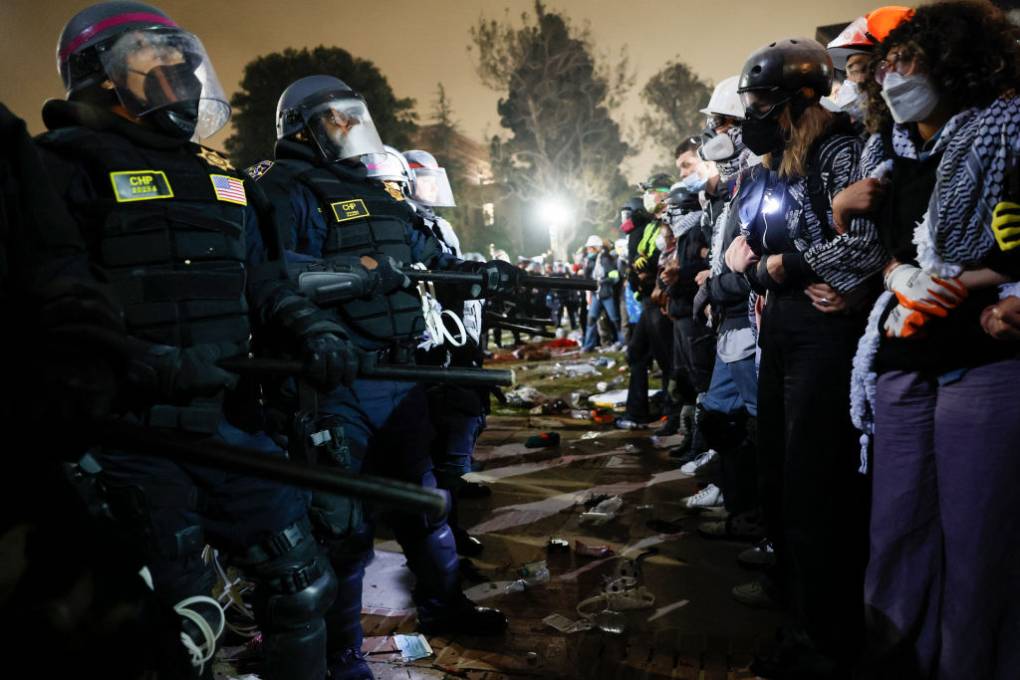
"caption": "Police face off with pro-Palestinian students after destroying part of the encampment barricade on the campus of the University of California, Los Angeles (UCLA) in Los Angeles, early on May 2, 2024. ",
"credit": "Etienne Laurent/AFP via Getty Images",
"altTag": null,
"description": null,
"imgSizes": {
"medium": {
"file": "https://cdn.kqed.org/wp-content/uploads/sites/10/2024/12/GettyImages-2150533164-800x534.jpg",
"width": 800,
"height": 534,
"mimeType": "image/jpeg"
},
"large": {
"file": "https://cdn.kqed.org/wp-content/uploads/sites/10/2024/12/GettyImages-2150533164-1020x680.jpg",
"width": 1020,
"height": 680,
"mimeType": "image/jpeg"
},
"thumbnail": {
"file": "https://cdn.kqed.org/wp-content/uploads/sites/10/2024/12/GettyImages-2150533164-160x107.jpg",
"width": 160,
"height": 107,
"mimeType": "image/jpeg"
},
"post-thumbnail": {
"file": "https://cdn.kqed.org/wp-content/uploads/sites/10/2024/12/GettyImages-2150533164-672x372.jpg",
"width": 672,
"height": 372,
"mimeType": "image/jpeg"
},
"twentyfourteen-full-width": {
"file": "https://cdn.kqed.org/wp-content/uploads/sites/10/2024/12/GettyImages-2150533164-1024x576.jpg",
"width": 1024,
"height": 576,
"mimeType": "image/jpeg"
},
"kqedFullSize": {
"file": "https://cdn.kqed.org/wp-content/uploads/sites/10/2024/12/GettyImages-2150533164.jpg",
"width": 1024,
"height": 683
}
},
"isLoading": false,
"fetchFailed": false
},
"news_12011174": {
"type": "attachments",
"id": "news_12011174",
"meta": {
"index": "attachments_1716263798",
"site": "news",
"id": "12011174",
"found": true
},
"title": "US-PALESTINIANS-ISRAEL-CONFLICT",
"publishDate": 1729884424,
"status": "inherit",
"parent": 12011165,
"modified": 1729884475,
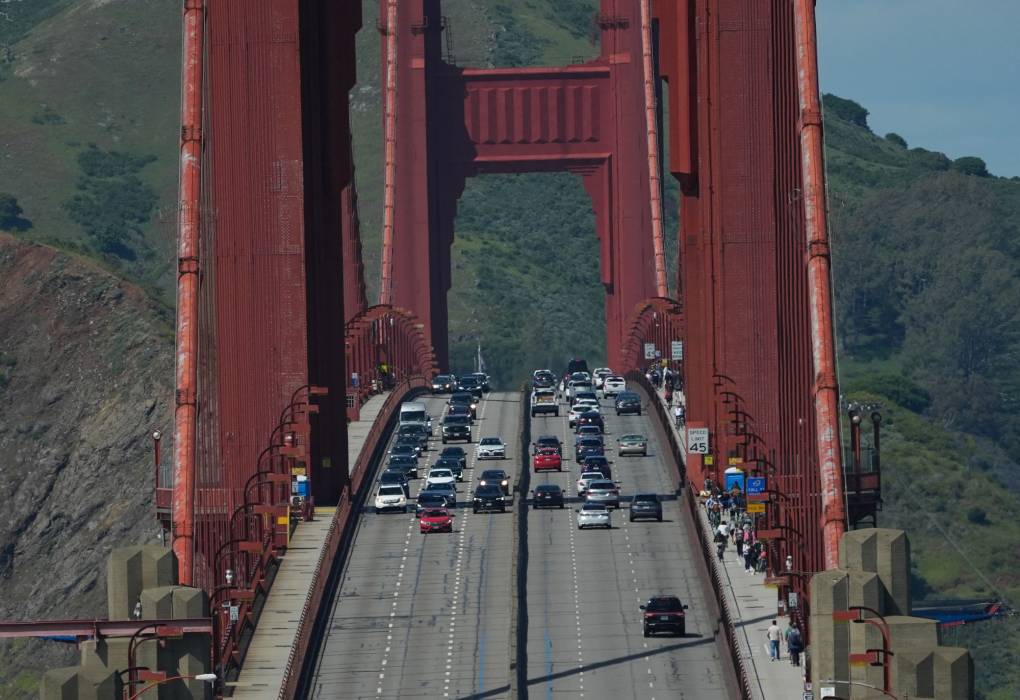
"caption": "Pro-Palestinian demonstrators blocked San Francisco's Golden Gate Bridge on April 15, 2024, completely halting traffic for hours as part of a coordinated day of action against Israel's war in Gaza.",
"credit": "Paul Kuroda / AFP via Getty Images",
"altTag": null,
"description": null,
"imgSizes": {
"medium": {
"file": "https://cdn.kqed.org/wp-content/uploads/sites/10/2024/10/GGBridgeProtestAprilGetty2-800x533.jpg",
"width": 800,
"height": 533,
"mimeType": "image/jpeg"
},
"large": {
"file": "https://cdn.kqed.org/wp-content/uploads/sites/10/2024/10/GGBridgeProtestAprilGetty2-1020x680.jpg",
"width": 1020,
"height": 680,
"mimeType": "image/jpeg"
},
"thumbnail": {
"file": "https://cdn.kqed.org/wp-content/uploads/sites/10/2024/10/GGBridgeProtestAprilGetty2-160x107.jpg",
"width": 160,
"height": 107,
"mimeType": "image/jpeg"
},
"1536x1536": {
"file": "https://cdn.kqed.org/wp-content/uploads/sites/10/2024/10/GGBridgeProtestAprilGetty2-1536x1024.jpg",
"width": 1536,
"height": 1024,
"mimeType": "image/jpeg"
},
"post-thumbnail": {
"file": "https://cdn.kqed.org/wp-content/uploads/sites/10/2024/10/GGBridgeProtestAprilGetty2-672x372.jpg",
"width": 672,
"height": 372,
"mimeType": "image/jpeg"
},
"twentyfourteen-full-width": {
"file": "https://cdn.kqed.org/wp-content/uploads/sites/10/2024/10/GGBridgeProtestAprilGetty2-1038x576.jpg",
"width": 1038,
"height": 576,
"mimeType": "image/jpeg"
},
"full-width": {
"file": "https://cdn.kqed.org/wp-content/uploads/sites/10/2024/10/GGBridgeProtestAprilGetty2-1920x1280.jpg",
"width": 1920,
"height": 1280,
"mimeType": "image/jpeg"
},
"kqedFullSize": {
"file": "https://cdn.kqed.org/wp-content/uploads/sites/10/2024/10/GGBridgeProtestAprilGetty2.jpg",
"width": 2000,
"height": 1333
}
},
"isLoading": false,
"fetchFailed": false
},
"news_12010374": {
"type": "attachments",
"id": "news_12010374",
"meta": {
"index": "attachments_1716263798",
"site": "news",
"id": "12010374",
"found": true
},
"title": "US-PALESTINIANS-ISRAEL-CONFLICT",
"publishDate": 1729529558,
"status": "inherit",
"parent": 12010363,
"modified": 1777579705,
"caption": "Pro-Palestinian demonstrators blocked San Francisco's Golden Gate Bridge on April 15, 2024, completely halting traffic for hours as part of a coordinated day of action against Israel's war in Gaza.",
"credit": "Paul Kuroda/AFP via Getty Images",
"altTag": null,
"description": null,
"imgSizes": {
"medium": {
"file": "https://cdn.kqed.org/wp-content/uploads/sites/10/2024/10/GGBridgeProtestAprilGetty-800x549.jpg",
"width": 800,
"height": 549,
"mimeType": "image/jpeg"
},
"large": {
"file": "https://cdn.kqed.org/wp-content/uploads/sites/10/2024/10/GGBridgeProtestAprilGetty-1020x700.jpg",
"width": 1020,
"height": 700,
"mimeType": "image/jpeg"
},
"thumbnail": {
"file": "https://cdn.kqed.org/wp-content/uploads/sites/10/2024/10/GGBridgeProtestAprilGetty-160x110.jpg",
"width": 160,
"height": 110,
"mimeType": "image/jpeg"
},
"1536x1536": {
"file": "https://cdn.kqed.org/wp-content/uploads/sites/10/2024/10/GGBridgeProtestAprilGetty-1536x1054.jpg",
"width": 1536,
"height": 1054,
"mimeType": "image/jpeg"
},
"post-thumbnail": {
"file": "https://cdn.kqed.org/wp-content/uploads/sites/10/2024/10/GGBridgeProtestAprilGetty-672x372.jpg",
"width": 672,
"height": 372,
"mimeType": "image/jpeg"
},
"twentyfourteen-full-width": {
"file": "https://cdn.kqed.org/wp-content/uploads/sites/10/2024/10/GGBridgeProtestAprilGetty-1038x576.jpg",
"width": 1038,
"height": 576,
"mimeType": "image/jpeg"
},
"full-width": {
"file": "https://cdn.kqed.org/wp-content/uploads/sites/10/2024/10/GGBridgeProtestAprilGetty-1920x1317.jpg",
"width": 1920,
"height": 1317,
"mimeType": "image/jpeg"
},
"kqedFullSize": {
"file": "https://cdn.kqed.org/wp-content/uploads/sites/10/2024/10/GGBridgeProtestAprilGetty.jpg",
"width": 2000,
"height": 1372
}
},
"isLoading": false,
"fetchFailed": false
},
"news_12009086": {
"type": "attachments",
"id": "news_12009086",
"meta": {
"index": "attachments_1716263798",
"site": "news",
"id": "12009086",
"found": true
},
"title": "UC Santa Cruz Workers Strike Over Treatment Of Pro-Palestinian Protesters",
"publishDate": 1728668187,
"status": "inherit",
"parent": 12009083,
"modified": 1728939012,
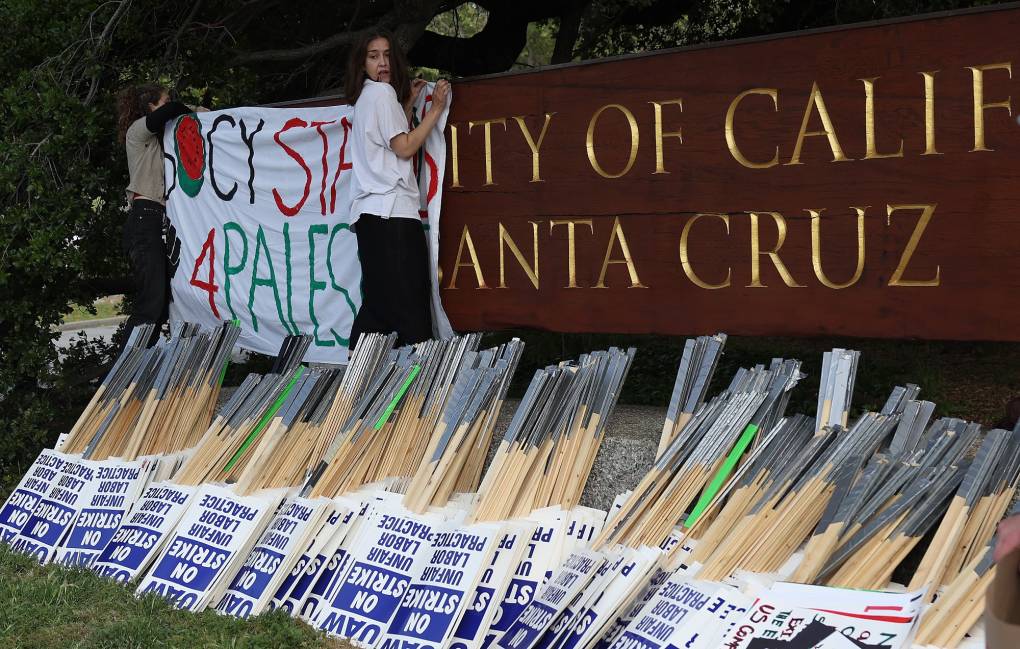
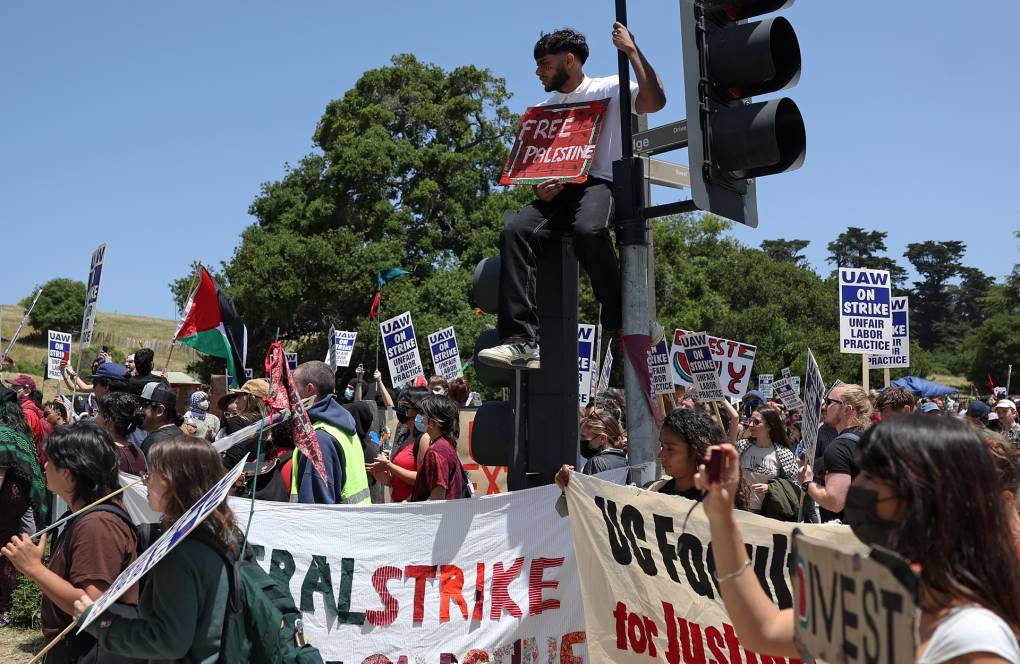
"caption": "Protesters set up a sign in front of the UC Santa Cruz campus on May 20, 2024, in Santa Cruz, California. Academic workers at the University of California, Santa Cruz, walked off the job Monday morning to strike in protest of the UC system’s handling of pro-Palestinian demonstrations. Organizers say the walkout will not last beyond June 30.",
"credit": "Justin Sullivan/Getty Images",
"altTag": null,
"description": null,
"imgSizes": {
"medium": {
"file": "https://cdn.kqed.org/wp-content/uploads/sites/10/2024/10/UCSantaCruzWalkoutMayGetty-800x509.jpg",
"width": 800,
"height": 509,
"mimeType": "image/jpeg"
},
"large": {
"file": "https://cdn.kqed.org/wp-content/uploads/sites/10/2024/10/UCSantaCruzWalkoutMayGetty-1020x649.jpg",
"width": 1020,
"height": 649,
"mimeType": "image/jpeg"
},
"thumbnail": {
"file": "https://cdn.kqed.org/wp-content/uploads/sites/10/2024/10/UCSantaCruzWalkoutMayGetty-160x102.jpg",
"width": 160,
"height": 102,
"mimeType": "image/jpeg"
},
"1536x1536": {
"file": "https://cdn.kqed.org/wp-content/uploads/sites/10/2024/10/UCSantaCruzWalkoutMayGetty-1536x978.jpg",
"width": 1536,
"height": 978,
"mimeType": "image/jpeg"
},
"post-thumbnail": {
"file": "https://cdn.kqed.org/wp-content/uploads/sites/10/2024/10/UCSantaCruzWalkoutMayGetty-672x372.jpg",
"width": 672,
"height": 372,
"mimeType": "image/jpeg"
},
"twentyfourteen-full-width": {
"file": "https://cdn.kqed.org/wp-content/uploads/sites/10/2024/10/UCSantaCruzWalkoutMayGetty-1038x576.jpg",
"width": 1038,
"height": 576,
"mimeType": "image/jpeg"
},
"full-width": {
"file": "https://cdn.kqed.org/wp-content/uploads/sites/10/2024/10/UCSantaCruzWalkoutMayGetty-1920x1222.jpg",
"width": 1920,
"height": 1222,
"mimeType": "image/jpeg"
},
"kqedFullSize": {
"file": "https://cdn.kqed.org/wp-content/uploads/sites/10/2024/10/UCSantaCruzWalkoutMayGetty.jpg",
"width": 2000,
"height": 1273
}
},
"isLoading": false,
"fetchFailed": false
},
"news_12008663": {
"type": "attachments",
"id": "news_12008663",
"meta": {
"index": "attachments_1716263798",
"site": "news",
"id": "12008663",
"found": true
},
"title": "241008-UCB CAMPUS WALKOUT-MD-09-KQED",
"publishDate": 1728431201,
"status": "inherit",
"parent": 12032046,
"modified": 1742415507,
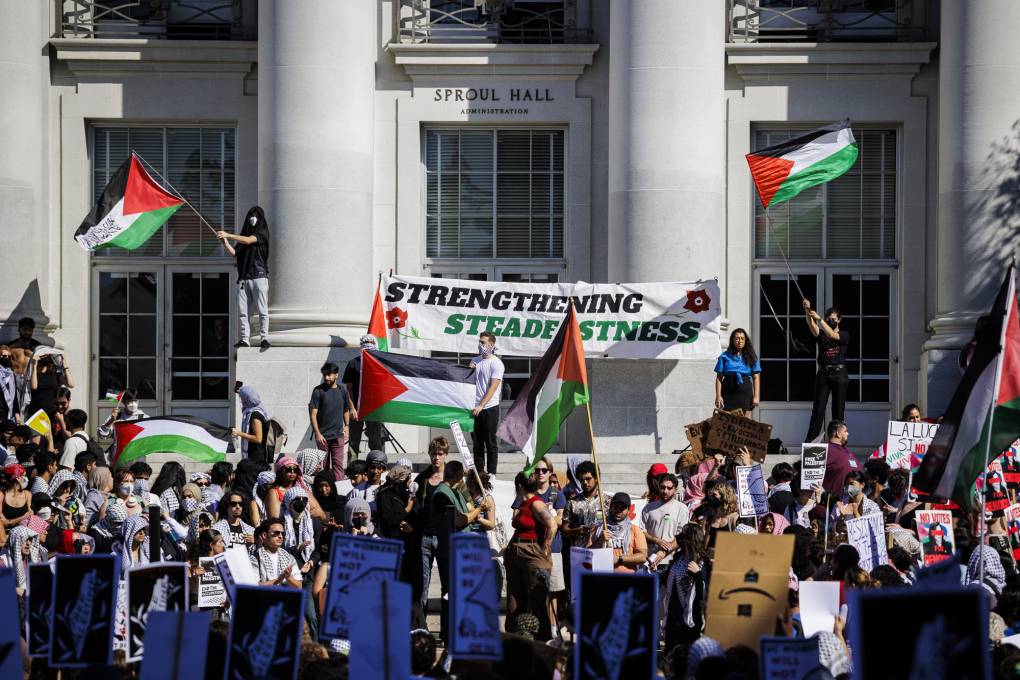
"caption": "A walkout and rally for Gaza and Lebanon at the University of California, Berkeley, on Oct. 8, 2024.",
"credit": "Martin do Nascimento/KQED",
"altTag": null,
"description": null,
"imgSizes": {
"medium": {
"file": "https://cdn.kqed.org/wp-content/uploads/sites/10/2024/10/241008-UCB-CAMPUS-WALKOUT-MD-09-KQED-800x533.jpg",
"width": 800,
"height": 533,
"mimeType": "image/jpeg"
},
"large": {
"file": "https://cdn.kqed.org/wp-content/uploads/sites/10/2024/10/241008-UCB-CAMPUS-WALKOUT-MD-09-KQED-1020x680.jpg",
"width": 1020,
"height": 680,
"mimeType": "image/jpeg"
},
"thumbnail": {
"file": "https://cdn.kqed.org/wp-content/uploads/sites/10/2024/10/241008-UCB-CAMPUS-WALKOUT-MD-09-KQED-160x107.jpg",
"width": 160,
"height": 107,
"mimeType": "image/jpeg"
},
"1536x1536": {
"file": "https://cdn.kqed.org/wp-content/uploads/sites/10/2024/10/241008-UCB-CAMPUS-WALKOUT-MD-09-KQED-1536x1024.jpg",
"width": 1536,
"height": 1024,
"mimeType": "image/jpeg"
},
"post-thumbnail": {
"file": "https://cdn.kqed.org/wp-content/uploads/sites/10/2024/10/241008-UCB-CAMPUS-WALKOUT-MD-09-KQED-672x372.jpg",
"width": 672,
"height": 372,
"mimeType": "image/jpeg"
},
"twentyfourteen-full-width": {
"file": "https://cdn.kqed.org/wp-content/uploads/sites/10/2024/10/241008-UCB-CAMPUS-WALKOUT-MD-09-KQED-1038x576.jpg",
"width": 1038,
"height": 576,
"mimeType": "image/jpeg"
},
"full-width": {
"file": "https://cdn.kqed.org/wp-content/uploads/sites/10/2024/10/241008-UCB-CAMPUS-WALKOUT-MD-09-KQED-1920x1280.jpg",
"width": 1920,
"height": 1280,
"mimeType": "image/jpeg"
},
"kqedFullSize": {
"file": "https://cdn.kqed.org/wp-content/uploads/sites/10/2024/10/241008-UCB-CAMPUS-WALKOUT-MD-09-KQED.jpg",
"width": 2000,
"height": 1333
}
},
"isLoading": false,
"fetchFailed": false
},
"news_11988048": {
"type": "attachments",
"id": "news_11988048",
"meta": {
"index": "attachments_1716263798",
"site": "news",
"id": "11988048",
"found": true
},
"title": "UC Santa Cruz Workers Strike Over Treatment Of Pro-Palestinian Protesters",
"publishDate": 1717006217,
"status": "inherit",
"parent": 11988039,
"modified": 1717006276,
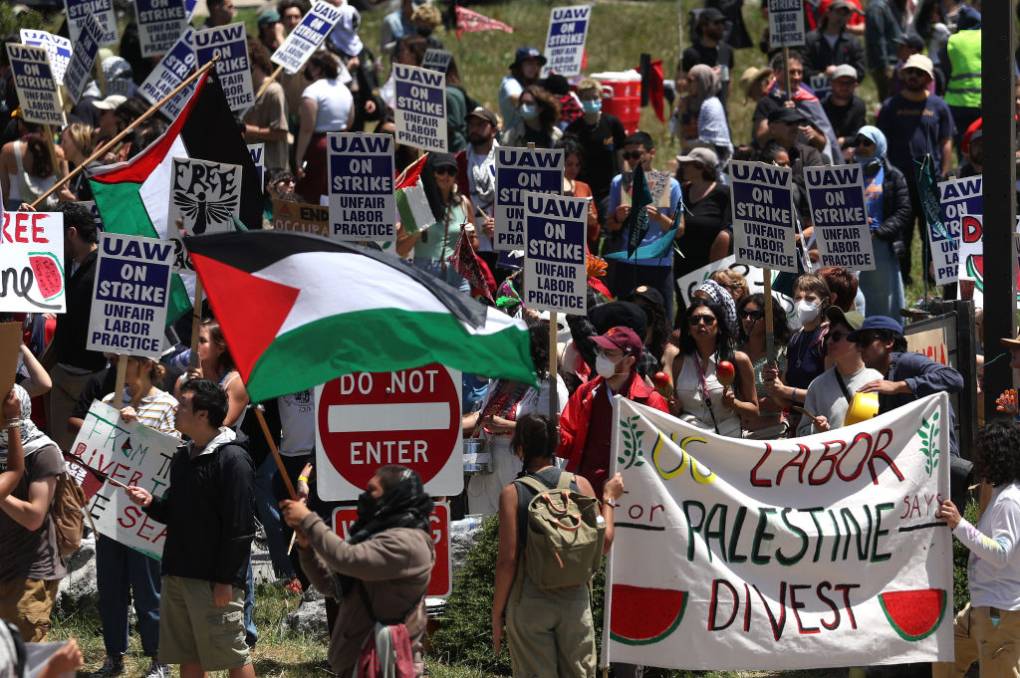
"caption": "UC Santa Cruz academic workers represented by UAW 4811 and pro-Palestinian protesters carry signs as they demonstrate in front of the campus on May 20, 2024.",
"credit": "Justin Sullivan/Getty Images",
"altTag": null,
"description": null,
"imgSizes": {
"medium": {
"file": "https://cdn.kqed.org/wp-content/uploads/sites/10/2024/05/GettyImages-2153876794-800x521.jpg",
"width": 800,
"height": 521,
"mimeType": "image/jpeg"
},
"large": {
"file": "https://cdn.kqed.org/wp-content/uploads/sites/10/2024/05/GettyImages-2153876794-1020x664.jpg",
"width": 1020,
"height": 664,
"mimeType": "image/jpeg"
},
"thumbnail": {
"file": "https://cdn.kqed.org/wp-content/uploads/sites/10/2024/05/GettyImages-2153876794-160x104.jpg",
"width": 160,
"height": 104,
"mimeType": "image/jpeg"
},
"1536x1536": {
"file": "https://cdn.kqed.org/wp-content/uploads/sites/10/2024/05/GettyImages-2153876794-1536x1000.jpg",
"width": 1536,
"height": 1000,
"mimeType": "image/jpeg"
},
"post-thumbnail": {
"file": "https://cdn.kqed.org/wp-content/uploads/sites/10/2024/05/GettyImages-2153876794-672x372.jpg",
"width": 672,
"height": 372,
"mimeType": "image/jpeg"
},
"twentyfourteen-full-width": {
"file": "https://cdn.kqed.org/wp-content/uploads/sites/10/2024/05/GettyImages-2153876794-1038x576.jpg",
"width": 1038,
"height": 576,
"mimeType": "image/jpeg"
},
"kqedFullSize": {
"file": "https://cdn.kqed.org/wp-content/uploads/sites/10/2024/05/GettyImages-2153876794.jpg",
"width": 1920,
"height": 1250
}
},
"isLoading": false,
"fetchFailed": false
},
"news_11989566": {
"type": "attachments",
"id": "news_11989566",
"meta": {
"index": "attachments_1716263798",
"site": "news",
"id": "11989566",
"found": true
},
"title": "UC Santa Cruz Workers Strike Over Treatment Of Pro-Palestinian Protesters",
"publishDate": 1717880126,
"status": "inherit",
"parent": 11989563,
"modified": 1718040922,
"caption": "UC Santa Cruz workers who are union members of UAW 4811, part of the United Auto Workers, and pro-Palestinian protesters carry signs as they demonstrate in front of the UC Santa Cruz campus on May 20, 2024, in Santa Cruz. ",
"credit": "Justin Sullivan/Getty Images",
"altTag": null,
"description": null,
"imgSizes": {
"medium": {
"file": "https://cdn.kqed.org/wp-content/uploads/sites/10/2024/06/GettyImages-2153876773-800x532.jpg",
"width": 800,
"height": 532,
"mimeType": "image/jpeg"
},
"large": {
"file": "https://cdn.kqed.org/wp-content/uploads/sites/10/2024/06/GettyImages-2153876773-1020x678.jpg",
"width": 1020,
"height": 678,
"mimeType": "image/jpeg"
},
"thumbnail": {
"file": "https://cdn.kqed.org/wp-content/uploads/sites/10/2024/06/GettyImages-2153876773-160x106.jpg",
"width": 160,
"height": 106,
"mimeType": "image/jpeg"
},
"post-thumbnail": {
"file": "https://cdn.kqed.org/wp-content/uploads/sites/10/2024/06/GettyImages-2153876773-672x372.jpg",
"width": 672,
"height": 372,
"mimeType": "image/jpeg"
},
"twentyfourteen-full-width": {
"file": "https://cdn.kqed.org/wp-content/uploads/sites/10/2024/06/GettyImages-2153876773-1024x576.jpg",
"width": 1024,
"height": 576,
"mimeType": "image/jpeg"
},
"kqedFullSize": {
"file": "https://cdn.kqed.org/wp-content/uploads/sites/10/2024/06/GettyImages-2153876773.jpg",
"width": 1024,
"height": 681
}
},
"isLoading": false,
"fetchFailed": false
},
"news_12004878": {
"type": "attachments",
"id": "news_12004878",
"meta": {
"index": "attachments_1716263798",
"site": "news",
"id": "12004878",
"found": true
},
"title": "240415-880GazaProtest-015-BL_qed",
"publishDate": 1726514367,
"status": "inherit",
"parent": 12004860,
"modified": 1726514383,
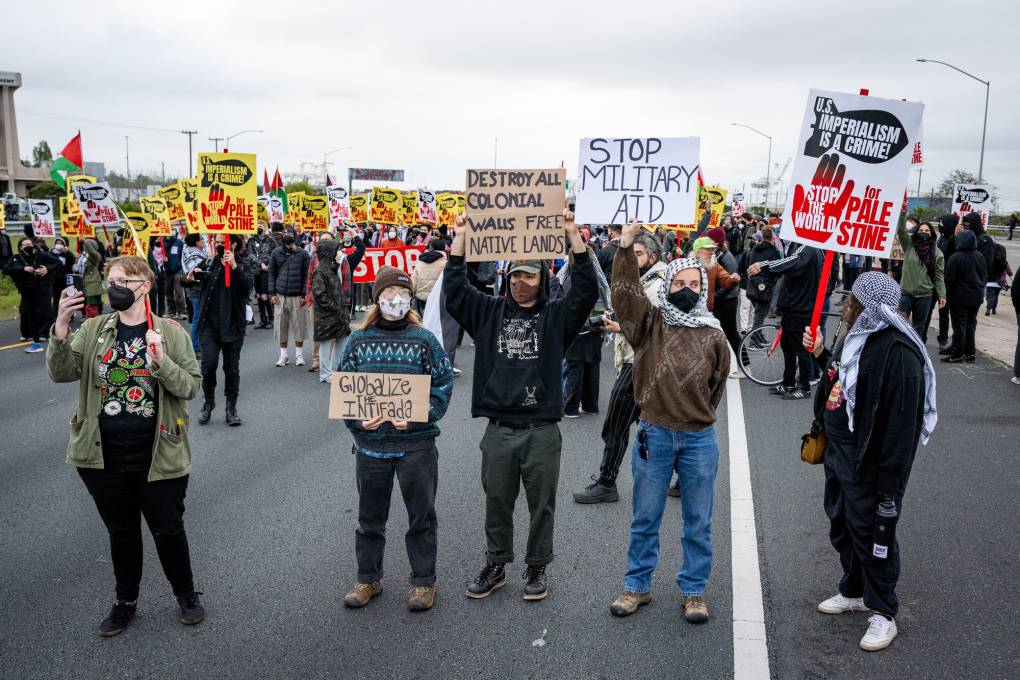
"caption": "Demonstrators shut down the southbound lanes of I-880 on the morning of April 15, 2024, in West Oakland. The protesters, engaging in a multi-city 'economic blockade in solidarity with Palestine,' marched from the West Oakland BART station to the 7th Street on-ramp and onto the freeway.",
"credit": "Beth LaBerge/KQED",
"altTag": null,
"description": null,
"imgSizes": {
"medium": {
"file": "https://cdn.kqed.org/wp-content/uploads/sites/10/2024/09/240415-880GazaProtest-015-BL_qed-800x533.jpg",
"width": 800,
"height": 533,
"mimeType": "image/jpeg"
},
"large": {
"file": "https://cdn.kqed.org/wp-content/uploads/sites/10/2024/09/240415-880GazaProtest-015-BL_qed-1020x680.jpg",
"width": 1020,
"height": 680,
"mimeType": "image/jpeg"
},
"thumbnail": {
"file": "https://cdn.kqed.org/wp-content/uploads/sites/10/2024/09/240415-880GazaProtest-015-BL_qed-160x107.jpg",
"width": 160,
"height": 107,
"mimeType": "image/jpeg"
},
"1536x1536": {
"file": "https://cdn.kqed.org/wp-content/uploads/sites/10/2024/09/240415-880GazaProtest-015-BL_qed-1536x1024.jpg",
"width": 1536,
"height": 1024,
"mimeType": "image/jpeg"
},
"post-thumbnail": {
"file": "https://cdn.kqed.org/wp-content/uploads/sites/10/2024/09/240415-880GazaProtest-015-BL_qed-672x372.jpg",
"width": 672,
"height": 372,
"mimeType": "image/jpeg"
},
"twentyfourteen-full-width": {
"file": "https://cdn.kqed.org/wp-content/uploads/sites/10/2024/09/240415-880GazaProtest-015-BL_qed-1038x576.jpg",
"width": 1038,
"height": 576,
"mimeType": "image/jpeg"
},
"full-width": {
"file": "https://cdn.kqed.org/wp-content/uploads/sites/10/2024/09/240415-880GazaProtest-015-BL_qed-1920x1280.jpg",
"width": 1920,
"height": 1280,
"mimeType": "image/jpeg"
},
"kqedFullSize": {
"file": "https://cdn.kqed.org/wp-content/uploads/sites/10/2024/09/240415-880GazaProtest-015-BL_qed.jpg",
"width": 2000,
"height": 1333
}
},
"isLoading": false,
"fetchFailed": false
},
"news_11987738": {
"type": "attachments",
"id": "news_11987738",
"meta": {
"index": "attachments_1716263798",
"site": "news",
"id": "11987738",
"found": true
},
"title": "UC Santa Cruz Workers Strike Over Treatment Of Pro-Palestinian Protesters",
"publishDate": 1716587632,
"status": "inherit",
"parent": 11987737,
"modified": 1716587703,
"caption": "UC Santa Cruz academic workers who are union members of UAW 4811 and pro-Palestinian protesters carry signs as they demonstrate in front of the campus on May 20, 2024.",
"credit": "Justin Sullivan/Getty Images",
"altTag": null,
"description": null,
"imgSizes": {
"medium": {
"file": "https://cdn.kqed.org/wp-content/uploads/sites/10/2024/05/GettyImages-2153876773-800x532.jpg",
"width": 800,
"height": 532,
"mimeType": "image/jpeg"
},
"large": {
"file": "https://cdn.kqed.org/wp-content/uploads/sites/10/2024/05/GettyImages-2153876773-1020x678.jpg",
"width": 1020,
"height": 678,
"mimeType": "image/jpeg"
},
"thumbnail": {
"file": "https://cdn.kqed.org/wp-content/uploads/sites/10/2024/05/GettyImages-2153876773-160x106.jpg",
"width": 160,
"height": 106,
"mimeType": "image/jpeg"
},
"1536x1536": {
"file": "https://cdn.kqed.org/wp-content/uploads/sites/10/2024/05/GettyImages-2153876773-1536x1021.jpg",
"width": 1536,
"height": 1021,
"mimeType": "image/jpeg"
},
"post-thumbnail": {
"file": "https://cdn.kqed.org/wp-content/uploads/sites/10/2024/05/GettyImages-2153876773-672x372.jpg",
"width": 672,
"height": 372,
"mimeType": "image/jpeg"
},
"twentyfourteen-full-width": {
"file": "https://cdn.kqed.org/wp-content/uploads/sites/10/2024/05/GettyImages-2153876773-1038x576.jpg",
"width": 1038,
"height": 576,
"mimeType": "image/jpeg"
},
"kqedFullSize": {
"file": "https://cdn.kqed.org/wp-content/uploads/sites/10/2024/05/GettyImages-2153876773.jpg",
"width": 1920,
"height": 1276
}
},
"isLoading": false,
"fetchFailed": false
},
"news_12003442": {
"type": "attachments",
"id": "news_12003442",
"meta": {
"index": "attachments_1716263798",
"site": "news",
"id": "12003442",
"found": true
},
"title": "UCSFProPalestineProtest1",
"publishDate": 1725654168,
"status": "inherit",
"parent": 12003439,
"modified": 1725666118,
"caption": "Denise Caramagno (left) and Leigh Kimberg protested Friday outside of UCSF. Caramagno, a former violence prevention advocate at the university, believes UCSF is firing her for speaking out about the war in Gaza. ",
"credit": "Katie DeBenedetti/KQED",
"altTag": null,
"description": null,
"imgSizes": {
"medium": {
"file": "https://cdn.kqed.org/wp-content/uploads/sites/10/2024/09/UCSFProPalestineProtest1-800x621.jpg",
"width": 800,
"height": 621,
"mimeType": "image/jpeg"
},
"large": {
"file": "https://cdn.kqed.org/wp-content/uploads/sites/10/2024/09/UCSFProPalestineProtest1-1020x792.jpg",
"width": 1020,
"height": 792,
"mimeType": "image/jpeg"
},
"thumbnail": {
"file": "https://cdn.kqed.org/wp-content/uploads/sites/10/2024/09/UCSFProPalestineProtest1-160x124.jpg",
"width": 160,
"height": 124,
"mimeType": "image/jpeg"
},
"1536x1536": {
"file": "https://cdn.kqed.org/wp-content/uploads/sites/10/2024/09/UCSFProPalestineProtest1-1536x1192.jpg",
"width": 1536,
"height": 1192,
"mimeType": "image/jpeg"
},
"post-thumbnail": {
"file": "https://cdn.kqed.org/wp-content/uploads/sites/10/2024/09/UCSFProPalestineProtest1-672x372.jpg",
"width": 672,
"height": 372,
"mimeType": "image/jpeg"
},
"twentyfourteen-full-width": {
"file": "https://cdn.kqed.org/wp-content/uploads/sites/10/2024/09/UCSFProPalestineProtest1-1038x576.jpg",
"width": 1038,
"height": 576,
"mimeType": "image/jpeg"
},
"full-width": {
"file": "https://cdn.kqed.org/wp-content/uploads/sites/10/2024/09/UCSFProPalestineProtest1-1920x1490.jpg",
"width": 1920,
"height": 1490,
"mimeType": "image/jpeg"
},
"kqedFullSize": {
"file": "https://cdn.kqed.org/wp-content/uploads/sites/10/2024/09/UCSFProPalestineProtest1.jpg",
"width": 2000,
"height": 1552
}
},
"isLoading": false,
"fetchFailed": false
},
"news_12001363": {
"type": "attachments",
"id": "news_12001363",
"meta": {
"index": "attachments_1716263798",
"site": "news",
"id": "12001363",
"found": true
},
"title": "240821-GAZACAMPUSPROTESTS-05-BL-KQED",
"publishDate": 1724346027,
"status": "inherit",
"parent": 0,
"modified": 1724346108,
"caption": "University of San Francisco student organizer Susu Steyteyieh poses for a photo on the campus in San Francisco on Aug. 21, 2024.",
"credit": "Beth LaBerge/KQED",
"altTag": null,
"description": null,
"imgSizes": {
"medium": {
"file": "https://cdn.kqed.org/wp-content/uploads/sites/10/2024/08/240821-GAZACAMPUSPROTESTS-05-BL-KQED-800x533.jpg",
"width": 800,
"height": 533,
"mimeType": "image/jpeg"
},
"large": {
"file": "https://cdn.kqed.org/wp-content/uploads/sites/10/2024/08/240821-GAZACAMPUSPROTESTS-05-BL-KQED-1020x680.jpg",
"width": 1020,
"height": 680,
"mimeType": "image/jpeg"
},
"thumbnail": {
"file": "https://cdn.kqed.org/wp-content/uploads/sites/10/2024/08/240821-GAZACAMPUSPROTESTS-05-BL-KQED-160x107.jpg",
"width": 160,
"height": 107,
"mimeType": "image/jpeg"
},
"1536x1536": {
"file": "https://cdn.kqed.org/wp-content/uploads/sites/10/2024/08/240821-GAZACAMPUSPROTESTS-05-BL-KQED-1536x1024.jpg",
"width": 1536,
"height": 1024,
"mimeType": "image/jpeg"
},
"post-thumbnail": {
"file": "https://cdn.kqed.org/wp-content/uploads/sites/10/2024/08/240821-GAZACAMPUSPROTESTS-05-BL-KQED-672x372.jpg",
"width": 672,
"height": 372,
"mimeType": "image/jpeg"
},
"twentyfourteen-full-width": {
"file": "https://cdn.kqed.org/wp-content/uploads/sites/10/2024/08/240821-GAZACAMPUSPROTESTS-05-BL-KQED-1038x576.jpg",
"width": 1038,
"height": 576,
"mimeType": "image/jpeg"
},
"full-width": {
"file": "https://cdn.kqed.org/wp-content/uploads/sites/10/2024/08/240821-GAZACAMPUSPROTESTS-05-BL-KQED-1920x1280.jpg",
"width": 1920,
"height": 1280,
"mimeType": "image/jpeg"
},
"kqedFullSize": {
"file": "https://cdn.kqed.org/wp-content/uploads/sites/10/2024/08/240821-GAZACAMPUSPROTESTS-05-BL-KQED.jpg",
"width": 2000,
"height": 1333
}
},
"isLoading": false,
"fetchFailed": false
},
"news_11996136": {
"type": "attachments",
"id": "news_11996136",
"meta": {
"index": "attachments_1716263798",
"site": "news",
"id": "11996136",
"found": true
},
"title": "021822-UCLA-Campus-File-RN-CM-45 copy",
"publishDate": 1721253071,
"status": "inherit",
"parent": 11996132,
"modified": 1721253164,
"caption": "The UCLA campus in Los Angeles on Feb. 18, 2022. \n",
"credit": "Raquel Natalicchio for CalMatters",
"altTag": null,
"description": null,
"imgSizes": {
"medium": {
"file": "https://cdn.kqed.org/wp-content/uploads/sites/10/2024/07/021822-UCLA-Campus-File-RN-CM-45-copy-800x532.jpg",
"width": 800,
"height": 532,
"mimeType": "image/jpeg"
},
"large": {
"file": "https://cdn.kqed.org/wp-content/uploads/sites/10/2024/07/021822-UCLA-Campus-File-RN-CM-45-copy-1020x679.jpg",
"width": 1020,
"height": 679,
"mimeType": "image/jpeg"
},
"thumbnail": {
"file": "https://cdn.kqed.org/wp-content/uploads/sites/10/2024/07/021822-UCLA-Campus-File-RN-CM-45-copy-160x106.jpg",
"width": 160,
"height": 106,
"mimeType": "image/jpeg"
},
"1536x1536": {
"file": "https://cdn.kqed.org/wp-content/uploads/sites/10/2024/07/021822-UCLA-Campus-File-RN-CM-45-copy-1536x1022.jpg",
"width": 1536,
"height": 1022,
"mimeType": "image/jpeg"
},
"post-thumbnail": {
"file": "https://cdn.kqed.org/wp-content/uploads/sites/10/2024/07/021822-UCLA-Campus-File-RN-CM-45-copy-672x372.jpg",
"width": 672,
"height": 372,
"mimeType": "image/jpeg"
},
"twentyfourteen-full-width": {
"file": "https://cdn.kqed.org/wp-content/uploads/sites/10/2024/07/021822-UCLA-Campus-File-RN-CM-45-copy-1038x576.jpg",
"width": 1038,
"height": 576,
"mimeType": "image/jpeg"
},
"full-width": {
"file": "https://cdn.kqed.org/wp-content/uploads/sites/10/2024/07/021822-UCLA-Campus-File-RN-CM-45-copy-1920x1278.jpg",
"width": 1920,
"height": 1278,
"mimeType": "image/jpeg"
},
"kqedFullSize": {
"file": "https://cdn.kqed.org/wp-content/uploads/sites/10/2024/07/021822-UCLA-Campus-File-RN-CM-45-copy.jpg",
"width": 2000,
"height": 1331
}
},
"isLoading": false,
"fetchFailed": false
}
},
"audioPlayerReducer": {
"postId": "stream_live",
"isPaused": true,
"isPlaying": false,
"pfsActive": false,
"pledgeModalIsOpen": true,
"playerDrawerIsOpen": false,
"liveAudioPlayStartedAt": 0,
"liveAudioPlayContext": ""
},
"authorsReducer": {
"byline_news_12019455": {
"type": "authors",
"id": "byline_news_12019455",
"meta": {
"override": true
},
"slug": "byline_news_12019455",
"name": "Jocelyn Gecker, The Associated Press",
"isLoading": false
},
"byline_news_11996132": {
"type": "authors",
"id": "byline_news_11996132",
"meta": {
"override": true
},
"slug": "byline_news_11996132",
"name": "\u003ca href=\"https://calmatters.org/author/mikhailzinshteyn/\">Mikhail Zinshteyn\u003c/a>, CalMatters",
"isLoading": false
},
"shossaini": {
"type": "authors",
"id": "3214",
"meta": {
"index": "authors_1716337520",
"id": "3214",
"found": true
},
"name": "Sara Hossaini",
"firstName": "Sara",
"lastName": "Hossaini",
"slug": "shossaini",
"email": "shossaini@kqed.org",
"display_author_email": true,
"staff_mastheads": [
"news"
],
"title": "KQED Reporter",
"bio": "Sara Hossaini came to general assignment reporting at KQED in 2013 after two winters reporting at Wyoming Public Radio. She holds a bachelor's degree in broadcast journalism from the University of Nebraska-Lincoln. Her radio romance began after a bitter breakup with documentary film (Ok, maybe it's still complicated). Her first simultaneous jobs in San Francisco were as Associate Producer on a PBS film series through the Center for Asian American Media and as a butler. She likes to trot, plot and make things with her hands.",
"avatar": "https://secure.gravatar.com/avatar/060e9f56b9554e17942e89f413242774?s=600&d=blank&r=g",
"twitter": "mshossaini",
"facebook": null,
"instagram": null,
"linkedin": null,
"sites": [
{
"site": "news",
"roles": [
"author"
]
},
{
"site": "stateofhealth",
"roles": [
"author"
]
}
],
"headData": {
"title": "Sara Hossaini | KQED",
"description": "KQED Reporter",
"ogImgSrc": "https://secure.gravatar.com/avatar/060e9f56b9554e17942e89f413242774?s=600&d=blank&r=g",
"twImgSrc": "https://secure.gravatar.com/avatar/060e9f56b9554e17942e89f413242774?s=600&d=blank&r=g"
},
"isLoading": false,
"link": "/author/shossaini"
},
"jlara": {
"type": "authors",
"id": "11761",
"meta": {
"index": "authors_1716337520",
"id": "11761",
"found": true
},
"name": "Juan Carlos Lara",
"firstName": "Juan Carlos",
"lastName": "Lara",
"slug": "jlara",
"email": "jlara@kqed.org",
"display_author_email": false,
"staff_mastheads": [],
"title": "KQED Contributor",
"bio": null,
"avatar": "https://secure.gravatar.com/avatar/19e2052b9b05657c5ff2af2121846e9c?s=600&d=blank&r=g",
"twitter": null,
"facebook": null,
"instagram": null,
"linkedin": null,
"sites": [
{
"site": "arts",
"roles": [
"editor"
]
},
{
"site": "news",
"roles": [
"editor"
]
},
{
"site": "forum",
"roles": [
"editor"
]
},
{
"site": "liveblog",
"roles": [
"contributor"
]
}
],
"headData": {
"title": "Juan Carlos Lara | KQED",
"description": "KQED Contributor",
"ogImgSrc": "https://secure.gravatar.com/avatar/19e2052b9b05657c5ff2af2121846e9c?s=600&d=blank&r=g",
"twImgSrc": "https://secure.gravatar.com/avatar/19e2052b9b05657c5ff2af2121846e9c?s=600&d=blank&r=g"
},
"isLoading": false,
"link": "/author/jlara"
},
"kdebenedetti": {
"type": "authors",
"id": "11913",
"meta": {
"index": "authors_1716337520",
"id": "11913",
"found": true
},
"name": "Katie DeBenedetti",
"firstName": "Katie",
"lastName": "DeBenedetti",
"slug": "kdebenedetti",
"email": "kdebenedetti@kqed.org",
"display_author_email": false,
"staff_mastheads": [
"news",
"science"
],
"title": "KQED Contributor",
"bio": "Katie DeBenedetti is a digital reporter covering daily news for the Express Desk. Prior to joining KQED as a culture reporting intern in January 2024, she covered education and city government for the Napa Valley Register.",
"avatar": "https://secure.gravatar.com/avatar/6e31073cb8f7e4214ab03f42771d0f45?s=600&d=blank&r=g",
"twitter": null,
"facebook": null,
"instagram": null,
"linkedin": null,
"sites": [
{
"site": "news",
"roles": [
"author"
]
},
{
"site": "science",
"roles": [
"author"
]
},
{
"site": "liveblog",
"roles": [
"author"
]
}
],
"headData": {
"title": "Katie DeBenedetti | KQED",
"description": "KQED Contributor",
"ogImgSrc": "https://secure.gravatar.com/avatar/6e31073cb8f7e4214ab03f42771d0f45?s=600&d=blank&r=g",
"twImgSrc": "https://secure.gravatar.com/avatar/6e31073cb8f7e4214ab03f42771d0f45?s=600&d=blank&r=g"
},
"isLoading": false,
"link": "/author/kdebenedetti"
},
"emanoukian": {
"type": "authors",
"id": "11925",
"meta": {
"index": "authors_1716337520",
"id": "11925",
"found": true
},
"name": "Elize Manoukian",
"firstName": "Elize",
"lastName": "Manoukian",
"slug": "emanoukian",
"email": "emanoukian@KQED.org",
"display_author_email": false,
"staff_mastheads": [
"news"
],
"title": "Digital News Editor",
"bio": "Elize Manoukian is an award-winning audio producer and Senior Editor on the Express Desk, KQED's digital news platform. Her work has appeared on KPFA, Interlochen Public Radio, Oregon Public Broadcast, the New York Daily News, LA Times and the San Diego Union-Tribune.",
"avatar": "https://secure.gravatar.com/avatar/4525f1a8e46ccb30933b32653d9772064cfefe3fa655eb45b3b3a80341f6bdad?s=600&d=blank&r=g",
"twitter": null,
"bluesky": null,
"facebook": null,
"instagram": null,
"linkedin": null,
"sites": [
{
"site": "arts",
"roles": [
"editor"
]
},
{
"site": "news",
"roles": [
"editor"
]
},
{
"site": "science",
"roles": [
"editor"
]
}
],
"headData": {
"title": "Elize Manoukian | KQED",
"description": "Digital News Editor",
"ogImgSrc": "https://secure.gravatar.com/avatar/4525f1a8e46ccb30933b32653d9772064cfefe3fa655eb45b3b3a80341f6bdad?s=600&d=blank&r=g",
"twImgSrc": "https://secure.gravatar.com/avatar/4525f1a8e46ccb30933b32653d9772064cfefe3fa655eb45b3b3a80341f6bdad?s=600&d=blank&r=g"
},
"isLoading": false,
"link": "/author/emanoukian"
}
},
"pagesReducer": {
"news_tag_pro-palestinian-protest": {
"type": "terms",
"id": "news_33647",
"meta": {
"index": "terms_1716263798",
"site": "news",
"id": "33647",
"score": 10.403188
},
"featImg": null,
"name": "pro-palestinian protest",
"description": null,
"taxonomy": "tag",
"headData": {
"twImgId": null,
"twTitle": null,
"ogTitle": null,
"ogImgId": null,
"twDescription": null,
"description": null,
"title": "pro-palestinian protest Archives | KQED News",
"ogDescription": null
},
"ttid": 33664,
"slug": "pro-palestinian-protest",
"isLoading": false,
"title": "pro-palestinian protest",
"pageMeta": {
"site": "news",
"WpPageTemplate": "page-topic-editorial",
"currentPage": 4
},
"blocks": [
{
"blockName": "kqed/post-list",
"attrs": {
"layout": "cardArticle2",
"query": "posts/news?tag=pro-palestinian-protest",
"seeMore": false,
"paginated": true,
"page": 4
}
},
{
"blockName": "kqed/ad"
}
]
}
},
"pfsSessionReducer": {},
"postsReducer": {
"stream_live": {
"type": "live",
"id": "stream_live",
"audioUrl": "https://streams.kqed.org/kqedradio",
"title": "Live Stream",
"excerpt": "Live Stream information currently unavailable.",
"link": "/radio",
"featImg": "",
"label": {
"name": "KQED Live",
"link": "/"
}
},
"stream_kqedNewscast": {
"type": "posts",
"id": "stream_kqedNewscast",
"audioUrl": "https://www.kqed.org/.stream/anon/radio/RDnews/newscast.mp3?_=1",
"title": "KQED Newscast",
"featImg": "",
"label": {
"name": "88.5 FM",
"link": "/"
}
},
"news_12019455": {
"type": "posts",
"id": "news_12019455",
"meta": {
"index": "posts_1716263798",
"site": "news",
"id": "12019455",
"score": null,
"sort": [
1734740806000
]
},
"guestAuthors": [],
"slug": "uc-campuses-resolve-discrimination-complaints-stemming-from-gaza-protests",
"title": "UC Campuses Resolve Discrimination Complaints Stemming From Gaza Protests",
"publishDate": 1734740806,
"format": "standard",
"headTitle": "UC Campuses Resolve Discrimination Complaints Stemming From Gaza Protests | KQED",
"labelTerm": {
"site": "news"
},
"content": "\u003cp>The U.S. Department of Education said Friday it has reached an agreement with the University of California system resolving complaints from Jewish and Muslim students of discrimination and harassment during \u003ca href=\"https://apnews.com/article/israel-palestinian-campus-student-protests-war-c6e5549532c85f13493daa22d0d143ac\">protests last spring\u003c/a> over the war in Gaza.\u003c/p>\n\u003cp>The department’s Office for Civil Rights said it investigated nine complaints against University of California schools in Los Angeles (UCLA), Santa Barbara, San Diego, Davis and Santa Cruz. The complaints alleged the schools failed to respond effectively to anti-Semitic and anti-Arab harassment.\u003c/p>\n\u003cp>The civil rights office concluded the universities “appear not to have responded promptly or effectively” to allegations of discrimination and harassment that were brought to the administrations’ attention.\u003c/p>\n\u003cp>[ad fullwidth]\u003c/p>\n\u003cp>Under the agreement, the schools must step up reporting of complaints to the OCR office and review all complaints and reports of harassment from the past two academic years to determine if further action is needed. The agreement also calls for more training of university employees and campus police officers about their obligations under federal law.\u003c/p>\n\u003cp>The University of California system said the agreement is one of several steps it is taking to ensure its campuses are respectful and welcoming to all.\u003c/p>\n\u003cp>“Ensuring an inclusive University environment requires sustained focus and action,” the system said in a written statement.\u003c/p>\n\u003cp>Colleges and universities nationwide saw tension and at times violence \u003ca href=\"https://apnews.com/article/college-protest-israel-hamas-war-arrest-charges-7cb75debddc2e8bd795d16515d07de09\">erupt on campuses\u003c/a> after the onset of the Israel-Hamas war, with dueling campus rallies and widespread allegations of anti-Semitism and anti-Arab harassment.\u003c/p>\n\u003cp>The Department of Education has been investigating dozens of complaints that campuses violated Title VI, which bars discrimination or harassment on the basis of race, color and national origin at colleges and universities that receive federal funding. Examples of harassment can include slurs, taunts, stereotypes, name-calling and racially motivated attacks or hateful conduct, according to the department’s website.\u003c/p>\n\u003cp>The department reached a similar \u003ca href=\"https://apnews.com/article/brown-university-discrimination-harassment-agreement-c795628a9f53df2a91b4d4086cc0629d\">agreement with Brown University\u003c/a> in July.\u003c/p>\n\u003cp>A separate investigation found the University of Cincinnati did not respond appropriately to reports of harassment, the Office of Civil Rights said Friday. Examples from some two dozen complaints include a Palestinian student who reported receiving death threats, which the university did not investigate, and a Jewish student whose home was egged and smeared with feces. Like the University of California, Cincinnati agreed to take steps to improve compliance with Title VI.[aside label=\"Related Stories\" postID=\"news_12000859,news_12001778,news_12005478\"]UCLA’s \u003ca href=\"https://apnews.com/article/ucla-palestine-gaza-protests-783ea2f4ba88a8cfa2fa15c5ae5ba611\">handling of dispersing its encampment\u003c/a> in the spring drew widespread criticism. Chaos erupted after hundreds of protesters defied orders from campus police to leave the encampment. One night, counter-protesters attacked the pro-Palestinian encampment, throwing traffic cones and firing pepper spray, with fighting that continued for hours before police stepped in.\u003c/p>\n\u003cp>The investigation into UCLA stemmed partly from concerns of compliance related to about 150 reports the school received about rallies in October and November 2023 as well as a pro-Palestinian encampment in the spring, the department said.\u003c/p>\n\u003cp>“Of particular concern were reports of violence against students of Jewish ancestry … and of a violent assault by counter-protesters on pro-Palestinian protesters” at the encampment, the department said.\u003c/p>\n\u003cp>At rallies, protesters chanted “death to Israel” and “no peace until they’re dead,” the department said. At the encampment, protesters maintained checkpoints that excluded Jewish students from the protest area and parts of the campus, prompting the school’s chancellor to issue a statement saying Jewish students on campus, among others, felt “a state of anxiety and fear.”\u003c/p>\n\u003cp>Muslim and Palestinian students experienced “unwanted filming, doxing, and being followed” on or near the UCLA campus, the department said. A task force report cited by the department said counter-protesters heckled people inside the encampment, saying things like, “you’re a jihadist,” and “you’re a terrorist.”\u003c/p>\n\u003cp>The four other UC campuses also had “widely reported incidents” of alleged harassment against students, the civil rights office said. UC Santa Barbara was notified of anti-Semitic vandalism at a dorm and signs posted at a student center that targeted Jewish students by name; UC San Diego and UC Davis also received complaints about students experiencing or witnessing anti-Semitic comments or actions by students and professors.\u003c/p>\n\u003cp>\u003c/p>\n",
"blocks": [],
"excerpt": "The US Department of Education's Office for Civil Rights said it investigated nine complaints against University of California schools in Los Angeles (UCLA), Santa Barbara, San Diego, Davis and Santa Cruz.",
"status": "publish",
"parent": 0,
"modified": 1734741461,
"stats": {
"hasAudio": false,
"hasVideo": false,
"hasChartOrMap": false,
"iframeSrcs": [],
"hasGoogleForm": false,
"hasGallery": false,
"hasHearkenModule": false,
"hasPolis": false,
"paragraphCount": 17,
"wordCount": 732
},
"headData": {
"title": "UC Campuses Resolve Discrimination Complaints Stemming From Gaza Protests | KQED",
"description": "The US Department of Education's Office for Civil Rights said it investigated nine complaints against University of California schools in Los Angeles (UCLA), Santa Barbara, San Diego, Davis and Santa Cruz.",
"ogTitle": "",
"ogDescription": "",
"ogImgId": "",
"twTitle": "",
"twDescription": "",
"twImgId": "",
"schema": {
"@context": "https://schema.org",
"@type": "NewsArticle",
"headline": "UC Campuses Resolve Discrimination Complaints Stemming From Gaza Protests",
"datePublished": "2024-12-20T16:26:46-08:00",
"dateModified": "2024-12-20T16:37:41-08:00",
"image": "https://cdn.kqed.org/wp-content/uploads/2020/02/KQED-OG-Image@1x.png",
"isAccessibleForFree": "True",
"publisher": {
"@type": "NewsMediaOrganization",
"@id": "https://www.kqed.org/#organization",
"name": "KQED",
"logo": "https://cdn.kqed.org/wp-content/uploads/2020/02/KQED-OG-Image@1x.png",
"url": "https://www.kqed.org",
"sameAs": [
"https://www.facebook.com/KQED",
"https://twitter.com/KQED",
"https://www.instagram.com/kqed/",
"https://www.tiktok.com/@kqedofficial",
"https://www.linkedin.com/company/kqed",
"https://www.youtube.com/channel/UCeC0IOo7i1P_61zVUWbJ4nw"
]
}
}
},
"sticky": false,
"nprByline": "Jocelyn Gecker, The Associated Press",
"nprStoryId": "kqed-12019455",
"excludeFromSiteSearch": "Include",
"showOnAuthorArchivePages": "No",
"articleAge": "0",
"path": "/news/12019455/uc-campuses-resolve-discrimination-complaints-stemming-from-gaza-protests",
"audioTrackLength": null,
"parsedContent": [
{
"type": "contentString",
"content": "\u003cdiv class=\"post-body\">\u003cp>\u003cp>The U.S. Department of Education said Friday it has reached an agreement with the University of California system resolving complaints from Jewish and Muslim students of discrimination and harassment during \u003ca href=\"https://apnews.com/article/israel-palestinian-campus-student-protests-war-c6e5549532c85f13493daa22d0d143ac\">protests last spring\u003c/a> over the war in Gaza.\u003c/p>\n\u003cp>The department’s Office for Civil Rights said it investigated nine complaints against University of California schools in Los Angeles (UCLA), Santa Barbara, San Diego, Davis and Santa Cruz. The complaints alleged the schools failed to respond effectively to anti-Semitic and anti-Arab harassment.\u003c/p>\n\u003cp>The civil rights office concluded the universities “appear not to have responded promptly or effectively” to allegations of discrimination and harassment that were brought to the administrations’ attention.\u003c/p>\n\u003cp>\u003c/p>\u003c/div>",
"attributes": {
"named": {},
"numeric": []
}
},
{
"type": "component",
"content": "",
"name": "ad",
"attributes": {
"named": {
"label": "fullwidth"
},
"numeric": [
"fullwidth"
]
}
},
{
"type": "contentString",
"content": "\u003cdiv class=\"post-body\">\u003cp>\u003c/p>\n\u003cp>Under the agreement, the schools must step up reporting of complaints to the OCR office and review all complaints and reports of harassment from the past two academic years to determine if further action is needed. The agreement also calls for more training of university employees and campus police officers about their obligations under federal law.\u003c/p>\n\u003cp>The University of California system said the agreement is one of several steps it is taking to ensure its campuses are respectful and welcoming to all.\u003c/p>\n\u003cp>“Ensuring an inclusive University environment requires sustained focus and action,” the system said in a written statement.\u003c/p>\n\u003cp>Colleges and universities nationwide saw tension and at times violence \u003ca href=\"https://apnews.com/article/college-protest-israel-hamas-war-arrest-charges-7cb75debddc2e8bd795d16515d07de09\">erupt on campuses\u003c/a> after the onset of the Israel-Hamas war, with dueling campus rallies and widespread allegations of anti-Semitism and anti-Arab harassment.\u003c/p>\n\u003cp>The Department of Education has been investigating dozens of complaints that campuses violated Title VI, which bars discrimination or harassment on the basis of race, color and national origin at colleges and universities that receive federal funding. Examples of harassment can include slurs, taunts, stereotypes, name-calling and racially motivated attacks or hateful conduct, according to the department’s website.\u003c/p>\n\u003cp>The department reached a similar \u003ca href=\"https://apnews.com/article/brown-university-discrimination-harassment-agreement-c795628a9f53df2a91b4d4086cc0629d\">agreement with Brown University\u003c/a> in July.\u003c/p>\n\u003cp>A separate investigation found the University of Cincinnati did not respond appropriately to reports of harassment, the Office of Civil Rights said Friday. Examples from some two dozen complaints include a Palestinian student who reported receiving death threats, which the university did not investigate, and a Jewish student whose home was egged and smeared with feces. Like the University of California, Cincinnati agreed to take steps to improve compliance with Title VI.\u003c/p>\u003c/div>",
"attributes": {
"named": {},
"numeric": []
}
},
{
"type": "component",
"content": "",
"name": "aside",
"attributes": {
"named": {
"label": "Related Stories ",
"postid": "news_12000859,news_12001778,news_12005478"
},
"numeric": []
}
},
{
"type": "contentString",
"content": "\u003cdiv class=\"post-body\">\u003cp>UCLA’s \u003ca href=\"https://apnews.com/article/ucla-palestine-gaza-protests-783ea2f4ba88a8cfa2fa15c5ae5ba611\">handling of dispersing its encampment\u003c/a> in the spring drew widespread criticism. Chaos erupted after hundreds of protesters defied orders from campus police to leave the encampment. One night, counter-protesters attacked the pro-Palestinian encampment, throwing traffic cones and firing pepper spray, with fighting that continued for hours before police stepped in.\u003c/p>\n\u003cp>The investigation into UCLA stemmed partly from concerns of compliance related to about 150 reports the school received about rallies in October and November 2023 as well as a pro-Palestinian encampment in the spring, the department said.\u003c/p>\n\u003cp>“Of particular concern were reports of violence against students of Jewish ancestry … and of a violent assault by counter-protesters on pro-Palestinian protesters” at the encampment, the department said.\u003c/p>\n\u003cp>At rallies, protesters chanted “death to Israel” and “no peace until they’re dead,” the department said. At the encampment, protesters maintained checkpoints that excluded Jewish students from the protest area and parts of the campus, prompting the school’s chancellor to issue a statement saying Jewish students on campus, among others, felt “a state of anxiety and fear.”\u003c/p>\n\u003cp>Muslim and Palestinian students experienced “unwanted filming, doxing, and being followed” on or near the UCLA campus, the department said. A task force report cited by the department said counter-protesters heckled people inside the encampment, saying things like, “you’re a jihadist,” and “you’re a terrorist.”\u003c/p>\n\u003cp>The four other UC campuses also had “widely reported incidents” of alleged harassment against students, the civil rights office said. UC Santa Barbara was notified of anti-Semitic vandalism at a dorm and signs posted at a student center that targeted Jewish students by name; UC San Diego and UC Davis also received complaints about students experiencing or witnessing anti-Semitic comments or actions by students and professors.\u003c/p>\n\u003cp>\u003c/p>\n\u003c/div>\u003c/p>",
"attributes": {
"named": {},
"numeric": []
}
}
],
"link": "/news/12019455/uc-campuses-resolve-discrimination-complaints-stemming-from-gaza-protests",
"authors": [
"byline_news_12019455"
],
"categories": [
"news_18540",
"news_8"
],
"tags": [
"news_20228",
"news_21892",
"news_33647",
"news_22646",
"news_206"
],
"featImg": "news_12019461",
"label": "news"
},
"news_12011165": {
"type": "posts",
"id": "news_12011165",
"meta": {
"index": "posts_1716263798",
"site": "news",
"id": "12011165",
"score": null,
"sort": [
1732318977000
]
},
"guestAuthors": [],
"slug": "felony-charges-against-golden-gate-bridge-protesters-can-go-to-trial-judge-rules",
"title": "Felony Charges Against Golden Gate Bridge Protesters Can Go to Trial, Judge Rules",
"publishDate": 1732318977,
"format": "standard",
"headTitle": "Felony Charges Against Golden Gate Bridge Protesters Can Go to Trial, Judge Rules | KQED",
"labelTerm": {
"site": "news"
},
"content": "\u003cp>A San Francisco judge ruled Friday that felony charges against seven activists involved in a pro-Palestinian protest that shut down the Golden Gate Bridge in April can go to trial, but over half of the charges were dropped.\u003c/p>\n\u003cp>More than a month after \u003ca href=\"https://www.kqed.org/news/12010363/golden-gate-bridge-protesters-await-judicial-ruling-on-felony-charges\">the protesters’ preliminary hearing\u003c/a> began, Judge Brendan P. Conroy threw out more than 25 counts against seven of the eight defendants — and charges against one of the defendants entirely — due to lack of evidence.\u003c/p>\n\u003cp>But he declined defense attorneys’ motion to downgrade the felony conspiracy charges, saying there had not been enough discussion about how the Golden Gate Bridge Authority and potential other alleged victims in the case would be compensated for their losses due to the protest.\u003c/p>\n\u003cp>“The elephant in the room here is that there is a request for at least $160,000 in restitution,” Conroy said, referring to the Golden Gate Bridge Authority’s estimate of lost revenue from toll payments.\u003c/p>\n\u003cp>[ad fullwidth]\u003c/p>\n\u003cp>The eight activists face the most serious charges — including felony conspiracy — \u003ca href=\"https://www.kqed.org/news/11999854/golden-gate-bridge-protesters-surrender-to-face-controversial-false-imprisonment-charges\">out of the 26 who were arrested\u003c/a> in connection with the protest that \u003ca href=\"https://www.kqed.org/news/11982940/protesters-shut-down-880-freeway-in-oakland-as-part-of-economic-blockade-for-gaza\">shut down traffic on the Golden Gate Bridge\u003c/a>. Their actions were part of a multi-city effort to disrupt local and global economies and put pressure on the U.S. government to halt support for Israel’s war in Gaza, which it launched after Hamas’ attack on Israel on Oct. 7.\u003c/p>\n\u003cp>Around 7:30 a.m. on April 15, the protesters chained themselves to stopped vehicles and each other across the southbound lanes of the bridge, according to a statement from the California Highway Patrol. The demonstration shut down traffic in both directions for about four hours.\u003c/p>\n\u003cfigure id=\"attachment_12010374\" class=\"wp-caption aligncenter\" style=\"max-width: 2000px\">\u003cimg loading=\"lazy\" decoding=\"async\" class=\"size-full wp-image-12010374\" src=\"https://cdn.kqed.org/wp-content/uploads/sites/10/2024/10/GGBridgeProtestAprilGetty.jpg\" alt=\"\" width=\"2000\" height=\"1372\" srcset=\"https://cdn.kqed.org/wp-content/uploads/sites/10/2024/10/GGBridgeProtestAprilGetty.jpg 2000w, https://cdn.kqed.org/wp-content/uploads/sites/10/2024/10/GGBridgeProtestAprilGetty-800x549.jpg 800w, https://cdn.kqed.org/wp-content/uploads/sites/10/2024/10/GGBridgeProtestAprilGetty-1020x700.jpg 1020w, https://cdn.kqed.org/wp-content/uploads/sites/10/2024/10/GGBridgeProtestAprilGetty-160x110.jpg 160w, https://cdn.kqed.org/wp-content/uploads/sites/10/2024/10/GGBridgeProtestAprilGetty-1536x1054.jpg 1536w, https://cdn.kqed.org/wp-content/uploads/sites/10/2024/10/GGBridgeProtestAprilGetty-1920x1317.jpg 1920w\" sizes=\"(max-width: 2000px) 100vw, 2000px\">\u003cfigcaption class=\"wp-caption-text\">Pro-Palestinian demonstrators blocked San Francisco’s Golden Gate Bridge on April 15, 2024, completely halting traffic for hours as part of a coordinated day of action against the Israel-Hamas war in Gaza. \u003ccite>(Paul Kuroda/AFP via Getty Images)\u003c/cite>\u003c/figcaption>\u003c/figure>\n\u003cp>“Their actions affected the community in real and tangible ways,” Assistant District Attorney Angela Roze argued during the hearing.\u003c/p>\n\u003cp>She said that multiple people whose routes were blocked by the protest missed medical appointments, and one missed a day of teaching children.\u003c/p>\n\u003cp>Conroy said that he would have given greater consideration to the request to downgrade the felony conspiracy charges since the defendants’ actions were “well-intended” and didn’t appear to stem from malice, but the “considerable amount of restitution” stopped him.\u003c/p>\n\u003cp>[aside postID=news_11821950 hero='https://ww2.kqed.org/app/uploads/sites/10/2023/04/RS64575_022_KQED_AntiochPoliceRacistTextProtest_04182023-qut-1020x680.jpg']\u003c/p>\n\u003cp>Jeff Wozniak, the lead attorney for the protesters, said the hearing was still a significant win.\u003c/p>\n\u003cp>“For three-quarters of the charges, there was not enough evidence — even at this stage of a preliminary hearing, where the standard of evidence is very low — for the judge to hold those clients to those charges,” Wozniak said. “This case was overcharged, and it’s been a humongous waste of resources. They have likely spent more than the bridge authority is asking for just to prosecute this case.”\u003c/p>\n\u003cp>The San Francisco public defender’s office agreed.\u003c/p>\n\u003cp>“The court’s, and the DA’s, dismissal of the vast majority of the charges against Golden Gate Bridge protesters today is a huge vindication of our position that the DA drastically overcharged these cases,” Deputy Public Defender Nuha Abusamra, one of the attorneys defending the protesters, said in a statement.\u003c/p>\n\u003cp>The district attorney’s office dropped 12 of its false imprisonment counts earlier in the hearing without providing evidence. An additional 11 were dismissed by Conroy, who said that the evidence provided lacked necessary information related to the time and place of the alleged imprisonment.\u003c/p>\n\u003cp>He also dropped a misdemeanor charge against all but one of the defendants who alleged they failed to comply with a peace officer, saying there was no evidence provided through law enforcement officers’ testimony that seven of the defendants were told directly to disperse.\u003c/p>\n\u003cp>It’s still possible that the felony charges could be downgraded as the case plays out.\u003c/p>\n\u003cp>The defendants have been ordered to appear for an arraignment on Dec. 6, where the defense said it plans to ask the judge for a restitution hearing to get a true estimation of the money requested by any victims. The district attorney’s office could not give an exact amount for the bridge authority’s losses, which defense attorneys called speculative. The figure also does not factor in whether individuals who were allegedly falsely imprisoned will seek monetary relief.\u003c/p>\n\u003cp>After requesting the restitution hearing, defense attorneys plan to reintroduce their motion to recategorize the felony conspiracy charges to misdemeanors.\u003c/p>\n\u003cp>“We are not interested in continuing to utilize these court resources, city and county resources. Folks want to get back on the street and demand a ceasefire, demand an end to genocide,” Wozniak said. “The district attorney wanted a holding order today, and that’s what happened, but we’re going to continue fighting this case. We’re going to show that there is not much restitution that needs to be paid and get this case dismissed.”\u003c/p>\n\u003cp>\u003c/p>\n",
"blocks": [],
"excerpt": "A San Francisco judge upheld felony conspiracy charges against seven pro-Palestinian activists, but several other charges were dropped due to lack of evidence.",
"status": "publish",
"parent": 0,
"modified": 1732321622,
"stats": {
"hasAudio": false,
"hasVideo": false,
"hasChartOrMap": false,
"iframeSrcs": [],
"hasGoogleForm": false,
"hasGallery": false,
"hasHearkenModule": false,
"hasPolis": false,
"paragraphCount": 22,
"wordCount": 891
},
"headData": {
"title": "Felony Charges Against Golden Gate Bridge Protesters Can Go to Trial, Judge Rules | KQED",
"description": "A San Francisco judge upheld felony conspiracy charges against seven pro-Palestinian activists, but several other charges were dropped due to lack of evidence.",
"ogTitle": "",
"ogDescription": "",
"ogImgId": "",
"twTitle": "",
"twDescription": "",
"twImgId": "",
"schema": {
"@context": "https://schema.org",
"@type": "NewsArticle",
"headline": "Felony Charges Against Golden Gate Bridge Protesters Can Go to Trial, Judge Rules",
"datePublished": "2024-11-22T15:42:57-08:00",
"dateModified": "2024-11-22T16:27:02-08:00",
"image": "https://cdn.kqed.org/wp-content/uploads/2020/02/KQED-OG-Image@1x.png",
"isAccessibleForFree": "True",
"publisher": {
"@type": "NewsMediaOrganization",
"@id": "https://www.kqed.org/#organization",
"name": "KQED",
"logo": "https://cdn.kqed.org/wp-content/uploads/2020/02/KQED-OG-Image@1x.png",
"url": "https://www.kqed.org",
"sameAs": [
"https://www.facebook.com/KQED",
"https://twitter.com/KQED",
"https://www.instagram.com/kqed/",
"https://www.tiktok.com/@kqedofficial",
"https://www.linkedin.com/company/kqed",
"https://www.youtube.com/channel/UCeC0IOo7i1P_61zVUWbJ4nw"
]
}
}
},
"sticky": false,
"nprStoryId": "kqed-12011165",
"excludeFromSiteSearch": "Include",
"articleAge": "0",
"path": "/news/12011165/felony-charges-against-golden-gate-bridge-protesters-can-go-to-trial-judge-rules",
"audioTrackLength": null,
"parsedContent": [
{
"type": "contentString",
"content": "\u003cdiv class=\"post-body\">\u003cp>\u003cp>A San Francisco judge ruled Friday that felony charges against seven activists involved in a pro-Palestinian protest that shut down the Golden Gate Bridge in April can go to trial, but over half of the charges were dropped.\u003c/p>\n\u003cp>More than a month after \u003ca href=\"https://www.kqed.org/news/12010363/golden-gate-bridge-protesters-await-judicial-ruling-on-felony-charges\">the protesters’ preliminary hearing\u003c/a> began, Judge Brendan P. Conroy threw out more than 25 counts against seven of the eight defendants — and charges against one of the defendants entirely — due to lack of evidence.\u003c/p>\n\u003cp>But he declined defense attorneys’ motion to downgrade the felony conspiracy charges, saying there had not been enough discussion about how the Golden Gate Bridge Authority and potential other alleged victims in the case would be compensated for their losses due to the protest.\u003c/p>\n\u003cp>“The elephant in the room here is that there is a request for at least $160,000 in restitution,” Conroy said, referring to the Golden Gate Bridge Authority’s estimate of lost revenue from toll payments.\u003c/p>\n\u003cp>\u003c/p>\u003c/div>",
"attributes": {
"named": {},
"numeric": []
}
},
{
"type": "component",
"content": "",
"name": "ad",
"attributes": {
"named": {
"label": "fullwidth"
},
"numeric": [
"fullwidth"
]
}
},
{
"type": "contentString",
"content": "\u003cdiv class=\"post-body\">\u003cp>\u003c/p>\n\u003cp>The eight activists face the most serious charges — including felony conspiracy — \u003ca href=\"https://www.kqed.org/news/11999854/golden-gate-bridge-protesters-surrender-to-face-controversial-false-imprisonment-charges\">out of the 26 who were arrested\u003c/a> in connection with the protest that \u003ca href=\"https://www.kqed.org/news/11982940/protesters-shut-down-880-freeway-in-oakland-as-part-of-economic-blockade-for-gaza\">shut down traffic on the Golden Gate Bridge\u003c/a>. Their actions were part of a multi-city effort to disrupt local and global economies and put pressure on the U.S. government to halt support for Israel’s war in Gaza, which it launched after Hamas’ attack on Israel on Oct. 7.\u003c/p>\n\u003cp>Around 7:30 a.m. on April 15, the protesters chained themselves to stopped vehicles and each other across the southbound lanes of the bridge, according to a statement from the California Highway Patrol. The demonstration shut down traffic in both directions for about four hours.\u003c/p>\n\u003cfigure id=\"attachment_12010374\" class=\"wp-caption aligncenter\" style=\"max-width: 2000px\">\u003cimg loading=\"lazy\" decoding=\"async\" class=\"size-full wp-image-12010374\" src=\"https://cdn.kqed.org/wp-content/uploads/sites/10/2024/10/GGBridgeProtestAprilGetty.jpg\" alt=\"\" width=\"2000\" height=\"1372\" srcset=\"https://cdn.kqed.org/wp-content/uploads/sites/10/2024/10/GGBridgeProtestAprilGetty.jpg 2000w, https://cdn.kqed.org/wp-content/uploads/sites/10/2024/10/GGBridgeProtestAprilGetty-800x549.jpg 800w, https://cdn.kqed.org/wp-content/uploads/sites/10/2024/10/GGBridgeProtestAprilGetty-1020x700.jpg 1020w, https://cdn.kqed.org/wp-content/uploads/sites/10/2024/10/GGBridgeProtestAprilGetty-160x110.jpg 160w, https://cdn.kqed.org/wp-content/uploads/sites/10/2024/10/GGBridgeProtestAprilGetty-1536x1054.jpg 1536w, https://cdn.kqed.org/wp-content/uploads/sites/10/2024/10/GGBridgeProtestAprilGetty-1920x1317.jpg 1920w\" sizes=\"(max-width: 2000px) 100vw, 2000px\">\u003cfigcaption class=\"wp-caption-text\">Pro-Palestinian demonstrators blocked San Francisco’s Golden Gate Bridge on April 15, 2024, completely halting traffic for hours as part of a coordinated day of action against the Israel-Hamas war in Gaza. \u003ccite>(Paul Kuroda/AFP via Getty Images)\u003c/cite>\u003c/figcaption>\u003c/figure>\n\u003cp>“Their actions affected the community in real and tangible ways,” Assistant District Attorney Angela Roze argued during the hearing.\u003c/p>\n\u003cp>She said that multiple people whose routes were blocked by the protest missed medical appointments, and one missed a day of teaching children.\u003c/p>\n\u003cp>Conroy said that he would have given greater consideration to the request to downgrade the felony conspiracy charges since the defendants’ actions were “well-intended” and didn’t appear to stem from malice, but the “considerable amount of restitution” stopped him.\u003c/p>\n\u003cp>\u003c/p>\u003c/div>",
"attributes": {
"named": {},
"numeric": []
}
},
{
"type": "component",
"content": "",
"name": "aside",
"attributes": {
"named": {
"postid": "news_11821950",
"hero": "https://ww2.kqed.org/app/uploads/sites/10/2023/04/RS64575_022_KQED_AntiochPoliceRacistTextProtest_04182023-qut-1020x680.jpg",
"label": ""
},
"numeric": []
}
},
{
"type": "contentString",
"content": "\u003cdiv class=\"post-body\">\u003cp>\u003c/p>\n\u003cp>Jeff Wozniak, the lead attorney for the protesters, said the hearing was still a significant win.\u003c/p>\n\u003cp>“For three-quarters of the charges, there was not enough evidence — even at this stage of a preliminary hearing, where the standard of evidence is very low — for the judge to hold those clients to those charges,” Wozniak said. “This case was overcharged, and it’s been a humongous waste of resources. They have likely spent more than the bridge authority is asking for just to prosecute this case.”\u003c/p>\n\u003cp>The San Francisco public defender’s office agreed.\u003c/p>\n\u003cp>“The court’s, and the DA’s, dismissal of the vast majority of the charges against Golden Gate Bridge protesters today is a huge vindication of our position that the DA drastically overcharged these cases,” Deputy Public Defender Nuha Abusamra, one of the attorneys defending the protesters, said in a statement.\u003c/p>\n\u003cp>The district attorney’s office dropped 12 of its false imprisonment counts earlier in the hearing without providing evidence. An additional 11 were dismissed by Conroy, who said that the evidence provided lacked necessary information related to the time and place of the alleged imprisonment.\u003c/p>\n\u003cp>He also dropped a misdemeanor charge against all but one of the defendants who alleged they failed to comply with a peace officer, saying there was no evidence provided through law enforcement officers’ testimony that seven of the defendants were told directly to disperse.\u003c/p>\n\u003cp>It’s still possible that the felony charges could be downgraded as the case plays out.\u003c/p>\n\u003cp>The defendants have been ordered to appear for an arraignment on Dec. 6, where the defense said it plans to ask the judge for a restitution hearing to get a true estimation of the money requested by any victims. The district attorney’s office could not give an exact amount for the bridge authority’s losses, which defense attorneys called speculative. The figure also does not factor in whether individuals who were allegedly falsely imprisoned will seek monetary relief.\u003c/p>\n\u003cp>After requesting the restitution hearing, defense attorneys plan to reintroduce their motion to recategorize the felony conspiracy charges to misdemeanors.\u003c/p>\n\u003cp>“We are not interested in continuing to utilize these court resources, city and county resources. Folks want to get back on the street and demand a ceasefire, demand an end to genocide,” Wozniak said. “The district attorney wanted a holding order today, and that’s what happened, but we’re going to continue fighting this case. We’re going to show that there is not much restitution that needs to be paid and get this case dismissed.”\u003c/p>\n\u003cp>\u003c/p>\n\u003c/div>\u003c/p>",
"attributes": {
"named": {},
"numeric": []
}
}
],
"link": "/news/12011165/felony-charges-against-golden-gate-bridge-protesters-can-go-to-trial-judge-rules",
"authors": [
"11913"
],
"categories": [
"news_28250",
"news_8",
"news_13"
],
"tags": [
"news_6631",
"news_1276",
"news_33333",
"news_17968",
"news_33647",
"news_38"
],
"featImg": "news_12011174",
"label": "news"
},
"news_12010363": {
"type": "posts",
"id": "news_12010363",
"meta": {
"index": "posts_1716263798",
"site": "news",
"id": "12010363",
"score": null,
"sort": [
1729688450000
]
},
"guestAuthors": [],
"slug": "golden-gate-bridge-protesters-await-judicial-ruling-on-felony-charges",
"title": "Golden Gate Bridge Protesters Await Judicial Ruling on Felony Charges",
"publishDate": 1729688450,
"format": "standard",
"headTitle": "Golden Gate Bridge Protesters Await Judicial Ruling on Felony Charges | KQED",
"labelTerm": {
"site": "news"
},
"content": "\u003cp>A Superior Court judge will decide whether \u003ca href=\"https://www.kqed.org/news/tag/brooke-jenkins\">San Francisco District Attorney Brooke Jenkins\u003c/a> has enough evidence to try felony cases against eight antiwar protesters who allegedly \u003ca href=\"https://www.kqed.org/news/11982940/protesters-shut-down-880-freeway-in-oakland-as-part-of-economic-blockade-for-gaza\">shut down the Golden Gate Bridge\u003c/a> on Tax Day.\u003c/p>\n\u003cp>In a preliminary hearing on Tuesday at the Hall of Justice, Assistant District Attorney Angela Roze presented evidence and witness testimony the prosecution plans to use to paint a picture of trespassing, felony conspiracy and false imprisonment of early morning commuters.\u003c/p>\n\u003cp>The eight activists \u003ca href=\"https://www.kqed.org/news/11999854/golden-gate-bridge-protesters-surrender-to-face-controversial-false-imprisonment-charges\">face the most significant charges of the 26 people arrested\u003c/a> for allegedly shutting down the bridge as part of a worldwide economic blockade. Around 7:30 a.m. on April 15, protesters shut down traffic across the Golden Gate Bridge, chaining themselves to stopped vehicles. Organizers said they were demanding that the U.S. stop funding Israel in the war in Gaza, which it launched after Hamas’ attack on Israel on Oct. 7, 2023.\u003c/p>\n\u003cp>Judge Brendan P. Conroy is expected to decide later this week whether the felony cases can proceed.\u003c/p>\n\u003cp>Criminal defense attorneys and legal experts have \u003ca href=\"https://www.kqed.org/news/11983413/could-protesters-who-shut-down-golden-gate-bridge-be-charged-with-false-imprisonment\">questioned prosecuting the protesters\u003c/a>, especially the controversial false imprisonment charges, which defined delayed motorists as victims. In past mass prosecutions, protesters have typically faced misdemeanor charges for blocking a roadway and for disobeying the orders of law enforcement.\u003c/p>\n\u003cp>“We think that there are lots of issues with their evidence from a legal standpoint and that a vast majority of the charges will be dismissed,” Jeff Wozniak, an attorney representing the defendants, told KQED after Tuesday’s hearing.\u003c/p>\n\u003cp>[ad fullwidth]\u003c/p>\n\u003cp>Supporters and friends of the protesters in the courtroom donned keffiyehs, the patterned scarves that have become symbolic of solidarity with Palestinians.\u003c/p>\n\u003cp>The prosecution’s first witness was Officer Roger Elarua, the bridge’s captain and the first responder on the scene. Elarua described sitting in his office at the toll plaza and talking on the phone with local agencies about potential protests happening that day in the Bay Area.\u003c/p>\n\u003cp>That’s when he looked up at the camera feed and saw traffic stopped in the southbound lanes heading toward San Francisco. The demonstration shut down traffic across the bridge in both directions for about four hours. Protesters also shut down traffic on I-880 in Oakland.\u003c/p>\n\u003cfigure id=\"attachment_12000887\" class=\"wp-caption aligncenter\" style=\"max-width: 2000px\">\u003cimg loading=\"lazy\" decoding=\"async\" class=\"size-full wp-image-12000887\" src=\"https://cdn.kqed.org/wp-content/uploads/sites/10/2024/08/240415-880GazaProtest-020-BL_qed.jpg\" alt=\"\" width=\"2000\" height=\"1333\" srcset=\"https://cdn.kqed.org/wp-content/uploads/sites/10/2024/08/240415-880GazaProtest-020-BL_qed.jpg 2000w, https://cdn.kqed.org/wp-content/uploads/sites/10/2024/08/240415-880GazaProtest-020-BL_qed-800x533.jpg 800w, https://cdn.kqed.org/wp-content/uploads/sites/10/2024/08/240415-880GazaProtest-020-BL_qed-1020x680.jpg 1020w, https://cdn.kqed.org/wp-content/uploads/sites/10/2024/08/240415-880GazaProtest-020-BL_qed-160x107.jpg 160w, https://cdn.kqed.org/wp-content/uploads/sites/10/2024/08/240415-880GazaProtest-020-BL_qed-1536x1024.jpg 1536w, https://cdn.kqed.org/wp-content/uploads/sites/10/2024/08/240415-880GazaProtest-020-BL_qed-1920x1280.jpg 1920w\" sizes=\"(max-width: 2000px) 100vw, 2000px\">\u003cfigcaption class=\"wp-caption-text\">Demonstrators shut down the southbound lanes of I-880 on the morning of April 15, 2024, in West Oakland. The protesters, engaging in an economic blockade in solidarity with Palestine, marched from the West Oakland BART Station to the freeway. \u003ccite>(Beth LaBerge/KQED)\u003c/cite>\u003c/figcaption>\u003c/figure>\n\u003cp>Elarua, who is not a sworn law enforcement officer, can’t make arrests. He handles administrative duties, like issuing bridge permits for “expressive actions.” He noted that there was no permit request for that day.\u003c/p>\n\u003cp>Elarua’s jurisdiction includes the Golden Gate Bridge Highway and Transportation District, which has control over the \u003ca href=\"https://www.goldengate.org/bridge/bridge-operations/moveable-median-barrier/\">moveable barrier\u003c/a> that separates north and southbound traffic. During cross-examination, the defense repeatedly questioned why Elarua and California Highway Patrol Officer Erik Egide, who was not present, decided not to open another lane of traffic to help break the gridlock.\u003c/p>\n\u003cp>“If there was a fourth lane, the cars could have gone around the protest,” Elizabeth Camacho, the felony manager for the San Francisco Public Defender’s office, said to Elarua during questioning.\u003c/p>\n\u003cp>“In theory, yes,” he responded.\u003c/p>\n\u003cp>“What’s becoming clear through the testimony of these officers is that they made a lot of decisions that led to the traffic jam; that there were options that they had; and that they could have taken other approaches that wouldn’t have resulted in such a long delay,” Wozniak told KQED after the hearing.\u003c/p>\n\u003cp>[aside postID=news_11983413 hero='https://cdn.kqed.org/wp-content/uploads/sites/10/2024/04/DSC_0201.jpg']\u003c/p>\n\u003cp>In his testimony, Elarua said he called for support from other agencies. Capt. Taylor Carlton of the CHP testified that he had to fight intense traffic on the north side of the bridge.\u003c/p>\n\u003cp>After informing the group that they were part of an unlawful assembly, Carlton said he spoke to a protester who was wearing a neon pink safety vest labeled “Police Liaison.” According to Carlton, protesters had formed a human chain and some had locked their hands inside metal tubes, a tactic known as the “sleeping dragon.”\u003c/p>\n\u003cp>The police liaison allegedly told Carlton that the fire department would need to cut the demonstrators free and that none of them would speak to law enforcement apart from her. Carlton arrested her and the other protesters.\u003c/p>\n\u003cp>“I was concerned about the health and safety of everyone being impeded [on the bridge],” Carlton said.\u003c/p>\n\u003cp>In addition to the eight who face felony charges, 18 people were charged with misdemeanors. The protesters, known as the Golden Gate 26, \u003ca href=\"https://www.kqed.org/news/12004860/golden-gate-bridge-protesters-plead-not-guilty-to-felony-and-misdemeanor-charges\">pleaded not guilty in September\u003c/a>.\u003c/p>\n\u003cp>Jenkins has previously said that the protest compromised public safety and caused “extreme threats” to those trapped on the bridge during the morning commute.\u003c/p>\n\u003cp>The preliminary hearing is expected to continue until Thursday. If found guilty at trial, the protesters could face years in prison.\u003c/p>\n\u003cp>\u003c/p>\n",
"blocks": [],
"excerpt": "Eight activists charged with a felony for allegedly shutting down the Golden Gate Bridge to protest the Israel-Hamas war will learn this week if the San Francisco district attorney’s case will proceed. \r\n",
"status": "publish",
"parent": 0,
"modified": 1729873785,
"stats": {
"hasAudio": false,
"hasVideo": false,
"hasChartOrMap": false,
"iframeSrcs": [],
"hasGoogleForm": false,
"hasGallery": false,
"hasHearkenModule": false,
"hasPolis": false,
"paragraphCount": 24,
"wordCount": 861
},
"headData": {
"title": "Golden Gate Bridge Protesters Await Judicial Ruling on Felony Charges | KQED",
"description": "Eight activists charged with a felony for allegedly shutting down the Golden Gate Bridge to protest the Israel-Hamas war will learn this week if the San Francisco district attorney’s case will proceed. \r\n",
"ogTitle": "",
"ogDescription": "",
"ogImgId": "",
"twTitle": "",
"twDescription": "",
"twImgId": "",
"schema": {
"@context": "https://schema.org",
"@type": "NewsArticle",
"headline": "Golden Gate Bridge Protesters Await Judicial Ruling on Felony Charges",
"datePublished": "2024-10-23T06:00:50-07:00",
"dateModified": "2024-10-25T09:29:45-07:00",
"image": "https://cdn.kqed.org/wp-content/uploads/2020/02/KQED-OG-Image@1x.png",
"isAccessibleForFree": "True",
"publisher": {
"@type": "NewsMediaOrganization",
"@id": "https://www.kqed.org/#organization",
"name": "KQED",
"logo": "https://cdn.kqed.org/wp-content/uploads/2020/02/KQED-OG-Image@1x.png",
"url": "https://www.kqed.org",
"sameAs": [
"https://www.facebook.com/KQED",
"https://twitter.com/KQED",
"https://www.instagram.com/kqed/",
"https://www.tiktok.com/@kqedofficial",
"https://www.linkedin.com/company/kqed",
"https://www.youtube.com/channel/UCeC0IOo7i1P_61zVUWbJ4nw"
]
}
}
},
"sticky": false,
"nprStoryId": "kqed-12010363",
"excludeFromSiteSearch": "Include",
"articleAge": "0",
"path": "/news/12010363/golden-gate-bridge-protesters-await-judicial-ruling-on-felony-charges",
"audioTrackLength": null,
"parsedContent": [
{
"type": "contentString",
"content": "\u003cdiv class=\"post-body\">\u003cp>\u003cp>A Superior Court judge will decide whether \u003ca href=\"https://www.kqed.org/news/tag/brooke-jenkins\">San Francisco District Attorney Brooke Jenkins\u003c/a> has enough evidence to try felony cases against eight antiwar protesters who allegedly \u003ca href=\"https://www.kqed.org/news/11982940/protesters-shut-down-880-freeway-in-oakland-as-part-of-economic-blockade-for-gaza\">shut down the Golden Gate Bridge\u003c/a> on Tax Day.\u003c/p>\n\u003cp>In a preliminary hearing on Tuesday at the Hall of Justice, Assistant District Attorney Angela Roze presented evidence and witness testimony the prosecution plans to use to paint a picture of trespassing, felony conspiracy and false imprisonment of early morning commuters.\u003c/p>\n\u003cp>The eight activists \u003ca href=\"https://www.kqed.org/news/11999854/golden-gate-bridge-protesters-surrender-to-face-controversial-false-imprisonment-charges\">face the most significant charges of the 26 people arrested\u003c/a> for allegedly shutting down the bridge as part of a worldwide economic blockade. Around 7:30 a.m. on April 15, protesters shut down traffic across the Golden Gate Bridge, chaining themselves to stopped vehicles. Organizers said they were demanding that the U.S. stop funding Israel in the war in Gaza, which it launched after Hamas’ attack on Israel on Oct. 7, 2023.\u003c/p>\n\u003cp>Judge Brendan P. Conroy is expected to decide later this week whether the felony cases can proceed.\u003c/p>\n\u003cp>Criminal defense attorneys and legal experts have \u003ca href=\"https://www.kqed.org/news/11983413/could-protesters-who-shut-down-golden-gate-bridge-be-charged-with-false-imprisonment\">questioned prosecuting the protesters\u003c/a>, especially the controversial false imprisonment charges, which defined delayed motorists as victims. In past mass prosecutions, protesters have typically faced misdemeanor charges for blocking a roadway and for disobeying the orders of law enforcement.\u003c/p>\n\u003cp>“We think that there are lots of issues with their evidence from a legal standpoint and that a vast majority of the charges will be dismissed,” Jeff Wozniak, an attorney representing the defendants, told KQED after Tuesday’s hearing.\u003c/p>\n\u003cp>\u003c/p>\u003c/div>",
"attributes": {
"named": {},
"numeric": []
}
},
{
"type": "component",
"content": "",
"name": "ad",
"attributes": {
"named": {
"label": "fullwidth"
},
"numeric": [
"fullwidth"
]
}
},
{
"type": "contentString",
"content": "\u003cdiv class=\"post-body\">\u003cp>\u003c/p>\n\u003cp>Supporters and friends of the protesters in the courtroom donned keffiyehs, the patterned scarves that have become symbolic of solidarity with Palestinians.\u003c/p>\n\u003cp>The prosecution’s first witness was Officer Roger Elarua, the bridge’s captain and the first responder on the scene. Elarua described sitting in his office at the toll plaza and talking on the phone with local agencies about potential protests happening that day in the Bay Area.\u003c/p>\n\u003cp>That’s when he looked up at the camera feed and saw traffic stopped in the southbound lanes heading toward San Francisco. The demonstration shut down traffic across the bridge in both directions for about four hours. Protesters also shut down traffic on I-880 in Oakland.\u003c/p>\n\u003cfigure id=\"attachment_12000887\" class=\"wp-caption aligncenter\" style=\"max-width: 2000px\">\u003cimg loading=\"lazy\" decoding=\"async\" class=\"size-full wp-image-12000887\" src=\"https://cdn.kqed.org/wp-content/uploads/sites/10/2024/08/240415-880GazaProtest-020-BL_qed.jpg\" alt=\"\" width=\"2000\" height=\"1333\" srcset=\"https://cdn.kqed.org/wp-content/uploads/sites/10/2024/08/240415-880GazaProtest-020-BL_qed.jpg 2000w, https://cdn.kqed.org/wp-content/uploads/sites/10/2024/08/240415-880GazaProtest-020-BL_qed-800x533.jpg 800w, https://cdn.kqed.org/wp-content/uploads/sites/10/2024/08/240415-880GazaProtest-020-BL_qed-1020x680.jpg 1020w, https://cdn.kqed.org/wp-content/uploads/sites/10/2024/08/240415-880GazaProtest-020-BL_qed-160x107.jpg 160w, https://cdn.kqed.org/wp-content/uploads/sites/10/2024/08/240415-880GazaProtest-020-BL_qed-1536x1024.jpg 1536w, https://cdn.kqed.org/wp-content/uploads/sites/10/2024/08/240415-880GazaProtest-020-BL_qed-1920x1280.jpg 1920w\" sizes=\"(max-width: 2000px) 100vw, 2000px\">\u003cfigcaption class=\"wp-caption-text\">Demonstrators shut down the southbound lanes of I-880 on the morning of April 15, 2024, in West Oakland. The protesters, engaging in an economic blockade in solidarity with Palestine, marched from the West Oakland BART Station to the freeway. \u003ccite>(Beth LaBerge/KQED)\u003c/cite>\u003c/figcaption>\u003c/figure>\n\u003cp>Elarua, who is not a sworn law enforcement officer, can’t make arrests. He handles administrative duties, like issuing bridge permits for “expressive actions.” He noted that there was no permit request for that day.\u003c/p>\n\u003cp>Elarua’s jurisdiction includes the Golden Gate Bridge Highway and Transportation District, which has control over the \u003ca href=\"https://www.goldengate.org/bridge/bridge-operations/moveable-median-barrier/\">moveable barrier\u003c/a> that separates north and southbound traffic. During cross-examination, the defense repeatedly questioned why Elarua and California Highway Patrol Officer Erik Egide, who was not present, decided not to open another lane of traffic to help break the gridlock.\u003c/p>\n\u003cp>“If there was a fourth lane, the cars could have gone around the protest,” Elizabeth Camacho, the felony manager for the San Francisco Public Defender’s office, said to Elarua during questioning.\u003c/p>\n\u003cp>“In theory, yes,” he responded.\u003c/p>\n\u003cp>“What’s becoming clear through the testimony of these officers is that they made a lot of decisions that led to the traffic jam; that there were options that they had; and that they could have taken other approaches that wouldn’t have resulted in such a long delay,” Wozniak told KQED after the hearing.\u003c/p>\n\u003cp>\u003c/p>\u003c/div>",
"attributes": {
"named": {},
"numeric": []
}
},
{
"type": "component",
"content": "",
"name": "aside",
"attributes": {
"named": {
"postid": "news_11983413",
"hero": "https://cdn.kqed.org/wp-content/uploads/sites/10/2024/04/DSC_0201.jpg",
"label": ""
},
"numeric": []
}
},
{
"type": "contentString",
"content": "\u003cdiv class=\"post-body\">\u003cp>\u003c/p>\n\u003cp>In his testimony, Elarua said he called for support from other agencies. Capt. Taylor Carlton of the CHP testified that he had to fight intense traffic on the north side of the bridge.\u003c/p>\n\u003cp>After informing the group that they were part of an unlawful assembly, Carlton said he spoke to a protester who was wearing a neon pink safety vest labeled “Police Liaison.” According to Carlton, protesters had formed a human chain and some had locked their hands inside metal tubes, a tactic known as the “sleeping dragon.”\u003c/p>\n\u003cp>The police liaison allegedly told Carlton that the fire department would need to cut the demonstrators free and that none of them would speak to law enforcement apart from her. Carlton arrested her and the other protesters.\u003c/p>\n\u003cp>“I was concerned about the health and safety of everyone being impeded [on the bridge],” Carlton said.\u003c/p>\n\u003cp>In addition to the eight who face felony charges, 18 people were charged with misdemeanors. The protesters, known as the Golden Gate 26, \u003ca href=\"https://www.kqed.org/news/12004860/golden-gate-bridge-protesters-plead-not-guilty-to-felony-and-misdemeanor-charges\">pleaded not guilty in September\u003c/a>.\u003c/p>\n\u003cp>Jenkins has previously said that the protest compromised public safety and caused “extreme threats” to those trapped on the bridge during the morning commute.\u003c/p>\n\u003cp>The preliminary hearing is expected to continue until Thursday. If found guilty at trial, the protesters could face years in prison.\u003c/p>\n\u003cp>\u003c/p>\n\u003c/div>\u003c/p>",
"attributes": {
"named": {},
"numeric": []
}
}
],
"link": "/news/12010363/golden-gate-bridge-protesters-await-judicial-ruling-on-felony-charges",
"authors": [
"11925"
],
"categories": [
"news_31795",
"news_34167",
"news_8",
"news_13"
],
"tags": [
"news_18538",
"news_17626",
"news_17725",
"news_27626",
"news_6631",
"news_17968",
"news_33647"
],
"featImg": "news_12010374",
"label": "news"
},
"news_12009083": {
"type": "posts",
"id": "news_12009083",
"meta": {
"index": "posts_1716263798",
"site": "news",
"id": "12009083",
"score": null,
"sort": [
1728691807000
]
},
"guestAuthors": [],
"slug": "uc-santa-cruz-police-search-pro-palestinian-student-protester-civil-rights-lawsuit",
"title": "UC Santa Cruz Police Search of Student Protester’s Phone Raises Concern of Retaliation",
"publishDate": 1728691807,
"format": "standard",
"headTitle": "UC Santa Cruz Police Search of Student Protester’s Phone Raises Concern of Retaliation | KQED",
"labelTerm": {
"site": "news"
},
"content": "\u003cp>Attorneys for a student who is suing \u003ca href=\"https://www.kqed.org/news/tag/uc-santa-cruz\">UC Santa Cruz\u003c/a> over a temporary campus ban she received after last spring’s pro-Palestinian protests are accusing university police of targeting her with a retaliatory, overly broad search in an apparent effort to stifle her speech.\u003c/p>\n\u003cp>Laaila Irshad is the lead plaintiff in \u003ca href=\"https://www.kqed.org/news/12003855/uc-santa-cruz-students-professor-sue-over-campus-bans-after-pro-palestinian-protest\">a lawsuit filed last month\u003c/a> on behalf of two students and a professor who were temporarily barred from UCSC’s campus, saying their suspensions were illegal and \u003ca href=\"https://www.kqed.org/news/12006851/uc-santa-cruz-campus-bans-protesters-fundamentally-unfair\">caused great harm\u003c/a> during the last two weeks of the spring academic session.\u003c/p>\n\u003cp>Less than a week after instruction began this fall, attorneys said, Irshad had her phone seized by university police.\u003c/p>\n\u003cp>After a fire alarm went off early on Oct. 1, she was standing outside the dormitory where she serves as the resident advisor when police approached with a search warrant for her phone, according to Chessie Thacher, an ACLU of Northern California attorney representing Irshad.\u003c/p>\n\u003cp>[ad fullwidth]\u003c/p>\n\u003cp>The warrant was issued based on a sealed affidavit that allegedly outlines probable cause to believe the phone’s contents include evidence of a felony.\u003c/p>\n\u003cp>While the affidavit is sealed, Thacher said her team has reason to believe the warrant is unrelated to the protest that led to Irshad’s arrest and the separate but related civil rights lawsuit.\u003c/p>\n\u003cfigure id=\"attachment_11989566\" class=\"wp-caption aligncenter\" style=\"max-width: 1024px\">\u003cimg loading=\"lazy\" decoding=\"async\" class=\"size-full wp-image-11989566\" src=\"https://cdn.kqed.org/wp-content/uploads/sites/10/2024/06/GettyImages-2153876773.jpg\" alt=\"\" width=\"1024\" height=\"681\" srcset=\"https://cdn.kqed.org/wp-content/uploads/sites/10/2024/06/GettyImages-2153876773.jpg 1024w, https://cdn.kqed.org/wp-content/uploads/sites/10/2024/06/GettyImages-2153876773-800x532.jpg 800w, https://cdn.kqed.org/wp-content/uploads/sites/10/2024/06/GettyImages-2153876773-1020x678.jpg 1020w, https://cdn.kqed.org/wp-content/uploads/sites/10/2024/06/GettyImages-2153876773-160x106.jpg 160w\" sizes=\"auto, (max-width: 1024px) 100vw, 1024px\">\u003cfigcaption class=\"wp-caption-text\">UC Santa Cruz workers who are union members of UAW 4811, part of the United Auto Workers, and pro-Palestinian protesters carry signs as they demonstrate in front of the UC Santa Cruz campus on May 20, 2024, in Santa Cruz. \u003ccite>(Justin Sullivan/Getty Images)\u003c/cite>\u003c/figcaption>\u003c/figure>\n\u003cp>“The kicker for us was that this search warrant, served in such a public way, had a picture of Laila on it, and it wasn’t a picture of her student ID — it was a picture of her giving an interview to a news reporter about her involvement in the case,” Thacher told KQED. “This just feels like it has a retaliatory motive or intent, or an attempt to kind of say to Ms. Irshad: ‘Proceed with caution because we are intent on silencing your speech.’”\u003c/p>\n\u003cp>Attorneys filed a motion on Friday declaring that Irshad plans to petition the court to destroy or void the warrant, return her phone, order the destruction of all seized information and unseal the affidavit at a hearing in December. If the warrant isn’t voided, she is requesting that the court seal her phone until there can be a hearing about her claim that the warrant is overly broad and the phone contained communication that falls under attorney-client privilege.\u003c/p>\n\u003cp>Scott Hernandez Jason, a spokesperson for UC Santa Cruz, said in an email that the warrant was related to an “active investigation that began prior to the lawsuit” and could not share any additional information.\u003c/p>\n\u003cp>Last May, Irshad was among 112 protesters \u003ca href=\"https://www.kqed.org/news/11988397/many-protesters-arrested-at-uc-santa-cruz-pro-palestinian-encampment\">who were arrested\u003c/a> after police in riot gear were deployed to a pro-Palestinian encampment in a little-used parking lot near the base of UC Santa Cruz’s hilly campus. Rachel Lederman, another of the protesters’ attorneys, told KQED in September that throughout the night, officers squeezed in on the protesters and eventually detained many of them.\u003c/p>\n\u003cfigure id=\"attachment_11988048\" class=\"wp-caption aligncenter\" style=\"max-width: 1920px\">\u003cimg loading=\"lazy\" decoding=\"async\" class=\"size-full wp-image-11988048\" src=\"https://cdn.kqed.org/wp-content/uploads/sites/10/2024/05/GettyImages-2153876794.jpg\" alt=\"\" width=\"1920\" height=\"1250\" srcset=\"https://cdn.kqed.org/wp-content/uploads/sites/10/2024/05/GettyImages-2153876794.jpg 1920w, https://cdn.kqed.org/wp-content/uploads/sites/10/2024/05/GettyImages-2153876794-800x521.jpg 800w, https://cdn.kqed.org/wp-content/uploads/sites/10/2024/05/GettyImages-2153876794-1020x664.jpg 1020w, https://cdn.kqed.org/wp-content/uploads/sites/10/2024/05/GettyImages-2153876794-160x104.jpg 160w, https://cdn.kqed.org/wp-content/uploads/sites/10/2024/05/GettyImages-2153876794-1536x1000.jpg 1536w\" sizes=\"auto, (max-width: 1920px) 100vw, 1920px\">\u003cfigcaption class=\"wp-caption-text\">UC Santa Cruz academic workers represented by UAW 4811 and pro-Palestinian protesters carry signs as they demonstrate in front of the campus on May 20, 2024. \u003ccite>(Justin Sullivan/Getty Images)\u003c/cite>\u003c/figcaption>\u003c/figure>\n\u003cp>Irshad and others who were detained received temporary campus bans under Section 626.4 of the California Penal Code, which allows university officials to revoke consent for a person to be on campus for up to 14 days “whenever there is reasonable cause to believe that such person has willfully disrupted the orderly operation of such campus or facility.” Entering the campus while the ban is in place is a misdemeanor punishable by jail time or a fine.\u003c/p>\n\u003cp>Irshad, fellow student Elio Ellutzi and professor Christine Hong joined a lawsuit over their bans in September, accusing UC Santa Cruz of illegally applying Section 626.4. The bans were issued without a hearing, which is unlawful unless the person’s presence on campus constitutes a “substantial and material threat of significant injury to persons or property,” according to the lawsuit.\u003c/p>\n\u003cp>[aside postID=news_12008430 hero='https://cdn.kqed.org/wp-content/uploads/sites/10/2024/10/241008-UCB-CAMPUS-WALKOUT-MD-09-KQED-1020x680.jpg']\u003c/p>\n\u003cp>Although some students had hearings, they did not begin to take place until at least a week after the bans were issued, Lederman said in September.\u003c/p>\n\u003cp>The protesters are asking the court for an injunction to prevent UC Santa Cruz from issuing these bans and a declaration that doing so is illegal, as well as a preliminary injunction that would halt the university’s use of the tactic until the case is ultimately decided.\u003c/p>\n\u003cp>Irshad, who was a resident advisor last year as well, said she was compensated for her RA work with free campus housing and meal points — both of which she lost access to when she was barred from campus. She also said she could not access her computer, complete assignments or attend class, ultimately leading her to fail courses, according to a declaration filed in Santa Cruz Superior Court.\u003c/p>\n\u003cp>The search warrant for her phone was issued on Sept. 25, about two and a half weeks after her lawsuit was filed and five days after filing for the preliminary injunction. Thacher said the “series of events” is troubling to the attorneys.\u003c/p>\n\u003cp>She also believes that the warrant itself — which gives officers access to all data on Irshad’s phone since it first stored data — is overly broad because it does not define a time period and searches her entire digital history.\u003c/p>\n\u003cp>“If Ms. Irschad was not a plaintiff in a civil rights lawsuit against the UC Santa Cruz Police Department and others, this warrant would still be overbroad,” Thacher said. “But she is a plaintiff in a civil rights lawsuit against [UCSC], and the events here … are really troubling. It feels retaliatory. And we’re asking the court to help us understand what is going on here so that we can protect and defend Ms. Irschad’s rights to be a plaintiff in this lawsuit.”\u003c/p>\n\u003cp>Currently, the motion for a preliminary injunction in Irshad’s civil rights suit is slated for a hearing in November, and a hearing to decide whether to void or tighten the restrictions around her search warrant is set for Dec. 19.\u003c/p>\n\u003cp>[ad floatright]\u003c/p>\n",
"blocks": [],
"excerpt": "A pro-Palestinian protester leading a civil rights lawsuit against UC Santa Cruz had her phone seized by police in a search that attorneys said could be an effort to stifle her speech.",
"status": "publish",
"parent": 0,
"modified": 1740612809,
"stats": {
"hasAudio": false,
"hasVideo": false,
"hasChartOrMap": false,
"iframeSrcs": [],
"hasGoogleForm": false,
"hasGallery": false,
"hasHearkenModule": false,
"hasPolis": false,
"paragraphCount": 22,
"wordCount": 1110
},
"headData": {
"title": "UC Santa Cruz Police Search of Student Protester’s Phone Raises Concern of Retaliation | KQED",
"description": "A pro-Palestinian protester leading a civil rights lawsuit against UC Santa Cruz had her phone seized by police in a search that attorneys said could be an effort to stifle her speech.",
"ogTitle": "",
"ogDescription": "",
"ogImgId": "",
"twTitle": "",
"twDescription": "",
"twImgId": "",
"schema": {
"@context": "https://schema.org",
"@type": "NewsArticle",
"headline": "UC Santa Cruz Police Search of Student Protester’s Phone Raises Concern of Retaliation",
"datePublished": "2024-10-11T17:10:07-07:00",
"dateModified": "2025-02-26T15:33:29-08:00",
"image": "https://cdn.kqed.org/wp-content/uploads/2020/02/KQED-OG-Image@1x.png",
"isAccessibleForFree": "True",
"publisher": {
"@type": "NewsMediaOrganization",
"@id": "https://www.kqed.org/#organization",
"name": "KQED",
"logo": "https://cdn.kqed.org/wp-content/uploads/2020/02/KQED-OG-Image@1x.png",
"url": "https://www.kqed.org",
"sameAs": [
"https://www.facebook.com/KQED",
"https://twitter.com/KQED",
"https://www.instagram.com/kqed/",
"https://www.tiktok.com/@kqedofficial",
"https://www.linkedin.com/company/kqed",
"https://www.youtube.com/channel/UCeC0IOo7i1P_61zVUWbJ4nw"
]
}
}
},
"sticky": false,
"nprStoryId": "kqed-12009083",
"excludeFromSiteSearch": "Include",
"articleAge": "0",
"path": "/news/12009083/uc-santa-cruz-police-search-pro-palestinian-student-protester-civil-rights-lawsuit",
"audioTrackLength": null,
"parsedContent": [
{
"type": "contentString",
"content": "\u003cdiv class=\"post-body\">\u003cp>\u003cp>Attorneys for a student who is suing \u003ca href=\"https://www.kqed.org/news/tag/uc-santa-cruz\">UC Santa Cruz\u003c/a> over a temporary campus ban she received after last spring’s pro-Palestinian protests are accusing university police of targeting her with a retaliatory, overly broad search in an apparent effort to stifle her speech.\u003c/p>\n\u003cp>Laaila Irshad is the lead plaintiff in \u003ca href=\"https://www.kqed.org/news/12003855/uc-santa-cruz-students-professor-sue-over-campus-bans-after-pro-palestinian-protest\">a lawsuit filed last month\u003c/a> on behalf of two students and a professor who were temporarily barred from UCSC’s campus, saying their suspensions were illegal and \u003ca href=\"https://www.kqed.org/news/12006851/uc-santa-cruz-campus-bans-protesters-fundamentally-unfair\">caused great harm\u003c/a> during the last two weeks of the spring academic session.\u003c/p>\n\u003cp>Less than a week after instruction began this fall, attorneys said, Irshad had her phone seized by university police.\u003c/p>\n\u003cp>After a fire alarm went off early on Oct. 1, she was standing outside the dormitory where she serves as the resident advisor when police approached with a search warrant for her phone, according to Chessie Thacher, an ACLU of Northern California attorney representing Irshad.\u003c/p>\n\u003cp>\u003c/p>\u003c/div>",
"attributes": {
"named": {},
"numeric": []
}
},
{
"type": "component",
"content": "",
"name": "ad",
"attributes": {
"named": {
"label": "fullwidth"
},
"numeric": [
"fullwidth"
]
}
},
{
"type": "contentString",
"content": "\u003cdiv class=\"post-body\">\u003cp>\u003c/p>\n\u003cp>The warrant was issued based on a sealed affidavit that allegedly outlines probable cause to believe the phone’s contents include evidence of a felony.\u003c/p>\n\u003cp>While the affidavit is sealed, Thacher said her team has reason to believe the warrant is unrelated to the protest that led to Irshad’s arrest and the separate but related civil rights lawsuit.\u003c/p>\n\u003cfigure id=\"attachment_11989566\" class=\"wp-caption aligncenter\" style=\"max-width: 1024px\">\u003cimg loading=\"lazy\" decoding=\"async\" class=\"size-full wp-image-11989566\" src=\"https://cdn.kqed.org/wp-content/uploads/sites/10/2024/06/GettyImages-2153876773.jpg\" alt=\"\" width=\"1024\" height=\"681\" srcset=\"https://cdn.kqed.org/wp-content/uploads/sites/10/2024/06/GettyImages-2153876773.jpg 1024w, https://cdn.kqed.org/wp-content/uploads/sites/10/2024/06/GettyImages-2153876773-800x532.jpg 800w, https://cdn.kqed.org/wp-content/uploads/sites/10/2024/06/GettyImages-2153876773-1020x678.jpg 1020w, https://cdn.kqed.org/wp-content/uploads/sites/10/2024/06/GettyImages-2153876773-160x106.jpg 160w\" sizes=\"auto, (max-width: 1024px) 100vw, 1024px\">\u003cfigcaption class=\"wp-caption-text\">UC Santa Cruz workers who are union members of UAW 4811, part of the United Auto Workers, and pro-Palestinian protesters carry signs as they demonstrate in front of the UC Santa Cruz campus on May 20, 2024, in Santa Cruz. \u003ccite>(Justin Sullivan/Getty Images)\u003c/cite>\u003c/figcaption>\u003c/figure>\n\u003cp>“The kicker for us was that this search warrant, served in such a public way, had a picture of Laila on it, and it wasn’t a picture of her student ID — it was a picture of her giving an interview to a news reporter about her involvement in the case,” Thacher told KQED. “This just feels like it has a retaliatory motive or intent, or an attempt to kind of say to Ms. Irshad: ‘Proceed with caution because we are intent on silencing your speech.’”\u003c/p>\n\u003cp>Attorneys filed a motion on Friday declaring that Irshad plans to petition the court to destroy or void the warrant, return her phone, order the destruction of all seized information and unseal the affidavit at a hearing in December. If the warrant isn’t voided, she is requesting that the court seal her phone until there can be a hearing about her claim that the warrant is overly broad and the phone contained communication that falls under attorney-client privilege.\u003c/p>\n\u003cp>Scott Hernandez Jason, a spokesperson for UC Santa Cruz, said in an email that the warrant was related to an “active investigation that began prior to the lawsuit” and could not share any additional information.\u003c/p>\n\u003cp>Last May, Irshad was among 112 protesters \u003ca href=\"https://www.kqed.org/news/11988397/many-protesters-arrested-at-uc-santa-cruz-pro-palestinian-encampment\">who were arrested\u003c/a> after police in riot gear were deployed to a pro-Palestinian encampment in a little-used parking lot near the base of UC Santa Cruz’s hilly campus. Rachel Lederman, another of the protesters’ attorneys, told KQED in September that throughout the night, officers squeezed in on the protesters and eventually detained many of them.\u003c/p>\n\u003cfigure id=\"attachment_11988048\" class=\"wp-caption aligncenter\" style=\"max-width: 1920px\">\u003cimg loading=\"lazy\" decoding=\"async\" class=\"size-full wp-image-11988048\" src=\"https://cdn.kqed.org/wp-content/uploads/sites/10/2024/05/GettyImages-2153876794.jpg\" alt=\"\" width=\"1920\" height=\"1250\" srcset=\"https://cdn.kqed.org/wp-content/uploads/sites/10/2024/05/GettyImages-2153876794.jpg 1920w, https://cdn.kqed.org/wp-content/uploads/sites/10/2024/05/GettyImages-2153876794-800x521.jpg 800w, https://cdn.kqed.org/wp-content/uploads/sites/10/2024/05/GettyImages-2153876794-1020x664.jpg 1020w, https://cdn.kqed.org/wp-content/uploads/sites/10/2024/05/GettyImages-2153876794-160x104.jpg 160w, https://cdn.kqed.org/wp-content/uploads/sites/10/2024/05/GettyImages-2153876794-1536x1000.jpg 1536w\" sizes=\"auto, (max-width: 1920px) 100vw, 1920px\">\u003cfigcaption class=\"wp-caption-text\">UC Santa Cruz academic workers represented by UAW 4811 and pro-Palestinian protesters carry signs as they demonstrate in front of the campus on May 20, 2024. \u003ccite>(Justin Sullivan/Getty Images)\u003c/cite>\u003c/figcaption>\u003c/figure>\n\u003cp>Irshad and others who were detained received temporary campus bans under Section 626.4 of the California Penal Code, which allows university officials to revoke consent for a person to be on campus for up to 14 days “whenever there is reasonable cause to believe that such person has willfully disrupted the orderly operation of such campus or facility.” Entering the campus while the ban is in place is a misdemeanor punishable by jail time or a fine.\u003c/p>\n\u003cp>Irshad, fellow student Elio Ellutzi and professor Christine Hong joined a lawsuit over their bans in September, accusing UC Santa Cruz of illegally applying Section 626.4. The bans were issued without a hearing, which is unlawful unless the person’s presence on campus constitutes a “substantial and material threat of significant injury to persons or property,” according to the lawsuit.\u003c/p>\n\u003cp>\u003c/p>\u003c/div>",
"attributes": {
"named": {},
"numeric": []
}
},
{
"type": "component",
"content": "",
"name": "aside",
"attributes": {
"named": {
"postid": "news_12008430",
"hero": "https://cdn.kqed.org/wp-content/uploads/sites/10/2024/10/241008-UCB-CAMPUS-WALKOUT-MD-09-KQED-1020x680.jpg",
"label": ""
},
"numeric": []
}
},
{
"type": "contentString",
"content": "\u003cdiv class=\"post-body\">\u003cp>\u003c/p>\n\u003cp>Although some students had hearings, they did not begin to take place until at least a week after the bans were issued, Lederman said in September.\u003c/p>\n\u003cp>The protesters are asking the court for an injunction to prevent UC Santa Cruz from issuing these bans and a declaration that doing so is illegal, as well as a preliminary injunction that would halt the university’s use of the tactic until the case is ultimately decided.\u003c/p>\n\u003cp>Irshad, who was a resident advisor last year as well, said she was compensated for her RA work with free campus housing and meal points — both of which she lost access to when she was barred from campus. She also said she could not access her computer, complete assignments or attend class, ultimately leading her to fail courses, according to a declaration filed in Santa Cruz Superior Court.\u003c/p>\n\u003cp>The search warrant for her phone was issued on Sept. 25, about two and a half weeks after her lawsuit was filed and five days after filing for the preliminary injunction. Thacher said the “series of events” is troubling to the attorneys.\u003c/p>\n\u003cp>She also believes that the warrant itself — which gives officers access to all data on Irshad’s phone since it first stored data — is overly broad because it does not define a time period and searches her entire digital history.\u003c/p>\n\u003cp>“If Ms. Irschad was not a plaintiff in a civil rights lawsuit against the UC Santa Cruz Police Department and others, this warrant would still be overbroad,” Thacher said. “But she is a plaintiff in a civil rights lawsuit against [UCSC], and the events here … are really troubling. It feels retaliatory. And we’re asking the court to help us understand what is going on here so that we can protect and defend Ms. Irschad’s rights to be a plaintiff in this lawsuit.”\u003c/p>\n\u003cp>Currently, the motion for a preliminary injunction in Irshad’s civil rights suit is slated for a hearing in November, and a hearing to decide whether to void or tighten the restrictions around her search warrant is set for Dec. 19.\u003c/p>\n\u003cp>\u003c/p>\u003c/div>",
"attributes": {
"named": {},
"numeric": []
}
},
{
"type": "component",
"content": "",
"name": "ad",
"attributes": {
"named": {
"label": "floatright"
},
"numeric": [
"floatright"
]
}
},
{
"type": "contentString",
"content": "\u003cdiv class=\"post-body\">\u003cp>\u003c/p>\n\u003c/div>\u003c/p>",
"attributes": {
"named": {},
"numeric": []
}
}
],
"link": "/news/12009083/uc-santa-cruz-police-search-pro-palestinian-student-protester-civil-rights-lawsuit",
"authors": [
"11913"
],
"categories": [
"news_31795",
"news_18540",
"news_8"
],
"tags": [
"news_18538",
"news_22844",
"news_20013",
"news_6631",
"news_33333",
"news_17968",
"news_1859",
"news_33647",
"news_721",
"news_3457",
"news_25682"
],
"featImg": "news_12009086",
"label": "news"
},
"news_12008430": {
"type": "posts",
"id": "news_12008430",
"meta": {
"index": "posts_1716263798",
"site": "news",
"id": "12008430",
"score": null,
"sort": [
1728429352000
]
},
"guestAuthors": [],
"slug": "uc-berkeley-walkout-grows-tense-bay-area-college-students-mark-1-year-war-gaza",
"title": "UC Berkeley Walkout Grows Tense as Bay Area College Students Mark 1 Year of War in Gaza",
"publishDate": 1728429352,
"format": "standard",
"headTitle": "UC Berkeley Walkout Grows Tense as Bay Area College Students Mark 1 Year of War in Gaza | KQED",
"labelTerm": {
"site": "news"
},
"content": "\u003cp>\u003cem>Updated 5:25 p.m. Tuesday\u003c/em>\u003c/p>\n\u003cp>A walkout at \u003ca href=\"https://www.kqed.org/news/tag/uc-berkeley\">UC Berkeley\u003c/a> in support of the Palestinian people, one year into the deadly siege that followed Hamas’ surprise attacks in \u003ca href=\"https://www.kqed.org/news/tag/israel\">Israel\u003c/a> last October, grew tense on Tuesday afternoon amid a standoff with pro-Israel counterprotesters.\u003c/p>\n\u003cp>As hundreds of people gathered at Sproul Plaza, the site of last school year’s pro-Palestinian encampment, a group of about half a dozen counterprotesters draped in Israeli flags walked across the steps behind the speakers and started shouting things like, “Bring them home.”\u003c/p>\n\u003cp>Some of the pro-Palestinian protesters formed a circle around them, and both sides shouted at each other.\u003c/p>\n\u003cp>[ad fullwidth]\u003c/p>\n\u003cp>Despite the tense mood, students like Yousuf Abubakr of Students for Justice in Palestine were undeterred. He said although he doesn’t believe student protests will be enough to “free Palestine,” he believes it will help move the needle.\u003c/p>\n\u003cp>“We enjoy the fact that, you know, we piss off university officials,” Abubakr said. “The fact that they had these new encampment and new masking policies, I smile because it’s like … we have their attention.”\u003c/p>\n\u003cfigure id=\"attachment_12008683\" class=\"wp-caption aligncenter\" style=\"max-width: 2000px\">\u003cimg loading=\"lazy\" decoding=\"async\" class=\"wp-image-12008683 size-full\" src=\"https://cdn.kqed.org/wp-content/uploads/sites/10/2024/10/1W9A8664-KQED.jpg\" alt=\"\" width=\"2000\" height=\"1333\" srcset=\"https://cdn.kqed.org/wp-content/uploads/sites/10/2024/10/1W9A8664-KQED.jpg 2000w, https://cdn.kqed.org/wp-content/uploads/sites/10/2024/10/1W9A8664-KQED-800x533.jpg 800w, https://cdn.kqed.org/wp-content/uploads/sites/10/2024/10/1W9A8664-KQED-1020x680.jpg 1020w, https://cdn.kqed.org/wp-content/uploads/sites/10/2024/10/1W9A8664-KQED-160x107.jpg 160w, https://cdn.kqed.org/wp-content/uploads/sites/10/2024/10/1W9A8664-KQED-1536x1024.jpg 1536w, https://cdn.kqed.org/wp-content/uploads/sites/10/2024/10/1W9A8664-KQED-1920x1280.jpg 1920w\" sizes=\"auto, (max-width: 2000px) 100vw, 2000px\">\u003cfigcaption class=\"wp-caption-text\">Students cheer at a rally for Gaza and Lebanon at the University of California, Berkeley on Oct. 8, 2024. \u003ccite>(Martin do Nascimento/KQED)\u003c/cite>\u003c/figcaption>\u003c/figure>\n\u003cp>As a man chanted, “No Zionist racists,” Jewish transfer student Ethan Tallman said he came out to show his support for the Israeli community.\u003c/p>\n\u003cp>“[My] reasons are for the hostages, for their families, and for the world to see that they matter,” Tallman said, adding that he found the crowd overwhelming.\u003c/p>\n\u003cp>Signs carried by the protesters included messages like “No Votes for Genocide,” featuring the image of Democratic presidential nominee Kamala Harris.\u003c/p>\n\u003cfigure id=\"attachment_12008657\" class=\"wp-caption alignnone\" style=\"max-width: 2000px\">\u003cimg loading=\"lazy\" decoding=\"async\" class=\"wp-image-12008657 size-full\" src=\"https://cdn.kqed.org/wp-content/uploads/sites/10/2024/10/241008-UCB-CAMPUS-WALKOUT-MD-03-KQED.jpg\" alt=\"\" width=\"2000\" height=\"1333\" srcset=\"https://cdn.kqed.org/wp-content/uploads/sites/10/2024/10/241008-UCB-CAMPUS-WALKOUT-MD-03-KQED.jpg 2000w, https://cdn.kqed.org/wp-content/uploads/sites/10/2024/10/241008-UCB-CAMPUS-WALKOUT-MD-03-KQED-800x533.jpg 800w, https://cdn.kqed.org/wp-content/uploads/sites/10/2024/10/241008-UCB-CAMPUS-WALKOUT-MD-03-KQED-1020x680.jpg 1020w, https://cdn.kqed.org/wp-content/uploads/sites/10/2024/10/241008-UCB-CAMPUS-WALKOUT-MD-03-KQED-160x107.jpg 160w, https://cdn.kqed.org/wp-content/uploads/sites/10/2024/10/241008-UCB-CAMPUS-WALKOUT-MD-03-KQED-1536x1024.jpg 1536w, https://cdn.kqed.org/wp-content/uploads/sites/10/2024/10/241008-UCB-CAMPUS-WALKOUT-MD-03-KQED-1920x1280.jpg 1920w\" sizes=\"auto, (max-width: 2000px) 100vw, 2000px\">\u003cfigcaption class=\"wp-caption-text\">Rally attendees hold signs that read “No Votes for Genocide” at a walkout and rally for Gaza and Lebanon at the University of California, Berkeley on Oct. 8, 2024. \u003ccite>(Martin do Nascimento/KQED)\u003c/cite>\u003c/figcaption>\u003c/figure>\n\u003cp>Sameeha Ahmed, who studies cognitive science and public health at Berkeley, said Tuesday morning that she planned to take time away from the busy midterm season to participate in the walkout.\u003c/p>\n\u003cp>\u003cstrong>“\u003c/strong>We’ve gotten to a point in the movement where I think people are able to sort of turn a blind eye toward the horrors that are happening in Gaza just because this has been going on for so long. People are becoming so desensitized to all of the injustice that’s been occurring,” said Ahmed, who added that she is focused on the call for the University of California to divest from Israel and its war effort.\u003c/p>\n\u003cp>“I think that makes it all the more imperative for us to … continue showing that we are not going to stand for this any longer,” Ahmed said.\u003c/p>\n\u003cfigure id=\"attachment_12008655\" class=\"wp-caption alignnone\" style=\"max-width: 2000px\">\u003cimg loading=\"lazy\" decoding=\"async\" class=\"wp-image-12008655 size-full\" src=\"https://cdn.kqed.org/wp-content/uploads/sites/10/2024/10/241008-UCB-CAMPUS-WALKOUT-MD-01-KQED.jpg\" alt=\"\" width=\"2000\" height=\"1333\" srcset=\"https://cdn.kqed.org/wp-content/uploads/sites/10/2024/10/241008-UCB-CAMPUS-WALKOUT-MD-01-KQED.jpg 2000w, https://cdn.kqed.org/wp-content/uploads/sites/10/2024/10/241008-UCB-CAMPUS-WALKOUT-MD-01-KQED-800x533.jpg 800w, https://cdn.kqed.org/wp-content/uploads/sites/10/2024/10/241008-UCB-CAMPUS-WALKOUT-MD-01-KQED-1020x680.jpg 1020w, https://cdn.kqed.org/wp-content/uploads/sites/10/2024/10/241008-UCB-CAMPUS-WALKOUT-MD-01-KQED-160x107.jpg 160w, https://cdn.kqed.org/wp-content/uploads/sites/10/2024/10/241008-UCB-CAMPUS-WALKOUT-MD-01-KQED-1536x1024.jpg 1536w, https://cdn.kqed.org/wp-content/uploads/sites/10/2024/10/241008-UCB-CAMPUS-WALKOUT-MD-01-KQED-1920x1280.jpg 1920w\" sizes=\"auto, (max-width: 2000px) 100vw, 2000px\">\u003cfigcaption class=\"wp-caption-text\">A walkout and rally for Gaza and Lebanon on the steps of Sproul Hall at the University of California, Berkeley on Oct. 8, 2024. \u003ccite>(Martin do Nascimento/KQED)\u003c/cite>\u003c/figcaption>\u003c/figure>\n\u003cp>In a social media \u003ca href=\"https://www.instagram.com/p/DA1CDoLPVJa/?img_index=1\">post\u003c/a>, a group calling itself UC Berkeley Faculty and Staff for Justice in Palestine wrote “The university, too, has blood on its hands. The University of California system has long committed to war and destruction through research and development of nuclear weapons, drones and other military technologies — as well as investments in weapons manufacturing, fossil fuel, and settler industries profiting from this atrocity.”\u003c/p>\n\u003cp>The group also cited accusations that the UC has supported the firing, arrests and investigations of professors, the approval of military surplus for UC police forces, and the chilling of \u003ca href=\"https://www.kqed.org/news/12005478/university-of-california-is-accused-of-trying-to-silence-faculty-speech-about-war-in-gaza\">free speech\u003c/a>.\u003c/p>\n\u003cp>In a statement, Stett Holbrook, a UC Office of the President spokesperson, said while most protests over the past year were peaceful and lawful, administrators have had to take steps to address some that were not.\u003c/p>\n\u003cp>“In some instances, campuses faced significant disruptions due to protests that resulted in violence, vandalism, class and research interruption, and restricted access to public spaces,” he said. “While we provide many opportunities and venues for the expression of diverse viewpoints at UC campuses, activities that violate the law, University policy, or both, will not be tolerated.”\u003c/p>\n\u003cp>Holbrook added that UCPD’s equipment is not military surplus, military-grade nor designed for military use.\u003c/p>\n\u003cp>“The University’s use of this equipment provides UC police officers with non-lethal alternatives to standard-issue firearms, enabling them to de-escalate situations and respond without the use of deadly force,” he said.\u003c/p>\n\u003cfigure id=\"attachment_12008658\" class=\"wp-caption alignnone\" style=\"max-width: 2000px\">\u003cimg loading=\"lazy\" decoding=\"async\" class=\"wp-image-12008658 size-full\" src=\"https://cdn.kqed.org/wp-content/uploads/sites/10/2024/10/241008-UCB-CAMPUS-WALKOUT-MD-04-KQED.jpg\" alt=\"\" width=\"2000\" height=\"1333\" srcset=\"https://cdn.kqed.org/wp-content/uploads/sites/10/2024/10/241008-UCB-CAMPUS-WALKOUT-MD-04-KQED.jpg 2000w, https://cdn.kqed.org/wp-content/uploads/sites/10/2024/10/241008-UCB-CAMPUS-WALKOUT-MD-04-KQED-800x533.jpg 800w, https://cdn.kqed.org/wp-content/uploads/sites/10/2024/10/241008-UCB-CAMPUS-WALKOUT-MD-04-KQED-1020x680.jpg 1020w, https://cdn.kqed.org/wp-content/uploads/sites/10/2024/10/241008-UCB-CAMPUS-WALKOUT-MD-04-KQED-160x107.jpg 160w, https://cdn.kqed.org/wp-content/uploads/sites/10/2024/10/241008-UCB-CAMPUS-WALKOUT-MD-04-KQED-1536x1024.jpg 1536w, https://cdn.kqed.org/wp-content/uploads/sites/10/2024/10/241008-UCB-CAMPUS-WALKOUT-MD-04-KQED-1920x1280.jpg 1920w\" sizes=\"auto, (max-width: 2000px) 100vw, 2000px\">\u003cfigcaption class=\"wp-caption-text\">Ethan Tallman (center), a pro-Israel student at Berkeley, counter-protests a walkout and rally for Gaza and Lebanon at the University of California, Berkeley on Oct. 8, 2024. \u003ccite>(Martin do Nascimento/KQED)\u003c/cite>\u003c/figcaption>\u003c/figure>\n\u003cp>UC Berkeley spokesperson Dan Mogulof said the campus had been planning for walkouts and other events since July. “We’re aware what moment in time we’re in,” said Mogulof.\u003c/p>\n\u003cp>Meanwhile, at San Francisco State University, protesters were back at the picket lines and faculty-led teachouts after a midday rally.\u003c/p>\n\u003cp>During the event, a crowd of about 200 broke into chants like, “Not another penny, not another dollar, we won’t pay for Israel’s slaughter,” and “I can’t even pay my rent; still more bombs are being sent.”\u003c/p>\n\u003cfigure id=\"attachment_12008656\" class=\"wp-caption alignnone\" style=\"max-width: 2000px\">\u003cimg loading=\"lazy\" decoding=\"async\" class=\"wp-image-12008656 size-full\" src=\"https://cdn.kqed.org/wp-content/uploads/sites/10/2024/10/241008-UCB-CAMPUS-WALKOUT-MD-02-KQED.jpg\" alt=\"\" width=\"2000\" height=\"1333\" srcset=\"https://cdn.kqed.org/wp-content/uploads/sites/10/2024/10/241008-UCB-CAMPUS-WALKOUT-MD-02-KQED.jpg 2000w, https://cdn.kqed.org/wp-content/uploads/sites/10/2024/10/241008-UCB-CAMPUS-WALKOUT-MD-02-KQED-800x533.jpg 800w, https://cdn.kqed.org/wp-content/uploads/sites/10/2024/10/241008-UCB-CAMPUS-WALKOUT-MD-02-KQED-1020x680.jpg 1020w, https://cdn.kqed.org/wp-content/uploads/sites/10/2024/10/241008-UCB-CAMPUS-WALKOUT-MD-02-KQED-160x107.jpg 160w, https://cdn.kqed.org/wp-content/uploads/sites/10/2024/10/241008-UCB-CAMPUS-WALKOUT-MD-02-KQED-1536x1024.jpg 1536w, https://cdn.kqed.org/wp-content/uploads/sites/10/2024/10/241008-UCB-CAMPUS-WALKOUT-MD-02-KQED-1920x1280.jpg 1920w\" sizes=\"auto, (max-width: 2000px) 100vw, 2000px\">\u003cfigcaption class=\"wp-caption-text\">Harry Singh (center), a pro-Israel student at Berkeley, counter-protests a walkout and rally for Gaza and Lebanon at the University of California, Berkeley on Oct. 8, 2024. \u003ccite>(Martin do Nascimento/KQED)\u003c/cite>\u003c/figcaption>\u003c/figure>\n\u003cp>Speaker Omar Zahzah told the demonstrators that enough was enough.\u003c/p>\n\u003cp>“We are here because we feel the connection because we’re suffering through the connections,” Zahzah said. “So long as they keep putting money towards genocide, we say no. We are here to do a critical education project where all of us are united as students and as teachers and as people embodying multiple roles. And this work that we’re starting today on Oct. 8 is just the beginning.”\u003c/p>\n\u003cp>[aside postID=news_12008405 hero='https://cdn.kqed.org/wp-content/uploads/sites/10/2024/10/SFUSDStudentsGetty-1020x681.jpg']\u003c/p>\n\u003cp>SFSU student Rithik Hemanth came to support the Students for Gaza picket, in part because he sees conditions for Palestinians and students on campus as connected. He cited Gov. Gavin Newsom’s recent signing of \u003ca href=\"https://www.dailycal.org/news/uc/newsom-approves-bill-to-prevent-hostile-protest-environments-on-college-campuses/article_c5316348-8217-11ef-8828-5bba697a269a.html\">SB1287\u003c/a>, the “Equity in Higher Education Act: prohibition on violence, harassment, intimidation, and discrimination,” which \u003ca href=\"https://www.kqed.org/news/12001778/students-suspended-over-pro-palestinian-protests-tread-a-fine-line-as-fall-semester-begins-at-bay-area-universities\">some see\u003c/a> as an assault on free speech and student protests.\u003c/p>\n\u003cp>“We’re out here to demand that our money, our taxpayer dollars goes to our education, towards these classrooms that are falling apart — every single one that have mold in them and everything — instead of the genocide that’s currently occurring and the war machine across the world,” Hemanth said.\u003c/p>\n\u003cp>In August, pro-Palestinian student organizers announced they had worked with SFSU to \u003ca href=\"https://www.kqed.org/news/12002307/san-francisco-state-divests-from-weapons-makers-after-working-with-student-activists\">identify for divestment\u003c/a> four companies tied to weapons manufacturing or the war in Gaza.\u003c/p>\n\u003cp>Bobby King, an SFSU spokesperson, said the university was not engaged in any unusual planning for Tuesday’s events but said he had not heard of any disruptions to operations at the school.\u003c/p>\n\u003cp>“SF State has a long tradition of honoring the rights of its community members to peacefully protest while preserving a safe campus environment, and we expect that will continue today,” King said.\u003c/p>\n\u003cp>\u003cem>KQED’s \u003c/em>\u003ca href=\"https://www.kqed.org/author/adahlstromeckman\">\u003cem>Azul Dahlstrom-Eckman\u003c/em>\u003c/a>\u003cem> and Samantha Kennedy contributed to this report.\u003c/em>\u003c/p>\n\u003cp>[ad floatright]\u003c/p>\n",
"blocks": [],
"excerpt": "Walkouts at UC Berkeley and San Francisco State come months after the spring’s pro-Palestinian encampments and protests.",
"status": "publish",
"parent": 0,
"modified": 1787076335,
"stats": {
"hasAudio": false,
"hasVideo": false,
"hasChartOrMap": false,
"iframeSrcs": [],
"hasGoogleForm": false,
"hasGallery": false,
"hasHearkenModule": false,
"hasPolis": false,
"paragraphCount": 32,
"wordCount": 1260
},
"headData": {
"title": "UC Berkeley Walkout Grows Tense as Bay Area College Students Mark 1 Year of War in Gaza | KQED",
"description": "Walkouts at UC Berkeley and San Francisco State come months after the spring’s pro-Palestinian encampments and protests.",
"ogTitle": "",
"ogDescription": "",
"ogImgId": "",
"twTitle": "",
"twDescription": "",
"twImgId": "",
"schema": {
"@context": "https://schema.org",
"@type": "NewsArticle",
"headline": "UC Berkeley Walkout Grows Tense as Bay Area College Students Mark 1 Year of War in Gaza",
"datePublished": "2024-10-08T16:15:52-07:00",
"dateModified": "2026-08-18T11:05:35-07:00",
"image": "https://cdn.kqed.org/wp-content/uploads/2020/02/KQED-OG-Image@1x.png",
"isAccessibleForFree": "True",
"publisher": {
"@type": "NewsMediaOrganization",
"@id": "https://www.kqed.org/#organization",
"name": "KQED",
"logo": "https://cdn.kqed.org/wp-content/uploads/2020/02/KQED-OG-Image@1x.png",
"url": "https://www.kqed.org",
"sameAs": [
"https://www.facebook.com/KQED",
"https://twitter.com/KQED",
"https://www.instagram.com/kqed/",
"https://www.tiktok.com/@kqedofficial",
"https://www.linkedin.com/company/kqed",
"https://www.youtube.com/channel/UCeC0IOo7i1P_61zVUWbJ4nw"
]
}
}
},
"primaryCategory": {
"termId": 8,
"slug": "news",
"name": "News"
},
"audioUrl": "https://traffic.omny.fm/d/clips/0af137ef-751e-4b19-a055-aaef00d2d578/ffca7e9f-6831-41c5-bcaf-aaef00f5a073/82b6b1e8-c712-4ee0-aa81-b204010899a6/audio.mp3",
"sticky": false,
"WpOldSlug": "bay-area-college-students-walk-out-mark-1-year-war-gaza",
"nprStoryId": "kqed-12008430",
"templateType": "standard",
"featuredImageType": "standard",
"excludeFromSiteSearch": "Include",
"articleAge": "0",
"path": "/news/12008430/uc-berkeley-walkout-grows-tense-bay-area-college-students-mark-1-year-war-gaza",
"audioTrackLength": null,
"parsedContent": [
{
"type": "contentString",
"content": "\u003cdiv class=\"post-body\">\u003cp>\u003cp>\u003cem>Updated 5:25 p.m. Tuesday\u003c/em>\u003c/p>\n\u003cp>A walkout at \u003ca href=\"https://www.kqed.org/news/tag/uc-berkeley\">UC Berkeley\u003c/a> in support of the Palestinian people, one year into the deadly siege that followed Hamas’ surprise attacks in \u003ca href=\"https://www.kqed.org/news/tag/israel\">Israel\u003c/a> last October, grew tense on Tuesday afternoon amid a standoff with pro-Israel counterprotesters.\u003c/p>\n\u003cp>As hundreds of people gathered at Sproul Plaza, the site of last school year’s pro-Palestinian encampment, a group of about half a dozen counterprotesters draped in Israeli flags walked across the steps behind the speakers and started shouting things like, “Bring them home.”\u003c/p>\n\u003cp>Some of the pro-Palestinian protesters formed a circle around them, and both sides shouted at each other.\u003c/p>\n\u003cp>\u003c/p>\u003c/div>",
"attributes": {
"named": {},
"numeric": []
}
},
{
"type": "component",
"content": "",
"name": "ad",
"attributes": {
"named": {
"label": "fullwidth"
},
"numeric": [
"fullwidth"
]
}
},
{
"type": "contentString",
"content": "\u003cdiv class=\"post-body\">\u003cp>\u003c/p>\n\u003cp>Despite the tense mood, students like Yousuf Abubakr of Students for Justice in Palestine were undeterred. He said although he doesn’t believe student protests will be enough to “free Palestine,” he believes it will help move the needle.\u003c/p>\n\u003cp>“We enjoy the fact that, you know, we piss off university officials,” Abubakr said. “The fact that they had these new encampment and new masking policies, I smile because it’s like … we have their attention.”\u003c/p>\n\u003cfigure id=\"attachment_12008683\" class=\"wp-caption aligncenter\" style=\"max-width: 2000px\">\u003cimg loading=\"lazy\" decoding=\"async\" class=\"wp-image-12008683 size-full\" src=\"https://cdn.kqed.org/wp-content/uploads/sites/10/2024/10/1W9A8664-KQED.jpg\" alt=\"\" width=\"2000\" height=\"1333\" srcset=\"https://cdn.kqed.org/wp-content/uploads/sites/10/2024/10/1W9A8664-KQED.jpg 2000w, https://cdn.kqed.org/wp-content/uploads/sites/10/2024/10/1W9A8664-KQED-800x533.jpg 800w, https://cdn.kqed.org/wp-content/uploads/sites/10/2024/10/1W9A8664-KQED-1020x680.jpg 1020w, https://cdn.kqed.org/wp-content/uploads/sites/10/2024/10/1W9A8664-KQED-160x107.jpg 160w, https://cdn.kqed.org/wp-content/uploads/sites/10/2024/10/1W9A8664-KQED-1536x1024.jpg 1536w, https://cdn.kqed.org/wp-content/uploads/sites/10/2024/10/1W9A8664-KQED-1920x1280.jpg 1920w\" sizes=\"auto, (max-width: 2000px) 100vw, 2000px\">\u003cfigcaption class=\"wp-caption-text\">Students cheer at a rally for Gaza and Lebanon at the University of California, Berkeley on Oct. 8, 2024. \u003ccite>(Martin do Nascimento/KQED)\u003c/cite>\u003c/figcaption>\u003c/figure>\n\u003cp>As a man chanted, “No Zionist racists,” Jewish transfer student Ethan Tallman said he came out to show his support for the Israeli community.\u003c/p>\n\u003cp>“[My] reasons are for the hostages, for their families, and for the world to see that they matter,” Tallman said, adding that he found the crowd overwhelming.\u003c/p>\n\u003cp>Signs carried by the protesters included messages like “No Votes for Genocide,” featuring the image of Democratic presidential nominee Kamala Harris.\u003c/p>\n\u003cfigure id=\"attachment_12008657\" class=\"wp-caption alignnone\" style=\"max-width: 2000px\">\u003cimg loading=\"lazy\" decoding=\"async\" class=\"wp-image-12008657 size-full\" src=\"https://cdn.kqed.org/wp-content/uploads/sites/10/2024/10/241008-UCB-CAMPUS-WALKOUT-MD-03-KQED.jpg\" alt=\"\" width=\"2000\" height=\"1333\" srcset=\"https://cdn.kqed.org/wp-content/uploads/sites/10/2024/10/241008-UCB-CAMPUS-WALKOUT-MD-03-KQED.jpg 2000w, https://cdn.kqed.org/wp-content/uploads/sites/10/2024/10/241008-UCB-CAMPUS-WALKOUT-MD-03-KQED-800x533.jpg 800w, https://cdn.kqed.org/wp-content/uploads/sites/10/2024/10/241008-UCB-CAMPUS-WALKOUT-MD-03-KQED-1020x680.jpg 1020w, https://cdn.kqed.org/wp-content/uploads/sites/10/2024/10/241008-UCB-CAMPUS-WALKOUT-MD-03-KQED-160x107.jpg 160w, https://cdn.kqed.org/wp-content/uploads/sites/10/2024/10/241008-UCB-CAMPUS-WALKOUT-MD-03-KQED-1536x1024.jpg 1536w, https://cdn.kqed.org/wp-content/uploads/sites/10/2024/10/241008-UCB-CAMPUS-WALKOUT-MD-03-KQED-1920x1280.jpg 1920w\" sizes=\"auto, (max-width: 2000px) 100vw, 2000px\">\u003cfigcaption class=\"wp-caption-text\">Rally attendees hold signs that read “No Votes for Genocide” at a walkout and rally for Gaza and Lebanon at the University of California, Berkeley on Oct. 8, 2024. \u003ccite>(Martin do Nascimento/KQED)\u003c/cite>\u003c/figcaption>\u003c/figure>\n\u003cp>Sameeha Ahmed, who studies cognitive science and public health at Berkeley, said Tuesday morning that she planned to take time away from the busy midterm season to participate in the walkout.\u003c/p>\n\u003cp>\u003cstrong>“\u003c/strong>We’ve gotten to a point in the movement where I think people are able to sort of turn a blind eye toward the horrors that are happening in Gaza just because this has been going on for so long. People are becoming so desensitized to all of the injustice that’s been occurring,” said Ahmed, who added that she is focused on the call for the University of California to divest from Israel and its war effort.\u003c/p>\n\u003cp>“I think that makes it all the more imperative for us to … continue showing that we are not going to stand for this any longer,” Ahmed said.\u003c/p>\n\u003cfigure id=\"attachment_12008655\" class=\"wp-caption alignnone\" style=\"max-width: 2000px\">\u003cimg loading=\"lazy\" decoding=\"async\" class=\"wp-image-12008655 size-full\" src=\"https://cdn.kqed.org/wp-content/uploads/sites/10/2024/10/241008-UCB-CAMPUS-WALKOUT-MD-01-KQED.jpg\" alt=\"\" width=\"2000\" height=\"1333\" srcset=\"https://cdn.kqed.org/wp-content/uploads/sites/10/2024/10/241008-UCB-CAMPUS-WALKOUT-MD-01-KQED.jpg 2000w, https://cdn.kqed.org/wp-content/uploads/sites/10/2024/10/241008-UCB-CAMPUS-WALKOUT-MD-01-KQED-800x533.jpg 800w, https://cdn.kqed.org/wp-content/uploads/sites/10/2024/10/241008-UCB-CAMPUS-WALKOUT-MD-01-KQED-1020x680.jpg 1020w, https://cdn.kqed.org/wp-content/uploads/sites/10/2024/10/241008-UCB-CAMPUS-WALKOUT-MD-01-KQED-160x107.jpg 160w, https://cdn.kqed.org/wp-content/uploads/sites/10/2024/10/241008-UCB-CAMPUS-WALKOUT-MD-01-KQED-1536x1024.jpg 1536w, https://cdn.kqed.org/wp-content/uploads/sites/10/2024/10/241008-UCB-CAMPUS-WALKOUT-MD-01-KQED-1920x1280.jpg 1920w\" sizes=\"auto, (max-width: 2000px) 100vw, 2000px\">\u003cfigcaption class=\"wp-caption-text\">A walkout and rally for Gaza and Lebanon on the steps of Sproul Hall at the University of California, Berkeley on Oct. 8, 2024. \u003ccite>(Martin do Nascimento/KQED)\u003c/cite>\u003c/figcaption>\u003c/figure>\n\u003cp>In a social media \u003ca href=\"https://www.instagram.com/p/DA1CDoLPVJa/?img_index=1\">post\u003c/a>, a group calling itself UC Berkeley Faculty and Staff for Justice in Palestine wrote “The university, too, has blood on its hands. The University of California system has long committed to war and destruction through research and development of nuclear weapons, drones and other military technologies — as well as investments in weapons manufacturing, fossil fuel, and settler industries profiting from this atrocity.”\u003c/p>\n\u003cp>The group also cited accusations that the UC has supported the firing, arrests and investigations of professors, the approval of military surplus for UC police forces, and the chilling of \u003ca href=\"https://www.kqed.org/news/12005478/university-of-california-is-accused-of-trying-to-silence-faculty-speech-about-war-in-gaza\">free speech\u003c/a>.\u003c/p>\n\u003cp>In a statement, Stett Holbrook, a UC Office of the President spokesperson, said while most protests over the past year were peaceful and lawful, administrators have had to take steps to address some that were not.\u003c/p>\n\u003cp>“In some instances, campuses faced significant disruptions due to protests that resulted in violence, vandalism, class and research interruption, and restricted access to public spaces,” he said. “While we provide many opportunities and venues for the expression of diverse viewpoints at UC campuses, activities that violate the law, University policy, or both, will not be tolerated.”\u003c/p>\n\u003cp>Holbrook added that UCPD’s equipment is not military surplus, military-grade nor designed for military use.\u003c/p>\n\u003cp>“The University’s use of this equipment provides UC police officers with non-lethal alternatives to standard-issue firearms, enabling them to de-escalate situations and respond without the use of deadly force,” he said.\u003c/p>\n\u003cfigure id=\"attachment_12008658\" class=\"wp-caption alignnone\" style=\"max-width: 2000px\">\u003cimg loading=\"lazy\" decoding=\"async\" class=\"wp-image-12008658 size-full\" src=\"https://cdn.kqed.org/wp-content/uploads/sites/10/2024/10/241008-UCB-CAMPUS-WALKOUT-MD-04-KQED.jpg\" alt=\"\" width=\"2000\" height=\"1333\" srcset=\"https://cdn.kqed.org/wp-content/uploads/sites/10/2024/10/241008-UCB-CAMPUS-WALKOUT-MD-04-KQED.jpg 2000w, https://cdn.kqed.org/wp-content/uploads/sites/10/2024/10/241008-UCB-CAMPUS-WALKOUT-MD-04-KQED-800x533.jpg 800w, https://cdn.kqed.org/wp-content/uploads/sites/10/2024/10/241008-UCB-CAMPUS-WALKOUT-MD-04-KQED-1020x680.jpg 1020w, https://cdn.kqed.org/wp-content/uploads/sites/10/2024/10/241008-UCB-CAMPUS-WALKOUT-MD-04-KQED-160x107.jpg 160w, https://cdn.kqed.org/wp-content/uploads/sites/10/2024/10/241008-UCB-CAMPUS-WALKOUT-MD-04-KQED-1536x1024.jpg 1536w, https://cdn.kqed.org/wp-content/uploads/sites/10/2024/10/241008-UCB-CAMPUS-WALKOUT-MD-04-KQED-1920x1280.jpg 1920w\" sizes=\"auto, (max-width: 2000px) 100vw, 2000px\">\u003cfigcaption class=\"wp-caption-text\">Ethan Tallman (center), a pro-Israel student at Berkeley, counter-protests a walkout and rally for Gaza and Lebanon at the University of California, Berkeley on Oct. 8, 2024. \u003ccite>(Martin do Nascimento/KQED)\u003c/cite>\u003c/figcaption>\u003c/figure>\n\u003cp>UC Berkeley spokesperson Dan Mogulof said the campus had been planning for walkouts and other events since July. “We’re aware what moment in time we’re in,” said Mogulof.\u003c/p>\n\u003cp>Meanwhile, at San Francisco State University, protesters were back at the picket lines and faculty-led teachouts after a midday rally.\u003c/p>\n\u003cp>During the event, a crowd of about 200 broke into chants like, “Not another penny, not another dollar, we won’t pay for Israel’s slaughter,” and “I can’t even pay my rent; still more bombs are being sent.”\u003c/p>\n\u003cfigure id=\"attachment_12008656\" class=\"wp-caption alignnone\" style=\"max-width: 2000px\">\u003cimg loading=\"lazy\" decoding=\"async\" class=\"wp-image-12008656 size-full\" src=\"https://cdn.kqed.org/wp-content/uploads/sites/10/2024/10/241008-UCB-CAMPUS-WALKOUT-MD-02-KQED.jpg\" alt=\"\" width=\"2000\" height=\"1333\" srcset=\"https://cdn.kqed.org/wp-content/uploads/sites/10/2024/10/241008-UCB-CAMPUS-WALKOUT-MD-02-KQED.jpg 2000w, https://cdn.kqed.org/wp-content/uploads/sites/10/2024/10/241008-UCB-CAMPUS-WALKOUT-MD-02-KQED-800x533.jpg 800w, https://cdn.kqed.org/wp-content/uploads/sites/10/2024/10/241008-UCB-CAMPUS-WALKOUT-MD-02-KQED-1020x680.jpg 1020w, https://cdn.kqed.org/wp-content/uploads/sites/10/2024/10/241008-UCB-CAMPUS-WALKOUT-MD-02-KQED-160x107.jpg 160w, https://cdn.kqed.org/wp-content/uploads/sites/10/2024/10/241008-UCB-CAMPUS-WALKOUT-MD-02-KQED-1536x1024.jpg 1536w, https://cdn.kqed.org/wp-content/uploads/sites/10/2024/10/241008-UCB-CAMPUS-WALKOUT-MD-02-KQED-1920x1280.jpg 1920w\" sizes=\"auto, (max-width: 2000px) 100vw, 2000px\">\u003cfigcaption class=\"wp-caption-text\">Harry Singh (center), a pro-Israel student at Berkeley, counter-protests a walkout and rally for Gaza and Lebanon at the University of California, Berkeley on Oct. 8, 2024. \u003ccite>(Martin do Nascimento/KQED)\u003c/cite>\u003c/figcaption>\u003c/figure>\n\u003cp>Speaker Omar Zahzah told the demonstrators that enough was enough.\u003c/p>\n\u003cp>“We are here because we feel the connection because we’re suffering through the connections,” Zahzah said. “So long as they keep putting money towards genocide, we say no. We are here to do a critical education project where all of us are united as students and as teachers and as people embodying multiple roles. And this work that we’re starting today on Oct. 8 is just the beginning.”\u003c/p>\n\u003cp>\u003c/p>\u003c/div>",
"attributes": {
"named": {},
"numeric": []
}
},
{
"type": "component",
"content": "",
"name": "aside",
"attributes": {
"named": {
"postid": "news_12008405",
"hero": "https://cdn.kqed.org/wp-content/uploads/sites/10/2024/10/SFUSDStudentsGetty-1020x681.jpg",
"label": ""
},
"numeric": []
}
},
{
"type": "contentString",
"content": "\u003cdiv class=\"post-body\">\u003cp>\u003c/p>\n\u003cp>SFSU student Rithik Hemanth came to support the Students for Gaza picket, in part because he sees conditions for Palestinians and students on campus as connected. He cited Gov. Gavin Newsom’s recent signing of \u003ca href=\"https://www.dailycal.org/news/uc/newsom-approves-bill-to-prevent-hostile-protest-environments-on-college-campuses/article_c5316348-8217-11ef-8828-5bba697a269a.html\">SB1287\u003c/a>, the “Equity in Higher Education Act: prohibition on violence, harassment, intimidation, and discrimination,” which \u003ca href=\"https://www.kqed.org/news/12001778/students-suspended-over-pro-palestinian-protests-tread-a-fine-line-as-fall-semester-begins-at-bay-area-universities\">some see\u003c/a> as an assault on free speech and student protests.\u003c/p>\n\u003cp>“We’re out here to demand that our money, our taxpayer dollars goes to our education, towards these classrooms that are falling apart — every single one that have mold in them and everything — instead of the genocide that’s currently occurring and the war machine across the world,” Hemanth said.\u003c/p>\n\u003cp>In August, pro-Palestinian student organizers announced they had worked with SFSU to \u003ca href=\"https://www.kqed.org/news/12002307/san-francisco-state-divests-from-weapons-makers-after-working-with-student-activists\">identify for divestment\u003c/a> four companies tied to weapons manufacturing or the war in Gaza.\u003c/p>\n\u003cp>Bobby King, an SFSU spokesperson, said the university was not engaged in any unusual planning for Tuesday’s events but said he had not heard of any disruptions to operations at the school.\u003c/p>\n\u003cp>“SF State has a long tradition of honoring the rights of its community members to peacefully protest while preserving a safe campus environment, and we expect that will continue today,” King said.\u003c/p>\n\u003cp>\u003cem>KQED’s \u003c/em>\u003ca href=\"https://www.kqed.org/author/adahlstromeckman\">\u003cem>Azul Dahlstrom-Eckman\u003c/em>\u003c/a>\u003cem> and Samantha Kennedy contributed to this report.\u003c/em>\u003c/p>\n\u003cp>\u003c/p>\u003c/div>",
"attributes": {
"named": {},
"numeric": []
}
},
{
"type": "component",
"content": "",
"name": "ad",
"attributes": {
"named": {
"label": "floatright"
},
"numeric": [
"floatright"
]
}
},
{
"type": "contentString",
"content": "\u003cdiv class=\"post-body\">\u003cp>\u003c/p>\n\u003c/div>\u003c/p>",
"attributes": {
"named": {},
"numeric": []
}
}
],
"link": "/news/12008430/uc-berkeley-walkout-grows-tense-bay-area-college-students-mark-1-year-war-gaza",
"authors": [
"3214"
],
"categories": [
"news_31795",
"news_18540",
"news_8",
"news_13"
],
"tags": [
"news_129",
"news_18538",
"news_20013",
"news_6631",
"news_33333",
"news_17968",
"news_33647",
"news_38",
"news_1260",
"news_2200",
"news_17597"
],
"featImg": "news_12008663",
"label": "news"
},
"news_12006851": {
"type": "posts",
"id": "news_12006851",
"meta": {
"index": "posts_1716263798",
"site": "news",
"id": "12006851",
"score": null,
"sort": [
1727465524000
]
},
"guestAuthors": [],
"slug": "uc-santa-cruz-campus-bans-protesters-fundamentally-unfair",
"title": "UC Santa Cruz Campus Bans for Protesters Are ‘Fundamentally Unfair,’ Lawyers Say",
"publishDate": 1727465524,
"format": "standard",
"headTitle": "UC Santa Cruz Campus Bans for Protesters Are ‘Fundamentally Unfair,’ Lawyers Say | KQED",
"labelTerm": {
"site": "news"
},
"content": "\u003cp>Lawyers representing \u003ca href=\"https://www.kqed.org/news/12003855/uc-santa-cruz-students-professor-sue-over-campus-bans-after-pro-palestinian-protest\">pro-Palestinian protesters at UC Santa Cruz\u003c/a> who were temporarily banned from campus last spring are asking a judge to halt the practice, calling it illegal and “fundamentally unfair.”\u003c/p>\n\u003cp>The case seeks a court order declaring that the university cannot ban students without a hearing — except in situations where they find that the person’s presence poses a significant threat. In a motion filed Thursday night, lawyers asked the court to issue a preliminary injunction, preventing the school from doing so while the case works its way through the legal system.\u003c/p>\n\u003cp>Chessie Thacher, a senior attorney with the ACLU of Northern California, said the legal team felt it was important to stop the practice “as soon as possible” as students return to campus this week, expecting that there could be more protest activity.\u003c/p>\n\u003cp>“We are concerned that the school, if it thinks that it can use this section of penal code — 626.4 — indiscriminately, broadly, and just sort of gather everyone who’s in a spot protesting and ban them all instantly on the spot without due process, that’s a really big problem. And a lot of people will suffer,” she told KQED.\u003c/p>\n\u003cp>[ad fullwidth]\u003c/p>\n\u003cp>Section 626.4 of the California Penal Code allows university officials to revoke consent for a person to be on campus for up to 14 days “whenever there is reasonable cause to believe that such person has willfully disrupted the orderly operation of such campus or facility.” Entering the campus while the ban is in place is a misdemeanor punishable by jail time or a fine.\u003c/p>\n\u003cp>Last May, \u003ca href=\"https://www.kqed.org/news/11988397/many-protesters-arrested-at-uc-santa-cruz-pro-palestinian-encampment\">112 protesters were arrested\u003c/a> after police in riot gear were deployed to a pro-Palestinian encampment set up in a little-used parking lot near the base of UC Santa Cruz’s mountainous campus. Some of those arrested had their permission to be on campus withdrawn under Section 626.4 and were left unable to access housing, campus resources or ways to complete their final exams and assignments, attorneys said.\u003c/p>\n\u003cfigure id=\"attachment_11987500\" class=\"wp-caption aligncenter\" style=\"max-width: 1920px\">\u003cimg loading=\"lazy\" decoding=\"async\" class=\"size-full wp-image-11987500\" src=\"https://cdn.kqed.org/wp-content/uploads/sites/10/2024/05/GettyImages-2153861315_qut.jpg\" alt=\"Two people affix a large brown sign with red text reading 'Do UCLA next' to a school sign outdoors near a busy street.\" width=\"1920\" height=\"1330\" srcset=\"https://cdn.kqed.org/wp-content/uploads/sites/10/2024/05/GettyImages-2153861315_qut.jpg 1920w, https://cdn.kqed.org/wp-content/uploads/sites/10/2024/05/GettyImages-2153861315_qut-800x554.jpg 800w, https://cdn.kqed.org/wp-content/uploads/sites/10/2024/05/GettyImages-2153861315_qut-1020x707.jpg 1020w, https://cdn.kqed.org/wp-content/uploads/sites/10/2024/05/GettyImages-2153861315_qut-160x111.jpg 160w, https://cdn.kqed.org/wp-content/uploads/sites/10/2024/05/GettyImages-2153861315_qut-1536x1064.jpg 1536w\" sizes=\"(max-width: 1920px) 100vw, 1920px\">\u003cfigcaption class=\"wp-caption-text\">UC Santa Cruz workers who are union members of UAW 4811 set up a sign in front of the university’s campus on May 20. Academic workers at UCSC walked off the job to strike in protest of the UC system’s handling of pro-Palestinian demonstrations. \u003ccite>(Justin Sullivan/Getty Images)\u003c/cite>\u003c/figcaption>\u003c/figure>\n\u003cp>Thacher and a legal team representing two students and one professor who were arrested \u003ca href=\"https://www.kqed.org/news/12003855/uc-santa-cruz-students-professor-sue-over-campus-bans-after-pro-palestinian-protest\">sued the university\u003c/a> this month for what they said were illegal campus bans.\u003c/p>\n\u003cp>The protesters’ lawyers argue that California’s Supreme Court has previously limited the scope of the legal code so that such bans can only be imposed without a hearing if a person’s presence on campus constitutes a “substantial and material threat of significant injury to persons or property,” and the students should have had due process.\u003c/p>\n\u003cp>“They didn’t present any such threat,” Rachel Lederman, another member of the legal team, told KQED earlier this month. “There was no violence or disruption caused by this protest. The only disruption was caused by these bans that instantly banished students from campus.”\u003c/p>\n\u003cp>[aside postID=news_12006193 hero='https://cdn.kqed.org/wp-content/uploads/sites/10/2024/09/231031-UCSFGazaPresser-22-BL_qed-1020x680.jpg']\u003c/p>\n\u003cp>Some students did have hearings, but those did not begin to take place until at least a week after the bans were issued, she said.\u003c/p>\n\u003cp>Representatives for UC Santa Cruz did not immediately respond to requests for comment.\u003c/p>\n\u003cp>On the day of the protest, Lederman said, many students and staff had come to stand in solidarity after they found out that police were arriving, and throughout the night, police surrounded and squeezed in on demonstrators before making the eventual arrests.\u003c/p>\n\u003cp>Among those arrested was professor Christine Hong, who said she joined around 11 p.m.\u003c/p>\n\u003cp>“In the past, faculty have served as a buffer between students and the police at different protests. We’ve also been there to witness what has happened, and I also went because I also was joining in the protest,” Hong, who directs the campus Center for Racial Justice, said earlier this month.\u003c/p>\n\u003cp>She received a campus ban and was unable to access her office and personal library or record asynchronous lecture videos she needed to prepare for an upcoming summer course.\u003c/p>\n\u003cp>Students Elio Ellutzi and Laaila Irshad are also joining the suit over their bans. Both reported in declarations filed with the court that they lost access to housing when they were barred from campus.\u003c/p>\n\u003cp>Irshad worked as a resident adviser, for which she was compensated with free housing and access to meal points.\u003c/p>\n\u003cp>“She didn’t really have a way to get food. She doesn’t receive parental support; she depends on the meal points that she receives in compensation for her R.A. job,” Lederman said. “She also couldn’t do her R.A. job, even though residents were still contacting her for help.”\u003c/p>\n\u003cp>Students reportedly lost access to their belongings, missed exams and failed courses while they could not go on campus — which aligned with the last two weeks of spring quarter. Hong said it was up to individual instructors to decide whether to offer students a remote option for their final exams.\u003c/p>\n\u003cp>The hearing for a preliminary injunction has been set for Nov. 19, Thacher said.\u003c/p>\n\u003cp>\u003c/p>\n",
"blocks": [],
"excerpt": "After some pro-Palestinian protesters were temporarily banned from campus last spring, attorneys are seeking a court order to halt the practice as classes start.",
"status": "publish",
"parent": 0,
"modified": 1727472478,
"stats": {
"hasAudio": false,
"hasVideo": false,
"hasChartOrMap": false,
"iframeSrcs": [],
"hasGoogleForm": false,
"hasGallery": false,
"hasHearkenModule": false,
"hasPolis": false,
"paragraphCount": 23,
"wordCount": 919
},
"headData": {
"title": "UC Santa Cruz Campus Bans for Protesters Are ‘Fundamentally Unfair,’ Lawyers Say | KQED",
"description": "After some pro-Palestinian protesters were temporarily banned from campus last spring, attorneys are seeking a court order to halt the practice as classes start.",
"ogTitle": "",
"ogDescription": "",
"ogImgId": "",
"twTitle": "",
"twDescription": "",
"twImgId": "",
"schema": {
"@context": "https://schema.org",
"@type": "NewsArticle",
"headline": "UC Santa Cruz Campus Bans for Protesters Are ‘Fundamentally Unfair,’ Lawyers Say",
"datePublished": "2024-09-27T12:32:04-07:00",
"dateModified": "2024-09-27T14:27:58-07:00",
"image": "https://cdn.kqed.org/wp-content/uploads/2020/02/KQED-OG-Image@1x.png",
"isAccessibleForFree": "True",
"publisher": {
"@type": "NewsMediaOrganization",
"@id": "https://www.kqed.org/#organization",
"name": "KQED",
"logo": "https://cdn.kqed.org/wp-content/uploads/2020/02/KQED-OG-Image@1x.png",
"url": "https://www.kqed.org",
"sameAs": [
"https://www.facebook.com/KQED",
"https://twitter.com/KQED",
"https://www.instagram.com/kqed/",
"https://www.tiktok.com/@kqedofficial",
"https://www.linkedin.com/company/kqed",
"https://www.youtube.com/channel/UCeC0IOo7i1P_61zVUWbJ4nw"
]
}
}
},
"sticky": false,
"nprStoryId": "kqed-12006851",
"excludeFromSiteSearch": "Include",
"articleAge": "0",
"path": "/news/12006851/uc-santa-cruz-campus-bans-protesters-fundamentally-unfair",
"audioTrackLength": null,
"parsedContent": [
{
"type": "contentString",
"content": "\u003cdiv class=\"post-body\">\u003cp>\u003cp>Lawyers representing \u003ca href=\"https://www.kqed.org/news/12003855/uc-santa-cruz-students-professor-sue-over-campus-bans-after-pro-palestinian-protest\">pro-Palestinian protesters at UC Santa Cruz\u003c/a> who were temporarily banned from campus last spring are asking a judge to halt the practice, calling it illegal and “fundamentally unfair.”\u003c/p>\n\u003cp>The case seeks a court order declaring that the university cannot ban students without a hearing — except in situations where they find that the person’s presence poses a significant threat. In a motion filed Thursday night, lawyers asked the court to issue a preliminary injunction, preventing the school from doing so while the case works its way through the legal system.\u003c/p>\n\u003cp>Chessie Thacher, a senior attorney with the ACLU of Northern California, said the legal team felt it was important to stop the practice “as soon as possible” as students return to campus this week, expecting that there could be more protest activity.\u003c/p>\n\u003cp>“We are concerned that the school, if it thinks that it can use this section of penal code — 626.4 — indiscriminately, broadly, and just sort of gather everyone who’s in a spot protesting and ban them all instantly on the spot without due process, that’s a really big problem. And a lot of people will suffer,” she told KQED.\u003c/p>\n\u003cp>\u003c/p>\u003c/div>",
"attributes": {
"named": {},
"numeric": []
}
},
{
"type": "component",
"content": "",
"name": "ad",
"attributes": {
"named": {
"label": "fullwidth"
},
"numeric": [
"fullwidth"
]
}
},
{
"type": "contentString",
"content": "\u003cdiv class=\"post-body\">\u003cp>\u003c/p>\n\u003cp>Section 626.4 of the California Penal Code allows university officials to revoke consent for a person to be on campus for up to 14 days “whenever there is reasonable cause to believe that such person has willfully disrupted the orderly operation of such campus or facility.” Entering the campus while the ban is in place is a misdemeanor punishable by jail time or a fine.\u003c/p>\n\u003cp>Last May, \u003ca href=\"https://www.kqed.org/news/11988397/many-protesters-arrested-at-uc-santa-cruz-pro-palestinian-encampment\">112 protesters were arrested\u003c/a> after police in riot gear were deployed to a pro-Palestinian encampment set up in a little-used parking lot near the base of UC Santa Cruz’s mountainous campus. Some of those arrested had their permission to be on campus withdrawn under Section 626.4 and were left unable to access housing, campus resources or ways to complete their final exams and assignments, attorneys said.\u003c/p>\n\u003cfigure id=\"attachment_11987500\" class=\"wp-caption aligncenter\" style=\"max-width: 1920px\">\u003cimg loading=\"lazy\" decoding=\"async\" class=\"size-full wp-image-11987500\" src=\"https://cdn.kqed.org/wp-content/uploads/sites/10/2024/05/GettyImages-2153861315_qut.jpg\" alt=\"Two people affix a large brown sign with red text reading 'Do UCLA next' to a school sign outdoors near a busy street.\" width=\"1920\" height=\"1330\" srcset=\"https://cdn.kqed.org/wp-content/uploads/sites/10/2024/05/GettyImages-2153861315_qut.jpg 1920w, https://cdn.kqed.org/wp-content/uploads/sites/10/2024/05/GettyImages-2153861315_qut-800x554.jpg 800w, https://cdn.kqed.org/wp-content/uploads/sites/10/2024/05/GettyImages-2153861315_qut-1020x707.jpg 1020w, https://cdn.kqed.org/wp-content/uploads/sites/10/2024/05/GettyImages-2153861315_qut-160x111.jpg 160w, https://cdn.kqed.org/wp-content/uploads/sites/10/2024/05/GettyImages-2153861315_qut-1536x1064.jpg 1536w\" sizes=\"(max-width: 1920px) 100vw, 1920px\">\u003cfigcaption class=\"wp-caption-text\">UC Santa Cruz workers who are union members of UAW 4811 set up a sign in front of the university’s campus on May 20. Academic workers at UCSC walked off the job to strike in protest of the UC system’s handling of pro-Palestinian demonstrations. \u003ccite>(Justin Sullivan/Getty Images)\u003c/cite>\u003c/figcaption>\u003c/figure>\n\u003cp>Thacher and a legal team representing two students and one professor who were arrested \u003ca href=\"https://www.kqed.org/news/12003855/uc-santa-cruz-students-professor-sue-over-campus-bans-after-pro-palestinian-protest\">sued the university\u003c/a> this month for what they said were illegal campus bans.\u003c/p>\n\u003cp>The protesters’ lawyers argue that California’s Supreme Court has previously limited the scope of the legal code so that such bans can only be imposed without a hearing if a person’s presence on campus constitutes a “substantial and material threat of significant injury to persons or property,” and the students should have had due process.\u003c/p>\n\u003cp>“They didn’t present any such threat,” Rachel Lederman, another member of the legal team, told KQED earlier this month. “There was no violence or disruption caused by this protest. The only disruption was caused by these bans that instantly banished students from campus.”\u003c/p>\n\u003cp>\u003c/p>\u003c/div>",
"attributes": {
"named": {},
"numeric": []
}
},
{
"type": "component",
"content": "",
"name": "aside",
"attributes": {
"named": {
"postid": "news_12006193",
"hero": "https://cdn.kqed.org/wp-content/uploads/sites/10/2024/09/231031-UCSFGazaPresser-22-BL_qed-1020x680.jpg",
"label": ""
},
"numeric": []
}
},
{
"type": "contentString",
"content": "\u003cdiv class=\"post-body\">\u003cp>\u003c/p>\n\u003cp>Some students did have hearings, but those did not begin to take place until at least a week after the bans were issued, she said.\u003c/p>\n\u003cp>Representatives for UC Santa Cruz did not immediately respond to requests for comment.\u003c/p>\n\u003cp>On the day of the protest, Lederman said, many students and staff had come to stand in solidarity after they found out that police were arriving, and throughout the night, police surrounded and squeezed in on demonstrators before making the eventual arrests.\u003c/p>\n\u003cp>Among those arrested was professor Christine Hong, who said she joined around 11 p.m.\u003c/p>\n\u003cp>“In the past, faculty have served as a buffer between students and the police at different protests. We’ve also been there to witness what has happened, and I also went because I also was joining in the protest,” Hong, who directs the campus Center for Racial Justice, said earlier this month.\u003c/p>\n\u003cp>She received a campus ban and was unable to access her office and personal library or record asynchronous lecture videos she needed to prepare for an upcoming summer course.\u003c/p>\n\u003cp>Students Elio Ellutzi and Laaila Irshad are also joining the suit over their bans. Both reported in declarations filed with the court that they lost access to housing when they were barred from campus.\u003c/p>\n\u003cp>Irshad worked as a resident adviser, for which she was compensated with free housing and access to meal points.\u003c/p>\n\u003cp>“She didn’t really have a way to get food. She doesn’t receive parental support; she depends on the meal points that she receives in compensation for her R.A. job,” Lederman said. “She also couldn’t do her R.A. job, even though residents were still contacting her for help.”\u003c/p>\n\u003cp>Students reportedly lost access to their belongings, missed exams and failed courses while they could not go on campus — which aligned with the last two weeks of spring quarter. Hong said it was up to individual instructors to decide whether to offer students a remote option for their final exams.\u003c/p>\n\u003cp>The hearing for a preliminary injunction has been set for Nov. 19, Thacher said.\u003c/p>\n\u003cp>\u003c/p>\n\u003c/div>\u003c/p>",
"attributes": {
"named": {},
"numeric": []
}
}
],
"link": "/news/12006851/uc-santa-cruz-campus-bans-protesters-fundamentally-unfair",
"authors": [
"11913"
],
"categories": [
"news_31795",
"news_18540",
"news_8"
],
"tags": [
"news_18538",
"news_20013",
"news_27626",
"news_6631",
"news_33333",
"news_33647",
"news_25682"
],
"featImg": "news_11988048",
"label": "news"
},
"news_12005030": {
"type": "posts",
"id": "news_12005030",
"meta": {
"index": "posts_1716263798",
"site": "news",
"id": "12005030",
"score": null,
"sort": [
1726669855000
]
},
"guestAuthors": [],
"slug": "sfpd-deployed-to-8-campus-protests-including-2-major-incidents-outside-the-bay-area",
"title": "SFPD Deployed to 8 Campus Protests, Including 2 Major Incidents Outside the Bay Area",
"publishDate": 1726669855,
"format": "standard",
"headTitle": "SFPD Deployed to 8 Campus Protests, Including 2 Major Incidents Outside the Bay Area | KQED",
"labelTerm": {
"site": "news"
},
"content": "\u003cp>\u003ca href=\"https://www.kqed.org/news/tag/san-francisco-police-department\">San Francisco Police Department\u003c/a> officers were deployed to eight pro-Palestinian campus protests across Northern California during the spring and summer, according to a presentation that SFPD officials will give to the city’s Police Commission on Wednesday evening.\u003c/p>\n\u003cp>The requests for mutual aid were made through the California Governor’s Office of Emergency Services to support campus police and other law enforcement agencies responding to \u003ca href=\"https://www.kqed.org/news/11984645/photos-campus-protests-grow-across-bay-area\">the encampments and other demonstrations\u003c/a> that rocked college campuses this year in protest of university investments in companies with ties to Israel or weapons manufacturing during the war in Gaza.\u003c/p>\n\u003cp>San Francisco officers made no arrests, recorded no use of force, and none were injured, according to the report.\u003c/p>\n\u003cp>SFPD officers traveled as far as UC Santa Cruz, where a student allegedly spat on one of them, and Cal Poly Humboldt, where 32 people were arrested and a local reporter was\u003ca href=\"https://www.youtube.com/watch?v=3Alh9T0dzVE\"> detained and zip-tied\u003c/a> amid protesters’ occupation of an administration building.\u003c/p>\n\u003cp>[ad fullwidth]\u003c/p>\n\u003cp>Within the city, officers responded to San Francisco State, UC San Francisco, a University of California regents meeting at the system’s Mission Bay campus, and the private University of San Francisco, where personnel did not want a uniformed SFPD presence on campus, the report said. The response at USF included only monitoring by on-duty officers.\u003c/p>\n\u003cp>At UC Berkeley, one sergeant and 17 officers were deployed to a May 31 protest where students and demonstrators occupied a building, the report said, and university police did not have enough officers to safely address the issue.\u003c/p>\n\u003cfigure id=\"attachment_11986578\" class=\"wp-caption aligncenter\" style=\"max-width: 1920px\">\u003cimg loading=\"lazy\" decoding=\"async\" class=\"size-full wp-image-11986578\" src=\"https://cdn.kqed.org/wp-content/uploads/sites/10/2024/05/020FAA02-736A-40D4-834F-1886DEB22C6E_qut.jpg\" alt=\"\" width=\"1920\" height=\"1280\" srcset=\"https://cdn.kqed.org/wp-content/uploads/sites/10/2024/05/020FAA02-736A-40D4-834F-1886DEB22C6E_qut.jpg 1920w, https://cdn.kqed.org/wp-content/uploads/sites/10/2024/05/020FAA02-736A-40D4-834F-1886DEB22C6E_qut-800x533.jpg 800w, https://cdn.kqed.org/wp-content/uploads/sites/10/2024/05/020FAA02-736A-40D4-834F-1886DEB22C6E_qut-1020x680.jpg 1020w, https://cdn.kqed.org/wp-content/uploads/sites/10/2024/05/020FAA02-736A-40D4-834F-1886DEB22C6E_qut-160x107.jpg 160w, https://cdn.kqed.org/wp-content/uploads/sites/10/2024/05/020FAA02-736A-40D4-834F-1886DEB22C6E_qut-1536x1024.jpg 1536w\" sizes=\"auto, (max-width: 1920px) 100vw, 1920px\">\u003cfigcaption class=\"wp-caption-text\">Tents fill the yard at Anna Head Alumnae Hall in Berkeley on May 16, 2024, an abandoned UC Berkeley building near People’s Park that pro-Palestinian activists occupy. \u003ccite>(Beth LaBerge/KQED)\u003c/cite>\u003c/figcaption>\u003c/figure>\n\u003cp>Police Commissioner Kevin Benedicto requested the report in late spring when protests were ramping up across the country. He said that the lack of reported use of force is positive but that the high number of officers on the UC Berkeley campus raises some questions.\u003c/p>\n\u003cp>“Seventeen officers and a sergeant is a huge deployment,” Benedicto told KQED. “I just do want to make sure that we’re asking the right questions and that we’re really keeping up strong efforts to ensure really smart resource allocation of our very scarce police resources.”\u003c/p>\n\u003cp>In Humboldt, SFPD responded to a request from university police for 250 external law enforcement officers on April 27, \u003ca href=\"https://theappeal.org/cal-poly-humboldt-palestine-protest-police/\">according to an email obtained by The Appeal\u003c/a>. Cal Poly Humboldt police policy permits officers to seek assistance from outside law enforcement if necessary.\u003c/p>\n\u003cp>[aside postID=news_12004860 hero='https://cdn.kqed.org/wp-content/uploads/sites/10/2024/09/240415-880GazaProtest-015-BL_qed-1020x680.jpg']\u003c/p>\n\u003cp>Emails show law enforcement officers developed an action plan to combat what they described as the “threat of domestic violent extremism and criminal behavior” supposedly presented by protesters, and they shared these plans and materials with incoming officers from around the state.\u003c/p>\n\u003cp>One SFPD sergeant and 10 officers were deployed to the Redwood campus at 11 p.m. on April 29, SFPD said. SFPD provided “a uniformed presence,” “traffic control,” and “assisted in a skirmish line one block away” from where local police and Humboldt County sheriff’s deputies were making arrests, according to the report. Officers also received overtime for the deployments.\u003c/p>\n\u003cp>“Support only for local police as needed/necessary due to possible violent participants,” SFPD said in the report.\u003c/p>\n\u003cp>Jose Quezada, a photographer for the Eureka Times-Standard who was escorted off the campus on April 30, said there were officers “from all over.”\u003c/p>\n\u003cp>The officers were “fully armed with everything that I can imagine law enforcement or a militarized person could have,” Rouhollah Aghasaleh, an assistant professor at Cal Poly Humboldt’s School of Education, told KQED.\u003c/p>\n\u003cp>Griffin Mancuso, the editor in chief of the Cal Poly Humboldt student-run paper, the Lumberjack, said students heard rumors leading up to the April 29 raid that officers from out of town were coming to campus. The evening that hundreds of riot police arrived to arrest protesters and take down barricades, Mancuso said he saw police cars from other counties parked around the campus.\u003c/p>\n\u003cp>“We knew that that was a possibility going in, that there would be a fairly wide variety of officers,” Mancuso said. “I think [local police] were kind of preparing for the worst. I personally expected it to escalate way more than it actually did. And thankfully it didn’t. But I can only assume that’s why they pulled in officers from around California. We don’t really have a super extensive police force here, and we certainly don’t have the kind of gear that other forces do from bigger cities.”\u003c/p>\n\u003cp>Benedicto said deployment decisions are made by the San Francisco police chief and command staff, not the Police Commission, which is tasked with setting policy and has some oversight authority.\u003c/p>\n\u003cp>“We’re not going to micromanage the department in terms of its individual deployment decisions. That’s not something the commission wants to be in the position of doing or does,” Benedicto said. “I think the outcome, hopefully, is to ensure that the public are aware that this is how their resources are being used.”\u003c/p>\n\u003cp>\u003cem>KQED’s \u003ca href=\"https://www.kqed.org/author/shossaini\">Sara Hossaini\u003c/a> contributed to this report.\u003c/em>\u003c/p>\n\u003cp>\u003c/p>\n",
"blocks": [],
"excerpt": "San Francisco police supported officers at universities across Northern California during the protests over Gaza, but they made no arrests, according to an SFPD report.",
"status": "publish",
"parent": 0,
"modified": 1734727280,
"stats": {
"hasAudio": false,
"hasVideo": false,
"hasChartOrMap": false,
"iframeSrcs": [],
"hasGoogleForm": false,
"hasGallery": false,
"hasHearkenModule": false,
"hasPolis": false,
"paragraphCount": 22,
"wordCount": 915
},
"headData": {
"title": "SFPD Deployed to 8 Campus Protests, Including 2 Major Incidents Outside the Bay Area | KQED",
"description": "San Francisco police supported officers at universities across Northern California during the protests over Gaza, but they made no arrests, according to an SFPD report.",
"ogTitle": "",
"ogDescription": "",
"ogImgId": "",
"twTitle": "",
"twDescription": "",
"twImgId": "",
"schema": {
"@context": "https://schema.org",
"@type": "NewsArticle",
"headline": "SFPD Deployed to 8 Campus Protests, Including 2 Major Incidents Outside the Bay Area",
"datePublished": "2024-09-18T07:30:55-07:00",
"dateModified": "2024-12-20T12:41:20-08:00",
"image": "https://cdn.kqed.org/wp-content/uploads/2020/02/KQED-OG-Image@1x.png",
"isAccessibleForFree": "True",
"publisher": {
"@type": "NewsMediaOrganization",
"@id": "https://www.kqed.org/#organization",
"name": "KQED",
"logo": "https://cdn.kqed.org/wp-content/uploads/2020/02/KQED-OG-Image@1x.png",
"url": "https://www.kqed.org",
"sameAs": [
"https://www.facebook.com/KQED",
"https://twitter.com/KQED",
"https://www.instagram.com/kqed/",
"https://www.tiktok.com/@kqedofficial",
"https://www.linkedin.com/company/kqed",
"https://www.youtube.com/channel/UCeC0IOo7i1P_61zVUWbJ4nw"
]
}
}
},
"sticky": false,
"nprStoryId": "kqed-12005030",
"excludeFromSiteSearch": "Include",
"articleAge": "0",
"path": "/news/12005030/sfpd-deployed-to-8-campus-protests-including-2-major-incidents-outside-the-bay-area",
"audioTrackLength": null,
"parsedContent": [
{
"type": "contentString",
"content": "\u003cdiv class=\"post-body\">\u003cp>\u003cp>\u003ca href=\"https://www.kqed.org/news/tag/san-francisco-police-department\">San Francisco Police Department\u003c/a> officers were deployed to eight pro-Palestinian campus protests across Northern California during the spring and summer, according to a presentation that SFPD officials will give to the city’s Police Commission on Wednesday evening.\u003c/p>\n\u003cp>The requests for mutual aid were made through the California Governor’s Office of Emergency Services to support campus police and other law enforcement agencies responding to \u003ca href=\"https://www.kqed.org/news/11984645/photos-campus-protests-grow-across-bay-area\">the encampments and other demonstrations\u003c/a> that rocked college campuses this year in protest of university investments in companies with ties to Israel or weapons manufacturing during the war in Gaza.\u003c/p>\n\u003cp>San Francisco officers made no arrests, recorded no use of force, and none were injured, according to the report.\u003c/p>\n\u003cp>SFPD officers traveled as far as UC Santa Cruz, where a student allegedly spat on one of them, and Cal Poly Humboldt, where 32 people were arrested and a local reporter was\u003ca href=\"https://www.youtube.com/watch?v=3Alh9T0dzVE\"> detained and zip-tied\u003c/a> amid protesters’ occupation of an administration building.\u003c/p>\n\u003cp>\u003c/p>\u003c/div>",
"attributes": {
"named": {},
"numeric": []
}
},
{
"type": "component",
"content": "",
"name": "ad",
"attributes": {
"named": {
"label": "fullwidth"
},
"numeric": [
"fullwidth"
]
}
},
{
"type": "contentString",
"content": "\u003cdiv class=\"post-body\">\u003cp>\u003c/p>\n\u003cp>Within the city, officers responded to San Francisco State, UC San Francisco, a University of California regents meeting at the system’s Mission Bay campus, and the private University of San Francisco, where personnel did not want a uniformed SFPD presence on campus, the report said. The response at USF included only monitoring by on-duty officers.\u003c/p>\n\u003cp>At UC Berkeley, one sergeant and 17 officers were deployed to a May 31 protest where students and demonstrators occupied a building, the report said, and university police did not have enough officers to safely address the issue.\u003c/p>\n\u003cfigure id=\"attachment_11986578\" class=\"wp-caption aligncenter\" style=\"max-width: 1920px\">\u003cimg loading=\"lazy\" decoding=\"async\" class=\"size-full wp-image-11986578\" src=\"https://cdn.kqed.org/wp-content/uploads/sites/10/2024/05/020FAA02-736A-40D4-834F-1886DEB22C6E_qut.jpg\" alt=\"\" width=\"1920\" height=\"1280\" srcset=\"https://cdn.kqed.org/wp-content/uploads/sites/10/2024/05/020FAA02-736A-40D4-834F-1886DEB22C6E_qut.jpg 1920w, https://cdn.kqed.org/wp-content/uploads/sites/10/2024/05/020FAA02-736A-40D4-834F-1886DEB22C6E_qut-800x533.jpg 800w, https://cdn.kqed.org/wp-content/uploads/sites/10/2024/05/020FAA02-736A-40D4-834F-1886DEB22C6E_qut-1020x680.jpg 1020w, https://cdn.kqed.org/wp-content/uploads/sites/10/2024/05/020FAA02-736A-40D4-834F-1886DEB22C6E_qut-160x107.jpg 160w, https://cdn.kqed.org/wp-content/uploads/sites/10/2024/05/020FAA02-736A-40D4-834F-1886DEB22C6E_qut-1536x1024.jpg 1536w\" sizes=\"auto, (max-width: 1920px) 100vw, 1920px\">\u003cfigcaption class=\"wp-caption-text\">Tents fill the yard at Anna Head Alumnae Hall in Berkeley on May 16, 2024, an abandoned UC Berkeley building near People’s Park that pro-Palestinian activists occupy. \u003ccite>(Beth LaBerge/KQED)\u003c/cite>\u003c/figcaption>\u003c/figure>\n\u003cp>Police Commissioner Kevin Benedicto requested the report in late spring when protests were ramping up across the country. He said that the lack of reported use of force is positive but that the high number of officers on the UC Berkeley campus raises some questions.\u003c/p>\n\u003cp>“Seventeen officers and a sergeant is a huge deployment,” Benedicto told KQED. “I just do want to make sure that we’re asking the right questions and that we’re really keeping up strong efforts to ensure really smart resource allocation of our very scarce police resources.”\u003c/p>\n\u003cp>In Humboldt, SFPD responded to a request from university police for 250 external law enforcement officers on April 27, \u003ca href=\"https://theappeal.org/cal-poly-humboldt-palestine-protest-police/\">according to an email obtained by The Appeal\u003c/a>. Cal Poly Humboldt police policy permits officers to seek assistance from outside law enforcement if necessary.\u003c/p>\n\u003cp>\u003c/p>\u003c/div>",
"attributes": {
"named": {},
"numeric": []
}
},
{
"type": "component",
"content": "",
"name": "aside",
"attributes": {
"named": {
"postid": "news_12004860",
"hero": "https://cdn.kqed.org/wp-content/uploads/sites/10/2024/09/240415-880GazaProtest-015-BL_qed-1020x680.jpg",
"label": ""
},
"numeric": []
}
},
{
"type": "contentString",
"content": "\u003cdiv class=\"post-body\">\u003cp>\u003c/p>\n\u003cp>Emails show law enforcement officers developed an action plan to combat what they described as the “threat of domestic violent extremism and criminal behavior” supposedly presented by protesters, and they shared these plans and materials with incoming officers from around the state.\u003c/p>\n\u003cp>One SFPD sergeant and 10 officers were deployed to the Redwood campus at 11 p.m. on April 29, SFPD said. SFPD provided “a uniformed presence,” “traffic control,” and “assisted in a skirmish line one block away” from where local police and Humboldt County sheriff’s deputies were making arrests, according to the report. Officers also received overtime for the deployments.\u003c/p>\n\u003cp>“Support only for local police as needed/necessary due to possible violent participants,” SFPD said in the report.\u003c/p>\n\u003cp>Jose Quezada, a photographer for the Eureka Times-Standard who was escorted off the campus on April 30, said there were officers “from all over.”\u003c/p>\n\u003cp>The officers were “fully armed with everything that I can imagine law enforcement or a militarized person could have,” Rouhollah Aghasaleh, an assistant professor at Cal Poly Humboldt’s School of Education, told KQED.\u003c/p>\n\u003cp>Griffin Mancuso, the editor in chief of the Cal Poly Humboldt student-run paper, the Lumberjack, said students heard rumors leading up to the April 29 raid that officers from out of town were coming to campus. The evening that hundreds of riot police arrived to arrest protesters and take down barricades, Mancuso said he saw police cars from other counties parked around the campus.\u003c/p>\n\u003cp>“We knew that that was a possibility going in, that there would be a fairly wide variety of officers,” Mancuso said. “I think [local police] were kind of preparing for the worst. I personally expected it to escalate way more than it actually did. And thankfully it didn’t. But I can only assume that’s why they pulled in officers from around California. We don’t really have a super extensive police force here, and we certainly don’t have the kind of gear that other forces do from bigger cities.”\u003c/p>\n\u003cp>Benedicto said deployment decisions are made by the San Francisco police chief and command staff, not the Police Commission, which is tasked with setting policy and has some oversight authority.\u003c/p>\n\u003cp>“We’re not going to micromanage the department in terms of its individual deployment decisions. That’s not something the commission wants to be in the position of doing or does,” Benedicto said. “I think the outcome, hopefully, is to ensure that the public are aware that this is how their resources are being used.”\u003c/p>\n\u003cp>\u003cem>KQED’s \u003ca href=\"https://www.kqed.org/author/shossaini\">Sara Hossaini\u003c/a> contributed to this report.\u003c/em>\u003c/p>\n\u003cp>\u003c/p>\n\u003c/div>\u003c/p>",
"attributes": {
"named": {},
"numeric": []
}
}
],
"link": "/news/12005030/sfpd-deployed-to-8-campus-protests-including-2-major-incidents-outside-the-bay-area",
"authors": [
"11925"
],
"categories": [
"news_31795",
"news_18540",
"news_8"
],
"tags": [
"news_18538",
"news_34008",
"news_27626",
"news_6631",
"news_33647",
"news_20331"
],
"featImg": "news_11989566",
"label": "news"
},
"news_12004860": {
"type": "posts",
"id": "news_12004860",
"meta": {
"index": "posts_1716263798",
"site": "news",
"id": "12004860",
"score": null,
"sort": [
1726528604000
]
},
"guestAuthors": [],
"slug": "golden-gate-bridge-protesters-plead-not-guilty-to-felony-and-misdemeanor-charges",
"title": "Golden Gate Bridge Protesters Plead Not Guilty to Felony and Misdemeanor Charges",
"publishDate": 1726528604,
"format": "standard",
"headTitle": "Golden Gate Bridge Protesters Plead Not Guilty to Felony and Misdemeanor Charges | KQED",
"labelTerm": {
"site": "news"
},
"content": "\u003cp>Anti-war activists accused of participating in a protest that shut down the \u003ca href=\"https://www.kqed.org/news/tag/golden-gate-bridge\">Golden Gate Bridge\u003c/a> in April pleaded not guilty to felony and misdemeanor charges ranging from conspiracy to false imprisonment in San Francisco on Monday morning.\u003c/p>\n\u003cp>The protest \u003ca href=\"https://www.kqed.org/news/11982940/protesters-shut-down-880-freeway-in-oakland-as-part-of-economic-blockade-for-gaza\">blocked the bridge on Tax Day\u003c/a> to decry U.S. support for Israel’s war in Gaza and to demand a cease-fire.\u003c/p>\n\u003cp>Hundreds of supporters packed the hallways at the Hall of Justice to rally for the defendants, known as the Golden Gate 26. Eight face felony conspiracy charges and 18 have been charged with misdemeanors. Collectively, the entire group faces more than 1,000 charges of false imprisonment linked to people who were caught in the traffic jam on the bridge.\u003c/p>\n\u003cp>Jeff Wozniak, an attorney representing the protesters facing felony charges, has called this an “unprecedented charging decision” by District Attorney Brooke Jenkins to preempt future protests.\u003c/p>\n\u003cp>[ad fullwidth]\u003c/p>\n\u003cp>“This is not the type of case that people should be in jail for,” Wozniak said. “The community recognizes the long history of political activism in the Bay Area and recognizes that this is an utterly ridiculous waste of resources on behalf of D.A. Jenkins and clearly an attempt to chill political speech.”\u003c/p>\n\u003cp>The legal team of the defendants facing felony charges plan to argue that the \u003ca href=\"https://www.kqed.org/news/12000881/attorneys-for-golden-gate-bridge-protesters-demand-das-recusal-alleging-pro-israel-bias\">district attorney should have recused\u003c/a> herself from the case based on what they have called a “pro-Israel bias.” They demanded more information about the content of two private meetings she held with the Israeli Consulate and about gifts she received during those meetings.\u003c/p>\n\u003cfigure id=\"attachment_12004880\" class=\"wp-caption aligncenter\" style=\"max-width: 2000px\">\u003cimg loading=\"lazy\" decoding=\"async\" class=\"size-full wp-image-12004880\" src=\"https://cdn.kqed.org/wp-content/uploads/sites/10/2024/09/240415-880GazaProtest-066-BL_qed.jpg\" alt=\"\" width=\"2000\" height=\"1333\" srcset=\"https://cdn.kqed.org/wp-content/uploads/sites/10/2024/09/240415-880GazaProtest-066-BL_qed.jpg 2000w, https://cdn.kqed.org/wp-content/uploads/sites/10/2024/09/240415-880GazaProtest-066-BL_qed-800x533.jpg 800w, https://cdn.kqed.org/wp-content/uploads/sites/10/2024/09/240415-880GazaProtest-066-BL_qed-1020x680.jpg 1020w, https://cdn.kqed.org/wp-content/uploads/sites/10/2024/09/240415-880GazaProtest-066-BL_qed-160x107.jpg 160w, https://cdn.kqed.org/wp-content/uploads/sites/10/2024/09/240415-880GazaProtest-066-BL_qed-1536x1024.jpg 1536w, https://cdn.kqed.org/wp-content/uploads/sites/10/2024/09/240415-880GazaProtest-066-BL_qed-1920x1280.jpg 1920w\" sizes=\"(max-width: 2000px) 100vw, 2000px\">\u003cfigcaption class=\"wp-caption-text\">California Highway Patrol officers ask for people to disperse after demonstrators shut down the southbound lanes of I-880 on the morning of April 15, 2024, in West Oakland. The protesters, engaging in a multi-city ‘economic blockade in solidarity with Palestine,’ marched from the West Oakland BART station to the 7th Street on-ramp and onto the freeway. \u003ccite>(Beth LaBerge/KQED)\u003c/cite>\u003c/figcaption>\u003c/figure>\n\u003cp>In April, the district attorney’s office said the charges were not political.\u003c/p>\n\u003cp>“Charging decisions are made based on the facts, evidence and the law,” the office said in a statement. “We do not pursue political prosecutions under any circumstances at any time.”\u003c/p>\n\u003cp>The office also said Jenkins would recuse herself in the case of a conflict of interest and that it is not unusual for her to conduct meetings with foreign officials.\u003c/p>\n\u003cp>Jenkins has previously said that the Golden Gate Bridge protest compromised public safety and caused “extreme threats” to those trapped on the bridge during the morning commute.\u003c/p>\n\u003cp>Criminal defense attorneys and legal experts have questioned her approach to prosecuting the protesters, especially the controversial\u003ca href=\"https://www.kqed.org/news/11999854/golden-gate-bridge-protesters-surrender-to-face-controversial-false-imprisonment-charges\"> false imprisonment charges,\u003c/a> which defined delayed motorists as victims. In past mass prosecutions, protesters have typically faced misdemeanor charges for blocking a roadway and for disobeying the orders of law enforcement.\u003c/p>\n\u003cp>[aside postID=news_12000881 hero='https://cdn.kqed.org/wp-content/uploads/sites/10/2024/08/240415-880GazaProtest-020-BL_qed-1020x680.jpg']\u003c/p>\n\u003cp>Instead, in the days after the Golden Gate Bridge protest, the district attorney put out a call on \u003ca href=\"https://x.com/BrookeJenkinsSF/status/1780616603954204930\">social media\u003c/a> to anyone trapped on the bridge on April 15, saying that they may be entitled to financial compensation.\u003c/p>\n\u003cp>“We depend on prosecutors to be reliable, fair, and equitable in their charging decisions,” Wozniak said. “And if you have two similar actions, they should be charged the same way.”\u003c/p>\n\u003cp>Late last year, a group of 78 pro-Palestinian protesters disrupted traffic on the San Francisco-Oakland Bay Bridge to call for a cease-fire in the war in Gaza. The so-called \u003ca href=\"https://www.kqed.org/news/11970376/demonstrators-pack-the-court-to-support-activists-arrested-for-blocking-bay-bridge-last-month\">Bay Bridge 78\u003c/a> were charged with five misdemeanors each — including false imprisonment — and reached an agreement to avoid jail time in March.\u003c/p>\n\u003cp>Rachel Lederman, an attorney with the Center for Protest Law and Litigation, who represented the Bay Bridge 78, said there was no difference in conduct between the two cases and that claims of false imprisonment are “far-fetched.”\u003c/p>\n\u003cp>According to Lederman, in the Bay Bridge case, one motorist did receive a “small amount” of restitution.\u003c/p>\n\u003cp>Someone who was trapped on the Bay Bridge became ill and required an ambulance. The costs were then divided among the 78 Bay Bridge protesters before their cases were dismissed.\u003c/p>\n\u003cp>“But in the case of the Golden Gate 26, the D.A. seems to be seeking some large amount of restitution,” Lederman said.\u003c/p>\n\u003cp>The Golden Gate Bridge protesters \u003ca href=\"https://www.kqed.org/news/11999854/golden-gate-bridge-protesters-surrender-to-face-controversial-false-imprisonment-charges\">initially surrendered to police\u003c/a> in early August after a warrant was issued for their arrest by the California Highway Patrol.\u003c/p>\n\u003cp>The felony defendants will return to court on Sept. 30, and those facing misdemeanors will return to court at the end of October. If found guilty of criminal charges, the protesters would face years of jail time.\u003c/p>\n\u003cp>Wozniak said that after their hearing on Monday morning, his clients “feel empowered.”\u003c/p>\n\u003cp>“They know that they’re on the right side of justice, on the right side of history,” he said. “And as we see across this country — week in, week out — the people are willing to put their bodies on the line to demand an end to the genocide in Gaza.”\u003c/p>\n\u003cp>\u003c/p>\n",
"blocks": [],
"excerpt": "A lawyer for the anti-war protesters who blocked the Golden Gate Bridge in April said the San Francisco district attorney’s prosecution is unprecedented and politically motivated.",
"status": "publish",
"parent": 0,
"modified": 1726529836,
"stats": {
"hasAudio": false,
"hasVideo": false,
"hasChartOrMap": false,
"iframeSrcs": [],
"hasGoogleForm": false,
"hasGallery": false,
"hasHearkenModule": false,
"hasPolis": false,
"paragraphCount": 25,
"wordCount": 889
},
"headData": {
"title": "Golden Gate Bridge Protesters Plead Not Guilty to Felony and Misdemeanor Charges | KQED",
"description": "A lawyer for the anti-war protesters who blocked the Golden Gate Bridge in April said the San Francisco district attorney’s prosecution is unprecedented and politically motivated.",
"ogTitle": "",
"ogDescription": "",
"ogImgId": "",
"twTitle": "",
"twDescription": "",
"twImgId": "",
"schema": {
"@context": "https://schema.org",
"@type": "NewsArticle",
"headline": "Golden Gate Bridge Protesters Plead Not Guilty to Felony and Misdemeanor Charges",
"datePublished": "2024-09-16T16:16:44-07:00",
"dateModified": "2024-09-16T16:37:16-07:00",
"image": "https://cdn.kqed.org/wp-content/uploads/2020/02/KQED-OG-Image@1x.png",
"isAccessibleForFree": "True",
"publisher": {
"@type": "NewsMediaOrganization",
"@id": "https://www.kqed.org/#organization",
"name": "KQED",
"logo": "https://cdn.kqed.org/wp-content/uploads/2020/02/KQED-OG-Image@1x.png",
"url": "https://www.kqed.org",
"sameAs": [
"https://www.facebook.com/KQED",
"https://twitter.com/KQED",
"https://www.instagram.com/kqed/",
"https://www.tiktok.com/@kqedofficial",
"https://www.linkedin.com/company/kqed",
"https://www.youtube.com/channel/UCeC0IOo7i1P_61zVUWbJ4nw"
]
}
}
},
"sticky": false,
"nprStoryId": "kqed-12004860",
"excludeFromSiteSearch": "Include",
"articleAge": "0",
"path": "/news/12004860/golden-gate-bridge-protesters-plead-not-guilty-to-felony-and-misdemeanor-charges",
"audioTrackLength": null,
"parsedContent": [
{
"type": "contentString",
"content": "\u003cdiv class=\"post-body\">\u003cp>\u003cp>Anti-war activists accused of participating in a protest that shut down the \u003ca href=\"https://www.kqed.org/news/tag/golden-gate-bridge\">Golden Gate Bridge\u003c/a> in April pleaded not guilty to felony and misdemeanor charges ranging from conspiracy to false imprisonment in San Francisco on Monday morning.\u003c/p>\n\u003cp>The protest \u003ca href=\"https://www.kqed.org/news/11982940/protesters-shut-down-880-freeway-in-oakland-as-part-of-economic-blockade-for-gaza\">blocked the bridge on Tax Day\u003c/a> to decry U.S. support for Israel’s war in Gaza and to demand a cease-fire.\u003c/p>\n\u003cp>Hundreds of supporters packed the hallways at the Hall of Justice to rally for the defendants, known as the Golden Gate 26. Eight face felony conspiracy charges and 18 have been charged with misdemeanors. Collectively, the entire group faces more than 1,000 charges of false imprisonment linked to people who were caught in the traffic jam on the bridge.\u003c/p>\n\u003cp>Jeff Wozniak, an attorney representing the protesters facing felony charges, has called this an “unprecedented charging decision” by District Attorney Brooke Jenkins to preempt future protests.\u003c/p>\n\u003cp>\u003c/p>\u003c/div>",
"attributes": {
"named": {},
"numeric": []
}
},
{
"type": "component",
"content": "",
"name": "ad",
"attributes": {
"named": {
"label": "fullwidth"
},
"numeric": [
"fullwidth"
]
}
},
{
"type": "contentString",
"content": "\u003cdiv class=\"post-body\">\u003cp>\u003c/p>\n\u003cp>“This is not the type of case that people should be in jail for,” Wozniak said. “The community recognizes the long history of political activism in the Bay Area and recognizes that this is an utterly ridiculous waste of resources on behalf of D.A. Jenkins and clearly an attempt to chill political speech.”\u003c/p>\n\u003cp>The legal team of the defendants facing felony charges plan to argue that the \u003ca href=\"https://www.kqed.org/news/12000881/attorneys-for-golden-gate-bridge-protesters-demand-das-recusal-alleging-pro-israel-bias\">district attorney should have recused\u003c/a> herself from the case based on what they have called a “pro-Israel bias.” They demanded more information about the content of two private meetings she held with the Israeli Consulate and about gifts she received during those meetings.\u003c/p>\n\u003cfigure id=\"attachment_12004880\" class=\"wp-caption aligncenter\" style=\"max-width: 2000px\">\u003cimg loading=\"lazy\" decoding=\"async\" class=\"size-full wp-image-12004880\" src=\"https://cdn.kqed.org/wp-content/uploads/sites/10/2024/09/240415-880GazaProtest-066-BL_qed.jpg\" alt=\"\" width=\"2000\" height=\"1333\" srcset=\"https://cdn.kqed.org/wp-content/uploads/sites/10/2024/09/240415-880GazaProtest-066-BL_qed.jpg 2000w, https://cdn.kqed.org/wp-content/uploads/sites/10/2024/09/240415-880GazaProtest-066-BL_qed-800x533.jpg 800w, https://cdn.kqed.org/wp-content/uploads/sites/10/2024/09/240415-880GazaProtest-066-BL_qed-1020x680.jpg 1020w, https://cdn.kqed.org/wp-content/uploads/sites/10/2024/09/240415-880GazaProtest-066-BL_qed-160x107.jpg 160w, https://cdn.kqed.org/wp-content/uploads/sites/10/2024/09/240415-880GazaProtest-066-BL_qed-1536x1024.jpg 1536w, https://cdn.kqed.org/wp-content/uploads/sites/10/2024/09/240415-880GazaProtest-066-BL_qed-1920x1280.jpg 1920w\" sizes=\"(max-width: 2000px) 100vw, 2000px\">\u003cfigcaption class=\"wp-caption-text\">California Highway Patrol officers ask for people to disperse after demonstrators shut down the southbound lanes of I-880 on the morning of April 15, 2024, in West Oakland. The protesters, engaging in a multi-city ‘economic blockade in solidarity with Palestine,’ marched from the West Oakland BART station to the 7th Street on-ramp and onto the freeway. \u003ccite>(Beth LaBerge/KQED)\u003c/cite>\u003c/figcaption>\u003c/figure>\n\u003cp>In April, the district attorney’s office said the charges were not political.\u003c/p>\n\u003cp>“Charging decisions are made based on the facts, evidence and the law,” the office said in a statement. “We do not pursue political prosecutions under any circumstances at any time.”\u003c/p>\n\u003cp>The office also said Jenkins would recuse herself in the case of a conflict of interest and that it is not unusual for her to conduct meetings with foreign officials.\u003c/p>\n\u003cp>Jenkins has previously said that the Golden Gate Bridge protest compromised public safety and caused “extreme threats” to those trapped on the bridge during the morning commute.\u003c/p>\n\u003cp>Criminal defense attorneys and legal experts have questioned her approach to prosecuting the protesters, especially the controversial\u003ca href=\"https://www.kqed.org/news/11999854/golden-gate-bridge-protesters-surrender-to-face-controversial-false-imprisonment-charges\"> false imprisonment charges,\u003c/a> which defined delayed motorists as victims. In past mass prosecutions, protesters have typically faced misdemeanor charges for blocking a roadway and for disobeying the orders of law enforcement.\u003c/p>\n\u003cp>\u003c/p>\u003c/div>",
"attributes": {
"named": {},
"numeric": []
}
},
{
"type": "component",
"content": "",
"name": "aside",
"attributes": {
"named": {
"postid": "news_12000881",
"hero": "https://cdn.kqed.org/wp-content/uploads/sites/10/2024/08/240415-880GazaProtest-020-BL_qed-1020x680.jpg",
"label": ""
},
"numeric": []
}
},
{
"type": "contentString",
"content": "\u003cdiv class=\"post-body\">\u003cp>\u003c/p>\n\u003cp>Instead, in the days after the Golden Gate Bridge protest, the district attorney put out a call on \u003ca href=\"https://x.com/BrookeJenkinsSF/status/1780616603954204930\">social media\u003c/a> to anyone trapped on the bridge on April 15, saying that they may be entitled to financial compensation.\u003c/p>\n\u003cp>“We depend on prosecutors to be reliable, fair, and equitable in their charging decisions,” Wozniak said. “And if you have two similar actions, they should be charged the same way.”\u003c/p>\n\u003cp>Late last year, a group of 78 pro-Palestinian protesters disrupted traffic on the San Francisco-Oakland Bay Bridge to call for a cease-fire in the war in Gaza. The so-called \u003ca href=\"https://www.kqed.org/news/11970376/demonstrators-pack-the-court-to-support-activists-arrested-for-blocking-bay-bridge-last-month\">Bay Bridge 78\u003c/a> were charged with five misdemeanors each — including false imprisonment — and reached an agreement to avoid jail time in March.\u003c/p>\n\u003cp>Rachel Lederman, an attorney with the Center for Protest Law and Litigation, who represented the Bay Bridge 78, said there was no difference in conduct between the two cases and that claims of false imprisonment are “far-fetched.”\u003c/p>\n\u003cp>According to Lederman, in the Bay Bridge case, one motorist did receive a “small amount” of restitution.\u003c/p>\n\u003cp>Someone who was trapped on the Bay Bridge became ill and required an ambulance. The costs were then divided among the 78 Bay Bridge protesters before their cases were dismissed.\u003c/p>\n\u003cp>“But in the case of the Golden Gate 26, the D.A. seems to be seeking some large amount of restitution,” Lederman said.\u003c/p>\n\u003cp>The Golden Gate Bridge protesters \u003ca href=\"https://www.kqed.org/news/11999854/golden-gate-bridge-protesters-surrender-to-face-controversial-false-imprisonment-charges\">initially surrendered to police\u003c/a> in early August after a warrant was issued for their arrest by the California Highway Patrol.\u003c/p>\n\u003cp>The felony defendants will return to court on Sept. 30, and those facing misdemeanors will return to court at the end of October. If found guilty of criminal charges, the protesters would face years of jail time.\u003c/p>\n\u003cp>Wozniak said that after their hearing on Monday morning, his clients “feel empowered.”\u003c/p>\n\u003cp>“They know that they’re on the right side of justice, on the right side of history,” he said. “And as we see across this country — week in, week out — the people are willing to put their bodies on the line to demand an end to the genocide in Gaza.”\u003c/p>\n\u003cp>\u003c/p>\n\u003c/div>\u003c/p>",
"attributes": {
"named": {},
"numeric": []
}
}
],
"link": "/news/12004860/golden-gate-bridge-protesters-plead-not-guilty-to-felony-and-misdemeanor-charges",
"authors": [
"11925"
],
"categories": [
"news_8"
],
"tags": [
"news_18538",
"news_6631",
"news_1276",
"news_33333",
"news_33647",
"news_745",
"news_38"
],
"featImg": "news_12004878",
"label": "news"
},
"news_12003855": {
"type": "posts",
"id": "news_12003855",
"meta": {
"index": "posts_1716263798",
"site": "news",
"id": "12003855",
"score": null,
"sort": [
1726002990000
]
},
"guestAuthors": [],
"slug": "uc-santa-cruz-students-professor-sue-over-campus-bans-after-pro-palestinian-protest",
"title": "UC Santa Cruz Students, Professor Sue Over Campus Bans After Pro-Palestinian Protest",
"publishDate": 1726002990,
"format": "standard",
"headTitle": "UC Santa Cruz Students, Professor Sue Over Campus Bans After Pro-Palestinian Protest | KQED",
"labelTerm": {
"site": "news"
},
"content": "\u003cp>As pro-Palestinian activism resumes on college campuses this fall, a group of \u003ca href=\"https://www.kqed.org/news/tag/uc-santa-cruz\">UC Santa Cruz\u003c/a> activists is suing the school for issuing what they believe were illegal campus bans to protesters last spring. Their goal is to prevent the school from doing so again.\u003c/p>\n\u003cp>On Monday, lawyers filed a lawsuit on behalf of two students and a professor who were among more than 110 people arrested during a \u003ca href=\"https://www.kqed.org/news/11988397/many-protesters-arrested-at-uc-santa-cruz-pro-palestinian-encampment\">protest in May\u003c/a>. They say that campus officials issued up to two-week bans to many of the people arrested, leaving some without housing, campus resources, or places to take their final exams for the spring quarter.\u003c/p>\n\u003cp>“They flunked classes and had difficulty obtaining enough food during this period of time,” Rachel Lederman, a member of the legal team, said. “One of my clients couldn’t access an important health care appointment at the campus health center because she was banned from campus. The effects were pretty devastating, even though the ban was short term.”\u003c/p>\n\u003cp>Late on May 30, police in riot gear were deployed to a pro-Palestinian encampment set up in a little-used parking lot near the base of UC Santa Cruz’s mountainous campus.\u003c/p>\n\u003cp>[ad fullwidth]\u003c/p>\n\u003cp>Lederman said that when students and professors heard police were arriving, many joined to stand in solidarity with the protesters. Throughout the night, she said police surrounded and squeezed in on them and eventually arrested and detained 112 people.\u003c/p>\n\u003cp>When they were released, many were told they were temporarily banned from campus and could face a misdemeanor charge if they did not comply.\u003c/p>\n\u003cp>The suit filed by Lederman and the protesters’ legal team claims that UCSC officials illegally imposed a California penal code that allows the school to “withdraw permission for a person to be on campus.” The statute limits these temporary bans to 14 days.\u003c/p>\n\u003cp>She said that the California Supreme Court has limited the scope of the legal code so that a ban without a hearing can only be imposed if a person’s presence on campus constitutes a “substantial and material threat of significant injury to persons or property.”\u003c/p>\n\u003cp>“They didn’t present any such threat,” Lederman told KQED. “There was no violence or disruption caused by this protest. The only disruption was caused by these bans that instantly banished students from campus.”\u003c/p>\n\u003cp>Lederman said that some students were able to have hearings that resulted in an earlier end to their campus bans, but those didn’t take place until at least a week after they were issued.\u003c/p>\n\u003cp>[aside postID=news_11988397 hero='https://cdn.kqed.org/wp-content/uploads/sites/10/2024/05/GettyImages-2153876789-1020x676.jpg']\u003c/p>\n\u003cp>UC Santa Cruz officials said that they had not been served the suit as of Tuesday morning but that they are committed to upholding community members’ rights of free expression and speech and “remain confident that decisions made in the spring were necessary and critical to preserve safety, access, and operations of the campus.”\u003c/p>\n\u003cp>Laaila Irshad, one of the students named in the suit, was a resident adviser and was compensated for her work through free housing and meal points. The campus ban meant she wasn’t able to access it either.\u003c/p>\n\u003cp>“She didn’t really have a way to get food. She doesn’t receive parental support; she depends on the meal points that she receives in compensation for her R.A. job,” Lederman said. “She also couldn’t do her R.A. job, even though residents were still contacting her for help.”\u003c/p>\n\u003cp>Irshad said that she failed her classes when she couldn’t access her computer, complete assignments, or attend classes.\u003c/p>\n\u003cp>Now, Irshad is considering taking time off of school due to the stress and concerns for safety.\u003c/p>\n\u003cp>“The ban prevented me from accessing my meal plan, my job, and my housing. It was incredibly destabilizing physically, emotionally, and financially,” she said in a statement published by the\u003c/p>\n\u003cp>American Civil Liberties Union NorCal branch.\u003c/p>\n\u003cp>The bans occurred during the last two weeks of the spring quarter, and according to Professor Christine Hong, who is also joining the lawsuit over her ban, it was up to individual instructors to decide whether to offer students a remote option for their final exam.\u003c/p>\n\u003cp>Hong said she arrived at the protest around 11 p.m. after hearing from a student that police were present.\u003c/p>\n\u003cp>“In the past, faculty have served as a buffer between students and the police at different protests. We’ve also been there to witness what has happened, and I also went because I also was joining in the protest,” Hong, who is the director of the campus Center for Racial Justice, said.\u003c/p>\n\u003cp>Her banishment prevented her from accessing her personal library, which was on campus, and her office. She also wasn’t able to record the necessary asynchronous lectures in the campus’s recording studio.\u003c/p>\n\u003cp>Hong had a hearing after ten days, and her campus ban was overturned that evening. The lawsuit is asking for an injunction to prevent the school from issuing these bans and a declaration that doing so is illegal, she said.\u003c/p>\n\u003cp>“We are trying to make sure that both UC Santa Cruz and others don’t use this tactic again to just banish students and faculty from campus for speaking out for Palestine,” Lederman told KQED.\u003c/p>\n\u003cp>\u003cem>KQED’s \u003ca href=\"https://www.kqed.org/author/kmizuguchi\">Keith Mizuguchi\u003c/a> contributed to this report.\u003c/em>\u003c/p>\n\u003cp>\u003c/p>\n",
"blocks": [],
"excerpt": "The lawsuit argues the university’s ban was illegal and prevented them from accessing vital campus resources.",
"status": "publish",
"parent": 0,
"modified": 1726004367,
"stats": {
"hasAudio": false,
"hasVideo": false,
"hasChartOrMap": false,
"iframeSrcs": [],
"hasGoogleForm": false,
"hasGallery": false,
"hasHearkenModule": false,
"hasPolis": false,
"paragraphCount": 27,
"wordCount": 930
},
"headData": {
"title": "UC Santa Cruz Students, Professor Sue Over Campus Bans After Pro-Palestinian Protest | KQED",
"description": "The lawsuit argues the university’s ban was illegal and prevented them from accessing vital campus resources.",
"ogTitle": "",
"ogDescription": "",
"ogImgId": "",
"twTitle": "",
"twDescription": "",
"twImgId": "",
"schema": {
"@context": "https://schema.org",
"@type": "NewsArticle",
"headline": "UC Santa Cruz Students, Professor Sue Over Campus Bans After Pro-Palestinian Protest",
"datePublished": "2024-09-10T14:16:30-07:00",
"dateModified": "2024-09-10T14:39:27-07:00",
"image": "https://cdn.kqed.org/wp-content/uploads/2020/02/KQED-OG-Image@1x.png",
"isAccessibleForFree": "True",
"publisher": {
"@type": "NewsMediaOrganization",
"@id": "https://www.kqed.org/#organization",
"name": "KQED",
"logo": "https://cdn.kqed.org/wp-content/uploads/2020/02/KQED-OG-Image@1x.png",
"url": "https://www.kqed.org",
"sameAs": [
"https://www.facebook.com/KQED",
"https://twitter.com/KQED",
"https://www.instagram.com/kqed/",
"https://www.tiktok.com/@kqedofficial",
"https://www.linkedin.com/company/kqed",
"https://www.youtube.com/channel/UCeC0IOo7i1P_61zVUWbJ4nw"
]
}
}
},
"sticky": false,
"nprStoryId": "kqed-12003855",
"excludeFromSiteSearch": "Include",
"articleAge": "0",
"path": "/news/12003855/uc-santa-cruz-students-professor-sue-over-campus-bans-after-pro-palestinian-protest",
"audioTrackLength": null,
"parsedContent": [
{
"type": "contentString",
"content": "\u003cdiv class=\"post-body\">\u003cp>\u003cp>As pro-Palestinian activism resumes on college campuses this fall, a group of \u003ca href=\"https://www.kqed.org/news/tag/uc-santa-cruz\">UC Santa Cruz\u003c/a> activists is suing the school for issuing what they believe were illegal campus bans to protesters last spring. Their goal is to prevent the school from doing so again.\u003c/p>\n\u003cp>On Monday, lawyers filed a lawsuit on behalf of two students and a professor who were among more than 110 people arrested during a \u003ca href=\"https://www.kqed.org/news/11988397/many-protesters-arrested-at-uc-santa-cruz-pro-palestinian-encampment\">protest in May\u003c/a>. They say that campus officials issued up to two-week bans to many of the people arrested, leaving some without housing, campus resources, or places to take their final exams for the spring quarter.\u003c/p>\n\u003cp>“They flunked classes and had difficulty obtaining enough food during this period of time,” Rachel Lederman, a member of the legal team, said. “One of my clients couldn’t access an important health care appointment at the campus health center because she was banned from campus. The effects were pretty devastating, even though the ban was short term.”\u003c/p>\n\u003cp>Late on May 30, police in riot gear were deployed to a pro-Palestinian encampment set up in a little-used parking lot near the base of UC Santa Cruz’s mountainous campus.\u003c/p>\n\u003cp>\u003c/p>\u003c/div>",
"attributes": {
"named": {},
"numeric": []
}
},
{
"type": "component",
"content": "",
"name": "ad",
"attributes": {
"named": {
"label": "fullwidth"
},
"numeric": [
"fullwidth"
]
}
},
{
"type": "contentString",
"content": "\u003cdiv class=\"post-body\">\u003cp>\u003c/p>\n\u003cp>Lederman said that when students and professors heard police were arriving, many joined to stand in solidarity with the protesters. Throughout the night, she said police surrounded and squeezed in on them and eventually arrested and detained 112 people.\u003c/p>\n\u003cp>When they were released, many were told they were temporarily banned from campus and could face a misdemeanor charge if they did not comply.\u003c/p>\n\u003cp>The suit filed by Lederman and the protesters’ legal team claims that UCSC officials illegally imposed a California penal code that allows the school to “withdraw permission for a person to be on campus.” The statute limits these temporary bans to 14 days.\u003c/p>\n\u003cp>She said that the California Supreme Court has limited the scope of the legal code so that a ban without a hearing can only be imposed if a person’s presence on campus constitutes a “substantial and material threat of significant injury to persons or property.”\u003c/p>\n\u003cp>“They didn’t present any such threat,” Lederman told KQED. “There was no violence or disruption caused by this protest. The only disruption was caused by these bans that instantly banished students from campus.”\u003c/p>\n\u003cp>Lederman said that some students were able to have hearings that resulted in an earlier end to their campus bans, but those didn’t take place until at least a week after they were issued.\u003c/p>\n\u003cp>\u003c/p>\u003c/div>",
"attributes": {
"named": {},
"numeric": []
}
},
{
"type": "component",
"content": "",
"name": "aside",
"attributes": {
"named": {
"postid": "news_11988397",
"hero": "https://cdn.kqed.org/wp-content/uploads/sites/10/2024/05/GettyImages-2153876789-1020x676.jpg",
"label": ""
},
"numeric": []
}
},
{
"type": "contentString",
"content": "\u003cdiv class=\"post-body\">\u003cp>\u003c/p>\n\u003cp>UC Santa Cruz officials said that they had not been served the suit as of Tuesday morning but that they are committed to upholding community members’ rights of free expression and speech and “remain confident that decisions made in the spring were necessary and critical to preserve safety, access, and operations of the campus.”\u003c/p>\n\u003cp>Laaila Irshad, one of the students named in the suit, was a resident adviser and was compensated for her work through free housing and meal points. The campus ban meant she wasn’t able to access it either.\u003c/p>\n\u003cp>“She didn’t really have a way to get food. She doesn’t receive parental support; she depends on the meal points that she receives in compensation for her R.A. job,” Lederman said. “She also couldn’t do her R.A. job, even though residents were still contacting her for help.”\u003c/p>\n\u003cp>Irshad said that she failed her classes when she couldn’t access her computer, complete assignments, or attend classes.\u003c/p>\n\u003cp>Now, Irshad is considering taking time off of school due to the stress and concerns for safety.\u003c/p>\n\u003cp>“The ban prevented me from accessing my meal plan, my job, and my housing. It was incredibly destabilizing physically, emotionally, and financially,” she said in a statement published by the\u003c/p>\n\u003cp>American Civil Liberties Union NorCal branch.\u003c/p>\n\u003cp>The bans occurred during the last two weeks of the spring quarter, and according to Professor Christine Hong, who is also joining the lawsuit over her ban, it was up to individual instructors to decide whether to offer students a remote option for their final exam.\u003c/p>\n\u003cp>Hong said she arrived at the protest around 11 p.m. after hearing from a student that police were present.\u003c/p>\n\u003cp>“In the past, faculty have served as a buffer between students and the police at different protests. We’ve also been there to witness what has happened, and I also went because I also was joining in the protest,” Hong, who is the director of the campus Center for Racial Justice, said.\u003c/p>\n\u003cp>Her banishment prevented her from accessing her personal library, which was on campus, and her office. She also wasn’t able to record the necessary asynchronous lectures in the campus’s recording studio.\u003c/p>\n\u003cp>Hong had a hearing after ten days, and her campus ban was overturned that evening. The lawsuit is asking for an injunction to prevent the school from issuing these bans and a declaration that doing so is illegal, she said.\u003c/p>\n\u003cp>“We are trying to make sure that both UC Santa Cruz and others don’t use this tactic again to just banish students and faculty from campus for speaking out for Palestine,” Lederman told KQED.\u003c/p>\n\u003cp>\u003cem>KQED’s \u003ca href=\"https://www.kqed.org/author/kmizuguchi\">Keith Mizuguchi\u003c/a> contributed to this report.\u003c/em>\u003c/p>\n\u003cp>\u003c/p>\n\u003c/div>\u003c/p>",
"attributes": {
"named": {},
"numeric": []
}
}
],
"link": "/news/12003855/uc-santa-cruz-students-professor-sue-over-campus-bans-after-pro-palestinian-protest",
"authors": [
"11913"
],
"categories": [
"news_31795",
"news_18540",
"news_8"
],
"tags": [
"news_18538",
"news_20013",
"news_6631",
"news_33333",
"news_21891",
"news_33647",
"news_745",
"news_721",
"news_25682"
],
"featImg": "news_11987738",
"label": "news"
},
"news_12003439": {
"type": "posts",
"id": "news_12003439",
"meta": {
"index": "posts_1716263798",
"site": "news",
"id": "12003439",
"score": null,
"sort": [
1725728409000
]
},
"guestAuthors": [],
"slug": "a-ucsf-student-advocate-spoke-up-for-faculty-of-color-then-she-was-fired",
"title": "A UCSF Student Advocate Spoke Up for Faculty of Color. Then She Was Fired",
"publishDate": 1725728409,
"format": "standard",
"headTitle": "A UCSF Student Advocate Spoke Up for Faculty of Color. Then She Was Fired | KQED",
"labelTerm": {
"site": "news"
},
"content": "\u003cp>Updated at 1:05 p.m.\u003c/p>\n\u003cp>\u003cem>\u003cstrong>Editor’s Note:\u003c/strong> Because of an editing error, an earlier version of this story incorrectly referred to the university that suspended 22 students for establishing an encampment to protest the Israel-Hamas war. It was the University of San Francisco, not UC San Francisco. The earlier version also erroneously reported that Denise Caramagno had reached out to former clients. This story has been corrected.\u003c/em>\u003c/p>\n\u003cp>Denise Caramagno has worked as a violence prevention advocate at UC San Francisco for almost a decade. Last month, she received an email notifying her of the university’s intent to fire her.\u003c/p>\n\u003cp>“UCSF hired me to support people who experienced different kinds of violence and harm. And part of my job was prevention of violence,” she said during a protest outside of the university’s campus on Friday. “I saw my colleagues being silenced as they spoke about genocide in Gaza. I spoke out. I felt a professional obligation to do so.\u003c/p>\n\u003cp>“I think they’re firing me for doing the job they hired me to do.”\u003c/p>\n\u003cp>Most Bay Area universities are back in session for the fall semester, and with the return of classes comes the return of student organizers whose \u003ca href=\"https://www.kqed.org/news/11986812/some-bay-area-universities-reach-deal-to-end-encampments-but-students-say-their-fight-continues\">mass demonstrations and encampments rocked campuses\u003c/a> across the country in the spring, including at UCSF.\u003c/p>\n\u003cp>[ad fullwidth]\u003c/p>\n\u003cp>In January, Rupa Marya, a UCSF professor of internal medicine, wrote a series of posts on X that claimed the “presence of Zionism” in U.S. medicine should be examined as a “structural impediment to health equity.” The posts sparked backlash, including from state Sen. Scott Weiner, who \u003ca href=\"https://x.com/Scott_Wiener/status/1742966467484868909?ref_src=twsrc%5Etfw%7Ctwcamp%5Etweetembed%7Ctwterm%5E1742966467484868909%7Ctwgr%5E4efe6d1fc94503206ec77c65018bd1c0e629682f%7Ctwcon%5Es1_&ref_url=https%3A%2F%2F48hills.org%2F2024%2F09%2Fucsf-fires-staffer-who-challenged-schools-stance-on-palestine%2F\">wrote\u003c/a> that the posts played into an antisemitic trope accusing Jewish doctors of harm.\u003c/p>\n\u003cp>Days later, UCSF released a statement, without reference to Mayra or her posts, that said a “conspiracy theory” circulating on social media was “stating that ‘Zionist’ doctors are a threat to Arab, Palestinian, South Asian, Muslim and Black patients.”\u003c/p>\n\u003cp>“This sweeping, baseless and racist generalization must be condemned,” the statement continued.\u003c/p>\n\u003cfigure id=\"attachment_12003443\" class=\"wp-caption aligncenter\" style=\"max-width: 2000px\">\u003cimg loading=\"lazy\" decoding=\"async\" class=\"size-full wp-image-12003443\" src=\"https://cdn.kqed.org/wp-content/uploads/sites/10/2024/09/UCSFProPalestineProtest2.jpg\" alt=\"\" width=\"2000\" height=\"1500\" srcset=\"https://cdn.kqed.org/wp-content/uploads/sites/10/2024/09/UCSFProPalestineProtest2.jpg 2000w, https://cdn.kqed.org/wp-content/uploads/sites/10/2024/09/UCSFProPalestineProtest2-800x600.jpg 800w, https://cdn.kqed.org/wp-content/uploads/sites/10/2024/09/UCSFProPalestineProtest2-1020x765.jpg 1020w, https://cdn.kqed.org/wp-content/uploads/sites/10/2024/09/UCSFProPalestineProtest2-160x120.jpg 160w, https://cdn.kqed.org/wp-content/uploads/sites/10/2024/09/UCSFProPalestineProtest2-1536x1152.jpg 1536w, https://cdn.kqed.org/wp-content/uploads/sites/10/2024/09/UCSFProPalestineProtest2-1920x1440.jpg 1920w\" sizes=\"(max-width: 2000px) 100vw, 2000px\">\u003cfigcaption class=\"wp-caption-text\">Dr. Rupa Marya, whose posts on X prompted Caramagno to speak out, addressed attendees during Friday’s press conference. \u003ccite>(Katie DeBenedetti/KQED)\u003c/cite>\u003c/figcaption>\u003c/figure>\n\u003cp>Caramagno responded on social media, writing that UCSF was “coordinating an attack on its own faculty of color who are asking legitimate questions about social determinants of health.”\u003c/p>\n\u003cp>She said her post led to complaints from staff, which were sent to her. Initially, she was told that she hadn’t violated any policies, but after forwarding one complaint to colleagues, she was notified that she wasn’t allowed to share the complaint against her. In August, she received an email that the university intended to terminate her.\u003c/p>\n\u003cp>“I’m being fired for speaking out in support of my Black and brown colleagues who are experts in health disparities,” she said Friday.\u003c/p>\n\u003cp>[aside postID=news_11986194 hero='https://cdn.kqed.org/wp-content/uploads/sites/10/2024/05/9AC167B8-3D82-4AF2-9121-585F5E8B99EB-e1715732459324.jpg']\u003c/p>\n\u003cp>In a statement responding to claims by Caramagno that she was being fired for doing her job, UCSF said,\u003c/p>\n\u003cp>“Privacy laws prevent us from commenting on any specific individual or situation. However, what is being discussed on social media is factually inaccurate.”\u003c/p>\n\u003cp>The university still employs Marya. She said that for more than 20 years, she has advocated for communities of color, including during the Black Lives Matter movement, as well as for immigrant patients, women and LGBTQ communities.\u003c/p>\n\u003cp>“I’ve never come up against the kind of repression and, specifically, racist repression that I’ve seen and experienced since I’ve said ‘stop bombing hospitals,’” she said.\u003c/p>\n\u003cp>Throughout the protest, which was attended by about 100 doctors, nurses, students and staff, Caramagno stood on the sidewalk just off campus grounds. She has not been allowed to enter since the university initiated a formal investigation about a month ago.\u003c/p>\n\u003cp>Her official termination date was Aug. 29, but the process has not officially ended, according to Caramagno, who said she has an upcoming hearing. She told KQED that she was not allowed to contact any of her roughly 30 active clients.\u003c/p>\n\u003cp>“I’m not sure how they’re being supported, and I feel genuine concern for the people who need support,” Caramagno said.\u003c/p>\n\u003cp>\u003cem>KQED’s \u003c/em>\u003ca href=\"https://www.kqed.org/author/jlara\">\u003cem>Juan Carlos Lara\u003c/em>\u003c/a>\u003cem> contributed to this story\u003c/em>.\u003c/p>\n\u003cp>\u003c/p>\n",
"blocks": [],
"excerpt": "Denise Caramagno claims she was terminated for posting in support of colleagues she says were being silenced for speaking about genocide in Gaza. The university’s administration disagrees.",
"status": "publish",
"parent": 0,
"modified": 1725739608,
"stats": {
"hasAudio": false,
"hasVideo": false,
"hasChartOrMap": false,
"iframeSrcs": [],
"hasGoogleForm": false,
"hasGallery": false,
"hasHearkenModule": false,
"hasPolis": false,
"paragraphCount": 23,
"wordCount": 752
},
"headData": {
"title": "A UCSF Student Advocate Spoke Up for Faculty of Color. Then She Was Fired | KQED",
"description": "Denise Caramagno claims she was terminated for posting in support of colleagues she says were being silenced for speaking about genocide in Gaza. The university’s administration disagrees.",
"ogTitle": "",
"ogDescription": "",
"ogImgId": "",
"twTitle": "",
"twDescription": "",
"twImgId": "",
"schema": {
"@context": "https://schema.org",
"@type": "NewsArticle",
"headline": "A UCSF Student Advocate Spoke Up for Faculty of Color. Then She Was Fired",
"datePublished": "2024-09-07T10:00:09-07:00",
"dateModified": "2024-09-07T13:06:48-07:00",
"image": "https://cdn.kqed.org/wp-content/uploads/2020/02/KQED-OG-Image@1x.png",
"isAccessibleForFree": "True",
"publisher": {
"@type": "NewsMediaOrganization",
"@id": "https://www.kqed.org/#organization",
"name": "KQED",
"logo": "https://cdn.kqed.org/wp-content/uploads/2020/02/KQED-OG-Image@1x.png",
"url": "https://www.kqed.org",
"sameAs": [
"https://www.facebook.com/KQED",
"https://twitter.com/KQED",
"https://www.instagram.com/kqed/",
"https://www.tiktok.com/@kqedofficial",
"https://www.linkedin.com/company/kqed",
"https://www.youtube.com/channel/UCeC0IOo7i1P_61zVUWbJ4nw"
]
}
}
},
"sticky": false,
"nprStoryId": "kqed-12003439",
"excludeFromSiteSearch": "Include",
"articleAge": "0",
"path": "/news/12003439/a-ucsf-student-advocate-spoke-up-for-faculty-of-color-then-she-was-fired",
"audioTrackLength": null,
"parsedContent": [
{
"type": "contentString",
"content": "\u003cdiv class=\"post-body\">\u003cp>\u003cp>Updated at 1:05 p.m.\u003c/p>\n\u003cp>\u003cem>\u003cstrong>Editor’s Note:\u003c/strong> Because of an editing error, an earlier version of this story incorrectly referred to the university that suspended 22 students for establishing an encampment to protest the Israel-Hamas war. It was the University of San Francisco, not UC San Francisco. The earlier version also erroneously reported that Denise Caramagno had reached out to former clients. This story has been corrected.\u003c/em>\u003c/p>\n\u003cp>Denise Caramagno has worked as a violence prevention advocate at UC San Francisco for almost a decade. Last month, she received an email notifying her of the university’s intent to fire her.\u003c/p>\n\u003cp>“UCSF hired me to support people who experienced different kinds of violence and harm. And part of my job was prevention of violence,” she said during a protest outside of the university’s campus on Friday. “I saw my colleagues being silenced as they spoke about genocide in Gaza. I spoke out. I felt a professional obligation to do so.\u003c/p>\n\u003cp>“I think they’re firing me for doing the job they hired me to do.”\u003c/p>\n\u003cp>Most Bay Area universities are back in session for the fall semester, and with the return of classes comes the return of student organizers whose \u003ca href=\"https://www.kqed.org/news/11986812/some-bay-area-universities-reach-deal-to-end-encampments-but-students-say-their-fight-continues\">mass demonstrations and encampments rocked campuses\u003c/a> across the country in the spring, including at UCSF.\u003c/p>\n\u003cp>\u003c/p>\u003c/div>",
"attributes": {
"named": {},
"numeric": []
}
},
{
"type": "component",
"content": "",
"name": "ad",
"attributes": {
"named": {
"label": "fullwidth"
},
"numeric": [
"fullwidth"
]
}
},
{
"type": "contentString",
"content": "\u003cdiv class=\"post-body\">\u003cp>\u003c/p>\n\u003cp>In January, Rupa Marya, a UCSF professor of internal medicine, wrote a series of posts on X that claimed the “presence of Zionism” in U.S. medicine should be examined as a “structural impediment to health equity.” The posts sparked backlash, including from state Sen. Scott Weiner, who \u003ca href=\"https://x.com/Scott_Wiener/status/1742966467484868909?ref_src=twsrc%5Etfw%7Ctwcamp%5Etweetembed%7Ctwterm%5E1742966467484868909%7Ctwgr%5E4efe6d1fc94503206ec77c65018bd1c0e629682f%7Ctwcon%5Es1_&ref_url=https%3A%2F%2F48hills.org%2F2024%2F09%2Fucsf-fires-staffer-who-challenged-schools-stance-on-palestine%2F\">wrote\u003c/a> that the posts played into an antisemitic trope accusing Jewish doctors of harm.\u003c/p>\n\u003cp>Days later, UCSF released a statement, without reference to Mayra or her posts, that said a “conspiracy theory” circulating on social media was “stating that ‘Zionist’ doctors are a threat to Arab, Palestinian, South Asian, Muslim and Black patients.”\u003c/p>\n\u003cp>“This sweeping, baseless and racist generalization must be condemned,” the statement continued.\u003c/p>\n\u003cfigure id=\"attachment_12003443\" class=\"wp-caption aligncenter\" style=\"max-width: 2000px\">\u003cimg loading=\"lazy\" decoding=\"async\" class=\"size-full wp-image-12003443\" src=\"https://cdn.kqed.org/wp-content/uploads/sites/10/2024/09/UCSFProPalestineProtest2.jpg\" alt=\"\" width=\"2000\" height=\"1500\" srcset=\"https://cdn.kqed.org/wp-content/uploads/sites/10/2024/09/UCSFProPalestineProtest2.jpg 2000w, https://cdn.kqed.org/wp-content/uploads/sites/10/2024/09/UCSFProPalestineProtest2-800x600.jpg 800w, https://cdn.kqed.org/wp-content/uploads/sites/10/2024/09/UCSFProPalestineProtest2-1020x765.jpg 1020w, https://cdn.kqed.org/wp-content/uploads/sites/10/2024/09/UCSFProPalestineProtest2-160x120.jpg 160w, https://cdn.kqed.org/wp-content/uploads/sites/10/2024/09/UCSFProPalestineProtest2-1536x1152.jpg 1536w, https://cdn.kqed.org/wp-content/uploads/sites/10/2024/09/UCSFProPalestineProtest2-1920x1440.jpg 1920w\" sizes=\"(max-width: 2000px) 100vw, 2000px\">\u003cfigcaption class=\"wp-caption-text\">Dr. Rupa Marya, whose posts on X prompted Caramagno to speak out, addressed attendees during Friday’s press conference. \u003ccite>(Katie DeBenedetti/KQED)\u003c/cite>\u003c/figcaption>\u003c/figure>\n\u003cp>Caramagno responded on social media, writing that UCSF was “coordinating an attack on its own faculty of color who are asking legitimate questions about social determinants of health.”\u003c/p>\n\u003cp>She said her post led to complaints from staff, which were sent to her. Initially, she was told that she hadn’t violated any policies, but after forwarding one complaint to colleagues, she was notified that she wasn’t allowed to share the complaint against her. In August, she received an email that the university intended to terminate her.\u003c/p>\n\u003cp>“I’m being fired for speaking out in support of my Black and brown colleagues who are experts in health disparities,” she said Friday.\u003c/p>\n\u003cp>\u003c/p>\u003c/div>",
"attributes": {
"named": {},
"numeric": []
}
},
{
"type": "component",
"content": "",
"name": "aside",
"attributes": {
"named": {
"postid": "news_11986194",
"hero": "https://cdn.kqed.org/wp-content/uploads/sites/10/2024/05/9AC167B8-3D82-4AF2-9121-585F5E8B99EB-e1715732459324.jpg",
"label": ""
},
"numeric": []
}
},
{
"type": "contentString",
"content": "\u003cdiv class=\"post-body\">\u003cp>\u003c/p>\n\u003cp>In a statement responding to claims by Caramagno that she was being fired for doing her job, UCSF said,\u003c/p>\n\u003cp>“Privacy laws prevent us from commenting on any specific individual or situation. However, what is being discussed on social media is factually inaccurate.”\u003c/p>\n\u003cp>The university still employs Marya. She said that for more than 20 years, she has advocated for communities of color, including during the Black Lives Matter movement, as well as for immigrant patients, women and LGBTQ communities.\u003c/p>\n\u003cp>“I’ve never come up against the kind of repression and, specifically, racist repression that I’ve seen and experienced since I’ve said ‘stop bombing hospitals,’” she said.\u003c/p>\n\u003cp>Throughout the protest, which was attended by about 100 doctors, nurses, students and staff, Caramagno stood on the sidewalk just off campus grounds. She has not been allowed to enter since the university initiated a formal investigation about a month ago.\u003c/p>\n\u003cp>Her official termination date was Aug. 29, but the process has not officially ended, according to Caramagno, who said she has an upcoming hearing. She told KQED that she was not allowed to contact any of her roughly 30 active clients.\u003c/p>\n\u003cp>“I’m not sure how they’re being supported, and I feel genuine concern for the people who need support,” Caramagno said.\u003c/p>\n\u003cp>\u003cem>KQED’s \u003c/em>\u003ca href=\"https://www.kqed.org/author/jlara\">\u003cem>Juan Carlos Lara\u003c/em>\u003c/a>\u003cem> contributed to this story\u003c/em>.\u003c/p>\n\u003cp>\u003c/p>\n\u003c/div>\u003c/p>",
"attributes": {
"named": {},
"numeric": []
}
}
],
"link": "/news/12003439/a-ucsf-student-advocate-spoke-up-for-faculty-of-color-then-she-was-fired",
"authors": [
"11913"
],
"categories": [
"news_31795",
"news_18540",
"news_8"
],
"tags": [
"news_34008",
"news_20013",
"news_6631",
"news_33333",
"news_33647",
"news_745",
"news_38",
"news_922",
"news_676"
],
"featImg": "news_12003442",
"label": "news"
},
"news_12001778": {
"type": "posts",
"id": "news_12001778",
"meta": {
"index": "posts_1716263798",
"site": "news",
"id": "12001778",
"score": null,
"sort": [
1724682664000
]
},
"guestAuthors": [],
"slug": "students-suspended-over-pro-palestinian-protests-tread-a-fine-line-as-fall-semester-begins-at-bay-area-universities",
"title": "Student Organizers Are Shifting Tactics as Universities Impose New Restrictions on Protests",
"publishDate": 1724682664,
"format": "standard",
"headTitle": "Student Organizers Are Shifting Tactics as Universities Impose New Restrictions on Protests | KQED",
"labelTerm": {
"site": "news"
},
"content": "\u003cp>Most Bay Area universities are back in session for the fall semester, and with the return of classes comes the return of student organizers \u003ca href=\"https://www.kqed.org/news/11986812/some-bay-area-universities-reach-deal-to-end-encampments-but-students-say-their-fight-continues\">whose mass demonstrations and encampments \u003c/a>rocked campuses across the country last spring.\u003c/p>\n\u003cp>Those organizers say they haven’t given up on their demands but are shifting tactics away from the 24/7 encampments.\u003c/p>\n\u003cp>In recent weeks, university leaders have also announced policy changes that students fear will violate their First Amendment rights and hamper their ability to organize effectively.\u003c/p>\n\u003cp>[ad fullwidth]\u003c/p>\n\u003cp>Susu Steyteyieh is a member of Students for Palestine at the University of San Francisco who helped organize that school’s roughly three-week-long encampment.\u003c/p>\n\u003cp>Two days after graduation ceremonies ended, campus employees cleared away the tents. The next day, 25 students, including Steyteyieh, were placed on interim suspension.\u003c/p>\n\u003cp>Steyteyieh said she signed a form accepting responsibility for violating student conduct rules, including failure to comply and disruptive conduct. In return, her suspension was lifted, and she and the others were placed on probation through next May. She said she doesn’t want to be suspended again, but that won’t stop her from organizing.\u003c/p>\n\u003cp>“I understand that I have to be careful,” Steyteyieh said. “But I also understand that there is nothing to stop me from organizing because of my duty as a Palestinian to be able to speak because that’s the bare minimum I can do.”\u003c/p>\n\u003cp>Steyteyieh also echoed what several student organizers across the Bay Area said regarding the fall semester. Some of the biggest priorities now include increasing outreach efforts, growing their base of members, coordinating across different campuses and using larger numbers to push for change.\u003c/p>\n\u003cp>For the first week of school, Students for Palestine set up a table at USF to engage with incoming students and also called on current members to wear keffiyehs to class.\u003c/p>\n\u003cp>“A large part of our idea was to be able to do something that is very low risk but still shows the presence of the Palestinian student movement here on campus,” Steyteyieh said.\u003c/p>\n\u003cfigure id=\"attachment_12001364\" class=\"wp-caption alignnone\" style=\"max-width: 2000px\">\u003cimg loading=\"lazy\" decoding=\"async\" class=\"size-full wp-image-12001364\" src=\"https://cdn.kqed.org/wp-content/uploads/sites/10/2024/08/240821-GAZACAMPUSPROTESTS-06-BL-KQED.jpg\" alt=\"\" width=\"2000\" height=\"1333\" srcset=\"https://cdn.kqed.org/wp-content/uploads/sites/10/2024/08/240821-GAZACAMPUSPROTESTS-06-BL-KQED.jpg 2000w, https://cdn.kqed.org/wp-content/uploads/sites/10/2024/08/240821-GAZACAMPUSPROTESTS-06-BL-KQED-800x533.jpg 800w, https://cdn.kqed.org/wp-content/uploads/sites/10/2024/08/240821-GAZACAMPUSPROTESTS-06-BL-KQED-1020x680.jpg 1020w, https://cdn.kqed.org/wp-content/uploads/sites/10/2024/08/240821-GAZACAMPUSPROTESTS-06-BL-KQED-160x107.jpg 160w, https://cdn.kqed.org/wp-content/uploads/sites/10/2024/08/240821-GAZACAMPUSPROTESTS-06-BL-KQED-1536x1024.jpg 1536w, https://cdn.kqed.org/wp-content/uploads/sites/10/2024/08/240821-GAZACAMPUSPROTESTS-06-BL-KQED-1920x1280.jpg 1920w\" sizes=\"auto, (max-width: 2000px) 100vw, 2000px\">\u003cfigcaption class=\"wp-caption-text\">The University of San Francisco campus in San Francisco on Aug. 21, 2024. \u003ccite>(Beth LaBerge/KQED)\u003c/cite>\u003c/figcaption>\u003c/figure>\n\u003cp>Steyteyieh said student activists plan to resume talks with the university over their demands and will organize actions based partly on how cooperative administrators are in those talks.\u003c/p>\n\u003cp>USF President Paul Fitzgerald sent a message to the campus community earlier this month where he said that the university would not allow any more encampments. But he added that the university is working to establish a task force to review the school’s investment policies, a step toward the student demand for the university to divest from Israeli companies or those who profit from Israel’s war in Gaza.\u003c/p>\n\u003cp>The leaders of both the \u003ca href=\"https://ucnet.universityofcalifornia.edu/employee-news/updates-on-uc-campus-climate-efforts/\">University of California\u003c/a> and the \u003ca href=\"https://www.calstate.edu/csu-system/transparency-accountability/Pages/campus-climate.aspx\">California State University\u003c/a> systems also announced in recent weeks that encampments will not be permitted. Both say they’re working to make rules more uniform across all campuses.\u003c/p>\n\u003cp>UC President Michael Drake \u003ca href=\"https://news.berkeley.edu/wp-content/uploads/2024/08/Letter-from-President-Drake-Chancellors-Policies-Impacting-Expressive-Activity.pdf\">directed each campus\u003c/a> to compile a publicly available list of existing policies regarding protests. CSU leaders \u003ca href=\"https://calstate.policystat.com/policy/16412929/latest/#autoid-44r42\">issued system-wide time, place and manner policies \u003c/a>restricting protests, which are meant to supersede the policies of individual campuses.\u003c/p>\n\u003cp>In both cases, university administrators instructed campus leaders to establish or reaffirm bans on: protests blocking walkways or doorways, masking for the purposes of hiding one’s identity or intimidating others and setting up unauthorized structures on campus property. Drake also said that UC campuses should clarify that people on university property cannot refuse to provide identification if asked by university officials.\u003c/p>\n\u003cp>These announcements come amid pressure from state legislators. California Senate Bill 1287, first introduced in March, would require that university administrators “prohibit violent, harassing, intimidating, or discriminatory conduct that creates a hostile environment on campus.” First Amendment advocates have expressed concern that the bill could be used to crack down on student protests.\u003c/p>\n\u003cfigure id=\"attachment_12001855\" class=\"wp-caption aligncenter\" style=\"max-width: 2000px\">\u003cimg loading=\"lazy\" decoding=\"async\" class=\"size-full wp-image-12001855\" src=\"https://cdn.kqed.org/wp-content/uploads/sites/10/2024/08/240430-USF-GAZA-ENCAMPMENT-MD-09_qed.jpg\" alt=\"\" width=\"2000\" height=\"1333\" srcset=\"https://cdn.kqed.org/wp-content/uploads/sites/10/2024/08/240430-USF-GAZA-ENCAMPMENT-MD-09_qed.jpg 2000w, https://cdn.kqed.org/wp-content/uploads/sites/10/2024/08/240430-USF-GAZA-ENCAMPMENT-MD-09_qed-800x533.jpg 800w, https://cdn.kqed.org/wp-content/uploads/sites/10/2024/08/240430-USF-GAZA-ENCAMPMENT-MD-09_qed-1020x680.jpg 1020w, https://cdn.kqed.org/wp-content/uploads/sites/10/2024/08/240430-USF-GAZA-ENCAMPMENT-MD-09_qed-160x107.jpg 160w, https://cdn.kqed.org/wp-content/uploads/sites/10/2024/08/240430-USF-GAZA-ENCAMPMENT-MD-09_qed-1536x1024.jpg 1536w, https://cdn.kqed.org/wp-content/uploads/sites/10/2024/08/240430-USF-GAZA-ENCAMPMENT-MD-09_qed-1920x1280.jpg 1920w\" sizes=\"auto, (max-width: 2000px) 100vw, 2000px\">\u003cfigcaption class=\"wp-caption-text\">A pro-Palestinian student encampment at The University of San Francisco on April 30. \u003ccite>(Martin do Nascimento/KQED)\u003c/cite>\u003c/figcaption>\u003c/figure>\n\u003cp>State legislators also decided this year to \u003ca href=\"https://www.dailycal.org/news/uc/state-withholds-25m-from-uc-until-systemwide-free-speech-rules-enforced/article_7d1339d4-44db-11ef-bc87-d33ae1af64bb.html\">withhold $25 million in funding\u003c/a> from the UC until the university system creates a “systemwide framework” surrounding free speech rules for all UC campuses.\u003c/p>\n\u003cp>UC Berkeley and San Francisco State are two campuses where administrators were notably hands-off and negotiated with students to end the encampments. Representatives from both campuses did not answer questions about whether the recent announcements would mean stricter enforcement of existing rules.\u003c/p>\n\u003cp>Zaid Yousef is a member of Students for Justice in Palestine at Berkeley and president of the campus Muslim Student Association. He called the announcement an effort to target and silence protests supporting Palestinians.\u003c/p>\n\u003cp>“It’s clear that this is just another attempt to honestly make Palestinian students and their allies more vulnerable to doxing, make them easier to identify, make it easier to suppress their speech,” Yousef said.\u003c/p>\n\u003cp>He also said that student organizers would not be deterred.\u003c/p>\n\u003cp>“Frankly, any threat and any punishment the UC can dream of pales in comparison to a single life lost in Gaza,” Yousef said.\u003c/p>\n\u003cp>A UC Berkeley spokesperson said that the university still has the latitude to respond in a considered fashion to each individual demonstration or protest, but it will not tolerate violence, harassment or discrimination.\u003c/p>\n\u003cp>[aside label=\"Related Stories\" postID=\"news_12000770,news_11989050,news_11989178\"]\u003c/p>\n\u003cp>Zoe Hamstead is co-chair of the Berkeley Faculty Association. Speaking personally, she described efforts by higher education institutions to tamp down on protests or equate criticism of Israel with antisemitism as a “kind of new McCarthyism.”\u003c/p>\n\u003cp>“In these actions, the language of inclusion and safety and civility is being used to justify repression,” Hamstead said. “It’s being used to militarize our campuses. It’s being used to discipline and criminalize forms of protest and free speech that have been on UC Berkeley campus since at least the free speech movement.”\u003c/p>\n\u003cp>According to Hamstead, the UC system has already disciplined more than two dozen UC staff and faculty for their involvement in campus protests, with consequences including temporary bans from campus and arrest. Hamstead said many of those disciplinary investigations are still ongoing.\u003c/p>\n\u003cp>Adam Naftalin-Kelman, executive director of Berkeley Hillel, a campus Jewish organization, expressed support for the new UC directive.\u003c/p>\n\u003cp>“I appreciate the clarity provided by the administration and President Drake regarding how they will support all students to ensure they can be on campus and express their whole selves without fear of intimidation and threats, including Jewish students,” Naftalin-Kelman said.\u003c/p>\n\u003cp>At San Francisco State University, student organizers said they aren’t thinking of returning anytime soon to encampments, which were resource-intensive and required lots of commitment from members.\u003c/p>\n\u003cp>“The encampments were super effective,” said Max Flynt, a member of Students for Gaza at SF State. “But one thing that we noticed was that we were kind of glued to the grass. We were glued to these tents. We weren’t able to go into different classrooms and talk. We weren’t able to table and talk.”\u003c/p>\n\u003cp>As part of current outreach efforts there, student activists set up tables outside of student housing during move-in week with free food from a local Palestinian restaurant, information on upcoming events and free screen printing to make shirts or signs.\u003c/p>\n\u003cp>“We have to come with open arms. We have to invite these new students to become organizers,” Flynt said. “Otherwise, we won’t get past the encampment. The encampment will be the peak, and that’s the opposite of what we want.”\u003c/p>\n\u003cp>Students say they also plan to strengthen connections with other pro-Palestinian activist organizations and like-minded labor groups, and several mentioned a planned September convention in Oakland as a kick-off point for that collaboration.\u003c/p>\n\u003cp>\u003cem>This story has been updated.\u003c/em>\u003c/p>\n\u003cp>[ad floatright]\u003c/p>\n",
"blocks": [],
"excerpt": "Student organizers say they haven’t given up on their demands but are shifting tactics away from 24/7 encampments.",
"status": "publish",
"parent": 0,
"modified": 1740521521,
"stats": {
"hasAudio": false,
"hasVideo": false,
"hasChartOrMap": false,
"iframeSrcs": [],
"hasGoogleForm": false,
"hasGallery": false,
"hasHearkenModule": false,
"hasPolis": false,
"paragraphCount": 37,
"wordCount": 1339
},
"headData": {
"title": "Student Organizers Are Shifting Tactics as Universities Impose New Restrictions on Protests | KQED",
"description": "Student organizers say they haven’t given up on their demands but are shifting tactics away from 24/7 encampments.",
"ogTitle": "",
"ogDescription": "",
"ogImgId": "",
"twTitle": "",
"twDescription": "",
"twImgId": "",
"schema": {
"@context": "https://schema.org",
"@type": "NewsArticle",
"headline": "Student Organizers Are Shifting Tactics as Universities Impose New Restrictions on Protests",
"datePublished": "2024-08-26T07:31:04-07:00",
"dateModified": "2025-02-25T14:12:01-08:00",
"image": "https://cdn.kqed.org/wp-content/uploads/2020/02/KQED-OG-Image@1x.png",
"isAccessibleForFree": "True",
"publisher": {
"@type": "NewsMediaOrganization",
"@id": "https://www.kqed.org/#organization",
"name": "KQED",
"logo": "https://cdn.kqed.org/wp-content/uploads/2020/02/KQED-OG-Image@1x.png",
"url": "https://www.kqed.org",
"sameAs": [
"https://www.facebook.com/KQED",
"https://twitter.com/KQED",
"https://www.instagram.com/kqed/",
"https://www.tiktok.com/@kqedofficial",
"https://www.linkedin.com/company/kqed",
"https://www.youtube.com/channel/UCeC0IOo7i1P_61zVUWbJ4nw"
]
}
}
},
"audioUrl": "https://traffic.omny.fm/d/clips/0af137ef-751e-4b19-a055-aaef00d2d578/ffca7e9f-6831-41c5-bcaf-aaef00f5a073/681e2bcd-df0b-48b7-8327-b1d801076e3d/audio.mp3",
"sticky": false,
"nprStoryId": "kqed-12001778",
"excludeFromSiteSearch": "Include",
"articleAge": "0",
"path": "/news/12001778/students-suspended-over-pro-palestinian-protests-tread-a-fine-line-as-fall-semester-begins-at-bay-area-universities",
"audioTrackLength": null,
"parsedContent": [
{
"type": "contentString",
"content": "\u003cdiv class=\"post-body\">\u003cp>\u003cp>Most Bay Area universities are back in session for the fall semester, and with the return of classes comes the return of student organizers \u003ca href=\"https://www.kqed.org/news/11986812/some-bay-area-universities-reach-deal-to-end-encampments-but-students-say-their-fight-continues\">whose mass demonstrations and encampments \u003c/a>rocked campuses across the country last spring.\u003c/p>\n\u003cp>Those organizers say they haven’t given up on their demands but are shifting tactics away from the 24/7 encampments.\u003c/p>\n\u003cp>In recent weeks, university leaders have also announced policy changes that students fear will violate their First Amendment rights and hamper their ability to organize effectively.\u003c/p>\n\u003cp>\u003c/p>\u003c/div>",
"attributes": {
"named": {},
"numeric": []
}
},
{
"type": "component",
"content": "",
"name": "ad",
"attributes": {
"named": {
"label": "fullwidth"
},
"numeric": [
"fullwidth"
]
}
},
{
"type": "contentString",
"content": "\u003cdiv class=\"post-body\">\u003cp>\u003c/p>\n\u003cp>Susu Steyteyieh is a member of Students for Palestine at the University of San Francisco who helped organize that school’s roughly three-week-long encampment.\u003c/p>\n\u003cp>Two days after graduation ceremonies ended, campus employees cleared away the tents. The next day, 25 students, including Steyteyieh, were placed on interim suspension.\u003c/p>\n\u003cp>Steyteyieh said she signed a form accepting responsibility for violating student conduct rules, including failure to comply and disruptive conduct. In return, her suspension was lifted, and she and the others were placed on probation through next May. She said she doesn’t want to be suspended again, but that won’t stop her from organizing.\u003c/p>\n\u003cp>“I understand that I have to be careful,” Steyteyieh said. “But I also understand that there is nothing to stop me from organizing because of my duty as a Palestinian to be able to speak because that’s the bare minimum I can do.”\u003c/p>\n\u003cp>Steyteyieh also echoed what several student organizers across the Bay Area said regarding the fall semester. Some of the biggest priorities now include increasing outreach efforts, growing their base of members, coordinating across different campuses and using larger numbers to push for change.\u003c/p>\n\u003cp>For the first week of school, Students for Palestine set up a table at USF to engage with incoming students and also called on current members to wear keffiyehs to class.\u003c/p>\n\u003cp>“A large part of our idea was to be able to do something that is very low risk but still shows the presence of the Palestinian student movement here on campus,” Steyteyieh said.\u003c/p>\n\u003cfigure id=\"attachment_12001364\" class=\"wp-caption alignnone\" style=\"max-width: 2000px\">\u003cimg loading=\"lazy\" decoding=\"async\" class=\"size-full wp-image-12001364\" src=\"https://cdn.kqed.org/wp-content/uploads/sites/10/2024/08/240821-GAZACAMPUSPROTESTS-06-BL-KQED.jpg\" alt=\"\" width=\"2000\" height=\"1333\" srcset=\"https://cdn.kqed.org/wp-content/uploads/sites/10/2024/08/240821-GAZACAMPUSPROTESTS-06-BL-KQED.jpg 2000w, https://cdn.kqed.org/wp-content/uploads/sites/10/2024/08/240821-GAZACAMPUSPROTESTS-06-BL-KQED-800x533.jpg 800w, https://cdn.kqed.org/wp-content/uploads/sites/10/2024/08/240821-GAZACAMPUSPROTESTS-06-BL-KQED-1020x680.jpg 1020w, https://cdn.kqed.org/wp-content/uploads/sites/10/2024/08/240821-GAZACAMPUSPROTESTS-06-BL-KQED-160x107.jpg 160w, https://cdn.kqed.org/wp-content/uploads/sites/10/2024/08/240821-GAZACAMPUSPROTESTS-06-BL-KQED-1536x1024.jpg 1536w, https://cdn.kqed.org/wp-content/uploads/sites/10/2024/08/240821-GAZACAMPUSPROTESTS-06-BL-KQED-1920x1280.jpg 1920w\" sizes=\"auto, (max-width: 2000px) 100vw, 2000px\">\u003cfigcaption class=\"wp-caption-text\">The University of San Francisco campus in San Francisco on Aug. 21, 2024. \u003ccite>(Beth LaBerge/KQED)\u003c/cite>\u003c/figcaption>\u003c/figure>\n\u003cp>Steyteyieh said student activists plan to resume talks with the university over their demands and will organize actions based partly on how cooperative administrators are in those talks.\u003c/p>\n\u003cp>USF President Paul Fitzgerald sent a message to the campus community earlier this month where he said that the university would not allow any more encampments. But he added that the university is working to establish a task force to review the school’s investment policies, a step toward the student demand for the university to divest from Israeli companies or those who profit from Israel’s war in Gaza.\u003c/p>\n\u003cp>The leaders of both the \u003ca href=\"https://ucnet.universityofcalifornia.edu/employee-news/updates-on-uc-campus-climate-efforts/\">University of California\u003c/a> and the \u003ca href=\"https://www.calstate.edu/csu-system/transparency-accountability/Pages/campus-climate.aspx\">California State University\u003c/a> systems also announced in recent weeks that encampments will not be permitted. Both say they’re working to make rules more uniform across all campuses.\u003c/p>\n\u003cp>UC President Michael Drake \u003ca href=\"https://news.berkeley.edu/wp-content/uploads/2024/08/Letter-from-President-Drake-Chancellors-Policies-Impacting-Expressive-Activity.pdf\">directed each campus\u003c/a> to compile a publicly available list of existing policies regarding protests. CSU leaders \u003ca href=\"https://calstate.policystat.com/policy/16412929/latest/#autoid-44r42\">issued system-wide time, place and manner policies \u003c/a>restricting protests, which are meant to supersede the policies of individual campuses.\u003c/p>\n\u003cp>In both cases, university administrators instructed campus leaders to establish or reaffirm bans on: protests blocking walkways or doorways, masking for the purposes of hiding one’s identity or intimidating others and setting up unauthorized structures on campus property. Drake also said that UC campuses should clarify that people on university property cannot refuse to provide identification if asked by university officials.\u003c/p>\n\u003cp>These announcements come amid pressure from state legislators. California Senate Bill 1287, first introduced in March, would require that university administrators “prohibit violent, harassing, intimidating, or discriminatory conduct that creates a hostile environment on campus.” First Amendment advocates have expressed concern that the bill could be used to crack down on student protests.\u003c/p>\n\u003cfigure id=\"attachment_12001855\" class=\"wp-caption aligncenter\" style=\"max-width: 2000px\">\u003cimg loading=\"lazy\" decoding=\"async\" class=\"size-full wp-image-12001855\" src=\"https://cdn.kqed.org/wp-content/uploads/sites/10/2024/08/240430-USF-GAZA-ENCAMPMENT-MD-09_qed.jpg\" alt=\"\" width=\"2000\" height=\"1333\" srcset=\"https://cdn.kqed.org/wp-content/uploads/sites/10/2024/08/240430-USF-GAZA-ENCAMPMENT-MD-09_qed.jpg 2000w, https://cdn.kqed.org/wp-content/uploads/sites/10/2024/08/240430-USF-GAZA-ENCAMPMENT-MD-09_qed-800x533.jpg 800w, https://cdn.kqed.org/wp-content/uploads/sites/10/2024/08/240430-USF-GAZA-ENCAMPMENT-MD-09_qed-1020x680.jpg 1020w, https://cdn.kqed.org/wp-content/uploads/sites/10/2024/08/240430-USF-GAZA-ENCAMPMENT-MD-09_qed-160x107.jpg 160w, https://cdn.kqed.org/wp-content/uploads/sites/10/2024/08/240430-USF-GAZA-ENCAMPMENT-MD-09_qed-1536x1024.jpg 1536w, https://cdn.kqed.org/wp-content/uploads/sites/10/2024/08/240430-USF-GAZA-ENCAMPMENT-MD-09_qed-1920x1280.jpg 1920w\" sizes=\"auto, (max-width: 2000px) 100vw, 2000px\">\u003cfigcaption class=\"wp-caption-text\">A pro-Palestinian student encampment at The University of San Francisco on April 30. \u003ccite>(Martin do Nascimento/KQED)\u003c/cite>\u003c/figcaption>\u003c/figure>\n\u003cp>State legislators also decided this year to \u003ca href=\"https://www.dailycal.org/news/uc/state-withholds-25m-from-uc-until-systemwide-free-speech-rules-enforced/article_7d1339d4-44db-11ef-bc87-d33ae1af64bb.html\">withhold $25 million in funding\u003c/a> from the UC until the university system creates a “systemwide framework” surrounding free speech rules for all UC campuses.\u003c/p>\n\u003cp>UC Berkeley and San Francisco State are two campuses where administrators were notably hands-off and negotiated with students to end the encampments. Representatives from both campuses did not answer questions about whether the recent announcements would mean stricter enforcement of existing rules.\u003c/p>\n\u003cp>Zaid Yousef is a member of Students for Justice in Palestine at Berkeley and president of the campus Muslim Student Association. He called the announcement an effort to target and silence protests supporting Palestinians.\u003c/p>\n\u003cp>“It’s clear that this is just another attempt to honestly make Palestinian students and their allies more vulnerable to doxing, make them easier to identify, make it easier to suppress their speech,” Yousef said.\u003c/p>\n\u003cp>He also said that student organizers would not be deterred.\u003c/p>\n\u003cp>“Frankly, any threat and any punishment the UC can dream of pales in comparison to a single life lost in Gaza,” Yousef said.\u003c/p>\n\u003cp>A UC Berkeley spokesperson said that the university still has the latitude to respond in a considered fashion to each individual demonstration or protest, but it will not tolerate violence, harassment or discrimination.\u003c/p>\n\u003cp>\u003c/p>\u003c/div>",
"attributes": {
"named": {},
"numeric": []
}
},
{
"type": "component",
"content": "",
"name": "aside",
"attributes": {
"named": {
"label": "Related Stories ",
"postid": "news_12000770,news_11989050,news_11989178"
},
"numeric": []
}
},
{
"type": "contentString",
"content": "\u003cdiv class=\"post-body\">\u003cp>\u003c/p>\n\u003cp>Zoe Hamstead is co-chair of the Berkeley Faculty Association. Speaking personally, she described efforts by higher education institutions to tamp down on protests or equate criticism of Israel with antisemitism as a “kind of new McCarthyism.”\u003c/p>\n\u003cp>“In these actions, the language of inclusion and safety and civility is being used to justify repression,” Hamstead said. “It’s being used to militarize our campuses. It’s being used to discipline and criminalize forms of protest and free speech that have been on UC Berkeley campus since at least the free speech movement.”\u003c/p>\n\u003cp>According to Hamstead, the UC system has already disciplined more than two dozen UC staff and faculty for their involvement in campus protests, with consequences including temporary bans from campus and arrest. Hamstead said many of those disciplinary investigations are still ongoing.\u003c/p>\n\u003cp>Adam Naftalin-Kelman, executive director of Berkeley Hillel, a campus Jewish organization, expressed support for the new UC directive.\u003c/p>\n\u003cp>“I appreciate the clarity provided by the administration and President Drake regarding how they will support all students to ensure they can be on campus and express their whole selves without fear of intimidation and threats, including Jewish students,” Naftalin-Kelman said.\u003c/p>\n\u003cp>At San Francisco State University, student organizers said they aren’t thinking of returning anytime soon to encampments, which were resource-intensive and required lots of commitment from members.\u003c/p>\n\u003cp>“The encampments were super effective,” said Max Flynt, a member of Students for Gaza at SF State. “But one thing that we noticed was that we were kind of glued to the grass. We were glued to these tents. We weren’t able to go into different classrooms and talk. We weren’t able to table and talk.”\u003c/p>\n\u003cp>As part of current outreach efforts there, student activists set up tables outside of student housing during move-in week with free food from a local Palestinian restaurant, information on upcoming events and free screen printing to make shirts or signs.\u003c/p>\n\u003cp>“We have to come with open arms. We have to invite these new students to become organizers,” Flynt said. “Otherwise, we won’t get past the encampment. The encampment will be the peak, and that’s the opposite of what we want.”\u003c/p>\n\u003cp>Students say they also plan to strengthen connections with other pro-Palestinian activist organizations and like-minded labor groups, and several mentioned a planned September convention in Oakland as a kick-off point for that collaboration.\u003c/p>\n\u003cp>\u003cem>This story has been updated.\u003c/em>\u003c/p>\n\u003cp>\u003c/p>\u003c/div>",
"attributes": {
"named": {},
"numeric": []
}
},
{
"type": "component",
"content": "",
"name": "ad",
"attributes": {
"named": {
"label": "floatright"
},
"numeric": [
"floatright"
]
}
},
{
"type": "contentString",
"content": "\u003cdiv class=\"post-body\">\u003cp>\u003c/p>\n\u003c/div>\u003c/p>",
"attributes": {
"named": {},
"numeric": []
}
}
],
"link": "/news/12001778/students-suspended-over-pro-palestinian-protests-tread-a-fine-line-as-fall-semester-begins-at-bay-area-universities",
"authors": [
"11761"
],
"categories": [
"news_18540",
"news_8"
],
"tags": [
"news_6631",
"news_21214",
"news_33647"
],
"featImg": "news_12001363",
"label": "news"
},
"news_11996132": {
"type": "posts",
"id": "news_11996132",
"meta": {
"index": "posts_1716263798",
"site": "news",
"id": "11996132",
"score": null,
"sort": [
1721256774000
]
},
"guestAuthors": [],
"slug": "uc-moves-to-limit-where-academic-departments-post-opinions-against-backdrop-of-gaza-war",
"title": "UC to Limit Where Academic Departments Can Post Opinions Online",
"publishDate": 1721256774,
"format": "standard",
"headTitle": "UC to Limit Where Academic Departments Can Post Opinions Online | KQED",
"labelTerm": {
"term": 18481,
"site": "news"
},
"content": "\u003cp>\u003cem>Update: On July 18, the full board approved the webpage policy, with one “No” vote.\u003c/em>\u003c/p>\n\u003cp>After seven months and three voting delays, the University of California Board of Regents is on the verge of approving a \u003ca href=\"https://regents.universityofcalifornia.edu/regmeet/july24/j2.pdf\">pared-down policy (PDF)\u003c/a> outlining how academic departments should publish political and social opinions on university websites — largely embracing a set of standards that faculty themselves adopted in 2022. The journey to a consensus reenergized longstanding debates about academic freedom.\u003c/p>\n\u003cp>While entirely a faculty matter, some pro-Palestinian students condemned previous versions of the regents’ proposed policy, which they interpreted as part of a crackdown on free speech that punished protests against Israel. Student anguish over the war in Gaza — \u003ca href=\"https://calmatters.org/education/higher-education/2024/05/uc-strike/\">and their anger\u003c/a> with UC leadership for so far not calling for a cease-fire or divesting from weapons manufacturers and companies tied to Israel — helped to amplify the faculty’s alarm over the regents’ initial proposals.\u003c/p>\n\u003cp>[ad fullwidth]\u003c/p>\n\u003cp>The university will need to clarify its rules on speech and expression further by this fall. The latest state budget is \u003ca href=\"https://leginfo.legislature.ca.gov/faces/billNavClient.xhtml?bill_id=202320240SB108#:~:text=Of%20the%20funds%20appropriated%20in%20this%20item%2C%20%2425%2C000%2C000%20shall%20be%20released%20only%20if%20the%20Director%20of%20Finance%20certifies\">withholding $25 million\u003c/a> from the UC until system leadership\u003ca href=\"https://leginfo.legislature.ca.gov/faces/billNavClient.xhtml?bill_id=202320240SB108#:~:text=The%20University%20of%20California%20Office%20of%20the%20President%20will%20develop%20a%20systemwide%20framework%20to%20provide%20for%20consistency%20with%20campus%20implementation%20and%20enforcement.\"> sends a report to the governor’s office\u003c/a> explaining its policies for public demonstrations and other free speech matters. While the two concepts — what faculty can do under academic freedom and how students can express themselves under free speech rules — are distinct issues, they’re often enmeshed publicly, especially over themes as contentious as \u003ca href=\"https://calmatters.org/education/higher-education/2023/11/israeli-palestinian-conflict-california-college/\">Islamophobia, antisemitism and its connection to Israel\u003c/a>.\u003c/p>\n\u003cp>Most regents were vague about the impetus for the plan, but one regent, Hadi Makarechian, \u003ca href=\"https://calmatters.org/newsletter/california-homelessness-count/#:~:text=Mikhail%E2%80%99s%20story.-,Also%20from%20Mikhail%3A,-The%20undocumented%20students\">said in January\u003c/a> that the proposal emerged “because some people were making some political statements related to Hamas and Palestinians.” That meeting was occasionally testy, with another regent urging his peers to practice “decorum.”\u003c/p>\n\u003ch2>What the new policy would do\u003c/h2>\n\u003cp>The new rules, passed on Wednesday by a joint committee that will be voted on by the full board on Thursday, require that writings which depart from research, course information and other administrative announcements not be posted on the homepages of academic departments and other divisions. Instead,\u003ca href=\"https://regents.universityofcalifornia.edu/regmeet/july24/j2attach1.pdf#page=2\"> they can appear (PDF)\u003c/a> on other departmental web pages designated for opinions. Full-board approval is likely; the rules would take hold immediately.\u003c/p>\n\u003cp>Only one regent, student member Josiah Beharry, voted no on the measure on Wednesday.\u003c/p>\n\u003cp>These so-called “discretionary expressions,” which are writings “that comment on institutional, local, regional, global or national events, activities or issues,” also need to be clearly labeled as opinions that don’t necessarily reflect the position of the university or campus.\u003c/p>\n\u003cp>The policy \u003ca href=\"https://regents.universityofcalifornia.edu/regmeet/july24/j2attach1.pdf\">specifically avoids (PDF)\u003c/a> restricting academic research, course content or other “scholarly endeavors” — an undefined term — that may touch on political or social matters from appearing on the homepage. This was\u003ca href=\"https://regents.universityofcalifornia.edu/regmeet/july24/j2attach2.pdf\"> new wording (PDF)\u003c/a> that emerged since the last \u003ca href=\"https://calmatters.org/newsletter/california-crime-expungement-victims/#:~:text=The%20University%20of%20California%20regents%20decided%20Wednesday%20to%20postpone%20a%20vote%20on%20a%20policy%20to%20restrict%20how%20academic%20departments%20at%20its%20campuses%20publish%20%E2%80%9Cpolitical%20or%20controversial%E2%80%9D%20statements%20on%20their%20websites.%C2%A0\">draft in March\u003c/a>. Nor does the policy proscribe speech on non-campus websites.\u003c/p>\n\u003cp>“We were satisfied that the current policy does not violate principles of academic freedom or free speech,” said James Steintrager, chair of the Academic Senate, in an interview with CalMatters in May, when the proposal was on the agenda but ultimately never heard. “We’re still concerned about the drive for and necessity of a policy in this area, but we think that with the input of the senate, the Board of Regents has ended up in a much better place.”\u003c/p>\n\u003cp>That sentiment is a departure from how faculty initially received the policy proposal in January, which was saddled with confusion over the scope of the measure and what it sought. One possible takeaway was that the January plan intended to bar any expression of faculty opinion on administrative websites, “a draconian policy,” Steintrager said.\u003c/p>\n\u003cp>The regents also postponed votes in January and March after discussing the matter publicly each time.\u003c/p>\n\u003cp>During Wednesday’s regents meeting, Steintrager reaffirmed his praise and critique of the rules, adding that “public comment assertions to the contrary, this is not a ban on discretionary or political statements.”\u003c/p>\n\u003cp>Richard Leib, a regent member and former chair of the board who has viewed some of the chants at student protests against the war in Gaza as antisemitic, said that “this whole topic about free speech is all BS because what we’re trying to do is show transparency.”\u003c/p>\n\u003ch2>Does it go too far or not far enough?\u003c/h2>\n\u003cp>But if it were up to senate members, including most full-time professors across the system, the regents would just adopt the policy the senate approved in 2022. Unlike the regents’ approach, the 2022 policy provided guidance — using words like “should” rather than “must” to encourage academic departments to distinguish their opinions from the positions of the university. The Academic Senate policy also recommended that departments “\u003ca href=\"https://senate.universityofcalifornia.edu/_files/reports/rh-senate-divs-recs-for-dept-statements.pdf\">solicit minority or opposition statements” as well (PDF)\u003c/a>.\u003c/p>\n\u003cp>The Academic Senate believes that “the UC community at the level of departments and other units of the sort largely governs itself appropriately, and we favor policies that enable successful self-regulation over more restrictive measures,” Steintgrater \u003ca href=\"https://senate.universityofcalifornia.edu/_files/reports/js-rl-regents-policy-discretionary-statements.pdf\">wrote to the regents May 1 (PDF)\u003c/a>.\u003c/p>\n\u003cp>The regents’ proposal stopped short of that, preferring a mandatory set of publishing guidelines in part because few academic units or campuses “have followed the June 2022 Academic Senate advisory guidance,” a board document representing the regents said.\u003c/p>\n\u003cp>Some \u003ca href=\"https://www.jfrg.org/home\">Jewish faculty\u003c/a> wanted the regents to ban all department statements and said the proposed rules don’t go far enough. “A claim that a department of a public university takes as a political position will be taken as the official stance of the university, no matter how it is delivered and no matter what qualifications are added,” said Jeffrey Young, a clinical psychologist at UCLA, during public comment on Tuesday. Several other professors voiced similar sentiments.\u003c/p>\n\u003ch2>Focus on ethnic studies departments\u003c/h2>\n\u003cp>Regent Jay Sures pushed for the policy, arguing in January that opinions on homepages “will be mistaken as the position of the institution itself.”\u003c/p>\n\u003cp>\u003ca href=\"https://www.mediaite.com/wp-content/uploads/2023/10/Statement-on-bias-in-UC-statements-1.pdf\">In late October (PDF)\u003c/a>, he excoriated an Oct. 16 letter by UC ethnic studies faculty that faulted the UC for calling Hamas’ Oct. 7 attack on Israel an act of terrorism. \u003ca href=\"https://drive.google.com/file/d/1053yck657ENep688zvPTs6njfAGWBvE6/view\">The ethnic studies letter,\u003c/a> which didn’t name Hamas, said that “to hold the oppressed accountable for ‘terrorism’ reinscribes a colonial narrative that seeks to have the world believe that history began on Oct. 7, 2023.”\u003c/p>\n\u003cp>Sures wrote that the council’s members should “commit to learning more about antisemitism and all forms of hate and how it lives on our campuses where you are tasked and trusted with educating our next generation of students.”\u003c/p>\n\u003cp>The homepage for UC Santa Cruz’s critical race and ethnic studies department as of Wednesday still contains language calling on scholars and organizers to “act now to end Israel’s genocidal attack on Gaza,” a statement that’s been appearing since at least Oct. 25 of last year, according to the \u003ca href=\"https://web.archive.org/web/20231025234505/https://cres.ucsc.edu/\">web archiving tool Wayback Machine\u003c/a>.\u003c/p>\n\u003cp>The department was following Academic Senate guidance, department chairperson Felicity Amaya Schaeffer said in an interview, as the guidance wasn’t mandatory and deferred to campus departments.\u003c/p>\n\u003cp>With the regents committees’ backing of a mandatory rule, Schaeffer said key questions remain unanswered, mainly whether the department’s call to action counts as discretionary speech that needs to be moved to a different webpage.\u003c/p>\n\u003cp>She said the regents policy is an attack on academic freedom. She also believes the regents are overreaching rather than deferring to faculty expertise on their own subjects.\u003c/p>\n\u003cp>“We do have three faculty who work specifically on Palestine, who were hired by the university to do this kind of research,” she said. “So for us, this is not at all opinion, this is about the expertise of the department in which many of us write critically about state power, war, genocide.”\u003c/p>\n\u003cp>A rule like the one the regents is proposing is a poor fit for an ethnic studies department, Schaefer said, because “the lines between what gets called political or discretionary and research are completely entangled and inseparable.”\u003c/p>\n\u003cp>UC San Diego’s ethnic studies department, however, appears to have relocated its statements of support for Palestinians to a secondary page reserved for “statements and commentaries.”\u003c/p>\n\u003cp>A Dec. 4, 2023 \u003ca href=\"https://web.archive.org/web/20231204215827/https://ethnicstudies.ucsd.edu/\">snapshot of its homepage\u003c/a> shows a statement calling “for an immediate end to the war crimes and genocide taking place against the Palestinian people (50% of whom are children).” But by Dec. 14, the homepage \u003ca href=\"https://web.archive.org/web/20231214080803/https://ethnicstudies.ucsd.edu/\">underwent an overhaul\u003c/a>, with political statements moved from the homepage to the new “statements and commentaries” section beneath the “About Us” tab.\u003c/p>\n\u003cp>Academic department leaders will be responsible for implementing the rules. “The expectation then is that the unit leadership enforce the policy,” said Charlie Robinson, general counsel for the UC, at Wednesday’s regents meeting, “and if there are any concerns about it, then you go up the hierarchy to make sure that it’s being enforced properly.”\u003c/p>\n\u003cp>[ad floatright]\u003c/p>\n",
"blocks": [],
"excerpt": "UC's Board of Regents voted to require that statements of academic departments appear on separate web pages rather than departmental homepages, raising concerns over academic freedom.",
"status": "publish",
"parent": 0,
"modified": 1721342101,
"stats": {
"hasAudio": false,
"hasVideo": false,
"hasChartOrMap": false,
"iframeSrcs": [],
"hasGoogleForm": false,
"hasGallery": false,
"hasHearkenModule": false,
"hasPolis": false,
"paragraphCount": 32,
"wordCount": 1584
},
"headData": {
"title": "UC to Limit Where Academic Departments Can Post Opinions Online | KQED",
"description": "UC's Board of Regents voted to require that statements of academic departments appear on separate web pages rather than departmental homepages, raising concerns over academic freedom.",
"ogTitle": "",
"ogDescription": "",
"ogImgId": "",
"twTitle": "",
"twDescription": "",
"twImgId": "",
"schema": {
"@context": "https://schema.org",
"@type": "NewsArticle",
"headline": "UC to Limit Where Academic Departments Can Post Opinions Online",
"datePublished": "2024-07-17T15:52:54-07:00",
"dateModified": "2024-07-18T15:35:01-07:00",
"image": "https://cdn.kqed.org/wp-content/uploads/2020/02/KQED-OG-Image@1x.png",
"isAccessibleForFree": "True",
"publisher": {
"@type": "NewsMediaOrganization",
"@id": "https://www.kqed.org/#organization",
"name": "KQED",
"logo": "https://cdn.kqed.org/wp-content/uploads/2020/02/KQED-OG-Image@1x.png",
"url": "https://www.kqed.org",
"sameAs": [
"https://www.facebook.com/KQED",
"https://twitter.com/KQED",
"https://www.instagram.com/kqed/",
"https://www.tiktok.com/@kqedofficial",
"https://www.linkedin.com/company/kqed",
"https://www.youtube.com/channel/UCeC0IOo7i1P_61zVUWbJ4nw"
]
}
}
},
"sticky": false,
"nprByline": "\u003ca href=\"https://calmatters.org/author/mikhailzinshteyn/\">Mikhail Zinshteyn\u003c/a>, CalMatters",
"nprStoryId": "kqed-11996132",
"excludeFromSiteSearch": "Include",
"showOnAuthorArchivePages": "No",
"articleAge": "0",
"path": "/news/11996132/uc-moves-to-limit-where-academic-departments-post-opinions-against-backdrop-of-gaza-war",
"audioTrackLength": null,
"parsedContent": [
{
"type": "contentString",
"content": "\u003cdiv class=\"post-body\">\u003cp>\u003cp>\u003cem>Update: On July 18, the full board approved the webpage policy, with one “No” vote.\u003c/em>\u003c/p>\n\u003cp>After seven months and three voting delays, the University of California Board of Regents is on the verge of approving a \u003ca href=\"https://regents.universityofcalifornia.edu/regmeet/july24/j2.pdf\">pared-down policy (PDF)\u003c/a> outlining how academic departments should publish political and social opinions on university websites — largely embracing a set of standards that faculty themselves adopted in 2022. The journey to a consensus reenergized longstanding debates about academic freedom.\u003c/p>\n\u003cp>While entirely a faculty matter, some pro-Palestinian students condemned previous versions of the regents’ proposed policy, which they interpreted as part of a crackdown on free speech that punished protests against Israel. Student anguish over the war in Gaza — \u003ca href=\"https://calmatters.org/education/higher-education/2024/05/uc-strike/\">and their anger\u003c/a> with UC leadership for so far not calling for a cease-fire or divesting from weapons manufacturers and companies tied to Israel — helped to amplify the faculty’s alarm over the regents’ initial proposals.\u003c/p>\n\u003cp>\u003c/p>\u003c/div>",
"attributes": {
"named": {},
"numeric": []
}
},
{
"type": "component",
"content": "",
"name": "ad",
"attributes": {
"named": {
"label": "fullwidth"
},
"numeric": [
"fullwidth"
]
}
},
{
"type": "contentString",
"content": "\u003cdiv class=\"post-body\">\u003cp>\u003c/p>\n\u003cp>The university will need to clarify its rules on speech and expression further by this fall. The latest state budget is \u003ca href=\"https://leginfo.legislature.ca.gov/faces/billNavClient.xhtml?bill_id=202320240SB108#:~:text=Of%20the%20funds%20appropriated%20in%20this%20item%2C%20%2425%2C000%2C000%20shall%20be%20released%20only%20if%20the%20Director%20of%20Finance%20certifies\">withholding $25 million\u003c/a> from the UC until system leadership\u003ca href=\"https://leginfo.legislature.ca.gov/faces/billNavClient.xhtml?bill_id=202320240SB108#:~:text=The%20University%20of%20California%20Office%20of%20the%20President%20will%20develop%20a%20systemwide%20framework%20to%20provide%20for%20consistency%20with%20campus%20implementation%20and%20enforcement.\"> sends a report to the governor’s office\u003c/a> explaining its policies for public demonstrations and other free speech matters. While the two concepts — what faculty can do under academic freedom and how students can express themselves under free speech rules — are distinct issues, they’re often enmeshed publicly, especially over themes as contentious as \u003ca href=\"https://calmatters.org/education/higher-education/2023/11/israeli-palestinian-conflict-california-college/\">Islamophobia, antisemitism and its connection to Israel\u003c/a>.\u003c/p>\n\u003cp>Most regents were vague about the impetus for the plan, but one regent, Hadi Makarechian, \u003ca href=\"https://calmatters.org/newsletter/california-homelessness-count/#:~:text=Mikhail%E2%80%99s%20story.-,Also%20from%20Mikhail%3A,-The%20undocumented%20students\">said in January\u003c/a> that the proposal emerged “because some people were making some political statements related to Hamas and Palestinians.” That meeting was occasionally testy, with another regent urging his peers to practice “decorum.”\u003c/p>\n\u003ch2>What the new policy would do\u003c/h2>\n\u003cp>The new rules, passed on Wednesday by a joint committee that will be voted on by the full board on Thursday, require that writings which depart from research, course information and other administrative announcements not be posted on the homepages of academic departments and other divisions. Instead,\u003ca href=\"https://regents.universityofcalifornia.edu/regmeet/july24/j2attach1.pdf#page=2\"> they can appear (PDF)\u003c/a> on other departmental web pages designated for opinions. Full-board approval is likely; the rules would take hold immediately.\u003c/p>\n\u003cp>Only one regent, student member Josiah Beharry, voted no on the measure on Wednesday.\u003c/p>\n\u003cp>These so-called “discretionary expressions,” which are writings “that comment on institutional, local, regional, global or national events, activities or issues,” also need to be clearly labeled as opinions that don’t necessarily reflect the position of the university or campus.\u003c/p>\n\u003cp>The policy \u003ca href=\"https://regents.universityofcalifornia.edu/regmeet/july24/j2attach1.pdf\">specifically avoids (PDF)\u003c/a> restricting academic research, course content or other “scholarly endeavors” — an undefined term — that may touch on political or social matters from appearing on the homepage. This was\u003ca href=\"https://regents.universityofcalifornia.edu/regmeet/july24/j2attach2.pdf\"> new wording (PDF)\u003c/a> that emerged since the last \u003ca href=\"https://calmatters.org/newsletter/california-crime-expungement-victims/#:~:text=The%20University%20of%20California%20regents%20decided%20Wednesday%20to%20postpone%20a%20vote%20on%20a%20policy%20to%20restrict%20how%20academic%20departments%20at%20its%20campuses%20publish%20%E2%80%9Cpolitical%20or%20controversial%E2%80%9D%20statements%20on%20their%20websites.%C2%A0\">draft in March\u003c/a>. Nor does the policy proscribe speech on non-campus websites.\u003c/p>\n\u003cp>“We were satisfied that the current policy does not violate principles of academic freedom or free speech,” said James Steintrager, chair of the Academic Senate, in an interview with CalMatters in May, when the proposal was on the agenda but ultimately never heard. “We’re still concerned about the drive for and necessity of a policy in this area, but we think that with the input of the senate, the Board of Regents has ended up in a much better place.”\u003c/p>\n\u003cp>That sentiment is a departure from how faculty initially received the policy proposal in January, which was saddled with confusion over the scope of the measure and what it sought. One possible takeaway was that the January plan intended to bar any expression of faculty opinion on administrative websites, “a draconian policy,” Steintrager said.\u003c/p>\n\u003cp>The regents also postponed votes in January and March after discussing the matter publicly each time.\u003c/p>\n\u003cp>During Wednesday’s regents meeting, Steintrager reaffirmed his praise and critique of the rules, adding that “public comment assertions to the contrary, this is not a ban on discretionary or political statements.”\u003c/p>\n\u003cp>Richard Leib, a regent member and former chair of the board who has viewed some of the chants at student protests against the war in Gaza as antisemitic, said that “this whole topic about free speech is all BS because what we’re trying to do is show transparency.”\u003c/p>\n\u003ch2>Does it go too far or not far enough?\u003c/h2>\n\u003cp>But if it were up to senate members, including most full-time professors across the system, the regents would just adopt the policy the senate approved in 2022. Unlike the regents’ approach, the 2022 policy provided guidance — using words like “should” rather than “must” to encourage academic departments to distinguish their opinions from the positions of the university. The Academic Senate policy also recommended that departments “\u003ca href=\"https://senate.universityofcalifornia.edu/_files/reports/rh-senate-divs-recs-for-dept-statements.pdf\">solicit minority or opposition statements” as well (PDF)\u003c/a>.\u003c/p>\n\u003cp>The Academic Senate believes that “the UC community at the level of departments and other units of the sort largely governs itself appropriately, and we favor policies that enable successful self-regulation over more restrictive measures,” Steintgrater \u003ca href=\"https://senate.universityofcalifornia.edu/_files/reports/js-rl-regents-policy-discretionary-statements.pdf\">wrote to the regents May 1 (PDF)\u003c/a>.\u003c/p>\n\u003cp>The regents’ proposal stopped short of that, preferring a mandatory set of publishing guidelines in part because few academic units or campuses “have followed the June 2022 Academic Senate advisory guidance,” a board document representing the regents said.\u003c/p>\n\u003cp>Some \u003ca href=\"https://www.jfrg.org/home\">Jewish faculty\u003c/a> wanted the regents to ban all department statements and said the proposed rules don’t go far enough. “A claim that a department of a public university takes as a political position will be taken as the official stance of the university, no matter how it is delivered and no matter what qualifications are added,” said Jeffrey Young, a clinical psychologist at UCLA, during public comment on Tuesday. Several other professors voiced similar sentiments.\u003c/p>\n\u003ch2>Focus on ethnic studies departments\u003c/h2>\n\u003cp>Regent Jay Sures pushed for the policy, arguing in January that opinions on homepages “will be mistaken as the position of the institution itself.”\u003c/p>\n\u003cp>\u003ca href=\"https://www.mediaite.com/wp-content/uploads/2023/10/Statement-on-bias-in-UC-statements-1.pdf\">In late October (PDF)\u003c/a>, he excoriated an Oct. 16 letter by UC ethnic studies faculty that faulted the UC for calling Hamas’ Oct. 7 attack on Israel an act of terrorism. \u003ca href=\"https://drive.google.com/file/d/1053yck657ENep688zvPTs6njfAGWBvE6/view\">The ethnic studies letter,\u003c/a> which didn’t name Hamas, said that “to hold the oppressed accountable for ‘terrorism’ reinscribes a colonial narrative that seeks to have the world believe that history began on Oct. 7, 2023.”\u003c/p>\n\u003cp>Sures wrote that the council’s members should “commit to learning more about antisemitism and all forms of hate and how it lives on our campuses where you are tasked and trusted with educating our next generation of students.”\u003c/p>\n\u003cp>The homepage for UC Santa Cruz’s critical race and ethnic studies department as of Wednesday still contains language calling on scholars and organizers to “act now to end Israel’s genocidal attack on Gaza,” a statement that’s been appearing since at least Oct. 25 of last year, according to the \u003ca href=\"https://web.archive.org/web/20231025234505/https://cres.ucsc.edu/\">web archiving tool Wayback Machine\u003c/a>.\u003c/p>\n\u003cp>The department was following Academic Senate guidance, department chairperson Felicity Amaya Schaeffer said in an interview, as the guidance wasn’t mandatory and deferred to campus departments.\u003c/p>\n\u003cp>With the regents committees’ backing of a mandatory rule, Schaeffer said key questions remain unanswered, mainly whether the department’s call to action counts as discretionary speech that needs to be moved to a different webpage.\u003c/p>\n\u003cp>She said the regents policy is an attack on academic freedom. She also believes the regents are overreaching rather than deferring to faculty expertise on their own subjects.\u003c/p>\n\u003cp>“We do have three faculty who work specifically on Palestine, who were hired by the university to do this kind of research,” she said. “So for us, this is not at all opinion, this is about the expertise of the department in which many of us write critically about state power, war, genocide.”\u003c/p>\n\u003cp>A rule like the one the regents is proposing is a poor fit for an ethnic studies department, Schaefer said, because “the lines between what gets called political or discretionary and research are completely entangled and inseparable.”\u003c/p>\n\u003cp>UC San Diego’s ethnic studies department, however, appears to have relocated its statements of support for Palestinians to a secondary page reserved for “statements and commentaries.”\u003c/p>\n\u003cp>A Dec. 4, 2023 \u003ca href=\"https://web.archive.org/web/20231204215827/https://ethnicstudies.ucsd.edu/\">snapshot of its homepage\u003c/a> shows a statement calling “for an immediate end to the war crimes and genocide taking place against the Palestinian people (50% of whom are children).” But by Dec. 14, the homepage \u003ca href=\"https://web.archive.org/web/20231214080803/https://ethnicstudies.ucsd.edu/\">underwent an overhaul\u003c/a>, with political statements moved from the homepage to the new “statements and commentaries” section beneath the “About Us” tab.\u003c/p>\n\u003cp>Academic department leaders will be responsible for implementing the rules. “The expectation then is that the unit leadership enforce the policy,” said Charlie Robinson, general counsel for the UC, at Wednesday’s regents meeting, “and if there are any concerns about it, then you go up the hierarchy to make sure that it’s being enforced properly.”\u003c/p>\n\u003cp>\u003c/p>\u003c/div>",
"attributes": {
"named": {},
"numeric": []
}
},
{
"type": "component",
"content": "",
"name": "ad",
"attributes": {
"named": {
"label": "floatright"
},
"numeric": [
"floatright"
]
}
},
{
"type": "contentString",
"content": "\u003cdiv class=\"post-body\">\u003cp>\u003c/p>\n\u003c/div>\u003c/p>",
"attributes": {
"named": {},
"numeric": []
}
}
],
"link": "/news/11996132/uc-moves-to-limit-where-academic-departments-post-opinions-against-backdrop-of-gaza-war",
"authors": [
"byline_news_11996132"
],
"categories": [
"news_18540",
"news_8"
],
"tags": [
"news_20013",
"news_33673",
"news_33333",
"news_33647",
"news_206"
],
"affiliates": [
"news_18481"
],
"featImg": "news_11996136",
"label": "news_18481"
}
},
"podcastsReducer": {
"isFetching": false,
"fetchFailed": false,
"hasFetched": false,
"podcasts": {}
},
"radioProgramsReducer": {
"isFetching": false,
"fetchFailed": false,
"hasFetched": false,
"radioPrograms": {}
},
"radioSearchSegmentsReducer": {},
"programsReducer": {
"all-things-considered": {
"id": "all-things-considered",
"title": "All Things Considered",
"info": "Every weekday, \u003cem>All Things Considered\u003c/em> hosts Robert Siegel, Audie Cornish, Ari Shapiro, and Kelly McEvers present the program's trademark mix of news, interviews, commentaries, reviews, and offbeat features. Michel Martin hosts on the weekends.",
"airtime": "MON-FRI 1pm-2pm, 4:30pm-6:30pm\u003cbr />SAT-SUN 5pm-6pm",
"imageSrc": "https://cdn.kqed.org/wp-content/uploads/2024/04/All-Things-Considered-Podcast-Tile-360x360-1.jpg",
"officialWebsiteLink": "https://www.npr.org/programs/all-things-considered/",
"meta": {
"site": "news",
"source": "npr"
},
"link": "/radio/program/all-things-considered"
},
"american-suburb-podcast": {
"id": "american-suburb-podcast",
"title": "American Suburb: The Podcast",
"tagline": "The flip side of gentrification, told through one town",
"info": "Gentrification is changing cities across America, forcing people from neighborhoods they have long called home. Call them the displaced. Now those priced out of the Bay Area are looking for a better life in an unlikely place. American Suburb follows this migration to one California town along the Delta, 45 miles from San Francisco. But is this once sleepy suburb ready for them?",
"imageSrc": "https://cdn.kqed.org/wp-content/uploads/2024/04/American-Suburb-Podcast-Tile-703x703-1.jpg",
"officialWebsiteLink": "/news/series/american-suburb-podcast",
"meta": {
"site": "news",
"source": "kqed",
"order": 19
},
"link": "/news/series/american-suburb-podcast/",
"subscribe": {
"npr": "https://rpb3r.app.goo.gl/RBrW",
"apple": "https://itunes.apple.com/WebObjects/MZStore.woa/wa/viewPodcast?mt=2&id=1287748328",
"tuneIn": "https://tunein.com/radio/American-Suburb-p1086805/",
"rss": "https://ww2.kqed.org/news/series/american-suburb-podcast/feed/podcast",
"google": "https://podcasts.google.com/feed/aHR0cHM6Ly9mZWVkcy5tZWdhcGhvbmUuZm0vS1FJTkMzMDExODgxNjA5"
}
},
"baycurious": {
"id": "baycurious",
"title": "Bay Curious",
"tagline": "Exploring the Bay Area, one question at a time",
"info": "KQED’s new podcast, Bay Curious, gets to the bottom of the mysteries — both profound and peculiar — that give the Bay Area its unique identity. And we’ll do it with your help! You ask the questions. You decide what Bay Curious investigates. And you join us on the journey to find the answers.",
"imageSrc": "https://cdn.kqed.org/wp-content/uploads/2024/04/Bay-Curious-Podcast-Tile-703x703-1.jpg",
"imageAlt": "KQED Bay Curious",
"officialWebsiteLink": "/news/series/baycurious",
"meta": {
"site": "news",
"source": "kqed",
"order": 3
},
"link": "/podcasts/baycurious",
"subscribe": {
"apple": "https://podcasts.apple.com/us/podcast/bay-curious/id1172473406",
"npr": "https://www.npr.org/podcasts/500557090/bay-curious",
"rss": "https://ww2.kqed.org/news/category/bay-curious-podcast/feed/podcast",
"amazon": "https://music.amazon.com/podcasts/9a90d476-aa04-455d-9a4c-0871ed6216d4/bay-curious",
"stitcher": "https://www.stitcher.com/podcast/kqed/bay-curious",
"spotify": "https://open.spotify.com/show/6O76IdmhixfijmhTZLIJ8k"
}
},
"bbc-world-service": {
"id": "bbc-world-service",
"title": "BBC World Service",
"info": "The day's top stories from BBC News compiled twice daily in the week, once at weekends.",
"airtime": "MON-FRI 9pm-10pm, TUE-FRI 1am-2am",
"imageSrc": "https://cdn.kqed.org/wp-content/uploads/2024/04/BBC-World-Service-Podcast-Tile-360x360-1.jpg",
"officialWebsiteLink": "https://www.bbc.co.uk/sounds/play/live:bbc_world_service",
"meta": {
"site": "news",
"source": "BBC World Service"
},
"link": "/radio/program/bbc-world-service",
"subscribe": {
"apple": "https://itunes.apple.com/us/podcast/global-news-podcast/id135067274?mt=2",
"tuneIn": "https://tunein.com/radio/BBC-World-Service-p455581/",
"rss": "https://podcasts.files.bbci.co.uk/p02nq0gn.rss"
}
},
"californiareport": {
"id": "californiareport",
"title": "The California Report",
"tagline": "California, day by day",
"info": "KQED’s statewide radio news program providing daily coverage of issues, trends and public policy decisions.",
"imageSrc": "https://cdn.kqed.org/wp-content/uploads/2024/04/The-California-Report-Podcast-Tile-703x703-1.jpg",
"imageAlt": "KQED The California Report",
"officialWebsiteLink": "/californiareport",
"meta": {
"site": "news",
"source": "kqed",
"order": 8
},
"link": "/californiareport",
"subscribe": {
"apple": "https://podcasts.apple.com/us/podcast/kqeds-the-california-report/id79681292",
"amazon": "https://music.amazon.com/podcasts/26099305-72af-4542-9dde-ac1807fe36d5/kqed-s-the-california-report",
"npr": "https://www.npr.org/podcasts/432285393/the-california-report",
"stitcher": "https://www.stitcher.com/podcast/kqedfm-kqeds-the-california-report-podcast-8838",
"rss": "https://ww2.kqed.org/news/tag/tcram/feed/podcast"
}
},
"californiareportmagazine": {
"id": "californiareportmagazine",
"title": "The California Report Magazine",
"tagline": "Your state, your stories",
"info": "Every week, The California Report Magazine takes you on a road trip for the ears: to visit the places and meet the people who make California unique. The in-depth storytelling podcast from the California Report.",
"airtime": "FRI 4:30pm-5pm, 6:30pm-7pm, 11pm-11:30pm",
"imageSrc": "https://cdn.kqed.org/wp-content/uploads/2024/04/The-California-Report-Magazine-Podcast-Tile-703x703-1.jpg",
"imageAlt": "KQED The California Report Magazine",
"officialWebsiteLink": "/californiareportmagazine",
"meta": {
"site": "news",
"source": "kqed",
"order": 10
},
"link": "/californiareportmagazine",
"subscribe": {
"apple": "https://podcasts.apple.com/us/podcast/the-california-report-magazine/id1314750545",
"google": "https://podcasts.google.com/feed/aHR0cHM6Ly9mZWVkcy5tZWdhcGhvbmUuZm0vS1FJTkM3NjkwNjk1OTAz",
"npr": "https://www.npr.org/podcasts/564733126/the-california-report-magazine",
"stitcher": "https://www.stitcher.com/podcast/kqed/the-california-report-magazine",
"rss": "https://ww2.kqed.org/news/tag/tcrmag/feed/podcast"
}
},
"city-arts": {
"id": "city-arts",
"title": "City Arts & Lectures",
"info": "A one-hour radio program to hear celebrated writers, artists and thinkers address contemporary ideas and values, often discussing the creative process. Please note: tapes or transcripts are not available",
"imageSrc": "https://ww2.kqed.org/radio/wp-content/uploads/sites/50/2018/05/cityartsandlecture-300x300.jpg",
"officialWebsiteLink": "https://www.cityarts.net/",
"airtime": "SUN 1pm-2pm, TUE 10pm, WED 1am",
"meta": {
"site": "news",
"source": "City Arts & Lectures"
},
"link": "https://www.cityarts.net",
"subscribe": {
"tuneIn": "https://tunein.com/radio/City-Arts-and-Lectures-p692/",
"rss": "https://www.cityarts.net/feed/"
}
},
"closealltabs": {
"id": "closealltabs",
"title": "Close All Tabs",
"tagline": "Your irreverent guide to the trends redefining our world",
"info": "Close All Tabs breaks down how digital culture shapes our world through thoughtful insights and irreverent humor.",
"imageSrc": "https://cdn.kqed.org/wp-content/uploads/2025/02/CAT_2_Tile-scaled.jpg",
"imageAlt": "KQED Close All Tabs",
"officialWebsiteLink": "/podcasts/closealltabs",
"meta": {
"site": "news",
"source": "kqed",
"order": 1
},
"link": "/podcasts/closealltabs",
"subscribe": {
"apple": "https://podcasts.apple.com/us/podcast/close-all-tabs/id214663465",
"rss": "https://feeds.megaphone.fm/KQINC6993880386",
"amazon": "https://music.amazon.com/podcasts/92d9d4ac-67a3-4eed-b10a-fb45d45b1ef2/close-all-tabs",
"spotify": "https://open.spotify.com/show/6LAJFHnGK1pYXYzv6SIol6?si=deb0cae19813417c"
}
},
"code-switch-life-kit": {
"id": "code-switch-life-kit",
"title": "Code Switch / Life Kit",
"info": "\u003cem>Code Switch\u003c/em>, which listeners will hear in the first part of the hour, has fearless and much-needed conversations about race. Hosted by journalists of color, the show tackles the subject of race head-on, exploring how it impacts every part of society — from politics and pop culture to history, sports and more.\u003cbr />\u003cbr />\u003cem>Life Kit\u003c/em>, which will be in the second part of the hour, guides you through spaces and feelings no one prepares you for — from finances to mental health, from workplace microaggressions to imposter syndrome, from relationships to parenting. The show features experts with real world experience and shares their knowledge. Because everyone needs a little help being human.\u003cbr />\u003cbr />\u003ca href=\"https://www.npr.org/podcasts/510312/codeswitch\">\u003cem>Code Switch\u003c/em> offical site and podcast\u003c/a>\u003cbr />\u003ca href=\"https://www.npr.org/lifekit\">\u003cem>Life Kit\u003c/em> offical site and podcast\u003c/a>\u003cbr />",
"airtime": "SUN 9pm-10pm",
"imageSrc": "https://cdn.kqed.org/wp-content/uploads/2024/04/Code-Switch-Life-Kit-Podcast-Tile-360x360-1.jpg",
"meta": {
"site": "radio",
"source": "npr"
},
"link": "/radio/program/code-switch-life-kit",
"subscribe": {
"apple": "https://podcasts.apple.com/podcast/1112190608?mt=2&at=11l79Y&ct=nprdirectory",
"google": "https://podcasts.google.com/feed/aHR0cHM6Ly93d3cubnByLm9yZy9yc3MvcG9kY2FzdC5waHA_aWQ9NTEwMzEy",
"spotify": "https://open.spotify.com/show/3bExJ9JQpkwNhoHvaIIuyV",
"rss": "https://feeds.npr.org/510312/podcast.xml"
}
},
"commonwealth-club": {
"id": "commonwealth-club",
"title": "Commonwealth Club of California Podcast",
"info": "The Commonwealth Club of California is the nation's oldest and largest public affairs forum. As a non-partisan forum, The Club brings to the public airwaves diverse viewpoints on important topics. The Club's weekly radio broadcast - the oldest in the U.S., dating back to 1924 - is carried across the nation on public radio stations and is now podcasting. Our website archive features audio of our recent programs, as well as selected speeches from our long and distinguished history. This podcast feed is usually updated twice a week and is always un-edited.",
"airtime": "THU 10pm, FRI 1am",
"imageSrc": "https://cdn.kqed.org/wp-content/uploads/2024/04/Commonwealth-Club-Podcast-Tile-360x360-1.jpg",
"officialWebsiteLink": "https://www.commonwealthclub.org/podcasts",
"meta": {
"site": "news",
"source": "Commonwealth Club of California"
},
"link": "/radio/program/commonwealth-club",
"subscribe": {
"apple": "https://itunes.apple.com/us/podcast/commonwealth-club-of-california-podcast/id976334034?mt=2",
"google": "https://podcasts.google.com/feed/aHR0cDovL3d3dy5jb21tb253ZWFsdGhjbHViLm9yZy9hdWRpby9wb2RjYXN0L3dlZWtseS54bWw",
"tuneIn": "https://tunein.com/radio/Commonwealth-Club-of-California-p1060/"
}
},
"forum": {
"id": "forum",
"title": "Forum",
"tagline": "The conversation starts here",
"info": "KQED’s live call-in program discussing local, state, national and international issues, as well as in-depth interviews.",
"airtime": "MON-FRI 9am-11am, 10pm-11pm",
"imageSrc": "https://cdn.kqed.org/wp-content/uploads/2024/04/Forum-Podcast-Tile-703x703-1.jpg",
"imageAlt": "KQED Forum with Mina Kim and Alexis Madrigal",
"officialWebsiteLink": "/forum",
"meta": {
"site": "news",
"source": "kqed",
"order": 9
},
"link": "/forum",
"subscribe": {
"apple": "https://podcasts.apple.com/us/podcast/kqeds-forum/id73329719",
"google": "https://podcasts.google.com/feed/aHR0cHM6Ly9mZWVkcy5tZWdhcGhvbmUuZm0vS1FJTkM5NTU3MzgxNjMz",
"npr": "https://www.npr.org/podcasts/432307980/forum",
"stitcher": "https://www.stitcher.com/podcast/kqedfm-kqeds-forum-podcast",
"rss": "https://feeds.megaphone.fm/KQINC9557381633"
}
},
"freakonomics-radio": {
"id": "freakonomics-radio",
"title": "Freakonomics Radio",
"info": "Freakonomics Radio is a one-hour award-winning podcast and public-radio project hosted by Stephen Dubner, with co-author Steve Levitt as a regular guest. It is produced in partnership with WNYC.",
"imageSrc": "https://ww2.kqed.org/news/wp-content/uploads/sites/10/2018/05/freakonomicsRadio.png",
"officialWebsiteLink": "http://freakonomics.com/",
"airtime": "SUN 1am-2am, SAT 3pm-4pm",
"meta": {
"site": "radio",
"source": "WNYC"
},
"link": "/radio/program/freakonomics-radio",
"subscribe": {
"npr": "https://rpb3r.app.goo.gl/4s8b",
"apple": "https://itunes.apple.com/us/podcast/freakonomics-radio/id354668519",
"tuneIn": "https://tunein.com/podcasts/WNYC-Podcasts/Freakonomics-Radio-p272293/",
"rss": "https://feeds.feedburner.com/freakonomicsradio"
}
},
"fresh-air": {
"id": "fresh-air",
"title": "Fresh Air",
"info": "Hosted by Terry Gross, \u003cem>Fresh Air from WHYY\u003c/em> is the Peabody Award-winning weekday magazine of contemporary arts and issues. One of public radio's most popular programs, Fresh Air features intimate conversations with today's biggest luminaries.",
"airtime": "MON-FRI 7pm-8pm",
"imageSrc": "https://cdn.kqed.org/wp-content/uploads/2024/04/Fresh-Air-Podcast-Tile-360x360-1.jpg",
"officialWebsiteLink": "https://www.npr.org/programs/fresh-air/",
"meta": {
"site": "radio",
"source": "npr"
},
"link": "/radio/program/fresh-air",
"subscribe": {
"npr": "https://rpb3r.app.goo.gl/4s8b",
"apple": "https://itunes.apple.com/WebObjects/MZStore.woa/wa/viewPodcast?s=143441&mt=2&id=214089682&at=11l79Y&ct=nprdirectory",
"tuneIn": "https://tunein.com/radio/Fresh-Air-p17/",
"rss": "https://feeds.npr.org/381444908/podcast.xml"
}
},
"here-and-now": {
"id": "here-and-now",
"title": "Here & Now",
"info": "A live production of NPR and WBUR Boston, in collaboration with stations across the country, Here & Now reflects the fluid world of news as it's happening in the middle of the day, with timely, in-depth news, interviews and conversation. Hosted by Robin Young, Jeremy Hobson and Tonya Mosley.",
"airtime": "MON-THU 11am-12pm",
"imageSrc": "https://cdn.kqed.org/wp-content/uploads/2024/04/Here-And-Now-Podcast-Tile-360x360-1.jpg",
"officialWebsiteLink": "http://www.wbur.org/hereandnow",
"meta": {
"site": "news",
"source": "npr"
},
"link": "/radio/program/here-and-now",
"subsdcribe": {
"apple": "https://itunes.apple.com/WebObjects/MZStore.woa/wa/viewPodcast?mt=2&id=426698661",
"tuneIn": "https://tunein.com/radio/Here--Now-p211/",
"rss": "https://feeds.npr.org/510051/podcast.xml"
}
},
"hidden-brain": {
"id": "hidden-brain",
"title": "Hidden Brain",
"info": "Shankar Vedantam uses science and storytelling to reveal the unconscious patterns that drive human behavior, shape our choices and direct our relationships.",
"imageSrc": "https://ww2.kqed.org/radio/wp-content/uploads/sites/50/2018/05/hiddenbrain.jpg",
"officialWebsiteLink": "https://www.npr.org/series/423302056/hidden-brain",
"airtime": "SUN 7pm-8pm",
"meta": {
"site": "news",
"source": "NPR"
},
"link": "/radio/program/hidden-brain",
"subscribe": {
"apple": "https://itunes.apple.com/us/podcast/hidden-brain/id1028908750?mt=2",
"tuneIn": "https://tunein.com/podcasts/Science-Podcasts/Hidden-Brain-p787503/",
"rss": "https://feeds.npr.org/510308/podcast.xml"
}
},
"how-i-built-this": {
"id": "how-i-built-this",
"title": "How I Built This with Guy Raz",
"info": "Guy Raz dives into the stories behind some of the world's best known companies. How I Built This weaves a narrative journey about innovators, entrepreneurs and idealists—and the movements they built.",
"imageSrc": "https://ww2.kqed.org/news/wp-content/uploads/sites/10/2018/05/howIBuiltThis.png",
"officialWebsiteLink": "https://www.npr.org/podcasts/510313/how-i-built-this",
"airtime": "SUN 7:30pm-8pm",
"meta": {
"site": "news",
"source": "npr"
},
"link": "/radio/program/how-i-built-this",
"subscribe": {
"npr": "https://rpb3r.app.goo.gl/3zxy",
"apple": "https://itunes.apple.com/us/podcast/how-i-built-this-with-guy-raz/id1150510297?mt=2",
"tuneIn": "https://tunein.com/podcasts/Arts--Culture-Podcasts/How-I-Built-This-p910896/",
"rss": "https://feeds.npr.org/510313/podcast.xml"
}
},
"hyphenacion": {
"id": "hyphenacion",
"title": "Hyphenación",
"tagline": "Where conversation and cultura meet",
"info": "What kind of no sabo word is Hyphenación? For us, it’s about living within a hyphenation. Like being a third-gen Mexican-American from the Texas border now living that Bay Area Chicano life. Like Xorje! Each week we bring together a couple of hyphenated Latinos to talk all about personal life choices: family, careers, relationships, belonging … everything is on the table. ",
"imageSrc": "https://cdn.kqed.org/wp-content/uploads/2025/03/Hyphenacion_FinalAssets_PodcastTile.png",
"imageAlt": "KQED Hyphenación",
"officialWebsiteLink": "/podcasts/hyphenacion",
"meta": {
"site": "news",
"source": "kqed",
"order": 15
},
"link": "/podcasts/hyphenacion",
"subscribe": {
"apple": "https://podcasts.apple.com/us/podcast/hyphenaci%C3%B3n/id1191591838",
"spotify": "https://open.spotify.com/show/2p3Fifq96nw9BPcmFdIq0o?si=39209f7b25774f38",
"youtube": "https://www.youtube.com/c/kqedarts",
"amazon": "https://music.amazon.com/podcasts/6c3dd23c-93fb-4aab-97ba-1725fa6315f1/hyphenaci%C3%B3n",
"rss": "https://feeds.megaphone.fm/KQINC2275451163"
}
},
"jerrybrown": {
"id": "jerrybrown",
"title": "The Political Mind of Jerry Brown",
"tagline": "Lessons from a lifetime in politics",
"info": "The Political Mind of Jerry Brown brings listeners the wisdom of the former Governor, Mayor, and presidential candidate. Scott Shafer interviewed Brown for more than 40 hours, covering the former governor's life and half-century in the political game – and Brown has some lessons he'd like to share. ",
"imageSrc": "https://cdn.kqed.org/wp-content/uploads/2024/04/The-Political-Mind-of-Jerry-Brown-Podcast-Tile-703x703-1.jpg",
"imageAlt": "KQED The Political Mind of Jerry Brown",
"officialWebsiteLink": "/podcasts/jerrybrown",
"meta": {
"site": "news",
"source": "kqed",
"order": 18
},
"link": "/podcasts/jerrybrown",
"subscribe": {
"npr": "https://www.npr.org/podcasts/790253322/the-political-mind-of-jerry-brown",
"apple": "https://itunes.apple.com/us/podcast/id1492194549",
"rss": "https://ww2.kqed.org/news/series/jerrybrown/feed/podcast/",
"tuneIn": "http://tun.in/pjGcK",
"stitcher": "https://www.stitcher.com/podcast/kqed/the-political-mind-of-jerry-brown",
"spotify": "https://open.spotify.com/show/54C1dmuyFyKMFttY6X2j6r?si=K8SgRCoISNK6ZbjpXrX5-w",
"amazon": "https://music.amazon.com/podcasts/44420f75-3b0e-4301-ab3b-16da6b09e543/the-political-mind-of-jerry-brown"
}
},
"latino-usa": {
"id": "latino-usa",
"title": "Latino USA",
"airtime": "MON 1am-2am, SUN 6pm-7pm",
"info": "Latino USA, the radio journal of news and culture, is the only national, English-language radio program produced from a Latino perspective.",
"imageSrc": "https://ww2.kqed.org/radio/wp-content/uploads/sites/50/2018/04/latinoUsa.jpg",
"officialWebsiteLink": "http://latinousa.org/",
"meta": {
"site": "news",
"source": "npr"
},
"link": "/radio/program/latino-usa",
"subscribe": {
"npr": "https://rpb3r.app.goo.gl/xtTd",
"apple": "https://itunes.apple.com/WebObjects/MZStore.woa/wa/viewPodcast?s=143441&mt=2&id=79681317&at=11l79Y&ct=nprdirectory",
"tuneIn": "https://tunein.com/radio/Latino-USA-p621/",
"rss": "https://feeds.npr.org/510016/podcast.xml"
}
},
"marketplace": {
"id": "marketplace",
"title": "Marketplace",
"info": "Our flagship program, helmed by Kai Ryssdal, examines what the day in money delivered, through stories, conversations, newsworthy numbers and more. Updated Monday through Friday at about 3:30 p.m. PT.",
"airtime": "MON-FRI 4pm-4:30pm, MON-WED 6:30pm-7pm",
"imageSrc": "https://cdn.kqed.org/wp-content/uploads/2024/04/Marketplace-Podcast-Tile-360x360-1.jpg",
"officialWebsiteLink": "https://www.marketplace.org/",
"meta": {
"site": "news",
"source": "American Public Media"
},
"link": "/radio/program/marketplace",
"subscribe": {
"apple": "https://itunes.apple.com/WebObjects/MZStore.woa/wa/viewPodcast?s=143441&mt=2&id=201853034&at=11l79Y&ct=nprdirectory",
"tuneIn": "https://tunein.com/radio/APM-Marketplace-p88/",
"rss": "https://feeds.publicradio.org/public_feeds/marketplace-pm/rss/rss"
}
},
"masters-of-scale": {
"id": "masters-of-scale",
"title": "Masters of Scale",
"info": "Masters of Scale is an original podcast in which LinkedIn co-founder and Greylock Partner Reid Hoffman sets out to describe and prove theories that explain how great entrepreneurs take their companies from zero to a gazillion in ingenious fashion.",
"airtime": "Every other Wednesday June 12 through October 16 at 8pm (repeats Thursdays at 2am)",
"imageSrc": "https://cdn.kqed.org/wp-content/uploads/2024/04/Masters-of-Scale-Podcast-Tile-360x360-1.jpg",
"officialWebsiteLink": "https://mastersofscale.com/",
"meta": {
"site": "radio",
"source": "WaitWhat"
},
"link": "/radio/program/masters-of-scale",
"subscribe": {
"apple": "http://mastersofscale.app.link/",
"rss": "https://rss.art19.com/masters-of-scale"
}
},
"mindshift": {
"id": "mindshift",
"title": "MindShift",
"tagline": "A podcast about the future of learning and how we raise our kids",
"info": "The MindShift podcast explores the innovations in education that are shaping how kids learn. Hosts Ki Sung and Katrina Schwartz introduce listeners to educators, researchers, parents and students who are developing effective ways to improve how kids learn. We cover topics like how fed-up administrators are developing surprising tactics to deal with classroom disruptions; how listening to podcasts are helping kids develop reading skills; the consequences of overparenting; and why interdisciplinary learning can engage students on all ends of the traditional achievement spectrum. This podcast is part of the MindShift education site, a division of KQED News. KQED is an NPR/PBS member station based in San Francisco. You can also visit the MindShift website for episodes and supplemental blog posts or tweet us \u003ca href=\"https://twitter.com/MindShiftKQED\">@MindShiftKQED\u003c/a> or visit us at \u003ca href=\"/mindshift\">MindShift.KQED.org\u003c/a>",
"imageSrc": "https://cdn.kqed.org/wp-content/uploads/2024/04/Mindshift-Podcast-Tile-703x703-1.jpg",
"imageAlt": "KQED MindShift: How We Will Learn",
"officialWebsiteLink": "/mindshift/",
"meta": {
"site": "news",
"source": "kqed",
"order": 12
},
"link": "/podcasts/mindshift",
"subscribe": {
"apple": "https://podcasts.apple.com/us/podcast/mindshift-podcast/id1078765985",
"google": "https://podcasts.google.com/feed/aHR0cHM6Ly9mZWVkcy5tZWdhcGhvbmUuZm0vS1FJTkM1NzY0NjAwNDI5",
"npr": "https://www.npr.org/podcasts/464615685/mind-shift-podcast",
"stitcher": "https://www.stitcher.com/podcast/kqed/stories-teachers-share",
"spotify": "https://open.spotify.com/show/0MxSpNYZKNprFLCl7eEtyx"
}
},
"morning-edition": {
"id": "morning-edition",
"title": "Morning Edition",
"info": "\u003cem>Morning Edition\u003c/em> takes listeners around the country and the world with multi-faceted stories and commentaries every weekday. Hosts Steve Inskeep, David Greene and Rachel Martin bring you the latest breaking news and features to prepare you for the day.",
"airtime": "MON-FRI 3am-9am",
"imageSrc": "https://cdn.kqed.org/wp-content/uploads/2024/04/Morning-Edition-Podcast-Tile-360x360-1.jpg",
"officialWebsiteLink": "https://www.npr.org/programs/morning-edition/",
"meta": {
"site": "news",
"source": "npr"
},
"link": "/radio/program/morning-edition"
},
"onourwatch": {
"id": "onourwatch",
"title": "On Our Watch",
"tagline": "Deeply-reported investigative journalism",
"info": "For decades, the process for how police police themselves has been inconsistent – if not opaque. In some states, like California, these proceedings were completely hidden. After a new police transparency law unsealed scores of internal affairs files, our reporters set out to examine these cases and the shadow world of police discipline. On Our Watch brings listeners into the rooms where officers are questioned and witnesses are interrogated to find out who this system is really protecting. Is it the officers, or the public they've sworn to serve?",
"imageSrc": "https://cdn.kqed.org/wp-content/uploads/2024/04/On-Our-Watch-Podcast-Tile-703x703-1.jpg",
"imageAlt": "On Our Watch from NPR and KQED",
"officialWebsiteLink": "/podcasts/onourwatch",
"meta": {
"site": "news",
"source": "kqed",
"order": 11
},
"link": "/podcasts/onourwatch",
"subscribe": {
"apple": "https://podcasts.apple.com/podcast/id1567098962",
"google": "https://podcasts.google.com/feed/aHR0cHM6Ly9mZWVkcy5ucHIub3JnLzUxMDM2MC9wb2RjYXN0LnhtbD9zYz1nb29nbGVwb2RjYXN0cw",
"npr": "https://rpb3r.app.goo.gl/onourwatch",
"spotify": "https://open.spotify.com/show/0OLWoyizopu6tY1XiuX70x",
"tuneIn": "https://tunein.com/radio/On-Our-Watch-p1436229/",
"stitcher": "https://www.stitcher.com/show/on-our-watch",
"rss": "https://feeds.npr.org/510360/podcast.xml"
}
},
"on-the-media": {
"id": "on-the-media",
"title": "On The Media",
"info": "Our weekly podcast explores how the media 'sausage' is made, casts an incisive eye on fluctuations in the marketplace of ideas, and examines threats to the freedom of information and expression in America and abroad. For one hour a week, the show tries to lift the veil from the process of \"making media,\" especially news media, because it's through that lens that we see the world and the world sees us",
"airtime": "SUN 2pm-3pm, MON 12am-1am",
"imageSrc": "https://ww2.kqed.org/radio/wp-content/uploads/sites/50/2018/04/onTheMedia.png",
"officialWebsiteLink": "https://www.wnycstudios.org/shows/otm",
"meta": {
"site": "news",
"source": "wnyc"
},
"link": "/radio/program/on-the-media",
"subscribe": {
"apple": "https://itunes.apple.com/us/podcast/on-the-media/id73330715?mt=2",
"tuneIn": "https://tunein.com/radio/On-the-Media-p69/",
"rss": "http://feeds.wnyc.org/onthemedia"
}
},
"pbs-newshour": {
"id": "pbs-newshour",
"title": "PBS NewsHour",
"info": "Analysis, background reports and updates from the PBS NewsHour putting today's news in context.",
"airtime": "MON-FRI 3pm-4pm",
"imageSrc": "https://cdn.kqed.org/wp-content/uploads/2024/04/PBS-News-Hour-Podcast-Tile-360x360-1.jpg",
"officialWebsiteLink": "https://www.pbs.org/newshour/",
"meta": {
"site": "news",
"source": "pbs"
},
"link": "/radio/program/pbs-newshour",
"subscribe": {
"apple": "https://itunes.apple.com/us/podcast/pbs-newshour-full-show/id394432287?mt=2",
"tuneIn": "https://tunein.com/radio/PBS-NewsHour---Full-Show-p425698/",
"rss": "https://www.pbs.org/newshour/feeds/rss/podcasts/show"
}
},
"perspectives": {
"id": "perspectives",
"title": "Perspectives",
"tagline": "KQED's series of daily listener commentaries since 1991",
"info": "KQED's series of daily listener commentaries since 1991.",
"imageSrc": "https://cdn.kqed.org/wp-content/uploads/2025/01/Perspectives_Tile_Final.jpg",
"imageAlt": "KQED Perspectives",
"officialWebsiteLink": "/perspectives/",
"meta": {
"site": "radio",
"source": "kqed",
"order": 14
},
"link": "/perspectives",
"subscribe": {
"apple": "https://podcasts.apple.com/us/podcast/id73801135",
"npr": "https://www.npr.org/podcasts/432309616/perspectives",
"rss": "https://ww2.kqed.org/perspectives/category/perspectives/feed/",
"google": "https://podcasts.google.com/feed/aHR0cHM6Ly93dzIua3FlZC5vcmcvcGVyc3BlY3RpdmVzL2NhdGVnb3J5L3BlcnNwZWN0aXZlcy9mZWVkLw"
}
},
"planet-money": {
"id": "planet-money",
"title": "Planet Money",
"info": "The economy explained. Imagine you could call up a friend and say, Meet me at the bar and tell me what's going on with the economy. Now imagine that's actually a fun evening.",
"airtime": "SUN 3pm-4pm",
"imageSrc": "https://ww2.kqed.org/radio/wp-content/uploads/sites/50/2018/04/planetmoney.jpg",
"officialWebsiteLink": "https://www.npr.org/sections/money/",
"meta": {
"site": "news",
"source": "npr"
},
"link": "/radio/program/planet-money",
"subscribe": {
"npr": "https://rpb3r.app.goo.gl/M4f5",
"apple": "https://itunes.apple.com/us/podcast/planet-money/id290783428?mt=2",
"tuneIn": "https://tunein.com/podcasts/Business--Economics-Podcasts/Planet-Money-p164680/",
"rss": "https://feeds.npr.org/510289/podcast.xml"
}
},
"politicalbreakdown": {
"id": "politicalbreakdown",
"title": "Political Breakdown",
"tagline": "Politics from a personal perspective",
"info": "Political Breakdown is a new series that explores the political intersection of California and the nation. Each week hosts Scott Shafer and Marisa Lagos are joined with a new special guest to unpack politics -- with personality — and offer an insider’s glimpse at how politics happens.",
"airtime": "THU 6:30pm-7pm",
"imageSrc": "https://cdn.kqed.org/wp-content/uploads/2024/04/Political-Breakdown-2024-Podcast-Tile-703x703-1.jpg",
"imageAlt": "KQED Political Breakdown",
"officialWebsiteLink": "/podcasts/politicalbreakdown",
"meta": {
"site": "radio",
"source": "kqed",
"order": 5
},
"link": "/podcasts/politicalbreakdown",
"subscribe": {
"apple": "https://podcasts.apple.com/us/podcast/political-breakdown/id1327641087",
"amazon": "https://music.amazon.com/podcasts/e0c2d153-ad36-4c8d-901d-f1da6a724824/political-breakdown",
"npr": "https://www.npr.org/podcasts/572155894/political-breakdown",
"stitcher": "https://www.stitcher.com/podcast/kqed/political-breakdown",
"spotify": "https://open.spotify.com/show/07RVyIjIdk2WDuVehvBMoN",
"rss": "https://ww2.kqed.org/news/tag/political-breakdown/feed/podcast"
}
},
"possible": {
"id": "possible",
"title": "Possible",
"info": "Possible is hosted by entrepreneur Reid Hoffman and writer Aria Finger. Together in Possible, Hoffman and Finger lead enlightening discussions about building a brighter collective future. The show features interviews with visionary guests like Trevor Noah, Sam Altman and Janette Sadik-Khan. Possible paints an optimistic portrait of the world we can create through science, policy, business, art and our shared humanity. It asks: What if everything goes right for once? How can we get there? Each episode also includes a short fiction story generated by advanced AI GPT-4, serving as a thought-provoking springboard to speculate how humanity could leverage technology for good.",
"airtime": "SUN 2pm",
"imageSrc": "https://cdn.kqed.org/wp-content/uploads/2024/04/Possible-Podcast-Tile-360x360-1.jpg",
"officialWebsiteLink": "https://www.possible.fm/",
"meta": {
"site": "news",
"source": "Possible"
},
"link": "/radio/program/possible",
"subscribe": {
"apple": "https://podcasts.apple.com/us/podcast/possible/id1677184070",
"spotify": "https://open.spotify.com/show/730YpdUSNlMyPQwNnyjp4k"
}
},
"pri-the-world": {
"id": "pri-the-world",
"title": "PRI's The World: Latest Edition",
"info": "Each weekday, host Marco Werman and his team of producers bring you the world's most interesting stories in an hour of radio that reminds us just how small our planet really is.",
"airtime": "MON-FRI 2pm-3pm",
"imageSrc": "https://cdn.kqed.org/wp-content/uploads/2024/04/The-World-Podcast-Tile-360x360-1.jpg",
"officialWebsiteLink": "https://www.pri.org/programs/the-world",
"meta": {
"site": "news",
"source": "PRI"
},
"link": "/radio/program/pri-the-world",
"subscribe": {
"apple": "https://itunes.apple.com/us/podcast/pris-the-world-latest-edition/id278196007?mt=2",
"tuneIn": "https://tunein.com/podcasts/News--Politics-Podcasts/PRIs-The-World-p24/",
"rss": "http://feeds.feedburner.com/pri/theworld"
}
},
"radiolab": {
"id": "radiolab",
"title": "Radiolab",
"info": "A two-time Peabody Award-winner, Radiolab is an investigation told through sounds and stories, and centered around one big idea. In the Radiolab world, information sounds like music and science and culture collide. Hosted by Jad Abumrad and Robert Krulwich, the show is designed for listeners who demand skepticism, but appreciate wonder. WNYC Studios is the producer of other leading podcasts including Freakonomics Radio, Death, Sex & Money, On the Media and many more.",
"airtime": "SUN 12am-1am, SAT 2pm-3pm",
"imageSrc": "https://ww2.kqed.org/radio/wp-content/uploads/sites/50/2018/04/radiolab1400.png",
"officialWebsiteLink": "https://www.wnycstudios.org/shows/radiolab/",
"meta": {
"site": "science",
"source": "WNYC"
},
"link": "/radio/program/radiolab",
"subscribe": {
"apple": "https://itunes.apple.com/us/podcast/radiolab/id152249110?mt=2",
"tuneIn": "https://tunein.com/radio/RadioLab-p68032/",
"rss": "https://feeds.wnyc.org/radiolab"
}
},
"reveal": {
"id": "reveal",
"title": "Reveal",
"info": "Created by The Center for Investigative Reporting and PRX, Reveal is public radios first one-hour weekly radio show and podcast dedicated to investigative reporting. Credible, fact based and without a partisan agenda, Reveal combines the power and artistry of driveway moment storytelling with data-rich reporting on critically important issues. The result is stories that inform and inspire, arming our listeners with information to right injustices, hold the powerful accountable and improve lives.Reveal is hosted by Al Letson and showcases the award-winning work of CIR and newsrooms large and small across the nation. In a radio and podcast market crowded with choices, Reveal focuses on important and often surprising stories that illuminate the world for our listeners.",
"airtime": "SAT 4pm-5pm",
"imageSrc": "https://ww2.kqed.org/radio/wp-content/uploads/sites/50/2018/04/reveal300px.png",
"officialWebsiteLink": "https://www.revealnews.org/episodes/",
"meta": {
"site": "news",
"source": "npr"
},
"link": "/radio/program/reveal",
"subscribe": {
"apple": "https://itunes.apple.com/us/podcast/reveal/id886009669",
"tuneIn": "https://tunein.com/radio/Reveal-p679597/",
"rss": "http://feeds.revealradio.org/revealpodcast"
}
},
"rightnowish": {
"id": "rightnowish",
"title": "Rightnowish",
"tagline": "Art is where you find it",
"info": "Rightnowish digs into life in the Bay Area right now… ish. Journalist Pendarvis Harshaw takes us to galleries painted on the sides of liquor stores in West Oakland. We'll dance in warehouses in the Bayview, make smoothies with kids in South Berkeley, and listen to classical music in a 1984 Cutlass Supreme in Richmond. Every week, Pen talks to movers and shakers about how the Bay Area shapes what they create, and how they shape the place we call home.",
"imageSrc": "https://cdn.kqed.org/wp-content/uploads/2024/04/Rightnowish-Podcast-Tile-500x500-1.jpg",
"imageAlt": "KQED Rightnowish with Pendarvis Harshaw",
"officialWebsiteLink": "/podcasts/rightnowish",
"meta": {
"site": "arts",
"source": "kqed",
"order": 16
},
"link": "/podcasts/rightnowish",
"subscribe": {
"npr": "https://www.npr.org/podcasts/721590300/rightnowish",
"rss": "https://ww2.kqed.org/arts/programs/rightnowish/feed/podcast",
"apple": "https://podcasts.apple.com/us/podcast/rightnowish/id1482187648",
"stitcher": "https://www.stitcher.com/podcast/kqed/rightnowish",
"google": "https://podcasts.google.com/feed/aHR0cHM6Ly9mZWVkcy5tZWdhcGhvbmUuZm0vS1FJTkMxMjU5MTY3NDc4",
"spotify": "https://open.spotify.com/show/7kEJuafTzTVan7B78ttz1I"
}
},
"science-friday": {
"id": "science-friday",
"title": "Science Friday",
"info": "Science Friday is a weekly science talk show, broadcast live over public radio stations nationwide. Each week, the show focuses on science topics that are in the news and tries to bring an educated, balanced discussion to bear on the scientific issues at hand. Panels of expert guests join host Ira Flatow, a veteran science journalist, to discuss science and to take questions from listeners during the call-in portion of the program.",
"airtime": "FRI 11am-1pm",
"imageSrc": "https://cdn.kqed.org/wp-content/uploads/2024/04/Science-Friday-Podcast-Tile-360x360-1.jpg",
"officialWebsiteLink": "https://www.wnycstudios.org/shows/science-friday",
"meta": {
"site": "news",
"source": "npr"
},
"link": "/radio/program/science-friday",
"subscribe": {
"apple": "https://itunes.apple.com/WebObjects/MZStore.woa/wa/viewPodcast?s=143441&mt=2&id=73329284&at=11l79Y&ct=nprdirectory",
"tuneIn": "https://tunein.com/radio/Science-Friday-p394/",
"rss": "http://feeds.wnyc.org/science-friday"
}
},
"snap-judgment": {
"id": "snap-judgment",
"title": "Snap Judgment",
"tagline": "Real stories with killer beats",
"info": "The Snap Judgment radio show and podcast mixes real stories with killer beats to produce cinematic, dramatic radio. Snap's musical brand of storytelling dares listeners to see the world through the eyes of another. This is storytelling... with a BEAT!! Snap first aired on public radio stations nationwide in July 2010. Today, Snap Judgment airs on over 450 public radio stations and is brought to the airwaves by KQED & PRX.",
"airtime": "SAT 1pm-2pm, 9pm-10pm",
"imageSrc": "https://cdn.kqed.org/wp-content/uploads/2024/05/Snap-Judgment-Podcast-Tile-703x703-1.jpg",
"imageAlt": "KQED Snap Judgment",
"officialWebsiteLink": "https://snapjudgment.org",
"meta": {
"site": "arts",
"source": "kqed",
"order": 4
},
"link": "https://snapjudgment.org",
"subscribe": {
"apple": "https://podcasts.apple.com/us/podcast/snap-judgment/id283657561",
"npr": "https://www.npr.org/podcasts/449018144/snap-judgment",
"stitcher": "https://www.pandora.com/podcast/snap-judgment/PC:241?source=stitcher-sunset",
"spotify": "https://open.spotify.com/show/3Cct7ZWmxHNAtLgBTqjC5v",
"rss": "https://snap.feed.snapjudgment.org/"
}
},
"soldout": {
"id": "soldout",
"title": "SOLD OUT: Rethinking Housing in America",
"tagline": "A new future for housing",
"info": "Sold Out: Rethinking Housing in America",
"imageSrc": "https://cdn.kqed.org/wp-content/uploads/2024/04/Sold-Out-Podcast-Tile-703x703-1.jpg",
"imageAlt": "KQED Sold Out: Rethinking Housing in America",
"officialWebsiteLink": "/podcasts/soldout",
"meta": {
"site": "news",
"source": "kqed",
"order": 13
},
"link": "/podcasts/soldout",
"subscribe": {
"npr": "https://www.npr.org/podcasts/911586047/s-o-l-d-o-u-t-a-new-future-for-housing",
"apple": "https://podcasts.apple.com/us/podcast/introducing-sold-out-rethinking-housing-in-america/id1531354937",
"rss": "https://feeds.megaphone.fm/soldout",
"spotify": "https://open.spotify.com/show/38dTBSk2ISFoPiyYNoKn1X",
"stitcher": "https://www.stitcher.com/podcast/kqed/sold-out-rethinking-housing-in-america",
"tunein": "https://tunein.com/radio/SOLD-OUT-Rethinking-Housing-in-America-p1365871/"
}
},
"spooked": {
"id": "spooked",
"title": "Spooked",
"tagline": "True-life supernatural stories",
"info": "",
"imageSrc": "https://cdn.kqed.org/wp-content/uploads/2024/10/Spooked-Podcast-Tile-703x703-1.jpg",
"imageAlt": "KQED Spooked",
"officialWebsiteLink": "https://spookedpodcast.org/",
"meta": {
"site": "news",
"source": "kqed",
"order": 7
},
"link": "https://spookedpodcast.org/",
"subscribe": {
"apple": "https://podcasts.apple.com/us/podcast/spooked/id1279361017",
"npr": "https://www.npr.org/podcasts/549547848/snap-judgment-presents-spooked",
"spotify": "https://open.spotify.com/show/76571Rfl3m7PLJQZKQIGCT",
"rss": "https://feeds.simplecast.com/TBotaapn"
}
},
"tech-nation": {
"id": "tech-nation",
"title": "Tech Nation Radio Podcast",
"info": "Tech Nation is a weekly public radio program, hosted by Dr. Moira Gunn. Founded in 1993, it has grown from a simple interview show to a multi-faceted production, featuring conversations with noted technology and science leaders, and a weekly science and technology-related commentary.",
"airtime": "FRI 10pm",
"imageSrc": "https://cdn.kqed.org/wp-content/uploads/2024/04/Tech-Nation-Radio-Podcast-Tile-360x360-1.jpg",
"officialWebsiteLink": "http://technation.podomatic.com/",
"meta": {
"site": "science",
"source": "Tech Nation Media"
},
"link": "/radio/program/tech-nation",
"subscribe": {
"rss": "https://technation.podomatic.com/rss2.xml"
}
},
"ted-radio-hour": {
"id": "ted-radio-hour",
"title": "TED Radio Hour",
"info": "The TED Radio Hour is a journey through fascinating ideas, astonishing inventions, fresh approaches to old problems, and new ways to think and create.",
"airtime": "SUN 3pm-4pm, SAT 10pm-11pm",
"imageSrc": "https://ww2.kqed.org/radio/wp-content/uploads/sites/50/2018/04/tedRadioHour.jpg",
"officialWebsiteLink": "https://www.npr.org/programs/ted-radio-hour/?showDate=2018-06-22",
"meta": {
"site": "news",
"source": "npr"
},
"link": "/radio/program/ted-radio-hour",
"subscribe": {
"npr": "https://rpb3r.app.goo.gl/8vsS",
"apple": "https://itunes.apple.com/WebObjects/MZStore.woa/wa/viewPodcast?s=143441&mt=2&id=523121474&at=11l79Y&ct=nprdirectory",
"tuneIn": "https://tunein.com/radio/TED-Radio-Hour-p418021/",
"rss": "https://feeds.npr.org/510298/podcast.xml"
}
},
"thebay": {
"id": "thebay",
"title": "The Bay",
"tagline": "Local news to keep you rooted",
"info": "Host Devin Katayama walks you through the biggest story of the day with reporters and newsmakers.",
"imageSrc": "https://cdn.kqed.org/wp-content/uploads/2024/04/The-Bay-Podcast-Tile-703x703-1.jpg",
"imageAlt": "KQED The Bay",
"officialWebsiteLink": "/podcasts/thebay",
"meta": {
"site": "radio",
"source": "kqed",
"order": 2
},
"link": "/podcasts/thebay",
"subscribe": {
"apple": "https://podcasts.apple.com/us/podcast/the-bay/id1350043452",
"amazon": "https://music.amazon.com/podcasts/d800ea4c-7a2c-42f2-b861-edaf78a5db0b/the-bay",
"npr": "https://www.npr.org/podcasts/586725995/the-bay",
"stitcher": "https://www.stitcher.com/podcast/kqed/the-bay",
"spotify": "https://open.spotify.com/show/4BIKBKIujizLHlIlBNaAqQ",
"rss": "https://feeds.megaphone.fm/KQINC8259786327"
}
},
"thelatest": {
"id": "thelatest",
"title": "The Latest",
"tagline": "Trusted local news in real time",
"info": "",
"imageSrc": "https://cdn.kqed.org/wp-content/uploads/2025/05/The-Latest-2025-Podcast-Tile-703x703-1.jpg",
"imageAlt": "KQED The Latest",
"officialWebsiteLink": "/thelatest",
"meta": {
"site": "news",
"source": "kqed",
"order": 6
},
"link": "/thelatest",
"subscribe": {
"apple": "https://podcasts.apple.com/us/podcast/the-latest-from-kqed/id1197721799",
"npr": "https://www.npr.org/podcasts/1257949365/the-latest-from-k-q-e-d",
"spotify": "https://open.spotify.com/show/5KIIXMgM9GTi5AepwOYvIZ?si=bd3053fec7244dba",
"rss": "https://feeds.megaphone.fm/KQINC9137121918"
}
},
"theleap": {
"id": "theleap",
"title": "The Leap",
"tagline": "What if you closed your eyes, and jumped?",
"info": "Stories about people making dramatic, risky changes, told by award-winning public radio reporter Judy Campbell.",
"imageSrc": "https://cdn.kqed.org/wp-content/uploads/2024/04/The-Leap-Podcast-Tile-703x703-1.jpg",
"imageAlt": "KQED The Leap",
"officialWebsiteLink": "/podcasts/theleap",
"meta": {
"site": "news",
"source": "kqed",
"order": 17
},
"link": "/podcasts/theleap",
"subscribe": {
"apple": "https://podcasts.apple.com/us/podcast/the-leap/id1046668171",
"npr": "https://www.npr.org/podcasts/447248267/the-leap",
"stitcher": "https://www.stitcher.com/podcast/kqed/the-leap",
"spotify": "https://open.spotify.com/show/3sSlVHHzU0ytLwuGs1SD1U",
"rss": "https://ww2.kqed.org/news/programs/the-leap/feed/podcast"
}
},
"the-moth-radio-hour": {
"id": "the-moth-radio-hour",
"title": "The Moth Radio Hour",
"info": "Since its launch in 1997, The Moth has presented thousands of true stories, told live and without notes, to standing-room-only crowds worldwide. Moth storytellers stand alone, under a spotlight, with only a microphone and a roomful of strangers. The storyteller and the audience embark on a high-wire act of shared experience which is both terrifying and exhilarating. Since 2008, The Moth podcast has featured many of our favorite stories told live on Moth stages around the country. For information on all of our programs and live events, visit themoth.org.",
"airtime": "SAT 8pm-9pm and SUN 11am-12pm",
"imageSrc": "https://ww2.kqed.org/radio/wp-content/uploads/sites/50/2018/04/theMoth.jpg",
"officialWebsiteLink": "https://themoth.org/",
"meta": {
"site": "arts",
"source": "prx"
},
"link": "/radio/program/the-moth-radio-hour",
"subscribe": {
"apple": "https://itunes.apple.com/us/podcast/the-moth-podcast/id275699983?mt=2",
"tuneIn": "https://tunein.com/radio/The-Moth-p273888/",
"rss": "http://feeds.themoth.org/themothpodcast"
}
},
"the-new-yorker-radio-hour": {
"id": "the-new-yorker-radio-hour",
"title": "The New Yorker Radio Hour",
"info": "The New Yorker Radio Hour is a weekly program presented by the magazine's editor, David Remnick, and produced by WNYC Studios and The New Yorker. Each episode features a diverse mix of interviews, profiles, storytelling, and an occasional burst of humor inspired by the magazine, and shaped by its writers, artists, and editors. This isn't a radio version of a magazine, but something all its own, reflecting the rich possibilities of audio storytelling and conversation. Theme music for the show was composed and performed by Merrill Garbus of tUnE-YArDs.",
"airtime": "SAT 10am-11am",
"imageSrc": "https://cdn.kqed.org/wp-content/uploads/2024/04/The-New-Yorker-Podcast-Tile-360x360-1.jpg",
"officialWebsiteLink": "https://www.wnycstudios.org/shows/tnyradiohour",
"meta": {
"site": "arts",
"source": "WNYC"
},
"link": "/radio/program/the-new-yorker-radio-hour",
"subscribe": {
"apple": "https://itunes.apple.com/us/podcast/id1050430296",
"tuneIn": "https://tunein.com/podcasts/WNYC-Podcasts/New-Yorker-Radio-Hour-p803804/",
"rss": "https://feeds.feedburner.com/newyorkerradiohour"
}
},
"the-sam-sanders-show": {
"id": "the-sam-sanders-show",
"title": "The Sam Sanders Show",
"info": "One of public radio's most dynamic voices, Sam Sanders helped launch The NPR Politics Podcast and hosted NPR's hit show It's Been A Minute. Now, the award-winning host returns with something brand new, The Sam Sanders Show. Every week, Sam Sanders and friends dig into the culture that shapes our lives: what's driving the biggest trends, how artists really think, and even the memes you can't stop scrolling past. Sam is beloved for his way of unpacking the world and bringing you up close to fresh currents and engaging conversations. The Sam Sanders Show is smart, funny and always a good time.",
"airtime": "FRI 12-1pm AND SAT 11am-12pm",
"imageSrc": "https://cdn.kqed.org/wp-content/uploads/2025/11/The-Sam-Sanders-Show-Podcast-Tile-400x400-1.jpg",
"officialWebsiteLink": "https://www.kcrw.com/shows/the-sam-sanders-show/latest",
"meta": {
"site": "arts",
"source": "KCRW"
},
"link": "https://www.kcrw.com/shows/the-sam-sanders-show/latest",
"subscribe": {
"rss": "https://feed.cdnstream1.com/zjb/feed/download/ac/28/59/ac28594c-e1d0-4231-8728-61865cdc80e8.xml"
}
},
"the-splendid-table": {
"id": "the-splendid-table",
"title": "The Splendid Table",
"info": "\u003cem>The Splendid Table\u003c/em> hosts our nation's conversations about cooking, sustainability and food culture.",
"imageSrc": "https://cdn.kqed.org/wp-content/uploads/2024/04/The-Splendid-Table-Podcast-Tile-360x360-1.jpg",
"officialWebsiteLink": "https://www.splendidtable.org/",
"airtime": "SUN 10-11 pm",
"meta": {
"site": "radio",
"source": "npr"
},
"link": "/radio/program/the-splendid-table"
},
"this-american-life": {
"id": "this-american-life",
"title": "This American Life",
"info": "This American Life is a weekly public radio show, heard by 2.2 million people on more than 500 stations. Another 2.5 million people download the weekly podcast. It is hosted by Ira Glass, produced in collaboration with Chicago Public Media, delivered to stations by PRX The Public Radio Exchange, and has won all of the major broadcasting awards.",
"airtime": "SAT 12pm-1pm, 7pm-8pm",
"imageSrc": "https://ww2.kqed.org/radio/wp-content/uploads/sites/50/2018/04/thisAmericanLife.png",
"officialWebsiteLink": "https://www.thisamericanlife.org/",
"meta": {
"site": "news",
"source": "wbez"
},
"link": "/radio/program/this-american-life",
"subscribe": {
"apple": "https://itunes.apple.com/WebObjects/MZStore.woa/wa/viewPodcast?s=143441&mt=2&id=201671138&at=11l79Y&ct=nprdirectory",
"rss": "https://www.thisamericanlife.org/podcast/rss.xml"
}
},
"tinydeskradio": {
"id": "tinydeskradio",
"title": "Tiny Desk Radio",
"info": "We're bringing the best of Tiny Desk to the airwaves, only on public radio.",
"airtime": "SUN 8pm and SAT 9pm",
"imageSrc": "https://cdn.kqed.org/wp-content/uploads/2025/04/300x300-For-Member-Station-Logo-Tiny-Desk-Radio-@2x.png",
"officialWebsiteLink": "https://www.npr.org/series/g-s1-52030/tiny-desk-radio",
"meta": {
"site": "news",
"source": "npr"
},
"link": "/radio/program/tinydeskradio",
"subscribe": {
"rss": "https://feeds.npr.org/g-s1-52030/rss.xml"
}
},
"wait-wait-dont-tell-me": {
"id": "wait-wait-dont-tell-me",
"title": "Wait Wait... Don't Tell Me!",
"info": "Peter Sagal and Bill Kurtis host the weekly NPR News quiz show alongside some of the best and brightest news and entertainment personalities.",
"airtime": "SUN 10am-11am, SAT 11am-12pm, SAT 6pm-7pm",
"imageSrc": "https://cdn.kqed.org/wp-content/uploads/2024/04/Wait-Wait-Podcast-Tile-300x300-1.jpg",
"officialWebsiteLink": "https://www.npr.org/programs/wait-wait-dont-tell-me/",
"meta": {
"site": "news",
"source": "npr"
},
"link": "/radio/program/wait-wait-dont-tell-me",
"subscribe": {
"npr": "https://rpb3r.app.goo.gl/Xogv",
"apple": "https://itunes.apple.com/WebObjects/MZStore.woa/wa/viewPodcast?s=143441&mt=2&id=121493804&at=11l79Y&ct=nprdirectory",
"tuneIn": "https://tunein.com/radio/Wait-Wait-Dont-Tell-Me-p46/",
"rss": "https://feeds.npr.org/344098539/podcast.xml"
}
},
"weekend-edition-saturday": {
"id": "weekend-edition-saturday",
"title": "Weekend Edition Saturday",
"info": "Weekend Edition Saturday wraps up the week's news and offers a mix of analysis and features on a wide range of topics, including arts, sports, entertainment, and human interest stories. The two-hour program is hosted by NPR's Peabody Award-winning Scott Simon.",
"airtime": "SAT 5am-10am",
"imageSrc": "https://cdn.kqed.org/wp-content/uploads/2024/04/Weekend-Edition-Podcast-Tile-360x360-1.jpg",
"officialWebsiteLink": "https://www.npr.org/programs/weekend-edition-saturday/",
"meta": {
"site": "news",
"source": "npr"
},
"link": "/radio/program/weekend-edition-saturday"
},
"weekend-edition-sunday": {
"id": "weekend-edition-sunday",
"title": "Weekend Edition Sunday",
"info": "Weekend Edition Sunday features interviews with newsmakers, artists, scientists, politicians, musicians, writers, theologians and historians. The program has covered news events from Nelson Mandela's 1990 release from a South African prison to the capture of Saddam Hussein.",
"airtime": "SUN 5am-10am",
"imageSrc": "https://cdn.kqed.org/wp-content/uploads/2024/04/Weekend-Edition-Podcast-Tile-360x360-1.jpg",
"officialWebsiteLink": "https://www.npr.org/programs/weekend-edition-sunday/",
"meta": {
"site": "news",
"source": "npr"
},
"link": "/radio/program/weekend-edition-sunday"
}
},
"racesReducer": {},
"racesGenElectionReducer": {},
"racesGenElection2026Reducer": {},
"radioSchedulesReducer": {},
"listsReducer": {
"posts/news?tag=pro-palestinian-protest": {
"isFetching": false,
"latestQuery": {
"from": 36,
"size": 12
},
"vitalsOnly": false,
"totalRequested": 12,
"isLoading": false,
"isLoadingMore": true,
"total": {
"value": 83,
"relation": "eq"
},
"items": [
"news_12019455",
"news_12011165",
"news_12010363",
"news_12009083",
"news_12008430",
"news_12006851",
"news_12005030",
"news_12004860",
"news_12003855",
"news_12003439",
"news_12001778",
"news_11996132"
],
"complete": true
}
},
"recallGuideReducer": {
"intros": {},
"policy": {},
"candidates": {}
},
"savedArticleReducer": {
"articles": [],
"status": {}
},
"newslettersReducer": {
"isFetching": false,
"fetchFailed": false,
"hasFetched": false,
"newsletters": {},
"isSubscribing": false,
"isUnsubscribing": false,
"subscribedNewsletters": {}
},
"termsReducer": {
"about": {
"name": "About",
"type": "terms",
"id": "about",
"slug": "about",
"link": "/about",
"taxonomy": "site"
},
"arts": {
"name": "Arts & Culture",
"grouping": [
"arts",
"pop",
"trulyca"
],
"description": "KQED Arts provides daily in-depth coverage of the Bay Area's music, art, film, performing arts, literature and arts news, as well as cultural commentary and criticism.",
"type": "terms",
"id": "arts",
"slug": "arts",
"link": "/arts",
"taxonomy": "site"
},
"artschool": {
"name": "Art School",
"parent": "arts",
"type": "terms",
"id": "artschool",
"slug": "artschool",
"link": "/artschool",
"taxonomy": "site"
},
"bayareabites": {
"name": "KQED food",
"grouping": [
"food",
"bayareabites",
"checkplease"
],
"parent": "food",
"type": "terms",
"id": "bayareabites",
"slug": "bayareabites",
"link": "/food",
"taxonomy": "site"
},
"bayareahiphop": {
"name": "Bay Area Hiphop",
"type": "terms",
"id": "bayareahiphop",
"slug": "bayareahiphop",
"link": "/bayareahiphop",
"taxonomy": "site"
},
"campaign21": {
"name": "Campaign 21",
"type": "terms",
"id": "campaign21",
"slug": "campaign21",
"link": "/campaign21",
"taxonomy": "site"
},
"careers": {
"name": "Careers",
"type": "terms",
"id": "careers",
"slug": "careers",
"link": "/careers",
"taxonomy": "site"
},
"checkplease": {
"name": "KQED food",
"grouping": [
"food",
"bayareabites",
"checkplease"
],
"parent": "food",
"type": "terms",
"id": "checkplease",
"slug": "checkplease",
"link": "/food",
"taxonomy": "site"
},
"education": {
"name": "Education",
"grouping": [
"education"
],
"type": "terms",
"id": "education",
"slug": "education",
"link": "/education",
"taxonomy": "site"
},
"elections": {
"name": "Elections",
"type": "terms",
"id": "elections",
"slug": "elections",
"link": "/elections",
"taxonomy": "site"
},
"events": {
"name": "Events",
"type": "terms",
"id": "events",
"slug": "events",
"link": "/events",
"taxonomy": "site"
},
"event": {
"name": "Event",
"alias": "events",
"type": "terms",
"id": "event",
"slug": "event",
"link": "/event",
"taxonomy": "site"
},
"filmschoolshorts": {
"name": "Film School Shorts",
"type": "terms",
"id": "filmschoolshorts",
"slug": "filmschoolshorts",
"link": "/filmschoolshorts",
"taxonomy": "site"
},
"food": {
"name": "KQED food",
"grouping": [
"food",
"bayareabites",
"checkplease"
],
"type": "terms",
"id": "food",
"slug": "food",
"link": "/food",
"taxonomy": "site"
},
"forum": {
"name": "Forum",
"relatedContentQuery": "posts/forum?",
"parent": "news",
"type": "terms",
"id": "forum",
"slug": "forum",
"link": "/forum",
"taxonomy": "site"
},
"futureofyou": {
"name": "Future of You",
"grouping": [
"science",
"futureofyou"
],
"parent": "science",
"type": "terms",
"id": "futureofyou",
"slug": "futureofyou",
"link": "/futureofyou",
"taxonomy": "site"
},
"jpepinheart": {
"name": "KQED food",
"relatedContentQuery": "posts/food,bayareabites,checkplease",
"parent": "food",
"type": "terms",
"id": "jpepinheart",
"slug": "jpepinheart",
"link": "/food",
"taxonomy": "site"
},
"liveblog": {
"name": "Live Blog",
"type": "terms",
"id": "liveblog",
"slug": "liveblog",
"link": "/liveblog",
"taxonomy": "site"
},
"livetv": {
"name": "Live TV",
"parent": "tv",
"type": "terms",
"id": "livetv",
"slug": "livetv",
"link": "/livetv",
"taxonomy": "site"
},
"lowdown": {
"name": "The Lowdown",
"relatedContentQuery": "posts/lowdown?",
"parent": "news",
"type": "terms",
"id": "lowdown",
"slug": "lowdown",
"link": "/lowdown",
"taxonomy": "site"
},
"mindshift": {
"name": "Mindshift",
"parent": "news",
"description": "MindShift explores the future of education by highlighting the innovative – and sometimes counterintuitive – ways educators and parents are helping all children succeed.",
"type": "terms",
"id": "mindshift",
"slug": "mindshift",
"link": "/mindshift",
"taxonomy": "site"
},
"news": {
"name": "News",
"grouping": [
"news",
"forum"
],
"type": "terms",
"id": "news",
"slug": "news",
"link": "/news",
"taxonomy": "site"
},
"newsletters": {
"name": "newsletters",
"type": "terms",
"id": "newsletters",
"slug": "newsletters",
"link": "/newsletters",
"taxonomy": "site"
},
"perspectives": {
"name": "Perspectives",
"parent": "radio",
"type": "terms",
"id": "perspectives",
"slug": "perspectives",
"link": "/perspectives",
"taxonomy": "site"
},
"podcasts": {
"name": "Podcasts",
"type": "terms",
"id": "podcasts",
"slug": "podcasts",
"link": "/podcasts",
"taxonomy": "site"
},
"pop": {
"name": "Pop",
"parent": "arts",
"type": "terms",
"id": "pop",
"slug": "pop",
"link": "/pop",
"taxonomy": "site"
},
"pressroom": {
"name": "Pressroom",
"type": "terms",
"id": "pressroom",
"slug": "pressroom",
"link": "/pressroom",
"taxonomy": "site"
},
"quest": {
"name": "Quest",
"parent": "science",
"type": "terms",
"id": "quest",
"slug": "quest",
"link": "/quest",
"taxonomy": "site"
},
"radio": {
"name": "Radio",
"grouping": [
"forum",
"perspectives"
],
"description": "Listen to KQED Public Radio – home of Forum and The California Report – on 88.5 FM in San Francisco, 89.3 FM in Sacramento, 88.3 FM in Santa Rosa and 88.1 FM in Martinez.",
"type": "terms",
"id": "radio",
"slug": "radio",
"link": "/radio",
"taxonomy": "site"
},
"root": {
"name": "KQED",
"image": "https://ww2.kqed.org/app/uploads/2020/02/KQED-OG-Image@1x.png",
"imageWidth": 1200,
"imageHeight": 630,
"headData": {
"title": "KQED | News, Radio, Podcasts, TV | Public Media for Northern California",
"description": "KQED provides public radio, television, and independent reporting on issues that matter to the Bay Area. We’re the NPR and PBS member station for Northern California."
},
"type": "terms",
"id": "root",
"slug": "root",
"link": "/root",
"taxonomy": "site"
},
"science": {
"name": "Science",
"grouping": [
"science",
"futureofyou"
],
"description": "KQED Science brings you award-winning science and environment coverage from the Bay Area and beyond.",
"type": "terms",
"id": "science",
"slug": "science",
"link": "/science",
"taxonomy": "site"
},
"stateofhealth": {
"name": "State of Health",
"parent": "science",
"type": "terms",
"id": "stateofhealth",
"slug": "stateofhealth",
"link": "/stateofhealth",
"taxonomy": "site"
},
"support": {
"name": "Support",
"type": "terms",
"id": "support",
"slug": "support",
"link": "/support",
"taxonomy": "site"
},
"thedolist": {
"name": "The Do List",
"parent": "arts",
"type": "terms",
"id": "thedolist",
"slug": "thedolist",
"link": "/thedolist",
"taxonomy": "site"
},
"trulyca": {
"name": "Truly CA",
"grouping": [
"arts",
"pop",
"trulyca"
],
"parent": "arts",
"type": "terms",
"id": "trulyca",
"slug": "trulyca",
"link": "/trulyca",
"taxonomy": "site"
},
"tv": {
"name": "TV",
"type": "terms",
"id": "tv",
"slug": "tv",
"link": "/tv",
"taxonomy": "site"
},
"voterguide": {
"name": "Voter Guide",
"parent": "elections",
"alias": "elections",
"type": "terms",
"id": "voterguide",
"slug": "voterguide",
"link": "/voterguide",
"taxonomy": "site"
},
"guiaelectoral": {
"name": "Guia Electoral",
"parent": "elections",
"alias": "elections",
"type": "terms",
"id": "guiaelectoral",
"slug": "guiaelectoral",
"link": "/guiaelectoral",
"taxonomy": "site"
},
"news_tag_pro-palestinian-protest": {
"isLoading": true
},
"news_33647": {
"type": "terms",
"id": "news_33647",
"meta": {
"index": "terms_1716263798",
"site": "news",
"id": "33647",
"found": true
},
"relationships": {},
"featImg": null,
"name": "pro-palestinian protest",
"description": null,
"taxonomy": "tag",
"headData": {
"twImgId": null,
"twTitle": null,
"ogTitle": null,
"ogImgId": null,
"twDescription": null,
"description": null,
"title": "pro-palestinian protest Archives | KQED News",
"ogDescription": null
},
"ttid": 33664,
"slug": "pro-palestinian-protest",
"isLoading": false,
"link": "/news/tag/pro-palestinian-protest"
},
"news_18540": {
"type": "terms",
"id": "news_18540",
"meta": {
"index": "terms_1716263798",
"site": "news",
"id": "18540",
"found": true
},
"relationships": {},
"featImg": null,
"name": "Education",
"description": null,
"taxonomy": "category",
"headData": {
"twImgId": null,
"twTitle": null,
"ogTitle": null,
"ogImgId": null,
"twDescription": null,
"description": null,
"title": "Education Archives | KQED News",
"ogDescription": null
},
"ttid": 2595,
"slug": "education",
"isLoading": false,
"link": "/news/category/education"
},
"news_8": {
"type": "terms",
"id": "news_8",
"meta": {
"index": "terms_1716263798",
"site": "news",
"id": "8",
"found": true
},
"relationships": {},
"featImg": null,
"name": "News",
"description": null,
"taxonomy": "category",
"headData": {
"twImgId": null,
"twTitle": null,
"ogTitle": null,
"ogImgId": null,
"twDescription": null,
"description": null,
"title": "News Archives | KQED News",
"ogDescription": null
},
"ttid": 8,
"slug": "news",
"isLoading": false,
"link": "/news/category/news"
},
"news_20228": {
"type": "terms",
"id": "news_20228",
"meta": {
"index": "terms_1716263798",
"site": "news",
"id": "20228",
"found": true
},
"relationships": {},
"featImg": null,
"name": "discrimination",
"description": null,
"taxonomy": "tag",
"headData": {
"twImgId": null,
"twTitle": null,
"ogTitle": null,
"ogImgId": null,
"twDescription": null,
"description": null,
"title": "discrimination Archives | KQED News",
"ogDescription": null
},
"ttid": 20245,
"slug": "discrimination",
"isLoading": false,
"link": "/news/tag/discrimination"
},
"news_21892": {
"type": "terms",
"id": "news_21892",
"meta": {
"index": "terms_1716263798",
"site": "news",
"id": "21892",
"found": true
},
"relationships": {},
"featImg": null,
"name": "Harassment",
"description": null,
"taxonomy": "tag",
"headData": {
"twImgId": null,
"twTitle": null,
"ogTitle": null,
"ogImgId": null,
"twDescription": null,
"description": null,
"title": "Harassment Archives | KQED News",
"ogDescription": null
},
"ttid": 21909,
"slug": "harassment",
"isLoading": false,
"link": "/news/tag/harassment"
},
"news_22646": {
"type": "terms",
"id": "news_22646",
"meta": {
"index": "terms_1716263798",
"site": "news",
"id": "22646",
"found": true
},
"relationships": {},
"featImg": null,
"name": "student activism",
"description": null,
"taxonomy": "tag",
"headData": {
"twImgId": null,
"twTitle": null,
"ogTitle": null,
"ogImgId": null,
"twDescription": null,
"description": null,
"title": "student activism Archives | KQED News",
"ogDescription": null
},
"ttid": 22663,
"slug": "student-activism",
"isLoading": false,
"link": "/news/tag/student-activism"
},
"news_206": {
"type": "terms",
"id": "news_206",
"meta": {
"index": "terms_1716263798",
"site": "news",
"id": "206",
"found": true
},
"relationships": {},
"featImg": null,
"name": "University of California",
"description": null,
"taxonomy": "tag",
"headData": {
"twImgId": null,
"twTitle": null,
"ogTitle": null,
"ogImgId": null,
"twDescription": null,
"description": null,
"title": "University of California Archives | KQED News",
"ogDescription": null
},
"ttid": 214,
"slug": "university-of-california",
"isLoading": false,
"link": "/news/tag/university-of-california"
},
"news_28250": {
"type": "terms",
"id": "news_28250",
"meta": {
"index": "terms_1716263798",
"site": "news",
"id": "28250",
"found": true
},
"relationships": {},
"featImg": null,
"name": "Local",
"description": null,
"taxonomy": "category",
"headData": {
"twImgId": null,
"twTitle": null,
"ogTitle": null,
"ogImgId": null,
"twDescription": null,
"description": null,
"title": "Local Archives | KQED News",
"ogDescription": null
},
"ttid": 28267,
"slug": "local",
"isLoading": false,
"link": "/news/category/local"
},
"news_13": {
"type": "terms",
"id": "news_13",
"meta": {
"index": "terms_1716263798",
"site": "news",
"id": "13",
"found": true
},
"relationships": {},
"name": "Politics",
"slug": "politics",
"taxonomy": "category",
"description": null,
"featImg": null,
"headData": {
"title": "Politics | KQED News",
"description": null,
"ogTitle": null,
"ogDescription": null,
"ogImgId": null,
"twTitle": null,
"twDescription": null,
"twImgId": null
},
"ttid": 13,
"isLoading": false,
"link": "/news/category/politics"
},
"news_6631": {
"type": "terms",
"id": "news_6631",
"meta": {
"index": "terms_1716263798",
"site": "news",
"id": "6631",
"found": true
},
"relationships": {},
"featImg": null,
"name": "Gaza",
"description": null,
"taxonomy": "tag",
"headData": {
"twImgId": null,
"twTitle": null,
"ogTitle": null,
"ogImgId": null,
"twDescription": null,
"description": null,
"title": "Gaza Archives | KQED News",
"ogDescription": null
},
"ttid": 6655,
"slug": "gaza",
"isLoading": false,
"link": "/news/tag/gaza"
},
"news_1276": {
"type": "terms",
"id": "news_1276",
"meta": {
"index": "terms_1716263798",
"site": "news",
"id": "1276",
"found": true
},
"relationships": {},
"featImg": null,
"name": "Golden Gate Bridge",
"description": null,
"taxonomy": "tag",
"headData": {
"twImgId": null,
"twTitle": null,
"ogTitle": null,
"ogImgId": null,
"twDescription": null,
"description": null,
"title": "Golden Gate Bridge Archives | KQED News",
"ogDescription": null
},
"ttid": 1288,
"slug": "golden-gate-bridge",
"isLoading": false,
"link": "/news/tag/golden-gate-bridge"
},
"news_33333": {
"type": "terms",
"id": "news_33333",
"meta": {
"index": "terms_1716263798",
"site": "news",
"id": "33333",
"found": true
},
"relationships": {},
"featImg": null,
"name": "Israel-Hamas War",
"description": null,
"taxonomy": "tag",
"headData": {
"twImgId": null,
"twTitle": null,
"ogTitle": null,
"ogImgId": null,
"twDescription": null,
"description": null,
"title": "Israel-Hamas War Archives | KQED News",
"ogDescription": null
},
"ttid": 33350,
"slug": "israel-hamas-war",
"isLoading": false,
"link": "/news/tag/israel-hamas-war"
},
"news_17968": {
"type": "terms",
"id": "news_17968",
"meta": {
"index": "terms_1716263798",
"site": "news",
"id": "17968",
"found": true
},
"relationships": {},
"name": "Politics",
"slug": "politics",
"taxonomy": "tag",
"description": null,
"featImg": null,
"headData": {
"title": "Politics | KQED News",
"description": null,
"ogTitle": null,
"ogDescription": null,
"ogImgId": null,
"twTitle": null,
"twDescription": null,
"twImgId": null
},
"ttid": 18002,
"isLoading": false,
"link": "/news/tag/politics"
},
"news_38": {
"type": "terms",
"id": "news_38",
"meta": {
"index": "terms_1716263798",
"site": "news",
"id": "38",
"found": true
},
"relationships": {},
"featImg": null,
"name": "San Francisco",
"description": null,
"taxonomy": "tag",
"headData": {
"twImgId": null,
"twTitle": null,
"ogTitle": null,
"ogImgId": null,
"twDescription": null,
"description": null,
"title": "San Francisco Archives | KQED News",
"ogDescription": null
},
"ttid": 58,
"slug": "san-francisco",
"isLoading": false,
"link": "/news/tag/san-francisco"
},
"news_33734": {
"type": "terms",
"id": "news_33734",
"meta": {
"index": "terms_1716263798",
"site": "news",
"id": "33734",
"found": true
},
"relationships": {},
"featImg": null,
"name": "Local Politics",
"description": null,
"taxonomy": "interest",
"headData": {
"twImgId": null,
"twTitle": null,
"ogTitle": null,
"ogImgId": null,
"twDescription": null,
"description": null,
"title": "Local Politics Archives | KQED News",
"ogDescription": null
},
"ttid": 33751,
"slug": "local-politics",
"isLoading": false,
"link": "/news/interest/local-politics"
},
"news_33733": {
"type": "terms",
"id": "news_33733",
"meta": {
"index": "terms_1716263798",
"site": "news",
"id": "33733",
"found": true
},
"relationships": {},
"featImg": null,
"name": "News",
"description": null,
"taxonomy": "interest",
"headData": {
"twImgId": null,
"twTitle": null,
"ogTitle": null,
"ogImgId": null,
"twDescription": null,
"description": null,
"title": "News Archives | KQED News",
"ogDescription": null
},
"ttid": 33750,
"slug": "news",
"isLoading": false,
"link": "/news/interest/news"
},
"news_33729": {
"type": "terms",
"id": "news_33729",
"meta": {
"index": "terms_1716263798",
"site": "news",
"id": "33729",
"found": true
},
"relationships": {},
"featImg": null,
"name": "San Francisco",
"description": null,
"taxonomy": "interest",
"headData": {
"twImgId": null,
"twTitle": null,
"ogTitle": null,
"ogImgId": null,
"twDescription": null,
"description": null,
"title": "San Francisco Archives | KQED News",
"ogDescription": null
},
"ttid": 33746,
"slug": "san-francisco",
"isLoading": false,
"link": "/news/interest/san-francisco"
},
"news_31795": {
"type": "terms",
"id": "news_31795",
"meta": {
"index": "terms_1716263798",
"site": "news",
"id": "31795",
"found": true
},
"relationships": {},
"featImg": null,
"name": "California",
"description": null,
"taxonomy": "category",
"headData": {
"twImgId": null,
"twTitle": null,
"ogTitle": null,
"ogImgId": null,
"twDescription": null,
"description": null,
"title": "California Archives | KQED News",
"ogDescription": null
},
"ttid": 31812,
"slug": "california",
"isLoading": false,
"link": "/news/category/california"
},
"news_34167": {
"type": "terms",
"id": "news_34167",
"meta": {
"index": "terms_1716263798",
"site": "news",
"id": "34167",
"found": true
},
"relationships": {},
"name": "Criminal Justice",
"slug": "criminal-justice",
"taxonomy": "category",
"description": null,
"featImg": null,
"headData": {
"title": "Criminal Justice Archives | KQED News",
"description": null,
"ogTitle": null,
"ogDescription": null,
"ogImgId": null,
"twTitle": null,
"twDescription": null,
"twImgId": null
},
"ttid": 34184,
"isLoading": false,
"link": "/news/category/criminal-justice"
},
"news_18538": {
"type": "terms",
"id": "news_18538",
"meta": {
"index": "terms_1716263798",
"site": "news",
"id": "18538",
"found": true
},
"relationships": {},
"featImg": null,
"name": "California",
"description": null,
"taxonomy": "tag",
"headData": {
"twImgId": null,
"twTitle": null,
"ogTitle": null,
"ogImgId": null,
"twDescription": null,
"description": null,
"title": "California Archives | KQED News",
"ogDescription": null
},
"ttid": 31,
"slug": "california",
"isLoading": false,
"link": "/news/tag/california"
},
"news_17626": {
"type": "terms",
"id": "news_17626",
"meta": {
"index": "terms_1716263798",
"site": "news",
"id": "17626",
"found": true
},
"relationships": {},
"featImg": null,
"name": "crime",
"description": null,
"taxonomy": "tag",
"headData": {
"twImgId": null,
"twTitle": null,
"ogTitle": null,
"ogImgId": null,
"twDescription": null,
"description": null,
"title": "crime Archives | KQED News",
"ogDescription": null
},
"ttid": 17660,
"slug": "crime",
"isLoading": false,
"link": "/news/tag/crime"
},
"news_17725": {
"type": "terms",
"id": "news_17725",
"meta": {
"index": "terms_1716263798",
"site": "news",
"id": "17725",
"found": true
},
"relationships": {},
"featImg": null,
"name": "criminal justice",
"description": null,
"taxonomy": "tag",
"headData": {
"twImgId": null,
"twTitle": null,
"ogTitle": null,
"ogImgId": null,
"twDescription": null,
"description": null,
"title": "criminal justice Archives | KQED News",
"ogDescription": null
},
"ttid": 17759,
"slug": "criminal-justice",
"isLoading": false,
"link": "/news/tag/criminal-justice"
},
"news_27626": {
"type": "terms",
"id": "news_27626",
"meta": {
"index": "terms_1716263798",
"site": "news",
"id": "27626",
"found": true
},
"relationships": {},
"featImg": null,
"name": "featured-news",
"description": null,
"taxonomy": "tag",
"headData": {
"twImgId": null,
"twTitle": null,
"ogTitle": null,
"ogImgId": null,
"twDescription": null,
"description": null,
"title": "featured-news Archives | KQED News",
"ogDescription": null
},
"ttid": 27643,
"slug": "featured-news",
"isLoading": false,
"link": "/news/tag/featured-news"
},
"news_33745": {
"type": "terms",
"id": "news_33745",
"meta": {
"index": "terms_1716263798",
"site": "news",
"id": "33745",
"found": true
},
"relationships": {},
"featImg": null,
"name": "Criminal Justice",
"description": null,
"taxonomy": "interest",
"headData": {
"twImgId": null,
"twTitle": null,
"ogTitle": null,
"ogImgId": null,
"twDescription": null,
"description": null,
"title": "Criminal Justice Archives | KQED News",
"ogDescription": null
},
"ttid": 33762,
"slug": "criminal-justice",
"isLoading": false,
"link": "/news/interest/criminal-justice"
},
"news_22844": {
"type": "terms",
"id": "news_22844",
"meta": {
"index": "terms_1716263798",
"site": "news",
"id": "22844",
"found": true
},
"relationships": {},
"featImg": null,
"name": "Data Privacy",
"description": null,
"taxonomy": "tag",
"headData": {
"twImgId": null,
"twTitle": null,
"ogTitle": null,
"ogImgId": null,
"twDescription": null,
"description": null,
"title": "Data Privacy Archives | KQED News",
"ogDescription": null
},
"ttid": 22861,
"slug": "data-privacy",
"isLoading": false,
"link": "/news/tag/data-privacy"
},
"news_20013": {
"type": "terms",
"id": "news_20013",
"meta": {
"index": "terms_1716263798",
"site": "news",
"id": "20013",
"found": true
},
"relationships": {},
"featImg": null,
"name": "education",
"description": null,
"taxonomy": "tag",
"headData": {
"twImgId": null,
"twTitle": null,
"ogTitle": null,
"ogImgId": null,
"twDescription": null,
"description": null,
"title": "education Archives | KQED News",
"ogDescription": null
},
"ttid": 20030,
"slug": "education",
"isLoading": false,
"link": "/news/tag/education"
},
"news_1859": {
"type": "terms",
"id": "news_1859",
"meta": {
"index": "terms_1716263798",
"site": "news",
"id": "1859",
"found": true
},
"relationships": {},
"featImg": null,
"name": "privacy",
"description": null,
"taxonomy": "tag",
"headData": {
"twImgId": null,
"twTitle": null,
"ogTitle": null,
"ogImgId": null,
"twDescription": null,
"description": null,
"title": "privacy Archives | KQED News",
"ogDescription": null
},
"ttid": 1874,
"slug": "privacy",
"isLoading": false,
"link": "/news/tag/privacy"
},
"news_721": {
"type": "terms",
"id": "news_721",
"meta": {
"index": "terms_1716263798",
"site": "news",
"id": "721",
"found": true
},
"relationships": {},
"featImg": null,
"name": "Santa Cruz",
"description": null,
"taxonomy": "tag",
"headData": {
"twImgId": null,
"twTitle": null,
"ogTitle": null,
"ogImgId": null,
"twDescription": null,
"description": null,
"title": "Santa Cruz Archives | KQED News",
"ogDescription": null
},
"ttid": 730,
"slug": "santa-cruz",
"isLoading": false,
"link": "/news/tag/santa-cruz"
},
"news_3457": {
"type": "terms",
"id": "news_3457",
"meta": {
"index": "terms_1716263798",
"site": "news",
"id": "3457",
"found": true
},
"relationships": {},
"name": "Students",
"slug": "students",
"taxonomy": "tag",
"description": null,
"featImg": null,
"headData": {
"title": "Students | KQED News",
"description": null,
"ogTitle": null,
"ogDescription": null,
"ogImgId": null,
"twTitle": null,
"twDescription": null,
"twImgId": null
},
"ttid": 3475,
"isLoading": false,
"link": "/news/tag/students"
},
"news_25682": {
"type": "terms",
"id": "news_25682",
"meta": {
"index": "terms_1716263798",
"site": "news",
"id": "25682",
"found": true
},
"relationships": {},
"featImg": null,
"name": "UC Santa Cruz",
"description": null,
"taxonomy": "tag",
"headData": {
"twImgId": null,
"twTitle": null,
"ogTitle": null,
"ogImgId": null,
"twDescription": null,
"description": null,
"title": "UC Santa Cruz Archives | KQED News",
"ogDescription": null
},
"ttid": 25699,
"slug": "uc-santa-cruz",
"isLoading": false,
"link": "/news/tag/uc-santa-cruz"
},
"news_33738": {
"type": "terms",
"id": "news_33738",
"meta": {
"index": "terms_1716263798",
"site": "news",
"id": "33738",
"found": true
},
"relationships": {},
"featImg": null,
"name": "California",
"description": null,
"taxonomy": "interest",
"headData": {
"twImgId": null,
"twTitle": null,
"ogTitle": null,
"ogImgId": null,
"twDescription": null,
"description": null,
"title": "California Archives | KQED News",
"ogDescription": null
},
"ttid": 33755,
"slug": "california",
"isLoading": false,
"link": "/news/interest/california"
},
"news_33746": {
"type": "terms",
"id": "news_33746",
"meta": {
"index": "terms_1716263798",
"site": "news",
"id": "33746",
"found": true
},
"relationships": {},
"featImg": null,
"name": "Education",
"description": null,
"taxonomy": "interest",
"headData": {
"twImgId": null,
"twTitle": null,
"ogTitle": null,
"ogImgId": null,
"twDescription": null,
"description": null,
"title": "Education Archives | KQED News",
"ogDescription": null
},
"ttid": 33763,
"slug": "education",
"isLoading": false,
"link": "/news/interest/education"
},
"news_129": {
"type": "terms",
"id": "news_129",
"meta": {
"index": "terms_1716263798",
"site": "news",
"id": "129",
"found": true
},
"relationships": {},
"featImg": null,
"name": "Berkeley",
"description": null,
"taxonomy": "tag",
"headData": {
"twImgId": null,
"twTitle": null,
"ogTitle": null,
"ogImgId": null,
"twDescription": null,
"description": null,
"title": "Berkeley Archives | KQED News",
"ogDescription": null
},
"ttid": 133,
"slug": "berkeley",
"isLoading": false,
"link": "/news/tag/berkeley"
},
"news_1260": {
"type": "terms",
"id": "news_1260",
"meta": {
"index": "terms_1716263798",
"site": "news",
"id": "1260",
"found": true
},
"relationships": {},
"featImg": null,
"name": "San Francisco State",
"description": null,
"taxonomy": "tag",
"headData": {
"twImgId": null,
"twTitle": null,
"ogTitle": null,
"ogImgId": null,
"twDescription": null,
"description": null,
"title": "San Francisco State Archives | KQED News",
"ogDescription": null
},
"ttid": 1272,
"slug": "san-francisco-state",
"isLoading": false,
"link": "/news/tag/san-francisco-state"
},
"news_2200": {
"type": "terms",
"id": "news_2200",
"meta": {
"index": "terms_1716263798",
"site": "news",
"id": "2200",
"found": true
},
"relationships": {},
"featImg": null,
"name": "San Francisco State University",
"description": null,
"taxonomy": "tag",
"headData": {
"twImgId": null,
"twTitle": null,
"ogTitle": null,
"ogImgId": null,
"twDescription": null,
"description": null,
"title": "San Francisco State University Archives | KQED News",
"ogDescription": null
},
"ttid": 2215,
"slug": "san-francisco-state-university",
"isLoading": false,
"link": "/news/tag/san-francisco-state-university"
},
"news_17597": {
"type": "terms",
"id": "news_17597",
"meta": {
"index": "terms_1716263798",
"site": "news",
"id": "17597",
"found": true
},
"relationships": {},
"featImg": null,
"name": "UC Berkeley",
"description": null,
"taxonomy": "tag",
"headData": {
"twImgId": null,
"twTitle": null,
"ogTitle": null,
"ogImgId": null,
"twDescription": null,
"description": null,
"title": "UC Berkeley Archives | KQED News",
"ogDescription": null
},
"ttid": 17631,
"slug": "uc-berkeley",
"isLoading": false,
"link": "/news/tag/uc-berkeley"
},
"news_33742": {
"type": "terms",
"id": "news_33742",
"meta": {
"index": "terms_1716263798",
"site": "news",
"id": "33742",
"found": true
},
"relationships": {},
"featImg": null,
"name": "Berkeley",
"description": null,
"taxonomy": "interest",
"headData": {
"twImgId": null,
"twTitle": null,
"ogTitle": null,
"ogImgId": null,
"twDescription": null,
"description": null,
"title": "Berkeley Archives | KQED News",
"ogDescription": null
},
"ttid": 33759,
"slug": "berkeley",
"isLoading": false,
"link": "/news/interest/berkeley"
},
"news_34008": {
"type": "terms",
"id": "news_34008",
"meta": {
"index": "terms_1716263798",
"site": "news",
"id": "34008",
"found": true
},
"relationships": {},
"featImg": null,
"name": "campus protests",
"description": null,
"taxonomy": "tag",
"headData": {
"twImgId": null,
"twTitle": null,
"ogTitle": null,
"ogImgId": null,
"twDescription": null,
"description": null,
"title": "campus protests Archives | KQED News",
"ogDescription": null
},
"ttid": 34025,
"slug": "campus-protests",
"isLoading": false,
"link": "/news/tag/campus-protests"
},
"news_20331": {
"type": "terms",
"id": "news_20331",
"meta": {
"index": "terms_1716263798",
"site": "news",
"id": "20331",
"found": true
},
"relationships": {},
"featImg": null,
"name": "SFPD",
"description": null,
"taxonomy": "tag",
"headData": {
"twImgId": null,
"twTitle": null,
"ogTitle": null,
"ogImgId": null,
"twDescription": null,
"description": null,
"title": "SFPD Archives | KQED News",
"ogDescription": null
},
"ttid": 20348,
"slug": "sfpd",
"isLoading": false,
"link": "/news/tag/sfpd"
},
"news_745": {
"type": "terms",
"id": "news_745",
"meta": {
"index": "terms_1716263798",
"site": "news",
"id": "745",
"found": true
},
"relationships": {},
"featImg": null,
"name": "protests",
"description": null,
"taxonomy": "tag",
"headData": {
"twImgId": null,
"twTitle": null,
"ogTitle": null,
"ogImgId": null,
"twDescription": null,
"description": null,
"title": "protests Archives | KQED News",
"ogDescription": null
},
"ttid": 754,
"slug": "protests",
"isLoading": false,
"link": "/news/tag/protests"
},
"news_21891": {
"type": "terms",
"id": "news_21891",
"meta": {
"index": "terms_1716263798",
"site": "news",
"id": "21891",
"found": true
},
"relationships": {},
"featImg": null,
"name": "lawsuits",
"description": null,
"taxonomy": "tag",
"headData": {
"twImgId": null,
"twTitle": null,
"ogTitle": null,
"ogImgId": null,
"twDescription": null,
"description": null,
"title": "lawsuits Archives | KQED News",
"ogDescription": null
},
"ttid": 21908,
"slug": "lawsuits",
"isLoading": false,
"link": "/news/tag/lawsuits"
},
"news_922": {
"type": "terms",
"id": "news_922",
"meta": {
"index": "terms_1716263798",
"site": "news",
"id": "922",
"found": true
},
"relationships": {},
"featImg": null,
"name": "ucsf",
"description": null,
"taxonomy": "tag",
"headData": {
"twImgId": null,
"twTitle": null,
"ogTitle": null,
"ogImgId": null,
"twDescription": null,
"description": null,
"title": "ucsf Archives | KQED News",
"ogDescription": null
},
"ttid": 932,
"slug": "ucsf",
"isLoading": false,
"link": "/news/tag/ucsf"
},
"news_676": {
"type": "terms",
"id": "news_676",
"meta": {
"index": "terms_1716263798",
"site": "news",
"id": "676",
"found": true
},
"relationships": {},
"featImg": null,
"name": "University of San Francisco",
"description": null,
"taxonomy": "tag",
"headData": {
"twImgId": null,
"twTitle": null,
"ogTitle": null,
"ogImgId": null,
"twDescription": null,
"description": null,
"title": "University of San Francisco Archives | KQED News",
"ogDescription": null
},
"ttid": 685,
"slug": "university-of-san-francisco",
"isLoading": false,
"link": "/news/tag/university-of-san-francisco"
},
"news_21214": {
"type": "terms",
"id": "news_21214",
"meta": {
"index": "terms_1716263798",
"site": "news",
"id": "21214",
"found": true
},
"relationships": {},
"featImg": null,
"name": "homeless encampments",
"description": null,
"taxonomy": "tag",
"headData": {
"twImgId": null,
"twTitle": null,
"ogTitle": null,
"ogImgId": null,
"twDescription": null,
"description": null,
"title": "homeless encampments Archives | KQED News",
"ogDescription": null
},
"ttid": 21231,
"slug": "homeless-encampments",
"isLoading": false,
"link": "/news/tag/homeless-encampments"
},
"news_33673": {
"type": "terms",
"id": "news_33673",
"meta": {
"index": "terms_1716263798",
"site": "news",
"id": "33673",
"found": true
},
"relationships": {},
"featImg": null,
"name": "israel-gaza war",
"description": null,
"taxonomy": "tag",
"headData": {
"twImgId": null,
"twTitle": null,
"ogTitle": null,
"ogImgId": null,
"twDescription": null,
"description": null,
"title": "israel-gaza war Archives | KQED News",
"ogDescription": null
},
"ttid": 33690,
"slug": "israel-gaza-war",
"isLoading": false,
"link": "/news/tag/israel-gaza-war"
},
"news_18481": {
"type": "terms",
"id": "news_18481",
"meta": {
"index": "terms_1716263798",
"site": "news",
"id": "18481",
"found": true
},
"relationships": {},
"featImg": null,
"name": "CALmatters",
"description": null,
"taxonomy": "affiliate",
"headData": {
"twImgId": null,
"twTitle": null,
"ogTitle": null,
"ogImgId": null,
"twDescription": null,
"description": null,
"title": "CALmatters Archives | KQED Arts",
"ogDescription": null
},
"ttid": 18515,
"slug": "calmatters",
"isLoading": false,
"link": "/news/affiliate/calmatters"
}
},
"userPermissionsReducer": {
"wpLoggedIn": false
},
"eventsReducer": {},
"fssReducer": {},
"tvDailyScheduleReducer": {},
"tvWeeklyScheduleReducer": {},
"tvPrimetimeScheduleReducer": {},
"tvMonthlyScheduleReducer": {},
"userAccountReducer": {
"user": {
"email": null,
"emailStatus": "EMAIL_UNVALIDATED",
"loggedStatus": "LOGGED_OUT",
"loggingChecked": false,
"articles": [],
"firstName": null,
"lastName": null,
"phoneNumber": null,
"fetchingMembership": false,
"membershipError": false,
"memberships": [
{
"id": null,
"startDate": null,
"firstName": null,
"lastName": null,
"familyNumber": null,
"memberNumber": null,
"memberSince": null,
"expirationDate": null,
"pfsEligible": false,
"isSustaining": false,
"membershipLevel": "Prospect",
"membershipStatus": "Non Member",
"lastGiftDate": null,
"renewalDate": null,
"lastDonationAmount": null
}
]
},
"authModal": {
"isOpen": false,
"view": "LANDING_VIEW"
},
"error": null
},
"youthMediaReducer": {},
"checkPleaseReducer": {
"filterData": {
"region": {
"key": "Restaurant Region",
"filters": [
"Any Region"
]
},
"cuisine": {
"key": "Restaurant Cuisine",
"filters": [
"Any Cuisine"
]
}
},
"restaurantDataById": {},
"restaurantIdsSorted": [],
"error": null
},
"userAgentReducer": {
"userAgent": "Mozilla/5.0 AppleWebKit/537.36 (KHTML, like Gecko; compatible; ClaudeBot/1.0; +claudebot@anthropic.com)",
"isBot": true
},
"requestOutcomesReducer": {
"notFound": []
}
}