window.__IS_SSR__=true
window.__INITIAL_STATE__={
"attachmentsReducer": {
"audio_0": {
"type": "attachments",
"id": "audio_0",
"imgSizes": {
"kqedFullSize": {
"file": "https://ww2.kqed.org/news/wp-content/themes/KQED-unified/img/audio_bgs/background0.jpg"
}
}
},
"audio_1": {
"type": "attachments",
"id": "audio_1",
"imgSizes": {
"kqedFullSize": {
"file": "https://ww2.kqed.org/news/wp-content/themes/KQED-unified/img/audio_bgs/background1.jpg"
}
}
},
"audio_2": {
"type": "attachments",
"id": "audio_2",
"imgSizes": {
"kqedFullSize": {
"file": "https://ww2.kqed.org/news/wp-content/themes/KQED-unified/img/audio_bgs/background2.jpg"
}
}
},
"audio_3": {
"type": "attachments",
"id": "audio_3",
"imgSizes": {
"kqedFullSize": {
"file": "https://ww2.kqed.org/news/wp-content/themes/KQED-unified/img/audio_bgs/background3.jpg"
}
}
},
"audio_4": {
"type": "attachments",
"id": "audio_4",
"imgSizes": {
"kqedFullSize": {
"file": "https://ww2.kqed.org/news/wp-content/themes/KQED-unified/img/audio_bgs/background4.jpg"
}
}
},
"placeholder": {
"type": "attachments",
"id": "placeholder",
"imgSizes": {
"thumbnail": {
"file": "https://cdn.kqed.org/wp-content/uploads/2024/12/KQED-Default-Image-816638274-2000x1333-1-160x107.jpg",
"width": 160,
"height": 107,
"mimeType": "image/jpeg"
},
"medium": {
"file": "https://cdn.kqed.org/wp-content/uploads/2024/12/KQED-Default-Image-816638274-2000x1333-1-800x533.jpg",
"width": 800,
"height": 533,
"mimeType": "image/jpeg"
},
"medium_large": {
"file": "https://cdn.kqed.org/wp-content/uploads/2024/12/KQED-Default-Image-816638274-2000x1333-1-768x512.jpg",
"width": 768,
"height": 512,
"mimeType": "image/jpeg"
},
"large": {
"file": "https://cdn.kqed.org/wp-content/uploads/2024/12/KQED-Default-Image-816638274-2000x1333-1-1020x680.jpg",
"width": 1020,
"height": 680,
"mimeType": "image/jpeg"
},
"1536x1536": {
"file": "https://cdn.kqed.org/wp-content/uploads/2024/12/KQED-Default-Image-816638274-2000x1333-1-1536x1024.jpg",
"width": 1536,
"height": 1024,
"mimeType": "image/jpeg"
},
"fd-lrg": {
"file": "https://cdn.kqed.org/wp-content/uploads/2024/12/KQED-Default-Image-816638274-2000x1333-1-1536x1024.jpg",
"width": 1536,
"height": 1024,
"mimeType": "image/jpeg"
},
"fd-med": {
"file": "https://cdn.kqed.org/wp-content/uploads/2024/12/KQED-Default-Image-816638274-2000x1333-1-1020x680.jpg",
"width": 1020,
"height": 680,
"mimeType": "image/jpeg"
},
"fd-sm": {
"file": "https://cdn.kqed.org/wp-content/uploads/2024/12/KQED-Default-Image-816638274-2000x1333-1-800x533.jpg",
"width": 800,
"height": 533,
"mimeType": "image/jpeg"
},
"post-thumbnail": {
"file": "https://cdn.kqed.org/wp-content/uploads/2024/12/KQED-Default-Image-816638274-2000x1333-1-672x372.jpg",
"width": 672,
"height": 372,
"mimeType": "image/jpeg"
},
"twentyfourteen-full-width": {
"file": "https://cdn.kqed.org/wp-content/uploads/2024/12/KQED-Default-Image-816638274-2000x1333-1-1038x576.jpg",
"width": 1038,
"height": 576,
"mimeType": "image/jpeg"
},
"xxsmall": {
"file": "https://cdn.kqed.org/wp-content/uploads/2024/12/KQED-Default-Image-816638274-2000x1333-1-160x107.jpg",
"width": 160,
"height": 107,
"mimeType": "image/jpeg"
},
"xsmall": {
"file": "https://cdn.kqed.org/wp-content/uploads/2024/12/KQED-Default-Image-816638274-2000x1333-1-672x372.jpg",
"width": 672,
"height": 372,
"mimeType": "image/jpeg"
},
"small": {
"file": "https://cdn.kqed.org/wp-content/uploads/2024/12/KQED-Default-Image-816638274-2000x1333-1-672x372.jpg",
"width": 672,
"height": 372,
"mimeType": "image/jpeg"
},
"xlarge": {
"file": "https://cdn.kqed.org/wp-content/uploads/2024/12/KQED-Default-Image-816638274-2000x1333-1-1020x680.jpg",
"width": 1020,
"height": 680,
"mimeType": "image/jpeg"
},
"full-width": {
"file": "https://cdn.kqed.org/wp-content/uploads/2024/12/KQED-Default-Image-816638274-2000x1333-1-1920x1280.jpg",
"width": 1920,
"height": 1280,
"mimeType": "image/jpeg"
},
"guest-author-32": {
"file": "https://cdn.kqed.org/wp-content/uploads/2025/01/KQED-Default-Image-816638274-1333x1333-1-160x160.jpg",
"width": 32,
"height": 32,
"mimeType": "image/jpeg"
},
"guest-author-50": {
"file": "https://cdn.kqed.org/wp-content/uploads/2025/01/KQED-Default-Image-816638274-1333x1333-1-160x160.jpg",
"width": 50,
"height": 50,
"mimeType": "image/jpeg"
},
"guest-author-64": {
"file": "https://cdn.kqed.org/wp-content/uploads/2025/01/KQED-Default-Image-816638274-1333x1333-1-160x160.jpg",
"width": 64,
"height": 64,
"mimeType": "image/jpeg"
},
"guest-author-96": {
"file": "https://cdn.kqed.org/wp-content/uploads/2025/01/KQED-Default-Image-816638274-1333x1333-1-160x160.jpg",
"width": 96,
"height": 96,
"mimeType": "image/jpeg"
},
"guest-author-128": {
"file": "https://cdn.kqed.org/wp-content/uploads/2025/01/KQED-Default-Image-816638274-1333x1333-1-160x160.jpg",
"width": 128,
"height": 128,
"mimeType": "image/jpeg"
},
"detail": {
"file": "https://cdn.kqed.org/wp-content/uploads/2025/01/KQED-Default-Image-816638274-1333x1333-1-160x160.jpg",
"width": 160,
"height": 160,
"mimeType": "image/jpeg"
},
"kqedFullSize": {
"file": "https://cdn.kqed.org/wp-content/uploads/2024/12/KQED-Default-Image-816638274-2000x1333-1.jpg",
"width": 2000,
"height": 1333
}
}
},
"news_12028302": {
"type": "attachments",
"id": "news_12028302",
"meta": {
"index": "attachments_1716263798",
"site": "news",
"id": "12028302",
"found": true
},
"title": "Trump Administration Seeks To Shrink Funding For The Presidio In San Francisco",
"publishDate": 1740418371,
"status": "inherit",
"parent": 12028300,
"modified": 1740446760,
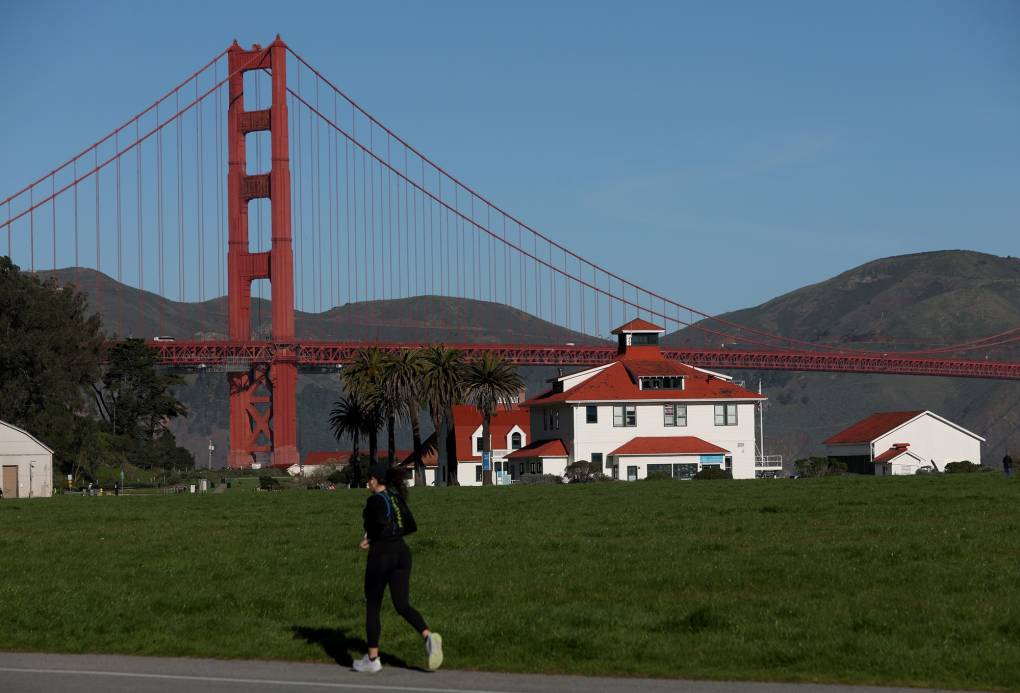
"caption": "A jogger runs on Crissy Field at Presidio of San Francisco on Feb. 20, 2025, in San Francisco, California. President Donald Trump signed an executive order on Wednesday to eliminate the Presidio Trust, the federal agency that runs and protects the Presidio of San Francisco, a national historic landmark since 1962.",
"credit": "Justin Sullivan/Getty Images",
"altTag": null,
"description": null,
"imgSizes": {
"medium": {
"file": "https://cdn.kqed.org/wp-content/uploads/sites/10/2025/02/PresidioSFGetty-800x544.jpg",
"width": 800,
"height": 544,
"mimeType": "image/jpeg"
},
"large": {
"file": "https://cdn.kqed.org/wp-content/uploads/sites/10/2025/02/PresidioSFGetty-1020x693.jpg",
"width": 1020,
"height": 693,
"mimeType": "image/jpeg"
},
"thumbnail": {
"file": "https://cdn.kqed.org/wp-content/uploads/sites/10/2025/02/PresidioSFGetty-160x109.jpg",
"width": 160,
"height": 109,
"mimeType": "image/jpeg"
},
"1536x1536": {
"file": "https://cdn.kqed.org/wp-content/uploads/sites/10/2025/02/PresidioSFGetty-1536x1044.jpg",
"width": 1536,
"height": 1044,
"mimeType": "image/jpeg"
},
"post-thumbnail": {
"file": "https://cdn.kqed.org/wp-content/uploads/sites/10/2025/02/PresidioSFGetty-672x372.jpg",
"width": 672,
"height": 372,
"mimeType": "image/jpeg"
},
"twentyfourteen-full-width": {
"file": "https://cdn.kqed.org/wp-content/uploads/sites/10/2025/02/PresidioSFGetty-1038x576.jpg",
"width": 1038,
"height": 576,
"mimeType": "image/jpeg"
},
"full-width": {
"file": "https://cdn.kqed.org/wp-content/uploads/sites/10/2025/02/PresidioSFGetty-1920x1305.jpg",
"width": 1920,
"height": 1305,
"mimeType": "image/jpeg"
},
"kqedFullSize": {
"file": "https://cdn.kqed.org/wp-content/uploads/sites/10/2025/02/PresidioSFGetty.jpg",
"width": 2000,
"height": 1359
}
},
"isLoading": false,
"fetchFailed": false
},
"news_11987019": {
"type": "attachments",
"id": "news_11987019",
"meta": {
"index": "attachments_1716263798",
"site": "news",
"id": "11987019",
"found": true
},
"title": "240517-BrianJonesPB-21-BL",
"publishDate": 1716246173,
"status": "inherit",
"parent": 0,
"modified": 1740167361,
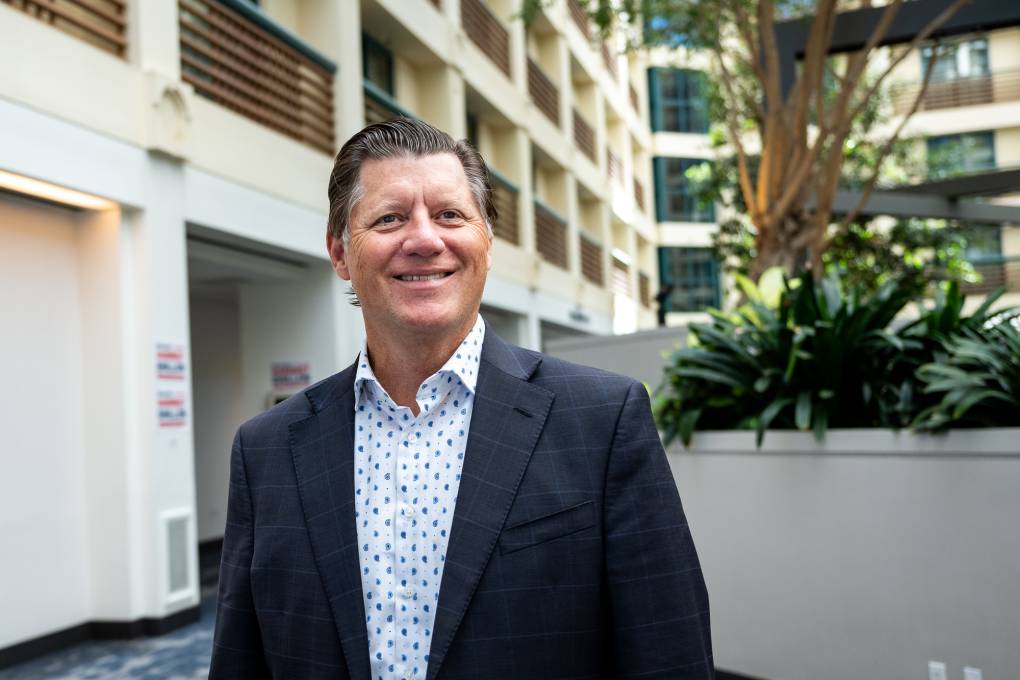
"caption": "Senate Republican Leader Brian Jones at the CAGOP Republican convention at the Hyatt Regency in Burlingame on May 17, 2024. Jones is leading the effort to pass a bill that would weaken California’s sanctuary laws.",
"credit": "Beth LaBerge/KQED",
"altTag": null,
"description": "Senate Republican Leader Brian Jones at the CAGOP Republican convention at the Hyatt Regency in Burlingame on May 17, 2024.",
"imgSizes": {
"medium": {
"file": "https://cdn.kqed.org/wp-content/uploads/sites/10/2024/05/240517-BrianJonesPB-21-BL-800x533.jpg",
"width": 800,
"height": 533,
"mimeType": "image/jpeg"
},
"large": {
"file": "https://cdn.kqed.org/wp-content/uploads/sites/10/2024/05/240517-BrianJonesPB-21-BL-1020x680.jpg",
"width": 1020,
"height": 680,
"mimeType": "image/jpeg"
},
"thumbnail": {
"file": "https://cdn.kqed.org/wp-content/uploads/sites/10/2024/05/240517-BrianJonesPB-21-BL-160x107.jpg",
"width": 160,
"height": 107,
"mimeType": "image/jpeg"
},
"1536x1536": {
"file": "https://cdn.kqed.org/wp-content/uploads/sites/10/2024/05/240517-BrianJonesPB-21-BL-1536x1024.jpg",
"width": 1536,
"height": 1024,
"mimeType": "image/jpeg"
},
"post-thumbnail": {
"file": "https://cdn.kqed.org/wp-content/uploads/sites/10/2024/05/240517-BrianJonesPB-21-BL-672x372.jpg",
"width": 672,
"height": 372,
"mimeType": "image/jpeg"
},
"twentyfourteen-full-width": {
"file": "https://cdn.kqed.org/wp-content/uploads/sites/10/2024/05/240517-BrianJonesPB-21-BL-1038x576.jpg",
"width": 1038,
"height": 576,
"mimeType": "image/jpeg"
},
"full-width": {
"file": "https://cdn.kqed.org/wp-content/uploads/sites/10/2024/05/240517-BrianJonesPB-21-BL-1920x1280.jpg",
"width": 1920,
"height": 1280,
"mimeType": "image/jpeg"
},
"kqedFullSize": {
"file": "https://cdn.kqed.org/wp-content/uploads/sites/10/2024/05/240517-BrianJonesPB-21-BL.jpg",
"width": 2000,
"height": 1333
}
},
"isLoading": false,
"fetchFailed": false
},
"news_12027866": {
"type": "attachments",
"id": "news_12027866",
"meta": {
"index": "attachments_1716263798",
"site": "news",
"id": "12027866",
"found": true
},
"title": "DSC_1576_qed (1)",
"publishDate": 1740071450,
"status": "inherit",
"parent": 12028300,
"modified": 1740445816,
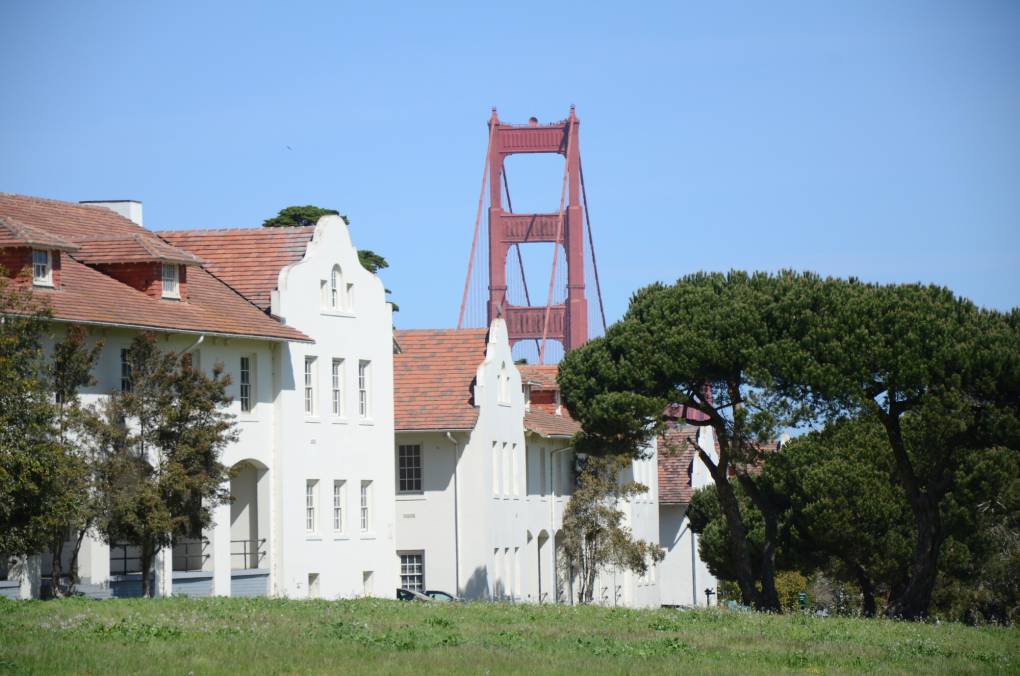
"caption": "Fort Winfield Scott was an active army base within the Presidio of San Francisco from 1912 to 1994.",
"credit": "Ryan Levi/KQED",
"altTag": null,
"description": null,
"imgSizes": {
"medium": {
"file": "https://cdn.kqed.org/wp-content/uploads/sites/10/2025/02/DSC_1576_qed-1-800x530.jpg",
"width": 800,
"height": 530,
"mimeType": "image/jpeg"
},
"large": {
"file": "https://cdn.kqed.org/wp-content/uploads/sites/10/2025/02/DSC_1576_qed-1-1020x676.jpg",
"width": 1020,
"height": 676,
"mimeType": "image/jpeg"
},
"thumbnail": {
"file": "https://cdn.kqed.org/wp-content/uploads/sites/10/2025/02/DSC_1576_qed-1-160x106.jpg",
"width": 160,
"height": 106,
"mimeType": "image/jpeg"
},
"1536x1536": {
"file": "https://cdn.kqed.org/wp-content/uploads/sites/10/2025/02/DSC_1576_qed-1-1536x1018.jpg",
"width": 1536,
"height": 1018,
"mimeType": "image/jpeg"
},
"post-thumbnail": {
"file": "https://cdn.kqed.org/wp-content/uploads/sites/10/2025/02/DSC_1576_qed-1-672x372.jpg",
"width": 672,
"height": 372,
"mimeType": "image/jpeg"
},
"twentyfourteen-full-width": {
"file": "https://cdn.kqed.org/wp-content/uploads/sites/10/2025/02/DSC_1576_qed-1-1038x576.jpg",
"width": 1038,
"height": 576,
"mimeType": "image/jpeg"
},
"full-width": {
"file": "https://cdn.kqed.org/wp-content/uploads/sites/10/2025/02/DSC_1576_qed-1-1920x1272.jpg",
"width": 1920,
"height": 1272,
"mimeType": "image/jpeg"
},
"kqedFullSize": {
"file": "https://cdn.kqed.org/wp-content/uploads/sites/10/2025/02/DSC_1576_qed-1.jpg",
"width": 2000,
"height": 1325
}
},
"isLoading": false,
"fetchFailed": false
},
"news_12009678": {
"type": "attachments",
"id": "news_12009678",
"meta": {
"index": "attachments_1716263798",
"site": "news",
"id": "12009678",
"found": true
},
"title": "241016-PRESIDIO PET CEMETERY-MD-05-KQED",
"publishDate": 1729111722,
"status": "inherit",
"parent": 12060830,
"modified": 1761074332,
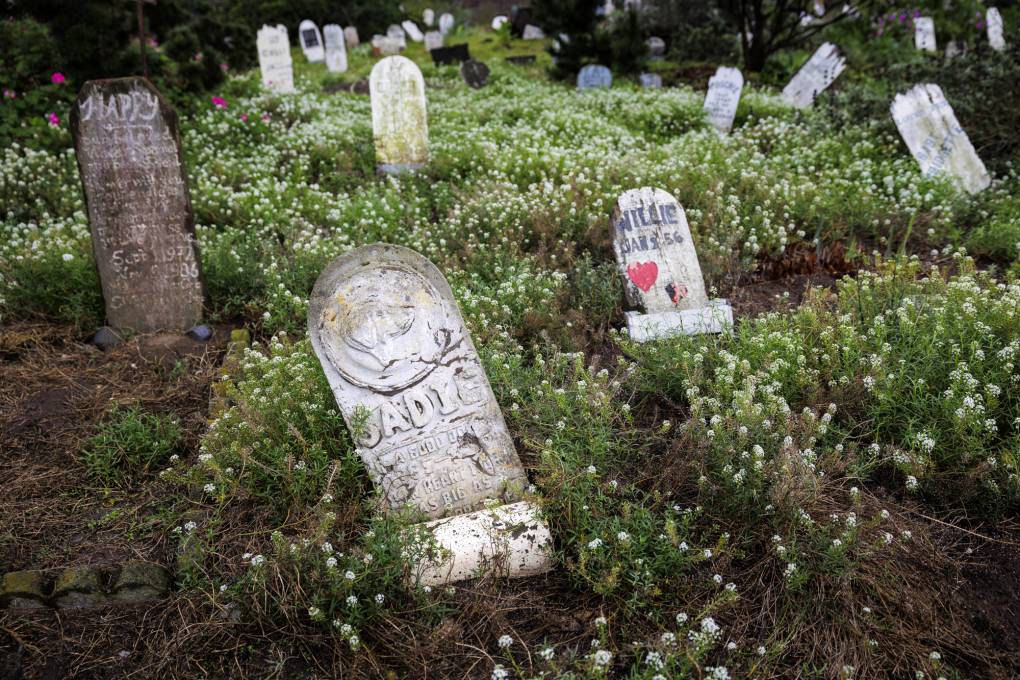
"caption": "Tombstones at the Presidio of San Francisco Pet Cemetery in San Francisco on Oct. 16, 2024.",
"credit": "Martin do Nascimento/KQED",
"altTag": "Tombstones in a cemetery.",
"description": null,
"imgSizes": {
"medium": {
"file": "https://cdn.kqed.org/wp-content/uploads/sites/10/2024/10/241016-PRESIDIO-PET-CEMETERY-MD-05-KQED-800x533.jpg",
"width": 800,
"height": 533,
"mimeType": "image/jpeg"
},
"large": {
"file": "https://cdn.kqed.org/wp-content/uploads/sites/10/2024/10/241016-PRESIDIO-PET-CEMETERY-MD-05-KQED-1020x680.jpg",
"width": 1020,
"height": 680,
"mimeType": "image/jpeg"
},
"thumbnail": {
"file": "https://cdn.kqed.org/wp-content/uploads/sites/10/2024/10/241016-PRESIDIO-PET-CEMETERY-MD-05-KQED-160x107.jpg",
"width": 160,
"height": 107,
"mimeType": "image/jpeg"
},
"1536x1536": {
"file": "https://cdn.kqed.org/wp-content/uploads/sites/10/2024/10/241016-PRESIDIO-PET-CEMETERY-MD-05-KQED-1536x1024.jpg",
"width": 1536,
"height": 1024,
"mimeType": "image/jpeg"
},
"post-thumbnail": {
"file": "https://cdn.kqed.org/wp-content/uploads/sites/10/2024/10/241016-PRESIDIO-PET-CEMETERY-MD-05-KQED-672x372.jpg",
"width": 672,
"height": 372,
"mimeType": "image/jpeg"
},
"twentyfourteen-full-width": {
"file": "https://cdn.kqed.org/wp-content/uploads/sites/10/2024/10/241016-PRESIDIO-PET-CEMETERY-MD-05-KQED-1038x576.jpg",
"width": 1038,
"height": 576,
"mimeType": "image/jpeg"
},
"full-width": {
"file": "https://cdn.kqed.org/wp-content/uploads/sites/10/2024/10/241016-PRESIDIO-PET-CEMETERY-MD-05-KQED-1920x1280.jpg",
"width": 1920,
"height": 1280,
"mimeType": "image/jpeg"
},
"kqedFullSize": {
"file": "https://cdn.kqed.org/wp-content/uploads/sites/10/2024/10/241016-PRESIDIO-PET-CEMETERY-MD-05-KQED.jpg",
"width": 2000,
"height": 1333
}
},
"isLoading": false,
"fetchFailed": false
},
"news_11972854": {
"type": "attachments",
"id": "news_11972854",
"meta": {
"index": "attachments_1716263798",
"site": "news",
"id": "11972854",
"found": true
},
"parent": 0,
"imgSizes": {
"twentyfourteen-full-width": {
"file": "https://cdn.kqed.org/wp-content/uploads/sites/10/2024/01/240116-FORT-SCOTT-GETTY-GAJ-KQED-1038x576.jpg",
"width": 1038,
"mimeType": "image/jpeg",
"height": 576
},
"thumbnail": {
"file": "https://cdn.kqed.org/wp-content/uploads/sites/10/2024/01/240116-FORT-SCOTT-GETTY-GAJ-KQED-160x107.jpg",
"width": 160,
"mimeType": "image/jpeg",
"height": 107
},
"post-thumbnail": {
"file": "https://cdn.kqed.org/wp-content/uploads/sites/10/2024/01/240116-FORT-SCOTT-GETTY-GAJ-KQED-672x372.jpg",
"width": 672,
"mimeType": "image/jpeg",
"height": 372
},
"kqedFullSize": {
"file": "https://cdn.kqed.org/wp-content/uploads/sites/10/2024/01/240116-FORT-SCOTT-GETTY-GAJ-KQED.jpg",
"width": 2000,
"height": 1333
},
"large": {
"file": "https://cdn.kqed.org/wp-content/uploads/sites/10/2024/01/240116-FORT-SCOTT-GETTY-GAJ-KQED-1020x680.jpg",
"width": 1020,
"mimeType": "image/jpeg",
"height": 680
},
"1536x1536": {
"file": "https://cdn.kqed.org/wp-content/uploads/sites/10/2024/01/240116-FORT-SCOTT-GETTY-GAJ-KQED-1536x1024.jpg",
"width": 1536,
"mimeType": "image/jpeg",
"height": 1024
},
"full-width": {
"file": "https://cdn.kqed.org/wp-content/uploads/sites/10/2024/01/240116-FORT-SCOTT-GETTY-GAJ-KQED-1920x1280.jpg",
"width": 1920,
"mimeType": "image/jpeg",
"height": 1280
},
"medium": {
"file": "https://cdn.kqed.org/wp-content/uploads/sites/10/2024/01/240116-FORT-SCOTT-GETTY-GAJ-KQED-800x533.jpg",
"width": 800,
"mimeType": "image/jpeg",
"height": 533
}
},
"publishDate": 1705517992,
"modified": 1705518161,
"caption": "Fort Scott and the Golden Gate Bridge in San Francisco on Oct. 7, 2016. ",
"description": null,
"title": "The Golden Gate Bridge is seen near Fort Winfield Scott at Langdon Court building in the Presidio on Friday, Oct. 7, 2016 in San Francisco, Calif.",
"credit": "Gabriella Angotti-Jones/San Francisco Chronicle via Getty Images",
"status": "inherit",
"altTag": "A outdoor space with several old-looking buildings and trees in it.",
"isLoading": false,
"fetchFailed": false
},
"news_11920324": {
"type": "attachments",
"id": "news_11920324",
"meta": {
"index": "attachments_1716263798",
"site": "news",
"id": "11920324",
"found": true
},
"parent": 11920323,
"imgSizes": {
"twentyfourteen-full-width": {
"file": "https://ww2.kqed.org/app/uploads/sites/10/2022/07/Shatz-VR-2_frame_17162-1038x576.jpeg",
"width": 1038,
"mimeType": "image/jpeg",
"height": 576
},
"thumbnail": {
"file": "https://ww2.kqed.org/app/uploads/sites/10/2022/07/Shatz-VR-2_frame_17162-160x90.jpeg",
"width": 160,
"mimeType": "image/jpeg",
"height": 90
},
"post-thumbnail": {
"file": "https://ww2.kqed.org/app/uploads/sites/10/2022/07/Shatz-VR-2_frame_17162-672x372.jpeg",
"width": 672,
"mimeType": "image/jpeg",
"height": 372
},
"kqedFullSize": {
"file": "https://ww2.kqed.org/app/uploads/sites/10/2022/07/Shatz-VR-2_frame_17162.jpeg",
"width": 1920,
"height": 1080
},
"large": {
"file": "https://ww2.kqed.org/app/uploads/sites/10/2022/07/Shatz-VR-2_frame_17162-1020x574.jpeg",
"width": 1020,
"mimeType": "image/jpeg",
"height": 574
},
"1536x1536": {
"file": "https://ww2.kqed.org/app/uploads/sites/10/2022/07/Shatz-VR-2_frame_17162-1536x864.jpeg",
"width": 1536,
"mimeType": "image/jpeg",
"height": 864
},
"medium": {
"file": "https://ww2.kqed.org/app/uploads/sites/10/2022/07/Shatz-VR-2_frame_17162-800x450.jpeg",
"width": 800,
"mimeType": "image/jpeg",
"height": 450
}
},
"publishDate": 1658533590,
"modified": 1658533590,
"caption": null,
"description": null,
"title": "Shatz VR 2_frame_17162",
"credit": null,
"status": "inherit",
"altTag": null,
"isLoading": false,
"fetchFailed": false
},
"news_11663970": {
"type": "attachments",
"id": "news_11663970",
"meta": {
"index": "attachments_1716263798",
"site": "news",
"id": "11663970",
"found": true
},
"title": "RS30556_DSC_1576-qut",
"publishDate": 1524358130,
"status": "inherit",
"parent": 11663954,
"modified": 1776381148,
"caption": "Fort Winfield Scott was an active army base within the Presidio of San Francisco from 1912-1994. Now, the Presidio Trust is hoping to find a high-rolling do-gooder to renovate it as a \"campus for change.\"",
"credit": "Ryan Levi/KQED",
"altTag": "Fort Winfield Scott was an active army base within the Presidio of San Francisco from 1912-1994. Now, the Presidio Trust is hoping to find a high-rolling do-gooder to renovate it as a \"campus for change.\"",
"description": "Fort Winfield Scott was an active army base within the Presidio of San Francisco from 1912-1994. Now, the Presidio Trust is hoping to find a high-rolling do-gooder to renovate it as a \"campus for change.\"",
"imgSizes": {
"thumbnail": {
"file": "https://cdn.kqed.org/wp-content/uploads/sites/10/2018/04/RS30556_DSC_1576-qut-160x106.jpg",
"width": 160,
"height": 106,
"mimeType": "image/jpeg"
},
"medium": {
"file": "https://cdn.kqed.org/wp-content/uploads/sites/10/2018/04/RS30556_DSC_1576-qut-800x530.jpg",
"width": 800,
"height": 530,
"mimeType": "image/jpeg"
},
"large": {
"file": "https://cdn.kqed.org/wp-content/uploads/sites/10/2018/04/RS30556_DSC_1576-qut-1020x676.jpg",
"width": 1020,
"height": 676,
"mimeType": "image/jpeg"
},
"complete_open_graph": {
"file": "https://cdn.kqed.org/wp-content/uploads/sites/10/2018/04/RS30556_DSC_1576-qut-1200x795.jpg",
"width": 1200,
"height": 795,
"mimeType": "image/jpeg"
},
"fd-lrg": {
"file": "https://cdn.kqed.org/wp-content/uploads/sites/10/2018/04/RS30556_DSC_1576-qut-1920x1272.jpg",
"width": 1920,
"height": 1272,
"mimeType": "image/jpeg"
},
"fd-med": {
"file": "https://cdn.kqed.org/wp-content/uploads/sites/10/2018/04/RS30556_DSC_1576-qut-1180x782.jpg",
"width": 1180,
"height": 782,
"mimeType": "image/jpeg"
},
"fd-sm": {
"file": "https://cdn.kqed.org/wp-content/uploads/sites/10/2018/04/RS30556_DSC_1576-qut-960x636.jpg",
"width": 960,
"height": 636,
"mimeType": "image/jpeg"
},
"post-thumbnail": {
"file": "https://cdn.kqed.org/wp-content/uploads/sites/10/2018/04/RS30556_DSC_1576-qut-672x372.jpg",
"width": 672,
"height": 372,
"mimeType": "image/jpeg"
},
"twentyfourteen-full-width": {
"file": "https://cdn.kqed.org/wp-content/uploads/sites/10/2018/04/RS30556_DSC_1576-qut-1038x576.jpg",
"width": 1038,
"height": 576,
"mimeType": "image/jpeg"
},
"xxsmall": {
"file": "https://cdn.kqed.org/wp-content/uploads/sites/10/2018/04/RS30556_DSC_1576-qut-240x159.jpg",
"width": 240,
"height": 159,
"mimeType": "image/jpeg"
},
"xsmall": {
"file": "https://cdn.kqed.org/wp-content/uploads/sites/10/2018/04/RS30556_DSC_1576-qut-375x248.jpg",
"width": 375,
"height": 248,
"mimeType": "image/jpeg"
},
"small": {
"file": "https://cdn.kqed.org/wp-content/uploads/sites/10/2018/04/RS30556_DSC_1576-qut-520x345.jpg",
"width": 520,
"height": 345,
"mimeType": "image/jpeg"
},
"xlarge": {
"file": "https://cdn.kqed.org/wp-content/uploads/sites/10/2018/04/RS30556_DSC_1576-qut-1180x782.jpg",
"width": 1180,
"height": 782,
"mimeType": "image/jpeg"
},
"full-width": {
"file": "https://cdn.kqed.org/wp-content/uploads/sites/10/2018/04/RS30556_DSC_1576-qut-1920x1272.jpg",
"width": 1920,
"height": 1272,
"mimeType": "image/jpeg"
},
"guest-author-32": {
"file": "https://cdn.kqed.org/wp-content/uploads/sites/10/2018/04/RS30556_DSC_1576-qut-32x32.jpg",
"width": 32,
"height": 32,
"mimeType": "image/jpeg"
},
"guest-author-50": {
"file": "https://cdn.kqed.org/wp-content/uploads/sites/10/2018/04/RS30556_DSC_1576-qut-50x50.jpg",
"width": 50,
"height": 50,
"mimeType": "image/jpeg"
},
"guest-author-64": {
"file": "https://cdn.kqed.org/wp-content/uploads/sites/10/2018/04/RS30556_DSC_1576-qut-64x64.jpg",
"width": 64,
"height": 64,
"mimeType": "image/jpeg"
},
"guest-author-96": {
"file": "https://cdn.kqed.org/wp-content/uploads/sites/10/2018/04/RS30556_DSC_1576-qut-96x96.jpg",
"width": 96,
"height": 96,
"mimeType": "image/jpeg"
},
"guest-author-128": {
"file": "https://cdn.kqed.org/wp-content/uploads/sites/10/2018/04/RS30556_DSC_1576-qut-128x128.jpg",
"width": 128,
"height": 128,
"mimeType": "image/jpeg"
},
"detail": {
"file": "https://cdn.kqed.org/wp-content/uploads/sites/10/2018/04/RS30556_DSC_1576-qut-150x150.jpg",
"width": 150,
"height": 150,
"mimeType": "image/jpeg"
},
"kqedFullSize": {
"file": "https://cdn.kqed.org/wp-content/uploads/sites/10/2018/04/RS30556_DSC_1576-qut.jpg",
"width": 1920,
"height": 1272
}
},
"isLoading": false,
"fetchFailed": false
},
"news_126120": {
"type": "attachments",
"id": "news_126120",
"meta": {
"index": "attachments_1716263798",
"site": "news",
"id": "126120",
"found": true
},
"parent": 125951,
"imgSizes": {
"kqedFullSize": {
"file": "https://ww2.kqed.org/app/uploads/sites/10/2014/02/goldengate060113.jpg",
"width": 1344,
"height": 1170
}
},
"publishDate": 1392238117,
"modified": 1464367799,
"caption": "The Golden Gate Bridge from Battery Godfrey in San Francisco's Presidio. ",
"description": "The Golden Gate Bridge from Battery Godfrey in San Francisco's Presidio. (Dan Brekke/KQED)",
"title": "Golden Gate Bridge-San Francisco",
"credit": "(Dan Brekke/KQED)",
"status": "inherit",
"isLoading": false,
"fetchFailed": false
},
"news_125205": {
"type": "attachments",
"id": "news_125205",
"meta": {
"index": "attachments_1716263798",
"site": "news",
"id": "125205",
"found": true
},
"parent": 125195,
"imgSizes": {
"kqedFullSize": {
"file": "https://ww2.kqed.org/app/uploads/sites/10/2014/02/Screenshot-2014-02-04-00.18.29.png",
"width": 588,
"height": 361
}
},
"publishDate": 1391502298,
"modified": 1391502298,
"caption": null,
"description": null,
"title": "Screenshot 2014-02-04 00.18.29",
"credit": null,
"status": "inherit",
"isLoading": false,
"fetchFailed": false
}
},
"audioPlayerReducer": {
"postId": "stream_live",
"isPaused": true,
"isPlaying": false,
"pfsActive": false,
"pledgeModalIsOpen": true,
"playerDrawerIsOpen": false,
"liveAudioPlayStartedAt": 0,
"liveAudioPlayContext": ""
},
"authorsReducer": {
"danbrekke": {
"type": "authors",
"id": "222",
"meta": {
"index": "authors_1716337520",
"id": "222",
"found": true
},
"name": "Dan Brekke",
"firstName": "Dan",
"lastName": "Brekke",
"slug": "danbrekke",
"email": "dbrekke@kqed.org",
"display_author_email": true,
"staff_mastheads": [
"news",
"science"
],
"title": "KQED Editor and Reporter",
"bio": "Dan Brekke is a reporter and editor for KQED News, responsible for coverage of topics ranging from California water issues to the Bay Area's transportation challenges. In a newsroom career that began in Chicago in 1972, Dan has worked for \u003cem>The San Francisco Examiner,\u003c/em> Wired and TechTV and has been published in The New York Times, The New York Times Magazine, Business 2.0, Salon and elsewhere.\r\n\r\nSince joining KQED in 2007, Dan has reported, edited and produced both radio and online features and breaking news pieces. He has shared as both editor and reporter in four Society of Professional Journalists Norcal Excellence in Journalism awards and one Edward R. Murrow regional award. He was chosen for a spring 2017 residency at the Mesa Refuge to advance his research on California salmon.\r\n\r\nEmail Dan at: \u003ca href=\"mailto:dbrekke@kqed.org\">dbrekke@kqed.org\u003c/a>\r\n\r\n\u003cstrong>Twitter:\u003c/strong> \u003ca href=\"https://twitter.com/danbrekke\" rel=\"noopener noreferrer\">twitter.com/danbrekke\u003c/a>\r\n\u003cstrong>Facebook:\u003c/strong> \u003ca href=\"https://www.facebook.com/danbrekke\" rel=\"noopener noreferrer\">www.facebook.com/danbrekke\u003c/a>\r\n\u003cstrong>LinkedIn:\u003c/strong> \u003ca href=\"https://www.linkedin.com/in/danbrekke\" rel=\"noopener noreferrer\">www.linkedin.com/in/danbrekke\u003c/a>",
"avatar": "https://secure.gravatar.com/avatar/8f1f0d2a978fb3b23426c922c7e2af558fa36905b49c4ce76a97dc3c72d27226?s=600&d=mm&r=g",
"twitter": "danbrekke",
"bluesky": null,
"facebook": null,
"instagram": "https://www.instagram.com/dan.brekke/",
"linkedin": "https://www.linkedin.com/in/danbrekke/",
"sites": [
{
"site": "news",
"roles": [
"administrator",
"create_posts"
]
},
{
"site": "stateofhealth",
"roles": [
"editor"
]
},
{
"site": "science",
"roles": [
"editor"
]
},
{
"site": "quest",
"roles": [
"contributor"
]
},
{
"site": "food",
"roles": [
"contributor"
]
},
{
"site": "forum",
"roles": [
"contributor"
]
},
{
"site": "elections",
"roles": [
"editor"
]
},
{
"site": "liveblog",
"roles": [
"editor"
]
}
],
"headData": {
"title": "Dan Brekke | KQED",
"description": "KQED Editor and Reporter",
"ogImgSrc": "https://secure.gravatar.com/avatar/8f1f0d2a978fb3b23426c922c7e2af558fa36905b49c4ce76a97dc3c72d27226?s=600&d=mm&r=g",
"twImgSrc": "https://secure.gravatar.com/avatar/8f1f0d2a978fb3b23426c922c7e2af558fa36905b49c4ce76a97dc3c72d27226?s=600&d=mm&r=g"
},
"isLoading": false,
"link": "/author/danbrekke"
},
"gmarzorati": {
"type": "authors",
"id": "227",
"meta": {
"index": "authors_1716337520",
"id": "227",
"found": true
},
"name": "Guy Marzorati",
"firstName": "Guy",
"lastName": "Marzorati",
"slug": "gmarzorati",
"email": "gmarzorati@KQED.org",
"display_author_email": true,
"staff_mastheads": [
"news"
],
"title": "Correspondent",
"bio": "Guy Marzorati is a correspondent on KQED's California Politics and Government Desk, based in San Jose. A graduate of Santa Clara University, Guy joined KQED in 2013. He reports on state and local politics and produces KQED's digital voter guide.",
"avatar": "https://secure.gravatar.com/avatar/e7038b8dbfd55b104369b76b1cd0b9de?s=600&d=blank&r=g",
"twitter": "guymarzorati",
"facebook": null,
"instagram": null,
"linkedin": null,
"sites": [
{
"site": "",
"roles": [
"editor"
]
},
{
"site": "news",
"roles": [
"editor"
]
},
{
"site": "science",
"roles": [
"editor"
]
},
{
"site": "forum",
"roles": [
"editor"
]
},
{
"site": "elections",
"roles": [
"editor"
]
},
{
"site": "liveblog",
"roles": [
"editor"
]
}
],
"headData": {
"title": "Guy Marzorati | KQED",
"description": "Correspondent",
"ogImgSrc": "https://secure.gravatar.com/avatar/e7038b8dbfd55b104369b76b1cd0b9de?s=600&d=blank&r=g",
"twImgSrc": "https://secure.gravatar.com/avatar/e7038b8dbfd55b104369b76b1cd0b9de?s=600&d=blank&r=g"
},
"isLoading": false,
"link": "/author/gmarzorati"
},
"kqed": {
"type": "authors",
"id": "236",
"meta": {
"index": "authors_1716337520",
"id": "236",
"found": true
},
"name": "KQED News Staff",
"firstName": "KQED News Staff",
"lastName": null,
"slug": "kqed",
"email": "faq@kqed.org",
"display_author_email": false,
"staff_mastheads": [],
"title": null,
"bio": null,
"avatar": "https://secure.gravatar.com/avatar/ef0e801a68c4c54afa9180db14084167?s=600&d=blank&r=g",
"twitter": null,
"facebook": null,
"instagram": null,
"linkedin": null,
"sites": [
{
"site": "arts",
"roles": [
"contributor"
]
},
{
"site": "news",
"roles": [
"editor"
]
},
{
"site": "futureofyou",
"roles": [
"author"
]
}
],
"headData": {
"title": "KQED News Staff | KQED",
"description": null,
"ogImgSrc": "https://secure.gravatar.com/avatar/ef0e801a68c4c54afa9180db14084167?s=600&d=blank&r=g",
"twImgSrc": "https://secure.gravatar.com/avatar/ef0e801a68c4c54afa9180db14084167?s=600&d=blank&r=g"
},
"isLoading": false,
"link": "/author/kqed"
},
"scottshafer": {
"type": "authors",
"id": "255",
"meta": {
"index": "authors_1716337520",
"id": "255",
"found": true
},
"name": "Scott Shafer",
"firstName": "Scott",
"lastName": "Shafer",
"slug": "scottshafer",
"email": "sshafer@kqed.org",
"display_author_email": false,
"staff_mastheads": [
"news"
],
"title": "KQED Contributor",
"bio": "Scott Shafer is a senior editor with the KQED Politics and Government desk. He is co-host of Political Breakdown, the award-winning radio show and podcast with a personal take on the world of politics. Scott came to KQED in 1998 to host the statewide\u003cem> California Report\u003c/em>. Prior to that he had extended stints in politics and government\u003cem>.\u003c/em> He uses that inside experience at KQED in his, reporting, hosting and analysis for the politics desk. Scott collaborated \u003cem>Political Breakdown a\u003c/em>nd on \u003cem>The Political Mind of Jerry Brown, \u003c/em>an eight-part series about the life and extraordinary political career of the former governor. For fun, he plays water polo with the San Francisco Tsunami.",
"avatar": "https://secure.gravatar.com/avatar/a62ebae45b79d7aed1a39a0e3bf68104?s=600&d=blank&r=g",
"twitter": "scottshafer",
"bluesky": null,
"facebook": null,
"instagram": null,
"linkedin": null,
"sites": [
{
"site": "news",
"roles": [
"editor"
]
},
{
"site": "stateofhealth",
"roles": [
"author"
]
},
{
"site": "science",
"roles": [
"author"
]
},
{
"site": "forum",
"roles": [
"subscriber"
]
},
{
"site": "liveblog",
"roles": [
"author"
]
}
],
"headData": {
"title": "Scott Shafer | KQED",
"description": "KQED Contributor",
"ogImgSrc": "https://secure.gravatar.com/avatar/a62ebae45b79d7aed1a39a0e3bf68104?s=600&d=blank&r=g",
"twImgSrc": "https://secure.gravatar.com/avatar/a62ebae45b79d7aed1a39a0e3bf68104?s=600&d=blank&r=g"
},
"isLoading": false,
"link": "/author/scottshafer"
},
"mlagos": {
"type": "authors",
"id": "3239",
"meta": {
"index": "authors_1716337520",
"id": "3239",
"found": true
},
"name": "Marisa Lagos",
"firstName": "Marisa",
"lastName": "Lagos",
"slug": "mlagos",
"email": "mlagos@kqed.org",
"display_author_email": false,
"staff_mastheads": [
"news"
],
"title": "KQED Contributor",
"bio": "Marisa Lagos is a correspondent for KQED’s California Politics and Government Desk and co-hosts the award-winning show and podcast, Political Breakdown. At KQED, Lagos also conducts reporting, analysis and investigations into state, local and national politics for radio, TV, online and onstage. In 2022, she and co-host, Scott Shafer, moderated the only gubernatorial debate in California. In 2020, the \u003ci>Washington Post\u003c/i> named her one of the top political journalists in California; she was nominated for a Peabody and won several other awards for her work investigating the 2017 California wildfires. She has worked at the \u003ci>San Francisco Chronicle\u003c/i>, \u003ci>San Francisco Examiner\u003c/i> and \u003ci>Los Angeles Times\u003c/i>. A UC Santa Barbara graduate, she lives in San Francisco with her two sons and husband.",
"avatar": "https://secure.gravatar.com/avatar/a261a0d3696fc066871ef96b85b5e7d2?s=600&d=blank&r=g",
"twitter": "@mlagos",
"facebook": null,
"instagram": null,
"linkedin": null,
"sites": [
{
"site": "arts",
"roles": [
"author"
]
},
{
"site": "news",
"roles": [
"editor"
]
},
{
"site": "science",
"roles": [
"editor"
]
},
{
"site": "forum",
"roles": [
"author"
]
},
{
"site": "liveblog",
"roles": [
"author"
]
}
],
"headData": {
"title": "Marisa Lagos | KQED",
"description": "KQED Contributor",
"ogImgSrc": "https://secure.gravatar.com/avatar/a261a0d3696fc066871ef96b85b5e7d2?s=600&d=blank&r=g",
"twImgSrc": "https://secure.gravatar.com/avatar/a261a0d3696fc066871ef96b85b5e7d2?s=600&d=blank&r=g"
},
"isLoading": false,
"link": "/author/mlagos"
},
"rlevi": {
"type": "authors",
"id": "11260",
"meta": {
"index": "authors_1716337520",
"id": "11260",
"found": true
},
"name": "Ryan Levi",
"firstName": "Ryan",
"lastName": "Levi",
"slug": "rlevi",
"email": "rlevi@KQED.org",
"display_author_email": false,
"staff_mastheads": [],
"title": "KQED Contributor",
"bio": "Ryan Levi was a reporter and podcast producer at KQED News from 2016-2019. He worked on \u003ca href=\"https://www.kqed.org/news/series/baycurious\">Bay Curious\u003c/a>, \u003ca href=\"https://www.kqed.org/news/tag/the-bay/\">The Bay, \u003c/a>and \u003ca href=\"https://podcasts.apple.com/us/podcast/the-california-report-magazine/id1314750545\">The California Report Magazine\u003c/a>, as well as hosting and producing the weekly \u003ca href=\"https://www.kqed.org/news/program/qedup/\">Q'ed Up podcast. \u003c/a>He also helped inaugurate KQED's weekend news coverage in 2017 as one of two original digital producers. Ryan holds degrees in multimedia journalism and Spanish from the University of Missouri.",
"avatar": "https://secure.gravatar.com/avatar/4cb2ddd028ac8807d1adf09609c5555d?s=600&d=blank&r=g",
"twitter": "ryan_levi",
"facebook": null,
"instagram": null,
"linkedin": null,
"sites": [
{
"site": "arts",
"roles": [
"editor"
]
},
{
"site": "news",
"roles": [
"subscriber"
]
},
{
"site": "stateofhealth",
"roles": [
"editor"
]
},
{
"site": "science",
"roles": [
"editor"
]
},
{
"site": "forum",
"roles": [
"administrator"
]
},
{
"site": "perspectives",
"roles": [
"administrator"
]
}
],
"headData": {
"title": "Ryan Levi | KQED",
"description": "KQED Contributor",
"ogImgSrc": "https://secure.gravatar.com/avatar/4cb2ddd028ac8807d1adf09609c5555d?s=600&d=blank&r=g",
"twImgSrc": "https://secure.gravatar.com/avatar/4cb2ddd028ac8807d1adf09609c5555d?s=600&d=blank&r=g"
},
"isLoading": false,
"link": "/author/rlevi"
},
"btaylor": {
"type": "authors",
"id": "11365",
"meta": {
"index": "authors_1716337520",
"id": "11365",
"found": true
},
"name": "Bianca Taylor",
"firstName": "Bianca",
"lastName": "Taylor",
"slug": "btaylor",
"email": "btaylor@KQED.org",
"display_author_email": false,
"staff_mastheads": [
"news"
],
"title": "Host and Producer ",
"bio": "Bianca Taylor is a news producer and host of KQED's The Latest podcast.\r\n\r\nHer work with KQED has been honored by the Society of Professional Journalists NorCal, the Webby's, the Regional Murrow Awards, and ONA. She has also worked with NPR, the BBC World Service, and the Washington Post Creative Group.\r\n\r\nBianca is represented by SAG-AFTRA.",
"avatar": "https://secure.gravatar.com/avatar/6b9d3f6552dd10470c5d1c2e58cfe717?s=600&d=blank&r=g",
"twitter": "SoundsLkeBianca",
"facebook": null,
"instagram": null,
"linkedin": null,
"sites": [
{
"site": "arts",
"roles": [
"editor"
]
},
{
"site": "news",
"roles": [
"edit_others_posts",
"editor"
]
},
{
"site": "pop",
"roles": [
"editor"
]
},
{
"site": "bayareabites",
"roles": [
"author"
]
},
{
"site": "science",
"roles": [
"editor"
]
},
{
"site": "forum",
"roles": [
"editor"
]
},
{
"site": "radio",
"roles": [
"editor"
]
},
{
"site": "podcasts",
"roles": [
"editor"
]
}
],
"headData": {
"title": "Bianca Taylor | KQED",
"description": "Host and Producer ",
"ogImgSrc": "https://secure.gravatar.com/avatar/6b9d3f6552dd10470c5d1c2e58cfe717?s=600&d=blank&r=g",
"twImgSrc": "https://secure.gravatar.com/avatar/6b9d3f6552dd10470c5d1c2e58cfe717?s=600&d=blank&r=g"
},
"isLoading": false,
"link": "/author/btaylor"
},
"kdebenedetti": {
"type": "authors",
"id": "11913",
"meta": {
"index": "authors_1716337520",
"id": "11913",
"found": true
},
"name": "Katie DeBenedetti",
"firstName": "Katie",
"lastName": "DeBenedetti",
"slug": "kdebenedetti",
"email": "kdebenedetti@kqed.org",
"display_author_email": false,
"staff_mastheads": [
"news",
"science"
],
"title": "KQED Contributor",
"bio": "Katie DeBenedetti is a digital reporter covering daily news for the Express Desk. Prior to joining KQED as a culture reporting intern in January 2024, she covered education and city government for the Napa Valley Register.",
"avatar": "https://secure.gravatar.com/avatar/6e31073cb8f7e4214ab03f42771d0f45?s=600&d=blank&r=g",
"twitter": null,
"facebook": null,
"instagram": null,
"linkedin": null,
"sites": [
{
"site": "news",
"roles": [
"author"
]
},
{
"site": "science",
"roles": [
"author"
]
},
{
"site": "liveblog",
"roles": [
"author"
]
}
],
"headData": {
"title": "Katie DeBenedetti | KQED",
"description": "KQED Contributor",
"ogImgSrc": "https://secure.gravatar.com/avatar/6e31073cb8f7e4214ab03f42771d0f45?s=600&d=blank&r=g",
"twImgSrc": "https://secure.gravatar.com/avatar/6e31073cb8f7e4214ab03f42771d0f45?s=600&d=blank&r=g"
},
"isLoading": false,
"link": "/author/kdebenedetti"
},
"aamaral": {
"type": "authors",
"id": "11947",
"meta": {
"index": "authors_1716337520",
"id": "11947",
"found": true
},
"name": "Ana De Almeida Amaral",
"firstName": "Ana",
"lastName": "De Almeida Amaral",
"slug": "aamaral",
"email": "aamaral@kqed.org",
"display_author_email": false,
"staff_mastheads": [],
"title": "KQED Contributor",
"bio": null,
"avatar": "https://secure.gravatar.com/avatar/eb08e0e3effedf89fc5153d5f7416228a3359f82750571d5de728615b88e8c32?s=600&d=blank&r=g",
"twitter": null,
"bluesky": null,
"facebook": null,
"instagram": null,
"linkedin": null,
"sites": [
{
"site": "arts",
"roles": [
"editor"
]
},
{
"site": "news",
"roles": [
"editor"
]
},
{
"site": "forum",
"roles": [
"editor"
]
}
],
"headData": {
"title": "Ana De Almeida Amaral | KQED",
"description": "KQED Contributor",
"ogImgSrc": "https://secure.gravatar.com/avatar/eb08e0e3effedf89fc5153d5f7416228a3359f82750571d5de728615b88e8c32?s=600&d=blank&r=g",
"twImgSrc": "https://secure.gravatar.com/avatar/eb08e0e3effedf89fc5153d5f7416228a3359f82750571d5de728615b88e8c32?s=600&d=blank&r=g"
},
"isLoading": false,
"link": "/author/aamaral"
}
},
"pagesReducer": {
"news_tag_presidio": {
"type": "terms",
"id": "news_5663",
"meta": {
"index": "terms_1716263798",
"site": "news",
"id": "5663",
"score": 8.938045
},
"featImg": null,
"name": "Presidio",
"description": null,
"taxonomy": "tag",
"headData": {
"twImgId": null,
"twTitle": null,
"ogTitle": null,
"ogImgId": null,
"twDescription": null,
"description": null,
"title": "Presidio Archives | KQED News",
"ogDescription": null
},
"ttid": 5687,
"slug": "presidio",
"isLoading": false,
"title": "Presidio",
"pageMeta": {
"site": "news",
"WpPageTemplate": "page-topic-editorial",
"currentPage": 2
},
"blocks": [
{
"blockName": "kqed/post-list",
"attrs": {
"layout": "cardArticle2",
"query": "posts/news?tag=presidio",
"seeMore": false,
"paginated": true,
"page": 2
}
},
{
"blockName": "kqed/ad"
}
]
}
},
"pfsSessionReducer": {},
"postsReducer": {
"stream_live": {
"type": "live",
"id": "stream_live",
"audioUrl": "https://streams.kqed.org/kqedradio",
"title": "Live Stream",
"excerpt": "Live Stream information currently unavailable.",
"link": "/radio",
"featImg": "",
"label": {
"name": "KQED Live",
"link": "/"
}
},
"stream_kqedNewscast": {
"type": "posts",
"id": "stream_kqedNewscast",
"audioUrl": "https://www.kqed.org/.stream/anon/radio/RDnews/newscast.mp3?_=1",
"title": "KQED Newscast",
"featImg": "",
"label": {
"name": "88.5 FM",
"link": "/"
}
},
"news_12028300": {
"type": "posts",
"id": "news_12028300",
"meta": {
"index": "posts_1716263798",
"site": "news",
"id": "12028300",
"score": null,
"sort": [
1740492033000
]
},
"guestAuthors": [],
"slug": "trump-order-revives-fears-real-estate-push-san-franciscos-presidio",
"title": "Trump Order Revives Fears of Real Estate Push for San Francisco’s Presidio",
"publishDate": 1740492033,
"format": "standard",
"headTitle": "Trump Order Revives Fears of Real Estate Push for San Francisco’s Presidio | KQED",
"labelTerm": {
"site": "news"
},
"content": "\u003cp>\u003ca href=\"https://www.kqed.org/news/tag/donald-trump\">President Donald Trump’s\u003c/a> executive order \u003ca href=\"https://www.kqed.org/news/12027864/trump-moves-slash-presidio-trust-agency-runs-historic-sf-park\">targeting San Francisco’s Presidio\u003c/a> revived fears that the beloved public land could be eyed for a real estate grab.\u003c/p>\n\u003cp>It wouldn’t be the first time San Francisco’s bayside was targeted for upscale development — but, much like a failed proposal to build a coastal North Bay city, this project is unlikely to move forward due to legislation protecting the Presidio and the Golden Gate National Recreation Area.\u003c/p>\n\u003cp>In the 1960s, Pittsburgh real estate developer Thomas Frouge envisioned the Marin Headlands as a bustling oceanside metropolis — 30,000 residents living in apartment towers and single-family homes nestled into the North Bay hillsides, with an upscale hotel and a mile of shopping overlooking San Francisco Bay.\u003c/p>\n\u003cp>[ad fullwidth]\u003c/p>\n\u003cp>Plans for “Marincello,” as he called it, were greenlit by the Marin County Board of Supervisors but stalled after a six-year legal battle with environmental groups and federal legislation that established and protected the Golden Gate National Recreation Area in 1972.\u003c/p>\n\u003cp>“The statute was passed in response in part to fears that the Marin Headlands and other beautiful areas would get developed and wanting them to stay as public open space,” Dave Owen, a professor at UC Law San Francisco, said in an interview. “It particularly says … the Secretary [of the Interior] shall preserve the recreation area as far as possible in its natural setting and protect it from development and uses which would destroy the scenic beauty and natural character.”\u003c/p>\n\u003cfigure id=\"attachment_12028427\" class=\"wp-caption aligncenter\" style=\"max-width: 1999px\">\u003cimg loading=\"lazy\" decoding=\"async\" class=\"size-full wp-image-12028427\" src=\"https://cdn.kqed.org/wp-content/uploads/sites/10/2025/02/eucalyptusgrove6_qed.jpg\" alt=\"\" width=\"1999\" height=\"1333\" srcset=\"https://cdn.kqed.org/wp-content/uploads/sites/10/2025/02/eucalyptusgrove6_qed.jpg 1999w, https://cdn.kqed.org/wp-content/uploads/sites/10/2025/02/eucalyptusgrove6_qed-800x533.jpg 800w, https://cdn.kqed.org/wp-content/uploads/sites/10/2025/02/eucalyptusgrove6_qed-1020x680.jpg 1020w, https://cdn.kqed.org/wp-content/uploads/sites/10/2025/02/eucalyptusgrove6_qed-160x107.jpg 160w, https://cdn.kqed.org/wp-content/uploads/sites/10/2025/02/eucalyptusgrove6_qed-1536x1024.jpg 1536w, https://cdn.kqed.org/wp-content/uploads/sites/10/2025/02/eucalyptusgrove6_qed-1920x1280.jpg 1920w\" sizes=\"auto, (max-width: 1999px) 100vw, 1999px\">\u003cfigcaption class=\"wp-caption-text\">Andy Goldsworthy’s Wood Line slithers through the Presidio’s largest grove of eucalyptus trees, attracting hikers, runners photographers and tourists alike. \u003ccite>(Samantha Shanahan/KQED)\u003c/cite>\u003c/figcaption>\u003c/figure>\n\u003cp>That statute is embedded in the Presidio Trust Act, which created the federal agency overseeing the national park at San Francisco’s northern tip and sets strict conservation guidelines.\u003c/p>\n\u003cp>After Trump called for the Presidio Trust to eliminate its non-statutory operations “to the maximum extent consistent with applicable law,” the 1,500-acre park was quickly reconsidered as a potential site for a futuristic city based on a Trump campaign plan. In March 2023, he proposed hosting a competition to create 10 “freedom cities” on federal land that would jumpstart development and be a “quantum leap in the American standard of living.”\u003c/p>\n\u003cp>[aside postID=news_12027864 hero='https://cdn.kqed.org/wp-content/uploads/sites/10/2025/02/DSC_1576_qed-1-1020x676.jpg']\u003c/p>\n\u003cp>Last month, Mark Lutter and Jeffrey Mason of the Charter Cities Institute, an organization that advocates for independent cities with new governance systems, published an article in \u003cem>Palladium\u003c/em> magazine calling on the president to start work on the “Presidio Freedom City.”\u003c/p>\n\u003cp>“President Trump and Congress have the opportunity to turn the 1,500-acre Presidio into a Freedom City and compete with mismanaged San Francisco,” Lutter \u003ca href=\"https://x.com/MarkLutter/status/1892293775860408804\">posted on social media platform X\u003c/a> after the order was signed last week.\u003c/p>\n\u003cp>Venture capitalists and tech entrepreneurs have promoted it as a hub for AI and crypto headquarters, but legislators say the law protecting the space was designed to prevent such an “attack.”\u003c/p>\n\u003cp>“The [Presidio Trust Act] was written by all of us in a very careful way,” former Rep. Barbara Boxer said Monday on KQED’s\u003cem> Forum\u003c/em>. “We understood the jewel that this is, we understood the commercial value of this, and we understood that there might be people now and way into the future that might want to get their hands on it and make it a personal investment instead of a public investment.”\u003c/p>\n\u003cp>The law passed in 1996 includes two key provisions that make it nearly impossible for Trump — or anyone — to change the park’s footprint without changing the law, according to Owen. One is the inclusion of the Presidio in the Golden Gate National Recreation Area, which stopped the coast of the North Bay from becoming Marincello and “protects the Presidio from development.”\u003c/p>\n\u003cfigure id=\"attachment_12027868\" class=\"wp-caption aligncenter\" style=\"max-width: 2000px\">\u003cimg loading=\"lazy\" decoding=\"async\" class=\"size-full wp-image-12027868\" src=\"https://cdn.kqed.org/wp-content/uploads/sites/10/2025/02/015_KQED_SanFrancisco_Coronavirus_03132020_7090_qed.jpg\" alt=\"\" width=\"2000\" height=\"1333\" srcset=\"https://cdn.kqed.org/wp-content/uploads/sites/10/2025/02/015_KQED_SanFrancisco_Coronavirus_03132020_7090_qed.jpg 2000w, https://cdn.kqed.org/wp-content/uploads/sites/10/2025/02/015_KQED_SanFrancisco_Coronavirus_03132020_7090_qed-800x533.jpg 800w, https://cdn.kqed.org/wp-content/uploads/sites/10/2025/02/015_KQED_SanFrancisco_Coronavirus_03132020_7090_qed-1020x680.jpg 1020w, https://cdn.kqed.org/wp-content/uploads/sites/10/2025/02/015_KQED_SanFrancisco_Coronavirus_03132020_7090_qed-160x107.jpg 160w, https://cdn.kqed.org/wp-content/uploads/sites/10/2025/02/015_KQED_SanFrancisco_Coronavirus_03132020_7090_qed-1536x1024.jpg 1536w, https://cdn.kqed.org/wp-content/uploads/sites/10/2025/02/015_KQED_SanFrancisco_Coronavirus_03132020_7090_qed-1920x1280.jpg 1920w\" sizes=\"auto, (max-width: 2000px) 100vw, 2000px\">\u003cfigcaption class=\"wp-caption-text\">The lawn of the Main Parade Ground in front of the Walt Disney Museum in the Presidio of San Francisco, California, on March 13, 2020. \u003ccite>(Beth LaBerge/KQED)\u003c/cite>\u003c/figcaption>\u003c/figure>\n\u003cp>The Presidio Trust Act also has a specific provision that limits the minimal development within the park to the “replacement of existing structures of similar size in existing areas of development.”\u003c/p>\n\u003cp>“There’s no way that you could reconcile creating Shenzhen, China, with that provision,” Owen told KQED. “You can’t even reconcile that provision with building a new office building in what’s currently a meadow.”\u003c/p>\n\u003cp>Whether Trump will be able to make any changes to the Trust’s operations remains unclear. The agency first has to submit a report to the Department of Budget and Management detailing its operations and defending its statutory backing in the next two weeks. It has said all its functions are based in the law, and it will continue business as usual.\u003c/p>\n\u003cp>However, Trump could try to target the seven-member board that oversees the Trust. The president appoints six members, and while the law doesn’t explicitly give the president the power to remove any of the board members before their four-year terms are up, Owen said that so far, the Trump administration’s position has been to act as though it has removal authority of any executive branch official.\u003c/p>\n\u003cp>Ultimately, though, the courts will decide. Owen said they have not interpreted the Constitution as granting broad removal powers. He added that even if Trump replaced board members, they would still be bound by the Presidio Trust Act.\u003c/p>\n\u003cp>“The board is still going to have the same statutory mandate, which includes not developing in areas that aren’t already developed and acting in accordance with the mission of the Golden Gate National Recreation Area and its governing law,” he told KQED in an interview. “And so if the proposal is to do things like perhaps change, the amount of revenue brought in from leases or the maintenance schedules for the buildings, yeah, stuff like that can change. But there’s no authority to fundamentally change the way that the Presidio is managed.”\u003c/p>\n\u003cp>\u003c/p>\n",
"blocks": [],
"excerpt": "President Donald Trump’s order renews concerns over a real estate push in San Francisco’s Presidio, but legal protections may block development, much like past failed bayfront plans.",
"status": "publish",
"parent": 0,
"modified": 1740512908,
"stats": {
"hasAudio": false,
"hasVideo": false,
"hasChartOrMap": false,
"iframeSrcs": [],
"hasGoogleForm": false,
"hasGallery": false,
"hasHearkenModule": false,
"hasPolis": false,
"paragraphCount": 21,
"wordCount": 1054
},
"headData": {
"title": "Trump Order Revives Fears of Real Estate Push for San Francisco’s Presidio | KQED",
"description": "President Donald Trump’s order renews concerns over a real estate push in San Francisco’s Presidio, but legal protections may block development, much like past failed bayfront plans.",
"ogTitle": "",
"ogDescription": "",
"ogImgId": "",
"twTitle": "",
"twDescription": "",
"twImgId": "",
"schema": {
"@context": "https://schema.org",
"@type": "NewsArticle",
"headline": "Trump Order Revives Fears of Real Estate Push for San Francisco’s Presidio",
"datePublished": "2025-02-25T06:00:33-08:00",
"dateModified": "2025-02-25T11:48:28-08:00",
"image": "https://cdn.kqed.org/wp-content/uploads/2020/02/KQED-OG-Image@1x.png",
"isAccessibleForFree": "True",
"publisher": {
"@type": "NewsMediaOrganization",
"@id": "https://www.kqed.org/#organization",
"name": "KQED",
"logo": "https://cdn.kqed.org/wp-content/uploads/2020/02/KQED-OG-Image@1x.png",
"url": "https://www.kqed.org",
"sameAs": [
"https://www.facebook.com/KQED",
"https://twitter.com/KQED",
"https://www.instagram.com/kqed/",
"https://www.tiktok.com/@kqedofficial",
"https://www.linkedin.com/company/kqed",
"https://www.youtube.com/channel/UCeC0IOo7i1P_61zVUWbJ4nw"
]
}
}
},
"sticky": false,
"nprStoryId": "kqed-12028300",
"excludeFromSiteSearch": "Include",
"articleAge": "0",
"path": "/news/12028300/trump-order-revives-fears-real-estate-push-san-franciscos-presidio",
"audioTrackLength": null,
"parsedContent": [
{
"type": "contentString",
"content": "\u003cdiv class=\"post-body\">\u003cp>\u003cp>\u003ca href=\"https://www.kqed.org/news/tag/donald-trump\">President Donald Trump’s\u003c/a> executive order \u003ca href=\"https://www.kqed.org/news/12027864/trump-moves-slash-presidio-trust-agency-runs-historic-sf-park\">targeting San Francisco’s Presidio\u003c/a> revived fears that the beloved public land could be eyed for a real estate grab.\u003c/p>\n\u003cp>It wouldn’t be the first time San Francisco’s bayside was targeted for upscale development — but, much like a failed proposal to build a coastal North Bay city, this project is unlikely to move forward due to legislation protecting the Presidio and the Golden Gate National Recreation Area.\u003c/p>\n\u003cp>In the 1960s, Pittsburgh real estate developer Thomas Frouge envisioned the Marin Headlands as a bustling oceanside metropolis — 30,000 residents living in apartment towers and single-family homes nestled into the North Bay hillsides, with an upscale hotel and a mile of shopping overlooking San Francisco Bay.\u003c/p>\n\u003cp>\u003c/p>\u003c/div>",
"attributes": {
"named": {},
"numeric": []
}
},
{
"type": "component",
"content": "",
"name": "ad",
"attributes": {
"named": {
"label": "fullwidth"
},
"numeric": [
"fullwidth"
]
}
},
{
"type": "contentString",
"content": "\u003cdiv class=\"post-body\">\u003cp>\u003c/p>\n\u003cp>Plans for “Marincello,” as he called it, were greenlit by the Marin County Board of Supervisors but stalled after a six-year legal battle with environmental groups and federal legislation that established and protected the Golden Gate National Recreation Area in 1972.\u003c/p>\n\u003cp>“The statute was passed in response in part to fears that the Marin Headlands and other beautiful areas would get developed and wanting them to stay as public open space,” Dave Owen, a professor at UC Law San Francisco, said in an interview. “It particularly says … the Secretary [of the Interior] shall preserve the recreation area as far as possible in its natural setting and protect it from development and uses which would destroy the scenic beauty and natural character.”\u003c/p>\n\u003cfigure id=\"attachment_12028427\" class=\"wp-caption aligncenter\" style=\"max-width: 1999px\">\u003cimg loading=\"lazy\" decoding=\"async\" class=\"size-full wp-image-12028427\" src=\"https://cdn.kqed.org/wp-content/uploads/sites/10/2025/02/eucalyptusgrove6_qed.jpg\" alt=\"\" width=\"1999\" height=\"1333\" srcset=\"https://cdn.kqed.org/wp-content/uploads/sites/10/2025/02/eucalyptusgrove6_qed.jpg 1999w, https://cdn.kqed.org/wp-content/uploads/sites/10/2025/02/eucalyptusgrove6_qed-800x533.jpg 800w, https://cdn.kqed.org/wp-content/uploads/sites/10/2025/02/eucalyptusgrove6_qed-1020x680.jpg 1020w, https://cdn.kqed.org/wp-content/uploads/sites/10/2025/02/eucalyptusgrove6_qed-160x107.jpg 160w, https://cdn.kqed.org/wp-content/uploads/sites/10/2025/02/eucalyptusgrove6_qed-1536x1024.jpg 1536w, https://cdn.kqed.org/wp-content/uploads/sites/10/2025/02/eucalyptusgrove6_qed-1920x1280.jpg 1920w\" sizes=\"auto, (max-width: 1999px) 100vw, 1999px\">\u003cfigcaption class=\"wp-caption-text\">Andy Goldsworthy’s Wood Line slithers through the Presidio’s largest grove of eucalyptus trees, attracting hikers, runners photographers and tourists alike. \u003ccite>(Samantha Shanahan/KQED)\u003c/cite>\u003c/figcaption>\u003c/figure>\n\u003cp>That statute is embedded in the Presidio Trust Act, which created the federal agency overseeing the national park at San Francisco’s northern tip and sets strict conservation guidelines.\u003c/p>\n\u003cp>After Trump called for the Presidio Trust to eliminate its non-statutory operations “to the maximum extent consistent with applicable law,” the 1,500-acre park was quickly reconsidered as a potential site for a futuristic city based on a Trump campaign plan. In March 2023, he proposed hosting a competition to create 10 “freedom cities” on federal land that would jumpstart development and be a “quantum leap in the American standard of living.”\u003c/p>\n\u003cp>\u003c/p>\u003c/div>",
"attributes": {
"named": {},
"numeric": []
}
},
{
"type": "component",
"content": "",
"name": "aside",
"attributes": {
"named": {
"postid": "news_12027864",
"hero": "https://cdn.kqed.org/wp-content/uploads/sites/10/2025/02/DSC_1576_qed-1-1020x676.jpg",
"label": ""
},
"numeric": []
}
},
{
"type": "contentString",
"content": "\u003cdiv class=\"post-body\">\u003cp>\u003c/p>\n\u003cp>Last month, Mark Lutter and Jeffrey Mason of the Charter Cities Institute, an organization that advocates for independent cities with new governance systems, published an article in \u003cem>Palladium\u003c/em> magazine calling on the president to start work on the “Presidio Freedom City.”\u003c/p>\n\u003cp>“President Trump and Congress have the opportunity to turn the 1,500-acre Presidio into a Freedom City and compete with mismanaged San Francisco,” Lutter \u003ca href=\"https://x.com/MarkLutter/status/1892293775860408804\">posted on social media platform X\u003c/a> after the order was signed last week.\u003c/p>\n\u003cp>Venture capitalists and tech entrepreneurs have promoted it as a hub for AI and crypto headquarters, but legislators say the law protecting the space was designed to prevent such an “attack.”\u003c/p>\n\u003cp>“The [Presidio Trust Act] was written by all of us in a very careful way,” former Rep. Barbara Boxer said Monday on KQED’s\u003cem> Forum\u003c/em>. “We understood the jewel that this is, we understood the commercial value of this, and we understood that there might be people now and way into the future that might want to get their hands on it and make it a personal investment instead of a public investment.”\u003c/p>\n\u003cp>The law passed in 1996 includes two key provisions that make it nearly impossible for Trump — or anyone — to change the park’s footprint without changing the law, according to Owen. One is the inclusion of the Presidio in the Golden Gate National Recreation Area, which stopped the coast of the North Bay from becoming Marincello and “protects the Presidio from development.”\u003c/p>\n\u003cfigure id=\"attachment_12027868\" class=\"wp-caption aligncenter\" style=\"max-width: 2000px\">\u003cimg loading=\"lazy\" decoding=\"async\" class=\"size-full wp-image-12027868\" src=\"https://cdn.kqed.org/wp-content/uploads/sites/10/2025/02/015_KQED_SanFrancisco_Coronavirus_03132020_7090_qed.jpg\" alt=\"\" width=\"2000\" height=\"1333\" srcset=\"https://cdn.kqed.org/wp-content/uploads/sites/10/2025/02/015_KQED_SanFrancisco_Coronavirus_03132020_7090_qed.jpg 2000w, https://cdn.kqed.org/wp-content/uploads/sites/10/2025/02/015_KQED_SanFrancisco_Coronavirus_03132020_7090_qed-800x533.jpg 800w, https://cdn.kqed.org/wp-content/uploads/sites/10/2025/02/015_KQED_SanFrancisco_Coronavirus_03132020_7090_qed-1020x680.jpg 1020w, https://cdn.kqed.org/wp-content/uploads/sites/10/2025/02/015_KQED_SanFrancisco_Coronavirus_03132020_7090_qed-160x107.jpg 160w, https://cdn.kqed.org/wp-content/uploads/sites/10/2025/02/015_KQED_SanFrancisco_Coronavirus_03132020_7090_qed-1536x1024.jpg 1536w, https://cdn.kqed.org/wp-content/uploads/sites/10/2025/02/015_KQED_SanFrancisco_Coronavirus_03132020_7090_qed-1920x1280.jpg 1920w\" sizes=\"auto, (max-width: 2000px) 100vw, 2000px\">\u003cfigcaption class=\"wp-caption-text\">The lawn of the Main Parade Ground in front of the Walt Disney Museum in the Presidio of San Francisco, California, on March 13, 2020. \u003ccite>(Beth LaBerge/KQED)\u003c/cite>\u003c/figcaption>\u003c/figure>\n\u003cp>The Presidio Trust Act also has a specific provision that limits the minimal development within the park to the “replacement of existing structures of similar size in existing areas of development.”\u003c/p>\n\u003cp>“There’s no way that you could reconcile creating Shenzhen, China, with that provision,” Owen told KQED. “You can’t even reconcile that provision with building a new office building in what’s currently a meadow.”\u003c/p>\n\u003cp>Whether Trump will be able to make any changes to the Trust’s operations remains unclear. The agency first has to submit a report to the Department of Budget and Management detailing its operations and defending its statutory backing in the next two weeks. It has said all its functions are based in the law, and it will continue business as usual.\u003c/p>\n\u003cp>However, Trump could try to target the seven-member board that oversees the Trust. The president appoints six members, and while the law doesn’t explicitly give the president the power to remove any of the board members before their four-year terms are up, Owen said that so far, the Trump administration’s position has been to act as though it has removal authority of any executive branch official.\u003c/p>\n\u003cp>Ultimately, though, the courts will decide. Owen said they have not interpreted the Constitution as granting broad removal powers. He added that even if Trump replaced board members, they would still be bound by the Presidio Trust Act.\u003c/p>\n\u003cp>“The board is still going to have the same statutory mandate, which includes not developing in areas that aren’t already developed and acting in accordance with the mission of the Golden Gate National Recreation Area and its governing law,” he told KQED in an interview. “And so if the proposal is to do things like perhaps change, the amount of revenue brought in from leases or the maintenance schedules for the buildings, yeah, stuff like that can change. But there’s no authority to fundamentally change the way that the Presidio is managed.”\u003c/p>\n\u003cp>\u003c/p>\n\u003c/div>\u003c/p>",
"attributes": {
"named": {},
"numeric": []
}
}
],
"link": "/news/12028300/trump-order-revives-fears-real-estate-push-san-franciscos-presidio",
"authors": [
"11913"
],
"categories": [
"news_31795",
"news_8",
"news_13"
],
"tags": [
"news_18538",
"news_1323",
"news_20466",
"news_27626",
"news_34377",
"news_2715",
"news_17968",
"news_5663",
"news_38"
],
"featImg": "news_12028302",
"label": "news"
},
"news_12028147": {
"type": "posts",
"id": "news_12028147",
"meta": {
"index": "posts_1716263798",
"site": "news",
"id": "12028147",
"score": null,
"sort": [
1740184526000
]
},
"guestAuthors": [],
"slug": "republicans-seek-to-weaken-californias-sanctuary-law",
"title": "Republicans Seek to Weaken California’s Sanctuary Law",
"publishDate": 1740184526,
"format": "audio",
"headTitle": "Republicans Seek to Weaken California’s Sanctuary Law | KQED",
"labelTerm": {},
"content": "\u003cp>\u003cspan style=\"font-weight: 400\">As the Trump Administration continues to slash federal funding, one of San Francisco’s crown jewels is in the crosshairs. \u003c/span>\u003cspan style=\"font-weight: 400\">Decades ago, the Presidio National Park was converted from an Army base to public open space, housing, restaurants and non-profit organizations. Scott and Marisa discuss why Trump is trying to dissolve the Presidio Trust, which oversees the park.\u003c/span>\u003c/p>\n\u003cp>Then, they’re joined by Guy to talk about the bill introduced by Republican lawmakers to weaken California’s sanctuary laws, making it easier for law enforcement to cooperate with federal ICE agents.\u003c/p>\n\u003cp> \u003c/p>\n\u003cp>[ad fullwidth]\u003c/p>\u003cp>\u003c/p>\n",
"blocks": [],
"excerpt": null,
"status": "publish",
"parent": 0,
"modified": 1740181503,
"stats": {
"hasAudio": false,
"hasVideo": false,
"hasChartOrMap": false,
"iframeSrcs": [],
"hasGoogleForm": false,
"hasGallery": false,
"hasHearkenModule": false,
"hasPolis": false,
"paragraphCount": 4,
"wordCount": 98
},
"headData": {
"title": "Republicans Seek to Weaken California’s Sanctuary Law | KQED",
"description": "As the Trump Administration continues to slash federal funding, one of San Francisco’s crown jewels is in the crosshairs. Decades ago, the Presidio National Park was converted from an Army base to public open space, housing, restaurants and non-profit organizations. Scott and Marisa discuss why Trump is trying to dissolve the Presidio Trust, which oversees",
"ogTitle": "",
"ogDescription": "",
"ogImgId": "",
"twTitle": "",
"twDescription": "",
"twImgId": "",
"schema": {
"@context": "https://schema.org",
"@type": "NewsArticle",
"headline": "Republicans Seek to Weaken California’s Sanctuary Law",
"datePublished": "2025-02-21T16:35:26-08:00",
"dateModified": "2025-02-21T15:45:03-08:00",
"image": "https://cdn.kqed.org/wp-content/uploads/2020/02/KQED-OG-Image@1x.png",
"isAccessibleForFree": "True",
"publisher": {
"@type": "NewsMediaOrganization",
"@id": "https://www.kqed.org/#organization",
"name": "KQED",
"logo": "https://cdn.kqed.org/wp-content/uploads/2020/02/KQED-OG-Image@1x.png",
"url": "https://www.kqed.org",
"sameAs": [
"https://www.facebook.com/KQED",
"https://twitter.com/KQED",
"https://www.instagram.com/kqed/",
"https://www.tiktok.com/@kqedofficial",
"https://www.linkedin.com/company/kqed",
"https://www.youtube.com/channel/UCeC0IOo7i1P_61zVUWbJ4nw"
]
}
}
},
"source": "Political Breakdown",
"audioUrl": "https://www.podtrac.com/pts/redirect.mp3/chrt.fm/track/G6C7C3/traffic.megaphone.fm/KQINC3531943797.mp3?updated=1740181215",
"sticky": false,
"excludeFromSiteSearch": "Include",
"articleAge": "0",
"path": "/news/12028147/republicans-seek-to-weaken-californias-sanctuary-law",
"audioTrackLength": null,
"parsedContent": [
{
"type": "contentString",
"content": "\u003cdiv class=\"post-body\">\u003cp>\u003cp>\u003cspan style=\"font-weight: 400\">As the Trump Administration continues to slash federal funding, one of San Francisco’s crown jewels is in the crosshairs. \u003c/span>\u003cspan style=\"font-weight: 400\">Decades ago, the Presidio National Park was converted from an Army base to public open space, housing, restaurants and non-profit organizations. Scott and Marisa discuss why Trump is trying to dissolve the Presidio Trust, which oversees the park.\u003c/span>\u003c/p>\n\u003cp>Then, they’re joined by Guy to talk about the bill introduced by Republican lawmakers to weaken California’s sanctuary laws, making it easier for law enforcement to cooperate with federal ICE agents.\u003c/p>\n\u003cp> \u003c/p>\n\u003cp>\u003c/p>\u003c/div>",
"attributes": {
"named": {},
"numeric": []
}
},
{
"type": "component",
"content": "",
"name": "ad",
"attributes": {
"named": {
"label": "fullwidth"
},
"numeric": [
"fullwidth"
]
}
},
{
"type": "contentString",
"content": "\u003cdiv class=\"post-body\">\u003cp>\u003c/p>\u003cp>\u003c/p>\n\u003c/div>\u003c/p>",
"attributes": {
"named": {},
"numeric": []
}
}
],
"link": "/news/12028147/republicans-seek-to-weaken-californias-sanctuary-law",
"authors": [
"255",
"3239",
"227"
],
"programs": [
"news_33544"
],
"categories": [
"news_8"
],
"tags": [
"news_22235",
"news_17968",
"news_34624",
"news_5663",
"news_23272"
],
"featImg": "news_11987019",
"label": "source_news_12028147"
},
"news_12027864": {
"type": "posts",
"id": "news_12027864",
"meta": {
"index": "posts_1716263798",
"site": "news",
"id": "12027864",
"score": null,
"sort": [
1740148856000
]
},
"guestAuthors": [],
"slug": "trump-moves-slash-presidio-trust-agency-runs-historic-sf-park",
"title": "Trump Moves to Slash Presidio Trust, Striking at a Beloved Jewel of San Francisco Parks",
"publishDate": 1740148856,
"format": "standard",
"headTitle": "Trump Moves to Slash Presidio Trust, Striking at a Beloved Jewel of San Francisco Parks | KQED",
"labelTerm": {
"site": "news"
},
"content": "\u003cp>On a sunny Thursday in San Francisco’s Presidio, groups of elementary school students ate lunch outside the Walt Disney Museum, people waited in line at food trucks lining the lawn and groups chatted in red low-back chairs overlooking the water.\u003c/p>\n\u003cp>Heidi Cook, who’s visiting from Maine, was spending her final day in the city sitting just north of the lawn, looking out at the bridge with a friend.\u003c/p>\n\u003cp>“We were just talking about how absolutely beautiful this place is, and that a group of people had the vision to make this happen,” she said.\u003c/p>\n\u003cp>[ad fullwidth]\u003c/p>\n\u003cp>That vision appears to be threatened by \u003ca href=\"https://www.kqed.org/news/tag/donald-trump\">President Trump\u003c/a>, who signed a sweeping executive order Wednesday night to all but eliminate certain federal agencies, including the Presidio Trust.\u003c/p>\n\u003cp>The trust, which Congress formed in 1996 to manage and protect the \u003ca href=\"https://www.kqed.org/news/11972756/the-hidden-history-of-fort-scott-in-san-franciscos-presidio\">historic 1,500-acre park\u003c/a> that looks out on the Golden Gate Bridge and San Francisco Bay, is one of four agencies named in the \u003ca href=\"https://www.whitehouse.gov/presidential-actions/2025/02/commencing-the-reduction-of-the-federal-bureaucracy/\">“Reduction of the Federal Bureaucracy” order,\u003c/a> which calls for shrinking agencies that the administration deems “unnecessary” to “minimize government waste and abuse.” They have been ordered to eliminate their non-statutory operations “to the maximum extent consistent with applicable law” and reduce their statutory function to the minimum required by law.\u003c/p>\n\u003cfigure id=\"attachment_12024943\" class=\"wp-caption aligncenter\" style=\"max-width: 2000px\">\u003cimg loading=\"lazy\" decoding=\"async\" class=\"size-full wp-image-12024943\" src=\"https://cdn.kqed.org/wp-content/uploads/sites/10/2025/01/20250130_Pelosi_DB_00406.jpg\" alt=\"\" width=\"2000\" height=\"1333\" srcset=\"https://cdn.kqed.org/wp-content/uploads/sites/10/2025/01/20250130_Pelosi_DB_00406.jpg 2000w, https://cdn.kqed.org/wp-content/uploads/sites/10/2025/01/20250130_Pelosi_DB_00406-800x533.jpg 800w, https://cdn.kqed.org/wp-content/uploads/sites/10/2025/01/20250130_Pelosi_DB_00406-1020x680.jpg 1020w, https://cdn.kqed.org/wp-content/uploads/sites/10/2025/01/20250130_Pelosi_DB_00406-160x107.jpg 160w, https://cdn.kqed.org/wp-content/uploads/sites/10/2025/01/20250130_Pelosi_DB_00406-1536x1024.jpg 1536w, https://cdn.kqed.org/wp-content/uploads/sites/10/2025/01/20250130_Pelosi_DB_00406-1920x1280.jpg 1920w\" sizes=\"auto, (max-width: 2000px) 100vw, 2000px\">\u003cfigcaption class=\"wp-caption-text\">Speaker Emerita Nancy Pelosi meets with KQED in her office in the San Francisco Federal Building, Thursday Jan. 30, 2025. \u003ccite>(David M. Barreda/KQED)\u003c/cite>\u003c/figcaption>\u003c/figure>\n\u003cp>“The Presidio Trust is statutory, and it has been protected from assaults over time by its statutory strength,” Speaker Emerita Nancy Pelosi (D–San Francisco) said in a statement Wednesday night. “We will be carefully reviewing the language of the President’s executive order and its purpose.”\u003c/p>\n\u003cp>The order also targets the Inter-American Foundation, the United States African Development Foundation, and the United States Institute of Peace.\u003c/p>\n\u003cp>Whether the order will face legal contest wasn’t immediately clear Thursday, but Californians have already mounted \u003ca href=\"https://www.kqed.org/news/12027149/california-battles-trumps-executive-orders-in-court-as-legal-and-political-tensions-rise\">multiple fights against Trump in court\u003c/a> since he took office.\u003c/p>\n\u003cp>San Francisco Supervisor Stephen Sherrill, who represents the park area, said that while it’s still unclear exactly what the order will do, he is working with the trust and local lawmakers to protect the Presidio.\u003c/p>\n\u003cp>“The only thing that this does is create completely unnecessary fear,” he told KQED. “I’ll be incredibly supportive of our city attorneys and of our federal officials in pushing back at this. We have to remember there are 3,000 San Francisco residents that live in the Presidio. These are my constituents; this is deeply, deeply personal to me and to my neighbors.”\u003c/p>\n\u003cfigure id=\"attachment_12027868\" class=\"wp-caption aligncenter\" style=\"max-width: 2000px\">\u003cimg loading=\"lazy\" decoding=\"async\" class=\"size-full wp-image-12027868\" src=\"https://cdn.kqed.org/wp-content/uploads/sites/10/2025/02/015_KQED_SanFrancisco_Coronavirus_03132020_7090_qed.jpg\" alt=\"\" width=\"2000\" height=\"1333\" srcset=\"https://cdn.kqed.org/wp-content/uploads/sites/10/2025/02/015_KQED_SanFrancisco_Coronavirus_03132020_7090_qed.jpg 2000w, https://cdn.kqed.org/wp-content/uploads/sites/10/2025/02/015_KQED_SanFrancisco_Coronavirus_03132020_7090_qed-800x533.jpg 800w, https://cdn.kqed.org/wp-content/uploads/sites/10/2025/02/015_KQED_SanFrancisco_Coronavirus_03132020_7090_qed-1020x680.jpg 1020w, https://cdn.kqed.org/wp-content/uploads/sites/10/2025/02/015_KQED_SanFrancisco_Coronavirus_03132020_7090_qed-160x107.jpg 160w, https://cdn.kqed.org/wp-content/uploads/sites/10/2025/02/015_KQED_SanFrancisco_Coronavirus_03132020_7090_qed-1536x1024.jpg 1536w, https://cdn.kqed.org/wp-content/uploads/sites/10/2025/02/015_KQED_SanFrancisco_Coronavirus_03132020_7090_qed-1920x1280.jpg 1920w\" sizes=\"auto, (max-width: 2000px) 100vw, 2000px\">\u003cfigcaption class=\"wp-caption-text\">The mostly empty lawn of the Main Parade Ground in front of the Walt Disney Museum in the Presidio of San Francisco, on Mar. 13, 2020. \u003ccite>(Beth LaBerge/KQED)\u003c/cite>\u003c/figcaption>\u003c/figure>\n\u003cp>On Thursday in the park, Elizabeth Bradburn’s goldendoodle Charles was among about a dozen running off-leash.\u003c/p>\n\u003cp>“We definitely bring the dog here and meet other dog parents and families,” she said, adding that her family often brings visiting friends down to see the bridge and eat at restaurants in the Presidio. “I think it’s a destination spot for a lot of people from outside of San Francisco, but then we who live here also use it regularly on a daily basis.”\u003c/p>\n\u003cp>The U.S. military’s Base Realignment and Closure process in the 1990s shuttered a number of old Army bases, including the one that used to occupy the Presidio land. It could have become a national park at the time, said Jim Wunderman, who was working for San Francisco Mayor Frank Jordan, but the Republican-led federal government pushed back.[aside postID=news_12027607 hero='https://cdn.kqed.org/wp-content/uploads/sites/10/2024/09/GettyImages-184795463-1020x680.jpg']Instead, the Presidio Trust was formed, creating a public-private partnership that lessened the financial burden on the Department of the Interior and garnered bipartisan support. The agency would get federal money to help it \u003ca href=\"https://www.kqed.org/news/12023708/surprising-ways-former-bay-area-military-bases-are-transforming-and-why-it-takes-so-long\">transition from an Army base\u003c/a> and work closely with the National Park Service, but it had to become financially independent by 2013.\u003c/p>\n\u003cp>A spokesperson for the trust said it “has not received regular annual appropriations from Congress since 2013,” and now relies on funds earned by leasing historic buildings it has renovated, including the Walt Disney Museum, the Bay School and many restaurants.\u003c/p>\n\u003cp>The agency will submit a report to the Office of Management and Budget in two weeks, as required by the order, but is confident that its operations are statutorily based, according to a spokesperson.\u003c/p>\n\u003cp>“The Presidio is a one-of-a-kind national park site, and all of its services and business will continue to operate as normal, welcoming visitors and serving all who live and work here,” the trust’s statement reads.\u003c/p>\n\u003cp>The national landmark has been on Republican lawmakers’ radar as a \u003ca href=\"https://www.kqed.org/news/12023991/republicans-target-sfs-presidio-for-tax-cuts-immigration-crackdown\">place to recoup funds\u003c/a> for weeks, first floated in a 50-page list of potential cost reductions to pay for Trump’s immigration crackdown and tax cuts in January. The list that circulated among GOP leaders called for the Presidio Trust to return $200 million secured by Pelosi in the 2022 Inflation Reduction Act to make infrastructure upgrades.\u003c/p>\n\u003cp>The list claimed that the way the transfer of the funds was requested “was not consistent with standard agency practices for selecting priority deferred maintenance projects,” but Presidio spokespeople have said the money is already in use. It’s unclear whether these funds will be affected by the order.\u003c/p>\n\u003cp>Pelosi said during a press conference Thursday that it was unclear if those funds could be clawed back.\u003c/p>\n\u003cp>“We don’t know,” she said. “That’s a matter of law. They are committed and when they are committed there are certain standards that are examined.”\u003c/p>\n\u003cp>“I think the president’s targeting everyone,” Pelosi continued. “But when we wrote our bill, we wrote it, as I said, prepared for an assault. The statute is very tight and purposeful.”\u003c/p>\n\u003cp>\u003c/p>\n",
"blocks": [],
"excerpt": "The trust that manages San Francisco’s Presidio is targeted in President Trump’s latest executive order, which seeks to all but eliminate agencies that it deems 'unnecessary.'",
"status": "publish",
"parent": 0,
"modified": 1740152268,
"stats": {
"hasAudio": false,
"hasVideo": false,
"hasChartOrMap": false,
"iframeSrcs": [],
"hasGoogleForm": false,
"hasGallery": false,
"hasHearkenModule": false,
"hasPolis": false,
"paragraphCount": 23,
"wordCount": 1045
},
"headData": {
"title": "Trump Moves to Slash Presidio Trust, Striking at a Beloved Jewel of San Francisco Parks | KQED",
"description": "The trust that manages San Francisco’s Presidio is targeted in President Trump’s latest executive order, which seeks to all but eliminate agencies that it deems 'unnecessary.'",
"ogTitle": "",
"ogDescription": "",
"ogImgId": "",
"twTitle": "",
"twDescription": "",
"twImgId": "",
"schema": {
"@context": "https://schema.org",
"@type": "NewsArticle",
"headline": "Trump Moves to Slash Presidio Trust, Striking at a Beloved Jewel of San Francisco Parks",
"datePublished": "2025-02-21T06:40:56-08:00",
"dateModified": "2025-02-21T07:37:48-08:00",
"image": "https://cdn.kqed.org/wp-content/uploads/2020/02/KQED-OG-Image@1x.png",
"isAccessibleForFree": "True",
"publisher": {
"@type": "NewsMediaOrganization",
"@id": "https://www.kqed.org/#organization",
"name": "KQED",
"logo": "https://cdn.kqed.org/wp-content/uploads/2020/02/KQED-OG-Image@1x.png",
"url": "https://www.kqed.org",
"sameAs": [
"https://www.facebook.com/KQED",
"https://twitter.com/KQED",
"https://www.instagram.com/kqed/",
"https://www.tiktok.com/@kqedofficial",
"https://www.linkedin.com/company/kqed",
"https://www.youtube.com/channel/UCeC0IOo7i1P_61zVUWbJ4nw"
]
}
}
},
"sticky": false,
"nprStoryId": "kqed-12027864",
"excludeFromSiteSearch": "Include",
"articleAge": "0",
"path": "/news/12027864/trump-moves-slash-presidio-trust-agency-runs-historic-sf-park",
"audioTrackLength": null,
"parsedContent": [
{
"type": "contentString",
"content": "\u003cdiv class=\"post-body\">\u003cp>\u003cp>On a sunny Thursday in San Francisco’s Presidio, groups of elementary school students ate lunch outside the Walt Disney Museum, people waited in line at food trucks lining the lawn and groups chatted in red low-back chairs overlooking the water.\u003c/p>\n\u003cp>Heidi Cook, who’s visiting from Maine, was spending her final day in the city sitting just north of the lawn, looking out at the bridge with a friend.\u003c/p>\n\u003cp>“We were just talking about how absolutely beautiful this place is, and that a group of people had the vision to make this happen,” she said.\u003c/p>\n\u003cp>\u003c/p>\u003c/div>",
"attributes": {
"named": {},
"numeric": []
}
},
{
"type": "component",
"content": "",
"name": "ad",
"attributes": {
"named": {
"label": "fullwidth"
},
"numeric": [
"fullwidth"
]
}
},
{
"type": "contentString",
"content": "\u003cdiv class=\"post-body\">\u003cp>\u003c/p>\n\u003cp>That vision appears to be threatened by \u003ca href=\"https://www.kqed.org/news/tag/donald-trump\">President Trump\u003c/a>, who signed a sweeping executive order Wednesday night to all but eliminate certain federal agencies, including the Presidio Trust.\u003c/p>\n\u003cp>The trust, which Congress formed in 1996 to manage and protect the \u003ca href=\"https://www.kqed.org/news/11972756/the-hidden-history-of-fort-scott-in-san-franciscos-presidio\">historic 1,500-acre park\u003c/a> that looks out on the Golden Gate Bridge and San Francisco Bay, is one of four agencies named in the \u003ca href=\"https://www.whitehouse.gov/presidential-actions/2025/02/commencing-the-reduction-of-the-federal-bureaucracy/\">“Reduction of the Federal Bureaucracy” order,\u003c/a> which calls for shrinking agencies that the administration deems “unnecessary” to “minimize government waste and abuse.” They have been ordered to eliminate their non-statutory operations “to the maximum extent consistent with applicable law” and reduce their statutory function to the minimum required by law.\u003c/p>\n\u003cfigure id=\"attachment_12024943\" class=\"wp-caption aligncenter\" style=\"max-width: 2000px\">\u003cimg loading=\"lazy\" decoding=\"async\" class=\"size-full wp-image-12024943\" src=\"https://cdn.kqed.org/wp-content/uploads/sites/10/2025/01/20250130_Pelosi_DB_00406.jpg\" alt=\"\" width=\"2000\" height=\"1333\" srcset=\"https://cdn.kqed.org/wp-content/uploads/sites/10/2025/01/20250130_Pelosi_DB_00406.jpg 2000w, https://cdn.kqed.org/wp-content/uploads/sites/10/2025/01/20250130_Pelosi_DB_00406-800x533.jpg 800w, https://cdn.kqed.org/wp-content/uploads/sites/10/2025/01/20250130_Pelosi_DB_00406-1020x680.jpg 1020w, https://cdn.kqed.org/wp-content/uploads/sites/10/2025/01/20250130_Pelosi_DB_00406-160x107.jpg 160w, https://cdn.kqed.org/wp-content/uploads/sites/10/2025/01/20250130_Pelosi_DB_00406-1536x1024.jpg 1536w, https://cdn.kqed.org/wp-content/uploads/sites/10/2025/01/20250130_Pelosi_DB_00406-1920x1280.jpg 1920w\" sizes=\"auto, (max-width: 2000px) 100vw, 2000px\">\u003cfigcaption class=\"wp-caption-text\">Speaker Emerita Nancy Pelosi meets with KQED in her office in the San Francisco Federal Building, Thursday Jan. 30, 2025. \u003ccite>(David M. Barreda/KQED)\u003c/cite>\u003c/figcaption>\u003c/figure>\n\u003cp>“The Presidio Trust is statutory, and it has been protected from assaults over time by its statutory strength,” Speaker Emerita Nancy Pelosi (D–San Francisco) said in a statement Wednesday night. “We will be carefully reviewing the language of the President’s executive order and its purpose.”\u003c/p>\n\u003cp>The order also targets the Inter-American Foundation, the United States African Development Foundation, and the United States Institute of Peace.\u003c/p>\n\u003cp>Whether the order will face legal contest wasn’t immediately clear Thursday, but Californians have already mounted \u003ca href=\"https://www.kqed.org/news/12027149/california-battles-trumps-executive-orders-in-court-as-legal-and-political-tensions-rise\">multiple fights against Trump in court\u003c/a> since he took office.\u003c/p>\n\u003cp>San Francisco Supervisor Stephen Sherrill, who represents the park area, said that while it’s still unclear exactly what the order will do, he is working with the trust and local lawmakers to protect the Presidio.\u003c/p>\n\u003cp>“The only thing that this does is create completely unnecessary fear,” he told KQED. “I’ll be incredibly supportive of our city attorneys and of our federal officials in pushing back at this. We have to remember there are 3,000 San Francisco residents that live in the Presidio. These are my constituents; this is deeply, deeply personal to me and to my neighbors.”\u003c/p>\n\u003cfigure id=\"attachment_12027868\" class=\"wp-caption aligncenter\" style=\"max-width: 2000px\">\u003cimg loading=\"lazy\" decoding=\"async\" class=\"size-full wp-image-12027868\" src=\"https://cdn.kqed.org/wp-content/uploads/sites/10/2025/02/015_KQED_SanFrancisco_Coronavirus_03132020_7090_qed.jpg\" alt=\"\" width=\"2000\" height=\"1333\" srcset=\"https://cdn.kqed.org/wp-content/uploads/sites/10/2025/02/015_KQED_SanFrancisco_Coronavirus_03132020_7090_qed.jpg 2000w, https://cdn.kqed.org/wp-content/uploads/sites/10/2025/02/015_KQED_SanFrancisco_Coronavirus_03132020_7090_qed-800x533.jpg 800w, https://cdn.kqed.org/wp-content/uploads/sites/10/2025/02/015_KQED_SanFrancisco_Coronavirus_03132020_7090_qed-1020x680.jpg 1020w, https://cdn.kqed.org/wp-content/uploads/sites/10/2025/02/015_KQED_SanFrancisco_Coronavirus_03132020_7090_qed-160x107.jpg 160w, https://cdn.kqed.org/wp-content/uploads/sites/10/2025/02/015_KQED_SanFrancisco_Coronavirus_03132020_7090_qed-1536x1024.jpg 1536w, https://cdn.kqed.org/wp-content/uploads/sites/10/2025/02/015_KQED_SanFrancisco_Coronavirus_03132020_7090_qed-1920x1280.jpg 1920w\" sizes=\"auto, (max-width: 2000px) 100vw, 2000px\">\u003cfigcaption class=\"wp-caption-text\">The mostly empty lawn of the Main Parade Ground in front of the Walt Disney Museum in the Presidio of San Francisco, on Mar. 13, 2020. \u003ccite>(Beth LaBerge/KQED)\u003c/cite>\u003c/figcaption>\u003c/figure>\n\u003cp>On Thursday in the park, Elizabeth Bradburn’s goldendoodle Charles was among about a dozen running off-leash.\u003c/p>\n\u003cp>“We definitely bring the dog here and meet other dog parents and families,” she said, adding that her family often brings visiting friends down to see the bridge and eat at restaurants in the Presidio. “I think it’s a destination spot for a lot of people from outside of San Francisco, but then we who live here also use it regularly on a daily basis.”\u003c/p>\n\u003cp>The U.S. military’s Base Realignment and Closure process in the 1990s shuttered a number of old Army bases, including the one that used to occupy the Presidio land. It could have become a national park at the time, said Jim Wunderman, who was working for San Francisco Mayor Frank Jordan, but the Republican-led federal government pushed back.\u003c/p>\u003c/div>",
"attributes": {
"named": {},
"numeric": []
}
},
{
"type": "component",
"content": "",
"name": "aside",
"attributes": {
"named": {
"postid": "news_12027607",
"hero": "https://cdn.kqed.org/wp-content/uploads/sites/10/2024/09/GettyImages-184795463-1020x680.jpg",
"label": ""
},
"numeric": []
}
},
{
"type": "contentString",
"content": "\u003cdiv class=\"post-body\">\u003cp>Instead, the Presidio Trust was formed, creating a public-private partnership that lessened the financial burden on the Department of the Interior and garnered bipartisan support. The agency would get federal money to help it \u003ca href=\"https://www.kqed.org/news/12023708/surprising-ways-former-bay-area-military-bases-are-transforming-and-why-it-takes-so-long\">transition from an Army base\u003c/a> and work closely with the National Park Service, but it had to become financially independent by 2013.\u003c/p>\n\u003cp>A spokesperson for the trust said it “has not received regular annual appropriations from Congress since 2013,” and now relies on funds earned by leasing historic buildings it has renovated, including the Walt Disney Museum, the Bay School and many restaurants.\u003c/p>\n\u003cp>The agency will submit a report to the Office of Management and Budget in two weeks, as required by the order, but is confident that its operations are statutorily based, according to a spokesperson.\u003c/p>\n\u003cp>“The Presidio is a one-of-a-kind national park site, and all of its services and business will continue to operate as normal, welcoming visitors and serving all who live and work here,” the trust’s statement reads.\u003c/p>\n\u003cp>The national landmark has been on Republican lawmakers’ radar as a \u003ca href=\"https://www.kqed.org/news/12023991/republicans-target-sfs-presidio-for-tax-cuts-immigration-crackdown\">place to recoup funds\u003c/a> for weeks, first floated in a 50-page list of potential cost reductions to pay for Trump’s immigration crackdown and tax cuts in January. The list that circulated among GOP leaders called for the Presidio Trust to return $200 million secured by Pelosi in the 2022 Inflation Reduction Act to make infrastructure upgrades.\u003c/p>\n\u003cp>The list claimed that the way the transfer of the funds was requested “was not consistent with standard agency practices for selecting priority deferred maintenance projects,” but Presidio spokespeople have said the money is already in use. It’s unclear whether these funds will be affected by the order.\u003c/p>\n\u003cp>Pelosi said during a press conference Thursday that it was unclear if those funds could be clawed back.\u003c/p>\n\u003cp>“We don’t know,” she said. “That’s a matter of law. They are committed and when they are committed there are certain standards that are examined.”\u003c/p>\n\u003cp>“I think the president’s targeting everyone,” Pelosi continued. “But when we wrote our bill, we wrote it, as I said, prepared for an assault. The statute is very tight and purposeful.”\u003c/p>\n\u003cp>\u003c/p>\n\u003c/div>\u003c/p>",
"attributes": {
"named": {},
"numeric": []
}
}
],
"link": "/news/12027864/trump-moves-slash-presidio-trust-agency-runs-historic-sf-park",
"authors": [
"11913"
],
"categories": [
"news_28250",
"news_8",
"news_13"
],
"tags": [
"news_18538",
"news_24345",
"news_1323",
"news_20466",
"news_34377",
"news_17968",
"news_5663",
"news_4170"
],
"featImg": "news_12027866",
"label": "news"
},
"news_12009656": {
"type": "posts",
"id": "news_12009656",
"meta": {
"index": "posts_1716263798",
"site": "news",
"id": "12009656",
"score": null,
"sort": [
1729159224000
]
},
"guestAuthors": [],
"slug": "the-presidio-pet-cemetery-a-resting-place-for-furry-friends",
"title": "The Presidio Pet Cemetery: A Resting Place for Furry Friends",
"publishDate": 1729159224,
"format": "standard",
"headTitle": "The Presidio Pet Cemetery: A Resting Place for Furry Friends | KQED",
"labelTerm": {
"term": 33523,
"site": "news"
},
"content": "\u003cp>\u003cem>\u003ca href=\"#episode-transcript\">View the full episode transcript.\u003c/a>\u003c/em>\u003c/p>\n\u003cp>San Francisco has long been a tough place to be dead. For the past hundred years, burying the dead within San Francisco city limits has been banned.\u003c/p>\n\u003cp>One exception to this rule was the Presidio Pet Cemetery — a paradise where the pets of military families were laid to rest for 52 years.\u003c/p>\n\u003cfigure id=\"attachment_12009679\" class=\"wp-caption aligncenter\" style=\"max-width: 2000px\">\u003ca href=\"https://cdn.kqed.org/wp-content/uploads/sites/10/2024/10/241016-PRESIDIO-PET-CEMETERY-MD-06-KQED.jpg\">\u003cimg loading=\"lazy\" decoding=\"async\" class=\"size-full wp-image-12009679\" src=\"https://cdn.kqed.org/wp-content/uploads/sites/10/2024/10/241016-PRESIDIO-PET-CEMETERY-MD-06-KQED.jpg\" alt=\"A building and cemetery in the distance underneath an overpass.\" width=\"2000\" height=\"1333\" srcset=\"https://cdn.kqed.org/wp-content/uploads/sites/10/2024/10/241016-PRESIDIO-PET-CEMETERY-MD-06-KQED.jpg 2000w, https://cdn.kqed.org/wp-content/uploads/sites/10/2024/10/241016-PRESIDIO-PET-CEMETERY-MD-06-KQED-800x533.jpg 800w, https://cdn.kqed.org/wp-content/uploads/sites/10/2024/10/241016-PRESIDIO-PET-CEMETERY-MD-06-KQED-1020x680.jpg 1020w, https://cdn.kqed.org/wp-content/uploads/sites/10/2024/10/241016-PRESIDIO-PET-CEMETERY-MD-06-KQED-160x107.jpg 160w, https://cdn.kqed.org/wp-content/uploads/sites/10/2024/10/241016-PRESIDIO-PET-CEMETERY-MD-06-KQED-1536x1024.jpg 1536w, https://cdn.kqed.org/wp-content/uploads/sites/10/2024/10/241016-PRESIDIO-PET-CEMETERY-MD-06-KQED-1920x1280.jpg 1920w\" sizes=\"auto, (max-width: 2000px) 100vw, 2000px\">\u003c/a>\u003cfigcaption class=\"wp-caption-text\">The Presidio of San Francisco Pet Cemetery in San Francisco on Oct. 16, 2024. \u003ccite>(Martin do Nascimento/KQED)\u003c/cite>\u003c/figcaption>\u003c/figure>\n\u003cp>Directly beneath the Presidio Parkway overpass, a small plot of land in the Presidio holds the remains of over 400 beloved pets. While the cemetery doesn’t have the tidy rows you might imagine, it’s still beautiful. It’s raw and overgrown, with big bushes of white and magenta flowers and charming wooden grave markers peeking out of the greenery. The cemetery is backdropped with a picturesque view of the Golden Gate Bridge.\u003cbr>\n[baycuriouspodcastinfo]\u003c/p>\n\u003cp>The pet cemetery has been in this spot for over 70 years now, surviving eras of active use, neglect, and restoration. It has been closed to new burials since 1994, but some San Franciscans have continued to bury their pets there despite health concerns.\u003c/p>\n\u003ch2>The history of this sacred space\u003c/h2>\n\u003cp>The pet cemetery was established in 1952, in the Presidio’s post-WWII era. At the time, the Presidio was still an active military base and it was undergoing big changes. As the baby boom was happening around the country, more families began living on the base.\u003c/p>\n\u003cp>[ad fullwidth]\u003c/p>\n\u003cp>“This was a time when the Presidio really took on a character of a community that had families,” says Rob Thomson, a Federal Preservation Officer for the Presidio Trust.\u003c/p>\n\u003cp>It was during this era that Lieutenant Colonel Joseph Swing established the pet cemetery so the military families on base could lay their beloved pets to rest.\u003c/p>\n\u003cp>Throughout the 1950s and 1960s, the cemetery was stewarded by Boy Scout Troop 70. Families could pay a fee of $1 and scouts would dig a grave and bury the pet. Many of the graves from this era can still be seen there today.\u003c/p>\n\u003cfigure id=\"attachment_12009677\" class=\"wp-caption aligncenter\" style=\"max-width: 2000px\">\u003ca href=\"https://cdn.kqed.org/wp-content/uploads/sites/10/2024/10/241016-PRESIDIO-PET-CEMETERY-MD-04-KQED.jpg\">\u003cimg loading=\"lazy\" decoding=\"async\" class=\"wp-image-12009677 size-full\" src=\"https://cdn.kqed.org/wp-content/uploads/sites/10/2024/10/241016-PRESIDIO-PET-CEMETERY-MD-04-KQED.jpg\" alt=\"A tombstone statue of a dog next another statue of a dog.\" width=\"2000\" height=\"1333\" srcset=\"https://cdn.kqed.org/wp-content/uploads/sites/10/2024/10/241016-PRESIDIO-PET-CEMETERY-MD-04-KQED.jpg 2000w, https://cdn.kqed.org/wp-content/uploads/sites/10/2024/10/241016-PRESIDIO-PET-CEMETERY-MD-04-KQED-800x533.jpg 800w, https://cdn.kqed.org/wp-content/uploads/sites/10/2024/10/241016-PRESIDIO-PET-CEMETERY-MD-04-KQED-1020x680.jpg 1020w, https://cdn.kqed.org/wp-content/uploads/sites/10/2024/10/241016-PRESIDIO-PET-CEMETERY-MD-04-KQED-160x107.jpg 160w, https://cdn.kqed.org/wp-content/uploads/sites/10/2024/10/241016-PRESIDIO-PET-CEMETERY-MD-04-KQED-1536x1024.jpg 1536w, https://cdn.kqed.org/wp-content/uploads/sites/10/2024/10/241016-PRESIDIO-PET-CEMETERY-MD-04-KQED-1920x1280.jpg 1920w\" sizes=\"auto, (max-width: 2000px) 100vw, 2000px\">\u003c/a>\u003cfigcaption class=\"wp-caption-text\">Dog memorial statues at the Presidio of San Francisco Pet Cemetery. \u003ccite>(Martin do Nascimento/KQED)\u003c/cite>\u003c/figcaption>\u003c/figure>\n\u003cp>The grave markers often contain sweet anecdotes about the pet being memorialized.\u003c/p>\n\u003cp>One headstone has a poem about Raspberry, the basset hound.\u003cbr>\n“It’s true, my basset has gone away.\u003cbr>\nI know we had to part, but she’ll be with me every day\u003cbr>\nwithin my loving heart.”\u003c/p>\n\u003cp>Another reads, “Frodo was a good turtle.” Another simply says, “We know love, we had this little dog.”\u003c/p>\n\u003cp>At some point, the Boy Scouts stopped tending to the grounds, and by the 1970s, after decades of use, the pet cemetery began to fall into disrepair. Phil Gioia remembers running past the cemetery in 1975 while he was stationed at the Presidio and says it was dilapidated and spooky. Many of the wooden gravestones had rotted and fallen.\u003c/p>\n\u003cp>It seemed like the cemetery had become a forgotten piece of land under the freeway overpass, and it may slowly turn to dust — but then life sprang anew.\u003c/p>\n\u003cp>Around 1976, a mysterious veteran was spotted caring for the space. He replaced rotting grave markers and tidied up the landscaping. He was mentioned in the Presidio’s newspaper, \u003cem>The Star Presidian,\u003c/em> but chose to remain anonymous. He told the newspaper that he wasn’t hoping to gain praise or notoriety but simply wanted to honor the memory of his own dog by caring for the cemetery.\u003c/p>\n\u003cp>Years later, Phil Gioia went back to the Presidio to bury his own beloved cat, Fremont. The stocky tabby was a polite and gentle cat named after famous explorer and military officer, John C. Fremont. After living for 16 years, Fremont the cat was laid to rest in the Presidio Pet Cemetery on Halloween.\u003c/p>\n\u003cp>“I’m sure he’s up there in cat heaven playing a harp with all the other cats, having a good time,” Gioia says.\u003c/p>\n\u003ch2>From military base to national park, the pet cemetery lives on\u003c/h2>\n\u003cp>In 1994, the Presidio transitioned from a military base to a national park and as massive renovations changed the Presidio, the pet cemetery remained. Since then, the Presidio Trust has worked to maintain the cemetery by carefully protecting it during construction projects in the area and by bringing the community together to \u003ca href=\"https://www.google.com/url?q=https://www.kqed.org/arts/13875686/dedicated-neighbors-keep-a-pet-cemetery-and-presidio-history-alive&sa=D&source=docs&ust=1729110574209800&usg=AOvVaw0meKJ4SUr-cbn1QAo_j-LB\">restore the space\u003c/a>.\u003c/p>\n\u003cfigure id=\"attachment_12009676\" class=\"wp-caption aligncenter\" style=\"max-width: 2000px\">\u003ca href=\"https://cdn.kqed.org/wp-content/uploads/sites/10/2024/10/241016-PRESIDIO-PET-CEMETERY-MD-03-KQED.jpg\">\u003cimg loading=\"lazy\" decoding=\"async\" class=\"size-full wp-image-12009676\" src=\"https://cdn.kqed.org/wp-content/uploads/sites/10/2024/10/241016-PRESIDIO-PET-CEMETERY-MD-03-KQED.jpg\" alt=\"Tombstones in a cemetery.\" width=\"2000\" height=\"1333\" srcset=\"https://cdn.kqed.org/wp-content/uploads/sites/10/2024/10/241016-PRESIDIO-PET-CEMETERY-MD-03-KQED.jpg 2000w, https://cdn.kqed.org/wp-content/uploads/sites/10/2024/10/241016-PRESIDIO-PET-CEMETERY-MD-03-KQED-800x533.jpg 800w, https://cdn.kqed.org/wp-content/uploads/sites/10/2024/10/241016-PRESIDIO-PET-CEMETERY-MD-03-KQED-1020x680.jpg 1020w, https://cdn.kqed.org/wp-content/uploads/sites/10/2024/10/241016-PRESIDIO-PET-CEMETERY-MD-03-KQED-160x107.jpg 160w, https://cdn.kqed.org/wp-content/uploads/sites/10/2024/10/241016-PRESIDIO-PET-CEMETERY-MD-03-KQED-1536x1024.jpg 1536w, https://cdn.kqed.org/wp-content/uploads/sites/10/2024/10/241016-PRESIDIO-PET-CEMETERY-MD-03-KQED-1920x1280.jpg 1920w\" sizes=\"auto, (max-width: 2000px) 100vw, 2000px\">\u003c/a>\u003cfigcaption class=\"wp-caption-text\">Tombstones at the Presidio of San Francisco Pet Cemetery in San Francisco on Oct. 16, 2024. \u003ccite>(Martin do Nascimento/KQED)\u003c/cite>\u003c/figcaption>\u003c/figure>\n\u003cp>Rob Thomson, from the Presidio Trust, says that the pet cemetery officially closed to new burials in 1994. However, if you look at the dates on many of the grave markers, it seems that, in practice, that might not be true. Many of the grave markers in the cemetery memorialize pets well into the 2000s. Some online Reddit posters even talk about clandestinely going to bury their pets there, too.\u003c/p>\n\u003cp>However, Thompson says this is very unsafe due to lead contamination in the cemetery’s dirt.\u003c/p>\n\u003cp>Prior to the construction of Presidio Parkway, the Doyle Drive overpass ran directly above the cemetery. Originally built in 1936, lead paint was used in its construction and contaminated the soil down below. Even after its demolition in 2012, digging in the pet cemetery can still pose health risks.\u003cbr>\n“It’s not in anybody’s interest to be digging around in the dirt out here,” says Thompson.\u003c/p>\n\u003cp>He warns, “It’s just not a healthy place for people to be digging in the dirt. So, we really discourage people from putting new burials in here. That being said, this is your national park … come here to enjoy the Presidio, but stay above ground.”\u003c/p>\n\u003cp>[baycuriousquestion]\u003c/p>\n\u003ch2 id=\"episode-transcript\">Episode Transcript\u003c/h2>\n\u003cp>\u003cb>Olivia Allen-Price:\u003c/b> San Francisco has long been a tough place to be dead. In 1900, burials within San Francisco city limits were banned. And then, about a decade later, most of the deceased who had been interred were unearthed and shipped down to Colma. This was a law of the land in San Francisco, with a few exceptions.\u003c/p>\n\u003cp>Today’s story takes us to the Presidio to talk about a unique burial site — one that’s not for humans but for pets.\u003c/p>\n\u003cp>\u003cem>[dog bark]\u003c/em>\u003c/p>\n\u003cp>Our question today comes from Willow. They are a Marin resident and parent to an adorable 8-pound schnoodle named Bluebell. Bluebell is a tiny, gray, fluffy-haired dog and a notorious fighter.\u003c/p>\n\u003cp>\u003cem>[dog growl]\u003c/em>\u003c/p>\n\u003cp>Willow wanted to know…\u003c/p>\n\u003cp>\u003cb>Willow Baker: \u003c/b>I was wondering what the story behind the pet cemetery is. I’ve always driven past it and wondered how it started, who takes care of it, and if you can still bury your pet here.\u003c/p>\n\u003cp>\u003cb>Olivia Allen-Price:\u003c/b> I’m Olivia Allen-Price. This week on Bay Curious, we’re heading to the Presidio pet cemetery to explore this special plot of land where more than 400 pets are laid to rest. Stay with us.\u003c/p>\n\u003cp>\u003cem>SPONSOR BREAK\u003c/em>\u003c/p>\n\u003cp>\u003cb>Olivia Allen-Price: \u003c/b>To help answer Willow’s question about the Presidio Pet Cemetery, we sent out KQED’s Bay Curious Intern, Ana De Almeida Amaral.\u003c/p>\n\u003cp>\u003cb>Ana De Almeida Amaral\u003c/b>: I ended up on the north side of the Presidio, on what feels like a backroad. It feels calm, except for the giant highway overpass directly above us — it’s the on-ramp to the Golden Gate Bridge. I’m here at the pet cemetery with Rob Thomson, a Federal Preservation Officer for the Presidio Trust.\u003c/p>\n\u003cp>\u003cb>Rob Thomson:\u003c/b> So mostly dogs and cats are buried here, but you also see your occasional goldfish. There’s even an iguana. There are some birds.\u003c/p>\n\u003cp>\u003cb>Ana De Almeida Amaral\u003c/b>: We step through a short, white picket fence into the cemetery that’s a little bit bigger than a tennis court — and as we are walking around, I realize it’s far more beautiful than I expected.\u003c/p>\n\u003cp>\u003cb>Ana De Almeida Amaral\u003c/b>: I feel like if you drove by it, you might not even realize it’s a cemetery because it is full of, like, these pink and magenta and white flowers. It’s beautiful.\u003c/p>\n\u003cp>Just beyond the cemetery, there’s a picture-perfect view of the Golden Gate Bridge. Rob and I start reading the grave markers. We come across a marker that says, “Woody, one great wiener dog.” Another says, “Frodo was a good turtle.” And one that simply says, “We know love. We had this little dog.”\u003c/p>\n\u003cp>There are four hundred and twenty documented burials here, but the cemetery doesn’t really have the clean rows you’d imagine, it’s overgrown with big bushes of flowers, and grave markers peek out. Most of them are made of wood and painted white, though some families have placed beautiful granite and stone grave markers. Walking through the cemetery, I start to get a sense of the love that is manifested in this place.\u003c/p>\n\u003cp>\u003cb>Ana De Almeida Amaral:\u003c/b> There’s this headstone that just says, “We loved you coco.”\u003c/p>\n\u003cp>The story of the Pet Cemetery starts long before it was even established.\u003c/p>\n\u003cp>\u003cb>Rob Thomson:\u003c/b> So right now, we’re in an area of the Presidio called Cavalry Bowl. It’s an area that has a long history, over 100 years of animal management for the Army right around us right now are four cavalry stables that used to house up to 100 horses and mules. Because really, for most of the 19th and about half of the 20th century, the Army literally ran on horsepower.\u003c/p>\n\u003cp>\u003cb>Ana De Almeida Amaral: \u003c/b>And this area is where those animals lived. You see, the Presidio of that time — the 1800s and early 1900s — was very different from the calm, picturesque national park it is today. It was an active military base filled with barracks, offices and soldiers in training. And notably, most of the men that were stationed here were single. That’s because, prior to the 20th century, many men in lower ranks of the military were not allowed to marry.\u003c/p>\n\u003cp>\u003cb>Rob Thomson:\u003c/b> That really started to change after World War II, when the Army got bigger, but also started to bring more and more women and more and more families as the demographics of not just the Army but the country as a whole.\u003c/p>\n\u003cp>\u003cb>Ana De Almeida Amaral: \u003c/b>Post WWII, the baby boom happened all over the country and also within the Presidio. And in a matter of years, the Presidio was no longer just the home of single men but to wives and children too. And in response, it was changing.\u003c/p>\n\u003cp>\u003cb>Rob Thomson: \u003c/b>We have buildings like a school being built here. There’s a theater, the bowling alley that a lot of people know. Those were all, you know, created by the Army in order to serve the families that lived here.\u003c/p>\n\u003cp>\u003cb>Ana De Almeida Amaral: \u003c/b>Once families started moving in, so did their pets. And so in 1952, Lieutenant Colonel Joseph Swing established the Presidio Pet Cemetery for service families to lay to rest their beloved pets. From the 1950s until the mid-’70s, families could pay a fee of $1 to Boy Scout Troop 70; the Boy Scouts would dig the grave and bury the pet. For the first 20 years of its existence, the pet cemetery was active and well taken care of by the Boy Scouts.\u003c/p>\n\u003cp>I met with Phil Gioia, who lived this new, family era of the Presidio while he was stationed here in 1975. He served on the base and would later go on to host his wedding reception at the Presidio officer’s club. He remembers how unique it was to have the pet cemetery as an official part of the base.\u003c/p>\n\u003cp>\u003cb>Phil Gioia:\u003c/b> I mean, some posts have a kind of an informal place where they buried pets. I remember being at West Point; there was kind of an unofficial place, not at all official, but here at the Presidio, I think it was pretty much, you know, official.\u003c/p>\n\u003cp>\u003cb>Ana De Almeida Amaral: \u003c/b>But at some point, the Boy Scouts stopped working on the cemetery. Many of the families who had buried their pets there moved — to different bases or otherwise. By the mid-’70s, the cemetery fell into disrepair, and it became a forgotten piece of land under the freeway overpass.\u003c/p>\n\u003cp>\u003cb>Phil Gioia:\u003c/b> I used to run every day at lunchtime, and I’d pass the cemetery, which was in a pretty dilapidated state in those days. It was kind of overgrown. A lot of the little tombstones were skewed and everything kind of looked like a spooky little graveyard.\u003c/p>\n\u003cp>\u003cb>Ana De Almeida Amaral: \u003c/b>It remained this way until a mysterious veteran was spotted repairing the cemetery. He is credited with replacing many of the rotting grave markers, caring for the landscaping, and bringing the space back from ruin. He’s mentioned in the Presidio’s newspaper in 1976, but he requested anonymity. He says that he wasn’t doing it for praise or recognition but to honor the memory of his own pup. Phil finished his military service in 1976 and left the base. But years later, he went back …\u003c/p>\n\u003cp>\u003cb>Phil Gioia:\u003c/b> We had a cat named Fremont who was named after John C. Fremont, he was an Army officer and he was called the Explorer. And our cat was always putting his nose in the things that he didn’t really belong. So we named it Fremont after John Fremont. And he was a great cat, he really was. We got him as a really tiny little kitten. He lasted 16 years, which is really old for a cat.\u003c/p>\n\u003cp>\u003cb>Ana De Almeida Amaral: \u003c/b>When Fremont passed, Phil called up a few of his buddies, and they went to bury him under a full moon.\u003c/p>\n\u003cp>\u003cb>Phil Gioia: \u003c/b>So we buried him on Halloween night and my friends knew the cat, they’d known him all the years or so. And then we went to the Presidio Officers Club and had dinner and quite a bit of a bottle of bourbon. I’m sure he’s. Up there in cat heaven playing a harp with all the other cats, you know, having a good time.\u003c/p>\n\u003cp>\u003cb>Ana De Almeida Amaral: \u003c/b>In the 90s, the Presidio transformed from a military base to a national park. The pet cemetery became part of this national park and, officially, it closed to new burials in 1994. But if you pay close attention to the dates on the gravestones, it seems like, realistically, that might not be the case. Some of the dates on grave markers show burials that occurred well into the 2000s. As one of the few places in the city where burials have been allowed in the past hundred years, it seems like San Franciscans have made good use of it. However, Rob, from the presidio trust, says that it’s really not safe to do that.\u003c/p>\n\u003cp>\u003cb>Rob Thomson: \u003c/b>I should mention that today, burials are not allowed any longer, mainly because it’s largely full, but also because the soil out here is contaminated with lead paint from the old Doyle Drive structure that was overhead. So it’s not in anybody’s interest to be digging around in the dirt out here.\u003c/p>\n\u003cp>\u003cstrong>Ana De Almeida Amaral: \u003c/strong>After learning all of this about the pet cemetery, I wanted to bring our question-asker, Willow, here. So we stopped at the cemetery to look around together and read some of the grave markers.\u003c/p>\n\u003cp>\u003cb>Willow Baker:\u003c/b> Raspberry’s says “It’s true. My basset has gone away. I know we had to part, but she’ll be with me every day with In my loving Heart from Ken.”\u003c/p>\n\u003cp>\u003cb>Willow Baker:\u003c/b> Having a space dedicated to pets is really special. You know, they give us so much love, and we create spaces to kind of honor them. And have them live on in some way, I think… It’s nice. I don’t know.\u003c/p>\n\u003cp>\u003cb>Ana De Almeida Amaral: \u003c/b>So, um, you can share as much or as little as you want, but a lot has kind of changed for you since you submitted that question.\u003c/p>\n\u003cp>\u003cb>Willow Baker:\u003c/b> Unfortunately, we did have to put our family dog to sleep, BlueBell. She was 14 and just got sick all of a sudden. She was a terrible dog. She was really awful. But we loved her.\u003c/p>\n\u003cp>\u003cb>Willow Baker: \u003c/b>She thought she was a big dog. She got into so many fights. She fought a raccoon and a deer and big dogs, and I hope that she’s terrorizing raccoons somewhere else now.\u003c/p>\n\u003cp>\u003cem>[laugh]\u003c/em>\u003c/p>\n\u003cp>\u003cb>Ana De Almeida Amaral: \u003c/b>Being there with Willow, I was reminded of just how painful it is to lose a furry friend who you love so much. It had been years since I remembered what that felt like — to have such a special love that crosses the boundaries of species. The pet cemetery has survived for over 70 years, through many states and transitions, brought back to life by community members, an anonymous veteran, and San Franciscans who clandestinely lay their pets to rest here.\u003c/p>\n\u003cp>A lot of people care about this little plot under the bridge, and I think it’s because this place exposes a really tender part of us. It reminds us just how much our pets mean to us and the lengths that we will go to love them, even after they are gone.\u003c/p>\n\u003cp>\u003cb>Olivia Allen-Price: \u003c/b>That was KQED’s Ana De Almeida Amaral. We want to dedicate this episode to Bluebell and her beloved fighting spirit.\u003c/p>\n\u003cp>Thanks to Willow Baker for asking this week’s question. If you’ve got a question you’d like to hear answered on Bay Curious, head to \u003ca href=\"https://www.kqed.org/podcasts/baycurious\">BayCurious.org\u003c/a> and ask! And while you’re there, be sure to sign up for the Bay Curious newsletter. It comes out once a month — so we’re not going to blow up your inbox — and features fascinating stories about our region. Again, that’s all at \u003ca href=\"https://www.kqed.org/podcasts/baycurious\">BayCurious.org\u003c/a>.\u003c/p>\n\u003cp>This Saturday, Oct. 19th, 2024, is KQED Fest! That’s right, KQED’s free block party with live musical performances, food, art, culture and more is back by popular demand. Bay Curious will take to the stage at noon for a deep dive into a few of the propositions on your ballot this year, so swing by and say hello! Find details and register for free at \u003ca href=\"https://www.kqed.org/events\">KQED.org/live\u003c/a>.\u003c/p>\n\u003cp>[ad floatright]\u003c/p>\n\u003cp>Bay Curious is made in San Francisco at member-supported KQED. Our show is made by Christopher Beal, Amanda Font, Ana De Almeida Amaral, and me, Olivia Allen-Price. Additional support from Jen Chien, Kaitie Sprenger, Maha Sanad, Holly Kernen and the whole KQED family. \u003cb>\u003cbr>\n\u003c/b>\u003cbr>\nI’m Olivia Allen-Price, and I hope you have a wonderful week.\u003c/p>\n\n",
"blocks": [],
"excerpt": "A look into the history of the Presidio Pet Cemetery — a paradise where the pets of military families were laid to rest for 52 years. ",
"status": "publish",
"parent": 0,
"modified": 1758150922,
"stats": {
"hasAudio": false,
"hasVideo": false,
"hasChartOrMap": false,
"iframeSrcs": [],
"hasGoogleForm": false,
"hasGallery": false,
"hasHearkenModule": true,
"hasPolis": false,
"paragraphCount": 72,
"wordCount": 3233
},
"headData": {
"title": "The Presidio Pet Cemetery: A Resting Place for Furry Friends | KQED",
"description": "A look into the history of the Presidio Pet Cemetery — a paradise where the pets of military families were laid to rest for 52 years. ",
"ogTitle": "",
"ogDescription": "",
"ogImgId": "",
"twTitle": "",
"twDescription": "",
"twImgId": "",
"schema": {
"@context": "https://schema.org",
"@type": "NewsArticle",
"headline": "The Presidio Pet Cemetery: A Resting Place for Furry Friends",
"datePublished": "2024-10-17T03:00:24-07:00",
"dateModified": "2025-09-17T16:15:22-07:00",
"image": "https://cdn.kqed.org/wp-content/uploads/2020/02/KQED-OG-Image@1x.png",
"isAccessibleForFree": "True",
"publisher": {
"@type": "NewsMediaOrganization",
"@id": "https://www.kqed.org/#organization",
"name": "KQED",
"logo": "https://cdn.kqed.org/wp-content/uploads/2020/02/KQED-OG-Image@1x.png",
"url": "https://www.kqed.org",
"sameAs": [
"https://www.facebook.com/KQED",
"https://twitter.com/KQED",
"https://www.instagram.com/kqed/",
"https://www.tiktok.com/@kqedofficial",
"https://www.linkedin.com/company/kqed",
"https://www.youtube.com/channel/UCeC0IOo7i1P_61zVUWbJ4nw"
]
}
}
},
"primaryCategory": {
"termId": 8,
"slug": "news",
"name": "News"
},
"audioUrl": "https://www.podtrac.com/pts/redirect.mp3/pdst.fm/e/chrt.fm/track/G6C7C3/traffic.megaphone.fm/KQINC6107635421.mp3?updated=1729138641",
"sticky": false,
"nprStoryId": "kqed-12009656",
"templateType": "standard",
"featuredImageType": "standard",
"excludeFromSiteSearch": "Include",
"articleAge": "0",
"path": "/news/12009656/the-presidio-pet-cemetery-a-resting-place-for-furry-friends",
"audioTrackLength": null,
"parsedContent": [
{
"type": "contentString",
"content": "\u003cdiv class=\"post-body\">\u003cp>\u003cp>\u003cem>\u003ca href=\"#episode-transcript\">View the full episode transcript.\u003c/a>\u003c/em>\u003c/p>\n\u003cp>San Francisco has long been a tough place to be dead. For the past hundred years, burying the dead within San Francisco city limits has been banned.\u003c/p>\n\u003cp>One exception to this rule was the Presidio Pet Cemetery — a paradise where the pets of military families were laid to rest for 52 years.\u003c/p>\n\u003cfigure id=\"attachment_12009679\" class=\"wp-caption aligncenter\" style=\"max-width: 2000px\">\u003ca href=\"https://cdn.kqed.org/wp-content/uploads/sites/10/2024/10/241016-PRESIDIO-PET-CEMETERY-MD-06-KQED.jpg\">\u003cimg loading=\"lazy\" decoding=\"async\" class=\"size-full wp-image-12009679\" src=\"https://cdn.kqed.org/wp-content/uploads/sites/10/2024/10/241016-PRESIDIO-PET-CEMETERY-MD-06-KQED.jpg\" alt=\"A building and cemetery in the distance underneath an overpass.\" width=\"2000\" height=\"1333\" srcset=\"https://cdn.kqed.org/wp-content/uploads/sites/10/2024/10/241016-PRESIDIO-PET-CEMETERY-MD-06-KQED.jpg 2000w, https://cdn.kqed.org/wp-content/uploads/sites/10/2024/10/241016-PRESIDIO-PET-CEMETERY-MD-06-KQED-800x533.jpg 800w, https://cdn.kqed.org/wp-content/uploads/sites/10/2024/10/241016-PRESIDIO-PET-CEMETERY-MD-06-KQED-1020x680.jpg 1020w, https://cdn.kqed.org/wp-content/uploads/sites/10/2024/10/241016-PRESIDIO-PET-CEMETERY-MD-06-KQED-160x107.jpg 160w, https://cdn.kqed.org/wp-content/uploads/sites/10/2024/10/241016-PRESIDIO-PET-CEMETERY-MD-06-KQED-1536x1024.jpg 1536w, https://cdn.kqed.org/wp-content/uploads/sites/10/2024/10/241016-PRESIDIO-PET-CEMETERY-MD-06-KQED-1920x1280.jpg 1920w\" sizes=\"auto, (max-width: 2000px) 100vw, 2000px\">\u003c/a>\u003cfigcaption class=\"wp-caption-text\">The Presidio of San Francisco Pet Cemetery in San Francisco on Oct. 16, 2024. \u003ccite>(Martin do Nascimento/KQED)\u003c/cite>\u003c/figcaption>\u003c/figure>\n\u003cp>Directly beneath the Presidio Parkway overpass, a small plot of land in the Presidio holds the remains of over 400 beloved pets. While the cemetery doesn’t have the tidy rows you might imagine, it’s still beautiful. It’s raw and overgrown, with big bushes of white and magenta flowers and charming wooden grave markers peeking out of the greenery. The cemetery is backdropped with a picturesque view of the Golden Gate Bridge.\u003cbr>\n\u003c/p>\u003cp>\u003caside class=\"alignleft utils-parseShortcode-shortcodes-__bayCuriousPodcastShortcode__bayCurious\">\u003cimg src=https://cdn.kqed.org/wp-content/uploads/2023/02/bayCuriousLogo.png alt=\"Bay Curious Podcast\" loading=\"lazy\" />\n \u003ca href=\"/news/series/baycurious\">Bay Curious\u003c/a> is a podcast that answers your questions about the Bay Area.\n Subscribe on \u003ca href=\"https://itunes.apple.com/us/podcast/bay-curious/id1172473406\" target=\"_blank\" rel=\"noopener noreferrer\">Apple Podcasts\u003c/a>,\n \u003ca href=\"http://www.npr.org/podcasts/500557090/bay-curious\" target=\"_blank\" rel=\"noopener noreferrer\">NPR One\u003c/a> or your favorite podcast platform.\u003c/aside>\u003c/p>\u003cp>\u003c/p>\n\u003cp>The pet cemetery has been in this spot for over 70 years now, surviving eras of active use, neglect, and restoration. It has been closed to new burials since 1994, but some San Franciscans have continued to bury their pets there despite health concerns.\u003c/p>\n\u003ch2>The history of this sacred space\u003c/h2>\n\u003cp>The pet cemetery was established in 1952, in the Presidio’s post-WWII era. At the time, the Presidio was still an active military base and it was undergoing big changes. As the baby boom was happening around the country, more families began living on the base.\u003c/p>\n\u003cp>\u003c/p>\u003c/div>",
"attributes": {
"named": {},
"numeric": []
}
},
{
"type": "component",
"content": "",
"name": "ad",
"attributes": {
"named": {
"label": "fullwidth"
},
"numeric": [
"fullwidth"
]
}
},
{
"type": "contentString",
"content": "\u003cdiv class=\"post-body\">\u003cp>\u003c/p>\n\u003cp>“This was a time when the Presidio really took on a character of a community that had families,” says Rob Thomson, a Federal Preservation Officer for the Presidio Trust.\u003c/p>\n\u003cp>It was during this era that Lieutenant Colonel Joseph Swing established the pet cemetery so the military families on base could lay their beloved pets to rest.\u003c/p>\n\u003cp>Throughout the 1950s and 1960s, the cemetery was stewarded by Boy Scout Troop 70. Families could pay a fee of $1 and scouts would dig a grave and bury the pet. Many of the graves from this era can still be seen there today.\u003c/p>\n\u003cfigure id=\"attachment_12009677\" class=\"wp-caption aligncenter\" style=\"max-width: 2000px\">\u003ca href=\"https://cdn.kqed.org/wp-content/uploads/sites/10/2024/10/241016-PRESIDIO-PET-CEMETERY-MD-04-KQED.jpg\">\u003cimg loading=\"lazy\" decoding=\"async\" class=\"wp-image-12009677 size-full\" src=\"https://cdn.kqed.org/wp-content/uploads/sites/10/2024/10/241016-PRESIDIO-PET-CEMETERY-MD-04-KQED.jpg\" alt=\"A tombstone statue of a dog next another statue of a dog.\" width=\"2000\" height=\"1333\" srcset=\"https://cdn.kqed.org/wp-content/uploads/sites/10/2024/10/241016-PRESIDIO-PET-CEMETERY-MD-04-KQED.jpg 2000w, https://cdn.kqed.org/wp-content/uploads/sites/10/2024/10/241016-PRESIDIO-PET-CEMETERY-MD-04-KQED-800x533.jpg 800w, https://cdn.kqed.org/wp-content/uploads/sites/10/2024/10/241016-PRESIDIO-PET-CEMETERY-MD-04-KQED-1020x680.jpg 1020w, https://cdn.kqed.org/wp-content/uploads/sites/10/2024/10/241016-PRESIDIO-PET-CEMETERY-MD-04-KQED-160x107.jpg 160w, https://cdn.kqed.org/wp-content/uploads/sites/10/2024/10/241016-PRESIDIO-PET-CEMETERY-MD-04-KQED-1536x1024.jpg 1536w, https://cdn.kqed.org/wp-content/uploads/sites/10/2024/10/241016-PRESIDIO-PET-CEMETERY-MD-04-KQED-1920x1280.jpg 1920w\" sizes=\"auto, (max-width: 2000px) 100vw, 2000px\">\u003c/a>\u003cfigcaption class=\"wp-caption-text\">Dog memorial statues at the Presidio of San Francisco Pet Cemetery. \u003ccite>(Martin do Nascimento/KQED)\u003c/cite>\u003c/figcaption>\u003c/figure>\n\u003cp>The grave markers often contain sweet anecdotes about the pet being memorialized.\u003c/p>\n\u003cp>One headstone has a poem about Raspberry, the basset hound.\u003cbr>\n“It’s true, my basset has gone away.\u003cbr>\nI know we had to part, but she’ll be with me every day\u003cbr>\nwithin my loving heart.”\u003c/p>\n\u003cp>Another reads, “Frodo was a good turtle.” Another simply says, “We know love, we had this little dog.”\u003c/p>\n\u003cp>At some point, the Boy Scouts stopped tending to the grounds, and by the 1970s, after decades of use, the pet cemetery began to fall into disrepair. Phil Gioia remembers running past the cemetery in 1975 while he was stationed at the Presidio and says it was dilapidated and spooky. Many of the wooden gravestones had rotted and fallen.\u003c/p>\n\u003cp>It seemed like the cemetery had become a forgotten piece of land under the freeway overpass, and it may slowly turn to dust — but then life sprang anew.\u003c/p>\n\u003cp>Around 1976, a mysterious veteran was spotted caring for the space. He replaced rotting grave markers and tidied up the landscaping. He was mentioned in the Presidio’s newspaper, \u003cem>The Star Presidian,\u003c/em> but chose to remain anonymous. He told the newspaper that he wasn’t hoping to gain praise or notoriety but simply wanted to honor the memory of his own dog by caring for the cemetery.\u003c/p>\n\u003cp>Years later, Phil Gioia went back to the Presidio to bury his own beloved cat, Fremont. The stocky tabby was a polite and gentle cat named after famous explorer and military officer, John C. Fremont. After living for 16 years, Fremont the cat was laid to rest in the Presidio Pet Cemetery on Halloween.\u003c/p>\n\u003cp>“I’m sure he’s up there in cat heaven playing a harp with all the other cats, having a good time,” Gioia says.\u003c/p>\n\u003ch2>From military base to national park, the pet cemetery lives on\u003c/h2>\n\u003cp>In 1994, the Presidio transitioned from a military base to a national park and as massive renovations changed the Presidio, the pet cemetery remained. Since then, the Presidio Trust has worked to maintain the cemetery by carefully protecting it during construction projects in the area and by bringing the community together to \u003ca href=\"https://www.google.com/url?q=https://www.kqed.org/arts/13875686/dedicated-neighbors-keep-a-pet-cemetery-and-presidio-history-alive&sa=D&source=docs&ust=1729110574209800&usg=AOvVaw0meKJ4SUr-cbn1QAo_j-LB\">restore the space\u003c/a>.\u003c/p>\n\u003cfigure id=\"attachment_12009676\" class=\"wp-caption aligncenter\" style=\"max-width: 2000px\">\u003ca href=\"https://cdn.kqed.org/wp-content/uploads/sites/10/2024/10/241016-PRESIDIO-PET-CEMETERY-MD-03-KQED.jpg\">\u003cimg loading=\"lazy\" decoding=\"async\" class=\"size-full wp-image-12009676\" src=\"https://cdn.kqed.org/wp-content/uploads/sites/10/2024/10/241016-PRESIDIO-PET-CEMETERY-MD-03-KQED.jpg\" alt=\"Tombstones in a cemetery.\" width=\"2000\" height=\"1333\" srcset=\"https://cdn.kqed.org/wp-content/uploads/sites/10/2024/10/241016-PRESIDIO-PET-CEMETERY-MD-03-KQED.jpg 2000w, https://cdn.kqed.org/wp-content/uploads/sites/10/2024/10/241016-PRESIDIO-PET-CEMETERY-MD-03-KQED-800x533.jpg 800w, https://cdn.kqed.org/wp-content/uploads/sites/10/2024/10/241016-PRESIDIO-PET-CEMETERY-MD-03-KQED-1020x680.jpg 1020w, https://cdn.kqed.org/wp-content/uploads/sites/10/2024/10/241016-PRESIDIO-PET-CEMETERY-MD-03-KQED-160x107.jpg 160w, https://cdn.kqed.org/wp-content/uploads/sites/10/2024/10/241016-PRESIDIO-PET-CEMETERY-MD-03-KQED-1536x1024.jpg 1536w, https://cdn.kqed.org/wp-content/uploads/sites/10/2024/10/241016-PRESIDIO-PET-CEMETERY-MD-03-KQED-1920x1280.jpg 1920w\" sizes=\"auto, (max-width: 2000px) 100vw, 2000px\">\u003c/a>\u003cfigcaption class=\"wp-caption-text\">Tombstones at the Presidio of San Francisco Pet Cemetery in San Francisco on Oct. 16, 2024. \u003ccite>(Martin do Nascimento/KQED)\u003c/cite>\u003c/figcaption>\u003c/figure>\n\u003cp>Rob Thomson, from the Presidio Trust, says that the pet cemetery officially closed to new burials in 1994. However, if you look at the dates on many of the grave markers, it seems that, in practice, that might not be true. Many of the grave markers in the cemetery memorialize pets well into the 2000s. Some online Reddit posters even talk about clandestinely going to bury their pets there, too.\u003c/p>\n\u003cp>However, Thompson says this is very unsafe due to lead contamination in the cemetery’s dirt.\u003c/p>\n\u003cp>Prior to the construction of Presidio Parkway, the Doyle Drive overpass ran directly above the cemetery. Originally built in 1936, lead paint was used in its construction and contaminated the soil down below. Even after its demolition in 2012, digging in the pet cemetery can still pose health risks.\u003cbr>\n“It’s not in anybody’s interest to be digging around in the dirt out here,” says Thompson.\u003c/p>\n\u003cp>He warns, “It’s just not a healthy place for people to be digging in the dirt. So, we really discourage people from putting new burials in here. That being said, this is your national park … come here to enjoy the Presidio, but stay above ground.”\u003c/p>\n\u003cp>\u003c/p>\u003c/div>",
"attributes": {
"named": {},
"numeric": []
}
},
{
"type": "component",
"content": "",
"name": "baycuriousquestion",
"attributes": {
"named": {
"label": ""
},
"numeric": []
}
},
{
"type": "contentString",
"content": "\u003cdiv class=\"post-body\">\u003c/div>",
"attributes": {
"named": {},
"numeric": []
}
},
{
"type": "contentString",
"content": "\u003cdiv class=\"post-content post-body\">\u003ch2 id=\"episode-transcript\">Episode Transcript\u003c/h2>\n\u003cp>\u003cb>Olivia Allen-Price:\u003c/b> San Francisco has long been a tough place to be dead. In 1900, burials within San Francisco city limits were banned. And then, about a decade later, most of the deceased who had been interred were unearthed and shipped down to Colma. This was a law of the land in San Francisco, with a few exceptions.\u003c/p>\n\u003cp>Today’s story takes us to the Presidio to talk about a unique burial site — one that’s not for humans but for pets.\u003c/p>\n\u003cp>\u003cem>[dog bark]\u003c/em>\u003c/p>\n\u003cp>Our question today comes from Willow. They are a Marin resident and parent to an adorable 8-pound schnoodle named Bluebell. Bluebell is a tiny, gray, fluffy-haired dog and a notorious fighter.\u003c/p>\n\u003cp>\u003cem>[dog growl]\u003c/em>\u003c/p>\n\u003cp>Willow wanted to know…\u003c/p>\n\u003cp>\u003cb>Willow Baker: \u003c/b>I was wondering what the story behind the pet cemetery is. I’ve always driven past it and wondered how it started, who takes care of it, and if you can still bury your pet here.\u003c/p>\n\u003cp>\u003cb>Olivia Allen-Price:\u003c/b> I’m Olivia Allen-Price. This week on Bay Curious, we’re heading to the Presidio pet cemetery to explore this special plot of land where more than 400 pets are laid to rest. Stay with us.\u003c/p>\n\u003cp>\u003cem>SPONSOR BREAK\u003c/em>\u003c/p>\n\u003cp>\u003cb>Olivia Allen-Price: \u003c/b>To help answer Willow’s question about the Presidio Pet Cemetery, we sent out KQED’s Bay Curious Intern, Ana De Almeida Amaral.\u003c/p>\n\u003cp>\u003cb>Ana De Almeida Amaral\u003c/b>: I ended up on the north side of the Presidio, on what feels like a backroad. It feels calm, except for the giant highway overpass directly above us — it’s the on-ramp to the Golden Gate Bridge. I’m here at the pet cemetery with Rob Thomson, a Federal Preservation Officer for the Presidio Trust.\u003c/p>\n\u003cp>\u003cb>Rob Thomson:\u003c/b> So mostly dogs and cats are buried here, but you also see your occasional goldfish. There’s even an iguana. There are some birds.\u003c/p>\n\u003cp>\u003cb>Ana De Almeida Amaral\u003c/b>: We step through a short, white picket fence into the cemetery that’s a little bit bigger than a tennis court — and as we are walking around, I realize it’s far more beautiful than I expected.\u003c/p>\n\u003cp>\u003cb>Ana De Almeida Amaral\u003c/b>: I feel like if you drove by it, you might not even realize it’s a cemetery because it is full of, like, these pink and magenta and white flowers. It’s beautiful.\u003c/p>\n\u003cp>Just beyond the cemetery, there’s a picture-perfect view of the Golden Gate Bridge. Rob and I start reading the grave markers. We come across a marker that says, “Woody, one great wiener dog.” Another says, “Frodo was a good turtle.” And one that simply says, “We know love. We had this little dog.”\u003c/p>\n\u003cp>There are four hundred and twenty documented burials here, but the cemetery doesn’t really have the clean rows you’d imagine, it’s overgrown with big bushes of flowers, and grave markers peek out. Most of them are made of wood and painted white, though some families have placed beautiful granite and stone grave markers. Walking through the cemetery, I start to get a sense of the love that is manifested in this place.\u003c/p>\n\u003cp>\u003cb>Ana De Almeida Amaral:\u003c/b> There’s this headstone that just says, “We loved you coco.”\u003c/p>\n\u003cp>The story of the Pet Cemetery starts long before it was even established.\u003c/p>\n\u003cp>\u003cb>Rob Thomson:\u003c/b> So right now, we’re in an area of the Presidio called Cavalry Bowl. It’s an area that has a long history, over 100 years of animal management for the Army right around us right now are four cavalry stables that used to house up to 100 horses and mules. Because really, for most of the 19th and about half of the 20th century, the Army literally ran on horsepower.\u003c/p>\n\u003cp>\u003cb>Ana De Almeida Amaral: \u003c/b>And this area is where those animals lived. You see, the Presidio of that time — the 1800s and early 1900s — was very different from the calm, picturesque national park it is today. It was an active military base filled with barracks, offices and soldiers in training. And notably, most of the men that were stationed here were single. That’s because, prior to the 20th century, many men in lower ranks of the military were not allowed to marry.\u003c/p>\n\u003cp>\u003cb>Rob Thomson:\u003c/b> That really started to change after World War II, when the Army got bigger, but also started to bring more and more women and more and more families as the demographics of not just the Army but the country as a whole.\u003c/p>\n\u003cp>\u003cb>Ana De Almeida Amaral: \u003c/b>Post WWII, the baby boom happened all over the country and also within the Presidio. And in a matter of years, the Presidio was no longer just the home of single men but to wives and children too. And in response, it was changing.\u003c/p>\n\u003cp>\u003cb>Rob Thomson: \u003c/b>We have buildings like a school being built here. There’s a theater, the bowling alley that a lot of people know. Those were all, you know, created by the Army in order to serve the families that lived here.\u003c/p>\n\u003cp>\u003cb>Ana De Almeida Amaral: \u003c/b>Once families started moving in, so did their pets. And so in 1952, Lieutenant Colonel Joseph Swing established the Presidio Pet Cemetery for service families to lay to rest their beloved pets. From the 1950s until the mid-’70s, families could pay a fee of $1 to Boy Scout Troop 70; the Boy Scouts would dig the grave and bury the pet. For the first 20 years of its existence, the pet cemetery was active and well taken care of by the Boy Scouts.\u003c/p>\n\u003cp>I met with Phil Gioia, who lived this new, family era of the Presidio while he was stationed here in 1975. He served on the base and would later go on to host his wedding reception at the Presidio officer’s club. He remembers how unique it was to have the pet cemetery as an official part of the base.\u003c/p>\n\u003cp>\u003cb>Phil Gioia:\u003c/b> I mean, some posts have a kind of an informal place where they buried pets. I remember being at West Point; there was kind of an unofficial place, not at all official, but here at the Presidio, I think it was pretty much, you know, official.\u003c/p>\n\u003cp>\u003cb>Ana De Almeida Amaral: \u003c/b>But at some point, the Boy Scouts stopped working on the cemetery. Many of the families who had buried their pets there moved — to different bases or otherwise. By the mid-’70s, the cemetery fell into disrepair, and it became a forgotten piece of land under the freeway overpass.\u003c/p>\n\u003cp>\u003cb>Phil Gioia:\u003c/b> I used to run every day at lunchtime, and I’d pass the cemetery, which was in a pretty dilapidated state in those days. It was kind of overgrown. A lot of the little tombstones were skewed and everything kind of looked like a spooky little graveyard.\u003c/p>\n\u003cp>\u003cb>Ana De Almeida Amaral: \u003c/b>It remained this way until a mysterious veteran was spotted repairing the cemetery. He is credited with replacing many of the rotting grave markers, caring for the landscaping, and bringing the space back from ruin. He’s mentioned in the Presidio’s newspaper in 1976, but he requested anonymity. He says that he wasn’t doing it for praise or recognition but to honor the memory of his own pup. Phil finished his military service in 1976 and left the base. But years later, he went back …\u003c/p>\n\u003cp>\u003cb>Phil Gioia:\u003c/b> We had a cat named Fremont who was named after John C. Fremont, he was an Army officer and he was called the Explorer. And our cat was always putting his nose in the things that he didn’t really belong. So we named it Fremont after John Fremont. And he was a great cat, he really was. We got him as a really tiny little kitten. He lasted 16 years, which is really old for a cat.\u003c/p>\n\u003cp>\u003cb>Ana De Almeida Amaral: \u003c/b>When Fremont passed, Phil called up a few of his buddies, and they went to bury him under a full moon.\u003c/p>\n\u003cp>\u003cb>Phil Gioia: \u003c/b>So we buried him on Halloween night and my friends knew the cat, they’d known him all the years or so. And then we went to the Presidio Officers Club and had dinner and quite a bit of a bottle of bourbon. I’m sure he’s. Up there in cat heaven playing a harp with all the other cats, you know, having a good time.\u003c/p>\n\u003cp>\u003cb>Ana De Almeida Amaral: \u003c/b>In the 90s, the Presidio transformed from a military base to a national park. The pet cemetery became part of this national park and, officially, it closed to new burials in 1994. But if you pay close attention to the dates on the gravestones, it seems like, realistically, that might not be the case. Some of the dates on grave markers show burials that occurred well into the 2000s. As one of the few places in the city where burials have been allowed in the past hundred years, it seems like San Franciscans have made good use of it. However, Rob, from the presidio trust, says that it’s really not safe to do that.\u003c/p>\n\u003cp>\u003cb>Rob Thomson: \u003c/b>I should mention that today, burials are not allowed any longer, mainly because it’s largely full, but also because the soil out here is contaminated with lead paint from the old Doyle Drive structure that was overhead. So it’s not in anybody’s interest to be digging around in the dirt out here.\u003c/p>\n\u003cp>\u003cstrong>Ana De Almeida Amaral: \u003c/strong>After learning all of this about the pet cemetery, I wanted to bring our question-asker, Willow, here. So we stopped at the cemetery to look around together and read some of the grave markers.\u003c/p>\n\u003cp>\u003cb>Willow Baker:\u003c/b> Raspberry’s says “It’s true. My basset has gone away. I know we had to part, but she’ll be with me every day with In my loving Heart from Ken.”\u003c/p>\n\u003cp>\u003cb>Willow Baker:\u003c/b> Having a space dedicated to pets is really special. You know, they give us so much love, and we create spaces to kind of honor them. And have them live on in some way, I think… It’s nice. I don’t know.\u003c/p>\n\u003cp>\u003cb>Ana De Almeida Amaral: \u003c/b>So, um, you can share as much or as little as you want, but a lot has kind of changed for you since you submitted that question.\u003c/p>\n\u003cp>\u003cb>Willow Baker:\u003c/b> Unfortunately, we did have to put our family dog to sleep, BlueBell. She was 14 and just got sick all of a sudden. She was a terrible dog. She was really awful. But we loved her.\u003c/p>\n\u003cp>\u003cb>Willow Baker: \u003c/b>She thought she was a big dog. She got into so many fights. She fought a raccoon and a deer and big dogs, and I hope that she’s terrorizing raccoons somewhere else now.\u003c/p>\n\u003cp>\u003cem>[laugh]\u003c/em>\u003c/p>\n\u003cp>\u003cb>Ana De Almeida Amaral: \u003c/b>Being there with Willow, I was reminded of just how painful it is to lose a furry friend who you love so much. It had been years since I remembered what that felt like — to have such a special love that crosses the boundaries of species. The pet cemetery has survived for over 70 years, through many states and transitions, brought back to life by community members, an anonymous veteran, and San Franciscans who clandestinely lay their pets to rest here.\u003c/p>\n\u003cp>A lot of people care about this little plot under the bridge, and I think it’s because this place exposes a really tender part of us. It reminds us just how much our pets mean to us and the lengths that we will go to love them, even after they are gone.\u003c/p>\n\u003cp>\u003cb>Olivia Allen-Price: \u003c/b>That was KQED’s Ana De Almeida Amaral. We want to dedicate this episode to Bluebell and her beloved fighting spirit.\u003c/p>\n\u003cp>Thanks to Willow Baker for asking this week’s question. If you’ve got a question you’d like to hear answered on Bay Curious, head to \u003ca href=\"https://www.kqed.org/podcasts/baycurious\">BayCurious.org\u003c/a> and ask! And while you’re there, be sure to sign up for the Bay Curious newsletter. It comes out once a month — so we’re not going to blow up your inbox — and features fascinating stories about our region. Again, that’s all at \u003ca href=\"https://www.kqed.org/podcasts/baycurious\">BayCurious.org\u003c/a>.\u003c/p>\n\u003cp>This Saturday, Oct. 19th, 2024, is KQED Fest! That’s right, KQED’s free block party with live musical performances, food, art, culture and more is back by popular demand. Bay Curious will take to the stage at noon for a deep dive into a few of the propositions on your ballot this year, so swing by and say hello! Find details and register for free at \u003ca href=\"https://www.kqed.org/events\">KQED.org/live\u003c/a>.\u003c/p>\n\u003cp>\u003c/p>\n\u003cp>Bay Curious is made in San Francisco at member-supported KQED. Our show is made by Christopher Beal, Amanda Font, Ana De Almeida Amaral, and me, Olivia Allen-Price. Additional support from Jen Chien, Kaitie Sprenger, Maha Sanad, Holly Kernen and the whole KQED family. \u003cb>\u003cbr>\n\u003c/b>\u003cbr>\nI’m Olivia Allen-Price, and I hope you have a wonderful week.\u003c/p>\n\n\u003c/div>"
}
],
"link": "/news/12009656/the-presidio-pet-cemetery-a-resting-place-for-furry-friends",
"authors": [
"11947"
],
"programs": [
"news_33523"
],
"series": [
"news_17986"
],
"categories": [
"news_8",
"news_33520"
],
"tags": [
"news_80",
"news_6244",
"news_5663"
],
"featImg": "news_12009678",
"label": "news_33523"
},
"news_11972756": {
"type": "posts",
"id": "news_11972756",
"meta": {
"index": "posts_1716263798",
"site": "news",
"id": "11972756",
"score": null,
"sort": [
1705575656000
]
},
"guestAuthors": [],
"slug": "the-hidden-history-of-fort-scott-in-san-franciscos-presidio",
"title": "The Hidden History of Fort Scott in San Francisco's Presidio",
"publishDate": 1705575656,
"format": "standard",
"headTitle": "The Hidden History of Fort Scott in San Francisco’s Presidio | KQED",
"labelTerm": {},
"content": "\u003cp>\u003ca href=\"#episode-transcript\">\u003ci>View the full episode transcript.\u003c/i>\u003c/a>\u003c/p>\n\u003cp>Wander onto the parade ground of Fort Scott, and one of the first questions that comes to mind is: “What is this place?” A large grassy field is bordered by tall beige buildings with red roofs. The place feels deserted, the windows boarded up but still preserved. It’s eerie to be in such a big open space with so few people around — just a few dog walkers and a cyclist or two.\u003c/p>\n\u003cp>It’s particularly odd because Fort Scott is just steps away from epic views over the Golden Gate Bridge, a well-traveled cycling path, and one of the biggest thoroughfares running through the park. But none of that bustle seems to reach this collection of empty buildings.\u003c/p>\n\u003cp>[baycuriouspodcastinfo]\u003c/p>\n\u003cp>Over the years, our listeners have wondered what Fort Scott was used for, what life was like there, and why it remains closed up when so much of the Presidio has been put to modern use. To answer these questions, we took a trip to the edge of the city and back in time.\u003c/p>\n\u003ch2>Defending the Pacific \u003c/h2>\n\u003cfigure id=\"attachment_11972765\" class=\"wp-caption aligncenter\" style=\"max-width: 600px\">\u003cimg loading=\"lazy\" decoding=\"async\" class=\"size-full wp-image-11972765\" src=\"https://cdn.kqed.org/wp-content/uploads/sites/10/2024/01/Coastal-defense-gun-at-Fort-Winfield-Scott-in-the-Presidio-1939-SAN-FRANCISCO-HISTORY-CENTER-SAN-FRANCISCO-PUBLIC-LIBRARY.jpg\" alt=\"Outline of a man in old fashioned military uniform stands next to a cannon pointed a soupy mass of clouds.\" width=\"600\" height=\"480\" srcset=\"https://cdn.kqed.org/wp-content/uploads/sites/10/2024/01/Coastal-defense-gun-at-Fort-Winfield-Scott-in-the-Presidio-1939-SAN-FRANCISCO-HISTORY-CENTER-SAN-FRANCISCO-PUBLIC-LIBRARY.jpg 600w, https://cdn.kqed.org/wp-content/uploads/sites/10/2024/01/Coastal-defense-gun-at-Fort-Winfield-Scott-in-the-Presidio-1939-SAN-FRANCISCO-HISTORY-CENTER-SAN-FRANCISCO-PUBLIC-LIBRARY-160x128.jpg 160w\" sizes=\"(max-width: 600px) 100vw, 600px\">\u003cfigcaption class=\"wp-caption-text\">Coastal defense gun at Fort Winfield Scott in the Presidio, 1939. \u003ccite>(Courtesy \u003ca href=\"https://digitalsf.org/islandora/object/islandora:131391\">San Francisco History Center\u003c/a>/San Francisco Public Library)\u003c/cite>\u003c/figcaption>\u003c/figure>\n\u003cp>San Francisco’s Presidio has a long military history, of which Fort Scott is just one part. In 1776, Spanish colonizers landed on Ohlone land and decided this northwest spit of land overlooking the narrow entrance to the Bay would be a strategic location for protecting the Pacific coast from attacking ships. Once the territory became part of the U.S. in 1848, the military continued fortifying the site.\u003c/p>\n\u003cp>[ad fullwidth]\u003c/p>\n\u003cp>Fort Scott — whose official name is actually Fort \u003ci>Winfield \u003c/i>Scott, \u003ca href=\"https://en.wikipedia.org/wiki/Winfield_Scott\">after one of the most prominent U.S. officers of the 19th century\u003c/a> — was built in 1912 to be the Army’s new Coast Artillery Headquarters. The soldiers stationed here defended the Pacific Coast from offshore attacks.\u003c/p>\n\u003cp>\u003c!-- iframe plugin v.4.3 wordpress.org/plugins/iframe/ -->\u003cbr>\n\u003ciframe loading=\"lazy\" frameborder=\"0\" height=\"200\" scrolling=\"no\" src=\"https://playlist.megaphone.fm/?e=KQINC4303079219&light=true\" width=\"100%\" class=\"iframe-class\">\u003c/iframe>\u003c/p>\n\u003cp>“Everything that the army needed to operate a post of about 1,000 to 1,200 people was here,” said Rob Thomson, federal preservation officer for the \u003ca href=\"https://presidio.gov/\">Presidio Trust\u003c/a>, an independent federal agency that manages the majority of the buildings in the Presidio.\u003c/p>\n\u003cp>The center of the fort is a horseshoe-shaped lawn known as the parade ground. Ten barracks buildings surround the parade ground, each housing 105 soldiers. This is where soldiers would practice their drills, perform flag ceremonies and assemble for inspections.\u003c/p>\n\u003cfigure id=\"attachment_11972766\" class=\"wp-caption aligncenter\" style=\"max-width: 1000px\">\u003cimg loading=\"lazy\" decoding=\"async\" class=\"wp-image-11972766 size-full\" src=\"https://cdn.kqed.org/wp-content/uploads/sites/10/2024/01/circa-1912-barracks-at-Fort-Winfield-Scott.jpg\" alt=\"Sepia colored photo shows a large barracks building with three straight rows of soldiers lined up in front. In the distance is water and hills.\" width=\"1000\" height=\"712\" srcset=\"https://cdn.kqed.org/wp-content/uploads/sites/10/2024/01/circa-1912-barracks-at-Fort-Winfield-Scott.jpg 1000w, https://cdn.kqed.org/wp-content/uploads/sites/10/2024/01/circa-1912-barracks-at-Fort-Winfield-Scott-800x570.jpg 800w, https://cdn.kqed.org/wp-content/uploads/sites/10/2024/01/circa-1912-barracks-at-Fort-Winfield-Scott-160x114.jpg 160w\" sizes=\"(max-width: 1000px) 100vw, 1000px\">\u003cfigcaption class=\"wp-caption-text\">Coastal Artillery soldiers lined up in front of a barracks at Fort Winfield Scott, circa 1912. \u003ccite>(\u003ca href=\"https://opensfhistory.org/Display/wnp27.4791.jpg\">OpenSFHistory / wnp27.4791\u003c/a>)\u003c/cite>\u003c/figcaption>\u003c/figure>\n\u003cp>“There’s also a spectacular view of the Golden Gate Bridge, which nobody knew was going to be there when all of these buildings were built,” Thomson said. \u003ca href=\"https://www.kqed.org/news/11749629/the-golden-gate-bridge-your-questions-answered?utm_medium=Email&utm_source=ExactTarget&utm_campaign=Bay%20Curious%20Newsletter&mc_key=00Q1Y00001pDwBAUA0\">The Golden Gate Bridge wasn’t finished until 1937.\u003c/a>\u003c/p>\n\u003cp>Soldiers stationed at Fort Scott early in the 20th century had one main duty: man the 17 artillery batteries lining the coast. Remnants of these giant cannons that stuck out of the cliffside are still visible on coastal hikes through the Presidio. When they were first built in the 1890s, they were considered state-of-the-art defensive installations and nicknamed “Uncle Sam’s guardians.” But keeping the batteries in working order was a harsh job.\u003c/p>\n\u003cfigure id=\"attachment_11972767\" class=\"wp-caption aligncenter\" style=\"max-width: 1000px\">\u003cimg loading=\"lazy\" decoding=\"async\" class=\"size-full wp-image-11972767\" src=\"https://cdn.kqed.org/wp-content/uploads/sites/10/2024/01/Fort-Scott-Presidio-opensfhistory_wnp71.20033.jpg\" alt=\"Black and white photo of a large cannon placed on top of a hill and pointed out over a wall.\" width=\"1000\" height=\"679\" srcset=\"https://cdn.kqed.org/wp-content/uploads/sites/10/2024/01/Fort-Scott-Presidio-opensfhistory_wnp71.20033.jpg 1000w, https://cdn.kqed.org/wp-content/uploads/sites/10/2024/01/Fort-Scott-Presidio-opensfhistory_wnp71.20033-800x543.jpg 800w, https://cdn.kqed.org/wp-content/uploads/sites/10/2024/01/Fort-Scott-Presidio-opensfhistory_wnp71.20033-160x109.jpg 160w\" sizes=\"(max-width: 1000px) 100vw, 1000px\">\u003cfigcaption class=\"wp-caption-text\">Gun #3 at Battery Godfrey in Fort Winfield Scott. Gun #2 is visible at right. \u003ccite>(\u003ca href=\"https://opensfhistory.org/Display/wnp71.20033.jpg\">OpenSFHistory / wnp71.20033\u003c/a>)\u003c/cite>\u003c/figcaption>\u003c/figure>\n\u003cp>“The soldiers who had to be out there all the time didn’t have a great day-to-day life,” Thomson said.\u003c/p>\n\u003cp>Soldiers camped out on the windy, cold coastline in long, unpleasant shifts. The largest of the batteries needed 14 men to aim and load the guns, and the ammunition weighed up to 1,000 pounds. Test explosions were so loud they would damage the windows and doors of nearby residents.\u003c/p>\n\u003cfigure id=\"attachment_11972771\" class=\"wp-caption aligncenter\" style=\"max-width: 600px\">\u003cimg loading=\"lazy\" decoding=\"async\" class=\"size-full wp-image-11972771\" src=\"https://cdn.kqed.org/wp-content/uploads/sites/10/2024/01/1942-Hidden-anti-aircraft-gun-at-Fort-Winfield-Scott-Presidio-SAN-FRANCISCO-HISTORY-CENTER-SAN-FRANCISCO-PUBLIC-LIBRARY.jpg\" alt=\"Sepia photo of three soldiers lifting a wooden hatch in a hill to reveal an anti-aircraft gun.\" width=\"600\" height=\"442\" srcset=\"https://cdn.kqed.org/wp-content/uploads/sites/10/2024/01/1942-Hidden-anti-aircraft-gun-at-Fort-Winfield-Scott-Presidio-SAN-FRANCISCO-HISTORY-CENTER-SAN-FRANCISCO-PUBLIC-LIBRARY.jpg 600w, https://cdn.kqed.org/wp-content/uploads/sites/10/2024/01/1942-Hidden-anti-aircraft-gun-at-Fort-Winfield-Scott-Presidio-SAN-FRANCISCO-HISTORY-CENTER-SAN-FRANCISCO-PUBLIC-LIBRARY-160x118.jpg 160w\" sizes=\"(max-width: 600px) 100vw, 600px\">\u003cfigcaption class=\"wp-caption-text\">Hidden anti-aircraft gun at Fort Winfield Scott in San Francisco’s Presidio, circa 1942. \u003ccite>(Courtesy \u003ca href=\"https://digitalsf.org/islandora/object/islandora:131329\">San Francisco History Center\u003c/a>/San Francisco Public Library)\u003c/cite>\u003c/figcaption>\u003c/figure>\n\u003cp>It didn’t take many years for advancements in warfare to render the coastal batteries at Fort Scott obsolete. The advent of air power meant that by the time World War II started, the real threat to San Francisco was from airplanes, not ships. In 1950, the Army terminated its Coast Artillery Division, and soldiers at Fort Scott were reassigned to mapmaking, surveying, and anti-aircraft defenses, most notably Nike missiles. It’s still possible to visit the \u003ca href=\"https://www.google.com/maps/place/Nike+Missile+Site+SF-89L/@37.7920473,-122.4842431,15z/data=!4m6!3m5!1s0x8085871e6dfcf64f:0x83cb162384d3023f!8m2!3d37.7919456!4d-122.4740722!16s%2Fg%2F1tjdx3qq?entry=ttu\">Nike missile site\u003c/a> south of Fort Scott and the one in the \u003ca href=\"https://www.google.com/maps/place/Nike+Missile+Site+SF-88L/@37.8192661,-122.543176,13.92z/data=!4m6!3m5!1s0x808585f1bb04a0f5:0x692d3b80397e8bd9!8m2!3d37.8271142!4d-122.5274177!16zL20vMDU3bF96?entry=ttu\">Marin Headlands\u003c/a>.\u003c/p>\n\u003ch2>Inside the buildings of Fort Scott\u003c/h2>\n\u003cp>Casual walkers through the Fort Scott complex often wonder why the buildings are sealed off. A primary reason is to preserve the remnants of life at the fort. Although not open to the public, the attic of Building 1216 is a perfect snapshot of daily life at Fort Scott during World War II. Murals wrap around the long white walls of this converted classroom, depicting everything from soldiers playing baseball on the parade field to gas mask training.\u003c/p>\n\u003cp>“The story goes that a couple of the soldiers who had been drafted during the 1950s weren’t so happy about having wound up in Army life,” Thomson said. “But they did have a background in fine arts, and so their commanding officer invited them to spruce up the classroom with the murals that you now see around us.”\u003c/p>\n\u003cfigure id=\"attachment_11972774\" class=\"wp-caption aligncenter\" style=\"max-width: 1920px\">\u003cimg loading=\"lazy\" decoding=\"async\" class=\"size-full wp-image-11972774\" src=\"https://cdn.kqed.org/wp-content/uploads/sites/10/2024/01/Baseball-mural-by-Perrin-Gerber-in-Building-1216-Bianca-Taylor_KQED.jpg\" alt=\"A slightly chipped mural depicting a batter, catcher and umpire at home plate. Behind them loom two towers of the Golden Gate Bridge.\" width=\"1920\" height=\"1440\" srcset=\"https://cdn.kqed.org/wp-content/uploads/sites/10/2024/01/Baseball-mural-by-Perrin-Gerber-in-Building-1216-Bianca-Taylor_KQED.jpg 1920w, https://cdn.kqed.org/wp-content/uploads/sites/10/2024/01/Baseball-mural-by-Perrin-Gerber-in-Building-1216-Bianca-Taylor_KQED-800x600.jpg 800w, https://cdn.kqed.org/wp-content/uploads/sites/10/2024/01/Baseball-mural-by-Perrin-Gerber-in-Building-1216-Bianca-Taylor_KQED-1020x765.jpg 1020w, https://cdn.kqed.org/wp-content/uploads/sites/10/2024/01/Baseball-mural-by-Perrin-Gerber-in-Building-1216-Bianca-Taylor_KQED-160x120.jpg 160w, https://cdn.kqed.org/wp-content/uploads/sites/10/2024/01/Baseball-mural-by-Perrin-Gerber-in-Building-1216-Bianca-Taylor_KQED-1536x1152.jpg 1536w\" sizes=\"(max-width: 1920px) 100vw, 1920px\">\u003cfigcaption class=\"wp-caption-text\">Carefully preserved inside one of the Fort Scott buildings are murals of life at the base painted by Perrin Gerber, a soldier stationed there in the 1950s. \u003ccite>(Bianca Taylor/KQED)\u003c/cite>\u003c/figcaption>\u003c/figure>\n\u003cp>The main artist was a soldier named Perrin Gerber, who painted the murals between 1956 and 1957.\u003c/p>\n\u003cp>Gerber’s family visited Fort Scott to see the murals and identified the artist’s personal touches. For example, the image painted on the inside of a gym locker in one of the scenes shares a likeness with Gerber’s girlfriend and future wife.\u003c/p>\n\u003cfigure id=\"attachment_11972775\" class=\"wp-caption aligncenter\" style=\"max-width: 1020px\">\u003cimg loading=\"lazy\" decoding=\"async\" class=\"size-full wp-image-11972775\" src=\"https://cdn.kqed.org/wp-content/uploads/sites/10/2024/01/GF-mural-Perrin-Gerbers-supposed-girlfriend-on-locker-Bianca-Taylor_KQED.jpg\" alt=\"Stylized painting of five soldiers hanging out in a locker room joking around.\" width=\"1020\" height=\"1360\" srcset=\"https://cdn.kqed.org/wp-content/uploads/sites/10/2024/01/GF-mural-Perrin-Gerbers-supposed-girlfriend-on-locker-Bianca-Taylor_KQED.jpg 1020w, https://cdn.kqed.org/wp-content/uploads/sites/10/2024/01/GF-mural-Perrin-Gerbers-supposed-girlfriend-on-locker-Bianca-Taylor_KQED-800x1067.jpg 800w, https://cdn.kqed.org/wp-content/uploads/sites/10/2024/01/GF-mural-Perrin-Gerbers-supposed-girlfriend-on-locker-Bianca-Taylor_KQED-160x213.jpg 160w\" sizes=\"(max-width: 1020px) 100vw, 1020px\">\u003cfigcaption class=\"wp-caption-text\">In this casual scene, Perrin Gerber’s family said they recognized the image of his then-girlfriend on the inside of the locker. \u003ccite>(Bianca Taylor/KQED)\u003c/cite>\u003c/figcaption>\u003c/figure>\n\u003ch2>The Presidio Mutiny\u003c/h2>\n\u003cp>A short walk away from Building 1216 is the Fort Scott Stockade, basically a military jail. This was the site of the infamous Presidio Mutiny of 1968.\u003c/p>\n\u003cp>Fort Scott didn’t escape the cultural upheaval of the 1960s and the national conversation about whether the U.S. should be fighting the Vietnam War. Soldiers who voiced anti-war sentiments were sent to the Fort Scott stockade, which soon became overcrowded. As conditions inside the jail got worse, tensions between guards and soldiers escalated.\u003c/p>\n\u003cp>The situation came to a head on Oct. 11, 1968, when a guard at Fort Scott shot and killed a 19-year-old soldier named Richard Bunch. Military authorities claimed that Bunch was disobeying orders, but Bunch’s fellow inmates saw his death as unjust and symbolic of the young lives being lost overseas. A few days after the shooting, 27 prisoners refused to report to work duty and staged a sit-in protest on the lawn outside the Stockade. They linked arms and sang “We Shall Overcome” while their commanding officers threatened them with mutiny, a charge punishable by death.\u003c/p>\n\u003cfigure id=\"attachment_11972777\" class=\"wp-caption aligncenter\" style=\"max-width: 1500px\">\u003cimg loading=\"lazy\" decoding=\"async\" class=\"size-full wp-image-11972777\" src=\"https://cdn.kqed.org/wp-content/uploads/sites/10/2024/01/Presidio_27_Sit-Down_14Oct1968-Wikimedia-Commons_U.S.-Army-Photos.jpg\" alt=\"\" width=\"1500\" height=\"1201\" srcset=\"https://cdn.kqed.org/wp-content/uploads/sites/10/2024/01/Presidio_27_Sit-Down_14Oct1968-Wikimedia-Commons_U.S.-Army-Photos.jpg 1500w, https://cdn.kqed.org/wp-content/uploads/sites/10/2024/01/Presidio_27_Sit-Down_14Oct1968-Wikimedia-Commons_U.S.-Army-Photos-800x641.jpg 800w, https://cdn.kqed.org/wp-content/uploads/sites/10/2024/01/Presidio_27_Sit-Down_14Oct1968-Wikimedia-Commons_U.S.-Army-Photos-1020x817.jpg 1020w, https://cdn.kqed.org/wp-content/uploads/sites/10/2024/01/Presidio_27_Sit-Down_14Oct1968-Wikimedia-Commons_U.S.-Army-Photos-160x128.jpg 160w\" sizes=\"(max-width: 1500px) 100vw, 1500px\">\u003cfigcaption class=\"wp-caption-text\">On Oct. 14, 1968, 27 soldiers staged a sit-in outside the stockade to protest the shooting of their comrade, Richard Bunch. \u003ccite>(\u003ca href=\"https://commons.wikimedia.org/wiki/File:Presidio_27_Sit-Down_14Oct1968_-_Image_1.jpg\">Wikimedia Commons/U.S. Army Photos\u003c/a>)\u003c/cite>\u003c/figcaption>\u003c/figure>\n\u003cp>The Presidio Mutiny sparked a larger protest movement within the U.S. military against the Vietnam War, as director David Zeiger chronicles in \u003ca href=\"https://www.displacedfilms.com/films/sir-no-sir/\">his documentary, “Sir! No Sir!”\u003c/a> \u003ca href=\"https://www.netflix.com/title/70043764\">(now streaming on Netflix).\u003c/a>\u003c/p>\n\u003cp>“It was a really important moment in that chapter of our history,” Thomson said.\u003c/p>\n\u003cp>Inside the stockade — also closed to the public — the walls still hold the history of this moment. Above a cot in one of the solitary confinement cells, there’s a faintly scratched line of graffiti that reads, “Bunch was murdered.”\u003c/p>\n\u003ch2>Fort Scott today\u003c/h2>\n\u003cp>In its nearly century of operation, Fort Scott had a perfect record of keeping San Francisco safe from attacks from the sky and the sea — because there were none.\u003c/p>\n\u003cp>“A lot of people will debate, was there no attack because it was so well-defended or were they never needed because we were never attacked? That’s up for historians to debate,” Thomson said.\u003c/p>\n\u003cp>In 1988, Congress voted to end military operations at the Presidio. Six years later, \u003ca href=\"https://www.nps.gov/prsf/index.htm\">the Presidio became a part of the National Park Service\u003c/a>, which, along with the Presidio Trust, still manages the site today. In fact, many prominent open spaces, including Estuary Park in Alameda and parts of the Marin Headlands, were once military sites.\u003c/p>\n\u003cp>“The military, and the way that it organized and sequestered lands around the Bay Area, really is directly responsible for the public lands we now have available to us,” Thomson said. “When Army bases closed in the Bay Area, [they’ve] traditionally been handed over to public open space agencies.”\u003c/p>\n\u003cp>The Presidio Trust hopes to reopen the buildings at Fort Scott someday, but the right plan hasn’t come along. In 2018, it \u003ca href=\"https://www.kqed.org/news/11663954/for-200m-you-can-change-the-world-at-the-presidios-fort-scott\">held a competition, inviting organizations to submit ideas\u003c/a> to revitalize Fort Scott. WeWork and OpenAI submitted a joint proposal, but the Trust rejected it, saying the companies didn’t share their humanitarian vision for the abandoned 30 acres. Ultimately, the competition didn’t go anywhere.\u003c/p>\n\u003cp>For now, the Trust is keeping the roofs secure and the windows airtight so that the empty buildings don’t deteriorate too much.\u003c/p>\n\u003cp>“We’re still taking good care of it,” Thomson said, “making sure it’s in good working order so that when we do have the resources, we can come back here and rehab these buildings.”\u003c/p>\n\u003cp>Housing advocates would like to see some of the Fort Scott barracks converted into places for people to live, as has already been done with 1,500 units of former officer housing. Thomson says the idea is on the table, but the Trust hasn’t “gotten to that part in the planning yet.”\u003c/p>\n\u003cp>So, for now, Fort Scott remains a windswept place to admire the views while walking through a military past that helped shape San Francisco.\u003c/p>\n\u003cp>[baycuriousquestion]\u003c/p>\n\u003ch2 id=\"episode-transcript\">Episode Transcript\u003c/h2>\n\u003cp>\u003ci>This is a computer-generated transcript. While our team has reviewed it, there may be errors.\u003c/i>\u003c/p>\n\u003cp>\u003ci>[Outside sounds of wind]\u003c/i>\u003c/p>\n\u003cp>\u003cb>Olivia Allen-Price (at scene):\u003c/b> Hey everyone, Olivia Allen-Price here. It’s a cold, but sunny Thursday afternoon, and Bay Curious producer Katrina Schwartz…\u003c/p>\n\u003cp>\u003cb>Katrina Schwartz (at scene):\u003c/b> Hello, that’s me!\u003c/p>\n\u003cp>\u003cb>Olivia Allen-Price (at scene):\u003c/b> …And I are knocking around The Presidio.\u003c/p>\n\u003cp>\u003cb>Katrina Schwartz (at scene):\u003c/b> That’s the roughly 2 square mile park at the northwest tip of San Francisco.\u003c/p>\n\u003cp>\u003cb>Olivia Allen-Price (at scene):\u003c/b> So far we’ve seen the little yoda statue surrounded by the fountain.\u003c/p>\n\u003cp>\u003ci>[Kid yelling “Yoda!”]\u003c/i>\u003c/p>\n\u003cp>\u003cb>Olivia Allen-Price (at scene):\u003c/b> What do you think of yoda?\u003c/p>\n\u003cp>\u003cb>Katrina Schwartz (at scene):\u003c/b> It looks a lot like yoda. I wish I could rub his belly, but he’s too high up there.\u003c/p>\n\u003cp>\u003cb>Olivia Allen-Price (at scene):\u003c/b> The dramatic cliff side vistas overlooking the Golden Gate Bridge.\u003c/p>\n\u003cp>\u003cb>Katrina Schwartz (at scene):\u003c/b> Wow!\u003c/p>\n\u003cp>\u003cb>Olivia Allen-Price (at scene):\u003c/b> We’ve got it all! We’ve got the Golden Gate Bridge. We have the Marin headlands. We have Point Bonita Lighthouse.\u003c/p>\n\u003cp>\u003cb>Katrina Schwartz (at scene):\u003c/b> Beautiful.\u003c/p>\n\u003cp>\u003cb>Olivia Allen-Price (at scene): \u003c/b>Now we’re a short walk from the bluffs, just over Lincoln Ave. And there are dozens of old military buildings. Beige exteriors, pretty large buildings, red roofs and we’re standing in the middle of a big field.\u003c/p>\n\u003cp>\u003cb>Katrina Schwartz (at scene): \u003c/b>And what’s odd is there are very few people around. It’s a little bit eerie.\u003c/p>\n\u003cp>\u003cb>Olivia Allen-Price (at scene): \u003c/b>Compared to where we were earlier, where all the buildings had been kind of fixed up, they were being used as businesses, these are empty.\u003c/p>\n\u003cp>\u003cb>Katrina Schwartz (at scene): \u003c/b>This is the heart of Fort Scott, what once was part of the largest army post on the Pacific coast.\u003c/p>\n\u003cp>\u003cb>Olivia Allen-Price (at scene): \u003c/b>Over the years listeners have sent in a handful of questions about this place, and today we’re answering a few of them…\u003c/p>\n\u003cp>\u003cb>Katrina Schwartz (at scene): \u003c/b>Like what exactly is Fort Scott?\u003c/p>\n\u003cp>\u003cb>Olivia Allen-Price (at scene):\u003c/b> What was life like here for soldiers?\u003c/p>\n\u003cp>\u003cb>Katrina Schwartz (at scene): \u003c/b>And why do these buildings remain closed up, when so many others in the Presidio have been put to modern use?\u003c/p>\n\u003cp>\u003cb>Olivia Allen-Price (at scene):\u003c/b> That’s all just ahead on Bay Curious. Stay with us.\u003c/p>\n\u003cp>\u003cb>Olivia Allen-Price:\u003c/b> Fort Scott parade grounds is an often overlooked piece of the Presidio, despite being steps away from Golden Gate Bridge. KQED’s Bianca Taylor takes us there to answer some of your questions.\u003c/p>\n\u003cp>\u003cb>Bianca Taylor:\u003c/b> One of the first things to know about Fort Scott is that its \u003ci>official\u003c/i> name is Fort \u003ci>Winfield\u003c/i> Scott.\u003c/p>\n\u003cp>\u003cb>Rob Thomson:\u003c/b> Winfield Scott was one of the most prominent U.S. Army officers of the 19th century. And he was the person that the Army named many, many things after all over the country, including this place.\u003c/p>\n\u003cp>\u003cb>Bianca Taylor: \u003c/b>That’s Rob Thomson.\u003c/p>\n\u003cp>\u003cb>Rob Thomson: \u003c/b>I’m the Federal Preservation Officer for the Presidio Trust.\u003c/p>\n\u003cp>\u003cb>Bianca Taylor: \u003c/b>The Presidio Trust is an independent federal agency which manages the majority of the buildings in the Presidio, including Fort Scott. Rob is giving me a tour, starting with the large grassy lawn that’s shaped like a horseshoe — called the parade ground.\u003c/p>\n\u003cp>\u003cb>Rob Thomson: \u003c/b>We’re surrounded by ten enlisted men’s barracks buildings, most of which are vacant right now. There’s also a spectacular view of the Golden Gate Bridge, which nobody knew was going to be there when all of these buildings were built.\u003c/p>\n\u003cp>\u003cb>Bianca Taylor: \u003c/b>There are about 100 buildings that make up Fort Scott, including a gym, officers’ clubs, and even a notorious jail — but we’ll get to that in a little bit.\u003c/p>\n\u003cp>Today the site is mostly vacant — its buildings boarded up against the elements. But more than a century ago, Fort Scott was busy as the headquarters for the Army’s coastal defenses in the Bay Area.\u003c/p>\n\u003cp>\u003ci>[Music begins]\u003c/i>\u003c/p>\n\u003cp>The military history of the Presidio dates back to the Spanish colonization of Ohlone land in the 1700s. With its isolated cliffs and expansive views of the Bay, this part of San Francisco was a strategic location for protecting California against attackers from the West. After the U.S. gained control of it in 1848, the Presidio became the largest Army post on the Pacific Coast.\u003c/p>\n\u003cp>Fort Scott was built several decades later in 1912. As many as 1200 enlisted men lived and worked here. Their main duty was operating the 17 artillery batteries that lined the coast, basically giant cannons that shot bombs into the sea to protect the Pacific coast from attacking ships. You may have even seen the remnants of these batteries on a hike.\u003c/p>\n\u003cp>\u003cb>Rob Thomson: \u003c/b>They’re these mysterious concrete structures that are out on the coastline that pepper our beaches and the surrounding bay. Those were state of the art defensive installations that were constructed beginning in the 1890s.\u003c/p>\n\u003cp>\u003cb>Bianca Taylor: \u003c/b>Manning these batteries was a tough job. They had to be looked after around the clock, which meant men were marching three miles round trip to camp out on some of the coldest, windiest, and most exposed parts of the coast.\u003c/p>\n\u003cp>\u003ci>[Sound effects: “Sandby… fire”]\u003c/i>\u003c/p>\n\u003cp>\u003cb>Rob Thomson: \u003c/b>The soldiers who had to be out there all the time and this is pretty well documented, didn’t have a great day to day life.\u003c/p>\n\u003cp>\u003cb>Bianca Taylor: \u003c/b>Practice fire was conducted a few times a year, weather depending. Anyone who’s tried to plan a beach day on the Coast can relate to this article in the San Francisco Examiner from September 30, 1915:\u003c/p>\n\u003cp>\u003ci>[Sounds of wind and a foghorn]\u003c/i>\u003c/p>\n\u003cp>\u003cb>Voice over actor:\u003c/b> Foggy weather yesterday once more interfered with the artillery target practice at Fort Winfield Scott, and the mortar and 5-inch gun practice was put over until 10 o’clock this morning.\u003c/p>\n\u003cp>\u003cb>Bianca Taylor: \u003c/b>It didn’t take many years though for advancements in warfare to render the coastal batteries at Fort Scott obsolete.\u003c/p>\n\u003cp>\u003ci>[ Sound of a plane flying overhead]\u003c/i>\u003c/p>\n\u003cp>By World War Two, the advent of air power meant the real threat to San Francisco was coming from airplanes, not ships. In 1950, the Army terminated its Coast Artillery Division and the attention of Fort Scott turned to mapmaking, surveying, and anti-aircraft defenses.\u003c/p>\n\u003cp>\u003cb>Rob Thomson: \u003c/b>There is a Nike missile site here in the Presidio, along with perhaps a better known one over in the Marin headlands. And that was really the focus of defensive activity here, rather than coast artillery batteries any longer.\u003c/p>\n\u003cp>\u003cb>Bianca Taylor: \u003c/b>Nike missiles, which look like high tech cousins of the coastal artillery batteries, were designed to shoot planes out of the sky. And they dominated the military landscape during the Cold War.\u003c/p>\n\u003cp>If you want to get a snapshot of what daily life looked like at Fort Scott, you don’t need to look any further than the attic of building 1216.\u003c/p>\n\u003cp>\u003ci>[Sound of climbing stairs. “Oh my goodness!”]\u003c/i>\u003c/p>\n\u003cp>\u003cb>Rob Thomson: \u003c/b>This is an area that we currently keep off limits even to the staff who work in this building, because we’re trying to preserve the murals that are painted on the walls here.\u003c/p>\n\u003cp>\u003ci>[Wow]\u003c/i>\u003c/p>\n\u003cp>\u003cb>Bianca Taylor: \u003c/b>In this attic-turned-classroom space, the long white walls are covered in painted murals that wrap around the room. The paintings depict everything from soldiers playing baseball on the parade field, to a gas mask training for chemical warfare.\u003c/p>\n\u003cp>\u003cb>Rob Thomson: \u003c/b>The story goes that a couple of the soldiers who had been drafted during the 1950s weren’t so happy about having wound up in Army life. But they did have a background in fine arts, and so their commanding officer invited them to spruce up the classroom with the murals that you now see around us.\u003cb> \u003c/b>\u003c/p>\n\u003cp>\u003cb>Bianca Taylor: \u003c/b>The main artist was a man named Perrin Gerber, who was a specialist third class at Fort Scott. He painted the murals in 1956 and 57. Rob says Gerber’s family has come to see the murals for themselves and pointed out personal touches.\u003c/p>\n\u003cp>\u003cb>Rob Thomson: \u003c/b>This image that’s painted on the inside of a locker on one of the murals is supposedly his girlfriend and future wife.\u003c/p>\n\u003cp>\u003cb>Bianca Taylor: \u003c/b>But building 1216 isn’t the only structure at Fort Scott with a story to tell.\u003c/p>\n\u003cp>\u003cb>Bianca Taylor (in scene): \u003c/b>Is this the jail? Stockade?\u003c/p>\n\u003cp>\u003cb>Rob Thomson: \u003c/b>This is the Fort Scott Stockade also known as a jail, building 1213 It was built in 1912. This was the site of the famous Presidio Mutiny.\u003c/p>\n\u003cp>\u003cb>Bianca Taylor: \u003c/b>In 1968, the United States was locked in the midst of the Vietnam War. Protests were happening all over the country.\u003c/p>\n\u003cp>\u003cb>Archival tape: \u003c/b>Because I am sick of the racist war in Vietnam when we don’t have justice in the United States.\u003c/p>\n\u003cp>\u003cb>Bianca Taylor: \u003c/b>American soldiers were also protesting, including in the Presidio. The Fort Scott stockade was overcrowded with military personnel who had voiced anti-war sentiments and as conditions inside the jail got worse, tensions between guards and soldiers escalated. \u003cb> \u003c/b>\u003c/p>\n\u003cp>The situation came to an explosive head on October 11, 1968 when military police at Fort Scott killed a 19-year old prisoner named Richard Bunch.\u003c/p>\n\u003cp>In the 2005 documentary, “Sir, No Sir” director David Zeiger interviewed some of the men who were there that day.\u003c/p>\n\u003cp>“\u003cb>Sir, No Sir” Footage: \u003c/b>The guard shot him and killed him, you know, point blank. And his only crime is, not wanted to be there and, um, going AWOL. So we reacted, uh, viscerally and with anger and disgust and outrage. We tore that jail apart. Uh, we ripped the wires out of the walls, ripped the squawk box off the wall. \u003cb>\u003cbr>\n\u003c/b>\u003cb>\u003cbr>\n\u003c/b>\u003cb>Bianca Taylor: \u003c/b>After their initial anger, the soldiers got organized and decided to take a stand.\u003c/p>\n\u003cp>“\u003cb>Sir, No Sir” Footage: \u003c/b>We came to a decision that the best thing we could do was to have some kind of a demonstration. And it was at the roll call formation. We had a signal, and that was when we were supposed to break ranks. And we did. And then we walked over here and sat down.\u003cbr>\n\u003cb>\u003cbr>\n\u003c/b>\u003cb>Bianca Taylor: \u003c/b>27 prisoners staged a sit-in protest at the stockade. They sang “We Shall Overcome” and read a list of demands.\u003c/p>\n\u003cp>“\u003cb>Sir, No Sir” Footage: \u003c/b>At a certain point, the commandant came out and read us, uh, the Mutiny Act, and we just kept singing louder and kind of linked arms and sing and sing.\u003c/p>\n\u003cp>\u003cb>Bianca Taylor: \u003c/b>The 27 protestors were all charged with mutiny, a crime punishable by death.\u003c/p>\n\u003cp>“\u003cb>Sir, No Sir” Footage: \u003c/b>And we were scared, man. I’ll tell you, we were really scared.\u003c/p>\n\u003cp>\u003cb>Bianca Taylor: \u003c/b>Their actions drew support from around the nation, and the mutiny charges were eventually dropped.\u003c/p>\n\u003cp>“\u003cb>Sir, No Sir” Footage: \u003c/b>They were finally listening to us, man. That’s the first time I can ever remember anybody listening to us while I was in the military.\u003c/p>\n\u003cp>\u003cb>Bianca Taylor: \u003c/b>The impact of their protest went beyond the gates of Fort Scott.\u003c/p>\n\u003cp>\u003cb>Rob Thomson: \u003c/b>And it sparked a movement of protest within the U.S. military against the Vietnam War, which was a really important moment in that chapter of our history.\u003c/p>\n\u003cp>\u003cb>Bianca Taylor: \u003c/b>You can still see ghosts of the Presidio Mutiny today. If you look hard at the wall of one of the solitary confinement cells, you can read the words “Bunch was murdered” etched into the wall.\u003c/p>\n\u003cp>Congress voted to end military operations at Fort Scott, and the entire Presidio, in 1988. Six years later, the region became a part of the National Park Service, which along with the Presidio Trust, still manages the site today.\u003c/p>\n\u003cp>For nearly a century, Fort Scott had a perfect record of keeping San Francisco safe from attacks from the sky and the sea because there were none.\u003c/p>\n\u003cp>\u003cb>Rob Thomson: \u003c/b>And so a lot of people will debate, well, was there no attack because it was so well-defended or were they never needed because we were never attacked? And that’s up for, you know, historians to debate.\u003c/p>\n\u003cp>\u003cb>Bianca Taylor: \u003c/b>Standing on the Fort Scott Parade grounds now it’s so peaceful, with chirping birds and the Golden Gate bridge peeking out between the rooftops, that its tumultuous military past feels like a very long time ago. But as Rob points out, the military is largely responsible for a lot of what the Bay Area looks like now:\u003c/p>\n\u003cp>\u003cb>Rob Thomson: \u003c/b>When Army bases closed, they’ve in the Bay Area traditionally been handed over to public open space agencies. So if it weren’t for the military, we wouldn’t really have the same outdoor access and traditions that we have in the Bay Area.\u003c/p>\n\u003cp>\u003cb>Bianca Taylor: \u003c/b>Other state parks that used to belong to the military include Estuary Park in Alameda and Fort Ord Dunes State Park in Monterey.\u003c/p>\n\u003cp>As for plans to restore Fort Scott’s buildings for public use, that’s a long way off. Right now the empty buildings have been what Rob describes as “mothballed.”\u003c/p>\n\u003cp>\u003cb>Rob Thomson: \u003c/b>So we’ve invested a certain amount of money to make sure that the roofs are secure, that we’ve painted them, that the windows are watertight, and that they’re sitting here in a state that is somewhat arrested deterioration.\u003c/p>\n\u003cp>\u003cb>Bianca Taylor: \u003c/b>The Presidio Trust held a competition in 2018, inviting organizations to submit their ideas of how they would revitalize Fort Scott. WeWork and OpenAI submitted a joint proposal, but the Trust rejected it. They said the companies didn’t share their humanitarian vision for the abandoned 30 acres and the competition didn’t go anywhere. Rob says even though the Trust has been focusing on other priorities in the 1500 acre Presidio…\u003c/p>\n\u003cp>\u003cb>Rob Thomson: \u003c/b>We haven’t turned our backs on Fort Scott by any means. We’re still taking good care of it, making sure it’s in good working order so that when we do have the resources and we have taken care of some other priorities, namely our infrastructure, we can come back here and rehab these buildings.\u003c/p>\n\u003cp>\u003cb>Bianca Taylor: \u003c/b>There are two residential neighborhoods in Fort Scott where people are currently living. These 1500 residential units are former apartments and homes of Army officers that were stationed here. This opens up the question of converting some of the \u003ci>other\u003c/i> buildings into housing in the future.\u003c/p>\n\u003cp>\u003cb>Rob Thomson: \u003c/b>You know, it’s possible that some of these barracks buildings could be converted into residential, but we haven’t gotten to that part in the planning yet.\u003c/p>\n\u003cp>\u003cb>Bianca Taylor: \u003c/b>It may be some time before you can wander around the inside of Fort Scott, but it’s still a lovely place to visit, maybe have a picnic, or just walk through a little piece of Bay Area history.\u003c/p>\n\u003cp>\u003ci>[Outro music]\u003c/i>\u003ci>\u003cbr>\n\u003c/i>\u003cbr>\n\u003cb>Olivia Allen-Price:\u003c/b> That was KQED’s Bianca Taylor.\u003c/p>\n\u003cp>If you love Bay Curious one small step you can take is subscribe or follow the show in your podcast listening app. It’s free, and is the best way to make sure you don’t miss an episode. Thanks!\u003c/p>\n\u003cp>Bay Curious is made in San Francisco at member-supported KQED. Our show is produced by Katrina Schwartz, Christopher Beale and me, Olivia Allen-Price. Additional support from Jen Chien, Katie Sprenger, Cesar Saldana, Maha Sanad, Holly Kernan and the whole KQED Family.\u003c/p>\n\u003cp>[ad floatright]\u003c/p>\n\u003cp>I hope you have a great week!\u003c/p>\n\n",
"blocks": [],
"excerpt": "An active military site for nearly a century, the secrets of Fort Scott are now hidden behind boarded-up buildings on the edge of the Presidio of San Francisco.",
"status": "publish",
"parent": 0,
"modified": 1721106289,
"stats": {
"hasAudio": true,
"hasVideo": false,
"hasChartOrMap": false,
"iframeSrcs": [],
"hasGoogleForm": false,
"hasGallery": false,
"hasHearkenModule": true,
"hasPolis": false,
"paragraphCount": 127,
"wordCount": 4443
},
"headData": {
"title": "The Hidden History of Fort Scott in San Francisco's Presidio | KQED",
"description": "An active military site for nearly a century, the secrets of Fort Scott are now hidden behind boarded-up buildings on the edge of the Presidio of San Francisco.",
"ogTitle": "",
"ogDescription": "",
"ogImgId": "",
"twTitle": "",
"twDescription": "",
"twImgId": "",
"schema": {
"@context": "https://schema.org",
"@type": "NewsArticle",
"headline": "The Hidden History of Fort Scott in San Francisco's Presidio",
"datePublished": "2024-01-18T03:00:56-08:00",
"dateModified": "2024-07-15T22:04:49-07:00",
"image": "https://cdn.kqed.org/wp-content/uploads/2020/02/KQED-OG-Image@1x.png",
"isAccessibleForFree": "True",
"publisher": {
"@type": "NewsMediaOrganization",
"@id": "https://www.kqed.org/#organization",
"name": "KQED",
"logo": "https://cdn.kqed.org/wp-content/uploads/2020/02/KQED-OG-Image@1x.png",
"url": "https://www.kqed.org",
"sameAs": [
"https://www.facebook.com/KQED",
"https://twitter.com/KQED",
"https://www.instagram.com/kqed/",
"https://www.tiktok.com/@kqedofficial",
"https://www.linkedin.com/company/kqed",
"https://www.youtube.com/channel/UCeC0IOo7i1P_61zVUWbJ4nw"
]
}
}
},
"source": "Bay Curious",
"sourceUrl": "https://www.kqed.org/podcasts/baycurious/",
"audioUrl": "https://www.podtrac.com/pts/redirect.mp3/pdst.fm/e/chrt.fm/track/G6C7C3/traffic.megaphone.fm/KQINC4303079219.mp3?updated=1705534346",
"sticky": false,
"excludeFromSiteSearch": "Include",
"articleAge": "0",
"path": "/news/11972756/the-hidden-history-of-fort-scott-in-san-franciscos-presidio",
"audioTrackLength": null,
"parsedContent": [
{
"type": "contentString",
"content": "\u003cdiv class=\"post-body\">\u003cp>\u003cp>\u003ca href=\"#episode-transcript\">\u003ci>View the full episode transcript.\u003c/i>\u003c/a>\u003c/p>\n\u003cp>Wander onto the parade ground of Fort Scott, and one of the first questions that comes to mind is: “What is this place?” A large grassy field is bordered by tall beige buildings with red roofs. The place feels deserted, the windows boarded up but still preserved. It’s eerie to be in such a big open space with so few people around — just a few dog walkers and a cyclist or two.\u003c/p>\n\u003cp>It’s particularly odd because Fort Scott is just steps away from epic views over the Golden Gate Bridge, a well-traveled cycling path, and one of the biggest thoroughfares running through the park. But none of that bustle seems to reach this collection of empty buildings.\u003c/p>\n\u003cp>\u003c/p>\u003cp>\u003caside class=\"alignleft utils-parseShortcode-shortcodes-__bayCuriousPodcastShortcode__bayCurious\">\u003cimg src=https://cdn.kqed.org/wp-content/uploads/2023/02/bayCuriousLogo.png alt=\"Bay Curious Podcast\" loading=\"lazy\" />\n \u003ca href=\"/news/series/baycurious\">Bay Curious\u003c/a> is a podcast that answers your questions about the Bay Area.\n Subscribe on \u003ca href=\"https://itunes.apple.com/us/podcast/bay-curious/id1172473406\" target=\"_blank\" rel=\"noopener noreferrer\">Apple Podcasts\u003c/a>,\n \u003ca href=\"http://www.npr.org/podcasts/500557090/bay-curious\" target=\"_blank\" rel=\"noopener noreferrer\">NPR One\u003c/a> or your favorite podcast platform.\u003c/aside>\u003c/p>\u003cp>\u003c/p>\n\u003cp>Over the years, our listeners have wondered what Fort Scott was used for, what life was like there, and why it remains closed up when so much of the Presidio has been put to modern use. To answer these questions, we took a trip to the edge of the city and back in time.\u003c/p>\n\u003ch2>Defending the Pacific \u003c/h2>\n\u003cfigure id=\"attachment_11972765\" class=\"wp-caption aligncenter\" style=\"max-width: 600px\">\u003cimg loading=\"lazy\" decoding=\"async\" class=\"size-full wp-image-11972765\" src=\"https://cdn.kqed.org/wp-content/uploads/sites/10/2024/01/Coastal-defense-gun-at-Fort-Winfield-Scott-in-the-Presidio-1939-SAN-FRANCISCO-HISTORY-CENTER-SAN-FRANCISCO-PUBLIC-LIBRARY.jpg\" alt=\"Outline of a man in old fashioned military uniform stands next to a cannon pointed a soupy mass of clouds.\" width=\"600\" height=\"480\" srcset=\"https://cdn.kqed.org/wp-content/uploads/sites/10/2024/01/Coastal-defense-gun-at-Fort-Winfield-Scott-in-the-Presidio-1939-SAN-FRANCISCO-HISTORY-CENTER-SAN-FRANCISCO-PUBLIC-LIBRARY.jpg 600w, https://cdn.kqed.org/wp-content/uploads/sites/10/2024/01/Coastal-defense-gun-at-Fort-Winfield-Scott-in-the-Presidio-1939-SAN-FRANCISCO-HISTORY-CENTER-SAN-FRANCISCO-PUBLIC-LIBRARY-160x128.jpg 160w\" sizes=\"(max-width: 600px) 100vw, 600px\">\u003cfigcaption class=\"wp-caption-text\">Coastal defense gun at Fort Winfield Scott in the Presidio, 1939. \u003ccite>(Courtesy \u003ca href=\"https://digitalsf.org/islandora/object/islandora:131391\">San Francisco History Center\u003c/a>/San Francisco Public Library)\u003c/cite>\u003c/figcaption>\u003c/figure>\n\u003cp>San Francisco’s Presidio has a long military history, of which Fort Scott is just one part. In 1776, Spanish colonizers landed on Ohlone land and decided this northwest spit of land overlooking the narrow entrance to the Bay would be a strategic location for protecting the Pacific coast from attacking ships. Once the territory became part of the U.S. in 1848, the military continued fortifying the site.\u003c/p>\n\u003cp>\u003c/p>\u003c/div>",
"attributes": {
"named": {},
"numeric": []
}
},
{
"type": "component",
"content": "",
"name": "ad",
"attributes": {
"named": {
"label": "fullwidth"
},
"numeric": [
"fullwidth"
]
}
},
{
"type": "contentString",
"content": "\u003cdiv class=\"post-body\">\u003cp>\u003c/p>\n\u003cp>Fort Scott — whose official name is actually Fort \u003ci>Winfield \u003c/i>Scott, \u003ca href=\"https://en.wikipedia.org/wiki/Winfield_Scott\">after one of the most prominent U.S. officers of the 19th century\u003c/a> — was built in 1912 to be the Army’s new Coast Artillery Headquarters. The soldiers stationed here defended the Pacific Coast from offshore attacks.\u003c/p>\n\u003cp>\u003c!-- iframe plugin v.4.3 wordpress.org/plugins/iframe/ -->\u003cbr>\n\u003ciframe loading=\"lazy\" frameborder=\"0\" height=\"200\" scrolling=\"no\" src=\"https://playlist.megaphone.fm/?e=KQINC4303079219&light=true\" width=\"100%\" class=\"iframe-class\">\u003c/iframe>\u003c/p>\n\u003cp>“Everything that the army needed to operate a post of about 1,000 to 1,200 people was here,” said Rob Thomson, federal preservation officer for the \u003ca href=\"https://presidio.gov/\">Presidio Trust\u003c/a>, an independent federal agency that manages the majority of the buildings in the Presidio.\u003c/p>\n\u003cp>The center of the fort is a horseshoe-shaped lawn known as the parade ground. Ten barracks buildings surround the parade ground, each housing 105 soldiers. This is where soldiers would practice their drills, perform flag ceremonies and assemble for inspections.\u003c/p>\n\u003cfigure id=\"attachment_11972766\" class=\"wp-caption aligncenter\" style=\"max-width: 1000px\">\u003cimg loading=\"lazy\" decoding=\"async\" class=\"wp-image-11972766 size-full\" src=\"https://cdn.kqed.org/wp-content/uploads/sites/10/2024/01/circa-1912-barracks-at-Fort-Winfield-Scott.jpg\" alt=\"Sepia colored photo shows a large barracks building with three straight rows of soldiers lined up in front. In the distance is water and hills.\" width=\"1000\" height=\"712\" srcset=\"https://cdn.kqed.org/wp-content/uploads/sites/10/2024/01/circa-1912-barracks-at-Fort-Winfield-Scott.jpg 1000w, https://cdn.kqed.org/wp-content/uploads/sites/10/2024/01/circa-1912-barracks-at-Fort-Winfield-Scott-800x570.jpg 800w, https://cdn.kqed.org/wp-content/uploads/sites/10/2024/01/circa-1912-barracks-at-Fort-Winfield-Scott-160x114.jpg 160w\" sizes=\"(max-width: 1000px) 100vw, 1000px\">\u003cfigcaption class=\"wp-caption-text\">Coastal Artillery soldiers lined up in front of a barracks at Fort Winfield Scott, circa 1912. \u003ccite>(\u003ca href=\"https://opensfhistory.org/Display/wnp27.4791.jpg\">OpenSFHistory / wnp27.4791\u003c/a>)\u003c/cite>\u003c/figcaption>\u003c/figure>\n\u003cp>“There’s also a spectacular view of the Golden Gate Bridge, which nobody knew was going to be there when all of these buildings were built,” Thomson said. \u003ca href=\"https://www.kqed.org/news/11749629/the-golden-gate-bridge-your-questions-answered?utm_medium=Email&utm_source=ExactTarget&utm_campaign=Bay%20Curious%20Newsletter&mc_key=00Q1Y00001pDwBAUA0\">The Golden Gate Bridge wasn’t finished until 1937.\u003c/a>\u003c/p>\n\u003cp>Soldiers stationed at Fort Scott early in the 20th century had one main duty: man the 17 artillery batteries lining the coast. Remnants of these giant cannons that stuck out of the cliffside are still visible on coastal hikes through the Presidio. When they were first built in the 1890s, they were considered state-of-the-art defensive installations and nicknamed “Uncle Sam’s guardians.” But keeping the batteries in working order was a harsh job.\u003c/p>\n\u003cfigure id=\"attachment_11972767\" class=\"wp-caption aligncenter\" style=\"max-width: 1000px\">\u003cimg loading=\"lazy\" decoding=\"async\" class=\"size-full wp-image-11972767\" src=\"https://cdn.kqed.org/wp-content/uploads/sites/10/2024/01/Fort-Scott-Presidio-opensfhistory_wnp71.20033.jpg\" alt=\"Black and white photo of a large cannon placed on top of a hill and pointed out over a wall.\" width=\"1000\" height=\"679\" srcset=\"https://cdn.kqed.org/wp-content/uploads/sites/10/2024/01/Fort-Scott-Presidio-opensfhistory_wnp71.20033.jpg 1000w, https://cdn.kqed.org/wp-content/uploads/sites/10/2024/01/Fort-Scott-Presidio-opensfhistory_wnp71.20033-800x543.jpg 800w, https://cdn.kqed.org/wp-content/uploads/sites/10/2024/01/Fort-Scott-Presidio-opensfhistory_wnp71.20033-160x109.jpg 160w\" sizes=\"(max-width: 1000px) 100vw, 1000px\">\u003cfigcaption class=\"wp-caption-text\">Gun #3 at Battery Godfrey in Fort Winfield Scott. Gun #2 is visible at right. \u003ccite>(\u003ca href=\"https://opensfhistory.org/Display/wnp71.20033.jpg\">OpenSFHistory / wnp71.20033\u003c/a>)\u003c/cite>\u003c/figcaption>\u003c/figure>\n\u003cp>“The soldiers who had to be out there all the time didn’t have a great day-to-day life,” Thomson said.\u003c/p>\n\u003cp>Soldiers camped out on the windy, cold coastline in long, unpleasant shifts. The largest of the batteries needed 14 men to aim and load the guns, and the ammunition weighed up to 1,000 pounds. Test explosions were so loud they would damage the windows and doors of nearby residents.\u003c/p>\n\u003cfigure id=\"attachment_11972771\" class=\"wp-caption aligncenter\" style=\"max-width: 600px\">\u003cimg loading=\"lazy\" decoding=\"async\" class=\"size-full wp-image-11972771\" src=\"https://cdn.kqed.org/wp-content/uploads/sites/10/2024/01/1942-Hidden-anti-aircraft-gun-at-Fort-Winfield-Scott-Presidio-SAN-FRANCISCO-HISTORY-CENTER-SAN-FRANCISCO-PUBLIC-LIBRARY.jpg\" alt=\"Sepia photo of three soldiers lifting a wooden hatch in a hill to reveal an anti-aircraft gun.\" width=\"600\" height=\"442\" srcset=\"https://cdn.kqed.org/wp-content/uploads/sites/10/2024/01/1942-Hidden-anti-aircraft-gun-at-Fort-Winfield-Scott-Presidio-SAN-FRANCISCO-HISTORY-CENTER-SAN-FRANCISCO-PUBLIC-LIBRARY.jpg 600w, https://cdn.kqed.org/wp-content/uploads/sites/10/2024/01/1942-Hidden-anti-aircraft-gun-at-Fort-Winfield-Scott-Presidio-SAN-FRANCISCO-HISTORY-CENTER-SAN-FRANCISCO-PUBLIC-LIBRARY-160x118.jpg 160w\" sizes=\"(max-width: 600px) 100vw, 600px\">\u003cfigcaption class=\"wp-caption-text\">Hidden anti-aircraft gun at Fort Winfield Scott in San Francisco’s Presidio, circa 1942. \u003ccite>(Courtesy \u003ca href=\"https://digitalsf.org/islandora/object/islandora:131329\">San Francisco History Center\u003c/a>/San Francisco Public Library)\u003c/cite>\u003c/figcaption>\u003c/figure>\n\u003cp>It didn’t take many years for advancements in warfare to render the coastal batteries at Fort Scott obsolete. The advent of air power meant that by the time World War II started, the real threat to San Francisco was from airplanes, not ships. In 1950, the Army terminated its Coast Artillery Division, and soldiers at Fort Scott were reassigned to mapmaking, surveying, and anti-aircraft defenses, most notably Nike missiles. It’s still possible to visit the \u003ca href=\"https://www.google.com/maps/place/Nike+Missile+Site+SF-89L/@37.7920473,-122.4842431,15z/data=!4m6!3m5!1s0x8085871e6dfcf64f:0x83cb162384d3023f!8m2!3d37.7919456!4d-122.4740722!16s%2Fg%2F1tjdx3qq?entry=ttu\">Nike missile site\u003c/a> south of Fort Scott and the one in the \u003ca href=\"https://www.google.com/maps/place/Nike+Missile+Site+SF-88L/@37.8192661,-122.543176,13.92z/data=!4m6!3m5!1s0x808585f1bb04a0f5:0x692d3b80397e8bd9!8m2!3d37.8271142!4d-122.5274177!16zL20vMDU3bF96?entry=ttu\">Marin Headlands\u003c/a>.\u003c/p>\n\u003ch2>Inside the buildings of Fort Scott\u003c/h2>\n\u003cp>Casual walkers through the Fort Scott complex often wonder why the buildings are sealed off. A primary reason is to preserve the remnants of life at the fort. Although not open to the public, the attic of Building 1216 is a perfect snapshot of daily life at Fort Scott during World War II. Murals wrap around the long white walls of this converted classroom, depicting everything from soldiers playing baseball on the parade field to gas mask training.\u003c/p>\n\u003cp>“The story goes that a couple of the soldiers who had been drafted during the 1950s weren’t so happy about having wound up in Army life,” Thomson said. “But they did have a background in fine arts, and so their commanding officer invited them to spruce up the classroom with the murals that you now see around us.”\u003c/p>\n\u003cfigure id=\"attachment_11972774\" class=\"wp-caption aligncenter\" style=\"max-width: 1920px\">\u003cimg loading=\"lazy\" decoding=\"async\" class=\"size-full wp-image-11972774\" src=\"https://cdn.kqed.org/wp-content/uploads/sites/10/2024/01/Baseball-mural-by-Perrin-Gerber-in-Building-1216-Bianca-Taylor_KQED.jpg\" alt=\"A slightly chipped mural depicting a batter, catcher and umpire at home plate. Behind them loom two towers of the Golden Gate Bridge.\" width=\"1920\" height=\"1440\" srcset=\"https://cdn.kqed.org/wp-content/uploads/sites/10/2024/01/Baseball-mural-by-Perrin-Gerber-in-Building-1216-Bianca-Taylor_KQED.jpg 1920w, https://cdn.kqed.org/wp-content/uploads/sites/10/2024/01/Baseball-mural-by-Perrin-Gerber-in-Building-1216-Bianca-Taylor_KQED-800x600.jpg 800w, https://cdn.kqed.org/wp-content/uploads/sites/10/2024/01/Baseball-mural-by-Perrin-Gerber-in-Building-1216-Bianca-Taylor_KQED-1020x765.jpg 1020w, https://cdn.kqed.org/wp-content/uploads/sites/10/2024/01/Baseball-mural-by-Perrin-Gerber-in-Building-1216-Bianca-Taylor_KQED-160x120.jpg 160w, https://cdn.kqed.org/wp-content/uploads/sites/10/2024/01/Baseball-mural-by-Perrin-Gerber-in-Building-1216-Bianca-Taylor_KQED-1536x1152.jpg 1536w\" sizes=\"(max-width: 1920px) 100vw, 1920px\">\u003cfigcaption class=\"wp-caption-text\">Carefully preserved inside one of the Fort Scott buildings are murals of life at the base painted by Perrin Gerber, a soldier stationed there in the 1950s. \u003ccite>(Bianca Taylor/KQED)\u003c/cite>\u003c/figcaption>\u003c/figure>\n\u003cp>The main artist was a soldier named Perrin Gerber, who painted the murals between 1956 and 1957.\u003c/p>\n\u003cp>Gerber’s family visited Fort Scott to see the murals and identified the artist’s personal touches. For example, the image painted on the inside of a gym locker in one of the scenes shares a likeness with Gerber’s girlfriend and future wife.\u003c/p>\n\u003cfigure id=\"attachment_11972775\" class=\"wp-caption aligncenter\" style=\"max-width: 1020px\">\u003cimg loading=\"lazy\" decoding=\"async\" class=\"size-full wp-image-11972775\" src=\"https://cdn.kqed.org/wp-content/uploads/sites/10/2024/01/GF-mural-Perrin-Gerbers-supposed-girlfriend-on-locker-Bianca-Taylor_KQED.jpg\" alt=\"Stylized painting of five soldiers hanging out in a locker room joking around.\" width=\"1020\" height=\"1360\" srcset=\"https://cdn.kqed.org/wp-content/uploads/sites/10/2024/01/GF-mural-Perrin-Gerbers-supposed-girlfriend-on-locker-Bianca-Taylor_KQED.jpg 1020w, https://cdn.kqed.org/wp-content/uploads/sites/10/2024/01/GF-mural-Perrin-Gerbers-supposed-girlfriend-on-locker-Bianca-Taylor_KQED-800x1067.jpg 800w, https://cdn.kqed.org/wp-content/uploads/sites/10/2024/01/GF-mural-Perrin-Gerbers-supposed-girlfriend-on-locker-Bianca-Taylor_KQED-160x213.jpg 160w\" sizes=\"(max-width: 1020px) 100vw, 1020px\">\u003cfigcaption class=\"wp-caption-text\">In this casual scene, Perrin Gerber’s family said they recognized the image of his then-girlfriend on the inside of the locker. \u003ccite>(Bianca Taylor/KQED)\u003c/cite>\u003c/figcaption>\u003c/figure>\n\u003ch2>The Presidio Mutiny\u003c/h2>\n\u003cp>A short walk away from Building 1216 is the Fort Scott Stockade, basically a military jail. This was the site of the infamous Presidio Mutiny of 1968.\u003c/p>\n\u003cp>Fort Scott didn’t escape the cultural upheaval of the 1960s and the national conversation about whether the U.S. should be fighting the Vietnam War. Soldiers who voiced anti-war sentiments were sent to the Fort Scott stockade, which soon became overcrowded. As conditions inside the jail got worse, tensions between guards and soldiers escalated.\u003c/p>\n\u003cp>The situation came to a head on Oct. 11, 1968, when a guard at Fort Scott shot and killed a 19-year-old soldier named Richard Bunch. Military authorities claimed that Bunch was disobeying orders, but Bunch’s fellow inmates saw his death as unjust and symbolic of the young lives being lost overseas. A few days after the shooting, 27 prisoners refused to report to work duty and staged a sit-in protest on the lawn outside the Stockade. They linked arms and sang “We Shall Overcome” while their commanding officers threatened them with mutiny, a charge punishable by death.\u003c/p>\n\u003cfigure id=\"attachment_11972777\" class=\"wp-caption aligncenter\" style=\"max-width: 1500px\">\u003cimg loading=\"lazy\" decoding=\"async\" class=\"size-full wp-image-11972777\" src=\"https://cdn.kqed.org/wp-content/uploads/sites/10/2024/01/Presidio_27_Sit-Down_14Oct1968-Wikimedia-Commons_U.S.-Army-Photos.jpg\" alt=\"\" width=\"1500\" height=\"1201\" srcset=\"https://cdn.kqed.org/wp-content/uploads/sites/10/2024/01/Presidio_27_Sit-Down_14Oct1968-Wikimedia-Commons_U.S.-Army-Photos.jpg 1500w, https://cdn.kqed.org/wp-content/uploads/sites/10/2024/01/Presidio_27_Sit-Down_14Oct1968-Wikimedia-Commons_U.S.-Army-Photos-800x641.jpg 800w, https://cdn.kqed.org/wp-content/uploads/sites/10/2024/01/Presidio_27_Sit-Down_14Oct1968-Wikimedia-Commons_U.S.-Army-Photos-1020x817.jpg 1020w, https://cdn.kqed.org/wp-content/uploads/sites/10/2024/01/Presidio_27_Sit-Down_14Oct1968-Wikimedia-Commons_U.S.-Army-Photos-160x128.jpg 160w\" sizes=\"(max-width: 1500px) 100vw, 1500px\">\u003cfigcaption class=\"wp-caption-text\">On Oct. 14, 1968, 27 soldiers staged a sit-in outside the stockade to protest the shooting of their comrade, Richard Bunch. \u003ccite>(\u003ca href=\"https://commons.wikimedia.org/wiki/File:Presidio_27_Sit-Down_14Oct1968_-_Image_1.jpg\">Wikimedia Commons/U.S. Army Photos\u003c/a>)\u003c/cite>\u003c/figcaption>\u003c/figure>\n\u003cp>The Presidio Mutiny sparked a larger protest movement within the U.S. military against the Vietnam War, as director David Zeiger chronicles in \u003ca href=\"https://www.displacedfilms.com/films/sir-no-sir/\">his documentary, “Sir! No Sir!”\u003c/a> \u003ca href=\"https://www.netflix.com/title/70043764\">(now streaming on Netflix).\u003c/a>\u003c/p>\n\u003cp>“It was a really important moment in that chapter of our history,” Thomson said.\u003c/p>\n\u003cp>Inside the stockade — also closed to the public — the walls still hold the history of this moment. Above a cot in one of the solitary confinement cells, there’s a faintly scratched line of graffiti that reads, “Bunch was murdered.”\u003c/p>\n\u003ch2>Fort Scott today\u003c/h2>\n\u003cp>In its nearly century of operation, Fort Scott had a perfect record of keeping San Francisco safe from attacks from the sky and the sea — because there were none.\u003c/p>\n\u003cp>“A lot of people will debate, was there no attack because it was so well-defended or were they never needed because we were never attacked? That’s up for historians to debate,” Thomson said.\u003c/p>\n\u003cp>In 1988, Congress voted to end military operations at the Presidio. Six years later, \u003ca href=\"https://www.nps.gov/prsf/index.htm\">the Presidio became a part of the National Park Service\u003c/a>, which, along with the Presidio Trust, still manages the site today. In fact, many prominent open spaces, including Estuary Park in Alameda and parts of the Marin Headlands, were once military sites.\u003c/p>\n\u003cp>“The military, and the way that it organized and sequestered lands around the Bay Area, really is directly responsible for the public lands we now have available to us,” Thomson said. “When Army bases closed in the Bay Area, [they’ve] traditionally been handed over to public open space agencies.”\u003c/p>\n\u003cp>The Presidio Trust hopes to reopen the buildings at Fort Scott someday, but the right plan hasn’t come along. In 2018, it \u003ca href=\"https://www.kqed.org/news/11663954/for-200m-you-can-change-the-world-at-the-presidios-fort-scott\">held a competition, inviting organizations to submit ideas\u003c/a> to revitalize Fort Scott. WeWork and OpenAI submitted a joint proposal, but the Trust rejected it, saying the companies didn’t share their humanitarian vision for the abandoned 30 acres. Ultimately, the competition didn’t go anywhere.\u003c/p>\n\u003cp>For now, the Trust is keeping the roofs secure and the windows airtight so that the empty buildings don’t deteriorate too much.\u003c/p>\n\u003cp>“We’re still taking good care of it,” Thomson said, “making sure it’s in good working order so that when we do have the resources, we can come back here and rehab these buildings.”\u003c/p>\n\u003cp>Housing advocates would like to see some of the Fort Scott barracks converted into places for people to live, as has already been done with 1,500 units of former officer housing. Thomson says the idea is on the table, but the Trust hasn’t “gotten to that part in the planning yet.”\u003c/p>\n\u003cp>So, for now, Fort Scott remains a windswept place to admire the views while walking through a military past that helped shape San Francisco.\u003c/p>\n\u003cp>\u003c/p>\u003c/div>",
"attributes": {
"named": {},
"numeric": []
}
},
{
"type": "component",
"content": "",
"name": "baycuriousquestion",
"attributes": {
"named": {
"label": ""
},
"numeric": []
}
},
{
"type": "contentString",
"content": "\u003cdiv class=\"post-body\">\u003c/div>",
"attributes": {
"named": {},
"numeric": []
}
},
{
"type": "contentString",
"content": "\u003cdiv class=\"post-content post-body\">\u003ch2 id=\"episode-transcript\">Episode Transcript\u003c/h2>\n\u003cp>\u003ci>This is a computer-generated transcript. While our team has reviewed it, there may be errors.\u003c/i>\u003c/p>\n\u003cp>\u003ci>[Outside sounds of wind]\u003c/i>\u003c/p>\n\u003cp>\u003cb>Olivia Allen-Price (at scene):\u003c/b> Hey everyone, Olivia Allen-Price here. It’s a cold, but sunny Thursday afternoon, and Bay Curious producer Katrina Schwartz…\u003c/p>\n\u003cp>\u003cb>Katrina Schwartz (at scene):\u003c/b> Hello, that’s me!\u003c/p>\n\u003cp>\u003cb>Olivia Allen-Price (at scene):\u003c/b> …And I are knocking around The Presidio.\u003c/p>\n\u003cp>\u003cb>Katrina Schwartz (at scene):\u003c/b> That’s the roughly 2 square mile park at the northwest tip of San Francisco.\u003c/p>\n\u003cp>\u003cb>Olivia Allen-Price (at scene):\u003c/b> So far we’ve seen the little yoda statue surrounded by the fountain.\u003c/p>\n\u003cp>\u003ci>[Kid yelling “Yoda!”]\u003c/i>\u003c/p>\n\u003cp>\u003cb>Olivia Allen-Price (at scene):\u003c/b> What do you think of yoda?\u003c/p>\n\u003cp>\u003cb>Katrina Schwartz (at scene):\u003c/b> It looks a lot like yoda. I wish I could rub his belly, but he’s too high up there.\u003c/p>\n\u003cp>\u003cb>Olivia Allen-Price (at scene):\u003c/b> The dramatic cliff side vistas overlooking the Golden Gate Bridge.\u003c/p>\n\u003cp>\u003cb>Katrina Schwartz (at scene):\u003c/b> Wow!\u003c/p>\n\u003cp>\u003cb>Olivia Allen-Price (at scene):\u003c/b> We’ve got it all! We’ve got the Golden Gate Bridge. We have the Marin headlands. We have Point Bonita Lighthouse.\u003c/p>\n\u003cp>\u003cb>Katrina Schwartz (at scene):\u003c/b> Beautiful.\u003c/p>\n\u003cp>\u003cb>Olivia Allen-Price (at scene): \u003c/b>Now we’re a short walk from the bluffs, just over Lincoln Ave. And there are dozens of old military buildings. Beige exteriors, pretty large buildings, red roofs and we’re standing in the middle of a big field.\u003c/p>\n\u003cp>\u003cb>Katrina Schwartz (at scene): \u003c/b>And what’s odd is there are very few people around. It’s a little bit eerie.\u003c/p>\n\u003cp>\u003cb>Olivia Allen-Price (at scene): \u003c/b>Compared to where we were earlier, where all the buildings had been kind of fixed up, they were being used as businesses, these are empty.\u003c/p>\n\u003cp>\u003cb>Katrina Schwartz (at scene): \u003c/b>This is the heart of Fort Scott, what once was part of the largest army post on the Pacific coast.\u003c/p>\n\u003cp>\u003cb>Olivia Allen-Price (at scene): \u003c/b>Over the years listeners have sent in a handful of questions about this place, and today we’re answering a few of them…\u003c/p>\n\u003cp>\u003cb>Katrina Schwartz (at scene): \u003c/b>Like what exactly is Fort Scott?\u003c/p>\n\u003cp>\u003cb>Olivia Allen-Price (at scene):\u003c/b> What was life like here for soldiers?\u003c/p>\n\u003cp>\u003cb>Katrina Schwartz (at scene): \u003c/b>And why do these buildings remain closed up, when so many others in the Presidio have been put to modern use?\u003c/p>\n\u003cp>\u003cb>Olivia Allen-Price (at scene):\u003c/b> That’s all just ahead on Bay Curious. Stay with us.\u003c/p>\n\u003cp>\u003cb>Olivia Allen-Price:\u003c/b> Fort Scott parade grounds is an often overlooked piece of the Presidio, despite being steps away from Golden Gate Bridge. KQED’s Bianca Taylor takes us there to answer some of your questions.\u003c/p>\n\u003cp>\u003cb>Bianca Taylor:\u003c/b> One of the first things to know about Fort Scott is that its \u003ci>official\u003c/i> name is Fort \u003ci>Winfield\u003c/i> Scott.\u003c/p>\n\u003cp>\u003cb>Rob Thomson:\u003c/b> Winfield Scott was one of the most prominent U.S. Army officers of the 19th century. And he was the person that the Army named many, many things after all over the country, including this place.\u003c/p>\n\u003cp>\u003cb>Bianca Taylor: \u003c/b>That’s Rob Thomson.\u003c/p>\n\u003cp>\u003cb>Rob Thomson: \u003c/b>I’m the Federal Preservation Officer for the Presidio Trust.\u003c/p>\n\u003cp>\u003cb>Bianca Taylor: \u003c/b>The Presidio Trust is an independent federal agency which manages the majority of the buildings in the Presidio, including Fort Scott. Rob is giving me a tour, starting with the large grassy lawn that’s shaped like a horseshoe — called the parade ground.\u003c/p>\n\u003cp>\u003cb>Rob Thomson: \u003c/b>We’re surrounded by ten enlisted men’s barracks buildings, most of which are vacant right now. There’s also a spectacular view of the Golden Gate Bridge, which nobody knew was going to be there when all of these buildings were built.\u003c/p>\n\u003cp>\u003cb>Bianca Taylor: \u003c/b>There are about 100 buildings that make up Fort Scott, including a gym, officers’ clubs, and even a notorious jail — but we’ll get to that in a little bit.\u003c/p>\n\u003cp>Today the site is mostly vacant — its buildings boarded up against the elements. But more than a century ago, Fort Scott was busy as the headquarters for the Army’s coastal defenses in the Bay Area.\u003c/p>\n\u003cp>\u003ci>[Music begins]\u003c/i>\u003c/p>\n\u003cp>The military history of the Presidio dates back to the Spanish colonization of Ohlone land in the 1700s. With its isolated cliffs and expansive views of the Bay, this part of San Francisco was a strategic location for protecting California against attackers from the West. After the U.S. gained control of it in 1848, the Presidio became the largest Army post on the Pacific Coast.\u003c/p>\n\u003cp>Fort Scott was built several decades later in 1912. As many as 1200 enlisted men lived and worked here. Their main duty was operating the 17 artillery batteries that lined the coast, basically giant cannons that shot bombs into the sea to protect the Pacific coast from attacking ships. You may have even seen the remnants of these batteries on a hike.\u003c/p>\n\u003cp>\u003cb>Rob Thomson: \u003c/b>They’re these mysterious concrete structures that are out on the coastline that pepper our beaches and the surrounding bay. Those were state of the art defensive installations that were constructed beginning in the 1890s.\u003c/p>\n\u003cp>\u003cb>Bianca Taylor: \u003c/b>Manning these batteries was a tough job. They had to be looked after around the clock, which meant men were marching three miles round trip to camp out on some of the coldest, windiest, and most exposed parts of the coast.\u003c/p>\n\u003cp>\u003ci>[Sound effects: “Sandby… fire”]\u003c/i>\u003c/p>\n\u003cp>\u003cb>Rob Thomson: \u003c/b>The soldiers who had to be out there all the time and this is pretty well documented, didn’t have a great day to day life.\u003c/p>\n\u003cp>\u003cb>Bianca Taylor: \u003c/b>Practice fire was conducted a few times a year, weather depending. Anyone who’s tried to plan a beach day on the Coast can relate to this article in the San Francisco Examiner from September 30, 1915:\u003c/p>\n\u003cp>\u003ci>[Sounds of wind and a foghorn]\u003c/i>\u003c/p>\n\u003cp>\u003cb>Voice over actor:\u003c/b> Foggy weather yesterday once more interfered with the artillery target practice at Fort Winfield Scott, and the mortar and 5-inch gun practice was put over until 10 o’clock this morning.\u003c/p>\n\u003cp>\u003cb>Bianca Taylor: \u003c/b>It didn’t take many years though for advancements in warfare to render the coastal batteries at Fort Scott obsolete.\u003c/p>\n\u003cp>\u003ci>[ Sound of a plane flying overhead]\u003c/i>\u003c/p>\n\u003cp>By World War Two, the advent of air power meant the real threat to San Francisco was coming from airplanes, not ships. In 1950, the Army terminated its Coast Artillery Division and the attention of Fort Scott turned to mapmaking, surveying, and anti-aircraft defenses.\u003c/p>\n\u003cp>\u003cb>Rob Thomson: \u003c/b>There is a Nike missile site here in the Presidio, along with perhaps a better known one over in the Marin headlands. And that was really the focus of defensive activity here, rather than coast artillery batteries any longer.\u003c/p>\n\u003cp>\u003cb>Bianca Taylor: \u003c/b>Nike missiles, which look like high tech cousins of the coastal artillery batteries, were designed to shoot planes out of the sky. And they dominated the military landscape during the Cold War.\u003c/p>\n\u003cp>If you want to get a snapshot of what daily life looked like at Fort Scott, you don’t need to look any further than the attic of building 1216.\u003c/p>\n\u003cp>\u003ci>[Sound of climbing stairs. “Oh my goodness!”]\u003c/i>\u003c/p>\n\u003cp>\u003cb>Rob Thomson: \u003c/b>This is an area that we currently keep off limits even to the staff who work in this building, because we’re trying to preserve the murals that are painted on the walls here.\u003c/p>\n\u003cp>\u003ci>[Wow]\u003c/i>\u003c/p>\n\u003cp>\u003cb>Bianca Taylor: \u003c/b>In this attic-turned-classroom space, the long white walls are covered in painted murals that wrap around the room. The paintings depict everything from soldiers playing baseball on the parade field, to a gas mask training for chemical warfare.\u003c/p>\n\u003cp>\u003cb>Rob Thomson: \u003c/b>The story goes that a couple of the soldiers who had been drafted during the 1950s weren’t so happy about having wound up in Army life. But they did have a background in fine arts, and so their commanding officer invited them to spruce up the classroom with the murals that you now see around us.\u003cb> \u003c/b>\u003c/p>\n\u003cp>\u003cb>Bianca Taylor: \u003c/b>The main artist was a man named Perrin Gerber, who was a specialist third class at Fort Scott. He painted the murals in 1956 and 57. Rob says Gerber’s family has come to see the murals for themselves and pointed out personal touches.\u003c/p>\n\u003cp>\u003cb>Rob Thomson: \u003c/b>This image that’s painted on the inside of a locker on one of the murals is supposedly his girlfriend and future wife.\u003c/p>\n\u003cp>\u003cb>Bianca Taylor: \u003c/b>But building 1216 isn’t the only structure at Fort Scott with a story to tell.\u003c/p>\n\u003cp>\u003cb>Bianca Taylor (in scene): \u003c/b>Is this the jail? Stockade?\u003c/p>\n\u003cp>\u003cb>Rob Thomson: \u003c/b>This is the Fort Scott Stockade also known as a jail, building 1213 It was built in 1912. This was the site of the famous Presidio Mutiny.\u003c/p>\n\u003cp>\u003cb>Bianca Taylor: \u003c/b>In 1968, the United States was locked in the midst of the Vietnam War. Protests were happening all over the country.\u003c/p>\n\u003cp>\u003cb>Archival tape: \u003c/b>Because I am sick of the racist war in Vietnam when we don’t have justice in the United States.\u003c/p>\n\u003cp>\u003cb>Bianca Taylor: \u003c/b>American soldiers were also protesting, including in the Presidio. The Fort Scott stockade was overcrowded with military personnel who had voiced anti-war sentiments and as conditions inside the jail got worse, tensions between guards and soldiers escalated. \u003cb> \u003c/b>\u003c/p>\n\u003cp>The situation came to an explosive head on October 11, 1968 when military police at Fort Scott killed a 19-year old prisoner named Richard Bunch.\u003c/p>\n\u003cp>In the 2005 documentary, “Sir, No Sir” director David Zeiger interviewed some of the men who were there that day.\u003c/p>\n\u003cp>“\u003cb>Sir, No Sir” Footage: \u003c/b>The guard shot him and killed him, you know, point blank. And his only crime is, not wanted to be there and, um, going AWOL. So we reacted, uh, viscerally and with anger and disgust and outrage. We tore that jail apart. Uh, we ripped the wires out of the walls, ripped the squawk box off the wall. \u003cb>\u003cbr>\n\u003c/b>\u003cb>\u003cbr>\n\u003c/b>\u003cb>Bianca Taylor: \u003c/b>After their initial anger, the soldiers got organized and decided to take a stand.\u003c/p>\n\u003cp>“\u003cb>Sir, No Sir” Footage: \u003c/b>We came to a decision that the best thing we could do was to have some kind of a demonstration. And it was at the roll call formation. We had a signal, and that was when we were supposed to break ranks. And we did. And then we walked over here and sat down.\u003cbr>\n\u003cb>\u003cbr>\n\u003c/b>\u003cb>Bianca Taylor: \u003c/b>27 prisoners staged a sit-in protest at the stockade. They sang “We Shall Overcome” and read a list of demands.\u003c/p>\n\u003cp>“\u003cb>Sir, No Sir” Footage: \u003c/b>At a certain point, the commandant came out and read us, uh, the Mutiny Act, and we just kept singing louder and kind of linked arms and sing and sing.\u003c/p>\n\u003cp>\u003cb>Bianca Taylor: \u003c/b>The 27 protestors were all charged with mutiny, a crime punishable by death.\u003c/p>\n\u003cp>“\u003cb>Sir, No Sir” Footage: \u003c/b>And we were scared, man. I’ll tell you, we were really scared.\u003c/p>\n\u003cp>\u003cb>Bianca Taylor: \u003c/b>Their actions drew support from around the nation, and the mutiny charges were eventually dropped.\u003c/p>\n\u003cp>“\u003cb>Sir, No Sir” Footage: \u003c/b>They were finally listening to us, man. That’s the first time I can ever remember anybody listening to us while I was in the military.\u003c/p>\n\u003cp>\u003cb>Bianca Taylor: \u003c/b>The impact of their protest went beyond the gates of Fort Scott.\u003c/p>\n\u003cp>\u003cb>Rob Thomson: \u003c/b>And it sparked a movement of protest within the U.S. military against the Vietnam War, which was a really important moment in that chapter of our history.\u003c/p>\n\u003cp>\u003cb>Bianca Taylor: \u003c/b>You can still see ghosts of the Presidio Mutiny today. If you look hard at the wall of one of the solitary confinement cells, you can read the words “Bunch was murdered” etched into the wall.\u003c/p>\n\u003cp>Congress voted to end military operations at Fort Scott, and the entire Presidio, in 1988. Six years later, the region became a part of the National Park Service, which along with the Presidio Trust, still manages the site today.\u003c/p>\n\u003cp>For nearly a century, Fort Scott had a perfect record of keeping San Francisco safe from attacks from the sky and the sea because there were none.\u003c/p>\n\u003cp>\u003cb>Rob Thomson: \u003c/b>And so a lot of people will debate, well, was there no attack because it was so well-defended or were they never needed because we were never attacked? And that’s up for, you know, historians to debate.\u003c/p>\n\u003cp>\u003cb>Bianca Taylor: \u003c/b>Standing on the Fort Scott Parade grounds now it’s so peaceful, with chirping birds and the Golden Gate bridge peeking out between the rooftops, that its tumultuous military past feels like a very long time ago. But as Rob points out, the military is largely responsible for a lot of what the Bay Area looks like now:\u003c/p>\n\u003cp>\u003cb>Rob Thomson: \u003c/b>When Army bases closed, they’ve in the Bay Area traditionally been handed over to public open space agencies. So if it weren’t for the military, we wouldn’t really have the same outdoor access and traditions that we have in the Bay Area.\u003c/p>\n\u003cp>\u003cb>Bianca Taylor: \u003c/b>Other state parks that used to belong to the military include Estuary Park in Alameda and Fort Ord Dunes State Park in Monterey.\u003c/p>\n\u003cp>As for plans to restore Fort Scott’s buildings for public use, that’s a long way off. Right now the empty buildings have been what Rob describes as “mothballed.”\u003c/p>\n\u003cp>\u003cb>Rob Thomson: \u003c/b>So we’ve invested a certain amount of money to make sure that the roofs are secure, that we’ve painted them, that the windows are watertight, and that they’re sitting here in a state that is somewhat arrested deterioration.\u003c/p>\n\u003cp>\u003cb>Bianca Taylor: \u003c/b>The Presidio Trust held a competition in 2018, inviting organizations to submit their ideas of how they would revitalize Fort Scott. WeWork and OpenAI submitted a joint proposal, but the Trust rejected it. They said the companies didn’t share their humanitarian vision for the abandoned 30 acres and the competition didn’t go anywhere. Rob says even though the Trust has been focusing on other priorities in the 1500 acre Presidio…\u003c/p>\n\u003cp>\u003cb>Rob Thomson: \u003c/b>We haven’t turned our backs on Fort Scott by any means. We’re still taking good care of it, making sure it’s in good working order so that when we do have the resources and we have taken care of some other priorities, namely our infrastructure, we can come back here and rehab these buildings.\u003c/p>\n\u003cp>\u003cb>Bianca Taylor: \u003c/b>There are two residential neighborhoods in Fort Scott where people are currently living. These 1500 residential units are former apartments and homes of Army officers that were stationed here. This opens up the question of converting some of the \u003ci>other\u003c/i> buildings into housing in the future.\u003c/p>\n\u003cp>\u003cb>Rob Thomson: \u003c/b>You know, it’s possible that some of these barracks buildings could be converted into residential, but we haven’t gotten to that part in the planning yet.\u003c/p>\n\u003cp>\u003cb>Bianca Taylor: \u003c/b>It may be some time before you can wander around the inside of Fort Scott, but it’s still a lovely place to visit, maybe have a picnic, or just walk through a little piece of Bay Area history.\u003c/p>\n\u003cp>\u003ci>[Outro music]\u003c/i>\u003ci>\u003cbr>\n\u003c/i>\u003cbr>\n\u003cb>Olivia Allen-Price:\u003c/b> That was KQED’s Bianca Taylor.\u003c/p>\n\u003cp>If you love Bay Curious one small step you can take is subscribe or follow the show in your podcast listening app. It’s free, and is the best way to make sure you don’t miss an episode. Thanks!\u003c/p>\n\u003cp>Bay Curious is made in San Francisco at member-supported KQED. Our show is produced by Katrina Schwartz, Christopher Beale and me, Olivia Allen-Price. Additional support from Jen Chien, Katie Sprenger, Cesar Saldana, Maha Sanad, Holly Kernan and the whole KQED Family.\u003c/p>\n\u003cp>\u003c/p>\n\u003cp>I hope you have a great week!\u003c/p>\n\n\u003c/div>"
}
],
"link": "/news/11972756/the-hidden-history-of-fort-scott-in-san-franciscos-presidio",
"authors": [
"11365"
],
"series": [
"news_17986"
],
"categories": [
"news_28250"
],
"tags": [
"news_3631",
"news_5663",
"news_4170"
],
"featImg": "news_11972854",
"label": "source_news_11972756"
},
"news_11920323": {
"type": "posts",
"id": "news_11920323",
"meta": {
"index": "posts_1716263798",
"site": "news",
"id": "11920323",
"score": null,
"sort": [
1658534639000
]
},
"parent": 0,
"labelTerm": {
"site": "news",
"term": 7052
},
"blocks": [],
"publishDate": 1658534639,
"format": "video",
"disqusTitle": "\"DO THE WORK!\" with W. Kamau Bell and Kate Schatz",
"title": "\"DO THE WORK!\" with W. Kamau Bell and Kate Schatz",
"headTitle": "KQED Newsroom | KQED News",
"content": "\u003cp>\u003cb>Doing the Work with W. Kamau Bell and Kate Schatz\u003cbr>\n\u003c/b>\u003cspan style=\"font-weight: 400\">We’ve talked about racism again and again, particularly during the past few years. And yet, how many of us deeply understand both the root causes of racism and the reasons systemic racism persists today? And how many of us know what to do to change the power dynamics built into the fabric of our country and create more equitable systems and relationships? \u003c/span>\u003c/p>\n\u003cp>\u003cspan style=\"font-weight: 400\">Well, the co-authors of the new book “DO THE WORK! An Antiracist Activity Book” have some suggestions in their irreverent and thought-provoking book, which includes hands-on activities like the “Check Your Privilege” checklist and a Nina Simone coloring page.\u003c/span>\u003c/p>\n\u003cp>\u003cspan style=\"font-weight: 400\">Co-author \u003c/span>\u003cb>Kate Schatz\u003c/b>\u003cspan style=\"font-weight: 400\"> is the New York Times-bestselling author of the “Rad Women” book series, who describes herself as an educator, public speaker and left-handed vegetarian Bay Area-born-and-bred queer feminist activist mama. \u003c/span>\u003c/p>\n\u003cp>\u003cspan style=\"font-weight: 400\">Co-author \u003c/span>\u003cb>W. Kamau Bell\u003c/b>\u003cspan style=\"font-weight: 400\"> also hails from the Bay Area, and is a comedian, political commentator and TV host, whose CNN series United Shades of America just launched its seventh season. He’s also the director of the Showtime docuseries “We Need To Talk About Cosby.” \u003c/span>\u003c/p>\n\u003cp>\u003cb>Something Beautiful: Presidio Tunnel Tops Park\u003cbr>\n\u003c/b>\u003cspan style=\"font-weight: 400\">How do you create a new park in an already densely populated city? How about on top of the cars! Well, San Francisco has a new feather in its cap: 14 acres of national park created on top of the roofs of tunnels where traffic passes through on its way to the Golden Gate Bridge — that’s this week’s look at Something Beautiful.\u003c/span>\u003c/p>\n\u003cp>[ad fullwidth]\u003c/p>\u003cp>\u003c/p>\n",
"disqusIdentifier": "11920323 https://ww2.kqed.org/news/?p=11920323",
"disqusUrl": "https://ww2.kqed.org/news/2022/07/22/do-the-work-with-w-kamau-bell-and-kate-schatz/",
"stats": {
"hasVideo": false,
"hasChartOrMap": false,
"hasAudio": false,
"hasPolis": false,
"wordCount": 288,
"hasGoogleForm": false,
"hasGallery": false,
"hasHearkenModule": false,
"iframeSrcs": [],
"paragraphCount": 7
},
"modified": 1658534639,
"excerpt": null,
"headData": {
"twImgId": "",
"twTitle": "",
"ogTitle": "",
"ogImgId": "",
"twDescription": "",
"description": "Doing the Work with W. Kamau Bell and Kate Schatz We’ve talked about racism again and again, particularly during the past few years. And yet, how many of us deeply understand both the root causes of racism and the reasons systemic racism persists today? And how many of us know what to do to change",
"title": "\"DO THE WORK!\" with W. Kamau Bell and Kate Schatz | KQED",
"ogDescription": "",
"schema": {
"@context": "https://schema.org",
"@type": "NewsArticle",
"headline": "\"DO THE WORK!\" with W. Kamau Bell and Kate Schatz",
"datePublished": "2022-07-22T17:03:59-07:00",
"dateModified": "2022-07-22T17:03:59-07:00",
"image": "https://cdn.kqed.org/wp-content/uploads/2020/02/KQED-OG-Image@1x.png",
"isAccessibleForFree": "True",
"publisher": {
"@type": "NewsMediaOrganization",
"@id": "https://www.kqed.org/#organization",
"name": "KQED",
"logo": "https://cdn.kqed.org/wp-content/uploads/2020/02/KQED-OG-Image@1x.png",
"url": "https://www.kqed.org",
"sameAs": [
"https://www.facebook.com/KQED",
"https://twitter.com/KQED",
"https://www.instagram.com/kqed/",
"https://www.tiktok.com/@kqedofficial",
"https://www.linkedin.com/company/kqed",
"https://www.youtube.com/channel/UCeC0IOo7i1P_61zVUWbJ4nw"
]
}
}
},
"guestAuthors": [],
"slug": "do-the-work-with-w-kamau-bell-and-kate-schatz",
"status": "publish",
"videoEmbed": "https://youtu.be/rTruyArrwWY",
"excludeFromSiteSearch": "Include",
"path": "/news/11920323/do-the-work-with-w-kamau-bell-and-kate-schatz",
"audioTrackLength": null,
"parsedContent": [
{
"type": "contentString",
"content": "\u003cdiv class=\"post-body\">\u003cp>\u003cp>\u003cb>Doing the Work with W. Kamau Bell and Kate Schatz\u003cbr>\n\u003c/b>\u003cspan style=\"font-weight: 400\">We’ve talked about racism again and again, particularly during the past few years. And yet, how many of us deeply understand both the root causes of racism and the reasons systemic racism persists today? And how many of us know what to do to change the power dynamics built into the fabric of our country and create more equitable systems and relationships? \u003c/span>\u003c/p>\n\u003cp>\u003cspan style=\"font-weight: 400\">Well, the co-authors of the new book “DO THE WORK! An Antiracist Activity Book” have some suggestions in their irreverent and thought-provoking book, which includes hands-on activities like the “Check Your Privilege” checklist and a Nina Simone coloring page.\u003c/span>\u003c/p>\n\u003cp>\u003cspan style=\"font-weight: 400\">Co-author \u003c/span>\u003cb>Kate Schatz\u003c/b>\u003cspan style=\"font-weight: 400\"> is the New York Times-bestselling author of the “Rad Women” book series, who describes herself as an educator, public speaker and left-handed vegetarian Bay Area-born-and-bred queer feminist activist mama. \u003c/span>\u003c/p>\n\u003cp>\u003cspan style=\"font-weight: 400\">Co-author \u003c/span>\u003cb>W. Kamau Bell\u003c/b>\u003cspan style=\"font-weight: 400\"> also hails from the Bay Area, and is a comedian, political commentator and TV host, whose CNN series United Shades of America just launched its seventh season. He’s also the director of the Showtime docuseries “We Need To Talk About Cosby.” \u003c/span>\u003c/p>\n\u003cp>\u003cb>Something Beautiful: Presidio Tunnel Tops Park\u003cbr>\n\u003c/b>\u003cspan style=\"font-weight: 400\">How do you create a new park in an already densely populated city? How about on top of the cars! Well, San Francisco has a new feather in its cap: 14 acres of national park created on top of the roofs of tunnels where traffic passes through on its way to the Golden Gate Bridge — that’s this week’s look at Something Beautiful.\u003c/span>\u003c/p>\n\u003cp>\u003c/p>\u003c/div>",
"attributes": {
"named": {},
"numeric": []
}
},
{
"type": "component",
"content": "",
"name": "ad",
"attributes": {
"named": {
"label": "fullwidth"
},
"numeric": [
"fullwidth"
]
}
},
{
"type": "contentString",
"content": "\u003cdiv class=\"post-body\">\u003cp>\u003c/p>\u003cp>\u003c/p>\n\u003c/div>\u003c/p>",
"attributes": {
"named": {},
"numeric": []
}
}
],
"link": "/news/11920323/do-the-work-with-w-kamau-bell-and-kate-schatz",
"authors": [
"236"
],
"programs": [
"news_7052"
],
"categories": [
"news_223",
"news_18540",
"news_28250"
],
"tags": [
"news_31365",
"news_20013",
"news_31363",
"news_31364",
"news_2715",
"news_5663",
"news_31366",
"news_16988",
"news_17613"
],
"featImg": "news_11920324",
"label": "news_7052"
},
"news_11663954": {
"type": "posts",
"id": "news_11663954",
"meta": {
"index": "posts_1716263798",
"site": "news",
"id": "11663954",
"score": null,
"sort": [
1524411095000
]
},
"guestAuthors": [],
"slug": "for-200m-you-can-change-the-world-at-the-presidios-fort-scott",
"title": "For $200 Million, You Can Change the World at the Presidio's Fort Scott",
"publishDate": 1524411095,
"format": "audio",
"headTitle": "For $200 Million, You Can Change the World at the Presidio’s Fort Scott | KQED",
"labelTerm": {
"term": 72,
"site": "news"
},
"content": "\u003cp>Fort Winfield Scott overlooks the Golden Gate Bridge, nestled into the northwest corner of the Presidio in San Francisco.\u003c/p>\n\u003cp>Better known as Fort Scott, its 10 Mission Revival-style barracks surround a large, grassy parade ground in a horseshoe pattern. It was an active Army base until 1994, but the barracks and other historic buildings on site have been mostly unused and closed to the public since then due to the high cost of renovations.\u003c/p>\n\u003cfigure id=\"attachment_11663971\" class=\"wp-caption alignright\" style=\"max-width: 800px\">\u003cimg loading=\"lazy\" decoding=\"async\" src=\"https://ww2.kqed.org/news/wp-content/uploads/sites/10/2018/04/RS30562_DSC_1530-qut-800x530.jpg\" alt=\"Jean Fraser is the CEO of the Presidio Trust, which is looking for someone to renovate Fort Winfield Scott.\" width=\"800\" height=\"530\" class=\"size-medium wp-image-11663971\" srcset=\"https://cdn.kqed.org/wp-content/uploads/sites/10/2018/04/RS30562_DSC_1530-qut-800x530.jpg 800w, https://cdn.kqed.org/wp-content/uploads/sites/10/2018/04/RS30562_DSC_1530-qut-160x106.jpg 160w, https://cdn.kqed.org/wp-content/uploads/sites/10/2018/04/RS30562_DSC_1530-qut-1020x676.jpg 1020w, https://cdn.kqed.org/wp-content/uploads/sites/10/2018/04/RS30562_DSC_1530-qut-1200x795.jpg 1200w, https://cdn.kqed.org/wp-content/uploads/sites/10/2018/04/RS30562_DSC_1530-qut.jpg 1920w, https://cdn.kqed.org/wp-content/uploads/sites/10/2018/04/RS30562_DSC_1530-qut-1180x782.jpg 1180w, https://cdn.kqed.org/wp-content/uploads/sites/10/2018/04/RS30562_DSC_1530-qut-960x636.jpg 960w, https://cdn.kqed.org/wp-content/uploads/sites/10/2018/04/RS30562_DSC_1530-qut-240x159.jpg 240w, https://cdn.kqed.org/wp-content/uploads/sites/10/2018/04/RS30562_DSC_1530-qut-375x248.jpg 375w, https://cdn.kqed.org/wp-content/uploads/sites/10/2018/04/RS30562_DSC_1530-qut-520x345.jpg 520w\" sizes=\"(max-width: 800px) 100vw, 800px\">\u003cfigcaption class=\"wp-caption-text\">Jean Fraser is the CEO of the Presidio Trust, which is looking for someone to renovate Fort Winfield Scott. \u003ccite>(Ryan Levi/KQED)\u003c/cite>\u003c/figcaption>\u003c/figure>\n\u003cp>Now, the Presidio Trust, the organization that runs the national park, is looking for someone to come in and turn the 30-acre plot into “a place for change,” says Trust CEO Jean Fraser.\u003c/p>\n\u003cp>“What we need to find is an organization that has the interest as well as the financial means to take on this project and renovate these buildings so that people who are working in the environmental or social justice areas would have a place to do great work in this magnificent setting,” Fraser says.\u003c/p>\n\u003cp>And she is talking about some serious financial means. The Trust estimates it will cost around $200 million to renovate Fort Scott and its more than 20 historic buildings. \u003c/p>\n\u003cp>[ad fullwidth]\u003c/p>\n\u003cp>Fraser knows not many environmental and social justice non-profits have that kind of money lying around, so the Trust is looking for foundations, individual philanthropists or a group of organizations who might have greater liquidity.\u003c/p>\n\u003cp>So what would a rich do-gooder be getting for their $200 million?\u003c/p>\n\u003cp>Fort Scott, which opened in 1912 to help defend the waters off of San Francisco, has seen its share of history.\u003c/p>\n\u003cfigure id=\"attachment_11663969\" class=\"wp-caption aligncenter\" style=\"max-width: 800px\">\u003cimg loading=\"lazy\" decoding=\"async\" src=\"https://ww2.kqed.org/news/wp-content/uploads/sites/10/2018/04/RS30557_DSC_1560-qut-800x530.jpg\" alt=\"The stockade at Fort Winfield Scott was the scene of a mutiny in 1968 after one of several soldiers who refused to fight in the war was shot by a guard. The Presidio has since lost the keys to the cells.\" width=\"800\" height=\"530\" class=\"size-medium wp-image-11663969\" srcset=\"https://cdn.kqed.org/wp-content/uploads/sites/10/2018/04/RS30557_DSC_1560-qut-800x530.jpg 800w, https://cdn.kqed.org/wp-content/uploads/sites/10/2018/04/RS30557_DSC_1560-qut-160x106.jpg 160w, https://cdn.kqed.org/wp-content/uploads/sites/10/2018/04/RS30557_DSC_1560-qut-1020x676.jpg 1020w, https://cdn.kqed.org/wp-content/uploads/sites/10/2018/04/RS30557_DSC_1560-qut-1200x795.jpg 1200w, https://cdn.kqed.org/wp-content/uploads/sites/10/2018/04/RS30557_DSC_1560-qut.jpg 1920w, https://cdn.kqed.org/wp-content/uploads/sites/10/2018/04/RS30557_DSC_1560-qut-1180x782.jpg 1180w, https://cdn.kqed.org/wp-content/uploads/sites/10/2018/04/RS30557_DSC_1560-qut-960x636.jpg 960w, https://cdn.kqed.org/wp-content/uploads/sites/10/2018/04/RS30557_DSC_1560-qut-240x159.jpg 240w, https://cdn.kqed.org/wp-content/uploads/sites/10/2018/04/RS30557_DSC_1560-qut-375x248.jpg 375w, https://cdn.kqed.org/wp-content/uploads/sites/10/2018/04/RS30557_DSC_1560-qut-520x345.jpg 520w\" sizes=\"(max-width: 800px) 100vw, 800px\">\u003cfigcaption class=\"wp-caption-text\">The stockade at Fort Winfield Scott was the scene of a mutiny in 1968 after one of several soldiers who refused to fight in the war was shot by a guard. The Presidio has since lost the keys to the cells. \u003ccite>(Ryan Levi/KQED)\u003c/cite>\u003c/figcaption>\u003c/figure>\n\u003cp>In 1968, the fort’s stockade housed a group of soldiers who refused to fight in the Vietnam War. One of the soldiers tried to flee during a work detail and was shot by a guard, sparking a mutiny.\u003c/p>\n\u003cp>In the attic of one of the red-roofed barracks, hand-painted murals cover the walls. They were painted by Specialist 3rd Class Perren Gerber between 1956 and 1957, while he was stationed at Fort Scott.\u003c/p>\n\u003cp>Perren had been an artist before being drafted and convinced his commanding officers to let him and a few others paint murals on the walls of what was then being used as a classroom.\u003c/p>\n\u003cfigure id=\"attachment_11663968\" class=\"wp-caption aligncenter\" style=\"max-width: 800px\">\u003cimg loading=\"lazy\" decoding=\"async\" src=\"https://ww2.kqed.org/news/wp-content/uploads/sites/10/2018/04/RS30558_DSC_1539-qut-800x530.jpg\" alt=\"Specialist 3rd Class Perren Gerber and at least three other enlisted men painted a series of murals depicting civilian and Army life between 1956 and 1957 while stationed at Fort Scott.\" width=\"800\" height=\"530\" class=\"size-medium wp-image-11663968\" srcset=\"https://cdn.kqed.org/wp-content/uploads/sites/10/2018/04/RS30558_DSC_1539-qut-800x530.jpg 800w, https://cdn.kqed.org/wp-content/uploads/sites/10/2018/04/RS30558_DSC_1539-qut-160x106.jpg 160w, https://cdn.kqed.org/wp-content/uploads/sites/10/2018/04/RS30558_DSC_1539-qut-1020x676.jpg 1020w, https://cdn.kqed.org/wp-content/uploads/sites/10/2018/04/RS30558_DSC_1539-qut-1200x795.jpg 1200w, https://cdn.kqed.org/wp-content/uploads/sites/10/2018/04/RS30558_DSC_1539-qut.jpg 1920w, https://cdn.kqed.org/wp-content/uploads/sites/10/2018/04/RS30558_DSC_1539-qut-1180x782.jpg 1180w, https://cdn.kqed.org/wp-content/uploads/sites/10/2018/04/RS30558_DSC_1539-qut-960x636.jpg 960w, https://cdn.kqed.org/wp-content/uploads/sites/10/2018/04/RS30558_DSC_1539-qut-240x159.jpg 240w, https://cdn.kqed.org/wp-content/uploads/sites/10/2018/04/RS30558_DSC_1539-qut-375x248.jpg 375w, https://cdn.kqed.org/wp-content/uploads/sites/10/2018/04/RS30558_DSC_1539-qut-520x345.jpg 520w\" sizes=\"(max-width: 800px) 100vw, 800px\">\u003cfigcaption class=\"wp-caption-text\">Specialist 3rd Class Perren Gerber and at least three other enlisted men painted a series of murals depicting civilian and Army life between 1956 and 1957 while stationed at Fort Scott. \u003ccite>(Ryan Levi/KQED)\u003c/cite>\u003c/figcaption>\u003c/figure>\n\u003cfigure id=\"attachment_11663967\" class=\"wp-caption aligncenter\" style=\"max-width: 800px\">\u003cimg loading=\"lazy\" decoding=\"async\" src=\"https://ww2.kqed.org/news/wp-content/uploads/sites/10/2018/04/RS30559_DSC_1540-qut-800x530.jpg\" alt=\"Some of Gerber's murals, like this one, showed vivid scenes of military combat, while others showed more relaxing aspects of military life.\" width=\"800\" height=\"530\" class=\"size-medium wp-image-11663967\" srcset=\"https://cdn.kqed.org/wp-content/uploads/sites/10/2018/04/RS30559_DSC_1540-qut-800x530.jpg 800w, https://cdn.kqed.org/wp-content/uploads/sites/10/2018/04/RS30559_DSC_1540-qut-160x106.jpg 160w, https://cdn.kqed.org/wp-content/uploads/sites/10/2018/04/RS30559_DSC_1540-qut-1020x676.jpg 1020w, https://cdn.kqed.org/wp-content/uploads/sites/10/2018/04/RS30559_DSC_1540-qut-1200x795.jpg 1200w, https://cdn.kqed.org/wp-content/uploads/sites/10/2018/04/RS30559_DSC_1540-qut.jpg 1920w, https://cdn.kqed.org/wp-content/uploads/sites/10/2018/04/RS30559_DSC_1540-qut-1180x782.jpg 1180w, https://cdn.kqed.org/wp-content/uploads/sites/10/2018/04/RS30559_DSC_1540-qut-960x636.jpg 960w, https://cdn.kqed.org/wp-content/uploads/sites/10/2018/04/RS30559_DSC_1540-qut-240x159.jpg 240w, https://cdn.kqed.org/wp-content/uploads/sites/10/2018/04/RS30559_DSC_1540-qut-375x248.jpg 375w, https://cdn.kqed.org/wp-content/uploads/sites/10/2018/04/RS30559_DSC_1540-qut-520x345.jpg 520w\" sizes=\"(max-width: 800px) 100vw, 800px\">\u003cfigcaption class=\"wp-caption-text\">Some of Gerber’s murals, like this one, showed vivid scenes of military combat, while others showed more relaxing aspects of military life. \u003ccite>(Ryan Levi/KQED)\u003c/cite>\u003c/figcaption>\u003c/figure>\n\u003cp>“When the Army left, those murals were essentially locked away in the attic and have been preserved somewhat as a time capsule to that period,” says Rob Thompson, the Presidio’s federal preservation officer.\u003c/p>\n\u003cp>Gerber and his collaborators painted colorful depictions of different aspects of Army life ranging from vivid combat scenes to soldiers preparing meals or playing baseball and basketball. \u003c/p>\n\u003cp>In the attic’s other room, Gerber painted black and white scenes of civilian life, including religious life, family life and musical performances.\u003c/p>\n\u003cfigure id=\"attachment_11663966\" class=\"wp-caption aligncenter\" style=\"max-width: 800px\">\u003cimg loading=\"lazy\" decoding=\"async\" src=\"https://ww2.kqed.org/news/wp-content/uploads/sites/10/2018/04/RS30560_DSC_1554-qut-800x530.jpg\" alt=\"Gerber's black and white scenes of civilian life included images of family life, like this one.\" width=\"800\" height=\"530\" class=\"size-medium wp-image-11663966\" srcset=\"https://cdn.kqed.org/wp-content/uploads/sites/10/2018/04/RS30560_DSC_1554-qut-800x530.jpg 800w, https://cdn.kqed.org/wp-content/uploads/sites/10/2018/04/RS30560_DSC_1554-qut-160x106.jpg 160w, https://cdn.kqed.org/wp-content/uploads/sites/10/2018/04/RS30560_DSC_1554-qut-1020x676.jpg 1020w, https://cdn.kqed.org/wp-content/uploads/sites/10/2018/04/RS30560_DSC_1554-qut-1200x795.jpg 1200w, https://cdn.kqed.org/wp-content/uploads/sites/10/2018/04/RS30560_DSC_1554-qut.jpg 1920w, https://cdn.kqed.org/wp-content/uploads/sites/10/2018/04/RS30560_DSC_1554-qut-1180x782.jpg 1180w, https://cdn.kqed.org/wp-content/uploads/sites/10/2018/04/RS30560_DSC_1554-qut-960x636.jpg 960w, https://cdn.kqed.org/wp-content/uploads/sites/10/2018/04/RS30560_DSC_1554-qut-240x159.jpg 240w, https://cdn.kqed.org/wp-content/uploads/sites/10/2018/04/RS30560_DSC_1554-qut-375x248.jpg 375w, https://cdn.kqed.org/wp-content/uploads/sites/10/2018/04/RS30560_DSC_1554-qut-520x345.jpg 520w\" sizes=\"(max-width: 800px) 100vw, 800px\">\u003cfigcaption class=\"wp-caption-text\">Gerber’s black and white scenes of civilian life included images of family life, like this one. \u003ccite>(Ryan Levi/KQED)\u003c/cite>\u003c/figcaption>\u003c/figure>\n\u003cp>The paintings are in clear need of restoration, and that will be just part of $200 million it will cost to reinvigorate Fort Scott. \u003c/p>\n\u003cp>Groups have until June 29 to \u003ca href=\"https://www.presidio.gov/fort-winfield-scott/rfcp\" rel=\"noopener\" target=\"_blank\">submit their proposals\u003c/a> for consideration by the Presidio Trust’s board, and Fraser says if they don’t get a proposal that works for them, they’re comfortable waiting and reopening the process at a later date.\u003c/p>\n\u003cp>But Fraser is optimistic.\u003c/p>\n\u003cp>“There’s really no place like Fort Scott in the country,” she says. “You have both these beautiful buildings in a quiet somewhat secluded place, but we’re in the middle of Silicon Valley and minutes away from downtown San Francisco. It’s really a unique setting where you have the ability to contemplate and be reflective while also having access to some of the best minds in the world.”\u003c/p>\n\u003cp>\u003c/p>\n\u003cp>The Presidio is holding a \u003ca href=\"https://www.eventbrite.com/e/public-tours-of-the-presidios-historic-fort-winfield-scott-tickets-42329317127\" rel=\"noopener\" target=\"_blank\">public tour\u003c/a> of Fort Scott on Saturday, April 28, where anyone — even if you don’t have $200 million — can experience the fort’s little-seen history.\u003c/p>\n\n",
"blocks": [],
"excerpt": "The Presidio is looking for someone who can transform the former Army base into a space dedicated to environmental and social justice.",
"status": "publish",
"parent": 0,
"modified": 1721106294,
"stats": {
"hasAudio": false,
"hasVideo": false,
"hasChartOrMap": false,
"iframeSrcs": [],
"hasGoogleForm": false,
"hasGallery": false,
"hasHearkenModule": false,
"hasPolis": false,
"paragraphCount": 21,
"wordCount": 801
},
"headData": {
"title": "For $200 Million, You Can Change the World at the Presidio's Fort Scott | KQED",
"description": "The Presidio is looking for someone who can transform the former Army base into a space dedicated to environmental and social justice.",
"ogTitle": "",
"ogDescription": "",
"ogImgId": "",
"twTitle": "",
"twDescription": "",
"twImgId": "",
"schema": {
"@context": "https://schema.org",
"@type": "NewsArticle",
"headline": "For $200 Million, You Can Change the World at the Presidio's Fort Scott",
"datePublished": "2018-04-22T08:31:35-07:00",
"dateModified": "2024-07-15T22:04:54-07:00",
"image": "https://cdn.kqed.org/wp-content/uploads/2020/02/KQED-OG-Image@1x.png",
"isAccessibleForFree": "True",
"publisher": {
"@type": "NewsMediaOrganization",
"@id": "https://www.kqed.org/#organization",
"name": "KQED",
"logo": "https://cdn.kqed.org/wp-content/uploads/2020/02/KQED-OG-Image@1x.png",
"url": "https://www.kqed.org",
"sameAs": [
"https://www.facebook.com/KQED",
"https://twitter.com/KQED",
"https://www.instagram.com/kqed/",
"https://www.tiktok.com/@kqedofficial",
"https://www.linkedin.com/company/kqed",
"https://www.youtube.com/channel/UCeC0IOo7i1P_61zVUWbJ4nw"
]
}
}
},
"audioUrl": "https://www.kqed.org/.stream/anon/radio/RDnews/2018/04/FortScott.mp3",
"sticky": false,
"path": "/news/11663954/for-200m-you-can-change-the-world-at-the-presidios-fort-scott",
"audioDuration": 107000,
"audioTrackLength": null,
"parsedContent": [
{
"type": "contentString",
"content": "\u003cdiv class=\"post-body\">\u003cp>\u003cp>Fort Winfield Scott overlooks the Golden Gate Bridge, nestled into the northwest corner of the Presidio in San Francisco.\u003c/p>\n\u003cp>Better known as Fort Scott, its 10 Mission Revival-style barracks surround a large, grassy parade ground in a horseshoe pattern. It was an active Army base until 1994, but the barracks and other historic buildings on site have been mostly unused and closed to the public since then due to the high cost of renovations.\u003c/p>\n\u003cfigure id=\"attachment_11663971\" class=\"wp-caption alignright\" style=\"max-width: 800px\">\u003cimg loading=\"lazy\" decoding=\"async\" src=\"https://ww2.kqed.org/news/wp-content/uploads/sites/10/2018/04/RS30562_DSC_1530-qut-800x530.jpg\" alt=\"Jean Fraser is the CEO of the Presidio Trust, which is looking for someone to renovate Fort Winfield Scott.\" width=\"800\" height=\"530\" class=\"size-medium wp-image-11663971\" srcset=\"https://cdn.kqed.org/wp-content/uploads/sites/10/2018/04/RS30562_DSC_1530-qut-800x530.jpg 800w, https://cdn.kqed.org/wp-content/uploads/sites/10/2018/04/RS30562_DSC_1530-qut-160x106.jpg 160w, https://cdn.kqed.org/wp-content/uploads/sites/10/2018/04/RS30562_DSC_1530-qut-1020x676.jpg 1020w, https://cdn.kqed.org/wp-content/uploads/sites/10/2018/04/RS30562_DSC_1530-qut-1200x795.jpg 1200w, https://cdn.kqed.org/wp-content/uploads/sites/10/2018/04/RS30562_DSC_1530-qut.jpg 1920w, https://cdn.kqed.org/wp-content/uploads/sites/10/2018/04/RS30562_DSC_1530-qut-1180x782.jpg 1180w, https://cdn.kqed.org/wp-content/uploads/sites/10/2018/04/RS30562_DSC_1530-qut-960x636.jpg 960w, https://cdn.kqed.org/wp-content/uploads/sites/10/2018/04/RS30562_DSC_1530-qut-240x159.jpg 240w, https://cdn.kqed.org/wp-content/uploads/sites/10/2018/04/RS30562_DSC_1530-qut-375x248.jpg 375w, https://cdn.kqed.org/wp-content/uploads/sites/10/2018/04/RS30562_DSC_1530-qut-520x345.jpg 520w\" sizes=\"(max-width: 800px) 100vw, 800px\">\u003cfigcaption class=\"wp-caption-text\">Jean Fraser is the CEO of the Presidio Trust, which is looking for someone to renovate Fort Winfield Scott. \u003ccite>(Ryan Levi/KQED)\u003c/cite>\u003c/figcaption>\u003c/figure>\n\u003cp>Now, the Presidio Trust, the organization that runs the national park, is looking for someone to come in and turn the 30-acre plot into “a place for change,” says Trust CEO Jean Fraser.\u003c/p>\n\u003cp>“What we need to find is an organization that has the interest as well as the financial means to take on this project and renovate these buildings so that people who are working in the environmental or social justice areas would have a place to do great work in this magnificent setting,” Fraser says.\u003c/p>\n\u003cp>And she is talking about some serious financial means. The Trust estimates it will cost around $200 million to renovate Fort Scott and its more than 20 historic buildings. \u003c/p>\n\u003cp>\u003c/p>\u003c/div>",
"attributes": {
"named": {},
"numeric": []
}
},
{
"type": "component",
"content": "",
"name": "ad",
"attributes": {
"named": {
"label": "fullwidth"
},
"numeric": [
"fullwidth"
]
}
},
{
"type": "contentString",
"content": "\u003cdiv class=\"post-body\">\u003cp>\u003c/p>\n\u003cp>Fraser knows not many environmental and social justice non-profits have that kind of money lying around, so the Trust is looking for foundations, individual philanthropists or a group of organizations who might have greater liquidity.\u003c/p>\n\u003cp>So what would a rich do-gooder be getting for their $200 million?\u003c/p>\n\u003cp>Fort Scott, which opened in 1912 to help defend the waters off of San Francisco, has seen its share of history.\u003c/p>\n\u003cfigure id=\"attachment_11663969\" class=\"wp-caption aligncenter\" style=\"max-width: 800px\">\u003cimg loading=\"lazy\" decoding=\"async\" src=\"https://ww2.kqed.org/news/wp-content/uploads/sites/10/2018/04/RS30557_DSC_1560-qut-800x530.jpg\" alt=\"The stockade at Fort Winfield Scott was the scene of a mutiny in 1968 after one of several soldiers who refused to fight in the war was shot by a guard. The Presidio has since lost the keys to the cells.\" width=\"800\" height=\"530\" class=\"size-medium wp-image-11663969\" srcset=\"https://cdn.kqed.org/wp-content/uploads/sites/10/2018/04/RS30557_DSC_1560-qut-800x530.jpg 800w, https://cdn.kqed.org/wp-content/uploads/sites/10/2018/04/RS30557_DSC_1560-qut-160x106.jpg 160w, https://cdn.kqed.org/wp-content/uploads/sites/10/2018/04/RS30557_DSC_1560-qut-1020x676.jpg 1020w, https://cdn.kqed.org/wp-content/uploads/sites/10/2018/04/RS30557_DSC_1560-qut-1200x795.jpg 1200w, https://cdn.kqed.org/wp-content/uploads/sites/10/2018/04/RS30557_DSC_1560-qut.jpg 1920w, https://cdn.kqed.org/wp-content/uploads/sites/10/2018/04/RS30557_DSC_1560-qut-1180x782.jpg 1180w, https://cdn.kqed.org/wp-content/uploads/sites/10/2018/04/RS30557_DSC_1560-qut-960x636.jpg 960w, https://cdn.kqed.org/wp-content/uploads/sites/10/2018/04/RS30557_DSC_1560-qut-240x159.jpg 240w, https://cdn.kqed.org/wp-content/uploads/sites/10/2018/04/RS30557_DSC_1560-qut-375x248.jpg 375w, https://cdn.kqed.org/wp-content/uploads/sites/10/2018/04/RS30557_DSC_1560-qut-520x345.jpg 520w\" sizes=\"(max-width: 800px) 100vw, 800px\">\u003cfigcaption class=\"wp-caption-text\">The stockade at Fort Winfield Scott was the scene of a mutiny in 1968 after one of several soldiers who refused to fight in the war was shot by a guard. The Presidio has since lost the keys to the cells. \u003ccite>(Ryan Levi/KQED)\u003c/cite>\u003c/figcaption>\u003c/figure>\n\u003cp>In 1968, the fort’s stockade housed a group of soldiers who refused to fight in the Vietnam War. One of the soldiers tried to flee during a work detail and was shot by a guard, sparking a mutiny.\u003c/p>\n\u003cp>In the attic of one of the red-roofed barracks, hand-painted murals cover the walls. They were painted by Specialist 3rd Class Perren Gerber between 1956 and 1957, while he was stationed at Fort Scott.\u003c/p>\n\u003cp>Perren had been an artist before being drafted and convinced his commanding officers to let him and a few others paint murals on the walls of what was then being used as a classroom.\u003c/p>\n\u003cfigure id=\"attachment_11663968\" class=\"wp-caption aligncenter\" style=\"max-width: 800px\">\u003cimg loading=\"lazy\" decoding=\"async\" src=\"https://ww2.kqed.org/news/wp-content/uploads/sites/10/2018/04/RS30558_DSC_1539-qut-800x530.jpg\" alt=\"Specialist 3rd Class Perren Gerber and at least three other enlisted men painted a series of murals depicting civilian and Army life between 1956 and 1957 while stationed at Fort Scott.\" width=\"800\" height=\"530\" class=\"size-medium wp-image-11663968\" srcset=\"https://cdn.kqed.org/wp-content/uploads/sites/10/2018/04/RS30558_DSC_1539-qut-800x530.jpg 800w, https://cdn.kqed.org/wp-content/uploads/sites/10/2018/04/RS30558_DSC_1539-qut-160x106.jpg 160w, https://cdn.kqed.org/wp-content/uploads/sites/10/2018/04/RS30558_DSC_1539-qut-1020x676.jpg 1020w, https://cdn.kqed.org/wp-content/uploads/sites/10/2018/04/RS30558_DSC_1539-qut-1200x795.jpg 1200w, https://cdn.kqed.org/wp-content/uploads/sites/10/2018/04/RS30558_DSC_1539-qut.jpg 1920w, https://cdn.kqed.org/wp-content/uploads/sites/10/2018/04/RS30558_DSC_1539-qut-1180x782.jpg 1180w, https://cdn.kqed.org/wp-content/uploads/sites/10/2018/04/RS30558_DSC_1539-qut-960x636.jpg 960w, https://cdn.kqed.org/wp-content/uploads/sites/10/2018/04/RS30558_DSC_1539-qut-240x159.jpg 240w, https://cdn.kqed.org/wp-content/uploads/sites/10/2018/04/RS30558_DSC_1539-qut-375x248.jpg 375w, https://cdn.kqed.org/wp-content/uploads/sites/10/2018/04/RS30558_DSC_1539-qut-520x345.jpg 520w\" sizes=\"(max-width: 800px) 100vw, 800px\">\u003cfigcaption class=\"wp-caption-text\">Specialist 3rd Class Perren Gerber and at least three other enlisted men painted a series of murals depicting civilian and Army life between 1956 and 1957 while stationed at Fort Scott. \u003ccite>(Ryan Levi/KQED)\u003c/cite>\u003c/figcaption>\u003c/figure>\n\u003cfigure id=\"attachment_11663967\" class=\"wp-caption aligncenter\" style=\"max-width: 800px\">\u003cimg loading=\"lazy\" decoding=\"async\" src=\"https://ww2.kqed.org/news/wp-content/uploads/sites/10/2018/04/RS30559_DSC_1540-qut-800x530.jpg\" alt=\"Some of Gerber's murals, like this one, showed vivid scenes of military combat, while others showed more relaxing aspects of military life.\" width=\"800\" height=\"530\" class=\"size-medium wp-image-11663967\" srcset=\"https://cdn.kqed.org/wp-content/uploads/sites/10/2018/04/RS30559_DSC_1540-qut-800x530.jpg 800w, https://cdn.kqed.org/wp-content/uploads/sites/10/2018/04/RS30559_DSC_1540-qut-160x106.jpg 160w, https://cdn.kqed.org/wp-content/uploads/sites/10/2018/04/RS30559_DSC_1540-qut-1020x676.jpg 1020w, https://cdn.kqed.org/wp-content/uploads/sites/10/2018/04/RS30559_DSC_1540-qut-1200x795.jpg 1200w, https://cdn.kqed.org/wp-content/uploads/sites/10/2018/04/RS30559_DSC_1540-qut.jpg 1920w, https://cdn.kqed.org/wp-content/uploads/sites/10/2018/04/RS30559_DSC_1540-qut-1180x782.jpg 1180w, https://cdn.kqed.org/wp-content/uploads/sites/10/2018/04/RS30559_DSC_1540-qut-960x636.jpg 960w, https://cdn.kqed.org/wp-content/uploads/sites/10/2018/04/RS30559_DSC_1540-qut-240x159.jpg 240w, https://cdn.kqed.org/wp-content/uploads/sites/10/2018/04/RS30559_DSC_1540-qut-375x248.jpg 375w, https://cdn.kqed.org/wp-content/uploads/sites/10/2018/04/RS30559_DSC_1540-qut-520x345.jpg 520w\" sizes=\"(max-width: 800px) 100vw, 800px\">\u003cfigcaption class=\"wp-caption-text\">Some of Gerber’s murals, like this one, showed vivid scenes of military combat, while others showed more relaxing aspects of military life. \u003ccite>(Ryan Levi/KQED)\u003c/cite>\u003c/figcaption>\u003c/figure>\n\u003cp>“When the Army left, those murals were essentially locked away in the attic and have been preserved somewhat as a time capsule to that period,” says Rob Thompson, the Presidio’s federal preservation officer.\u003c/p>\n\u003cp>Gerber and his collaborators painted colorful depictions of different aspects of Army life ranging from vivid combat scenes to soldiers preparing meals or playing baseball and basketball. \u003c/p>\n\u003cp>In the attic’s other room, Gerber painted black and white scenes of civilian life, including religious life, family life and musical performances.\u003c/p>\n\u003cfigure id=\"attachment_11663966\" class=\"wp-caption aligncenter\" style=\"max-width: 800px\">\u003cimg loading=\"lazy\" decoding=\"async\" src=\"https://ww2.kqed.org/news/wp-content/uploads/sites/10/2018/04/RS30560_DSC_1554-qut-800x530.jpg\" alt=\"Gerber's black and white scenes of civilian life included images of family life, like this one.\" width=\"800\" height=\"530\" class=\"size-medium wp-image-11663966\" srcset=\"https://cdn.kqed.org/wp-content/uploads/sites/10/2018/04/RS30560_DSC_1554-qut-800x530.jpg 800w, https://cdn.kqed.org/wp-content/uploads/sites/10/2018/04/RS30560_DSC_1554-qut-160x106.jpg 160w, https://cdn.kqed.org/wp-content/uploads/sites/10/2018/04/RS30560_DSC_1554-qut-1020x676.jpg 1020w, https://cdn.kqed.org/wp-content/uploads/sites/10/2018/04/RS30560_DSC_1554-qut-1200x795.jpg 1200w, https://cdn.kqed.org/wp-content/uploads/sites/10/2018/04/RS30560_DSC_1554-qut.jpg 1920w, https://cdn.kqed.org/wp-content/uploads/sites/10/2018/04/RS30560_DSC_1554-qut-1180x782.jpg 1180w, https://cdn.kqed.org/wp-content/uploads/sites/10/2018/04/RS30560_DSC_1554-qut-960x636.jpg 960w, https://cdn.kqed.org/wp-content/uploads/sites/10/2018/04/RS30560_DSC_1554-qut-240x159.jpg 240w, https://cdn.kqed.org/wp-content/uploads/sites/10/2018/04/RS30560_DSC_1554-qut-375x248.jpg 375w, https://cdn.kqed.org/wp-content/uploads/sites/10/2018/04/RS30560_DSC_1554-qut-520x345.jpg 520w\" sizes=\"(max-width: 800px) 100vw, 800px\">\u003cfigcaption class=\"wp-caption-text\">Gerber’s black and white scenes of civilian life included images of family life, like this one. \u003ccite>(Ryan Levi/KQED)\u003c/cite>\u003c/figcaption>\u003c/figure>\n\u003cp>The paintings are in clear need of restoration, and that will be just part of $200 million it will cost to reinvigorate Fort Scott. \u003c/p>\n\u003cp>Groups have until June 29 to \u003ca href=\"https://www.presidio.gov/fort-winfield-scott/rfcp\" rel=\"noopener\" target=\"_blank\">submit their proposals\u003c/a> for consideration by the Presidio Trust’s board, and Fraser says if they don’t get a proposal that works for them, they’re comfortable waiting and reopening the process at a later date.\u003c/p>\n\u003cp>But Fraser is optimistic.\u003c/p>\n\u003cp>“There’s really no place like Fort Scott in the country,” she says. “You have both these beautiful buildings in a quiet somewhat secluded place, but we’re in the middle of Silicon Valley and minutes away from downtown San Francisco. It’s really a unique setting where you have the ability to contemplate and be reflective while also having access to some of the best minds in the world.”\u003c/p>\n\u003cp>\u003c/p>\n\u003cp>The Presidio is holding a \u003ca href=\"https://www.eventbrite.com/e/public-tours-of-the-presidios-historic-fort-winfield-scott-tickets-42329317127\" rel=\"noopener\" target=\"_blank\">public tour\u003c/a> of Fort Scott on Saturday, April 28, where anyone — even if you don’t have $200 million — can experience the fort’s little-seen history.\u003c/p>\n\n\u003c/div>\u003c/p>",
"attributes": {
"named": {},
"numeric": []
}
}
],
"link": "/news/11663954/for-200m-you-can-change-the-world-at-the-presidios-fort-scott",
"authors": [
"11260"
],
"programs": [
"news_72"
],
"categories": [
"news_223",
"news_8"
],
"tags": [
"news_5663"
],
"featImg": "news_11663970",
"label": "news_72"
},
"news_133458": {
"type": "posts",
"id": "news_133458",
"meta": {
"index": "posts_1716263798",
"site": "news",
"id": "133458",
"score": null,
"sort": [
1398187155000
]
},
"parent": 0,
"labelTerm": {
"site": "news",
"term": 6944
},
"blocks": [],
"publishDate": 1398187155,
"format": "aside",
"disqusTitle": " Bomb Squad Detonates 'Fireworks' Found During Vehicle Stop in the Presidio",
"title": " Bomb Squad Detonates 'Fireworks' Found During Vehicle Stop in the Presidio",
"headTitle": "News Fix | KQED News",
"content": "\u003cfigure id=\"attachment_126120\" class=\"wp-caption alignnone\" style=\"max-width: 640px\">\u003ca href=\"http://ww2.kqed.org/news/2014/02/11/a-tale-of-two-toll-hikes-all-at-once-or-bit-by-bit/goldengate060113/\" rel=\"attachment wp-att-126120\">\u003cimg class=\"size-medium wp-image-126120\" src=\"http://ww2.kqed.org/news/wp-content/uploads/sites/10/2014/02/goldengate060113-640x557.jpg\" alt=\"The Golden Gate Bridge from Battery Godfrey in San Francisco's Presidio. (Dan Brekke/KQED)\" width=\"640\" height=\"557\">\u003c/a>\u003cfigcaption class=\"wp-caption-text\">The Golden Gate Bridge from Battery Godfrey in San Francisco's Presidio. (Dan Brekke/KQED) \u003ccite>((Dan Brekke/KQED))\u003c/cite>\u003c/figcaption>\u003c/figure>\n\u003cp>\u003cstrong>Update 10:35 a.m. \u003c/strong>Authorities state that: \"(T)he suspect from last night's incident in the Presidio is Eric Smith, 46 year old male resident of San Francisco.\"\u003c/p>\n\u003cp>According to a Golden Gate National Recreation Area statement:\u003c/p>\n\u003cblockquote>\u003cp>During a vehicle stop being conducted by a US Park Police officer last night just after 9:00PM, the driver of the vehicle volunteered that he had what he termed as fireworks in the vehicle. Upon initial visual investigation the US Park Police officer deemed it necessary to call for the SFPD Bomb Squad to assess the true nature of the items the suspect handed over. The incident occurred near 900 Mason Street, in the San Francisco Presidio, near Crissy Field.\u003c/p>\n\u003cp>As a safety precaution two businesses in the area, House of Air and Planet Granite, were evacuated and the road was closed. The bomb technician was unable to visually determine the identity of the explosive device, but confirmed that they were active with the potential to be detonated. The SFPD Bomb Squad removed the explosives to a safe location, away from people and the wildlife protection area, and detonated them at 1:15AM.\u003c/p>\n\u003cp>US Park Police are investigating with cooperation from the SFPD. The suspect was arrested for possession of illegal substances. Other charges are pending results of the investigation.\u003c/p>\u003c/blockquote>\n\u003cp>The arrest occurred along a route that approaches the base of the Golden Gate Bridge. A spokeswoman for the park service, Alexandra Picavet, stated in an email to KQED that authorities don't know where the driver was headed: \"Speculation as to his intent and destination. Investigation is still underway.\"\u003c/p>\n\u003cp>[ad fullwidth]\u003c/p>\u003cp>\u003c/p>\n",
"disqusIdentifier": "133458 http://ww2.kqed.org/news/?p=133458",
"disqusUrl": "https://ww2.kqed.org/news/2014/04/22/explosives-found-during-vehicle-stop-in-the-presidio-suspect-in-custody/",
"stats": {
"hasVideo": false,
"hasChartOrMap": false,
"hasAudio": false,
"hasPolis": false,
"wordCount": 292,
"hasGoogleForm": false,
"hasGallery": false,
"hasHearkenModule": false,
"iframeSrcs": [],
"paragraphCount": 8
},
"modified": 1398474952,
"excerpt": "Arrest of suspect occurred along a route that approaches the base of the Golden Gate Bridge.",
"headData": {
"twImgId": "",
"twTitle": "",
"ogTitle": "",
"ogImgId": "",
"twDescription": "",
"description": "Arrest of suspect occurred along a route that approaches the base of the Golden Gate Bridge.",
"title": "Bomb Squad Detonates 'Fireworks' Found During Vehicle Stop in the Presidio | KQED",
"ogDescription": "",
"schema": {
"@context": "https://schema.org",
"@type": "NewsArticle",
"headline": " Bomb Squad Detonates 'Fireworks' Found During Vehicle Stop in the Presidio",
"datePublished": "2014-04-22T10:19:15-07:00",
"dateModified": "2014-04-25T18:15:52-07:00",
"image": "https://cdn.kqed.org/wp-content/uploads/2020/02/KQED-OG-Image@1x.png",
"isAccessibleForFree": "True",
"publisher": {
"@type": "NewsMediaOrganization",
"@id": "https://www.kqed.org/#organization",
"name": "KQED",
"logo": "https://cdn.kqed.org/wp-content/uploads/2020/02/KQED-OG-Image@1x.png",
"url": "https://www.kqed.org",
"sameAs": [
"https://www.facebook.com/KQED",
"https://twitter.com/KQED",
"https://www.instagram.com/kqed/",
"https://www.tiktok.com/@kqedofficial",
"https://www.linkedin.com/company/kqed",
"https://www.youtube.com/channel/UCeC0IOo7i1P_61zVUWbJ4nw"
]
}
}
},
"guestAuthors": [],
"slug": "explosives-found-during-vehicle-stop-in-the-presidio-suspect-in-custody",
"status": "publish",
"customPermalink": "2014/04/22/explosives-found-during-vehicle-stop-in-sf-presidio-suspect-i/",
"path": "/news/133458/explosives-found-during-vehicle-stop-in-the-presidio-suspect-in-custody",
"audioTrackLength": null,
"parsedContent": [
{
"type": "contentString",
"content": "\u003cdiv class=\"post-body\">\u003cp>\u003cfigure id=\"attachment_126120\" class=\"wp-caption alignnone\" style=\"max-width: 640px\">\u003ca href=\"http://ww2.kqed.org/news/2014/02/11/a-tale-of-two-toll-hikes-all-at-once-or-bit-by-bit/goldengate060113/\" rel=\"attachment wp-att-126120\">\u003cimg class=\"size-medium wp-image-126120\" src=\"http://ww2.kqed.org/news/wp-content/uploads/sites/10/2014/02/goldengate060113-640x557.jpg\" alt=\"The Golden Gate Bridge from Battery Godfrey in San Francisco's Presidio. (Dan Brekke/KQED)\" width=\"640\" height=\"557\">\u003c/a>\u003cfigcaption class=\"wp-caption-text\">The Golden Gate Bridge from Battery Godfrey in San Francisco's Presidio. (Dan Brekke/KQED) \u003ccite>((Dan Brekke/KQED))\u003c/cite>\u003c/figcaption>\u003c/figure>\n\u003cp>\u003cstrong>Update 10:35 a.m. \u003c/strong>Authorities state that: \"(T)he suspect from last night's incident in the Presidio is Eric Smith, 46 year old male resident of San Francisco.\"\u003c/p>\n\u003cp>According to a Golden Gate National Recreation Area statement:\u003c/p>\n\u003cblockquote>\u003cp>During a vehicle stop being conducted by a US Park Police officer last night just after 9:00PM, the driver of the vehicle volunteered that he had what he termed as fireworks in the vehicle. Upon initial visual investigation the US Park Police officer deemed it necessary to call for the SFPD Bomb Squad to assess the true nature of the items the suspect handed over. The incident occurred near 900 Mason Street, in the San Francisco Presidio, near Crissy Field.\u003c/p>\n\u003cp>As a safety precaution two businesses in the area, House of Air and Planet Granite, were evacuated and the road was closed. The bomb technician was unable to visually determine the identity of the explosive device, but confirmed that they were active with the potential to be detonated. The SFPD Bomb Squad removed the explosives to a safe location, away from people and the wildlife protection area, and detonated them at 1:15AM.\u003c/p>\n\u003cp>US Park Police are investigating with cooperation from the SFPD. The suspect was arrested for possession of illegal substances. Other charges are pending results of the investigation.\u003c/p>\u003c/blockquote>\n\u003cp>The arrest occurred along a route that approaches the base of the Golden Gate Bridge. A spokeswoman for the park service, Alexandra Picavet, stated in an email to KQED that authorities don't know where the driver was headed: \"Speculation as to his intent and destination. Investigation is still underway.\"\u003c/p>\n\u003cp>\u003c/p>\u003c/div>",
"attributes": {
"named": {},
"numeric": []
}
},
{
"type": "component",
"content": "",
"name": "ad",
"attributes": {
"named": {
"label": "fullwidth"
},
"numeric": [
"fullwidth"
]
}
},
{
"type": "contentString",
"content": "\u003cdiv class=\"post-body\">\u003cp>\u003c/p>\u003cp>\u003c/p>\n\u003c/div>\u003c/p>",
"attributes": {
"named": {},
"numeric": []
}
}
],
"link": "/news/133458/explosives-found-during-vehicle-stop-in-the-presidio-suspect-in-custody",
"authors": [
"236"
],
"programs": [
"news_6944"
],
"categories": [
"news_6188"
],
"tags": [
"news_1276",
"news_5663"
],
"featImg": "news_126120",
"label": "news_6944"
},
"news_125195": {
"type": "posts",
"id": "news_125195",
"meta": {
"index": "posts_1716263798",
"site": "news",
"id": "125195",
"score": null,
"sort": [
1391522411000
]
},
"guestAuthors": [],
"slug": "presidio-rejects-lucas-star-wars-museum-proposal",
"title": "Presidio Trust Rejects Lucas Proposal for Cultural Museum",
"publishDate": 1391522411,
"format": "aside",
"headTitle": "Presidio Trust Rejects Lucas Proposal for Cultural Museum | KQED",
"labelTerm": {
"term": 6944,
"site": "news"
},
"content": "\u003cfigure id=\"attachment_125203\" class=\"wp-caption aligncenter\" style=\"max-width: 640px\">\u003ca href=\"http://ww2.kqed.org/news/wp-content/uploads/sites/10/2014/02/Screenshot-2014-02-04-00.18.06.png\">\u003cimg loading=\"lazy\" decoding=\"async\" class=\"size-medium wp-image-125203\" src=\"http://ww2.kqed.org/news/wp-content/uploads/sites/10/2014/02/Screenshot-2014-02-04-00.18.06-640x353.png\" alt=\"Artist's rendering of proposed Lucas Cultural Arts Museum in San Francisco's Presidio. The body governing the former Army base has rejected the museum and two other proposals. (Lucas Cultural Art Museum presentation, January 2014)\" width=\"640\" height=\"353\">\u003c/a>\u003cfigcaption class=\"wp-caption-text\">Artist’s rendering of proposed Lucas Cultural Arts Museum in San Francisco’s Presidio. The body governing the former Army base has rejected the museum and two other proposals. (Lucas Cultural Art Museum presentation, January 2014)\u003c/figcaption>\u003c/figure>\n\u003cp>You might forgive George Lucas if right now he’s wondering, “What does a guy have to do to get something built around here?”\u003c/p>\n\u003cp>A couple years ago, his neighbors in Marin County made it clear they didn’t want his big new movie studio. And Monday, the group that oversees development of San Francisco’s historic former Army base, the Presidio, very politely said “no thanks” to the filmmaker’s bid to erect a new museum to house what, by all accounts, is \u003ca href=\"http://www.sfgate.com/default/article/George-Lucas-proposes-Presidio-museum-4331417.php\" target=\"_blank\" rel=\"noopener\">an epic collection\u003c/a> of popular art celebrating the history of visual storytelling — including comics, children’s books, cinema, digital technology and illustrations of artists such as Norman Rockwell and Maxfield Parrish.\u003c/p>\n\u003cp>The \u003ca href=\"http://www.presidio.gov/Pages/default.aspx\" target=\"_blank\" rel=\"noopener\">Presidio Trust\u003c/a> also turned down two other finalists in the marathon bidding process to build a new cultural center at mid-Crissy Field, now the site of a former Army commissary that currently houses a hip but culturally unprepossessing branch of fitness retailer Sports Basement. The two other proposals, the \u003ca href=\"http://www.presidio.gov/about/Pages/commissary-the-presidio-exchange.aspx\" target=\"_blank\" rel=\"noopener\">Presidio Exchange \u003c/a>and the \u003ca href=\"http://www.presidio.gov/about/Pages/commissary-bridge-sustainability-institute.aspx\" target=\"_blank\" rel=\"noopener\">Bridge/Sustainability Institute\u003c/a>, focused on environment, local history and cultural education.\u003c/p>\n\u003cp>The Trust’s public explanation for turning down all three proposals? As Presidio Trust officials put it \u003ca href=\"http://www.presidio.gov/about/Administrative%20Documents/PLN-305-Statement%20from%20the%20Trust%20Board%2002032014.pdf\" target=\"_blank\" rel=\"noopener\">in a statement\u003c/a>, “We simply do not believe any of the projects were right for this location.” The Trust suggested it wants to reserve the Sports Basement property as open space as Doyle Drive, the elevated freeway leading to the Golden Gate Bridge, gives way to the less obtrusive \u003ca href=\"http://www.presidioparkway.org/about/\" target=\"_blank\" rel=\"noopener\">Presidio Parkway\u003c/a>.\u003c/p>\n\u003cp>Lucas had \u003ca href=\"http://www.sfgate.com/default/article/George-Lucas-proposes-Presidio-museum-4331417.php#page-1\" target=\"_blank\" rel=\"noopener\">reportedly planned \u003c/a>to spend $250 million to $300 million to build his new museum and grant the institution $800 million in endowments. The Presidio Trust said it would like to continue discussions with Lucas in hopes of finding a site for the museum elsewhere in the 1,500-acre Presidio, which is part of the National Park Service’s Golden Gate National Recreation Area.\u003c/p>\n\u003cp>[ad fullwidth]\u003c/p>\n\u003cp>But in a statement, Lucas seemed cool to the idea of looking for an alternative Presidio location. And \u003ca href=\"http://blog.sfgate.com/matierandross/2014/02/03/george-lucas-shot-down-at-crissy-field-but-not-out/\" target=\"_blank\" rel=\"noopener\">the San Francisco Chronicle’s Phil Matier and Andy Ross reported Monday\u003c/a> that a Lucas spokesman seemed taken aback by the Presidio Trust’s decision and offer to look for another site:\u003c/p>\n\u003cblockquote>\u003cp>“This is something that caught us completely by surprise,” David Perry, spokesman for Lucas, said of the latest offer for another site, at an undisclosed location closer to the Main Post.\u003c/p>\n\u003cp>“For four years, we have been told that the only site available for development is the Sports Basement site — and we have worked and reworked our plan to make it work,” Perry said. “Now, literally in the past few hours, we hear there is an alternative site.\u003c/p>\n\u003cp>“We are intrigued,” Perry said, but “a lot of other people have asked us to dance, and we will start calling them back.”\u003c/p>\n\u003cp>Perry apparently was referring, in particular, to an offer to Lucas to build his museum in Chicago, where the director’s new wife lives.\u003c/p>\n\u003cp>Perry ruled out one site that others have suggested, at the Palace of Fine Arts, saying the Lucas team had examined the property and concluded it wouldn’t work.\u003c/p>\u003c/blockquote>\n\u003cp>\u003c/p>\n\u003cp>The Presidio development marks the second major reversal for Lucas in his attempts to get ambitious, signature projects built in the Bay Area. In April 2012, he \u003ca href=\"http://www.northbaybusinessjournal.com/52467/lucas-drops-grady-ranch-studio-project/\" target=\"_blank\" rel=\"noopener\">withdrew a proposal\u003c/a> for a major new movie production complex on his Grady Ranch property in Marin County’s Lucas Valley. That decision came after protracted battles with neighbors who sought to block the project. Lucas said he would try to develop the site for low-income and affordable housing instead, but so far he has not found a developer to partner with on the project.\u003c/p>\n\n",
"blocks": [],
"excerpt": "Filmmaker says he's considering offers from elsewhere to house his visual storytelling collection.",
"status": "publish",
"parent": 0,
"modified": 1721106299,
"stats": {
"hasAudio": false,
"hasVideo": false,
"hasChartOrMap": false,
"iframeSrcs": [],
"hasGoogleForm": false,
"hasGallery": false,
"hasHearkenModule": false,
"hasPolis": false,
"paragraphCount": 14,
"wordCount": 683
},
"headData": {
"title": "Presidio Trust Rejects Lucas Proposal for Cultural Museum | KQED",
"description": "Filmmaker says he's considering offers from elsewhere to house his visual storytelling collection.",
"ogTitle": "",
"ogDescription": "",
"ogImgId": "",
"twTitle": "",
"twDescription": "",
"twImgId": "",
"schema": {
"@context": "https://schema.org",
"@type": "NewsArticle",
"headline": "Presidio Trust Rejects Lucas Proposal for Cultural Museum",
"datePublished": "2014-02-04T06:00:11-08:00",
"dateModified": "2024-07-15T22:04:59-07:00",
"image": "https://cdn.kqed.org/wp-content/uploads/2020/02/KQED-OG-Image@1x.png",
"isAccessibleForFree": "True",
"publisher": {
"@type": "NewsMediaOrganization",
"@id": "https://www.kqed.org/#organization",
"name": "KQED",
"logo": "https://cdn.kqed.org/wp-content/uploads/2020/02/KQED-OG-Image@1x.png",
"url": "https://www.kqed.org",
"sameAs": [
"https://www.facebook.com/KQED",
"https://twitter.com/KQED",
"https://www.instagram.com/kqed/",
"https://www.tiktok.com/@kqedofficial",
"https://www.linkedin.com/company/kqed",
"https://www.youtube.com/channel/UCeC0IOo7i1P_61zVUWbJ4nw"
]
}
}
},
"sticky": false,
"customPermalink": "2014/02/03/presidio-group-rejects-lucas-museum-proposal/",
"path": "/news/125195/presidio-rejects-lucas-star-wars-museum-proposal",
"audioTrackLength": null,
"parsedContent": [
{
"type": "contentString",
"content": "\u003cdiv class=\"post-body\">\u003cp>\u003cfigure id=\"attachment_125203\" class=\"wp-caption aligncenter\" style=\"max-width: 640px\">\u003ca href=\"http://ww2.kqed.org/news/wp-content/uploads/sites/10/2014/02/Screenshot-2014-02-04-00.18.06.png\">\u003cimg loading=\"lazy\" decoding=\"async\" class=\"size-medium wp-image-125203\" src=\"http://ww2.kqed.org/news/wp-content/uploads/sites/10/2014/02/Screenshot-2014-02-04-00.18.06-640x353.png\" alt=\"Artist's rendering of proposed Lucas Cultural Arts Museum in San Francisco's Presidio. The body governing the former Army base has rejected the museum and two other proposals. (Lucas Cultural Art Museum presentation, January 2014)\" width=\"640\" height=\"353\">\u003c/a>\u003cfigcaption class=\"wp-caption-text\">Artist’s rendering of proposed Lucas Cultural Arts Museum in San Francisco’s Presidio. The body governing the former Army base has rejected the museum and two other proposals. (Lucas Cultural Art Museum presentation, January 2014)\u003c/figcaption>\u003c/figure>\n\u003cp>You might forgive George Lucas if right now he’s wondering, “What does a guy have to do to get something built around here?”\u003c/p>\n\u003cp>A couple years ago, his neighbors in Marin County made it clear they didn’t want his big new movie studio. And Monday, the group that oversees development of San Francisco’s historic former Army base, the Presidio, very politely said “no thanks” to the filmmaker’s bid to erect a new museum to house what, by all accounts, is \u003ca href=\"http://www.sfgate.com/default/article/George-Lucas-proposes-Presidio-museum-4331417.php\" target=\"_blank\" rel=\"noopener\">an epic collection\u003c/a> of popular art celebrating the history of visual storytelling — including comics, children’s books, cinema, digital technology and illustrations of artists such as Norman Rockwell and Maxfield Parrish.\u003c/p>\n\u003cp>The \u003ca href=\"http://www.presidio.gov/Pages/default.aspx\" target=\"_blank\" rel=\"noopener\">Presidio Trust\u003c/a> also turned down two other finalists in the marathon bidding process to build a new cultural center at mid-Crissy Field, now the site of a former Army commissary that currently houses a hip but culturally unprepossessing branch of fitness retailer Sports Basement. The two other proposals, the \u003ca href=\"http://www.presidio.gov/about/Pages/commissary-the-presidio-exchange.aspx\" target=\"_blank\" rel=\"noopener\">Presidio Exchange \u003c/a>and the \u003ca href=\"http://www.presidio.gov/about/Pages/commissary-bridge-sustainability-institute.aspx\" target=\"_blank\" rel=\"noopener\">Bridge/Sustainability Institute\u003c/a>, focused on environment, local history and cultural education.\u003c/p>\n\u003cp>The Trust’s public explanation for turning down all three proposals? As Presidio Trust officials put it \u003ca href=\"http://www.presidio.gov/about/Administrative%20Documents/PLN-305-Statement%20from%20the%20Trust%20Board%2002032014.pdf\" target=\"_blank\" rel=\"noopener\">in a statement\u003c/a>, “We simply do not believe any of the projects were right for this location.” The Trust suggested it wants to reserve the Sports Basement property as open space as Doyle Drive, the elevated freeway leading to the Golden Gate Bridge, gives way to the less obtrusive \u003ca href=\"http://www.presidioparkway.org/about/\" target=\"_blank\" rel=\"noopener\">Presidio Parkway\u003c/a>.\u003c/p>\n\u003cp>Lucas had \u003ca href=\"http://www.sfgate.com/default/article/George-Lucas-proposes-Presidio-museum-4331417.php#page-1\" target=\"_blank\" rel=\"noopener\">reportedly planned \u003c/a>to spend $250 million to $300 million to build his new museum and grant the institution $800 million in endowments. The Presidio Trust said it would like to continue discussions with Lucas in hopes of finding a site for the museum elsewhere in the 1,500-acre Presidio, which is part of the National Park Service’s Golden Gate National Recreation Area.\u003c/p>\n\u003cp>\u003c/p>\u003c/div>",
"attributes": {
"named": {},
"numeric": []
}
},
{
"type": "component",
"content": "",
"name": "ad",
"attributes": {
"named": {
"label": "fullwidth"
},
"numeric": [
"fullwidth"
]
}
},
{
"type": "contentString",
"content": "\u003cdiv class=\"post-body\">\u003cp>\u003c/p>\n\u003cp>But in a statement, Lucas seemed cool to the idea of looking for an alternative Presidio location. And \u003ca href=\"http://blog.sfgate.com/matierandross/2014/02/03/george-lucas-shot-down-at-crissy-field-but-not-out/\" target=\"_blank\" rel=\"noopener\">the San Francisco Chronicle’s Phil Matier and Andy Ross reported Monday\u003c/a> that a Lucas spokesman seemed taken aback by the Presidio Trust’s decision and offer to look for another site:\u003c/p>\n\u003cblockquote>\u003cp>“This is something that caught us completely by surprise,” David Perry, spokesman for Lucas, said of the latest offer for another site, at an undisclosed location closer to the Main Post.\u003c/p>\n\u003cp>“For four years, we have been told that the only site available for development is the Sports Basement site — and we have worked and reworked our plan to make it work,” Perry said. “Now, literally in the past few hours, we hear there is an alternative site.\u003c/p>\n\u003cp>“We are intrigued,” Perry said, but “a lot of other people have asked us to dance, and we will start calling them back.”\u003c/p>\n\u003cp>Perry apparently was referring, in particular, to an offer to Lucas to build his museum in Chicago, where the director’s new wife lives.\u003c/p>\n\u003cp>Perry ruled out one site that others have suggested, at the Palace of Fine Arts, saying the Lucas team had examined the property and concluded it wouldn’t work.\u003c/p>\u003c/blockquote>\n\u003cp>\u003c/p>\n\u003cp>The Presidio development marks the second major reversal for Lucas in his attempts to get ambitious, signature projects built in the Bay Area. In April 2012, he \u003ca href=\"http://www.northbaybusinessjournal.com/52467/lucas-drops-grady-ranch-studio-project/\" target=\"_blank\" rel=\"noopener\">withdrew a proposal\u003c/a> for a major new movie production complex on his Grady Ranch property in Marin County’s Lucas Valley. That decision came after protracted battles with neighbors who sought to block the project. Lucas said he would try to develop the site for low-income and affordable housing instead, but so far he has not found a developer to partner with on the project.\u003c/p>\n\n\u003c/div>\u003c/p>",
"attributes": {
"named": {},
"numeric": []
}
}
],
"link": "/news/125195/presidio-rejects-lucas-star-wars-museum-proposal",
"authors": [
"222"
],
"programs": [
"news_6944"
],
"categories": [
"news_223"
],
"tags": [
"news_4867",
"news_3407",
"news_5665",
"news_5663"
],
"featImg": "news_125205",
"label": "news_6944"
}
},
"podcastsReducer": {
"isFetching": false,
"fetchFailed": false,
"hasFetched": false,
"podcasts": {}
},
"radioProgramsReducer": {
"isFetching": false,
"fetchFailed": false,
"hasFetched": false,
"radioPrograms": {}
},
"radioSearchSegmentsReducer": {},
"programsReducer": {
"all-things-considered": {
"id": "all-things-considered",
"title": "All Things Considered",
"info": "Every weekday, \u003cem>All Things Considered\u003c/em> hosts Robert Siegel, Audie Cornish, Ari Shapiro, and Kelly McEvers present the program's trademark mix of news, interviews, commentaries, reviews, and offbeat features. Michel Martin hosts on the weekends.",
"airtime": "MON-FRI 1pm-2pm, 4:30pm-6:30pm\u003cbr />SAT-SUN 5pm-6pm",
"imageSrc": "https://cdn.kqed.org/wp-content/uploads/2024/04/All-Things-Considered-Podcast-Tile-360x360-1.jpg",
"officialWebsiteLink": "https://www.npr.org/programs/all-things-considered/",
"meta": {
"site": "news",
"source": "npr"
},
"link": "/radio/program/all-things-considered"
},
"american-suburb-podcast": {
"id": "american-suburb-podcast",
"title": "American Suburb: The Podcast",
"tagline": "The flip side of gentrification, told through one town",
"info": "Gentrification is changing cities across America, forcing people from neighborhoods they have long called home. Call them the displaced. Now those priced out of the Bay Area are looking for a better life in an unlikely place. American Suburb follows this migration to one California town along the Delta, 45 miles from San Francisco. But is this once sleepy suburb ready for them?",
"imageSrc": "https://cdn.kqed.org/wp-content/uploads/2024/04/American-Suburb-Podcast-Tile-703x703-1.jpg",
"officialWebsiteLink": "/news/series/american-suburb-podcast",
"meta": {
"site": "news",
"source": "kqed",
"order": 19
},
"link": "/news/series/american-suburb-podcast/",
"subscribe": {
"npr": "https://rpb3r.app.goo.gl/RBrW",
"apple": "https://itunes.apple.com/WebObjects/MZStore.woa/wa/viewPodcast?mt=2&id=1287748328",
"tuneIn": "https://tunein.com/radio/American-Suburb-p1086805/",
"rss": "https://ww2.kqed.org/news/series/american-suburb-podcast/feed/podcast",
"google": "https://podcasts.google.com/feed/aHR0cHM6Ly9mZWVkcy5tZWdhcGhvbmUuZm0vS1FJTkMzMDExODgxNjA5"
}
},
"baycurious": {
"id": "baycurious",
"title": "Bay Curious",
"tagline": "Exploring the Bay Area, one question at a time",
"info": "KQED’s new podcast, Bay Curious, gets to the bottom of the mysteries — both profound and peculiar — that give the Bay Area its unique identity. And we’ll do it with your help! You ask the questions. You decide what Bay Curious investigates. And you join us on the journey to find the answers.",
"imageSrc": "https://cdn.kqed.org/wp-content/uploads/2024/04/Bay-Curious-Podcast-Tile-703x703-1.jpg",
"imageAlt": "KQED Bay Curious",
"officialWebsiteLink": "/news/series/baycurious",
"meta": {
"site": "news",
"source": "kqed",
"order": 3
},
"link": "/podcasts/baycurious",
"subscribe": {
"apple": "https://podcasts.apple.com/us/podcast/bay-curious/id1172473406",
"npr": "https://www.npr.org/podcasts/500557090/bay-curious",
"rss": "https://ww2.kqed.org/news/category/bay-curious-podcast/feed/podcast",
"amazon": "https://music.amazon.com/podcasts/9a90d476-aa04-455d-9a4c-0871ed6216d4/bay-curious",
"stitcher": "https://www.stitcher.com/podcast/kqed/bay-curious",
"spotify": "https://open.spotify.com/show/6O76IdmhixfijmhTZLIJ8k"
}
},
"bbc-world-service": {
"id": "bbc-world-service",
"title": "BBC World Service",
"info": "The day's top stories from BBC News compiled twice daily in the week, once at weekends.",
"airtime": "MON-FRI 9pm-10pm, TUE-FRI 1am-2am",
"imageSrc": "https://cdn.kqed.org/wp-content/uploads/2024/04/BBC-World-Service-Podcast-Tile-360x360-1.jpg",
"officialWebsiteLink": "https://www.bbc.co.uk/sounds/play/live:bbc_world_service",
"meta": {
"site": "news",
"source": "BBC World Service"
},
"link": "/radio/program/bbc-world-service",
"subscribe": {
"apple": "https://itunes.apple.com/us/podcast/global-news-podcast/id135067274?mt=2",
"tuneIn": "https://tunein.com/radio/BBC-World-Service-p455581/",
"rss": "https://podcasts.files.bbci.co.uk/p02nq0gn.rss"
}
},
"californiareport": {
"id": "californiareport",
"title": "The California Report",
"tagline": "California, day by day",
"info": "KQED’s statewide radio news program providing daily coverage of issues, trends and public policy decisions.",
"imageSrc": "https://cdn.kqed.org/wp-content/uploads/2024/04/The-California-Report-Podcast-Tile-703x703-1.jpg",
"imageAlt": "KQED The California Report",
"officialWebsiteLink": "/californiareport",
"meta": {
"site": "news",
"source": "kqed",
"order": 8
},
"link": "/californiareport",
"subscribe": {
"apple": "https://podcasts.apple.com/us/podcast/kqeds-the-california-report/id79681292",
"amazon": "https://music.amazon.com/podcasts/26099305-72af-4542-9dde-ac1807fe36d5/kqed-s-the-california-report",
"npr": "https://www.npr.org/podcasts/432285393/the-california-report",
"stitcher": "https://www.stitcher.com/podcast/kqedfm-kqeds-the-california-report-podcast-8838",
"rss": "https://ww2.kqed.org/news/tag/tcram/feed/podcast"
}
},
"californiareportmagazine": {
"id": "californiareportmagazine",
"title": "The California Report Magazine",
"tagline": "Your state, your stories",
"info": "Every week, The California Report Magazine takes you on a road trip for the ears: to visit the places and meet the people who make California unique. The in-depth storytelling podcast from the California Report.",
"airtime": "FRI 4:30pm-5pm, 6:30pm-7pm, 11pm-11:30pm",
"imageSrc": "https://cdn.kqed.org/wp-content/uploads/2024/04/The-California-Report-Magazine-Podcast-Tile-703x703-1.jpg",
"imageAlt": "KQED The California Report Magazine",
"officialWebsiteLink": "/californiareportmagazine",
"meta": {
"site": "news",
"source": "kqed",
"order": 10
},
"link": "/californiareportmagazine",
"subscribe": {
"apple": "https://podcasts.apple.com/us/podcast/the-california-report-magazine/id1314750545",
"google": "https://podcasts.google.com/feed/aHR0cHM6Ly9mZWVkcy5tZWdhcGhvbmUuZm0vS1FJTkM3NjkwNjk1OTAz",
"npr": "https://www.npr.org/podcasts/564733126/the-california-report-magazine",
"stitcher": "https://www.stitcher.com/podcast/kqed/the-california-report-magazine",
"rss": "https://ww2.kqed.org/news/tag/tcrmag/feed/podcast"
}
},
"city-arts": {
"id": "city-arts",
"title": "City Arts & Lectures",
"info": "A one-hour radio program to hear celebrated writers, artists and thinkers address contemporary ideas and values, often discussing the creative process. Please note: tapes or transcripts are not available",
"imageSrc": "https://ww2.kqed.org/radio/wp-content/uploads/sites/50/2018/05/cityartsandlecture-300x300.jpg",
"officialWebsiteLink": "https://www.cityarts.net/",
"airtime": "SUN 1pm-2pm, TUE 10pm, WED 1am",
"meta": {
"site": "news",
"source": "City Arts & Lectures"
},
"link": "https://www.cityarts.net",
"subscribe": {
"tuneIn": "https://tunein.com/radio/City-Arts-and-Lectures-p692/",
"rss": "https://www.cityarts.net/feed/"
}
},
"closealltabs": {
"id": "closealltabs",
"title": "Close All Tabs",
"tagline": "Your irreverent guide to the trends redefining our world",
"info": "Close All Tabs breaks down how digital culture shapes our world through thoughtful insights and irreverent humor.",
"imageSrc": "https://cdn.kqed.org/wp-content/uploads/2025/02/CAT_2_Tile-scaled.jpg",
"imageAlt": "KQED Close All Tabs",
"officialWebsiteLink": "/podcasts/closealltabs",
"meta": {
"site": "news",
"source": "kqed",
"order": 1
},
"link": "/podcasts/closealltabs",
"subscribe": {
"apple": "https://podcasts.apple.com/us/podcast/close-all-tabs/id214663465",
"rss": "https://feeds.megaphone.fm/KQINC6993880386",
"amazon": "https://music.amazon.com/podcasts/92d9d4ac-67a3-4eed-b10a-fb45d45b1ef2/close-all-tabs",
"spotify": "https://open.spotify.com/show/6LAJFHnGK1pYXYzv6SIol6?si=deb0cae19813417c"
}
},
"code-switch-life-kit": {
"id": "code-switch-life-kit",
"title": "Code Switch / Life Kit",
"info": "\u003cem>Code Switch\u003c/em>, which listeners will hear in the first part of the hour, has fearless and much-needed conversations about race. Hosted by journalists of color, the show tackles the subject of race head-on, exploring how it impacts every part of society — from politics and pop culture to history, sports and more.\u003cbr />\u003cbr />\u003cem>Life Kit\u003c/em>, which will be in the second part of the hour, guides you through spaces and feelings no one prepares you for — from finances to mental health, from workplace microaggressions to imposter syndrome, from relationships to parenting. The show features experts with real world experience and shares their knowledge. Because everyone needs a little help being human.\u003cbr />\u003cbr />\u003ca href=\"https://www.npr.org/podcasts/510312/codeswitch\">\u003cem>Code Switch\u003c/em> offical site and podcast\u003c/a>\u003cbr />\u003ca href=\"https://www.npr.org/lifekit\">\u003cem>Life Kit\u003c/em> offical site and podcast\u003c/a>\u003cbr />",
"airtime": "SUN 9pm-10pm",
"imageSrc": "https://cdn.kqed.org/wp-content/uploads/2024/04/Code-Switch-Life-Kit-Podcast-Tile-360x360-1.jpg",
"meta": {
"site": "radio",
"source": "npr"
},
"link": "/radio/program/code-switch-life-kit",
"subscribe": {
"apple": "https://podcasts.apple.com/podcast/1112190608?mt=2&at=11l79Y&ct=nprdirectory",
"google": "https://podcasts.google.com/feed/aHR0cHM6Ly93d3cubnByLm9yZy9yc3MvcG9kY2FzdC5waHA_aWQ9NTEwMzEy",
"spotify": "https://open.spotify.com/show/3bExJ9JQpkwNhoHvaIIuyV",
"rss": "https://feeds.npr.org/510312/podcast.xml"
}
},
"commonwealth-club": {
"id": "commonwealth-club",
"title": "Commonwealth Club of California Podcast",
"info": "The Commonwealth Club of California is the nation's oldest and largest public affairs forum. As a non-partisan forum, The Club brings to the public airwaves diverse viewpoints on important topics. The Club's weekly radio broadcast - the oldest in the U.S., dating back to 1924 - is carried across the nation on public radio stations and is now podcasting. Our website archive features audio of our recent programs, as well as selected speeches from our long and distinguished history. This podcast feed is usually updated twice a week and is always un-edited.",
"airtime": "THU 10pm, FRI 1am",
"imageSrc": "https://cdn.kqed.org/wp-content/uploads/2024/04/Commonwealth-Club-Podcast-Tile-360x360-1.jpg",
"officialWebsiteLink": "https://www.commonwealthclub.org/podcasts",
"meta": {
"site": "news",
"source": "Commonwealth Club of California"
},
"link": "/radio/program/commonwealth-club",
"subscribe": {
"apple": "https://itunes.apple.com/us/podcast/commonwealth-club-of-california-podcast/id976334034?mt=2",
"google": "https://podcasts.google.com/feed/aHR0cDovL3d3dy5jb21tb253ZWFsdGhjbHViLm9yZy9hdWRpby9wb2RjYXN0L3dlZWtseS54bWw",
"tuneIn": "https://tunein.com/radio/Commonwealth-Club-of-California-p1060/"
}
},
"forum": {
"id": "forum",
"title": "Forum",
"tagline": "The conversation starts here",
"info": "KQED’s live call-in program discussing local, state, national and international issues, as well as in-depth interviews.",
"airtime": "MON-FRI 9am-11am, 10pm-11pm",
"imageSrc": "https://cdn.kqed.org/wp-content/uploads/2024/04/Forum-Podcast-Tile-703x703-1.jpg",
"imageAlt": "KQED Forum with Mina Kim and Alexis Madrigal",
"officialWebsiteLink": "/forum",
"meta": {
"site": "news",
"source": "kqed",
"order": 9
},
"link": "/forum",
"subscribe": {
"apple": "https://podcasts.apple.com/us/podcast/kqeds-forum/id73329719",
"google": "https://podcasts.google.com/feed/aHR0cHM6Ly9mZWVkcy5tZWdhcGhvbmUuZm0vS1FJTkM5NTU3MzgxNjMz",
"npr": "https://www.npr.org/podcasts/432307980/forum",
"stitcher": "https://www.stitcher.com/podcast/kqedfm-kqeds-forum-podcast",
"rss": "https://feeds.megaphone.fm/KQINC9557381633"
}
},
"freakonomics-radio": {
"id": "freakonomics-radio",
"title": "Freakonomics Radio",
"info": "Freakonomics Radio is a one-hour award-winning podcast and public-radio project hosted by Stephen Dubner, with co-author Steve Levitt as a regular guest. It is produced in partnership with WNYC.",
"imageSrc": "https://ww2.kqed.org/news/wp-content/uploads/sites/10/2018/05/freakonomicsRadio.png",
"officialWebsiteLink": "http://freakonomics.com/",
"airtime": "SUN 1am-2am, SAT 3pm-4pm",
"meta": {
"site": "radio",
"source": "WNYC"
},
"link": "/radio/program/freakonomics-radio",
"subscribe": {
"npr": "https://rpb3r.app.goo.gl/4s8b",
"apple": "https://itunes.apple.com/us/podcast/freakonomics-radio/id354668519",
"tuneIn": "https://tunein.com/podcasts/WNYC-Podcasts/Freakonomics-Radio-p272293/",
"rss": "https://feeds.feedburner.com/freakonomicsradio"
}
},
"fresh-air": {
"id": "fresh-air",
"title": "Fresh Air",
"info": "Hosted by Terry Gross, \u003cem>Fresh Air from WHYY\u003c/em> is the Peabody Award-winning weekday magazine of contemporary arts and issues. One of public radio's most popular programs, Fresh Air features intimate conversations with today's biggest luminaries.",
"airtime": "MON-FRI 7pm-8pm",
"imageSrc": "https://cdn.kqed.org/wp-content/uploads/2024/04/Fresh-Air-Podcast-Tile-360x360-1.jpg",
"officialWebsiteLink": "https://www.npr.org/programs/fresh-air/",
"meta": {
"site": "radio",
"source": "npr"
},
"link": "/radio/program/fresh-air",
"subscribe": {
"npr": "https://rpb3r.app.goo.gl/4s8b",
"apple": "https://itunes.apple.com/WebObjects/MZStore.woa/wa/viewPodcast?s=143441&mt=2&id=214089682&at=11l79Y&ct=nprdirectory",
"tuneIn": "https://tunein.com/radio/Fresh-Air-p17/",
"rss": "https://feeds.npr.org/381444908/podcast.xml"
}
},
"here-and-now": {
"id": "here-and-now",
"title": "Here & Now",
"info": "A live production of NPR and WBUR Boston, in collaboration with stations across the country, Here & Now reflects the fluid world of news as it's happening in the middle of the day, with timely, in-depth news, interviews and conversation. Hosted by Robin Young, Jeremy Hobson and Tonya Mosley.",
"airtime": "MON-THU 11am-12pm",
"imageSrc": "https://cdn.kqed.org/wp-content/uploads/2024/04/Here-And-Now-Podcast-Tile-360x360-1.jpg",
"officialWebsiteLink": "http://www.wbur.org/hereandnow",
"meta": {
"site": "news",
"source": "npr"
},
"link": "/radio/program/here-and-now",
"subsdcribe": {
"apple": "https://itunes.apple.com/WebObjects/MZStore.woa/wa/viewPodcast?mt=2&id=426698661",
"tuneIn": "https://tunein.com/radio/Here--Now-p211/",
"rss": "https://feeds.npr.org/510051/podcast.xml"
}
},
"hidden-brain": {
"id": "hidden-brain",
"title": "Hidden Brain",
"info": "Shankar Vedantam uses science and storytelling to reveal the unconscious patterns that drive human behavior, shape our choices and direct our relationships.",
"imageSrc": "https://ww2.kqed.org/radio/wp-content/uploads/sites/50/2018/05/hiddenbrain.jpg",
"officialWebsiteLink": "https://www.npr.org/series/423302056/hidden-brain",
"airtime": "SUN 7pm-8pm",
"meta": {
"site": "news",
"source": "NPR"
},
"link": "/radio/program/hidden-brain",
"subscribe": {
"apple": "https://itunes.apple.com/us/podcast/hidden-brain/id1028908750?mt=2",
"tuneIn": "https://tunein.com/podcasts/Science-Podcasts/Hidden-Brain-p787503/",
"rss": "https://feeds.npr.org/510308/podcast.xml"
}
},
"how-i-built-this": {
"id": "how-i-built-this",
"title": "How I Built This with Guy Raz",
"info": "Guy Raz dives into the stories behind some of the world's best known companies. How I Built This weaves a narrative journey about innovators, entrepreneurs and idealists—and the movements they built.",
"imageSrc": "https://ww2.kqed.org/news/wp-content/uploads/sites/10/2018/05/howIBuiltThis.png",
"officialWebsiteLink": "https://www.npr.org/podcasts/510313/how-i-built-this",
"airtime": "SUN 7:30pm-8pm",
"meta": {
"site": "news",
"source": "npr"
},
"link": "/radio/program/how-i-built-this",
"subscribe": {
"npr": "https://rpb3r.app.goo.gl/3zxy",
"apple": "https://itunes.apple.com/us/podcast/how-i-built-this-with-guy-raz/id1150510297?mt=2",
"tuneIn": "https://tunein.com/podcasts/Arts--Culture-Podcasts/How-I-Built-This-p910896/",
"rss": "https://feeds.npr.org/510313/podcast.xml"
}
},
"hyphenacion": {
"id": "hyphenacion",
"title": "Hyphenación",
"tagline": "Where conversation and cultura meet",
"info": "What kind of no sabo word is Hyphenación? For us, it’s about living within a hyphenation. Like being a third-gen Mexican-American from the Texas border now living that Bay Area Chicano life. Like Xorje! Each week we bring together a couple of hyphenated Latinos to talk all about personal life choices: family, careers, relationships, belonging … everything is on the table. ",
"imageSrc": "https://cdn.kqed.org/wp-content/uploads/2025/03/Hyphenacion_FinalAssets_PodcastTile.png",
"imageAlt": "KQED Hyphenación",
"officialWebsiteLink": "/podcasts/hyphenacion",
"meta": {
"site": "news",
"source": "kqed",
"order": 15
},
"link": "/podcasts/hyphenacion",
"subscribe": {
"apple": "https://podcasts.apple.com/us/podcast/hyphenaci%C3%B3n/id1191591838",
"spotify": "https://open.spotify.com/show/2p3Fifq96nw9BPcmFdIq0o?si=39209f7b25774f38",
"youtube": "https://www.youtube.com/c/kqedarts",
"amazon": "https://music.amazon.com/podcasts/6c3dd23c-93fb-4aab-97ba-1725fa6315f1/hyphenaci%C3%B3n",
"rss": "https://feeds.megaphone.fm/KQINC2275451163"
}
},
"jerrybrown": {
"id": "jerrybrown",
"title": "The Political Mind of Jerry Brown",
"tagline": "Lessons from a lifetime in politics",
"info": "The Political Mind of Jerry Brown brings listeners the wisdom of the former Governor, Mayor, and presidential candidate. Scott Shafer interviewed Brown for more than 40 hours, covering the former governor's life and half-century in the political game – and Brown has some lessons he'd like to share. ",
"imageSrc": "https://cdn.kqed.org/wp-content/uploads/2024/04/The-Political-Mind-of-Jerry-Brown-Podcast-Tile-703x703-1.jpg",
"imageAlt": "KQED The Political Mind of Jerry Brown",
"officialWebsiteLink": "/podcasts/jerrybrown",
"meta": {
"site": "news",
"source": "kqed",
"order": 18
},
"link": "/podcasts/jerrybrown",
"subscribe": {
"npr": "https://www.npr.org/podcasts/790253322/the-political-mind-of-jerry-brown",
"apple": "https://itunes.apple.com/us/podcast/id1492194549",
"rss": "https://ww2.kqed.org/news/series/jerrybrown/feed/podcast/",
"tuneIn": "http://tun.in/pjGcK",
"stitcher": "https://www.stitcher.com/podcast/kqed/the-political-mind-of-jerry-brown",
"spotify": "https://open.spotify.com/show/54C1dmuyFyKMFttY6X2j6r?si=K8SgRCoISNK6ZbjpXrX5-w",
"amazon": "https://music.amazon.com/podcasts/44420f75-3b0e-4301-ab3b-16da6b09e543/the-political-mind-of-jerry-brown"
}
},
"latino-usa": {
"id": "latino-usa",
"title": "Latino USA",
"airtime": "MON 1am-2am, SUN 6pm-7pm",
"info": "Latino USA, the radio journal of news and culture, is the only national, English-language radio program produced from a Latino perspective.",
"imageSrc": "https://ww2.kqed.org/radio/wp-content/uploads/sites/50/2018/04/latinoUsa.jpg",
"officialWebsiteLink": "http://latinousa.org/",
"meta": {
"site": "news",
"source": "npr"
},
"link": "/radio/program/latino-usa",
"subscribe": {
"npr": "https://rpb3r.app.goo.gl/xtTd",
"apple": "https://itunes.apple.com/WebObjects/MZStore.woa/wa/viewPodcast?s=143441&mt=2&id=79681317&at=11l79Y&ct=nprdirectory",
"tuneIn": "https://tunein.com/radio/Latino-USA-p621/",
"rss": "https://feeds.npr.org/510016/podcast.xml"
}
},
"marketplace": {
"id": "marketplace",
"title": "Marketplace",
"info": "Our flagship program, helmed by Kai Ryssdal, examines what the day in money delivered, through stories, conversations, newsworthy numbers and more. Updated Monday through Friday at about 3:30 p.m. PT.",
"airtime": "MON-FRI 4pm-4:30pm, MON-WED 6:30pm-7pm",
"imageSrc": "https://cdn.kqed.org/wp-content/uploads/2024/04/Marketplace-Podcast-Tile-360x360-1.jpg",
"officialWebsiteLink": "https://www.marketplace.org/",
"meta": {
"site": "news",
"source": "American Public Media"
},
"link": "/radio/program/marketplace",
"subscribe": {
"apple": "https://itunes.apple.com/WebObjects/MZStore.woa/wa/viewPodcast?s=143441&mt=2&id=201853034&at=11l79Y&ct=nprdirectory",
"tuneIn": "https://tunein.com/radio/APM-Marketplace-p88/",
"rss": "https://feeds.publicradio.org/public_feeds/marketplace-pm/rss/rss"
}
},
"masters-of-scale": {
"id": "masters-of-scale",
"title": "Masters of Scale",
"info": "Masters of Scale is an original podcast in which LinkedIn co-founder and Greylock Partner Reid Hoffman sets out to describe and prove theories that explain how great entrepreneurs take their companies from zero to a gazillion in ingenious fashion.",
"airtime": "Every other Wednesday June 12 through October 16 at 8pm (repeats Thursdays at 2am)",
"imageSrc": "https://cdn.kqed.org/wp-content/uploads/2024/04/Masters-of-Scale-Podcast-Tile-360x360-1.jpg",
"officialWebsiteLink": "https://mastersofscale.com/",
"meta": {
"site": "radio",
"source": "WaitWhat"
},
"link": "/radio/program/masters-of-scale",
"subscribe": {
"apple": "http://mastersofscale.app.link/",
"rss": "https://rss.art19.com/masters-of-scale"
}
},
"mindshift": {
"id": "mindshift",
"title": "MindShift",
"tagline": "A podcast about the future of learning and how we raise our kids",
"info": "The MindShift podcast explores the innovations in education that are shaping how kids learn. Hosts Ki Sung and Katrina Schwartz introduce listeners to educators, researchers, parents and students who are developing effective ways to improve how kids learn. We cover topics like how fed-up administrators are developing surprising tactics to deal with classroom disruptions; how listening to podcasts are helping kids develop reading skills; the consequences of overparenting; and why interdisciplinary learning can engage students on all ends of the traditional achievement spectrum. This podcast is part of the MindShift education site, a division of KQED News. KQED is an NPR/PBS member station based in San Francisco. You can also visit the MindShift website for episodes and supplemental blog posts or tweet us \u003ca href=\"https://twitter.com/MindShiftKQED\">@MindShiftKQED\u003c/a> or visit us at \u003ca href=\"/mindshift\">MindShift.KQED.org\u003c/a>",
"imageSrc": "https://cdn.kqed.org/wp-content/uploads/2024/04/Mindshift-Podcast-Tile-703x703-1.jpg",
"imageAlt": "KQED MindShift: How We Will Learn",
"officialWebsiteLink": "/mindshift/",
"meta": {
"site": "news",
"source": "kqed",
"order": 12
},
"link": "/podcasts/mindshift",
"subscribe": {
"apple": "https://podcasts.apple.com/us/podcast/mindshift-podcast/id1078765985",
"google": "https://podcasts.google.com/feed/aHR0cHM6Ly9mZWVkcy5tZWdhcGhvbmUuZm0vS1FJTkM1NzY0NjAwNDI5",
"npr": "https://www.npr.org/podcasts/464615685/mind-shift-podcast",
"stitcher": "https://www.stitcher.com/podcast/kqed/stories-teachers-share",
"spotify": "https://open.spotify.com/show/0MxSpNYZKNprFLCl7eEtyx"
}
},
"morning-edition": {
"id": "morning-edition",
"title": "Morning Edition",
"info": "\u003cem>Morning Edition\u003c/em> takes listeners around the country and the world with multi-faceted stories and commentaries every weekday. Hosts Steve Inskeep, David Greene and Rachel Martin bring you the latest breaking news and features to prepare you for the day.",
"airtime": "MON-FRI 3am-9am",
"imageSrc": "https://cdn.kqed.org/wp-content/uploads/2024/04/Morning-Edition-Podcast-Tile-360x360-1.jpg",
"officialWebsiteLink": "https://www.npr.org/programs/morning-edition/",
"meta": {
"site": "news",
"source": "npr"
},
"link": "/radio/program/morning-edition"
},
"onourwatch": {
"id": "onourwatch",
"title": "On Our Watch",
"tagline": "Deeply-reported investigative journalism",
"info": "For decades, the process for how police police themselves has been inconsistent – if not opaque. In some states, like California, these proceedings were completely hidden. After a new police transparency law unsealed scores of internal affairs files, our reporters set out to examine these cases and the shadow world of police discipline. On Our Watch brings listeners into the rooms where officers are questioned and witnesses are interrogated to find out who this system is really protecting. Is it the officers, or the public they've sworn to serve?",
"imageSrc": "https://cdn.kqed.org/wp-content/uploads/2024/04/On-Our-Watch-Podcast-Tile-703x703-1.jpg",
"imageAlt": "On Our Watch from NPR and KQED",
"officialWebsiteLink": "/podcasts/onourwatch",
"meta": {
"site": "news",
"source": "kqed",
"order": 11
},
"link": "/podcasts/onourwatch",
"subscribe": {
"apple": "https://podcasts.apple.com/podcast/id1567098962",
"google": "https://podcasts.google.com/feed/aHR0cHM6Ly9mZWVkcy5ucHIub3JnLzUxMDM2MC9wb2RjYXN0LnhtbD9zYz1nb29nbGVwb2RjYXN0cw",
"npr": "https://rpb3r.app.goo.gl/onourwatch",
"spotify": "https://open.spotify.com/show/0OLWoyizopu6tY1XiuX70x",
"tuneIn": "https://tunein.com/radio/On-Our-Watch-p1436229/",
"stitcher": "https://www.stitcher.com/show/on-our-watch",
"rss": "https://feeds.npr.org/510360/podcast.xml"
}
},
"on-the-media": {
"id": "on-the-media",
"title": "On The Media",
"info": "Our weekly podcast explores how the media 'sausage' is made, casts an incisive eye on fluctuations in the marketplace of ideas, and examines threats to the freedom of information and expression in America and abroad. For one hour a week, the show tries to lift the veil from the process of \"making media,\" especially news media, because it's through that lens that we see the world and the world sees us",
"airtime": "SUN 2pm-3pm, MON 12am-1am",
"imageSrc": "https://ww2.kqed.org/radio/wp-content/uploads/sites/50/2018/04/onTheMedia.png",
"officialWebsiteLink": "https://www.wnycstudios.org/shows/otm",
"meta": {
"site": "news",
"source": "wnyc"
},
"link": "/radio/program/on-the-media",
"subscribe": {
"apple": "https://itunes.apple.com/us/podcast/on-the-media/id73330715?mt=2",
"tuneIn": "https://tunein.com/radio/On-the-Media-p69/",
"rss": "http://feeds.wnyc.org/onthemedia"
}
},
"pbs-newshour": {
"id": "pbs-newshour",
"title": "PBS NewsHour",
"info": "Analysis, background reports and updates from the PBS NewsHour putting today's news in context.",
"airtime": "MON-FRI 3pm-4pm",
"imageSrc": "https://cdn.kqed.org/wp-content/uploads/2024/04/PBS-News-Hour-Podcast-Tile-360x360-1.jpg",
"officialWebsiteLink": "https://www.pbs.org/newshour/",
"meta": {
"site": "news",
"source": "pbs"
},
"link": "/radio/program/pbs-newshour",
"subscribe": {
"apple": "https://itunes.apple.com/us/podcast/pbs-newshour-full-show/id394432287?mt=2",
"tuneIn": "https://tunein.com/radio/PBS-NewsHour---Full-Show-p425698/",
"rss": "https://www.pbs.org/newshour/feeds/rss/podcasts/show"
}
},
"perspectives": {
"id": "perspectives",
"title": "Perspectives",
"tagline": "KQED's series of daily listener commentaries since 1991",
"info": "KQED's series of daily listener commentaries since 1991.",
"imageSrc": "https://cdn.kqed.org/wp-content/uploads/2025/01/Perspectives_Tile_Final.jpg",
"imageAlt": "KQED Perspectives",
"officialWebsiteLink": "/perspectives/",
"meta": {
"site": "radio",
"source": "kqed",
"order": 14
},
"link": "/perspectives",
"subscribe": {
"apple": "https://podcasts.apple.com/us/podcast/id73801135",
"npr": "https://www.npr.org/podcasts/432309616/perspectives",
"rss": "https://ww2.kqed.org/perspectives/category/perspectives/feed/",
"google": "https://podcasts.google.com/feed/aHR0cHM6Ly93dzIua3FlZC5vcmcvcGVyc3BlY3RpdmVzL2NhdGVnb3J5L3BlcnNwZWN0aXZlcy9mZWVkLw"
}
},
"planet-money": {
"id": "planet-money",
"title": "Planet Money",
"info": "The economy explained. Imagine you could call up a friend and say, Meet me at the bar and tell me what's going on with the economy. Now imagine that's actually a fun evening.",
"airtime": "SUN 3pm-4pm",
"imageSrc": "https://ww2.kqed.org/radio/wp-content/uploads/sites/50/2018/04/planetmoney.jpg",
"officialWebsiteLink": "https://www.npr.org/sections/money/",
"meta": {
"site": "news",
"source": "npr"
},
"link": "/radio/program/planet-money",
"subscribe": {
"npr": "https://rpb3r.app.goo.gl/M4f5",
"apple": "https://itunes.apple.com/us/podcast/planet-money/id290783428?mt=2",
"tuneIn": "https://tunein.com/podcasts/Business--Economics-Podcasts/Planet-Money-p164680/",
"rss": "https://feeds.npr.org/510289/podcast.xml"
}
},
"politicalbreakdown": {
"id": "politicalbreakdown",
"title": "Political Breakdown",
"tagline": "Politics from a personal perspective",
"info": "Political Breakdown is a new series that explores the political intersection of California and the nation. Each week hosts Scott Shafer and Marisa Lagos are joined with a new special guest to unpack politics -- with personality — and offer an insider’s glimpse at how politics happens.",
"airtime": "THU 6:30pm-7pm",
"imageSrc": "https://cdn.kqed.org/wp-content/uploads/2024/04/Political-Breakdown-2024-Podcast-Tile-703x703-1.jpg",
"imageAlt": "KQED Political Breakdown",
"officialWebsiteLink": "/podcasts/politicalbreakdown",
"meta": {
"site": "radio",
"source": "kqed",
"order": 5
},
"link": "/podcasts/politicalbreakdown",
"subscribe": {
"apple": "https://podcasts.apple.com/us/podcast/political-breakdown/id1327641087",
"amazon": "https://music.amazon.com/podcasts/e0c2d153-ad36-4c8d-901d-f1da6a724824/political-breakdown",
"npr": "https://www.npr.org/podcasts/572155894/political-breakdown",
"stitcher": "https://www.stitcher.com/podcast/kqed/political-breakdown",
"spotify": "https://open.spotify.com/show/07RVyIjIdk2WDuVehvBMoN",
"rss": "https://ww2.kqed.org/news/tag/political-breakdown/feed/podcast"
}
},
"possible": {
"id": "possible",
"title": "Possible",
"info": "Possible is hosted by entrepreneur Reid Hoffman and writer Aria Finger. Together in Possible, Hoffman and Finger lead enlightening discussions about building a brighter collective future. The show features interviews with visionary guests like Trevor Noah, Sam Altman and Janette Sadik-Khan. Possible paints an optimistic portrait of the world we can create through science, policy, business, art and our shared humanity. It asks: What if everything goes right for once? How can we get there? Each episode also includes a short fiction story generated by advanced AI GPT-4, serving as a thought-provoking springboard to speculate how humanity could leverage technology for good.",
"airtime": "SUN 2pm",
"imageSrc": "https://cdn.kqed.org/wp-content/uploads/2024/04/Possible-Podcast-Tile-360x360-1.jpg",
"officialWebsiteLink": "https://www.possible.fm/",
"meta": {
"site": "news",
"source": "Possible"
},
"link": "/radio/program/possible",
"subscribe": {
"apple": "https://podcasts.apple.com/us/podcast/possible/id1677184070",
"spotify": "https://open.spotify.com/show/730YpdUSNlMyPQwNnyjp4k"
}
},
"pri-the-world": {
"id": "pri-the-world",
"title": "PRI's The World: Latest Edition",
"info": "Each weekday, host Marco Werman and his team of producers bring you the world's most interesting stories in an hour of radio that reminds us just how small our planet really is.",
"airtime": "MON-FRI 2pm-3pm",
"imageSrc": "https://cdn.kqed.org/wp-content/uploads/2024/04/The-World-Podcast-Tile-360x360-1.jpg",
"officialWebsiteLink": "https://www.pri.org/programs/the-world",
"meta": {
"site": "news",
"source": "PRI"
},
"link": "/radio/program/pri-the-world",
"subscribe": {
"apple": "https://itunes.apple.com/us/podcast/pris-the-world-latest-edition/id278196007?mt=2",
"tuneIn": "https://tunein.com/podcasts/News--Politics-Podcasts/PRIs-The-World-p24/",
"rss": "http://feeds.feedburner.com/pri/theworld"
}
},
"radiolab": {
"id": "radiolab",
"title": "Radiolab",
"info": "A two-time Peabody Award-winner, Radiolab is an investigation told through sounds and stories, and centered around one big idea. In the Radiolab world, information sounds like music and science and culture collide. Hosted by Jad Abumrad and Robert Krulwich, the show is designed for listeners who demand skepticism, but appreciate wonder. WNYC Studios is the producer of other leading podcasts including Freakonomics Radio, Death, Sex & Money, On the Media and many more.",
"airtime": "SUN 12am-1am, SAT 2pm-3pm",
"imageSrc": "https://ww2.kqed.org/radio/wp-content/uploads/sites/50/2018/04/radiolab1400.png",
"officialWebsiteLink": "https://www.wnycstudios.org/shows/radiolab/",
"meta": {
"site": "science",
"source": "WNYC"
},
"link": "/radio/program/radiolab",
"subscribe": {
"apple": "https://itunes.apple.com/us/podcast/radiolab/id152249110?mt=2",
"tuneIn": "https://tunein.com/radio/RadioLab-p68032/",
"rss": "https://feeds.wnyc.org/radiolab"
}
},
"reveal": {
"id": "reveal",
"title": "Reveal",
"info": "Created by The Center for Investigative Reporting and PRX, Reveal is public radios first one-hour weekly radio show and podcast dedicated to investigative reporting. Credible, fact based and without a partisan agenda, Reveal combines the power and artistry of driveway moment storytelling with data-rich reporting on critically important issues. The result is stories that inform and inspire, arming our listeners with information to right injustices, hold the powerful accountable and improve lives.Reveal is hosted by Al Letson and showcases the award-winning work of CIR and newsrooms large and small across the nation. In a radio and podcast market crowded with choices, Reveal focuses on important and often surprising stories that illuminate the world for our listeners.",
"airtime": "SAT 4pm-5pm",
"imageSrc": "https://ww2.kqed.org/radio/wp-content/uploads/sites/50/2018/04/reveal300px.png",
"officialWebsiteLink": "https://www.revealnews.org/episodes/",
"meta": {
"site": "news",
"source": "npr"
},
"link": "/radio/program/reveal",
"subscribe": {
"apple": "https://itunes.apple.com/us/podcast/reveal/id886009669",
"tuneIn": "https://tunein.com/radio/Reveal-p679597/",
"rss": "http://feeds.revealradio.org/revealpodcast"
}
},
"rightnowish": {
"id": "rightnowish",
"title": "Rightnowish",
"tagline": "Art is where you find it",
"info": "Rightnowish digs into life in the Bay Area right now… ish. Journalist Pendarvis Harshaw takes us to galleries painted on the sides of liquor stores in West Oakland. We'll dance in warehouses in the Bayview, make smoothies with kids in South Berkeley, and listen to classical music in a 1984 Cutlass Supreme in Richmond. Every week, Pen talks to movers and shakers about how the Bay Area shapes what they create, and how they shape the place we call home.",
"imageSrc": "https://cdn.kqed.org/wp-content/uploads/2024/04/Rightnowish-Podcast-Tile-500x500-1.jpg",
"imageAlt": "KQED Rightnowish with Pendarvis Harshaw",
"officialWebsiteLink": "/podcasts/rightnowish",
"meta": {
"site": "arts",
"source": "kqed",
"order": 16
},
"link": "/podcasts/rightnowish",
"subscribe": {
"npr": "https://www.npr.org/podcasts/721590300/rightnowish",
"rss": "https://ww2.kqed.org/arts/programs/rightnowish/feed/podcast",
"apple": "https://podcasts.apple.com/us/podcast/rightnowish/id1482187648",
"stitcher": "https://www.stitcher.com/podcast/kqed/rightnowish",
"google": "https://podcasts.google.com/feed/aHR0cHM6Ly9mZWVkcy5tZWdhcGhvbmUuZm0vS1FJTkMxMjU5MTY3NDc4",
"spotify": "https://open.spotify.com/show/7kEJuafTzTVan7B78ttz1I"
}
},
"science-friday": {
"id": "science-friday",
"title": "Science Friday",
"info": "Science Friday is a weekly science talk show, broadcast live over public radio stations nationwide. Each week, the show focuses on science topics that are in the news and tries to bring an educated, balanced discussion to bear on the scientific issues at hand. Panels of expert guests join host Ira Flatow, a veteran science journalist, to discuss science and to take questions from listeners during the call-in portion of the program.",
"airtime": "FRI 11am-1pm",
"imageSrc": "https://cdn.kqed.org/wp-content/uploads/2024/04/Science-Friday-Podcast-Tile-360x360-1.jpg",
"officialWebsiteLink": "https://www.wnycstudios.org/shows/science-friday",
"meta": {
"site": "news",
"source": "npr"
},
"link": "/radio/program/science-friday",
"subscribe": {
"apple": "https://itunes.apple.com/WebObjects/MZStore.woa/wa/viewPodcast?s=143441&mt=2&id=73329284&at=11l79Y&ct=nprdirectory",
"tuneIn": "https://tunein.com/radio/Science-Friday-p394/",
"rss": "http://feeds.wnyc.org/science-friday"
}
},
"snap-judgment": {
"id": "snap-judgment",
"title": "Snap Judgment",
"tagline": "Real stories with killer beats",
"info": "The Snap Judgment radio show and podcast mixes real stories with killer beats to produce cinematic, dramatic radio. Snap's musical brand of storytelling dares listeners to see the world through the eyes of another. This is storytelling... with a BEAT!! Snap first aired on public radio stations nationwide in July 2010. Today, Snap Judgment airs on over 450 public radio stations and is brought to the airwaves by KQED & PRX.",
"airtime": "SAT 1pm-2pm, 9pm-10pm",
"imageSrc": "https://cdn.kqed.org/wp-content/uploads/2024/05/Snap-Judgment-Podcast-Tile-703x703-1.jpg",
"imageAlt": "KQED Snap Judgment",
"officialWebsiteLink": "https://snapjudgment.org",
"meta": {
"site": "arts",
"source": "kqed",
"order": 4
},
"link": "https://snapjudgment.org",
"subscribe": {
"apple": "https://podcasts.apple.com/us/podcast/snap-judgment/id283657561",
"npr": "https://www.npr.org/podcasts/449018144/snap-judgment",
"stitcher": "https://www.pandora.com/podcast/snap-judgment/PC:241?source=stitcher-sunset",
"spotify": "https://open.spotify.com/show/3Cct7ZWmxHNAtLgBTqjC5v",
"rss": "https://snap.feed.snapjudgment.org/"
}
},
"soldout": {
"id": "soldout",
"title": "SOLD OUT: Rethinking Housing in America",
"tagline": "A new future for housing",
"info": "Sold Out: Rethinking Housing in America",
"imageSrc": "https://cdn.kqed.org/wp-content/uploads/2024/04/Sold-Out-Podcast-Tile-703x703-1.jpg",
"imageAlt": "KQED Sold Out: Rethinking Housing in America",
"officialWebsiteLink": "/podcasts/soldout",
"meta": {
"site": "news",
"source": "kqed",
"order": 13
},
"link": "/podcasts/soldout",
"subscribe": {
"npr": "https://www.npr.org/podcasts/911586047/s-o-l-d-o-u-t-a-new-future-for-housing",
"apple": "https://podcasts.apple.com/us/podcast/introducing-sold-out-rethinking-housing-in-america/id1531354937",
"rss": "https://feeds.megaphone.fm/soldout",
"spotify": "https://open.spotify.com/show/38dTBSk2ISFoPiyYNoKn1X",
"stitcher": "https://www.stitcher.com/podcast/kqed/sold-out-rethinking-housing-in-america",
"tunein": "https://tunein.com/radio/SOLD-OUT-Rethinking-Housing-in-America-p1365871/"
}
},
"spooked": {
"id": "spooked",
"title": "Spooked",
"tagline": "True-life supernatural stories",
"info": "",
"imageSrc": "https://cdn.kqed.org/wp-content/uploads/2024/10/Spooked-Podcast-Tile-703x703-1.jpg",
"imageAlt": "KQED Spooked",
"officialWebsiteLink": "https://spookedpodcast.org/",
"meta": {
"site": "news",
"source": "kqed",
"order": 7
},
"link": "https://spookedpodcast.org/",
"subscribe": {
"apple": "https://podcasts.apple.com/us/podcast/spooked/id1279361017",
"npr": "https://www.npr.org/podcasts/549547848/snap-judgment-presents-spooked",
"spotify": "https://open.spotify.com/show/76571Rfl3m7PLJQZKQIGCT",
"rss": "https://feeds.simplecast.com/TBotaapn"
}
},
"tech-nation": {
"id": "tech-nation",
"title": "Tech Nation Radio Podcast",
"info": "Tech Nation is a weekly public radio program, hosted by Dr. Moira Gunn. Founded in 1993, it has grown from a simple interview show to a multi-faceted production, featuring conversations with noted technology and science leaders, and a weekly science and technology-related commentary.",
"airtime": "FRI 10pm",
"imageSrc": "https://cdn.kqed.org/wp-content/uploads/2024/04/Tech-Nation-Radio-Podcast-Tile-360x360-1.jpg",
"officialWebsiteLink": "http://technation.podomatic.com/",
"meta": {
"site": "science",
"source": "Tech Nation Media"
},
"link": "/radio/program/tech-nation",
"subscribe": {
"rss": "https://technation.podomatic.com/rss2.xml"
}
},
"ted-radio-hour": {
"id": "ted-radio-hour",
"title": "TED Radio Hour",
"info": "The TED Radio Hour is a journey through fascinating ideas, astonishing inventions, fresh approaches to old problems, and new ways to think and create.",
"airtime": "SUN 3pm-4pm, SAT 10pm-11pm",
"imageSrc": "https://ww2.kqed.org/radio/wp-content/uploads/sites/50/2018/04/tedRadioHour.jpg",
"officialWebsiteLink": "https://www.npr.org/programs/ted-radio-hour/?showDate=2018-06-22",
"meta": {
"site": "news",
"source": "npr"
},
"link": "/radio/program/ted-radio-hour",
"subscribe": {
"npr": "https://rpb3r.app.goo.gl/8vsS",
"apple": "https://itunes.apple.com/WebObjects/MZStore.woa/wa/viewPodcast?s=143441&mt=2&id=523121474&at=11l79Y&ct=nprdirectory",
"tuneIn": "https://tunein.com/radio/TED-Radio-Hour-p418021/",
"rss": "https://feeds.npr.org/510298/podcast.xml"
}
},
"thebay": {
"id": "thebay",
"title": "The Bay",
"tagline": "Local news to keep you rooted",
"info": "Host Devin Katayama walks you through the biggest story of the day with reporters and newsmakers.",
"imageSrc": "https://cdn.kqed.org/wp-content/uploads/2024/04/The-Bay-Podcast-Tile-703x703-1.jpg",
"imageAlt": "KQED The Bay",
"officialWebsiteLink": "/podcasts/thebay",
"meta": {
"site": "radio",
"source": "kqed",
"order": 2
},
"link": "/podcasts/thebay",
"subscribe": {
"apple": "https://podcasts.apple.com/us/podcast/the-bay/id1350043452",
"amazon": "https://music.amazon.com/podcasts/d800ea4c-7a2c-42f2-b861-edaf78a5db0b/the-bay",
"npr": "https://www.npr.org/podcasts/586725995/the-bay",
"stitcher": "https://www.stitcher.com/podcast/kqed/the-bay",
"spotify": "https://open.spotify.com/show/4BIKBKIujizLHlIlBNaAqQ",
"rss": "https://feeds.megaphone.fm/KQINC8259786327"
}
},
"thelatest": {
"id": "thelatest",
"title": "The Latest",
"tagline": "Trusted local news in real time",
"info": "",
"imageSrc": "https://cdn.kqed.org/wp-content/uploads/2025/05/The-Latest-2025-Podcast-Tile-703x703-1.jpg",
"imageAlt": "KQED The Latest",
"officialWebsiteLink": "/thelatest",
"meta": {
"site": "news",
"source": "kqed",
"order": 6
},
"link": "/thelatest",
"subscribe": {
"apple": "https://podcasts.apple.com/us/podcast/the-latest-from-kqed/id1197721799",
"npr": "https://www.npr.org/podcasts/1257949365/the-latest-from-k-q-e-d",
"spotify": "https://open.spotify.com/show/5KIIXMgM9GTi5AepwOYvIZ?si=bd3053fec7244dba",
"rss": "https://feeds.megaphone.fm/KQINC9137121918"
}
},
"theleap": {
"id": "theleap",
"title": "The Leap",
"tagline": "What if you closed your eyes, and jumped?",
"info": "Stories about people making dramatic, risky changes, told by award-winning public radio reporter Judy Campbell.",
"imageSrc": "https://cdn.kqed.org/wp-content/uploads/2024/04/The-Leap-Podcast-Tile-703x703-1.jpg",
"imageAlt": "KQED The Leap",
"officialWebsiteLink": "/podcasts/theleap",
"meta": {
"site": "news",
"source": "kqed",
"order": 17
},
"link": "/podcasts/theleap",
"subscribe": {
"apple": "https://podcasts.apple.com/us/podcast/the-leap/id1046668171",
"npr": "https://www.npr.org/podcasts/447248267/the-leap",
"stitcher": "https://www.stitcher.com/podcast/kqed/the-leap",
"spotify": "https://open.spotify.com/show/3sSlVHHzU0ytLwuGs1SD1U",
"rss": "https://ww2.kqed.org/news/programs/the-leap/feed/podcast"
}
},
"the-moth-radio-hour": {
"id": "the-moth-radio-hour",
"title": "The Moth Radio Hour",
"info": "Since its launch in 1997, The Moth has presented thousands of true stories, told live and without notes, to standing-room-only crowds worldwide. Moth storytellers stand alone, under a spotlight, with only a microphone and a roomful of strangers. The storyteller and the audience embark on a high-wire act of shared experience which is both terrifying and exhilarating. Since 2008, The Moth podcast has featured many of our favorite stories told live on Moth stages around the country. For information on all of our programs and live events, visit themoth.org.",
"airtime": "SAT 8pm-9pm and SUN 11am-12pm",
"imageSrc": "https://ww2.kqed.org/radio/wp-content/uploads/sites/50/2018/04/theMoth.jpg",
"officialWebsiteLink": "https://themoth.org/",
"meta": {
"site": "arts",
"source": "prx"
},
"link": "/radio/program/the-moth-radio-hour",
"subscribe": {
"apple": "https://itunes.apple.com/us/podcast/the-moth-podcast/id275699983?mt=2",
"tuneIn": "https://tunein.com/radio/The-Moth-p273888/",
"rss": "http://feeds.themoth.org/themothpodcast"
}
},
"the-new-yorker-radio-hour": {
"id": "the-new-yorker-radio-hour",
"title": "The New Yorker Radio Hour",
"info": "The New Yorker Radio Hour is a weekly program presented by the magazine's editor, David Remnick, and produced by WNYC Studios and The New Yorker. Each episode features a diverse mix of interviews, profiles, storytelling, and an occasional burst of humor inspired by the magazine, and shaped by its writers, artists, and editors. This isn't a radio version of a magazine, but something all its own, reflecting the rich possibilities of audio storytelling and conversation. Theme music for the show was composed and performed by Merrill Garbus of tUnE-YArDs.",
"airtime": "SAT 10am-11am",
"imageSrc": "https://cdn.kqed.org/wp-content/uploads/2024/04/The-New-Yorker-Podcast-Tile-360x360-1.jpg",
"officialWebsiteLink": "https://www.wnycstudios.org/shows/tnyradiohour",
"meta": {
"site": "arts",
"source": "WNYC"
},
"link": "/radio/program/the-new-yorker-radio-hour",
"subscribe": {
"apple": "https://itunes.apple.com/us/podcast/id1050430296",
"tuneIn": "https://tunein.com/podcasts/WNYC-Podcasts/New-Yorker-Radio-Hour-p803804/",
"rss": "https://feeds.feedburner.com/newyorkerradiohour"
}
},
"the-sam-sanders-show": {
"id": "the-sam-sanders-show",
"title": "The Sam Sanders Show",
"info": "One of public radio's most dynamic voices, Sam Sanders helped launch The NPR Politics Podcast and hosted NPR's hit show It's Been A Minute. Now, the award-winning host returns with something brand new, The Sam Sanders Show. Every week, Sam Sanders and friends dig into the culture that shapes our lives: what's driving the biggest trends, how artists really think, and even the memes you can't stop scrolling past. Sam is beloved for his way of unpacking the world and bringing you up close to fresh currents and engaging conversations. The Sam Sanders Show is smart, funny and always a good time.",
"airtime": "FRI 12-1pm AND SAT 11am-12pm",
"imageSrc": "https://cdn.kqed.org/wp-content/uploads/2025/11/The-Sam-Sanders-Show-Podcast-Tile-400x400-1.jpg",
"officialWebsiteLink": "https://www.kcrw.com/shows/the-sam-sanders-show/latest",
"meta": {
"site": "arts",
"source": "KCRW"
},
"link": "https://www.kcrw.com/shows/the-sam-sanders-show/latest",
"subscribe": {
"rss": "https://feed.cdnstream1.com/zjb/feed/download/ac/28/59/ac28594c-e1d0-4231-8728-61865cdc80e8.xml"
}
},
"the-splendid-table": {
"id": "the-splendid-table",
"title": "The Splendid Table",
"info": "\u003cem>The Splendid Table\u003c/em> hosts our nation's conversations about cooking, sustainability and food culture.",
"imageSrc": "https://cdn.kqed.org/wp-content/uploads/2024/04/The-Splendid-Table-Podcast-Tile-360x360-1.jpg",
"officialWebsiteLink": "https://www.splendidtable.org/",
"airtime": "SUN 10-11 pm",
"meta": {
"site": "radio",
"source": "npr"
},
"link": "/radio/program/the-splendid-table"
},
"this-american-life": {
"id": "this-american-life",
"title": "This American Life",
"info": "This American Life is a weekly public radio show, heard by 2.2 million people on more than 500 stations. Another 2.5 million people download the weekly podcast. It is hosted by Ira Glass, produced in collaboration with Chicago Public Media, delivered to stations by PRX The Public Radio Exchange, and has won all of the major broadcasting awards.",
"airtime": "SAT 12pm-1pm, 7pm-8pm",
"imageSrc": "https://ww2.kqed.org/radio/wp-content/uploads/sites/50/2018/04/thisAmericanLife.png",
"officialWebsiteLink": "https://www.thisamericanlife.org/",
"meta": {
"site": "news",
"source": "wbez"
},
"link": "/radio/program/this-american-life",
"subscribe": {
"apple": "https://itunes.apple.com/WebObjects/MZStore.woa/wa/viewPodcast?s=143441&mt=2&id=201671138&at=11l79Y&ct=nprdirectory",
"rss": "https://www.thisamericanlife.org/podcast/rss.xml"
}
},
"tinydeskradio": {
"id": "tinydeskradio",
"title": "Tiny Desk Radio",
"info": "We're bringing the best of Tiny Desk to the airwaves, only on public radio.",
"airtime": "SUN 8pm and SAT 9pm",
"imageSrc": "https://cdn.kqed.org/wp-content/uploads/2025/04/300x300-For-Member-Station-Logo-Tiny-Desk-Radio-@2x.png",
"officialWebsiteLink": "https://www.npr.org/series/g-s1-52030/tiny-desk-radio",
"meta": {
"site": "news",
"source": "npr"
},
"link": "/radio/program/tinydeskradio",
"subscribe": {
"rss": "https://feeds.npr.org/g-s1-52030/rss.xml"
}
},
"wait-wait-dont-tell-me": {
"id": "wait-wait-dont-tell-me",
"title": "Wait Wait... Don't Tell Me!",
"info": "Peter Sagal and Bill Kurtis host the weekly NPR News quiz show alongside some of the best and brightest news and entertainment personalities.",
"airtime": "SUN 10am-11am, SAT 11am-12pm, SAT 6pm-7pm",
"imageSrc": "https://cdn.kqed.org/wp-content/uploads/2024/04/Wait-Wait-Podcast-Tile-300x300-1.jpg",
"officialWebsiteLink": "https://www.npr.org/programs/wait-wait-dont-tell-me/",
"meta": {
"site": "news",
"source": "npr"
},
"link": "/radio/program/wait-wait-dont-tell-me",
"subscribe": {
"npr": "https://rpb3r.app.goo.gl/Xogv",
"apple": "https://itunes.apple.com/WebObjects/MZStore.woa/wa/viewPodcast?s=143441&mt=2&id=121493804&at=11l79Y&ct=nprdirectory",
"tuneIn": "https://tunein.com/radio/Wait-Wait-Dont-Tell-Me-p46/",
"rss": "https://feeds.npr.org/344098539/podcast.xml"
}
},
"weekend-edition-saturday": {
"id": "weekend-edition-saturday",
"title": "Weekend Edition Saturday",
"info": "Weekend Edition Saturday wraps up the week's news and offers a mix of analysis and features on a wide range of topics, including arts, sports, entertainment, and human interest stories. The two-hour program is hosted by NPR's Peabody Award-winning Scott Simon.",
"airtime": "SAT 5am-10am",
"imageSrc": "https://cdn.kqed.org/wp-content/uploads/2024/04/Weekend-Edition-Podcast-Tile-360x360-1.jpg",
"officialWebsiteLink": "https://www.npr.org/programs/weekend-edition-saturday/",
"meta": {
"site": "news",
"source": "npr"
},
"link": "/radio/program/weekend-edition-saturday"
},
"weekend-edition-sunday": {
"id": "weekend-edition-sunday",
"title": "Weekend Edition Sunday",
"info": "Weekend Edition Sunday features interviews with newsmakers, artists, scientists, politicians, musicians, writers, theologians and historians. The program has covered news events from Nelson Mandela's 1990 release from a South African prison to the capture of Saddam Hussein.",
"airtime": "SUN 5am-10am",
"imageSrc": "https://cdn.kqed.org/wp-content/uploads/2024/04/Weekend-Edition-Podcast-Tile-360x360-1.jpg",
"officialWebsiteLink": "https://www.npr.org/programs/weekend-edition-sunday/",
"meta": {
"site": "news",
"source": "npr"
},
"link": "/radio/program/weekend-edition-sunday"
}
},
"racesReducer": {},
"racesGenElectionReducer": {},
"racesGenElection2026Reducer": {},
"racesGenElection2026PresidentialReducer": {},
"radioSchedulesReducer": {},
"listsReducer": {
"posts/news?tag=presidio": {
"isFetching": false,
"latestQuery": {
"from": 12,
"size": 12
},
"vitalsOnly": false,
"totalRequested": 9,
"isLoading": false,
"isLoadingMore": true,
"total": {
"value": 21,
"relation": "eq"
},
"items": [
"news_12028300",
"news_12028147",
"news_12027864",
"news_12009656",
"news_11972756",
"news_11920323",
"news_11663954",
"news_133458",
"news_125195"
],
"complete": true
}
},
"recallGuideReducer": {
"intros": {},
"policy": {},
"candidates": {}
},
"savedArticleReducer": {
"articles": [],
"status": {}
},
"newslettersReducer": {
"isFetching": false,
"fetchFailed": false,
"hasFetched": false,
"newsletters": {},
"isSubscribing": false,
"isUnsubscribing": false,
"subscribedNewsletters": {}
},
"termsReducer": {
"about": {
"name": "About",
"type": "terms",
"id": "about",
"slug": "about",
"link": "/about",
"taxonomy": "site"
},
"arts": {
"name": "Arts & Culture",
"grouping": [
"arts",
"pop",
"trulyca"
],
"description": "KQED Arts provides daily in-depth coverage of the Bay Area's music, art, film, performing arts, literature and arts news, as well as cultural commentary and criticism.",
"type": "terms",
"id": "arts",
"slug": "arts",
"link": "/arts",
"taxonomy": "site"
},
"artschool": {
"name": "Art School",
"parent": "arts",
"type": "terms",
"id": "artschool",
"slug": "artschool",
"link": "/artschool",
"taxonomy": "site"
},
"bayareabites": {
"name": "KQED food",
"grouping": [
"food",
"bayareabites",
"checkplease"
],
"parent": "food",
"type": "terms",
"id": "bayareabites",
"slug": "bayareabites",
"link": "/food",
"taxonomy": "site"
},
"bayareahiphop": {
"name": "Bay Area Hiphop",
"type": "terms",
"id": "bayareahiphop",
"slug": "bayareahiphop",
"link": "/bayareahiphop",
"taxonomy": "site"
},
"campaign21": {
"name": "Campaign 21",
"type": "terms",
"id": "campaign21",
"slug": "campaign21",
"link": "/campaign21",
"taxonomy": "site"
},
"careers": {
"name": "Careers",
"type": "terms",
"id": "careers",
"slug": "careers",
"link": "/careers",
"taxonomy": "site"
},
"checkplease": {
"name": "KQED food",
"grouping": [
"food",
"bayareabites",
"checkplease"
],
"parent": "food",
"type": "terms",
"id": "checkplease",
"slug": "checkplease",
"link": "/food",
"taxonomy": "site"
},
"education": {
"name": "Education",
"grouping": [
"education"
],
"type": "terms",
"id": "education",
"slug": "education",
"link": "/education",
"taxonomy": "site"
},
"elections": {
"name": "Elections",
"type": "terms",
"id": "elections",
"slug": "elections",
"link": "/elections",
"taxonomy": "site"
},
"events": {
"name": "Events",
"type": "terms",
"id": "events",
"slug": "events",
"link": "/events",
"taxonomy": "site"
},
"event": {
"name": "Event",
"alias": "events",
"type": "terms",
"id": "event",
"slug": "event",
"link": "/event",
"taxonomy": "site"
},
"filmschoolshorts": {
"name": "Film School Shorts",
"type": "terms",
"id": "filmschoolshorts",
"slug": "filmschoolshorts",
"link": "/filmschoolshorts",
"taxonomy": "site"
},
"food": {
"name": "KQED food",
"grouping": [
"food",
"bayareabites",
"checkplease"
],
"type": "terms",
"id": "food",
"slug": "food",
"link": "/food",
"taxonomy": "site"
},
"forum": {
"name": "Forum",
"relatedContentQuery": "posts/forum?",
"parent": "news",
"type": "terms",
"id": "forum",
"slug": "forum",
"link": "/forum",
"taxonomy": "site"
},
"futureofyou": {
"name": "Future of You",
"grouping": [
"science",
"futureofyou"
],
"parent": "science",
"type": "terms",
"id": "futureofyou",
"slug": "futureofyou",
"link": "/futureofyou",
"taxonomy": "site"
},
"jpepinheart": {
"name": "KQED food",
"relatedContentQuery": "posts/food,bayareabites,checkplease",
"parent": "food",
"type": "terms",
"id": "jpepinheart",
"slug": "jpepinheart",
"link": "/food",
"taxonomy": "site"
},
"liveblog": {
"name": "Live Blog",
"type": "terms",
"id": "liveblog",
"slug": "liveblog",
"link": "/liveblog",
"taxonomy": "site"
},
"livetv": {
"name": "Live TV",
"parent": "tv",
"type": "terms",
"id": "livetv",
"slug": "livetv",
"link": "/livetv",
"taxonomy": "site"
},
"lowdown": {
"name": "The Lowdown",
"relatedContentQuery": "posts/lowdown?",
"parent": "news",
"type": "terms",
"id": "lowdown",
"slug": "lowdown",
"link": "/lowdown",
"taxonomy": "site"
},
"mindshift": {
"name": "Mindshift",
"parent": "news",
"description": "MindShift explores the future of education by highlighting the innovative – and sometimes counterintuitive – ways educators and parents are helping all children succeed.",
"type": "terms",
"id": "mindshift",
"slug": "mindshift",
"link": "/mindshift",
"taxonomy": "site"
},
"news": {
"name": "News",
"grouping": [
"news",
"forum"
],
"type": "terms",
"id": "news",
"slug": "news",
"link": "/news",
"taxonomy": "site"
},
"newsletters": {
"name": "newsletters",
"type": "terms",
"id": "newsletters",
"slug": "newsletters",
"link": "/newsletters",
"taxonomy": "site"
},
"perspectives": {
"name": "Perspectives",
"parent": "radio",
"type": "terms",
"id": "perspectives",
"slug": "perspectives",
"link": "/perspectives",
"taxonomy": "site"
},
"podcasts": {
"name": "Podcasts",
"type": "terms",
"id": "podcasts",
"slug": "podcasts",
"link": "/podcasts",
"taxonomy": "site"
},
"pop": {
"name": "Pop",
"parent": "arts",
"type": "terms",
"id": "pop",
"slug": "pop",
"link": "/pop",
"taxonomy": "site"
},
"pressroom": {
"name": "Pressroom",
"type": "terms",
"id": "pressroom",
"slug": "pressroom",
"link": "/pressroom",
"taxonomy": "site"
},
"quest": {
"name": "Quest",
"parent": "science",
"type": "terms",
"id": "quest",
"slug": "quest",
"link": "/quest",
"taxonomy": "site"
},
"radio": {
"name": "Radio",
"grouping": [
"forum",
"perspectives"
],
"description": "Listen to KQED Public Radio – home of Forum and The California Report – on 88.5 FM in San Francisco, 89.3 FM in Sacramento, 88.3 FM in Santa Rosa and 88.1 FM in Martinez.",
"type": "terms",
"id": "radio",
"slug": "radio",
"link": "/radio",
"taxonomy": "site"
},
"root": {
"name": "KQED",
"image": "https://ww2.kqed.org/app/uploads/2020/02/KQED-OG-Image@1x.png",
"imageWidth": 1200,
"imageHeight": 630,
"headData": {
"title": "KQED | News, Radio, Podcasts, TV | Public Media for Northern California",
"description": "KQED provides public radio, television, and independent reporting on issues that matter to the Bay Area. We’re the NPR and PBS member station for Northern California."
},
"type": "terms",
"id": "root",
"slug": "root",
"link": "/root",
"taxonomy": "site"
},
"science": {
"name": "Science",
"grouping": [
"science",
"futureofyou"
],
"description": "KQED Science brings you award-winning science and environment coverage from the Bay Area and beyond.",
"type": "terms",
"id": "science",
"slug": "science",
"link": "/science",
"taxonomy": "site"
},
"stateofhealth": {
"name": "State of Health",
"parent": "science",
"type": "terms",
"id": "stateofhealth",
"slug": "stateofhealth",
"link": "/stateofhealth",
"taxonomy": "site"
},
"support": {
"name": "Support",
"type": "terms",
"id": "support",
"slug": "support",
"link": "/support",
"taxonomy": "site"
},
"thedolist": {
"name": "The Do List",
"parent": "arts",
"type": "terms",
"id": "thedolist",
"slug": "thedolist",
"link": "/thedolist",
"taxonomy": "site"
},
"trulyca": {
"name": "Truly CA",
"grouping": [
"arts",
"pop",
"trulyca"
],
"parent": "arts",
"type": "terms",
"id": "trulyca",
"slug": "trulyca",
"link": "/trulyca",
"taxonomy": "site"
},
"tv": {
"name": "TV",
"type": "terms",
"id": "tv",
"slug": "tv",
"link": "/tv",
"taxonomy": "site"
},
"voterguide": {
"name": "Voter Guide",
"parent": "elections",
"alias": "elections",
"type": "terms",
"id": "voterguide",
"slug": "voterguide",
"link": "/voterguide",
"taxonomy": "site"
},
"guiaelectoral": {
"name": "Guia Electoral",
"parent": "elections",
"alias": "elections",
"type": "terms",
"id": "guiaelectoral",
"slug": "guiaelectoral",
"link": "/guiaelectoral",
"taxonomy": "site"
},
"news_tag_presidio": {
"isLoading": true
},
"news_5663": {
"type": "terms",
"id": "news_5663",
"meta": {
"index": "terms_1716263798",
"site": "news",
"id": "5663",
"found": true
},
"relationships": {},
"featImg": null,
"name": "Presidio",
"description": null,
"taxonomy": "tag",
"headData": {
"twImgId": null,
"twTitle": null,
"ogTitle": null,
"ogImgId": null,
"twDescription": null,
"description": null,
"title": "Presidio Archives | KQED News",
"ogDescription": null
},
"ttid": 5687,
"slug": "presidio",
"isLoading": false,
"link": "/news/tag/presidio"
},
"source_news_12028147": {
"type": "terms",
"id": "source_news_12028147",
"meta": {
"override": true
},
"name": "Political Breakdown",
"isLoading": false
},
"source_news_11972756": {
"type": "terms",
"id": "source_news_11972756",
"meta": {
"override": true
},
"name": "Bay Curious",
"link": "https://www.kqed.org/podcasts/baycurious/",
"isLoading": false
},
"news_31795": {
"type": "terms",
"id": "news_31795",
"meta": {
"index": "terms_1716263798",
"site": "news",
"id": "31795",
"found": true
},
"relationships": {},
"featImg": null,
"name": "California",
"description": null,
"taxonomy": "category",
"headData": {
"twImgId": null,
"twTitle": null,
"ogTitle": null,
"ogImgId": null,
"twDescription": null,
"description": null,
"title": "California Archives | KQED News",
"ogDescription": null
},
"ttid": 31812,
"slug": "california",
"isLoading": false,
"link": "/news/category/california"
},
"news_8": {
"type": "terms",
"id": "news_8",
"meta": {
"index": "terms_1716263798",
"site": "news",
"id": "8",
"found": true
},
"relationships": {},
"featImg": null,
"name": "News",
"description": null,
"taxonomy": "category",
"headData": {
"twImgId": null,
"twTitle": null,
"ogTitle": null,
"ogImgId": null,
"twDescription": null,
"description": null,
"title": "News Archives | KQED News",
"ogDescription": null
},
"ttid": 8,
"slug": "news",
"isLoading": false,
"link": "/news/category/news"
},
"news_13": {
"type": "terms",
"id": "news_13",
"meta": {
"index": "terms_1716263798",
"site": "news",
"id": "13",
"found": true
},
"relationships": {},
"name": "Politics",
"slug": "politics",
"taxonomy": "category",
"description": null,
"featImg": null,
"headData": {
"title": "Politics | KQED News",
"description": null,
"ogTitle": null,
"ogDescription": null,
"ogImgId": null,
"twTitle": null,
"twDescription": null,
"twImgId": null
},
"ttid": 13,
"isLoading": false,
"link": "/news/category/politics"
},
"news_18538": {
"type": "terms",
"id": "news_18538",
"meta": {
"index": "terms_1716263798",
"site": "news",
"id": "18538",
"found": true
},
"relationships": {},
"featImg": null,
"name": "California",
"description": null,
"taxonomy": "tag",
"headData": {
"twImgId": null,
"twTitle": null,
"ogTitle": null,
"ogImgId": null,
"twDescription": null,
"description": null,
"title": "California Archives | KQED News",
"ogDescription": null
},
"ttid": 31,
"slug": "california",
"isLoading": false,
"link": "/news/tag/california"
},
"news_1323": {
"type": "terms",
"id": "news_1323",
"meta": {
"index": "terms_1716263798",
"site": "news",
"id": "1323",
"found": true
},
"relationships": {},
"featImg": null,
"name": "Donald Trump",
"description": null,
"taxonomy": "tag",
"headData": {
"twImgId": null,
"twTitle": null,
"ogTitle": null,
"ogImgId": null,
"twDescription": null,
"description": null,
"title": "Donald Trump Archives | KQED News",
"ogDescription": null
},
"ttid": 1335,
"slug": "donald-trump",
"isLoading": false,
"link": "/news/tag/donald-trump"
},
"news_20466": {
"type": "terms",
"id": "news_20466",
"meta": {
"index": "terms_1716263798",
"site": "news",
"id": "20466",
"found": true
},
"relationships": {},
"featImg": null,
"name": "Executive Order",
"description": null,
"taxonomy": "tag",
"headData": {
"twImgId": null,
"twTitle": null,
"ogTitle": null,
"ogImgId": null,
"twDescription": null,
"description": null,
"title": "Executive Order Archives | KQED News",
"ogDescription": null
},
"ttid": 20483,
"slug": "executive-order",
"isLoading": false,
"link": "/news/tag/executive-order"
},
"news_27626": {
"type": "terms",
"id": "news_27626",
"meta": {
"index": "terms_1716263798",
"site": "news",
"id": "27626",
"found": true
},
"relationships": {},
"featImg": null,
"name": "featured-news",
"description": null,
"taxonomy": "tag",
"headData": {
"twImgId": null,
"twTitle": null,
"ogTitle": null,
"ogImgId": null,
"twDescription": null,
"description": null,
"title": "featured-news Archives | KQED News",
"ogDescription": null
},
"ttid": 27643,
"slug": "featured-news",
"isLoading": false,
"link": "/news/tag/featured-news"
},
"news_34377": {
"type": "terms",
"id": "news_34377",
"meta": {
"index": "terms_1716263798",
"site": "news",
"id": "34377",
"found": true
},
"relationships": {},
"name": "featured-politics",
"slug": "featured-politics",
"taxonomy": "tag",
"description": null,
"featImg": null,
"headData": {
"title": "featured-politics Archives | KQED News",
"description": null,
"ogTitle": null,
"ogDescription": null,
"ogImgId": null,
"twTitle": null,
"twDescription": null,
"twImgId": null
},
"ttid": 34394,
"isLoading": false,
"link": "/news/tag/featured-politics"
},
"news_2715": {
"type": "terms",
"id": "news_2715",
"meta": {
"index": "terms_1716263798",
"site": "news",
"id": "2715",
"found": true
},
"relationships": {},
"featImg": null,
"name": "national parks",
"description": null,
"taxonomy": "tag",
"headData": {
"twImgId": null,
"twTitle": null,
"ogTitle": null,
"ogImgId": null,
"twDescription": null,
"description": null,
"title": "national parks Archives | KQED News",
"ogDescription": null
},
"ttid": 2733,
"slug": "national-parks",
"isLoading": false,
"link": "/news/tag/national-parks"
},
"news_17968": {
"type": "terms",
"id": "news_17968",
"meta": {
"index": "terms_1716263798",
"site": "news",
"id": "17968",
"found": true
},
"relationships": {},
"name": "Politics",
"slug": "politics",
"taxonomy": "tag",
"description": null,
"featImg": null,
"headData": {
"title": "Politics | KQED News",
"description": null,
"ogTitle": null,
"ogDescription": null,
"ogImgId": null,
"twTitle": null,
"twDescription": null,
"twImgId": null
},
"ttid": 18002,
"isLoading": false,
"link": "/news/tag/politics"
},
"news_38": {
"type": "terms",
"id": "news_38",
"meta": {
"index": "terms_1716263798",
"site": "news",
"id": "38",
"found": true
},
"relationships": {},
"featImg": null,
"name": "San Francisco",
"description": null,
"taxonomy": "tag",
"headData": {
"twImgId": null,
"twTitle": null,
"ogTitle": null,
"ogImgId": null,
"twDescription": null,
"description": null,
"title": "San Francisco Archives | KQED News",
"ogDescription": null
},
"ttid": 58,
"slug": "san-francisco",
"isLoading": false,
"link": "/news/tag/san-francisco"
},
"news_33734": {
"type": "terms",
"id": "news_33734",
"meta": {
"index": "terms_1716263798",
"site": "news",
"id": "33734",
"found": true
},
"relationships": {},
"featImg": null,
"name": "Local Politics",
"description": null,
"taxonomy": "interest",
"headData": {
"twImgId": null,
"twTitle": null,
"ogTitle": null,
"ogImgId": null,
"twDescription": null,
"description": null,
"title": "Local Politics Archives | KQED News",
"ogDescription": null
},
"ttid": 33751,
"slug": "local-politics",
"isLoading": false,
"link": "/news/interest/local-politics"
},
"news_33733": {
"type": "terms",
"id": "news_33733",
"meta": {
"index": "terms_1716263798",
"site": "news",
"id": "33733",
"found": true
},
"relationships": {},
"featImg": null,
"name": "News",
"description": null,
"taxonomy": "interest",
"headData": {
"twImgId": null,
"twTitle": null,
"ogTitle": null,
"ogImgId": null,
"twDescription": null,
"description": null,
"title": "News Archives | KQED News",
"ogDescription": null
},
"ttid": 33750,
"slug": "news",
"isLoading": false,
"link": "/news/interest/news"
},
"news_33729": {
"type": "terms",
"id": "news_33729",
"meta": {
"index": "terms_1716263798",
"site": "news",
"id": "33729",
"found": true
},
"relationships": {},
"featImg": null,
"name": "San Francisco",
"description": null,
"taxonomy": "interest",
"headData": {
"twImgId": null,
"twTitle": null,
"ogTitle": null,
"ogImgId": null,
"twDescription": null,
"description": null,
"title": "San Francisco Archives | KQED News",
"ogDescription": null
},
"ttid": 33746,
"slug": "san-francisco",
"isLoading": false,
"link": "/news/interest/san-francisco"
},
"news_33544": {
"type": "terms",
"id": "news_33544",
"meta": {
"index": "terms_1716263798",
"site": "news",
"id": "33544",
"found": true
},
"relationships": {},
"featImg": null,
"name": "Political Breakdown",
"description": null,
"taxonomy": "program",
"headData": {
"twImgId": null,
"twTitle": null,
"ogTitle": null,
"ogImgId": null,
"twDescription": null,
"description": null,
"title": "Political Breakdown Archives | KQED News",
"ogDescription": null
},
"ttid": 33561,
"slug": "political-breakdown",
"isLoading": false,
"link": "/news/program/political-breakdown"
},
"news_22235": {
"type": "terms",
"id": "news_22235",
"meta": {
"index": "terms_1716263798",
"site": "news",
"id": "22235",
"found": true
},
"relationships": {},
"featImg": null,
"name": "Political Breakdown",
"description": "\u003cimg class=\"alignnone size-medium wp-image-11638190\" src=\"https://ww2.kqed.org/news/wp-content/uploads/sites/10/2018/01/PB-for-FB-links.png\" alt=\"\" />\r\n\r\nJoin hosts\u003cstrong> Scott Shafer\u003c/strong> and \u003cstrong>Marisa Lagos\u003c/strong> as they unpack the week in politics with a California perspective. Featuring interviews with reporters and other insiders involved in the craft of politics—including elected officials, candidates, pollsters, campaign managers, fundraisers, and other political players—\u003ci>Political Breakdown \u003c/i>pulls back the curtain to offer an insider’s glimpse at how politics works today.\r\n\r\n\u003ca href=\"https://itunes.apple.com/us/podcast/political-breakdown/id1327641087?mt=2\">\u003cimg src=\"https://ww2.kqed.org/news/wp-content/uploads/sites/10/2018/01/Listen_on_Apple_Podcasts_sRGB_US-e1515635079510.png\" />\u003c/a>",
"taxonomy": "tag",
"headData": {
"twImgId": null,
"twTitle": null,
"ogTitle": null,
"ogImgId": null,
"twDescription": null,
"description": "Join hosts Scott Shafer and Marisa Lagos as they unpack the week in politics with a California perspective. Featuring interviews with reporters and other insiders involved in the craft of politics—including elected officials, candidates, pollsters, campaign managers, fundraisers, and other political players—Political Breakdown pulls back the curtain to offer an insider’s glimpse at how politics works today.",
"title": "Political Breakdown Archives | KQED News",
"ogDescription": null
},
"ttid": 22252,
"slug": "political-breakdown",
"isLoading": false,
"link": "/news/tag/political-breakdown"
},
"news_34624": {
"type": "terms",
"id": "news_34624",
"meta": {
"index": "terms_1716263798",
"site": "news",
"id": "34624",
"found": true
},
"relationships": {},
"name": "politics featured",
"slug": "politics-featured",
"taxonomy": "tag",
"description": null,
"featImg": null,
"headData": {
"title": "politics featured | KQED News",
"description": null,
"ogTitle": null,
"ogDescription": null,
"ogImgId": null,
"twTitle": null,
"twDescription": null,
"twImgId": null
},
"ttid": 34641,
"isLoading": false,
"link": "/news/tag/politics-featured"
},
"news_23272": {
"type": "terms",
"id": "news_23272",
"meta": {
"index": "terms_1716263798",
"site": "news",
"id": "23272",
"found": true
},
"relationships": {},
"featImg": null,
"name": "Sanctuary State",
"description": null,
"taxonomy": "tag",
"headData": {
"twImgId": null,
"twTitle": null,
"ogTitle": null,
"ogImgId": null,
"twDescription": null,
"description": null,
"title": "Sanctuary State Archives | KQED News",
"ogDescription": null
},
"ttid": 23289,
"slug": "sanctuary-state",
"isLoading": false,
"link": "/news/tag/sanctuary-state"
},
"news_28250": {
"type": "terms",
"id": "news_28250",
"meta": {
"index": "terms_1716263798",
"site": "news",
"id": "28250",
"found": true
},
"relationships": {},
"featImg": null,
"name": "Local",
"description": null,
"taxonomy": "category",
"headData": {
"twImgId": null,
"twTitle": null,
"ogTitle": null,
"ogImgId": null,
"twDescription": null,
"description": null,
"title": "Local Archives | KQED News",
"ogDescription": null
},
"ttid": 28267,
"slug": "local",
"isLoading": false,
"link": "/news/category/local"
},
"news_24345": {
"type": "terms",
"id": "news_24345",
"meta": {
"index": "terms_1716263798",
"site": "news",
"id": "24345",
"found": true
},
"relationships": {},
"featImg": null,
"name": "California State Parks",
"description": null,
"taxonomy": "tag",
"headData": {
"twImgId": null,
"twTitle": null,
"ogTitle": null,
"ogImgId": null,
"twDescription": null,
"description": null,
"title": "California State Parks Archives | KQED News",
"ogDescription": null
},
"ttid": 24362,
"slug": "california-state-parks",
"isLoading": false,
"link": "/news/tag/california-state-parks"
},
"news_4170": {
"type": "terms",
"id": "news_4170",
"meta": {
"index": "terms_1716263798",
"site": "news",
"id": "4170",
"found": true
},
"relationships": {},
"featImg": null,
"name": "the Presidio",
"description": null,
"taxonomy": "tag",
"headData": {
"twImgId": null,
"twTitle": null,
"ogTitle": null,
"ogImgId": null,
"twDescription": null,
"description": null,
"title": "the Presidio Archives | KQED News",
"ogDescription": null
},
"ttid": 4189,
"slug": "the-presidio",
"isLoading": false,
"link": "/news/tag/the-presidio"
},
"news_33523": {
"type": "terms",
"id": "news_33523",
"meta": {
"index": "terms_1716263798",
"site": "news",
"id": "33523",
"found": true
},
"relationships": {},
"featImg": null,
"name": "Bay Curious",
"description": null,
"taxonomy": "program",
"headData": {
"twImgId": null,
"twTitle": null,
"ogTitle": null,
"ogImgId": null,
"twDescription": null,
"description": null,
"title": "Bay Curious Archives | KQED News",
"ogDescription": null
},
"ttid": 33540,
"slug": "bay-curious",
"isLoading": false,
"link": "/news/program/bay-curious"
},
"news_17986": {
"type": "terms",
"id": "news_17986",
"meta": {
"index": "terms_1716263798",
"site": "news",
"id": "17986",
"found": true
},
"relationships": {},
"featImg": "https://ww2.kqed.org/app/uploads/sites/10/2016/11/BayCuriousLogoFinal01-e1493662037229.png",
"name": "Bay Curious",
"description": "\u003ch2>A podcast exploring the Bay Area one question at a time\u003c/h2>\r\n\r\n\u003caside>\r\n\u003cdiv style=\"width: 100%; padding-right: 20px;\">\r\n\r\nKQED’s \u003cstrong>Bay Curious\u003c/strong> gets to the bottom of the mysteries — both profound and peculiar — that give the Bay Area its unique identity. And we’ll do it with your help! You ask the questions. You decide what Bay Curious investigates. And you join us on the journey to find the answers.\r\n\u003cbr />\r\n\u003cspan class=\"alignleft\">\u003ca href=\"https://itunes.apple.com/us/podcast/id1172473406\">\u003cimg width=\"75px\" src=\"https://ww2.kqed.org/news/wp-content/uploads/sites/10/2016/11/DownloadOniTunes_100x100.png\">\u003c/a> \u003ca href=\"https://goo.gl/app/playmusic?ibi=com.google.PlayMusic&isi=691797987&ius=googleplaymusic&link=https://play.google.com/music/m/Ipi2mc5aqfen4nr2daayiziiyuy?t%3DBay_Curious\">\u003cimg width=\"75px\" src=\"https://ww2.kqed.org/news/wp-content/uploads/sites/10/2016/11/Google_Play_100x100.png\">\u003c/a>\u003c/span>\u003c/div>\r\n\u003c/aside> \r\n\u003ch2>What's your question?\u003c/h2>\r\n\u003cdiv id=\"huxq6\" class=\"curiosity-module\" data-pym-src=\"//modules.wearehearken.com/kqed/curiosity_modules/133\">\u003c/div>\r\n\u003cscript src=\"//assets.wearehearken.com/production/thirdparty/p.m.js\">\u003c/script>\r\n\u003ch2>Bay Curious monthly newsletter\u003c/h2>\r\nWe're launching it soon! \u003ca href=\"https://docs.google.com/forms/d/e/1FAIpQLSdEtzbyNbSQkRHCCAkKhoGiAl3Bd0zWxhk0ZseJ1KH_o_ZDjQ/viewform\" target=\"_blank\">Sign up\u003c/a> so you don't miss it when it drops.\r\n",
"taxonomy": "series",
"headData": {
"twImgId": null,
"twTitle": null,
"ogTitle": null,
"ogImgId": null,
"twDescription": null,
"description": "A podcast exploring the Bay Area one question at a time KQED’s Bay Curious gets to the bottom of the mysteries — both profound and peculiar — that give the Bay Area its unique identity. And we’ll do it with your help! You ask the questions. You decide what Bay Curious investigates. And you join us on the journey to find the answers. What's your question? Bay Curious monthly newsletter We're launching it soon! Sign up so you don't miss it when it drops.",
"title": "Bay Curious Archives | KQED News",
"ogDescription": null
},
"ttid": 18020,
"slug": "baycurious",
"isLoading": false,
"link": "/news/series/baycurious"
},
"news_33520": {
"type": "terms",
"id": "news_33520",
"meta": {
"index": "terms_1716263798",
"site": "news",
"id": "33520",
"found": true
},
"relationships": {},
"featImg": null,
"name": "Podcast",
"description": null,
"taxonomy": "category",
"headData": {
"twImgId": null,
"twTitle": null,
"ogTitle": null,
"ogImgId": null,
"twDescription": null,
"description": null,
"title": "Podcast Archives | KQED News",
"ogDescription": null
},
"ttid": 33537,
"slug": "podcast",
"isLoading": false,
"link": "/news/category/podcast"
},
"news_80": {
"type": "terms",
"id": "news_80",
"meta": {
"index": "terms_1716263798",
"site": "news",
"id": "80",
"found": true
},
"relationships": {},
"featImg": null,
"name": "Military",
"description": null,
"taxonomy": "tag",
"headData": {
"twImgId": null,
"twTitle": null,
"ogTitle": null,
"ogImgId": null,
"twDescription": null,
"description": null,
"title": "Military Archives | KQED News",
"ogDescription": null
},
"ttid": 81,
"slug": "military",
"isLoading": false,
"link": "/news/tag/military"
},
"news_6244": {
"type": "terms",
"id": "news_6244",
"meta": {
"index": "terms_1716263798",
"site": "news",
"id": "6244",
"found": true
},
"relationships": {},
"featImg": null,
"name": "pets",
"description": null,
"taxonomy": "tag",
"headData": {
"twImgId": null,
"twTitle": null,
"ogTitle": null,
"ogImgId": null,
"twDescription": null,
"description": null,
"title": "pets Archives | KQED News",
"ogDescription": null
},
"ttid": 6268,
"slug": "pets",
"isLoading": false,
"link": "/news/tag/pets"
},
"news_3631": {
"type": "terms",
"id": "news_3631",
"meta": {
"index": "terms_1716263798",
"site": "news",
"id": "3631",
"found": true
},
"relationships": {},
"featImg": null,
"name": "Bay Area History",
"description": null,
"taxonomy": "tag",
"headData": {
"twImgId": null,
"twTitle": null,
"ogTitle": null,
"ogImgId": null,
"twDescription": null,
"description": null,
"title": "Bay Area History Archives | KQED News",
"ogDescription": null
},
"ttid": 3649,
"slug": "bay-area-history",
"isLoading": false,
"link": "/news/tag/bay-area-history"
},
"news_7052": {
"type": "terms",
"id": "news_7052",
"meta": {
"index": "terms_1716263798",
"site": "news",
"id": "7052",
"found": true
},
"relationships": {
"ogImgId": {
"data": {
"type": "attachments",
"id": "news_117396"
}
}
},
"featImg": "https://ww2.kqed.org/app/uploads/sites/10/2014/10/KQED-Newsroom-Logo-Web-Banners-051.png",
"name": "KQED Newsroom",
"description": null,
"taxonomy": "program",
"headData": {
"twImgId": null,
"twTitle": null,
"ogTitle": "KQED Newsroom",
"ogImgId": "news_117396",
"twDescription": null,
"description": "KQED Newsroom airs every Friday on KQED-9",
"title": "KQED Newsroom | KQED Arts",
"ogDescription": "KQED Newsroom is our weekly show highlighting the issues that matter most to the people of Northern California."
},
"ttid": 7078,
"slug": "kqed-newsroom",
"isLoading": false,
"link": "/news/program/kqed-newsroom"
},
"news_223": {
"type": "terms",
"id": "news_223",
"meta": {
"index": "terms_1716263798",
"site": "news",
"id": "223",
"found": true
},
"relationships": {},
"featImg": null,
"name": "Arts and Culture",
"description": null,
"taxonomy": "category",
"headData": {
"twImgId": null,
"twTitle": null,
"ogTitle": null,
"ogImgId": null,
"twDescription": null,
"description": null,
"title": "Arts and Culture Archives | KQED News",
"ogDescription": null
},
"ttid": 231,
"slug": "arts-and-culture",
"isLoading": false,
"link": "/news/category/arts-and-culture"
},
"news_18540": {
"type": "terms",
"id": "news_18540",
"meta": {
"index": "terms_1716263798",
"site": "news",
"id": "18540",
"found": true
},
"relationships": {},
"featImg": null,
"name": "Education",
"description": null,
"taxonomy": "category",
"headData": {
"twImgId": null,
"twTitle": null,
"ogTitle": null,
"ogImgId": null,
"twDescription": null,
"description": null,
"title": "Education Archives | KQED News",
"ogDescription": null
},
"ttid": 2595,
"slug": "education",
"isLoading": false,
"link": "/news/category/education"
},
"news_20013": {
"type": "terms",
"id": "news_20013",
"meta": {
"index": "terms_1716263798",
"site": "news",
"id": "20013",
"found": true
},
"relationships": {},
"featImg": null,
"name": "education",
"description": null,
"taxonomy": "tag",
"headData": {
"twImgId": null,
"twTitle": null,
"ogTitle": null,
"ogImgId": null,
"twDescription": null,
"description": null,
"title": "education Archives | KQED News",
"ogDescription": null
},
"ttid": 20030,
"slug": "education",
"isLoading": false,
"link": "/news/tag/education"
},
"news_16988": {
"type": "terms",
"id": "news_16988",
"meta": {
"index": "terms_1716263798",
"site": "news",
"id": "16988",
"found": true
},
"relationships": {},
"featImg": null,
"name": "social justice",
"description": null,
"taxonomy": "tag",
"headData": {
"twImgId": null,
"twTitle": null,
"ogTitle": null,
"ogImgId": null,
"twDescription": null,
"description": null,
"title": "social justice Archives | KQED News",
"ogDescription": null
},
"ttid": 17014,
"slug": "social-justice",
"isLoading": false,
"link": "/news/tag/social-justice"
},
"news_17613": {
"type": "terms",
"id": "news_17613",
"meta": {
"index": "terms_1716263798",
"site": "news",
"id": "17613",
"found": true
},
"relationships": {},
"featImg": null,
"name": "W. Kamau Bell",
"description": null,
"taxonomy": "tag",
"headData": {
"twImgId": null,
"twTitle": null,
"ogTitle": null,
"ogImgId": null,
"twDescription": null,
"description": null,
"title": "W. Kamau Bell Archives | KQED News",
"ogDescription": null
},
"ttid": 17647,
"slug": "w-kamau-bell",
"isLoading": false,
"link": "/news/tag/w-kamau-bell"
},
"news_72": {
"type": "terms",
"id": "news_72",
"meta": {
"index": "terms_1716263798",
"site": "news",
"id": "72",
"found": true
},
"relationships": {},
"featImg": "https://ww2.kqed.org/app/uploads/sites/10/2014/10/TCR-2-Logo-Web-Banners-03.png",
"name": "The California Report",
"description": null,
"taxonomy": "program",
"headData": {
"twImgId": null,
"twTitle": null,
"ogTitle": null,
"ogImgId": null,
"twDescription": null,
"description": null,
"title": "The California Report Archives | KQED News",
"ogDescription": null
},
"ttid": 6969,
"slug": "the-california-report",
"isLoading": false,
"link": "/news/program/the-california-report"
},
"news_6944": {
"type": "terms",
"id": "news_6944",
"meta": {
"index": "terms_1716263798",
"site": "news",
"id": "6944",
"found": true
},
"relationships": {},
"featImg": "https://ww2.kqed.org/app/uploads/sites/10/2014/10/News-Fix-Logo-Web-Banners-04.png",
"name": "News Fix",
"description": null,
"taxonomy": "program",
"headData": {
"twImgId": null,
"twTitle": null,
"ogTitle": null,
"ogImgId": null,
"twDescription": null,
"description": "The News Fix is a daily news podcast from KQED that breaks down the latest headlines and provides in-depth analysis of the stories that matter to the Bay Area.",
"title": "News Fix - Daily Dose of Bay Area News | KQED",
"ogDescription": null
},
"ttid": 6968,
"slug": "news-fix",
"isLoading": false,
"link": "/news/program/news-fix"
},
"news_6188": {
"type": "terms",
"id": "news_6188",
"meta": {
"index": "terms_1716263798",
"site": "news",
"id": "6188",
"found": true
},
"relationships": {},
"featImg": null,
"name": "Law and Justice",
"description": null,
"taxonomy": "category",
"headData": {
"twImgId": null,
"twTitle": null,
"ogTitle": null,
"ogImgId": null,
"twDescription": null,
"description": null,
"title": "Law and Justice Archives | KQED News",
"ogDescription": null
},
"ttid": 6212,
"slug": "law-and-justice",
"isLoading": false,
"link": "/news/category/law-and-justice"
},
"news_1276": {
"type": "terms",
"id": "news_1276",
"meta": {
"index": "terms_1716263798",
"site": "news",
"id": "1276",
"found": true
},
"relationships": {},
"featImg": null,
"name": "Golden Gate Bridge",
"description": null,
"taxonomy": "tag",
"headData": {
"twImgId": null,
"twTitle": null,
"ogTitle": null,
"ogImgId": null,
"twDescription": null,
"description": null,
"title": "Golden Gate Bridge Archives | KQED News",
"ogDescription": null
},
"ttid": 1288,
"slug": "golden-gate-bridge",
"isLoading": false,
"link": "/news/tag/golden-gate-bridge"
},
"news_4867": {
"type": "terms",
"id": "news_4867",
"meta": {
"index": "terms_1716263798",
"site": "news",
"id": "4867",
"found": true
},
"relationships": {},
"featImg": null,
"name": "Crissy Field",
"description": null,
"taxonomy": "tag",
"headData": {
"twImgId": null,
"twTitle": null,
"ogTitle": null,
"ogImgId": null,
"twDescription": null,
"description": null,
"title": "Crissy Field Archives | KQED News",
"ogDescription": null
},
"ttid": 4886,
"slug": "crissy-field",
"isLoading": false,
"link": "/news/tag/crissy-field"
},
"news_3407": {
"type": "terms",
"id": "news_3407",
"meta": {
"index": "terms_1716263798",
"site": "news",
"id": "3407",
"found": true
},
"relationships": {},
"featImg": null,
"name": "George Lucas",
"description": null,
"taxonomy": "tag",
"headData": {
"twImgId": null,
"twTitle": null,
"ogTitle": null,
"ogImgId": null,
"twDescription": null,
"description": null,
"title": "George Lucas Archives | KQED News",
"ogDescription": null
},
"ttid": 3425,
"slug": "george-lucas",
"isLoading": false,
"link": "/news/tag/george-lucas"
},
"news_5665": {
"type": "terms",
"id": "news_5665",
"meta": {
"index": "terms_1716263798",
"site": "news",
"id": "5665",
"found": true
},
"relationships": {},
"name": "Lucas Cultural Arts Museum",
"slug": "lucas-cultural-arts-museum",
"taxonomy": "tag",
"description": null,
"featImg": null,
"headData": {
"title": "Lucas Cultural Arts Museum | KQED News",
"description": null,
"ogTitle": null,
"ogDescription": null,
"ogImgId": null,
"twTitle": null,
"twDescription": null,
"twImgId": null,
"metaRobotsNoIndex": "noindex"
},
"ttid": 5689,
"isLoading": false,
"link": "/news/tag/lucas-cultural-arts-museum"
}
},
"userPermissionsReducer": {
"wpLoggedIn": false
},
"eventsReducer": {},
"fssReducer": {},
"tvDailyScheduleReducer": {},
"tvWeeklyScheduleReducer": {},
"tvPrimetimeScheduleReducer": {},
"tvMonthlyScheduleReducer": {},
"userAccountReducer": {
"user": {
"email": null,
"emailStatus": "EMAIL_UNVALIDATED",
"loggedStatus": "LOGGED_OUT",
"loggingChecked": false,
"articles": [],
"firstName": null,
"lastName": null,
"phoneNumber": null,
"fetchingMembership": false,
"membershipError": false,
"memberships": [
{
"id": null,
"startDate": null,
"firstName": null,
"lastName": null,
"familyNumber": null,
"memberNumber": null,
"memberSince": null,
"expirationDate": null,
"pfsEligible": false,
"isSustaining": false,
"membershipLevel": "Prospect",
"membershipStatus": "Non Member",
"lastGiftDate": null,
"renewalDate": null,
"lastDonationAmount": null
}
]
},
"authModal": {
"isOpen": false,
"view": "LANDING_VIEW"
},
"error": null
},
"youthMediaReducer": {},
"checkPleaseReducer": {
"filterData": {
"region": {
"key": "Restaurant Region",
"filters": [
"Any Region"
]
},
"cuisine": {
"key": "Restaurant Cuisine",
"filters": [
"Any Cuisine"
]
}
},
"restaurantDataById": {},
"restaurantIdsSorted": [],
"error": null
},
"userAgentReducer": {
"userAgent": "Mozilla/5.0 AppleWebKit/537.36 (KHTML, like Gecko; compatible; ClaudeBot/1.0; +claudebot@anthropic.com)",
"isBot": true
},
"requestOutcomesReducer": {
"notFound": []
}
}