window.__IS_SSR__=true
window.__INITIAL_STATE__={
"attachmentsReducer": {
"audio_0": {
"type": "attachments",
"id": "audio_0",
"imgSizes": {
"kqedFullSize": {
"file": "https://ww2.kqed.org/news/wp-content/themes/KQED-unified/img/audio_bgs/background0.jpg"
}
}
},
"audio_1": {
"type": "attachments",
"id": "audio_1",
"imgSizes": {
"kqedFullSize": {
"file": "https://ww2.kqed.org/news/wp-content/themes/KQED-unified/img/audio_bgs/background1.jpg"
}
}
},
"audio_2": {
"type": "attachments",
"id": "audio_2",
"imgSizes": {
"kqedFullSize": {
"file": "https://ww2.kqed.org/news/wp-content/themes/KQED-unified/img/audio_bgs/background2.jpg"
}
}
},
"audio_3": {
"type": "attachments",
"id": "audio_3",
"imgSizes": {
"kqedFullSize": {
"file": "https://ww2.kqed.org/news/wp-content/themes/KQED-unified/img/audio_bgs/background3.jpg"
}
}
},
"audio_4": {
"type": "attachments",
"id": "audio_4",
"imgSizes": {
"kqedFullSize": {
"file": "https://ww2.kqed.org/news/wp-content/themes/KQED-unified/img/audio_bgs/background4.jpg"
}
}
},
"placeholder": {
"type": "attachments",
"id": "placeholder",
"imgSizes": {
"thumbnail": {
"file": "https://cdn.kqed.org/wp-content/uploads/2024/12/KQED-Default-Image-816638274-2000x1333-1-160x107.jpg",
"width": 160,
"height": 107,
"mimeType": "image/jpeg"
},
"medium": {
"file": "https://cdn.kqed.org/wp-content/uploads/2024/12/KQED-Default-Image-816638274-2000x1333-1-800x533.jpg",
"width": 800,
"height": 533,
"mimeType": "image/jpeg"
},
"medium_large": {
"file": "https://cdn.kqed.org/wp-content/uploads/2024/12/KQED-Default-Image-816638274-2000x1333-1-768x512.jpg",
"width": 768,
"height": 512,
"mimeType": "image/jpeg"
},
"large": {
"file": "https://cdn.kqed.org/wp-content/uploads/2024/12/KQED-Default-Image-816638274-2000x1333-1-1020x680.jpg",
"width": 1020,
"height": 680,
"mimeType": "image/jpeg"
},
"1536x1536": {
"file": "https://cdn.kqed.org/wp-content/uploads/2024/12/KQED-Default-Image-816638274-2000x1333-1-1536x1024.jpg",
"width": 1536,
"height": 1024,
"mimeType": "image/jpeg"
},
"fd-lrg": {
"file": "https://cdn.kqed.org/wp-content/uploads/2024/12/KQED-Default-Image-816638274-2000x1333-1-1536x1024.jpg",
"width": 1536,
"height": 1024,
"mimeType": "image/jpeg"
},
"fd-med": {
"file": "https://cdn.kqed.org/wp-content/uploads/2024/12/KQED-Default-Image-816638274-2000x1333-1-1020x680.jpg",
"width": 1020,
"height": 680,
"mimeType": "image/jpeg"
},
"fd-sm": {
"file": "https://cdn.kqed.org/wp-content/uploads/2024/12/KQED-Default-Image-816638274-2000x1333-1-800x533.jpg",
"width": 800,
"height": 533,
"mimeType": "image/jpeg"
},
"post-thumbnail": {
"file": "https://cdn.kqed.org/wp-content/uploads/2024/12/KQED-Default-Image-816638274-2000x1333-1-672x372.jpg",
"width": 672,
"height": 372,
"mimeType": "image/jpeg"
},
"twentyfourteen-full-width": {
"file": "https://cdn.kqed.org/wp-content/uploads/2024/12/KQED-Default-Image-816638274-2000x1333-1-1038x576.jpg",
"width": 1038,
"height": 576,
"mimeType": "image/jpeg"
},
"xxsmall": {
"file": "https://cdn.kqed.org/wp-content/uploads/2024/12/KQED-Default-Image-816638274-2000x1333-1-160x107.jpg",
"width": 160,
"height": 107,
"mimeType": "image/jpeg"
},
"xsmall": {
"file": "https://cdn.kqed.org/wp-content/uploads/2024/12/KQED-Default-Image-816638274-2000x1333-1-672x372.jpg",
"width": 672,
"height": 372,
"mimeType": "image/jpeg"
},
"small": {
"file": "https://cdn.kqed.org/wp-content/uploads/2024/12/KQED-Default-Image-816638274-2000x1333-1-672x372.jpg",
"width": 672,
"height": 372,
"mimeType": "image/jpeg"
},
"xlarge": {
"file": "https://cdn.kqed.org/wp-content/uploads/2024/12/KQED-Default-Image-816638274-2000x1333-1-1020x680.jpg",
"width": 1020,
"height": 680,
"mimeType": "image/jpeg"
},
"full-width": {
"file": "https://cdn.kqed.org/wp-content/uploads/2024/12/KQED-Default-Image-816638274-2000x1333-1-1920x1280.jpg",
"width": 1920,
"height": 1280,
"mimeType": "image/jpeg"
},
"guest-author-32": {
"file": "https://cdn.kqed.org/wp-content/uploads/2025/01/KQED-Default-Image-816638274-1333x1333-1-160x160.jpg",
"width": 32,
"height": 32,
"mimeType": "image/jpeg"
},
"guest-author-50": {
"file": "https://cdn.kqed.org/wp-content/uploads/2025/01/KQED-Default-Image-816638274-1333x1333-1-160x160.jpg",
"width": 50,
"height": 50,
"mimeType": "image/jpeg"
},
"guest-author-64": {
"file": "https://cdn.kqed.org/wp-content/uploads/2025/01/KQED-Default-Image-816638274-1333x1333-1-160x160.jpg",
"width": 64,
"height": 64,
"mimeType": "image/jpeg"
},
"guest-author-96": {
"file": "https://cdn.kqed.org/wp-content/uploads/2025/01/KQED-Default-Image-816638274-1333x1333-1-160x160.jpg",
"width": 96,
"height": 96,
"mimeType": "image/jpeg"
},
"guest-author-128": {
"file": "https://cdn.kqed.org/wp-content/uploads/2025/01/KQED-Default-Image-816638274-1333x1333-1-160x160.jpg",
"width": 128,
"height": 128,
"mimeType": "image/jpeg"
},
"detail": {
"file": "https://cdn.kqed.org/wp-content/uploads/2025/01/KQED-Default-Image-816638274-1333x1333-1-160x160.jpg",
"width": 160,
"height": 160,
"mimeType": "image/jpeg"
},
"kqedFullSize": {
"file": "https://cdn.kqed.org/wp-content/uploads/2024/12/KQED-Default-Image-816638274-2000x1333-1.jpg",
"width": 2000,
"height": 1333
}
}
},
"news_12043558": {
"type": "attachments",
"id": "news_12043558",
"meta": {
"index": "attachments_1716263798",
"site": "news",
"id": "12043558",
"found": true
},
"title": "20241204-BART-JY-003_qed",
"publishDate": 1749582885,
"status": "inherit",
"parent": 12043556,
"modified": 1763760942,
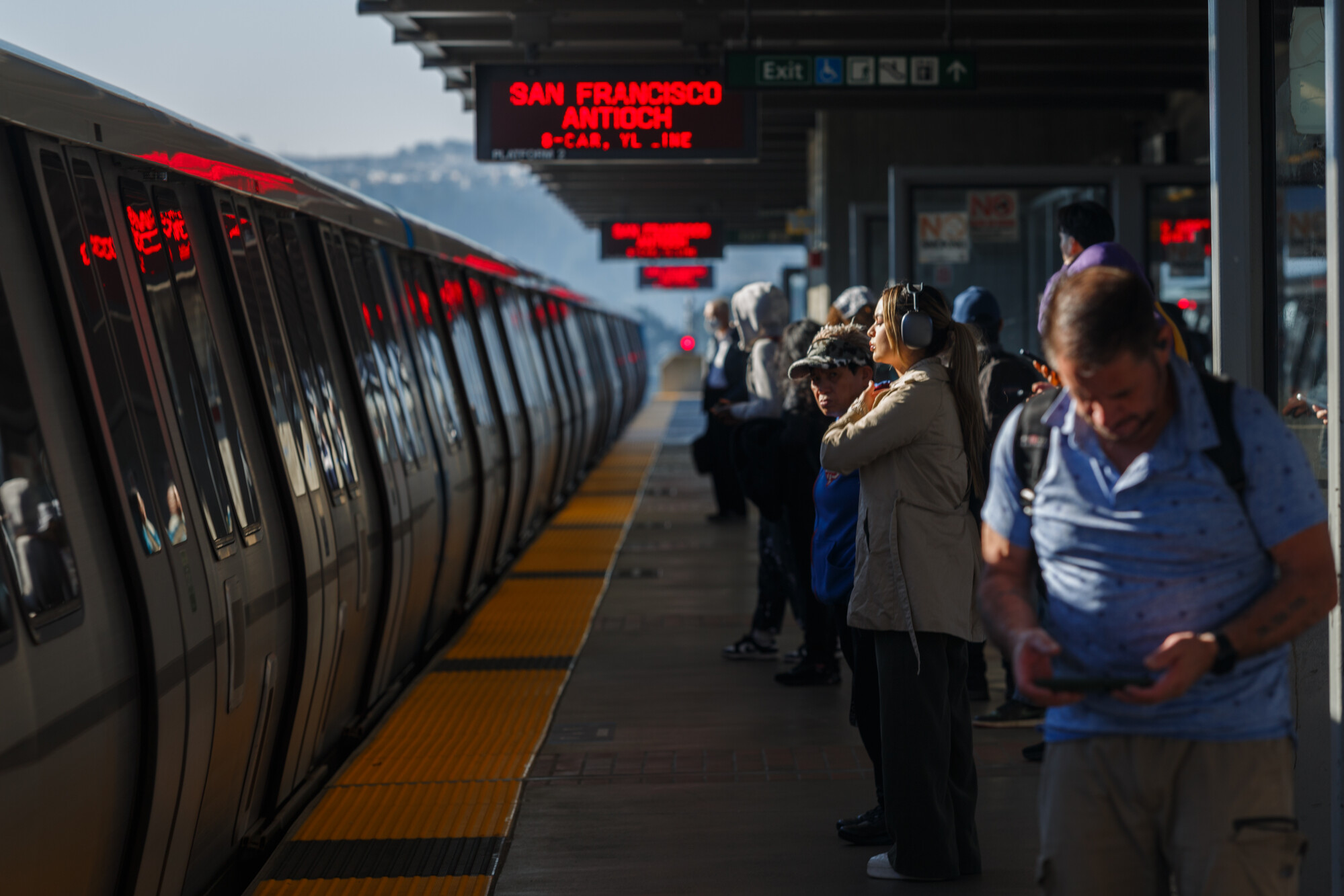
"caption": "Passengers wait to board BART at Daly City Station in Daly City, California, on Dec. 4, 2024. A new budget blueprint would reverse Gov. Newsom's proposal for a $1.1 billion cut in transit funding and offer emergency loans to BART, Muni and others. ",
"credit": "Juliana Yamada/KQED",
"altTag": null,
"description": null,
"imgSizes": {
"thumbnail": {
"file": "https://cdn.kqed.org/wp-content/uploads/sites/10/2025/06/20241204-BART-JY-003_qed-160x107.jpg",
"width": 160,
"height": 107,
"mimeType": "image/jpeg"
},
"1536x1536": {
"file": "https://cdn.kqed.org/wp-content/uploads/sites/10/2025/06/20241204-BART-JY-003_qed-1536x1024.jpg",
"width": 1536,
"height": 1024,
"mimeType": "image/jpeg"
},
"post-thumbnail": {
"file": "https://cdn.kqed.org/wp-content/uploads/sites/10/2025/06/20241204-BART-JY-003_qed-672x372.jpg",
"width": 672,
"height": 372,
"mimeType": "image/jpeg"
},
"twentyfourteen-full-width": {
"file": "https://cdn.kqed.org/wp-content/uploads/sites/10/2025/06/20241204-BART-JY-003_qed-1038x576.jpg",
"width": 1038,
"height": 576,
"mimeType": "image/jpeg"
},
"kqedFullSize": {
"file": "https://cdn.kqed.org/wp-content/uploads/sites/10/2025/06/20241204-BART-JY-003_qed.jpg",
"width": 1999,
"height": 1333
}
},
"isLoading": false,
"fetchFailed": false
},
"news_12041827": {
"type": "attachments",
"id": "news_12041827",
"meta": {
"index": "attachments_1716263798",
"site": "news",
"id": "12041827",
"found": true
},
"title": "006_KQED_SanFrancisco_Muni_04062020_qed",
"publishDate": 1748456618,
"status": "inherit",
"parent": 12041824,
"modified": 1748807984,
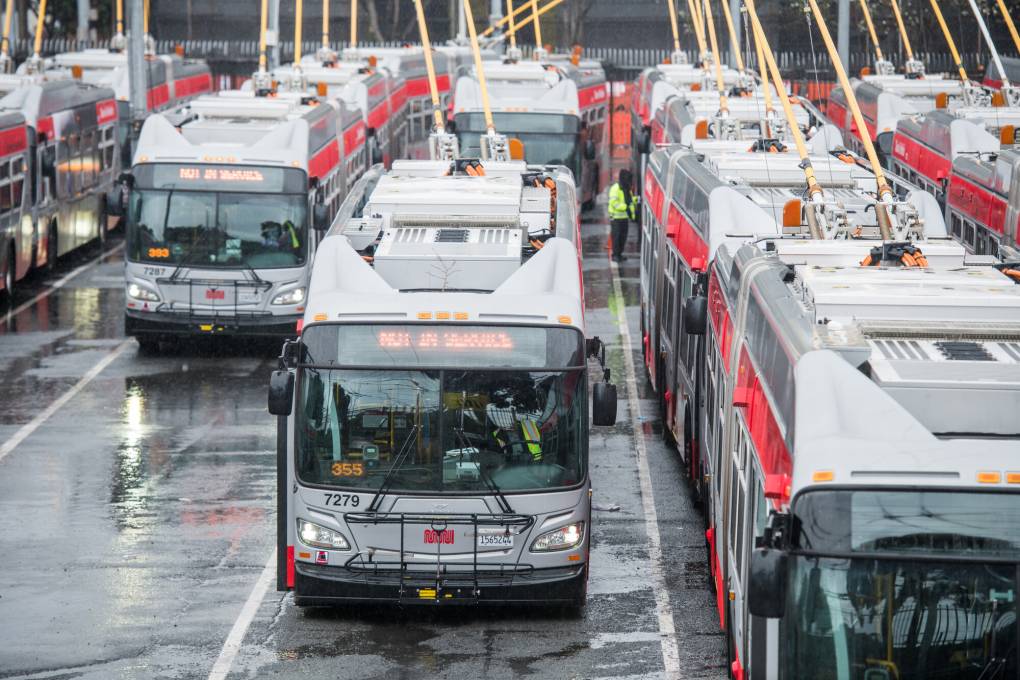
"caption": "A fleet of Muni buses in San Francisco on April 6, 2020.",
"credit": "Beth LaBerge/KQED",
"altTag": "A fleet of buses with red stripes in a parking lot.",
"description": null,
"imgSizes": {
"medium": {
"file": "https://cdn.kqed.org/wp-content/uploads/sites/10/2025/05/006_KQED_SanFrancisco_Muni_04062020_qed-800x533.jpg",
"width": 800,
"height": 533,
"mimeType": "image/jpeg"
},
"large": {
"file": "https://cdn.kqed.org/wp-content/uploads/sites/10/2025/05/006_KQED_SanFrancisco_Muni_04062020_qed-1020x680.jpg",
"width": 1020,
"height": 680,
"mimeType": "image/jpeg"
},
"thumbnail": {
"file": "https://cdn.kqed.org/wp-content/uploads/sites/10/2025/05/006_KQED_SanFrancisco_Muni_04062020_qed-160x107.jpg",
"width": 160,
"height": 107,
"mimeType": "image/jpeg"
},
"1536x1536": {
"file": "https://cdn.kqed.org/wp-content/uploads/sites/10/2025/05/006_KQED_SanFrancisco_Muni_04062020_qed-1536x1024.jpg",
"width": 1536,
"height": 1024,
"mimeType": "image/jpeg"
},
"post-thumbnail": {
"file": "https://cdn.kqed.org/wp-content/uploads/sites/10/2025/05/006_KQED_SanFrancisco_Muni_04062020_qed-672x372.jpg",
"width": 672,
"height": 372,
"mimeType": "image/jpeg"
},
"twentyfourteen-full-width": {
"file": "https://cdn.kqed.org/wp-content/uploads/sites/10/2025/05/006_KQED_SanFrancisco_Muni_04062020_qed-1038x576.jpg",
"width": 1038,
"height": 576,
"mimeType": "image/jpeg"
},
"full-width": {
"file": "https://cdn.kqed.org/wp-content/uploads/sites/10/2025/05/006_KQED_SanFrancisco_Muni_04062020_qed-1920x1280.jpg",
"width": 1920,
"height": 1280,
"mimeType": "image/jpeg"
},
"kqedFullSize": {
"file": "https://cdn.kqed.org/wp-content/uploads/sites/10/2025/05/006_KQED_SanFrancisco_Muni_04062020_qed.jpg",
"width": 2000,
"height": 1333
}
},
"isLoading": false,
"fetchFailed": false
},
"news_12040186": {
"type": "attachments",
"id": "news_12040186",
"meta": {
"index": "attachments_1716263798",
"site": "news",
"id": "12040186",
"found": true
},
"title": "20241204-BART-JY-002_qed",
"publishDate": 1747263386,
"status": "inherit",
"parent": 0,
"modified": 1757194100,
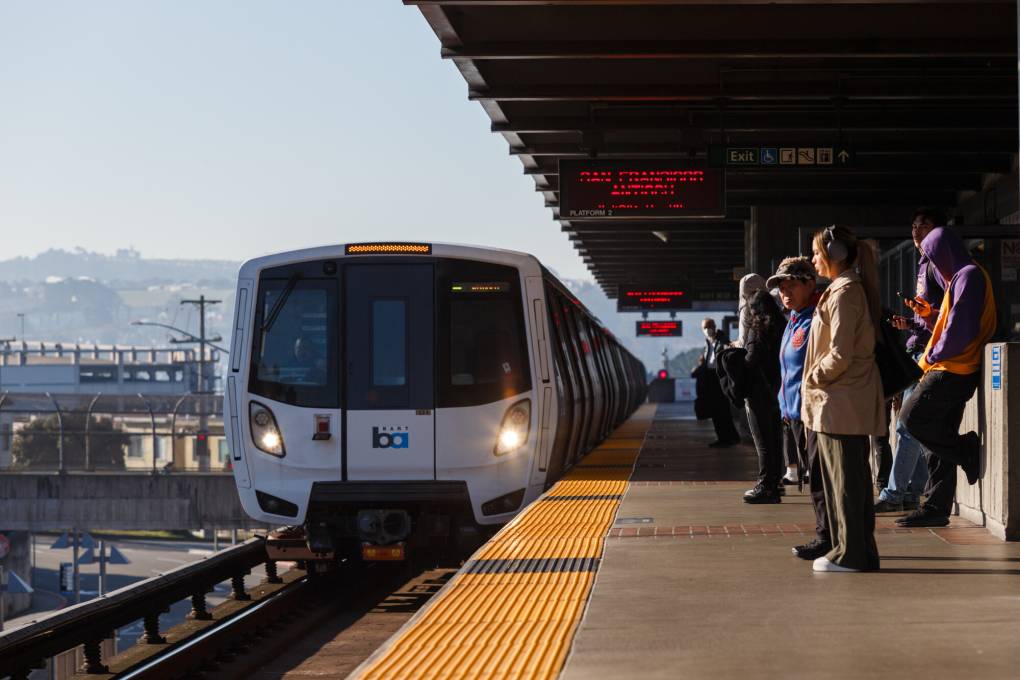
"caption": "A BART car approaches the platform at Daly City Station in Daly City, on Dec. 4, 2024.",
"credit": "Juliana Yamada/KQED",
"altTag": null,
"description": null,
"imgSizes": {
"medium": {
"file": "https://cdn.kqed.org/wp-content/uploads/sites/10/2025/05/20241204-BART-JY-002_qed-800x533.jpg",
"width": 800,
"height": 533,
"mimeType": "image/jpeg"
},
"large": {
"file": "https://cdn.kqed.org/wp-content/uploads/sites/10/2025/05/20241204-BART-JY-002_qed-1020x680.jpg",
"width": 1020,
"height": 680,
"mimeType": "image/jpeg"
},
"thumbnail": {
"file": "https://cdn.kqed.org/wp-content/uploads/sites/10/2025/05/20241204-BART-JY-002_qed-160x107.jpg",
"width": 160,
"height": 107,
"mimeType": "image/jpeg"
},
"1536x1536": {
"file": "https://cdn.kqed.org/wp-content/uploads/sites/10/2025/05/20241204-BART-JY-002_qed-1536x1024.jpg",
"width": 1536,
"height": 1024,
"mimeType": "image/jpeg"
},
"post-thumbnail": {
"file": "https://cdn.kqed.org/wp-content/uploads/sites/10/2025/05/20241204-BART-JY-002_qed-672x372.jpg",
"width": 672,
"height": 372,
"mimeType": "image/jpeg"
},
"twentyfourteen-full-width": {
"file": "https://cdn.kqed.org/wp-content/uploads/sites/10/2025/05/20241204-BART-JY-002_qed-1038x576.jpg",
"width": 1038,
"height": 576,
"mimeType": "image/jpeg"
},
"full-width": {
"file": "https://cdn.kqed.org/wp-content/uploads/sites/10/2025/05/20241204-BART-JY-002_qed-1920x1280.jpg",
"width": 1920,
"height": 1280,
"mimeType": "image/jpeg"
},
"kqedFullSize": {
"file": "https://cdn.kqed.org/wp-content/uploads/sites/10/2025/05/20241204-BART-JY-002_qed.jpg",
"width": 2000,
"height": 1333
}
},
"isLoading": false,
"fetchFailed": false
},
"news_11932694": {
"type": "attachments",
"id": "news_11932694",
"meta": {
"index": "attachments_1716263798",
"site": "news",
"id": "11932694",
"found": true
},
"title": "Rockridge-BART-cropped",
"publishDate": 1668796508,
"status": "inherit",
"parent": 11932690,
"modified": 1746835406,
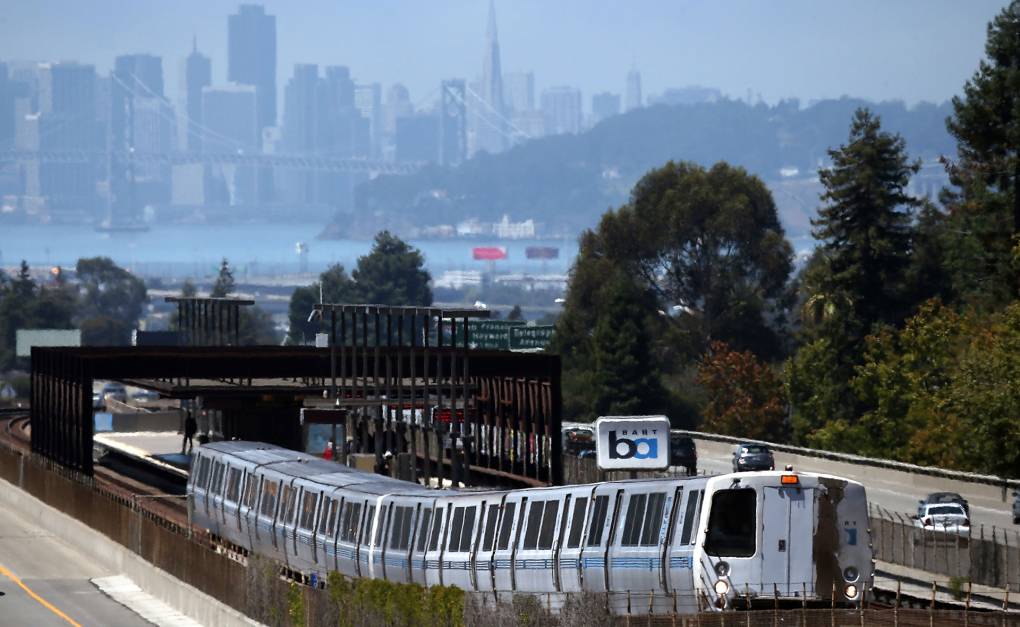
"caption": "A Bay Area Rapid Transit (BART) train pulls away from Oakland's Rockridge station on Aug. 2, 2013.",
"credit": "Justin Sullivan/Getty Images",
"altTag": "A BART train pulls out of an above-ground station. Cars whiz by alongside and the city of San Francisco looms in the background.",
"description": null,
"imgSizes": {
"medium": {
"file": "https://cdn.kqed.org/wp-content/uploads/sites/10/2022/11/Rockridge-BART-cropped-800x492.jpg",
"width": 800,
"height": 492,
"mimeType": "image/jpeg"
},
"large": {
"file": "https://cdn.kqed.org/wp-content/uploads/sites/10/2022/11/Rockridge-BART-cropped-1020x627.jpg",
"width": 1020,
"height": 627,
"mimeType": "image/jpeg"
},
"thumbnail": {
"file": "https://cdn.kqed.org/wp-content/uploads/sites/10/2022/11/Rockridge-BART-cropped-160x98.jpg",
"width": 160,
"height": 98,
"mimeType": "image/jpeg"
},
"1536x1536": {
"file": "https://cdn.kqed.org/wp-content/uploads/sites/10/2022/11/Rockridge-BART-cropped-1536x944.jpg",
"width": 1536,
"height": 944,
"mimeType": "image/jpeg"
},
"post-thumbnail": {
"file": "https://cdn.kqed.org/wp-content/uploads/sites/10/2022/11/Rockridge-BART-cropped-672x372.jpg",
"width": 672,
"height": 372,
"mimeType": "image/jpeg"
},
"twentyfourteen-full-width": {
"file": "https://cdn.kqed.org/wp-content/uploads/sites/10/2022/11/Rockridge-BART-cropped-1038x576.jpg",
"width": 1038,
"height": 576,
"mimeType": "image/jpeg"
},
"kqedFullSize": {
"file": "https://cdn.kqed.org/wp-content/uploads/sites/10/2022/11/Rockridge-BART-cropped.jpg",
"width": 1920,
"height": 1180
}
},
"isLoading": false,
"fetchFailed": false
},
"news_12039557": {
"type": "attachments",
"id": "news_12039557",
"meta": {
"index": "attachments_1716263798",
"site": "news",
"id": "12039557",
"found": true
},
"title": "250509-BARTOUTAGE-03-BL-KQED",
"publishDate": 1746817039,
"status": "inherit",
"parent": 0,
"modified": 1746819606,
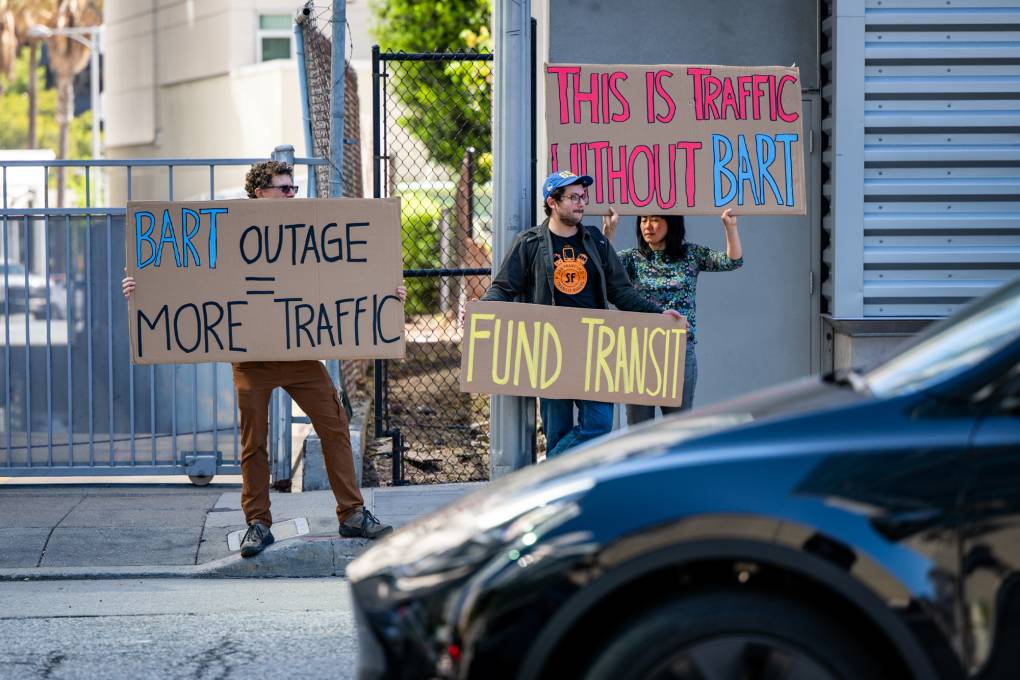
"caption": "Transit advocates hold signs calling for more public transit funding at the Fremont Street off-ramp for westbound I-80 in San Francisco on May 9, 2025.",
"credit": "Beth LaBerge/KQED",
"altTag": null,
"description": null,
"imgSizes": {
"medium": {
"file": "https://cdn.kqed.org/wp-content/uploads/sites/10/2025/05/250509-BARTOUTAGE-03-BL-KQED-800x533.jpg",
"width": 800,
"height": 533,
"mimeType": "image/jpeg"
},
"large": {
"file": "https://cdn.kqed.org/wp-content/uploads/sites/10/2025/05/250509-BARTOUTAGE-03-BL-KQED-1020x680.jpg",
"width": 1020,
"height": 680,
"mimeType": "image/jpeg"
},
"thumbnail": {
"file": "https://cdn.kqed.org/wp-content/uploads/sites/10/2025/05/250509-BARTOUTAGE-03-BL-KQED-160x107.jpg",
"width": 160,
"height": 107,
"mimeType": "image/jpeg"
},
"1536x1536": {
"file": "https://cdn.kqed.org/wp-content/uploads/sites/10/2025/05/250509-BARTOUTAGE-03-BL-KQED-1536x1024.jpg",
"width": 1536,
"height": 1024,
"mimeType": "image/jpeg"
},
"post-thumbnail": {
"file": "https://cdn.kqed.org/wp-content/uploads/sites/10/2025/05/250509-BARTOUTAGE-03-BL-KQED-672x372.jpg",
"width": 672,
"height": 372,
"mimeType": "image/jpeg"
},
"twentyfourteen-full-width": {
"file": "https://cdn.kqed.org/wp-content/uploads/sites/10/2025/05/250509-BARTOUTAGE-03-BL-KQED-1038x576.jpg",
"width": 1038,
"height": 576,
"mimeType": "image/jpeg"
},
"full-width": {
"file": "https://cdn.kqed.org/wp-content/uploads/sites/10/2025/05/250509-BARTOUTAGE-03-BL-KQED-1920x1280.jpg",
"width": 1920,
"height": 1280,
"mimeType": "image/jpeg"
},
"kqedFullSize": {
"file": "https://cdn.kqed.org/wp-content/uploads/sites/10/2025/05/250509-BARTOUTAGE-03-BL-KQED.jpg",
"width": 2000,
"height": 1333
}
},
"isLoading": false,
"fetchFailed": false
},
"news_12036442": {
"type": "attachments",
"id": "news_12036442",
"meta": {
"index": "attachments_1716263798",
"site": "news",
"id": "12036442",
"found": true
},
"title": "20250417_LURIE100DAYS_GC-8-KQED_1",
"publishDate": 1744918107,
"status": "inherit",
"parent": 0,
"modified": 1744918283,
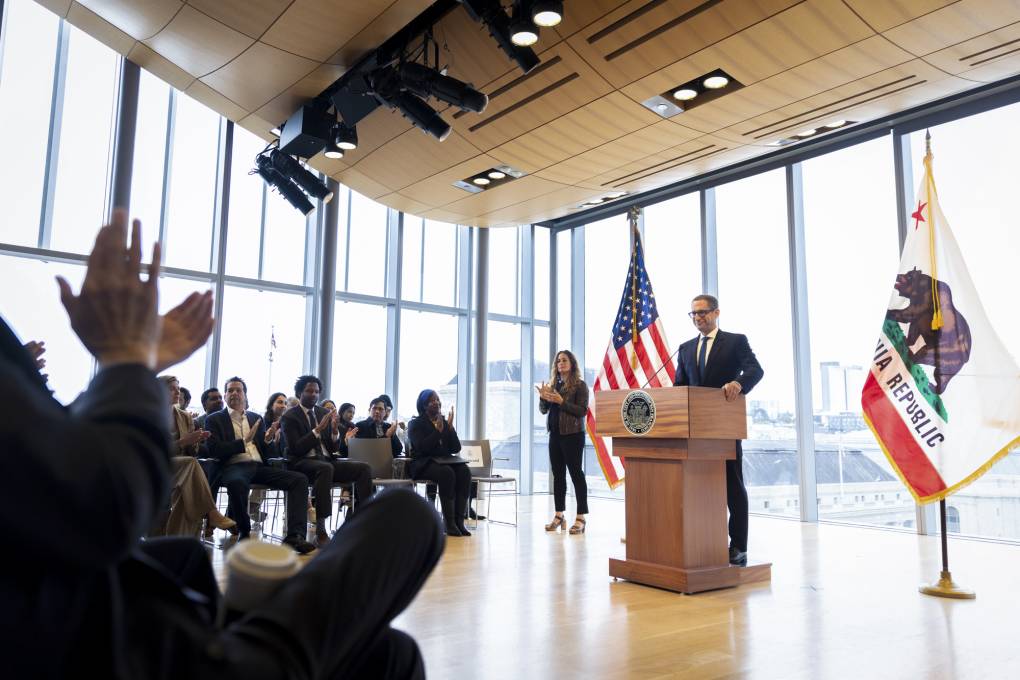
"caption": "Mayor Daniel Lurie delivers remarks on a progress report of his first 100 days in office at the San Francisco Conservatory of Music in San Francisco on April 17, 2025.",
"credit": "Gina Castro/KQED",
"altTag": null,
"description": null,
"imgSizes": {
"medium": {
"file": "https://cdn.kqed.org/wp-content/uploads/sites/10/2025/04/20250417_LURIE100DAYS_GC-8-KQED_1-800x533.jpg",
"width": 800,
"height": 533,
"mimeType": "image/jpeg"
},
"large": {
"file": "https://cdn.kqed.org/wp-content/uploads/sites/10/2025/04/20250417_LURIE100DAYS_GC-8-KQED_1-1020x680.jpg",
"width": 1020,
"height": 680,
"mimeType": "image/jpeg"
},
"thumbnail": {
"file": "https://cdn.kqed.org/wp-content/uploads/sites/10/2025/04/20250417_LURIE100DAYS_GC-8-KQED_1-160x107.jpg",
"width": 160,
"height": 107,
"mimeType": "image/jpeg"
},
"1536x1536": {
"file": "https://cdn.kqed.org/wp-content/uploads/sites/10/2025/04/20250417_LURIE100DAYS_GC-8-KQED_1-1536x1024.jpg",
"width": 1536,
"height": 1024,
"mimeType": "image/jpeg"
},
"post-thumbnail": {
"file": "https://cdn.kqed.org/wp-content/uploads/sites/10/2025/04/20250417_LURIE100DAYS_GC-8-KQED_1-672x372.jpg",
"width": 672,
"height": 372,
"mimeType": "image/jpeg"
},
"twentyfourteen-full-width": {
"file": "https://cdn.kqed.org/wp-content/uploads/sites/10/2025/04/20250417_LURIE100DAYS_GC-8-KQED_1-1038x576.jpg",
"width": 1038,
"height": 576,
"mimeType": "image/jpeg"
},
"full-width": {
"file": "https://cdn.kqed.org/wp-content/uploads/sites/10/2025/04/20250417_LURIE100DAYS_GC-8-KQED_1-1920x1280.jpg",
"width": 1920,
"height": 1280,
"mimeType": "image/jpeg"
},
"kqedFullSize": {
"file": "https://cdn.kqed.org/wp-content/uploads/sites/10/2025/04/20250417_LURIE100DAYS_GC-8-KQED_1.jpg",
"width": 2000,
"height": 1333
}
},
"isLoading": false,
"fetchFailed": false
},
"news_11945540": {
"type": "attachments",
"id": "news_11945540",
"meta": {
"index": "attachments_1716263798",
"site": "news",
"id": "11945540",
"found": true
},
"parent": 11945484,
"imgSizes": {
"twentyfourteen-full-width": {
"file": "https://ww2.kqed.org/app/uploads/sites/10/2023/04/GettyImages-1473781948-1024x576.jpg",
"width": 1024,
"mimeType": "image/jpeg",
"height": 576
},
"thumbnail": {
"file": "https://ww2.kqed.org/app/uploads/sites/10/2023/04/GettyImages-1473781948-160x101.jpg",
"width": 160,
"mimeType": "image/jpeg",
"height": 101
},
"post-thumbnail": {
"file": "https://ww2.kqed.org/app/uploads/sites/10/2023/04/GettyImages-1473781948-672x372.jpg",
"width": 672,
"mimeType": "image/jpeg",
"height": 372
},
"kqedFullSize": {
"file": "https://ww2.kqed.org/app/uploads/sites/10/2023/04/GettyImages-1473781948.jpg",
"width": 1024,
"height": 644
},
"large": {
"file": "https://ww2.kqed.org/app/uploads/sites/10/2023/04/GettyImages-1473781948-1020x641.jpg",
"width": 1020,
"mimeType": "image/jpeg",
"height": 641
},
"medium": {
"file": "https://ww2.kqed.org/app/uploads/sites/10/2023/04/GettyImages-1473781948-800x503.jpg",
"width": 800,
"mimeType": "image/jpeg",
"height": 503
}
},
"publishDate": 1680555592,
"modified": 1680558670,
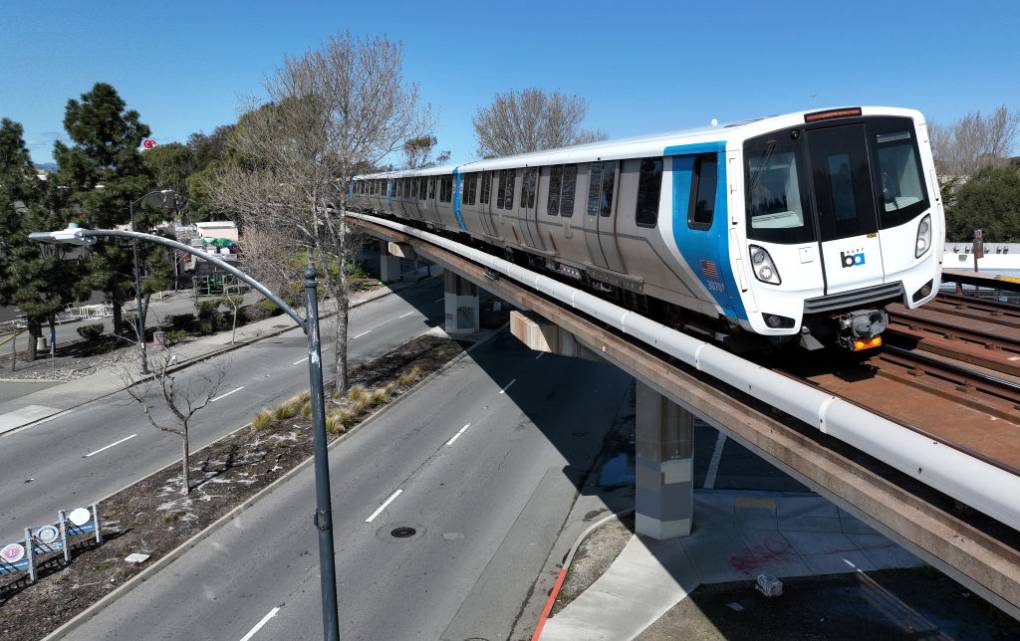
"caption": "A BART train approaches the El Cerrito Plaza station on March 15, 2023, in El Cerrito.",
"description": null,
"title": "Bay Area Rapid Transit System Faces Perilous Financial Outlook",
"credit": "Justin Sullivan/Getty Images",
"status": "inherit",
"altTag": "A train moving on tracks seen above a highway.",
"isLoading": false,
"fetchFailed": false
},
"news_12031469": {
"type": "attachments",
"id": "news_12031469",
"meta": {
"index": "attachments_1716263798",
"site": "news",
"id": "12031469",
"found": true
},
"title": "20250313_MUNI-OPERATOR-DAY_DMB_00008-KQED",
"publishDate": 1741993630,
"status": "inherit",
"parent": 0,
"modified": 1742228009,
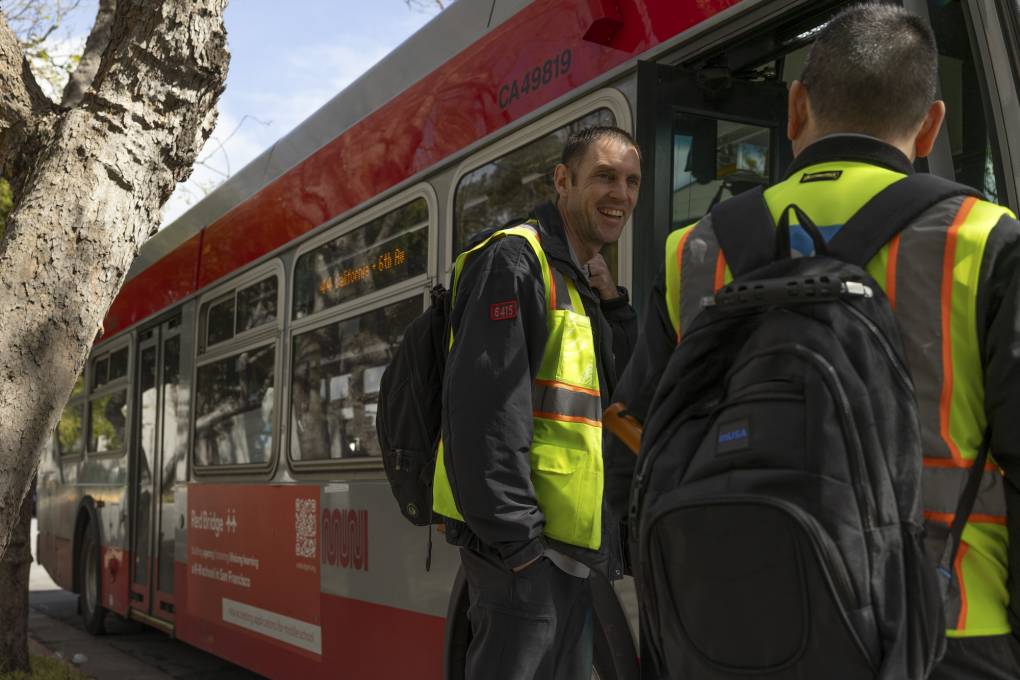
"caption": "SF Muni Transit Operator Mc Allen takes over carriage 8868 at the start of his route for the inbound 44 O’Shaughnessy in San Francisco on March 13, 2025. As Muni faces a budget shortfall, possible service cuts and the need to boost ridership, Allen is launching a project to get all of San Francisco to take a trip on March 18 and submit commendations thanking operators for their work.",
"credit": "David M. Barreda/KQED",
"altTag": null,
"description": null,
"imgSizes": {
"medium": {
"file": "https://cdn.kqed.org/wp-content/uploads/sites/10/2025/03/20250313_MUNI-OPERATOR-DAY_DMB_00008-KQED-800x533.jpg",
"width": 800,
"height": 533,
"mimeType": "image/jpeg"
},
"large": {
"file": "https://cdn.kqed.org/wp-content/uploads/sites/10/2025/03/20250313_MUNI-OPERATOR-DAY_DMB_00008-KQED-1020x680.jpg",
"width": 1020,
"height": 680,
"mimeType": "image/jpeg"
},
"thumbnail": {
"file": "https://cdn.kqed.org/wp-content/uploads/sites/10/2025/03/20250313_MUNI-OPERATOR-DAY_DMB_00008-KQED-160x107.jpg",
"width": 160,
"height": 107,
"mimeType": "image/jpeg"
},
"1536x1536": {
"file": "https://cdn.kqed.org/wp-content/uploads/sites/10/2025/03/20250313_MUNI-OPERATOR-DAY_DMB_00008-KQED-1536x1024.jpg",
"width": 1536,
"height": 1024,
"mimeType": "image/jpeg"
},
"post-thumbnail": {
"file": "https://cdn.kqed.org/wp-content/uploads/sites/10/2025/03/20250313_MUNI-OPERATOR-DAY_DMB_00008-KQED-672x372.jpg",
"width": 672,
"height": 372,
"mimeType": "image/jpeg"
},
"twentyfourteen-full-width": {
"file": "https://cdn.kqed.org/wp-content/uploads/sites/10/2025/03/20250313_MUNI-OPERATOR-DAY_DMB_00008-KQED-1038x576.jpg",
"width": 1038,
"height": 576,
"mimeType": "image/jpeg"
},
"full-width": {
"file": "https://cdn.kqed.org/wp-content/uploads/sites/10/2025/03/20250313_MUNI-OPERATOR-DAY_DMB_00008-KQED-1920x1280.jpg",
"width": 1920,
"height": 1280,
"mimeType": "image/jpeg"
},
"kqedFullSize": {
"file": "https://cdn.kqed.org/wp-content/uploads/sites/10/2025/03/20250313_MUNI-OPERATOR-DAY_DMB_00008-KQED.jpg",
"width": 2000,
"height": 1333
}
},
"isLoading": false,
"fetchFailed": false
},
"news_12027779": {
"type": "attachments",
"id": "news_12027779",
"meta": {
"index": "attachments_1716263798",
"site": "news",
"id": "12027779",
"found": true
},
"title": "241217-DaylightingLaws-06-BL_qed",
"publishDate": 1740007578,
"status": "inherit",
"parent": 12027759,
"modified": 1740008998,
"caption": "A red curb indicates a no parking area near a crosswalk on Dolores and 16th streets in San Francisco on Dec. 17, 2024.",
"credit": "Beth LaBerge/KQED",
"altTag": null,
"description": null,
"imgSizes": {
"medium": {
"file": "https://cdn.kqed.org/wp-content/uploads/sites/10/2025/02/241217-DaylightingLaws-06-BL_qed-800x533.jpg",
"width": 800,
"height": 533,
"mimeType": "image/jpeg"
},
"large": {
"file": "https://cdn.kqed.org/wp-content/uploads/sites/10/2025/02/241217-DaylightingLaws-06-BL_qed-1020x680.jpg",
"width": 1020,
"height": 680,
"mimeType": "image/jpeg"
},
"thumbnail": {
"file": "https://cdn.kqed.org/wp-content/uploads/sites/10/2025/02/241217-DaylightingLaws-06-BL_qed-160x107.jpg",
"width": 160,
"height": 107,
"mimeType": "image/jpeg"
},
"1536x1536": {
"file": "https://cdn.kqed.org/wp-content/uploads/sites/10/2025/02/241217-DaylightingLaws-06-BL_qed-1536x1024.jpg",
"width": 1536,
"height": 1024,
"mimeType": "image/jpeg"
},
"post-thumbnail": {
"file": "https://cdn.kqed.org/wp-content/uploads/sites/10/2025/02/241217-DaylightingLaws-06-BL_qed-672x372.jpg",
"width": 672,
"height": 372,
"mimeType": "image/jpeg"
},
"twentyfourteen-full-width": {
"file": "https://cdn.kqed.org/wp-content/uploads/sites/10/2025/02/241217-DaylightingLaws-06-BL_qed-1038x576.jpg",
"width": 1038,
"height": 576,
"mimeType": "image/jpeg"
},
"full-width": {
"file": "https://cdn.kqed.org/wp-content/uploads/sites/10/2025/02/241217-DaylightingLaws-06-BL_qed-1920x1280.jpg",
"width": 1920,
"height": 1280,
"mimeType": "image/jpeg"
},
"kqedFullSize": {
"file": "https://cdn.kqed.org/wp-content/uploads/sites/10/2025/02/241217-DaylightingLaws-06-BL_qed.jpg",
"width": 2000,
"height": 1333
}
},
"isLoading": false,
"fetchFailed": false
},
"news_12006908": {
"type": "attachments",
"id": "news_12006908",
"meta": {
"index": "attachments_1716263798",
"site": "news",
"id": "12006908",
"found": true
},
"title": "Coyote (Canis latrans), Bernal Heights, San Francisco, California, United States, North America",
"publishDate": 1727470577,
"status": "inherit",
"parent": 12006902,
"modified": 1727470627,
"caption": "Parks officials with the Golden Gate National Recreation Area are warning dog owners to be careful after several reports of dogs being attacked by coyotes at Crissy Field, including three deaths in 10 days.",
"credit": "Jouko van der Kruijssen/Getty Images",
"altTag": null,
"description": null,
"imgSizes": {
"medium": {
"file": "https://cdn.kqed.org/wp-content/uploads/sites/10/2024/09/CoyoteGetty-800x640.jpg",
"width": 800,
"height": 640,
"mimeType": "image/jpeg"
},
"large": {
"file": "https://cdn.kqed.org/wp-content/uploads/sites/10/2024/09/CoyoteGetty-1020x816.jpg",
"width": 1020,
"height": 816,
"mimeType": "image/jpeg"
},
"thumbnail": {
"file": "https://cdn.kqed.org/wp-content/uploads/sites/10/2024/09/CoyoteGetty-160x128.jpg",
"width": 160,
"height": 128,
"mimeType": "image/jpeg"
},
"1536x1536": {
"file": "https://cdn.kqed.org/wp-content/uploads/sites/10/2024/09/CoyoteGetty-1536x1229.jpg",
"width": 1536,
"height": 1229,
"mimeType": "image/jpeg"
},
"post-thumbnail": {
"file": "https://cdn.kqed.org/wp-content/uploads/sites/10/2024/09/CoyoteGetty-672x372.jpg",
"width": 672,
"height": 372,
"mimeType": "image/jpeg"
},
"twentyfourteen-full-width": {
"file": "https://cdn.kqed.org/wp-content/uploads/sites/10/2024/09/CoyoteGetty-1038x576.jpg",
"width": 1038,
"height": 576,
"mimeType": "image/jpeg"
},
"full-width": {
"file": "https://cdn.kqed.org/wp-content/uploads/sites/10/2024/09/CoyoteGetty-1920x1536.jpg",
"width": 1920,
"height": 1536,
"mimeType": "image/jpeg"
},
"kqedFullSize": {
"file": "https://cdn.kqed.org/wp-content/uploads/sites/10/2024/09/CoyoteGetty.jpg",
"width": 2000,
"height": 1600
}
},
"isLoading": false,
"fetchFailed": false
},
"news_12025783": {
"type": "attachments",
"id": "news_12025783",
"meta": {
"index": "attachments_1716263798",
"site": "news",
"id": "12025783",
"found": true
},
"title": "Muni",
"publishDate": 1738781091,
"status": "inherit",
"parent": 12025781,
"modified": 1738781131,
"caption": "The K Line arrives at West Portal Station in San Francisco on Tuesday, Nov. 28, 2023.",
"credit": "Juliana Yamada/KQED",
"altTag": null,
"description": null,
"imgSizes": {
"medium": {
"file": "https://cdn.kqed.org/wp-content/uploads/sites/10/2025/02/20231128-Muni-023-JY_qed-800x533.jpg",
"width": 800,
"height": 533,
"mimeType": "image/jpeg"
},
"large": {
"file": "https://cdn.kqed.org/wp-content/uploads/sites/10/2025/02/20231128-Muni-023-JY_qed-1020x680.jpg",
"width": 1020,
"height": 680,
"mimeType": "image/jpeg"
},
"thumbnail": {
"file": "https://cdn.kqed.org/wp-content/uploads/sites/10/2025/02/20231128-Muni-023-JY_qed-160x107.jpg",
"width": 160,
"height": 107,
"mimeType": "image/jpeg"
},
"1536x1536": {
"file": "https://cdn.kqed.org/wp-content/uploads/sites/10/2025/02/20231128-Muni-023-JY_qed-1536x1024.jpg",
"width": 1536,
"height": 1024,
"mimeType": "image/jpeg"
},
"post-thumbnail": {
"file": "https://cdn.kqed.org/wp-content/uploads/sites/10/2025/02/20231128-Muni-023-JY_qed-672x372.jpg",
"width": 672,
"height": 372,
"mimeType": "image/jpeg"
},
"twentyfourteen-full-width": {
"file": "https://cdn.kqed.org/wp-content/uploads/sites/10/2025/02/20231128-Muni-023-JY_qed-1038x576.jpg",
"width": 1038,
"height": 576,
"mimeType": "image/jpeg"
},
"full-width": {
"file": "https://cdn.kqed.org/wp-content/uploads/sites/10/2025/02/20231128-Muni-023-JY_qed-1920x1280.jpg",
"width": 1920,
"height": 1280,
"mimeType": "image/jpeg"
},
"kqedFullSize": {
"file": "https://cdn.kqed.org/wp-content/uploads/sites/10/2025/02/20231128-Muni-023-JY_qed.jpg",
"width": 2000,
"height": 1333
}
},
"isLoading": false,
"fetchFailed": false
},
"news_12021180": {
"type": "attachments",
"id": "news_12021180",
"meta": {
"index": "attachments_1716263798",
"site": "news",
"id": "12021180",
"found": true
},
"title": "Muni",
"publishDate": 1736454557,
"status": "inherit",
"parent": 12021178,
"modified": 1736454591,
"caption": "Passengers wait to board the L Bus outside of West Portal Station in San Francisco on Nov. 28, 2023.",
"credit": "Juliana Yamada/KQED",
"altTag": null,
"description": null,
"imgSizes": {
"medium": {
"file": "https://cdn.kqed.org/wp-content/uploads/sites/10/2025/01/20231128-Muni-013-JY_qed-800x533.jpg",
"width": 800,
"height": 533,
"mimeType": "image/jpeg"
},
"large": {
"file": "https://cdn.kqed.org/wp-content/uploads/sites/10/2025/01/20231128-Muni-013-JY_qed-1020x680.jpg",
"width": 1020,
"height": 680,
"mimeType": "image/jpeg"
},
"thumbnail": {
"file": "https://cdn.kqed.org/wp-content/uploads/sites/10/2025/01/20231128-Muni-013-JY_qed-160x107.jpg",
"width": 160,
"height": 107,
"mimeType": "image/jpeg"
},
"1536x1536": {
"file": "https://cdn.kqed.org/wp-content/uploads/sites/10/2025/01/20231128-Muni-013-JY_qed-1536x1024.jpg",
"width": 1536,
"height": 1024,
"mimeType": "image/jpeg"
},
"post-thumbnail": {
"file": "https://cdn.kqed.org/wp-content/uploads/sites/10/2025/01/20231128-Muni-013-JY_qed-672x372.jpg",
"width": 672,
"height": 372,
"mimeType": "image/jpeg"
},
"twentyfourteen-full-width": {
"file": "https://cdn.kqed.org/wp-content/uploads/sites/10/2025/01/20231128-Muni-013-JY_qed-1038x576.jpg",
"width": 1038,
"height": 576,
"mimeType": "image/jpeg"
},
"full-width": {
"file": "https://cdn.kqed.org/wp-content/uploads/sites/10/2025/01/20231128-Muni-013-JY_qed-1920x1280.jpg",
"width": 1920,
"height": 1280,
"mimeType": "image/jpeg"
},
"kqedFullSize": {
"file": "https://cdn.kqed.org/wp-content/uploads/sites/10/2025/01/20231128-Muni-013-JY_qed.jpg",
"width": 2000,
"height": 1333
}
},
"isLoading": false,
"fetchFailed": false
}
},
"audioPlayerReducer": {
"postId": "stream_live",
"isPaused": true,
"isPlaying": false,
"pfsActive": false,
"pledgeModalIsOpen": true,
"playerDrawerIsOpen": false,
"liveAudioPlayStartedAt": 0,
"liveAudioPlayContext": ""
},
"authorsReducer": {
"danbrekke": {
"type": "authors",
"id": "222",
"meta": {
"index": "authors_1716337520",
"id": "222",
"found": true
},
"name": "Dan Brekke",
"firstName": "Dan",
"lastName": "Brekke",
"slug": "danbrekke",
"email": "dbrekke@kqed.org",
"display_author_email": true,
"staff_mastheads": [
"news",
"science"
],
"title": "KQED Editor and Reporter",
"bio": "Dan Brekke is a reporter and editor for KQED News, responsible for coverage of topics ranging from California water issues to the Bay Area's transportation challenges. In a newsroom career that began in Chicago in 1972, Dan has worked for \u003cem>The San Francisco Examiner,\u003c/em> Wired and TechTV and has been published in The New York Times, The New York Times Magazine, Business 2.0, Salon and elsewhere.\r\n\r\nSince joining KQED in 2007, Dan has reported, edited and produced both radio and online features and breaking news pieces. He has shared as both editor and reporter in four Society of Professional Journalists Norcal Excellence in Journalism awards and one Edward R. Murrow regional award. He was chosen for a spring 2017 residency at the Mesa Refuge to advance his research on California salmon.\r\n\r\nEmail Dan at: \u003ca href=\"mailto:dbrekke@kqed.org\">dbrekke@kqed.org\u003c/a>\r\n\r\n\u003cstrong>Twitter:\u003c/strong> \u003ca href=\"https://twitter.com/danbrekke\" rel=\"noopener noreferrer\">twitter.com/danbrekke\u003c/a>\r\n\u003cstrong>Facebook:\u003c/strong> \u003ca href=\"https://www.facebook.com/danbrekke\" rel=\"noopener noreferrer\">www.facebook.com/danbrekke\u003c/a>\r\n\u003cstrong>LinkedIn:\u003c/strong> \u003ca href=\"https://www.linkedin.com/in/danbrekke\" rel=\"noopener noreferrer\">www.linkedin.com/in/danbrekke\u003c/a>",
"avatar": "https://secure.gravatar.com/avatar/c8126230345efca3f7aa89b1a402be45?s=600&d=mm&r=g",
"twitter": "danbrekke",
"facebook": null,
"instagram": "https://www.instagram.com/dan.brekke/",
"linkedin": "https://www.linkedin.com/in/danbrekke/",
"sites": [
{
"site": "news",
"roles": [
"administrator",
"create_posts"
]
},
{
"site": "stateofhealth",
"roles": [
"editor"
]
},
{
"site": "science",
"roles": [
"editor"
]
},
{
"site": "quest",
"roles": [
"contributor"
]
},
{
"site": "food",
"roles": [
"contributor"
]
},
{
"site": "forum",
"roles": [
"contributor"
]
},
{
"site": "liveblog",
"roles": [
"editor"
]
}
],
"headData": {
"title": "Dan Brekke | KQED",
"description": "KQED Editor and Reporter",
"ogImgSrc": "https://secure.gravatar.com/avatar/c8126230345efca3f7aa89b1a402be45?s=600&d=mm&r=g",
"twImgSrc": "https://secure.gravatar.com/avatar/c8126230345efca3f7aa89b1a402be45?s=600&d=mm&r=g"
},
"isLoading": false,
"link": "/author/danbrekke"
},
"mlagos": {
"type": "authors",
"id": "3239",
"meta": {
"index": "authors_1716337520",
"id": "3239",
"found": true
},
"name": "Marisa Lagos",
"firstName": "Marisa",
"lastName": "Lagos",
"slug": "mlagos",
"email": "mlagos@kqed.org",
"display_author_email": false,
"staff_mastheads": [
"news"
],
"title": "KQED Contributor",
"bio": "Marisa Lagos is a correspondent for KQED’s California Politics and Government Desk and co-hosts the award-winning show and podcast, Political Breakdown. At KQED, Lagos also conducts reporting, analysis and investigations into state, local and national politics for radio, TV, online and onstage. In 2022, she and co-host, Scott Shafer, moderated the only gubernatorial debate in California. In 2020, the \u003ci>Washington Post\u003c/i> named her one of the top political journalists in California; she was nominated for a Peabody and won several other awards for her work investigating the 2017 California wildfires. She has worked at the \u003ci>San Francisco Chronicle\u003c/i>, \u003ci>San Francisco Examiner\u003c/i> and \u003ci>Los Angeles Times\u003c/i>. A UC Santa Barbara graduate, she lives in San Francisco with her two sons and husband.",
"avatar": "https://secure.gravatar.com/avatar/a261a0d3696fc066871ef96b85b5e7d2?s=600&d=blank&r=g",
"twitter": "@mlagos",
"facebook": null,
"instagram": null,
"linkedin": null,
"sites": [
{
"site": "arts",
"roles": [
"author"
]
},
{
"site": "news",
"roles": [
"editor"
]
},
{
"site": "science",
"roles": [
"editor"
]
},
{
"site": "forum",
"roles": [
"author"
]
},
{
"site": "liveblog",
"roles": [
"author"
]
}
],
"headData": {
"title": "Marisa Lagos | KQED",
"description": "KQED Contributor",
"ogImgSrc": "https://secure.gravatar.com/avatar/a261a0d3696fc066871ef96b85b5e7d2?s=600&d=blank&r=g",
"twImgSrc": "https://secure.gravatar.com/avatar/a261a0d3696fc066871ef96b85b5e7d2?s=600&d=blank&r=g"
},
"isLoading": false,
"link": "/author/mlagos"
},
"adahlstromeckman": {
"type": "authors",
"id": "11785",
"meta": {
"index": "authors_1716337520",
"id": "11785",
"found": true
},
"name": "Azul Dahlstrom-Eckman",
"firstName": "Azul",
"lastName": "Dahlstrom-Eckman",
"slug": "adahlstromeckman",
"email": "adahlstrom-eckman@kqed.org",
"display_author_email": true,
"staff_mastheads": [],
"title": "Reporter",
"bio": "Azul is a reporter for KQED focusing on transportation and features. He joined KQED in 2021 as an alumna of KALW's Audio Academy radio journalism training program.",
"avatar": "https://secure.gravatar.com/avatar/9cb750298435add7815a777f55bf1f46845c1386bb8452555c60a7b820b5aba3?s=600&d=blank&r=g",
"twitter": "@zuliemann",
"bluesky": "@azul415.bsky.social",
"facebook": null,
"instagram": null,
"linkedin": null,
"sites": [
{
"site": "arts",
"roles": [
"editor"
]
},
{
"site": "news",
"roles": [
"editor"
]
},
{
"site": "science",
"roles": [
"editor"
]
},
{
"site": "liveblog",
"roles": [
"author"
]
}
],
"headData": {
"title": "Azul Dahlstrom-Eckman | KQED",
"description": "Reporter",
"ogImgSrc": "https://secure.gravatar.com/avatar/9cb750298435add7815a777f55bf1f46845c1386bb8452555c60a7b820b5aba3?s=600&d=blank&r=g",
"twImgSrc": "https://secure.gravatar.com/avatar/9cb750298435add7815a777f55bf1f46845c1386bb8452555c60a7b820b5aba3?s=600&d=blank&r=g"
},
"isLoading": false,
"link": "/author/adahlstromeckman"
},
"jservantez": {
"type": "authors",
"id": "11909",
"meta": {
"index": "authors_1716337520",
"id": "11909",
"found": true
},
"name": "Jared Servantez",
"firstName": "Jared",
"lastName": "Servantez",
"slug": "jservantez",
"email": "jservantez@kqed.org",
"display_author_email": true,
"staff_mastheads": [
"news"
],
"title": "KQED Contributor",
"bio": "Jared Servantez is the editor of KQED's Express Desk, leading the newsroom's online breaking news operation. He most recently worked for the Los Angeles Times, where he served as a breaking news editor, the Metro Desk's night editor, and a copy editor. Jared is a graduate of the USC Annenberg School for Communication and Journalism.",
"avatar": "https://secure.gravatar.com/avatar/46e9029cd4e3bc3391184e65511d73e6?s=600&d=mm&r=g",
"twitter": "jservantez",
"facebook": null,
"instagram": null,
"linkedin": null,
"sites": [
{
"site": "news",
"roles": [
"editor"
]
},
{
"site": "science",
"roles": [
"editor",
"author"
]
},
{
"site": "liveblog",
"roles": [
"editor"
]
}
],
"headData": {
"title": "Jared Servantez | KQED",
"description": "KQED Contributor",
"ogImgSrc": "https://secure.gravatar.com/avatar/46e9029cd4e3bc3391184e65511d73e6?s=600&d=mm&r=g",
"twImgSrc": "https://secure.gravatar.com/avatar/46e9029cd4e3bc3391184e65511d73e6?s=600&d=mm&r=g"
},
"isLoading": false,
"link": "/author/jservantez"
},
"kdebenedetti": {
"type": "authors",
"id": "11913",
"meta": {
"index": "authors_1716337520",
"id": "11913",
"found": true
},
"name": "Katie DeBenedetti",
"firstName": "Katie",
"lastName": "DeBenedetti",
"slug": "kdebenedetti",
"email": "kdebenedetti@kqed.org",
"display_author_email": false,
"staff_mastheads": [
"news",
"science"
],
"title": "KQED Contributor",
"bio": "Katie DeBenedetti is a digital reporter covering daily news for the Express Desk. Prior to joining KQED as a culture reporting intern in January 2024, she covered education and city government for the Napa Valley Register.",
"avatar": "https://secure.gravatar.com/avatar/6e31073cb8f7e4214ab03f42771d0f45?s=600&d=blank&r=g",
"twitter": null,
"facebook": null,
"instagram": null,
"linkedin": null,
"sites": [
{
"site": "news",
"roles": [
"author"
]
},
{
"site": "science",
"roles": [
"author"
]
},
{
"site": "liveblog",
"roles": [
"author"
]
}
],
"headData": {
"title": "Katie DeBenedetti | KQED",
"description": "KQED Contributor",
"ogImgSrc": "https://secure.gravatar.com/avatar/6e31073cb8f7e4214ab03f42771d0f45?s=600&d=blank&r=g",
"twImgSrc": "https://secure.gravatar.com/avatar/6e31073cb8f7e4214ab03f42771d0f45?s=600&d=blank&r=g"
},
"isLoading": false,
"link": "/author/kdebenedetti"
},
"slim": {
"type": "authors",
"id": "11920",
"meta": {
"index": "authors_1716337520",
"id": "11920",
"found": true
},
"name": "Samantha Lim",
"firstName": "Samantha",
"lastName": "Lim",
"slug": "slim",
"email": "slim@KQED.org",
"display_author_email": false,
"staff_mastheads": [],
"title": "KQED Contributor",
"bio": null,
"avatar": "https://secure.gravatar.com/avatar/82e592e6c15fe1a04d385e8ad0fb0b4e?s=600&d=blank&r=g",
"twitter": null,
"facebook": null,
"instagram": null,
"linkedin": null,
"sites": [
{
"site": "news",
"roles": []
}
],
"headData": {
"title": "Samantha Lim | KQED",
"description": "KQED Contributor",
"ogImgSrc": "https://secure.gravatar.com/avatar/82e592e6c15fe1a04d385e8ad0fb0b4e?s=600&d=blank&r=g",
"twImgSrc": "https://secure.gravatar.com/avatar/82e592e6c15fe1a04d385e8ad0fb0b4e?s=600&d=blank&r=g"
},
"isLoading": false,
"link": "/author/slim"
}
},
"pagesReducer": {
"news_tag_muni": {
"type": "terms",
"id": "news_320",
"meta": {
"index": "terms_1716263798",
"site": "news",
"id": "320",
"score": 9.101148
},
"featImg": null,
"name": "Muni",
"description": null,
"taxonomy": "tag",
"headData": {
"twImgId": null,
"twTitle": null,
"ogTitle": null,
"ogImgId": null,
"twDescription": null,
"description": null,
"title": "Muni Archives | KQED News",
"ogDescription": null
},
"ttid": 328,
"slug": "muni",
"isLoading": false,
"title": "Muni",
"pageMeta": {
"site": "news",
"WpPageTemplate": "page-topic-editorial",
"currentPage": 3
},
"blocks": [
{
"blockName": "kqed/post-list",
"attrs": {
"layout": "cardArticle2",
"query": "posts/news?tag=muni",
"seeMore": false,
"paginated": true,
"page": 3
}
},
{
"blockName": "kqed/ad"
}
]
}
},
"pfsSessionReducer": {},
"postsReducer": {
"stream_live": {
"type": "live",
"id": "stream_live",
"audioUrl": "https://streams.kqed.org/kqedradio",
"title": "Live Stream",
"excerpt": "Live Stream information currently unavailable.",
"link": "/radio",
"featImg": "",
"label": {
"name": "KQED Live",
"link": "/"
}
},
"stream_kqedNewscast": {
"type": "posts",
"id": "stream_kqedNewscast",
"audioUrl": "https://www.kqed.org/.stream/anon/radio/RDnews/newscast.mp3?_=1",
"title": "KQED Newscast",
"featImg": "",
"label": {
"name": "88.5 FM",
"link": "/"
}
},
"news_12043556": {
"type": "posts",
"id": "news_12043556",
"meta": {
"index": "posts_1716263798",
"site": "news",
"id": "12043556",
"score": null,
"sort": [
1749591536000
]
},
"guestAuthors": [],
"slug": "california-lawmakers-plan-would-help-bay-area-transit-avoid-fiscal-disaster-for-now",
"title": "California Lawmakers' Plan Would Help Bay Area Transit Avoid Fiscal Disaster — for Now",
"publishDate": 1749591536,
"format": "standard",
"headTitle": "California Lawmakers’ Plan Would Help Bay Area Transit Avoid Fiscal Disaster — for Now | KQED",
"labelTerm": {
"site": "news"
},
"content": "\u003cp>\u003cem>Updated 4:56 p.m.\u003c/em>\u003c/p>\n\u003cp>State lawmakers have come up with a plan that offers temporary relief to \u003ca href=\"https://www.kqed.org/news/tag/bay-area\">Bay Area\u003c/a> transit agencies on the verge of a fiscal crisis that could force drastic service cuts as early as next summer.\u003c/p>\n\u003cp>State Sens. Scott Wiener, D-San Francisco, and Jesse Arreguín, D-Berkeley, \u003ca href=\"https://sd11.senate.ca.gov/news/senate-and-assembly-reach-agreement-fund-public-transit-avert-mass-service-cuts\">announced Monday\u003c/a> that the budget blueprint drawn up by Assembly and Senate budget negotiators would reverse \u003ca href=\"https://www.kqed.org/news/12041824/bay-area-transit-faces-a-fiscal-crisis-newsoms-budget-plan-could-make-it-worse\">a $1.1 billion cut in transit funding\u003c/a> that Gov. Newsom proposed last month.\u003c/p>\n\u003cp>The Legislature’s budget, which must be approved by next Sunday, would also provide as much as $750 million in interest-free loans to Bay Area transit operators who are staring down devastating budget deficits in the fiscal year beginning July 1, 2026.\u003c/p>\n\u003cp>[ad fullwidth]\u003c/p>\n\u003cp>Arreguín and Wiener issued a joint statement that warned “allowing [public transit] to collapse would devastate California’s economic recovery and quality of life.”\u003c/p>\n\u003cp>But the senators, who have worked for the last several months with Assemblymember Mark Gonzalez, D-Los Angeles, to craft a transit relief package, acknowledged the Legislature’s plan will provide only a temporary respite from transit agencies’ long-term budget problems. Those challenges arise mostly from the pandemic-driven loss of ridership and fare revenue and a downturn in tax receipts that bus and train operators rely on.\u003c/p>\n\u003cfigure id=\"attachment_12043149\" class=\"wp-caption aligncenter\" style=\"max-width: 2000px\">\u003cimg loading=\"lazy\" decoding=\"async\" class=\"size-full wp-image-12043149\" src=\"https://cdn.kqed.org/wp-content/uploads/sites/10/2025/06/HarveyMilkFolo2.jpg\" alt=\"\" width=\"2000\" height=\"1500\" srcset=\"https://cdn.kqed.org/wp-content/uploads/sites/10/2025/06/HarveyMilkFolo2.jpg 2000w, https://cdn.kqed.org/wp-content/uploads/sites/10/2025/06/HarveyMilkFolo2-160x120.jpg 160w, https://cdn.kqed.org/wp-content/uploads/sites/10/2025/06/HarveyMilkFolo2-1536x1152.jpg 1536w\" sizes=\"auto, (max-width: 2000px) 100vw, 2000px\">\u003cfigcaption class=\"wp-caption-text\">Sen. Scott Wiener speaks at a press conference at Jane Warner Plaza in San Francisco on June 6, 2025. \u003ccite>(Samantha Kennedy/KQED)\u003c/cite>\u003c/figcaption>\u003c/figure>\n\u003cp>“Our public transportation systems’ future is still far from secure, and they require greater engagement and prioritization from our leaders to avert disaster,” Arreguín and Wiener said. “Even with this one-time relief package, systems across the state continue to face large budget shortfalls that threaten devastating service cuts.”\u003c/p>\n\u003cp>The lawmakers’ solution to the transit crisis, which rejects the governor’s proposal to redirect $1.5 billion of revenue in the state’s cap-and-trade fund to Cal Fire instead of transit, will need Newsom’s approval to take effect. The governor’s office says it’s still reviewing the proposal.\u003c/p>\n\u003cp>Parisa Safarzadeh, director of communications for the San Francisco Municipal Transportation Agency, said in an email statement that city officials will work with community members “to make sure this package is part of the final budget with the governor. We are working to make Muni more efficient and accountable, but our city’s economy cannot withstand the severe Muni service cuts that would result without this state support.”[aside postID=news_12042706 hero='https://ww2.kqed.org/app/uploads/sites/10/2022/05/IMG_7164-1020x765.jpeg']\u003ca href=\"https://www.documentcloud.org/documents/25970156-shortfalls-and-fair-share-analysis-mtc-250523/#document/p1\">A recent analysis\u003c/a> for the Metropolitan Transportation Commission found that collectively, BART, Muni, AC Transit, Caltrain and Golden Gate Transit face a total deficit of $3.7 billion in the five fiscal years beginning in July 2026. \u003c/p>\n\u003cp>BART and San Francisco’s Muni system account for $2.9 billion of that total, with both facing staggering shortfalls — $380 million for BART, $320 million for Muni — in fiscal 2026–27.\u003c/p>\n\u003cp>If those deficits are not solved, BART said that it might have to suspend service on two of its five lines, reduce service on those runs to just one or two trains every 60 minutes, shorten daily service hours and shut down some stations as a result. Muni leaders \u003ca href=\"https://www.kqed.org/news/12014573/sf-muni-dire-need-funding-without-cuts-could-be-devastating\">have warned\u003c/a> that the agency might need to suspend service on 20 bus lines, cut the frequency of service by 50% and end service at 9 p.m.\u003c/p>\n\u003cp>To avert those cuts, Wiener, Arreguín and Assemblymember Catherine Stefani, D-San Francisco, are working with the MTC and officials across the Bay Area \u003ca href=\"https://www.kqed.org/news/12039394/last-ditch-effort-fund-bay-area-transit-tries-pick-up-support\">to craft legislation\u003c/a> to authorize a November 2026 ballot measure that would aid BART, Muni, AC Transit, Caltrain and other operators.\u003c/p>\n\u003cp>The bill, \u003ca href=\"https://leginfo.legislature.ca.gov/faces/billTextClient.xhtml?bill_id=202520260SB63\">SB 63\u003c/a>, recently passed the Senate and will be taken up next by the Assembly Transportation Committee. It would impose additional sales taxes in San Francisco, Alameda and Contra Costa counties to support day-to-day operations and to improve regional transit connections. The MTC has estimated that the sales taxes — a half-cent in Alameda and Contra counties and up to one cent in San Francisco — would raise up to $550 million a year.\u003c/p>\n\u003cp>The bill also allows San Mateo and Santa Clara counties to opt in to the ballot measure, a decision each county would have to make by Aug. 11.\u003c/p>\n\u003cp>\u003c/p>\n",
"blocks": [],
"excerpt": "The budget blueprint would reverse Gov. Newsom's proposal for a $1.1 billion cut in transit funding and offer emergency loans to BART, Muni and others. ",
"status": "publish",
"parent": 0,
"modified": 1749599911,
"stats": {
"hasAudio": false,
"hasVideo": false,
"hasChartOrMap": false,
"iframeSrcs": [],
"hasGoogleForm": false,
"hasGallery": false,
"hasHearkenModule": false,
"hasPolis": false,
"paragraphCount": 16,
"wordCount": 759
},
"headData": {
"title": "California Lawmakers' Plan Would Help Bay Area Transit Avoid Fiscal Disaster — for Now | KQED",
"description": "The budget blueprint would reverse Gov. Newsom's proposal for a $1.1 billion cut in transit funding and offer emergency loans to BART, Muni and others. ",
"ogTitle": "",
"ogDescription": "",
"ogImgId": "",
"twTitle": "",
"twDescription": "",
"twImgId": "",
"schema": {
"@context": "https://schema.org",
"@type": "NewsArticle",
"headline": "California Lawmakers' Plan Would Help Bay Area Transit Avoid Fiscal Disaster — for Now",
"datePublished": "2025-06-10T14:38:56-07:00",
"dateModified": "2025-06-10T16:58:31-07:00",
"image": "https://cdn.kqed.org/wp-content/uploads/2020/02/KQED-OG-Image@1x.png",
"isAccessibleForFree": "True",
"publisher": {
"@type": "NewsMediaOrganization",
"@id": "https://www.kqed.org/#organization",
"name": "KQED",
"logo": "https://cdn.kqed.org/wp-content/uploads/2020/02/KQED-OG-Image@1x.png",
"url": "https://www.kqed.org",
"sameAs": [
"https://www.facebook.com/KQED",
"https://twitter.com/KQED",
"https://www.instagram.com/kqed/",
"https://www.tiktok.com/@kqedofficial",
"https://www.linkedin.com/company/kqed",
"https://www.youtube.com/channel/UCeC0IOo7i1P_61zVUWbJ4nw"
]
}
}
},
"sticky": false,
"nprStoryId": "kqed-12043556",
"templateType": "standard",
"featuredImageType": "standard",
"excludeFromSiteSearch": "Include",
"articleAge": "0",
"path": "/news/12043556/california-lawmakers-plan-would-help-bay-area-transit-avoid-fiscal-disaster-for-now",
"audioTrackLength": null,
"parsedContent": [
{
"type": "contentString",
"content": "\u003cdiv class=\"post-body\">\u003cp>\u003cp>\u003cem>Updated 4:56 p.m.\u003c/em>\u003c/p>\n\u003cp>State lawmakers have come up with a plan that offers temporary relief to \u003ca href=\"https://www.kqed.org/news/tag/bay-area\">Bay Area\u003c/a> transit agencies on the verge of a fiscal crisis that could force drastic service cuts as early as next summer.\u003c/p>\n\u003cp>State Sens. Scott Wiener, D-San Francisco, and Jesse Arreguín, D-Berkeley, \u003ca href=\"https://sd11.senate.ca.gov/news/senate-and-assembly-reach-agreement-fund-public-transit-avert-mass-service-cuts\">announced Monday\u003c/a> that the budget blueprint drawn up by Assembly and Senate budget negotiators would reverse \u003ca href=\"https://www.kqed.org/news/12041824/bay-area-transit-faces-a-fiscal-crisis-newsoms-budget-plan-could-make-it-worse\">a $1.1 billion cut in transit funding\u003c/a> that Gov. Newsom proposed last month.\u003c/p>\n\u003cp>The Legislature’s budget, which must be approved by next Sunday, would also provide as much as $750 million in interest-free loans to Bay Area transit operators who are staring down devastating budget deficits in the fiscal year beginning July 1, 2026.\u003c/p>\n\u003cp>\u003c/p>\u003c/div>",
"attributes": {
"named": {},
"numeric": []
}
},
{
"type": "component",
"content": "",
"name": "ad",
"attributes": {
"named": {
"label": "fullwidth"
},
"numeric": [
"fullwidth"
]
}
},
{
"type": "contentString",
"content": "\u003cdiv class=\"post-body\">\u003cp>\u003c/p>\n\u003cp>Arreguín and Wiener issued a joint statement that warned “allowing [public transit] to collapse would devastate California’s economic recovery and quality of life.”\u003c/p>\n\u003cp>But the senators, who have worked for the last several months with Assemblymember Mark Gonzalez, D-Los Angeles, to craft a transit relief package, acknowledged the Legislature’s plan will provide only a temporary respite from transit agencies’ long-term budget problems. Those challenges arise mostly from the pandemic-driven loss of ridership and fare revenue and a downturn in tax receipts that bus and train operators rely on.\u003c/p>\n\u003cfigure id=\"attachment_12043149\" class=\"wp-caption aligncenter\" style=\"max-width: 2000px\">\u003cimg loading=\"lazy\" decoding=\"async\" class=\"size-full wp-image-12043149\" src=\"https://cdn.kqed.org/wp-content/uploads/sites/10/2025/06/HarveyMilkFolo2.jpg\" alt=\"\" width=\"2000\" height=\"1500\" srcset=\"https://cdn.kqed.org/wp-content/uploads/sites/10/2025/06/HarveyMilkFolo2.jpg 2000w, https://cdn.kqed.org/wp-content/uploads/sites/10/2025/06/HarveyMilkFolo2-160x120.jpg 160w, https://cdn.kqed.org/wp-content/uploads/sites/10/2025/06/HarveyMilkFolo2-1536x1152.jpg 1536w\" sizes=\"auto, (max-width: 2000px) 100vw, 2000px\">\u003cfigcaption class=\"wp-caption-text\">Sen. Scott Wiener speaks at a press conference at Jane Warner Plaza in San Francisco on June 6, 2025. \u003ccite>(Samantha Kennedy/KQED)\u003c/cite>\u003c/figcaption>\u003c/figure>\n\u003cp>“Our public transportation systems’ future is still far from secure, and they require greater engagement and prioritization from our leaders to avert disaster,” Arreguín and Wiener said. “Even with this one-time relief package, systems across the state continue to face large budget shortfalls that threaten devastating service cuts.”\u003c/p>\n\u003cp>The lawmakers’ solution to the transit crisis, which rejects the governor’s proposal to redirect $1.5 billion of revenue in the state’s cap-and-trade fund to Cal Fire instead of transit, will need Newsom’s approval to take effect. The governor’s office says it’s still reviewing the proposal.\u003c/p>\n\u003cp>Parisa Safarzadeh, director of communications for the San Francisco Municipal Transportation Agency, said in an email statement that city officials will work with community members “to make sure this package is part of the final budget with the governor. We are working to make Muni more efficient and accountable, but our city’s economy cannot withstand the severe Muni service cuts that would result without this state support.”\u003c/p>\u003c/div>",
"attributes": {
"named": {},
"numeric": []
}
},
{
"type": "component",
"content": "",
"name": "aside",
"attributes": {
"named": {
"postid": "news_12042706",
"hero": "https://ww2.kqed.org/app/uploads/sites/10/2022/05/IMG_7164-1020x765.jpeg",
"label": ""
},
"numeric": []
}
},
{
"type": "contentString",
"content": "\u003cdiv class=\"post-body\">\u003cp>\u003ca href=\"https://www.documentcloud.org/documents/25970156-shortfalls-and-fair-share-analysis-mtc-250523/#document/p1\">A recent analysis\u003c/a> for the Metropolitan Transportation Commission found that collectively, BART, Muni, AC Transit, Caltrain and Golden Gate Transit face a total deficit of $3.7 billion in the five fiscal years beginning in July 2026. \u003c/p>\n\u003cp>BART and San Francisco’s Muni system account for $2.9 billion of that total, with both facing staggering shortfalls — $380 million for BART, $320 million for Muni — in fiscal 2026–27.\u003c/p>\n\u003cp>If those deficits are not solved, BART said that it might have to suspend service on two of its five lines, reduce service on those runs to just one or two trains every 60 minutes, shorten daily service hours and shut down some stations as a result. Muni leaders \u003ca href=\"https://www.kqed.org/news/12014573/sf-muni-dire-need-funding-without-cuts-could-be-devastating\">have warned\u003c/a> that the agency might need to suspend service on 20 bus lines, cut the frequency of service by 50% and end service at 9 p.m.\u003c/p>\n\u003cp>To avert those cuts, Wiener, Arreguín and Assemblymember Catherine Stefani, D-San Francisco, are working with the MTC and officials across the Bay Area \u003ca href=\"https://www.kqed.org/news/12039394/last-ditch-effort-fund-bay-area-transit-tries-pick-up-support\">to craft legislation\u003c/a> to authorize a November 2026 ballot measure that would aid BART, Muni, AC Transit, Caltrain and other operators.\u003c/p>\n\u003cp>The bill, \u003ca href=\"https://leginfo.legislature.ca.gov/faces/billTextClient.xhtml?bill_id=202520260SB63\">SB 63\u003c/a>, recently passed the Senate and will be taken up next by the Assembly Transportation Committee. It would impose additional sales taxes in San Francisco, Alameda and Contra Costa counties to support day-to-day operations and to improve regional transit connections. The MTC has estimated that the sales taxes — a half-cent in Alameda and Contra counties and up to one cent in San Francisco — would raise up to $550 million a year.\u003c/p>\n\u003cp>The bill also allows San Mateo and Santa Clara counties to opt in to the ballot measure, a decision each county would have to make by Aug. 11.\u003c/p>\n\u003cp>\u003c/p>\n\u003c/div>\u003c/p>",
"attributes": {
"named": {},
"numeric": []
}
}
],
"link": "/news/12043556/california-lawmakers-plan-would-help-bay-area-transit-avoid-fiscal-disaster-for-now",
"authors": [
"222"
],
"categories": [
"news_28250",
"news_8",
"news_1397"
],
"tags": [
"news_269",
"news_1386",
"news_16",
"news_320",
"news_1764",
"news_1533",
"news_20517"
],
"featImg": "news_12043558",
"label": "news"
},
"news_12041824": {
"type": "posts",
"id": "news_12041824",
"meta": {
"index": "posts_1716263798",
"site": "news",
"id": "12041824",
"score": null,
"sort": [
1748696455000
]
},
"guestAuthors": [],
"slug": "bay-area-transit-faces-a-fiscal-crisis-newsoms-budget-plan-could-make-it-worse",
"title": "Bay Area Transit Faces a Fiscal Crisis. Newsom’s Budget Plan Could Make It Worse",
"publishDate": 1748696455,
"format": "standard",
"headTitle": "Bay Area Transit Faces a Fiscal Crisis. Newsom’s Budget Plan Could Make It Worse | KQED",
"labelTerm": {
"site": "news"
},
"content": "\u003cp>Bay Area transportation officials, advocates and elected leaders are expressing concern about Gov. Gavin Newsom’s latest \u003ca href=\"https://www.kqed.org/news/12040025/newsom-blames-trump-california-budget-deficit-aims-cap-undocumented-health-care\">budget proposal\u003c/a>, which they say could deepen the imminent financial crisis facing transit operators across the region.\u003c/p>\n\u003cp>At issue is \u003ca href=\"https://www.kqed.org/news/12041217/cap-and-trade-debate-includes-controversial-proposals\">Newsom’s move\u003c/a> to shift $1.5 billion in revenue from the state’s cap-and-trade climate program to Cal Fire, while omitting funds that had been committed to both day-to-day transit operations and longer-term capital projects under previous budget agreements.\u003c/p>\n\u003cp>State Sen. Scott Wiener, D-San Francisco, sounded the alarm on the proposal in \u003ca href=\"https://bsky.app/profile/scottwiener.bsky.social/post/3lps2m3ezec2h\">a social media post\u003c/a>, warning that the state’s biggest transit agencies, including BART and San Francisco’s Muni, could each be big losers if the governor’s proposal stands.\u003c/p>\n\u003cp>[ad fullwidth]\u003c/p>\n\u003cp>“Diverting this money will take hundreds of millions of dollars away from Muni, hundreds of millions of dollars away from BART, and it’ll take money away from transit systems around the state,” Wiener said in an interview. “And that is going in the opposite direction that we’ve been trying to go, which is to increase support for transit so that we avoid service cuts.”\u003c/p>\n\u003cp>The California Transit Association estimates $3 billion in transit funding could be at risk over the next five years. Most of that would have gone to a range of projects to improve service over the long run, including a program that pays for agencies to purchase zero-emission vehicles.\u003c/p>\n\u003cfigure id=\"attachment_12040953\" class=\"wp-caption aligncenter\" style=\"max-width: 2000px\">\u003cimg loading=\"lazy\" decoding=\"async\" class=\"size-full wp-image-12040953\" src=\"https://cdn.kqed.org/wp-content/uploads/sites/10/2025/05/20241204-BART-JY-033_qed.jpg\" alt=\"\" width=\"2000\" height=\"1333\" srcset=\"https://cdn.kqed.org/wp-content/uploads/sites/10/2025/05/20241204-BART-JY-033_qed.jpg 2000w, https://cdn.kqed.org/wp-content/uploads/sites/10/2025/05/20241204-BART-JY-033_qed-800x533.jpg 800w, https://cdn.kqed.org/wp-content/uploads/sites/10/2025/05/20241204-BART-JY-033_qed-1020x680.jpg 1020w, https://cdn.kqed.org/wp-content/uploads/sites/10/2025/05/20241204-BART-JY-033_qed-160x107.jpg 160w, https://cdn.kqed.org/wp-content/uploads/sites/10/2025/05/20241204-BART-JY-033_qed-1536x1024.jpg 1536w, https://cdn.kqed.org/wp-content/uploads/sites/10/2025/05/20241204-BART-JY-033_qed-1920x1280.jpg 1920w\" sizes=\"auto, (max-width: 2000px) 100vw, 2000px\">\u003cfigcaption class=\"wp-caption-text\">People walk through Montgomery BART Station in San Francisco on Dec. 4, 2024. \u003ccite>(Juliana Yamada/KQED)\u003c/cite>\u003c/figcaption>\u003c/figure>\n\u003cp>The potential loss of funds comes as the Bay Area’s largest transit agencies face deficits that, if unsolved, will result in \u003ca href=\"https://www.kqed.org/news/12039394/last-ditch-effort-fund-bay-area-transit-tries-pick-up-support\">major service cuts\u003c/a>.\u003c/p>\n\u003cp>An analysis presented to the Metropolitan Transportation Commission this week reported that five of the agencies — BART, Muni, AC Transit, Caltrain and Golden Gate Transit — face a combined $3.7 billion deficit between mid-2026 and mid-2030. Muni and BART account for the majority of that total, each forecasting total deficits of more than $1.4 billion during that period.\u003c/p>\n\u003cp>The deficits are a legacy of the pandemic, which triggered steep declines in ridership and fare revenue, and also lowered the sales tax revenue that flows to many transit operators.[aside postID=news_12040951 hero='https://cdn.kqed.org/wp-content/uploads/sites/10/2025/05/20241204-BART-JY-028_qed-1020x680.jpg']As part of a budget presentation last week, BART finance official Pamela Herhold said the cuts in Newsom’s proposal could involve funds that the agency is counting on to balance its budget in the coming year.\u003c/p>\n\u003cp>BART had been planning to use $350 million of the capital funding that’s now at risk for its core-capacity project. That’s a program that’s been years in the making to modernize its train-control system and significantly increase the frequency of trains. An additional $375 million that could now disappear had been committed to the BART-VTA extension through downtown San José.\u003c/p>\n\u003cp>“So, a lot is up in the air right now, and we’re actively monitoring the situation,” Herhold said. “It’s concerning, but it’s not a done deal.”\u003c/p>\n\u003cp>Wiener, serving this session as chair of the Senate Budget Committee, said, “There’s a lot of support for reversing this cut” through negotiations with the governor’s office.\u003c/p>\n\u003cp>Newsom’s latest budget proposal also ignored \u003ca href=\"https://www.kqed.org/news/12026627/with-bay-area-transit-crisis-looming-lawmaker-pushes-for-urgent-state-funding\">an urgent request\u003c/a> from Bay Area lawmakers for an additional $2 billion in emergency funding that could be used by transit agencies facing hundreds of millions of dollars in deficits beginning in mid-2026.\u003c/p>\n\u003cfigure id=\"attachment_12027563\" class=\"wp-caption aligncenter\" style=\"max-width: 2000px\">\u003cimg loading=\"lazy\" decoding=\"async\" class=\"size-full wp-image-12027563\" src=\"https://cdn.kqed.org/wp-content/uploads/sites/10/2025/02/250218-SFDowntown-04-BL.jpg\" alt=\"\" width=\"2000\" height=\"1333\" srcset=\"https://cdn.kqed.org/wp-content/uploads/sites/10/2025/02/250218-SFDowntown-04-BL.jpg 2000w, https://cdn.kqed.org/wp-content/uploads/sites/10/2025/02/250218-SFDowntown-04-BL-800x533.jpg 800w, https://cdn.kqed.org/wp-content/uploads/sites/10/2025/02/250218-SFDowntown-04-BL-1020x680.jpg 1020w, https://cdn.kqed.org/wp-content/uploads/sites/10/2025/02/250218-SFDowntown-04-BL-160x107.jpg 160w, https://cdn.kqed.org/wp-content/uploads/sites/10/2025/02/250218-SFDowntown-04-BL-1536x1024.jpg 1536w, https://cdn.kqed.org/wp-content/uploads/sites/10/2025/02/250218-SFDowntown-04-BL-1920x1280.jpg 1920w\" sizes=\"auto, (max-width: 2000px) 100vw, 2000px\">\u003cfigcaption class=\"wp-caption-text\">Senator Scott Wiener speaks during a press conference announcing legislation to increase nightlife in Downtown San Francisco to help the recovery of the neighborhood, in Union Square, San Francisco, on Tuesday, Feb. 18, 2025. \u003ccite>(Beth LaBerge/KQED)\u003c/cite>\u003c/figcaption>\u003c/figure>\n\u003cp>Wiener said that the proposal isn’t dead, though getting emergency aid will be a struggle given the state’s need to address crises in health care, \u003ca href=\"https://www.kqed.org/news/12041926/newsom-local-leaders-scuffle-over-homelessness-solutions\">housing and homelessness\u003c/a> funding.\u003c/p>\n\u003cp>Newsom’s proposal to cancel transit funding from the cap-and-trade program “makes it more challenging, because now you’re digging out of a hole, because that was a cut to existing funds,” Wiener said. “But there is definitely a lot of support in California for making sure that we have strong public transportation systems.”\u003c/p>\n\u003cp>In response to a request for comment from the governor’s office, California State Transportation Agency spokesperson Kimberly Erickson acknowledged challenges facing transit and said the administration is committed to negotiations with the Legislature.\u003c/p>\n\u003cp>“Transit ridership in California has been declining for many years, and the lingering impacts of COVID-19 have only heightened this challenge,” Erickson said in an emailed statement. “Despite substantial investments, increasing ridership remains the most pressing challenge for many transit agencies across the state.”\u003c/p>\n\u003cp>She said the goal of negotiations over cap-and-trade resources “is to align limited funding with shared statewide priorities while considering regional differences in need and fiscal capacity.”\u003c/p>\n\u003cp>The Legislature faces a June 15 deadline to approve a balanced budget.\u003c/p>\n\u003cp>\u003c/p>\n",
"blocks": [],
"excerpt": "Gov. Gavin Newsom's latest budget plan omits funding from cap-and-trade revenue that train, bus and ferry operators are depending on.",
"status": "publish",
"parent": 0,
"modified": 1748647025,
"stats": {
"hasAudio": false,
"hasVideo": false,
"hasChartOrMap": false,
"iframeSrcs": [],
"hasGoogleForm": false,
"hasGallery": false,
"hasHearkenModule": false,
"hasPolis": false,
"paragraphCount": 20,
"wordCount": 889
},
"headData": {
"title": "Bay Area Transit Faces a Fiscal Crisis. Newsom’s Budget Plan Could Make It Worse | KQED",
"description": "Gov. Gavin Newsom's latest budget plan omits funding from cap-and-trade revenue that train, bus and ferry operators are depending on.",
"ogTitle": "",
"ogDescription": "",
"ogImgId": "",
"twTitle": "",
"twDescription": "",
"twImgId": "",
"schema": {
"@context": "https://schema.org",
"@type": "NewsArticle",
"headline": "Bay Area Transit Faces a Fiscal Crisis. Newsom’s Budget Plan Could Make It Worse",
"datePublished": "2025-05-31T06:00:55-07:00",
"dateModified": "2025-05-30T16:17:05-07:00",
"image": "https://cdn.kqed.org/wp-content/uploads/2020/02/KQED-OG-Image@1x.png",
"isAccessibleForFree": "True",
"publisher": {
"@type": "NewsMediaOrganization",
"@id": "https://www.kqed.org/#organization",
"name": "KQED",
"logo": "https://cdn.kqed.org/wp-content/uploads/2020/02/KQED-OG-Image@1x.png",
"url": "https://www.kqed.org",
"sameAs": [
"https://www.facebook.com/KQED",
"https://twitter.com/KQED",
"https://www.instagram.com/kqed/",
"https://www.tiktok.com/@kqedofficial",
"https://www.linkedin.com/company/kqed",
"https://www.youtube.com/channel/UCeC0IOo7i1P_61zVUWbJ4nw"
]
}
}
},
"sticky": false,
"templateType": "standard",
"featuredImageType": "standard",
"excludeFromSiteSearch": "Include",
"articleAge": "0",
"path": "/news/12041824/bay-area-transit-faces-a-fiscal-crisis-newsoms-budget-plan-could-make-it-worse",
"audioTrackLength": null,
"parsedContent": [
{
"type": "contentString",
"content": "\u003cdiv class=\"post-body\">\u003cp>\u003cp>Bay Area transportation officials, advocates and elected leaders are expressing concern about Gov. Gavin Newsom’s latest \u003ca href=\"https://www.kqed.org/news/12040025/newsom-blames-trump-california-budget-deficit-aims-cap-undocumented-health-care\">budget proposal\u003c/a>, which they say could deepen the imminent financial crisis facing transit operators across the region.\u003c/p>\n\u003cp>At issue is \u003ca href=\"https://www.kqed.org/news/12041217/cap-and-trade-debate-includes-controversial-proposals\">Newsom’s move\u003c/a> to shift $1.5 billion in revenue from the state’s cap-and-trade climate program to Cal Fire, while omitting funds that had been committed to both day-to-day transit operations and longer-term capital projects under previous budget agreements.\u003c/p>\n\u003cp>State Sen. Scott Wiener, D-San Francisco, sounded the alarm on the proposal in \u003ca href=\"https://bsky.app/profile/scottwiener.bsky.social/post/3lps2m3ezec2h\">a social media post\u003c/a>, warning that the state’s biggest transit agencies, including BART and San Francisco’s Muni, could each be big losers if the governor’s proposal stands.\u003c/p>\n\u003cp>\u003c/p>\u003c/div>",
"attributes": {
"named": {},
"numeric": []
}
},
{
"type": "component",
"content": "",
"name": "ad",
"attributes": {
"named": {
"label": "fullwidth"
},
"numeric": [
"fullwidth"
]
}
},
{
"type": "contentString",
"content": "\u003cdiv class=\"post-body\">\u003cp>\u003c/p>\n\u003cp>“Diverting this money will take hundreds of millions of dollars away from Muni, hundreds of millions of dollars away from BART, and it’ll take money away from transit systems around the state,” Wiener said in an interview. “And that is going in the opposite direction that we’ve been trying to go, which is to increase support for transit so that we avoid service cuts.”\u003c/p>\n\u003cp>The California Transit Association estimates $3 billion in transit funding could be at risk over the next five years. Most of that would have gone to a range of projects to improve service over the long run, including a program that pays for agencies to purchase zero-emission vehicles.\u003c/p>\n\u003cfigure id=\"attachment_12040953\" class=\"wp-caption aligncenter\" style=\"max-width: 2000px\">\u003cimg loading=\"lazy\" decoding=\"async\" class=\"size-full wp-image-12040953\" src=\"https://cdn.kqed.org/wp-content/uploads/sites/10/2025/05/20241204-BART-JY-033_qed.jpg\" alt=\"\" width=\"2000\" height=\"1333\" srcset=\"https://cdn.kqed.org/wp-content/uploads/sites/10/2025/05/20241204-BART-JY-033_qed.jpg 2000w, https://cdn.kqed.org/wp-content/uploads/sites/10/2025/05/20241204-BART-JY-033_qed-800x533.jpg 800w, https://cdn.kqed.org/wp-content/uploads/sites/10/2025/05/20241204-BART-JY-033_qed-1020x680.jpg 1020w, https://cdn.kqed.org/wp-content/uploads/sites/10/2025/05/20241204-BART-JY-033_qed-160x107.jpg 160w, https://cdn.kqed.org/wp-content/uploads/sites/10/2025/05/20241204-BART-JY-033_qed-1536x1024.jpg 1536w, https://cdn.kqed.org/wp-content/uploads/sites/10/2025/05/20241204-BART-JY-033_qed-1920x1280.jpg 1920w\" sizes=\"auto, (max-width: 2000px) 100vw, 2000px\">\u003cfigcaption class=\"wp-caption-text\">People walk through Montgomery BART Station in San Francisco on Dec. 4, 2024. \u003ccite>(Juliana Yamada/KQED)\u003c/cite>\u003c/figcaption>\u003c/figure>\n\u003cp>The potential loss of funds comes as the Bay Area’s largest transit agencies face deficits that, if unsolved, will result in \u003ca href=\"https://www.kqed.org/news/12039394/last-ditch-effort-fund-bay-area-transit-tries-pick-up-support\">major service cuts\u003c/a>.\u003c/p>\n\u003cp>An analysis presented to the Metropolitan Transportation Commission this week reported that five of the agencies — BART, Muni, AC Transit, Caltrain and Golden Gate Transit — face a combined $3.7 billion deficit between mid-2026 and mid-2030. Muni and BART account for the majority of that total, each forecasting total deficits of more than $1.4 billion during that period.\u003c/p>\n\u003cp>The deficits are a legacy of the pandemic, which triggered steep declines in ridership and fare revenue, and also lowered the sales tax revenue that flows to many transit operators.\u003c/p>\u003c/div>",
"attributes": {
"named": {},
"numeric": []
}
},
{
"type": "component",
"content": "",
"name": "aside",
"attributes": {
"named": {
"postid": "news_12040951",
"hero": "https://cdn.kqed.org/wp-content/uploads/sites/10/2025/05/20241204-BART-JY-028_qed-1020x680.jpg",
"label": ""
},
"numeric": []
}
},
{
"type": "contentString",
"content": "\u003cdiv class=\"post-body\">\u003cp>As part of a budget presentation last week, BART finance official Pamela Herhold said the cuts in Newsom’s proposal could involve funds that the agency is counting on to balance its budget in the coming year.\u003c/p>\n\u003cp>BART had been planning to use $350 million of the capital funding that’s now at risk for its core-capacity project. That’s a program that’s been years in the making to modernize its train-control system and significantly increase the frequency of trains. An additional $375 million that could now disappear had been committed to the BART-VTA extension through downtown San José.\u003c/p>\n\u003cp>“So, a lot is up in the air right now, and we’re actively monitoring the situation,” Herhold said. “It’s concerning, but it’s not a done deal.”\u003c/p>\n\u003cp>Wiener, serving this session as chair of the Senate Budget Committee, said, “There’s a lot of support for reversing this cut” through negotiations with the governor’s office.\u003c/p>\n\u003cp>Newsom’s latest budget proposal also ignored \u003ca href=\"https://www.kqed.org/news/12026627/with-bay-area-transit-crisis-looming-lawmaker-pushes-for-urgent-state-funding\">an urgent request\u003c/a> from Bay Area lawmakers for an additional $2 billion in emergency funding that could be used by transit agencies facing hundreds of millions of dollars in deficits beginning in mid-2026.\u003c/p>\n\u003cfigure id=\"attachment_12027563\" class=\"wp-caption aligncenter\" style=\"max-width: 2000px\">\u003cimg loading=\"lazy\" decoding=\"async\" class=\"size-full wp-image-12027563\" src=\"https://cdn.kqed.org/wp-content/uploads/sites/10/2025/02/250218-SFDowntown-04-BL.jpg\" alt=\"\" width=\"2000\" height=\"1333\" srcset=\"https://cdn.kqed.org/wp-content/uploads/sites/10/2025/02/250218-SFDowntown-04-BL.jpg 2000w, https://cdn.kqed.org/wp-content/uploads/sites/10/2025/02/250218-SFDowntown-04-BL-800x533.jpg 800w, https://cdn.kqed.org/wp-content/uploads/sites/10/2025/02/250218-SFDowntown-04-BL-1020x680.jpg 1020w, https://cdn.kqed.org/wp-content/uploads/sites/10/2025/02/250218-SFDowntown-04-BL-160x107.jpg 160w, https://cdn.kqed.org/wp-content/uploads/sites/10/2025/02/250218-SFDowntown-04-BL-1536x1024.jpg 1536w, https://cdn.kqed.org/wp-content/uploads/sites/10/2025/02/250218-SFDowntown-04-BL-1920x1280.jpg 1920w\" sizes=\"auto, (max-width: 2000px) 100vw, 2000px\">\u003cfigcaption class=\"wp-caption-text\">Senator Scott Wiener speaks during a press conference announcing legislation to increase nightlife in Downtown San Francisco to help the recovery of the neighborhood, in Union Square, San Francisco, on Tuesday, Feb. 18, 2025. \u003ccite>(Beth LaBerge/KQED)\u003c/cite>\u003c/figcaption>\u003c/figure>\n\u003cp>Wiener said that the proposal isn’t dead, though getting emergency aid will be a struggle given the state’s need to address crises in health care, \u003ca href=\"https://www.kqed.org/news/12041926/newsom-local-leaders-scuffle-over-homelessness-solutions\">housing and homelessness\u003c/a> funding.\u003c/p>\n\u003cp>Newsom’s proposal to cancel transit funding from the cap-and-trade program “makes it more challenging, because now you’re digging out of a hole, because that was a cut to existing funds,” Wiener said. “But there is definitely a lot of support in California for making sure that we have strong public transportation systems.”\u003c/p>\n\u003cp>In response to a request for comment from the governor’s office, California State Transportation Agency spokesperson Kimberly Erickson acknowledged challenges facing transit and said the administration is committed to negotiations with the Legislature.\u003c/p>\n\u003cp>“Transit ridership in California has been declining for many years, and the lingering impacts of COVID-19 have only heightened this challenge,” Erickson said in an emailed statement. “Despite substantial investments, increasing ridership remains the most pressing challenge for many transit agencies across the state.”\u003c/p>\n\u003cp>She said the goal of negotiations over cap-and-trade resources “is to align limited funding with shared statewide priorities while considering regional differences in need and fiscal capacity.”\u003c/p>\n\u003cp>The Legislature faces a June 15 deadline to approve a balanced budget.\u003c/p>\n\u003cp>\u003c/p>\n\u003c/div>\u003c/p>",
"attributes": {
"named": {},
"numeric": []
}
}
],
"link": "/news/12041824/bay-area-transit-faces-a-fiscal-crisis-newsoms-budget-plan-could-make-it-worse",
"authors": [
"222"
],
"categories": [
"news_28250",
"news_8",
"news_1397"
],
"tags": [
"news_269",
"news_1386",
"news_34186",
"news_27626",
"news_320",
"news_1764",
"news_1533",
"news_1334",
"news_20517"
],
"featImg": "news_12041827",
"label": "news"
},
"news_12040042": {
"type": "posts",
"id": "news_12040042",
"meta": {
"index": "posts_1716263798",
"site": "news",
"id": "12040042",
"score": null,
"sort": [
1747314033000
]
},
"guestAuthors": [],
"slug": "transit-advocates-warn-fiscal-crisis-after-newsom-passes-on-emergency-funding",
"title": "Transit Advocates Warn of Fiscal Crisis After Newsom Passes on Emergency Funding",
"publishDate": 1747314033,
"format": "standard",
"headTitle": "Transit Advocates Warn of Fiscal Crisis After Newsom Passes on Emergency Funding | KQED",
"labelTerm": {
"site": "news"
},
"content": "\u003cp>As Bay Area transit systems ride on the edge of financial catastrophe, some state leaders and transit advocates were disappointed to see that Gov. Gavin Newsom did not include a funding boost in his \u003ca href=\"https://www.kqed.org/news/12040025/newsom-blames-trump-california-budget-deficit-aims-cap-undocumented-health-care\">revised budget proposal\u003c/a> on Wednesday.\u003c/p>\n\u003cp>State Sens. Scott Wiener, D-San Francisco, and Jesse Arreguín, D-Berkeley, had asked for $2 billion in \u003ca href=\"https://www.kqed.org/news/12039394/last-ditch-effort-fund-bay-area-transit-tries-pick-up-support\">emergency funding\u003c/a> for transit agencies, a stopgap solution ahead of their proposed sales tax measure for the November 2026 ballot that would raise much-needed money.\u003c/p>\n\u003cp>Bay Area transit agencies, including BART, Muni, AC Transit and Caltrain, face a combined budget deficit of more than $800 million in the next fiscal year. Without immediate funding, some supporters are worried that the agencies may be forced to reduce operations before a sales tax measure can be voted on.\u003c/p>\n\u003cp>[ad fullwidth]\u003c/p>\n\u003cp>“It’s critical that we include in the adopted budget funding to keep transit agencies in operation in California,” Arreguín said. “We’re at the edge of a fiscal cliff, and the impact this will have on our state and particularly the Bay Area, will be significant.”\u003c/p>\n\u003cp>He added, however, that Newsom’s decision not to include transit funds in the revised state budget was not surprising. California now faces a $12 billion budget deficit in the coming fiscal year, according to the governor’s revised proposal, and the Trump administration’s hostilities threaten to further exacerbate the state’s economic uncertainty.\u003c/p>\n\u003cfigure id=\"attachment_12040183\" class=\"wp-caption aligncenter\" style=\"max-width: 1533px\">\u003cimg loading=\"lazy\" decoding=\"async\" class=\"size-full wp-image-12040183\" src=\"https://cdn.kqed.org/wp-content/uploads/sites/10/2025/05/IMAGE-6-KQED.jpg\" alt=\"\" width=\"1533\" height=\"1154\" srcset=\"https://cdn.kqed.org/wp-content/uploads/sites/10/2025/05/IMAGE-6-KQED.jpg 1533w, https://cdn.kqed.org/wp-content/uploads/sites/10/2025/05/IMAGE-6-KQED-800x602.jpg 800w, https://cdn.kqed.org/wp-content/uploads/sites/10/2025/05/IMAGE-6-KQED-1020x768.jpg 1020w, https://cdn.kqed.org/wp-content/uploads/sites/10/2025/05/IMAGE-6-KQED-160x120.jpg 160w\" sizes=\"auto, (max-width: 1533px) 100vw, 1533px\">\u003cfigcaption class=\"wp-caption-text\">A banner reading “Gavin: Fund Transit” hangs from the pedestrian bridge over US-101 at Utah and 18th streets in San Francisco on Tuesday, May 13, 2025. Public transit advocates in 12 cities across California dropped banners over highway overpasses to demand that Gov. Newsom include $2 billion in the upcoming state budget revision to keep transit systems running over the next two years. \u003ccite>(Courtesy of Fund California Public Transit.)\u003c/cite>\u003c/figcaption>\u003c/figure>\n\u003cp>“We knew when we submitted our budget request that it would be challenging,” Arreguín said. “We’re not going to expect that the federal government’s going to save us here, so it’s up to the state. We’re going to work harder over the next few weeks to make our case.”\u003c/p>\n\u003cp>While Newsom’s revised budget proposal does not include the emergency transit funding, the state Legislature may decide to add it before the budget is finalized in June, Arreguín noted.\u003c/p>\n\u003cp>If the money doesn’t come through, Arreguín warned that problems like last week’s \u003ca href=\"https://www.kqed.org/news/12039472/bart-shuts-down-entire-train-service-due-to-computer-networking-problem\">hourslong BART outage\u003c/a> that resulted in massive traffic jams and frustrated commuters could become more common.[aside postID=news_12040025 hero='https://cdn.kqed.org/wp-content/uploads/sites/10/2025/05/GavinNewsom2025AP2-1020x680.jpg']Cyrus Hall, a transportation activist, urged state legislators to reconsider the emergency funding. Without the $2 billion requested by Wiener and Arreguín, transit agencies are going to struggle to survive, he said. Many of them, such as BART and Muni, will have to drastically reduce services, which could mean slashing weekend operations and running fewer trains.\u003c/p>\n\u003cp>Alternatively, transit agencies could also decide to sustain themselves by reallocating funds, Hall said, adding that money typically spent on upkeep may be moved around in order to keep buses running, which could lead to unexpected failures. It’s not sustainable, he said.\u003c/p>\n\u003cp>“Public transit is that linchpin that allows people to get to work, to get to school. Without it, particularly here in the Bay Area with our geography, transportation will collapse,” Hall said. “We need to find the money in order to keep the system running.”\u003c/p>\n\u003cp>Rebecca Long, director of legislation and public affairs at the Metropolitan Transportation Commission, said that because state funding is unreliable, Bay Area residents should prioritize long-term solutions such as the tax measure proposed by Wiener and Arreguín.\u003c/p>\n\u003cp>According to Long, while funds resulting from the measure wouldn’t be available until 2027, transit agencies could take out loans against the anticipated funding to prevent service reductions in the meantime.\u003c/p>\n\u003cp>\u003cem>KQED’s \u003c/em>\u003ca href=\"https://www.kqed.org/author/jlara\">\u003cem>Juan Carlos Lara\u003c/em>\u003c/a>\u003cem> contributed to this report.\u003c/em>\u003c/p>\n\u003cp>\u003c/p>\n",
"blocks": [],
"excerpt": "Two Bay Area lawmakers had urged Gov. Gavin Newsom to include $2 billion in emergency transit funding in his revised budget proposal. He declined, but the Legislature could still add it.",
"status": "publish",
"parent": 0,
"modified": 1747270499,
"stats": {
"hasAudio": false,
"hasVideo": false,
"hasChartOrMap": false,
"iframeSrcs": [],
"hasGoogleForm": false,
"hasGallery": false,
"hasHearkenModule": false,
"hasPolis": false,
"paragraphCount": 15,
"wordCount": 707
},
"headData": {
"title": "Transit Advocates Warn of Fiscal Crisis After Newsom Passes on Emergency Funding | KQED",
"description": "Two Bay Area lawmakers had urged Gov. Gavin Newsom to include $2 billion in emergency transit funding in his revised budget proposal. He declined, but the Legislature could still add it.",
"ogTitle": "",
"ogDescription": "",
"ogImgId": "",
"twTitle": "",
"twDescription": "",
"twImgId": "",
"schema": {
"@context": "https://schema.org",
"@type": "NewsArticle",
"headline": "Transit Advocates Warn of Fiscal Crisis After Newsom Passes on Emergency Funding",
"datePublished": "2025-05-15T06:00:33-07:00",
"dateModified": "2025-05-14T17:54:59-07:00",
"image": "https://cdn.kqed.org/wp-content/uploads/2020/02/KQED-OG-Image@1x.png",
"isAccessibleForFree": "True",
"publisher": {
"@type": "NewsMediaOrganization",
"@id": "https://www.kqed.org/#organization",
"name": "KQED",
"logo": "https://cdn.kqed.org/wp-content/uploads/2020/02/KQED-OG-Image@1x.png",
"url": "https://www.kqed.org",
"sameAs": [
"https://www.facebook.com/KQED",
"https://twitter.com/KQED",
"https://www.instagram.com/kqed/",
"https://www.tiktok.com/@kqedofficial",
"https://www.linkedin.com/company/kqed",
"https://www.youtube.com/channel/UCeC0IOo7i1P_61zVUWbJ4nw"
]
}
}
},
"sticky": false,
"templateType": "standard",
"featuredImageType": "standard",
"excludeFromSiteSearch": "Include",
"articleAge": "0",
"path": "/news/12040042/transit-advocates-warn-fiscal-crisis-after-newsom-passes-on-emergency-funding",
"audioTrackLength": null,
"parsedContent": [
{
"type": "contentString",
"content": "\u003cdiv class=\"post-body\">\u003cp>\u003cp>As Bay Area transit systems ride on the edge of financial catastrophe, some state leaders and transit advocates were disappointed to see that Gov. Gavin Newsom did not include a funding boost in his \u003ca href=\"https://www.kqed.org/news/12040025/newsom-blames-trump-california-budget-deficit-aims-cap-undocumented-health-care\">revised budget proposal\u003c/a> on Wednesday.\u003c/p>\n\u003cp>State Sens. Scott Wiener, D-San Francisco, and Jesse Arreguín, D-Berkeley, had asked for $2 billion in \u003ca href=\"https://www.kqed.org/news/12039394/last-ditch-effort-fund-bay-area-transit-tries-pick-up-support\">emergency funding\u003c/a> for transit agencies, a stopgap solution ahead of their proposed sales tax measure for the November 2026 ballot that would raise much-needed money.\u003c/p>\n\u003cp>Bay Area transit agencies, including BART, Muni, AC Transit and Caltrain, face a combined budget deficit of more than $800 million in the next fiscal year. Without immediate funding, some supporters are worried that the agencies may be forced to reduce operations before a sales tax measure can be voted on.\u003c/p>\n\u003cp>\u003c/p>\u003c/div>",
"attributes": {
"named": {},
"numeric": []
}
},
{
"type": "component",
"content": "",
"name": "ad",
"attributes": {
"named": {
"label": "fullwidth"
},
"numeric": [
"fullwidth"
]
}
},
{
"type": "contentString",
"content": "\u003cdiv class=\"post-body\">\u003cp>\u003c/p>\n\u003cp>“It’s critical that we include in the adopted budget funding to keep transit agencies in operation in California,” Arreguín said. “We’re at the edge of a fiscal cliff, and the impact this will have on our state and particularly the Bay Area, will be significant.”\u003c/p>\n\u003cp>He added, however, that Newsom’s decision not to include transit funds in the revised state budget was not surprising. California now faces a $12 billion budget deficit in the coming fiscal year, according to the governor’s revised proposal, and the Trump administration’s hostilities threaten to further exacerbate the state’s economic uncertainty.\u003c/p>\n\u003cfigure id=\"attachment_12040183\" class=\"wp-caption aligncenter\" style=\"max-width: 1533px\">\u003cimg loading=\"lazy\" decoding=\"async\" class=\"size-full wp-image-12040183\" src=\"https://cdn.kqed.org/wp-content/uploads/sites/10/2025/05/IMAGE-6-KQED.jpg\" alt=\"\" width=\"1533\" height=\"1154\" srcset=\"https://cdn.kqed.org/wp-content/uploads/sites/10/2025/05/IMAGE-6-KQED.jpg 1533w, https://cdn.kqed.org/wp-content/uploads/sites/10/2025/05/IMAGE-6-KQED-800x602.jpg 800w, https://cdn.kqed.org/wp-content/uploads/sites/10/2025/05/IMAGE-6-KQED-1020x768.jpg 1020w, https://cdn.kqed.org/wp-content/uploads/sites/10/2025/05/IMAGE-6-KQED-160x120.jpg 160w\" sizes=\"auto, (max-width: 1533px) 100vw, 1533px\">\u003cfigcaption class=\"wp-caption-text\">A banner reading “Gavin: Fund Transit” hangs from the pedestrian bridge over US-101 at Utah and 18th streets in San Francisco on Tuesday, May 13, 2025. Public transit advocates in 12 cities across California dropped banners over highway overpasses to demand that Gov. Newsom include $2 billion in the upcoming state budget revision to keep transit systems running over the next two years. \u003ccite>(Courtesy of Fund California Public Transit.)\u003c/cite>\u003c/figcaption>\u003c/figure>\n\u003cp>“We knew when we submitted our budget request that it would be challenging,” Arreguín said. “We’re not going to expect that the federal government’s going to save us here, so it’s up to the state. We’re going to work harder over the next few weeks to make our case.”\u003c/p>\n\u003cp>While Newsom’s revised budget proposal does not include the emergency transit funding, the state Legislature may decide to add it before the budget is finalized in June, Arreguín noted.\u003c/p>\n\u003cp>If the money doesn’t come through, Arreguín warned that problems like last week’s \u003ca href=\"https://www.kqed.org/news/12039472/bart-shuts-down-entire-train-service-due-to-computer-networking-problem\">hourslong BART outage\u003c/a> that resulted in massive traffic jams and frustrated commuters could become more common.\u003c/p>\u003c/div>",
"attributes": {
"named": {},
"numeric": []
}
},
{
"type": "component",
"content": "",
"name": "aside",
"attributes": {
"named": {
"postid": "news_12040025",
"hero": "https://cdn.kqed.org/wp-content/uploads/sites/10/2025/05/GavinNewsom2025AP2-1020x680.jpg",
"label": ""
},
"numeric": []
}
},
{
"type": "contentString",
"content": "\u003cdiv class=\"post-body\">\u003cp>Cyrus Hall, a transportation activist, urged state legislators to reconsider the emergency funding. Without the $2 billion requested by Wiener and Arreguín, transit agencies are going to struggle to survive, he said. Many of them, such as BART and Muni, will have to drastically reduce services, which could mean slashing weekend operations and running fewer trains.\u003c/p>\n\u003cp>Alternatively, transit agencies could also decide to sustain themselves by reallocating funds, Hall said, adding that money typically spent on upkeep may be moved around in order to keep buses running, which could lead to unexpected failures. It’s not sustainable, he said.\u003c/p>\n\u003cp>“Public transit is that linchpin that allows people to get to work, to get to school. Without it, particularly here in the Bay Area with our geography, transportation will collapse,” Hall said. “We need to find the money in order to keep the system running.”\u003c/p>\n\u003cp>Rebecca Long, director of legislation and public affairs at the Metropolitan Transportation Commission, said that because state funding is unreliable, Bay Area residents should prioritize long-term solutions such as the tax measure proposed by Wiener and Arreguín.\u003c/p>\n\u003cp>According to Long, while funds resulting from the measure wouldn’t be available until 2027, transit agencies could take out loans against the anticipated funding to prevent service reductions in the meantime.\u003c/p>\n\u003cp>\u003cem>KQED’s \u003c/em>\u003ca href=\"https://www.kqed.org/author/jlara\">\u003cem>Juan Carlos Lara\u003c/em>\u003c/a>\u003cem> contributed to this report.\u003c/em>\u003c/p>\n\u003cp>\u003c/p>\n\u003c/div>\u003c/p>",
"attributes": {
"named": {},
"numeric": []
}
}
],
"link": "/news/12040042/transit-advocates-warn-fiscal-crisis-after-newsom-passes-on-emergency-funding",
"authors": [
"11920"
],
"categories": [
"news_31795",
"news_8",
"news_1397"
],
"tags": [
"news_269",
"news_1386",
"news_18538",
"news_22178",
"news_17768",
"news_1323",
"news_16",
"news_320",
"news_1764",
"news_34336",
"news_1334",
"news_23908",
"news_20517"
],
"featImg": "news_12040186",
"label": "news"
},
"news_12039394": {
"type": "posts",
"id": "news_12039394",
"meta": {
"index": "posts_1716263798",
"site": "news",
"id": "12039394",
"score": null,
"sort": [
1746887414000
]
},
"guestAuthors": [],
"slug": "last-ditch-effort-fund-bay-area-transit-tries-pick-up-support",
"title": "A Last-Ditch Effort to Fund Bay Area Transit Tries to Pick Up Support",
"publishDate": 1746887414,
"format": "standard",
"headTitle": "A Last-Ditch Effort to Fund Bay Area Transit Tries to Pick Up Support | KQED",
"labelTerm": {
"site": "news"
},
"content": "\u003cp>Afternoon rush hour brought the sounds of hundreds, if not thousands, of people \u003ca href=\"https://www.kqed.org/news/11997857/barts-new-evasion-resistant-gates-arrive-in-san-francisco-for-the-first-time\">tagging their Clipper cards\u003c/a> and pushing their way through turnstiles on a recent Thursday at Embarcadero station in downtown San Francisco.\u003c/p>\n\u003cp>Among the crowds was Anna Kondolf, from the town of Fairfax in Marin County, who was on her way to a dinner date in the city.\u003c/p>\n\u003cp>“ I thought, why don’t we do this more? Because it was just so great to take the ferry here and then take BART,” Kondolf said. “It all kind of works.”\u003c/p>\n\u003cp>[ad fullwidth]\u003c/p>\n\u003cp>It works, for now, but that interconnected network of transit could soon be severely reduced. Transit agencies across the Bay Area are forecasting \u003ca href=\"https://www.kqed.org/news/12021178/sf-muni-reducing-bus-light-rail-service-amid-fiscal-crisis-more-cuts-loom\">drastic service cuts\u003c/a> if nothing is done to alleviate multimillion-dollar budget deficits set to begin in 2026.\u003c/p>\n\u003cp>State Sens. Scott Wiener, D-San Francisco, and Jesse Arreguín, D-Berkeley, earlier this year \u003ca href=\"https://www.kqed.org/news/12032607/first-look-at-2026-tax-proposal-to-keep-bay-area-transit-running\">introduced a bill\u003c/a>, set to be heard Monday in the state Senate Appropriations Committee, that would put a sales tax on the ballot in some Bay Area counties next year in order to help fund these agencies and save the region’s public transit network as we know it.\u003c/p>\n\u003cp>“We all need to work together and lock arms and understand that if our transit systems collapse, if we see catastrophic service cuts at Muni, BART, AC Transit and Caltrain, that’s terrible for the entire region,” Wiener told KQED.\u003c/p>\n\u003ch2>A slimmed-down tax proposal\u003c/h2>\n\u003cp>As it is currently written, Wiener and Arreguín’s \u003ca href=\"https://leginfo.legislature.ca.gov/faces/billTextClient.xhtml?bill_id=202520260SB63\">SB 63\u003c/a> would put a measure on the November 2026 ballot to impose a 0.5% sales tax in Alameda and Contra counties, and a 0.5% to 1% sales tax in San Francisco County.\u003c/p>\n\u003cp>Revenue from the tax would primarily go toward funding San Francisco’s Muni, BART, AC Transit and Caltrain. Smaller transit agencies in the East Bay would also be eligible to receive funds.\u003c/p>\n\u003cfigure id=\"attachment_11254007\" class=\"wp-caption aligncenter\" style=\"max-width: 1920px\">\u003cimg loading=\"lazy\" decoding=\"async\" class=\"size-full wp-image-11254007\" src=\"https://cdn.kqed.org/wp-content/uploads/sites/10/2017/01/31909760916_d88814d339_o-e1483581327477.jpg\" alt=\"The side of a Caltrain train as it enters a station.\" width=\"1920\" height=\"1440\">\u003cfigcaption class=\"wp-caption-text\">Caltrain cars at San José’s Diridon Station, December 2016. \u003ccite>(Dan Brekke/KQED)\u003c/cite>\u003c/figcaption>\u003c/figure>\n\u003cp>An analysis by the Metropolitan Transportation Commission found that the tax could generate between roughly $440 million and $550 million a year, depending on the tax rate.\u003c/p>\n\u003cp>Wiener pulled a similar but farther-reaching bill from consideration last year in the face of \u003ca href=\"https://www.kqed.org/news/11988365/a-bill-to-save-bay-area-transit-from-fiscal-disaster-is-dead-at-least-for-now\">widespread opposition\u003c/a>. That effort would have covered all nine Bay Area counties and aimed to raise $1.5 billion for a wide variety of transit, street and highway improvements.\u003c/p>\n\u003cp>This year, the bill was narrowed down to just three counties, though it also includes a provision for San Mateo and Santa Clara counties to opt in by a July 31 deadline.\u003c/p>\n\u003cp>“ I’m cautiously optimistic about the bill’s prospects, but it ain’t over until it’s over,” Wiener said.\u003c/p>\n\u003ch2>Service cuts with deep implications\u003c/h2>\n\u003cp>Of all the Bay Area’s main transit agencies, BART has the biggest deficit and is forecasting the most severe cuts.\u003c/p>\n\u003cp>Beginning in fiscal year 2026, BART said its budget deficit will balloon to around $385 million. If SB 63 fails, the agency is considering cost-saving scenarios, including cutting two lines entirely, closing on weekends and shutting down the system at 9 p.m.\u003c/p>\n\u003cfigure id=\"attachment_12039661\" class=\"wp-caption aligncenter\" style=\"max-width: 1976px\">\u003cimg loading=\"lazy\" decoding=\"async\" class=\"wp-image-12039661 size-full\" src=\"https://cdn.kqed.org/wp-content/uploads/sites/10/2025/05/bart-strike20130804_qed.jpg\" alt=\"\" width=\"1976\" height=\"1333\" srcset=\"https://cdn.kqed.org/wp-content/uploads/sites/10/2025/05/bart-strike20130804_qed.jpg 1976w, https://cdn.kqed.org/wp-content/uploads/sites/10/2025/05/bart-strike20130804_qed-800x540.jpg 800w, https://cdn.kqed.org/wp-content/uploads/sites/10/2025/05/bart-strike20130804_qed-1020x688.jpg 1020w, https://cdn.kqed.org/wp-content/uploads/sites/10/2025/05/bart-strike20130804_qed-160x108.jpg 160w, https://cdn.kqed.org/wp-content/uploads/sites/10/2025/05/bart-strike20130804_qed-1536x1036.jpg 1536w, https://cdn.kqed.org/wp-content/uploads/sites/10/2025/05/bart-strike20130804_qed-1920x1295.jpg 1920w\" sizes=\"auto, (max-width: 1976px) 100vw, 1976px\">\u003cfigcaption class=\"wp-caption-text\">A Bay Area Rapid Transit (BART) train sits idle at the Millbrae station on July 3, 2013, in Millbrae, California. \u003ccite>(Justin Sullivan/Getty Images)\u003c/cite>\u003c/figcaption>\u003c/figure>\n\u003cp>“We’re not talking about their ability to continue to sustain the service that they have today by any stretch,” said Rebecca Long, director of legislation and public affairs at the Metropolitan Transportation Commission.\u003c/p>\n\u003cp>The effects of those cuts would not only be isolated to people who take public transit.\u003c/p>\n\u003cp>“If BART runs out of funding, drivers will sit in traffic for an extra 12 or more hours per week on average,” Laura Tolkoff, transportation policy director at the planning and urban research nonprofit SPUR, said at a media briefing.\u003c/p>\n\u003cp>Shades of that were seen Friday morning when a \u003ca href=\"https://www.kqed.org/news/12039472/bart-shuts-down-entire-train-service-due-to-computer-networking-problem\">computer networking problem\u003c/a> completely shut down BART for hours. Traffic on roads and bridges was snarled, with hundreds more Bay Bridge crossings recorded than the Friday before.\u003c/p>\n\u003cp>A group of activists who support SB 63 took it as an opportunity to remind drivers what’s at stake if transit funding dries up, gathering at the backed-up Interstate 80 westbound off-ramp on Fremont Street in San Francisco with signs in support of BART and Muni.\u003c/p>\n\u003cp>“Without sufficient funding, these kinds of problems are going to get worse,” transportation activist Cyrus Hall said. “BART’s been running on a shoestring for years, and we need to fix that now.”\u003c/p>\n\u003cfigure id=\"attachment_12039665\" class=\"wp-caption aligncenter\" style=\"max-width: 1695px\">\u003cimg loading=\"lazy\" decoding=\"async\" class=\"size-full wp-image-12039665\" src=\"https://cdn.kqed.org/wp-content/uploads/sites/10/2025/05/MUNI-with-GBUS.png\" alt=\"\" width=\"1695\" height=\"1158\" srcset=\"https://cdn.kqed.org/wp-content/uploads/sites/10/2025/05/MUNI-with-GBUS.png 1695w, https://cdn.kqed.org/wp-content/uploads/sites/10/2025/05/MUNI-with-GBUS-800x547.png 800w, https://cdn.kqed.org/wp-content/uploads/sites/10/2025/05/MUNI-with-GBUS-1020x697.png 1020w, https://cdn.kqed.org/wp-content/uploads/sites/10/2025/05/MUNI-with-GBUS-160x109.png 160w, https://cdn.kqed.org/wp-content/uploads/sites/10/2025/05/MUNI-with-GBUS-1536x1049.png 1536w\" sizes=\"auto, (max-width: 1695px) 100vw, 1695px\">\u003cfigcaption class=\"wp-caption-text\">Bay Area lawmakers are pushing for a regional sales tax measure to stave off drastic transit service cuts, as agencies across the region face mounting budget shortfalls starting in 2026. \u003ccite>(Mark Wilson/Getty Images)\u003c/cite>\u003c/figcaption>\u003c/figure>\n\u003cp>Muni, which is facing a deficit of around $320 million beginning July 2026, has discussed the need to cut up to 20 bus lines and reduce service on up to 28 bus and train routes if SB 63 fails, according to a Senate analysis.\u003c/p>\n\u003cp>AC Transit and Caltrain have smaller deficits (around $30 million and $80 million, respectively) but are still forecasting service cuts without help.\u003c/p>\n\u003cp>Together, the four agencies represent around 80% of all Bay Area public transit trips, according to Long.\u003c/p>\n\u003cp>While most transit agencies, but BART and Caltrain in particular, have historically relied on fares to fund operations, these agencies saw ridership plummet by 70% to 98% due to the pandemic, Long said. And although ridership is \u003ca href=\"https://www.bart.gov/news/articles/2025/news20250421#:~:text=Larger%20systems%20also%20saw%20significant,while%20Muni%20increased%20by%204%25.\">slowly recovering\u003c/a>, it still hasn’t returned to pre-pandemic levels.\u003c/p>\n\u003cp>“Essentially, we need to rebuild the business model for transit,” Long said.\u003c/p>\n\u003ch2>‘Different needs, different desires’\u003c/h2>\n\u003cp>Wiener said he is focused on “trying to build as much regional support as possible.”\u003c/p>\n\u003cp>“ It’s complicated because all the different counties have different needs, different desires,” Wiener said.\u003c/p>\n\u003cp>Transit agencies’ boards have been meeting in recent weeks to discuss whether to back the measure. The Peninsula Corridor Joint Powers Board, which oversees Caltrain, voted May 1 to endorse it.\u003c/p>\n\u003cfigure id=\"attachment_12039671\" class=\"wp-caption aligncenter\" style=\"max-width: 2000px\">\u003cimg loading=\"lazy\" decoding=\"async\" class=\"size-full wp-image-12039671\" src=\"https://cdn.kqed.org/wp-content/uploads/sites/10/2025/05/250218-SFDowntown-03-BL_qed.jpg\" alt=\"\" width=\"2000\" height=\"1333\" srcset=\"https://cdn.kqed.org/wp-content/uploads/sites/10/2025/05/250218-SFDowntown-03-BL_qed.jpg 2000w, https://cdn.kqed.org/wp-content/uploads/sites/10/2025/05/250218-SFDowntown-03-BL_qed-800x533.jpg 800w, https://cdn.kqed.org/wp-content/uploads/sites/10/2025/05/250218-SFDowntown-03-BL_qed-1020x680.jpg 1020w, https://cdn.kqed.org/wp-content/uploads/sites/10/2025/05/250218-SFDowntown-03-BL_qed-160x107.jpg 160w, https://cdn.kqed.org/wp-content/uploads/sites/10/2025/05/250218-SFDowntown-03-BL_qed-1536x1024.jpg 1536w, https://cdn.kqed.org/wp-content/uploads/sites/10/2025/05/250218-SFDowntown-03-BL_qed-1920x1280.jpg 1920w\" sizes=\"auto, (max-width: 2000px) 100vw, 2000px\">\u003cfigcaption class=\"wp-caption-text\">Sen. Scott Wiener speaks during a press conference in Union Square, San Francisco, on Feb. 18, 2025. \u003ccite>(Beth LaBerge/KQED)\u003c/cite>\u003c/figcaption>\u003c/figure>\n\u003cp>The board that oversees the Santa Clara Valley Transportation Authority, or VTA, is still weighing whether to endorse Santa Clara County joining the regional sales tax measure.\u003c/p>\n\u003cp>At a May 1 board meeting, some members expressed concern that Santa Clara County will not get a fair amount of revenue.\u003c/p>\n\u003cp>Meanwhile, polling commissioned by AC Transit showed that 54% of voters surveyed support a possible future parcel tax, separate from SB 63, to fund operations in the East Bay agency’s district alone.[aside postID=news_12039472 hero='https://cdn.kqed.org/wp-content/uploads/sites/10/2025/05/250509-BARTOUTAGE-03-BL-KQED-1020x680.jpg']The bill must be approved by the Senate by June 6 to make it to the Assembly floor. If it survives the Legislature and makes it onto the November 2026 ballot, it would need a simple majority from voters to pass.\u003c/p>\n\u003cp>A \u003ca href=\"https://mtc.ca.gov/news/new-poll-indicates-majority-support-transit-revenue-and-reform-measure\">poll of voters\u003c/a> in Alameda, Contra Costa, San Francisco and San Mateo counties, commissioned by the Metropolitan Transportation Commission and released in February, found that 54% of voters would vote yes on a half-cent sales tax to avoid major transit cuts.\u003c/p>\n\u003cp>Wiener said he is working with other lawmakers on a budget request worth $2 billion to fund public transit statewide in the meantime.\u003c/p>\n\u003cp>“If the regional measure is successful, the cash will start coming in in 2027,” Wiener said, “The idea is to make sure that we don’t have to have service cuts before then.”\u003c/p>\n\u003cp>Advocates are stressing the importance of public transit for the overall health of the Bay Area economy, as the region continues to struggle to recover from the economic devastation wrought by the pandemic.\u003c/p>\n\u003cp>“It’s the scaffolding for our economy,” said Tolkoff of SPUR. “When we think of how many organizations are trying to mandate people coming back into the office four or five days a week, we’re hearing that just won’t be possible if people can’t get to work on transit.”\u003c/p>\n\u003cp>[ad floatright]\u003c/p>\n",
"blocks": [],
"excerpt": "With Bay Area transit agencies facing future budget shortfalls in the hundreds of millions of dollars, lawmakers are looking to a sales tax measure to prevent drastic service cuts. ",
"status": "publish",
"parent": 0,
"modified": 1746836864,
"stats": {
"hasAudio": false,
"hasVideo": false,
"hasChartOrMap": false,
"iframeSrcs": [],
"hasGoogleForm": false,
"hasGallery": false,
"hasHearkenModule": false,
"hasPolis": false,
"paragraphCount": 38,
"wordCount": 1412
},
"headData": {
"title": "A Last-Ditch Effort to Fund Bay Area Transit Tries to Pick Up Support | KQED",
"description": "With Bay Area transit agencies facing future budget shortfalls in the hundreds of millions of dollars, lawmakers are looking to a sales tax measure to prevent drastic service cuts. ",
"ogTitle": "",
"ogDescription": "",
"ogImgId": "",
"twTitle": "",
"twDescription": "",
"twImgId": "",
"schema": {
"@context": "https://schema.org",
"@type": "NewsArticle",
"headline": "A Last-Ditch Effort to Fund Bay Area Transit Tries to Pick Up Support",
"datePublished": "2025-05-10T07:30:14-07:00",
"dateModified": "2025-05-09T17:27:44-07:00",
"image": "https://cdn.kqed.org/wp-content/uploads/2020/02/KQED-OG-Image@1x.png",
"isAccessibleForFree": "True",
"publisher": {
"@type": "NewsMediaOrganization",
"@id": "https://www.kqed.org/#organization",
"name": "KQED",
"logo": "https://cdn.kqed.org/wp-content/uploads/2020/02/KQED-OG-Image@1x.png",
"url": "https://www.kqed.org",
"sameAs": [
"https://www.facebook.com/KQED",
"https://twitter.com/KQED",
"https://www.instagram.com/kqed/",
"https://www.tiktok.com/@kqedofficial",
"https://www.linkedin.com/company/kqed",
"https://www.youtube.com/channel/UCeC0IOo7i1P_61zVUWbJ4nw"
]
}
}
},
"audioUrl": "https://traffic.omny.fm/d/clips/0af137ef-751e-4b19-a055-aaef00d2d578/ffca7e9f-6831-41c5-bcaf-aaef00f5a073/a6517768-1b8e-4337-a231-b2d501025dfb/audio.mp3",
"sticky": false,
"templateType": "standard",
"featuredImageType": "standard",
"excludeFromSiteSearch": "Include",
"articleAge": "0",
"path": "/news/12039394/last-ditch-effort-fund-bay-area-transit-tries-pick-up-support",
"audioTrackLength": null,
"parsedContent": [
{
"type": "contentString",
"content": "\u003cdiv class=\"post-body\">\u003cp>\u003cp>Afternoon rush hour brought the sounds of hundreds, if not thousands, of people \u003ca href=\"https://www.kqed.org/news/11997857/barts-new-evasion-resistant-gates-arrive-in-san-francisco-for-the-first-time\">tagging their Clipper cards\u003c/a> and pushing their way through turnstiles on a recent Thursday at Embarcadero station in downtown San Francisco.\u003c/p>\n\u003cp>Among the crowds was Anna Kondolf, from the town of Fairfax in Marin County, who was on her way to a dinner date in the city.\u003c/p>\n\u003cp>“ I thought, why don’t we do this more? Because it was just so great to take the ferry here and then take BART,” Kondolf said. “It all kind of works.”\u003c/p>\n\u003cp>\u003c/p>\u003c/div>",
"attributes": {
"named": {},
"numeric": []
}
},
{
"type": "component",
"content": "",
"name": "ad",
"attributes": {
"named": {
"label": "fullwidth"
},
"numeric": [
"fullwidth"
]
}
},
{
"type": "contentString",
"content": "\u003cdiv class=\"post-body\">\u003cp>\u003c/p>\n\u003cp>It works, for now, but that interconnected network of transit could soon be severely reduced. Transit agencies across the Bay Area are forecasting \u003ca href=\"https://www.kqed.org/news/12021178/sf-muni-reducing-bus-light-rail-service-amid-fiscal-crisis-more-cuts-loom\">drastic service cuts\u003c/a> if nothing is done to alleviate multimillion-dollar budget deficits set to begin in 2026.\u003c/p>\n\u003cp>State Sens. Scott Wiener, D-San Francisco, and Jesse Arreguín, D-Berkeley, earlier this year \u003ca href=\"https://www.kqed.org/news/12032607/first-look-at-2026-tax-proposal-to-keep-bay-area-transit-running\">introduced a bill\u003c/a>, set to be heard Monday in the state Senate Appropriations Committee, that would put a sales tax on the ballot in some Bay Area counties next year in order to help fund these agencies and save the region’s public transit network as we know it.\u003c/p>\n\u003cp>“We all need to work together and lock arms and understand that if our transit systems collapse, if we see catastrophic service cuts at Muni, BART, AC Transit and Caltrain, that’s terrible for the entire region,” Wiener told KQED.\u003c/p>\n\u003ch2>A slimmed-down tax proposal\u003c/h2>\n\u003cp>As it is currently written, Wiener and Arreguín’s \u003ca href=\"https://leginfo.legislature.ca.gov/faces/billTextClient.xhtml?bill_id=202520260SB63\">SB 63\u003c/a> would put a measure on the November 2026 ballot to impose a 0.5% sales tax in Alameda and Contra counties, and a 0.5% to 1% sales tax in San Francisco County.\u003c/p>\n\u003cp>Revenue from the tax would primarily go toward funding San Francisco’s Muni, BART, AC Transit and Caltrain. Smaller transit agencies in the East Bay would also be eligible to receive funds.\u003c/p>\n\u003cfigure id=\"attachment_11254007\" class=\"wp-caption aligncenter\" style=\"max-width: 1920px\">\u003cimg loading=\"lazy\" decoding=\"async\" class=\"size-full wp-image-11254007\" src=\"https://cdn.kqed.org/wp-content/uploads/sites/10/2017/01/31909760916_d88814d339_o-e1483581327477.jpg\" alt=\"The side of a Caltrain train as it enters a station.\" width=\"1920\" height=\"1440\">\u003cfigcaption class=\"wp-caption-text\">Caltrain cars at San José’s Diridon Station, December 2016. \u003ccite>(Dan Brekke/KQED)\u003c/cite>\u003c/figcaption>\u003c/figure>\n\u003cp>An analysis by the Metropolitan Transportation Commission found that the tax could generate between roughly $440 million and $550 million a year, depending on the tax rate.\u003c/p>\n\u003cp>Wiener pulled a similar but farther-reaching bill from consideration last year in the face of \u003ca href=\"https://www.kqed.org/news/11988365/a-bill-to-save-bay-area-transit-from-fiscal-disaster-is-dead-at-least-for-now\">widespread opposition\u003c/a>. That effort would have covered all nine Bay Area counties and aimed to raise $1.5 billion for a wide variety of transit, street and highway improvements.\u003c/p>\n\u003cp>This year, the bill was narrowed down to just three counties, though it also includes a provision for San Mateo and Santa Clara counties to opt in by a July 31 deadline.\u003c/p>\n\u003cp>“ I’m cautiously optimistic about the bill’s prospects, but it ain’t over until it’s over,” Wiener said.\u003c/p>\n\u003ch2>Service cuts with deep implications\u003c/h2>\n\u003cp>Of all the Bay Area’s main transit agencies, BART has the biggest deficit and is forecasting the most severe cuts.\u003c/p>\n\u003cp>Beginning in fiscal year 2026, BART said its budget deficit will balloon to around $385 million. If SB 63 fails, the agency is considering cost-saving scenarios, including cutting two lines entirely, closing on weekends and shutting down the system at 9 p.m.\u003c/p>\n\u003cfigure id=\"attachment_12039661\" class=\"wp-caption aligncenter\" style=\"max-width: 1976px\">\u003cimg loading=\"lazy\" decoding=\"async\" class=\"wp-image-12039661 size-full\" src=\"https://cdn.kqed.org/wp-content/uploads/sites/10/2025/05/bart-strike20130804_qed.jpg\" alt=\"\" width=\"1976\" height=\"1333\" srcset=\"https://cdn.kqed.org/wp-content/uploads/sites/10/2025/05/bart-strike20130804_qed.jpg 1976w, https://cdn.kqed.org/wp-content/uploads/sites/10/2025/05/bart-strike20130804_qed-800x540.jpg 800w, https://cdn.kqed.org/wp-content/uploads/sites/10/2025/05/bart-strike20130804_qed-1020x688.jpg 1020w, https://cdn.kqed.org/wp-content/uploads/sites/10/2025/05/bart-strike20130804_qed-160x108.jpg 160w, https://cdn.kqed.org/wp-content/uploads/sites/10/2025/05/bart-strike20130804_qed-1536x1036.jpg 1536w, https://cdn.kqed.org/wp-content/uploads/sites/10/2025/05/bart-strike20130804_qed-1920x1295.jpg 1920w\" sizes=\"auto, (max-width: 1976px) 100vw, 1976px\">\u003cfigcaption class=\"wp-caption-text\">A Bay Area Rapid Transit (BART) train sits idle at the Millbrae station on July 3, 2013, in Millbrae, California. \u003ccite>(Justin Sullivan/Getty Images)\u003c/cite>\u003c/figcaption>\u003c/figure>\n\u003cp>“We’re not talking about their ability to continue to sustain the service that they have today by any stretch,” said Rebecca Long, director of legislation and public affairs at the Metropolitan Transportation Commission.\u003c/p>\n\u003cp>The effects of those cuts would not only be isolated to people who take public transit.\u003c/p>\n\u003cp>“If BART runs out of funding, drivers will sit in traffic for an extra 12 or more hours per week on average,” Laura Tolkoff, transportation policy director at the planning and urban research nonprofit SPUR, said at a media briefing.\u003c/p>\n\u003cp>Shades of that were seen Friday morning when a \u003ca href=\"https://www.kqed.org/news/12039472/bart-shuts-down-entire-train-service-due-to-computer-networking-problem\">computer networking problem\u003c/a> completely shut down BART for hours. Traffic on roads and bridges was snarled, with hundreds more Bay Bridge crossings recorded than the Friday before.\u003c/p>\n\u003cp>A group of activists who support SB 63 took it as an opportunity to remind drivers what’s at stake if transit funding dries up, gathering at the backed-up Interstate 80 westbound off-ramp on Fremont Street in San Francisco with signs in support of BART and Muni.\u003c/p>\n\u003cp>“Without sufficient funding, these kinds of problems are going to get worse,” transportation activist Cyrus Hall said. “BART’s been running on a shoestring for years, and we need to fix that now.”\u003c/p>\n\u003cfigure id=\"attachment_12039665\" class=\"wp-caption aligncenter\" style=\"max-width: 1695px\">\u003cimg loading=\"lazy\" decoding=\"async\" class=\"size-full wp-image-12039665\" src=\"https://cdn.kqed.org/wp-content/uploads/sites/10/2025/05/MUNI-with-GBUS.png\" alt=\"\" width=\"1695\" height=\"1158\" srcset=\"https://cdn.kqed.org/wp-content/uploads/sites/10/2025/05/MUNI-with-GBUS.png 1695w, https://cdn.kqed.org/wp-content/uploads/sites/10/2025/05/MUNI-with-GBUS-800x547.png 800w, https://cdn.kqed.org/wp-content/uploads/sites/10/2025/05/MUNI-with-GBUS-1020x697.png 1020w, https://cdn.kqed.org/wp-content/uploads/sites/10/2025/05/MUNI-with-GBUS-160x109.png 160w, https://cdn.kqed.org/wp-content/uploads/sites/10/2025/05/MUNI-with-GBUS-1536x1049.png 1536w\" sizes=\"auto, (max-width: 1695px) 100vw, 1695px\">\u003cfigcaption class=\"wp-caption-text\">Bay Area lawmakers are pushing for a regional sales tax measure to stave off drastic transit service cuts, as agencies across the region face mounting budget shortfalls starting in 2026. \u003ccite>(Mark Wilson/Getty Images)\u003c/cite>\u003c/figcaption>\u003c/figure>\n\u003cp>Muni, which is facing a deficit of around $320 million beginning July 2026, has discussed the need to cut up to 20 bus lines and reduce service on up to 28 bus and train routes if SB 63 fails, according to a Senate analysis.\u003c/p>\n\u003cp>AC Transit and Caltrain have smaller deficits (around $30 million and $80 million, respectively) but are still forecasting service cuts without help.\u003c/p>\n\u003cp>Together, the four agencies represent around 80% of all Bay Area public transit trips, according to Long.\u003c/p>\n\u003cp>While most transit agencies, but BART and Caltrain in particular, have historically relied on fares to fund operations, these agencies saw ridership plummet by 70% to 98% due to the pandemic, Long said. And although ridership is \u003ca href=\"https://www.bart.gov/news/articles/2025/news20250421#:~:text=Larger%20systems%20also%20saw%20significant,while%20Muni%20increased%20by%204%25.\">slowly recovering\u003c/a>, it still hasn’t returned to pre-pandemic levels.\u003c/p>\n\u003cp>“Essentially, we need to rebuild the business model for transit,” Long said.\u003c/p>\n\u003ch2>‘Different needs, different desires’\u003c/h2>\n\u003cp>Wiener said he is focused on “trying to build as much regional support as possible.”\u003c/p>\n\u003cp>“ It’s complicated because all the different counties have different needs, different desires,” Wiener said.\u003c/p>\n\u003cp>Transit agencies’ boards have been meeting in recent weeks to discuss whether to back the measure. The Peninsula Corridor Joint Powers Board, which oversees Caltrain, voted May 1 to endorse it.\u003c/p>\n\u003cfigure id=\"attachment_12039671\" class=\"wp-caption aligncenter\" style=\"max-width: 2000px\">\u003cimg loading=\"lazy\" decoding=\"async\" class=\"size-full wp-image-12039671\" src=\"https://cdn.kqed.org/wp-content/uploads/sites/10/2025/05/250218-SFDowntown-03-BL_qed.jpg\" alt=\"\" width=\"2000\" height=\"1333\" srcset=\"https://cdn.kqed.org/wp-content/uploads/sites/10/2025/05/250218-SFDowntown-03-BL_qed.jpg 2000w, https://cdn.kqed.org/wp-content/uploads/sites/10/2025/05/250218-SFDowntown-03-BL_qed-800x533.jpg 800w, https://cdn.kqed.org/wp-content/uploads/sites/10/2025/05/250218-SFDowntown-03-BL_qed-1020x680.jpg 1020w, https://cdn.kqed.org/wp-content/uploads/sites/10/2025/05/250218-SFDowntown-03-BL_qed-160x107.jpg 160w, https://cdn.kqed.org/wp-content/uploads/sites/10/2025/05/250218-SFDowntown-03-BL_qed-1536x1024.jpg 1536w, https://cdn.kqed.org/wp-content/uploads/sites/10/2025/05/250218-SFDowntown-03-BL_qed-1920x1280.jpg 1920w\" sizes=\"auto, (max-width: 2000px) 100vw, 2000px\">\u003cfigcaption class=\"wp-caption-text\">Sen. Scott Wiener speaks during a press conference in Union Square, San Francisco, on Feb. 18, 2025. \u003ccite>(Beth LaBerge/KQED)\u003c/cite>\u003c/figcaption>\u003c/figure>\n\u003cp>The board that oversees the Santa Clara Valley Transportation Authority, or VTA, is still weighing whether to endorse Santa Clara County joining the regional sales tax measure.\u003c/p>\n\u003cp>At a May 1 board meeting, some members expressed concern that Santa Clara County will not get a fair amount of revenue.\u003c/p>\n\u003cp>Meanwhile, polling commissioned by AC Transit showed that 54% of voters surveyed support a possible future parcel tax, separate from SB 63, to fund operations in the East Bay agency’s district alone.\u003c/p>\u003c/div>",
"attributes": {
"named": {},
"numeric": []
}
},
{
"type": "component",
"content": "",
"name": "aside",
"attributes": {
"named": {
"postid": "news_12039472",
"hero": "https://cdn.kqed.org/wp-content/uploads/sites/10/2025/05/250509-BARTOUTAGE-03-BL-KQED-1020x680.jpg",
"label": ""
},
"numeric": []
}
},
{
"type": "contentString",
"content": "\u003cdiv class=\"post-body\">\u003cp>The bill must be approved by the Senate by June 6 to make it to the Assembly floor. If it survives the Legislature and makes it onto the November 2026 ballot, it would need a simple majority from voters to pass.\u003c/p>\n\u003cp>A \u003ca href=\"https://mtc.ca.gov/news/new-poll-indicates-majority-support-transit-revenue-and-reform-measure\">poll of voters\u003c/a> in Alameda, Contra Costa, San Francisco and San Mateo counties, commissioned by the Metropolitan Transportation Commission and released in February, found that 54% of voters would vote yes on a half-cent sales tax to avoid major transit cuts.\u003c/p>\n\u003cp>Wiener said he is working with other lawmakers on a budget request worth $2 billion to fund public transit statewide in the meantime.\u003c/p>\n\u003cp>“If the regional measure is successful, the cash will start coming in in 2027,” Wiener said, “The idea is to make sure that we don’t have to have service cuts before then.”\u003c/p>\n\u003cp>Advocates are stressing the importance of public transit for the overall health of the Bay Area economy, as the region continues to struggle to recover from the economic devastation wrought by the pandemic.\u003c/p>\n\u003cp>“It’s the scaffolding for our economy,” said Tolkoff of SPUR. “When we think of how many organizations are trying to mandate people coming back into the office four or five days a week, we’re hearing that just won’t be possible if people can’t get to work on transit.”\u003c/p>\n\u003cp>\u003c/p>\u003c/div>",
"attributes": {
"named": {},
"numeric": []
}
},
{
"type": "component",
"content": "",
"name": "ad",
"attributes": {
"named": {
"label": "floatright"
},
"numeric": [
"floatright"
]
}
},
{
"type": "contentString",
"content": "\u003cdiv class=\"post-body\">\u003cp>\u003c/p>\n\u003c/div>\u003c/p>",
"attributes": {
"named": {},
"numeric": []
}
}
],
"link": "/news/12039394/last-ditch-effort-fund-bay-area-transit-tries-pick-up-support",
"authors": [
"11785"
],
"categories": [
"news_28250",
"news_8",
"news_1397"
],
"tags": [
"news_269",
"news_1386",
"news_510",
"news_17768",
"news_27626",
"news_35063",
"news_6243",
"news_320",
"news_17968",
"news_1764",
"news_1533",
"news_38",
"news_1217",
"news_1334",
"news_20517"
],
"featImg": "news_11932694",
"label": "news"
},
"news_12039472": {
"type": "posts",
"id": "news_12039472",
"meta": {
"index": "posts_1716263798",
"site": "news",
"id": "12039472",
"score": null,
"sort": [
1746824731000
]
},
"guestAuthors": [],
"slug": "bart-shuts-down-entire-train-service-due-to-computer-networking-problem",
"title": "Massive BART Outage Not Related to Old Train Control System, Agency Says",
"publishDate": 1746824731,
"format": "standard",
"headTitle": "Massive BART Outage Not Related to Old Train Control System, Agency Says | KQED",
"labelTerm": {
"site": "news"
},
"content": "\u003cp>\u003cem>Updated 3:10 p.m. Friday\u003c/em>\u003c/p>\n\u003cp>An hourslong outage of the entire \u003ca href=\"https://www.kqed.org/news/tag/bart\">BART\u003c/a> system on Friday morning, which forced tens of thousands of riders to find other ways to get around the Bay Area, was not a result of aging equipment, the agency said.\u003c/p>\n\u003cp>Trains on the Bay Area’s largest transit system did not start running early Friday, suspended until about 9:30 a.m. because of what the agency called a computer networking problem. In an email midday, BART spokesperson Alicia Trost said the issue was caused by two network devices that were part of a system redundancy not having proper connectivity.\u003c/p>\n\u003cp>“Once the crews isolated that exact section that had the devices that were not properly communicating to each other, they were able to just simply disconnect them,” she told KQED. “That is what allowed us to finally get service back up and running.”\u003c/p>\n\u003cp>[ad fullwidth]\u003c/p>\n\u003cp>It was the largest systemwide BART outage \u003ca href=\"https://www.kqed.org/news/11732217/bart-cisco-hunting-for-root-cause-of-network-trouble-that-shut-down-service\">since 2019\u003c/a>, when a weekend service meltdown highlighted the need to replace the agency’s decades-old central train control system.\u003c/p>\n\u003cp>That shutdown, caused by a networking switch failure that made it impossible for BART to dispatch any trains, came as the agency was in the initial stages of a 10-year train control system replacement supported by funds from a 2016 bond measure.\u003c/p>\n\u003cp>The project, contracted to railway company Hitachi, is ongoing, and implementation is underway, according to Trost. Still, she said the train control system was not a factor in Friday’s outage.\u003c/p>\n\u003cfigure id=\"attachment_12039604\" class=\"wp-caption aligncenter\" style=\"max-width: 2000px\">\u003cimg loading=\"lazy\" decoding=\"async\" class=\"wp-image-12039604 size-full\" src=\"https://cdn.kqed.org/wp-content/uploads/sites/10/2025/05/241213-PortFlood-59_qed.jpg\" alt=\"\" width=\"2000\" height=\"1333\" srcset=\"https://cdn.kqed.org/wp-content/uploads/sites/10/2025/05/241213-PortFlood-59_qed.jpg 2000w, https://cdn.kqed.org/wp-content/uploads/sites/10/2025/05/241213-PortFlood-59_qed-800x533.jpg 800w, https://cdn.kqed.org/wp-content/uploads/sites/10/2025/05/241213-PortFlood-59_qed-1020x680.jpg 1020w, https://cdn.kqed.org/wp-content/uploads/sites/10/2025/05/241213-PortFlood-59_qed-160x107.jpg 160w, https://cdn.kqed.org/wp-content/uploads/sites/10/2025/05/241213-PortFlood-59_qed-1536x1024.jpg 1536w, https://cdn.kqed.org/wp-content/uploads/sites/10/2025/05/241213-PortFlood-59_qed-1920x1280.jpg 1920w\" sizes=\"auto, (max-width: 2000px) 100vw, 2000px\">\u003cfigcaption class=\"wp-caption-text\">A San Francisco Bay Ferry pulls into the Golden Gate Ferry Terminal in San Francisco on Dec. 13, 2024. \u003ccite>(Beth LaBerge/KQED)\u003c/cite>\u003c/figcaption>\u003c/figure>\n\u003cp>The shutdown forced Muni and AC Transit to step in to help relieve pressure, and the San Francisco Bay Ferry \u003ca href=\"https://x.com/SFBayFerry/status/1920835232711733692\">ran larger boats\u003c/a> where it could. Traffic on the Bay Bridge backed up for miles during the morning commute.\u003c/p>\n\u003cp>About 800 more cars crossed the bridge between 6 a.m. and 7 a.m. than during the same hour last week, and about 1,000 more made the trip across the bay in the following two commute hours, according to toll plaza data from the Metropolitan Transportation Commission.\u003c/p>\n\u003cp>Hundreds more people also used the San Mateo-Hayward and Dumbarton bridges during the same period.\u003c/p>\n\u003cp>BART announced the shutdown shortly after 5 a.m., right as the agency was to set its service in motion for the day.[aside postID=news_12037653 hero='https://cdn.kqed.org/wp-content/uploads/sites/10/2025/04/20231128-Muni-013-JY_qed-1-1020x680.jpg']At the 16th Street–Mission station, a worker announcing the shutdown to riders said the computer failure had even disrupted communications from the agency and left employees unable to clock in.\u003c/p>\n\u003cp>Across the Mission District, Ian Rice arrived at the 24th Street station shortly after 7 a.m. to take BART to his office downtown.\u003c/p>\n\u003cp>“This is the first I’m hearing about this,” he told a KQED reporter after finding the fare gates at the station’s underground entrance closed. Above ground, no signage warned that the trains below were halted. “I was planning on going upstairs and seeing if I could maybe take the 22 [Fillmore], take the bus. We’ll see what’s available, but this is going to be an issue.”\u003c/p>\n\u003cp>He was among the throng of commuters shuffling in — and quickly out — of the station during the busy morning commute.\u003c/p>\n\u003cp>Luna Pantera arrived at the same station around 7:15 to catch a train to the car she was supposed to pick up before work. She said the closure meant a 20-minute delay and a more expensive commute.\u003c/p>\n\u003cfigure id=\"attachment_12023482\" class=\"wp-caption aligncenter\" style=\"max-width: 2000px\">\u003cimg loading=\"lazy\" decoding=\"async\" class=\"size-full wp-image-12023482\" src=\"https://cdn.kqed.org/wp-content/uploads/sites/10/2025/01/PowellStationSanFranciscoGetty.jpg\" alt=\"\" width=\"2000\" height=\"1334\" srcset=\"https://cdn.kqed.org/wp-content/uploads/sites/10/2025/01/PowellStationSanFranciscoGetty.jpg 2000w, https://cdn.kqed.org/wp-content/uploads/sites/10/2025/01/PowellStationSanFranciscoGetty-800x534.jpg 800w, https://cdn.kqed.org/wp-content/uploads/sites/10/2025/01/PowellStationSanFranciscoGetty-1020x680.jpg 1020w, https://cdn.kqed.org/wp-content/uploads/sites/10/2025/01/PowellStationSanFranciscoGetty-160x107.jpg 160w, https://cdn.kqed.org/wp-content/uploads/sites/10/2025/01/PowellStationSanFranciscoGetty-1536x1025.jpg 1536w, https://cdn.kqed.org/wp-content/uploads/sites/10/2025/01/PowellStationSanFranciscoGetty-1920x1281.jpg 1920w\" sizes=\"auto, (max-width: 2000px) 100vw, 2000px\">\u003cfigcaption class=\"wp-caption-text\">Two people wait for a train at BART Powell Street station in San Francisco, California, on Tuesday, Feb. 11, 2020. \u003ccite>(Scott Strazzante/San Francisco Chronicle via Getty Images)\u003c/cite>\u003c/figcaption>\u003c/figure>\n\u003cp>“I’m going to have to take an Uber that I really can’t afford, so I’m not very happy right now,” she said.\u003c/p>\n\u003cp>Pantera told KQED that this isn’t the first time BART has frustrated her.\u003c/p>\n\u003cp>“It’s either the escalators are out or the trains are filthy, and we’re still raising prices,” she said. “It would have been nice to get a systemwide alert. I didn’t get one, and I do have BART on my [phone], so I could have made other arrangements.\u003c/p>\n\u003cp>“This is just not convenient, and I think BART needs to do a lot better.”\u003c/p>\n\u003cp>The agency has \u003ca href=\"https://www.kqed.org/news/12016154/bart-fare-increase-january-second-year-in-a-row\">raised fares twice\u003c/a> in the last two years, increasing the price of an average ride by 11% since 2023, as it faces a “fiscal cliff.”\u003c/p>\n\u003cfigure id=\"attachment_12008879\" class=\"wp-caption aligncenter\" style=\"max-width: 2000px\">\u003cimg loading=\"lazy\" decoding=\"async\" class=\"size-full wp-image-12008879\" src=\"https://cdn.kqed.org/wp-content/uploads/sites/10/2024/10/240111-TransitFile-19-BL_qed.jpg\" alt=\"\" width=\"2000\" height=\"1333\" srcset=\"https://cdn.kqed.org/wp-content/uploads/sites/10/2024/10/240111-TransitFile-19-BL_qed.jpg 2000w, https://cdn.kqed.org/wp-content/uploads/sites/10/2024/10/240111-TransitFile-19-BL_qed-800x533.jpg 800w, https://cdn.kqed.org/wp-content/uploads/sites/10/2024/10/240111-TransitFile-19-BL_qed-1020x680.jpg 1020w, https://cdn.kqed.org/wp-content/uploads/sites/10/2024/10/240111-TransitFile-19-BL_qed-160x107.jpg 160w, https://cdn.kqed.org/wp-content/uploads/sites/10/2024/10/240111-TransitFile-19-BL_qed-1536x1024.jpg 1536w, https://cdn.kqed.org/wp-content/uploads/sites/10/2024/10/240111-TransitFile-19-BL_qed-1920x1280.jpg 1920w\" sizes=\"auto, (max-width: 2000px) 100vw, 2000px\">\u003cfigcaption class=\"wp-caption-text\">BART fare gates at the 24th Street Mission station in San Francisco on Jan. 11, 2024. \u003ccite>(Beth LaBerge/KQED)\u003c/cite>\u003c/figcaption>\u003c/figure>\n\u003cp>Like other Bay Area transit systems, BART has struggled to bounce back after the COVID-19 pandemic as more commuters shifted to remote work. The agency recently announced $35 million in budget cuts and cost controls to balance its books for 2025, but its deficit is expected to balloon to $400 million by 2027.\u003c/p>\n\u003cp>“The Bay Area has the highest work-from-home rates in the nation and the slowest downtown recoveries,” the agency said in a statement on its website. “This has created an ongoing structural financial deficit, severely impacting BART’s long-term ability to deliver the high-quality transit service the Bay Area relies on.”\u003c/p>\n\u003cp>It’s warned that without changes in its funding, there could be dire consequences, like cutting lines, closing stations earlier at night, and even ending weekend service.\u003c/p>\n\u003cp>In March, state Sens. Scott Wiener, D-San Francisco, and Jesse Arreguín, D-Berkeley, \u003ca href=\"https://www.kqed.org/news/12032607/first-look-at-2026-tax-proposal-to-keep-bay-area-transit-running\">introduced a bill\u003c/a> that would put a sales tax measure on the 2026 ballot in some Bay Area counties meant to fund day-to-day transit operations.\u003c/p>\n\u003cp>The Metropolitan Transportation Commission has estimated that the tax could raise about $440 million to $550 million a year, depending on the tax rate and which counties are included.\u003c/p>\n\u003cfigure id=\"attachment_11999606\" class=\"wp-caption aligncenter\" style=\"max-width: 1920px\">\u003cimg loading=\"lazy\" decoding=\"async\" class=\"size-full wp-image-11999606\" src=\"https://cdn.kqed.org/wp-content/uploads/sites/10/2024/08/240313-BART-Train-arrives.jpg\" alt=\"\" width=\"1920\" height=\"1280\" srcset=\"https://cdn.kqed.org/wp-content/uploads/sites/10/2024/08/240313-BART-Train-arrives.jpg 1920w, https://cdn.kqed.org/wp-content/uploads/sites/10/2024/08/240313-BART-Train-arrives-800x533.jpg 800w, https://cdn.kqed.org/wp-content/uploads/sites/10/2024/08/240313-BART-Train-arrives-1020x680.jpg 1020w, https://cdn.kqed.org/wp-content/uploads/sites/10/2024/08/240313-BART-Train-arrives-160x107.jpg 160w, https://cdn.kqed.org/wp-content/uploads/sites/10/2024/08/240313-BART-Train-arrives-1536x1024.jpg 1536w\" sizes=\"auto, (max-width: 1920px) 100vw, 1920px\">\u003cfigcaption class=\"wp-caption-text\">A BART train approaches a station on March 13, 2024. \u003ccite>(Martin do Nascimento/KQED)\u003c/cite>\u003c/figcaption>\u003c/figure>\n\u003cp>Supporters of that measure took Friday’s major disruption as an opportunity to remind Bay Area residents what’s at stake if BART and other transit agencies buckle under the financial strain.\u003c/p>\n\u003cp>“Without sufficient funding, these kinds of problems are going to get worse,” transportation activist Cyrus Hall said, standing with a crowd holding pro-BART and Muni signs at the Interstate 80 westbound off-ramp on Fremont Street around 10:30 a.m. “BART’s been running on a shoestring for years, and we need to fix that now.”\u003c/p>\n\u003cp>Hall said that even if lawmakers put the ballot measure to voters in 2026, BART will need funding to patch gaps until then. Arreguín has also asked Gov. Gavin Newsom to allocate $2 billion in state funds to transit systems across the state over the next two years. The governor’s revised budget proposal is expected this month.\u003c/p>\n\u003cp>Without both a ballot measure and stopgap money, Hall said the system could be at risk.\u003c/p>\n\u003cp>“We’re looking at service cuts before we even get to the ballot,” Hall told KQED. “And that would really be devastating from a public support perspective.”\u003c/p>\n\u003cp>Slashing late-night or weekend hours and running fewer trains would mean longer commute times and more road traffic for drivers.\u003c/p>\n\u003cp>“Traffic was horrible,” one driver yelled out the window of his car, idling in the traffic crawling off the Bay Bridge.\u003c/p>\n\u003cp>“This is really our last moment where we can really save public transit and not see a decade of decline before we can start to rebuild,” Hall said.\u003c/p>\n\u003cp>\u003cem>KQED’s \u003ca href=\"https://www.kqed.org/author/bwatt\">Brian Watt\u003c/a>, \u003ca href=\"https://www.kqed.org/author/elindsey\">Ethan Toven-Lindsey\u003c/a>, \u003ca href=\"https://www.kqed.org/author/adahlstromeckman\">Azul Dahlstrom-Eckman\u003c/a> and \u003ca href=\"https://www.kqed.org/author/jlara\">Juan Carlos Lara\u003c/a> contributed to this report. \u003c/em>\u003c/p>\n\u003cp>[ad floatright]\u003c/p>\n",
"blocks": [],
"excerpt": "The Bay Area transit system is in the midst of replacing its train control system, but Friday’s outage was caused by network devices not connecting properly, a BART spokesperson said. ",
"status": "publish",
"parent": 0,
"modified": 1746829874,
"stats": {
"hasAudio": false,
"hasVideo": false,
"hasChartOrMap": false,
"iframeSrcs": [],
"hasGoogleForm": false,
"hasGallery": false,
"hasHearkenModule": false,
"hasPolis": false,
"paragraphCount": 36,
"wordCount": 1348
},
"headData": {
"title": "Massive BART Outage Not Related to Old Train Control System, Agency Says | KQED",
"description": "The Bay Area transit system is in the midst of replacing its train control system, but Friday’s outage was caused by network devices not connecting properly, a BART spokesperson said. ",
"ogTitle": "",
"ogDescription": "",
"ogImgId": "",
"twTitle": "",
"twDescription": "",
"twImgId": "",
"schema": {
"@context": "https://schema.org",
"@type": "NewsArticle",
"headline": "Massive BART Outage Not Related to Old Train Control System, Agency Says",
"datePublished": "2025-05-09T14:05:31-07:00",
"dateModified": "2025-05-09T15:31:14-07:00",
"image": "https://cdn.kqed.org/wp-content/uploads/2020/02/KQED-OG-Image@1x.png",
"isAccessibleForFree": "True",
"publisher": {
"@type": "NewsMediaOrganization",
"@id": "https://www.kqed.org/#organization",
"name": "KQED",
"logo": "https://cdn.kqed.org/wp-content/uploads/2020/02/KQED-OG-Image@1x.png",
"url": "https://www.kqed.org",
"sameAs": [
"https://www.facebook.com/KQED",
"https://twitter.com/KQED",
"https://www.instagram.com/kqed/",
"https://www.tiktok.com/@kqedofficial",
"https://www.linkedin.com/company/kqed",
"https://www.youtube.com/channel/UCeC0IOo7i1P_61zVUWbJ4nw"
]
}
}
},
"sticky": false,
"nprStoryId": "kqed-12039472",
"templateType": "standard",
"featuredImageType": "standard",
"excludeFromSiteSearch": "Include",
"articleAge": "0",
"path": "/news/12039472/bart-shuts-down-entire-train-service-due-to-computer-networking-problem",
"audioTrackLength": null,
"parsedContent": [
{
"type": "contentString",
"content": "\u003cdiv class=\"post-body\">\u003cp>\u003cp>\u003cem>Updated 3:10 p.m. Friday\u003c/em>\u003c/p>\n\u003cp>An hourslong outage of the entire \u003ca href=\"https://www.kqed.org/news/tag/bart\">BART\u003c/a> system on Friday morning, which forced tens of thousands of riders to find other ways to get around the Bay Area, was not a result of aging equipment, the agency said.\u003c/p>\n\u003cp>Trains on the Bay Area’s largest transit system did not start running early Friday, suspended until about 9:30 a.m. because of what the agency called a computer networking problem. In an email midday, BART spokesperson Alicia Trost said the issue was caused by two network devices that were part of a system redundancy not having proper connectivity.\u003c/p>\n\u003cp>“Once the crews isolated that exact section that had the devices that were not properly communicating to each other, they were able to just simply disconnect them,” she told KQED. “That is what allowed us to finally get service back up and running.”\u003c/p>\n\u003cp>\u003c/p>\u003c/div>",
"attributes": {
"named": {},
"numeric": []
}
},
{
"type": "component",
"content": "",
"name": "ad",
"attributes": {
"named": {
"label": "fullwidth"
},
"numeric": [
"fullwidth"
]
}
},
{
"type": "contentString",
"content": "\u003cdiv class=\"post-body\">\u003cp>\u003c/p>\n\u003cp>It was the largest systemwide BART outage \u003ca href=\"https://www.kqed.org/news/11732217/bart-cisco-hunting-for-root-cause-of-network-trouble-that-shut-down-service\">since 2019\u003c/a>, when a weekend service meltdown highlighted the need to replace the agency’s decades-old central train control system.\u003c/p>\n\u003cp>That shutdown, caused by a networking switch failure that made it impossible for BART to dispatch any trains, came as the agency was in the initial stages of a 10-year train control system replacement supported by funds from a 2016 bond measure.\u003c/p>\n\u003cp>The project, contracted to railway company Hitachi, is ongoing, and implementation is underway, according to Trost. Still, she said the train control system was not a factor in Friday’s outage.\u003c/p>\n\u003cfigure id=\"attachment_12039604\" class=\"wp-caption aligncenter\" style=\"max-width: 2000px\">\u003cimg loading=\"lazy\" decoding=\"async\" class=\"wp-image-12039604 size-full\" src=\"https://cdn.kqed.org/wp-content/uploads/sites/10/2025/05/241213-PortFlood-59_qed.jpg\" alt=\"\" width=\"2000\" height=\"1333\" srcset=\"https://cdn.kqed.org/wp-content/uploads/sites/10/2025/05/241213-PortFlood-59_qed.jpg 2000w, https://cdn.kqed.org/wp-content/uploads/sites/10/2025/05/241213-PortFlood-59_qed-800x533.jpg 800w, https://cdn.kqed.org/wp-content/uploads/sites/10/2025/05/241213-PortFlood-59_qed-1020x680.jpg 1020w, https://cdn.kqed.org/wp-content/uploads/sites/10/2025/05/241213-PortFlood-59_qed-160x107.jpg 160w, https://cdn.kqed.org/wp-content/uploads/sites/10/2025/05/241213-PortFlood-59_qed-1536x1024.jpg 1536w, https://cdn.kqed.org/wp-content/uploads/sites/10/2025/05/241213-PortFlood-59_qed-1920x1280.jpg 1920w\" sizes=\"auto, (max-width: 2000px) 100vw, 2000px\">\u003cfigcaption class=\"wp-caption-text\">A San Francisco Bay Ferry pulls into the Golden Gate Ferry Terminal in San Francisco on Dec. 13, 2024. \u003ccite>(Beth LaBerge/KQED)\u003c/cite>\u003c/figcaption>\u003c/figure>\n\u003cp>The shutdown forced Muni and AC Transit to step in to help relieve pressure, and the San Francisco Bay Ferry \u003ca href=\"https://x.com/SFBayFerry/status/1920835232711733692\">ran larger boats\u003c/a> where it could. Traffic on the Bay Bridge backed up for miles during the morning commute.\u003c/p>\n\u003cp>About 800 more cars crossed the bridge between 6 a.m. and 7 a.m. than during the same hour last week, and about 1,000 more made the trip across the bay in the following two commute hours, according to toll plaza data from the Metropolitan Transportation Commission.\u003c/p>\n\u003cp>Hundreds more people also used the San Mateo-Hayward and Dumbarton bridges during the same period.\u003c/p>\n\u003cp>BART announced the shutdown shortly after 5 a.m., right as the agency was to set its service in motion for the day.\u003c/p>\u003c/div>",
"attributes": {
"named": {},
"numeric": []
}
},
{
"type": "component",
"content": "",
"name": "aside",
"attributes": {
"named": {
"postid": "news_12037653",
"hero": "https://cdn.kqed.org/wp-content/uploads/sites/10/2025/04/20231128-Muni-013-JY_qed-1-1020x680.jpg",
"label": ""
},
"numeric": []
}
},
{
"type": "contentString",
"content": "\u003cdiv class=\"post-body\">\u003cp>At the 16th Street–Mission station, a worker announcing the shutdown to riders said the computer failure had even disrupted communications from the agency and left employees unable to clock in.\u003c/p>\n\u003cp>Across the Mission District, Ian Rice arrived at the 24th Street station shortly after 7 a.m. to take BART to his office downtown.\u003c/p>\n\u003cp>“This is the first I’m hearing about this,” he told a KQED reporter after finding the fare gates at the station’s underground entrance closed. Above ground, no signage warned that the trains below were halted. “I was planning on going upstairs and seeing if I could maybe take the 22 [Fillmore], take the bus. We’ll see what’s available, but this is going to be an issue.”\u003c/p>\n\u003cp>He was among the throng of commuters shuffling in — and quickly out — of the station during the busy morning commute.\u003c/p>\n\u003cp>Luna Pantera arrived at the same station around 7:15 to catch a train to the car she was supposed to pick up before work. She said the closure meant a 20-minute delay and a more expensive commute.\u003c/p>\n\u003cfigure id=\"attachment_12023482\" class=\"wp-caption aligncenter\" style=\"max-width: 2000px\">\u003cimg loading=\"lazy\" decoding=\"async\" class=\"size-full wp-image-12023482\" src=\"https://cdn.kqed.org/wp-content/uploads/sites/10/2025/01/PowellStationSanFranciscoGetty.jpg\" alt=\"\" width=\"2000\" height=\"1334\" srcset=\"https://cdn.kqed.org/wp-content/uploads/sites/10/2025/01/PowellStationSanFranciscoGetty.jpg 2000w, https://cdn.kqed.org/wp-content/uploads/sites/10/2025/01/PowellStationSanFranciscoGetty-800x534.jpg 800w, https://cdn.kqed.org/wp-content/uploads/sites/10/2025/01/PowellStationSanFranciscoGetty-1020x680.jpg 1020w, https://cdn.kqed.org/wp-content/uploads/sites/10/2025/01/PowellStationSanFranciscoGetty-160x107.jpg 160w, https://cdn.kqed.org/wp-content/uploads/sites/10/2025/01/PowellStationSanFranciscoGetty-1536x1025.jpg 1536w, https://cdn.kqed.org/wp-content/uploads/sites/10/2025/01/PowellStationSanFranciscoGetty-1920x1281.jpg 1920w\" sizes=\"auto, (max-width: 2000px) 100vw, 2000px\">\u003cfigcaption class=\"wp-caption-text\">Two people wait for a train at BART Powell Street station in San Francisco, California, on Tuesday, Feb. 11, 2020. \u003ccite>(Scott Strazzante/San Francisco Chronicle via Getty Images)\u003c/cite>\u003c/figcaption>\u003c/figure>\n\u003cp>“I’m going to have to take an Uber that I really can’t afford, so I’m not very happy right now,” she said.\u003c/p>\n\u003cp>Pantera told KQED that this isn’t the first time BART has frustrated her.\u003c/p>\n\u003cp>“It’s either the escalators are out or the trains are filthy, and we’re still raising prices,” she said. “It would have been nice to get a systemwide alert. I didn’t get one, and I do have BART on my [phone], so I could have made other arrangements.\u003c/p>\n\u003cp>“This is just not convenient, and I think BART needs to do a lot better.”\u003c/p>\n\u003cp>The agency has \u003ca href=\"https://www.kqed.org/news/12016154/bart-fare-increase-january-second-year-in-a-row\">raised fares twice\u003c/a> in the last two years, increasing the price of an average ride by 11% since 2023, as it faces a “fiscal cliff.”\u003c/p>\n\u003cfigure id=\"attachment_12008879\" class=\"wp-caption aligncenter\" style=\"max-width: 2000px\">\u003cimg loading=\"lazy\" decoding=\"async\" class=\"size-full wp-image-12008879\" src=\"https://cdn.kqed.org/wp-content/uploads/sites/10/2024/10/240111-TransitFile-19-BL_qed.jpg\" alt=\"\" width=\"2000\" height=\"1333\" srcset=\"https://cdn.kqed.org/wp-content/uploads/sites/10/2024/10/240111-TransitFile-19-BL_qed.jpg 2000w, https://cdn.kqed.org/wp-content/uploads/sites/10/2024/10/240111-TransitFile-19-BL_qed-800x533.jpg 800w, https://cdn.kqed.org/wp-content/uploads/sites/10/2024/10/240111-TransitFile-19-BL_qed-1020x680.jpg 1020w, https://cdn.kqed.org/wp-content/uploads/sites/10/2024/10/240111-TransitFile-19-BL_qed-160x107.jpg 160w, https://cdn.kqed.org/wp-content/uploads/sites/10/2024/10/240111-TransitFile-19-BL_qed-1536x1024.jpg 1536w, https://cdn.kqed.org/wp-content/uploads/sites/10/2024/10/240111-TransitFile-19-BL_qed-1920x1280.jpg 1920w\" sizes=\"auto, (max-width: 2000px) 100vw, 2000px\">\u003cfigcaption class=\"wp-caption-text\">BART fare gates at the 24th Street Mission station in San Francisco on Jan. 11, 2024. \u003ccite>(Beth LaBerge/KQED)\u003c/cite>\u003c/figcaption>\u003c/figure>\n\u003cp>Like other Bay Area transit systems, BART has struggled to bounce back after the COVID-19 pandemic as more commuters shifted to remote work. The agency recently announced $35 million in budget cuts and cost controls to balance its books for 2025, but its deficit is expected to balloon to $400 million by 2027.\u003c/p>\n\u003cp>“The Bay Area has the highest work-from-home rates in the nation and the slowest downtown recoveries,” the agency said in a statement on its website. “This has created an ongoing structural financial deficit, severely impacting BART’s long-term ability to deliver the high-quality transit service the Bay Area relies on.”\u003c/p>\n\u003cp>It’s warned that without changes in its funding, there could be dire consequences, like cutting lines, closing stations earlier at night, and even ending weekend service.\u003c/p>\n\u003cp>In March, state Sens. Scott Wiener, D-San Francisco, and Jesse Arreguín, D-Berkeley, \u003ca href=\"https://www.kqed.org/news/12032607/first-look-at-2026-tax-proposal-to-keep-bay-area-transit-running\">introduced a bill\u003c/a> that would put a sales tax measure on the 2026 ballot in some Bay Area counties meant to fund day-to-day transit operations.\u003c/p>\n\u003cp>The Metropolitan Transportation Commission has estimated that the tax could raise about $440 million to $550 million a year, depending on the tax rate and which counties are included.\u003c/p>\n\u003cfigure id=\"attachment_11999606\" class=\"wp-caption aligncenter\" style=\"max-width: 1920px\">\u003cimg loading=\"lazy\" decoding=\"async\" class=\"size-full wp-image-11999606\" src=\"https://cdn.kqed.org/wp-content/uploads/sites/10/2024/08/240313-BART-Train-arrives.jpg\" alt=\"\" width=\"1920\" height=\"1280\" srcset=\"https://cdn.kqed.org/wp-content/uploads/sites/10/2024/08/240313-BART-Train-arrives.jpg 1920w, https://cdn.kqed.org/wp-content/uploads/sites/10/2024/08/240313-BART-Train-arrives-800x533.jpg 800w, https://cdn.kqed.org/wp-content/uploads/sites/10/2024/08/240313-BART-Train-arrives-1020x680.jpg 1020w, https://cdn.kqed.org/wp-content/uploads/sites/10/2024/08/240313-BART-Train-arrives-160x107.jpg 160w, https://cdn.kqed.org/wp-content/uploads/sites/10/2024/08/240313-BART-Train-arrives-1536x1024.jpg 1536w\" sizes=\"auto, (max-width: 1920px) 100vw, 1920px\">\u003cfigcaption class=\"wp-caption-text\">A BART train approaches a station on March 13, 2024. \u003ccite>(Martin do Nascimento/KQED)\u003c/cite>\u003c/figcaption>\u003c/figure>\n\u003cp>Supporters of that measure took Friday’s major disruption as an opportunity to remind Bay Area residents what’s at stake if BART and other transit agencies buckle under the financial strain.\u003c/p>\n\u003cp>“Without sufficient funding, these kinds of problems are going to get worse,” transportation activist Cyrus Hall said, standing with a crowd holding pro-BART and Muni signs at the Interstate 80 westbound off-ramp on Fremont Street around 10:30 a.m. “BART’s been running on a shoestring for years, and we need to fix that now.”\u003c/p>\n\u003cp>Hall said that even if lawmakers put the ballot measure to voters in 2026, BART will need funding to patch gaps until then. Arreguín has also asked Gov. Gavin Newsom to allocate $2 billion in state funds to transit systems across the state over the next two years. The governor’s revised budget proposal is expected this month.\u003c/p>\n\u003cp>Without both a ballot measure and stopgap money, Hall said the system could be at risk.\u003c/p>\n\u003cp>“We’re looking at service cuts before we even get to the ballot,” Hall told KQED. “And that would really be devastating from a public support perspective.”\u003c/p>\n\u003cp>Slashing late-night or weekend hours and running fewer trains would mean longer commute times and more road traffic for drivers.\u003c/p>\n\u003cp>“Traffic was horrible,” one driver yelled out the window of his car, idling in the traffic crawling off the Bay Bridge.\u003c/p>\n\u003cp>“This is really our last moment where we can really save public transit and not see a decade of decline before we can start to rebuild,” Hall said.\u003c/p>\n\u003cp>\u003cem>KQED’s \u003ca href=\"https://www.kqed.org/author/bwatt\">Brian Watt\u003c/a>, \u003ca href=\"https://www.kqed.org/author/elindsey\">Ethan Toven-Lindsey\u003c/a>, \u003ca href=\"https://www.kqed.org/author/adahlstromeckman\">Azul Dahlstrom-Eckman\u003c/a> and \u003ca href=\"https://www.kqed.org/author/jlara\">Juan Carlos Lara\u003c/a> contributed to this report. \u003c/em>\u003c/p>\n\u003cp>\u003c/p>\u003c/div>",
"attributes": {
"named": {},
"numeric": []
}
},
{
"type": "component",
"content": "",
"name": "ad",
"attributes": {
"named": {
"label": "floatright"
},
"numeric": [
"floatright"
]
}
},
{
"type": "contentString",
"content": "\u003cdiv class=\"post-body\">\u003cp>\u003c/p>\n\u003c/div>\u003c/p>",
"attributes": {
"named": {},
"numeric": []
}
}
],
"link": "/news/12039472/bart-shuts-down-entire-train-service-due-to-computer-networking-problem",
"authors": [
"11909",
"11913"
],
"categories": [
"news_28250",
"news_8",
"news_1397"
],
"tags": [
"news_2505",
"news_269",
"news_5226",
"news_1386",
"news_17768",
"news_18352",
"news_27626",
"news_320",
"news_34054",
"news_1764",
"news_38",
"news_20517"
],
"featImg": "news_12039557",
"label": "news"
},
"news_12036408": {
"type": "posts",
"id": "news_12036408",
"meta": {
"index": "posts_1716263798",
"site": "news",
"id": "12036408",
"score": null,
"sort": [
1744922591000
]
},
"guestAuthors": [],
"slug": "sf-mayor-daniel-lurie-touts-progress-crime-homelessness-first-100-days",
"title": "SF Mayor Daniel Lurie Touts Progress on Crime, Homelessness in His First 100 Days",
"publishDate": 1744922591,
"format": "standard",
"headTitle": "SF Mayor Daniel Lurie Touts Progress on Crime, Homelessness in His First 100 Days | KQED",
"labelTerm": {
"site": "news"
},
"content": "\u003cp>San Francisco Mayor \u003ca href=\"https://www.kqed.org/news/tag/daniel-lurie\">Daniel Lurie\u003c/a> delivered what he called a “\u003ca href=\"https://media.api.sf.gov/documents/Fact_Sheet_-_Mayor_Luries_100-Day_Progress_Report.pdf\">progress report\u003c/a>” on Thursday, ahead of his 100th day in office, touting the city’s gains in recent months on \u003ca href=\"https://www.kqed.org/news/12030060/after-2-raids-sf-police-say-theyll-follow-drug-markets-from-block-to-block\">public safety\u003c/a>, \u003ca href=\"https://www.kqed.org/news/12031581/first-look-sf-mayor-luries-yearlong-plan-homelessness-response\">homelessness\u003c/a> and government efficiency.\u003c/p>\n\u003cp>In brief remarks from the 10th floor of the San Francisco Conservatory of Music’s Bowes Center overlooking City Hall, the mayor acknowledged the challenges facing San Francisco, which \u003ca href=\"https://www.kqed.org/news/11966281/san-francisco-restaurants-bounce-back-but-downtown-retail-still-struggles\">has struggled to rebound\u003c/a> from pandemic office closures and the ensuing economic challenges.\u003c/p>\n\u003cp>He said a “safe, bustling” downtown is key to attracting businesses and visitors, creating jobs and generating revenue. And he promised to continue working toward his ambitious goals of increasing shelter beds and housing development, hiring police officers and improving Muni and BART.\u003c/p>\n\u003cp>[ad fullwidth]\u003c/p>\n\u003cp>“We are trending in the right direction: Street encampments are dropping and violent crime is down 15%,” Lurie said, adding that car break-ins, a persistent and challenging problem in the city, are at a 22-year low.\u003c/p>\n\u003cp>Lurie highlighted what he called a surge in convention center bookings and noted several businesses that are choosing to stay and expand in San Francisco.\u003c/p>\n\u003cfigure id=\"attachment_12036443\" class=\"wp-caption aligncenter\" style=\"max-width: 2000px\">\u003cimg loading=\"lazy\" decoding=\"async\" class=\"size-full wp-image-12036443\" src=\"https://cdn.kqed.org/wp-content/uploads/sites/10/2025/04/20250417_LURIE100DAYS_GC-9-KQED.jpg\" alt=\"\" width=\"2000\" height=\"1333\" srcset=\"https://cdn.kqed.org/wp-content/uploads/sites/10/2025/04/20250417_LURIE100DAYS_GC-9-KQED.jpg 2000w, https://cdn.kqed.org/wp-content/uploads/sites/10/2025/04/20250417_LURIE100DAYS_GC-9-KQED-800x533.jpg 800w, https://cdn.kqed.org/wp-content/uploads/sites/10/2025/04/20250417_LURIE100DAYS_GC-9-KQED-1020x680.jpg 1020w, https://cdn.kqed.org/wp-content/uploads/sites/10/2025/04/20250417_LURIE100DAYS_GC-9-KQED-160x107.jpg 160w, https://cdn.kqed.org/wp-content/uploads/sites/10/2025/04/20250417_LURIE100DAYS_GC-9-KQED-1536x1024.jpg 1536w, https://cdn.kqed.org/wp-content/uploads/sites/10/2025/04/20250417_LURIE100DAYS_GC-9-KQED-1920x1280.jpg 1920w\" sizes=\"auto, (max-width: 2000px) 100vw, 2000px\">\u003cfigcaption class=\"wp-caption-text\">Mayor Daniel Lurie delivers remarks on a progress report of his first 100 days in office at the San Francisco Conservatory of Music in San Francisco on April 17, 2025. \u003ccite>(Gina Castro/KQED)\u003c/cite>\u003c/figcaption>\u003c/figure>\n\u003cp>“People are betting on San Francisco again,” he said.\u003c/p>\n\u003cp>Part of his approach to the job involves being out in the city, talking to people, he said.\u003c/p>\n\u003cp>“What I’ve learned in these first 100 days is you can’t solve what you can’t see. And I’m going to keep walking and talking to people each and every day, until public safety and public faith have been restored,” he said.\u003c/p>\n\u003cp>Lurie, who ran as \u003ca href=\"https://www.kqed.org/news/12001601/city-hall-outsider-daniel-lurie-wants-to-clean-up-local-government\">a City Hall outsider\u003c/a> who could bring needed change to city government, cited his \u003ca href=\"https://www.kqed.org/news/12017698/lurie-unveils-major-shakeup-san-francisco-mayors-office\">restructuring of the mayor’s office\u003c/a> and collaboration with the Board of Supervisors on issues including \u003ca href=\"https://www.kqed.org/news/12025495/luries-fentanyl-response-clears-san-francisco-board-of-supervisors\">declaring a fentanyl state of emergency\u003c/a> as proof that things are changing.[aside postID=news_12035273 hero='https://cdn.kqed.org/wp-content/uploads/sites/10/2025/01/240108-LurieInaugurationDay-05-1020x680.jpg']But he acknowledged the challenges ahead: the city’s nearly $1 billion budget deficit; its persistent homelessness and behavioral health problems playing out on city streets; its ongoing housing shortage; and the continued work of bringing people — and businesses — back downtown.\u003c/p>\n\u003cp>Lurie has faced criticism that his more aggressive policing approach merely shifts street problems between neighborhoods rather than solving them. In his address, he vowed that he is working toward permanent solutions and defended his \u003ca href=\"https://www.kqed.org/news/12034214/san-francisco-ends-health-programs-for-drug-users-not-active-in-treatment\">controversial policy\u003c/a> of requiring treatment for drug users to receive city-funded drug use supplies.\u003c/p>\n\u003cp>“We will not shy away from making tough calls,” he said. “We have long agreed that fentanyl has changed the game on our streets, but until now, we have not changed our approach.”\u003c/p>\n\u003cp>The mayor said the city expects to achieve his goal of adding 1,500 new shelter and treatment beds by this summer, and will open a new 24/7 police-friendly drop-off center on Geary Street by the end of the month, where law enforcement, paramedics and street outreach teams will be able to place people experiencing mental health or substance use crises. Earlier this year, the city opened \u003ca href=\"https://www.kqed.org/news/12026575/a-new-triage-center-opened-in-san-francisco-but-questions-remain\">a triage center\u003c/a> in San Francisco’s SOMA neighborhood to direct people to treatment or shelter options.\u003c/p>\n\u003cfigure id=\"attachment_12036444\" class=\"wp-caption aligncenter\" style=\"max-width: 2000px\">\u003cimg loading=\"lazy\" decoding=\"async\" class=\"size-full wp-image-12036444\" src=\"https://cdn.kqed.org/wp-content/uploads/sites/10/2025/04/20250417_LURIE100DAYS_GC-12-KQED.jpg\" alt=\"\" width=\"2000\" height=\"1333\" srcset=\"https://cdn.kqed.org/wp-content/uploads/sites/10/2025/04/20250417_LURIE100DAYS_GC-12-KQED.jpg 2000w, https://cdn.kqed.org/wp-content/uploads/sites/10/2025/04/20250417_LURIE100DAYS_GC-12-KQED-800x533.jpg 800w, https://cdn.kqed.org/wp-content/uploads/sites/10/2025/04/20250417_LURIE100DAYS_GC-12-KQED-1020x680.jpg 1020w, https://cdn.kqed.org/wp-content/uploads/sites/10/2025/04/20250417_LURIE100DAYS_GC-12-KQED-160x107.jpg 160w, https://cdn.kqed.org/wp-content/uploads/sites/10/2025/04/20250417_LURIE100DAYS_GC-12-KQED-1536x1024.jpg 1536w, https://cdn.kqed.org/wp-content/uploads/sites/10/2025/04/20250417_LURIE100DAYS_GC-12-KQED-1920x1280.jpg 1920w\" sizes=\"auto, (max-width: 2000px) 100vw, 2000px\">\u003cfigcaption class=\"wp-caption-text\">Members of the Board of Supervisors applaud Mayor Daniel Lurie’s remarks on a progress report of his first 100 days in office at the San Francisco Conservatory of Music in San Francisco on April 17, 2025. \u003ccite>(Gina Castro/KQED)\u003c/cite>\u003c/figcaption>\u003c/figure>\n\u003cp>Lurie also expressed his support \u003ca href=\"https://www.kqed.org/news/12033966/sfs-single-family-home-neighborhoods-apartments-65-story-towers-downtown\">for zoning changes that will bring denser housing\u003c/a> to neighborhoods on the west side, as the city faces pressure to meet its \u003ca href=\"https://sfplanning.org/project/housing-element-update-2022\">state-mandated housing element\u003c/a> to plan for 82,000 new housing units by 2031. His backing of the zoning proposal has raised ire among some of his supporters in those neighborhoods.\u003c/p>\n\u003cp>“We can’t block housing, we must build it at all levels, or the state will do it for us, and that’s unacceptable,” he said. “But this isn’t just about meeting a state mandate. It’s about saying yes to the future of San Francisco. It’s about saying yes to becoming a city with space for more workers, more artists, more dreamers and more families.”\u003c/p>\n\u003cp>Lurie said he will introduce legislation next month to eliminate outdated permitting requirements that make it “too hard” to build housing and run small businesses.\u003c/p>\n\u003cp>“Teachers shouldn’t have to wait seven years for the construction of a home that they can afford. Small businesses in Chinatown shouldn’t have to jump through a dozen hoops to add security gates or signs. And restaurants shouldn’t have to wade through weeks of approvals to put tables and chairs on the sidewalk.”\u003c/p>\n\u003cp>\u003c/p>\n",
"blocks": [],
"excerpt": "In a 100-day “progress report” address on Thursday, Lurie noted a drop in crime and increased collaboration on combating homelessness and the city’s drug crisis.",
"status": "publish",
"parent": 0,
"modified": 1745000975,
"stats": {
"hasAudio": false,
"hasVideo": false,
"hasChartOrMap": false,
"iframeSrcs": [],
"hasGoogleForm": false,
"hasGallery": false,
"hasHearkenModule": false,
"hasPolis": false,
"paragraphCount": 18,
"wordCount": 857
},
"headData": {
"title": "SF Mayor Daniel Lurie Touts Progress on Crime, Homelessness in His First 100 Days | KQED",
"description": "In a 100-day “progress report” address on Thursday, Lurie noted a drop in crime and increased collaboration on combating homelessness and the city’s drug crisis.",
"ogTitle": "",
"ogDescription": "",
"ogImgId": "",
"twTitle": "",
"twDescription": "",
"twImgId": "",
"schema": {
"@context": "https://schema.org",
"@type": "NewsArticle",
"headline": "SF Mayor Daniel Lurie Touts Progress on Crime, Homelessness in His First 100 Days",
"datePublished": "2025-04-17T13:43:11-07:00",
"dateModified": "2025-04-18T11:29:35-07:00",
"image": "https://cdn.kqed.org/wp-content/uploads/2020/02/KQED-OG-Image@1x.png",
"isAccessibleForFree": "True",
"publisher": {
"@type": "NewsMediaOrganization",
"@id": "https://www.kqed.org/#organization",
"name": "KQED",
"logo": "https://cdn.kqed.org/wp-content/uploads/2020/02/KQED-OG-Image@1x.png",
"url": "https://www.kqed.org",
"sameAs": [
"https://www.facebook.com/KQED",
"https://twitter.com/KQED",
"https://www.instagram.com/kqed/",
"https://www.tiktok.com/@kqedofficial",
"https://www.linkedin.com/company/kqed",
"https://www.youtube.com/channel/UCeC0IOo7i1P_61zVUWbJ4nw"
]
}
}
},
"audioUrl": "https://traffic.omny.fm/d/clips/0af137ef-751e-4b19-a055-aaef00d2d578/ffca7e9f-6831-41c5-bcaf-aaef00f5a073/c0c27560-6d35-490b-b37d-b2c301017773/audio.mp3",
"sticky": false,
"nprStoryId": "kqed-12036408",
"templateType": "standard",
"featuredImageType": "standard",
"excludeFromSiteSearch": "Include",
"articleAge": "0",
"path": "/news/12036408/sf-mayor-daniel-lurie-touts-progress-crime-homelessness-first-100-days",
"audioTrackLength": null,
"parsedContent": [
{
"type": "contentString",
"content": "\u003cdiv class=\"post-body\">\u003cp>\u003cp>San Francisco Mayor \u003ca href=\"https://www.kqed.org/news/tag/daniel-lurie\">Daniel Lurie\u003c/a> delivered what he called a “\u003ca href=\"https://media.api.sf.gov/documents/Fact_Sheet_-_Mayor_Luries_100-Day_Progress_Report.pdf\">progress report\u003c/a>” on Thursday, ahead of his 100th day in office, touting the city’s gains in recent months on \u003ca href=\"https://www.kqed.org/news/12030060/after-2-raids-sf-police-say-theyll-follow-drug-markets-from-block-to-block\">public safety\u003c/a>, \u003ca href=\"https://www.kqed.org/news/12031581/first-look-sf-mayor-luries-yearlong-plan-homelessness-response\">homelessness\u003c/a> and government efficiency.\u003c/p>\n\u003cp>In brief remarks from the 10th floor of the San Francisco Conservatory of Music’s Bowes Center overlooking City Hall, the mayor acknowledged the challenges facing San Francisco, which \u003ca href=\"https://www.kqed.org/news/11966281/san-francisco-restaurants-bounce-back-but-downtown-retail-still-struggles\">has struggled to rebound\u003c/a> from pandemic office closures and the ensuing economic challenges.\u003c/p>\n\u003cp>He said a “safe, bustling” downtown is key to attracting businesses and visitors, creating jobs and generating revenue. And he promised to continue working toward his ambitious goals of increasing shelter beds and housing development, hiring police officers and improving Muni and BART.\u003c/p>\n\u003cp>\u003c/p>\u003c/div>",
"attributes": {
"named": {},
"numeric": []
}
},
{
"type": "component",
"content": "",
"name": "ad",
"attributes": {
"named": {
"label": "fullwidth"
},
"numeric": [
"fullwidth"
]
}
},
{
"type": "contentString",
"content": "\u003cdiv class=\"post-body\">\u003cp>\u003c/p>\n\u003cp>“We are trending in the right direction: Street encampments are dropping and violent crime is down 15%,” Lurie said, adding that car break-ins, a persistent and challenging problem in the city, are at a 22-year low.\u003c/p>\n\u003cp>Lurie highlighted what he called a surge in convention center bookings and noted several businesses that are choosing to stay and expand in San Francisco.\u003c/p>\n\u003cfigure id=\"attachment_12036443\" class=\"wp-caption aligncenter\" style=\"max-width: 2000px\">\u003cimg loading=\"lazy\" decoding=\"async\" class=\"size-full wp-image-12036443\" src=\"https://cdn.kqed.org/wp-content/uploads/sites/10/2025/04/20250417_LURIE100DAYS_GC-9-KQED.jpg\" alt=\"\" width=\"2000\" height=\"1333\" srcset=\"https://cdn.kqed.org/wp-content/uploads/sites/10/2025/04/20250417_LURIE100DAYS_GC-9-KQED.jpg 2000w, https://cdn.kqed.org/wp-content/uploads/sites/10/2025/04/20250417_LURIE100DAYS_GC-9-KQED-800x533.jpg 800w, https://cdn.kqed.org/wp-content/uploads/sites/10/2025/04/20250417_LURIE100DAYS_GC-9-KQED-1020x680.jpg 1020w, https://cdn.kqed.org/wp-content/uploads/sites/10/2025/04/20250417_LURIE100DAYS_GC-9-KQED-160x107.jpg 160w, https://cdn.kqed.org/wp-content/uploads/sites/10/2025/04/20250417_LURIE100DAYS_GC-9-KQED-1536x1024.jpg 1536w, https://cdn.kqed.org/wp-content/uploads/sites/10/2025/04/20250417_LURIE100DAYS_GC-9-KQED-1920x1280.jpg 1920w\" sizes=\"auto, (max-width: 2000px) 100vw, 2000px\">\u003cfigcaption class=\"wp-caption-text\">Mayor Daniel Lurie delivers remarks on a progress report of his first 100 days in office at the San Francisco Conservatory of Music in San Francisco on April 17, 2025. \u003ccite>(Gina Castro/KQED)\u003c/cite>\u003c/figcaption>\u003c/figure>\n\u003cp>“People are betting on San Francisco again,” he said.\u003c/p>\n\u003cp>Part of his approach to the job involves being out in the city, talking to people, he said.\u003c/p>\n\u003cp>“What I’ve learned in these first 100 days is you can’t solve what you can’t see. And I’m going to keep walking and talking to people each and every day, until public safety and public faith have been restored,” he said.\u003c/p>\n\u003cp>Lurie, who ran as \u003ca href=\"https://www.kqed.org/news/12001601/city-hall-outsider-daniel-lurie-wants-to-clean-up-local-government\">a City Hall outsider\u003c/a> who could bring needed change to city government, cited his \u003ca href=\"https://www.kqed.org/news/12017698/lurie-unveils-major-shakeup-san-francisco-mayors-office\">restructuring of the mayor’s office\u003c/a> and collaboration with the Board of Supervisors on issues including \u003ca href=\"https://www.kqed.org/news/12025495/luries-fentanyl-response-clears-san-francisco-board-of-supervisors\">declaring a fentanyl state of emergency\u003c/a> as proof that things are changing.\u003c/p>\u003c/div>",
"attributes": {
"named": {},
"numeric": []
}
},
{
"type": "component",
"content": "",
"name": "aside",
"attributes": {
"named": {
"postid": "news_12035273",
"hero": "https://cdn.kqed.org/wp-content/uploads/sites/10/2025/01/240108-LurieInaugurationDay-05-1020x680.jpg",
"label": ""
},
"numeric": []
}
},
{
"type": "contentString",
"content": "\u003cdiv class=\"post-body\">\u003cp>But he acknowledged the challenges ahead: the city’s nearly $1 billion budget deficit; its persistent homelessness and behavioral health problems playing out on city streets; its ongoing housing shortage; and the continued work of bringing people — and businesses — back downtown.\u003c/p>\n\u003cp>Lurie has faced criticism that his more aggressive policing approach merely shifts street problems between neighborhoods rather than solving them. In his address, he vowed that he is working toward permanent solutions and defended his \u003ca href=\"https://www.kqed.org/news/12034214/san-francisco-ends-health-programs-for-drug-users-not-active-in-treatment\">controversial policy\u003c/a> of requiring treatment for drug users to receive city-funded drug use supplies.\u003c/p>\n\u003cp>“We will not shy away from making tough calls,” he said. “We have long agreed that fentanyl has changed the game on our streets, but until now, we have not changed our approach.”\u003c/p>\n\u003cp>The mayor said the city expects to achieve his goal of adding 1,500 new shelter and treatment beds by this summer, and will open a new 24/7 police-friendly drop-off center on Geary Street by the end of the month, where law enforcement, paramedics and street outreach teams will be able to place people experiencing mental health or substance use crises. Earlier this year, the city opened \u003ca href=\"https://www.kqed.org/news/12026575/a-new-triage-center-opened-in-san-francisco-but-questions-remain\">a triage center\u003c/a> in San Francisco’s SOMA neighborhood to direct people to treatment or shelter options.\u003c/p>\n\u003cfigure id=\"attachment_12036444\" class=\"wp-caption aligncenter\" style=\"max-width: 2000px\">\u003cimg loading=\"lazy\" decoding=\"async\" class=\"size-full wp-image-12036444\" src=\"https://cdn.kqed.org/wp-content/uploads/sites/10/2025/04/20250417_LURIE100DAYS_GC-12-KQED.jpg\" alt=\"\" width=\"2000\" height=\"1333\" srcset=\"https://cdn.kqed.org/wp-content/uploads/sites/10/2025/04/20250417_LURIE100DAYS_GC-12-KQED.jpg 2000w, https://cdn.kqed.org/wp-content/uploads/sites/10/2025/04/20250417_LURIE100DAYS_GC-12-KQED-800x533.jpg 800w, https://cdn.kqed.org/wp-content/uploads/sites/10/2025/04/20250417_LURIE100DAYS_GC-12-KQED-1020x680.jpg 1020w, https://cdn.kqed.org/wp-content/uploads/sites/10/2025/04/20250417_LURIE100DAYS_GC-12-KQED-160x107.jpg 160w, https://cdn.kqed.org/wp-content/uploads/sites/10/2025/04/20250417_LURIE100DAYS_GC-12-KQED-1536x1024.jpg 1536w, https://cdn.kqed.org/wp-content/uploads/sites/10/2025/04/20250417_LURIE100DAYS_GC-12-KQED-1920x1280.jpg 1920w\" sizes=\"auto, (max-width: 2000px) 100vw, 2000px\">\u003cfigcaption class=\"wp-caption-text\">Members of the Board of Supervisors applaud Mayor Daniel Lurie’s remarks on a progress report of his first 100 days in office at the San Francisco Conservatory of Music in San Francisco on April 17, 2025. \u003ccite>(Gina Castro/KQED)\u003c/cite>\u003c/figcaption>\u003c/figure>\n\u003cp>Lurie also expressed his support \u003ca href=\"https://www.kqed.org/news/12033966/sfs-single-family-home-neighborhoods-apartments-65-story-towers-downtown\">for zoning changes that will bring denser housing\u003c/a> to neighborhoods on the west side, as the city faces pressure to meet its \u003ca href=\"https://sfplanning.org/project/housing-element-update-2022\">state-mandated housing element\u003c/a> to plan for 82,000 new housing units by 2031. His backing of the zoning proposal has raised ire among some of his supporters in those neighborhoods.\u003c/p>\n\u003cp>“We can’t block housing, we must build it at all levels, or the state will do it for us, and that’s unacceptable,” he said. “But this isn’t just about meeting a state mandate. It’s about saying yes to the future of San Francisco. It’s about saying yes to becoming a city with space for more workers, more artists, more dreamers and more families.”\u003c/p>\n\u003cp>Lurie said he will introduce legislation next month to eliminate outdated permitting requirements that make it “too hard” to build housing and run small businesses.\u003c/p>\n\u003cp>“Teachers shouldn’t have to wait seven years for the construction of a home that they can afford. Small businesses in Chinatown shouldn’t have to jump through a dozen hoops to add security gates or signs. And restaurants shouldn’t have to wade through weeks of approvals to put tables and chairs on the sidewalk.”\u003c/p>\n\u003cp>\u003c/p>\n\u003c/div>\u003c/p>",
"attributes": {
"named": {},
"numeric": []
}
}
],
"link": "/news/12036408/sf-mayor-daniel-lurie-touts-progress-crime-homelessness-first-100-days",
"authors": [
"3239"
],
"categories": [
"news_28250",
"news_8",
"news_13"
],
"tags": [
"news_269",
"news_17626",
"news_34055",
"news_27626",
"news_34377",
"news_35213",
"news_4020",
"news_1775",
"news_320",
"news_17968",
"news_38"
],
"featImg": "news_12036442",
"label": "news"
},
"news_12032607": {
"type": "posts",
"id": "news_12032607",
"meta": {
"index": "posts_1716263798",
"site": "news",
"id": "12032607",
"score": null,
"sort": [
1742817655000
]
},
"guestAuthors": [],
"slug": "first-look-at-2026-tax-proposal-to-keep-bay-area-transit-running",
"title": "First Look at 2026 Tax Proposal to Keep Bay Area Transit Running",
"publishDate": 1742817655,
"format": "standard",
"headTitle": "First Look at 2026 Tax Proposal to Keep Bay Area Transit Running | KQED",
"labelTerm": {
"site": "news"
},
"content": "\u003cp>Bay Area lawmakers are unveiling the first draft of a November 2026 regional sales tax measure designed to help the largest Bay Area transit agencies deal with a long-term financial crisis that could lead to deep, long-lasting service cuts.\u003c/p>\n\u003cp>The measure is outlined in a bill, SB 63, by state Sens. Scott Wiener (D-San Francisco) and Jesse Arreguín (D-Berkeley), who released the first details of the proposal Monday.\u003c/p>\n\u003cp>Their bill would authorize a sales tax measure in San Francisco, Alameda and Contra Costa counties. The legislation includes a provision that allows San Mateo and Santa Clara county officials to decide whether they want to participate by July 31.\u003c/p>\n\u003cp>[ad fullwidth]\u003c/p>\n\u003cp>The sales tax, to be set at a half-cent in Alameda and Contra Costa counties and up to 1 cent in San Francisco, would help pay for day-to-day operations at BART, Muni, AC Transit and other agencies as well as for regional initiatives to make transit easier to use.\u003c/p>\n\u003cp>“We must do everything we can to strengthen our public transportation systems to prevent major service cuts, which would be devastating not only for transit riders, but for everyone in the Bay Area,” Wiener said in a statement.\u003c/p>\n\u003cp>Rebecca Long, director of legislation and public affairs for the Metropolitan Transportation Commission, said the bill is promising.\u003c/p>\n\u003cp>“This appears to move in the right direction to avert major transit service cuts, on BART in particular, and funding critical customer improvements that we know Bay Area residents want to see to make transit a more attractive option,” Long said in an interview.[aside postID=news_12026627 hero='https://cdn.kqed.org/wp-content/uploads/sites/10/2024/11/240111-TransitFile-11-BL_qed-1020x680.jpg']The measure announced Monday is a dramatically scaled-back version of an ambitious plan floated last year that would have covered all nine Bay Area counties and aimed to raise $1.5 billion for a wide variety of transit, street and highway improvements.\u003c/p>\n\u003cp>But that effort, embodied in Sen. Wiener’s SB 1031, \u003ca href=\"https://www.kqed.org/news/11988365/a-bill-to-save-bay-area-transit-from-fiscal-disaster-is-dead-at-least-for-now\">collapsed\u003c/a> amid a series of bitter disagreements, including what kind of tax should be imposed and how revenue would be distributed.\u003c/p>\n\u003cp>If last year is any indication, SB 63, too, will be the subject of intensive negotiations before the details of the measure are finalized and can be placed on the November 2026 ballot. Even if it wins voter approval, the proposed tax measure will not be enough by itself to erase the deficits the Bay Area’s biggest transit agencies are facing.\u003c/p>\n\u003cp>It’s unclear how much money the proposed three-county sales tax would raise, but the Metropolitan Transportation Commission has estimated that a four-county tax including San Mateo County would raise $560 million a year.\u003c/p>\n\u003cp>BART is projecting deficits of more than $350 million a year starting in July 2026. Muni forecasts a yearly shortfall of more than $300 million. Deficits at AC Transit and Caltrain are smaller but erasing them would still require significant service cuts.\u003c/p>\n\u003cp>To maintain transit operations at a level close to current levels, officials in San Francisco and at BART have discussed supplemental revenue measures that would also likely appear on ballots in 2026.\u003c/p>\n\u003cp>Bay Area transit agencies have received billions of dollars in federal and state emergency funding to make up for fare revenue lost during the COVID-19 pandemic. But with that funding running out, transit operators, elected officials and transportation advocates across the region have been looking to a regional tax to avoid deep cuts in bus, train and ferry services.\u003c/p>\n\u003cp>A regional measure has also been seen as a vehicle to pay for making transit more frequent, reliable and affordable across the region. It would do that not only by helping agencies purchase more vehicles, but by integrating fares and schedules among agencies.\u003c/p>\n\u003cp>\u003c/p>\n",
"blocks": [],
"excerpt": "Lawmakers propose a three-county tax designed to partially address catastrophic deficits at BART, Muni and other agencies. ",
"status": "publish",
"parent": 0,
"modified": 1742845102,
"stats": {
"hasAudio": false,
"hasVideo": false,
"hasChartOrMap": false,
"iframeSrcs": [],
"hasGoogleForm": false,
"hasGallery": false,
"hasHearkenModule": false,
"hasPolis": false,
"paragraphCount": 16,
"wordCount": 645
},
"headData": {
"title": "First Look at 2026 Tax Proposal to Keep Bay Area Transit Running | KQED",
"description": "Lawmakers propose a three-county tax designed to partially address catastrophic deficits at BART, Muni and other agencies. ",
"ogTitle": "",
"ogDescription": "",
"ogImgId": "",
"twTitle": "",
"twDescription": "",
"twImgId": "",
"schema": {
"@context": "https://schema.org",
"@type": "NewsArticle",
"headline": "First Look at 2026 Tax Proposal to Keep Bay Area Transit Running",
"datePublished": "2025-03-24T05:00:55-07:00",
"dateModified": "2025-03-24T12:38:22-07:00",
"image": "https://cdn.kqed.org/wp-content/uploads/2020/02/KQED-OG-Image@1x.png",
"isAccessibleForFree": "True",
"publisher": {
"@type": "NewsMediaOrganization",
"@id": "https://www.kqed.org/#organization",
"name": "KQED",
"logo": "https://cdn.kqed.org/wp-content/uploads/2020/02/KQED-OG-Image@1x.png",
"url": "https://www.kqed.org",
"sameAs": [
"https://www.facebook.com/KQED",
"https://twitter.com/KQED",
"https://www.instagram.com/kqed/",
"https://www.tiktok.com/@kqedofficial",
"https://www.linkedin.com/company/kqed",
"https://www.youtube.com/channel/UCeC0IOo7i1P_61zVUWbJ4nw"
]
}
}
},
"sticky": false,
"nprStoryId": "kqed-12032607",
"templateType": "standard",
"featuredImageType": "standard",
"excludeFromSiteSearch": "Include",
"articleAge": "0",
"path": "/news/12032607/first-look-at-2026-tax-proposal-to-keep-bay-area-transit-running",
"audioTrackLength": null,
"parsedContent": [
{
"type": "contentString",
"content": "\u003cdiv class=\"post-body\">\u003cp>\u003cp>Bay Area lawmakers are unveiling the first draft of a November 2026 regional sales tax measure designed to help the largest Bay Area transit agencies deal with a long-term financial crisis that could lead to deep, long-lasting service cuts.\u003c/p>\n\u003cp>The measure is outlined in a bill, SB 63, by state Sens. Scott Wiener (D-San Francisco) and Jesse Arreguín (D-Berkeley), who released the first details of the proposal Monday.\u003c/p>\n\u003cp>Their bill would authorize a sales tax measure in San Francisco, Alameda and Contra Costa counties. The legislation includes a provision that allows San Mateo and Santa Clara county officials to decide whether they want to participate by July 31.\u003c/p>\n\u003cp>\u003c/p>\u003c/div>",
"attributes": {
"named": {},
"numeric": []
}
},
{
"type": "component",
"content": "",
"name": "ad",
"attributes": {
"named": {
"label": "fullwidth"
},
"numeric": [
"fullwidth"
]
}
},
{
"type": "contentString",
"content": "\u003cdiv class=\"post-body\">\u003cp>\u003c/p>\n\u003cp>The sales tax, to be set at a half-cent in Alameda and Contra Costa counties and up to 1 cent in San Francisco, would help pay for day-to-day operations at BART, Muni, AC Transit and other agencies as well as for regional initiatives to make transit easier to use.\u003c/p>\n\u003cp>“We must do everything we can to strengthen our public transportation systems to prevent major service cuts, which would be devastating not only for transit riders, but for everyone in the Bay Area,” Wiener said in a statement.\u003c/p>\n\u003cp>Rebecca Long, director of legislation and public affairs for the Metropolitan Transportation Commission, said the bill is promising.\u003c/p>\n\u003cp>“This appears to move in the right direction to avert major transit service cuts, on BART in particular, and funding critical customer improvements that we know Bay Area residents want to see to make transit a more attractive option,” Long said in an interview.\u003c/p>\u003c/div>",
"attributes": {
"named": {},
"numeric": []
}
},
{
"type": "component",
"content": "",
"name": "aside",
"attributes": {
"named": {
"postid": "news_12026627",
"hero": "https://cdn.kqed.org/wp-content/uploads/sites/10/2024/11/240111-TransitFile-11-BL_qed-1020x680.jpg",
"label": ""
},
"numeric": []
}
},
{
"type": "contentString",
"content": "\u003cdiv class=\"post-body\">\u003cp>The measure announced Monday is a dramatically scaled-back version of an ambitious plan floated last year that would have covered all nine Bay Area counties and aimed to raise $1.5 billion for a wide variety of transit, street and highway improvements.\u003c/p>\n\u003cp>But that effort, embodied in Sen. Wiener’s SB 1031, \u003ca href=\"https://www.kqed.org/news/11988365/a-bill-to-save-bay-area-transit-from-fiscal-disaster-is-dead-at-least-for-now\">collapsed\u003c/a> amid a series of bitter disagreements, including what kind of tax should be imposed and how revenue would be distributed.\u003c/p>\n\u003cp>If last year is any indication, SB 63, too, will be the subject of intensive negotiations before the details of the measure are finalized and can be placed on the November 2026 ballot. Even if it wins voter approval, the proposed tax measure will not be enough by itself to erase the deficits the Bay Area’s biggest transit agencies are facing.\u003c/p>\n\u003cp>It’s unclear how much money the proposed three-county sales tax would raise, but the Metropolitan Transportation Commission has estimated that a four-county tax including San Mateo County would raise $560 million a year.\u003c/p>\n\u003cp>BART is projecting deficits of more than $350 million a year starting in July 2026. Muni forecasts a yearly shortfall of more than $300 million. Deficits at AC Transit and Caltrain are smaller but erasing them would still require significant service cuts.\u003c/p>\n\u003cp>To maintain transit operations at a level close to current levels, officials in San Francisco and at BART have discussed supplemental revenue measures that would also likely appear on ballots in 2026.\u003c/p>\n\u003cp>Bay Area transit agencies have received billions of dollars in federal and state emergency funding to make up for fare revenue lost during the COVID-19 pandemic. But with that funding running out, transit operators, elected officials and transportation advocates across the region have been looking to a regional tax to avoid deep cuts in bus, train and ferry services.\u003c/p>\n\u003cp>A regional measure has also been seen as a vehicle to pay for making transit more frequent, reliable and affordable across the region. It would do that not only by helping agencies purchase more vehicles, but by integrating fares and schedules among agencies.\u003c/p>\n\u003cp>\u003c/p>\n\u003c/div>\u003c/p>",
"attributes": {
"named": {},
"numeric": []
}
}
],
"link": "/news/12032607/first-look-at-2026-tax-proposal-to-keep-bay-area-transit-running",
"authors": [
"222"
],
"categories": [
"news_8",
"news_13",
"news_1397"
],
"tags": [
"news_269",
"news_1386",
"news_510",
"news_27626",
"news_3532",
"news_320",
"news_1764",
"news_1533"
],
"featImg": "news_11945540",
"label": "news"
},
"news_12031268": {
"type": "posts",
"id": "news_12031268",
"meta": {
"index": "posts_1716263798",
"site": "news",
"id": "12031268",
"score": null,
"sort": [
1742221805000
]
},
"guestAuthors": [],
"slug": "sf-muni-is-struggling-to-help-this-driver-wants-you-to-ride-the-bus-and-say-thanks",
"title": "SF Muni Is Struggling. To Help, This Driver Wants You to Ride the Bus — and Say Thanks",
"publishDate": 1742221805,
"format": "standard",
"headTitle": "SF Muni Is Struggling. To Help, This Driver Wants You to Ride the Bus — and Say Thanks | KQED",
"labelTerm": {
"site": "news"
},
"content": "\u003cp>Many San Francisco drivers are familiar with the precipitous paved cliffs that double as the city’s roads. In a 40-foot-long vehicle that holds dozens of passengers, this hilly terrain is all the more difficult.\u003c/p>\n\u003cp>On certain \u003ca href=\"https://www.kqed.org/news/tag/san-francisco-muni\">Muni\u003c/a> lines like the 37 Corbett, the road is so narrow that the mirrors of the bus pass over the mirrors of parked cars on either side.\u003c/p>\n\u003cp>“It’s in its own league. Turning the wheel is the least of it,” said Mc Allen, a transit operator for Muni, as he prepared to start a recent shift driving the 44 O’Shaughnessy in the Bayview-Hunters Point neighborhood.\u003c/p>\n\u003cp>[ad fullwidth]\u003c/p>\n\u003cp>As the \u003ca href=\"https://www.kqed.org/news/tag/sfmta\">San Francisco Municipal Transportation Agency\u003c/a> faces a severe budget deficit and the \u003ca href=\"https://www.kqed.org/news/12025781/sf-muni-board-says-not-so-fast-proposed-service-cuts\">possibility of service cuts\u003c/a> to several lines, Allen is on a mission to highlight his job and raise awareness of the importance of public transit. He wants people to make a point of riding Muni on Tuesday, with a goal to increase ridership by 10%\u003ca href=\"https://www.kqed.org/news/12025781/sf-muni-board-says-not-so-fast-proposed-service-cuts\">.\u003c/a>\u003c/p>\n\u003cp>What Allen calls \u003ca href=\"https://www.sftransitoperator.day/\">San Francisco Transit Operator Day\u003c/a> comes the same day that the SFMTA board will discuss those proposed cuts.\u003c/p>\n\u003cfigure id=\"attachment_12031479\" class=\"wp-caption aligncenter\" style=\"max-width: 1999px\">\u003ca href=\"https://cdn.kqed.org/wp-content/uploads/sites/10/2025/03/20250313_Muni-Operator-Day_DMB_00043_qed.jpg\">\u003cimg loading=\"lazy\" decoding=\"async\" class=\"wp-image-12031479 size-full\" src=\"https://cdn.kqed.org/wp-content/uploads/sites/10/2025/03/20250313_Muni-Operator-Day_DMB_00043_qed.jpg\" alt=\"\" width=\"1999\" height=\"1333\" srcset=\"https://cdn.kqed.org/wp-content/uploads/sites/10/2025/03/20250313_Muni-Operator-Day_DMB_00043_qed.jpg 1999w, https://cdn.kqed.org/wp-content/uploads/sites/10/2025/03/20250313_Muni-Operator-Day_DMB_00043_qed-800x533.jpg 800w, https://cdn.kqed.org/wp-content/uploads/sites/10/2025/03/20250313_Muni-Operator-Day_DMB_00043_qed-1020x680.jpg 1020w, https://cdn.kqed.org/wp-content/uploads/sites/10/2025/03/20250313_Muni-Operator-Day_DMB_00043_qed-160x107.jpg 160w, https://cdn.kqed.org/wp-content/uploads/sites/10/2025/03/20250313_Muni-Operator-Day_DMB_00043_qed-1536x1024.jpg 1536w, https://cdn.kqed.org/wp-content/uploads/sites/10/2025/03/20250313_Muni-Operator-Day_DMB_00043_qed-1920x1280.jpg 1920w\" sizes=\"auto, (max-width: 1999px) 100vw, 1999px\">\u003c/a>\u003cfigcaption class=\"wp-caption-text\">The SF Muni 44 O’Shaughnessy line crosses San Francisco on March 13, 2025. \u003ccite>(David M. Barreda/KQED)\u003c/cite>\u003c/figcaption>\u003c/figure>\n\u003cp>He got the idea after he heard of a fellow transit operator who had never received a commendation, a kind of formal compliment to operators that members of the public can submit to SFMTA. Allen said his colleague had 14 years of service.\u003c/p>\n\u003cp>“The idea is one big day for Muni operators to celebrate transit in San Francisco and encourage people to recognize our efforts and our labor,” Allen said.\u003c/p>\n\u003cp>He’s also asking members of the public to submit a total of 500 \u003ca href=\"https://sfmta.tfaforms.net/312\">commendations\u003c/a> to drivers and added that the day is not just about recognizing the operators but also the car cleaners, mechanics, schedulers, dispatchers, station agents and other people who help make Muni run.\u003c/p>\n\u003cp>San Francisco Supervisor Bilal Mahmood, meanwhile, has introduced a resolution to officially mark March 18 as Transit Operator Day, which the board will vote on that day. (For years, SFMTA has held its own Transit Operator Appreciation Day for staff on March 18.)\u003c/p>\n\u003cp>https://www.youtube.com/watch?v=fAHZp3usV4g\u003c/p>\n\u003cp>“I think resolutions have an importance of raising awareness for our ‘invisible warriors’ in the city,” Mahmood said. “ Unless the public has awareness of the important role that the Muni operators have, they wouldn’t know that they’re an important part of the line item of the budget that we need to be advocating for.”\u003c/p>\n\u003cp>At \u003ca href=\"https://www.sfmta.com/projects/summer-2025-muni-service-cuts\">Tuesday’s meeting\u003c/a>, the SFMTA board will consider reduced service on the 5 Fulton, 9 San Bruno and 31 Balboa lines — and to combine the 21 Hayes and the 6 Haight-Parnassus lines.\u003c/p>\n\u003cp>According to SFMTA, the cuts are needed to rein in an approximately $50 million \u003ca href=\"https://www.kqed.org/news/12027759/sf-transit-board-says-no-cutting-school-crossing-guards-save-money\">budget deficit\u003c/a> for fiscal year 2025–26, which is set to begin in July — due to lower-than-expected transit and parking revenue and lower-than-expected operating transfers from the city’s general fund.\u003c/p>\n\u003cp>SFMTA officials have said these service reductions of about 4% will save the agency $15 million and that it plans to make up the remainder of next fiscal year’s deficit through improvements to fare compliance and its parking program.\u003c/p>\n\u003cfigure id=\"attachment_12031472\" class=\"wp-caption aligncenter\" style=\"max-width: 2000px\">\u003cimg loading=\"lazy\" decoding=\"async\" class=\"size-full wp-image-12031472\" src=\"https://cdn.kqed.org/wp-content/uploads/sites/10/2025/03/20250313_MUNI-OPERATOR-DAY_DMB_00037-KQED.jpg\" alt=\"\" width=\"2000\" height=\"1333\" srcset=\"https://cdn.kqed.org/wp-content/uploads/sites/10/2025/03/20250313_MUNI-OPERATOR-DAY_DMB_00037-KQED.jpg 2000w, https://cdn.kqed.org/wp-content/uploads/sites/10/2025/03/20250313_MUNI-OPERATOR-DAY_DMB_00037-KQED-800x533.jpg 800w, https://cdn.kqed.org/wp-content/uploads/sites/10/2025/03/20250313_MUNI-OPERATOR-DAY_DMB_00037-KQED-1020x680.jpg 1020w, https://cdn.kqed.org/wp-content/uploads/sites/10/2025/03/20250313_MUNI-OPERATOR-DAY_DMB_00037-KQED-160x107.jpg 160w, https://cdn.kqed.org/wp-content/uploads/sites/10/2025/03/20250313_MUNI-OPERATOR-DAY_DMB_00037-KQED-1536x1024.jpg 1536w, https://cdn.kqed.org/wp-content/uploads/sites/10/2025/03/20250313_MUNI-OPERATOR-DAY_DMB_00037-KQED-1920x1280.jpg 1920w\" sizes=\"auto, (max-width: 2000px) 100vw, 2000px\">\u003cfigcaption class=\"wp-caption-text\">SF Muni Transit Operator Mc Allen waives at another SF Muni bus as he drives the inbound 44 O’Shaughnessy in San Francisco on March 13, 2025. \u003ccite>(David M. Barreda/KQED)\u003c/cite>\u003c/figcaption>\u003c/figure>\n\u003cp>Regardless, the deficit is set to balloon to over $300 million in fiscal year 2026–27, when one-time state and federal funding related to the COVID-19 pandemic is exhausted.\u003c/p>\n\u003cp>The reductions are a pared-down version of service cuts that SFMTA staff \u003ca href=\"https://www.kqed.org/news/12014573/sf-muni-dire-need-funding-without-cuts-could-be-devastating\">proposed earlier\u003c/a>. Still, transit advocates like Jaime Viloria, the outreach and organizing manager for the nonprofit transit advocacy group San Francisco Transit Riders, said the agency should consider dipping into its financial reserves before cutting service.\u003c/p>\n\u003cp>“Everybody loves Muni, but I feel like it’s not being shown a lot of love fiscally,” he said.[aside postID=news_12031387 hero='https://cdn.kqed.org/wp-content/uploads/sites/10/2025/03/20250311_VTASTRIKEDAY2_GC-23-KQED-1020x680.jpg']Viloria is worried that with SFMTA’s budget deficit set to grow in the future, any cuts to service made now could become permanent.\u003c/p>\n\u003cp>“If people aren’t using transit, then you don’t have revenue from those fares, and then you won’t have the ridership to justify running those lines,” Viloria said. “And it just spirals out of control.”\u003c/p>\n\u003cp>San Francisco Transit Riders is among the groups organizing a protest against service cuts outside San Francisco City Hall on Tuesday.\u003c/p>\n\u003cp>Mahmood said he also advocated for SFMTA to dip into its reserves to tame the deficit, rather than reduce service.\u003c/p>\n\u003cp>For Allen, it’s just a coincidence that his Transit Operator Appreciation Day falls on the same day SFMTA’s board is expected to discuss the ongoing financial challenges.\u003c/p>\n\u003cp>He said service reductions would be “enormously impactful” to operators, meaning fewer buses on the road would strain operators.\u003c/p>\n\u003cp>“Even if you only get around in San Francisco by car, public transit is enormously valuable to you because it’s what keeps congestion in check,” Allen said. “Our street network can’t work if public transit is not there serving the hundreds of thousands of San Franciscans every day, and so whether you ride Muni or not, you benefit from it.”\u003c/p>\n\u003cp>\u003c/p>\n",
"blocks": [],
"excerpt": "The push for San Francisco Transit Operator Day aims to encourage ridership and appreciation for staff on Tuesday, as Muni service cuts are on the table. ",
"status": "publish",
"parent": 0,
"modified": 1742340664,
"stats": {
"hasAudio": false,
"hasVideo": true,
"hasChartOrMap": false,
"iframeSrcs": [],
"hasGoogleForm": false,
"hasGallery": false,
"hasHearkenModule": false,
"hasPolis": false,
"paragraphCount": 24,
"wordCount": 965
},
"headData": {
"title": "SF Muni Is Struggling. To Help, This Driver Wants You to Ride the Bus — and Say Thanks | KQED",
"description": "The push for San Francisco Transit Operator Day aims to encourage ridership and appreciation for staff on Tuesday, as Muni service cuts are on the table. ",
"ogTitle": "",
"ogDescription": "",
"ogImgId": "",
"twTitle": "",
"twDescription": "",
"twImgId": "",
"schema": {
"@context": "https://schema.org",
"@type": "NewsArticle",
"headline": "SF Muni Is Struggling. To Help, This Driver Wants You to Ride the Bus — and Say Thanks",
"datePublished": "2025-03-17T07:30:05-07:00",
"dateModified": "2025-03-18T16:31:04-07:00",
"image": "https://cdn.kqed.org/wp-content/uploads/2020/02/KQED-OG-Image@1x.png",
"isAccessibleForFree": "True",
"publisher": {
"@type": "NewsMediaOrganization",
"@id": "https://www.kqed.org/#organization",
"name": "KQED",
"logo": "https://cdn.kqed.org/wp-content/uploads/2020/02/KQED-OG-Image@1x.png",
"url": "https://www.kqed.org",
"sameAs": [
"https://www.facebook.com/KQED",
"https://twitter.com/KQED",
"https://www.instagram.com/kqed/",
"https://www.tiktok.com/@kqedofficial",
"https://www.linkedin.com/company/kqed",
"https://www.youtube.com/channel/UCeC0IOo7i1P_61zVUWbJ4nw"
]
}
}
},
"audioUrl": "https://traffic.omny.fm/d/clips/0af137ef-751e-4b19-a055-aaef00d2d578/ffca7e9f-6831-4[…]f-aaef00f5a073/e6cc708b-6512-4459-b6c0-b2a40109b304/audio.mp3",
"sticky": false,
"nprStoryId": "kqed-12031268",
"templateType": "standard",
"featuredImageType": "standard",
"excludeFromSiteSearch": "Include",
"articleAge": "0",
"path": "/news/12031268/sf-muni-is-struggling-to-help-this-driver-wants-you-to-ride-the-bus-and-say-thanks",
"audioTrackLength": null,
"parsedContent": [
{
"type": "contentString",
"content": "\u003cdiv class=\"post-body\">\u003cp>\u003cp>Many San Francisco drivers are familiar with the precipitous paved cliffs that double as the city’s roads. In a 40-foot-long vehicle that holds dozens of passengers, this hilly terrain is all the more difficult.\u003c/p>\n\u003cp>On certain \u003ca href=\"https://www.kqed.org/news/tag/san-francisco-muni\">Muni\u003c/a> lines like the 37 Corbett, the road is so narrow that the mirrors of the bus pass over the mirrors of parked cars on either side.\u003c/p>\n\u003cp>“It’s in its own league. Turning the wheel is the least of it,” said Mc Allen, a transit operator for Muni, as he prepared to start a recent shift driving the 44 O’Shaughnessy in the Bayview-Hunters Point neighborhood.\u003c/p>\n\u003cp>\u003c/p>\u003c/div>",
"attributes": {
"named": {},
"numeric": []
}
},
{
"type": "component",
"content": "",
"name": "ad",
"attributes": {
"named": {
"label": "fullwidth"
},
"numeric": [
"fullwidth"
]
}
},
{
"type": "contentString",
"content": "\u003cdiv class=\"post-body\">\u003cp>\u003c/p>\n\u003cp>As the \u003ca href=\"https://www.kqed.org/news/tag/sfmta\">San Francisco Municipal Transportation Agency\u003c/a> faces a severe budget deficit and the \u003ca href=\"https://www.kqed.org/news/12025781/sf-muni-board-says-not-so-fast-proposed-service-cuts\">possibility of service cuts\u003c/a> to several lines, Allen is on a mission to highlight his job and raise awareness of the importance of public transit. He wants people to make a point of riding Muni on Tuesday, with a goal to increase ridership by 10%\u003ca href=\"https://www.kqed.org/news/12025781/sf-muni-board-says-not-so-fast-proposed-service-cuts\">.\u003c/a>\u003c/p>\n\u003cp>What Allen calls \u003ca href=\"https://www.sftransitoperator.day/\">San Francisco Transit Operator Day\u003c/a> comes the same day that the SFMTA board will discuss those proposed cuts.\u003c/p>\n\u003cfigure id=\"attachment_12031479\" class=\"wp-caption aligncenter\" style=\"max-width: 1999px\">\u003ca href=\"https://cdn.kqed.org/wp-content/uploads/sites/10/2025/03/20250313_Muni-Operator-Day_DMB_00043_qed.jpg\">\u003cimg loading=\"lazy\" decoding=\"async\" class=\"wp-image-12031479 size-full\" src=\"https://cdn.kqed.org/wp-content/uploads/sites/10/2025/03/20250313_Muni-Operator-Day_DMB_00043_qed.jpg\" alt=\"\" width=\"1999\" height=\"1333\" srcset=\"https://cdn.kqed.org/wp-content/uploads/sites/10/2025/03/20250313_Muni-Operator-Day_DMB_00043_qed.jpg 1999w, https://cdn.kqed.org/wp-content/uploads/sites/10/2025/03/20250313_Muni-Operator-Day_DMB_00043_qed-800x533.jpg 800w, https://cdn.kqed.org/wp-content/uploads/sites/10/2025/03/20250313_Muni-Operator-Day_DMB_00043_qed-1020x680.jpg 1020w, https://cdn.kqed.org/wp-content/uploads/sites/10/2025/03/20250313_Muni-Operator-Day_DMB_00043_qed-160x107.jpg 160w, https://cdn.kqed.org/wp-content/uploads/sites/10/2025/03/20250313_Muni-Operator-Day_DMB_00043_qed-1536x1024.jpg 1536w, https://cdn.kqed.org/wp-content/uploads/sites/10/2025/03/20250313_Muni-Operator-Day_DMB_00043_qed-1920x1280.jpg 1920w\" sizes=\"auto, (max-width: 1999px) 100vw, 1999px\">\u003c/a>\u003cfigcaption class=\"wp-caption-text\">The SF Muni 44 O’Shaughnessy line crosses San Francisco on March 13, 2025. \u003ccite>(David M. Barreda/KQED)\u003c/cite>\u003c/figcaption>\u003c/figure>\n\u003cp>He got the idea after he heard of a fellow transit operator who had never received a commendation, a kind of formal compliment to operators that members of the public can submit to SFMTA. Allen said his colleague had 14 years of service.\u003c/p>\n\u003cp>“The idea is one big day for Muni operators to celebrate transit in San Francisco and encourage people to recognize our efforts and our labor,” Allen said.\u003c/p>\n\u003cp>He’s also asking members of the public to submit a total of 500 \u003ca href=\"https://sfmta.tfaforms.net/312\">commendations\u003c/a> to drivers and added that the day is not just about recognizing the operators but also the car cleaners, mechanics, schedulers, dispatchers, station agents and other people who help make Muni run.\u003c/p>\n\u003cp>San Francisco Supervisor Bilal Mahmood, meanwhile, has introduced a resolution to officially mark March 18 as Transit Operator Day, which the board will vote on that day. (For years, SFMTA has held its own Transit Operator Appreciation Day for staff on March 18.)\u003c/p>\u003c/p>\u003cp>\u003cspan class='utils-parseShortcode-shortcodes-__youtubeShortcode__embedYoutube'>\n \u003cspan class='utils-parseShortcode-shortcodes-__youtubeShortcode__embedYoutubeInside'>\n \u003ciframe\n loading='lazy'\n class='utils-parseShortcode-shortcodes-__youtubeShortcode__youtubePlayer'\n type='text/html'\n src='//www.youtube.com/embed/fAHZp3usV4g'\n title='//www.youtube.com/embed/fAHZp3usV4g'\n allowfullscreen='true'\n style='border:0;'>\u003c/iframe>\n \u003c/span>\n \u003c/span>\u003c/p>\u003cp>\u003cp>“I think resolutions have an importance of raising awareness for our ‘invisible warriors’ in the city,” Mahmood said. “ Unless the public has awareness of the important role that the Muni operators have, they wouldn’t know that they’re an important part of the line item of the budget that we need to be advocating for.”\u003c/p>\n\u003cp>At \u003ca href=\"https://www.sfmta.com/projects/summer-2025-muni-service-cuts\">Tuesday’s meeting\u003c/a>, the SFMTA board will consider reduced service on the 5 Fulton, 9 San Bruno and 31 Balboa lines — and to combine the 21 Hayes and the 6 Haight-Parnassus lines.\u003c/p>\n\u003cp>According to SFMTA, the cuts are needed to rein in an approximately $50 million \u003ca href=\"https://www.kqed.org/news/12027759/sf-transit-board-says-no-cutting-school-crossing-guards-save-money\">budget deficit\u003c/a> for fiscal year 2025–26, which is set to begin in July — due to lower-than-expected transit and parking revenue and lower-than-expected operating transfers from the city’s general fund.\u003c/p>\n\u003cp>SFMTA officials have said these service reductions of about 4% will save the agency $15 million and that it plans to make up the remainder of next fiscal year’s deficit through improvements to fare compliance and its parking program.\u003c/p>\n\u003cfigure id=\"attachment_12031472\" class=\"wp-caption aligncenter\" style=\"max-width: 2000px\">\u003cimg loading=\"lazy\" decoding=\"async\" class=\"size-full wp-image-12031472\" src=\"https://cdn.kqed.org/wp-content/uploads/sites/10/2025/03/20250313_MUNI-OPERATOR-DAY_DMB_00037-KQED.jpg\" alt=\"\" width=\"2000\" height=\"1333\" srcset=\"https://cdn.kqed.org/wp-content/uploads/sites/10/2025/03/20250313_MUNI-OPERATOR-DAY_DMB_00037-KQED.jpg 2000w, https://cdn.kqed.org/wp-content/uploads/sites/10/2025/03/20250313_MUNI-OPERATOR-DAY_DMB_00037-KQED-800x533.jpg 800w, https://cdn.kqed.org/wp-content/uploads/sites/10/2025/03/20250313_MUNI-OPERATOR-DAY_DMB_00037-KQED-1020x680.jpg 1020w, https://cdn.kqed.org/wp-content/uploads/sites/10/2025/03/20250313_MUNI-OPERATOR-DAY_DMB_00037-KQED-160x107.jpg 160w, https://cdn.kqed.org/wp-content/uploads/sites/10/2025/03/20250313_MUNI-OPERATOR-DAY_DMB_00037-KQED-1536x1024.jpg 1536w, https://cdn.kqed.org/wp-content/uploads/sites/10/2025/03/20250313_MUNI-OPERATOR-DAY_DMB_00037-KQED-1920x1280.jpg 1920w\" sizes=\"auto, (max-width: 2000px) 100vw, 2000px\">\u003cfigcaption class=\"wp-caption-text\">SF Muni Transit Operator Mc Allen waives at another SF Muni bus as he drives the inbound 44 O’Shaughnessy in San Francisco on March 13, 2025. \u003ccite>(David M. Barreda/KQED)\u003c/cite>\u003c/figcaption>\u003c/figure>\n\u003cp>Regardless, the deficit is set to balloon to over $300 million in fiscal year 2026–27, when one-time state and federal funding related to the COVID-19 pandemic is exhausted.\u003c/p>\n\u003cp>The reductions are a pared-down version of service cuts that SFMTA staff \u003ca href=\"https://www.kqed.org/news/12014573/sf-muni-dire-need-funding-without-cuts-could-be-devastating\">proposed earlier\u003c/a>. Still, transit advocates like Jaime Viloria, the outreach and organizing manager for the nonprofit transit advocacy group San Francisco Transit Riders, said the agency should consider dipping into its financial reserves before cutting service.\u003c/p>\n\u003cp>“Everybody loves Muni, but I feel like it’s not being shown a lot of love fiscally,” he said.\u003c/p>\u003c/div>",
"attributes": {
"named": {},
"numeric": []
}
},
{
"type": "component",
"content": "",
"name": "aside",
"attributes": {
"named": {
"postid": "news_12031387",
"hero": "https://cdn.kqed.org/wp-content/uploads/sites/10/2025/03/20250311_VTASTRIKEDAY2_GC-23-KQED-1020x680.jpg",
"label": ""
},
"numeric": []
}
},
{
"type": "contentString",
"content": "\u003cdiv class=\"post-body\">\u003cp>Viloria is worried that with SFMTA’s budget deficit set to grow in the future, any cuts to service made now could become permanent.\u003c/p>\n\u003cp>“If people aren’t using transit, then you don’t have revenue from those fares, and then you won’t have the ridership to justify running those lines,” Viloria said. “And it just spirals out of control.”\u003c/p>\n\u003cp>San Francisco Transit Riders is among the groups organizing a protest against service cuts outside San Francisco City Hall on Tuesday.\u003c/p>\n\u003cp>Mahmood said he also advocated for SFMTA to dip into its reserves to tame the deficit, rather than reduce service.\u003c/p>\n\u003cp>For Allen, it’s just a coincidence that his Transit Operator Appreciation Day falls on the same day SFMTA’s board is expected to discuss the ongoing financial challenges.\u003c/p>\n\u003cp>He said service reductions would be “enormously impactful” to operators, meaning fewer buses on the road would strain operators.\u003c/p>\n\u003cp>“Even if you only get around in San Francisco by car, public transit is enormously valuable to you because it’s what keeps congestion in check,” Allen said. “Our street network can’t work if public transit is not there serving the hundreds of thousands of San Franciscans every day, and so whether you ride Muni or not, you benefit from it.”\u003c/p>\n\u003cp>\u003c/p>\n\u003c/div>\u003c/p>",
"attributes": {
"named": {},
"numeric": []
}
}
],
"link": "/news/12031268/sf-muni-is-struggling-to-help-this-driver-wants-you-to-ride-the-bus-and-say-thanks",
"authors": [
"11785"
],
"categories": [
"news_31795",
"news_8",
"news_1397"
],
"tags": [
"news_27626",
"news_320",
"news_1764",
"news_1533",
"news_38",
"news_1334",
"news_20517"
],
"featImg": "news_12031469",
"label": "news"
},
"news_12027759": {
"type": "posts",
"id": "news_12027759",
"meta": {
"index": "posts_1716263798",
"site": "news",
"id": "12027759",
"score": null,
"sort": [
1740007780000
]
},
"guestAuthors": [],
"slug": "sf-transit-board-says-no-cutting-school-crossing-guards-save-money",
"title": "SF Transit Board Says No to Cutting School Crossing Guards to Save Money",
"publishDate": 1740007780,
"format": "standard",
"headTitle": "SF Transit Board Says No to Cutting School Crossing Guards to Save Money | KQED",
"labelTerm": {
"site": "news"
},
"content": "\u003cp>San Francisco transportation officials in search of ways to cut their budget have abandoned one idea that appears to be universally unpopular: eliminating the city’s school crossing-guard program.\u003c/p>\n\u003cp>That proposal was floated Tuesday as part of a menu of options to help the \u003ca href=\"https://www.kqed.org/news/tag/sfmta\">San Francisco Municipal Transportation Agency\u003c/a> deal with a $50 million budget shortfall in the next fiscal year. The agency’s financial staff has identified $35 million in cuts so far.\u003c/p>\n\u003cp>Doing away with the crossing-guard program would save about $3 million, but it was obvious at the SFMTA board’s Tuesday meeting that the idea wouldn’t fly with the public.\u003c/p>\n\u003cp>[ad fullwidth]\u003c/p>\n\u003cp>The board heard emotional pleas from students, parents, crossing guards and residents of school neighborhoods who all agreed that the notion of pulling guards from the streets is unthinkable, especially as the city continues to grapple with \u003ca href=\"https://www.kqed.org/news/12020559/can-san-francisco-stop-traffic-violence-so-far-efforts-failing\">a high number of pedestrian deaths and injuries\u003c/a> in traffic crashes.\u003c/p>\n\u003cp>“Traffic is dangerous to children like me, and public safety is essential,” said a sixth-grader at Creative Arts Charter School who identified herself as Mimi.\u003c/p>\n\u003cp>“My crossing guard at my school, Sean, is so nice and does his job so well every day,” she said, breaking down in tears.\u003c/p>\n\u003cp>Elizabeth Travelslight, the mother of a sixth-grader at Creative Arts, praised the same crossing guard for managing the chaotic crossing at Turk and Pierce streets in the city’s Western Addition neighborhood.\u003c/p>\n\u003cp>[aside postID=news_12026627 hero='https://cdn.kqed.org/wp-content/uploads/sites/10/2024/11/240111-TransitFile-11-BL_qed-1020x680.jpg']\u003c/p>\n\u003cp>“The skill Sean brings to his work is extraordinary,” Travelslight said. “At considerable personal risk, armed only with a stop sign, crossing guards like Sean protect and serve thousands of our city’s children. Every day, rain or shine. It’s not an exaggeration to say crossing guards are heroes, and they save lives.”\u003c/p>\n\u003cp>After hearing from the public and SFMTA staff, the board made it clear that cutting the crossing-guard program is off the table. And as they did earlier this month, several members said they’d \u003ca href=\"https://www.kqed.org/news/12025781/sf-muni-board-says-not-so-fast-proposed-service-cuts\">resist cuts in transit service\u003c/a>.\u003c/p>\n\u003cp>Board member Steve Heminger said he’s open to some of the other proposed cuts that the staff offered, which included trimming some maintenance programs and ending subsidies for lower-income residents who have their cars towed.\u003c/p>\n\u003cp>“I can live with the non-transit cuts, except for the crossing guards,” Heminger said. “I think everyone who came today said, ‘Except for the crossing guards.’ I was one of them in the 1960s, and I loved it. I’m still loyal to the crossing guards.”\u003c/p>\n\u003cp>The board’s discussion centered largely on what steps it can take to avoid cuts in Muni transit service. Heminger has advocated tapping the SFMTA’s $140 million operating reserve to make up the $15 million the agency needs to balance its budget next year.\u003c/p>\n\u003cp>“I think our first priority is to protect the service and honor the promises we’ve made to the public and the voters about what they’ll get for their tax money,” Heminger said.\u003c/p>\n\u003cp>However, other members of the board said that with much larger deficits \u003ca href=\"https://www.kqed.org/news/12026627/with-bay-area-transit-crisis-looming-lawmaker-pushes-for-urgent-state-funding\">expected beginning in 2026\u003c/a>, the agency should combine some of the cuts proposed Tuesday with a limited withdrawal from the reserve fund.\u003c/p>\n\u003cp>The next round of the budget-cutting discussion is due for the board’s meeting on March 4, with a final decision on a plan expected on March 18. The fiscal year begins July 1.\u003c/p>\n\u003cp>\u003c/p>\n",
"blocks": [],
"excerpt": "San Francisco’s transportation agency is looking for $15 million more in cuts to balance its budget, but eliminating the guard program is universally unpopular. ",
"status": "publish",
"parent": 0,
"modified": 1740009968,
"stats": {
"hasAudio": false,
"hasVideo": false,
"hasChartOrMap": false,
"iframeSrcs": [],
"hasGoogleForm": false,
"hasGallery": false,
"hasHearkenModule": false,
"hasPolis": false,
"paragraphCount": 18,
"wordCount": 618
},
"headData": {
"title": "SF Transit Board Says No to Cutting School Crossing Guards to Save Money | KQED",
"description": "San Francisco’s transportation agency is looking for $15 million more in cuts to balance its budget, but eliminating the guard program is universally unpopular. ",
"ogTitle": "",
"ogDescription": "",
"ogImgId": "",
"twTitle": "",
"twDescription": "",
"twImgId": "",
"schema": {
"@context": "https://schema.org",
"@type": "NewsArticle",
"headline": "SF Transit Board Says No to Cutting School Crossing Guards to Save Money",
"datePublished": "2025-02-19T15:29:40-08:00",
"dateModified": "2025-02-19T16:06:08-08:00",
"image": "https://cdn.kqed.org/wp-content/uploads/2020/02/KQED-OG-Image@1x.png",
"isAccessibleForFree": "True",
"publisher": {
"@type": "NewsMediaOrganization",
"@id": "https://www.kqed.org/#organization",
"name": "KQED",
"logo": "https://cdn.kqed.org/wp-content/uploads/2020/02/KQED-OG-Image@1x.png",
"url": "https://www.kqed.org",
"sameAs": [
"https://www.facebook.com/KQED",
"https://twitter.com/KQED",
"https://www.instagram.com/kqed/",
"https://www.tiktok.com/@kqedofficial",
"https://www.linkedin.com/company/kqed",
"https://www.youtube.com/channel/UCeC0IOo7i1P_61zVUWbJ4nw"
]
}
}
},
"sticky": false,
"nprStoryId": "kqed-12027759",
"excludeFromSiteSearch": "Include",
"articleAge": "0",
"path": "/news/12027759/sf-transit-board-says-no-cutting-school-crossing-guards-save-money",
"audioTrackLength": null,
"parsedContent": [
{
"type": "contentString",
"content": "\u003cdiv class=\"post-body\">\u003cp>\u003cp>San Francisco transportation officials in search of ways to cut their budget have abandoned one idea that appears to be universally unpopular: eliminating the city’s school crossing-guard program.\u003c/p>\n\u003cp>That proposal was floated Tuesday as part of a menu of options to help the \u003ca href=\"https://www.kqed.org/news/tag/sfmta\">San Francisco Municipal Transportation Agency\u003c/a> deal with a $50 million budget shortfall in the next fiscal year. The agency’s financial staff has identified $35 million in cuts so far.\u003c/p>\n\u003cp>Doing away with the crossing-guard program would save about $3 million, but it was obvious at the SFMTA board’s Tuesday meeting that the idea wouldn’t fly with the public.\u003c/p>\n\u003cp>\u003c/p>\u003c/div>",
"attributes": {
"named": {},
"numeric": []
}
},
{
"type": "component",
"content": "",
"name": "ad",
"attributes": {
"named": {
"label": "fullwidth"
},
"numeric": [
"fullwidth"
]
}
},
{
"type": "contentString",
"content": "\u003cdiv class=\"post-body\">\u003cp>\u003c/p>\n\u003cp>The board heard emotional pleas from students, parents, crossing guards and residents of school neighborhoods who all agreed that the notion of pulling guards from the streets is unthinkable, especially as the city continues to grapple with \u003ca href=\"https://www.kqed.org/news/12020559/can-san-francisco-stop-traffic-violence-so-far-efforts-failing\">a high number of pedestrian deaths and injuries\u003c/a> in traffic crashes.\u003c/p>\n\u003cp>“Traffic is dangerous to children like me, and public safety is essential,” said a sixth-grader at Creative Arts Charter School who identified herself as Mimi.\u003c/p>\n\u003cp>“My crossing guard at my school, Sean, is so nice and does his job so well every day,” she said, breaking down in tears.\u003c/p>\n\u003cp>Elizabeth Travelslight, the mother of a sixth-grader at Creative Arts, praised the same crossing guard for managing the chaotic crossing at Turk and Pierce streets in the city’s Western Addition neighborhood.\u003c/p>\n\u003cp>\u003c/p>\u003c/div>",
"attributes": {
"named": {},
"numeric": []
}
},
{
"type": "component",
"content": "",
"name": "aside",
"attributes": {
"named": {
"postid": "news_12026627",
"hero": "https://cdn.kqed.org/wp-content/uploads/sites/10/2024/11/240111-TransitFile-11-BL_qed-1020x680.jpg",
"label": ""
},
"numeric": []
}
},
{
"type": "contentString",
"content": "\u003cdiv class=\"post-body\">\u003cp>\u003c/p>\n\u003cp>“The skill Sean brings to his work is extraordinary,” Travelslight said. “At considerable personal risk, armed only with a stop sign, crossing guards like Sean protect and serve thousands of our city’s children. Every day, rain or shine. It’s not an exaggeration to say crossing guards are heroes, and they save lives.”\u003c/p>\n\u003cp>After hearing from the public and SFMTA staff, the board made it clear that cutting the crossing-guard program is off the table. And as they did earlier this month, several members said they’d \u003ca href=\"https://www.kqed.org/news/12025781/sf-muni-board-says-not-so-fast-proposed-service-cuts\">resist cuts in transit service\u003c/a>.\u003c/p>\n\u003cp>Board member Steve Heminger said he’s open to some of the other proposed cuts that the staff offered, which included trimming some maintenance programs and ending subsidies for lower-income residents who have their cars towed.\u003c/p>\n\u003cp>“I can live with the non-transit cuts, except for the crossing guards,” Heminger said. “I think everyone who came today said, ‘Except for the crossing guards.’ I was one of them in the 1960s, and I loved it. I’m still loyal to the crossing guards.”\u003c/p>\n\u003cp>The board’s discussion centered largely on what steps it can take to avoid cuts in Muni transit service. Heminger has advocated tapping the SFMTA’s $140 million operating reserve to make up the $15 million the agency needs to balance its budget next year.\u003c/p>\n\u003cp>“I think our first priority is to protect the service and honor the promises we’ve made to the public and the voters about what they’ll get for their tax money,” Heminger said.\u003c/p>\n\u003cp>However, other members of the board said that with much larger deficits \u003ca href=\"https://www.kqed.org/news/12026627/with-bay-area-transit-crisis-looming-lawmaker-pushes-for-urgent-state-funding\">expected beginning in 2026\u003c/a>, the agency should combine some of the cuts proposed Tuesday with a limited withdrawal from the reserve fund.\u003c/p>\n\u003cp>The next round of the budget-cutting discussion is due for the board’s meeting on March 4, with a final decision on a plan expected on March 18. The fiscal year begins July 1.\u003c/p>\n\u003cp>\u003c/p>\n\u003c/div>\u003c/p>",
"attributes": {
"named": {},
"numeric": []
}
}
],
"link": "/news/12027759/sf-transit-board-says-no-cutting-school-crossing-guards-save-money",
"authors": [
"222"
],
"categories": [
"news_28250",
"news_8",
"news_1397"
],
"tags": [
"news_269",
"news_3854",
"news_17768",
"news_320",
"news_1764",
"news_38",
"news_1334",
"news_20517"
],
"featImg": "news_12027779",
"label": "news"
},
"news_12025959": {
"type": "posts",
"id": "news_12025959",
"meta": {
"index": "posts_1716263798",
"site": "news",
"id": "12025959",
"score": null,
"sort": [
1738868096000
]
},
"guestAuthors": [],
"slug": "san-francisco-coyotes-now-theyre-in-the-subway-too",
"title": "San Francisco Coyotes: Now They're in the Subway, Too",
"publishDate": 1738868096,
"format": "standard",
"headTitle": "San Francisco Coyotes: Now They’re in the Subway, Too | KQED",
"labelTerm": {
"site": "news"
},
"content": "\u003cp>Coyotes have been showing up \u003ca href=\"https://www.kqed.org/news/11799871/bay-curious-coyotes\">just about everywhere\u003c/a> in San Francisco, both in places you might expect them, like \u003ca href=\"https://www.reddit.com/r/sanfrancisco/comments/1cistgk/an_unexpected_first_encounter_of_a_coyote_roaming/\">Golden Gate Park\u003c/a> and \u003ca href=\"https://presidio.gov/about/sustainability/coyotes-in-the-presidio\">the Presidio\u003c/a>, and places where the only natural reaction is a double-take, like \u003ca href=\"https://www.instagram.com/san_francisco_now_/reel/DDq2LxrMDkP/?locale=fr_FR&hl=da\">Chinatown’s Portsmouth Square\u003c/a>.\u003c/p>\n\u003cp>Now, a pair of the bold canids have been spotted in a place where none of their kind had been seen before: exploring a Muni subway tunnel.\u003c/p>\n\u003cp>[ad fullwidth]\u003c/p>\n\u003cp>San Francisco Municipal Transportation Agency interim chief Julie Kirschbaum told the SFMTA board of directors on Tuesday that two northbound coyotes were observed entering the Central Subway tunnel near Fourth and Bryant streets before dawn on Jan. 27.\u003c/p>\n\u003cp>“Our sweeper train spotted the coyotes as part of the safety preparation to open the subway” for daily service, Kirschbaum said. The train followed the coyotes for more than a mile, all the way to the end of the line at Chinatown’s Rose Pak station. Then, the question was how to get them out of the tunnel.\u003c/p>\n\u003cp>“We contacted Animal Control, but it was a little too early for them” — before 6 a.m. — Kirschbaum said.\u003c/p>\n\u003cp>[aside postID=news_12025781 hero='https://cdn.kqed.org/wp-content/uploads/sites/10/2025/02/20231128-Muni-023-JY_qed-1020x680.jpg']\u003c/p>\n\u003cp>The coyotes solved the problem themselves, heading back south past the Union Square and Yerba Buena stops and back out of the tunnel on Fourth Street.\u003c/p>\n\u003cp>It was a happy ending, Kirschbaum said, with Central Subway service opening for the day without delays.\u003c/p>\n\u003cp>San Francisco Animal Care and Control logs hundreds of reports of coyote encounters every year, ranging from simple sightings to \u003ca href=\"https://www.kqed.org/news/12006902/sf-pet-owners-on-edge-after-3-dogs-killed-by-coyotes-crissy-field\" target=\"_blank\" rel=\"noopener\">attacks on pets\u003c/a> and, rarely, \u003ca href=\"https://www.sfchronicle.com/bayarea/article/coyote-attack-san-francisco-botanical-garden-19550535.php\">humans\u003c/a>.\u003c/p>\n\u003cp>Animal care officials have estimated there are 100 coyotes living within the city limits, and UC Berkeley researchers, who analyzed a decade’s worth of city data, \u003ca href=\"https://besjournals.onlinelibrary.wiley.com/doi/full/10.1002/pan3.10549\">have found \u003c/a>that dogs were involved in 79% of San Francisco residents’ reports of conflicts with the wild canids.\u003c/p>\n\u003cp>Animal Care and Control has \u003ca href=\"https://www.sfanimalcare.org/living-with-urban-wildlife/coyote-sightings/\">published advice \u003c/a>for residents on how to handle coyote encounters — starting with the recommendation to walk away from the animals when you see them. The department also encourages residents \u003ca href=\"https://www.sfanimalcare.org/report-a-coyote-sighting/\">to report their coyote sightings\u003c/a>.\u003c/p>\n\u003cp>\u003c/p>\n",
"blocks": [],
"excerpt": "An early morning Muni crew encountered a pair of the wild canids exploring the Central Subway tunnel all the way to Chinatown last week, the SFMTA chief said.",
"status": "publish",
"parent": 0,
"modified": 1738889564,
"stats": {
"hasAudio": false,
"hasVideo": false,
"hasChartOrMap": false,
"iframeSrcs": [],
"hasGoogleForm": false,
"hasGallery": false,
"hasHearkenModule": false,
"hasPolis": false,
"paragraphCount": 13,
"wordCount": 371
},
"headData": {
"title": "San Francisco Coyotes: Now They're in the Subway, Too | KQED",
"description": "An early morning Muni crew encountered a pair of the wild canids exploring the Central Subway tunnel all the way to Chinatown last week, the SFMTA chief said.",
"ogTitle": "",
"ogDescription": "",
"ogImgId": "",
"twTitle": "",
"twDescription": "",
"twImgId": "",
"schema": {
"@context": "https://schema.org",
"@type": "NewsArticle",
"headline": "San Francisco Coyotes: Now They're in the Subway, Too",
"datePublished": "2025-02-06T10:54:56-08:00",
"dateModified": "2025-02-06T16:52:44-08:00",
"image": "https://cdn.kqed.org/wp-content/uploads/2020/02/KQED-OG-Image@1x.png",
"isAccessibleForFree": "True",
"publisher": {
"@type": "NewsMediaOrganization",
"@id": "https://www.kqed.org/#organization",
"name": "KQED",
"logo": "https://cdn.kqed.org/wp-content/uploads/2020/02/KQED-OG-Image@1x.png",
"url": "https://www.kqed.org",
"sameAs": [
"https://www.facebook.com/KQED",
"https://twitter.com/KQED",
"https://www.instagram.com/kqed/",
"https://www.tiktok.com/@kqedofficial",
"https://www.linkedin.com/company/kqed",
"https://www.youtube.com/channel/UCeC0IOo7i1P_61zVUWbJ4nw"
]
}
}
},
"sticky": false,
"nprStoryId": "kqed-12025959",
"excludeFromSiteSearch": "Include",
"articleAge": "0",
"path": "/news/12025959/san-francisco-coyotes-now-theyre-in-the-subway-too",
"audioTrackLength": null,
"parsedContent": [
{
"type": "contentString",
"content": "\u003cdiv class=\"post-body\">\u003cp>\u003cp>Coyotes have been showing up \u003ca href=\"https://www.kqed.org/news/11799871/bay-curious-coyotes\">just about everywhere\u003c/a> in San Francisco, both in places you might expect them, like \u003ca href=\"https://www.reddit.com/r/sanfrancisco/comments/1cistgk/an_unexpected_first_encounter_of_a_coyote_roaming/\">Golden Gate Park\u003c/a> and \u003ca href=\"https://presidio.gov/about/sustainability/coyotes-in-the-presidio\">the Presidio\u003c/a>, and places where the only natural reaction is a double-take, like \u003ca href=\"https://www.instagram.com/san_francisco_now_/reel/DDq2LxrMDkP/?locale=fr_FR&hl=da\">Chinatown’s Portsmouth Square\u003c/a>.\u003c/p>\n\u003cp>Now, a pair of the bold canids have been spotted in a place where none of their kind had been seen before: exploring a Muni subway tunnel.\u003c/p>\n\u003cp>\u003c/p>\u003c/div>",
"attributes": {
"named": {},
"numeric": []
}
},
{
"type": "component",
"content": "",
"name": "ad",
"attributes": {
"named": {
"label": "fullwidth"
},
"numeric": [
"fullwidth"
]
}
},
{
"type": "contentString",
"content": "\u003cdiv class=\"post-body\">\u003cp>\u003c/p>\n\u003cp>San Francisco Municipal Transportation Agency interim chief Julie Kirschbaum told the SFMTA board of directors on Tuesday that two northbound coyotes were observed entering the Central Subway tunnel near Fourth and Bryant streets before dawn on Jan. 27.\u003c/p>\n\u003cp>“Our sweeper train spotted the coyotes as part of the safety preparation to open the subway” for daily service, Kirschbaum said. The train followed the coyotes for more than a mile, all the way to the end of the line at Chinatown’s Rose Pak station. Then, the question was how to get them out of the tunnel.\u003c/p>\n\u003cp>“We contacted Animal Control, but it was a little too early for them” — before 6 a.m. — Kirschbaum said.\u003c/p>\n\u003cp>\u003c/p>\u003c/div>",
"attributes": {
"named": {},
"numeric": []
}
},
{
"type": "component",
"content": "",
"name": "aside",
"attributes": {
"named": {
"postid": "news_12025781",
"hero": "https://cdn.kqed.org/wp-content/uploads/sites/10/2025/02/20231128-Muni-023-JY_qed-1020x680.jpg",
"label": ""
},
"numeric": []
}
},
{
"type": "contentString",
"content": "\u003cdiv class=\"post-body\">\u003cp>\u003c/p>\n\u003cp>The coyotes solved the problem themselves, heading back south past the Union Square and Yerba Buena stops and back out of the tunnel on Fourth Street.\u003c/p>\n\u003cp>It was a happy ending, Kirschbaum said, with Central Subway service opening for the day without delays.\u003c/p>\n\u003cp>San Francisco Animal Care and Control logs hundreds of reports of coyote encounters every year, ranging from simple sightings to \u003ca href=\"https://www.kqed.org/news/12006902/sf-pet-owners-on-edge-after-3-dogs-killed-by-coyotes-crissy-field\" target=\"_blank\" rel=\"noopener\">attacks on pets\u003c/a> and, rarely, \u003ca href=\"https://www.sfchronicle.com/bayarea/article/coyote-attack-san-francisco-botanical-garden-19550535.php\">humans\u003c/a>.\u003c/p>\n\u003cp>Animal care officials have estimated there are 100 coyotes living within the city limits, and UC Berkeley researchers, who analyzed a decade’s worth of city data, \u003ca href=\"https://besjournals.onlinelibrary.wiley.com/doi/full/10.1002/pan3.10549\">have found \u003c/a>that dogs were involved in 79% of San Francisco residents’ reports of conflicts with the wild canids.\u003c/p>\n\u003cp>Animal Care and Control has \u003ca href=\"https://www.sfanimalcare.org/living-with-urban-wildlife/coyote-sightings/\">published advice \u003c/a>for residents on how to handle coyote encounters — starting with the recommendation to walk away from the animals when you see them. The department also encourages residents \u003ca href=\"https://www.sfanimalcare.org/report-a-coyote-sighting/\">to report their coyote sightings\u003c/a>.\u003c/p>\n\u003cp>\u003c/p>\n\u003c/div>\u003c/p>",
"attributes": {
"named": {},
"numeric": []
}
}
],
"link": "/news/12025959/san-francisco-coyotes-now-theyre-in-the-subway-too",
"authors": [
"222"
],
"categories": [
"news_28250",
"news_8",
"news_1397"
],
"tags": [
"news_34985",
"news_320",
"news_38",
"news_319",
"news_20517"
],
"featImg": "news_12006908",
"label": "news"
},
"news_12025781": {
"type": "posts",
"id": "news_12025781",
"meta": {
"index": "posts_1716263798",
"site": "news",
"id": "12025781",
"score": null,
"sort": [
1738789546000
]
},
"guestAuthors": [],
"slug": "sf-muni-board-says-not-so-fast-proposed-service-cuts",
"title": "SF Muni Board Says Not So Fast to Proposed Service Cuts",
"publishDate": 1738789546,
"format": "standard",
"headTitle": "SF Muni Board Says Not So Fast to Proposed Service Cuts | KQED",
"labelTerm": {
"site": "news"
},
"content": "\u003cp>The board that oversees San Francisco’s Muni transit system said it wants the agency to find ways other than \u003ca href=\"https://www.kqed.org/news/12021178/sf-muni-reducing-bus-light-rail-service-amid-fiscal-crisis-more-cuts-loom\">cutting bus and train service\u003c/a> to reduce the $50 million shortfall it faces in the coming fiscal year.\u003c/p>\n\u003cp>\u003ca href=\"https://www.kqed.org/news/tag/sfmta\">Municipal Transportation Agency\u003c/a> staff came to Tuesday’s board of directors meeting expecting a discussion of the proposed cuts. Instead, board members told them cuts would be a mistake that would harm riders in the short term, undermine the city’s effort to revitalize downtown and make it tougher to persuade voters to support planned ballot measures next year that would raise taxes to support transit.\u003c/p>\n\u003cp>Transit planners presented three scenarios for service reductions this summer that would trim the fiscal 2025–26 deficit by $15 million.\u003c/p>\n\u003cp>[ad fullwidth]\u003c/p>\n\u003cp>The options included suspending some of Muni’s lower ridership routes, reducing the frequency and operating hours of bus and train lines, or a hybrid scenario of line suspensions and frequency reductions coupled with increased service on the lines used most by transit-dependent riders.\u003c/p>\n\u003cp>Director Steve Heminger said that even though the proposals had been presented as choices, “the choices are ‘cut transit service, cut transit service and cut transit service.’ I think we need a couple of options that don’t involve cutting transit service.”\u003c/p>\n\u003cfigure id=\"attachment_12014596\" class=\"wp-caption aligncenter\" style=\"max-width: 2000px\">\u003cimg loading=\"lazy\" decoding=\"async\" class=\"size-full wp-image-12014596\" src=\"https://cdn.kqed.org/wp-content/uploads/sites/10/2024/11/MUNISF.jpg\" alt=\"\" width=\"2000\" height=\"1391\" srcset=\"https://cdn.kqed.org/wp-content/uploads/sites/10/2024/11/MUNISF.jpg 2000w, https://cdn.kqed.org/wp-content/uploads/sites/10/2024/11/MUNISF-800x556.jpg 800w, https://cdn.kqed.org/wp-content/uploads/sites/10/2024/11/MUNISF-1020x709.jpg 1020w, https://cdn.kqed.org/wp-content/uploads/sites/10/2024/11/MUNISF-160x111.jpg 160w, https://cdn.kqed.org/wp-content/uploads/sites/10/2024/11/MUNISF-1536x1068.jpg 1536w, https://cdn.kqed.org/wp-content/uploads/sites/10/2024/11/MUNISF-1920x1335.jpg 1920w\" sizes=\"auto, (max-width: 2000px) 100vw, 2000px\">\u003cfigcaption class=\"wp-caption-text\">Passengers board a San Francisco MUNI bus on March 7, 2007. \u003ccite>(Justin Sullivan/Getty Images)\u003c/cite>\u003c/figcaption>\u003c/figure>\n\u003cp>Heminger said the SFMTA should consider dipping into its $140 million reserve fund for the $15 million the agency would otherwise save through service cuts.\u003c/p>\n\u003cp>He also suggested the SFMTA look at other parts of the agency, which regulates parking and street-safety projects, among other activities, to find the other $35 million it needs to balance its budget next year.\u003c/p>\n\u003cp>The SFMTA has said its budget trouble is partly due to a continuing decline in parking revenue. The agency has already considered raising hourly parking rates, extending meter hours and charging more for residential parking permits — politically unpopular moves that have \u003ca href=\"https://www.kqed.org/liveblog/bay-area-transportation-news#s-f-just-ditched-a-plan-for-longer-parking-meter-hours-or-did-it\">drawn opposition\u003c/a> from members of the Board of Supervisors.\u003c/p>\n\u003cp>[aside postID=news_12024819 hero='https://cdn.kqed.org/wp-content/uploads/sites/10/2025/01/015_KQED_16thStreetStationOakland_02162022_qed-1-1020x680.jpg']\u003c/p>\n\u003cp>But Heminger said transit service cuts could be politically costly, too, as Muni joins with other Bay Area transit operators and officials to craft at least one ballot measure next year that would raise taxes to help pay for transit operating expenses and improve service regionwide.\u003c/p>\n\u003cp>“We’re going to need partners at the ballot box in the not-too-distant future,” Heminger said. “That’s for Muni as well as Caltrain and BART and everybody and their brother. … I would be very leery of reducing service in the face of that and perhaps provoking a reaction from the public that is not going to help us pass those measures.”\u003c/p>\n\u003cp>Julie Kirschbaum, the SFMTA’s interim executive director, promised to come back to the board with alternatives to the Muni service cuts. She said that with future annual deficits \u003ca href=\"https://www.kqed.org/news/12014573/sf-muni-dire-need-funding-without-cuts-could-be-devastating\">forecast to soar above $300 million\u003c/a>, virtually every aspect of the agency’s budget is already under scrutiny.\u003c/p>\n\u003cp>“We’re looking at every contract, we’re looking at all of our positions, we are looking at any capital projects that could potentially be deferred or redefined to bring you choices,” Kirschbaum said.\u003c/p>\n\u003cp>An initiative to collect more bus and train revenue by stepping up fare inspections has been successful and enabled Muni to meet this year’s budget targets, Kirschbaum said. She added that the SFMTA is bringing on 28 new parking control officers, already included in the current budget, and considering a range of new pricing and enforcement strategies to increase revenue.\u003c/p>\n\u003cp>“So we’re stretching everything to try to meet this challenge,” Kirschbaum said.\u003c/p>\n\u003cp>The SFMTA board will get its next look at budget proposals on Feb. 18. The transportation agency hopes to settle on a plan for budget reductions by the end of next month.\u003c/p>\n\u003cp>\u003c/p>\n",
"blocks": [],
"excerpt": "San Francisco transit agency staff presented various reductions in bus and train schedules to trim a $50 million deficit, but the board is asking for alternatives. ",
"status": "publish",
"parent": 0,
"modified": 1738794030,
"stats": {
"hasAudio": false,
"hasVideo": false,
"hasChartOrMap": false,
"iframeSrcs": [],
"hasGoogleForm": false,
"hasGallery": false,
"hasHearkenModule": false,
"hasPolis": false,
"paragraphCount": 18,
"wordCount": 684
},
"headData": {
"title": "SF Muni Board Says Not So Fast to Proposed Service Cuts | KQED",
"description": "San Francisco transit agency staff presented various reductions in bus and train schedules to trim a $50 million deficit, but the board is asking for alternatives. ",
"ogTitle": "",
"ogDescription": "",
"ogImgId": "",
"twTitle": "",
"twDescription": "",
"twImgId": "",
"schema": {
"@context": "https://schema.org",
"@type": "NewsArticle",
"headline": "SF Muni Board Says Not So Fast to Proposed Service Cuts",
"datePublished": "2025-02-05T13:05:46-08:00",
"dateModified": "2025-02-05T14:20:30-08:00",
"image": "https://cdn.kqed.org/wp-content/uploads/2020/02/KQED-OG-Image@1x.png",
"isAccessibleForFree": "True",
"publisher": {
"@type": "NewsMediaOrganization",
"@id": "https://www.kqed.org/#organization",
"name": "KQED",
"logo": "https://cdn.kqed.org/wp-content/uploads/2020/02/KQED-OG-Image@1x.png",
"url": "https://www.kqed.org",
"sameAs": [
"https://www.facebook.com/KQED",
"https://twitter.com/KQED",
"https://www.instagram.com/kqed/",
"https://www.tiktok.com/@kqedofficial",
"https://www.linkedin.com/company/kqed",
"https://www.youtube.com/channel/UCeC0IOo7i1P_61zVUWbJ4nw"
]
}
}
},
"sticky": false,
"nprStoryId": "kqed-12025781",
"excludeFromSiteSearch": "Include",
"articleAge": "0",
"path": "/news/12025781/sf-muni-board-says-not-so-fast-proposed-service-cuts",
"audioTrackLength": null,
"parsedContent": [
{
"type": "contentString",
"content": "\u003cdiv class=\"post-body\">\u003cp>\u003cp>The board that oversees San Francisco’s Muni transit system said it wants the agency to find ways other than \u003ca href=\"https://www.kqed.org/news/12021178/sf-muni-reducing-bus-light-rail-service-amid-fiscal-crisis-more-cuts-loom\">cutting bus and train service\u003c/a> to reduce the $50 million shortfall it faces in the coming fiscal year.\u003c/p>\n\u003cp>\u003ca href=\"https://www.kqed.org/news/tag/sfmta\">Municipal Transportation Agency\u003c/a> staff came to Tuesday’s board of directors meeting expecting a discussion of the proposed cuts. Instead, board members told them cuts would be a mistake that would harm riders in the short term, undermine the city’s effort to revitalize downtown and make it tougher to persuade voters to support planned ballot measures next year that would raise taxes to support transit.\u003c/p>\n\u003cp>Transit planners presented three scenarios for service reductions this summer that would trim the fiscal 2025–26 deficit by $15 million.\u003c/p>\n\u003cp>\u003c/p>\u003c/div>",
"attributes": {
"named": {},
"numeric": []
}
},
{
"type": "component",
"content": "",
"name": "ad",
"attributes": {
"named": {
"label": "fullwidth"
},
"numeric": [
"fullwidth"
]
}
},
{
"type": "contentString",
"content": "\u003cdiv class=\"post-body\">\u003cp>\u003c/p>\n\u003cp>The options included suspending some of Muni’s lower ridership routes, reducing the frequency and operating hours of bus and train lines, or a hybrid scenario of line suspensions and frequency reductions coupled with increased service on the lines used most by transit-dependent riders.\u003c/p>\n\u003cp>Director Steve Heminger said that even though the proposals had been presented as choices, “the choices are ‘cut transit service, cut transit service and cut transit service.’ I think we need a couple of options that don’t involve cutting transit service.”\u003c/p>\n\u003cfigure id=\"attachment_12014596\" class=\"wp-caption aligncenter\" style=\"max-width: 2000px\">\u003cimg loading=\"lazy\" decoding=\"async\" class=\"size-full wp-image-12014596\" src=\"https://cdn.kqed.org/wp-content/uploads/sites/10/2024/11/MUNISF.jpg\" alt=\"\" width=\"2000\" height=\"1391\" srcset=\"https://cdn.kqed.org/wp-content/uploads/sites/10/2024/11/MUNISF.jpg 2000w, https://cdn.kqed.org/wp-content/uploads/sites/10/2024/11/MUNISF-800x556.jpg 800w, https://cdn.kqed.org/wp-content/uploads/sites/10/2024/11/MUNISF-1020x709.jpg 1020w, https://cdn.kqed.org/wp-content/uploads/sites/10/2024/11/MUNISF-160x111.jpg 160w, https://cdn.kqed.org/wp-content/uploads/sites/10/2024/11/MUNISF-1536x1068.jpg 1536w, https://cdn.kqed.org/wp-content/uploads/sites/10/2024/11/MUNISF-1920x1335.jpg 1920w\" sizes=\"auto, (max-width: 2000px) 100vw, 2000px\">\u003cfigcaption class=\"wp-caption-text\">Passengers board a San Francisco MUNI bus on March 7, 2007. \u003ccite>(Justin Sullivan/Getty Images)\u003c/cite>\u003c/figcaption>\u003c/figure>\n\u003cp>Heminger said the SFMTA should consider dipping into its $140 million reserve fund for the $15 million the agency would otherwise save through service cuts.\u003c/p>\n\u003cp>He also suggested the SFMTA look at other parts of the agency, which regulates parking and street-safety projects, among other activities, to find the other $35 million it needs to balance its budget next year.\u003c/p>\n\u003cp>The SFMTA has said its budget trouble is partly due to a continuing decline in parking revenue. The agency has already considered raising hourly parking rates, extending meter hours and charging more for residential parking permits — politically unpopular moves that have \u003ca href=\"https://www.kqed.org/liveblog/bay-area-transportation-news#s-f-just-ditched-a-plan-for-longer-parking-meter-hours-or-did-it\">drawn opposition\u003c/a> from members of the Board of Supervisors.\u003c/p>\n\u003cp>\u003c/p>\u003c/div>",
"attributes": {
"named": {},
"numeric": []
}
},
{
"type": "component",
"content": "",
"name": "aside",
"attributes": {
"named": {
"postid": "news_12024819",
"hero": "https://cdn.kqed.org/wp-content/uploads/sites/10/2025/01/015_KQED_16thStreetStationOakland_02162022_qed-1-1020x680.jpg",
"label": ""
},
"numeric": []
}
},
{
"type": "contentString",
"content": "\u003cdiv class=\"post-body\">\u003cp>\u003c/p>\n\u003cp>But Heminger said transit service cuts could be politically costly, too, as Muni joins with other Bay Area transit operators and officials to craft at least one ballot measure next year that would raise taxes to help pay for transit operating expenses and improve service regionwide.\u003c/p>\n\u003cp>“We’re going to need partners at the ballot box in the not-too-distant future,” Heminger said. “That’s for Muni as well as Caltrain and BART and everybody and their brother. … I would be very leery of reducing service in the face of that and perhaps provoking a reaction from the public that is not going to help us pass those measures.”\u003c/p>\n\u003cp>Julie Kirschbaum, the SFMTA’s interim executive director, promised to come back to the board with alternatives to the Muni service cuts. She said that with future annual deficits \u003ca href=\"https://www.kqed.org/news/12014573/sf-muni-dire-need-funding-without-cuts-could-be-devastating\">forecast to soar above $300 million\u003c/a>, virtually every aspect of the agency’s budget is already under scrutiny.\u003c/p>\n\u003cp>“We’re looking at every contract, we’re looking at all of our positions, we are looking at any capital projects that could potentially be deferred or redefined to bring you choices,” Kirschbaum said.\u003c/p>\n\u003cp>An initiative to collect more bus and train revenue by stepping up fare inspections has been successful and enabled Muni to meet this year’s budget targets, Kirschbaum said. She added that the SFMTA is bringing on 28 new parking control officers, already included in the current budget, and considering a range of new pricing and enforcement strategies to increase revenue.\u003c/p>\n\u003cp>“So we’re stretching everything to try to meet this challenge,” Kirschbaum said.\u003c/p>\n\u003cp>The SFMTA board will get its next look at budget proposals on Feb. 18. The transportation agency hopes to settle on a plan for budget reductions by the end of next month.\u003c/p>\n\u003cp>\u003c/p>\n\u003c/div>\u003c/p>",
"attributes": {
"named": {},
"numeric": []
}
}
],
"link": "/news/12025781/sf-muni-board-says-not-so-fast-proposed-service-cuts",
"authors": [
"222"
],
"categories": [
"news_31795",
"news_8",
"news_1397"
],
"tags": [
"news_1386",
"news_34186",
"news_32983",
"news_27626",
"news_320",
"news_1764",
"news_1533",
"news_38",
"news_1334",
"news_20517"
],
"featImg": "news_12025783",
"label": "news"
},
"news_12021178": {
"type": "posts",
"id": "news_12021178",
"meta": {
"index": "posts_1716263798",
"site": "news",
"id": "12021178",
"score": null,
"sort": [
1736459755000
]
},
"guestAuthors": [],
"slug": "sf-muni-reducing-bus-light-rail-service-amid-fiscal-crisis-more-cuts-loom",
"title": "SF Muni Is Reducing Bus, Light-Rail Service Amid Fiscal Crisis. More Cuts Loom",
"publishDate": 1736459755,
"format": "standard",
"headTitle": "SF Muni Is Reducing Bus, Light-Rail Service Amid Fiscal Crisis. More Cuts Loom | KQED",
"labelTerm": {
"site": "news"
},
"content": "\u003cp>\u003ca href=\"https://www.kqed.org/news/tag/sfmta\">San Francisco Muni\u003c/a> said it will reduce service on several bus and light-rail lines starting Feb. 1 because of the agency’s budget crisis.\u003c/p>\n\u003cp>Service reductions include canceling two morning runs of the 1X-California Express and reducing midday trips on three other lines, including the busy 38-Geary. Muni will also run shorter weekend trains on its K-Ingleside and M-Ocean light-rail service.\u003c/p>\n\u003cp>In \u003ca href=\"https://www.sfmta.com/blog/new-downtown-express-service-and-other-route-changes-start-feb-1\">its announcement\u003c/a> on Wednesday, the San Francisco Municipal Transportation Agency also said it was restoring the 30X-Marina Express bus route, with two morning rush-hour runs from the Marina District to downtown on weekdays. Afternoon and evening service on the line will remain suspended.\u003c/p>\n\u003cp>[ad fullwidth]\u003c/p>\n\u003cp>The SFMTA, which oversees a range of city services, including parking, taxi regulation, traffic safety initiatives and transit, is facing \u003ca href=\"https://www.kqed.org/news/12014573/sf-muni-dire-need-funding-without-cuts-could-be-devastating\">a deficit that could top $300 million a year\u003c/a> beginning in mid-2026, mainly because of continuing revenue losses connected to the pandemic.\u003c/p>\n\u003cp>The cuts outlined this week were first announced in November, when the SFMTA announced it had slowed down the hiring of bus and train operators because of the imminent deficits. That hiring slowdown, in turn, prompted the agency to search for what it called “incremental” service reductions.\u003c/p>\n\u003cfigure id=\"attachment_12021182\" class=\"wp-caption aligncenter\" style=\"max-width: 1920px\">\u003cimg loading=\"lazy\" decoding=\"async\" class=\"size-full wp-image-12021182\" src=\"https://cdn.kqed.org/wp-content/uploads/sites/10/2025/01/102015_bus_cyclist_10.jpg\" alt=\"\" width=\"1920\" height=\"1280\" srcset=\"https://cdn.kqed.org/wp-content/uploads/sites/10/2025/01/102015_bus_cyclist_10.jpg 1920w, https://cdn.kqed.org/wp-content/uploads/sites/10/2025/01/102015_bus_cyclist_10-800x533.jpg 800w, https://cdn.kqed.org/wp-content/uploads/sites/10/2025/01/102015_bus_cyclist_10-1020x680.jpg 1020w, https://cdn.kqed.org/wp-content/uploads/sites/10/2025/01/102015_bus_cyclist_10-160x107.jpg 160w, https://cdn.kqed.org/wp-content/uploads/sites/10/2025/01/102015_bus_cyclist_10-1536x1024.jpg 1536w\" sizes=\"auto, (max-width: 1920px) 100vw, 1920px\">\u003cfigcaption class=\"wp-caption-text\">Two westbound Muni buses at the corner of Market Street and Sutter Street in San Francisco on Oct. 15, 2020. \u003ccite>(Alan Toth/KQED)\u003c/cite>\u003c/figcaption>\u003c/figure>\n\u003cp>Muni said its next round of schedule changes, which could include further service cuts, is due this summer.\u003c/p>\n\u003cp>The extent of service reductions this year depends in large part on what remedies city officials come up with to close the coming budget gaps. The \u003ca href=\"https://www.sf.gov/muni-funding-working-group\">Muni Funding Working Group\u003c/a>, an effort led by the city controller’s office, will resume meetings later this month.\u003c/p>\n\u003cp>The panel, which includes members of the Board of Supervisors and officials from the SFMTA and other agencies, is expected to begin discussing potential sources of new revenue when it reconvenes Jan. 23.\u003c/p>\n\u003cp>[aside postID=news_12020242 hero='https://cdn.kqed.org/wp-content/uploads/sites/10/2022/04/GettyImages-1383559813-1020x660.jpg']\u003c/p>\n\u003cp>In October, the working group focused on steps that could improve the SFMTA’s efficiency, such as automating parking enforcement. In November, the group reviewed \u003ca href=\"https://www.kqed.org/news/12014573/sf-muni-dire-need-funding-without-cuts-could-be-devastating\">the level of Muni service reductions\u003c/a> that would be necessary to make a significant dent in the projected $300 million-plus deficit the agency faces beginning July 1, 2026.\u003c/p>\n\u003cp>The scenarios presented include the wholesale abandonment of about 20 bus lines and reduced trip frequencies throughout Muni’s system. One possible cut SFMTA leaders mentioned — mothballing the city’s historic cable cars — was \u003ca href=\"https://www.kqed.org/news/12016411/shutting-down-sfs-cable-cars-trim-budget-no-chance-lurie-says\">quickly rejected\u003c/a> by newly elected Mayor Daniel Lurie.\u003c/p>\n\u003cp>Lurie, who was \u003ca href=\"https://www.kqed.org/news/12020613/daniel-lurie-hope-for-san-francisco-first-day-celebration\">sworn into office\u003c/a> on Wednesday, hasn’t yet shared what steps he believes might be necessary to rescue Muni or which measures he’d support.\u003c/p>\n\u003cp>Earlier this week, his administration \u003ca href=\"https://www.kqed.org/news/12020575/lurie-makes-final-picks-major-new-sf-city-hall-roles-ahead-inauguration\">announced the appointment\u003c/a> of Alicia John-Baptiste, president of the San Francisco Bay Area Planning and Urban Research Association (SPUR), to the newly created city position of chief of infrastructure, which will oversee SFMTA.\u003c/p>\n\u003cp>SPUR is one of the region’s most important proponents of transit improvement and transportation reform, and John-Baptiste has been closely involved with efforts over the last year to develop a regional tax measure to help fund day-to-day operations for Muni, BART and the region’s other major transit operators.\u003c/p>\n\u003cp>\u003c/p>\n",
"blocks": [],
"excerpt": "San Francisco Muni says it will reduce service on several lines starting Feb. 1. Further cuts could come this summer as it faces a deficit that could top $300 million a year.",
"status": "publish",
"parent": 0,
"modified": 1736460832,
"stats": {
"hasAudio": false,
"hasVideo": false,
"hasChartOrMap": false,
"iframeSrcs": [],
"hasGoogleForm": false,
"hasGallery": false,
"hasHearkenModule": false,
"hasPolis": false,
"paragraphCount": 16,
"wordCount": 572
},
"headData": {
"title": "SF Muni Is Reducing Bus, Light-Rail Service Amid Fiscal Crisis. More Cuts Loom | KQED",
"description": "San Francisco Muni says it will reduce service on several lines starting Feb. 1. Further cuts could come this summer as it faces a deficit that could top $300 million a year.",
"ogTitle": "",
"ogDescription": "",
"ogImgId": "",
"twTitle": "",
"twDescription": "",
"twImgId": "",
"schema": {
"@context": "https://schema.org",
"@type": "NewsArticle",
"headline": "SF Muni Is Reducing Bus, Light-Rail Service Amid Fiscal Crisis. More Cuts Loom",
"datePublished": "2025-01-09T13:55:55-08:00",
"dateModified": "2025-01-09T14:13:52-08:00",
"image": "https://cdn.kqed.org/wp-content/uploads/2020/02/KQED-OG-Image@1x.png",
"isAccessibleForFree": "True",
"publisher": {
"@type": "NewsMediaOrganization",
"@id": "https://www.kqed.org/#organization",
"name": "KQED",
"logo": "https://cdn.kqed.org/wp-content/uploads/2020/02/KQED-OG-Image@1x.png",
"url": "https://www.kqed.org",
"sameAs": [
"https://www.facebook.com/KQED",
"https://twitter.com/KQED",
"https://www.instagram.com/kqed/",
"https://www.tiktok.com/@kqedofficial",
"https://www.linkedin.com/company/kqed",
"https://www.youtube.com/channel/UCeC0IOo7i1P_61zVUWbJ4nw"
]
}
}
},
"sticky": false,
"nprStoryId": "kqed-12021178",
"excludeFromSiteSearch": "Include",
"articleAge": "0",
"path": "/news/12021178/sf-muni-reducing-bus-light-rail-service-amid-fiscal-crisis-more-cuts-loom",
"audioTrackLength": null,
"parsedContent": [
{
"type": "contentString",
"content": "\u003cdiv class=\"post-body\">\u003cp>\u003cp>\u003ca href=\"https://www.kqed.org/news/tag/sfmta\">San Francisco Muni\u003c/a> said it will reduce service on several bus and light-rail lines starting Feb. 1 because of the agency’s budget crisis.\u003c/p>\n\u003cp>Service reductions include canceling two morning runs of the 1X-California Express and reducing midday trips on three other lines, including the busy 38-Geary. Muni will also run shorter weekend trains on its K-Ingleside and M-Ocean light-rail service.\u003c/p>\n\u003cp>In \u003ca href=\"https://www.sfmta.com/blog/new-downtown-express-service-and-other-route-changes-start-feb-1\">its announcement\u003c/a> on Wednesday, the San Francisco Municipal Transportation Agency also said it was restoring the 30X-Marina Express bus route, with two morning rush-hour runs from the Marina District to downtown on weekdays. Afternoon and evening service on the line will remain suspended.\u003c/p>\n\u003cp>\u003c/p>\u003c/div>",
"attributes": {
"named": {},
"numeric": []
}
},
{
"type": "component",
"content": "",
"name": "ad",
"attributes": {
"named": {
"label": "fullwidth"
},
"numeric": [
"fullwidth"
]
}
},
{
"type": "contentString",
"content": "\u003cdiv class=\"post-body\">\u003cp>\u003c/p>\n\u003cp>The SFMTA, which oversees a range of city services, including parking, taxi regulation, traffic safety initiatives and transit, is facing \u003ca href=\"https://www.kqed.org/news/12014573/sf-muni-dire-need-funding-without-cuts-could-be-devastating\">a deficit that could top $300 million a year\u003c/a> beginning in mid-2026, mainly because of continuing revenue losses connected to the pandemic.\u003c/p>\n\u003cp>The cuts outlined this week were first announced in November, when the SFMTA announced it had slowed down the hiring of bus and train operators because of the imminent deficits. That hiring slowdown, in turn, prompted the agency to search for what it called “incremental” service reductions.\u003c/p>\n\u003cfigure id=\"attachment_12021182\" class=\"wp-caption aligncenter\" style=\"max-width: 1920px\">\u003cimg loading=\"lazy\" decoding=\"async\" class=\"size-full wp-image-12021182\" src=\"https://cdn.kqed.org/wp-content/uploads/sites/10/2025/01/102015_bus_cyclist_10.jpg\" alt=\"\" width=\"1920\" height=\"1280\" srcset=\"https://cdn.kqed.org/wp-content/uploads/sites/10/2025/01/102015_bus_cyclist_10.jpg 1920w, https://cdn.kqed.org/wp-content/uploads/sites/10/2025/01/102015_bus_cyclist_10-800x533.jpg 800w, https://cdn.kqed.org/wp-content/uploads/sites/10/2025/01/102015_bus_cyclist_10-1020x680.jpg 1020w, https://cdn.kqed.org/wp-content/uploads/sites/10/2025/01/102015_bus_cyclist_10-160x107.jpg 160w, https://cdn.kqed.org/wp-content/uploads/sites/10/2025/01/102015_bus_cyclist_10-1536x1024.jpg 1536w\" sizes=\"auto, (max-width: 1920px) 100vw, 1920px\">\u003cfigcaption class=\"wp-caption-text\">Two westbound Muni buses at the corner of Market Street and Sutter Street in San Francisco on Oct. 15, 2020. \u003ccite>(Alan Toth/KQED)\u003c/cite>\u003c/figcaption>\u003c/figure>\n\u003cp>Muni said its next round of schedule changes, which could include further service cuts, is due this summer.\u003c/p>\n\u003cp>The extent of service reductions this year depends in large part on what remedies city officials come up with to close the coming budget gaps. The \u003ca href=\"https://www.sf.gov/muni-funding-working-group\">Muni Funding Working Group\u003c/a>, an effort led by the city controller’s office, will resume meetings later this month.\u003c/p>\n\u003cp>The panel, which includes members of the Board of Supervisors and officials from the SFMTA and other agencies, is expected to begin discussing potential sources of new revenue when it reconvenes Jan. 23.\u003c/p>\n\u003cp>\u003c/p>\u003c/div>",
"attributes": {
"named": {},
"numeric": []
}
},
{
"type": "component",
"content": "",
"name": "aside",
"attributes": {
"named": {
"postid": "news_12020242",
"hero": "https://cdn.kqed.org/wp-content/uploads/sites/10/2022/04/GettyImages-1383559813-1020x660.jpg",
"label": ""
},
"numeric": []
}
},
{
"type": "contentString",
"content": "\u003cdiv class=\"post-body\">\u003cp>\u003c/p>\n\u003cp>In October, the working group focused on steps that could improve the SFMTA’s efficiency, such as automating parking enforcement. In November, the group reviewed \u003ca href=\"https://www.kqed.org/news/12014573/sf-muni-dire-need-funding-without-cuts-could-be-devastating\">the level of Muni service reductions\u003c/a> that would be necessary to make a significant dent in the projected $300 million-plus deficit the agency faces beginning July 1, 2026.\u003c/p>\n\u003cp>The scenarios presented include the wholesale abandonment of about 20 bus lines and reduced trip frequencies throughout Muni’s system. One possible cut SFMTA leaders mentioned — mothballing the city’s historic cable cars — was \u003ca href=\"https://www.kqed.org/news/12016411/shutting-down-sfs-cable-cars-trim-budget-no-chance-lurie-says\">quickly rejected\u003c/a> by newly elected Mayor Daniel Lurie.\u003c/p>\n\u003cp>Lurie, who was \u003ca href=\"https://www.kqed.org/news/12020613/daniel-lurie-hope-for-san-francisco-first-day-celebration\">sworn into office\u003c/a> on Wednesday, hasn’t yet shared what steps he believes might be necessary to rescue Muni or which measures he’d support.\u003c/p>\n\u003cp>Earlier this week, his administration \u003ca href=\"https://www.kqed.org/news/12020575/lurie-makes-final-picks-major-new-sf-city-hall-roles-ahead-inauguration\">announced the appointment\u003c/a> of Alicia John-Baptiste, president of the San Francisco Bay Area Planning and Urban Research Association (SPUR), to the newly created city position of chief of infrastructure, which will oversee SFMTA.\u003c/p>\n\u003cp>SPUR is one of the region’s most important proponents of transit improvement and transportation reform, and John-Baptiste has been closely involved with efforts over the last year to develop a regional tax measure to help fund day-to-day operations for Muni, BART and the region’s other major transit operators.\u003c/p>\n\u003cp>\u003c/p>\n\u003c/div>\u003c/p>",
"attributes": {
"named": {},
"numeric": []
}
}
],
"link": "/news/12021178/sf-muni-reducing-bus-light-rail-service-amid-fiscal-crisis-more-cuts-loom",
"authors": [
"222"
],
"categories": [
"news_28250",
"news_8",
"news_1397"
],
"tags": [
"news_1386",
"news_17768",
"news_320",
"news_1764",
"news_1533",
"news_38",
"news_20517"
],
"featImg": "news_12021180",
"label": "news"
}
},
"podcastsReducer": {
"isFetching": false,
"fetchFailed": false,
"hasFetched": false,
"podcasts": {}
},
"radioProgramsReducer": {
"isFetching": false,
"fetchFailed": false,
"hasFetched": false,
"radioPrograms": {}
},
"programsReducer": {
"all-things-considered": {
"id": "all-things-considered",
"title": "All Things Considered",
"info": "Every weekday, \u003cem>All Things Considered\u003c/em> hosts Robert Siegel, Audie Cornish, Ari Shapiro, and Kelly McEvers present the program's trademark mix of news, interviews, commentaries, reviews, and offbeat features. Michel Martin hosts on the weekends.",
"airtime": "MON-FRI 1pm-2pm, 4:30pm-6:30pm\u003cbr />SAT-SUN 5pm-6pm",
"imageSrc": "https://cdn.kqed.org/wp-content/uploads/2024/04/All-Things-Considered-Podcast-Tile-360x360-1.jpg",
"officialWebsiteLink": "https://www.npr.org/programs/all-things-considered/",
"meta": {
"site": "news",
"source": "npr"
},
"link": "/radio/program/all-things-considered"
},
"american-suburb-podcast": {
"id": "american-suburb-podcast",
"title": "American Suburb: The Podcast",
"tagline": "The flip side of gentrification, told through one town",
"info": "Gentrification is changing cities across America, forcing people from neighborhoods they have long called home. Call them the displaced. Now those priced out of the Bay Area are looking for a better life in an unlikely place. American Suburb follows this migration to one California town along the Delta, 45 miles from San Francisco. But is this once sleepy suburb ready for them?",
"imageSrc": "https://cdn.kqed.org/wp-content/uploads/2024/04/American-Suburb-Podcast-Tile-703x703-1.jpg",
"officialWebsiteLink": "/news/series/american-suburb-podcast",
"meta": {
"site": "news",
"source": "kqed",
"order": 19
},
"link": "/news/series/american-suburb-podcast/",
"subscribe": {
"npr": "https://rpb3r.app.goo.gl/RBrW",
"apple": "https://itunes.apple.com/WebObjects/MZStore.woa/wa/viewPodcast?mt=2&id=1287748328",
"tuneIn": "https://tunein.com/radio/American-Suburb-p1086805/",
"rss": "https://ww2.kqed.org/news/series/american-suburb-podcast/feed/podcast",
"google": "https://podcasts.google.com/feed/aHR0cHM6Ly9mZWVkcy5tZWdhcGhvbmUuZm0vS1FJTkMzMDExODgxNjA5"
}
},
"baycurious": {
"id": "baycurious",
"title": "Bay Curious",
"tagline": "Exploring the Bay Area, one question at a time",
"info": "KQED’s new podcast, Bay Curious, gets to the bottom of the mysteries — both profound and peculiar — that give the Bay Area its unique identity. And we’ll do it with your help! You ask the questions. You decide what Bay Curious investigates. And you join us on the journey to find the answers.",
"imageSrc": "https://cdn.kqed.org/wp-content/uploads/2024/04/Bay-Curious-Podcast-Tile-703x703-1.jpg",
"imageAlt": "KQED Bay Curious",
"officialWebsiteLink": "/news/series/baycurious",
"meta": {
"site": "news",
"source": "kqed",
"order": 3
},
"link": "/podcasts/baycurious",
"subscribe": {
"apple": "https://podcasts.apple.com/us/podcast/bay-curious/id1172473406",
"npr": "https://www.npr.org/podcasts/500557090/bay-curious",
"rss": "https://ww2.kqed.org/news/category/bay-curious-podcast/feed/podcast",
"amazon": "https://music.amazon.com/podcasts/9a90d476-aa04-455d-9a4c-0871ed6216d4/bay-curious",
"stitcher": "https://www.stitcher.com/podcast/kqed/bay-curious",
"spotify": "https://open.spotify.com/show/6O76IdmhixfijmhTZLIJ8k"
}
},
"bbc-world-service": {
"id": "bbc-world-service",
"title": "BBC World Service",
"info": "The day's top stories from BBC News compiled twice daily in the week, once at weekends.",
"airtime": "MON-FRI 9pm-10pm, TUE-FRI 1am-2am",
"imageSrc": "https://cdn.kqed.org/wp-content/uploads/2024/04/BBC-World-Service-Podcast-Tile-360x360-1.jpg",
"officialWebsiteLink": "https://www.bbc.co.uk/sounds/play/live:bbc_world_service",
"meta": {
"site": "news",
"source": "BBC World Service"
},
"link": "/radio/program/bbc-world-service",
"subscribe": {
"apple": "https://itunes.apple.com/us/podcast/global-news-podcast/id135067274?mt=2",
"tuneIn": "https://tunein.com/radio/BBC-World-Service-p455581/",
"rss": "https://podcasts.files.bbci.co.uk/p02nq0gn.rss"
}
},
"californiareport": {
"id": "californiareport",
"title": "The California Report",
"tagline": "California, day by day",
"info": "KQED’s statewide radio news program providing daily coverage of issues, trends and public policy decisions.",
"imageSrc": "https://cdn.kqed.org/wp-content/uploads/2024/04/The-California-Report-Podcast-Tile-703x703-1.jpg",
"imageAlt": "KQED The California Report",
"officialWebsiteLink": "/californiareport",
"meta": {
"site": "news",
"source": "kqed",
"order": 8
},
"link": "/californiareport",
"subscribe": {
"apple": "https://podcasts.apple.com/us/podcast/kqeds-the-california-report/id79681292",
"amazon": "https://music.amazon.com/podcasts/26099305-72af-4542-9dde-ac1807fe36d5/kqed-s-the-california-report",
"npr": "https://www.npr.org/podcasts/432285393/the-california-report",
"stitcher": "https://www.stitcher.com/podcast/kqedfm-kqeds-the-california-report-podcast-8838",
"rss": "https://ww2.kqed.org/news/tag/tcram/feed/podcast"
}
},
"californiareportmagazine": {
"id": "californiareportmagazine",
"title": "The California Report Magazine",
"tagline": "Your state, your stories",
"info": "Every week, The California Report Magazine takes you on a road trip for the ears: to visit the places and meet the people who make California unique. The in-depth storytelling podcast from the California Report.",
"airtime": "FRI 4:30pm-5pm, 6:30pm-7pm, 11pm-11:30pm",
"imageSrc": "https://cdn.kqed.org/wp-content/uploads/2024/04/The-California-Report-Magazine-Podcast-Tile-703x703-1.jpg",
"imageAlt": "KQED The California Report Magazine",
"officialWebsiteLink": "/californiareportmagazine",
"meta": {
"site": "news",
"source": "kqed",
"order": 10
},
"link": "/californiareportmagazine",
"subscribe": {
"apple": "https://podcasts.apple.com/us/podcast/the-california-report-magazine/id1314750545",
"google": "https://podcasts.google.com/feed/aHR0cHM6Ly9mZWVkcy5tZWdhcGhvbmUuZm0vS1FJTkM3NjkwNjk1OTAz",
"npr": "https://www.npr.org/podcasts/564733126/the-california-report-magazine",
"stitcher": "https://www.stitcher.com/podcast/kqed/the-california-report-magazine",
"rss": "https://ww2.kqed.org/news/tag/tcrmag/feed/podcast"
}
},
"city-arts": {
"id": "city-arts",
"title": "City Arts & Lectures",
"info": "A one-hour radio program to hear celebrated writers, artists and thinkers address contemporary ideas and values, often discussing the creative process. Please note: tapes or transcripts are not available",
"imageSrc": "https://ww2.kqed.org/radio/wp-content/uploads/sites/50/2018/05/cityartsandlecture-300x300.jpg",
"officialWebsiteLink": "https://www.cityarts.net/",
"airtime": "SUN 1pm-2pm, TUE 10pm, WED 1am",
"meta": {
"site": "news",
"source": "City Arts & Lectures"
},
"link": "https://www.cityarts.net",
"subscribe": {
"tuneIn": "https://tunein.com/radio/City-Arts-and-Lectures-p692/",
"rss": "https://www.cityarts.net/feed/"
}
},
"closealltabs": {
"id": "closealltabs",
"title": "Close All Tabs",
"tagline": "Your irreverent guide to the trends redefining our world",
"info": "Close All Tabs breaks down how digital culture shapes our world through thoughtful insights and irreverent humor.",
"imageSrc": "https://cdn.kqed.org/wp-content/uploads/2025/02/CAT_2_Tile-scaled.jpg",
"imageAlt": "KQED Close All Tabs",
"officialWebsiteLink": "/podcasts/closealltabs",
"meta": {
"site": "news",
"source": "kqed",
"order": 1
},
"link": "/podcasts/closealltabs",
"subscribe": {
"apple": "https://podcasts.apple.com/us/podcast/close-all-tabs/id214663465",
"rss": "https://feeds.megaphone.fm/KQINC6993880386",
"amazon": "https://music.amazon.com/podcasts/92d9d4ac-67a3-4eed-b10a-fb45d45b1ef2/close-all-tabs",
"spotify": "https://open.spotify.com/show/6LAJFHnGK1pYXYzv6SIol6?si=deb0cae19813417c"
}
},
"code-switch-life-kit": {
"id": "code-switch-life-kit",
"title": "Code Switch / Life Kit",
"info": "\u003cem>Code Switch\u003c/em>, which listeners will hear in the first part of the hour, has fearless and much-needed conversations about race. Hosted by journalists of color, the show tackles the subject of race head-on, exploring how it impacts every part of society — from politics and pop culture to history, sports and more.\u003cbr />\u003cbr />\u003cem>Life Kit\u003c/em>, which will be in the second part of the hour, guides you through spaces and feelings no one prepares you for — from finances to mental health, from workplace microaggressions to imposter syndrome, from relationships to parenting. The show features experts with real world experience and shares their knowledge. Because everyone needs a little help being human.\u003cbr />\u003cbr />\u003ca href=\"https://www.npr.org/podcasts/510312/codeswitch\">\u003cem>Code Switch\u003c/em> offical site and podcast\u003c/a>\u003cbr />\u003ca href=\"https://www.npr.org/lifekit\">\u003cem>Life Kit\u003c/em> offical site and podcast\u003c/a>\u003cbr />",
"airtime": "SUN 9pm-10pm",
"imageSrc": "https://cdn.kqed.org/wp-content/uploads/2024/04/Code-Switch-Life-Kit-Podcast-Tile-360x360-1.jpg",
"meta": {
"site": "radio",
"source": "npr"
},
"link": "/radio/program/code-switch-life-kit",
"subscribe": {
"apple": "https://podcasts.apple.com/podcast/1112190608?mt=2&at=11l79Y&ct=nprdirectory",
"google": "https://podcasts.google.com/feed/aHR0cHM6Ly93d3cubnByLm9yZy9yc3MvcG9kY2FzdC5waHA_aWQ9NTEwMzEy",
"spotify": "https://open.spotify.com/show/3bExJ9JQpkwNhoHvaIIuyV",
"rss": "https://feeds.npr.org/510312/podcast.xml"
}
},
"commonwealth-club": {
"id": "commonwealth-club",
"title": "Commonwealth Club of California Podcast",
"info": "The Commonwealth Club of California is the nation's oldest and largest public affairs forum. As a non-partisan forum, The Club brings to the public airwaves diverse viewpoints on important topics. The Club's weekly radio broadcast - the oldest in the U.S., dating back to 1924 - is carried across the nation on public radio stations and is now podcasting. Our website archive features audio of our recent programs, as well as selected speeches from our long and distinguished history. This podcast feed is usually updated twice a week and is always un-edited.",
"airtime": "THU 10pm, FRI 1am",
"imageSrc": "https://cdn.kqed.org/wp-content/uploads/2024/04/Commonwealth-Club-Podcast-Tile-360x360-1.jpg",
"officialWebsiteLink": "https://www.commonwealthclub.org/podcasts",
"meta": {
"site": "news",
"source": "Commonwealth Club of California"
},
"link": "/radio/program/commonwealth-club",
"subscribe": {
"apple": "https://itunes.apple.com/us/podcast/commonwealth-club-of-california-podcast/id976334034?mt=2",
"google": "https://podcasts.google.com/feed/aHR0cDovL3d3dy5jb21tb253ZWFsdGhjbHViLm9yZy9hdWRpby9wb2RjYXN0L3dlZWtseS54bWw",
"tuneIn": "https://tunein.com/radio/Commonwealth-Club-of-California-p1060/"
}
},
"forum": {
"id": "forum",
"title": "Forum",
"tagline": "The conversation starts here",
"info": "KQED’s live call-in program discussing local, state, national and international issues, as well as in-depth interviews.",
"airtime": "MON-FRI 9am-11am, 10pm-11pm",
"imageSrc": "https://cdn.kqed.org/wp-content/uploads/2024/04/Forum-Podcast-Tile-703x703-1.jpg",
"imageAlt": "KQED Forum with Mina Kim and Alexis Madrigal",
"officialWebsiteLink": "/forum",
"meta": {
"site": "news",
"source": "kqed",
"order": 9
},
"link": "/forum",
"subscribe": {
"apple": "https://podcasts.apple.com/us/podcast/kqeds-forum/id73329719",
"google": "https://podcasts.google.com/feed/aHR0cHM6Ly9mZWVkcy5tZWdhcGhvbmUuZm0vS1FJTkM5NTU3MzgxNjMz",
"npr": "https://www.npr.org/podcasts/432307980/forum",
"stitcher": "https://www.stitcher.com/podcast/kqedfm-kqeds-forum-podcast",
"rss": "https://feeds.megaphone.fm/KQINC9557381633"
}
},
"freakonomics-radio": {
"id": "freakonomics-radio",
"title": "Freakonomics Radio",
"info": "Freakonomics Radio is a one-hour award-winning podcast and public-radio project hosted by Stephen Dubner, with co-author Steve Levitt as a regular guest. It is produced in partnership with WNYC.",
"imageSrc": "https://ww2.kqed.org/news/wp-content/uploads/sites/10/2018/05/freakonomicsRadio.png",
"officialWebsiteLink": "http://freakonomics.com/",
"airtime": "SUN 1am-2am, SAT 3pm-4pm",
"meta": {
"site": "radio",
"source": "WNYC"
},
"link": "/radio/program/freakonomics-radio",
"subscribe": {
"npr": "https://rpb3r.app.goo.gl/4s8b",
"apple": "https://itunes.apple.com/us/podcast/freakonomics-radio/id354668519",
"tuneIn": "https://tunein.com/podcasts/WNYC-Podcasts/Freakonomics-Radio-p272293/",
"rss": "https://feeds.feedburner.com/freakonomicsradio"
}
},
"fresh-air": {
"id": "fresh-air",
"title": "Fresh Air",
"info": "Hosted by Terry Gross, \u003cem>Fresh Air from WHYY\u003c/em> is the Peabody Award-winning weekday magazine of contemporary arts and issues. One of public radio's most popular programs, Fresh Air features intimate conversations with today's biggest luminaries.",
"airtime": "MON-FRI 7pm-8pm",
"imageSrc": "https://cdn.kqed.org/wp-content/uploads/2024/04/Fresh-Air-Podcast-Tile-360x360-1.jpg",
"officialWebsiteLink": "https://www.npr.org/programs/fresh-air/",
"meta": {
"site": "radio",
"source": "npr"
},
"link": "/radio/program/fresh-air",
"subscribe": {
"npr": "https://rpb3r.app.goo.gl/4s8b",
"apple": "https://itunes.apple.com/WebObjects/MZStore.woa/wa/viewPodcast?s=143441&mt=2&id=214089682&at=11l79Y&ct=nprdirectory",
"tuneIn": "https://tunein.com/radio/Fresh-Air-p17/",
"rss": "https://feeds.npr.org/381444908/podcast.xml"
}
},
"here-and-now": {
"id": "here-and-now",
"title": "Here & Now",
"info": "A live production of NPR and WBUR Boston, in collaboration with stations across the country, Here & Now reflects the fluid world of news as it's happening in the middle of the day, with timely, in-depth news, interviews and conversation. Hosted by Robin Young, Jeremy Hobson and Tonya Mosley.",
"airtime": "MON-THU 11am-12pm",
"imageSrc": "https://cdn.kqed.org/wp-content/uploads/2024/04/Here-And-Now-Podcast-Tile-360x360-1.jpg",
"officialWebsiteLink": "http://www.wbur.org/hereandnow",
"meta": {
"site": "news",
"source": "npr"
},
"link": "/radio/program/here-and-now",
"subsdcribe": {
"apple": "https://itunes.apple.com/WebObjects/MZStore.woa/wa/viewPodcast?mt=2&id=426698661",
"tuneIn": "https://tunein.com/radio/Here--Now-p211/",
"rss": "https://feeds.npr.org/510051/podcast.xml"
}
},
"hidden-brain": {
"id": "hidden-brain",
"title": "Hidden Brain",
"info": "Shankar Vedantam uses science and storytelling to reveal the unconscious patterns that drive human behavior, shape our choices and direct our relationships.",
"imageSrc": "https://ww2.kqed.org/radio/wp-content/uploads/sites/50/2018/05/hiddenbrain.jpg",
"officialWebsiteLink": "https://www.npr.org/series/423302056/hidden-brain",
"airtime": "SUN 7pm-8pm",
"meta": {
"site": "news",
"source": "NPR"
},
"link": "/radio/program/hidden-brain",
"subscribe": {
"apple": "https://itunes.apple.com/us/podcast/hidden-brain/id1028908750?mt=2",
"tuneIn": "https://tunein.com/podcasts/Science-Podcasts/Hidden-Brain-p787503/",
"rss": "https://feeds.npr.org/510308/podcast.xml"
}
},
"how-i-built-this": {
"id": "how-i-built-this",
"title": "How I Built This with Guy Raz",
"info": "Guy Raz dives into the stories behind some of the world's best known companies. How I Built This weaves a narrative journey about innovators, entrepreneurs and idealists—and the movements they built.",
"imageSrc": "https://ww2.kqed.org/news/wp-content/uploads/sites/10/2018/05/howIBuiltThis.png",
"officialWebsiteLink": "https://www.npr.org/podcasts/510313/how-i-built-this",
"airtime": "SUN 7:30pm-8pm",
"meta": {
"site": "news",
"source": "npr"
},
"link": "/radio/program/how-i-built-this",
"subscribe": {
"npr": "https://rpb3r.app.goo.gl/3zxy",
"apple": "https://itunes.apple.com/us/podcast/how-i-built-this-with-guy-raz/id1150510297?mt=2",
"tuneIn": "https://tunein.com/podcasts/Arts--Culture-Podcasts/How-I-Built-This-p910896/",
"rss": "https://feeds.npr.org/510313/podcast.xml"
}
},
"hyphenacion": {
"id": "hyphenacion",
"title": "Hyphenación",
"tagline": "Where conversation and cultura meet",
"info": "What kind of no sabo word is Hyphenación? For us, it’s about living within a hyphenation. Like being a third-gen Mexican-American from the Texas border now living that Bay Area Chicano life. Like Xorje! Each week we bring together a couple of hyphenated Latinos to talk all about personal life choices: family, careers, relationships, belonging … everything is on the table. ",
"imageSrc": "https://cdn.kqed.org/wp-content/uploads/2025/03/Hyphenacion_FinalAssets_PodcastTile.png",
"imageAlt": "KQED Hyphenación",
"officialWebsiteLink": "/podcasts/hyphenacion",
"meta": {
"site": "news",
"source": "kqed",
"order": 15
},
"link": "/podcasts/hyphenacion",
"subscribe": {
"apple": "https://podcasts.apple.com/us/podcast/hyphenaci%C3%B3n/id1191591838",
"spotify": "https://open.spotify.com/show/2p3Fifq96nw9BPcmFdIq0o?si=39209f7b25774f38",
"youtube": "https://www.youtube.com/c/kqedarts",
"amazon": "https://music.amazon.com/podcasts/6c3dd23c-93fb-4aab-97ba-1725fa6315f1/hyphenaci%C3%B3n",
"rss": "https://feeds.megaphone.fm/KQINC2275451163"
}
},
"jerrybrown": {
"id": "jerrybrown",
"title": "The Political Mind of Jerry Brown",
"tagline": "Lessons from a lifetime in politics",
"info": "The Political Mind of Jerry Brown brings listeners the wisdom of the former Governor, Mayor, and presidential candidate. Scott Shafer interviewed Brown for more than 40 hours, covering the former governor's life and half-century in the political game – and Brown has some lessons he'd like to share. ",
"imageSrc": "https://cdn.kqed.org/wp-content/uploads/2024/04/The-Political-Mind-of-Jerry-Brown-Podcast-Tile-703x703-1.jpg",
"imageAlt": "KQED The Political Mind of Jerry Brown",
"officialWebsiteLink": "/podcasts/jerrybrown",
"meta": {
"site": "news",
"source": "kqed",
"order": 18
},
"link": "/podcasts/jerrybrown",
"subscribe": {
"npr": "https://www.npr.org/podcasts/790253322/the-political-mind-of-jerry-brown",
"apple": "https://itunes.apple.com/us/podcast/id1492194549",
"rss": "https://ww2.kqed.org/news/series/jerrybrown/feed/podcast/",
"tuneIn": "http://tun.in/pjGcK",
"stitcher": "https://www.stitcher.com/podcast/kqed/the-political-mind-of-jerry-brown",
"spotify": "https://open.spotify.com/show/54C1dmuyFyKMFttY6X2j6r?si=K8SgRCoISNK6ZbjpXrX5-w",
"amazon": "https://music.amazon.com/podcasts/44420f75-3b0e-4301-ab3b-16da6b09e543/the-political-mind-of-jerry-brown"
}
},
"latino-usa": {
"id": "latino-usa",
"title": "Latino USA",
"airtime": "MON 1am-2am, SUN 6pm-7pm",
"info": "Latino USA, the radio journal of news and culture, is the only national, English-language radio program produced from a Latino perspective.",
"imageSrc": "https://ww2.kqed.org/radio/wp-content/uploads/sites/50/2018/04/latinoUsa.jpg",
"officialWebsiteLink": "http://latinousa.org/",
"meta": {
"site": "news",
"source": "npr"
},
"link": "/radio/program/latino-usa",
"subscribe": {
"npr": "https://rpb3r.app.goo.gl/xtTd",
"apple": "https://itunes.apple.com/WebObjects/MZStore.woa/wa/viewPodcast?s=143441&mt=2&id=79681317&at=11l79Y&ct=nprdirectory",
"tuneIn": "https://tunein.com/radio/Latino-USA-p621/",
"rss": "https://feeds.npr.org/510016/podcast.xml"
}
},
"marketplace": {
"id": "marketplace",
"title": "Marketplace",
"info": "Our flagship program, helmed by Kai Ryssdal, examines what the day in money delivered, through stories, conversations, newsworthy numbers and more. Updated Monday through Friday at about 3:30 p.m. PT.",
"airtime": "MON-FRI 4pm-4:30pm, MON-WED 6:30pm-7pm",
"imageSrc": "https://cdn.kqed.org/wp-content/uploads/2024/04/Marketplace-Podcast-Tile-360x360-1.jpg",
"officialWebsiteLink": "https://www.marketplace.org/",
"meta": {
"site": "news",
"source": "American Public Media"
},
"link": "/radio/program/marketplace",
"subscribe": {
"apple": "https://itunes.apple.com/WebObjects/MZStore.woa/wa/viewPodcast?s=143441&mt=2&id=201853034&at=11l79Y&ct=nprdirectory",
"tuneIn": "https://tunein.com/radio/APM-Marketplace-p88/",
"rss": "https://feeds.publicradio.org/public_feeds/marketplace-pm/rss/rss"
}
},
"masters-of-scale": {
"id": "masters-of-scale",
"title": "Masters of Scale",
"info": "Masters of Scale is an original podcast in which LinkedIn co-founder and Greylock Partner Reid Hoffman sets out to describe and prove theories that explain how great entrepreneurs take their companies from zero to a gazillion in ingenious fashion.",
"airtime": "Every other Wednesday June 12 through October 16 at 8pm (repeats Thursdays at 2am)",
"imageSrc": "https://cdn.kqed.org/wp-content/uploads/2024/04/Masters-of-Scale-Podcast-Tile-360x360-1.jpg",
"officialWebsiteLink": "https://mastersofscale.com/",
"meta": {
"site": "radio",
"source": "WaitWhat"
},
"link": "/radio/program/masters-of-scale",
"subscribe": {
"apple": "http://mastersofscale.app.link/",
"rss": "https://rss.art19.com/masters-of-scale"
}
},
"mindshift": {
"id": "mindshift",
"title": "MindShift",
"tagline": "A podcast about the future of learning and how we raise our kids",
"info": "The MindShift podcast explores the innovations in education that are shaping how kids learn. Hosts Ki Sung and Katrina Schwartz introduce listeners to educators, researchers, parents and students who are developing effective ways to improve how kids learn. We cover topics like how fed-up administrators are developing surprising tactics to deal with classroom disruptions; how listening to podcasts are helping kids develop reading skills; the consequences of overparenting; and why interdisciplinary learning can engage students on all ends of the traditional achievement spectrum. This podcast is part of the MindShift education site, a division of KQED News. KQED is an NPR/PBS member station based in San Francisco. You can also visit the MindShift website for episodes and supplemental blog posts or tweet us \u003ca href=\"https://twitter.com/MindShiftKQED\">@MindShiftKQED\u003c/a> or visit us at \u003ca href=\"/mindshift\">MindShift.KQED.org\u003c/a>",
"imageSrc": "https://cdn.kqed.org/wp-content/uploads/2024/04/Mindshift-Podcast-Tile-703x703-1.jpg",
"imageAlt": "KQED MindShift: How We Will Learn",
"officialWebsiteLink": "/mindshift/",
"meta": {
"site": "news",
"source": "kqed",
"order": 12
},
"link": "/podcasts/mindshift",
"subscribe": {
"apple": "https://podcasts.apple.com/us/podcast/mindshift-podcast/id1078765985",
"google": "https://podcasts.google.com/feed/aHR0cHM6Ly9mZWVkcy5tZWdhcGhvbmUuZm0vS1FJTkM1NzY0NjAwNDI5",
"npr": "https://www.npr.org/podcasts/464615685/mind-shift-podcast",
"stitcher": "https://www.stitcher.com/podcast/kqed/stories-teachers-share",
"spotify": "https://open.spotify.com/show/0MxSpNYZKNprFLCl7eEtyx"
}
},
"morning-edition": {
"id": "morning-edition",
"title": "Morning Edition",
"info": "\u003cem>Morning Edition\u003c/em> takes listeners around the country and the world with multi-faceted stories and commentaries every weekday. Hosts Steve Inskeep, David Greene and Rachel Martin bring you the latest breaking news and features to prepare you for the day.",
"airtime": "MON-FRI 3am-9am",
"imageSrc": "https://cdn.kqed.org/wp-content/uploads/2024/04/Morning-Edition-Podcast-Tile-360x360-1.jpg",
"officialWebsiteLink": "https://www.npr.org/programs/morning-edition/",
"meta": {
"site": "news",
"source": "npr"
},
"link": "/radio/program/morning-edition"
},
"onourwatch": {
"id": "onourwatch",
"title": "On Our Watch",
"tagline": "Deeply-reported investigative journalism",
"info": "For decades, the process for how police police themselves has been inconsistent – if not opaque. In some states, like California, these proceedings were completely hidden. After a new police transparency law unsealed scores of internal affairs files, our reporters set out to examine these cases and the shadow world of police discipline. On Our Watch brings listeners into the rooms where officers are questioned and witnesses are interrogated to find out who this system is really protecting. Is it the officers, or the public they've sworn to serve?",
"imageSrc": "https://cdn.kqed.org/wp-content/uploads/2024/04/On-Our-Watch-Podcast-Tile-703x703-1.jpg",
"imageAlt": "On Our Watch from NPR and KQED",
"officialWebsiteLink": "/podcasts/onourwatch",
"meta": {
"site": "news",
"source": "kqed",
"order": 11
},
"link": "/podcasts/onourwatch",
"subscribe": {
"apple": "https://podcasts.apple.com/podcast/id1567098962",
"google": "https://podcasts.google.com/feed/aHR0cHM6Ly9mZWVkcy5ucHIub3JnLzUxMDM2MC9wb2RjYXN0LnhtbD9zYz1nb29nbGVwb2RjYXN0cw",
"npr": "https://rpb3r.app.goo.gl/onourwatch",
"spotify": "https://open.spotify.com/show/0OLWoyizopu6tY1XiuX70x",
"tuneIn": "https://tunein.com/radio/On-Our-Watch-p1436229/",
"stitcher": "https://www.stitcher.com/show/on-our-watch",
"rss": "https://feeds.npr.org/510360/podcast.xml"
}
},
"on-the-media": {
"id": "on-the-media",
"title": "On The Media",
"info": "Our weekly podcast explores how the media 'sausage' is made, casts an incisive eye on fluctuations in the marketplace of ideas, and examines threats to the freedom of information and expression in America and abroad. For one hour a week, the show tries to lift the veil from the process of \"making media,\" especially news media, because it's through that lens that we see the world and the world sees us",
"airtime": "SUN 2pm-3pm, MON 12am-1am",
"imageSrc": "https://ww2.kqed.org/radio/wp-content/uploads/sites/50/2018/04/onTheMedia.png",
"officialWebsiteLink": "https://www.wnycstudios.org/shows/otm",
"meta": {
"site": "news",
"source": "wnyc"
},
"link": "/radio/program/on-the-media",
"subscribe": {
"apple": "https://itunes.apple.com/us/podcast/on-the-media/id73330715?mt=2",
"tuneIn": "https://tunein.com/radio/On-the-Media-p69/",
"rss": "http://feeds.wnyc.org/onthemedia"
}
},
"pbs-newshour": {
"id": "pbs-newshour",
"title": "PBS NewsHour",
"info": "Analysis, background reports and updates from the PBS NewsHour putting today's news in context.",
"airtime": "MON-FRI 3pm-4pm",
"imageSrc": "https://cdn.kqed.org/wp-content/uploads/2024/04/PBS-News-Hour-Podcast-Tile-360x360-1.jpg",
"officialWebsiteLink": "https://www.pbs.org/newshour/",
"meta": {
"site": "news",
"source": "pbs"
},
"link": "/radio/program/pbs-newshour",
"subscribe": {
"apple": "https://itunes.apple.com/us/podcast/pbs-newshour-full-show/id394432287?mt=2",
"tuneIn": "https://tunein.com/radio/PBS-NewsHour---Full-Show-p425698/",
"rss": "https://www.pbs.org/newshour/feeds/rss/podcasts/show"
}
},
"perspectives": {
"id": "perspectives",
"title": "Perspectives",
"tagline": "KQED's series of daily listener commentaries since 1991",
"info": "KQED's series of daily listener commentaries since 1991.",
"imageSrc": "https://cdn.kqed.org/wp-content/uploads/2025/01/Perspectives_Tile_Final.jpg",
"imageAlt": "KQED Perspectives",
"officialWebsiteLink": "/perspectives/",
"meta": {
"site": "radio",
"source": "kqed",
"order": 14
},
"link": "/perspectives",
"subscribe": {
"apple": "https://podcasts.apple.com/us/podcast/id73801135",
"npr": "https://www.npr.org/podcasts/432309616/perspectives",
"rss": "https://ww2.kqed.org/perspectives/category/perspectives/feed/",
"google": "https://podcasts.google.com/feed/aHR0cHM6Ly93dzIua3FlZC5vcmcvcGVyc3BlY3RpdmVzL2NhdGVnb3J5L3BlcnNwZWN0aXZlcy9mZWVkLw"
}
},
"planet-money": {
"id": "planet-money",
"title": "Planet Money",
"info": "The economy explained. Imagine you could call up a friend and say, Meet me at the bar and tell me what's going on with the economy. Now imagine that's actually a fun evening.",
"airtime": "SUN 3pm-4pm",
"imageSrc": "https://ww2.kqed.org/radio/wp-content/uploads/sites/50/2018/04/planetmoney.jpg",
"officialWebsiteLink": "https://www.npr.org/sections/money/",
"meta": {
"site": "news",
"source": "npr"
},
"link": "/radio/program/planet-money",
"subscribe": {
"npr": "https://rpb3r.app.goo.gl/M4f5",
"apple": "https://itunes.apple.com/us/podcast/planet-money/id290783428?mt=2",
"tuneIn": "https://tunein.com/podcasts/Business--Economics-Podcasts/Planet-Money-p164680/",
"rss": "https://feeds.npr.org/510289/podcast.xml"
}
},
"politicalbreakdown": {
"id": "politicalbreakdown",
"title": "Political Breakdown",
"tagline": "Politics from a personal perspective",
"info": "Political Breakdown is a new series that explores the political intersection of California and the nation. Each week hosts Scott Shafer and Marisa Lagos are joined with a new special guest to unpack politics -- with personality — and offer an insider’s glimpse at how politics happens.",
"airtime": "THU 6:30pm-7pm",
"imageSrc": "https://cdn.kqed.org/wp-content/uploads/2024/04/Political-Breakdown-2024-Podcast-Tile-703x703-1.jpg",
"imageAlt": "KQED Political Breakdown",
"officialWebsiteLink": "/podcasts/politicalbreakdown",
"meta": {
"site": "radio",
"source": "kqed",
"order": 5
},
"link": "/podcasts/politicalbreakdown",
"subscribe": {
"apple": "https://podcasts.apple.com/us/podcast/political-breakdown/id1327641087",
"amazon": "https://music.amazon.com/podcasts/e0c2d153-ad36-4c8d-901d-f1da6a724824/political-breakdown",
"npr": "https://www.npr.org/podcasts/572155894/political-breakdown",
"stitcher": "https://www.stitcher.com/podcast/kqed/political-breakdown",
"spotify": "https://open.spotify.com/show/07RVyIjIdk2WDuVehvBMoN",
"rss": "https://ww2.kqed.org/news/tag/political-breakdown/feed/podcast"
}
},
"possible": {
"id": "possible",
"title": "Possible",
"info": "Possible is hosted by entrepreneur Reid Hoffman and writer Aria Finger. Together in Possible, Hoffman and Finger lead enlightening discussions about building a brighter collective future. The show features interviews with visionary guests like Trevor Noah, Sam Altman and Janette Sadik-Khan. Possible paints an optimistic portrait of the world we can create through science, policy, business, art and our shared humanity. It asks: What if everything goes right for once? How can we get there? Each episode also includes a short fiction story generated by advanced AI GPT-4, serving as a thought-provoking springboard to speculate how humanity could leverage technology for good.",
"airtime": "SUN 2pm",
"imageSrc": "https://cdn.kqed.org/wp-content/uploads/2024/04/Possible-Podcast-Tile-360x360-1.jpg",
"officialWebsiteLink": "https://www.possible.fm/",
"meta": {
"site": "news",
"source": "Possible"
},
"link": "/radio/program/possible",
"subscribe": {
"apple": "https://podcasts.apple.com/us/podcast/possible/id1677184070",
"spotify": "https://open.spotify.com/show/730YpdUSNlMyPQwNnyjp4k"
}
},
"pri-the-world": {
"id": "pri-the-world",
"title": "PRI's The World: Latest Edition",
"info": "Each weekday, host Marco Werman and his team of producers bring you the world's most interesting stories in an hour of radio that reminds us just how small our planet really is.",
"airtime": "MON-FRI 2pm-3pm",
"imageSrc": "https://cdn.kqed.org/wp-content/uploads/2024/04/The-World-Podcast-Tile-360x360-1.jpg",
"officialWebsiteLink": "https://www.pri.org/programs/the-world",
"meta": {
"site": "news",
"source": "PRI"
},
"link": "/radio/program/pri-the-world",
"subscribe": {
"apple": "https://itunes.apple.com/us/podcast/pris-the-world-latest-edition/id278196007?mt=2",
"tuneIn": "https://tunein.com/podcasts/News--Politics-Podcasts/PRIs-The-World-p24/",
"rss": "http://feeds.feedburner.com/pri/theworld"
}
},
"radiolab": {
"id": "radiolab",
"title": "Radiolab",
"info": "A two-time Peabody Award-winner, Radiolab is an investigation told through sounds and stories, and centered around one big idea. In the Radiolab world, information sounds like music and science and culture collide. Hosted by Jad Abumrad and Robert Krulwich, the show is designed for listeners who demand skepticism, but appreciate wonder. WNYC Studios is the producer of other leading podcasts including Freakonomics Radio, Death, Sex & Money, On the Media and many more.",
"airtime": "SUN 12am-1am, SAT 2pm-3pm",
"imageSrc": "https://ww2.kqed.org/radio/wp-content/uploads/sites/50/2018/04/radiolab1400.png",
"officialWebsiteLink": "https://www.wnycstudios.org/shows/radiolab/",
"meta": {
"site": "science",
"source": "WNYC"
},
"link": "/radio/program/radiolab",
"subscribe": {
"apple": "https://itunes.apple.com/us/podcast/radiolab/id152249110?mt=2",
"tuneIn": "https://tunein.com/radio/RadioLab-p68032/",
"rss": "https://feeds.wnyc.org/radiolab"
}
},
"reveal": {
"id": "reveal",
"title": "Reveal",
"info": "Created by The Center for Investigative Reporting and PRX, Reveal is public radios first one-hour weekly radio show and podcast dedicated to investigative reporting. Credible, fact based and without a partisan agenda, Reveal combines the power and artistry of driveway moment storytelling with data-rich reporting on critically important issues. The result is stories that inform and inspire, arming our listeners with information to right injustices, hold the powerful accountable and improve lives.Reveal is hosted by Al Letson and showcases the award-winning work of CIR and newsrooms large and small across the nation. In a radio and podcast market crowded with choices, Reveal focuses on important and often surprising stories that illuminate the world for our listeners.",
"airtime": "SAT 4pm-5pm",
"imageSrc": "https://ww2.kqed.org/radio/wp-content/uploads/sites/50/2018/04/reveal300px.png",
"officialWebsiteLink": "https://www.revealnews.org/episodes/",
"meta": {
"site": "news",
"source": "npr"
},
"link": "/radio/program/reveal",
"subscribe": {
"apple": "https://itunes.apple.com/us/podcast/reveal/id886009669",
"tuneIn": "https://tunein.com/radio/Reveal-p679597/",
"rss": "http://feeds.revealradio.org/revealpodcast"
}
},
"rightnowish": {
"id": "rightnowish",
"title": "Rightnowish",
"tagline": "Art is where you find it",
"info": "Rightnowish digs into life in the Bay Area right now… ish. Journalist Pendarvis Harshaw takes us to galleries painted on the sides of liquor stores in West Oakland. We'll dance in warehouses in the Bayview, make smoothies with kids in South Berkeley, and listen to classical music in a 1984 Cutlass Supreme in Richmond. Every week, Pen talks to movers and shakers about how the Bay Area shapes what they create, and how they shape the place we call home.",
"imageSrc": "https://cdn.kqed.org/wp-content/uploads/2024/04/Rightnowish-Podcast-Tile-500x500-1.jpg",
"imageAlt": "KQED Rightnowish with Pendarvis Harshaw",
"officialWebsiteLink": "/podcasts/rightnowish",
"meta": {
"site": "arts",
"source": "kqed",
"order": 16
},
"link": "/podcasts/rightnowish",
"subscribe": {
"npr": "https://www.npr.org/podcasts/721590300/rightnowish",
"rss": "https://ww2.kqed.org/arts/programs/rightnowish/feed/podcast",
"apple": "https://podcasts.apple.com/us/podcast/rightnowish/id1482187648",
"stitcher": "https://www.stitcher.com/podcast/kqed/rightnowish",
"google": "https://podcasts.google.com/feed/aHR0cHM6Ly9mZWVkcy5tZWdhcGhvbmUuZm0vS1FJTkMxMjU5MTY3NDc4",
"spotify": "https://open.spotify.com/show/7kEJuafTzTVan7B78ttz1I"
}
},
"science-friday": {
"id": "science-friday",
"title": "Science Friday",
"info": "Science Friday is a weekly science talk show, broadcast live over public radio stations nationwide. Each week, the show focuses on science topics that are in the news and tries to bring an educated, balanced discussion to bear on the scientific issues at hand. Panels of expert guests join host Ira Flatow, a veteran science journalist, to discuss science and to take questions from listeners during the call-in portion of the program.",
"airtime": "FRI 11am-1pm",
"imageSrc": "https://cdn.kqed.org/wp-content/uploads/2024/04/Science-Friday-Podcast-Tile-360x360-1.jpg",
"officialWebsiteLink": "https://www.wnycstudios.org/shows/science-friday",
"meta": {
"site": "news",
"source": "npr"
},
"link": "/radio/program/science-friday",
"subscribe": {
"apple": "https://itunes.apple.com/WebObjects/MZStore.woa/wa/viewPodcast?s=143441&mt=2&id=73329284&at=11l79Y&ct=nprdirectory",
"tuneIn": "https://tunein.com/radio/Science-Friday-p394/",
"rss": "http://feeds.wnyc.org/science-friday"
}
},
"snap-judgment": {
"id": "snap-judgment",
"title": "Snap Judgment",
"tagline": "Real stories with killer beats",
"info": "The Snap Judgment radio show and podcast mixes real stories with killer beats to produce cinematic, dramatic radio. Snap's musical brand of storytelling dares listeners to see the world through the eyes of another. This is storytelling... with a BEAT!! Snap first aired on public radio stations nationwide in July 2010. Today, Snap Judgment airs on over 450 public radio stations and is brought to the airwaves by KQED & PRX.",
"airtime": "SAT 1pm-2pm, 9pm-10pm",
"imageSrc": "https://cdn.kqed.org/wp-content/uploads/2024/05/Snap-Judgment-Podcast-Tile-703x703-1.jpg",
"imageAlt": "KQED Snap Judgment",
"officialWebsiteLink": "https://snapjudgment.org",
"meta": {
"site": "arts",
"source": "kqed",
"order": 4
},
"link": "https://snapjudgment.org",
"subscribe": {
"apple": "https://podcasts.apple.com/us/podcast/snap-judgment/id283657561",
"npr": "https://www.npr.org/podcasts/449018144/snap-judgment",
"stitcher": "https://www.pandora.com/podcast/snap-judgment/PC:241?source=stitcher-sunset",
"spotify": "https://open.spotify.com/show/3Cct7ZWmxHNAtLgBTqjC5v",
"rss": "https://snap.feed.snapjudgment.org/"
}
},
"soldout": {
"id": "soldout",
"title": "SOLD OUT: Rethinking Housing in America",
"tagline": "A new future for housing",
"info": "Sold Out: Rethinking Housing in America",
"imageSrc": "https://cdn.kqed.org/wp-content/uploads/2024/04/Sold-Out-Podcast-Tile-703x703-1.jpg",
"imageAlt": "KQED Sold Out: Rethinking Housing in America",
"officialWebsiteLink": "/podcasts/soldout",
"meta": {
"site": "news",
"source": "kqed",
"order": 13
},
"link": "/podcasts/soldout",
"subscribe": {
"npr": "https://www.npr.org/podcasts/911586047/s-o-l-d-o-u-t-a-new-future-for-housing",
"apple": "https://podcasts.apple.com/us/podcast/introducing-sold-out-rethinking-housing-in-america/id1531354937",
"rss": "https://feeds.megaphone.fm/soldout",
"spotify": "https://open.spotify.com/show/38dTBSk2ISFoPiyYNoKn1X",
"stitcher": "https://www.stitcher.com/podcast/kqed/sold-out-rethinking-housing-in-america",
"tunein": "https://tunein.com/radio/SOLD-OUT-Rethinking-Housing-in-America-p1365871/"
}
},
"spooked": {
"id": "spooked",
"title": "Spooked",
"tagline": "True-life supernatural stories",
"info": "",
"imageSrc": "https://cdn.kqed.org/wp-content/uploads/2024/10/Spooked-Podcast-Tile-703x703-1.jpg",
"imageAlt": "KQED Spooked",
"officialWebsiteLink": "https://spookedpodcast.org/",
"meta": {
"site": "news",
"source": "kqed",
"order": 7
},
"link": "https://spookedpodcast.org/",
"subscribe": {
"apple": "https://podcasts.apple.com/us/podcast/spooked/id1279361017",
"npr": "https://www.npr.org/podcasts/549547848/snap-judgment-presents-spooked",
"spotify": "https://open.spotify.com/show/76571Rfl3m7PLJQZKQIGCT",
"rss": "https://feeds.simplecast.com/TBotaapn"
}
},
"tech-nation": {
"id": "tech-nation",
"title": "Tech Nation Radio Podcast",
"info": "Tech Nation is a weekly public radio program, hosted by Dr. Moira Gunn. Founded in 1993, it has grown from a simple interview show to a multi-faceted production, featuring conversations with noted technology and science leaders, and a weekly science and technology-related commentary.",
"airtime": "FRI 10pm",
"imageSrc": "https://cdn.kqed.org/wp-content/uploads/2024/04/Tech-Nation-Radio-Podcast-Tile-360x360-1.jpg",
"officialWebsiteLink": "http://technation.podomatic.com/",
"meta": {
"site": "science",
"source": "Tech Nation Media"
},
"link": "/radio/program/tech-nation",
"subscribe": {
"rss": "https://technation.podomatic.com/rss2.xml"
}
},
"ted-radio-hour": {
"id": "ted-radio-hour",
"title": "TED Radio Hour",
"info": "The TED Radio Hour is a journey through fascinating ideas, astonishing inventions, fresh approaches to old problems, and new ways to think and create.",
"airtime": "SUN 3pm-4pm, SAT 10pm-11pm",
"imageSrc": "https://ww2.kqed.org/radio/wp-content/uploads/sites/50/2018/04/tedRadioHour.jpg",
"officialWebsiteLink": "https://www.npr.org/programs/ted-radio-hour/?showDate=2018-06-22",
"meta": {
"site": "news",
"source": "npr"
},
"link": "/radio/program/ted-radio-hour",
"subscribe": {
"npr": "https://rpb3r.app.goo.gl/8vsS",
"apple": "https://itunes.apple.com/WebObjects/MZStore.woa/wa/viewPodcast?s=143441&mt=2&id=523121474&at=11l79Y&ct=nprdirectory",
"tuneIn": "https://tunein.com/radio/TED-Radio-Hour-p418021/",
"rss": "https://feeds.npr.org/510298/podcast.xml"
}
},
"thebay": {
"id": "thebay",
"title": "The Bay",
"tagline": "Local news to keep you rooted",
"info": "Host Devin Katayama walks you through the biggest story of the day with reporters and newsmakers.",
"imageSrc": "https://cdn.kqed.org/wp-content/uploads/2024/04/The-Bay-Podcast-Tile-703x703-1.jpg",
"imageAlt": "KQED The Bay",
"officialWebsiteLink": "/podcasts/thebay",
"meta": {
"site": "radio",
"source": "kqed",
"order": 2
},
"link": "/podcasts/thebay",
"subscribe": {
"apple": "https://podcasts.apple.com/us/podcast/the-bay/id1350043452",
"amazon": "https://music.amazon.com/podcasts/d800ea4c-7a2c-42f2-b861-edaf78a5db0b/the-bay",
"npr": "https://www.npr.org/podcasts/586725995/the-bay",
"stitcher": "https://www.stitcher.com/podcast/kqed/the-bay",
"spotify": "https://open.spotify.com/show/4BIKBKIujizLHlIlBNaAqQ",
"rss": "https://feeds.megaphone.fm/KQINC8259786327"
}
},
"thelatest": {
"id": "thelatest",
"title": "The Latest",
"tagline": "Trusted local news in real time",
"info": "",
"imageSrc": "https://cdn.kqed.org/wp-content/uploads/2025/05/The-Latest-2025-Podcast-Tile-703x703-1.jpg",
"imageAlt": "KQED The Latest",
"officialWebsiteLink": "/thelatest",
"meta": {
"site": "news",
"source": "kqed",
"order": 6
},
"link": "/thelatest",
"subscribe": {
"apple": "https://podcasts.apple.com/us/podcast/the-latest-from-kqed/id1197721799",
"npr": "https://www.npr.org/podcasts/1257949365/the-latest-from-k-q-e-d",
"spotify": "https://open.spotify.com/show/5KIIXMgM9GTi5AepwOYvIZ?si=bd3053fec7244dba",
"rss": "https://feeds.megaphone.fm/KQINC9137121918"
}
},
"theleap": {
"id": "theleap",
"title": "The Leap",
"tagline": "What if you closed your eyes, and jumped?",
"info": "Stories about people making dramatic, risky changes, told by award-winning public radio reporter Judy Campbell.",
"imageSrc": "https://cdn.kqed.org/wp-content/uploads/2024/04/The-Leap-Podcast-Tile-703x703-1.jpg",
"imageAlt": "KQED The Leap",
"officialWebsiteLink": "/podcasts/theleap",
"meta": {
"site": "news",
"source": "kqed",
"order": 17
},
"link": "/podcasts/theleap",
"subscribe": {
"apple": "https://podcasts.apple.com/us/podcast/the-leap/id1046668171",
"npr": "https://www.npr.org/podcasts/447248267/the-leap",
"stitcher": "https://www.stitcher.com/podcast/kqed/the-leap",
"spotify": "https://open.spotify.com/show/3sSlVHHzU0ytLwuGs1SD1U",
"rss": "https://ww2.kqed.org/news/programs/the-leap/feed/podcast"
}
},
"the-moth-radio-hour": {
"id": "the-moth-radio-hour",
"title": "The Moth Radio Hour",
"info": "Since its launch in 1997, The Moth has presented thousands of true stories, told live and without notes, to standing-room-only crowds worldwide. Moth storytellers stand alone, under a spotlight, with only a microphone and a roomful of strangers. The storyteller and the audience embark on a high-wire act of shared experience which is both terrifying and exhilarating. Since 2008, The Moth podcast has featured many of our favorite stories told live on Moth stages around the country. For information on all of our programs and live events, visit themoth.org.",
"airtime": "SAT 8pm-9pm and SUN 11am-12pm",
"imageSrc": "https://ww2.kqed.org/radio/wp-content/uploads/sites/50/2018/04/theMoth.jpg",
"officialWebsiteLink": "https://themoth.org/",
"meta": {
"site": "arts",
"source": "prx"
},
"link": "/radio/program/the-moth-radio-hour",
"subscribe": {
"apple": "https://itunes.apple.com/us/podcast/the-moth-podcast/id275699983?mt=2",
"tuneIn": "https://tunein.com/radio/The-Moth-p273888/",
"rss": "http://feeds.themoth.org/themothpodcast"
}
},
"the-new-yorker-radio-hour": {
"id": "the-new-yorker-radio-hour",
"title": "The New Yorker Radio Hour",
"info": "The New Yorker Radio Hour is a weekly program presented by the magazine's editor, David Remnick, and produced by WNYC Studios and The New Yorker. Each episode features a diverse mix of interviews, profiles, storytelling, and an occasional burst of humor inspired by the magazine, and shaped by its writers, artists, and editors. This isn't a radio version of a magazine, but something all its own, reflecting the rich possibilities of audio storytelling and conversation. Theme music for the show was composed and performed by Merrill Garbus of tUnE-YArDs.",
"airtime": "SAT 10am-11am",
"imageSrc": "https://cdn.kqed.org/wp-content/uploads/2024/04/The-New-Yorker-Podcast-Tile-360x360-1.jpg",
"officialWebsiteLink": "https://www.wnycstudios.org/shows/tnyradiohour",
"meta": {
"site": "arts",
"source": "WNYC"
},
"link": "/radio/program/the-new-yorker-radio-hour",
"subscribe": {
"apple": "https://itunes.apple.com/us/podcast/id1050430296",
"tuneIn": "https://tunein.com/podcasts/WNYC-Podcasts/New-Yorker-Radio-Hour-p803804/",
"rss": "https://feeds.feedburner.com/newyorkerradiohour"
}
},
"the-sam-sanders-show": {
"id": "the-sam-sanders-show",
"title": "The Sam Sanders Show",
"info": "One of public radio's most dynamic voices, Sam Sanders helped launch The NPR Politics Podcast and hosted NPR's hit show It's Been A Minute. Now, the award-winning host returns with something brand new, The Sam Sanders Show. Every week, Sam Sanders and friends dig into the culture that shapes our lives: what's driving the biggest trends, how artists really think, and even the memes you can't stop scrolling past. Sam is beloved for his way of unpacking the world and bringing you up close to fresh currents and engaging conversations. The Sam Sanders Show is smart, funny and always a good time.",
"airtime": "FRI 12-1pm AND SAT 11am-12pm",
"imageSrc": "https://cdn.kqed.org/wp-content/uploads/2025/11/The-Sam-Sanders-Show-Podcast-Tile-400x400-1.jpg",
"officialWebsiteLink": "https://www.kcrw.com/shows/the-sam-sanders-show/latest",
"meta": {
"site": "arts",
"source": "KCRW"
},
"link": "https://www.kcrw.com/shows/the-sam-sanders-show/latest",
"subscribe": {
"rss": "https://feed.cdnstream1.com/zjb/feed/download/ac/28/59/ac28594c-e1d0-4231-8728-61865cdc80e8.xml"
}
},
"the-splendid-table": {
"id": "the-splendid-table",
"title": "The Splendid Table",
"info": "\u003cem>The Splendid Table\u003c/em> hosts our nation's conversations about cooking, sustainability and food culture.",
"imageSrc": "https://cdn.kqed.org/wp-content/uploads/2024/04/The-Splendid-Table-Podcast-Tile-360x360-1.jpg",
"officialWebsiteLink": "https://www.splendidtable.org/",
"airtime": "SUN 10-11 pm",
"meta": {
"site": "radio",
"source": "npr"
},
"link": "/radio/program/the-splendid-table"
},
"this-american-life": {
"id": "this-american-life",
"title": "This American Life",
"info": "This American Life is a weekly public radio show, heard by 2.2 million people on more than 500 stations. Another 2.5 million people download the weekly podcast. It is hosted by Ira Glass, produced in collaboration with Chicago Public Media, delivered to stations by PRX The Public Radio Exchange, and has won all of the major broadcasting awards.",
"airtime": "SAT 12pm-1pm, 7pm-8pm",
"imageSrc": "https://ww2.kqed.org/radio/wp-content/uploads/sites/50/2018/04/thisAmericanLife.png",
"officialWebsiteLink": "https://www.thisamericanlife.org/",
"meta": {
"site": "news",
"source": "wbez"
},
"link": "/radio/program/this-american-life",
"subscribe": {
"apple": "https://itunes.apple.com/WebObjects/MZStore.woa/wa/viewPodcast?s=143441&mt=2&id=201671138&at=11l79Y&ct=nprdirectory",
"rss": "https://www.thisamericanlife.org/podcast/rss.xml"
}
},
"tinydeskradio": {
"id": "tinydeskradio",
"title": "Tiny Desk Radio",
"info": "We're bringing the best of Tiny Desk to the airwaves, only on public radio.",
"airtime": "SUN 8pm and SAT 9pm",
"imageSrc": "https://cdn.kqed.org/wp-content/uploads/2025/04/300x300-For-Member-Station-Logo-Tiny-Desk-Radio-@2x.png",
"officialWebsiteLink": "https://www.npr.org/series/g-s1-52030/tiny-desk-radio",
"meta": {
"site": "news",
"source": "npr"
},
"link": "/radio/program/tinydeskradio",
"subscribe": {
"rss": "https://feeds.npr.org/g-s1-52030/rss.xml"
}
},
"wait-wait-dont-tell-me": {
"id": "wait-wait-dont-tell-me",
"title": "Wait Wait... Don't Tell Me!",
"info": "Peter Sagal and Bill Kurtis host the weekly NPR News quiz show alongside some of the best and brightest news and entertainment personalities.",
"airtime": "SUN 10am-11am, SAT 11am-12pm, SAT 6pm-7pm",
"imageSrc": "https://cdn.kqed.org/wp-content/uploads/2024/04/Wait-Wait-Podcast-Tile-300x300-1.jpg",
"officialWebsiteLink": "https://www.npr.org/programs/wait-wait-dont-tell-me/",
"meta": {
"site": "news",
"source": "npr"
},
"link": "/radio/program/wait-wait-dont-tell-me",
"subscribe": {
"npr": "https://rpb3r.app.goo.gl/Xogv",
"apple": "https://itunes.apple.com/WebObjects/MZStore.woa/wa/viewPodcast?s=143441&mt=2&id=121493804&at=11l79Y&ct=nprdirectory",
"tuneIn": "https://tunein.com/radio/Wait-Wait-Dont-Tell-Me-p46/",
"rss": "https://feeds.npr.org/344098539/podcast.xml"
}
},
"weekend-edition-saturday": {
"id": "weekend-edition-saturday",
"title": "Weekend Edition Saturday",
"info": "Weekend Edition Saturday wraps up the week's news and offers a mix of analysis and features on a wide range of topics, including arts, sports, entertainment, and human interest stories. The two-hour program is hosted by NPR's Peabody Award-winning Scott Simon.",
"airtime": "SAT 5am-10am",
"imageSrc": "https://cdn.kqed.org/wp-content/uploads/2024/04/Weekend-Edition-Podcast-Tile-360x360-1.jpg",
"officialWebsiteLink": "https://www.npr.org/programs/weekend-edition-saturday/",
"meta": {
"site": "news",
"source": "npr"
},
"link": "/radio/program/weekend-edition-saturday"
},
"weekend-edition-sunday": {
"id": "weekend-edition-sunday",
"title": "Weekend Edition Sunday",
"info": "Weekend Edition Sunday features interviews with newsmakers, artists, scientists, politicians, musicians, writers, theologians and historians. The program has covered news events from Nelson Mandela's 1990 release from a South African prison to the capture of Saddam Hussein.",
"airtime": "SUN 5am-10am",
"imageSrc": "https://cdn.kqed.org/wp-content/uploads/2024/04/Weekend-Edition-Podcast-Tile-360x360-1.jpg",
"officialWebsiteLink": "https://www.npr.org/programs/weekend-edition-sunday/",
"meta": {
"site": "news",
"source": "npr"
},
"link": "/radio/program/weekend-edition-sunday"
}
},
"racesReducer": {},
"racesGenElectionReducer": {},
"racesGenElection2026Reducer": {},
"radioSchedulesReducer": {},
"listsReducer": {
"posts/news?tag=muni": {
"isFetching": false,
"latestQuery": {
"from": 24,
"size": 12
},
"vitalsOnly": false,
"totalRequested": 12,
"isLoading": false,
"isLoadingMore": true,
"total": {
"value": 169,
"relation": "eq"
},
"items": [
"news_12043556",
"news_12041824",
"news_12040042",
"news_12039394",
"news_12039472",
"news_12036408",
"news_12032607",
"news_12031268",
"news_12027759",
"news_12025959",
"news_12025781",
"news_12021178"
],
"complete": true
}
},
"recallGuideReducer": {
"intros": {},
"policy": {},
"candidates": {}
},
"savedArticleReducer": {
"articles": [],
"status": {}
},
"newslettersReducer": {
"isFetching": false,
"fetchFailed": false,
"hasFetched": false,
"newsletters": {},
"isSubscribing": false,
"isUnsubscribing": false,
"subscribedNewsletters": {}
},
"termsReducer": {
"about": {
"name": "About",
"type": "terms",
"id": "about",
"slug": "about",
"link": "/about",
"taxonomy": "site"
},
"arts": {
"name": "Arts & Culture",
"grouping": [
"arts",
"pop",
"trulyca"
],
"description": "KQED Arts provides daily in-depth coverage of the Bay Area's music, art, film, performing arts, literature and arts news, as well as cultural commentary and criticism.",
"type": "terms",
"id": "arts",
"slug": "arts",
"link": "/arts",
"taxonomy": "site"
},
"artschool": {
"name": "Art School",
"parent": "arts",
"type": "terms",
"id": "artschool",
"slug": "artschool",
"link": "/artschool",
"taxonomy": "site"
},
"bayareabites": {
"name": "KQED food",
"grouping": [
"food",
"bayareabites",
"checkplease"
],
"parent": "food",
"type": "terms",
"id": "bayareabites",
"slug": "bayareabites",
"link": "/food",
"taxonomy": "site"
},
"bayareahiphop": {
"name": "Bay Area Hiphop",
"type": "terms",
"id": "bayareahiphop",
"slug": "bayareahiphop",
"link": "/bayareahiphop",
"taxonomy": "site"
},
"campaign21": {
"name": "Campaign 21",
"type": "terms",
"id": "campaign21",
"slug": "campaign21",
"link": "/campaign21",
"taxonomy": "site"
},
"careers": {
"name": "Careers",
"type": "terms",
"id": "careers",
"slug": "careers",
"link": "/careers",
"taxonomy": "site"
},
"checkplease": {
"name": "KQED food",
"grouping": [
"food",
"bayareabites",
"checkplease"
],
"parent": "food",
"type": "terms",
"id": "checkplease",
"slug": "checkplease",
"link": "/food",
"taxonomy": "site"
},
"education": {
"name": "Education",
"grouping": [
"education"
],
"type": "terms",
"id": "education",
"slug": "education",
"link": "/education",
"taxonomy": "site"
},
"elections": {
"name": "Elections",
"type": "terms",
"id": "elections",
"slug": "elections",
"link": "/elections",
"taxonomy": "site"
},
"events": {
"name": "Events",
"type": "terms",
"id": "events",
"slug": "events",
"link": "/events",
"taxonomy": "site"
},
"event": {
"name": "Event",
"alias": "events",
"type": "terms",
"id": "event",
"slug": "event",
"link": "/event",
"taxonomy": "site"
},
"filmschoolshorts": {
"name": "Film School Shorts",
"type": "terms",
"id": "filmschoolshorts",
"slug": "filmschoolshorts",
"link": "/filmschoolshorts",
"taxonomy": "site"
},
"food": {
"name": "KQED food",
"grouping": [
"food",
"bayareabites",
"checkplease"
],
"type": "terms",
"id": "food",
"slug": "food",
"link": "/food",
"taxonomy": "site"
},
"forum": {
"name": "Forum",
"relatedContentQuery": "posts/forum?",
"parent": "news",
"type": "terms",
"id": "forum",
"slug": "forum",
"link": "/forum",
"taxonomy": "site"
},
"futureofyou": {
"name": "Future of You",
"grouping": [
"science",
"futureofyou"
],
"parent": "science",
"type": "terms",
"id": "futureofyou",
"slug": "futureofyou",
"link": "/futureofyou",
"taxonomy": "site"
},
"jpepinheart": {
"name": "KQED food",
"relatedContentQuery": "posts/food,bayareabites,checkplease",
"parent": "food",
"type": "terms",
"id": "jpepinheart",
"slug": "jpepinheart",
"link": "/food",
"taxonomy": "site"
},
"liveblog": {
"name": "Live Blog",
"type": "terms",
"id": "liveblog",
"slug": "liveblog",
"link": "/liveblog",
"taxonomy": "site"
},
"livetv": {
"name": "Live TV",
"parent": "tv",
"type": "terms",
"id": "livetv",
"slug": "livetv",
"link": "/livetv",
"taxonomy": "site"
},
"lowdown": {
"name": "The Lowdown",
"relatedContentQuery": "posts/lowdown?",
"parent": "news",
"type": "terms",
"id": "lowdown",
"slug": "lowdown",
"link": "/lowdown",
"taxonomy": "site"
},
"mindshift": {
"name": "Mindshift",
"parent": "news",
"description": "MindShift explores the future of education by highlighting the innovative – and sometimes counterintuitive – ways educators and parents are helping all children succeed.",
"type": "terms",
"id": "mindshift",
"slug": "mindshift",
"link": "/mindshift",
"taxonomy": "site"
},
"news": {
"name": "News",
"grouping": [
"news",
"forum"
],
"type": "terms",
"id": "news",
"slug": "news",
"link": "/news",
"taxonomy": "site"
},
"newsletters": {
"name": "newsletters",
"type": "terms",
"id": "newsletters",
"slug": "newsletters",
"link": "/newsletters",
"taxonomy": "site"
},
"perspectives": {
"name": "Perspectives",
"parent": "radio",
"type": "terms",
"id": "perspectives",
"slug": "perspectives",
"link": "/perspectives",
"taxonomy": "site"
},
"podcasts": {
"name": "Podcasts",
"type": "terms",
"id": "podcasts",
"slug": "podcasts",
"link": "/podcasts",
"taxonomy": "site"
},
"pop": {
"name": "Pop",
"parent": "arts",
"type": "terms",
"id": "pop",
"slug": "pop",
"link": "/pop",
"taxonomy": "site"
},
"pressroom": {
"name": "Pressroom",
"type": "terms",
"id": "pressroom",
"slug": "pressroom",
"link": "/pressroom",
"taxonomy": "site"
},
"quest": {
"name": "Quest",
"parent": "science",
"type": "terms",
"id": "quest",
"slug": "quest",
"link": "/quest",
"taxonomy": "site"
},
"radio": {
"name": "Radio",
"grouping": [
"forum",
"perspectives"
],
"description": "Listen to KQED Public Radio – home of Forum and The California Report – on 88.5 FM in San Francisco, 89.3 FM in Sacramento, 88.3 FM in Santa Rosa and 88.1 FM in Martinez.",
"type": "terms",
"id": "radio",
"slug": "radio",
"link": "/radio",
"taxonomy": "site"
},
"root": {
"name": "KQED",
"image": "https://ww2.kqed.org/app/uploads/2020/02/KQED-OG-Image@1x.png",
"imageWidth": 1200,
"imageHeight": 630,
"headData": {
"title": "KQED | News, Radio, Podcasts, TV | Public Media for Northern California",
"description": "KQED provides public radio, television, and independent reporting on issues that matter to the Bay Area. We’re the NPR and PBS member station for Northern California."
},
"type": "terms",
"id": "root",
"slug": "root",
"link": "/root",
"taxonomy": "site"
},
"science": {
"name": "Science",
"grouping": [
"science",
"futureofyou"
],
"description": "KQED Science brings you award-winning science and environment coverage from the Bay Area and beyond.",
"type": "terms",
"id": "science",
"slug": "science",
"link": "/science",
"taxonomy": "site"
},
"stateofhealth": {
"name": "State of Health",
"parent": "science",
"type": "terms",
"id": "stateofhealth",
"slug": "stateofhealth",
"link": "/stateofhealth",
"taxonomy": "site"
},
"support": {
"name": "Support",
"type": "terms",
"id": "support",
"slug": "support",
"link": "/support",
"taxonomy": "site"
},
"thedolist": {
"name": "The Do List",
"parent": "arts",
"type": "terms",
"id": "thedolist",
"slug": "thedolist",
"link": "/thedolist",
"taxonomy": "site"
},
"trulyca": {
"name": "Truly CA",
"grouping": [
"arts",
"pop",
"trulyca"
],
"parent": "arts",
"type": "terms",
"id": "trulyca",
"slug": "trulyca",
"link": "/trulyca",
"taxonomy": "site"
},
"tv": {
"name": "TV",
"type": "terms",
"id": "tv",
"slug": "tv",
"link": "/tv",
"taxonomy": "site"
},
"voterguide": {
"name": "Voter Guide",
"parent": "elections",
"alias": "elections",
"type": "terms",
"id": "voterguide",
"slug": "voterguide",
"link": "/voterguide",
"taxonomy": "site"
},
"guiaelectoral": {
"name": "Guia Electoral",
"parent": "elections",
"alias": "elections",
"type": "terms",
"id": "guiaelectoral",
"slug": "guiaelectoral",
"link": "/guiaelectoral",
"taxonomy": "site"
},
"news_tag_muni": {
"isLoading": true
},
"news_320": {
"type": "terms",
"id": "news_320",
"meta": {
"index": "terms_1716263798",
"site": "news",
"id": "320",
"found": true
},
"relationships": {},
"featImg": null,
"name": "Muni",
"description": null,
"taxonomy": "tag",
"headData": {
"twImgId": null,
"twTitle": null,
"ogTitle": null,
"ogImgId": null,
"twDescription": null,
"description": null,
"title": "Muni Archives | KQED News",
"ogDescription": null
},
"ttid": 328,
"slug": "muni",
"isLoading": false,
"link": "/news/tag/muni"
},
"news_28250": {
"type": "terms",
"id": "news_28250",
"meta": {
"index": "terms_1716263798",
"site": "news",
"id": "28250",
"found": true
},
"relationships": {},
"featImg": null,
"name": "Local",
"description": null,
"taxonomy": "category",
"headData": {
"twImgId": null,
"twTitle": null,
"ogTitle": null,
"ogImgId": null,
"twDescription": null,
"description": null,
"title": "Local Archives | KQED News",
"ogDescription": null
},
"ttid": 28267,
"slug": "local",
"isLoading": false,
"link": "/news/category/local"
},
"news_8": {
"type": "terms",
"id": "news_8",
"meta": {
"index": "terms_1716263798",
"site": "news",
"id": "8",
"found": true
},
"relationships": {},
"featImg": null,
"name": "News",
"description": null,
"taxonomy": "category",
"headData": {
"twImgId": null,
"twTitle": null,
"ogTitle": null,
"ogImgId": null,
"twDescription": null,
"description": null,
"title": "News Archives | KQED News",
"ogDescription": null
},
"ttid": 8,
"slug": "news",
"isLoading": false,
"link": "/news/category/news"
},
"news_1397": {
"type": "terms",
"id": "news_1397",
"meta": {
"index": "terms_1716263798",
"site": "news",
"id": "1397",
"found": true
},
"relationships": {},
"featImg": null,
"name": "Transportation",
"description": null,
"taxonomy": "category",
"headData": {
"twImgId": null,
"twTitle": null,
"ogTitle": null,
"ogImgId": null,
"twDescription": null,
"description": null,
"title": "Transportation Archives | KQED News",
"ogDescription": null
},
"ttid": 1409,
"slug": "transportation",
"isLoading": false,
"link": "/news/category/transportation"
},
"news_269": {
"type": "terms",
"id": "news_269",
"meta": {
"index": "terms_1716263798",
"site": "news",
"id": "269",
"found": true
},
"relationships": {},
"featImg": null,
"name": "BART",
"description": null,
"taxonomy": "tag",
"headData": {
"twImgId": null,
"twTitle": null,
"ogTitle": null,
"ogImgId": null,
"twDescription": null,
"description": null,
"title": "BART Archives | KQED News",
"ogDescription": null
},
"ttid": 277,
"slug": "bart",
"isLoading": false,
"link": "/news/tag/bart"
},
"news_1386": {
"type": "terms",
"id": "news_1386",
"meta": {
"index": "terms_1716263798",
"site": "news",
"id": "1386",
"found": true
},
"relationships": {},
"featImg": null,
"name": "Bay Area",
"description": null,
"taxonomy": "tag",
"headData": {
"twImgId": null,
"twTitle": null,
"ogTitle": null,
"ogImgId": null,
"twDescription": null,
"description": null,
"title": "Bay Area Archives | KQED News",
"ogDescription": null
},
"ttid": 1398,
"slug": "bay-area",
"isLoading": false,
"link": "/news/tag/bay-area"
},
"news_16": {
"type": "terms",
"id": "news_16",
"meta": {
"index": "terms_1716263798",
"site": "news",
"id": "16",
"found": true
},
"relationships": {},
"featImg": null,
"name": "Gavin Newsom",
"description": null,
"taxonomy": "tag",
"headData": {
"twImgId": null,
"twTitle": null,
"ogTitle": null,
"ogImgId": null,
"twDescription": null,
"description": null,
"title": "Gavin Newsom Archives | KQED News",
"ogDescription": null
},
"ttid": 16,
"slug": "gavin-newsom",
"isLoading": false,
"link": "/news/tag/gavin-newsom"
},
"news_1764": {
"type": "terms",
"id": "news_1764",
"meta": {
"index": "terms_1716263798",
"site": "news",
"id": "1764",
"found": true
},
"relationships": {},
"featImg": null,
"name": "public transit",
"description": null,
"taxonomy": "tag",
"headData": {
"twImgId": null,
"twTitle": null,
"ogTitle": null,
"ogImgId": null,
"twDescription": null,
"description": null,
"title": "public transit Archives | KQED News",
"ogDescription": null
},
"ttid": 1777,
"slug": "public-transit",
"isLoading": false,
"link": "/news/tag/public-transit"
},
"news_1533": {
"type": "terms",
"id": "news_1533",
"meta": {
"index": "terms_1716263798",
"site": "news",
"id": "1533",
"found": true
},
"relationships": {},
"featImg": null,
"name": "public transportation",
"description": null,
"taxonomy": "tag",
"headData": {
"twImgId": null,
"twTitle": null,
"ogTitle": null,
"ogImgId": null,
"twDescription": null,
"description": null,
"title": "public transportation Archives | KQED News",
"ogDescription": null
},
"ttid": 1545,
"slug": "public-transportation",
"isLoading": false,
"link": "/news/tag/public-transportation"
},
"news_20517": {
"type": "terms",
"id": "news_20517",
"meta": {
"index": "terms_1716263798",
"site": "news",
"id": "20517",
"found": true
},
"relationships": {},
"featImg": null,
"name": "transportation",
"description": null,
"taxonomy": "tag",
"headData": {
"twImgId": null,
"twTitle": null,
"ogTitle": null,
"ogImgId": null,
"twDescription": null,
"description": null,
"title": "transportation Archives | KQED News",
"ogDescription": null
},
"ttid": 20534,
"slug": "transportation",
"isLoading": false,
"link": "/news/tag/transportation"
},
"news_33738": {
"type": "terms",
"id": "news_33738",
"meta": {
"index": "terms_1716263798",
"site": "news",
"id": "33738",
"found": true
},
"relationships": {},
"featImg": null,
"name": "California",
"description": null,
"taxonomy": "interest",
"headData": {
"twImgId": null,
"twTitle": null,
"ogTitle": null,
"ogImgId": null,
"twDescription": null,
"description": null,
"title": "California Archives | KQED News",
"ogDescription": null
},
"ttid": 33755,
"slug": "california",
"isLoading": false,
"link": "/news/interest/california"
},
"news_33733": {
"type": "terms",
"id": "news_33733",
"meta": {
"index": "terms_1716263798",
"site": "news",
"id": "33733",
"found": true
},
"relationships": {},
"featImg": null,
"name": "News",
"description": null,
"taxonomy": "interest",
"headData": {
"twImgId": null,
"twTitle": null,
"ogTitle": null,
"ogImgId": null,
"twDescription": null,
"description": null,
"title": "News Archives | KQED News",
"ogDescription": null
},
"ttid": 33750,
"slug": "news",
"isLoading": false,
"link": "/news/interest/news"
},
"news_34186": {
"type": "terms",
"id": "news_34186",
"meta": {
"index": "terms_1716263798",
"site": "news",
"id": "34186",
"found": true
},
"relationships": {},
"name": "budget deficit",
"slug": "budget-deficit",
"taxonomy": "tag",
"description": null,
"featImg": null,
"headData": {
"title": "budget deficit Archives | KQED News",
"description": null,
"ogTitle": null,
"ogDescription": null,
"ogImgId": null,
"twTitle": null,
"twDescription": null,
"twImgId": null
},
"ttid": 34203,
"isLoading": false,
"link": "/news/tag/budget-deficit"
},
"news_27626": {
"type": "terms",
"id": "news_27626",
"meta": {
"index": "terms_1716263798",
"site": "news",
"id": "27626",
"found": true
},
"relationships": {},
"featImg": null,
"name": "featured-news",
"description": null,
"taxonomy": "tag",
"headData": {
"twImgId": null,
"twTitle": null,
"ogTitle": null,
"ogImgId": null,
"twDescription": null,
"description": null,
"title": "featured-news Archives | KQED News",
"ogDescription": null
},
"ttid": 27643,
"slug": "featured-news",
"isLoading": false,
"link": "/news/tag/featured-news"
},
"news_1334": {
"type": "terms",
"id": "news_1334",
"meta": {
"index": "terms_1716263798",
"site": "news",
"id": "1334",
"found": true
},
"relationships": {},
"featImg": null,
"name": "SFMTA",
"description": null,
"taxonomy": "tag",
"headData": {
"twImgId": null,
"twTitle": null,
"ogTitle": null,
"ogImgId": null,
"twDescription": null,
"description": null,
"title": "SFMTA Archives | KQED News",
"ogDescription": null
},
"ttid": 1346,
"slug": "sfmta",
"isLoading": false,
"link": "/news/tag/sfmta"
},
"news_33729": {
"type": "terms",
"id": "news_33729",
"meta": {
"index": "terms_1716263798",
"site": "news",
"id": "33729",
"found": true
},
"relationships": {},
"featImg": null,
"name": "San Francisco",
"description": null,
"taxonomy": "interest",
"headData": {
"twImgId": null,
"twTitle": null,
"ogTitle": null,
"ogImgId": null,
"twDescription": null,
"description": null,
"title": "San Francisco Archives | KQED News",
"ogDescription": null
},
"ttid": 33746,
"slug": "san-francisco",
"isLoading": false,
"link": "/news/interest/san-francisco"
},
"news_31795": {
"type": "terms",
"id": "news_31795",
"meta": {
"index": "terms_1716263798",
"site": "news",
"id": "31795",
"found": true
},
"relationships": {},
"featImg": null,
"name": "California",
"description": null,
"taxonomy": "category",
"headData": {
"twImgId": null,
"twTitle": null,
"ogTitle": null,
"ogImgId": null,
"twDescription": null,
"description": null,
"title": "California Archives | KQED News",
"ogDescription": null
},
"ttid": 31812,
"slug": "california",
"isLoading": false,
"link": "/news/category/california"
},
"news_18538": {
"type": "terms",
"id": "news_18538",
"meta": {
"index": "terms_1716263798",
"site": "news",
"id": "18538",
"found": true
},
"relationships": {},
"featImg": null,
"name": "California",
"description": null,
"taxonomy": "tag",
"headData": {
"twImgId": null,
"twTitle": null,
"ogTitle": null,
"ogImgId": null,
"twDescription": null,
"description": null,
"title": "California Archives | KQED News",
"ogDescription": null
},
"ttid": 31,
"slug": "california",
"isLoading": false,
"link": "/news/tag/california"
},
"news_22178": {
"type": "terms",
"id": "news_22178",
"meta": {
"index": "terms_1716263798",
"site": "news",
"id": "22178",
"found": true
},
"relationships": {},
"featImg": null,
"name": "California State Budget",
"description": null,
"taxonomy": "tag",
"headData": {
"twImgId": null,
"twTitle": null,
"ogTitle": null,
"ogImgId": null,
"twDescription": null,
"description": null,
"title": "California State Budget Archives | KQED News",
"ogDescription": null
},
"ttid": 22195,
"slug": "california-state-budget",
"isLoading": false,
"link": "/news/tag/california-state-budget"
},
"news_17768": {
"type": "terms",
"id": "news_17768",
"meta": {
"index": "terms_1716263798",
"site": "news",
"id": "17768",
"found": true
},
"relationships": {},
"featImg": null,
"name": "commuting",
"description": null,
"taxonomy": "tag",
"headData": {
"twImgId": null,
"twTitle": null,
"ogTitle": null,
"ogImgId": null,
"twDescription": null,
"description": null,
"title": "commuting Archives | KQED News",
"ogDescription": null
},
"ttid": 17802,
"slug": "commuting",
"isLoading": false,
"link": "/news/tag/commuting"
},
"news_1323": {
"type": "terms",
"id": "news_1323",
"meta": {
"index": "terms_1716263798",
"site": "news",
"id": "1323",
"found": true
},
"relationships": {},
"featImg": null,
"name": "Donald Trump",
"description": null,
"taxonomy": "tag",
"headData": {
"twImgId": null,
"twTitle": null,
"ogTitle": null,
"ogImgId": null,
"twDescription": null,
"description": null,
"title": "Donald Trump Archives | KQED News",
"ogDescription": null
},
"ttid": 1335,
"slug": "donald-trump",
"isLoading": false,
"link": "/news/tag/donald-trump"
},
"news_34336": {
"type": "terms",
"id": "news_34336",
"meta": {
"index": "terms_1716263798",
"site": "news",
"id": "34336",
"found": true
},
"relationships": {},
"name": "San Francisco Bay Rapid Transit",
"slug": "san-francisco-bay-rapid-transit",
"taxonomy": "tag",
"description": null,
"featImg": null,
"headData": {
"title": "San Francisco Bay Rapid Transit Archives | KQED News",
"description": null,
"ogTitle": null,
"ogDescription": null,
"ogImgId": null,
"twTitle": null,
"twDescription": null,
"twImgId": null
},
"ttid": 34353,
"isLoading": false,
"link": "/news/tag/san-francisco-bay-rapid-transit"
},
"news_23908": {
"type": "terms",
"id": "news_23908",
"meta": {
"index": "terms_1716263798",
"site": "news",
"id": "23908",
"found": true
},
"relationships": {},
"featImg": null,
"name": "tariffs",
"description": null,
"taxonomy": "tag",
"headData": {
"twImgId": null,
"twTitle": null,
"ogTitle": null,
"ogImgId": null,
"twDescription": null,
"description": null,
"title": "tariffs Archives | KQED News",
"ogDescription": null
},
"ttid": 23925,
"slug": "tariffs",
"isLoading": false,
"link": "/news/tag/tariffs"
},
"news_33734": {
"type": "terms",
"id": "news_33734",
"meta": {
"index": "terms_1716263798",
"site": "news",
"id": "33734",
"found": true
},
"relationships": {},
"featImg": null,
"name": "Local Politics",
"description": null,
"taxonomy": "interest",
"headData": {
"twImgId": null,
"twTitle": null,
"ogTitle": null,
"ogImgId": null,
"twDescription": null,
"description": null,
"title": "Local Politics Archives | KQED News",
"ogDescription": null
},
"ttid": 33751,
"slug": "local-politics",
"isLoading": false,
"link": "/news/interest/local-politics"
},
"news_510": {
"type": "terms",
"id": "news_510",
"meta": {
"index": "terms_1716263798",
"site": "news",
"id": "510",
"found": true
},
"relationships": {},
"featImg": null,
"name": "Caltrain",
"description": null,
"taxonomy": "tag",
"headData": {
"twImgId": null,
"twTitle": null,
"ogTitle": null,
"ogImgId": null,
"twDescription": null,
"description": null,
"title": "Caltrain Archives | KQED News",
"ogDescription": null
},
"ttid": 519,
"slug": "caltrain",
"isLoading": false,
"link": "/news/tag/caltrain"
},
"news_35063": {
"type": "terms",
"id": "news_35063",
"meta": {
"index": "terms_1716263798",
"site": "news",
"id": "35063",
"found": true
},
"relationships": {},
"name": "federal funding",
"slug": "federal-funding",
"taxonomy": "tag",
"description": null,
"featImg": null,
"headData": {
"title": "federal funding | KQED News",
"description": null,
"ogTitle": null,
"ogDescription": null,
"ogImgId": null,
"twTitle": null,
"twDescription": null,
"twImgId": null
},
"ttid": 35080,
"isLoading": false,
"link": "/news/tag/federal-funding"
},
"news_6243": {
"type": "terms",
"id": "news_6243",
"meta": {
"index": "terms_1716263798",
"site": "news",
"id": "6243",
"found": true
},
"relationships": {},
"featImg": null,
"name": "Jesse Arreguin",
"description": null,
"taxonomy": "tag",
"headData": {
"twImgId": null,
"twTitle": null,
"ogTitle": null,
"ogImgId": null,
"twDescription": null,
"description": null,
"title": "Jesse Arreguin Archives | KQED News",
"ogDescription": null
},
"ttid": 6267,
"slug": "jesse-arreguin",
"isLoading": false,
"link": "/news/tag/jesse-arreguin"
},
"news_17968": {
"type": "terms",
"id": "news_17968",
"meta": {
"index": "terms_1716263798",
"site": "news",
"id": "17968",
"found": true
},
"relationships": {},
"name": "Politics",
"slug": "politics",
"taxonomy": "tag",
"description": null,
"featImg": null,
"headData": {
"title": "Politics | KQED News",
"description": null,
"ogTitle": null,
"ogDescription": null,
"ogImgId": null,
"twTitle": null,
"twDescription": null,
"twImgId": null
},
"ttid": 18002,
"isLoading": false,
"link": "/news/tag/politics"
},
"news_38": {
"type": "terms",
"id": "news_38",
"meta": {
"index": "terms_1716263798",
"site": "news",
"id": "38",
"found": true
},
"relationships": {},
"featImg": null,
"name": "San Francisco",
"description": null,
"taxonomy": "tag",
"headData": {
"twImgId": null,
"twTitle": null,
"ogTitle": null,
"ogImgId": null,
"twDescription": null,
"description": null,
"title": "San Francisco Archives | KQED News",
"ogDescription": null
},
"ttid": 58,
"slug": "san-francisco",
"isLoading": false,
"link": "/news/tag/san-francisco"
},
"news_1217": {
"type": "terms",
"id": "news_1217",
"meta": {
"index": "terms_1716263798",
"site": "news",
"id": "1217",
"found": true
},
"relationships": {},
"featImg": null,
"name": "Scott Wiener",
"description": null,
"taxonomy": "tag",
"headData": {
"twImgId": null,
"twTitle": null,
"ogTitle": null,
"ogImgId": null,
"twDescription": null,
"description": null,
"title": "Scott Wiener Archives | KQED News",
"ogDescription": null
},
"ttid": 1229,
"slug": "scott-wiener",
"isLoading": false,
"link": "/news/tag/scott-wiener"
},
"news_2505": {
"type": "terms",
"id": "news_2505",
"meta": {
"index": "terms_1716263798",
"site": "news",
"id": "2505",
"found": true
},
"relationships": {},
"featImg": null,
"name": "AC Transit",
"description": null,
"taxonomy": "tag",
"headData": {
"twImgId": null,
"twTitle": null,
"ogTitle": null,
"ogImgId": null,
"twDescription": null,
"description": null,
"title": "AC Transit Archives | KQED News",
"ogDescription": null
},
"ttid": 2520,
"slug": "ac-transit",
"isLoading": false,
"link": "/news/tag/ac-transit"
},
"news_5226": {
"type": "terms",
"id": "news_5226",
"meta": {
"index": "terms_1716263798",
"site": "news",
"id": "5226",
"found": true
},
"relationships": {},
"featImg": null,
"name": "BART delays",
"description": null,
"taxonomy": "tag",
"headData": {
"twImgId": null,
"twTitle": null,
"ogTitle": null,
"ogImgId": null,
"twDescription": null,
"description": null,
"title": "BART delays Archives | KQED News",
"ogDescription": null
},
"ttid": 5247,
"slug": "bart-delays",
"isLoading": false,
"link": "/news/tag/bart-delays"
},
"news_18352": {
"type": "terms",
"id": "news_18352",
"meta": {
"index": "terms_1716263798",
"site": "news",
"id": "18352",
"found": true
},
"relationships": {},
"featImg": null,
"name": "East Bay",
"description": null,
"taxonomy": "tag",
"headData": {
"twImgId": null,
"twTitle": null,
"ogTitle": null,
"ogImgId": null,
"twDescription": null,
"description": null,
"title": "East Bay Archives | KQED News",
"ogDescription": null
},
"ttid": 18386,
"slug": "east-bay",
"isLoading": false,
"link": "/news/tag/east-bay"
},
"news_34054": {
"type": "terms",
"id": "news_34054",
"meta": {
"index": "terms_1716263798",
"site": "news",
"id": "34054",
"found": true
},
"relationships": {},
"featImg": null,
"name": "oakland",
"description": null,
"taxonomy": "tag",
"headData": {
"twImgId": null,
"twTitle": null,
"ogTitle": null,
"ogImgId": null,
"twDescription": null,
"description": null,
"title": "oakland Archives | KQED News",
"ogDescription": null
},
"ttid": 34071,
"slug": "oakland",
"isLoading": false,
"link": "/news/tag/oakland"
},
"news_33742": {
"type": "terms",
"id": "news_33742",
"meta": {
"index": "terms_1716263798",
"site": "news",
"id": "33742",
"found": true
},
"relationships": {},
"featImg": null,
"name": "Berkeley",
"description": null,
"taxonomy": "interest",
"headData": {
"twImgId": null,
"twTitle": null,
"ogTitle": null,
"ogImgId": null,
"twDescription": null,
"description": null,
"title": "Berkeley Archives | KQED News",
"ogDescription": null
},
"ttid": 33759,
"slug": "berkeley",
"isLoading": false,
"link": "/news/interest/berkeley"
},
"news_33741": {
"type": "terms",
"id": "news_33741",
"meta": {
"index": "terms_1716263798",
"site": "news",
"id": "33741",
"found": true
},
"relationships": {},
"featImg": null,
"name": "East Bay",
"description": null,
"taxonomy": "interest",
"headData": {
"twImgId": null,
"twTitle": null,
"ogTitle": null,
"ogImgId": null,
"twDescription": null,
"description": null,
"title": "East Bay Archives | KQED News",
"ogDescription": null
},
"ttid": 33758,
"slug": "east-bay",
"isLoading": false,
"link": "/news/interest/east-bay"
},
"news_33743": {
"type": "terms",
"id": "news_33743",
"meta": {
"index": "terms_1716263798",
"site": "news",
"id": "33743",
"found": true
},
"relationships": {},
"featImg": null,
"name": "North Bay",
"description": null,
"taxonomy": "interest",
"headData": {
"twImgId": null,
"twTitle": null,
"ogTitle": null,
"ogImgId": null,
"twDescription": null,
"description": null,
"title": "North Bay Archives | KQED News",
"ogDescription": null
},
"ttid": 33760,
"slug": "north-bay",
"isLoading": false,
"link": "/news/interest/north-bay"
},
"news_33730": {
"type": "terms",
"id": "news_33730",
"meta": {
"index": "terms_1716263798",
"site": "news",
"id": "33730",
"found": true
},
"relationships": {},
"featImg": null,
"name": "Oakland",
"description": null,
"taxonomy": "interest",
"headData": {
"twImgId": null,
"twTitle": null,
"ogTitle": null,
"ogImgId": null,
"twDescription": null,
"description": null,
"title": "Oakland Archives | KQED News",
"ogDescription": null
},
"ttid": 33747,
"slug": "oakland",
"isLoading": false,
"link": "/news/interest/oakland"
},
"news_33744": {
"type": "terms",
"id": "news_33744",
"meta": {
"index": "terms_1716263798",
"site": "news",
"id": "33744",
"found": true
},
"relationships": {},
"featImg": null,
"name": "Peninsula",
"description": null,
"taxonomy": "interest",
"headData": {
"twImgId": null,
"twTitle": null,
"ogTitle": null,
"ogImgId": null,
"twDescription": null,
"description": null,
"title": "Peninsula Archives | KQED News",
"ogDescription": null
},
"ttid": 33761,
"slug": "peninsula",
"isLoading": false,
"link": "/news/interest/peninsula"
},
"news_33731": {
"type": "terms",
"id": "news_33731",
"meta": {
"index": "terms_1716263798",
"site": "news",
"id": "33731",
"found": true
},
"relationships": {},
"featImg": null,
"name": "South Bay",
"description": null,
"taxonomy": "interest",
"headData": {
"twImgId": null,
"twTitle": null,
"ogTitle": null,
"ogImgId": null,
"twDescription": null,
"description": null,
"title": "South Bay Archives | KQED News",
"ogDescription": null
},
"ttid": 33748,
"slug": "south-bay",
"isLoading": false,
"link": "/news/interest/south-bay"
},
"news_13": {
"type": "terms",
"id": "news_13",
"meta": {
"index": "terms_1716263798",
"site": "news",
"id": "13",
"found": true
},
"relationships": {},
"name": "Politics",
"slug": "politics",
"taxonomy": "category",
"description": null,
"featImg": null,
"headData": {
"title": "Politics | KQED News",
"description": null,
"ogTitle": null,
"ogDescription": null,
"ogImgId": null,
"twTitle": null,
"twDescription": null,
"twImgId": null
},
"ttid": 13,
"isLoading": false,
"link": "/news/category/politics"
},
"news_17626": {
"type": "terms",
"id": "news_17626",
"meta": {
"index": "terms_1716263798",
"site": "news",
"id": "17626",
"found": true
},
"relationships": {},
"featImg": null,
"name": "crime",
"description": null,
"taxonomy": "tag",
"headData": {
"twImgId": null,
"twTitle": null,
"ogTitle": null,
"ogImgId": null,
"twDescription": null,
"description": null,
"title": "crime Archives | KQED News",
"ogDescription": null
},
"ttid": 17660,
"slug": "crime",
"isLoading": false,
"link": "/news/tag/crime"
},
"news_34055": {
"type": "terms",
"id": "news_34055",
"meta": {
"index": "terms_1716263798",
"site": "news",
"id": "34055",
"found": true
},
"relationships": {},
"name": "Daniel Lurie",
"slug": "daniel-lurie",
"taxonomy": "tag",
"description": null,
"featImg": null,
"headData": {
"title": "Daniel Lurie | KQED News",
"description": null,
"ogTitle": null,
"ogDescription": null,
"ogImgId": null,
"twTitle": null,
"twDescription": null,
"twImgId": null
},
"ttid": 34072,
"isLoading": false,
"link": "/news/tag/daniel-lurie"
},
"news_34377": {
"type": "terms",
"id": "news_34377",
"meta": {
"index": "terms_1716263798",
"site": "news",
"id": "34377",
"found": true
},
"relationships": {},
"name": "featured-politics",
"slug": "featured-politics",
"taxonomy": "tag",
"description": null,
"featImg": null,
"headData": {
"title": "featured-politics Archives | KQED News",
"description": null,
"ogTitle": null,
"ogDescription": null,
"ogImgId": null,
"twTitle": null,
"twDescription": null,
"twImgId": null
},
"ttid": 34394,
"isLoading": false,
"link": "/news/tag/featured-politics"
},
"news_35213": {
"type": "terms",
"id": "news_35213",
"meta": {
"index": "terms_1716263798",
"site": "news",
"id": "35213",
"found": true
},
"relationships": {},
"name": "homeless shelters",
"slug": "homeless-shelters",
"taxonomy": "tag",
"description": null,
"featImg": null,
"headData": {
"title": "homeless shelters | KQED News",
"description": null,
"ogTitle": null,
"ogDescription": null,
"ogImgId": null,
"twTitle": null,
"twDescription": null,
"twImgId": null
},
"ttid": 35230,
"isLoading": false,
"link": "/news/tag/homeless-shelters"
},
"news_4020": {
"type": "terms",
"id": "news_4020",
"meta": {
"index": "terms_1716263798",
"site": "news",
"id": "4020",
"found": true
},
"relationships": {},
"name": "Homelessness",
"slug": "homelessness",
"taxonomy": "tag",
"description": null,
"featImg": null,
"headData": {
"title": "Homelessness | KQED News",
"description": null,
"ogTitle": null,
"ogDescription": null,
"ogImgId": null,
"twTitle": null,
"twDescription": null,
"twImgId": null,
"metaRobotsNoIndex": "index"
},
"ttid": 4039,
"isLoading": false,
"link": "/news/tag/homelessness"
},
"news_1775": {
"type": "terms",
"id": "news_1775",
"meta": {
"index": "terms_1716263798",
"site": "news",
"id": "1775",
"found": true
},
"relationships": {},
"featImg": null,
"name": "housing",
"description": null,
"taxonomy": "tag",
"headData": {
"twImgId": null,
"twTitle": null,
"ogTitle": null,
"ogImgId": null,
"twDescription": null,
"description": null,
"title": "housing Archives | KQED News",
"ogDescription": null
},
"ttid": 1790,
"slug": "housing",
"isLoading": false,
"link": "/news/tag/housing"
},
"news_3532": {
"type": "terms",
"id": "news_3532",
"meta": {
"index": "terms_1716263798",
"site": "news",
"id": "3532",
"found": true
},
"relationships": {},
"featImg": null,
"name": "MTC",
"description": null,
"taxonomy": "tag",
"headData": {
"twImgId": null,
"twTitle": null,
"ogTitle": null,
"ogImgId": null,
"twDescription": null,
"description": null,
"title": "MTC Archives | KQED News",
"ogDescription": null
},
"ttid": 3550,
"slug": "mtc",
"isLoading": false,
"link": "/news/tag/mtc"
},
"news_3854": {
"type": "terms",
"id": "news_3854",
"meta": {
"index": "terms_1716263798",
"site": "news",
"id": "3854",
"found": true
},
"relationships": {},
"featImg": null,
"name": "budget cuts",
"description": null,
"taxonomy": "tag",
"headData": {
"twImgId": null,
"twTitle": null,
"ogTitle": null,
"ogImgId": null,
"twDescription": null,
"description": null,
"title": "budget cuts Archives | KQED News",
"ogDescription": null
},
"ttid": 3873,
"slug": "budget-cuts",
"isLoading": false,
"link": "/news/tag/budget-cuts"
},
"news_34985": {
"type": "terms",
"id": "news_34985",
"meta": {
"index": "terms_1716263798",
"site": "news",
"id": "34985",
"found": true
},
"relationships": {},
"name": "coyotes",
"slug": "coyotes",
"taxonomy": "tag",
"description": null,
"featImg": null,
"headData": {
"title": "coyotes | KQED News",
"description": null,
"ogTitle": null,
"ogDescription": null,
"ogImgId": null,
"twTitle": null,
"twDescription": null,
"twImgId": null
},
"ttid": 35002,
"isLoading": false,
"link": "/news/tag/coyotes"
},
"news_319": {
"type": "terms",
"id": "news_319",
"meta": {
"index": "terms_1716263798",
"site": "news",
"id": "319",
"found": true
},
"relationships": {},
"featImg": null,
"name": "San Francisco Muni",
"description": null,
"taxonomy": "tag",
"headData": {
"twImgId": null,
"twTitle": null,
"ogTitle": null,
"ogImgId": null,
"twDescription": null,
"description": null,
"title": "San Francisco Muni Archives | KQED News",
"ogDescription": null
},
"ttid": 327,
"slug": "san-francisco-muni",
"isLoading": false,
"link": "/news/tag/san-francisco-muni"
},
"news_32983": {
"type": "terms",
"id": "news_32983",
"meta": {
"index": "terms_1716263798",
"site": "news",
"id": "32983",
"found": true
},
"relationships": {},
"featImg": null,
"name": "city budgets",
"description": null,
"taxonomy": "tag",
"headData": {
"twImgId": null,
"twTitle": null,
"ogTitle": null,
"ogImgId": null,
"twDescription": null,
"description": null,
"title": "city budgets Archives | KQED News",
"ogDescription": null
},
"ttid": 33000,
"slug": "city-budgets",
"isLoading": false,
"link": "/news/tag/city-budgets"
}
},
"userPermissionsReducer": {
"wpLoggedIn": false
},
"eventsReducer": {},
"fssReducer": {},
"tvDailyScheduleReducer": {},
"tvWeeklyScheduleReducer": {},
"tvPrimetimeScheduleReducer": {},
"tvMonthlyScheduleReducer": {},
"userAccountReducer": {
"user": {
"email": null,
"emailStatus": "EMAIL_UNVALIDATED",
"loggedStatus": "LOGGED_OUT",
"loggingChecked": false,
"articles": [],
"firstName": null,
"lastName": null,
"phoneNumber": null,
"fetchingMembership": false,
"membershipError": false,
"memberships": [
{
"id": null,
"startDate": null,
"firstName": null,
"lastName": null,
"familyNumber": null,
"memberNumber": null,
"memberSince": null,
"expirationDate": null,
"pfsEligible": false,
"isSustaining": false,
"membershipLevel": "Prospect",
"membershipStatus": "Non Member",
"lastGiftDate": null,
"renewalDate": null,
"lastDonationAmount": null
}
]
},
"authModal": {
"isOpen": false,
"view": "LANDING_VIEW"
},
"error": null
},
"youthMediaReducer": {},
"checkPleaseReducer": {
"filterData": {
"region": {
"key": "Restaurant Region",
"filters": [
"Any Region"
]
},
"cuisine": {
"key": "Restaurant Cuisine",
"filters": [
"Any Cuisine"
]
}
},
"restaurantDataById": {},
"restaurantIdsSorted": [],
"error": null
},
"userAgentReducer": {
"userAgent": "Mozilla/5.0 AppleWebKit/537.36 (KHTML, like Gecko; compatible; ClaudeBot/1.0; +claudebot@anthropic.com)",
"isBot": true
}
}