window.__IS_SSR__=true
window.__INITIAL_STATE__={
"attachmentsReducer": {
"audio_0": {
"type": "attachments",
"id": "audio_0",
"imgSizes": {
"kqedFullSize": {
"file": "https://ww2.kqed.org/news/wp-content/themes/KQED-unified/img/audio_bgs/background0.jpg"
}
}
},
"audio_1": {
"type": "attachments",
"id": "audio_1",
"imgSizes": {
"kqedFullSize": {
"file": "https://ww2.kqed.org/news/wp-content/themes/KQED-unified/img/audio_bgs/background1.jpg"
}
}
},
"audio_2": {
"type": "attachments",
"id": "audio_2",
"imgSizes": {
"kqedFullSize": {
"file": "https://ww2.kqed.org/news/wp-content/themes/KQED-unified/img/audio_bgs/background2.jpg"
}
}
},
"audio_3": {
"type": "attachments",
"id": "audio_3",
"imgSizes": {
"kqedFullSize": {
"file": "https://ww2.kqed.org/news/wp-content/themes/KQED-unified/img/audio_bgs/background3.jpg"
}
}
},
"audio_4": {
"type": "attachments",
"id": "audio_4",
"imgSizes": {
"kqedFullSize": {
"file": "https://ww2.kqed.org/news/wp-content/themes/KQED-unified/img/audio_bgs/background4.jpg"
}
}
},
"placeholder": {
"type": "attachments",
"id": "placeholder",
"imgSizes": {
"thumbnail": {
"file": "https://cdn.kqed.org/wp-content/uploads/2024/12/KQED-Default-Image-816638274-2000x1333-1-160x107.jpg",
"width": 160,
"height": 107,
"mimeType": "image/jpeg"
},
"medium": {
"file": "https://cdn.kqed.org/wp-content/uploads/2024/12/KQED-Default-Image-816638274-2000x1333-1-800x533.jpg",
"width": 800,
"height": 533,
"mimeType": "image/jpeg"
},
"medium_large": {
"file": "https://cdn.kqed.org/wp-content/uploads/2024/12/KQED-Default-Image-816638274-2000x1333-1-768x512.jpg",
"width": 768,
"height": 512,
"mimeType": "image/jpeg"
},
"large": {
"file": "https://cdn.kqed.org/wp-content/uploads/2024/12/KQED-Default-Image-816638274-2000x1333-1-1020x680.jpg",
"width": 1020,
"height": 680,
"mimeType": "image/jpeg"
},
"1536x1536": {
"file": "https://cdn.kqed.org/wp-content/uploads/2024/12/KQED-Default-Image-816638274-2000x1333-1-1536x1024.jpg",
"width": 1536,
"height": 1024,
"mimeType": "image/jpeg"
},
"fd-lrg": {
"file": "https://cdn.kqed.org/wp-content/uploads/2024/12/KQED-Default-Image-816638274-2000x1333-1-1536x1024.jpg",
"width": 1536,
"height": 1024,
"mimeType": "image/jpeg"
},
"fd-med": {
"file": "https://cdn.kqed.org/wp-content/uploads/2024/12/KQED-Default-Image-816638274-2000x1333-1-1020x680.jpg",
"width": 1020,
"height": 680,
"mimeType": "image/jpeg"
},
"fd-sm": {
"file": "https://cdn.kqed.org/wp-content/uploads/2024/12/KQED-Default-Image-816638274-2000x1333-1-800x533.jpg",
"width": 800,
"height": 533,
"mimeType": "image/jpeg"
},
"post-thumbnail": {
"file": "https://cdn.kqed.org/wp-content/uploads/2024/12/KQED-Default-Image-816638274-2000x1333-1-672x372.jpg",
"width": 672,
"height": 372,
"mimeType": "image/jpeg"
},
"twentyfourteen-full-width": {
"file": "https://cdn.kqed.org/wp-content/uploads/2024/12/KQED-Default-Image-816638274-2000x1333-1-1038x576.jpg",
"width": 1038,
"height": 576,
"mimeType": "image/jpeg"
},
"xxsmall": {
"file": "https://cdn.kqed.org/wp-content/uploads/2024/12/KQED-Default-Image-816638274-2000x1333-1-160x107.jpg",
"width": 160,
"height": 107,
"mimeType": "image/jpeg"
},
"xsmall": {
"file": "https://cdn.kqed.org/wp-content/uploads/2024/12/KQED-Default-Image-816638274-2000x1333-1-672x372.jpg",
"width": 672,
"height": 372,
"mimeType": "image/jpeg"
},
"small": {
"file": "https://cdn.kqed.org/wp-content/uploads/2024/12/KQED-Default-Image-816638274-2000x1333-1-672x372.jpg",
"width": 672,
"height": 372,
"mimeType": "image/jpeg"
},
"xlarge": {
"file": "https://cdn.kqed.org/wp-content/uploads/2024/12/KQED-Default-Image-816638274-2000x1333-1-1020x680.jpg",
"width": 1020,
"height": 680,
"mimeType": "image/jpeg"
},
"full-width": {
"file": "https://cdn.kqed.org/wp-content/uploads/2024/12/KQED-Default-Image-816638274-2000x1333-1-1920x1280.jpg",
"width": 1920,
"height": 1280,
"mimeType": "image/jpeg"
},
"guest-author-32": {
"file": "https://cdn.kqed.org/wp-content/uploads/2025/01/KQED-Default-Image-816638274-1333x1333-1-160x160.jpg",
"width": 32,
"height": 32,
"mimeType": "image/jpeg"
},
"guest-author-50": {
"file": "https://cdn.kqed.org/wp-content/uploads/2025/01/KQED-Default-Image-816638274-1333x1333-1-160x160.jpg",
"width": 50,
"height": 50,
"mimeType": "image/jpeg"
},
"guest-author-64": {
"file": "https://cdn.kqed.org/wp-content/uploads/2025/01/KQED-Default-Image-816638274-1333x1333-1-160x160.jpg",
"width": 64,
"height": 64,
"mimeType": "image/jpeg"
},
"guest-author-96": {
"file": "https://cdn.kqed.org/wp-content/uploads/2025/01/KQED-Default-Image-816638274-1333x1333-1-160x160.jpg",
"width": 96,
"height": 96,
"mimeType": "image/jpeg"
},
"guest-author-128": {
"file": "https://cdn.kqed.org/wp-content/uploads/2025/01/KQED-Default-Image-816638274-1333x1333-1-160x160.jpg",
"width": 128,
"height": 128,
"mimeType": "image/jpeg"
},
"detail": {
"file": "https://cdn.kqed.org/wp-content/uploads/2025/01/KQED-Default-Image-816638274-1333x1333-1-160x160.jpg",
"width": 160,
"height": 160,
"mimeType": "image/jpeg"
},
"kqedFullSize": {
"file": "https://cdn.kqed.org/wp-content/uploads/2024/12/KQED-Default-Image-816638274-2000x1333-1.jpg",
"width": 2000,
"height": 1333
}
}
},
"news_12028383": {
"type": "attachments",
"id": "news_12028383",
"meta": {
"index": "attachments_1716263798",
"site": "news",
"id": "12028383",
"found": true
},
"title": "Panetta1",
"publishDate": 1740441164,
"status": "inherit",
"parent": 12028230,
"modified": 1740443252,
"caption": "U.S. Democratic Rep. Jimmy Panetta (sitting middle left, in navy blazer) was part of a congressional delegation that met with the families of Israeli victims shortly after the Oct. 7, 2023, Hamas attack.",
"credit": "Courtesy of Jimmy Panetta's office",
"altTag": "A large group of people sit around a big table with small U.S. and Israeli flags in the middle.",
"description": null,
"imgSizes": {
"medium": {
"file": "https://cdn.kqed.org/wp-content/uploads/sites/10/2025/02/Panetta1-800x600.jpeg",
"width": 800,
"height": 600,
"mimeType": "image/jpeg"
},
"large": {
"file": "https://cdn.kqed.org/wp-content/uploads/sites/10/2025/02/Panetta1-1020x765.jpeg",
"width": 1020,
"height": 765,
"mimeType": "image/jpeg"
},
"thumbnail": {
"file": "https://cdn.kqed.org/wp-content/uploads/sites/10/2025/02/Panetta1-160x120.jpeg",
"width": 160,
"height": 120,
"mimeType": "image/jpeg"
},
"1536x1536": {
"file": "https://cdn.kqed.org/wp-content/uploads/sites/10/2025/02/Panetta1-1536x1152.jpeg",
"width": 1536,
"height": 1152,
"mimeType": "image/jpeg"
},
"post-thumbnail": {
"file": "https://cdn.kqed.org/wp-content/uploads/sites/10/2025/02/Panetta1-672x372.jpeg",
"width": 672,
"height": 372,
"mimeType": "image/jpeg"
},
"twentyfourteen-full-width": {
"file": "https://cdn.kqed.org/wp-content/uploads/sites/10/2025/02/Panetta1-1038x576.jpeg",
"width": 1038,
"height": 576,
"mimeType": "image/jpeg"
},
"kqedFullSize": {
"file": "https://cdn.kqed.org/wp-content/uploads/sites/10/2025/02/Panetta1.jpeg",
"width": 1760,
"height": 1320
}
},
"isLoading": false,
"fetchFailed": false
},
"news_12023603": {
"type": "attachments",
"id": "news_12023603",
"meta": {
"index": "attachments_1716263798",
"site": "news",
"id": "12023603",
"found": true
},
"title": "StanfordUniversity",
"publishDate": 1737589031,
"status": "inherit",
"parent": 12023600,
"modified": 1737589090,
"caption": "Hoover Tower on the Stanford University campus on April 9, 2019. ",
"credit": "Rachael Myrow/KQED",
"altTag": null,
"description": null,
"imgSizes": {
"medium": {
"file": "https://cdn.kqed.org/wp-content/uploads/sites/10/2025/01/StanfordUniversity-800x600.jpg",
"width": 800,
"height": 600,
"mimeType": "image/jpeg"
},
"large": {
"file": "https://cdn.kqed.org/wp-content/uploads/sites/10/2025/01/StanfordUniversity-1020x764.jpg",
"width": 1020,
"height": 764,
"mimeType": "image/jpeg"
},
"thumbnail": {
"file": "https://cdn.kqed.org/wp-content/uploads/sites/10/2025/01/StanfordUniversity-160x120.jpg",
"width": 160,
"height": 120,
"mimeType": "image/jpeg"
},
"1536x1536": {
"file": "https://cdn.kqed.org/wp-content/uploads/sites/10/2025/01/StanfordUniversity-1536x1151.jpg",
"width": 1536,
"height": 1151,
"mimeType": "image/jpeg"
},
"post-thumbnail": {
"file": "https://cdn.kqed.org/wp-content/uploads/sites/10/2025/01/StanfordUniversity-672x372.jpg",
"width": 672,
"height": 372,
"mimeType": "image/jpeg"
},
"twentyfourteen-full-width": {
"file": "https://cdn.kqed.org/wp-content/uploads/sites/10/2025/01/StanfordUniversity-1038x576.jpg",
"width": 1038,
"height": 576,
"mimeType": "image/jpeg"
},
"full-width": {
"file": "https://cdn.kqed.org/wp-content/uploads/sites/10/2025/01/StanfordUniversity-1920x1439.jpg",
"width": 1920,
"height": 1439,
"mimeType": "image/jpeg"
},
"kqedFullSize": {
"file": "https://cdn.kqed.org/wp-content/uploads/sites/10/2025/01/StanfordUniversity.jpg",
"width": 2000,
"height": 1499
}
},
"isLoading": false,
"fetchFailed": false
},
"news_12023272": {
"type": "attachments",
"id": "news_12023272",
"meta": {
"index": "attachments_1716263798",
"site": "news",
"id": "12023272",
"found": true
},
"title": "240403-DrSubeh-005-BL",
"publishDate": 1737486405,
"status": "inherit",
"parent": 0,
"modified": 1737577665,
"caption": "Dr. Mohammad Subeh poses for a portrait in San Francisco on April 3, 2024, after returning from a medical mission in Gaza.",
"credit": "Beth LaBerge/KQED",
"altTag": "A young bearded man poses for a portrait.",
"description": null,
"imgSizes": {
"medium": {
"file": "https://cdn.kqed.org/wp-content/uploads/sites/10/2025/01/240403-DrSubeh-005-BL-800x533.jpg",
"width": 800,
"height": 533,
"mimeType": "image/jpeg"
},
"large": {
"file": "https://cdn.kqed.org/wp-content/uploads/sites/10/2025/01/240403-DrSubeh-005-BL-1020x680.jpg",
"width": 1020,
"height": 680,
"mimeType": "image/jpeg"
},
"thumbnail": {
"file": "https://cdn.kqed.org/wp-content/uploads/sites/10/2025/01/240403-DrSubeh-005-BL-160x107.jpg",
"width": 160,
"height": 107,
"mimeType": "image/jpeg"
},
"1536x1536": {
"file": "https://cdn.kqed.org/wp-content/uploads/sites/10/2025/01/240403-DrSubeh-005-BL-1536x1024.jpg",
"width": 1536,
"height": 1024,
"mimeType": "image/jpeg"
},
"post-thumbnail": {
"file": "https://cdn.kqed.org/wp-content/uploads/sites/10/2025/01/240403-DrSubeh-005-BL-672x372.jpg",
"width": 672,
"height": 372,
"mimeType": "image/jpeg"
},
"twentyfourteen-full-width": {
"file": "https://cdn.kqed.org/wp-content/uploads/sites/10/2025/01/240403-DrSubeh-005-BL-1038x576.jpg",
"width": 1038,
"height": 576,
"mimeType": "image/jpeg"
},
"full-width": {
"file": "https://cdn.kqed.org/wp-content/uploads/sites/10/2025/01/240403-DrSubeh-005-BL-1920x1280.jpg",
"width": 1920,
"height": 1280,
"mimeType": "image/jpeg"
},
"kqedFullSize": {
"file": "https://cdn.kqed.org/wp-content/uploads/sites/10/2025/01/240403-DrSubeh-005-BL.jpg",
"width": 2000,
"height": 1333
}
},
"isLoading": false,
"fetchFailed": false
},
"news_11997446": {
"type": "attachments",
"id": "news_11997446",
"meta": {
"index": "attachments_1716263798",
"site": "news",
"id": "11997446",
"found": true
},
"title": "240725-UC BERKELEY FIREBOMB-01-KQED",
"publishDate": 1721943589,
"status": "inherit",
"parent": 0,
"modified": 1736974083,
"caption": "An image from the indictment against Casey Robert Goonan filed on July 24, 2024. \"Goonan kicked the shopping bag underneath the fuel tank of a marked UCPD patrol vehicle and ignited the Molotov cocktails,\" reads the indictment.",
"credit": "Courtesy of U.S. District Court of Norther California",
"altTag": null,
"description": null,
"imgSizes": {
"medium": {
"file": "https://cdn.kqed.org/wp-content/uploads/sites/10/2024/07/240725-UC-BERKELEY-FIREBOMB-01-KQED-800x533.jpg",
"width": 800,
"height": 533,
"mimeType": "image/jpeg"
},
"large": {
"file": "https://cdn.kqed.org/wp-content/uploads/sites/10/2024/07/240725-UC-BERKELEY-FIREBOMB-01-KQED-1020x679.jpg",
"width": 1020,
"height": 679,
"mimeType": "image/jpeg"
},
"thumbnail": {
"file": "https://cdn.kqed.org/wp-content/uploads/sites/10/2024/07/240725-UC-BERKELEY-FIREBOMB-01-KQED-160x107.jpg",
"width": 160,
"height": 107,
"mimeType": "image/jpeg"
},
"1536x1536": {
"file": "https://cdn.kqed.org/wp-content/uploads/sites/10/2024/07/240725-UC-BERKELEY-FIREBOMB-01-KQED-1536x1023.jpg",
"width": 1536,
"height": 1023,
"mimeType": "image/jpeg"
},
"post-thumbnail": {
"file": "https://cdn.kqed.org/wp-content/uploads/sites/10/2024/07/240725-UC-BERKELEY-FIREBOMB-01-KQED-672x372.jpg",
"width": 672,
"height": 372,
"mimeType": "image/jpeg"
},
"twentyfourteen-full-width": {
"file": "https://cdn.kqed.org/wp-content/uploads/sites/10/2024/07/240725-UC-BERKELEY-FIREBOMB-01-KQED-1038x576.jpg",
"width": 1038,
"height": 576,
"mimeType": "image/jpeg"
},
"full-width": {
"file": "https://cdn.kqed.org/wp-content/uploads/sites/10/2024/07/240725-UC-BERKELEY-FIREBOMB-01-KQED-1920x1279.jpg",
"width": 1920,
"height": 1279,
"mimeType": "image/jpeg"
},
"kqedFullSize": {
"file": "https://cdn.kqed.org/wp-content/uploads/sites/10/2024/07/240725-UC-BERKELEY-FIREBOMB-01-KQED.jpg",
"width": 2000,
"height": 1332
}
},
"isLoading": false,
"fetchFailed": false
},
"news_12022355": {
"type": "attachments",
"id": "news_12022355",
"meta": {
"index": "attachments_1716263798",
"site": "news",
"id": "12022355",
"found": true
},
"title": "APTOPIX Israel Palestinians",
"publishDate": 1736972314,
"status": "inherit",
"parent": 12022344,
"modified": 1736972344,
"caption": "Palestinians celebrate the announcement of a ceasefire deal between Hamas and Israel in Deir al-Balah, central Gaza Strip, on Wednesday, Jan. 15, 2025.",
"credit": "Abdel Kareem Hana/AP Photo",
"altTag": null,
"description": null,
"imgSizes": {
"medium": {
"file": "https://cdn.kqed.org/wp-content/uploads/sites/10/2025/01/CeasefireGazaAP-800x533.jpg",
"width": 800,
"height": 533,
"mimeType": "image/jpeg"
},
"large": {
"file": "https://cdn.kqed.org/wp-content/uploads/sites/10/2025/01/CeasefireGazaAP-1020x680.jpg",
"width": 1020,
"height": 680,
"mimeType": "image/jpeg"
},
"thumbnail": {
"file": "https://cdn.kqed.org/wp-content/uploads/sites/10/2025/01/CeasefireGazaAP-160x107.jpg",
"width": 160,
"height": 107,
"mimeType": "image/jpeg"
},
"1536x1536": {
"file": "https://cdn.kqed.org/wp-content/uploads/sites/10/2025/01/CeasefireGazaAP-1536x1024.jpg",
"width": 1536,
"height": 1024,
"mimeType": "image/jpeg"
},
"post-thumbnail": {
"file": "https://cdn.kqed.org/wp-content/uploads/sites/10/2025/01/CeasefireGazaAP-672x372.jpg",
"width": 672,
"height": 372,
"mimeType": "image/jpeg"
},
"twentyfourteen-full-width": {
"file": "https://cdn.kqed.org/wp-content/uploads/sites/10/2025/01/CeasefireGazaAP-1038x576.jpg",
"width": 1038,
"height": 576,
"mimeType": "image/jpeg"
},
"full-width": {
"file": "https://cdn.kqed.org/wp-content/uploads/sites/10/2025/01/CeasefireGazaAP-1920x1280.jpg",
"width": 1920,
"height": 1280,
"mimeType": "image/jpeg"
},
"kqedFullSize": {
"file": "https://cdn.kqed.org/wp-content/uploads/sites/10/2025/01/CeasefireGazaAP.jpg",
"width": 2000,
"height": 1333
}
},
"isLoading": false,
"fetchFailed": false
},
"news_11986426": {
"type": "attachments",
"id": "news_11986426",
"meta": {
"index": "attachments_1716263798",
"site": "news",
"id": "11986426",
"found": true
},
"title": "Protesters Call For Ceasefire In Middle East On Capitol Hill",
"publishDate": 1715813274,
"status": "inherit",
"parent": 11986412,
"modified": 1733450802,
"caption": "A visitor holds an AIPAC folder in an elevator in Rayburn House Office Building on March 12, 2024 on Capitol Hill in Washington, DC.",
"credit": "Alex Wong/Getty Images",
"altTag": null,
"description": null,
"imgSizes": {
"medium": {
"file": "https://cdn.kqed.org/wp-content/uploads/sites/10/2024/05/GettyImages-2078448808-800x533.jpg",
"width": 800,
"height": 533,
"mimeType": "image/jpeg"
},
"large": {
"file": "https://cdn.kqed.org/wp-content/uploads/sites/10/2024/05/GettyImages-2078448808-1020x680.jpg",
"width": 1020,
"height": 680,
"mimeType": "image/jpeg"
},
"thumbnail": {
"file": "https://cdn.kqed.org/wp-content/uploads/sites/10/2024/05/GettyImages-2078448808-160x107.jpg",
"width": 160,
"height": 107,
"mimeType": "image/jpeg"
},
"1536x1536": {
"file": "https://cdn.kqed.org/wp-content/uploads/sites/10/2024/05/GettyImages-2078448808-1536x1024.jpg",
"width": 1536,
"height": 1024,
"mimeType": "image/jpeg"
},
"2048x2048": {
"file": "https://cdn.kqed.org/wp-content/uploads/sites/10/2024/05/GettyImages-2078448808-2048x1365.jpg",
"width": 2048,
"height": 1365,
"mimeType": "image/jpeg"
},
"post-thumbnail": {
"file": "https://cdn.kqed.org/wp-content/uploads/sites/10/2024/05/GettyImages-2078448808-672x372.jpg",
"width": 672,
"height": 372,
"mimeType": "image/jpeg"
},
"twentyfourteen-full-width": {
"file": "https://cdn.kqed.org/wp-content/uploads/sites/10/2024/05/GettyImages-2078448808-1038x576.jpg",
"width": 1038,
"height": 576,
"mimeType": "image/jpeg"
},
"full-width": {
"file": "https://cdn.kqed.org/wp-content/uploads/sites/10/2024/05/GettyImages-2078448808-1920x1280.jpg",
"width": 1920,
"height": 1280,
"mimeType": "image/jpeg"
},
"kqedFullSize": {
"file": "https://cdn.kqed.org/wp-content/uploads/sites/10/2024/05/GettyImages-2078448808-scaled.jpg",
"width": 2560,
"height": 1707
}
},
"isLoading": false,
"fetchFailed": false
},
"news_12016604": {
"type": "attachments",
"id": "news_12016604",
"meta": {
"index": "attachments_1716263798",
"site": "news",
"id": "12016604",
"found": true
},
"title": "The UC Berkeley Campus in Berkeley on Aug. 17, 2023.",
"publishDate": 1733334753,
"status": "inherit",
"parent": 12016602,
"modified": 1733334766,
"caption": "The UC Berkeley Campus in Berkeley on Aug. 17, 2023.",
"credit": "Martin do Nascimento/KQED",
"altTag": null,
"description": null,
"imgSizes": {
"medium": {
"file": "https://cdn.kqed.org/wp-content/uploads/sites/10/2024/12/230817-UC-BERKELEY-CAMPUS-MD-02_qed-800x533.jpg",
"width": 800,
"height": 533,
"mimeType": "image/jpeg"
},
"large": {
"file": "https://cdn.kqed.org/wp-content/uploads/sites/10/2024/12/230817-UC-BERKELEY-CAMPUS-MD-02_qed-1020x680.jpg",
"width": 1020,
"height": 680,
"mimeType": "image/jpeg"
},
"thumbnail": {
"file": "https://cdn.kqed.org/wp-content/uploads/sites/10/2024/12/230817-UC-BERKELEY-CAMPUS-MD-02_qed-160x107.jpg",
"width": 160,
"height": 107,
"mimeType": "image/jpeg"
},
"1536x1536": {
"file": "https://cdn.kqed.org/wp-content/uploads/sites/10/2024/12/230817-UC-BERKELEY-CAMPUS-MD-02_qed-1536x1024.jpg",
"width": 1536,
"height": 1024,
"mimeType": "image/jpeg"
},
"post-thumbnail": {
"file": "https://cdn.kqed.org/wp-content/uploads/sites/10/2024/12/230817-UC-BERKELEY-CAMPUS-MD-02_qed-672x372.jpg",
"width": 672,
"height": 372,
"mimeType": "image/jpeg"
},
"twentyfourteen-full-width": {
"file": "https://cdn.kqed.org/wp-content/uploads/sites/10/2024/12/230817-UC-BERKELEY-CAMPUS-MD-02_qed-1038x576.jpg",
"width": 1038,
"height": 576,
"mimeType": "image/jpeg"
},
"full-width": {
"file": "https://cdn.kqed.org/wp-content/uploads/sites/10/2024/12/230817-UC-BERKELEY-CAMPUS-MD-02_qed-1920x1280.jpg",
"width": 1920,
"height": 1280,
"mimeType": "image/jpeg"
},
"kqedFullSize": {
"file": "https://cdn.kqed.org/wp-content/uploads/sites/10/2024/12/230817-UC-BERKELEY-CAMPUS-MD-02_qed.jpg",
"width": 2000,
"height": 1333
}
},
"isLoading": false,
"fetchFailed": false
},
"news_12011174": {
"type": "attachments",
"id": "news_12011174",
"meta": {
"index": "attachments_1716263798",
"site": "news",
"id": "12011174",
"found": true
},
"title": "US-PALESTINIANS-ISRAEL-CONFLICT",
"publishDate": 1729884424,
"status": "inherit",
"parent": 12011165,
"modified": 1729884475,
"caption": "Pro-Palestinian demonstrators blocked San Francisco's Golden Gate Bridge on April 15, 2024, completely halting traffic for hours as part of a coordinated day of action against Israel's war in Gaza.",
"credit": "Paul Kuroda / AFP via Getty Images",
"altTag": null,
"description": null,
"imgSizes": {
"medium": {
"file": "https://cdn.kqed.org/wp-content/uploads/sites/10/2024/10/GGBridgeProtestAprilGetty2-800x533.jpg",
"width": 800,
"height": 533,
"mimeType": "image/jpeg"
},
"large": {
"file": "https://cdn.kqed.org/wp-content/uploads/sites/10/2024/10/GGBridgeProtestAprilGetty2-1020x680.jpg",
"width": 1020,
"height": 680,
"mimeType": "image/jpeg"
},
"thumbnail": {
"file": "https://cdn.kqed.org/wp-content/uploads/sites/10/2024/10/GGBridgeProtestAprilGetty2-160x107.jpg",
"width": 160,
"height": 107,
"mimeType": "image/jpeg"
},
"1536x1536": {
"file": "https://cdn.kqed.org/wp-content/uploads/sites/10/2024/10/GGBridgeProtestAprilGetty2-1536x1024.jpg",
"width": 1536,
"height": 1024,
"mimeType": "image/jpeg"
},
"post-thumbnail": {
"file": "https://cdn.kqed.org/wp-content/uploads/sites/10/2024/10/GGBridgeProtestAprilGetty2-672x372.jpg",
"width": 672,
"height": 372,
"mimeType": "image/jpeg"
},
"twentyfourteen-full-width": {
"file": "https://cdn.kqed.org/wp-content/uploads/sites/10/2024/10/GGBridgeProtestAprilGetty2-1038x576.jpg",
"width": 1038,
"height": 576,
"mimeType": "image/jpeg"
},
"full-width": {
"file": "https://cdn.kqed.org/wp-content/uploads/sites/10/2024/10/GGBridgeProtestAprilGetty2-1920x1280.jpg",
"width": 1920,
"height": 1280,
"mimeType": "image/jpeg"
},
"kqedFullSize": {
"file": "https://cdn.kqed.org/wp-content/uploads/sites/10/2024/10/GGBridgeProtestAprilGetty2.jpg",
"width": 2000,
"height": 1333
}
},
"isLoading": false,
"fetchFailed": false
},
"news_12009086": {
"type": "attachments",
"id": "news_12009086",
"meta": {
"index": "attachments_1716263798",
"site": "news",
"id": "12009086",
"found": true
},
"title": "UC Santa Cruz Workers Strike Over Treatment Of Pro-Palestinian Protesters",
"publishDate": 1728668187,
"status": "inherit",
"parent": 12009083,
"modified": 1728939012,
"caption": "Protesters set up a sign in front of the UC Santa Cruz campus on May 20, 2024, in Santa Cruz, California. Academic workers at the University of California, Santa Cruz, walked off the job Monday morning to strike in protest of the UC system’s handling of pro-Palestinian demonstrations. Organizers say the walkout will not last beyond June 30.",
"credit": "Justin Sullivan/Getty Images",
"altTag": null,
"description": null,
"imgSizes": {
"medium": {
"file": "https://cdn.kqed.org/wp-content/uploads/sites/10/2024/10/UCSantaCruzWalkoutMayGetty-800x509.jpg",
"width": 800,
"height": 509,
"mimeType": "image/jpeg"
},
"large": {
"file": "https://cdn.kqed.org/wp-content/uploads/sites/10/2024/10/UCSantaCruzWalkoutMayGetty-1020x649.jpg",
"width": 1020,
"height": 649,
"mimeType": "image/jpeg"
},
"thumbnail": {
"file": "https://cdn.kqed.org/wp-content/uploads/sites/10/2024/10/UCSantaCruzWalkoutMayGetty-160x102.jpg",
"width": 160,
"height": 102,
"mimeType": "image/jpeg"
},
"1536x1536": {
"file": "https://cdn.kqed.org/wp-content/uploads/sites/10/2024/10/UCSantaCruzWalkoutMayGetty-1536x978.jpg",
"width": 1536,
"height": 978,
"mimeType": "image/jpeg"
},
"post-thumbnail": {
"file": "https://cdn.kqed.org/wp-content/uploads/sites/10/2024/10/UCSantaCruzWalkoutMayGetty-672x372.jpg",
"width": 672,
"height": 372,
"mimeType": "image/jpeg"
},
"twentyfourteen-full-width": {
"file": "https://cdn.kqed.org/wp-content/uploads/sites/10/2024/10/UCSantaCruzWalkoutMayGetty-1038x576.jpg",
"width": 1038,
"height": 576,
"mimeType": "image/jpeg"
},
"full-width": {
"file": "https://cdn.kqed.org/wp-content/uploads/sites/10/2024/10/UCSantaCruzWalkoutMayGetty-1920x1222.jpg",
"width": 1920,
"height": 1222,
"mimeType": "image/jpeg"
},
"kqedFullSize": {
"file": "https://cdn.kqed.org/wp-content/uploads/sites/10/2024/10/UCSantaCruzWalkoutMayGetty.jpg",
"width": 2000,
"height": 1273
}
},
"isLoading": false,
"fetchFailed": false
},
"news_12008751": {
"type": "attachments",
"id": "news_12008751",
"meta": {
"index": "attachments_1716263798",
"site": "news",
"id": "12008751",
"found": true
},
"title": "Abraham Lincoln High School In San Francisco To Be Renamed",
"publishDate": 1728498598,
"status": "inherit",
"parent": 12008739,
"modified": 1728499067,
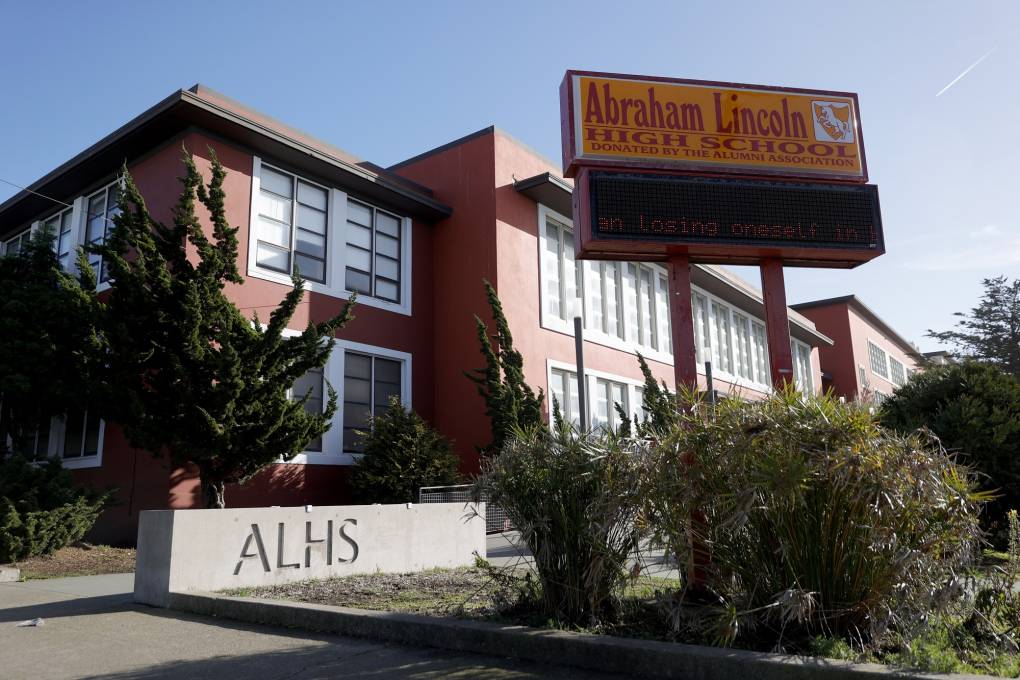
"caption": "Abraham Lincoln High School on Dec. 17, 2020, in San Francisco. San Francisco Unified School District began its antisemitism training on Wednesday for high school teachers at Abraham Lincoln, Balboa, Galileo Academy of Science & Technology and George Washington after postponing the sessions due to objections from pro-Palestinian activists over the American Jewish Committee, the group running the training, and its stance on Israel.",
"credit": "Justin Sullivan/Getty Images",
"altTag": null,
"description": null,
"imgSizes": {
"medium": {
"file": "https://cdn.kqed.org/wp-content/uploads/sites/10/2024/10/AbrahamLincolnHSSFGetty2-800x533.jpg",
"width": 800,
"height": 533,
"mimeType": "image/jpeg"
},
"large": {
"file": "https://cdn.kqed.org/wp-content/uploads/sites/10/2024/10/AbrahamLincolnHSSFGetty2-1020x680.jpg",
"width": 1020,
"height": 680,
"mimeType": "image/jpeg"
},
"thumbnail": {
"file": "https://cdn.kqed.org/wp-content/uploads/sites/10/2024/10/AbrahamLincolnHSSFGetty2-160x107.jpg",
"width": 160,
"height": 107,
"mimeType": "image/jpeg"
},
"1536x1536": {
"file": "https://cdn.kqed.org/wp-content/uploads/sites/10/2024/10/AbrahamLincolnHSSFGetty2-1536x1024.jpg",
"width": 1536,
"height": 1024,
"mimeType": "image/jpeg"
},
"post-thumbnail": {
"file": "https://cdn.kqed.org/wp-content/uploads/sites/10/2024/10/AbrahamLincolnHSSFGetty2-672x372.jpg",
"width": 672,
"height": 372,
"mimeType": "image/jpeg"
},
"twentyfourteen-full-width": {
"file": "https://cdn.kqed.org/wp-content/uploads/sites/10/2024/10/AbrahamLincolnHSSFGetty2-1038x576.jpg",
"width": 1038,
"height": 576,
"mimeType": "image/jpeg"
},
"full-width": {
"file": "https://cdn.kqed.org/wp-content/uploads/sites/10/2024/10/AbrahamLincolnHSSFGetty2-1920x1280.jpg",
"width": 1920,
"height": 1280,
"mimeType": "image/jpeg"
},
"kqedFullSize": {
"file": "https://cdn.kqed.org/wp-content/uploads/sites/10/2024/10/AbrahamLincolnHSSFGetty2.jpg",
"width": 2000,
"height": 1333
}
},
"isLoading": false,
"fetchFailed": false
},
"news_12008663": {
"type": "attachments",
"id": "news_12008663",
"meta": {
"index": "attachments_1716263798",
"site": "news",
"id": "12008663",
"found": true
},
"title": "241008-UCB CAMPUS WALKOUT-MD-09-KQED",
"publishDate": 1728431201,
"status": "inherit",
"parent": 12032046,
"modified": 1742415507,
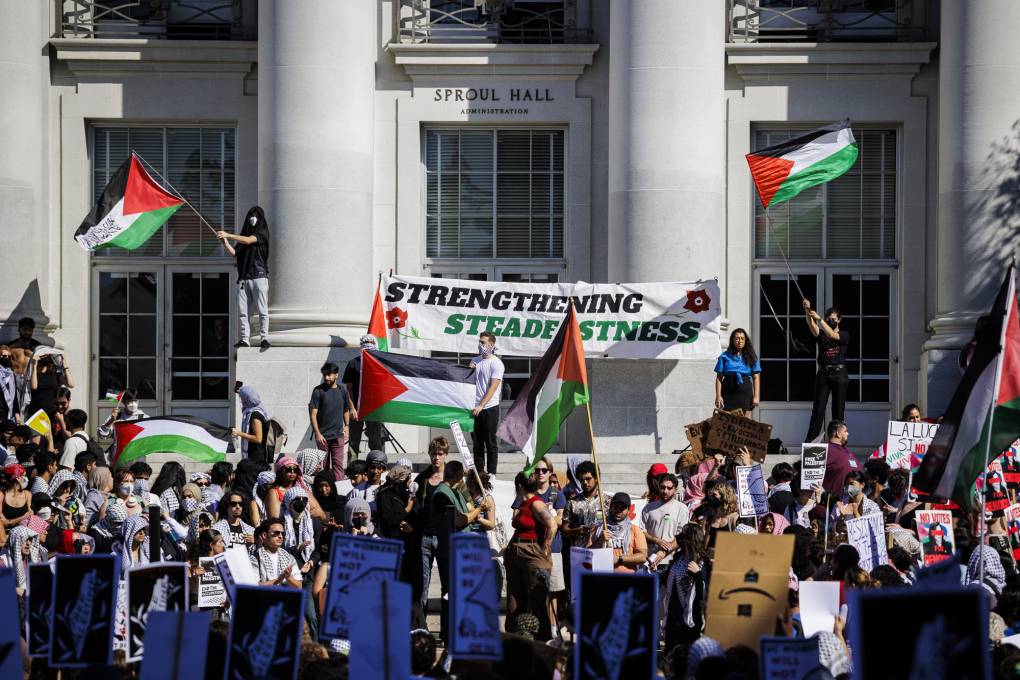
"caption": "A walkout and rally for Gaza and Lebanon at the University of California, Berkeley, on Oct. 8, 2024.",
"credit": "Martin do Nascimento/KQED",
"altTag": null,
"description": null,
"imgSizes": {
"medium": {
"file": "https://cdn.kqed.org/wp-content/uploads/sites/10/2024/10/241008-UCB-CAMPUS-WALKOUT-MD-09-KQED-800x533.jpg",
"width": 800,
"height": 533,
"mimeType": "image/jpeg"
},
"large": {
"file": "https://cdn.kqed.org/wp-content/uploads/sites/10/2024/10/241008-UCB-CAMPUS-WALKOUT-MD-09-KQED-1020x680.jpg",
"width": 1020,
"height": 680,
"mimeType": "image/jpeg"
},
"thumbnail": {
"file": "https://cdn.kqed.org/wp-content/uploads/sites/10/2024/10/241008-UCB-CAMPUS-WALKOUT-MD-09-KQED-160x107.jpg",
"width": 160,
"height": 107,
"mimeType": "image/jpeg"
},
"1536x1536": {
"file": "https://cdn.kqed.org/wp-content/uploads/sites/10/2024/10/241008-UCB-CAMPUS-WALKOUT-MD-09-KQED-1536x1024.jpg",
"width": 1536,
"height": 1024,
"mimeType": "image/jpeg"
},
"post-thumbnail": {
"file": "https://cdn.kqed.org/wp-content/uploads/sites/10/2024/10/241008-UCB-CAMPUS-WALKOUT-MD-09-KQED-672x372.jpg",
"width": 672,
"height": 372,
"mimeType": "image/jpeg"
},
"twentyfourteen-full-width": {
"file": "https://cdn.kqed.org/wp-content/uploads/sites/10/2024/10/241008-UCB-CAMPUS-WALKOUT-MD-09-KQED-1038x576.jpg",
"width": 1038,
"height": 576,
"mimeType": "image/jpeg"
},
"full-width": {
"file": "https://cdn.kqed.org/wp-content/uploads/sites/10/2024/10/241008-UCB-CAMPUS-WALKOUT-MD-09-KQED-1920x1280.jpg",
"width": 1920,
"height": 1280,
"mimeType": "image/jpeg"
},
"kqedFullSize": {
"file": "https://cdn.kqed.org/wp-content/uploads/sites/10/2024/10/241008-UCB-CAMPUS-WALKOUT-MD-09-KQED.jpg",
"width": 2000,
"height": 1333
}
},
"isLoading": false,
"fetchFailed": false
},
"news_11988048": {
"type": "attachments",
"id": "news_11988048",
"meta": {
"index": "attachments_1716263798",
"site": "news",
"id": "11988048",
"found": true
},
"title": "UC Santa Cruz Workers Strike Over Treatment Of Pro-Palestinian Protesters",
"publishDate": 1717006217,
"status": "inherit",
"parent": 11988039,
"modified": 1717006276,
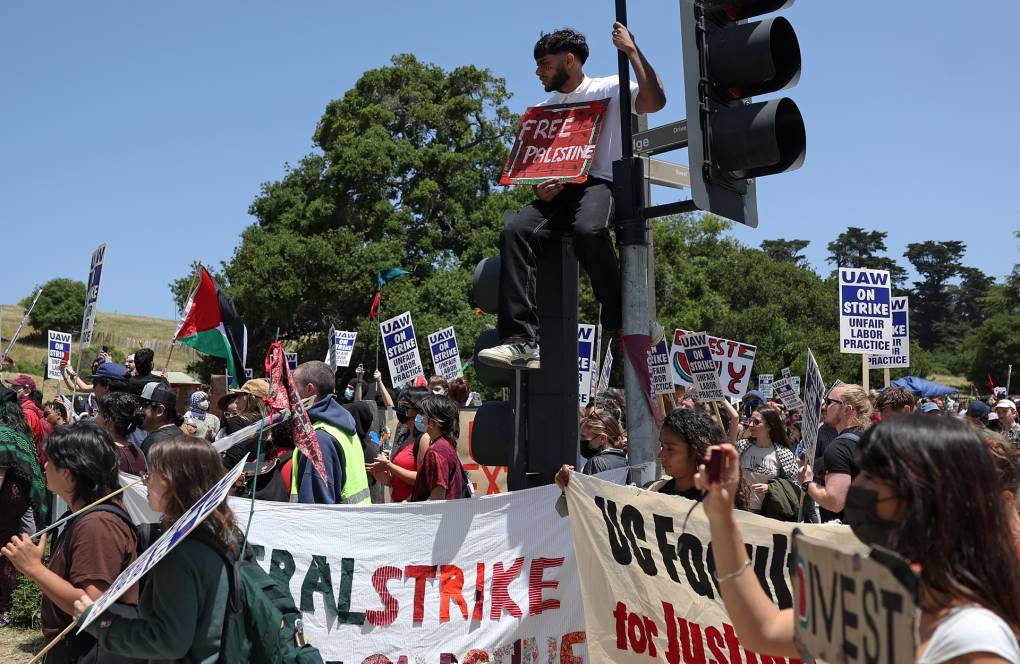
"caption": "UC Santa Cruz academic workers represented by UAW 4811 and pro-Palestinian protesters carry signs as they demonstrate in front of the campus on May 20, 2024.",
"credit": "Justin Sullivan/Getty Images",
"altTag": null,
"description": null,
"imgSizes": {
"medium": {
"file": "https://cdn.kqed.org/wp-content/uploads/sites/10/2024/05/GettyImages-2153876794-800x521.jpg",
"width": 800,
"height": 521,
"mimeType": "image/jpeg"
},
"large": {
"file": "https://cdn.kqed.org/wp-content/uploads/sites/10/2024/05/GettyImages-2153876794-1020x664.jpg",
"width": 1020,
"height": 664,
"mimeType": "image/jpeg"
},
"thumbnail": {
"file": "https://cdn.kqed.org/wp-content/uploads/sites/10/2024/05/GettyImages-2153876794-160x104.jpg",
"width": 160,
"height": 104,
"mimeType": "image/jpeg"
},
"1536x1536": {
"file": "https://cdn.kqed.org/wp-content/uploads/sites/10/2024/05/GettyImages-2153876794-1536x1000.jpg",
"width": 1536,
"height": 1000,
"mimeType": "image/jpeg"
},
"post-thumbnail": {
"file": "https://cdn.kqed.org/wp-content/uploads/sites/10/2024/05/GettyImages-2153876794-672x372.jpg",
"width": 672,
"height": 372,
"mimeType": "image/jpeg"
},
"twentyfourteen-full-width": {
"file": "https://cdn.kqed.org/wp-content/uploads/sites/10/2024/05/GettyImages-2153876794-1038x576.jpg",
"width": 1038,
"height": 576,
"mimeType": "image/jpeg"
},
"kqedFullSize": {
"file": "https://cdn.kqed.org/wp-content/uploads/sites/10/2024/05/GettyImages-2153876794.jpg",
"width": 1920,
"height": 1250
}
},
"isLoading": false,
"fetchFailed": false
}
},
"audioPlayerReducer": {
"postId": "stream_live",
"isPaused": true,
"isPlaying": false,
"pfsActive": false,
"pledgeModalIsOpen": true,
"playerDrawerIsOpen": false,
"liveAudioPlayStartedAt": 0,
"liveAudioPlayContext": ""
},
"authorsReducer": {
"shossaini": {
"type": "authors",
"id": "3214",
"meta": {
"index": "authors_1716337520",
"id": "3214",
"found": true
},
"name": "Sara Hossaini",
"firstName": "Sara",
"lastName": "Hossaini",
"slug": "shossaini",
"email": "shossaini@kqed.org",
"display_author_email": true,
"staff_mastheads": [
"news"
],
"title": "KQED Reporter",
"bio": "Sara Hossaini came to general assignment reporting at KQED in 2013 after two winters reporting at Wyoming Public Radio. She holds a bachelor's degree in broadcast journalism from the University of Nebraska-Lincoln. Her radio romance began after a bitter breakup with documentary film (Ok, maybe it's still complicated). Her first simultaneous jobs in San Francisco were as Associate Producer on a PBS film series through the Center for Asian American Media and as a butler. She likes to trot, plot and make things with her hands.",
"avatar": "https://secure.gravatar.com/avatar/060e9f56b9554e17942e89f413242774?s=600&d=blank&r=g",
"twitter": "mshossaini",
"facebook": null,
"instagram": null,
"linkedin": null,
"sites": [
{
"site": "news",
"roles": [
"author"
]
},
{
"site": "stateofhealth",
"roles": [
"author"
]
}
],
"headData": {
"title": "Sara Hossaini | KQED",
"description": "KQED Reporter",
"ogImgSrc": "https://secure.gravatar.com/avatar/060e9f56b9554e17942e89f413242774?s=600&d=blank&r=g",
"twImgSrc": "https://secure.gravatar.com/avatar/060e9f56b9554e17942e89f413242774?s=600&d=blank&r=g"
},
"isLoading": false,
"link": "/author/shossaini"
},
"nkhan": {
"type": "authors",
"id": "11867",
"meta": {
"index": "authors_1716337520",
"id": "11867",
"found": true
},
"name": "Nisa Khan",
"firstName": "Nisa",
"lastName": "Khan",
"slug": "nkhan",
"email": "nkhan@kqed.org",
"display_author_email": false,
"staff_mastheads": [],
"title": "KQED Contributor",
"bio": "Nisa Khan is a reporter for KQED's Audience News Desk. She was formerly a data reporter at Michigan Radio. She earned a Bachelor of Science in Information from the University of Michigan and a Master of Arts in Communication from Stanford University.",
"avatar": "https://secure.gravatar.com/avatar/8720459eef081ff64582b3506b124d58523e80e120704a0cbd9892533c914991?s=600&d=blank&r=g",
"twitter": "mnisakhan",
"bluesky": null,
"facebook": null,
"instagram": null,
"linkedin": null,
"sites": [
{
"site": "arts",
"roles": [
"editor"
]
},
{
"site": "news",
"roles": [
"editor"
]
},
{
"site": "science",
"roles": [
"editor",
"author"
]
},
{
"site": "forum",
"roles": [
"editor"
]
},
{
"site": "liveblog",
"roles": [
"contributor"
]
}
],
"headData": {
"title": "Nisa Khan | KQED",
"description": "KQED Contributor",
"ogImgSrc": "https://secure.gravatar.com/avatar/8720459eef081ff64582b3506b124d58523e80e120704a0cbd9892533c914991?s=600&d=blank&r=g",
"twImgSrc": "https://secure.gravatar.com/avatar/8720459eef081ff64582b3506b124d58523e80e120704a0cbd9892533c914991?s=600&d=blank&r=g"
},
"isLoading": false,
"link": "/author/nkhan"
},
"jgeha": {
"type": "authors",
"id": "11906",
"meta": {
"index": "authors_1716337520",
"id": "11906",
"found": true
},
"name": "Joseph Geha",
"firstName": "Joseph",
"lastName": "Geha",
"slug": "jgeha",
"email": "jgeha@kqed.org",
"display_author_email": false,
"staff_mastheads": [
"news",
"science"
],
"title": "KQED Contributor",
"bio": null,
"avatar": "https://secure.gravatar.com/avatar/ea84d2b6dd93d6369d453edf19dd583f117cd1759d2d9c9c92f9de77017354fe?s=600&d=blank&r=g",
"twitter": null,
"bluesky": null,
"facebook": null,
"instagram": null,
"linkedin": null,
"sites": [
{
"site": "news",
"roles": [
"editor"
]
},
{
"site": "liveblog",
"roles": [
"author"
]
}
],
"headData": {
"title": "Joseph Geha | KQED",
"description": "KQED Contributor",
"ogImgSrc": "https://secure.gravatar.com/avatar/ea84d2b6dd93d6369d453edf19dd583f117cd1759d2d9c9c92f9de77017354fe?s=600&d=blank&r=g",
"twImgSrc": "https://secure.gravatar.com/avatar/ea84d2b6dd93d6369d453edf19dd583f117cd1759d2d9c9c92f9de77017354fe?s=600&d=blank&r=g"
},
"isLoading": false,
"link": "/author/jgeha"
},
"kdebenedetti": {
"type": "authors",
"id": "11913",
"meta": {
"index": "authors_1716337520",
"id": "11913",
"found": true
},
"name": "Katie DeBenedetti",
"firstName": "Katie",
"lastName": "DeBenedetti",
"slug": "kdebenedetti",
"email": "kdebenedetti@kqed.org",
"display_author_email": false,
"staff_mastheads": [
"news",
"science"
],
"title": "KQED Contributor",
"bio": "Katie DeBenedetti is a digital reporter covering daily news for the Express Desk. Prior to joining KQED as a culture reporting intern in January 2024, she covered education and city government for the Napa Valley Register.",
"avatar": "https://secure.gravatar.com/avatar/6e31073cb8f7e4214ab03f42771d0f45?s=600&d=blank&r=g",
"twitter": null,
"facebook": null,
"instagram": null,
"linkedin": null,
"sites": [
{
"site": "news",
"roles": [
"author"
]
},
{
"site": "science",
"roles": [
"author"
]
},
{
"site": "liveblog",
"roles": [
"author"
]
}
],
"headData": {
"title": "Katie DeBenedetti | KQED",
"description": "KQED Contributor",
"ogImgSrc": "https://secure.gravatar.com/avatar/6e31073cb8f7e4214ab03f42771d0f45?s=600&d=blank&r=g",
"twImgSrc": "https://secure.gravatar.com/avatar/6e31073cb8f7e4214ab03f42771d0f45?s=600&d=blank&r=g"
},
"isLoading": false,
"link": "/author/kdebenedetti"
},
"rcooke": {
"type": "authors",
"id": "11921",
"meta": {
"index": "authors_1716337520",
"id": "11921",
"found": true
},
"name": "Riley Cooke",
"firstName": "Riley",
"lastName": "Cooke",
"slug": "rcooke",
"email": "rcooke@kqed.org",
"display_author_email": true,
"staff_mastheads": [
"news"
],
"title": "KQED Contributor",
"bio": "Riley is a senior at UC Berkeley, where she studies political science and journalism. Her work has appeared in SFGate, NBC Bay Area, Local News Matters and more. She enjoys reporting on politics, housing and homelessness — and using as many em dashes as her editors will allow.",
"avatar": "https://secure.gravatar.com/avatar/792f98c126cc5e270a8a96f77f7224ea?s=600&d=blank&r=g",
"twitter": "rrileycooke",
"facebook": null,
"instagram": null,
"linkedin": null,
"sites": [
{
"site": "arts",
"roles": [
"author"
]
},
{
"site": "news",
"roles": [
"author"
]
}
],
"headData": {
"title": "Riley Cooke | KQED",
"description": "KQED Contributor",
"ogImgSrc": "https://secure.gravatar.com/avatar/792f98c126cc5e270a8a96f77f7224ea?s=600&d=blank&r=g",
"twImgSrc": "https://secure.gravatar.com/avatar/792f98c126cc5e270a8a96f77f7224ea?s=600&d=blank&r=g"
},
"isLoading": false,
"link": "/author/rcooke"
}
},
"pagesReducer": {
"news_tag_israel-hamas-war": {
"type": "terms",
"id": "news_33333",
"meta": {
"index": "terms_1716263798",
"site": "news",
"id": "33333",
"score": 9.55735
},
"featImg": null,
"name": "Israel-Hamas War",
"description": null,
"taxonomy": "tag",
"headData": {
"twImgId": null,
"twTitle": null,
"ogTitle": null,
"ogImgId": null,
"twDescription": null,
"description": null,
"title": "Israel-Hamas War Archives | KQED News",
"ogDescription": null
},
"ttid": 33350,
"slug": "israel-hamas-war",
"isLoading": false,
"title": "Israel-Hamas War",
"pageMeta": {
"site": "news",
"WpPageTemplate": "page-topic-editorial",
"currentPage": 6
},
"blocks": [
{
"blockName": "kqed/post-list",
"attrs": {
"layout": "cardArticle2",
"query": "posts/news?tag=israel-hamas-war",
"seeMore": false,
"paginated": true,
"page": 6
}
},
{
"blockName": "kqed/ad"
}
]
}
},
"pfsSessionReducer": {},
"postsReducer": {
"stream_live": {
"type": "live",
"id": "stream_live",
"audioUrl": "https://streams.kqed.org/kqedradio",
"title": "Live Stream",
"excerpt": "Live Stream information currently unavailable.",
"link": "/radio",
"featImg": "",
"label": {
"name": "KQED Live",
"link": "/"
}
},
"stream_kqedNewscast": {
"type": "posts",
"id": "stream_kqedNewscast",
"audioUrl": "https://www.kqed.org/.stream/anon/radio/RDnews/newscast.mp3?_=1",
"title": "KQED Newscast",
"featImg": "",
"label": {
"name": "88.5 FM",
"link": "/"
}
},
"news_12028230": {
"type": "posts",
"id": "news_12028230",
"meta": {
"index": "posts_1716263798",
"site": "news",
"id": "12028230",
"score": null,
"sort": [
1740497436000
]
},
"guestAuthors": [],
"slug": "this-santa-cruz-congressman-received-more-than-250000-from-a-powerful-pro-israel-lobby",
"title": "This Santa Cruz Congressman Received More Than $250,000 From a Powerful Pro-Israel Lobby",
"publishDate": 1740497436,
"format": "standard",
"headTitle": "This Santa Cruz Congressman Received More Than $250,000 From a Powerful Pro-Israel Lobby | KQED",
"labelTerm": {
"site": "news"
},
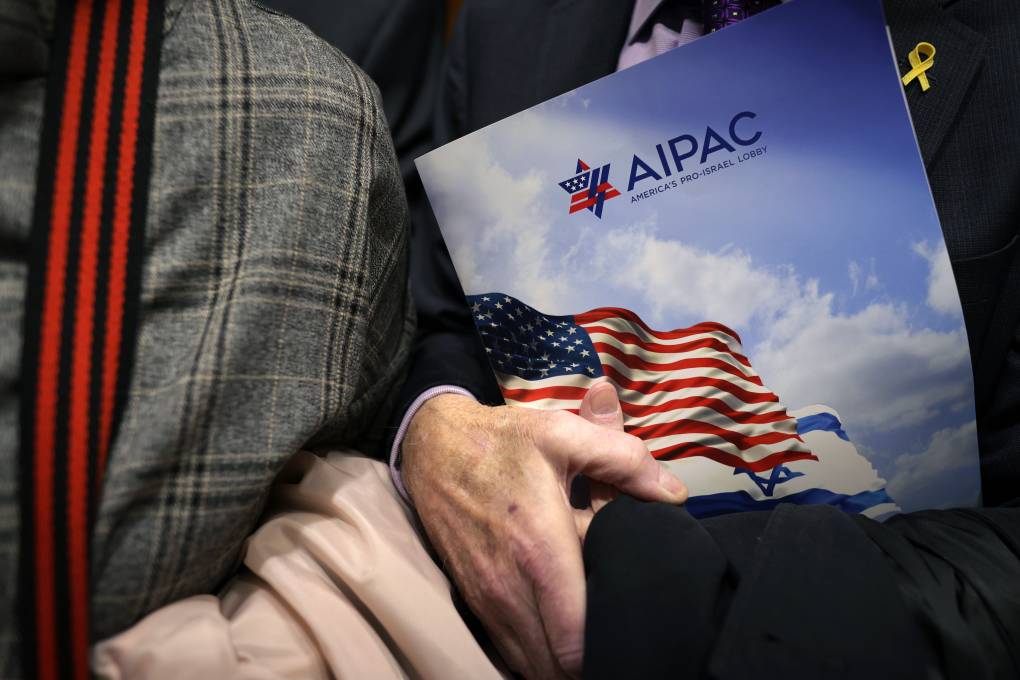
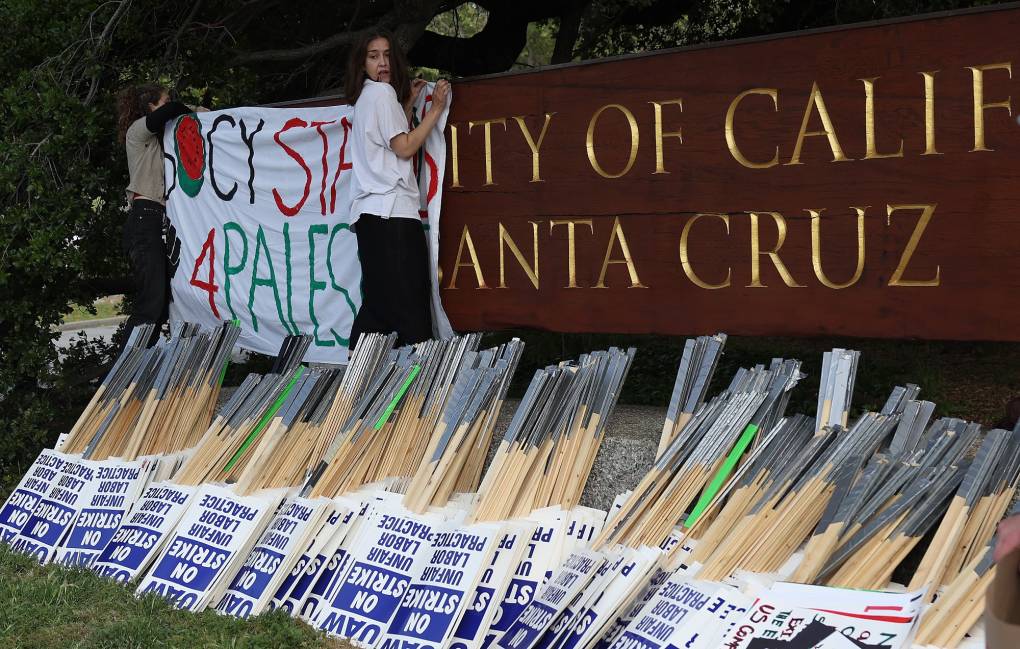
"content": "\u003cp>During the 2024 election season, Rep. Jimmy Panetta (D–Santa Cruz) received upward of $250,000 in campaign contributions from pro-Israel groups — far outpacing the amount given to any other congressional representative in the Central or Northern California region.\u003c/p>\n\u003cp>During that two-year period, during which the devastating war in Gaza erupted and pro-Israel groups \u003ca href=\"https://www.kqed.org/news/12016915/aipac-spent-big-in-the-2024-election-how-did-the-money-show-up-in-californias-congressional-races\">ramped up their political spending\u003c/a>, Panetta — who represents a coastal swath of Santa Cruz and Monterey counties — \u003ca href=\"https://www.opensecrets.org/orgs/american-israel-public-affairs-cmte/recipients?id=D000046963&t2-Chamber=House&t2-search=panetta\">was given\u003c/a> $10,000 directly from the PAC affiliated with the \u003ca href=\"https://www.kqed.org/news/11986412/aipac-israels-political-enforcer-in-the-u-s\">powerful American Israel Public Affairs Committee \u003c/a>(AIPAC), and \u003ca href=\"https://www.kqed.org/news/11986412/aipac-israels-political-enforcer-in-the-u-s\">more than $243,000\u003c/a> from donors closely linked to the group, \u003ca href=\"https://www.opensecrets.org/orgs/american-israel-public-affairs-cmte/recipients?id=D000046963&t2-Chamber=House&t2-search=panetta\">according to Open Secrets\u003c/a>, a nonpartisan political finance tracker. OpenSecrets does not disclose the names of the individual donors, which it defines as “members, employees or owners of the organization, and those individuals’ immediate family members.”\u003c/p>\n\u003cp>Panetta was the third-highest recipient of AIPAC-affiliated contributions among congressional incumbents in California, eclipsed only by Rep. Pete Aguilar (D–Redlands), who took in more than half a million dollars, and Rep. Ken Calvert (R–Corona), who received $471,000.\u003c/p>\n\u003cp>\u003c!-- iframe plugin v.4.3 wordpress.org/plugins/iframe/ -->\u003cbr>\n\u003ciframe loading=\"lazy\" title=\"AIPAC-affiliated spending on congressional races \" aria-label=\"Table\" id=\"datawrapper-chart-nfbaE\" src=\"https://datawrapper.dwcdn.net/nfbaE/3/\" scrolling=\"no\" frameborder=\"0\" style=\"border: none;\" width=\"800\" height=\"580\" data-external=\"1\" class=\"iframe-class\">\u003c/iframe>\u003c/p>\n\u003cp>Such a substantial sum from donors affiliated with a group whose mission is to “\u003ca href=\"https://www.aipac.org/about\">strengthen and expand the U.S.-Israel relationship” \u003c/a>has drawn scrutiny from many of Panetta’s constituents in Santa Cruz and some of the other left-leaning areas he represents, where pro-Palestinian protests against Israel — \u003ca href=\"https://www.kqed.org/news/11988039/pro-palestinian-protests-block-uc-santa-cruz-entrances-pushing-classes-back-online\">particularly at UC Santa Cruz\u003c/a> — have been commonplace since the conflict began more than 16 months ago.\u003c/p>\n\u003cp>[ad fullwidth]\u003c/p>\n\u003cp>Some pro-Palestinian activists in the district say they’re concerned about the contributions, pointing to the congressman’s \u003ca href=\"https://clerk.house.gov/Votes/2024152\">vote last April in support\u003c/a> of sending billions in \u003ca href=\"https://www.congress.gov/bill/118th-congress/house-bill/8034\">aid to the Israeli military. \u003c/a>They note that such support comes even as his father,\u003ca href=\"https://thehill.com/policy/defense/4578364-israelis-fire-then-ask-questions-my-experience-former-defense-secretary/\"> Leon Panetta, the former defense secretary and U.S. representative\u003c/a>, has publicly criticized some of Israel’s tactics.\u003c/p>\n\u003cp>Rick Longinotti, a Santa Cruz resident involved with \u003ca href=\"https://panetta-vigil.org/344-2/\">Panetta Vigil\u003c/a>, a nascent group of Panetta’s constituents who oppose his support for Israel, said the congressman’s position on Israel “more closely resembles Republican votes in the House of Representatives,” which he said is out of step with a largely “pro-peace” district.\u003c/p>\n\u003cp>Longinotti notes that Panetta was among a group of just 45 Democratic colleagues who joined every House Republican in supporting \u003ca href=\"https://clerk.house.gov/Votes/20257\">a bill to sanction the International Criminal Court (ICC)\u003c/a> in response to arrest warrants it issued for Israeli Prime Minister Benjamin Netanyahu and former Defense Minister Yoav Gallant over alleged war crimes in Gaza.\u003c/p>\n\u003cp>The legislation, which was \u003ca href=\"https://www.aipac.org/resources/house-adopts-icc-act\">strongly backed by AIPAC\u003c/a>, passed the House but was \u003ca href=\"https://www.aljazeera.com/news/2025/1/28/us-senate-blocks-bill-sanctioning-icc-over-israeli-arrest-warrants\">ultimately blocked\u003c/a> by Senate Democrats.\u003c/p>\n\u003cp>[aside label=\"Related coverage\" postID=\"news_11999445,news_11997602,news_12023476\"]\u003c/p>\n\u003cp>In an emailed statement, the congressman’s campaign staff did not specifically address the contributions but emphasized that Panetta has traveled to Israel on several occasions since the conflict began, “focusing on the release of hostages from Gaza, including six Americans, supporting the defense of our major non-NATO ally, ensuring humanitarian aid to Palestinians, and bringing a lasting peace in the region.”\u003c/p>\n\u003cp>The statement goes on to stress that Panetta “firmly believes that it is his responsibility to learn more about the people and issues of the region,” and the U.S. “must continue to support and stay engaged with our partners so that our shared values are upheld as we continue to work towards a peaceful resolution.”\u003c/p>\n\u003cp>It also notes that “countless constituents in his district and numerous people throughout California and the United States have been grateful, appreciative, and supportive” of his efforts.\u003c/p>\n\u003cp>AIPAC’s \u003ca href=\"https://www.npr.org/2024/08/07/nx-s1-5066702/why-pro-israel-pacs-are-helping-oust-democrats-in-their-primaries\">role in American politics\u003c/a> has come into greater focus since the attack on southern Israel on Oct. 7, 2023, in which Hamas-led militants killed more than 1,200 people and took roughly 240 hostages, according to Israeli authorities. In response, Israeli forces have since waged a relentless assault on Gaza, \u003ca href=\"https://www.cnn.com/2024/07/06/middleeast/palestinians-displaced-gaza-israel-intl/index.html\">displacing almost its entire population\u003c/a> and destroying some \u003ca href=\"https://apnews.com/article/israel-palestinians-hamas-war-ceasefire-damage-reconstruction-d120f8a0dc8b728c0d8332046a524a92\">two-thirds of its infrastructure\u003c/a>. As of mid-January, when \u003ca href=\"https://www.npr.org/2025/01/19/g-s1-43565/gaza-ceasefire-begins-after-delay\">a temporary ceasefire\u003c/a> went into effect, at least 46,000 residents of the enclave had been killed in the conflict, according to Gaza officials, a tally that many observers say is \u003ca href=\"https://www.nytimes.com/2025/01/14/health/gaza-death-toll.html\">a substantial underestimate\u003c/a>.\u003c/p>\n\u003cp>The siege galvanized fierce protests throughout the \u003ca href=\"https://www.kqed.org/news/12007970/1-year-later-the-impact-of-oct-7-siege-of-gaza-on-life-in-the-bay-area\">Bay Area and the country \u003c/a>against the war and the\u003ca href=\"https://www.propublica.org/article/biden-blinken-state-department-israel-gaza-human-rights-horrors\"> United States’ substantial aid and support for Israel\u003c/a>. Even with the \u003ca href=\"https://apnews.com/article/israel-palestinians-hamas-war-news-ceasefire-hostages-02-17-2025-c20c9664938b267354c9ac4812621a1e\">fragile ceasefire still being observed\u003c/a>, many pro-Palestinian activists are continuing to demand that American elected officials be held accountable for supporting Israel, which they say helped to directly facilitate the mass destruction in Gaza.\u003c/p>\n\u003cp>Among them is Christine Hong, a professor of ethnic studies at UC Santa Cruz, who said she and many other constituents are “appalled” by the contributions Panetta received from AIPAC-affiliated donors.\u003c/p>\n\u003cfigure id=\"attachment_12028188\" class=\"wp-caption alignnone\" style=\"max-width: 2000px\">\u003ca href=\"https://cdn.kqed.org/wp-content/uploads/sites/10/2025/02/014-05025-Z8B_6780.jpg\">\u003cimg loading=\"lazy\" decoding=\"async\" class=\"wp-image-12028188 size-full\" src=\"https://cdn.kqed.org/wp-content/uploads/sites/10/2025/02/014-05025-Z8B_6780.jpg\" alt=\"Protesters stand in front of a banner opposing representatives who support funding for Israel.\" width=\"2000\" height=\"1333\" srcset=\"https://cdn.kqed.org/wp-content/uploads/sites/10/2025/02/014-05025-Z8B_6780.jpg 2000w, https://cdn.kqed.org/wp-content/uploads/sites/10/2025/02/014-05025-Z8B_6780-800x533.jpg 800w, https://cdn.kqed.org/wp-content/uploads/sites/10/2025/02/014-05025-Z8B_6780-1020x680.jpg 1020w, https://cdn.kqed.org/wp-content/uploads/sites/10/2025/02/014-05025-Z8B_6780-160x107.jpg 160w, https://cdn.kqed.org/wp-content/uploads/sites/10/2025/02/014-05025-Z8B_6780-1536x1024.jpg 1536w, https://cdn.kqed.org/wp-content/uploads/sites/10/2025/02/014-05025-Z8B_6780-1920x1280.jpg 1920w\" sizes=\"auto, (max-width: 2000px) 100vw, 2000px\">\u003c/a>\u003cfigcaption class=\"wp-caption-text\">Protesters with the group Taxpayers Against Genocide stage a press conference in San Francisco on Feb. 19, 2024. \u003ccite>(Courtesy of Leon Kunstensaar)\u003c/cite>\u003c/figcaption>\u003c/figure>\n\u003cp>“[Panetta] listens to one constituency and it is a pro-Israel constituency. It is a hawkish constituency,” Hong said. “He has obligingly implemented AIPAC’s foreign policy.”\u003c/p>\n\u003cp>Hong was part of a class-action lawsuit against Panetta and seven other Northern California Democratic leaders, including Reps. Mike Thompson, Jared Huffman, Nancy Pelosi, Kevin Mullin, Anna Eshoo, as well as Sen. Alex Padilla and then-Sen. Laphonza Butler. The suit accused them of \u003ca href=\"https://www.gofundme.com/f/support-class-action-lawsuit-by-taxpayers-against-genocide?attribution_id=sl:37e8a0f8-f859-4798-a47a-ef5d60005be7&utm_campaign=fp_sharesheet&utm_medium=customer&utm_source=copy_link\">“illegally [using] tax dollars to fund the genocide in Gaza,” \u003c/a>citing the \u003ca href=\"https://www.state.gov/bureau-of-democracy-human-rights-and-labor/releases/2025/01/leahy-law-fact-sheet\">Leahy law\u003c/a>, a set of statutes that prohibit the U.S. from using funds to provide aid to foreign security forces when there is credible evidence of “gross violations of human rights.”\u003c/p>\n\u003cp>In November, a United Nations special committee found Israel’s actions \u003ca href=\"https://www.ohchr.org/en/press-releases/2024/11/un-special-committee-finds-israels-warfare-methods-gaza-consistent-genocide\">“consistent with the characteristics of genocide.”\u003c/a>\u003c/p>\n\u003cp>On Feb. 10, U.S. District Judge Vince Chhabria dismissed the case, writing that it \u003ca href=\"https://www.pacermonitor.com/public/case/56242583/DONNELLY_et_al_v_THOMPSON_et_al\">“presents a nonjusticiable political question.”\u003c/a> A similar \u003ca href=\"https://www.kqed.org/news/11973881/lawsuit-seeking-to-stop-u-s-aid-to-israel-holds-first-court-hearing-in-oakland\">lawsuit against former President Biden\u003c/a> was also dismissed by an Oakland judge last year.\u003c/p>\n\u003cp>Sonoma City resident Seth Donnelly, who was part of the most recent lawsuit, said the group — who call themselves Taxpayers Against Genocide — is working with the National Lawyers Guild to bring the case to the United Nations Human Rights Council in April.\u003c/p>\n\u003cp>“It becomes publicized to the rest of the world,” Donnelly said. “It’s one other level of achieving documentation of our officials’ involvement in genocide.”\u003c/p>\n\u003cp>Rolla Alaydi, a Pacific Grove resident who lives in Panetta’s district, said it’s concerning that her representative has taken so much money from AIPAC-affiliated groups. Since the war began, Alaydi, who is Palestinian American, has been desperately trying to get her \u003ca href=\"https://www.kqed.org/news/11997602/in-an-oceanside-town-a-woman-fights-for-her-familys-survival-in-gaza\">younger brothers and their families\u003c/a> out of Gaza, some of whom need urgent medical assistance.\u003c/p>\n\u003cp>Alaydi said she had exchanged several emails with a staff member in Panetta’s office to try to expedite \u003ca href=\"https://www.kqed.org/news/11976509/california-palestinian-americans-seek-safety-for-loved-ones-in-gaza\">her request for humanitarian parole\u003c/a> for her family, first contacting his office in late November 2023, according to emails she shared with KQED.\u003c/p>\n\u003cfigure id=\"attachment_11997617\" class=\"wp-caption alignnone\" style=\"max-width: 2000px\">\u003ca href=\"https://cdn.kqed.org/wp-content/uploads/sites/10/2024/07/20240623_GazaEvacuation_GC-41_qed.jpg\">\u003cimg loading=\"lazy\" decoding=\"async\" class=\"wp-image-11997617 size-full\" src=\"https://cdn.kqed.org/wp-content/uploads/sites/10/2024/07/20240623_GazaEvacuation_GC-41_qed.jpg\" alt=\"A woman waves a Palestinian flag in a park.\" width=\"2000\" height=\"1333\" srcset=\"https://cdn.kqed.org/wp-content/uploads/sites/10/2024/07/20240623_GazaEvacuation_GC-41_qed.jpg 2000w, https://cdn.kqed.org/wp-content/uploads/sites/10/2024/07/20240623_GazaEvacuation_GC-41_qed-800x533.jpg 800w, https://cdn.kqed.org/wp-content/uploads/sites/10/2024/07/20240623_GazaEvacuation_GC-41_qed-1020x680.jpg 1020w, https://cdn.kqed.org/wp-content/uploads/sites/10/2024/07/20240623_GazaEvacuation_GC-41_qed-160x107.jpg 160w, https://cdn.kqed.org/wp-content/uploads/sites/10/2024/07/20240623_GazaEvacuation_GC-41_qed-1536x1024.jpg 1536w, https://cdn.kqed.org/wp-content/uploads/sites/10/2024/07/20240623_GazaEvacuation_GC-41_qed-1920x1280.jpg 1920w\" sizes=\"auto, (max-width: 2000px) 100vw, 2000px\">\u003c/a>\u003cfigcaption class=\"wp-caption-text\">Rolla Alaydi waves a Palestinian flag at Window on the Bay Park in Monterey on June 23, 2024. \u003ccite>(Gina Castro/KQED)\u003c/cite>\u003c/figcaption>\u003c/figure>\n\u003cp>Earlier this month, Panetta’s office told Alaydi that her case was still pending.\u003c/p>\n\u003cp>“I need some help from my representative, from someone in the Congress or someone in a high-rank office to speak on my behalf,” Alaydi said.\u003c/p>\n\u003cp>Alaydi’s lawyer, Maria Kari, added that elected officials have “great leeway and a large role to play” when it comes to pushing through applications like humanitarian parole and hopes the significant contributions from AIPAC-related groups have not in any way influenced his willingness to help her client.\u003c/p>\n\u003cp>“We sincerely hope that Rep. Panetta will not be unduly influenced by the AIPAC contributions he receives and that he will act fairly towards his Palestinian American constituents,” Kari said.\u003c/p>\n\u003cp>Panetta’s office declined to speak on the record but told KQED that it has provided Alaydi with assistance and continues to work to resolve her case.\u003c/p>\n\u003cp>Panetta’s office also added that Alaydi is among nearly 50 other constituents seeking help with visas and humanitarian requests, a process that can take more than a year to resolve.\u003c/p>\n\u003cp>But for Alaydi, time is of the essence — particularly in light of President Donald Trump’s \u003ca href=\"https://time.com/7212848/trump-gaza-own/\">recent highly controversial proposals\u003c/a> for the future of Gaza.\u003c/p>\n\u003cp>[ad floatright]\u003c/p>\n\u003cp>“I pay taxes. I’m a good citizen. I’m a very active member in the community,” Alaydi said. “I’m just asking — look to us as a human, and extend a hand of humanitarian assistance and bring them here for safety. Give them a chance to live.”\u003c/p>\n\n",
"blocks": [],
"excerpt": "Democratic Rep. Jimmy Panetta received more than a quarter of a million dollars from the American Israel Public Affairs Committee (AIPAC) and its affiliated donors during the 2024 election season — stoking serious concern among some of his pro-Palestinian constituents.",
"status": "publish",
"parent": 0,
"modified": 1740526865,
"stats": {
"hasAudio": false,
"hasVideo": false,
"hasChartOrMap": true,
"iframeSrcs": [
"https://datawrapper.dwcdn.net/nfbaE/3/"
],
"hasGoogleForm": false,
"hasGallery": false,
"hasHearkenModule": false,
"hasPolis": false,
"paragraphCount": 34,
"wordCount": 1504
},
"headData": {
"title": "This Santa Cruz Congressman Received More Than $250,000 From a Powerful Pro-Israel Lobby | KQED",
"description": "Democratic Rep. Jimmy Panetta received more than a quarter of a million dollars from the American Israel Public Affairs Committee (AIPAC) and its affiliated donors during the 2024 election season — stoking serious concern among some of his pro-Palestinian constituents.",
"ogTitle": "",
"ogDescription": "",
"ogImgId": "",
"twTitle": "",
"twDescription": "",
"twImgId": "",
"schema": {
"@context": "https://schema.org",
"@type": "NewsArticle",
"headline": "This Santa Cruz Congressman Received More Than $250,000 From a Powerful Pro-Israel Lobby",
"datePublished": "2025-02-25T07:30:36-08:00",
"dateModified": "2025-02-25T15:41:05-08:00",
"image": "https://cdn.kqed.org/wp-content/uploads/2020/02/KQED-OG-Image@1x.png",
"isAccessibleForFree": "True",
"publisher": {
"@type": "NewsMediaOrganization",
"@id": "https://www.kqed.org/#organization",
"name": "KQED",
"logo": "https://cdn.kqed.org/wp-content/uploads/2020/02/KQED-OG-Image@1x.png",
"url": "https://www.kqed.org",
"sameAs": [
"https://www.facebook.com/KQED",
"https://twitter.com/KQED",
"https://www.instagram.com/kqed/",
"https://www.tiktok.com/@kqedofficial",
"https://www.linkedin.com/company/kqed",
"https://www.youtube.com/channel/UCeC0IOo7i1P_61zVUWbJ4nw"
]
}
}
},
"sticky": false,
"nprStoryId": "kqed-12028230",
"excludeFromSiteSearch": "Include",
"articleAge": "0",
"path": "/news/12028230/this-santa-cruz-congressman-received-more-than-250000-from-a-powerful-pro-israel-lobby",
"audioTrackLength": null,
"parsedContent": [
{
"type": "contentString",
"content": "\u003cdiv class=\"post-body\">\u003cp>\u003cp>During the 2024 election season, Rep. Jimmy Panetta (D–Santa Cruz) received upward of $250,000 in campaign contributions from pro-Israel groups — far outpacing the amount given to any other congressional representative in the Central or Northern California region.\u003c/p>\n\u003cp>During that two-year period, during which the devastating war in Gaza erupted and pro-Israel groups \u003ca href=\"https://www.kqed.org/news/12016915/aipac-spent-big-in-the-2024-election-how-did-the-money-show-up-in-californias-congressional-races\">ramped up their political spending\u003c/a>, Panetta — who represents a coastal swath of Santa Cruz and Monterey counties — \u003ca href=\"https://www.opensecrets.org/orgs/american-israel-public-affairs-cmte/recipients?id=D000046963&t2-Chamber=House&t2-search=panetta\">was given\u003c/a> $10,000 directly from the PAC affiliated with the \u003ca href=\"https://www.kqed.org/news/11986412/aipac-israels-political-enforcer-in-the-u-s\">powerful American Israel Public Affairs Committee \u003c/a>(AIPAC), and \u003ca href=\"https://www.kqed.org/news/11986412/aipac-israels-political-enforcer-in-the-u-s\">more than $243,000\u003c/a> from donors closely linked to the group, \u003ca href=\"https://www.opensecrets.org/orgs/american-israel-public-affairs-cmte/recipients?id=D000046963&t2-Chamber=House&t2-search=panetta\">according to Open Secrets\u003c/a>, a nonpartisan political finance tracker. OpenSecrets does not disclose the names of the individual donors, which it defines as “members, employees or owners of the organization, and those individuals’ immediate family members.”\u003c/p>\n\u003cp>Panetta was the third-highest recipient of AIPAC-affiliated contributions among congressional incumbents in California, eclipsed only by Rep. Pete Aguilar (D–Redlands), who took in more than half a million dollars, and Rep. Ken Calvert (R–Corona), who received $471,000.\u003c/p>\n\u003cp>\u003c!-- iframe plugin v.4.3 wordpress.org/plugins/iframe/ -->\u003cbr>\n\u003ciframe loading=\"lazy\" title=\"AIPAC-affiliated spending on congressional races \" aria-label=\"Table\" id=\"datawrapper-chart-nfbaE\" src=\"https://datawrapper.dwcdn.net/nfbaE/3/\" scrolling=\"no\" frameborder=\"0\" style=\"border: none;\" width=\"800\" height=\"580\" data-external=\"1\" class=\"iframe-class\">\u003c/iframe>\u003c/p>\n\u003cp>Such a substantial sum from donors affiliated with a group whose mission is to “\u003ca href=\"https://www.aipac.org/about\">strengthen and expand the U.S.-Israel relationship” \u003c/a>has drawn scrutiny from many of Panetta’s constituents in Santa Cruz and some of the other left-leaning areas he represents, where pro-Palestinian protests against Israel — \u003ca href=\"https://www.kqed.org/news/11988039/pro-palestinian-protests-block-uc-santa-cruz-entrances-pushing-classes-back-online\">particularly at UC Santa Cruz\u003c/a> — have been commonplace since the conflict began more than 16 months ago.\u003c/p>\n\u003cp>\u003c/p>\u003c/div>",
"attributes": {
"named": {},
"numeric": []
}
},
{
"type": "component",
"content": "",
"name": "ad",
"attributes": {
"named": {
"label": "fullwidth"
},
"numeric": [
"fullwidth"
]
}
},
{
"type": "contentString",
"content": "\u003cdiv class=\"post-body\">\u003cp>\u003c/p>\n\u003cp>Some pro-Palestinian activists in the district say they’re concerned about the contributions, pointing to the congressman’s \u003ca href=\"https://clerk.house.gov/Votes/2024152\">vote last April in support\u003c/a> of sending billions in \u003ca href=\"https://www.congress.gov/bill/118th-congress/house-bill/8034\">aid to the Israeli military. \u003c/a>They note that such support comes even as his father,\u003ca href=\"https://thehill.com/policy/defense/4578364-israelis-fire-then-ask-questions-my-experience-former-defense-secretary/\"> Leon Panetta, the former defense secretary and U.S. representative\u003c/a>, has publicly criticized some of Israel’s tactics.\u003c/p>\n\u003cp>Rick Longinotti, a Santa Cruz resident involved with \u003ca href=\"https://panetta-vigil.org/344-2/\">Panetta Vigil\u003c/a>, a nascent group of Panetta’s constituents who oppose his support for Israel, said the congressman’s position on Israel “more closely resembles Republican votes in the House of Representatives,” which he said is out of step with a largely “pro-peace” district.\u003c/p>\n\u003cp>Longinotti notes that Panetta was among a group of just 45 Democratic colleagues who joined every House Republican in supporting \u003ca href=\"https://clerk.house.gov/Votes/20257\">a bill to sanction the International Criminal Court (ICC)\u003c/a> in response to arrest warrants it issued for Israeli Prime Minister Benjamin Netanyahu and former Defense Minister Yoav Gallant over alleged war crimes in Gaza.\u003c/p>\n\u003cp>The legislation, which was \u003ca href=\"https://www.aipac.org/resources/house-adopts-icc-act\">strongly backed by AIPAC\u003c/a>, passed the House but was \u003ca href=\"https://www.aljazeera.com/news/2025/1/28/us-senate-blocks-bill-sanctioning-icc-over-israeli-arrest-warrants\">ultimately blocked\u003c/a> by Senate Democrats.\u003c/p>\n\u003cp>\u003c/p>\u003c/div>",
"attributes": {
"named": {},
"numeric": []
}
},
{
"type": "component",
"content": "",
"name": "aside",
"attributes": {
"named": {
"label": "Related coverage ",
"postid": "news_11999445,news_11997602,news_12023476"
},
"numeric": []
}
},
{
"type": "contentString",
"content": "\u003cdiv class=\"post-body\">\u003cp>\u003c/p>\n\u003cp>In an emailed statement, the congressman’s campaign staff did not specifically address the contributions but emphasized that Panetta has traveled to Israel on several occasions since the conflict began, “focusing on the release of hostages from Gaza, including six Americans, supporting the defense of our major non-NATO ally, ensuring humanitarian aid to Palestinians, and bringing a lasting peace in the region.”\u003c/p>\n\u003cp>The statement goes on to stress that Panetta “firmly believes that it is his responsibility to learn more about the people and issues of the region,” and the U.S. “must continue to support and stay engaged with our partners so that our shared values are upheld as we continue to work towards a peaceful resolution.”\u003c/p>\n\u003cp>It also notes that “countless constituents in his district and numerous people throughout California and the United States have been grateful, appreciative, and supportive” of his efforts.\u003c/p>\n\u003cp>AIPAC’s \u003ca href=\"https://www.npr.org/2024/08/07/nx-s1-5066702/why-pro-israel-pacs-are-helping-oust-democrats-in-their-primaries\">role in American politics\u003c/a> has come into greater focus since the attack on southern Israel on Oct. 7, 2023, in which Hamas-led militants killed more than 1,200 people and took roughly 240 hostages, according to Israeli authorities. In response, Israeli forces have since waged a relentless assault on Gaza, \u003ca href=\"https://www.cnn.com/2024/07/06/middleeast/palestinians-displaced-gaza-israel-intl/index.html\">displacing almost its entire population\u003c/a> and destroying some \u003ca href=\"https://apnews.com/article/israel-palestinians-hamas-war-ceasefire-damage-reconstruction-d120f8a0dc8b728c0d8332046a524a92\">two-thirds of its infrastructure\u003c/a>. As of mid-January, when \u003ca href=\"https://www.npr.org/2025/01/19/g-s1-43565/gaza-ceasefire-begins-after-delay\">a temporary ceasefire\u003c/a> went into effect, at least 46,000 residents of the enclave had been killed in the conflict, according to Gaza officials, a tally that many observers say is \u003ca href=\"https://www.nytimes.com/2025/01/14/health/gaza-death-toll.html\">a substantial underestimate\u003c/a>.\u003c/p>\n\u003cp>The siege galvanized fierce protests throughout the \u003ca href=\"https://www.kqed.org/news/12007970/1-year-later-the-impact-of-oct-7-siege-of-gaza-on-life-in-the-bay-area\">Bay Area and the country \u003c/a>against the war and the\u003ca href=\"https://www.propublica.org/article/biden-blinken-state-department-israel-gaza-human-rights-horrors\"> United States’ substantial aid and support for Israel\u003c/a>. Even with the \u003ca href=\"https://apnews.com/article/israel-palestinians-hamas-war-news-ceasefire-hostages-02-17-2025-c20c9664938b267354c9ac4812621a1e\">fragile ceasefire still being observed\u003c/a>, many pro-Palestinian activists are continuing to demand that American elected officials be held accountable for supporting Israel, which they say helped to directly facilitate the mass destruction in Gaza.\u003c/p>\n\u003cp>Among them is Christine Hong, a professor of ethnic studies at UC Santa Cruz, who said she and many other constituents are “appalled” by the contributions Panetta received from AIPAC-affiliated donors.\u003c/p>\n\u003cfigure id=\"attachment_12028188\" class=\"wp-caption alignnone\" style=\"max-width: 2000px\">\u003ca href=\"https://cdn.kqed.org/wp-content/uploads/sites/10/2025/02/014-05025-Z8B_6780.jpg\">\u003cimg loading=\"lazy\" decoding=\"async\" class=\"wp-image-12028188 size-full\" src=\"https://cdn.kqed.org/wp-content/uploads/sites/10/2025/02/014-05025-Z8B_6780.jpg\" alt=\"Protesters stand in front of a banner opposing representatives who support funding for Israel.\" width=\"2000\" height=\"1333\" srcset=\"https://cdn.kqed.org/wp-content/uploads/sites/10/2025/02/014-05025-Z8B_6780.jpg 2000w, https://cdn.kqed.org/wp-content/uploads/sites/10/2025/02/014-05025-Z8B_6780-800x533.jpg 800w, https://cdn.kqed.org/wp-content/uploads/sites/10/2025/02/014-05025-Z8B_6780-1020x680.jpg 1020w, https://cdn.kqed.org/wp-content/uploads/sites/10/2025/02/014-05025-Z8B_6780-160x107.jpg 160w, https://cdn.kqed.org/wp-content/uploads/sites/10/2025/02/014-05025-Z8B_6780-1536x1024.jpg 1536w, https://cdn.kqed.org/wp-content/uploads/sites/10/2025/02/014-05025-Z8B_6780-1920x1280.jpg 1920w\" sizes=\"auto, (max-width: 2000px) 100vw, 2000px\">\u003c/a>\u003cfigcaption class=\"wp-caption-text\">Protesters with the group Taxpayers Against Genocide stage a press conference in San Francisco on Feb. 19, 2024. \u003ccite>(Courtesy of Leon Kunstensaar)\u003c/cite>\u003c/figcaption>\u003c/figure>\n\u003cp>“[Panetta] listens to one constituency and it is a pro-Israel constituency. It is a hawkish constituency,” Hong said. “He has obligingly implemented AIPAC’s foreign policy.”\u003c/p>\n\u003cp>Hong was part of a class-action lawsuit against Panetta and seven other Northern California Democratic leaders, including Reps. Mike Thompson, Jared Huffman, Nancy Pelosi, Kevin Mullin, Anna Eshoo, as well as Sen. Alex Padilla and then-Sen. Laphonza Butler. The suit accused them of \u003ca href=\"https://www.gofundme.com/f/support-class-action-lawsuit-by-taxpayers-against-genocide?attribution_id=sl:37e8a0f8-f859-4798-a47a-ef5d60005be7&utm_campaign=fp_sharesheet&utm_medium=customer&utm_source=copy_link\">“illegally [using] tax dollars to fund the genocide in Gaza,” \u003c/a>citing the \u003ca href=\"https://www.state.gov/bureau-of-democracy-human-rights-and-labor/releases/2025/01/leahy-law-fact-sheet\">Leahy law\u003c/a>, a set of statutes that prohibit the U.S. from using funds to provide aid to foreign security forces when there is credible evidence of “gross violations of human rights.”\u003c/p>\n\u003cp>In November, a United Nations special committee found Israel’s actions \u003ca href=\"https://www.ohchr.org/en/press-releases/2024/11/un-special-committee-finds-israels-warfare-methods-gaza-consistent-genocide\">“consistent with the characteristics of genocide.”\u003c/a>\u003c/p>\n\u003cp>On Feb. 10, U.S. District Judge Vince Chhabria dismissed the case, writing that it \u003ca href=\"https://www.pacermonitor.com/public/case/56242583/DONNELLY_et_al_v_THOMPSON_et_al\">“presents a nonjusticiable political question.”\u003c/a> A similar \u003ca href=\"https://www.kqed.org/news/11973881/lawsuit-seeking-to-stop-u-s-aid-to-israel-holds-first-court-hearing-in-oakland\">lawsuit against former President Biden\u003c/a> was also dismissed by an Oakland judge last year.\u003c/p>\n\u003cp>Sonoma City resident Seth Donnelly, who was part of the most recent lawsuit, said the group — who call themselves Taxpayers Against Genocide — is working with the National Lawyers Guild to bring the case to the United Nations Human Rights Council in April.\u003c/p>\n\u003cp>“It becomes publicized to the rest of the world,” Donnelly said. “It’s one other level of achieving documentation of our officials’ involvement in genocide.”\u003c/p>\n\u003cp>Rolla Alaydi, a Pacific Grove resident who lives in Panetta’s district, said it’s concerning that her representative has taken so much money from AIPAC-affiliated groups. Since the war began, Alaydi, who is Palestinian American, has been desperately trying to get her \u003ca href=\"https://www.kqed.org/news/11997602/in-an-oceanside-town-a-woman-fights-for-her-familys-survival-in-gaza\">younger brothers and their families\u003c/a> out of Gaza, some of whom need urgent medical assistance.\u003c/p>\n\u003cp>Alaydi said she had exchanged several emails with a staff member in Panetta’s office to try to expedite \u003ca href=\"https://www.kqed.org/news/11976509/california-palestinian-americans-seek-safety-for-loved-ones-in-gaza\">her request for humanitarian parole\u003c/a> for her family, first contacting his office in late November 2023, according to emails she shared with KQED.\u003c/p>\n\u003cfigure id=\"attachment_11997617\" class=\"wp-caption alignnone\" style=\"max-width: 2000px\">\u003ca href=\"https://cdn.kqed.org/wp-content/uploads/sites/10/2024/07/20240623_GazaEvacuation_GC-41_qed.jpg\">\u003cimg loading=\"lazy\" decoding=\"async\" class=\"wp-image-11997617 size-full\" src=\"https://cdn.kqed.org/wp-content/uploads/sites/10/2024/07/20240623_GazaEvacuation_GC-41_qed.jpg\" alt=\"A woman waves a Palestinian flag in a park.\" width=\"2000\" height=\"1333\" srcset=\"https://cdn.kqed.org/wp-content/uploads/sites/10/2024/07/20240623_GazaEvacuation_GC-41_qed.jpg 2000w, https://cdn.kqed.org/wp-content/uploads/sites/10/2024/07/20240623_GazaEvacuation_GC-41_qed-800x533.jpg 800w, https://cdn.kqed.org/wp-content/uploads/sites/10/2024/07/20240623_GazaEvacuation_GC-41_qed-1020x680.jpg 1020w, https://cdn.kqed.org/wp-content/uploads/sites/10/2024/07/20240623_GazaEvacuation_GC-41_qed-160x107.jpg 160w, https://cdn.kqed.org/wp-content/uploads/sites/10/2024/07/20240623_GazaEvacuation_GC-41_qed-1536x1024.jpg 1536w, https://cdn.kqed.org/wp-content/uploads/sites/10/2024/07/20240623_GazaEvacuation_GC-41_qed-1920x1280.jpg 1920w\" sizes=\"auto, (max-width: 2000px) 100vw, 2000px\">\u003c/a>\u003cfigcaption class=\"wp-caption-text\">Rolla Alaydi waves a Palestinian flag at Window on the Bay Park in Monterey on June 23, 2024. \u003ccite>(Gina Castro/KQED)\u003c/cite>\u003c/figcaption>\u003c/figure>\n\u003cp>Earlier this month, Panetta’s office told Alaydi that her case was still pending.\u003c/p>\n\u003cp>“I need some help from my representative, from someone in the Congress or someone in a high-rank office to speak on my behalf,” Alaydi said.\u003c/p>\n\u003cp>Alaydi’s lawyer, Maria Kari, added that elected officials have “great leeway and a large role to play” when it comes to pushing through applications like humanitarian parole and hopes the significant contributions from AIPAC-related groups have not in any way influenced his willingness to help her client.\u003c/p>\n\u003cp>“We sincerely hope that Rep. Panetta will not be unduly influenced by the AIPAC contributions he receives and that he will act fairly towards his Palestinian American constituents,” Kari said.\u003c/p>\n\u003cp>Panetta’s office declined to speak on the record but told KQED that it has provided Alaydi with assistance and continues to work to resolve her case.\u003c/p>\n\u003cp>Panetta’s office also added that Alaydi is among nearly 50 other constituents seeking help with visas and humanitarian requests, a process that can take more than a year to resolve.\u003c/p>\n\u003cp>But for Alaydi, time is of the essence — particularly in light of President Donald Trump’s \u003ca href=\"https://time.com/7212848/trump-gaza-own/\">recent highly controversial proposals\u003c/a> for the future of Gaza.\u003c/p>\n\u003cp>\u003c/p>\u003c/div>",
"attributes": {
"named": {},
"numeric": []
}
},
{
"type": "component",
"content": "",
"name": "ad",
"attributes": {
"named": {
"label": "floatright"
},
"numeric": [
"floatright"
]
}
},
{
"type": "contentString",
"content": "\u003cdiv class=\"post-body\">\u003cp>\u003c/p>\n\u003cp>“I pay taxes. I’m a good citizen. I’m a very active member in the community,” Alaydi said. “I’m just asking — look to us as a human, and extend a hand of humanitarian assistance and bring them here for safety. Give them a chance to live.”\u003c/p>\n\n\u003c/div>\u003c/p>",
"attributes": {
"named": {},
"numeric": []
}
}
],
"link": "/news/12028230/this-santa-cruz-congressman-received-more-than-250000-from-a-powerful-pro-israel-lobby",
"authors": [
"11867"
],
"categories": [
"news_8",
"news_13"
],
"tags": [
"news_34056",
"news_27626",
"news_6631",
"news_33673",
"news_33333",
"news_34320"
],
"featImg": "news_12028383",
"label": "news"
},
"news_12023600": {
"type": "posts",
"id": "news_12023600",
"meta": {
"index": "posts_1716263798",
"site": "news",
"id": "12023600",
"score": null,
"sort": [
1737592542000
]
},
"guestAuthors": [],
"slug": "stanford-wont-discipline-student-journalist-arrested-during-pro-palestinian-protest",
"title": "Stanford Won’t Discipline Student Journalist Arrested During Pro-Palestinian Protest",
"publishDate": 1737592542,
"format": "standard",
"headTitle": "Stanford Won’t Discipline Student Journalist Arrested During Pro-Palestinian Protest | KQED",
"labelTerm": {
"site": "news"
},
"content": "\u003cp>More than seven months after a \u003ca href=\"https://www.kqed.org/news/11989520/stanford-student-newspaper-editors-call-for-charges-against-reporter-to-be-dropped\">former Stanford University student journalist was arrested\u003c/a> while covering a pro-Palestinian protest, the school confirmed it would not discipline him.\u003c/p>\n\u003cp>The news comes as a relief to the student, Dilan Gohill, though top university officials have not walked back previous statements supporting the criminal prosecution of Gohill in Santa Clara County.\u003c/p>\n\u003cp>“I think that the university realized that punishing a journalist for doing their job was probably not a great idea for an institution of higher learning,” Max Szabo, an attorney and a spokesperson for Gohill, said about the discipline decision.\u003c/p>\n\u003cp>“But I have to say, we’re still a little troubled by the fact that the university hasn’t come out and very clearly and unequivocally called on the district attorney not to pursue criminal actions,” Szabo continued.\u003c/p>\n\u003cp>[ad fullwidth]\u003c/p>\n\u003cp>Gohill was \u003ca href=\"https://www.kqed.org/news/11989050/pro-palestinian-stanford-protesters-detained-after-occupying-presidents-office\">one of 13 people arrested\u003c/a> on June 5 when protesters broke into the president’s office and barricaded themselves inside before law enforcement later entered and removed them. Gohill, who was reporting on the incident for The Stanford Daily, was booked into Santa Clara County Main Jail on charges of burglary, vandalism and conspiracy.\u003c/p>\n\u003cp>The Bay Area-based First Amendment Coalition and the Virginia-based Student Press Law Center \u003ca href=\"https://splc.org/2025/01/splc-fac-urge-stanford-to-call-for-da-to-decline-charges-against-student-journalist/\">received a letter\u003c/a> from Stanford President Jonathan Levin on Monday that said the school’s disciplinary process regarding Gohill “is complete and resulted in no disciplinary action.”\u003c/p>\n\u003cp>KQED News obtained a copy of the letter. \u003cem>The San Francisco Chronicle\u003c/em> \u003ca href=\"https://www.sfchronicle.com/bayarea/article/stanford-drops-case-against-student-journalist-20047810.php\">first reported\u003c/a> the development on Wednesday. Levin was replying to a \u003ca href=\"https://firstamendmentcoalition.org/2025/01/17/fac-splc-urge-stanford-president-to-decline-charges-against-student-journalist-dilan-gohill/\">Jan. 17 letter\u003c/a> from the two press freedom organizations, which have advocated for \u003ca href=\"https://www.kqed.org/news/11991389/press-freedom-groups-want-charges-dropped-against-stanford-student-journalist\">ending all disciplinary and legal action against Gohill\u003c/a>.\u003c/p>\n\u003cp>“Because of the university’s disappointing and very public role in this ordeal, we request that you publicly confirm that Gohill will face no university disciplinary action and that you urge the Santa Clara District Attorney’s Office not to pursue charges against him,” the letter to Levin said.\u003c/p>\n\u003cp>Gohill has also received support from \u003cem>The Stanford Daily\u003c/em> editors and school \u003ca href=\"https://www.kqed.org/news/12018109/stanford-student-reporters-fate-still-in-limbo-months-after-arrest-at-protest\">alumni groups\u003c/a>.\u003c/p>\n\u003cp>The school’s previous president, Richard Saller, and Provost Jenny Martinez, said in a June 10 \u003ca href=\"https://news.stanford.edu/stories/2024/06/university-statement-on-stanford-daily-students-arrested-on-june-5\">statement\u003c/a> that they believe Gohill “acted in violation of the law and university policies and fully support having him be criminally prosecuted and referred to Stanford’s Office of Community Standards along with the other students.”\u003c/p>\n\u003cp>However, in his response to advocates backing Gohill this week, Levin said he’d leave the judgment of whether to prosecute Gohill up to the Santa Clara County district attorney.\u003c/p>\n\u003cp>Jean-Paul Jassy, an attorney for Gohill, said Stanford’s actions don’t make any sense.\u003c/p>\n\u003cp>“They should be saying, ‘We were wrong, we never should have encouraged the district attorney to pursue any prosecution against Dilan,’” Jassy said. “Why wouldn’t they say that? They don’t even think that they have grounds for discipline, and they think that there could be a crime proven beyond a reasonable doubt?”[aside postID=news_11991389 hero='https://cdn.kqed.org/wp-content/uploads/sites/10/2024/06/GOHILL-1-KQED.jpg']\u003c/p>\n\u003cp>Dee Mostofi, a Stanford spokesperson, said in an email to KQED that the “student conduct review process” for Gohill was completed at the end of last year but did not address concerns from Gohill’s representatives about whether the university would retract its statements about prosecution.\u003c/p>\n\u003cp>As of Wednesday afternoon, the district attorney’s office had not filed charges against Gohill. Sean Webby, communications director for the office, said it is still waiting on all the information from the case before making a decision.\u003c/p>\n\u003cp>Many of the groups supporting Gohill have emphasized that on the day of the protests, he was dressed in red Stanford Daily attire and displayed a press badge. The protesters were dressed in black. His attorneys said Gohill did not participate in the protest in any way and that he identified himself as a journalist to officers.\u003c/p>\n\u003cp>“It’s shameful that a university seemingly committed to the ideals of free expression and a free press cannot be bothered to come to the aid of its own student-facing potential felony charges for the act of reporting the news,” said Mike Hiestand, the senior legal counsel for the Student Press Law Center.\u003c/p>\n\u003cp>Gohill still works at The Stanford Daily but no longer as a reporter. He serves as the newsroom development director, Szabo said. Stanford employs Gohill as a tour guide for prospective students of the university, as well.\u003c/p>\n\u003cp>“While he is still suffering from the threat of potential criminal charges today, this news, I think, has lifted a great burden off of his shoulders,” Szabo said. “He feels vindicated. The university made allegations, which they themselves decided not to pursue.\u003c/p>\n\u003cp>“We’re at this point shifting our focus to the district attorney’s office to make sure that they don’t fall into a similar trap and pursue charges that are simply without any merit.”\u003c/p>\n\u003cp>\u003c/p>\n",
"blocks": [],
"excerpt": "Stanford University won’t discipline a former student journalist arrested during a pro-Palestinan protest, but the school hasn’t backed off its support for prosecution. ",
"status": "publish",
"parent": 0,
"modified": 1737597141,
"stats": {
"hasAudio": false,
"hasVideo": false,
"hasChartOrMap": false,
"iframeSrcs": [],
"hasGoogleForm": false,
"hasGallery": false,
"hasHearkenModule": false,
"hasPolis": false,
"paragraphCount": 22,
"wordCount": 867
},
"headData": {
"title": "Stanford Won’t Discipline Student Journalist Arrested During Pro-Palestinian Protest | KQED",
"description": "Stanford University won’t discipline a former student journalist arrested during a pro-Palestinan protest, but the school hasn’t backed off its support for prosecution. ",
"ogTitle": "",
"ogDescription": "",
"ogImgId": "",
"twTitle": "",
"twDescription": "",
"twImgId": "",
"schema": {
"@context": "https://schema.org",
"@type": "NewsArticle",
"headline": "Stanford Won’t Discipline Student Journalist Arrested During Pro-Palestinian Protest",
"datePublished": "2025-01-22T16:35:42-08:00",
"dateModified": "2025-01-22T17:52:21-08:00",
"image": "https://cdn.kqed.org/wp-content/uploads/2020/02/KQED-OG-Image@1x.png",
"isAccessibleForFree": "True",
"publisher": {
"@type": "NewsMediaOrganization",
"@id": "https://www.kqed.org/#organization",
"name": "KQED",
"logo": "https://cdn.kqed.org/wp-content/uploads/2020/02/KQED-OG-Image@1x.png",
"url": "https://www.kqed.org",
"sameAs": [
"https://www.facebook.com/KQED",
"https://twitter.com/KQED",
"https://www.instagram.com/kqed/",
"https://www.tiktok.com/@kqedofficial",
"https://www.linkedin.com/company/kqed",
"https://www.youtube.com/channel/UCeC0IOo7i1P_61zVUWbJ4nw"
]
}
}
},
"sticky": false,
"nprStoryId": "kqed-12023600",
"excludeFromSiteSearch": "Include",
"articleAge": "0",
"path": "/news/12023600/stanford-wont-discipline-student-journalist-arrested-during-pro-palestinian-protest",
"audioTrackLength": null,
"parsedContent": [
{
"type": "contentString",
"content": "\u003cdiv class=\"post-body\">\u003cp>\u003cp>More than seven months after a \u003ca href=\"https://www.kqed.org/news/11989520/stanford-student-newspaper-editors-call-for-charges-against-reporter-to-be-dropped\">former Stanford University student journalist was arrested\u003c/a> while covering a pro-Palestinian protest, the school confirmed it would not discipline him.\u003c/p>\n\u003cp>The news comes as a relief to the student, Dilan Gohill, though top university officials have not walked back previous statements supporting the criminal prosecution of Gohill in Santa Clara County.\u003c/p>\n\u003cp>“I think that the university realized that punishing a journalist for doing their job was probably not a great idea for an institution of higher learning,” Max Szabo, an attorney and a spokesperson for Gohill, said about the discipline decision.\u003c/p>\n\u003cp>“But I have to say, we’re still a little troubled by the fact that the university hasn’t come out and very clearly and unequivocally called on the district attorney not to pursue criminal actions,” Szabo continued.\u003c/p>\n\u003cp>\u003c/p>\u003c/div>",
"attributes": {
"named": {},
"numeric": []
}
},
{
"type": "component",
"content": "",
"name": "ad",
"attributes": {
"named": {
"label": "fullwidth"
},
"numeric": [
"fullwidth"
]
}
},
{
"type": "contentString",
"content": "\u003cdiv class=\"post-body\">\u003cp>\u003c/p>\n\u003cp>Gohill was \u003ca href=\"https://www.kqed.org/news/11989050/pro-palestinian-stanford-protesters-detained-after-occupying-presidents-office\">one of 13 people arrested\u003c/a> on June 5 when protesters broke into the president’s office and barricaded themselves inside before law enforcement later entered and removed them. Gohill, who was reporting on the incident for The Stanford Daily, was booked into Santa Clara County Main Jail on charges of burglary, vandalism and conspiracy.\u003c/p>\n\u003cp>The Bay Area-based First Amendment Coalition and the Virginia-based Student Press Law Center \u003ca href=\"https://splc.org/2025/01/splc-fac-urge-stanford-to-call-for-da-to-decline-charges-against-student-journalist/\">received a letter\u003c/a> from Stanford President Jonathan Levin on Monday that said the school’s disciplinary process regarding Gohill “is complete and resulted in no disciplinary action.”\u003c/p>\n\u003cp>KQED News obtained a copy of the letter. \u003cem>The San Francisco Chronicle\u003c/em> \u003ca href=\"https://www.sfchronicle.com/bayarea/article/stanford-drops-case-against-student-journalist-20047810.php\">first reported\u003c/a> the development on Wednesday. Levin was replying to a \u003ca href=\"https://firstamendmentcoalition.org/2025/01/17/fac-splc-urge-stanford-president-to-decline-charges-against-student-journalist-dilan-gohill/\">Jan. 17 letter\u003c/a> from the two press freedom organizations, which have advocated for \u003ca href=\"https://www.kqed.org/news/11991389/press-freedom-groups-want-charges-dropped-against-stanford-student-journalist\">ending all disciplinary and legal action against Gohill\u003c/a>.\u003c/p>\n\u003cp>“Because of the university’s disappointing and very public role in this ordeal, we request that you publicly confirm that Gohill will face no university disciplinary action and that you urge the Santa Clara District Attorney’s Office not to pursue charges against him,” the letter to Levin said.\u003c/p>\n\u003cp>Gohill has also received support from \u003cem>The Stanford Daily\u003c/em> editors and school \u003ca href=\"https://www.kqed.org/news/12018109/stanford-student-reporters-fate-still-in-limbo-months-after-arrest-at-protest\">alumni groups\u003c/a>.\u003c/p>\n\u003cp>The school’s previous president, Richard Saller, and Provost Jenny Martinez, said in a June 10 \u003ca href=\"https://news.stanford.edu/stories/2024/06/university-statement-on-stanford-daily-students-arrested-on-june-5\">statement\u003c/a> that they believe Gohill “acted in violation of the law and university policies and fully support having him be criminally prosecuted and referred to Stanford’s Office of Community Standards along with the other students.”\u003c/p>\n\u003cp>However, in his response to advocates backing Gohill this week, Levin said he’d leave the judgment of whether to prosecute Gohill up to the Santa Clara County district attorney.\u003c/p>\n\u003cp>Jean-Paul Jassy, an attorney for Gohill, said Stanford’s actions don’t make any sense.\u003c/p>\n\u003cp>“They should be saying, ‘We were wrong, we never should have encouraged the district attorney to pursue any prosecution against Dilan,’” Jassy said. “Why wouldn’t they say that? They don’t even think that they have grounds for discipline, and they think that there could be a crime proven beyond a reasonable doubt?”\u003c/p>\u003c/div>",
"attributes": {
"named": {},
"numeric": []
}
},
{
"type": "component",
"content": "",
"name": "aside",
"attributes": {
"named": {
"postid": "news_11991389",
"hero": "https://cdn.kqed.org/wp-content/uploads/sites/10/2024/06/GOHILL-1-KQED.jpg",
"label": ""
},
"numeric": []
}
},
{
"type": "contentString",
"content": "\u003cdiv class=\"post-body\">\u003cp>\u003c/p>\n\u003cp>Dee Mostofi, a Stanford spokesperson, said in an email to KQED that the “student conduct review process” for Gohill was completed at the end of last year but did not address concerns from Gohill’s representatives about whether the university would retract its statements about prosecution.\u003c/p>\n\u003cp>As of Wednesday afternoon, the district attorney’s office had not filed charges against Gohill. Sean Webby, communications director for the office, said it is still waiting on all the information from the case before making a decision.\u003c/p>\n\u003cp>Many of the groups supporting Gohill have emphasized that on the day of the protests, he was dressed in red Stanford Daily attire and displayed a press badge. The protesters were dressed in black. His attorneys said Gohill did not participate in the protest in any way and that he identified himself as a journalist to officers.\u003c/p>\n\u003cp>“It’s shameful that a university seemingly committed to the ideals of free expression and a free press cannot be bothered to come to the aid of its own student-facing potential felony charges for the act of reporting the news,” said Mike Hiestand, the senior legal counsel for the Student Press Law Center.\u003c/p>\n\u003cp>Gohill still works at The Stanford Daily but no longer as a reporter. He serves as the newsroom development director, Szabo said. Stanford employs Gohill as a tour guide for prospective students of the university, as well.\u003c/p>\n\u003cp>“While he is still suffering from the threat of potential criminal charges today, this news, I think, has lifted a great burden off of his shoulders,” Szabo said. “He feels vindicated. The university made allegations, which they themselves decided not to pursue.\u003c/p>\n\u003cp>“We’re at this point shifting our focus to the district attorney’s office to make sure that they don’t fall into a similar trap and pursue charges that are simply without any merit.”\u003c/p>\n\u003cp>\u003c/p>\n\u003c/div>\u003c/p>",
"attributes": {
"named": {},
"numeric": []
}
}
],
"link": "/news/12023600/stanford-wont-discipline-student-journalist-arrested-during-pro-palestinian-protest",
"authors": [
"11906"
],
"categories": [
"news_18540",
"news_8",
"news_13"
],
"tags": [
"news_18538",
"news_17725",
"news_20013",
"news_6631",
"news_33333",
"news_17968",
"news_33647",
"news_178",
"news_1928",
"news_22646"
],
"featImg": "news_12023603",
"label": "news"
},
"news_12023476": {
"type": "posts",
"id": "news_12023476",
"meta": {
"index": "posts_1716263798",
"site": "news",
"id": "12023476",
"score": null,
"sort": [
1737583256000
]
},
"guestAuthors": [],
"slug": "tentative-relief-and-fear-4-bay-area-palestinian-americans-react-to-the-gaza-ceasefire",
"title": "Tentative Relief and Fear: 4 Bay Area Palestinian Americans React to the Gaza Ceasefire",
"publishDate": 1737583256,
"format": "standard",
"headTitle": "Tentative Relief and Fear: 4 Bay Area Palestinian Americans React to the Gaza Ceasefire | KQED",
"labelTerm": {
"site": "news"
},
"content": "\u003cp>When Rolla Alaydi saw the news on Saturday that \u003ca href=\"https://www.kqed.org/news/12022344/israel-hamas-cease-fire-not-end-humanitarian-crisis-bay-area-activists-say\">the temporary Israel-Hamas ceasefire\u003c/a> in Gaza was actually going into effect, the Pacific Grove resident said she felt a surge of tentative relief that the 15-month onslaught of violence against her homeland was, at least for the moment, coming to an end.\u003c/p>\n\u003cp>But amid the intense trauma and the lack of certainty about a permanent ceasefire, Alaydi knows it is not time to relax just yet.\u003c/p>\n\u003cp>“Historically, it’s known that [Israel] can stop it or violate it,” said Alaydi, a U.S. citizen who was born in Gaza and has been trying to \u003ca href=\"https://www.kqed.org/news/11997602/in-an-oceanside-town-a-woman-fights-for-her-familys-survival-in-gaza\">evacuate 21 members of her family\u003c/a> from the enclave since the war began. “So I have that fear: like any minute, [the ceasefire is] going to stop.”\u003c/p>\n\u003cp>The six-week ceasefire — which former President Joe Biden claims mirrored \u003ca href=\"https://www.reuters.com/world/biden-announces-israel-hamas-ceasefire-deal-2025-01-15/\">his proposed plans from May\u003c/a> (and President Trump has since taken credit for) — entails an exchange of Israeli hostages and Palestinian detainees over the next six weeks.\u003c/p>\n\u003cp>After Hamas’ Oct. 7, 2023 attack on Israel, when militants killed about 1,200 people and took some 240 hostages, according to Israeli authorities, Israeli forces have waged a relentless assault on Gaza, displacing \u003ca href=\"https://www.cnn.com/2024/07/06/middleeast/palestinians-displaced-gaza-israel-intl/index.html\">almost its entire population \u003c/a>and destroying roughly\u003ca href=\"https://apnews.com/article/israel-palestinians-hamas-war-ceasefire-damage-reconstruction-d120f8a0dc8b728c0d8332046a524a92\"> two-thirds of its infrastructure\u003c/a>, including homes, hospitals, and schools. \u003ca href=\"https://www.reuters.com/world/middle-east/how-many-palestinians-has-israels-gaza-offensive-killed-2025-01-15/\">More than 46,600 people\u003c/a> have been killed in the bombardment, according to Gaza officials, a number that many experts say is \u003ca href=\"https://www.nytimes.com/2025/01/14/health/gaza-death-toll.html\">a gross underestimate\u003c/a>.\u003c/p>\n\u003cp>[ad fullwidth]\u003c/p>\n\u003cp>In November, a United Nations special committee found Israel’s actions \u003ca href=\"https://www.cnn.com/2024/11/15/middleeast/israel-gaza-genocide-un-special-committee-intl-latam/index.html\">“consistent with the characteristics of genocide\u003c/a>.”\u003c/p>\n\u003cp>Amid such devastation, Gaza’s future is still very much in limbo, even if the ceasefire is extended beyond the initial six-week period.\u003cbr>\nAnd it comes as violence continues to flare throughout the region, including on Wednesday, when Israeli settlers in the West Bank \u003ca href=\"https://www.washingtonpost.com/world/2025/01/22/israel-gaza-war-ceasefire-hamas-west-bank/\">rampaged through Palestinian villages\u003c/a>, killing 10 people.\u003c/p>\n\u003cp>“Even if [the ceasefire] sticks, that doesn’t mean \u003ca href=\"https://www.thenation.com/article/world/gaza-students-future/\">those universities are coming back right away\u003c/a>. All the \u003ca href=\"https://www.reuters.com/world/middle-east/un-body-issues-damning-report-israeli-attacks-gaza-hospitals-2024-12-31/\">hospitals have been destroyed\u003c/a>. There are tons and tons of people who have extraordinary wounds. People have been malnourished. People have been \u003ca href=\"https://apnews.com/article/gaza-israel-famine-biden-trump-fews-89b4a0d3ab684669ee4456566b406621\">starved\u003c/a>,” said Ussama Makdisi, a UC Berkeley history professor. “What is going to happen to them?”\u003c/p>\n\u003cp>A \u003ca href=\"https://www.un.org/unispal/document/unctad-report-10sep24/\">UN report from September\u003c/a> backs these fears, finding it could take \u003ca href=\"https://apnews.com/article/israel-palestinians-hamas-war-gaza-reconstruction-un-0ac47ddba7401e102b2bb95e85f3e105\">over 350 years for Gaza’s economy to return to pre-war levels\u003c/a>.\u003c/p>\n\u003cp>These “huge questions” about the future “tempers any euphoria” that the ceasefire deal might bring, Makdisi said.\u003c/p>\n\u003cp>“Let’s be happy in the sense that the immediate, intense, overwhelming killing, at least for now, has stopped in Gaza. But there’s still what’s going to happen next,” he said. “Are the Palestinians of Gaza going to be allowed to have a normal life? Are they going to live a life free of siege?”\u003c/p>\n\u003cp>Following the announcement of the ceasefire, KQED followed up with four Palestinian Americans in the Bay Area who are grappling with these heavy questions, as they process the news and what comes next.\u003c/p>\n\u003ch2>The drag artist suing their representatives\u003c/h2>\n\u003cp>San Francisco-based drag performer Mama Ganuush, who lost multiple family members in Gaza over the past year, said they don’t trust the ceasefire.\u003c/p>\n\u003cp>But the recent news did at least allow Ganuush and their family time to mourn.\u003c/p>\n\u003cp>“We didn’t have time to grieve,” they said. “The past year and a half, we were trying to stop the trauma, and now we [can] actually start processing it.”\u003c/p>\n\u003cfigure id=\"attachment_12023268\" class=\"wp-caption alignnone\" style=\"max-width: 2000px\">\u003ca href=\"https://cdn.kqed.org/wp-content/uploads/sites/10/2025/01/240126-GazaImmigration-03-BL.jpg\">\u003cimg loading=\"lazy\" decoding=\"async\" class=\"wp-image-12023268 size-full\" src=\"https://cdn.kqed.org/wp-content/uploads/sites/10/2025/01/240126-GazaImmigration-03-BL.jpg\" alt=\"A person in a white robe, purple scarf and hat sits for a photo.\" width=\"2000\" height=\"1333\" srcset=\"https://cdn.kqed.org/wp-content/uploads/sites/10/2025/01/240126-GazaImmigration-03-BL.jpg 2000w, https://cdn.kqed.org/wp-content/uploads/sites/10/2025/01/240126-GazaImmigration-03-BL-800x533.jpg 800w, https://cdn.kqed.org/wp-content/uploads/sites/10/2025/01/240126-GazaImmigration-03-BL-1020x680.jpg 1020w, https://cdn.kqed.org/wp-content/uploads/sites/10/2025/01/240126-GazaImmigration-03-BL-160x107.jpg 160w, https://cdn.kqed.org/wp-content/uploads/sites/10/2025/01/240126-GazaImmigration-03-BL-1536x1024.jpg 1536w, https://cdn.kqed.org/wp-content/uploads/sites/10/2025/01/240126-GazaImmigration-03-BL-1920x1280.jpg 1920w\" sizes=\"auto, (max-width: 2000px) 100vw, 2000px\">\u003c/a>\u003cfigcaption class=\"wp-caption-text\">Mama Ganuush poses for a portrait in their home in San Francisco on Jan. 26, 2024. \u003ccite>(Beth LaBerge/KQED)\u003c/cite>\u003c/figcaption>\u003c/figure>\n\u003cp>Since the start of the war, Ganuush has been working tirelessly to showcase \u003ca href=\"https://www.kqed.org/news/11990430/why-these-queer-pro-palestinian-advocates-are-calling-for-a-boycott-of-sf-pride\">queer Palestinian art and activism\u003c/a> — whether it be \u003ca href=\"https://www.kqed.org/news/11969701/this-is-resistance-how-queer-palestinian-artists-and-activists-in-the-bay-area-are-making-themselves-heard\">through performance\u003c/a> or by assisting efforts to \u003ca href=\"https://theintercept.com/2025/01/13/israel-gaza-war-hiv-aids-medication/\">send HIV medication to Gaza residents\u003c/a>.\u003c/p>\n\u003cp>Ganuush is also part of \u003ca href=\"https://www.instagram.com/taxpayersagainstgenocide/?igsh=NTc4MTIwNjQ2YQ%3D%3D\">a class-action lawsuit\u003c/a> filed last week alleging that several Northern California congressional representatives, including Nancy Pelosi of San Francisco and Mike Thompson of Napa, have \u003ca href=\"https://www.gofundme.com/f/support-class-action-lawsuit-by-taxpayers-against-genocide?attribution_id=sl:37e8a0f8-f859-4798-a47a-ef5d60005be7&utm_campaign=fp_sharesheet&utm_medium=customer&utm_source=copy_link\">“illegally [used] tax dollars to fund the genocide in Gaza.”\u003c/a>\u003c/p>\n\u003cp>Ganuush said the lawsuit is an opportunity to have their family’s story told.\u003c/p>\n\u003cp>“It’s going to be really hard. I’m not forgetting them because I’m bringing them in court,” they said. “It’s part of my grieving, but also part of my responsibility towards my people — is to say their name and to remember them.”\u003c/p>\n\u003cp>Ganuush plans to travel to Egypt at the end of January in the hope that the border to Gaza will open and they can see their family and help them recover.\u003c/p>\n\u003ch2>The doctor who is going back\u003c/h2>\n\u003cp>Mohammad Subeh, \u003ca href=\"https://www.kqed.org/news/11981941/hopeandlossingaza\">an emergency room doctor in the South Bay, with Palestinian roots, said \u003c/a>he plans to return to Gaza in early February to provide much-needed medical support to residents, where the \u003ca href=\"https://news.un.org/en/story/2025/01/1158741\">health care system has been utterly decimated\u003c/a> by Israeli airstrikes and \u003ca href=\"https://www.kqed.org/news/12010352/apocalyptic-horror-movie-what-bay-area-volunteers-witnessed-gaza-west-bank\">aid workers attacked\u003c/a> or \u003ca href=\"https://www.kqed.org/news/11981650/world-central-kitchen-has-fed-crisis-zones-for-years-including-in-california\">killed\u003c/a>. And while he hopes the ceasefire holds, he said the situation feels “fragile.”\u003c/p>\n\u003cp>Subeh has already made multiple medical trips to Gaza and Lebanon in the past year — and has witnessed the immense degree of destruction and pain.[aside label=\"Related coverage\" postID=\"arts_13967427,news_11999445,news_11997602\"]“As someone who lived through at least two-and-a-half months on the ground in Gaza [during] the constant bombardment by the Israelis, you really don’t know whether or not [the ceasefire] will hold up,” he said.\u003c/p>\n\u003cp>On hearing of the ceasefire, Subeh said he initially felt a degree of frustration, knowing the conflict could have ended at least a year ago.\u003c/p>\n\u003cp>“I think it’s important for us to remember that this deal has been on the table for at least 13 months,” he said. “And just thinking of all the tens of thousands of lives that were taken during that time frame, all the destruction of Gaza, the starvation of the people there.”\u003c/p>\n\u003cp>But he said there is also a sense of relief among the doctors and nurses currently on the ground in Gaza that he has spoken to in recent days. They can now work without “fighter jets above our heads and drones dropping bombs,” said Subeh, who is also currently running for \u003ca href=\"https://www.instagram.com/p/DE3HjmsT0At/?igsh=NTc4MTIwNjQ2YQ%3D%3D&img_index=1\">a seat in the California State Assembly\u003c/a> on a platform focused on human rights and social justice.\u003c/p>\n\u003cp>He added, “This \u003ca href=\"https://www.aljazeera.com/news/2025/1/15/what-do-we-know-about-the-israel-gaza-ceasefire-deal\">pause\u003c/a> is necessary, but it’s insufficient to solve the problem of the colonization and occupation of Palestine.”\u003c/p>\n\u003ch2>The mother who fears for her children\u003c/h2>\n\u003cp>As someone who lost more than 50 family members in Gaza since the war began, Fatima said she wishes she could “feel some joy” from the news of the ceasefire.\u003c/p>\n\u003cp>“This has been an issue that we’ve had to live with our whole life,” said Fatima, a Santa Clara County resident, who asked that her name not be used out of concern for the safety of surviving family members in Gaza.\u003c/p>\n\u003cp>She said it has been heartbreaking to see her pre-teen children process the tragedy in Gaza and see \u003ca href=\"https://www.washingtonpost.com/opinions/2022/04/28/jerusalem-al-aqsa-media-coverage-israeli-violence-palestinians/\">“dehumanizing” depictions of Palestinians\u003c/a> in Western media.\u003c/p>\n\u003cp>“I’ve been forced to have conversations with my children, especially at such a formative age, and see their spirit be broken,” she said. “It’s been one of the worst years of my life as a parent. The worst, I would say, hands down.”\u003c/p>\n\u003cp>Fatima said her children’s friends, many of whom are Jewish and supported protests against Israel, helped them cope with the unfolding tragedy. It also enabled her to connect with other parents from diverse backgrounds who have also \u003ca href=\"https://www.vox.com/policy/352663/anti-palestinian-racism-islamophobia-antisemitism\">struggled with institutional racism\u003c/a> and are committed to fighting “hate and bigotry.”\u003c/p>\n\u003cp>“The support that I’ve received came from the most amazing places,” she said. “And those places were not people who look like me or my children, but they were people who understand oppression … I actually felt heard as a Palestinian, and I didn’t feel like I was being dismissed.”\u003c/p>\n\u003ch2>The eldest sister still fighting for her family\u003c/h2>\n\u003cp>Rolla Alaydi, \u003ca href=\"https://www.kqed.org/news/11997602/in-an-oceanside-town-a-woman-fights-for-her-familys-survival-in-gaza\">the Pacific Grove resident\u003c/a>, said \u003ca href=\"https://www.kqed.org/news/12005005/its-just-killing-me-the-palestinian-americans-trying-to-get-family-out-of-gaza\">the minute the Rafah border between Egypt and Gaza opens,\u003c/a> she intends to help evacuate her family so they can have stable shelter and seek medical attention. Her \u003ca href=\"https://www.kqed.org/news/11976509/california-palestinian-americans-seek-safety-for-loved-ones-in-gaza\">family in Gaza\u003c/a> includes her younger brothers and their families. One of her nieces, who is 12, has epilepsy. Another niece, a young student who has dreams of becoming a doctor, was recently shot, she said.\u003c/p>\n\u003cp>Months ago, Alaydi applied for humanitarian parole for her family, to allow them to come to the U.S., but now fears the Trump administration will block those options.\u003c/p>\n\u003cfigure id=\"attachment_12023271\" class=\"wp-caption alignnone\" style=\"max-width: 2000px\">\u003ca href=\"https://cdn.kqed.org/wp-content/uploads/sites/10/2025/01/20240623_GazaEvacuation_GC-38.jpg\">\u003cimg loading=\"lazy\" decoding=\"async\" class=\"wp-image-12023271 size-full\" src=\"https://cdn.kqed.org/wp-content/uploads/sites/10/2025/01/20240623_GazaEvacuation_GC-38.jpg\" alt=\"A woman in a long robe poses for a photo in front of the ocean.\" width=\"2000\" height=\"1307\" srcset=\"https://cdn.kqed.org/wp-content/uploads/sites/10/2025/01/20240623_GazaEvacuation_GC-38.jpg 2000w, https://cdn.kqed.org/wp-content/uploads/sites/10/2025/01/20240623_GazaEvacuation_GC-38-800x523.jpg 800w, https://cdn.kqed.org/wp-content/uploads/sites/10/2025/01/20240623_GazaEvacuation_GC-38-1020x667.jpg 1020w, https://cdn.kqed.org/wp-content/uploads/sites/10/2025/01/20240623_GazaEvacuation_GC-38-160x105.jpg 160w, https://cdn.kqed.org/wp-content/uploads/sites/10/2025/01/20240623_GazaEvacuation_GC-38-1536x1004.jpg 1536w, https://cdn.kqed.org/wp-content/uploads/sites/10/2025/01/20240623_GazaEvacuation_GC-38-1920x1255.jpg 1920w\" sizes=\"auto, (max-width: 2000px) 100vw, 2000px\">\u003c/a>\u003cfigcaption class=\"wp-caption-text\">Rolla Alaydi stands for a portrait at Del Monte Beach in Monterey on June 23, 2024. Rolla traveled to Egypt in April to help her 21 family members try to escape Gaza but had to travel back to California without them when Israel’s attack on Rafah began and the border closed. \u003ccite>(Gina Castro/KQED)\u003c/cite>\u003c/figcaption>\u003c/figure>\n\u003cp>“Even the little hope that I have is gone,” she said.\u003c/p>\n\u003cp>She said her son was excited to welcome his younger cousins to the U.S. — to buy them food, to show them the beauty of where they live and “give them a relatively normal human life.”\u003c/p>\n\u003cp>But now, Alaydi said she is just looking to help them get anywhere outside Gaza.\u003c/p>\n\u003cp>“I just want them to get to another place that’s relatively safe,” she said. “But that hope of coming to the US, it’s just vanished.”\u003c/p>\n\u003cp>[ad floatright]\u003c/p>\n\u003cp>\u003cem>KQED’s Billy Cruz and Lakshmi Sarah contributed reporting to this story.\u003c/em>\u003c/p>\n\n",
"blocks": [],
"excerpt": "KQED checked in with 4 Palestinian Americans in the Bay Area after Israel announced it had agreed to a six-week ceasefire in Gaza.",
"status": "publish",
"parent": 0,
"modified": 1737580628,
"stats": {
"hasAudio": false,
"hasVideo": false,
"hasChartOrMap": false,
"iframeSrcs": [],
"hasGoogleForm": false,
"hasGallery": false,
"hasHearkenModule": false,
"hasPolis": false,
"paragraphCount": 41,
"wordCount": 1690
},
"headData": {
"title": "Tentative Relief and Fear: 4 Bay Area Palestinian Americans React to the Gaza Ceasefire | KQED",
"description": "KQED checked in with 4 Palestinian Americans in the Bay Area after Israel announced it had agreed to a six-week ceasefire in Gaza.",
"ogTitle": "",
"ogDescription": "",
"ogImgId": "",
"twTitle": "",
"twDescription": "",
"twImgId": "",
"schema": {
"@context": "https://schema.org",
"@type": "NewsArticle",
"headline": "Tentative Relief and Fear: 4 Bay Area Palestinian Americans React to the Gaza Ceasefire",
"datePublished": "2025-01-22T14:00:56-08:00",
"dateModified": "2025-01-22T13:17:08-08:00",
"image": "https://cdn.kqed.org/wp-content/uploads/2020/02/KQED-OG-Image@1x.png",
"isAccessibleForFree": "True",
"publisher": {
"@type": "NewsMediaOrganization",
"@id": "https://www.kqed.org/#organization",
"name": "KQED",
"logo": "https://cdn.kqed.org/wp-content/uploads/2020/02/KQED-OG-Image@1x.png",
"url": "https://www.kqed.org",
"sameAs": [
"https://www.facebook.com/KQED",
"https://twitter.com/KQED",
"https://www.instagram.com/kqed/",
"https://www.tiktok.com/@kqedofficial",
"https://www.linkedin.com/company/kqed",
"https://www.youtube.com/channel/UCeC0IOo7i1P_61zVUWbJ4nw"
]
}
}
},
"sticky": false,
"excludeFromSiteSearch": "Include",
"articleAge": "0",
"path": "/news/12023476/tentative-relief-and-fear-4-bay-area-palestinian-americans-react-to-the-gaza-ceasefire",
"audioTrackLength": null,
"parsedContent": [
{
"type": "contentString",
"content": "\u003cdiv class=\"post-body\">\u003cp>\u003cp>When Rolla Alaydi saw the news on Saturday that \u003ca href=\"https://www.kqed.org/news/12022344/israel-hamas-cease-fire-not-end-humanitarian-crisis-bay-area-activists-say\">the temporary Israel-Hamas ceasefire\u003c/a> in Gaza was actually going into effect, the Pacific Grove resident said she felt a surge of tentative relief that the 15-month onslaught of violence against her homeland was, at least for the moment, coming to an end.\u003c/p>\n\u003cp>But amid the intense trauma and the lack of certainty about a permanent ceasefire, Alaydi knows it is not time to relax just yet.\u003c/p>\n\u003cp>“Historically, it’s known that [Israel] can stop it or violate it,” said Alaydi, a U.S. citizen who was born in Gaza and has been trying to \u003ca href=\"https://www.kqed.org/news/11997602/in-an-oceanside-town-a-woman-fights-for-her-familys-survival-in-gaza\">evacuate 21 members of her family\u003c/a> from the enclave since the war began. “So I have that fear: like any minute, [the ceasefire is] going to stop.”\u003c/p>\n\u003cp>The six-week ceasefire — which former President Joe Biden claims mirrored \u003ca href=\"https://www.reuters.com/world/biden-announces-israel-hamas-ceasefire-deal-2025-01-15/\">his proposed plans from May\u003c/a> (and President Trump has since taken credit for) — entails an exchange of Israeli hostages and Palestinian detainees over the next six weeks.\u003c/p>\n\u003cp>After Hamas’ Oct. 7, 2023 attack on Israel, when militants killed about 1,200 people and took some 240 hostages, according to Israeli authorities, Israeli forces have waged a relentless assault on Gaza, displacing \u003ca href=\"https://www.cnn.com/2024/07/06/middleeast/palestinians-displaced-gaza-israel-intl/index.html\">almost its entire population \u003c/a>and destroying roughly\u003ca href=\"https://apnews.com/article/israel-palestinians-hamas-war-ceasefire-damage-reconstruction-d120f8a0dc8b728c0d8332046a524a92\"> two-thirds of its infrastructure\u003c/a>, including homes, hospitals, and schools. \u003ca href=\"https://www.reuters.com/world/middle-east/how-many-palestinians-has-israels-gaza-offensive-killed-2025-01-15/\">More than 46,600 people\u003c/a> have been killed in the bombardment, according to Gaza officials, a number that many experts say is \u003ca href=\"https://www.nytimes.com/2025/01/14/health/gaza-death-toll.html\">a gross underestimate\u003c/a>.\u003c/p>\n\u003cp>\u003c/p>\u003c/div>",
"attributes": {
"named": {},
"numeric": []
}
},
{
"type": "component",
"content": "",
"name": "ad",
"attributes": {
"named": {
"label": "fullwidth"
},
"numeric": [
"fullwidth"
]
}
},
{
"type": "contentString",
"content": "\u003cdiv class=\"post-body\">\u003cp>\u003c/p>\n\u003cp>In November, a United Nations special committee found Israel’s actions \u003ca href=\"https://www.cnn.com/2024/11/15/middleeast/israel-gaza-genocide-un-special-committee-intl-latam/index.html\">“consistent with the characteristics of genocide\u003c/a>.”\u003c/p>\n\u003cp>Amid such devastation, Gaza’s future is still very much in limbo, even if the ceasefire is extended beyond the initial six-week period.\u003cbr>\nAnd it comes as violence continues to flare throughout the region, including on Wednesday, when Israeli settlers in the West Bank \u003ca href=\"https://www.washingtonpost.com/world/2025/01/22/israel-gaza-war-ceasefire-hamas-west-bank/\">rampaged through Palestinian villages\u003c/a>, killing 10 people.\u003c/p>\n\u003cp>“Even if [the ceasefire] sticks, that doesn’t mean \u003ca href=\"https://www.thenation.com/article/world/gaza-students-future/\">those universities are coming back right away\u003c/a>. All the \u003ca href=\"https://www.reuters.com/world/middle-east/un-body-issues-damning-report-israeli-attacks-gaza-hospitals-2024-12-31/\">hospitals have been destroyed\u003c/a>. There are tons and tons of people who have extraordinary wounds. People have been malnourished. People have been \u003ca href=\"https://apnews.com/article/gaza-israel-famine-biden-trump-fews-89b4a0d3ab684669ee4456566b406621\">starved\u003c/a>,” said Ussama Makdisi, a UC Berkeley history professor. “What is going to happen to them?”\u003c/p>\n\u003cp>A \u003ca href=\"https://www.un.org/unispal/document/unctad-report-10sep24/\">UN report from September\u003c/a> backs these fears, finding it could take \u003ca href=\"https://apnews.com/article/israel-palestinians-hamas-war-gaza-reconstruction-un-0ac47ddba7401e102b2bb95e85f3e105\">over 350 years for Gaza’s economy to return to pre-war levels\u003c/a>.\u003c/p>\n\u003cp>These “huge questions” about the future “tempers any euphoria” that the ceasefire deal might bring, Makdisi said.\u003c/p>\n\u003cp>“Let’s be happy in the sense that the immediate, intense, overwhelming killing, at least for now, has stopped in Gaza. But there’s still what’s going to happen next,” he said. “Are the Palestinians of Gaza going to be allowed to have a normal life? Are they going to live a life free of siege?”\u003c/p>\n\u003cp>Following the announcement of the ceasefire, KQED followed up with four Palestinian Americans in the Bay Area who are grappling with these heavy questions, as they process the news and what comes next.\u003c/p>\n\u003ch2>The drag artist suing their representatives\u003c/h2>\n\u003cp>San Francisco-based drag performer Mama Ganuush, who lost multiple family members in Gaza over the past year, said they don’t trust the ceasefire.\u003c/p>\n\u003cp>But the recent news did at least allow Ganuush and their family time to mourn.\u003c/p>\n\u003cp>“We didn’t have time to grieve,” they said. “The past year and a half, we were trying to stop the trauma, and now we [can] actually start processing it.”\u003c/p>\n\u003cfigure id=\"attachment_12023268\" class=\"wp-caption alignnone\" style=\"max-width: 2000px\">\u003ca href=\"https://cdn.kqed.org/wp-content/uploads/sites/10/2025/01/240126-GazaImmigration-03-BL.jpg\">\u003cimg loading=\"lazy\" decoding=\"async\" class=\"wp-image-12023268 size-full\" src=\"https://cdn.kqed.org/wp-content/uploads/sites/10/2025/01/240126-GazaImmigration-03-BL.jpg\" alt=\"A person in a white robe, purple scarf and hat sits for a photo.\" width=\"2000\" height=\"1333\" srcset=\"https://cdn.kqed.org/wp-content/uploads/sites/10/2025/01/240126-GazaImmigration-03-BL.jpg 2000w, https://cdn.kqed.org/wp-content/uploads/sites/10/2025/01/240126-GazaImmigration-03-BL-800x533.jpg 800w, https://cdn.kqed.org/wp-content/uploads/sites/10/2025/01/240126-GazaImmigration-03-BL-1020x680.jpg 1020w, https://cdn.kqed.org/wp-content/uploads/sites/10/2025/01/240126-GazaImmigration-03-BL-160x107.jpg 160w, https://cdn.kqed.org/wp-content/uploads/sites/10/2025/01/240126-GazaImmigration-03-BL-1536x1024.jpg 1536w, https://cdn.kqed.org/wp-content/uploads/sites/10/2025/01/240126-GazaImmigration-03-BL-1920x1280.jpg 1920w\" sizes=\"auto, (max-width: 2000px) 100vw, 2000px\">\u003c/a>\u003cfigcaption class=\"wp-caption-text\">Mama Ganuush poses for a portrait in their home in San Francisco on Jan. 26, 2024. \u003ccite>(Beth LaBerge/KQED)\u003c/cite>\u003c/figcaption>\u003c/figure>\n\u003cp>Since the start of the war, Ganuush has been working tirelessly to showcase \u003ca href=\"https://www.kqed.org/news/11990430/why-these-queer-pro-palestinian-advocates-are-calling-for-a-boycott-of-sf-pride\">queer Palestinian art and activism\u003c/a> — whether it be \u003ca href=\"https://www.kqed.org/news/11969701/this-is-resistance-how-queer-palestinian-artists-and-activists-in-the-bay-area-are-making-themselves-heard\">through performance\u003c/a> or by assisting efforts to \u003ca href=\"https://theintercept.com/2025/01/13/israel-gaza-war-hiv-aids-medication/\">send HIV medication to Gaza residents\u003c/a>.\u003c/p>\n\u003cp>Ganuush is also part of \u003ca href=\"https://www.instagram.com/taxpayersagainstgenocide/?igsh=NTc4MTIwNjQ2YQ%3D%3D\">a class-action lawsuit\u003c/a> filed last week alleging that several Northern California congressional representatives, including Nancy Pelosi of San Francisco and Mike Thompson of Napa, have \u003ca href=\"https://www.gofundme.com/f/support-class-action-lawsuit-by-taxpayers-against-genocide?attribution_id=sl:37e8a0f8-f859-4798-a47a-ef5d60005be7&utm_campaign=fp_sharesheet&utm_medium=customer&utm_source=copy_link\">“illegally [used] tax dollars to fund the genocide in Gaza.”\u003c/a>\u003c/p>\n\u003cp>Ganuush said the lawsuit is an opportunity to have their family’s story told.\u003c/p>\n\u003cp>“It’s going to be really hard. I’m not forgetting them because I’m bringing them in court,” they said. “It’s part of my grieving, but also part of my responsibility towards my people — is to say their name and to remember them.”\u003c/p>\n\u003cp>Ganuush plans to travel to Egypt at the end of January in the hope that the border to Gaza will open and they can see their family and help them recover.\u003c/p>\n\u003ch2>The doctor who is going back\u003c/h2>\n\u003cp>Mohammad Subeh, \u003ca href=\"https://www.kqed.org/news/11981941/hopeandlossingaza\">an emergency room doctor in the South Bay, with Palestinian roots, said \u003c/a>he plans to return to Gaza in early February to provide much-needed medical support to residents, where the \u003ca href=\"https://news.un.org/en/story/2025/01/1158741\">health care system has been utterly decimated\u003c/a> by Israeli airstrikes and \u003ca href=\"https://www.kqed.org/news/12010352/apocalyptic-horror-movie-what-bay-area-volunteers-witnessed-gaza-west-bank\">aid workers attacked\u003c/a> or \u003ca href=\"https://www.kqed.org/news/11981650/world-central-kitchen-has-fed-crisis-zones-for-years-including-in-california\">killed\u003c/a>. And while he hopes the ceasefire holds, he said the situation feels “fragile.”\u003c/p>\n\u003cp>Subeh has already made multiple medical trips to Gaza and Lebanon in the past year — and has witnessed the immense degree of destruction and pain.\u003c/p>\u003c/div>",
"attributes": {
"named": {},
"numeric": []
}
},
{
"type": "component",
"content": "",
"name": "aside",
"attributes": {
"named": {
"label": "Related coverage ",
"postid": "arts_13967427,news_11999445,news_11997602"
},
"numeric": []
}
},
{
"type": "contentString",
"content": "\u003cdiv class=\"post-body\">\u003cp>“As someone who lived through at least two-and-a-half months on the ground in Gaza [during] the constant bombardment by the Israelis, you really don’t know whether or not [the ceasefire] will hold up,” he said.\u003c/p>\n\u003cp>On hearing of the ceasefire, Subeh said he initially felt a degree of frustration, knowing the conflict could have ended at least a year ago.\u003c/p>\n\u003cp>“I think it’s important for us to remember that this deal has been on the table for at least 13 months,” he said. “And just thinking of all the tens of thousands of lives that were taken during that time frame, all the destruction of Gaza, the starvation of the people there.”\u003c/p>\n\u003cp>But he said there is also a sense of relief among the doctors and nurses currently on the ground in Gaza that he has spoken to in recent days. They can now work without “fighter jets above our heads and drones dropping bombs,” said Subeh, who is also currently running for \u003ca href=\"https://www.instagram.com/p/DE3HjmsT0At/?igsh=NTc4MTIwNjQ2YQ%3D%3D&img_index=1\">a seat in the California State Assembly\u003c/a> on a platform focused on human rights and social justice.\u003c/p>\n\u003cp>He added, “This \u003ca href=\"https://www.aljazeera.com/news/2025/1/15/what-do-we-know-about-the-israel-gaza-ceasefire-deal\">pause\u003c/a> is necessary, but it’s insufficient to solve the problem of the colonization and occupation of Palestine.”\u003c/p>\n\u003ch2>The mother who fears for her children\u003c/h2>\n\u003cp>As someone who lost more than 50 family members in Gaza since the war began, Fatima said she wishes she could “feel some joy” from the news of the ceasefire.\u003c/p>\n\u003cp>“This has been an issue that we’ve had to live with our whole life,” said Fatima, a Santa Clara County resident, who asked that her name not be used out of concern for the safety of surviving family members in Gaza.\u003c/p>\n\u003cp>She said it has been heartbreaking to see her pre-teen children process the tragedy in Gaza and see \u003ca href=\"https://www.washingtonpost.com/opinions/2022/04/28/jerusalem-al-aqsa-media-coverage-israeli-violence-palestinians/\">“dehumanizing” depictions of Palestinians\u003c/a> in Western media.\u003c/p>\n\u003cp>“I’ve been forced to have conversations with my children, especially at such a formative age, and see their spirit be broken,” she said. “It’s been one of the worst years of my life as a parent. The worst, I would say, hands down.”\u003c/p>\n\u003cp>Fatima said her children’s friends, many of whom are Jewish and supported protests against Israel, helped them cope with the unfolding tragedy. It also enabled her to connect with other parents from diverse backgrounds who have also \u003ca href=\"https://www.vox.com/policy/352663/anti-palestinian-racism-islamophobia-antisemitism\">struggled with institutional racism\u003c/a> and are committed to fighting “hate and bigotry.”\u003c/p>\n\u003cp>“The support that I’ve received came from the most amazing places,” she said. “And those places were not people who look like me or my children, but they were people who understand oppression … I actually felt heard as a Palestinian, and I didn’t feel like I was being dismissed.”\u003c/p>\n\u003ch2>The eldest sister still fighting for her family\u003c/h2>\n\u003cp>Rolla Alaydi, \u003ca href=\"https://www.kqed.org/news/11997602/in-an-oceanside-town-a-woman-fights-for-her-familys-survival-in-gaza\">the Pacific Grove resident\u003c/a>, said \u003ca href=\"https://www.kqed.org/news/12005005/its-just-killing-me-the-palestinian-americans-trying-to-get-family-out-of-gaza\">the minute the Rafah border between Egypt and Gaza opens,\u003c/a> she intends to help evacuate her family so they can have stable shelter and seek medical attention. Her \u003ca href=\"https://www.kqed.org/news/11976509/california-palestinian-americans-seek-safety-for-loved-ones-in-gaza\">family in Gaza\u003c/a> includes her younger brothers and their families. One of her nieces, who is 12, has epilepsy. Another niece, a young student who has dreams of becoming a doctor, was recently shot, she said.\u003c/p>\n\u003cp>Months ago, Alaydi applied for humanitarian parole for her family, to allow them to come to the U.S., but now fears the Trump administration will block those options.\u003c/p>\n\u003cfigure id=\"attachment_12023271\" class=\"wp-caption alignnone\" style=\"max-width: 2000px\">\u003ca href=\"https://cdn.kqed.org/wp-content/uploads/sites/10/2025/01/20240623_GazaEvacuation_GC-38.jpg\">\u003cimg loading=\"lazy\" decoding=\"async\" class=\"wp-image-12023271 size-full\" src=\"https://cdn.kqed.org/wp-content/uploads/sites/10/2025/01/20240623_GazaEvacuation_GC-38.jpg\" alt=\"A woman in a long robe poses for a photo in front of the ocean.\" width=\"2000\" height=\"1307\" srcset=\"https://cdn.kqed.org/wp-content/uploads/sites/10/2025/01/20240623_GazaEvacuation_GC-38.jpg 2000w, https://cdn.kqed.org/wp-content/uploads/sites/10/2025/01/20240623_GazaEvacuation_GC-38-800x523.jpg 800w, https://cdn.kqed.org/wp-content/uploads/sites/10/2025/01/20240623_GazaEvacuation_GC-38-1020x667.jpg 1020w, https://cdn.kqed.org/wp-content/uploads/sites/10/2025/01/20240623_GazaEvacuation_GC-38-160x105.jpg 160w, https://cdn.kqed.org/wp-content/uploads/sites/10/2025/01/20240623_GazaEvacuation_GC-38-1536x1004.jpg 1536w, https://cdn.kqed.org/wp-content/uploads/sites/10/2025/01/20240623_GazaEvacuation_GC-38-1920x1255.jpg 1920w\" sizes=\"auto, (max-width: 2000px) 100vw, 2000px\">\u003c/a>\u003cfigcaption class=\"wp-caption-text\">Rolla Alaydi stands for a portrait at Del Monte Beach in Monterey on June 23, 2024. Rolla traveled to Egypt in April to help her 21 family members try to escape Gaza but had to travel back to California without them when Israel’s attack on Rafah began and the border closed. \u003ccite>(Gina Castro/KQED)\u003c/cite>\u003c/figcaption>\u003c/figure>\n\u003cp>“Even the little hope that I have is gone,” she said.\u003c/p>\n\u003cp>She said her son was excited to welcome his younger cousins to the U.S. — to buy them food, to show them the beauty of where they live and “give them a relatively normal human life.”\u003c/p>\n\u003cp>But now, Alaydi said she is just looking to help them get anywhere outside Gaza.\u003c/p>\n\u003cp>“I just want them to get to another place that’s relatively safe,” she said. “But that hope of coming to the US, it’s just vanished.”\u003c/p>\n\u003cp>\u003c/p>\u003c/div>",
"attributes": {
"named": {},
"numeric": []
}
},
{
"type": "component",
"content": "",
"name": "ad",
"attributes": {
"named": {
"label": "floatright"
},
"numeric": [
"floatright"
]
}
},
{
"type": "contentString",
"content": "\u003cdiv class=\"post-body\">\u003cp>\u003c/p>\n\u003cp>\u003cem>KQED’s Billy Cruz and Lakshmi Sarah contributed reporting to this story.\u003c/em>\u003c/p>\n\n\u003c/div>\u003c/p>",
"attributes": {
"named": {},
"numeric": []
}
}
],
"link": "/news/12023476/tentative-relief-and-fear-4-bay-area-palestinian-americans-react-to-the-gaza-ceasefire",
"authors": [
"11867"
],
"categories": [
"news_8"
],
"tags": [
"news_33706",
"news_6631",
"news_33673",
"news_33333"
],
"featImg": "news_12023272",
"label": "news"
},
"news_12022359": {
"type": "posts",
"id": "news_12022359",
"meta": {
"index": "posts_1716263798",
"site": "news",
"id": "12022359",
"score": null,
"sort": [
1736974869000
]
},
"guestAuthors": [],
"slug": "pro-palestinian-activist-admits-torching-uc-berkeley-police-car-4-other-fires",
"title": "Pro-Palestinian Activist Admits to Torching UC Berkeley Police Car and 4 Other Fires",
"publishDate": 1736974869,
"format": "standard",
"headTitle": "Pro-Palestinian Activist Admits to Torching UC Berkeley Police Car and 4 Other Fires | KQED",
"labelTerm": {
"site": "news"
},
"content": "\u003cp>The person accused of firebombing a \u003ca href=\"https://www.kqed.org/news/tag/uc-berkeley\">UC Berkeley\u003c/a> police vehicle pleaded guilty to setting the blaze and took responsibility for four other acts of arson in the East Bay last June as part of the plea deal.\u003c/p>\n\u003cp>Casey Robert Goonan, 34, pleaded guilty Tuesday to one federal count of arson for the June 1 firebombing after previously \u003ca href=\"https://www.kqed.org/news/11997528/uc-berkeley-firebombing-suspect-pleads-not-guilty-in-federal-court\">pleading not guilty\u003c/a> in July. They were originally \u003ca href=\"https://www.kqed.org/news/11993676/suspect-in-firebombing-of-uc-berkeley-police-vehicle-could-face-20-years-in-prison\">indicted by a federal grand jury\u003c/a> on two arson charges and a third for possession of an unregistered firearm.\u003c/p>\n\u003cp>The deal was initially \u003ca href=\"https://www.kqed.org/news/12016602/uc-berkeley-firebombing-suspect-reaches-plea-deal-federal-arson-charge\">reached last month\u003c/a> when Goonan agreed to plead guilty to damaging property used in or affecting interstate commerce by fire in exchange for dropping the other two charges. Goonan officially changed their plea in Tuesday’s hearing.\u003c/p>\n\u003cp>[ad fullwidth]\u003c/p>\n\u003cp>They took responsibility for setting a university police vehicle on fire by lighting Molotov cocktails under it and starting three other blazes on the campus as protests over the war in Gaza took hold of UC Berkeley and colleges throughout the country last June. Goonan also claimed responsibility for attempting to set fire to the Ronald V. Dellums Federal Building and U.S. Courthouse in downtown Oakland.\u003c/p>\n\u003cp>According to the Department of Justice, Goonan planned to throw three Molotov cocktails into the Oakland federal building but, after being seen by law enforcement officials, set fire to the explosives in a planter outside the building instead.\u003c/p>\n\u003cp>Goonan’s attorney, Jeff Wozniak, said that between now and the sentencing, he plans to introduce information about Goonan’s mental state leading up to the arsons.\u003c/p>\n\u003cp>[aside postID=news_12022344 hero='https://cdn.kqed.org/wp-content/uploads/sites/10/2025/01/CeasefireGazaAP-1020x680.jpg']\u003c/p>\n\u003cp>“Casey has long been an activist, long cared about Palestinian liberation and been very vocal against the ongoing genocide,” Wozniak told KQED. “This is not the type of action that Casey was involved in before, and so we’re going to provide more information, more context about Casey’s mental health struggles and specifically what was going on before these acts happened.”\u003c/p>\n\u003cp>The three other fires at the campus were set near the C.V. Starr East Asian Library on June 1, outside Koshland Hall on June 13, and at a construction site near Dwinelle Annex on June 16.\u003c/p>\n\u003cp>At the time, unidentified pro-Palestinian activists claimed responsibility for the firebombing and the three other arsons on campus.\u003c/p>\n\u003cp>A post published anonymously on Indybay.com under the name “marilyn’s daughters” said they set the fire at the construction site near Dwinelle Annex as part of a weeklong effort “in retaliation for [University of California police]’s violent assaults on vulnerable student demonstrators,” citing incidents at UCLA and UC Santa Cruz.\u003c/p>\n\u003cp>Goonan is being held without bail at Santa Rita Jail until their sentencing on April 8. They could face up to 20 years in federal prison.\u003c/p>\n\u003cp>Wozniak said Wednesday that he hopes a forthcoming memorandum detailing their mental state and the backdrop of the war in Gaza will provide context about the crimes linked to Goonan, an activist with a doctorate in African American studies.\u003c/p>\n\u003cp>“Dr. Goonan’s other attorney and I are going to put together a robust sentencing memorandum contextualizing Dr. Goonan’s acts within the ongoing genocide in Gaza, the impact on Dr. Goonan that that had, the mental health struggles that Dr. Goonan had around the time and right before leading up to the arsons,” he said. “We are hoping for a fair sentence from Judge White.”\u003c/p>\n\u003cp>\u003c/p>\n",
"blocks": [],
"excerpt": "Casey Robert Goonan, 34, pleaded guilty to lighting Molotov cocktails under a UC Berkeley police vehicle as protests over the war in Gaza gripped the campus in June.",
"status": "publish",
"parent": 0,
"modified": 1736976622,
"stats": {
"hasAudio": false,
"hasVideo": false,
"hasChartOrMap": false,
"iframeSrcs": [],
"hasGoogleForm": false,
"hasGallery": false,
"hasHearkenModule": false,
"hasPolis": false,
"paragraphCount": 16,
"wordCount": 601
},
"headData": {
"title": "Pro-Palestinian Activist Admits to Torching UC Berkeley Police Car and 4 Other Fires | KQED",
"description": "Casey Robert Goonan, 34, pleaded guilty to lighting Molotov cocktails under a UC Berkeley police vehicle as protests over the war in Gaza gripped the campus in June.",
"ogTitle": "",
"ogDescription": "",
"ogImgId": "",
"twTitle": "",
"twDescription": "",
"twImgId": "",
"schema": {
"@context": "https://schema.org",
"@type": "NewsArticle",
"headline": "Pro-Palestinian Activist Admits to Torching UC Berkeley Police Car and 4 Other Fires",
"datePublished": "2025-01-15T13:01:09-08:00",
"dateModified": "2025-01-15T13:30:22-08:00",
"image": "https://cdn.kqed.org/wp-content/uploads/2020/02/KQED-OG-Image@1x.png",
"isAccessibleForFree": "True",
"publisher": {
"@type": "NewsMediaOrganization",
"@id": "https://www.kqed.org/#organization",
"name": "KQED",
"logo": "https://cdn.kqed.org/wp-content/uploads/2020/02/KQED-OG-Image@1x.png",
"url": "https://www.kqed.org",
"sameAs": [
"https://www.facebook.com/KQED",
"https://twitter.com/KQED",
"https://www.instagram.com/kqed/",
"https://www.tiktok.com/@kqedofficial",
"https://www.linkedin.com/company/kqed",
"https://www.youtube.com/channel/UCeC0IOo7i1P_61zVUWbJ4nw"
]
}
}
},
"sticky": false,
"nprStoryId": "kqed-12022359",
"excludeFromSiteSearch": "Include",
"articleAge": "0",
"path": "/news/12022359/pro-palestinian-activist-admits-torching-uc-berkeley-police-car-4-other-fires",
"audioTrackLength": null,
"parsedContent": [
{
"type": "contentString",
"content": "\u003cdiv class=\"post-body\">\u003cp>\u003cp>The person accused of firebombing a \u003ca href=\"https://www.kqed.org/news/tag/uc-berkeley\">UC Berkeley\u003c/a> police vehicle pleaded guilty to setting the blaze and took responsibility for four other acts of arson in the East Bay last June as part of the plea deal.\u003c/p>\n\u003cp>Casey Robert Goonan, 34, pleaded guilty Tuesday to one federal count of arson for the June 1 firebombing after previously \u003ca href=\"https://www.kqed.org/news/11997528/uc-berkeley-firebombing-suspect-pleads-not-guilty-in-federal-court\">pleading not guilty\u003c/a> in July. They were originally \u003ca href=\"https://www.kqed.org/news/11993676/suspect-in-firebombing-of-uc-berkeley-police-vehicle-could-face-20-years-in-prison\">indicted by a federal grand jury\u003c/a> on two arson charges and a third for possession of an unregistered firearm.\u003c/p>\n\u003cp>The deal was initially \u003ca href=\"https://www.kqed.org/news/12016602/uc-berkeley-firebombing-suspect-reaches-plea-deal-federal-arson-charge\">reached last month\u003c/a> when Goonan agreed to plead guilty to damaging property used in or affecting interstate commerce by fire in exchange for dropping the other two charges. Goonan officially changed their plea in Tuesday’s hearing.\u003c/p>\n\u003cp>\u003c/p>\u003c/div>",
"attributes": {
"named": {},
"numeric": []
}
},
{
"type": "component",
"content": "",
"name": "ad",
"attributes": {
"named": {
"label": "fullwidth"
},
"numeric": [
"fullwidth"
]
}
},
{
"type": "contentString",
"content": "\u003cdiv class=\"post-body\">\u003cp>\u003c/p>\n\u003cp>They took responsibility for setting a university police vehicle on fire by lighting Molotov cocktails under it and starting three other blazes on the campus as protests over the war in Gaza took hold of UC Berkeley and colleges throughout the country last June. Goonan also claimed responsibility for attempting to set fire to the Ronald V. Dellums Federal Building and U.S. Courthouse in downtown Oakland.\u003c/p>\n\u003cp>According to the Department of Justice, Goonan planned to throw three Molotov cocktails into the Oakland federal building but, after being seen by law enforcement officials, set fire to the explosives in a planter outside the building instead.\u003c/p>\n\u003cp>Goonan’s attorney, Jeff Wozniak, said that between now and the sentencing, he plans to introduce information about Goonan’s mental state leading up to the arsons.\u003c/p>\n\u003cp>\u003c/p>\u003c/div>",
"attributes": {
"named": {},
"numeric": []
}
},
{
"type": "component",
"content": "",
"name": "aside",
"attributes": {
"named": {
"postid": "news_12022344",
"hero": "https://cdn.kqed.org/wp-content/uploads/sites/10/2025/01/CeasefireGazaAP-1020x680.jpg",
"label": ""
},
"numeric": []
}
},
{
"type": "contentString",
"content": "\u003cdiv class=\"post-body\">\u003cp>\u003c/p>\n\u003cp>“Casey has long been an activist, long cared about Palestinian liberation and been very vocal against the ongoing genocide,” Wozniak told KQED. “This is not the type of action that Casey was involved in before, and so we’re going to provide more information, more context about Casey’s mental health struggles and specifically what was going on before these acts happened.”\u003c/p>\n\u003cp>The three other fires at the campus were set near the C.V. Starr East Asian Library on June 1, outside Koshland Hall on June 13, and at a construction site near Dwinelle Annex on June 16.\u003c/p>\n\u003cp>At the time, unidentified pro-Palestinian activists claimed responsibility for the firebombing and the three other arsons on campus.\u003c/p>\n\u003cp>A post published anonymously on Indybay.com under the name “marilyn’s daughters” said they set the fire at the construction site near Dwinelle Annex as part of a weeklong effort “in retaliation for [University of California police]’s violent assaults on vulnerable student demonstrators,” citing incidents at UCLA and UC Santa Cruz.\u003c/p>\n\u003cp>Goonan is being held without bail at Santa Rita Jail until their sentencing on April 8. They could face up to 20 years in federal prison.\u003c/p>\n\u003cp>Wozniak said Wednesday that he hopes a forthcoming memorandum detailing their mental state and the backdrop of the war in Gaza will provide context about the crimes linked to Goonan, an activist with a doctorate in African American studies.\u003c/p>\n\u003cp>“Dr. Goonan’s other attorney and I are going to put together a robust sentencing memorandum contextualizing Dr. Goonan’s acts within the ongoing genocide in Gaza, the impact on Dr. Goonan that that had, the mental health struggles that Dr. Goonan had around the time and right before leading up to the arsons,” he said. “We are hoping for a fair sentence from Judge White.”\u003c/p>\n\u003cp>\u003c/p>\n\u003c/div>\u003c/p>",
"attributes": {
"named": {},
"numeric": []
}
}
],
"link": "/news/12022359/pro-palestinian-activist-admits-torching-uc-berkeley-police-car-4-other-fires",
"authors": [
"11913"
],
"categories": [
"news_34167",
"news_18540",
"news_8"
],
"tags": [
"news_129",
"news_2385",
"news_18538",
"news_17725",
"news_20013",
"news_6631",
"news_33333",
"news_17597"
],
"featImg": "news_11997446",
"label": "news"
},
"news_12022344": {
"type": "posts",
"id": "news_12022344",
"meta": {
"index": "posts_1716263798",
"site": "news",
"id": "12022344",
"score": null,
"sort": [
1736972464000
]
},
"guestAuthors": [],
"slug": "israel-hamas-cease-fire-not-end-humanitarian-crisis-bay-area-activists-say",
"title": "Israel-Hamas Ceasefire Is Not the End of Humanitarian Crisis, Bay Area Activists Say",
"publishDate": 1736972464,
"format": "standard",
"headTitle": "Israel-Hamas Ceasefire Is Not the End of Humanitarian Crisis, Bay Area Activists Say | KQED",
"labelTerm": {
"site": "news"
},
"content": "\u003cp>As Israel and Hamas \u003ca href=\"https://www.kqed.org/news/12022288/israel-and-hamas-agree-to-ceasefire-and-hostage-deal\">reached a ceasefire agreement\u003c/a> on Wednesday, pro-Palestinian activists in the Bay Area said they had hope for a possible end to the 15-month war but that it wouldn’t mark the end of their work for Palestinians in Gaza.\u003c/p>\n\u003cp>“We still demand the lifting of the siege that’s been imposed on Gaza for at least 17 years,” Palestinian Youth Movement organizer Suzanne Ali said. “This war on Gaza did not start on Oct. 7; it’s been occupied for decades now.”\u003c/p>\n\u003cp>Still, she said, “We’re cautiously optimistic. Of course, we’ve been dying to see our people in Gaza finally excited to see a glimmer of hope for life.”\u003c/p>\n\u003cp>[ad fullwidth]\u003c/p>\n\u003cp>The war, which began after Hamas-led militants attacked Israel on Oct. 7, killing around 1,200 people and taking more than 250 hostages, has caused mass displacement, destruction and starvation in Gaza. Palestinian health authorities say Israeli forces have killed more than \u003ca href=\"https://www.reuters.com/world/middle-east/how-many-palestinians-has-israels-gaza-offensive-killed-2025-01-15/\">46,600 people\u003c/a>, about half of whom are women, children and elderly people.\u003c/p>\n\u003cp>On Wednesday, President Joe Biden announced that Israel and Hamas had reached a multi-phase ceasefire and hostage deal brokered by negotiators from the United States, Egypt and Qatar, including members of both the Biden administration and President-elect Donald Trump’s team.\u003c/p>\n\u003cfigure id=\"attachment_12022352\" class=\"wp-caption aligncenter\" style=\"max-width: 2000px\">\u003cimg loading=\"lazy\" decoding=\"async\" class=\"size-full wp-image-12022352\" src=\"https://cdn.kqed.org/wp-content/uploads/sites/10/2025/01/GazaBidenAP.jpg\" alt=\"\" width=\"2000\" height=\"1333\" srcset=\"https://cdn.kqed.org/wp-content/uploads/sites/10/2025/01/GazaBidenAP.jpg 2000w, https://cdn.kqed.org/wp-content/uploads/sites/10/2025/01/GazaBidenAP-800x533.jpg 800w, https://cdn.kqed.org/wp-content/uploads/sites/10/2025/01/GazaBidenAP-1020x680.jpg 1020w, https://cdn.kqed.org/wp-content/uploads/sites/10/2025/01/GazaBidenAP-160x107.jpg 160w, https://cdn.kqed.org/wp-content/uploads/sites/10/2025/01/GazaBidenAP-1536x1024.jpg 1536w, https://cdn.kqed.org/wp-content/uploads/sites/10/2025/01/GazaBidenAP-1920x1280.jpg 1920w\" sizes=\"auto, (max-width: 2000px) 100vw, 2000px\">\u003cfigcaption class=\"wp-caption-text\">President Joe Biden, center, with Vice President Kamala Harris, left, and Secretary of State Anthony Blinken, right, speaks in the Cross Hall of the White House on the announcement of a ceasefire deal in Gaza and the release of dozens of hostages after more than 15 months of war, on Wednesday, Jan. 15, 2025, in Washington. \u003ccite>(Evan Vucci/AP Photo)\u003c/cite>\u003c/figcaption>\u003c/figure>\n\u003cp>“This deal will halt the fighting in Gaza, surge much-needed humanitarian assistance to Palestinian civilians, and reunite the hostages with their families after more than 15 months in captivity,” he said in a statement.\u003c/p>\n\u003cp>Seth Brysk, the Northern California regional director for the pro-Israel American Jewish Committee, said he would like to see a return of “peace and security” for all Israelis and Palestinians in the region.\u003c/p>\n\u003cp>“We certainly would welcome this first stage of the agreement, and it would be truly, I would say, a pivotal moment in the war,” he told KQED. “For [the released] hostages, this would mark the end of more than 15 months of captivity at the hands of Hamas. And living under brutal conditions. But I also think it’s really important to remember that all this came about because of the Hamas massacre in Israel on Oct. 7.”\u003c/p>\n\u003cp>Rounds of unsuccessful negotiations have been ongoing for much of the war, and many pro-Palestinian activists in the Bay Area criticized the U.S. for not doing more to end the fighting sooner.\u003c/p>\n\u003cp>[aside postID=news_12020400 hero='https://cdn.kqed.org/wp-content/uploads/sites/10/2025/01/20250106_SFGHRally_GC-26-1020x680.jpg']\u003c/p>\n\u003cp>“We know that the U.S. always has the power to stop the war, especially as it’s the number one supplier of the weapons that are being used in Gaza,” Ali said. “We’ve been demanding a ceasefire from the very get because it’s the primary thing needed to stop the constant death of our people in Palestine. But the bar is below the ground, so to speak.”\u003c/p>\n\u003cp>Biden said that the deal, which comes after weeks of indirect negotiations, is based on the three-phase deal he announced in May to permanently end the war.\u003c/p>\n\u003cp>During the first phase, there would be a “full and complete ceasefire,” during which Israeli forces would withdraw from populated areas in Gaza, and “a number” of Israeli hostages would be released in exchange for hundreds of Palestinian detainees.\u003c/p>\n\u003cp>The ceasefire would continue throughout negotiations of the second phase when male soldiers being held hostage would be released, and remaining Israeli forces would withdraw. Biden said the ceasefire would then become permanent.\u003c/p>\n\u003cp>The third phase would see the release of the remains of dead hostages, and the rebuilding of Gaza would begin.\u003c/p>\n\u003cp>The Arab Resource and Organizing Center said in a statement that while it welcomes the ceasefire agreement, it will continue to advocate for “long-term solutions to address the humanitarian crisis and to hold those responsible accountable.”\u003c/p>\n\u003cp>Their demands include a permanent ceasefire and end to the blockade on Gaza, accountability for Israeli war crimes and the removal of Israeli forces in Lebanon and Syria.\u003c/p>\n\u003cp>AROC is also calling for an end to U.S. military and financial support to Israel.\u003c/p>\n\u003cp>“This ceasefire is not the end — it is a call to intensify efforts for an arms embargo on apartheid Israel, for boycott, divest and sanctions, and for lasting peace and freedom,” Lara Kiswani, the executive director of AROC, said in a statement.\u003c/p>\n\u003cp>\u003cem>KQED’s \u003c/em>\u003ca href=\"https://www.kqed.org/author/jlara\">\u003cem>Juan Carlos Lara\u003c/em>\u003c/a>\u003cem> and \u003c/em>\u003ca href=\"https://www.kqed.org/author/adahlstromeckman\">\u003cem>Azul Dahlstrom-Eckman\u003c/em>\u003c/a>\u003cem> contributed to this report.\u003c/em>\u003c/p>\n\u003cp>\u003c/p>\n",
"blocks": [],
"excerpt": "Pro-Palestinian activists said they had hoped but would continue their work for Palestinians in Gaza, and pro-Israel groups welcomed the agreement to release hostages.",
"status": "publish",
"parent": 0,
"modified": 1736975861,
"stats": {
"hasAudio": false,
"hasVideo": false,
"hasChartOrMap": false,
"iframeSrcs": [],
"hasGoogleForm": false,
"hasGallery": false,
"hasHearkenModule": false,
"hasPolis": false,
"paragraphCount": 22,
"wordCount": 842
},
"headData": {
"title": "Israel-Hamas Ceasefire Is Not the End of Humanitarian Crisis, Bay Area Activists Say | KQED",
"description": "Pro-Palestinian activists said they had hoped but would continue their work for Palestinians in Gaza, and pro-Israel groups welcomed the agreement to release hostages.",
"ogTitle": "",
"ogDescription": "",
"ogImgId": "",
"twTitle": "",
"twDescription": "",
"twImgId": "",
"schema": {
"@context": "https://schema.org",
"@type": "NewsArticle",
"headline": "Israel-Hamas Ceasefire Is Not the End of Humanitarian Crisis, Bay Area Activists Say",
"datePublished": "2025-01-15T12:21:04-08:00",
"dateModified": "2025-01-15T13:17:41-08:00",
"image": "https://cdn.kqed.org/wp-content/uploads/2020/02/KQED-OG-Image@1x.png",
"isAccessibleForFree": "True",
"publisher": {
"@type": "NewsMediaOrganization",
"@id": "https://www.kqed.org/#organization",
"name": "KQED",
"logo": "https://cdn.kqed.org/wp-content/uploads/2020/02/KQED-OG-Image@1x.png",
"url": "https://www.kqed.org",
"sameAs": [
"https://www.facebook.com/KQED",
"https://twitter.com/KQED",
"https://www.instagram.com/kqed/",
"https://www.tiktok.com/@kqedofficial",
"https://www.linkedin.com/company/kqed",
"https://www.youtube.com/channel/UCeC0IOo7i1P_61zVUWbJ4nw"
]
}
}
},
"sticky": false,
"nprStoryId": "kqed-12022344",
"excludeFromSiteSearch": "Include",
"articleAge": "0",
"path": "/news/12022344/israel-hamas-cease-fire-not-end-humanitarian-crisis-bay-area-activists-say",
"audioTrackLength": null,
"parsedContent": [
{
"type": "contentString",
"content": "\u003cdiv class=\"post-body\">\u003cp>\u003cp>As Israel and Hamas \u003ca href=\"https://www.kqed.org/news/12022288/israel-and-hamas-agree-to-ceasefire-and-hostage-deal\">reached a ceasefire agreement\u003c/a> on Wednesday, pro-Palestinian activists in the Bay Area said they had hope for a possible end to the 15-month war but that it wouldn’t mark the end of their work for Palestinians in Gaza.\u003c/p>\n\u003cp>“We still demand the lifting of the siege that’s been imposed on Gaza for at least 17 years,” Palestinian Youth Movement organizer Suzanne Ali said. “This war on Gaza did not start on Oct. 7; it’s been occupied for decades now.”\u003c/p>\n\u003cp>Still, she said, “We’re cautiously optimistic. Of course, we’ve been dying to see our people in Gaza finally excited to see a glimmer of hope for life.”\u003c/p>\n\u003cp>\u003c/p>\u003c/div>",
"attributes": {
"named": {},
"numeric": []
}
},
{
"type": "component",
"content": "",
"name": "ad",
"attributes": {
"named": {
"label": "fullwidth"
},
"numeric": [
"fullwidth"
]
}
},
{
"type": "contentString",
"content": "\u003cdiv class=\"post-body\">\u003cp>\u003c/p>\n\u003cp>The war, which began after Hamas-led militants attacked Israel on Oct. 7, killing around 1,200 people and taking more than 250 hostages, has caused mass displacement, destruction and starvation in Gaza. Palestinian health authorities say Israeli forces have killed more than \u003ca href=\"https://www.reuters.com/world/middle-east/how-many-palestinians-has-israels-gaza-offensive-killed-2025-01-15/\">46,600 people\u003c/a>, about half of whom are women, children and elderly people.\u003c/p>\n\u003cp>On Wednesday, President Joe Biden announced that Israel and Hamas had reached a multi-phase ceasefire and hostage deal brokered by negotiators from the United States, Egypt and Qatar, including members of both the Biden administration and President-elect Donald Trump’s team.\u003c/p>\n\u003cfigure id=\"attachment_12022352\" class=\"wp-caption aligncenter\" style=\"max-width: 2000px\">\u003cimg loading=\"lazy\" decoding=\"async\" class=\"size-full wp-image-12022352\" src=\"https://cdn.kqed.org/wp-content/uploads/sites/10/2025/01/GazaBidenAP.jpg\" alt=\"\" width=\"2000\" height=\"1333\" srcset=\"https://cdn.kqed.org/wp-content/uploads/sites/10/2025/01/GazaBidenAP.jpg 2000w, https://cdn.kqed.org/wp-content/uploads/sites/10/2025/01/GazaBidenAP-800x533.jpg 800w, https://cdn.kqed.org/wp-content/uploads/sites/10/2025/01/GazaBidenAP-1020x680.jpg 1020w, https://cdn.kqed.org/wp-content/uploads/sites/10/2025/01/GazaBidenAP-160x107.jpg 160w, https://cdn.kqed.org/wp-content/uploads/sites/10/2025/01/GazaBidenAP-1536x1024.jpg 1536w, https://cdn.kqed.org/wp-content/uploads/sites/10/2025/01/GazaBidenAP-1920x1280.jpg 1920w\" sizes=\"auto, (max-width: 2000px) 100vw, 2000px\">\u003cfigcaption class=\"wp-caption-text\">President Joe Biden, center, with Vice President Kamala Harris, left, and Secretary of State Anthony Blinken, right, speaks in the Cross Hall of the White House on the announcement of a ceasefire deal in Gaza and the release of dozens of hostages after more than 15 months of war, on Wednesday, Jan. 15, 2025, in Washington. \u003ccite>(Evan Vucci/AP Photo)\u003c/cite>\u003c/figcaption>\u003c/figure>\n\u003cp>“This deal will halt the fighting in Gaza, surge much-needed humanitarian assistance to Palestinian civilians, and reunite the hostages with their families after more than 15 months in captivity,” he said in a statement.\u003c/p>\n\u003cp>Seth Brysk, the Northern California regional director for the pro-Israel American Jewish Committee, said he would like to see a return of “peace and security” for all Israelis and Palestinians in the region.\u003c/p>\n\u003cp>“We certainly would welcome this first stage of the agreement, and it would be truly, I would say, a pivotal moment in the war,” he told KQED. “For [the released] hostages, this would mark the end of more than 15 months of captivity at the hands of Hamas. And living under brutal conditions. But I also think it’s really important to remember that all this came about because of the Hamas massacre in Israel on Oct. 7.”\u003c/p>\n\u003cp>Rounds of unsuccessful negotiations have been ongoing for much of the war, and many pro-Palestinian activists in the Bay Area criticized the U.S. for not doing more to end the fighting sooner.\u003c/p>\n\u003cp>\u003c/p>\u003c/div>",
"attributes": {
"named": {},
"numeric": []
}
},
{
"type": "component",
"content": "",
"name": "aside",
"attributes": {
"named": {
"postid": "news_12020400",
"hero": "https://cdn.kqed.org/wp-content/uploads/sites/10/2025/01/20250106_SFGHRally_GC-26-1020x680.jpg",
"label": ""
},
"numeric": []
}
},
{
"type": "contentString",
"content": "\u003cdiv class=\"post-body\">\u003cp>\u003c/p>\n\u003cp>“We know that the U.S. always has the power to stop the war, especially as it’s the number one supplier of the weapons that are being used in Gaza,” Ali said. “We’ve been demanding a ceasefire from the very get because it’s the primary thing needed to stop the constant death of our people in Palestine. But the bar is below the ground, so to speak.”\u003c/p>\n\u003cp>Biden said that the deal, which comes after weeks of indirect negotiations, is based on the three-phase deal he announced in May to permanently end the war.\u003c/p>\n\u003cp>During the first phase, there would be a “full and complete ceasefire,” during which Israeli forces would withdraw from populated areas in Gaza, and “a number” of Israeli hostages would be released in exchange for hundreds of Palestinian detainees.\u003c/p>\n\u003cp>The ceasefire would continue throughout negotiations of the second phase when male soldiers being held hostage would be released, and remaining Israeli forces would withdraw. Biden said the ceasefire would then become permanent.\u003c/p>\n\u003cp>The third phase would see the release of the remains of dead hostages, and the rebuilding of Gaza would begin.\u003c/p>\n\u003cp>The Arab Resource and Organizing Center said in a statement that while it welcomes the ceasefire agreement, it will continue to advocate for “long-term solutions to address the humanitarian crisis and to hold those responsible accountable.”\u003c/p>\n\u003cp>Their demands include a permanent ceasefire and end to the blockade on Gaza, accountability for Israeli war crimes and the removal of Israeli forces in Lebanon and Syria.\u003c/p>\n\u003cp>AROC is also calling for an end to U.S. military and financial support to Israel.\u003c/p>\n\u003cp>“This ceasefire is not the end — it is a call to intensify efforts for an arms embargo on apartheid Israel, for boycott, divest and sanctions, and for lasting peace and freedom,” Lara Kiswani, the executive director of AROC, said in a statement.\u003c/p>\n\u003cp>\u003cem>KQED’s \u003c/em>\u003ca href=\"https://www.kqed.org/author/jlara\">\u003cem>Juan Carlos Lara\u003c/em>\u003c/a>\u003cem> and \u003c/em>\u003ca href=\"https://www.kqed.org/author/adahlstromeckman\">\u003cem>Azul Dahlstrom-Eckman\u003c/em>\u003c/a>\u003cem> contributed to this report.\u003c/em>\u003c/p>\n\u003cp>\u003c/p>\n\u003c/div>\u003c/p>",
"attributes": {
"named": {},
"numeric": []
}
}
],
"link": "/news/12022344/israel-hamas-cease-fire-not-end-humanitarian-crisis-bay-area-activists-say",
"authors": [
"11913"
],
"categories": [
"news_28250",
"news_8",
"news_13"
],
"tags": [
"news_1386",
"news_1323",
"news_27626",
"news_34377",
"news_6631",
"news_33333",
"news_717",
"news_17968"
],
"featImg": "news_12022355",
"label": "news"
},
"news_12016915": {
"type": "posts",
"id": "news_12016915",
"meta": {
"index": "posts_1716263798",
"site": "news",
"id": "12016915",
"score": null,
"sort": [
1733486441000
]
},
"guestAuthors": [],
"slug": "aipac-spent-big-in-the-2024-election-how-did-the-money-show-up-in-californias-congressional-races",
"title": "Where Did a Pro-Israel Super PAC Spend in California Congressional Races?",
"publishDate": 1733486441,
"format": "standard",
"headTitle": "Where Did a Pro-Israel Super PAC Spend in California Congressional Races? | KQED",
"labelTerm": {
"site": "news"
},
"content": "\u003cp>The pro-Israel lobby American Israel Public Affairs Committee (AIPAC) is \u003ca href=\"https://www.kqed.org/news/11986412/aipac-israels-political-enforcer-in-the-u-s\">one of the most influential advocacy groups in Washington, D.C.\u003c/a>, with a self-declared mission to “\u003ca href=\"https://www.aipac.org/about\">strengthen and expand the U.S.-Israel relationship\u003c/a>.”\u003c/p>\n\u003cp>And this election season, AIPAC — a group whose focus in previous years was primarily lobbying members of Congress — has drawn national scrutiny for the large sums of money it has spent through its super political action committee (PAC), the \u003ca href=\"https://www.uniteddemocracyproject.org/\">United Democracy Project\u003c/a>.\u003c/p>\n\u003cp>In the March primary, the United Democracy Project spent \u003ca href=\"https://www.opensecrets.org/outside-spending/detail/2024?cmte=C00799031&tab=targeted_candidates\">almost $10 million\u003c/a> supporting the opponent of New York’s Jamaal Bowman, a progressive incumbent critical of Israel who then lost his congressional seat. In August, another pro-Palestinian progressive, Missouri Rep. Cori Bush, was ousted from her seat after the United Democracy Project spent \u003ca href=\"https://www.opensecrets.org/outside-spending/detail/2024?cmte=C00799031&tab=targeted_candidates\">over $5 million\u003c/a> campaigning against her reelection.\u003c/p>\n\u003cp>AIPAC and United Democracy Project \u003ca href=\"https://cnsmaryland.org/2024/02/27/top-pro-israel-group-boosted-political-spending-after-oct-7-hamas-attacks/\">ramped up spending\u003c/a> after Oct. 7, when Hamas-led militants launched a cross-border attack into Southern Israel — killing more than 1,200 people and taking approximately 240 hostages, according to the Israeli government. According to \u003ca href=\"https://www.opensecrets.org/\">nonpartisan political finance tracker Open Secrets\u003c/a>, the United Democracy Project increased its spending this election cycle by over $11 million, for \u003ca href=\"https://www.opensecrets.org/outside-spending/detail/2024?cmte=C00799031&tab=targeted_candidates\">a total of $37 million\u003c/a> to target candidates in the 2024 election compared to the $26 million spent in \u003ca href=\"https://www.opensecrets.org/outside-spending/detail/2022?cmte=C00799031&tab=targeted_candidates\">2022\u003c/a>.\u003c/p>\n\u003cp>But this financial tracking also shows that AIPAC’s money has been flowing in California too — worrying pro-Palestinian advocates in the state who’ve spent over a year protesting \u003ca href=\"https://www.kqed.org/news/tag/gaza\">Israel’s ongoing siege of Gaza\u003c/a> that has killed \u003ca href=\"https://www.reuters.com/world/middle-east/gaza-mourns-children-killed-israeli-strike-death-toll-rises-2024-11-09/\">tens of thousands of Palestinians\u003c/a> and \u003ca href=\"https://www.hrw.org/report/2024/11/14/hopeless-starving-and-besieged/israels-forced-displacement-palestinians-gaza\">displaced almost the entire population\u003c/a> — actions that a United Nations report says are “\u003ca href=\"https://www.ohchr.org/en/press-releases/2024/11/un-special-committee-finds-israels-warfare-methods-gaza-consistent-genocide\">consistent with genocide\u003c/a>.”\u003c/p>\n\u003ch2>Where was AIPAC money spent in California this election?\u003c/h2>\n\u003cp>AIPAC, which was \u003ca href=\"https://www.cambridge.org/core/journals/modern-american-history/article/edge-of-the-abyss-the-origins-of-the-israel-lobby-19491954/E1690BDB5CA87C66B2B65D12CA1D716A\">first founded as a lobby group in the 1950s\u003c/a>, has only begun to \u003ca href=\"https://www.theguardian.com/us-news/2024/apr/20/pro-israel-groups-gaza-us-elections\">actively participate in congressional campaigns\u003c/a> relatively recently with \u003ca href=\"https://jewishcurrents.org/aipac-spent-big-to-defeat-progressives-this-election-cycle\">AIPAC’s PAC and the United Democracy Project super PAC\u003c/a> in 2021. In an interview with the \u003cem>Washington Post\u003c/em>, \u003ca href=\"https://www.washingtonpost.com/politics/2022/08/09/trailer-your-hour-by-hour-guide-what-watch-four-states-tonight/\">AIPAC’s Chief Executive Howard Kohr\u003c/a> said that the super PAC would counter “the rise of a very vocal minority on the far left of the Democratic Party that is anti-Israel.”\u003c/p>\n\u003cp>[ad fullwidth]\u003c/p>\n\u003cp>In a statement to KQED, an AIPAC spokesperson said the results of the 2024 election “reflect America’s pro-Israel sentiment.”\u003c/p>\n\u003cp>“Our 5 million grassroots members have been deeply engaged in the democratic process to support Democratic and Republican candidates who stand with Israel, as it battles aggression from Iran and its terrorist proxies,” the spokesperson said.\u003c/p>\n\u003cp>The United Democracy Project is one of the highest-spending super PACs in the U.S. — the biggest being Make America Great Again Inc., which spent \u003ca href=\"https://www.opensecrets.org/outside-spending/detail?cmte=C00825851&cycle=2024\">$376 million\u003c/a> during the 2024 election. Following the U.S. Supreme Court’s \u003ca href=\"https://www.brennancenter.org/our-work/research-reports/citizens-united-explained\">controversial \u003cem>Citizens United\u003c/em> ruling\u003c/a> in 2010, super PACS have no limit on how much money they can spend to influence elections through \u003ca href=\"https://www.propublica.org/article/how-to-understand-political-contributions-campaign-finance\">independently produced advertisements, messaging and events\u003c/a>. (Super PACs cannot, however, make \u003ca href=\"https://www.brennancenter.org/our-work/research-reports/citizens-united-explained\">donations directly\u003c/a> to candidates like PACs can.) For example, the United Democracy Project \u003ca href=\"https://www.opensecrets.org/outside-spending/detail/2024?cmte=C00832691&tab=donors\">contributed $5 million\u003c/a> to \u003ca href=\"https://www.standingstrongpac.com/\">Standing Strong\u003c/a>, a super PAC supporting Adam Schiff’s run for California senator. This support \u003ca href=\"https://ktla.com/news/local-news/protesters-calling-for-gaza-ceasefire-arrested-at-adam-schiffs-burbank-office/\">sparked criticism\u003c/a> from pro-Palestinian activists.\u003c/p>\n\u003cp>“Candidates do not control spending from outside organizations, and Senator-elect Schiff is one of the staunchest supporters of overturning \u003cem>Citizens United\u003c/em>, authoring the principle constitutional amendment to do so,” a Schiff campaign spokesperson said to KQED in an email. “Adam is grateful for the outpouring of grassroots support he received throughout his campaign and looks forward to representing all Californians.”\u003c/p>\n\u003cp>According to Open Secrets, AIPAC and its affiliated PACs contributed over $200,000 to California congressional candidates in the 2024 election cycle.\u003c/p>\n\u003cp>Additionally, Open Secrets tracks individuals associated with AIPAC — including employees, members, and their immediate family — and how they donated. These donations totaled over $2.7 million in California.\u003c/p>\n\u003cp>View the full amount of money given to California’s congressional candidates in the table below, with highlighting showing candidates from the nine Bay Area counties.\u003c/p>\n\u003cp>\u003ciframe id=\"datawrapper-chart-XAwsS\" style=\"width: 0; min-width: 100% !important; border: none;\" title=\"AIPAC-affiliated spending on congressional races\" src=\"https://datawrapper.dwcdn.net/XAwsS/10/\" height=\"550\" frameborder=\"0\" scrolling=\"no\" aria-label=\"Table\" data-external=\"1\">\u003c/iframe>\u003cscript type=\"text/javascript\">!function(){\"use strict\";window.addEventListener(\"message\",(function(a){if(void 0!==a.data[\"datawrapper-height\"]){var e=document.querySelectorAll(\"iframe\");for(var t in a.data[\"datawrapper-height\"])for(var r=0;r\u003ce.length;r++)if(e[r].contentWindow===a.source){var i=a.data[\"datawrapper-height\"][t]+\"px\";e[r].style.height=i}}}))}();\n\u003c/script>\u003c/p>\n\u003cp>Among the Bay Area’s recipients, incumbent Rep. Jimmy Panetta of the 19th District — which includes most of Santa Cruz county — received the most money from both AIPAC’s affiliate organizations and individuals associated with AIPAC. Panetta's constituents in Santa Cruz protested his ties to the pro-Israel lobby with \u003ca href=\"https://lookout.co/jimmy-panetta-israel-hamas-war-weeklong-sit-in-outside-congressional-office-marks-latest-pressure-on-panettas-israel-position/\">an August sit-in\u003c/a>.\u003c/p>\n\u003cp>Other Bay Area recipients of \u003ca href=\"https://www.aipacpac.org/winning-candidates-2024\">AIPAC PAC money\u003c/a> include Rep. Nancy Pelosi and Rep. Josh Harder, who also won their elections.\u003c/p>\n\u003ch2>In SoCal, two key races see AIPAC spending\u003c/h2>\n\u003cp>In Southern California, the United Democracy Project focused its largest spending on two congressional races. In Los Angeles County's 34th District, the super PAC \u003ca href=\"https://www.opensecrets.org/outside-spending/detail/2024?cmte=C00799031&tab=targeted_candidates\">spent over $1.7 million supporting incumbent Jimmy Gomez\u003c/a> and \u003ca href=\"https://www.opensecrets.org/outside-spending/detail/2024?cmte=C00799031&tab=targeted_candidates\">$576,454 against\u003c/a> progressive challenger David Kim, who had called for a permanent cease-fire in Gaza.\u003c/p>\n\u003cp>Kim gained \u003ca href=\"https://www.nbcnews.com/politics/2024-elections/california-us-house-district-34-results\">44% of the vote\u003c/a> — a decrease from 47% in 2020 and 49% in 2022. In an email to KQED, Kim said “outside AIPAC money contributed to” this loss, noting “the sheer amount of mailers and ads we saw flooding our mailboxes, computer screens and TV screens with AIPAC-UDP-paid ads boosting the incumbent, and attacking me.”\u003c/p>\n\u003cp>Representatives for the United Democracy Project did not respond to KQED's repeated requests for comment for this story. When Gomez won the race, AIPAC \u003ca href=\"https://x.com/AIPAC/status/1854528674810204195\">congratulated him on social media\u003c/a>, saying that they’d “proudly helped pro-Israel progressive leader Jimmy Gomez defeat a challenger who ran on an overtly anti-Israel platform.”\u003c/p>\n\u003cp>\u003ciframe id=\"datawrapper-chart-sT06p\" style=\"width: 0; min-width: 100% !important; border: none;\" title=\"AIPAC super PAC spending on California 2024 congressional races\" src=\"https://datawrapper.dwcdn.net/sT06p/7/\" height=\"331\" frameborder=\"0\" scrolling=\"no\" aria-label=\"Table\" data-external=\"1\">\u003c/iframe>\u003cscript type=\"text/javascript\">!function(){\"use strict\";window.addEventListener(\"message\",(function(a){if(void 0!==a.data[\"datawrapper-height\"]){var e=document.querySelectorAll(\"iframe\");for(var t in a.data[\"datawrapper-height\"])for(var r=0;r\u003ce.length;r++)if(e[r].contentWindow===a.source){var i=a.data[\"datawrapper-height\"][t]+\"px\";e[r].style.height=i}}}))}();\u003c/script>\u003c/p>\n\u003cp>But quite a different dynamic played out in the Southern California city of Irvine’s open-seat race for the 47th Congressional District, where Democrat Dave Min faced Republican Scott Baugh. According to \u003ca href=\"https://www.opensecrets.org/outside-spending/detail/2024?cmte=C00799031&tab=targeted_candidates\">Open Secrets\u003c/a>, the United Democracy Project spent over $4 million against Min, funding multiple \u003ca href=\"https://www.politico.com/news/2024/03/03/aipac-israel-spending-democratic-primaries-00144552\">television spots and mailers\u003c/a> attacking him.\u003c/p>\n\u003cp>Many of these ads did not touch on Israel or Palestinians at all, instead focusing on Min’s past drunk driving arrest.\u003c/p>\n\u003cp>AIPAC’s strategy \u003ca href=\"https://www.kqed.org/news/11986412/aipac-israels-political-enforcer-in-the-u-s\">surprised political analysts and pro-Palestinian activists\u003c/a>, since Min rarely commented on the siege of Gaza and was \u003ca href=\"https://www.facebook.com/DemMaj4Israel/photos/dmfi-pac-is-thrilled-to-endorse-dave-min-as-he-seeks-to-represent-ca47-he-is-a-d/822853166667720/\">endorsed\u003c/a> by another pro-Israel advocacy group, Democratic Majority for Israel. \u003ca href=\"https://www.politico.com/news/2024/02/05/pro-israel-super-pac-california-house-election-00139786\">Min’s campaign claimed\u003c/a> that the opposition was driven by his private conversations with AIPAC members in which he criticized Israeli Prime Minister Benjamin Netanyahu for security failures on Oct. 7 and said he opposed the annexation of the West Bank.\u003c/p>\n\u003cp>Despite the considerable spending against him, \u003ca href=\"https://www.nbcnews.com/news/asian-america/democrat-dave-min-defeats-scott-baugh-critical-california-house-race-rcna176912\">Min still won\u003c/a> the Orange County seat.\u003c/p>\n\u003ch2>‘Good policy and good politics!’\u003c/h2>\n\u003cp>The day after Election Day, AIPAC celebrated that most candidates they'd endorsed won their races, \u003ca href=\"https://x.com/AIPAC/status/1854901705361834451\">declaring on X\u003c/a> that “Being pro-Israel is good policy and good politics!”\u003c/p>\n\u003cp>However, \u003ca href=\"https://theintercept.com/2024/10/24/aipac-spending-congress-elections-israel/\">political analysts\u003c/a> note many candidates AIPAC has supported are \u003ca href=\"https://jewishcurrents.org/aipac-spent-big-to-defeat-progressives-this-election-cycle\">incumbents\u003c/a>, who historically are \u003ca href=\"https://theintercept.com/2024/10/24/aipac-spending-congress-elections-israel/\">more likely to win reelection\u003c/a>. And advertisements funded by AIPAC and its affiliates “actually don't really talk about the war in Gaza or U.S.-Israel relations,” according to \u003cem>The Guardian\u003c/em> reporter Joan Greve.\u003c/p>\n\u003cp>[aside tag='aipac' label='Political Breakdown']\u003c/p>\n\u003cp>Instead, “they choose to focus on other aspects” of a candidate they may be targeting — “particularly progressive candidates who they deem insufficiently supportive of Israel,” Greve \u003ca href=\"https://www.kqed.org/news/11986412/aipac-israels-political-enforcer-in-the-u-s\">told KQED’s Political Breakdown in May\u003c/a>.\u003c/p>\n\u003cp>The scale of AIPAC's financial influence has raised concerns for candidates critical of Israel’s government who fear being targeted by well-funded attack campaigns — with resources that pro-Palestinian advocacy groups don't have.\u003c/p>\n\u003cp>In contrast to the \u003ca href=\"https://jstreet.org/\">more liberal pro-Israel organization JStreet\u003c/a> whose PAC and affiliates also \u003ca href=\"https://www.opensecrets.org/orgs/j-street/recipients?id=D000052457&t2-search=D-CA\">give significant amounts of money\u003c/a> targeting candidates throughout the country, AIPAC has shown \u003ca href=\"https://archive.ph/Asp9f\">more support\u003c/a> for \u003ca href=\"https://www.cnn.com/world/live-news/israel-gaza-netanyahu-11-2024-intl/index.html\">Netanyahu’s government and military\u003c/a>. The group has also leaned \u003ca href=\"https://www.theguardian.com/us-news/2022/mar/23/aipac-pro-israel-group-backs-insurrectionist-republicans\">much more right politically\u003c/a>, such as backing Republicans who attempted to \u003ca href=\"https://www.theguardian.com/us-news/2022/mar/23/aipac-pro-israel-group-backs-insurrectionist-republicans\">block President Joe Biden’s victory\u003c/a> on false claims that the 2020 election was stolen, stating that there is “no moment for the pro-Israel movement to become selective about its friends.”\u003c/p>\n\u003cp>In a statement to KQED, however, a spokesperson for AIPAC emphasized its support for members of groups like the \u003ca href=\"https://theintercept.com/2023/09/21/aipac-cbc-progressive-black-democrats/\">Congressional Black Caucus\u003c/a>, the \u003ca href=\"https://www.facebook.com/AIPAC/photos/aipac-proudly-supported-362-pro-israel-members-of-congress-and-candidates-this-e/1029499432541197/?_rdr\">Hispanic Caucus and the Progressive Caucus\u003c/a>, saying “it is entirely consistent with progressive values to stand with the Jewish state — the region’s only genuine democracy.”\u003c/p>\n\u003cp>When it comes to super PACs like the United Democracy Project, “we now have a much more deregulated campaign finance system than we had before,” said Richard Hasen, professor of political science at UCLA and the director of the \u003ca href=\"https://law.ucla.edu/academics/centers/safeguarding-democracy-project\">Safeguarding Democracy Project\u003c/a>.\u003c/p>\n\u003cp>Super PACs allow the wealthy to have “undue influence” on campaigns of “people who are supposed to represent all of us,” said Los Angeles activist Estee Chandler of \u003ca href=\"https://www.jvpaction.org/\">Jewish Voice for Peace Action\u003c/a>, a group of Jewish activists that organizes for Palestinian human rights.\u003c/p>\n\u003cp>“This is the very, very problematic way that our election campaign financing has been set up,” she said. “We're something that resembles an oligarchy much more than an actual democracy.”\u003c/p>\n\u003cp>Open Secrets also \u003ca href=\"https://www.opensecrets.org/outside-spending/detail/2024?cmte=C00799031&tab=donors_all\">tracks\u003c/a> who is donating to the United Democracy Project, and — like \u003ca href=\"https://www.fec.gov/introduction-campaign-finance/how-to-research-public-records/individual-contributions/\">the FEC\u003c/a> — has a \u003ca href=\"https://www.opensecrets.org/donor-lookup\">search tool to look up donors\u003c/a>.\u003c/p>\n\u003cp>The largest donation to the super PAC came from WhatsApp founder Jan Koum, who is based in San Mateo County. Koum donated $4 million in Sept. 2023 and then $1 million in Oct. 2023, after the Oct. 7 attacks. Koum also \u003ca href=\"https://www.sfchronicle.com/politics/article/daniel-lurie-mayor-donors-19394260.php\">contributed $251,000\u003c/a> to Daniel Lurie, who went on to \u003ca href=\"https://www.kqed.org/news/12013741/daniel-lurie-is-sfs-next-mayor\">win the San Francisco mayor’s race\u003c/a>.\u003c/p>\n\u003cp>See the top ten highest donors to AIPAC’s super PAC below:\u003c/p>\n\u003cp>\u003ciframe id=\"datawrapper-chart-epmyV\" style=\"width: 0; min-width: 100% !important; border: none;\" title=\"10 largest Bay Area contributors to AIPAC's super PAC\" src=\"https://datawrapper.dwcdn.net/epmyV/3/\" height=\"545\" frameborder=\"0\" scrolling=\"no\" aria-label=\"Table\" data-external=\"1\">\u003c/iframe>\u003cscript type=\"text/javascript\">!function(){\"use strict\";window.addEventListener(\"message\",(function(a){if(void 0!==a.data[\"datawrapper-height\"]){var e=document.querySelectorAll(\"iframe\");for(var t in a.data[\"datawrapper-height\"])for(var r=0;r\u003ce.length;r++)if(e[r].contentWindow===a.source){var i=a.data[\"datawrapper-height\"][t]+\"px\";e[r].style.height=i}}}))}();\u003c/script>\u003c/p>\n\u003ch2>What are pro-Palestinian activists trying to do?\u003c/h2>\n\u003cp>As many Americans — \u003ca href=\"https://www.pewresearch.org/short-reads/2024/04/02/younger-americans-stand-out-in-their-views-of-the-israel-hamas-war/\">especially younger ones\u003c/a> — show more sympathy for Palestinians, and Democrats become more willing to express \u003ca href=\"https://www.axios.com/2024/07/24/half-house-senate-democrats-boycott-netanyahu\">more criticism of Netanyahu’s government\u003c/a> than ever before, advocates are forming their own coalitions and \u003ca href=\"https://ajpaction.org/\">lobby groups\u003c/a> in an attempt to contend with AIPAC’s influence, even if they can't compete with their financial power.\u003c/p>\n\u003cp>Prominent among these groups is \u003ca href=\"https://www.rejectaipac.org/\">Reject AIPAC\u003c/a>, which has support from progressive PACs like \u003ca href=\"https://justicedemocrats.com/\">Justice Democrats\u003c/a>, minor political parties like the \u003ca href=\"https://workingfamilies.org/\">Working Families Party\u003c/a>, and activist groups like Jewish Voice for Peace. Reject AIPAC \u003ca href=\"https://www.rejectaipac.org/rejecters\">publicly lists\u003c/a> members of Congress who vow to turn down AIPAC donations — although none are from California. In their \u003ca href=\"https://www.rejectaipac.org/pledge\">pledge\u003c/a>, the group says that “Domestically, AIPAC supports and amplifies far-right politicians and candidates, \u003ca href=\"https://www.theguardian.com/us-news/2022/mar/23/aipac-pro-israel-group-backs-insurrectionist-republicans\">including insurrectionists\u003c/a>, putting our very democracy at risk.”\u003c/p>\n\u003cp>New York Rep. Alexandria Ocasio-Cortez also recently called out AIPAC’s donations, calling it a “\u003ca href=\"https://x.com/AOC/status/1858275868336152645?ref_src=twsrc%5Etfw%7Ctwcamp%5Etweetembed%7Ctwterm%5E1858275868336152645%7Ctwgr%5E9cc6b5e241e830c30456b50ce40ad1b305758e0e%7Ctwcon%5Es1_&ref_url=https%3A%2F%2Fwww.jpost.com%2Famerican-politics%2Farticle-829741\">special interest group pushing a wildly unpopular agenda\u003c/a>,” in response to criticism of the Democrats’ 2024 political strategy.\u003cspan style=\"font-weight: 400;\">[aside tag='2024-election' label='More Election News']\u003c/span>Pro-Palestinian activism is “at a resource disadvantage against pro-militarism candidates,” said Samer Araabi, a member of San Francisco \u003ca href=\"https://arocaction.org/mission/\">pro-Palestinian advocacy group\u003c/a> Arab Resource & Organizing Center (AROC) Action. But “what we have on our side is broad popular support,” he said. \u003ca href=\"https://news.gallup.com/poll/646955/disapproval-israeli-action-gaza-eases-slightly.aspx\">Seventy-seven percent of Democrat voters\u003c/a> disapprove of Israel’s military action in Gaza, according to a Gallup poll this summer, and \u003ca href=\"https://www.kqed.org/news/12011429/these-gen-z-voters-are-choosing-kamala-harris-but-gaza-is-still-a-sticking-point\">some young voters\u003c/a> have cited \u003ca href=\"https://www.kqed.org/news/12014032/dispirited-and-humbled-the-conspicuous-absence-of-bay-area-protests-after-trumps-win\">U.S. support of Israel’s military\u003c/a> to explain their \u003ca href=\"https://theintercept.com/2024/11/06/dearborn-michigan-rashida-tlaib-kamala-harris-gaza/\">lack of enthusiasm\u003c/a> about this year’s election.\u003c/p>\n\u003cp>In the absence of AIPAC-level funding, AROC Action’s focus is on effecting change at the local level, said Araabi. The group endorsed \u003ca href=\"https://arocaction.org/endorsements/\">Lateefah Simon\u003c/a>, who has made several public statements on \u003ca href=\"https://www.kqed.org/elections/results/california/congress-12th-district\">decreasing a global military budget\u003c/a> and went on to win a congressional seat in District 12, which includes Oakland. According to Open Secrets, the United Democracy Project super PAC did not spend money against Simon.\u003c/p>\n\u003cp>“I am very clear that when I go into the halls of Congress, that we keep the value of peace central,” Simon told her supporters in her election night victory speech. “That we will never, ever support endless wars that kill children.”\u003c/p>\n\u003cp>But progressives like Simon will be serving under a second Trump administration — which may crack down \u003ca href=\"https://www.washingtonpost.com/politics/2024/05/27/trump-israel-gaza-policy-donors/\">on the pro-Palestinian movement\u003c/a> in the United States given \u003ca href=\"https://www.npr.org/2024/07/26/nx-s1-5050867/the-political-implications-of-netanyahus-meeting-with-trump\">Trump’s own connections with Netanyahu\u003c/a>. Many advocates are especially concerned about \u003ca href=\"https://theintercept.com/2024/11/15/nonprofits-trump-bill-gop-republicans/\">bills like HR 9495\u003c/a>, which would allow the federal government to designate \u003ca href=\"https://home.treasury.gov/system/files/136/2022-National-Terrorist-Financing-Risk-Assessment.pdf\">some nonprofit organizations\u003c/a> as “\u003ca href=\"https://www.congress.gov/bill/118th-congress/house-bill/9495\">terrorist supporting organizations\u003c/a>” and strip them of their tax-exempt status.\u003c/p>\n\u003cp>Meanwhile, Sen. Bernie Sanders’ Joint Resolutions of Disapproval, which would have \u003ca href=\"https://www.fcnl.org/updates/2024-11/understanding-joint-resolutions-disapproval-arms-sales-israel\">blocked the sales of weapons\u003c/a> to the Israeli military, failed to pass. AIPAC had also \u003ca href=\"https://punchbowl.news/article/senate/aipac-ad-sanders-block-israel-arms/\">worked to denounce that bid\u003c/a>.\u003c/p>\n\u003cp>Araabi calls the post-election landscape “a dark moment” for activists like him, and sees the financial might of AIPAC as “a smaller part of a larger phenomenon.”\u003c/p>\n\u003cp>“Anti-cease-fire or pro-militarism candidates have access to a lot of money and resources because they have the backing of powerful corporate interests and things that benefit from the ongoing wars,” he said.\u003c/p>\n\u003cp>But for Araabi, the question now is how pro-Palestinian advocates can mobilize that “broad popular support” that’s shown among many voters — and “inform the citizenry of what's going on here.”\u003c/p>\n\u003cp>\u003c/p>\n\u003cp>“When they know, I feel like they vote accordingly,” he said.\u003c/p>\n\n",
"blocks": [],
"excerpt": "The pro-Israel lobby AIPAC’s major spending this election season has drawn national attention — but the group has also been spending large amounts in California. Here’s what that looks like.",
"status": "publish",
"parent": 0,
"modified": 1733511053,
"stats": {
"hasAudio": false,
"hasVideo": false,
"hasChartOrMap": true,
"iframeSrcs": [
"https://datawrapper.dwcdn.net/XAwsS/10/",
"https://datawrapper.dwcdn.net/sT06p/7/",
"https://datawrapper.dwcdn.net/epmyV/3/"
],
"hasGoogleForm": false,
"hasGallery": false,
"hasHearkenModule": false,
"hasPolis": false,
"paragraphCount": 15,
"wordCount": 735
},
"headData": {
"title": "Where Did a Pro-Israel Super PAC Spend in California Congressional Races? | KQED",
"description": "The pro-Israel lobby AIPAC’s major spending this election season has drawn national attention — but the group has also been spending large amounts in California. Here’s what that looks like.",
"ogTitle": "",
"ogDescription": "",
"ogImgId": "",
"twTitle": "",
"twDescription": "",
"twImgId": "",
"schema": {
"@context": "https://schema.org",
"@type": "NewsArticle",
"headline": "Where Did a Pro-Israel Super PAC Spend in California Congressional Races?",
"datePublished": "2024-12-06T04:00:41-08:00",
"dateModified": "2024-12-06T10:50:53-08:00",
"image": "https://cdn.kqed.org/wp-content/uploads/2020/02/KQED-OG-Image@1x.png",
"isAccessibleForFree": "True",
"publisher": {
"@type": "NewsMediaOrganization",
"@id": "https://www.kqed.org/#organization",
"name": "KQED",
"logo": "https://cdn.kqed.org/wp-content/uploads/2020/02/KQED-OG-Image@1x.png",
"url": "https://www.kqed.org",
"sameAs": [
"https://www.facebook.com/KQED",
"https://twitter.com/KQED",
"https://www.instagram.com/kqed/",
"https://www.tiktok.com/@kqedofficial",
"https://www.linkedin.com/company/kqed",
"https://www.youtube.com/channel/UCeC0IOo7i1P_61zVUWbJ4nw"
]
}
}
},
"sticky": false,
"nprStoryId": "kqed-12016915",
"excludeFromSiteSearch": "Include",
"articleAge": "0",
"path": "/news/12016915/aipac-spent-big-in-the-2024-election-how-did-the-money-show-up-in-californias-congressional-races",
"audioTrackLength": null,
"parsedContent": [
{
"type": "contentString",
"content": "\u003cdiv class=\"post-body\">\u003cp>\u003cp>The pro-Israel lobby American Israel Public Affairs Committee (AIPAC) is \u003ca href=\"https://www.kqed.org/news/11986412/aipac-israels-political-enforcer-in-the-u-s\">one of the most influential advocacy groups in Washington, D.C.\u003c/a>, with a self-declared mission to “\u003ca href=\"https://www.aipac.org/about\">strengthen and expand the U.S.-Israel relationship\u003c/a>.”\u003c/p>\n\u003cp>And this election season, AIPAC — a group whose focus in previous years was primarily lobbying members of Congress — has drawn national scrutiny for the large sums of money it has spent through its super political action committee (PAC), the \u003ca href=\"https://www.uniteddemocracyproject.org/\">United Democracy Project\u003c/a>.\u003c/p>\n\u003cp>In the March primary, the United Democracy Project spent \u003ca href=\"https://www.opensecrets.org/outside-spending/detail/2024?cmte=C00799031&tab=targeted_candidates\">almost $10 million\u003c/a> supporting the opponent of New York’s Jamaal Bowman, a progressive incumbent critical of Israel who then lost his congressional seat. In August, another pro-Palestinian progressive, Missouri Rep. Cori Bush, was ousted from her seat after the United Democracy Project spent \u003ca href=\"https://www.opensecrets.org/outside-spending/detail/2024?cmte=C00799031&tab=targeted_candidates\">over $5 million\u003c/a> campaigning against her reelection.\u003c/p>\n\u003cp>AIPAC and United Democracy Project \u003ca href=\"https://cnsmaryland.org/2024/02/27/top-pro-israel-group-boosted-political-spending-after-oct-7-hamas-attacks/\">ramped up spending\u003c/a> after Oct. 7, when Hamas-led militants launched a cross-border attack into Southern Israel — killing more than 1,200 people and taking approximately 240 hostages, according to the Israeli government. According to \u003ca href=\"https://www.opensecrets.org/\">nonpartisan political finance tracker Open Secrets\u003c/a>, the United Democracy Project increased its spending this election cycle by over $11 million, for \u003ca href=\"https://www.opensecrets.org/outside-spending/detail/2024?cmte=C00799031&tab=targeted_candidates\">a total of $37 million\u003c/a> to target candidates in the 2024 election compared to the $26 million spent in \u003ca href=\"https://www.opensecrets.org/outside-spending/detail/2022?cmte=C00799031&tab=targeted_candidates\">2022\u003c/a>.\u003c/p>\n\u003cp>But this financial tracking also shows that AIPAC’s money has been flowing in California too — worrying pro-Palestinian advocates in the state who’ve spent over a year protesting \u003ca href=\"https://www.kqed.org/news/tag/gaza\">Israel’s ongoing siege of Gaza\u003c/a> that has killed \u003ca href=\"https://www.reuters.com/world/middle-east/gaza-mourns-children-killed-israeli-strike-death-toll-rises-2024-11-09/\">tens of thousands of Palestinians\u003c/a> and \u003ca href=\"https://www.hrw.org/report/2024/11/14/hopeless-starving-and-besieged/israels-forced-displacement-palestinians-gaza\">displaced almost the entire population\u003c/a> — actions that a United Nations report says are “\u003ca href=\"https://www.ohchr.org/en/press-releases/2024/11/un-special-committee-finds-israels-warfare-methods-gaza-consistent-genocide\">consistent with genocide\u003c/a>.”\u003c/p>\n\u003ch2>Where was AIPAC money spent in California this election?\u003c/h2>\n\u003cp>AIPAC, which was \u003ca href=\"https://www.cambridge.org/core/journals/modern-american-history/article/edge-of-the-abyss-the-origins-of-the-israel-lobby-19491954/E1690BDB5CA87C66B2B65D12CA1D716A\">first founded as a lobby group in the 1950s\u003c/a>, has only begun to \u003ca href=\"https://www.theguardian.com/us-news/2024/apr/20/pro-israel-groups-gaza-us-elections\">actively participate in congressional campaigns\u003c/a> relatively recently with \u003ca href=\"https://jewishcurrents.org/aipac-spent-big-to-defeat-progressives-this-election-cycle\">AIPAC’s PAC and the United Democracy Project super PAC\u003c/a> in 2021. In an interview with the \u003cem>Washington Post\u003c/em>, \u003ca href=\"https://www.washingtonpost.com/politics/2022/08/09/trailer-your-hour-by-hour-guide-what-watch-four-states-tonight/\">AIPAC’s Chief Executive Howard Kohr\u003c/a> said that the super PAC would counter “the rise of a very vocal minority on the far left of the Democratic Party that is anti-Israel.”\u003c/p>\n\u003cp>\u003c/p>\u003c/div>",
"attributes": {
"named": {},
"numeric": []
}
},
{
"type": "component",
"content": "",
"name": "ad",
"attributes": {
"named": {
"label": "fullwidth"
},
"numeric": [
"fullwidth"
]
}
},
{
"type": "contentString",
"content": "\u003cdiv class=\"post-body\">\u003cp>\u003c/p>\n\u003cp>In a statement to KQED, an AIPAC spokesperson said the results of the 2024 election “reflect America’s pro-Israel sentiment.”\u003c/p>\n\u003cp>“Our 5 million grassroots members have been deeply engaged in the democratic process to support Democratic and Republican candidates who stand with Israel, as it battles aggression from Iran and its terrorist proxies,” the spokesperson said.\u003c/p>\n\u003cp>The United Democracy Project is one of the highest-spending super PACs in the U.S. — the biggest being Make America Great Again Inc., which spent \u003ca href=\"https://www.opensecrets.org/outside-spending/detail?cmte=C00825851&cycle=2024\">$376 million\u003c/a> during the 2024 election. Following the U.S. Supreme Court’s \u003ca href=\"https://www.brennancenter.org/our-work/research-reports/citizens-united-explained\">controversial \u003cem>Citizens United\u003c/em> ruling\u003c/a> in 2010, super PACS have no limit on how much money they can spend to influence elections through \u003ca href=\"https://www.propublica.org/article/how-to-understand-political-contributions-campaign-finance\">independently produced advertisements, messaging and events\u003c/a>. (Super PACs cannot, however, make \u003ca href=\"https://www.brennancenter.org/our-work/research-reports/citizens-united-explained\">donations directly\u003c/a> to candidates like PACs can.) For example, the United Democracy Project \u003ca href=\"https://www.opensecrets.org/outside-spending/detail/2024?cmte=C00832691&tab=donors\">contributed $5 million\u003c/a> to \u003ca href=\"https://www.standingstrongpac.com/\">Standing Strong\u003c/a>, a super PAC supporting Adam Schiff’s run for California senator. This support \u003ca href=\"https://ktla.com/news/local-news/protesters-calling-for-gaza-ceasefire-arrested-at-adam-schiffs-burbank-office/\">sparked criticism\u003c/a> from pro-Palestinian activists.\u003c/p>\n\u003cp>“Candidates do not control spending from outside organizations, and Senator-elect Schiff is one of the staunchest supporters of overturning \u003cem>Citizens United\u003c/em>, authoring the principle constitutional amendment to do so,” a Schiff campaign spokesperson said to KQED in an email. “Adam is grateful for the outpouring of grassroots support he received throughout his campaign and looks forward to representing all Californians.”\u003c/p>\n\u003cp>According to Open Secrets, AIPAC and its affiliated PACs contributed over $200,000 to California congressional candidates in the 2024 election cycle.\u003c/p>\n\u003cp>Additionally, Open Secrets tracks individuals associated with AIPAC — including employees, members, and their immediate family — and how they donated. These donations totaled over $2.7 million in California.\u003c/p>\n\u003cp>View the full amount of money given to California’s congressional candidates in the table below, with highlighting showing candidates from the nine Bay Area counties.\u003c/p>\n\u003cp>\u003ciframe id=\"datawrapper-chart-XAwsS\" style=\"width: 0; min-width: 100% !important; border: none;\" title=\"AIPAC-affiliated spending on congressional races\" src=\"https://datawrapper.dwcdn.net/XAwsS/10/\" height=\"550\" frameborder=\"0\" scrolling=\"no\" aria-label=\"Table\" data-external=\"1\">\u003c/iframe>\u003cscript type=\"text/javascript\">!function(){\"use strict\";window.addEventListener(\"message\",(function(a){if(void 0!==a.data[\"datawrapper-height\"]){var e=document.querySelectorAll(\"iframe\");for(var t in a.data[\"datawrapper-height\"])for(var r=0;r\u003ce.length;r++)if(e[r].contentWindow===a.source){var i=a.data[\"datawrapper-height\"][t]+\"px\";e[r].style.height=i}}}))}();\n\u003c/script>\u003c/p>\n\u003cp>Among the Bay Area’s recipients, incumbent Rep. Jimmy Panetta of the 19th District — which includes most of Santa Cruz county — received the most money from both AIPAC’s affiliate organizations and individuals associated with AIPAC. Panetta's constituents in Santa Cruz protested his ties to the pro-Israel lobby with \u003ca href=\"https://lookout.co/jimmy-panetta-israel-hamas-war-weeklong-sit-in-outside-congressional-office-marks-latest-pressure-on-panettas-israel-position/\">an August sit-in\u003c/a>.\u003c/p>\n\u003cp>Other Bay Area recipients of \u003ca href=\"https://www.aipacpac.org/winning-candidates-2024\">AIPAC PAC money\u003c/a> include Rep. Nancy Pelosi and Rep. Josh Harder, who also won their elections.\u003c/p>\n\u003ch2>In SoCal, two key races see AIPAC spending\u003c/h2>\n\u003cp>In Southern California, the United Democracy Project focused its largest spending on two congressional races. In Los Angeles County's 34th District, the super PAC \u003ca href=\"https://www.opensecrets.org/outside-spending/detail/2024?cmte=C00799031&tab=targeted_candidates\">spent over $1.7 million supporting incumbent Jimmy Gomez\u003c/a> and \u003ca href=\"https://www.opensecrets.org/outside-spending/detail/2024?cmte=C00799031&tab=targeted_candidates\">$576,454 against\u003c/a> progressive challenger David Kim, who had called for a permanent cease-fire in Gaza.\u003c/p>\n\u003cp>Kim gained \u003ca href=\"https://www.nbcnews.com/politics/2024-elections/california-us-house-district-34-results\">44% of the vote\u003c/a> — a decrease from 47% in 2020 and 49% in 2022. In an email to KQED, Kim said “outside AIPAC money contributed to” this loss, noting “the sheer amount of mailers and ads we saw flooding our mailboxes, computer screens and TV screens with AIPAC-UDP-paid ads boosting the incumbent, and attacking me.”\u003c/p>\n\u003cp>Representatives for the United Democracy Project did not respond to KQED's repeated requests for comment for this story. When Gomez won the race, AIPAC \u003ca href=\"https://x.com/AIPAC/status/1854528674810204195\">congratulated him on social media\u003c/a>, saying that they’d “proudly helped pro-Israel progressive leader Jimmy Gomez defeat a challenger who ran on an overtly anti-Israel platform.”\u003c/p>\n\u003cp>\u003ciframe id=\"datawrapper-chart-sT06p\" style=\"width: 0; min-width: 100% !important; border: none;\" title=\"AIPAC super PAC spending on California 2024 congressional races\" src=\"https://datawrapper.dwcdn.net/sT06p/7/\" height=\"331\" frameborder=\"0\" scrolling=\"no\" aria-label=\"Table\" data-external=\"1\">\u003c/iframe>\u003cscript type=\"text/javascript\">!function(){\"use strict\";window.addEventListener(\"message\",(function(a){if(void 0!==a.data[\"datawrapper-height\"]){var e=document.querySelectorAll(\"iframe\");for(var t in a.data[\"datawrapper-height\"])for(var r=0;r\u003ce.length;r++)if(e[r].contentWindow===a.source){var i=a.data[\"datawrapper-height\"][t]+\"px\";e[r].style.height=i}}}))}();\u003c/script>\u003c/p>\n\u003cp>But quite a different dynamic played out in the Southern California city of Irvine’s open-seat race for the 47th Congressional District, where Democrat Dave Min faced Republican Scott Baugh. According to \u003ca href=\"https://www.opensecrets.org/outside-spending/detail/2024?cmte=C00799031&tab=targeted_candidates\">Open Secrets\u003c/a>, the United Democracy Project spent over $4 million against Min, funding multiple \u003ca href=\"https://www.politico.com/news/2024/03/03/aipac-israel-spending-democratic-primaries-00144552\">television spots and mailers\u003c/a> attacking him.\u003c/p>\n\u003cp>Many of these ads did not touch on Israel or Palestinians at all, instead focusing on Min’s past drunk driving arrest.\u003c/p>\n\u003cp>AIPAC’s strategy \u003ca href=\"https://www.kqed.org/news/11986412/aipac-israels-political-enforcer-in-the-u-s\">surprised political analysts and pro-Palestinian activists\u003c/a>, since Min rarely commented on the siege of Gaza and was \u003ca href=\"https://www.facebook.com/DemMaj4Israel/photos/dmfi-pac-is-thrilled-to-endorse-dave-min-as-he-seeks-to-represent-ca47-he-is-a-d/822853166667720/\">endorsed\u003c/a> by another pro-Israel advocacy group, Democratic Majority for Israel. \u003ca href=\"https://www.politico.com/news/2024/02/05/pro-israel-super-pac-california-house-election-00139786\">Min’s campaign claimed\u003c/a> that the opposition was driven by his private conversations with AIPAC members in which he criticized Israeli Prime Minister Benjamin Netanyahu for security failures on Oct. 7 and said he opposed the annexation of the West Bank.\u003c/p>\n\u003cp>Despite the considerable spending against him, \u003ca href=\"https://www.nbcnews.com/news/asian-america/democrat-dave-min-defeats-scott-baugh-critical-california-house-race-rcna176912\">Min still won\u003c/a> the Orange County seat.\u003c/p>\n\u003ch2>‘Good policy and good politics!’\u003c/h2>\n\u003cp>The day after Election Day, AIPAC celebrated that most candidates they'd endorsed won their races, \u003ca href=\"https://x.com/AIPAC/status/1854901705361834451\">declaring on X\u003c/a> that “Being pro-Israel is good policy and good politics!”\u003c/p>\n\u003cp>However, \u003ca href=\"https://theintercept.com/2024/10/24/aipac-spending-congress-elections-israel/\">political analysts\u003c/a> note many candidates AIPAC has supported are \u003ca href=\"https://jewishcurrents.org/aipac-spent-big-to-defeat-progressives-this-election-cycle\">incumbents\u003c/a>, who historically are \u003ca href=\"https://theintercept.com/2024/10/24/aipac-spending-congress-elections-israel/\">more likely to win reelection\u003c/a>. And advertisements funded by AIPAC and its affiliates “actually don't really talk about the war in Gaza or U.S.-Israel relations,” according to \u003cem>The Guardian\u003c/em> reporter Joan Greve.\u003c/p>\n\u003cp>\u003c/p>\u003c/div>",
"attributes": {
"named": {},
"numeric": []
}
},
{
"type": "component",
"content": "",
"name": "aside",
"attributes": {
"named": {
"tag": "aipac",
"label": "Political Breakdown "
},
"numeric": []
}
},
{
"type": "contentString",
"content": "\u003cdiv class=\"post-body\">\u003cp>\u003c/p>\n\u003cp>Instead, “they choose to focus on other aspects” of a candidate they may be targeting — “particularly progressive candidates who they deem insufficiently supportive of Israel,” Greve \u003ca href=\"https://www.kqed.org/news/11986412/aipac-israels-political-enforcer-in-the-u-s\">told KQED’s Political Breakdown in May\u003c/a>.\u003c/p>\n\u003cp>The scale of AIPAC's financial influence has raised concerns for candidates critical of Israel’s government who fear being targeted by well-funded attack campaigns — with resources that pro-Palestinian advocacy groups don't have.\u003c/p>\n\u003cp>In contrast to the \u003ca href=\"https://jstreet.org/\">more liberal pro-Israel organization JStreet\u003c/a> whose PAC and affiliates also \u003ca href=\"https://www.opensecrets.org/orgs/j-street/recipients?id=D000052457&t2-search=D-CA\">give significant amounts of money\u003c/a> targeting candidates throughout the country, AIPAC has shown \u003ca href=\"https://archive.ph/Asp9f\">more support\u003c/a> for \u003ca href=\"https://www.cnn.com/world/live-news/israel-gaza-netanyahu-11-2024-intl/index.html\">Netanyahu’s government and military\u003c/a>. The group has also leaned \u003ca href=\"https://www.theguardian.com/us-news/2022/mar/23/aipac-pro-israel-group-backs-insurrectionist-republicans\">much more right politically\u003c/a>, such as backing Republicans who attempted to \u003ca href=\"https://www.theguardian.com/us-news/2022/mar/23/aipac-pro-israel-group-backs-insurrectionist-republicans\">block President Joe Biden’s victory\u003c/a> on false claims that the 2020 election was stolen, stating that there is “no moment for the pro-Israel movement to become selective about its friends.”\u003c/p>\n\u003cp>In a statement to KQED, however, a spokesperson for AIPAC emphasized its support for members of groups like the \u003ca href=\"https://theintercept.com/2023/09/21/aipac-cbc-progressive-black-democrats/\">Congressional Black Caucus\u003c/a>, the \u003ca href=\"https://www.facebook.com/AIPAC/photos/aipac-proudly-supported-362-pro-israel-members-of-congress-and-candidates-this-e/1029499432541197/?_rdr\">Hispanic Caucus and the Progressive Caucus\u003c/a>, saying “it is entirely consistent with progressive values to stand with the Jewish state — the region’s only genuine democracy.”\u003c/p>\n\u003cp>When it comes to super PACs like the United Democracy Project, “we now have a much more deregulated campaign finance system than we had before,” said Richard Hasen, professor of political science at UCLA and the director of the \u003ca href=\"https://law.ucla.edu/academics/centers/safeguarding-democracy-project\">Safeguarding Democracy Project\u003c/a>.\u003c/p>\n\u003cp>Super PACs allow the wealthy to have “undue influence” on campaigns of “people who are supposed to represent all of us,” said Los Angeles activist Estee Chandler of \u003ca href=\"https://www.jvpaction.org/\">Jewish Voice for Peace Action\u003c/a>, a group of Jewish activists that organizes for Palestinian human rights.\u003c/p>\n\u003cp>“This is the very, very problematic way that our election campaign financing has been set up,” she said. “We're something that resembles an oligarchy much more than an actual democracy.”\u003c/p>\n\u003cp>Open Secrets also \u003ca href=\"https://www.opensecrets.org/outside-spending/detail/2024?cmte=C00799031&tab=donors_all\">tracks\u003c/a> who is donating to the United Democracy Project, and — like \u003ca href=\"https://www.fec.gov/introduction-campaign-finance/how-to-research-public-records/individual-contributions/\">the FEC\u003c/a> — has a \u003ca href=\"https://www.opensecrets.org/donor-lookup\">search tool to look up donors\u003c/a>.\u003c/p>\n\u003cp>The largest donation to the super PAC came from WhatsApp founder Jan Koum, who is based in San Mateo County. Koum donated $4 million in Sept. 2023 and then $1 million in Oct. 2023, after the Oct. 7 attacks. Koum also \u003ca href=\"https://www.sfchronicle.com/politics/article/daniel-lurie-mayor-donors-19394260.php\">contributed $251,000\u003c/a> to Daniel Lurie, who went on to \u003ca href=\"https://www.kqed.org/news/12013741/daniel-lurie-is-sfs-next-mayor\">win the San Francisco mayor’s race\u003c/a>.\u003c/p>\n\u003cp>See the top ten highest donors to AIPAC’s super PAC below:\u003c/p>\n\u003cp>\u003ciframe id=\"datawrapper-chart-epmyV\" style=\"width: 0; min-width: 100% !important; border: none;\" title=\"10 largest Bay Area contributors to AIPAC's super PAC\" src=\"https://datawrapper.dwcdn.net/epmyV/3/\" height=\"545\" frameborder=\"0\" scrolling=\"no\" aria-label=\"Table\" data-external=\"1\">\u003c/iframe>\u003cscript type=\"text/javascript\">!function(){\"use strict\";window.addEventListener(\"message\",(function(a){if(void 0!==a.data[\"datawrapper-height\"]){var e=document.querySelectorAll(\"iframe\");for(var t in a.data[\"datawrapper-height\"])for(var r=0;r\u003ce.length;r++)if(e[r].contentWindow===a.source){var i=a.data[\"datawrapper-height\"][t]+\"px\";e[r].style.height=i}}}))}();\u003c/script>\u003c/p>\n\u003ch2>What are pro-Palestinian activists trying to do?\u003c/h2>\n\u003cp>As many Americans — \u003ca href=\"https://www.pewresearch.org/short-reads/2024/04/02/younger-americans-stand-out-in-their-views-of-the-israel-hamas-war/\">especially younger ones\u003c/a> — show more sympathy for Palestinians, and Democrats become more willing to express \u003ca href=\"https://www.axios.com/2024/07/24/half-house-senate-democrats-boycott-netanyahu\">more criticism of Netanyahu’s government\u003c/a> than ever before, advocates are forming their own coalitions and \u003ca href=\"https://ajpaction.org/\">lobby groups\u003c/a> in an attempt to contend with AIPAC’s influence, even if they can't compete with their financial power.\u003c/p>\n\u003cp>Prominent among these groups is \u003ca href=\"https://www.rejectaipac.org/\">Reject AIPAC\u003c/a>, which has support from progressive PACs like \u003ca href=\"https://justicedemocrats.com/\">Justice Democrats\u003c/a>, minor political parties like the \u003ca href=\"https://workingfamilies.org/\">Working Families Party\u003c/a>, and activist groups like Jewish Voice for Peace. Reject AIPAC \u003ca href=\"https://www.rejectaipac.org/rejecters\">publicly lists\u003c/a> members of Congress who vow to turn down AIPAC donations — although none are from California. In their \u003ca href=\"https://www.rejectaipac.org/pledge\">pledge\u003c/a>, the group says that “Domestically, AIPAC supports and amplifies far-right politicians and candidates, \u003ca href=\"https://www.theguardian.com/us-news/2022/mar/23/aipac-pro-israel-group-backs-insurrectionist-republicans\">including insurrectionists\u003c/a>, putting our very democracy at risk.”\u003c/p>\n\u003cp>New York Rep. Alexandria Ocasio-Cortez also recently called out AIPAC’s donations, calling it a “\u003ca href=\"https://x.com/AOC/status/1858275868336152645?ref_src=twsrc%5Etfw%7Ctwcamp%5Etweetembed%7Ctwterm%5E1858275868336152645%7Ctwgr%5E9cc6b5e241e830c30456b50ce40ad1b305758e0e%7Ctwcon%5Es1_&ref_url=https%3A%2F%2Fwww.jpost.com%2Famerican-politics%2Farticle-829741\">special interest group pushing a wildly unpopular agenda\u003c/a>,” in response to criticism of the Democrats’ 2024 political strategy.\u003cspan style=\"font-weight: 400;\">\u003c/p>\u003c/div>",
"attributes": {
"named": {},
"numeric": []
}
},
{
"type": "component",
"content": "",
"name": "aside",
"attributes": {
"named": {
"tag": "2024-election",
"label": "More Election News "
},
"numeric": []
}
},
{
"type": "contentString",
"content": "\u003cdiv class=\"post-body\">\u003cp>\u003c/span>Pro-Palestinian activism is “at a resource disadvantage against pro-militarism candidates,” said Samer Araabi, a member of San Francisco \u003ca href=\"https://arocaction.org/mission/\">pro-Palestinian advocacy group\u003c/a> Arab Resource & Organizing Center (AROC) Action. But “what we have on our side is broad popular support,” he said. \u003ca href=\"https://news.gallup.com/poll/646955/disapproval-israeli-action-gaza-eases-slightly.aspx\">Seventy-seven percent of Democrat voters\u003c/a> disapprove of Israel’s military action in Gaza, according to a Gallup poll this summer, and \u003ca href=\"https://www.kqed.org/news/12011429/these-gen-z-voters-are-choosing-kamala-harris-but-gaza-is-still-a-sticking-point\">some young voters\u003c/a> have cited \u003ca href=\"https://www.kqed.org/news/12014032/dispirited-and-humbled-the-conspicuous-absence-of-bay-area-protests-after-trumps-win\">U.S. support of Israel’s military\u003c/a> to explain their \u003ca href=\"https://theintercept.com/2024/11/06/dearborn-michigan-rashida-tlaib-kamala-harris-gaza/\">lack of enthusiasm\u003c/a> about this year’s election.\u003c/p>\n\u003cp>In the absence of AIPAC-level funding, AROC Action’s focus is on effecting change at the local level, said Araabi. The group endorsed \u003ca href=\"https://arocaction.org/endorsements/\">Lateefah Simon\u003c/a>, who has made several public statements on \u003ca href=\"https://www.kqed.org/elections/results/california/congress-12th-district\">decreasing a global military budget\u003c/a> and went on to win a congressional seat in District 12, which includes Oakland. According to Open Secrets, the United Democracy Project super PAC did not spend money against Simon.\u003c/p>\n\u003cp>“I am very clear that when I go into the halls of Congress, that we keep the value of peace central,” Simon told her supporters in her election night victory speech. “That we will never, ever support endless wars that kill children.”\u003c/p>\n\u003cp>But progressives like Simon will be serving under a second Trump administration — which may crack down \u003ca href=\"https://www.washingtonpost.com/politics/2024/05/27/trump-israel-gaza-policy-donors/\">on the pro-Palestinian movement\u003c/a> in the United States given \u003ca href=\"https://www.npr.org/2024/07/26/nx-s1-5050867/the-political-implications-of-netanyahus-meeting-with-trump\">Trump’s own connections with Netanyahu\u003c/a>. Many advocates are especially concerned about \u003ca href=\"https://theintercept.com/2024/11/15/nonprofits-trump-bill-gop-republicans/\">bills like HR 9495\u003c/a>, which would allow the federal government to designate \u003ca href=\"https://home.treasury.gov/system/files/136/2022-National-Terrorist-Financing-Risk-Assessment.pdf\">some nonprofit organizations\u003c/a> as “\u003ca href=\"https://www.congress.gov/bill/118th-congress/house-bill/9495\">terrorist supporting organizations\u003c/a>” and strip them of their tax-exempt status.\u003c/p>\n\u003cp>Meanwhile, Sen. Bernie Sanders’ Joint Resolutions of Disapproval, which would have \u003ca href=\"https://www.fcnl.org/updates/2024-11/understanding-joint-resolutions-disapproval-arms-sales-israel\">blocked the sales of weapons\u003c/a> to the Israeli military, failed to pass. AIPAC had also \u003ca href=\"https://punchbowl.news/article/senate/aipac-ad-sanders-block-israel-arms/\">worked to denounce that bid\u003c/a>.\u003c/p>\n\u003cp>Araabi calls the post-election landscape “a dark moment” for activists like him, and sees the financial might of AIPAC as “a smaller part of a larger phenomenon.”\u003c/p>\n\u003cp>“Anti-cease-fire or pro-militarism candidates have access to a lot of money and resources because they have the backing of powerful corporate interests and things that benefit from the ongoing wars,” he said.\u003c/p>\n\u003cp>But for Araabi, the question now is how pro-Palestinian advocates can mobilize that “broad popular support” that’s shown among many voters — and “inform the citizenry of what's going on here.”\u003c/p>\n\u003cp>\u003c/p>\n\u003cp>“When they know, I feel like they vote accordingly,” he said.\u003c/p>\n\n\u003c/div>\u003c/p>",
"attributes": {
"named": {},
"numeric": []
}
}
],
"link": "/news/12016915/aipac-spent-big-in-the-2024-election-how-did-the-money-show-up-in-californias-congressional-races",
"authors": [
"11867"
],
"categories": [
"news_31795",
"news_8",
"news_13"
],
"tags": [
"news_34746",
"news_20716",
"news_34056",
"news_18538",
"news_20118",
"news_19905",
"news_27626",
"news_1741",
"news_33333",
"news_177"
],
"featImg": "news_11986426",
"label": "news"
},
"news_12016602": {
"type": "posts",
"id": "news_12016602",
"meta": {
"index": "posts_1716263798",
"site": "news",
"id": "12016602",
"score": null,
"sort": [
1733336357000
]
},
"guestAuthors": [],
"slug": "uc-berkeley-firebombing-suspect-reaches-plea-deal-federal-arson-charge",
"title": "UC Berkeley Firebombing Suspect Reaches Plea Deal on Federal Arson Charge",
"publishDate": 1733336357,
"format": "standard",
"headTitle": "UC Berkeley Firebombing Suspect Reaches Plea Deal on Federal Arson Charge | KQED",
"labelTerm": {
"site": "news"
},
"content": "\u003cp>\u003cem>Updated 3:05 p.m. Wednesday\u003c/em>\u003c/p>\n\u003cp>The person accused of firebombing a UC Berkeley police vehicle this year has reached a plea deal, according to court documents filed late Tuesday.\u003c/p>\n\u003cp>Casey Robert Goonan, 34, previously \u003ca href=\"https://www.kqed.org/news/11997528/uc-berkeley-firebombing-suspect-pleads-not-guilty-in-federal-court\">pleaded not guilty\u003c/a> after being \u003ca href=\"https://www.kqed.org/news/11993676/suspect-in-firebombing-of-uc-berkeley-police-vehicle-could-face-20-years-in-prison\">indicted by a federal grand jury\u003c/a> in July on two arson charges and a third for possession of an unregistered firearm.\u003c/p>\n\u003cp>U.S. Senior District Judge Jeffrey White ordered that Goonan appear for a change of plea hearing next month after defense lawyers and the U.S. attorney’s office filed a joint status report Tuesday saying Goonan had agreed to plead guilty to one of the charges. Goonan will plead guilty to damaging property used in or affecting interstate commerce by fire, in exchange for dropping the other two charges.\u003c/p>\n\u003cp>[ad fullwidth]\u003c/p>\n\u003cp>Goonan is accused of lighting Molotov cocktails under the university police vehicle in June, as protests over the war in Gaza took hold of UC Berkeley’s campus and others throughout the country. They were arrested on June 17 in connection with four arson attacks — including the firebombing of the vehicle — that took place at UC Berkeley that month. Before Goonan’s arrest, anonymous pro-Palestinian activists took credit for the incidents on social media.\u003c/p>\n\u003cp>Tuesday’s report also indicates that the parties expect Goonan to admit to involvement in other “arsons and attacks,” including one on the Oakland federal building that also occurred in June, as part of their change in plea.\u003c/p>\n\u003cfigure id=\"attachment_11997446\" class=\"wp-caption aligncenter\" style=\"max-width: 2000px\">\u003cimg loading=\"lazy\" decoding=\"async\" class=\"size-full wp-image-11997446\" src=\"https://cdn.kqed.org/wp-content/uploads/sites/10/2024/07/240725-UC-BERKELEY-FIREBOMB-01-KQED.jpg\" alt=\"\" width=\"2000\" height=\"1332\" srcset=\"https://cdn.kqed.org/wp-content/uploads/sites/10/2024/07/240725-UC-BERKELEY-FIREBOMB-01-KQED.jpg 2000w, https://cdn.kqed.org/wp-content/uploads/sites/10/2024/07/240725-UC-BERKELEY-FIREBOMB-01-KQED-800x533.jpg 800w, https://cdn.kqed.org/wp-content/uploads/sites/10/2024/07/240725-UC-BERKELEY-FIREBOMB-01-KQED-1020x679.jpg 1020w, https://cdn.kqed.org/wp-content/uploads/sites/10/2024/07/240725-UC-BERKELEY-FIREBOMB-01-KQED-160x107.jpg 160w, https://cdn.kqed.org/wp-content/uploads/sites/10/2024/07/240725-UC-BERKELEY-FIREBOMB-01-KQED-1536x1023.jpg 1536w, https://cdn.kqed.org/wp-content/uploads/sites/10/2024/07/240725-UC-BERKELEY-FIREBOMB-01-KQED-1920x1279.jpg 1920w\" sizes=\"(max-width: 2000px) 100vw, 2000px\">\u003cfigcaption class=\"wp-caption-text\">An image from the indictment against Casey Robert Goonan that was filed on July 24, 2024. “Goonan kicked the shopping bag underneath the fuel tank of a marked UCPD patrol vehicle and ignited the Molotov cocktails,” reads the indictment. \u003ccite>(Courtesy of US District Court of Norther California)\u003c/cite>\u003c/figcaption>\u003c/figure>\n\u003cp>Initially, Goonan faced state charges in Alameda County before federal prosecutors took over the case.\u003c/p>\n\u003cp>In an \u003ca href=\"https://www.kqed.org/news/11993676/suspect-in-firebombing-of-uc-berkeley-police-vehicle-could-face-20-years-in-prison\">affidavit unsealed\u003c/a> ahead of the grand jury hearing, FBI special agent Tiffany Speirs said she had probable cause to believe that Goonan “used several destructive devices — Molotov cocktails — to damage and destroy a parked University of California Police Department vehicle.”\u003c/p>\n\u003cp>[aside postID=news_12000770 hero='https://cdn.kqed.org/wp-content/uploads/sites/10/2024/08/240424-BERKELEY-GAZA-ENCAMPMENT-MD-06_qed-1020x680.jpg']\u003c/p>\n\u003cp>Security footage showed a person matching Goonan’s description exiting the passenger side of a car that had a license plate associated with them. They set down a reusable shopping bag — which was later found to have six Molotov cocktails in it — under the fuel tank area of a marked UCPD vehicle, Speirs said.\u003c/p>\n\u003cp>Shortly afterward, a witness reported seeing a person use a “blow torch style lighter” to ignite an object near the rear tire of a police vehicle, and days later, the vehicle the suspect exited was found outside Goonan’s mother’s home in Pleasant Hill.\u003c/p>\n\u003cp>The criminal complaint also alleges that Goonan later returned to document the aftermath, posting the photos online with the headline “Student Intifada.”\u003c/p>\n\u003cp>The U.S. attorney’s office declined to comment on the deal.\u003c/p>\n\u003cp>The order filed Tuesday vacates Goonan’s status hearing next week and sets their change of plea hearing for Jan. 14. \u003c/p>\n\u003cp>\u003c/p>\n",
"blocks": [],
"excerpt": "Casey Robert Goonan, 34, is accused of lighting Molotov cocktails under a UC Berkeley police vehicle as protests over the war in Gaza gripped the campus in June.",
"status": "publish",
"parent": 0,
"modified": 1733353761,
"stats": {
"hasAudio": false,
"hasVideo": false,
"hasChartOrMap": false,
"iframeSrcs": [],
"hasGoogleForm": false,
"hasGallery": false,
"hasHearkenModule": false,
"hasPolis": false,
"paragraphCount": 16,
"wordCount": 553
},
"headData": {
"title": "UC Berkeley Firebombing Suspect Reaches Plea Deal on Federal Arson Charge | KQED",
"description": "Casey Robert Goonan, 34, is accused of lighting Molotov cocktails under a UC Berkeley police vehicle as protests over the war in Gaza gripped the campus in June.",
"ogTitle": "",
"ogDescription": "",
"ogImgId": "",
"twTitle": "",
"twDescription": "",
"twImgId": "",
"schema": {
"@context": "https://schema.org",
"@type": "NewsArticle",
"headline": "UC Berkeley Firebombing Suspect Reaches Plea Deal on Federal Arson Charge",
"datePublished": "2024-12-04T10:19:17-08:00",
"dateModified": "2024-12-04T15:09:21-08:00",
"image": "https://cdn.kqed.org/wp-content/uploads/2020/02/KQED-OG-Image@1x.png",
"isAccessibleForFree": "True",
"publisher": {
"@type": "NewsMediaOrganization",
"@id": "https://www.kqed.org/#organization",
"name": "KQED",
"logo": "https://cdn.kqed.org/wp-content/uploads/2020/02/KQED-OG-Image@1x.png",
"url": "https://www.kqed.org",
"sameAs": [
"https://www.facebook.com/KQED",
"https://twitter.com/KQED",
"https://www.instagram.com/kqed/",
"https://www.tiktok.com/@kqedofficial",
"https://www.linkedin.com/company/kqed",
"https://www.youtube.com/channel/UCeC0IOo7i1P_61zVUWbJ4nw"
]
}
}
},
"sticky": false,
"nprStoryId": "kqed-12016602",
"excludeFromSiteSearch": "Include",
"articleAge": "0",
"path": "/news/12016602/uc-berkeley-firebombing-suspect-reaches-plea-deal-federal-arson-charge",
"audioTrackLength": null,
"parsedContent": [
{
"type": "contentString",
"content": "\u003cdiv class=\"post-body\">\u003cp>\u003cp>\u003cem>Updated 3:05 p.m. Wednesday\u003c/em>\u003c/p>\n\u003cp>The person accused of firebombing a UC Berkeley police vehicle this year has reached a plea deal, according to court documents filed late Tuesday.\u003c/p>\n\u003cp>Casey Robert Goonan, 34, previously \u003ca href=\"https://www.kqed.org/news/11997528/uc-berkeley-firebombing-suspect-pleads-not-guilty-in-federal-court\">pleaded not guilty\u003c/a> after being \u003ca href=\"https://www.kqed.org/news/11993676/suspect-in-firebombing-of-uc-berkeley-police-vehicle-could-face-20-years-in-prison\">indicted by a federal grand jury\u003c/a> in July on two arson charges and a third for possession of an unregistered firearm.\u003c/p>\n\u003cp>U.S. Senior District Judge Jeffrey White ordered that Goonan appear for a change of plea hearing next month after defense lawyers and the U.S. attorney’s office filed a joint status report Tuesday saying Goonan had agreed to plead guilty to one of the charges. Goonan will plead guilty to damaging property used in or affecting interstate commerce by fire, in exchange for dropping the other two charges.\u003c/p>\n\u003cp>\u003c/p>\u003c/div>",
"attributes": {
"named": {},
"numeric": []
}
},
{
"type": "component",
"content": "",
"name": "ad",
"attributes": {
"named": {
"label": "fullwidth"
},
"numeric": [
"fullwidth"
]
}
},
{
"type": "contentString",
"content": "\u003cdiv class=\"post-body\">\u003cp>\u003c/p>\n\u003cp>Goonan is accused of lighting Molotov cocktails under the university police vehicle in June, as protests over the war in Gaza took hold of UC Berkeley’s campus and others throughout the country. They were arrested on June 17 in connection with four arson attacks — including the firebombing of the vehicle — that took place at UC Berkeley that month. Before Goonan’s arrest, anonymous pro-Palestinian activists took credit for the incidents on social media.\u003c/p>\n\u003cp>Tuesday’s report also indicates that the parties expect Goonan to admit to involvement in other “arsons and attacks,” including one on the Oakland federal building that also occurred in June, as part of their change in plea.\u003c/p>\n\u003cfigure id=\"attachment_11997446\" class=\"wp-caption aligncenter\" style=\"max-width: 2000px\">\u003cimg loading=\"lazy\" decoding=\"async\" class=\"size-full wp-image-11997446\" src=\"https://cdn.kqed.org/wp-content/uploads/sites/10/2024/07/240725-UC-BERKELEY-FIREBOMB-01-KQED.jpg\" alt=\"\" width=\"2000\" height=\"1332\" srcset=\"https://cdn.kqed.org/wp-content/uploads/sites/10/2024/07/240725-UC-BERKELEY-FIREBOMB-01-KQED.jpg 2000w, https://cdn.kqed.org/wp-content/uploads/sites/10/2024/07/240725-UC-BERKELEY-FIREBOMB-01-KQED-800x533.jpg 800w, https://cdn.kqed.org/wp-content/uploads/sites/10/2024/07/240725-UC-BERKELEY-FIREBOMB-01-KQED-1020x679.jpg 1020w, https://cdn.kqed.org/wp-content/uploads/sites/10/2024/07/240725-UC-BERKELEY-FIREBOMB-01-KQED-160x107.jpg 160w, https://cdn.kqed.org/wp-content/uploads/sites/10/2024/07/240725-UC-BERKELEY-FIREBOMB-01-KQED-1536x1023.jpg 1536w, https://cdn.kqed.org/wp-content/uploads/sites/10/2024/07/240725-UC-BERKELEY-FIREBOMB-01-KQED-1920x1279.jpg 1920w\" sizes=\"(max-width: 2000px) 100vw, 2000px\">\u003cfigcaption class=\"wp-caption-text\">An image from the indictment against Casey Robert Goonan that was filed on July 24, 2024. “Goonan kicked the shopping bag underneath the fuel tank of a marked UCPD patrol vehicle and ignited the Molotov cocktails,” reads the indictment. \u003ccite>(Courtesy of US District Court of Norther California)\u003c/cite>\u003c/figcaption>\u003c/figure>\n\u003cp>Initially, Goonan faced state charges in Alameda County before federal prosecutors took over the case.\u003c/p>\n\u003cp>In an \u003ca href=\"https://www.kqed.org/news/11993676/suspect-in-firebombing-of-uc-berkeley-police-vehicle-could-face-20-years-in-prison\">affidavit unsealed\u003c/a> ahead of the grand jury hearing, FBI special agent Tiffany Speirs said she had probable cause to believe that Goonan “used several destructive devices — Molotov cocktails — to damage and destroy a parked University of California Police Department vehicle.”\u003c/p>\n\u003cp>\u003c/p>\u003c/div>",
"attributes": {
"named": {},
"numeric": []
}
},
{
"type": "component",
"content": "",
"name": "aside",
"attributes": {
"named": {
"postid": "news_12000770",
"hero": "https://cdn.kqed.org/wp-content/uploads/sites/10/2024/08/240424-BERKELEY-GAZA-ENCAMPMENT-MD-06_qed-1020x680.jpg",
"label": ""
},
"numeric": []
}
},
{
"type": "contentString",
"content": "\u003cdiv class=\"post-body\">\u003cp>\u003c/p>\n\u003cp>Security footage showed a person matching Goonan’s description exiting the passenger side of a car that had a license plate associated with them. They set down a reusable shopping bag — which was later found to have six Molotov cocktails in it — under the fuel tank area of a marked UCPD vehicle, Speirs said.\u003c/p>\n\u003cp>Shortly afterward, a witness reported seeing a person use a “blow torch style lighter” to ignite an object near the rear tire of a police vehicle, and days later, the vehicle the suspect exited was found outside Goonan’s mother’s home in Pleasant Hill.\u003c/p>\n\u003cp>The criminal complaint also alleges that Goonan later returned to document the aftermath, posting the photos online with the headline “Student Intifada.”\u003c/p>\n\u003cp>The U.S. attorney’s office declined to comment on the deal.\u003c/p>\n\u003cp>The order filed Tuesday vacates Goonan’s status hearing next week and sets their change of plea hearing for Jan. 14. \u003c/p>\n\u003cp>\u003c/p>\n\u003c/div>\u003c/p>",
"attributes": {
"named": {},
"numeric": []
}
}
],
"link": "/news/12016602/uc-berkeley-firebombing-suspect-reaches-plea-deal-federal-arson-charge",
"authors": [
"11913"
],
"categories": [
"news_34167",
"news_28250",
"news_8"
],
"tags": [
"news_2385",
"news_17626",
"news_17725",
"news_6631",
"news_33333",
"news_17597"
],
"featImg": "news_12016604",
"label": "news"
},
"news_12011165": {
"type": "posts",
"id": "news_12011165",
"meta": {
"index": "posts_1716263798",
"site": "news",
"id": "12011165",
"score": null,
"sort": [
1732318977000
]
},
"guestAuthors": [],
"slug": "felony-charges-against-golden-gate-bridge-protesters-can-go-to-trial-judge-rules",
"title": "Felony Charges Against Golden Gate Bridge Protesters Can Go to Trial, Judge Rules",
"publishDate": 1732318977,
"format": "standard",
"headTitle": "Felony Charges Against Golden Gate Bridge Protesters Can Go to Trial, Judge Rules | KQED",
"labelTerm": {
"site": "news"
},
"content": "\u003cp>A San Francisco judge ruled Friday that felony charges against seven activists involved in a pro-Palestinian protest that shut down the Golden Gate Bridge in April can go to trial, but over half of the charges were dropped.\u003c/p>\n\u003cp>More than a month after \u003ca href=\"https://www.kqed.org/news/12010363/golden-gate-bridge-protesters-await-judicial-ruling-on-felony-charges\">the protesters’ preliminary hearing\u003c/a> began, Judge Brendan P. Conroy threw out more than 25 counts against seven of the eight defendants — and charges against one of the defendants entirely — due to lack of evidence.\u003c/p>\n\u003cp>But he declined defense attorneys’ motion to downgrade the felony conspiracy charges, saying there had not been enough discussion about how the Golden Gate Bridge Authority and potential other alleged victims in the case would be compensated for their losses due to the protest.\u003c/p>\n\u003cp>“The elephant in the room here is that there is a request for at least $160,000 in restitution,” Conroy said, referring to the Golden Gate Bridge Authority’s estimate of lost revenue from toll payments.\u003c/p>\n\u003cp>[ad fullwidth]\u003c/p>\n\u003cp>The eight activists face the most serious charges — including felony conspiracy — \u003ca href=\"https://www.kqed.org/news/11999854/golden-gate-bridge-protesters-surrender-to-face-controversial-false-imprisonment-charges\">out of the 26 who were arrested\u003c/a> in connection with the protest that \u003ca href=\"https://www.kqed.org/news/11982940/protesters-shut-down-880-freeway-in-oakland-as-part-of-economic-blockade-for-gaza\">shut down traffic on the Golden Gate Bridge\u003c/a>. Their actions were part of a multi-city effort to disrupt local and global economies and put pressure on the U.S. government to halt support for Israel’s war in Gaza, which it launched after Hamas’ attack on Israel on Oct. 7.\u003c/p>\n\u003cp>Around 7:30 a.m. on April 15, the protesters chained themselves to stopped vehicles and each other across the southbound lanes of the bridge, according to a statement from the California Highway Patrol. The demonstration shut down traffic in both directions for about four hours.\u003c/p>\n\u003cfigure id=\"attachment_12010374\" class=\"wp-caption aligncenter\" style=\"max-width: 2000px\">\u003cimg loading=\"lazy\" decoding=\"async\" class=\"size-full wp-image-12010374\" src=\"https://cdn.kqed.org/wp-content/uploads/sites/10/2024/10/GGBridgeProtestAprilGetty.jpg\" alt=\"\" width=\"2000\" height=\"1372\" srcset=\"https://cdn.kqed.org/wp-content/uploads/sites/10/2024/10/GGBridgeProtestAprilGetty.jpg 2000w, https://cdn.kqed.org/wp-content/uploads/sites/10/2024/10/GGBridgeProtestAprilGetty-800x549.jpg 800w, https://cdn.kqed.org/wp-content/uploads/sites/10/2024/10/GGBridgeProtestAprilGetty-1020x700.jpg 1020w, https://cdn.kqed.org/wp-content/uploads/sites/10/2024/10/GGBridgeProtestAprilGetty-160x110.jpg 160w, https://cdn.kqed.org/wp-content/uploads/sites/10/2024/10/GGBridgeProtestAprilGetty-1536x1054.jpg 1536w, https://cdn.kqed.org/wp-content/uploads/sites/10/2024/10/GGBridgeProtestAprilGetty-1920x1317.jpg 1920w\" sizes=\"(max-width: 2000px) 100vw, 2000px\">\u003cfigcaption class=\"wp-caption-text\">Pro-Palestinian demonstrators blocked San Francisco’s Golden Gate Bridge on April 15, 2024, completely halting traffic for hours as part of a coordinated day of action against the Israel-Hamas war in Gaza. \u003ccite>(Paul Kuroda/AFP via Getty Images)\u003c/cite>\u003c/figcaption>\u003c/figure>\n\u003cp>“Their actions affected the community in real and tangible ways,” Assistant District Attorney Angela Roze argued during the hearing.\u003c/p>\n\u003cp>She said that multiple people whose routes were blocked by the protest missed medical appointments, and one missed a day of teaching children.\u003c/p>\n\u003cp>Conroy said that he would have given greater consideration to the request to downgrade the felony conspiracy charges since the defendants’ actions were “well-intended” and didn’t appear to stem from malice, but the “considerable amount of restitution” stopped him.\u003c/p>\n\u003cp>[aside postID=news_11821950 hero='https://ww2.kqed.org/app/uploads/sites/10/2023/04/RS64575_022_KQED_AntiochPoliceRacistTextProtest_04182023-qut-1020x680.jpg']\u003c/p>\n\u003cp>Jeff Wozniak, the lead attorney for the protesters, said the hearing was still a significant win.\u003c/p>\n\u003cp>“For three-quarters of the charges, there was not enough evidence — even at this stage of a preliminary hearing, where the standard of evidence is very low — for the judge to hold those clients to those charges,” Wozniak said. “This case was overcharged, and it’s been a humongous waste of resources. They have likely spent more than the bridge authority is asking for just to prosecute this case.”\u003c/p>\n\u003cp>The San Francisco public defender’s office agreed.\u003c/p>\n\u003cp>“The court’s, and the DA’s, dismissal of the vast majority of the charges against Golden Gate Bridge protesters today is a huge vindication of our position that the DA drastically overcharged these cases,” Deputy Public Defender Nuha Abusamra, one of the attorneys defending the protesters, said in a statement.\u003c/p>\n\u003cp>The district attorney’s office dropped 12 of its false imprisonment counts earlier in the hearing without providing evidence. An additional 11 were dismissed by Conroy, who said that the evidence provided lacked necessary information related to the time and place of the alleged imprisonment.\u003c/p>\n\u003cp>He also dropped a misdemeanor charge against all but one of the defendants who alleged they failed to comply with a peace officer, saying there was no evidence provided through law enforcement officers’ testimony that seven of the defendants were told directly to disperse.\u003c/p>\n\u003cp>It’s still possible that the felony charges could be downgraded as the case plays out.\u003c/p>\n\u003cp>The defendants have been ordered to appear for an arraignment on Dec. 6, where the defense said it plans to ask the judge for a restitution hearing to get a true estimation of the money requested by any victims. The district attorney’s office could not give an exact amount for the bridge authority’s losses, which defense attorneys called speculative. The figure also does not factor in whether individuals who were allegedly falsely imprisoned will seek monetary relief.\u003c/p>\n\u003cp>After requesting the restitution hearing, defense attorneys plan to reintroduce their motion to recategorize the felony conspiracy charges to misdemeanors.\u003c/p>\n\u003cp>“We are not interested in continuing to utilize these court resources, city and county resources. Folks want to get back on the street and demand a ceasefire, demand an end to genocide,” Wozniak said. “The district attorney wanted a holding order today, and that’s what happened, but we’re going to continue fighting this case. We’re going to show that there is not much restitution that needs to be paid and get this case dismissed.”\u003c/p>\n\u003cp>\u003c/p>\n",
"blocks": [],
"excerpt": "A San Francisco judge upheld felony conspiracy charges against seven pro-Palestinian activists, but several other charges were dropped due to lack of evidence.",
"status": "publish",
"parent": 0,
"modified": 1732321622,
"stats": {
"hasAudio": false,
"hasVideo": false,
"hasChartOrMap": false,
"iframeSrcs": [],
"hasGoogleForm": false,
"hasGallery": false,
"hasHearkenModule": false,
"hasPolis": false,
"paragraphCount": 22,
"wordCount": 891
},
"headData": {
"title": "Felony Charges Against Golden Gate Bridge Protesters Can Go to Trial, Judge Rules | KQED",
"description": "A San Francisco judge upheld felony conspiracy charges against seven pro-Palestinian activists, but several other charges were dropped due to lack of evidence.",
"ogTitle": "",
"ogDescription": "",
"ogImgId": "",
"twTitle": "",
"twDescription": "",
"twImgId": "",
"schema": {
"@context": "https://schema.org",
"@type": "NewsArticle",
"headline": "Felony Charges Against Golden Gate Bridge Protesters Can Go to Trial, Judge Rules",
"datePublished": "2024-11-22T15:42:57-08:00",
"dateModified": "2024-11-22T16:27:02-08:00",
"image": "https://cdn.kqed.org/wp-content/uploads/2020/02/KQED-OG-Image@1x.png",
"isAccessibleForFree": "True",
"publisher": {
"@type": "NewsMediaOrganization",
"@id": "https://www.kqed.org/#organization",
"name": "KQED",
"logo": "https://cdn.kqed.org/wp-content/uploads/2020/02/KQED-OG-Image@1x.png",
"url": "https://www.kqed.org",
"sameAs": [
"https://www.facebook.com/KQED",
"https://twitter.com/KQED",
"https://www.instagram.com/kqed/",
"https://www.tiktok.com/@kqedofficial",
"https://www.linkedin.com/company/kqed",
"https://www.youtube.com/channel/UCeC0IOo7i1P_61zVUWbJ4nw"
]
}
}
},
"sticky": false,
"nprStoryId": "kqed-12011165",
"excludeFromSiteSearch": "Include",
"articleAge": "0",
"path": "/news/12011165/felony-charges-against-golden-gate-bridge-protesters-can-go-to-trial-judge-rules",
"audioTrackLength": null,
"parsedContent": [
{
"type": "contentString",
"content": "\u003cdiv class=\"post-body\">\u003cp>\u003cp>A San Francisco judge ruled Friday that felony charges against seven activists involved in a pro-Palestinian protest that shut down the Golden Gate Bridge in April can go to trial, but over half of the charges were dropped.\u003c/p>\n\u003cp>More than a month after \u003ca href=\"https://www.kqed.org/news/12010363/golden-gate-bridge-protesters-await-judicial-ruling-on-felony-charges\">the protesters’ preliminary hearing\u003c/a> began, Judge Brendan P. Conroy threw out more than 25 counts against seven of the eight defendants — and charges against one of the defendants entirely — due to lack of evidence.\u003c/p>\n\u003cp>But he declined defense attorneys’ motion to downgrade the felony conspiracy charges, saying there had not been enough discussion about how the Golden Gate Bridge Authority and potential other alleged victims in the case would be compensated for their losses due to the protest.\u003c/p>\n\u003cp>“The elephant in the room here is that there is a request for at least $160,000 in restitution,” Conroy said, referring to the Golden Gate Bridge Authority’s estimate of lost revenue from toll payments.\u003c/p>\n\u003cp>\u003c/p>\u003c/div>",
"attributes": {
"named": {},
"numeric": []
}
},
{
"type": "component",
"content": "",
"name": "ad",
"attributes": {
"named": {
"label": "fullwidth"
},
"numeric": [
"fullwidth"
]
}
},
{
"type": "contentString",
"content": "\u003cdiv class=\"post-body\">\u003cp>\u003c/p>\n\u003cp>The eight activists face the most serious charges — including felony conspiracy — \u003ca href=\"https://www.kqed.org/news/11999854/golden-gate-bridge-protesters-surrender-to-face-controversial-false-imprisonment-charges\">out of the 26 who were arrested\u003c/a> in connection with the protest that \u003ca href=\"https://www.kqed.org/news/11982940/protesters-shut-down-880-freeway-in-oakland-as-part-of-economic-blockade-for-gaza\">shut down traffic on the Golden Gate Bridge\u003c/a>. Their actions were part of a multi-city effort to disrupt local and global economies and put pressure on the U.S. government to halt support for Israel’s war in Gaza, which it launched after Hamas’ attack on Israel on Oct. 7.\u003c/p>\n\u003cp>Around 7:30 a.m. on April 15, the protesters chained themselves to stopped vehicles and each other across the southbound lanes of the bridge, according to a statement from the California Highway Patrol. The demonstration shut down traffic in both directions for about four hours.\u003c/p>\n\u003cfigure id=\"attachment_12010374\" class=\"wp-caption aligncenter\" style=\"max-width: 2000px\">\u003cimg loading=\"lazy\" decoding=\"async\" class=\"size-full wp-image-12010374\" src=\"https://cdn.kqed.org/wp-content/uploads/sites/10/2024/10/GGBridgeProtestAprilGetty.jpg\" alt=\"\" width=\"2000\" height=\"1372\" srcset=\"https://cdn.kqed.org/wp-content/uploads/sites/10/2024/10/GGBridgeProtestAprilGetty.jpg 2000w, https://cdn.kqed.org/wp-content/uploads/sites/10/2024/10/GGBridgeProtestAprilGetty-800x549.jpg 800w, https://cdn.kqed.org/wp-content/uploads/sites/10/2024/10/GGBridgeProtestAprilGetty-1020x700.jpg 1020w, https://cdn.kqed.org/wp-content/uploads/sites/10/2024/10/GGBridgeProtestAprilGetty-160x110.jpg 160w, https://cdn.kqed.org/wp-content/uploads/sites/10/2024/10/GGBridgeProtestAprilGetty-1536x1054.jpg 1536w, https://cdn.kqed.org/wp-content/uploads/sites/10/2024/10/GGBridgeProtestAprilGetty-1920x1317.jpg 1920w\" sizes=\"(max-width: 2000px) 100vw, 2000px\">\u003cfigcaption class=\"wp-caption-text\">Pro-Palestinian demonstrators blocked San Francisco’s Golden Gate Bridge on April 15, 2024, completely halting traffic for hours as part of a coordinated day of action against the Israel-Hamas war in Gaza. \u003ccite>(Paul Kuroda/AFP via Getty Images)\u003c/cite>\u003c/figcaption>\u003c/figure>\n\u003cp>“Their actions affected the community in real and tangible ways,” Assistant District Attorney Angela Roze argued during the hearing.\u003c/p>\n\u003cp>She said that multiple people whose routes were blocked by the protest missed medical appointments, and one missed a day of teaching children.\u003c/p>\n\u003cp>Conroy said that he would have given greater consideration to the request to downgrade the felony conspiracy charges since the defendants’ actions were “well-intended” and didn’t appear to stem from malice, but the “considerable amount of restitution” stopped him.\u003c/p>\n\u003cp>\u003c/p>\u003c/div>",
"attributes": {
"named": {},
"numeric": []
}
},
{
"type": "component",
"content": "",
"name": "aside",
"attributes": {
"named": {
"postid": "news_11821950",
"hero": "https://ww2.kqed.org/app/uploads/sites/10/2023/04/RS64575_022_KQED_AntiochPoliceRacistTextProtest_04182023-qut-1020x680.jpg",
"label": ""
},
"numeric": []
}
},
{
"type": "contentString",
"content": "\u003cdiv class=\"post-body\">\u003cp>\u003c/p>\n\u003cp>Jeff Wozniak, the lead attorney for the protesters, said the hearing was still a significant win.\u003c/p>\n\u003cp>“For three-quarters of the charges, there was not enough evidence — even at this stage of a preliminary hearing, where the standard of evidence is very low — for the judge to hold those clients to those charges,” Wozniak said. “This case was overcharged, and it’s been a humongous waste of resources. They have likely spent more than the bridge authority is asking for just to prosecute this case.”\u003c/p>\n\u003cp>The San Francisco public defender’s office agreed.\u003c/p>\n\u003cp>“The court’s, and the DA’s, dismissal of the vast majority of the charges against Golden Gate Bridge protesters today is a huge vindication of our position that the DA drastically overcharged these cases,” Deputy Public Defender Nuha Abusamra, one of the attorneys defending the protesters, said in a statement.\u003c/p>\n\u003cp>The district attorney’s office dropped 12 of its false imprisonment counts earlier in the hearing without providing evidence. An additional 11 were dismissed by Conroy, who said that the evidence provided lacked necessary information related to the time and place of the alleged imprisonment.\u003c/p>\n\u003cp>He also dropped a misdemeanor charge against all but one of the defendants who alleged they failed to comply with a peace officer, saying there was no evidence provided through law enforcement officers’ testimony that seven of the defendants were told directly to disperse.\u003c/p>\n\u003cp>It’s still possible that the felony charges could be downgraded as the case plays out.\u003c/p>\n\u003cp>The defendants have been ordered to appear for an arraignment on Dec. 6, where the defense said it plans to ask the judge for a restitution hearing to get a true estimation of the money requested by any victims. The district attorney’s office could not give an exact amount for the bridge authority’s losses, which defense attorneys called speculative. The figure also does not factor in whether individuals who were allegedly falsely imprisoned will seek monetary relief.\u003c/p>\n\u003cp>After requesting the restitution hearing, defense attorneys plan to reintroduce their motion to recategorize the felony conspiracy charges to misdemeanors.\u003c/p>\n\u003cp>“We are not interested in continuing to utilize these court resources, city and county resources. Folks want to get back on the street and demand a ceasefire, demand an end to genocide,” Wozniak said. “The district attorney wanted a holding order today, and that’s what happened, but we’re going to continue fighting this case. We’re going to show that there is not much restitution that needs to be paid and get this case dismissed.”\u003c/p>\n\u003cp>\u003c/p>\n\u003c/div>\u003c/p>",
"attributes": {
"named": {},
"numeric": []
}
}
],
"link": "/news/12011165/felony-charges-against-golden-gate-bridge-protesters-can-go-to-trial-judge-rules",
"authors": [
"11913"
],
"categories": [
"news_28250",
"news_8",
"news_13"
],
"tags": [
"news_6631",
"news_1276",
"news_33333",
"news_17968",
"news_33647",
"news_38"
],
"featImg": "news_12011174",
"label": "news"
},
"news_12009083": {
"type": "posts",
"id": "news_12009083",
"meta": {
"index": "posts_1716263798",
"site": "news",
"id": "12009083",
"score": null,
"sort": [
1728691807000
]
},
"guestAuthors": [],
"slug": "uc-santa-cruz-police-search-pro-palestinian-student-protester-civil-rights-lawsuit",
"title": "UC Santa Cruz Police Search of Student Protester’s Phone Raises Concern of Retaliation",
"publishDate": 1728691807,
"format": "standard",
"headTitle": "UC Santa Cruz Police Search of Student Protester’s Phone Raises Concern of Retaliation | KQED",
"labelTerm": {
"site": "news"
},
"content": "\u003cp>Attorneys for a student who is suing \u003ca href=\"https://www.kqed.org/news/tag/uc-santa-cruz\">UC Santa Cruz\u003c/a> over a temporary campus ban she received after last spring’s pro-Palestinian protests are accusing university police of targeting her with a retaliatory, overly broad search in an apparent effort to stifle her speech.\u003c/p>\n\u003cp>Laaila Irshad is the lead plaintiff in \u003ca href=\"https://www.kqed.org/news/12003855/uc-santa-cruz-students-professor-sue-over-campus-bans-after-pro-palestinian-protest\">a lawsuit filed last month\u003c/a> on behalf of two students and a professor who were temporarily barred from UCSC’s campus, saying their suspensions were illegal and \u003ca href=\"https://www.kqed.org/news/12006851/uc-santa-cruz-campus-bans-protesters-fundamentally-unfair\">caused great harm\u003c/a> during the last two weeks of the spring academic session.\u003c/p>\n\u003cp>Less than a week after instruction began this fall, attorneys said, Irshad had her phone seized by university police.\u003c/p>\n\u003cp>After a fire alarm went off early on Oct. 1, she was standing outside the dormitory where she serves as the resident advisor when police approached with a search warrant for her phone, according to Chessie Thacher, an ACLU of Northern California attorney representing Irshad.\u003c/p>\n\u003cp>[ad fullwidth]\u003c/p>\n\u003cp>The warrant was issued based on a sealed affidavit that allegedly outlines probable cause to believe the phone’s contents include evidence of a felony.\u003c/p>\n\u003cp>While the affidavit is sealed, Thacher said her team has reason to believe the warrant is unrelated to the protest that led to Irshad’s arrest and the separate but related civil rights lawsuit.\u003c/p>\n\u003cfigure id=\"attachment_11989566\" class=\"wp-caption aligncenter\" style=\"max-width: 1024px\">\u003cimg loading=\"lazy\" decoding=\"async\" class=\"size-full wp-image-11989566\" src=\"https://cdn.kqed.org/wp-content/uploads/sites/10/2024/06/GettyImages-2153876773.jpg\" alt=\"\" width=\"1024\" height=\"681\" srcset=\"https://cdn.kqed.org/wp-content/uploads/sites/10/2024/06/GettyImages-2153876773.jpg 1024w, https://cdn.kqed.org/wp-content/uploads/sites/10/2024/06/GettyImages-2153876773-800x532.jpg 800w, https://cdn.kqed.org/wp-content/uploads/sites/10/2024/06/GettyImages-2153876773-1020x678.jpg 1020w, https://cdn.kqed.org/wp-content/uploads/sites/10/2024/06/GettyImages-2153876773-160x106.jpg 160w\" sizes=\"auto, (max-width: 1024px) 100vw, 1024px\">\u003cfigcaption class=\"wp-caption-text\">UC Santa Cruz workers who are union members of UAW 4811, part of the United Auto Workers, and pro-Palestinian protesters carry signs as they demonstrate in front of the UC Santa Cruz campus on May 20, 2024, in Santa Cruz. \u003ccite>(Justin Sullivan/Getty Images)\u003c/cite>\u003c/figcaption>\u003c/figure>\n\u003cp>“The kicker for us was that this search warrant, served in such a public way, had a picture of Laila on it, and it wasn’t a picture of her student ID — it was a picture of her giving an interview to a news reporter about her involvement in the case,” Thacher told KQED. “This just feels like it has a retaliatory motive or intent, or an attempt to kind of say to Ms. Irshad: ‘Proceed with caution because we are intent on silencing your speech.’”\u003c/p>\n\u003cp>Attorneys filed a motion on Friday declaring that Irshad plans to petition the court to destroy or void the warrant, return her phone, order the destruction of all seized information and unseal the affidavit at a hearing in December. If the warrant isn’t voided, she is requesting that the court seal her phone until there can be a hearing about her claim that the warrant is overly broad and the phone contained communication that falls under attorney-client privilege.\u003c/p>\n\u003cp>Scott Hernandez Jason, a spokesperson for UC Santa Cruz, said in an email that the warrant was related to an “active investigation that began prior to the lawsuit” and could not share any additional information.\u003c/p>\n\u003cp>Last May, Irshad was among 112 protesters \u003ca href=\"https://www.kqed.org/news/11988397/many-protesters-arrested-at-uc-santa-cruz-pro-palestinian-encampment\">who were arrested\u003c/a> after police in riot gear were deployed to a pro-Palestinian encampment in a little-used parking lot near the base of UC Santa Cruz’s hilly campus. Rachel Lederman, another of the protesters’ attorneys, told KQED in September that throughout the night, officers squeezed in on the protesters and eventually detained many of them.\u003c/p>\n\u003cfigure id=\"attachment_11988048\" class=\"wp-caption aligncenter\" style=\"max-width: 1920px\">\u003cimg loading=\"lazy\" decoding=\"async\" class=\"size-full wp-image-11988048\" src=\"https://cdn.kqed.org/wp-content/uploads/sites/10/2024/05/GettyImages-2153876794.jpg\" alt=\"\" width=\"1920\" height=\"1250\" srcset=\"https://cdn.kqed.org/wp-content/uploads/sites/10/2024/05/GettyImages-2153876794.jpg 1920w, https://cdn.kqed.org/wp-content/uploads/sites/10/2024/05/GettyImages-2153876794-800x521.jpg 800w, https://cdn.kqed.org/wp-content/uploads/sites/10/2024/05/GettyImages-2153876794-1020x664.jpg 1020w, https://cdn.kqed.org/wp-content/uploads/sites/10/2024/05/GettyImages-2153876794-160x104.jpg 160w, https://cdn.kqed.org/wp-content/uploads/sites/10/2024/05/GettyImages-2153876794-1536x1000.jpg 1536w\" sizes=\"auto, (max-width: 1920px) 100vw, 1920px\">\u003cfigcaption class=\"wp-caption-text\">UC Santa Cruz academic workers represented by UAW 4811 and pro-Palestinian protesters carry signs as they demonstrate in front of the campus on May 20, 2024. \u003ccite>(Justin Sullivan/Getty Images)\u003c/cite>\u003c/figcaption>\u003c/figure>\n\u003cp>Irshad and others who were detained received temporary campus bans under Section 626.4 of the California Penal Code, which allows university officials to revoke consent for a person to be on campus for up to 14 days “whenever there is reasonable cause to believe that such person has willfully disrupted the orderly operation of such campus or facility.” Entering the campus while the ban is in place is a misdemeanor punishable by jail time or a fine.\u003c/p>\n\u003cp>Irshad, fellow student Elio Ellutzi and professor Christine Hong joined a lawsuit over their bans in September, accusing UC Santa Cruz of illegally applying Section 626.4. The bans were issued without a hearing, which is unlawful unless the person’s presence on campus constitutes a “substantial and material threat of significant injury to persons or property,” according to the lawsuit.\u003c/p>\n\u003cp>[aside postID=news_12008430 hero='https://cdn.kqed.org/wp-content/uploads/sites/10/2024/10/241008-UCB-CAMPUS-WALKOUT-MD-09-KQED-1020x680.jpg']\u003c/p>\n\u003cp>Although some students had hearings, they did not begin to take place until at least a week after the bans were issued, Lederman said in September.\u003c/p>\n\u003cp>The protesters are asking the court for an injunction to prevent UC Santa Cruz from issuing these bans and a declaration that doing so is illegal, as well as a preliminary injunction that would halt the university’s use of the tactic until the case is ultimately decided.\u003c/p>\n\u003cp>Irshad, who was a resident advisor last year as well, said she was compensated for her RA work with free campus housing and meal points — both of which she lost access to when she was barred from campus. She also said she could not access her computer, complete assignments or attend class, ultimately leading her to fail courses, according to a declaration filed in Santa Cruz Superior Court.\u003c/p>\n\u003cp>The search warrant for her phone was issued on Sept. 25, about two and a half weeks after her lawsuit was filed and five days after filing for the preliminary injunction. Thacher said the “series of events” is troubling to the attorneys.\u003c/p>\n\u003cp>She also believes that the warrant itself — which gives officers access to all data on Irshad’s phone since it first stored data — is overly broad because it does not define a time period and searches her entire digital history.\u003c/p>\n\u003cp>“If Ms. Irschad was not a plaintiff in a civil rights lawsuit against the UC Santa Cruz Police Department and others, this warrant would still be overbroad,” Thacher said. “But she is a plaintiff in a civil rights lawsuit against [UCSC], and the events here … are really troubling. It feels retaliatory. And we’re asking the court to help us understand what is going on here so that we can protect and defend Ms. Irschad’s rights to be a plaintiff in this lawsuit.”\u003c/p>\n\u003cp>Currently, the motion for a preliminary injunction in Irshad’s civil rights suit is slated for a hearing in November, and a hearing to decide whether to void or tighten the restrictions around her search warrant is set for Dec. 19.\u003c/p>\n\u003cp>[ad floatright]\u003c/p>\n",
"blocks": [],
"excerpt": "A pro-Palestinian protester leading a civil rights lawsuit against UC Santa Cruz had her phone seized by police in a search that attorneys said could be an effort to stifle her speech.",
"status": "publish",
"parent": 0,
"modified": 1740612809,
"stats": {
"hasAudio": false,
"hasVideo": false,
"hasChartOrMap": false,
"iframeSrcs": [],
"hasGoogleForm": false,
"hasGallery": false,
"hasHearkenModule": false,
"hasPolis": false,
"paragraphCount": 22,
"wordCount": 1110
},
"headData": {
"title": "UC Santa Cruz Police Search of Student Protester’s Phone Raises Concern of Retaliation | KQED",
"description": "A pro-Palestinian protester leading a civil rights lawsuit against UC Santa Cruz had her phone seized by police in a search that attorneys said could be an effort to stifle her speech.",
"ogTitle": "",
"ogDescription": "",
"ogImgId": "",
"twTitle": "",
"twDescription": "",
"twImgId": "",
"schema": {
"@context": "https://schema.org",
"@type": "NewsArticle",
"headline": "UC Santa Cruz Police Search of Student Protester’s Phone Raises Concern of Retaliation",
"datePublished": "2024-10-11T17:10:07-07:00",
"dateModified": "2025-02-26T15:33:29-08:00",
"image": "https://cdn.kqed.org/wp-content/uploads/2020/02/KQED-OG-Image@1x.png",
"isAccessibleForFree": "True",
"publisher": {
"@type": "NewsMediaOrganization",
"@id": "https://www.kqed.org/#organization",
"name": "KQED",
"logo": "https://cdn.kqed.org/wp-content/uploads/2020/02/KQED-OG-Image@1x.png",
"url": "https://www.kqed.org",
"sameAs": [
"https://www.facebook.com/KQED",
"https://twitter.com/KQED",
"https://www.instagram.com/kqed/",
"https://www.tiktok.com/@kqedofficial",
"https://www.linkedin.com/company/kqed",
"https://www.youtube.com/channel/UCeC0IOo7i1P_61zVUWbJ4nw"
]
}
}
},
"sticky": false,
"nprStoryId": "kqed-12009083",
"excludeFromSiteSearch": "Include",
"articleAge": "0",
"path": "/news/12009083/uc-santa-cruz-police-search-pro-palestinian-student-protester-civil-rights-lawsuit",
"audioTrackLength": null,
"parsedContent": [
{
"type": "contentString",
"content": "\u003cdiv class=\"post-body\">\u003cp>\u003cp>Attorneys for a student who is suing \u003ca href=\"https://www.kqed.org/news/tag/uc-santa-cruz\">UC Santa Cruz\u003c/a> over a temporary campus ban she received after last spring’s pro-Palestinian protests are accusing university police of targeting her with a retaliatory, overly broad search in an apparent effort to stifle her speech.\u003c/p>\n\u003cp>Laaila Irshad is the lead plaintiff in \u003ca href=\"https://www.kqed.org/news/12003855/uc-santa-cruz-students-professor-sue-over-campus-bans-after-pro-palestinian-protest\">a lawsuit filed last month\u003c/a> on behalf of two students and a professor who were temporarily barred from UCSC’s campus, saying their suspensions were illegal and \u003ca href=\"https://www.kqed.org/news/12006851/uc-santa-cruz-campus-bans-protesters-fundamentally-unfair\">caused great harm\u003c/a> during the last two weeks of the spring academic session.\u003c/p>\n\u003cp>Less than a week after instruction began this fall, attorneys said, Irshad had her phone seized by university police.\u003c/p>\n\u003cp>After a fire alarm went off early on Oct. 1, she was standing outside the dormitory where she serves as the resident advisor when police approached with a search warrant for her phone, according to Chessie Thacher, an ACLU of Northern California attorney representing Irshad.\u003c/p>\n\u003cp>\u003c/p>\u003c/div>",
"attributes": {
"named": {},
"numeric": []
}
},
{
"type": "component",
"content": "",
"name": "ad",
"attributes": {
"named": {
"label": "fullwidth"
},
"numeric": [
"fullwidth"
]
}
},
{
"type": "contentString",
"content": "\u003cdiv class=\"post-body\">\u003cp>\u003c/p>\n\u003cp>The warrant was issued based on a sealed affidavit that allegedly outlines probable cause to believe the phone’s contents include evidence of a felony.\u003c/p>\n\u003cp>While the affidavit is sealed, Thacher said her team has reason to believe the warrant is unrelated to the protest that led to Irshad’s arrest and the separate but related civil rights lawsuit.\u003c/p>\n\u003cfigure id=\"attachment_11989566\" class=\"wp-caption aligncenter\" style=\"max-width: 1024px\">\u003cimg loading=\"lazy\" decoding=\"async\" class=\"size-full wp-image-11989566\" src=\"https://cdn.kqed.org/wp-content/uploads/sites/10/2024/06/GettyImages-2153876773.jpg\" alt=\"\" width=\"1024\" height=\"681\" srcset=\"https://cdn.kqed.org/wp-content/uploads/sites/10/2024/06/GettyImages-2153876773.jpg 1024w, https://cdn.kqed.org/wp-content/uploads/sites/10/2024/06/GettyImages-2153876773-800x532.jpg 800w, https://cdn.kqed.org/wp-content/uploads/sites/10/2024/06/GettyImages-2153876773-1020x678.jpg 1020w, https://cdn.kqed.org/wp-content/uploads/sites/10/2024/06/GettyImages-2153876773-160x106.jpg 160w\" sizes=\"auto, (max-width: 1024px) 100vw, 1024px\">\u003cfigcaption class=\"wp-caption-text\">UC Santa Cruz workers who are union members of UAW 4811, part of the United Auto Workers, and pro-Palestinian protesters carry signs as they demonstrate in front of the UC Santa Cruz campus on May 20, 2024, in Santa Cruz. \u003ccite>(Justin Sullivan/Getty Images)\u003c/cite>\u003c/figcaption>\u003c/figure>\n\u003cp>“The kicker for us was that this search warrant, served in such a public way, had a picture of Laila on it, and it wasn’t a picture of her student ID — it was a picture of her giving an interview to a news reporter about her involvement in the case,” Thacher told KQED. “This just feels like it has a retaliatory motive or intent, or an attempt to kind of say to Ms. Irshad: ‘Proceed with caution because we are intent on silencing your speech.’”\u003c/p>\n\u003cp>Attorneys filed a motion on Friday declaring that Irshad plans to petition the court to destroy or void the warrant, return her phone, order the destruction of all seized information and unseal the affidavit at a hearing in December. If the warrant isn’t voided, she is requesting that the court seal her phone until there can be a hearing about her claim that the warrant is overly broad and the phone contained communication that falls under attorney-client privilege.\u003c/p>\n\u003cp>Scott Hernandez Jason, a spokesperson for UC Santa Cruz, said in an email that the warrant was related to an “active investigation that began prior to the lawsuit” and could not share any additional information.\u003c/p>\n\u003cp>Last May, Irshad was among 112 protesters \u003ca href=\"https://www.kqed.org/news/11988397/many-protesters-arrested-at-uc-santa-cruz-pro-palestinian-encampment\">who were arrested\u003c/a> after police in riot gear were deployed to a pro-Palestinian encampment in a little-used parking lot near the base of UC Santa Cruz’s hilly campus. Rachel Lederman, another of the protesters’ attorneys, told KQED in September that throughout the night, officers squeezed in on the protesters and eventually detained many of them.\u003c/p>\n\u003cfigure id=\"attachment_11988048\" class=\"wp-caption aligncenter\" style=\"max-width: 1920px\">\u003cimg loading=\"lazy\" decoding=\"async\" class=\"size-full wp-image-11988048\" src=\"https://cdn.kqed.org/wp-content/uploads/sites/10/2024/05/GettyImages-2153876794.jpg\" alt=\"\" width=\"1920\" height=\"1250\" srcset=\"https://cdn.kqed.org/wp-content/uploads/sites/10/2024/05/GettyImages-2153876794.jpg 1920w, https://cdn.kqed.org/wp-content/uploads/sites/10/2024/05/GettyImages-2153876794-800x521.jpg 800w, https://cdn.kqed.org/wp-content/uploads/sites/10/2024/05/GettyImages-2153876794-1020x664.jpg 1020w, https://cdn.kqed.org/wp-content/uploads/sites/10/2024/05/GettyImages-2153876794-160x104.jpg 160w, https://cdn.kqed.org/wp-content/uploads/sites/10/2024/05/GettyImages-2153876794-1536x1000.jpg 1536w\" sizes=\"auto, (max-width: 1920px) 100vw, 1920px\">\u003cfigcaption class=\"wp-caption-text\">UC Santa Cruz academic workers represented by UAW 4811 and pro-Palestinian protesters carry signs as they demonstrate in front of the campus on May 20, 2024. \u003ccite>(Justin Sullivan/Getty Images)\u003c/cite>\u003c/figcaption>\u003c/figure>\n\u003cp>Irshad and others who were detained received temporary campus bans under Section 626.4 of the California Penal Code, which allows university officials to revoke consent for a person to be on campus for up to 14 days “whenever there is reasonable cause to believe that such person has willfully disrupted the orderly operation of such campus or facility.” Entering the campus while the ban is in place is a misdemeanor punishable by jail time or a fine.\u003c/p>\n\u003cp>Irshad, fellow student Elio Ellutzi and professor Christine Hong joined a lawsuit over their bans in September, accusing UC Santa Cruz of illegally applying Section 626.4. The bans were issued without a hearing, which is unlawful unless the person’s presence on campus constitutes a “substantial and material threat of significant injury to persons or property,” according to the lawsuit.\u003c/p>\n\u003cp>\u003c/p>\u003c/div>",
"attributes": {
"named": {},
"numeric": []
}
},
{
"type": "component",
"content": "",
"name": "aside",
"attributes": {
"named": {
"postid": "news_12008430",
"hero": "https://cdn.kqed.org/wp-content/uploads/sites/10/2024/10/241008-UCB-CAMPUS-WALKOUT-MD-09-KQED-1020x680.jpg",
"label": ""
},
"numeric": []
}
},
{
"type": "contentString",
"content": "\u003cdiv class=\"post-body\">\u003cp>\u003c/p>\n\u003cp>Although some students had hearings, they did not begin to take place until at least a week after the bans were issued, Lederman said in September.\u003c/p>\n\u003cp>The protesters are asking the court for an injunction to prevent UC Santa Cruz from issuing these bans and a declaration that doing so is illegal, as well as a preliminary injunction that would halt the university’s use of the tactic until the case is ultimately decided.\u003c/p>\n\u003cp>Irshad, who was a resident advisor last year as well, said she was compensated for her RA work with free campus housing and meal points — both of which she lost access to when she was barred from campus. She also said she could not access her computer, complete assignments or attend class, ultimately leading her to fail courses, according to a declaration filed in Santa Cruz Superior Court.\u003c/p>\n\u003cp>The search warrant for her phone was issued on Sept. 25, about two and a half weeks after her lawsuit was filed and five days after filing for the preliminary injunction. Thacher said the “series of events” is troubling to the attorneys.\u003c/p>\n\u003cp>She also believes that the warrant itself — which gives officers access to all data on Irshad’s phone since it first stored data — is overly broad because it does not define a time period and searches her entire digital history.\u003c/p>\n\u003cp>“If Ms. Irschad was not a plaintiff in a civil rights lawsuit against the UC Santa Cruz Police Department and others, this warrant would still be overbroad,” Thacher said. “But she is a plaintiff in a civil rights lawsuit against [UCSC], and the events here … are really troubling. It feels retaliatory. And we’re asking the court to help us understand what is going on here so that we can protect and defend Ms. Irschad’s rights to be a plaintiff in this lawsuit.”\u003c/p>\n\u003cp>Currently, the motion for a preliminary injunction in Irshad’s civil rights suit is slated for a hearing in November, and a hearing to decide whether to void or tighten the restrictions around her search warrant is set for Dec. 19.\u003c/p>\n\u003cp>\u003c/p>\u003c/div>",
"attributes": {
"named": {},
"numeric": []
}
},
{
"type": "component",
"content": "",
"name": "ad",
"attributes": {
"named": {
"label": "floatright"
},
"numeric": [
"floatright"
]
}
},
{
"type": "contentString",
"content": "\u003cdiv class=\"post-body\">\u003cp>\u003c/p>\n\u003c/div>\u003c/p>",
"attributes": {
"named": {},
"numeric": []
}
}
],
"link": "/news/12009083/uc-santa-cruz-police-search-pro-palestinian-student-protester-civil-rights-lawsuit",
"authors": [
"11913"
],
"categories": [
"news_31795",
"news_18540",
"news_8"
],
"tags": [
"news_18538",
"news_22844",
"news_20013",
"news_6631",
"news_33333",
"news_17968",
"news_1859",
"news_33647",
"news_721",
"news_3457",
"news_25682"
],
"featImg": "news_12009086",
"label": "news"
},
"news_12008739": {
"type": "posts",
"id": "news_12008739",
"meta": {
"index": "posts_1716263798",
"site": "news",
"id": "12008739",
"score": null,
"sort": [
1728558014000
]
},
"guestAuthors": [],
"slug": "sfusd-antisemitism-training-sparks-controversy-as-some-educators-opt-for-alternative",
"title": "SFUSD Antisemitism Training Sparks Controversy as Some Educators Opt for Alternative",
"publishDate": 1728558014,
"format": "standard",
"headTitle": "SFUSD Antisemitism Training Sparks Controversy as Some Educators Opt for Alternative | KQED",
"labelTerm": {
"site": "news"
},
"content": "\u003cp>\u003ca href=\"https://www.kqed.org/news/tag/san-francisco-unified-school-district\">San Francisco Unified School District\u003c/a> held mandatory antisemitism training for staff at four high schools on Wednesday, but some educators chose to attend an alternative workshop due to concerns of bias from the district’s contractor.\u003c/p>\n\u003cp>The training sessions led by the American Jewish Committee, initially scheduled for last month, \u003ca href=\"https://www.kqed.org/news/tag/san-francisco-unified-school-district\">were canceled\u003c/a> because parents and community groups expressed concern about the organization’s pro-Israel position. However, on Wednesday, the rescheduled sessions took place at George Washington High School, Galileo Academy of Science & Technology, Abraham Lincoln High School and Balboa High School.\u003c/p>\n\u003cp>SFUSD maintains that the training does not focus or take a position on the Israel-Hamas war, but organizations such as Jewish Voice for Peace say that AJC’s materials are inherently political because the group advocates for the right of Israel to exist and defend itself.\u003c/p>\n\u003cp>[ad fullwidth]\u003c/p>\n\u003cp>“They’re very biased in favor of Israel. They claim that legitimate criticism of Israel is antisemitism, and that is basically weaponizing the concept of antisemitism,” said Seth Morrison, a spokesperson for Jewish Voice for Peace.\u003c/p>\n\u003cp>JVP supported an alternative training option led by PARCEO, a social justice education institute that advocates say is unbiased.\u003c/p>\n\u003cp>“The curriculum is devoted to understanding antisemitism, both historically and currently, as well as understanding what antisemitism is, not and how false charges of antisemitism have been used to serve an anti-liberatory agenda,” Donna Nevel, PARCEO’s co-director, said in a statement.\u003c/p>\n\u003cp>[aside postID=news_12003864 hero='https://cdn.kqed.org/wp-content/uploads/sites/10/2024/09/AbrahamLincolnHSSFGetty1-1020x685.jpg']\u003c/p>\n\u003cp>The PARCEO virtual training was held at the same time as the AJC workshop, forcing educators to choose.\u003c/p>\n\u003cp>The teachers’ union, United Educators of San Francisco, said it would support any educator who decided to forgo the mandatory training in favor of PARCEO’s, according to a union email sent to educators at George Washington High School.\u003c/p>\n\u003cp>Julia David, a teacher at George Washington, said she would want any bias training to come from the group that experiences that bias. She added that JVP, an anti-Zionist organization, represents a “fringe group” that doesn’t advocate for the majority of Jewish Americans.\u003c/p>\n\u003cp>“The emphasis on AJC’s political positions over its capacity to provide education on antisemitism discourages important learning opportunities for all educators,” David said.\u003c/p>\n\u003cp>Both \u003ca href=\"https://www.ajc.org/PublicSchoolAdministratorsActionPlan\">AJC\u003c/a> and PARCEO declined to share their training materials. However, both organizations have curriculum summaries \u003ca href=\"https://www.antisemitismcurriculum.org/copy-of-curriculum-1\">available online\u003c/a>.\u003c/p>\n\u003cp>The main point of contention appears to be the definition of antisemitism in the first place — and whether anti-Zionism falls under that umbrella.\u003c/p>\n\u003cp>AJC stands by the International Holocaust Remembrance Alliance’s working definition of antisemitism, which includes “the denial of Israel’s right to exist.” Meanwhile, the curriculum on PARCEO’s website states that it explores how “criticism of Israel has been falsely equated with antisemitism.”\u003c/p>\n\u003cp>“It is absolutely authentic for an individual to be able to say for themselves that they define their Judaism or antisemitism in a certain way,” AJC Northern California regional director Seth Brysk said. “But it’s not authentic for someone to say that they speak on behalf of an entire community.”\u003c/p>\n\u003cp>Both groups agree that it should be possible to conduct a training program on antisemitism without discussing the escalating conflict in Israel and Palestine in the wake of Oct. 7, 2023.\u003c/p>\n\u003cp>SFUSD has seen an uptick in antisemitic and Islamaphobic incidents at its schools since Hamas attacked Israel and the ensuing war in Gaza. David said the district also plans to host an anti-Islamophobia training in the future.\u003c/p>\n\u003cp>SFUSD did not respond to multiple requests for comment.\u003c/p>\n\u003cp>\u003c/p>\n",
"blocks": [],
"excerpt": "Jewish Voice for Peace supported an alternative training for SFUSD educators held at the same time as the American Jewish Committee’s workshop. ",
"status": "publish",
"parent": 0,
"modified": 1728576465,
"stats": {
"hasAudio": false,
"hasVideo": false,
"hasChartOrMap": false,
"iframeSrcs": [],
"hasGoogleForm": false,
"hasGallery": false,
"hasHearkenModule": false,
"hasPolis": false,
"paragraphCount": 20,
"wordCount": 630
},
"headData": {
"title": "SFUSD Antisemitism Training Sparks Controversy as Some Educators Opt for Alternative | KQED",
"description": "Jewish Voice for Peace supported an alternative training for SFUSD educators held at the same time as the American Jewish Committee’s workshop. ",
"ogTitle": "",
"ogDescription": "",
"ogImgId": "",
"twTitle": "",
"twDescription": "",
"twImgId": "",
"schema": {
"@context": "https://schema.org",
"@type": "NewsArticle",
"headline": "SFUSD Antisemitism Training Sparks Controversy as Some Educators Opt for Alternative",
"datePublished": "2024-10-10T04:00:14-07:00",
"dateModified": "2024-10-10T09:07:45-07:00",
"image": "https://cdn.kqed.org/wp-content/uploads/2020/02/KQED-OG-Image@1x.png",
"isAccessibleForFree": "True",
"publisher": {
"@type": "NewsMediaOrganization",
"@id": "https://www.kqed.org/#organization",
"name": "KQED",
"logo": "https://cdn.kqed.org/wp-content/uploads/2020/02/KQED-OG-Image@1x.png",
"url": "https://www.kqed.org",
"sameAs": [
"https://www.facebook.com/KQED",
"https://twitter.com/KQED",
"https://www.instagram.com/kqed/",
"https://www.tiktok.com/@kqedofficial",
"https://www.linkedin.com/company/kqed",
"https://www.youtube.com/channel/UCeC0IOo7i1P_61zVUWbJ4nw"
]
}
}
},
"sticky": false,
"nprStoryId": "kqed-12008739",
"excludeFromSiteSearch": "Include",
"articleAge": "0",
"path": "/news/12008739/sfusd-antisemitism-training-sparks-controversy-as-some-educators-opt-for-alternative",
"audioTrackLength": null,
"parsedContent": [
{
"type": "contentString",
"content": "\u003cdiv class=\"post-body\">\u003cp>\u003cp>\u003ca href=\"https://www.kqed.org/news/tag/san-francisco-unified-school-district\">San Francisco Unified School District\u003c/a> held mandatory antisemitism training for staff at four high schools on Wednesday, but some educators chose to attend an alternative workshop due to concerns of bias from the district’s contractor.\u003c/p>\n\u003cp>The training sessions led by the American Jewish Committee, initially scheduled for last month, \u003ca href=\"https://www.kqed.org/news/tag/san-francisco-unified-school-district\">were canceled\u003c/a> because parents and community groups expressed concern about the organization’s pro-Israel position. However, on Wednesday, the rescheduled sessions took place at George Washington High School, Galileo Academy of Science & Technology, Abraham Lincoln High School and Balboa High School.\u003c/p>\n\u003cp>SFUSD maintains that the training does not focus or take a position on the Israel-Hamas war, but organizations such as Jewish Voice for Peace say that AJC’s materials are inherently political because the group advocates for the right of Israel to exist and defend itself.\u003c/p>\n\u003cp>\u003c/p>\u003c/div>",
"attributes": {
"named": {},
"numeric": []
}
},
{
"type": "component",
"content": "",
"name": "ad",
"attributes": {
"named": {
"label": "fullwidth"
},
"numeric": [
"fullwidth"
]
}
},
{
"type": "contentString",
"content": "\u003cdiv class=\"post-body\">\u003cp>\u003c/p>\n\u003cp>“They’re very biased in favor of Israel. They claim that legitimate criticism of Israel is antisemitism, and that is basically weaponizing the concept of antisemitism,” said Seth Morrison, a spokesperson for Jewish Voice for Peace.\u003c/p>\n\u003cp>JVP supported an alternative training option led by PARCEO, a social justice education institute that advocates say is unbiased.\u003c/p>\n\u003cp>“The curriculum is devoted to understanding antisemitism, both historically and currently, as well as understanding what antisemitism is, not and how false charges of antisemitism have been used to serve an anti-liberatory agenda,” Donna Nevel, PARCEO’s co-director, said in a statement.\u003c/p>\n\u003cp>\u003c/p>\u003c/div>",
"attributes": {
"named": {},
"numeric": []
}
},
{
"type": "component",
"content": "",
"name": "aside",
"attributes": {
"named": {
"postid": "news_12003864",
"hero": "https://cdn.kqed.org/wp-content/uploads/sites/10/2024/09/AbrahamLincolnHSSFGetty1-1020x685.jpg",
"label": ""
},
"numeric": []
}
},
{
"type": "contentString",
"content": "\u003cdiv class=\"post-body\">\u003cp>\u003c/p>\n\u003cp>The PARCEO virtual training was held at the same time as the AJC workshop, forcing educators to choose.\u003c/p>\n\u003cp>The teachers’ union, United Educators of San Francisco, said it would support any educator who decided to forgo the mandatory training in favor of PARCEO’s, according to a union email sent to educators at George Washington High School.\u003c/p>\n\u003cp>Julia David, a teacher at George Washington, said she would want any bias training to come from the group that experiences that bias. She added that JVP, an anti-Zionist organization, represents a “fringe group” that doesn’t advocate for the majority of Jewish Americans.\u003c/p>\n\u003cp>“The emphasis on AJC’s political positions over its capacity to provide education on antisemitism discourages important learning opportunities for all educators,” David said.\u003c/p>\n\u003cp>Both \u003ca href=\"https://www.ajc.org/PublicSchoolAdministratorsActionPlan\">AJC\u003c/a> and PARCEO declined to share their training materials. However, both organizations have curriculum summaries \u003ca href=\"https://www.antisemitismcurriculum.org/copy-of-curriculum-1\">available online\u003c/a>.\u003c/p>\n\u003cp>The main point of contention appears to be the definition of antisemitism in the first place — and whether anti-Zionism falls under that umbrella.\u003c/p>\n\u003cp>AJC stands by the International Holocaust Remembrance Alliance’s working definition of antisemitism, which includes “the denial of Israel’s right to exist.” Meanwhile, the curriculum on PARCEO’s website states that it explores how “criticism of Israel has been falsely equated with antisemitism.”\u003c/p>\n\u003cp>“It is absolutely authentic for an individual to be able to say for themselves that they define their Judaism or antisemitism in a certain way,” AJC Northern California regional director Seth Brysk said. “But it’s not authentic for someone to say that they speak on behalf of an entire community.”\u003c/p>\n\u003cp>Both groups agree that it should be possible to conduct a training program on antisemitism without discussing the escalating conflict in Israel and Palestine in the wake of Oct. 7, 2023.\u003c/p>\n\u003cp>SFUSD has seen an uptick in antisemitic and Islamaphobic incidents at its schools since Hamas attacked Israel and the ensuing war in Gaza. David said the district also plans to host an anti-Islamophobia training in the future.\u003c/p>\n\u003cp>SFUSD did not respond to multiple requests for comment.\u003c/p>\n\u003cp>\u003c/p>\n\u003c/div>\u003c/p>",
"attributes": {
"named": {},
"numeric": []
}
}
],
"link": "/news/12008739/sfusd-antisemitism-training-sparks-controversy-as-some-educators-opt-for-alternative",
"authors": [
"11921"
],
"categories": [
"news_31795",
"news_18540",
"news_8"
],
"tags": [
"news_24276",
"news_20013",
"news_6631",
"news_33333",
"news_38",
"news_3946",
"news_1290"
],
"featImg": "news_12008751",
"label": "news"
},
"news_12008430": {
"type": "posts",
"id": "news_12008430",
"meta": {
"index": "posts_1716263798",
"site": "news",
"id": "12008430",
"score": null,
"sort": [
1728429352000
]
},
"guestAuthors": [],
"slug": "uc-berkeley-walkout-grows-tense-bay-area-college-students-mark-1-year-war-gaza",
"title": "UC Berkeley Walkout Grows Tense as Bay Area College Students Mark 1 Year of War in Gaza",
"publishDate": 1728429352,
"format": "standard",
"headTitle": "UC Berkeley Walkout Grows Tense as Bay Area College Students Mark 1 Year of War in Gaza | KQED",
"labelTerm": {
"site": "news"
},
"content": "\u003cp>\u003cem>Updated 5:25 p.m. Tuesday\u003c/em>\u003c/p>\n\u003cp>A walkout at \u003ca href=\"https://www.kqed.org/news/tag/uc-berkeley\">UC Berkeley\u003c/a> in support of the Palestinian people, one year into the deadly siege that followed Hamas’ surprise attacks in \u003ca href=\"https://www.kqed.org/news/tag/israel\">Israel\u003c/a> last October, grew tense on Tuesday afternoon amid a standoff with pro-Israel counterprotesters.\u003c/p>\n\u003cp>As hundreds of people gathered at Sproul Plaza, the site of last school year’s pro-Palestinian encampment, a group of about half a dozen counterprotesters draped in Israeli flags walked across the steps behind the speakers and started shouting things like, “Bring them home.”\u003c/p>\n\u003cp>Some of the pro-Palestinian protesters formed a circle around them, and both sides shouted at each other.\u003c/p>\n\u003cp>[ad fullwidth]\u003c/p>\n\u003cp>Despite the tense mood, students like Yousuf Abubakr of Students for Justice in Palestine were undeterred. He said although he doesn’t believe student protests will be enough to “free Palestine,” he believes it will help move the needle.\u003c/p>\n\u003cp>“We enjoy the fact that, you know, we piss off university officials,” Abubakr said. “The fact that they had these new encampment and new masking policies, I smile because it’s like … we have their attention.”\u003c/p>\n\u003cfigure id=\"attachment_12008683\" class=\"wp-caption aligncenter\" style=\"max-width: 2000px\">\u003cimg loading=\"lazy\" decoding=\"async\" class=\"wp-image-12008683 size-full\" src=\"https://cdn.kqed.org/wp-content/uploads/sites/10/2024/10/1W9A8664-KQED.jpg\" alt=\"\" width=\"2000\" height=\"1333\" srcset=\"https://cdn.kqed.org/wp-content/uploads/sites/10/2024/10/1W9A8664-KQED.jpg 2000w, https://cdn.kqed.org/wp-content/uploads/sites/10/2024/10/1W9A8664-KQED-800x533.jpg 800w, https://cdn.kqed.org/wp-content/uploads/sites/10/2024/10/1W9A8664-KQED-1020x680.jpg 1020w, https://cdn.kqed.org/wp-content/uploads/sites/10/2024/10/1W9A8664-KQED-160x107.jpg 160w, https://cdn.kqed.org/wp-content/uploads/sites/10/2024/10/1W9A8664-KQED-1536x1024.jpg 1536w, https://cdn.kqed.org/wp-content/uploads/sites/10/2024/10/1W9A8664-KQED-1920x1280.jpg 1920w\" sizes=\"auto, (max-width: 2000px) 100vw, 2000px\">\u003cfigcaption class=\"wp-caption-text\">Students cheer at a rally for Gaza and Lebanon at the University of California, Berkeley on Oct. 8, 2024. \u003ccite>(Martin do Nascimento/KQED)\u003c/cite>\u003c/figcaption>\u003c/figure>\n\u003cp>As a man chanted, “No Zionist racists,” Jewish transfer student Ethan Tallman said he came out to show his support for the Israeli community.\u003c/p>\n\u003cp>“[My] reasons are for the hostages, for their families, and for the world to see that they matter,” Tallman said, adding that he found the crowd overwhelming.\u003c/p>\n\u003cp>Signs carried by the protesters included messages like “No Votes for Genocide,” featuring the image of Democratic presidential nominee Kamala Harris.\u003c/p>\n\u003cfigure id=\"attachment_12008657\" class=\"wp-caption alignnone\" style=\"max-width: 2000px\">\u003cimg loading=\"lazy\" decoding=\"async\" class=\"wp-image-12008657 size-full\" src=\"https://cdn.kqed.org/wp-content/uploads/sites/10/2024/10/241008-UCB-CAMPUS-WALKOUT-MD-03-KQED.jpg\" alt=\"\" width=\"2000\" height=\"1333\" srcset=\"https://cdn.kqed.org/wp-content/uploads/sites/10/2024/10/241008-UCB-CAMPUS-WALKOUT-MD-03-KQED.jpg 2000w, https://cdn.kqed.org/wp-content/uploads/sites/10/2024/10/241008-UCB-CAMPUS-WALKOUT-MD-03-KQED-800x533.jpg 800w, https://cdn.kqed.org/wp-content/uploads/sites/10/2024/10/241008-UCB-CAMPUS-WALKOUT-MD-03-KQED-1020x680.jpg 1020w, https://cdn.kqed.org/wp-content/uploads/sites/10/2024/10/241008-UCB-CAMPUS-WALKOUT-MD-03-KQED-160x107.jpg 160w, https://cdn.kqed.org/wp-content/uploads/sites/10/2024/10/241008-UCB-CAMPUS-WALKOUT-MD-03-KQED-1536x1024.jpg 1536w, https://cdn.kqed.org/wp-content/uploads/sites/10/2024/10/241008-UCB-CAMPUS-WALKOUT-MD-03-KQED-1920x1280.jpg 1920w\" sizes=\"auto, (max-width: 2000px) 100vw, 2000px\">\u003cfigcaption class=\"wp-caption-text\">Rally attendees hold signs that read “No Votes for Genocide” at a walkout and rally for Gaza and Lebanon at the University of California, Berkeley on Oct. 8, 2024. \u003ccite>(Martin do Nascimento/KQED)\u003c/cite>\u003c/figcaption>\u003c/figure>\n\u003cp>Sameeha Ahmed, who studies cognitive science and public health at Berkeley, said Tuesday morning that she planned to take time away from the busy midterm season to participate in the walkout.\u003c/p>\n\u003cp>\u003cstrong>“\u003c/strong>We’ve gotten to a point in the movement where I think people are able to sort of turn a blind eye toward the horrors that are happening in Gaza just because this has been going on for so long. People are becoming so desensitized to all of the injustice that’s been occurring,” said Ahmed, who added that she is focused on the call for the University of California to divest from Israel and its war effort.\u003c/p>\n\u003cp>“I think that makes it all the more imperative for us to … continue showing that we are not going to stand for this any longer,” Ahmed said.\u003c/p>\n\u003cfigure id=\"attachment_12008655\" class=\"wp-caption alignnone\" style=\"max-width: 2000px\">\u003cimg loading=\"lazy\" decoding=\"async\" class=\"wp-image-12008655 size-full\" src=\"https://cdn.kqed.org/wp-content/uploads/sites/10/2024/10/241008-UCB-CAMPUS-WALKOUT-MD-01-KQED.jpg\" alt=\"\" width=\"2000\" height=\"1333\" srcset=\"https://cdn.kqed.org/wp-content/uploads/sites/10/2024/10/241008-UCB-CAMPUS-WALKOUT-MD-01-KQED.jpg 2000w, https://cdn.kqed.org/wp-content/uploads/sites/10/2024/10/241008-UCB-CAMPUS-WALKOUT-MD-01-KQED-800x533.jpg 800w, https://cdn.kqed.org/wp-content/uploads/sites/10/2024/10/241008-UCB-CAMPUS-WALKOUT-MD-01-KQED-1020x680.jpg 1020w, https://cdn.kqed.org/wp-content/uploads/sites/10/2024/10/241008-UCB-CAMPUS-WALKOUT-MD-01-KQED-160x107.jpg 160w, https://cdn.kqed.org/wp-content/uploads/sites/10/2024/10/241008-UCB-CAMPUS-WALKOUT-MD-01-KQED-1536x1024.jpg 1536w, https://cdn.kqed.org/wp-content/uploads/sites/10/2024/10/241008-UCB-CAMPUS-WALKOUT-MD-01-KQED-1920x1280.jpg 1920w\" sizes=\"auto, (max-width: 2000px) 100vw, 2000px\">\u003cfigcaption class=\"wp-caption-text\">A walkout and rally for Gaza and Lebanon on the steps of Sproul Hall at the University of California, Berkeley on Oct. 8, 2024. \u003ccite>(Martin do Nascimento/KQED)\u003c/cite>\u003c/figcaption>\u003c/figure>\n\u003cp>In a social media \u003ca href=\"https://www.instagram.com/p/DA1CDoLPVJa/?img_index=1\">post\u003c/a>, a group calling itself UC Berkeley Faculty and Staff for Justice in Palestine wrote “The university, too, has blood on its hands. The University of California system has long committed to war and destruction through research and development of nuclear weapons, drones and other military technologies — as well as investments in weapons manufacturing, fossil fuel, and settler industries profiting from this atrocity.”\u003c/p>\n\u003cp>The group also cited accusations that the UC has supported the firing, arrests and investigations of professors, the approval of military surplus for UC police forces, and the chilling of \u003ca href=\"https://www.kqed.org/news/12005478/university-of-california-is-accused-of-trying-to-silence-faculty-speech-about-war-in-gaza\">free speech\u003c/a>.\u003c/p>\n\u003cp>In a statement, Stett Holbrook, a UC Office of the President spokesperson, said while most protests over the past year were peaceful and lawful, administrators have had to take steps to address some that were not.\u003c/p>\n\u003cp>“In some instances, campuses faced significant disruptions due to protests that resulted in violence, vandalism, class and research interruption, and restricted access to public spaces,” he said. “While we provide many opportunities and venues for the expression of diverse viewpoints at UC campuses, activities that violate the law, University policy, or both, will not be tolerated.”\u003c/p>\n\u003cp>Holbrook added that UCPD’s equipment is not military surplus, military-grade nor designed for military use.\u003c/p>\n\u003cp>“The University’s use of this equipment provides UC police officers with non-lethal alternatives to standard-issue firearms, enabling them to de-escalate situations and respond without the use of deadly force,” he said.\u003c/p>\n\u003cfigure id=\"attachment_12008658\" class=\"wp-caption alignnone\" style=\"max-width: 2000px\">\u003cimg loading=\"lazy\" decoding=\"async\" class=\"wp-image-12008658 size-full\" src=\"https://cdn.kqed.org/wp-content/uploads/sites/10/2024/10/241008-UCB-CAMPUS-WALKOUT-MD-04-KQED.jpg\" alt=\"\" width=\"2000\" height=\"1333\" srcset=\"https://cdn.kqed.org/wp-content/uploads/sites/10/2024/10/241008-UCB-CAMPUS-WALKOUT-MD-04-KQED.jpg 2000w, https://cdn.kqed.org/wp-content/uploads/sites/10/2024/10/241008-UCB-CAMPUS-WALKOUT-MD-04-KQED-800x533.jpg 800w, https://cdn.kqed.org/wp-content/uploads/sites/10/2024/10/241008-UCB-CAMPUS-WALKOUT-MD-04-KQED-1020x680.jpg 1020w, https://cdn.kqed.org/wp-content/uploads/sites/10/2024/10/241008-UCB-CAMPUS-WALKOUT-MD-04-KQED-160x107.jpg 160w, https://cdn.kqed.org/wp-content/uploads/sites/10/2024/10/241008-UCB-CAMPUS-WALKOUT-MD-04-KQED-1536x1024.jpg 1536w, https://cdn.kqed.org/wp-content/uploads/sites/10/2024/10/241008-UCB-CAMPUS-WALKOUT-MD-04-KQED-1920x1280.jpg 1920w\" sizes=\"auto, (max-width: 2000px) 100vw, 2000px\">\u003cfigcaption class=\"wp-caption-text\">Ethan Tallman (center), a pro-Israel student at Berkeley, counter-protests a walkout and rally for Gaza and Lebanon at the University of California, Berkeley on Oct. 8, 2024. \u003ccite>(Martin do Nascimento/KQED)\u003c/cite>\u003c/figcaption>\u003c/figure>\n\u003cp>UC Berkeley spokesperson Dan Mogulof said the campus had been planning for walkouts and other events since July. “We’re aware what moment in time we’re in,” said Mogulof.\u003c/p>\n\u003cp>Meanwhile, at San Francisco State University, protesters were back at the picket lines and faculty-led teachouts after a midday rally.\u003c/p>\n\u003cp>During the event, a crowd of about 200 broke into chants like, “Not another penny, not another dollar, we won’t pay for Israel’s slaughter,” and “I can’t even pay my rent; still more bombs are being sent.”\u003c/p>\n\u003cfigure id=\"attachment_12008656\" class=\"wp-caption alignnone\" style=\"max-width: 2000px\">\u003cimg loading=\"lazy\" decoding=\"async\" class=\"wp-image-12008656 size-full\" src=\"https://cdn.kqed.org/wp-content/uploads/sites/10/2024/10/241008-UCB-CAMPUS-WALKOUT-MD-02-KQED.jpg\" alt=\"\" width=\"2000\" height=\"1333\" srcset=\"https://cdn.kqed.org/wp-content/uploads/sites/10/2024/10/241008-UCB-CAMPUS-WALKOUT-MD-02-KQED.jpg 2000w, https://cdn.kqed.org/wp-content/uploads/sites/10/2024/10/241008-UCB-CAMPUS-WALKOUT-MD-02-KQED-800x533.jpg 800w, https://cdn.kqed.org/wp-content/uploads/sites/10/2024/10/241008-UCB-CAMPUS-WALKOUT-MD-02-KQED-1020x680.jpg 1020w, https://cdn.kqed.org/wp-content/uploads/sites/10/2024/10/241008-UCB-CAMPUS-WALKOUT-MD-02-KQED-160x107.jpg 160w, https://cdn.kqed.org/wp-content/uploads/sites/10/2024/10/241008-UCB-CAMPUS-WALKOUT-MD-02-KQED-1536x1024.jpg 1536w, https://cdn.kqed.org/wp-content/uploads/sites/10/2024/10/241008-UCB-CAMPUS-WALKOUT-MD-02-KQED-1920x1280.jpg 1920w\" sizes=\"auto, (max-width: 2000px) 100vw, 2000px\">\u003cfigcaption class=\"wp-caption-text\">Harry Singh (center), a pro-Israel student at Berkeley, counter-protests a walkout and rally for Gaza and Lebanon at the University of California, Berkeley on Oct. 8, 2024. \u003ccite>(Martin do Nascimento/KQED)\u003c/cite>\u003c/figcaption>\u003c/figure>\n\u003cp>Speaker Omar Zahzah told the demonstrators that enough was enough.\u003c/p>\n\u003cp>“We are here because we feel the connection because we’re suffering through the connections,” Zahzah said. “So long as they keep putting money towards genocide, we say no. We are here to do a critical education project where all of us are united as students and as teachers and as people embodying multiple roles. And this work that we’re starting today on Oct. 8 is just the beginning.”\u003c/p>\n\u003cp>[aside postID=news_12008405 hero='https://cdn.kqed.org/wp-content/uploads/sites/10/2024/10/SFUSDStudentsGetty-1020x681.jpg']\u003c/p>\n\u003cp>SFSU student Rithik Hemanth came to support the Students for Gaza picket, in part because he sees conditions for Palestinians and students on campus as connected. He cited Gov. Gavin Newsom’s recent signing of \u003ca href=\"https://www.dailycal.org/news/uc/newsom-approves-bill-to-prevent-hostile-protest-environments-on-college-campuses/article_c5316348-8217-11ef-8828-5bba697a269a.html\">SB1287\u003c/a>, the “Equity in Higher Education Act: prohibition on violence, harassment, intimidation, and discrimination,” which \u003ca href=\"https://www.kqed.org/news/12001778/students-suspended-over-pro-palestinian-protests-tread-a-fine-line-as-fall-semester-begins-at-bay-area-universities\">some see\u003c/a> as an assault on free speech and student protests.\u003c/p>\n\u003cp>“We’re out here to demand that our money, our taxpayer dollars goes to our education, towards these classrooms that are falling apart — every single one that have mold in them and everything — instead of the genocide that’s currently occurring and the war machine across the world,” Hemanth said.\u003c/p>\n\u003cp>In August, pro-Palestinian student organizers announced they had worked with SFSU to \u003ca href=\"https://www.kqed.org/news/12002307/san-francisco-state-divests-from-weapons-makers-after-working-with-student-activists\">identify for divestment\u003c/a> four companies tied to weapons manufacturing or the war in Gaza.\u003c/p>\n\u003cp>Bobby King, an SFSU spokesperson, said the university was not engaged in any unusual planning for Tuesday’s events but said he had not heard of any disruptions to operations at the school.\u003c/p>\n\u003cp>“SF State has a long tradition of honoring the rights of its community members to peacefully protest while preserving a safe campus environment, and we expect that will continue today,” King said.\u003c/p>\n\u003cp>\u003cem>KQED’s \u003c/em>\u003ca href=\"https://www.kqed.org/author/adahlstromeckman\">\u003cem>Azul Dahlstrom-Eckman\u003c/em>\u003c/a>\u003cem> and Samantha Kennedy contributed to this report.\u003c/em>\u003c/p>\n\u003cp>[ad floatright]\u003c/p>\n",
"blocks": [],
"excerpt": "Walkouts at UC Berkeley and San Francisco State come months after the spring’s pro-Palestinian encampments and protests.",
"status": "publish",
"parent": 0,
"modified": 1787076335,
"stats": {
"hasAudio": false,
"hasVideo": false,
"hasChartOrMap": false,
"iframeSrcs": [],
"hasGoogleForm": false,
"hasGallery": false,
"hasHearkenModule": false,
"hasPolis": false,
"paragraphCount": 32,
"wordCount": 1260
},
"headData": {
"title": "UC Berkeley Walkout Grows Tense as Bay Area College Students Mark 1 Year of War in Gaza | KQED",
"description": "Walkouts at UC Berkeley and San Francisco State come months after the spring’s pro-Palestinian encampments and protests.",
"ogTitle": "",
"ogDescription": "",
"ogImgId": "",
"twTitle": "",
"twDescription": "",
"twImgId": "",
"schema": {
"@context": "https://schema.org",
"@type": "NewsArticle",
"headline": "UC Berkeley Walkout Grows Tense as Bay Area College Students Mark 1 Year of War in Gaza",
"datePublished": "2024-10-08T16:15:52-07:00",
"dateModified": "2026-08-18T11:05:35-07:00",
"image": "https://cdn.kqed.org/wp-content/uploads/2020/02/KQED-OG-Image@1x.png",
"isAccessibleForFree": "True",
"publisher": {
"@type": "NewsMediaOrganization",
"@id": "https://www.kqed.org/#organization",
"name": "KQED",
"logo": "https://cdn.kqed.org/wp-content/uploads/2020/02/KQED-OG-Image@1x.png",
"url": "https://www.kqed.org",
"sameAs": [
"https://www.facebook.com/KQED",
"https://twitter.com/KQED",
"https://www.instagram.com/kqed/",
"https://www.tiktok.com/@kqedofficial",
"https://www.linkedin.com/company/kqed",
"https://www.youtube.com/channel/UCeC0IOo7i1P_61zVUWbJ4nw"
]
}
}
},
"primaryCategory": {
"termId": 8,
"slug": "news",
"name": "News"
},
"audioUrl": "https://traffic.omny.fm/d/clips/0af137ef-751e-4b19-a055-aaef00d2d578/ffca7e9f-6831-41c5-bcaf-aaef00f5a073/82b6b1e8-c712-4ee0-aa81-b204010899a6/audio.mp3",
"sticky": false,
"WpOldSlug": "bay-area-college-students-walk-out-mark-1-year-war-gaza",
"nprStoryId": "kqed-12008430",
"templateType": "standard",
"featuredImageType": "standard",
"excludeFromSiteSearch": "Include",
"articleAge": "0",
"path": "/news/12008430/uc-berkeley-walkout-grows-tense-bay-area-college-students-mark-1-year-war-gaza",
"audioTrackLength": null,
"parsedContent": [
{
"type": "contentString",
"content": "\u003cdiv class=\"post-body\">\u003cp>\u003cp>\u003cem>Updated 5:25 p.m. Tuesday\u003c/em>\u003c/p>\n\u003cp>A walkout at \u003ca href=\"https://www.kqed.org/news/tag/uc-berkeley\">UC Berkeley\u003c/a> in support of the Palestinian people, one year into the deadly siege that followed Hamas’ surprise attacks in \u003ca href=\"https://www.kqed.org/news/tag/israel\">Israel\u003c/a> last October, grew tense on Tuesday afternoon amid a standoff with pro-Israel counterprotesters.\u003c/p>\n\u003cp>As hundreds of people gathered at Sproul Plaza, the site of last school year’s pro-Palestinian encampment, a group of about half a dozen counterprotesters draped in Israeli flags walked across the steps behind the speakers and started shouting things like, “Bring them home.”\u003c/p>\n\u003cp>Some of the pro-Palestinian protesters formed a circle around them, and both sides shouted at each other.\u003c/p>\n\u003cp>\u003c/p>\u003c/div>",
"attributes": {
"named": {},
"numeric": []
}
},
{
"type": "component",
"content": "",
"name": "ad",
"attributes": {
"named": {
"label": "fullwidth"
},
"numeric": [
"fullwidth"
]
}
},
{
"type": "contentString",
"content": "\u003cdiv class=\"post-body\">\u003cp>\u003c/p>\n\u003cp>Despite the tense mood, students like Yousuf Abubakr of Students for Justice in Palestine were undeterred. He said although he doesn’t believe student protests will be enough to “free Palestine,” he believes it will help move the needle.\u003c/p>\n\u003cp>“We enjoy the fact that, you know, we piss off university officials,” Abubakr said. “The fact that they had these new encampment and new masking policies, I smile because it’s like … we have their attention.”\u003c/p>\n\u003cfigure id=\"attachment_12008683\" class=\"wp-caption aligncenter\" style=\"max-width: 2000px\">\u003cimg loading=\"lazy\" decoding=\"async\" class=\"wp-image-12008683 size-full\" src=\"https://cdn.kqed.org/wp-content/uploads/sites/10/2024/10/1W9A8664-KQED.jpg\" alt=\"\" width=\"2000\" height=\"1333\" srcset=\"https://cdn.kqed.org/wp-content/uploads/sites/10/2024/10/1W9A8664-KQED.jpg 2000w, https://cdn.kqed.org/wp-content/uploads/sites/10/2024/10/1W9A8664-KQED-800x533.jpg 800w, https://cdn.kqed.org/wp-content/uploads/sites/10/2024/10/1W9A8664-KQED-1020x680.jpg 1020w, https://cdn.kqed.org/wp-content/uploads/sites/10/2024/10/1W9A8664-KQED-160x107.jpg 160w, https://cdn.kqed.org/wp-content/uploads/sites/10/2024/10/1W9A8664-KQED-1536x1024.jpg 1536w, https://cdn.kqed.org/wp-content/uploads/sites/10/2024/10/1W9A8664-KQED-1920x1280.jpg 1920w\" sizes=\"auto, (max-width: 2000px) 100vw, 2000px\">\u003cfigcaption class=\"wp-caption-text\">Students cheer at a rally for Gaza and Lebanon at the University of California, Berkeley on Oct. 8, 2024. \u003ccite>(Martin do Nascimento/KQED)\u003c/cite>\u003c/figcaption>\u003c/figure>\n\u003cp>As a man chanted, “No Zionist racists,” Jewish transfer student Ethan Tallman said he came out to show his support for the Israeli community.\u003c/p>\n\u003cp>“[My] reasons are for the hostages, for their families, and for the world to see that they matter,” Tallman said, adding that he found the crowd overwhelming.\u003c/p>\n\u003cp>Signs carried by the protesters included messages like “No Votes for Genocide,” featuring the image of Democratic presidential nominee Kamala Harris.\u003c/p>\n\u003cfigure id=\"attachment_12008657\" class=\"wp-caption alignnone\" style=\"max-width: 2000px\">\u003cimg loading=\"lazy\" decoding=\"async\" class=\"wp-image-12008657 size-full\" src=\"https://cdn.kqed.org/wp-content/uploads/sites/10/2024/10/241008-UCB-CAMPUS-WALKOUT-MD-03-KQED.jpg\" alt=\"\" width=\"2000\" height=\"1333\" srcset=\"https://cdn.kqed.org/wp-content/uploads/sites/10/2024/10/241008-UCB-CAMPUS-WALKOUT-MD-03-KQED.jpg 2000w, https://cdn.kqed.org/wp-content/uploads/sites/10/2024/10/241008-UCB-CAMPUS-WALKOUT-MD-03-KQED-800x533.jpg 800w, https://cdn.kqed.org/wp-content/uploads/sites/10/2024/10/241008-UCB-CAMPUS-WALKOUT-MD-03-KQED-1020x680.jpg 1020w, https://cdn.kqed.org/wp-content/uploads/sites/10/2024/10/241008-UCB-CAMPUS-WALKOUT-MD-03-KQED-160x107.jpg 160w, https://cdn.kqed.org/wp-content/uploads/sites/10/2024/10/241008-UCB-CAMPUS-WALKOUT-MD-03-KQED-1536x1024.jpg 1536w, https://cdn.kqed.org/wp-content/uploads/sites/10/2024/10/241008-UCB-CAMPUS-WALKOUT-MD-03-KQED-1920x1280.jpg 1920w\" sizes=\"auto, (max-width: 2000px) 100vw, 2000px\">\u003cfigcaption class=\"wp-caption-text\">Rally attendees hold signs that read “No Votes for Genocide” at a walkout and rally for Gaza and Lebanon at the University of California, Berkeley on Oct. 8, 2024. \u003ccite>(Martin do Nascimento/KQED)\u003c/cite>\u003c/figcaption>\u003c/figure>\n\u003cp>Sameeha Ahmed, who studies cognitive science and public health at Berkeley, said Tuesday morning that she planned to take time away from the busy midterm season to participate in the walkout.\u003c/p>\n\u003cp>\u003cstrong>“\u003c/strong>We’ve gotten to a point in the movement where I think people are able to sort of turn a blind eye toward the horrors that are happening in Gaza just because this has been going on for so long. People are becoming so desensitized to all of the injustice that’s been occurring,” said Ahmed, who added that she is focused on the call for the University of California to divest from Israel and its war effort.\u003c/p>\n\u003cp>“I think that makes it all the more imperative for us to … continue showing that we are not going to stand for this any longer,” Ahmed said.\u003c/p>\n\u003cfigure id=\"attachment_12008655\" class=\"wp-caption alignnone\" style=\"max-width: 2000px\">\u003cimg loading=\"lazy\" decoding=\"async\" class=\"wp-image-12008655 size-full\" src=\"https://cdn.kqed.org/wp-content/uploads/sites/10/2024/10/241008-UCB-CAMPUS-WALKOUT-MD-01-KQED.jpg\" alt=\"\" width=\"2000\" height=\"1333\" srcset=\"https://cdn.kqed.org/wp-content/uploads/sites/10/2024/10/241008-UCB-CAMPUS-WALKOUT-MD-01-KQED.jpg 2000w, https://cdn.kqed.org/wp-content/uploads/sites/10/2024/10/241008-UCB-CAMPUS-WALKOUT-MD-01-KQED-800x533.jpg 800w, https://cdn.kqed.org/wp-content/uploads/sites/10/2024/10/241008-UCB-CAMPUS-WALKOUT-MD-01-KQED-1020x680.jpg 1020w, https://cdn.kqed.org/wp-content/uploads/sites/10/2024/10/241008-UCB-CAMPUS-WALKOUT-MD-01-KQED-160x107.jpg 160w, https://cdn.kqed.org/wp-content/uploads/sites/10/2024/10/241008-UCB-CAMPUS-WALKOUT-MD-01-KQED-1536x1024.jpg 1536w, https://cdn.kqed.org/wp-content/uploads/sites/10/2024/10/241008-UCB-CAMPUS-WALKOUT-MD-01-KQED-1920x1280.jpg 1920w\" sizes=\"auto, (max-width: 2000px) 100vw, 2000px\">\u003cfigcaption class=\"wp-caption-text\">A walkout and rally for Gaza and Lebanon on the steps of Sproul Hall at the University of California, Berkeley on Oct. 8, 2024. \u003ccite>(Martin do Nascimento/KQED)\u003c/cite>\u003c/figcaption>\u003c/figure>\n\u003cp>In a social media \u003ca href=\"https://www.instagram.com/p/DA1CDoLPVJa/?img_index=1\">post\u003c/a>, a group calling itself UC Berkeley Faculty and Staff for Justice in Palestine wrote “The university, too, has blood on its hands. The University of California system has long committed to war and destruction through research and development of nuclear weapons, drones and other military technologies — as well as investments in weapons manufacturing, fossil fuel, and settler industries profiting from this atrocity.”\u003c/p>\n\u003cp>The group also cited accusations that the UC has supported the firing, arrests and investigations of professors, the approval of military surplus for UC police forces, and the chilling of \u003ca href=\"https://www.kqed.org/news/12005478/university-of-california-is-accused-of-trying-to-silence-faculty-speech-about-war-in-gaza\">free speech\u003c/a>.\u003c/p>\n\u003cp>In a statement, Stett Holbrook, a UC Office of the President spokesperson, said while most protests over the past year were peaceful and lawful, administrators have had to take steps to address some that were not.\u003c/p>\n\u003cp>“In some instances, campuses faced significant disruptions due to protests that resulted in violence, vandalism, class and research interruption, and restricted access to public spaces,” he said. “While we provide many opportunities and venues for the expression of diverse viewpoints at UC campuses, activities that violate the law, University policy, or both, will not be tolerated.”\u003c/p>\n\u003cp>Holbrook added that UCPD’s equipment is not military surplus, military-grade nor designed for military use.\u003c/p>\n\u003cp>“The University’s use of this equipment provides UC police officers with non-lethal alternatives to standard-issue firearms, enabling them to de-escalate situations and respond without the use of deadly force,” he said.\u003c/p>\n\u003cfigure id=\"attachment_12008658\" class=\"wp-caption alignnone\" style=\"max-width: 2000px\">\u003cimg loading=\"lazy\" decoding=\"async\" class=\"wp-image-12008658 size-full\" src=\"https://cdn.kqed.org/wp-content/uploads/sites/10/2024/10/241008-UCB-CAMPUS-WALKOUT-MD-04-KQED.jpg\" alt=\"\" width=\"2000\" height=\"1333\" srcset=\"https://cdn.kqed.org/wp-content/uploads/sites/10/2024/10/241008-UCB-CAMPUS-WALKOUT-MD-04-KQED.jpg 2000w, https://cdn.kqed.org/wp-content/uploads/sites/10/2024/10/241008-UCB-CAMPUS-WALKOUT-MD-04-KQED-800x533.jpg 800w, https://cdn.kqed.org/wp-content/uploads/sites/10/2024/10/241008-UCB-CAMPUS-WALKOUT-MD-04-KQED-1020x680.jpg 1020w, https://cdn.kqed.org/wp-content/uploads/sites/10/2024/10/241008-UCB-CAMPUS-WALKOUT-MD-04-KQED-160x107.jpg 160w, https://cdn.kqed.org/wp-content/uploads/sites/10/2024/10/241008-UCB-CAMPUS-WALKOUT-MD-04-KQED-1536x1024.jpg 1536w, https://cdn.kqed.org/wp-content/uploads/sites/10/2024/10/241008-UCB-CAMPUS-WALKOUT-MD-04-KQED-1920x1280.jpg 1920w\" sizes=\"auto, (max-width: 2000px) 100vw, 2000px\">\u003cfigcaption class=\"wp-caption-text\">Ethan Tallman (center), a pro-Israel student at Berkeley, counter-protests a walkout and rally for Gaza and Lebanon at the University of California, Berkeley on Oct. 8, 2024. \u003ccite>(Martin do Nascimento/KQED)\u003c/cite>\u003c/figcaption>\u003c/figure>\n\u003cp>UC Berkeley spokesperson Dan Mogulof said the campus had been planning for walkouts and other events since July. “We’re aware what moment in time we’re in,” said Mogulof.\u003c/p>\n\u003cp>Meanwhile, at San Francisco State University, protesters were back at the picket lines and faculty-led teachouts after a midday rally.\u003c/p>\n\u003cp>During the event, a crowd of about 200 broke into chants like, “Not another penny, not another dollar, we won’t pay for Israel’s slaughter,” and “I can’t even pay my rent; still more bombs are being sent.”\u003c/p>\n\u003cfigure id=\"attachment_12008656\" class=\"wp-caption alignnone\" style=\"max-width: 2000px\">\u003cimg loading=\"lazy\" decoding=\"async\" class=\"wp-image-12008656 size-full\" src=\"https://cdn.kqed.org/wp-content/uploads/sites/10/2024/10/241008-UCB-CAMPUS-WALKOUT-MD-02-KQED.jpg\" alt=\"\" width=\"2000\" height=\"1333\" srcset=\"https://cdn.kqed.org/wp-content/uploads/sites/10/2024/10/241008-UCB-CAMPUS-WALKOUT-MD-02-KQED.jpg 2000w, https://cdn.kqed.org/wp-content/uploads/sites/10/2024/10/241008-UCB-CAMPUS-WALKOUT-MD-02-KQED-800x533.jpg 800w, https://cdn.kqed.org/wp-content/uploads/sites/10/2024/10/241008-UCB-CAMPUS-WALKOUT-MD-02-KQED-1020x680.jpg 1020w, https://cdn.kqed.org/wp-content/uploads/sites/10/2024/10/241008-UCB-CAMPUS-WALKOUT-MD-02-KQED-160x107.jpg 160w, https://cdn.kqed.org/wp-content/uploads/sites/10/2024/10/241008-UCB-CAMPUS-WALKOUT-MD-02-KQED-1536x1024.jpg 1536w, https://cdn.kqed.org/wp-content/uploads/sites/10/2024/10/241008-UCB-CAMPUS-WALKOUT-MD-02-KQED-1920x1280.jpg 1920w\" sizes=\"auto, (max-width: 2000px) 100vw, 2000px\">\u003cfigcaption class=\"wp-caption-text\">Harry Singh (center), a pro-Israel student at Berkeley, counter-protests a walkout and rally for Gaza and Lebanon at the University of California, Berkeley on Oct. 8, 2024. \u003ccite>(Martin do Nascimento/KQED)\u003c/cite>\u003c/figcaption>\u003c/figure>\n\u003cp>Speaker Omar Zahzah told the demonstrators that enough was enough.\u003c/p>\n\u003cp>“We are here because we feel the connection because we’re suffering through the connections,” Zahzah said. “So long as they keep putting money towards genocide, we say no. We are here to do a critical education project where all of us are united as students and as teachers and as people embodying multiple roles. And this work that we’re starting today on Oct. 8 is just the beginning.”\u003c/p>\n\u003cp>\u003c/p>\u003c/div>",
"attributes": {
"named": {},
"numeric": []
}
},
{
"type": "component",
"content": "",
"name": "aside",
"attributes": {
"named": {
"postid": "news_12008405",
"hero": "https://cdn.kqed.org/wp-content/uploads/sites/10/2024/10/SFUSDStudentsGetty-1020x681.jpg",
"label": ""
},
"numeric": []
}
},
{
"type": "contentString",
"content": "\u003cdiv class=\"post-body\">\u003cp>\u003c/p>\n\u003cp>SFSU student Rithik Hemanth came to support the Students for Gaza picket, in part because he sees conditions for Palestinians and students on campus as connected. He cited Gov. Gavin Newsom’s recent signing of \u003ca href=\"https://www.dailycal.org/news/uc/newsom-approves-bill-to-prevent-hostile-protest-environments-on-college-campuses/article_c5316348-8217-11ef-8828-5bba697a269a.html\">SB1287\u003c/a>, the “Equity in Higher Education Act: prohibition on violence, harassment, intimidation, and discrimination,” which \u003ca href=\"https://www.kqed.org/news/12001778/students-suspended-over-pro-palestinian-protests-tread-a-fine-line-as-fall-semester-begins-at-bay-area-universities\">some see\u003c/a> as an assault on free speech and student protests.\u003c/p>\n\u003cp>“We’re out here to demand that our money, our taxpayer dollars goes to our education, towards these classrooms that are falling apart — every single one that have mold in them and everything — instead of the genocide that’s currently occurring and the war machine across the world,” Hemanth said.\u003c/p>\n\u003cp>In August, pro-Palestinian student organizers announced they had worked with SFSU to \u003ca href=\"https://www.kqed.org/news/12002307/san-francisco-state-divests-from-weapons-makers-after-working-with-student-activists\">identify for divestment\u003c/a> four companies tied to weapons manufacturing or the war in Gaza.\u003c/p>\n\u003cp>Bobby King, an SFSU spokesperson, said the university was not engaged in any unusual planning for Tuesday’s events but said he had not heard of any disruptions to operations at the school.\u003c/p>\n\u003cp>“SF State has a long tradition of honoring the rights of its community members to peacefully protest while preserving a safe campus environment, and we expect that will continue today,” King said.\u003c/p>\n\u003cp>\u003cem>KQED’s \u003c/em>\u003ca href=\"https://www.kqed.org/author/adahlstromeckman\">\u003cem>Azul Dahlstrom-Eckman\u003c/em>\u003c/a>\u003cem> and Samantha Kennedy contributed to this report.\u003c/em>\u003c/p>\n\u003cp>\u003c/p>\u003c/div>",
"attributes": {
"named": {},
"numeric": []
}
},
{
"type": "component",
"content": "",
"name": "ad",
"attributes": {
"named": {
"label": "floatright"
},
"numeric": [
"floatright"
]
}
},
{
"type": "contentString",
"content": "\u003cdiv class=\"post-body\">\u003cp>\u003c/p>\n\u003c/div>\u003c/p>",
"attributes": {
"named": {},
"numeric": []
}
}
],
"link": "/news/12008430/uc-berkeley-walkout-grows-tense-bay-area-college-students-mark-1-year-war-gaza",
"authors": [
"3214"
],
"categories": [
"news_31795",
"news_18540",
"news_8",
"news_13"
],
"tags": [
"news_129",
"news_18538",
"news_20013",
"news_6631",
"news_33333",
"news_17968",
"news_33647",
"news_38",
"news_1260",
"news_2200",
"news_17597"
],
"featImg": "news_12008663",
"label": "news"
},
"news_12006851": {
"type": "posts",
"id": "news_12006851",
"meta": {
"index": "posts_1716263798",
"site": "news",
"id": "12006851",
"score": null,
"sort": [
1727465524000
]
},
"guestAuthors": [],
"slug": "uc-santa-cruz-campus-bans-protesters-fundamentally-unfair",
"title": "UC Santa Cruz Campus Bans for Protesters Are ‘Fundamentally Unfair,’ Lawyers Say",
"publishDate": 1727465524,
"format": "standard",
"headTitle": "UC Santa Cruz Campus Bans for Protesters Are ‘Fundamentally Unfair,’ Lawyers Say | KQED",
"labelTerm": {
"site": "news"
},
"content": "\u003cp>Lawyers representing \u003ca href=\"https://www.kqed.org/news/12003855/uc-santa-cruz-students-professor-sue-over-campus-bans-after-pro-palestinian-protest\">pro-Palestinian protesters at UC Santa Cruz\u003c/a> who were temporarily banned from campus last spring are asking a judge to halt the practice, calling it illegal and “fundamentally unfair.”\u003c/p>\n\u003cp>The case seeks a court order declaring that the university cannot ban students without a hearing — except in situations where they find that the person’s presence poses a significant threat. In a motion filed Thursday night, lawyers asked the court to issue a preliminary injunction, preventing the school from doing so while the case works its way through the legal system.\u003c/p>\n\u003cp>Chessie Thacher, a senior attorney with the ACLU of Northern California, said the legal team felt it was important to stop the practice “as soon as possible” as students return to campus this week, expecting that there could be more protest activity.\u003c/p>\n\u003cp>“We are concerned that the school, if it thinks that it can use this section of penal code — 626.4 — indiscriminately, broadly, and just sort of gather everyone who’s in a spot protesting and ban them all instantly on the spot without due process, that’s a really big problem. And a lot of people will suffer,” she told KQED.\u003c/p>\n\u003cp>[ad fullwidth]\u003c/p>\n\u003cp>Section 626.4 of the California Penal Code allows university officials to revoke consent for a person to be on campus for up to 14 days “whenever there is reasonable cause to believe that such person has willfully disrupted the orderly operation of such campus or facility.” Entering the campus while the ban is in place is a misdemeanor punishable by jail time or a fine.\u003c/p>\n\u003cp>Last May, \u003ca href=\"https://www.kqed.org/news/11988397/many-protesters-arrested-at-uc-santa-cruz-pro-palestinian-encampment\">112 protesters were arrested\u003c/a> after police in riot gear were deployed to a pro-Palestinian encampment set up in a little-used parking lot near the base of UC Santa Cruz’s mountainous campus. Some of those arrested had their permission to be on campus withdrawn under Section 626.4 and were left unable to access housing, campus resources or ways to complete their final exams and assignments, attorneys said.\u003c/p>\n\u003cfigure id=\"attachment_11987500\" class=\"wp-caption aligncenter\" style=\"max-width: 1920px\">\u003cimg loading=\"lazy\" decoding=\"async\" class=\"size-full wp-image-11987500\" src=\"https://cdn.kqed.org/wp-content/uploads/sites/10/2024/05/GettyImages-2153861315_qut.jpg\" alt=\"Two people affix a large brown sign with red text reading 'Do UCLA next' to a school sign outdoors near a busy street.\" width=\"1920\" height=\"1330\" srcset=\"https://cdn.kqed.org/wp-content/uploads/sites/10/2024/05/GettyImages-2153861315_qut.jpg 1920w, https://cdn.kqed.org/wp-content/uploads/sites/10/2024/05/GettyImages-2153861315_qut-800x554.jpg 800w, https://cdn.kqed.org/wp-content/uploads/sites/10/2024/05/GettyImages-2153861315_qut-1020x707.jpg 1020w, https://cdn.kqed.org/wp-content/uploads/sites/10/2024/05/GettyImages-2153861315_qut-160x111.jpg 160w, https://cdn.kqed.org/wp-content/uploads/sites/10/2024/05/GettyImages-2153861315_qut-1536x1064.jpg 1536w\" sizes=\"(max-width: 1920px) 100vw, 1920px\">\u003cfigcaption class=\"wp-caption-text\">UC Santa Cruz workers who are union members of UAW 4811 set up a sign in front of the university’s campus on May 20. Academic workers at UCSC walked off the job to strike in protest of the UC system’s handling of pro-Palestinian demonstrations. \u003ccite>(Justin Sullivan/Getty Images)\u003c/cite>\u003c/figcaption>\u003c/figure>\n\u003cp>Thacher and a legal team representing two students and one professor who were arrested \u003ca href=\"https://www.kqed.org/news/12003855/uc-santa-cruz-students-professor-sue-over-campus-bans-after-pro-palestinian-protest\">sued the university\u003c/a> this month for what they said were illegal campus bans.\u003c/p>\n\u003cp>The protesters’ lawyers argue that California’s Supreme Court has previously limited the scope of the legal code so that such bans can only be imposed without a hearing if a person’s presence on campus constitutes a “substantial and material threat of significant injury to persons or property,” and the students should have had due process.\u003c/p>\n\u003cp>“They didn’t present any such threat,” Rachel Lederman, another member of the legal team, told KQED earlier this month. “There was no violence or disruption caused by this protest. The only disruption was caused by these bans that instantly banished students from campus.”\u003c/p>\n\u003cp>[aside postID=news_12006193 hero='https://cdn.kqed.org/wp-content/uploads/sites/10/2024/09/231031-UCSFGazaPresser-22-BL_qed-1020x680.jpg']\u003c/p>\n\u003cp>Some students did have hearings, but those did not begin to take place until at least a week after the bans were issued, she said.\u003c/p>\n\u003cp>Representatives for UC Santa Cruz did not immediately respond to requests for comment.\u003c/p>\n\u003cp>On the day of the protest, Lederman said, many students and staff had come to stand in solidarity after they found out that police were arriving, and throughout the night, police surrounded and squeezed in on demonstrators before making the eventual arrests.\u003c/p>\n\u003cp>Among those arrested was professor Christine Hong, who said she joined around 11 p.m.\u003c/p>\n\u003cp>“In the past, faculty have served as a buffer between students and the police at different protests. We’ve also been there to witness what has happened, and I also went because I also was joining in the protest,” Hong, who directs the campus Center for Racial Justice, said earlier this month.\u003c/p>\n\u003cp>She received a campus ban and was unable to access her office and personal library or record asynchronous lecture videos she needed to prepare for an upcoming summer course.\u003c/p>\n\u003cp>Students Elio Ellutzi and Laaila Irshad are also joining the suit over their bans. Both reported in declarations filed with the court that they lost access to housing when they were barred from campus.\u003c/p>\n\u003cp>Irshad worked as a resident adviser, for which she was compensated with free housing and access to meal points.\u003c/p>\n\u003cp>“She didn’t really have a way to get food. She doesn’t receive parental support; she depends on the meal points that she receives in compensation for her R.A. job,” Lederman said. “She also couldn’t do her R.A. job, even though residents were still contacting her for help.”\u003c/p>\n\u003cp>Students reportedly lost access to their belongings, missed exams and failed courses while they could not go on campus — which aligned with the last two weeks of spring quarter. Hong said it was up to individual instructors to decide whether to offer students a remote option for their final exams.\u003c/p>\n\u003cp>The hearing for a preliminary injunction has been set for Nov. 19, Thacher said.\u003c/p>\n\u003cp>\u003c/p>\n",
"blocks": [],
"excerpt": "After some pro-Palestinian protesters were temporarily banned from campus last spring, attorneys are seeking a court order to halt the practice as classes start.",
"status": "publish",
"parent": 0,
"modified": 1727472478,
"stats": {
"hasAudio": false,
"hasVideo": false,
"hasChartOrMap": false,
"iframeSrcs": [],
"hasGoogleForm": false,
"hasGallery": false,
"hasHearkenModule": false,
"hasPolis": false,
"paragraphCount": 23,
"wordCount": 919
},
"headData": {
"title": "UC Santa Cruz Campus Bans for Protesters Are ‘Fundamentally Unfair,’ Lawyers Say | KQED",
"description": "After some pro-Palestinian protesters were temporarily banned from campus last spring, attorneys are seeking a court order to halt the practice as classes start.",
"ogTitle": "",
"ogDescription": "",
"ogImgId": "",
"twTitle": "",
"twDescription": "",
"twImgId": "",
"schema": {
"@context": "https://schema.org",
"@type": "NewsArticle",
"headline": "UC Santa Cruz Campus Bans for Protesters Are ‘Fundamentally Unfair,’ Lawyers Say",
"datePublished": "2024-09-27T12:32:04-07:00",
"dateModified": "2024-09-27T14:27:58-07:00",
"image": "https://cdn.kqed.org/wp-content/uploads/2020/02/KQED-OG-Image@1x.png",
"isAccessibleForFree": "True",
"publisher": {
"@type": "NewsMediaOrganization",
"@id": "https://www.kqed.org/#organization",
"name": "KQED",
"logo": "https://cdn.kqed.org/wp-content/uploads/2020/02/KQED-OG-Image@1x.png",
"url": "https://www.kqed.org",
"sameAs": [
"https://www.facebook.com/KQED",
"https://twitter.com/KQED",
"https://www.instagram.com/kqed/",
"https://www.tiktok.com/@kqedofficial",
"https://www.linkedin.com/company/kqed",
"https://www.youtube.com/channel/UCeC0IOo7i1P_61zVUWbJ4nw"
]
}
}
},
"sticky": false,
"nprStoryId": "kqed-12006851",
"excludeFromSiteSearch": "Include",
"articleAge": "0",
"path": "/news/12006851/uc-santa-cruz-campus-bans-protesters-fundamentally-unfair",
"audioTrackLength": null,
"parsedContent": [
{
"type": "contentString",
"content": "\u003cdiv class=\"post-body\">\u003cp>\u003cp>Lawyers representing \u003ca href=\"https://www.kqed.org/news/12003855/uc-santa-cruz-students-professor-sue-over-campus-bans-after-pro-palestinian-protest\">pro-Palestinian protesters at UC Santa Cruz\u003c/a> who were temporarily banned from campus last spring are asking a judge to halt the practice, calling it illegal and “fundamentally unfair.”\u003c/p>\n\u003cp>The case seeks a court order declaring that the university cannot ban students without a hearing — except in situations where they find that the person’s presence poses a significant threat. In a motion filed Thursday night, lawyers asked the court to issue a preliminary injunction, preventing the school from doing so while the case works its way through the legal system.\u003c/p>\n\u003cp>Chessie Thacher, a senior attorney with the ACLU of Northern California, said the legal team felt it was important to stop the practice “as soon as possible” as students return to campus this week, expecting that there could be more protest activity.\u003c/p>\n\u003cp>“We are concerned that the school, if it thinks that it can use this section of penal code — 626.4 — indiscriminately, broadly, and just sort of gather everyone who’s in a spot protesting and ban them all instantly on the spot without due process, that’s a really big problem. And a lot of people will suffer,” she told KQED.\u003c/p>\n\u003cp>\u003c/p>\u003c/div>",
"attributes": {
"named": {},
"numeric": []
}
},
{
"type": "component",
"content": "",
"name": "ad",
"attributes": {
"named": {
"label": "fullwidth"
},
"numeric": [
"fullwidth"
]
}
},
{
"type": "contentString",
"content": "\u003cdiv class=\"post-body\">\u003cp>\u003c/p>\n\u003cp>Section 626.4 of the California Penal Code allows university officials to revoke consent for a person to be on campus for up to 14 days “whenever there is reasonable cause to believe that such person has willfully disrupted the orderly operation of such campus or facility.” Entering the campus while the ban is in place is a misdemeanor punishable by jail time or a fine.\u003c/p>\n\u003cp>Last May, \u003ca href=\"https://www.kqed.org/news/11988397/many-protesters-arrested-at-uc-santa-cruz-pro-palestinian-encampment\">112 protesters were arrested\u003c/a> after police in riot gear were deployed to a pro-Palestinian encampment set up in a little-used parking lot near the base of UC Santa Cruz’s mountainous campus. Some of those arrested had their permission to be on campus withdrawn under Section 626.4 and were left unable to access housing, campus resources or ways to complete their final exams and assignments, attorneys said.\u003c/p>\n\u003cfigure id=\"attachment_11987500\" class=\"wp-caption aligncenter\" style=\"max-width: 1920px\">\u003cimg loading=\"lazy\" decoding=\"async\" class=\"size-full wp-image-11987500\" src=\"https://cdn.kqed.org/wp-content/uploads/sites/10/2024/05/GettyImages-2153861315_qut.jpg\" alt=\"Two people affix a large brown sign with red text reading 'Do UCLA next' to a school sign outdoors near a busy street.\" width=\"1920\" height=\"1330\" srcset=\"https://cdn.kqed.org/wp-content/uploads/sites/10/2024/05/GettyImages-2153861315_qut.jpg 1920w, https://cdn.kqed.org/wp-content/uploads/sites/10/2024/05/GettyImages-2153861315_qut-800x554.jpg 800w, https://cdn.kqed.org/wp-content/uploads/sites/10/2024/05/GettyImages-2153861315_qut-1020x707.jpg 1020w, https://cdn.kqed.org/wp-content/uploads/sites/10/2024/05/GettyImages-2153861315_qut-160x111.jpg 160w, https://cdn.kqed.org/wp-content/uploads/sites/10/2024/05/GettyImages-2153861315_qut-1536x1064.jpg 1536w\" sizes=\"(max-width: 1920px) 100vw, 1920px\">\u003cfigcaption class=\"wp-caption-text\">UC Santa Cruz workers who are union members of UAW 4811 set up a sign in front of the university’s campus on May 20. Academic workers at UCSC walked off the job to strike in protest of the UC system’s handling of pro-Palestinian demonstrations. \u003ccite>(Justin Sullivan/Getty Images)\u003c/cite>\u003c/figcaption>\u003c/figure>\n\u003cp>Thacher and a legal team representing two students and one professor who were arrested \u003ca href=\"https://www.kqed.org/news/12003855/uc-santa-cruz-students-professor-sue-over-campus-bans-after-pro-palestinian-protest\">sued the university\u003c/a> this month for what they said were illegal campus bans.\u003c/p>\n\u003cp>The protesters’ lawyers argue that California’s Supreme Court has previously limited the scope of the legal code so that such bans can only be imposed without a hearing if a person’s presence on campus constitutes a “substantial and material threat of significant injury to persons or property,” and the students should have had due process.\u003c/p>\n\u003cp>“They didn’t present any such threat,” Rachel Lederman, another member of the legal team, told KQED earlier this month. “There was no violence or disruption caused by this protest. The only disruption was caused by these bans that instantly banished students from campus.”\u003c/p>\n\u003cp>\u003c/p>\u003c/div>",
"attributes": {
"named": {},
"numeric": []
}
},
{
"type": "component",
"content": "",
"name": "aside",
"attributes": {
"named": {
"postid": "news_12006193",
"hero": "https://cdn.kqed.org/wp-content/uploads/sites/10/2024/09/231031-UCSFGazaPresser-22-BL_qed-1020x680.jpg",
"label": ""
},
"numeric": []
}
},
{
"type": "contentString",
"content": "\u003cdiv class=\"post-body\">\u003cp>\u003c/p>\n\u003cp>Some students did have hearings, but those did not begin to take place until at least a week after the bans were issued, she said.\u003c/p>\n\u003cp>Representatives for UC Santa Cruz did not immediately respond to requests for comment.\u003c/p>\n\u003cp>On the day of the protest, Lederman said, many students and staff had come to stand in solidarity after they found out that police were arriving, and throughout the night, police surrounded and squeezed in on demonstrators before making the eventual arrests.\u003c/p>\n\u003cp>Among those arrested was professor Christine Hong, who said she joined around 11 p.m.\u003c/p>\n\u003cp>“In the past, faculty have served as a buffer between students and the police at different protests. We’ve also been there to witness what has happened, and I also went because I also was joining in the protest,” Hong, who directs the campus Center for Racial Justice, said earlier this month.\u003c/p>\n\u003cp>She received a campus ban and was unable to access her office and personal library or record asynchronous lecture videos she needed to prepare for an upcoming summer course.\u003c/p>\n\u003cp>Students Elio Ellutzi and Laaila Irshad are also joining the suit over their bans. Both reported in declarations filed with the court that they lost access to housing when they were barred from campus.\u003c/p>\n\u003cp>Irshad worked as a resident adviser, for which she was compensated with free housing and access to meal points.\u003c/p>\n\u003cp>“She didn’t really have a way to get food. She doesn’t receive parental support; she depends on the meal points that she receives in compensation for her R.A. job,” Lederman said. “She also couldn’t do her R.A. job, even though residents were still contacting her for help.”\u003c/p>\n\u003cp>Students reportedly lost access to their belongings, missed exams and failed courses while they could not go on campus — which aligned with the last two weeks of spring quarter. Hong said it was up to individual instructors to decide whether to offer students a remote option for their final exams.\u003c/p>\n\u003cp>The hearing for a preliminary injunction has been set for Nov. 19, Thacher said.\u003c/p>\n\u003cp>\u003c/p>\n\u003c/div>\u003c/p>",
"attributes": {
"named": {},
"numeric": []
}
}
],
"link": "/news/12006851/uc-santa-cruz-campus-bans-protesters-fundamentally-unfair",
"authors": [
"11913"
],
"categories": [
"news_31795",
"news_18540",
"news_8"
],
"tags": [
"news_18538",
"news_20013",
"news_27626",
"news_6631",
"news_33333",
"news_33647",
"news_25682"
],
"featImg": "news_11988048",
"label": "news"
}
},
"podcastsReducer": {
"isFetching": false,
"fetchFailed": false,
"hasFetched": false,
"podcasts": {}
},
"radioProgramsReducer": {
"isFetching": false,
"fetchFailed": false,
"hasFetched": false,
"radioPrograms": {}
},
"radioSearchSegmentsReducer": {},
"programsReducer": {
"all-things-considered": {
"id": "all-things-considered",
"title": "All Things Considered",
"info": "Every weekday, \u003cem>All Things Considered\u003c/em> hosts Robert Siegel, Audie Cornish, Ari Shapiro, and Kelly McEvers present the program's trademark mix of news, interviews, commentaries, reviews, and offbeat features. Michel Martin hosts on the weekends.",
"airtime": "MON-FRI 1pm-2pm, 4:30pm-6:30pm\u003cbr />SAT-SUN 5pm-6pm",
"imageSrc": "https://cdn.kqed.org/wp-content/uploads/2024/04/All-Things-Considered-Podcast-Tile-360x360-1.jpg",
"officialWebsiteLink": "https://www.npr.org/programs/all-things-considered/",
"meta": {
"site": "news",
"source": "npr"
},
"link": "/radio/program/all-things-considered"
},
"american-suburb-podcast": {
"id": "american-suburb-podcast",
"title": "American Suburb: The Podcast",
"tagline": "The flip side of gentrification, told through one town",
"info": "Gentrification is changing cities across America, forcing people from neighborhoods they have long called home. Call them the displaced. Now those priced out of the Bay Area are looking for a better life in an unlikely place. American Suburb follows this migration to one California town along the Delta, 45 miles from San Francisco. But is this once sleepy suburb ready for them?",
"imageSrc": "https://cdn.kqed.org/wp-content/uploads/2024/04/American-Suburb-Podcast-Tile-703x703-1.jpg",
"officialWebsiteLink": "/news/series/american-suburb-podcast",
"meta": {
"site": "news",
"source": "kqed",
"order": 19
},
"link": "/news/series/american-suburb-podcast/",
"subscribe": {
"npr": "https://rpb3r.app.goo.gl/RBrW",
"apple": "https://itunes.apple.com/WebObjects/MZStore.woa/wa/viewPodcast?mt=2&id=1287748328",
"tuneIn": "https://tunein.com/radio/American-Suburb-p1086805/",
"rss": "https://ww2.kqed.org/news/series/american-suburb-podcast/feed/podcast",
"google": "https://podcasts.google.com/feed/aHR0cHM6Ly9mZWVkcy5tZWdhcGhvbmUuZm0vS1FJTkMzMDExODgxNjA5"
}
},
"baycurious": {
"id": "baycurious",
"title": "Bay Curious",
"tagline": "Exploring the Bay Area, one question at a time",
"info": "KQED’s new podcast, Bay Curious, gets to the bottom of the mysteries — both profound and peculiar — that give the Bay Area its unique identity. And we’ll do it with your help! You ask the questions. You decide what Bay Curious investigates. And you join us on the journey to find the answers.",
"imageSrc": "https://cdn.kqed.org/wp-content/uploads/2024/04/Bay-Curious-Podcast-Tile-703x703-1.jpg",
"imageAlt": "KQED Bay Curious",
"officialWebsiteLink": "/news/series/baycurious",
"meta": {
"site": "news",
"source": "kqed",
"order": 3
},
"link": "/podcasts/baycurious",
"subscribe": {
"apple": "https://podcasts.apple.com/us/podcast/bay-curious/id1172473406",
"npr": "https://www.npr.org/podcasts/500557090/bay-curious",
"rss": "https://ww2.kqed.org/news/category/bay-curious-podcast/feed/podcast",
"amazon": "https://music.amazon.com/podcasts/9a90d476-aa04-455d-9a4c-0871ed6216d4/bay-curious",
"stitcher": "https://www.stitcher.com/podcast/kqed/bay-curious",
"spotify": "https://open.spotify.com/show/6O76IdmhixfijmhTZLIJ8k"
}
},
"bbc-world-service": {
"id": "bbc-world-service",
"title": "BBC World Service",
"info": "The day's top stories from BBC News compiled twice daily in the week, once at weekends.",
"airtime": "MON-FRI 9pm-10pm, TUE-FRI 1am-2am",
"imageSrc": "https://cdn.kqed.org/wp-content/uploads/2024/04/BBC-World-Service-Podcast-Tile-360x360-1.jpg",
"officialWebsiteLink": "https://www.bbc.co.uk/sounds/play/live:bbc_world_service",
"meta": {
"site": "news",
"source": "BBC World Service"
},
"link": "/radio/program/bbc-world-service",
"subscribe": {
"apple": "https://itunes.apple.com/us/podcast/global-news-podcast/id135067274?mt=2",
"tuneIn": "https://tunein.com/radio/BBC-World-Service-p455581/",
"rss": "https://podcasts.files.bbci.co.uk/p02nq0gn.rss"
}
},
"californiareport": {
"id": "californiareport",
"title": "The California Report",
"tagline": "California, day by day",
"info": "KQED’s statewide radio news program providing daily coverage of issues, trends and public policy decisions.",
"imageSrc": "https://cdn.kqed.org/wp-content/uploads/2024/04/The-California-Report-Podcast-Tile-703x703-1.jpg",
"imageAlt": "KQED The California Report",
"officialWebsiteLink": "/californiareport",
"meta": {
"site": "news",
"source": "kqed",
"order": 8
},
"link": "/californiareport",
"subscribe": {
"apple": "https://podcasts.apple.com/us/podcast/kqeds-the-california-report/id79681292",
"amazon": "https://music.amazon.com/podcasts/26099305-72af-4542-9dde-ac1807fe36d5/kqed-s-the-california-report",
"npr": "https://www.npr.org/podcasts/432285393/the-california-report",
"stitcher": "https://www.stitcher.com/podcast/kqedfm-kqeds-the-california-report-podcast-8838",
"rss": "https://ww2.kqed.org/news/tag/tcram/feed/podcast"
}
},
"californiareportmagazine": {
"id": "californiareportmagazine",
"title": "The California Report Magazine",
"tagline": "Your state, your stories",
"info": "Every week, The California Report Magazine takes you on a road trip for the ears: to visit the places and meet the people who make California unique. The in-depth storytelling podcast from the California Report.",
"airtime": "FRI 4:30pm-5pm, 6:30pm-7pm, 11pm-11:30pm",
"imageSrc": "https://cdn.kqed.org/wp-content/uploads/2024/04/The-California-Report-Magazine-Podcast-Tile-703x703-1.jpg",
"imageAlt": "KQED The California Report Magazine",
"officialWebsiteLink": "/californiareportmagazine",
"meta": {
"site": "news",
"source": "kqed",
"order": 10
},
"link": "/californiareportmagazine",
"subscribe": {
"apple": "https://podcasts.apple.com/us/podcast/the-california-report-magazine/id1314750545",
"google": "https://podcasts.google.com/feed/aHR0cHM6Ly9mZWVkcy5tZWdhcGhvbmUuZm0vS1FJTkM3NjkwNjk1OTAz",
"npr": "https://www.npr.org/podcasts/564733126/the-california-report-magazine",
"stitcher": "https://www.stitcher.com/podcast/kqed/the-california-report-magazine",
"rss": "https://ww2.kqed.org/news/tag/tcrmag/feed/podcast"
}
},
"city-arts": {
"id": "city-arts",
"title": "City Arts & Lectures",
"info": "A one-hour radio program to hear celebrated writers, artists and thinkers address contemporary ideas and values, often discussing the creative process. Please note: tapes or transcripts are not available",
"imageSrc": "https://ww2.kqed.org/radio/wp-content/uploads/sites/50/2018/05/cityartsandlecture-300x300.jpg",
"officialWebsiteLink": "https://www.cityarts.net/",
"airtime": "SUN 1pm-2pm, TUE 10pm, WED 1am",
"meta": {
"site": "news",
"source": "City Arts & Lectures"
},
"link": "https://www.cityarts.net",
"subscribe": {
"tuneIn": "https://tunein.com/radio/City-Arts-and-Lectures-p692/",
"rss": "https://www.cityarts.net/feed/"
}
},
"closealltabs": {
"id": "closealltabs",
"title": "Close All Tabs",
"tagline": "Your irreverent guide to the trends redefining our world",
"info": "Close All Tabs breaks down how digital culture shapes our world through thoughtful insights and irreverent humor.",
"imageSrc": "https://cdn.kqed.org/wp-content/uploads/2025/02/CAT_2_Tile-scaled.jpg",
"imageAlt": "KQED Close All Tabs",
"officialWebsiteLink": "/podcasts/closealltabs",
"meta": {
"site": "news",
"source": "kqed",
"order": 1
},
"link": "/podcasts/closealltabs",
"subscribe": {
"apple": "https://podcasts.apple.com/us/podcast/close-all-tabs/id214663465",
"rss": "https://feeds.megaphone.fm/KQINC6993880386",
"amazon": "https://music.amazon.com/podcasts/92d9d4ac-67a3-4eed-b10a-fb45d45b1ef2/close-all-tabs",
"spotify": "https://open.spotify.com/show/6LAJFHnGK1pYXYzv6SIol6?si=deb0cae19813417c"
}
},
"code-switch-life-kit": {
"id": "code-switch-life-kit",
"title": "Code Switch / Life Kit",
"info": "\u003cem>Code Switch\u003c/em>, which listeners will hear in the first part of the hour, has fearless and much-needed conversations about race. Hosted by journalists of color, the show tackles the subject of race head-on, exploring how it impacts every part of society — from politics and pop culture to history, sports and more.\u003cbr />\u003cbr />\u003cem>Life Kit\u003c/em>, which will be in the second part of the hour, guides you through spaces and feelings no one prepares you for — from finances to mental health, from workplace microaggressions to imposter syndrome, from relationships to parenting. The show features experts with real world experience and shares their knowledge. Because everyone needs a little help being human.\u003cbr />\u003cbr />\u003ca href=\"https://www.npr.org/podcasts/510312/codeswitch\">\u003cem>Code Switch\u003c/em> offical site and podcast\u003c/a>\u003cbr />\u003ca href=\"https://www.npr.org/lifekit\">\u003cem>Life Kit\u003c/em> offical site and podcast\u003c/a>\u003cbr />",
"airtime": "SUN 9pm-10pm",
"imageSrc": "https://cdn.kqed.org/wp-content/uploads/2024/04/Code-Switch-Life-Kit-Podcast-Tile-360x360-1.jpg",
"meta": {
"site": "radio",
"source": "npr"
},
"link": "/radio/program/code-switch-life-kit",
"subscribe": {
"apple": "https://podcasts.apple.com/podcast/1112190608?mt=2&at=11l79Y&ct=nprdirectory",
"google": "https://podcasts.google.com/feed/aHR0cHM6Ly93d3cubnByLm9yZy9yc3MvcG9kY2FzdC5waHA_aWQ9NTEwMzEy",
"spotify": "https://open.spotify.com/show/3bExJ9JQpkwNhoHvaIIuyV",
"rss": "https://feeds.npr.org/510312/podcast.xml"
}
},
"commonwealth-club": {
"id": "commonwealth-club",
"title": "Commonwealth Club of California Podcast",
"info": "The Commonwealth Club of California is the nation's oldest and largest public affairs forum. As a non-partisan forum, The Club brings to the public airwaves diverse viewpoints on important topics. The Club's weekly radio broadcast - the oldest in the U.S., dating back to 1924 - is carried across the nation on public radio stations and is now podcasting. Our website archive features audio of our recent programs, as well as selected speeches from our long and distinguished history. This podcast feed is usually updated twice a week and is always un-edited.",
"airtime": "THU 10pm, FRI 1am",
"imageSrc": "https://cdn.kqed.org/wp-content/uploads/2024/04/Commonwealth-Club-Podcast-Tile-360x360-1.jpg",
"officialWebsiteLink": "https://www.commonwealthclub.org/podcasts",
"meta": {
"site": "news",
"source": "Commonwealth Club of California"
},
"link": "/radio/program/commonwealth-club",
"subscribe": {
"apple": "https://itunes.apple.com/us/podcast/commonwealth-club-of-california-podcast/id976334034?mt=2",
"google": "https://podcasts.google.com/feed/aHR0cDovL3d3dy5jb21tb253ZWFsdGhjbHViLm9yZy9hdWRpby9wb2RjYXN0L3dlZWtseS54bWw",
"tuneIn": "https://tunein.com/radio/Commonwealth-Club-of-California-p1060/"
}
},
"forum": {
"id": "forum",
"title": "Forum",
"tagline": "The conversation starts here",
"info": "KQED’s live call-in program discussing local, state, national and international issues, as well as in-depth interviews.",
"airtime": "MON-FRI 9am-11am, 10pm-11pm",
"imageSrc": "https://cdn.kqed.org/wp-content/uploads/2024/04/Forum-Podcast-Tile-703x703-1.jpg",
"imageAlt": "KQED Forum with Mina Kim and Alexis Madrigal",
"officialWebsiteLink": "/forum",
"meta": {
"site": "news",
"source": "kqed",
"order": 9
},
"link": "/forum",
"subscribe": {
"apple": "https://podcasts.apple.com/us/podcast/kqeds-forum/id73329719",
"google": "https://podcasts.google.com/feed/aHR0cHM6Ly9mZWVkcy5tZWdhcGhvbmUuZm0vS1FJTkM5NTU3MzgxNjMz",
"npr": "https://www.npr.org/podcasts/432307980/forum",
"stitcher": "https://www.stitcher.com/podcast/kqedfm-kqeds-forum-podcast",
"rss": "https://feeds.megaphone.fm/KQINC9557381633"
}
},
"freakonomics-radio": {
"id": "freakonomics-radio",
"title": "Freakonomics Radio",
"info": "Freakonomics Radio is a one-hour award-winning podcast and public-radio project hosted by Stephen Dubner, with co-author Steve Levitt as a regular guest. It is produced in partnership with WNYC.",
"imageSrc": "https://ww2.kqed.org/news/wp-content/uploads/sites/10/2018/05/freakonomicsRadio.png",
"officialWebsiteLink": "http://freakonomics.com/",
"airtime": "SUN 1am-2am, SAT 3pm-4pm",
"meta": {
"site": "radio",
"source": "WNYC"
},
"link": "/radio/program/freakonomics-radio",
"subscribe": {
"npr": "https://rpb3r.app.goo.gl/4s8b",
"apple": "https://itunes.apple.com/us/podcast/freakonomics-radio/id354668519",
"tuneIn": "https://tunein.com/podcasts/WNYC-Podcasts/Freakonomics-Radio-p272293/",
"rss": "https://feeds.feedburner.com/freakonomicsradio"
}
},
"fresh-air": {
"id": "fresh-air",
"title": "Fresh Air",
"info": "Hosted by Terry Gross, \u003cem>Fresh Air from WHYY\u003c/em> is the Peabody Award-winning weekday magazine of contemporary arts and issues. One of public radio's most popular programs, Fresh Air features intimate conversations with today's biggest luminaries.",
"airtime": "MON-FRI 7pm-8pm",
"imageSrc": "https://cdn.kqed.org/wp-content/uploads/2024/04/Fresh-Air-Podcast-Tile-360x360-1.jpg",
"officialWebsiteLink": "https://www.npr.org/programs/fresh-air/",
"meta": {
"site": "radio",
"source": "npr"
},
"link": "/radio/program/fresh-air",
"subscribe": {
"npr": "https://rpb3r.app.goo.gl/4s8b",
"apple": "https://itunes.apple.com/WebObjects/MZStore.woa/wa/viewPodcast?s=143441&mt=2&id=214089682&at=11l79Y&ct=nprdirectory",
"tuneIn": "https://tunein.com/radio/Fresh-Air-p17/",
"rss": "https://feeds.npr.org/381444908/podcast.xml"
}
},
"here-and-now": {
"id": "here-and-now",
"title": "Here & Now",
"info": "A live production of NPR and WBUR Boston, in collaboration with stations across the country, Here & Now reflects the fluid world of news as it's happening in the middle of the day, with timely, in-depth news, interviews and conversation. Hosted by Robin Young, Jeremy Hobson and Tonya Mosley.",
"airtime": "MON-THU 11am-12pm",
"imageSrc": "https://cdn.kqed.org/wp-content/uploads/2024/04/Here-And-Now-Podcast-Tile-360x360-1.jpg",
"officialWebsiteLink": "http://www.wbur.org/hereandnow",
"meta": {
"site": "news",
"source": "npr"
},
"link": "/radio/program/here-and-now",
"subsdcribe": {
"apple": "https://itunes.apple.com/WebObjects/MZStore.woa/wa/viewPodcast?mt=2&id=426698661",
"tuneIn": "https://tunein.com/radio/Here--Now-p211/",
"rss": "https://feeds.npr.org/510051/podcast.xml"
}
},
"hidden-brain": {
"id": "hidden-brain",
"title": "Hidden Brain",
"info": "Shankar Vedantam uses science and storytelling to reveal the unconscious patterns that drive human behavior, shape our choices and direct our relationships.",
"imageSrc": "https://ww2.kqed.org/radio/wp-content/uploads/sites/50/2018/05/hiddenbrain.jpg",
"officialWebsiteLink": "https://www.npr.org/series/423302056/hidden-brain",
"airtime": "SUN 7pm-8pm",
"meta": {
"site": "news",
"source": "NPR"
},
"link": "/radio/program/hidden-brain",
"subscribe": {
"apple": "https://itunes.apple.com/us/podcast/hidden-brain/id1028908750?mt=2",
"tuneIn": "https://tunein.com/podcasts/Science-Podcasts/Hidden-Brain-p787503/",
"rss": "https://feeds.npr.org/510308/podcast.xml"
}
},
"how-i-built-this": {
"id": "how-i-built-this",
"title": "How I Built This with Guy Raz",
"info": "Guy Raz dives into the stories behind some of the world's best known companies. How I Built This weaves a narrative journey about innovators, entrepreneurs and idealists—and the movements they built.",
"imageSrc": "https://ww2.kqed.org/news/wp-content/uploads/sites/10/2018/05/howIBuiltThis.png",
"officialWebsiteLink": "https://www.npr.org/podcasts/510313/how-i-built-this",
"airtime": "SUN 7:30pm-8pm",
"meta": {
"site": "news",
"source": "npr"
},
"link": "/radio/program/how-i-built-this",
"subscribe": {
"npr": "https://rpb3r.app.goo.gl/3zxy",
"apple": "https://itunes.apple.com/us/podcast/how-i-built-this-with-guy-raz/id1150510297?mt=2",
"tuneIn": "https://tunein.com/podcasts/Arts--Culture-Podcasts/How-I-Built-This-p910896/",
"rss": "https://feeds.npr.org/510313/podcast.xml"
}
},
"hyphenacion": {
"id": "hyphenacion",
"title": "Hyphenación",
"tagline": "Where conversation and cultura meet",
"info": "What kind of no sabo word is Hyphenación? For us, it’s about living within a hyphenation. Like being a third-gen Mexican-American from the Texas border now living that Bay Area Chicano life. Like Xorje! Each week we bring together a couple of hyphenated Latinos to talk all about personal life choices: family, careers, relationships, belonging … everything is on the table. ",
"imageSrc": "https://cdn.kqed.org/wp-content/uploads/2025/03/Hyphenacion_FinalAssets_PodcastTile.png",
"imageAlt": "KQED Hyphenación",
"officialWebsiteLink": "/podcasts/hyphenacion",
"meta": {
"site": "news",
"source": "kqed",
"order": 15
},
"link": "/podcasts/hyphenacion",
"subscribe": {
"apple": "https://podcasts.apple.com/us/podcast/hyphenaci%C3%B3n/id1191591838",
"spotify": "https://open.spotify.com/show/2p3Fifq96nw9BPcmFdIq0o?si=39209f7b25774f38",
"youtube": "https://www.youtube.com/c/kqedarts",
"amazon": "https://music.amazon.com/podcasts/6c3dd23c-93fb-4aab-97ba-1725fa6315f1/hyphenaci%C3%B3n",
"rss": "https://feeds.megaphone.fm/KQINC2275451163"
}
},
"jerrybrown": {
"id": "jerrybrown",
"title": "The Political Mind of Jerry Brown",
"tagline": "Lessons from a lifetime in politics",
"info": "The Political Mind of Jerry Brown brings listeners the wisdom of the former Governor, Mayor, and presidential candidate. Scott Shafer interviewed Brown for more than 40 hours, covering the former governor's life and half-century in the political game – and Brown has some lessons he'd like to share. ",
"imageSrc": "https://cdn.kqed.org/wp-content/uploads/2024/04/The-Political-Mind-of-Jerry-Brown-Podcast-Tile-703x703-1.jpg",
"imageAlt": "KQED The Political Mind of Jerry Brown",
"officialWebsiteLink": "/podcasts/jerrybrown",
"meta": {
"site": "news",
"source": "kqed",
"order": 18
},
"link": "/podcasts/jerrybrown",
"subscribe": {
"npr": "https://www.npr.org/podcasts/790253322/the-political-mind-of-jerry-brown",
"apple": "https://itunes.apple.com/us/podcast/id1492194549",
"rss": "https://ww2.kqed.org/news/series/jerrybrown/feed/podcast/",
"tuneIn": "http://tun.in/pjGcK",
"stitcher": "https://www.stitcher.com/podcast/kqed/the-political-mind-of-jerry-brown",
"spotify": "https://open.spotify.com/show/54C1dmuyFyKMFttY6X2j6r?si=K8SgRCoISNK6ZbjpXrX5-w",
"amazon": "https://music.amazon.com/podcasts/44420f75-3b0e-4301-ab3b-16da6b09e543/the-political-mind-of-jerry-brown"
}
},
"latino-usa": {
"id": "latino-usa",
"title": "Latino USA",
"airtime": "MON 1am-2am, SUN 6pm-7pm",
"info": "Latino USA, the radio journal of news and culture, is the only national, English-language radio program produced from a Latino perspective.",
"imageSrc": "https://ww2.kqed.org/radio/wp-content/uploads/sites/50/2018/04/latinoUsa.jpg",
"officialWebsiteLink": "http://latinousa.org/",
"meta": {
"site": "news",
"source": "npr"
},
"link": "/radio/program/latino-usa",
"subscribe": {
"npr": "https://rpb3r.app.goo.gl/xtTd",
"apple": "https://itunes.apple.com/WebObjects/MZStore.woa/wa/viewPodcast?s=143441&mt=2&id=79681317&at=11l79Y&ct=nprdirectory",
"tuneIn": "https://tunein.com/radio/Latino-USA-p621/",
"rss": "https://feeds.npr.org/510016/podcast.xml"
}
},
"marketplace": {
"id": "marketplace",
"title": "Marketplace",
"info": "Our flagship program, helmed by Kai Ryssdal, examines what the day in money delivered, through stories, conversations, newsworthy numbers and more. Updated Monday through Friday at about 3:30 p.m. PT.",
"airtime": "MON-FRI 4pm-4:30pm, MON-WED 6:30pm-7pm",
"imageSrc": "https://cdn.kqed.org/wp-content/uploads/2024/04/Marketplace-Podcast-Tile-360x360-1.jpg",
"officialWebsiteLink": "https://www.marketplace.org/",
"meta": {
"site": "news",
"source": "American Public Media"
},
"link": "/radio/program/marketplace",
"subscribe": {
"apple": "https://itunes.apple.com/WebObjects/MZStore.woa/wa/viewPodcast?s=143441&mt=2&id=201853034&at=11l79Y&ct=nprdirectory",
"tuneIn": "https://tunein.com/radio/APM-Marketplace-p88/",
"rss": "https://feeds.publicradio.org/public_feeds/marketplace-pm/rss/rss"
}
},
"masters-of-scale": {
"id": "masters-of-scale",
"title": "Masters of Scale",
"info": "Masters of Scale is an original podcast in which LinkedIn co-founder and Greylock Partner Reid Hoffman sets out to describe and prove theories that explain how great entrepreneurs take their companies from zero to a gazillion in ingenious fashion.",
"airtime": "Every other Wednesday June 12 through October 16 at 8pm (repeats Thursdays at 2am)",
"imageSrc": "https://cdn.kqed.org/wp-content/uploads/2024/04/Masters-of-Scale-Podcast-Tile-360x360-1.jpg",
"officialWebsiteLink": "https://mastersofscale.com/",
"meta": {
"site": "radio",
"source": "WaitWhat"
},
"link": "/radio/program/masters-of-scale",
"subscribe": {
"apple": "http://mastersofscale.app.link/",
"rss": "https://rss.art19.com/masters-of-scale"
}
},
"mindshift": {
"id": "mindshift",
"title": "MindShift",
"tagline": "A podcast about the future of learning and how we raise our kids",
"info": "The MindShift podcast explores the innovations in education that are shaping how kids learn. Hosts Ki Sung and Katrina Schwartz introduce listeners to educators, researchers, parents and students who are developing effective ways to improve how kids learn. We cover topics like how fed-up administrators are developing surprising tactics to deal with classroom disruptions; how listening to podcasts are helping kids develop reading skills; the consequences of overparenting; and why interdisciplinary learning can engage students on all ends of the traditional achievement spectrum. This podcast is part of the MindShift education site, a division of KQED News. KQED is an NPR/PBS member station based in San Francisco. You can also visit the MindShift website for episodes and supplemental blog posts or tweet us \u003ca href=\"https://twitter.com/MindShiftKQED\">@MindShiftKQED\u003c/a> or visit us at \u003ca href=\"/mindshift\">MindShift.KQED.org\u003c/a>",
"imageSrc": "https://cdn.kqed.org/wp-content/uploads/2024/04/Mindshift-Podcast-Tile-703x703-1.jpg",
"imageAlt": "KQED MindShift: How We Will Learn",
"officialWebsiteLink": "/mindshift/",
"meta": {
"site": "news",
"source": "kqed",
"order": 12
},
"link": "/podcasts/mindshift",
"subscribe": {
"apple": "https://podcasts.apple.com/us/podcast/mindshift-podcast/id1078765985",
"google": "https://podcasts.google.com/feed/aHR0cHM6Ly9mZWVkcy5tZWdhcGhvbmUuZm0vS1FJTkM1NzY0NjAwNDI5",
"npr": "https://www.npr.org/podcasts/464615685/mind-shift-podcast",
"stitcher": "https://www.stitcher.com/podcast/kqed/stories-teachers-share",
"spotify": "https://open.spotify.com/show/0MxSpNYZKNprFLCl7eEtyx"
}
},
"morning-edition": {
"id": "morning-edition",
"title": "Morning Edition",
"info": "\u003cem>Morning Edition\u003c/em> takes listeners around the country and the world with multi-faceted stories and commentaries every weekday. Hosts Steve Inskeep, David Greene and Rachel Martin bring you the latest breaking news and features to prepare you for the day.",
"airtime": "MON-FRI 3am-9am",
"imageSrc": "https://cdn.kqed.org/wp-content/uploads/2024/04/Morning-Edition-Podcast-Tile-360x360-1.jpg",
"officialWebsiteLink": "https://www.npr.org/programs/morning-edition/",
"meta": {
"site": "news",
"source": "npr"
},
"link": "/radio/program/morning-edition"
},
"onourwatch": {
"id": "onourwatch",
"title": "On Our Watch",
"tagline": "Deeply-reported investigative journalism",
"info": "For decades, the process for how police police themselves has been inconsistent – if not opaque. In some states, like California, these proceedings were completely hidden. After a new police transparency law unsealed scores of internal affairs files, our reporters set out to examine these cases and the shadow world of police discipline. On Our Watch brings listeners into the rooms where officers are questioned and witnesses are interrogated to find out who this system is really protecting. Is it the officers, or the public they've sworn to serve?",
"imageSrc": "https://cdn.kqed.org/wp-content/uploads/2024/04/On-Our-Watch-Podcast-Tile-703x703-1.jpg",
"imageAlt": "On Our Watch from NPR and KQED",
"officialWebsiteLink": "/podcasts/onourwatch",
"meta": {
"site": "news",
"source": "kqed",
"order": 11
},
"link": "/podcasts/onourwatch",
"subscribe": {
"apple": "https://podcasts.apple.com/podcast/id1567098962",
"google": "https://podcasts.google.com/feed/aHR0cHM6Ly9mZWVkcy5ucHIub3JnLzUxMDM2MC9wb2RjYXN0LnhtbD9zYz1nb29nbGVwb2RjYXN0cw",
"npr": "https://rpb3r.app.goo.gl/onourwatch",
"spotify": "https://open.spotify.com/show/0OLWoyizopu6tY1XiuX70x",
"tuneIn": "https://tunein.com/radio/On-Our-Watch-p1436229/",
"stitcher": "https://www.stitcher.com/show/on-our-watch",
"rss": "https://feeds.npr.org/510360/podcast.xml"
}
},
"on-the-media": {
"id": "on-the-media",
"title": "On The Media",
"info": "Our weekly podcast explores how the media 'sausage' is made, casts an incisive eye on fluctuations in the marketplace of ideas, and examines threats to the freedom of information and expression in America and abroad. For one hour a week, the show tries to lift the veil from the process of \"making media,\" especially news media, because it's through that lens that we see the world and the world sees us",
"airtime": "SUN 2pm-3pm, MON 12am-1am",
"imageSrc": "https://ww2.kqed.org/radio/wp-content/uploads/sites/50/2018/04/onTheMedia.png",
"officialWebsiteLink": "https://www.wnycstudios.org/shows/otm",
"meta": {
"site": "news",
"source": "wnyc"
},
"link": "/radio/program/on-the-media",
"subscribe": {
"apple": "https://itunes.apple.com/us/podcast/on-the-media/id73330715?mt=2",
"tuneIn": "https://tunein.com/radio/On-the-Media-p69/",
"rss": "http://feeds.wnyc.org/onthemedia"
}
},
"pbs-newshour": {
"id": "pbs-newshour",
"title": "PBS NewsHour",
"info": "Analysis, background reports and updates from the PBS NewsHour putting today's news in context.",
"airtime": "MON-FRI 3pm-4pm",
"imageSrc": "https://cdn.kqed.org/wp-content/uploads/2024/04/PBS-News-Hour-Podcast-Tile-360x360-1.jpg",
"officialWebsiteLink": "https://www.pbs.org/newshour/",
"meta": {
"site": "news",
"source": "pbs"
},
"link": "/radio/program/pbs-newshour",
"subscribe": {
"apple": "https://itunes.apple.com/us/podcast/pbs-newshour-full-show/id394432287?mt=2",
"tuneIn": "https://tunein.com/radio/PBS-NewsHour---Full-Show-p425698/",
"rss": "https://www.pbs.org/newshour/feeds/rss/podcasts/show"
}
},
"perspectives": {
"id": "perspectives",
"title": "Perspectives",
"tagline": "KQED's series of daily listener commentaries since 1991",
"info": "KQED's series of daily listener commentaries since 1991.",
"imageSrc": "https://cdn.kqed.org/wp-content/uploads/2025/01/Perspectives_Tile_Final.jpg",
"imageAlt": "KQED Perspectives",
"officialWebsiteLink": "/perspectives/",
"meta": {
"site": "radio",
"source": "kqed",
"order": 14
},
"link": "/perspectives",
"subscribe": {
"apple": "https://podcasts.apple.com/us/podcast/id73801135",
"npr": "https://www.npr.org/podcasts/432309616/perspectives",
"rss": "https://ww2.kqed.org/perspectives/category/perspectives/feed/",
"google": "https://podcasts.google.com/feed/aHR0cHM6Ly93dzIua3FlZC5vcmcvcGVyc3BlY3RpdmVzL2NhdGVnb3J5L3BlcnNwZWN0aXZlcy9mZWVkLw"
}
},
"planet-money": {
"id": "planet-money",
"title": "Planet Money",
"info": "The economy explained. Imagine you could call up a friend and say, Meet me at the bar and tell me what's going on with the economy. Now imagine that's actually a fun evening.",
"airtime": "SUN 3pm-4pm",
"imageSrc": "https://ww2.kqed.org/radio/wp-content/uploads/sites/50/2018/04/planetmoney.jpg",
"officialWebsiteLink": "https://www.npr.org/sections/money/",
"meta": {
"site": "news",
"source": "npr"
},
"link": "/radio/program/planet-money",
"subscribe": {
"npr": "https://rpb3r.app.goo.gl/M4f5",
"apple": "https://itunes.apple.com/us/podcast/planet-money/id290783428?mt=2",
"tuneIn": "https://tunein.com/podcasts/Business--Economics-Podcasts/Planet-Money-p164680/",
"rss": "https://feeds.npr.org/510289/podcast.xml"
}
},
"politicalbreakdown": {
"id": "politicalbreakdown",
"title": "Political Breakdown",
"tagline": "Politics from a personal perspective",
"info": "Political Breakdown is a new series that explores the political intersection of California and the nation. Each week hosts Scott Shafer and Marisa Lagos are joined with a new special guest to unpack politics -- with personality — and offer an insider’s glimpse at how politics happens.",
"airtime": "THU 6:30pm-7pm",
"imageSrc": "https://cdn.kqed.org/wp-content/uploads/2024/04/Political-Breakdown-2024-Podcast-Tile-703x703-1.jpg",
"imageAlt": "KQED Political Breakdown",
"officialWebsiteLink": "/podcasts/politicalbreakdown",
"meta": {
"site": "radio",
"source": "kqed",
"order": 5
},
"link": "/podcasts/politicalbreakdown",
"subscribe": {
"apple": "https://podcasts.apple.com/us/podcast/political-breakdown/id1327641087",
"amazon": "https://music.amazon.com/podcasts/e0c2d153-ad36-4c8d-901d-f1da6a724824/political-breakdown",
"npr": "https://www.npr.org/podcasts/572155894/political-breakdown",
"stitcher": "https://www.stitcher.com/podcast/kqed/political-breakdown",
"spotify": "https://open.spotify.com/show/07RVyIjIdk2WDuVehvBMoN",
"rss": "https://ww2.kqed.org/news/tag/political-breakdown/feed/podcast"
}
},
"possible": {
"id": "possible",
"title": "Possible",
"info": "Possible is hosted by entrepreneur Reid Hoffman and writer Aria Finger. Together in Possible, Hoffman and Finger lead enlightening discussions about building a brighter collective future. The show features interviews with visionary guests like Trevor Noah, Sam Altman and Janette Sadik-Khan. Possible paints an optimistic portrait of the world we can create through science, policy, business, art and our shared humanity. It asks: What if everything goes right for once? How can we get there? Each episode also includes a short fiction story generated by advanced AI GPT-4, serving as a thought-provoking springboard to speculate how humanity could leverage technology for good.",
"airtime": "SUN 2pm",
"imageSrc": "https://cdn.kqed.org/wp-content/uploads/2024/04/Possible-Podcast-Tile-360x360-1.jpg",
"officialWebsiteLink": "https://www.possible.fm/",
"meta": {
"site": "news",
"source": "Possible"
},
"link": "/radio/program/possible",
"subscribe": {
"apple": "https://podcasts.apple.com/us/podcast/possible/id1677184070",
"spotify": "https://open.spotify.com/show/730YpdUSNlMyPQwNnyjp4k"
}
},
"pri-the-world": {
"id": "pri-the-world",
"title": "PRI's The World: Latest Edition",
"info": "Each weekday, host Marco Werman and his team of producers bring you the world's most interesting stories in an hour of radio that reminds us just how small our planet really is.",
"airtime": "MON-FRI 2pm-3pm",
"imageSrc": "https://cdn.kqed.org/wp-content/uploads/2024/04/The-World-Podcast-Tile-360x360-1.jpg",
"officialWebsiteLink": "https://www.pri.org/programs/the-world",
"meta": {
"site": "news",
"source": "PRI"
},
"link": "/radio/program/pri-the-world",
"subscribe": {
"apple": "https://itunes.apple.com/us/podcast/pris-the-world-latest-edition/id278196007?mt=2",
"tuneIn": "https://tunein.com/podcasts/News--Politics-Podcasts/PRIs-The-World-p24/",
"rss": "http://feeds.feedburner.com/pri/theworld"
}
},
"radiolab": {
"id": "radiolab",
"title": "Radiolab",
"info": "A two-time Peabody Award-winner, Radiolab is an investigation told through sounds and stories, and centered around one big idea. In the Radiolab world, information sounds like music and science and culture collide. Hosted by Jad Abumrad and Robert Krulwich, the show is designed for listeners who demand skepticism, but appreciate wonder. WNYC Studios is the producer of other leading podcasts including Freakonomics Radio, Death, Sex & Money, On the Media and many more.",
"airtime": "SUN 12am-1am, SAT 2pm-3pm",
"imageSrc": "https://ww2.kqed.org/radio/wp-content/uploads/sites/50/2018/04/radiolab1400.png",
"officialWebsiteLink": "https://www.wnycstudios.org/shows/radiolab/",
"meta": {
"site": "science",
"source": "WNYC"
},
"link": "/radio/program/radiolab",
"subscribe": {
"apple": "https://itunes.apple.com/us/podcast/radiolab/id152249110?mt=2",
"tuneIn": "https://tunein.com/radio/RadioLab-p68032/",
"rss": "https://feeds.wnyc.org/radiolab"
}
},
"reveal": {
"id": "reveal",
"title": "Reveal",
"info": "Created by The Center for Investigative Reporting and PRX, Reveal is public radios first one-hour weekly radio show and podcast dedicated to investigative reporting. Credible, fact based and without a partisan agenda, Reveal combines the power and artistry of driveway moment storytelling with data-rich reporting on critically important issues. The result is stories that inform and inspire, arming our listeners with information to right injustices, hold the powerful accountable and improve lives.Reveal is hosted by Al Letson and showcases the award-winning work of CIR and newsrooms large and small across the nation. In a radio and podcast market crowded with choices, Reveal focuses on important and often surprising stories that illuminate the world for our listeners.",
"airtime": "SAT 4pm-5pm",
"imageSrc": "https://ww2.kqed.org/radio/wp-content/uploads/sites/50/2018/04/reveal300px.png",
"officialWebsiteLink": "https://www.revealnews.org/episodes/",
"meta": {
"site": "news",
"source": "npr"
},
"link": "/radio/program/reveal",
"subscribe": {
"apple": "https://itunes.apple.com/us/podcast/reveal/id886009669",
"tuneIn": "https://tunein.com/radio/Reveal-p679597/",
"rss": "http://feeds.revealradio.org/revealpodcast"
}
},
"rightnowish": {
"id": "rightnowish",
"title": "Rightnowish",
"tagline": "Art is where you find it",
"info": "Rightnowish digs into life in the Bay Area right now… ish. Journalist Pendarvis Harshaw takes us to galleries painted on the sides of liquor stores in West Oakland. We'll dance in warehouses in the Bayview, make smoothies with kids in South Berkeley, and listen to classical music in a 1984 Cutlass Supreme in Richmond. Every week, Pen talks to movers and shakers about how the Bay Area shapes what they create, and how they shape the place we call home.",
"imageSrc": "https://cdn.kqed.org/wp-content/uploads/2024/04/Rightnowish-Podcast-Tile-500x500-1.jpg",
"imageAlt": "KQED Rightnowish with Pendarvis Harshaw",
"officialWebsiteLink": "/podcasts/rightnowish",
"meta": {
"site": "arts",
"source": "kqed",
"order": 16
},
"link": "/podcasts/rightnowish",
"subscribe": {
"npr": "https://www.npr.org/podcasts/721590300/rightnowish",
"rss": "https://ww2.kqed.org/arts/programs/rightnowish/feed/podcast",
"apple": "https://podcasts.apple.com/us/podcast/rightnowish/id1482187648",
"stitcher": "https://www.stitcher.com/podcast/kqed/rightnowish",
"google": "https://podcasts.google.com/feed/aHR0cHM6Ly9mZWVkcy5tZWdhcGhvbmUuZm0vS1FJTkMxMjU5MTY3NDc4",
"spotify": "https://open.spotify.com/show/7kEJuafTzTVan7B78ttz1I"
}
},
"science-friday": {
"id": "science-friday",
"title": "Science Friday",
"info": "Science Friday is a weekly science talk show, broadcast live over public radio stations nationwide. Each week, the show focuses on science topics that are in the news and tries to bring an educated, balanced discussion to bear on the scientific issues at hand. Panels of expert guests join host Ira Flatow, a veteran science journalist, to discuss science and to take questions from listeners during the call-in portion of the program.",
"airtime": "FRI 11am-1pm",
"imageSrc": "https://cdn.kqed.org/wp-content/uploads/2024/04/Science-Friday-Podcast-Tile-360x360-1.jpg",
"officialWebsiteLink": "https://www.wnycstudios.org/shows/science-friday",
"meta": {
"site": "news",
"source": "npr"
},
"link": "/radio/program/science-friday",
"subscribe": {
"apple": "https://itunes.apple.com/WebObjects/MZStore.woa/wa/viewPodcast?s=143441&mt=2&id=73329284&at=11l79Y&ct=nprdirectory",
"tuneIn": "https://tunein.com/radio/Science-Friday-p394/",
"rss": "http://feeds.wnyc.org/science-friday"
}
},
"snap-judgment": {
"id": "snap-judgment",
"title": "Snap Judgment",
"tagline": "Real stories with killer beats",
"info": "The Snap Judgment radio show and podcast mixes real stories with killer beats to produce cinematic, dramatic radio. Snap's musical brand of storytelling dares listeners to see the world through the eyes of another. This is storytelling... with a BEAT!! Snap first aired on public radio stations nationwide in July 2010. Today, Snap Judgment airs on over 450 public radio stations and is brought to the airwaves by KQED & PRX.",
"airtime": "SAT 1pm-2pm, 9pm-10pm",
"imageSrc": "https://cdn.kqed.org/wp-content/uploads/2024/05/Snap-Judgment-Podcast-Tile-703x703-1.jpg",
"imageAlt": "KQED Snap Judgment",
"officialWebsiteLink": "https://snapjudgment.org",
"meta": {
"site": "arts",
"source": "kqed",
"order": 4
},
"link": "https://snapjudgment.org",
"subscribe": {
"apple": "https://podcasts.apple.com/us/podcast/snap-judgment/id283657561",
"npr": "https://www.npr.org/podcasts/449018144/snap-judgment",
"stitcher": "https://www.pandora.com/podcast/snap-judgment/PC:241?source=stitcher-sunset",
"spotify": "https://open.spotify.com/show/3Cct7ZWmxHNAtLgBTqjC5v",
"rss": "https://snap.feed.snapjudgment.org/"
}
},
"soldout": {
"id": "soldout",
"title": "SOLD OUT: Rethinking Housing in America",
"tagline": "A new future for housing",
"info": "Sold Out: Rethinking Housing in America",
"imageSrc": "https://cdn.kqed.org/wp-content/uploads/2024/04/Sold-Out-Podcast-Tile-703x703-1.jpg",
"imageAlt": "KQED Sold Out: Rethinking Housing in America",
"officialWebsiteLink": "/podcasts/soldout",
"meta": {
"site": "news",
"source": "kqed",
"order": 13
},
"link": "/podcasts/soldout",
"subscribe": {
"npr": "https://www.npr.org/podcasts/911586047/s-o-l-d-o-u-t-a-new-future-for-housing",
"apple": "https://podcasts.apple.com/us/podcast/introducing-sold-out-rethinking-housing-in-america/id1531354937",
"rss": "https://feeds.megaphone.fm/soldout",
"spotify": "https://open.spotify.com/show/38dTBSk2ISFoPiyYNoKn1X",
"stitcher": "https://www.stitcher.com/podcast/kqed/sold-out-rethinking-housing-in-america",
"tunein": "https://tunein.com/radio/SOLD-OUT-Rethinking-Housing-in-America-p1365871/"
}
},
"spooked": {
"id": "spooked",
"title": "Spooked",
"tagline": "True-life supernatural stories",
"info": "",
"imageSrc": "https://cdn.kqed.org/wp-content/uploads/2024/10/Spooked-Podcast-Tile-703x703-1.jpg",
"imageAlt": "KQED Spooked",
"officialWebsiteLink": "https://spookedpodcast.org/",
"meta": {
"site": "news",
"source": "kqed",
"order": 7
},
"link": "https://spookedpodcast.org/",
"subscribe": {
"apple": "https://podcasts.apple.com/us/podcast/spooked/id1279361017",
"npr": "https://www.npr.org/podcasts/549547848/snap-judgment-presents-spooked",
"spotify": "https://open.spotify.com/show/76571Rfl3m7PLJQZKQIGCT",
"rss": "https://feeds.simplecast.com/TBotaapn"
}
},
"tech-nation": {
"id": "tech-nation",
"title": "Tech Nation Radio Podcast",
"info": "Tech Nation is a weekly public radio program, hosted by Dr. Moira Gunn. Founded in 1993, it has grown from a simple interview show to a multi-faceted production, featuring conversations with noted technology and science leaders, and a weekly science and technology-related commentary.",
"airtime": "FRI 10pm",
"imageSrc": "https://cdn.kqed.org/wp-content/uploads/2024/04/Tech-Nation-Radio-Podcast-Tile-360x360-1.jpg",
"officialWebsiteLink": "http://technation.podomatic.com/",
"meta": {
"site": "science",
"source": "Tech Nation Media"
},
"link": "/radio/program/tech-nation",
"subscribe": {
"rss": "https://technation.podomatic.com/rss2.xml"
}
},
"ted-radio-hour": {
"id": "ted-radio-hour",
"title": "TED Radio Hour",
"info": "The TED Radio Hour is a journey through fascinating ideas, astonishing inventions, fresh approaches to old problems, and new ways to think and create.",
"airtime": "SUN 3pm-4pm, SAT 10pm-11pm",
"imageSrc": "https://ww2.kqed.org/radio/wp-content/uploads/sites/50/2018/04/tedRadioHour.jpg",
"officialWebsiteLink": "https://www.npr.org/programs/ted-radio-hour/?showDate=2018-06-22",
"meta": {
"site": "news",
"source": "npr"
},
"link": "/radio/program/ted-radio-hour",
"subscribe": {
"npr": "https://rpb3r.app.goo.gl/8vsS",
"apple": "https://itunes.apple.com/WebObjects/MZStore.woa/wa/viewPodcast?s=143441&mt=2&id=523121474&at=11l79Y&ct=nprdirectory",
"tuneIn": "https://tunein.com/radio/TED-Radio-Hour-p418021/",
"rss": "https://feeds.npr.org/510298/podcast.xml"
}
},
"thebay": {
"id": "thebay",
"title": "The Bay",
"tagline": "Local news to keep you rooted",
"info": "Host Devin Katayama walks you through the biggest story of the day with reporters and newsmakers.",
"imageSrc": "https://cdn.kqed.org/wp-content/uploads/2024/04/The-Bay-Podcast-Tile-703x703-1.jpg",
"imageAlt": "KQED The Bay",
"officialWebsiteLink": "/podcasts/thebay",
"meta": {
"site": "radio",
"source": "kqed",
"order": 2
},
"link": "/podcasts/thebay",
"subscribe": {
"apple": "https://podcasts.apple.com/us/podcast/the-bay/id1350043452",
"amazon": "https://music.amazon.com/podcasts/d800ea4c-7a2c-42f2-b861-edaf78a5db0b/the-bay",
"npr": "https://www.npr.org/podcasts/586725995/the-bay",
"stitcher": "https://www.stitcher.com/podcast/kqed/the-bay",
"spotify": "https://open.spotify.com/show/4BIKBKIujizLHlIlBNaAqQ",
"rss": "https://feeds.megaphone.fm/KQINC8259786327"
}
},
"thelatest": {
"id": "thelatest",
"title": "The Latest",
"tagline": "Trusted local news in real time",
"info": "",
"imageSrc": "https://cdn.kqed.org/wp-content/uploads/2025/05/The-Latest-2025-Podcast-Tile-703x703-1.jpg",
"imageAlt": "KQED The Latest",
"officialWebsiteLink": "/thelatest",
"meta": {
"site": "news",
"source": "kqed",
"order": 6
},
"link": "/thelatest",
"subscribe": {
"apple": "https://podcasts.apple.com/us/podcast/the-latest-from-kqed/id1197721799",
"npr": "https://www.npr.org/podcasts/1257949365/the-latest-from-k-q-e-d",
"spotify": "https://open.spotify.com/show/5KIIXMgM9GTi5AepwOYvIZ?si=bd3053fec7244dba",
"rss": "https://feeds.megaphone.fm/KQINC9137121918"
}
},
"theleap": {
"id": "theleap",
"title": "The Leap",
"tagline": "What if you closed your eyes, and jumped?",
"info": "Stories about people making dramatic, risky changes, told by award-winning public radio reporter Judy Campbell.",
"imageSrc": "https://cdn.kqed.org/wp-content/uploads/2024/04/The-Leap-Podcast-Tile-703x703-1.jpg",
"imageAlt": "KQED The Leap",
"officialWebsiteLink": "/podcasts/theleap",
"meta": {
"site": "news",
"source": "kqed",
"order": 17
},
"link": "/podcasts/theleap",
"subscribe": {
"apple": "https://podcasts.apple.com/us/podcast/the-leap/id1046668171",
"npr": "https://www.npr.org/podcasts/447248267/the-leap",
"stitcher": "https://www.stitcher.com/podcast/kqed/the-leap",
"spotify": "https://open.spotify.com/show/3sSlVHHzU0ytLwuGs1SD1U",
"rss": "https://ww2.kqed.org/news/programs/the-leap/feed/podcast"
}
},
"the-moth-radio-hour": {
"id": "the-moth-radio-hour",
"title": "The Moth Radio Hour",
"info": "Since its launch in 1997, The Moth has presented thousands of true stories, told live and without notes, to standing-room-only crowds worldwide. Moth storytellers stand alone, under a spotlight, with only a microphone and a roomful of strangers. The storyteller and the audience embark on a high-wire act of shared experience which is both terrifying and exhilarating. Since 2008, The Moth podcast has featured many of our favorite stories told live on Moth stages around the country. For information on all of our programs and live events, visit themoth.org.",
"airtime": "SAT 8pm-9pm and SUN 11am-12pm",
"imageSrc": "https://ww2.kqed.org/radio/wp-content/uploads/sites/50/2018/04/theMoth.jpg",
"officialWebsiteLink": "https://themoth.org/",
"meta": {
"site": "arts",
"source": "prx"
},
"link": "/radio/program/the-moth-radio-hour",
"subscribe": {
"apple": "https://itunes.apple.com/us/podcast/the-moth-podcast/id275699983?mt=2",
"tuneIn": "https://tunein.com/radio/The-Moth-p273888/",
"rss": "http://feeds.themoth.org/themothpodcast"
}
},
"the-new-yorker-radio-hour": {
"id": "the-new-yorker-radio-hour",
"title": "The New Yorker Radio Hour",
"info": "The New Yorker Radio Hour is a weekly program presented by the magazine's editor, David Remnick, and produced by WNYC Studios and The New Yorker. Each episode features a diverse mix of interviews, profiles, storytelling, and an occasional burst of humor inspired by the magazine, and shaped by its writers, artists, and editors. This isn't a radio version of a magazine, but something all its own, reflecting the rich possibilities of audio storytelling and conversation. Theme music for the show was composed and performed by Merrill Garbus of tUnE-YArDs.",
"airtime": "SAT 10am-11am",
"imageSrc": "https://cdn.kqed.org/wp-content/uploads/2024/04/The-New-Yorker-Podcast-Tile-360x360-1.jpg",
"officialWebsiteLink": "https://www.wnycstudios.org/shows/tnyradiohour",
"meta": {
"site": "arts",
"source": "WNYC"
},
"link": "/radio/program/the-new-yorker-radio-hour",
"subscribe": {
"apple": "https://itunes.apple.com/us/podcast/id1050430296",
"tuneIn": "https://tunein.com/podcasts/WNYC-Podcasts/New-Yorker-Radio-Hour-p803804/",
"rss": "https://feeds.feedburner.com/newyorkerradiohour"
}
},
"the-sam-sanders-show": {
"id": "the-sam-sanders-show",
"title": "The Sam Sanders Show",
"info": "One of public radio's most dynamic voices, Sam Sanders helped launch The NPR Politics Podcast and hosted NPR's hit show It's Been A Minute. Now, the award-winning host returns with something brand new, The Sam Sanders Show. Every week, Sam Sanders and friends dig into the culture that shapes our lives: what's driving the biggest trends, how artists really think, and even the memes you can't stop scrolling past. Sam is beloved for his way of unpacking the world and bringing you up close to fresh currents and engaging conversations. The Sam Sanders Show is smart, funny and always a good time.",
"airtime": "FRI 12-1pm AND SAT 11am-12pm",
"imageSrc": "https://cdn.kqed.org/wp-content/uploads/2025/11/The-Sam-Sanders-Show-Podcast-Tile-400x400-1.jpg",
"officialWebsiteLink": "https://www.kcrw.com/shows/the-sam-sanders-show/latest",
"meta": {
"site": "arts",
"source": "KCRW"
},
"link": "https://www.kcrw.com/shows/the-sam-sanders-show/latest",
"subscribe": {
"rss": "https://feed.cdnstream1.com/zjb/feed/download/ac/28/59/ac28594c-e1d0-4231-8728-61865cdc80e8.xml"
}
},
"the-splendid-table": {
"id": "the-splendid-table",
"title": "The Splendid Table",
"info": "\u003cem>The Splendid Table\u003c/em> hosts our nation's conversations about cooking, sustainability and food culture.",
"imageSrc": "https://cdn.kqed.org/wp-content/uploads/2024/04/The-Splendid-Table-Podcast-Tile-360x360-1.jpg",
"officialWebsiteLink": "https://www.splendidtable.org/",
"airtime": "SUN 10-11 pm",
"meta": {
"site": "radio",
"source": "npr"
},
"link": "/radio/program/the-splendid-table"
},
"this-american-life": {
"id": "this-american-life",
"title": "This American Life",
"info": "This American Life is a weekly public radio show, heard by 2.2 million people on more than 500 stations. Another 2.5 million people download the weekly podcast. It is hosted by Ira Glass, produced in collaboration with Chicago Public Media, delivered to stations by PRX The Public Radio Exchange, and has won all of the major broadcasting awards.",
"airtime": "SAT 12pm-1pm, 7pm-8pm",
"imageSrc": "https://ww2.kqed.org/radio/wp-content/uploads/sites/50/2018/04/thisAmericanLife.png",
"officialWebsiteLink": "https://www.thisamericanlife.org/",
"meta": {
"site": "news",
"source": "wbez"
},
"link": "/radio/program/this-american-life",
"subscribe": {
"apple": "https://itunes.apple.com/WebObjects/MZStore.woa/wa/viewPodcast?s=143441&mt=2&id=201671138&at=11l79Y&ct=nprdirectory",
"rss": "https://www.thisamericanlife.org/podcast/rss.xml"
}
},
"tinydeskradio": {
"id": "tinydeskradio",
"title": "Tiny Desk Radio",
"info": "We're bringing the best of Tiny Desk to the airwaves, only on public radio.",
"airtime": "SUN 8pm and SAT 9pm",
"imageSrc": "https://cdn.kqed.org/wp-content/uploads/2025/04/300x300-For-Member-Station-Logo-Tiny-Desk-Radio-@2x.png",
"officialWebsiteLink": "https://www.npr.org/series/g-s1-52030/tiny-desk-radio",
"meta": {
"site": "news",
"source": "npr"
},
"link": "/radio/program/tinydeskradio",
"subscribe": {
"rss": "https://feeds.npr.org/g-s1-52030/rss.xml"
}
},
"wait-wait-dont-tell-me": {
"id": "wait-wait-dont-tell-me",
"title": "Wait Wait... Don't Tell Me!",
"info": "Peter Sagal and Bill Kurtis host the weekly NPR News quiz show alongside some of the best and brightest news and entertainment personalities.",
"airtime": "SUN 10am-11am, SAT 11am-12pm, SAT 6pm-7pm",
"imageSrc": "https://cdn.kqed.org/wp-content/uploads/2024/04/Wait-Wait-Podcast-Tile-300x300-1.jpg",
"officialWebsiteLink": "https://www.npr.org/programs/wait-wait-dont-tell-me/",
"meta": {
"site": "news",
"source": "npr"
},
"link": "/radio/program/wait-wait-dont-tell-me",
"subscribe": {
"npr": "https://rpb3r.app.goo.gl/Xogv",
"apple": "https://itunes.apple.com/WebObjects/MZStore.woa/wa/viewPodcast?s=143441&mt=2&id=121493804&at=11l79Y&ct=nprdirectory",
"tuneIn": "https://tunein.com/radio/Wait-Wait-Dont-Tell-Me-p46/",
"rss": "https://feeds.npr.org/344098539/podcast.xml"
}
},
"weekend-edition-saturday": {
"id": "weekend-edition-saturday",
"title": "Weekend Edition Saturday",
"info": "Weekend Edition Saturday wraps up the week's news and offers a mix of analysis and features on a wide range of topics, including arts, sports, entertainment, and human interest stories. The two-hour program is hosted by NPR's Peabody Award-winning Scott Simon.",
"airtime": "SAT 5am-10am",
"imageSrc": "https://cdn.kqed.org/wp-content/uploads/2024/04/Weekend-Edition-Podcast-Tile-360x360-1.jpg",
"officialWebsiteLink": "https://www.npr.org/programs/weekend-edition-saturday/",
"meta": {
"site": "news",
"source": "npr"
},
"link": "/radio/program/weekend-edition-saturday"
},
"weekend-edition-sunday": {
"id": "weekend-edition-sunday",
"title": "Weekend Edition Sunday",
"info": "Weekend Edition Sunday features interviews with newsmakers, artists, scientists, politicians, musicians, writers, theologians and historians. The program has covered news events from Nelson Mandela's 1990 release from a South African prison to the capture of Saddam Hussein.",
"airtime": "SUN 5am-10am",
"imageSrc": "https://cdn.kqed.org/wp-content/uploads/2024/04/Weekend-Edition-Podcast-Tile-360x360-1.jpg",
"officialWebsiteLink": "https://www.npr.org/programs/weekend-edition-sunday/",
"meta": {
"site": "news",
"source": "npr"
},
"link": "/radio/program/weekend-edition-sunday"
}
},
"racesReducer": {},
"racesGenElectionReducer": {},
"racesGenElection2026Reducer": {},
"racesGenElection2026PresidentialReducer": {},
"radioSchedulesReducer": {},
"listsReducer": {
"posts/news?tag=israel-hamas-war": {
"isFetching": false,
"latestQuery": {
"from": 60,
"size": 12
},
"vitalsOnly": false,
"totalRequested": 12,
"isLoading": false,
"isLoadingMore": true,
"total": {
"value": 139,
"relation": "eq"
},
"items": [
"news_12028230",
"news_12023600",
"news_12023476",
"news_12022359",
"news_12022344",
"news_12016915",
"news_12016602",
"news_12011165",
"news_12009083",
"news_12008739",
"news_12008430",
"news_12006851"
],
"complete": true
}
},
"recallGuideReducer": {
"intros": {},
"policy": {},
"candidates": {}
},
"savedArticleReducer": {
"articles": [],
"status": {}
},
"newslettersReducer": {
"isFetching": false,
"fetchFailed": false,
"hasFetched": false,
"newsletters": {},
"isSubscribing": false,
"isUnsubscribing": false,
"subscribedNewsletters": {}
},
"termsReducer": {
"about": {
"name": "About",
"type": "terms",
"id": "about",
"slug": "about",
"link": "/about",
"taxonomy": "site"
},
"arts": {
"name": "Arts & Culture",
"grouping": [
"arts",
"pop",
"trulyca"
],
"description": "KQED Arts provides daily in-depth coverage of the Bay Area's music, art, film, performing arts, literature and arts news, as well as cultural commentary and criticism.",
"type": "terms",
"id": "arts",
"slug": "arts",
"link": "/arts",
"taxonomy": "site"
},
"artschool": {
"name": "Art School",
"parent": "arts",
"type": "terms",
"id": "artschool",
"slug": "artschool",
"link": "/artschool",
"taxonomy": "site"
},
"bayareabites": {
"name": "KQED food",
"grouping": [
"food",
"bayareabites",
"checkplease"
],
"parent": "food",
"type": "terms",
"id": "bayareabites",
"slug": "bayareabites",
"link": "/food",
"taxonomy": "site"
},
"bayareahiphop": {
"name": "Bay Area Hiphop",
"type": "terms",
"id": "bayareahiphop",
"slug": "bayareahiphop",
"link": "/bayareahiphop",
"taxonomy": "site"
},
"campaign21": {
"name": "Campaign 21",
"type": "terms",
"id": "campaign21",
"slug": "campaign21",
"link": "/campaign21",
"taxonomy": "site"
},
"careers": {
"name": "Careers",
"type": "terms",
"id": "careers",
"slug": "careers",
"link": "/careers",
"taxonomy": "site"
},
"checkplease": {
"name": "KQED food",
"grouping": [
"food",
"bayareabites",
"checkplease"
],
"parent": "food",
"type": "terms",
"id": "checkplease",
"slug": "checkplease",
"link": "/food",
"taxonomy": "site"
},
"education": {
"name": "Education",
"grouping": [
"education"
],
"type": "terms",
"id": "education",
"slug": "education",
"link": "/education",
"taxonomy": "site"
},
"elections": {
"name": "Elections",
"type": "terms",
"id": "elections",
"slug": "elections",
"link": "/elections",
"taxonomy": "site"
},
"events": {
"name": "Events",
"type": "terms",
"id": "events",
"slug": "events",
"link": "/events",
"taxonomy": "site"
},
"event": {
"name": "Event",
"alias": "events",
"type": "terms",
"id": "event",
"slug": "event",
"link": "/event",
"taxonomy": "site"
},
"filmschoolshorts": {
"name": "Film School Shorts",
"type": "terms",
"id": "filmschoolshorts",
"slug": "filmschoolshorts",
"link": "/filmschoolshorts",
"taxonomy": "site"
},
"food": {
"name": "KQED food",
"grouping": [
"food",
"bayareabites",
"checkplease"
],
"type": "terms",
"id": "food",
"slug": "food",
"link": "/food",
"taxonomy": "site"
},
"forum": {
"name": "Forum",
"relatedContentQuery": "posts/forum?",
"parent": "news",
"type": "terms",
"id": "forum",
"slug": "forum",
"link": "/forum",
"taxonomy": "site"
},
"futureofyou": {
"name": "Future of You",
"grouping": [
"science",
"futureofyou"
],
"parent": "science",
"type": "terms",
"id": "futureofyou",
"slug": "futureofyou",
"link": "/futureofyou",
"taxonomy": "site"
},
"jpepinheart": {
"name": "KQED food",
"relatedContentQuery": "posts/food,bayareabites,checkplease",
"parent": "food",
"type": "terms",
"id": "jpepinheart",
"slug": "jpepinheart",
"link": "/food",
"taxonomy": "site"
},
"liveblog": {
"name": "Live Blog",
"type": "terms",
"id": "liveblog",
"slug": "liveblog",
"link": "/liveblog",
"taxonomy": "site"
},
"livetv": {
"name": "Live TV",
"parent": "tv",
"type": "terms",
"id": "livetv",
"slug": "livetv",
"link": "/livetv",
"taxonomy": "site"
},
"lowdown": {
"name": "The Lowdown",
"relatedContentQuery": "posts/lowdown?",
"parent": "news",
"type": "terms",
"id": "lowdown",
"slug": "lowdown",
"link": "/lowdown",
"taxonomy": "site"
},
"mindshift": {
"name": "Mindshift",
"parent": "news",
"description": "MindShift explores the future of education by highlighting the innovative – and sometimes counterintuitive – ways educators and parents are helping all children succeed.",
"type": "terms",
"id": "mindshift",
"slug": "mindshift",
"link": "/mindshift",
"taxonomy": "site"
},
"news": {
"name": "News",
"grouping": [
"news",
"forum"
],
"type": "terms",
"id": "news",
"slug": "news",
"link": "/news",
"taxonomy": "site"
},
"newsletters": {
"name": "newsletters",
"type": "terms",
"id": "newsletters",
"slug": "newsletters",
"link": "/newsletters",
"taxonomy": "site"
},
"perspectives": {
"name": "Perspectives",
"parent": "radio",
"type": "terms",
"id": "perspectives",
"slug": "perspectives",
"link": "/perspectives",
"taxonomy": "site"
},
"podcasts": {
"name": "Podcasts",
"type": "terms",
"id": "podcasts",
"slug": "podcasts",
"link": "/podcasts",
"taxonomy": "site"
},
"pop": {
"name": "Pop",
"parent": "arts",
"type": "terms",
"id": "pop",
"slug": "pop",
"link": "/pop",
"taxonomy": "site"
},
"pressroom": {
"name": "Pressroom",
"type": "terms",
"id": "pressroom",
"slug": "pressroom",
"link": "/pressroom",
"taxonomy": "site"
},
"quest": {
"name": "Quest",
"parent": "science",
"type": "terms",
"id": "quest",
"slug": "quest",
"link": "/quest",
"taxonomy": "site"
},
"radio": {
"name": "Radio",
"grouping": [
"forum",
"perspectives"
],
"description": "Listen to KQED Public Radio – home of Forum and The California Report – on 88.5 FM in San Francisco, 89.3 FM in Sacramento, 88.3 FM in Santa Rosa and 88.1 FM in Martinez.",
"type": "terms",
"id": "radio",
"slug": "radio",
"link": "/radio",
"taxonomy": "site"
},
"root": {
"name": "KQED",
"image": "https://ww2.kqed.org/app/uploads/2020/02/KQED-OG-Image@1x.png",
"imageWidth": 1200,
"imageHeight": 630,
"headData": {
"title": "KQED | News, Radio, Podcasts, TV | Public Media for Northern California",
"description": "KQED provides public radio, television, and independent reporting on issues that matter to the Bay Area. We’re the NPR and PBS member station for Northern California."
},
"type": "terms",
"id": "root",
"slug": "root",
"link": "/root",
"taxonomy": "site"
},
"science": {
"name": "Science",
"grouping": [
"science",
"futureofyou"
],
"description": "KQED Science brings you award-winning science and environment coverage from the Bay Area and beyond.",
"type": "terms",
"id": "science",
"slug": "science",
"link": "/science",
"taxonomy": "site"
},
"stateofhealth": {
"name": "State of Health",
"parent": "science",
"type": "terms",
"id": "stateofhealth",
"slug": "stateofhealth",
"link": "/stateofhealth",
"taxonomy": "site"
},
"support": {
"name": "Support",
"type": "terms",
"id": "support",
"slug": "support",
"link": "/support",
"taxonomy": "site"
},
"thedolist": {
"name": "The Do List",
"parent": "arts",
"type": "terms",
"id": "thedolist",
"slug": "thedolist",
"link": "/thedolist",
"taxonomy": "site"
},
"trulyca": {
"name": "Truly CA",
"grouping": [
"arts",
"pop",
"trulyca"
],
"parent": "arts",
"type": "terms",
"id": "trulyca",
"slug": "trulyca",
"link": "/trulyca",
"taxonomy": "site"
},
"tv": {
"name": "TV",
"type": "terms",
"id": "tv",
"slug": "tv",
"link": "/tv",
"taxonomy": "site"
},
"voterguide": {
"name": "Voter Guide",
"parent": "elections",
"alias": "elections",
"type": "terms",
"id": "voterguide",
"slug": "voterguide",
"link": "/voterguide",
"taxonomy": "site"
},
"guiaelectoral": {
"name": "Guia Electoral",
"parent": "elections",
"alias": "elections",
"type": "terms",
"id": "guiaelectoral",
"slug": "guiaelectoral",
"link": "/guiaelectoral",
"taxonomy": "site"
},
"news_tag_israel-hamas-war": {
"isLoading": true
},
"news_33333": {
"type": "terms",
"id": "news_33333",
"meta": {
"index": "terms_1716263798",
"site": "news",
"id": "33333",
"found": true
},
"relationships": {},
"featImg": null,
"name": "Israel-Hamas War",
"description": null,
"taxonomy": "tag",
"headData": {
"twImgId": null,
"twTitle": null,
"ogTitle": null,
"ogImgId": null,
"twDescription": null,
"description": null,
"title": "Israel-Hamas War Archives | KQED News",
"ogDescription": null
},
"ttid": 33350,
"slug": "israel-hamas-war",
"isLoading": false,
"link": "/news/tag/israel-hamas-war"
},
"news_8": {
"type": "terms",
"id": "news_8",
"meta": {
"index": "terms_1716263798",
"site": "news",
"id": "8",
"found": true
},
"relationships": {},
"featImg": null,
"name": "News",
"description": null,
"taxonomy": "category",
"headData": {
"twImgId": null,
"twTitle": null,
"ogTitle": null,
"ogImgId": null,
"twDescription": null,
"description": null,
"title": "News Archives | KQED News",
"ogDescription": null
},
"ttid": 8,
"slug": "news",
"isLoading": false,
"link": "/news/category/news"
},
"news_13": {
"type": "terms",
"id": "news_13",
"meta": {
"index": "terms_1716263798",
"site": "news",
"id": "13",
"found": true
},
"relationships": {},
"name": "Politics",
"slug": "politics",
"taxonomy": "category",
"description": null,
"featImg": null,
"headData": {
"title": "Politics | KQED News",
"description": null,
"ogTitle": null,
"ogDescription": null,
"ogImgId": null,
"twTitle": null,
"twDescription": null,
"twImgId": null
},
"ttid": 13,
"isLoading": false,
"link": "/news/category/politics"
},
"news_34056": {
"type": "terms",
"id": "news_34056",
"meta": {
"index": "terms_1716263798",
"site": "news",
"id": "34056",
"found": true
},
"relationships": {},
"name": "AIPAC",
"slug": "aipac",
"taxonomy": "tag",
"description": null,
"featImg": null,
"headData": {
"title": "AIPAC | KQED News",
"description": null,
"ogTitle": null,
"ogDescription": null,
"ogImgId": null,
"twTitle": null,
"twDescription": null,
"twImgId": null,
"metaRobotsNoIndex": "noindex"
},
"ttid": 34073,
"isLoading": false,
"link": "/news/tag/aipac"
},
"news_27626": {
"type": "terms",
"id": "news_27626",
"meta": {
"index": "terms_1716263798",
"site": "news",
"id": "27626",
"found": true
},
"relationships": {},
"featImg": null,
"name": "featured-news",
"description": null,
"taxonomy": "tag",
"headData": {
"twImgId": null,
"twTitle": null,
"ogTitle": null,
"ogImgId": null,
"twDescription": null,
"description": null,
"title": "featured-news Archives | KQED News",
"ogDescription": null
},
"ttid": 27643,
"slug": "featured-news",
"isLoading": false,
"link": "/news/tag/featured-news"
},
"news_6631": {
"type": "terms",
"id": "news_6631",
"meta": {
"index": "terms_1716263798",
"site": "news",
"id": "6631",
"found": true
},
"relationships": {},
"featImg": null,
"name": "Gaza",
"description": null,
"taxonomy": "tag",
"headData": {
"twImgId": null,
"twTitle": null,
"ogTitle": null,
"ogImgId": null,
"twDescription": null,
"description": null,
"title": "Gaza Archives | KQED News",
"ogDescription": null
},
"ttid": 6655,
"slug": "gaza",
"isLoading": false,
"link": "/news/tag/gaza"
},
"news_33673": {
"type": "terms",
"id": "news_33673",
"meta": {
"index": "terms_1716263798",
"site": "news",
"id": "33673",
"found": true
},
"relationships": {},
"featImg": null,
"name": "israel-gaza war",
"description": null,
"taxonomy": "tag",
"headData": {
"twImgId": null,
"twTitle": null,
"ogTitle": null,
"ogImgId": null,
"twDescription": null,
"description": null,
"title": "israel-gaza war Archives | KQED News",
"ogDescription": null
},
"ttid": 33690,
"slug": "israel-gaza-war",
"isLoading": false,
"link": "/news/tag/israel-gaza-war"
},
"news_34320": {
"type": "terms",
"id": "news_34320",
"meta": {
"index": "terms_1716263798",
"site": "news",
"id": "34320",
"found": true
},
"relationships": {},
"name": "political donations",
"slug": "political-donations",
"taxonomy": "tag",
"description": null,
"featImg": null,
"headData": {
"title": "political donations Archives | KQED News",
"description": null,
"ogTitle": null,
"ogDescription": null,
"ogImgId": null,
"twTitle": null,
"twDescription": null,
"twImgId": null
},
"ttid": 34337,
"isLoading": false,
"link": "/news/tag/political-donations"
},
"news_33738": {
"type": "terms",
"id": "news_33738",
"meta": {
"index": "terms_1716263798",
"site": "news",
"id": "33738",
"found": true
},
"relationships": {},
"featImg": null,
"name": "California",
"description": null,
"taxonomy": "interest",
"headData": {
"twImgId": null,
"twTitle": null,
"ogTitle": null,
"ogImgId": null,
"twDescription": null,
"description": null,
"title": "California Archives | KQED News",
"ogDescription": null
},
"ttid": 33755,
"slug": "california",
"isLoading": false,
"link": "/news/interest/california"
},
"news_33734": {
"type": "terms",
"id": "news_33734",
"meta": {
"index": "terms_1716263798",
"site": "news",
"id": "33734",
"found": true
},
"relationships": {},
"featImg": null,
"name": "Local Politics",
"description": null,
"taxonomy": "interest",
"headData": {
"twImgId": null,
"twTitle": null,
"ogTitle": null,
"ogImgId": null,
"twDescription": null,
"description": null,
"title": "Local Politics Archives | KQED News",
"ogDescription": null
},
"ttid": 33751,
"slug": "local-politics",
"isLoading": false,
"link": "/news/interest/local-politics"
},
"news_33733": {
"type": "terms",
"id": "news_33733",
"meta": {
"index": "terms_1716263798",
"site": "news",
"id": "33733",
"found": true
},
"relationships": {},
"featImg": null,
"name": "News",
"description": null,
"taxonomy": "interest",
"headData": {
"twImgId": null,
"twTitle": null,
"ogTitle": null,
"ogImgId": null,
"twDescription": null,
"description": null,
"title": "News Archives | KQED News",
"ogDescription": null
},
"ttid": 33750,
"slug": "news",
"isLoading": false,
"link": "/news/interest/news"
},
"news_18540": {
"type": "terms",
"id": "news_18540",
"meta": {
"index": "terms_1716263798",
"site": "news",
"id": "18540",
"found": true
},
"relationships": {},
"featImg": null,
"name": "Education",
"description": null,
"taxonomy": "category",
"headData": {
"twImgId": null,
"twTitle": null,
"ogTitle": null,
"ogImgId": null,
"twDescription": null,
"description": null,
"title": "Education Archives | KQED News",
"ogDescription": null
},
"ttid": 2595,
"slug": "education",
"isLoading": false,
"link": "/news/category/education"
},
"news_18538": {
"type": "terms",
"id": "news_18538",
"meta": {
"index": "terms_1716263798",
"site": "news",
"id": "18538",
"found": true
},
"relationships": {},
"featImg": null,
"name": "California",
"description": null,
"taxonomy": "tag",
"headData": {
"twImgId": null,
"twTitle": null,
"ogTitle": null,
"ogImgId": null,
"twDescription": null,
"description": null,
"title": "California Archives | KQED News",
"ogDescription": null
},
"ttid": 31,
"slug": "california",
"isLoading": false,
"link": "/news/tag/california"
},
"news_17725": {
"type": "terms",
"id": "news_17725",
"meta": {
"index": "terms_1716263798",
"site": "news",
"id": "17725",
"found": true
},
"relationships": {},
"featImg": null,
"name": "criminal justice",
"description": null,
"taxonomy": "tag",
"headData": {
"twImgId": null,
"twTitle": null,
"ogTitle": null,
"ogImgId": null,
"twDescription": null,
"description": null,
"title": "criminal justice Archives | KQED News",
"ogDescription": null
},
"ttid": 17759,
"slug": "criminal-justice",
"isLoading": false,
"link": "/news/tag/criminal-justice"
},
"news_20013": {
"type": "terms",
"id": "news_20013",
"meta": {
"index": "terms_1716263798",
"site": "news",
"id": "20013",
"found": true
},
"relationships": {},
"featImg": null,
"name": "education",
"description": null,
"taxonomy": "tag",
"headData": {
"twImgId": null,
"twTitle": null,
"ogTitle": null,
"ogImgId": null,
"twDescription": null,
"description": null,
"title": "education Archives | KQED News",
"ogDescription": null
},
"ttid": 20030,
"slug": "education",
"isLoading": false,
"link": "/news/tag/education"
},
"news_17968": {
"type": "terms",
"id": "news_17968",
"meta": {
"index": "terms_1716263798",
"site": "news",
"id": "17968",
"found": true
},
"relationships": {},
"name": "Politics",
"slug": "politics",
"taxonomy": "tag",
"description": null,
"featImg": null,
"headData": {
"title": "Politics | KQED News",
"description": null,
"ogTitle": null,
"ogDescription": null,
"ogImgId": null,
"twTitle": null,
"twDescription": null,
"twImgId": null
},
"ttid": 18002,
"isLoading": false,
"link": "/news/tag/politics"
},
"news_33647": {
"type": "terms",
"id": "news_33647",
"meta": {
"index": "terms_1716263798",
"site": "news",
"id": "33647",
"found": true
},
"relationships": {},
"featImg": null,
"name": "pro-palestinian protest",
"description": null,
"taxonomy": "tag",
"headData": {
"twImgId": null,
"twTitle": null,
"ogTitle": null,
"ogImgId": null,
"twDescription": null,
"description": null,
"title": "pro-palestinian protest Archives | KQED News",
"ogDescription": null
},
"ttid": 33664,
"slug": "pro-palestinian-protest",
"isLoading": false,
"link": "/news/tag/pro-palestinian-protest"
},
"news_178": {
"type": "terms",
"id": "news_178",
"meta": {
"index": "terms_1716263798",
"site": "news",
"id": "178",
"found": true
},
"relationships": {},
"featImg": null,
"name": "Stanford",
"description": null,
"taxonomy": "tag",
"headData": {
"twImgId": null,
"twTitle": null,
"ogTitle": null,
"ogImgId": null,
"twDescription": null,
"description": null,
"title": "Stanford Archives | KQED News",
"ogDescription": null
},
"ttid": 185,
"slug": "stanford",
"isLoading": false,
"link": "/news/tag/stanford"
},
"news_1928": {
"type": "terms",
"id": "news_1928",
"meta": {
"index": "terms_1716263798",
"site": "news",
"id": "1928",
"found": true
},
"relationships": {},
"featImg": null,
"name": "Stanford University",
"description": null,
"taxonomy": "tag",
"headData": {
"twImgId": null,
"twTitle": null,
"ogTitle": null,
"ogImgId": null,
"twDescription": null,
"description": null,
"title": "Stanford University Archives | KQED News",
"ogDescription": null
},
"ttid": 1943,
"slug": "stanford-university",
"isLoading": false,
"link": "/news/tag/stanford-university"
},
"news_22646": {
"type": "terms",
"id": "news_22646",
"meta": {
"index": "terms_1716263798",
"site": "news",
"id": "22646",
"found": true
},
"relationships": {},
"featImg": null,
"name": "student activism",
"description": null,
"taxonomy": "tag",
"headData": {
"twImgId": null,
"twTitle": null,
"ogTitle": null,
"ogImgId": null,
"twDescription": null,
"description": null,
"title": "student activism Archives | KQED News",
"ogDescription": null
},
"ttid": 22663,
"slug": "student-activism",
"isLoading": false,
"link": "/news/tag/student-activism"
},
"news_33746": {
"type": "terms",
"id": "news_33746",
"meta": {
"index": "terms_1716263798",
"site": "news",
"id": "33746",
"found": true
},
"relationships": {},
"featImg": null,
"name": "Education",
"description": null,
"taxonomy": "interest",
"headData": {
"twImgId": null,
"twTitle": null,
"ogTitle": null,
"ogImgId": null,
"twDescription": null,
"description": null,
"title": "Education Archives | KQED News",
"ogDescription": null
},
"ttid": 33763,
"slug": "education",
"isLoading": false,
"link": "/news/interest/education"
},
"news_33706": {
"type": "terms",
"id": "news_33706",
"meta": {
"index": "terms_1716263798",
"site": "news",
"id": "33706",
"found": true
},
"relationships": {},
"featImg": null,
"name": "ceasefire",
"description": null,
"taxonomy": "tag",
"headData": {
"twImgId": null,
"twTitle": null,
"ogTitle": null,
"ogImgId": null,
"twDescription": null,
"description": null,
"title": "ceasefire Archives | KQED News",
"ogDescription": null
},
"ttid": 33723,
"slug": "ceasefire",
"isLoading": false,
"link": "/news/tag/ceasefire"
},
"news_34167": {
"type": "terms",
"id": "news_34167",
"meta": {
"index": "terms_1716263798",
"site": "news",
"id": "34167",
"found": true
},
"relationships": {},
"name": "Criminal Justice",
"slug": "criminal-justice",
"taxonomy": "category",
"description": null,
"featImg": null,
"headData": {
"title": "Criminal Justice Archives | KQED News",
"description": null,
"ogTitle": null,
"ogDescription": null,
"ogImgId": null,
"twTitle": null,
"twDescription": null,
"twImgId": null
},
"ttid": 34184,
"isLoading": false,
"link": "/news/category/criminal-justice"
},
"news_129": {
"type": "terms",
"id": "news_129",
"meta": {
"index": "terms_1716263798",
"site": "news",
"id": "129",
"found": true
},
"relationships": {},
"featImg": null,
"name": "Berkeley",
"description": null,
"taxonomy": "tag",
"headData": {
"twImgId": null,
"twTitle": null,
"ogTitle": null,
"ogImgId": null,
"twDescription": null,
"description": null,
"title": "Berkeley Archives | KQED News",
"ogDescription": null
},
"ttid": 133,
"slug": "berkeley",
"isLoading": false,
"link": "/news/tag/berkeley"
},
"news_2385": {
"type": "terms",
"id": "news_2385",
"meta": {
"index": "terms_1716263798",
"site": "news",
"id": "2385",
"found": true
},
"relationships": {},
"featImg": null,
"name": "Berkeley Police",
"description": null,
"taxonomy": "tag",
"headData": {
"twImgId": null,
"twTitle": null,
"ogTitle": null,
"ogImgId": null,
"twDescription": null,
"description": null,
"title": "Berkeley Police Archives | KQED News",
"ogDescription": null
},
"ttid": 2400,
"slug": "berkeley-police",
"isLoading": false,
"link": "/news/tag/berkeley-police"
},
"news_17597": {
"type": "terms",
"id": "news_17597",
"meta": {
"index": "terms_1716263798",
"site": "news",
"id": "17597",
"found": true
},
"relationships": {},
"featImg": null,
"name": "UC Berkeley",
"description": null,
"taxonomy": "tag",
"headData": {
"twImgId": null,
"twTitle": null,
"ogTitle": null,
"ogImgId": null,
"twDescription": null,
"description": null,
"title": "UC Berkeley Archives | KQED News",
"ogDescription": null
},
"ttid": 17631,
"slug": "uc-berkeley",
"isLoading": false,
"link": "/news/tag/uc-berkeley"
},
"news_33742": {
"type": "terms",
"id": "news_33742",
"meta": {
"index": "terms_1716263798",
"site": "news",
"id": "33742",
"found": true
},
"relationships": {},
"featImg": null,
"name": "Berkeley",
"description": null,
"taxonomy": "interest",
"headData": {
"twImgId": null,
"twTitle": null,
"ogTitle": null,
"ogImgId": null,
"twDescription": null,
"description": null,
"title": "Berkeley Archives | KQED News",
"ogDescription": null
},
"ttid": 33759,
"slug": "berkeley",
"isLoading": false,
"link": "/news/interest/berkeley"
},
"news_33745": {
"type": "terms",
"id": "news_33745",
"meta": {
"index": "terms_1716263798",
"site": "news",
"id": "33745",
"found": true
},
"relationships": {},
"featImg": null,
"name": "Criminal Justice",
"description": null,
"taxonomy": "interest",
"headData": {
"twImgId": null,
"twTitle": null,
"ogTitle": null,
"ogImgId": null,
"twDescription": null,
"description": null,
"title": "Criminal Justice Archives | KQED News",
"ogDescription": null
},
"ttid": 33762,
"slug": "criminal-justice",
"isLoading": false,
"link": "/news/interest/criminal-justice"
},
"news_28250": {
"type": "terms",
"id": "news_28250",
"meta": {
"index": "terms_1716263798",
"site": "news",
"id": "28250",
"found": true
},
"relationships": {},
"featImg": null,
"name": "Local",
"description": null,
"taxonomy": "category",
"headData": {
"twImgId": null,
"twTitle": null,
"ogTitle": null,
"ogImgId": null,
"twDescription": null,
"description": null,
"title": "Local Archives | KQED News",
"ogDescription": null
},
"ttid": 28267,
"slug": "local",
"isLoading": false,
"link": "/news/category/local"
},
"news_1386": {
"type": "terms",
"id": "news_1386",
"meta": {
"index": "terms_1716263798",
"site": "news",
"id": "1386",
"found": true
},
"relationships": {},
"featImg": null,
"name": "Bay Area",
"description": null,
"taxonomy": "tag",
"headData": {
"twImgId": null,
"twTitle": null,
"ogTitle": null,
"ogImgId": null,
"twDescription": null,
"description": null,
"title": "Bay Area Archives | KQED News",
"ogDescription": null
},
"ttid": 1398,
"slug": "bay-area",
"isLoading": false,
"link": "/news/tag/bay-area"
},
"news_1323": {
"type": "terms",
"id": "news_1323",
"meta": {
"index": "terms_1716263798",
"site": "news",
"id": "1323",
"found": true
},
"relationships": {},
"featImg": null,
"name": "Donald Trump",
"description": null,
"taxonomy": "tag",
"headData": {
"twImgId": null,
"twTitle": null,
"ogTitle": null,
"ogImgId": null,
"twDescription": null,
"description": null,
"title": "Donald Trump Archives | KQED News",
"ogDescription": null
},
"ttid": 1335,
"slug": "donald-trump",
"isLoading": false,
"link": "/news/tag/donald-trump"
},
"news_34377": {
"type": "terms",
"id": "news_34377",
"meta": {
"index": "terms_1716263798",
"site": "news",
"id": "34377",
"found": true
},
"relationships": {},
"name": "featured-politics",
"slug": "featured-politics",
"taxonomy": "tag",
"description": null,
"featImg": null,
"headData": {
"title": "featured-politics Archives | KQED News",
"description": null,
"ogTitle": null,
"ogDescription": null,
"ogImgId": null,
"twTitle": null,
"twDescription": null,
"twImgId": null
},
"ttid": 34394,
"isLoading": false,
"link": "/news/tag/featured-politics"
},
"news_717": {
"type": "terms",
"id": "news_717",
"meta": {
"index": "terms_1716263798",
"site": "news",
"id": "717",
"found": true
},
"relationships": {},
"featImg": null,
"name": "Joe Biden",
"description": null,
"taxonomy": "tag",
"headData": {
"twImgId": null,
"twTitle": null,
"ogTitle": null,
"ogImgId": null,
"twDescription": null,
"description": null,
"title": "Joe Biden Archives | KQED News",
"ogDescription": null
},
"ttid": 726,
"slug": "joe-biden",
"isLoading": false,
"link": "/news/tag/joe-biden"
},
"news_31795": {
"type": "terms",
"id": "news_31795",
"meta": {
"index": "terms_1716263798",
"site": "news",
"id": "31795",
"found": true
},
"relationships": {},
"featImg": null,
"name": "California",
"description": null,
"taxonomy": "category",
"headData": {
"twImgId": null,
"twTitle": null,
"ogTitle": null,
"ogImgId": null,
"twDescription": null,
"description": null,
"title": "California Archives | KQED News",
"ogDescription": null
},
"ttid": 31812,
"slug": "california",
"isLoading": false,
"link": "/news/category/california"
},
"news_34746": {
"type": "terms",
"id": "news_34746",
"meta": {
"index": "terms_1716263798",
"site": "news",
"id": "34746",
"found": true
},
"relationships": {},
"name": "2024 election",
"slug": "2024-election",
"taxonomy": "tag",
"description": null,
"featImg": null,
"headData": {
"title": "2024 election | KQED News",
"description": null,
"ogTitle": null,
"ogDescription": null,
"ogImgId": null,
"twTitle": null,
"twDescription": null,
"twImgId": null
},
"ttid": 34763,
"isLoading": false,
"link": "/news/tag/2024-election"
},
"news_20716": {
"type": "terms",
"id": "news_20716",
"meta": {
"index": "terms_1716263798",
"site": "news",
"id": "20716",
"found": true
},
"relationships": {},
"featImg": null,
"name": "Adam Schiff",
"description": null,
"taxonomy": "tag",
"headData": {
"twImgId": null,
"twTitle": null,
"ogTitle": null,
"ogImgId": null,
"twDescription": null,
"description": null,
"title": "Adam Schiff Archives | KQED News",
"ogDescription": null
},
"ttid": 20733,
"slug": "adam-schiff",
"isLoading": false,
"link": "/news/tag/adam-schiff"
},
"news_20118": {
"type": "terms",
"id": "news_20118",
"meta": {
"index": "terms_1716263798",
"site": "news",
"id": "20118",
"found": true
},
"relationships": {},
"featImg": null,
"name": "campaign contributions",
"description": null,
"taxonomy": "tag",
"headData": {
"twImgId": null,
"twTitle": null,
"ogTitle": null,
"ogImgId": null,
"twDescription": null,
"description": null,
"title": "campaign contributions Archives | KQED News",
"ogDescription": null
},
"ttid": 20135,
"slug": "campaign-contributions",
"isLoading": false,
"link": "/news/tag/campaign-contributions"
},
"news_19905": {
"type": "terms",
"id": "news_19905",
"meta": {
"index": "terms_1716263798",
"site": "news",
"id": "19905",
"found": true
},
"relationships": {},
"featImg": null,
"name": "campaign finance",
"description": null,
"taxonomy": "tag",
"headData": {
"twImgId": null,
"twTitle": null,
"ogTitle": null,
"ogImgId": null,
"twDescription": null,
"description": null,
"title": "campaign finance Archives | KQED News",
"ogDescription": null
},
"ttid": 19922,
"slug": "campaign-finance",
"isLoading": false,
"link": "/news/tag/campaign-finance"
},
"news_1741": {
"type": "terms",
"id": "news_1741",
"meta": {
"index": "terms_1716263798",
"site": "news",
"id": "1741",
"found": true
},
"relationships": {},
"featImg": null,
"name": "Israel",
"description": null,
"taxonomy": "tag",
"headData": {
"twImgId": null,
"twTitle": null,
"ogTitle": null,
"ogImgId": null,
"twDescription": null,
"description": null,
"title": "Israel Archives | KQED News",
"ogDescription": null
},
"ttid": 1753,
"slug": "israel",
"isLoading": false,
"link": "/news/tag/israel"
},
"news_177": {
"type": "terms",
"id": "news_177",
"meta": {
"index": "terms_1716263798",
"site": "news",
"id": "177",
"found": true
},
"relationships": {},
"featImg": null,
"name": "Nancy Pelosi",
"description": null,
"taxonomy": "tag",
"headData": {
"twImgId": null,
"twTitle": null,
"ogTitle": null,
"ogImgId": null,
"twDescription": null,
"description": null,
"title": "Nancy Pelosi Archives | KQED News",
"ogDescription": null
},
"ttid": 184,
"slug": "nancy-pelosi",
"isLoading": false,
"link": "/news/tag/nancy-pelosi"
},
"news_17626": {
"type": "terms",
"id": "news_17626",
"meta": {
"index": "terms_1716263798",
"site": "news",
"id": "17626",
"found": true
},
"relationships": {},
"featImg": null,
"name": "crime",
"description": null,
"taxonomy": "tag",
"headData": {
"twImgId": null,
"twTitle": null,
"ogTitle": null,
"ogImgId": null,
"twDescription": null,
"description": null,
"title": "crime Archives | KQED News",
"ogDescription": null
},
"ttid": 17660,
"slug": "crime",
"isLoading": false,
"link": "/news/tag/crime"
},
"news_1276": {
"type": "terms",
"id": "news_1276",
"meta": {
"index": "terms_1716263798",
"site": "news",
"id": "1276",
"found": true
},
"relationships": {},
"featImg": null,
"name": "Golden Gate Bridge",
"description": null,
"taxonomy": "tag",
"headData": {
"twImgId": null,
"twTitle": null,
"ogTitle": null,
"ogImgId": null,
"twDescription": null,
"description": null,
"title": "Golden Gate Bridge Archives | KQED News",
"ogDescription": null
},
"ttid": 1288,
"slug": "golden-gate-bridge",
"isLoading": false,
"link": "/news/tag/golden-gate-bridge"
},
"news_38": {
"type": "terms",
"id": "news_38",
"meta": {
"index": "terms_1716263798",
"site": "news",
"id": "38",
"found": true
},
"relationships": {},
"featImg": null,
"name": "San Francisco",
"description": null,
"taxonomy": "tag",
"headData": {
"twImgId": null,
"twTitle": null,
"ogTitle": null,
"ogImgId": null,
"twDescription": null,
"description": null,
"title": "San Francisco Archives | KQED News",
"ogDescription": null
},
"ttid": 58,
"slug": "san-francisco",
"isLoading": false,
"link": "/news/tag/san-francisco"
},
"news_33729": {
"type": "terms",
"id": "news_33729",
"meta": {
"index": "terms_1716263798",
"site": "news",
"id": "33729",
"found": true
},
"relationships": {},
"featImg": null,
"name": "San Francisco",
"description": null,
"taxonomy": "interest",
"headData": {
"twImgId": null,
"twTitle": null,
"ogTitle": null,
"ogImgId": null,
"twDescription": null,
"description": null,
"title": "San Francisco Archives | KQED News",
"ogDescription": null
},
"ttid": 33746,
"slug": "san-francisco",
"isLoading": false,
"link": "/news/interest/san-francisco"
},
"news_22844": {
"type": "terms",
"id": "news_22844",
"meta": {
"index": "terms_1716263798",
"site": "news",
"id": "22844",
"found": true
},
"relationships": {},
"featImg": null,
"name": "Data Privacy",
"description": null,
"taxonomy": "tag",
"headData": {
"twImgId": null,
"twTitle": null,
"ogTitle": null,
"ogImgId": null,
"twDescription": null,
"description": null,
"title": "Data Privacy Archives | KQED News",
"ogDescription": null
},
"ttid": 22861,
"slug": "data-privacy",
"isLoading": false,
"link": "/news/tag/data-privacy"
},
"news_1859": {
"type": "terms",
"id": "news_1859",
"meta": {
"index": "terms_1716263798",
"site": "news",
"id": "1859",
"found": true
},
"relationships": {},
"featImg": null,
"name": "privacy",
"description": null,
"taxonomy": "tag",
"headData": {
"twImgId": null,
"twTitle": null,
"ogTitle": null,
"ogImgId": null,
"twDescription": null,
"description": null,
"title": "privacy Archives | KQED News",
"ogDescription": null
},
"ttid": 1874,
"slug": "privacy",
"isLoading": false,
"link": "/news/tag/privacy"
},
"news_721": {
"type": "terms",
"id": "news_721",
"meta": {
"index": "terms_1716263798",
"site": "news",
"id": "721",
"found": true
},
"relationships": {},
"featImg": null,
"name": "Santa Cruz",
"description": null,
"taxonomy": "tag",
"headData": {
"twImgId": null,
"twTitle": null,
"ogTitle": null,
"ogImgId": null,
"twDescription": null,
"description": null,
"title": "Santa Cruz Archives | KQED News",
"ogDescription": null
},
"ttid": 730,
"slug": "santa-cruz",
"isLoading": false,
"link": "/news/tag/santa-cruz"
},
"news_3457": {
"type": "terms",
"id": "news_3457",
"meta": {
"index": "terms_1716263798",
"site": "news",
"id": "3457",
"found": true
},
"relationships": {},
"name": "Students",
"slug": "students",
"taxonomy": "tag",
"description": null,
"featImg": null,
"headData": {
"title": "Students | KQED News",
"description": null,
"ogTitle": null,
"ogDescription": null,
"ogImgId": null,
"twTitle": null,
"twDescription": null,
"twImgId": null
},
"ttid": 3475,
"isLoading": false,
"link": "/news/tag/students"
},
"news_25682": {
"type": "terms",
"id": "news_25682",
"meta": {
"index": "terms_1716263798",
"site": "news",
"id": "25682",
"found": true
},
"relationships": {},
"featImg": null,
"name": "UC Santa Cruz",
"description": null,
"taxonomy": "tag",
"headData": {
"twImgId": null,
"twTitle": null,
"ogTitle": null,
"ogImgId": null,
"twDescription": null,
"description": null,
"title": "UC Santa Cruz Archives | KQED News",
"ogDescription": null
},
"ttid": 25699,
"slug": "uc-santa-cruz",
"isLoading": false,
"link": "/news/tag/uc-santa-cruz"
},
"news_24276": {
"type": "terms",
"id": "news_24276",
"meta": {
"index": "terms_1716263798",
"site": "news",
"id": "24276",
"found": true
},
"relationships": {},
"featImg": null,
"name": "Anti-Semitism",
"description": null,
"taxonomy": "tag",
"headData": {
"twImgId": null,
"twTitle": null,
"ogTitle": null,
"ogImgId": null,
"twDescription": null,
"description": null,
"title": "Anti-Semitism Archives | KQED News",
"ogDescription": null
},
"ttid": 24293,
"slug": "anti-semitism",
"isLoading": false,
"link": "/news/tag/anti-semitism"
},
"news_3946": {
"type": "terms",
"id": "news_3946",
"meta": {
"index": "terms_1716263798",
"site": "news",
"id": "3946",
"found": true
},
"relationships": {},
"featImg": null,
"name": "San Francisco Unified School District",
"description": null,
"taxonomy": "tag",
"headData": {
"twImgId": null,
"twTitle": null,
"ogTitle": null,
"ogImgId": null,
"twDescription": null,
"description": null,
"title": "San Francisco Unified School District Archives | KQED News",
"ogDescription": null
},
"ttid": 3965,
"slug": "san-francisco-unified-school-district",
"isLoading": false,
"link": "/news/tag/san-francisco-unified-school-district"
},
"news_1290": {
"type": "terms",
"id": "news_1290",
"meta": {
"index": "terms_1716263798",
"site": "news",
"id": "1290",
"found": true
},
"relationships": {},
"featImg": null,
"name": "SFUSD",
"description": null,
"taxonomy": "tag",
"headData": {
"twImgId": null,
"twTitle": null,
"ogTitle": null,
"ogImgId": null,
"twDescription": null,
"description": null,
"title": "SFUSD Archives | KQED News",
"ogDescription": null
},
"ttid": 1302,
"slug": "sfusd",
"isLoading": false,
"link": "/news/tag/sfusd"
},
"news_1260": {
"type": "terms",
"id": "news_1260",
"meta": {
"index": "terms_1716263798",
"site": "news",
"id": "1260",
"found": true
},
"relationships": {},
"featImg": null,
"name": "San Francisco State",
"description": null,
"taxonomy": "tag",
"headData": {
"twImgId": null,
"twTitle": null,
"ogTitle": null,
"ogImgId": null,
"twDescription": null,
"description": null,
"title": "San Francisco State Archives | KQED News",
"ogDescription": null
},
"ttid": 1272,
"slug": "san-francisco-state",
"isLoading": false,
"link": "/news/tag/san-francisco-state"
},
"news_2200": {
"type": "terms",
"id": "news_2200",
"meta": {
"index": "terms_1716263798",
"site": "news",
"id": "2200",
"found": true
},
"relationships": {},
"featImg": null,
"name": "San Francisco State University",
"description": null,
"taxonomy": "tag",
"headData": {
"twImgId": null,
"twTitle": null,
"ogTitle": null,
"ogImgId": null,
"twDescription": null,
"description": null,
"title": "San Francisco State University Archives | KQED News",
"ogDescription": null
},
"ttid": 2215,
"slug": "san-francisco-state-university",
"isLoading": false,
"link": "/news/tag/san-francisco-state-university"
}
},
"userPermissionsReducer": {
"wpLoggedIn": false
},
"eventsReducer": {},
"fssReducer": {},
"tvDailyScheduleReducer": {},
"tvWeeklyScheduleReducer": {},
"tvPrimetimeScheduleReducer": {},
"tvMonthlyScheduleReducer": {},
"userAccountReducer": {
"user": {
"email": null,
"emailStatus": "EMAIL_UNVALIDATED",
"loggedStatus": "LOGGED_OUT",
"loggingChecked": false,
"articles": [],
"firstName": null,
"lastName": null,
"phoneNumber": null,
"fetchingMembership": false,
"membershipError": false,
"memberships": [
{
"id": null,
"startDate": null,
"firstName": null,
"lastName": null,
"familyNumber": null,
"memberNumber": null,
"memberSince": null,
"expirationDate": null,
"pfsEligible": false,
"isSustaining": false,
"membershipLevel": "Prospect",
"membershipStatus": "Non Member",
"lastGiftDate": null,
"renewalDate": null,
"lastDonationAmount": null
}
]
},
"authModal": {
"isOpen": false,
"view": "LANDING_VIEW"
},
"error": null
},
"youthMediaReducer": {},
"checkPleaseReducer": {
"filterData": {
"region": {
"key": "Restaurant Region",
"filters": [
"Any Region"
]
},
"cuisine": {
"key": "Restaurant Cuisine",
"filters": [
"Any Cuisine"
]
}
},
"restaurantDataById": {},
"restaurantIdsSorted": [],
"error": null
},
"userAgentReducer": {
"userAgent": "Mozilla/5.0 AppleWebKit/537.36 (KHTML, like Gecko; compatible; ClaudeBot/1.0; +claudebot@anthropic.com)",
"isBot": true
},
"requestOutcomesReducer": {
"notFound": []
}
}