window.__IS_SSR__=true
window.__INITIAL_STATE__={
"attachmentsReducer": {
"audio_0": {
"type": "attachments",
"id": "audio_0",
"imgSizes": {
"kqedFullSize": {
"file": "https://ww2.kqed.org/news/wp-content/themes/KQED-unified/img/audio_bgs/background0.jpg"
}
}
},
"audio_1": {
"type": "attachments",
"id": "audio_1",
"imgSizes": {
"kqedFullSize": {
"file": "https://ww2.kqed.org/news/wp-content/themes/KQED-unified/img/audio_bgs/background1.jpg"
}
}
},
"audio_2": {
"type": "attachments",
"id": "audio_2",
"imgSizes": {
"kqedFullSize": {
"file": "https://ww2.kqed.org/news/wp-content/themes/KQED-unified/img/audio_bgs/background2.jpg"
}
}
},
"audio_3": {
"type": "attachments",
"id": "audio_3",
"imgSizes": {
"kqedFullSize": {
"file": "https://ww2.kqed.org/news/wp-content/themes/KQED-unified/img/audio_bgs/background3.jpg"
}
}
},
"audio_4": {
"type": "attachments",
"id": "audio_4",
"imgSizes": {
"kqedFullSize": {
"file": "https://ww2.kqed.org/news/wp-content/themes/KQED-unified/img/audio_bgs/background4.jpg"
}
}
},
"placeholder": {
"type": "attachments",
"id": "placeholder",
"imgSizes": {
"thumbnail": {
"file": "https://cdn.kqed.org/wp-content/uploads/2024/12/KQED-Default-Image-816638274-2000x1333-1-160x107.jpg",
"width": 160,
"height": 107,
"mimeType": "image/jpeg"
},
"medium": {
"file": "https://cdn.kqed.org/wp-content/uploads/2024/12/KQED-Default-Image-816638274-2000x1333-1-800x533.jpg",
"width": 800,
"height": 533,
"mimeType": "image/jpeg"
},
"medium_large": {
"file": "https://cdn.kqed.org/wp-content/uploads/2024/12/KQED-Default-Image-816638274-2000x1333-1-768x512.jpg",
"width": 768,
"height": 512,
"mimeType": "image/jpeg"
},
"large": {
"file": "https://cdn.kqed.org/wp-content/uploads/2024/12/KQED-Default-Image-816638274-2000x1333-1-1020x680.jpg",
"width": 1020,
"height": 680,
"mimeType": "image/jpeg"
},
"1536x1536": {
"file": "https://cdn.kqed.org/wp-content/uploads/2024/12/KQED-Default-Image-816638274-2000x1333-1-1536x1024.jpg",
"width": 1536,
"height": 1024,
"mimeType": "image/jpeg"
},
"fd-lrg": {
"file": "https://cdn.kqed.org/wp-content/uploads/2024/12/KQED-Default-Image-816638274-2000x1333-1-1536x1024.jpg",
"width": 1536,
"height": 1024,
"mimeType": "image/jpeg"
},
"fd-med": {
"file": "https://cdn.kqed.org/wp-content/uploads/2024/12/KQED-Default-Image-816638274-2000x1333-1-1020x680.jpg",
"width": 1020,
"height": 680,
"mimeType": "image/jpeg"
},
"fd-sm": {
"file": "https://cdn.kqed.org/wp-content/uploads/2024/12/KQED-Default-Image-816638274-2000x1333-1-800x533.jpg",
"width": 800,
"height": 533,
"mimeType": "image/jpeg"
},
"post-thumbnail": {
"file": "https://cdn.kqed.org/wp-content/uploads/2024/12/KQED-Default-Image-816638274-2000x1333-1-672x372.jpg",
"width": 672,
"height": 372,
"mimeType": "image/jpeg"
},
"twentyfourteen-full-width": {
"file": "https://cdn.kqed.org/wp-content/uploads/2024/12/KQED-Default-Image-816638274-2000x1333-1-1038x576.jpg",
"width": 1038,
"height": 576,
"mimeType": "image/jpeg"
},
"xxsmall": {
"file": "https://cdn.kqed.org/wp-content/uploads/2024/12/KQED-Default-Image-816638274-2000x1333-1-160x107.jpg",
"width": 160,
"height": 107,
"mimeType": "image/jpeg"
},
"xsmall": {
"file": "https://cdn.kqed.org/wp-content/uploads/2024/12/KQED-Default-Image-816638274-2000x1333-1-672x372.jpg",
"width": 672,
"height": 372,
"mimeType": "image/jpeg"
},
"small": {
"file": "https://cdn.kqed.org/wp-content/uploads/2024/12/KQED-Default-Image-816638274-2000x1333-1-672x372.jpg",
"width": 672,
"height": 372,
"mimeType": "image/jpeg"
},
"xlarge": {
"file": "https://cdn.kqed.org/wp-content/uploads/2024/12/KQED-Default-Image-816638274-2000x1333-1-1020x680.jpg",
"width": 1020,
"height": 680,
"mimeType": "image/jpeg"
},
"full-width": {
"file": "https://cdn.kqed.org/wp-content/uploads/2024/12/KQED-Default-Image-816638274-2000x1333-1-1920x1280.jpg",
"width": 1920,
"height": 1280,
"mimeType": "image/jpeg"
},
"guest-author-32": {
"file": "https://cdn.kqed.org/wp-content/uploads/2025/01/KQED-Default-Image-816638274-1333x1333-1-160x160.jpg",
"width": 32,
"height": 32,
"mimeType": "image/jpeg"
},
"guest-author-50": {
"file": "https://cdn.kqed.org/wp-content/uploads/2025/01/KQED-Default-Image-816638274-1333x1333-1-160x160.jpg",
"width": 50,
"height": 50,
"mimeType": "image/jpeg"
},
"guest-author-64": {
"file": "https://cdn.kqed.org/wp-content/uploads/2025/01/KQED-Default-Image-816638274-1333x1333-1-160x160.jpg",
"width": 64,
"height": 64,
"mimeType": "image/jpeg"
},
"guest-author-96": {
"file": "https://cdn.kqed.org/wp-content/uploads/2025/01/KQED-Default-Image-816638274-1333x1333-1-160x160.jpg",
"width": 96,
"height": 96,
"mimeType": "image/jpeg"
},
"guest-author-128": {
"file": "https://cdn.kqed.org/wp-content/uploads/2025/01/KQED-Default-Image-816638274-1333x1333-1-160x160.jpg",
"width": 128,
"height": 128,
"mimeType": "image/jpeg"
},
"detail": {
"file": "https://cdn.kqed.org/wp-content/uploads/2025/01/KQED-Default-Image-816638274-1333x1333-1-160x160.jpg",
"width": 160,
"height": 160,
"mimeType": "image/jpeg"
},
"kqedFullSize": {
"file": "https://cdn.kqed.org/wp-content/uploads/2024/12/KQED-Default-Image-816638274-2000x1333-1.jpg",
"width": 2000,
"height": 1333
}
}
},
"news_11987569": {
"type": "attachments",
"id": "news_11987569",
"meta": {
"index": "attachments_1716263798",
"site": "news",
"id": "11987569",
"found": true
},
"title": "240430-USF GAZA ENCAMPMENT-MD-09_qut",
"publishDate": 1716502902,
"status": "inherit",
"parent": 12038385,
"modified": 1746143925,
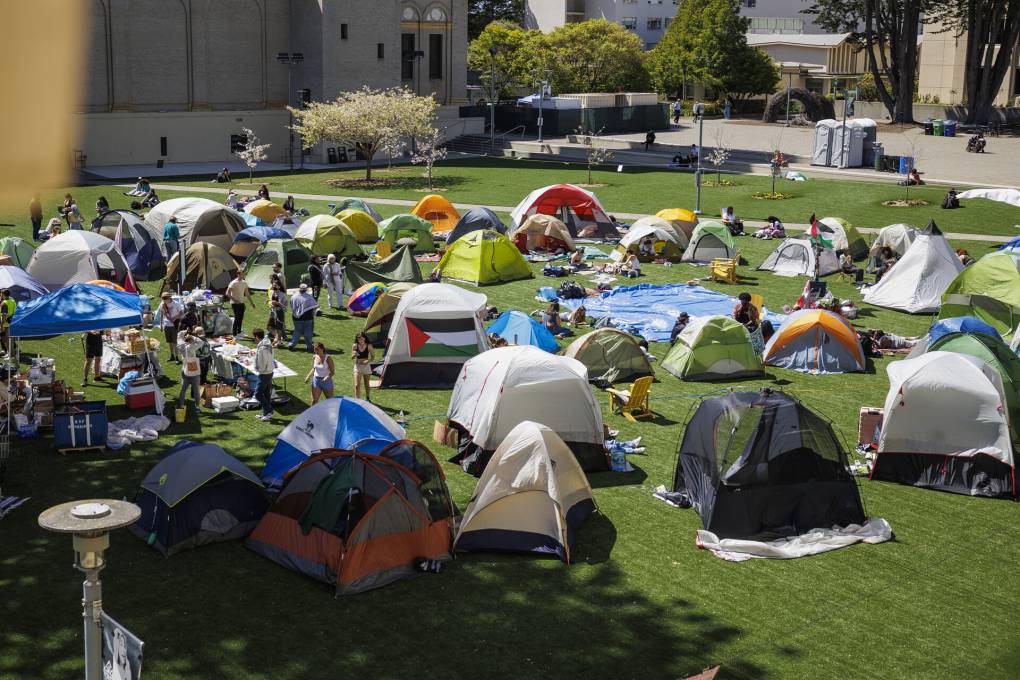
"caption": "A pro-Palestinian student encampment at the University of San Francisco on April 30, 2024.",
"credit": "Martin do Nascimento/KQED",
"altTag": "Tents are set up in a field surrounded by school buildings.",
"description": null,
"imgSizes": {
"medium": {
"file": "https://cdn.kqed.org/wp-content/uploads/sites/10/2024/05/240430-USF-GAZA-ENCAMPMENT-MD-09_qut-800x533.jpg",
"width": 800,
"height": 533,
"mimeType": "image/jpeg"
},
"large": {
"file": "https://cdn.kqed.org/wp-content/uploads/sites/10/2024/05/240430-USF-GAZA-ENCAMPMENT-MD-09_qut-1020x680.jpg",
"width": 1020,
"height": 680,
"mimeType": "image/jpeg"
},
"thumbnail": {
"file": "https://cdn.kqed.org/wp-content/uploads/sites/10/2024/05/240430-USF-GAZA-ENCAMPMENT-MD-09_qut-160x107.jpg",
"width": 160,
"height": 107,
"mimeType": "image/jpeg"
},
"1536x1536": {
"file": "https://cdn.kqed.org/wp-content/uploads/sites/10/2024/05/240430-USF-GAZA-ENCAMPMENT-MD-09_qut-1536x1024.jpg",
"width": 1536,
"height": 1024,
"mimeType": "image/jpeg"
},
"post-thumbnail": {
"file": "https://cdn.kqed.org/wp-content/uploads/sites/10/2024/05/240430-USF-GAZA-ENCAMPMENT-MD-09_qut-672x372.jpg",
"width": 672,
"height": 372,
"mimeType": "image/jpeg"
},
"twentyfourteen-full-width": {
"file": "https://cdn.kqed.org/wp-content/uploads/sites/10/2024/05/240430-USF-GAZA-ENCAMPMENT-MD-09_qut-1038x576.jpg",
"width": 1038,
"height": 576,
"mimeType": "image/jpeg"
},
"kqedFullSize": {
"file": "https://cdn.kqed.org/wp-content/uploads/sites/10/2024/05/240430-USF-GAZA-ENCAMPMENT-MD-09_qut.jpg",
"width": 1920,
"height": 1280
}
},
"isLoading": false,
"fetchFailed": false
},
"news_11987119": {
"type": "attachments",
"id": "news_11987119",
"meta": {
"index": "attachments_1716263798",
"site": "news",
"id": "11987119",
"found": true
},
"title": "240508-SWINGDISTRICTCLIMATE-12-BL-KQED-1020x680",
"publishDate": 1716302364,
"status": "inherit",
"parent": 11987117,
"modified": 1716302418,
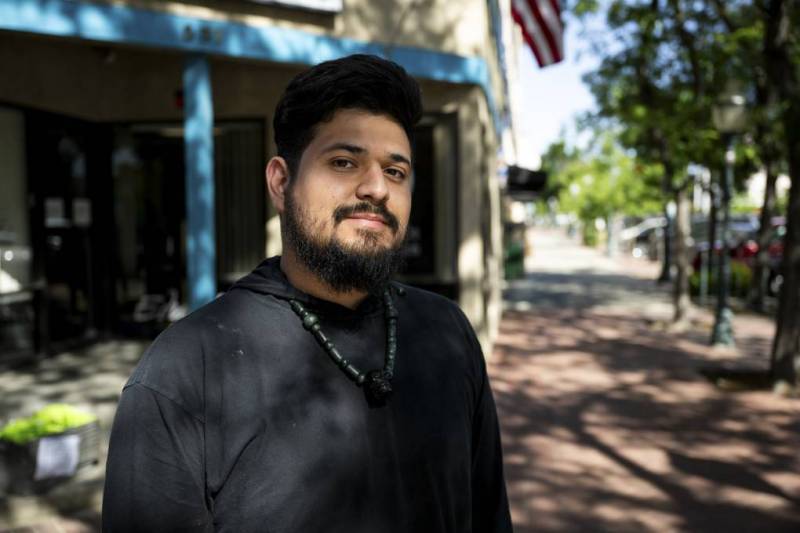
"caption": "Sebastian Cervantes, an organizer in the Central Valley, stands in Merced, California, on May 8, 2024. ",
"credit": "Beth LaBerge/KQED",
"altTag": "central valley climate voters",
"description": null,
"imgSizes": {
"medium": {
"file": "https://cdn.kqed.org/wp-content/uploads/sites/10/2024/05/240508-SWINGDISTRICTCLIMATE-12-BL-KQED-1020x680-1-800x533.jpg",
"width": 800,
"height": 533,
"mimeType": "image/jpeg"
},
"thumbnail": {
"file": "https://cdn.kqed.org/wp-content/uploads/sites/10/2024/05/240508-SWINGDISTRICTCLIMATE-12-BL-KQED-1020x680-1-160x107.jpg",
"width": 160,
"height": 107,
"mimeType": "image/jpeg"
},
"post-thumbnail": {
"file": "https://cdn.kqed.org/wp-content/uploads/sites/10/2024/05/240508-SWINGDISTRICTCLIMATE-12-BL-KQED-1020x680-1-672x372.jpg",
"width": 672,
"height": 372,
"mimeType": "image/jpeg"
},
"twentyfourteen-full-width": {
"file": "https://cdn.kqed.org/wp-content/uploads/sites/10/2024/05/240508-SWINGDISTRICTCLIMATE-12-BL-KQED-1020x680-1-1020x576.jpg",
"width": 1020,
"height": 576,
"mimeType": "image/jpeg"
},
"kqedFullSize": {
"file": "https://cdn.kqed.org/wp-content/uploads/sites/10/2024/05/240508-SWINGDISTRICTCLIMATE-12-BL-KQED-1020x680-1.jpg",
"width": 1020,
"height": 680
}
},
"isLoading": false,
"fetchFailed": false
},
"news_11987094": {
"type": "attachments",
"id": "news_11987094",
"meta": {
"index": "attachments_1716263798",
"site": "news",
"id": "11987094",
"found": true
},
"parent": 11987091,
"imgSizes": {
"twentyfourteen-full-width": {
"file": "https://cdn.kqed.org/wp-content/uploads/sites/10/2024/05/m6a0112-1038x576.jpeg",
"width": 1038,
"mimeType": "image/jpeg",
"height": 576
},
"thumbnail": {
"file": "https://cdn.kqed.org/wp-content/uploads/sites/10/2024/05/m6a0112-160x107.jpeg",
"width": 160,
"mimeType": "image/jpeg",
"height": 107
},
"post-thumbnail": {
"file": "https://cdn.kqed.org/wp-content/uploads/sites/10/2024/05/m6a0112-672x372.jpeg",
"width": 672,
"mimeType": "image/jpeg",
"height": 372
},
"kqedFullSize": {
"file": "https://cdn.kqed.org/wp-content/uploads/sites/10/2024/05/m6a0112-scaled.jpeg",
"width": 2560,
"height": 1707
},
"2048x2048": {
"file": "https://cdn.kqed.org/wp-content/uploads/sites/10/2024/05/m6a0112-2048x1365.jpeg",
"width": 2048,
"mimeType": "image/jpeg",
"height": 1365
},
"large": {
"file": "https://cdn.kqed.org/wp-content/uploads/sites/10/2024/05/m6a0112-1020x680.jpeg",
"width": 1020,
"mimeType": "image/jpeg",
"height": 680
},
"1536x1536": {
"file": "https://cdn.kqed.org/wp-content/uploads/sites/10/2024/05/m6a0112-1536x1024.jpeg",
"width": 1536,
"mimeType": "image/jpeg",
"height": 1024
},
"full-width": {
"file": "https://cdn.kqed.org/wp-content/uploads/sites/10/2024/05/m6a0112-1920x1280.jpeg",
"width": 1920,
"mimeType": "image/jpeg",
"height": 1280
},
"medium": {
"file": "https://cdn.kqed.org/wp-content/uploads/sites/10/2024/05/m6a0112-800x533.jpeg",
"width": 800,
"mimeType": "image/jpeg",
"height": 533
}
},
"publishDate": 1716255339,
"modified": 1716258399,
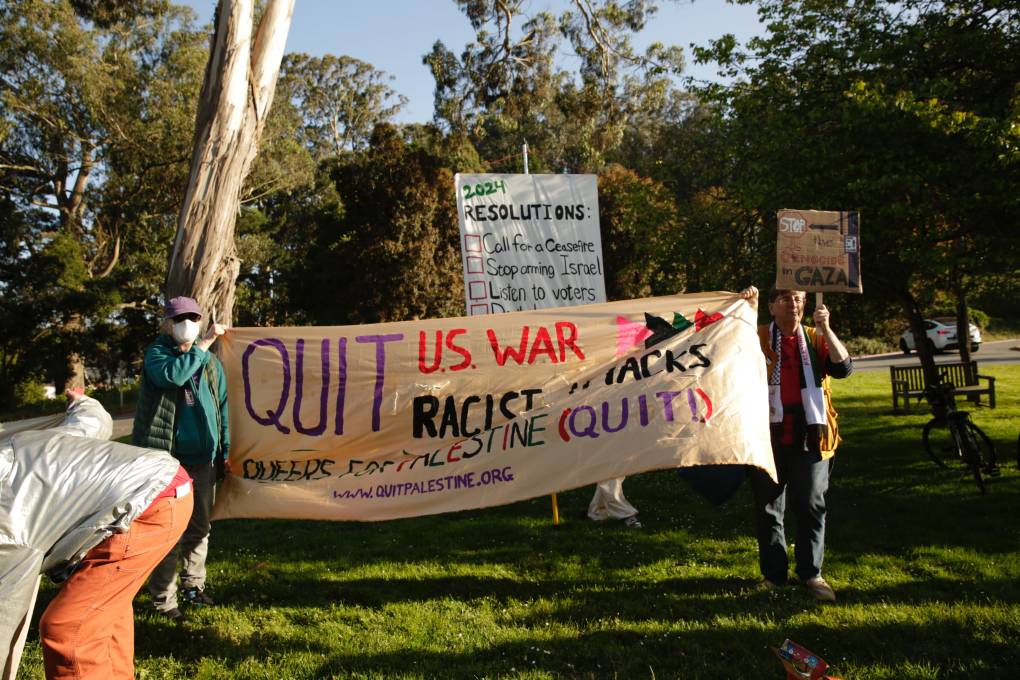
"caption": "A group of Harvard alumni and Bay Area community members protest during the Harvard Club of San Francisco’s 150th anniversary celebration where the House Speaker emeritus was honored on Monday, May 20, 2024.",
"description": null,
"title": "_m6a0112",
"credit": "Gina Castro/KQED",
"status": "inherit",
"altTag": "a small group holds up signs and a banner that says 'quit US war' in a park",
"isLoading": false,
"fetchFailed": false
},
"news_11986982": {
"type": "attachments",
"id": "news_11986982",
"meta": {
"index": "attachments_1716263798",
"site": "news",
"id": "11986982",
"found": true
},
"parent": 11986910,
"imgSizes": {
"twentyfourteen-full-width": {
"file": "https://cdn.kqed.org/wp-content/uploads/sites/10/2024/05/GOCDbFabMAAiZTe-1038x576.jpeg",
"width": 1038,
"mimeType": "image/jpeg",
"height": 576
},
"thumbnail": {
"file": "https://cdn.kqed.org/wp-content/uploads/sites/10/2024/05/GOCDbFabMAAiZTe-160x120.jpeg",
"width": 160,
"mimeType": "image/jpeg",
"height": 120
},
"post-thumbnail": {
"file": "https://cdn.kqed.org/wp-content/uploads/sites/10/2024/05/GOCDbFabMAAiZTe-672x372.jpeg",
"width": 672,
"mimeType": "image/jpeg",
"height": 372
},
"kqedFullSize": {
"file": "https://cdn.kqed.org/wp-content/uploads/sites/10/2024/05/GOCDbFabMAAiZTe.jpeg",
"width": 1200,
"height": 900
},
"large": {
"file": "https://cdn.kqed.org/wp-content/uploads/sites/10/2024/05/GOCDbFabMAAiZTe-1020x765.jpeg",
"width": 1020,
"mimeType": "image/jpeg",
"height": 765
},
"medium": {
"file": "https://cdn.kqed.org/wp-content/uploads/sites/10/2024/05/GOCDbFabMAAiZTe-800x600.jpeg",
"width": 800,
"mimeType": "image/jpeg",
"height": 600
}
},
"publishDate": 1716238780,
"modified": 1716238857,
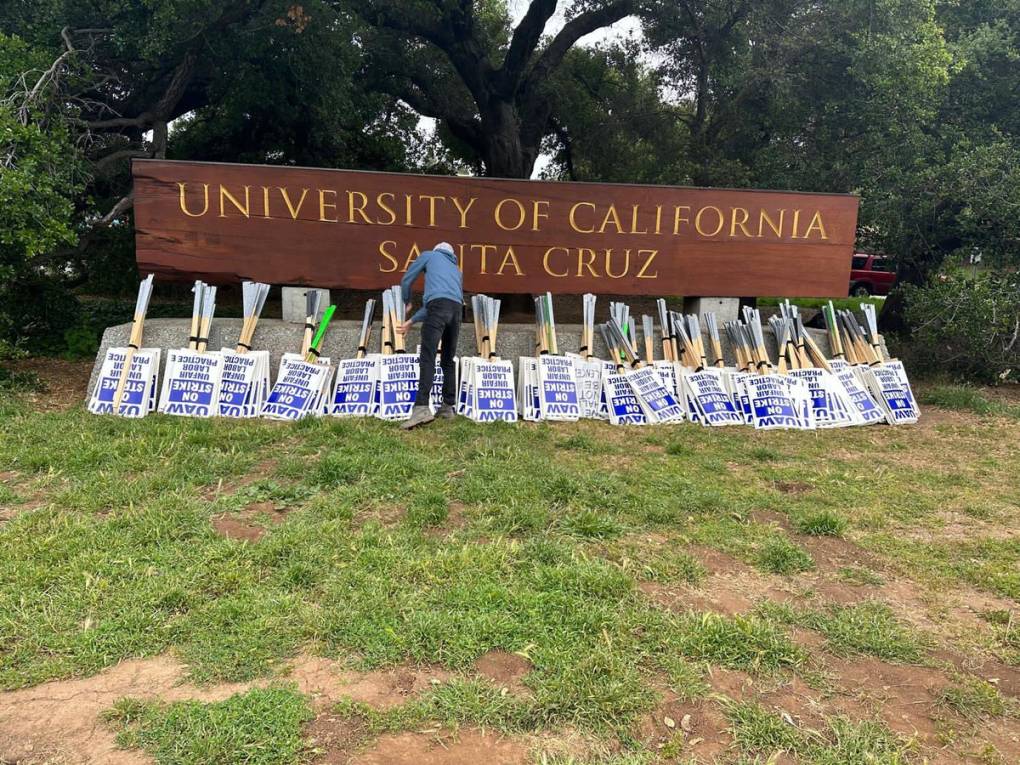
"caption": "Academic workers at UC Santa Cruz went on strike Monday morning, May 20.",
"description": null,
"title": "GOCDbFabMAAiZTe",
"credit": "Courtesy of UAW 4811",
"status": "inherit",
"altTag": "strike signs leaned against a large sign saying \"University of California, Santa Cruz\"",
"isLoading": false,
"fetchFailed": false
},
"news_11986768": {
"type": "attachments",
"id": "news_11986768",
"meta": {
"index": "attachments_1716263798",
"site": "news",
"id": "11986768",
"found": true
},
"parent": 11986767,
"imgSizes": {
"twentyfourteen-full-width": {
"file": "https://cdn.kqed.org/wp-content/uploads/sites/10/2024/05/L1005151_qut-1038x576.jpg",
"width": 1038,
"mimeType": "image/jpeg",
"height": 576
},
"thumbnail": {
"file": "https://cdn.kqed.org/wp-content/uploads/sites/10/2024/05/L1005151_qut-160x107.jpg",
"width": 160,
"mimeType": "image/jpeg",
"height": 107
},
"post-thumbnail": {
"file": "https://cdn.kqed.org/wp-content/uploads/sites/10/2024/05/L1005151_qut-672x372.jpg",
"width": 672,
"mimeType": "image/jpeg",
"height": 372
},
"kqedFullSize": {
"file": "https://cdn.kqed.org/wp-content/uploads/sites/10/2024/05/L1005151_qut.jpg",
"width": 1920,
"height": 1280
},
"large": {
"file": "https://cdn.kqed.org/wp-content/uploads/sites/10/2024/05/L1005151_qut-1020x680.jpg",
"width": 1020,
"mimeType": "image/jpeg",
"height": 680
},
"1536x1536": {
"file": "https://cdn.kqed.org/wp-content/uploads/sites/10/2024/05/L1005151_qut-1536x1024.jpg",
"width": 1536,
"mimeType": "image/jpeg",
"height": 1024
},
"medium": {
"file": "https://cdn.kqed.org/wp-content/uploads/sites/10/2024/05/L1005151_qut-800x533.jpg",
"width": 800,
"mimeType": "image/jpeg",
"height": 533
}
},
"publishDate": 1715985070,
"modified": 1715987695,
"caption": "Protesters at UC Berkeley call on the university to divest from companies supporting Israel and to support a call for a cease-fire in Gaza.",
"description": null,
"title": "L1005151_qut",
"credit": "Aryk Copley/KQED",
"status": "inherit",
"altTag": "Two college-age students hold up signs that say 'Divest' and 'stop bombing Gaza.'",
"isLoading": false,
"fetchFailed": false
},
"news_11986599": {
"type": "attachments",
"id": "news_11986599",
"meta": {
"index": "attachments_1716263798",
"site": "news",
"id": "11986599",
"found": true
},
"parent": 11986574,
"imgSizes": {
"twentyfourteen-full-width": {
"file": "https://cdn.kqed.org/wp-content/uploads/sites/10/2024/05/20240429_SSUGaza-5_qut-1038x576.jpg",
"width": 1038,
"mimeType": "image/jpeg",
"height": 576
},
"thumbnail": {
"file": "https://cdn.kqed.org/wp-content/uploads/sites/10/2024/05/20240429_SSUGaza-5_qut-160x107.jpg",
"width": 160,
"mimeType": "image/jpeg",
"height": 107
},
"post-thumbnail": {
"file": "https://cdn.kqed.org/wp-content/uploads/sites/10/2024/05/20240429_SSUGaza-5_qut-672x372.jpg",
"width": 672,
"mimeType": "image/jpeg",
"height": 372
},
"kqedFullSize": {
"file": "https://cdn.kqed.org/wp-content/uploads/sites/10/2024/05/20240429_SSUGaza-5_qut.jpg",
"width": 1920,
"height": 1280
},
"large": {
"file": "https://cdn.kqed.org/wp-content/uploads/sites/10/2024/05/20240429_SSUGaza-5_qut-1020x680.jpg",
"width": 1020,
"mimeType": "image/jpeg",
"height": 680
},
"1536x1536": {
"file": "https://cdn.kqed.org/wp-content/uploads/sites/10/2024/05/20240429_SSUGaza-5_qut-1536x1024.jpg",
"width": 1536,
"mimeType": "image/jpeg",
"height": 1024
},
"medium": {
"file": "https://cdn.kqed.org/wp-content/uploads/sites/10/2024/05/20240429_SSUGaza-5_qut-800x533.jpg",
"width": 800,
"mimeType": "image/jpeg",
"height": 533
}
},
"publishDate": 1715898689,
"modified": 1715898781,
"caption": "Students walk past a Palestinian flag displayed at Sonoma State University in Rohnert Park on Monday, April 29, 2024. Sonoma State students set up a tent encampment on Friday. Colleges across the nation have set up tent encampments to show support and solidarity for Palestine.",
"description": null,
"title": "20240429_SSUGaza-5_qut",
"credit": "Gina Castro/KQED",
"status": "inherit",
"altTag": "Two women walk past a Palestinian flag hanging from a tree outdoors.",
"isLoading": false,
"fetchFailed": false
},
"news_11984188": {
"type": "attachments",
"id": "news_11984188",
"meta": {
"index": "attachments_1716263798",
"site": "news",
"id": "11984188",
"found": true
},
"parent": 11984140,
"imgSizes": {
"twentyfourteen-full-width": {
"file": "https://cdn.kqed.org/wp-content/uploads/sites/10/2024/04/240423-BERKELEY-GAZA-ENCAMPMENT-MD-02_qut-1-1038x576.jpg",
"width": 1038,
"mimeType": "image/jpeg",
"height": 576
},
"thumbnail": {
"file": "https://cdn.kqed.org/wp-content/uploads/sites/10/2024/04/240423-BERKELEY-GAZA-ENCAMPMENT-MD-02_qut-1-160x107.jpg",
"width": 160,
"mimeType": "image/jpeg",
"height": 107
},
"post-thumbnail": {
"file": "https://cdn.kqed.org/wp-content/uploads/sites/10/2024/04/240423-BERKELEY-GAZA-ENCAMPMENT-MD-02_qut-1-672x372.jpg",
"width": 672,
"mimeType": "image/jpeg",
"height": 372
},
"kqedFullSize": {
"file": "https://cdn.kqed.org/wp-content/uploads/sites/10/2024/04/240423-BERKELEY-GAZA-ENCAMPMENT-MD-02_qut-1.jpg",
"width": 1920,
"height": 1280
},
"large": {
"file": "https://cdn.kqed.org/wp-content/uploads/sites/10/2024/04/240423-BERKELEY-GAZA-ENCAMPMENT-MD-02_qut-1-1020x680.jpg",
"width": 1020,
"mimeType": "image/jpeg",
"height": 680
},
"1536x1536": {
"file": "https://cdn.kqed.org/wp-content/uploads/sites/10/2024/04/240423-BERKELEY-GAZA-ENCAMPMENT-MD-02_qut-1-1536x1024.jpg",
"width": 1536,
"mimeType": "image/jpeg",
"height": 1024
},
"medium": {
"file": "https://cdn.kqed.org/wp-content/uploads/sites/10/2024/04/240423-BERKELEY-GAZA-ENCAMPMENT-MD-02_qut-1-800x533.jpg",
"width": 800,
"mimeType": "image/jpeg",
"height": 533
}
},
"publishDate": 1714162142,
"modified": 1715798157,
"caption": "The UC Berkeley Gaza Solidarity Encampment in front of Sproul Hall on April 23, 2024.",
"description": null,
"title": "240423-BERKELEY GAZA ENCAMPMENT-MD-02_qut (1)",
"credit": "Martin do Nascimento/KQED",
"status": "inherit",
"altTag": "Tents are set up on the steps leading up to a building. A red-white-green-black Palestinian flag hangs from one tent. One banner hung from the building in the background says: 'An injury to Gaza is an injury to us all.' Another says: 'Divest.'",
"isLoading": false,
"fetchFailed": false
},
"news_11986142": {
"type": "attachments",
"id": "news_11986142",
"meta": {
"index": "attachments_1716263798",
"site": "news",
"id": "11986142",
"found": true
},
"parent": 0,
"imgSizes": {
"twentyfourteen-full-width": {
"file": "https://cdn.kqed.org/wp-content/uploads/sites/10/2024/05/240514-Google-Protest-JG-01-1038x576.jpg",
"width": 1038,
"mimeType": "image/jpeg",
"height": 576
},
"thumbnail": {
"file": "https://cdn.kqed.org/wp-content/uploads/sites/10/2024/05/240514-Google-Protest-JG-01-160x107.jpg",
"width": 160,
"mimeType": "image/jpeg",
"height": 107
},
"post-thumbnail": {
"file": "https://cdn.kqed.org/wp-content/uploads/sites/10/2024/05/240514-Google-Protest-JG-01-672x372.jpg",
"width": 672,
"mimeType": "image/jpeg",
"height": 372
},
"kqedFullSize": {
"file": "https://cdn.kqed.org/wp-content/uploads/sites/10/2024/05/240514-Google-Protest-JG-01.jpg",
"width": 2000,
"height": 1333
},
"large": {
"file": "https://cdn.kqed.org/wp-content/uploads/sites/10/2024/05/240514-Google-Protest-JG-01-1020x680.jpg",
"width": 1020,
"mimeType": "image/jpeg",
"height": 680
},
"1536x1536": {
"file": "https://cdn.kqed.org/wp-content/uploads/sites/10/2024/05/240514-Google-Protest-JG-01-1536x1024.jpg",
"width": 1536,
"mimeType": "image/jpeg",
"height": 1024
},
"full-width": {
"file": "https://cdn.kqed.org/wp-content/uploads/sites/10/2024/05/240514-Google-Protest-JG-01-1920x1280.jpg",
"width": 1920,
"mimeType": "image/jpeg",
"height": 1280
},
"medium": {
"file": "https://cdn.kqed.org/wp-content/uploads/sites/10/2024/05/240514-Google-Protest-JG-01-800x533.jpg",
"width": 800,
"mimeType": "image/jpeg",
"height": 533
}
},
"publishDate": 1715716895,
"modified": 1715718181,
"caption": "People play drums and chant during a protest outside of Google's offices in Mountain View on May 14, 2024.",
"description": null,
"title": "240514-Google Protest-JG-01",
"credit": "Joseph Geha/KQED",
"status": "inherit",
"altTag": "A group of people wearing masks and holding drums walk down the street.",
"isLoading": false,
"fetchFailed": false
},
"news_11985633": {
"type": "attachments",
"id": "news_11985633",
"meta": {
"index": "attachments_1716263798",
"site": "news",
"id": "11985633",
"found": true
},
"parent": 0,
"imgSizes": {
"twentyfourteen-full-width": {
"file": "https://cdn.kqed.org/wp-content/uploads/sites/10/2024/05/231214-GazaGoogleProtest-10-BL_qut-1038x576.jpg",
"width": 1038,
"mimeType": "image/jpeg",
"height": 576
},
"thumbnail": {
"file": "https://cdn.kqed.org/wp-content/uploads/sites/10/2024/05/231214-GazaGoogleProtest-10-BL_qut-160x107.jpg",
"width": 160,
"mimeType": "image/jpeg",
"height": 107
},
"post-thumbnail": {
"file": "https://cdn.kqed.org/wp-content/uploads/sites/10/2024/05/231214-GazaGoogleProtest-10-BL_qut-672x372.jpg",
"width": 672,
"mimeType": "image/jpeg",
"height": 372
},
"kqedFullSize": {
"file": "https://cdn.kqed.org/wp-content/uploads/sites/10/2024/05/231214-GazaGoogleProtest-10-BL_qut.jpg",
"width": 1920,
"height": 1280
},
"large": {
"file": "https://cdn.kqed.org/wp-content/uploads/sites/10/2024/05/231214-GazaGoogleProtest-10-BL_qut-1020x680.jpg",
"width": 1020,
"mimeType": "image/jpeg",
"height": 680
},
"1536x1536": {
"file": "https://cdn.kqed.org/wp-content/uploads/sites/10/2024/05/231214-GazaGoogleProtest-10-BL_qut-1536x1024.jpg",
"width": 1536,
"mimeType": "image/jpeg",
"height": 1024
},
"medium": {
"file": "https://cdn.kqed.org/wp-content/uploads/sites/10/2024/05/231214-GazaGoogleProtest-10-BL_qut-800x533.jpg",
"width": 800,
"mimeType": "image/jpeg",
"height": 533
}
},
"publishDate": 1715297255,
"modified": 1715297291,
"caption": "Demonstrators gather outside Google offices in downtown San Francisco on Dec. 14, 2023, to call for an immediate end to 'Project Nimbus,' Google's billion-dollar cloud computing project with the Israeli government.",
"description": null,
"title": "231214-GazaGoogleProtest-10-BL_qut",
"credit": "Beth LaBerge/KQED",
"status": "inherit",
"altTag": null,
"isLoading": false,
"fetchFailed": false
},
"news_11985375": {
"type": "attachments",
"id": "news_11985375",
"meta": {
"index": "attachments_1716263798",
"site": "news",
"id": "11985375",
"found": true
},
"parent": 11985335,
"imgSizes": {
"twentyfourteen-full-width": {
"file": "https://cdn.kqed.org/wp-content/uploads/sites/10/2024/05/GettyImages-2152066925-1024x576.jpg",
"width": 1024,
"mimeType": "image/jpeg",
"height": 576
},
"thumbnail": {
"file": "https://cdn.kqed.org/wp-content/uploads/sites/10/2024/05/GettyImages-2152066925-160x107.jpg",
"width": 160,
"mimeType": "image/jpeg",
"height": 107
},
"post-thumbnail": {
"file": "https://cdn.kqed.org/wp-content/uploads/sites/10/2024/05/GettyImages-2152066925-672x372.jpg",
"width": 672,
"mimeType": "image/jpeg",
"height": 372
},
"kqedFullSize": {
"file": "https://cdn.kqed.org/wp-content/uploads/sites/10/2024/05/GettyImages-2152066925.jpg",
"width": 1024,
"height": 683
},
"large": {
"file": "https://cdn.kqed.org/wp-content/uploads/sites/10/2024/05/GettyImages-2152066925-1020x680.jpg",
"width": 1020,
"mimeType": "image/jpeg",
"height": 680
},
"medium": {
"file": "https://cdn.kqed.org/wp-content/uploads/sites/10/2024/05/GettyImages-2152066925-800x534.jpg",
"width": 800,
"mimeType": "image/jpeg",
"height": 534
}
},
"publishDate": 1715196832,
"modified": 1715200335,
"caption": "Enikia Ford Morthel, superintendent of the Berkeley Unified School District, listens during a hearing with subcommittee members of the House Education and the Workforce Committee on May 8, 2024, in Washington, D.C.",
"description": null,
"title": "House Committee Holds Hearing Examining Antisemitism In K-12 Schools",
"credit": "Anna Moneymaker/Getty Images",
"status": "inherit",
"altTag": "A Black woman in a red dress sits in front of a microphone.",
"isLoading": false,
"fetchFailed": false
},
"news_11985119": {
"type": "attachments",
"id": "news_11985119",
"meta": {
"index": "attachments_1716263798",
"site": "news",
"id": "11985119",
"found": true
},
"parent": 0,
"imgSizes": {
"twentyfourteen-full-width": {
"file": "https://cdn.kqed.org/wp-content/uploads/sites/10/2024/05/240506-SFSUPresident-34-BL-1038x576.jpg",
"width": 1038,
"mimeType": "image/jpeg",
"height": 576
},
"thumbnail": {
"file": "https://cdn.kqed.org/wp-content/uploads/sites/10/2024/05/240506-SFSUPresident-34-BL-160x107.jpg",
"width": 160,
"mimeType": "image/jpeg",
"height": 107
},
"post-thumbnail": {
"file": "https://cdn.kqed.org/wp-content/uploads/sites/10/2024/05/240506-SFSUPresident-34-BL-672x372.jpg",
"width": 672,
"mimeType": "image/jpeg",
"height": 372
},
"kqedFullSize": {
"file": "https://cdn.kqed.org/wp-content/uploads/sites/10/2024/05/240506-SFSUPresident-34-BL.jpg",
"width": 2000,
"height": 1333
},
"large": {
"file": "https://cdn.kqed.org/wp-content/uploads/sites/10/2024/05/240506-SFSUPresident-34-BL-1020x680.jpg",
"width": 1020,
"mimeType": "image/jpeg",
"height": 680
},
"1536x1536": {
"file": "https://cdn.kqed.org/wp-content/uploads/sites/10/2024/05/240506-SFSUPresident-34-BL-1536x1024.jpg",
"width": 1536,
"mimeType": "image/jpeg",
"height": 1024
},
"full-width": {
"file": "https://cdn.kqed.org/wp-content/uploads/sites/10/2024/05/240506-SFSUPresident-34-BL-1920x1280.jpg",
"width": 1920,
"mimeType": "image/jpeg",
"height": 1280
},
"medium": {
"file": "https://cdn.kqed.org/wp-content/uploads/sites/10/2024/05/240506-SFSUPresident-34-BL-800x533.jpg",
"width": 800,
"mimeType": "image/jpeg",
"height": 533
}
},
"publishDate": 1715033484,
"modified": 1715033638,
"caption": "Sohrab F., alongside fellow pro-Palestinian student activists, meets with SFSU President Lynn Mahoney at San Francisco State University on May 6, 2024, to negotiate the demands of the students who have camped out on campus.",
"description": null,
"title": "240506-SFSUPresident-34-BL",
"credit": "Beth LaBerge/KQED",
"status": "inherit",
"altTag": null,
"isLoading": false,
"fetchFailed": false
},
"news_11984867": {
"type": "attachments",
"id": "news_11984867",
"meta": {
"index": "attachments_1716263798",
"site": "news",
"id": "11984867",
"found": true
},
"parent": 11984845,
"imgSizes": {
"twentyfourteen-full-width": {
"file": "https://cdn.kqed.org/wp-content/uploads/sites/10/2024/05/240429-SFSU-GAZA-RALLY-MD-16_qut-1038x576.jpg",
"width": 1038,
"mimeType": "image/jpeg",
"height": 576
},
"thumbnail": {
"file": "https://cdn.kqed.org/wp-content/uploads/sites/10/2024/05/240429-SFSU-GAZA-RALLY-MD-16_qut-160x107.jpg",
"width": 160,
"mimeType": "image/jpeg",
"height": 107
},
"post-thumbnail": {
"file": "https://cdn.kqed.org/wp-content/uploads/sites/10/2024/05/240429-SFSU-GAZA-RALLY-MD-16_qut-672x372.jpg",
"width": 672,
"mimeType": "image/jpeg",
"height": 372
},
"kqedFullSize": {
"file": "https://cdn.kqed.org/wp-content/uploads/sites/10/2024/05/240429-SFSU-GAZA-RALLY-MD-16_qut.jpg",
"width": 1920,
"height": 1280
},
"large": {
"file": "https://cdn.kqed.org/wp-content/uploads/sites/10/2024/05/240429-SFSU-GAZA-RALLY-MD-16_qut-1020x680.jpg",
"width": 1020,
"mimeType": "image/jpeg",
"height": 680
},
"1536x1536": {
"file": "https://cdn.kqed.org/wp-content/uploads/sites/10/2024/05/240429-SFSU-GAZA-RALLY-MD-16_qut-1536x1024.jpg",
"width": 1536,
"mimeType": "image/jpeg",
"height": 1024
},
"medium": {
"file": "https://cdn.kqed.org/wp-content/uploads/sites/10/2024/05/240429-SFSU-GAZA-RALLY-MD-16_qut-800x533.jpg",
"width": 800,
"mimeType": "image/jpeg",
"height": 533
}
},
"publishDate": 1714686263,
"modified": 1714686445,
"caption": "San Francisco State University students rally outside the Cesar Chavez Student Center on April 30, 2024, calling on the university to disclose its financial ties to Israel.",
"description": null,
"title": "240429-SFSU GAZA RALLY-MD-16_qut",
"credit": "Martin do Nascimento/KQED",
"status": "inherit",
"altTag": "A group of young protesters holding a sign that says 'Divest.'",
"isLoading": false,
"fetchFailed": false
}
},
"audioPlayerReducer": {
"postId": "stream_live",
"isPaused": true,
"isPlaying": false,
"pfsActive": false,
"pledgeModalIsOpen": true,
"playerDrawerIsOpen": false,
"liveAudioPlayStartedAt": 0,
"liveAudioPlayContext": ""
},
"authorsReducer": {
"byline_news_11986910": {
"type": "authors",
"id": "byline_news_11986910",
"meta": {
"override": true
},
"slug": "byline_news_11986910",
"name": "KQED News Staff and Wires",
"isLoading": false
},
"byline_news_11986280": {
"type": "authors",
"id": "byline_news_11986280",
"meta": {
"override": true
},
"slug": "byline_news_11986280",
"name": "Michael Burke, EdSource",
"isLoading": false
},
"kqednewsstaffandwires": {
"type": "authors",
"id": "237",
"meta": {
"index": "authors_1716337520",
"id": "237",
"found": true
},
"name": "KQED News Staff and Wires",
"firstName": "KQED News Staff and Wires",
"lastName": null,
"slug": "kqednewsstaffandwires",
"email": "onlinenewsstaff@kqed.org",
"display_author_email": false,
"staff_mastheads": [],
"title": null,
"bio": null,
"avatar": "https://secure.gravatar.com/avatar/72295af8ebbfbd19a4948f5271285664?s=600&d=blank&r=g",
"twitter": null,
"facebook": null,
"instagram": null,
"linkedin": null,
"sites": [
{
"site": "arts",
"roles": [
"contributor"
]
},
{
"site": "news",
"roles": [
"contributor"
]
},
{
"site": "lowdown",
"roles": [
"author"
]
},
{
"site": "stateofhealth",
"roles": [
"contributor"
]
},
{
"site": "food",
"roles": [
"author"
]
}
],
"headData": {
"title": "KQED News Staff and Wires | KQED",
"description": null,
"ogImgSrc": "https://secure.gravatar.com/avatar/72295af8ebbfbd19a4948f5271285664?s=600&d=blank&r=g",
"twImgSrc": "https://secure.gravatar.com/avatar/72295af8ebbfbd19a4948f5271285664?s=600&d=blank&r=g"
},
"isLoading": false,
"link": "/author/kqednewsstaffandwires"
},
"rachael-myrow": {
"type": "authors",
"id": "251",
"meta": {
"index": "authors_1716337520",
"id": "251",
"found": true
},
"name": "Rachael Myrow",
"firstName": "Rachael",
"lastName": "Myrow",
"slug": "rachael-myrow",
"email": "rmyrow@kqed.org",
"display_author_email": true,
"staff_mastheads": [
"news"
],
"title": "Senior Editor of KQED's Silicon Valley News Desk",
"bio": "• I write and edit stories about how Silicon Valley power and policies shape everyday life in California. I’m also passionate about making Bay Area history and culture more accessible to a broad public. • I’ve been a journalist for most of my life, starting in high school with The Franklin Press in Los Angeles, where I grew up. While earning my first degree in English at UC Berkeley, I got my start in public radio at KALX-FM. After completing a second degree in journalism at Cal, I landed my first professional job at Marketplace, then moved on to KPCC (now LAist), and then KQED, where I hosted The California Report for more than seven years. • My reporting has appeared on NPR, The World, WBUR’s \u003ci>Here & Now\u003c/i>, and the BBC. I also guest host for KQED’s \u003ci>Forum\u003c/i>, as well as the Commonwealth Club in San Francisco. • I speak periodically on media, democracy and technology issues, and do voiceover work for documentaries and educational video projects. • Outside of the studio, you'll find me hiking Bay Area trails and whipping up Insta-ready meals in my kitchen. • I do not accept gifts, money, or favors from anyone connected to my reporting, I don't pay people for information, and I do not support or donate to political causes. • I strive to treat the people I report on with fairness, honesty, and respect. I also recognize there are often multiple sides to a story and work to verify information through multiple sources and documentation. If I get something wrong, I correct it.",
"avatar": "https://secure.gravatar.com/avatar/3ed8a3c5f26025e4a805ba634cda8cd764906b97438a6d9ce216b044e340da4e?s=600&d=blank&r=g",
"twitter": "rachaelmyrow",
"bluesky": null,
"facebook": null,
"instagram": null,
"linkedin": "https://www.linkedin.com/in/rachaelmyrow/",
"sites": [
{
"site": "arts",
"roles": [
"administrator"
]
},
{
"site": "news",
"roles": [
"edit_others_posts",
"editor"
]
},
{
"site": "futureofyou",
"roles": [
"editor"
]
},
{
"site": "bayareabites",
"roles": [
"editor"
]
},
{
"site": "stateofhealth",
"roles": [
"editor"
]
},
{
"site": "science",
"roles": [
"editor"
]
},
{
"site": "food",
"roles": [
"editor"
]
},
{
"site": "forum",
"roles": [
"editor"
]
},
{
"site": "liveblog",
"roles": [
"author"
]
}
],
"headData": {
"title": "Rachael Myrow | KQED",
"description": "Senior Editor of KQED's Silicon Valley News Desk",
"ogImgSrc": "https://secure.gravatar.com/avatar/3ed8a3c5f26025e4a805ba634cda8cd764906b97438a6d9ce216b044e340da4e?s=600&d=blank&r=g",
"twImgSrc": "https://secure.gravatar.com/avatar/3ed8a3c5f26025e4a805ba634cda8cd764906b97438a6d9ce216b044e340da4e?s=600&d=blank&r=g"
},
"isLoading": false,
"link": "/author/rachael-myrow"
},
"tarasiler": {
"type": "authors",
"id": "257",
"meta": {
"index": "authors_1716337520",
"id": "257",
"found": true
},
"name": "Tara Siler",
"firstName": "Tara",
"lastName": "Siler",
"slug": "tarasiler",
"email": "tsiler@kqed.org",
"display_author_email": false,
"staff_mastheads": [
"news"
],
"title": "KQED Contributor",
"bio": "Tara reports and anchors for KQED news. She covers a range of issues from community-police relations to local politics. Tara started out in community radio in the Bay Area, where she was raised. She eventually moved to Washington DC where she covered Congress for eight years for Pacifica and Monitor Radio. Her stories have also been heard on NPR's All Things Considered, Morning Edition and The World.\r\n\r\nTara lives with her husband in Oakland-- where they raised their two sons. She enjoys spending time with her family, gardening and hiking in the Oakland hills... and keeping up with the news.",
"avatar": "https://secure.gravatar.com/avatar/99802f9746fb80b65fd8ec6c57954450?s=600&d=blank&r=g",
"twitter": null,
"facebook": null,
"instagram": null,
"linkedin": null,
"sites": [
{
"site": "news",
"roles": [
"contributor",
"edit_others_posts"
]
},
{
"site": "stateofhealth",
"roles": [
"author"
]
}
],
"headData": {
"title": "Tara Siler | KQED",
"description": "KQED Contributor",
"ogImgSrc": "https://secure.gravatar.com/avatar/99802f9746fb80b65fd8ec6c57954450?s=600&d=blank&r=g",
"twImgSrc": "https://secure.gravatar.com/avatar/99802f9746fb80b65fd8ec6c57954450?s=600&d=blank&r=g"
},
"isLoading": false,
"link": "/author/tarasiler"
},
"kdomara": {
"type": "authors",
"id": "1459",
"meta": {
"index": "authors_1716337520",
"id": "1459",
"found": true
},
"name": "Kelly O'Mara",
"firstName": "Kelly",
"lastName": "O'Mara",
"slug": "kdomara",
"email": "komara@kqed.org",
"display_author_email": false,
"staff_mastheads": [
"news"
],
"title": "KQED Contributor",
"bio": "Kelly O'Mara is a writer and reporter in the San Francisco Bay Area. She writes about food, health, sports, travel, business and California news. Her work has appeared on KQED, online for Outside Magazine, epsnW, VICE and in Competitor Magazine, among others. Follow Kelly on Twitter \u003ca href=\"https://twitter.com/kellydomara\">@kellydomara\u003c/a>.",
"avatar": "https://secure.gravatar.com/avatar/768fec7412028b72f13bdd0f5f9d8186?s=600&d=blank&r=g",
"twitter": null,
"facebook": null,
"instagram": null,
"linkedin": null,
"sites": [
{
"site": "arts",
"roles": []
},
{
"site": "news",
"roles": []
},
{
"site": "bayareabites",
"roles": []
},
{
"site": "stateofhealth",
"roles": []
},
{
"site": "science",
"roles": []
},
{
"site": "checkplease",
"roles": [
"editor"
]
},
{
"site": "food",
"roles": []
},
{
"site": "forum",
"roles": [
"editor"
]
},
{
"site": "liveblog",
"roles": [
"editor"
]
}
],
"headData": {
"title": "Kelly O'Mara | KQED",
"description": "KQED Contributor",
"ogImgSrc": "https://secure.gravatar.com/avatar/768fec7412028b72f13bdd0f5f9d8186?s=600&d=blank&r=g",
"twImgSrc": "https://secure.gravatar.com/avatar/768fec7412028b72f13bdd0f5f9d8186?s=600&d=blank&r=g"
},
"isLoading": false,
"link": "/author/kdomara"
},
"jrodriguez": {
"type": "authors",
"id": "11690",
"meta": {
"index": "authors_1716337520",
"id": "11690",
"found": true
},
"name": "Joe Fitzgerald Rodriguez",
"firstName": "Joe",
"lastName": "Fitzgerald Rodriguez",
"slug": "jrodriguez",
"email": "jrodriguez@kqed.org",
"display_author_email": true,
"staff_mastheads": [
"news"
],
"title": "Reporter and Producer",
"bio": "Joe Fitzgerald Rodriguez is a reporter and digital producer for KQED covering politics. Joe most recently wrote for the \u003cem>San Francisco Examiner\u003c/em> as a political columnist covering The City. He was raised in San Francisco and has spent his reporting career in his beloved, foggy, city by the bay. Joe was 12-years-old when he conducted his first interview in journalism, grilling former San Francisco Mayor Willie Brown for the Marina Middle School newspaper, \u003cem>The Penguin Press, \u003c/em>and he continues to report on the San Francisco Bay Area to this day.",
"avatar": "https://secure.gravatar.com/avatar/2247beb0564c1e9c62228d5649d2edac?s=600&d=blank&r=g",
"twitter": "FitztheReporter",
"facebook": null,
"instagram": "https://www.instagram.com/fitzthereporter/",
"linkedin": null,
"sites": [
{
"site": "",
"roles": [
"editor"
]
},
{
"site": "arts",
"roles": [
"editor"
]
},
{
"site": "news",
"roles": [
"editor"
]
},
{
"site": "science",
"roles": [
"editor"
]
},
{
"site": "elections",
"roles": [
"editor"
]
},
{
"site": "liveblog",
"roles": [
"editor"
]
}
],
"headData": {
"title": "Joe Fitzgerald Rodriguez | KQED",
"description": "Reporter and Producer",
"ogImgSrc": "https://secure.gravatar.com/avatar/2247beb0564c1e9c62228d5649d2edac?s=600&d=blank&r=g",
"twImgSrc": "https://secure.gravatar.com/avatar/2247beb0564c1e9c62228d5649d2edac?s=600&d=blank&r=g"
},
"isLoading": false,
"link": "/author/jrodriguez"
},
"kmizuguchi": {
"type": "authors",
"id": "11739",
"meta": {
"index": "authors_1716337520",
"id": "11739",
"found": true
},
"name": "Keith Mizuguchi",
"firstName": "Keith",
"lastName": "Mizuguchi",
"slug": "kmizuguchi",
"email": "kmizuguchi@kqed.org",
"display_author_email": false,
"staff_mastheads": [],
"title": "KQED Contributor",
"bio": null,
"avatar": "https://secure.gravatar.com/avatar/64d8a7de0723d4099b9fe4e915136103febcc20809abce228ee4415bcb237023?s=600&d=blank&r=g",
"twitter": null,
"bluesky": null,
"facebook": null,
"instagram": null,
"linkedin": null,
"sites": [
{
"site": "news",
"roles": [
"editor"
]
},
{
"site": "science",
"roles": [
"editor"
]
}
],
"headData": {
"title": "Keith Mizuguchi | KQED",
"description": "KQED Contributor",
"ogImgSrc": "https://secure.gravatar.com/avatar/64d8a7de0723d4099b9fe4e915136103febcc20809abce228ee4415bcb237023?s=600&d=blank&r=g",
"twImgSrc": "https://secure.gravatar.com/avatar/64d8a7de0723d4099b9fe4e915136103febcc20809abce228ee4415bcb237023?s=600&d=blank&r=g"
},
"isLoading": false,
"link": "/author/kmizuguchi"
},
"jlara": {
"type": "authors",
"id": "11761",
"meta": {
"index": "authors_1716337520",
"id": "11761",
"found": true
},
"name": "Juan Carlos Lara",
"firstName": "Juan Carlos",
"lastName": "Lara",
"slug": "jlara",
"email": "jlara@kqed.org",
"display_author_email": false,
"staff_mastheads": [],
"title": "KQED Contributor",
"bio": null,
"avatar": "https://secure.gravatar.com/avatar/19e2052b9b05657c5ff2af2121846e9c?s=600&d=blank&r=g",
"twitter": null,
"facebook": null,
"instagram": null,
"linkedin": null,
"sites": [
{
"site": "arts",
"roles": [
"editor"
]
},
{
"site": "news",
"roles": [
"editor"
]
},
{
"site": "forum",
"roles": [
"editor"
]
},
{
"site": "liveblog",
"roles": [
"contributor"
]
}
],
"headData": {
"title": "Juan Carlos Lara | KQED",
"description": "KQED Contributor",
"ogImgSrc": "https://secure.gravatar.com/avatar/19e2052b9b05657c5ff2af2121846e9c?s=600&d=blank&r=g",
"twImgSrc": "https://secure.gravatar.com/avatar/19e2052b9b05657c5ff2af2121846e9c?s=600&d=blank&r=g"
},
"isLoading": false,
"link": "/author/jlara"
},
"sjohnson": {
"type": "authors",
"id": "11840",
"meta": {
"index": "authors_1716337520",
"id": "11840",
"found": true
},
"name": "Sydney Johnson",
"firstName": "Sydney",
"lastName": "Johnson",
"slug": "sjohnson",
"email": "sjohnson@kqed.org",
"display_author_email": false,
"staff_mastheads": [
"news"
],
"title": "KQED Reporter",
"bio": "Sydney Johnson is a general assignment reporter at KQED. She previously reported on public health and city government at the San Francisco Examiner, and before that, she covered statewide education policy for EdSource. Her reporting has won multiple local, state and national awards. Sydney is a graduate of the University of California, Berkeley and lives in San Francisco.",
"avatar": "https://secure.gravatar.com/avatar/97855f2719b72ad6190b7c535fe642c8?s=600&d=blank&r=g",
"twitter": "sydneyfjohnson",
"facebook": null,
"instagram": null,
"linkedin": null,
"sites": [
{
"site": "news",
"roles": [
"editor"
]
}
],
"headData": {
"title": "Sydney Johnson | KQED",
"description": "KQED Reporter",
"ogImgSrc": "https://secure.gravatar.com/avatar/97855f2719b72ad6190b7c535fe642c8?s=600&d=blank&r=g",
"twImgSrc": "https://secure.gravatar.com/avatar/97855f2719b72ad6190b7c535fe642c8?s=600&d=blank&r=g"
},
"isLoading": false,
"link": "/author/sjohnson"
},
"nkhan": {
"type": "authors",
"id": "11867",
"meta": {
"index": "authors_1716337520",
"id": "11867",
"found": true
},
"name": "Nisa Khan",
"firstName": "Nisa",
"lastName": "Khan",
"slug": "nkhan",
"email": "nkhan@kqed.org",
"display_author_email": false,
"staff_mastheads": [],
"title": "KQED Contributor",
"bio": "Nisa Khan is a reporter for KQED's Audience News Desk. She was formerly a data reporter at Michigan Radio. She earned a Bachelor of Science in Information from the University of Michigan and a Master of Arts in Communication from Stanford University.",
"avatar": "https://secure.gravatar.com/avatar/8720459eef081ff64582b3506b124d58523e80e120704a0cbd9892533c914991?s=600&d=blank&r=g",
"twitter": "mnisakhan",
"bluesky": null,
"facebook": null,
"instagram": null,
"linkedin": null,
"sites": [
{
"site": "arts",
"roles": [
"editor"
]
},
{
"site": "news",
"roles": [
"editor"
]
},
{
"site": "science",
"roles": [
"editor",
"author"
]
},
{
"site": "forum",
"roles": [
"editor"
]
},
{
"site": "liveblog",
"roles": [
"contributor"
]
}
],
"headData": {
"title": "Nisa Khan | KQED",
"description": "KQED Contributor",
"ogImgSrc": "https://secure.gravatar.com/avatar/8720459eef081ff64582b3506b124d58523e80e120704a0cbd9892533c914991?s=600&d=blank&r=g",
"twImgSrc": "https://secure.gravatar.com/avatar/8720459eef081ff64582b3506b124d58523e80e120704a0cbd9892533c914991?s=600&d=blank&r=g"
},
"isLoading": false,
"link": "/author/nkhan"
},
"jgeha": {
"type": "authors",
"id": "11906",
"meta": {
"index": "authors_1716337520",
"id": "11906",
"found": true
},
"name": "Joseph Geha",
"firstName": "Joseph",
"lastName": "Geha",
"slug": "jgeha",
"email": "jgeha@kqed.org",
"display_author_email": false,
"staff_mastheads": [
"news",
"science"
],
"title": "KQED Contributor",
"bio": null,
"avatar": "https://secure.gravatar.com/avatar/ea84d2b6dd93d6369d453edf19dd583f117cd1759d2d9c9c92f9de77017354fe?s=600&d=blank&r=g",
"twitter": null,
"bluesky": null,
"facebook": null,
"instagram": null,
"linkedin": null,
"sites": [
{
"site": "news",
"roles": [
"editor"
]
},
{
"site": "liveblog",
"roles": [
"author"
]
}
],
"headData": {
"title": "Joseph Geha | KQED",
"description": "KQED Contributor",
"ogImgSrc": "https://secure.gravatar.com/avatar/ea84d2b6dd93d6369d453edf19dd583f117cd1759d2d9c9c92f9de77017354fe?s=600&d=blank&r=g",
"twImgSrc": "https://secure.gravatar.com/avatar/ea84d2b6dd93d6369d453edf19dd583f117cd1759d2d9c9c92f9de77017354fe?s=600&d=blank&r=g"
},
"isLoading": false,
"link": "/author/jgeha"
}
},
"pagesReducer": {
"news_tag_gaza": {
"type": "terms",
"id": "news_6631",
"meta": {
"index": "terms_1716263798",
"site": "news",
"id": "6631",
"score": 9.304616
},
"featImg": null,
"name": "Gaza",
"description": null,
"taxonomy": "tag",
"headData": {
"twImgId": null,
"twTitle": null,
"ogTitle": null,
"ogImgId": null,
"twDescription": null,
"description": null,
"title": "Gaza Archives | KQED News",
"ogDescription": null
},
"ttid": 6655,
"slug": "gaza",
"isLoading": false,
"title": "Gaza",
"pageMeta": {
"site": "news",
"WpPageTemplate": "page-topic-editorial",
"currentPage": 11
},
"blocks": [
{
"blockName": "kqed/post-list",
"attrs": {
"layout": "cardArticle2",
"query": "posts/news?tag=gaza",
"seeMore": false,
"paginated": true,
"page": 11
}
},
{
"blockName": "kqed/ad"
}
]
}
},
"pfsSessionReducer": {},
"postsReducer": {
"stream_live": {
"type": "live",
"id": "stream_live",
"audioUrl": "https://streams.kqed.org/kqedradio",
"title": "Live Stream",
"excerpt": "Live Stream information currently unavailable.",
"link": "/radio",
"featImg": "",
"label": {
"name": "KQED Live",
"link": "/"
}
},
"stream_kqedNewscast": {
"type": "posts",
"id": "stream_kqedNewscast",
"audioUrl": "https://www.kqed.org/.stream/anon/radio/RDnews/newscast.mp3?_=1",
"title": "KQED Newscast",
"featImg": "",
"label": {
"name": "88.5 FM",
"link": "/"
}
},
"news_11987577": {
"type": "posts",
"id": "news_11987577",
"meta": {
"index": "posts_1716263798",
"site": "news",
"id": "11987577",
"score": null,
"sort": [
1716505254000
]
},
"guestAuthors": [],
"slug": "usf-suspends-15-pro-palestinian-student-protesters-after-encampment-is-disbanded",
"title": "USF Suspends 22 Pro-Palestinian Student Protesters After Encampment Is Disbanded",
"publishDate": 1716505254,
"format": "standard",
"headTitle": "USF Suspends 22 Pro-Palestinian Student Protesters After Encampment Is Disbanded | KQED",
"labelTerm": {
"site": "news"
},
"content": "\u003cp>\u003cem>Updated 10 a.m. Friday.\u003c/em>\u003c/p>\n\u003cp>The University of San Francisco administration suspended 22 students who took part in a pro-Palestinian protest encampment that was dismantled this week, according to the students.\u003c/p>\n\u003cp>Fifteen suspensions were initially reported, but students said they learned of more after this article was first published.\u003c/p>\n\u003cp>USF called the action an interim suspension pending investigations into violations of the university’s conduct code. It’s unclear what the ultimate punishment for the students may be, but the protesters and members of the faculty separately said students had been barred from campus and had internships canceled, which could delay their academic progress or jeopardize their financial aid. USF did not confirm those consequences.\u003c/p>\n\u003cp>Father Paul Fitzgerald, the university president, met with encampment representatives on May 13 and said students who left voluntarily would be granted “amnesty” from discipline under the conduct code. Six students took advantage of that offer, according to a university statement.\u003c/p>\n\u003cp>[aside postID=news_11986812,news_11984645,news_11984845 label='Campus Protests']\u003cbr>\n“Every student who is notified that they have violated nonacademic rules or community standards resulting in an interim suspension receives fair, consistent and respectful treatment. Students always have the opportunity to have their perspectives heard in the course of the conduct process,” the university administration wrote in a statement shared with KQED.\u003c/p>\n\u003cp>According to the university, after the encampment then shifted “from a peaceful protest to a campus disruption that monopolized USF’s resources,” officials took action against students who they alleged wrote graffiti on walls, affixed signage to the exterior of two buildings and left some remains of their encampment.\u003c/p>\n\u003cp>The university’s move came after leadership failed to negotiate with protesters over their demands in good faith, said Susu Steyteyieh, an environmental studies undergraduate student and an organizer of the encampment, which began April 29.\u003c/p>\n\u003cp>“This is retaliation. This is intimidation. This is just everything that they’re trying to do to get us to stop, to break us from our cause,” said Steyteyieh, who is 21.\u003c/p>\n\u003cp>[ad fullwidth]\u003c/p>\n\u003cp>The encampment began to voluntarily disband on Monday. University officials said they cleared out abandoned tents.\u003c/p>\n\u003cp>“As we begin the process of repairing the physical damage to our campus and moving forward as a community, it is important to reflect on how we got here: The USF administration worked in good faith with several student leaders throughout the last three weeks against the backdrop of a national movement to push universities to divest from Israel and to declare genocide,” the campus wrote to its students and faculty on its website.\u003c/p>\n\u003cp>A group of more than 80 faculty members, librarians and staffers at USF said campus administration used “words that misled” in its communications about the encampment.\u003c/p>\n\u003cp>“‘Graffiti’ was the use of washable chalk, damage included tape residue left on poles, and disruption was exactly the point. Peaceful protests are peaceful but serve a disruptive purpose,” the group calling itself Educators for Justice in Palestine wrote to school leaders.\u003c/p>\n\u003cp>In some ways, the USF students’ demands echoed those of student protesters across the state: they wanted the university to be transparent about its investments and to divest from companies or organizations with ties to Israel, as well as to call the war in the Gaza Strip a genocide. USF leadership committed to establishing a “new socially responsible” advisory investment task force composed of students, faculty and staff, according to a university statement, but declined to declare the war a genocide.\u003c/p>\n\u003cp>USF student protesters also wanted the private Jesuit university to end its participation in \u003ca href=\"https://www.centerfortransformativeeducation.org/beyond-bridges-israel-palestine\">the Beyond Bridges Israel-Palestine program\u003c/a>. Students from USF in the summer “visit Israel and Palestine, exploring this region with local scholars, religious and political leaders, and activists” to explore long-term solutions to end conflict, \u003ca href=\"https://static1.squarespace.com/static/5a547dcc49fc2b7b0398d8a0/t/639bb844b8097d47bfb7e23e/1671149637832/BBIP+S23+flyer.pdf\">according to a program brochure (PDF)\u003c/a>. A page detailing the program on USF’s website is \u003ca href=\"https://myusf.usfca.edu/immersions/academic/cas/israelpalestine\">inaccessible\u003c/a>.\u003c/p>\n\u003cp>“We want to be able to end that program and instate a Palestinian studies program here at our school where it’s taught by Palestinian professors to provide the same foundation as this trip, that they say is so transforming, here at USF,” Steyteyieh said. “We should be hearing what it’s like to be a Palestinian diaspora. We want to end all normalization of the state of Israel at our school.”\u003c/p>\n\u003cp>For Steyteyieh, the protest is personal. A Palestinian who was raised in Napa, she said her mother survived an Israeli bombing that killed members of her family, including a grandmother, aunt and uncle, in Beirut in 1978. Steyteyieh counts two aunts among her family living in the West Bank, who she said have experienced fear from armed Israeli forces.\u003c/p>\n\u003cp>“This is a generational cause,” she said. “We just want the school to know at the same time that we’re going to be back, we’re definitely not over, and that we’re going to get our demands met.”\u003c/p>\n\u003cp>\u003c/p>\n",
"blocks": [],
"excerpt": "University of San Francisco officials called the move an interim suspension pending investigations into conduct code violations.",
"status": "publish",
"parent": 0,
"modified": 1716570186,
"stats": {
"hasAudio": false,
"hasVideo": false,
"hasChartOrMap": false,
"iframeSrcs": [],
"hasGoogleForm": false,
"hasGallery": false,
"hasHearkenModule": false,
"hasPolis": false,
"paragraphCount": 20,
"wordCount": 853
},
"headData": {
"title": "USF Suspends 22 Pro-Palestinian Student Protesters After Encampment Is Disbanded | KQED",
"description": "University of San Francisco officials called the move an interim suspension pending investigations into conduct code violations.",
"ogTitle": "",
"ogDescription": "",
"ogImgId": "",
"twTitle": "",
"twDescription": "",
"twImgId": "",
"schema": {
"@context": "https://schema.org",
"@type": "NewsArticle",
"headline": "USF Suspends 22 Pro-Palestinian Student Protesters After Encampment Is Disbanded",
"datePublished": "2024-05-23T16:00:54-07:00",
"dateModified": "2024-05-24T10:03:06-07:00",
"image": "https://cdn.kqed.org/wp-content/uploads/2020/02/KQED-OG-Image@1x.png",
"isAccessibleForFree": "True",
"publisher": {
"@type": "NewsMediaOrganization",
"@id": "https://www.kqed.org/#organization",
"name": "KQED",
"logo": "https://cdn.kqed.org/wp-content/uploads/2020/02/KQED-OG-Image@1x.png",
"url": "https://www.kqed.org",
"sameAs": [
"https://www.facebook.com/KQED",
"https://twitter.com/KQED",
"https://www.instagram.com/kqed/",
"https://www.tiktok.com/@kqedofficial",
"https://www.linkedin.com/company/kqed",
"https://www.youtube.com/channel/UCeC0IOo7i1P_61zVUWbJ4nw"
]
}
}
},
"sticky": false,
"nprStoryId": "kqed-11987577",
"excludeFromSiteSearch": "Include",
"articleAge": "0",
"path": "/news/11987577/usf-suspends-15-pro-palestinian-student-protesters-after-encampment-is-disbanded",
"audioTrackLength": null,
"parsedContent": [
{
"type": "contentString",
"content": "\u003cdiv class=\"post-body\">\u003cp>\u003cp>\u003cem>Updated 10 a.m. Friday.\u003c/em>\u003c/p>\n\u003cp>The University of San Francisco administration suspended 22 students who took part in a pro-Palestinian protest encampment that was dismantled this week, according to the students.\u003c/p>\n\u003cp>Fifteen suspensions were initially reported, but students said they learned of more after this article was first published.\u003c/p>\n\u003cp>USF called the action an interim suspension pending investigations into violations of the university’s conduct code. It’s unclear what the ultimate punishment for the students may be, but the protesters and members of the faculty separately said students had been barred from campus and had internships canceled, which could delay their academic progress or jeopardize their financial aid. USF did not confirm those consequences.\u003c/p>\n\u003cp>Father Paul Fitzgerald, the university president, met with encampment representatives on May 13 and said students who left voluntarily would be granted “amnesty” from discipline under the conduct code. Six students took advantage of that offer, according to a university statement.\u003c/p>\n\u003cp>\u003c/p>\u003c/div>",
"attributes": {
"named": {},
"numeric": []
}
},
{
"type": "component",
"content": "",
"name": "aside",
"attributes": {
"named": {
"postid": "news_11986812,news_11984645,news_11984845",
"label": "Campus Protests "
},
"numeric": []
}
},
{
"type": "contentString",
"content": "\u003cdiv class=\"post-body\">\u003cp>\u003cbr>\n“Every student who is notified that they have violated nonacademic rules or community standards resulting in an interim suspension receives fair, consistent and respectful treatment. Students always have the opportunity to have their perspectives heard in the course of the conduct process,” the university administration wrote in a statement shared with KQED.\u003c/p>\n\u003cp>According to the university, after the encampment then shifted “from a peaceful protest to a campus disruption that monopolized USF’s resources,” officials took action against students who they alleged wrote graffiti on walls, affixed signage to the exterior of two buildings and left some remains of their encampment.\u003c/p>\n\u003cp>The university’s move came after leadership failed to negotiate with protesters over their demands in good faith, said Susu Steyteyieh, an environmental studies undergraduate student and an organizer of the encampment, which began April 29.\u003c/p>\n\u003cp>“This is retaliation. This is intimidation. This is just everything that they’re trying to do to get us to stop, to break us from our cause,” said Steyteyieh, who is 21.\u003c/p>\n\u003cp>\u003c/p>\u003c/div>",
"attributes": {
"named": {},
"numeric": []
}
},
{
"type": "component",
"content": "",
"name": "ad",
"attributes": {
"named": {
"label": "fullwidth"
},
"numeric": [
"fullwidth"
]
}
},
{
"type": "contentString",
"content": "\u003cdiv class=\"post-body\">\u003cp>\u003c/p>\n\u003cp>The encampment began to voluntarily disband on Monday. University officials said they cleared out abandoned tents.\u003c/p>\n\u003cp>“As we begin the process of repairing the physical damage to our campus and moving forward as a community, it is important to reflect on how we got here: The USF administration worked in good faith with several student leaders throughout the last three weeks against the backdrop of a national movement to push universities to divest from Israel and to declare genocide,” the campus wrote to its students and faculty on its website.\u003c/p>\n\u003cp>A group of more than 80 faculty members, librarians and staffers at USF said campus administration used “words that misled” in its communications about the encampment.\u003c/p>\n\u003cp>“‘Graffiti’ was the use of washable chalk, damage included tape residue left on poles, and disruption was exactly the point. Peaceful protests are peaceful but serve a disruptive purpose,” the group calling itself Educators for Justice in Palestine wrote to school leaders.\u003c/p>\n\u003cp>In some ways, the USF students’ demands echoed those of student protesters across the state: they wanted the university to be transparent about its investments and to divest from companies or organizations with ties to Israel, as well as to call the war in the Gaza Strip a genocide. USF leadership committed to establishing a “new socially responsible” advisory investment task force composed of students, faculty and staff, according to a university statement, but declined to declare the war a genocide.\u003c/p>\n\u003cp>USF student protesters also wanted the private Jesuit university to end its participation in \u003ca href=\"https://www.centerfortransformativeeducation.org/beyond-bridges-israel-palestine\">the Beyond Bridges Israel-Palestine program\u003c/a>. Students from USF in the summer “visit Israel and Palestine, exploring this region with local scholars, religious and political leaders, and activists” to explore long-term solutions to end conflict, \u003ca href=\"https://static1.squarespace.com/static/5a547dcc49fc2b7b0398d8a0/t/639bb844b8097d47bfb7e23e/1671149637832/BBIP+S23+flyer.pdf\">according to a program brochure (PDF)\u003c/a>. A page detailing the program on USF’s website is \u003ca href=\"https://myusf.usfca.edu/immersions/academic/cas/israelpalestine\">inaccessible\u003c/a>.\u003c/p>\n\u003cp>“We want to be able to end that program and instate a Palestinian studies program here at our school where it’s taught by Palestinian professors to provide the same foundation as this trip, that they say is so transforming, here at USF,” Steyteyieh said. “We should be hearing what it’s like to be a Palestinian diaspora. We want to end all normalization of the state of Israel at our school.”\u003c/p>\n\u003cp>For Steyteyieh, the protest is personal. A Palestinian who was raised in Napa, she said her mother survived an Israeli bombing that killed members of her family, including a grandmother, aunt and uncle, in Beirut in 1978. Steyteyieh counts two aunts among her family living in the West Bank, who she said have experienced fear from armed Israeli forces.\u003c/p>\n\u003cp>“This is a generational cause,” she said. “We just want the school to know at the same time that we’re going to be back, we’re definitely not over, and that we’re going to get our demands met.”\u003c/p>\n\u003cp>\u003c/p>\n\u003c/div>\u003c/p>",
"attributes": {
"named": {},
"numeric": []
}
}
],
"link": "/news/11987577/usf-suspends-15-pro-palestinian-student-protesters-after-encampment-is-disbanded",
"authors": [
"11690"
],
"categories": [
"news_18540",
"news_8"
],
"tags": [
"news_6631",
"news_33647",
"news_677"
],
"featImg": "news_11987569",
"label": "news"
},
"news_11987117": {
"type": "posts",
"id": "news_11987117",
"meta": {
"index": "posts_1716263798",
"site": "news",
"id": "11987117",
"score": null,
"sort": [
1716314000000
]
},
"guestAuthors": [],
"slug": "ethical-dilemma-for-climate-voters-in-californias-13th-district",
"title": "Ethical Dilemma For Climate Voters In California's 13th District",
"publishDate": 1716314000,
"format": "audio",
"headTitle": "Ethical Dilemma For Climate Voters In California’s 13th District | KQED",
"labelTerm": {},
"content": "\u003cp>\u003cb>Here are the morning’s top stories on Tuesday, May 21, 2024: \u003c/b>\u003cb>\u003cbr>\n\u003c/b>\u003c/p>\n\u003cul>\n\u003cli style=\"font-weight: 400\">\u003cspan style=\"font-weight: 400\">Close races in California could decide who controls the U.S. House of Representatives this year. One of the most competitive races in the state is District 13, a sprawling area between Stockton and Fresno. \u003c/span>\u003ca href=\"https://www.kqed.org/science/1992686/climate-voters-grapple-with-ethical-dilemma-in-californias-district-13-race\">\u003cspan style=\"font-weight: 400\">Climate change is among voters’ top priorities\u003c/span>\u003c/a>\u003cspan style=\"font-weight: 400\"> there. But some liberal voters are facing an ethical dilemma – they’re disillusioned by U.S. support of Israel and may choose not to vote in November.\u003c/span>\u003c/li>\n\u003cli style=\"font-weight: 400\">\u003cspan style=\"font-weight: 400\">A law that phases in a $25 minimum wage for California’s lowest-paid health care workers was set to take effect on June 1. But as the state deals with a massive budget deficit, implementation \u003c/span>\u003ca href=\"https://www.kqed.org/news/11986998/first-of-californias-healthcare-minimum-wage-hikes-likely-to-be-delayed\">\u003cspan style=\"font-weight: 400\">could be delayed\u003c/span>\u003c/a>\u003cspan style=\"font-weight: 400\"> by a month, giving Governor Newsom and lawmakers more time to negotiate the projected costs to the state.\u003c/span>\u003c/li>\n\u003cli style=\"font-weight: 400\">\u003cspan style=\"font-weight: 400\">The state Assembly has approved \u003c/span>\u003ca href=\"https://a17.asmdc.org/press-releases/20240110-haney-brings-back-bill-create-amsterdam-style-cannabis-cafes-california\">\u003cspan style=\"font-weight: 400\">a bill that would allow Amsterdam-style cannabis cafes\u003c/span>\u003c/a>\u003cspan style=\"font-weight: 400\"> in California. These are businesses where, along with cannabis, customers could also buy food, coffee and other non-alcoholic drinks. Governor Newsom \u003c/span>\u003ca href=\"https://www.kqed.org/news/11963827/newsom-vetoes-more-bills-including-bill-that-would-have-legalized-cannabis-cafes\">\u003cspan style=\"font-weight: 400\">vetoed a similar bill \u003c/span>\u003c/a>\u003cspan style=\"font-weight: 400\">last year. \u003c/span>\u003c/li>\n\u003cli style=\"font-weight: 400\">A \u003ca href=\"https://www.kvpr.org/local-news/2024-05-21/fong-and-boudreaux-face-off-for-mccarthys-vacant-us-house-seat-in-a-special-election\">special election is being held Tuesday\u003c/a>, with the winner serving the remainder of former House Speaker Kevin McCarthy’s term. State Assemblymember Vince Fong and Tulare County Sheriff Mike Boudreaux\u003ca href=\"https://apnews.com/article/california-house-special-election-8dce30c4ece3fdcd70b9eaef1d5849f8\">,\u003c/a> both Republicans, are vying for the vacant 20th Congressional District seat in the state’s Central Valley.\u003c/li>\n\u003c/ul>\n\u003ch2>\u003ca href=\"https://www.kqed.org/science/1992686/climate-voters-grapple-with-ethical-dilemma-in-californias-district-13-race\">\u003cb>Climate Voters Grapple With Ethical Dilemma in California’s District 13 Race\u003c/b>\u003c/a>\u003c/h2>\n\u003cp>\u003cspan style=\"font-weight: 400\">As we head into November,\u003c/span>\u003ca href=\"https://calmatters.org/california-voter-guide-2024/us-house/\">\u003cspan style=\"font-weight: 400\"> a handful of congressional races\u003c/span>\u003c/a>\u003cspan style=\"font-weight: 400\"> in California are being closely watched, as Democrats look to regain control of the House. One of the races is \u003c/span>\u003ca href=\"https://www.fresnobee.com/news/politics-government/election/article284736736.html\">\u003cspan style=\"font-weight: 400\">District 13\u003c/span>\u003c/a>\u003cspan style=\"font-weight: 400\">, which will feature a rematch between Republican Congressman John Duarte and Democrat Adam Gray. \u003c/span>\u003c/p>\n\u003cp>\u003cspan style=\"font-weight: 400\">Climate change has long been an issue that’s front and center for many voters in the Central Valley district. But this year, with \u003c/span>\u003ca href=\"https://www.kqed.org/news/tag/gaza/\">\u003cspan style=\"font-weight: 400\">Israel’s ongoing war in Gaza\u003c/span>\u003c/a>\u003cspan style=\"font-weight: 400\">, many climate advocates are grappling with a difficult choice – vote in the election even though they don’t agree with the U.S. position on the war or abstain from voting.\u003c/span>\u003c/p>\n\u003ch2>\u003ca href=\"https://www.kqed.org/news/11986998/first-of-californias-healthcare-minimum-wage-hikes-likely-to-be-delayed\">\u003cb>First Of California’s Health Care Minimum Wage Hikes Likely To Be Delayed\u003c/b>\u003c/a>\u003c/h2>\n\u003cp>\u003cspan style=\"font-weight: 400\">A plan to gradually increase the minimum wage to $25 an hour for 500,000 health care workers in California could be delayed by a month, as the state faces \u003c/span>\u003ca href=\"https://www.kqed.org/news/11985695/newsom-proposes-cutting-10000-vacant-state-jobs-to-help-close-27-billion-budget\">\u003cspan style=\"font-weight: 400\">an estimated budget deficit of $27.6 billion.\u003c/span>\u003c/a>\u003c/p>\n\u003cp>\u003cspan style=\"font-weight: 400\">State Sen. Maria Elena Durazo (D-Los Angeles) introduced \u003c/span>\u003ca href=\"https://leginfo.legislature.ca.gov/faces/billNavClient.xhtml?bill_id=202320240SB828\">\u003cspan style=\"font-weight: 400\">a bill on Monday\u003c/span>\u003c/a>\u003cspan style=\"font-weight: 400\"> to delay the first increase from June 1 to July 1 to give Gov. Gavin Newsom’s administration and lawmakers more time to negotiate the estimated costs of the program and other implementation issues. \u003c/span>\u003c/p>\n\u003cp>[ad fullwidth]\u003c/p>\n\u003cp>\u003cspan style=\"font-weight: 400\">The Department of Finance estimates that complying with the raises \u003c/span>\u003ca href=\"https://www.kqed.org/news/11967144/minimum-wage-hike-for-california-health-workers-will-cost-billions-workers-say-they-need-it\">\u003cspan style=\"font-weight: 400\">would cost the state $4 billion in the first year\u003c/span>\u003c/a>\u003cspan style=\"font-weight: 400\">, including increased labor costs for about 26,000 state employees and higher Medi-Cal managed care payments. Labor unions and worker advocates have criticized that estimate, saying it’s too high.\u003c/span>\u003c/p>\n\u003ch2>\u003cb>State Assembly Approves Bill That Would Make Amsterdam-Style Cannabis Cafes Legal \u003c/b>\u003c/h2>\n\u003cp>\u003cspan style=\"font-weight: 400\">The state Assembly has \u003ca href=\"https://www.latimes.com/california/story/2024-05-20/california-cannabis-cafes-assembly-vote-matt-haney-weed-marijuana\">overwhelmingly passed a bill\u003c/a> that would allow for Amsterdam-style cannabis cafes to open in California. These are businesses where, along with the cannabis, customers could buy food, coffee and other non-alcoholic drinks, as well as listen to live music.\u003c/span>\u003c/p>\n\u003cp>\u003cspan style=\"font-weight: 400\">The legislation now goes to the state Senate. Assemblymember Matt Haney authored \u003c/span>\u003ca href=\"https://a17.asmdc.org/press-releases/20240110-haney-brings-back-bill-create-amsterdam-style-cannabis-cafes-california\">\u003cspan style=\"font-weight: 400\">the bill.\u003c/span>\u003c/a>\u003cspan style=\"font-weight: 400\"> Similar legislation was \u003c/span>\u003ca href=\"https://www.kqed.org/news/11963827/newsom-vetoes-more-bills-including-bill-that-would-have-legalized-cannabis-cafes\">\u003cspan style=\"font-weight: 400\">vetoed by Gov. Gavin Newsom\u003c/span>\u003c/a>\u003cspan style=\"font-weight: 400\"> last year, who cited concerns about workers being provided a smoke-free environment. But Haney said he’s worked to improve the proposal, which would now prohibit cannabis smoking in areas where food is being prepared or stored.\u003c/span>\u003c/p>\n\u003ch2>\u003ca href=\"https://www.kvpr.org/local-news/2024-05-21/fong-and-boudreaux-face-off-for-mccarthys-vacant-us-house-seat-in-a-special-election\">\u003cb>Two Republicans Face Off To Fill Remainder Of Kevin McCarthy’s Term\u003c/b>\u003c/a>\u003c/h2>\n\u003cp>\u003cspan style=\"font-weight: 400\">A California legislator backed by former President Donald Trump and a county sheriff promising to fight for tougher border security are matched in a special election Tuesday to decide who will complete the remainder of the term of deposed former House Speaker Kevin McCarthy, which runs through January.\u003c/span>\u003c/p>\n\u003cp>\u003cspan style=\"font-weight: 400\">State Assemblymember Vince Fong and Tulare County Sheriff Mike Boudreaux, both Republicans, are \u003c/span>\u003ca href=\"https://www.kqed.org/news/11975048/race-to-win-mccarthys-house-seat-echoes-d-c-chaos\">\u003cspan style=\"font-weight: 400\">vying for the vacant 20th Congressional District seat\u003c/span>\u003c/a>\u003cspan style=\"font-weight: 400\"> in the state’s Central Valley farm belt. The district, which cuts through parts of Bakersfield and Fresno, is the most strongly Republican House seat in heavily Democratic California.\u003c/span>\u003c/p>\n\u003cp>\u003c/p>\n\u003cp>\u003cspan style=\"font-weight: 400\">McCarthy’s surprise resignation in December \u003c/span>\u003ca href=\"https://www.kqed.org/news/11969228/kevin-mccarthy-surprise-resignation-sets-off-mad-scramble-to-replace-him\">\u003cspan style=\"font-weight: 400\">set off a mad scramble to replace him. \u003c/span>\u003c/a>\u003c/p>\n\n",
"blocks": [],
"excerpt": null,
"status": "publish",
"parent": 0,
"modified": 1726000556,
"stats": {
"hasAudio": false,
"hasVideo": false,
"hasChartOrMap": false,
"iframeSrcs": [],
"hasGoogleForm": false,
"hasGallery": false,
"hasHearkenModule": false,
"hasPolis": false,
"paragraphCount": 13,
"wordCount": 763
},
"headData": {
"title": "Ethical Dilemma For Climate Voters In California's 13th District | KQED",
"description": "Here are the morning’s top stories on Tuesday, May 21, 2024: Close races in California could decide who controls the U.S. House of Representatives this year. One of the most competitive races in the state is District 13, a sprawling area between Stockton and Fresno. Climate change is among voters' top priorities there. But some liberal voters are facing an ethical dilemma - they’re disillusioned by U.S. support of Israel and may choose not to vote in November. A law that phases in a $25 minimum wage for California’s lowest-paid health care workers was set to take effect on June",
"ogTitle": "",
"ogDescription": "",
"ogImgId": "",
"twTitle": "",
"twDescription": "",
"twImgId": "",
"schema": {
"@context": "https://schema.org",
"@type": "NewsArticle",
"headline": "Ethical Dilemma For Climate Voters In California's 13th District",
"datePublished": "2024-05-21T10:53:20-07:00",
"dateModified": "2024-09-10T13:35:56-07:00",
"image": "https://cdn.kqed.org/wp-content/uploads/2020/02/KQED-OG-Image@1x.png",
"isAccessibleForFree": "True",
"publisher": {
"@type": "NewsMediaOrganization",
"@id": "https://www.kqed.org/#organization",
"name": "KQED",
"logo": "https://cdn.kqed.org/wp-content/uploads/2020/02/KQED-OG-Image@1x.png",
"url": "https://www.kqed.org",
"sameAs": [
"https://www.facebook.com/KQED",
"https://twitter.com/KQED",
"https://www.instagram.com/kqed/",
"https://www.tiktok.com/@kqedofficial",
"https://www.linkedin.com/company/kqed",
"https://www.youtube.com/channel/UCeC0IOo7i1P_61zVUWbJ4nw"
]
}
}
},
"source": "Morning Report",
"sourceUrl": "https://www.kqed.org/news/tag/tcrarchive/",
"audioUrl": "https://www.podtrac.com/pts/redirect.mp3/chrt.fm/track/G6C7C3/traffic.megaphone.fm/KQINC7845668652.mp3?updated=1716303009",
"sticky": false,
"nprStoryId": "kqed-11987117",
"excludeFromSiteSearch": "Include",
"articleAge": "0",
"path": "/news/11987117/ethical-dilemma-for-climate-voters-in-californias-13th-district",
"audioTrackLength": null,
"parsedContent": [
{
"type": "contentString",
"content": "\u003cdiv class=\"post-body\">\u003cp>\u003cp>\u003cb>Here are the morning’s top stories on Tuesday, May 21, 2024: \u003c/b>\u003cb>\u003cbr>\n\u003c/b>\u003c/p>\n\u003cul>\n\u003cli style=\"font-weight: 400\">\u003cspan style=\"font-weight: 400\">Close races in California could decide who controls the U.S. House of Representatives this year. One of the most competitive races in the state is District 13, a sprawling area between Stockton and Fresno. \u003c/span>\u003ca href=\"https://www.kqed.org/science/1992686/climate-voters-grapple-with-ethical-dilemma-in-californias-district-13-race\">\u003cspan style=\"font-weight: 400\">Climate change is among voters’ top priorities\u003c/span>\u003c/a>\u003cspan style=\"font-weight: 400\"> there. But some liberal voters are facing an ethical dilemma – they’re disillusioned by U.S. support of Israel and may choose not to vote in November.\u003c/span>\u003c/li>\n\u003cli style=\"font-weight: 400\">\u003cspan style=\"font-weight: 400\">A law that phases in a $25 minimum wage for California’s lowest-paid health care workers was set to take effect on June 1. But as the state deals with a massive budget deficit, implementation \u003c/span>\u003ca href=\"https://www.kqed.org/news/11986998/first-of-californias-healthcare-minimum-wage-hikes-likely-to-be-delayed\">\u003cspan style=\"font-weight: 400\">could be delayed\u003c/span>\u003c/a>\u003cspan style=\"font-weight: 400\"> by a month, giving Governor Newsom and lawmakers more time to negotiate the projected costs to the state.\u003c/span>\u003c/li>\n\u003cli style=\"font-weight: 400\">\u003cspan style=\"font-weight: 400\">The state Assembly has approved \u003c/span>\u003ca href=\"https://a17.asmdc.org/press-releases/20240110-haney-brings-back-bill-create-amsterdam-style-cannabis-cafes-california\">\u003cspan style=\"font-weight: 400\">a bill that would allow Amsterdam-style cannabis cafes\u003c/span>\u003c/a>\u003cspan style=\"font-weight: 400\"> in California. These are businesses where, along with cannabis, customers could also buy food, coffee and other non-alcoholic drinks. Governor Newsom \u003c/span>\u003ca href=\"https://www.kqed.org/news/11963827/newsom-vetoes-more-bills-including-bill-that-would-have-legalized-cannabis-cafes\">\u003cspan style=\"font-weight: 400\">vetoed a similar bill \u003c/span>\u003c/a>\u003cspan style=\"font-weight: 400\">last year. \u003c/span>\u003c/li>\n\u003cli style=\"font-weight: 400\">A \u003ca href=\"https://www.kvpr.org/local-news/2024-05-21/fong-and-boudreaux-face-off-for-mccarthys-vacant-us-house-seat-in-a-special-election\">special election is being held Tuesday\u003c/a>, with the winner serving the remainder of former House Speaker Kevin McCarthy’s term. State Assemblymember Vince Fong and Tulare County Sheriff Mike Boudreaux\u003ca href=\"https://apnews.com/article/california-house-special-election-8dce30c4ece3fdcd70b9eaef1d5849f8\">,\u003c/a> both Republicans, are vying for the vacant 20th Congressional District seat in the state’s Central Valley.\u003c/li>\n\u003c/ul>\n\u003ch2>\u003ca href=\"https://www.kqed.org/science/1992686/climate-voters-grapple-with-ethical-dilemma-in-californias-district-13-race\">\u003cb>Climate Voters Grapple With Ethical Dilemma in California’s District 13 Race\u003c/b>\u003c/a>\u003c/h2>\n\u003cp>\u003cspan style=\"font-weight: 400\">As we head into November,\u003c/span>\u003ca href=\"https://calmatters.org/california-voter-guide-2024/us-house/\">\u003cspan style=\"font-weight: 400\"> a handful of congressional races\u003c/span>\u003c/a>\u003cspan style=\"font-weight: 400\"> in California are being closely watched, as Democrats look to regain control of the House. One of the races is \u003c/span>\u003ca href=\"https://www.fresnobee.com/news/politics-government/election/article284736736.html\">\u003cspan style=\"font-weight: 400\">District 13\u003c/span>\u003c/a>\u003cspan style=\"font-weight: 400\">, which will feature a rematch between Republican Congressman John Duarte and Democrat Adam Gray. \u003c/span>\u003c/p>\n\u003cp>\u003cspan style=\"font-weight: 400\">Climate change has long been an issue that’s front and center for many voters in the Central Valley district. But this year, with \u003c/span>\u003ca href=\"https://www.kqed.org/news/tag/gaza/\">\u003cspan style=\"font-weight: 400\">Israel’s ongoing war in Gaza\u003c/span>\u003c/a>\u003cspan style=\"font-weight: 400\">, many climate advocates are grappling with a difficult choice – vote in the election even though they don’t agree with the U.S. position on the war or abstain from voting.\u003c/span>\u003c/p>\n\u003ch2>\u003ca href=\"https://www.kqed.org/news/11986998/first-of-californias-healthcare-minimum-wage-hikes-likely-to-be-delayed\">\u003cb>First Of California’s Health Care Minimum Wage Hikes Likely To Be Delayed\u003c/b>\u003c/a>\u003c/h2>\n\u003cp>\u003cspan style=\"font-weight: 400\">A plan to gradually increase the minimum wage to $25 an hour for 500,000 health care workers in California could be delayed by a month, as the state faces \u003c/span>\u003ca href=\"https://www.kqed.org/news/11985695/newsom-proposes-cutting-10000-vacant-state-jobs-to-help-close-27-billion-budget\">\u003cspan style=\"font-weight: 400\">an estimated budget deficit of $27.6 billion.\u003c/span>\u003c/a>\u003c/p>\n\u003cp>\u003cspan style=\"font-weight: 400\">State Sen. Maria Elena Durazo (D-Los Angeles) introduced \u003c/span>\u003ca href=\"https://leginfo.legislature.ca.gov/faces/billNavClient.xhtml?bill_id=202320240SB828\">\u003cspan style=\"font-weight: 400\">a bill on Monday\u003c/span>\u003c/a>\u003cspan style=\"font-weight: 400\"> to delay the first increase from June 1 to July 1 to give Gov. Gavin Newsom’s administration and lawmakers more time to negotiate the estimated costs of the program and other implementation issues. \u003c/span>\u003c/p>\n\u003cp>\u003c/p>\u003c/div>",
"attributes": {
"named": {},
"numeric": []
}
},
{
"type": "component",
"content": "",
"name": "ad",
"attributes": {
"named": {
"label": "fullwidth"
},
"numeric": [
"fullwidth"
]
}
},
{
"type": "contentString",
"content": "\u003cdiv class=\"post-body\">\u003cp>\u003c/p>\n\u003cp>\u003cspan style=\"font-weight: 400\">The Department of Finance estimates that complying with the raises \u003c/span>\u003ca href=\"https://www.kqed.org/news/11967144/minimum-wage-hike-for-california-health-workers-will-cost-billions-workers-say-they-need-it\">\u003cspan style=\"font-weight: 400\">would cost the state $4 billion in the first year\u003c/span>\u003c/a>\u003cspan style=\"font-weight: 400\">, including increased labor costs for about 26,000 state employees and higher Medi-Cal managed care payments. Labor unions and worker advocates have criticized that estimate, saying it’s too high.\u003c/span>\u003c/p>\n\u003ch2>\u003cb>State Assembly Approves Bill That Would Make Amsterdam-Style Cannabis Cafes Legal \u003c/b>\u003c/h2>\n\u003cp>\u003cspan style=\"font-weight: 400\">The state Assembly has \u003ca href=\"https://www.latimes.com/california/story/2024-05-20/california-cannabis-cafes-assembly-vote-matt-haney-weed-marijuana\">overwhelmingly passed a bill\u003c/a> that would allow for Amsterdam-style cannabis cafes to open in California. These are businesses where, along with the cannabis, customers could buy food, coffee and other non-alcoholic drinks, as well as listen to live music.\u003c/span>\u003c/p>\n\u003cp>\u003cspan style=\"font-weight: 400\">The legislation now goes to the state Senate. Assemblymember Matt Haney authored \u003c/span>\u003ca href=\"https://a17.asmdc.org/press-releases/20240110-haney-brings-back-bill-create-amsterdam-style-cannabis-cafes-california\">\u003cspan style=\"font-weight: 400\">the bill.\u003c/span>\u003c/a>\u003cspan style=\"font-weight: 400\"> Similar legislation was \u003c/span>\u003ca href=\"https://www.kqed.org/news/11963827/newsom-vetoes-more-bills-including-bill-that-would-have-legalized-cannabis-cafes\">\u003cspan style=\"font-weight: 400\">vetoed by Gov. Gavin Newsom\u003c/span>\u003c/a>\u003cspan style=\"font-weight: 400\"> last year, who cited concerns about workers being provided a smoke-free environment. But Haney said he’s worked to improve the proposal, which would now prohibit cannabis smoking in areas where food is being prepared or stored.\u003c/span>\u003c/p>\n\u003ch2>\u003ca href=\"https://www.kvpr.org/local-news/2024-05-21/fong-and-boudreaux-face-off-for-mccarthys-vacant-us-house-seat-in-a-special-election\">\u003cb>Two Republicans Face Off To Fill Remainder Of Kevin McCarthy’s Term\u003c/b>\u003c/a>\u003c/h2>\n\u003cp>\u003cspan style=\"font-weight: 400\">A California legislator backed by former President Donald Trump and a county sheriff promising to fight for tougher border security are matched in a special election Tuesday to decide who will complete the remainder of the term of deposed former House Speaker Kevin McCarthy, which runs through January.\u003c/span>\u003c/p>\n\u003cp>\u003cspan style=\"font-weight: 400\">State Assemblymember Vince Fong and Tulare County Sheriff Mike Boudreaux, both Republicans, are \u003c/span>\u003ca href=\"https://www.kqed.org/news/11975048/race-to-win-mccarthys-house-seat-echoes-d-c-chaos\">\u003cspan style=\"font-weight: 400\">vying for the vacant 20th Congressional District seat\u003c/span>\u003c/a>\u003cspan style=\"font-weight: 400\"> in the state’s Central Valley farm belt. The district, which cuts through parts of Bakersfield and Fresno, is the most strongly Republican House seat in heavily Democratic California.\u003c/span>\u003c/p>\n\u003cp>\u003c/p>\n\u003cp>\u003cspan style=\"font-weight: 400\">McCarthy’s surprise resignation in December \u003c/span>\u003ca href=\"https://www.kqed.org/news/11969228/kevin-mccarthy-surprise-resignation-sets-off-mad-scramble-to-replace-him\">\u003cspan style=\"font-weight: 400\">set off a mad scramble to replace him. \u003c/span>\u003c/a>\u003c/p>\n\n\u003c/div>\u003c/p>",
"attributes": {
"named": {},
"numeric": []
}
}
],
"link": "/news/11987117/ethical-dilemma-for-climate-voters-in-californias-13th-district",
"authors": [
"11739"
],
"programs": [
"news_72"
],
"categories": [
"news_34165",
"news_34018"
],
"tags": [
"news_34085",
"news_255",
"news_20149",
"news_34083",
"news_6631",
"news_34084",
"news_34087",
"news_2141",
"news_21998",
"news_21268",
"news_34086"
],
"featImg": "news_11987119",
"label": "source_news_11987117"
},
"news_11987091": {
"type": "posts",
"id": "news_11987091",
"meta": {
"index": "posts_1716263798",
"site": "news",
"id": "11987091",
"score": null,
"sort": [
1716258702000
]
},
"guestAuthors": [],
"slug": "pro-palestine-activists-protest-nancy-pelosi-at-harvard-club-event-in-sf",
"title": "Pro-Palestinian Activists Protest Nancy Pelosi, One Arrested at Harvard Club Event in SF",
"publishDate": 1716258702,
"format": "standard",
"headTitle": "Pro-Palestinian Activists Protest Nancy Pelosi, One Arrested at Harvard Club Event in SF | KQED",
"labelTerm": {
"site": "news"
},
"content": "\u003cp>Roughly 30 people protested outside the \u003ca href=\"https://hcsanfrancisco.clubs.harvard.edu/article.html?aid=2000\">Harvard Club of San Francisco’s 150th anniversary event\u003c/a> on Monday evening, where former House Speaker Nancy Pelosi was being honored. One protester was arrested after entering and disrupting the ceremony.\u003c/p>\n\u003cp>“Doing a celebratory dinner for someone who has been an active supporter of the state of Israel of someone who has personally profiteered from the war, to me, is unconscionable,” said Harvard alumna Kate Sim, one of the two protesters who entered the event and disrupted Pelosi’s speech. Sim was ultimately escorted out but not arrested.\u003c/p>\n\u003cp>[ad fullwidth]\u003c/p>\n\u003cp>The sold-out event was held at the Golden Gate Club in the Presidio, where Pelosi received an award for “distinguished citizen of the year.” The protesters, the majority of whom said they were alumni of Harvard, mostly remained outside the event. A few who attempted to enter the building were quietly turned away by police at the door.\u003c/p>\n\u003cp>After the arrest of the one protester who entered the event with Sim, the group attempted to block the police car the protester was put into — which was eventually able to drive away.\u003c/p>\n\u003cfigure id=\"attachment_11987108\" class=\"wp-caption aligncenter\" style=\"max-width: 800px\">\u003ca href=\"https://ww2.kqed.org/news/2024/05/20/pro-palestine-activists-protest-nancy-pelosi-at-harvard-club-event-in-sf/_m6a0340-2/\" rel=\"attachment wp-att-11987108\">\u003cimg loading=\"lazy\" decoding=\"async\" class=\"size-medium wp-image-11987108\" src=\"https://cdn.kqed.org/wp-content/uploads/sites/10/2024/05/m6a0340-800x533.jpeg\" alt=\"police lead away a woman in handcuffs\" width=\"800\" height=\"533\" srcset=\"https://cdn.kqed.org/wp-content/uploads/sites/10/2024/05/m6a0340-800x533.jpeg 800w, https://cdn.kqed.org/wp-content/uploads/sites/10/2024/05/m6a0340-1020x680.jpeg 1020w, https://cdn.kqed.org/wp-content/uploads/sites/10/2024/05/m6a0340-160x107.jpeg 160w, https://cdn.kqed.org/wp-content/uploads/sites/10/2024/05/m6a0340-1536x1024.jpeg 1536w, https://cdn.kqed.org/wp-content/uploads/sites/10/2024/05/m6a0340-2048x1365.jpeg 2048w, https://cdn.kqed.org/wp-content/uploads/sites/10/2024/05/m6a0340-1920x1280.jpeg 1920w\" sizes=\"(max-width: 800px) 100vw, 800px\">\u003c/a>\u003cfigcaption class=\"wp-caption-text\">One protester was arrested after entering and disrupting the Harvard Club’s 150th anniversary event. \u003ccite>(Gina Castro/KQED)\u003c/cite>\u003c/figcaption>\u003c/figure>\n\u003cp>This action comes alongside a steady stream of protests, marches, encampments and strikes \u003ca href=\"https://www.kqed.org/news/11986812/some-bay-area-universities-reach-deal-to-end-encampments-but-students-say-their-fight-continues\">on college campuses\u003c/a> and \u003ca href=\"https://www.kqed.org/news/11967536/protesters-calling-for-gaza-ceasefire-block-bay-bridges-westbound-lanes\">across the Bay Area\u003c/a> recently, calling on government leaders to end U.S. involvement and military aid to Israel. The protesters on Monday also responded to \u003ca href=\"https://www.cbsnews.com/boston/news/harvard-university-protest-student-probation/\">Harvard’s recent decision\u003c/a> to suspend five students involved in pro-Palestine activism and place more than 20 on probation, along with stopping 14 students from receiving their degrees at commencement, \u003ca href=\"https://www.thecrimson.com/article/2024/5/20/harvard-hoop-rally-commencement-disruptions/\">according to the Harvard Crimson\u003c/a>.\u003c/p>\n\u003cp>“Shame on Harvard and Pelosi for this senseless gala as we embark on the seventh month of the genocide,” organizers told KQED before the protest. “Pelosi has consistently aided and abetted this genocide and conflict in the region, using tax dollars that should care for our communities. If anyone should be honored, it should be those at the frontlines of Palestine resistance and the brave students and workers enacting solidarity.”\u003c/p>\n\u003cp>Students and activists allege that Harvard broke its agreement with campus demonstrators who participated in a 20-day pro-Palestine encampment at the university, led by Harvard Out of Occupied Palestine (HOOP), the unrecognized pro-Palestine coalition of student groups.\u003c/p>\n\u003cp>“For other similar student protests, precedent is dropping charges and refraining from imposing severe consequences. This was the outcome for student organizers in the South Africa Apartheid encampment, Living Wage occupation of Mass Hall, Fossil Fuel divestment blockades and Belinda Hall occupation,” the Harvard Palestine Solidarity group \u003ca href=\"https://www.instagram.com/p/C7HBv6ar2k2/?utm_source=ig_web_copy_link&igsh=MzRlODBiNWFlZA%3D%3D&img_index=1\">wrote on Instagram\u003c/a>. “The precedent is clear: drop the charges and do not heavily discipline students for calling for disclosure and divestment.”\u003c/p>\n\u003cfigure id=\"attachment_11987122\" class=\"wp-caption aligncenter\" style=\"max-width: 2560px\">\u003cimg loading=\"lazy\" decoding=\"async\" class=\"size-full wp-image-11987122\" src=\"https://cdn.kqed.org/wp-content/uploads/sites/10/2024/05/28A1839-scaled.jpg\" alt=\"\" width=\"2560\" height=\"1707\" srcset=\"https://cdn.kqed.org/wp-content/uploads/sites/10/2024/05/28A1839-scaled.jpg 2560w, https://cdn.kqed.org/wp-content/uploads/sites/10/2024/05/28A1839-800x533.jpg 800w, https://cdn.kqed.org/wp-content/uploads/sites/10/2024/05/28A1839-1020x680.jpg 1020w, https://cdn.kqed.org/wp-content/uploads/sites/10/2024/05/28A1839-160x107.jpg 160w, https://cdn.kqed.org/wp-content/uploads/sites/10/2024/05/28A1839-1536x1024.jpg 1536w, https://cdn.kqed.org/wp-content/uploads/sites/10/2024/05/28A1839-2048x1365.jpg 2048w, https://cdn.kqed.org/wp-content/uploads/sites/10/2024/05/28A1839-1920x1280.jpg 1920w\" sizes=\"(max-width: 2560px) 100vw, 2560px\">\u003cfigcaption class=\"wp-caption-text\">A group of protesters holds signs outside the Harvard Club of San Francisco’s 150th-anniversary celebration, where Nancy Pelosi was honored on Monday. \u003ccite>(Gina Castro/KQED)\u003c/cite>\u003c/figcaption>\u003c/figure>\n\u003cp>Sim said that in addition to calling for divestment from Israel and an immediate cease-fire, they also asked for Harvard to nullify the suspensions. She added that they’d be happy to have an “honest conversation” with Pelosi but also said they plan to continue to disrupt any Pelosi events. “Not another nickel, not another dime. We do not want our money funding this genocide,” she said.\u003c/p>\n\u003cp>More than 35,000 people in Gaza have been killed in Israel’s ground and air assaults, according to the Gaza Health Ministry, since the Oct. 7 attacks when Hamas militants killed 1,200 Israelis and took more than 250 hostages.\u003c/p>\n\u003cp>Since then, protests have erupted across the Bay Area, including at several major college campuses, such as the University of California, Berkeley, San Francisco State University, the University of San Francisco and Stanford.\u003c/p>\n\u003cp>\u003cem>This story includes reporting from KQED’s Christopher Alam.\u003c/em>\u003c/p>\n\u003cp>\u003c/p>\n",
"blocks": [],
"excerpt": "Monday’s action comes alongside a stream of protests across the Bay Area, calling on government leaders to end U.S. involvement and military aid to Israel. ",
"status": "publish",
"parent": 0,
"modified": 1716314531,
"stats": {
"hasAudio": false,
"hasVideo": false,
"hasChartOrMap": false,
"iframeSrcs": [],
"hasGoogleForm": false,
"hasGallery": false,
"hasHearkenModule": false,
"hasPolis": false,
"paragraphCount": 14,
"wordCount": 667
},
"headData": {
"title": "Pro-Palestinian Activists Protest Nancy Pelosi, One Arrested at Harvard Club Event in SF | KQED",
"description": "Monday’s action comes alongside a stream of protests across the Bay Area, calling on government leaders to end U.S. involvement and military aid to Israel. ",
"ogTitle": "",
"ogDescription": "",
"ogImgId": "",
"twTitle": "",
"twDescription": "",
"twImgId": "",
"schema": {
"@context": "https://schema.org",
"@type": "NewsArticle",
"headline": "Pro-Palestinian Activists Protest Nancy Pelosi, One Arrested at Harvard Club Event in SF",
"datePublished": "2024-05-20T19:31:42-07:00",
"dateModified": "2024-05-21T11:02:11-07:00",
"image": "https://cdn.kqed.org/wp-content/uploads/2020/02/KQED-OG-Image@1x.png",
"isAccessibleForFree": "True",
"publisher": {
"@type": "NewsMediaOrganization",
"@id": "https://www.kqed.org/#organization",
"name": "KQED",
"logo": "https://cdn.kqed.org/wp-content/uploads/2020/02/KQED-OG-Image@1x.png",
"url": "https://www.kqed.org",
"sameAs": [
"https://www.facebook.com/KQED",
"https://twitter.com/KQED",
"https://www.instagram.com/kqed/",
"https://www.tiktok.com/@kqedofficial",
"https://www.linkedin.com/company/kqed",
"https://www.youtube.com/channel/UCeC0IOo7i1P_61zVUWbJ4nw"
]
}
}
},
"sticky": false,
"nprStoryId": "kqed-11987091",
"excludeFromSiteSearch": "Include",
"articleAge": "0",
"path": "/news/11987091/pro-palestine-activists-protest-nancy-pelosi-at-harvard-club-event-in-sf",
"audioTrackLength": null,
"parsedContent": [
{
"type": "contentString",
"content": "\u003cdiv class=\"post-body\">\u003cp>\u003cp>Roughly 30 people protested outside the \u003ca href=\"https://hcsanfrancisco.clubs.harvard.edu/article.html?aid=2000\">Harvard Club of San Francisco’s 150th anniversary event\u003c/a> on Monday evening, where former House Speaker Nancy Pelosi was being honored. One protester was arrested after entering and disrupting the ceremony.\u003c/p>\n\u003cp>“Doing a celebratory dinner for someone who has been an active supporter of the state of Israel of someone who has personally profiteered from the war, to me, is unconscionable,” said Harvard alumna Kate Sim, one of the two protesters who entered the event and disrupted Pelosi’s speech. Sim was ultimately escorted out but not arrested.\u003c/p>\n\u003cp>\u003c/p>\u003c/div>",
"attributes": {
"named": {},
"numeric": []
}
},
{
"type": "component",
"content": "",
"name": "ad",
"attributes": {
"named": {
"label": "fullwidth"
},
"numeric": [
"fullwidth"
]
}
},
{
"type": "contentString",
"content": "\u003cdiv class=\"post-body\">\u003cp>\u003c/p>\n\u003cp>The sold-out event was held at the Golden Gate Club in the Presidio, where Pelosi received an award for “distinguished citizen of the year.” The protesters, the majority of whom said they were alumni of Harvard, mostly remained outside the event. A few who attempted to enter the building were quietly turned away by police at the door.\u003c/p>\n\u003cp>After the arrest of the one protester who entered the event with Sim, the group attempted to block the police car the protester was put into — which was eventually able to drive away.\u003c/p>\n\u003cfigure id=\"attachment_11987108\" class=\"wp-caption aligncenter\" style=\"max-width: 800px\">\u003ca href=\"https://ww2.kqed.org/news/2024/05/20/pro-palestine-activists-protest-nancy-pelosi-at-harvard-club-event-in-sf/_m6a0340-2/\" rel=\"attachment wp-att-11987108\">\u003cimg loading=\"lazy\" decoding=\"async\" class=\"size-medium wp-image-11987108\" src=\"https://cdn.kqed.org/wp-content/uploads/sites/10/2024/05/m6a0340-800x533.jpeg\" alt=\"police lead away a woman in handcuffs\" width=\"800\" height=\"533\" srcset=\"https://cdn.kqed.org/wp-content/uploads/sites/10/2024/05/m6a0340-800x533.jpeg 800w, https://cdn.kqed.org/wp-content/uploads/sites/10/2024/05/m6a0340-1020x680.jpeg 1020w, https://cdn.kqed.org/wp-content/uploads/sites/10/2024/05/m6a0340-160x107.jpeg 160w, https://cdn.kqed.org/wp-content/uploads/sites/10/2024/05/m6a0340-1536x1024.jpeg 1536w, https://cdn.kqed.org/wp-content/uploads/sites/10/2024/05/m6a0340-2048x1365.jpeg 2048w, https://cdn.kqed.org/wp-content/uploads/sites/10/2024/05/m6a0340-1920x1280.jpeg 1920w\" sizes=\"(max-width: 800px) 100vw, 800px\">\u003c/a>\u003cfigcaption class=\"wp-caption-text\">One protester was arrested after entering and disrupting the Harvard Club’s 150th anniversary event. \u003ccite>(Gina Castro/KQED)\u003c/cite>\u003c/figcaption>\u003c/figure>\n\u003cp>This action comes alongside a steady stream of protests, marches, encampments and strikes \u003ca href=\"https://www.kqed.org/news/11986812/some-bay-area-universities-reach-deal-to-end-encampments-but-students-say-their-fight-continues\">on college campuses\u003c/a> and \u003ca href=\"https://www.kqed.org/news/11967536/protesters-calling-for-gaza-ceasefire-block-bay-bridges-westbound-lanes\">across the Bay Area\u003c/a> recently, calling on government leaders to end U.S. involvement and military aid to Israel. The protesters on Monday also responded to \u003ca href=\"https://www.cbsnews.com/boston/news/harvard-university-protest-student-probation/\">Harvard’s recent decision\u003c/a> to suspend five students involved in pro-Palestine activism and place more than 20 on probation, along with stopping 14 students from receiving their degrees at commencement, \u003ca href=\"https://www.thecrimson.com/article/2024/5/20/harvard-hoop-rally-commencement-disruptions/\">according to the Harvard Crimson\u003c/a>.\u003c/p>\n\u003cp>“Shame on Harvard and Pelosi for this senseless gala as we embark on the seventh month of the genocide,” organizers told KQED before the protest. “Pelosi has consistently aided and abetted this genocide and conflict in the region, using tax dollars that should care for our communities. If anyone should be honored, it should be those at the frontlines of Palestine resistance and the brave students and workers enacting solidarity.”\u003c/p>\n\u003cp>Students and activists allege that Harvard broke its agreement with campus demonstrators who participated in a 20-day pro-Palestine encampment at the university, led by Harvard Out of Occupied Palestine (HOOP), the unrecognized pro-Palestine coalition of student groups.\u003c/p>\n\u003cp>“For other similar student protests, precedent is dropping charges and refraining from imposing severe consequences. This was the outcome for student organizers in the South Africa Apartheid encampment, Living Wage occupation of Mass Hall, Fossil Fuel divestment blockades and Belinda Hall occupation,” the Harvard Palestine Solidarity group \u003ca href=\"https://www.instagram.com/p/C7HBv6ar2k2/?utm_source=ig_web_copy_link&igsh=MzRlODBiNWFlZA%3D%3D&img_index=1\">wrote on Instagram\u003c/a>. “The precedent is clear: drop the charges and do not heavily discipline students for calling for disclosure and divestment.”\u003c/p>\n\u003cfigure id=\"attachment_11987122\" class=\"wp-caption aligncenter\" style=\"max-width: 2560px\">\u003cimg loading=\"lazy\" decoding=\"async\" class=\"size-full wp-image-11987122\" src=\"https://cdn.kqed.org/wp-content/uploads/sites/10/2024/05/28A1839-scaled.jpg\" alt=\"\" width=\"2560\" height=\"1707\" srcset=\"https://cdn.kqed.org/wp-content/uploads/sites/10/2024/05/28A1839-scaled.jpg 2560w, https://cdn.kqed.org/wp-content/uploads/sites/10/2024/05/28A1839-800x533.jpg 800w, https://cdn.kqed.org/wp-content/uploads/sites/10/2024/05/28A1839-1020x680.jpg 1020w, https://cdn.kqed.org/wp-content/uploads/sites/10/2024/05/28A1839-160x107.jpg 160w, https://cdn.kqed.org/wp-content/uploads/sites/10/2024/05/28A1839-1536x1024.jpg 1536w, https://cdn.kqed.org/wp-content/uploads/sites/10/2024/05/28A1839-2048x1365.jpg 2048w, https://cdn.kqed.org/wp-content/uploads/sites/10/2024/05/28A1839-1920x1280.jpg 1920w\" sizes=\"(max-width: 2560px) 100vw, 2560px\">\u003cfigcaption class=\"wp-caption-text\">A group of protesters holds signs outside the Harvard Club of San Francisco’s 150th-anniversary celebration, where Nancy Pelosi was honored on Monday. \u003ccite>(Gina Castro/KQED)\u003c/cite>\u003c/figcaption>\u003c/figure>\n\u003cp>Sim said that in addition to calling for divestment from Israel and an immediate cease-fire, they also asked for Harvard to nullify the suspensions. She added that they’d be happy to have an “honest conversation” with Pelosi but also said they plan to continue to disrupt any Pelosi events. “Not another nickel, not another dime. We do not want our money funding this genocide,” she said.\u003c/p>\n\u003cp>More than 35,000 people in Gaza have been killed in Israel’s ground and air assaults, according to the Gaza Health Ministry, since the Oct. 7 attacks when Hamas militants killed 1,200 Israelis and took more than 250 hostages.\u003c/p>\n\u003cp>Since then, protests have erupted across the Bay Area, including at several major college campuses, such as the University of California, Berkeley, San Francisco State University, the University of San Francisco and Stanford.\u003c/p>\n\u003cp>\u003cem>This story includes reporting from KQED’s Christopher Alam.\u003c/em>\u003c/p>\n\u003cp>\u003c/p>\n\u003c/div>\u003c/p>",
"attributes": {
"named": {},
"numeric": []
}
}
],
"link": "/news/11987091/pro-palestine-activists-protest-nancy-pelosi-at-harvard-club-event-in-sf",
"authors": [
"1459",
"11840"
],
"categories": [
"news_8"
],
"tags": [
"news_27626",
"news_6631",
"news_177",
"news_33647"
],
"featImg": "news_11987094",
"label": "news"
},
"news_11986910": {
"type": "posts",
"id": "news_11986910",
"meta": {
"index": "posts_1716263798",
"site": "news",
"id": "11986910",
"score": null,
"sort": [
1716227394000
]
},
"guestAuthors": [],
"slug": "uc-santa-cruz-academic-workers-strike-in-support-of-pro-palestinian-protesters",
"title": "UC Santa Cruz Academic Workers Strike in Support of Pro-Palestinian Protesters",
"publishDate": 1716227394,
"format": "standard",
"headTitle": "UC Santa Cruz Academic Workers Strike in Support of Pro-Palestinian Protesters | KQED",
"labelTerm": {
"site": "news"
},
"content": "\u003cp>Graduate students and academic workers at UC Santa Cruz \u003ca href=\"https://twitter.com/uaw_4811/status/1792577161515167769\">walked off the job Monday\u003c/a>, the first campus to do so, \u003ca href=\"https://www.kqed.org/news/11986767/uc-santa-cruz-academic-workers-to-strike-over-universitys-treatment-of-pro-palestinian-protesters\">as part of a larger protest\u003c/a> against the public university system, which they say has violated the rights of union members who participated in pro-Palestinian demonstrations.\u003c/p>\n\u003cp>Members of UAW 4811, which represents about 48,000 graduate-student teaching assistants, tutors and researchers on the 10-campus UC system, voted last week to authorize the action. Union leaders said strikes will be called on a rolling basis across the campuses, with UCSC taking the lead.\u003c/p>\n\u003cp>Last week’s motion in favor of the rolling strikes was passed by 79% of those voting, according to the union leaders, although fewer than half of all members voted.[aside postID=news_11986767 hero='https://cdn.kqed.org/wp-content/uploads/sites/10/2024/05/L1005151_qut-1020x680.jpg']It remains unclear how long the strike at UCSC will last or which other campuses will follow, but actions could continue until the term ends in late June.\u003c/p>\n\u003cp>“All of the classes that are taught by graduate workers or post-docs, those will be canceled,” said Rebecca Gross, a UCSC graduate student and UAW 4811 organizer. “We’ll also see grading come to a halt, and we’ll see a lot of lab workers walk off the job, so their data is going to be withheld as well.”\u003c/p>\n\u003cp>The UC administration, however, maintains the strike is unlawful and a violation of the union’s contract, which prohibits work stoppages, Lori Kletzer, UCSC campus provost and executive vice chancellor, said in a statement.\u003c/p>\n\u003cp>The UC system last week also filed an unfair labor practice charge against the union, which the\u003ca href=\"https://perb.ca.gov/\"> California Public Employment Relations Board will review\u003c/a>.\u003c/p>\n\u003cp>The strike comes in response to recent crackdowns on pro-Palestinian protests on several UC campuses, including at UCLA, where police earlier this month \u003ca href=\"https://www.kqed.org/news/11984636/violence-erupts-at-ucla-as-protests-over-israels-war-in-gaza-escalate-across-the-u-s\">violently broke up a campus encampment\u003c/a> and arrested more than 200 activists – less than two days after standing by as counter-protesters attacked demonstrators.\u003c/p>\n\u003cp>And last week, another 47 pro-Palestinian protesters at an encampment \u003ca href=\"https://www.latimes.com/california/story/2024-05-15/police-converge-on-pro-palestinian-protest-at-uc-irvine-students-are-told-to-shelter-in-place\">at UC Irvine\u003c/a>.\u003c/p>\n\u003cp>Striking workers are demanding that the UC system divest from businesses that support Israel and disclose research funding sources while also granting amnesty to union members who have been arrested in the protests or face disciplinary measures.\u003c/p>\n\u003cp>“The ball is in UC’s court — and the first step they need to take is dropping all criminal and disciplinary proceedings against our colleagues,” Rafael Jaime, president of UAW 4811, said in a statement.\u003c/p>\n\u003cp>\u003ci>This story includes reporting from KQED’s Kelly O’Mara and The Associated Press.\u003c/i>\u003c/p>\n\u003cp>[ad fullwidth]\u003c/p>\n\u003cp>\u003c/p>\n",
"blocks": [],
"excerpt": "Graduate students went on strike as of 8 a.m. Monday.",
"status": "publish",
"parent": 0,
"modified": 1716269565,
"stats": {
"hasAudio": false,
"hasVideo": false,
"hasChartOrMap": false,
"iframeSrcs": [],
"hasGoogleForm": false,
"hasGallery": false,
"hasHearkenModule": false,
"hasPolis": false,
"paragraphCount": 13,
"wordCount": 454
},
"headData": {
"title": "UC Santa Cruz Academic Workers Strike in Support of Pro-Palestinian Protesters | KQED",
"description": "Graduate students went on strike as of 8 a.m. Monday.",
"ogTitle": "",
"ogDescription": "",
"ogImgId": "",
"twTitle": "",
"twDescription": "",
"twImgId": "",
"schema": {
"@context": "https://schema.org",
"@type": "NewsArticle",
"headline": "UC Santa Cruz Academic Workers Strike in Support of Pro-Palestinian Protesters",
"datePublished": "2024-05-20T10:49:54-07:00",
"dateModified": "2024-05-20T22:32:45-07:00",
"image": "https://cdn.kqed.org/wp-content/uploads/2020/02/KQED-OG-Image@1x.png",
"isAccessibleForFree": "True",
"publisher": {
"@type": "NewsMediaOrganization",
"@id": "https://www.kqed.org/#organization",
"name": "KQED",
"logo": "https://cdn.kqed.org/wp-content/uploads/2020/02/KQED-OG-Image@1x.png",
"url": "https://www.kqed.org",
"sameAs": [
"https://www.facebook.com/KQED",
"https://twitter.com/KQED",
"https://www.instagram.com/kqed/",
"https://www.tiktok.com/@kqedofficial",
"https://www.linkedin.com/company/kqed",
"https://www.youtube.com/channel/UCeC0IOo7i1P_61zVUWbJ4nw"
]
}
}
},
"sticky": false,
"nprByline": "KQED News Staff and Wires",
"nprStoryId": "kqed-11986910",
"excludeFromSiteSearch": "Include",
"showOnAuthorArchivePages": "No",
"articleAge": "0",
"path": "/news/11986910/uc-santa-cruz-academic-workers-strike-in-support-of-pro-palestinian-protesters",
"audioTrackLength": null,
"parsedContent": [
{
"type": "contentString",
"content": "\u003cdiv class=\"post-body\">\u003cp>\u003cp>Graduate students and academic workers at UC Santa Cruz \u003ca href=\"https://twitter.com/uaw_4811/status/1792577161515167769\">walked off the job Monday\u003c/a>, the first campus to do so, \u003ca href=\"https://www.kqed.org/news/11986767/uc-santa-cruz-academic-workers-to-strike-over-universitys-treatment-of-pro-palestinian-protesters\">as part of a larger protest\u003c/a> against the public university system, which they say has violated the rights of union members who participated in pro-Palestinian demonstrations.\u003c/p>\n\u003cp>Members of UAW 4811, which represents about 48,000 graduate-student teaching assistants, tutors and researchers on the 10-campus UC system, voted last week to authorize the action. Union leaders said strikes will be called on a rolling basis across the campuses, with UCSC taking the lead.\u003c/p>\n\u003cp>Last week’s motion in favor of the rolling strikes was passed by 79% of those voting, according to the union leaders, although fewer than half of all members voted.\u003c/p>\u003c/div>",
"attributes": {
"named": {},
"numeric": []
}
},
{
"type": "component",
"content": "",
"name": "aside",
"attributes": {
"named": {
"postid": "news_11986767",
"hero": "https://cdn.kqed.org/wp-content/uploads/sites/10/2024/05/L1005151_qut-1020x680.jpg",
"label": ""
},
"numeric": []
}
},
{
"type": "contentString",
"content": "\u003cdiv class=\"post-body\">\u003cp>It remains unclear how long the strike at UCSC will last or which other campuses will follow, but actions could continue until the term ends in late June.\u003c/p>\n\u003cp>“All of the classes that are taught by graduate workers or post-docs, those will be canceled,” said Rebecca Gross, a UCSC graduate student and UAW 4811 organizer. “We’ll also see grading come to a halt, and we’ll see a lot of lab workers walk off the job, so their data is going to be withheld as well.”\u003c/p>\n\u003cp>The UC administration, however, maintains the strike is unlawful and a violation of the union’s contract, which prohibits work stoppages, Lori Kletzer, UCSC campus provost and executive vice chancellor, said in a statement.\u003c/p>\n\u003cp>The UC system last week also filed an unfair labor practice charge against the union, which the\u003ca href=\"https://perb.ca.gov/\"> California Public Employment Relations Board will review\u003c/a>.\u003c/p>\n\u003cp>The strike comes in response to recent crackdowns on pro-Palestinian protests on several UC campuses, including at UCLA, where police earlier this month \u003ca href=\"https://www.kqed.org/news/11984636/violence-erupts-at-ucla-as-protests-over-israels-war-in-gaza-escalate-across-the-u-s\">violently broke up a campus encampment\u003c/a> and arrested more than 200 activists – less than two days after standing by as counter-protesters attacked demonstrators.\u003c/p>\n\u003cp>And last week, another 47 pro-Palestinian protesters at an encampment \u003ca href=\"https://www.latimes.com/california/story/2024-05-15/police-converge-on-pro-palestinian-protest-at-uc-irvine-students-are-told-to-shelter-in-place\">at UC Irvine\u003c/a>.\u003c/p>\n\u003cp>Striking workers are demanding that the UC system divest from businesses that support Israel and disclose research funding sources while also granting amnesty to union members who have been arrested in the protests or face disciplinary measures.\u003c/p>\n\u003cp>“The ball is in UC’s court — and the first step they need to take is dropping all criminal and disciplinary proceedings against our colleagues,” Rafael Jaime, president of UAW 4811, said in a statement.\u003c/p>\n\u003cp>\u003ci>This story includes reporting from KQED’s Kelly O’Mara and The Associated Press.\u003c/i>\u003c/p>\n\u003cp>\u003c/p>\u003c/div>",
"attributes": {
"named": {},
"numeric": []
}
},
{
"type": "component",
"content": "",
"name": "ad",
"attributes": {
"named": {
"label": "fullwidth"
},
"numeric": [
"fullwidth"
]
}
},
{
"type": "contentString",
"content": "\u003cdiv class=\"post-body\">\u003cp>\u003c/p>\n\u003cp>\u003c/p>\n\u003c/div>\u003c/p>",
"attributes": {
"named": {},
"numeric": []
}
}
],
"link": "/news/11986910/uc-santa-cruz-academic-workers-strike-in-support-of-pro-palestinian-protesters",
"authors": [
"byline_news_11986910"
],
"categories": [
"news_18540",
"news_8"
],
"tags": [
"news_27626",
"news_6631",
"news_33647",
"news_25682",
"news_206"
],
"featImg": "news_11986982",
"label": "news"
},
"news_11986767": {
"type": "posts",
"id": "news_11986767",
"meta": {
"index": "posts_1716263798",
"site": "news",
"id": "11986767",
"score": null,
"sort": [
1715986866000
]
},
"parent": 0,
"labelTerm": {
"site": "news"
},
"blocks": [],
"publishDate": 1715986866,
"format": "standard",
"title": "UC Santa Cruz Academic Workers to Strike Over University's Treatment of Pro-Palestinian Protesters",
"headTitle": "UC Santa Cruz Academic Workers to Strike Over University’s Treatment of Pro-Palestinian Protesters | KQED",
"content": "\u003cp>Union leaders on Friday called on academic workers and researchers at UC Santa Cruz to walk off the job starting Monday, which is likely to be the first of a series of strike actions from union workers at the University of California campuses.\u003c/p>\n\u003cp>The strike announcement comes just days after members of UAW 4811, which represents about 48,000 graduate students and academic workers across the University of California system, voted to authorize a rolling strike in response to the university system’s recent handling of pro-Palestinian protests on campuses.\u003c/p>\n\u003cp>“We’re now calling on the first UC campus to stand up,” UAW 4811 President Rafael Jaime said \u003ca href=\"https://x.com/uaw_4811/status/1791512207563583777\">in a video\u003c/a>, urging all UCSC members in the union to stop any academic teaching and research work starting Monday. He did not say how long they would be on strike, though it could last through June when the school term ends.\u003c/p>\n\u003cp>“And for everyone else across the state, stand by and prepare to stand up if your campus is called,” said Jaime, who is also a Ph.D. candidate in UCLA’s English department, at the end of the video.\u003c/p>\n\u003cp>https://twitter.com/uaw_4811/status/1791512207563583777\u003c/p>\n\u003cp>While union leaders have said they plan to “\u003ca href=\"https://www.latimes.com/california/story/2024-05-15/uc-academic-workers-strike-vote\">maximize chaos\u003c/a>” through which campuses are called on to strike when, it’s unclear whether other campuses will soon follow UC Santa Cruz.\u003c/p>\n\u003cp>Union members are alleging their rights have been violated in the crackdowns on pro-Palestinian protests on campuses. That includes at UCLA, where police earlier this month declined to intervene when counter-demonstrators attacked pro-Palestinian protesters but then proceeded to \u003ca href=\"https://www.kqed.org/news/11984636/violence-erupts-at-ucla-as-protests-over-israels-war-in-gaza-escalate-across-the-u-s\">violently break up the same encampment\u003c/a> and arrest more than 200 activists less than two days later. Most recently, another 47 pro-Palestinian protesters at an encampment \u003ca href=\"https://www.latimes.com/california/story/2024-05-15/police-converge-on-pro-palestinian-protest-at-uc-irvine-students-are-told-to-shelter-in-place\">at UC Irvine\u003c/a> were arrested this week.\u003c/p>\n\u003cp>[aside postID=news_11984845 hero='https://cdn.kqed.org/wp-content/uploads/sites/10/2024/05/240429-SFSU-GAZA-RALLY-MD-16_qut-1020x680.jpg']“The university has committed a number of unfair labor practices. At the heart of them is our right to free speech and peaceful protest,” said Tanzil Chowdhury, a graduate student instructor at UC Berkeley, who is on the union’s executive board. “We’ve seen that the university has used repressive and violent tactics to infringe on our right to free speech and the health and safety of our members.”\u003c/p>\n\u003cp>Pro-Palestinian encampments are still in place at UC Santa Cruz and several other UC campuses.\u003c/p>\n\u003cp>At UC Berkeley, however, school officials took a notably different tack, refraining from involving law enforcement in dealing with a large pro-Palestinian encampment in front of Sproul Plaza that remained in place for nearly a month. Earlier this week, organizers \u003ca href=\"https://www.kqed.org/news/11986306/uc-berkeley-encampment-is-packing-up-for-merced-heres-what-admin-agreed-to\">began dismantling the encampment\u003c/a> following a meeting and agreement with school officials. UC Berkeley Chancellor Carol Christ said, \u003ca href=\"https://chancellor.berkeley.edu/sites/default/files/encampment_letter_051424.pdf\">in a letter (PDF)\u003c/a>, that the university would take steps to review its investments to make sure they align with its “core values” and also pledged to develop a transparent process for assessing whether any of its global exchange and internship programs are out of step with the UC Anti-Discrimination Policy.\u003c/p>\n\u003cp>The strike authorization, sanctioning the union executive board to call on individual campuses to strike between now and June 30, passed with 79% of the vote, according to union representatives.\u003c/p>\n\u003cp>“Thousands of our members came out to vote,” Chowdhury said. “It’s a show of just how much energy and support there is.”\u003c/p>\n\u003cp>UC officials maintain that such a strike, however, would be unlawful because it would violate the existing contract with the union — and have warned that anyone who participates will face repercussions.\u003c/p>\n\u003cp>The University of California also filed an Unfair Labor Practice charge against the union on Friday.\u003c/p>\n\u003cp>[aside postID=news_11984636,news_11986306,news_11984762]“Given UAW’s publicly stated position and the subsequent potential impacts on our students and campuses, we are forced to take decisive action to ensure we can continue to fulfill our fundamental missions of teaching, research and public service,” Melissa Matella, UC’s associate vice president for systemwide labor relations, said in a statement.\u003c/p>\n\u003cp>Meanwhile, the Academic Senate has also provided faculty members with \u003ca href=\"https://senate.universityofcalifornia.edu/_files/reports/js-sc-faculty-strike-guidance.pdf\">guidance to minimize course disruption (PDF)\u003c/a>, according to a spokesperson for the UC Office of the President.\u003c/p>\n\u003cp>Organizers and union leaders said the UC system could stop these ongoing strikes by addressing their concerns.\u003c/p>\n\u003cp>“One of the ways that the university can achieve that is by choosing to de-escalate and instead negotiate over the urgent moral concerns that many of the protesters have brought,” Chowdhury said.\u003c/p>\n\u003cp>[ad fullwidth]\u003c/p>\n\u003cp>\u003c/p>\n",
"stats": {
"hasVideo": false,
"hasChartOrMap": false,
"hasAudio": false,
"hasPolis": false,
"wordCount": 790,
"hasGoogleForm": false,
"hasGallery": false,
"hasHearkenModule": false,
"iframeSrcs": [],
"paragraphCount": 19
},
"modified": 1716056261,
"excerpt": "The move, which UC officials call unlawful, comes after workers across the UC system authorized their union to call for 'rolling' strikes, alleging unfair labor practices.",
"headData": {
"twImgId": "",
"twTitle": "",
"ogTitle": "",
"ogImgId": "",
"twDescription": "",
"description": "The move, which UC officials call unlawful, comes after workers across the UC system authorized their union to call for 'rolling' strikes, alleging unfair labor practices.",
"title": "UC Santa Cruz Academic Workers to Strike Over University's Treatment of Pro-Palestinian Protesters | KQED",
"ogDescription": "",
"schema": {
"@context": "https://schema.org",
"@type": "NewsArticle",
"headline": "UC Santa Cruz Academic Workers to Strike Over University's Treatment of Pro-Palestinian Protesters",
"datePublished": "2024-05-17T16:01:06-07:00",
"dateModified": "2024-05-18T11:17:41-07:00",
"image": "https://cdn.kqed.org/wp-content/uploads/2020/02/KQED-OG-Image@1x.png",
"isAccessibleForFree": "True",
"publisher": {
"@type": "NewsMediaOrganization",
"@id": "https://www.kqed.org/#organization",
"name": "KQED",
"logo": "https://cdn.kqed.org/wp-content/uploads/2020/02/KQED-OG-Image@1x.png",
"url": "https://www.kqed.org",
"sameAs": [
"https://www.facebook.com/KQED",
"https://twitter.com/KQED",
"https://www.instagram.com/kqed/",
"https://www.tiktok.com/@kqedofficial",
"https://www.linkedin.com/company/kqed",
"https://www.youtube.com/channel/UCeC0IOo7i1P_61zVUWbJ4nw"
]
}
}
},
"guestAuthors": [],
"slug": "uc-santa-cruz-academic-workers-to-strike-over-universitys-treatment-of-pro-palestinian-protesters",
"status": "publish",
"excludeFromSiteSearch": "Include",
"sticky": false,
"articleAge": "0",
"nprStoryId": "kqed-11986767",
"path": "/news/11986767/uc-santa-cruz-academic-workers-to-strike-over-universitys-treatment-of-pro-palestinian-protesters",
"audioTrackLength": null,
"parsedContent": [
{
"type": "contentString",
"content": "\u003cdiv class=\"post-body\">\u003cp>\u003cp>Union leaders on Friday called on academic workers and researchers at UC Santa Cruz to walk off the job starting Monday, which is likely to be the first of a series of strike actions from union workers at the University of California campuses.\u003c/p>\n\u003cp>The strike announcement comes just days after members of UAW 4811, which represents about 48,000 graduate students and academic workers across the University of California system, voted to authorize a rolling strike in response to the university system’s recent handling of pro-Palestinian protests on campuses.\u003c/p>\n\u003cp>“We’re now calling on the first UC campus to stand up,” UAW 4811 President Rafael Jaime said \u003ca href=\"https://x.com/uaw_4811/status/1791512207563583777\">in a video\u003c/a>, urging all UCSC members in the union to stop any academic teaching and research work starting Monday. He did not say how long they would be on strike, though it could last through June when the school term ends.\u003c/p>\n\u003cp>“And for everyone else across the state, stand by and prepare to stand up if your campus is called,” said Jaime, who is also a Ph.D. candidate in UCLA’s English department, at the end of the video.\u003c/p>\u003c/p>\u003c/div>",
"attributes": {
"named": {},
"numeric": []
}
},
{
"type": "component",
"content": "",
"name": "singleTwitterStatus",
"attributes": {
"named": {
"id": "1791512207563583777"
},
"numeric": []
}
},
{
"type": "contentString",
"content": "\u003cdiv class=\"post-body\">\u003cp>\n\u003cp>While union leaders have said they plan to “\u003ca href=\"https://www.latimes.com/california/story/2024-05-15/uc-academic-workers-strike-vote\">maximize chaos\u003c/a>” through which campuses are called on to strike when, it’s unclear whether other campuses will soon follow UC Santa Cruz.\u003c/p>\n\u003cp>Union members are alleging their rights have been violated in the crackdowns on pro-Palestinian protests on campuses. That includes at UCLA, where police earlier this month declined to intervene when counter-demonstrators attacked pro-Palestinian protesters but then proceeded to \u003ca href=\"https://www.kqed.org/news/11984636/violence-erupts-at-ucla-as-protests-over-israels-war-in-gaza-escalate-across-the-u-s\">violently break up the same encampment\u003c/a> and arrest more than 200 activists less than two days later. Most recently, another 47 pro-Palestinian protesters at an encampment \u003ca href=\"https://www.latimes.com/california/story/2024-05-15/police-converge-on-pro-palestinian-protest-at-uc-irvine-students-are-told-to-shelter-in-place\">at UC Irvine\u003c/a> were arrested this week.\u003c/p>\n\u003cp>\u003c/p>\u003c/div>",
"attributes": {
"named": {},
"numeric": []
}
},
{
"type": "component",
"content": "",
"name": "aside",
"attributes": {
"named": {
"postid": "news_11984845",
"hero": "https://cdn.kqed.org/wp-content/uploads/sites/10/2024/05/240429-SFSU-GAZA-RALLY-MD-16_qut-1020x680.jpg",
"label": ""
},
"numeric": []
}
},
{
"type": "contentString",
"content": "\u003cdiv class=\"post-body\">\u003cp>“The university has committed a number of unfair labor practices. At the heart of them is our right to free speech and peaceful protest,” said Tanzil Chowdhury, a graduate student instructor at UC Berkeley, who is on the union’s executive board. “We’ve seen that the university has used repressive and violent tactics to infringe on our right to free speech and the health and safety of our members.”\u003c/p>\n\u003cp>Pro-Palestinian encampments are still in place at UC Santa Cruz and several other UC campuses.\u003c/p>\n\u003cp>At UC Berkeley, however, school officials took a notably different tack, refraining from involving law enforcement in dealing with a large pro-Palestinian encampment in front of Sproul Plaza that remained in place for nearly a month. Earlier this week, organizers \u003ca href=\"https://www.kqed.org/news/11986306/uc-berkeley-encampment-is-packing-up-for-merced-heres-what-admin-agreed-to\">began dismantling the encampment\u003c/a> following a meeting and agreement with school officials. UC Berkeley Chancellor Carol Christ said, \u003ca href=\"https://chancellor.berkeley.edu/sites/default/files/encampment_letter_051424.pdf\">in a letter (PDF)\u003c/a>, that the university would take steps to review its investments to make sure they align with its “core values” and also pledged to develop a transparent process for assessing whether any of its global exchange and internship programs are out of step with the UC Anti-Discrimination Policy.\u003c/p>\n\u003cp>The strike authorization, sanctioning the union executive board to call on individual campuses to strike between now and June 30, passed with 79% of the vote, according to union representatives.\u003c/p>\n\u003cp>“Thousands of our members came out to vote,” Chowdhury said. “It’s a show of just how much energy and support there is.”\u003c/p>\n\u003cp>UC officials maintain that such a strike, however, would be unlawful because it would violate the existing contract with the union — and have warned that anyone who participates will face repercussions.\u003c/p>\n\u003cp>The University of California also filed an Unfair Labor Practice charge against the union on Friday.\u003c/p>\n\u003cp>\u003c/p>\u003c/div>",
"attributes": {
"named": {},
"numeric": []
}
},
{
"type": "component",
"content": "",
"name": "aside",
"attributes": {
"named": {
"postid": "news_11984636,news_11986306,news_11984762",
"label": ""
},
"numeric": []
}
},
{
"type": "contentString",
"content": "\u003cdiv class=\"post-body\">\u003cp>“Given UAW’s publicly stated position and the subsequent potential impacts on our students and campuses, we are forced to take decisive action to ensure we can continue to fulfill our fundamental missions of teaching, research and public service,” Melissa Matella, UC’s associate vice president for systemwide labor relations, said in a statement.\u003c/p>\n\u003cp>Meanwhile, the Academic Senate has also provided faculty members with \u003ca href=\"https://senate.universityofcalifornia.edu/_files/reports/js-sc-faculty-strike-guidance.pdf\">guidance to minimize course disruption (PDF)\u003c/a>, according to a spokesperson for the UC Office of the President.\u003c/p>\n\u003cp>Organizers and union leaders said the UC system could stop these ongoing strikes by addressing their concerns.\u003c/p>\n\u003cp>“One of the ways that the university can achieve that is by choosing to de-escalate and instead negotiate over the urgent moral concerns that many of the protesters have brought,” Chowdhury said.\u003c/p>\n\u003cp>\u003c/p>\u003c/div>",
"attributes": {
"named": {},
"numeric": []
}
},
{
"type": "component",
"content": "",
"name": "ad",
"attributes": {
"named": {
"label": "fullwidth"
},
"numeric": [
"fullwidth"
]
}
},
{
"type": "contentString",
"content": "\u003cdiv class=\"post-body\">\u003cp>\u003c/p>\n\u003cp>\u003c/p>\n\u003c/div>\u003c/p>",
"attributes": {
"named": {},
"numeric": []
}
}
],
"link": "/news/11986767/uc-santa-cruz-academic-workers-to-strike-over-universitys-treatment-of-pro-palestinian-protesters",
"authors": [
"1459",
"257"
],
"categories": [
"news_18540",
"news_8"
],
"tags": [
"news_27626",
"news_6631",
"news_33647",
"news_25682",
"news_206"
],
"featImg": "news_11986768",
"label": "news"
},
"news_11986574": {
"type": "posts",
"id": "news_11986574",
"meta": {
"index": "posts_1716263798",
"site": "news",
"id": "11986574",
"score": null,
"sort": [
1715900376000
]
},
"guestAuthors": [],
"slug": "sonoma-state-universitys-deal-with-student-protesters-in-limbo-after-presidents-removal",
"title": "Sonoma State University's Deal With Student Protesters in Limbo After President's Removal",
"publishDate": 1715900376,
"format": "standard",
"headTitle": "Sonoma State University’s Deal With Student Protesters in Limbo After President’s Removal | KQED",
"labelTerm": {
"site": "news"
},
"content": "\u003cp>\u003cem>Updated 8:20 a.m. Friday\u003c/em>\u003c/p>\n\u003cp>A deal reached between Sonoma State University and pro-Palestinian student protesters is in limbo after the campus president was placed on administrative leave over his letter announcing the agreement, then retired.\u003c/p>\n\u003cp>In his Tuesday letter, President Mike Lee agreed to disclose where the university foundation invests its money and to review all investments and vendor contracts for possible areas of divestment – concessions in line with deals also reached this week at San Francisco State University and UC Berkeley, reflecting two of the largest demands made by student protesters across the country.\u003c/p>\n\u003cp>However, Lee went further, agreeing not to pursue formal collaborations with Israeli state-affiliated academic and research institutions, including study abroad programs or faculty exchanges.\u003c/p>\n\u003cp>“Both SSU Students for Justice in Palestine and I, President Mike Lee, oppose and condemn all acts of genocide, ethnic cleansing, racism, antisemitism and other activities that violate fundamental human rights,” Lee wrote later in the letter. “And thus, I call for a cease-fire so that a process for permanent, peaceful resolution can be established.”\u003c/p>\n\u003cp>[ad fullwidth]\u003c/p>\n\u003cp>Less than a day after Lee announced the deal, CSU Chancellor Mildred García said Wednesday that he was \u003ca href=\"https://www.calstate.edu/csu-system/news/Pages/chancellor-statement-sonoma-state-may-2024.aspx\">on administrative leave\u003c/a>, adding that Lee’s message had been sent without the appropriate approvals.\u003c/p>\n\u003cp>“I want to acknowledge how deeply concerned I am about the impact the statement has had on the Sonoma State community,” García wrote. “And how challenging and painful it will be for many of our students and community members to see and read.”\u003c/p>\n\u003cp>Then, late Thursday, García announced that Lee had informed her of his decision to retire. \u003c/p>\n\u003cp>Pushback to Lee’s announcement of the agreement with protesters came quickly.\u003c/p>\n\u003cp>In a \u003ca href=\"https://twitter.com/Scott_Wiener/status/1790775077228965994?ref_src=twsrc%5Egoogle%7Ctwcamp%5Eserp%7Ctwgr%5Etweet\">Wednesday tweet\u003c/a>, state Sen. Scott Wiener (D-San Francisco), co-chair of the California Legislative Jewish Caucus, condemned the deal.\u003c/p>\n\u003cp>[aside postID=\"news_11984645,news_11984845,news_11984625\" label=\"Related Stories\"]“Yesterday the President of Sonoma State University aligned the campus with BDS [boycott, divestment and sanctions], a movement whose goal is the destruction of Israel, home to 7M Jews,” Wiener wrote.\u003c/p>\n\u003cp>“It’s one thing to disagree with the policies of the government but to say that we can’t have professors, we can’t have students from Israel is really problematic,” said Tyler Gregory, CEO of the Jewish Community Relations Council Bay Area. “To ban that from happening is both deeply offensive and against civil rights.”\u003c/p>\n\u003cp>Before the news of Lee’s retirement, he also issued an apology.\u003c/p>\n\u003cp>“In my attempt to find agreement with one group of students, I marginalized other members of our student population and community,” he said.\u003c/p>\n\u003cp>Lee echoed the chancellor’s assertion that he acted alone, saying, “The points outlined in the message were mine alone and do not represent the views of my colleagues or the CSU.”\u003c/p>\n\u003cfigure id=\"attachment_11986600\" class=\"wp-caption aligncenter\" style=\"max-width: 1920px\">\u003ca href=\"https://cdn.kqed.org/wp-content/uploads/sites/10/2024/05/20240429_SSUGaza-8_qut.jpg\">\u003cimg loading=\"lazy\" decoding=\"async\" class=\"size-full wp-image-11986600\" src=\"https://cdn.kqed.org/wp-content/uploads/sites/10/2024/05/20240429_SSUGaza-8_qut.jpg\" alt='A person holds a sign that reads \"Save All the Kids in Gaza\" with multicolored lettering in front of tents and trees outdoors.' width=\"1920\" height=\"1280\" srcset=\"https://cdn.kqed.org/wp-content/uploads/sites/10/2024/05/20240429_SSUGaza-8_qut.jpg 1920w, https://cdn.kqed.org/wp-content/uploads/sites/10/2024/05/20240429_SSUGaza-8_qut-800x533.jpg 800w, https://cdn.kqed.org/wp-content/uploads/sites/10/2024/05/20240429_SSUGaza-8_qut-1020x680.jpg 1020w, https://cdn.kqed.org/wp-content/uploads/sites/10/2024/05/20240429_SSUGaza-8_qut-160x107.jpg 160w, https://cdn.kqed.org/wp-content/uploads/sites/10/2024/05/20240429_SSUGaza-8_qut-1536x1024.jpg 1536w\" sizes=\"(max-width: 1920px) 100vw, 1920px\">\u003c/a>\u003cfigcaption class=\"wp-caption-text\">Sonoma State student Race Simmons puts a sign up on the grass at Sonoma State University in Rohnert Park on Monday, April 29, 2024. Sonoma State students set up a tent encampment on Friday. Colleges across the nation have set up tent encampments to show support and solidarity for Palestine. \u003ccite>(Gina Castro/KQED)\u003c/cite>\u003c/figcaption>\u003c/figure>\n\u003cp>Student organizers had initially celebrated the deal, including sharing Lee’s first letter on Instagram with the caption “Brick by brick, wall by wall!”\u003c/p>\n\u003cp>Early comments to the post expressed pride in the accomplishments of student collective action, but following Lee’s indefinite dismissal, some commenters began asking what the news meant for the deal and the movement.\u003c/p>\n\u003cp>Student organizers did not respond to a request for comment, but in a following post, they wrote, “We Choose ‘Insubordination’ We know our history. We know what happened when folks ‘just followed orders.’”\u003c/p>\n\u003cp>\u003c/p>\n\u003cp>University spokesperson Jeffery Keating told KQED that student protesters cleared their encampment on Wednesday, which was established on April 26, in accordance with the deal they made with Lee. However, Keating did not say what Lee’s fate meant in the terms of his agreement.\u003c/p>\n\n",
"blocks": [],
"excerpt": "Sonoma State University President Mike Lee is retiring after he was put on administrative leave over his letter announcing an agreement with the pro-Palestinian protest encampment.",
"status": "publish",
"parent": 0,
"modified": 1725923685,
"stats": {
"hasAudio": false,
"hasVideo": false,
"hasChartOrMap": false,
"iframeSrcs": [],
"hasGoogleForm": false,
"hasGallery": false,
"hasHearkenModule": false,
"hasPolis": false,
"paragraphCount": 21,
"wordCount": 701
},
"headData": {
"title": "Sonoma State University's Deal With Student Protesters in Limbo After President's Removal | KQED",
"description": "Sonoma State University President Mike Lee is retiring after he was put on administrative leave over his letter announcing an agreement with the pro-Palestinian protest encampment.",
"ogTitle": "",
"ogDescription": "",
"ogImgId": "",
"twTitle": "",
"twDescription": "",
"twImgId": "",
"schema": {
"@context": "https://schema.org",
"@type": "NewsArticle",
"headline": "Sonoma State University's Deal With Student Protesters in Limbo After President's Removal",
"datePublished": "2024-05-16T15:59:36-07:00",
"dateModified": "2024-09-09T16:14:45-07:00",
"image": "https://cdn.kqed.org/wp-content/uploads/2020/02/KQED-OG-Image@1x.png",
"isAccessibleForFree": "True",
"publisher": {
"@type": "NewsMediaOrganization",
"@id": "https://www.kqed.org/#organization",
"name": "KQED",
"logo": "https://cdn.kqed.org/wp-content/uploads/2020/02/KQED-OG-Image@1x.png",
"url": "https://www.kqed.org",
"sameAs": [
"https://www.facebook.com/KQED",
"https://twitter.com/KQED",
"https://www.instagram.com/kqed/",
"https://www.tiktok.com/@kqedofficial",
"https://www.linkedin.com/company/kqed",
"https://www.youtube.com/channel/UCeC0IOo7i1P_61zVUWbJ4nw"
]
}
}
},
"sticky": false,
"nprStoryId": "kqed-11986574",
"excludeFromSiteSearch": "Include",
"articleAge": "0",
"path": "/news/11986574/sonoma-state-universitys-deal-with-student-protesters-in-limbo-after-presidents-removal",
"audioTrackLength": null,
"parsedContent": [
{
"type": "contentString",
"content": "\u003cdiv class=\"post-body\">\u003cp>\u003cp>\u003cem>Updated 8:20 a.m. Friday\u003c/em>\u003c/p>\n\u003cp>A deal reached between Sonoma State University and pro-Palestinian student protesters is in limbo after the campus president was placed on administrative leave over his letter announcing the agreement, then retired.\u003c/p>\n\u003cp>In his Tuesday letter, President Mike Lee agreed to disclose where the university foundation invests its money and to review all investments and vendor contracts for possible areas of divestment – concessions in line with deals also reached this week at San Francisco State University and UC Berkeley, reflecting two of the largest demands made by student protesters across the country.\u003c/p>\n\u003cp>However, Lee went further, agreeing not to pursue formal collaborations with Israeli state-affiliated academic and research institutions, including study abroad programs or faculty exchanges.\u003c/p>\n\u003cp>“Both SSU Students for Justice in Palestine and I, President Mike Lee, oppose and condemn all acts of genocide, ethnic cleansing, racism, antisemitism and other activities that violate fundamental human rights,” Lee wrote later in the letter. “And thus, I call for a cease-fire so that a process for permanent, peaceful resolution can be established.”\u003c/p>\n\u003cp>\u003c/p>\u003c/div>",
"attributes": {
"named": {},
"numeric": []
}
},
{
"type": "component",
"content": "",
"name": "ad",
"attributes": {
"named": {
"label": "fullwidth"
},
"numeric": [
"fullwidth"
]
}
},
{
"type": "contentString",
"content": "\u003cdiv class=\"post-body\">\u003cp>\u003c/p>\n\u003cp>Less than a day after Lee announced the deal, CSU Chancellor Mildred García said Wednesday that he was \u003ca href=\"https://www.calstate.edu/csu-system/news/Pages/chancellor-statement-sonoma-state-may-2024.aspx\">on administrative leave\u003c/a>, adding that Lee’s message had been sent without the appropriate approvals.\u003c/p>\n\u003cp>“I want to acknowledge how deeply concerned I am about the impact the statement has had on the Sonoma State community,” García wrote. “And how challenging and painful it will be for many of our students and community members to see and read.”\u003c/p>\n\u003cp>Then, late Thursday, García announced that Lee had informed her of his decision to retire. \u003c/p>\n\u003cp>Pushback to Lee’s announcement of the agreement with protesters came quickly.\u003c/p>\n\u003cp>In a \u003ca href=\"https://twitter.com/Scott_Wiener/status/1790775077228965994?ref_src=twsrc%5Egoogle%7Ctwcamp%5Eserp%7Ctwgr%5Etweet\">Wednesday tweet\u003c/a>, state Sen. Scott Wiener (D-San Francisco), co-chair of the California Legislative Jewish Caucus, condemned the deal.\u003c/p>\n\u003cp>\u003c/p>\u003c/div>",
"attributes": {
"named": {},
"numeric": []
}
},
{
"type": "component",
"content": "",
"name": "aside",
"attributes": {
"named": {
"postid": "news_11984645,news_11984845,news_11984625",
"label": "Related Stories "
},
"numeric": []
}
},
{
"type": "contentString",
"content": "\u003cdiv class=\"post-body\">\u003cp>“Yesterday the President of Sonoma State University aligned the campus with BDS [boycott, divestment and sanctions], a movement whose goal is the destruction of Israel, home to 7M Jews,” Wiener wrote.\u003c/p>\n\u003cp>“It’s one thing to disagree with the policies of the government but to say that we can’t have professors, we can’t have students from Israel is really problematic,” said Tyler Gregory, CEO of the Jewish Community Relations Council Bay Area. “To ban that from happening is both deeply offensive and against civil rights.”\u003c/p>\n\u003cp>Before the news of Lee’s retirement, he also issued an apology.\u003c/p>\n\u003cp>“In my attempt to find agreement with one group of students, I marginalized other members of our student population and community,” he said.\u003c/p>\n\u003cp>Lee echoed the chancellor’s assertion that he acted alone, saying, “The points outlined in the message were mine alone and do not represent the views of my colleagues or the CSU.”\u003c/p>\n\u003cfigure id=\"attachment_11986600\" class=\"wp-caption aligncenter\" style=\"max-width: 1920px\">\u003ca href=\"https://cdn.kqed.org/wp-content/uploads/sites/10/2024/05/20240429_SSUGaza-8_qut.jpg\">\u003cimg loading=\"lazy\" decoding=\"async\" class=\"size-full wp-image-11986600\" src=\"https://cdn.kqed.org/wp-content/uploads/sites/10/2024/05/20240429_SSUGaza-8_qut.jpg\" alt='A person holds a sign that reads \"Save All the Kids in Gaza\" with multicolored lettering in front of tents and trees outdoors.' width=\"1920\" height=\"1280\" srcset=\"https://cdn.kqed.org/wp-content/uploads/sites/10/2024/05/20240429_SSUGaza-8_qut.jpg 1920w, https://cdn.kqed.org/wp-content/uploads/sites/10/2024/05/20240429_SSUGaza-8_qut-800x533.jpg 800w, https://cdn.kqed.org/wp-content/uploads/sites/10/2024/05/20240429_SSUGaza-8_qut-1020x680.jpg 1020w, https://cdn.kqed.org/wp-content/uploads/sites/10/2024/05/20240429_SSUGaza-8_qut-160x107.jpg 160w, https://cdn.kqed.org/wp-content/uploads/sites/10/2024/05/20240429_SSUGaza-8_qut-1536x1024.jpg 1536w\" sizes=\"(max-width: 1920px) 100vw, 1920px\">\u003c/a>\u003cfigcaption class=\"wp-caption-text\">Sonoma State student Race Simmons puts a sign up on the grass at Sonoma State University in Rohnert Park on Monday, April 29, 2024. Sonoma State students set up a tent encampment on Friday. Colleges across the nation have set up tent encampments to show support and solidarity for Palestine. \u003ccite>(Gina Castro/KQED)\u003c/cite>\u003c/figcaption>\u003c/figure>\n\u003cp>Student organizers had initially celebrated the deal, including sharing Lee’s first letter on Instagram with the caption “Brick by brick, wall by wall!”\u003c/p>\n\u003cp>Early comments to the post expressed pride in the accomplishments of student collective action, but following Lee’s indefinite dismissal, some commenters began asking what the news meant for the deal and the movement.\u003c/p>\n\u003cp>Student organizers did not respond to a request for comment, but in a following post, they wrote, “We Choose ‘Insubordination’ We know our history. We know what happened when folks ‘just followed orders.’”\u003c/p>\n\u003cp>\u003c/p>\n\u003cp>University spokesperson Jeffery Keating told KQED that student protesters cleared their encampment on Wednesday, which was established on April 26, in accordance with the deal they made with Lee. However, Keating did not say what Lee’s fate meant in the terms of his agreement.\u003c/p>\n\n\u003c/div>\u003c/p>",
"attributes": {
"named": {},
"numeric": []
}
}
],
"link": "/news/11986574/sonoma-state-universitys-deal-with-student-protesters-in-limbo-after-presidents-removal",
"authors": [
"11761"
],
"categories": [
"news_6266",
"news_8"
],
"tags": [
"news_34008",
"news_27626",
"news_6631",
"news_4020",
"news_33338",
"news_34058"
],
"featImg": "news_11986599",
"label": "news"
},
"news_11986280": {
"type": "posts",
"id": "news_11986280",
"meta": {
"index": "posts_1716263798",
"site": "news",
"id": "11986280",
"score": null,
"sort": [
1715796593000
]
},
"parent": 0,
"labelTerm": {
"site": "news",
"term": 33681
},
"blocks": [],
"publishDate": 1715796593,
"format": "standard",
"title": "UC Stands Firm on $32 Billion Investment Plans Amid Pro-Palestinian Calls for Withdrawal",
"headTitle": "UC Stands Firm on $32 Billion Investment Plans Amid Pro-Palestinian Calls for Withdrawal | KQED",
"content": "\u003cp>The University of California disclosed Tuesday that it has $32 billion invested in assets that pro-Palestinian protesters demand the university divest from, including weapons manufacturers that sell to Israel.\u003c/p>\n\u003cp>The disclosure came the same day that pro-Palestinian demonstrators at UC Berkeley, who have camped out in Sproul Plaza for nearly a month, \u003ca href=\"https://www.kqed.org/news/11986306/uc-berkeley-encampment-is-packing-up-for-merced-heres-what-admin-agreed-to\">dismantled their tents\u003c/a> after Chancellor Carol Christ met with organizers and\u003ca href=\"https://chancellor.berkeley.edu/sites/default/files/encampment_letter_051424.pdf\"> agreed to take steps\u003c/a> to review the university’s investments to make sure they align with its “core values.”\u003c/p>\n\u003cp>“Those values include a respect for equality, human rights, a commitment to fostering the conditions for human growth and development, and an abhorrence of war,” Christ wrote in a letter to demonstrators on Tuesday. ” We should examine whether UC Berkeley’s investments continue to align with our values or should be modified in order to do so.”\u003c/p>\n\u003cp>Christ added that the university will also develop a transparent process for assessing whether any of its global exchange and internship programs are out of step with the UC Anti-Discrimination Policy.\u003c/p>\n\u003cp>A number of activists who participated in the UC Berkeley encampment said they were headed to UC Merced, where the UC Board of Regents is holding its bimonthly meeting.\u003c/p>\n\u003cp>Ahead of the regents meeting, protesters at UC Merced\u003ca href=\"https://abc30.com/post/pro-palestinian-protest-underway-uc-merced-campus-encampment/14810224/\"> set up a pro-Palestinian encampment on the campus\u003c/a>, making it the latest of UC’s 10 campuses to establish such an encampment.\u003c/p>\n\u003cp>In a statement posted on Instagram, organizers of the encampment wrote that they are demanding UC to divest, call for a cease-fire in Gaza and end ties with Israel, including study-abroad programs.\u003c/p>\n\u003cp>“The UC regents are meeting on our campus. … They will hear us!” the organizers wrote.\u003c/p>\n\u003cp>UC Chief Investment Officer Jagdeep Singh Bachher outlined UC’s current investment portfolio on Tuesday, the first day of the three-day regents meeting at UC Merced.\u003c/p>\n\u003cp>Bachher’s list responded to specific demands from the protesters and included broader investments in U.S. treasuries, which he added in response to the request that UC divest from assets that support Israel. “The answer to that question is the U.S. government,” he said, referring to the aid and weapons that the government sends to Israel.\u003c/p>\n\u003cp>[ad fullwidth]\u003c/p>\n\u003cp>The full list of investments include:\u003c/p>\n\u003cul>\n\u003cli>$3.3 billion in weapons manufacturers\u003c/li>\n\u003cli>$12 billion in U.S. Treasurys\u003c/li>\n\u003cli>$163 million in BlackRock, an asset manager that owns shares of companies that support Israel\u003c/li>\n\u003cli>$2.1 billion in investments managed for UC by BlackRock\u003c/li>\n\u003cli>$8.6 billion in the investment firm Blackstone, also targeted by protesters\u003c/li>\n\u003cli>$3.2 billion in 24 other companies targeted by protesters, including Coca-Cola and Disney\u003c/li>\n\u003c/ul>\n\u003cp>“So if I interpret the questions and the responses mathematically with numbers, the letter sent to us would suggest that we should sell $32 billion of assets out of the $175 billion,” Bachher said, referring to the system’s entire investment portfolio.\u003c/p>\n\u003cp>The investments committee took no action toward divestment on Tuesday, nor did it suggest they considered doing so.\u003c/p>\n\u003cp>When reached Tuesday, a spokesperson for the system also said UC stands behind its April 26 statement opposing the idea of divestment.\u003c/p>\n\u003cp>“The University of California has consistently opposed calls for boycott against and divestment from Israel,” UC said at the time. “While the University affirms the right of our community members to express diverse viewpoints, a boycott of this sort impinges on the academic freedom of our students and faculty and the unfettered exchange of ideas on our campuses.”[aside label='Related Coverage' tag='israel-hamas-war']Demands for UC and other universities to divest from Israel have heightened in recent weeks as pro-Palestinian encampments and protests have swept the country since last month, including at UCLA and other UC campuses.\u003c/p>\n\u003cp>Driving the encampments are calls for divestment from companies doing significant business with Israel. The protesters see universities as complicit in Israel’s war in Gaza. More than 35,000 people have been killed in Gaza, including many women and children, according to health authorities. Israel’s bombardment of Gaza followed the Oct. 7 Hamas attack on Israel, which killed about 1,200 people.\u003c/p>\n\u003cp>Tuesday’s financial disclosures followed a lengthy public comment period in which many commenters called on UC to divest.\u003c/p>\n\u003cp>“I wanted to emphasize my support for the Palestinian encampment students and faculty and to strongly support their call for divestment from all investments in the military-industrial complex,” said Darlene Lee, a faculty member in UCLA’s teacher education program and a UCLA alum. “Educational funds should go towards education and community and not war.”\u003c/p>\n\u003cp>\u003cem>\u003ca href=\"https://edsource.org/2024/uc-has-32-billion-in-assets-targeted-by-pro-palestinian-protesters-but-no-plans-to-divest/711864\">This story was first published on EdSource\u003c/a>.\u003c/em>\u003c/p>\n\u003cp>\u003c/p>\n",
"stats": {
"hasVideo": false,
"hasChartOrMap": false,
"hasAudio": false,
"hasPolis": false,
"wordCount": 802,
"hasGoogleForm": false,
"hasGallery": false,
"hasHearkenModule": false,
"iframeSrcs": [],
"paragraphCount": 21
},
"modified": 1715809192,
"excerpt": "UC's chief investment officer disclosed the university's investments in assets tied to Israel during Tuesday's meeting of the system's board of regents. ",
"headData": {
"twImgId": "",
"twTitle": "",
"ogTitle": "",
"ogImgId": "",
"twDescription": "",
"description": "UC's chief investment officer disclosed the university's investments in assets tied to Israel during Tuesday's meeting of the system's board of regents. ",
"title": "UC Stands Firm on $32 Billion Investment Plans Amid Pro-Palestinian Calls for Withdrawal | KQED",
"ogDescription": "",
"schema": {
"@context": "https://schema.org",
"@type": "NewsArticle",
"headline": "UC Stands Firm on $32 Billion Investment Plans Amid Pro-Palestinian Calls for Withdrawal",
"datePublished": "2024-05-15T11:09:53-07:00",
"dateModified": "2024-05-15T14:39:52-07:00",
"image": "https://cdn.kqed.org/wp-content/uploads/2020/02/KQED-OG-Image@1x.png",
"isAccessibleForFree": "True",
"publisher": {
"@type": "NewsMediaOrganization",
"@id": "https://www.kqed.org/#organization",
"name": "KQED",
"logo": "https://cdn.kqed.org/wp-content/uploads/2020/02/KQED-OG-Image@1x.png",
"url": "https://www.kqed.org",
"sameAs": [
"https://www.facebook.com/KQED",
"https://twitter.com/KQED",
"https://www.instagram.com/kqed/",
"https://www.tiktok.com/@kqedofficial",
"https://www.linkedin.com/company/kqed",
"https://www.youtube.com/channel/UCeC0IOo7i1P_61zVUWbJ4nw"
]
}
}
},
"guestAuthors": [],
"slug": "uc-stands-firm-on-32-billion-investment-plans-amid-pro-palestinian-calls-for-withdrawal",
"status": "publish",
"nprByline": "Michael Burke, EdSource",
"excludeFromSiteSearch": "Include",
"sticky": false,
"showOnAuthorArchivePages": "No",
"articleAge": "0",
"nprStoryId": "kqed-11986280",
"path": "/news/11986280/uc-stands-firm-on-32-billion-investment-plans-amid-pro-palestinian-calls-for-withdrawal",
"audioTrackLength": null,
"parsedContent": [
{
"type": "contentString",
"content": "\u003cdiv class=\"post-body\">\u003cp>\u003cp>The University of California disclosed Tuesday that it has $32 billion invested in assets that pro-Palestinian protesters demand the university divest from, including weapons manufacturers that sell to Israel.\u003c/p>\n\u003cp>The disclosure came the same day that pro-Palestinian demonstrators at UC Berkeley, who have camped out in Sproul Plaza for nearly a month, \u003ca href=\"https://www.kqed.org/news/11986306/uc-berkeley-encampment-is-packing-up-for-merced-heres-what-admin-agreed-to\">dismantled their tents\u003c/a> after Chancellor Carol Christ met with organizers and\u003ca href=\"https://chancellor.berkeley.edu/sites/default/files/encampment_letter_051424.pdf\"> agreed to take steps\u003c/a> to review the university’s investments to make sure they align with its “core values.”\u003c/p>\n\u003cp>“Those values include a respect for equality, human rights, a commitment to fostering the conditions for human growth and development, and an abhorrence of war,” Christ wrote in a letter to demonstrators on Tuesday. ” We should examine whether UC Berkeley’s investments continue to align with our values or should be modified in order to do so.”\u003c/p>\n\u003cp>Christ added that the university will also develop a transparent process for assessing whether any of its global exchange and internship programs are out of step with the UC Anti-Discrimination Policy.\u003c/p>\n\u003cp>A number of activists who participated in the UC Berkeley encampment said they were headed to UC Merced, where the UC Board of Regents is holding its bimonthly meeting.\u003c/p>\n\u003cp>Ahead of the regents meeting, protesters at UC Merced\u003ca href=\"https://abc30.com/post/pro-palestinian-protest-underway-uc-merced-campus-encampment/14810224/\"> set up a pro-Palestinian encampment on the campus\u003c/a>, making it the latest of UC’s 10 campuses to establish such an encampment.\u003c/p>\n\u003cp>In a statement posted on Instagram, organizers of the encampment wrote that they are demanding UC to divest, call for a cease-fire in Gaza and end ties with Israel, including study-abroad programs.\u003c/p>\n\u003cp>“The UC regents are meeting on our campus. … They will hear us!” the organizers wrote.\u003c/p>\n\u003cp>UC Chief Investment Officer Jagdeep Singh Bachher outlined UC’s current investment portfolio on Tuesday, the first day of the three-day regents meeting at UC Merced.\u003c/p>\n\u003cp>Bachher’s list responded to specific demands from the protesters and included broader investments in U.S. treasuries, which he added in response to the request that UC divest from assets that support Israel. “The answer to that question is the U.S. government,” he said, referring to the aid and weapons that the government sends to Israel.\u003c/p>\n\u003cp>\u003c/p>\u003c/div>",
"attributes": {
"named": {},
"numeric": []
}
},
{
"type": "component",
"content": "",
"name": "ad",
"attributes": {
"named": {
"label": "fullwidth"
},
"numeric": [
"fullwidth"
]
}
},
{
"type": "contentString",
"content": "\u003cdiv class=\"post-body\">\u003cp>\u003c/p>\n\u003cp>The full list of investments include:\u003c/p>\n\u003cul>\n\u003cli>$3.3 billion in weapons manufacturers\u003c/li>\n\u003cli>$12 billion in U.S. Treasurys\u003c/li>\n\u003cli>$163 million in BlackRock, an asset manager that owns shares of companies that support Israel\u003c/li>\n\u003cli>$2.1 billion in investments managed for UC by BlackRock\u003c/li>\n\u003cli>$8.6 billion in the investment firm Blackstone, also targeted by protesters\u003c/li>\n\u003cli>$3.2 billion in 24 other companies targeted by protesters, including Coca-Cola and Disney\u003c/li>\n\u003c/ul>\n\u003cp>“So if I interpret the questions and the responses mathematically with numbers, the letter sent to us would suggest that we should sell $32 billion of assets out of the $175 billion,” Bachher said, referring to the system’s entire investment portfolio.\u003c/p>\n\u003cp>The investments committee took no action toward divestment on Tuesday, nor did it suggest they considered doing so.\u003c/p>\n\u003cp>When reached Tuesday, a spokesperson for the system also said UC stands behind its April 26 statement opposing the idea of divestment.\u003c/p>\n\u003cp>“The University of California has consistently opposed calls for boycott against and divestment from Israel,” UC said at the time. “While the University affirms the right of our community members to express diverse viewpoints, a boycott of this sort impinges on the academic freedom of our students and faculty and the unfettered exchange of ideas on our campuses.”\u003c/p>\u003c/div>",
"attributes": {
"named": {},
"numeric": []
}
},
{
"type": "component",
"content": "",
"name": "aside",
"attributes": {
"named": {
"label": "Related Coverage ",
"tag": "israel-hamas-war"
},
"numeric": []
}
},
{
"type": "contentString",
"content": "\u003cdiv class=\"post-body\">\u003cp>Demands for UC and other universities to divest from Israel have heightened in recent weeks as pro-Palestinian encampments and protests have swept the country since last month, including at UCLA and other UC campuses.\u003c/p>\n\u003cp>Driving the encampments are calls for divestment from companies doing significant business with Israel. The protesters see universities as complicit in Israel’s war in Gaza. More than 35,000 people have been killed in Gaza, including many women and children, according to health authorities. Israel’s bombardment of Gaza followed the Oct. 7 Hamas attack on Israel, which killed about 1,200 people.\u003c/p>\n\u003cp>Tuesday’s financial disclosures followed a lengthy public comment period in which many commenters called on UC to divest.\u003c/p>\n\u003cp>“I wanted to emphasize my support for the Palestinian encampment students and faculty and to strongly support their call for divestment from all investments in the military-industrial complex,” said Darlene Lee, a faculty member in UCLA’s teacher education program and a UCLA alum. “Educational funds should go towards education and community and not war.”\u003c/p>\n\u003cp>\u003cem>\u003ca href=\"https://edsource.org/2024/uc-has-32-billion-in-assets-targeted-by-pro-palestinian-protesters-but-no-plans-to-divest/711864\">This story was first published on EdSource\u003c/a>.\u003c/em>\u003c/p>\n\u003cp>\u003c/p>\n\u003c/div>\u003c/p>",
"attributes": {
"named": {},
"numeric": []
}
}
],
"link": "/news/11986280/uc-stands-firm-on-32-billion-investment-plans-amid-pro-palestinian-calls-for-withdrawal",
"authors": [
"byline_news_11986280"
],
"categories": [
"news_31795",
"news_18540",
"news_8"
],
"tags": [
"news_6631",
"news_33333",
"news_17597"
],
"affiliates": [
"news_33681"
],
"featImg": "news_11984188",
"label": "news_33681"
},
"news_11986136": {
"type": "posts",
"id": "news_11986136",
"meta": {
"index": "posts_1716263798",
"site": "news",
"id": "11986136",
"score": null,
"sort": [
1715719548000
]
},
"guestAuthors": [],
"slug": "demonstrators-rally-outside-google-conference-call-for-end-to-israel-contracts",
"title": "Demonstrators Rally Outside Google Conference, Call for End to Israel Contracts",
"publishDate": 1715719548,
"format": "standard",
"headTitle": "Demonstrators Rally Outside Google Conference, Call for End to Israel Contracts | KQED",
"labelTerm": {
"site": "news"
},
"content": "\u003cp>Hundreds of protesters demonstrated Tuesday morning outside Google’s annual developer conference in Mountain View to demand the tech giant end its contracts with Israel in light of that nation’s deadly bombardment of Gaza.\u003c/p>\n\u003cp>Some of the protesters blockaded one of the main entrances to the conference, held at the Shoreline Amphitheater, with their bodies while holding a banner that read “Stop Fueling Genocide,” while others held signs that read “Google Cloud Rains Blood.”\u003c/p>\n\u003cp>[aside postID=\"news_11969898,news_11971467,news_11983466\" label=\"Related Stories\"]The groups represented several local organizations, including the No Tech for Genocide Coalition, International Jewish Anti-Zionist Network, Bay Area Palestine Solidarity and the Arab Resource Organizing Center. Protesters played drums and chanted phrases including “Free Palestine” and “We want justice, you say how. End the siege on Gaza now.” The attendees of the conference were redirected to another entrance down the street as the protest continued.\u003c/p>\n\u003cp>At the center of the protest is \u003ca href=\"https://www.kqed.org/news/11969898/protesters-outside-google-in-san-francisco-call-for-immediate-end-to-project-nimbus\">Project Nimbus\u003c/a>, a $1.2 billion cloud computing and artificial intelligence contract between Google, Amazon and Israel, which Google has previously claimed is not supporting Israel’s weapons or intelligence operations.\u003c/p>\n\u003cp>However, protesters point to recent \u003ca href=\"https://time.com/6966102/google-contract-israel-defense-ministry-gaza-war/\">media reports\u003c/a> indicating Israel’s military does make wide use of Google’s technologies and that the company has sought to extend its contracts with Israel.\u003c/p>\n\u003cp>[ad fullwidth]\u003c/p>\n\u003cp>Roni Zeiger of Mountain View is a doctor and tech worker who came out to protest against his former employer. Zeiger worked at Google from 2006 to 2012 on projects that aimed to use the company’s technology to improve public health, a goal he said he still supports.\u003c/p>\n\u003cp>“But what’s happening today is exactly the opposite of that. Google’s technologies, along with Amazon’s, as part of Project Nimbus, are being used to actively harm people in Palestine, and I don’t think that’s okay,” Zeiger said.\u003c/p>\n\u003cp>The demonstrations are the latest in a string of actions demanding Google and other tech companies \u003ca href=\"https://www.kqed.org/news/11985580/divestment-from-israeli-tech-is-a-tall-order-for-silicon-valley-heres-why\">end ties with Israel altogether\u003c/a>. In April, \u003ca href=\"https://www.theverge.com/2024/4/30/24145680/google-workers-fired-project-nimbus-protest-nlrb-complaint\">the company fired about 50 employees\u003c/a> who were said to be involved in sit-ins that violated its internal policies and disrupted operations at offices in New York and Sunnyvale.\u003c/p>\n\u003cp>Zeiger said he also felt motivated to demonstrate in recognition of Google employees fired after taking part in those protests.\u003c/p>\n\u003cfigure id=\"attachment_11986144\" class=\"wp-caption aligncenter\" style=\"max-width: 2000px\">\u003ca href=\"https://cdn.kqed.org/wp-content/uploads/sites/10/2024/05/240514-Google-Protest-JG-03.jpg\">\u003cimg loading=\"lazy\" decoding=\"async\" class=\"size-full wp-image-11986144\" src=\"https://cdn.kqed.org/wp-content/uploads/sites/10/2024/05/240514-Google-Protest-JG-03.jpg\" alt='Several people hold up a blue banner with a Google icon over an eye that reads \"No Tech for Apartheid.\" ' width=\"2000\" height=\"1333\" srcset=\"https://cdn.kqed.org/wp-content/uploads/sites/10/2024/05/240514-Google-Protest-JG-03.jpg 2000w, https://cdn.kqed.org/wp-content/uploads/sites/10/2024/05/240514-Google-Protest-JG-03-800x533.jpg 800w, https://cdn.kqed.org/wp-content/uploads/sites/10/2024/05/240514-Google-Protest-JG-03-1020x680.jpg 1020w, https://cdn.kqed.org/wp-content/uploads/sites/10/2024/05/240514-Google-Protest-JG-03-160x107.jpg 160w, https://cdn.kqed.org/wp-content/uploads/sites/10/2024/05/240514-Google-Protest-JG-03-1536x1024.jpg 1536w, https://cdn.kqed.org/wp-content/uploads/sites/10/2024/05/240514-Google-Protest-JG-03-1920x1280.jpg 1920w\" sizes=\"(max-width: 2000px) 100vw, 2000px\">\u003c/a>\u003cfigcaption class=\"wp-caption-text\">People hold up a banner that reads “No Tech for Apartheid” during a protest outside Google’s Gradient Canopy building in Mountain View on May 14, 2024. \u003ccite>(Joseph Geha/KQED)\u003c/cite>\u003c/figcaption>\u003c/figure>\n\u003cp>“We have a responsibility for each other and all the things that we’re inventing together to make sure that we are using them for good,” he said.\u003c/p>\n\u003cp>Google and Amazon did not immediately respond to a request for comment.\u003c/p>\n\u003cp>Ariel Koren, a former Google employee who worked in marketing, and who participated in Tuesday’s protest, said she was ousted after speaking out against Project Nimbus in 2022. She said the company told her the role she was being moved to Brazil and gave her less than a month to go or be terminated.\u003c/p>\n\u003cp>“When I was ousted from the company, they were trying to be subtle about it,” Koren said. “Now they are so desperate that they are not even trying to be sneaky. And the reason they’re doing that is because they are realizing that the chilling effect that they’re trying to create across the industry and across their workforce is not working.”\u003c/p>\n\u003cp>Wassim Hage, a spokesperson for the Arab Resource Organizing Center, said actions like Tuesday’s demonstrations fit into the larger context of organized labor, working people, and students around the country pushing back against militarization and what he called Israeli apartheid.\u003c/p>\n\u003cp>\u003c/p>\n\u003cp>“The mass popular support from people of all walks of life for all these folks taking action at their institutions, at their places of work, I think it has tremendous possibility to make big impacts over the course of years,” he said.\u003c/p>\n\n",
"blocks": [],
"excerpt": "Hundreds of protesters demonstrated outside Google’s annual developer conference to demand the tech giant end its contracts with Israel in light of the ongoing bombardment of Gaza and Palestinians.",
"status": "publish",
"parent": 0,
"modified": 1729027213,
"stats": {
"hasAudio": false,
"hasVideo": false,
"hasChartOrMap": false,
"iframeSrcs": [],
"hasGoogleForm": false,
"hasGallery": false,
"hasHearkenModule": false,
"hasPolis": false,
"paragraphCount": 17,
"wordCount": 693
},
"headData": {
"title": "Demonstrators Rally Outside Google Conference, Call for End to Israel Contracts | KQED",
"description": "Hundreds of protesters demonstrated outside Google’s annual developer conference to demand the tech giant end its contracts with Israel in light of the ongoing bombardment of Gaza and Palestinians.",
"ogTitle": "",
"ogDescription": "",
"ogImgId": "",
"twTitle": "",
"twDescription": "",
"twImgId": "",
"schema": {
"@context": "https://schema.org",
"@type": "NewsArticle",
"headline": "Demonstrators Rally Outside Google Conference, Call for End to Israel Contracts",
"datePublished": "2024-05-14T13:45:48-07:00",
"dateModified": "2024-10-15T14:20:13-07:00",
"image": "https://cdn.kqed.org/wp-content/uploads/2020/02/KQED-OG-Image@1x.png",
"isAccessibleForFree": "True",
"publisher": {
"@type": "NewsMediaOrganization",
"@id": "https://www.kqed.org/#organization",
"name": "KQED",
"logo": "https://cdn.kqed.org/wp-content/uploads/2020/02/KQED-OG-Image@1x.png",
"url": "https://www.kqed.org",
"sameAs": [
"https://www.facebook.com/KQED",
"https://twitter.com/KQED",
"https://www.instagram.com/kqed/",
"https://www.tiktok.com/@kqedofficial",
"https://www.linkedin.com/company/kqed",
"https://www.youtube.com/channel/UCeC0IOo7i1P_61zVUWbJ4nw"
]
}
}
},
"sticky": false,
"nprStoryId": "kqed-11986136",
"excludeFromSiteSearch": "Include",
"articleAge": "0",
"path": "/news/11986136/demonstrators-rally-outside-google-conference-call-for-end-to-israel-contracts",
"audioTrackLength": null,
"parsedContent": [
{
"type": "contentString",
"content": "\u003cdiv class=\"post-body\">\u003cp>\u003cp>Hundreds of protesters demonstrated Tuesday morning outside Google’s annual developer conference in Mountain View to demand the tech giant end its contracts with Israel in light of that nation’s deadly bombardment of Gaza.\u003c/p>\n\u003cp>Some of the protesters blockaded one of the main entrances to the conference, held at the Shoreline Amphitheater, with their bodies while holding a banner that read “Stop Fueling Genocide,” while others held signs that read “Google Cloud Rains Blood.”\u003c/p>\n\u003cp>\u003c/p>\u003c/div>",
"attributes": {
"named": {},
"numeric": []
}
},
{
"type": "component",
"content": "",
"name": "aside",
"attributes": {
"named": {
"postid": "news_11969898,news_11971467,news_11983466",
"label": "Related Stories "
},
"numeric": []
}
},
{
"type": "contentString",
"content": "\u003cdiv class=\"post-body\">\u003cp>The groups represented several local organizations, including the No Tech for Genocide Coalition, International Jewish Anti-Zionist Network, Bay Area Palestine Solidarity and the Arab Resource Organizing Center. Protesters played drums and chanted phrases including “Free Palestine” and “We want justice, you say how. End the siege on Gaza now.” The attendees of the conference were redirected to another entrance down the street as the protest continued.\u003c/p>\n\u003cp>At the center of the protest is \u003ca href=\"https://www.kqed.org/news/11969898/protesters-outside-google-in-san-francisco-call-for-immediate-end-to-project-nimbus\">Project Nimbus\u003c/a>, a $1.2 billion cloud computing and artificial intelligence contract between Google, Amazon and Israel, which Google has previously claimed is not supporting Israel’s weapons or intelligence operations.\u003c/p>\n\u003cp>However, protesters point to recent \u003ca href=\"https://time.com/6966102/google-contract-israel-defense-ministry-gaza-war/\">media reports\u003c/a> indicating Israel’s military does make wide use of Google’s technologies and that the company has sought to extend its contracts with Israel.\u003c/p>\n\u003cp>\u003c/p>\u003c/div>",
"attributes": {
"named": {},
"numeric": []
}
},
{
"type": "component",
"content": "",
"name": "ad",
"attributes": {
"named": {
"label": "fullwidth"
},
"numeric": [
"fullwidth"
]
}
},
{
"type": "contentString",
"content": "\u003cdiv class=\"post-body\">\u003cp>\u003c/p>\n\u003cp>Roni Zeiger of Mountain View is a doctor and tech worker who came out to protest against his former employer. Zeiger worked at Google from 2006 to 2012 on projects that aimed to use the company’s technology to improve public health, a goal he said he still supports.\u003c/p>\n\u003cp>“But what’s happening today is exactly the opposite of that. Google’s technologies, along with Amazon’s, as part of Project Nimbus, are being used to actively harm people in Palestine, and I don’t think that’s okay,” Zeiger said.\u003c/p>\n\u003cp>The demonstrations are the latest in a string of actions demanding Google and other tech companies \u003ca href=\"https://www.kqed.org/news/11985580/divestment-from-israeli-tech-is-a-tall-order-for-silicon-valley-heres-why\">end ties with Israel altogether\u003c/a>. In April, \u003ca href=\"https://www.theverge.com/2024/4/30/24145680/google-workers-fired-project-nimbus-protest-nlrb-complaint\">the company fired about 50 employees\u003c/a> who were said to be involved in sit-ins that violated its internal policies and disrupted operations at offices in New York and Sunnyvale.\u003c/p>\n\u003cp>Zeiger said he also felt motivated to demonstrate in recognition of Google employees fired after taking part in those protests.\u003c/p>\n\u003cfigure id=\"attachment_11986144\" class=\"wp-caption aligncenter\" style=\"max-width: 2000px\">\u003ca href=\"https://cdn.kqed.org/wp-content/uploads/sites/10/2024/05/240514-Google-Protest-JG-03.jpg\">\u003cimg loading=\"lazy\" decoding=\"async\" class=\"size-full wp-image-11986144\" src=\"https://cdn.kqed.org/wp-content/uploads/sites/10/2024/05/240514-Google-Protest-JG-03.jpg\" alt='Several people hold up a blue banner with a Google icon over an eye that reads \"No Tech for Apartheid.\" ' width=\"2000\" height=\"1333\" srcset=\"https://cdn.kqed.org/wp-content/uploads/sites/10/2024/05/240514-Google-Protest-JG-03.jpg 2000w, https://cdn.kqed.org/wp-content/uploads/sites/10/2024/05/240514-Google-Protest-JG-03-800x533.jpg 800w, https://cdn.kqed.org/wp-content/uploads/sites/10/2024/05/240514-Google-Protest-JG-03-1020x680.jpg 1020w, https://cdn.kqed.org/wp-content/uploads/sites/10/2024/05/240514-Google-Protest-JG-03-160x107.jpg 160w, https://cdn.kqed.org/wp-content/uploads/sites/10/2024/05/240514-Google-Protest-JG-03-1536x1024.jpg 1536w, https://cdn.kqed.org/wp-content/uploads/sites/10/2024/05/240514-Google-Protest-JG-03-1920x1280.jpg 1920w\" sizes=\"(max-width: 2000px) 100vw, 2000px\">\u003c/a>\u003cfigcaption class=\"wp-caption-text\">People hold up a banner that reads “No Tech for Apartheid” during a protest outside Google’s Gradient Canopy building in Mountain View on May 14, 2024. \u003ccite>(Joseph Geha/KQED)\u003c/cite>\u003c/figcaption>\u003c/figure>\n\u003cp>“We have a responsibility for each other and all the things that we’re inventing together to make sure that we are using them for good,” he said.\u003c/p>\n\u003cp>Google and Amazon did not immediately respond to a request for comment.\u003c/p>\n\u003cp>Ariel Koren, a former Google employee who worked in marketing, and who participated in Tuesday’s protest, said she was ousted after speaking out against Project Nimbus in 2022. She said the company told her the role she was being moved to Brazil and gave her less than a month to go or be terminated.\u003c/p>\n\u003cp>“When I was ousted from the company, they were trying to be subtle about it,” Koren said. “Now they are so desperate that they are not even trying to be sneaky. And the reason they’re doing that is because they are realizing that the chilling effect that they’re trying to create across the industry and across their workforce is not working.”\u003c/p>\n\u003cp>Wassim Hage, a spokesperson for the Arab Resource Organizing Center, said actions like Tuesday’s demonstrations fit into the larger context of organized labor, working people, and students around the country pushing back against militarization and what he called Israeli apartheid.\u003c/p>\n\u003cp>\u003c/p>\n\u003cp>“The mass popular support from people of all walks of life for all these folks taking action at their institutions, at their places of work, I think it has tremendous possibility to make big impacts over the course of years,” he said.\u003c/p>\n\n\u003c/div>\u003c/p>",
"attributes": {
"named": {},
"numeric": []
}
}
],
"link": "/news/11986136/demonstrators-rally-outside-google-conference-call-for-end-to-israel-contracts",
"authors": [
"11906"
],
"categories": [
"news_8",
"news_248"
],
"tags": [
"news_6631",
"news_93",
"news_1741",
"news_33646",
"news_745",
"news_21285",
"news_1631"
],
"featImg": "news_11986142",
"label": "news"
},
"news_11985580": {
"type": "posts",
"id": "news_11985580",
"meta": {
"index": "posts_1716263798",
"site": "news",
"id": "11985580",
"score": null,
"sort": [
1715346042000
]
},
"guestAuthors": [],
"slug": "divestment-from-israeli-tech-is-a-tall-order-for-silicon-valley-heres-why",
"title": "Divestment from Israeli Tech Is a Tall Order for Silicon Valley. Here’s Why",
"publishDate": 1715346042,
"format": "standard",
"headTitle": "Divestment from Israeli Tech Is a Tall Order for Silicon Valley. Here’s Why | KQED",
"labelTerm": {
"site": "news"
},
"content": "\u003cp>As the conflict between Israel and Hamas continues, many American protesters are accusing Silicon Valley companies, like Intel and Google, of complicity in the violence in Gaza and urging them to divest from Israel.\u003c/p>\n\u003cp>A few weeks ago, the group \u003ca href=\"https://notechforapartheid.com\">No Tech for Apartheid\u003c/a>, staged sit-ins at Google offices in Sunnyvale, Seattle and New York. At issue was Project Nimbus, Google and Amazon’s $1.2 billion cloud services contract with the Israeli government, including the Ministry of Defense.\u003c/p>\n\u003cp>“We are Google workers who have had enough of this, and we do not want our work going towards aiding a genocide,” said software engineer Hasan Ibraheem, one of roughly 50 Google employees fired over the protests. Ibraheem added that the goal of No Tech for Apartheid is to raise awareness as much as to get Google to cancel Project Nimbus.\u003c/p>\n\u003cp>[ad fullwidth]\u003c/p>\n\u003cp>“We don’t expect that any one of our actions is going to cause these companies to suddenly pull out of the deals that they have with Israel, but we hope with each action that we inspire more tech workers to speak out and take part in more actions,” he said. “We’re making people realize that there is a connection, that these companies do have involvement in this genocide, and that they need to be held accountable for that.”\u003c/p>\n\u003cp>Google employees have successfully lobbied the company to cancel military-related contracts in the past, like\u003ca href=\"https://www.nytimes.com/2018/06/01/technology/google-pentagon-project-maven.html\"> Project Maven\u003c/a> with the Pentagon. Before that, it was Project Dragonfly, a proposed version of Google Search that would allow the Chinese government to censor and monitor users within China.\u003c/p>\n\u003cp>Google continues to work with the U.S. government, the Israeli government and others worldwide — as many other Silicon Valley companies do — including \u003ca href=\"https://www.instagram.com/p/C47EqBEMaeb/?utm_source=ig_web_copy_link&igsh=MzRlODBiNWFlZA%3D%3D\">Meta\u003c/a> and \u003ca href=\"https://www.instagram.com/apples4ceasefire/\">Apple\u003c/a>.\u003c/p>\n\u003ch2>Is broader divestment from Israeli tech possible?\u003c/h2>\n\u003cp>For some protesters aligned with the pro-Palestinian Boycott, Divestment, and Sanctions movement, the goal is \u003ca href=\"https://www.newyorker.com/news/news-desk/the-e-u-vs-b-d-s-the-politics-of-israel-sanctions\">not just canceling military contracts\u003c/a> but \u003ca href=\"https://www.kqed.org/news/11984845/pro-palestinian-protests-on-california-college-campuses-what-are-students-demanding\">divestment from Israel altogether\u003c/a>.\u003c/p>\n\u003cp>According to many who are familiar with the tech sector, that’s a tall order. The relationship between Silicon Valley and Israeli tech spans various categories: ag tech, biotech, green tech, cybersecurity, semiconductors and so on. Economists say the economic love affair extends back to the 1970s but took off in the 1990s.\u003c/p>\n\u003cp>“If you are going to continue using everyday items like an Android or iPhone, a television screen, a computer chip, these are indispensable technologies created in Israel,” said Aaron Kaplowitz, president of the \u003ca href=\"https://www.usisrael.co\">United States — Israel Business Alliance\u003c/a>, and a Miami-based venture capitalist who invests in Israeli tech startups.\u003c/p>\n\u003cp>According to the business alliance, California now serves as the global or U.S. headquarters for 35 Israeli-founded “unicorns” — privately held companies valued at $1 billion or more. And those are just the big startups.\u003c/p>\n\u003cp>\u003c!-- iframe plugin v.4.3 wordpress.org/plugins/iframe/ -->\u003cbr>\n\u003ciframe loading=\"lazy\" src=\"https://flo.uri.sh/visualisation/7267524/embed?auto=1\" width=\"1000\" height=\"1400\" scrolling=\"yes\" class=\"iframe-class\" frameborder=\"0\">\u003c/iframe>\u003c/p>\n\u003cp>“Silicon Valley is not just a geography, right? It’s an idea. It’s even an \u003ca href=\"https://innovationisrael.org.il/en/report/how-many-israelis-really-work-in-high-tech/#:~:text=there%20were%20508%2C400%20salaried%20employees,a%20significant%20increase%20of%2032%25.\">ideal\u003c/a> for Israel, right?” said Guy Horowitz, an Israeli venture capitalist who has lived in Palo Alto for six years. “Combining talent with technology and money, I think it’s the very basis of the Israel ‘\u003ca href=\"https://www.kcrw.com/news/shows/kcrw-features/ca-israel\">startup nation\u003c/a>’ ethos.”\u003c/p>\n\u003ch2>Deals, deals, deals\u003c/h2>\n\u003cp>Silicon Valley giants have spent a lot of money buying Israeli startups in recent years, including:\u003c/p>\n\u003cul>\n\u003cli>The satellite navigation software company Waze, which Google bought for $1.3 billion in 2013.\u003c/li>\n\u003cli>The computer networking company Mellanox, which Santa Clara-based NVIDIA bought for roughly $7 billion in 2019. NVIDIA has recently announced plans to buy \u003ca href=\"https://en.globes.co.il/en/article-nvidias-israel-ai-spending-spree-has-downside-1001477627\">two more Israeli companies\u003c/a> focused on AI.\u003c/li>\n\u003cli>Intel bought autonomous driving company Mobileye for $15 billion in 2017.\u003c/li>\n\u003c/ul>\n\u003cfigure id=\"attachment_11985634\" class=\"wp-caption aligncenter\" style=\"max-width: 2000px\">\u003cimg loading=\"lazy\" decoding=\"async\" class=\"size-full wp-image-11985634\" src=\"https://cdn.kqed.org/wp-content/uploads/sites/10/2024/05/NO-TECH-FOR-APARTHEID-01-KQED.jpg\" alt=\"\" width=\"2000\" height=\"1333\" srcset=\"https://cdn.kqed.org/wp-content/uploads/sites/10/2024/05/NO-TECH-FOR-APARTHEID-01-KQED.jpg 2000w, https://cdn.kqed.org/wp-content/uploads/sites/10/2024/05/NO-TECH-FOR-APARTHEID-01-KQED-800x533.jpg 800w, https://cdn.kqed.org/wp-content/uploads/sites/10/2024/05/NO-TECH-FOR-APARTHEID-01-KQED-1020x680.jpg 1020w, https://cdn.kqed.org/wp-content/uploads/sites/10/2024/05/NO-TECH-FOR-APARTHEID-01-KQED-160x107.jpg 160w, https://cdn.kqed.org/wp-content/uploads/sites/10/2024/05/NO-TECH-FOR-APARTHEID-01-KQED-1536x1024.jpg 1536w, https://cdn.kqed.org/wp-content/uploads/sites/10/2024/05/NO-TECH-FOR-APARTHEID-01-KQED-1920x1280.jpg 1920w\" sizes=\"(max-width: 2000px) 100vw, 2000px\">\u003cfigcaption class=\"wp-caption-text\">No Tech for Apartheid protesters in Sunnyvale occupied an office used by Google Cloud CEO Thomas Kurian in April 2024. \u003ccite>(Courtesy of No Tech for Apartheid)\u003c/cite>\u003c/figcaption>\u003c/figure>\n\u003cp>Hundreds of U.S. companies run offices and manufacturing facilities in Israel, too. \u003ca href=\"https://www.jpost.com/business-and-innovation/tech-and-start-ups/article-790725\">Intel\u003c/a>, with 11,700 employees in Israel, is the country’s largest private employer.\u003c/p>\n\u003cp>“So Israel wouldn’t be ‘startup nation’ without Silicon Valley, but by the same token, it’s hard to imagine Silicon Valley without Israel, and that’s because of what’s going on in Israel, not despite what’s going on in Israel,” Horowitz said.\u003c/p>\n\u003cp>Multiple generations of Israeli tech workers have learned their trade and people skills in the military, which has been engaged in conflicts with Palestinians and others in the region since Israel was founded in 1948. That’s a foundational fact, Horowitz and others say, strengthening the relationship between Silicon Valley and Israel.\u003c/p>\n\u003ch2>Defense contracts: A foundational feature of tech, not a bug\u003c/h2>\n\u003cp>“I know for some people, it’s hard to hear this. But Israel has always been in survival mode, and survival mode has always generated value,” Horowitz said.\u003c/p>\n\u003cp>According to Gallup, 58% of Americans have a “very” or “mostly favorable” view of Israel, which is down from 68% last year.[aside label='Related Coverage' tag='silicon-valley']“This is the lowest favorable rating for Israel in over two decades,” the polling outfit \u003ca href=\"https://news.gallup.com/poll/611375/americans-views-israel-palestinian-authority-down.aspx\">wrote in March\u003c/a>, roughly five months after Hamas attacked Israel and nearly four months after Israel invaded Gaza. But Horowitz said divestment is likely to be a non-starter with Silicon Valley leaders because they’re primarily motivated by profit — not geopolitics.\u003c/p>\n\u003cp>That’s not a new phenomenon or one specific to Israel.\u003c/p>\n\u003cp>Russell Hancock, CEO of Joint Venture Silicon Valley, the San José-based research outfit, said Silicon Valley companies have a long history of cultivating military contracts, initially with the U.S. government.\u003c/p>\n\u003cp>“In the ’60s and ’70s, Silicon Valley was built by defense spending because we were locked in a Cold War, engaged in a space race, and waging a battle in East Asia and Vietnam,” Hancock said.\u003c/p>\n\u003cp>Since then, the industry has \u003ca href=\"https://www.tni.org/files/2023-04/Militarising%20%20Big%20Tech.pdf\">expanded to pursue military contracts\u003c/a> with governments all over the world.\u003c/p>\n\u003cp>“It gets to the age-old question: Is the technology good or bad? And the answer is: Yes. All of the above,” Hancock said. “The technologies can be used for lofty, soaring goals. But they can also be used to kill people.”\u003c/p>\n\u003cp>\u003c/p>\n",
"blocks": [],
"excerpt": "Although American public sentiment against Israel is running high because of its actions in Gaza, divestment may be a non-starter because Silicon Valley is heavily invested in Israeli companies. ",
"status": "publish",
"parent": 0,
"modified": 1729027223,
"stats": {
"hasAudio": false,
"hasVideo": false,
"hasChartOrMap": true,
"iframeSrcs": [
"https://flo.uri.sh/visualisation/7267524/embed"
],
"hasGoogleForm": false,
"hasGallery": false,
"hasHearkenModule": false,
"hasPolis": false,
"paragraphCount": 25,
"wordCount": 1069
},
"headData": {
"title": "Divestment from Israeli Tech Is a Tall Order for Silicon Valley. Here’s Why | KQED",
"description": "Although American public sentiment against Israel is running high because of its actions in Gaza, divestment may be a non-starter because Silicon Valley is heavily invested in Israeli companies. ",
"ogTitle": "",
"ogDescription": "",
"ogImgId": "",
"twTitle": "",
"twDescription": "",
"twImgId": "",
"schema": {
"@context": "https://schema.org",
"@type": "NewsArticle",
"headline": "Divestment from Israeli Tech Is a Tall Order for Silicon Valley. Here’s Why",
"datePublished": "2024-05-10T06:00:42-07:00",
"dateModified": "2024-10-15T14:20:23-07:00",
"image": "https://cdn.kqed.org/wp-content/uploads/2020/02/KQED-OG-Image@1x.png",
"isAccessibleForFree": "True",
"publisher": {
"@type": "NewsMediaOrganization",
"@id": "https://www.kqed.org/#organization",
"name": "KQED",
"logo": "https://cdn.kqed.org/wp-content/uploads/2020/02/KQED-OG-Image@1x.png",
"url": "https://www.kqed.org",
"sameAs": [
"https://www.facebook.com/KQED",
"https://twitter.com/KQED",
"https://www.instagram.com/kqed/",
"https://www.tiktok.com/@kqedofficial",
"https://www.linkedin.com/company/kqed",
"https://www.youtube.com/channel/UCeC0IOo7i1P_61zVUWbJ4nw"
]
}
}
},
"audioUrl": "https://traffic.omny.fm/d/clips/0af137ef-751e-4b19-a055-aaef00d2d578/ffca7e9f-6831-41c5-bcaf-aaef00f5a073/050b0012-b8ef-4f43-8d9c-b16b01035329/audio.mp3",
"sticky": false,
"nprStoryId": "kqed-11985580",
"excludeFromSiteSearch": "Include",
"articleAge": "0",
"path": "/news/11985580/divestment-from-israeli-tech-is-a-tall-order-for-silicon-valley-heres-why",
"audioTrackLength": null,
"parsedContent": [
{
"type": "contentString",
"content": "\u003cdiv class=\"post-body\">\u003cp>\u003cp>As the conflict between Israel and Hamas continues, many American protesters are accusing Silicon Valley companies, like Intel and Google, of complicity in the violence in Gaza and urging them to divest from Israel.\u003c/p>\n\u003cp>A few weeks ago, the group \u003ca href=\"https://notechforapartheid.com\">No Tech for Apartheid\u003c/a>, staged sit-ins at Google offices in Sunnyvale, Seattle and New York. At issue was Project Nimbus, Google and Amazon’s $1.2 billion cloud services contract with the Israeli government, including the Ministry of Defense.\u003c/p>\n\u003cp>“We are Google workers who have had enough of this, and we do not want our work going towards aiding a genocide,” said software engineer Hasan Ibraheem, one of roughly 50 Google employees fired over the protests. Ibraheem added that the goal of No Tech for Apartheid is to raise awareness as much as to get Google to cancel Project Nimbus.\u003c/p>\n\u003cp>\u003c/p>\u003c/div>",
"attributes": {
"named": {},
"numeric": []
}
},
{
"type": "component",
"content": "",
"name": "ad",
"attributes": {
"named": {
"label": "fullwidth"
},
"numeric": [
"fullwidth"
]
}
},
{
"type": "contentString",
"content": "\u003cdiv class=\"post-body\">\u003cp>\u003c/p>\n\u003cp>“We don’t expect that any one of our actions is going to cause these companies to suddenly pull out of the deals that they have with Israel, but we hope with each action that we inspire more tech workers to speak out and take part in more actions,” he said. “We’re making people realize that there is a connection, that these companies do have involvement in this genocide, and that they need to be held accountable for that.”\u003c/p>\n\u003cp>Google employees have successfully lobbied the company to cancel military-related contracts in the past, like\u003ca href=\"https://www.nytimes.com/2018/06/01/technology/google-pentagon-project-maven.html\"> Project Maven\u003c/a> with the Pentagon. Before that, it was Project Dragonfly, a proposed version of Google Search that would allow the Chinese government to censor and monitor users within China.\u003c/p>\n\u003cp>Google continues to work with the U.S. government, the Israeli government and others worldwide — as many other Silicon Valley companies do — including \u003ca href=\"https://www.instagram.com/p/C47EqBEMaeb/?utm_source=ig_web_copy_link&igsh=MzRlODBiNWFlZA%3D%3D\">Meta\u003c/a> and \u003ca href=\"https://www.instagram.com/apples4ceasefire/\">Apple\u003c/a>.\u003c/p>\n\u003ch2>Is broader divestment from Israeli tech possible?\u003c/h2>\n\u003cp>For some protesters aligned with the pro-Palestinian Boycott, Divestment, and Sanctions movement, the goal is \u003ca href=\"https://www.newyorker.com/news/news-desk/the-e-u-vs-b-d-s-the-politics-of-israel-sanctions\">not just canceling military contracts\u003c/a> but \u003ca href=\"https://www.kqed.org/news/11984845/pro-palestinian-protests-on-california-college-campuses-what-are-students-demanding\">divestment from Israel altogether\u003c/a>.\u003c/p>\n\u003cp>According to many who are familiar with the tech sector, that’s a tall order. The relationship between Silicon Valley and Israeli tech spans various categories: ag tech, biotech, green tech, cybersecurity, semiconductors and so on. Economists say the economic love affair extends back to the 1970s but took off in the 1990s.\u003c/p>\n\u003cp>“If you are going to continue using everyday items like an Android or iPhone, a television screen, a computer chip, these are indispensable technologies created in Israel,” said Aaron Kaplowitz, president of the \u003ca href=\"https://www.usisrael.co\">United States — Israel Business Alliance\u003c/a>, and a Miami-based venture capitalist who invests in Israeli tech startups.\u003c/p>\n\u003cp>According to the business alliance, California now serves as the global or U.S. headquarters for 35 Israeli-founded “unicorns” — privately held companies valued at $1 billion or more. And those are just the big startups.\u003c/p>\n\u003cp>\u003c!-- iframe plugin v.4.3 wordpress.org/plugins/iframe/ -->\u003cbr>\n\u003ciframe loading=\"lazy\" src=\"https://flo.uri.sh/visualisation/7267524/embed?auto=1\" width=\"1000\" height=\"1400\" scrolling=\"yes\" class=\"iframe-class\" frameborder=\"0\">\u003c/iframe>\u003c/p>\n\u003cp>“Silicon Valley is not just a geography, right? It’s an idea. It’s even an \u003ca href=\"https://innovationisrael.org.il/en/report/how-many-israelis-really-work-in-high-tech/#:~:text=there%20were%20508%2C400%20salaried%20employees,a%20significant%20increase%20of%2032%25.\">ideal\u003c/a> for Israel, right?” said Guy Horowitz, an Israeli venture capitalist who has lived in Palo Alto for six years. “Combining talent with technology and money, I think it’s the very basis of the Israel ‘\u003ca href=\"https://www.kcrw.com/news/shows/kcrw-features/ca-israel\">startup nation\u003c/a>’ ethos.”\u003c/p>\n\u003ch2>Deals, deals, deals\u003c/h2>\n\u003cp>Silicon Valley giants have spent a lot of money buying Israeli startups in recent years, including:\u003c/p>\n\u003cul>\n\u003cli>The satellite navigation software company Waze, which Google bought for $1.3 billion in 2013.\u003c/li>\n\u003cli>The computer networking company Mellanox, which Santa Clara-based NVIDIA bought for roughly $7 billion in 2019. NVIDIA has recently announced plans to buy \u003ca href=\"https://en.globes.co.il/en/article-nvidias-israel-ai-spending-spree-has-downside-1001477627\">two more Israeli companies\u003c/a> focused on AI.\u003c/li>\n\u003cli>Intel bought autonomous driving company Mobileye for $15 billion in 2017.\u003c/li>\n\u003c/ul>\n\u003cfigure id=\"attachment_11985634\" class=\"wp-caption aligncenter\" style=\"max-width: 2000px\">\u003cimg loading=\"lazy\" decoding=\"async\" class=\"size-full wp-image-11985634\" src=\"https://cdn.kqed.org/wp-content/uploads/sites/10/2024/05/NO-TECH-FOR-APARTHEID-01-KQED.jpg\" alt=\"\" width=\"2000\" height=\"1333\" srcset=\"https://cdn.kqed.org/wp-content/uploads/sites/10/2024/05/NO-TECH-FOR-APARTHEID-01-KQED.jpg 2000w, https://cdn.kqed.org/wp-content/uploads/sites/10/2024/05/NO-TECH-FOR-APARTHEID-01-KQED-800x533.jpg 800w, https://cdn.kqed.org/wp-content/uploads/sites/10/2024/05/NO-TECH-FOR-APARTHEID-01-KQED-1020x680.jpg 1020w, https://cdn.kqed.org/wp-content/uploads/sites/10/2024/05/NO-TECH-FOR-APARTHEID-01-KQED-160x107.jpg 160w, https://cdn.kqed.org/wp-content/uploads/sites/10/2024/05/NO-TECH-FOR-APARTHEID-01-KQED-1536x1024.jpg 1536w, https://cdn.kqed.org/wp-content/uploads/sites/10/2024/05/NO-TECH-FOR-APARTHEID-01-KQED-1920x1280.jpg 1920w\" sizes=\"(max-width: 2000px) 100vw, 2000px\">\u003cfigcaption class=\"wp-caption-text\">No Tech for Apartheid protesters in Sunnyvale occupied an office used by Google Cloud CEO Thomas Kurian in April 2024. \u003ccite>(Courtesy of No Tech for Apartheid)\u003c/cite>\u003c/figcaption>\u003c/figure>\n\u003cp>Hundreds of U.S. companies run offices and manufacturing facilities in Israel, too. \u003ca href=\"https://www.jpost.com/business-and-innovation/tech-and-start-ups/article-790725\">Intel\u003c/a>, with 11,700 employees in Israel, is the country’s largest private employer.\u003c/p>\n\u003cp>“So Israel wouldn’t be ‘startup nation’ without Silicon Valley, but by the same token, it’s hard to imagine Silicon Valley without Israel, and that’s because of what’s going on in Israel, not despite what’s going on in Israel,” Horowitz said.\u003c/p>\n\u003cp>Multiple generations of Israeli tech workers have learned their trade and people skills in the military, which has been engaged in conflicts with Palestinians and others in the region since Israel was founded in 1948. That’s a foundational fact, Horowitz and others say, strengthening the relationship between Silicon Valley and Israel.\u003c/p>\n\u003ch2>Defense contracts: A foundational feature of tech, not a bug\u003c/h2>\n\u003cp>“I know for some people, it’s hard to hear this. But Israel has always been in survival mode, and survival mode has always generated value,” Horowitz said.\u003c/p>\n\u003cp>According to Gallup, 58% of Americans have a “very” or “mostly favorable” view of Israel, which is down from 68% last year.\u003c/p>\u003c/div>",
"attributes": {
"named": {},
"numeric": []
}
},
{
"type": "component",
"content": "",
"name": "aside",
"attributes": {
"named": {
"label": "Related Coverage ",
"tag": "silicon-valley"
},
"numeric": []
}
},
{
"type": "contentString",
"content": "\u003cdiv class=\"post-body\">\u003cp>“This is the lowest favorable rating for Israel in over two decades,” the polling outfit \u003ca href=\"https://news.gallup.com/poll/611375/americans-views-israel-palestinian-authority-down.aspx\">wrote in March\u003c/a>, roughly five months after Hamas attacked Israel and nearly four months after Israel invaded Gaza. But Horowitz said divestment is likely to be a non-starter with Silicon Valley leaders because they’re primarily motivated by profit — not geopolitics.\u003c/p>\n\u003cp>That’s not a new phenomenon or one specific to Israel.\u003c/p>\n\u003cp>Russell Hancock, CEO of Joint Venture Silicon Valley, the San José-based research outfit, said Silicon Valley companies have a long history of cultivating military contracts, initially with the U.S. government.\u003c/p>\n\u003cp>“In the ’60s and ’70s, Silicon Valley was built by defense spending because we were locked in a Cold War, engaged in a space race, and waging a battle in East Asia and Vietnam,” Hancock said.\u003c/p>\n\u003cp>Since then, the industry has \u003ca href=\"https://www.tni.org/files/2023-04/Militarising%20%20Big%20Tech.pdf\">expanded to pursue military contracts\u003c/a> with governments all over the world.\u003c/p>\n\u003cp>“It gets to the age-old question: Is the technology good or bad? And the answer is: Yes. All of the above,” Hancock said. “The technologies can be used for lofty, soaring goals. But they can also be used to kill people.”\u003c/p>\n\u003cp>\u003c/p>\n\u003c/div>\u003c/p>",
"attributes": {
"named": {},
"numeric": []
}
}
],
"link": "/news/11985580/divestment-from-israeli-tech-is-a-tall-order-for-silicon-valley-heres-why",
"authors": [
"251"
],
"categories": [
"news_8",
"news_248"
],
"tags": [
"news_27626",
"news_6631",
"news_1741",
"news_33333",
"news_1631"
],
"featImg": "news_11985633",
"label": "news"
},
"news_11985335": {
"type": "posts",
"id": "news_11985335",
"meta": {
"index": "posts_1716263798",
"site": "news",
"id": "11985335",
"score": null,
"sort": [
1715200247000
]
},
"guestAuthors": [],
"slug": "berkeley-schools-chief-rejects-allegations-of-pervasive-antisemitism-in-capitol-hill-testimony",
"title": "Berkeley Schools Chief Rejects Allegations of 'Pervasive' Antisemitism in Capitol Hill Testimony",
"publishDate": 1715200247,
"format": "standard",
"headTitle": "Berkeley Schools Chief Rejects Allegations of ‘Pervasive’ Antisemitism in Capitol Hill Testimony | KQED",
"labelTerm": {
"site": "news"
},
"content": "\u003cp>The head of Berkeley public schools firmly denied accusations that antisemitism has become “pervasive” in her district, telling a congressional panel on Wednesday that any alleged incidents of discrimination were being proactively addressed through education, restorative justice and, when necessary, discipline.\u003c/p>\n\u003cp>“We take action to teach, correct and redirect our students,” Superintendent Enikia Ford Morthel told members of a House Education and Workforce subcommittee.\u003c/p>\n\u003cp>Ford Morthel testified in Washington, D.C., alongside the leaders of the New York City Public Schools and the Montgomery County Public Schools in Maryland as part of a series of Republican-led hearings on antisemitism. The first such congressional hearing to focus on K-12 education, it comes amid a wave of pro-Palestinian student protests taking place at dozens of U.S. universities and a growing number of middle and high schools.\u003c/p>\n\u003cp>The tense hearing follows a series of similar inquiries into antisemitism on university campuses, the first of which, in December, \u003ca href=\"https://apnews.com/article/ivy-league-presidents-backlash-women-021ec60af6a5a5279c644376de065738\">contributed to the resignations\u003c/a> of the presidents of Harvard University and the University of Pennsylvania. Most recently, the \u003ca href=\"https://www.cnn.com/2024/04/17/business/takeaways-columbia-antisemitism-hearing/index.html\">testimony of Columbia University’s president\u003c/a> last month precipitated weeks of escalated student protests that spread well beyond her campus.\u003c/p>\n\u003cp>In an opening statement on Wednesday, Rep. Aaron Bean, a Florida Republican who leads the subcommittee, said antisemitism has become a “dominant force” in America’s schools, with students as young as second-graders “spewing Nazi propaganda.”\u003c/p>\n\u003cp>“You’ve been accused of doing nothing and turning a blind eye,” he said.\u003c/p>\n\u003cp>All three district leaders took issue with that claim and repeatedly stressed their dedication to the education, well-being and safety of their students.\u003c/p>\n\u003cp>“We recognize the need to teach students to express themselves with respect and compassion,” said Ford Morthel, noting that her district approved a policy against hate speech last year.\u003c/p>\n\u003cp>“Our babies sometimes say hurtful things. We are mindful that all kids make mistakes,” she said. “We know that our staff are not immune to missteps either, and we don’t ignore them when they occur.”\u003c/p>\n\u003cfigure id=\"attachment_11985339\" class=\"wp-caption aligncenter\" style=\"max-width: 2000px\">\u003cimg loading=\"lazy\" decoding=\"async\" class=\"size-full wp-image-11985339\" src=\"https://cdn.kqed.org/wp-content/uploads/sites/10/2024/05/240508-BERKELEY-HIGH-FILE-MD-03-KQED.jpg\" alt=\"\" width=\"2000\" height=\"1333\" srcset=\"https://cdn.kqed.org/wp-content/uploads/sites/10/2024/05/240508-BERKELEY-HIGH-FILE-MD-03-KQED.jpg 2000w, https://cdn.kqed.org/wp-content/uploads/sites/10/2024/05/240508-BERKELEY-HIGH-FILE-MD-03-KQED-800x533.jpg 800w, https://cdn.kqed.org/wp-content/uploads/sites/10/2024/05/240508-BERKELEY-HIGH-FILE-MD-03-KQED-1020x680.jpg 1020w, https://cdn.kqed.org/wp-content/uploads/sites/10/2024/05/240508-BERKELEY-HIGH-FILE-MD-03-KQED-160x107.jpg 160w, https://cdn.kqed.org/wp-content/uploads/sites/10/2024/05/240508-BERKELEY-HIGH-FILE-MD-03-KQED-1536x1024.jpg 1536w, https://cdn.kqed.org/wp-content/uploads/sites/10/2024/05/240508-BERKELEY-HIGH-FILE-MD-03-KQED-1920x1280.jpg 1920w\" sizes=\"(max-width: 2000px) 100vw, 2000px\">\u003cfigcaption class=\"wp-caption-text\">Berkeley High School in Berkeley on May 8, 2024. \u003ccite>(Martin do Nascimento/KQED)\u003c/cite>\u003c/figcaption>\u003c/figure>\n\u003cp>\u003ca href=\"https://www.kqed.org/news/11985234/berkeley-schools-chief-set-to-testify-at-congressional-hearing-on-antisemitism\">Berkeley’s progressive school district\u003c/a> came to the attention of conservative lawmakers in February when the Louis D. Brandeis Center for Human Rights Under Law and the Anti-Defamation League \u003ca href=\"https://url.us.m.mimecastprotect.com/s/IcqICVON1KCgYly7hQ-Uf_?domain=brandeiscenter.com\">filed a federal complaint\u003c/a> with the Department of Education’s Office for Civil Rights. The groups alleged that Jewish students in Berkeley schools had been subject to “severe and persistent” discrimination, citing incidents of bullying and harassment, including one instance in which the phrase “Kill Jews” was found written in a high school bathroom. School leaders “knowingly allowed” a “viciously hostile” anti-Jewish environment and failed to respond to student and parent concerns, the complaint said.\u003c/p>\n\u003cp>The Brandeis Center, run by a former education department official under former President Trump, has filed similar complaints against several universities. It also sued the University of California and UC Berkeley officials in November \u003ca href=\"https://www.latimes.com/california/story/2023-12-01/lawsuit-accuses-uc-berkeley-of-fostering-anti-semitism-dean-calls-accusations-inaccurate\">over allegations of antisemitism on campus\u003c/a>.\u003c/p>\n\u003cp>On Tuesday, the Office for Civil Rights announced it had opened a formal investigation into the Berkeley complaint — consistent with its ongoing investigations of similar complaints at New York City and Montgomery Public Schools. The cases center on whether the districts responded to harassment of students in a manner consistent with Title VI, which prevents harassment based on shared ancestry.\u003c/p>\n\u003cp>Since the Israel-Hamas war began on Oct. 7, Berkeley Unified has received complaints of antisemitism arising from nine incidents, said Ford Morthel, who has led the district for two years.\u003c/p>\n\u003cp>“We do not publish our actions because student information is private and legally protected under federal and state law,” she said. “As a result, some believe we do nothing. This is not true.”\u003c/p>\n\u003cp>Echoing a tactic from the previous hearings, Republican lawmakers peppered the school leaders with questions about what they consider antisemitic. Asked if the phrase “from the river to the sea, Palestine will be free” is antisemitic, all three generally said yes, though with some equivocation.\u003c/p>\n\u003cp>“It is if it is calling for the elimination of the Jewish people in Israel,” Ford Morthel said. “And I will also say that I recognize that it does have different meanings.”\u003c/p>\n\u003cp>In a letter to Berkeley families, sent out just before the start of Wednesday’s hearing, Ford Morthel acknowledged that reports of antisemitism in the district have increased since Oct. 7. But she reiterated that antisemitism was by no means pervasive in Berkeley schools.\u003c/p>\n\u003cp>“Antisemitic incidents in our schools are deeply concerning and unacceptable, as are incidents of Islamophobia, racism, homophobia, bullying, othering, and all forms of hate,” she said in the letter. “As a district, and a community, we stand against hate. This is a deeply held value in Berkeley. Every student deserves to be in schools that are nurturing, responsive, and safe.”\u003c/p>\n\u003cp>[ad fullwidth]\u003c/p>\n\u003cp>All three districts, in predominantly liberal areas, have diverse student populations and a sizable Jewish American community. All three have also seen student-led pro-Palestinian protests. The demonstrations, including several at Berkeley High and some middle schools in the district, have included walkouts during school hours, in which students have chanted certain phrases — including “From the river to the sea, Palestine will be free!” — that can mean widely \u003ca href=\"https://apnews.com/article/river-sea-israel-gaza-hamas-protests-d7abbd756f481fe50b6fa5c0b907cd49\">different things\u003c/a> to different people, and that some argue, cross the line into antisemitism.\u003c/p>\n\u003cp>Throughout the hearing, Republicans demanded tougher consequences for teachers and principals accused of antisemitism. They repeatedly confronted New York City Schools Chancellor David Banks over the case of a high school principal in his district who was reassigned but not fired after a chaotic student demonstration against a pro-Israel teacher.\u003c/p>\n\u003cp>Banks said it was “clearly an act of antisemitism,” and some students were suspended. The principal was removed from the school “for a lack of leadership” and moved to an administrative role, he said.\u003c/p>\n\u003cp>Rep. Burgess Owens, R-Utah, questioned that outcome, saying, “We want results.”\u003c/p>\n\u003cp>“I’m hearing nice words, really nice words here: teaching, redirecting, directing,” Owens said. “What I’m missing is discipline, and I’m missing the word ‘fired.’”\u003c/p>\n\u003cp>Banks cited his district’s actions, including student suspensions and employee terminations. But he also emphasized the role of education, saying the district is building a new curriculum on the contributions of the Jewish community, along with separate lessons about hate crimes and bias.\u003c/p>\n\u003cp>“We cannot simply discipline our way out of this problem,” Banks said. “The true antidote to ignorance and bias is to teach.”\u003c/p>\n\u003cp>[aside label=\"Related Coverage\" postID=\"news_11985234,news_11982697,news_11969165\"]Karla Silvestre, the board president of Montgomery County Public Schools, described a similar approach in her suburban Maryland district. Classrooms have more lessons on the Jewish experience, and the district will now require “hate-based training” for all staff, she said, adding that teachers who don’t provide a safe learning environment “will not remain in Montgomery County public schools.”\u003c/p>\n\u003cp>“Let me be clear — we do not shy away from imposing consequences for hateful behavior, including antisemitism,” Silvestre said.\u003c/p>\n\u003cp>Pressed on firings and suspensions, Silvestre said Montgomery County has taken “disciplinary action” against some teachers, but none has been fired. Bean suggested that wasn’t good enough: “So you allow them to continue to teach hate,” he said.\u003c/p>\n\u003cp>Banks questioned whether the panel’s actions had brought schools any closer to addressing antisemitism on campuses.\u003c/p>\n\u003cp>“This convening feels like the ultimate ‘gotcha’ moment,” he said. “It doesn’t sound like people trying to solve for something we actually solve for.”\u003c/p>\n\u003cp>Speaking to reporters last week, Banks acknowledged that his district had not been perfect in handling issues in schools that have emerged since the start of the war in Gaza but that he was proud of how leadership had responded.\u003c/p>\n\u003cp>Banks seemed critical of how previous hearings were quickly reduced to viral moments and video clips.\u003c/p>\n\u003cp>“I fundamentally believe that if we truly care about solving for antisemitism, you don’t do it through cheap political theater and cheap soundbites,” he said. “Putting a spotlight on any particular individual and sometimes trying to create gotcha moments and viral moments is not how you ultimately solve problems you deeply care about.”\u003c/p>\n\u003cp>\u003cem>This story includes reporting from The Associated Press and KQED’s Sara Hossaini and Matthew Green.\u003c/em>\u003c/p>\n\u003cp>[ad floatright]\u003c/p>\n",
"blocks": [],
"excerpt": "Berkeley Superintendent Enikia Ford Morthel testified alongside the leaders of the New York City Public Schools and the Montgomery County Public Schools in Maryland as part of a series of Republican-led hearings on antisemitism.",
"status": "publish",
"parent": 0,
"modified": 1721146130,
"stats": {
"hasAudio": false,
"hasVideo": false,
"hasChartOrMap": false,
"iframeSrcs": [],
"hasGoogleForm": false,
"hasGallery": false,
"hasHearkenModule": false,
"hasPolis": false,
"paragraphCount": 36,
"wordCount": 1469
},
"headData": {
"title": "Berkeley Schools Chief Rejects Allegations of 'Pervasive' Antisemitism in Capitol Hill Testimony | KQED",
"description": "Berkeley Superintendent Enikia Ford Morthel testified alongside the leaders of the New York City Public Schools and the Montgomery County Public Schools in Maryland as part of a series of Republican-led hearings on antisemitism.",
"ogTitle": "",
"ogDescription": "",
"ogImgId": "",
"twTitle": "",
"twDescription": "",
"twImgId": "",
"schema": {
"@context": "https://schema.org",
"@type": "NewsArticle",
"headline": "Berkeley Schools Chief Rejects Allegations of 'Pervasive' Antisemitism in Capitol Hill Testimony",
"datePublished": "2024-05-08T13:30:47-07:00",
"dateModified": "2024-07-16T09:08:50-07:00",
"image": "https://cdn.kqed.org/wp-content/uploads/2020/02/KQED-OG-Image@1x.png",
"isAccessibleForFree": "True",
"publisher": {
"@type": "NewsMediaOrganization",
"@id": "https://www.kqed.org/#organization",
"name": "KQED",
"logo": "https://cdn.kqed.org/wp-content/uploads/2020/02/KQED-OG-Image@1x.png",
"url": "https://www.kqed.org",
"sameAs": [
"https://www.facebook.com/KQED",
"https://twitter.com/KQED",
"https://www.instagram.com/kqed/",
"https://www.tiktok.com/@kqedofficial",
"https://www.linkedin.com/company/kqed",
"https://www.youtube.com/channel/UCeC0IOo7i1P_61zVUWbJ4nw"
]
}
}
},
"sticky": false,
"nprStoryId": "kqed-11985335",
"excludeFromSiteSearch": "Include",
"articleAge": "0",
"path": "/news/11985335/berkeley-schools-chief-rejects-allegations-of-pervasive-antisemitism-in-capitol-hill-testimony",
"audioTrackLength": null,
"parsedContent": [
{
"type": "contentString",
"content": "\u003cdiv class=\"post-body\">\u003cp>\u003cp>The head of Berkeley public schools firmly denied accusations that antisemitism has become “pervasive” in her district, telling a congressional panel on Wednesday that any alleged incidents of discrimination were being proactively addressed through education, restorative justice and, when necessary, discipline.\u003c/p>\n\u003cp>“We take action to teach, correct and redirect our students,” Superintendent Enikia Ford Morthel told members of a House Education and Workforce subcommittee.\u003c/p>\n\u003cp>Ford Morthel testified in Washington, D.C., alongside the leaders of the New York City Public Schools and the Montgomery County Public Schools in Maryland as part of a series of Republican-led hearings on antisemitism. The first such congressional hearing to focus on K-12 education, it comes amid a wave of pro-Palestinian student protests taking place at dozens of U.S. universities and a growing number of middle and high schools.\u003c/p>\n\u003cp>The tense hearing follows a series of similar inquiries into antisemitism on university campuses, the first of which, in December, \u003ca href=\"https://apnews.com/article/ivy-league-presidents-backlash-women-021ec60af6a5a5279c644376de065738\">contributed to the resignations\u003c/a> of the presidents of Harvard University and the University of Pennsylvania. Most recently, the \u003ca href=\"https://www.cnn.com/2024/04/17/business/takeaways-columbia-antisemitism-hearing/index.html\">testimony of Columbia University’s president\u003c/a> last month precipitated weeks of escalated student protests that spread well beyond her campus.\u003c/p>\n\u003cp>In an opening statement on Wednesday, Rep. Aaron Bean, a Florida Republican who leads the subcommittee, said antisemitism has become a “dominant force” in America’s schools, with students as young as second-graders “spewing Nazi propaganda.”\u003c/p>\n\u003cp>“You’ve been accused of doing nothing and turning a blind eye,” he said.\u003c/p>\n\u003cp>All three district leaders took issue with that claim and repeatedly stressed their dedication to the education, well-being and safety of their students.\u003c/p>\n\u003cp>“We recognize the need to teach students to express themselves with respect and compassion,” said Ford Morthel, noting that her district approved a policy against hate speech last year.\u003c/p>\n\u003cp>“Our babies sometimes say hurtful things. We are mindful that all kids make mistakes,” she said. “We know that our staff are not immune to missteps either, and we don’t ignore them when they occur.”\u003c/p>\n\u003cfigure id=\"attachment_11985339\" class=\"wp-caption aligncenter\" style=\"max-width: 2000px\">\u003cimg loading=\"lazy\" decoding=\"async\" class=\"size-full wp-image-11985339\" src=\"https://cdn.kqed.org/wp-content/uploads/sites/10/2024/05/240508-BERKELEY-HIGH-FILE-MD-03-KQED.jpg\" alt=\"\" width=\"2000\" height=\"1333\" srcset=\"https://cdn.kqed.org/wp-content/uploads/sites/10/2024/05/240508-BERKELEY-HIGH-FILE-MD-03-KQED.jpg 2000w, https://cdn.kqed.org/wp-content/uploads/sites/10/2024/05/240508-BERKELEY-HIGH-FILE-MD-03-KQED-800x533.jpg 800w, https://cdn.kqed.org/wp-content/uploads/sites/10/2024/05/240508-BERKELEY-HIGH-FILE-MD-03-KQED-1020x680.jpg 1020w, https://cdn.kqed.org/wp-content/uploads/sites/10/2024/05/240508-BERKELEY-HIGH-FILE-MD-03-KQED-160x107.jpg 160w, https://cdn.kqed.org/wp-content/uploads/sites/10/2024/05/240508-BERKELEY-HIGH-FILE-MD-03-KQED-1536x1024.jpg 1536w, https://cdn.kqed.org/wp-content/uploads/sites/10/2024/05/240508-BERKELEY-HIGH-FILE-MD-03-KQED-1920x1280.jpg 1920w\" sizes=\"(max-width: 2000px) 100vw, 2000px\">\u003cfigcaption class=\"wp-caption-text\">Berkeley High School in Berkeley on May 8, 2024. \u003ccite>(Martin do Nascimento/KQED)\u003c/cite>\u003c/figcaption>\u003c/figure>\n\u003cp>\u003ca href=\"https://www.kqed.org/news/11985234/berkeley-schools-chief-set-to-testify-at-congressional-hearing-on-antisemitism\">Berkeley’s progressive school district\u003c/a> came to the attention of conservative lawmakers in February when the Louis D. Brandeis Center for Human Rights Under Law and the Anti-Defamation League \u003ca href=\"https://url.us.m.mimecastprotect.com/s/IcqICVON1KCgYly7hQ-Uf_?domain=brandeiscenter.com\">filed a federal complaint\u003c/a> with the Department of Education’s Office for Civil Rights. The groups alleged that Jewish students in Berkeley schools had been subject to “severe and persistent” discrimination, citing incidents of bullying and harassment, including one instance in which the phrase “Kill Jews” was found written in a high school bathroom. School leaders “knowingly allowed” a “viciously hostile” anti-Jewish environment and failed to respond to student and parent concerns, the complaint said.\u003c/p>\n\u003cp>The Brandeis Center, run by a former education department official under former President Trump, has filed similar complaints against several universities. It also sued the University of California and UC Berkeley officials in November \u003ca href=\"https://www.latimes.com/california/story/2023-12-01/lawsuit-accuses-uc-berkeley-of-fostering-anti-semitism-dean-calls-accusations-inaccurate\">over allegations of antisemitism on campus\u003c/a>.\u003c/p>\n\u003cp>On Tuesday, the Office for Civil Rights announced it had opened a formal investigation into the Berkeley complaint — consistent with its ongoing investigations of similar complaints at New York City and Montgomery Public Schools. The cases center on whether the districts responded to harassment of students in a manner consistent with Title VI, which prevents harassment based on shared ancestry.\u003c/p>\n\u003cp>Since the Israel-Hamas war began on Oct. 7, Berkeley Unified has received complaints of antisemitism arising from nine incidents, said Ford Morthel, who has led the district for two years.\u003c/p>\n\u003cp>“We do not publish our actions because student information is private and legally protected under federal and state law,” she said. “As a result, some believe we do nothing. This is not true.”\u003c/p>\n\u003cp>Echoing a tactic from the previous hearings, Republican lawmakers peppered the school leaders with questions about what they consider antisemitic. Asked if the phrase “from the river to the sea, Palestine will be free” is antisemitic, all three generally said yes, though with some equivocation.\u003c/p>\n\u003cp>“It is if it is calling for the elimination of the Jewish people in Israel,” Ford Morthel said. “And I will also say that I recognize that it does have different meanings.”\u003c/p>\n\u003cp>In a letter to Berkeley families, sent out just before the start of Wednesday’s hearing, Ford Morthel acknowledged that reports of antisemitism in the district have increased since Oct. 7. But she reiterated that antisemitism was by no means pervasive in Berkeley schools.\u003c/p>\n\u003cp>“Antisemitic incidents in our schools are deeply concerning and unacceptable, as are incidents of Islamophobia, racism, homophobia, bullying, othering, and all forms of hate,” she said in the letter. “As a district, and a community, we stand against hate. This is a deeply held value in Berkeley. Every student deserves to be in schools that are nurturing, responsive, and safe.”\u003c/p>\n\u003cp>\u003c/p>\u003c/div>",
"attributes": {
"named": {},
"numeric": []
}
},
{
"type": "component",
"content": "",
"name": "ad",
"attributes": {
"named": {
"label": "fullwidth"
},
"numeric": [
"fullwidth"
]
}
},
{
"type": "contentString",
"content": "\u003cdiv class=\"post-body\">\u003cp>\u003c/p>\n\u003cp>All three districts, in predominantly liberal areas, have diverse student populations and a sizable Jewish American community. All three have also seen student-led pro-Palestinian protests. The demonstrations, including several at Berkeley High and some middle schools in the district, have included walkouts during school hours, in which students have chanted certain phrases — including “From the river to the sea, Palestine will be free!” — that can mean widely \u003ca href=\"https://apnews.com/article/river-sea-israel-gaza-hamas-protests-d7abbd756f481fe50b6fa5c0b907cd49\">different things\u003c/a> to different people, and that some argue, cross the line into antisemitism.\u003c/p>\n\u003cp>Throughout the hearing, Republicans demanded tougher consequences for teachers and principals accused of antisemitism. They repeatedly confronted New York City Schools Chancellor David Banks over the case of a high school principal in his district who was reassigned but not fired after a chaotic student demonstration against a pro-Israel teacher.\u003c/p>\n\u003cp>Banks said it was “clearly an act of antisemitism,” and some students were suspended. The principal was removed from the school “for a lack of leadership” and moved to an administrative role, he said.\u003c/p>\n\u003cp>Rep. Burgess Owens, R-Utah, questioned that outcome, saying, “We want results.”\u003c/p>\n\u003cp>“I’m hearing nice words, really nice words here: teaching, redirecting, directing,” Owens said. “What I’m missing is discipline, and I’m missing the word ‘fired.’”\u003c/p>\n\u003cp>Banks cited his district’s actions, including student suspensions and employee terminations. But he also emphasized the role of education, saying the district is building a new curriculum on the contributions of the Jewish community, along with separate lessons about hate crimes and bias.\u003c/p>\n\u003cp>“We cannot simply discipline our way out of this problem,” Banks said. “The true antidote to ignorance and bias is to teach.”\u003c/p>\n\u003cp>\u003c/p>\u003c/div>",
"attributes": {
"named": {},
"numeric": []
}
},
{
"type": "component",
"content": "",
"name": "aside",
"attributes": {
"named": {
"label": "Related Coverage ",
"postid": "news_11985234,news_11982697,news_11969165"
},
"numeric": []
}
},
{
"type": "contentString",
"content": "\u003cdiv class=\"post-body\">\u003cp>Karla Silvestre, the board president of Montgomery County Public Schools, described a similar approach in her suburban Maryland district. Classrooms have more lessons on the Jewish experience, and the district will now require “hate-based training” for all staff, she said, adding that teachers who don’t provide a safe learning environment “will not remain in Montgomery County public schools.”\u003c/p>\n\u003cp>“Let me be clear — we do not shy away from imposing consequences for hateful behavior, including antisemitism,” Silvestre said.\u003c/p>\n\u003cp>Pressed on firings and suspensions, Silvestre said Montgomery County has taken “disciplinary action” against some teachers, but none has been fired. Bean suggested that wasn’t good enough: “So you allow them to continue to teach hate,” he said.\u003c/p>\n\u003cp>Banks questioned whether the panel’s actions had brought schools any closer to addressing antisemitism on campuses.\u003c/p>\n\u003cp>“This convening feels like the ultimate ‘gotcha’ moment,” he said. “It doesn’t sound like people trying to solve for something we actually solve for.”\u003c/p>\n\u003cp>Speaking to reporters last week, Banks acknowledged that his district had not been perfect in handling issues in schools that have emerged since the start of the war in Gaza but that he was proud of how leadership had responded.\u003c/p>\n\u003cp>Banks seemed critical of how previous hearings were quickly reduced to viral moments and video clips.\u003c/p>\n\u003cp>“I fundamentally believe that if we truly care about solving for antisemitism, you don’t do it through cheap political theater and cheap soundbites,” he said. “Putting a spotlight on any particular individual and sometimes trying to create gotcha moments and viral moments is not how you ultimately solve problems you deeply care about.”\u003c/p>\n\u003cp>\u003cem>This story includes reporting from The Associated Press and KQED’s Sara Hossaini and Matthew Green.\u003c/em>\u003c/p>\n\u003cp>\u003c/p>\u003c/div>",
"attributes": {
"named": {},
"numeric": []
}
},
{
"type": "component",
"content": "",
"name": "ad",
"attributes": {
"named": {
"label": "floatright"
},
"numeric": [
"floatright"
]
}
},
{
"type": "contentString",
"content": "\u003cdiv class=\"post-body\">\u003cp>\u003c/p>\n\u003c/div>\u003c/p>",
"attributes": {
"named": {},
"numeric": []
}
}
],
"link": "/news/11985335/berkeley-schools-chief-rejects-allegations-of-pervasive-antisemitism-in-capitol-hill-testimony",
"authors": [
"237"
],
"categories": [
"news_18540",
"news_8"
],
"tags": [
"news_129",
"news_20013",
"news_29026",
"news_27626",
"news_6631"
],
"featImg": "news_11985375",
"label": "news"
},
"news_11985130": {
"type": "posts",
"id": "news_11985130",
"meta": {
"index": "posts_1716263798",
"site": "news",
"id": "11985130",
"score": null,
"sort": [
1715038649000
]
},
"parent": 0,
"labelTerm": {
"site": "news"
},
"blocks": [],
"publishDate": 1715038649,
"format": "standard",
"title": "SFSU President Begins Negotiations With Campus Gaza Protesters",
"headTitle": "SFSU President Begins Negotiations With Campus Gaza Protesters | KQED",
"content": "\u003cp>Amid a wave of student protests that has spurred attacks and arrests on other California campuses, San Francisco State University’s top administrator met publicly with pro-Palestinian student protesters for the first time Monday to discuss their demands as news spread of a cease-fire proposal in the Gaza Strip.\u003c/p>\n\u003cp>The “moderated, open negotiations session” between President Lynn Mahoney and representatives of the SFSU Students for Palestine Encampment is believed to be one of the first of its kind, student organizers said. It came as Israel launched strikes in Rafah after saying the terms of a cease-fire deal agreed to by Hamas were not acceptable, \u003ca href=\"https://www.npr.org/2024/05/06/1249360882/israel-hamas-cease-fire\">\u003cspan class=\"s1\">NPR reported\u003c/span>\u003c/a>.\u003c/p>\n\u003cp>“If the cease-fire is true and it happens and, you know, there’s a free Palestine – because that’s what we’re reaching towards – of course we’re going to be relieved and we’re going to be happy, but at the same time we lost a lot,” said Monia Alsena, 22, who graduated from SFSU last year and attended Monday in support of the protest encampment.\u003c/p>\n\u003cp>“I wish it was a permanent cease-fire,” said her friend Nermeen Elsaghir, 23, who is graduating this month and has family in the West Bank. “I wish it was freedom for Palestinians, for all of us.”\u003c/p>\n\u003cp>Still, Elsaghir said she is “not very hopeful about having any kind of victory soon for Palestinians or a cease-fire. We’re helpless, and our leaders, especially Arab leaders, they’re not doing anything. It’s very sad.”\u003c/p>\n\u003cp>“I don’t see how I’m hopeful,” she said. “I’m not.”\u003cbr>\n[ad fullwidth]\u003c/p>\n\u003cp>According to Gaza health officials, more than 34,000 Palestinians have been killed in the war, which Israel launched after Hamas militants killed around 1,200 Israelis and took more than 200 hostage in a wave of attacks Oct. 7.\u003c/p>\n\u003cp>Since April 29, a group called Students for Gaza has camped on a central lawn at SFSU to demand the California State University system disclose its financial ties to Israel and to divest.\u003c/p>\n\u003cp>Students also rejected what they called Islamophobic censorship of speech and activism on campus.\u003c/p>\n\u003cfigure id=\"attachment_11985155\" class=\"wp-caption alignnone\" style=\"max-width: 1920px\">\u003cimg loading=\"lazy\" decoding=\"async\" class=\"wp-image-11985155 size-full\" src=\"https://cdn.kqed.org/wp-content/uploads/sites/10/2024/05/240506-SFSUPresident-57-BL_qut.jpg\" alt=\"\" width=\"1920\" height=\"1280\" srcset=\"https://cdn.kqed.org/wp-content/uploads/sites/10/2024/05/240506-SFSUPresident-57-BL_qut.jpg 1920w, https://cdn.kqed.org/wp-content/uploads/sites/10/2024/05/240506-SFSUPresident-57-BL_qut-800x533.jpg 800w, https://cdn.kqed.org/wp-content/uploads/sites/10/2024/05/240506-SFSUPresident-57-BL_qut-1020x680.jpg 1020w, https://cdn.kqed.org/wp-content/uploads/sites/10/2024/05/240506-SFSUPresident-57-BL_qut-160x107.jpg 160w, https://cdn.kqed.org/wp-content/uploads/sites/10/2024/05/240506-SFSUPresident-57-BL_qut-1536x1024.jpg 1536w\" sizes=\"(max-width: 1920px) 100vw, 1920px\">\u003cfigcaption class=\"wp-caption-text\">An SFSU community member speaks as President Lynn Mahoney listens outside of the César Chavez Student Center on campus on May 6, 2024. \u003ccite>(Beth LaBerge/KQED)\u003c/cite>\u003c/figcaption>\u003c/figure>\n\u003cp>During Monday’s public meeting with student representatives at the university’s Malcolm X Plaza, Mahoney said she would take steps to increase transparency around where the endowment money is invested and to “take another look at that investment policy.”\u003c/p>\n\u003cp>“Let me just say you’ve all been heard,” Mahoney said. “You have been heard.”\u003c/p>\n\u003cp>Atzeli Ramirez praised Mahoney for being willing to negotiate with student protesters publicly, but she felt Mahoney didn’t go far enough in meeting their demands.\u003c/p>\n\u003cp>“It felt like President Lynn Mahoney was trying to save face rather than negotiate,” Ramirez, 21, said.\u003c/p>\n\u003cp>Amey Kulkarni is a media liaison for the protesters. Kulkarni has stayed in the encampment intermittently over the last week. He was upset that Mahoney declined to declare the war in Gaza a genocide.\u003c/p>\n\u003cp>“That’s something we’ve been explicit about from day one,” Kulkarni, 25, said. “Me as well as so many others in this camp do not want to normalize this.”\u003c/p>\n\u003cp>[aside label='Related Coverage' tag='gaza']In 2020, the SFSU student government passed a resolution requesting a university boycott and divestment from Israel, but Mahoney refused to support it.\u003c/p>\n\u003cp>The school administration’s agreement to publicly negotiate with protesters this week, however, is starkly different from the approach of leadership at some other campuses. Nationally, more than 2,000 students have been arrested in protests against the war as of last week, according to the Associated Press.\u003c/p>\n\u003cp>Campus police arrested dozens of pro-Palestinian protesters in a parking structure at UCLA on Monday, \u003ca href=\"https://www.latimes.com/california/story/2024-05-06/dozens-detained-at-ucla-early-monday\">\u003cspan class=\"s1\">the Los Angeles Times reported\u003c/span>\u003c/a>, days after officers cleared the encampment there and arrested more than 200 people. Early Sunday, a student encampment at the University of Southern California disbanded after Los Angeles Police Department officers \u003ca href=\"https://www.pbs.org/newshour/nation/pro-palestinian-encampment-at-usc-dismantled-after-protestors-comply-with-order-to-leave\">\u003cspan class=\"s1\">threatened to arrest the students\u003c/span>\u003c/a>. There were at least 14 pro-Palestinian encampments \u003ca href=\"https://www.kqed.org/news/11984845/pro-palestinian-protests-on-california-college-campuses-what-are-students-demanding\">\u003cspan class=\"s1\">on college campuses in California\u003c/span>\u003c/a> as of last week.\u003c/p>\n\u003cp>On the other side of the country, Harvard warned students Monday that protesters would be placed on involuntary leave from school, \u003ca href=\"https://www.cnn.com/business/live-news/university-protests-pro-palestinian-israel-05-06-24/index.html\">\u003cspan class=\"s1\">according to CNN\u003c/span>\u003c/a>.\u003c/p>\n\u003cfigure id=\"attachment_11985121\" class=\"wp-caption alignnone\" style=\"max-width: 2000px\">\u003cimg loading=\"lazy\" decoding=\"async\" class=\"size-full wp-image-11985121\" src=\"https://cdn.kqed.org/wp-content/uploads/sites/10/2024/05/240506-SFSUPresident-28-BL.jpg\" alt=\"\" width=\"2000\" height=\"1333\" srcset=\"https://cdn.kqed.org/wp-content/uploads/sites/10/2024/05/240506-SFSUPresident-28-BL.jpg 2000w, https://cdn.kqed.org/wp-content/uploads/sites/10/2024/05/240506-SFSUPresident-28-BL-800x533.jpg 800w, https://cdn.kqed.org/wp-content/uploads/sites/10/2024/05/240506-SFSUPresident-28-BL-1020x680.jpg 1020w, https://cdn.kqed.org/wp-content/uploads/sites/10/2024/05/240506-SFSUPresident-28-BL-160x107.jpg 160w, https://cdn.kqed.org/wp-content/uploads/sites/10/2024/05/240506-SFSUPresident-28-BL-1536x1024.jpg 1536w, https://cdn.kqed.org/wp-content/uploads/sites/10/2024/05/240506-SFSUPresident-28-BL-1920x1280.jpg 1920w\" sizes=\"(max-width: 2000px) 100vw, 2000px\">\u003cfigcaption class=\"wp-caption-text\">A large crowd assembled outside the SFSU Cesar Chavez Student Center meets with SFSU President Lynn Mahoney on May 6, 2024. \u003ccite>(Beth LaBerge/KQED)\u003c/cite>\u003c/figcaption>\u003c/figure>\n\u003cp>Not all university leaders have responded to encampments with police. Sacramento State University President Luke Woods \u003ca href=\"https://www.kqed.org/news/11984845/pro-palestinian-protests-on-california-college-campuses-what-are-students-demanding\">\u003cspan class=\"s1\">gave approval for the campus’ pro-Palestinian encampment\u003c/span>\u003c/a>\u003cspan class=\"s2\"> late last month, and \u003c/span>UC Riverside pro-Palestinian student protesters voluntarily ended their encampment last week after reaching an agreement with university leadership to explore divestment from Israel, \u003ca href=\"https://riversiderecord.org/student-protesters-ucr-administration-reach-agreement-to-end-encampment/\">\u003cspan class=\"s1\">according to the Riverside Record\u003c/span>\u003c/a>.\u003c/p>\n\u003cp>SFSU has faced a decades-long challenge in responding to demands of its students around the Israeli-Palestinian\u003cspan class=\"Apple-converted-space\"> \u003c/span>conflict. Former SFSU President Leslie Wong drew criticism from students and faculty for an email he sent in 2018 saying “Zionists are welcome on our campus,” \u003ca href=\"https://goldengatexpress.org/81119/latest/news/president-wong-fails-to-unify/\">\u003cspan class=\"s1\">according to the Golden Gate Express\u003c/span>\u003c/a>, the campus newspaper.\u003c/p>\n\u003cp>\u003c/p>\n",
"stats": {
"hasVideo": false,
"hasChartOrMap": false,
"hasAudio": false,
"hasPolis": false,
"wordCount": 905,
"hasGoogleForm": false,
"hasGallery": false,
"hasHearkenModule": false,
"iframeSrcs": [],
"paragraphCount": 22
},
"modified": 1715189938,
"excerpt": "President Lynn Mahoney with pro-Palestinian student protesters to discuss their demands as news spread of a cease-fire proposal in the Gaza Strip.",
"headData": {
"twImgId": "",
"twTitle": "",
"ogTitle": "",
"ogImgId": "",
"twDescription": "",
"description": "President Lynn Mahoney with pro-Palestinian student protesters to discuss their demands as news spread of a cease-fire proposal in the Gaza Strip.",
"title": "SFSU President Begins Negotiations With Campus Gaza Protesters | KQED",
"ogDescription": "",
"schema": {
"@context": "https://schema.org",
"@type": "NewsArticle",
"headline": "SFSU President Begins Negotiations With Campus Gaza Protesters",
"datePublished": "2024-05-06T16:37:29-07:00",
"dateModified": "2024-05-08T10:38:58-07:00",
"image": "https://cdn.kqed.org/wp-content/uploads/2020/02/KQED-OG-Image@1x.png",
"isAccessibleForFree": "True",
"publisher": {
"@type": "NewsMediaOrganization",
"@id": "https://www.kqed.org/#organization",
"name": "KQED",
"logo": "https://cdn.kqed.org/wp-content/uploads/2020/02/KQED-OG-Image@1x.png",
"url": "https://www.kqed.org",
"sameAs": [
"https://www.facebook.com/KQED",
"https://twitter.com/KQED",
"https://www.instagram.com/kqed/",
"https://www.tiktok.com/@kqedofficial",
"https://www.linkedin.com/company/kqed",
"https://www.youtube.com/channel/UCeC0IOo7i1P_61zVUWbJ4nw"
]
}
}
},
"guestAuthors": [],
"slug": "sfsu-president-begins-negotiations-with-campus-gaza-protesters",
"status": "publish",
"excludeFromSiteSearch": "Include",
"sticky": false,
"articleAge": "0",
"nprStoryId": "kqed-11985130",
"path": "/news/11985130/sfsu-president-begins-negotiations-with-campus-gaza-protesters",
"audioTrackLength": null,
"parsedContent": [
{
"type": "contentString",
"content": "\u003cdiv class=\"post-body\">\u003cp>\u003cp>Amid a wave of student protests that has spurred attacks and arrests on other California campuses, San Francisco State University’s top administrator met publicly with pro-Palestinian student protesters for the first time Monday to discuss their demands as news spread of a cease-fire proposal in the Gaza Strip.\u003c/p>\n\u003cp>The “moderated, open negotiations session” between President Lynn Mahoney and representatives of the SFSU Students for Palestine Encampment is believed to be one of the first of its kind, student organizers said. It came as Israel launched strikes in Rafah after saying the terms of a cease-fire deal agreed to by Hamas were not acceptable, \u003ca href=\"https://www.npr.org/2024/05/06/1249360882/israel-hamas-cease-fire\">\u003cspan class=\"s1\">NPR reported\u003c/span>\u003c/a>.\u003c/p>\n\u003cp>“If the cease-fire is true and it happens and, you know, there’s a free Palestine – because that’s what we’re reaching towards – of course we’re going to be relieved and we’re going to be happy, but at the same time we lost a lot,” said Monia Alsena, 22, who graduated from SFSU last year and attended Monday in support of the protest encampment.\u003c/p>\n\u003cp>“I wish it was a permanent cease-fire,” said her friend Nermeen Elsaghir, 23, who is graduating this month and has family in the West Bank. “I wish it was freedom for Palestinians, for all of us.”\u003c/p>\n\u003cp>Still, Elsaghir said she is “not very hopeful about having any kind of victory soon for Palestinians or a cease-fire. We’re helpless, and our leaders, especially Arab leaders, they’re not doing anything. It’s very sad.”\u003c/p>\n\u003cp>“I don’t see how I’m hopeful,” she said. “I’m not.”\u003cbr>\n\u003c/p>\u003c/div>",
"attributes": {
"named": {},
"numeric": []
}
},
{
"type": "component",
"content": "",
"name": "ad",
"attributes": {
"named": {
"label": "fullwidth"
},
"numeric": [
"fullwidth"
]
}
},
{
"type": "contentString",
"content": "\u003cdiv class=\"post-body\">\u003cp>\u003c/p>\n\u003cp>According to Gaza health officials, more than 34,000 Palestinians have been killed in the war, which Israel launched after Hamas militants killed around 1,200 Israelis and took more than 200 hostage in a wave of attacks Oct. 7.\u003c/p>\n\u003cp>Since April 29, a group called Students for Gaza has camped on a central lawn at SFSU to demand the California State University system disclose its financial ties to Israel and to divest.\u003c/p>\n\u003cp>Students also rejected what they called Islamophobic censorship of speech and activism on campus.\u003c/p>\n\u003cfigure id=\"attachment_11985155\" class=\"wp-caption alignnone\" style=\"max-width: 1920px\">\u003cimg loading=\"lazy\" decoding=\"async\" class=\"wp-image-11985155 size-full\" src=\"https://cdn.kqed.org/wp-content/uploads/sites/10/2024/05/240506-SFSUPresident-57-BL_qut.jpg\" alt=\"\" width=\"1920\" height=\"1280\" srcset=\"https://cdn.kqed.org/wp-content/uploads/sites/10/2024/05/240506-SFSUPresident-57-BL_qut.jpg 1920w, https://cdn.kqed.org/wp-content/uploads/sites/10/2024/05/240506-SFSUPresident-57-BL_qut-800x533.jpg 800w, https://cdn.kqed.org/wp-content/uploads/sites/10/2024/05/240506-SFSUPresident-57-BL_qut-1020x680.jpg 1020w, https://cdn.kqed.org/wp-content/uploads/sites/10/2024/05/240506-SFSUPresident-57-BL_qut-160x107.jpg 160w, https://cdn.kqed.org/wp-content/uploads/sites/10/2024/05/240506-SFSUPresident-57-BL_qut-1536x1024.jpg 1536w\" sizes=\"(max-width: 1920px) 100vw, 1920px\">\u003cfigcaption class=\"wp-caption-text\">An SFSU community member speaks as President Lynn Mahoney listens outside of the César Chavez Student Center on campus on May 6, 2024. \u003ccite>(Beth LaBerge/KQED)\u003c/cite>\u003c/figcaption>\u003c/figure>\n\u003cp>During Monday’s public meeting with student representatives at the university’s Malcolm X Plaza, Mahoney said she would take steps to increase transparency around where the endowment money is invested and to “take another look at that investment policy.”\u003c/p>\n\u003cp>“Let me just say you’ve all been heard,” Mahoney said. “You have been heard.”\u003c/p>\n\u003cp>Atzeli Ramirez praised Mahoney for being willing to negotiate with student protesters publicly, but she felt Mahoney didn’t go far enough in meeting their demands.\u003c/p>\n\u003cp>“It felt like President Lynn Mahoney was trying to save face rather than negotiate,” Ramirez, 21, said.\u003c/p>\n\u003cp>Amey Kulkarni is a media liaison for the protesters. Kulkarni has stayed in the encampment intermittently over the last week. He was upset that Mahoney declined to declare the war in Gaza a genocide.\u003c/p>\n\u003cp>“That’s something we’ve been explicit about from day one,” Kulkarni, 25, said. “Me as well as so many others in this camp do not want to normalize this.”\u003c/p>\n\u003cp>\u003c/p>\u003c/div>",
"attributes": {
"named": {},
"numeric": []
}
},
{
"type": "component",
"content": "",
"name": "aside",
"attributes": {
"named": {
"label": "Related Coverage ",
"tag": "gaza"
},
"numeric": []
}
},
{
"type": "contentString",
"content": "\u003cdiv class=\"post-body\">\u003cp>In 2020, the SFSU student government passed a resolution requesting a university boycott and divestment from Israel, but Mahoney refused to support it.\u003c/p>\n\u003cp>The school administration’s agreement to publicly negotiate with protesters this week, however, is starkly different from the approach of leadership at some other campuses. Nationally, more than 2,000 students have been arrested in protests against the war as of last week, according to the Associated Press.\u003c/p>\n\u003cp>Campus police arrested dozens of pro-Palestinian protesters in a parking structure at UCLA on Monday, \u003ca href=\"https://www.latimes.com/california/story/2024-05-06/dozens-detained-at-ucla-early-monday\">\u003cspan class=\"s1\">the Los Angeles Times reported\u003c/span>\u003c/a>, days after officers cleared the encampment there and arrested more than 200 people. Early Sunday, a student encampment at the University of Southern California disbanded after Los Angeles Police Department officers \u003ca href=\"https://www.pbs.org/newshour/nation/pro-palestinian-encampment-at-usc-dismantled-after-protestors-comply-with-order-to-leave\">\u003cspan class=\"s1\">threatened to arrest the students\u003c/span>\u003c/a>. There were at least 14 pro-Palestinian encampments \u003ca href=\"https://www.kqed.org/news/11984845/pro-palestinian-protests-on-california-college-campuses-what-are-students-demanding\">\u003cspan class=\"s1\">on college campuses in California\u003c/span>\u003c/a> as of last week.\u003c/p>\n\u003cp>On the other side of the country, Harvard warned students Monday that protesters would be placed on involuntary leave from school, \u003ca href=\"https://www.cnn.com/business/live-news/university-protests-pro-palestinian-israel-05-06-24/index.html\">\u003cspan class=\"s1\">according to CNN\u003c/span>\u003c/a>.\u003c/p>\n\u003cfigure id=\"attachment_11985121\" class=\"wp-caption alignnone\" style=\"max-width: 2000px\">\u003cimg loading=\"lazy\" decoding=\"async\" class=\"size-full wp-image-11985121\" src=\"https://cdn.kqed.org/wp-content/uploads/sites/10/2024/05/240506-SFSUPresident-28-BL.jpg\" alt=\"\" width=\"2000\" height=\"1333\" srcset=\"https://cdn.kqed.org/wp-content/uploads/sites/10/2024/05/240506-SFSUPresident-28-BL.jpg 2000w, https://cdn.kqed.org/wp-content/uploads/sites/10/2024/05/240506-SFSUPresident-28-BL-800x533.jpg 800w, https://cdn.kqed.org/wp-content/uploads/sites/10/2024/05/240506-SFSUPresident-28-BL-1020x680.jpg 1020w, https://cdn.kqed.org/wp-content/uploads/sites/10/2024/05/240506-SFSUPresident-28-BL-160x107.jpg 160w, https://cdn.kqed.org/wp-content/uploads/sites/10/2024/05/240506-SFSUPresident-28-BL-1536x1024.jpg 1536w, https://cdn.kqed.org/wp-content/uploads/sites/10/2024/05/240506-SFSUPresident-28-BL-1920x1280.jpg 1920w\" sizes=\"(max-width: 2000px) 100vw, 2000px\">\u003cfigcaption class=\"wp-caption-text\">A large crowd assembled outside the SFSU Cesar Chavez Student Center meets with SFSU President Lynn Mahoney on May 6, 2024. \u003ccite>(Beth LaBerge/KQED)\u003c/cite>\u003c/figcaption>\u003c/figure>\n\u003cp>Not all university leaders have responded to encampments with police. Sacramento State University President Luke Woods \u003ca href=\"https://www.kqed.org/news/11984845/pro-palestinian-protests-on-california-college-campuses-what-are-students-demanding\">\u003cspan class=\"s1\">gave approval for the campus’ pro-Palestinian encampment\u003c/span>\u003c/a>\u003cspan class=\"s2\"> late last month, and \u003c/span>UC Riverside pro-Palestinian student protesters voluntarily ended their encampment last week after reaching an agreement with university leadership to explore divestment from Israel, \u003ca href=\"https://riversiderecord.org/student-protesters-ucr-administration-reach-agreement-to-end-encampment/\">\u003cspan class=\"s1\">according to the Riverside Record\u003c/span>\u003c/a>.\u003c/p>\n\u003cp>SFSU has faced a decades-long challenge in responding to demands of its students around the Israeli-Palestinian\u003cspan class=\"Apple-converted-space\"> \u003c/span>conflict. Former SFSU President Leslie Wong drew criticism from students and faculty for an email he sent in 2018 saying “Zionists are welcome on our campus,” \u003ca href=\"https://goldengatexpress.org/81119/latest/news/president-wong-fails-to-unify/\">\u003cspan class=\"s1\">according to the Golden Gate Express\u003c/span>\u003c/a>, the campus newspaper.\u003c/p>\n\u003cp>\u003c/p>\n\u003c/div>\u003c/p>",
"attributes": {
"named": {},
"numeric": []
}
}
],
"link": "/news/11985130/sfsu-president-begins-negotiations-with-campus-gaza-protesters",
"authors": [
"11690"
],
"categories": [
"news_8"
],
"tags": [
"news_27626",
"news_6631",
"news_2200"
],
"featImg": "news_11985119",
"label": "news"
},
"news_11984845": {
"type": "posts",
"id": "news_11984845",
"meta": {
"index": "posts_1716263798",
"site": "news",
"id": "11984845",
"score": null,
"sort": [
1714734006000
]
},
"parent": 0,
"labelTerm": {
"site": "news"
},
"blocks": [],
"publishDate": 1714734006,
"format": "standard",
"title": "Pro-Palestinian Protests on California College Campuses: What Are Students Demanding?",
"headTitle": "Pro-Palestinian Protests on California College Campuses: What Are Students Demanding? | KQED",
"content": "\u003cp>Just weeks before summer break, as most students are wrapping up their semesters or preparing for graduation, pro-Palestinian protests and encampments have sprung up on scores of college campuses across California — as they have throughout the country. While most protests have remained peaceful, a handful of campuses around the state have been rocked in recent days by sweeping law enforcement crackdowns.\u003c/p>\n\u003cp>The encampments have been part of a movement that has spread quickly across the country following the \u003ca href=\"https://www.npr.org/2024/04/18/1245642588/nypd-breaks-up-pro-palestinian-protest-at-columbia-university\">New York Police Department’s \u003c/a>first attempted crackdown, in mid-April, of a student demonstration at Columbia University in New York.\u003c/p>\n\u003cp>“I think that we really are at a moment that feels historic in a way that student organizing hasn’t in quite a few years,” Angus Johnston, a historian and advocate of American student movements, said earlier this week \u003ca href=\"https://www.kqed.org/forum/2010101905545/whats-next-for-pro-palestinian-campus-protests\">on KQED’s \u003cem>Forum\u003c/em>\u003c/a>. “It really was not until Columbia’s crackdown that we saw this explosion of defiance on campuses, whose number is increasing every single day at this point. That is a pace of acceleration that we haven’t seen in a very, very long time.”\u003c/p>\n\u003cp>\u003cstrong>Jump straight to:\u003c/strong>\u003c/p>\n\u003cul>\n\u003cli>\u003ca href=\"#A\">Why are students protesting?\u003c/a>\u003c/li>\n\u003cli>\u003ca href=\"#B\">Where are the protests happening?\u003c/a>\u003c/li>\n\u003cli>\u003ca href=\"#C\">What do protesters want universities to divest from?\u003c/a>\u003c/li>\n\u003cli>\u003ca href=\"#D\">How are colleges responding to the protests?\u003c/a>\u003c/li>\n\u003cli>\u003ca href=\"#E\">Have there been previous divestment campaigns?\u003c/a>\u003c/li>\n\u003c/ul>\n\u003cp>[ad fullwidth]\u003c/p>\n\u003ch2>\u003ca id=\"A\">\u003c/a>Why are students protesting?\u003c/h2>\n\u003cp>While specific goals vary by campus, Johnston said there have been four general demands that student protesters across the country have made of their academic institutions:\u003c/p>\n\u003cul>\n\u003cli>Divest from all financial holdings — \u003ca href=\"https://www.kqed.org/news/11984140/growing-protests-over-the-israel-hamas-war-puts-spotlight-on-college-endowments\">often through their endowments\u003c/a> — in companies that have ties to Israel or contribute to Israel’s military.\u003c/li>\n\u003cli>Institute an academic boycott of Israel, including ending all research with Israeli universities that have military ties and canceling studying abroad programs in the country.\u003c/li>\n\u003cli>Increase transparency about its involvement and connection — financial or academic — to the Israeli military and other institutions.\u003c/li>\n\u003cli>Offer amnesty to student protesters who have been arrested or received academic discipline.\u003c/li>\n\u003c/ul>\n\u003cp>Malak Afaneh, \u003ca href=\"https://www.kqed.org/news/11982697/confrontation-at-uc-berkeley-law-school-deans-home-highlights-campus-tensions\">a third-year UC Berkeley law student \u003c/a>and\u003ca href=\"https://www.kqed.org/forum/2010101905545/whats-next-for-pro-palestinian-campus-protests\"> co-president of Law Students for Justice in Palestine\u003c/a>, told \u003cem>Forum\u003c/em> that protesters also want the university to officially acknowledge the situation “in Palestine \u003ca href=\"https://www.reuters.com/world/middle-east/un-expert-says-israel-has-committed-genocide-gaza-calls-arms-embargo-2024-03-26/\">as a genocide\u003c/a> because they’ve failed to do so.”\u003c/p>\n\u003cp>[aside postID=news_11984645 hero='https://cdn.kqed.org/wp-content/uploads/sites/10/2024/04/240423-BERKELEY-GAZA-ENCAMPMENT-MD-09-KQED-1020x680.jpg']Israel’s siege of Gaza has been raging for nearly seven months. Israeli forces have killed over 34,000 Palestinians in retaliation for Hamas’ Oct. 7 attack on Israel, in which militants killed some 1,200 people and took 240 hostages, according to Gazan and Israeli authorities, respectively.\u003c/p>\n\u003cp>Israel’s attacks have displaced some \u003ca href=\"https://apnews.com/article/israel-hamas-war-news-04-30-2024-f5e14fd176d69f9c4e23b48f3ab5af6a#:~:text=The%20war%20in%20Gaza%20has,to%20the%20brink%20of%20famine.\">80% of Gaza’s 2.3 million\u003c/a> residents, and the United Nations has rung the alarm about \u003ca href=\"https://www.reuters.com/world/middle-east/un-chief-says-incremental-progress-toward-averting-gaza-famine-2024-04-30/\">a possible famine in the northern part of the enclave\u003c/a>. The Biden administration has mostly been \u003ca href=\"https://www.nytimes.com/2024/04/24/world/middleeast/israel-us-aid.html\">unwavering in its support of Israel\u003c/a>. Although Biden has more recently demanded that Israel implement new steps to protect civilians and aid workers — and urged its leaders to seek a cease-fire agreement — he has also consistently supported efforts to continue sending huge amounts of military aid to the country.\u003c/p>\n\u003cp>\u003ca href=\"https://www.kqed.org/news/tag/gaza/\">\u003cem>Follow KQED’s coverage of the war\u003c/em>\u003c/a>\u003cem>, and read about the history of the decades-long conflict in NPR’s \u003c/em>\u003ca href=\"https://www.npr.org/series/1205445976/middle-east-crisis\">\u003cem>‘Middle East crisis — explained’ series\u003c/em>\u003c/a>\u003cem>.\u003c/em>\u003c/p>\n\u003ch2>\u003ca id=\"B\">\u003c/a>Where are the protests happening?\u003c/h2>\n\u003cp>As of May 2, there are at least 14 pro-Palestinian encampments on college campuses throughout California. They include multiple campuses in the Bay Area, such as \u003ca href=\"https://www.kqed.org/news/11984403/sfsu-pro-palestinian-encampment-established-as-students-rally-for-divestment\">San Francisco State University\u003c/a>, \u003ca href=\"https://www.kqed.org/news/11984203/pro-palestinian-protests-sweep-california-college-campuses-amid-israel-hamas-war\">Stanford University\u003c/a>, UC Berkeley, Sonoma State University and the University of San Francisco.\u003c/p>\n\u003cp>\u003c!-- iframe plugin v.4.3 wordpress.org/plugins/iframe/ -->\u003cbr>\n\u003ciframe loading=\"lazy\" title=\"Pro-Palestinian protests on California college campuses\" aria-label=\"Map\" id=\"datawrapper-chart-BxKrr\" src=\"https://datawrapper.dwcdn.net/BxKrr/17/\" scrolling=\"no\" frameborder=\"0\" style=\"border: none;\" width=\"650\" height=\"845\" data-external=\"1\" class=\"iframe-class\">\u003c/iframe>\u003c/p>\n\u003cp>Most encampments have been established in central campus locations. At UC Berkeley’s encampment, which began last week, there are now nearly 100 tents — occupied by students, alums and faculty — sprawled in front of Sproul Hall, a center of student life on campus. (Some campuses have also seen counterprotests by supporters of Israel, such as a recent demonstration at UCLA that received \u003ca href=\"https://dailybruin.com/2024/04/27/counter-protests-of-ucla-encampment-raise-over-50000-on-gofundme\">thousands of dollars of support on GoFundMe\u003c/a>.)\u003c/p>\n\u003cp>The pro-Palestinian student protests have largely been peaceful, noted Johnston, the historian, adding that some people inaccurately view the student protesters of the 1960s as more “disciplined” than their counterparts today.\u003c/p>\n\u003cp>“I would say that in terms of tactics, the students of 2024 are much more restrained than \u003ca href=\"https://www.jstor.org/stable/10.1525/j.ctt1pp8w8\">the students of 1968, ’69, ’70,”\u003c/a> Johnston said. “They haven’t been engaging in battles with police. We’ve seen only a few building takeovers. We’ve seen very little property destruction.”\u003c/p>\n\u003ch2>\u003ca id=\"C\">\u003c/a>What do protesters want universities to divest from?\u003c/h2>\n\u003cp>Afaneh explained that divestment should include “any of the university’s endowments, any of their partnerships, that are in partnership with institutions complicit in this genocide — whether it be weapons, arms manufacturers, and things like that.”\u003c/p>\n\u003cp>Calls for divestment from companies linked to Israel — a key strategy in the global \u003ca href=\"https://bdsmovement.net/what-is-bds\">Boycott, Divest, Sanction\u003c/a> (BDS) movement — is nothing new among student activists \u003ca href=\"https://www.vox.com/23924319/israel-palestine-apartheid-meaning-history-debate\">fighting for the rights of Palestinians\u003c/a>.\u003c/p>\n\u003cfigure id=\"attachment_11984515\" class=\"wp-caption alignnone\" style=\"max-width: 2000px\">\u003cimg loading=\"lazy\" decoding=\"async\" class=\"size-full wp-image-11984515\" src=\"https://cdn.kqed.org/wp-content/uploads/sites/10/2024/04/240429-SFSU-GAZA-RALLY-MD-10-KQED.jpg\" alt=\"\" width=\"2000\" height=\"1333\" srcset=\"https://cdn.kqed.org/wp-content/uploads/sites/10/2024/04/240429-SFSU-GAZA-RALLY-MD-10-KQED.jpg 2000w, https://cdn.kqed.org/wp-content/uploads/sites/10/2024/04/240429-SFSU-GAZA-RALLY-MD-10-KQED-800x533.jpg 800w, https://cdn.kqed.org/wp-content/uploads/sites/10/2024/04/240429-SFSU-GAZA-RALLY-MD-10-KQED-1020x680.jpg 1020w, https://cdn.kqed.org/wp-content/uploads/sites/10/2024/04/240429-SFSU-GAZA-RALLY-MD-10-KQED-160x107.jpg 160w, https://cdn.kqed.org/wp-content/uploads/sites/10/2024/04/240429-SFSU-GAZA-RALLY-MD-10-KQED-1536x1024.jpg 1536w, https://cdn.kqed.org/wp-content/uploads/sites/10/2024/04/240429-SFSU-GAZA-RALLY-MD-10-KQED-1920x1280.jpg 1920w\" sizes=\"(max-width: 2000px) 100vw, 2000px\">\u003cfigcaption class=\"wp-caption-text\">San Francisco State University student Zinaib I. speaks at a rally outside the student center on April 30. \u003ccite>(Martin do Nascimento/KQED)\u003c/cite>\u003c/figcaption>\u003c/figure>\n\u003cp>In fact, UC Berkeley’s student government passed \u003ca href=\"https://www.dailycal.org/archives/uc-student-association-votes-to-divest-from-companies-allegedly-violating-palestinian-rights/article_c2874bba-98af-5771-b3a2-4c92c5ba6271.html\">a resolution calling for similar divestment actions in 2015\u003c/a>. The prevalence of such activism has even led to \u003ca href=\"https://www.eastbaytimes.com/2024/04/28/an-obscure-california-law-may-prevent-action-on-protesters-calls-for-divestment-from-israel/#:~:text=The%20law%20forbids%20the%20award,known%20by%20the%20acronym%20BDS.\">anti-boycott laws\u003c/a> in California and other states — legislation condemned\u003ca href=\"https://www.hrw.org/news/2019/04/23/us-states-use-anti-boycott-laws-punish-responsible-businesses\"> by Human Rights Watch\u003c/a> — that has \u003ca href=\"https://theintercept.com/2018/11/22/israel-boycott-canary-mission-blacklist/\">landed some students on blacklists\u003c/a>, potentially affecting their future employment.\u003c/p>\n\u003cp>Some of the main companies activists have targeted include \u003ca href=\"https://www.dailycal.org/archives/uc-student-association-votes-to-divest-from-companies-allegedly-violating-palestinian-rights/article_c2874bba-98af-5771-b3a2-4c92c5ba6271.html\">General Electric, Boeing, Caterpillar, Google and Hewlett-Packard\u003c/a>, all of which, they say, \u003ca href=\"https://www.amnestyusa.org/no-weapons-for-war-crimes/\">profiteer from Israel’s war crimes\u003c/a>.\u003c/p>\n\u003cp>According to Johnston, the Vietnam War student protests revealed “a web of relationships between universities, the government, the national security state, the military-industrial complex. [And] when those relationships were revealed, the pressure to draw them back became intense.”\u003c/p>\n\u003cp>Yousuf Abubakr, a UC Berkeley student studying mechanical engineering, said big \u003ca href=\"https://www.cbsnews.com/sanfrancisco/news/pro-palestinian-protesters-block-entrances-to-lockheed-martin-facility-in-sunnyvale/\">defense contractors like Lockheed Martin\u003c/a> and Boeing often attend engineering career fairs on campus.\u003c/p>\n\u003cp>“I think it’d be great to get engineering students more aware of the companies and their position in this genocide and ethnic cleansing,” he told KQED.\u003c/p>\n\u003ch2>\u003ca id=\"D\">\u003c/a>How are colleges responding to the protests?\u003c/h2>\n\u003cp>Reactions from colleges have varied significantly across the state.\u003c/p>\n\u003cp>\u003cstrong>UCLA \u003c/strong>declared its pro-Palestinian encampments \u003ca href=\"https://www.latimes.com/california/story/2024-04-30/ucla-moves-to-shut-down-pro-palestinian-encampment-as-unlawful\">“unlawful”\u003c/a> Tuesday evening, saying students face possible suspension or expulsion, with \u003ca href=\"https://twitter.com/pplscitycouncil/status/1785203795645063207?s=46&t=7BBzFwo6eYLzJIVfAlumEQ\">videos showing police in riot gear on campus\u003c/a>. On April 30, UCLA’s independent student newspaper reported that \u003ca href=\"https://x.com/dailybruin/status/1785549519989735509?s=46&t=7BBzFwo6eYLzJIVfAlumEQ\">pro-Israel supporters were tearing down pro-Palestinian encampment\u003c/a> barricades, clashing with protesters and allegedly setting off fireworks. The \u003cem>LA Times \u003c/em>reported that security guards \u003ca href=\"https://www.latimes.com/california/story/2024-04-30/ucla-moves-to-shut-down-pro-palestinian-encampment-as-unlawful\">watching the scene did not intervene\u003c/a>. Classes were \u003ca href=\"https://bso.ucla.edu/\">canceled the next day\u003c/a> and UC President Michael V. Drake ordered an independent review of the incident.\u003c/p>\n\u003cp>Early on Thursday morning, \u003ca href=\"https://www.latimes.com/california/story/2024-05-01/la-me-ucla-camp-police\">more than 200 protesters were arrested\u003c/a> as police in riot gear clashed with them and dismantled the encampment.\u003c/p>\n\u003cfigure id=\"attachment_11984868\" class=\"wp-caption alignnone\" style=\"max-width: 2560px\">\u003cimg loading=\"lazy\" decoding=\"async\" class=\"size-full wp-image-11984868\" src=\"https://cdn.kqed.org/wp-content/uploads/sites/10/2024/05/AP24123593377542-scaled.jpg\" alt=\"\" width=\"2560\" height=\"1707\" srcset=\"https://cdn.kqed.org/wp-content/uploads/sites/10/2024/05/AP24123593377542-scaled.jpg 2560w, https://cdn.kqed.org/wp-content/uploads/sites/10/2024/05/AP24123593377542-800x533.jpg 800w, https://cdn.kqed.org/wp-content/uploads/sites/10/2024/05/AP24123593377542-1020x680.jpg 1020w, https://cdn.kqed.org/wp-content/uploads/sites/10/2024/05/AP24123593377542-160x107.jpg 160w, https://cdn.kqed.org/wp-content/uploads/sites/10/2024/05/AP24123593377542-1536x1024.jpg 1536w, https://cdn.kqed.org/wp-content/uploads/sites/10/2024/05/AP24123593377542-2048x1365.jpg 2048w, https://cdn.kqed.org/wp-content/uploads/sites/10/2024/05/AP24123593377542-1920x1280.jpg 1920w\" sizes=\"(max-width: 2560px) 100vw, 2560px\">\u003cfigcaption class=\"wp-caption-text\">Police advance on pro-Palestinian demonstrators on the UCLA campus Thursday, May 2, 2024, in Los Angeles. \u003ccite>(Ethan Swope/AP Photo)\u003c/cite>\u003c/figcaption>\u003c/figure>\n\u003cp>At \u003cstrong>UC Riverside\u003c/strong> on Friday, pro-Palestinian student protesters said they had reached an agreement with university leaders and \u003ca href=\"https://riversiderecord.org/student-protesters-ucr-administration-reach-agreement-to-end-encampment/\">announced their encampment would be coming down\u003c/a>. As part of the \u003ca href=\"https://documents.ucr.edu/chancellor/May_3_ammended-agreement.pdf\">agreement, signed by its chancellor\u003c/a>, UC Riverside pledged to form a task force of students and faculty to explore the potential removal of the university’s endowment from the UC Investment Office’s management.\u003c/p>\n\u003cp>At \u003cstrong>Cal Poly Humboldt\u003c/strong>, \u003ca href=\"https://www.latimes.com/california/story/2024-04-30/cal-poly-humboldt\">students last week took over an administrative building\u003c/a>. On Thursday, \u003ca href=\"https://www.sfchronicle.com/us-world/article/cal-poly-humboldt-police-declare-demonstration-19429921.php\">some 300 officers in riot gear arrested 35 protesters\u003c/a>, including \u003ca href=\"https://twitter.com/E__C___/status/1785353134828839383\">an assistant professor\u003c/a>, \u003ca href=\"https://www.nytimes.com/2024/04/30/nyregion/california-poly-humboldt-protests-arrests.html\">ending the building takeover\u003c/a>.\u003c/p>\n\u003cp>At\u003cstrong> Stanford University\u003c/strong>, officials have repeatedly warned student protesters in encampments that they are violating campus policies and may face suspension. The school \u003ca href=\"https://stanforddaily.com/2024/04/30/stanford-forwards-encampment-photo-to-fbi/\">also recently sent a photo to the FBI\u003c/a> of an unidentified person at the encampment with a green headband resembling those worn by Hamas, according to \u003cem>The Stanford Daily\u003c/em>, the school’s independent student newspaper\u003cstrong>. \u003c/strong>\u003c/p>\n\u003cp>The \u003cstrong>University of Southern California \u003c/strong>made headlines in mid-April when the administration announced \u003ca href=\"https://www.cnn.com/2024/04/19/us/usc-cancels-outside-speakers-2024-commencement/index.html#:~:text=The%20University%20of%20Southern%20California%20announced%20it's%20calling%20off%20appearances,what%20it%20called%20security%20concerns.\">it was canceling the commencement speech\u003c/a> of its Muslim valediction — who has previously expressed pro-Palestinian views — citing safety concerns. Following the Columbia protests, a large group of students set up a campus encampment last week. On April 24, social media \u003ca href=\"https://www.nbcnews.com/now/video/lapd-marches-towards-usc-protesters-209660485756\">videos\u003c/a> and \u003ca href=\"https://laist.com/news/education/pro-palestinian-demonstrators-usc-campus-israel-hamas-protest#how-effective-is-this-form-of-protest\">news coverage\u003c/a> showing the Los Angeles Police Department marching toward campus and arresting \u003ca href=\"https://www.latimes.com/california/story/2024-04-24/usc-pro-palestinian-encampment\">nearly a hundred students\u003c/a> drew national attention. On April 25, the school announced it was\u003ca href=\"https://commencement.usc.edu/2024/04/25/commencement-update-april-25-2024/\"> canceling its main graduation ceremony\u003c/a>. Earlier this week, the university’s president met with pro-Palestine students.\u003c/p>\n\u003cp>Most schools in California where protests are happening, however, have so far allowed them to proceed without disruption as long as they are conducted peacefully. \u003cstrong>SFSU\u003c/strong> spokesperson Kent Bravo said the school has long honored the right of community members to peacefully protest \u003ca href=\"https://www.kqed.org/news/11984403/sfsu-pro-palestinian-encampment-established-as-students-rally-for-divestment\">“while preserving a safe campus environment.”\u003cbr>\n\u003c/a>\u003cbr>\n\u003cstrong>Sacramento State\u003c/strong> President Luke Woods extended approval for the pro-Palestinian encampment on that school’s campus. “Our job is not to squash free speech,” Wood said, the \u003ca href=\"https://twitter.com/thestatehornet/status/1785473239214669939?s=46&t=7BBzFwo6eYLzJIVfAlumEQ\">student newspaper, \u003cem>The State Hornet, reported \u003c/em>on X\u003c/a>. “Our job is to protect safety.”\u003c/p>\n\u003cp>Irvine Mayor Farrah N. Khan took preemptive action and \u003ca href=\"https://twitter.com/bencamach0/status/1785056654444404887?s=46&t=7BBzFwo6eYLzJIVfAlumEQ\">released a statement\u003c/a> asking the city’s police to “stand down.”\u003c/p>\n\u003cp>“I will not tolerate any violence to students’ rights to peacefully assemble and protest,” Khan said.\u003c/p>\n\u003cp>At \u003cstrong>UC Berkeley’s \u003c/strong>growing encampment, there has so far been virtually no police intervention, which is in sharp contrast to what’s transpired at UCLA. Dan Mogulof, an administration spokesperson, told \u003ca href=\"https://www.kqed.org/forum/2010101905545/whats-next-for-pro-palestinian-campus-protests\">\u003cem>KQED’s Forum\u003c/em>\u003c/a> that the University of California changed its policy on responding to “non-violent political protests” after \u003ca href=\"https://www.dailydemocrat.com/2021/11/18/10-years-later-uc-davis-implements-change-following-pepper-spraying-incident/\">the 2012 Occupy Wall Street movement, during which an officer pepper-sprayed a group of UC Davis protesters\u003c/a>. The new policy, he said, stipulates that school officials should no longer call in law enforcement preemptively but only “when there’s a clear, imminent threat to the campus, to life safety and to the safety of the campus community.”\u003c/p>\n\u003cp>[aside postID=news_11984625 hero='https://cdn.kqed.org/wp-content/uploads/sites/10/2024/05/20240501_MAYDAYRALLY-27-GC-KQED-1020x680.jpg']“What we’re seeing around the country, bringing in law enforcement can have unintended consequences and can make the matter worse,” Mogulof said. “But there’s another level. We must, at the same time, be prepared to respond to individual or isolated incidents of alleged criminal behavior, harassment, or discrimination.” (He added that police are investigating an alleged incident in which a Jewish law student, who was also interviewed on the \u003cem>Forum\u003c/em> show, said he was punched while filming at a pro-Palestinian rally.)\u003c/p>\n\u003cp>On Thursday, according to the \u003cem>Daily Cal, \u003c/em>Berkeley’s independent student newspaper, the university’s administration had \u003ca href=\"https://www.dailycal.org/featured/uc-berkeley-administration-begins-negotiations-with-free-palestine-encampment/article_3da3ceee-082c-11ef-96a5-5750ec0f7ab4.html\">“begun negotiations”\u003c/a> with the encampment protesters.\u003c/p>\n\u003cp>Meanwhile, UC President Michael V. Drake said in a statement on Tuesday, “The University of California campuses will work with students, faculty and staff to make space available and do all we can to protect these protests and demonstrations.” But he added that “Disruptive unlawful protests that violate the rights of our fellow citizens are unacceptable and cannot be tolerated.”\u003c/p>\n\u003cp>According to the \u003cem>LA Times\u003c/em>, Drake did not specify what behavior he found disruptive.\u003c/p>\n\u003cp>“I think that one of the things that’s really distinctive about this moment is that — [and] it has been true for quite a while — that student dissent and student protest around the issue of Israel and Palestine has been more likely to be met with suppressive tactics from administrators and police, than a lot of other kinds of protest,” added Johnston, the historian.\u003c/p>\n\u003cp>Few schools have met with student protesters to discuss divestment options so far. Some have said their investments mainly consist of large mutual funds rather than holdings in individual companies, which they say \u003ca href=\"https://www.ajc.com/news/atlanta-news/calls-to-divest-from-israel-part-of-campus-protests-thats-not-easy-to-do-experts-say/4FBKI3MFFVBY3K65FYNLDRLD4A/\">makes divestment decisions far more complicated\u003c/a>.\u003c/p>\n\u003cp>Stanford University wrote in an email to KQED that the school’s board makes divestment decisions of trustees. “In 2015, the Board declined a proposal to divest of certain companies doing business in Israel,” it said. “The Board has not received another formal divestment petition on this subject, and its 2015 decision remains in place.”\u003c/p>\n\u003cfigure id=\"attachment_11984510\" class=\"wp-caption alignnone\" style=\"max-width: 2000px\">\u003cimg loading=\"lazy\" decoding=\"async\" class=\"size-full wp-image-11984510\" src=\"https://cdn.kqed.org/wp-content/uploads/sites/10/2024/04/240425-STANFORDGAZAPROTEST-011-BL-KQED.jpg\" alt=\"\" width=\"2000\" height=\"1333\" srcset=\"https://cdn.kqed.org/wp-content/uploads/sites/10/2024/04/240425-STANFORDGAZAPROTEST-011-BL-KQED.jpg 2000w, https://cdn.kqed.org/wp-content/uploads/sites/10/2024/04/240425-STANFORDGAZAPROTEST-011-BL-KQED-800x533.jpg 800w, https://cdn.kqed.org/wp-content/uploads/sites/10/2024/04/240425-STANFORDGAZAPROTEST-011-BL-KQED-1020x680.jpg 1020w, https://cdn.kqed.org/wp-content/uploads/sites/10/2024/04/240425-STANFORDGAZAPROTEST-011-BL-KQED-160x107.jpg 160w, https://cdn.kqed.org/wp-content/uploads/sites/10/2024/04/240425-STANFORDGAZAPROTEST-011-BL-KQED-1536x1024.jpg 1536w, https://cdn.kqed.org/wp-content/uploads/sites/10/2024/04/240425-STANFORDGAZAPROTEST-011-BL-KQED-1920x1280.jpg 1920w\" sizes=\"(max-width: 2000px) 100vw, 2000px\">\u003cfigcaption class=\"wp-caption-text\">Pro-Palestinian demonstrators march through the Stanford University campus in Palo Alto on April 25, calling for the university to divest from Israel. \u003ccite>(Beth LaBerge/KQED)\u003c/cite>\u003c/figcaption>\u003c/figure>\n\u003ch2>\u003ca id=\"E\">\u003c/a>Have there been previous divestment campaigns?\u003c/h2>\n\u003cp>Divestment campaigns have been pursued for decades by activists fighting for various human rights and environmental causes.\u003c/p>\n\u003cp>It’s “not unusual at all for that to be a strategy that goes on for decades before winning full fruition,” Johnston said. For example, climate activists have long pushed for \u003ca href=\"https://www.aljazeera.com/news/2024/4/29/apartheid-to-fossil-fuels-columbias-history-of-divestment-before-gaza\">universities to divest from fossil fuel companies\u003c/a>.\u003c/p>\n\u003cp>In 2006, \u003ca href=\"https://www.ucsf.edu/news/2006/03/101734/uc-regents-vote-divest-companies-business-ties-sudanese-government\">the University of California Board of Regents voted to divest\u003c/a> “from several companies involved in significant business activities that provide revenue to the Sudanese government to continue acts of genocide in Darfur” — an \u003ca href=\"https://www.latimes.com/archives/la-xpm-2006-apr-09-me-ucsudan9-story.html\">outcome largely credited to student protesters\u003c/a>.\u003c/p>\n\u003cp>“The University of California has taken a principled stand against the tragedy in Sudan by severing its financial connections from those nine companies who aid the genocide and by lending its voice to those calling for peace in the region,” Gerald L. Parsky, chairman of the board, said \u003ca href=\"https://www.ucsf.edu/news/2006/03/101734/uc-regents-vote-divest-companies-business-ties-sudanese-government\">at the time\u003c/a>.\u003c/p>\n\u003cp>And perhaps most famously — and drawing the clearest parallels to today’s protests — are the anti-apartheid protests of the mid-1980s, when activists demanded universities and other institutions divest from companies that did business with South Africa.\u003c/p>\n\u003cp>South Africa’s apartheid was \u003ca href=\"https://history.state.gov/milestones/1989-1992/apartheid\">an institutional system under an all-white government that enforced racial segregation\u003c/a> in \u003ca href=\"https://au.int/en/auhrm-project-focus-area-apartheid\">almost all aspects of life\u003c/a>, a racist system \u003ca href=\"https://www.vox.com/23924319/israel-palestine-apartheid-meaning-history-debate\">that some human rights groups\u003c/a> say mirrors Israel’s treatment of Palestinians.\u003c/p>\n\u003cp>[aside label=\"Related Stories\" postID=\"news_11984403,news_11984203,news_11830384\"]In 1985, after the University of California initially refused to divest from companies that did business with South Africa, \u003ca href=\"https://www.kqed.org/perspectives/201312110735/thank-you-mr-mandela\">students at UC Berkeley and other campuses \u003c/a>\u003ca href=\"https://www.lib.berkeley.edu/visit/bancroft/oral-history-center/projects/managing-protest\">protested for six weeks\u003c/a>, staging sit-ins, camp-outs, and teach-ins about the apartheid regime. During this time, \u003ca href=\"https://www.lib.berkeley.edu/visit/bancroft/oral-history-center/projects/managing-protest\">hundreds of students were detained by police\u003c/a>.\u003c/p>\n\u003cp>\u003ca href=\"https://www.npr.org/2024/04/30/1248088063/divest-divestment-university-college-protesters-campus-israel-gaza-invasion\">The pressure campaign\u003c/a> prompted \u003ca href=\"https://www.lib.berkeley.edu/visit/bancroft/oral-history-center/projects/managing-protest\">the University of California \u003c/a>the following year to reverse course and dump some $3 billion of its investments in companies linked to South Africa.\u003c/p>\n\u003cp>Johnston, the historian, noted that, contrary to popular belief, the anti-apartheid movement didn’t suddenly emerge in the 1980s. Although that’s when it came to a head, he said, the movement actually began in the 1950s and had been building momentum for decades.\u003c/p>\n\u003cp>“The other thing that I think is really important to remember is — as somebody who was on campus in the late 1980s — very few of us expected the kinds of changes that we saw in South Africa to happen as quickly as they did,” Johnston added.\u003c/p>\n\u003cp>“The transition of the South African country from apartheid to a multiracial democracy,” he said, “is one that happened in no small part as a result of economic, political and cultural pressure from outside.”\u003c/p>\n\u003cp>\u003cem>KQED’s Sarah Hossaini, Azul Dahlstrom-Eckman, Matthew Green, and Alexis Madrigal contributed to this report.\u003c/em>\u003c/p>\n\u003cp>\u003cem>This story has been updated.\u003c/em>\u003c/p>\n\u003cp>[ad floatright]\u003c/p>\n",
"stats": {
"hasVideo": false,
"hasChartOrMap": true,
"hasAudio": false,
"hasPolis": false,
"wordCount": 2649,
"hasGoogleForm": false,
"hasGallery": false,
"hasHearkenModule": false,
"iframeSrcs": [
"https://datawrapper.dwcdn.net/BxKrr/17/"
],
"paragraphCount": 54
},
"modified": 1714780438,
"excerpt": "Thousands of California college students and their supporters have joined encampments on campuses large and small across the state, demanding their schools divest from companies that do business with Israel.",
"headData": {
"twImgId": "",
"twTitle": "",
"ogTitle": "",
"ogImgId": "",
"twDescription": "",
"description": "Thousands of California college students and their supporters have joined encampments on campuses large and small across the state, demanding their schools divest from companies that do business with Israel.",
"title": "Pro-Palestinian Protests on California College Campuses: What Are Students Demanding? | KQED",
"ogDescription": "",
"schema": {
"@context": "https://schema.org",
"@type": "NewsArticle",
"headline": "Pro-Palestinian Protests on California College Campuses: What Are Students Demanding?",
"datePublished": "2024-05-03T04:00:06-07:00",
"dateModified": "2024-05-03T16:53:58-07:00",
"image": "https://cdn.kqed.org/wp-content/uploads/2020/02/KQED-OG-Image@1x.png",
"isAccessibleForFree": "True",
"publisher": {
"@type": "NewsMediaOrganization",
"@id": "https://www.kqed.org/#organization",
"name": "KQED",
"logo": "https://cdn.kqed.org/wp-content/uploads/2020/02/KQED-OG-Image@1x.png",
"url": "https://www.kqed.org",
"sameAs": [
"https://www.facebook.com/KQED",
"https://twitter.com/KQED",
"https://www.instagram.com/kqed/",
"https://www.tiktok.com/@kqedofficial",
"https://www.linkedin.com/company/kqed",
"https://www.youtube.com/channel/UCeC0IOo7i1P_61zVUWbJ4nw"
]
}
}
},
"guestAuthors": [],
"slug": "pro-palestinian-protests-on-california-college-campuses-what-are-students-demanding",
"status": "publish",
"excludeFromSiteSearch": "Include",
"sticky": false,
"articleAge": "0",
"nprStoryId": "kqed-11984845",
"path": "/news/11984845/pro-palestinian-protests-on-california-college-campuses-what-are-students-demanding",
"audioTrackLength": null,
"parsedContent": [
{
"type": "contentString",
"content": "\u003cdiv class=\"post-body\">\u003cp>\u003cp>Just weeks before summer break, as most students are wrapping up their semesters or preparing for graduation, pro-Palestinian protests and encampments have sprung up on scores of college campuses across California — as they have throughout the country. While most protests have remained peaceful, a handful of campuses around the state have been rocked in recent days by sweeping law enforcement crackdowns.\u003c/p>\n\u003cp>The encampments have been part of a movement that has spread quickly across the country following the \u003ca href=\"https://www.npr.org/2024/04/18/1245642588/nypd-breaks-up-pro-palestinian-protest-at-columbia-university\">New York Police Department’s \u003c/a>first attempted crackdown, in mid-April, of a student demonstration at Columbia University in New York.\u003c/p>\n\u003cp>“I think that we really are at a moment that feels historic in a way that student organizing hasn’t in quite a few years,” Angus Johnston, a historian and advocate of American student movements, said earlier this week \u003ca href=\"https://www.kqed.org/forum/2010101905545/whats-next-for-pro-palestinian-campus-protests\">on KQED’s \u003cem>Forum\u003c/em>\u003c/a>. “It really was not until Columbia’s crackdown that we saw this explosion of defiance on campuses, whose number is increasing every single day at this point. That is a pace of acceleration that we haven’t seen in a very, very long time.”\u003c/p>\n\u003cp>\u003cstrong>Jump straight to:\u003c/strong>\u003c/p>\n\u003cul>\n\u003cli>\u003ca href=\"#A\">Why are students protesting?\u003c/a>\u003c/li>\n\u003cli>\u003ca href=\"#B\">Where are the protests happening?\u003c/a>\u003c/li>\n\u003cli>\u003ca href=\"#C\">What do protesters want universities to divest from?\u003c/a>\u003c/li>\n\u003cli>\u003ca href=\"#D\">How are colleges responding to the protests?\u003c/a>\u003c/li>\n\u003cli>\u003ca href=\"#E\">Have there been previous divestment campaigns?\u003c/a>\u003c/li>\n\u003c/ul>\n\u003cp>\u003c/p>\u003c/div>",
"attributes": {
"named": {},
"numeric": []
}
},
{
"type": "component",
"content": "",
"name": "ad",
"attributes": {
"named": {
"label": "fullwidth"
},
"numeric": [
"fullwidth"
]
}
},
{
"type": "contentString",
"content": "\u003cdiv class=\"post-body\">\u003cp>\u003c/p>\n\u003ch2>\u003ca id=\"A\">\u003c/a>Why are students protesting?\u003c/h2>\n\u003cp>While specific goals vary by campus, Johnston said there have been four general demands that student protesters across the country have made of their academic institutions:\u003c/p>\n\u003cul>\n\u003cli>Divest from all financial holdings — \u003ca href=\"https://www.kqed.org/news/11984140/growing-protests-over-the-israel-hamas-war-puts-spotlight-on-college-endowments\">often through their endowments\u003c/a> — in companies that have ties to Israel or contribute to Israel’s military.\u003c/li>\n\u003cli>Institute an academic boycott of Israel, including ending all research with Israeli universities that have military ties and canceling studying abroad programs in the country.\u003c/li>\n\u003cli>Increase transparency about its involvement and connection — financial or academic — to the Israeli military and other institutions.\u003c/li>\n\u003cli>Offer amnesty to student protesters who have been arrested or received academic discipline.\u003c/li>\n\u003c/ul>\n\u003cp>Malak Afaneh, \u003ca href=\"https://www.kqed.org/news/11982697/confrontation-at-uc-berkeley-law-school-deans-home-highlights-campus-tensions\">a third-year UC Berkeley law student \u003c/a>and\u003ca href=\"https://www.kqed.org/forum/2010101905545/whats-next-for-pro-palestinian-campus-protests\"> co-president of Law Students for Justice in Palestine\u003c/a>, told \u003cem>Forum\u003c/em> that protesters also want the university to officially acknowledge the situation “in Palestine \u003ca href=\"https://www.reuters.com/world/middle-east/un-expert-says-israel-has-committed-genocide-gaza-calls-arms-embargo-2024-03-26/\">as a genocide\u003c/a> because they’ve failed to do so.”\u003c/p>\n\u003cp>\u003c/p>\u003c/div>",
"attributes": {
"named": {},
"numeric": []
}
},
{
"type": "component",
"content": "",
"name": "aside",
"attributes": {
"named": {
"postid": "news_11984645",
"hero": "https://cdn.kqed.org/wp-content/uploads/sites/10/2024/04/240423-BERKELEY-GAZA-ENCAMPMENT-MD-09-KQED-1020x680.jpg",
"label": ""
},
"numeric": []
}
},
{
"type": "contentString",
"content": "\u003cdiv class=\"post-body\">\u003cp>Israel’s siege of Gaza has been raging for nearly seven months. Israeli forces have killed over 34,000 Palestinians in retaliation for Hamas’ Oct. 7 attack on Israel, in which militants killed some 1,200 people and took 240 hostages, according to Gazan and Israeli authorities, respectively.\u003c/p>\n\u003cp>Israel’s attacks have displaced some \u003ca href=\"https://apnews.com/article/israel-hamas-war-news-04-30-2024-f5e14fd176d69f9c4e23b48f3ab5af6a#:~:text=The%20war%20in%20Gaza%20has,to%20the%20brink%20of%20famine.\">80% of Gaza’s 2.3 million\u003c/a> residents, and the United Nations has rung the alarm about \u003ca href=\"https://www.reuters.com/world/middle-east/un-chief-says-incremental-progress-toward-averting-gaza-famine-2024-04-30/\">a possible famine in the northern part of the enclave\u003c/a>. The Biden administration has mostly been \u003ca href=\"https://www.nytimes.com/2024/04/24/world/middleeast/israel-us-aid.html\">unwavering in its support of Israel\u003c/a>. Although Biden has more recently demanded that Israel implement new steps to protect civilians and aid workers — and urged its leaders to seek a cease-fire agreement — he has also consistently supported efforts to continue sending huge amounts of military aid to the country.\u003c/p>\n\u003cp>\u003ca href=\"https://www.kqed.org/news/tag/gaza/\">\u003cem>Follow KQED’s coverage of the war\u003c/em>\u003c/a>\u003cem>, and read about the history of the decades-long conflict in NPR’s \u003c/em>\u003ca href=\"https://www.npr.org/series/1205445976/middle-east-crisis\">\u003cem>‘Middle East crisis — explained’ series\u003c/em>\u003c/a>\u003cem>.\u003c/em>\u003c/p>\n\u003ch2>\u003ca id=\"B\">\u003c/a>Where are the protests happening?\u003c/h2>\n\u003cp>As of May 2, there are at least 14 pro-Palestinian encampments on college campuses throughout California. They include multiple campuses in the Bay Area, such as \u003ca href=\"https://www.kqed.org/news/11984403/sfsu-pro-palestinian-encampment-established-as-students-rally-for-divestment\">San Francisco State University\u003c/a>, \u003ca href=\"https://www.kqed.org/news/11984203/pro-palestinian-protests-sweep-california-college-campuses-amid-israel-hamas-war\">Stanford University\u003c/a>, UC Berkeley, Sonoma State University and the University of San Francisco.\u003c/p>\n\u003cp>\u003c!-- iframe plugin v.4.3 wordpress.org/plugins/iframe/ -->\u003cbr>\n\u003ciframe loading=\"lazy\" title=\"Pro-Palestinian protests on California college campuses\" aria-label=\"Map\" id=\"datawrapper-chart-BxKrr\" src=\"https://datawrapper.dwcdn.net/BxKrr/17/\" scrolling=\"no\" frameborder=\"0\" style=\"border: none;\" width=\"650\" height=\"845\" data-external=\"1\" class=\"iframe-class\">\u003c/iframe>\u003c/p>\n\u003cp>Most encampments have been established in central campus locations. At UC Berkeley’s encampment, which began last week, there are now nearly 100 tents — occupied by students, alums and faculty — sprawled in front of Sproul Hall, a center of student life on campus. (Some campuses have also seen counterprotests by supporters of Israel, such as a recent demonstration at UCLA that received \u003ca href=\"https://dailybruin.com/2024/04/27/counter-protests-of-ucla-encampment-raise-over-50000-on-gofundme\">thousands of dollars of support on GoFundMe\u003c/a>.)\u003c/p>\n\u003cp>The pro-Palestinian student protests have largely been peaceful, noted Johnston, the historian, adding that some people inaccurately view the student protesters of the 1960s as more “disciplined” than their counterparts today.\u003c/p>\n\u003cp>“I would say that in terms of tactics, the students of 2024 are much more restrained than \u003ca href=\"https://www.jstor.org/stable/10.1525/j.ctt1pp8w8\">the students of 1968, ’69, ’70,”\u003c/a> Johnston said. “They haven’t been engaging in battles with police. We’ve seen only a few building takeovers. We’ve seen very little property destruction.”\u003c/p>\n\u003ch2>\u003ca id=\"C\">\u003c/a>What do protesters want universities to divest from?\u003c/h2>\n\u003cp>Afaneh explained that divestment should include “any of the university’s endowments, any of their partnerships, that are in partnership with institutions complicit in this genocide — whether it be weapons, arms manufacturers, and things like that.”\u003c/p>\n\u003cp>Calls for divestment from companies linked to Israel — a key strategy in the global \u003ca href=\"https://bdsmovement.net/what-is-bds\">Boycott, Divest, Sanction\u003c/a> (BDS) movement — is nothing new among student activists \u003ca href=\"https://www.vox.com/23924319/israel-palestine-apartheid-meaning-history-debate\">fighting for the rights of Palestinians\u003c/a>.\u003c/p>\n\u003cfigure id=\"attachment_11984515\" class=\"wp-caption alignnone\" style=\"max-width: 2000px\">\u003cimg loading=\"lazy\" decoding=\"async\" class=\"size-full wp-image-11984515\" src=\"https://cdn.kqed.org/wp-content/uploads/sites/10/2024/04/240429-SFSU-GAZA-RALLY-MD-10-KQED.jpg\" alt=\"\" width=\"2000\" height=\"1333\" srcset=\"https://cdn.kqed.org/wp-content/uploads/sites/10/2024/04/240429-SFSU-GAZA-RALLY-MD-10-KQED.jpg 2000w, https://cdn.kqed.org/wp-content/uploads/sites/10/2024/04/240429-SFSU-GAZA-RALLY-MD-10-KQED-800x533.jpg 800w, https://cdn.kqed.org/wp-content/uploads/sites/10/2024/04/240429-SFSU-GAZA-RALLY-MD-10-KQED-1020x680.jpg 1020w, https://cdn.kqed.org/wp-content/uploads/sites/10/2024/04/240429-SFSU-GAZA-RALLY-MD-10-KQED-160x107.jpg 160w, https://cdn.kqed.org/wp-content/uploads/sites/10/2024/04/240429-SFSU-GAZA-RALLY-MD-10-KQED-1536x1024.jpg 1536w, https://cdn.kqed.org/wp-content/uploads/sites/10/2024/04/240429-SFSU-GAZA-RALLY-MD-10-KQED-1920x1280.jpg 1920w\" sizes=\"(max-width: 2000px) 100vw, 2000px\">\u003cfigcaption class=\"wp-caption-text\">San Francisco State University student Zinaib I. speaks at a rally outside the student center on April 30. \u003ccite>(Martin do Nascimento/KQED)\u003c/cite>\u003c/figcaption>\u003c/figure>\n\u003cp>In fact, UC Berkeley’s student government passed \u003ca href=\"https://www.dailycal.org/archives/uc-student-association-votes-to-divest-from-companies-allegedly-violating-palestinian-rights/article_c2874bba-98af-5771-b3a2-4c92c5ba6271.html\">a resolution calling for similar divestment actions in 2015\u003c/a>. The prevalence of such activism has even led to \u003ca href=\"https://www.eastbaytimes.com/2024/04/28/an-obscure-california-law-may-prevent-action-on-protesters-calls-for-divestment-from-israel/#:~:text=The%20law%20forbids%20the%20award,known%20by%20the%20acronym%20BDS.\">anti-boycott laws\u003c/a> in California and other states — legislation condemned\u003ca href=\"https://www.hrw.org/news/2019/04/23/us-states-use-anti-boycott-laws-punish-responsible-businesses\"> by Human Rights Watch\u003c/a> — that has \u003ca href=\"https://theintercept.com/2018/11/22/israel-boycott-canary-mission-blacklist/\">landed some students on blacklists\u003c/a>, potentially affecting their future employment.\u003c/p>\n\u003cp>Some of the main companies activists have targeted include \u003ca href=\"https://www.dailycal.org/archives/uc-student-association-votes-to-divest-from-companies-allegedly-violating-palestinian-rights/article_c2874bba-98af-5771-b3a2-4c92c5ba6271.html\">General Electric, Boeing, Caterpillar, Google and Hewlett-Packard\u003c/a>, all of which, they say, \u003ca href=\"https://www.amnestyusa.org/no-weapons-for-war-crimes/\">profiteer from Israel’s war crimes\u003c/a>.\u003c/p>\n\u003cp>According to Johnston, the Vietnam War student protests revealed “a web of relationships between universities, the government, the national security state, the military-industrial complex. [And] when those relationships were revealed, the pressure to draw them back became intense.”\u003c/p>\n\u003cp>Yousuf Abubakr, a UC Berkeley student studying mechanical engineering, said big \u003ca href=\"https://www.cbsnews.com/sanfrancisco/news/pro-palestinian-protesters-block-entrances-to-lockheed-martin-facility-in-sunnyvale/\">defense contractors like Lockheed Martin\u003c/a> and Boeing often attend engineering career fairs on campus.\u003c/p>\n\u003cp>“I think it’d be great to get engineering students more aware of the companies and their position in this genocide and ethnic cleansing,” he told KQED.\u003c/p>\n\u003ch2>\u003ca id=\"D\">\u003c/a>How are colleges responding to the protests?\u003c/h2>\n\u003cp>Reactions from colleges have varied significantly across the state.\u003c/p>\n\u003cp>\u003cstrong>UCLA \u003c/strong>declared its pro-Palestinian encampments \u003ca href=\"https://www.latimes.com/california/story/2024-04-30/ucla-moves-to-shut-down-pro-palestinian-encampment-as-unlawful\">“unlawful”\u003c/a> Tuesday evening, saying students face possible suspension or expulsion, with \u003ca href=\"https://twitter.com/pplscitycouncil/status/1785203795645063207?s=46&t=7BBzFwo6eYLzJIVfAlumEQ\">videos showing police in riot gear on campus\u003c/a>. On April 30, UCLA’s independent student newspaper reported that \u003ca href=\"https://x.com/dailybruin/status/1785549519989735509?s=46&t=7BBzFwo6eYLzJIVfAlumEQ\">pro-Israel supporters were tearing down pro-Palestinian encampment\u003c/a> barricades, clashing with protesters and allegedly setting off fireworks. The \u003cem>LA Times \u003c/em>reported that security guards \u003ca href=\"https://www.latimes.com/california/story/2024-04-30/ucla-moves-to-shut-down-pro-palestinian-encampment-as-unlawful\">watching the scene did not intervene\u003c/a>. Classes were \u003ca href=\"https://bso.ucla.edu/\">canceled the next day\u003c/a> and UC President Michael V. Drake ordered an independent review of the incident.\u003c/p>\n\u003cp>Early on Thursday morning, \u003ca href=\"https://www.latimes.com/california/story/2024-05-01/la-me-ucla-camp-police\">more than 200 protesters were arrested\u003c/a> as police in riot gear clashed with them and dismantled the encampment.\u003c/p>\n\u003cfigure id=\"attachment_11984868\" class=\"wp-caption alignnone\" style=\"max-width: 2560px\">\u003cimg loading=\"lazy\" decoding=\"async\" class=\"size-full wp-image-11984868\" src=\"https://cdn.kqed.org/wp-content/uploads/sites/10/2024/05/AP24123593377542-scaled.jpg\" alt=\"\" width=\"2560\" height=\"1707\" srcset=\"https://cdn.kqed.org/wp-content/uploads/sites/10/2024/05/AP24123593377542-scaled.jpg 2560w, https://cdn.kqed.org/wp-content/uploads/sites/10/2024/05/AP24123593377542-800x533.jpg 800w, https://cdn.kqed.org/wp-content/uploads/sites/10/2024/05/AP24123593377542-1020x680.jpg 1020w, https://cdn.kqed.org/wp-content/uploads/sites/10/2024/05/AP24123593377542-160x107.jpg 160w, https://cdn.kqed.org/wp-content/uploads/sites/10/2024/05/AP24123593377542-1536x1024.jpg 1536w, https://cdn.kqed.org/wp-content/uploads/sites/10/2024/05/AP24123593377542-2048x1365.jpg 2048w, https://cdn.kqed.org/wp-content/uploads/sites/10/2024/05/AP24123593377542-1920x1280.jpg 1920w\" sizes=\"(max-width: 2560px) 100vw, 2560px\">\u003cfigcaption class=\"wp-caption-text\">Police advance on pro-Palestinian demonstrators on the UCLA campus Thursday, May 2, 2024, in Los Angeles. \u003ccite>(Ethan Swope/AP Photo)\u003c/cite>\u003c/figcaption>\u003c/figure>\n\u003cp>At \u003cstrong>UC Riverside\u003c/strong> on Friday, pro-Palestinian student protesters said they had reached an agreement with university leaders and \u003ca href=\"https://riversiderecord.org/student-protesters-ucr-administration-reach-agreement-to-end-encampment/\">announced their encampment would be coming down\u003c/a>. As part of the \u003ca href=\"https://documents.ucr.edu/chancellor/May_3_ammended-agreement.pdf\">agreement, signed by its chancellor\u003c/a>, UC Riverside pledged to form a task force of students and faculty to explore the potential removal of the university’s endowment from the UC Investment Office’s management.\u003c/p>\n\u003cp>At \u003cstrong>Cal Poly Humboldt\u003c/strong>, \u003ca href=\"https://www.latimes.com/california/story/2024-04-30/cal-poly-humboldt\">students last week took over an administrative building\u003c/a>. On Thursday, \u003ca href=\"https://www.sfchronicle.com/us-world/article/cal-poly-humboldt-police-declare-demonstration-19429921.php\">some 300 officers in riot gear arrested 35 protesters\u003c/a>, including \u003ca href=\"https://twitter.com/E__C___/status/1785353134828839383\">an assistant professor\u003c/a>, \u003ca href=\"https://www.nytimes.com/2024/04/30/nyregion/california-poly-humboldt-protests-arrests.html\">ending the building takeover\u003c/a>.\u003c/p>\n\u003cp>At\u003cstrong> Stanford University\u003c/strong>, officials have repeatedly warned student protesters in encampments that they are violating campus policies and may face suspension. The school \u003ca href=\"https://stanforddaily.com/2024/04/30/stanford-forwards-encampment-photo-to-fbi/\">also recently sent a photo to the FBI\u003c/a> of an unidentified person at the encampment with a green headband resembling those worn by Hamas, according to \u003cem>The Stanford Daily\u003c/em>, the school’s independent student newspaper\u003cstrong>. \u003c/strong>\u003c/p>\n\u003cp>The \u003cstrong>University of Southern California \u003c/strong>made headlines in mid-April when the administration announced \u003ca href=\"https://www.cnn.com/2024/04/19/us/usc-cancels-outside-speakers-2024-commencement/index.html#:~:text=The%20University%20of%20Southern%20California%20announced%20it's%20calling%20off%20appearances,what%20it%20called%20security%20concerns.\">it was canceling the commencement speech\u003c/a> of its Muslim valediction — who has previously expressed pro-Palestinian views — citing safety concerns. Following the Columbia protests, a large group of students set up a campus encampment last week. On April 24, social media \u003ca href=\"https://www.nbcnews.com/now/video/lapd-marches-towards-usc-protesters-209660485756\">videos\u003c/a> and \u003ca href=\"https://laist.com/news/education/pro-palestinian-demonstrators-usc-campus-israel-hamas-protest#how-effective-is-this-form-of-protest\">news coverage\u003c/a> showing the Los Angeles Police Department marching toward campus and arresting \u003ca href=\"https://www.latimes.com/california/story/2024-04-24/usc-pro-palestinian-encampment\">nearly a hundred students\u003c/a> drew national attention. On April 25, the school announced it was\u003ca href=\"https://commencement.usc.edu/2024/04/25/commencement-update-april-25-2024/\"> canceling its main graduation ceremony\u003c/a>. Earlier this week, the university’s president met with pro-Palestine students.\u003c/p>\n\u003cp>Most schools in California where protests are happening, however, have so far allowed them to proceed without disruption as long as they are conducted peacefully. \u003cstrong>SFSU\u003c/strong> spokesperson Kent Bravo said the school has long honored the right of community members to peacefully protest \u003ca href=\"https://www.kqed.org/news/11984403/sfsu-pro-palestinian-encampment-established-as-students-rally-for-divestment\">“while preserving a safe campus environment.”\u003cbr>\n\u003c/a>\u003cbr>\n\u003cstrong>Sacramento State\u003c/strong> President Luke Woods extended approval for the pro-Palestinian encampment on that school’s campus. “Our job is not to squash free speech,” Wood said, the \u003ca href=\"https://twitter.com/thestatehornet/status/1785473239214669939?s=46&t=7BBzFwo6eYLzJIVfAlumEQ\">student newspaper, \u003cem>The State Hornet, reported \u003c/em>on X\u003c/a>. “Our job is to protect safety.”\u003c/p>\n\u003cp>Irvine Mayor Farrah N. Khan took preemptive action and \u003ca href=\"https://twitter.com/bencamach0/status/1785056654444404887?s=46&t=7BBzFwo6eYLzJIVfAlumEQ\">released a statement\u003c/a> asking the city’s police to “stand down.”\u003c/p>\n\u003cp>“I will not tolerate any violence to students’ rights to peacefully assemble and protest,” Khan said.\u003c/p>\n\u003cp>At \u003cstrong>UC Berkeley’s \u003c/strong>growing encampment, there has so far been virtually no police intervention, which is in sharp contrast to what’s transpired at UCLA. Dan Mogulof, an administration spokesperson, told \u003ca href=\"https://www.kqed.org/forum/2010101905545/whats-next-for-pro-palestinian-campus-protests\">\u003cem>KQED’s Forum\u003c/em>\u003c/a> that the University of California changed its policy on responding to “non-violent political protests” after \u003ca href=\"https://www.dailydemocrat.com/2021/11/18/10-years-later-uc-davis-implements-change-following-pepper-spraying-incident/\">the 2012 Occupy Wall Street movement, during which an officer pepper-sprayed a group of UC Davis protesters\u003c/a>. The new policy, he said, stipulates that school officials should no longer call in law enforcement preemptively but only “when there’s a clear, imminent threat to the campus, to life safety and to the safety of the campus community.”\u003c/p>\n\u003cp>\u003c/p>\u003c/div>",
"attributes": {
"named": {},
"numeric": []
}
},
{
"type": "component",
"content": "",
"name": "aside",
"attributes": {
"named": {
"postid": "news_11984625",
"hero": "https://cdn.kqed.org/wp-content/uploads/sites/10/2024/05/20240501_MAYDAYRALLY-27-GC-KQED-1020x680.jpg",
"label": ""
},
"numeric": []
}
},
{
"type": "contentString",
"content": "\u003cdiv class=\"post-body\">\u003cp>“What we’re seeing around the country, bringing in law enforcement can have unintended consequences and can make the matter worse,” Mogulof said. “But there’s another level. We must, at the same time, be prepared to respond to individual or isolated incidents of alleged criminal behavior, harassment, or discrimination.” (He added that police are investigating an alleged incident in which a Jewish law student, who was also interviewed on the \u003cem>Forum\u003c/em> show, said he was punched while filming at a pro-Palestinian rally.)\u003c/p>\n\u003cp>On Thursday, according to the \u003cem>Daily Cal, \u003c/em>Berkeley’s independent student newspaper, the university’s administration had \u003ca href=\"https://www.dailycal.org/featured/uc-berkeley-administration-begins-negotiations-with-free-palestine-encampment/article_3da3ceee-082c-11ef-96a5-5750ec0f7ab4.html\">“begun negotiations”\u003c/a> with the encampment protesters.\u003c/p>\n\u003cp>Meanwhile, UC President Michael V. Drake said in a statement on Tuesday, “The University of California campuses will work with students, faculty and staff to make space available and do all we can to protect these protests and demonstrations.” But he added that “Disruptive unlawful protests that violate the rights of our fellow citizens are unacceptable and cannot be tolerated.”\u003c/p>\n\u003cp>According to the \u003cem>LA Times\u003c/em>, Drake did not specify what behavior he found disruptive.\u003c/p>\n\u003cp>“I think that one of the things that’s really distinctive about this moment is that — [and] it has been true for quite a while — that student dissent and student protest around the issue of Israel and Palestine has been more likely to be met with suppressive tactics from administrators and police, than a lot of other kinds of protest,” added Johnston, the historian.\u003c/p>\n\u003cp>Few schools have met with student protesters to discuss divestment options so far. Some have said their investments mainly consist of large mutual funds rather than holdings in individual companies, which they say \u003ca href=\"https://www.ajc.com/news/atlanta-news/calls-to-divest-from-israel-part-of-campus-protests-thats-not-easy-to-do-experts-say/4FBKI3MFFVBY3K65FYNLDRLD4A/\">makes divestment decisions far more complicated\u003c/a>.\u003c/p>\n\u003cp>Stanford University wrote in an email to KQED that the school’s board makes divestment decisions of trustees. “In 2015, the Board declined a proposal to divest of certain companies doing business in Israel,” it said. “The Board has not received another formal divestment petition on this subject, and its 2015 decision remains in place.”\u003c/p>\n\u003cfigure id=\"attachment_11984510\" class=\"wp-caption alignnone\" style=\"max-width: 2000px\">\u003cimg loading=\"lazy\" decoding=\"async\" class=\"size-full wp-image-11984510\" src=\"https://cdn.kqed.org/wp-content/uploads/sites/10/2024/04/240425-STANFORDGAZAPROTEST-011-BL-KQED.jpg\" alt=\"\" width=\"2000\" height=\"1333\" srcset=\"https://cdn.kqed.org/wp-content/uploads/sites/10/2024/04/240425-STANFORDGAZAPROTEST-011-BL-KQED.jpg 2000w, https://cdn.kqed.org/wp-content/uploads/sites/10/2024/04/240425-STANFORDGAZAPROTEST-011-BL-KQED-800x533.jpg 800w, https://cdn.kqed.org/wp-content/uploads/sites/10/2024/04/240425-STANFORDGAZAPROTEST-011-BL-KQED-1020x680.jpg 1020w, https://cdn.kqed.org/wp-content/uploads/sites/10/2024/04/240425-STANFORDGAZAPROTEST-011-BL-KQED-160x107.jpg 160w, https://cdn.kqed.org/wp-content/uploads/sites/10/2024/04/240425-STANFORDGAZAPROTEST-011-BL-KQED-1536x1024.jpg 1536w, https://cdn.kqed.org/wp-content/uploads/sites/10/2024/04/240425-STANFORDGAZAPROTEST-011-BL-KQED-1920x1280.jpg 1920w\" sizes=\"(max-width: 2000px) 100vw, 2000px\">\u003cfigcaption class=\"wp-caption-text\">Pro-Palestinian demonstrators march through the Stanford University campus in Palo Alto on April 25, calling for the university to divest from Israel. \u003ccite>(Beth LaBerge/KQED)\u003c/cite>\u003c/figcaption>\u003c/figure>\n\u003ch2>\u003ca id=\"E\">\u003c/a>Have there been previous divestment campaigns?\u003c/h2>\n\u003cp>Divestment campaigns have been pursued for decades by activists fighting for various human rights and environmental causes.\u003c/p>\n\u003cp>It’s “not unusual at all for that to be a strategy that goes on for decades before winning full fruition,” Johnston said. For example, climate activists have long pushed for \u003ca href=\"https://www.aljazeera.com/news/2024/4/29/apartheid-to-fossil-fuels-columbias-history-of-divestment-before-gaza\">universities to divest from fossil fuel companies\u003c/a>.\u003c/p>\n\u003cp>In 2006, \u003ca href=\"https://www.ucsf.edu/news/2006/03/101734/uc-regents-vote-divest-companies-business-ties-sudanese-government\">the University of California Board of Regents voted to divest\u003c/a> “from several companies involved in significant business activities that provide revenue to the Sudanese government to continue acts of genocide in Darfur” — an \u003ca href=\"https://www.latimes.com/archives/la-xpm-2006-apr-09-me-ucsudan9-story.html\">outcome largely credited to student protesters\u003c/a>.\u003c/p>\n\u003cp>“The University of California has taken a principled stand against the tragedy in Sudan by severing its financial connections from those nine companies who aid the genocide and by lending its voice to those calling for peace in the region,” Gerald L. Parsky, chairman of the board, said \u003ca href=\"https://www.ucsf.edu/news/2006/03/101734/uc-regents-vote-divest-companies-business-ties-sudanese-government\">at the time\u003c/a>.\u003c/p>\n\u003cp>And perhaps most famously — and drawing the clearest parallels to today’s protests — are the anti-apartheid protests of the mid-1980s, when activists demanded universities and other institutions divest from companies that did business with South Africa.\u003c/p>\n\u003cp>South Africa’s apartheid was \u003ca href=\"https://history.state.gov/milestones/1989-1992/apartheid\">an institutional system under an all-white government that enforced racial segregation\u003c/a> in \u003ca href=\"https://au.int/en/auhrm-project-focus-area-apartheid\">almost all aspects of life\u003c/a>, a racist system \u003ca href=\"https://www.vox.com/23924319/israel-palestine-apartheid-meaning-history-debate\">that some human rights groups\u003c/a> say mirrors Israel’s treatment of Palestinians.\u003c/p>\n\u003cp>\u003c/p>\u003c/div>",
"attributes": {
"named": {},
"numeric": []
}
},
{
"type": "component",
"content": "",
"name": "aside",
"attributes": {
"named": {
"label": "Related Stories ",
"postid": "news_11984403,news_11984203,news_11830384"
},
"numeric": []
}
},
{
"type": "contentString",
"content": "\u003cdiv class=\"post-body\">\u003cp>In 1985, after the University of California initially refused to divest from companies that did business with South Africa, \u003ca href=\"https://www.kqed.org/perspectives/201312110735/thank-you-mr-mandela\">students at UC Berkeley and other campuses \u003c/a>\u003ca href=\"https://www.lib.berkeley.edu/visit/bancroft/oral-history-center/projects/managing-protest\">protested for six weeks\u003c/a>, staging sit-ins, camp-outs, and teach-ins about the apartheid regime. During this time, \u003ca href=\"https://www.lib.berkeley.edu/visit/bancroft/oral-history-center/projects/managing-protest\">hundreds of students were detained by police\u003c/a>.\u003c/p>\n\u003cp>\u003ca href=\"https://www.npr.org/2024/04/30/1248088063/divest-divestment-university-college-protesters-campus-israel-gaza-invasion\">The pressure campaign\u003c/a> prompted \u003ca href=\"https://www.lib.berkeley.edu/visit/bancroft/oral-history-center/projects/managing-protest\">the University of California \u003c/a>the following year to reverse course and dump some $3 billion of its investments in companies linked to South Africa.\u003c/p>\n\u003cp>Johnston, the historian, noted that, contrary to popular belief, the anti-apartheid movement didn’t suddenly emerge in the 1980s. Although that’s when it came to a head, he said, the movement actually began in the 1950s and had been building momentum for decades.\u003c/p>\n\u003cp>“The other thing that I think is really important to remember is — as somebody who was on campus in the late 1980s — very few of us expected the kinds of changes that we saw in South Africa to happen as quickly as they did,” Johnston added.\u003c/p>\n\u003cp>“The transition of the South African country from apartheid to a multiracial democracy,” he said, “is one that happened in no small part as a result of economic, political and cultural pressure from outside.”\u003c/p>\n\u003cp>\u003cem>KQED’s Sarah Hossaini, Azul Dahlstrom-Eckman, Matthew Green, and Alexis Madrigal contributed to this report.\u003c/em>\u003c/p>\n\u003cp>\u003cem>This story has been updated.\u003c/em>\u003c/p>\n\u003cp>\u003c/p>\u003c/div>",
"attributes": {
"named": {},
"numeric": []
}
},
{
"type": "component",
"content": "",
"name": "ad",
"attributes": {
"named": {
"label": "floatright"
},
"numeric": [
"floatright"
]
}
},
{
"type": "contentString",
"content": "\u003cdiv class=\"post-body\">\u003cp>\u003c/p>\n\u003c/div>\u003c/p>",
"attributes": {
"named": {},
"numeric": []
}
}
],
"link": "/news/11984845/pro-palestinian-protests-on-california-college-campuses-what-are-students-demanding",
"authors": [
"11867"
],
"categories": [
"news_8"
],
"tags": [
"news_34008",
"news_27626",
"news_6631",
"news_33333",
"news_33647"
],
"featImg": "news_11984867",
"label": "news"
}
},
"podcastsReducer": {
"isFetching": false,
"fetchFailed": false,
"hasFetched": false,
"podcasts": {}
},
"radioProgramsReducer": {
"isFetching": false,
"fetchFailed": false,
"hasFetched": false,
"radioPrograms": {}
},
"radioSearchSegmentsReducer": {},
"programsReducer": {
"all-things-considered": {
"id": "all-things-considered",
"title": "All Things Considered",
"info": "Every weekday, \u003cem>All Things Considered\u003c/em> hosts Robert Siegel, Audie Cornish, Ari Shapiro, and Kelly McEvers present the program's trademark mix of news, interviews, commentaries, reviews, and offbeat features. Michel Martin hosts on the weekends.",
"airtime": "MON-FRI 1pm-2pm, 4:30pm-6:30pm\u003cbr />SAT-SUN 5pm-6pm",
"imageSrc": "https://cdn.kqed.org/wp-content/uploads/2024/04/All-Things-Considered-Podcast-Tile-360x360-1.jpg",
"officialWebsiteLink": "https://www.npr.org/programs/all-things-considered/",
"meta": {
"site": "news",
"source": "npr"
},
"link": "/radio/program/all-things-considered"
},
"american-suburb-podcast": {
"id": "american-suburb-podcast",
"title": "American Suburb: The Podcast",
"tagline": "The flip side of gentrification, told through one town",
"info": "Gentrification is changing cities across America, forcing people from neighborhoods they have long called home. Call them the displaced. Now those priced out of the Bay Area are looking for a better life in an unlikely place. American Suburb follows this migration to one California town along the Delta, 45 miles from San Francisco. But is this once sleepy suburb ready for them?",
"imageSrc": "https://cdn.kqed.org/wp-content/uploads/2024/04/American-Suburb-Podcast-Tile-703x703-1.jpg",
"officialWebsiteLink": "/news/series/american-suburb-podcast",
"meta": {
"site": "news",
"source": "kqed",
"order": 19
},
"link": "/news/series/american-suburb-podcast/",
"subscribe": {
"npr": "https://rpb3r.app.goo.gl/RBrW",
"apple": "https://itunes.apple.com/WebObjects/MZStore.woa/wa/viewPodcast?mt=2&id=1287748328",
"tuneIn": "https://tunein.com/radio/American-Suburb-p1086805/",
"rss": "https://ww2.kqed.org/news/series/american-suburb-podcast/feed/podcast",
"google": "https://podcasts.google.com/feed/aHR0cHM6Ly9mZWVkcy5tZWdhcGhvbmUuZm0vS1FJTkMzMDExODgxNjA5"
}
},
"baycurious": {
"id": "baycurious",
"title": "Bay Curious",
"tagline": "Exploring the Bay Area, one question at a time",
"info": "KQED’s new podcast, Bay Curious, gets to the bottom of the mysteries — both profound and peculiar — that give the Bay Area its unique identity. And we’ll do it with your help! You ask the questions. You decide what Bay Curious investigates. And you join us on the journey to find the answers.",
"imageSrc": "https://cdn.kqed.org/wp-content/uploads/2024/04/Bay-Curious-Podcast-Tile-703x703-1.jpg",
"imageAlt": "KQED Bay Curious",
"officialWebsiteLink": "/news/series/baycurious",
"meta": {
"site": "news",
"source": "kqed",
"order": 3
},
"link": "/podcasts/baycurious",
"subscribe": {
"apple": "https://podcasts.apple.com/us/podcast/bay-curious/id1172473406",
"npr": "https://www.npr.org/podcasts/500557090/bay-curious",
"rss": "https://ww2.kqed.org/news/category/bay-curious-podcast/feed/podcast",
"amazon": "https://music.amazon.com/podcasts/9a90d476-aa04-455d-9a4c-0871ed6216d4/bay-curious",
"stitcher": "https://www.stitcher.com/podcast/kqed/bay-curious",
"spotify": "https://open.spotify.com/show/6O76IdmhixfijmhTZLIJ8k"
}
},
"bbc-world-service": {
"id": "bbc-world-service",
"title": "BBC World Service",
"info": "The day's top stories from BBC News compiled twice daily in the week, once at weekends.",
"airtime": "MON-FRI 9pm-10pm, TUE-FRI 1am-2am",
"imageSrc": "https://cdn.kqed.org/wp-content/uploads/2024/04/BBC-World-Service-Podcast-Tile-360x360-1.jpg",
"officialWebsiteLink": "https://www.bbc.co.uk/sounds/play/live:bbc_world_service",
"meta": {
"site": "news",
"source": "BBC World Service"
},
"link": "/radio/program/bbc-world-service",
"subscribe": {
"apple": "https://itunes.apple.com/us/podcast/global-news-podcast/id135067274?mt=2",
"tuneIn": "https://tunein.com/radio/BBC-World-Service-p455581/",
"rss": "https://podcasts.files.bbci.co.uk/p02nq0gn.rss"
}
},
"californiareport": {
"id": "californiareport",
"title": "The California Report",
"tagline": "California, day by day",
"info": "KQED’s statewide radio news program providing daily coverage of issues, trends and public policy decisions.",
"imageSrc": "https://cdn.kqed.org/wp-content/uploads/2024/04/The-California-Report-Podcast-Tile-703x703-1.jpg",
"imageAlt": "KQED The California Report",
"officialWebsiteLink": "/californiareport",
"meta": {
"site": "news",
"source": "kqed",
"order": 8
},
"link": "/californiareport",
"subscribe": {
"apple": "https://podcasts.apple.com/us/podcast/kqeds-the-california-report/id79681292",
"amazon": "https://music.amazon.com/podcasts/26099305-72af-4542-9dde-ac1807fe36d5/kqed-s-the-california-report",
"npr": "https://www.npr.org/podcasts/432285393/the-california-report",
"stitcher": "https://www.stitcher.com/podcast/kqedfm-kqeds-the-california-report-podcast-8838",
"rss": "https://ww2.kqed.org/news/tag/tcram/feed/podcast"
}
},
"californiareportmagazine": {
"id": "californiareportmagazine",
"title": "The California Report Magazine",
"tagline": "Your state, your stories",
"info": "Every week, The California Report Magazine takes you on a road trip for the ears: to visit the places and meet the people who make California unique. The in-depth storytelling podcast from the California Report.",
"airtime": "FRI 4:30pm-5pm, 6:30pm-7pm, 11pm-11:30pm",
"imageSrc": "https://cdn.kqed.org/wp-content/uploads/2024/04/The-California-Report-Magazine-Podcast-Tile-703x703-1.jpg",
"imageAlt": "KQED The California Report Magazine",
"officialWebsiteLink": "/californiareportmagazine",
"meta": {
"site": "news",
"source": "kqed",
"order": 10
},
"link": "/californiareportmagazine",
"subscribe": {
"apple": "https://podcasts.apple.com/us/podcast/the-california-report-magazine/id1314750545",
"google": "https://podcasts.google.com/feed/aHR0cHM6Ly9mZWVkcy5tZWdhcGhvbmUuZm0vS1FJTkM3NjkwNjk1OTAz",
"npr": "https://www.npr.org/podcasts/564733126/the-california-report-magazine",
"stitcher": "https://www.stitcher.com/podcast/kqed/the-california-report-magazine",
"rss": "https://ww2.kqed.org/news/tag/tcrmag/feed/podcast"
}
},
"city-arts": {
"id": "city-arts",
"title": "City Arts & Lectures",
"info": "A one-hour radio program to hear celebrated writers, artists and thinkers address contemporary ideas and values, often discussing the creative process. Please note: tapes or transcripts are not available",
"imageSrc": "https://ww2.kqed.org/radio/wp-content/uploads/sites/50/2018/05/cityartsandlecture-300x300.jpg",
"officialWebsiteLink": "https://www.cityarts.net/",
"airtime": "SUN 1pm-2pm, TUE 10pm, WED 1am",
"meta": {
"site": "news",
"source": "City Arts & Lectures"
},
"link": "https://www.cityarts.net",
"subscribe": {
"tuneIn": "https://tunein.com/radio/City-Arts-and-Lectures-p692/",
"rss": "https://www.cityarts.net/feed/"
}
},
"closealltabs": {
"id": "closealltabs",
"title": "Close All Tabs",
"tagline": "Your irreverent guide to the trends redefining our world",
"info": "Close All Tabs breaks down how digital culture shapes our world through thoughtful insights and irreverent humor.",
"imageSrc": "https://cdn.kqed.org/wp-content/uploads/2025/02/CAT_2_Tile-scaled.jpg",
"imageAlt": "KQED Close All Tabs",
"officialWebsiteLink": "/podcasts/closealltabs",
"meta": {
"site": "news",
"source": "kqed",
"order": 1
},
"link": "/podcasts/closealltabs",
"subscribe": {
"apple": "https://podcasts.apple.com/us/podcast/close-all-tabs/id214663465",
"rss": "https://feeds.megaphone.fm/KQINC6993880386",
"amazon": "https://music.amazon.com/podcasts/92d9d4ac-67a3-4eed-b10a-fb45d45b1ef2/close-all-tabs",
"spotify": "https://open.spotify.com/show/6LAJFHnGK1pYXYzv6SIol6?si=deb0cae19813417c"
}
},
"code-switch-life-kit": {
"id": "code-switch-life-kit",
"title": "Code Switch / Life Kit",
"info": "\u003cem>Code Switch\u003c/em>, which listeners will hear in the first part of the hour, has fearless and much-needed conversations about race. Hosted by journalists of color, the show tackles the subject of race head-on, exploring how it impacts every part of society — from politics and pop culture to history, sports and more.\u003cbr />\u003cbr />\u003cem>Life Kit\u003c/em>, which will be in the second part of the hour, guides you through spaces and feelings no one prepares you for — from finances to mental health, from workplace microaggressions to imposter syndrome, from relationships to parenting. The show features experts with real world experience and shares their knowledge. Because everyone needs a little help being human.\u003cbr />\u003cbr />\u003ca href=\"https://www.npr.org/podcasts/510312/codeswitch\">\u003cem>Code Switch\u003c/em> offical site and podcast\u003c/a>\u003cbr />\u003ca href=\"https://www.npr.org/lifekit\">\u003cem>Life Kit\u003c/em> offical site and podcast\u003c/a>\u003cbr />",
"airtime": "SUN 9pm-10pm",
"imageSrc": "https://cdn.kqed.org/wp-content/uploads/2024/04/Code-Switch-Life-Kit-Podcast-Tile-360x360-1.jpg",
"meta": {
"site": "radio",
"source": "npr"
},
"link": "/radio/program/code-switch-life-kit",
"subscribe": {
"apple": "https://podcasts.apple.com/podcast/1112190608?mt=2&at=11l79Y&ct=nprdirectory",
"google": "https://podcasts.google.com/feed/aHR0cHM6Ly93d3cubnByLm9yZy9yc3MvcG9kY2FzdC5waHA_aWQ9NTEwMzEy",
"spotify": "https://open.spotify.com/show/3bExJ9JQpkwNhoHvaIIuyV",
"rss": "https://feeds.npr.org/510312/podcast.xml"
}
},
"commonwealth-club": {
"id": "commonwealth-club",
"title": "Commonwealth Club of California Podcast",
"info": "The Commonwealth Club of California is the nation's oldest and largest public affairs forum. As a non-partisan forum, The Club brings to the public airwaves diverse viewpoints on important topics. The Club's weekly radio broadcast - the oldest in the U.S., dating back to 1924 - is carried across the nation on public radio stations and is now podcasting. Our website archive features audio of our recent programs, as well as selected speeches from our long and distinguished history. This podcast feed is usually updated twice a week and is always un-edited.",
"airtime": "THU 10pm, FRI 1am",
"imageSrc": "https://cdn.kqed.org/wp-content/uploads/2024/04/Commonwealth-Club-Podcast-Tile-360x360-1.jpg",
"officialWebsiteLink": "https://www.commonwealthclub.org/podcasts",
"meta": {
"site": "news",
"source": "Commonwealth Club of California"
},
"link": "/radio/program/commonwealth-club",
"subscribe": {
"apple": "https://itunes.apple.com/us/podcast/commonwealth-club-of-california-podcast/id976334034?mt=2",
"google": "https://podcasts.google.com/feed/aHR0cDovL3d3dy5jb21tb253ZWFsdGhjbHViLm9yZy9hdWRpby9wb2RjYXN0L3dlZWtseS54bWw",
"tuneIn": "https://tunein.com/radio/Commonwealth-Club-of-California-p1060/"
}
},
"forum": {
"id": "forum",
"title": "Forum",
"tagline": "The conversation starts here",
"info": "KQED’s live call-in program discussing local, state, national and international issues, as well as in-depth interviews.",
"airtime": "MON-FRI 9am-11am, 10pm-11pm",
"imageSrc": "https://cdn.kqed.org/wp-content/uploads/2024/04/Forum-Podcast-Tile-703x703-1.jpg",
"imageAlt": "KQED Forum with Mina Kim and Alexis Madrigal",
"officialWebsiteLink": "/forum",
"meta": {
"site": "news",
"source": "kqed",
"order": 9
},
"link": "/forum",
"subscribe": {
"apple": "https://podcasts.apple.com/us/podcast/kqeds-forum/id73329719",
"google": "https://podcasts.google.com/feed/aHR0cHM6Ly9mZWVkcy5tZWdhcGhvbmUuZm0vS1FJTkM5NTU3MzgxNjMz",
"npr": "https://www.npr.org/podcasts/432307980/forum",
"stitcher": "https://www.stitcher.com/podcast/kqedfm-kqeds-forum-podcast",
"rss": "https://feeds.megaphone.fm/KQINC9557381633"
}
},
"freakonomics-radio": {
"id": "freakonomics-radio",
"title": "Freakonomics Radio",
"info": "Freakonomics Radio is a one-hour award-winning podcast and public-radio project hosted by Stephen Dubner, with co-author Steve Levitt as a regular guest. It is produced in partnership with WNYC.",
"imageSrc": "https://ww2.kqed.org/news/wp-content/uploads/sites/10/2018/05/freakonomicsRadio.png",
"officialWebsiteLink": "http://freakonomics.com/",
"airtime": "SUN 1am-2am, SAT 3pm-4pm",
"meta": {
"site": "radio",
"source": "WNYC"
},
"link": "/radio/program/freakonomics-radio",
"subscribe": {
"npr": "https://rpb3r.app.goo.gl/4s8b",
"apple": "https://itunes.apple.com/us/podcast/freakonomics-radio/id354668519",
"tuneIn": "https://tunein.com/podcasts/WNYC-Podcasts/Freakonomics-Radio-p272293/",
"rss": "https://feeds.feedburner.com/freakonomicsradio"
}
},
"fresh-air": {
"id": "fresh-air",
"title": "Fresh Air",
"info": "Hosted by Terry Gross, \u003cem>Fresh Air from WHYY\u003c/em> is the Peabody Award-winning weekday magazine of contemporary arts and issues. One of public radio's most popular programs, Fresh Air features intimate conversations with today's biggest luminaries.",
"airtime": "MON-FRI 7pm-8pm",
"imageSrc": "https://cdn.kqed.org/wp-content/uploads/2024/04/Fresh-Air-Podcast-Tile-360x360-1.jpg",
"officialWebsiteLink": "https://www.npr.org/programs/fresh-air/",
"meta": {
"site": "radio",
"source": "npr"
},
"link": "/radio/program/fresh-air",
"subscribe": {
"npr": "https://rpb3r.app.goo.gl/4s8b",
"apple": "https://itunes.apple.com/WebObjects/MZStore.woa/wa/viewPodcast?s=143441&mt=2&id=214089682&at=11l79Y&ct=nprdirectory",
"tuneIn": "https://tunein.com/radio/Fresh-Air-p17/",
"rss": "https://feeds.npr.org/381444908/podcast.xml"
}
},
"here-and-now": {
"id": "here-and-now",
"title": "Here & Now",
"info": "A live production of NPR and WBUR Boston, in collaboration with stations across the country, Here & Now reflects the fluid world of news as it's happening in the middle of the day, with timely, in-depth news, interviews and conversation. Hosted by Robin Young, Jeremy Hobson and Tonya Mosley.",
"airtime": "MON-THU 11am-12pm",
"imageSrc": "https://cdn.kqed.org/wp-content/uploads/2024/04/Here-And-Now-Podcast-Tile-360x360-1.jpg",
"officialWebsiteLink": "http://www.wbur.org/hereandnow",
"meta": {
"site": "news",
"source": "npr"
},
"link": "/radio/program/here-and-now",
"subsdcribe": {
"apple": "https://itunes.apple.com/WebObjects/MZStore.woa/wa/viewPodcast?mt=2&id=426698661",
"tuneIn": "https://tunein.com/radio/Here--Now-p211/",
"rss": "https://feeds.npr.org/510051/podcast.xml"
}
},
"hidden-brain": {
"id": "hidden-brain",
"title": "Hidden Brain",
"info": "Shankar Vedantam uses science and storytelling to reveal the unconscious patterns that drive human behavior, shape our choices and direct our relationships.",
"imageSrc": "https://ww2.kqed.org/radio/wp-content/uploads/sites/50/2018/05/hiddenbrain.jpg",
"officialWebsiteLink": "https://www.npr.org/series/423302056/hidden-brain",
"airtime": "SUN 7pm-8pm",
"meta": {
"site": "news",
"source": "NPR"
},
"link": "/radio/program/hidden-brain",
"subscribe": {
"apple": "https://itunes.apple.com/us/podcast/hidden-brain/id1028908750?mt=2",
"tuneIn": "https://tunein.com/podcasts/Science-Podcasts/Hidden-Brain-p787503/",
"rss": "https://feeds.npr.org/510308/podcast.xml"
}
},
"how-i-built-this": {
"id": "how-i-built-this",
"title": "How I Built This with Guy Raz",
"info": "Guy Raz dives into the stories behind some of the world's best known companies. How I Built This weaves a narrative journey about innovators, entrepreneurs and idealists—and the movements they built.",
"imageSrc": "https://ww2.kqed.org/news/wp-content/uploads/sites/10/2018/05/howIBuiltThis.png",
"officialWebsiteLink": "https://www.npr.org/podcasts/510313/how-i-built-this",
"airtime": "SUN 7:30pm-8pm",
"meta": {
"site": "news",
"source": "npr"
},
"link": "/radio/program/how-i-built-this",
"subscribe": {
"npr": "https://rpb3r.app.goo.gl/3zxy",
"apple": "https://itunes.apple.com/us/podcast/how-i-built-this-with-guy-raz/id1150510297?mt=2",
"tuneIn": "https://tunein.com/podcasts/Arts--Culture-Podcasts/How-I-Built-This-p910896/",
"rss": "https://feeds.npr.org/510313/podcast.xml"
}
},
"hyphenacion": {
"id": "hyphenacion",
"title": "Hyphenación",
"tagline": "Where conversation and cultura meet",
"info": "What kind of no sabo word is Hyphenación? For us, it’s about living within a hyphenation. Like being a third-gen Mexican-American from the Texas border now living that Bay Area Chicano life. Like Xorje! Each week we bring together a couple of hyphenated Latinos to talk all about personal life choices: family, careers, relationships, belonging … everything is on the table. ",
"imageSrc": "https://cdn.kqed.org/wp-content/uploads/2025/03/Hyphenacion_FinalAssets_PodcastTile.png",
"imageAlt": "KQED Hyphenación",
"officialWebsiteLink": "/podcasts/hyphenacion",
"meta": {
"site": "news",
"source": "kqed",
"order": 15
},
"link": "/podcasts/hyphenacion",
"subscribe": {
"apple": "https://podcasts.apple.com/us/podcast/hyphenaci%C3%B3n/id1191591838",
"spotify": "https://open.spotify.com/show/2p3Fifq96nw9BPcmFdIq0o?si=39209f7b25774f38",
"youtube": "https://www.youtube.com/c/kqedarts",
"amazon": "https://music.amazon.com/podcasts/6c3dd23c-93fb-4aab-97ba-1725fa6315f1/hyphenaci%C3%B3n",
"rss": "https://feeds.megaphone.fm/KQINC2275451163"
}
},
"jerrybrown": {
"id": "jerrybrown",
"title": "The Political Mind of Jerry Brown",
"tagline": "Lessons from a lifetime in politics",
"info": "The Political Mind of Jerry Brown brings listeners the wisdom of the former Governor, Mayor, and presidential candidate. Scott Shafer interviewed Brown for more than 40 hours, covering the former governor's life and half-century in the political game – and Brown has some lessons he'd like to share. ",
"imageSrc": "https://cdn.kqed.org/wp-content/uploads/2024/04/The-Political-Mind-of-Jerry-Brown-Podcast-Tile-703x703-1.jpg",
"imageAlt": "KQED The Political Mind of Jerry Brown",
"officialWebsiteLink": "/podcasts/jerrybrown",
"meta": {
"site": "news",
"source": "kqed",
"order": 18
},
"link": "/podcasts/jerrybrown",
"subscribe": {
"npr": "https://www.npr.org/podcasts/790253322/the-political-mind-of-jerry-brown",
"apple": "https://itunes.apple.com/us/podcast/id1492194549",
"rss": "https://ww2.kqed.org/news/series/jerrybrown/feed/podcast/",
"tuneIn": "http://tun.in/pjGcK",
"stitcher": "https://www.stitcher.com/podcast/kqed/the-political-mind-of-jerry-brown",
"spotify": "https://open.spotify.com/show/54C1dmuyFyKMFttY6X2j6r?si=K8SgRCoISNK6ZbjpXrX5-w",
"amazon": "https://music.amazon.com/podcasts/44420f75-3b0e-4301-ab3b-16da6b09e543/the-political-mind-of-jerry-brown"
}
},
"latino-usa": {
"id": "latino-usa",
"title": "Latino USA",
"airtime": "MON 1am-2am, SUN 6pm-7pm",
"info": "Latino USA, the radio journal of news and culture, is the only national, English-language radio program produced from a Latino perspective.",
"imageSrc": "https://ww2.kqed.org/radio/wp-content/uploads/sites/50/2018/04/latinoUsa.jpg",
"officialWebsiteLink": "http://latinousa.org/",
"meta": {
"site": "news",
"source": "npr"
},
"link": "/radio/program/latino-usa",
"subscribe": {
"npr": "https://rpb3r.app.goo.gl/xtTd",
"apple": "https://itunes.apple.com/WebObjects/MZStore.woa/wa/viewPodcast?s=143441&mt=2&id=79681317&at=11l79Y&ct=nprdirectory",
"tuneIn": "https://tunein.com/radio/Latino-USA-p621/",
"rss": "https://feeds.npr.org/510016/podcast.xml"
}
},
"marketplace": {
"id": "marketplace",
"title": "Marketplace",
"info": "Our flagship program, helmed by Kai Ryssdal, examines what the day in money delivered, through stories, conversations, newsworthy numbers and more. Updated Monday through Friday at about 3:30 p.m. PT.",
"airtime": "MON-FRI 4pm-4:30pm, MON-WED 6:30pm-7pm",
"imageSrc": "https://cdn.kqed.org/wp-content/uploads/2024/04/Marketplace-Podcast-Tile-360x360-1.jpg",
"officialWebsiteLink": "https://www.marketplace.org/",
"meta": {
"site": "news",
"source": "American Public Media"
},
"link": "/radio/program/marketplace",
"subscribe": {
"apple": "https://itunes.apple.com/WebObjects/MZStore.woa/wa/viewPodcast?s=143441&mt=2&id=201853034&at=11l79Y&ct=nprdirectory",
"tuneIn": "https://tunein.com/radio/APM-Marketplace-p88/",
"rss": "https://feeds.publicradio.org/public_feeds/marketplace-pm/rss/rss"
}
},
"masters-of-scale": {
"id": "masters-of-scale",
"title": "Masters of Scale",
"info": "Masters of Scale is an original podcast in which LinkedIn co-founder and Greylock Partner Reid Hoffman sets out to describe and prove theories that explain how great entrepreneurs take their companies from zero to a gazillion in ingenious fashion.",
"airtime": "Every other Wednesday June 12 through October 16 at 8pm (repeats Thursdays at 2am)",
"imageSrc": "https://cdn.kqed.org/wp-content/uploads/2024/04/Masters-of-Scale-Podcast-Tile-360x360-1.jpg",
"officialWebsiteLink": "https://mastersofscale.com/",
"meta": {
"site": "radio",
"source": "WaitWhat"
},
"link": "/radio/program/masters-of-scale",
"subscribe": {
"apple": "http://mastersofscale.app.link/",
"rss": "https://rss.art19.com/masters-of-scale"
}
},
"mindshift": {
"id": "mindshift",
"title": "MindShift",
"tagline": "A podcast about the future of learning and how we raise our kids",
"info": "The MindShift podcast explores the innovations in education that are shaping how kids learn. Hosts Ki Sung and Katrina Schwartz introduce listeners to educators, researchers, parents and students who are developing effective ways to improve how kids learn. We cover topics like how fed-up administrators are developing surprising tactics to deal with classroom disruptions; how listening to podcasts are helping kids develop reading skills; the consequences of overparenting; and why interdisciplinary learning can engage students on all ends of the traditional achievement spectrum. This podcast is part of the MindShift education site, a division of KQED News. KQED is an NPR/PBS member station based in San Francisco. You can also visit the MindShift website for episodes and supplemental blog posts or tweet us \u003ca href=\"https://twitter.com/MindShiftKQED\">@MindShiftKQED\u003c/a> or visit us at \u003ca href=\"/mindshift\">MindShift.KQED.org\u003c/a>",
"imageSrc": "https://cdn.kqed.org/wp-content/uploads/2024/04/Mindshift-Podcast-Tile-703x703-1.jpg",
"imageAlt": "KQED MindShift: How We Will Learn",
"officialWebsiteLink": "/mindshift/",
"meta": {
"site": "news",
"source": "kqed",
"order": 12
},
"link": "/podcasts/mindshift",
"subscribe": {
"apple": "https://podcasts.apple.com/us/podcast/mindshift-podcast/id1078765985",
"google": "https://podcasts.google.com/feed/aHR0cHM6Ly9mZWVkcy5tZWdhcGhvbmUuZm0vS1FJTkM1NzY0NjAwNDI5",
"npr": "https://www.npr.org/podcasts/464615685/mind-shift-podcast",
"stitcher": "https://www.stitcher.com/podcast/kqed/stories-teachers-share",
"spotify": "https://open.spotify.com/show/0MxSpNYZKNprFLCl7eEtyx"
}
},
"morning-edition": {
"id": "morning-edition",
"title": "Morning Edition",
"info": "\u003cem>Morning Edition\u003c/em> takes listeners around the country and the world with multi-faceted stories and commentaries every weekday. Hosts Steve Inskeep, David Greene and Rachel Martin bring you the latest breaking news and features to prepare you for the day.",
"airtime": "MON-FRI 3am-9am",
"imageSrc": "https://cdn.kqed.org/wp-content/uploads/2024/04/Morning-Edition-Podcast-Tile-360x360-1.jpg",
"officialWebsiteLink": "https://www.npr.org/programs/morning-edition/",
"meta": {
"site": "news",
"source": "npr"
},
"link": "/radio/program/morning-edition"
},
"onourwatch": {
"id": "onourwatch",
"title": "On Our Watch",
"tagline": "Deeply-reported investigative journalism",
"info": "For decades, the process for how police police themselves has been inconsistent – if not opaque. In some states, like California, these proceedings were completely hidden. After a new police transparency law unsealed scores of internal affairs files, our reporters set out to examine these cases and the shadow world of police discipline. On Our Watch brings listeners into the rooms where officers are questioned and witnesses are interrogated to find out who this system is really protecting. Is it the officers, or the public they've sworn to serve?",
"imageSrc": "https://cdn.kqed.org/wp-content/uploads/2024/04/On-Our-Watch-Podcast-Tile-703x703-1.jpg",
"imageAlt": "On Our Watch from NPR and KQED",
"officialWebsiteLink": "/podcasts/onourwatch",
"meta": {
"site": "news",
"source": "kqed",
"order": 11
},
"link": "/podcasts/onourwatch",
"subscribe": {
"apple": "https://podcasts.apple.com/podcast/id1567098962",
"google": "https://podcasts.google.com/feed/aHR0cHM6Ly9mZWVkcy5ucHIub3JnLzUxMDM2MC9wb2RjYXN0LnhtbD9zYz1nb29nbGVwb2RjYXN0cw",
"npr": "https://rpb3r.app.goo.gl/onourwatch",
"spotify": "https://open.spotify.com/show/0OLWoyizopu6tY1XiuX70x",
"tuneIn": "https://tunein.com/radio/On-Our-Watch-p1436229/",
"stitcher": "https://www.stitcher.com/show/on-our-watch",
"rss": "https://feeds.npr.org/510360/podcast.xml"
}
},
"on-the-media": {
"id": "on-the-media",
"title": "On The Media",
"info": "Our weekly podcast explores how the media 'sausage' is made, casts an incisive eye on fluctuations in the marketplace of ideas, and examines threats to the freedom of information and expression in America and abroad. For one hour a week, the show tries to lift the veil from the process of \"making media,\" especially news media, because it's through that lens that we see the world and the world sees us",
"airtime": "SUN 2pm-3pm, MON 12am-1am",
"imageSrc": "https://ww2.kqed.org/radio/wp-content/uploads/sites/50/2018/04/onTheMedia.png",
"officialWebsiteLink": "https://www.wnycstudios.org/shows/otm",
"meta": {
"site": "news",
"source": "wnyc"
},
"link": "/radio/program/on-the-media",
"subscribe": {
"apple": "https://itunes.apple.com/us/podcast/on-the-media/id73330715?mt=2",
"tuneIn": "https://tunein.com/radio/On-the-Media-p69/",
"rss": "http://feeds.wnyc.org/onthemedia"
}
},
"pbs-newshour": {
"id": "pbs-newshour",
"title": "PBS NewsHour",
"info": "Analysis, background reports and updates from the PBS NewsHour putting today's news in context.",
"airtime": "MON-FRI 3pm-4pm",
"imageSrc": "https://cdn.kqed.org/wp-content/uploads/2024/04/PBS-News-Hour-Podcast-Tile-360x360-1.jpg",
"officialWebsiteLink": "https://www.pbs.org/newshour/",
"meta": {
"site": "news",
"source": "pbs"
},
"link": "/radio/program/pbs-newshour",
"subscribe": {
"apple": "https://itunes.apple.com/us/podcast/pbs-newshour-full-show/id394432287?mt=2",
"tuneIn": "https://tunein.com/radio/PBS-NewsHour---Full-Show-p425698/",
"rss": "https://www.pbs.org/newshour/feeds/rss/podcasts/show"
}
},
"perspectives": {
"id": "perspectives",
"title": "Perspectives",
"tagline": "KQED's series of daily listener commentaries since 1991",
"info": "KQED's series of daily listener commentaries since 1991.",
"imageSrc": "https://cdn.kqed.org/wp-content/uploads/2025/01/Perspectives_Tile_Final.jpg",
"imageAlt": "KQED Perspectives",
"officialWebsiteLink": "/perspectives/",
"meta": {
"site": "radio",
"source": "kqed",
"order": 14
},
"link": "/perspectives",
"subscribe": {
"apple": "https://podcasts.apple.com/us/podcast/id73801135",
"npr": "https://www.npr.org/podcasts/432309616/perspectives",
"rss": "https://ww2.kqed.org/perspectives/category/perspectives/feed/",
"google": "https://podcasts.google.com/feed/aHR0cHM6Ly93dzIua3FlZC5vcmcvcGVyc3BlY3RpdmVzL2NhdGVnb3J5L3BlcnNwZWN0aXZlcy9mZWVkLw"
}
},
"planet-money": {
"id": "planet-money",
"title": "Planet Money",
"info": "The economy explained. Imagine you could call up a friend and say, Meet me at the bar and tell me what's going on with the economy. Now imagine that's actually a fun evening.",
"airtime": "SUN 3pm-4pm",
"imageSrc": "https://ww2.kqed.org/radio/wp-content/uploads/sites/50/2018/04/planetmoney.jpg",
"officialWebsiteLink": "https://www.npr.org/sections/money/",
"meta": {
"site": "news",
"source": "npr"
},
"link": "/radio/program/planet-money",
"subscribe": {
"npr": "https://rpb3r.app.goo.gl/M4f5",
"apple": "https://itunes.apple.com/us/podcast/planet-money/id290783428?mt=2",
"tuneIn": "https://tunein.com/podcasts/Business--Economics-Podcasts/Planet-Money-p164680/",
"rss": "https://feeds.npr.org/510289/podcast.xml"
}
},
"politicalbreakdown": {
"id": "politicalbreakdown",
"title": "Political Breakdown",
"tagline": "Politics from a personal perspective",
"info": "Political Breakdown is a new series that explores the political intersection of California and the nation. Each week hosts Scott Shafer and Marisa Lagos are joined with a new special guest to unpack politics -- with personality — and offer an insider’s glimpse at how politics happens.",
"airtime": "THU 6:30pm-7pm",
"imageSrc": "https://cdn.kqed.org/wp-content/uploads/2024/04/Political-Breakdown-2024-Podcast-Tile-703x703-1.jpg",
"imageAlt": "KQED Political Breakdown",
"officialWebsiteLink": "/podcasts/politicalbreakdown",
"meta": {
"site": "radio",
"source": "kqed",
"order": 5
},
"link": "/podcasts/politicalbreakdown",
"subscribe": {
"apple": "https://podcasts.apple.com/us/podcast/political-breakdown/id1327641087",
"amazon": "https://music.amazon.com/podcasts/e0c2d153-ad36-4c8d-901d-f1da6a724824/political-breakdown",
"npr": "https://www.npr.org/podcasts/572155894/political-breakdown",
"stitcher": "https://www.stitcher.com/podcast/kqed/political-breakdown",
"spotify": "https://open.spotify.com/show/07RVyIjIdk2WDuVehvBMoN",
"rss": "https://ww2.kqed.org/news/tag/political-breakdown/feed/podcast"
}
},
"possible": {
"id": "possible",
"title": "Possible",
"info": "Possible is hosted by entrepreneur Reid Hoffman and writer Aria Finger. Together in Possible, Hoffman and Finger lead enlightening discussions about building a brighter collective future. The show features interviews with visionary guests like Trevor Noah, Sam Altman and Janette Sadik-Khan. Possible paints an optimistic portrait of the world we can create through science, policy, business, art and our shared humanity. It asks: What if everything goes right for once? How can we get there? Each episode also includes a short fiction story generated by advanced AI GPT-4, serving as a thought-provoking springboard to speculate how humanity could leverage technology for good.",
"airtime": "SUN 2pm",
"imageSrc": "https://cdn.kqed.org/wp-content/uploads/2024/04/Possible-Podcast-Tile-360x360-1.jpg",
"officialWebsiteLink": "https://www.possible.fm/",
"meta": {
"site": "news",
"source": "Possible"
},
"link": "/radio/program/possible",
"subscribe": {
"apple": "https://podcasts.apple.com/us/podcast/possible/id1677184070",
"spotify": "https://open.spotify.com/show/730YpdUSNlMyPQwNnyjp4k"
}
},
"pri-the-world": {
"id": "pri-the-world",
"title": "PRI's The World: Latest Edition",
"info": "Each weekday, host Marco Werman and his team of producers bring you the world's most interesting stories in an hour of radio that reminds us just how small our planet really is.",
"airtime": "MON-FRI 2pm-3pm",
"imageSrc": "https://cdn.kqed.org/wp-content/uploads/2024/04/The-World-Podcast-Tile-360x360-1.jpg",
"officialWebsiteLink": "https://www.pri.org/programs/the-world",
"meta": {
"site": "news",
"source": "PRI"
},
"link": "/radio/program/pri-the-world",
"subscribe": {
"apple": "https://itunes.apple.com/us/podcast/pris-the-world-latest-edition/id278196007?mt=2",
"tuneIn": "https://tunein.com/podcasts/News--Politics-Podcasts/PRIs-The-World-p24/",
"rss": "http://feeds.feedburner.com/pri/theworld"
}
},
"radiolab": {
"id": "radiolab",
"title": "Radiolab",
"info": "A two-time Peabody Award-winner, Radiolab is an investigation told through sounds and stories, and centered around one big idea. In the Radiolab world, information sounds like music and science and culture collide. Hosted by Jad Abumrad and Robert Krulwich, the show is designed for listeners who demand skepticism, but appreciate wonder. WNYC Studios is the producer of other leading podcasts including Freakonomics Radio, Death, Sex & Money, On the Media and many more.",
"airtime": "SUN 12am-1am, SAT 2pm-3pm",
"imageSrc": "https://ww2.kqed.org/radio/wp-content/uploads/sites/50/2018/04/radiolab1400.png",
"officialWebsiteLink": "https://www.wnycstudios.org/shows/radiolab/",
"meta": {
"site": "science",
"source": "WNYC"
},
"link": "/radio/program/radiolab",
"subscribe": {
"apple": "https://itunes.apple.com/us/podcast/radiolab/id152249110?mt=2",
"tuneIn": "https://tunein.com/radio/RadioLab-p68032/",
"rss": "https://feeds.wnyc.org/radiolab"
}
},
"reveal": {
"id": "reveal",
"title": "Reveal",
"info": "Created by The Center for Investigative Reporting and PRX, Reveal is public radios first one-hour weekly radio show and podcast dedicated to investigative reporting. Credible, fact based and without a partisan agenda, Reveal combines the power and artistry of driveway moment storytelling with data-rich reporting on critically important issues. The result is stories that inform and inspire, arming our listeners with information to right injustices, hold the powerful accountable and improve lives.Reveal is hosted by Al Letson and showcases the award-winning work of CIR and newsrooms large and small across the nation. In a radio and podcast market crowded with choices, Reveal focuses on important and often surprising stories that illuminate the world for our listeners.",
"airtime": "SAT 4pm-5pm",
"imageSrc": "https://ww2.kqed.org/radio/wp-content/uploads/sites/50/2018/04/reveal300px.png",
"officialWebsiteLink": "https://www.revealnews.org/episodes/",
"meta": {
"site": "news",
"source": "npr"
},
"link": "/radio/program/reveal",
"subscribe": {
"apple": "https://itunes.apple.com/us/podcast/reveal/id886009669",
"tuneIn": "https://tunein.com/radio/Reveal-p679597/",
"rss": "http://feeds.revealradio.org/revealpodcast"
}
},
"rightnowish": {
"id": "rightnowish",
"title": "Rightnowish",
"tagline": "Art is where you find it",
"info": "Rightnowish digs into life in the Bay Area right now… ish. Journalist Pendarvis Harshaw takes us to galleries painted on the sides of liquor stores in West Oakland. We'll dance in warehouses in the Bayview, make smoothies with kids in South Berkeley, and listen to classical music in a 1984 Cutlass Supreme in Richmond. Every week, Pen talks to movers and shakers about how the Bay Area shapes what they create, and how they shape the place we call home.",
"imageSrc": "https://cdn.kqed.org/wp-content/uploads/2024/04/Rightnowish-Podcast-Tile-500x500-1.jpg",
"imageAlt": "KQED Rightnowish with Pendarvis Harshaw",
"officialWebsiteLink": "/podcasts/rightnowish",
"meta": {
"site": "arts",
"source": "kqed",
"order": 16
},
"link": "/podcasts/rightnowish",
"subscribe": {
"npr": "https://www.npr.org/podcasts/721590300/rightnowish",
"rss": "https://ww2.kqed.org/arts/programs/rightnowish/feed/podcast",
"apple": "https://podcasts.apple.com/us/podcast/rightnowish/id1482187648",
"stitcher": "https://www.stitcher.com/podcast/kqed/rightnowish",
"google": "https://podcasts.google.com/feed/aHR0cHM6Ly9mZWVkcy5tZWdhcGhvbmUuZm0vS1FJTkMxMjU5MTY3NDc4",
"spotify": "https://open.spotify.com/show/7kEJuafTzTVan7B78ttz1I"
}
},
"science-friday": {
"id": "science-friday",
"title": "Science Friday",
"info": "Science Friday is a weekly science talk show, broadcast live over public radio stations nationwide. Each week, the show focuses on science topics that are in the news and tries to bring an educated, balanced discussion to bear on the scientific issues at hand. Panels of expert guests join host Ira Flatow, a veteran science journalist, to discuss science and to take questions from listeners during the call-in portion of the program.",
"airtime": "FRI 11am-1pm",
"imageSrc": "https://cdn.kqed.org/wp-content/uploads/2024/04/Science-Friday-Podcast-Tile-360x360-1.jpg",
"officialWebsiteLink": "https://www.wnycstudios.org/shows/science-friday",
"meta": {
"site": "news",
"source": "npr"
},
"link": "/radio/program/science-friday",
"subscribe": {
"apple": "https://itunes.apple.com/WebObjects/MZStore.woa/wa/viewPodcast?s=143441&mt=2&id=73329284&at=11l79Y&ct=nprdirectory",
"tuneIn": "https://tunein.com/radio/Science-Friday-p394/",
"rss": "http://feeds.wnyc.org/science-friday"
}
},
"snap-judgment": {
"id": "snap-judgment",
"title": "Snap Judgment",
"tagline": "Real stories with killer beats",
"info": "The Snap Judgment radio show and podcast mixes real stories with killer beats to produce cinematic, dramatic radio. Snap's musical brand of storytelling dares listeners to see the world through the eyes of another. This is storytelling... with a BEAT!! Snap first aired on public radio stations nationwide in July 2010. Today, Snap Judgment airs on over 450 public radio stations and is brought to the airwaves by KQED & PRX.",
"airtime": "SAT 1pm-2pm, 9pm-10pm",
"imageSrc": "https://cdn.kqed.org/wp-content/uploads/2024/05/Snap-Judgment-Podcast-Tile-703x703-1.jpg",
"imageAlt": "KQED Snap Judgment",
"officialWebsiteLink": "https://snapjudgment.org",
"meta": {
"site": "arts",
"source": "kqed",
"order": 4
},
"link": "https://snapjudgment.org",
"subscribe": {
"apple": "https://podcasts.apple.com/us/podcast/snap-judgment/id283657561",
"npr": "https://www.npr.org/podcasts/449018144/snap-judgment",
"stitcher": "https://www.pandora.com/podcast/snap-judgment/PC:241?source=stitcher-sunset",
"spotify": "https://open.spotify.com/show/3Cct7ZWmxHNAtLgBTqjC5v",
"rss": "https://snap.feed.snapjudgment.org/"
}
},
"soldout": {
"id": "soldout",
"title": "SOLD OUT: Rethinking Housing in America",
"tagline": "A new future for housing",
"info": "Sold Out: Rethinking Housing in America",
"imageSrc": "https://cdn.kqed.org/wp-content/uploads/2024/04/Sold-Out-Podcast-Tile-703x703-1.jpg",
"imageAlt": "KQED Sold Out: Rethinking Housing in America",
"officialWebsiteLink": "/podcasts/soldout",
"meta": {
"site": "news",
"source": "kqed",
"order": 13
},
"link": "/podcasts/soldout",
"subscribe": {
"npr": "https://www.npr.org/podcasts/911586047/s-o-l-d-o-u-t-a-new-future-for-housing",
"apple": "https://podcasts.apple.com/us/podcast/introducing-sold-out-rethinking-housing-in-america/id1531354937",
"rss": "https://feeds.megaphone.fm/soldout",
"spotify": "https://open.spotify.com/show/38dTBSk2ISFoPiyYNoKn1X",
"stitcher": "https://www.stitcher.com/podcast/kqed/sold-out-rethinking-housing-in-america",
"tunein": "https://tunein.com/radio/SOLD-OUT-Rethinking-Housing-in-America-p1365871/"
}
},
"spooked": {
"id": "spooked",
"title": "Spooked",
"tagline": "True-life supernatural stories",
"info": "",
"imageSrc": "https://cdn.kqed.org/wp-content/uploads/2024/10/Spooked-Podcast-Tile-703x703-1.jpg",
"imageAlt": "KQED Spooked",
"officialWebsiteLink": "https://spookedpodcast.org/",
"meta": {
"site": "news",
"source": "kqed",
"order": 7
},
"link": "https://spookedpodcast.org/",
"subscribe": {
"apple": "https://podcasts.apple.com/us/podcast/spooked/id1279361017",
"npr": "https://www.npr.org/podcasts/549547848/snap-judgment-presents-spooked",
"spotify": "https://open.spotify.com/show/76571Rfl3m7PLJQZKQIGCT",
"rss": "https://feeds.simplecast.com/TBotaapn"
}
},
"tech-nation": {
"id": "tech-nation",
"title": "Tech Nation Radio Podcast",
"info": "Tech Nation is a weekly public radio program, hosted by Dr. Moira Gunn. Founded in 1993, it has grown from a simple interview show to a multi-faceted production, featuring conversations with noted technology and science leaders, and a weekly science and technology-related commentary.",
"airtime": "FRI 10pm",
"imageSrc": "https://cdn.kqed.org/wp-content/uploads/2024/04/Tech-Nation-Radio-Podcast-Tile-360x360-1.jpg",
"officialWebsiteLink": "http://technation.podomatic.com/",
"meta": {
"site": "science",
"source": "Tech Nation Media"
},
"link": "/radio/program/tech-nation",
"subscribe": {
"rss": "https://technation.podomatic.com/rss2.xml"
}
},
"ted-radio-hour": {
"id": "ted-radio-hour",
"title": "TED Radio Hour",
"info": "The TED Radio Hour is a journey through fascinating ideas, astonishing inventions, fresh approaches to old problems, and new ways to think and create.",
"airtime": "SUN 3pm-4pm, SAT 10pm-11pm",
"imageSrc": "https://ww2.kqed.org/radio/wp-content/uploads/sites/50/2018/04/tedRadioHour.jpg",
"officialWebsiteLink": "https://www.npr.org/programs/ted-radio-hour/?showDate=2018-06-22",
"meta": {
"site": "news",
"source": "npr"
},
"link": "/radio/program/ted-radio-hour",
"subscribe": {
"npr": "https://rpb3r.app.goo.gl/8vsS",
"apple": "https://itunes.apple.com/WebObjects/MZStore.woa/wa/viewPodcast?s=143441&mt=2&id=523121474&at=11l79Y&ct=nprdirectory",
"tuneIn": "https://tunein.com/radio/TED-Radio-Hour-p418021/",
"rss": "https://feeds.npr.org/510298/podcast.xml"
}
},
"thebay": {
"id": "thebay",
"title": "The Bay",
"tagline": "Local news to keep you rooted",
"info": "Host Devin Katayama walks you through the biggest story of the day with reporters and newsmakers.",
"imageSrc": "https://cdn.kqed.org/wp-content/uploads/2024/04/The-Bay-Podcast-Tile-703x703-1.jpg",
"imageAlt": "KQED The Bay",
"officialWebsiteLink": "/podcasts/thebay",
"meta": {
"site": "radio",
"source": "kqed",
"order": 2
},
"link": "/podcasts/thebay",
"subscribe": {
"apple": "https://podcasts.apple.com/us/podcast/the-bay/id1350043452",
"amazon": "https://music.amazon.com/podcasts/d800ea4c-7a2c-42f2-b861-edaf78a5db0b/the-bay",
"npr": "https://www.npr.org/podcasts/586725995/the-bay",
"stitcher": "https://www.stitcher.com/podcast/kqed/the-bay",
"spotify": "https://open.spotify.com/show/4BIKBKIujizLHlIlBNaAqQ",
"rss": "https://feeds.megaphone.fm/KQINC8259786327"
}
},
"thelatest": {
"id": "thelatest",
"title": "The Latest",
"tagline": "Trusted local news in real time",
"info": "",
"imageSrc": "https://cdn.kqed.org/wp-content/uploads/2025/05/The-Latest-2025-Podcast-Tile-703x703-1.jpg",
"imageAlt": "KQED The Latest",
"officialWebsiteLink": "/thelatest",
"meta": {
"site": "news",
"source": "kqed",
"order": 6
},
"link": "/thelatest",
"subscribe": {
"apple": "https://podcasts.apple.com/us/podcast/the-latest-from-kqed/id1197721799",
"npr": "https://www.npr.org/podcasts/1257949365/the-latest-from-k-q-e-d",
"spotify": "https://open.spotify.com/show/5KIIXMgM9GTi5AepwOYvIZ?si=bd3053fec7244dba",
"rss": "https://feeds.megaphone.fm/KQINC9137121918"
}
},
"theleap": {
"id": "theleap",
"title": "The Leap",
"tagline": "What if you closed your eyes, and jumped?",
"info": "Stories about people making dramatic, risky changes, told by award-winning public radio reporter Judy Campbell.",
"imageSrc": "https://cdn.kqed.org/wp-content/uploads/2024/04/The-Leap-Podcast-Tile-703x703-1.jpg",
"imageAlt": "KQED The Leap",
"officialWebsiteLink": "/podcasts/theleap",
"meta": {
"site": "news",
"source": "kqed",
"order": 17
},
"link": "/podcasts/theleap",
"subscribe": {
"apple": "https://podcasts.apple.com/us/podcast/the-leap/id1046668171",
"npr": "https://www.npr.org/podcasts/447248267/the-leap",
"stitcher": "https://www.stitcher.com/podcast/kqed/the-leap",
"spotify": "https://open.spotify.com/show/3sSlVHHzU0ytLwuGs1SD1U",
"rss": "https://ww2.kqed.org/news/programs/the-leap/feed/podcast"
}
},
"the-moth-radio-hour": {
"id": "the-moth-radio-hour",
"title": "The Moth Radio Hour",
"info": "Since its launch in 1997, The Moth has presented thousands of true stories, told live and without notes, to standing-room-only crowds worldwide. Moth storytellers stand alone, under a spotlight, with only a microphone and a roomful of strangers. The storyteller and the audience embark on a high-wire act of shared experience which is both terrifying and exhilarating. Since 2008, The Moth podcast has featured many of our favorite stories told live on Moth stages around the country. For information on all of our programs and live events, visit themoth.org.",
"airtime": "SAT 8pm-9pm and SUN 11am-12pm",
"imageSrc": "https://ww2.kqed.org/radio/wp-content/uploads/sites/50/2018/04/theMoth.jpg",
"officialWebsiteLink": "https://themoth.org/",
"meta": {
"site": "arts",
"source": "prx"
},
"link": "/radio/program/the-moth-radio-hour",
"subscribe": {
"apple": "https://itunes.apple.com/us/podcast/the-moth-podcast/id275699983?mt=2",
"tuneIn": "https://tunein.com/radio/The-Moth-p273888/",
"rss": "http://feeds.themoth.org/themothpodcast"
}
},
"the-new-yorker-radio-hour": {
"id": "the-new-yorker-radio-hour",
"title": "The New Yorker Radio Hour",
"info": "The New Yorker Radio Hour is a weekly program presented by the magazine's editor, David Remnick, and produced by WNYC Studios and The New Yorker. Each episode features a diverse mix of interviews, profiles, storytelling, and an occasional burst of humor inspired by the magazine, and shaped by its writers, artists, and editors. This isn't a radio version of a magazine, but something all its own, reflecting the rich possibilities of audio storytelling and conversation. Theme music for the show was composed and performed by Merrill Garbus of tUnE-YArDs.",
"airtime": "SAT 10am-11am",
"imageSrc": "https://cdn.kqed.org/wp-content/uploads/2024/04/The-New-Yorker-Podcast-Tile-360x360-1.jpg",
"officialWebsiteLink": "https://www.wnycstudios.org/shows/tnyradiohour",
"meta": {
"site": "arts",
"source": "WNYC"
},
"link": "/radio/program/the-new-yorker-radio-hour",
"subscribe": {
"apple": "https://itunes.apple.com/us/podcast/id1050430296",
"tuneIn": "https://tunein.com/podcasts/WNYC-Podcasts/New-Yorker-Radio-Hour-p803804/",
"rss": "https://feeds.feedburner.com/newyorkerradiohour"
}
},
"the-sam-sanders-show": {
"id": "the-sam-sanders-show",
"title": "The Sam Sanders Show",
"info": "One of public radio's most dynamic voices, Sam Sanders helped launch The NPR Politics Podcast and hosted NPR's hit show It's Been A Minute. Now, the award-winning host returns with something brand new, The Sam Sanders Show. Every week, Sam Sanders and friends dig into the culture that shapes our lives: what's driving the biggest trends, how artists really think, and even the memes you can't stop scrolling past. Sam is beloved for his way of unpacking the world and bringing you up close to fresh currents and engaging conversations. The Sam Sanders Show is smart, funny and always a good time.",
"airtime": "FRI 12-1pm AND SAT 11am-12pm",
"imageSrc": "https://cdn.kqed.org/wp-content/uploads/2025/11/The-Sam-Sanders-Show-Podcast-Tile-400x400-1.jpg",
"officialWebsiteLink": "https://www.kcrw.com/shows/the-sam-sanders-show/latest",
"meta": {
"site": "arts",
"source": "KCRW"
},
"link": "https://www.kcrw.com/shows/the-sam-sanders-show/latest",
"subscribe": {
"rss": "https://feed.cdnstream1.com/zjb/feed/download/ac/28/59/ac28594c-e1d0-4231-8728-61865cdc80e8.xml"
}
},
"the-splendid-table": {
"id": "the-splendid-table",
"title": "The Splendid Table",
"info": "\u003cem>The Splendid Table\u003c/em> hosts our nation's conversations about cooking, sustainability and food culture.",
"imageSrc": "https://cdn.kqed.org/wp-content/uploads/2024/04/The-Splendid-Table-Podcast-Tile-360x360-1.jpg",
"officialWebsiteLink": "https://www.splendidtable.org/",
"airtime": "SUN 10-11 pm",
"meta": {
"site": "radio",
"source": "npr"
},
"link": "/radio/program/the-splendid-table"
},
"this-american-life": {
"id": "this-american-life",
"title": "This American Life",
"info": "This American Life is a weekly public radio show, heard by 2.2 million people on more than 500 stations. Another 2.5 million people download the weekly podcast. It is hosted by Ira Glass, produced in collaboration with Chicago Public Media, delivered to stations by PRX The Public Radio Exchange, and has won all of the major broadcasting awards.",
"airtime": "SAT 12pm-1pm, 7pm-8pm",
"imageSrc": "https://ww2.kqed.org/radio/wp-content/uploads/sites/50/2018/04/thisAmericanLife.png",
"officialWebsiteLink": "https://www.thisamericanlife.org/",
"meta": {
"site": "news",
"source": "wbez"
},
"link": "/radio/program/this-american-life",
"subscribe": {
"apple": "https://itunes.apple.com/WebObjects/MZStore.woa/wa/viewPodcast?s=143441&mt=2&id=201671138&at=11l79Y&ct=nprdirectory",
"rss": "https://www.thisamericanlife.org/podcast/rss.xml"
}
},
"tinydeskradio": {
"id": "tinydeskradio",
"title": "Tiny Desk Radio",
"info": "We're bringing the best of Tiny Desk to the airwaves, only on public radio.",
"airtime": "SUN 8pm and SAT 9pm",
"imageSrc": "https://cdn.kqed.org/wp-content/uploads/2025/04/300x300-For-Member-Station-Logo-Tiny-Desk-Radio-@2x.png",
"officialWebsiteLink": "https://www.npr.org/series/g-s1-52030/tiny-desk-radio",
"meta": {
"site": "news",
"source": "npr"
},
"link": "/radio/program/tinydeskradio",
"subscribe": {
"rss": "https://feeds.npr.org/g-s1-52030/rss.xml"
}
},
"wait-wait-dont-tell-me": {
"id": "wait-wait-dont-tell-me",
"title": "Wait Wait... Don't Tell Me!",
"info": "Peter Sagal and Bill Kurtis host the weekly NPR News quiz show alongside some of the best and brightest news and entertainment personalities.",
"airtime": "SUN 10am-11am, SAT 11am-12pm, SAT 6pm-7pm",
"imageSrc": "https://cdn.kqed.org/wp-content/uploads/2024/04/Wait-Wait-Podcast-Tile-300x300-1.jpg",
"officialWebsiteLink": "https://www.npr.org/programs/wait-wait-dont-tell-me/",
"meta": {
"site": "news",
"source": "npr"
},
"link": "/radio/program/wait-wait-dont-tell-me",
"subscribe": {
"npr": "https://rpb3r.app.goo.gl/Xogv",
"apple": "https://itunes.apple.com/WebObjects/MZStore.woa/wa/viewPodcast?s=143441&mt=2&id=121493804&at=11l79Y&ct=nprdirectory",
"tuneIn": "https://tunein.com/radio/Wait-Wait-Dont-Tell-Me-p46/",
"rss": "https://feeds.npr.org/344098539/podcast.xml"
}
},
"weekend-edition-saturday": {
"id": "weekend-edition-saturday",
"title": "Weekend Edition Saturday",
"info": "Weekend Edition Saturday wraps up the week's news and offers a mix of analysis and features on a wide range of topics, including arts, sports, entertainment, and human interest stories. The two-hour program is hosted by NPR's Peabody Award-winning Scott Simon.",
"airtime": "SAT 5am-10am",
"imageSrc": "https://cdn.kqed.org/wp-content/uploads/2024/04/Weekend-Edition-Podcast-Tile-360x360-1.jpg",
"officialWebsiteLink": "https://www.npr.org/programs/weekend-edition-saturday/",
"meta": {
"site": "news",
"source": "npr"
},
"link": "/radio/program/weekend-edition-saturday"
},
"weekend-edition-sunday": {
"id": "weekend-edition-sunday",
"title": "Weekend Edition Sunday",
"info": "Weekend Edition Sunday features interviews with newsmakers, artists, scientists, politicians, musicians, writers, theologians and historians. The program has covered news events from Nelson Mandela's 1990 release from a South African prison to the capture of Saddam Hussein.",
"airtime": "SUN 5am-10am",
"imageSrc": "https://cdn.kqed.org/wp-content/uploads/2024/04/Weekend-Edition-Podcast-Tile-360x360-1.jpg",
"officialWebsiteLink": "https://www.npr.org/programs/weekend-edition-sunday/",
"meta": {
"site": "news",
"source": "npr"
},
"link": "/radio/program/weekend-edition-sunday"
}
},
"racesReducer": {},
"racesGenElectionReducer": {},
"racesGenElection2026Reducer": {},
"radioSchedulesReducer": {},
"listsReducer": {
"posts/news?tag=gaza": {
"isFetching": false,
"latestQuery": {
"from": 120,
"size": 12
},
"vitalsOnly": false,
"totalRequested": 12,
"isLoading": false,
"isLoadingMore": true,
"total": {
"value": 188,
"relation": "eq"
},
"items": [
"news_11987577",
"news_11987117",
"news_11987091",
"news_11986910",
"news_11986767",
"news_11986574",
"news_11986280",
"news_11986136",
"news_11985580",
"news_11985335",
"news_11985130",
"news_11984845"
],
"complete": true
}
},
"recallGuideReducer": {
"intros": {},
"policy": {},
"candidates": {}
},
"savedArticleReducer": {
"articles": [],
"status": {}
},
"newslettersReducer": {
"isFetching": false,
"fetchFailed": false,
"hasFetched": false,
"newsletters": {},
"isSubscribing": false,
"isUnsubscribing": false,
"subscribedNewsletters": {}
},
"termsReducer": {
"about": {
"name": "About",
"type": "terms",
"id": "about",
"slug": "about",
"link": "/about",
"taxonomy": "site"
},
"arts": {
"name": "Arts & Culture",
"grouping": [
"arts",
"pop",
"trulyca"
],
"description": "KQED Arts provides daily in-depth coverage of the Bay Area's music, art, film, performing arts, literature and arts news, as well as cultural commentary and criticism.",
"type": "terms",
"id": "arts",
"slug": "arts",
"link": "/arts",
"taxonomy": "site"
},
"artschool": {
"name": "Art School",
"parent": "arts",
"type": "terms",
"id": "artschool",
"slug": "artschool",
"link": "/artschool",
"taxonomy": "site"
},
"bayareabites": {
"name": "KQED food",
"grouping": [
"food",
"bayareabites",
"checkplease"
],
"parent": "food",
"type": "terms",
"id": "bayareabites",
"slug": "bayareabites",
"link": "/food",
"taxonomy": "site"
},
"bayareahiphop": {
"name": "Bay Area Hiphop",
"type": "terms",
"id": "bayareahiphop",
"slug": "bayareahiphop",
"link": "/bayareahiphop",
"taxonomy": "site"
},
"campaign21": {
"name": "Campaign 21",
"type": "terms",
"id": "campaign21",
"slug": "campaign21",
"link": "/campaign21",
"taxonomy": "site"
},
"careers": {
"name": "Careers",
"type": "terms",
"id": "careers",
"slug": "careers",
"link": "/careers",
"taxonomy": "site"
},
"checkplease": {
"name": "KQED food",
"grouping": [
"food",
"bayareabites",
"checkplease"
],
"parent": "food",
"type": "terms",
"id": "checkplease",
"slug": "checkplease",
"link": "/food",
"taxonomy": "site"
},
"education": {
"name": "Education",
"grouping": [
"education"
],
"type": "terms",
"id": "education",
"slug": "education",
"link": "/education",
"taxonomy": "site"
},
"elections": {
"name": "Elections",
"type": "terms",
"id": "elections",
"slug": "elections",
"link": "/elections",
"taxonomy": "site"
},
"events": {
"name": "Events",
"type": "terms",
"id": "events",
"slug": "events",
"link": "/events",
"taxonomy": "site"
},
"event": {
"name": "Event",
"alias": "events",
"type": "terms",
"id": "event",
"slug": "event",
"link": "/event",
"taxonomy": "site"
},
"filmschoolshorts": {
"name": "Film School Shorts",
"type": "terms",
"id": "filmschoolshorts",
"slug": "filmschoolshorts",
"link": "/filmschoolshorts",
"taxonomy": "site"
},
"food": {
"name": "KQED food",
"grouping": [
"food",
"bayareabites",
"checkplease"
],
"type": "terms",
"id": "food",
"slug": "food",
"link": "/food",
"taxonomy": "site"
},
"forum": {
"name": "Forum",
"relatedContentQuery": "posts/forum?",
"parent": "news",
"type": "terms",
"id": "forum",
"slug": "forum",
"link": "/forum",
"taxonomy": "site"
},
"futureofyou": {
"name": "Future of You",
"grouping": [
"science",
"futureofyou"
],
"parent": "science",
"type": "terms",
"id": "futureofyou",
"slug": "futureofyou",
"link": "/futureofyou",
"taxonomy": "site"
},
"jpepinheart": {
"name": "KQED food",
"relatedContentQuery": "posts/food,bayareabites,checkplease",
"parent": "food",
"type": "terms",
"id": "jpepinheart",
"slug": "jpepinheart",
"link": "/food",
"taxonomy": "site"
},
"liveblog": {
"name": "Live Blog",
"type": "terms",
"id": "liveblog",
"slug": "liveblog",
"link": "/liveblog",
"taxonomy": "site"
},
"livetv": {
"name": "Live TV",
"parent": "tv",
"type": "terms",
"id": "livetv",
"slug": "livetv",
"link": "/livetv",
"taxonomy": "site"
},
"lowdown": {
"name": "The Lowdown",
"relatedContentQuery": "posts/lowdown?",
"parent": "news",
"type": "terms",
"id": "lowdown",
"slug": "lowdown",
"link": "/lowdown",
"taxonomy": "site"
},
"mindshift": {
"name": "Mindshift",
"parent": "news",
"description": "MindShift explores the future of education by highlighting the innovative – and sometimes counterintuitive – ways educators and parents are helping all children succeed.",
"type": "terms",
"id": "mindshift",
"slug": "mindshift",
"link": "/mindshift",
"taxonomy": "site"
},
"news": {
"name": "News",
"grouping": [
"news",
"forum"
],
"type": "terms",
"id": "news",
"slug": "news",
"link": "/news",
"taxonomy": "site"
},
"newsletters": {
"name": "newsletters",
"type": "terms",
"id": "newsletters",
"slug": "newsletters",
"link": "/newsletters",
"taxonomy": "site"
},
"perspectives": {
"name": "Perspectives",
"parent": "radio",
"type": "terms",
"id": "perspectives",
"slug": "perspectives",
"link": "/perspectives",
"taxonomy": "site"
},
"podcasts": {
"name": "Podcasts",
"type": "terms",
"id": "podcasts",
"slug": "podcasts",
"link": "/podcasts",
"taxonomy": "site"
},
"pop": {
"name": "Pop",
"parent": "arts",
"type": "terms",
"id": "pop",
"slug": "pop",
"link": "/pop",
"taxonomy": "site"
},
"pressroom": {
"name": "Pressroom",
"type": "terms",
"id": "pressroom",
"slug": "pressroom",
"link": "/pressroom",
"taxonomy": "site"
},
"quest": {
"name": "Quest",
"parent": "science",
"type": "terms",
"id": "quest",
"slug": "quest",
"link": "/quest",
"taxonomy": "site"
},
"radio": {
"name": "Radio",
"grouping": [
"forum",
"perspectives"
],
"description": "Listen to KQED Public Radio – home of Forum and The California Report – on 88.5 FM in San Francisco, 89.3 FM in Sacramento, 88.3 FM in Santa Rosa and 88.1 FM in Martinez.",
"type": "terms",
"id": "radio",
"slug": "radio",
"link": "/radio",
"taxonomy": "site"
},
"root": {
"name": "KQED",
"image": "https://ww2.kqed.org/app/uploads/2020/02/KQED-OG-Image@1x.png",
"imageWidth": 1200,
"imageHeight": 630,
"headData": {
"title": "KQED | News, Radio, Podcasts, TV | Public Media for Northern California",
"description": "KQED provides public radio, television, and independent reporting on issues that matter to the Bay Area. We’re the NPR and PBS member station for Northern California."
},
"type": "terms",
"id": "root",
"slug": "root",
"link": "/root",
"taxonomy": "site"
},
"science": {
"name": "Science",
"grouping": [
"science",
"futureofyou"
],
"description": "KQED Science brings you award-winning science and environment coverage from the Bay Area and beyond.",
"type": "terms",
"id": "science",
"slug": "science",
"link": "/science",
"taxonomy": "site"
},
"stateofhealth": {
"name": "State of Health",
"parent": "science",
"type": "terms",
"id": "stateofhealth",
"slug": "stateofhealth",
"link": "/stateofhealth",
"taxonomy": "site"
},
"support": {
"name": "Support",
"type": "terms",
"id": "support",
"slug": "support",
"link": "/support",
"taxonomy": "site"
},
"thedolist": {
"name": "The Do List",
"parent": "arts",
"type": "terms",
"id": "thedolist",
"slug": "thedolist",
"link": "/thedolist",
"taxonomy": "site"
},
"trulyca": {
"name": "Truly CA",
"grouping": [
"arts",
"pop",
"trulyca"
],
"parent": "arts",
"type": "terms",
"id": "trulyca",
"slug": "trulyca",
"link": "/trulyca",
"taxonomy": "site"
},
"tv": {
"name": "TV",
"type": "terms",
"id": "tv",
"slug": "tv",
"link": "/tv",
"taxonomy": "site"
},
"voterguide": {
"name": "Voter Guide",
"parent": "elections",
"alias": "elections",
"type": "terms",
"id": "voterguide",
"slug": "voterguide",
"link": "/voterguide",
"taxonomy": "site"
},
"guiaelectoral": {
"name": "Guia Electoral",
"parent": "elections",
"alias": "elections",
"type": "terms",
"id": "guiaelectoral",
"slug": "guiaelectoral",
"link": "/guiaelectoral",
"taxonomy": "site"
},
"news_tag_gaza": {
"isLoading": true
},
"news_6631": {
"type": "terms",
"id": "news_6631",
"meta": {
"index": "terms_1716263798",
"site": "news",
"id": "6631",
"found": true
},
"relationships": {},
"featImg": null,
"name": "Gaza",
"description": null,
"taxonomy": "tag",
"headData": {
"twImgId": null,
"twTitle": null,
"ogTitle": null,
"ogImgId": null,
"twDescription": null,
"description": null,
"title": "Gaza Archives | KQED News",
"ogDescription": null
},
"ttid": 6655,
"slug": "gaza",
"isLoading": false,
"link": "/news/tag/gaza"
},
"source_news_11987117": {
"type": "terms",
"id": "source_news_11987117",
"meta": {
"override": true
},
"name": "Morning Report",
"link": "https://www.kqed.org/news/tag/tcrarchive/",
"isLoading": false
},
"news_18540": {
"type": "terms",
"id": "news_18540",
"meta": {
"index": "terms_1716263798",
"site": "news",
"id": "18540",
"found": true
},
"relationships": {},
"featImg": null,
"name": "Education",
"description": null,
"taxonomy": "category",
"headData": {
"twImgId": null,
"twTitle": null,
"ogTitle": null,
"ogImgId": null,
"twDescription": null,
"description": null,
"title": "Education Archives | KQED News",
"ogDescription": null
},
"ttid": 2595,
"slug": "education",
"isLoading": false,
"link": "/news/category/education"
},
"news_8": {
"type": "terms",
"id": "news_8",
"meta": {
"index": "terms_1716263798",
"site": "news",
"id": "8",
"found": true
},
"relationships": {},
"featImg": null,
"name": "News",
"description": null,
"taxonomy": "category",
"headData": {
"twImgId": null,
"twTitle": null,
"ogTitle": null,
"ogImgId": null,
"twDescription": null,
"description": null,
"title": "News Archives | KQED News",
"ogDescription": null
},
"ttid": 8,
"slug": "news",
"isLoading": false,
"link": "/news/category/news"
},
"news_33647": {
"type": "terms",
"id": "news_33647",
"meta": {
"index": "terms_1716263798",
"site": "news",
"id": "33647",
"found": true
},
"relationships": {},
"featImg": null,
"name": "pro-palestinian protest",
"description": null,
"taxonomy": "tag",
"headData": {
"twImgId": null,
"twTitle": null,
"ogTitle": null,
"ogImgId": null,
"twDescription": null,
"description": null,
"title": "pro-palestinian protest Archives | KQED News",
"ogDescription": null
},
"ttid": 33664,
"slug": "pro-palestinian-protest",
"isLoading": false,
"link": "/news/tag/pro-palestinian-protest"
},
"news_677": {
"type": "terms",
"id": "news_677",
"meta": {
"index": "terms_1716263798",
"site": "news",
"id": "677",
"found": true
},
"relationships": {},
"name": "USF",
"slug": "usf",
"taxonomy": "tag",
"description": null,
"featImg": null,
"headData": {
"title": "USF | KQED News",
"description": null,
"ogTitle": null,
"ogDescription": null,
"ogImgId": null,
"twTitle": null,
"twDescription": null,
"twImgId": null,
"metaRobotsNoIndex": "noindex"
},
"ttid": 686,
"isLoading": false,
"link": "/news/tag/usf"
},
"news_72": {
"type": "terms",
"id": "news_72",
"meta": {
"index": "terms_1716263798",
"site": "news",
"id": "72",
"found": true
},
"relationships": {},
"featImg": "https://ww2.kqed.org/app/uploads/sites/10/2014/10/TCR-2-Logo-Web-Banners-03.png",
"name": "The California Report",
"description": null,
"taxonomy": "program",
"headData": {
"twImgId": null,
"twTitle": null,
"ogTitle": null,
"ogImgId": null,
"twDescription": null,
"description": null,
"title": "The California Report Archives | KQED News",
"ogDescription": null
},
"ttid": 6969,
"slug": "the-california-report",
"isLoading": false,
"link": "/news/program/the-california-report"
},
"news_34165": {
"type": "terms",
"id": "news_34165",
"meta": {
"index": "terms_1716263798",
"site": "news",
"id": "34165",
"found": true
},
"relationships": {},
"name": "Climate",
"slug": "climate",
"taxonomy": "category",
"description": null,
"featImg": null,
"headData": {
"title": "Climate Archives | KQED News",
"description": null,
"ogTitle": null,
"ogDescription": null,
"ogImgId": null,
"twTitle": null,
"twDescription": null,
"twImgId": null
},
"ttid": 34182,
"isLoading": false,
"link": "/news/category/climate"
},
"news_34018": {
"type": "terms",
"id": "news_34018",
"meta": {
"index": "terms_1716263798",
"site": "news",
"id": "34018",
"found": true
},
"relationships": {},
"featImg": null,
"name": "tcr",
"description": null,
"taxonomy": "category",
"headData": {
"twImgId": null,
"twTitle": null,
"ogTitle": null,
"ogImgId": null,
"twDescription": null,
"description": null,
"title": "tcr Archives | KQED News",
"ogDescription": null
},
"ttid": 34035,
"slug": "tcr",
"isLoading": false,
"link": "/news/category/tcr"
},
"news_34085": {
"type": "terms",
"id": "news_34085",
"meta": {
"index": "terms_1716263798",
"site": "news",
"id": "34085",
"found": true
},
"relationships": {},
"name": "Cannabis Cafes",
"slug": "cannabis-cafes",
"taxonomy": "tag",
"description": null,
"featImg": null,
"headData": {
"title": "Cannabis Cafes | KQED News",
"description": null,
"ogTitle": null,
"ogDescription": null,
"ogImgId": null,
"twTitle": null,
"twDescription": null,
"twImgId": null,
"metaRobotsNoIndex": "noindex"
},
"ttid": 34102,
"isLoading": false,
"link": "/news/tag/cannabis-cafes"
},
"news_255": {
"type": "terms",
"id": "news_255",
"meta": {
"index": "terms_1716263798",
"site": "news",
"id": "255",
"found": true
},
"relationships": {},
"featImg": null,
"name": "climate change",
"description": null,
"taxonomy": "tag",
"headData": {
"twImgId": null,
"twTitle": null,
"ogTitle": null,
"ogImgId": null,
"twDescription": null,
"description": null,
"title": "climate change Archives | KQED News",
"ogDescription": null
},
"ttid": 263,
"slug": "climate-change",
"isLoading": false,
"link": "/news/tag/climate-change"
},
"news_20149": {
"type": "terms",
"id": "news_20149",
"meta": {
"index": "terms_1716263798",
"site": "news",
"id": "20149",
"found": true
},
"relationships": {},
"featImg": null,
"name": "Congress",
"description": null,
"taxonomy": "tag",
"headData": {
"twImgId": null,
"twTitle": null,
"ogTitle": null,
"ogImgId": null,
"twDescription": null,
"description": null,
"title": "Congress Archives | KQED News",
"ogDescription": null
},
"ttid": 20166,
"slug": "congress",
"isLoading": false,
"link": "/news/tag/congress"
},
"news_34083": {
"type": "terms",
"id": "news_34083",
"meta": {
"index": "terms_1716263798",
"site": "news",
"id": "34083",
"found": true
},
"relationships": {},
"name": "District 13",
"slug": "district-13",
"taxonomy": "tag",
"description": null,
"featImg": null,
"headData": {
"title": "District 13 | KQED News",
"description": null,
"ogTitle": null,
"ogDescription": null,
"ogImgId": null,
"twTitle": null,
"twDescription": null,
"twImgId": null,
"metaRobotsNoIndex": "noindex"
},
"ttid": 34100,
"isLoading": false,
"link": "/news/tag/district-13"
},
"news_34084": {
"type": "terms",
"id": "news_34084",
"meta": {
"index": "terms_1716263798",
"site": "news",
"id": "34084",
"found": true
},
"relationships": {},
"name": "Heath Care Workers",
"slug": "heath-care-workers",
"taxonomy": "tag",
"description": null,
"featImg": null,
"headData": {
"title": "Heath Care Workers | KQED News",
"description": null,
"ogTitle": null,
"ogDescription": null,
"ogImgId": null,
"twTitle": null,
"twDescription": null,
"twImgId": null,
"metaRobotsNoIndex": "noindex"
},
"ttid": 34101,
"isLoading": false,
"link": "/news/tag/heath-care-workers"
},
"news_34087": {
"type": "terms",
"id": "news_34087",
"meta": {
"index": "terms_1716263798",
"site": "news",
"id": "34087",
"found": true
},
"relationships": {},
"name": "Mike Boudreaux",
"slug": "mike-boudreaux",
"taxonomy": "tag",
"description": null,
"featImg": null,
"headData": {
"title": "Mike Boudreaux | KQED News",
"description": null,
"ogTitle": null,
"ogDescription": null,
"ogImgId": null,
"twTitle": null,
"twDescription": null,
"twImgId": null,
"metaRobotsNoIndex": "noindex"
},
"ttid": 34104,
"isLoading": false,
"link": "/news/tag/mike-boudreaux"
},
"news_2141": {
"type": "terms",
"id": "news_2141",
"meta": {
"index": "terms_1716263798",
"site": "news",
"id": "2141",
"found": true
},
"relationships": {},
"featImg": null,
"name": "minimum wage",
"description": null,
"taxonomy": "tag",
"headData": {
"twImgId": null,
"twTitle": null,
"ogTitle": null,
"ogImgId": null,
"twDescription": null,
"description": null,
"title": "minimum wage Archives | KQED News",
"ogDescription": null
},
"ttid": 2156,
"slug": "minimum-wage",
"isLoading": false,
"link": "/news/tag/minimum-wage"
},
"news_21998": {
"type": "terms",
"id": "news_21998",
"meta": {
"index": "terms_1716263798",
"site": "news",
"id": "21998",
"found": true
},
"relationships": {},
"featImg": null,
"name": "TCRAM",
"description": null,
"taxonomy": "tag",
"headData": {
"twImgId": null,
"twTitle": null,
"ogTitle": null,
"ogImgId": null,
"twDescription": null,
"description": null,
"title": "TCRAM Archives | KQED News",
"ogDescription": null
},
"ttid": 22015,
"slug": "tcram",
"isLoading": false,
"link": "/news/tag/tcram"
},
"news_21268": {
"type": "terms",
"id": "news_21268",
"meta": {
"index": "terms_1716263798",
"site": "news",
"id": "21268",
"found": true
},
"relationships": {},
"featImg": null,
"name": "tcrarchive",
"description": null,
"taxonomy": "tag",
"headData": {
"twImgId": null,
"twTitle": null,
"ogTitle": null,
"ogImgId": null,
"twDescription": null,
"description": null,
"title": "tcrarchive Archives | KQED News",
"ogDescription": null
},
"ttid": 21285,
"slug": "tcrarchive",
"isLoading": false,
"link": "/news/tag/tcrarchive"
},
"news_34086": {
"type": "terms",
"id": "news_34086",
"meta": {
"index": "terms_1716263798",
"site": "news",
"id": "34086",
"found": true
},
"relationships": {},
"name": "Vince Fong",
"slug": "vince-fong",
"taxonomy": "tag",
"description": null,
"featImg": null,
"headData": {
"title": "Vince Fong | KQED News",
"description": null,
"ogTitle": null,
"ogDescription": null,
"ogImgId": null,
"twTitle": null,
"twDescription": null,
"twImgId": null,
"metaRobotsNoIndex": "noindex"
},
"ttid": 34103,
"isLoading": false,
"link": "/news/tag/vince-fong"
},
"news_27626": {
"type": "terms",
"id": "news_27626",
"meta": {
"index": "terms_1716263798",
"site": "news",
"id": "27626",
"found": true
},
"relationships": {},
"featImg": null,
"name": "featured-news",
"description": null,
"taxonomy": "tag",
"headData": {
"twImgId": null,
"twTitle": null,
"ogTitle": null,
"ogImgId": null,
"twDescription": null,
"description": null,
"title": "featured-news Archives | KQED News",
"ogDescription": null
},
"ttid": 27643,
"slug": "featured-news",
"isLoading": false,
"link": "/news/tag/featured-news"
},
"news_177": {
"type": "terms",
"id": "news_177",
"meta": {
"index": "terms_1716263798",
"site": "news",
"id": "177",
"found": true
},
"relationships": {},
"featImg": null,
"name": "Nancy Pelosi",
"description": null,
"taxonomy": "tag",
"headData": {
"twImgId": null,
"twTitle": null,
"ogTitle": null,
"ogImgId": null,
"twDescription": null,
"description": null,
"title": "Nancy Pelosi Archives | KQED News",
"ogDescription": null
},
"ttid": 184,
"slug": "nancy-pelosi",
"isLoading": false,
"link": "/news/tag/nancy-pelosi"
},
"news_25682": {
"type": "terms",
"id": "news_25682",
"meta": {
"index": "terms_1716263798",
"site": "news",
"id": "25682",
"found": true
},
"relationships": {},
"featImg": null,
"name": "UC Santa Cruz",
"description": null,
"taxonomy": "tag",
"headData": {
"twImgId": null,
"twTitle": null,
"ogTitle": null,
"ogImgId": null,
"twDescription": null,
"description": null,
"title": "UC Santa Cruz Archives | KQED News",
"ogDescription": null
},
"ttid": 25699,
"slug": "uc-santa-cruz",
"isLoading": false,
"link": "/news/tag/uc-santa-cruz"
},
"news_206": {
"type": "terms",
"id": "news_206",
"meta": {
"index": "terms_1716263798",
"site": "news",
"id": "206",
"found": true
},
"relationships": {},
"featImg": null,
"name": "University of California",
"description": null,
"taxonomy": "tag",
"headData": {
"twImgId": null,
"twTitle": null,
"ogTitle": null,
"ogImgId": null,
"twDescription": null,
"description": null,
"title": "University of California Archives | KQED News",
"ogDescription": null
},
"ttid": 214,
"slug": "university-of-california",
"isLoading": false,
"link": "/news/tag/university-of-california"
},
"news_6266": {
"type": "terms",
"id": "news_6266",
"meta": {
"index": "terms_1716263798",
"site": "news",
"id": "6266",
"found": true
},
"relationships": {},
"featImg": null,
"name": "Housing",
"description": null,
"taxonomy": "category",
"headData": {
"twImgId": null,
"twTitle": null,
"ogTitle": null,
"ogImgId": null,
"twDescription": null,
"description": null,
"title": "Housing Archives | KQED News",
"ogDescription": null
},
"ttid": 6290,
"slug": "housing",
"isLoading": false,
"link": "/news/category/housing"
},
"news_34008": {
"type": "terms",
"id": "news_34008",
"meta": {
"index": "terms_1716263798",
"site": "news",
"id": "34008",
"found": true
},
"relationships": {},
"featImg": null,
"name": "campus protests",
"description": null,
"taxonomy": "tag",
"headData": {
"twImgId": null,
"twTitle": null,
"ogTitle": null,
"ogImgId": null,
"twDescription": null,
"description": null,
"title": "campus protests Archives | KQED News",
"ogDescription": null
},
"ttid": 34025,
"slug": "campus-protests",
"isLoading": false,
"link": "/news/tag/campus-protests"
},
"news_4020": {
"type": "terms",
"id": "news_4020",
"meta": {
"index": "terms_1716263798",
"site": "news",
"id": "4020",
"found": true
},
"relationships": {},
"name": "Homelessness",
"slug": "homelessness",
"taxonomy": "tag",
"description": null,
"featImg": null,
"headData": {
"title": "Homelessness | KQED News",
"description": null,
"ogTitle": null,
"ogDescription": null,
"ogImgId": null,
"twTitle": null,
"twDescription": null,
"twImgId": null,
"metaRobotsNoIndex": "index"
},
"ttid": 4039,
"isLoading": false,
"link": "/news/tag/homelessness"
},
"news_33338": {
"type": "terms",
"id": "news_33338",
"meta": {
"index": "terms_1716263798",
"site": "news",
"id": "33338",
"found": true
},
"relationships": {},
"featImg": null,
"name": "Palestinian",
"description": null,
"taxonomy": "tag",
"headData": {
"twImgId": null,
"twTitle": null,
"ogTitle": null,
"ogImgId": null,
"twDescription": null,
"description": null,
"title": "Palestinian Archives | KQED News",
"ogDescription": null
},
"ttid": 33355,
"slug": "palestinian",
"isLoading": false,
"link": "/news/tag/palestinian"
},
"news_34058": {
"type": "terms",
"id": "news_34058",
"meta": {
"index": "terms_1716263798",
"site": "news",
"id": "34058",
"found": true
},
"relationships": {},
"featImg": null,
"name": "Sonoma State",
"description": null,
"taxonomy": "tag",
"headData": {
"twImgId": null,
"twTitle": null,
"ogTitle": null,
"ogImgId": null,
"twDescription": null,
"description": null,
"title": "Sonoma State Archives | KQED News",
"ogDescription": null
},
"ttid": 34075,
"slug": "sonoma-state",
"isLoading": false,
"link": "/news/tag/sonoma-state"
},
"news_33746": {
"type": "terms",
"id": "news_33746",
"meta": {
"index": "terms_1716263798",
"site": "news",
"id": "33746",
"found": true
},
"relationships": {},
"featImg": null,
"name": "Education",
"description": null,
"taxonomy": "interest",
"headData": {
"twImgId": null,
"twTitle": null,
"ogTitle": null,
"ogImgId": null,
"twDescription": null,
"description": null,
"title": "Education Archives | KQED News",
"ogDescription": null
},
"ttid": 33763,
"slug": "education",
"isLoading": false,
"link": "/news/interest/education"
},
"news_33733": {
"type": "terms",
"id": "news_33733",
"meta": {
"index": "terms_1716263798",
"site": "news",
"id": "33733",
"found": true
},
"relationships": {},
"featImg": null,
"name": "News",
"description": null,
"taxonomy": "interest",
"headData": {
"twImgId": null,
"twTitle": null,
"ogTitle": null,
"ogImgId": null,
"twDescription": null,
"description": null,
"title": "News Archives | KQED News",
"ogDescription": null
},
"ttid": 33750,
"slug": "news",
"isLoading": false,
"link": "/news/interest/news"
},
"news_31795": {
"type": "terms",
"id": "news_31795",
"meta": {
"index": "terms_1716263798",
"site": "news",
"id": "31795",
"found": true
},
"relationships": {},
"featImg": null,
"name": "California",
"description": null,
"taxonomy": "category",
"headData": {
"twImgId": null,
"twTitle": null,
"ogTitle": null,
"ogImgId": null,
"twDescription": null,
"description": null,
"title": "California Archives | KQED News",
"ogDescription": null
},
"ttid": 31812,
"slug": "california",
"isLoading": false,
"link": "/news/category/california"
},
"news_33333": {
"type": "terms",
"id": "news_33333",
"meta": {
"index": "terms_1716263798",
"site": "news",
"id": "33333",
"found": true
},
"relationships": {},
"featImg": null,
"name": "Israel-Hamas War",
"description": null,
"taxonomy": "tag",
"headData": {
"twImgId": null,
"twTitle": null,
"ogTitle": null,
"ogImgId": null,
"twDescription": null,
"description": null,
"title": "Israel-Hamas War Archives | KQED News",
"ogDescription": null
},
"ttid": 33350,
"slug": "israel-hamas-war",
"isLoading": false,
"link": "/news/tag/israel-hamas-war"
},
"news_17597": {
"type": "terms",
"id": "news_17597",
"meta": {
"index": "terms_1716263798",
"site": "news",
"id": "17597",
"found": true
},
"relationships": {},
"featImg": null,
"name": "UC Berkeley",
"description": null,
"taxonomy": "tag",
"headData": {
"twImgId": null,
"twTitle": null,
"ogTitle": null,
"ogImgId": null,
"twDescription": null,
"description": null,
"title": "UC Berkeley Archives | KQED News",
"ogDescription": null
},
"ttid": 17631,
"slug": "uc-berkeley",
"isLoading": false,
"link": "/news/tag/uc-berkeley"
},
"news_33681": {
"type": "terms",
"id": "news_33681",
"meta": {
"index": "terms_1716263798",
"site": "news",
"id": "33681",
"found": true
},
"relationships": {},
"featImg": null,
"name": "EdSource",
"description": null,
"taxonomy": "affiliate",
"headData": {
"twImgId": null,
"twTitle": null,
"ogTitle": null,
"ogImgId": null,
"twDescription": null,
"description": null,
"title": "EdSource Archives | KQED News",
"ogDescription": null
},
"ttid": 33698,
"slug": "edsource",
"isLoading": false,
"link": "/news/affiliate/edsource"
},
"news_33742": {
"type": "terms",
"id": "news_33742",
"meta": {
"index": "terms_1716263798",
"site": "news",
"id": "33742",
"found": true
},
"relationships": {},
"featImg": null,
"name": "Berkeley",
"description": null,
"taxonomy": "interest",
"headData": {
"twImgId": null,
"twTitle": null,
"ogTitle": null,
"ogImgId": null,
"twDescription": null,
"description": null,
"title": "Berkeley Archives | KQED News",
"ogDescription": null
},
"ttid": 33759,
"slug": "berkeley",
"isLoading": false,
"link": "/news/interest/berkeley"
},
"news_248": {
"type": "terms",
"id": "news_248",
"meta": {
"index": "terms_1716263798",
"site": "news",
"id": "248",
"found": true
},
"relationships": {},
"featImg": null,
"name": "Technology",
"description": null,
"taxonomy": "category",
"headData": {
"twImgId": null,
"twTitle": null,
"ogTitle": null,
"ogImgId": null,
"twDescription": null,
"description": null,
"title": "Technology Archives | KQED News",
"ogDescription": null
},
"ttid": 256,
"slug": "technology",
"isLoading": false,
"link": "/news/category/technology"
},
"news_93": {
"type": "terms",
"id": "news_93",
"meta": {
"index": "terms_1716263798",
"site": "news",
"id": "93",
"found": true
},
"relationships": {},
"featImg": null,
"name": "Google",
"description": null,
"taxonomy": "tag",
"headData": {
"twImgId": null,
"twTitle": null,
"ogTitle": null,
"ogImgId": null,
"twDescription": null,
"description": null,
"title": "Google Archives | KQED News",
"ogDescription": null
},
"ttid": 96,
"slug": "google",
"isLoading": false,
"link": "/news/tag/google"
},
"news_1741": {
"type": "terms",
"id": "news_1741",
"meta": {
"index": "terms_1716263798",
"site": "news",
"id": "1741",
"found": true
},
"relationships": {},
"featImg": null,
"name": "Israel",
"description": null,
"taxonomy": "tag",
"headData": {
"twImgId": null,
"twTitle": null,
"ogTitle": null,
"ogImgId": null,
"twDescription": null,
"description": null,
"title": "Israel Archives | KQED News",
"ogDescription": null
},
"ttid": 1753,
"slug": "israel",
"isLoading": false,
"link": "/news/tag/israel"
},
"news_33646": {
"type": "terms",
"id": "news_33646",
"meta": {
"index": "terms_1716263798",
"site": "news",
"id": "33646",
"found": true
},
"relationships": {},
"name": "Project Nimbus",
"slug": "project-nimbus",
"taxonomy": "tag",
"description": null,
"featImg": null,
"headData": {
"title": "Project Nimbus | KQED News",
"description": null,
"ogTitle": null,
"ogDescription": null,
"ogImgId": null,
"twTitle": null,
"twDescription": null,
"twImgId": null,
"metaRobotsNoIndex": "noindex"
},
"ttid": 33663,
"isLoading": false,
"link": "/news/tag/project-nimbus"
},
"news_745": {
"type": "terms",
"id": "news_745",
"meta": {
"index": "terms_1716263798",
"site": "news",
"id": "745",
"found": true
},
"relationships": {},
"featImg": null,
"name": "protests",
"description": null,
"taxonomy": "tag",
"headData": {
"twImgId": null,
"twTitle": null,
"ogTitle": null,
"ogImgId": null,
"twDescription": null,
"description": null,
"title": "protests Archives | KQED News",
"ogDescription": null
},
"ttid": 754,
"slug": "protests",
"isLoading": false,
"link": "/news/tag/protests"
},
"news_21285": {
"type": "terms",
"id": "news_21285",
"meta": {
"index": "terms_1716263798",
"site": "news",
"id": "21285",
"found": true
},
"relationships": {},
"featImg": null,
"name": "South Bay",
"description": null,
"taxonomy": "tag",
"headData": {
"twImgId": null,
"twTitle": null,
"ogTitle": null,
"ogImgId": null,
"twDescription": null,
"description": null,
"title": "South Bay Archives | KQED News",
"ogDescription": null
},
"ttid": 21302,
"slug": "south-bay",
"isLoading": false,
"link": "/news/tag/south-bay"
},
"news_1631": {
"type": "terms",
"id": "news_1631",
"meta": {
"index": "terms_1716263798",
"site": "news",
"id": "1631",
"found": true
},
"relationships": {},
"name": "Technology",
"slug": "technology",
"taxonomy": "tag",
"description": null,
"featImg": null,
"headData": {
"title": "Technology | KQED News",
"description": null,
"ogTitle": null,
"ogDescription": null,
"ogImgId": null,
"twTitle": null,
"twDescription": null,
"twImgId": null
},
"ttid": 1643,
"isLoading": false,
"link": "/news/tag/technology"
},
"news_33738": {
"type": "terms",
"id": "news_33738",
"meta": {
"index": "terms_1716263798",
"site": "news",
"id": "33738",
"found": true
},
"relationships": {},
"featImg": null,
"name": "California",
"description": null,
"taxonomy": "interest",
"headData": {
"twImgId": null,
"twTitle": null,
"ogTitle": null,
"ogImgId": null,
"twDescription": null,
"description": null,
"title": "California Archives | KQED News",
"ogDescription": null
},
"ttid": 33755,
"slug": "california",
"isLoading": false,
"link": "/news/interest/california"
},
"news_33731": {
"type": "terms",
"id": "news_33731",
"meta": {
"index": "terms_1716263798",
"site": "news",
"id": "33731",
"found": true
},
"relationships": {},
"featImg": null,
"name": "South Bay",
"description": null,
"taxonomy": "interest",
"headData": {
"twImgId": null,
"twTitle": null,
"ogTitle": null,
"ogImgId": null,
"twDescription": null,
"description": null,
"title": "South Bay Archives | KQED News",
"ogDescription": null
},
"ttid": 33748,
"slug": "south-bay",
"isLoading": false,
"link": "/news/interest/south-bay"
},
"news_129": {
"type": "terms",
"id": "news_129",
"meta": {
"index": "terms_1716263798",
"site": "news",
"id": "129",
"found": true
},
"relationships": {},
"featImg": null,
"name": "Berkeley",
"description": null,
"taxonomy": "tag",
"headData": {
"twImgId": null,
"twTitle": null,
"ogTitle": null,
"ogImgId": null,
"twDescription": null,
"description": null,
"title": "Berkeley Archives | KQED News",
"ogDescription": null
},
"ttid": 133,
"slug": "berkeley",
"isLoading": false,
"link": "/news/tag/berkeley"
},
"news_20013": {
"type": "terms",
"id": "news_20013",
"meta": {
"index": "terms_1716263798",
"site": "news",
"id": "20013",
"found": true
},
"relationships": {},
"featImg": null,
"name": "education",
"description": null,
"taxonomy": "tag",
"headData": {
"twImgId": null,
"twTitle": null,
"ogTitle": null,
"ogImgId": null,
"twDescription": null,
"description": null,
"title": "education Archives | KQED News",
"ogDescription": null
},
"ttid": 20030,
"slug": "education",
"isLoading": false,
"link": "/news/tag/education"
},
"news_29026": {
"type": "terms",
"id": "news_29026",
"meta": {
"index": "terms_1716263798",
"site": "news",
"id": "29026",
"found": true
},
"relationships": {},
"featImg": null,
"name": "extremism",
"description": null,
"taxonomy": "tag",
"headData": {
"twImgId": null,
"twTitle": null,
"ogTitle": null,
"ogImgId": null,
"twDescription": null,
"description": null,
"title": "extremism Archives | KQED News",
"ogDescription": null
},
"ttid": 29043,
"slug": "extremism",
"isLoading": false,
"link": "/news/tag/extremism"
},
"news_33741": {
"type": "terms",
"id": "news_33741",
"meta": {
"index": "terms_1716263798",
"site": "news",
"id": "33741",
"found": true
},
"relationships": {},
"featImg": null,
"name": "East Bay",
"description": null,
"taxonomy": "interest",
"headData": {
"twImgId": null,
"twTitle": null,
"ogTitle": null,
"ogImgId": null,
"twDescription": null,
"description": null,
"title": "East Bay Archives | KQED News",
"ogDescription": null
},
"ttid": 33758,
"slug": "east-bay",
"isLoading": false,
"link": "/news/interest/east-bay"
},
"news_2200": {
"type": "terms",
"id": "news_2200",
"meta": {
"index": "terms_1716263798",
"site": "news",
"id": "2200",
"found": true
},
"relationships": {},
"featImg": null,
"name": "San Francisco State University",
"description": null,
"taxonomy": "tag",
"headData": {
"twImgId": null,
"twTitle": null,
"ogTitle": null,
"ogImgId": null,
"twDescription": null,
"description": null,
"title": "San Francisco State University Archives | KQED News",
"ogDescription": null
},
"ttid": 2215,
"slug": "san-francisco-state-university",
"isLoading": false,
"link": "/news/tag/san-francisco-state-university"
},
"news_33729": {
"type": "terms",
"id": "news_33729",
"meta": {
"index": "terms_1716263798",
"site": "news",
"id": "33729",
"found": true
},
"relationships": {},
"featImg": null,
"name": "San Francisco",
"description": null,
"taxonomy": "interest",
"headData": {
"twImgId": null,
"twTitle": null,
"ogTitle": null,
"ogImgId": null,
"twDescription": null,
"description": null,
"title": "San Francisco Archives | KQED News",
"ogDescription": null
},
"ttid": 33746,
"slug": "san-francisco",
"isLoading": false,
"link": "/news/interest/san-francisco"
}
},
"userPermissionsReducer": {
"wpLoggedIn": false
},
"eventsReducer": {},
"fssReducer": {},
"tvDailyScheduleReducer": {},
"tvWeeklyScheduleReducer": {},
"tvPrimetimeScheduleReducer": {},
"tvMonthlyScheduleReducer": {},
"userAccountReducer": {
"user": {
"email": null,
"emailStatus": "EMAIL_UNVALIDATED",
"loggedStatus": "LOGGED_OUT",
"loggingChecked": false,
"articles": [],
"firstName": null,
"lastName": null,
"phoneNumber": null,
"fetchingMembership": false,
"membershipError": false,
"memberships": [
{
"id": null,
"startDate": null,
"firstName": null,
"lastName": null,
"familyNumber": null,
"memberNumber": null,
"memberSince": null,
"expirationDate": null,
"pfsEligible": false,
"isSustaining": false,
"membershipLevel": "Prospect",
"membershipStatus": "Non Member",
"lastGiftDate": null,
"renewalDate": null,
"lastDonationAmount": null
}
]
},
"authModal": {
"isOpen": false,
"view": "LANDING_VIEW"
},
"error": null
},
"youthMediaReducer": {},
"checkPleaseReducer": {
"filterData": {
"region": {
"key": "Restaurant Region",
"filters": [
"Any Region"
]
},
"cuisine": {
"key": "Restaurant Cuisine",
"filters": [
"Any Cuisine"
]
}
},
"restaurantDataById": {},
"restaurantIdsSorted": [],
"error": null
},
"userAgentReducer": {
"userAgent": "Mozilla/5.0 AppleWebKit/537.36 (KHTML, like Gecko; compatible; ClaudeBot/1.0; +claudebot@anthropic.com)",
"isBot": true
},
"requestOutcomesReducer": {
"notFound": []
}
}