window.__IS_SSR__=true
window.__INITIAL_STATE__={
"attachmentsReducer": {
"audio_0": {
"type": "attachments",
"id": "audio_0",
"imgSizes": {
"kqedFullSize": {
"file": "https://ww2.kqed.org/news/wp-content/themes/KQED-unified/img/audio_bgs/background0.jpg"
}
}
},
"audio_1": {
"type": "attachments",
"id": "audio_1",
"imgSizes": {
"kqedFullSize": {
"file": "https://ww2.kqed.org/news/wp-content/themes/KQED-unified/img/audio_bgs/background1.jpg"
}
}
},
"audio_2": {
"type": "attachments",
"id": "audio_2",
"imgSizes": {
"kqedFullSize": {
"file": "https://ww2.kqed.org/news/wp-content/themes/KQED-unified/img/audio_bgs/background2.jpg"
}
}
},
"audio_3": {
"type": "attachments",
"id": "audio_3",
"imgSizes": {
"kqedFullSize": {
"file": "https://ww2.kqed.org/news/wp-content/themes/KQED-unified/img/audio_bgs/background3.jpg"
}
}
},
"audio_4": {
"type": "attachments",
"id": "audio_4",
"imgSizes": {
"kqedFullSize": {
"file": "https://ww2.kqed.org/news/wp-content/themes/KQED-unified/img/audio_bgs/background4.jpg"
}
}
},
"placeholder": {
"type": "attachments",
"id": "placeholder",
"imgSizes": {
"thumbnail": {
"file": "https://cdn.kqed.org/wp-content/uploads/2024/12/KQED-Default-Image-816638274-2000x1333-1-160x107.jpg",
"width": 160,
"height": 107,
"mimeType": "image/jpeg"
},
"medium": {
"file": "https://cdn.kqed.org/wp-content/uploads/2024/12/KQED-Default-Image-816638274-2000x1333-1-800x533.jpg",
"width": 800,
"height": 533,
"mimeType": "image/jpeg"
},
"medium_large": {
"file": "https://cdn.kqed.org/wp-content/uploads/2024/12/KQED-Default-Image-816638274-2000x1333-1-768x512.jpg",
"width": 768,
"height": 512,
"mimeType": "image/jpeg"
},
"large": {
"file": "https://cdn.kqed.org/wp-content/uploads/2024/12/KQED-Default-Image-816638274-2000x1333-1-1020x680.jpg",
"width": 1020,
"height": 680,
"mimeType": "image/jpeg"
},
"1536x1536": {
"file": "https://cdn.kqed.org/wp-content/uploads/2024/12/KQED-Default-Image-816638274-2000x1333-1-1536x1024.jpg",
"width": 1536,
"height": 1024,
"mimeType": "image/jpeg"
},
"fd-lrg": {
"file": "https://cdn.kqed.org/wp-content/uploads/2024/12/KQED-Default-Image-816638274-2000x1333-1-1536x1024.jpg",
"width": 1536,
"height": 1024,
"mimeType": "image/jpeg"
},
"fd-med": {
"file": "https://cdn.kqed.org/wp-content/uploads/2024/12/KQED-Default-Image-816638274-2000x1333-1-1020x680.jpg",
"width": 1020,
"height": 680,
"mimeType": "image/jpeg"
},
"fd-sm": {
"file": "https://cdn.kqed.org/wp-content/uploads/2024/12/KQED-Default-Image-816638274-2000x1333-1-800x533.jpg",
"width": 800,
"height": 533,
"mimeType": "image/jpeg"
},
"post-thumbnail": {
"file": "https://cdn.kqed.org/wp-content/uploads/2024/12/KQED-Default-Image-816638274-2000x1333-1-672x372.jpg",
"width": 672,
"height": 372,
"mimeType": "image/jpeg"
},
"twentyfourteen-full-width": {
"file": "https://cdn.kqed.org/wp-content/uploads/2024/12/KQED-Default-Image-816638274-2000x1333-1-1038x576.jpg",
"width": 1038,
"height": 576,
"mimeType": "image/jpeg"
},
"xxsmall": {
"file": "https://cdn.kqed.org/wp-content/uploads/2024/12/KQED-Default-Image-816638274-2000x1333-1-160x107.jpg",
"width": 160,
"height": 107,
"mimeType": "image/jpeg"
},
"xsmall": {
"file": "https://cdn.kqed.org/wp-content/uploads/2024/12/KQED-Default-Image-816638274-2000x1333-1-672x372.jpg",
"width": 672,
"height": 372,
"mimeType": "image/jpeg"
},
"small": {
"file": "https://cdn.kqed.org/wp-content/uploads/2024/12/KQED-Default-Image-816638274-2000x1333-1-672x372.jpg",
"width": 672,
"height": 372,
"mimeType": "image/jpeg"
},
"xlarge": {
"file": "https://cdn.kqed.org/wp-content/uploads/2024/12/KQED-Default-Image-816638274-2000x1333-1-1020x680.jpg",
"width": 1020,
"height": 680,
"mimeType": "image/jpeg"
},
"full-width": {
"file": "https://cdn.kqed.org/wp-content/uploads/2024/12/KQED-Default-Image-816638274-2000x1333-1-1920x1280.jpg",
"width": 1920,
"height": 1280,
"mimeType": "image/jpeg"
},
"guest-author-32": {
"file": "https://cdn.kqed.org/wp-content/uploads/2025/01/KQED-Default-Image-816638274-1333x1333-1-160x160.jpg",
"width": 32,
"height": 32,
"mimeType": "image/jpeg"
},
"guest-author-50": {
"file": "https://cdn.kqed.org/wp-content/uploads/2025/01/KQED-Default-Image-816638274-1333x1333-1-160x160.jpg",
"width": 50,
"height": 50,
"mimeType": "image/jpeg"
},
"guest-author-64": {
"file": "https://cdn.kqed.org/wp-content/uploads/2025/01/KQED-Default-Image-816638274-1333x1333-1-160x160.jpg",
"width": 64,
"height": 64,
"mimeType": "image/jpeg"
},
"guest-author-96": {
"file": "https://cdn.kqed.org/wp-content/uploads/2025/01/KQED-Default-Image-816638274-1333x1333-1-160x160.jpg",
"width": 96,
"height": 96,
"mimeType": "image/jpeg"
},
"guest-author-128": {
"file": "https://cdn.kqed.org/wp-content/uploads/2025/01/KQED-Default-Image-816638274-1333x1333-1-160x160.jpg",
"width": 128,
"height": 128,
"mimeType": "image/jpeg"
},
"detail": {
"file": "https://cdn.kqed.org/wp-content/uploads/2025/01/KQED-Default-Image-816638274-1333x1333-1-160x160.jpg",
"width": 160,
"height": 160,
"mimeType": "image/jpeg"
},
"kqedFullSize": {
"file": "https://cdn.kqed.org/wp-content/uploads/2024/12/KQED-Default-Image-816638274-2000x1333-1.jpg",
"width": 2000,
"height": 1333
}
}
},
"news_12014715": {
"type": "attachments",
"id": "news_12014715",
"meta": {
"index": "attachments_1716263798",
"site": "news",
"id": "12014715",
"found": true
},
"title": "Construction In Southern California",
"publishDate": 1731713190,
"status": "inherit",
"parent": 12014710,
"modified": 1731715863,
"caption": "Construction continues on a mixed-use apartment complex on Aug. 20, 2024, in Los Angeles. ",
"credit": "Mario Tama/Getty Images",
"altTag": null,
"description": null,
"imgSizes": {
"medium": {
"file": "https://cdn.kqed.org/wp-content/uploads/sites/10/2024/11/GettyImages-2167671875-800x551.jpg",
"width": 800,
"height": 551,
"mimeType": "image/jpeg"
},
"large": {
"file": "https://cdn.kqed.org/wp-content/uploads/sites/10/2024/11/GettyImages-2167671875-1020x702.jpg",
"width": 1020,
"height": 702,
"mimeType": "image/jpeg"
},
"thumbnail": {
"file": "https://cdn.kqed.org/wp-content/uploads/sites/10/2024/11/GettyImages-2167671875-160x110.jpg",
"width": 160,
"height": 110,
"mimeType": "image/jpeg"
},
"post-thumbnail": {
"file": "https://cdn.kqed.org/wp-content/uploads/sites/10/2024/11/GettyImages-2167671875-672x372.jpg",
"width": 672,
"height": 372,
"mimeType": "image/jpeg"
},
"twentyfourteen-full-width": {
"file": "https://cdn.kqed.org/wp-content/uploads/sites/10/2024/11/GettyImages-2167671875-1024x576.jpg",
"width": 1024,
"height": 576,
"mimeType": "image/jpeg"
},
"kqedFullSize": {
"file": "https://cdn.kqed.org/wp-content/uploads/sites/10/2024/11/GettyImages-2167671875.jpg",
"width": 1024,
"height": 705
}
},
"isLoading": false,
"fetchFailed": false
},
"news_12014709": {
"type": "attachments",
"id": "news_12014709",
"meta": {
"index": "attachments_1716263798",
"site": "news",
"id": "12014709",
"found": true
},
"title": "20240512-CecilWilliams-JY-042_qed",
"publishDate": 1731712243,
"status": "inherit",
"parent": 12014674,
"modified": 1731712331,
"caption": "Congresswoman Barbara Lee speaks at a celebration of life for Reverend Cecil Williams at Glide Memorial Church in San Francisco on Sunday, May 12, 2024. (Juliana Yamada/KQED)",
"credit": null,
"altTag": null,
"description": null,
"imgSizes": {
"medium": {
"file": "https://cdn.kqed.org/wp-content/uploads/sites/10/2024/11/20240512-CecilWilliams-JY-042_qed-800x533.jpg",
"width": 800,
"height": 533,
"mimeType": "image/jpeg"
},
"large": {
"file": "https://cdn.kqed.org/wp-content/uploads/sites/10/2024/11/20240512-CecilWilliams-JY-042_qed-1020x680.jpg",
"width": 1020,
"height": 680,
"mimeType": "image/jpeg"
},
"thumbnail": {
"file": "https://cdn.kqed.org/wp-content/uploads/sites/10/2024/11/20240512-CecilWilliams-JY-042_qed-160x107.jpg",
"width": 160,
"height": 107,
"mimeType": "image/jpeg"
},
"1536x1536": {
"file": "https://cdn.kqed.org/wp-content/uploads/sites/10/2024/11/20240512-CecilWilliams-JY-042_qed-1536x1024.jpg",
"width": 1536,
"height": 1024,
"mimeType": "image/jpeg"
},
"post-thumbnail": {
"file": "https://cdn.kqed.org/wp-content/uploads/sites/10/2024/11/20240512-CecilWilliams-JY-042_qed-672x372.jpg",
"width": 672,
"height": 372,
"mimeType": "image/jpeg"
},
"twentyfourteen-full-width": {
"file": "https://cdn.kqed.org/wp-content/uploads/sites/10/2024/11/20240512-CecilWilliams-JY-042_qed-1038x576.jpg",
"width": 1038,
"height": 576,
"mimeType": "image/jpeg"
},
"full-width": {
"file": "https://cdn.kqed.org/wp-content/uploads/sites/10/2024/11/20240512-CecilWilliams-JY-042_qed-1920x1280.jpg",
"width": 1920,
"height": 1280,
"mimeType": "image/jpeg"
},
"kqedFullSize": {
"file": "https://cdn.kqed.org/wp-content/uploads/sites/10/2024/11/20240512-CecilWilliams-JY-042_qed.jpg",
"width": 2000,
"height": 1333
}
},
"isLoading": false,
"fetchFailed": false
},
"news_12007545": {
"type": "attachments",
"id": "news_12007545",
"meta": {
"index": "attachments_1716263798",
"site": "news",
"id": "12007545",
"found": true
},
"title": "241002-CHILDCARE AND CLIMATE CHANGE-MD-02-KQED",
"publishDate": 1727904547,
"status": "inherit",
"parent": 0,
"modified": 1731626582,
"caption": "Preschoolers work with clay and flowers under a tented canopy at the North Bay Children's Center in Healdsburg on Oct. 2, 2024.",
"credit": "Martin do Nascimento/KQED",
"altTag": "An adult's hands lay on top of a little kid's hands while making something with clay.",
"description": null,
"imgSizes": {
"medium": {
"file": "https://cdn.kqed.org/wp-content/uploads/sites/10/2024/10/241002-CHILDCARE-AND-CLIMATE-CHANGE-MD-02-KQED-800x533.jpg",
"width": 800,
"height": 533,
"mimeType": "image/jpeg"
},
"large": {
"file": "https://cdn.kqed.org/wp-content/uploads/sites/10/2024/10/241002-CHILDCARE-AND-CLIMATE-CHANGE-MD-02-KQED-1020x680.jpg",
"width": 1020,
"height": 680,
"mimeType": "image/jpeg"
},
"thumbnail": {
"file": "https://cdn.kqed.org/wp-content/uploads/sites/10/2024/10/241002-CHILDCARE-AND-CLIMATE-CHANGE-MD-02-KQED-160x107.jpg",
"width": 160,
"height": 107,
"mimeType": "image/jpeg"
},
"1536x1536": {
"file": "https://cdn.kqed.org/wp-content/uploads/sites/10/2024/10/241002-CHILDCARE-AND-CLIMATE-CHANGE-MD-02-KQED-1536x1024.jpg",
"width": 1536,
"height": 1024,
"mimeType": "image/jpeg"
},
"post-thumbnail": {
"file": "https://cdn.kqed.org/wp-content/uploads/sites/10/2024/10/241002-CHILDCARE-AND-CLIMATE-CHANGE-MD-02-KQED-672x372.jpg",
"width": 672,
"height": 372,
"mimeType": "image/jpeg"
},
"twentyfourteen-full-width": {
"file": "https://cdn.kqed.org/wp-content/uploads/sites/10/2024/10/241002-CHILDCARE-AND-CLIMATE-CHANGE-MD-02-KQED-1038x576.jpg",
"width": 1038,
"height": 576,
"mimeType": "image/jpeg"
},
"full-width": {
"file": "https://cdn.kqed.org/wp-content/uploads/sites/10/2024/10/241002-CHILDCARE-AND-CLIMATE-CHANGE-MD-02-KQED-1920x1280.jpg",
"width": 1920,
"height": 1280,
"mimeType": "image/jpeg"
},
"kqedFullSize": {
"file": "https://cdn.kqed.org/wp-content/uploads/sites/10/2024/10/241002-CHILDCARE-AND-CLIMATE-CHANGE-MD-02-KQED.jpg",
"width": 2000,
"height": 1333
}
},
"isLoading": false,
"fetchFailed": false
},
"news_12014519": {
"type": "attachments",
"id": "news_12014519",
"meta": {
"index": "attachments_1716263798",
"site": "news",
"id": "12014519",
"found": true
},
"title": "GettyImages-1217922027_edited",
"publishDate": 1731627825,
"status": "inherit",
"parent": 12014436,
"modified": 1731627992,
"caption": "An undocumented mother and father walk with their two sons in San Lorenzo, Calif. on April 9, 2020. ",
"credit": "Liz Hafalia/The San Francisco Chronicle via Getty Images",
"altTag": null,
"description": null,
"imgSizes": {
"medium": {
"file": "https://cdn.kqed.org/wp-content/uploads/sites/10/2024/11/GettyImages-1217922027_edited-800x532.png",
"width": 800,
"height": 532,
"mimeType": "image/png"
},
"large": {
"file": "https://cdn.kqed.org/wp-content/uploads/sites/10/2024/11/GettyImages-1217922027_edited-1020x678.png",
"width": 1020,
"height": 678,
"mimeType": "image/png"
},
"thumbnail": {
"file": "https://cdn.kqed.org/wp-content/uploads/sites/10/2024/11/GettyImages-1217922027_edited-160x106.png",
"width": 160,
"height": 106,
"mimeType": "image/png"
},
"1536x1536": {
"file": "https://cdn.kqed.org/wp-content/uploads/sites/10/2024/11/GettyImages-1217922027_edited-1536x1022.png",
"width": 1536,
"height": 1022,
"mimeType": "image/png"
},
"post-thumbnail": {
"file": "https://cdn.kqed.org/wp-content/uploads/sites/10/2024/11/GettyImages-1217922027_edited-672x372.png",
"width": 672,
"height": 372,
"mimeType": "image/png"
},
"twentyfourteen-full-width": {
"file": "https://cdn.kqed.org/wp-content/uploads/sites/10/2024/11/GettyImages-1217922027_edited-1038x576.png",
"width": 1038,
"height": 576,
"mimeType": "image/png"
},
"kqedFullSize": {
"file": "https://cdn.kqed.org/wp-content/uploads/sites/10/2024/11/GettyImages-1217922027_edited.png",
"width": 1920,
"height": 1277
}
},
"isLoading": false,
"fetchFailed": false
},
"news_12014466": {
"type": "attachments",
"id": "news_12014466",
"meta": {
"index": "attachments_1716263798",
"site": "news",
"id": "12014466",
"found": true
},
"title": "Marin County Civic Center in San Rafael on November 2, 2024.",
"publishDate": 1731622728,
"status": "inherit",
"parent": 12014464,
"modified": 1731622728,
"caption": "Marin County Civic Center in San Rafael on November 2, 2024.",
"credit": null,
"altTag": null,
"description": null,
"imgSizes": {
"medium": {
"file": "https://cdn.kqed.org/wp-content/uploads/sites/10/2024/11/20241102_EarlyVotingMarin_GC-9_qed-800x556.jpg",
"width": 800,
"height": 556,
"mimeType": "image/jpeg"
},
"large": {
"file": "https://cdn.kqed.org/wp-content/uploads/sites/10/2024/11/20241102_EarlyVotingMarin_GC-9_qed-1020x709.jpg",
"width": 1020,
"height": 709,
"mimeType": "image/jpeg"
},
"thumbnail": {
"file": "https://cdn.kqed.org/wp-content/uploads/sites/10/2024/11/20241102_EarlyVotingMarin_GC-9_qed-160x111.jpg",
"width": 160,
"height": 111,
"mimeType": "image/jpeg"
},
"1536x1536": {
"file": "https://cdn.kqed.org/wp-content/uploads/sites/10/2024/11/20241102_EarlyVotingMarin_GC-9_qed-1536x1068.jpg",
"width": 1536,
"height": 1068,
"mimeType": "image/jpeg"
},
"post-thumbnail": {
"file": "https://cdn.kqed.org/wp-content/uploads/sites/10/2024/11/20241102_EarlyVotingMarin_GC-9_qed-672x372.jpg",
"width": 672,
"height": 372,
"mimeType": "image/jpeg"
},
"twentyfourteen-full-width": {
"file": "https://cdn.kqed.org/wp-content/uploads/sites/10/2024/11/20241102_EarlyVotingMarin_GC-9_qed-1038x576.jpg",
"width": 1038,
"height": 576,
"mimeType": "image/jpeg"
},
"kqedFullSize": {
"file": "https://cdn.kqed.org/wp-content/uploads/sites/10/2024/11/20241102_EarlyVotingMarin_GC-9_qed.jpg",
"width": 1918,
"height": 1333
}
},
"isLoading": false,
"fetchFailed": false
},
"news_12014406": {
"type": "attachments",
"id": "news_12014406",
"meta": {
"index": "attachments_1716263798",
"site": "news",
"id": "12014406",
"found": true
},
"title": "Election 2024 Trump",
"publishDate": 1731607376,
"status": "inherit",
"parent": 12014403,
"modified": 1731607434,
"caption": "Republican presidential nominee former President Donald Trump delivers remarks on the damage and federal response to Hurricane Helene on Oct. 21, 2024, in Swannanoa, North Carolina.",
"credit": "Evan Vucci/AP Photo",
"altTag": null,
"description": null,
"imgSizes": {
"medium": {
"file": "https://cdn.kqed.org/wp-content/uploads/sites/10/2024/11/TrumpDisasterAidAP-800x533.jpg",
"width": 800,
"height": 533,
"mimeType": "image/jpeg"
},
"large": {
"file": "https://cdn.kqed.org/wp-content/uploads/sites/10/2024/11/TrumpDisasterAidAP-1020x680.jpg",
"width": 1020,
"height": 680,
"mimeType": "image/jpeg"
},
"thumbnail": {
"file": "https://cdn.kqed.org/wp-content/uploads/sites/10/2024/11/TrumpDisasterAidAP-160x107.jpg",
"width": 160,
"height": 107,
"mimeType": "image/jpeg"
},
"1536x1536": {
"file": "https://cdn.kqed.org/wp-content/uploads/sites/10/2024/11/TrumpDisasterAidAP-1536x1024.jpg",
"width": 1536,
"height": 1024,
"mimeType": "image/jpeg"
},
"post-thumbnail": {
"file": "https://cdn.kqed.org/wp-content/uploads/sites/10/2024/11/TrumpDisasterAidAP-672x372.jpg",
"width": 672,
"height": 372,
"mimeType": "image/jpeg"
},
"twentyfourteen-full-width": {
"file": "https://cdn.kqed.org/wp-content/uploads/sites/10/2024/11/TrumpDisasterAidAP-1038x576.jpg",
"width": 1038,
"height": 576,
"mimeType": "image/jpeg"
},
"full-width": {
"file": "https://cdn.kqed.org/wp-content/uploads/sites/10/2024/11/TrumpDisasterAidAP-1920x1280.jpg",
"width": 1920,
"height": 1280,
"mimeType": "image/jpeg"
},
"kqedFullSize": {
"file": "https://cdn.kqed.org/wp-content/uploads/sites/10/2024/11/TrumpDisasterAidAP.jpg",
"width": 2000,
"height": 1333
}
},
"isLoading": false,
"fetchFailed": false
},
"news_12009612": {
"type": "attachments",
"id": "news_12009612",
"meta": {
"index": "attachments_1716263798",
"site": "news",
"id": "12009612",
"found": true
},
"title": "241016-MayorShengThao-07-BL",
"publishDate": 1729100897,
"status": "inherit",
"parent": 0,
"modified": 1729100932,
"caption": "Oakland Mayor Sheng Thao speaks with KQED reporter Alex Hall at the KQED offices in San Francisco on Oct. 16, 2024.",
"credit": "Beth LaBerge/KQED",
"altTag": null,
"description": null,
"imgSizes": {
"medium": {
"file": "https://cdn.kqed.org/wp-content/uploads/sites/10/2024/10/241016-MayorShengThao-07-BL-800x533.jpg",
"width": 800,
"height": 533,
"mimeType": "image/jpeg"
},
"large": {
"file": "https://cdn.kqed.org/wp-content/uploads/sites/10/2024/10/241016-MayorShengThao-07-BL-1020x680.jpg",
"width": 1020,
"height": 680,
"mimeType": "image/jpeg"
},
"thumbnail": {
"file": "https://cdn.kqed.org/wp-content/uploads/sites/10/2024/10/241016-MayorShengThao-07-BL-160x107.jpg",
"width": 160,
"height": 107,
"mimeType": "image/jpeg"
},
"1536x1536": {
"file": "https://cdn.kqed.org/wp-content/uploads/sites/10/2024/10/241016-MayorShengThao-07-BL-1536x1024.jpg",
"width": 1536,
"height": 1024,
"mimeType": "image/jpeg"
},
"post-thumbnail": {
"file": "https://cdn.kqed.org/wp-content/uploads/sites/10/2024/10/241016-MayorShengThao-07-BL-672x372.jpg",
"width": 672,
"height": 372,
"mimeType": "image/jpeg"
},
"twentyfourteen-full-width": {
"file": "https://cdn.kqed.org/wp-content/uploads/sites/10/2024/10/241016-MayorShengThao-07-BL-1038x576.jpg",
"width": 1038,
"height": 576,
"mimeType": "image/jpeg"
},
"full-width": {
"file": "https://cdn.kqed.org/wp-content/uploads/sites/10/2024/10/241016-MayorShengThao-07-BL-1920x1280.jpg",
"width": 1920,
"height": 1280,
"mimeType": "image/jpeg"
},
"kqedFullSize": {
"file": "https://cdn.kqed.org/wp-content/uploads/sites/10/2024/10/241016-MayorShengThao-07-BL.jpg",
"width": 2000,
"height": 1333
}
},
"isLoading": false,
"fetchFailed": false
},
"news_12003092": {
"type": "attachments",
"id": "news_12003092",
"meta": {
"index": "attachments_1716263798",
"site": "news",
"id": "12003092",
"found": true
},
"title": "20240830-AAPIVOTERS-JY-004-KQED",
"publishDate": 1725483595,
"status": "inherit",
"parent": 12056059,
"modified": 1758136169,
"caption": "Then-mayoral candidate Daniel Lurie shakes voter Diane Lee’s hand as he campaigns at the Sunset Night Market in San Francisco on Aug. 30, 2024.",
"credit": "Juliana Yamada for KQED",
"altTag": null,
"description": null,
"imgSizes": {
"medium": {
"file": "https://cdn.kqed.org/wp-content/uploads/sites/10/2024/09/20240830-AAPIVOTERS-JY-004-KQED-800x533.jpg",
"width": 800,
"height": 533,
"mimeType": "image/jpeg"
},
"large": {
"file": "https://cdn.kqed.org/wp-content/uploads/sites/10/2024/09/20240830-AAPIVOTERS-JY-004-KQED-1020x680.jpg",
"width": 1020,
"height": 680,
"mimeType": "image/jpeg"
},
"thumbnail": {
"file": "https://cdn.kqed.org/wp-content/uploads/sites/10/2024/09/20240830-AAPIVOTERS-JY-004-KQED-160x107.jpg",
"width": 160,
"height": 107,
"mimeType": "image/jpeg"
},
"1536x1536": {
"file": "https://cdn.kqed.org/wp-content/uploads/sites/10/2024/09/20240830-AAPIVOTERS-JY-004-KQED-1536x1024.jpg",
"width": 1536,
"height": 1024,
"mimeType": "image/jpeg"
},
"post-thumbnail": {
"file": "https://cdn.kqed.org/wp-content/uploads/sites/10/2024/09/20240830-AAPIVOTERS-JY-004-KQED-672x372.jpg",
"width": 672,
"height": 372,
"mimeType": "image/jpeg"
},
"twentyfourteen-full-width": {
"file": "https://cdn.kqed.org/wp-content/uploads/sites/10/2024/09/20240830-AAPIVOTERS-JY-004-KQED-1038x576.jpg",
"width": 1038,
"height": 576,
"mimeType": "image/jpeg"
},
"full-width": {
"file": "https://cdn.kqed.org/wp-content/uploads/sites/10/2024/09/20240830-AAPIVOTERS-JY-004-KQED-1920x1280.jpg",
"width": 1920,
"height": 1280,
"mimeType": "image/jpeg"
},
"kqedFullSize": {
"file": "https://cdn.kqed.org/wp-content/uploads/sites/10/2024/09/20240830-AAPIVOTERS-JY-004-KQED.jpg",
"width": 2000,
"height": 1333
}
},
"isLoading": false,
"fetchFailed": false
},
"news_12014354": {
"type": "attachments",
"id": "news_12014354",
"meta": {
"index": "attachments_1716263798",
"site": "news",
"id": "12014354",
"found": true
},
"title": "US-LGBTQ-PRIDE-PARADE",
"publishDate": 1731546195,
"status": "inherit",
"parent": 12014337,
"modified": 1738432051,
"caption": "A demonstrator waves a Transgender Pride flag in 2023 in Los Angeles. As Donald Trump prepares to reenter the White House, advocates for trans communities have expressed deep concerns about trans rights over the coming years.",
"credit": "Robyn Beck/AFP via Getty Images",
"altTag": null,
"description": null,
"imgSizes": {
"medium": {
"file": "https://cdn.kqed.org/wp-content/uploads/sites/10/2024/11/GettyImages-1258626528-800x533.jpg",
"width": 800,
"height": 533,
"mimeType": "image/jpeg"
},
"large": {
"file": "https://cdn.kqed.org/wp-content/uploads/sites/10/2024/11/GettyImages-1258626528-1020x680.jpg",
"width": 1020,
"height": 680,
"mimeType": "image/jpeg"
},
"thumbnail": {
"file": "https://cdn.kqed.org/wp-content/uploads/sites/10/2024/11/GettyImages-1258626528-160x107.jpg",
"width": 160,
"height": 107,
"mimeType": "image/jpeg"
},
"1536x1536": {
"file": "https://cdn.kqed.org/wp-content/uploads/sites/10/2024/11/GettyImages-1258626528-1536x1024.jpg",
"width": 1536,
"height": 1024,
"mimeType": "image/jpeg"
},
"2048x2048": {
"file": "https://cdn.kqed.org/wp-content/uploads/sites/10/2024/11/GettyImages-1258626528-2048x1365.jpg",
"width": 2048,
"height": 1365,
"mimeType": "image/jpeg"
},
"post-thumbnail": {
"file": "https://cdn.kqed.org/wp-content/uploads/sites/10/2024/11/GettyImages-1258626528-672x372.jpg",
"width": 672,
"height": 372,
"mimeType": "image/jpeg"
},
"twentyfourteen-full-width": {
"file": "https://cdn.kqed.org/wp-content/uploads/sites/10/2024/11/GettyImages-1258626528-1038x576.jpg",
"width": 1038,
"height": 576,
"mimeType": "image/jpeg"
},
"full-width": {
"file": "https://cdn.kqed.org/wp-content/uploads/sites/10/2024/11/GettyImages-1258626528-1920x1280.jpg",
"width": 1920,
"height": 1280,
"mimeType": "image/jpeg"
},
"kqedFullSize": {
"file": "https://cdn.kqed.org/wp-content/uploads/sites/10/2024/11/GettyImages-1258626528-scaled-e1761343966938.jpg",
"width": 2000,
"height": 1334
}
},
"isLoading": false,
"fetchFailed": false
},
"news_12014262": {
"type": "attachments",
"id": "news_12014262",
"meta": {
"index": "attachments_1716263798",
"site": "news",
"id": "12014262",
"found": true
},
"title": "235_KQED_NewFolsomPrisonSacramento_04132023_qed",
"publishDate": 1731533617,
"status": "inherit",
"parent": 12014260,
"modified": 1731533688,
"caption": "A watch tower is reflected in a mirror at the entrance to California State Prison, Sacramento, known as New Folsom Prison. While California voters rolled back some criminal justice reforms in last week’s election, even advocates for stricter enforcement say the results don’t signal a return to tough-on-crime policies of the past.",
"credit": "Beth LaBerge/KQED",
"altTag": null,
"description": null,
"imgSizes": {
"medium": {
"file": "https://cdn.kqed.org/wp-content/uploads/sites/10/2024/11/235_KQED_NewFolsomPrisonSacramento_04132023_qed-800x533.jpg",
"width": 800,
"height": 533,
"mimeType": "image/jpeg"
},
"large": {
"file": "https://cdn.kqed.org/wp-content/uploads/sites/10/2024/11/235_KQED_NewFolsomPrisonSacramento_04132023_qed-1020x680.jpg",
"width": 1020,
"height": 680,
"mimeType": "image/jpeg"
},
"thumbnail": {
"file": "https://cdn.kqed.org/wp-content/uploads/sites/10/2024/11/235_KQED_NewFolsomPrisonSacramento_04132023_qed-160x107.jpg",
"width": 160,
"height": 107,
"mimeType": "image/jpeg"
},
"1536x1536": {
"file": "https://cdn.kqed.org/wp-content/uploads/sites/10/2024/11/235_KQED_NewFolsomPrisonSacramento_04132023_qed-1536x1024.jpg",
"width": 1536,
"height": 1024,
"mimeType": "image/jpeg"
},
"post-thumbnail": {
"file": "https://cdn.kqed.org/wp-content/uploads/sites/10/2024/11/235_KQED_NewFolsomPrisonSacramento_04132023_qed-672x372.jpg",
"width": 672,
"height": 372,
"mimeType": "image/jpeg"
},
"twentyfourteen-full-width": {
"file": "https://cdn.kqed.org/wp-content/uploads/sites/10/2024/11/235_KQED_NewFolsomPrisonSacramento_04132023_qed-1038x576.jpg",
"width": 1038,
"height": 576,
"mimeType": "image/jpeg"
},
"full-width": {
"file": "https://cdn.kqed.org/wp-content/uploads/sites/10/2024/11/235_KQED_NewFolsomPrisonSacramento_04132023_qed-1920x1280.jpg",
"width": 1920,
"height": 1280,
"mimeType": "image/jpeg"
},
"kqedFullSize": {
"file": "https://cdn.kqed.org/wp-content/uploads/sites/10/2024/11/235_KQED_NewFolsomPrisonSacramento_04132023_qed.jpg",
"width": 2000,
"height": 1333
}
},
"isLoading": false,
"fetchFailed": false
},
"news_11930872": {
"type": "attachments",
"id": "news_11930872",
"meta": {
"index": "attachments_1716263798",
"site": "news",
"id": "11930872",
"found": true
},
"title": "IMMIGRATION",
"publishDate": 1667347175,
"status": "inherit",
"parent": 11930830,
"modified": 1731614666,
"caption": "Rep. David Valadao (R-Calif) speaks during a news conference with other House Republican members on immigration in Washington in 2021. Both he and Democratic Assemblyman Rudy Salas, his opponent for the 22nd Congressional District seat, have moved to the center to appeal to voters.",
"credit": "Caroline Brehman/CQ-Roll Call, Inc via Getty Images",
"altTag": "A white man in a blue suit.",
"description": null,
"imgSizes": {
"medium": {
"file": "https://cdn.kqed.org/wp-content/uploads/sites/10/2022/11/GettyImages-1231769719-800x534.jpg",
"width": 800,
"height": 534,
"mimeType": "image/jpeg"
},
"large": {
"file": "https://cdn.kqed.org/wp-content/uploads/sites/10/2022/11/GettyImages-1231769719-1020x680.jpg",
"width": 1020,
"height": 680,
"mimeType": "image/jpeg"
},
"thumbnail": {
"file": "https://cdn.kqed.org/wp-content/uploads/sites/10/2022/11/GettyImages-1231769719-160x107.jpg",
"width": 160,
"height": 107,
"mimeType": "image/jpeg"
},
"post-thumbnail": {
"file": "https://cdn.kqed.org/wp-content/uploads/sites/10/2022/11/GettyImages-1231769719-672x372.jpg",
"width": 672,
"height": 372,
"mimeType": "image/jpeg"
},
"twentyfourteen-full-width": {
"file": "https://cdn.kqed.org/wp-content/uploads/sites/10/2022/11/GettyImages-1231769719-1024x576.jpg",
"width": 1024,
"height": 576,
"mimeType": "image/jpeg"
},
"kqedFullSize": {
"file": "https://cdn.kqed.org/wp-content/uploads/sites/10/2022/11/GettyImages-1231769719.jpg",
"width": 1024,
"height": 683
}
},
"isLoading": false,
"fetchFailed": false
},
"news_12014317": {
"type": "attachments",
"id": "news_12014317",
"meta": {
"index": "attachments_1716263798",
"site": "news",
"id": "12014317",
"found": true
},
"title": "House GOP Election News Conference",
"publishDate": 1731541320,
"status": "inherit",
"parent": 12014275,
"modified": 1776901087,
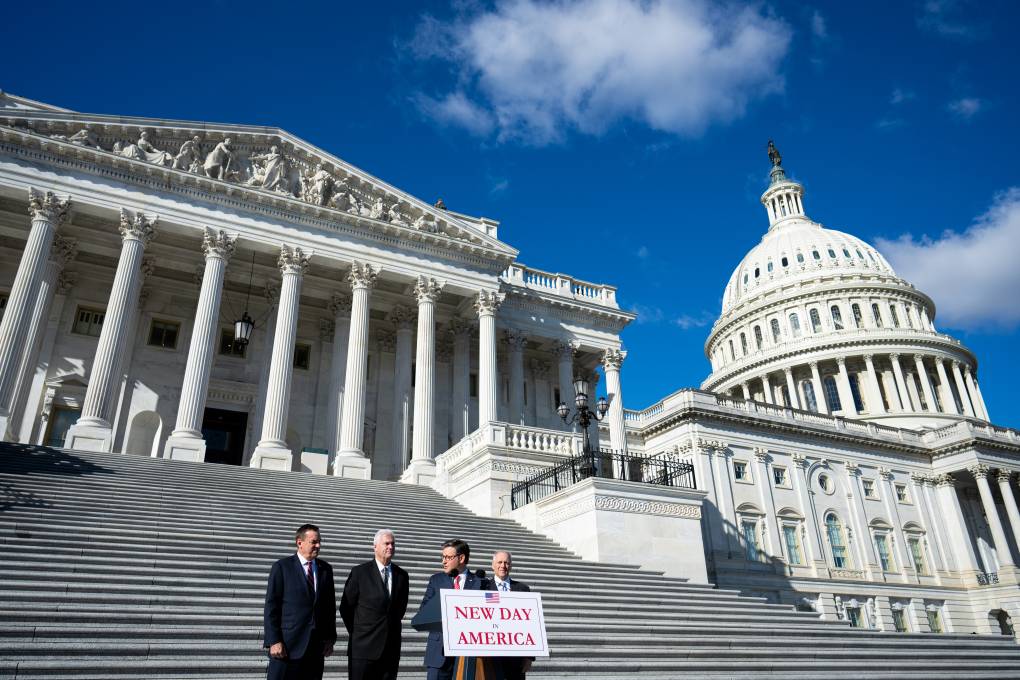
"caption": "From left, NRCC chairman Rep. Richard Hudson, R-N.C., House Majority Whip Tom Emmer, R-Minn., Speaker Mike Johnson, R-La., and House Majority Leader Steve Scalise, R-La., hold a post-election news conference outside the Capitol on Nov. 12, 2024. ",
"credit": "Bill Clark/CQ-Roll Call, Inc via Getty Images",
"altTag": null,
"description": null,
"imgSizes": {
"medium": {
"file": "https://cdn.kqed.org/wp-content/uploads/sites/10/2024/11/GettyImages-2183736580-800x533.jpg",
"width": 800,
"height": 533,
"mimeType": "image/jpeg"
},
"large": {
"file": "https://cdn.kqed.org/wp-content/uploads/sites/10/2024/11/GettyImages-2183736580-1020x680.jpg",
"width": 1020,
"height": 680,
"mimeType": "image/jpeg"
},
"thumbnail": {
"file": "https://cdn.kqed.org/wp-content/uploads/sites/10/2024/11/GettyImages-2183736580-160x107.jpg",
"width": 160,
"height": 107,
"mimeType": "image/jpeg"
},
"1536x1536": {
"file": "https://cdn.kqed.org/wp-content/uploads/sites/10/2024/11/GettyImages-2183736580-1536x1024.jpg",
"width": 1536,
"height": 1024,
"mimeType": "image/jpeg"
},
"2048x2048": {
"file": "https://cdn.kqed.org/wp-content/uploads/sites/10/2024/11/GettyImages-2183736580-2048x1365.jpg",
"width": 2048,
"height": 1365,
"mimeType": "image/jpeg"
},
"post-thumbnail": {
"file": "https://cdn.kqed.org/wp-content/uploads/sites/10/2024/11/GettyImages-2183736580-672x372.jpg",
"width": 672,
"height": 372,
"mimeType": "image/jpeg"
},
"twentyfourteen-full-width": {
"file": "https://cdn.kqed.org/wp-content/uploads/sites/10/2024/11/GettyImages-2183736580-1038x576.jpg",
"width": 1038,
"height": 576,
"mimeType": "image/jpeg"
},
"full-width": {
"file": "https://cdn.kqed.org/wp-content/uploads/sites/10/2024/11/GettyImages-2183736580-1920x1280.jpg",
"width": 1920,
"height": 1280,
"mimeType": "image/jpeg"
},
"kqedFullSize": {
"file": "https://cdn.kqed.org/wp-content/uploads/sites/10/2024/11/GettyImages-2183736580-scaled.jpg",
"width": 2560,
"height": 1707
}
},
"isLoading": false,
"fetchFailed": false
}
},
"audioPlayerReducer": {
"postId": "stream_live",
"isPaused": true,
"isPlaying": false,
"pfsActive": false,
"pledgeModalIsOpen": true,
"playerDrawerIsOpen": false,
"liveAudioPlayStartedAt": 0,
"liveAudioPlayContext": ""
},
"authorsReducer": {
"gmarzorati": {
"type": "authors",
"id": "227",
"meta": {
"index": "authors_1716337520",
"id": "227",
"found": true
},
"name": "Guy Marzorati",
"firstName": "Guy",
"lastName": "Marzorati",
"slug": "gmarzorati",
"email": "gmarzorati@KQED.org",
"display_author_email": true,
"staff_mastheads": [
"news"
],
"title": "Correspondent",
"bio": "Guy Marzorati is a correspondent on KQED's California Politics and Government Desk, based in San Jose. A graduate of Santa Clara University, Guy joined KQED in 2013. He reports on state and local politics and produces KQED's digital voter guide.",
"avatar": "https://secure.gravatar.com/avatar/e7038b8dbfd55b104369b76b1cd0b9de?s=600&d=blank&r=g",
"twitter": "guymarzorati",
"facebook": null,
"instagram": null,
"linkedin": null,
"sites": [
{
"site": "",
"roles": [
"editor"
]
},
{
"site": "news",
"roles": [
"editor"
]
},
{
"site": "science",
"roles": [
"editor"
]
},
{
"site": "forum",
"roles": [
"editor"
]
},
{
"site": "elections",
"roles": [
"editor"
]
},
{
"site": "liveblog",
"roles": [
"editor"
]
}
],
"headData": {
"title": "Guy Marzorati | KQED",
"description": "Correspondent",
"ogImgSrc": "https://secure.gravatar.com/avatar/e7038b8dbfd55b104369b76b1cd0b9de?s=600&d=blank&r=g",
"twImgSrc": "https://secure.gravatar.com/avatar/e7038b8dbfd55b104369b76b1cd0b9de?s=600&d=blank&r=g"
},
"isLoading": false,
"link": "/author/gmarzorati"
},
"scottshafer": {
"type": "authors",
"id": "255",
"meta": {
"index": "authors_1716337520",
"id": "255",
"found": true
},
"name": "Scott Shafer",
"firstName": "Scott",
"lastName": "Shafer",
"slug": "scottshafer",
"email": "sshafer@kqed.org",
"display_author_email": false,
"staff_mastheads": [
"news"
],
"title": "KQED Contributor",
"bio": "Scott Shafer is a senior editor with the KQED Politics and Government desk. He is co-host of Political Breakdown, the award-winning radio show and podcast with a personal take on the world of politics. Scott came to KQED in 1998 to host the statewide\u003cem> California Report\u003c/em>. Prior to that he had extended stints in politics and government\u003cem>.\u003c/em> He uses that inside experience at KQED in his, reporting, hosting and analysis for the politics desk. Scott collaborated \u003cem>Political Breakdown a\u003c/em>nd on \u003cem>The Political Mind of Jerry Brown, \u003c/em>an eight-part series about the life and extraordinary political career of the former governor. For fun, he plays water polo with the San Francisco Tsunami.",
"avatar": "https://secure.gravatar.com/avatar/a62ebae45b79d7aed1a39a0e3bf68104?s=600&d=blank&r=g",
"twitter": "scottshafer",
"bluesky": null,
"facebook": null,
"instagram": null,
"linkedin": null,
"sites": [
{
"site": "news",
"roles": [
"editor"
]
},
{
"site": "stateofhealth",
"roles": [
"author"
]
},
{
"site": "science",
"roles": [
"author"
]
},
{
"site": "forum",
"roles": [
"subscriber"
]
},
{
"site": "liveblog",
"roles": [
"author"
]
}
],
"headData": {
"title": "Scott Shafer | KQED",
"description": "KQED Contributor",
"ogImgSrc": "https://secure.gravatar.com/avatar/a62ebae45b79d7aed1a39a0e3bf68104?s=600&d=blank&r=g",
"twImgSrc": "https://secure.gravatar.com/avatar/a62ebae45b79d7aed1a39a0e3bf68104?s=600&d=blank&r=g"
},
"isLoading": false,
"link": "/author/scottshafer"
},
"mlagos": {
"type": "authors",
"id": "3239",
"meta": {
"index": "authors_1716337520",
"id": "3239",
"found": true
},
"name": "Marisa Lagos",
"firstName": "Marisa",
"lastName": "Lagos",
"slug": "mlagos",
"email": "mlagos@kqed.org",
"display_author_email": false,
"staff_mastheads": [
"news"
],
"title": "KQED Contributor",
"bio": "Marisa Lagos is a correspondent for KQED’s California Politics and Government Desk and co-hosts the award-winning show and podcast, Political Breakdown. At KQED, Lagos also conducts reporting, analysis and investigations into state, local and national politics for radio, TV, online and onstage. In 2022, she and co-host, Scott Shafer, moderated the only gubernatorial debate in California. In 2020, the \u003ci>Washington Post\u003c/i> named her one of the top political journalists in California; she was nominated for a Peabody and won several other awards for her work investigating the 2017 California wildfires. She has worked at the \u003ci>San Francisco Chronicle\u003c/i>, \u003ci>San Francisco Examiner\u003c/i> and \u003ci>Los Angeles Times\u003c/i>. A UC Santa Barbara graduate, she lives in San Francisco with her two sons and husband.",
"avatar": "https://secure.gravatar.com/avatar/a261a0d3696fc066871ef96b85b5e7d2?s=600&d=blank&r=g",
"twitter": "@mlagos",
"facebook": null,
"instagram": null,
"linkedin": null,
"sites": [
{
"site": "arts",
"roles": [
"author"
]
},
{
"site": "news",
"roles": [
"editor"
]
},
{
"site": "science",
"roles": [
"editor"
]
},
{
"site": "forum",
"roles": [
"author"
]
},
{
"site": "liveblog",
"roles": [
"author"
]
}
],
"headData": {
"title": "Marisa Lagos | KQED",
"description": "KQED Contributor",
"ogImgSrc": "https://secure.gravatar.com/avatar/a261a0d3696fc066871ef96b85b5e7d2?s=600&d=blank&r=g",
"twImgSrc": "https://secure.gravatar.com/avatar/a261a0d3696fc066871ef96b85b5e7d2?s=600&d=blank&r=g"
},
"isLoading": false,
"link": "/author/mlagos"
},
"carlysevern": {
"type": "authors",
"id": "3243",
"meta": {
"index": "authors_1716337520",
"id": "3243",
"found": true
},
"name": "Carly Severn",
"firstName": "Carly",
"lastName": "Severn",
"slug": "carlysevern",
"email": "csevern@kqed.org",
"display_author_email": false,
"staff_mastheads": [
"news"
],
"title": "Senior Editor, Audience News ",
"bio": "Carly is KQED's Senior Editor of Audience News on the Digital News team, and has reported for the California Report Magazine, Bay Curious and KQED Arts. She's formerly the host of \u003ca href=\"http://ww2.kqed.org/pop/category/the-cooler/\" rel=\"noopener noreferrer\">The Cooler\u003c/a> podcast.",
"avatar": "https://secure.gravatar.com/avatar/54037bf5c128fe678f0ef26cec97a93f2e7f220a22d7285703328f12c42c1b1d?s=600&d=blank&r=g",
"twitter": "teacupinthebay",
"bluesky": null,
"facebook": null,
"instagram": null,
"linkedin": null,
"sites": [
{
"site": "",
"roles": [
"editor"
]
},
{
"site": "arts",
"roles": [
"editor"
]
},
{
"site": "news",
"roles": [
"administrator"
]
},
{
"site": "pop",
"roles": [
"editor"
]
},
{
"site": "futureofyou",
"roles": [
"editor"
]
},
{
"site": "about",
"roles": [
"administrator"
]
},
{
"site": "mindshift",
"roles": [
"editor"
]
},
{
"site": "bayareabites",
"roles": [
"editor"
]
},
{
"site": "stateofhealth",
"roles": [
"editor"
]
},
{
"site": "science",
"roles": [
"editor"
]
},
{
"site": "food",
"roles": [
"contributor"
]
},
{
"site": "forum",
"roles": [
"editor"
]
},
{
"site": "perspectives",
"roles": [
"administrator"
]
},
{
"site": "liveblog",
"roles": [
"editor"
]
}
],
"headData": {
"title": "Carly Severn | KQED",
"description": "Senior Editor, Audience News ",
"ogImgSrc": "https://secure.gravatar.com/avatar/54037bf5c128fe678f0ef26cec97a93f2e7f220a22d7285703328f12c42c1b1d?s=600&d=blank&r=g",
"twImgSrc": "https://secure.gravatar.com/avatar/54037bf5c128fe678f0ef26cec97a93f2e7f220a22d7285703328f12c42c1b1d?s=600&d=blank&r=g"
},
"isLoading": false,
"link": "/author/carlysevern"
},
"dcronin": {
"type": "authors",
"id": "11362",
"meta": {
"index": "authors_1716337520",
"id": "11362",
"found": true
},
"name": "Dana Cronin",
"firstName": "Dana",
"lastName": "Cronin",
"slug": "dcronin",
"email": "dcronin@KQED.org",
"display_author_email": true,
"staff_mastheads": [],
"title": "KQED Contributor",
"bio": "Dana Cronin is a reporter for KQED News. She loves writing stories about climate change, environmental issues, food and agriculture. She's reported across the country, from Colorado to Washington D.C. to Illinois, and has won numerous awards for her coverage. Her work is regularly featured on national broadcasts, including NPR’s Morning Edition, All Things Considered, PBS Newshour and Science Friday. She lives in Oakland and has an avocado tree in her back yard.",
"avatar": "https://secure.gravatar.com/avatar/bcf89e3455ff7235f96ab6fa7258dd95?s=600&d=blank&r=g",
"twitter": "DanaHCronin",
"facebook": null,
"instagram": null,
"linkedin": null,
"sites": [
{
"site": "arts",
"roles": [
"author"
]
},
{
"site": "news",
"roles": [
"editor"
]
},
{
"site": "science",
"roles": [
"author"
]
},
{
"site": "liveblog",
"roles": [
"author"
]
}
],
"headData": {
"title": "Dana Cronin | KQED",
"description": "KQED Contributor",
"ogImgSrc": "https://secure.gravatar.com/avatar/bcf89e3455ff7235f96ab6fa7258dd95?s=600&d=blank&r=g",
"twImgSrc": "https://secure.gravatar.com/avatar/bcf89e3455ff7235f96ab6fa7258dd95?s=600&d=blank&r=g"
},
"isLoading": false,
"link": "/author/dcronin"
},
"abandlamudi": {
"type": "authors",
"id": "11672",
"meta": {
"index": "authors_1716337520",
"id": "11672",
"found": true
},
"name": "Adhiti Bandlamudi",
"firstName": "Adhiti",
"lastName": "Bandlamudi",
"slug": "abandlamudi",
"email": "abandlamudi@kqed.org",
"display_author_email": false,
"staff_mastheads": [
"news"
],
"title": "KQED Housing Reporter",
"bio": "Adhiti Bandlamudi reports for KQED's Housing desk. She focuses on how housing gets built across the Bay Area. Before joining KQED in 2020, she reported for WUNC in Durham, North Carolina, WABE in Atlanta, Georgia and Capital Public Radio in Sacramento. In 2017, she was awarded a Kroc Fellowship at NPR where she reported on everything from sprinkles to the Golden State Killer's arrest. When she's not reporting, she's baking new recipes in her kitchen or watching movies with friends and family. She's originally from Georgia and has strong opinions about Great British Bake Off.",
"avatar": "https://secure.gravatar.com/avatar/868129c8b257bb99a3500e2c86a65400?s=600&d=mm&r=g",
"twitter": "oddity_adhiti",
"facebook": null,
"instagram": null,
"linkedin": null,
"sites": [
{
"site": "arts",
"roles": [
"author"
]
},
{
"site": "news",
"roles": [
"editor"
]
},
{
"site": "liveblog",
"roles": [
"author"
]
}
],
"headData": {
"title": "Adhiti Bandlamudi | KQED",
"description": "KQED Housing Reporter",
"ogImgSrc": "https://secure.gravatar.com/avatar/868129c8b257bb99a3500e2c86a65400?s=600&d=mm&r=g",
"twImgSrc": "https://secure.gravatar.com/avatar/868129c8b257bb99a3500e2c86a65400?s=600&d=mm&r=g"
},
"isLoading": false,
"link": "/author/abandlamudi"
},
"ccabreralomeli": {
"type": "authors",
"id": "11708",
"meta": {
"index": "authors_1716337520",
"id": "11708",
"found": true
},
"name": "Carlos Cabrera-Lomelí",
"firstName": "Carlos",
"lastName": "Cabrera-Lomelí",
"slug": "ccabreralomeli",
"email": "ccabreralomeli@KQED.org",
"display_author_email": true,
"staff_mastheads": [
"news"
],
"title": "Community Reporter",
"bio": "Carlos Cabrera-Lomelí is a community reporter with KQED's digital engagement team. He also reports and co-produces for KQED's bilingual news hub KQED en Español. He grew up in San Francisco's Mission District and has previously worked with Univision, 48 Hills and REFORMA in Mexico City.",
"avatar": "https://secure.gravatar.com/avatar/c309be9665e484f887b818c89e273ecc673004f426f36b24d00a4d813a2e0518?s=600&d=blank&r=g",
"twitter": "@LomeliCabrera",
"bluesky": null,
"facebook": null,
"instagram": null,
"linkedin": null,
"sites": [
{
"site": "arts",
"roles": [
"editor"
]
},
{
"site": "news",
"roles": [
"editor"
]
},
{
"site": "about",
"roles": [
"editor"
]
},
{
"site": "science",
"roles": [
"editor"
]
},
{
"site": "perspectives",
"roles": [
"editor"
]
},
{
"site": "elections",
"roles": [
"editor"
]
},
{
"site": "liveblog",
"roles": [
"contributor"
]
}
],
"headData": {
"title": "Carlos Cabrera-Lomelí | KQED",
"description": "Community Reporter",
"ogImgSrc": "https://secure.gravatar.com/avatar/c309be9665e484f887b818c89e273ecc673004f426f36b24d00a4d813a2e0518?s=600&d=blank&r=g",
"twImgSrc": "https://secure.gravatar.com/avatar/c309be9665e484f887b818c89e273ecc673004f426f36b24d00a4d813a2e0518?s=600&d=blank&r=g"
},
"isLoading": false,
"link": "/author/ccabreralomeli"
},
"daisynguyen": {
"type": "authors",
"id": "11829",
"meta": {
"index": "authors_1716337520",
"id": "11829",
"found": true
},
"name": "Daisy Nguyen",
"firstName": "Daisy",
"lastName": "Nguyen",
"slug": "daisynguyen",
"email": "daisynguyen@kqed.org",
"display_author_email": true,
"staff_mastheads": [
"news"
],
"title": "KQED Contributor",
"bio": "I have covered early childhood education and child care for KQED since 2022. I focus on policies aimed at increasing access to early care and education and how they shape individual lives. I've been a journalist for more than two decades, with most of that time devoted to covering breaking news throughout California for The Associated Press. I grew up in San Francisco and studied at UC Davis and Columbia University's Graduate School of Journalism. I live in Oakland with my husband and two kids.",
"avatar": "https://secure.gravatar.com/avatar/2da2127c27f7143b53ebd419800fd55f?s=600&d=blank&r=g",
"twitter": null,
"facebook": null,
"instagram": null,
"linkedin": "https://www.linkedin.com/in/daisynguyen/",
"sites": [
{
"site": "news",
"roles": [
"author"
]
},
{
"site": "liveblog",
"roles": [
"author"
]
}
],
"headData": {
"title": "Daisy Nguyen | KQED",
"description": "KQED Contributor",
"ogImgSrc": "https://secure.gravatar.com/avatar/2da2127c27f7143b53ebd419800fd55f?s=600&d=blank&r=g",
"twImgSrc": "https://secure.gravatar.com/avatar/2da2127c27f7143b53ebd419800fd55f?s=600&d=blank&r=g"
},
"isLoading": false,
"link": "/author/daisynguyen"
}
},
"pagesReducer": {
"news_tag_election-2024": {
"type": "terms",
"id": "news_32839",
"meta": {
"index": "terms_1716263798",
"site": "news",
"id": "32839",
"score": 8.937076
},
"featImg": null,
"name": "Election 2024",
"description": null,
"taxonomy": "tag",
"headData": {
"twImgId": null,
"twTitle": null,
"ogTitle": null,
"ogImgId": null,
"twDescription": null,
"description": null,
"title": "Election 2024 Archives | KQED News",
"ogDescription": null
},
"ttid": 32856,
"slug": "election-2024",
"isLoading": false,
"title": "Election 2024",
"pageMeta": {
"site": "news",
"WpPageTemplate": "page-topic-editorial",
"currentPage": 3
},
"blocks": [
{
"blockName": "kqed/post-list",
"attrs": {
"layout": "cardArticle2",
"query": "posts/news?tag=election-2024",
"seeMore": false,
"paginated": true,
"page": 3
}
},
{
"blockName": "kqed/ad"
}
]
}
},
"pfsSessionReducer": {},
"postsReducer": {
"stream_live": {
"type": "live",
"id": "stream_live",
"audioUrl": "https://streams.kqed.org/kqedradio",
"title": "Live Stream",
"excerpt": "Live Stream information currently unavailable.",
"link": "/radio",
"featImg": "",
"label": {
"name": "KQED Live",
"link": "/"
}
},
"stream_kqedNewscast": {
"type": "posts",
"id": "stream_kqedNewscast",
"audioUrl": "https://www.kqed.org/.stream/anon/radio/RDnews/newscast.mp3?_=1",
"title": "KQED Newscast",
"featImg": "",
"label": {
"name": "88.5 FM",
"link": "/"
}
},
"news_12014710": {
"type": "posts",
"id": "news_12014710",
"meta": {
"index": "posts_1716263798",
"site": "news",
"id": "12014710",
"score": null,
"sort": [
1731931237000
]
},
"guestAuthors": [],
"slug": "california-housing-projects-face-financing-drought-after-prop-5s-defeat",
"title": "California Housing Projects Face ‘Financing Drought’ After Proposition 5’s Defeat",
"publishDate": 1731931237,
"format": "standard",
"headTitle": "California Housing Projects Face ‘Financing Drought’ After Proposition 5’s Defeat | KQED",
"labelTerm": {
"site": "news"
},
"content": "\u003cp>The future’s looking grim for affordable housing projects across California.\u003c/p>\n\u003cp>Housing developers and advocates hung their hopes on Proposition 5, a measure rejected by voters that would have made it easier to raise local funding for affordable housing and public infrastructure projects. Meanwhile, as President-elect Donald Trump prepares to take office, no one expects the federal government to dole out more money for subsidized housing.\u003c/p>\n\u003cp>“We can’t sugarcoat the fact that this is a significant setback,” said Susannah Parsons, director of policy and legislation at All Home, a Bay Area housing justice advocacy group. “We are running low on public funds for housing. We are facing significant headwinds.”\u003c/p>\n\u003cp>[ad fullwidth]\u003c/p>\n\u003cp>Housing took center stage in state and national elections this November as more Americans feel the pinch of rising rents and a shortage of affordable housing. However, the results of the election have California affordable housing developers concerned that a shortage of public funds will put a stop to some of their projects.\u003c/p>\n\u003cp>According to a \u003ca href=\"https://mtc.ca.gov/sites/default/files/meetings/attachments/6021/09a_3_Attachment_B_Bay_Area_Affordable_Housing_Pipeline_Brief_v2.pdf\">May report from the Metropolitan Transportation Commission\u003c/a>, almost 41,000 affordable homes and apartments in the Bay Area are in the pre-development phase, meaning developers still need a certain amount of funding — collectively, about $9.7 billion — to start construction. Without that money, the projects sit idle as other funding sources, sometimes contingent on each other, disappear.\u003c/p>\n\u003cp>Proposition 5 \u003ca href=\"https://www.kqed.org/news/12006445/transcript-proposition-5-would-lower-the-voting-threshold-for-certain-local-bond-measures\">could have unleashed more funding\u003c/a> by lowering the threshold for approving local bond measures for housing and infrastructure from a supermajority of 66.67% to 55%.\u003c/p>\n\u003cp>Sarah Karlinsky, research director for the UC Berkeley Terner Center for Housing Innovation, likens the complicated funding structures for affordable housing to a layer cake.\u003c/p>\n\u003cp>“There are many different sources of funding for affordable housing at the state level and different departments and parts of the government that control different pieces, and then affordable housing developers kind of have to knit all of them together,” she said.\u003c/p>\n\u003cp>Karlinsky said there will be increased competition for what funding is still available, while projects that can’t get enough will be pushed further into the future.[aside label=\"Related Stories\" postID=\"news_12013983,news_12012489,news_12007340\"]“We know it’s going to be extremely challenging because it’s been hard enough as it is,” said Noni Ramos, CEO of Housing Trust Silicon Valley, an affordable housing development financing organization. “Now we’re in a position where it’s going to be even harder to do this work.”\u003c/p>\n\u003cp>The defeat of Proposition 5 was a particularly big blow because it was one of the only large-scale funding efforts put to voters after a Bay Area-wide $20 billion housing bond and a statewide, billion-dollar housing bond both failed to get to the ballot.\u003c/p>\n\u003cp>Still, there were some successes at the local level. San Francisco voters overwhelmingly approved Measure B, a $390 million bond that includes funding for homeless shelters. Los Angeles voters approved Measure A, a sales tax initiative that would raise an estimated $1.1 billion per year for housing and homelessness efforts.\u003c/p>\n\u003cp>As proponents and opponents seek to understand why Proposition 5 failed, they agree that the measure’s complicated nature was its biggest setback.\u003c/p>\n\u003cp>When voters don’t understand a measure and how it would impact them, they are more likely to vote against it, according to Mark Baldassare, statewide survey director for the Public Policy Institute of California.\u003c/p>\n\u003cp>“The people who put it on the ballot really did not promote what it was in a way that connected the dots for people,” he said.\u003c/p>\n\u003cp>Proponents fear that the opposition campaign may have swayed voters at a time when people are concerned about high costs. While Proposition 5 would not have increased taxes, it would have made it easier for bond measures to pass locally, potentially meaning higher property taxes. Opponents said the proposition was “\u003ca href=\"https://reformcalifornia.org/news/no-on-prop-5-save-prop-13-and-block-tax-hikes\">deceptive” and that it would “trick voters into approving the tax-hike measure\u003c/a>.”\u003c/p>\n\u003cp>“I think voters vote for measures that benefit the social good when they feel more flush,” Karlinsky said. “They may not feel like they have anything left over for others.”\u003c/p>\n\u003cp>Susan Kirsch, a Proposition 5 opponent and the director of the Catalyst Institute for Local Control, an organization focused on local control in housing development, was relieved that voters rejected the measure. She feared its passage might have meant higher taxes for people like her, a home-owning senior living on a fixed income.\u003c/p>\n\u003cp>“We know that there’s already more people moving out of the state because of California’s high taxes,” she said. “I would feel much more vulnerable in terms of how those taxes would keep coming in.”\u003c/p>\n\u003cp>As for future elections, affordable housing developers and advocates are regrouping and debating whether to reintroduce a regional or statewide bond measure or a version of Proposition 5.\u003c/p>\n\u003cp>Heather Hood, the vice president of affordable housing advocacy group Enterprise Community Partners, said the onus is on local agencies and organizations like hers to plan for future funding.\u003c/p>\n\u003cp>“In the face of the federal administration, we’re going to need to be more efficient with our dollars and mightier with our will,” she said. “It seems to me that we’ve collectively managed to be divided and nit-pick at each other, and we don’t have time for that anymore.”\u003c/p>\n\u003cp>\u003c/p>\n",
"blocks": [],
"excerpt": "After Californian voters rejected Proposition 5, housing developers and advocates wonder, with public funding running low, what is left to fund their projects?",
"status": "publish",
"parent": 0,
"modified": 1742323846,
"stats": {
"hasAudio": false,
"hasVideo": false,
"hasChartOrMap": false,
"iframeSrcs": [],
"hasGoogleForm": false,
"hasGallery": false,
"hasHearkenModule": false,
"hasPolis": false,
"paragraphCount": 23,
"wordCount": 929
},
"headData": {
"title": "California Housing Projects Face ‘Financing Drought’ After Proposition 5’s Defeat | KQED",
"description": "After Californian voters rejected Proposition 5, housing developers and advocates wonder, with public funding running low, what is left to fund their projects?",
"ogTitle": "",
"ogDescription": "",
"ogImgId": "",
"twTitle": "",
"twDescription": "",
"twImgId": "",
"schema": {
"@context": "https://schema.org",
"@type": "NewsArticle",
"headline": "California Housing Projects Face ‘Financing Drought’ After Proposition 5’s Defeat",
"datePublished": "2024-11-18T04:00:37-08:00",
"dateModified": "2025-03-18T11:50:46-07:00",
"image": "https://cdn.kqed.org/wp-content/uploads/2020/02/KQED-OG-Image@1x.png",
"isAccessibleForFree": "True",
"publisher": {
"@type": "NewsMediaOrganization",
"@id": "https://www.kqed.org/#organization",
"name": "KQED",
"logo": "https://cdn.kqed.org/wp-content/uploads/2020/02/KQED-OG-Image@1x.png",
"url": "https://www.kqed.org",
"sameAs": [
"https://www.facebook.com/KQED",
"https://twitter.com/KQED",
"https://www.instagram.com/kqed/",
"https://www.tiktok.com/@kqedofficial",
"https://www.linkedin.com/company/kqed",
"https://www.youtube.com/channel/UCeC0IOo7i1P_61zVUWbJ4nw"
]
}
}
},
"audioUrl": "https://traffic.omny.fm/d/clips/0af137ef-751e-4b19-a055-aaef00d2d578/ffca7e9f-6831-41c5-bcaf-aaef00f5a073/5df94ffa-7c93-446f-a205-b24101188b1c/audio.mp3",
"sticky": false,
"nprStoryId": "kqed-12014710",
"templateType": "standard",
"featuredImageType": "standard",
"excludeFromSiteSearch": "Include",
"articleAge": "0",
"path": "/news/12014710/california-housing-projects-face-financing-drought-after-prop-5s-defeat",
"audioTrackLength": null,
"parsedContent": [
{
"type": "contentString",
"content": "\u003cdiv class=\"post-body\">\u003cp>\u003cp>The future’s looking grim for affordable housing projects across California.\u003c/p>\n\u003cp>Housing developers and advocates hung their hopes on Proposition 5, a measure rejected by voters that would have made it easier to raise local funding for affordable housing and public infrastructure projects. Meanwhile, as President-elect Donald Trump prepares to take office, no one expects the federal government to dole out more money for subsidized housing.\u003c/p>\n\u003cp>“We can’t sugarcoat the fact that this is a significant setback,” said Susannah Parsons, director of policy and legislation at All Home, a Bay Area housing justice advocacy group. “We are running low on public funds for housing. We are facing significant headwinds.”\u003c/p>\n\u003cp>\u003c/p>\u003c/div>",
"attributes": {
"named": {},
"numeric": []
}
},
{
"type": "component",
"content": "",
"name": "ad",
"attributes": {
"named": {
"label": "fullwidth"
},
"numeric": [
"fullwidth"
]
}
},
{
"type": "contentString",
"content": "\u003cdiv class=\"post-body\">\u003cp>\u003c/p>\n\u003cp>Housing took center stage in state and national elections this November as more Americans feel the pinch of rising rents and a shortage of affordable housing. However, the results of the election have California affordable housing developers concerned that a shortage of public funds will put a stop to some of their projects.\u003c/p>\n\u003cp>According to a \u003ca href=\"https://mtc.ca.gov/sites/default/files/meetings/attachments/6021/09a_3_Attachment_B_Bay_Area_Affordable_Housing_Pipeline_Brief_v2.pdf\">May report from the Metropolitan Transportation Commission\u003c/a>, almost 41,000 affordable homes and apartments in the Bay Area are in the pre-development phase, meaning developers still need a certain amount of funding — collectively, about $9.7 billion — to start construction. Without that money, the projects sit idle as other funding sources, sometimes contingent on each other, disappear.\u003c/p>\n\u003cp>Proposition 5 \u003ca href=\"https://www.kqed.org/news/12006445/transcript-proposition-5-would-lower-the-voting-threshold-for-certain-local-bond-measures\">could have unleashed more funding\u003c/a> by lowering the threshold for approving local bond measures for housing and infrastructure from a supermajority of 66.67% to 55%.\u003c/p>\n\u003cp>Sarah Karlinsky, research director for the UC Berkeley Terner Center for Housing Innovation, likens the complicated funding structures for affordable housing to a layer cake.\u003c/p>\n\u003cp>“There are many different sources of funding for affordable housing at the state level and different departments and parts of the government that control different pieces, and then affordable housing developers kind of have to knit all of them together,” she said.\u003c/p>\n\u003cp>Karlinsky said there will be increased competition for what funding is still available, while projects that can’t get enough will be pushed further into the future.\u003c/p>\u003c/div>",
"attributes": {
"named": {},
"numeric": []
}
},
{
"type": "component",
"content": "",
"name": "aside",
"attributes": {
"named": {
"label": "Related Stories ",
"postid": "news_12013983,news_12012489,news_12007340"
},
"numeric": []
}
},
{
"type": "contentString",
"content": "\u003cdiv class=\"post-body\">\u003cp>“We know it’s going to be extremely challenging because it’s been hard enough as it is,” said Noni Ramos, CEO of Housing Trust Silicon Valley, an affordable housing development financing organization. “Now we’re in a position where it’s going to be even harder to do this work.”\u003c/p>\n\u003cp>The defeat of Proposition 5 was a particularly big blow because it was one of the only large-scale funding efforts put to voters after a Bay Area-wide $20 billion housing bond and a statewide, billion-dollar housing bond both failed to get to the ballot.\u003c/p>\n\u003cp>Still, there were some successes at the local level. San Francisco voters overwhelmingly approved Measure B, a $390 million bond that includes funding for homeless shelters. Los Angeles voters approved Measure A, a sales tax initiative that would raise an estimated $1.1 billion per year for housing and homelessness efforts.\u003c/p>\n\u003cp>As proponents and opponents seek to understand why Proposition 5 failed, they agree that the measure’s complicated nature was its biggest setback.\u003c/p>\n\u003cp>When voters don’t understand a measure and how it would impact them, they are more likely to vote against it, according to Mark Baldassare, statewide survey director for the Public Policy Institute of California.\u003c/p>\n\u003cp>“The people who put it on the ballot really did not promote what it was in a way that connected the dots for people,” he said.\u003c/p>\n\u003cp>Proponents fear that the opposition campaign may have swayed voters at a time when people are concerned about high costs. While Proposition 5 would not have increased taxes, it would have made it easier for bond measures to pass locally, potentially meaning higher property taxes. Opponents said the proposition was “\u003ca href=\"https://reformcalifornia.org/news/no-on-prop-5-save-prop-13-and-block-tax-hikes\">deceptive” and that it would “trick voters into approving the tax-hike measure\u003c/a>.”\u003c/p>\n\u003cp>“I think voters vote for measures that benefit the social good when they feel more flush,” Karlinsky said. “They may not feel like they have anything left over for others.”\u003c/p>\n\u003cp>Susan Kirsch, a Proposition 5 opponent and the director of the Catalyst Institute for Local Control, an organization focused on local control in housing development, was relieved that voters rejected the measure. She feared its passage might have meant higher taxes for people like her, a home-owning senior living on a fixed income.\u003c/p>\n\u003cp>“We know that there’s already more people moving out of the state because of California’s high taxes,” she said. “I would feel much more vulnerable in terms of how those taxes would keep coming in.”\u003c/p>\n\u003cp>As for future elections, affordable housing developers and advocates are regrouping and debating whether to reintroduce a regional or statewide bond measure or a version of Proposition 5.\u003c/p>\n\u003cp>Heather Hood, the vice president of affordable housing advocacy group Enterprise Community Partners, said the onus is on local agencies and organizations like hers to plan for future funding.\u003c/p>\n\u003cp>“In the face of the federal administration, we’re going to need to be more efficient with our dollars and mightier with our will,” she said. “It seems to me that we’ve collectively managed to be divided and nit-pick at each other, and we don’t have time for that anymore.”\u003c/p>\n\u003cp>\u003c/p>\n\u003c/div>\u003c/p>",
"attributes": {
"named": {},
"numeric": []
}
}
],
"link": "/news/12014710/california-housing-projects-face-financing-drought-after-prop-5s-defeat",
"authors": [
"11672"
],
"categories": [
"news_31795",
"news_6266",
"news_8"
],
"tags": [
"news_3921",
"news_28778",
"news_32839",
"news_27626",
"news_1775",
"news_21998"
],
"featImg": "news_12014715",
"label": "news"
},
"news_12014674": {
"type": "posts",
"id": "news_12014674",
"meta": {
"index": "posts_1716263798",
"site": "news",
"id": "12014674",
"score": null,
"sort": [
1731720214000
]
},
"guestAuthors": [],
"slug": "why-democrats-fell-short-in-campaigns-to-unseat-california-gop-incumbents",
"title": "Why Democrats Fell Short in Campaigns to Unseat California GOP Incumbents",
"publishDate": 1731720214,
"format": "audio",
"headTitle": "Why Democrats Fell Short in Campaigns to Unseat California GOP Incumbents | KQED",
"labelTerm": {},
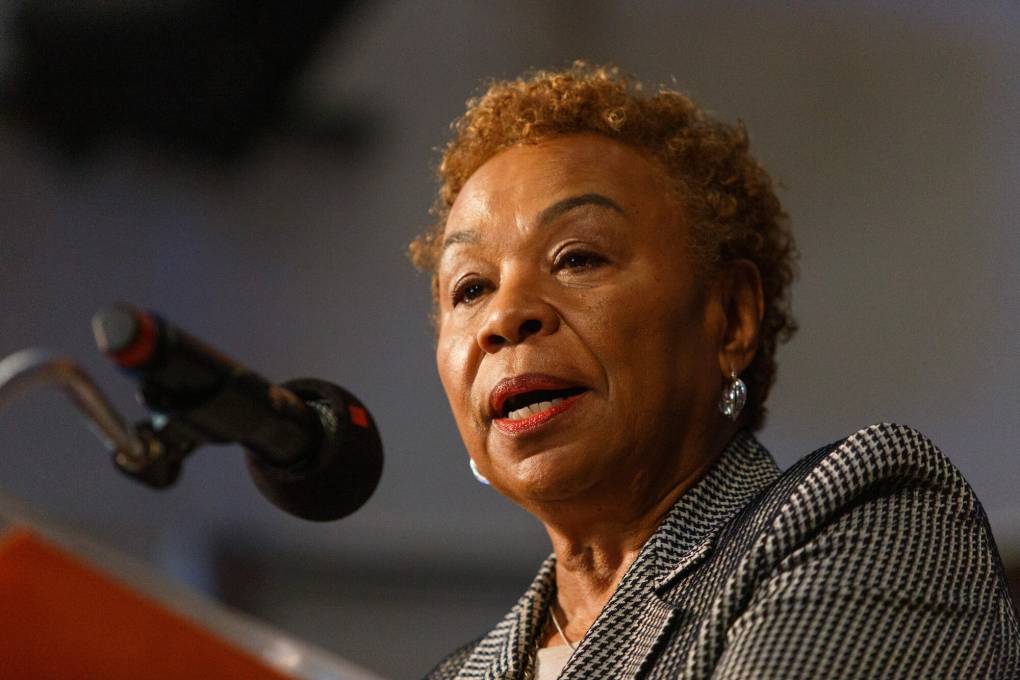
"content": "\u003cp>It’s clear Republicans have enough seats to maintain their majority in the House of Representatives – barely – and once again a few seats in California are still too close to call with thousands of ballots left to be counted.\u003c/p>\n\u003cp>Democrats have picked up at least one seat in California and could possibly grab a few more, but even if the outstanding races all go their way, they’ll still be stuck in the minority for at least two more years.\u003c/p>\n\u003cp>Scott, Marisa and Guy about what happened there and ask the question of how to know when it’s time to retire. The line between honorable public service and just hanging around too long can be a subtle one. This discussion comes amid rumors that 78-year-old Oakland Congress member Barbara Lee is considering a run for mayor.\u003c/p>\n\u003cp>[ad fullwidth]\u003c/p>\u003cp>\u003c/p>\n",
"blocks": [],
"excerpt": null,
"status": "publish",
"parent": 0,
"modified": 1732146955,
"stats": {
"hasAudio": false,
"hasVideo": false,
"hasChartOrMap": false,
"iframeSrcs": [],
"hasGoogleForm": false,
"hasGallery": false,
"hasHearkenModule": false,
"hasPolis": false,
"paragraphCount": 5,
"wordCount": 146
},
"headData": {
"title": "Why Democrats Fell Short in Campaigns to Unseat California GOP Incumbents | KQED",
"description": "It’s clear Republicans have enough seats to maintain their majority in the House of Representatives – barely – and once again a few seats in California are still too close to call with thousands of ballots left to be counted. Democrats have picked up at least one seat in California and could possibly grab a few more, but even if the outstanding races all go their way, they’ll still be stuck in the minority for at least two more years. Scott, Marisa and Guy about what happened there and ask the question of how to know when it’s time to",
"ogTitle": "",
"ogDescription": "",
"ogImgId": "",
"twTitle": "",
"twDescription": "",
"twImgId": "",
"schema": {
"@context": "https://schema.org",
"@type": "NewsArticle",
"headline": "Why Democrats Fell Short in Campaigns to Unseat California GOP Incumbents",
"datePublished": "2024-11-15T17:23:34-08:00",
"dateModified": "2024-11-20T15:55:55-08:00",
"image": "https://cdn.kqed.org/wp-content/uploads/2020/02/KQED-OG-Image@1x.png",
"isAccessibleForFree": "True",
"publisher": {
"@type": "NewsMediaOrganization",
"@id": "https://www.kqed.org/#organization",
"name": "KQED",
"logo": "https://cdn.kqed.org/wp-content/uploads/2020/02/KQED-OG-Image@1x.png",
"url": "https://www.kqed.org",
"sameAs": [
"https://www.facebook.com/KQED",
"https://twitter.com/KQED",
"https://www.instagram.com/kqed/",
"https://www.tiktok.com/@kqedofficial",
"https://www.linkedin.com/company/kqed",
"https://www.youtube.com/channel/UCeC0IOo7i1P_61zVUWbJ4nw"
]
}
}
},
"source": "Political Breakdown",
"audioUrl": "https://www.podtrac.com/pts/redirect.mp3/chrt.fm/track/G6C7C3/traffic.megaphone.fm/KQINC9350551716.mp3?updated=1731719631",
"sticky": false,
"nprStoryId": "kqed-12014674",
"excludeFromSiteSearch": "Include",
"articleAge": "0",
"path": "/news/12014674/why-democrats-fell-short-in-campaigns-to-unseat-california-gop-incumbents",
"audioTrackLength": null,
"parsedContent": [
{
"type": "contentString",
"content": "\u003cdiv class=\"post-body\">\u003cp>\u003cp>It’s clear Republicans have enough seats to maintain their majority in the House of Representatives – barely – and once again a few seats in California are still too close to call with thousands of ballots left to be counted.\u003c/p>\n\u003cp>Democrats have picked up at least one seat in California and could possibly grab a few more, but even if the outstanding races all go their way, they’ll still be stuck in the minority for at least two more years.\u003c/p>\n\u003cp>Scott, Marisa and Guy about what happened there and ask the question of how to know when it’s time to retire. The line between honorable public service and just hanging around too long can be a subtle one. This discussion comes amid rumors that 78-year-old Oakland Congress member Barbara Lee is considering a run for mayor.\u003c/p>\n\u003cp>\u003c/p>\u003c/div>",
"attributes": {
"named": {},
"numeric": []
}
},
{
"type": "component",
"content": "",
"name": "ad",
"attributes": {
"named": {
"label": "fullwidth"
},
"numeric": [
"fullwidth"
]
}
},
{
"type": "contentString",
"content": "\u003cdiv class=\"post-body\">\u003cp>\u003c/p>\u003cp>\u003c/p>\n\u003c/div>\u003c/p>",
"attributes": {
"named": {},
"numeric": []
}
}
],
"link": "/news/12014674/why-democrats-fell-short-in-campaigns-to-unseat-california-gop-incumbents",
"authors": [
"255",
"3239",
"227"
],
"programs": [
"news_33544"
],
"categories": [
"news_21291"
],
"tags": [
"news_32839",
"news_34377",
"news_22235",
"news_17968"
],
"featImg": "news_12014709",
"label": "source_news_12014674"
},
"news_12014476": {
"type": "posts",
"id": "news_12014476",
"meta": {
"index": "posts_1716263798",
"site": "news",
"id": "12014476",
"score": null,
"sort": [
1731684620000
]
},
"guestAuthors": [],
"slug": "3-local-measures-in-california-boosting-funding-for-kids-programs-on-verge-of-victory",
"title": "Local Measures in California to Fund Child Care Programs on Verge of Victory",
"publishDate": 1731684620,
"format": "standard",
"headTitle": "Local Measures in California to Fund Child Care Programs on Verge of Victory | KQED",
"labelTerm": {
"site": "news"
},
"content": "\u003cp>Ballot measures to increase local funding for early childhood and youth programs are headed toward victory in three California jurisdictions:\u003c/p>\n\u003cul>\n\u003cli>In Sonoma County, 61% of voters approved a\u003ca href=\"https://www.yesoniforkids.com/\"> quarter-cent sales tax by \u003c/a>to raise about $30 million annually to shore up the county’s crumbling child care system and provide mental health services for the youngest kids.\u003c/li>\n\u003cli>In Santa Cruz, \u003ca href=\"https://www.cityofsantacruz.com/government/city-departments/city-clerk/2024-elections/november-5-2024/measure-z-sugar-sweetened-beverage-tax\">a soda tax \u003c/a>to raise about $1.3 million annually for services that benefit young people is garnering 51.60% of votes, according to the latest tally announced Wednesday.\u003c/li>\n\u003cli>In eastern Los Angeles County, 62% of voters in Pomona have approved\u003ca href=\"https://www.pomonakidsfirst.com/\"> a measure to set aside 10% of the city’s budget for children’s programs and services\u003c/a> — including child care and housing assistance for families with young children.\u003c/li>\n\u003c/ul>\n\u003cp>The early election results show voters understand that local governments play an important role in providing adequate funding for kids as communities face problems like unaffordable child care, said Margaret Brodkin, founder of Funding The Next Generation, a nonprofit that promotes local ballot initiatives that support children.\u003c/p>\n\u003cp>“We’ve watched the states struggle and had promises broken. We have no idea what’s going to happen with the federal government at this point, which makes it all the more important to have local communities step up,” she said.\u003c/p>\n\u003cp>Brodkin led a 1991 ballot initiative in San Francisco that made it the first city in the nation to dedicate a portion of its annual budget to children. Voters reauthorized the Children and Youth Fund twice and passed a measure in 2004 to expand access to preschool for 4-year-olds and in 2018 to impose a commercial rent tax to fund \u003ca href=\"https://www.kqed.org/news/11948690/business-tax-provides-crucial-funding-for-early-childhood-education-and-care-in-san-francisco\">early care and education\u003c/a> for infants and toddlers.\u003c/p>\n\u003cp>Those successful campaigns became models for pro-kid ballot measures in other cities and counties. In the Bay Area, voters in Oakland agreed in 2018 to \u003ca href=\"https://www.oaklandca.gov/boards-commissions/childrens-initiative-oversight-commission\">pay a new parcel tax\u003c/a> to expand access to preschool and help high school students prepare for college, and two years later, Alameda County \u003ca href=\"https://www.kqed.org/news/11984169/state-court-upholds-alameda-county-tax-measure-yielding-hundreds-of-millions-for-child-care\">voters approved a 0.5% sales tax \u003c/a>to fund child care and health care for the neediest young children.\u003c/p>\n\u003cp>[ad fullwidth]\u003c/p>\n\u003cp>Anti-tax groups sued to block the San Francisco and Alameda County tax measures, arguing they needed a two-thirds supermajority vote to pass, but state courts ruled initiatives placed on the ballot by private citizens only need a simple majority to win.\u003c/p>\n\u003cp>The rulings bolstered children’s advocates in Sonoma County, who spent a decade gathering enough support to establish a local funding stream for children’s services.\u003c/p>\n\u003cp>“We polled many, many times over the years and just could not be confident that we could get two-thirds,” said Angie Dillon-Shore, executive director of First Five Sonoma County.\u003c/p>\n\u003cp>A simple majority requirement made getting the sales tax measure on this November’s ballot more feasible, she said.\u003c/p>\n\u003cp>[aside label=\"more early childhood ed coverage\" tag=\"early-childhood-education-and-care\"]The measure earned support from a broad coalition of local elected officials, business and community organizations, while it had no formal opposition.\u003c/p>\n\u003cp>The results show voters were frustrated with the shortage of child care in Sonoma County, Dillon-Shore said.\u003c/p>\n\u003cp>\u003ca href=\"https://drive.google.com/file/d/1xAETmxI5XcsYTYHegEi0TwfFAkix-2zw/view\">A study found \u003c/a>the county lost 450 licensed child care slots after the destructive North Bay wildfires in 2017. After the COVID-19 pandemic, so many child care workers left their jobs that the county was only left with 52% of the slots it once had. That made it hard for parents, especially mothers, to return to work.\u003c/p>\n\u003cp>“It’s quite clear now that the public knows that child care providers are some of the lowest-paid folks in our economic engine and yet they do some of the most important work,” she said.\u003c/p>\n\u003cp>Brodkin said getting these measures on a ballot can be a hard sell to voters who aren’t used to voting for children’s services. In 2016, efforts to raise a local tax for that purpose failed in Napa, Marin and Solano counties. In 2022, parcel tax measures to fund child care failed in South San Francisco and Monterey County.\u003c/p>\n\u003cp>However, she said the strategy works best at the local level when people who are feeling the impact of the problem get organized to campaign for change.\u003c/p>\n\u003cp>“It’s a wonderful thing for a community to work on because it’s your neighbors, it’s your kids, it’s the childcare center down the street or the family day care home your kids have gone to,” she said. “The results [of new funding] are very palpable for people, and they can immediately appreciate it.”\u003c/p>\n\u003cp>In Pomona, community advocates spent years pushing for a greater city investment in young people before gathering enough signatures to put a measure on the November ballot, seeking a permanent funding stream for youth services and programs.\u003c/p>\n\u003cp>The measure, called the \u003ca href=\"https://www.pomonakidsfirst.com/\">Pomona Kids First Initiative\u003c/a>, would require the city to spend at least 10% of its budget on kids and create a city Department of Youth & Children to administer the funds.\u003c/p>\n\u003cp>An opposition campaign, dubbed “Save Our Pomona Public Library,” countered that the measure would lead the city to reduce library hours, police, fire and other essential city services. On its website, it characterized the Heising-Simons Action Fund, a Los Altos-based social welfare organization that donated $160,000 to support the measure, as “Bay Area billionaires who know nothing about Pomona and care even less about the impact of this measure on our city.”\u003c/p>\n\u003cp>Pomona mayor Tim Sandoval, several city council members and the region’s largest newspaper — the Inland Valley Daily Bulletin — endorsed a no vote.\u003c/p>\n\u003cp>Supporters credit young people and families for building strong public support for the measure.\u003c/p>\n\u003cp>“Looking at what’s happening at the state and national level, I think the lesson here is that we need to create more opportunities to empower voters locally,” said Jesus Sanchez, co-founder of the nonprofit Gente Organizada.\u003c/p>\n\u003cp>\u003c/p>\n\u003cp>“We gave our community a vote in investing in themselves and their kids and their families, and they overwhelmingly decided, yes, that’s the right thing to do,” he said.\u003c/p>\n\n",
"blocks": [],
"excerpt": "Initial tallies suggest voters in Sonoma County and the cities of Santa Cruz and Pomona have approved local measures that direct more funding to services aimed at helping young people and families. \r\n\r\n",
"status": "publish",
"parent": 0,
"modified": 1744159693,
"stats": {
"hasAudio": false,
"hasVideo": false,
"hasChartOrMap": false,
"iframeSrcs": [],
"hasGoogleForm": false,
"hasGallery": false,
"hasHearkenModule": false,
"hasPolis": false,
"paragraphCount": 25,
"wordCount": 1059
},
"headData": {
"title": "Local Measures in California to Fund Child Care Programs on Verge of Victory | KQED",
"description": "Initial tallies suggest voters in Sonoma County and the cities of Santa Cruz and Pomona have approved local measures that direct more funding to services aimed at helping young people and families. \r\n\r\n",
"ogTitle": "",
"ogDescription": "",
"ogImgId": "",
"twTitle": "",
"twDescription": "",
"twImgId": "",
"schema": {
"@context": "https://schema.org",
"@type": "NewsArticle",
"headline": "Local Measures in California to Fund Child Care Programs on Verge of Victory",
"datePublished": "2024-11-15T07:30:20-08:00",
"dateModified": "2025-04-08T17:48:13-07:00",
"image": "https://cdn.kqed.org/wp-content/uploads/2020/02/KQED-OG-Image@1x.png",
"isAccessibleForFree": "True",
"publisher": {
"@type": "NewsMediaOrganization",
"@id": "https://www.kqed.org/#organization",
"name": "KQED",
"logo": "https://cdn.kqed.org/wp-content/uploads/2020/02/KQED-OG-Image@1x.png",
"url": "https://www.kqed.org",
"sameAs": [
"https://www.facebook.com/KQED",
"https://twitter.com/KQED",
"https://www.instagram.com/kqed/",
"https://www.tiktok.com/@kqedofficial",
"https://www.linkedin.com/company/kqed",
"https://www.youtube.com/channel/UCeC0IOo7i1P_61zVUWbJ4nw"
]
}
}
},
"sticky": false,
"nprStoryId": "kqed-12014476",
"templateType": "standard",
"featuredImageType": "standard",
"excludeFromSiteSearch": "Include",
"articleAge": "0",
"path": "/news/12014476/3-local-measures-in-california-boosting-funding-for-kids-programs-on-verge-of-victory",
"audioTrackLength": null,
"parsedContent": [
{
"type": "contentString",
"content": "\u003cdiv class=\"post-body\">\u003cp>\u003cp>Ballot measures to increase local funding for early childhood and youth programs are headed toward victory in three California jurisdictions:\u003c/p>\n\u003cul>\n\u003cli>In Sonoma County, 61% of voters approved a\u003ca href=\"https://www.yesoniforkids.com/\"> quarter-cent sales tax by \u003c/a>to raise about $30 million annually to shore up the county’s crumbling child care system and provide mental health services for the youngest kids.\u003c/li>\n\u003cli>In Santa Cruz, \u003ca href=\"https://www.cityofsantacruz.com/government/city-departments/city-clerk/2024-elections/november-5-2024/measure-z-sugar-sweetened-beverage-tax\">a soda tax \u003c/a>to raise about $1.3 million annually for services that benefit young people is garnering 51.60% of votes, according to the latest tally announced Wednesday.\u003c/li>\n\u003cli>In eastern Los Angeles County, 62% of voters in Pomona have approved\u003ca href=\"https://www.pomonakidsfirst.com/\"> a measure to set aside 10% of the city’s budget for children’s programs and services\u003c/a> — including child care and housing assistance for families with young children.\u003c/li>\n\u003c/ul>\n\u003cp>The early election results show voters understand that local governments play an important role in providing adequate funding for kids as communities face problems like unaffordable child care, said Margaret Brodkin, founder of Funding The Next Generation, a nonprofit that promotes local ballot initiatives that support children.\u003c/p>\n\u003cp>“We’ve watched the states struggle and had promises broken. We have no idea what’s going to happen with the federal government at this point, which makes it all the more important to have local communities step up,” she said.\u003c/p>\n\u003cp>Brodkin led a 1991 ballot initiative in San Francisco that made it the first city in the nation to dedicate a portion of its annual budget to children. Voters reauthorized the Children and Youth Fund twice and passed a measure in 2004 to expand access to preschool for 4-year-olds and in 2018 to impose a commercial rent tax to fund \u003ca href=\"https://www.kqed.org/news/11948690/business-tax-provides-crucial-funding-for-early-childhood-education-and-care-in-san-francisco\">early care and education\u003c/a> for infants and toddlers.\u003c/p>\n\u003cp>Those successful campaigns became models for pro-kid ballot measures in other cities and counties. In the Bay Area, voters in Oakland agreed in 2018 to \u003ca href=\"https://www.oaklandca.gov/boards-commissions/childrens-initiative-oversight-commission\">pay a new parcel tax\u003c/a> to expand access to preschool and help high school students prepare for college, and two years later, Alameda County \u003ca href=\"https://www.kqed.org/news/11984169/state-court-upholds-alameda-county-tax-measure-yielding-hundreds-of-millions-for-child-care\">voters approved a 0.5% sales tax \u003c/a>to fund child care and health care for the neediest young children.\u003c/p>\n\u003cp>\u003c/p>\u003c/div>",
"attributes": {
"named": {},
"numeric": []
}
},
{
"type": "component",
"content": "",
"name": "ad",
"attributes": {
"named": {
"label": "fullwidth"
},
"numeric": [
"fullwidth"
]
}
},
{
"type": "contentString",
"content": "\u003cdiv class=\"post-body\">\u003cp>\u003c/p>\n\u003cp>Anti-tax groups sued to block the San Francisco and Alameda County tax measures, arguing they needed a two-thirds supermajority vote to pass, but state courts ruled initiatives placed on the ballot by private citizens only need a simple majority to win.\u003c/p>\n\u003cp>The rulings bolstered children’s advocates in Sonoma County, who spent a decade gathering enough support to establish a local funding stream for children’s services.\u003c/p>\n\u003cp>“We polled many, many times over the years and just could not be confident that we could get two-thirds,” said Angie Dillon-Shore, executive director of First Five Sonoma County.\u003c/p>\n\u003cp>A simple majority requirement made getting the sales tax measure on this November’s ballot more feasible, she said.\u003c/p>\n\u003cp>\u003c/p>\u003c/div>",
"attributes": {
"named": {},
"numeric": []
}
},
{
"type": "component",
"content": "",
"name": "aside",
"attributes": {
"named": {
"label": "more early childhood ed coverage ",
"tag": "early-childhood-education-and-care"
},
"numeric": []
}
},
{
"type": "contentString",
"content": "\u003cdiv class=\"post-body\">\u003cp>The measure earned support from a broad coalition of local elected officials, business and community organizations, while it had no formal opposition.\u003c/p>\n\u003cp>The results show voters were frustrated with the shortage of child care in Sonoma County, Dillon-Shore said.\u003c/p>\n\u003cp>\u003ca href=\"https://drive.google.com/file/d/1xAETmxI5XcsYTYHegEi0TwfFAkix-2zw/view\">A study found \u003c/a>the county lost 450 licensed child care slots after the destructive North Bay wildfires in 2017. After the COVID-19 pandemic, so many child care workers left their jobs that the county was only left with 52% of the slots it once had. That made it hard for parents, especially mothers, to return to work.\u003c/p>\n\u003cp>“It’s quite clear now that the public knows that child care providers are some of the lowest-paid folks in our economic engine and yet they do some of the most important work,” she said.\u003c/p>\n\u003cp>Brodkin said getting these measures on a ballot can be a hard sell to voters who aren’t used to voting for children’s services. In 2016, efforts to raise a local tax for that purpose failed in Napa, Marin and Solano counties. In 2022, parcel tax measures to fund child care failed in South San Francisco and Monterey County.\u003c/p>\n\u003cp>However, she said the strategy works best at the local level when people who are feeling the impact of the problem get organized to campaign for change.\u003c/p>\n\u003cp>“It’s a wonderful thing for a community to work on because it’s your neighbors, it’s your kids, it’s the childcare center down the street or the family day care home your kids have gone to,” she said. “The results [of new funding] are very palpable for people, and they can immediately appreciate it.”\u003c/p>\n\u003cp>In Pomona, community advocates spent years pushing for a greater city investment in young people before gathering enough signatures to put a measure on the November ballot, seeking a permanent funding stream for youth services and programs.\u003c/p>\n\u003cp>The measure, called the \u003ca href=\"https://www.pomonakidsfirst.com/\">Pomona Kids First Initiative\u003c/a>, would require the city to spend at least 10% of its budget on kids and create a city Department of Youth & Children to administer the funds.\u003c/p>\n\u003cp>An opposition campaign, dubbed “Save Our Pomona Public Library,” countered that the measure would lead the city to reduce library hours, police, fire and other essential city services. On its website, it characterized the Heising-Simons Action Fund, a Los Altos-based social welfare organization that donated $160,000 to support the measure, as “Bay Area billionaires who know nothing about Pomona and care even less about the impact of this measure on our city.”\u003c/p>\n\u003cp>Pomona mayor Tim Sandoval, several city council members and the region’s largest newspaper — the Inland Valley Daily Bulletin — endorsed a no vote.\u003c/p>\n\u003cp>Supporters credit young people and families for building strong public support for the measure.\u003c/p>\n\u003cp>“Looking at what’s happening at the state and national level, I think the lesson here is that we need to create more opportunities to empower voters locally,” said Jesus Sanchez, co-founder of the nonprofit Gente Organizada.\u003c/p>\n\u003cp>\u003c/p>\n\u003cp>“We gave our community a vote in investing in themselves and their kids and their families, and they overwhelmingly decided, yes, that’s the right thing to do,” he said.\u003c/p>\n\n\u003c/div>\u003c/p>",
"attributes": {
"named": {},
"numeric": []
}
}
],
"link": "/news/12014476/3-local-measures-in-california-boosting-funding-for-kids-programs-on-verge-of-victory",
"authors": [
"11829"
],
"categories": [
"news_18540",
"news_8",
"news_13"
],
"tags": [
"news_32102",
"news_20013",
"news_32839",
"news_17968",
"news_34761",
"news_721",
"news_4981"
],
"featImg": "news_12007545",
"label": "news"
},
"news_12014436": {
"type": "posts",
"id": "news_12014436",
"meta": {
"index": "posts_1716263798",
"site": "news",
"id": "12014436",
"score": null,
"sort": [
1731672006000
]
},
"guestAuthors": [],
"slug": "undocumented-what-to-know-before-a-second-trump-term",
"title": "Undocumented? What to Know Before a Second Trump Term",
"publishDate": 1731672006,
"format": "standard",
"headTitle": "Undocumented? What to Know Before a Second Trump Term | KQED",
"labelTerm": {
"site": "news"
},
"content": "\u003cp>\u003ca href=\"https://www.kqed.org/news/12015513/indocumentados-que-hay-que-saber-antes-segundo-mandato-trump\">\u003ci>Leer en español\u003c/i>\u003c/a>\u003c/p>\n\u003cp>On Jan. 20, 2025, Donald Trump will once again \u003ca href=\"https://www.kqed.org/elections/results/president\">step into the White House as President of the United States\u003c/a> — and is expected to bring with him sweeping changes in the country’s immigration system.\u003c/p>\n\u003cp>Trump has already named two individuals who will have key positions in his new administration: Stephen Miller \u003ca href=\"https://www.npr.org/2024/11/11/g-s1-33741/trump-stephen-miller-deputy-chief-of-staff-immigration-policy-deportations\">as his deputy chief of staff\u003c/a> and \u003ca href=\"https://www.kqed.org/news/12014017/what-to-know-about-tom-homan-the-former-ice-head-returning-as-trumps-border-czar\">Thomas Homan as his “border czar.”\u003c/a> Both helped form immigration policies during Trump’s first term, including \u003ca href=\"https://www.npr.org/sections/president-biden-takes-office/2021/01/21/959074750/biden-suspends-deportations-stops-remain-in-mexico-policy\">the “Remain in Mexico” program\u003c/a>, which forced migrants seeking asylum to wait for their court dates in Mexican — rather than American — territory, and \u003ca href=\"https://www.npr.org/2019/07/15/741769333/u-s-sets-new-asylum-rule-telling-potential-refugees-to-apply-elsewhere\">the “safe third country” agreements\u003c/a> requiring migrant seekers to first request asylum in countries like El Salvador or Guatemala.\u003c/p>\n\u003cp>As they return to the White House, both Miller and Homan \u003ca href=\"https://www.nytimes.com/2023/11/11/us/politics/trump-2025-immigration-agenda.html\">want to fulfill many of Trump’s 2024 campaign promises\u003c/a>. These include ending the \u003ca href=\"https://www.uscis.gov/DACA\">Deferred Action for Childhood Arrivals program\u003c/a> or DACA; \u003ca href=\"https://www.nytimes.com/2024/10/28/us/politics/harris-trump-asylum-immigration.html\">strictly limiting the asylum process\u003c/a>; expanding migrant detention centers; and enforcing what the president-elect \u003ca href=\"https://www.theguardian.com/us-news/article/2024/may/03/trump-mass-deportations-detention-camps-military-migrants\">has called “the largest domestic deportation operation in American history.”\u003c/a>\u003c/p>\n\u003cp>\u003ca href=\"https://www.pewresearch.org/short-reads/2024/07/22/what-we-know-about-unauthorized-immigrants-living-in-the-us/\">California has 1.8 million residents who l\u003c/a>ack permanent legal status, according to the latest available research — roughly 5% of people in the state. Eight percent of California households include a family member without a permanent legal status. Many are now feeling anxiety, confusion and fear as Trump continues to threaten deportation for people lacking permanent legal status — something that could separate thousands of families.[ad fullwidth]\u003c/p>\n\u003cp>“At this point, we have nine weeks to get ready for what I would say is going to be a much worse version of what we’ve seen before,” said Huy Tran, executive director of \u003ca href=\"https://www.sirenimmigrantrights.org/\">Services, Immigrant Rights and Education Network (SIREN)\u003c/a>, an organization with offices in San José and Fresno that offers legal aid, trainings and leadership development to immigrant communities.\u003c/p>\n\u003cp>To better understand what lies ahead and what undocumented and “mixed-status” families can do right now, we spoke to immigration attorneys working with \u003ca href=\"https://www.kqed.org/news/12013522/free-legal-aid-in-the-bay-area-how-it-works-where-to-find-it\">legal aid groups\u003c/a> throughout the state. Keep reading to hear from experts, keeping in mind that each immigration situation is unique — and that for specific recommendations, it is best to talk to a licensed attorney about your individual case.\u003c/p>\n\u003ch3>Who would first be impacted by Trump’s immigration policies?\u003c/h3>\n\u003cp>Trump may make a lot of promises on the campaign trail, but it’s important to question what he actually can do as president, said Lourdes Martínez, co-directing attorney of the immigrants’ rights practice at \u003ca href=\"https://www.centrolegal.org/\">Centro Legal de la Raza\u003c/a>, a legal services nonprofit in Oakland.\u003c/p>\n\u003cp>“The truth is,” Martínez said, “big changes to the law move very slowly.”\u003c/p>\n\u003cp>Something she reminds her clients is that Joe Biden is still the president until Trump’s inauguration on Jan. 20. Until then, Trump can’t make any changes to immigration policy.\u003c/p>\n\u003cp>And once Trump is in office, she added, he will most likely focus on things he can change quickly without needing to go through Congress. Martínez said these would include security along the U.S.-Mexico border or the way that the federal government handles \u003ca href=\"https://www.uscis.gov/laws-and-policy/other-resources/immigration-benefits-in-eoir-removal-proceedings\">active removal proceedings\u003c/a> (when a judge decides if an immigrant who lacks permanent legal status should be deported from the country.)\u003c/p>\n\u003cp>“That’s where lawyers are going to focus,” she said. “People who already have a case in court, especially those who are in removal proceedings.”\u003c/p>\n\u003cp>If that’s you, Martínez said — or a loved one — “I think it would be wise” to \u003ca href=\"https://www.kqed.org/news/12013522/free-legal-aid-in-the-bay-area-how-it-works-where-to-find-it\">check in with a lawyer as soon as possible\u003c/a>.\u003c/p>\n\u003ch3>How do you know if you are in a removal proceeding?\u003c/h3>\n\u003cp>The Executive Office of Immigration Review (EOIR) at the Department of Justice manages immigration courts, and if you’re in an active removal proceeding, they should have sent you a letter in the mail with the details of your next hearing.\u003c/p>\n\u003cp>If you \u003cem>haven’t\u003c/em> received a letter from EOIR, you can call the immigration court managing your case and have \u003ca href=\"https://acis.eoir.justice.gov/en/\">your Alien Registration Number\u003c/a> (A-Number) ready — it’s a number that you can find on documents you have received from U.S. immigration officials. You can find the contact information of the court managing your case \u003ca href=\"https://acis.eoir.justice.gov/en/\">by entering your A-Number on EOIR’s website\u003c/a>.[aside label=\"Related Stories\" postID=news_12013409,news_12013960,news_12014017]\u003c/p>\n\u003cp>“If you have never come in touch with immigration law enforcement, like Immigration and Customs Enforcement, you are likely not in the system,” Martínez said. “Most of our clients here in the Bay Area with new hearings are most likely people that were detained at the border and they’ve made their way here. They have a history of detention. They know they were detained. And they’ll have some paperwork.”\u003c/p>\n\u003cp>In active removal proceedings, a Trump White House could exert influence upon which cases are given priority. According to the National Immigration Law Center, this is called “prosecutorial discretion”: \u003ca href=\"https://www.nilc.org/wp-content/uploads/2015/11/president-legal-authority-2014-08-20.pdf\">the power to decide whom to investigate, arrest, detain, charge and prosecute\u003c/a>. According to \u003ca href=\"https://homeland.house.gov/wp-content/uploads/2024/09/24-01143-ICEs-Signed-Response-to-Representative-Tony-Gonzales.pdf\">data from Immigration & Customs Enforcement (ICE)\u003c/a>, there are over 662,500 noncitizens with criminal histories on this agency’s list of pending or ongoing cases, and that includes both detained and non-detained immigrants.\u003c/p>\n\u003cp>In other words, if the Trump administration changes which cases are prioritized, that only affects people who are \u003cem>already\u003c/em> going to court for an active removal proceeding. But Martínez said that the huge media attention Trump gets from his threats against immigrants without permanent legal status ends up creating a perception of fear — and that’s by design, she said.\u003c/p>\n\u003cp>“The federal government is more likely going to do the things that can get the Trump administration visibility, so he can show off to his supporters that he’s doing what he said he would do,” she said. “Most likely what we might face is instead a culture of terror against the immigrant community … they only have to detain a few people for the fear to really reverberate.”\u003c/p>\n\u003cp>Even if you’re not in an active removal proceeding, experts still recommend checking in with an immigration attorney on what your best options are, depending on your specific situation.\u003c/p>\n\u003ch3>If you’re on DACA, what can you do?\u003c/h3>\n\u003cp>If you are currently one of the more than 800,000 people nationally on DACA and \u003ca href=\"https://unitedwedream.org/resources/daca-renewal-all-the-information-you-need-to-know-if-you-are-looking-to-renew/\">are eligible to renew this protection\u003c/a>, advocates recommend you talk to your attorney as soon as you can about a DACA renewal.\u003c/p>\n\u003cp>This is because it’s not just the incoming Trump administration that is looking to change — or eliminate — the program; a federal court that has gained a reputation for hardline immigration decisions\u003ca href=\"https://www.motherjones.com/politics/2024/10/daca-undocumented-youth-deportation-trump-harris-2024-fifth-circuit/\"> is currently reviewing the legality of DACA\u003c/a>. With this in mind, you may want to talk with a lawyer about if there’s anything else related to your situation that could be turned into a lawful status, Martínez said.\u003c/p>\n\u003cp>Remember: According to the federal government, \u003ca href=\"https://www.uscis.gov/humanitarian/consideration-of-deferred-action-for-childhood-arrivals-daca/frequently-asked-questions\">anyone who has DACA entered the country unlawfully\u003c/a>. Having an “unlawful entry” on your record makes it very difficult for DACA recipients to then gain permanent status through marriage or employee sponsorship.\u003c/p>\n\u003cp>But “DACA does have provisions that allow people to get \u003ca href=\"https://unitedwedream.org/resources/daca-prep-session-4-daca-renewals-and-applying-for-advance-parole/\">advance parole\u003c/a>: when [recipients] are able to travel outside the country for very special reasons, such as educational purposes, medical emergencies or going to visit a family member who is about to pass away,” she said.\u003c/p>\n\u003cp>And if you can obtain advance parole, Martínez said, that could \u003cem>potentially\u003c/em> improve your chances of improving your situation. If you leave the country, fulfill the purpose of that travel and then reenter on your advance parole, “you are no longer without lawful entry,” she said.\u003c/p>\n\u003cp>Having a lawful entry on your record may help when applying for a lawful status, she said. “If there are DACAmented people out there who could be eligible for this advance parole,” Martínez said, “this would be the time to do it.”\u003c/p>\n\u003cfigure id=\"attachment_12014518\" class=\"wp-caption aligncenter\" style=\"max-width: 1920px\">\u003cimg loading=\"lazy\" decoding=\"async\" class=\"size-full wp-image-12014518\" src=\"https://cdn.kqed.org/wp-content/uploads/sites/10/2024/11/GettyImages-841662300_edited.png\" alt=\"\" width=\"1920\" height=\"1170\" srcset=\"https://cdn.kqed.org/wp-content/uploads/sites/10/2024/11/GettyImages-841662300_edited.png 1920w, https://cdn.kqed.org/wp-content/uploads/sites/10/2024/11/GettyImages-841662300_edited-800x488.png 800w, https://cdn.kqed.org/wp-content/uploads/sites/10/2024/11/GettyImages-841662300_edited-1020x622.png 1020w, https://cdn.kqed.org/wp-content/uploads/sites/10/2024/11/GettyImages-841662300_edited-160x98.png 160w, https://cdn.kqed.org/wp-content/uploads/sites/10/2024/11/GettyImages-841662300_edited-1536x936.png 1536w\" sizes=\"auto, (max-width: 1920px) 100vw, 1920px\">\u003cfigcaption class=\"wp-caption-text\">Young immigrants and supporters walk holding signs during a rally in support of Deferred Action for Childhood Arrivals (DACA) in Los Angeles, California, on Sept. 1, 2017. \u003ccite>(Frederic J. Brown/AFP via Getty Images)\u003c/cite>\u003c/figcaption>\u003c/figure>\n\u003ch3>How to prepare for Jan. 20 if your family is mixed-status\u003c/h3>\n\u003cp>A very common situation immigration attorneys see is mixed-status families — when either a parent or spouse lacks permanent legal status while others in the family are citizens or permanent residents.\u003c/p>\n\u003cp>Sometimes, family members with legal status can petition for direct relatives without permanent legal status, said Gilberto Nicolás González, immigration staff attorney at \u003ca href=\"https://www.larazacrc.org/\">La Raza Community Resource Center\u003c/a> in San Francisco. “If you know anybody who’s in your direct family who has any sort of legal status and you don’t, then please talk to them to see if they would be willing to petition for you,” he recommended.\u003c/p>\n\u003cp>Something important to keep in mind: in June, \u003ca href=\"https://www.americanimmigrationcouncil.org/research/biden-parole-place-announcement-helping-mixed-status-families-stay-together\">the Biden administration announced “Parole in Place,”\u003c/a> a program that \u003ca href=\"https://www.npr.org/2024/11/08/g-s1-33370/judge-biden-program-immigrant-spouses-deportation\">would have allowed undocumented spouses and stepchildren of American citizens to apply for a green card\u003c/a> without first having to leave the U.S. However, after only a week of accepting applications, \u003ca href=\"https://www.npr.org/2024/11/08/g-s1-33370/judge-biden-program-immigrant-spouses-deportation\">a federal judge in Texas struck down Parole in Place.\u003c/a> This means that in many situations, spouses without permanent legal status still have to temporarily leave the country if they want to apply for legal status despite already being married to a U.S. citizen.\u003c/p>\n\u003cp>González adds that there are some small things that families can do to help stay together if a relative is at risk of being deported.\u003c/p>\n\u003cp>“It’s important for people to know that they should not publish their locations online,” he said, adding that immigration officials can work with local law enforcement to use information available on social media to track down immigrants who have a deportation order.\u003c/p>\n\u003cfigure id=\"attachment_12014534\" class=\"wp-caption aligncenter\" style=\"max-width: 1920px\">\u003cimg loading=\"lazy\" decoding=\"async\" class=\"size-full wp-image-12014534\" src=\"https://cdn.kqed.org/wp-content/uploads/sites/10/2024/11/GettyImages-645467442-edited.png\" alt=\"\" width=\"1920\" height=\"1279\" srcset=\"https://cdn.kqed.org/wp-content/uploads/sites/10/2024/11/GettyImages-645467442-edited.png 1920w, https://cdn.kqed.org/wp-content/uploads/sites/10/2024/11/GettyImages-645467442-edited-800x533.png 800w, https://cdn.kqed.org/wp-content/uploads/sites/10/2024/11/GettyImages-645467442-edited-1020x679.png 1020w, https://cdn.kqed.org/wp-content/uploads/sites/10/2024/11/GettyImages-645467442-edited-160x107.png 160w, https://cdn.kqed.org/wp-content/uploads/sites/10/2024/11/GettyImages-645467442-edited-1536x1023.png 1536w\" sizes=\"auto, (max-width: 1920px) 100vw, 1920px\">\u003cfigcaption class=\"wp-caption-text\">Families attend a workshop for immigrants without permanent legal status in Coachella, California, during the first Trump term on Feb. 24, 2017. \u003ccite>(David McNew/AFP via Getty Images)\u003c/cite>\u003c/figcaption>\u003c/figure>\n\u003cp>Most cities in the Bay Area and \u003ca href=\"https://www.npr.org/sections/thetwo-way/2017/10/05/555920658/california-governor-signs-sanctuary-state-bill\">the whole state of California\u003c/a> have adopted what is referred to as “sanctuary” laws when local and state officials do not cooperate with federal immigration law enforcement. \u003cspan style=\"margin: 0px;padding: 0px\">However, advocates stress that these policies \u003ca href=\"https://calmatters.org/justice/2018/05/rebelling-against-californias-sanctuary-law-from-inside-california/\" target=\"_blank\" rel=\"noopener\">are not perfect shields\u003c/a>.\u003c/span> That’s why they remind folks to avoid situations where they could end up arrested or questioned by law enforcement.\u003c/p>\n\u003cp>Families should also prepare for the worst, said Cathy Sakimura, executive director of \u003ca href=\"https://lsc-sf.org/how-we-can-help/\">Legal Services for Children\u003c/a>, a San Francisco-based legal aid organization that primarily serves minors who entered the country without their parents. One difficult question adults with children who are U.S. citizens should consider when making an emergency plan is, she said, “Who should care for children if parents are deported?”\u003c/p>\n\u003cp>“Parents may be able to fill out a standby guardianship, for example, or some other kind of estate planning documents around nominating who they would want to take care of their child if something were to happen to them,” Sakimura said. She said that it’s best to talk to a lawyer now about preparing legal and financial documents and how to address specific needs children may have if parents are suddenly placed in the custody of immigration officials.\u003c/p>\n\u003ch3>Remember, the Constitution still protects you…\u003c/h3>\n\u003cp>In the summer of 2019, during the last Trump presidency, ICE announced that it would carry out \u003ca href=\"https://www.univision.com/noticias/inmigracion/comienza-el-operativo-de-ice-para-arrestar-a-indocumentados-con-orden-de-deportacion-final\">large-scale raids to detain immigrants who lack permanent legal status across the country\u003c/a>. In most states, ICE detained a few dozen individuals at a time, but in Mississippi, \u003ca href=\"https://www.npr.org/2019/08/07/749243985/mississippi-immigration-raids-net-hundreds-of-workers\">officials arrested hundreds of immigrants working at food processing plants\u003c/a>. At this time, immigrant advocates were on high alert, tracking ICE’s movements around the clock to get information and legal aid to vulnerable individuals.\u003c/p>\n\u003cp>One of the organizations that led this effort in California was \u003ca href=\"https://www.sirenimmigrantrights.org/\">SIREN\u003c/a>, which has consistently held workshops in schools, churches and community centers, letting people know what to do if an ICE agent knocked on their door. Folks who attended these training sessions also received \u003ca href=\"https://www.ilrc.org/sites/default/files/documents/red_card-self_srv-english.pdf\">small red cards in multiple languages that listed their rights during an encounter with ICE\u003c/a>:\u003c/p>\n\u003cfigure id=\"attachment_12014479\" class=\"wp-caption aligncenter\" style=\"max-width: 735px\">\u003cimg loading=\"lazy\" decoding=\"async\" class=\"size-full wp-image-12014479\" src=\"https://cdn.kqed.org/wp-content/uploads/sites/10/2024/11/4327a8_dd2af11554ad4f0b9ded4173d95eb379mv2.jpg\" alt=\"\" width=\"735\" height=\"420\" srcset=\"https://cdn.kqed.org/wp-content/uploads/sites/10/2024/11/4327a8_dd2af11554ad4f0b9ded4173d95eb379mv2.jpg 735w, https://cdn.kqed.org/wp-content/uploads/sites/10/2024/11/4327a8_dd2af11554ad4f0b9ded4173d95eb379mv2-160x91.jpg 160w\" sizes=\"auto, (max-width: 735px) 100vw, 735px\">\u003cfigcaption class=\"wp-caption-text\">At training sessions, SIREN hands out small red cards that explain an individual’s rights during an encounter with ICE.\u003c/figcaption>\u003c/figure>\n\u003cp>Even when you are face-to-face with an immigration official, said Tran from SIREN, “the Constitution still applies — and that’s what the red cards are based on.”\u003c/p>\n\u003cp>“These are the rights that every person within the United States can utilize because these are rules and expectations that are placed on law enforcement,” he explained, adding that the protections in the Constitution apply regardless of your immigration status.\u003c/p>\n\u003ch3>… and by your community\u003c/h3>\n\u003cp>There are many lessons from the first Trump administration that immigrants lacking permanent legal status — along with their families and advocates — can apply now, Martínez said. “One lesson learned is the importance of community action at the local level.”\u003c/p>\n\u003cp>“Living in terror is very detrimental to our mental and emotional health,” she said. “We really cannot discount the importance of being in community, to build support systems that are pragmatically really effective, \u003ca href=\"https://www.aclusocal.org/en/know-your-rights/california-values-act-sb-54#:~:text=The%20California%20Values%20Act%20(SB,into%20effect%20January%201%2C%202018.\">like sanctuary policies\u003c/a> — but also the unseen part of life, the emotional and psychological impact of this.”\u003c/p>\n\u003cp>“The reality is that we are bracing for changes that will not be easy to deal with,” Martínez said. “Ultimately, the real power is with the people.”\u003c/p>\n\u003cp>“I know that it’s really hard to believe that when you’re an undocumented person, but the real power is really your internal resources to withstand these attacks of fear and not let yourself be in a state of terror.”\u003c/p>\n\u003cp>\u003cem>This guide includes reporting from KQED’s Dana Cronin and the Associated Press.\u003c/em>\u003c/p>\n\u003cp>[ad floatright]\u003c/p>\n",
"blocks": [],
"excerpt": "Here are ways that immigrants lacking permanent legal status — and folks in mixed-status families — can prepare for the sweeping immigration changes proposed by President-elect Donald Trump for his second term. ",
"status": "publish",
"parent": 0,
"modified": 1739493699,
"stats": {
"hasAudio": false,
"hasVideo": false,
"hasChartOrMap": false,
"iframeSrcs": [],
"hasGoogleForm": false,
"hasGallery": false,
"hasHearkenModule": false,
"hasPolis": false,
"paragraphCount": 44,
"wordCount": 2429
},
"headData": {
"title": "Undocumented? What to Know Before a Second Trump Term | KQED",
"description": "Here are ways that immigrants lacking permanent legal status — and folks in mixed-status families — can prepare for the sweeping immigration changes proposed by President-elect Donald Trump for his second term. ",
"ogTitle": "",
"ogDescription": "",
"ogImgId": "",
"twTitle": "",
"twDescription": "",
"twImgId": "",
"schema": {
"@context": "https://schema.org",
"@type": "NewsArticle",
"headline": "Undocumented? What to Know Before a Second Trump Term",
"datePublished": "2024-11-15T04:00:06-08:00",
"dateModified": "2025-02-13T16:41:39-08:00",
"image": "https://cdn.kqed.org/wp-content/uploads/2020/02/KQED-OG-Image@1x.png",
"isAccessibleForFree": "True",
"publisher": {
"@type": "NewsMediaOrganization",
"@id": "https://www.kqed.org/#organization",
"name": "KQED",
"logo": "https://cdn.kqed.org/wp-content/uploads/2020/02/KQED-OG-Image@1x.png",
"url": "https://www.kqed.org",
"sameAs": [
"https://www.facebook.com/KQED",
"https://twitter.com/KQED",
"https://www.instagram.com/kqed/",
"https://www.tiktok.com/@kqedofficial",
"https://www.linkedin.com/company/kqed",
"https://www.youtube.com/channel/UCeC0IOo7i1P_61zVUWbJ4nw"
]
}
}
},
"sticky": false,
"nprStoryId": "kqed-12014436",
"excludeFromSiteSearch": "Include",
"articleAge": "0",
"path": "/news/12014436/undocumented-what-to-know-before-a-second-trump-term",
"audioTrackLength": null,
"parsedContent": [
{
"type": "contentString",
"content": "\u003cdiv class=\"post-body\">\u003cp>\u003cp>\u003ca href=\"https://www.kqed.org/news/12015513/indocumentados-que-hay-que-saber-antes-segundo-mandato-trump\">\u003ci>Leer en español\u003c/i>\u003c/a>\u003c/p>\n\u003cp>On Jan. 20, 2025, Donald Trump will once again \u003ca href=\"https://www.kqed.org/elections/results/president\">step into the White House as President of the United States\u003c/a> — and is expected to bring with him sweeping changes in the country’s immigration system.\u003c/p>\n\u003cp>Trump has already named two individuals who will have key positions in his new administration: Stephen Miller \u003ca href=\"https://www.npr.org/2024/11/11/g-s1-33741/trump-stephen-miller-deputy-chief-of-staff-immigration-policy-deportations\">as his deputy chief of staff\u003c/a> and \u003ca href=\"https://www.kqed.org/news/12014017/what-to-know-about-tom-homan-the-former-ice-head-returning-as-trumps-border-czar\">Thomas Homan as his “border czar.”\u003c/a> Both helped form immigration policies during Trump’s first term, including \u003ca href=\"https://www.npr.org/sections/president-biden-takes-office/2021/01/21/959074750/biden-suspends-deportations-stops-remain-in-mexico-policy\">the “Remain in Mexico” program\u003c/a>, which forced migrants seeking asylum to wait for their court dates in Mexican — rather than American — territory, and \u003ca href=\"https://www.npr.org/2019/07/15/741769333/u-s-sets-new-asylum-rule-telling-potential-refugees-to-apply-elsewhere\">the “safe third country” agreements\u003c/a> requiring migrant seekers to first request asylum in countries like El Salvador or Guatemala.\u003c/p>\n\u003cp>As they return to the White House, both Miller and Homan \u003ca href=\"https://www.nytimes.com/2023/11/11/us/politics/trump-2025-immigration-agenda.html\">want to fulfill many of Trump’s 2024 campaign promises\u003c/a>. These include ending the \u003ca href=\"https://www.uscis.gov/DACA\">Deferred Action for Childhood Arrivals program\u003c/a> or DACA; \u003ca href=\"https://www.nytimes.com/2024/10/28/us/politics/harris-trump-asylum-immigration.html\">strictly limiting the asylum process\u003c/a>; expanding migrant detention centers; and enforcing what the president-elect \u003ca href=\"https://www.theguardian.com/us-news/article/2024/may/03/trump-mass-deportations-detention-camps-military-migrants\">has called “the largest domestic deportation operation in American history.”\u003c/a>\u003c/p>\n\u003cp>\u003ca href=\"https://www.pewresearch.org/short-reads/2024/07/22/what-we-know-about-unauthorized-immigrants-living-in-the-us/\">California has 1.8 million residents who l\u003c/a>ack permanent legal status, according to the latest available research — roughly 5% of people in the state. Eight percent of California households include a family member without a permanent legal status. Many are now feeling anxiety, confusion and fear as Trump continues to threaten deportation for people lacking permanent legal status — something that could separate thousands of families.\u003c/p>\u003c/div>",
"attributes": {
"named": {},
"numeric": []
}
},
{
"type": "component",
"content": "",
"name": "ad",
"attributes": {
"named": {
"label": "fullwidth"
},
"numeric": [
"fullwidth"
]
}
},
{
"type": "contentString",
"content": "\u003cdiv class=\"post-body\">\u003cp>\u003c/p>\n\u003cp>“At this point, we have nine weeks to get ready for what I would say is going to be a much worse version of what we’ve seen before,” said Huy Tran, executive director of \u003ca href=\"https://www.sirenimmigrantrights.org/\">Services, Immigrant Rights and Education Network (SIREN)\u003c/a>, an organization with offices in San José and Fresno that offers legal aid, trainings and leadership development to immigrant communities.\u003c/p>\n\u003cp>To better understand what lies ahead and what undocumented and “mixed-status” families can do right now, we spoke to immigration attorneys working with \u003ca href=\"https://www.kqed.org/news/12013522/free-legal-aid-in-the-bay-area-how-it-works-where-to-find-it\">legal aid groups\u003c/a> throughout the state. Keep reading to hear from experts, keeping in mind that each immigration situation is unique — and that for specific recommendations, it is best to talk to a licensed attorney about your individual case.\u003c/p>\n\u003ch3>Who would first be impacted by Trump’s immigration policies?\u003c/h3>\n\u003cp>Trump may make a lot of promises on the campaign trail, but it’s important to question what he actually can do as president, said Lourdes Martínez, co-directing attorney of the immigrants’ rights practice at \u003ca href=\"https://www.centrolegal.org/\">Centro Legal de la Raza\u003c/a>, a legal services nonprofit in Oakland.\u003c/p>\n\u003cp>“The truth is,” Martínez said, “big changes to the law move very slowly.”\u003c/p>\n\u003cp>Something she reminds her clients is that Joe Biden is still the president until Trump’s inauguration on Jan. 20. Until then, Trump can’t make any changes to immigration policy.\u003c/p>\n\u003cp>And once Trump is in office, she added, he will most likely focus on things he can change quickly without needing to go through Congress. Martínez said these would include security along the U.S.-Mexico border or the way that the federal government handles \u003ca href=\"https://www.uscis.gov/laws-and-policy/other-resources/immigration-benefits-in-eoir-removal-proceedings\">active removal proceedings\u003c/a> (when a judge decides if an immigrant who lacks permanent legal status should be deported from the country.)\u003c/p>\n\u003cp>“That’s where lawyers are going to focus,” she said. “People who already have a case in court, especially those who are in removal proceedings.”\u003c/p>\n\u003cp>If that’s you, Martínez said — or a loved one — “I think it would be wise” to \u003ca href=\"https://www.kqed.org/news/12013522/free-legal-aid-in-the-bay-area-how-it-works-where-to-find-it\">check in with a lawyer as soon as possible\u003c/a>.\u003c/p>\n\u003ch3>How do you know if you are in a removal proceeding?\u003c/h3>\n\u003cp>The Executive Office of Immigration Review (EOIR) at the Department of Justice manages immigration courts, and if you’re in an active removal proceeding, they should have sent you a letter in the mail with the details of your next hearing.\u003c/p>\n\u003cp>If you \u003cem>haven’t\u003c/em> received a letter from EOIR, you can call the immigration court managing your case and have \u003ca href=\"https://acis.eoir.justice.gov/en/\">your Alien Registration Number\u003c/a> (A-Number) ready — it’s a number that you can find on documents you have received from U.S. immigration officials. You can find the contact information of the court managing your case \u003ca href=\"https://acis.eoir.justice.gov/en/\">by entering your A-Number on EOIR’s website\u003c/a>.\u003c/p>\u003c/div>",
"attributes": {
"named": {},
"numeric": []
}
},
{
"type": "component",
"content": "",
"name": "aside",
"attributes": {
"named": {
"label": "Related Stories ",
"postid": "news_12013409,news_12013960,news_12014017"
},
"numeric": []
}
},
{
"type": "contentString",
"content": "\u003cdiv class=\"post-body\">\u003cp>\u003c/p>\n\u003cp>“If you have never come in touch with immigration law enforcement, like Immigration and Customs Enforcement, you are likely not in the system,” Martínez said. “Most of our clients here in the Bay Area with new hearings are most likely people that were detained at the border and they’ve made their way here. They have a history of detention. They know they were detained. And they’ll have some paperwork.”\u003c/p>\n\u003cp>In active removal proceedings, a Trump White House could exert influence upon which cases are given priority. According to the National Immigration Law Center, this is called “prosecutorial discretion”: \u003ca href=\"https://www.nilc.org/wp-content/uploads/2015/11/president-legal-authority-2014-08-20.pdf\">the power to decide whom to investigate, arrest, detain, charge and prosecute\u003c/a>. According to \u003ca href=\"https://homeland.house.gov/wp-content/uploads/2024/09/24-01143-ICEs-Signed-Response-to-Representative-Tony-Gonzales.pdf\">data from Immigration & Customs Enforcement (ICE)\u003c/a>, there are over 662,500 noncitizens with criminal histories on this agency’s list of pending or ongoing cases, and that includes both detained and non-detained immigrants.\u003c/p>\n\u003cp>In other words, if the Trump administration changes which cases are prioritized, that only affects people who are \u003cem>already\u003c/em> going to court for an active removal proceeding. But Martínez said that the huge media attention Trump gets from his threats against immigrants without permanent legal status ends up creating a perception of fear — and that’s by design, she said.\u003c/p>\n\u003cp>“The federal government is more likely going to do the things that can get the Trump administration visibility, so he can show off to his supporters that he’s doing what he said he would do,” she said. “Most likely what we might face is instead a culture of terror against the immigrant community … they only have to detain a few people for the fear to really reverberate.”\u003c/p>\n\u003cp>Even if you’re not in an active removal proceeding, experts still recommend checking in with an immigration attorney on what your best options are, depending on your specific situation.\u003c/p>\n\u003ch3>If you’re on DACA, what can you do?\u003c/h3>\n\u003cp>If you are currently one of the more than 800,000 people nationally on DACA and \u003ca href=\"https://unitedwedream.org/resources/daca-renewal-all-the-information-you-need-to-know-if-you-are-looking-to-renew/\">are eligible to renew this protection\u003c/a>, advocates recommend you talk to your attorney as soon as you can about a DACA renewal.\u003c/p>\n\u003cp>This is because it’s not just the incoming Trump administration that is looking to change — or eliminate — the program; a federal court that has gained a reputation for hardline immigration decisions\u003ca href=\"https://www.motherjones.com/politics/2024/10/daca-undocumented-youth-deportation-trump-harris-2024-fifth-circuit/\"> is currently reviewing the legality of DACA\u003c/a>. With this in mind, you may want to talk with a lawyer about if there’s anything else related to your situation that could be turned into a lawful status, Martínez said.\u003c/p>\n\u003cp>Remember: According to the federal government, \u003ca href=\"https://www.uscis.gov/humanitarian/consideration-of-deferred-action-for-childhood-arrivals-daca/frequently-asked-questions\">anyone who has DACA entered the country unlawfully\u003c/a>. Having an “unlawful entry” on your record makes it very difficult for DACA recipients to then gain permanent status through marriage or employee sponsorship.\u003c/p>\n\u003cp>But “DACA does have provisions that allow people to get \u003ca href=\"https://unitedwedream.org/resources/daca-prep-session-4-daca-renewals-and-applying-for-advance-parole/\">advance parole\u003c/a>: when [recipients] are able to travel outside the country for very special reasons, such as educational purposes, medical emergencies or going to visit a family member who is about to pass away,” she said.\u003c/p>\n\u003cp>And if you can obtain advance parole, Martínez said, that could \u003cem>potentially\u003c/em> improve your chances of improving your situation. If you leave the country, fulfill the purpose of that travel and then reenter on your advance parole, “you are no longer without lawful entry,” she said.\u003c/p>\n\u003cp>Having a lawful entry on your record may help when applying for a lawful status, she said. “If there are DACAmented people out there who could be eligible for this advance parole,” Martínez said, “this would be the time to do it.”\u003c/p>\n\u003cfigure id=\"attachment_12014518\" class=\"wp-caption aligncenter\" style=\"max-width: 1920px\">\u003cimg loading=\"lazy\" decoding=\"async\" class=\"size-full wp-image-12014518\" src=\"https://cdn.kqed.org/wp-content/uploads/sites/10/2024/11/GettyImages-841662300_edited.png\" alt=\"\" width=\"1920\" height=\"1170\" srcset=\"https://cdn.kqed.org/wp-content/uploads/sites/10/2024/11/GettyImages-841662300_edited.png 1920w, https://cdn.kqed.org/wp-content/uploads/sites/10/2024/11/GettyImages-841662300_edited-800x488.png 800w, https://cdn.kqed.org/wp-content/uploads/sites/10/2024/11/GettyImages-841662300_edited-1020x622.png 1020w, https://cdn.kqed.org/wp-content/uploads/sites/10/2024/11/GettyImages-841662300_edited-160x98.png 160w, https://cdn.kqed.org/wp-content/uploads/sites/10/2024/11/GettyImages-841662300_edited-1536x936.png 1536w\" sizes=\"auto, (max-width: 1920px) 100vw, 1920px\">\u003cfigcaption class=\"wp-caption-text\">Young immigrants and supporters walk holding signs during a rally in support of Deferred Action for Childhood Arrivals (DACA) in Los Angeles, California, on Sept. 1, 2017. \u003ccite>(Frederic J. Brown/AFP via Getty Images)\u003c/cite>\u003c/figcaption>\u003c/figure>\n\u003ch3>How to prepare for Jan. 20 if your family is mixed-status\u003c/h3>\n\u003cp>A very common situation immigration attorneys see is mixed-status families — when either a parent or spouse lacks permanent legal status while others in the family are citizens or permanent residents.\u003c/p>\n\u003cp>Sometimes, family members with legal status can petition for direct relatives without permanent legal status, said Gilberto Nicolás González, immigration staff attorney at \u003ca href=\"https://www.larazacrc.org/\">La Raza Community Resource Center\u003c/a> in San Francisco. “If you know anybody who’s in your direct family who has any sort of legal status and you don’t, then please talk to them to see if they would be willing to petition for you,” he recommended.\u003c/p>\n\u003cp>Something important to keep in mind: in June, \u003ca href=\"https://www.americanimmigrationcouncil.org/research/biden-parole-place-announcement-helping-mixed-status-families-stay-together\">the Biden administration announced “Parole in Place,”\u003c/a> a program that \u003ca href=\"https://www.npr.org/2024/11/08/g-s1-33370/judge-biden-program-immigrant-spouses-deportation\">would have allowed undocumented spouses and stepchildren of American citizens to apply for a green card\u003c/a> without first having to leave the U.S. However, after only a week of accepting applications, \u003ca href=\"https://www.npr.org/2024/11/08/g-s1-33370/judge-biden-program-immigrant-spouses-deportation\">a federal judge in Texas struck down Parole in Place.\u003c/a> This means that in many situations, spouses without permanent legal status still have to temporarily leave the country if they want to apply for legal status despite already being married to a U.S. citizen.\u003c/p>\n\u003cp>González adds that there are some small things that families can do to help stay together if a relative is at risk of being deported.\u003c/p>\n\u003cp>“It’s important for people to know that they should not publish their locations online,” he said, adding that immigration officials can work with local law enforcement to use information available on social media to track down immigrants who have a deportation order.\u003c/p>\n\u003cfigure id=\"attachment_12014534\" class=\"wp-caption aligncenter\" style=\"max-width: 1920px\">\u003cimg loading=\"lazy\" decoding=\"async\" class=\"size-full wp-image-12014534\" src=\"https://cdn.kqed.org/wp-content/uploads/sites/10/2024/11/GettyImages-645467442-edited.png\" alt=\"\" width=\"1920\" height=\"1279\" srcset=\"https://cdn.kqed.org/wp-content/uploads/sites/10/2024/11/GettyImages-645467442-edited.png 1920w, https://cdn.kqed.org/wp-content/uploads/sites/10/2024/11/GettyImages-645467442-edited-800x533.png 800w, https://cdn.kqed.org/wp-content/uploads/sites/10/2024/11/GettyImages-645467442-edited-1020x679.png 1020w, https://cdn.kqed.org/wp-content/uploads/sites/10/2024/11/GettyImages-645467442-edited-160x107.png 160w, https://cdn.kqed.org/wp-content/uploads/sites/10/2024/11/GettyImages-645467442-edited-1536x1023.png 1536w\" sizes=\"auto, (max-width: 1920px) 100vw, 1920px\">\u003cfigcaption class=\"wp-caption-text\">Families attend a workshop for immigrants without permanent legal status in Coachella, California, during the first Trump term on Feb. 24, 2017. \u003ccite>(David McNew/AFP via Getty Images)\u003c/cite>\u003c/figcaption>\u003c/figure>\n\u003cp>Most cities in the Bay Area and \u003ca href=\"https://www.npr.org/sections/thetwo-way/2017/10/05/555920658/california-governor-signs-sanctuary-state-bill\">the whole state of California\u003c/a> have adopted what is referred to as “sanctuary” laws when local and state officials do not cooperate with federal immigration law enforcement. \u003cspan style=\"margin: 0px;padding: 0px\">However, advocates stress that these policies \u003ca href=\"https://calmatters.org/justice/2018/05/rebelling-against-californias-sanctuary-law-from-inside-california/\" target=\"_blank\" rel=\"noopener\">are not perfect shields\u003c/a>.\u003c/span> That’s why they remind folks to avoid situations where they could end up arrested or questioned by law enforcement.\u003c/p>\n\u003cp>Families should also prepare for the worst, said Cathy Sakimura, executive director of \u003ca href=\"https://lsc-sf.org/how-we-can-help/\">Legal Services for Children\u003c/a>, a San Francisco-based legal aid organization that primarily serves minors who entered the country without their parents. One difficult question adults with children who are U.S. citizens should consider when making an emergency plan is, she said, “Who should care for children if parents are deported?”\u003c/p>\n\u003cp>“Parents may be able to fill out a standby guardianship, for example, or some other kind of estate planning documents around nominating who they would want to take care of their child if something were to happen to them,” Sakimura said. She said that it’s best to talk to a lawyer now about preparing legal and financial documents and how to address specific needs children may have if parents are suddenly placed in the custody of immigration officials.\u003c/p>\n\u003ch3>Remember, the Constitution still protects you…\u003c/h3>\n\u003cp>In the summer of 2019, during the last Trump presidency, ICE announced that it would carry out \u003ca href=\"https://www.univision.com/noticias/inmigracion/comienza-el-operativo-de-ice-para-arrestar-a-indocumentados-con-orden-de-deportacion-final\">large-scale raids to detain immigrants who lack permanent legal status across the country\u003c/a>. In most states, ICE detained a few dozen individuals at a time, but in Mississippi, \u003ca href=\"https://www.npr.org/2019/08/07/749243985/mississippi-immigration-raids-net-hundreds-of-workers\">officials arrested hundreds of immigrants working at food processing plants\u003c/a>. At this time, immigrant advocates were on high alert, tracking ICE’s movements around the clock to get information and legal aid to vulnerable individuals.\u003c/p>\n\u003cp>One of the organizations that led this effort in California was \u003ca href=\"https://www.sirenimmigrantrights.org/\">SIREN\u003c/a>, which has consistently held workshops in schools, churches and community centers, letting people know what to do if an ICE agent knocked on their door. Folks who attended these training sessions also received \u003ca href=\"https://www.ilrc.org/sites/default/files/documents/red_card-self_srv-english.pdf\">small red cards in multiple languages that listed their rights during an encounter with ICE\u003c/a>:\u003c/p>\n\u003cfigure id=\"attachment_12014479\" class=\"wp-caption aligncenter\" style=\"max-width: 735px\">\u003cimg loading=\"lazy\" decoding=\"async\" class=\"size-full wp-image-12014479\" src=\"https://cdn.kqed.org/wp-content/uploads/sites/10/2024/11/4327a8_dd2af11554ad4f0b9ded4173d95eb379mv2.jpg\" alt=\"\" width=\"735\" height=\"420\" srcset=\"https://cdn.kqed.org/wp-content/uploads/sites/10/2024/11/4327a8_dd2af11554ad4f0b9ded4173d95eb379mv2.jpg 735w, https://cdn.kqed.org/wp-content/uploads/sites/10/2024/11/4327a8_dd2af11554ad4f0b9ded4173d95eb379mv2-160x91.jpg 160w\" sizes=\"auto, (max-width: 735px) 100vw, 735px\">\u003cfigcaption class=\"wp-caption-text\">At training sessions, SIREN hands out small red cards that explain an individual’s rights during an encounter with ICE.\u003c/figcaption>\u003c/figure>\n\u003cp>Even when you are face-to-face with an immigration official, said Tran from SIREN, “the Constitution still applies — and that’s what the red cards are based on.”\u003c/p>\n\u003cp>“These are the rights that every person within the United States can utilize because these are rules and expectations that are placed on law enforcement,” he explained, adding that the protections in the Constitution apply regardless of your immigration status.\u003c/p>\n\u003ch3>… and by your community\u003c/h3>\n\u003cp>There are many lessons from the first Trump administration that immigrants lacking permanent legal status — along with their families and advocates — can apply now, Martínez said. “One lesson learned is the importance of community action at the local level.”\u003c/p>\n\u003cp>“Living in terror is very detrimental to our mental and emotional health,” she said. “We really cannot discount the importance of being in community, to build support systems that are pragmatically really effective, \u003ca href=\"https://www.aclusocal.org/en/know-your-rights/california-values-act-sb-54#:~:text=The%20California%20Values%20Act%20(SB,into%20effect%20January%201%2C%202018.\">like sanctuary policies\u003c/a> — but also the unseen part of life, the emotional and psychological impact of this.”\u003c/p>\n\u003cp>“The reality is that we are bracing for changes that will not be easy to deal with,” Martínez said. “Ultimately, the real power is with the people.”\u003c/p>\n\u003cp>“I know that it’s really hard to believe that when you’re an undocumented person, but the real power is really your internal resources to withstand these attacks of fear and not let yourself be in a state of terror.”\u003c/p>\n\u003cp>\u003cem>This guide includes reporting from KQED’s Dana Cronin and the Associated Press.\u003c/em>\u003c/p>\n\u003cp>\u003c/p>\u003c/div>",
"attributes": {
"named": {},
"numeric": []
}
},
{
"type": "component",
"content": "",
"name": "ad",
"attributes": {
"named": {
"label": "floatright"
},
"numeric": [
"floatright"
]
}
},
{
"type": "contentString",
"content": "\u003cdiv class=\"post-body\">\u003cp>\u003c/p>\n\u003c/div>\u003c/p>",
"attributes": {
"named": {},
"numeric": []
}
}
],
"link": "/news/12014436/undocumented-what-to-know-before-a-second-trump-term",
"authors": [
"11708"
],
"categories": [
"news_1169",
"news_8",
"news_13"
],
"tags": [
"news_32707",
"news_20226",
"news_18123",
"news_32839",
"news_27626",
"news_20611",
"news_20202",
"news_17968",
"news_29111",
"news_244"
],
"featImg": "news_12014519",
"label": "news"
},
"news_12014464": {
"type": "posts",
"id": "news_12014464",
"meta": {
"index": "posts_1716263798",
"site": "news",
"id": "12014464",
"score": null,
"sort": [
1731635921000
]
},
"guestAuthors": [],
"slug": "is-it-still-relevant-to-talk-about-the-latino-vote",
"title": "Is It Still Relevant To Talk About the Latino Vote?",
"publishDate": 1731635921,
"format": "audio",
"headTitle": "Is It Still Relevant To Talk About the Latino Vote? | KQED",
"labelTerm": {},
"content": "\u003cp>In this year’s election, Latino voters shifted along many of the same lines as the electorate as a whole: such as gender, age and educational attainment. Marisa and Scott talk to Christian Paz, senior politics reporter at Vox about 2024 voting trends, whether it’s still relevant to talk about the “Latino vote,” and what potential immigration policy under the Trump administration will mean for both parties moving forward.\u003c/p>\n\u003cp>[ad fullwidth]\u003c/p>\u003cp>\u003c/p>\n",
"blocks": [],
"excerpt": "Christian Paz, senior politics reporter at Vox, unpacks voter trends in the 2024 election. ",
"status": "publish",
"parent": 0,
"modified": 1731635921,
"stats": {
"hasAudio": false,
"hasVideo": false,
"hasChartOrMap": false,
"iframeSrcs": [],
"hasGoogleForm": false,
"hasGallery": false,
"hasHearkenModule": false,
"hasPolis": false,
"paragraphCount": 3,
"wordCount": 76
},
"headData": {
"title": "Is It Still Relevant To Talk About the Latino Vote? | KQED",
"description": "Christian Paz, senior politics reporter at Vox, unpacks voter trends in the 2024 election. ",
"ogTitle": "",
"ogDescription": "",
"ogImgId": "",
"twTitle": "",
"twDescription": "",
"twImgId": "",
"schema": {
"@context": "https://schema.org",
"@type": "NewsArticle",
"headline": "Is It Still Relevant To Talk About the Latino Vote?",
"datePublished": "2024-11-14T17:58:41-08:00",
"dateModified": "2024-11-14T17:58:41-08:00",
"image": "https://cdn.kqed.org/wp-content/uploads/2020/02/KQED-OG-Image@1x.png",
"isAccessibleForFree": "True",
"publisher": {
"@type": "NewsMediaOrganization",
"@id": "https://www.kqed.org/#organization",
"name": "KQED",
"logo": "https://cdn.kqed.org/wp-content/uploads/2020/02/KQED-OG-Image@1x.png",
"url": "https://www.kqed.org",
"sameAs": [
"https://www.facebook.com/KQED",
"https://twitter.com/KQED",
"https://www.instagram.com/kqed/",
"https://www.tiktok.com/@kqedofficial",
"https://www.linkedin.com/company/kqed",
"https://www.youtube.com/channel/UCeC0IOo7i1P_61zVUWbJ4nw"
]
}
}
},
"source": "Political Breakdown",
"audioUrl": "https://www.podtrac.com/pts/redirect.mp3/chrt.fm/track/G6C7C3/traffic.megaphone.fm/KQINC4608326634.mp3",
"sticky": false,
"nprStoryId": "kqed-12014464",
"excludeFromSiteSearch": "Include",
"articleAge": "0",
"path": "/news/12014464/is-it-still-relevant-to-talk-about-the-latino-vote",
"audioTrackLength": null,
"parsedContent": [
{
"type": "contentString",
"content": "\u003cdiv class=\"post-body\">\u003cp>\u003cp>In this year’s election, Latino voters shifted along many of the same lines as the electorate as a whole: such as gender, age and educational attainment. Marisa and Scott talk to Christian Paz, senior politics reporter at Vox about 2024 voting trends, whether it’s still relevant to talk about the “Latino vote,” and what potential immigration policy under the Trump administration will mean for both parties moving forward.\u003c/p>\n\u003cp>\u003c/p>\u003c/div>",
"attributes": {
"named": {},
"numeric": []
}
},
{
"type": "component",
"content": "",
"name": "ad",
"attributes": {
"named": {
"label": "fullwidth"
},
"numeric": [
"fullwidth"
]
}
},
{
"type": "contentString",
"content": "\u003cdiv class=\"post-body\">\u003cp>\u003c/p>\u003cp>\u003c/p>\n\u003c/div>\u003c/p>",
"attributes": {
"named": {},
"numeric": []
}
}
],
"link": "/news/12014464/is-it-still-relevant-to-talk-about-the-latino-vote",
"authors": [
"3239",
"255"
],
"categories": [
"news_8"
],
"tags": [
"news_32839",
"news_22235"
],
"featImg": "news_12014466",
"label": "source_news_12014464"
},
"news_12014403": {
"type": "posts",
"id": "news_12014403",
"meta": {
"index": "posts_1716263798",
"site": "news",
"id": "12014403",
"score": null,
"sort": [
1731626258000
]
},
"guestAuthors": [],
"slug": "can-trump-really-withhold-fire-relief-from-california-hes-tried-it-before",
"title": "Can Trump Really Withhold Fire Relief From California? He’s Tried It Before",
"publishDate": 1731626258,
"format": "standard",
"headTitle": "Can Trump Really Withhold Fire Relief From California? He’s Tried It Before | KQED",
"labelTerm": {
"site": "news"
},
"content": "\u003cp>On the campaign trail, \u003ca href=\"https://www.kqed.org/news/tag/donald-trump\">former President Donald Trump\u003c/a> repeatedly threatened to cut off financial disaster recovery aid to California, even as the state grapples with increasingly large and destructive fires \u003ca href=\"https://www.kqed.org/science/1984200/climate-change-makes-wildfires-in-california-more-extreme\">due in part to climate change\u003c/a>.\u003c/p>\n\u003cp>“We’re not giving any of that fire money that we send you all the time for all the fire, forest fires that you have,” Trump said at a pre-election \u003ca href=\"https://www.kqed.org/news/12009289/why-is-donald-trump-campaigning-in-california-a-state-hes-almost-certain-to-lose\">rally in California’s Coachella Valley\u003c/a>, directing the threat toward Democratic Gov. Gavin Newsom.\u003c/p>\n\u003cp>If history is any indicator, Trump is almost certain to follow through on that threat, as presidents have executive authority to decide whether, when and where to direct emergency aid.\u003c/p>\n\u003cp>Federal disaster assistance is provided through the \u003ca href=\"https://www.fema.gov/pdf/emergency/nrf/nrf-stafford.pdf\">Stafford Disaster Relief and Emergency Assistance Act\u003c/a>, a federal law enacted in 1988 that designed the system through which states request and are granted financial assistance after a natural disaster.\u003c/p>\n\u003cp>After a wildfire, for example, local emergency responders are first to assess damage and relay information to state officials, who are responsible for declaring a state of emergency, should the incident arise to such a level, and shoring up state financial assistance.\u003c/p>\n\u003cp>[ad fullwidth]\u003c/p>\n\u003cp>Then, the governor reaches out to the Federal Emergency Management Agency and requests a disaster declaration. FEMA has various guidelines before making such a recommendation, including assessing the extent and severity of damage and an estimate of how much funding is needed.\u003c/p>\n\u003cp>Once FEMA has recommended a disaster declaration, it goes to the secretary of Homeland Security (Trump \u003ca href=\"https://www.npr.org/2024/11/12/g-s1-33820/trump-kristi-noem-homeland-security\">has nominated\u003c/a> South Dakota Gov. Kristi Noem for that position), who sends it on up to the president to approve or deny.\u003c/p>\n\u003cp>“The problem is that this whole process, once you get above FEMA to the Department of Homeland Security and between the president, those conversations are executive privilege, so we can’t analyze what’s going on there,” said Matt Sedlar, a climate analyst at the Center for Economic and Policy Research who researches disaster relief aid. “It could just be a political decision.”\u003c/p>\n\u003cp>During his first term in office, Trump sought to deny wildfire recovery aid to California on multiple occasions. In 2018, as the \u003ca href=\"https://www.kqed.org/news/tag/camp-fire\">Camp Fire\u003c/a> became California’s deadliest on record, Trump resisted providing aid because of the state’s Democratic leanings, \u003ca href=\"https://www.politico.com/news/2024/10/03/helene-trump-politics-natural-disaster-00182419\">according to \u003cem>Politico\u003c/em>\u003c/a>. He reportedly changed his mind after his aides pulled data showing how many people voted for him in the affected areas.\u003c/p>\n\u003cp>And in 2020, in the aftermath of six major wildfires that burned across the state, the Trump administration initially \u003ca href=\"https://www.cnn.com/2020/10/15/politics/trump-california-fire-disaster-assistance/index.html\">denied the state aid\u003c/a>, saying the disaster declaration was “not supported by the relevant data.” It eventually \u003ca href=\"https://www.nytimes.com/2020/10/16/us/trump-california-wildfire-relief.html\">reversed that decisio\u003c/a>n.\u003c/p>\n\u003cp>“Why would he punish any American really reeling from a natural disaster?” Democratic Rep. Jared Huffman, who represents parts of the North Bay and California’s North Coast region, said in an interview this week with KQED. “It’s just so despicable. But that’s likely to be what we’re up against, and we’ve got a few strategies that we’re developing to deal with it.”\u003c/p>\n\u003cp>Huffman, whose district has been faced with historic wildfires in recent years, said he’s been in talks this week with Newsom and colleagues in California’s congressional delegation about disaster aid contingency plans for Trump’s second term.\u003c/p>\n\u003cp>“Basically, how California can backfill and protect things that we care about and how we are going to navigate some of these likely confrontations going forward,” he said.\u003c/p>\n\u003cp>Newsom is looking to establish a fund he can draw from in the event of a natural disaster, he said in an \u003ca href=\"https://www.politico.com/news/2024/10/22/trump-california-emergency-aid-newsom-00184799\">interview with \u003cem>Politico\u003c/em>\u003c/a>. He’s expected to introduce the funding as part of his budget proposal in January.[aside postID=news_12013395 hero='https://cdn.kqed.org/wp-content/uploads/sites/10/2024/11/NewsomTrump2018AP.jpg']\u003c/p>\n\u003cp>Though Trump isn’t the only president to deny California wildfire aid, he stands apart in directly citing political reasons for doing so. Research shows that political factors \u003ca href=\"https://digitalscholarship.tsu.edu/cgi/viewcontent.cgi?article=1027&context=jpmsp\">do shade presidents’ decisions\u003c/a> to deny disaster relief, particularly during election years, but Sedlar said, “I can’t think of any other instances in which a president has said the quiet part out loud so many times.”\u003c/p>\n\u003cp>President Biden denied individual assistance — a type of financial aid for affected individuals — to victims of the 2021 Caldor Fire after FEMA determined that enough of them were covered by insurance.\u003c/p>\n\u003cp>Rep. Tom McClintock, a Republican who represents the area affected by the Caldor Fire, appealed Biden’s decision.\u003c/p>\n\u003cp>“The denial of Individual Assistance, if allowed to stand, will have devastating consequences on survivors whose homes and livelihoods have been destroyed,” he \u003ca href=\"https://mcclintock.house.gov/newsroom/press-releases/rep-mcclintock-calls-for-president-biden-to-fulfill-his-promise-to-caldor\">wrote in a letter\u003c/a> at the time.\u003c/p>\n\u003cp>Newsom, tribal authorities and members of Congress can appeal a decision to deny aid, but “unless there’s some kind of political factor that might change the president’s mind, he doesn’t really have to change anything,” Sedlar said.\u003c/p>\n\u003cp>There are other possible avenues for federal relief, Sedlar said, including suing the federal government — specifically the U.S. Forest Service — for negligence in its \u003ca href=\"https://www.kqed.org/science/1994972/forest-service-halts-prescribed-burns-california-worth-risk\">recent decision to halt prescribed burns\u003c/a>, which can protect homes from future wildfires. Still, it’s unlikely a lawsuit payout would equal FEMA aid.\u003c/p>\n\u003cp>Although Democratic nominee Kamala Harris won the state, \u003ca href=\"https://www.sfchronicle.com/election/article/trump-vote-california-county-19897935.php\">Trump increased his margins in California\u003c/a> this election, which could potentially help the state secure federal relief when wildfires undoubtedly strike over the next four years. Though, by that logic, the Bay Area could face hurdles in seeking aid.\u003c/p>\n\u003cp>\u003c/p>\n\u003cp>“Obviously, wildfires do not follow political boundaries, and some of these coastal areas that have fires went towards Harris,” Sedlar said.\u003c/p>\n\n",
"blocks": [],
"excerpt": "In his first term, President Trump tried to deny FEMA aid — until he was told some of his supporters were affected. Such political calculus is likely to affect wildfire-prone California. ",
"status": "publish",
"parent": 0,
"modified": 1731632248,
"stats": {
"hasAudio": false,
"hasVideo": false,
"hasChartOrMap": false,
"iframeSrcs": [],
"hasGoogleForm": false,
"hasGallery": false,
"hasHearkenModule": false,
"hasPolis": false,
"paragraphCount": 24,
"wordCount": 982
},
"headData": {
"title": "Can Trump Really Withhold Fire Relief From California? He’s Tried It Before | KQED",
"description": "In his first term, President Trump tried to deny FEMA aid — until he was told some of his supporters were affected. Such political calculus is likely to affect wildfire-prone California. ",
"ogTitle": "",
"ogDescription": "",
"ogImgId": "",
"twTitle": "",
"twDescription": "",
"twImgId": "",
"schema": {
"@context": "https://schema.org",
"@type": "NewsArticle",
"headline": "Can Trump Really Withhold Fire Relief From California? He’s Tried It Before",
"datePublished": "2024-11-14T15:17:38-08:00",
"dateModified": "2024-11-14T16:57:28-08:00",
"image": "https://cdn.kqed.org/wp-content/uploads/2020/02/KQED-OG-Image@1x.png",
"isAccessibleForFree": "True",
"publisher": {
"@type": "NewsMediaOrganization",
"@id": "https://www.kqed.org/#organization",
"name": "KQED",
"logo": "https://cdn.kqed.org/wp-content/uploads/2020/02/KQED-OG-Image@1x.png",
"url": "https://www.kqed.org",
"sameAs": [
"https://www.facebook.com/KQED",
"https://twitter.com/KQED",
"https://www.instagram.com/kqed/",
"https://www.tiktok.com/@kqedofficial",
"https://www.linkedin.com/company/kqed",
"https://www.youtube.com/channel/UCeC0IOo7i1P_61zVUWbJ4nw"
]
}
}
},
"sticky": false,
"nprStoryId": "kqed-12014403",
"excludeFromSiteSearch": "Include",
"articleAge": "0",
"path": "/news/12014403/can-trump-really-withhold-fire-relief-from-california-hes-tried-it-before",
"audioTrackLength": null,
"parsedContent": [
{
"type": "contentString",
"content": "\u003cdiv class=\"post-body\">\u003cp>\u003cp>On the campaign trail, \u003ca href=\"https://www.kqed.org/news/tag/donald-trump\">former President Donald Trump\u003c/a> repeatedly threatened to cut off financial disaster recovery aid to California, even as the state grapples with increasingly large and destructive fires \u003ca href=\"https://www.kqed.org/science/1984200/climate-change-makes-wildfires-in-california-more-extreme\">due in part to climate change\u003c/a>.\u003c/p>\n\u003cp>“We’re not giving any of that fire money that we send you all the time for all the fire, forest fires that you have,” Trump said at a pre-election \u003ca href=\"https://www.kqed.org/news/12009289/why-is-donald-trump-campaigning-in-california-a-state-hes-almost-certain-to-lose\">rally in California’s Coachella Valley\u003c/a>, directing the threat toward Democratic Gov. Gavin Newsom.\u003c/p>\n\u003cp>If history is any indicator, Trump is almost certain to follow through on that threat, as presidents have executive authority to decide whether, when and where to direct emergency aid.\u003c/p>\n\u003cp>Federal disaster assistance is provided through the \u003ca href=\"https://www.fema.gov/pdf/emergency/nrf/nrf-stafford.pdf\">Stafford Disaster Relief and Emergency Assistance Act\u003c/a>, a federal law enacted in 1988 that designed the system through which states request and are granted financial assistance after a natural disaster.\u003c/p>\n\u003cp>After a wildfire, for example, local emergency responders are first to assess damage and relay information to state officials, who are responsible for declaring a state of emergency, should the incident arise to such a level, and shoring up state financial assistance.\u003c/p>\n\u003cp>\u003c/p>\u003c/div>",
"attributes": {
"named": {},
"numeric": []
}
},
{
"type": "component",
"content": "",
"name": "ad",
"attributes": {
"named": {
"label": "fullwidth"
},
"numeric": [
"fullwidth"
]
}
},
{
"type": "contentString",
"content": "\u003cdiv class=\"post-body\">\u003cp>\u003c/p>\n\u003cp>Then, the governor reaches out to the Federal Emergency Management Agency and requests a disaster declaration. FEMA has various guidelines before making such a recommendation, including assessing the extent and severity of damage and an estimate of how much funding is needed.\u003c/p>\n\u003cp>Once FEMA has recommended a disaster declaration, it goes to the secretary of Homeland Security (Trump \u003ca href=\"https://www.npr.org/2024/11/12/g-s1-33820/trump-kristi-noem-homeland-security\">has nominated\u003c/a> South Dakota Gov. Kristi Noem for that position), who sends it on up to the president to approve or deny.\u003c/p>\n\u003cp>“The problem is that this whole process, once you get above FEMA to the Department of Homeland Security and between the president, those conversations are executive privilege, so we can’t analyze what’s going on there,” said Matt Sedlar, a climate analyst at the Center for Economic and Policy Research who researches disaster relief aid. “It could just be a political decision.”\u003c/p>\n\u003cp>During his first term in office, Trump sought to deny wildfire recovery aid to California on multiple occasions. In 2018, as the \u003ca href=\"https://www.kqed.org/news/tag/camp-fire\">Camp Fire\u003c/a> became California’s deadliest on record, Trump resisted providing aid because of the state’s Democratic leanings, \u003ca href=\"https://www.politico.com/news/2024/10/03/helene-trump-politics-natural-disaster-00182419\">according to \u003cem>Politico\u003c/em>\u003c/a>. He reportedly changed his mind after his aides pulled data showing how many people voted for him in the affected areas.\u003c/p>\n\u003cp>And in 2020, in the aftermath of six major wildfires that burned across the state, the Trump administration initially \u003ca href=\"https://www.cnn.com/2020/10/15/politics/trump-california-fire-disaster-assistance/index.html\">denied the state aid\u003c/a>, saying the disaster declaration was “not supported by the relevant data.” It eventually \u003ca href=\"https://www.nytimes.com/2020/10/16/us/trump-california-wildfire-relief.html\">reversed that decisio\u003c/a>n.\u003c/p>\n\u003cp>“Why would he punish any American really reeling from a natural disaster?” Democratic Rep. Jared Huffman, who represents parts of the North Bay and California’s North Coast region, said in an interview this week with KQED. “It’s just so despicable. But that’s likely to be what we’re up against, and we’ve got a few strategies that we’re developing to deal with it.”\u003c/p>\n\u003cp>Huffman, whose district has been faced with historic wildfires in recent years, said he’s been in talks this week with Newsom and colleagues in California’s congressional delegation about disaster aid contingency plans for Trump’s second term.\u003c/p>\n\u003cp>“Basically, how California can backfill and protect things that we care about and how we are going to navigate some of these likely confrontations going forward,” he said.\u003c/p>\n\u003cp>Newsom is looking to establish a fund he can draw from in the event of a natural disaster, he said in an \u003ca href=\"https://www.politico.com/news/2024/10/22/trump-california-emergency-aid-newsom-00184799\">interview with \u003cem>Politico\u003c/em>\u003c/a>. He’s expected to introduce the funding as part of his budget proposal in January.\u003c/p>\u003c/div>",
"attributes": {
"named": {},
"numeric": []
}
},
{
"type": "component",
"content": "",
"name": "aside",
"attributes": {
"named": {
"postid": "news_12013395",
"hero": "https://cdn.kqed.org/wp-content/uploads/sites/10/2024/11/NewsomTrump2018AP.jpg",
"label": ""
},
"numeric": []
}
},
{
"type": "contentString",
"content": "\u003cdiv class=\"post-body\">\u003cp>\u003c/p>\n\u003cp>Though Trump isn’t the only president to deny California wildfire aid, he stands apart in directly citing political reasons for doing so. Research shows that political factors \u003ca href=\"https://digitalscholarship.tsu.edu/cgi/viewcontent.cgi?article=1027&context=jpmsp\">do shade presidents’ decisions\u003c/a> to deny disaster relief, particularly during election years, but Sedlar said, “I can’t think of any other instances in which a president has said the quiet part out loud so many times.”\u003c/p>\n\u003cp>President Biden denied individual assistance — a type of financial aid for affected individuals — to victims of the 2021 Caldor Fire after FEMA determined that enough of them were covered by insurance.\u003c/p>\n\u003cp>Rep. Tom McClintock, a Republican who represents the area affected by the Caldor Fire, appealed Biden’s decision.\u003c/p>\n\u003cp>“The denial of Individual Assistance, if allowed to stand, will have devastating consequences on survivors whose homes and livelihoods have been destroyed,” he \u003ca href=\"https://mcclintock.house.gov/newsroom/press-releases/rep-mcclintock-calls-for-president-biden-to-fulfill-his-promise-to-caldor\">wrote in a letter\u003c/a> at the time.\u003c/p>\n\u003cp>Newsom, tribal authorities and members of Congress can appeal a decision to deny aid, but “unless there’s some kind of political factor that might change the president’s mind, he doesn’t really have to change anything,” Sedlar said.\u003c/p>\n\u003cp>There are other possible avenues for federal relief, Sedlar said, including suing the federal government — specifically the U.S. Forest Service — for negligence in its \u003ca href=\"https://www.kqed.org/science/1994972/forest-service-halts-prescribed-burns-california-worth-risk\">recent decision to halt prescribed burns\u003c/a>, which can protect homes from future wildfires. Still, it’s unlikely a lawsuit payout would equal FEMA aid.\u003c/p>\n\u003cp>Although Democratic nominee Kamala Harris won the state, \u003ca href=\"https://www.sfchronicle.com/election/article/trump-vote-california-county-19897935.php\">Trump increased his margins in California\u003c/a> this election, which could potentially help the state secure federal relief when wildfires undoubtedly strike over the next four years. Though, by that logic, the Bay Area could face hurdles in seeking aid.\u003c/p>\n\u003cp>\u003c/p>\n\u003cp>“Obviously, wildfires do not follow political boundaries, and some of these coastal areas that have fires went towards Harris,” Sedlar said.\u003c/p>\n\n\u003c/div>\u003c/p>",
"attributes": {
"named": {},
"numeric": []
}
}
],
"link": "/news/12014403/can-trump-really-withhold-fire-relief-from-california-hes-tried-it-before",
"authors": [
"11362"
],
"categories": [
"news_31795",
"news_34165",
"news_8"
],
"tags": [
"news_18538",
"news_1323",
"news_32839",
"news_27626",
"news_34377",
"news_881",
"news_17968",
"news_29111"
],
"featImg": "news_12014406",
"label": "news"
},
"news_12014241": {
"type": "posts",
"id": "news_12014241",
"meta": {
"index": "posts_1716263798",
"site": "news",
"id": "12014241",
"score": null,
"sort": [
1731598220000
]
},
"guestAuthors": [],
"slug": "what-happens-now-oaklands-mayor-recalled-could-get-messy",
"title": "What Happens Now That Oakland’s Mayor Has Been Recalled? It Could Get Messy",
"publishDate": 1731598220,
"format": "standard",
"headTitle": "What Happens Now That Oakland’s Mayor Has Been Recalled? It Could Get Messy | KQED",
"labelTerm": {
"site": "news"
},
"content": "\u003cp>Last week, \u003ca href=\"https://www.kqed.org/news/tag/sheng-thao\">Oakland Mayor Sheng Thao\u003c/a> became the first mayor in the city’s history to be \u003ca href=\"https://www.kqed.org/news/12012357/sheng-thao-accepts-defeat-in-contentious-oakland-mayoral-recall\">recalled from office\u003c/a>, with more than 60% of voters in favor of her removal.\u003c/p>\n\u003cp>Now, understandably, Oaklanders have some questions about what comes next.\u003c/p>\n\u003cp>First, the Alameda County Registrar of Voters must certify the election results. It has 30 days to do so, i.e., by Dec. 5. Although \u003ca href=\"https://www.kqed.org/news/12013684/why-alameda-countys-vote-count-slow-official-blasts-sluggish-pace\">the county has been blasted\u003c/a> in recent days for its slow vote count, elections officials said their focus is on meeting that certification deadline rather than delivering fast early results.\u003c/p>\n\u003cp>[ad fullwidth]\u003c/p>\n\u003cp>Then, the City Council has to officially declare the results of the election at its next meeting, which would likely be Dec. 17. Once it’s done so, the mayor’s seat is officially vacant, with the council president serving as interim mayor, according to the city charter.\u003c/p>\n\u003cp>The question is who that interim mayor will be, given that current council president Nikki Fortunato Bas is still in the running for a seat on the Alameda County Board of Supervisors, \u003ca href=\"https://www.kqed.org/elections/results/alameda/races#supervisor-5th-district\">a race that has yet to be called\u003c/a>.\u003c/p>\n\u003cfigure id=\"attachment_11992755\" class=\"wp-caption aligncenter\" style=\"max-width: 2000px\">\u003cimg loading=\"lazy\" decoding=\"async\" class=\"size-full wp-image-11992755\" src=\"https://cdn.kqed.org/wp-content/uploads/sites/10/2024/07/230802-OAKLAND-CITY-HALL-MHN-03.jpg\" alt=\"\" width=\"2000\" height=\"1333\" srcset=\"https://cdn.kqed.org/wp-content/uploads/sites/10/2024/07/230802-OAKLAND-CITY-HALL-MHN-03.jpg 2000w, https://cdn.kqed.org/wp-content/uploads/sites/10/2024/07/230802-OAKLAND-CITY-HALL-MHN-03-800x533.jpg 800w, https://cdn.kqed.org/wp-content/uploads/sites/10/2024/07/230802-OAKLAND-CITY-HALL-MHN-03-1020x680.jpg 1020w, https://cdn.kqed.org/wp-content/uploads/sites/10/2024/07/230802-OAKLAND-CITY-HALL-MHN-03-160x107.jpg 160w, https://cdn.kqed.org/wp-content/uploads/sites/10/2024/07/230802-OAKLAND-CITY-HALL-MHN-03-1536x1024.jpg 1536w, https://cdn.kqed.org/wp-content/uploads/sites/10/2024/07/230802-OAKLAND-CITY-HALL-MHN-03-1920x1280.jpg 1920w\" sizes=\"(max-width: 2000px) 100vw, 2000px\">\u003cfigcaption class=\"wp-caption-text\">Oakland City Hall in downtown Oakland on Aug. 2, 2023. \u003ccite>(Martin do Nascimento/KQED)\u003c/cite>\u003c/figcaption>\u003c/figure>\n\u003cp>Bas is currently trailing her opponent, Emeryville City Council member John J. Bauters, by a few thousand votes in District 5, though the registrar of voters said Wednesday morning that it still has nearly 200,000 votes left to count countywide.\u003c/p>\n\u003cp>If Bas loses that race, she will serve as interim Oakland mayor. But if she wins, she could theoretically serve as interim mayor for a couple of weeks before being sworn in as a county supervisor, at which point another Oakland City Council member would need to step in to fill the interim mayor role.\u003c/p>\n\u003cp>On top of all that, the City Council is expected to reorganize in January once all the election results have been finalized, and it could appoint another president at that point.\u003c/p>\n\u003cp>It’s also worth noting that, throughout this time, the city administrator will continue to handle the day-to-day operational tasks, so nothing will drastically change during the transition. The mayor’s job, \u003ca href=\"https://library.municode.com/ca/oakland/codes/code_of_ordinances?nodeId=THCHOA_ARTIIITHMA\">according to the city charter\u003c/a>, is largely to elect other city officers and serve as the ceremonial head of the city.\u003c/p>\n\u003cp>Whether it’s Bas or another council member, the interim mayor is only expected to fill in for a few months at most — the charter requires a special election to determine who will take over the position permanently within 120 days of the vacancy.\u003c/p>\n\u003cfigure id=\"attachment_12014331\" class=\"wp-caption aligncenter\" style=\"max-width: 2000px\">\u003cimg loading=\"lazy\" decoding=\"async\" class=\"size-full wp-image-12014331\" src=\"https://cdn.kqed.org/wp-content/uploads/sites/10/2024/11/MarshawnLynchGetty.jpg\" alt=\"\" width=\"2000\" height=\"1333\" srcset=\"https://cdn.kqed.org/wp-content/uploads/sites/10/2024/11/MarshawnLynchGetty.jpg 2000w, https://cdn.kqed.org/wp-content/uploads/sites/10/2024/11/MarshawnLynchGetty-800x533.jpg 800w, https://cdn.kqed.org/wp-content/uploads/sites/10/2024/11/MarshawnLynchGetty-1020x680.jpg 1020w, https://cdn.kqed.org/wp-content/uploads/sites/10/2024/11/MarshawnLynchGetty-160x107.jpg 160w, https://cdn.kqed.org/wp-content/uploads/sites/10/2024/11/MarshawnLynchGetty-1536x1024.jpg 1536w, https://cdn.kqed.org/wp-content/uploads/sites/10/2024/11/MarshawnLynchGetty-1920x1280.jpg 1920w\" sizes=\"(max-width: 2000px) 100vw, 2000px\">\u003cfigcaption class=\"wp-caption-text\">Retired NFL footballer Marshawn Lynch is all smiles before the preseason game between the Dallas Cowboys and the Los Angeles Rams at Aloha Stadium on Aug. 17, 2019, in Honolulu, Hawaii. \u003ccite>(Alika Jenner/Getty Images)\u003c/cite>\u003c/figcaption>\u003c/figure>\n\u003cp>Who will run in that special election is still up in the air. So far, Marshawn Lynch, a former NFL player who grew up in Oakland, has \u003ca href=\"https://www.politico.com/news/2024/10/10/marshawn-lynch-oakland-mayor-00183302\">hinted at a possible run\u003c/a> for mayor on a podcast he co-hosts with his agent and California Gov. Gavin Newsom.\u003c/p>\n\u003cp>In an interview with KQED, former Oakland City Councilmember Loren Taylor also \u003ca href=\"https://www.kqed.org/news/12012357/sheng-thao-accepts-defeat-in-contentious-oakland-mayoral-recall\">said he would run\u003c/a>.\u003c/p>\n\u003cp>“Oaklanders have spoken with a very strong voice regarding what they need from city leadership, and they clearly have not been getting it from the current administration,” said Taylor, who \u003ca href=\"https://www.kqed.org/news/11931400/sheng-thao-oaklands-next-mayor\">finished second to Thao\u003c/a> two years ago. “The same commitment I have to the city I’m from that drove me to run in 2022 is what’s compelling me to step up in the special election once the results are certified.”\u003c/p>\n\u003cp>Whoever it is, Oaklanders are already spelling out what they want to see in their next leader.\u003c/p>\n\u003cp>“The basic stuff for us right now is safety, safety, safety,” said Nigel Jones, who owns Calabash, an Afro-Caribbean and Jamaican restaurant in Oakland. “We definitely need the streets also to be clean and to lower the cost of how we do business.”\u003c/p>\n\u003cp>[aside postID=news_12012357 hero='https://cdn.kqed.org/wp-content/uploads/sites/10/2024/11/241105-ELECTION-NIGHT-THAO-PARTY-CC-01-KQED-1020x680.jpg']\u003c/p>\n\u003cp>Jones said he hopes the next mayor will address parking concerns in downtown Oakland by creating parking lots with subsidized rates so patrons feel safer parking at night.\u003c/p>\n\u003cp>Homelessness is also a top issue for some residents.\u003c/p>\n\u003cp>“There is not any place I’ve gone, from the hills to the flatlands, from the bay to deep East Oakland, that I haven’t seen homeless people,” said Dorothy Lazard, the former head librarian of the Oakland History Center. “I would really like to see City Hall make some kind of effective, sustainable creative solution to attack that problem because it has become, unfortunately, a part of our identity in Oakland.”\u003c/p>\n\u003cp>The city’s next mayor will also help decide the fate of the Oakland Coliseum, the former home of the A’s, which is now the focus of \u003ca href=\"https://www.mercurynews.com/2024/11/12/why-is-alameda-county-holding-up-the-sale-of-the-oakland-coliseum/\">tense negotiations\u003c/a> between the city, the county Board of Supervisors and the African American Sports and Entertainment Group, which hopes to buy the 112-acre site.\u003c/p>\n\u003cp>“The whole city should be focused on what’s happening at the Coliseum site,” said Allison Brooks, executive director of the Bay Area Regional Collaborative. “That should be a priority, 127 acres of prime land that could transform Deep East Oakland in a positive way.”\u003c/p>\n\u003cp>Funds from the Coliseum sale are badly needed for Oakland, which is facing a multimillion-dollar budget deficit. During her two years in office, Thao faced a lot of criticism for her handling of the budget and her attempts to balance it. The city’s next mayor will be faced with the same challenge.\u003c/p>\n\u003cp>“The next mayor has to be certifiable to really want to be mayor because balancing the budget next year is going to be virtually impossible,” said Dan Lindheim, former Oakland city administrator.\u003c/p>\n\u003cp>Two-thirds of Oakland’s funding goes to the police and fire departments, which means those departments will likely face cuts under the next administration.\u003c/p>\n\u003cp>“It’s going to be, let’s just say, a very difficult situation to try to do that,” Lindheim said.\u003c/p>\n\u003cp>\u003cem>KQED’s \u003ca href=\"https://www.kqed.org/author/ahall\">Alex Hall\u003c/a> and the \u003ca href=\"https://www.kqed.org/forum\">Forum\u003c/a> team contributed to this story.\u003c/em>\u003c/p>\n\u003cp>[ad floatright]\u003c/p>\n",
"blocks": [],
"excerpt": "After Oakland Mayor Sheng Thao was recalled, elections officials had a few more weeks to certify the results. Then will come an interim mayor and a special election.",
"status": "publish",
"parent": 0,
"modified": 1731608916,
"stats": {
"hasAudio": false,
"hasVideo": false,
"hasChartOrMap": false,
"iframeSrcs": [],
"hasGoogleForm": false,
"hasGallery": false,
"hasHearkenModule": false,
"hasPolis": false,
"paragraphCount": 28,
"wordCount": 1075
},
"headData": {
"title": "What Happens Now That Oakland’s Mayor Has Been Recalled? It Could Get Messy | KQED",
"description": "After Oakland Mayor Sheng Thao was recalled, elections officials had a few more weeks to certify the results. Then will come an interim mayor and a special election.",
"ogTitle": "",
"ogDescription": "",
"ogImgId": "",
"twTitle": "",
"twDescription": "",
"twImgId": "",
"schema": {
"@context": "https://schema.org",
"@type": "NewsArticle",
"headline": "What Happens Now That Oakland’s Mayor Has Been Recalled? It Could Get Messy",
"datePublished": "2024-11-14T07:30:20-08:00",
"dateModified": "2024-11-14T10:28:36-08:00",
"image": "https://cdn.kqed.org/wp-content/uploads/2020/02/KQED-OG-Image@1x.png",
"isAccessibleForFree": "True",
"publisher": {
"@type": "NewsMediaOrganization",
"@id": "https://www.kqed.org/#organization",
"name": "KQED",
"logo": "https://cdn.kqed.org/wp-content/uploads/2020/02/KQED-OG-Image@1x.png",
"url": "https://www.kqed.org",
"sameAs": [
"https://www.facebook.com/KQED",
"https://twitter.com/KQED",
"https://www.instagram.com/kqed/",
"https://www.tiktok.com/@kqedofficial",
"https://www.linkedin.com/company/kqed",
"https://www.youtube.com/channel/UCeC0IOo7i1P_61zVUWbJ4nw"
]
}
}
},
"sticky": false,
"nprStoryId": "kqed-12014241",
"excludeFromSiteSearch": "Include",
"articleAge": "0",
"path": "/news/12014241/what-happens-now-oaklands-mayor-recalled-could-get-messy",
"audioTrackLength": null,
"parsedContent": [
{
"type": "contentString",
"content": "\u003cdiv class=\"post-body\">\u003cp>\u003cp>Last week, \u003ca href=\"https://www.kqed.org/news/tag/sheng-thao\">Oakland Mayor Sheng Thao\u003c/a> became the first mayor in the city’s history to be \u003ca href=\"https://www.kqed.org/news/12012357/sheng-thao-accepts-defeat-in-contentious-oakland-mayoral-recall\">recalled from office\u003c/a>, with more than 60% of voters in favor of her removal.\u003c/p>\n\u003cp>Now, understandably, Oaklanders have some questions about what comes next.\u003c/p>\n\u003cp>First, the Alameda County Registrar of Voters must certify the election results. It has 30 days to do so, i.e., by Dec. 5. Although \u003ca href=\"https://www.kqed.org/news/12013684/why-alameda-countys-vote-count-slow-official-blasts-sluggish-pace\">the county has been blasted\u003c/a> in recent days for its slow vote count, elections officials said their focus is on meeting that certification deadline rather than delivering fast early results.\u003c/p>\n\u003cp>\u003c/p>\u003c/div>",
"attributes": {
"named": {},
"numeric": []
}
},
{
"type": "component",
"content": "",
"name": "ad",
"attributes": {
"named": {
"label": "fullwidth"
},
"numeric": [
"fullwidth"
]
}
},
{
"type": "contentString",
"content": "\u003cdiv class=\"post-body\">\u003cp>\u003c/p>\n\u003cp>Then, the City Council has to officially declare the results of the election at its next meeting, which would likely be Dec. 17. Once it’s done so, the mayor’s seat is officially vacant, with the council president serving as interim mayor, according to the city charter.\u003c/p>\n\u003cp>The question is who that interim mayor will be, given that current council president Nikki Fortunato Bas is still in the running for a seat on the Alameda County Board of Supervisors, \u003ca href=\"https://www.kqed.org/elections/results/alameda/races#supervisor-5th-district\">a race that has yet to be called\u003c/a>.\u003c/p>\n\u003cfigure id=\"attachment_11992755\" class=\"wp-caption aligncenter\" style=\"max-width: 2000px\">\u003cimg loading=\"lazy\" decoding=\"async\" class=\"size-full wp-image-11992755\" src=\"https://cdn.kqed.org/wp-content/uploads/sites/10/2024/07/230802-OAKLAND-CITY-HALL-MHN-03.jpg\" alt=\"\" width=\"2000\" height=\"1333\" srcset=\"https://cdn.kqed.org/wp-content/uploads/sites/10/2024/07/230802-OAKLAND-CITY-HALL-MHN-03.jpg 2000w, https://cdn.kqed.org/wp-content/uploads/sites/10/2024/07/230802-OAKLAND-CITY-HALL-MHN-03-800x533.jpg 800w, https://cdn.kqed.org/wp-content/uploads/sites/10/2024/07/230802-OAKLAND-CITY-HALL-MHN-03-1020x680.jpg 1020w, https://cdn.kqed.org/wp-content/uploads/sites/10/2024/07/230802-OAKLAND-CITY-HALL-MHN-03-160x107.jpg 160w, https://cdn.kqed.org/wp-content/uploads/sites/10/2024/07/230802-OAKLAND-CITY-HALL-MHN-03-1536x1024.jpg 1536w, https://cdn.kqed.org/wp-content/uploads/sites/10/2024/07/230802-OAKLAND-CITY-HALL-MHN-03-1920x1280.jpg 1920w\" sizes=\"(max-width: 2000px) 100vw, 2000px\">\u003cfigcaption class=\"wp-caption-text\">Oakland City Hall in downtown Oakland on Aug. 2, 2023. \u003ccite>(Martin do Nascimento/KQED)\u003c/cite>\u003c/figcaption>\u003c/figure>\n\u003cp>Bas is currently trailing her opponent, Emeryville City Council member John J. Bauters, by a few thousand votes in District 5, though the registrar of voters said Wednesday morning that it still has nearly 200,000 votes left to count countywide.\u003c/p>\n\u003cp>If Bas loses that race, she will serve as interim Oakland mayor. But if she wins, she could theoretically serve as interim mayor for a couple of weeks before being sworn in as a county supervisor, at which point another Oakland City Council member would need to step in to fill the interim mayor role.\u003c/p>\n\u003cp>On top of all that, the City Council is expected to reorganize in January once all the election results have been finalized, and it could appoint another president at that point.\u003c/p>\n\u003cp>It’s also worth noting that, throughout this time, the city administrator will continue to handle the day-to-day operational tasks, so nothing will drastically change during the transition. The mayor’s job, \u003ca href=\"https://library.municode.com/ca/oakland/codes/code_of_ordinances?nodeId=THCHOA_ARTIIITHMA\">according to the city charter\u003c/a>, is largely to elect other city officers and serve as the ceremonial head of the city.\u003c/p>\n\u003cp>Whether it’s Bas or another council member, the interim mayor is only expected to fill in for a few months at most — the charter requires a special election to determine who will take over the position permanently within 120 days of the vacancy.\u003c/p>\n\u003cfigure id=\"attachment_12014331\" class=\"wp-caption aligncenter\" style=\"max-width: 2000px\">\u003cimg loading=\"lazy\" decoding=\"async\" class=\"size-full wp-image-12014331\" src=\"https://cdn.kqed.org/wp-content/uploads/sites/10/2024/11/MarshawnLynchGetty.jpg\" alt=\"\" width=\"2000\" height=\"1333\" srcset=\"https://cdn.kqed.org/wp-content/uploads/sites/10/2024/11/MarshawnLynchGetty.jpg 2000w, https://cdn.kqed.org/wp-content/uploads/sites/10/2024/11/MarshawnLynchGetty-800x533.jpg 800w, https://cdn.kqed.org/wp-content/uploads/sites/10/2024/11/MarshawnLynchGetty-1020x680.jpg 1020w, https://cdn.kqed.org/wp-content/uploads/sites/10/2024/11/MarshawnLynchGetty-160x107.jpg 160w, https://cdn.kqed.org/wp-content/uploads/sites/10/2024/11/MarshawnLynchGetty-1536x1024.jpg 1536w, https://cdn.kqed.org/wp-content/uploads/sites/10/2024/11/MarshawnLynchGetty-1920x1280.jpg 1920w\" sizes=\"(max-width: 2000px) 100vw, 2000px\">\u003cfigcaption class=\"wp-caption-text\">Retired NFL footballer Marshawn Lynch is all smiles before the preseason game between the Dallas Cowboys and the Los Angeles Rams at Aloha Stadium on Aug. 17, 2019, in Honolulu, Hawaii. \u003ccite>(Alika Jenner/Getty Images)\u003c/cite>\u003c/figcaption>\u003c/figure>\n\u003cp>Who will run in that special election is still up in the air. So far, Marshawn Lynch, a former NFL player who grew up in Oakland, has \u003ca href=\"https://www.politico.com/news/2024/10/10/marshawn-lynch-oakland-mayor-00183302\">hinted at a possible run\u003c/a> for mayor on a podcast he co-hosts with his agent and California Gov. Gavin Newsom.\u003c/p>\n\u003cp>In an interview with KQED, former Oakland City Councilmember Loren Taylor also \u003ca href=\"https://www.kqed.org/news/12012357/sheng-thao-accepts-defeat-in-contentious-oakland-mayoral-recall\">said he would run\u003c/a>.\u003c/p>\n\u003cp>“Oaklanders have spoken with a very strong voice regarding what they need from city leadership, and they clearly have not been getting it from the current administration,” said Taylor, who \u003ca href=\"https://www.kqed.org/news/11931400/sheng-thao-oaklands-next-mayor\">finished second to Thao\u003c/a> two years ago. “The same commitment I have to the city I’m from that drove me to run in 2022 is what’s compelling me to step up in the special election once the results are certified.”\u003c/p>\n\u003cp>Whoever it is, Oaklanders are already spelling out what they want to see in their next leader.\u003c/p>\n\u003cp>“The basic stuff for us right now is safety, safety, safety,” said Nigel Jones, who owns Calabash, an Afro-Caribbean and Jamaican restaurant in Oakland. “We definitely need the streets also to be clean and to lower the cost of how we do business.”\u003c/p>\n\u003cp>\u003c/p>\u003c/div>",
"attributes": {
"named": {},
"numeric": []
}
},
{
"type": "component",
"content": "",
"name": "aside",
"attributes": {
"named": {
"postid": "news_12012357",
"hero": "https://cdn.kqed.org/wp-content/uploads/sites/10/2024/11/241105-ELECTION-NIGHT-THAO-PARTY-CC-01-KQED-1020x680.jpg",
"label": ""
},
"numeric": []
}
},
{
"type": "contentString",
"content": "\u003cdiv class=\"post-body\">\u003cp>\u003c/p>\n\u003cp>Jones said he hopes the next mayor will address parking concerns in downtown Oakland by creating parking lots with subsidized rates so patrons feel safer parking at night.\u003c/p>\n\u003cp>Homelessness is also a top issue for some residents.\u003c/p>\n\u003cp>“There is not any place I’ve gone, from the hills to the flatlands, from the bay to deep East Oakland, that I haven’t seen homeless people,” said Dorothy Lazard, the former head librarian of the Oakland History Center. “I would really like to see City Hall make some kind of effective, sustainable creative solution to attack that problem because it has become, unfortunately, a part of our identity in Oakland.”\u003c/p>\n\u003cp>The city’s next mayor will also help decide the fate of the Oakland Coliseum, the former home of the A’s, which is now the focus of \u003ca href=\"https://www.mercurynews.com/2024/11/12/why-is-alameda-county-holding-up-the-sale-of-the-oakland-coliseum/\">tense negotiations\u003c/a> between the city, the county Board of Supervisors and the African American Sports and Entertainment Group, which hopes to buy the 112-acre site.\u003c/p>\n\u003cp>“The whole city should be focused on what’s happening at the Coliseum site,” said Allison Brooks, executive director of the Bay Area Regional Collaborative. “That should be a priority, 127 acres of prime land that could transform Deep East Oakland in a positive way.”\u003c/p>\n\u003cp>Funds from the Coliseum sale are badly needed for Oakland, which is facing a multimillion-dollar budget deficit. During her two years in office, Thao faced a lot of criticism for her handling of the budget and her attempts to balance it. The city’s next mayor will be faced with the same challenge.\u003c/p>\n\u003cp>“The next mayor has to be certifiable to really want to be mayor because balancing the budget next year is going to be virtually impossible,” said Dan Lindheim, former Oakland city administrator.\u003c/p>\n\u003cp>Two-thirds of Oakland’s funding goes to the police and fire departments, which means those departments will likely face cuts under the next administration.\u003c/p>\n\u003cp>“It’s going to be, let’s just say, a very difficult situation to try to do that,” Lindheim said.\u003c/p>\n\u003cp>\u003cem>KQED’s \u003ca href=\"https://www.kqed.org/author/ahall\">Alex Hall\u003c/a> and the \u003ca href=\"https://www.kqed.org/forum\">Forum\u003c/a> team contributed to this story.\u003c/em>\u003c/p>\n\u003cp>\u003c/p>\u003c/div>",
"attributes": {
"named": {},
"numeric": []
}
},
{
"type": "component",
"content": "",
"name": "ad",
"attributes": {
"named": {
"label": "floatright"
},
"numeric": [
"floatright"
]
}
},
{
"type": "contentString",
"content": "\u003cdiv class=\"post-body\">\u003cp>\u003c/p>\n\u003c/div>\u003c/p>",
"attributes": {
"named": {},
"numeric": []
}
}
],
"link": "/news/12014241/what-happens-now-oaklands-mayor-recalled-could-get-messy",
"authors": [
"11362"
],
"categories": [
"news_31795",
"news_8",
"news_13"
],
"tags": [
"news_32839",
"news_34377",
"news_34054",
"news_643",
"news_34661",
"news_24461",
"news_17968",
"news_21509",
"news_29647",
"news_31962"
],
"featImg": "news_12009612",
"label": "news"
},
"news_12014282": {
"type": "posts",
"id": "news_12014282",
"meta": {
"index": "posts_1716263798",
"site": "news",
"id": "12014282",
"score": null,
"sort": [
1731598214000
]
},
"guestAuthors": [],
"slug": "bay-area-voters-embrace-political-outsiders-in-historic-mayoral-shake-ups",
"title": "Bay Area Voters Embrace Political Outsiders in Historic Mayoral Shake-ups",
"publishDate": 1731598214,
"format": "standard",
"headTitle": "Bay Area Voters Embrace Political Outsiders in Historic Mayoral Shake-ups | KQED",
"labelTerm": {
"site": "news"
},
"content": "\u003cp>Amid continued frustration over the cost of living, public safety and homelessness, voters in the Bay Area’s largest cities are \u003ca href=\"https://www.kqed.org/news/12013761/this-was-not-a-good-election-to-be-an-incumbent\">embracing mayoral candidates and campaigns that promise a shake-up at city hall\u003c/a> — putting aside concerns about experience and stability and embracing political outsiders in this year’s elections.\u003c/p>\n\u003cp>In San Francisco, nonprofit founder and philanthropist Daniel Lurie \u003ca href=\"https://www.kqed.org/news/12013464/daniel-lurie-clinches-victory-become-sfs-next-mayor-unseating-london-breed\">toppled incumbent mayor London Breed and bested a field of candidates\u003c/a> with decades of combined city hall experience. In San Jose, Mayor Matt Mahan \u003ca href=\"https://www.kqed.org/liveblog/election-2024#matt-mahan-sails-to-second-term-as-mayor-of-san-jose\">cruised to an early re-election in March\u003c/a>, riding the momentum of his own insurgent victory less than two years ago. And in Oakland, Mayor Sheng Thao \u003ca href=\"https://www.kqed.org/news/12012357/sheng-thao-accepts-defeat-in-contentious-oakland-mayoral-recall\">was removed from office after an unprecedented\u003c/a> recall election.\u003c/p>\n\u003cp>Candidates have long rode promises of change to victory, but in Mahan and Lurie, voters in the region’s two largest cities have chosen leaders with a historic lack of government experience who touted their outsider status as evidence of a fresh and independent perspective.\u003c/p>\n\u003cp>“Matt Mahan felt like an outsider, and I think Daniel Lurie does, too,” said Jim Wunderman, president and CEO of the business advocacy group the Bay Area Council and a former mayoral chief of staff in San Francisco. “I think their campaigns were sort of saying, ‘Things aren’t being run the way they could be, and I could do a better job, and I won’t be afraid to make the changes.’”\u003c/p>\n\u003cp>After his surprising victory in 2022, Mahan \u003ca href=\"https://www.kqed.org/news/11967395/san-jose-labor-groups-dont-like-mayor-matt-mahan-so-why-does-his-re-election-seem-assured\">faced no organized opposition in the mayoral contest held in March\u003c/a> after the city moved its mayoral elections to presidential years. \u003ca href=\"https://www.kqed.org/news/12013667/daniel-lurie-san-franciscos-next-mayor-what-will-that-look-like\">Lurie prevailed in a ranked-choice election, winning the most first-choice votes\u003c/a> and also drawing second-choice support from voters across San Francisco’s political spectrum.\u003c/p>\n\u003cp>[ad fullwidth]\u003c/p>\n\u003cp>This wave of political change in Bay Area cities could have profound impacts on city management, government transparency and local labor unions — especially those representing city workers. Some progressives worry that a new preference for upstart campaigns could challenge the traditional pipelines of power that allow candidates without access to large financial resources to build support while slowly moving up the ranks of local government.\u003c/p>\n\u003cp>Lurie, an heir to the Levi Strauss fortune, \u003ca href=\"https://www.kqed.org/news/12010904/whos-pouring-millions-into-san-franciscos-expensive-mayors-race\">benefited from record spending, much of it self-financed\u003c/a>, to become the city’s first mayor elected without any government experience since Jim Rolph in 1911. When Mahan won the mayorship in 2022, he did so after just two years on the city council — the least government experience of any mayor since San Jose voters began directly electing the position in 1966.\u003c/p>\n\u003cfigure id=\"attachment_11984099\" class=\"wp-caption aligncenter\" style=\"max-width: 2000px\">\u003cimg loading=\"lazy\" decoding=\"async\" class=\"size-full wp-image-11984099\" src=\"https://cdn.kqed.org/wp-content/uploads/sites/10/2024/04/San-Jose-License-Plate-Readers-08.jpg\" alt=\"A white middle aged man speaks into microphones wearing a blue suit and a white collared shirt with no tie.\" width=\"2000\" height=\"1333\" srcset=\"https://cdn.kqed.org/wp-content/uploads/sites/10/2024/04/San-Jose-License-Plate-Readers-08.jpg 2000w, https://cdn.kqed.org/wp-content/uploads/sites/10/2024/04/San-Jose-License-Plate-Readers-08-800x533.jpg 800w, https://cdn.kqed.org/wp-content/uploads/sites/10/2024/04/San-Jose-License-Plate-Readers-08-1020x680.jpg 1020w, https://cdn.kqed.org/wp-content/uploads/sites/10/2024/04/San-Jose-License-Plate-Readers-08-160x107.jpg 160w, https://cdn.kqed.org/wp-content/uploads/sites/10/2024/04/San-Jose-License-Plate-Readers-08-1536x1024.jpg 1536w, https://cdn.kqed.org/wp-content/uploads/sites/10/2024/04/San-Jose-License-Plate-Readers-08-1920x1280.jpg 1920w\" sizes=\"(max-width: 2000px) 100vw, 2000px\">\u003cfigcaption class=\"wp-caption-text\">San José Mayor Matt Mahan at the press conference on April 25, 2024. \u003ccite>(Joseph Geha/KQED)\u003c/cite>\u003c/figcaption>\u003c/figure>\n\u003cp>Both Mahan and Lurie were able to seize on voter discontent over widespread and highly visible homelessness, a rise in shoplifting and commercial burglaries and ongoing disruptions from the pandemic by blaming city hall “insiders.” They argued that their years of experience outside of government — Mahan as CEO of the civic engagement tech platform Brigade, Lurie as founder of the anti-poverty nonprofit Tipping Point Community — would allow them to engineer a culture shift within the municipal bureaucracy.\u003c/p>\n\u003cp>\u003ca href=\"https://www.kqed.org/news/12013667/daniel-lurie-san-franciscos-next-mayor-what-will-that-look-like\">At his victory press conference on Friday\u003c/a>, Lurie promised “a government centered on accountability, service and change” that would move past years of corruption scandals. It was a message with echoes of Mahan’s 2022 campaign call for “common sense, accountability and transparency.”\u003c/p>\n\u003cp>Neither candidate emerged completely independent of their cities’ existing power structures. Lurie grew up amid San Francisco’s financial elite, and his work with Tipping Point brought him close contact with city leaders trying to reduce homelessness. Mahan was backed by the incumbent mayor, Sam Liccardo, and the city’s powerful business community.\u003c/p>\n\u003cp>But Wunderman said voters viewed these political outsiders as better equipped to take a data-driven approach to reducing homelessness, crime and blight — and more likely to ask tough questions of city department heads.\u003c/p>\n\u003cp>“Like ‘Why do we have so many employees in the city? What are we getting from the work of these departments and the individuals in them?” Wunderman said. “‘What kind of management do we have in place?’’\u003c/p>\n\u003cp>Many of those questions could portend conflict with existing city employees and the unions that represent them.\u003c/p>\n\u003cp>Mahan has sparred with municipal worker unions since taking office, and he \u003ca href=\"https://www.kqed.org/news/11958290/san-jose-city-council-approves-agreements-with-unions-to-avoid-strike\">voted against a deal that raised wages and benefits for city employees\u003c/a> last year. Lurie’s relationship with labor is less defined. While he received the support of a few unions, most labor groups backed other candidates in the mayoral race.\u003c/p>\n\u003cp>IFPTE Local 21, which represents municipal workers across the Bay Area’s largest cities, has opposed Mahan and strongly supported Sheng Thao in Oakland. In San Francisco, they recommended only that voters leave former interim mayor Mark Farrell off of their ranked-choice ballots for mayor.\u003c/p>\n\u003cp>“It’s our fervent hope that Daniel Lurie’s administration is going to make it a priority to support the workers that actually make this city run,” said Bianca Polovina, president of IFPTE Local 21.\u003c/p>\n\u003cp>Polovina said the mayoral election results should not be read as a rebuke to organized labor — pointing to the success of a majority of IFPTE-endorsed candidates for supervisor and city council across the three cities.\u003c/p>\n\u003cp>[aside tag='politics' label='More Politics Coverage.']\u003c/p>\n\u003cp>“Working people across the San Francisco Bay Area are demanding bold leadership that prioritizes high-quality public services,” Polovina added. “Voters are pretty adamant that they want core essential services, they want clean streets, effective public transportation, and comprehensive public safety.”\u003c/p>\n\u003cp>Not only did Mahan and Lurie win without major backing from labor, incumbent elected officials across the political spectrum also opposed them. All of Mahan’s fellow city council members endorsed his 2022 opponent, Santa Clara County Supervisor Cindy Chavez, and not a single sitting San Francisco supervisor picked Lurie as their first choice for mayor.\u003c/p>\n\u003cp>Facing entrenched interests and the daunting task of introducing themselves to voters, Lurie’s personal wealth and Mahan’s Silicon Valley connections provided them with access to capital, argued Kimi Lee, executive director of Bay Rising, a coalition of progressive groups working to build political power among working-class voters of color.\u003c/p>\n\u003cp>“What we see is that there’s definitely an influence of corporations and billionaires and outside money and venture capitalists,” said Lee, who also noted the \u003ca href=\"https://www.kqed.org/news/11998651/a-hedge-fund-manager-is-funding-bid-to-oust-oaklands-mayor-and-its-not-his-first-recall\">outsized role of a single hedge-fund manager\u003c/a> in funding the Thao recall.\u003c/p>\n\u003cp>On the losing end of last week’s electoral upheaval were two incumbents, Thao and Breed, who had spent years working their way up the ranks of city government before breaking barriers as their city’s first Hmong-American and Black female mayors, respectively.\u003c/p>\n\u003cp>“I think there is still something there, where people overly criticize women, women of color,” said Lee. “They expect higher things from them — just more critical, saying they’re soft on crime…or saying that they’re not someone who can handle this job.”\u003c/p>\n\u003cp>Lurie’s lack of experience will be tested quickly, as he will face the immediate challenges of building an administration, establishing relationships within city hall and closing an ongoing budget deficit. After a rocky first year in office in which he was often on the losing end of high-profile votes, Mahan found his footing in 2024 — winning \u003ca href=\"https://www.kqed.org/news/11989926/san-jose-council-approves-budget-with-historic-shift-in-unhoused-spending\">unanimous support for his homeless housing plan\u003c/a>, emerging as a leading supporter of the \u003ca href=\"https://www.kqed.org/news/12012656/proposition-36-californias-newest-tough-on-crime-measure-appears-headed-for-victory\">new criminal sentencing law approved by California voters\u003c/a>, Proposition 36, and garnering 87% of the vote in his run for re-election.\u003c/p>\n\u003cp>[ad floatright]\u003c/p>\n\u003cp>The next test for insurgent campaigns will be in Oakland, where voters will likely pick a new mayor in a special election next spring. Any outsider running there will face a familiar historical obstacle: since the city returned to directly electing the position in the 1950s, every Oakland mayor has come into office with prior government experience.\u003c/p>\n\n",
"blocks": [],
"excerpt": "Insurgent campaigns for mayor such as Daniel Lurie in San Francisco and Matt Mahan in San Jose, along with a recall in Oakland, succeed with promises to upend city hall. ",
"status": "publish",
"parent": 0,
"modified": 1731609036,
"stats": {
"hasAudio": false,
"hasVideo": false,
"hasChartOrMap": false,
"iframeSrcs": [],
"hasGoogleForm": false,
"hasGallery": false,
"hasHearkenModule": false,
"hasPolis": false,
"paragraphCount": 28,
"wordCount": 1380
},
"headData": {
"title": "Bay Area Voters Embrace Political Outsiders in Historic Mayoral Shake-ups | KQED",
"description": "Insurgent campaigns for mayor such as Daniel Lurie in San Francisco and Matt Mahan in San Jose, along with a recall in Oakland, succeed with promises to upend city hall. ",
"ogTitle": "",
"ogDescription": "",
"ogImgId": "",
"twTitle": "",
"twDescription": "",
"twImgId": "",
"schema": {
"@context": "https://schema.org",
"@type": "NewsArticle",
"headline": "Bay Area Voters Embrace Political Outsiders in Historic Mayoral Shake-ups",
"datePublished": "2024-11-14T07:30:14-08:00",
"dateModified": "2024-11-14T10:30:36-08:00",
"image": "https://cdn.kqed.org/wp-content/uploads/2020/02/KQED-OG-Image@1x.png",
"isAccessibleForFree": "True",
"publisher": {
"@type": "NewsMediaOrganization",
"@id": "https://www.kqed.org/#organization",
"name": "KQED",
"logo": "https://cdn.kqed.org/wp-content/uploads/2020/02/KQED-OG-Image@1x.png",
"url": "https://www.kqed.org",
"sameAs": [
"https://www.facebook.com/KQED",
"https://twitter.com/KQED",
"https://www.instagram.com/kqed/",
"https://www.tiktok.com/@kqedofficial",
"https://www.linkedin.com/company/kqed",
"https://www.youtube.com/channel/UCeC0IOo7i1P_61zVUWbJ4nw"
]
}
}
},
"audioUrl": "https://traffic.omny.fm/d/clips/0af137ef-751e-4b19-a055-aaef00d2d578/ffca7e9f-6831-41c5-bcaf-aaef00f5a073/32956360-3a03-4d2a-bdb8-b22801148c60/audio.mp3?accessToken=eyJhbGciOiJIUzI1NiIsImtpZCI6IjlzYTZ6N20wdUVtT0VhcnZBUGdxVHciLCJ0eXAiOiJKV1QifQ.eyJjbGlwIjoiMzI5NTYzNjAtM2EwMy00ZDJhLWJkYjgtYjIyODAxMTQ4YzYwIiwiYWRzIjowfQ.7YcG_TsMGHHpILdJrbyWi4q5WwlB_7BrXYdHrsinIJI",
"sticky": false,
"nprStoryId": "kqed-12014282",
"excludeFromSiteSearch": "Include",
"articleAge": "0",
"path": "/news/12014282/bay-area-voters-embrace-political-outsiders-in-historic-mayoral-shake-ups",
"audioTrackLength": null,
"parsedContent": [
{
"type": "contentString",
"content": "\u003cdiv class=\"post-body\">\u003cp>\u003cp>Amid continued frustration over the cost of living, public safety and homelessness, voters in the Bay Area’s largest cities are \u003ca href=\"https://www.kqed.org/news/12013761/this-was-not-a-good-election-to-be-an-incumbent\">embracing mayoral candidates and campaigns that promise a shake-up at city hall\u003c/a> — putting aside concerns about experience and stability and embracing political outsiders in this year’s elections.\u003c/p>\n\u003cp>In San Francisco, nonprofit founder and philanthropist Daniel Lurie \u003ca href=\"https://www.kqed.org/news/12013464/daniel-lurie-clinches-victory-become-sfs-next-mayor-unseating-london-breed\">toppled incumbent mayor London Breed and bested a field of candidates\u003c/a> with decades of combined city hall experience. In San Jose, Mayor Matt Mahan \u003ca href=\"https://www.kqed.org/liveblog/election-2024#matt-mahan-sails-to-second-term-as-mayor-of-san-jose\">cruised to an early re-election in March\u003c/a>, riding the momentum of his own insurgent victory less than two years ago. And in Oakland, Mayor Sheng Thao \u003ca href=\"https://www.kqed.org/news/12012357/sheng-thao-accepts-defeat-in-contentious-oakland-mayoral-recall\">was removed from office after an unprecedented\u003c/a> recall election.\u003c/p>\n\u003cp>Candidates have long rode promises of change to victory, but in Mahan and Lurie, voters in the region’s two largest cities have chosen leaders with a historic lack of government experience who touted their outsider status as evidence of a fresh and independent perspective.\u003c/p>\n\u003cp>“Matt Mahan felt like an outsider, and I think Daniel Lurie does, too,” said Jim Wunderman, president and CEO of the business advocacy group the Bay Area Council and a former mayoral chief of staff in San Francisco. “I think their campaigns were sort of saying, ‘Things aren’t being run the way they could be, and I could do a better job, and I won’t be afraid to make the changes.’”\u003c/p>\n\u003cp>After his surprising victory in 2022, Mahan \u003ca href=\"https://www.kqed.org/news/11967395/san-jose-labor-groups-dont-like-mayor-matt-mahan-so-why-does-his-re-election-seem-assured\">faced no organized opposition in the mayoral contest held in March\u003c/a> after the city moved its mayoral elections to presidential years. \u003ca href=\"https://www.kqed.org/news/12013667/daniel-lurie-san-franciscos-next-mayor-what-will-that-look-like\">Lurie prevailed in a ranked-choice election, winning the most first-choice votes\u003c/a> and also drawing second-choice support from voters across San Francisco’s political spectrum.\u003c/p>\n\u003cp>\u003c/p>\u003c/div>",
"attributes": {
"named": {},
"numeric": []
}
},
{
"type": "component",
"content": "",
"name": "ad",
"attributes": {
"named": {
"label": "fullwidth"
},
"numeric": [
"fullwidth"
]
}
},
{
"type": "contentString",
"content": "\u003cdiv class=\"post-body\">\u003cp>\u003c/p>\n\u003cp>This wave of political change in Bay Area cities could have profound impacts on city management, government transparency and local labor unions — especially those representing city workers. Some progressives worry that a new preference for upstart campaigns could challenge the traditional pipelines of power that allow candidates without access to large financial resources to build support while slowly moving up the ranks of local government.\u003c/p>\n\u003cp>Lurie, an heir to the Levi Strauss fortune, \u003ca href=\"https://www.kqed.org/news/12010904/whos-pouring-millions-into-san-franciscos-expensive-mayors-race\">benefited from record spending, much of it self-financed\u003c/a>, to become the city’s first mayor elected without any government experience since Jim Rolph in 1911. When Mahan won the mayorship in 2022, he did so after just two years on the city council — the least government experience of any mayor since San Jose voters began directly electing the position in 1966.\u003c/p>\n\u003cfigure id=\"attachment_11984099\" class=\"wp-caption aligncenter\" style=\"max-width: 2000px\">\u003cimg loading=\"lazy\" decoding=\"async\" class=\"size-full wp-image-11984099\" src=\"https://cdn.kqed.org/wp-content/uploads/sites/10/2024/04/San-Jose-License-Plate-Readers-08.jpg\" alt=\"A white middle aged man speaks into microphones wearing a blue suit and a white collared shirt with no tie.\" width=\"2000\" height=\"1333\" srcset=\"https://cdn.kqed.org/wp-content/uploads/sites/10/2024/04/San-Jose-License-Plate-Readers-08.jpg 2000w, https://cdn.kqed.org/wp-content/uploads/sites/10/2024/04/San-Jose-License-Plate-Readers-08-800x533.jpg 800w, https://cdn.kqed.org/wp-content/uploads/sites/10/2024/04/San-Jose-License-Plate-Readers-08-1020x680.jpg 1020w, https://cdn.kqed.org/wp-content/uploads/sites/10/2024/04/San-Jose-License-Plate-Readers-08-160x107.jpg 160w, https://cdn.kqed.org/wp-content/uploads/sites/10/2024/04/San-Jose-License-Plate-Readers-08-1536x1024.jpg 1536w, https://cdn.kqed.org/wp-content/uploads/sites/10/2024/04/San-Jose-License-Plate-Readers-08-1920x1280.jpg 1920w\" sizes=\"(max-width: 2000px) 100vw, 2000px\">\u003cfigcaption class=\"wp-caption-text\">San José Mayor Matt Mahan at the press conference on April 25, 2024. \u003ccite>(Joseph Geha/KQED)\u003c/cite>\u003c/figcaption>\u003c/figure>\n\u003cp>Both Mahan and Lurie were able to seize on voter discontent over widespread and highly visible homelessness, a rise in shoplifting and commercial burglaries and ongoing disruptions from the pandemic by blaming city hall “insiders.” They argued that their years of experience outside of government — Mahan as CEO of the civic engagement tech platform Brigade, Lurie as founder of the anti-poverty nonprofit Tipping Point Community — would allow them to engineer a culture shift within the municipal bureaucracy.\u003c/p>\n\u003cp>\u003ca href=\"https://www.kqed.org/news/12013667/daniel-lurie-san-franciscos-next-mayor-what-will-that-look-like\">At his victory press conference on Friday\u003c/a>, Lurie promised “a government centered on accountability, service and change” that would move past years of corruption scandals. It was a message with echoes of Mahan’s 2022 campaign call for “common sense, accountability and transparency.”\u003c/p>\n\u003cp>Neither candidate emerged completely independent of their cities’ existing power structures. Lurie grew up amid San Francisco’s financial elite, and his work with Tipping Point brought him close contact with city leaders trying to reduce homelessness. Mahan was backed by the incumbent mayor, Sam Liccardo, and the city’s powerful business community.\u003c/p>\n\u003cp>But Wunderman said voters viewed these political outsiders as better equipped to take a data-driven approach to reducing homelessness, crime and blight — and more likely to ask tough questions of city department heads.\u003c/p>\n\u003cp>“Like ‘Why do we have so many employees in the city? What are we getting from the work of these departments and the individuals in them?” Wunderman said. “‘What kind of management do we have in place?’’\u003c/p>\n\u003cp>Many of those questions could portend conflict with existing city employees and the unions that represent them.\u003c/p>\n\u003cp>Mahan has sparred with municipal worker unions since taking office, and he \u003ca href=\"https://www.kqed.org/news/11958290/san-jose-city-council-approves-agreements-with-unions-to-avoid-strike\">voted against a deal that raised wages and benefits for city employees\u003c/a> last year. Lurie’s relationship with labor is less defined. While he received the support of a few unions, most labor groups backed other candidates in the mayoral race.\u003c/p>\n\u003cp>IFPTE Local 21, which represents municipal workers across the Bay Area’s largest cities, has opposed Mahan and strongly supported Sheng Thao in Oakland. In San Francisco, they recommended only that voters leave former interim mayor Mark Farrell off of their ranked-choice ballots for mayor.\u003c/p>\n\u003cp>“It’s our fervent hope that Daniel Lurie’s administration is going to make it a priority to support the workers that actually make this city run,” said Bianca Polovina, president of IFPTE Local 21.\u003c/p>\n\u003cp>Polovina said the mayoral election results should not be read as a rebuke to organized labor — pointing to the success of a majority of IFPTE-endorsed candidates for supervisor and city council across the three cities.\u003c/p>\n\u003cp>\u003c/p>\u003c/div>",
"attributes": {
"named": {},
"numeric": []
}
},
{
"type": "component",
"content": "",
"name": "aside",
"attributes": {
"named": {
"tag": "politics",
"label": "More Politics Coverage. "
},
"numeric": []
}
},
{
"type": "contentString",
"content": "\u003cdiv class=\"post-body\">\u003cp>\u003c/p>\n\u003cp>“Working people across the San Francisco Bay Area are demanding bold leadership that prioritizes high-quality public services,” Polovina added. “Voters are pretty adamant that they want core essential services, they want clean streets, effective public transportation, and comprehensive public safety.”\u003c/p>\n\u003cp>Not only did Mahan and Lurie win without major backing from labor, incumbent elected officials across the political spectrum also opposed them. All of Mahan’s fellow city council members endorsed his 2022 opponent, Santa Clara County Supervisor Cindy Chavez, and not a single sitting San Francisco supervisor picked Lurie as their first choice for mayor.\u003c/p>\n\u003cp>Facing entrenched interests and the daunting task of introducing themselves to voters, Lurie’s personal wealth and Mahan’s Silicon Valley connections provided them with access to capital, argued Kimi Lee, executive director of Bay Rising, a coalition of progressive groups working to build political power among working-class voters of color.\u003c/p>\n\u003cp>“What we see is that there’s definitely an influence of corporations and billionaires and outside money and venture capitalists,” said Lee, who also noted the \u003ca href=\"https://www.kqed.org/news/11998651/a-hedge-fund-manager-is-funding-bid-to-oust-oaklands-mayor-and-its-not-his-first-recall\">outsized role of a single hedge-fund manager\u003c/a> in funding the Thao recall.\u003c/p>\n\u003cp>On the losing end of last week’s electoral upheaval were two incumbents, Thao and Breed, who had spent years working their way up the ranks of city government before breaking barriers as their city’s first Hmong-American and Black female mayors, respectively.\u003c/p>\n\u003cp>“I think there is still something there, where people overly criticize women, women of color,” said Lee. “They expect higher things from them — just more critical, saying they’re soft on crime…or saying that they’re not someone who can handle this job.”\u003c/p>\n\u003cp>Lurie’s lack of experience will be tested quickly, as he will face the immediate challenges of building an administration, establishing relationships within city hall and closing an ongoing budget deficit. After a rocky first year in office in which he was often on the losing end of high-profile votes, Mahan found his footing in 2024 — winning \u003ca href=\"https://www.kqed.org/news/11989926/san-jose-council-approves-budget-with-historic-shift-in-unhoused-spending\">unanimous support for his homeless housing plan\u003c/a>, emerging as a leading supporter of the \u003ca href=\"https://www.kqed.org/news/12012656/proposition-36-californias-newest-tough-on-crime-measure-appears-headed-for-victory\">new criminal sentencing law approved by California voters\u003c/a>, Proposition 36, and garnering 87% of the vote in his run for re-election.\u003c/p>\n\u003cp>\u003c/p>\u003c/div>",
"attributes": {
"named": {},
"numeric": []
}
},
{
"type": "component",
"content": "",
"name": "ad",
"attributes": {
"named": {
"label": "floatright"
},
"numeric": [
"floatright"
]
}
},
{
"type": "contentString",
"content": "\u003cdiv class=\"post-body\">\u003cp>\u003c/p>\n\u003cp>The next test for insurgent campaigns will be in Oakland, where voters will likely pick a new mayor in a special election next spring. Any outsider running there will face a familiar historical obstacle: since the city returned to directly electing the position in the 1950s, every Oakland mayor has come into office with prior government experience.\u003c/p>\n\n\u003c/div>\u003c/p>",
"attributes": {
"named": {},
"numeric": []
}
}
],
"link": "/news/12014282/bay-area-voters-embrace-political-outsiders-in-historic-mayoral-shake-ups",
"authors": [
"227"
],
"categories": [
"news_28250",
"news_8",
"news_13"
],
"tags": [
"news_34055",
"news_32839",
"news_27626",
"news_4020",
"news_31197",
"news_34054",
"news_17968",
"news_22456",
"news_38",
"news_34371",
"news_18541",
"news_31962"
],
"featImg": "news_12003092",
"label": "news"
},
"news_12014337": {
"type": "posts",
"id": "news_12014337",
"meta": {
"index": "posts_1716263798",
"site": "news",
"id": "12014337",
"score": null,
"sort": [
1731585653000
]
},
"guestAuthors": [],
"slug": "what-can-trans-folks-do-to-prepare-for-another-trump-administration",
"title": "What Can Trans Folks Do to Prepare for Another Trump Administration?",
"publishDate": 1731585653,
"format": "image",
"headTitle": "What Can Trans Folks Do to Prepare for Another Trump Administration? | KQED",
"labelTerm": {
"site": "news"
},
"content": "\u003cp>\u003ca href=\"https://www.kqed.org/news/12015520/que-pueden-hacer-personas-trans-para-otro-gobierno-trump\">Leer en español\u003c/a>\u003c/p>\n\u003cp>\u003cem>Updated 9:45 a.m. Friday\u003c/em>\u003c/p>\n\u003cp>[dropcap]A[/dropcap]s former President Donald Trump prepares to reenter the White House in January, \u003ca href=\"https://www.kqed.org/forum/2010101907810/the-future-of-trans-rights-in-a-trump-presidency\">advocates for trans communities have expressed their deep concerns\u003c/a> about trans rights over the coming years.\u003c/p>\n\u003cp>The final weeks of Trump’s presidential campaign were especially marked by repeated attacks on transgender people, not least at his Madison Square Garden rally, where Trump railed at “transgender insanity” and trans athletes. \u003ca href=\"https://abcnews.go.com/US/wake-call-lgbtq-crisis-hotlines-surge-calls-amid/story?id=115811488\">Calls to LBGTQ+ support hotlines have now reportedly surged\u003c/a> in the wake of the election.\u003c/p>\n\u003cp>After the election, “the fear was really, really real,” said Chase Overholt, director of development at Positive Images, a LGBTQIA+ community center in Santa Rosa serving the North Bay. “For my community, for the protection of my rights, my friends’ rights, my friends, access to gender-affirming care across state lines, we knew that Trump was the wrong choice.”\u003c/p>\n\u003cp>Trump has promised to remove Medicare and Medicaid funding from hospitals that provide gender transition treatment to minors. Project 2025 — \u003ca href=\"https://www.kqed.org/news/11998288/what-is-project-2025-donald-trump-heritage-foundation-director-steps-down\">a detailed, 900-page policy agenda for the next Republican presidency authored and supported by Trump allies\u003c/a>, former and current Trump staffers and Vice President-elect JD Vance — also calls for \u003ca href=\"https://www.axios.com/2024/11/07/project-2025-lgbtq-rights\">rolling back regulations that ban discrimination based on gender identity, sexual orientation and trans status\u003c/a>.\u003c/p>\n\u003cp>[aside postID=forum_2010101907810]On Nov. 12, \u003ca href=\"https://www.kqed.org/forum/2010101907810/the-future-of-trans-rights-in-a-trump-presidency\">KQED Forum hosted a conversation focused on the future of trans rights\u003c/a> in California under Trump. The guest panelists — including Honey Mahogany, director of San Francisco’s Office of Transgender Initiatives — acknowledged that \u003ca href=\"https://www.kqed.org/forum/2010101907810/the-future-of-trans-rights-in-a-trump-presidency\">it’s difficult to offer concrete recommendations right now to trans folks\u003c/a> and their families, given the uncertainty of what’s to come. But amid these attacks, Overholt said, the election “also brought a sense of ‘OK, it’s time to roll up our sleeves even further and get to work, to make sure that folks in this area have the access to the things that they need.”\u003c/p>\n\u003cp>And you can still do a few things, even at this early stage. Keep reading for what advocates say trans Californians can do at this moment to find support — and to make themselves feel safer.\u003c/p>\n\u003cp>[ad fullwidth]\u003c/p>\n\u003ch2>Find — and nurture — community\u003c/h2>\n\u003cp>“Our advice is to first check in with your loved ones,” said Jorge Reyes Salinas, communications director at Equality California, the largest statewide LGBTQ+ civil rights organization in the United States. “Check in with yourself.”\u003c/p>\n\u003cp>“This is a very difficult time where a lot of emotional distress is present, and needs to be acknowledged in the LGBTQ community,” Reyes Salinas said. Turning to others can also help a person feel the weight — and power — of their community in the wake of the election, he said, and help you “understand that we’re not alone and that there are people fighting and fighting for all of our rights.”\u003c/p>\n\u003cp>Overholt also stresses the intersectionality of community and how organizations like Positive Images will also be seeking to collaborate and build strength through partnerships during this time — in a way that acknowledges that “the queer community is not a monolith,” they said. “We have trans folks with differing documentation statuses. We have Black trans folks. We have a lot of friends that need support, that our organization as a queer organization can only do so much [for].”\u003c/p>\n\u003cfigure id=\"attachment_12014350\" class=\"wp-caption aligncenter\" style=\"max-width: 2000px\">\u003cimg loading=\"lazy\" decoding=\"async\" class=\"size-full wp-image-12014350\" src=\"https://cdn.kqed.org/wp-content/uploads/sites/10/2024/11/031_SanFrancisco_BreonnaTaylorRally_03132021_qed.jpg\" alt=\"\" width=\"2000\" height=\"1333\" srcset=\"https://cdn.kqed.org/wp-content/uploads/sites/10/2024/11/031_SanFrancisco_BreonnaTaylorRally_03132021_qed.jpg 2000w, https://cdn.kqed.org/wp-content/uploads/sites/10/2024/11/031_SanFrancisco_BreonnaTaylorRally_03132021_qed-800x533.jpg 800w, https://cdn.kqed.org/wp-content/uploads/sites/10/2024/11/031_SanFrancisco_BreonnaTaylorRally_03132021_qed-1020x680.jpg 1020w, https://cdn.kqed.org/wp-content/uploads/sites/10/2024/11/031_SanFrancisco_BreonnaTaylorRally_03132021_qed-160x107.jpg 160w, https://cdn.kqed.org/wp-content/uploads/sites/10/2024/11/031_SanFrancisco_BreonnaTaylorRally_03132021_qed-1536x1024.jpg 1536w, https://cdn.kqed.org/wp-content/uploads/sites/10/2024/11/031_SanFrancisco_BreonnaTaylorRally_03132021_qed-1920x1280.jpg 1920w\" sizes=\"auto, (max-width: 2000px) 100vw, 2000px\">\u003cfigcaption class=\"wp-caption-text\">A demonstrator holds a sign reading, “Black Trans Lives Matter” during a march in San Francisco in March, 2021. \u003ccite>(Beth LaBerge/KQED)\u003c/cite>\u003c/figcaption>\u003c/figure>\n\u003cp>At this time, “our strength is really going to be in coalition-building and leaning on other organizations like NAACP, like Latino service providers, like our local legal aid to make sure that when things arise, we have the resources at our fingertips,” Overholt said. “So that our friends can take swift action to do what they need to do, to either repair some of that trauma or harm that’s been done or protect against it.”\u003c/p>\n\u003cp>In short, know you’re not alone right now, even if it feels like it.\u003c/p>\n\u003ch2>Get your documentation in order\u003c/h2>\n\u003cp>“One of the most important things that you can do right now is make sure that your legal documents are in order,” Overholt said.\u003c/p>\n\u003cp>If you’re trans and you’re interested in a \u003ca href=\"https://transcare.ucsf.edu/legal-info-and-namegender-changes\">legal name change or gender indicator change\u003c/a>, “you should file that paperwork tomorrow,” he said. \u003ca href=\"https://transgenderlawcenter.org/resources/id/\">Read more about making name or gender indicator changes from the Transgender Law Center. \u003c/a>\u003c/p>\n\u003cp>The reason this is pressing, Overholt said, is “because that’s probably going to be one of the tools [that Californians will have] to protect ourselves and our access to different resources, in terms of gender-affirming care.”\u003c/p>\n\u003cp>Advocates for Trans Equality (A4TE) has \u003ca href=\"https://transequality.org/documents\">a state-by-state guide to changing your state and federal documents\u003c/a>, including:\u003c/p>\n\u003cul>\n\u003cli>Your legal name\u003c/li>\n\u003cli>Your driver’s license or state ID\u003c/li>\n\u003cli>Your birth certificate\u003c/li>\n\u003cli>Your U.S. Passport\u003c/li>\n\u003cli>Your Social Security record\u003c/li>\n\u003cli>Your immigration documents\u003c/li>\n\u003c/ul>\n\u003cp>[aside postID=news_12013522]If the bureaucracy of name or gender indicator changes feels daunting to embark on right now, Honey Mahogany said that you seek out support and advice from local LGBTQ+ organizations — who may well have special teams on hand to help you with these processes.\u003c/p>\n\u003cp>She specifically recommended the \u003ca href=\"https://www.sfcenter.org/\">SF LGBT Center\u003c/a>, the \u003ca href=\"https://www.transgenderdistrictsf.com/\">SF Transgender District\u003c/a> and \u003ca href=\"https://lyon-martin.org/\">Lyon-Martin Community Health Services\u003c/a> for the support they can provide for folks looking to change their name or gender indicator and “getting your ducks, legally, in order.”\u003c/p>\n\u003cp>“I just want people to feel safe,” Mahogany said. “And so, at this point, I’m just encouraging all trans people to do what they think will make them feel safest.”\u003c/p>\n\u003cp>What about equal marriage? While Project 2025 does not explicitly call for overturning same-sex marriages, the ACLU has said \u003ca href=\"https://www.thenation.com/article/politics/project-2025-is-coming-after-lgbtq-americans/\">the document makes many indirect arguments for treating them as second-class partnerships\u003c/a>. Tom Temprano, managing director of external affairs at Equality California, said that it’s “not a coincidence” that \u003ca href=\"https://www.kqed.org/news/12012822/california-prop-roundup-heres-what-passed-and-what-got-rejected\">California voters overwhelmingly voted to pass Proposition 3 last week\u003c/a>, safeguarding the right to same-sex marriage within the state Constitution — a measure put on the ballot by California Democratic lawmakers to protect against possible federal changes to marriage protections. “The Supreme Court and these extremist judges that Donald Trump appointed have made clear that after \u003ca href=\"https://www.kqed.org/news/11917111/even-without-roe-v-wade-abortion-is-still-legal-in-california-heres-what-you-need-to-know\">overturning 40 years of precedent on abortion care\u003c/a>, same-sex marriage \u003ca href=\"https://www.kqed.org/news/11913295/lgbtq-advocates-fear-implications-of-overturning-roe-v-wade\">is next\u003c/a>.”\u003c/p>\n\u003cp>[aside postID=news_11913295]In her own life, Mahogany said that she and her partner are now discussing whether they should get married: “Who knows what’s going to happen if they overturn the right to marry federally?”\u003c/p>\n\u003cp>It must be stressed, however: A huge amount just isn’t known right now.\u003c/p>\n\u003ch2>Seek support — and action — from local resources\u003c/h2>\n\u003cp>Unlike many parts of the country, the Bay Area has a strong network of community centers, resources and advocacy groups serving the LGBTQ+ community. These organizations often offer everything from community building and assistance with access to health care service to referrals for housing and legal resources.\u003c/p>\n\u003cp>If you haven’t been in touch with your nearest organization yet, now is the time, Reyes Salinas said. “See what resources are available, in addition to checking in with any transgender organizations that you’ve been following and seeing what their advice is” in terms of how to be ready for a second Trump presidency.\u003c/p>\n\u003cp>Here are just a few of the local and state resources available to trans folks and their families, in person and online:\u003c/p>\n\u003cul>\n\u003cli>\u003ca href=\"https://www.sfcenter.org/program/resources/\">SF LGBT Center\u003c/a>\u003c/li>\n\u003cli>\u003ca href=\"https://www.posimages.org/support\">Positive Images Santa Rosa\u003c/a>\u003c/li>\n\u003cli>\u003ca href=\"https://www.sf.gov/get-transgender-community-services?_gl=1*1cgn943*_ga*MjI1MTYwNTY4LjE3MzA0MDEzMzI.*_ga_BT9NDE0NFC*MTczMTU0OTQ4OS4zLjAuMTczMTU0OTQ4OS4wLjAuMA..*_ga_63SCS846YP*MTczMTU0OTQ4OS4zLjAuMTczMTU0OTQ4OS4wLjAuMA..\">San Francisco’s Office of Transgender Initiatives\u003c/a>\u003c/li>\n\u003cli>\u003ca href=\"https://www.transgenderdistrictsf.com/\">San Francisco Transgender District\u003c/a>\u003c/li>\n\u003cli>\u003ca href=\"https://lyon-martin.org/\">Lyon-Martin Community Health Services\u003c/a>\u003c/li>\n\u003cli>\u003ca href=\"https://www.oaklandlgbtqcenter.org/transgender-support\">Oakland LGBTQ Center\u003c/a>\u003c/li>\n\u003cli>\u003ca href=\"https://transgenderlawcenter.org/resources/\">Transgender Law Center\u003c/a>\u003c/li>\n\u003cli>\u003ca href=\"https://lyric.org/\">Lyric Center for LGBTQQ+ Youth\u003c/a>\u003c/li>\n\u003cli>\u003ca href=\"https://prevention.ucsf.edu/transguide\">UCSF’s Center of Excellence for Transgender Health\u003c/a>\u003c/li>\n\u003c/ul>\n\u003cp>If you don’t live near a center or cannot travel to one, Reyes Salinas recommends visiting \u003ca href=\"https://transfamilysos.org/\">the TransFamily Support Services website\u003c/a>, which has a list of resources around mental health support and legal and medical support agencies.\u003c/p>\n\u003ch2>Speak to your health care provider\u003c/h2>\n\u003cp>If you have a regular health care provider, reach out to them as soon as you can to get their take. For example, you could ask specific questions about what longer-term access to any medications or services you use looks like.\u003c/p>\n\u003cp>“Gender-affirming care looks so different to every trans individual,” stressed Overholt — from hormone replacement therapy (HRT) to “things that you can access in a salon or a medical esthetics office.”\u003c/p>\n\u003cp>For this reason, Overholt recommends that you reach out ASAP to “gender [and] queer-affirming individuals that work in those fields where you receive your gender-affirming care and ask them: ‘What’s the most that I can do to prepare myself, to have access to these resources for the most amount of time I possibly can?”\u003c/p>\n\u003ch2>Follow California’s plans for a second Trump presidency\u003c/h2>\n\u003cp>Something the experts that KQED spoke to stressed: \u003ca href=\"https://www.kqed.org/news/12013535/california-and-the-bay-area-took-on-trump-before-theyre-ready-to-do-it-again\">California’s leaders have been clear about their intention to challenge the actions and policies of a second Trump presidency\u003c/a>.\u003c/p>\n\u003cp>What’s more, these plans have been in the works for a long time, Mahogany said — noting that “there are many of us” in local government “who have been thinking about things and preparing for … the possibility that we would face another anti-LGBTQ administration.”\u003c/p>\n\u003cp>[aside postID=news_12013535]During Trump’s first presidency, \u003ca href=\"https://calmatters.org/justice/2024/11/california-vs-trump-lawsuits/\">California sued his administration on average about every 12 days\u003c/a> on issues ranging from immigration to the environment. Now, ahead of a second term, the state’s Attorney General Rob Bonta \u003ca href=\"https://www.kqed.org/news/12013535/california-and-the-bay-area-took-on-trump-before-theyre-ready-to-do-it-again\">said California has “thought through all of the possibilities of the attacks on our values\u003c/a>, our people, our state, and we expect certain litigation to come or certain actions to come from the federal government and certain litigation that we will take in response.”\u003c/p>\n\u003cp>“There’s a lot of different scenarios on a lot of different topics, from immigration to the environment to civil rights to gun safety,” Bonta said. “The list goes on, but we are ready.”\u003c/p>\n\u003cp>Temprano of Equality California said that “fortunately, over the past several years, California has already enacted some of the strongest protections, legal protections and supports for LGBTQ people — and specifically trans people — in the entire nation.”\u003c/p>\n\u003cp>“So if you’re going to be anywhere in this country in a Trump administration as a queer and specifically trans person, California is the safest and most affirming place in the nation to be.”\u003c/p>\n\u003cp>Mahogany emphasized that this planning is taking place on the local level as well as statewide.\u003c/p>\n\u003cp>“Know here in San Francisco, the Office of Transgender Initiatives is hosting conversations with other trans-serving orgs throughout the city, figuring out what the needs are, what people are saying, what people are feeling, and how we get through the next four years,” she said.\u003c/p>\n\u003cp>“Let’s be clear that \u003ca href=\"https://www.gov.ca.gov/2024/04/16/california-remains-the-worlds-5th-largest-economy/\">California is the fifth-largest economy in the world\u003c/a>,” Mahogany said. “We have a lot of power here, and we shouldn’t be afraid to use it.”\u003c/p>\n\u003ch2>Finally, don’t despair — even if that feels like a tall order right now\u003c/h2>\n\u003cp>The advocates KQED spoke to all acknowledged the deep sorrow and grief that many people in the community are feeling right now — and it’s important not to artificially force yourself into coming to terms with anything if you’re just not there yet. But Overholt said that as an organization, Positive Images want to convey that “all hope is not lost.”\u003c/p>\n\u003cp>[aside label='Related Coverage' tag='audience-news']“We are staring into some dark times,” he said. “But there will be light, and we’re going to keep working, and we’re going to stay here. We’ve been here for 34 years. We’re going to be here for at least another 34 more.”\u003c/p>\n\u003cp>“It’s not to say that it’s not going to be difficult, but persistence is going to be key here,” Overholt said. “We know that the emotional effects of trauma, a shared collective trauma like this, are difficult. But there are resources — and we hope that folks are able to lean on those resources to make sure that they can find some peace.”\u003c/p>\n\u003cp>“Our community has been resilient and has shown that in many times when we’ve been standing alone, we succeeded because of the community power that is behind this movement,” Reyes Salinas said. He noted that the history of LGBTQ+ resistance to oppression may especially bring comfort to younger trans folks who weren’t adults during the first Trump presidency.\u003c/p>\n\u003cp>“This is a fight that we’re all in together, and we’ve got this because we’ve got us,” he said.\u003c/p>\n\u003cp>\u003cem>This story includes reporting by KQED’s Brian Krans.\u003c/em>\u003c/p>\n\u003cp>[ad floatright]\u003c/p>\n",
"blocks": [],
"excerpt": "As Donald Trump prepares to reenter the White House, advocates for trans communities have expressed deep concerns about trans rights over the coming years.",
"status": "publish",
"parent": 0,
"modified": 1738777427,
"stats": {
"hasAudio": false,
"hasVideo": false,
"hasChartOrMap": false,
"iframeSrcs": [],
"hasGoogleForm": false,
"hasGallery": false,
"hasHearkenModule": false,
"hasPolis": false,
"paragraphCount": 47,
"wordCount": 2257
},
"headData": {
"title": "What Can Trans Folks Do to Prepare for Another Trump Administration? | KQED",
"description": "As Donald Trump prepares to reenter the White House, advocates for trans communities have expressed deep concerns about trans rights over the coming years.",
"ogTitle": "",
"ogDescription": "",
"ogImgId": "",
"twTitle": "",
"twDescription": "",
"twImgId": "",
"schema": {
"@context": "https://schema.org",
"@type": "NewsArticle",
"headline": "What Can Trans Folks Do to Prepare for Another Trump Administration?",
"datePublished": "2024-11-14T04:00:53-08:00",
"dateModified": "2025-02-05T09:43:47-08:00",
"image": "https://cdn.kqed.org/wp-content/uploads/2020/02/KQED-OG-Image@1x.png",
"isAccessibleForFree": "True",
"publisher": {
"@type": "NewsMediaOrganization",
"@id": "https://www.kqed.org/#organization",
"name": "KQED",
"logo": "https://cdn.kqed.org/wp-content/uploads/2020/02/KQED-OG-Image@1x.png",
"url": "https://www.kqed.org",
"sameAs": [
"https://www.facebook.com/KQED",
"https://twitter.com/KQED",
"https://www.instagram.com/kqed/",
"https://www.tiktok.com/@kqedofficial",
"https://www.linkedin.com/company/kqed",
"https://www.youtube.com/channel/UCeC0IOo7i1P_61zVUWbJ4nw"
]
}
}
},
"sticky": false,
"nprStoryId": "kqed-12014337",
"excludeFromSiteSearch": "Include",
"articleAge": "0",
"path": "/news/12014337/what-can-trans-folks-do-to-prepare-for-another-trump-administration",
"audioTrackLength": null,
"parsedContent": [
{
"type": "contentString",
"content": "\u003cdiv class=\"post-body\">\u003cp>\u003cp>\u003ca href=\"https://www.kqed.org/news/12015520/que-pueden-hacer-personas-trans-para-otro-gobierno-trump\">Leer en español\u003c/a>\u003c/p>\n\u003cp>\u003cem>Updated 9:45 a.m. Friday\u003c/em>\u003c/p>\n\u003cp>\u003c/p>\u003cp>\u003cspan class=\"utils-parseShortcode-shortcodes-__dropcapShortcode__dropcap\">A\u003c/span>\u003c/p>\u003cp>s former President Donald Trump prepares to reenter the White House in January, \u003ca href=\"https://www.kqed.org/forum/2010101907810/the-future-of-trans-rights-in-a-trump-presidency\">advocates for trans communities have expressed their deep concerns\u003c/a> about trans rights over the coming years.\u003c/p>\n\u003cp>The final weeks of Trump’s presidential campaign were especially marked by repeated attacks on transgender people, not least at his Madison Square Garden rally, where Trump railed at “transgender insanity” and trans athletes. \u003ca href=\"https://abcnews.go.com/US/wake-call-lgbtq-crisis-hotlines-surge-calls-amid/story?id=115811488\">Calls to LBGTQ+ support hotlines have now reportedly surged\u003c/a> in the wake of the election.\u003c/p>\n\u003cp>After the election, “the fear was really, really real,” said Chase Overholt, director of development at Positive Images, a LGBTQIA+ community center in Santa Rosa serving the North Bay. “For my community, for the protection of my rights, my friends’ rights, my friends, access to gender-affirming care across state lines, we knew that Trump was the wrong choice.”\u003c/p>\n\u003cp>Trump has promised to remove Medicare and Medicaid funding from hospitals that provide gender transition treatment to minors. Project 2025 — \u003ca href=\"https://www.kqed.org/news/11998288/what-is-project-2025-donald-trump-heritage-foundation-director-steps-down\">a detailed, 900-page policy agenda for the next Republican presidency authored and supported by Trump allies\u003c/a>, former and current Trump staffers and Vice President-elect JD Vance — also calls for \u003ca href=\"https://www.axios.com/2024/11/07/project-2025-lgbtq-rights\">rolling back regulations that ban discrimination based on gender identity, sexual orientation and trans status\u003c/a>.\u003c/p>\n\u003cp>\u003c/p>\u003c/div>",
"attributes": {
"named": {},
"numeric": []
}
},
{
"type": "component",
"content": "",
"name": "aside",
"attributes": {
"named": {
"postid": "forum_2010101907810",
"label": ""
},
"numeric": []
}
},
{
"type": "contentString",
"content": "\u003cdiv class=\"post-body\">\u003cp>On Nov. 12, \u003ca href=\"https://www.kqed.org/forum/2010101907810/the-future-of-trans-rights-in-a-trump-presidency\">KQED Forum hosted a conversation focused on the future of trans rights\u003c/a> in California under Trump. The guest panelists — including Honey Mahogany, director of San Francisco’s Office of Transgender Initiatives — acknowledged that \u003ca href=\"https://www.kqed.org/forum/2010101907810/the-future-of-trans-rights-in-a-trump-presidency\">it’s difficult to offer concrete recommendations right now to trans folks\u003c/a> and their families, given the uncertainty of what’s to come. But amid these attacks, Overholt said, the election “also brought a sense of ‘OK, it’s time to roll up our sleeves even further and get to work, to make sure that folks in this area have the access to the things that they need.”\u003c/p>\n\u003cp>And you can still do a few things, even at this early stage. Keep reading for what advocates say trans Californians can do at this moment to find support — and to make themselves feel safer.\u003c/p>\n\u003cp>\u003c/p>\u003c/div>",
"attributes": {
"named": {},
"numeric": []
}
},
{
"type": "component",
"content": "",
"name": "ad",
"attributes": {
"named": {
"label": "fullwidth"
},
"numeric": [
"fullwidth"
]
}
},
{
"type": "contentString",
"content": "\u003cdiv class=\"post-body\">\u003cp>\u003c/p>\n\u003ch2>Find — and nurture — community\u003c/h2>\n\u003cp>“Our advice is to first check in with your loved ones,” said Jorge Reyes Salinas, communications director at Equality California, the largest statewide LGBTQ+ civil rights organization in the United States. “Check in with yourself.”\u003c/p>\n\u003cp>“This is a very difficult time where a lot of emotional distress is present, and needs to be acknowledged in the LGBTQ community,” Reyes Salinas said. Turning to others can also help a person feel the weight — and power — of their community in the wake of the election, he said, and help you “understand that we’re not alone and that there are people fighting and fighting for all of our rights.”\u003c/p>\n\u003cp>Overholt also stresses the intersectionality of community and how organizations like Positive Images will also be seeking to collaborate and build strength through partnerships during this time — in a way that acknowledges that “the queer community is not a monolith,” they said. “We have trans folks with differing documentation statuses. We have Black trans folks. We have a lot of friends that need support, that our organization as a queer organization can only do so much [for].”\u003c/p>\n\u003cfigure id=\"attachment_12014350\" class=\"wp-caption aligncenter\" style=\"max-width: 2000px\">\u003cimg loading=\"lazy\" decoding=\"async\" class=\"size-full wp-image-12014350\" src=\"https://cdn.kqed.org/wp-content/uploads/sites/10/2024/11/031_SanFrancisco_BreonnaTaylorRally_03132021_qed.jpg\" alt=\"\" width=\"2000\" height=\"1333\" srcset=\"https://cdn.kqed.org/wp-content/uploads/sites/10/2024/11/031_SanFrancisco_BreonnaTaylorRally_03132021_qed.jpg 2000w, https://cdn.kqed.org/wp-content/uploads/sites/10/2024/11/031_SanFrancisco_BreonnaTaylorRally_03132021_qed-800x533.jpg 800w, https://cdn.kqed.org/wp-content/uploads/sites/10/2024/11/031_SanFrancisco_BreonnaTaylorRally_03132021_qed-1020x680.jpg 1020w, https://cdn.kqed.org/wp-content/uploads/sites/10/2024/11/031_SanFrancisco_BreonnaTaylorRally_03132021_qed-160x107.jpg 160w, https://cdn.kqed.org/wp-content/uploads/sites/10/2024/11/031_SanFrancisco_BreonnaTaylorRally_03132021_qed-1536x1024.jpg 1536w, https://cdn.kqed.org/wp-content/uploads/sites/10/2024/11/031_SanFrancisco_BreonnaTaylorRally_03132021_qed-1920x1280.jpg 1920w\" sizes=\"auto, (max-width: 2000px) 100vw, 2000px\">\u003cfigcaption class=\"wp-caption-text\">A demonstrator holds a sign reading, “Black Trans Lives Matter” during a march in San Francisco in March, 2021. \u003ccite>(Beth LaBerge/KQED)\u003c/cite>\u003c/figcaption>\u003c/figure>\n\u003cp>At this time, “our strength is really going to be in coalition-building and leaning on other organizations like NAACP, like Latino service providers, like our local legal aid to make sure that when things arise, we have the resources at our fingertips,” Overholt said. “So that our friends can take swift action to do what they need to do, to either repair some of that trauma or harm that’s been done or protect against it.”\u003c/p>\n\u003cp>In short, know you’re not alone right now, even if it feels like it.\u003c/p>\n\u003ch2>Get your documentation in order\u003c/h2>\n\u003cp>“One of the most important things that you can do right now is make sure that your legal documents are in order,” Overholt said.\u003c/p>\n\u003cp>If you’re trans and you’re interested in a \u003ca href=\"https://transcare.ucsf.edu/legal-info-and-namegender-changes\">legal name change or gender indicator change\u003c/a>, “you should file that paperwork tomorrow,” he said. \u003ca href=\"https://transgenderlawcenter.org/resources/id/\">Read more about making name or gender indicator changes from the Transgender Law Center. \u003c/a>\u003c/p>\n\u003cp>The reason this is pressing, Overholt said, is “because that’s probably going to be one of the tools [that Californians will have] to protect ourselves and our access to different resources, in terms of gender-affirming care.”\u003c/p>\n\u003cp>Advocates for Trans Equality (A4TE) has \u003ca href=\"https://transequality.org/documents\">a state-by-state guide to changing your state and federal documents\u003c/a>, including:\u003c/p>\n\u003cul>\n\u003cli>Your legal name\u003c/li>\n\u003cli>Your driver’s license or state ID\u003c/li>\n\u003cli>Your birth certificate\u003c/li>\n\u003cli>Your U.S. Passport\u003c/li>\n\u003cli>Your Social Security record\u003c/li>\n\u003cli>Your immigration documents\u003c/li>\n\u003c/ul>\n\u003cp>\u003c/p>\u003c/div>",
"attributes": {
"named": {},
"numeric": []
}
},
{
"type": "component",
"content": "",
"name": "aside",
"attributes": {
"named": {
"postid": "news_12013522",
"label": ""
},
"numeric": []
}
},
{
"type": "contentString",
"content": "\u003cdiv class=\"post-body\">\u003cp>If the bureaucracy of name or gender indicator changes feels daunting to embark on right now, Honey Mahogany said that you seek out support and advice from local LGBTQ+ organizations — who may well have special teams on hand to help you with these processes.\u003c/p>\n\u003cp>She specifically recommended the \u003ca href=\"https://www.sfcenter.org/\">SF LGBT Center\u003c/a>, the \u003ca href=\"https://www.transgenderdistrictsf.com/\">SF Transgender District\u003c/a> and \u003ca href=\"https://lyon-martin.org/\">Lyon-Martin Community Health Services\u003c/a> for the support they can provide for folks looking to change their name or gender indicator and “getting your ducks, legally, in order.”\u003c/p>\n\u003cp>“I just want people to feel safe,” Mahogany said. “And so, at this point, I’m just encouraging all trans people to do what they think will make them feel safest.”\u003c/p>\n\u003cp>What about equal marriage? While Project 2025 does not explicitly call for overturning same-sex marriages, the ACLU has said \u003ca href=\"https://www.thenation.com/article/politics/project-2025-is-coming-after-lgbtq-americans/\">the document makes many indirect arguments for treating them as second-class partnerships\u003c/a>. Tom Temprano, managing director of external affairs at Equality California, said that it’s “not a coincidence” that \u003ca href=\"https://www.kqed.org/news/12012822/california-prop-roundup-heres-what-passed-and-what-got-rejected\">California voters overwhelmingly voted to pass Proposition 3 last week\u003c/a>, safeguarding the right to same-sex marriage within the state Constitution — a measure put on the ballot by California Democratic lawmakers to protect against possible federal changes to marriage protections. “The Supreme Court and these extremist judges that Donald Trump appointed have made clear that after \u003ca href=\"https://www.kqed.org/news/11917111/even-without-roe-v-wade-abortion-is-still-legal-in-california-heres-what-you-need-to-know\">overturning 40 years of precedent on abortion care\u003c/a>, same-sex marriage \u003ca href=\"https://www.kqed.org/news/11913295/lgbtq-advocates-fear-implications-of-overturning-roe-v-wade\">is next\u003c/a>.”\u003c/p>\n\u003cp>\u003c/p>\u003c/div>",
"attributes": {
"named": {},
"numeric": []
}
},
{
"type": "component",
"content": "",
"name": "aside",
"attributes": {
"named": {
"postid": "news_11913295",
"label": ""
},
"numeric": []
}
},
{
"type": "contentString",
"content": "\u003cdiv class=\"post-body\">\u003cp>In her own life, Mahogany said that she and her partner are now discussing whether they should get married: “Who knows what’s going to happen if they overturn the right to marry federally?”\u003c/p>\n\u003cp>It must be stressed, however: A huge amount just isn’t known right now.\u003c/p>\n\u003ch2>Seek support — and action — from local resources\u003c/h2>\n\u003cp>Unlike many parts of the country, the Bay Area has a strong network of community centers, resources and advocacy groups serving the LGBTQ+ community. These organizations often offer everything from community building and assistance with access to health care service to referrals for housing and legal resources.\u003c/p>\n\u003cp>If you haven’t been in touch with your nearest organization yet, now is the time, Reyes Salinas said. “See what resources are available, in addition to checking in with any transgender organizations that you’ve been following and seeing what their advice is” in terms of how to be ready for a second Trump presidency.\u003c/p>\n\u003cp>Here are just a few of the local and state resources available to trans folks and their families, in person and online:\u003c/p>\n\u003cul>\n\u003cli>\u003ca href=\"https://www.sfcenter.org/program/resources/\">SF LGBT Center\u003c/a>\u003c/li>\n\u003cli>\u003ca href=\"https://www.posimages.org/support\">Positive Images Santa Rosa\u003c/a>\u003c/li>\n\u003cli>\u003ca href=\"https://www.sf.gov/get-transgender-community-services?_gl=1*1cgn943*_ga*MjI1MTYwNTY4LjE3MzA0MDEzMzI.*_ga_BT9NDE0NFC*MTczMTU0OTQ4OS4zLjAuMTczMTU0OTQ4OS4wLjAuMA..*_ga_63SCS846YP*MTczMTU0OTQ4OS4zLjAuMTczMTU0OTQ4OS4wLjAuMA..\">San Francisco’s Office of Transgender Initiatives\u003c/a>\u003c/li>\n\u003cli>\u003ca href=\"https://www.transgenderdistrictsf.com/\">San Francisco Transgender District\u003c/a>\u003c/li>\n\u003cli>\u003ca href=\"https://lyon-martin.org/\">Lyon-Martin Community Health Services\u003c/a>\u003c/li>\n\u003cli>\u003ca href=\"https://www.oaklandlgbtqcenter.org/transgender-support\">Oakland LGBTQ Center\u003c/a>\u003c/li>\n\u003cli>\u003ca href=\"https://transgenderlawcenter.org/resources/\">Transgender Law Center\u003c/a>\u003c/li>\n\u003cli>\u003ca href=\"https://lyric.org/\">Lyric Center for LGBTQQ+ Youth\u003c/a>\u003c/li>\n\u003cli>\u003ca href=\"https://prevention.ucsf.edu/transguide\">UCSF’s Center of Excellence for Transgender Health\u003c/a>\u003c/li>\n\u003c/ul>\n\u003cp>If you don’t live near a center or cannot travel to one, Reyes Salinas recommends visiting \u003ca href=\"https://transfamilysos.org/\">the TransFamily Support Services website\u003c/a>, which has a list of resources around mental health support and legal and medical support agencies.\u003c/p>\n\u003ch2>Speak to your health care provider\u003c/h2>\n\u003cp>If you have a regular health care provider, reach out to them as soon as you can to get their take. For example, you could ask specific questions about what longer-term access to any medications or services you use looks like.\u003c/p>\n\u003cp>“Gender-affirming care looks so different to every trans individual,” stressed Overholt — from hormone replacement therapy (HRT) to “things that you can access in a salon or a medical esthetics office.”\u003c/p>\n\u003cp>For this reason, Overholt recommends that you reach out ASAP to “gender [and] queer-affirming individuals that work in those fields where you receive your gender-affirming care and ask them: ‘What’s the most that I can do to prepare myself, to have access to these resources for the most amount of time I possibly can?”\u003c/p>\n\u003ch2>Follow California’s plans for a second Trump presidency\u003c/h2>\n\u003cp>Something the experts that KQED spoke to stressed: \u003ca href=\"https://www.kqed.org/news/12013535/california-and-the-bay-area-took-on-trump-before-theyre-ready-to-do-it-again\">California’s leaders have been clear about their intention to challenge the actions and policies of a second Trump presidency\u003c/a>.\u003c/p>\n\u003cp>What’s more, these plans have been in the works for a long time, Mahogany said — noting that “there are many of us” in local government “who have been thinking about things and preparing for … the possibility that we would face another anti-LGBTQ administration.”\u003c/p>\n\u003cp>\u003c/p>\u003c/div>",
"attributes": {
"named": {},
"numeric": []
}
},
{
"type": "component",
"content": "",
"name": "aside",
"attributes": {
"named": {
"postid": "news_12013535",
"label": ""
},
"numeric": []
}
},
{
"type": "contentString",
"content": "\u003cdiv class=\"post-body\">\u003cp>During Trump’s first presidency, \u003ca href=\"https://calmatters.org/justice/2024/11/california-vs-trump-lawsuits/\">California sued his administration on average about every 12 days\u003c/a> on issues ranging from immigration to the environment. Now, ahead of a second term, the state’s Attorney General Rob Bonta \u003ca href=\"https://www.kqed.org/news/12013535/california-and-the-bay-area-took-on-trump-before-theyre-ready-to-do-it-again\">said California has “thought through all of the possibilities of the attacks on our values\u003c/a>, our people, our state, and we expect certain litigation to come or certain actions to come from the federal government and certain litigation that we will take in response.”\u003c/p>\n\u003cp>“There’s a lot of different scenarios on a lot of different topics, from immigration to the environment to civil rights to gun safety,” Bonta said. “The list goes on, but we are ready.”\u003c/p>\n\u003cp>Temprano of Equality California said that “fortunately, over the past several years, California has already enacted some of the strongest protections, legal protections and supports for LGBTQ people — and specifically trans people — in the entire nation.”\u003c/p>\n\u003cp>“So if you’re going to be anywhere in this country in a Trump administration as a queer and specifically trans person, California is the safest and most affirming place in the nation to be.”\u003c/p>\n\u003cp>Mahogany emphasized that this planning is taking place on the local level as well as statewide.\u003c/p>\n\u003cp>“Know here in San Francisco, the Office of Transgender Initiatives is hosting conversations with other trans-serving orgs throughout the city, figuring out what the needs are, what people are saying, what people are feeling, and how we get through the next four years,” she said.\u003c/p>\n\u003cp>“Let’s be clear that \u003ca href=\"https://www.gov.ca.gov/2024/04/16/california-remains-the-worlds-5th-largest-economy/\">California is the fifth-largest economy in the world\u003c/a>,” Mahogany said. “We have a lot of power here, and we shouldn’t be afraid to use it.”\u003c/p>\n\u003ch2>Finally, don’t despair — even if that feels like a tall order right now\u003c/h2>\n\u003cp>The advocates KQED spoke to all acknowledged the deep sorrow and grief that many people in the community are feeling right now — and it’s important not to artificially force yourself into coming to terms with anything if you’re just not there yet. But Overholt said that as an organization, Positive Images want to convey that “all hope is not lost.”\u003c/p>\n\u003cp>\u003c/p>\u003c/div>",
"attributes": {
"named": {},
"numeric": []
}
},
{
"type": "component",
"content": "",
"name": "aside",
"attributes": {
"named": {
"label": "Related Coverage ",
"tag": "audience-news"
},
"numeric": []
}
},
{
"type": "contentString",
"content": "\u003cdiv class=\"post-body\">\u003cp>“We are staring into some dark times,” he said. “But there will be light, and we’re going to keep working, and we’re going to stay here. We’ve been here for 34 years. We’re going to be here for at least another 34 more.”\u003c/p>\n\u003cp>“It’s not to say that it’s not going to be difficult, but persistence is going to be key here,” Overholt said. “We know that the emotional effects of trauma, a shared collective trauma like this, are difficult. But there are resources — and we hope that folks are able to lean on those resources to make sure that they can find some peace.”\u003c/p>\n\u003cp>“Our community has been resilient and has shown that in many times when we’ve been standing alone, we succeeded because of the community power that is behind this movement,” Reyes Salinas said. He noted that the history of LGBTQ+ resistance to oppression may especially bring comfort to younger trans folks who weren’t adults during the first Trump presidency.\u003c/p>\n\u003cp>“This is a fight that we’re all in together, and we’ve got this because we’ve got us,” he said.\u003c/p>\n\u003cp>\u003cem>This story includes reporting by KQED’s Brian Krans.\u003c/em>\u003c/p>\n\u003cp>\u003c/p>\u003c/div>",
"attributes": {
"named": {},
"numeric": []
}
},
{
"type": "component",
"content": "",
"name": "ad",
"attributes": {
"named": {
"label": "floatright"
},
"numeric": [
"floatright"
]
}
},
{
"type": "contentString",
"content": "\u003cdiv class=\"post-body\">\u003cp>\u003c/p>\n\u003c/div>\u003c/p>",
"attributes": {
"named": {},
"numeric": []
}
}
],
"link": "/news/12014337/what-can-trans-folks-do-to-prepare-for-another-trump-administration",
"authors": [
"3243"
],
"categories": [
"news_223",
"news_31795",
"news_34168",
"news_8",
"news_13"
],
"tags": [
"news_32707",
"news_1323",
"news_32839",
"news_17968",
"news_29111",
"news_2486"
],
"featImg": "news_12014354",
"label": "news"
},
"news_12014260": {
"type": "posts",
"id": "news_12014260",
"meta": {
"index": "posts_1716263798",
"site": "news",
"id": "12014260",
"score": null,
"sort": [
1731585637000
]
},
"guestAuthors": [],
"slug": "is-california-back-to-tough-on-crime-policies-not-necessarily",
"title": "Is California Back to Tough-on-Crime Policies? Not Necessarily",
"publishDate": 1731585637,
"format": "standard",
"headTitle": "Is California Back to Tough-on-Crime Policies? Not Necessarily | KQED",
"labelTerm": {
"term": 72,
"site": "news"
},
"content": "\u003cp>Supporters of criminal justice reform in California \u003ca href=\"https://www.kqed.org/news/12012656/proposition-36-californias-newest-tough-on-crime-measure-appears-headed-for-victory\">suffered major losses in last week’s election\u003c/a>. Yet, even those who pushed to rein in the state’s progressive movement warn against seeing the election as a repudiation of those reforms entirely.\u003c/p>\n\u003cp>Among the most high-profile ballot box outcomes: \u003ca href=\"https://www.kqed.org/elections/results/california/proposition-36\">A resounding win for Proposition 36\u003c/a>, which rolled back some criminal justice reforms embraced by voters just a decade ago. And the ousting of progressive prosecutors in two of the state’s largest counties, Los Angeles and Alameda. Los Angeles DA George Gascón \u003ca href=\"https://www.nbcnews.com/politics/2024-election/la-district-attorney-progressive-loses-re-election-gascon-rcna175906\">was handily defeated in his reelection bid\u003c/a>, while Alameda County DA Pamela Price \u003ca href=\"https://www.kqed.org/news/12013442/alameda-county-voters-recall-district-attorney-pamela-price\">was voted out in a recall just two years into her term\u003c/a>.\u003c/p>\n\u003cp>“I think it’s just a ratification that Californians are ready for something more moderate than the progressive reforms that we’ve seen in the last few years,” said Yolo County District Attorney Jeff Reisig, who helped write Proposition 36. “It was too much too fast, and it resulted in a lot of negative consequences that people could see with their own eyes.”\u003c/p>\n\u003cp>[ad fullwidth]\u003c/p>\n\u003cp>But Reisig doesn’t see this moment as a return to the tough-on-crime laws that dominated California politics for decades. He and other prosecutors have campaigned for years to pass something like Proposition 36, which increased criminal penalties for repeat thieves and drug users by rolling back portions of an earlier ballot measure, \u003ca href=\"https://www.kqed.org/news/11975692/prop-47s-impact-on-californias-criminal-justice-system\">Proposition 47\u003c/a>.\u003c/p>\n\u003cp>“Proposition 47 went too far. And this kind of brings it back to the middle,” he said, noting that the ballot measure emphasized treatment for drug users and gave prosecutors wide discretion to decide whether someone should face a felony charge if they repeatedly steal or are caught possessing drugs.\u003c/p>\n\u003cp>[aside postID=news_11975692]The measure’s passage with more than 70%of voters backing it – support that came from every corner of the state, Reisig said, “doesn’t negate the righteous arguments that the system needed to be corrected coming out of the ‘90s.”\u003c/p>\n\u003cp>That’s not the argument law enforcement and conservative politicians made for years against reform,s including Proposition 47, which made most low-level thefts and drug charges misdemeanors instead of felonies. Four years ago, prosecutors and retailers tried unsuccessfully to pass a more draconian rollback of Proposition 47 that focused solely on incarceration.\u003c/p>\n\u003cp>This time, they took a different tack, leaning into the need for more treatment, \u003ca href=\"https://www.kqed.org/news/12012013/can-tough-on-crime-prop-36-solve-theft-drug-use-and-homelessness-despite-no-new-funding\">even though Proposition 36 provides no new funding for those types of programs\u003c/a>.\u003c/p>\n\u003cp>Lenore Anderson, who wrote Proposition 47 and has been a leading national voice for criminal justice reform as president of the Alliance for Safety and Justice, said it’s striking that Proposition 36 was not framed to voters as a return to the harsh incarceration policies of the 1990s.\u003c/p>\n\u003cp>“The proponents of the campaign talked about mass treatment. They talked about a balanced approach to public safety,” she said. “And in that regard, I don’t think you can walk away from looking at how the proponents ran that campaign and say, this was a referendum on criminal justice reform. It just wasn’t.”\u003c/p>\n\u003cp>[aside postID=news_12012013]Anderson argues that Proposition 36, which she opposed, was successful precisely because it borrowed cues from the reform movement in focusing on rehabilitation over incarceration. She said those who supported reforms need to better address public concerns.\u003c/p>\n\u003cp>“Voters have been asking for solutions to the crime and fentanyl issue for years now. And I do think there has been a problem in communicating real-world solutions to concerned Californians,” she said.\u003c/p>\n\u003cp>Emily Bazelon, a fellow at Yale Law School who wrote a book about prosecutor’s power, says the election results reflect public frustration with visible problems like homelessness, fentanyl use and viral videos of shoplifting.\u003c/p>\n\u003cp>That may explain why progressive district attorneys in both Los Angeles and Alameda counties lost their jobs last week. Gascón, who rode into office four years ago, at the height of the 2020 racial justice protests, promised to roll back his predecessor’s tough policies. But Bazelon says he lost public support by not doing what politicians are expected to do: Respond to the disorder his constituents were seeing and feeling.\u003c/p>\n\u003cp>“If you’re Gascón and you’re looking at stats showing that violent crime has come down, you’re going to try to rationally argue with people like, come on, you shouldn’t be so upset. Like, look, things are basically fine – and that does not work,” she said.\u003c/p>\n\u003cp>[aside label='More Criminal Justice' tag='criminal-justice']Bazelon said whether it’s a policy question or candidate race, politicians fail when they try to talk voters out of their own emotional responses to problems.\u003c/p>\n\u003cp>State Sen. Scott Wiener (D-San Francisco) agrees that there are some throughlines between Proposition 36’s passage, Gascón’s loss and the recall of Price: Voters want to see accountability for people who break the law.\u003c/p>\n\u003cp>“People are deeply frustrated when they go into their Walgreens or CVS, and everything is locked up. They’re frustrated when they see growing tent encampments on the street. And they want something to change,” he said. “People want to have confidence that the law is being consistently enforced.”\u003c/p>\n\u003cp>While the political pendulum has swung back toward the center after more than a decade of criminal justice reforms, Wiener said he doesn’t believe California will ever return to the harshest sentencing policies of its past.\u003c/p>\n\u003cp>\u003c/p>\n",
"blocks": [],
"excerpt": "While California voters just rolled back some criminal justice reforms and ousted progressive prosecutors, even advocates for stricter enforcement say the results don’t signal a return to tough-on-crime policies of the past.",
"status": "publish",
"parent": 0,
"modified": 1731606798,
"stats": {
"hasAudio": false,
"hasVideo": false,
"hasChartOrMap": false,
"iframeSrcs": [],
"hasGoogleForm": false,
"hasGallery": false,
"hasHearkenModule": false,
"hasPolis": false,
"paragraphCount": 21,
"wordCount": 959
},
"headData": {
"title": "Is California Back to Tough-on-Crime Policies? Not Necessarily | KQED",
"description": "While California voters just rolled back some criminal justice reforms and ousted progressive prosecutors, even advocates for stricter enforcement say the results don’t signal a return to tough-on-crime policies of the past.",
"ogTitle": "",
"ogDescription": "",
"ogImgId": "",
"twTitle": "",
"twDescription": "",
"twImgId": "",
"schema": {
"@context": "https://schema.org",
"@type": "NewsArticle",
"headline": "Is California Back to Tough-on-Crime Policies? Not Necessarily",
"datePublished": "2024-11-14T04:00:37-08:00",
"dateModified": "2024-11-14T09:53:18-08:00",
"image": "https://cdn.kqed.org/wp-content/uploads/2020/02/KQED-OG-Image@1x.png",
"isAccessibleForFree": "True",
"publisher": {
"@type": "NewsMediaOrganization",
"@id": "https://www.kqed.org/#organization",
"name": "KQED",
"logo": "https://cdn.kqed.org/wp-content/uploads/2020/02/KQED-OG-Image@1x.png",
"url": "https://www.kqed.org",
"sameAs": [
"https://www.facebook.com/KQED",
"https://twitter.com/KQED",
"https://www.instagram.com/kqed/",
"https://www.tiktok.com/@kqedofficial",
"https://www.linkedin.com/company/kqed",
"https://www.youtube.com/channel/UCeC0IOo7i1P_61zVUWbJ4nw"
]
}
}
},
"audioUrl": "https://traffic.omny.fm/d/clips/0af137ef-751e-4b19-a055-aaef00d2d578/ffca7e9f-6831-41c5-bcaf-aaef00f5a073/5ee540c5-72f4-4ba9-b391-b227010c8f85/audio.mp3?accessToken=eyJhbGciOiJIUzI1NiIsImtpZCI6IjlzYTZ6N20wdUVtT0VhcnZBUGdxVHciLCJ0eXAiOiJKV1QifQ.eyJjbGlwIjoiNWVlNTQwYzUtNzJmNC00YmE5LWIzOTEtYjIyNzAxMGM4Zjg1IiwiYWRzIjowfQ.ZNYhFMbwEyDUUv4ZY1Fe_jVzZ3IEWoqlwvErHJ9Txbc",
"sticky": false,
"nprStoryId": "kqed-12014260",
"excludeFromSiteSearch": "Include",
"articleAge": "0",
"path": "/news/12014260/is-california-back-to-tough-on-crime-policies-not-necessarily",
"audioTrackLength": null,
"parsedContent": [
{
"type": "contentString",
"content": "\u003cdiv class=\"post-body\">\u003cp>\u003cp>Supporters of criminal justice reform in California \u003ca href=\"https://www.kqed.org/news/12012656/proposition-36-californias-newest-tough-on-crime-measure-appears-headed-for-victory\">suffered major losses in last week’s election\u003c/a>. Yet, even those who pushed to rein in the state’s progressive movement warn against seeing the election as a repudiation of those reforms entirely.\u003c/p>\n\u003cp>Among the most high-profile ballot box outcomes: \u003ca href=\"https://www.kqed.org/elections/results/california/proposition-36\">A resounding win for Proposition 36\u003c/a>, which rolled back some criminal justice reforms embraced by voters just a decade ago. And the ousting of progressive prosecutors in two of the state’s largest counties, Los Angeles and Alameda. Los Angeles DA George Gascón \u003ca href=\"https://www.nbcnews.com/politics/2024-election/la-district-attorney-progressive-loses-re-election-gascon-rcna175906\">was handily defeated in his reelection bid\u003c/a>, while Alameda County DA Pamela Price \u003ca href=\"https://www.kqed.org/news/12013442/alameda-county-voters-recall-district-attorney-pamela-price\">was voted out in a recall just two years into her term\u003c/a>.\u003c/p>\n\u003cp>“I think it’s just a ratification that Californians are ready for something more moderate than the progressive reforms that we’ve seen in the last few years,” said Yolo County District Attorney Jeff Reisig, who helped write Proposition 36. “It was too much too fast, and it resulted in a lot of negative consequences that people could see with their own eyes.”\u003c/p>\n\u003cp>\u003c/p>\u003c/div>",
"attributes": {
"named": {},
"numeric": []
}
},
{
"type": "component",
"content": "",
"name": "ad",
"attributes": {
"named": {
"label": "fullwidth"
},
"numeric": [
"fullwidth"
]
}
},
{
"type": "contentString",
"content": "\u003cdiv class=\"post-body\">\u003cp>\u003c/p>\n\u003cp>But Reisig doesn’t see this moment as a return to the tough-on-crime laws that dominated California politics for decades. He and other prosecutors have campaigned for years to pass something like Proposition 36, which increased criminal penalties for repeat thieves and drug users by rolling back portions of an earlier ballot measure, \u003ca href=\"https://www.kqed.org/news/11975692/prop-47s-impact-on-californias-criminal-justice-system\">Proposition 47\u003c/a>.\u003c/p>\n\u003cp>“Proposition 47 went too far. And this kind of brings it back to the middle,” he said, noting that the ballot measure emphasized treatment for drug users and gave prosecutors wide discretion to decide whether someone should face a felony charge if they repeatedly steal or are caught possessing drugs.\u003c/p>\n\u003cp>\u003c/p>\u003c/div>",
"attributes": {
"named": {},
"numeric": []
}
},
{
"type": "component",
"content": "",
"name": "aside",
"attributes": {
"named": {
"postid": "news_11975692",
"label": ""
},
"numeric": []
}
},
{
"type": "contentString",
"content": "\u003cdiv class=\"post-body\">\u003cp>The measure’s passage with more than 70%of voters backing it – support that came from every corner of the state, Reisig said, “doesn’t negate the righteous arguments that the system needed to be corrected coming out of the ‘90s.”\u003c/p>\n\u003cp>That’s not the argument law enforcement and conservative politicians made for years against reform,s including Proposition 47, which made most low-level thefts and drug charges misdemeanors instead of felonies. Four years ago, prosecutors and retailers tried unsuccessfully to pass a more draconian rollback of Proposition 47 that focused solely on incarceration.\u003c/p>\n\u003cp>This time, they took a different tack, leaning into the need for more treatment, \u003ca href=\"https://www.kqed.org/news/12012013/can-tough-on-crime-prop-36-solve-theft-drug-use-and-homelessness-despite-no-new-funding\">even though Proposition 36 provides no new funding for those types of programs\u003c/a>.\u003c/p>\n\u003cp>Lenore Anderson, who wrote Proposition 47 and has been a leading national voice for criminal justice reform as president of the Alliance for Safety and Justice, said it’s striking that Proposition 36 was not framed to voters as a return to the harsh incarceration policies of the 1990s.\u003c/p>\n\u003cp>“The proponents of the campaign talked about mass treatment. They talked about a balanced approach to public safety,” she said. “And in that regard, I don’t think you can walk away from looking at how the proponents ran that campaign and say, this was a referendum on criminal justice reform. It just wasn’t.”\u003c/p>\n\u003cp>\u003c/p>\u003c/div>",
"attributes": {
"named": {},
"numeric": []
}
},
{
"type": "component",
"content": "",
"name": "aside",
"attributes": {
"named": {
"postid": "news_12012013",
"label": ""
},
"numeric": []
}
},
{
"type": "contentString",
"content": "\u003cdiv class=\"post-body\">\u003cp>Anderson argues that Proposition 36, which she opposed, was successful precisely because it borrowed cues from the reform movement in focusing on rehabilitation over incarceration. She said those who supported reforms need to better address public concerns.\u003c/p>\n\u003cp>“Voters have been asking for solutions to the crime and fentanyl issue for years now. And I do think there has been a problem in communicating real-world solutions to concerned Californians,” she said.\u003c/p>\n\u003cp>Emily Bazelon, a fellow at Yale Law School who wrote a book about prosecutor’s power, says the election results reflect public frustration with visible problems like homelessness, fentanyl use and viral videos of shoplifting.\u003c/p>\n\u003cp>That may explain why progressive district attorneys in both Los Angeles and Alameda counties lost their jobs last week. Gascón, who rode into office four years ago, at the height of the 2020 racial justice protests, promised to roll back his predecessor’s tough policies. But Bazelon says he lost public support by not doing what politicians are expected to do: Respond to the disorder his constituents were seeing and feeling.\u003c/p>\n\u003cp>“If you’re Gascón and you’re looking at stats showing that violent crime has come down, you’re going to try to rationally argue with people like, come on, you shouldn’t be so upset. Like, look, things are basically fine – and that does not work,” she said.\u003c/p>\n\u003cp>\u003c/p>\u003c/div>",
"attributes": {
"named": {},
"numeric": []
}
},
{
"type": "component",
"content": "",
"name": "aside",
"attributes": {
"named": {
"label": "More Criminal Justice ",
"tag": "criminal-justice"
},
"numeric": []
}
},
{
"type": "contentString",
"content": "\u003cdiv class=\"post-body\">\u003cp>Bazelon said whether it’s a policy question or candidate race, politicians fail when they try to talk voters out of their own emotional responses to problems.\u003c/p>\n\u003cp>State Sen. Scott Wiener (D-San Francisco) agrees that there are some throughlines between Proposition 36’s passage, Gascón’s loss and the recall of Price: Voters want to see accountability for people who break the law.\u003c/p>\n\u003cp>“People are deeply frustrated when they go into their Walgreens or CVS, and everything is locked up. They’re frustrated when they see growing tent encampments on the street. And they want something to change,” he said. “People want to have confidence that the law is being consistently enforced.”\u003c/p>\n\u003cp>While the political pendulum has swung back toward the center after more than a decade of criminal justice reforms, Wiener said he doesn’t believe California will ever return to the harshest sentencing policies of its past.\u003c/p>\n\u003cp>\u003c/p>\n\u003c/div>\u003c/p>",
"attributes": {
"named": {},
"numeric": []
}
}
],
"link": "/news/12014260/is-california-back-to-tough-on-crime-policies-not-necessarily",
"authors": [
"3239"
],
"programs": [
"news_72"
],
"categories": [
"news_31795",
"news_34167",
"news_8",
"news_13"
],
"tags": [
"news_17725",
"news_32839",
"news_27626",
"news_34377",
"news_17968",
"news_3611",
"news_18502"
],
"featImg": "news_12014262",
"label": "news_72"
},
"news_12014251": {
"type": "posts",
"id": "news_12014251",
"meta": {
"index": "posts_1716263798",
"site": "news",
"id": "12014251",
"score": null,
"sort": [
1731558454000
]
},
"guestAuthors": [],
"slug": "republicans-win-control-of-the-house-lifted-by-key-california-victories",
"title": "Republicans Win Control of the House, Lifted by Key California Victories",
"publishDate": 1731558454,
"format": "standard",
"headTitle": "Republicans Win Control of the House, Lifted by Key California Victories | KQED",
"labelTerm": {
"site": "news"
},
"content": "\u003cp>\u003cspan style=\"margin: 0px;padding: 0px\">Republicans won control of the U.S. House of Representatives on Wednesday after victories in \u003ca href=\"https://www.kqed.org/news/12012387/california-will-help-decide-control-of-congress-but-multiple-seats-too-close-to-call\" target=\"_blank\" rel=\"noopener\">closely contested California congressional districts\u003c/a> helped give the party the 218 seats needed for a majority and, with it, full control of government.\u003c/span>\u003c/p>\n\u003cp>GOP incumbent Rep. Ken Calvert won reelection in the Inland Empire a day after Republican Rep. David Valadao won another tight contest in his district around Bakersfield. The \u003cem>Associated Press\u003c/em> called the races as California election officials continue to count tens of thousands of ballots across the state’s competitive districts. Late Wednesday, a victory by Arizona Rep. Juan Ciscomani clinched the Republican House majority.\u003c/p>\n\u003cp>Democrats had viewed California — and those competitive districts — as a key piece of their plan to retake the House majority. Although the party has gained ground within the state delegation, Democratic hopes for wider gains were dashed, leaving Republicans to control both chambers of Congress as President-elect Donald Trump takes office in January.\u003c/p>\n\u003cp>[ad fullwidth]\u003c/p>\n\u003cp style=\"text-align: left\">In the 41st District, which includes the Riverside County cities of Corona, Menifee and Palm Springs, Calvert defeated Democrat Will Rollins in a \u003ca href=\"https://www.kqed.org/news/12009362/riverside-rematch-will-help-decide-which-party-controls-the-house\">rematch of the 2022 election\u003c/a>.\u003c/p>\n\u003cp>“This is a hard-fought victory that shows voters want someone who will put results over partisan politics,” Calvert said in a statement. “Together, we’ll continue working to secure our border, bring down prices for working families and ensure law enforcement has all the tools they need to keep our communities safe.”\u003c/p>\n\u003cp>Republican gains across the Inland Empire may have boosted the 16-term incumbent. Trump visited the Coachella Valley in the closing weeks of the campaign and currently holds a narrow lead over Vice President Kamala Harris in Riverside County, which President Joe Biden won by 8 percentage points in 2020.\u003c/p>\n\u003cp>In the Central Valley, \u003ca href=\"https://www.kqed.org/news/12007594/democrats-are-hoping-to-flip-this-central-valley-house-seat-it-wont-be-easy\">Valadao defeated Rudy Salas\u003c/a> in a rematch from 2022 when Valadao narrowly bested the former Assemblymember. Valadao, a dairy farmer first elected to the House in 2012, appeared to expand his support from 2022.\u003c/p>\n\u003cp>The latest returns from the 22nd District show Valadao leading Salas 53% to 47%.\u003c/p>\n\u003cp>Valadao will return to Washington as one of the two remaining House Republicans who voted to impeach Trump after the Jan. 6, 2021, attack on the U.S. Capitol.\u003c/p>\n\u003cp>“I will continue reaching across the aisle to find solutions to increase the Valley’s water supply, make energy more affordable, ensure our law enforcement are well-funded to keep communities safe, create good-paying jobs, and improve our healthcare system,” he said in a statement.\u003c/p>\n\u003cp>Further north in the 13th District, near Merced, Rep. John Duarte leads former Assemblymember Adam Gray 51% to 49%, in another rematch from last cycle.\u003c/p>\n\u003cp>California Democrats’ biggest coup of the cycle undoubtedly came in Southern California, where \u003ca href=\"https://www.kqed.org/news/12010811/balance-of-power-democrats-are-hoping-an-aerospace-executive-can-beat-a-republican-navy-combat-pilot\">George Whitesides\u003c/a> knocked off incumbent Republican Rep. Mike Garcia on Tuesday in the 27th District, north of Los Angeles.\u003c/p>\n\u003cp>Garcia was first elected in 2020 in a suburban district that has trended left. Democrats were exasperated when Garcia won reelection in 2022 despite the removal of the conservative enclave of Simi Valley during the redistricting process.\u003c/p>\n\u003cp>[aside postID=news_12014032 hero='https://cdn.kqed.org/wp-content/uploads/sites/10/2024/11/20161109_203307_qed-1020x765.jpg']\u003c/p>\n\u003cp>Whitesides, the former CEO of Virgin Galactic, gave more than $1 million to his campaign and ran on a moderate platform supporting tax cuts and more funding for police.\u003c/p>\n\u003cp>“It’s the honor of a lifetime to be elected to serve our district in Congress and deliver for Santa Clarita, the Antelope Valley, and the San Fernando Valley,” Whitesides said in a statement. “In Congress, you can count on me to fight to create more good local jobs, lower everyday costs, build safe communities, protect Social Security and Medicare.”\u003c/p>\n\u003cp>Elsewhere in Southern California, incumbent Republican \u003ca href=\"https://www.kqed.org/news/12008573/asian-american-voters-are-key-in-this-orange-county-congressional-race\">Michelle Steel\u003c/a> is narrowly leading Democrat Derek Tran in the 45th District — although recently counted ballots from Orange and Los Angeles counties have significantly narrowed Steel’s advantage.\u003c/p>\n\u003cp>In another Orange County election, Democrat Dave Min defeated Republican Scott Baugh in the 47th District. The incumbent Democrat, Katie Porter, made an unsuccessful run for the U.S. Senate, \u003ca href=\"https://www.kqed.org/news/12009870/dave-min-scott-baugh-vie-for-competitive-orange-county-house-seat\">leaving an open seat covering Irvine and Huntington Beach\u003c/a>.\u003c/p>\n\u003cp>“As the child of immigrants who survived the Korean War, I owe everything I have to this country,” Min said in a statement. “In Congress, I will carry on the fight to protect our democracy, safeguard our freedoms, and expand the economic opportunity at the heart of the American Dream.”\u003c/p>\n\u003cp>In the final competitive O.C. seat, Democratic Rep. Mike Levin won reelection against Republican Matt Gunderson in the 49th District, which also covers part of San Diego County.\u003c/p>\n\u003cp>\u003c/p>\n",
"blocks": [],
"excerpt": "Democrats flipped a Southern California seat, but their hopes for wider gains were dashed elsewhere as the GOP celebrates victory.",
"status": "publish",
"parent": 0,
"modified": 1731615768,
"stats": {
"hasAudio": false,
"hasVideo": false,
"hasChartOrMap": false,
"iframeSrcs": [],
"hasGoogleForm": false,
"hasGallery": false,
"hasHearkenModule": false,
"hasPolis": false,
"paragraphCount": 21,
"wordCount": 794
},
"headData": {
"title": "Republicans Win Control of the House, Lifted by Key California Victories | KQED",
"description": "Democrats flipped a Southern California seat, but their hopes for wider gains were dashed elsewhere as the GOP celebrates victory.",
"ogTitle": "",
"ogDescription": "",
"ogImgId": "",
"twTitle": "",
"twDescription": "",
"twImgId": "",
"schema": {
"@context": "https://schema.org",
"@type": "NewsArticle",
"headline": "Republicans Win Control of the House, Lifted by Key California Victories",
"datePublished": "2024-11-13T20:27:34-08:00",
"dateModified": "2024-11-14T12:22:48-08:00",
"image": "https://cdn.kqed.org/wp-content/uploads/2020/02/KQED-OG-Image@1x.png",
"isAccessibleForFree": "True",
"publisher": {
"@type": "NewsMediaOrganization",
"@id": "https://www.kqed.org/#organization",
"name": "KQED",
"logo": "https://cdn.kqed.org/wp-content/uploads/2020/02/KQED-OG-Image@1x.png",
"url": "https://www.kqed.org",
"sameAs": [
"https://www.facebook.com/KQED",
"https://twitter.com/KQED",
"https://www.instagram.com/kqed/",
"https://www.tiktok.com/@kqedofficial",
"https://www.linkedin.com/company/kqed",
"https://www.youtube.com/channel/UCeC0IOo7i1P_61zVUWbJ4nw"
]
}
}
},
"sticky": false,
"nprStoryId": "kqed-12014251",
"excludeFromSiteSearch": "Include",
"articleAge": "0",
"path": "/news/12014251/republicans-win-control-of-the-house-lifted-by-key-california-victories",
"audioTrackLength": null,
"parsedContent": [
{
"type": "contentString",
"content": "\u003cdiv class=\"post-body\">\u003cp>\u003cp>\u003cspan style=\"margin: 0px;padding: 0px\">Republicans won control of the U.S. House of Representatives on Wednesday after victories in \u003ca href=\"https://www.kqed.org/news/12012387/california-will-help-decide-control-of-congress-but-multiple-seats-too-close-to-call\" target=\"_blank\" rel=\"noopener\">closely contested California congressional districts\u003c/a> helped give the party the 218 seats needed for a majority and, with it, full control of government.\u003c/span>\u003c/p>\n\u003cp>GOP incumbent Rep. Ken Calvert won reelection in the Inland Empire a day after Republican Rep. David Valadao won another tight contest in his district around Bakersfield. The \u003cem>Associated Press\u003c/em> called the races as California election officials continue to count tens of thousands of ballots across the state’s competitive districts. Late Wednesday, a victory by Arizona Rep. Juan Ciscomani clinched the Republican House majority.\u003c/p>\n\u003cp>Democrats had viewed California — and those competitive districts — as a key piece of their plan to retake the House majority. Although the party has gained ground within the state delegation, Democratic hopes for wider gains were dashed, leaving Republicans to control both chambers of Congress as President-elect Donald Trump takes office in January.\u003c/p>\n\u003cp>\u003c/p>\u003c/div>",
"attributes": {
"named": {},
"numeric": []
}
},
{
"type": "component",
"content": "",
"name": "ad",
"attributes": {
"named": {
"label": "fullwidth"
},
"numeric": [
"fullwidth"
]
}
},
{
"type": "contentString",
"content": "\u003cdiv class=\"post-body\">\u003cp>\u003c/p>\n\u003cp style=\"text-align: left\">In the 41st District, which includes the Riverside County cities of Corona, Menifee and Palm Springs, Calvert defeated Democrat Will Rollins in a \u003ca href=\"https://www.kqed.org/news/12009362/riverside-rematch-will-help-decide-which-party-controls-the-house\">rematch of the 2022 election\u003c/a>.\u003c/p>\n\u003cp>“This is a hard-fought victory that shows voters want someone who will put results over partisan politics,” Calvert said in a statement. “Together, we’ll continue working to secure our border, bring down prices for working families and ensure law enforcement has all the tools they need to keep our communities safe.”\u003c/p>\n\u003cp>Republican gains across the Inland Empire may have boosted the 16-term incumbent. Trump visited the Coachella Valley in the closing weeks of the campaign and currently holds a narrow lead over Vice President Kamala Harris in Riverside County, which President Joe Biden won by 8 percentage points in 2020.\u003c/p>\n\u003cp>In the Central Valley, \u003ca href=\"https://www.kqed.org/news/12007594/democrats-are-hoping-to-flip-this-central-valley-house-seat-it-wont-be-easy\">Valadao defeated Rudy Salas\u003c/a> in a rematch from 2022 when Valadao narrowly bested the former Assemblymember. Valadao, a dairy farmer first elected to the House in 2012, appeared to expand his support from 2022.\u003c/p>\n\u003cp>The latest returns from the 22nd District show Valadao leading Salas 53% to 47%.\u003c/p>\n\u003cp>Valadao will return to Washington as one of the two remaining House Republicans who voted to impeach Trump after the Jan. 6, 2021, attack on the U.S. Capitol.\u003c/p>\n\u003cp>“I will continue reaching across the aisle to find solutions to increase the Valley’s water supply, make energy more affordable, ensure our law enforcement are well-funded to keep communities safe, create good-paying jobs, and improve our healthcare system,” he said in a statement.\u003c/p>\n\u003cp>Further north in the 13th District, near Merced, Rep. John Duarte leads former Assemblymember Adam Gray 51% to 49%, in another rematch from last cycle.\u003c/p>\n\u003cp>California Democrats’ biggest coup of the cycle undoubtedly came in Southern California, where \u003ca href=\"https://www.kqed.org/news/12010811/balance-of-power-democrats-are-hoping-an-aerospace-executive-can-beat-a-republican-navy-combat-pilot\">George Whitesides\u003c/a> knocked off incumbent Republican Rep. Mike Garcia on Tuesday in the 27th District, north of Los Angeles.\u003c/p>\n\u003cp>Garcia was first elected in 2020 in a suburban district that has trended left. Democrats were exasperated when Garcia won reelection in 2022 despite the removal of the conservative enclave of Simi Valley during the redistricting process.\u003c/p>\n\u003cp>\u003c/p>\u003c/div>",
"attributes": {
"named": {},
"numeric": []
}
},
{
"type": "component",
"content": "",
"name": "aside",
"attributes": {
"named": {
"postid": "news_12014032",
"hero": "https://cdn.kqed.org/wp-content/uploads/sites/10/2024/11/20161109_203307_qed-1020x765.jpg",
"label": ""
},
"numeric": []
}
},
{
"type": "contentString",
"content": "\u003cdiv class=\"post-body\">\u003cp>\u003c/p>\n\u003cp>Whitesides, the former CEO of Virgin Galactic, gave more than $1 million to his campaign and ran on a moderate platform supporting tax cuts and more funding for police.\u003c/p>\n\u003cp>“It’s the honor of a lifetime to be elected to serve our district in Congress and deliver for Santa Clarita, the Antelope Valley, and the San Fernando Valley,” Whitesides said in a statement. “In Congress, you can count on me to fight to create more good local jobs, lower everyday costs, build safe communities, protect Social Security and Medicare.”\u003c/p>\n\u003cp>Elsewhere in Southern California, incumbent Republican \u003ca href=\"https://www.kqed.org/news/12008573/asian-american-voters-are-key-in-this-orange-county-congressional-race\">Michelle Steel\u003c/a> is narrowly leading Democrat Derek Tran in the 45th District — although recently counted ballots from Orange and Los Angeles counties have significantly narrowed Steel’s advantage.\u003c/p>\n\u003cp>In another Orange County election, Democrat Dave Min defeated Republican Scott Baugh in the 47th District. The incumbent Democrat, Katie Porter, made an unsuccessful run for the U.S. Senate, \u003ca href=\"https://www.kqed.org/news/12009870/dave-min-scott-baugh-vie-for-competitive-orange-county-house-seat\">leaving an open seat covering Irvine and Huntington Beach\u003c/a>.\u003c/p>\n\u003cp>“As the child of immigrants who survived the Korean War, I owe everything I have to this country,” Min said in a statement. “In Congress, I will carry on the fight to protect our democracy, safeguard our freedoms, and expand the economic opportunity at the heart of the American Dream.”\u003c/p>\n\u003cp>In the final competitive O.C. seat, Democratic Rep. Mike Levin won reelection against Republican Matt Gunderson in the 49th District, which also covers part of San Diego County.\u003c/p>\n\u003cp>\u003c/p>\n\u003c/div>\u003c/p>",
"attributes": {
"named": {},
"numeric": []
}
}
],
"link": "/news/12014251/republicans-win-control-of-the-house-lifted-by-key-california-victories",
"authors": [
"227"
],
"categories": [
"news_31795",
"news_8",
"news_13"
],
"tags": [
"news_20716",
"news_18538",
"news_311",
"news_33959",
"news_34630",
"news_20717",
"news_32839",
"news_27626",
"news_34377",
"news_24206",
"news_18371",
"news_17968",
"news_6413",
"news_387",
"news_17628",
"news_19379"
],
"featImg": "news_11930872",
"label": "news"
},
"news_12014275": {
"type": "posts",
"id": "news_12014275",
"meta": {
"index": "posts_1716263798",
"site": "news",
"id": "12014275",
"score": null,
"sort": [
1731549227000
]
},
"guestAuthors": [],
"slug": "republicans-close-to-taking-the-house-heres-how",
"title": "Republicans Close To Taking The House – Here’s How",
"publishDate": 1731549227,
"format": "audio",
"headTitle": "Republicans Close To Taking The House – Here’s How | KQED",
"labelTerm": {},
"content": "\u003cp>Republicans are one seat away from maintaining control of the U.S. House of Representatives, winning them a governing trifecta in Washington next year. Some of the closest, still uncalled House races are here in California. Scott is joined by Matthew Klein, the U.S. House and governors analyst for the non-partisan Cook Political Report, to discuss how Republicans will likely hold onto their majority, where Democrats fell short and why.\u003c/p>\n\u003cp>[ad fullwidth]\u003c/p>\u003cp>\u003c/p>\n",
"blocks": [],
"excerpt": null,
"status": "publish",
"parent": 0,
"modified": 1731549227,
"stats": {
"hasAudio": false,
"hasVideo": false,
"hasChartOrMap": false,
"iframeSrcs": [],
"hasGoogleForm": false,
"hasGallery": false,
"hasHearkenModule": false,
"hasPolis": false,
"paragraphCount": 3,
"wordCount": 74
},
"headData": {
"title": "Republicans Close To Taking The House – Here’s How | KQED",
"description": "Republicans are one seat away from maintaining control of the U.S. House of Representatives, winning them a governing trifecta in Washington next year. Some of the closest, still uncalled House races are here in California. Scott is joined by Matthew Klein, the U.S. House and governors analyst for the non-partisan Cook Political Report, to discuss how Republicans will likely hold onto their majority, where Democrats fell short and why.",
"ogTitle": "",
"ogDescription": "",
"ogImgId": "",
"twTitle": "",
"twDescription": "",
"twImgId": "",
"schema": {
"@context": "https://schema.org",
"@type": "NewsArticle",
"headline": "Republicans Close To Taking The House – Here’s How",
"datePublished": "2024-11-13T17:53:47-08:00",
"dateModified": "2024-11-13T17:53:47-08:00",
"image": "https://cdn.kqed.org/wp-content/uploads/2020/02/KQED-OG-Image@1x.png",
"isAccessibleForFree": "True",
"publisher": {
"@type": "NewsMediaOrganization",
"@id": "https://www.kqed.org/#organization",
"name": "KQED",
"logo": "https://cdn.kqed.org/wp-content/uploads/2020/02/KQED-OG-Image@1x.png",
"url": "https://www.kqed.org",
"sameAs": [
"https://www.facebook.com/KQED",
"https://twitter.com/KQED",
"https://www.instagram.com/kqed/",
"https://www.tiktok.com/@kqedofficial",
"https://www.linkedin.com/company/kqed",
"https://www.youtube.com/channel/UCeC0IOo7i1P_61zVUWbJ4nw"
]
}
}
},
"source": "Political Breakdown",
"audioUrl": "https://www.podtrac.com/pts/redirect.mp3/chrt.fm/track/G6C7C3/traffic.megaphone.fm/KQINC4057027466.mp3?updated=1731549206",
"sticky": false,
"nprStoryId": "kqed-12014275",
"excludeFromSiteSearch": "Include",
"articleAge": "0",
"path": "/news/12014275/republicans-close-to-taking-the-house-heres-how",
"audioTrackLength": null,
"parsedContent": [
{
"type": "contentString",
"content": "\u003cdiv class=\"post-body\">\u003cp>\u003cp>Republicans are one seat away from maintaining control of the U.S. House of Representatives, winning them a governing trifecta in Washington next year. Some of the closest, still uncalled House races are here in California. Scott is joined by Matthew Klein, the U.S. House and governors analyst for the non-partisan Cook Political Report, to discuss how Republicans will likely hold onto their majority, where Democrats fell short and why.\u003c/p>\n\u003cp>\u003c/p>\u003c/div>",
"attributes": {
"named": {},
"numeric": []
}
},
{
"type": "component",
"content": "",
"name": "ad",
"attributes": {
"named": {
"label": "fullwidth"
},
"numeric": [
"fullwidth"
]
}
},
{
"type": "contentString",
"content": "\u003cdiv class=\"post-body\">\u003cp>\u003c/p>\u003cp>\u003c/p>\n\u003c/div>\u003c/p>",
"attributes": {
"named": {},
"numeric": []
}
}
],
"link": "/news/12014275/republicans-close-to-taking-the-house-heres-how",
"authors": [
"255"
],
"programs": [
"news_33544"
],
"categories": [
"news_21291"
],
"tags": [
"news_32839",
"news_22235",
"news_17968",
"news_34624",
"news_31977"
],
"featImg": "news_12014317",
"label": "source_news_12014275"
}
},
"podcastsReducer": {
"isFetching": false,
"fetchFailed": false,
"hasFetched": false,
"podcasts": {}
},
"radioProgramsReducer": {
"isFetching": false,
"fetchFailed": false,
"hasFetched": false,
"radioPrograms": {}
},
"radioSearchSegmentsReducer": {},
"programsReducer": {
"all-things-considered": {
"id": "all-things-considered",
"title": "All Things Considered",
"info": "Every weekday, \u003cem>All Things Considered\u003c/em> hosts Robert Siegel, Audie Cornish, Ari Shapiro, and Kelly McEvers present the program's trademark mix of news, interviews, commentaries, reviews, and offbeat features. Michel Martin hosts on the weekends.",
"airtime": "MON-FRI 1pm-2pm, 4:30pm-6:30pm\u003cbr />SAT-SUN 5pm-6pm",
"imageSrc": "https://cdn.kqed.org/wp-content/uploads/2024/04/All-Things-Considered-Podcast-Tile-360x360-1.jpg",
"officialWebsiteLink": "https://www.npr.org/programs/all-things-considered/",
"meta": {
"site": "news",
"source": "npr"
},
"link": "/radio/program/all-things-considered"
},
"american-suburb-podcast": {
"id": "american-suburb-podcast",
"title": "American Suburb: The Podcast",
"tagline": "The flip side of gentrification, told through one town",
"info": "Gentrification is changing cities across America, forcing people from neighborhoods they have long called home. Call them the displaced. Now those priced out of the Bay Area are looking for a better life in an unlikely place. American Suburb follows this migration to one California town along the Delta, 45 miles from San Francisco. But is this once sleepy suburb ready for them?",
"imageSrc": "https://cdn.kqed.org/wp-content/uploads/2024/04/American-Suburb-Podcast-Tile-703x703-1.jpg",
"officialWebsiteLink": "/news/series/american-suburb-podcast",
"meta": {
"site": "news",
"source": "kqed",
"order": 19
},
"link": "/news/series/american-suburb-podcast/",
"subscribe": {
"npr": "https://rpb3r.app.goo.gl/RBrW",
"apple": "https://itunes.apple.com/WebObjects/MZStore.woa/wa/viewPodcast?mt=2&id=1287748328",
"tuneIn": "https://tunein.com/radio/American-Suburb-p1086805/",
"rss": "https://ww2.kqed.org/news/series/american-suburb-podcast/feed/podcast",
"google": "https://podcasts.google.com/feed/aHR0cHM6Ly9mZWVkcy5tZWdhcGhvbmUuZm0vS1FJTkMzMDExODgxNjA5"
}
},
"baycurious": {
"id": "baycurious",
"title": "Bay Curious",
"tagline": "Exploring the Bay Area, one question at a time",
"info": "KQED’s new podcast, Bay Curious, gets to the bottom of the mysteries — both profound and peculiar — that give the Bay Area its unique identity. And we’ll do it with your help! You ask the questions. You decide what Bay Curious investigates. And you join us on the journey to find the answers.",
"imageSrc": "https://cdn.kqed.org/wp-content/uploads/2024/04/Bay-Curious-Podcast-Tile-703x703-1.jpg",
"imageAlt": "KQED Bay Curious",
"officialWebsiteLink": "/news/series/baycurious",
"meta": {
"site": "news",
"source": "kqed",
"order": 3
},
"link": "/podcasts/baycurious",
"subscribe": {
"apple": "https://podcasts.apple.com/us/podcast/bay-curious/id1172473406",
"npr": "https://www.npr.org/podcasts/500557090/bay-curious",
"rss": "https://ww2.kqed.org/news/category/bay-curious-podcast/feed/podcast",
"amazon": "https://music.amazon.com/podcasts/9a90d476-aa04-455d-9a4c-0871ed6216d4/bay-curious",
"stitcher": "https://www.stitcher.com/podcast/kqed/bay-curious",
"spotify": "https://open.spotify.com/show/6O76IdmhixfijmhTZLIJ8k"
}
},
"bbc-world-service": {
"id": "bbc-world-service",
"title": "BBC World Service",
"info": "The day's top stories from BBC News compiled twice daily in the week, once at weekends.",
"airtime": "MON-FRI 9pm-10pm, TUE-FRI 1am-2am",
"imageSrc": "https://cdn.kqed.org/wp-content/uploads/2024/04/BBC-World-Service-Podcast-Tile-360x360-1.jpg",
"officialWebsiteLink": "https://www.bbc.co.uk/sounds/play/live:bbc_world_service",
"meta": {
"site": "news",
"source": "BBC World Service"
},
"link": "/radio/program/bbc-world-service",
"subscribe": {
"apple": "https://itunes.apple.com/us/podcast/global-news-podcast/id135067274?mt=2",
"tuneIn": "https://tunein.com/radio/BBC-World-Service-p455581/",
"rss": "https://podcasts.files.bbci.co.uk/p02nq0gn.rss"
}
},
"californiareport": {
"id": "californiareport",
"title": "The California Report",
"tagline": "California, day by day",
"info": "KQED’s statewide radio news program providing daily coverage of issues, trends and public policy decisions.",
"imageSrc": "https://cdn.kqed.org/wp-content/uploads/2024/04/The-California-Report-Podcast-Tile-703x703-1.jpg",
"imageAlt": "KQED The California Report",
"officialWebsiteLink": "/californiareport",
"meta": {
"site": "news",
"source": "kqed",
"order": 8
},
"link": "/californiareport",
"subscribe": {
"apple": "https://podcasts.apple.com/us/podcast/kqeds-the-california-report/id79681292",
"amazon": "https://music.amazon.com/podcasts/26099305-72af-4542-9dde-ac1807fe36d5/kqed-s-the-california-report",
"npr": "https://www.npr.org/podcasts/432285393/the-california-report",
"stitcher": "https://www.stitcher.com/podcast/kqedfm-kqeds-the-california-report-podcast-8838",
"rss": "https://ww2.kqed.org/news/tag/tcram/feed/podcast"
}
},
"californiareportmagazine": {
"id": "californiareportmagazine",
"title": "The California Report Magazine",
"tagline": "Your state, your stories",
"info": "Every week, The California Report Magazine takes you on a road trip for the ears: to visit the places and meet the people who make California unique. The in-depth storytelling podcast from the California Report.",
"airtime": "FRI 4:30pm-5pm, 6:30pm-7pm, 11pm-11:30pm",
"imageSrc": "https://cdn.kqed.org/wp-content/uploads/2024/04/The-California-Report-Magazine-Podcast-Tile-703x703-1.jpg",
"imageAlt": "KQED The California Report Magazine",
"officialWebsiteLink": "/californiareportmagazine",
"meta": {
"site": "news",
"source": "kqed",
"order": 10
},
"link": "/californiareportmagazine",
"subscribe": {
"apple": "https://podcasts.apple.com/us/podcast/the-california-report-magazine/id1314750545",
"google": "https://podcasts.google.com/feed/aHR0cHM6Ly9mZWVkcy5tZWdhcGhvbmUuZm0vS1FJTkM3NjkwNjk1OTAz",
"npr": "https://www.npr.org/podcasts/564733126/the-california-report-magazine",
"stitcher": "https://www.stitcher.com/podcast/kqed/the-california-report-magazine",
"rss": "https://ww2.kqed.org/news/tag/tcrmag/feed/podcast"
}
},
"city-arts": {
"id": "city-arts",
"title": "City Arts & Lectures",
"info": "A one-hour radio program to hear celebrated writers, artists and thinkers address contemporary ideas and values, often discussing the creative process. Please note: tapes or transcripts are not available",
"imageSrc": "https://ww2.kqed.org/radio/wp-content/uploads/sites/50/2018/05/cityartsandlecture-300x300.jpg",
"officialWebsiteLink": "https://www.cityarts.net/",
"airtime": "SUN 1pm-2pm, TUE 10pm, WED 1am",
"meta": {
"site": "news",
"source": "City Arts & Lectures"
},
"link": "https://www.cityarts.net",
"subscribe": {
"tuneIn": "https://tunein.com/radio/City-Arts-and-Lectures-p692/",
"rss": "https://www.cityarts.net/feed/"
}
},
"closealltabs": {
"id": "closealltabs",
"title": "Close All Tabs",
"tagline": "Your irreverent guide to the trends redefining our world",
"info": "Close All Tabs breaks down how digital culture shapes our world through thoughtful insights and irreverent humor.",
"imageSrc": "https://cdn.kqed.org/wp-content/uploads/2025/02/CAT_2_Tile-scaled.jpg",
"imageAlt": "KQED Close All Tabs",
"officialWebsiteLink": "/podcasts/closealltabs",
"meta": {
"site": "news",
"source": "kqed",
"order": 1
},
"link": "/podcasts/closealltabs",
"subscribe": {
"apple": "https://podcasts.apple.com/us/podcast/close-all-tabs/id214663465",
"rss": "https://feeds.megaphone.fm/KQINC6993880386",
"amazon": "https://music.amazon.com/podcasts/92d9d4ac-67a3-4eed-b10a-fb45d45b1ef2/close-all-tabs",
"spotify": "https://open.spotify.com/show/6LAJFHnGK1pYXYzv6SIol6?si=deb0cae19813417c"
}
},
"code-switch-life-kit": {
"id": "code-switch-life-kit",
"title": "Code Switch / Life Kit",
"info": "\u003cem>Code Switch\u003c/em>, which listeners will hear in the first part of the hour, has fearless and much-needed conversations about race. Hosted by journalists of color, the show tackles the subject of race head-on, exploring how it impacts every part of society — from politics and pop culture to history, sports and more.\u003cbr />\u003cbr />\u003cem>Life Kit\u003c/em>, which will be in the second part of the hour, guides you through spaces and feelings no one prepares you for — from finances to mental health, from workplace microaggressions to imposter syndrome, from relationships to parenting. The show features experts with real world experience and shares their knowledge. Because everyone needs a little help being human.\u003cbr />\u003cbr />\u003ca href=\"https://www.npr.org/podcasts/510312/codeswitch\">\u003cem>Code Switch\u003c/em> offical site and podcast\u003c/a>\u003cbr />\u003ca href=\"https://www.npr.org/lifekit\">\u003cem>Life Kit\u003c/em> offical site and podcast\u003c/a>\u003cbr />",
"airtime": "SUN 9pm-10pm",
"imageSrc": "https://cdn.kqed.org/wp-content/uploads/2024/04/Code-Switch-Life-Kit-Podcast-Tile-360x360-1.jpg",
"meta": {
"site": "radio",
"source": "npr"
},
"link": "/radio/program/code-switch-life-kit",
"subscribe": {
"apple": "https://podcasts.apple.com/podcast/1112190608?mt=2&at=11l79Y&ct=nprdirectory",
"google": "https://podcasts.google.com/feed/aHR0cHM6Ly93d3cubnByLm9yZy9yc3MvcG9kY2FzdC5waHA_aWQ9NTEwMzEy",
"spotify": "https://open.spotify.com/show/3bExJ9JQpkwNhoHvaIIuyV",
"rss": "https://feeds.npr.org/510312/podcast.xml"
}
},
"commonwealth-club": {
"id": "commonwealth-club",
"title": "Commonwealth Club of California Podcast",
"info": "The Commonwealth Club of California is the nation's oldest and largest public affairs forum. As a non-partisan forum, The Club brings to the public airwaves diverse viewpoints on important topics. The Club's weekly radio broadcast - the oldest in the U.S., dating back to 1924 - is carried across the nation on public radio stations and is now podcasting. Our website archive features audio of our recent programs, as well as selected speeches from our long and distinguished history. This podcast feed is usually updated twice a week and is always un-edited.",
"airtime": "THU 10pm, FRI 1am",
"imageSrc": "https://cdn.kqed.org/wp-content/uploads/2024/04/Commonwealth-Club-Podcast-Tile-360x360-1.jpg",
"officialWebsiteLink": "https://www.commonwealthclub.org/podcasts",
"meta": {
"site": "news",
"source": "Commonwealth Club of California"
},
"link": "/radio/program/commonwealth-club",
"subscribe": {
"apple": "https://itunes.apple.com/us/podcast/commonwealth-club-of-california-podcast/id976334034?mt=2",
"google": "https://podcasts.google.com/feed/aHR0cDovL3d3dy5jb21tb253ZWFsdGhjbHViLm9yZy9hdWRpby9wb2RjYXN0L3dlZWtseS54bWw",
"tuneIn": "https://tunein.com/radio/Commonwealth-Club-of-California-p1060/"
}
},
"forum": {
"id": "forum",
"title": "Forum",
"tagline": "The conversation starts here",
"info": "KQED’s live call-in program discussing local, state, national and international issues, as well as in-depth interviews.",
"airtime": "MON-FRI 9am-11am, 10pm-11pm",
"imageSrc": "https://cdn.kqed.org/wp-content/uploads/2024/04/Forum-Podcast-Tile-703x703-1.jpg",
"imageAlt": "KQED Forum with Mina Kim and Alexis Madrigal",
"officialWebsiteLink": "/forum",
"meta": {
"site": "news",
"source": "kqed",
"order": 9
},
"link": "/forum",
"subscribe": {
"apple": "https://podcasts.apple.com/us/podcast/kqeds-forum/id73329719",
"google": "https://podcasts.google.com/feed/aHR0cHM6Ly9mZWVkcy5tZWdhcGhvbmUuZm0vS1FJTkM5NTU3MzgxNjMz",
"npr": "https://www.npr.org/podcasts/432307980/forum",
"stitcher": "https://www.stitcher.com/podcast/kqedfm-kqeds-forum-podcast",
"rss": "https://feeds.megaphone.fm/KQINC9557381633"
}
},
"freakonomics-radio": {
"id": "freakonomics-radio",
"title": "Freakonomics Radio",
"info": "Freakonomics Radio is a one-hour award-winning podcast and public-radio project hosted by Stephen Dubner, with co-author Steve Levitt as a regular guest. It is produced in partnership with WNYC.",
"imageSrc": "https://ww2.kqed.org/news/wp-content/uploads/sites/10/2018/05/freakonomicsRadio.png",
"officialWebsiteLink": "http://freakonomics.com/",
"airtime": "SUN 1am-2am, SAT 3pm-4pm",
"meta": {
"site": "radio",
"source": "WNYC"
},
"link": "/radio/program/freakonomics-radio",
"subscribe": {
"npr": "https://rpb3r.app.goo.gl/4s8b",
"apple": "https://itunes.apple.com/us/podcast/freakonomics-radio/id354668519",
"tuneIn": "https://tunein.com/podcasts/WNYC-Podcasts/Freakonomics-Radio-p272293/",
"rss": "https://feeds.feedburner.com/freakonomicsradio"
}
},
"fresh-air": {
"id": "fresh-air",
"title": "Fresh Air",
"info": "Hosted by Terry Gross, \u003cem>Fresh Air from WHYY\u003c/em> is the Peabody Award-winning weekday magazine of contemporary arts and issues. One of public radio's most popular programs, Fresh Air features intimate conversations with today's biggest luminaries.",
"airtime": "MON-FRI 7pm-8pm",
"imageSrc": "https://cdn.kqed.org/wp-content/uploads/2024/04/Fresh-Air-Podcast-Tile-360x360-1.jpg",
"officialWebsiteLink": "https://www.npr.org/programs/fresh-air/",
"meta": {
"site": "radio",
"source": "npr"
},
"link": "/radio/program/fresh-air",
"subscribe": {
"npr": "https://rpb3r.app.goo.gl/4s8b",
"apple": "https://itunes.apple.com/WebObjects/MZStore.woa/wa/viewPodcast?s=143441&mt=2&id=214089682&at=11l79Y&ct=nprdirectory",
"tuneIn": "https://tunein.com/radio/Fresh-Air-p17/",
"rss": "https://feeds.npr.org/381444908/podcast.xml"
}
},
"here-and-now": {
"id": "here-and-now",
"title": "Here & Now",
"info": "A live production of NPR and WBUR Boston, in collaboration with stations across the country, Here & Now reflects the fluid world of news as it's happening in the middle of the day, with timely, in-depth news, interviews and conversation. Hosted by Robin Young, Jeremy Hobson and Tonya Mosley.",
"airtime": "MON-THU 11am-12pm",
"imageSrc": "https://cdn.kqed.org/wp-content/uploads/2024/04/Here-And-Now-Podcast-Tile-360x360-1.jpg",
"officialWebsiteLink": "http://www.wbur.org/hereandnow",
"meta": {
"site": "news",
"source": "npr"
},
"link": "/radio/program/here-and-now",
"subsdcribe": {
"apple": "https://itunes.apple.com/WebObjects/MZStore.woa/wa/viewPodcast?mt=2&id=426698661",
"tuneIn": "https://tunein.com/radio/Here--Now-p211/",
"rss": "https://feeds.npr.org/510051/podcast.xml"
}
},
"hidden-brain": {
"id": "hidden-brain",
"title": "Hidden Brain",
"info": "Shankar Vedantam uses science and storytelling to reveal the unconscious patterns that drive human behavior, shape our choices and direct our relationships.",
"imageSrc": "https://ww2.kqed.org/radio/wp-content/uploads/sites/50/2018/05/hiddenbrain.jpg",
"officialWebsiteLink": "https://www.npr.org/series/423302056/hidden-brain",
"airtime": "SUN 7pm-8pm",
"meta": {
"site": "news",
"source": "NPR"
},
"link": "/radio/program/hidden-brain",
"subscribe": {
"apple": "https://itunes.apple.com/us/podcast/hidden-brain/id1028908750?mt=2",
"tuneIn": "https://tunein.com/podcasts/Science-Podcasts/Hidden-Brain-p787503/",
"rss": "https://feeds.npr.org/510308/podcast.xml"
}
},
"how-i-built-this": {
"id": "how-i-built-this",
"title": "How I Built This with Guy Raz",
"info": "Guy Raz dives into the stories behind some of the world's best known companies. How I Built This weaves a narrative journey about innovators, entrepreneurs and idealists—and the movements they built.",
"imageSrc": "https://ww2.kqed.org/news/wp-content/uploads/sites/10/2018/05/howIBuiltThis.png",
"officialWebsiteLink": "https://www.npr.org/podcasts/510313/how-i-built-this",
"airtime": "SUN 7:30pm-8pm",
"meta": {
"site": "news",
"source": "npr"
},
"link": "/radio/program/how-i-built-this",
"subscribe": {
"npr": "https://rpb3r.app.goo.gl/3zxy",
"apple": "https://itunes.apple.com/us/podcast/how-i-built-this-with-guy-raz/id1150510297?mt=2",
"tuneIn": "https://tunein.com/podcasts/Arts--Culture-Podcasts/How-I-Built-This-p910896/",
"rss": "https://feeds.npr.org/510313/podcast.xml"
}
},
"hyphenacion": {
"id": "hyphenacion",
"title": "Hyphenación",
"tagline": "Where conversation and cultura meet",
"info": "What kind of no sabo word is Hyphenación? For us, it’s about living within a hyphenation. Like being a third-gen Mexican-American from the Texas border now living that Bay Area Chicano life. Like Xorje! Each week we bring together a couple of hyphenated Latinos to talk all about personal life choices: family, careers, relationships, belonging … everything is on the table. ",
"imageSrc": "https://cdn.kqed.org/wp-content/uploads/2025/03/Hyphenacion_FinalAssets_PodcastTile.png",
"imageAlt": "KQED Hyphenación",
"officialWebsiteLink": "/podcasts/hyphenacion",
"meta": {
"site": "news",
"source": "kqed",
"order": 15
},
"link": "/podcasts/hyphenacion",
"subscribe": {
"apple": "https://podcasts.apple.com/us/podcast/hyphenaci%C3%B3n/id1191591838",
"spotify": "https://open.spotify.com/show/2p3Fifq96nw9BPcmFdIq0o?si=39209f7b25774f38",
"youtube": "https://www.youtube.com/c/kqedarts",
"amazon": "https://music.amazon.com/podcasts/6c3dd23c-93fb-4aab-97ba-1725fa6315f1/hyphenaci%C3%B3n",
"rss": "https://feeds.megaphone.fm/KQINC2275451163"
}
},
"jerrybrown": {
"id": "jerrybrown",
"title": "The Political Mind of Jerry Brown",
"tagline": "Lessons from a lifetime in politics",
"info": "The Political Mind of Jerry Brown brings listeners the wisdom of the former Governor, Mayor, and presidential candidate. Scott Shafer interviewed Brown for more than 40 hours, covering the former governor's life and half-century in the political game – and Brown has some lessons he'd like to share. ",
"imageSrc": "https://cdn.kqed.org/wp-content/uploads/2024/04/The-Political-Mind-of-Jerry-Brown-Podcast-Tile-703x703-1.jpg",
"imageAlt": "KQED The Political Mind of Jerry Brown",
"officialWebsiteLink": "/podcasts/jerrybrown",
"meta": {
"site": "news",
"source": "kqed",
"order": 18
},
"link": "/podcasts/jerrybrown",
"subscribe": {
"npr": "https://www.npr.org/podcasts/790253322/the-political-mind-of-jerry-brown",
"apple": "https://itunes.apple.com/us/podcast/id1492194549",
"rss": "https://ww2.kqed.org/news/series/jerrybrown/feed/podcast/",
"tuneIn": "http://tun.in/pjGcK",
"stitcher": "https://www.stitcher.com/podcast/kqed/the-political-mind-of-jerry-brown",
"spotify": "https://open.spotify.com/show/54C1dmuyFyKMFttY6X2j6r?si=K8SgRCoISNK6ZbjpXrX5-w",
"amazon": "https://music.amazon.com/podcasts/44420f75-3b0e-4301-ab3b-16da6b09e543/the-political-mind-of-jerry-brown"
}
},
"latino-usa": {
"id": "latino-usa",
"title": "Latino USA",
"airtime": "MON 1am-2am, SUN 6pm-7pm",
"info": "Latino USA, the radio journal of news and culture, is the only national, English-language radio program produced from a Latino perspective.",
"imageSrc": "https://ww2.kqed.org/radio/wp-content/uploads/sites/50/2018/04/latinoUsa.jpg",
"officialWebsiteLink": "http://latinousa.org/",
"meta": {
"site": "news",
"source": "npr"
},
"link": "/radio/program/latino-usa",
"subscribe": {
"npr": "https://rpb3r.app.goo.gl/xtTd",
"apple": "https://itunes.apple.com/WebObjects/MZStore.woa/wa/viewPodcast?s=143441&mt=2&id=79681317&at=11l79Y&ct=nprdirectory",
"tuneIn": "https://tunein.com/radio/Latino-USA-p621/",
"rss": "https://feeds.npr.org/510016/podcast.xml"
}
},
"marketplace": {
"id": "marketplace",
"title": "Marketplace",
"info": "Our flagship program, helmed by Kai Ryssdal, examines what the day in money delivered, through stories, conversations, newsworthy numbers and more. Updated Monday through Friday at about 3:30 p.m. PT.",
"airtime": "MON-FRI 4pm-4:30pm, MON-WED 6:30pm-7pm",
"imageSrc": "https://cdn.kqed.org/wp-content/uploads/2024/04/Marketplace-Podcast-Tile-360x360-1.jpg",
"officialWebsiteLink": "https://www.marketplace.org/",
"meta": {
"site": "news",
"source": "American Public Media"
},
"link": "/radio/program/marketplace",
"subscribe": {
"apple": "https://itunes.apple.com/WebObjects/MZStore.woa/wa/viewPodcast?s=143441&mt=2&id=201853034&at=11l79Y&ct=nprdirectory",
"tuneIn": "https://tunein.com/radio/APM-Marketplace-p88/",
"rss": "https://feeds.publicradio.org/public_feeds/marketplace-pm/rss/rss"
}
},
"masters-of-scale": {
"id": "masters-of-scale",
"title": "Masters of Scale",
"info": "Masters of Scale is an original podcast in which LinkedIn co-founder and Greylock Partner Reid Hoffman sets out to describe and prove theories that explain how great entrepreneurs take their companies from zero to a gazillion in ingenious fashion.",
"airtime": "Every other Wednesday June 12 through October 16 at 8pm (repeats Thursdays at 2am)",
"imageSrc": "https://cdn.kqed.org/wp-content/uploads/2024/04/Masters-of-Scale-Podcast-Tile-360x360-1.jpg",
"officialWebsiteLink": "https://mastersofscale.com/",
"meta": {
"site": "radio",
"source": "WaitWhat"
},
"link": "/radio/program/masters-of-scale",
"subscribe": {
"apple": "http://mastersofscale.app.link/",
"rss": "https://rss.art19.com/masters-of-scale"
}
},
"mindshift": {
"id": "mindshift",
"title": "MindShift",
"tagline": "A podcast about the future of learning and how we raise our kids",
"info": "The MindShift podcast explores the innovations in education that are shaping how kids learn. Hosts Ki Sung and Katrina Schwartz introduce listeners to educators, researchers, parents and students who are developing effective ways to improve how kids learn. We cover topics like how fed-up administrators are developing surprising tactics to deal with classroom disruptions; how listening to podcasts are helping kids develop reading skills; the consequences of overparenting; and why interdisciplinary learning can engage students on all ends of the traditional achievement spectrum. This podcast is part of the MindShift education site, a division of KQED News. KQED is an NPR/PBS member station based in San Francisco. You can also visit the MindShift website for episodes and supplemental blog posts or tweet us \u003ca href=\"https://twitter.com/MindShiftKQED\">@MindShiftKQED\u003c/a> or visit us at \u003ca href=\"/mindshift\">MindShift.KQED.org\u003c/a>",
"imageSrc": "https://cdn.kqed.org/wp-content/uploads/2024/04/Mindshift-Podcast-Tile-703x703-1.jpg",
"imageAlt": "KQED MindShift: How We Will Learn",
"officialWebsiteLink": "/mindshift/",
"meta": {
"site": "news",
"source": "kqed",
"order": 12
},
"link": "/podcasts/mindshift",
"subscribe": {
"apple": "https://podcasts.apple.com/us/podcast/mindshift-podcast/id1078765985",
"google": "https://podcasts.google.com/feed/aHR0cHM6Ly9mZWVkcy5tZWdhcGhvbmUuZm0vS1FJTkM1NzY0NjAwNDI5",
"npr": "https://www.npr.org/podcasts/464615685/mind-shift-podcast",
"stitcher": "https://www.stitcher.com/podcast/kqed/stories-teachers-share",
"spotify": "https://open.spotify.com/show/0MxSpNYZKNprFLCl7eEtyx"
}
},
"morning-edition": {
"id": "morning-edition",
"title": "Morning Edition",
"info": "\u003cem>Morning Edition\u003c/em> takes listeners around the country and the world with multi-faceted stories and commentaries every weekday. Hosts Steve Inskeep, David Greene and Rachel Martin bring you the latest breaking news and features to prepare you for the day.",
"airtime": "MON-FRI 3am-9am",
"imageSrc": "https://cdn.kqed.org/wp-content/uploads/2024/04/Morning-Edition-Podcast-Tile-360x360-1.jpg",
"officialWebsiteLink": "https://www.npr.org/programs/morning-edition/",
"meta": {
"site": "news",
"source": "npr"
},
"link": "/radio/program/morning-edition"
},
"onourwatch": {
"id": "onourwatch",
"title": "On Our Watch",
"tagline": "Deeply-reported investigative journalism",
"info": "For decades, the process for how police police themselves has been inconsistent – if not opaque. In some states, like California, these proceedings were completely hidden. After a new police transparency law unsealed scores of internal affairs files, our reporters set out to examine these cases and the shadow world of police discipline. On Our Watch brings listeners into the rooms where officers are questioned and witnesses are interrogated to find out who this system is really protecting. Is it the officers, or the public they've sworn to serve?",
"imageSrc": "https://cdn.kqed.org/wp-content/uploads/2024/04/On-Our-Watch-Podcast-Tile-703x703-1.jpg",
"imageAlt": "On Our Watch from NPR and KQED",
"officialWebsiteLink": "/podcasts/onourwatch",
"meta": {
"site": "news",
"source": "kqed",
"order": 11
},
"link": "/podcasts/onourwatch",
"subscribe": {
"apple": "https://podcasts.apple.com/podcast/id1567098962",
"google": "https://podcasts.google.com/feed/aHR0cHM6Ly9mZWVkcy5ucHIub3JnLzUxMDM2MC9wb2RjYXN0LnhtbD9zYz1nb29nbGVwb2RjYXN0cw",
"npr": "https://rpb3r.app.goo.gl/onourwatch",
"spotify": "https://open.spotify.com/show/0OLWoyizopu6tY1XiuX70x",
"tuneIn": "https://tunein.com/radio/On-Our-Watch-p1436229/",
"stitcher": "https://www.stitcher.com/show/on-our-watch",
"rss": "https://feeds.npr.org/510360/podcast.xml"
}
},
"on-the-media": {
"id": "on-the-media",
"title": "On The Media",
"info": "Our weekly podcast explores how the media 'sausage' is made, casts an incisive eye on fluctuations in the marketplace of ideas, and examines threats to the freedom of information and expression in America and abroad. For one hour a week, the show tries to lift the veil from the process of \"making media,\" especially news media, because it's through that lens that we see the world and the world sees us",
"airtime": "SUN 2pm-3pm, MON 12am-1am",
"imageSrc": "https://ww2.kqed.org/radio/wp-content/uploads/sites/50/2018/04/onTheMedia.png",
"officialWebsiteLink": "https://www.wnycstudios.org/shows/otm",
"meta": {
"site": "news",
"source": "wnyc"
},
"link": "/radio/program/on-the-media",
"subscribe": {
"apple": "https://itunes.apple.com/us/podcast/on-the-media/id73330715?mt=2",
"tuneIn": "https://tunein.com/radio/On-the-Media-p69/",
"rss": "http://feeds.wnyc.org/onthemedia"
}
},
"pbs-newshour": {
"id": "pbs-newshour",
"title": "PBS NewsHour",
"info": "Analysis, background reports and updates from the PBS NewsHour putting today's news in context.",
"airtime": "MON-FRI 3pm-4pm",
"imageSrc": "https://cdn.kqed.org/wp-content/uploads/2024/04/PBS-News-Hour-Podcast-Tile-360x360-1.jpg",
"officialWebsiteLink": "https://www.pbs.org/newshour/",
"meta": {
"site": "news",
"source": "pbs"
},
"link": "/radio/program/pbs-newshour",
"subscribe": {
"apple": "https://itunes.apple.com/us/podcast/pbs-newshour-full-show/id394432287?mt=2",
"tuneIn": "https://tunein.com/radio/PBS-NewsHour---Full-Show-p425698/",
"rss": "https://www.pbs.org/newshour/feeds/rss/podcasts/show"
}
},
"perspectives": {
"id": "perspectives",
"title": "Perspectives",
"tagline": "KQED's series of daily listener commentaries since 1991",
"info": "KQED's series of daily listener commentaries since 1991.",
"imageSrc": "https://cdn.kqed.org/wp-content/uploads/2025/01/Perspectives_Tile_Final.jpg",
"imageAlt": "KQED Perspectives",
"officialWebsiteLink": "/perspectives/",
"meta": {
"site": "radio",
"source": "kqed",
"order": 14
},
"link": "/perspectives",
"subscribe": {
"apple": "https://podcasts.apple.com/us/podcast/id73801135",
"npr": "https://www.npr.org/podcasts/432309616/perspectives",
"rss": "https://ww2.kqed.org/perspectives/category/perspectives/feed/",
"google": "https://podcasts.google.com/feed/aHR0cHM6Ly93dzIua3FlZC5vcmcvcGVyc3BlY3RpdmVzL2NhdGVnb3J5L3BlcnNwZWN0aXZlcy9mZWVkLw"
}
},
"planet-money": {
"id": "planet-money",
"title": "Planet Money",
"info": "The economy explained. Imagine you could call up a friend and say, Meet me at the bar and tell me what's going on with the economy. Now imagine that's actually a fun evening.",
"airtime": "SUN 3pm-4pm",
"imageSrc": "https://ww2.kqed.org/radio/wp-content/uploads/sites/50/2018/04/planetmoney.jpg",
"officialWebsiteLink": "https://www.npr.org/sections/money/",
"meta": {
"site": "news",
"source": "npr"
},
"link": "/radio/program/planet-money",
"subscribe": {
"npr": "https://rpb3r.app.goo.gl/M4f5",
"apple": "https://itunes.apple.com/us/podcast/planet-money/id290783428?mt=2",
"tuneIn": "https://tunein.com/podcasts/Business--Economics-Podcasts/Planet-Money-p164680/",
"rss": "https://feeds.npr.org/510289/podcast.xml"
}
},
"politicalbreakdown": {
"id": "politicalbreakdown",
"title": "Political Breakdown",
"tagline": "Politics from a personal perspective",
"info": "Political Breakdown is a new series that explores the political intersection of California and the nation. Each week hosts Scott Shafer and Marisa Lagos are joined with a new special guest to unpack politics -- with personality — and offer an insider’s glimpse at how politics happens.",
"airtime": "THU 6:30pm-7pm",
"imageSrc": "https://cdn.kqed.org/wp-content/uploads/2024/04/Political-Breakdown-2024-Podcast-Tile-703x703-1.jpg",
"imageAlt": "KQED Political Breakdown",
"officialWebsiteLink": "/podcasts/politicalbreakdown",
"meta": {
"site": "radio",
"source": "kqed",
"order": 5
},
"link": "/podcasts/politicalbreakdown",
"subscribe": {
"apple": "https://podcasts.apple.com/us/podcast/political-breakdown/id1327641087",
"amazon": "https://music.amazon.com/podcasts/e0c2d153-ad36-4c8d-901d-f1da6a724824/political-breakdown",
"npr": "https://www.npr.org/podcasts/572155894/political-breakdown",
"stitcher": "https://www.stitcher.com/podcast/kqed/political-breakdown",
"spotify": "https://open.spotify.com/show/07RVyIjIdk2WDuVehvBMoN",
"rss": "https://ww2.kqed.org/news/tag/political-breakdown/feed/podcast"
}
},
"possible": {
"id": "possible",
"title": "Possible",
"info": "Possible is hosted by entrepreneur Reid Hoffman and writer Aria Finger. Together in Possible, Hoffman and Finger lead enlightening discussions about building a brighter collective future. The show features interviews with visionary guests like Trevor Noah, Sam Altman and Janette Sadik-Khan. Possible paints an optimistic portrait of the world we can create through science, policy, business, art and our shared humanity. It asks: What if everything goes right for once? How can we get there? Each episode also includes a short fiction story generated by advanced AI GPT-4, serving as a thought-provoking springboard to speculate how humanity could leverage technology for good.",
"airtime": "SUN 2pm",
"imageSrc": "https://cdn.kqed.org/wp-content/uploads/2024/04/Possible-Podcast-Tile-360x360-1.jpg",
"officialWebsiteLink": "https://www.possible.fm/",
"meta": {
"site": "news",
"source": "Possible"
},
"link": "/radio/program/possible",
"subscribe": {
"apple": "https://podcasts.apple.com/us/podcast/possible/id1677184070",
"spotify": "https://open.spotify.com/show/730YpdUSNlMyPQwNnyjp4k"
}
},
"pri-the-world": {
"id": "pri-the-world",
"title": "PRI's The World: Latest Edition",
"info": "Each weekday, host Marco Werman and his team of producers bring you the world's most interesting stories in an hour of radio that reminds us just how small our planet really is.",
"airtime": "MON-FRI 2pm-3pm",
"imageSrc": "https://cdn.kqed.org/wp-content/uploads/2024/04/The-World-Podcast-Tile-360x360-1.jpg",
"officialWebsiteLink": "https://www.pri.org/programs/the-world",
"meta": {
"site": "news",
"source": "PRI"
},
"link": "/radio/program/pri-the-world",
"subscribe": {
"apple": "https://itunes.apple.com/us/podcast/pris-the-world-latest-edition/id278196007?mt=2",
"tuneIn": "https://tunein.com/podcasts/News--Politics-Podcasts/PRIs-The-World-p24/",
"rss": "http://feeds.feedburner.com/pri/theworld"
}
},
"radiolab": {
"id": "radiolab",
"title": "Radiolab",
"info": "A two-time Peabody Award-winner, Radiolab is an investigation told through sounds and stories, and centered around one big idea. In the Radiolab world, information sounds like music and science and culture collide. Hosted by Jad Abumrad and Robert Krulwich, the show is designed for listeners who demand skepticism, but appreciate wonder. WNYC Studios is the producer of other leading podcasts including Freakonomics Radio, Death, Sex & Money, On the Media and many more.",
"airtime": "SUN 12am-1am, SAT 2pm-3pm",
"imageSrc": "https://ww2.kqed.org/radio/wp-content/uploads/sites/50/2018/04/radiolab1400.png",
"officialWebsiteLink": "https://www.wnycstudios.org/shows/radiolab/",
"meta": {
"site": "science",
"source": "WNYC"
},
"link": "/radio/program/radiolab",
"subscribe": {
"apple": "https://itunes.apple.com/us/podcast/radiolab/id152249110?mt=2",
"tuneIn": "https://tunein.com/radio/RadioLab-p68032/",
"rss": "https://feeds.wnyc.org/radiolab"
}
},
"reveal": {
"id": "reveal",
"title": "Reveal",
"info": "Created by The Center for Investigative Reporting and PRX, Reveal is public radios first one-hour weekly radio show and podcast dedicated to investigative reporting. Credible, fact based and without a partisan agenda, Reveal combines the power and artistry of driveway moment storytelling with data-rich reporting on critically important issues. The result is stories that inform and inspire, arming our listeners with information to right injustices, hold the powerful accountable and improve lives.Reveal is hosted by Al Letson and showcases the award-winning work of CIR and newsrooms large and small across the nation. In a radio and podcast market crowded with choices, Reveal focuses on important and often surprising stories that illuminate the world for our listeners.",
"airtime": "SAT 4pm-5pm",
"imageSrc": "https://ww2.kqed.org/radio/wp-content/uploads/sites/50/2018/04/reveal300px.png",
"officialWebsiteLink": "https://www.revealnews.org/episodes/",
"meta": {
"site": "news",
"source": "npr"
},
"link": "/radio/program/reveal",
"subscribe": {
"apple": "https://itunes.apple.com/us/podcast/reveal/id886009669",
"tuneIn": "https://tunein.com/radio/Reveal-p679597/",
"rss": "http://feeds.revealradio.org/revealpodcast"
}
},
"rightnowish": {
"id": "rightnowish",
"title": "Rightnowish",
"tagline": "Art is where you find it",
"info": "Rightnowish digs into life in the Bay Area right now… ish. Journalist Pendarvis Harshaw takes us to galleries painted on the sides of liquor stores in West Oakland. We'll dance in warehouses in the Bayview, make smoothies with kids in South Berkeley, and listen to classical music in a 1984 Cutlass Supreme in Richmond. Every week, Pen talks to movers and shakers about how the Bay Area shapes what they create, and how they shape the place we call home.",
"imageSrc": "https://cdn.kqed.org/wp-content/uploads/2024/04/Rightnowish-Podcast-Tile-500x500-1.jpg",
"imageAlt": "KQED Rightnowish with Pendarvis Harshaw",
"officialWebsiteLink": "/podcasts/rightnowish",
"meta": {
"site": "arts",
"source": "kqed",
"order": 16
},
"link": "/podcasts/rightnowish",
"subscribe": {
"npr": "https://www.npr.org/podcasts/721590300/rightnowish",
"rss": "https://ww2.kqed.org/arts/programs/rightnowish/feed/podcast",
"apple": "https://podcasts.apple.com/us/podcast/rightnowish/id1482187648",
"stitcher": "https://www.stitcher.com/podcast/kqed/rightnowish",
"google": "https://podcasts.google.com/feed/aHR0cHM6Ly9mZWVkcy5tZWdhcGhvbmUuZm0vS1FJTkMxMjU5MTY3NDc4",
"spotify": "https://open.spotify.com/show/7kEJuafTzTVan7B78ttz1I"
}
},
"science-friday": {
"id": "science-friday",
"title": "Science Friday",
"info": "Science Friday is a weekly science talk show, broadcast live over public radio stations nationwide. Each week, the show focuses on science topics that are in the news and tries to bring an educated, balanced discussion to bear on the scientific issues at hand. Panels of expert guests join host Ira Flatow, a veteran science journalist, to discuss science and to take questions from listeners during the call-in portion of the program.",
"airtime": "FRI 11am-1pm",
"imageSrc": "https://cdn.kqed.org/wp-content/uploads/2024/04/Science-Friday-Podcast-Tile-360x360-1.jpg",
"officialWebsiteLink": "https://www.wnycstudios.org/shows/science-friday",
"meta": {
"site": "news",
"source": "npr"
},
"link": "/radio/program/science-friday",
"subscribe": {
"apple": "https://itunes.apple.com/WebObjects/MZStore.woa/wa/viewPodcast?s=143441&mt=2&id=73329284&at=11l79Y&ct=nprdirectory",
"tuneIn": "https://tunein.com/radio/Science-Friday-p394/",
"rss": "http://feeds.wnyc.org/science-friday"
}
},
"snap-judgment": {
"id": "snap-judgment",
"title": "Snap Judgment",
"tagline": "Real stories with killer beats",
"info": "The Snap Judgment radio show and podcast mixes real stories with killer beats to produce cinematic, dramatic radio. Snap's musical brand of storytelling dares listeners to see the world through the eyes of another. This is storytelling... with a BEAT!! Snap first aired on public radio stations nationwide in July 2010. Today, Snap Judgment airs on over 450 public radio stations and is brought to the airwaves by KQED & PRX.",
"airtime": "SAT 1pm-2pm, 9pm-10pm",
"imageSrc": "https://cdn.kqed.org/wp-content/uploads/2024/05/Snap-Judgment-Podcast-Tile-703x703-1.jpg",
"imageAlt": "KQED Snap Judgment",
"officialWebsiteLink": "https://snapjudgment.org",
"meta": {
"site": "arts",
"source": "kqed",
"order": 4
},
"link": "https://snapjudgment.org",
"subscribe": {
"apple": "https://podcasts.apple.com/us/podcast/snap-judgment/id283657561",
"npr": "https://www.npr.org/podcasts/449018144/snap-judgment",
"stitcher": "https://www.pandora.com/podcast/snap-judgment/PC:241?source=stitcher-sunset",
"spotify": "https://open.spotify.com/show/3Cct7ZWmxHNAtLgBTqjC5v",
"rss": "https://snap.feed.snapjudgment.org/"
}
},
"soldout": {
"id": "soldout",
"title": "SOLD OUT: Rethinking Housing in America",
"tagline": "A new future for housing",
"info": "Sold Out: Rethinking Housing in America",
"imageSrc": "https://cdn.kqed.org/wp-content/uploads/2024/04/Sold-Out-Podcast-Tile-703x703-1.jpg",
"imageAlt": "KQED Sold Out: Rethinking Housing in America",
"officialWebsiteLink": "/podcasts/soldout",
"meta": {
"site": "news",
"source": "kqed",
"order": 13
},
"link": "/podcasts/soldout",
"subscribe": {
"npr": "https://www.npr.org/podcasts/911586047/s-o-l-d-o-u-t-a-new-future-for-housing",
"apple": "https://podcasts.apple.com/us/podcast/introducing-sold-out-rethinking-housing-in-america/id1531354937",
"rss": "https://feeds.megaphone.fm/soldout",
"spotify": "https://open.spotify.com/show/38dTBSk2ISFoPiyYNoKn1X",
"stitcher": "https://www.stitcher.com/podcast/kqed/sold-out-rethinking-housing-in-america",
"tunein": "https://tunein.com/radio/SOLD-OUT-Rethinking-Housing-in-America-p1365871/"
}
},
"spooked": {
"id": "spooked",
"title": "Spooked",
"tagline": "True-life supernatural stories",
"info": "",
"imageSrc": "https://cdn.kqed.org/wp-content/uploads/2024/10/Spooked-Podcast-Tile-703x703-1.jpg",
"imageAlt": "KQED Spooked",
"officialWebsiteLink": "https://spookedpodcast.org/",
"meta": {
"site": "news",
"source": "kqed",
"order": 7
},
"link": "https://spookedpodcast.org/",
"subscribe": {
"apple": "https://podcasts.apple.com/us/podcast/spooked/id1279361017",
"npr": "https://www.npr.org/podcasts/549547848/snap-judgment-presents-spooked",
"spotify": "https://open.spotify.com/show/76571Rfl3m7PLJQZKQIGCT",
"rss": "https://feeds.simplecast.com/TBotaapn"
}
},
"tech-nation": {
"id": "tech-nation",
"title": "Tech Nation Radio Podcast",
"info": "Tech Nation is a weekly public radio program, hosted by Dr. Moira Gunn. Founded in 1993, it has grown from a simple interview show to a multi-faceted production, featuring conversations with noted technology and science leaders, and a weekly science and technology-related commentary.",
"airtime": "FRI 10pm",
"imageSrc": "https://cdn.kqed.org/wp-content/uploads/2024/04/Tech-Nation-Radio-Podcast-Tile-360x360-1.jpg",
"officialWebsiteLink": "http://technation.podomatic.com/",
"meta": {
"site": "science",
"source": "Tech Nation Media"
},
"link": "/radio/program/tech-nation",
"subscribe": {
"rss": "https://technation.podomatic.com/rss2.xml"
}
},
"ted-radio-hour": {
"id": "ted-radio-hour",
"title": "TED Radio Hour",
"info": "The TED Radio Hour is a journey through fascinating ideas, astonishing inventions, fresh approaches to old problems, and new ways to think and create.",
"airtime": "SUN 3pm-4pm, SAT 10pm-11pm",
"imageSrc": "https://ww2.kqed.org/radio/wp-content/uploads/sites/50/2018/04/tedRadioHour.jpg",
"officialWebsiteLink": "https://www.npr.org/programs/ted-radio-hour/?showDate=2018-06-22",
"meta": {
"site": "news",
"source": "npr"
},
"link": "/radio/program/ted-radio-hour",
"subscribe": {
"npr": "https://rpb3r.app.goo.gl/8vsS",
"apple": "https://itunes.apple.com/WebObjects/MZStore.woa/wa/viewPodcast?s=143441&mt=2&id=523121474&at=11l79Y&ct=nprdirectory",
"tuneIn": "https://tunein.com/radio/TED-Radio-Hour-p418021/",
"rss": "https://feeds.npr.org/510298/podcast.xml"
}
},
"thebay": {
"id": "thebay",
"title": "The Bay",
"tagline": "Local news to keep you rooted",
"info": "Host Devin Katayama walks you through the biggest story of the day with reporters and newsmakers.",
"imageSrc": "https://cdn.kqed.org/wp-content/uploads/2024/04/The-Bay-Podcast-Tile-703x703-1.jpg",
"imageAlt": "KQED The Bay",
"officialWebsiteLink": "/podcasts/thebay",
"meta": {
"site": "radio",
"source": "kqed",
"order": 2
},
"link": "/podcasts/thebay",
"subscribe": {
"apple": "https://podcasts.apple.com/us/podcast/the-bay/id1350043452",
"amazon": "https://music.amazon.com/podcasts/d800ea4c-7a2c-42f2-b861-edaf78a5db0b/the-bay",
"npr": "https://www.npr.org/podcasts/586725995/the-bay",
"stitcher": "https://www.stitcher.com/podcast/kqed/the-bay",
"spotify": "https://open.spotify.com/show/4BIKBKIujizLHlIlBNaAqQ",
"rss": "https://feeds.megaphone.fm/KQINC8259786327"
}
},
"thelatest": {
"id": "thelatest",
"title": "The Latest",
"tagline": "Trusted local news in real time",
"info": "",
"imageSrc": "https://cdn.kqed.org/wp-content/uploads/2025/05/The-Latest-2025-Podcast-Tile-703x703-1.jpg",
"imageAlt": "KQED The Latest",
"officialWebsiteLink": "/thelatest",
"meta": {
"site": "news",
"source": "kqed",
"order": 6
},
"link": "/thelatest",
"subscribe": {
"apple": "https://podcasts.apple.com/us/podcast/the-latest-from-kqed/id1197721799",
"npr": "https://www.npr.org/podcasts/1257949365/the-latest-from-k-q-e-d",
"spotify": "https://open.spotify.com/show/5KIIXMgM9GTi5AepwOYvIZ?si=bd3053fec7244dba",
"rss": "https://feeds.megaphone.fm/KQINC9137121918"
}
},
"theleap": {
"id": "theleap",
"title": "The Leap",
"tagline": "What if you closed your eyes, and jumped?",
"info": "Stories about people making dramatic, risky changes, told by award-winning public radio reporter Judy Campbell.",
"imageSrc": "https://cdn.kqed.org/wp-content/uploads/2024/04/The-Leap-Podcast-Tile-703x703-1.jpg",
"imageAlt": "KQED The Leap",
"officialWebsiteLink": "/podcasts/theleap",
"meta": {
"site": "news",
"source": "kqed",
"order": 17
},
"link": "/podcasts/theleap",
"subscribe": {
"apple": "https://podcasts.apple.com/us/podcast/the-leap/id1046668171",
"npr": "https://www.npr.org/podcasts/447248267/the-leap",
"stitcher": "https://www.stitcher.com/podcast/kqed/the-leap",
"spotify": "https://open.spotify.com/show/3sSlVHHzU0ytLwuGs1SD1U",
"rss": "https://ww2.kqed.org/news/programs/the-leap/feed/podcast"
}
},
"the-moth-radio-hour": {
"id": "the-moth-radio-hour",
"title": "The Moth Radio Hour",
"info": "Since its launch in 1997, The Moth has presented thousands of true stories, told live and without notes, to standing-room-only crowds worldwide. Moth storytellers stand alone, under a spotlight, with only a microphone and a roomful of strangers. The storyteller and the audience embark on a high-wire act of shared experience which is both terrifying and exhilarating. Since 2008, The Moth podcast has featured many of our favorite stories told live on Moth stages around the country. For information on all of our programs and live events, visit themoth.org.",
"airtime": "SAT 8pm-9pm and SUN 11am-12pm",
"imageSrc": "https://ww2.kqed.org/radio/wp-content/uploads/sites/50/2018/04/theMoth.jpg",
"officialWebsiteLink": "https://themoth.org/",
"meta": {
"site": "arts",
"source": "prx"
},
"link": "/radio/program/the-moth-radio-hour",
"subscribe": {
"apple": "https://itunes.apple.com/us/podcast/the-moth-podcast/id275699983?mt=2",
"tuneIn": "https://tunein.com/radio/The-Moth-p273888/",
"rss": "http://feeds.themoth.org/themothpodcast"
}
},
"the-new-yorker-radio-hour": {
"id": "the-new-yorker-radio-hour",
"title": "The New Yorker Radio Hour",
"info": "The New Yorker Radio Hour is a weekly program presented by the magazine's editor, David Remnick, and produced by WNYC Studios and The New Yorker. Each episode features a diverse mix of interviews, profiles, storytelling, and an occasional burst of humor inspired by the magazine, and shaped by its writers, artists, and editors. This isn't a radio version of a magazine, but something all its own, reflecting the rich possibilities of audio storytelling and conversation. Theme music for the show was composed and performed by Merrill Garbus of tUnE-YArDs.",
"airtime": "SAT 10am-11am",
"imageSrc": "https://cdn.kqed.org/wp-content/uploads/2024/04/The-New-Yorker-Podcast-Tile-360x360-1.jpg",
"officialWebsiteLink": "https://www.wnycstudios.org/shows/tnyradiohour",
"meta": {
"site": "arts",
"source": "WNYC"
},
"link": "/radio/program/the-new-yorker-radio-hour",
"subscribe": {
"apple": "https://itunes.apple.com/us/podcast/id1050430296",
"tuneIn": "https://tunein.com/podcasts/WNYC-Podcasts/New-Yorker-Radio-Hour-p803804/",
"rss": "https://feeds.feedburner.com/newyorkerradiohour"
}
},
"the-sam-sanders-show": {
"id": "the-sam-sanders-show",
"title": "The Sam Sanders Show",
"info": "One of public radio's most dynamic voices, Sam Sanders helped launch The NPR Politics Podcast and hosted NPR's hit show It's Been A Minute. Now, the award-winning host returns with something brand new, The Sam Sanders Show. Every week, Sam Sanders and friends dig into the culture that shapes our lives: what's driving the biggest trends, how artists really think, and even the memes you can't stop scrolling past. Sam is beloved for his way of unpacking the world and bringing you up close to fresh currents and engaging conversations. The Sam Sanders Show is smart, funny and always a good time.",
"airtime": "FRI 12-1pm AND SAT 11am-12pm",
"imageSrc": "https://cdn.kqed.org/wp-content/uploads/2025/11/The-Sam-Sanders-Show-Podcast-Tile-400x400-1.jpg",
"officialWebsiteLink": "https://www.kcrw.com/shows/the-sam-sanders-show/latest",
"meta": {
"site": "arts",
"source": "KCRW"
},
"link": "https://www.kcrw.com/shows/the-sam-sanders-show/latest",
"subscribe": {
"rss": "https://feed.cdnstream1.com/zjb/feed/download/ac/28/59/ac28594c-e1d0-4231-8728-61865cdc80e8.xml"
}
},
"the-splendid-table": {
"id": "the-splendid-table",
"title": "The Splendid Table",
"info": "\u003cem>The Splendid Table\u003c/em> hosts our nation's conversations about cooking, sustainability and food culture.",
"imageSrc": "https://cdn.kqed.org/wp-content/uploads/2024/04/The-Splendid-Table-Podcast-Tile-360x360-1.jpg",
"officialWebsiteLink": "https://www.splendidtable.org/",
"airtime": "SUN 10-11 pm",
"meta": {
"site": "radio",
"source": "npr"
},
"link": "/radio/program/the-splendid-table"
},
"this-american-life": {
"id": "this-american-life",
"title": "This American Life",
"info": "This American Life is a weekly public radio show, heard by 2.2 million people on more than 500 stations. Another 2.5 million people download the weekly podcast. It is hosted by Ira Glass, produced in collaboration with Chicago Public Media, delivered to stations by PRX The Public Radio Exchange, and has won all of the major broadcasting awards.",
"airtime": "SAT 12pm-1pm, 7pm-8pm",
"imageSrc": "https://ww2.kqed.org/radio/wp-content/uploads/sites/50/2018/04/thisAmericanLife.png",
"officialWebsiteLink": "https://www.thisamericanlife.org/",
"meta": {
"site": "news",
"source": "wbez"
},
"link": "/radio/program/this-american-life",
"subscribe": {
"apple": "https://itunes.apple.com/WebObjects/MZStore.woa/wa/viewPodcast?s=143441&mt=2&id=201671138&at=11l79Y&ct=nprdirectory",
"rss": "https://www.thisamericanlife.org/podcast/rss.xml"
}
},
"tinydeskradio": {
"id": "tinydeskradio",
"title": "Tiny Desk Radio",
"info": "We're bringing the best of Tiny Desk to the airwaves, only on public radio.",
"airtime": "SUN 8pm and SAT 9pm",
"imageSrc": "https://cdn.kqed.org/wp-content/uploads/2025/04/300x300-For-Member-Station-Logo-Tiny-Desk-Radio-@2x.png",
"officialWebsiteLink": "https://www.npr.org/series/g-s1-52030/tiny-desk-radio",
"meta": {
"site": "news",
"source": "npr"
},
"link": "/radio/program/tinydeskradio",
"subscribe": {
"rss": "https://feeds.npr.org/g-s1-52030/rss.xml"
}
},
"wait-wait-dont-tell-me": {
"id": "wait-wait-dont-tell-me",
"title": "Wait Wait... Don't Tell Me!",
"info": "Peter Sagal and Bill Kurtis host the weekly NPR News quiz show alongside some of the best and brightest news and entertainment personalities.",
"airtime": "SUN 10am-11am, SAT 11am-12pm, SAT 6pm-7pm",
"imageSrc": "https://cdn.kqed.org/wp-content/uploads/2024/04/Wait-Wait-Podcast-Tile-300x300-1.jpg",
"officialWebsiteLink": "https://www.npr.org/programs/wait-wait-dont-tell-me/",
"meta": {
"site": "news",
"source": "npr"
},
"link": "/radio/program/wait-wait-dont-tell-me",
"subscribe": {
"npr": "https://rpb3r.app.goo.gl/Xogv",
"apple": "https://itunes.apple.com/WebObjects/MZStore.woa/wa/viewPodcast?s=143441&mt=2&id=121493804&at=11l79Y&ct=nprdirectory",
"tuneIn": "https://tunein.com/radio/Wait-Wait-Dont-Tell-Me-p46/",
"rss": "https://feeds.npr.org/344098539/podcast.xml"
}
},
"weekend-edition-saturday": {
"id": "weekend-edition-saturday",
"title": "Weekend Edition Saturday",
"info": "Weekend Edition Saturday wraps up the week's news and offers a mix of analysis and features on a wide range of topics, including arts, sports, entertainment, and human interest stories. The two-hour program is hosted by NPR's Peabody Award-winning Scott Simon.",
"airtime": "SAT 5am-10am",
"imageSrc": "https://cdn.kqed.org/wp-content/uploads/2024/04/Weekend-Edition-Podcast-Tile-360x360-1.jpg",
"officialWebsiteLink": "https://www.npr.org/programs/weekend-edition-saturday/",
"meta": {
"site": "news",
"source": "npr"
},
"link": "/radio/program/weekend-edition-saturday"
},
"weekend-edition-sunday": {
"id": "weekend-edition-sunday",
"title": "Weekend Edition Sunday",
"info": "Weekend Edition Sunday features interviews with newsmakers, artists, scientists, politicians, musicians, writers, theologians and historians. The program has covered news events from Nelson Mandela's 1990 release from a South African prison to the capture of Saddam Hussein.",
"airtime": "SUN 5am-10am",
"imageSrc": "https://cdn.kqed.org/wp-content/uploads/2024/04/Weekend-Edition-Podcast-Tile-360x360-1.jpg",
"officialWebsiteLink": "https://www.npr.org/programs/weekend-edition-sunday/",
"meta": {
"site": "news",
"source": "npr"
},
"link": "/radio/program/weekend-edition-sunday"
}
},
"racesReducer": {},
"racesGenElectionReducer": {},
"racesGenElection2026Reducer": {},
"radioSchedulesReducer": {},
"listsReducer": {
"posts/news?tag=election-2024": {
"isFetching": false,
"latestQuery": {
"from": 24,
"size": 12
},
"vitalsOnly": false,
"totalRequested": 12,
"isLoading": false,
"isLoadingMore": true,
"total": {
"value": 442,
"relation": "eq"
},
"items": [
"news_12014710",
"news_12014674",
"news_12014476",
"news_12014436",
"news_12014464",
"news_12014403",
"news_12014241",
"news_12014282",
"news_12014337",
"news_12014260",
"news_12014251",
"news_12014275"
],
"complete": true
}
},
"recallGuideReducer": {
"intros": {},
"policy": {},
"candidates": {}
},
"savedArticleReducer": {
"articles": [],
"status": {}
},
"newslettersReducer": {
"isFetching": false,
"fetchFailed": false,
"hasFetched": false,
"newsletters": {},
"isSubscribing": false,
"isUnsubscribing": false,
"subscribedNewsletters": {}
},
"termsReducer": {
"about": {
"name": "About",
"type": "terms",
"id": "about",
"slug": "about",
"link": "/about",
"taxonomy": "site"
},
"arts": {
"name": "Arts & Culture",
"grouping": [
"arts",
"pop",
"trulyca"
],
"description": "KQED Arts provides daily in-depth coverage of the Bay Area's music, art, film, performing arts, literature and arts news, as well as cultural commentary and criticism.",
"type": "terms",
"id": "arts",
"slug": "arts",
"link": "/arts",
"taxonomy": "site"
},
"artschool": {
"name": "Art School",
"parent": "arts",
"type": "terms",
"id": "artschool",
"slug": "artschool",
"link": "/artschool",
"taxonomy": "site"
},
"bayareabites": {
"name": "KQED food",
"grouping": [
"food",
"bayareabites",
"checkplease"
],
"parent": "food",
"type": "terms",
"id": "bayareabites",
"slug": "bayareabites",
"link": "/food",
"taxonomy": "site"
},
"bayareahiphop": {
"name": "Bay Area Hiphop",
"type": "terms",
"id": "bayareahiphop",
"slug": "bayareahiphop",
"link": "/bayareahiphop",
"taxonomy": "site"
},
"campaign21": {
"name": "Campaign 21",
"type": "terms",
"id": "campaign21",
"slug": "campaign21",
"link": "/campaign21",
"taxonomy": "site"
},
"careers": {
"name": "Careers",
"type": "terms",
"id": "careers",
"slug": "careers",
"link": "/careers",
"taxonomy": "site"
},
"checkplease": {
"name": "KQED food",
"grouping": [
"food",
"bayareabites",
"checkplease"
],
"parent": "food",
"type": "terms",
"id": "checkplease",
"slug": "checkplease",
"link": "/food",
"taxonomy": "site"
},
"education": {
"name": "Education",
"grouping": [
"education"
],
"type": "terms",
"id": "education",
"slug": "education",
"link": "/education",
"taxonomy": "site"
},
"elections": {
"name": "Elections",
"type": "terms",
"id": "elections",
"slug": "elections",
"link": "/elections",
"taxonomy": "site"
},
"events": {
"name": "Events",
"type": "terms",
"id": "events",
"slug": "events",
"link": "/events",
"taxonomy": "site"
},
"event": {
"name": "Event",
"alias": "events",
"type": "terms",
"id": "event",
"slug": "event",
"link": "/event",
"taxonomy": "site"
},
"filmschoolshorts": {
"name": "Film School Shorts",
"type": "terms",
"id": "filmschoolshorts",
"slug": "filmschoolshorts",
"link": "/filmschoolshorts",
"taxonomy": "site"
},
"food": {
"name": "KQED food",
"grouping": [
"food",
"bayareabites",
"checkplease"
],
"type": "terms",
"id": "food",
"slug": "food",
"link": "/food",
"taxonomy": "site"
},
"forum": {
"name": "Forum",
"relatedContentQuery": "posts/forum?",
"parent": "news",
"type": "terms",
"id": "forum",
"slug": "forum",
"link": "/forum",
"taxonomy": "site"
},
"futureofyou": {
"name": "Future of You",
"grouping": [
"science",
"futureofyou"
],
"parent": "science",
"type": "terms",
"id": "futureofyou",
"slug": "futureofyou",
"link": "/futureofyou",
"taxonomy": "site"
},
"jpepinheart": {
"name": "KQED food",
"relatedContentQuery": "posts/food,bayareabites,checkplease",
"parent": "food",
"type": "terms",
"id": "jpepinheart",
"slug": "jpepinheart",
"link": "/food",
"taxonomy": "site"
},
"liveblog": {
"name": "Live Blog",
"type": "terms",
"id": "liveblog",
"slug": "liveblog",
"link": "/liveblog",
"taxonomy": "site"
},
"livetv": {
"name": "Live TV",
"parent": "tv",
"type": "terms",
"id": "livetv",
"slug": "livetv",
"link": "/livetv",
"taxonomy": "site"
},
"lowdown": {
"name": "The Lowdown",
"relatedContentQuery": "posts/lowdown?",
"parent": "news",
"type": "terms",
"id": "lowdown",
"slug": "lowdown",
"link": "/lowdown",
"taxonomy": "site"
},
"mindshift": {
"name": "Mindshift",
"parent": "news",
"description": "MindShift explores the future of education by highlighting the innovative – and sometimes counterintuitive – ways educators and parents are helping all children succeed.",
"type": "terms",
"id": "mindshift",
"slug": "mindshift",
"link": "/mindshift",
"taxonomy": "site"
},
"news": {
"name": "News",
"grouping": [
"news",
"forum"
],
"type": "terms",
"id": "news",
"slug": "news",
"link": "/news",
"taxonomy": "site"
},
"newsletters": {
"name": "newsletters",
"type": "terms",
"id": "newsletters",
"slug": "newsletters",
"link": "/newsletters",
"taxonomy": "site"
},
"perspectives": {
"name": "Perspectives",
"parent": "radio",
"type": "terms",
"id": "perspectives",
"slug": "perspectives",
"link": "/perspectives",
"taxonomy": "site"
},
"podcasts": {
"name": "Podcasts",
"type": "terms",
"id": "podcasts",
"slug": "podcasts",
"link": "/podcasts",
"taxonomy": "site"
},
"pop": {
"name": "Pop",
"parent": "arts",
"type": "terms",
"id": "pop",
"slug": "pop",
"link": "/pop",
"taxonomy": "site"
},
"pressroom": {
"name": "Pressroom",
"type": "terms",
"id": "pressroom",
"slug": "pressroom",
"link": "/pressroom",
"taxonomy": "site"
},
"quest": {
"name": "Quest",
"parent": "science",
"type": "terms",
"id": "quest",
"slug": "quest",
"link": "/quest",
"taxonomy": "site"
},
"radio": {
"name": "Radio",
"grouping": [
"forum",
"perspectives"
],
"description": "Listen to KQED Public Radio – home of Forum and The California Report – on 88.5 FM in San Francisco, 89.3 FM in Sacramento, 88.3 FM in Santa Rosa and 88.1 FM in Martinez.",
"type": "terms",
"id": "radio",
"slug": "radio",
"link": "/radio",
"taxonomy": "site"
},
"root": {
"name": "KQED",
"image": "https://ww2.kqed.org/app/uploads/2020/02/KQED-OG-Image@1x.png",
"imageWidth": 1200,
"imageHeight": 630,
"headData": {
"title": "KQED | News, Radio, Podcasts, TV | Public Media for Northern California",
"description": "KQED provides public radio, television, and independent reporting on issues that matter to the Bay Area. We’re the NPR and PBS member station for Northern California."
},
"type": "terms",
"id": "root",
"slug": "root",
"link": "/root",
"taxonomy": "site"
},
"science": {
"name": "Science",
"grouping": [
"science",
"futureofyou"
],
"description": "KQED Science brings you award-winning science and environment coverage from the Bay Area and beyond.",
"type": "terms",
"id": "science",
"slug": "science",
"link": "/science",
"taxonomy": "site"
},
"stateofhealth": {
"name": "State of Health",
"parent": "science",
"type": "terms",
"id": "stateofhealth",
"slug": "stateofhealth",
"link": "/stateofhealth",
"taxonomy": "site"
},
"support": {
"name": "Support",
"type": "terms",
"id": "support",
"slug": "support",
"link": "/support",
"taxonomy": "site"
},
"thedolist": {
"name": "The Do List",
"parent": "arts",
"type": "terms",
"id": "thedolist",
"slug": "thedolist",
"link": "/thedolist",
"taxonomy": "site"
},
"trulyca": {
"name": "Truly CA",
"grouping": [
"arts",
"pop",
"trulyca"
],
"parent": "arts",
"type": "terms",
"id": "trulyca",
"slug": "trulyca",
"link": "/trulyca",
"taxonomy": "site"
},
"tv": {
"name": "TV",
"type": "terms",
"id": "tv",
"slug": "tv",
"link": "/tv",
"taxonomy": "site"
},
"voterguide": {
"name": "Voter Guide",
"parent": "elections",
"alias": "elections",
"type": "terms",
"id": "voterguide",
"slug": "voterguide",
"link": "/voterguide",
"taxonomy": "site"
},
"guiaelectoral": {
"name": "Guia Electoral",
"parent": "elections",
"alias": "elections",
"type": "terms",
"id": "guiaelectoral",
"slug": "guiaelectoral",
"link": "/guiaelectoral",
"taxonomy": "site"
},
"news_tag_election-2024": {
"isLoading": true
},
"news_32839": {
"type": "terms",
"id": "news_32839",
"meta": {
"index": "terms_1716263798",
"site": "news",
"id": "32839",
"found": true
},
"relationships": {},
"featImg": null,
"name": "Election 2024",
"description": null,
"taxonomy": "tag",
"headData": {
"twImgId": null,
"twTitle": null,
"ogTitle": null,
"ogImgId": null,
"twDescription": null,
"description": null,
"title": "Election 2024 Archives | KQED News",
"ogDescription": null
},
"ttid": 32856,
"slug": "election-2024",
"isLoading": false,
"link": "/news/tag/election-2024"
},
"source_news_12014674": {
"type": "terms",
"id": "source_news_12014674",
"meta": {
"override": true
},
"name": "Political Breakdown",
"isLoading": false
},
"source_news_12014464": {
"type": "terms",
"id": "source_news_12014464",
"meta": {
"override": true
},
"name": "Political Breakdown",
"isLoading": false
},
"source_news_12014275": {
"type": "terms",
"id": "source_news_12014275",
"meta": {
"override": true
},
"name": "Political Breakdown",
"isLoading": false
},
"news_31795": {
"type": "terms",
"id": "news_31795",
"meta": {
"index": "terms_1716263798",
"site": "news",
"id": "31795",
"found": true
},
"relationships": {},
"featImg": null,
"name": "California",
"description": null,
"taxonomy": "category",
"headData": {
"twImgId": null,
"twTitle": null,
"ogTitle": null,
"ogImgId": null,
"twDescription": null,
"description": null,
"title": "California Archives | KQED News",
"ogDescription": null
},
"ttid": 31812,
"slug": "california",
"isLoading": false,
"link": "/news/category/california"
},
"news_6266": {
"type": "terms",
"id": "news_6266",
"meta": {
"index": "terms_1716263798",
"site": "news",
"id": "6266",
"found": true
},
"relationships": {},
"featImg": null,
"name": "Housing",
"description": null,
"taxonomy": "category",
"headData": {
"twImgId": null,
"twTitle": null,
"ogTitle": null,
"ogImgId": null,
"twDescription": null,
"description": null,
"title": "Housing Archives | KQED News",
"ogDescription": null
},
"ttid": 6290,
"slug": "housing",
"isLoading": false,
"link": "/news/category/housing"
},
"news_8": {
"type": "terms",
"id": "news_8",
"meta": {
"index": "terms_1716263798",
"site": "news",
"id": "8",
"found": true
},
"relationships": {},
"featImg": null,
"name": "News",
"description": null,
"taxonomy": "category",
"headData": {
"twImgId": null,
"twTitle": null,
"ogTitle": null,
"ogImgId": null,
"twDescription": null,
"description": null,
"title": "News Archives | KQED News",
"ogDescription": null
},
"ttid": 8,
"slug": "news",
"isLoading": false,
"link": "/news/category/news"
},
"news_3921": {
"type": "terms",
"id": "news_3921",
"meta": {
"index": "terms_1716263798",
"site": "news",
"id": "3921",
"found": true
},
"relationships": {},
"featImg": null,
"name": "affordable housing",
"description": null,
"taxonomy": "tag",
"headData": {
"twImgId": null,
"twTitle": null,
"ogTitle": null,
"ogImgId": null,
"twDescription": null,
"description": null,
"title": "affordable housing Archives | KQED News",
"ogDescription": null
},
"ttid": 3940,
"slug": "affordable-housing",
"isLoading": false,
"link": "/news/tag/affordable-housing"
},
"news_28778": {
"type": "terms",
"id": "news_28778",
"meta": {
"index": "terms_1716263798",
"site": "news",
"id": "28778",
"found": true
},
"relationships": {},
"featImg": null,
"name": "california propositions",
"description": null,
"taxonomy": "tag",
"headData": {
"twImgId": null,
"twTitle": null,
"ogTitle": null,
"ogImgId": null,
"twDescription": null,
"description": null,
"title": "california propositions Archives | KQED News",
"ogDescription": null
},
"ttid": 28795,
"slug": "california-propositions",
"isLoading": false,
"link": "/news/tag/california-propositions"
},
"news_27626": {
"type": "terms",
"id": "news_27626",
"meta": {
"index": "terms_1716263798",
"site": "news",
"id": "27626",
"found": true
},
"relationships": {},
"featImg": null,
"name": "featured-news",
"description": null,
"taxonomy": "tag",
"headData": {
"twImgId": null,
"twTitle": null,
"ogTitle": null,
"ogImgId": null,
"twDescription": null,
"description": null,
"title": "featured-news Archives | KQED News",
"ogDescription": null
},
"ttid": 27643,
"slug": "featured-news",
"isLoading": false,
"link": "/news/tag/featured-news"
},
"news_1775": {
"type": "terms",
"id": "news_1775",
"meta": {
"index": "terms_1716263798",
"site": "news",
"id": "1775",
"found": true
},
"relationships": {},
"featImg": null,
"name": "housing",
"description": null,
"taxonomy": "tag",
"headData": {
"twImgId": null,
"twTitle": null,
"ogTitle": null,
"ogImgId": null,
"twDescription": null,
"description": null,
"title": "housing Archives | KQED News",
"ogDescription": null
},
"ttid": 1790,
"slug": "housing",
"isLoading": false,
"link": "/news/tag/housing"
},
"news_21998": {
"type": "terms",
"id": "news_21998",
"meta": {
"index": "terms_1716263798",
"site": "news",
"id": "21998",
"found": true
},
"relationships": {},
"featImg": null,
"name": "TCRAM",
"description": null,
"taxonomy": "tag",
"headData": {
"twImgId": null,
"twTitle": null,
"ogTitle": null,
"ogImgId": null,
"twDescription": null,
"description": null,
"title": "TCRAM Archives | KQED News",
"ogDescription": null
},
"ttid": 22015,
"slug": "tcram",
"isLoading": false,
"link": "/news/tag/tcram"
},
"news_33738": {
"type": "terms",
"id": "news_33738",
"meta": {
"index": "terms_1716263798",
"site": "news",
"id": "33738",
"found": true
},
"relationships": {},
"featImg": null,
"name": "California",
"description": null,
"taxonomy": "interest",
"headData": {
"twImgId": null,
"twTitle": null,
"ogTitle": null,
"ogImgId": null,
"twDescription": null,
"description": null,
"title": "California Archives | KQED News",
"ogDescription": null
},
"ttid": 33755,
"slug": "california",
"isLoading": false,
"link": "/news/interest/california"
},
"news_33739": {
"type": "terms",
"id": "news_33739",
"meta": {
"index": "terms_1716263798",
"site": "news",
"id": "33739",
"found": true
},
"relationships": {},
"featImg": null,
"name": "Housing",
"description": null,
"taxonomy": "interest",
"headData": {
"twImgId": null,
"twTitle": null,
"ogTitle": null,
"ogImgId": null,
"twDescription": null,
"description": null,
"title": "Housing Archives | KQED News",
"ogDescription": null
},
"ttid": 33756,
"slug": "housing",
"isLoading": false,
"link": "/news/interest/housing"
},
"news_33733": {
"type": "terms",
"id": "news_33733",
"meta": {
"index": "terms_1716263798",
"site": "news",
"id": "33733",
"found": true
},
"relationships": {},
"featImg": null,
"name": "News",
"description": null,
"taxonomy": "interest",
"headData": {
"twImgId": null,
"twTitle": null,
"ogTitle": null,
"ogImgId": null,
"twDescription": null,
"description": null,
"title": "News Archives | KQED News",
"ogDescription": null
},
"ttid": 33750,
"slug": "news",
"isLoading": false,
"link": "/news/interest/news"
},
"news_33544": {
"type": "terms",
"id": "news_33544",
"meta": {
"index": "terms_1716263798",
"site": "news",
"id": "33544",
"found": true
},
"relationships": {},
"featImg": null,
"name": "Political Breakdown",
"description": null,
"taxonomy": "program",
"headData": {
"twImgId": null,
"twTitle": null,
"ogTitle": null,
"ogImgId": null,
"twDescription": null,
"description": null,
"title": "Political Breakdown Archives | KQED News",
"ogDescription": null
},
"ttid": 33561,
"slug": "political-breakdown",
"isLoading": false,
"link": "/news/program/political-breakdown"
},
"news_21291": {
"type": "terms",
"id": "news_21291",
"meta": {
"index": "terms_1716263798",
"site": "news",
"id": "21291",
"found": true
},
"relationships": {},
"featImg": null,
"name": "Uncategorized",
"description": null,
"taxonomy": "category",
"headData": {
"twImgId": null,
"twTitle": null,
"ogTitle": null,
"ogImgId": null,
"twDescription": null,
"description": null,
"title": "Uncategorized Archives | KQED News",
"ogDescription": null
},
"ttid": 21308,
"slug": "uncategorized",
"isLoading": false,
"link": "/news/category/uncategorized"
},
"news_34377": {
"type": "terms",
"id": "news_34377",
"meta": {
"index": "terms_1716263798",
"site": "news",
"id": "34377",
"found": true
},
"relationships": {},
"name": "featured-politics",
"slug": "featured-politics",
"taxonomy": "tag",
"description": null,
"featImg": null,
"headData": {
"title": "featured-politics Archives | KQED News",
"description": null,
"ogTitle": null,
"ogDescription": null,
"ogImgId": null,
"twTitle": null,
"twDescription": null,
"twImgId": null
},
"ttid": 34394,
"isLoading": false,
"link": "/news/tag/featured-politics"
},
"news_22235": {
"type": "terms",
"id": "news_22235",
"meta": {
"index": "terms_1716263798",
"site": "news",
"id": "22235",
"found": true
},
"relationships": {},
"featImg": null,
"name": "Political Breakdown",
"description": "\u003cimg class=\"alignnone size-medium wp-image-11638190\" src=\"https://ww2.kqed.org/news/wp-content/uploads/sites/10/2018/01/PB-for-FB-links.png\" alt=\"\" />\r\n\r\nJoin hosts\u003cstrong> Scott Shafer\u003c/strong> and \u003cstrong>Marisa Lagos\u003c/strong> as they unpack the week in politics with a California perspective. Featuring interviews with reporters and other insiders involved in the craft of politics—including elected officials, candidates, pollsters, campaign managers, fundraisers, and other political players—\u003ci>Political Breakdown \u003c/i>pulls back the curtain to offer an insider’s glimpse at how politics works today.\r\n\r\n\u003ca href=\"https://itunes.apple.com/us/podcast/political-breakdown/id1327641087?mt=2\">\u003cimg src=\"https://ww2.kqed.org/news/wp-content/uploads/sites/10/2018/01/Listen_on_Apple_Podcasts_sRGB_US-e1515635079510.png\" />\u003c/a>",
"taxonomy": "tag",
"headData": {
"twImgId": null,
"twTitle": null,
"ogTitle": null,
"ogImgId": null,
"twDescription": null,
"description": "Join hosts Scott Shafer and Marisa Lagos as they unpack the week in politics with a California perspective. Featuring interviews with reporters and other insiders involved in the craft of politics—including elected officials, candidates, pollsters, campaign managers, fundraisers, and other political players—Political Breakdown pulls back the curtain to offer an insider’s glimpse at how politics works today.",
"title": "Political Breakdown Archives | KQED News",
"ogDescription": null
},
"ttid": 22252,
"slug": "political-breakdown",
"isLoading": false,
"link": "/news/tag/political-breakdown"
},
"news_17968": {
"type": "terms",
"id": "news_17968",
"meta": {
"index": "terms_1716263798",
"site": "news",
"id": "17968",
"found": true
},
"relationships": {},
"name": "Politics",
"slug": "politics",
"taxonomy": "tag",
"description": null,
"featImg": null,
"headData": {
"title": "Politics | KQED News",
"description": null,
"ogTitle": null,
"ogDescription": null,
"ogImgId": null,
"twTitle": null,
"twDescription": null,
"twImgId": null
},
"ttid": 18002,
"isLoading": false,
"link": "/news/tag/politics"
},
"news_18540": {
"type": "terms",
"id": "news_18540",
"meta": {
"index": "terms_1716263798",
"site": "news",
"id": "18540",
"found": true
},
"relationships": {},
"featImg": null,
"name": "Education",
"description": null,
"taxonomy": "category",
"headData": {
"twImgId": null,
"twTitle": null,
"ogTitle": null,
"ogImgId": null,
"twDescription": null,
"description": null,
"title": "Education Archives | KQED News",
"ogDescription": null
},
"ttid": 2595,
"slug": "education",
"isLoading": false,
"link": "/news/category/education"
},
"news_13": {
"type": "terms",
"id": "news_13",
"meta": {
"index": "terms_1716263798",
"site": "news",
"id": "13",
"found": true
},
"relationships": {},
"name": "Politics",
"slug": "politics",
"taxonomy": "category",
"description": null,
"featImg": null,
"headData": {
"title": "Politics | KQED News",
"description": null,
"ogTitle": null,
"ogDescription": null,
"ogImgId": null,
"twTitle": null,
"twDescription": null,
"twImgId": null
},
"ttid": 13,
"isLoading": false,
"link": "/news/category/politics"
},
"news_32102": {
"type": "terms",
"id": "news_32102",
"meta": {
"index": "terms_1716263798",
"site": "news",
"id": "32102",
"found": true
},
"relationships": {},
"featImg": null,
"name": "early childhood education and care",
"description": null,
"taxonomy": "tag",
"headData": {
"twImgId": null,
"twTitle": null,
"ogTitle": null,
"ogImgId": null,
"twDescription": null,
"description": null,
"title": "early childhood education and care Archives | KQED News",
"ogDescription": null
},
"ttid": 32119,
"slug": "early-childhood-education-and-care",
"isLoading": false,
"link": "/news/tag/early-childhood-education-and-care"
},
"news_20013": {
"type": "terms",
"id": "news_20013",
"meta": {
"index": "terms_1716263798",
"site": "news",
"id": "20013",
"found": true
},
"relationships": {},
"featImg": null,
"name": "education",
"description": null,
"taxonomy": "tag",
"headData": {
"twImgId": null,
"twTitle": null,
"ogTitle": null,
"ogImgId": null,
"twDescription": null,
"description": null,
"title": "education Archives | KQED News",
"ogDescription": null
},
"ttid": 20030,
"slug": "education",
"isLoading": false,
"link": "/news/tag/education"
},
"news_34761": {
"type": "terms",
"id": "news_34761",
"meta": {
"index": "terms_1716263798",
"site": "news",
"id": "34761",
"found": true
},
"relationships": {},
"name": "pomona",
"slug": "pomona",
"taxonomy": "tag",
"description": null,
"featImg": null,
"headData": {
"title": "pomona | KQED News",
"description": null,
"ogTitle": null,
"ogDescription": null,
"ogImgId": null,
"twTitle": null,
"twDescription": null,
"twImgId": null,
"metaRobotsNoIndex": "noindex"
},
"ttid": 34778,
"isLoading": false,
"link": "/news/tag/pomona"
},
"news_721": {
"type": "terms",
"id": "news_721",
"meta": {
"index": "terms_1716263798",
"site": "news",
"id": "721",
"found": true
},
"relationships": {},
"featImg": null,
"name": "Santa Cruz",
"description": null,
"taxonomy": "tag",
"headData": {
"twImgId": null,
"twTitle": null,
"ogTitle": null,
"ogImgId": null,
"twDescription": null,
"description": null,
"title": "Santa Cruz Archives | KQED News",
"ogDescription": null
},
"ttid": 730,
"slug": "santa-cruz",
"isLoading": false,
"link": "/news/tag/santa-cruz"
},
"news_4981": {
"type": "terms",
"id": "news_4981",
"meta": {
"index": "terms_1716263798",
"site": "news",
"id": "4981",
"found": true
},
"relationships": {},
"featImg": null,
"name": "Sonoma County",
"description": null,
"taxonomy": "tag",
"headData": {
"twImgId": null,
"twTitle": null,
"ogTitle": null,
"ogImgId": null,
"twDescription": null,
"description": null,
"title": "Sonoma County Archives | KQED News",
"ogDescription": null
},
"ttid": 5000,
"slug": "sonoma-county",
"isLoading": false,
"link": "/news/tag/sonoma-county"
},
"news_33746": {
"type": "terms",
"id": "news_33746",
"meta": {
"index": "terms_1716263798",
"site": "news",
"id": "33746",
"found": true
},
"relationships": {},
"featImg": null,
"name": "Education",
"description": null,
"taxonomy": "interest",
"headData": {
"twImgId": null,
"twTitle": null,
"ogTitle": null,
"ogImgId": null,
"twDescription": null,
"description": null,
"title": "Education Archives | KQED News",
"ogDescription": null
},
"ttid": 33763,
"slug": "education",
"isLoading": false,
"link": "/news/interest/education"
},
"news_1169": {
"type": "terms",
"id": "news_1169",
"meta": {
"index": "terms_1716263798",
"site": "news",
"id": "1169",
"found": true
},
"relationships": {},
"featImg": null,
"name": "Immigration",
"description": null,
"taxonomy": "category",
"headData": {
"twImgId": null,
"twTitle": null,
"ogTitle": null,
"ogImgId": null,
"twDescription": null,
"description": null,
"title": "Immigration Archives | KQED News",
"ogDescription": null
},
"ttid": 1180,
"slug": "immigration",
"isLoading": false,
"link": "/news/category/immigration"
},
"news_32707": {
"type": "terms",
"id": "news_32707",
"meta": {
"index": "terms_1716263798",
"site": "news",
"id": "32707",
"found": true
},
"relationships": {},
"featImg": null,
"name": "audience-news",
"description": null,
"taxonomy": "tag",
"headData": {
"twImgId": null,
"twTitle": null,
"ogTitle": null,
"ogImgId": null,
"twDescription": null,
"description": null,
"title": "audience-news Archives | KQED News",
"ogDescription": null
},
"ttid": 32724,
"slug": "audience-news",
"isLoading": false,
"link": "/news/tag/audience-news"
},
"news_20226": {
"type": "terms",
"id": "news_20226",
"meta": {
"index": "terms_1716263798",
"site": "news",
"id": "20226",
"found": true
},
"relationships": {},
"featImg": null,
"name": "DACA",
"description": null,
"taxonomy": "tag",
"headData": {
"twImgId": null,
"twTitle": null,
"ogTitle": null,
"ogImgId": null,
"twDescription": null,
"description": null,
"title": "DACA Archives | KQED News",
"ogDescription": null
},
"ttid": 20243,
"slug": "daca",
"isLoading": false,
"link": "/news/tag/daca"
},
"news_18123": {
"type": "terms",
"id": "news_18123",
"meta": {
"index": "terms_1716263798",
"site": "news",
"id": "18123",
"found": true
},
"relationships": {},
"featImg": null,
"name": "deportation",
"description": null,
"taxonomy": "tag",
"headData": {
"twImgId": null,
"twTitle": null,
"ogTitle": null,
"ogImgId": null,
"twDescription": null,
"description": null,
"title": "deportation Archives | KQED News",
"ogDescription": null
},
"ttid": 18157,
"slug": "deportation",
"isLoading": false,
"link": "/news/tag/deportation"
},
"news_20611": {
"type": "terms",
"id": "news_20611",
"meta": {
"index": "terms_1716263798",
"site": "news",
"id": "20611",
"found": true
},
"relationships": {},
"featImg": null,
"name": "immigrant",
"description": null,
"taxonomy": "tag",
"headData": {
"twImgId": null,
"twTitle": null,
"ogTitle": null,
"ogImgId": null,
"twDescription": null,
"description": null,
"title": "immigrant Archives | KQED News",
"ogDescription": null
},
"ttid": 20628,
"slug": "immigrant",
"isLoading": false,
"link": "/news/tag/immigrant"
},
"news_20202": {
"type": "terms",
"id": "news_20202",
"meta": {
"index": "terms_1716263798",
"site": "news",
"id": "20202",
"found": true
},
"relationships": {},
"featImg": null,
"name": "immigration",
"description": null,
"taxonomy": "tag",
"headData": {
"twImgId": null,
"twTitle": null,
"ogTitle": null,
"ogImgId": null,
"twDescription": null,
"description": null,
"title": "immigration Archives | KQED News",
"ogDescription": null
},
"ttid": 20219,
"slug": "immigration",
"isLoading": false,
"link": "/news/tag/immigration"
},
"news_29111": {
"type": "terms",
"id": "news_29111",
"meta": {
"index": "terms_1716263798",
"site": "news",
"id": "29111",
"found": true
},
"relationships": {},
"name": "Presidential Election",
"slug": "presidential-election",
"taxonomy": "tag",
"description": null,
"featImg": null,
"headData": {
"title": "Presidential Election Archives | KQED News",
"description": null,
"ogTitle": null,
"ogDescription": null,
"ogImgId": null,
"twTitle": null,
"twDescription": null,
"twImgId": null
},
"ttid": 29128,
"isLoading": false,
"link": "/news/tag/presidential-election"
},
"news_244": {
"type": "terms",
"id": "news_244",
"meta": {
"index": "terms_1716263798",
"site": "news",
"id": "244",
"found": true
},
"relationships": {},
"featImg": null,
"name": "undocumented immigrants",
"description": null,
"taxonomy": "tag",
"headData": {
"twImgId": null,
"twTitle": null,
"ogTitle": null,
"ogImgId": null,
"twDescription": null,
"description": null,
"title": "undocumented immigrants Archives | KQED News",
"ogDescription": null
},
"ttid": 252,
"slug": "undocumented-immigrants",
"isLoading": false,
"link": "/news/tag/undocumented-immigrants"
},
"news_33748": {
"type": "terms",
"id": "news_33748",
"meta": {
"index": "terms_1716263798",
"site": "news",
"id": "33748",
"found": true
},
"relationships": {},
"featImg": null,
"name": "Immigration",
"description": null,
"taxonomy": "interest",
"headData": {
"twImgId": null,
"twTitle": null,
"ogTitle": null,
"ogImgId": null,
"twDescription": null,
"description": null,
"title": "Immigration Archives | KQED News",
"ogDescription": null
},
"ttid": 33765,
"slug": "immigration",
"isLoading": false,
"link": "/news/interest/immigration"
},
"news_34165": {
"type": "terms",
"id": "news_34165",
"meta": {
"index": "terms_1716263798",
"site": "news",
"id": "34165",
"found": true
},
"relationships": {},
"name": "Climate",
"slug": "climate",
"taxonomy": "category",
"description": null,
"featImg": null,
"headData": {
"title": "Climate Archives | KQED News",
"description": null,
"ogTitle": null,
"ogDescription": null,
"ogImgId": null,
"twTitle": null,
"twDescription": null,
"twImgId": null
},
"ttid": 34182,
"isLoading": false,
"link": "/news/category/climate"
},
"news_18538": {
"type": "terms",
"id": "news_18538",
"meta": {
"index": "terms_1716263798",
"site": "news",
"id": "18538",
"found": true
},
"relationships": {},
"featImg": null,
"name": "California",
"description": null,
"taxonomy": "tag",
"headData": {
"twImgId": null,
"twTitle": null,
"ogTitle": null,
"ogImgId": null,
"twDescription": null,
"description": null,
"title": "California Archives | KQED News",
"ogDescription": null
},
"ttid": 31,
"slug": "california",
"isLoading": false,
"link": "/news/tag/california"
},
"news_1323": {
"type": "terms",
"id": "news_1323",
"meta": {
"index": "terms_1716263798",
"site": "news",
"id": "1323",
"found": true
},
"relationships": {},
"featImg": null,
"name": "Donald Trump",
"description": null,
"taxonomy": "tag",
"headData": {
"twImgId": null,
"twTitle": null,
"ogTitle": null,
"ogImgId": null,
"twDescription": null,
"description": null,
"title": "Donald Trump Archives | KQED News",
"ogDescription": null
},
"ttid": 1335,
"slug": "donald-trump",
"isLoading": false,
"link": "/news/tag/donald-trump"
},
"news_881": {
"type": "terms",
"id": "news_881",
"meta": {
"index": "terms_1716263798",
"site": "news",
"id": "881",
"found": true
},
"relationships": {},
"featImg": null,
"name": "Natural Disasters",
"description": null,
"taxonomy": "tag",
"headData": {
"twImgId": null,
"twTitle": null,
"ogTitle": null,
"ogImgId": null,
"twDescription": null,
"description": null,
"title": "Natural Disasters Archives | KQED News",
"ogDescription": null
},
"ttid": 891,
"slug": "natural-disasters",
"isLoading": false,
"link": "/news/tag/natural-disasters"
},
"news_33734": {
"type": "terms",
"id": "news_33734",
"meta": {
"index": "terms_1716263798",
"site": "news",
"id": "33734",
"found": true
},
"relationships": {},
"featImg": null,
"name": "Local Politics",
"description": null,
"taxonomy": "interest",
"headData": {
"twImgId": null,
"twTitle": null,
"ogTitle": null,
"ogImgId": null,
"twDescription": null,
"description": null,
"title": "Local Politics Archives | KQED News",
"ogDescription": null
},
"ttid": 33751,
"slug": "local-politics",
"isLoading": false,
"link": "/news/interest/local-politics"
},
"news_34054": {
"type": "terms",
"id": "news_34054",
"meta": {
"index": "terms_1716263798",
"site": "news",
"id": "34054",
"found": true
},
"relationships": {},
"featImg": null,
"name": "oakland",
"description": null,
"taxonomy": "tag",
"headData": {
"twImgId": null,
"twTitle": null,
"ogTitle": null,
"ogImgId": null,
"twDescription": null,
"description": null,
"title": "oakland Archives | KQED News",
"ogDescription": null
},
"ttid": 34071,
"slug": "oakland",
"isLoading": false,
"link": "/news/tag/oakland"
},
"news_643": {
"type": "terms",
"id": "news_643",
"meta": {
"index": "terms_1716263798",
"site": "news",
"id": "643",
"found": true
},
"relationships": {},
"featImg": null,
"name": "Oakland City Council",
"description": null,
"taxonomy": "tag",
"headData": {
"twImgId": null,
"twTitle": null,
"ogTitle": null,
"ogImgId": null,
"twDescription": null,
"description": null,
"title": "Oakland City Council Archives | KQED News",
"ogDescription": null
},
"ttid": 652,
"slug": "oakland-city-council",
"isLoading": false,
"link": "/news/tag/oakland-city-council"
},
"news_34661": {
"type": "terms",
"id": "news_34661",
"meta": {
"index": "terms_1716263798",
"site": "news",
"id": "34661",
"found": true
},
"relationships": {},
"name": "Oakland Mayor",
"slug": "oakland-mayor",
"taxonomy": "tag",
"description": null,
"featImg": null,
"headData": {
"title": "Oakland Mayor | KQED News",
"description": null,
"ogTitle": null,
"ogDescription": null,
"ogImgId": null,
"twTitle": null,
"twDescription": null,
"twImgId": null
},
"ttid": 34678,
"isLoading": false,
"link": "/news/tag/oakland-mayor"
},
"news_24461": {
"type": "terms",
"id": "news_24461",
"meta": {
"index": "terms_1716263798",
"site": "news",
"id": "24461",
"found": true
},
"relationships": {},
"name": "Pamela Price",
"slug": "pamela-price",
"taxonomy": "tag",
"description": null,
"featImg": null,
"headData": {
"title": "Pamela Price | KQED News",
"description": null,
"ogTitle": null,
"ogDescription": null,
"ogImgId": null,
"twTitle": null,
"twDescription": null,
"twImgId": null
},
"ttid": 24478,
"isLoading": false,
"link": "/news/tag/pamela-price"
},
"news_21509": {
"type": "terms",
"id": "news_21509",
"meta": {
"index": "terms_1716263798",
"site": "news",
"id": "21509",
"found": true
},
"relationships": {},
"featImg": null,
"name": "recall",
"description": null,
"taxonomy": "tag",
"headData": {
"twImgId": null,
"twTitle": null,
"ogTitle": null,
"ogImgId": null,
"twDescription": null,
"description": null,
"title": "recall Archives | KQED News",
"ogDescription": null
},
"ttid": 21526,
"slug": "recall",
"isLoading": false,
"link": "/news/tag/recall"
},
"news_29647": {
"type": "terms",
"id": "news_29647",
"meta": {
"index": "terms_1716263798",
"site": "news",
"id": "29647",
"found": true
},
"relationships": {},
"featImg": null,
"name": "Recall election",
"description": null,
"taxonomy": "tag",
"headData": {
"twImgId": null,
"twTitle": null,
"ogTitle": null,
"ogImgId": null,
"twDescription": null,
"description": null,
"title": "Recall election Archives | KQED News",
"ogDescription": null
},
"ttid": 29664,
"slug": "recall-election",
"isLoading": false,
"link": "/news/tag/recall-election"
},
"news_31962": {
"type": "terms",
"id": "news_31962",
"meta": {
"index": "terms_1716263798",
"site": "news",
"id": "31962",
"found": true
},
"relationships": {},
"name": "Sheng Thao",
"slug": "sheng-thao",
"taxonomy": "tag",
"description": null,
"featImg": null,
"headData": {
"title": "Sheng Thao Archives | KQED News",
"description": null,
"ogTitle": null,
"ogDescription": null,
"ogImgId": null,
"twTitle": null,
"twDescription": null,
"twImgId": null
},
"ttid": 31979,
"isLoading": false,
"link": "/news/tag/sheng-thao"
},
"news_33741": {
"type": "terms",
"id": "news_33741",
"meta": {
"index": "terms_1716263798",
"site": "news",
"id": "33741",
"found": true
},
"relationships": {},
"featImg": null,
"name": "East Bay",
"description": null,
"taxonomy": "interest",
"headData": {
"twImgId": null,
"twTitle": null,
"ogTitle": null,
"ogImgId": null,
"twDescription": null,
"description": null,
"title": "East Bay Archives | KQED News",
"ogDescription": null
},
"ttid": 33758,
"slug": "east-bay",
"isLoading": false,
"link": "/news/interest/east-bay"
},
"news_28250": {
"type": "terms",
"id": "news_28250",
"meta": {
"index": "terms_1716263798",
"site": "news",
"id": "28250",
"found": true
},
"relationships": {},
"featImg": null,
"name": "Local",
"description": null,
"taxonomy": "category",
"headData": {
"twImgId": null,
"twTitle": null,
"ogTitle": null,
"ogImgId": null,
"twDescription": null,
"description": null,
"title": "Local Archives | KQED News",
"ogDescription": null
},
"ttid": 28267,
"slug": "local",
"isLoading": false,
"link": "/news/category/local"
},
"news_34055": {
"type": "terms",
"id": "news_34055",
"meta": {
"index": "terms_1716263798",
"site": "news",
"id": "34055",
"found": true
},
"relationships": {},
"name": "Daniel Lurie",
"slug": "daniel-lurie",
"taxonomy": "tag",
"description": null,
"featImg": null,
"headData": {
"title": "Daniel Lurie | KQED News",
"description": null,
"ogTitle": null,
"ogDescription": null,
"ogImgId": null,
"twTitle": null,
"twDescription": null,
"twImgId": null
},
"ttid": 34072,
"isLoading": false,
"link": "/news/tag/daniel-lurie"
},
"news_4020": {
"type": "terms",
"id": "news_4020",
"meta": {
"index": "terms_1716263798",
"site": "news",
"id": "4020",
"found": true
},
"relationships": {},
"name": "Homelessness",
"slug": "homelessness",
"taxonomy": "tag",
"description": null,
"featImg": null,
"headData": {
"title": "Homelessness | KQED News",
"description": null,
"ogTitle": null,
"ogDescription": null,
"ogImgId": null,
"twTitle": null,
"twDescription": null,
"twImgId": null,
"metaRobotsNoIndex": "index"
},
"ttid": 4039,
"isLoading": false,
"link": "/news/tag/homelessness"
},
"news_31197": {
"type": "terms",
"id": "news_31197",
"meta": {
"index": "terms_1716263798",
"site": "news",
"id": "31197",
"found": true
},
"relationships": {},
"name": "Matt Mahan",
"slug": "matt-mahan",
"taxonomy": "tag",
"description": null,
"featImg": null,
"headData": {
"title": "Matt Mahan | KQED News",
"description": null,
"ogTitle": null,
"ogDescription": null,
"ogImgId": null,
"twTitle": null,
"twDescription": null,
"twImgId": null
},
"ttid": 31214,
"isLoading": false,
"link": "/news/tag/matt-mahan"
},
"news_22456": {
"type": "terms",
"id": "news_22456",
"meta": {
"index": "terms_1716263798",
"site": "news",
"id": "22456",
"found": true
},
"relationships": {},
"featImg": null,
"name": "public safety",
"description": null,
"taxonomy": "tag",
"headData": {
"twImgId": null,
"twTitle": null,
"ogTitle": null,
"ogImgId": null,
"twDescription": null,
"description": null,
"title": "public safety Archives | KQED News",
"ogDescription": null
},
"ttid": 22473,
"slug": "public-safety",
"isLoading": false,
"link": "/news/tag/public-safety"
},
"news_38": {
"type": "terms",
"id": "news_38",
"meta": {
"index": "terms_1716263798",
"site": "news",
"id": "38",
"found": true
},
"relationships": {},
"featImg": null,
"name": "San Francisco",
"description": null,
"taxonomy": "tag",
"headData": {
"twImgId": null,
"twTitle": null,
"ogTitle": null,
"ogImgId": null,
"twDescription": null,
"description": null,
"title": "San Francisco Archives | KQED News",
"ogDescription": null
},
"ttid": 58,
"slug": "san-francisco",
"isLoading": false,
"link": "/news/tag/san-francisco"
},
"news_34371": {
"type": "terms",
"id": "news_34371",
"meta": {
"index": "terms_1716263798",
"site": "news",
"id": "34371",
"found": true
},
"relationships": {},
"name": "San Francisco Mayor Election",
"slug": "san-francisco-mayor-election",
"taxonomy": "tag",
"description": null,
"featImg": null,
"headData": {
"title": "San Francisco Mayor Election Archives | KQED News",
"description": null,
"ogTitle": null,
"ogDescription": null,
"ogImgId": null,
"twTitle": null,
"twDescription": null,
"twImgId": null
},
"ttid": 34388,
"isLoading": false,
"link": "/news/tag/san-francisco-mayor-election"
},
"news_18541": {
"type": "terms",
"id": "news_18541",
"meta": {
"index": "terms_1716263798",
"site": "news",
"id": "18541",
"found": true
},
"relationships": {},
"featImg": null,
"name": "San Jose",
"description": null,
"taxonomy": "tag",
"headData": {
"twImgId": null,
"twTitle": null,
"ogTitle": null,
"ogImgId": null,
"twDescription": null,
"description": null,
"title": "San Jose Archives | KQED News",
"ogDescription": null
},
"ttid": 91,
"slug": "san-jose",
"isLoading": false,
"link": "/news/tag/san-jose"
},
"news_33730": {
"type": "terms",
"id": "news_33730",
"meta": {
"index": "terms_1716263798",
"site": "news",
"id": "33730",
"found": true
},
"relationships": {},
"featImg": null,
"name": "Oakland",
"description": null,
"taxonomy": "interest",
"headData": {
"twImgId": null,
"twTitle": null,
"ogTitle": null,
"ogImgId": null,
"twDescription": null,
"description": null,
"title": "Oakland Archives | KQED News",
"ogDescription": null
},
"ttid": 33747,
"slug": "oakland",
"isLoading": false,
"link": "/news/interest/oakland"
},
"news_33729": {
"type": "terms",
"id": "news_33729",
"meta": {
"index": "terms_1716263798",
"site": "news",
"id": "33729",
"found": true
},
"relationships": {},
"featImg": null,
"name": "San Francisco",
"description": null,
"taxonomy": "interest",
"headData": {
"twImgId": null,
"twTitle": null,
"ogTitle": null,
"ogImgId": null,
"twDescription": null,
"description": null,
"title": "San Francisco Archives | KQED News",
"ogDescription": null
},
"ttid": 33746,
"slug": "san-francisco",
"isLoading": false,
"link": "/news/interest/san-francisco"
},
"news_33731": {
"type": "terms",
"id": "news_33731",
"meta": {
"index": "terms_1716263798",
"site": "news",
"id": "33731",
"found": true
},
"relationships": {},
"featImg": null,
"name": "South Bay",
"description": null,
"taxonomy": "interest",
"headData": {
"twImgId": null,
"twTitle": null,
"ogTitle": null,
"ogImgId": null,
"twDescription": null,
"description": null,
"title": "South Bay Archives | KQED News",
"ogDescription": null
},
"ttid": 33748,
"slug": "south-bay",
"isLoading": false,
"link": "/news/interest/south-bay"
},
"news_223": {
"type": "terms",
"id": "news_223",
"meta": {
"index": "terms_1716263798",
"site": "news",
"id": "223",
"found": true
},
"relationships": {},
"featImg": null,
"name": "Arts and Culture",
"description": null,
"taxonomy": "category",
"headData": {
"twImgId": null,
"twTitle": null,
"ogTitle": null,
"ogImgId": null,
"twDescription": null,
"description": null,
"title": "Arts and Culture Archives | KQED News",
"ogDescription": null
},
"ttid": 231,
"slug": "arts-and-culture",
"isLoading": false,
"link": "/news/category/arts-and-culture"
},
"news_34168": {
"type": "terms",
"id": "news_34168",
"meta": {
"index": "terms_1716263798",
"site": "news",
"id": "34168",
"found": true
},
"relationships": {},
"name": "Guides and Explainers",
"slug": "guides-and-explainers",
"taxonomy": "category",
"description": null,
"featImg": null,
"headData": {
"title": "Guides and Explainers Archives | KQED News",
"description": null,
"ogTitle": null,
"ogDescription": null,
"ogImgId": null,
"twTitle": null,
"twDescription": null,
"twImgId": null
},
"ttid": 34185,
"isLoading": false,
"link": "/news/category/guides-and-explainers"
},
"news_2486": {
"type": "terms",
"id": "news_2486",
"meta": {
"index": "terms_1716263798",
"site": "news",
"id": "2486",
"found": true
},
"relationships": {},
"featImg": null,
"name": "transgender",
"description": null,
"taxonomy": "tag",
"headData": {
"twImgId": null,
"twTitle": null,
"ogTitle": null,
"ogImgId": null,
"twDescription": null,
"description": null,
"title": "transgender Archives | KQED News",
"ogDescription": null
},
"ttid": 2501,
"slug": "transgender",
"isLoading": false,
"link": "/news/tag/transgender"
},
"news_33747": {
"type": "terms",
"id": "news_33747",
"meta": {
"index": "terms_1716263798",
"site": "news",
"id": "33747",
"found": true
},
"relationships": {},
"featImg": null,
"name": "Health",
"description": null,
"taxonomy": "interest",
"headData": {
"twImgId": null,
"twTitle": null,
"ogTitle": null,
"ogImgId": null,
"twDescription": null,
"description": null,
"title": "Health Archives | KQED News",
"ogDescription": null
},
"ttid": 33764,
"slug": "health",
"isLoading": false,
"link": "/news/interest/health"
},
"news_72": {
"type": "terms",
"id": "news_72",
"meta": {
"index": "terms_1716263798",
"site": "news",
"id": "72",
"found": true
},
"relationships": {},
"featImg": "https://ww2.kqed.org/app/uploads/sites/10/2014/10/TCR-2-Logo-Web-Banners-03.png",
"name": "The California Report",
"description": null,
"taxonomy": "program",
"headData": {
"twImgId": null,
"twTitle": null,
"ogTitle": null,
"ogImgId": null,
"twDescription": null,
"description": null,
"title": "The California Report Archives | KQED News",
"ogDescription": null
},
"ttid": 6969,
"slug": "the-california-report",
"isLoading": false,
"link": "/news/program/the-california-report"
},
"news_34167": {
"type": "terms",
"id": "news_34167",
"meta": {
"index": "terms_1716263798",
"site": "news",
"id": "34167",
"found": true
},
"relationships": {},
"name": "Criminal Justice",
"slug": "criminal-justice",
"taxonomy": "category",
"description": null,
"featImg": null,
"headData": {
"title": "Criminal Justice Archives | KQED News",
"description": null,
"ogTitle": null,
"ogDescription": null,
"ogImgId": null,
"twTitle": null,
"twDescription": null,
"twImgId": null
},
"ttid": 34184,
"isLoading": false,
"link": "/news/category/criminal-justice"
},
"news_17725": {
"type": "terms",
"id": "news_17725",
"meta": {
"index": "terms_1716263798",
"site": "news",
"id": "17725",
"found": true
},
"relationships": {},
"featImg": null,
"name": "criminal justice",
"description": null,
"taxonomy": "tag",
"headData": {
"twImgId": null,
"twTitle": null,
"ogTitle": null,
"ogImgId": null,
"twDescription": null,
"description": null,
"title": "criminal justice Archives | KQED News",
"ogDescription": null
},
"ttid": 17759,
"slug": "criminal-justice",
"isLoading": false,
"link": "/news/tag/criminal-justice"
},
"news_3611": {
"type": "terms",
"id": "news_3611",
"meta": {
"index": "terms_1716263798",
"site": "news",
"id": "3611",
"found": true
},
"relationships": {},
"featImg": null,
"name": "Proposition 36",
"description": null,
"taxonomy": "tag",
"headData": {
"twImgId": null,
"twTitle": null,
"ogTitle": null,
"ogImgId": null,
"twDescription": null,
"description": null,
"title": "Proposition 36 Archives | KQED News",
"ogDescription": null
},
"ttid": 3629,
"slug": "proposition-36",
"isLoading": false,
"link": "/news/tag/proposition-36"
},
"news_18502": {
"type": "terms",
"id": "news_18502",
"meta": {
"index": "terms_1716263798",
"site": "news",
"id": "18502",
"found": true
},
"relationships": {},
"featImg": null,
"name": "Proposition 47",
"description": null,
"taxonomy": "tag",
"headData": {
"twImgId": null,
"twTitle": null,
"ogTitle": null,
"ogImgId": null,
"twDescription": null,
"description": null,
"title": "Proposition 47 Archives | KQED News",
"ogDescription": null
},
"ttid": 18536,
"slug": "proposition-47",
"isLoading": false,
"link": "/news/tag/proposition-47"
},
"news_33745": {
"type": "terms",
"id": "news_33745",
"meta": {
"index": "terms_1716263798",
"site": "news",
"id": "33745",
"found": true
},
"relationships": {},
"featImg": null,
"name": "Criminal Justice",
"description": null,
"taxonomy": "interest",
"headData": {
"twImgId": null,
"twTitle": null,
"ogTitle": null,
"ogImgId": null,
"twDescription": null,
"description": null,
"title": "Criminal Justice Archives | KQED News",
"ogDescription": null
},
"ttid": 33762,
"slug": "criminal-justice",
"isLoading": false,
"link": "/news/interest/criminal-justice"
},
"news_20716": {
"type": "terms",
"id": "news_20716",
"meta": {
"index": "terms_1716263798",
"site": "news",
"id": "20716",
"found": true
},
"relationships": {},
"featImg": null,
"name": "Adam Schiff",
"description": null,
"taxonomy": "tag",
"headData": {
"twImgId": null,
"twTitle": null,
"ogTitle": null,
"ogImgId": null,
"twDescription": null,
"description": null,
"title": "Adam Schiff Archives | KQED News",
"ogDescription": null
},
"ttid": 20733,
"slug": "adam-schiff",
"isLoading": false,
"link": "/news/tag/adam-schiff"
},
"news_311": {
"type": "terms",
"id": "news_311",
"meta": {
"index": "terms_1716263798",
"site": "news",
"id": "311",
"found": true
},
"relationships": {},
"featImg": null,
"name": "Central Valley",
"description": null,
"taxonomy": "tag",
"headData": {
"twImgId": null,
"twTitle": null,
"ogTitle": null,
"ogImgId": null,
"twDescription": null,
"description": null,
"title": "Central Valley Archives | KQED News",
"ogDescription": null
},
"ttid": 319,
"slug": "central-valley",
"isLoading": false,
"link": "/news/tag/central-valley"
},
"news_33959": {
"type": "terms",
"id": "news_33959",
"meta": {
"index": "terms_1716263798",
"site": "news",
"id": "33959",
"found": true
},
"relationships": {},
"name": "Congressional District 16",
"slug": "congressional-district-16",
"taxonomy": "tag",
"description": null,
"featImg": null,
"headData": {
"title": "Congressional District 16 | KQED News",
"description": null,
"ogTitle": null,
"ogDescription": null,
"ogImgId": null,
"twTitle": null,
"twDescription": null,
"twImgId": null
},
"ttid": 33976,
"isLoading": false,
"link": "/news/tag/congressional-district-16"
},
"news_34630": {
"type": "terms",
"id": "news_34630",
"meta": {
"index": "terms_1716263798",
"site": "news",
"id": "34630",
"found": true
},
"relationships": {},
"name": "Dave Min",
"slug": "dave-min",
"taxonomy": "tag",
"description": null,
"featImg": null,
"headData": {
"title": "Dave Min | KQED News",
"description": null,
"ogTitle": null,
"ogDescription": null,
"ogImgId": null,
"twTitle": null,
"twDescription": null,
"twImgId": null,
"metaRobotsNoIndex": "noindex"
},
"ttid": 34647,
"isLoading": false,
"link": "/news/tag/dave-min"
},
"news_20717": {
"type": "terms",
"id": "news_20717",
"meta": {
"index": "terms_1716263798",
"site": "news",
"id": "20717",
"found": true
},
"relationships": {},
"featImg": null,
"name": "David Valadao",
"description": null,
"taxonomy": "tag",
"headData": {
"twImgId": null,
"twTitle": null,
"ogTitle": null,
"ogImgId": null,
"twDescription": null,
"description": null,
"title": "David Valadao Archives | KQED News",
"ogDescription": null
},
"ttid": 20734,
"slug": "david-valadao",
"isLoading": false,
"link": "/news/tag/david-valadao"
},
"news_24206": {
"type": "terms",
"id": "news_24206",
"meta": {
"index": "terms_1716263798",
"site": "news",
"id": "24206",
"found": true
},
"relationships": {},
"featImg": null,
"name": "Katie Porter",
"description": null,
"taxonomy": "tag",
"headData": {
"twImgId": null,
"twTitle": null,
"ogTitle": null,
"ogImgId": null,
"twDescription": null,
"description": null,
"title": "Katie Porter Archives | KQED News",
"ogDescription": null
},
"ttid": 24223,
"slug": "katie-porter",
"isLoading": false,
"link": "/news/tag/katie-porter"
},
"news_18371": {
"type": "terms",
"id": "news_18371",
"meta": {
"index": "terms_1716263798",
"site": "news",
"id": "18371",
"found": true
},
"relationships": {},
"featImg": null,
"name": "orange county",
"description": null,
"taxonomy": "tag",
"headData": {
"twImgId": null,
"twTitle": null,
"ogTitle": null,
"ogImgId": null,
"twDescription": null,
"description": null,
"title": "orange county Archives | KQED News",
"ogDescription": null
},
"ttid": 18405,
"slug": "orange-county",
"isLoading": false,
"link": "/news/tag/orange-county"
},
"news_6413": {
"type": "terms",
"id": "news_6413",
"meta": {
"index": "terms_1716263798",
"site": "news",
"id": "6413",
"found": true
},
"relationships": {},
"featImg": null,
"name": "Sam Liccardo",
"description": null,
"taxonomy": "tag",
"headData": {
"twImgId": null,
"twTitle": null,
"ogTitle": null,
"ogImgId": null,
"twDescription": null,
"description": null,
"title": "Sam Liccardo Archives | KQED News",
"ogDescription": null
},
"ttid": 6437,
"slug": "sam-liccardo",
"isLoading": false,
"link": "/news/tag/sam-liccardo"
},
"news_387": {
"type": "terms",
"id": "news_387",
"meta": {
"index": "terms_1716263798",
"site": "news",
"id": "387",
"found": true
},
"relationships": {},
"featImg": null,
"name": "U.S. House of Representatives",
"description": null,
"taxonomy": "tag",
"headData": {
"twImgId": null,
"twTitle": null,
"ogTitle": null,
"ogImgId": null,
"twDescription": null,
"description": null,
"title": "U.S. House of Representatives Archives | KQED News",
"ogDescription": null
},
"ttid": 395,
"slug": "u-s-house-of-representatives",
"isLoading": false,
"link": "/news/tag/u-s-house-of-representatives"
},
"news_17628": {
"type": "terms",
"id": "news_17628",
"meta": {
"index": "terms_1716263798",
"site": "news",
"id": "17628",
"found": true
},
"relationships": {},
"featImg": null,
"name": "U.S. Senate",
"description": null,
"taxonomy": "tag",
"headData": {
"twImgId": null,
"twTitle": null,
"ogTitle": null,
"ogImgId": null,
"twDescription": null,
"description": null,
"title": "U.S. Senate Archives | KQED News",
"ogDescription": null
},
"ttid": 17662,
"slug": "u-s-senate",
"isLoading": false,
"link": "/news/tag/u-s-senate"
},
"news_19379": {
"type": "terms",
"id": "news_19379",
"meta": {
"index": "terms_1716263798",
"site": "news",
"id": "19379",
"found": true
},
"relationships": {},
"featImg": null,
"name": "U.S. Senate race",
"description": null,
"taxonomy": "tag",
"headData": {
"twImgId": null,
"twTitle": null,
"ogTitle": null,
"ogImgId": null,
"twDescription": null,
"description": null,
"title": "U.S. Senate race Archives | KQED News",
"ogDescription": null
},
"ttid": 19396,
"slug": "u-s-senate-race",
"isLoading": false,
"link": "/news/tag/u-s-senate-race"
},
"news_34624": {
"type": "terms",
"id": "news_34624",
"meta": {
"index": "terms_1716263798",
"site": "news",
"id": "34624",
"found": true
},
"relationships": {},
"name": "politics featured",
"slug": "politics-featured",
"taxonomy": "tag",
"description": null,
"featImg": null,
"headData": {
"title": "politics featured | KQED News",
"description": null,
"ogTitle": null,
"ogDescription": null,
"ogImgId": null,
"twTitle": null,
"twDescription": null,
"twImgId": null
},
"ttid": 34641,
"isLoading": false,
"link": "/news/tag/politics-featured"
},
"news_31977": {
"type": "terms",
"id": "news_31977",
"meta": {
"index": "terms_1716263798",
"site": "news",
"id": "31977",
"found": true
},
"relationships": {},
"featImg": null,
"name": "US House of Representatives",
"description": null,
"taxonomy": "tag",
"headData": {
"twImgId": null,
"twTitle": null,
"ogTitle": null,
"ogImgId": null,
"twDescription": null,
"description": null,
"title": "US House of Representatives Archives | KQED News",
"ogDescription": null
},
"ttid": 31994,
"slug": "us-house-of-representatives",
"isLoading": false,
"link": "/news/tag/us-house-of-representatives"
}
},
"userPermissionsReducer": {
"wpLoggedIn": false
},
"eventsReducer": {},
"fssReducer": {},
"tvDailyScheduleReducer": {},
"tvWeeklyScheduleReducer": {},
"tvPrimetimeScheduleReducer": {},
"tvMonthlyScheduleReducer": {},
"userAccountReducer": {
"user": {
"email": null,
"emailStatus": "EMAIL_UNVALIDATED",
"loggedStatus": "LOGGED_OUT",
"loggingChecked": false,
"articles": [],
"firstName": null,
"lastName": null,
"phoneNumber": null,
"fetchingMembership": false,
"membershipError": false,
"memberships": [
{
"id": null,
"startDate": null,
"firstName": null,
"lastName": null,
"familyNumber": null,
"memberNumber": null,
"memberSince": null,
"expirationDate": null,
"pfsEligible": false,
"isSustaining": false,
"membershipLevel": "Prospect",
"membershipStatus": "Non Member",
"lastGiftDate": null,
"renewalDate": null,
"lastDonationAmount": null
}
]
},
"authModal": {
"isOpen": false,
"view": "LANDING_VIEW"
},
"error": null
},
"youthMediaReducer": {},
"checkPleaseReducer": {
"filterData": {
"region": {
"key": "Restaurant Region",
"filters": [
"Any Region"
]
},
"cuisine": {
"key": "Restaurant Cuisine",
"filters": [
"Any Cuisine"
]
}
},
"restaurantDataById": {},
"restaurantIdsSorted": [],
"error": null
},
"userAgentReducer": {
"userAgent": "Mozilla/5.0 AppleWebKit/537.36 (KHTML, like Gecko; compatible; ClaudeBot/1.0; +claudebot@anthropic.com)",
"isBot": true
},
"requestOutcomesReducer": {
"notFound": []
}
}