window.__IS_SSR__=true
window.__INITIAL_STATE__={
"attachmentsReducer": {
"audio_0": {
"type": "attachments",
"id": "audio_0",
"imgSizes": {
"kqedFullSize": {
"file": "https://ww2.kqed.org/news/wp-content/themes/KQED-unified/img/audio_bgs/background0.jpg"
}
}
},
"audio_1": {
"type": "attachments",
"id": "audio_1",
"imgSizes": {
"kqedFullSize": {
"file": "https://ww2.kqed.org/news/wp-content/themes/KQED-unified/img/audio_bgs/background1.jpg"
}
}
},
"audio_2": {
"type": "attachments",
"id": "audio_2",
"imgSizes": {
"kqedFullSize": {
"file": "https://ww2.kqed.org/news/wp-content/themes/KQED-unified/img/audio_bgs/background2.jpg"
}
}
},
"audio_3": {
"type": "attachments",
"id": "audio_3",
"imgSizes": {
"kqedFullSize": {
"file": "https://ww2.kqed.org/news/wp-content/themes/KQED-unified/img/audio_bgs/background3.jpg"
}
}
},
"audio_4": {
"type": "attachments",
"id": "audio_4",
"imgSizes": {
"kqedFullSize": {
"file": "https://ww2.kqed.org/news/wp-content/themes/KQED-unified/img/audio_bgs/background4.jpg"
}
}
},
"placeholder": {
"type": "attachments",
"id": "placeholder",
"imgSizes": {
"thumbnail": {
"file": "https://cdn.kqed.org/wp-content/uploads/2024/12/KQED-Default-Image-816638274-2000x1333-1-160x107.jpg",
"width": 160,
"height": 107,
"mimeType": "image/jpeg"
},
"medium": {
"file": "https://cdn.kqed.org/wp-content/uploads/2024/12/KQED-Default-Image-816638274-2000x1333-1-800x533.jpg",
"width": 800,
"height": 533,
"mimeType": "image/jpeg"
},
"medium_large": {
"file": "https://cdn.kqed.org/wp-content/uploads/2024/12/KQED-Default-Image-816638274-2000x1333-1-768x512.jpg",
"width": 768,
"height": 512,
"mimeType": "image/jpeg"
},
"large": {
"file": "https://cdn.kqed.org/wp-content/uploads/2024/12/KQED-Default-Image-816638274-2000x1333-1-1020x680.jpg",
"width": 1020,
"height": 680,
"mimeType": "image/jpeg"
},
"1536x1536": {
"file": "https://cdn.kqed.org/wp-content/uploads/2024/12/KQED-Default-Image-816638274-2000x1333-1-1536x1024.jpg",
"width": 1536,
"height": 1024,
"mimeType": "image/jpeg"
},
"fd-lrg": {
"file": "https://cdn.kqed.org/wp-content/uploads/2024/12/KQED-Default-Image-816638274-2000x1333-1-1536x1024.jpg",
"width": 1536,
"height": 1024,
"mimeType": "image/jpeg"
},
"fd-med": {
"file": "https://cdn.kqed.org/wp-content/uploads/2024/12/KQED-Default-Image-816638274-2000x1333-1-1020x680.jpg",
"width": 1020,
"height": 680,
"mimeType": "image/jpeg"
},
"fd-sm": {
"file": "https://cdn.kqed.org/wp-content/uploads/2024/12/KQED-Default-Image-816638274-2000x1333-1-800x533.jpg",
"width": 800,
"height": 533,
"mimeType": "image/jpeg"
},
"post-thumbnail": {
"file": "https://cdn.kqed.org/wp-content/uploads/2024/12/KQED-Default-Image-816638274-2000x1333-1-672x372.jpg",
"width": 672,
"height": 372,
"mimeType": "image/jpeg"
},
"twentyfourteen-full-width": {
"file": "https://cdn.kqed.org/wp-content/uploads/2024/12/KQED-Default-Image-816638274-2000x1333-1-1038x576.jpg",
"width": 1038,
"height": 576,
"mimeType": "image/jpeg"
},
"xxsmall": {
"file": "https://cdn.kqed.org/wp-content/uploads/2024/12/KQED-Default-Image-816638274-2000x1333-1-160x107.jpg",
"width": 160,
"height": 107,
"mimeType": "image/jpeg"
},
"xsmall": {
"file": "https://cdn.kqed.org/wp-content/uploads/2024/12/KQED-Default-Image-816638274-2000x1333-1-672x372.jpg",
"width": 672,
"height": 372,
"mimeType": "image/jpeg"
},
"small": {
"file": "https://cdn.kqed.org/wp-content/uploads/2024/12/KQED-Default-Image-816638274-2000x1333-1-672x372.jpg",
"width": 672,
"height": 372,
"mimeType": "image/jpeg"
},
"xlarge": {
"file": "https://cdn.kqed.org/wp-content/uploads/2024/12/KQED-Default-Image-816638274-2000x1333-1-1020x680.jpg",
"width": 1020,
"height": 680,
"mimeType": "image/jpeg"
},
"full-width": {
"file": "https://cdn.kqed.org/wp-content/uploads/2024/12/KQED-Default-Image-816638274-2000x1333-1-1920x1280.jpg",
"width": 1920,
"height": 1280,
"mimeType": "image/jpeg"
},
"guest-author-32": {
"file": "https://cdn.kqed.org/wp-content/uploads/2025/01/KQED-Default-Image-816638274-1333x1333-1-160x160.jpg",
"width": 32,
"height": 32,
"mimeType": "image/jpeg"
},
"guest-author-50": {
"file": "https://cdn.kqed.org/wp-content/uploads/2025/01/KQED-Default-Image-816638274-1333x1333-1-160x160.jpg",
"width": 50,
"height": 50,
"mimeType": "image/jpeg"
},
"guest-author-64": {
"file": "https://cdn.kqed.org/wp-content/uploads/2025/01/KQED-Default-Image-816638274-1333x1333-1-160x160.jpg",
"width": 64,
"height": 64,
"mimeType": "image/jpeg"
},
"guest-author-96": {
"file": "https://cdn.kqed.org/wp-content/uploads/2025/01/KQED-Default-Image-816638274-1333x1333-1-160x160.jpg",
"width": 96,
"height": 96,
"mimeType": "image/jpeg"
},
"guest-author-128": {
"file": "https://cdn.kqed.org/wp-content/uploads/2025/01/KQED-Default-Image-816638274-1333x1333-1-160x160.jpg",
"width": 128,
"height": 128,
"mimeType": "image/jpeg"
},
"detail": {
"file": "https://cdn.kqed.org/wp-content/uploads/2025/01/KQED-Default-Image-816638274-1333x1333-1-160x160.jpg",
"width": 160,
"height": 160,
"mimeType": "image/jpeg"
},
"kqedFullSize": {
"file": "https://cdn.kqed.org/wp-content/uploads/2024/12/KQED-Default-Image-816638274-2000x1333-1.jpg",
"width": 2000,
"height": 1333
}
}
},
"news_11931060": {
"type": "attachments",
"id": "news_11931060",
"meta": {
"index": "attachments_1716263798",
"site": "news",
"id": "11931060",
"found": true
},
"parent": 11930930,
"imgSizes": {
"twentyfourteen-full-width": {
"file": "https://ww2.kqed.org/app/uploads/sites/10/2022/11/RS29049_GettyImages-874578274-qut-1038x576.jpg",
"width": 1038,
"mimeType": "image/jpeg",
"height": 576
},
"thumbnail": {
"file": "https://ww2.kqed.org/app/uploads/sites/10/2022/11/RS29049_GettyImages-874578274-qut-160x113.jpg",
"width": 160,
"mimeType": "image/jpeg",
"height": 113
},
"post-thumbnail": {
"file": "https://ww2.kqed.org/app/uploads/sites/10/2022/11/RS29049_GettyImages-874578274-qut-672x372.jpg",
"width": 672,
"mimeType": "image/jpeg",
"height": 372
},
"kqedFullSize": {
"file": "https://ww2.kqed.org/app/uploads/sites/10/2022/11/RS29049_GettyImages-874578274-qut.jpg",
"width": 1920,
"height": 1359
},
"large": {
"file": "https://ww2.kqed.org/app/uploads/sites/10/2022/11/RS29049_GettyImages-874578274-qut-1020x722.jpg",
"width": 1020,
"mimeType": "image/jpeg",
"height": 722
},
"1536x1536": {
"file": "https://ww2.kqed.org/app/uploads/sites/10/2022/11/RS29049_GettyImages-874578274-qut-1536x1087.jpg",
"width": 1536,
"mimeType": "image/jpeg",
"height": 1087
},
"medium": {
"file": "https://ww2.kqed.org/app/uploads/sites/10/2022/11/RS29049_GettyImages-874578274-qut-800x566.jpg",
"width": 800,
"mimeType": "image/jpeg",
"height": 566
}
},
"publishDate": 1667506115,
"modified": 1667517879,
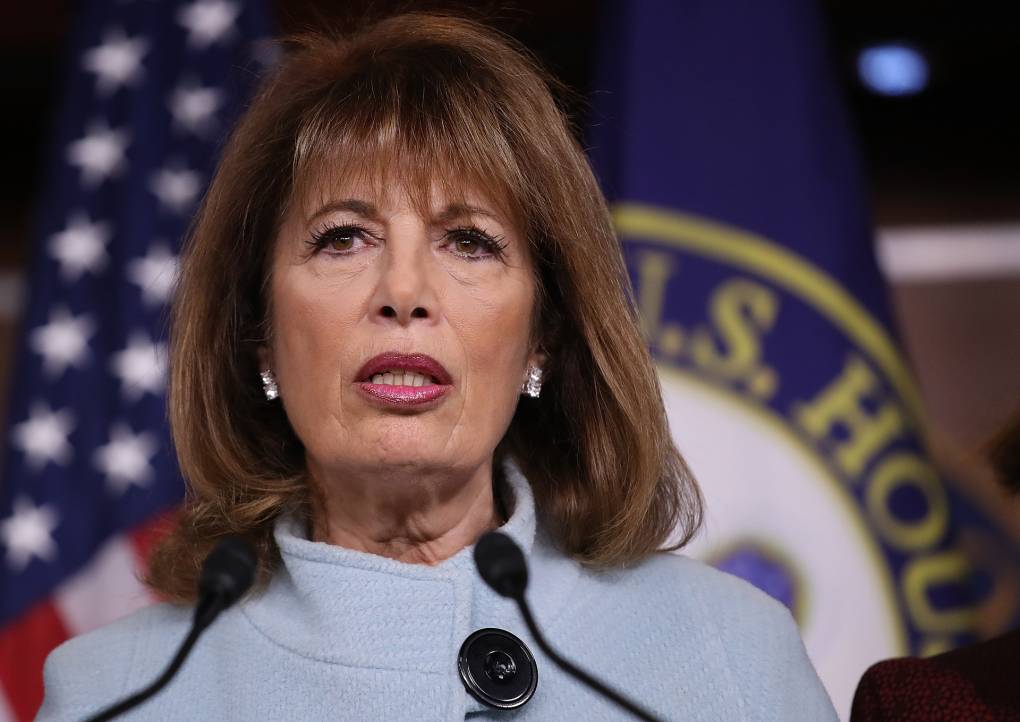
"caption": "US Rep. Jackie Speier (D-San Mateo) warns of the alarming escalation of calls for violence and hate-mongering against elected officials by their fellow politicians.",
"description": null,
"title": "Sen. Gillibrand And Rep. Speier Discuss Sexual Harassment On Capitol Hill",
"credit": "Win McNamee/Getty Images",
"status": "inherit",
"altTag": "Image of Jackie Speier giving a speech in the House of Representatives",
"isLoading": false,
"fetchFailed": false
},
"news_11918442": {
"type": "attachments",
"id": "news_11918442",
"meta": {
"index": "attachments_1716263798",
"site": "news",
"id": "11918442",
"found": true
},
"parent": 11918268,
"imgSizes": {
"twentyfourteen-full-width": {
"file": "https://ww2.kqed.org/app/uploads/sites/10/2022/06/GettyImages-1241600763-1038x576.jpg",
"width": 1038,
"mimeType": "image/jpeg",
"height": 576
},
"thumbnail": {
"file": "https://ww2.kqed.org/app/uploads/sites/10/2022/06/GettyImages-1241600763-160x107.jpg",
"width": 160,
"mimeType": "image/jpeg",
"height": 107
},
"post-thumbnail": {
"file": "https://ww2.kqed.org/app/uploads/sites/10/2022/06/GettyImages-1241600763-672x372.jpg",
"width": 672,
"mimeType": "image/jpeg",
"height": 372
},
"kqedFullSize": {
"file": "https://ww2.kqed.org/app/uploads/sites/10/2022/06/GettyImages-1241600763.jpg",
"width": 1920,
"height": 1280
},
"large": {
"file": "https://ww2.kqed.org/app/uploads/sites/10/2022/06/GettyImages-1241600763-1020x680.jpg",
"width": 1020,
"mimeType": "image/jpeg",
"height": 680
},
"1536x1536": {
"file": "https://ww2.kqed.org/app/uploads/sites/10/2022/06/GettyImages-1241600763-1536x1024.jpg",
"width": 1536,
"mimeType": "image/jpeg",
"height": 1024
},
"medium": {
"file": "https://ww2.kqed.org/app/uploads/sites/10/2022/06/GettyImages-1241600763-800x533.jpg",
"width": 800,
"mimeType": "image/jpeg",
"height": 533
}
},
"publishDate": 1656545294,
"modified": 1656606133,
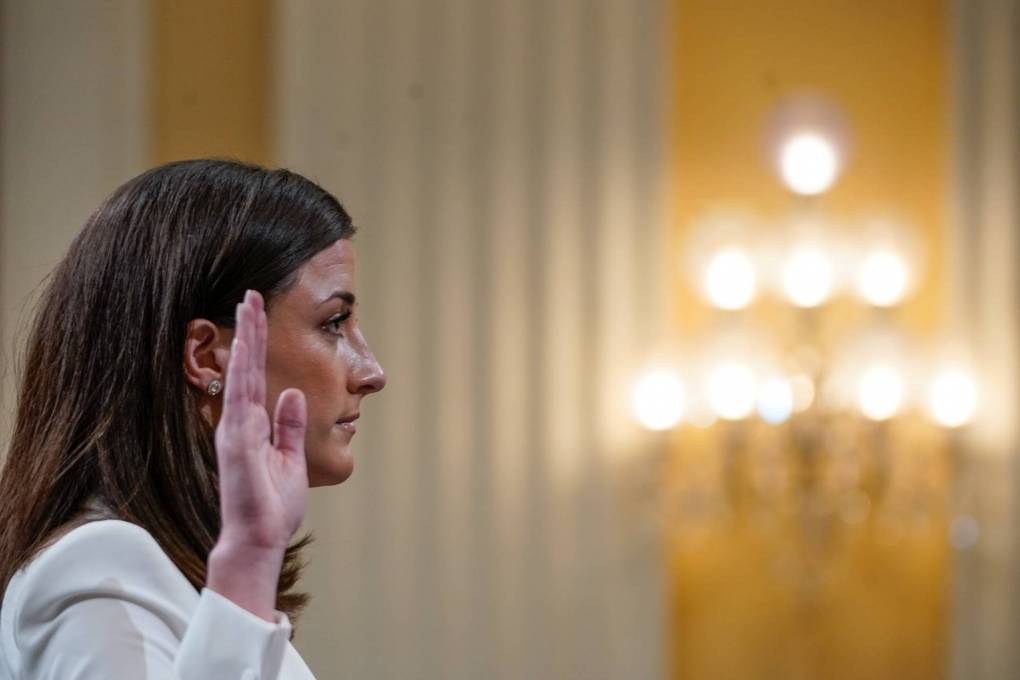
"caption": "Cassidy Hutchinson, an aide to Trump White House Chief of Staff Mark Meadows, is sworn in at a hearing of the House Jan. 6 select committee on Capitol Hill on Tuesday, June 28, 2022.",
"description": null,
"title": "GettyImages-1241600763",
"credit": "Demetrius Freeman/The Washington Post/Getty Images",
"status": "inherit",
"altTag": "A side photo of a woman wearing white, her right hand is raised for her testimony under oath",
"isLoading": false,
"fetchFailed": false
},
"news_11913749": {
"type": "attachments",
"id": "news_11913749",
"meta": {
"index": "attachments_1716263798",
"site": "news",
"id": "11913749",
"found": true
},
"parent": 11913748,
"imgSizes": {
"twentyfourteen-full-width": {
"file": "https://ww2.kqed.org/app/uploads/sites/10/2022/05/copy-of-composites_custom-f5a340a115f8a698b96ada0cc7b060536cb6b184-1038x576.jpg",
"width": 1038,
"mimeType": "image/jpeg",
"height": 576
},
"thumbnail": {
"file": "https://ww2.kqed.org/app/uploads/sites/10/2022/05/copy-of-composites_custom-f5a340a115f8a698b96ada0cc7b060536cb6b184-160x90.jpg",
"width": 160,
"mimeType": "image/jpeg",
"height": 90
},
"post-thumbnail": {
"file": "https://ww2.kqed.org/app/uploads/sites/10/2022/05/copy-of-composites_custom-f5a340a115f8a698b96ada0cc7b060536cb6b184-672x372.jpg",
"width": 672,
"mimeType": "image/jpeg",
"height": 372
},
"kqedFullSize": {
"file": "https://ww2.kqed.org/app/uploads/sites/10/2022/05/copy-of-composites_custom-f5a340a115f8a698b96ada0cc7b060536cb6b184.jpg",
"width": 2400,
"height": 1350
},
"2048x2048": {
"file": "https://ww2.kqed.org/app/uploads/sites/10/2022/05/copy-of-composites_custom-f5a340a115f8a698b96ada0cc7b060536cb6b184-2048x1152.jpg",
"width": 2048,
"mimeType": "image/jpeg",
"height": 1152
},
"large": {
"file": "https://ww2.kqed.org/app/uploads/sites/10/2022/05/copy-of-composites_custom-f5a340a115f8a698b96ada0cc7b060536cb6b184-1020x574.jpg",
"width": 1020,
"mimeType": "image/jpeg",
"height": 574
},
"1536x1536": {
"file": "https://ww2.kqed.org/app/uploads/sites/10/2022/05/copy-of-composites_custom-f5a340a115f8a698b96ada0cc7b060536cb6b184-1536x864.jpg",
"width": 1536,
"mimeType": "image/jpeg",
"height": 864
},
"full-width": {
"file": "https://ww2.kqed.org/app/uploads/sites/10/2022/05/copy-of-composites_custom-f5a340a115f8a698b96ada0cc7b060536cb6b184-1920x1080.jpg",
"width": 1920,
"mimeType": "image/jpeg",
"height": 1080
},
"medium": {
"file": "https://ww2.kqed.org/app/uploads/sites/10/2022/05/copy-of-composites_custom-f5a340a115f8a698b96ada0cc7b060536cb6b184-800x450.jpg",
"width": 800,
"mimeType": "image/jpeg",
"height": 450
}
},
"publishDate": 1652219242,
"modified": 1652222745,
"caption": "Left to right: Elon Musk and Donald Trump",
"description": null,
"title": null,
"credit": "Jamie Squire/Getty Images;Angela Weiss/AFP via Getty Images",
"status": "inherit",
"altTag": null,
"isLoading": false,
"fetchFailed": false
},
"news_11912289": {
"type": "attachments",
"id": "news_11912289",
"meta": {
"index": "attachments_1716263798",
"site": "news",
"id": "11912289",
"found": true
},
"parent": 11912278,
"imgSizes": {
"twentyfourteen-full-width": {
"file": "https://ww2.kqed.org/app/uploads/sites/10/2022/04/rocketman_042622_final-1038x576.png",
"width": 1038,
"mimeType": "image/png",
"height": 576
},
"thumbnail": {
"file": "https://ww2.kqed.org/app/uploads/sites/10/2022/04/rocketman_042622_final-160x117.png",
"width": 160,
"mimeType": "image/png",
"height": 117
},
"post-thumbnail": {
"file": "https://ww2.kqed.org/app/uploads/sites/10/2022/04/rocketman_042622_final-672x372.png",
"width": 672,
"mimeType": "image/png",
"height": 372
},
"kqedFullSize": {
"file": "https://ww2.kqed.org/app/uploads/sites/10/2022/04/rocketman_042622_final.png",
"width": 1920,
"height": 1404
},
"large": {
"file": "https://ww2.kqed.org/app/uploads/sites/10/2022/04/rocketman_042622_final-1020x746.png",
"width": 1020,
"mimeType": "image/png",
"height": 746
},
"1536x1536": {
"file": "https://ww2.kqed.org/app/uploads/sites/10/2022/04/rocketman_042622_final-1536x1123.png",
"width": 1536,
"mimeType": "image/png",
"height": 1123
},
"medium": {
"file": "https://ww2.kqed.org/app/uploads/sites/10/2022/04/rocketman_042622_final-800x585.png",
"width": 800,
"mimeType": "image/png",
"height": 585
}
},
"publishDate": 1651008448,
"modified": 1651008533,
"caption": null,
"description": null,
"title": "rocketman_042622_final",
"credit": null,
"status": "inherit",
"altTag": "Cartoon: Elon Musk waving a cowboy hat as he rides a ramshackle rocket labeled \"free speech\" that is spewing \"conspiracies, hate, incitement and crypto hype.\"",
"isLoading": false,
"fetchFailed": false
},
"news_11907202": {
"type": "attachments",
"id": "news_11907202",
"meta": {
"index": "attachments_1716263798",
"site": "news",
"id": "11907202",
"found": true
},
"parent": 11907194,
"imgSizes": {
"twentyfourteen-full-width": {
"file": "https://ww2.kqed.org/app/uploads/sites/10/2022/03/whoweare_030422_final-1038x576.png",
"width": 1038,
"mimeType": "image/png",
"height": 576
},
"thumbnail": {
"file": "https://ww2.kqed.org/app/uploads/sites/10/2022/03/whoweare_030422_final-160x117.png",
"width": 160,
"mimeType": "image/png",
"height": 117
},
"post-thumbnail": {
"file": "https://ww2.kqed.org/app/uploads/sites/10/2022/03/whoweare_030422_final-672x372.png",
"width": 672,
"mimeType": "image/png",
"height": 372
},
"kqedFullSize": {
"file": "https://ww2.kqed.org/app/uploads/sites/10/2022/03/whoweare_030422_final.png",
"width": 1920,
"height": 1400
},
"large": {
"file": "https://ww2.kqed.org/app/uploads/sites/10/2022/03/whoweare_030422_final-1020x744.png",
"width": 1020,
"mimeType": "image/png",
"height": 744
},
"1536x1536": {
"file": "https://ww2.kqed.org/app/uploads/sites/10/2022/03/whoweare_030422_final-1536x1120.png",
"width": 1536,
"mimeType": "image/png",
"height": 1120
},
"medium": {
"file": "https://ww2.kqed.org/app/uploads/sites/10/2022/03/whoweare_030422_final-800x583.png",
"width": 800,
"mimeType": "image/png",
"height": 583
}
},
"publishDate": 1646420658,
"modified": 1646420809,
"caption": null,
"description": null,
"title": "whoweare_030422_final",
"credit": null,
"status": "inherit",
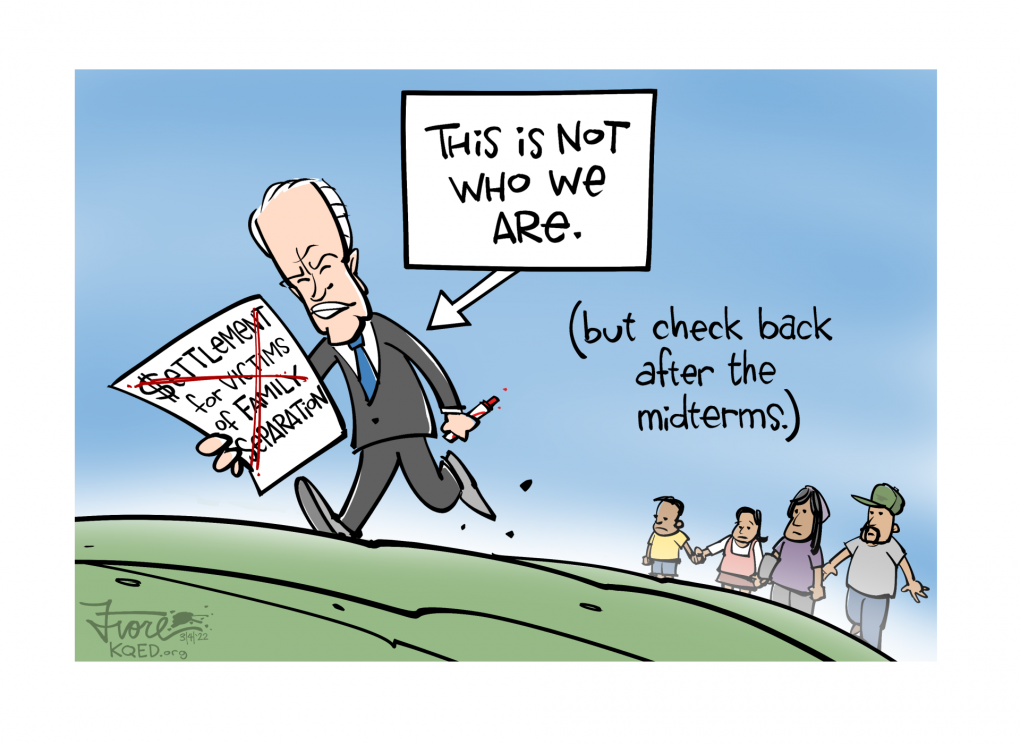
"altTag": "Cartoon: a label that reads, \"this is not who we are\" points at Joe Biden, who carries a paper that says, \"settlement for victims of family separation\" that is crossed out in red. In small parenthetical type to the right is written, \"but check back after the midterms.\" A migrant family looks on in the background.",
"isLoading": false,
"fetchFailed": false
},
"news_11907124": {
"type": "attachments",
"id": "news_11907124",
"meta": {
"index": "attachments_1716263798",
"site": "news",
"id": "11907124",
"found": true
},
"parent": 11907020,
"imgSizes": {
"twentyfourteen-full-width": {
"file": "https://ww2.kqed.org/app/uploads/sites/10/2022/03/RS54042_GettyImages-973077512-qut-1038x576.jpg",
"width": 1038,
"mimeType": "image/jpeg",
"height": 576
},
"thumbnail": {
"file": "https://ww2.kqed.org/app/uploads/sites/10/2022/03/RS54042_GettyImages-973077512-qut-160x107.jpg",
"width": 160,
"mimeType": "image/jpeg",
"height": 107
},
"post-thumbnail": {
"file": "https://ww2.kqed.org/app/uploads/sites/10/2022/03/RS54042_GettyImages-973077512-qut-672x372.jpg",
"width": 672,
"mimeType": "image/jpeg",
"height": 372
},
"kqedFullSize": {
"file": "https://ww2.kqed.org/app/uploads/sites/10/2022/03/RS54042_GettyImages-973077512-qut.jpg",
"width": 1920,
"height": 1280
},
"large": {
"file": "https://ww2.kqed.org/app/uploads/sites/10/2022/03/RS54042_GettyImages-973077512-qut-1020x680.jpg",
"width": 1020,
"mimeType": "image/jpeg",
"height": 680
},
"1536x1536": {
"file": "https://ww2.kqed.org/app/uploads/sites/10/2022/03/RS54042_GettyImages-973077512-qut-1536x1024.jpg",
"width": 1536,
"mimeType": "image/jpeg",
"height": 1024
},
"medium": {
"file": "https://ww2.kqed.org/app/uploads/sites/10/2022/03/RS54042_GettyImages-973077512-qut-800x533.jpg",
"width": 800,
"mimeType": "image/jpeg",
"height": 533
}
},
"publishDate": 1646345333,
"modified": 1646349875,
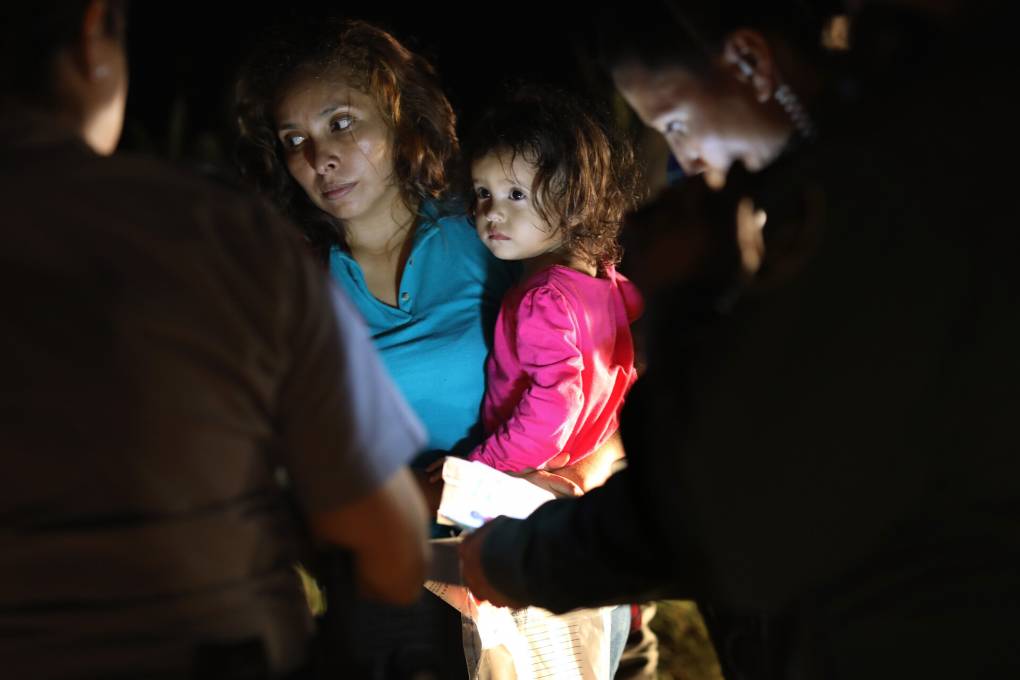
"caption": "A Honduran asylum seeker holds her 2-year-old child as U.S. Border Patrol agents review their papers near the U.S.-Mexico border on June 12, 2018, in Texas. They were sent to a processing center for possible separation as part of the Trump administration's 'zero tolerance' policy toward undocumented immigrants.",
"description": null,
"title": "Border Patrol Agents Detain Migrants Near US-Mexico Border",
"credit": "John Moore/Getty Images",
"status": "inherit",
"altTag": "night-time shot of woman holding her small child, both with concerned faces, surrounded by silhouettes of border patrol agents",
"isLoading": false,
"fetchFailed": false
},
"news_11902826": {
"type": "attachments",
"id": "news_11902826",
"meta": {
"index": "attachments_1716263798",
"site": "news",
"id": "11902826",
"found": true
},
"parent": 0,
"imgSizes": {
"twentyfourteen-full-width": {
"file": "https://ww2.kqed.org/app/uploads/sites/10/2022/01/MotyPortrait-1038x576.jpg",
"width": 1038,
"mimeType": "image/jpeg",
"height": 576
},
"thumbnail": {
"file": "https://ww2.kqed.org/app/uploads/sites/10/2022/01/MotyPortrait-160x127.jpg",
"width": 160,
"mimeType": "image/jpeg",
"height": 127
},
"post-thumbnail": {
"file": "https://ww2.kqed.org/app/uploads/sites/10/2022/01/MotyPortrait-672x372.jpg",
"width": 672,
"mimeType": "image/jpeg",
"height": 372
},
"kqedFullSize": {
"file": "https://ww2.kqed.org/app/uploads/sites/10/2022/01/MotyPortrait.jpg",
"width": 1920,
"height": 1519
},
"large": {
"file": "https://ww2.kqed.org/app/uploads/sites/10/2022/01/MotyPortrait-1020x807.jpg",
"width": 1020,
"mimeType": "image/jpeg",
"height": 807
},
"1536x1536": {
"file": "https://ww2.kqed.org/app/uploads/sites/10/2022/01/MotyPortrait-1536x1215.jpg",
"width": 1536,
"mimeType": "image/jpeg",
"height": 1215
},
"medium": {
"file": "https://ww2.kqed.org/app/uploads/sites/10/2022/01/MotyPortrait-800x633.jpg",
"width": 800,
"mimeType": "image/jpeg",
"height": 633
}
},
"publishDate": 1643241351,
"modified": 1643323014,
"caption": "The outcome of the Feb. 1 recall election of Shasta County Supervisor Leonard Moty could say a lot about the future of California's Republican Party.",
"description": "The outcome of the Feb. 1 recall election of Shasta County Supervisor Leonard Moty could say a lot about the future of California's Republican Party.",
"title": "MotyPortrait",
"credit": "Scott Shafer/KQED",
"status": "inherit",
"altTag": "man with white hair and plaid shirt stands outside in front of brick wall with parking lot in background",
"isLoading": false,
"fetchFailed": false
},
"news_11897940": {
"type": "attachments",
"id": "news_11897940",
"meta": {
"index": "attachments_1716263798",
"site": "news",
"id": "11897940",
"found": true
},
"parent": 11897929,
"imgSizes": {
"twentyfourteen-full-width": {
"file": "https://ww2.kqed.org/app/uploads/sites/10/2021/12/remain_120221_final-1038x576.png",
"width": 1038,
"mimeType": "image/png",
"height": 576
},
"thumbnail": {
"file": "https://ww2.kqed.org/app/uploads/sites/10/2021/12/remain_120221_final-160x111.png",
"width": 160,
"mimeType": "image/png",
"height": 111
},
"post-thumbnail": {
"file": "https://ww2.kqed.org/app/uploads/sites/10/2021/12/remain_120221_final-672x372.png",
"width": 672,
"mimeType": "image/png",
"height": 372
},
"kqedFullSize": {
"file": "https://ww2.kqed.org/app/uploads/sites/10/2021/12/remain_120221_final.png",
"width": 1920,
"height": 1330
},
"large": {
"file": "https://ww2.kqed.org/app/uploads/sites/10/2021/12/remain_120221_final-1020x707.png",
"width": 1020,
"mimeType": "image/png",
"height": 707
},
"1536x1536": {
"file": "https://ww2.kqed.org/app/uploads/sites/10/2021/12/remain_120221_final-1536x1064.png",
"width": 1536,
"mimeType": "image/png",
"height": 1064
},
"medium": {
"file": "https://ww2.kqed.org/app/uploads/sites/10/2021/12/remain_120221_final-800x554.png",
"width": 800,
"mimeType": "image/png",
"height": 554
}
},
"publishDate": 1638491313,
"modified": 1638491417,
"caption": null,
"description": null,
"title": "remain_120221_final",
"credit": null,
"status": "inherit",
"altTag": "Cartoon: shows \"then\" and \"now\" images of a \"remain in Mexico\" immigration sign. The Trump-era sign says things like \"rapists\" and \"murderers\" while the current Biden sign apologizes yet still calls on asylum-seekers to remain in Mexico.",
"isLoading": false,
"fetchFailed": false
},
"news_11897902": {
"type": "attachments",
"id": "news_11897902",
"meta": {
"index": "attachments_1716263798",
"site": "news",
"id": "11897902",
"found": true
},
"parent": 11897897,
"imgSizes": {
"twentyfourteen-full-width": {
"file": "https://ww2.kqed.org/app/uploads/sites/10/2021/12/GettyImages-1236644051-1024x576.jpg",
"width": 1024,
"mimeType": "image/jpeg",
"height": 576
},
"thumbnail": {
"file": "https://ww2.kqed.org/app/uploads/sites/10/2021/12/GettyImages-1236644051-160x103.jpg",
"width": 160,
"mimeType": "image/jpeg",
"height": 103
},
"post-thumbnail": {
"file": "https://ww2.kqed.org/app/uploads/sites/10/2021/12/GettyImages-1236644051-672x372.jpg",
"width": 672,
"mimeType": "image/jpeg",
"height": 372
},
"kqedFullSize": {
"file": "https://ww2.kqed.org/app/uploads/sites/10/2021/12/GettyImages-1236644051.jpg",
"width": 1024,
"height": 661
},
"large": {
"file": "https://ww2.kqed.org/app/uploads/sites/10/2021/12/GettyImages-1236644051-1020x658.jpg",
"width": 1020,
"mimeType": "image/jpeg",
"height": 658
},
"medium": {
"file": "https://ww2.kqed.org/app/uploads/sites/10/2021/12/GettyImages-1236644051-800x516.jpg",
"width": 800,
"mimeType": "image/jpeg",
"height": 516
}
},
"publishDate": 1638484637,
"modified": 1638484767,
"caption": "Migrants heading in a caravan to the United States walk in Nuevo Morelos in Veracruz state, Mexico, on Nov. 18, 2021.",
"description": null,
"title": "MEXICO-US-MIGRATION-CARAVAN",
"credit": "Claudio Cruz/AFP via Getty",
"status": "inherit",
"altTag": "A crowd of people, including someone pushing a stroller, walk along a road.",
"isLoading": false,
"fetchFailed": false
},
"news_11888834": {
"type": "attachments",
"id": "news_11888834",
"meta": {
"index": "attachments_1716263798",
"site": "news",
"id": "11888834",
"found": true
},
"parent": 11888827,
"imgSizes": {
"twentyfourteen-full-width": {
"file": "https://ww2.kqed.org/app/uploads/sites/10/2021/09/Ed-Source-Video-Call-2-1000x576.jpg",
"width": 1000,
"mimeType": "image/jpeg",
"height": 576
},
"thumbnail": {
"file": "https://ww2.kqed.org/app/uploads/sites/10/2021/09/Ed-Source-Video-Call-2-160x107.jpg",
"width": 160,
"mimeType": "image/jpeg",
"height": 107
},
"post-thumbnail": {
"file": "https://ww2.kqed.org/app/uploads/sites/10/2021/09/Ed-Source-Video-Call-2-672x372.jpg",
"width": 672,
"mimeType": "image/jpeg",
"height": 372
},
"kqedFullSize": {
"file": "https://ww2.kqed.org/app/uploads/sites/10/2021/09/Ed-Source-Video-Call-2.jpg",
"width": 1000,
"height": 667
},
"medium": {
"file": "https://ww2.kqed.org/app/uploads/sites/10/2021/09/Ed-Source-Video-Call-2-800x534.jpg",
"width": 800,
"mimeType": "image/jpeg",
"height": 534
}
},
"publishDate": 1631813848,
"modified": 1631915656,
"caption": "José Luis Ruiz Arévalos videocalls his family in Los Banos from Hermosillo, Sonora. In May 2019, Ruiz Arévalos travelled to Mexico for what he thought would be the final step to apply for his green card: an interview at the U.S. Consulate. But he was unexpectedly refused a green card when U.S. Consulate officials decided that under Trump administration guidance he was likely to become a “public charge,” dependent on government services. Unable to return to the U.S., he remains in Hermosillo, Sonora, a thousand miles from his family, while he tries to appeal the decision.",
"description": "José Luis Ruiz Arévalos videocalls his family in Los Banos from Hermosillo, Sonora. In May 2019, Ruiz Arévalos travelled to Mexico for what he thought would be the final step to apply for his green card: an interview at the U.S. Consulate. But he was unexpectedly refused a green card when U.S. Consulate officials decided that under Trump administration guidance he was likely to become a “public charge,” dependent on government services. Unable to return to the U.S., he remains in Hermosillo, Sonora, a thousand miles from his family, while he tries to appeal the decision.",
"title": "Ed Source Video Call-2",
"credit": "Jennifer Molina/EdSource",
"status": "inherit",
"altTag": "A teenage boy with floppy hair videocalls his father on a flat-screen TV in a living room.",
"isLoading": false,
"fetchFailed": false
},
"news_11888806": {
"type": "attachments",
"id": "news_11888806",
"meta": {
"index": "attachments_1716263798",
"site": "news",
"id": "11888806",
"found": true
},
"title": "Father And Son From Honduras Seeking Asylum In The U.S. Await The Court's Decision On Their Status",
"publishDate": 1631785462,
"status": "inherit",
"parent": 11888754,
"modified": 1749678492,
"caption": "A Honduran father and his 6-year-old son walk to Sunday Mass on Sept. 9, 2018, in Oakland, California. They were one of almost 2,600 families separated due to the Trump administration's \"zero tolerance\" immigration policy. ",
"credit": "Mario Tama/Getty Images",
"altTag": "A man and young boy hold hands as they walk in silhouette on an urban sidewalk in early morning sun.",
"description": "Honduran father Juan and his six-year-old son Anthony walk on their way to attend Sunday Mass on September 9, 2018 in Oakland, California. They fled their country, leaving many family members behind, and crossed the U.S. border in April at a lawful port of entry in Brownsville, Texas seeking asylum. They were soon separated and spent the next 85 days apart in detention. Juan was sent to Tulsa, Oklahoma, while his son was sent to a detention shelter New York. They were one of almost 2,600 families separated due to the Trump administration's \"zero tolerance\" immigration policy. Juan said it took six weeks from the time of separation until he was able to make a phone call to his son. They were finally reunited in July 2018.",
"imgSizes": {
"medium": {
"file": "https://cdn.kqed.org/wp-content/uploads/sites/10/2021/09/GettyImages-1031228044-800x533.jpg",
"width": 800,
"height": 533,
"mimeType": "image/jpeg"
},
"large": {
"file": "https://cdn.kqed.org/wp-content/uploads/sites/10/2021/09/GettyImages-1031228044-1020x680.jpg",
"width": 1020,
"height": 680,
"mimeType": "image/jpeg"
},
"thumbnail": {
"file": "https://cdn.kqed.org/wp-content/uploads/sites/10/2021/09/GettyImages-1031228044-160x107.jpg",
"width": 160,
"height": 107,
"mimeType": "image/jpeg"
},
"1536x1536": {
"file": "https://cdn.kqed.org/wp-content/uploads/sites/10/2021/09/GettyImages-1031228044-1536x1024.jpg",
"width": 1536,
"height": 1024,
"mimeType": "image/jpeg"
},
"2048x2048": {
"file": "https://cdn.kqed.org/wp-content/uploads/sites/10/2021/09/GettyImages-1031228044-2048x1365.jpg",
"width": 2048,
"height": 1365,
"mimeType": "image/jpeg"
},
"post-thumbnail": {
"file": "https://cdn.kqed.org/wp-content/uploads/sites/10/2021/09/GettyImages-1031228044-672x372.jpg",
"width": 672,
"height": 372,
"mimeType": "image/jpeg"
},
"twentyfourteen-full-width": {
"file": "https://cdn.kqed.org/wp-content/uploads/sites/10/2021/09/GettyImages-1031228044-1038x576.jpg",
"width": 1038,
"height": 576,
"mimeType": "image/jpeg"
},
"full-width": {
"file": "https://cdn.kqed.org/wp-content/uploads/sites/10/2021/09/GettyImages-1031228044-1920x1280.jpg",
"width": 1920,
"height": 1280,
"mimeType": "image/jpeg"
},
"kqedFullSize": {
"file": "https://cdn.kqed.org/wp-content/uploads/sites/10/2021/09/GettyImages-1031228044-scaled-e1776901494677.jpg",
"width": 2000,
"height": 1334
}
},
"isLoading": false,
"fetchFailed": false
},
"news_11888504": {
"type": "attachments",
"id": "news_11888504",
"meta": {
"index": "attachments_1716263798",
"site": "news",
"id": "11888504",
"found": true
},
"parent": 11888493,
"imgSizes": {
"twentyfourteen-full-width": {
"file": "https://ww2.kqed.org/app/uploads/sites/10/2021/09/closingargument_091421_final-1038x576.png",
"width": 1038,
"mimeType": "image/png",
"height": 576
},
"thumbnail": {
"file": "https://ww2.kqed.org/app/uploads/sites/10/2021/09/closingargument_091421_final-160x112.png",
"width": 160,
"mimeType": "image/png",
"height": 112
},
"post-thumbnail": {
"file": "https://ww2.kqed.org/app/uploads/sites/10/2021/09/closingargument_091421_final-672x372.png",
"width": 672,
"mimeType": "image/png",
"height": 372
},
"kqedFullSize": {
"file": "https://ww2.kqed.org/app/uploads/sites/10/2021/09/closingargument_091421_final.png",
"width": 1920,
"height": 1338
},
"large": {
"file": "https://ww2.kqed.org/app/uploads/sites/10/2021/09/closingargument_091421_final-1020x711.png",
"width": 1020,
"mimeType": "image/png",
"height": 711
},
"1536x1536": {
"file": "https://ww2.kqed.org/app/uploads/sites/10/2021/09/closingargument_091421_final-1536x1070.png",
"width": 1536,
"mimeType": "image/png",
"height": 1070
},
"medium": {
"file": "https://ww2.kqed.org/app/uploads/sites/10/2021/09/closingargument_091421_final-800x558.png",
"width": 800,
"mimeType": "image/png",
"height": 558
}
},
"publishDate": 1631652020,
"modified": 1631656570,
"caption": null,
"description": null,
"title": "closingargument_091421_final",
"credit": null,
"status": "inherit",
"altTag": "A cartoon captioned \"The closing argument\" shows Larry Elder with signs that read, \"Elder, the election is rigged...but vote for me anyway.\"",
"isLoading": false,
"fetchFailed": false
}
},
"audioPlayerReducer": {
"postId": "stream_live",
"isPaused": true,
"isPlaying": false,
"pfsActive": false,
"pledgeModalIsOpen": true,
"playerDrawerIsOpen": false,
"liveAudioPlayStartedAt": 0,
"liveAudioPlayContext": ""
},
"authorsReducer": {
"byline_news_11913748": {
"type": "authors",
"id": "byline_news_11913748",
"meta": {
"override": true
},
"slug": "byline_news_11913748",
"name": "\u003ca>Shannon Bond\u003c/a> ",
"isLoading": false
},
"byline_news_11897897": {
"type": "authors",
"id": "byline_news_11897897",
"meta": {
"override": true
},
"slug": "byline_news_11897897",
"name": "Elliot Spagat\u003cbr>Associated Press",
"isLoading": false
},
"byline_news_11888827": {
"type": "authors",
"id": "byline_news_11888827",
"meta": {
"override": true
},
"slug": "byline_news_11888827",
"name": "\u003ca href=\"https://edsource.org/author/zstavely\">Zaidee Stavely\u003c/a>",
"isLoading": false
},
"byline_news_11888754": {
"type": "authors",
"id": "byline_news_11888754",
"meta": {
"override": true
},
"slug": "byline_news_11888754",
"name": "Ben Fox \u003cbr> The Associated Press",
"isLoading": false
},
"scottshafer": {
"type": "authors",
"id": "255",
"meta": {
"index": "authors_1716337520",
"id": "255",
"found": true
},
"name": "Scott Shafer",
"firstName": "Scott",
"lastName": "Shafer",
"slug": "scottshafer",
"email": "sshafer@kqed.org",
"display_author_email": false,
"staff_mastheads": [
"news"
],
"title": "KQED Contributor",
"bio": "Scott Shafer is a senior editor with the KQED Politics and Government desk. He is co-host of Political Breakdown, the award-winning radio show and podcast with a personal take on the world of politics. Scott came to KQED in 1998 to host the statewide\u003cem> California Report\u003c/em>. Prior to that he had extended stints in politics and government\u003cem>.\u003c/em> He uses that inside experience at KQED in his, reporting, hosting and analysis for the politics desk. Scott collaborated \u003cem>Political Breakdown a\u003c/em>nd on \u003cem>The Political Mind of Jerry Brown, \u003c/em>an eight-part series about the life and extraordinary political career of the former governor. For fun, he plays water polo with the San Francisco Tsunami.",
"avatar": "https://secure.gravatar.com/avatar/a62ebae45b79d7aed1a39a0e3bf68104?s=600&d=blank&r=g",
"twitter": "scottshafer",
"bluesky": null,
"facebook": null,
"instagram": null,
"linkedin": null,
"sites": [
{
"site": "news",
"roles": [
"editor"
]
},
{
"site": "stateofhealth",
"roles": [
"author"
]
},
{
"site": "science",
"roles": [
"author"
]
},
{
"site": "forum",
"roles": [
"subscriber"
]
},
{
"site": "liveblog",
"roles": [
"author"
]
}
],
"headData": {
"title": "Scott Shafer | KQED",
"description": "KQED Contributor",
"ogImgSrc": "https://secure.gravatar.com/avatar/a62ebae45b79d7aed1a39a0e3bf68104?s=600&d=blank&r=g",
"twImgSrc": "https://secure.gravatar.com/avatar/a62ebae45b79d7aed1a39a0e3bf68104?s=600&d=blank&r=g"
},
"isLoading": false,
"link": "/author/scottshafer"
},
"markfiore": {
"type": "authors",
"id": "3236",
"meta": {
"index": "authors_1716337520",
"id": "3236",
"found": true
},
"name": "Mark Fiore",
"firstName": "Mark",
"lastName": "Fiore",
"slug": "markfiore",
"email": "mark@markfiore.com",
"display_author_email": false,
"staff_mastheads": [
"news"
],
"title": "KQED News Cartoonist",
"bio": "\u003ca href=\"http://www.MarkFiore.com\">MarkFiore.com\u003c/a> | \u003ca href=\"https://twitter.com/markfiore\">Follow on Twitter\u003c/a> | \u003ca href=\"https://www.facebook.com/pages/Mark-Fiore-Animated-Political-Cartoons/94451707396?ref=bookmarks\">Facebook\u003c/a> | \u003ca href=\"mailto:mark@markfiore.com\">email\u003c/a>\r\n\r\nPulitzer Prize-winner, Mark Fiore, who the Wall Street Journal has called “the undisputed guru of the form,” creates animated political cartoons in San Francisco, where his work has been featured regularly on the San Francisco Chronicle’s web site, SFGate.com. His work has appeared on Newsweek.com, Slate.com, CBSNews.com, MotherJones.com, DailyKos.com and NPR’s web site. Fiore’s political animation has appeared on CNN, Frontline, Bill Moyers Journal, Salon.com and cable and broadcast outlets across the globe.\r\n\r\nBeginning his professional life by drawing traditional political cartoons for newspapers, Fiore’s work appeared in publications ranging from the Washington Post to the Los Angeles Times. In the late 1990s, he began to experiment with animating political cartoons and, after a short stint at the San Jose Mercury News as their staff cartoonist, Fiore devoted all his energies to animation.\r\nGrowing up in California, Fiore also spent a good portion of his life in the backwoods of Idaho. It was this combination that shaped him politically. Mark majored in political science at Colorado College, where, in a perfect send-off for a cartoonist, he received his diploma in 1991 as commencement speaker Dick Cheney smiled approvingly.\r\nMark Fiore was awarded the Pulitzer Prize for political cartooning in 2010, a Robert F. Kennedy Journalism Award in 2004 and has twice received an Online Journalism Award for commentary from the Online News Association (2002, 2008). Fiore has received two awards for his work in new media from the National Cartoonists Society (2001, 2002), and in 2006 received The James Madison Freedom of Information Award from The Society of Professional Journalists.",
"avatar": "https://secure.gravatar.com/avatar/fc4e2a612b15b67bad0c6f0e1db4ca9b?s=600&d=blank&r=g",
"twitter": "MarkFiore",
"facebook": null,
"instagram": "https://www.instagram.com/markfiore/?hl=en",
"linkedin": null,
"sites": [
{
"site": "arts",
"roles": [
"contributor"
]
},
{
"site": "news",
"roles": [
"editor"
]
},
{
"site": "futureofyou",
"roles": [
"editor"
]
},
{
"site": "science",
"roles": [
"editor"
]
}
],
"headData": {
"title": "Mark Fiore | KQED",
"description": "KQED News Cartoonist",
"ogImgSrc": "https://secure.gravatar.com/avatar/fc4e2a612b15b67bad0c6f0e1db4ca9b?s=600&d=blank&r=g",
"twImgSrc": "https://secure.gravatar.com/avatar/fc4e2a612b15b67bad0c6f0e1db4ca9b?s=600&d=blank&r=g"
},
"isLoading": false,
"link": "/author/markfiore"
},
"mfederis": {
"type": "authors",
"id": "11509",
"meta": {
"index": "authors_1716337520",
"id": "11509",
"found": true
},
"name": "Marnette Federis",
"firstName": "Marnette",
"lastName": "Federis",
"slug": "mfederis",
"email": "mfederis@kqed.org",
"display_author_email": false,
"staff_mastheads": [],
"title": "KQED Contributor",
"bio": null,
"avatar": "https://secure.gravatar.com/avatar/6553b16260501cef36787444651fa5ed?s=600&d=blank&r=g",
"twitter": null,
"facebook": null,
"instagram": null,
"linkedin": null,
"sites": [
{
"site": "news",
"roles": [
"editor"
]
},
{
"site": "mindshift",
"roles": [
"editor"
]
},
{
"site": "science",
"roles": [
"editor"
]
},
{
"site": "podcasts",
"roles": [
"editor"
]
}
],
"headData": {
"title": "Marnette Federis | KQED",
"description": "KQED Contributor",
"ogImgSrc": "https://secure.gravatar.com/avatar/6553b16260501cef36787444651fa5ed?s=600&d=blank&r=g",
"twImgSrc": "https://secure.gravatar.com/avatar/6553b16260501cef36787444651fa5ed?s=600&d=blank&r=g"
},
"isLoading": false,
"link": "/author/mfederis"
},
"mwiley": {
"type": "authors",
"id": "11526",
"meta": {
"index": "authors_1716337520",
"id": "11526",
"found": true
},
"name": "Michelle Wiley",
"firstName": "Michelle",
"lastName": "Wiley",
"slug": "mwiley",
"email": "mwiley@KQED.org",
"display_author_email": true,
"staff_mastheads": [],
"title": null,
"bio": "Michelle Wiley was the senior editor of weekends.",
"avatar": "https://secure.gravatar.com/avatar/3b897d82a09e8587e8e73fa69fbcc635?s=600&d=blank&r=g",
"twitter": "michelleewiley",
"facebook": null,
"instagram": null,
"linkedin": null,
"sites": [
{
"site": "",
"roles": [
"editor"
]
},
{
"site": "arts",
"roles": [
"editor"
]
},
{
"site": "news",
"roles": [
"subscriber"
]
},
{
"site": "lowdown",
"roles": [
"editor"
]
},
{
"site": "science",
"roles": [
"editor"
]
},
{
"site": "podcasts",
"roles": [
"editor"
]
}
],
"headData": {
"title": "Michelle Wiley | KQED",
"description": null,
"ogImgSrc": "https://secure.gravatar.com/avatar/3b897d82a09e8587e8e73fa69fbcc635?s=600&d=blank&r=g",
"twImgSrc": "https://secure.gravatar.com/avatar/3b897d82a09e8587e8e73fa69fbcc635?s=600&d=blank&r=g"
},
"isLoading": false,
"link": "/author/mwiley"
},
"nnavarro": {
"type": "authors",
"id": "11756",
"meta": {
"index": "authors_1716337520",
"id": "11756",
"found": true
},
"name": "Natalia Navarro",
"firstName": "Natalia",
"lastName": "Navarro",
"slug": "nnavarro",
"email": "nnavarro@kqed.org",
"display_author_email": true,
"staff_mastheads": [
"news"
],
"title": "Afternoon News Anchor",
"bio": "Natalia Navarro is KQED's afternoon radio news anchor. She came to KQED in 2021 from Colorado Public Radio, where she was a reporter and host. She has received several awards for her work covering daily and breaking news from professional organizations such as the San Francisco Press Club, Society of Professional Journalists and the Colorado Broadcasters Association. Natalia is originally from Tucson, Arizona, where she got her start in journalism writing for the Arizona Daily Star, Arizona Public Media and the Tucson Weekly. Natalia earned her bachelor's degree in journalism and economics, and her master's degree in journalism from the University of Arizona.",
"avatar": "https://secure.gravatar.com/avatar/45f866ea8b5c52bf1fa4c236dd0c03c2?s=600&d=blank&r=g",
"twitter": "@NataliaVNavarro",
"facebook": null,
"instagram": null,
"linkedin": null,
"sites": [
{
"site": "news",
"roles": [
"editor"
]
}
],
"headData": {
"title": "Natalia Navarro | KQED",
"description": "Afternoon News Anchor",
"ogImgSrc": "https://secure.gravatar.com/avatar/45f866ea8b5c52bf1fa4c236dd0c03c2?s=600&d=blank&r=g",
"twImgSrc": "https://secure.gravatar.com/avatar/45f866ea8b5c52bf1fa4c236dd0c03c2?s=600&d=blank&r=g"
},
"isLoading": false,
"link": "/author/nnavarro"
}
},
"pagesReducer": {
"news_tag_donald-trump": {
"type": "terms",
"id": "news_1323",
"meta": {
"index": "terms_1716263798",
"site": "news",
"id": "1323",
"score": 8.554646
},
"featImg": null,
"name": "Donald Trump",
"description": null,
"taxonomy": "tag",
"headData": {
"twImgId": null,
"twTitle": null,
"ogTitle": null,
"ogImgId": null,
"twDescription": null,
"description": null,
"title": "Donald Trump Archives | KQED News",
"ogDescription": null
},
"ttid": 1335,
"slug": "donald-trump",
"isLoading": false,
"title": "Donald Trump",
"pageMeta": {
"site": "news",
"WpPageTemplate": "page-topic-editorial",
"currentPage": 73
},
"blocks": [
{
"blockName": "kqed/post-list",
"attrs": {
"layout": "cardArticle2",
"query": "posts/news?tag=donald-trump",
"seeMore": false,
"paginated": true,
"page": 73
}
},
{
"blockName": "kqed/ad"
}
]
}
},
"pfsSessionReducer": {},
"postsReducer": {
"stream_live": {
"type": "live",
"id": "stream_live",
"audioUrl": "https://streams.kqed.org/kqedradio",
"title": "Live Stream",
"excerpt": "Live Stream information currently unavailable.",
"link": "/radio",
"featImg": "",
"label": {
"name": "KQED Live",
"link": "/"
}
},
"stream_kqedNewscast": {
"type": "posts",
"id": "stream_kqedNewscast",
"audioUrl": "https://www.kqed.org/.stream/anon/radio/RDnews/newscast.mp3?_=1",
"title": "KQED Newscast",
"featImg": "",
"label": {
"name": "88.5 FM",
"link": "/"
}
},
"news_11930930": {
"type": "posts",
"id": "news_11930930",
"meta": {
"index": "posts_1716263798",
"site": "news",
"id": "11930930",
"score": null,
"sort": [
1667519034000
]
},
"guestAuthors": [],
"slug": "as-calls-for-violence-against-elected-officials-mount-rep-jackie-speier-weighs-in-on-where-to-go-from-here",
"title": "As Calls for Violence Against Elected Officials Mount, Rep. Jackie Speier Weighs In on Where to Go From Here",
"publishDate": 1667519034,
"format": "standard",
"headTitle": "As Calls for Violence Against Elected Officials Mount, Rep. Jackie Speier Weighs In on Where to Go From Here | KQED",
"labelTerm": {
"site": "news"
},
"content": "\u003cp>In light of the \u003ca href=\"https://www.kqed.org/news/11930878/officials-suspect-in-pelosi-attack-was-on-a-suicide-mission-and-had-more-targets\">recent attack on House Speaker Nancy Pelosi’s husband, Paul Pelosi\u003c/a>, Rep. Jackie Speier (D-San Mateo) joined KQED’s Natalia V. Navarro to share her thoughts on what is behind the unprecedented wave of hate-mongering and calls for violence from elected officials in recent years, and what legislators can do to prevent such attacks in the future.\u003cb>\u003c/b>\u003c/p>\n\u003cp>\u003cem>This interview has been edited for brevity and clarity.\u003c/em>\u003c/p>\n\u003cp>\u003cstrong>NATALIA NAVARRO:\u003c/strong> \u003cstrong>Representative Speier, first of all, I imagine you’ve been in touch with Speaker Pelosi over the last few days. What are you hearing from her?\u003c/strong>\u003c/p>\n\u003cp>\u003cb>JACKIE SPEIER: \u003c/b>Well, I haven’t actually been in touch with her personally. I have communicated with her through text. And I stopped by the hospital and left a card and some flowers. But I have not actually talked with her. I think she has been focused on her family and, obviously, her husband.\u003c/p>\n\u003cp>\u003cstrong>What do you think legislators can do to help prevent things like this from happening again?\u003c/strong>\u003c/p>\n\u003cp>It really requires a wholesale change in how we do business. The amount of vitriol that is spewed out on social media by members is reprehensible. And it also is why we have the radicalization of persons in the United States who become domestic terrorists. And I don’t think that is hyperbolic when you realize that this particular man [David DePape, 42, alleged attacker of Paul Pelosi] had every intention of maiming, killing, abusing the speaker of the House, who’s third in command. He had zip ties, rope and two hammers. He was hell-bent on being a vicious perpetrator of a heinous crime.[aside postID=news_11930397 hero='https://ww2.kqed.org/app/uploads/sites/10/2022/10/RS59685_GettyImages-1437289628-qut-1020x680.jpg']\u003cstrong>The suspect’s social media posts were filled with conspiracy theories. How concerned should we be about the growth of once-fringe ideas such as QAnon, which incorporates references to political violence? Is there any way to combat it?\u003c/strong>\u003c/p>\n\u003cp>I think the way you combat it is to shut down Donald Trump because he has basically overtaken the Republican Party. The New York Times did an analysis of how many times he has cast aspersions on Nancy Pelosi in his six years, seven years. It was 800 times. And he has demeaned her and recently posted a picture in which he said, your enemy is not in Russia. As if to suggest that, you know, he is stirring up this militia in the United States. And he said on another station when asked about his, you know, the people are really angry, terrible things are going to happen. Well, terrible things have happened. And he’s in conjunction with, you know, people like Marjorie Taylor Greene, who actually said that Speaker Pelosi should be executed. I mean, this kind of hate talk from elected officials … Is that free speech? It is hate-mongering on levels that we just can’t tolerate moving forward.\u003c/p>\n\u003cp>\u003cstrong>You’ve been in Congress for a long time. How has the attitude of legislators on the other side of the aisle from you changed over the years?\u003c/strong>\u003c/p>\n\u003cp>It’s gotten progressively worse. And unfortunately, when Donald Trump got elected, he was able to give license to people saying outrageous things. And the growth of social media has allowed members of Congress to recognize that if you say something outrageous, you’re going to get more likes. It’s going to go viral. You’ll be able to raise more money. And so it’s kind of this addiction that encourages people to become more and more outrageous in their conduct.\u003c/p>\n\u003cp>\u003cstrong>There has been a move by some Republicans to dismiss the connection between violent rhetoric and attacks like this one, or even to turn the blame back on Democrats for this incident by treating it as a law-and-order issue or concocting wild theories. How can you and other Democrats respond effectively?\u003c/strong>[pullquote align=\"right\" size=\"medium\" citation=\"U.S. Rep. Jackie Speier (D-San Mateo)\"]‘The growth of social media has allowed members of Congress to recognize that if you say something outrageous, you’re going to get more likes. It’s going to go viral. You’ll be able to raise more money. And so it’s kind of this addiction that encourages people to become more and more outrageous in their conduct.’[/pullquote]You bet I want law and order. And every Democrat wants law and order. This whole thought process in which they try to label the Democrats as being the ones that do not support law and order is made out of whole cloth. They’re the ones. And you can go to the Republican Congressional Campaign Committee chair, who posts a picture of him shooting a gun, and the hashtag below is “hashtag fire Pelosi.” Now, he stands by that, saying that it was about the Second Amendment. He didn’t say that in the picture he posted. So the violence is being promoted by our colleagues on the other side of the aisle. It’s incumbent on us to point to that and to challenge it. I carried the resolution to censure Paul Gosar when he posted a picture of Alexandria Ocasio-Cortez with her in the crosshairs. I mean, we cannot tolerate that. And so, you know, it’s incumbent on people like Kevin McCarthy, it’s incumbent on Speaker Pelosi, if there were people within the Democratic caucus who were fomenting violence, to count them out, to call them out. You don’t hear that happening. Or from Kevin McCarthy. In fact, he didn’t even say a word about the attack on Paul Pelosi for over a day. Former President Trump never said a word.\u003c/p>\n\u003cp>\u003cstrong>Representative Speier, we had a listener write in to challenge a phrase that we’ve been using in our newscasts, that Mr. Pelosi is expected to make a full recovery. The listener questioned that, while that may be true physically, does a person ever make a full recovery from this kind of assault, in spirit? As a survivor of violent crime yourself, what is your perspective?\u003c/strong>\u003c/p>\n\u003cp>I think that’s accurate. I think … that term came from a press release that the speaker’s office put out. But physical recovery is very different from emotional recovery. And I’m sure that this will haunt not only Paul Pelosi but the speaker and her children and grandchildren. It’s a despicable act. We have to be willing to call out that kind of conduct as what it is. I mean, it was violence of the highest sort. It was an attempt at an assassination of the speaker of the House who wasn’t there. And so her husband became the target.\u003c/p>\n\u003cp>\u003cstrong>Do you have concerns that the growing threat of political violence like this could deter good people from running for office? \u003c/strong>\u003c/p>\n\u003cp>Of course, absolutely. I mean, when members of Congress have to pay out of their campaign accounts for personal bodyguards, I mean, think about that. Why would people want to place their family and themselves at that kind of risk? I mean, it’s really beyond the pale. And I don’t know how we’re going to excise it from our political commentary, but we’ve got to do something. There has to be an effort to tamp this down in a way that is meaningful. But again, social media drives hostile language, encourages hostile language. Hostile language encourages campaign fundraising. And you can see how this becomes a truly vicious cycle.\u003c/p>\n\u003cp>[ad fullwidth]\u003c/p>\n\u003cp>[ad floatright]\u003c/p>\n",
"blocks": [],
"excerpt": "As threats of violence and actual attacks on public officials reach alarming levels, Speier points to the dangers of social media and a Trump-dominated Republican Party that she says is creating 'a truly vicious cycle.'",
"status": "publish",
"parent": 0,
"modified": 1721135472,
"stats": {
"hasAudio": false,
"hasVideo": false,
"hasChartOrMap": false,
"iframeSrcs": [],
"hasGoogleForm": false,
"hasGallery": false,
"hasHearkenModule": false,
"hasPolis": false,
"paragraphCount": 16,
"wordCount": 1316
},
"headData": {
"title": "As Calls for Violence Against Elected Officials Mount, Rep. Jackie Speier Weighs In on Where to Go From Here | KQED",
"description": "As threats of violence and actual attacks on public officials reach alarming levels, Speier points to the dangers of social media and a Trump-dominated Republican Party that she says is creating 'a truly vicious cycle.'",
"ogTitle": "",
"ogDescription": "",
"ogImgId": "",
"twTitle": "",
"twDescription": "",
"twImgId": "",
"schema": {
"@context": "https://schema.org",
"@type": "NewsArticle",
"headline": "As Calls for Violence Against Elected Officials Mount, Rep. Jackie Speier Weighs In on Where to Go From Here",
"datePublished": "2022-11-03T16:43:54-07:00",
"dateModified": "2024-07-16T06:11:12-07:00",
"image": "https://cdn.kqed.org/wp-content/uploads/2020/02/KQED-OG-Image@1x.png",
"isAccessibleForFree": "True",
"publisher": {
"@type": "NewsMediaOrganization",
"@id": "https://www.kqed.org/#organization",
"name": "KQED",
"logo": "https://cdn.kqed.org/wp-content/uploads/2020/02/KQED-OG-Image@1x.png",
"url": "https://www.kqed.org",
"sameAs": [
"https://www.facebook.com/KQED",
"https://twitter.com/KQED",
"https://www.instagram.com/kqed/",
"https://www.tiktok.com/@kqedofficial",
"https://www.linkedin.com/company/kqed",
"https://www.youtube.com/channel/UCeC0IOo7i1P_61zVUWbJ4nw"
]
}
}
},
"sticky": false,
"excludeFromSiteSearch": "Include",
"path": "/news/11930930/as-calls-for-violence-against-elected-officials-mount-rep-jackie-speier-weighs-in-on-where-to-go-from-here",
"audioTrackLength": null,
"parsedContent": [
{
"type": "contentString",
"content": "\u003cdiv class=\"post-body\">\u003cp>\u003cp>In light of the \u003ca href=\"https://www.kqed.org/news/11930878/officials-suspect-in-pelosi-attack-was-on-a-suicide-mission-and-had-more-targets\">recent attack on House Speaker Nancy Pelosi’s husband, Paul Pelosi\u003c/a>, Rep. Jackie Speier (D-San Mateo) joined KQED’s Natalia V. Navarro to share her thoughts on what is behind the unprecedented wave of hate-mongering and calls for violence from elected officials in recent years, and what legislators can do to prevent such attacks in the future.\u003cb>\u003c/b>\u003c/p>\n\u003cp>\u003cem>This interview has been edited for brevity and clarity.\u003c/em>\u003c/p>\n\u003cp>\u003cstrong>NATALIA NAVARRO:\u003c/strong> \u003cstrong>Representative Speier, first of all, I imagine you’ve been in touch with Speaker Pelosi over the last few days. What are you hearing from her?\u003c/strong>\u003c/p>\n\u003cp>\u003cb>JACKIE SPEIER: \u003c/b>Well, I haven’t actually been in touch with her personally. I have communicated with her through text. And I stopped by the hospital and left a card and some flowers. But I have not actually talked with her. I think she has been focused on her family and, obviously, her husband.\u003c/p>\n\u003cp>\u003cstrong>What do you think legislators can do to help prevent things like this from happening again?\u003c/strong>\u003c/p>\n\u003cp>It really requires a wholesale change in how we do business. The amount of vitriol that is spewed out on social media by members is reprehensible. And it also is why we have the radicalization of persons in the United States who become domestic terrorists. And I don’t think that is hyperbolic when you realize that this particular man [David DePape, 42, alleged attacker of Paul Pelosi] had every intention of maiming, killing, abusing the speaker of the House, who’s third in command. He had zip ties, rope and two hammers. He was hell-bent on being a vicious perpetrator of a heinous crime.\u003c/p>\u003c/div>",
"attributes": {
"named": {},
"numeric": []
}
},
{
"type": "component",
"content": "",
"name": "aside",
"attributes": {
"named": {
"postid": "news_11930397",
"hero": "https://ww2.kqed.org/app/uploads/sites/10/2022/10/RS59685_GettyImages-1437289628-qut-1020x680.jpg",
"label": ""
},
"numeric": []
}
},
{
"type": "contentString",
"content": "\u003cdiv class=\"post-body\">\u003cp>\u003cstrong>The suspect’s social media posts were filled with conspiracy theories. How concerned should we be about the growth of once-fringe ideas such as QAnon, which incorporates references to political violence? Is there any way to combat it?\u003c/strong>\u003c/p>\n\u003cp>I think the way you combat it is to shut down Donald Trump because he has basically overtaken the Republican Party. The New York Times did an analysis of how many times he has cast aspersions on Nancy Pelosi in his six years, seven years. It was 800 times. And he has demeaned her and recently posted a picture in which he said, your enemy is not in Russia. As if to suggest that, you know, he is stirring up this militia in the United States. And he said on another station when asked about his, you know, the people are really angry, terrible things are going to happen. Well, terrible things have happened. And he’s in conjunction with, you know, people like Marjorie Taylor Greene, who actually said that Speaker Pelosi should be executed. I mean, this kind of hate talk from elected officials … Is that free speech? It is hate-mongering on levels that we just can’t tolerate moving forward.\u003c/p>\n\u003cp>\u003cstrong>You’ve been in Congress for a long time. How has the attitude of legislators on the other side of the aisle from you changed over the years?\u003c/strong>\u003c/p>\n\u003cp>It’s gotten progressively worse. And unfortunately, when Donald Trump got elected, he was able to give license to people saying outrageous things. And the growth of social media has allowed members of Congress to recognize that if you say something outrageous, you’re going to get more likes. It’s going to go viral. You’ll be able to raise more money. And so it’s kind of this addiction that encourages people to become more and more outrageous in their conduct.\u003c/p>\n\u003cp>\u003cstrong>There has been a move by some Republicans to dismiss the connection between violent rhetoric and attacks like this one, or even to turn the blame back on Democrats for this incident by treating it as a law-and-order issue or concocting wild theories. How can you and other Democrats respond effectively?\u003c/strong>\u003c/p>\u003c/div>",
"attributes": {
"named": {},
"numeric": []
}
},
{
"type": "component",
"content": "‘The growth of social media has allowed members of Congress to recognize that if you say something outrageous, you’re going to get more likes. It’s going to go viral. You’ll be able to raise more money. And so it’s kind of this addiction that encourages people to become more and more outrageous in their conduct.’",
"name": "pullquote",
"attributes": {
"named": {
"align": "right",
"size": "medium",
"citation": "U.S. Rep. Jackie Speier (D-San Mateo)",
"label": ""
},
"numeric": []
}
},
{
"type": "contentString",
"content": "\u003cdiv class=\"post-body\">\u003cp>You bet I want law and order. And every Democrat wants law and order. This whole thought process in which they try to label the Democrats as being the ones that do not support law and order is made out of whole cloth. They’re the ones. And you can go to the Republican Congressional Campaign Committee chair, who posts a picture of him shooting a gun, and the hashtag below is “hashtag fire Pelosi.” Now, he stands by that, saying that it was about the Second Amendment. He didn’t say that in the picture he posted. So the violence is being promoted by our colleagues on the other side of the aisle. It’s incumbent on us to point to that and to challenge it. I carried the resolution to censure Paul Gosar when he posted a picture of Alexandria Ocasio-Cortez with her in the crosshairs. I mean, we cannot tolerate that. And so, you know, it’s incumbent on people like Kevin McCarthy, it’s incumbent on Speaker Pelosi, if there were people within the Democratic caucus who were fomenting violence, to count them out, to call them out. You don’t hear that happening. Or from Kevin McCarthy. In fact, he didn’t even say a word about the attack on Paul Pelosi for over a day. Former President Trump never said a word.\u003c/p>\n\u003cp>\u003cstrong>Representative Speier, we had a listener write in to challenge a phrase that we’ve been using in our newscasts, that Mr. Pelosi is expected to make a full recovery. The listener questioned that, while that may be true physically, does a person ever make a full recovery from this kind of assault, in spirit? As a survivor of violent crime yourself, what is your perspective?\u003c/strong>\u003c/p>\n\u003cp>I think that’s accurate. I think … that term came from a press release that the speaker’s office put out. But physical recovery is very different from emotional recovery. And I’m sure that this will haunt not only Paul Pelosi but the speaker and her children and grandchildren. It’s a despicable act. We have to be willing to call out that kind of conduct as what it is. I mean, it was violence of the highest sort. It was an attempt at an assassination of the speaker of the House who wasn’t there. And so her husband became the target.\u003c/p>\n\u003cp>\u003cstrong>Do you have concerns that the growing threat of political violence like this could deter good people from running for office? \u003c/strong>\u003c/p>\n\u003cp>Of course, absolutely. I mean, when members of Congress have to pay out of their campaign accounts for personal bodyguards, I mean, think about that. Why would people want to place their family and themselves at that kind of risk? I mean, it’s really beyond the pale. And I don’t know how we’re going to excise it from our political commentary, but we’ve got to do something. There has to be an effort to tamp this down in a way that is meaningful. But again, social media drives hostile language, encourages hostile language. Hostile language encourages campaign fundraising. And you can see how this becomes a truly vicious cycle.\u003c/p>\n\u003cp>\u003c/p>\u003c/div>",
"attributes": {
"named": {},
"numeric": []
}
},
{
"type": "component",
"content": "",
"name": "ad",
"attributes": {
"named": {
"label": "fullwidth"
},
"numeric": [
"fullwidth"
]
}
},
{
"type": "contentString",
"content": "\u003cdiv class=\"post-body\">\u003cp>\u003c/p>\n\u003cp>\u003c/p>\u003c/div>",
"attributes": {
"named": {},
"numeric": []
}
},
{
"type": "component",
"content": "",
"name": "ad",
"attributes": {
"named": {
"label": "floatright"
},
"numeric": [
"floatright"
]
}
},
{
"type": "contentString",
"content": "\u003cdiv class=\"post-body\">\u003cp>\u003c/p>\n\u003c/div>\u003c/p>",
"attributes": {
"named": {},
"numeric": []
}
}
],
"link": "/news/11930930/as-calls-for-violence-against-elected-officials-mount-rep-jackie-speier-weighs-in-on-where-to-go-from-here",
"authors": [
"11756"
],
"categories": [
"news_8",
"news_13"
],
"tags": [
"news_1323",
"news_602",
"news_177",
"news_31916",
"news_17968"
],
"featImg": "news_11931060",
"label": "news"
},
"news_11918319": {
"type": "posts",
"id": "news_11918319",
"meta": {
"index": "posts_1716263798",
"site": "news",
"id": "11918319",
"score": null,
"sort": [
1656551165000
]
},
"guestAuthors": [],
"slug": "wow-south-bay-rep-zoe-lofgren-on-hutchinsons-testimony-about-jan-6-capitol-attack",
"title": "'Wow': South Bay Rep. Zoe Lofgren on Cassidy Hutchinson's Account of Jan. 6 Capitol Attack",
"publishDate": 1656551165,
"format": "standard",
"headTitle": "‘Wow’: South Bay Rep. Zoe Lofgren on Cassidy Hutchinson’s Account of Jan. 6 Capitol Attack | KQED",
"labelTerm": {
"site": "news"
},
"content": "\u003cp>The U.S. House committee investigating the Jan. 6, 2021, assault on the Capitol held a surprise hearing Tuesday featuring testimony from former White House staffer Cassidy Hutchinson, who detailed damning revelations about former President Donald Trump’s actions on the day of the attack.\u003c/p>\n\u003cp>Hutchinson, who served as an aide to former White House Chief of Staff Mark Meadows, described an angry, defiant president who rebuffed warnings from his own security detail and tried to let armed protesters avoid security screenings during a rally that morning protesting the outcome of the 2020 presidential election. And when the events that day spiraled toward violence, with the crowd chanting “Hang Mike Pence,” Trump declined to intervene, Hutchinson testified.\u003c/p>\n\u003cp>Trump “doesn’t think they’re doing anything wrong,” Hutchinson recalled Meadows saying at the time.\u003c/p>\n\u003cp>Hutchinson’s explosive, moment-by-moment account of what was happening inside and outside the White House offered a vivid description of a Republican president so unwilling to concede his 2020 election defeat to Democrat Joe Biden that he lashed out in rage and refused to stop the siege at the Capitol. It painted a damning portrait of the chaos at the White House as those around the defeated president splintered into factions, one supporting his false claims of voter fraud and another trying unsuccessfully to prevent the violent attack.\u003c/p>\n\u003cp>At one point on Jan. 6, Hutchinson recalled, former White House counsel Pat Cipollone barreled down the hallway and confronted Meadows about rioters breaching the Capitol. Meadows, staring at his phone, told the White House lawyer that Trump didn’t want to do anything, she said.\u003c/p>\n\u003cp>[ad fullwidth]\u003c/p>\n\u003cp>Earlier, Cipollone had worried out loud that “we’re going to get charged with every crime imaginable” if Trump was to go to the Capitol after his speech at the rally, Hutchinson said.\u003c/p>\n\u003cp>[aside label=\"Related Stories\" tag=\"january-6\"]\u003c/p>\n\u003cp>Hutchinson also said Trump directed his staff, in profane terms, to take away the metal-detecting magnetometers that he thought would slow down supporters who were gathering for his speech on the Ellipse, behind the White House. In a clip of an earlier interview with the committee, she recalled the president saying words to the effect of: “I don’t f-in’ care that they have weapons.”\u003c/p>\n\u003cp>San José Rep. Zoe Lofgren, one of the committee members, spoke with KQED’s Natalia Navarro about her reaction to Hutchinson’s explosive testimony and what the public can expect in future hearings.\u003c/p>\n\u003cp>\u003cem>This interview has been edited for length and clarity.\u003c/em>\u003c/p>\n\u003cp>\u003cstrong>NATALIA NAVARRO: Why did the committee call this hearing?\u003c/strong>\u003c/p>\n\u003cp>\u003cstrong>REP. ZOE LOFGREN:\u003c/strong> Ms. Hutchinson had some new information that we felt needed to get out. Obviously, we know from other instances that there is a lot of pressure that is placed on people. And we wanted to make sure that the story that she had to tell was able to be released.\u003c/p>\n\u003cp>\u003cstrong>When did you know that Hutchinson would testify?\u003c/strong>\u003c/p>\n\u003cp>We were not positive until really late last week. I think it’s been widely reported that she sat for four interviews. Her lawyer for the first three was paid for by the Trump PAC, and when she switched lawyers, I think the testimony became ever more expansive. And it was at that point that we were able to arrange a live testimony.\u003c/p>\n\u003cp>\u003cstrong>What was your overall reaction to what she had to say yesterday?\u003c/strong>\u003c/p>\n\u003cp>I admire her courage. She seemed very candid and courageous. Obviously, she was in a key position in the White House, steps away from the Oval Office. She’s a young person but had a very responsible job, and she was in a position to see and hear quite a bit, and she’s willing to talk about it.\u003c/p>\n\u003cp>Obviously, not everything that she has told us has been reported out. There is more that will be included in upcoming hearings. Honestly, her testimony about [how] the president was told that they had discovered that people in the crowd had weapons, including AR-15s and Glocks and assault weapons, that they didn’t want to go through the magnetometers because they didn’t want their weapons taken away, that she overheard directly that he was ordering people to take the “f-ing mags away.” He didn’t care that they were armed because he didn’t think they were going to hurt him, and the telling point was that those armed people could then walk to the Capitol from the Ellipse. Wow.\u003c/p>\n\u003cp>\u003cstrong>Do you plan to present evidence that members of Trump’s inner circle met with hate groups, including the Proud Boys, Oath Keepers, other rally organizers, and knew or even helped coordinate their plan of attack?\u003c/strong>\u003c/p>\n\u003cp>I’m going to leave that for future hearings. But as the chairman has said publicly, there certainly were connections between these extremist groups and the president’s inner circle.\u003c/p>\n\u003cp>\u003cstrong>What role did Roger Stone play in all of this?\u003c/strong>\u003c/p>\n\u003cp>Again, we’re going to leave that to a future hearing. As you know, he refused to testify before the committee. He took the Fifth Amendment repeatedly, but it was pretty clear that he played an important role in putting together the plot.\u003c/p>\n\u003cfigure id=\"attachment_11918441\" class=\"wp-caption alignnone\" style=\"max-width: 800px\">\u003ca href=\"https://ww2.kqed.org/app/uploads/sites/10/2022/06/Hutchinson-GettyImages-12415934171.jpg\">\u003cimg loading=\"lazy\" decoding=\"async\" class=\"size-medium wp-image-11918441\" src=\"https://ww2.kqed.org/app/uploads/sites/10/2022/06/Hutchinson-GettyImages-12415934171-800x533.jpg\" alt=\"A wide shot of the committee hearing facing all of the committee members\" width=\"800\" height=\"533\" srcset=\"https://cdn.kqed.org/wp-content/uploads/sites/10/2022/06/Hutchinson-GettyImages-12415934171-800x533.jpg 800w, https://cdn.kqed.org/wp-content/uploads/sites/10/2022/06/Hutchinson-GettyImages-12415934171-1020x680.jpg 1020w, https://cdn.kqed.org/wp-content/uploads/sites/10/2022/06/Hutchinson-GettyImages-12415934171-160x107.jpg 160w, https://cdn.kqed.org/wp-content/uploads/sites/10/2022/06/Hutchinson-GettyImages-12415934171-1536x1024.jpg 1536w, https://cdn.kqed.org/wp-content/uploads/sites/10/2022/06/Hutchinson-GettyImages-12415934171.jpg 1920w\" sizes=\"(max-width: 800px) 100vw, 800px\">\u003c/a>\u003cfigcaption class=\"wp-caption-text\">A text from Fox News host Sean Hannity to former White House Press Secretary Kayleigh McEnany is displayed as Cassidy Hutchinson, a former top aide to Trump White House Chief of Staff Mark Meadows, testifies during the sixth hearing held by the Select Committee to Investigate the January 6th Attack on the US Capitol, on June 28, 2022, in the Cannon House Office Building in Washington, DC. \u003ccite>(Shawn Thew-Pool/Getty Images)\u003c/cite>\u003c/figcaption>\u003c/figure>\n\u003cp>\u003cstrong>Who else would you like to hear from in future hearings?\u003c/strong>\u003c/p>\n\u003cp>I’d like to hear from Pat Cipollone, the White House counsel. He came in for an informal interview. But I think especially given Hutchinson’s testimony yesterday, I think he owes it to us to come in and speak to the committee. I know from what our investigators have said, he’s acutely attentive to the role of the White House counsel moving forward. On the other hand, historically, there have been times when the White House counsel had to come forward and talk about misconduct in the White House. Although he’s relying on executive privilege, not attorney-client privilege, to the best of my knowledge there is an exception to the attorney-client privilege, and that is activity that is in furtherance of a crime or in furtherance of fraud.\u003c/p>\n\u003cp>\u003cstrong>Do you think it’s likely the committee will get Cipollone to testify?\u003c/strong>\u003c/p>\n\u003cp>I can’t say. And we were certainly asking him to do that. And based on the testimony of Ms. Hutchinson yesterday, I would hope that he is thinking about it.\u003c/p>\n\u003cp>\u003cstrong>The last time you spoke with KQED, you said it wasn’t the committee’s job to prosecute or to bring charges, and that was purely the role of the attorney general. Has any of the new information we got yesterday changed your opinion in any way?\u003c/strong>\u003c/p>\n\u003cp>Structurally, that’s just a fact. The legislative committees don’t have the legal authority to prosecute and no amount of evidence changes that structural fact. It’s part of the constitutional order. Whether we think criminal offenses have been committed, we might have a view. And we’ve yet to discuss whether we will share that opinion with the Department of Justice. We may or we may not. But in the end, under our system of laws, the Congress is not a prosecutor. The Congress is a legislative body.\u003c/p>\n\u003cp>\u003cstrong>What was new to you in yesterday’s hearing?\u003c/strong>\u003c/p>\n\u003cp>It wasn’t new because I’d read the transcripts and knew of the information. But what was new, I think, to the public was Mr. Meadows’ knowledge of the violence and his passivity, his willingness to go along with the situation that was leading to more and greater threats. The president’s direct knowledge of the violent nature of some in the crowd and his interest in sending them down to the Capitol anyhow — that’s pretty profound.\u003c/p>\n\u003cp>\u003cstrong>What’s next for the committee?\u003c/strong>\u003c/p>\n\u003cp>We will be having other hearings that will cover the topics that have not yet been covered. And honestly, new information is flowing in, I think, in response to these hearings. And so we’re scrambling to sort through information to see whether it’s relevant or not. But we will have additional hearings and lay out all the facts that we’re able to find. And ultimately, we will have recommendations on potential changes to law that might make the nation more secure.\u003c/p>\n\u003cp>[ad floatright]\u003c/p>\n\u003cp>\u003cem>The Associated Press contributed to this report.\u003c/em>\u003c/p>\n\n",
"blocks": [],
"excerpt": "San José Democratic Rep. Zoe Lofgren, a member of the US House committee investigating the Jan. 6 insurrection, spoke with KQED's Natalia Navarro shortly after hearing the explosive testimony of former White House aide Cassidy Hutchinson.",
"status": "publish",
"parent": 0,
"modified": 1721131893,
"stats": {
"hasAudio": false,
"hasVideo": false,
"hasChartOrMap": false,
"iframeSrcs": [],
"hasGoogleForm": false,
"hasGallery": false,
"hasHearkenModule": false,
"hasPolis": false,
"paragraphCount": 34,
"wordCount": 1505
},
"headData": {
"title": "'Wow': South Bay Rep. Zoe Lofgren on Cassidy Hutchinson's Account of Jan. 6 Capitol Attack | KQED",
"description": "San José Democratic Rep. Zoe Lofgren, a member of the US House committee investigating the Jan. 6 insurrection, spoke with KQED's Natalia Navarro shortly after hearing the explosive testimony of former White House aide Cassidy Hutchinson.",
"ogTitle": "",
"ogDescription": "",
"ogImgId": "",
"twTitle": "",
"twDescription": "",
"twImgId": "",
"schema": {
"@context": "https://schema.org",
"@type": "NewsArticle",
"headline": "'Wow': South Bay Rep. Zoe Lofgren on Cassidy Hutchinson's Account of Jan. 6 Capitol Attack",
"datePublished": "2022-06-29T18:06:05-07:00",
"dateModified": "2024-07-16T05:11:33-07:00",
"image": "https://cdn.kqed.org/wp-content/uploads/2020/02/KQED-OG-Image@1x.png",
"isAccessibleForFree": "True",
"publisher": {
"@type": "NewsMediaOrganization",
"@id": "https://www.kqed.org/#organization",
"name": "KQED",
"logo": "https://cdn.kqed.org/wp-content/uploads/2020/02/KQED-OG-Image@1x.png",
"url": "https://www.kqed.org",
"sameAs": [
"https://www.facebook.com/KQED",
"https://twitter.com/KQED",
"https://www.instagram.com/kqed/",
"https://www.tiktok.com/@kqedofficial",
"https://www.linkedin.com/company/kqed",
"https://www.youtube.com/channel/UCeC0IOo7i1P_61zVUWbJ4nw"
]
}
}
},
"sticky": false,
"excludeFromSiteSearch": "Include",
"showOnAuthorArchivePages": "No",
"path": "/news/11918319/wow-south-bay-rep-zoe-lofgren-on-hutchinsons-testimony-about-jan-6-capitol-attack",
"audioTrackLength": null,
"parsedContent": [
{
"type": "contentString",
"content": "\u003cdiv class=\"post-body\">\u003cp>\u003cp>The U.S. House committee investigating the Jan. 6, 2021, assault on the Capitol held a surprise hearing Tuesday featuring testimony from former White House staffer Cassidy Hutchinson, who detailed damning revelations about former President Donald Trump’s actions on the day of the attack.\u003c/p>\n\u003cp>Hutchinson, who served as an aide to former White House Chief of Staff Mark Meadows, described an angry, defiant president who rebuffed warnings from his own security detail and tried to let armed protesters avoid security screenings during a rally that morning protesting the outcome of the 2020 presidential election. And when the events that day spiraled toward violence, with the crowd chanting “Hang Mike Pence,” Trump declined to intervene, Hutchinson testified.\u003c/p>\n\u003cp>Trump “doesn’t think they’re doing anything wrong,” Hutchinson recalled Meadows saying at the time.\u003c/p>\n\u003cp>Hutchinson’s explosive, moment-by-moment account of what was happening inside and outside the White House offered a vivid description of a Republican president so unwilling to concede his 2020 election defeat to Democrat Joe Biden that he lashed out in rage and refused to stop the siege at the Capitol. It painted a damning portrait of the chaos at the White House as those around the defeated president splintered into factions, one supporting his false claims of voter fraud and another trying unsuccessfully to prevent the violent attack.\u003c/p>\n\u003cp>At one point on Jan. 6, Hutchinson recalled, former White House counsel Pat Cipollone barreled down the hallway and confronted Meadows about rioters breaching the Capitol. Meadows, staring at his phone, told the White House lawyer that Trump didn’t want to do anything, she said.\u003c/p>\n\u003cp>\u003c/p>\u003c/div>",
"attributes": {
"named": {},
"numeric": []
}
},
{
"type": "component",
"content": "",
"name": "ad",
"attributes": {
"named": {
"label": "fullwidth"
},
"numeric": [
"fullwidth"
]
}
},
{
"type": "contentString",
"content": "\u003cdiv class=\"post-body\">\u003cp>\u003c/p>\n\u003cp>Earlier, Cipollone had worried out loud that “we’re going to get charged with every crime imaginable” if Trump was to go to the Capitol after his speech at the rally, Hutchinson said.\u003c/p>\n\u003cp>\u003c/p>\u003c/div>",
"attributes": {
"named": {},
"numeric": []
}
},
{
"type": "component",
"content": "",
"name": "aside",
"attributes": {
"named": {
"label": "Related Stories ",
"tag": "january-6"
},
"numeric": []
}
},
{
"type": "contentString",
"content": "\u003cdiv class=\"post-body\">\u003cp>\u003c/p>\n\u003cp>Hutchinson also said Trump directed his staff, in profane terms, to take away the metal-detecting magnetometers that he thought would slow down supporters who were gathering for his speech on the Ellipse, behind the White House. In a clip of an earlier interview with the committee, she recalled the president saying words to the effect of: “I don’t f-in’ care that they have weapons.”\u003c/p>\n\u003cp>San José Rep. Zoe Lofgren, one of the committee members, spoke with KQED’s Natalia Navarro about her reaction to Hutchinson’s explosive testimony and what the public can expect in future hearings.\u003c/p>\n\u003cp>\u003cem>This interview has been edited for length and clarity.\u003c/em>\u003c/p>\n\u003cp>\u003cstrong>NATALIA NAVARRO: Why did the committee call this hearing?\u003c/strong>\u003c/p>\n\u003cp>\u003cstrong>REP. ZOE LOFGREN:\u003c/strong> Ms. Hutchinson had some new information that we felt needed to get out. Obviously, we know from other instances that there is a lot of pressure that is placed on people. And we wanted to make sure that the story that she had to tell was able to be released.\u003c/p>\n\u003cp>\u003cstrong>When did you know that Hutchinson would testify?\u003c/strong>\u003c/p>\n\u003cp>We were not positive until really late last week. I think it’s been widely reported that she sat for four interviews. Her lawyer for the first three was paid for by the Trump PAC, and when she switched lawyers, I think the testimony became ever more expansive. And it was at that point that we were able to arrange a live testimony.\u003c/p>\n\u003cp>\u003cstrong>What was your overall reaction to what she had to say yesterday?\u003c/strong>\u003c/p>\n\u003cp>I admire her courage. She seemed very candid and courageous. Obviously, she was in a key position in the White House, steps away from the Oval Office. She’s a young person but had a very responsible job, and she was in a position to see and hear quite a bit, and she’s willing to talk about it.\u003c/p>\n\u003cp>Obviously, not everything that she has told us has been reported out. There is more that will be included in upcoming hearings. Honestly, her testimony about [how] the president was told that they had discovered that people in the crowd had weapons, including AR-15s and Glocks and assault weapons, that they didn’t want to go through the magnetometers because they didn’t want their weapons taken away, that she overheard directly that he was ordering people to take the “f-ing mags away.” He didn’t care that they were armed because he didn’t think they were going to hurt him, and the telling point was that those armed people could then walk to the Capitol from the Ellipse. Wow.\u003c/p>\n\u003cp>\u003cstrong>Do you plan to present evidence that members of Trump’s inner circle met with hate groups, including the Proud Boys, Oath Keepers, other rally organizers, and knew or even helped coordinate their plan of attack?\u003c/strong>\u003c/p>\n\u003cp>I’m going to leave that for future hearings. But as the chairman has said publicly, there certainly were connections between these extremist groups and the president’s inner circle.\u003c/p>\n\u003cp>\u003cstrong>What role did Roger Stone play in all of this?\u003c/strong>\u003c/p>\n\u003cp>Again, we’re going to leave that to a future hearing. As you know, he refused to testify before the committee. He took the Fifth Amendment repeatedly, but it was pretty clear that he played an important role in putting together the plot.\u003c/p>\n\u003cfigure id=\"attachment_11918441\" class=\"wp-caption alignnone\" style=\"max-width: 800px\">\u003ca href=\"https://ww2.kqed.org/app/uploads/sites/10/2022/06/Hutchinson-GettyImages-12415934171.jpg\">\u003cimg loading=\"lazy\" decoding=\"async\" class=\"size-medium wp-image-11918441\" src=\"https://ww2.kqed.org/app/uploads/sites/10/2022/06/Hutchinson-GettyImages-12415934171-800x533.jpg\" alt=\"A wide shot of the committee hearing facing all of the committee members\" width=\"800\" height=\"533\" srcset=\"https://cdn.kqed.org/wp-content/uploads/sites/10/2022/06/Hutchinson-GettyImages-12415934171-800x533.jpg 800w, https://cdn.kqed.org/wp-content/uploads/sites/10/2022/06/Hutchinson-GettyImages-12415934171-1020x680.jpg 1020w, https://cdn.kqed.org/wp-content/uploads/sites/10/2022/06/Hutchinson-GettyImages-12415934171-160x107.jpg 160w, https://cdn.kqed.org/wp-content/uploads/sites/10/2022/06/Hutchinson-GettyImages-12415934171-1536x1024.jpg 1536w, https://cdn.kqed.org/wp-content/uploads/sites/10/2022/06/Hutchinson-GettyImages-12415934171.jpg 1920w\" sizes=\"(max-width: 800px) 100vw, 800px\">\u003c/a>\u003cfigcaption class=\"wp-caption-text\">A text from Fox News host Sean Hannity to former White House Press Secretary Kayleigh McEnany is displayed as Cassidy Hutchinson, a former top aide to Trump White House Chief of Staff Mark Meadows, testifies during the sixth hearing held by the Select Committee to Investigate the January 6th Attack on the US Capitol, on June 28, 2022, in the Cannon House Office Building in Washington, DC. \u003ccite>(Shawn Thew-Pool/Getty Images)\u003c/cite>\u003c/figcaption>\u003c/figure>\n\u003cp>\u003cstrong>Who else would you like to hear from in future hearings?\u003c/strong>\u003c/p>\n\u003cp>I’d like to hear from Pat Cipollone, the White House counsel. He came in for an informal interview. But I think especially given Hutchinson’s testimony yesterday, I think he owes it to us to come in and speak to the committee. I know from what our investigators have said, he’s acutely attentive to the role of the White House counsel moving forward. On the other hand, historically, there have been times when the White House counsel had to come forward and talk about misconduct in the White House. Although he’s relying on executive privilege, not attorney-client privilege, to the best of my knowledge there is an exception to the attorney-client privilege, and that is activity that is in furtherance of a crime or in furtherance of fraud.\u003c/p>\n\u003cp>\u003cstrong>Do you think it’s likely the committee will get Cipollone to testify?\u003c/strong>\u003c/p>\n\u003cp>I can’t say. And we were certainly asking him to do that. And based on the testimony of Ms. Hutchinson yesterday, I would hope that he is thinking about it.\u003c/p>\n\u003cp>\u003cstrong>The last time you spoke with KQED, you said it wasn’t the committee’s job to prosecute or to bring charges, and that was purely the role of the attorney general. Has any of the new information we got yesterday changed your opinion in any way?\u003c/strong>\u003c/p>\n\u003cp>Structurally, that’s just a fact. The legislative committees don’t have the legal authority to prosecute and no amount of evidence changes that structural fact. It’s part of the constitutional order. Whether we think criminal offenses have been committed, we might have a view. And we’ve yet to discuss whether we will share that opinion with the Department of Justice. We may or we may not. But in the end, under our system of laws, the Congress is not a prosecutor. The Congress is a legislative body.\u003c/p>\n\u003cp>\u003cstrong>What was new to you in yesterday’s hearing?\u003c/strong>\u003c/p>\n\u003cp>It wasn’t new because I’d read the transcripts and knew of the information. But what was new, I think, to the public was Mr. Meadows’ knowledge of the violence and his passivity, his willingness to go along with the situation that was leading to more and greater threats. The president’s direct knowledge of the violent nature of some in the crowd and his interest in sending them down to the Capitol anyhow — that’s pretty profound.\u003c/p>\n\u003cp>\u003cstrong>What’s next for the committee?\u003c/strong>\u003c/p>\n\u003cp>We will be having other hearings that will cover the topics that have not yet been covered. And honestly, new information is flowing in, I think, in response to these hearings. And so we’re scrambling to sort through information to see whether it’s relevant or not. But we will have additional hearings and lay out all the facts that we’re able to find. And ultimately, we will have recommendations on potential changes to law that might make the nation more secure.\u003c/p>\n\u003cp>\u003c/p>\u003c/div>",
"attributes": {
"named": {},
"numeric": []
}
},
{
"type": "component",
"content": "",
"name": "ad",
"attributes": {
"named": {
"label": "floatright"
},
"numeric": [
"floatright"
]
}
},
{
"type": "contentString",
"content": "\u003cdiv class=\"post-body\">\u003cp>\u003c/p>\n\u003cp>\u003cem>The Associated Press contributed to this report.\u003c/em>\u003c/p>\n\n\u003c/div>\u003c/p>",
"attributes": {
"named": {},
"numeric": []
}
}
],
"link": "/news/11918319/wow-south-bay-rep-zoe-lofgren-on-hutchinsons-testimony-about-jan-6-capitol-attack",
"authors": [
"11756",
"11509"
],
"categories": [
"news_8",
"news_13"
],
"tags": [
"news_29011",
"news_17725",
"news_1323",
"news_27626",
"news_28987",
"news_30470",
"news_20010",
"news_17968",
"news_20449",
"news_2013"
],
"featImg": "news_11918442",
"label": "news"
},
"news_11913748": {
"type": "posts",
"id": "news_11913748",
"meta": {
"index": "posts_1716263798",
"site": "news",
"id": "11913748",
"score": null,
"sort": [
1652226450000
]
},
"guestAuthors": [],
"slug": "elon-musk-says-hell-reverse-donald-trump-twitter-ban",
"title": "Elon Musk Says He'll Reverse Donald Trump Twitter Ban",
"publishDate": 1652226450,
"format": "standard",
"headTitle": "Elon Musk Says He’ll Reverse Donald Trump Twitter Ban | KQED",
"labelTerm": {},
"content": "\u003cp>Elon Musk says he would reverse former President Donald Trump’s permanent ban from Twitter if his deal to \u003ca href=\"https://www.npr.org/2022/04/25/1094604406/twitter-elon-musk-deal\">buy the social network\u003c/a> goes through.\u003c/p>\n\u003cp>Banning Trump “was a morally bad decision, to be clear, and foolish in the extreme,” the billionaire said at a \u003ca href=\"https://www.youtube.com/watch?v=VfyrQVhfGZc\">Financial Times conference\u003c/a> on Tuesday.\u003c/p>\n\u003cp>Twitter \u003ca href=\"https://www.npr.org/2021/01/08/954760928/twitter-bans-president-trump-citing-risk-of-further-incitement-of-violence\">kicked Trump off\u003c/a> after his supporters stormed the U.S. Capitol on Jan. 6, 2021. The social network said Trump had broken its rules against inciting violence and that it decided to remove him “due to the risk of further incitement of violence.” It was the first major platform to ban the then-president, a move quickly followed by \u003ca href=\"https://www.npr.org/2021/06/04/1003284948/trump-suspended-from-facebook-for-2-years\">Facebook\u003c/a> and \u003ca href=\"https://www.npr.org/sections/insurrection-at-the-capitol/2021/01/13/956317191/youtube-joins-twitter-facebook-in-taking-down-trumps-account-after-capitol-siege\">YouTube\u003c/a>.[aside label=\"More Stories on Elon Musk\" postID=\"forum_2010101888908,forum_2010101888933,news_11912155\"]“I do think that it was not correct to ban Donald Trump,” Musk said on Tuesday. “I think that was a mistake because it alienated a large part of the country and did not ultimately result in Donald Trump not having a voice,” he added, pointing out that the former president has said he will start posting on his own social media app, \u003ca href=\"https://www.npr.org/2022/02/22/1082243094/trumps-social-media-app-launches-year-after-twitter-ban\">Truth Social\u003c/a>. (Trump has said he will not return to Twitter even if the ban is lifted.)\u003c/p>\n\u003cp>Musk, who has said he wants to buy Twitter to encourage \u003ca href=\"https://www.npr.org/2022/04/25/1094671225/elon-musk-bought-twitter-plans\">more free speech\u003c/a>, said he thinks the platform should only ban accounts in rare cases to remove bots, spammers and scammers, “where there’s just no legitimacy to the account at all.” Otherwise, he said, permanent bans “undermine trust.”\u003c/p>\n\u003cp>He said Twitter co-founder and former chief executive \u003ca href=\"https://www.npr.org/2021/01/14/956664893/twitter-ceo-tweets-about-banning-trump-from-site\">Jack Dorsey\u003c/a> shares his opinion that Twitter should not have permanent bans. Twitter has said Dorsey made the call to ban Trump last year, and the former CEO previously said it was \u003ca href=\"https://www.npr.org/2021/01/14/956664893/twitter-ceo-tweets-about-banning-trump-from-site\">“the right decision.”\u003c/a>\u003c/p>\n\u003cp>[ad fullwidth]\u003c/p>\n\u003cp>Shortly after Musk’s comments, Dorsey confirmed that he agrees. “Generally permanent bans are a failure of ours and don’t work,” he \u003ca href=\"https://twitter.com/jack/status/1524096528419274753\">tweeted\u003c/a>.\u003c/p>\n\u003cp>Musk acknowledged that he does not yet own Twitter and so any plans to reinstate Trump’s account are still theoretical. “This is not like a thing that will definitely happen,” he said.\u003c/p>\n\u003cp>But his comments answer a question that has been hanging over the company since Musk made his surprise offer to buy it last month, saying he wanted to “unlock” its potential by loosening what he sees as unfair restrictions on free speech.\u003c/p>\n\u003cp>Musk has given few details on how he would overhaul Twitter beyond saying he believes it should be a town square where everyone can be heard, and that the company should only restrict speech when required by law.\u003c/p>\n\u003cp>Reinstating Trump, who was one of Twitter’s most divisive and successful users, would add fuel to a heated discourse over the role of social networks in fostering open debate while not allowing their platforms to be abused by the loudest voices.[pullquote size=\"medium\" align=\"right\" citation=\"Sumayyah Waheed of the civil rights group Muslim Advocates\"]‘Trump used that platform to encourage obviously false conspiracies about the election, all to undermine democracy and ensure that he could remain in office.’[/pullquote]“What Musk proposes to do with the platform would represent a severe backslide in favor of allowing hate and misinformation that would put our communities in even more danger,” said Sumayyah Waheed of the civil rights group Muslim Advocates. The group is a member of Twitter’s Trust and Safety Council, which advises the company on its policies and products.\u003c/p>\n\u003cp>“Trump used that platform to encourage obviously false conspiracies about the election, all to undermine democracy and ensure that he could remain in office,” Waheed said. “As part of that effort, he encouraged a violent mob to storm the U.S. Capitol, which resulted in multiple deaths. During and after the insurrection, he used his Twitter account to downplay the insurrectionists’ actions.”\u003c/p>\n\u003cp>She continued: “If this does not merit being banned from the platform, then I’m terrified of what else would be allowed under Musk’s watch.”\u003c/p>\n\u003cp>Allowing Trump to return could also exacerbate concerns among some Twitter employees who worry that Musk will undo years of work to curb abuse and harassment.\u003c/p>\n\u003cp>Since Musk first revealed he had become Twitter’s \u003ca href=\"https://www.npr.org/2022/04/04/1090789822/elon-musk-twitter-stock-largest-shareholder\">largest individual shareholder\u003c/a> in early April, he has been publicly critical of the company and its employees. He continued to lob criticism even after reaching an agreement to buy the company for $44 billion, and has amplified attacks on Twitter’s \u003ca href=\"https://www.washingtonpost.com/technology/2022/05/09/twitter-lawyer-censor-musk/\">top lawyer\u003c/a> and head of policy.\u003c/p>\n\u003cp>\u003c/p>\n\u003cp>“Twitter needs to be much more even-handed. It currently has a strong left bias because it’s based in San Francisco,” Musk said on Tuesday. Conservatives have long accused tech companies of bias and \u003ca href=\"https://www.npr.org/2021/07/07/1013760153/donald-trump-says-he-is-suing-facebook-google-and-twitter-for-alleged-censorship\">censorship\u003c/a>, even though there is \u003ca href=\"https://www.npr.org/2021/07/19/1013793067/outrage-as-a-business-model-how-ben-shapiro-is-using-facebook-to-build-an-empire\">no evidence\u003c/a> for these allegations.\u003c/p>\n\u003cdiv class=\"fullattribution\">Copyright 2022 NPR. To see more, visit \u003ca href=\"https://www.npr.org\">https://www.npr.org\u003c/a>.\u003cimg decoding=\"async\" src=\"https://www.google-analytics.com/__utm.gif?utmac=UA-5828686-4&utmdt=Elon+Musk+says+he%27ll+reverse+Donald+Trump+Twitter+ban&utme=8(APIKey)9(MDAxOTAwOTE4MDEyMTkxMDAzNjczZDljZA004)\">\u003c/div>\n\n",
"blocks": [],
"excerpt": "The billionaire said it was a \"mistake\" for the social network to ban the former president after the Jan. 6th Capitol insurrection.",
"status": "publish",
"parent": 0,
"modified": 1740178542,
"stats": {
"hasAudio": false,
"hasVideo": false,
"hasChartOrMap": false,
"iframeSrcs": [],
"hasGoogleForm": false,
"hasGallery": false,
"hasHearkenModule": false,
"hasPolis": false,
"paragraphCount": 17,
"wordCount": 850
},
"headData": {
"title": "Elon Musk Says He'll Reverse Donald Trump Twitter Ban | KQED",
"description": "The billionaire said it was a "mistake" for the social network to ban the former president after the Jan. 6th Capitol insurrection.",
"ogTitle": "",
"ogDescription": "",
"ogImgId": "",
"twTitle": "",
"twDescription": "",
"twImgId": "",
"schema": {
"@context": "https://schema.org",
"@type": "NewsArticle",
"headline": "Elon Musk Says He'll Reverse Donald Trump Twitter Ban",
"datePublished": "2022-05-10T16:47:30-07:00",
"dateModified": "2025-02-21T14:55:42-08:00",
"image": "https://cdn.kqed.org/wp-content/uploads/2020/02/KQED-OG-Image@1x.png",
"isAccessibleForFree": "True",
"publisher": {
"@type": "NewsMediaOrganization",
"@id": "https://www.kqed.org/#organization",
"name": "KQED",
"logo": "https://cdn.kqed.org/wp-content/uploads/2020/02/KQED-OG-Image@1x.png",
"url": "https://www.kqed.org",
"sameAs": [
"https://www.facebook.com/KQED",
"https://twitter.com/KQED",
"https://www.instagram.com/kqed/",
"https://www.tiktok.com/@kqedofficial",
"https://www.linkedin.com/company/kqed",
"https://www.youtube.com/channel/UCeC0IOo7i1P_61zVUWbJ4nw"
]
}
}
},
"source": "NPR",
"sourceUrl": "https://www.npr.org",
"sticky": false,
"nprByline": "\u003ca>Shannon Bond\u003c/a> ",
"nprImageAgency": "Jamie Squire/Getty Images;Angela Weiss/AFP via Getty Images",
"nprStoryId": "1097942860",
"nprApiLink": "http://api.npr.org/query?id=1097942860&apiKey=MDAxOTAwOTE4MDEyMTkxMDAzNjczZDljZA004",
"nprHtmlLink": "https://www.npr.org/2022/05/10/1097942860/elon-musk-reverse-donald-trump-twitter-ban?ft=nprml&f=1097942860",
"nprRetrievedStory": "1",
"nprPubDate": "Tue, 10 May 2022 16:19:00 -0400",
"nprStoryDate": "Tue, 10 May 2022 14:16:10 -0400",
"nprLastModifiedDate": "Tue, 10 May 2022 16:19:39 -0400",
"excludeFromSiteSearch": "Include",
"showOnAuthorArchivePages": "No",
"path": "/news/11913748/elon-musk-says-hell-reverse-donald-trump-twitter-ban",
"audioTrackLength": null,
"parsedContent": [
{
"type": "contentString",
"content": "\u003cdiv class=\"post-body\">\u003cp>\u003cp>Elon Musk says he would reverse former President Donald Trump’s permanent ban from Twitter if his deal to \u003ca href=\"https://www.npr.org/2022/04/25/1094604406/twitter-elon-musk-deal\">buy the social network\u003c/a> goes through.\u003c/p>\n\u003cp>Banning Trump “was a morally bad decision, to be clear, and foolish in the extreme,” the billionaire said at a \u003ca href=\"https://www.youtube.com/watch?v=VfyrQVhfGZc\">Financial Times conference\u003c/a> on Tuesday.\u003c/p>\n\u003cp>Twitter \u003ca href=\"https://www.npr.org/2021/01/08/954760928/twitter-bans-president-trump-citing-risk-of-further-incitement-of-violence\">kicked Trump off\u003c/a> after his supporters stormed the U.S. Capitol on Jan. 6, 2021. The social network said Trump had broken its rules against inciting violence and that it decided to remove him “due to the risk of further incitement of violence.” It was the first major platform to ban the then-president, a move quickly followed by \u003ca href=\"https://www.npr.org/2021/06/04/1003284948/trump-suspended-from-facebook-for-2-years\">Facebook\u003c/a> and \u003ca href=\"https://www.npr.org/sections/insurrection-at-the-capitol/2021/01/13/956317191/youtube-joins-twitter-facebook-in-taking-down-trumps-account-after-capitol-siege\">YouTube\u003c/a>.\u003c/p>\u003c/div>",
"attributes": {
"named": {},
"numeric": []
}
},
{
"type": "component",
"content": "",
"name": "aside",
"attributes": {
"named": {
"label": "More Stories on Elon Musk ",
"postid": "forum_2010101888908,forum_2010101888933,news_11912155"
},
"numeric": []
}
},
{
"type": "contentString",
"content": "\u003cdiv class=\"post-body\">\u003cp>“I do think that it was not correct to ban Donald Trump,” Musk said on Tuesday. “I think that was a mistake because it alienated a large part of the country and did not ultimately result in Donald Trump not having a voice,” he added, pointing out that the former president has said he will start posting on his own social media app, \u003ca href=\"https://www.npr.org/2022/02/22/1082243094/trumps-social-media-app-launches-year-after-twitter-ban\">Truth Social\u003c/a>. (Trump has said he will not return to Twitter even if the ban is lifted.)\u003c/p>\n\u003cp>Musk, who has said he wants to buy Twitter to encourage \u003ca href=\"https://www.npr.org/2022/04/25/1094671225/elon-musk-bought-twitter-plans\">more free speech\u003c/a>, said he thinks the platform should only ban accounts in rare cases to remove bots, spammers and scammers, “where there’s just no legitimacy to the account at all.” Otherwise, he said, permanent bans “undermine trust.”\u003c/p>\n\u003cp>He said Twitter co-founder and former chief executive \u003ca href=\"https://www.npr.org/2021/01/14/956664893/twitter-ceo-tweets-about-banning-trump-from-site\">Jack Dorsey\u003c/a> shares his opinion that Twitter should not have permanent bans. Twitter has said Dorsey made the call to ban Trump last year, and the former CEO previously said it was \u003ca href=\"https://www.npr.org/2021/01/14/956664893/twitter-ceo-tweets-about-banning-trump-from-site\">“the right decision.”\u003c/a>\u003c/p>\n\u003cp>\u003c/p>\u003c/div>",
"attributes": {
"named": {},
"numeric": []
}
},
{
"type": "component",
"content": "",
"name": "ad",
"attributes": {
"named": {
"label": "fullwidth"
},
"numeric": [
"fullwidth"
]
}
},
{
"type": "contentString",
"content": "\u003cdiv class=\"post-body\">\u003cp>\u003c/p>\n\u003cp>Shortly after Musk’s comments, Dorsey confirmed that he agrees. “Generally permanent bans are a failure of ours and don’t work,” he \u003ca href=\"https://twitter.com/jack/status/1524096528419274753\">tweeted\u003c/a>.\u003c/p>\n\u003cp>Musk acknowledged that he does not yet own Twitter and so any plans to reinstate Trump’s account are still theoretical. “This is not like a thing that will definitely happen,” he said.\u003c/p>\n\u003cp>But his comments answer a question that has been hanging over the company since Musk made his surprise offer to buy it last month, saying he wanted to “unlock” its potential by loosening what he sees as unfair restrictions on free speech.\u003c/p>\n\u003cp>Musk has given few details on how he would overhaul Twitter beyond saying he believes it should be a town square where everyone can be heard, and that the company should only restrict speech when required by law.\u003c/p>\n\u003cp>Reinstating Trump, who was one of Twitter’s most divisive and successful users, would add fuel to a heated discourse over the role of social networks in fostering open debate while not allowing their platforms to be abused by the loudest voices.\u003c/p>\u003c/div>",
"attributes": {
"named": {},
"numeric": []
}
},
{
"type": "component",
"content": "‘Trump used that platform to encourage obviously false conspiracies about the election, all to undermine democracy and ensure that he could remain in office.’",
"name": "pullquote",
"attributes": {
"named": {
"size": "medium",
"align": "right",
"citation": "Sumayyah Waheed of the civil rights group Muslim Advocates",
"label": ""
},
"numeric": []
}
},
{
"type": "contentString",
"content": "\u003cdiv class=\"post-body\">\u003cp>“What Musk proposes to do with the platform would represent a severe backslide in favor of allowing hate and misinformation that would put our communities in even more danger,” said Sumayyah Waheed of the civil rights group Muslim Advocates. The group is a member of Twitter’s Trust and Safety Council, which advises the company on its policies and products.\u003c/p>\n\u003cp>“Trump used that platform to encourage obviously false conspiracies about the election, all to undermine democracy and ensure that he could remain in office,” Waheed said. “As part of that effort, he encouraged a violent mob to storm the U.S. Capitol, which resulted in multiple deaths. During and after the insurrection, he used his Twitter account to downplay the insurrectionists’ actions.”\u003c/p>\n\u003cp>She continued: “If this does not merit being banned from the platform, then I’m terrified of what else would be allowed under Musk’s watch.”\u003c/p>\n\u003cp>Allowing Trump to return could also exacerbate concerns among some Twitter employees who worry that Musk will undo years of work to curb abuse and harassment.\u003c/p>\n\u003cp>Since Musk first revealed he had become Twitter’s \u003ca href=\"https://www.npr.org/2022/04/04/1090789822/elon-musk-twitter-stock-largest-shareholder\">largest individual shareholder\u003c/a> in early April, he has been publicly critical of the company and its employees. He continued to lob criticism even after reaching an agreement to buy the company for $44 billion, and has amplified attacks on Twitter’s \u003ca href=\"https://www.washingtonpost.com/technology/2022/05/09/twitter-lawyer-censor-musk/\">top lawyer\u003c/a> and head of policy.\u003c/p>\n\u003cp>\u003c/p>\n\u003cp>“Twitter needs to be much more even-handed. It currently has a strong left bias because it’s based in San Francisco,” Musk said on Tuesday. Conservatives have long accused tech companies of bias and \u003ca href=\"https://www.npr.org/2021/07/07/1013760153/donald-trump-says-he-is-suing-facebook-google-and-twitter-for-alleged-censorship\">censorship\u003c/a>, even though there is \u003ca href=\"https://www.npr.org/2021/07/19/1013793067/outrage-as-a-business-model-how-ben-shapiro-is-using-facebook-to-build-an-empire\">no evidence\u003c/a> for these allegations.\u003c/p>\n\u003cdiv class=\"fullattribution\">Copyright 2022 NPR. To see more, visit \u003ca href=\"https://www.npr.org\">https://www.npr.org\u003c/a>.\u003cimg decoding=\"async\" src=\"https://www.google-analytics.com/__utm.gif?utmac=UA-5828686-4&utmdt=Elon+Musk+says+he%27ll+reverse+Donald+Trump+Twitter+ban&utme=8(APIKey)9(MDAxOTAwOTE4MDEyMTkxMDAzNjczZDljZA004)\">\u003c/div>\n\n\u003c/div>\u003c/p>",
"attributes": {
"named": {},
"numeric": []
}
}
],
"link": "/news/11913748/elon-musk-says-hell-reverse-donald-trump-twitter-ban",
"authors": [
"byline_news_11913748"
],
"categories": [
"news_8"
],
"tags": [
"news_29011",
"news_1323",
"news_3897",
"news_28987",
"news_30470",
"news_1631",
"news_57",
"news_346",
"news_20449"
],
"featImg": "news_11913749",
"label": "source_news_11913748"
},
"news_11912278": {
"type": "posts",
"id": "news_11912278",
"meta": {
"index": "posts_1716263798",
"site": "news",
"id": "11912278",
"score": null,
"sort": [
1651010233000
]
},
"parent": 0,
"labelTerm": {
"site": "news",
"term": 18515
},
"blocks": [],
"publishDate": 1651010233,
"format": "aside",
"disqusTitle": "Buckle Up for Rocket Man",
"title": "Buckle Up for Rocket Man",
"headTitle": "Mark Fiore: Drawn to the Bay | KQED News",
"content": "\u003cp>\u003ca href=\"https://ww2.kqed.org/app/uploads/sites/10/2022/04/rocketman_042622_final.png\">\u003cimg class=\"alignnone size-full wp-image-11912289\" src=\"https://ww2.kqed.org/app/uploads/sites/10/2022/04/rocketman_042622_final.png\" alt='Cartoon: Elon Musk waving a cowboy hat as he rides a ramshackle rocket labeled \"free speech\" that is spewing \"conspiracies, hate, incitement and crypto hype.\"' width=\"1920\" height=\"1404\" srcset=\"https://ww2.kqed.org/app/uploads/sites/10/2022/04/rocketman_042622_final.png 1920w, https://ww2.kqed.org/app/uploads/sites/10/2022/04/rocketman_042622_final-800x585.png 800w, https://ww2.kqed.org/app/uploads/sites/10/2022/04/rocketman_042622_final-1020x746.png 1020w, https://ww2.kqed.org/app/uploads/sites/10/2022/04/rocketman_042622_final-160x117.png 160w, https://ww2.kqed.org/app/uploads/sites/10/2022/04/rocketman_042622_final-1536x1123.png 1536w\" sizes=\"(max-width: 1920px) 100vw, 1920px\">\u003c/a>\u003c/p>\n\u003cp>Elon Musk is taking over Twitter after the San Francisco-based \u003ca href=\"https://bit.ly/fioretwittermusksale\">social media giant and the world's richest man completed a $44 billion deal\u003c/a>.\u003c/p>\n\u003cp>It sure looks like the free speech absolutist will open the tap on the sort of posts that more recently have been subject to content moderation.\u003c/p>\n\u003cp>Musk's vow to \"unlock\" Twitter \u003ca href=\"https://www.washingtonpost.com/technology/2022/04/25/twitter-employees-musk/\">will likely mean more misinformation\u003c/a>, more \u003ca href=\"https://thehill.com/changing-america/respect/equality/3462983-lgbtq-twitter-users-contemplate-exit-amid-elon-musk-takeover/\">hate\u003c/a> and maybe even a return of the Tweeter in Chief.\u003c/p>\n\u003cp>Odd, I don't seem to remember Musk being a free-speech absolutist until content moderation began to affect people like himself and Donald Trump.\u003c/p>\n\u003cp>[ad fullwidth]\u003c/p>\n\u003cp>\u003c/p>\n",
"disqusIdentifier": "11912278 https://ww2.kqed.org/news/?p=11912278",
"disqusUrl": "https://ww2.kqed.org/news/2022/04/26/buckle-up-for-rocket-man/",
"stats": {
"hasVideo": false,
"hasChartOrMap": false,
"hasAudio": false,
"hasPolis": false,
"wordCount": 101,
"hasGoogleForm": false,
"hasGallery": false,
"hasHearkenModule": false,
"iframeSrcs": [],
"paragraphCount": 7
},
"modified": 1651010747,
"excerpt": "Elon Musk is taking over Twitter after the San Francisco-based social media giant and the world's richest man completed a $44 billion deal.",
"headData": {
"twImgId": "",
"twTitle": "",
"ogTitle": "",
"ogImgId": "",
"twDescription": "",
"description": "Elon Musk is taking over Twitter after the San Francisco-based social media giant and the world's richest man completed a $44 billion deal.",
"title": "Buckle Up for Rocket Man | KQED",
"ogDescription": "",
"schema": {
"@context": "https://schema.org",
"@type": "NewsArticle",
"headline": "Buckle Up for Rocket Man",
"datePublished": "2022-04-26T14:57:13-07:00",
"dateModified": "2022-04-26T15:05:47-07:00",
"image": "https://cdn.kqed.org/wp-content/uploads/2020/02/KQED-OG-Image@1x.png",
"isAccessibleForFree": "True",
"publisher": {
"@type": "NewsMediaOrganization",
"@id": "https://www.kqed.org/#organization",
"name": "KQED",
"logo": "https://cdn.kqed.org/wp-content/uploads/2020/02/KQED-OG-Image@1x.png",
"url": "https://www.kqed.org",
"sameAs": [
"https://www.facebook.com/KQED",
"https://twitter.com/KQED",
"https://www.instagram.com/kqed/",
"https://www.tiktok.com/@kqedofficial",
"https://www.linkedin.com/company/kqed",
"https://www.youtube.com/channel/UCeC0IOo7i1P_61zVUWbJ4nw"
]
}
}
},
"guestAuthors": [],
"slug": "buckle-up-for-rocket-man",
"status": "publish",
"excludeFromSiteSearch": "Include",
"path": "/news/11912278/buckle-up-for-rocket-man",
"audioTrackLength": null,
"parsedContent": [
{
"type": "contentString",
"content": "\u003cdiv class=\"post-body\">\u003cp>\u003cp>\u003ca href=\"https://ww2.kqed.org/app/uploads/sites/10/2022/04/rocketman_042622_final.png\">\u003cimg class=\"alignnone size-full wp-image-11912289\" src=\"https://ww2.kqed.org/app/uploads/sites/10/2022/04/rocketman_042622_final.png\" alt='Cartoon: Elon Musk waving a cowboy hat as he rides a ramshackle rocket labeled \"free speech\" that is spewing \"conspiracies, hate, incitement and crypto hype.\"' width=\"1920\" height=\"1404\" srcset=\"https://ww2.kqed.org/app/uploads/sites/10/2022/04/rocketman_042622_final.png 1920w, https://ww2.kqed.org/app/uploads/sites/10/2022/04/rocketman_042622_final-800x585.png 800w, https://ww2.kqed.org/app/uploads/sites/10/2022/04/rocketman_042622_final-1020x746.png 1020w, https://ww2.kqed.org/app/uploads/sites/10/2022/04/rocketman_042622_final-160x117.png 160w, https://ww2.kqed.org/app/uploads/sites/10/2022/04/rocketman_042622_final-1536x1123.png 1536w\" sizes=\"(max-width: 1920px) 100vw, 1920px\">\u003c/a>\u003c/p>\n\u003cp>Elon Musk is taking over Twitter after the San Francisco-based \u003ca href=\"https://bit.ly/fioretwittermusksale\">social media giant and the world's richest man completed a $44 billion deal\u003c/a>.\u003c/p>\n\u003cp>It sure looks like the free speech absolutist will open the tap on the sort of posts that more recently have been subject to content moderation.\u003c/p>\n\u003cp>Musk's vow to \"unlock\" Twitter \u003ca href=\"https://www.washingtonpost.com/technology/2022/04/25/twitter-employees-musk/\">will likely mean more misinformation\u003c/a>, more \u003ca href=\"https://thehill.com/changing-america/respect/equality/3462983-lgbtq-twitter-users-contemplate-exit-amid-elon-musk-takeover/\">hate\u003c/a> and maybe even a return of the Tweeter in Chief.\u003c/p>\n\u003cp>Odd, I don't seem to remember Musk being a free-speech absolutist until content moderation began to affect people like himself and Donald Trump.\u003c/p>\n\u003cp>\u003c/p>\u003c/div>",
"attributes": {
"named": {},
"numeric": []
}
},
{
"type": "component",
"content": "",
"name": "ad",
"attributes": {
"named": {
"label": "fullwidth"
},
"numeric": [
"fullwidth"
]
}
},
{
"type": "contentString",
"content": "\u003cdiv class=\"post-body\">\u003cp>\u003c/p>\n\u003cp>\u003c/p>\n\u003c/div>\u003c/p>",
"attributes": {
"named": {},
"numeric": []
}
}
],
"link": "/news/11912278/buckle-up-for-rocket-man",
"authors": [
"3236"
],
"series": [
"news_18515"
],
"categories": [
"news_1758",
"news_13",
"news_248"
],
"tags": [
"news_1323",
"news_3897",
"news_20949",
"news_26264",
"news_1089",
"news_346"
],
"featImg": "news_11912289",
"label": "news_18515"
},
"news_11907194": {
"type": "posts",
"id": "news_11907194",
"meta": {
"index": "posts_1716263798",
"site": "news",
"id": "11907194",
"score": null,
"sort": [
1646433242000
]
},
"guestAuthors": [],
"slug": "from-family-separation-to-financial-separation",
"title": "From Family Separation to Financial Separation",
"publishDate": 1646433242,
"format": "aside",
"headTitle": "From Family Separation to Financial Separation | KQED",
"labelTerm": {
"term": 18515,
"site": "news"
},
"content": "\u003cp>\u003ca href=\"https://ww2.kqed.org/app/uploads/sites/10/2022/03/whoweare_030422_final.png\">\u003cimg loading=\"lazy\" decoding=\"async\" class=\"alignnone size-full wp-image-11907202\" src=\"https://ww2.kqed.org/app/uploads/sites/10/2022/03/whoweare_030422_final.png\" alt='Cartoon: a label that reads, \"this is not who we are\" points at Joe Biden, who carries a paper that says, \"settlement for victims of family separation\" that is crossed out in red. In small parenthetical type to the right is written, \"but check back after the midterms.\" A migrant family looks on in the background.' width=\"1920\" height=\"1400\" srcset=\"https://cdn.kqed.org/wp-content/uploads/sites/10/2022/03/whoweare_030422_final.png 1920w, https://cdn.kqed.org/wp-content/uploads/sites/10/2022/03/whoweare_030422_final-800x583.png 800w, https://cdn.kqed.org/wp-content/uploads/sites/10/2022/03/whoweare_030422_final-1020x744.png 1020w, https://cdn.kqed.org/wp-content/uploads/sites/10/2022/03/whoweare_030422_final-160x117.png 160w, https://cdn.kqed.org/wp-content/uploads/sites/10/2022/03/whoweare_030422_final-1536x1120.png 1536w\" sizes=\"auto, (max-width: 1920px) 100vw, 1920px\">\u003c/a>Soon after right-wing media outlets slammed potential payouts to migrant families that had been separated under Trump, \u003ca href=\"https://bit.ly/fioreseparationsettlement\">the Biden administration withdrew from settlement talks\u003c/a> with immigrant advocates.\u003c/p>\n\u003cp>President Joe Biden was known for saying, “\u003ca href=\"https://www.vox.com/2018/6/20/17484414/joe-biden-trump-family-separation-immigration\">this is not who we are\u003c/a>” when he correctly excoriated the Trump administration’s family separation policy.\u003c/p>\n\u003cp>When talking about asylum-seeking families who were tortured by the U.S. government during Donald Trump’s “zero tolerance” policy, Biden more recently said, “\u003ca href=\"https://www.newyorker.com/news/news-desk/why-biden-refused-to-pay-restitution-to-families-separated-at-the-border\">you deserve some kind of compensation, no matter what.\u003c/a>”\u003c/p>\n\u003cp>Unfortunately, it looks like that compensation isn’t happening anytime soon.\u003c/p>\n\u003cp>[ad fullwidth]\u003c/p>\u003cp>\u003c/p>\n",
"blocks": [],
"excerpt": "Soon after right-wing media outlets slammed potential payouts to families that had been separated under Trump, the Biden administration withdrew from settlement talks with immigrant advocates.",
"status": "publish",
"parent": 0,
"modified": 1739475339,
"stats": {
"hasAudio": false,
"hasVideo": false,
"hasChartOrMap": false,
"iframeSrcs": [],
"hasGoogleForm": false,
"hasGallery": false,
"hasHearkenModule": false,
"hasPolis": false,
"paragraphCount": 6,
"wordCount": 108
},
"headData": {
"title": "From Family Separation to Financial Separation | KQED",
"description": "Soon after right-wing media outlets slammed potential payouts to families that had been separated under Trump, the Biden administration withdrew from settlement talks with immigrant advocates.",
"ogTitle": "",
"ogDescription": "",
"ogImgId": "",
"twTitle": "",
"twDescription": "",
"twImgId": "",
"schema": {
"@context": "https://schema.org",
"@type": "NewsArticle",
"headline": "From Family Separation to Financial Separation",
"datePublished": "2022-03-04T14:34:02-08:00",
"dateModified": "2025-02-13T11:35:39-08:00",
"image": "https://cdn.kqed.org/wp-content/uploads/2020/02/KQED-OG-Image@1x.png",
"isAccessibleForFree": "True",
"publisher": {
"@type": "NewsMediaOrganization",
"@id": "https://www.kqed.org/#organization",
"name": "KQED",
"logo": "https://cdn.kqed.org/wp-content/uploads/2020/02/KQED-OG-Image@1x.png",
"url": "https://www.kqed.org",
"sameAs": [
"https://www.facebook.com/KQED",
"https://twitter.com/KQED",
"https://www.instagram.com/kqed/",
"https://www.tiktok.com/@kqedofficial",
"https://www.linkedin.com/company/kqed",
"https://www.youtube.com/channel/UCeC0IOo7i1P_61zVUWbJ4nw"
]
}
}
},
"sticky": false,
"excludeFromSiteSearch": "Include",
"path": "/news/11907194/from-family-separation-to-financial-separation",
"audioTrackLength": null,
"parsedContent": [
{
"type": "contentString",
"content": "\u003cdiv class=\"post-body\">\u003cp>\u003cp>\u003ca href=\"https://ww2.kqed.org/app/uploads/sites/10/2022/03/whoweare_030422_final.png\">\u003cimg loading=\"lazy\" decoding=\"async\" class=\"alignnone size-full wp-image-11907202\" src=\"https://ww2.kqed.org/app/uploads/sites/10/2022/03/whoweare_030422_final.png\" alt='Cartoon: a label that reads, \"this is not who we are\" points at Joe Biden, who carries a paper that says, \"settlement for victims of family separation\" that is crossed out in red. In small parenthetical type to the right is written, \"but check back after the midterms.\" A migrant family looks on in the background.' width=\"1920\" height=\"1400\" srcset=\"https://cdn.kqed.org/wp-content/uploads/sites/10/2022/03/whoweare_030422_final.png 1920w, https://cdn.kqed.org/wp-content/uploads/sites/10/2022/03/whoweare_030422_final-800x583.png 800w, https://cdn.kqed.org/wp-content/uploads/sites/10/2022/03/whoweare_030422_final-1020x744.png 1020w, https://cdn.kqed.org/wp-content/uploads/sites/10/2022/03/whoweare_030422_final-160x117.png 160w, https://cdn.kqed.org/wp-content/uploads/sites/10/2022/03/whoweare_030422_final-1536x1120.png 1536w\" sizes=\"auto, (max-width: 1920px) 100vw, 1920px\">\u003c/a>Soon after right-wing media outlets slammed potential payouts to migrant families that had been separated under Trump, \u003ca href=\"https://bit.ly/fioreseparationsettlement\">the Biden administration withdrew from settlement talks\u003c/a> with immigrant advocates.\u003c/p>\n\u003cp>President Joe Biden was known for saying, “\u003ca href=\"https://www.vox.com/2018/6/20/17484414/joe-biden-trump-family-separation-immigration\">this is not who we are\u003c/a>” when he correctly excoriated the Trump administration’s family separation policy.\u003c/p>\n\u003cp>When talking about asylum-seeking families who were tortured by the U.S. government during Donald Trump’s “zero tolerance” policy, Biden more recently said, “\u003ca href=\"https://www.newyorker.com/news/news-desk/why-biden-refused-to-pay-restitution-to-families-separated-at-the-border\">you deserve some kind of compensation, no matter what.\u003c/a>”\u003c/p>\n\u003cp>Unfortunately, it looks like that compensation isn’t happening anytime soon.\u003c/p>\n\u003cp>\u003c/p>\u003c/div>",
"attributes": {
"named": {},
"numeric": []
}
},
{
"type": "component",
"content": "",
"name": "ad",
"attributes": {
"named": {
"label": "fullwidth"
},
"numeric": [
"fullwidth"
]
}
},
{
"type": "contentString",
"content": "\u003cdiv class=\"post-body\">\u003cp>\u003c/p>\u003cp>\u003c/p>\n\u003c/div>\u003c/p>",
"attributes": {
"named": {},
"numeric": []
}
}
],
"link": "/news/11907194/from-family-separation-to-financial-separation",
"authors": [
"3236"
],
"series": [
"news_18515"
],
"categories": [
"news_1169",
"news_6188",
"news_13"
],
"tags": [
"news_350",
"news_1323",
"news_23456",
"news_717",
"news_20949",
"news_23524",
"news_23792",
"news_23457"
],
"featImg": "news_11907202",
"label": "news_18515"
},
"news_11907020": {
"type": "posts",
"id": "news_11907020",
"meta": {
"index": "posts_1716263798",
"site": "news",
"id": "11907020",
"score": null,
"sort": [
1646346954000
]
},
"guestAuthors": [],
"slug": "biden-walked-away-from-compensating-separated-migrant-families-but-these-parents-arent-giving-up",
"title": "Biden Walked Away From Compensating Separated Migrant Families. But These Parents Aren't Giving Up",
"publishDate": 1646346954,
"format": "audio",
"headTitle": "Biden Walked Away From Compensating Separated Migrant Families. But These Parents Aren’t Giving Up | KQED",
"labelTerm": {
"term": 72,
"site": "news"
},
"content": "\u003cp>Days before the final 2020 presidential debate between candidate Joe Biden and then-President Donald Trump, news broke that hundreds of migrant children remained separated from their parents, more than two years after the Trump administration’s “zero tolerance” policy was halted.\u003c/p>\n\u003cp>At the debate in Nashville, Biden expressed his outrage.\u003c/p>\n\u003cp>“Their kids were ripped from their arms and separated,” he said. “It’s criminal.”\u003c/p>\n\u003cp>The Trump administration \u003ca href=\"https://www.washingtonpost.com/world/the_americas/family-separations-biden-trump-honduras/2021/01/31/f6b815cc-6198-11eb-9430-e7c77b5b0297_story.html\">separated more than 5,500 children from their parents\u003c/a>.\u003c/p>\n\u003cp>Reunifying the families — and undoing the harm of the separations — became a key part of Biden’s immigration platform. He ran an ad on it, just days before voters went to the polls.\u003c/p>\n\u003cp>https://www.youtube.com/watch?v=PevJComISV0\u003c/p>\n\u003cp>So it was a surprise in December of 2021 when the administration dropped out of negotiations with the American Civil Liberties Union to compensate families for the harm they suffered.\u003c/p>\n\u003cp>Though administration officials have not explained their decision, and the Justice Department declined to comment for this story, some advocates believe money and politics are to blame.\u003c/p>\n\u003cp>And with the breakdown of the talks, the Biden administration now faces a series of individual lawsuits as many of the affected families pursue compensation through the federal courts.\u003c/p>\n\u003cp>“Everyone has gone back to court and those lawsuits are spread out throughout the country,” said Lee Gelernt, deputy director of the ACLU’s Immigrants’ Rights Project. “I think they were on the right track to try and settle these globally. And unfortunately, politics got in the way.”\u003c/p>\n\u003ch2>Supposedly leaked compensation amount spawns backlash\u003c/h2>\n\u003cp>Nearly four years ago, the ACLU sued the federal government on behalf of newly arrived immigrant parents whose children had been taken from them by the Trump administration. This class action lawsuit, Ms. L v. ICE, led to the reunification of thousands of separated families, but the process has dragged on for years. The Trump administration was compelled by a court injunction to assist, but much of the work of locating the parents and children has been done by a team led by the ACLU.\u003c/p>\n\u003cp>When Biden was elected, it seemed like the government and the ACLU would finally be aligned in aiding the families. Shortly after taking office, the president signed an executive order establishing the Family Reunification Task Force. And a few months later, the ACLU and the government announced they’d be \u003ca href=\"https://www.kqed.org/news/11864249/family-separations-lawsuit-u-s-and-aclu-start-settlement-talks\">pursuing a settlement\u003c/a> in the case.\u003c/p>\n\u003cp>[aside postID='news_11864249,news_11858627,news_11888754' label='The Effort to Reunify Families']Then, according to advocates, a leaked number from the confidential negotiations caused the talks to break down: $450,000. In late October 2021, The Wall Street Journal reported that the Biden administration was considering paying each person harmed by family separation something close to that amount in monetary damages.\u003c/p>\n\u003cp>But according to ACLU attorney Gelernt, while they were discussing compensation for families, the actual dollar amount wasn’t firm.\u003c/p>\n\u003cp>“There was no offer on the table,” said Gelernt, who’s one of the attorneys on the Ms. L case. “There was no specific amount on the table. And we were prepared to continue negotiating.”\u003c/p>\n\u003cp>But it was too late. Once that number was out in the world, the backlash was swift. Online, and on right-wing media channels, politicians and pundits blasted the plan, calling government payouts to unauthorized immigrants “outrageous.”\u003c/p>\n\u003cp>Then, in December 2021, the administration \u003ca href=\"https://www.npr.org/2021/12/16/1065044185/justice-department-breaks-off-talks-on-compensation-for-separated-families\">backed out\u003c/a> of talks to compensate families altogether.\u003c/p>\n\u003ch2>‘You’re harmed, you sue’\u003c/h2>\n\u003cp>At the heart of the negotiations was an attempt to settle a series of lawsuits filed under the Federal Tort Claims Act by families who were separated. The FTCA \u003ca href=\"https://www.house.gov/doing-business-with-the-house/leases/federal-tort-claims-act\">allows individuals to sue the federal government\u003c/a> if they were harmed by government representatives acting in their official capacity.\u003c/p>\n\u003cp>With the collapse of the talks, attorneys say those families will now take their individual cases to federal judges across the country.\u003c/p>\n\u003cp>They add that the cases of families who were separated by border agents clearly meet the FTCA standard. A paper, published last year in the journal Pediatrics, found that the U.S. treatment of migrant children was \u003ca href=\"https://www.kqed.org/news/11843880/us-treatment-of-migrant-children-falls-under-un-definition-of-torture-doctors-say\">consistent with the United Nations’ definition of torture\u003c/a>.\u003c/p>\n\u003cp>[pullquote size='medium' align='right' citation='Carol Anne Donohoe, managing attorney, Family Reunification Project at Al Otro Lado']‘They have every right to file a claim like you or I would … You know, you’re harmed, you sue. That’s the American way.’[/pullquote]“The personal injury … in some cases it was physical harm, it’s emotional distress because we ripped their children from them,” said Carol Anne Donohoe, managing attorney for the Family Reunification Project at Al Otro Lado, a California-based immigrant rights organization. “There’s nothing that will ever make that OK.”\u003c/p>\n\u003cp>Whether or not money can undo the harm caused by the separations, Donohoe says, the families are entitled to pursue the legal remedy available under the U.S. justice system.\u003c/p>\n\u003cp>“They have every right to file a claim like you or I would,” she said. “You know, you’re harmed, you sue. That’s the American way.”\u003c/p>\n\u003cp>At the same time, Donohoe points out that the migrant parents who have been reunited with their kids in the U.S. may have a real need for those funds right now. Many are pursuing asylum claims, which can take years to resolve.\u003c/p>\n\u003cp>“Families that come here, they’re allowed to apply for a work permit — which they get within maybe two months — but if they need housing, if they need food … if they have any medical issues, there is nothing in place for these families,” Donohoe said.\u003c/p>\n\u003cp>[ad fullwidth]\u003c/p>\n\u003ch2>Three people, one room\u003c/h2>\n\u003cp>One of these families is headed by a widow named Sandra, who came to the U.S. with her two children — then 10 and 11 years old — in 2017. She said she fled Guatemala because she didn’t trust the police to protect her from a violent neighbor.\u003c/p>\n\u003cp>Sandra presented herself at a port of entry in Arizona, seeking asylum. After she and her children spent three days in immigration custody, Sandra said officials told her the facility could not support her children, and they would be taken away from her.\u003c/p>\n\u003cp>[aside tag=\"immigration\" label=\"Related Coverage\"]Sandra remained in immigration detention for three months before being deported without her children and didn’t see them for three years until she was allowed to return last year. She’s filed a tort claim against the federal government for the trauma caused by the separation. Sandra didn’t want to use her last name out of fear that talking to the press might harm her case.\u003c/p>\n\u003cp>Sandra and her kids — now 14 and 15 — are currently sharing a room in her brother-in-law’s house.\u003c/p>\n\u003cp>“In the place where we’re living, we just have one little room for the three of us, me and my kids,” she said, speaking through a translator. “Sometimes it’s really hard to sleep because we’re all in this one little room.”\u003c/p>\n\u003cp>Sandra said she’s having a hard time supporting her family. She’s been looking for work but most jobs she’s found would require her to work swing shifts, and that would prevent her from spending time with her kids. Without a steady job, she cannot afford a car or an apartment of her own.\u003c/p>\n\u003cp>Sandra says her kids often discuss what it’ll be like when they’re in a bigger place. She tells them to take advantage of their education, so when they’re adults they won’t have to struggle to support themselves.\u003c/p>\n\u003cp>“I tell them, ‘Study, my children, because you’re not meant to work the way I’m working. Just look at how I come home — exhausted,'” she said.\u003c/p>\n\u003cp>While she’s juggling looking for work and reconnecting with her kids, Sandra is also preparing, with the help of attorneys, to go before a judge with her tort claim.\u003c/p>\n\u003ch2>The politics of it all\u003c/h2>\n\u003cp>With the negotiated settlement off the table and the individual tort claims like Sandra’s moving forward, the Biden Justice Department could soon find itself having to defend the Trump administration’s family separation policy in court. And if the government loses, it could end up paying monetary damages — potentially greater than $450,000 — to the separated families.\u003c/p>\n\u003cp>That has led some advocates to conclude that politics — not fiscal pragmatism — may have motivated the administration to abandon the settlement talks.\u003c/p>\n\u003cp>Donohoe says she believes Biden was concerned about the potential political damage from providing payments.\u003c/p>\n\u003cp>“And now he doesn’t apparently care as much about the political damage of what it’s going to look like for his DOJ [to be] defending the same policy in court,” she said.\u003c/p>\n\u003cp>UC Berkeley political scientist Lisa García Bedolla says it’s possible that White House officials are trying to control the narrative ahead of this year’s midterm Congressional elections, where the president’s party traditionally suffers losses.\u003c/p>\n\u003cp>“What the White House in a midterm wants is they want the conversation to be one where they think that they can be portrayed in a positive light,” she said.\u003c/p>\n\u003cp>[pullquote size='medium' align='right' citation='Lee Gelernt, attorney, ACLU']‘I think the Biden administration is wrong to think the politics will be against them for doing what’s right here. But regardless, they need to do what’s right.’[/pullquote]With that in mind, Bedolla said, the administration may find it easier to deal with one tort claim at a time, rather than settling them all at once.\u003c/p>\n\u003cp>“It’s a trickle instead of a flood, right?” she said. “You’re dealing with each individual at a time, based on their individual circumstances.”\u003c/p>\n\u003cp>But the ACLU’s Gelernt disagrees that compensating families will hurt the Democrats politically.\u003c/p>\n\u003cp>“If you recall in 2018, a good chunk of the American public — not just Democrats and liberals [but] conservatives and Republicans — were outraged about the Trump administration taking little babies away from their parents,” he said. “So I think the Biden administration is wrong to think the politics will be against them for doing what’s right here. But regardless, they need to do what’s right.”\u003c/p>\n\u003cp>\u003cem>KQED’s Carlos Cabrera-Lomelí contributed to this story.\u003c/em>\u003c/p>\n\u003cp>[ad floatright]\u003c/p>\n",
"blocks": [],
"excerpt": "Reunifying families and undoing the harm they suffered was a key part of President Biden's immigration platform when he was elected. So it was a surprise in December when the administration dropped out of negotiations to compensate families.",
"status": "publish",
"parent": 0,
"modified": 1739475017,
"stats": {
"hasAudio": false,
"hasVideo": true,
"hasChartOrMap": false,
"iframeSrcs": [],
"hasGoogleForm": false,
"hasGallery": false,
"hasHearkenModule": false,
"hasPolis": false,
"paragraphCount": 46,
"wordCount": 1823
},
"headData": {
"title": "Biden Walked Away From Compensating Separated Migrant Families. But These Parents Aren't Giving Up | KQED",
"description": "Reunifying families and undoing the harm they suffered was a key part of President Biden's immigration platform when he was elected. So it was a surprise in December when the administration dropped out of negotiations to compensate families.",
"ogTitle": "",
"ogDescription": "",
"ogImgId": "",
"twTitle": "",
"twDescription": "",
"twImgId": "",
"schema": {
"@context": "https://schema.org",
"@type": "NewsArticle",
"headline": "Biden Walked Away From Compensating Separated Migrant Families. But These Parents Aren't Giving Up",
"datePublished": "2022-03-03T14:35:54-08:00",
"dateModified": "2025-02-13T11:30:17-08:00",
"image": "https://cdn.kqed.org/wp-content/uploads/2020/02/KQED-OG-Image@1x.png",
"isAccessibleForFree": "True",
"publisher": {
"@type": "NewsMediaOrganization",
"@id": "https://www.kqed.org/#organization",
"name": "KQED",
"logo": "https://cdn.kqed.org/wp-content/uploads/2020/02/KQED-OG-Image@1x.png",
"url": "https://www.kqed.org",
"sameAs": [
"https://www.facebook.com/KQED",
"https://twitter.com/KQED",
"https://www.instagram.com/kqed/",
"https://www.tiktok.com/@kqedofficial",
"https://www.linkedin.com/company/kqed",
"https://www.youtube.com/channel/UCeC0IOo7i1P_61zVUWbJ4nw"
]
}
}
},
"audioUrl": "https://traffic.omny.fm/d/clips/0af137ef-751e-4b19-a055-aaef00d2d578/ffca7e9f-6831-41c5-bcaf-aaef00f5a073/0280e941-dd47-459b-84be-ae4d0116cbbd/audio.mp3",
"sticky": false,
"excludeFromSiteSearch": "Include",
"path": "/news/11907020/biden-walked-away-from-compensating-separated-migrant-families-but-these-parents-arent-giving-up",
"audioTrackLength": null,
"parsedContent": [
{
"type": "contentString",
"content": "\u003cdiv class=\"post-body\">\u003cp>\u003cp>Days before the final 2020 presidential debate between candidate Joe Biden and then-President Donald Trump, news broke that hundreds of migrant children remained separated from their parents, more than two years after the Trump administration’s “zero tolerance” policy was halted.\u003c/p>\n\u003cp>At the debate in Nashville, Biden expressed his outrage.\u003c/p>\n\u003cp>“Their kids were ripped from their arms and separated,” he said. “It’s criminal.”\u003c/p>\n\u003cp>The Trump administration \u003ca href=\"https://www.washingtonpost.com/world/the_americas/family-separations-biden-trump-honduras/2021/01/31/f6b815cc-6198-11eb-9430-e7c77b5b0297_story.html\">separated more than 5,500 children from their parents\u003c/a>.\u003c/p>\n\u003cp>Reunifying the families — and undoing the harm of the separations — became a key part of Biden’s immigration platform. He ran an ad on it, just days before voters went to the polls.\u003c/p>\u003c/p>\u003cp>\u003cspan class='utils-parseShortcode-shortcodes-__youtubeShortcode__embedYoutube'>\n \u003cspan class='utils-parseShortcode-shortcodes-__youtubeShortcode__embedYoutubeInside'>\n \u003ciframe\n loading='lazy'\n class='utils-parseShortcode-shortcodes-__youtubeShortcode__youtubePlayer'\n type='text/html'\n src='//www.youtube.com/embed/PevJComISV0'\n title='//www.youtube.com/embed/PevJComISV0'\n allowfullscreen='true'\n style='border:0;'>\u003c/iframe>\n \u003c/span>\n \u003c/span>\u003c/p>\u003cp>\u003cp>So it was a surprise in December of 2021 when the administration dropped out of negotiations with the American Civil Liberties Union to compensate families for the harm they suffered.\u003c/p>\n\u003cp>Though administration officials have not explained their decision, and the Justice Department declined to comment for this story, some advocates believe money and politics are to blame.\u003c/p>\n\u003cp>And with the breakdown of the talks, the Biden administration now faces a series of individual lawsuits as many of the affected families pursue compensation through the federal courts.\u003c/p>\n\u003cp>“Everyone has gone back to court and those lawsuits are spread out throughout the country,” said Lee Gelernt, deputy director of the ACLU’s Immigrants’ Rights Project. “I think they were on the right track to try and settle these globally. And unfortunately, politics got in the way.”\u003c/p>\n\u003ch2>Supposedly leaked compensation amount spawns backlash\u003c/h2>\n\u003cp>Nearly four years ago, the ACLU sued the federal government on behalf of newly arrived immigrant parents whose children had been taken from them by the Trump administration. This class action lawsuit, Ms. L v. ICE, led to the reunification of thousands of separated families, but the process has dragged on for years. The Trump administration was compelled by a court injunction to assist, but much of the work of locating the parents and children has been done by a team led by the ACLU.\u003c/p>\n\u003cp>When Biden was elected, it seemed like the government and the ACLU would finally be aligned in aiding the families. Shortly after taking office, the president signed an executive order establishing the Family Reunification Task Force. And a few months later, the ACLU and the government announced they’d be \u003ca href=\"https://www.kqed.org/news/11864249/family-separations-lawsuit-u-s-and-aclu-start-settlement-talks\">pursuing a settlement\u003c/a> in the case.\u003c/p>\n\u003cp>\u003c/p>\u003c/div>",
"attributes": {
"named": {},
"numeric": []
}
},
{
"type": "component",
"content": "",
"name": "aside",
"attributes": {
"named": {
"postid": "news_11864249,news_11858627,news_11888754",
"label": "The Effort to Reunify Families "
},
"numeric": []
}
},
{
"type": "contentString",
"content": "\u003cdiv class=\"post-body\">\u003cp>Then, according to advocates, a leaked number from the confidential negotiations caused the talks to break down: $450,000. In late October 2021, The Wall Street Journal reported that the Biden administration was considering paying each person harmed by family separation something close to that amount in monetary damages.\u003c/p>\n\u003cp>But according to ACLU attorney Gelernt, while they were discussing compensation for families, the actual dollar amount wasn’t firm.\u003c/p>\n\u003cp>“There was no offer on the table,” said Gelernt, who’s one of the attorneys on the Ms. L case. “There was no specific amount on the table. And we were prepared to continue negotiating.”\u003c/p>\n\u003cp>But it was too late. Once that number was out in the world, the backlash was swift. Online, and on right-wing media channels, politicians and pundits blasted the plan, calling government payouts to unauthorized immigrants “outrageous.”\u003c/p>\n\u003cp>Then, in December 2021, the administration \u003ca href=\"https://www.npr.org/2021/12/16/1065044185/justice-department-breaks-off-talks-on-compensation-for-separated-families\">backed out\u003c/a> of talks to compensate families altogether.\u003c/p>\n\u003ch2>‘You’re harmed, you sue’\u003c/h2>\n\u003cp>At the heart of the negotiations was an attempt to settle a series of lawsuits filed under the Federal Tort Claims Act by families who were separated. The FTCA \u003ca href=\"https://www.house.gov/doing-business-with-the-house/leases/federal-tort-claims-act\">allows individuals to sue the federal government\u003c/a> if they were harmed by government representatives acting in their official capacity.\u003c/p>\n\u003cp>With the collapse of the talks, attorneys say those families will now take their individual cases to federal judges across the country.\u003c/p>\n\u003cp>They add that the cases of families who were separated by border agents clearly meet the FTCA standard. A paper, published last year in the journal Pediatrics, found that the U.S. treatment of migrant children was \u003ca href=\"https://www.kqed.org/news/11843880/us-treatment-of-migrant-children-falls-under-un-definition-of-torture-doctors-say\">consistent with the United Nations’ definition of torture\u003c/a>.\u003c/p>\n\u003cp>\u003c/p>\u003c/div>",
"attributes": {
"named": {},
"numeric": []
}
},
{
"type": "component",
"content": "‘They have every right to file a claim like you or I would … You know, you’re harmed, you sue. That’s the American way.’",
"name": "pullquote",
"attributes": {
"named": {
"size": "medium",
"align": "right",
"citation": "Carol Anne Donohoe, managing attorney, Family Reunification Project at Al Otro Lado",
"label": ""
},
"numeric": []
}
},
{
"type": "contentString",
"content": "\u003cdiv class=\"post-body\">\u003cp>“The personal injury … in some cases it was physical harm, it’s emotional distress because we ripped their children from them,” said Carol Anne Donohoe, managing attorney for the Family Reunification Project at Al Otro Lado, a California-based immigrant rights organization. “There’s nothing that will ever make that OK.”\u003c/p>\n\u003cp>Whether or not money can undo the harm caused by the separations, Donohoe says, the families are entitled to pursue the legal remedy available under the U.S. justice system.\u003c/p>\n\u003cp>“They have every right to file a claim like you or I would,” she said. “You know, you’re harmed, you sue. That’s the American way.”\u003c/p>\n\u003cp>At the same time, Donohoe points out that the migrant parents who have been reunited with their kids in the U.S. may have a real need for those funds right now. Many are pursuing asylum claims, which can take years to resolve.\u003c/p>\n\u003cp>“Families that come here, they’re allowed to apply for a work permit — which they get within maybe two months — but if they need housing, if they need food … if they have any medical issues, there is nothing in place for these families,” Donohoe said.\u003c/p>\n\u003cp>\u003c/p>\u003c/div>",
"attributes": {
"named": {},
"numeric": []
}
},
{
"type": "component",
"content": "",
"name": "ad",
"attributes": {
"named": {
"label": "fullwidth"
},
"numeric": [
"fullwidth"
]
}
},
{
"type": "contentString",
"content": "\u003cdiv class=\"post-body\">\u003cp>\u003c/p>\n\u003ch2>Three people, one room\u003c/h2>\n\u003cp>One of these families is headed by a widow named Sandra, who came to the U.S. with her two children — then 10 and 11 years old — in 2017. She said she fled Guatemala because she didn’t trust the police to protect her from a violent neighbor.\u003c/p>\n\u003cp>Sandra presented herself at a port of entry in Arizona, seeking asylum. After she and her children spent three days in immigration custody, Sandra said officials told her the facility could not support her children, and they would be taken away from her.\u003c/p>\n\u003cp>\u003c/p>\u003c/div>",
"attributes": {
"named": {},
"numeric": []
}
},
{
"type": "component",
"content": "",
"name": "aside",
"attributes": {
"named": {
"tag": "immigration",
"label": "Related Coverage "
},
"numeric": []
}
},
{
"type": "contentString",
"content": "\u003cdiv class=\"post-body\">\u003cp>Sandra remained in immigration detention for three months before being deported without her children and didn’t see them for three years until she was allowed to return last year. She’s filed a tort claim against the federal government for the trauma caused by the separation. Sandra didn’t want to use her last name out of fear that talking to the press might harm her case.\u003c/p>\n\u003cp>Sandra and her kids — now 14 and 15 — are currently sharing a room in her brother-in-law’s house.\u003c/p>\n\u003cp>“In the place where we’re living, we just have one little room for the three of us, me and my kids,” she said, speaking through a translator. “Sometimes it’s really hard to sleep because we’re all in this one little room.”\u003c/p>\n\u003cp>Sandra said she’s having a hard time supporting her family. She’s been looking for work but most jobs she’s found would require her to work swing shifts, and that would prevent her from spending time with her kids. Without a steady job, she cannot afford a car or an apartment of her own.\u003c/p>\n\u003cp>Sandra says her kids often discuss what it’ll be like when they’re in a bigger place. She tells them to take advantage of their education, so when they’re adults they won’t have to struggle to support themselves.\u003c/p>\n\u003cp>“I tell them, ‘Study, my children, because you’re not meant to work the way I’m working. Just look at how I come home — exhausted,'” she said.\u003c/p>\n\u003cp>While she’s juggling looking for work and reconnecting with her kids, Sandra is also preparing, with the help of attorneys, to go before a judge with her tort claim.\u003c/p>\n\u003ch2>The politics of it all\u003c/h2>\n\u003cp>With the negotiated settlement off the table and the individual tort claims like Sandra’s moving forward, the Biden Justice Department could soon find itself having to defend the Trump administration’s family separation policy in court. And if the government loses, it could end up paying monetary damages — potentially greater than $450,000 — to the separated families.\u003c/p>\n\u003cp>That has led some advocates to conclude that politics — not fiscal pragmatism — may have motivated the administration to abandon the settlement talks.\u003c/p>\n\u003cp>Donohoe says she believes Biden was concerned about the potential political damage from providing payments.\u003c/p>\n\u003cp>“And now he doesn’t apparently care as much about the political damage of what it’s going to look like for his DOJ [to be] defending the same policy in court,” she said.\u003c/p>\n\u003cp>UC Berkeley political scientist Lisa García Bedolla says it’s possible that White House officials are trying to control the narrative ahead of this year’s midterm Congressional elections, where the president’s party traditionally suffers losses.\u003c/p>\n\u003cp>“What the White House in a midterm wants is they want the conversation to be one where they think that they can be portrayed in a positive light,” she said.\u003c/p>\n\u003cp>\u003c/p>\u003c/div>",
"attributes": {
"named": {},
"numeric": []
}
},
{
"type": "component",
"content": "‘I think the Biden administration is wrong to think the politics will be against them for doing what’s right here. But regardless, they need to do what’s right.’",
"name": "pullquote",
"attributes": {
"named": {
"size": "medium",
"align": "right",
"citation": "Lee Gelernt, attorney, ACLU",
"label": ""
},
"numeric": []
}
},
{
"type": "contentString",
"content": "\u003cdiv class=\"post-body\">\u003cp>With that in mind, Bedolla said, the administration may find it easier to deal with one tort claim at a time, rather than settling them all at once.\u003c/p>\n\u003cp>“It’s a trickle instead of a flood, right?” she said. “You’re dealing with each individual at a time, based on their individual circumstances.”\u003c/p>\n\u003cp>But the ACLU’s Gelernt disagrees that compensating families will hurt the Democrats politically.\u003c/p>\n\u003cp>“If you recall in 2018, a good chunk of the American public — not just Democrats and liberals [but] conservatives and Republicans — were outraged about the Trump administration taking little babies away from their parents,” he said. “So I think the Biden administration is wrong to think the politics will be against them for doing what’s right here. But regardless, they need to do what’s right.”\u003c/p>\n\u003cp>\u003cem>KQED’s Carlos Cabrera-Lomelí contributed to this story.\u003c/em>\u003c/p>\n\u003cp>\u003c/p>\u003c/div>",
"attributes": {
"named": {},
"numeric": []
}
},
{
"type": "component",
"content": "",
"name": "ad",
"attributes": {
"named": {
"label": "floatright"
},
"numeric": [
"floatright"
]
}
},
{
"type": "contentString",
"content": "\u003cdiv class=\"post-body\">\u003cp>\u003c/p>\n\u003c/div>\u003c/p>",
"attributes": {
"named": {},
"numeric": []
}
}
],
"link": "/news/11907020/biden-walked-away-from-compensating-separated-migrant-families-but-these-parents-arent-giving-up",
"authors": [
"11526"
],
"programs": [
"news_72"
],
"categories": [
"news_1169",
"news_8",
"news_33520"
],
"tags": [
"news_350",
"news_29052",
"news_1323",
"news_23720",
"news_23456",
"news_27626",
"news_20202",
"news_717",
"news_23457"
],
"featImg": "news_11907124",
"label": "news_72"
},
"news_11902718": {
"type": "posts",
"id": "news_11902718",
"meta": {
"index": "posts_1716263798",
"site": "news",
"id": "11902718",
"score": null,
"sort": [
1643362523000
]
},
"guestAuthors": [],
"slug": "militia-led-recall-targets-republican-supervisor-in-shasta-county",
"title": "A Militia-Led Recall Is Targeting a Shasta County Supervisor – Who's a Republican",
"publishDate": 1643362523,
"format": "audio",
"headTitle": "A Militia-Led Recall Is Targeting a Shasta County Supervisor – Who’s a Republican | KQED",
"labelTerm": {
"term": 72,
"site": "news"
},
"content": "\u003cp>\u003cstrong>Update, Feb. 8:\u003c/strong> Results of the February 1st election are not official yet and there is still a small number of ballots to count. As of Tuesday, the results were 56% Yes to the Recall and 44% opposed.\u003c/p>\n\u003cp>\u003cstrong>Original Story:\u003cbr>\n\u003c/strong>In rural Shasta County, about three hours north of Sacramento, a Republican county supervisor is the target of a recall election initiated by local militia members and backed by a coalition of Second Amendment supporters, COVID-19 mandate opponents and the State of Jefferson movement, which supports breaking away from California to form its own state.\u003c/p>\n\u003cp>The outcome of the Feb. 1 election could determine how far right the local government in this deeply conservative county will move.\u003c/p>\n\u003cp>The target of the recall is District 2 County Supervisor Leonard Moty, who once served as police chief in his hometown of Redding, the county seat. Moty was targeted by angry residents who felt he and two of his fellow supervisors did not push back hard enough on state COVID-19 restrictions that closed businesses and required masks. Some also bristled at mandatory vaccines for health workers.\u003c/p>\n\u003cp>Despite the anger expressed by residents, Shasta County has never strictly enforced a mask mandate or fined businesses that ignored orders to close.\u003c/p>\n\u003cp>Mandatory mask rules and coronavirus vaccinations are not very popular in Shasta County, where Donald Trump won 65% of the vote in 2020. Like residents of many rural California counties, people in Shasta are strongly Republican, many of them suspicious of government.\u003c/p>\n\u003cp>The pandemic has been the match that lit a fire here, with angry community members packing county supervisors’ meetings a few months after the pandemic began.\u003c/p>\n\u003cp>[pullquote size=\"medium\" align=\"right\" citation=\"Leonard Moty, Shasta County supervisor\"]‘This feels very much to me like the Nazi Party in the early ’30s of Germany, where, you know, they came out with their brown shirts and they intimidated people. They bullied them into silence.’[/pullquote]At one such meeting in August of 2020, Carlos Zapata, a former Marine and member of a local militia group, warned supervisors not to enforce pandemic mandates, which he said were hurting businesses and schoolchildren.\u003c/p>\n\u003cp>“It’s not going to be peaceful much longer, OK? And this isn’t a threat. I’m not a criminal. I’ve never been a criminal. But I’m telling you good citizens are going to turn to real-concerned and revolutionary citizens real soon,” Zapata warned.\u003c/p>\n\u003cp>He slammed supervisors for not representing local values.\u003c/p>\n\u003cp>“In Shasta County, we’re supposed to be red country up here, not blue country,” he said. “Take your masks off. Quit muzzling yourself. Join us. Fight with us against what’s going on in Sacramento.”\u003c/p>\n\u003cp>Last year \u003ca href=\"https://www.latimes.com/california/story/2021-06-29/militia-member-two-others-charged-in-northern-california-attack-on-blm-activist\">Zapata was charged with misdemeanor battery\u003c/a> and disturbing the peace after an altercation with a Black Lives Matter activist. A jury found Zapata not guilty of the battery charge, but the trial added to his notoriety in Shasta County.\u003c/p>\n\u003cfigure id=\"attachment_11903021\" class=\"wp-caption aligncenter\" style=\"max-width: 1109px\">\u003cimg loading=\"lazy\" decoding=\"async\" class=\"wp-image-11903021 size-full\" src=\"https://ww2.kqed.org/app/uploads/sites/10/2022/01/Proudboys.jpg\" alt=\"man wearing sunglasses and mask and yellow and black 'proud boys' t-shirt makes the 'ok' symbol\" width=\"1109\" height=\"1157\" srcset=\"https://cdn.kqed.org/wp-content/uploads/sites/10/2022/01/Proudboys.jpg 1109w, https://cdn.kqed.org/wp-content/uploads/sites/10/2022/01/Proudboys-800x835.jpg 800w, https://cdn.kqed.org/wp-content/uploads/sites/10/2022/01/Proudboys-1020x1064.jpg 1020w, https://cdn.kqed.org/wp-content/uploads/sites/10/2022/01/Proudboys-160x167.jpg 160w\" sizes=\"(max-width: 1109px) 100vw, 1109px\">\u003cfigcaption class=\"wp-caption-text\">A member of the Proud Boys — \u003ca href=\"https://www.splcenter.org/fighting-hate/extremist-files/group/proud-boys\">which the Southern Poverty Law Center has designated a hate group\u003c/a> — flashes the \u003ca href=\"https://www.splcenter.org/hatewatch/2018/09/18/ok-sign-white-power-symbol-or-just-right-wing-troll\">“OK” symbol\u003c/a> at a demonstration in support of Carlos Zapata at his arraignment on July 12, 2021. \u003ccite>(Courtesy Doni Chamberlain)\u003c/cite>\u003c/figcaption>\u003c/figure>\n\u003cp>In October, the county registrar of voters certified that Zapata and his followers had collected enough valid signatures to force a recall election for Supervisor Moty.\u003c/p>\n\u003ch3>‘It’s very alarming and shocking to me’\u003c/h3>\n\u003cp>Over breakfast recently at Corbett’s Restaurant in Redding, the 68-year-old Republican supervisor said he hardly recognizes the county he’s lived in his whole life.\u003c/p>\n\u003cp>“It’s a very giving, caring community and that’s what’s so shocking,” Moty said, referring to the anger and threatening tone of recall backers. “But it just goes to show you that a small group of individuals can really change the character of your hometown, depending on what people allow them to do.”\u003c/p>\n\u003cp>The soft-spoken Moty, who describes himself as a “Reagan Republican,” said he and others in the county have been subjected to threats.\u003c/p>\n\u003cp>“Some of these people on the recall side have made comments on Facebook that they know where you live, they know the name of your dog. They know what kind of car you drive. Those are very not-so-veiled threats,” he said. “It’s very alarming and shocking to me.”\u003c/p>\n\u003cp>The recall campaign is flush with at least $450,000 in contributions from Reverge Anselmo, a former Shasta County businessperson who once tangled with the board of supervisors. That’s a huge sum of money for this tiny county, let alone District 2, which has fewer than 22,000 registered voters.\u003c/p>\n\u003cp>Over the past year, as the recall gained steam, Moty has faced personal threats aimed at him, his family and his supporters.\u003c/p>\n\u003cp>“This feels very much to me like the Nazi Party in the early ’30s of Germany, where, you know, they came out with their brown shirts and they intimidated people. They bullied them into silence,” he said.\u003c/p>\n\u003cp>[ad fullwidth]\u003c/p>\n\u003cp>Woody Clendenen, leader of the militia chapter here and a key figure in the recall, owns the Cottonwood Barber Shop, a gathering place for like-minded customers who say they’re fed up by being told what to do by Sacramento. The barbershop is across the street from the Cottonwood militia headquarters.\u003c/p>\n\u003cfigure id=\"attachment_11902831\" class=\"wp-caption aligncenter\" style=\"max-width: 1920px\">\u003cimg loading=\"lazy\" decoding=\"async\" class=\"size-full wp-image-11902831\" src=\"https://ww2.kqed.org/app/uploads/sites/10/2022/01/WoodyBarbershop.jpg\" alt=\"Barber combs man's hair with backdrop of confederate flag in the window, along with various bumper stickers including 'Build El Wall' and 'not a liberal' \" width=\"1920\" height=\"1440\" srcset=\"https://cdn.kqed.org/wp-content/uploads/sites/10/2022/01/WoodyBarbershop.jpg 1920w, https://cdn.kqed.org/wp-content/uploads/sites/10/2022/01/WoodyBarbershop-800x600.jpg 800w, https://cdn.kqed.org/wp-content/uploads/sites/10/2022/01/WoodyBarbershop-1020x765.jpg 1020w, https://cdn.kqed.org/wp-content/uploads/sites/10/2022/01/WoodyBarbershop-160x120.jpg 160w, https://cdn.kqed.org/wp-content/uploads/sites/10/2022/01/WoodyBarbershop-1536x1152.jpg 1536w\" sizes=\"(max-width: 1920px) 100vw, 1920px\">\u003cfigcaption class=\"wp-caption-text\">Woody Clendenen trims a customer’s hair at the Cottonwood Barber Shop in Shasta County. Clendenen, a key figure in the effort to recall Republican county Supervisor Leonard Moty, said ‘probably half’ of his customers are armed at any given time. The barbershop proudly displays a confederate flag in the window. \u003ccite>(Scott Shafer/KQED)\u003c/cite>\u003c/figcaption>\u003c/figure>\n\u003cp>As he cut a customer’s hair recently, Clendenen described what triggered the recall.\u003c/p>\n\u003cp>“The fact that the board kept going along with Newsom’s mandates on the businesses and on the schools, even though the local people were against it, you know, and overwhelmingly.”\u003c/p>\n\u003cp>Trimmer in hand, Clendenen said it isn’t just the pandemic that fueled the recall, but also the county’s strong gun culture and the feeling Supervisor Moty doesn’t support the Second Amendment enough for this pro-gun county.\u003c/p>\n\u003cp>“Right now, anytime you’re in my barbershop, probably half the guys in here are armed, you know,” Clendenen said, as a half dozen customers waited their turn, many nodding their approval.\u003c/p>\n\u003cp>The way he sees it, recalling Moty will shift control of the county board more to his liking.\u003c/p>\n\u003cp>“We can do all kinds of things like, well, we’ll work on getting rid of the head of the Shasta County schools. We’ll get rid of the DA here. She’s no good,” he added.\u003c/p>\n\u003cp>On a recent weekday afternoon in Redding, pedestrians strolled across the Sundial Bridge. Fishermen cast their lines into the Sacramento River below, the snowcapped peak of Mt. Shasta in the distance.\u003c/p>\n\u003cp>The recall election was not on the radar of many voters KQED spoke to, but longtime resident Sharon Jens called it a big waste of money.\u003c/p>\n\u003cp>“I think it’s just very sad that we all can’t work together to keep our community safe,” Jens said. “It’s like a mob mentality at this point.”\u003c/p>\n\u003cp>But resident Michelle Gallagher said the county’s attempts to contain the pandemic have gone too far.\u003c/p>\n\u003cp>“I understand why people are upset. I understand why people are angry, and I think change is good and change is necessary,” she said, adding that she supports the recall.\u003c/p>\n\u003cp>That view is echoed by Patrick Jones, one of the county supervisors who supports the Moty recall.\u003c/p>\n\u003cp>“Here in conservative Shasta County, it’s a course correction. And I think that’s what it’s all coming down to,” Jones said.\u003c/p>\n\u003cp>Jones has helped stir up angry residents. Earlier this year he held an unofficial supervisors’ meeting with recall supporters outside, after the county building where meetings usually occur was closed over public safety and health concerns. But he denies the recall is made up of people who want to essentially overthrow the government.\u003c/p>\n\u003cp>“You know, we’ve been demonized as radicals and various things like this,” Jones said. “We are not. We are just simply business owners. We’re mothers, we’re fathers, we’re grandmothers, we’re grandfathers — and we want to return to a county where we grew up: a safe, prosperous county that we can be proud of.”\u003c/p>\n\u003ch3>‘It doesn’t matter how transparent we make the process’\u003c/h3>\n\u003cp>County Registrar of Voters Cathy Darling Allen is overseeing the Feb. 1 recall election. She said since Donald Trump promoted the lie that the 2020 election was rigged against him, voters have been questioning the integrity of her office.\u003c/p>\n\u003cp>“And it doesn’t matter how transparent we make the process, it doesn’t matter how accountable we are,” Allen said. “There is just a really deep-seated distrust of government, and this is part of that.”\u003c/p>\n\u003cfigure id=\"attachment_11902829\" class=\"wp-caption aligncenter\" style=\"max-width: 1920px\">\u003cimg loading=\"lazy\" decoding=\"async\" class=\"size-full wp-image-11902829\" src=\"https://ww2.kqed.org/app/uploads/sites/10/2022/01/AllenPortrait.jpg\" alt=\"Woman stands outside, squinting, in front of window of county building, with 'ballot drop off' sign visible\" width=\"1920\" height=\"2197\" srcset=\"https://cdn.kqed.org/wp-content/uploads/sites/10/2022/01/AllenPortrait.jpg 1920w, https://cdn.kqed.org/wp-content/uploads/sites/10/2022/01/AllenPortrait-800x915.jpg 800w, https://cdn.kqed.org/wp-content/uploads/sites/10/2022/01/AllenPortrait-1020x1167.jpg 1020w, https://cdn.kqed.org/wp-content/uploads/sites/10/2022/01/AllenPortrait-160x183.jpg 160w, https://cdn.kqed.org/wp-content/uploads/sites/10/2022/01/AllenPortrait-1342x1536.jpg 1342w, https://cdn.kqed.org/wp-content/uploads/sites/10/2022/01/AllenPortrait-1790x2048.jpg 1790w\" sizes=\"(max-width: 1920px) 100vw, 1920px\">\u003cfigcaption class=\"wp-caption-text\">Shasta County Registrar of Voters Cathy Darling Allen is concerned that whichever side loses next week’s recall election of Supervisor Moty will not trust the results. \u003ccite>(Scott Shafer/KQED)\u003c/cite>\u003c/figcaption>\u003c/figure>\n\u003cp>The California Republican Party has officially stayed out of the Shasta County recall. But GOP consultant Mike Madrid, a strong critic of the party’s drift to the right, said the outcome of this recall will say a lot about the party’s future.\u003c/p>\n\u003cp>“I think it’s very fair, very accurate to say that this is sort of a canary in the coal mine to see what is the likely direction of the state party in the coming years,” Madrid said.\u003c/p>\n\u003cp>Recall target Leonard Moty said the outcome of this election is about much more than just his job.\u003c/p>\n\u003cp>“We’re fighting to find out if we’re going to become this extremist county with a bunch of bullies and thugs who threaten people who don’t agree with them,” Moty said.\u003c/p>\n\u003cp>On Tuesday, Shasta County voters will decide on whether to recall Moty.\u003c/p>\n\u003cp>[ad floatright]\u003c/p>\n",
"blocks": [],
"excerpt": "The outcome of the Feb. 1 recall election of Leonard Moty could say a lot about the future of California's Republican Party.",
"status": "publish",
"parent": 0,
"modified": 1721126893,
"stats": {
"hasAudio": false,
"hasVideo": false,
"hasChartOrMap": false,
"iframeSrcs": [],
"hasGoogleForm": false,
"hasGallery": false,
"hasHearkenModule": false,
"hasPolis": false,
"paragraphCount": 45,
"wordCount": 1769
},
"headData": {
"title": "A Militia-Led Recall Is Targeting a Shasta County Supervisor – Who's a Republican | KQED",
"description": "The outcome of the Feb. 1 recall election of Leonard Moty could say a lot about the future of California's Republican Party.",
"ogTitle": "",
"ogDescription": "",
"ogImgId": "",
"twTitle": "",
"twDescription": "",
"twImgId": "",
"schema": {
"@context": "https://schema.org",
"@type": "NewsArticle",
"headline": "A Militia-Led Recall Is Targeting a Shasta County Supervisor – Who's a Republican",
"datePublished": "2022-01-28T01:35:23-08:00",
"dateModified": "2024-07-16T03:48:13-07:00",
"image": "https://cdn.kqed.org/wp-content/uploads/2020/02/KQED-OG-Image@1x.png",
"isAccessibleForFree": "True",
"publisher": {
"@type": "NewsMediaOrganization",
"@id": "https://www.kqed.org/#organization",
"name": "KQED",
"logo": "https://cdn.kqed.org/wp-content/uploads/2020/02/KQED-OG-Image@1x.png",
"url": "https://www.kqed.org",
"sameAs": [
"https://www.facebook.com/KQED",
"https://twitter.com/KQED",
"https://www.instagram.com/kqed/",
"https://www.tiktok.com/@kqedofficial",
"https://www.linkedin.com/company/kqed",
"https://www.youtube.com/channel/UCeC0IOo7i1P_61zVUWbJ4nw"
]
}
}
},
"audioUrl": "https://traffic.omny.fm/d/clips/0af137ef-751e-4b19-a055-aaef00d2d578/ffca7e9f-6831-41c5-bcaf-aaef00f5a073/6063a39c-5242-4a34-bfe3-ae2b0123dda9/audio.mp3",
"sticky": false,
"excludeFromSiteSearch": "Include",
"path": "/news/11902718/militia-led-recall-targets-republican-supervisor-in-shasta-county",
"audioTrackLength": null,
"parsedContent": [
{
"type": "contentString",
"content": "\u003cdiv class=\"post-body\">\u003cp>\u003cp>\u003cstrong>Update, Feb. 8:\u003c/strong> Results of the February 1st election are not official yet and there is still a small number of ballots to count. As of Tuesday, the results were 56% Yes to the Recall and 44% opposed.\u003c/p>\n\u003cp>\u003cstrong>Original Story:\u003cbr>\n\u003c/strong>In rural Shasta County, about three hours north of Sacramento, a Republican county supervisor is the target of a recall election initiated by local militia members and backed by a coalition of Second Amendment supporters, COVID-19 mandate opponents and the State of Jefferson movement, which supports breaking away from California to form its own state.\u003c/p>\n\u003cp>The outcome of the Feb. 1 election could determine how far right the local government in this deeply conservative county will move.\u003c/p>\n\u003cp>The target of the recall is District 2 County Supervisor Leonard Moty, who once served as police chief in his hometown of Redding, the county seat. Moty was targeted by angry residents who felt he and two of his fellow supervisors did not push back hard enough on state COVID-19 restrictions that closed businesses and required masks. Some also bristled at mandatory vaccines for health workers.\u003c/p>\n\u003cp>Despite the anger expressed by residents, Shasta County has never strictly enforced a mask mandate or fined businesses that ignored orders to close.\u003c/p>\n\u003cp>Mandatory mask rules and coronavirus vaccinations are not very popular in Shasta County, where Donald Trump won 65% of the vote in 2020. Like residents of many rural California counties, people in Shasta are strongly Republican, many of them suspicious of government.\u003c/p>\n\u003cp>The pandemic has been the match that lit a fire here, with angry community members packing county supervisors’ meetings a few months after the pandemic began.\u003c/p>\n\u003cp>\u003c/p>\u003c/div>",
"attributes": {
"named": {},
"numeric": []
}
},
{
"type": "component",
"content": "‘This feels very much to me like the Nazi Party in the early ’30s of Germany, where, you know, they came out with their brown shirts and they intimidated people. They bullied them into silence.’",
"name": "pullquote",
"attributes": {
"named": {
"size": "medium",
"align": "right",
"citation": "Leonard Moty, Shasta County supervisor",
"label": ""
},
"numeric": []
}
},
{
"type": "contentString",
"content": "\u003cdiv class=\"post-body\">\u003cp>At one such meeting in August of 2020, Carlos Zapata, a former Marine and member of a local militia group, warned supervisors not to enforce pandemic mandates, which he said were hurting businesses and schoolchildren.\u003c/p>\n\u003cp>“It’s not going to be peaceful much longer, OK? And this isn’t a threat. I’m not a criminal. I’ve never been a criminal. But I’m telling you good citizens are going to turn to real-concerned and revolutionary citizens real soon,” Zapata warned.\u003c/p>\n\u003cp>He slammed supervisors for not representing local values.\u003c/p>\n\u003cp>“In Shasta County, we’re supposed to be red country up here, not blue country,” he said. “Take your masks off. Quit muzzling yourself. Join us. Fight with us against what’s going on in Sacramento.”\u003c/p>\n\u003cp>Last year \u003ca href=\"https://www.latimes.com/california/story/2021-06-29/militia-member-two-others-charged-in-northern-california-attack-on-blm-activist\">Zapata was charged with misdemeanor battery\u003c/a> and disturbing the peace after an altercation with a Black Lives Matter activist. A jury found Zapata not guilty of the battery charge, but the trial added to his notoriety in Shasta County.\u003c/p>\n\u003cfigure id=\"attachment_11903021\" class=\"wp-caption aligncenter\" style=\"max-width: 1109px\">\u003cimg loading=\"lazy\" decoding=\"async\" class=\"wp-image-11903021 size-full\" src=\"https://ww2.kqed.org/app/uploads/sites/10/2022/01/Proudboys.jpg\" alt=\"man wearing sunglasses and mask and yellow and black 'proud boys' t-shirt makes the 'ok' symbol\" width=\"1109\" height=\"1157\" srcset=\"https://cdn.kqed.org/wp-content/uploads/sites/10/2022/01/Proudboys.jpg 1109w, https://cdn.kqed.org/wp-content/uploads/sites/10/2022/01/Proudboys-800x835.jpg 800w, https://cdn.kqed.org/wp-content/uploads/sites/10/2022/01/Proudboys-1020x1064.jpg 1020w, https://cdn.kqed.org/wp-content/uploads/sites/10/2022/01/Proudboys-160x167.jpg 160w\" sizes=\"(max-width: 1109px) 100vw, 1109px\">\u003cfigcaption class=\"wp-caption-text\">A member of the Proud Boys — \u003ca href=\"https://www.splcenter.org/fighting-hate/extremist-files/group/proud-boys\">which the Southern Poverty Law Center has designated a hate group\u003c/a> — flashes the \u003ca href=\"https://www.splcenter.org/hatewatch/2018/09/18/ok-sign-white-power-symbol-or-just-right-wing-troll\">“OK” symbol\u003c/a> at a demonstration in support of Carlos Zapata at his arraignment on July 12, 2021. \u003ccite>(Courtesy Doni Chamberlain)\u003c/cite>\u003c/figcaption>\u003c/figure>\n\u003cp>In October, the county registrar of voters certified that Zapata and his followers had collected enough valid signatures to force a recall election for Supervisor Moty.\u003c/p>\n\u003ch3>‘It’s very alarming and shocking to me’\u003c/h3>\n\u003cp>Over breakfast recently at Corbett’s Restaurant in Redding, the 68-year-old Republican supervisor said he hardly recognizes the county he’s lived in his whole life.\u003c/p>\n\u003cp>“It’s a very giving, caring community and that’s what’s so shocking,” Moty said, referring to the anger and threatening tone of recall backers. “But it just goes to show you that a small group of individuals can really change the character of your hometown, depending on what people allow them to do.”\u003c/p>\n\u003cp>The soft-spoken Moty, who describes himself as a “Reagan Republican,” said he and others in the county have been subjected to threats.\u003c/p>\n\u003cp>“Some of these people on the recall side have made comments on Facebook that they know where you live, they know the name of your dog. They know what kind of car you drive. Those are very not-so-veiled threats,” he said. “It’s very alarming and shocking to me.”\u003c/p>\n\u003cp>The recall campaign is flush with at least $450,000 in contributions from Reverge Anselmo, a former Shasta County businessperson who once tangled with the board of supervisors. That’s a huge sum of money for this tiny county, let alone District 2, which has fewer than 22,000 registered voters.\u003c/p>\n\u003cp>Over the past year, as the recall gained steam, Moty has faced personal threats aimed at him, his family and his supporters.\u003c/p>\n\u003cp>“This feels very much to me like the Nazi Party in the early ’30s of Germany, where, you know, they came out with their brown shirts and they intimidated people. They bullied them into silence,” he said.\u003c/p>\n\u003cp>\u003c/p>\u003c/div>",
"attributes": {
"named": {},
"numeric": []
}
},
{
"type": "component",
"content": "",
"name": "ad",
"attributes": {
"named": {
"label": "fullwidth"
},
"numeric": [
"fullwidth"
]
}
},
{
"type": "contentString",
"content": "\u003cdiv class=\"post-body\">\u003cp>\u003c/p>\n\u003cp>Woody Clendenen, leader of the militia chapter here and a key figure in the recall, owns the Cottonwood Barber Shop, a gathering place for like-minded customers who say they’re fed up by being told what to do by Sacramento. The barbershop is across the street from the Cottonwood militia headquarters.\u003c/p>\n\u003cfigure id=\"attachment_11902831\" class=\"wp-caption aligncenter\" style=\"max-width: 1920px\">\u003cimg loading=\"lazy\" decoding=\"async\" class=\"size-full wp-image-11902831\" src=\"https://ww2.kqed.org/app/uploads/sites/10/2022/01/WoodyBarbershop.jpg\" alt=\"Barber combs man's hair with backdrop of confederate flag in the window, along with various bumper stickers including 'Build El Wall' and 'not a liberal' \" width=\"1920\" height=\"1440\" srcset=\"https://cdn.kqed.org/wp-content/uploads/sites/10/2022/01/WoodyBarbershop.jpg 1920w, https://cdn.kqed.org/wp-content/uploads/sites/10/2022/01/WoodyBarbershop-800x600.jpg 800w, https://cdn.kqed.org/wp-content/uploads/sites/10/2022/01/WoodyBarbershop-1020x765.jpg 1020w, https://cdn.kqed.org/wp-content/uploads/sites/10/2022/01/WoodyBarbershop-160x120.jpg 160w, https://cdn.kqed.org/wp-content/uploads/sites/10/2022/01/WoodyBarbershop-1536x1152.jpg 1536w\" sizes=\"(max-width: 1920px) 100vw, 1920px\">\u003cfigcaption class=\"wp-caption-text\">Woody Clendenen trims a customer’s hair at the Cottonwood Barber Shop in Shasta County. Clendenen, a key figure in the effort to recall Republican county Supervisor Leonard Moty, said ‘probably half’ of his customers are armed at any given time. The barbershop proudly displays a confederate flag in the window. \u003ccite>(Scott Shafer/KQED)\u003c/cite>\u003c/figcaption>\u003c/figure>\n\u003cp>As he cut a customer’s hair recently, Clendenen described what triggered the recall.\u003c/p>\n\u003cp>“The fact that the board kept going along with Newsom’s mandates on the businesses and on the schools, even though the local people were against it, you know, and overwhelmingly.”\u003c/p>\n\u003cp>Trimmer in hand, Clendenen said it isn’t just the pandemic that fueled the recall, but also the county’s strong gun culture and the feeling Supervisor Moty doesn’t support the Second Amendment enough for this pro-gun county.\u003c/p>\n\u003cp>“Right now, anytime you’re in my barbershop, probably half the guys in here are armed, you know,” Clendenen said, as a half dozen customers waited their turn, many nodding their approval.\u003c/p>\n\u003cp>The way he sees it, recalling Moty will shift control of the county board more to his liking.\u003c/p>\n\u003cp>“We can do all kinds of things like, well, we’ll work on getting rid of the head of the Shasta County schools. We’ll get rid of the DA here. She’s no good,” he added.\u003c/p>\n\u003cp>On a recent weekday afternoon in Redding, pedestrians strolled across the Sundial Bridge. Fishermen cast their lines into the Sacramento River below, the snowcapped peak of Mt. Shasta in the distance.\u003c/p>\n\u003cp>The recall election was not on the radar of many voters KQED spoke to, but longtime resident Sharon Jens called it a big waste of money.\u003c/p>\n\u003cp>“I think it’s just very sad that we all can’t work together to keep our community safe,” Jens said. “It’s like a mob mentality at this point.”\u003c/p>\n\u003cp>But resident Michelle Gallagher said the county’s attempts to contain the pandemic have gone too far.\u003c/p>\n\u003cp>“I understand why people are upset. I understand why people are angry, and I think change is good and change is necessary,” she said, adding that she supports the recall.\u003c/p>\n\u003cp>That view is echoed by Patrick Jones, one of the county supervisors who supports the Moty recall.\u003c/p>\n\u003cp>“Here in conservative Shasta County, it’s a course correction. And I think that’s what it’s all coming down to,” Jones said.\u003c/p>\n\u003cp>Jones has helped stir up angry residents. Earlier this year he held an unofficial supervisors’ meeting with recall supporters outside, after the county building where meetings usually occur was closed over public safety and health concerns. But he denies the recall is made up of people who want to essentially overthrow the government.\u003c/p>\n\u003cp>“You know, we’ve been demonized as radicals and various things like this,” Jones said. “We are not. We are just simply business owners. We’re mothers, we’re fathers, we’re grandmothers, we’re grandfathers — and we want to return to a county where we grew up: a safe, prosperous county that we can be proud of.”\u003c/p>\n\u003ch3>‘It doesn’t matter how transparent we make the process’\u003c/h3>\n\u003cp>County Registrar of Voters Cathy Darling Allen is overseeing the Feb. 1 recall election. She said since Donald Trump promoted the lie that the 2020 election was rigged against him, voters have been questioning the integrity of her office.\u003c/p>\n\u003cp>“And it doesn’t matter how transparent we make the process, it doesn’t matter how accountable we are,” Allen said. “There is just a really deep-seated distrust of government, and this is part of that.”\u003c/p>\n\u003cfigure id=\"attachment_11902829\" class=\"wp-caption aligncenter\" style=\"max-width: 1920px\">\u003cimg loading=\"lazy\" decoding=\"async\" class=\"size-full wp-image-11902829\" src=\"https://ww2.kqed.org/app/uploads/sites/10/2022/01/AllenPortrait.jpg\" alt=\"Woman stands outside, squinting, in front of window of county building, with 'ballot drop off' sign visible\" width=\"1920\" height=\"2197\" srcset=\"https://cdn.kqed.org/wp-content/uploads/sites/10/2022/01/AllenPortrait.jpg 1920w, https://cdn.kqed.org/wp-content/uploads/sites/10/2022/01/AllenPortrait-800x915.jpg 800w, https://cdn.kqed.org/wp-content/uploads/sites/10/2022/01/AllenPortrait-1020x1167.jpg 1020w, https://cdn.kqed.org/wp-content/uploads/sites/10/2022/01/AllenPortrait-160x183.jpg 160w, https://cdn.kqed.org/wp-content/uploads/sites/10/2022/01/AllenPortrait-1342x1536.jpg 1342w, https://cdn.kqed.org/wp-content/uploads/sites/10/2022/01/AllenPortrait-1790x2048.jpg 1790w\" sizes=\"(max-width: 1920px) 100vw, 1920px\">\u003cfigcaption class=\"wp-caption-text\">Shasta County Registrar of Voters Cathy Darling Allen is concerned that whichever side loses next week’s recall election of Supervisor Moty will not trust the results. \u003ccite>(Scott Shafer/KQED)\u003c/cite>\u003c/figcaption>\u003c/figure>\n\u003cp>The California Republican Party has officially stayed out of the Shasta County recall. But GOP consultant Mike Madrid, a strong critic of the party’s drift to the right, said the outcome of this recall will say a lot about the party’s future.\u003c/p>\n\u003cp>“I think it’s very fair, very accurate to say that this is sort of a canary in the coal mine to see what is the likely direction of the state party in the coming years,” Madrid said.\u003c/p>\n\u003cp>Recall target Leonard Moty said the outcome of this election is about much more than just his job.\u003c/p>\n\u003cp>“We’re fighting to find out if we’re going to become this extremist county with a bunch of bullies and thugs who threaten people who don’t agree with them,” Moty said.\u003c/p>\n\u003cp>On Tuesday, Shasta County voters will decide on whether to recall Moty.\u003c/p>\n\u003cp>\u003c/p>\u003c/div>",
"attributes": {
"named": {},
"numeric": []
}
},
{
"type": "component",
"content": "",
"name": "ad",
"attributes": {
"named": {
"label": "floatright"
},
"numeric": [
"floatright"
]
}
},
{
"type": "contentString",
"content": "\u003cdiv class=\"post-body\">\u003cp>\u003c/p>\n\u003c/div>\u003c/p>",
"attributes": {
"named": {},
"numeric": []
}
}
],
"link": "/news/11902718/militia-led-recall-targets-republican-supervisor-in-shasta-county",
"authors": [
"255"
],
"programs": [
"news_72"
],
"categories": [
"news_8",
"news_13"
],
"tags": [
"news_18538",
"news_1323",
"news_29026",
"news_27626",
"news_1103",
"news_17968",
"news_21509",
"news_22895"
],
"featImg": "news_11902826",
"label": "news_72"
},
"news_11897929": {
"type": "posts",
"id": "news_11897929",
"meta": {
"index": "posts_1716263798",
"site": "news",
"id": "11897929",
"score": null,
"sort": [
1638493657000
]
},
"parent": 0,
"labelTerm": {
"site": "news",
"term": 18515
},
"blocks": [],
"publishDate": 1638493657,
"format": "aside",
"disqusTitle": "Still Remaining",
"title": "Still Remaining",
"headTitle": "Mark Fiore: Drawn to the Bay | KQED News",
"content": "\u003cp>\u003ca href=\"https://ww2.kqed.org/app/uploads/sites/10/2021/12/remain_120221_final.png\">\u003cimg class=\"alignnone size-full wp-image-11897940\" src=\"https://ww2.kqed.org/app/uploads/sites/10/2021/12/remain_120221_final.png\" alt='Cartoon: shows \"then\" and \"now\" images of a \"remain in Mexico\" immigration sign. The Trump-era sign says things like \"rapists\" and \"murderers\" while the current Biden sign apologizes yet still calls on asylum-seekers to remain in Mexico.' width=\"1920\" height=\"1330\" srcset=\"https://ww2.kqed.org/app/uploads/sites/10/2021/12/remain_120221_final.png 1920w, https://ww2.kqed.org/app/uploads/sites/10/2021/12/remain_120221_final-800x554.png 800w, https://ww2.kqed.org/app/uploads/sites/10/2021/12/remain_120221_final-1020x707.png 1020w, https://ww2.kqed.org/app/uploads/sites/10/2021/12/remain_120221_final-160x111.png 160w, https://ww2.kqed.org/app/uploads/sites/10/2021/12/remain_120221_final-1536x1064.png 1536w\" sizes=\"(max-width: 1920px) 100vw, 1920px\">\u003c/a>\u003c/p>\n\u003cp>After suspending the Trump-era \"Remain in Mexico\" policy on President Biden's first day in office, his \u003ca href=\"https://bit.ly/fiorebidenremainmexico\">administration was forced to reinstate it due to a lawsuit brought by Texas and Missouri\u003c/a>.\u003c/p>\n\u003cp>The revived policy forces asylum-seekers, many fleeing violence and oppression, to stay in Mexico while they seek asylum in the United States.\u003c/p>\n\u003cp>This isn't just a bureaucratic hassle for people waiting for their immigration cases to be heard.\u003c/p>\n\u003cp>\u003ca href=\"https://www.humanrightsfirst.org/campaign/remain-mexico\">Human Rights First documented over 1,500 cases of \"violent attacks\"\u003c/a> on migrants who were waiting on the Mexico side of the border.\u003c/p>\n\u003cp>Even though Trump may be out of office, the damage caused by his policies is still with us.\u003c/p>\n\u003cp>And last time I checked, Missouri didn't even share a border with Mexico.\u003c/p>\n\u003cp>[ad fullwidth]\u003c/p>\n\u003cp>\u003c/p>\n",
"disqusIdentifier": "11897929 https://ww2.kqed.org/news/?p=11897929",
"disqusUrl": "https://ww2.kqed.org/news/2021/12/02/still-remaining/",
"stats": {
"hasVideo": false,
"hasChartOrMap": false,
"hasAudio": false,
"hasPolis": false,
"wordCount": 130,
"hasGoogleForm": false,
"hasGallery": false,
"hasHearkenModule": false,
"iframeSrcs": [],
"paragraphCount": 9
},
"modified": 1638833112,
"excerpt": "After suspending the Trump-era \"Remain in Mexico\" policy on President Biden's first day in office, his administration was forced to reinstate it due to a lawsuit brought by Texas and Missouri. ",
"headData": {
"twImgId": "",
"twTitle": "",
"ogTitle": "",
"ogImgId": "",
"twDescription": "",
"description": "After suspending the Trump-era "Remain in Mexico" policy on President Biden's first day in office, his administration was forced to reinstate it due to a lawsuit brought by Texas and Missouri. ",
"title": "Still Remaining | KQED",
"ogDescription": "",
"schema": {
"@context": "https://schema.org",
"@type": "NewsArticle",
"headline": "Still Remaining",
"datePublished": "2021-12-02T17:07:37-08:00",
"dateModified": "2021-12-06T15:25:12-08:00",
"image": "https://cdn.kqed.org/wp-content/uploads/2020/02/KQED-OG-Image@1x.png",
"isAccessibleForFree": "True",
"publisher": {
"@type": "NewsMediaOrganization",
"@id": "https://www.kqed.org/#organization",
"name": "KQED",
"logo": "https://cdn.kqed.org/wp-content/uploads/2020/02/KQED-OG-Image@1x.png",
"url": "https://www.kqed.org",
"sameAs": [
"https://www.facebook.com/KQED",
"https://twitter.com/KQED",
"https://www.instagram.com/kqed/",
"https://www.tiktok.com/@kqedofficial",
"https://www.linkedin.com/company/kqed",
"https://www.youtube.com/channel/UCeC0IOo7i1P_61zVUWbJ4nw"
]
}
}
},
"guestAuthors": [],
"slug": "still-remaining",
"status": "publish",
"excludeFromSiteSearch": "Include",
"path": "/news/11897929/still-remaining",
"audioTrackLength": null,
"parsedContent": [
{
"type": "contentString",
"content": "\u003cdiv class=\"post-body\">\u003cp>\u003cp>\u003ca href=\"https://ww2.kqed.org/app/uploads/sites/10/2021/12/remain_120221_final.png\">\u003cimg class=\"alignnone size-full wp-image-11897940\" src=\"https://ww2.kqed.org/app/uploads/sites/10/2021/12/remain_120221_final.png\" alt='Cartoon: shows \"then\" and \"now\" images of a \"remain in Mexico\" immigration sign. The Trump-era sign says things like \"rapists\" and \"murderers\" while the current Biden sign apologizes yet still calls on asylum-seekers to remain in Mexico.' width=\"1920\" height=\"1330\" srcset=\"https://ww2.kqed.org/app/uploads/sites/10/2021/12/remain_120221_final.png 1920w, https://ww2.kqed.org/app/uploads/sites/10/2021/12/remain_120221_final-800x554.png 800w, https://ww2.kqed.org/app/uploads/sites/10/2021/12/remain_120221_final-1020x707.png 1020w, https://ww2.kqed.org/app/uploads/sites/10/2021/12/remain_120221_final-160x111.png 160w, https://ww2.kqed.org/app/uploads/sites/10/2021/12/remain_120221_final-1536x1064.png 1536w\" sizes=\"(max-width: 1920px) 100vw, 1920px\">\u003c/a>\u003c/p>\n\u003cp>After suspending the Trump-era \"Remain in Mexico\" policy on President Biden's first day in office, his \u003ca href=\"https://bit.ly/fiorebidenremainmexico\">administration was forced to reinstate it due to a lawsuit brought by Texas and Missouri\u003c/a>.\u003c/p>\n\u003cp>The revived policy forces asylum-seekers, many fleeing violence and oppression, to stay in Mexico while they seek asylum in the United States.\u003c/p>\n\u003cp>This isn't just a bureaucratic hassle for people waiting for their immigration cases to be heard.\u003c/p>\n\u003cp>\u003ca href=\"https://www.humanrightsfirst.org/campaign/remain-mexico\">Human Rights First documented over 1,500 cases of \"violent attacks\"\u003c/a> on migrants who were waiting on the Mexico side of the border.\u003c/p>\n\u003cp>Even though Trump may be out of office, the damage caused by his policies is still with us.\u003c/p>\n\u003cp>And last time I checked, Missouri didn't even share a border with Mexico.\u003c/p>\n\u003cp>\u003c/p>\u003c/div>",
"attributes": {
"named": {},
"numeric": []
}
},
{
"type": "component",
"content": "",
"name": "ad",
"attributes": {
"named": {
"label": "fullwidth"
},
"numeric": [
"fullwidth"
]
}
},
{
"type": "contentString",
"content": "\u003cdiv class=\"post-body\">\u003cp>\u003c/p>\n\u003cp>\u003c/p>\n\u003c/div>\u003c/p>",
"attributes": {
"named": {},
"numeric": []
}
}
],
"link": "/news/11897929/still-remaining",
"authors": [
"3236"
],
"series": [
"news_18515"
],
"categories": [
"news_1169",
"news_6188",
"news_13"
],
"tags": [
"news_23087",
"news_26233",
"news_23653",
"news_20458",
"news_1323",
"news_717",
"news_20949",
"news_2403",
"news_23978",
"news_26112",
"news_21038"
],
"featImg": "news_11897940",
"label": "news_18515"
},
"news_11897897": {
"type": "posts",
"id": "news_11897897",
"meta": {
"index": "posts_1716263798",
"site": "news",
"id": "11897897",
"score": null,
"sort": [
1638486128000
]
},
"parent": 0,
"labelTerm": {
"site": "news"
},
"blocks": [],
"publishDate": 1638486128,
"format": "standard",
"disqusTitle": "US Resumes Trump-Era Policy Forcing Asylum-Seekers, Many in California, to Wait in Mexico",
"title": "US Resumes Trump-Era Policy Forcing Asylum-Seekers, Many in California, to Wait in Mexico",
"headTitle": "KQED News",
"content": "\u003cp>Migrants seeking to enter the United States will again have to stay in Mexico while they await immigration hearings, as the Biden administration reluctantly announced plans Thursday to reinstate the Trump-era policy and agreed to Mexico’s conditions for resuming it.\u003c/p>\n\u003cp>The move likely will affect thousands of migrants currently awaiting hearings in the California border cities of San Diego and Calexico, two of the seven locations being targeted. Migrants waiting in Nogales, Arizona, and the Texas border cities of Brownsville, Eagle Pass, El Paso and Laredo also will be relocated to Mexico, with the removal process expected to begin in one of those locations on Monday.\u003c/p>\n\u003cp>Revival of the “Remain in Mexico” policy comes even as the Biden administration maneuvers to end it in a way that survives legal scrutiny. President Joe Biden suspended the policy on \u003ca href=\"https://apnews.com/article/joe-biden-inauguration-day-one-d6637de1ce993d272108337c1030b79d\">his first day in office\u003c/a>, but a lawsuit by Texas and Missouri forced him to put it back into effect, subject to Mexico's acceptance.\u003c/p>\n\u003cp>Mexico’s foreign relations secretary said in light of U.S. concessions, Mexico will allow returns, expected to begin next week, “for humanitarian reasons and for temporary stays.”\u003c/p>\n\u003cp>Mexico's conditions for cooperation include COVID-19 vaccinations for all eligible migrants, more protection in dangerous Mexican border cities, better access to attorneys and quicker resolution of cases.\u003c/p>\n\u003cp>[ad fullwidth]\u003c/p>\n\u003cp>About 70,000 asylum-seekers have been subject to the policy, which President Donald Trump introduced in January 2019.\u003c/p>\n\u003cp>Illegal border crossings \u003ca href=\"https://www.cbp.gov/newsroom/stats/southwest-land-border-encounters\">fell sharply\u003c/a> after Mexico, facing Trump’s threat of higher tariffs, acquiesced in 2019 to the policy’s rapid expansion. Asylum-seekers experienced major violence while waiting in Mexico and faced a slew of legal obstacles, such as access to attorneys and case information.\u003c/p>\n\u003cp>The administration also has kept in place another Trump-era policy that allows it to return Central Americans to Mexico on the grounds of preventing the spread of COVID-19.\u003c/p>\n\u003cp>The Homeland Security Department \u003ca href=\"https://www.dhs.gov/news/2021/12/02/dhs-justice-and-state-prepare-court-ordered-reimplementation-mpp\">said Thursday\u003c/a> that it was acting to comply with a court order but that Secretary Alejandro Mayorkas believes the policy “has endemic flaws, imposed unjustifiable human costs, pulled resources and personnel away from other priority efforts, and failed to address the root causes of irregular migration.”\u003c/p>\n\u003cp>“Deeply flawed,” White House press secretary Jen Psaki said Thursday when describing the policy. “That's why we stopped enrolling individuals in the program on Day One, and subsequently issued a memorandum in June terminating the program.”\u003c/p>\n\u003cp>The administration issued another memo in October, trying again, unsuccessfully, to end the program.[aside label=\"related coverage\" tag=\"immigration\"]The dual announcements follow intense discussions between the U.S. and Mexico after U.S. District Judge Matthew Kacsmaryk, a Trump appointee based in Amarillo, Texas, ordered the policy reinstated, subject to Mexico's participation.\u003c/p>\n\u003cp>The policy's new iteration, outlined in a briefing for reporters and a court filing Thursday, promises major additions and changes that Mexico demanded.\u003c/p>\n\u003cp>Adult migrants subject to the policy will get the Johnson & Johnson COVID-19 vaccine, which requires only one shot. Children who are eligible under U.S. guidelines will get the Pfizer shot, with second shots when they come to the U.S. for their first hearings.\u003c/p>\n\u003cp>The U.S. will try to complete cases within 180 days, in response to Mexico's concerns that they will languish. The U.S. Justice Department is assigning 22 immigration judges to work on these cases exclusively.\u003c/p>\n\u003cp>U.S. authorities will ask migrants if they fear being returned to Mexico instead of relying on them to raise concerns unprompted. If the migrants express fear, they will be screened and have 24 hours to find an attorney or a representative.\u003c/p>\n\u003cp>The Biden administration is working to ensure migrants' safety when they travel to and from court, including within Mexico. Some migrants returned from Eagle Pass, Laredo and Brownsville, which border Mexican cities with particularly high rates of violent crime, will be moved to locations with less violent crime further inside Mexico.\u003c/p>\n\u003cp>The policy will apply to migrants from Western Hemisphere countries. U.S. officials haven't said how many will be processed daily.\u003c/p>\n\u003cp>Migrants will have an opportunity to meet with attorneys before each hearing. The U.S. State Department is working with Mexico on locations for video and phone access to attorneys in the U.S.\u003c/p>\n\u003cp>The changes mirror many conditions that Mexico laid out last week.\u003c/p>\n\u003cp>\"Vulnerable\" people will be exempt, including unaccompanied children, pregnant people, physically or mentally ill people, older people, Indigenous people and members of the LGBTQ+ community.\u003c/p>\n\u003cp>“The Mexican government reaffirms its commitment to migrant rights as well as to safe, orderly, regulated migration,” Mexico’s foreign relations secretary said in a statement Thursday, confirming that the country accepted the Biden administration's changes and additions.\u003c/p>\n\u003cp>Blas Nuñez-Neto, acting U.S. homeland security assistant secretary for border and immigration policy, said in the court filing that the administration shares Mexico's concerns.\u003c/p>\n\u003cp>Mexico also is seeking money from the U.S. for shelters and other organizations to substantially increase support for migrants waiting in Mexico for their U.S. asylum hearings.\u003c/p>\n\u003cp>The office of Texas Attorney General Ken Paxton didn't immediately respond to a request for comment. Last month, the judge denied his request to declare that the Biden administration was flouting the court order.\u003c/p>\n\u003cp>Paxton and Missouri Attorney General Eric Schmitt urged the judge to force the federal government “to live up to their duties by following the blueprint they previously followed.”\u003c/p>\n\u003cp>Many U.S.-based legal aid groups that have represented asylum-seekers waiting in Mexico say they will no longer take such cases, raising questions about how the U.S. can satisfy Mexico’s insistence on better access to counsel. But administration officials say they believe there are enough other lawyers who will represent asylum-seekers sent back to Mexico.\u003c/p>\n\u003cp>Many immigration advocates say the policy is beyond repair.\u003c/p>\n\u003cp>“The ‘Remain in Mexico’ policy was a humanitarian disaster when it was first implemented, and it is doomed to be so again,” said Eleanor Acer, senior director for refugee protection at Human Rights First, which has \u003ca href=\"https://www.humanrightsfirst.org/sites/default/files/PubliclyReportedMPPAttacks2.19.2021.pdf\">documented violence\u003c/a> against asylum-seekers while they were waiting in Mexico.\u003c/p>\n\u003cp>The U.N. refugee agency also renewed longstanding concerns on migrant safety and rights.\u003c/p>\n\u003cp>“The announced adjustments to the policy are not sufficient to address these fundamental concerns,” the U.N. high commissioner for refugees said \u003ca href=\"https://www.unhcr.org/news/press/2021/12/61a8eeef4/unhcr-comment-reinstatement-policy-endangers-asylum-seekers.html\">in a statement.\u003c/a>\u003c/p>\n\u003cp>[ad floatright]\u003c/p>\n\u003cp>\u003cem>Associated Press writer Darlene Superville contributed to this report.\u003c/em>\u003c/p>\n\n",
"disqusIdentifier": "11897897 https://ww2.kqed.org/news/?p=11897897",
"disqusUrl": "https://ww2.kqed.org/news/2021/12/02/us-resumes-trump-era-policy-forcing-asylum-seekers-many-in-california-to-wait-in-mexico/",
"stats": {
"hasVideo": false,
"hasChartOrMap": false,
"hasAudio": false,
"hasPolis": false,
"wordCount": 1110,
"hasGoogleForm": false,
"hasGallery": false,
"hasHearkenModule": false,
"iframeSrcs": [],
"paragraphCount": 33
},
"modified": 1638492136,
"excerpt": "The reinstatement of the policy, which President Donald Trump introduced in January 2019 and President Joe Biden suspended on his first day in office, likely will affect thousands of migrants currently awaiting hearings in seven border cities, including San Diego and Calexico.",
"headData": {
"twImgId": "",
"twTitle": "",
"ogTitle": "",
"ogImgId": "",
"twDescription": "",
"description": "The reinstatement of the policy, which President Donald Trump introduced in January 2019 and President Joe Biden suspended on his first day in office, likely will affect thousands of migrants currently awaiting hearings in seven border cities, including San Diego and Calexico.",
"title": "US Resumes Trump-Era Policy Forcing Asylum-Seekers, Many in California, to Wait in Mexico | KQED",
"ogDescription": "",
"schema": {
"@context": "https://schema.org",
"@type": "NewsArticle",
"headline": "US Resumes Trump-Era Policy Forcing Asylum-Seekers, Many in California, to Wait in Mexico",
"datePublished": "2021-12-02T15:02:08-08:00",
"dateModified": "2021-12-02T16:42:16-08:00",
"image": "https://cdn.kqed.org/wp-content/uploads/2020/02/KQED-OG-Image@1x.png",
"isAccessibleForFree": "True",
"publisher": {
"@type": "NewsMediaOrganization",
"@id": "https://www.kqed.org/#organization",
"name": "KQED",
"logo": "https://cdn.kqed.org/wp-content/uploads/2020/02/KQED-OG-Image@1x.png",
"url": "https://www.kqed.org",
"sameAs": [
"https://www.facebook.com/KQED",
"https://twitter.com/KQED",
"https://www.instagram.com/kqed/",
"https://www.tiktok.com/@kqedofficial",
"https://www.linkedin.com/company/kqed",
"https://www.youtube.com/channel/UCeC0IOo7i1P_61zVUWbJ4nw"
]
}
}
},
"guestAuthors": [],
"slug": "us-resumes-trump-era-policy-forcing-asylum-seekers-many-in-california-to-wait-in-mexico",
"status": "publish",
"nprByline": "Elliot Spagat\u003cbr>Associated Press",
"excludeFromSiteSearch": "Include",
"showOnAuthorArchivePages": "No",
"path": "/news/11897897/us-resumes-trump-era-policy-forcing-asylum-seekers-many-in-california-to-wait-in-mexico",
"audioTrackLength": null,
"parsedContent": [
{
"type": "contentString",
"content": "\u003cdiv class=\"post-body\">\u003cp>\u003cp>Migrants seeking to enter the United States will again have to stay in Mexico while they await immigration hearings, as the Biden administration reluctantly announced plans Thursday to reinstate the Trump-era policy and agreed to Mexico’s conditions for resuming it.\u003c/p>\n\u003cp>The move likely will affect thousands of migrants currently awaiting hearings in the California border cities of San Diego and Calexico, two of the seven locations being targeted. Migrants waiting in Nogales, Arizona, and the Texas border cities of Brownsville, Eagle Pass, El Paso and Laredo also will be relocated to Mexico, with the removal process expected to begin in one of those locations on Monday.\u003c/p>\n\u003cp>Revival of the “Remain in Mexico” policy comes even as the Biden administration maneuvers to end it in a way that survives legal scrutiny. President Joe Biden suspended the policy on \u003ca href=\"https://apnews.com/article/joe-biden-inauguration-day-one-d6637de1ce993d272108337c1030b79d\">his first day in office\u003c/a>, but a lawsuit by Texas and Missouri forced him to put it back into effect, subject to Mexico's acceptance.\u003c/p>\n\u003cp>Mexico’s foreign relations secretary said in light of U.S. concessions, Mexico will allow returns, expected to begin next week, “for humanitarian reasons and for temporary stays.”\u003c/p>\n\u003cp>Mexico's conditions for cooperation include COVID-19 vaccinations for all eligible migrants, more protection in dangerous Mexican border cities, better access to attorneys and quicker resolution of cases.\u003c/p>\n\u003cp>\u003c/p>\u003c/div>",
"attributes": {
"named": {},
"numeric": []
}
},
{
"type": "component",
"content": "",
"name": "ad",
"attributes": {
"named": {
"label": "fullwidth"
},
"numeric": [
"fullwidth"
]
}
},
{
"type": "contentString",
"content": "\u003cdiv class=\"post-body\">\u003cp>\u003c/p>\n\u003cp>About 70,000 asylum-seekers have been subject to the policy, which President Donald Trump introduced in January 2019.\u003c/p>\n\u003cp>Illegal border crossings \u003ca href=\"https://www.cbp.gov/newsroom/stats/southwest-land-border-encounters\">fell sharply\u003c/a> after Mexico, facing Trump’s threat of higher tariffs, acquiesced in 2019 to the policy’s rapid expansion. Asylum-seekers experienced major violence while waiting in Mexico and faced a slew of legal obstacles, such as access to attorneys and case information.\u003c/p>\n\u003cp>The administration also has kept in place another Trump-era policy that allows it to return Central Americans to Mexico on the grounds of preventing the spread of COVID-19.\u003c/p>\n\u003cp>The Homeland Security Department \u003ca href=\"https://www.dhs.gov/news/2021/12/02/dhs-justice-and-state-prepare-court-ordered-reimplementation-mpp\">said Thursday\u003c/a> that it was acting to comply with a court order but that Secretary Alejandro Mayorkas believes the policy “has endemic flaws, imposed unjustifiable human costs, pulled resources and personnel away from other priority efforts, and failed to address the root causes of irregular migration.”\u003c/p>\n\u003cp>“Deeply flawed,” White House press secretary Jen Psaki said Thursday when describing the policy. “That's why we stopped enrolling individuals in the program on Day One, and subsequently issued a memorandum in June terminating the program.”\u003c/p>\n\u003cp>The administration issued another memo in October, trying again, unsuccessfully, to end the program.\u003c/p>\u003c/div>",
"attributes": {
"named": {},
"numeric": []
}
},
{
"type": "component",
"content": "",
"name": "aside",
"attributes": {
"named": {
"label": "related coverage ",
"tag": "immigration"
},
"numeric": []
}
},
{
"type": "contentString",
"content": "\u003cdiv class=\"post-body\">\u003cp>The dual announcements follow intense discussions between the U.S. and Mexico after U.S. District Judge Matthew Kacsmaryk, a Trump appointee based in Amarillo, Texas, ordered the policy reinstated, subject to Mexico's participation.\u003c/p>\n\u003cp>The policy's new iteration, outlined in a briefing for reporters and a court filing Thursday, promises major additions and changes that Mexico demanded.\u003c/p>\n\u003cp>Adult migrants subject to the policy will get the Johnson & Johnson COVID-19 vaccine, which requires only one shot. Children who are eligible under U.S. guidelines will get the Pfizer shot, with second shots when they come to the U.S. for their first hearings.\u003c/p>\n\u003cp>The U.S. will try to complete cases within 180 days, in response to Mexico's concerns that they will languish. The U.S. Justice Department is assigning 22 immigration judges to work on these cases exclusively.\u003c/p>\n\u003cp>U.S. authorities will ask migrants if they fear being returned to Mexico instead of relying on them to raise concerns unprompted. If the migrants express fear, they will be screened and have 24 hours to find an attorney or a representative.\u003c/p>\n\u003cp>The Biden administration is working to ensure migrants' safety when they travel to and from court, including within Mexico. Some migrants returned from Eagle Pass, Laredo and Brownsville, which border Mexican cities with particularly high rates of violent crime, will be moved to locations with less violent crime further inside Mexico.\u003c/p>\n\u003cp>The policy will apply to migrants from Western Hemisphere countries. U.S. officials haven't said how many will be processed daily.\u003c/p>\n\u003cp>Migrants will have an opportunity to meet with attorneys before each hearing. The U.S. State Department is working with Mexico on locations for video and phone access to attorneys in the U.S.\u003c/p>\n\u003cp>The changes mirror many conditions that Mexico laid out last week.\u003c/p>\n\u003cp>\"Vulnerable\" people will be exempt, including unaccompanied children, pregnant people, physically or mentally ill people, older people, Indigenous people and members of the LGBTQ+ community.\u003c/p>\n\u003cp>“The Mexican government reaffirms its commitment to migrant rights as well as to safe, orderly, regulated migration,” Mexico’s foreign relations secretary said in a statement Thursday, confirming that the country accepted the Biden administration's changes and additions.\u003c/p>\n\u003cp>Blas Nuñez-Neto, acting U.S. homeland security assistant secretary for border and immigration policy, said in the court filing that the administration shares Mexico's concerns.\u003c/p>\n\u003cp>Mexico also is seeking money from the U.S. for shelters and other organizations to substantially increase support for migrants waiting in Mexico for their U.S. asylum hearings.\u003c/p>\n\u003cp>The office of Texas Attorney General Ken Paxton didn't immediately respond to a request for comment. Last month, the judge denied his request to declare that the Biden administration was flouting the court order.\u003c/p>\n\u003cp>Paxton and Missouri Attorney General Eric Schmitt urged the judge to force the federal government “to live up to their duties by following the blueprint they previously followed.”\u003c/p>\n\u003cp>Many U.S.-based legal aid groups that have represented asylum-seekers waiting in Mexico say they will no longer take such cases, raising questions about how the U.S. can satisfy Mexico’s insistence on better access to counsel. But administration officials say they believe there are enough other lawyers who will represent asylum-seekers sent back to Mexico.\u003c/p>\n\u003cp>Many immigration advocates say the policy is beyond repair.\u003c/p>\n\u003cp>“The ‘Remain in Mexico’ policy was a humanitarian disaster when it was first implemented, and it is doomed to be so again,” said Eleanor Acer, senior director for refugee protection at Human Rights First, which has \u003ca href=\"https://www.humanrightsfirst.org/sites/default/files/PubliclyReportedMPPAttacks2.19.2021.pdf\">documented violence\u003c/a> against asylum-seekers while they were waiting in Mexico.\u003c/p>\n\u003cp>The U.N. refugee agency also renewed longstanding concerns on migrant safety and rights.\u003c/p>\n\u003cp>“The announced adjustments to the policy are not sufficient to address these fundamental concerns,” the U.N. high commissioner for refugees said \u003ca href=\"https://www.unhcr.org/news/press/2021/12/61a8eeef4/unhcr-comment-reinstatement-policy-endangers-asylum-seekers.html\">in a statement.\u003c/a>\u003c/p>\n\u003cp>\u003c/p>\u003c/div>",
"attributes": {
"named": {},
"numeric": []
}
},
{
"type": "component",
"content": "",
"name": "ad",
"attributes": {
"named": {
"label": "floatright"
},
"numeric": [
"floatright"
]
}
},
{
"type": "contentString",
"content": "\u003cdiv class=\"post-body\">\u003cp>\u003c/p>\n\u003cp>\u003cem>Associated Press writer Darlene Superville contributed to this report.\u003c/em>\u003c/p>\n\n\u003c/div>\u003c/p>",
"attributes": {
"named": {},
"numeric": []
}
}
],
"link": "/news/11897897/us-resumes-trump-era-policy-forcing-asylum-seekers-many-in-california-to-wait-in-mexico",
"authors": [
"byline_news_11897897"
],
"categories": [
"news_1169",
"news_8"
],
"tags": [
"news_23653",
"news_1323",
"news_20202",
"news_717",
"news_23978",
"news_26112"
],
"featImg": "news_11897902",
"label": "news"
},
"news_11888827": {
"type": "posts",
"id": "news_11888827",
"meta": {
"index": "posts_1716263798",
"site": "news",
"id": "11888827",
"score": null,
"sort": [
1631887208000
]
},
"guestAuthors": [],
"slug": "you-always-feel-that-someones-missing-how-a-trump-era-immigration-policy-has-kept-a-california-family-apart-for-two-years",
"title": "'You Always Feel That Someone’s Missing': How a Trump-Era Immigration Policy Has Kept a California Family Apart for Two Years",
"publishDate": 1631887208,
"format": "audio",
"headTitle": "‘You Always Feel That Someone’s Missing’: How a Trump-Era Immigration Policy Has Kept a California Family Apart for Two Years | KQED",
"labelTerm": {},
"content": "\u003cp>There are reminders of José Luis Ruiz Arévalos everywhere in the three-bedroom trailer where his wife and four children live in the small Central Valley city of Los Baños: the family photos along the hallway, the triple bunk bed he built to accommodate a growing family, the fence he installed out front.\u003c/p>\n\u003cp>[pullquote align=\"right\" size=\"medium\" citation=\"Nathan Gutiérrez Ramírez\"]‘There’s like this space where he used to be, but he’s not there anymore.’[/pullquote]But Ruiz Arévalos isn’t there. After he was forced to stay in Mexico two years ago, the college plans for the three oldest children have unraveled. The oldest dropped out of college and joined the U.S. Army Reserve. The second oldest is prioritizing work while studying. And their younger brother, a senior in high school, caught the eye of Harvard recruiters but instead is considering vocational school closer to home.\u003c/p>\n\u003cp>“There’s like this space where he used to be, but he’s not there anymore,” said Nathan Gutiérrez Ramírez, 19. “And like, every time you come home, you’re just like, ‘Oh, I feel like something’s missing.’ You always feel that someone’s missing, that he’s missing.”\u003c/p>\n\u003cfigure id=\"attachment_11888939\" class=\"wp-caption alignnone\" style=\"max-width: 1024px\">\u003cimg loading=\"lazy\" decoding=\"async\" class=\"wp-image-11888939 size-full\" src=\"https://ww2.kqed.org/app/uploads/sites/10/2021/09/ruiz_family_crop-1024x768-1.jpg\" alt=\"A family of six, with the parents sitting on the couch and four children standing behind, most smiling at the camera.\" width=\"1024\" height=\"682\" srcset=\"https://cdn.kqed.org/wp-content/uploads/sites/10/2021/09/ruiz_family_crop-1024x768-1.jpg 1024w, https://cdn.kqed.org/wp-content/uploads/sites/10/2021/09/ruiz_family_crop-1024x768-1-800x533.jpg 800w, https://cdn.kqed.org/wp-content/uploads/sites/10/2021/09/ruiz_family_crop-1024x768-1-1020x679.jpg 1020w, https://cdn.kqed.org/wp-content/uploads/sites/10/2021/09/ruiz_family_crop-1024x768-1-160x107.jpg 160w\" sizes=\"auto, (max-width: 1024px) 100vw, 1024px\">\u003cfigcaption class=\"wp-caption-text\">Armanda Ruiz (front left) with her husband, José Luis Ruiz Arévalos, and children Elena Gutiérrez Ramírez, Priscila Ruiz Ramírez, Ignacio Gutiérrez Ramírez, and Nathan Gutiérrez Ramírez. \u003ccite>(Courtesy of Armanda Ruiz)\u003c/cite>\u003c/figcaption>\u003c/figure>\n\u003cp>In May 2019, Ruiz Arévalos — also known as José, Dad or Papa, depending on whom you ask — went to Mexico for what he thought would be the final step to apply for his green card: an interview at the U.S. Consulate.\u003c/p>\n\u003cp>He and his family — the rest of whom all are U.S. citizens — expected he would be able to come back in a week or two.\u003c/p>\n\u003cp>But he was unexpectedly refused a green card when U.S. Consulate officials decided that under Trump administration guidance he was likely to become a “public charge,” dependent on government services.\u003c/p>\n\u003cp>Unable to return to the U.S., he remains in Hermosillo, Sonora, a thousand miles from his family, while he tries to appeal the decision.\u003c/p>\n\u003cp>Former President Donald Trump’s \u003ca href=\"https://apnews.com/article/immigration-donald-trump-ap-top-news-politics-business-f440cbe61eb642c99f4d9a47e437c526\">changes to the “public charge” immigration policy made headlines\u003c/a> the year of Ruiz Arévalos’s green card interview in 2019. What was less publicized is that in January 2018, the Trump administration had already made changes to the public charge policy at consulates outside the country.\u003cbr>\n[ad fullwidth]\u003cbr>\nThe changes gave consulate officers more discretion to scrutinize applicants’ age, education, job skills, and health insurance and whether they or their family members received any type of public benefits.\u003c/p>\n\u003cp>Between Oct. 1, 2018, and Sept. 30, 2019, \u003ca href=\"https://travel.state.gov/content/travel/en/legal/visa-law0/visa-statistics/annual-reports/report-of-the-visa-office-2019.html\">consulate officials refused almost 21,000 people applying for immigrant visas\u003c/a> based on the revised public charge policy. That was seven times as many people as had been refused under the same policy two years before.\u003c/p>\n\u003cp>The changes that were made have now been reversed under President Joe Biden. But the effects still remain, not only for immigrants, but also for their spouses and children. When Ruiz Arévalos couldn’t return home, it triggered economic hardship and emotional grief for his wife and children.\u003c/p>\n\u003cp>It also disrupted the education of his oldest stepchild, Elena Gutiérrez Ramírez.\u003c/p>\n\u003cp>Elena, 21, dropped out of the University of California, Merced so she could work to support the family. The decision was gut-wrenching and scary. Elena thought she might never return to college.\u003c/p>\n\u003cp>Ruiz Arévalos had been helping her pay for her college expenses not covered by financial aid with his income as a handyperson. Without his help, not only could she not afford to stay in school, but she also needed to help the rest of her family.\u003c/p>\n\u003cfigure id=\"attachment_11888944\" class=\"wp-caption alignnone\" style=\"max-width: 767px\">\u003cimg loading=\"lazy\" decoding=\"async\" class=\"wp-image-11888944 size-full\" src=\"https://ww2.kqed.org/app/uploads/sites/10/2021/09/Ruiz1-768x562-1.jpg\" alt=\"A man in a white T-shirt and jeans holds hands with an 11-year-old girl, amid pink and white balloons and decorations.\" width=\"767\" height=\"511\" srcset=\"https://cdn.kqed.org/wp-content/uploads/sites/10/2021/09/Ruiz1-768x562-1.jpg 767w, https://cdn.kqed.org/wp-content/uploads/sites/10/2021/09/Ruiz1-768x562-1-160x107.jpg 160w\" sizes=\"auto, (max-width: 767px) 100vw, 767px\">\u003cfigcaption class=\"wp-caption-text\">José Luis Ruiz Arévalos dances with daughter Priscila Ruiz Ramírez, at her birthday party in Mexico. \u003ccite>(Courtesy of Armanda Ruiz)\u003c/cite>\u003c/figcaption>\u003c/figure>\n\u003cp>Her mother, Armanda Ruiz, has a full-time job taking care of her little sister, Priscila Ruiz Ramírez, 11, who was born prematurely and has had four surgeries and multiple health issues her entire life.\u003c/p>\n\u003cp>Priscila has developmental delays and is under continuous medical care with speech, occupational and physical therapy. Her other two siblings, Ignacio and Nathan, were still in high school at the time Ruiz Arévalos was told he could not return from Mexico. Nathan had been struggling with severe depression. Elena felt she had no other choice but to drop out.\u003c/p>\n\u003cp>“Counselors usually advised me to, like, try to stay in school, but they didn’t really understand that I was the only one that was able to work,” Elena said.\u003c/p>\n\u003cp>There was one other thing motivating her decision: If she stayed in college, she reasoned, the burden to support the family would fall on her younger siblings. She wanted them to follow their dreams.\u003c/p>\n\u003cp>\u003c!-- iframe plugin v.4.3 wordpress.org/plugins/iframe/ -->\u003cbr>\n\u003ciframe loading=\"lazy\" width=\"800\" height=\"450\" src=\"https://www.youtube.com/embed/mwGywQnW88s\" title=\"YouTube video player\" frameborder=\"0\" allow=\"accelerometer; autoplay; clipboard-write; encrypted-media; gyroscope; picture-in-picture\" scrolling=\"yes\" class=\"iframe-class\">\u003c/iframe>\u003c/p>\n\u003cp>The oldest three have always excelled in school. Nathan, 19, got A’s and B’s at Merced College last year. Ignacio, 17, just finished his junior year at Los Baños High School with a 4.6 grade point average — all A’s, including four in Advanced Placement classes. He recently received a letter from Harvard, encouraging him to apply.\u003c/p>\n\u003cp>“Right now I just want to provide for my family and keep ourselves from sinking into debt,” Elena said. “With my dad out of the country and with no family but ourselves, I don’t want the lack of money to be the reason why my siblings don’t go where they want to go and get their degree in what they want.”\u003c/p>\n\u003cp>So Elena applied for dozens of jobs. She worked at a tomato-packing plant, at Big 5 Sporting Goods as a cashier, and with the U.S. Census Bureau for the 2020 census.\u003c/p>\n\u003cp>[pullquote align=\"right\" size=\"medium\" citation=\"Elena Gutiérrez Ramírez\"]‘Right now I just want to provide for my family and keep ourselves from sinking into debt … I don’t want the lack of money to be the reason why my siblings don’t go where they want to go.’[/pullquote]Then the coronavirus pandemic hit California, and work became even harder to find. Determined to continue toward a college degree, she began taking classes at Merced College. As the months dragged on and the family continued to struggle financially, she became increasingly worried.\u003c/p>\n\u003cp>In Mexico, Ruiz Arévalos felt that his world had broken into a million pieces. He has been part of this blended family for 12 years. When he first met his wife, Armanda Ramírez, her name before she married him, her daughter Elena was 8. Nathan was 6, and Ignacio was 5. The children have their father’s last name and their mother’s maiden name: Gutiérrez Ramírez. Later the couple had Priscila together.\u003c/p>\n\u003cp>When he talks about his children, his voice becomes soft with love as he recalls each of their personalities. Little Priscila is his treasure, his spoiled baby. Elena is loving and noble, he said, a “super daughter.” Nathan is both tough and affectionate. Ignacio, he said, could do anything he wants — studying comes easily to him.\u003c/p>\n\u003cp>“And the worst thing is that my kids really put their heart into their studies,” he said in Spanish. “I feel like I am clipping their wings.”\u003c/p>\n\u003cfigure id=\"attachment_11888946\" class=\"wp-caption alignnone\" style=\"max-width: 968px\">\u003cimg loading=\"lazy\" decoding=\"async\" class=\"wp-image-11888946 size-full\" src=\"https://ww2.kqed.org/app/uploads/sites/10/2021/09/Ruiz-1024x645-1.jpg\" alt=\"A family stands in a line for a picture amid pink and white birthday decorations. The girl in the middle wears a unicorn outfit.\" width=\"968\" height=\"645\" srcset=\"https://cdn.kqed.org/wp-content/uploads/sites/10/2021/09/Ruiz-1024x645-1.jpg 968w, https://cdn.kqed.org/wp-content/uploads/sites/10/2021/09/Ruiz-1024x645-1-800x533.jpg 800w, https://cdn.kqed.org/wp-content/uploads/sites/10/2021/09/Ruiz-1024x645-1-160x107.jpg 160w\" sizes=\"auto, (max-width: 968px) 100vw, 968px\">\u003cfigcaption class=\"wp-caption-text\">Ignacio Gutiérrez Ramírez, José Luis Ruiz Arévalos, Armanda Ruiz, Priscila Ruiz Ramirez, Elena Gutiérrez Ramírez and Nathan Gutiérrez Ramírez celebrating Priscila’s birthday in Mexico. \u003ccite>(Courtesy of Armanda Ruiz)\u003c/cite>\u003c/figcaption>\u003c/figure>\n\u003cp>Ruiz Arévalos had been living in the U.S. without immigration papers since his parents brought him in the early ’90s, when he was 17. Since 1996, immigration law makes it difficult for anyone who crossed the border illegally and stayed in the U.S. for more than a year to get a green card, even if they are married to a U.S. citizen. They have to leave the country to apply, and if they lived here without immigration papers, they are banned from reentering the country for 10 years.\u003c/p>\n\u003cp>[aside postID=\"news_11858316\" hero=\"https://ww2.kqed.org/app/uploads/sites/10/2021/02/gettyimages-1230936271-66a4f28f0f4c76f8936d96115f8be7f11c103ec7-1020x765.jpg\"]There is one way around the 10-year ban: You can apply for a waiver if you can prove that being forced to stay outside the U.S. would cause “extreme hardship” for a U.S. citizen spouse or parent.\u003c/p>\n\u003cp>Before going to his interview appointment in Ciudad Juárez, Ruiz Arévalos applied for a waiver, arguing that his absence would cause severe hardship for his wife. In the documents they submitted, they detailed how hard it would be for her to be left alone to care for their four children, including Priscila, with her medical issues and developmental delays, and Nathan, with severe depression and panic attacks.\u003c/p>\n\u003cp>U.S. Citizenship and Immigration Services approved the waiver. The couple believed they had all their paperwork in order. They secured a fiscal sponsor — a family friend who agreed to support Ruiz Arévalos and his family. The sponsor made far more than the minimum income required by federal regulations, which is 125% of the federal poverty level.\u003c/p>\n\u003cp>But when Ruiz Arévalos showed up for his appointment, the consulate official questioned whether his fiscal sponsor would actually support the family if needed and asked Ruiz Arévalos whether his family had used welfare. Priscila has received Supplemental Security Income — provided to disabled people in lower-income families — since she was born.\u003c/p>\n\u003cp>The other children in the family had received food stamps. The consulate told him he would need an additional fiscal sponsor to prove he wouldn’t become dependent on the government.\u003c/p>\n\u003cp>But instead of waiting for him to turn in the new paperwork, the consulate told him he was inadmissible to the U.S. because he was likely to become a public charge, and canceled his waiver of the 10-year ban.\u003c/p>\n\u003cp>The U.S. State Department declined to say how many other applicants for green cards had their waivers revoked because of the new public charge policy that was in place from 2018 to 2020. U.S. Citizenship and Immigration Services said the data was not available.\u003c/p>\n\u003cp>[pullquote align=\"right\" size=\"medium\" citation=\"Erin Quinn, Immigrant Legal Resource Center\"]‘They can overcome the public charge issue … but the damage was already done, because the real harm for families like this one is those years of separation that can’t be undone.’[/pullquote]Erin Quinn, senior staff attorney at the \u003ca href=\"https://www.ilrc.org/\">Immigrant Legal Resource Center\u003c/a>, said likely thousands of the people denied entry under “public charge” in 2018 and 2019 had previously lived in the U.S. and had waivers to show that being separated from their families would cause extreme hardship, like Ruiz Arévalos.\u003c/p>\n\u003cp>“After that guidance came out, officers had clearly gotten marching orders to go on this fishing expedition, as a way to begin denying cases that were otherwise clearly eligible for their permanent resident status,” Quinn said. “They can overcome the public charge issue by turning in the information requested, but the damage was already done, because the real harm for families like this one is those years of separation that can’t be undone.”\u003c/p>\n\u003cp>Ruiz Arévalos submitted the names of three different fiscal sponsors to the consulate. But the process slowed almost to a halt because of the pandemic. While he waited, he tried his best to stay connected to his family across the border. They do regular video calls so the kids can talk with their dad. Ignacio even calls Ruiz Arévalos for help when he has to fix something at home — how to change the oil in the car, how to unclog the toilet, how to fix the fence.\u003c/p>\n\u003cfigure id=\"attachment_11888941\" class=\"wp-caption alignright\" style=\"max-width: 534px\">\u003cimg loading=\"lazy\" decoding=\"async\" class=\"wp-image-11888941 size-full\" src=\"https://ww2.kqed.org/app/uploads/sites/10/2021/09/Elena-642x800-1.jpg\" alt='A woman in a dress embraces a high school graduate in a yellow cap and gown with a red \"2020\" sash.' width=\"534\" height=\"799\" srcset=\"https://cdn.kqed.org/wp-content/uploads/sites/10/2021/09/Elena-642x800-1.jpg 534w, https://cdn.kqed.org/wp-content/uploads/sites/10/2021/09/Elena-642x800-1-160x239.jpg 160w\" sizes=\"auto, (max-width: 534px) 100vw, 534px\">\u003cfigcaption class=\"wp-caption-text\">Nathan Gutiérrez Ramírez, right, at high school graduation with mom Armanda Ruiz. José Luis Ruiz Arévalos had to miss Nathan’s graduation. \u003ccite>(Courtesy of Armanda Ruiz)\u003c/cite>\u003c/figcaption>\u003c/figure>\n\u003cp>A few months before Ruiz Arévalos went to Mexico, the Gutiérrez Ramírez kids’ biological father died. They didn’t have much contact with him the last few years he was alive, but when they found out he died, it was painful.\u003c/p>\n\u003cp>“I had a dad, and I didn’t get along very well with him. We had problems. Then I get another dad, and they take him away,” Nathan told Ruiz Arévalos recently. “It’s not fair. I want my dad.”\u003c/p>\n\u003cp>“It hit us all very hard that he wasn’t able to come back,” Ruiz said. She said Priscila especially didn’t understand why her dad was in Mexico. “Why is my dad over there?” Ruiz said she would ask. “Why doesn’t he come here? Why doesn’t he sleep here with us?”\u003c/p>\n\u003cp>Ruiz Arévalos wasn’t there to see Nathan’s graduation from high school, or Priscila’s ceremony for “reclassification” to show she is no longer considered an English-language learner at school.\u003c/p>\n\u003cp>He’s missed two years of birthdays and movie watching and countless dance sessions in the family living room. He wasn’t there to see them all stuff eggshells with confetti for Easter, or to watch how they made distance learning work, with all five of them learning from home — Elena and Nathan in college classes, Ignacio in high school, Priscila in special education, and their mother taking an English class.\u003c/p>\n\u003cp>“Sometimes it feels different not having a father figure,” Ignacio said. “’Cause you know, there’s a different kind of relationship with your dad than your mother, I’d say, if you’re a guy, ’cause like, you know, guys just understand each other. Like you don’t even have to say something, you already know.”\u003c/p>\n\u003cp>A few months ago, Elena met with a college counselor and decided to join the Army Reserve. She went to basic training in July and will be there until November, so she won’t be able to attend college classes in the fall. She’s hoping she can return to college in the spring.\u003c/p>\n\u003cp>“During this time of uncertainty, at least the Army will bring some form of certainty,” Elena said. “In addition, if something were to happen to my mom, I will be the one taking care of my siblings, and without a stable job, I can’t guarantee that. That’s why the Army sounds like a good deal.”\u003c/p>\n\u003cp>There may finally be some hope in Ruiz Arévalos’s case. In July 2020, a U.S. District Court in New York issued a temporary injunction requiring consulates to stop using the new guidance on public charge.\u003c/p>\n\u003cp>[aside label ='Related Coverage' tag='immigration']And most recently in August, the Department of Homeland Security began the process to ask the public how the public charge rule should be changed in the future, specifically mentioning it does not want the rule to “unduly impose barriers” on people seeking adjustment of status, like Ruiz Arévalos.\u003c/p>\n\u003cp>This summer, Ruiz Arévalos received another letter in the mail from the consulate in Ciudad Juárez, the first in months. For the first time, there was no mention of “public charge.” The letter said he could now apply again for a waiver. The process could take months.\u003c/p>\n\u003cp>In June, Ruiz and the kids went to visit Ruiz Arévalos in Mexico, the last family trip before Elena headed to basic training.\u003c/p>\n\u003cp>They went to the beach — a first for some of the children — and waded into the ocean, playing in the waves. From the sand, Ruiz watched and took a video with her phone — her husband, with her children, walking toward the horizon. They jumped over wave after wave coming at them. For the moment, they were all together.\u003cbr>\n[ad fullwidth]\u003c/p>\n\u003cp>[ad floatright]\u003c/p>\n",
"blocks": [],
"excerpt": "In May 2019, a resident of the Central Valley went to Mexico for what he thought would be the final step to apply for his green card. But because of the Trump administration's public charge rule, that visit has become a two-year wait.",
"status": "publish",
"parent": 0,
"modified": 1739475029,
"stats": {
"hasAudio": false,
"hasVideo": true,
"hasChartOrMap": false,
"iframeSrcs": [],
"hasGoogleForm": false,
"hasGallery": false,
"hasHearkenModule": false,
"hasPolis": false,
"paragraphCount": 50,
"wordCount": 2846
},
"headData": {
"title": "'You Always Feel That Someone’s Missing': How a Trump-Era Immigration Policy Has Kept a California Family Apart for Two Years | KQED",
"description": "In May 2019, a resident of the Central Valley went to Mexico for what he thought would be the final step to apply for his green card. But because of the Trump administration's public charge rule, that visit has become a two-year wait.",
"ogTitle": "",
"ogDescription": "",
"ogImgId": "",
"twTitle": "",
"twDescription": "",
"twImgId": "",
"schema": {
"@context": "https://schema.org",
"@type": "NewsArticle",
"headline": "'You Always Feel That Someone’s Missing': How a Trump-Era Immigration Policy Has Kept a California Family Apart for Two Years",
"datePublished": "2021-09-17T07:00:08-07:00",
"dateModified": "2025-02-13T11:30:29-08:00",
"image": "https://cdn.kqed.org/wp-content/uploads/2020/02/KQED-OG-Image@1x.png",
"isAccessibleForFree": "True",
"publisher": {
"@type": "NewsMediaOrganization",
"@id": "https://www.kqed.org/#organization",
"name": "KQED",
"logo": "https://cdn.kqed.org/wp-content/uploads/2020/02/KQED-OG-Image@1x.png",
"url": "https://www.kqed.org",
"sameAs": [
"https://www.facebook.com/KQED",
"https://twitter.com/KQED",
"https://www.instagram.com/kqed/",
"https://www.tiktok.com/@kqedofficial",
"https://www.linkedin.com/company/kqed",
"https://www.youtube.com/channel/UCeC0IOo7i1P_61zVUWbJ4nw"
]
}
}
},
"source": "EdSource",
"sourceUrl": "https://edsource.org/",
"audioUrl": "https://traffic.omny.fm/d/clips/0af137ef-751e-4b19-a055-aaef00d2d578/ffca7e9f-6831-4[…]f-aaef00f5a073/3a189d41-0169-4dab-9992-ada60164ba35/audio.mp3",
"sticky": false,
"nprByline": "\u003ca href=\"https://edsource.org/author/zstavely\">Zaidee Stavely\u003c/a>",
"path": "/news/11888827/you-always-feel-that-someones-missing-how-a-trump-era-immigration-policy-has-kept-a-california-family-apart-for-two-years",
"audioTrackLength": null,
"parsedContent": [
{
"type": "contentString",
"content": "\u003cdiv class=\"post-body\">\u003cp>\u003cp>There are reminders of José Luis Ruiz Arévalos everywhere in the three-bedroom trailer where his wife and four children live in the small Central Valley city of Los Baños: the family photos along the hallway, the triple bunk bed he built to accommodate a growing family, the fence he installed out front.\u003c/p>\n\u003cp>\u003c/p>\u003c/div>",
"attributes": {
"named": {},
"numeric": []
}
},
{
"type": "component",
"content": "‘There’s like this space where he used to be, but he’s not there anymore.’",
"name": "pullquote",
"attributes": {
"named": {
"align": "right",
"size": "medium",
"citation": "Nathan Gutiérrez Ramírez",
"label": ""
},
"numeric": []
}
},
{
"type": "contentString",
"content": "\u003cdiv class=\"post-body\">\u003cp>But Ruiz Arévalos isn’t there. After he was forced to stay in Mexico two years ago, the college plans for the three oldest children have unraveled. The oldest dropped out of college and joined the U.S. Army Reserve. The second oldest is prioritizing work while studying. And their younger brother, a senior in high school, caught the eye of Harvard recruiters but instead is considering vocational school closer to home.\u003c/p>\n\u003cp>“There’s like this space where he used to be, but he’s not there anymore,” said Nathan Gutiérrez Ramírez, 19. “And like, every time you come home, you’re just like, ‘Oh, I feel like something’s missing.’ You always feel that someone’s missing, that he’s missing.”\u003c/p>\n\u003cfigure id=\"attachment_11888939\" class=\"wp-caption alignnone\" style=\"max-width: 1024px\">\u003cimg loading=\"lazy\" decoding=\"async\" class=\"wp-image-11888939 size-full\" src=\"https://ww2.kqed.org/app/uploads/sites/10/2021/09/ruiz_family_crop-1024x768-1.jpg\" alt=\"A family of six, with the parents sitting on the couch and four children standing behind, most smiling at the camera.\" width=\"1024\" height=\"682\" srcset=\"https://cdn.kqed.org/wp-content/uploads/sites/10/2021/09/ruiz_family_crop-1024x768-1.jpg 1024w, https://cdn.kqed.org/wp-content/uploads/sites/10/2021/09/ruiz_family_crop-1024x768-1-800x533.jpg 800w, https://cdn.kqed.org/wp-content/uploads/sites/10/2021/09/ruiz_family_crop-1024x768-1-1020x679.jpg 1020w, https://cdn.kqed.org/wp-content/uploads/sites/10/2021/09/ruiz_family_crop-1024x768-1-160x107.jpg 160w\" sizes=\"auto, (max-width: 1024px) 100vw, 1024px\">\u003cfigcaption class=\"wp-caption-text\">Armanda Ruiz (front left) with her husband, José Luis Ruiz Arévalos, and children Elena Gutiérrez Ramírez, Priscila Ruiz Ramírez, Ignacio Gutiérrez Ramírez, and Nathan Gutiérrez Ramírez. \u003ccite>(Courtesy of Armanda Ruiz)\u003c/cite>\u003c/figcaption>\u003c/figure>\n\u003cp>In May 2019, Ruiz Arévalos — also known as José, Dad or Papa, depending on whom you ask — went to Mexico for what he thought would be the final step to apply for his green card: an interview at the U.S. Consulate.\u003c/p>\n\u003cp>He and his family — the rest of whom all are U.S. citizens — expected he would be able to come back in a week or two.\u003c/p>\n\u003cp>But he was unexpectedly refused a green card when U.S. Consulate officials decided that under Trump administration guidance he was likely to become a “public charge,” dependent on government services.\u003c/p>\n\u003cp>Unable to return to the U.S., he remains in Hermosillo, Sonora, a thousand miles from his family, while he tries to appeal the decision.\u003c/p>\n\u003cp>Former President Donald Trump’s \u003ca href=\"https://apnews.com/article/immigration-donald-trump-ap-top-news-politics-business-f440cbe61eb642c99f4d9a47e437c526\">changes to the “public charge” immigration policy made headlines\u003c/a> the year of Ruiz Arévalos’s green card interview in 2019. What was less publicized is that in January 2018, the Trump administration had already made changes to the public charge policy at consulates outside the country.\u003cbr>\n\u003c/p>\u003c/div>",
"attributes": {
"named": {},
"numeric": []
}
},
{
"type": "component",
"content": "",
"name": "ad",
"attributes": {
"named": {
"label": "fullwidth"
},
"numeric": [
"fullwidth"
]
}
},
{
"type": "contentString",
"content": "\u003cdiv class=\"post-body\">\u003cp>\u003cbr>\nThe changes gave consulate officers more discretion to scrutinize applicants’ age, education, job skills, and health insurance and whether they or their family members received any type of public benefits.\u003c/p>\n\u003cp>Between Oct. 1, 2018, and Sept. 30, 2019, \u003ca href=\"https://travel.state.gov/content/travel/en/legal/visa-law0/visa-statistics/annual-reports/report-of-the-visa-office-2019.html\">consulate officials refused almost 21,000 people applying for immigrant visas\u003c/a> based on the revised public charge policy. That was seven times as many people as had been refused under the same policy two years before.\u003c/p>\n\u003cp>The changes that were made have now been reversed under President Joe Biden. But the effects still remain, not only for immigrants, but also for their spouses and children. When Ruiz Arévalos couldn’t return home, it triggered economic hardship and emotional grief for his wife and children.\u003c/p>\n\u003cp>It also disrupted the education of his oldest stepchild, Elena Gutiérrez Ramírez.\u003c/p>\n\u003cp>Elena, 21, dropped out of the University of California, Merced so she could work to support the family. The decision was gut-wrenching and scary. Elena thought she might never return to college.\u003c/p>\n\u003cp>Ruiz Arévalos had been helping her pay for her college expenses not covered by financial aid with his income as a handyperson. Without his help, not only could she not afford to stay in school, but she also needed to help the rest of her family.\u003c/p>\n\u003cfigure id=\"attachment_11888944\" class=\"wp-caption alignnone\" style=\"max-width: 767px\">\u003cimg loading=\"lazy\" decoding=\"async\" class=\"wp-image-11888944 size-full\" src=\"https://ww2.kqed.org/app/uploads/sites/10/2021/09/Ruiz1-768x562-1.jpg\" alt=\"A man in a white T-shirt and jeans holds hands with an 11-year-old girl, amid pink and white balloons and decorations.\" width=\"767\" height=\"511\" srcset=\"https://cdn.kqed.org/wp-content/uploads/sites/10/2021/09/Ruiz1-768x562-1.jpg 767w, https://cdn.kqed.org/wp-content/uploads/sites/10/2021/09/Ruiz1-768x562-1-160x107.jpg 160w\" sizes=\"auto, (max-width: 767px) 100vw, 767px\">\u003cfigcaption class=\"wp-caption-text\">José Luis Ruiz Arévalos dances with daughter Priscila Ruiz Ramírez, at her birthday party in Mexico. \u003ccite>(Courtesy of Armanda Ruiz)\u003c/cite>\u003c/figcaption>\u003c/figure>\n\u003cp>Her mother, Armanda Ruiz, has a full-time job taking care of her little sister, Priscila Ruiz Ramírez, 11, who was born prematurely and has had four surgeries and multiple health issues her entire life.\u003c/p>\n\u003cp>Priscila has developmental delays and is under continuous medical care with speech, occupational and physical therapy. Her other two siblings, Ignacio and Nathan, were still in high school at the time Ruiz Arévalos was told he could not return from Mexico. Nathan had been struggling with severe depression. Elena felt she had no other choice but to drop out.\u003c/p>\n\u003cp>“Counselors usually advised me to, like, try to stay in school, but they didn’t really understand that I was the only one that was able to work,” Elena said.\u003c/p>\n\u003cp>There was one other thing motivating her decision: If she stayed in college, she reasoned, the burden to support the family would fall on her younger siblings. She wanted them to follow their dreams.\u003c/p>\n\u003cp>\u003c!-- iframe plugin v.4.3 wordpress.org/plugins/iframe/ -->\u003cbr>\n\u003ciframe loading=\"lazy\" width=\"800\" height=\"450\" src=\"https://www.youtube.com/embed/mwGywQnW88s\" title=\"YouTube video player\" frameborder=\"0\" allow=\"accelerometer; autoplay; clipboard-write; encrypted-media; gyroscope; picture-in-picture\" scrolling=\"yes\" class=\"iframe-class\">\u003c/iframe>\u003c/p>\n\u003cp>The oldest three have always excelled in school. Nathan, 19, got A’s and B’s at Merced College last year. Ignacio, 17, just finished his junior year at Los Baños High School with a 4.6 grade point average — all A’s, including four in Advanced Placement classes. He recently received a letter from Harvard, encouraging him to apply.\u003c/p>\n\u003cp>“Right now I just want to provide for my family and keep ourselves from sinking into debt,” Elena said. “With my dad out of the country and with no family but ourselves, I don’t want the lack of money to be the reason why my siblings don’t go where they want to go and get their degree in what they want.”\u003c/p>\n\u003cp>So Elena applied for dozens of jobs. She worked at a tomato-packing plant, at Big 5 Sporting Goods as a cashier, and with the U.S. Census Bureau for the 2020 census.\u003c/p>\n\u003cp>\u003c/p>\u003c/div>",
"attributes": {
"named": {},
"numeric": []
}
},
{
"type": "component",
"content": "‘Right now I just want to provide for my family and keep ourselves from sinking into debt … I don’t want the lack of money to be the reason why my siblings don’t go where they want to go.’",
"name": "pullquote",
"attributes": {
"named": {
"align": "right",
"size": "medium",
"citation": "Elena Gutiérrez Ramírez",
"label": ""
},
"numeric": []
}
},
{
"type": "contentString",
"content": "\u003cdiv class=\"post-body\">\u003cp>Then the coronavirus pandemic hit California, and work became even harder to find. Determined to continue toward a college degree, she began taking classes at Merced College. As the months dragged on and the family continued to struggle financially, she became increasingly worried.\u003c/p>\n\u003cp>In Mexico, Ruiz Arévalos felt that his world had broken into a million pieces. He has been part of this blended family for 12 years. When he first met his wife, Armanda Ramírez, her name before she married him, her daughter Elena was 8. Nathan was 6, and Ignacio was 5. The children have their father’s last name and their mother’s maiden name: Gutiérrez Ramírez. Later the couple had Priscila together.\u003c/p>\n\u003cp>When he talks about his children, his voice becomes soft with love as he recalls each of their personalities. Little Priscila is his treasure, his spoiled baby. Elena is loving and noble, he said, a “super daughter.” Nathan is both tough and affectionate. Ignacio, he said, could do anything he wants — studying comes easily to him.\u003c/p>\n\u003cp>“And the worst thing is that my kids really put their heart into their studies,” he said in Spanish. “I feel like I am clipping their wings.”\u003c/p>\n\u003cfigure id=\"attachment_11888946\" class=\"wp-caption alignnone\" style=\"max-width: 968px\">\u003cimg loading=\"lazy\" decoding=\"async\" class=\"wp-image-11888946 size-full\" src=\"https://ww2.kqed.org/app/uploads/sites/10/2021/09/Ruiz-1024x645-1.jpg\" alt=\"A family stands in a line for a picture amid pink and white birthday decorations. The girl in the middle wears a unicorn outfit.\" width=\"968\" height=\"645\" srcset=\"https://cdn.kqed.org/wp-content/uploads/sites/10/2021/09/Ruiz-1024x645-1.jpg 968w, https://cdn.kqed.org/wp-content/uploads/sites/10/2021/09/Ruiz-1024x645-1-800x533.jpg 800w, https://cdn.kqed.org/wp-content/uploads/sites/10/2021/09/Ruiz-1024x645-1-160x107.jpg 160w\" sizes=\"auto, (max-width: 968px) 100vw, 968px\">\u003cfigcaption class=\"wp-caption-text\">Ignacio Gutiérrez Ramírez, José Luis Ruiz Arévalos, Armanda Ruiz, Priscila Ruiz Ramirez, Elena Gutiérrez Ramírez and Nathan Gutiérrez Ramírez celebrating Priscila’s birthday in Mexico. \u003ccite>(Courtesy of Armanda Ruiz)\u003c/cite>\u003c/figcaption>\u003c/figure>\n\u003cp>Ruiz Arévalos had been living in the U.S. without immigration papers since his parents brought him in the early ’90s, when he was 17. Since 1996, immigration law makes it difficult for anyone who crossed the border illegally and stayed in the U.S. for more than a year to get a green card, even if they are married to a U.S. citizen. They have to leave the country to apply, and if they lived here without immigration papers, they are banned from reentering the country for 10 years.\u003c/p>\n\u003cp>\u003c/p>\u003c/div>",
"attributes": {
"named": {},
"numeric": []
}
},
{
"type": "component",
"content": "",
"name": "aside",
"attributes": {
"named": {
"postid": "news_11858316",
"hero": "https://ww2.kqed.org/app/uploads/sites/10/2021/02/gettyimages-1230936271-66a4f28f0f4c76f8936d96115f8be7f11c103ec7-1020x765.jpg",
"label": ""
},
"numeric": []
}
},
{
"type": "contentString",
"content": "\u003cdiv class=\"post-body\">\u003cp>There is one way around the 10-year ban: You can apply for a waiver if you can prove that being forced to stay outside the U.S. would cause “extreme hardship” for a U.S. citizen spouse or parent.\u003c/p>\n\u003cp>Before going to his interview appointment in Ciudad Juárez, Ruiz Arévalos applied for a waiver, arguing that his absence would cause severe hardship for his wife. In the documents they submitted, they detailed how hard it would be for her to be left alone to care for their four children, including Priscila, with her medical issues and developmental delays, and Nathan, with severe depression and panic attacks.\u003c/p>\n\u003cp>U.S. Citizenship and Immigration Services approved the waiver. The couple believed they had all their paperwork in order. They secured a fiscal sponsor — a family friend who agreed to support Ruiz Arévalos and his family. The sponsor made far more than the minimum income required by federal regulations, which is 125% of the federal poverty level.\u003c/p>\n\u003cp>But when Ruiz Arévalos showed up for his appointment, the consulate official questioned whether his fiscal sponsor would actually support the family if needed and asked Ruiz Arévalos whether his family had used welfare. Priscila has received Supplemental Security Income — provided to disabled people in lower-income families — since she was born.\u003c/p>\n\u003cp>The other children in the family had received food stamps. The consulate told him he would need an additional fiscal sponsor to prove he wouldn’t become dependent on the government.\u003c/p>\n\u003cp>But instead of waiting for him to turn in the new paperwork, the consulate told him he was inadmissible to the U.S. because he was likely to become a public charge, and canceled his waiver of the 10-year ban.\u003c/p>\n\u003cp>The U.S. State Department declined to say how many other applicants for green cards had their waivers revoked because of the new public charge policy that was in place from 2018 to 2020. U.S. Citizenship and Immigration Services said the data was not available.\u003c/p>\n\u003cp>\u003c/p>\u003c/div>",
"attributes": {
"named": {},
"numeric": []
}
},
{
"type": "component",
"content": "‘They can overcome the public charge issue … but the damage was already done, because the real harm for families like this one is those years of separation that can’t be undone.’",
"name": "pullquote",
"attributes": {
"named": {
"align": "right",
"size": "medium",
"citation": "Erin Quinn, Immigrant Legal Resource Center",
"label": ""
},
"numeric": []
}
},
{
"type": "contentString",
"content": "\u003cdiv class=\"post-body\">\u003cp>Erin Quinn, senior staff attorney at the \u003ca href=\"https://www.ilrc.org/\">Immigrant Legal Resource Center\u003c/a>, said likely thousands of the people denied entry under “public charge” in 2018 and 2019 had previously lived in the U.S. and had waivers to show that being separated from their families would cause extreme hardship, like Ruiz Arévalos.\u003c/p>\n\u003cp>“After that guidance came out, officers had clearly gotten marching orders to go on this fishing expedition, as a way to begin denying cases that were otherwise clearly eligible for their permanent resident status,” Quinn said. “They can overcome the public charge issue by turning in the information requested, but the damage was already done, because the real harm for families like this one is those years of separation that can’t be undone.”\u003c/p>\n\u003cp>Ruiz Arévalos submitted the names of three different fiscal sponsors to the consulate. But the process slowed almost to a halt because of the pandemic. While he waited, he tried his best to stay connected to his family across the border. They do regular video calls so the kids can talk with their dad. Ignacio even calls Ruiz Arévalos for help when he has to fix something at home — how to change the oil in the car, how to unclog the toilet, how to fix the fence.\u003c/p>\n\u003cfigure id=\"attachment_11888941\" class=\"wp-caption alignright\" style=\"max-width: 534px\">\u003cimg loading=\"lazy\" decoding=\"async\" class=\"wp-image-11888941 size-full\" src=\"https://ww2.kqed.org/app/uploads/sites/10/2021/09/Elena-642x800-1.jpg\" alt='A woman in a dress embraces a high school graduate in a yellow cap and gown with a red \"2020\" sash.' width=\"534\" height=\"799\" srcset=\"https://cdn.kqed.org/wp-content/uploads/sites/10/2021/09/Elena-642x800-1.jpg 534w, https://cdn.kqed.org/wp-content/uploads/sites/10/2021/09/Elena-642x800-1-160x239.jpg 160w\" sizes=\"auto, (max-width: 534px) 100vw, 534px\">\u003cfigcaption class=\"wp-caption-text\">Nathan Gutiérrez Ramírez, right, at high school graduation with mom Armanda Ruiz. José Luis Ruiz Arévalos had to miss Nathan’s graduation. \u003ccite>(Courtesy of Armanda Ruiz)\u003c/cite>\u003c/figcaption>\u003c/figure>\n\u003cp>A few months before Ruiz Arévalos went to Mexico, the Gutiérrez Ramírez kids’ biological father died. They didn’t have much contact with him the last few years he was alive, but when they found out he died, it was painful.\u003c/p>\n\u003cp>“I had a dad, and I didn’t get along very well with him. We had problems. Then I get another dad, and they take him away,” Nathan told Ruiz Arévalos recently. “It’s not fair. I want my dad.”\u003c/p>\n\u003cp>“It hit us all very hard that he wasn’t able to come back,” Ruiz said. She said Priscila especially didn’t understand why her dad was in Mexico. “Why is my dad over there?” Ruiz said she would ask. “Why doesn’t he come here? Why doesn’t he sleep here with us?”\u003c/p>\n\u003cp>Ruiz Arévalos wasn’t there to see Nathan’s graduation from high school, or Priscila’s ceremony for “reclassification” to show she is no longer considered an English-language learner at school.\u003c/p>\n\u003cp>He’s missed two years of birthdays and movie watching and countless dance sessions in the family living room. He wasn’t there to see them all stuff eggshells with confetti for Easter, or to watch how they made distance learning work, with all five of them learning from home — Elena and Nathan in college classes, Ignacio in high school, Priscila in special education, and their mother taking an English class.\u003c/p>\n\u003cp>“Sometimes it feels different not having a father figure,” Ignacio said. “’Cause you know, there’s a different kind of relationship with your dad than your mother, I’d say, if you’re a guy, ’cause like, you know, guys just understand each other. Like you don’t even have to say something, you already know.”\u003c/p>\n\u003cp>A few months ago, Elena met with a college counselor and decided to join the Army Reserve. She went to basic training in July and will be there until November, so she won’t be able to attend college classes in the fall. She’s hoping she can return to college in the spring.\u003c/p>\n\u003cp>“During this time of uncertainty, at least the Army will bring some form of certainty,” Elena said. “In addition, if something were to happen to my mom, I will be the one taking care of my siblings, and without a stable job, I can’t guarantee that. That’s why the Army sounds like a good deal.”\u003c/p>\n\u003cp>There may finally be some hope in Ruiz Arévalos’s case. In July 2020, a U.S. District Court in New York issued a temporary injunction requiring consulates to stop using the new guidance on public charge.\u003c/p>\n\u003cp>\u003c/p>\u003c/div>",
"attributes": {
"named": {},
"numeric": []
}
},
{
"type": "component",
"content": "",
"name": "aside",
"attributes": {
"named": {
"label": "Related Coverage ",
"tag": "immigration"
},
"numeric": []
}
},
{
"type": "contentString",
"content": "\u003cdiv class=\"post-body\">\u003cp>And most recently in August, the Department of Homeland Security began the process to ask the public how the public charge rule should be changed in the future, specifically mentioning it does not want the rule to “unduly impose barriers” on people seeking adjustment of status, like Ruiz Arévalos.\u003c/p>\n\u003cp>This summer, Ruiz Arévalos received another letter in the mail from the consulate in Ciudad Juárez, the first in months. For the first time, there was no mention of “public charge.” The letter said he could now apply again for a waiver. The process could take months.\u003c/p>\n\u003cp>In June, Ruiz and the kids went to visit Ruiz Arévalos in Mexico, the last family trip before Elena headed to basic training.\u003c/p>\n\u003cp>They went to the beach — a first for some of the children — and waded into the ocean, playing in the waves. From the sand, Ruiz watched and took a video with her phone — her husband, with her children, walking toward the horizon. They jumped over wave after wave coming at them. For the moment, they were all together.\u003cbr>\n\u003c/p>\u003c/div>",
"attributes": {
"named": {},
"numeric": []
}
},
{
"type": "component",
"content": "",
"name": "ad",
"attributes": {
"named": {
"label": "fullwidth"
},
"numeric": [
"fullwidth"
]
}
},
{
"type": "contentString",
"content": "\u003cdiv class=\"post-body\">\u003cp>\u003c/p>\n\u003cp>\u003c/p>\u003c/div>",
"attributes": {
"named": {},
"numeric": []
}
},
{
"type": "component",
"content": "",
"name": "ad",
"attributes": {
"named": {
"label": "floatright"
},
"numeric": [
"floatright"
]
}
},
{
"type": "contentString",
"content": "\u003cdiv class=\"post-body\">\u003cp>\u003c/p>\n\u003c/div>\u003c/p>",
"attributes": {
"named": {},
"numeric": []
}
}
],
"link": "/news/11888827/you-always-feel-that-someones-missing-how-a-trump-era-immigration-policy-has-kept-a-california-family-apart-for-two-years",
"authors": [
"byline_news_11888827"
],
"categories": [
"news_1169",
"news_8"
],
"tags": [
"news_1323",
"news_29912",
"news_23456",
"news_20202",
"news_717",
"news_25409",
"news_24494"
],
"featImg": "news_11888834",
"label": "source_news_11888827"
},
"news_11888754": {
"type": "posts",
"id": "news_11888754",
"meta": {
"index": "posts_1716263798",
"site": "news",
"id": "11888754",
"score": null,
"sort": [
1631800805000
]
},
"guestAuthors": [],
"slug": "biden-administration-launches-website-to-help-reunite-families-separated-at-the-border",
"title": "Biden Administration Launches Website to Help Reunite Families Separated at the Border",
"publishDate": 1631800805,
"format": "standard",
"headTitle": "Biden Administration Launches Website to Help Reunite Families Separated at the Border | KQED",
"labelTerm": {
"site": "news"
},
"content": "\u003cp>The Biden administration is expanding its effort to find and reunite \u003ca href=\"https://www.kqed.org/news/11797878/zero-tolerance-an-ongoing-history-of-family-separations-at-the-u-s-mexico-border\">migrant families who were separated at the U.S.-Mexico border during the Trump presidency\u003c/a>.\u003c/p>\n\u003cp>[pullquote align=\"right\" size=\"medium\" citation=\"Michelle Brané, Family Reunification Task Force of the Biden Administration\"]‘We recognize that we can’t make these families completely whole again … but we want to do everything we can to put them on a path towards a better life.’[/pullquote]A federal task force is launching a new program Monday that officials say will expand efforts to find parents, many of whom are in remote Central American communities, and help them return to the United States, where they will get at least three years of legal residency and other assistance.\u003c/p>\n\u003cp>“We recognize that we can’t make these families completely whole again,” said Michelle Brané, executive director of the administration’s Family Reunification Task Force. “But we want to do everything we can to put them on a path towards a better life.”\u003c/p>\n\u003cp>As part of the new program, the federal government has agreed on a contract with the International Organization for Migration (IOM), an intergovernmental body that helps manage migration patterns and provide humanitarian assistance.\u003c/p>\n\u003cp>The program also includes a web portal, \u003ca href=\"https://www.together.gov/\">together.gov\u003c/a>, that will allow parents to contact the U.S. government to begin the process of reunification. The site and an outreach campaign to promote it will be in English, Spanish, Portuguese and several Indigenous languages of Central America.\u003c/p>\n\u003cfigure id=\"attachment_11888800\" class=\"wp-caption alignnone\" style=\"max-width: 1347px\">\u003cimg loading=\"lazy\" decoding=\"async\" class=\"size-full wp-image-11888800\" src=\"https://ww2.kqed.org/app/uploads/sites/10/2021/09/ploiuoytfrgyhu.jpg\" alt='A graphic that reads out, \"Do you qualify? You may qualify for reunification if you are either: 1. A parent or legal guardian who was separated under U.S. immigration laws, including through the use of the Zero Tolerance policy, from their child by the U.S. government at the U.S.-Mexico border; 2. A child who was separated under U.S. immigration laws, including through the use of the Zero Tolerance policy, from their parent or legal guardian by the U.S. government at the U.S.-Mexico border; 3. The separation occurred between January 20, 2017 to January 20, 2021. Parents and children who were previously reunited also qualify for Task Force benefits and should register.' width=\"1347\" height=\"898\" srcset=\"https://cdn.kqed.org/wp-content/uploads/sites/10/2021/09/ploiuoytfrgyhu.jpg 1347w, https://cdn.kqed.org/wp-content/uploads/sites/10/2021/09/ploiuoytfrgyhu-800x533.jpg 800w, https://cdn.kqed.org/wp-content/uploads/sites/10/2021/09/ploiuoytfrgyhu-1020x680.jpg 1020w, https://cdn.kqed.org/wp-content/uploads/sites/10/2021/09/ploiuoytfrgyhu-160x107.jpg 160w\" sizes=\"auto, (max-width: 1347px) 100vw, 1347px\">\u003cfigcaption class=\"wp-caption-text\">A screen grab of the qualifications to be eligible for the together.gov portal for parents seeking to be reunited with their children in the U.S. \u003ccite>(Courtesy of together.gov)\u003c/cite>\u003c/figcaption>\u003c/figure>\n\u003cp>The IOM will help with the logistics of reuniting families, explained Lee Gelernt, deputy director of the ACLU’s Immigrants’ Rights Project, who welcomed the Biden administration’s expanded efforts as “an important first step,” though he believes migrants should get more than three years of residency.\u003c/p>\n\u003cp>The IOM will also be tasked with “allowing the family to get passports more easily, [getting them] to the U.S. embassy, [getting] travel documents, [making] plane reservations, but also simply to get them from one place to another,” said Gelernt.\u003c/p>\n\u003cp>Most of the parents are believed to be in Guatemala, Honduras, Mexico and Brazil. They often lack passports and the means to travel to the U.S. to try to gain entry at the border.\u003c/p>\n\u003cp>“Sometimes they are living in rural communities, hours and hours away from the capital city, sometimes they need protection when they make that trip,” Gelernt explained.\u003c/p>\n\u003cp>Once parents are located and return to the United States, they will receive work permits, residency for three years and some support services.\u003c/p>\n\u003cp>“Ultimately, we need the families to be given permanent legal status in light of what the United States government deliberately did to these families,” Gelernt said.\u003c/p>\n\u003cp>The ACLU is in talks with the government to provide some compensation to the families as part of settlement talks.\u003c/p>\n\u003cfigure id=\"attachment_11888802\" class=\"wp-caption alignnone\" style=\"max-width: 1043px\">\u003cimg loading=\"lazy\" decoding=\"async\" class=\"size-full wp-image-11888802\" src=\"https://ww2.kqed.org/app/uploads/sites/10/2021/09/preparing-registration-reunite.jpg\" alt=\"aam-us.org graphic titled, 'Preparing your registration,' which includes the following sections: 1. Registration is the first step in reuniting your family. To complete the registration, be prepared to provide: 2. Your contact information (for example, email address, phone number, or physical address); 2. The separated parent's A-number, if known (this is an eight or nin-digit number that starts with the letter "A" that was on the documents provided by the U.S. immigration officials); 3. The separated child's A-number, if known; 4. The separated child's location, if known; 5. The separated child's contact information, if known (for example, email address or phone number); 6. If applicable, your legal representative's name and contact information (for example, phone mu,ber or email address). A signed Form G-28 is not required to complete the registration; 7. Registration is free. Only one registration is needed per family and should include all family members who were separated at the U.S.-Mexico border.\" width=\"1043\" height=\"695\" srcset=\"https://cdn.kqed.org/wp-content/uploads/sites/10/2021/09/preparing-registration-reunite.jpg 1043w, https://cdn.kqed.org/wp-content/uploads/sites/10/2021/09/preparing-registration-reunite-800x533.jpg 800w, https://cdn.kqed.org/wp-content/uploads/sites/10/2021/09/preparing-registration-reunite-1020x680.jpg 1020w, https://cdn.kqed.org/wp-content/uploads/sites/10/2021/09/preparing-registration-reunite-160x107.jpg 160w\" sizes=\"auto, (max-width: 1043px) 100vw, 1043px\">\u003cfigcaption class=\"wp-caption-text\">A screen grab of the list of eligibility requirements from together.gov for parents separated from their children at the border to receive assistance from the federal government. \u003ccite>(Courtesy of together.gov)\u003c/cite>\u003c/figcaption>\u003c/figure>\n\u003ch3>A new strategy for an ongoing problem\u003c/h3>\n\u003cp>Bringing the IOM on board to help with the often-complex task of getting expelled migrants back to the U.S., is a reflection of just how difficult it has been for President Joe Biden’s administration to address \u003ca href=\"https://www.kqed.org/immigration\">a chapter in U.S. immigration history\u003c/a> that drew widespread condemnation.\u003c/p>\n\u003cp>[aside postID=\"news_11885260\" hero=\"https://ww2.kqed.org/app/uploads/sites/10/2021/08/BhaiFamily-1020x732.jpg\"]The task force has reunited about 50 families since starting its work in late February, but there are hundreds of parents, and perhaps between 1,000 and 2,000, who were separated from their children and have not been located. A lack of accurate records from the Trump administration makes it difficult to say for certain, said Brané from the Family Reunification Task Force.\u003c/p>\n\u003cp>“It is a huge challenge that we are absolutely committed to following through to meet and to do whatever we can to reunify these families,” she said as she outlined the new program in an interview with The Associated Press.\u003c/p>\n\u003cp>The Trump administration \u003ca class=\"c-link\" href=\"https://www.kqed.org/news/11868475/task-force-investigates-whether-trump-separated-families-earlier-than-known\" target=\"_blank\" rel=\"noopener noreferrer\" data-sk=\"tooltip_parent\">separated thousands of migrant parents from their children in 2017 and 2018\u003c/a> as it moved to criminally prosecute people for crossing the southwest border, \u003ca class=\"c-link\" href=\"https://www.splcenter.org/news/2020/06/17/family-separation-under-trump-administration-timeline\" target=\"_blank\" rel=\"noopener noreferrer\" data-sk=\"tooltip_parent\">including those seeking asylum\u003c/a>. Minors, who could not be held in criminal custody with their parents, were transferred to the Department of Health and Human Services. HHS faced allegations that, in some shelters, caregivers were instructed not to touch or comfort the children, and in others, children suffered sexual abuse, including by staff members. From the shelters, the children were then typically sent to live with a sponsor, often a relative or someone else with a connection to the family.\u003c/p>\n\u003cp>Amid public outrage, Trump \u003ca href=\"https://apnews.com/article/latin-america-court-decisions-politics-courts-ap-top-news-1dafadd6fee4447cadd4a0179553026e\">issued an executive order\u003c/a> halting the practice of family separations in June 2018, days before a federal judge did the same and demanded that separated families be reunited in response to a lawsuit filed by the American Civil Liberties Union.\u003c/p>\n\u003cp>More than 5,500 children were separated from their families, according to the ACLU. The task force came up with an initial estimate closer to 4,000 but has been examining hundreds of other cases.\u003cbr>\n[ad fullwidth]\u003c/p>\n\u003ch3>‘An apology is not enough’\u003c/h3>\n\u003cp>Department of Homeland Security Secretary Alejandro Mayorkas held a virtual call with reunited families last month.\u003c/p>\n\u003cp>“He made it very clear that an apology is not enough, that we really need to do a lot more for them and we recognize that,” Brané said, and added that the administration recognizes that it needs “to find a better, longer-term solution to provide families with stability.”\u003c/p>\n\u003cp>But that, Brané said, will take more time, and perhaps action from Congress, to achieve that goal.\u003cbr>\n[aside label ='Related Coverage' tag='immigration']\u003cbr>\nThe contract with the IOM and the expanded efforts to find migrant parents and help them reach the U.S. are initially planned to run for a year but could be extended if necessary.\u003c/p>\n\u003cp>“We’ll continue looking for people until we feel that we’ve exhausted the options,” she said.\u003c/p>\n\u003cp>This effort comes amid an increase over the past year in the number of migrants attempting to cross the U.S.-Mexico border, especially children traveling alone, in part due to violence and poverty in Central America.\u003c/p>\n\u003cp>As part of what the Biden administration has portrayed as an effort to address the “root causes” of border crossings, it announced separately Monday that the government would start taking applications for an expanded program that enables children in Guatemala, Honduras and El Salvador to join parents and legal guardians who are citizens or have legal residency in the U.S. That program was halted under Trump.\u003c/p>\n\u003cp>\u003cem>This post includes reporting from KQED’s Michelle Wiley.\u003c/em>\u003cbr>\n[ad fullwidth]\u003c/p>\n\u003cp>[ad floatright]\u003c/p>\n",
"blocks": [],
"excerpt": "Together with the International Organization for Migration, the Biden administration will be helping reunite migrant families separated at the border during the Trump presidency, using the website: together.gov.",
"status": "publish",
"parent": 0,
"modified": 1739475342,
"stats": {
"hasAudio": false,
"hasVideo": false,
"hasChartOrMap": false,
"iframeSrcs": [],
"hasGoogleForm": false,
"hasGallery": false,
"hasHearkenModule": false,
"hasPolis": false,
"paragraphCount": 26,
"wordCount": 1200
},
"headData": {
"title": "Biden Administration Launches Website to Help Reunite Families Separated at the Border | KQED",
"description": "Together with the International Organization for Migration, the Biden administration will be helping reunite migrant families separated at the border during the Trump presidency, using the website: together.gov.",
"ogTitle": "",
"ogDescription": "",
"ogImgId": "",
"twTitle": "",
"twDescription": "",
"twImgId": "",
"schema": {
"@context": "https://schema.org",
"@type": "NewsArticle",
"headline": "Biden Administration Launches Website to Help Reunite Families Separated at the Border",
"datePublished": "2021-09-16T07:00:05-07:00",
"dateModified": "2025-02-13T11:35:42-08:00",
"image": "https://cdn.kqed.org/wp-content/uploads/2020/02/KQED-OG-Image@1x.png",
"isAccessibleForFree": "True",
"publisher": {
"@type": "NewsMediaOrganization",
"@id": "https://www.kqed.org/#organization",
"name": "KQED",
"logo": "https://cdn.kqed.org/wp-content/uploads/2020/02/KQED-OG-Image@1x.png",
"url": "https://www.kqed.org",
"sameAs": [
"https://www.facebook.com/KQED",
"https://twitter.com/KQED",
"https://www.instagram.com/kqed/",
"https://www.tiktok.com/@kqedofficial",
"https://www.linkedin.com/company/kqed",
"https://www.youtube.com/channel/UCeC0IOo7i1P_61zVUWbJ4nw"
]
}
}
},
"sticky": false,
"nprByline": "Ben Fox \u003cbr> The Associated Press",
"path": "/news/11888754/biden-administration-launches-website-to-help-reunite-families-separated-at-the-border",
"audioTrackLength": null,
"parsedContent": [
{
"type": "contentString",
"content": "\u003cdiv class=\"post-body\">\u003cp>\u003cp>The Biden administration is expanding its effort to find and reunite \u003ca href=\"https://www.kqed.org/news/11797878/zero-tolerance-an-ongoing-history-of-family-separations-at-the-u-s-mexico-border\">migrant families who were separated at the U.S.-Mexico border during the Trump presidency\u003c/a>.\u003c/p>\n\u003cp>\u003c/p>\u003c/div>",
"attributes": {
"named": {},
"numeric": []
}
},
{
"type": "component",
"content": "‘We recognize that we can’t make these families completely whole again … but we want to do everything we can to put them on a path towards a better life.’",
"name": "pullquote",
"attributes": {
"named": {
"align": "right",
"size": "medium",
"citation": "Michelle Brané, Family Reunification Task Force of the Biden Administration",
"label": ""
},
"numeric": []
}
},
{
"type": "contentString",
"content": "\u003cdiv class=\"post-body\">\u003cp>A federal task force is launching a new program Monday that officials say will expand efforts to find parents, many of whom are in remote Central American communities, and help them return to the United States, where they will get at least three years of legal residency and other assistance.\u003c/p>\n\u003cp>“We recognize that we can’t make these families completely whole again,” said Michelle Brané, executive director of the administration’s Family Reunification Task Force. “But we want to do everything we can to put them on a path towards a better life.”\u003c/p>\n\u003cp>As part of the new program, the federal government has agreed on a contract with the International Organization for Migration (IOM), an intergovernmental body that helps manage migration patterns and provide humanitarian assistance.\u003c/p>\n\u003cp>The program also includes a web portal, \u003ca href=\"https://www.together.gov/\">together.gov\u003c/a>, that will allow parents to contact the U.S. government to begin the process of reunification. The site and an outreach campaign to promote it will be in English, Spanish, Portuguese and several Indigenous languages of Central America.\u003c/p>\n\u003cfigure id=\"attachment_11888800\" class=\"wp-caption alignnone\" style=\"max-width: 1347px\">\u003cimg loading=\"lazy\" decoding=\"async\" class=\"size-full wp-image-11888800\" src=\"https://ww2.kqed.org/app/uploads/sites/10/2021/09/ploiuoytfrgyhu.jpg\" alt='A graphic that reads out, \"Do you qualify? You may qualify for reunification if you are either: 1. A parent or legal guardian who was separated under U.S. immigration laws, including through the use of the Zero Tolerance policy, from their child by the U.S. government at the U.S.-Mexico border; 2. A child who was separated under U.S. immigration laws, including through the use of the Zero Tolerance policy, from their parent or legal guardian by the U.S. government at the U.S.-Mexico border; 3. The separation occurred between January 20, 2017 to January 20, 2021. Parents and children who were previously reunited also qualify for Task Force benefits and should register.' width=\"1347\" height=\"898\" srcset=\"https://cdn.kqed.org/wp-content/uploads/sites/10/2021/09/ploiuoytfrgyhu.jpg 1347w, https://cdn.kqed.org/wp-content/uploads/sites/10/2021/09/ploiuoytfrgyhu-800x533.jpg 800w, https://cdn.kqed.org/wp-content/uploads/sites/10/2021/09/ploiuoytfrgyhu-1020x680.jpg 1020w, https://cdn.kqed.org/wp-content/uploads/sites/10/2021/09/ploiuoytfrgyhu-160x107.jpg 160w\" sizes=\"auto, (max-width: 1347px) 100vw, 1347px\">\u003cfigcaption class=\"wp-caption-text\">A screen grab of the qualifications to be eligible for the together.gov portal for parents seeking to be reunited with their children in the U.S. \u003ccite>(Courtesy of together.gov)\u003c/cite>\u003c/figcaption>\u003c/figure>\n\u003cp>The IOM will help with the logistics of reuniting families, explained Lee Gelernt, deputy director of the ACLU’s Immigrants’ Rights Project, who welcomed the Biden administration’s expanded efforts as “an important first step,” though he believes migrants should get more than three years of residency.\u003c/p>\n\u003cp>The IOM will also be tasked with “allowing the family to get passports more easily, [getting them] to the U.S. embassy, [getting] travel documents, [making] plane reservations, but also simply to get them from one place to another,” said Gelernt.\u003c/p>\n\u003cp>Most of the parents are believed to be in Guatemala, Honduras, Mexico and Brazil. They often lack passports and the means to travel to the U.S. to try to gain entry at the border.\u003c/p>\n\u003cp>“Sometimes they are living in rural communities, hours and hours away from the capital city, sometimes they need protection when they make that trip,” Gelernt explained.\u003c/p>\n\u003cp>Once parents are located and return to the United States, they will receive work permits, residency for three years and some support services.\u003c/p>\n\u003cp>“Ultimately, we need the families to be given permanent legal status in light of what the United States government deliberately did to these families,” Gelernt said.\u003c/p>\n\u003cp>The ACLU is in talks with the government to provide some compensation to the families as part of settlement talks.\u003c/p>\n\u003cfigure id=\"attachment_11888802\" class=\"wp-caption alignnone\" style=\"max-width: 1043px\">\u003cimg loading=\"lazy\" decoding=\"async\" class=\"size-full wp-image-11888802\" src=\"https://ww2.kqed.org/app/uploads/sites/10/2021/09/preparing-registration-reunite.jpg\" alt=\"aam-us.org graphic titled, 'Preparing your registration,' which includes the following sections: 1. Registration is the first step in reuniting your family. To complete the registration, be prepared to provide: 2. Your contact information (for example, email address, phone number, or physical address); 2. The separated parent's A-number, if known (this is an eight or nin-digit number that starts with the letter "A" that was on the documents provided by the U.S. immigration officials); 3. The separated child's A-number, if known; 4. The separated child's location, if known; 5. The separated child's contact information, if known (for example, email address or phone number); 6. If applicable, your legal representative's name and contact information (for example, phone mu,ber or email address). A signed Form G-28 is not required to complete the registration; 7. Registration is free. Only one registration is needed per family and should include all family members who were separated at the U.S.-Mexico border.\" width=\"1043\" height=\"695\" srcset=\"https://cdn.kqed.org/wp-content/uploads/sites/10/2021/09/preparing-registration-reunite.jpg 1043w, https://cdn.kqed.org/wp-content/uploads/sites/10/2021/09/preparing-registration-reunite-800x533.jpg 800w, https://cdn.kqed.org/wp-content/uploads/sites/10/2021/09/preparing-registration-reunite-1020x680.jpg 1020w, https://cdn.kqed.org/wp-content/uploads/sites/10/2021/09/preparing-registration-reunite-160x107.jpg 160w\" sizes=\"auto, (max-width: 1043px) 100vw, 1043px\">\u003cfigcaption class=\"wp-caption-text\">A screen grab of the list of eligibility requirements from together.gov for parents separated from their children at the border to receive assistance from the federal government. \u003ccite>(Courtesy of together.gov)\u003c/cite>\u003c/figcaption>\u003c/figure>\n\u003ch3>A new strategy for an ongoing problem\u003c/h3>\n\u003cp>Bringing the IOM on board to help with the often-complex task of getting expelled migrants back to the U.S., is a reflection of just how difficult it has been for President Joe Biden’s administration to address \u003ca href=\"https://www.kqed.org/immigration\">a chapter in U.S. immigration history\u003c/a> that drew widespread condemnation.\u003c/p>\n\u003cp>\u003c/p>\u003c/div>",
"attributes": {
"named": {},
"numeric": []
}
},
{
"type": "component",
"content": "",
"name": "aside",
"attributes": {
"named": {
"postid": "news_11885260",
"hero": "https://ww2.kqed.org/app/uploads/sites/10/2021/08/BhaiFamily-1020x732.jpg",
"label": ""
},
"numeric": []
}
},
{
"type": "contentString",
"content": "\u003cdiv class=\"post-body\">\u003cp>The task force has reunited about 50 families since starting its work in late February, but there are hundreds of parents, and perhaps between 1,000 and 2,000, who were separated from their children and have not been located. A lack of accurate records from the Trump administration makes it difficult to say for certain, said Brané from the Family Reunification Task Force.\u003c/p>\n\u003cp>“It is a huge challenge that we are absolutely committed to following through to meet and to do whatever we can to reunify these families,” she said as she outlined the new program in an interview with The Associated Press.\u003c/p>\n\u003cp>The Trump administration \u003ca class=\"c-link\" href=\"https://www.kqed.org/news/11868475/task-force-investigates-whether-trump-separated-families-earlier-than-known\" target=\"_blank\" rel=\"noopener noreferrer\" data-sk=\"tooltip_parent\">separated thousands of migrant parents from their children in 2017 and 2018\u003c/a> as it moved to criminally prosecute people for crossing the southwest border, \u003ca class=\"c-link\" href=\"https://www.splcenter.org/news/2020/06/17/family-separation-under-trump-administration-timeline\" target=\"_blank\" rel=\"noopener noreferrer\" data-sk=\"tooltip_parent\">including those seeking asylum\u003c/a>. Minors, who could not be held in criminal custody with their parents, were transferred to the Department of Health and Human Services. HHS faced allegations that, in some shelters, caregivers were instructed not to touch or comfort the children, and in others, children suffered sexual abuse, including by staff members. From the shelters, the children were then typically sent to live with a sponsor, often a relative or someone else with a connection to the family.\u003c/p>\n\u003cp>Amid public outrage, Trump \u003ca href=\"https://apnews.com/article/latin-america-court-decisions-politics-courts-ap-top-news-1dafadd6fee4447cadd4a0179553026e\">issued an executive order\u003c/a> halting the practice of family separations in June 2018, days before a federal judge did the same and demanded that separated families be reunited in response to a lawsuit filed by the American Civil Liberties Union.\u003c/p>\n\u003cp>More than 5,500 children were separated from their families, according to the ACLU. The task force came up with an initial estimate closer to 4,000 but has been examining hundreds of other cases.\u003cbr>\n\u003c/p>\u003c/div>",
"attributes": {
"named": {},
"numeric": []
}
},
{
"type": "component",
"content": "",
"name": "ad",
"attributes": {
"named": {
"label": "fullwidth"
},
"numeric": [
"fullwidth"
]
}
},
{
"type": "contentString",
"content": "\u003cdiv class=\"post-body\">\u003cp>\u003c/p>\n\u003ch3>‘An apology is not enough’\u003c/h3>\n\u003cp>Department of Homeland Security Secretary Alejandro Mayorkas held a virtual call with reunited families last month.\u003c/p>\n\u003cp>“He made it very clear that an apology is not enough, that we really need to do a lot more for them and we recognize that,” Brané said, and added that the administration recognizes that it needs “to find a better, longer-term solution to provide families with stability.”\u003c/p>\n\u003cp>But that, Brané said, will take more time, and perhaps action from Congress, to achieve that goal.\u003cbr>\n\u003c/p>\u003c/div>",
"attributes": {
"named": {},
"numeric": []
}
},
{
"type": "component",
"content": "",
"name": "aside",
"attributes": {
"named": {
"label": "Related Coverage ",
"tag": "immigration"
},
"numeric": []
}
},
{
"type": "contentString",
"content": "\u003cdiv class=\"post-body\">\u003cp>\u003cbr>\nThe contract with the IOM and the expanded efforts to find migrant parents and help them reach the U.S. are initially planned to run for a year but could be extended if necessary.\u003c/p>\n\u003cp>“We’ll continue looking for people until we feel that we’ve exhausted the options,” she said.\u003c/p>\n\u003cp>This effort comes amid an increase over the past year in the number of migrants attempting to cross the U.S.-Mexico border, especially children traveling alone, in part due to violence and poverty in Central America.\u003c/p>\n\u003cp>As part of what the Biden administration has portrayed as an effort to address the “root causes” of border crossings, it announced separately Monday that the government would start taking applications for an expanded program that enables children in Guatemala, Honduras and El Salvador to join parents and legal guardians who are citizens or have legal residency in the U.S. That program was halted under Trump.\u003c/p>\n\u003cp>\u003cem>This post includes reporting from KQED’s Michelle Wiley.\u003c/em>\u003cbr>\n\u003c/p>\u003c/div>",
"attributes": {
"named": {},
"numeric": []
}
},
{
"type": "component",
"content": "",
"name": "ad",
"attributes": {
"named": {
"label": "fullwidth"
},
"numeric": [
"fullwidth"
]
}
},
{
"type": "contentString",
"content": "\u003cdiv class=\"post-body\">\u003cp>\u003c/p>\n\u003cp>\u003c/p>\u003c/div>",
"attributes": {
"named": {},
"numeric": []
}
},
{
"type": "component",
"content": "",
"name": "ad",
"attributes": {
"named": {
"label": "floatright"
},
"numeric": [
"floatright"
]
}
},
{
"type": "contentString",
"content": "\u003cdiv class=\"post-body\">\u003cp>\u003c/p>\n\u003c/div>\u003c/p>",
"attributes": {
"named": {},
"numeric": []
}
}
],
"link": "/news/11888754/biden-administration-launches-website-to-help-reunite-families-separated-at-the-border",
"authors": [
"byline_news_11888754"
],
"categories": [
"news_1169",
"news_8"
],
"tags": [
"news_29052",
"news_1323",
"news_23456",
"news_20202",
"news_20584",
"news_21791",
"news_717"
],
"featImg": "news_11888806",
"label": "news"
},
"news_11888493": {
"type": "posts",
"id": "news_11888493",
"meta": {
"index": "posts_1716263798",
"site": "news",
"id": "11888493",
"score": null,
"sort": [
1631652736000
]
},
"parent": 0,
"labelTerm": {
"site": "news",
"term": 18515
},
"blocks": [],
"publishDate": 1631652736,
"format": "aside",
"disqusTitle": "Preemptive Charges of Fraud ... Again",
"title": "Preemptive Charges of Fraud ... Again",
"headTitle": "Mark Fiore: Drawn to the Bay | KQED News",
"content": "\u003cp>\u003ca href=\"https://ww2.kqed.org/app/uploads/sites/10/2021/09/closingargument_091421_final.png\">\u003cimg class=\"alignnone size-full wp-image-11888504\" src=\"https://ww2.kqed.org/app/uploads/sites/10/2021/09/closingargument_091421_final.png\" alt='Cartoon captioned, \"the closing argument,\" showing Larry Elder with signs that read, \"Elder, the election is rigged...but vote for me anyway.\"' width=\"1920\" height=\"1338\" srcset=\"https://ww2.kqed.org/app/uploads/sites/10/2021/09/closingargument_091421_final.png 1920w, https://ww2.kqed.org/app/uploads/sites/10/2021/09/closingargument_091421_final-800x558.png 800w, https://ww2.kqed.org/app/uploads/sites/10/2021/09/closingargument_091421_final-1020x711.png 1020w, https://ww2.kqed.org/app/uploads/sites/10/2021/09/closingargument_091421_final-160x112.png 160w, https://ww2.kqed.org/app/uploads/sites/10/2021/09/closingargument_091421_final-1536x1070.png 1536w\" sizes=\"(max-width: 1920px) 100vw, 1920px\">\u003c/a>\u003c/p>\n\u003cp>The leading Republican candidate in California's gubernatorial recall election, Larry Elder, has continued to make \u003ca href=\"https://bit.ly/fioreelderfraudlies\">baseless claims of fraud\u003c/a> even before the final votes are tallied.\u003c/p>\n\u003cp>(Note: \"Baseless claims\" is the polite way to say \"lies.\")\u003c/p>\n\u003cp>If this all sounds familiar and \u003ca href=\"https://www.politico.com/news/2021/09/09/trump-california-recall-rigged-511025\">exceedingly Trumpian\u003c/a>, that's because it is.\u003c/p>\n\u003cp>Elder's \u003ca href=\"https://apnews.com/article/technology-health-elections-california-voting-6c47a17cdf5d60856c6ed477477ffda4\">lies about voter fraud have been getting a boost from former President Donald Trump\u003c/a> and other Republicans.\u003c/p>\n\u003cp>Even if Gov. Gavin Newsom fights off the recall as he is expected to, this won't be the last we'll hear from conspiracy-minded Republicans.\u003c/p>\n\u003cp>[ad fullwidth]\u003c/p>\n\u003cp>\u003c/p>\n",
"disqusIdentifier": "11888493 https://ww2.kqed.org/news/?p=11888493",
"disqusUrl": "https://ww2.kqed.org/news/2021/09/14/preemptive-charges-of-fraud-again/",
"stats": {
"hasVideo": false,
"hasChartOrMap": false,
"hasAudio": false,
"hasPolis": false,
"wordCount": 98,
"hasGoogleForm": false,
"hasGallery": false,
"hasHearkenModule": false,
"iframeSrcs": [],
"paragraphCount": 8
},
"modified": 1631656573,
"excerpt": "The leading Republican candidate in the recall election, Larry Elder, has continued to make baseless claims of fraud even before the final votes are tallied. ",
"headData": {
"twImgId": "",
"twTitle": "",
"ogTitle": "",
"ogImgId": "",
"twDescription": "",
"description": "The leading Republican candidate in the recall election, Larry Elder, has continued to make baseless claims of fraud even before the final votes are tallied. ",
"title": "Preemptive Charges of Fraud ... Again | KQED",
"ogDescription": "",
"schema": {
"@context": "https://schema.org",
"@type": "NewsArticle",
"headline": "Preemptive Charges of Fraud ... Again",
"datePublished": "2021-09-14T13:52:16-07:00",
"dateModified": "2021-09-14T14:56:13-07:00",
"image": "https://cdn.kqed.org/wp-content/uploads/2020/02/KQED-OG-Image@1x.png",
"isAccessibleForFree": "True",
"publisher": {
"@type": "NewsMediaOrganization",
"@id": "https://www.kqed.org/#organization",
"name": "KQED",
"logo": "https://cdn.kqed.org/wp-content/uploads/2020/02/KQED-OG-Image@1x.png",
"url": "https://www.kqed.org",
"sameAs": [
"https://www.facebook.com/KQED",
"https://twitter.com/KQED",
"https://www.instagram.com/kqed/",
"https://www.tiktok.com/@kqedofficial",
"https://www.linkedin.com/company/kqed",
"https://www.youtube.com/channel/UCeC0IOo7i1P_61zVUWbJ4nw"
]
}
}
},
"guestAuthors": [],
"slug": "preemptive-charges-of-fraud-again",
"status": "publish",
"path": "/news/11888493/preemptive-charges-of-fraud-again",
"audioTrackLength": null,
"parsedContent": [
{
"type": "contentString",
"content": "\u003cdiv class=\"post-body\">\u003cp>\u003cp>\u003ca href=\"https://ww2.kqed.org/app/uploads/sites/10/2021/09/closingargument_091421_final.png\">\u003cimg class=\"alignnone size-full wp-image-11888504\" src=\"https://ww2.kqed.org/app/uploads/sites/10/2021/09/closingargument_091421_final.png\" alt='Cartoon captioned, \"the closing argument,\" showing Larry Elder with signs that read, \"Elder, the election is rigged...but vote for me anyway.\"' width=\"1920\" height=\"1338\" srcset=\"https://ww2.kqed.org/app/uploads/sites/10/2021/09/closingargument_091421_final.png 1920w, https://ww2.kqed.org/app/uploads/sites/10/2021/09/closingargument_091421_final-800x558.png 800w, https://ww2.kqed.org/app/uploads/sites/10/2021/09/closingargument_091421_final-1020x711.png 1020w, https://ww2.kqed.org/app/uploads/sites/10/2021/09/closingargument_091421_final-160x112.png 160w, https://ww2.kqed.org/app/uploads/sites/10/2021/09/closingargument_091421_final-1536x1070.png 1536w\" sizes=\"(max-width: 1920px) 100vw, 1920px\">\u003c/a>\u003c/p>\n\u003cp>The leading Republican candidate in California's gubernatorial recall election, Larry Elder, has continued to make \u003ca href=\"https://bit.ly/fioreelderfraudlies\">baseless claims of fraud\u003c/a> even before the final votes are tallied.\u003c/p>\n\u003cp>(Note: \"Baseless claims\" is the polite way to say \"lies.\")\u003c/p>\n\u003cp>If this all sounds familiar and \u003ca href=\"https://www.politico.com/news/2021/09/09/trump-california-recall-rigged-511025\">exceedingly Trumpian\u003c/a>, that's because it is.\u003c/p>\n\u003cp>Elder's \u003ca href=\"https://apnews.com/article/technology-health-elections-california-voting-6c47a17cdf5d60856c6ed477477ffda4\">lies about voter fraud have been getting a boost from former President Donald Trump\u003c/a> and other Republicans.\u003c/p>\n\u003cp>Even if Gov. Gavin Newsom fights off the recall as he is expected to, this won't be the last we'll hear from conspiracy-minded Republicans.\u003c/p>\n\u003cp>\u003c/p>\u003c/div>",
"attributes": {
"named": {},
"numeric": []
}
},
{
"type": "component",
"content": "",
"name": "ad",
"attributes": {
"named": {
"label": "fullwidth"
},
"numeric": [
"fullwidth"
]
}
},
{
"type": "contentString",
"content": "\u003cdiv class=\"post-body\">\u003cp>\u003c/p>\n\u003cp>\u003c/p>\n\u003c/div>\u003c/p>",
"attributes": {
"named": {},
"numeric": []
}
}
],
"link": "/news/11888493/preemptive-charges-of-fraud-again",
"authors": [
"3236"
],
"series": [
"news_18515"
],
"categories": [
"news_13"
],
"tags": [
"news_29465",
"news_1323",
"news_16",
"news_29678",
"news_20949",
"news_29647",
"news_20469"
],
"featImg": "news_11888504",
"label": "news_18515"
}
},
"podcastsReducer": {
"isFetching": false,
"fetchFailed": false,
"hasFetched": false,
"podcasts": {}
},
"radioProgramsReducer": {
"isFetching": false,
"fetchFailed": false,
"hasFetched": false,
"radioPrograms": {}
},
"programsReducer": {
"all-things-considered": {
"id": "all-things-considered",
"title": "All Things Considered",
"info": "Every weekday, \u003cem>All Things Considered\u003c/em> hosts Robert Siegel, Audie Cornish, Ari Shapiro, and Kelly McEvers present the program's trademark mix of news, interviews, commentaries, reviews, and offbeat features. Michel Martin hosts on the weekends.",
"airtime": "MON-FRI 1pm-2pm, 4:30pm-6:30pm\u003cbr />SAT-SUN 5pm-6pm",
"imageSrc": "https://cdn.kqed.org/wp-content/uploads/2024/04/All-Things-Considered-Podcast-Tile-360x360-1.jpg",
"officialWebsiteLink": "https://www.npr.org/programs/all-things-considered/",
"meta": {
"site": "news",
"source": "npr"
},
"link": "/radio/program/all-things-considered"
},
"american-suburb-podcast": {
"id": "american-suburb-podcast",
"title": "American Suburb: The Podcast",
"tagline": "The flip side of gentrification, told through one town",
"info": "Gentrification is changing cities across America, forcing people from neighborhoods they have long called home. Call them the displaced. Now those priced out of the Bay Area are looking for a better life in an unlikely place. American Suburb follows this migration to one California town along the Delta, 45 miles from San Francisco. But is this once sleepy suburb ready for them?",
"imageSrc": "https://cdn.kqed.org/wp-content/uploads/2024/04/American-Suburb-Podcast-Tile-703x703-1.jpg",
"officialWebsiteLink": "/news/series/american-suburb-podcast",
"meta": {
"site": "news",
"source": "kqed",
"order": 19
},
"link": "/news/series/american-suburb-podcast/",
"subscribe": {
"npr": "https://rpb3r.app.goo.gl/RBrW",
"apple": "https://itunes.apple.com/WebObjects/MZStore.woa/wa/viewPodcast?mt=2&id=1287748328",
"tuneIn": "https://tunein.com/radio/American-Suburb-p1086805/",
"rss": "https://ww2.kqed.org/news/series/american-suburb-podcast/feed/podcast",
"google": "https://podcasts.google.com/feed/aHR0cHM6Ly9mZWVkcy5tZWdhcGhvbmUuZm0vS1FJTkMzMDExODgxNjA5"
}
},
"baycurious": {
"id": "baycurious",
"title": "Bay Curious",
"tagline": "Exploring the Bay Area, one question at a time",
"info": "KQED’s new podcast, Bay Curious, gets to the bottom of the mysteries — both profound and peculiar — that give the Bay Area its unique identity. And we’ll do it with your help! You ask the questions. You decide what Bay Curious investigates. And you join us on the journey to find the answers.",
"imageSrc": "https://cdn.kqed.org/wp-content/uploads/2024/04/Bay-Curious-Podcast-Tile-703x703-1.jpg",
"imageAlt": "KQED Bay Curious",
"officialWebsiteLink": "/news/series/baycurious",
"meta": {
"site": "news",
"source": "kqed",
"order": 3
},
"link": "/podcasts/baycurious",
"subscribe": {
"apple": "https://podcasts.apple.com/us/podcast/bay-curious/id1172473406",
"npr": "https://www.npr.org/podcasts/500557090/bay-curious",
"rss": "https://ww2.kqed.org/news/category/bay-curious-podcast/feed/podcast",
"amazon": "https://music.amazon.com/podcasts/9a90d476-aa04-455d-9a4c-0871ed6216d4/bay-curious",
"stitcher": "https://www.stitcher.com/podcast/kqed/bay-curious",
"spotify": "https://open.spotify.com/show/6O76IdmhixfijmhTZLIJ8k"
}
},
"bbc-world-service": {
"id": "bbc-world-service",
"title": "BBC World Service",
"info": "The day's top stories from BBC News compiled twice daily in the week, once at weekends.",
"airtime": "MON-FRI 9pm-10pm, TUE-FRI 1am-2am",
"imageSrc": "https://cdn.kqed.org/wp-content/uploads/2024/04/BBC-World-Service-Podcast-Tile-360x360-1.jpg",
"officialWebsiteLink": "https://www.bbc.co.uk/sounds/play/live:bbc_world_service",
"meta": {
"site": "news",
"source": "BBC World Service"
},
"link": "/radio/program/bbc-world-service",
"subscribe": {
"apple": "https://itunes.apple.com/us/podcast/global-news-podcast/id135067274?mt=2",
"tuneIn": "https://tunein.com/radio/BBC-World-Service-p455581/",
"rss": "https://podcasts.files.bbci.co.uk/p02nq0gn.rss"
}
},
"californiareport": {
"id": "californiareport",
"title": "The California Report",
"tagline": "California, day by day",
"info": "KQED’s statewide radio news program providing daily coverage of issues, trends and public policy decisions.",
"imageSrc": "https://cdn.kqed.org/wp-content/uploads/2024/04/The-California-Report-Podcast-Tile-703x703-1.jpg",
"imageAlt": "KQED The California Report",
"officialWebsiteLink": "/californiareport",
"meta": {
"site": "news",
"source": "kqed",
"order": 8
},
"link": "/californiareport",
"subscribe": {
"apple": "https://podcasts.apple.com/us/podcast/kqeds-the-california-report/id79681292",
"amazon": "https://music.amazon.com/podcasts/26099305-72af-4542-9dde-ac1807fe36d5/kqed-s-the-california-report",
"npr": "https://www.npr.org/podcasts/432285393/the-california-report",
"stitcher": "https://www.stitcher.com/podcast/kqedfm-kqeds-the-california-report-podcast-8838",
"rss": "https://ww2.kqed.org/news/tag/tcram/feed/podcast"
}
},
"californiareportmagazine": {
"id": "californiareportmagazine",
"title": "The California Report Magazine",
"tagline": "Your state, your stories",
"info": "Every week, The California Report Magazine takes you on a road trip for the ears: to visit the places and meet the people who make California unique. The in-depth storytelling podcast from the California Report.",
"airtime": "FRI 4:30pm-5pm, 6:30pm-7pm, 11pm-11:30pm",
"imageSrc": "https://cdn.kqed.org/wp-content/uploads/2024/04/The-California-Report-Magazine-Podcast-Tile-703x703-1.jpg",
"imageAlt": "KQED The California Report Magazine",
"officialWebsiteLink": "/californiareportmagazine",
"meta": {
"site": "news",
"source": "kqed",
"order": 10
},
"link": "/californiareportmagazine",
"subscribe": {
"apple": "https://podcasts.apple.com/us/podcast/the-california-report-magazine/id1314750545",
"google": "https://podcasts.google.com/feed/aHR0cHM6Ly9mZWVkcy5tZWdhcGhvbmUuZm0vS1FJTkM3NjkwNjk1OTAz",
"npr": "https://www.npr.org/podcasts/564733126/the-california-report-magazine",
"stitcher": "https://www.stitcher.com/podcast/kqed/the-california-report-magazine",
"rss": "https://ww2.kqed.org/news/tag/tcrmag/feed/podcast"
}
},
"city-arts": {
"id": "city-arts",
"title": "City Arts & Lectures",
"info": "A one-hour radio program to hear celebrated writers, artists and thinkers address contemporary ideas and values, often discussing the creative process. Please note: tapes or transcripts are not available",
"imageSrc": "https://ww2.kqed.org/radio/wp-content/uploads/sites/50/2018/05/cityartsandlecture-300x300.jpg",
"officialWebsiteLink": "https://www.cityarts.net/",
"airtime": "SUN 1pm-2pm, TUE 10pm, WED 1am",
"meta": {
"site": "news",
"source": "City Arts & Lectures"
},
"link": "https://www.cityarts.net",
"subscribe": {
"tuneIn": "https://tunein.com/radio/City-Arts-and-Lectures-p692/",
"rss": "https://www.cityarts.net/feed/"
}
},
"closealltabs": {
"id": "closealltabs",
"title": "Close All Tabs",
"tagline": "Your irreverent guide to the trends redefining our world",
"info": "Close All Tabs breaks down how digital culture shapes our world through thoughtful insights and irreverent humor.",
"imageSrc": "https://cdn.kqed.org/wp-content/uploads/2025/02/CAT_2_Tile-scaled.jpg",
"imageAlt": "KQED Close All Tabs",
"officialWebsiteLink": "/podcasts/closealltabs",
"meta": {
"site": "news",
"source": "kqed",
"order": 1
},
"link": "/podcasts/closealltabs",
"subscribe": {
"apple": "https://podcasts.apple.com/us/podcast/close-all-tabs/id214663465",
"rss": "https://feeds.megaphone.fm/KQINC6993880386",
"amazon": "https://music.amazon.com/podcasts/92d9d4ac-67a3-4eed-b10a-fb45d45b1ef2/close-all-tabs",
"spotify": "https://open.spotify.com/show/6LAJFHnGK1pYXYzv6SIol6?si=deb0cae19813417c"
}
},
"code-switch-life-kit": {
"id": "code-switch-life-kit",
"title": "Code Switch / Life Kit",
"info": "\u003cem>Code Switch\u003c/em>, which listeners will hear in the first part of the hour, has fearless and much-needed conversations about race. Hosted by journalists of color, the show tackles the subject of race head-on, exploring how it impacts every part of society — from politics and pop culture to history, sports and more.\u003cbr />\u003cbr />\u003cem>Life Kit\u003c/em>, which will be in the second part of the hour, guides you through spaces and feelings no one prepares you for — from finances to mental health, from workplace microaggressions to imposter syndrome, from relationships to parenting. The show features experts with real world experience and shares their knowledge. Because everyone needs a little help being human.\u003cbr />\u003cbr />\u003ca href=\"https://www.npr.org/podcasts/510312/codeswitch\">\u003cem>Code Switch\u003c/em> offical site and podcast\u003c/a>\u003cbr />\u003ca href=\"https://www.npr.org/lifekit\">\u003cem>Life Kit\u003c/em> offical site and podcast\u003c/a>\u003cbr />",
"airtime": "SUN 9pm-10pm",
"imageSrc": "https://cdn.kqed.org/wp-content/uploads/2024/04/Code-Switch-Life-Kit-Podcast-Tile-360x360-1.jpg",
"meta": {
"site": "radio",
"source": "npr"
},
"link": "/radio/program/code-switch-life-kit",
"subscribe": {
"apple": "https://podcasts.apple.com/podcast/1112190608?mt=2&at=11l79Y&ct=nprdirectory",
"google": "https://podcasts.google.com/feed/aHR0cHM6Ly93d3cubnByLm9yZy9yc3MvcG9kY2FzdC5waHA_aWQ9NTEwMzEy",
"spotify": "https://open.spotify.com/show/3bExJ9JQpkwNhoHvaIIuyV",
"rss": "https://feeds.npr.org/510312/podcast.xml"
}
},
"commonwealth-club": {
"id": "commonwealth-club",
"title": "Commonwealth Club of California Podcast",
"info": "The Commonwealth Club of California is the nation's oldest and largest public affairs forum. As a non-partisan forum, The Club brings to the public airwaves diverse viewpoints on important topics. The Club's weekly radio broadcast - the oldest in the U.S., dating back to 1924 - is carried across the nation on public radio stations and is now podcasting. Our website archive features audio of our recent programs, as well as selected speeches from our long and distinguished history. This podcast feed is usually updated twice a week and is always un-edited.",
"airtime": "THU 10pm, FRI 1am",
"imageSrc": "https://cdn.kqed.org/wp-content/uploads/2024/04/Commonwealth-Club-Podcast-Tile-360x360-1.jpg",
"officialWebsiteLink": "https://www.commonwealthclub.org/podcasts",
"meta": {
"site": "news",
"source": "Commonwealth Club of California"
},
"link": "/radio/program/commonwealth-club",
"subscribe": {
"apple": "https://itunes.apple.com/us/podcast/commonwealth-club-of-california-podcast/id976334034?mt=2",
"google": "https://podcasts.google.com/feed/aHR0cDovL3d3dy5jb21tb253ZWFsdGhjbHViLm9yZy9hdWRpby9wb2RjYXN0L3dlZWtseS54bWw",
"tuneIn": "https://tunein.com/radio/Commonwealth-Club-of-California-p1060/"
}
},
"forum": {
"id": "forum",
"title": "Forum",
"tagline": "The conversation starts here",
"info": "KQED’s live call-in program discussing local, state, national and international issues, as well as in-depth interviews.",
"airtime": "MON-FRI 9am-11am, 10pm-11pm",
"imageSrc": "https://cdn.kqed.org/wp-content/uploads/2024/04/Forum-Podcast-Tile-703x703-1.jpg",
"imageAlt": "KQED Forum with Mina Kim and Alexis Madrigal",
"officialWebsiteLink": "/forum",
"meta": {
"site": "news",
"source": "kqed",
"order": 9
},
"link": "/forum",
"subscribe": {
"apple": "https://podcasts.apple.com/us/podcast/kqeds-forum/id73329719",
"google": "https://podcasts.google.com/feed/aHR0cHM6Ly9mZWVkcy5tZWdhcGhvbmUuZm0vS1FJTkM5NTU3MzgxNjMz",
"npr": "https://www.npr.org/podcasts/432307980/forum",
"stitcher": "https://www.stitcher.com/podcast/kqedfm-kqeds-forum-podcast",
"rss": "https://feeds.megaphone.fm/KQINC9557381633"
}
},
"freakonomics-radio": {
"id": "freakonomics-radio",
"title": "Freakonomics Radio",
"info": "Freakonomics Radio is a one-hour award-winning podcast and public-radio project hosted by Stephen Dubner, with co-author Steve Levitt as a regular guest. It is produced in partnership with WNYC.",
"imageSrc": "https://ww2.kqed.org/news/wp-content/uploads/sites/10/2018/05/freakonomicsRadio.png",
"officialWebsiteLink": "http://freakonomics.com/",
"airtime": "SUN 1am-2am, SAT 3pm-4pm",
"meta": {
"site": "radio",
"source": "WNYC"
},
"link": "/radio/program/freakonomics-radio",
"subscribe": {
"npr": "https://rpb3r.app.goo.gl/4s8b",
"apple": "https://itunes.apple.com/us/podcast/freakonomics-radio/id354668519",
"tuneIn": "https://tunein.com/podcasts/WNYC-Podcasts/Freakonomics-Radio-p272293/",
"rss": "https://feeds.feedburner.com/freakonomicsradio"
}
},
"fresh-air": {
"id": "fresh-air",
"title": "Fresh Air",
"info": "Hosted by Terry Gross, \u003cem>Fresh Air from WHYY\u003c/em> is the Peabody Award-winning weekday magazine of contemporary arts and issues. One of public radio's most popular programs, Fresh Air features intimate conversations with today's biggest luminaries.",
"airtime": "MON-FRI 7pm-8pm",
"imageSrc": "https://cdn.kqed.org/wp-content/uploads/2024/04/Fresh-Air-Podcast-Tile-360x360-1.jpg",
"officialWebsiteLink": "https://www.npr.org/programs/fresh-air/",
"meta": {
"site": "radio",
"source": "npr"
},
"link": "/radio/program/fresh-air",
"subscribe": {
"npr": "https://rpb3r.app.goo.gl/4s8b",
"apple": "https://itunes.apple.com/WebObjects/MZStore.woa/wa/viewPodcast?s=143441&mt=2&id=214089682&at=11l79Y&ct=nprdirectory",
"tuneIn": "https://tunein.com/radio/Fresh-Air-p17/",
"rss": "https://feeds.npr.org/381444908/podcast.xml"
}
},
"here-and-now": {
"id": "here-and-now",
"title": "Here & Now",
"info": "A live production of NPR and WBUR Boston, in collaboration with stations across the country, Here & Now reflects the fluid world of news as it's happening in the middle of the day, with timely, in-depth news, interviews and conversation. Hosted by Robin Young, Jeremy Hobson and Tonya Mosley.",
"airtime": "MON-THU 11am-12pm",
"imageSrc": "https://cdn.kqed.org/wp-content/uploads/2024/04/Here-And-Now-Podcast-Tile-360x360-1.jpg",
"officialWebsiteLink": "http://www.wbur.org/hereandnow",
"meta": {
"site": "news",
"source": "npr"
},
"link": "/radio/program/here-and-now",
"subsdcribe": {
"apple": "https://itunes.apple.com/WebObjects/MZStore.woa/wa/viewPodcast?mt=2&id=426698661",
"tuneIn": "https://tunein.com/radio/Here--Now-p211/",
"rss": "https://feeds.npr.org/510051/podcast.xml"
}
},
"hidden-brain": {
"id": "hidden-brain",
"title": "Hidden Brain",
"info": "Shankar Vedantam uses science and storytelling to reveal the unconscious patterns that drive human behavior, shape our choices and direct our relationships.",
"imageSrc": "https://ww2.kqed.org/radio/wp-content/uploads/sites/50/2018/05/hiddenbrain.jpg",
"officialWebsiteLink": "https://www.npr.org/series/423302056/hidden-brain",
"airtime": "SUN 7pm-8pm",
"meta": {
"site": "news",
"source": "NPR"
},
"link": "/radio/program/hidden-brain",
"subscribe": {
"apple": "https://itunes.apple.com/us/podcast/hidden-brain/id1028908750?mt=2",
"tuneIn": "https://tunein.com/podcasts/Science-Podcasts/Hidden-Brain-p787503/",
"rss": "https://feeds.npr.org/510308/podcast.xml"
}
},
"how-i-built-this": {
"id": "how-i-built-this",
"title": "How I Built This with Guy Raz",
"info": "Guy Raz dives into the stories behind some of the world's best known companies. How I Built This weaves a narrative journey about innovators, entrepreneurs and idealists—and the movements they built.",
"imageSrc": "https://ww2.kqed.org/news/wp-content/uploads/sites/10/2018/05/howIBuiltThis.png",
"officialWebsiteLink": "https://www.npr.org/podcasts/510313/how-i-built-this",
"airtime": "SUN 7:30pm-8pm",
"meta": {
"site": "news",
"source": "npr"
},
"link": "/radio/program/how-i-built-this",
"subscribe": {
"npr": "https://rpb3r.app.goo.gl/3zxy",
"apple": "https://itunes.apple.com/us/podcast/how-i-built-this-with-guy-raz/id1150510297?mt=2",
"tuneIn": "https://tunein.com/podcasts/Arts--Culture-Podcasts/How-I-Built-This-p910896/",
"rss": "https://feeds.npr.org/510313/podcast.xml"
}
},
"hyphenacion": {
"id": "hyphenacion",
"title": "Hyphenación",
"tagline": "Where conversation and cultura meet",
"info": "What kind of no sabo word is Hyphenación? For us, it’s about living within a hyphenation. Like being a third-gen Mexican-American from the Texas border now living that Bay Area Chicano life. Like Xorje! Each week we bring together a couple of hyphenated Latinos to talk all about personal life choices: family, careers, relationships, belonging … everything is on the table. ",
"imageSrc": "https://cdn.kqed.org/wp-content/uploads/2025/03/Hyphenacion_FinalAssets_PodcastTile.png",
"imageAlt": "KQED Hyphenación",
"officialWebsiteLink": "/podcasts/hyphenacion",
"meta": {
"site": "news",
"source": "kqed",
"order": 15
},
"link": "/podcasts/hyphenacion",
"subscribe": {
"apple": "https://podcasts.apple.com/us/podcast/hyphenaci%C3%B3n/id1191591838",
"spotify": "https://open.spotify.com/show/2p3Fifq96nw9BPcmFdIq0o?si=39209f7b25774f38",
"youtube": "https://www.youtube.com/c/kqedarts",
"amazon": "https://music.amazon.com/podcasts/6c3dd23c-93fb-4aab-97ba-1725fa6315f1/hyphenaci%C3%B3n",
"rss": "https://feeds.megaphone.fm/KQINC2275451163"
}
},
"jerrybrown": {
"id": "jerrybrown",
"title": "The Political Mind of Jerry Brown",
"tagline": "Lessons from a lifetime in politics",
"info": "The Political Mind of Jerry Brown brings listeners the wisdom of the former Governor, Mayor, and presidential candidate. Scott Shafer interviewed Brown for more than 40 hours, covering the former governor's life and half-century in the political game – and Brown has some lessons he'd like to share. ",
"imageSrc": "https://cdn.kqed.org/wp-content/uploads/2024/04/The-Political-Mind-of-Jerry-Brown-Podcast-Tile-703x703-1.jpg",
"imageAlt": "KQED The Political Mind of Jerry Brown",
"officialWebsiteLink": "/podcasts/jerrybrown",
"meta": {
"site": "news",
"source": "kqed",
"order": 18
},
"link": "/podcasts/jerrybrown",
"subscribe": {
"npr": "https://www.npr.org/podcasts/790253322/the-political-mind-of-jerry-brown",
"apple": "https://itunes.apple.com/us/podcast/id1492194549",
"rss": "https://ww2.kqed.org/news/series/jerrybrown/feed/podcast/",
"tuneIn": "http://tun.in/pjGcK",
"stitcher": "https://www.stitcher.com/podcast/kqed/the-political-mind-of-jerry-brown",
"spotify": "https://open.spotify.com/show/54C1dmuyFyKMFttY6X2j6r?si=K8SgRCoISNK6ZbjpXrX5-w",
"amazon": "https://music.amazon.com/podcasts/44420f75-3b0e-4301-ab3b-16da6b09e543/the-political-mind-of-jerry-brown"
}
},
"latino-usa": {
"id": "latino-usa",
"title": "Latino USA",
"airtime": "MON 1am-2am, SUN 6pm-7pm",
"info": "Latino USA, the radio journal of news and culture, is the only national, English-language radio program produced from a Latino perspective.",
"imageSrc": "https://ww2.kqed.org/radio/wp-content/uploads/sites/50/2018/04/latinoUsa.jpg",
"officialWebsiteLink": "http://latinousa.org/",
"meta": {
"site": "news",
"source": "npr"
},
"link": "/radio/program/latino-usa",
"subscribe": {
"npr": "https://rpb3r.app.goo.gl/xtTd",
"apple": "https://itunes.apple.com/WebObjects/MZStore.woa/wa/viewPodcast?s=143441&mt=2&id=79681317&at=11l79Y&ct=nprdirectory",
"tuneIn": "https://tunein.com/radio/Latino-USA-p621/",
"rss": "https://feeds.npr.org/510016/podcast.xml"
}
},
"marketplace": {
"id": "marketplace",
"title": "Marketplace",
"info": "Our flagship program, helmed by Kai Ryssdal, examines what the day in money delivered, through stories, conversations, newsworthy numbers and more. Updated Monday through Friday at about 3:30 p.m. PT.",
"airtime": "MON-FRI 4pm-4:30pm, MON-WED 6:30pm-7pm",
"imageSrc": "https://cdn.kqed.org/wp-content/uploads/2024/04/Marketplace-Podcast-Tile-360x360-1.jpg",
"officialWebsiteLink": "https://www.marketplace.org/",
"meta": {
"site": "news",
"source": "American Public Media"
},
"link": "/radio/program/marketplace",
"subscribe": {
"apple": "https://itunes.apple.com/WebObjects/MZStore.woa/wa/viewPodcast?s=143441&mt=2&id=201853034&at=11l79Y&ct=nprdirectory",
"tuneIn": "https://tunein.com/radio/APM-Marketplace-p88/",
"rss": "https://feeds.publicradio.org/public_feeds/marketplace-pm/rss/rss"
}
},
"masters-of-scale": {
"id": "masters-of-scale",
"title": "Masters of Scale",
"info": "Masters of Scale is an original podcast in which LinkedIn co-founder and Greylock Partner Reid Hoffman sets out to describe and prove theories that explain how great entrepreneurs take their companies from zero to a gazillion in ingenious fashion.",
"airtime": "Every other Wednesday June 12 through October 16 at 8pm (repeats Thursdays at 2am)",
"imageSrc": "https://cdn.kqed.org/wp-content/uploads/2024/04/Masters-of-Scale-Podcast-Tile-360x360-1.jpg",
"officialWebsiteLink": "https://mastersofscale.com/",
"meta": {
"site": "radio",
"source": "WaitWhat"
},
"link": "/radio/program/masters-of-scale",
"subscribe": {
"apple": "http://mastersofscale.app.link/",
"rss": "https://rss.art19.com/masters-of-scale"
}
},
"mindshift": {
"id": "mindshift",
"title": "MindShift",
"tagline": "A podcast about the future of learning and how we raise our kids",
"info": "The MindShift podcast explores the innovations in education that are shaping how kids learn. Hosts Ki Sung and Katrina Schwartz introduce listeners to educators, researchers, parents and students who are developing effective ways to improve how kids learn. We cover topics like how fed-up administrators are developing surprising tactics to deal with classroom disruptions; how listening to podcasts are helping kids develop reading skills; the consequences of overparenting; and why interdisciplinary learning can engage students on all ends of the traditional achievement spectrum. This podcast is part of the MindShift education site, a division of KQED News. KQED is an NPR/PBS member station based in San Francisco. You can also visit the MindShift website for episodes and supplemental blog posts or tweet us \u003ca href=\"https://twitter.com/MindShiftKQED\">@MindShiftKQED\u003c/a> or visit us at \u003ca href=\"/mindshift\">MindShift.KQED.org\u003c/a>",
"imageSrc": "https://cdn.kqed.org/wp-content/uploads/2024/04/Mindshift-Podcast-Tile-703x703-1.jpg",
"imageAlt": "KQED MindShift: How We Will Learn",
"officialWebsiteLink": "/mindshift/",
"meta": {
"site": "news",
"source": "kqed",
"order": 12
},
"link": "/podcasts/mindshift",
"subscribe": {
"apple": "https://podcasts.apple.com/us/podcast/mindshift-podcast/id1078765985",
"google": "https://podcasts.google.com/feed/aHR0cHM6Ly9mZWVkcy5tZWdhcGhvbmUuZm0vS1FJTkM1NzY0NjAwNDI5",
"npr": "https://www.npr.org/podcasts/464615685/mind-shift-podcast",
"stitcher": "https://www.stitcher.com/podcast/kqed/stories-teachers-share",
"spotify": "https://open.spotify.com/show/0MxSpNYZKNprFLCl7eEtyx"
}
},
"morning-edition": {
"id": "morning-edition",
"title": "Morning Edition",
"info": "\u003cem>Morning Edition\u003c/em> takes listeners around the country and the world with multi-faceted stories and commentaries every weekday. Hosts Steve Inskeep, David Greene and Rachel Martin bring you the latest breaking news and features to prepare you for the day.",
"airtime": "MON-FRI 3am-9am",
"imageSrc": "https://cdn.kqed.org/wp-content/uploads/2024/04/Morning-Edition-Podcast-Tile-360x360-1.jpg",
"officialWebsiteLink": "https://www.npr.org/programs/morning-edition/",
"meta": {
"site": "news",
"source": "npr"
},
"link": "/radio/program/morning-edition"
},
"onourwatch": {
"id": "onourwatch",
"title": "On Our Watch",
"tagline": "Deeply-reported investigative journalism",
"info": "For decades, the process for how police police themselves has been inconsistent – if not opaque. In some states, like California, these proceedings were completely hidden. After a new police transparency law unsealed scores of internal affairs files, our reporters set out to examine these cases and the shadow world of police discipline. On Our Watch brings listeners into the rooms where officers are questioned and witnesses are interrogated to find out who this system is really protecting. Is it the officers, or the public they've sworn to serve?",
"imageSrc": "https://cdn.kqed.org/wp-content/uploads/2024/04/On-Our-Watch-Podcast-Tile-703x703-1.jpg",
"imageAlt": "On Our Watch from NPR and KQED",
"officialWebsiteLink": "/podcasts/onourwatch",
"meta": {
"site": "news",
"source": "kqed",
"order": 11
},
"link": "/podcasts/onourwatch",
"subscribe": {
"apple": "https://podcasts.apple.com/podcast/id1567098962",
"google": "https://podcasts.google.com/feed/aHR0cHM6Ly9mZWVkcy5ucHIub3JnLzUxMDM2MC9wb2RjYXN0LnhtbD9zYz1nb29nbGVwb2RjYXN0cw",
"npr": "https://rpb3r.app.goo.gl/onourwatch",
"spotify": "https://open.spotify.com/show/0OLWoyizopu6tY1XiuX70x",
"tuneIn": "https://tunein.com/radio/On-Our-Watch-p1436229/",
"stitcher": "https://www.stitcher.com/show/on-our-watch",
"rss": "https://feeds.npr.org/510360/podcast.xml"
}
},
"on-the-media": {
"id": "on-the-media",
"title": "On The Media",
"info": "Our weekly podcast explores how the media 'sausage' is made, casts an incisive eye on fluctuations in the marketplace of ideas, and examines threats to the freedom of information and expression in America and abroad. For one hour a week, the show tries to lift the veil from the process of \"making media,\" especially news media, because it's through that lens that we see the world and the world sees us",
"airtime": "SUN 2pm-3pm, MON 12am-1am",
"imageSrc": "https://ww2.kqed.org/radio/wp-content/uploads/sites/50/2018/04/onTheMedia.png",
"officialWebsiteLink": "https://www.wnycstudios.org/shows/otm",
"meta": {
"site": "news",
"source": "wnyc"
},
"link": "/radio/program/on-the-media",
"subscribe": {
"apple": "https://itunes.apple.com/us/podcast/on-the-media/id73330715?mt=2",
"tuneIn": "https://tunein.com/radio/On-the-Media-p69/",
"rss": "http://feeds.wnyc.org/onthemedia"
}
},
"pbs-newshour": {
"id": "pbs-newshour",
"title": "PBS NewsHour",
"info": "Analysis, background reports and updates from the PBS NewsHour putting today's news in context.",
"airtime": "MON-FRI 3pm-4pm",
"imageSrc": "https://cdn.kqed.org/wp-content/uploads/2024/04/PBS-News-Hour-Podcast-Tile-360x360-1.jpg",
"officialWebsiteLink": "https://www.pbs.org/newshour/",
"meta": {
"site": "news",
"source": "pbs"
},
"link": "/radio/program/pbs-newshour",
"subscribe": {
"apple": "https://itunes.apple.com/us/podcast/pbs-newshour-full-show/id394432287?mt=2",
"tuneIn": "https://tunein.com/radio/PBS-NewsHour---Full-Show-p425698/",
"rss": "https://www.pbs.org/newshour/feeds/rss/podcasts/show"
}
},
"perspectives": {
"id": "perspectives",
"title": "Perspectives",
"tagline": "KQED's series of daily listener commentaries since 1991",
"info": "KQED's series of daily listener commentaries since 1991.",
"imageSrc": "https://cdn.kqed.org/wp-content/uploads/2025/01/Perspectives_Tile_Final.jpg",
"imageAlt": "KQED Perspectives",
"officialWebsiteLink": "/perspectives/",
"meta": {
"site": "radio",
"source": "kqed",
"order": 14
},
"link": "/perspectives",
"subscribe": {
"apple": "https://podcasts.apple.com/us/podcast/id73801135",
"npr": "https://www.npr.org/podcasts/432309616/perspectives",
"rss": "https://ww2.kqed.org/perspectives/category/perspectives/feed/",
"google": "https://podcasts.google.com/feed/aHR0cHM6Ly93dzIua3FlZC5vcmcvcGVyc3BlY3RpdmVzL2NhdGVnb3J5L3BlcnNwZWN0aXZlcy9mZWVkLw"
}
},
"planet-money": {
"id": "planet-money",
"title": "Planet Money",
"info": "The economy explained. Imagine you could call up a friend and say, Meet me at the bar and tell me what's going on with the economy. Now imagine that's actually a fun evening.",
"airtime": "SUN 3pm-4pm",
"imageSrc": "https://ww2.kqed.org/radio/wp-content/uploads/sites/50/2018/04/planetmoney.jpg",
"officialWebsiteLink": "https://www.npr.org/sections/money/",
"meta": {
"site": "news",
"source": "npr"
},
"link": "/radio/program/planet-money",
"subscribe": {
"npr": "https://rpb3r.app.goo.gl/M4f5",
"apple": "https://itunes.apple.com/us/podcast/planet-money/id290783428?mt=2",
"tuneIn": "https://tunein.com/podcasts/Business--Economics-Podcasts/Planet-Money-p164680/",
"rss": "https://feeds.npr.org/510289/podcast.xml"
}
},
"politicalbreakdown": {
"id": "politicalbreakdown",
"title": "Political Breakdown",
"tagline": "Politics from a personal perspective",
"info": "Political Breakdown is a new series that explores the political intersection of California and the nation. Each week hosts Scott Shafer and Marisa Lagos are joined with a new special guest to unpack politics -- with personality — and offer an insider’s glimpse at how politics happens.",
"airtime": "THU 6:30pm-7pm",
"imageSrc": "https://cdn.kqed.org/wp-content/uploads/2024/04/Political-Breakdown-2024-Podcast-Tile-703x703-1.jpg",
"imageAlt": "KQED Political Breakdown",
"officialWebsiteLink": "/podcasts/politicalbreakdown",
"meta": {
"site": "radio",
"source": "kqed",
"order": 5
},
"link": "/podcasts/politicalbreakdown",
"subscribe": {
"apple": "https://podcasts.apple.com/us/podcast/political-breakdown/id1327641087",
"amazon": "https://music.amazon.com/podcasts/e0c2d153-ad36-4c8d-901d-f1da6a724824/political-breakdown",
"npr": "https://www.npr.org/podcasts/572155894/political-breakdown",
"stitcher": "https://www.stitcher.com/podcast/kqed/political-breakdown",
"spotify": "https://open.spotify.com/show/07RVyIjIdk2WDuVehvBMoN",
"rss": "https://ww2.kqed.org/news/tag/political-breakdown/feed/podcast"
}
},
"possible": {
"id": "possible",
"title": "Possible",
"info": "Possible is hosted by entrepreneur Reid Hoffman and writer Aria Finger. Together in Possible, Hoffman and Finger lead enlightening discussions about building a brighter collective future. The show features interviews with visionary guests like Trevor Noah, Sam Altman and Janette Sadik-Khan. Possible paints an optimistic portrait of the world we can create through science, policy, business, art and our shared humanity. It asks: What if everything goes right for once? How can we get there? Each episode also includes a short fiction story generated by advanced AI GPT-4, serving as a thought-provoking springboard to speculate how humanity could leverage technology for good.",
"airtime": "SUN 2pm",
"imageSrc": "https://cdn.kqed.org/wp-content/uploads/2024/04/Possible-Podcast-Tile-360x360-1.jpg",
"officialWebsiteLink": "https://www.possible.fm/",
"meta": {
"site": "news",
"source": "Possible"
},
"link": "/radio/program/possible",
"subscribe": {
"apple": "https://podcasts.apple.com/us/podcast/possible/id1677184070",
"spotify": "https://open.spotify.com/show/730YpdUSNlMyPQwNnyjp4k"
}
},
"pri-the-world": {
"id": "pri-the-world",
"title": "PRI's The World: Latest Edition",
"info": "Each weekday, host Marco Werman and his team of producers bring you the world's most interesting stories in an hour of radio that reminds us just how small our planet really is.",
"airtime": "MON-FRI 2pm-3pm",
"imageSrc": "https://cdn.kqed.org/wp-content/uploads/2024/04/The-World-Podcast-Tile-360x360-1.jpg",
"officialWebsiteLink": "https://www.pri.org/programs/the-world",
"meta": {
"site": "news",
"source": "PRI"
},
"link": "/radio/program/pri-the-world",
"subscribe": {
"apple": "https://itunes.apple.com/us/podcast/pris-the-world-latest-edition/id278196007?mt=2",
"tuneIn": "https://tunein.com/podcasts/News--Politics-Podcasts/PRIs-The-World-p24/",
"rss": "http://feeds.feedburner.com/pri/theworld"
}
},
"radiolab": {
"id": "radiolab",
"title": "Radiolab",
"info": "A two-time Peabody Award-winner, Radiolab is an investigation told through sounds and stories, and centered around one big idea. In the Radiolab world, information sounds like music and science and culture collide. Hosted by Jad Abumrad and Robert Krulwich, the show is designed for listeners who demand skepticism, but appreciate wonder. WNYC Studios is the producer of other leading podcasts including Freakonomics Radio, Death, Sex & Money, On the Media and many more.",
"airtime": "SUN 12am-1am, SAT 2pm-3pm",
"imageSrc": "https://ww2.kqed.org/radio/wp-content/uploads/sites/50/2018/04/radiolab1400.png",
"officialWebsiteLink": "https://www.wnycstudios.org/shows/radiolab/",
"meta": {
"site": "science",
"source": "WNYC"
},
"link": "/radio/program/radiolab",
"subscribe": {
"apple": "https://itunes.apple.com/us/podcast/radiolab/id152249110?mt=2",
"tuneIn": "https://tunein.com/radio/RadioLab-p68032/",
"rss": "https://feeds.wnyc.org/radiolab"
}
},
"reveal": {
"id": "reveal",
"title": "Reveal",
"info": "Created by The Center for Investigative Reporting and PRX, Reveal is public radios first one-hour weekly radio show and podcast dedicated to investigative reporting. Credible, fact based and without a partisan agenda, Reveal combines the power and artistry of driveway moment storytelling with data-rich reporting on critically important issues. The result is stories that inform and inspire, arming our listeners with information to right injustices, hold the powerful accountable and improve lives.Reveal is hosted by Al Letson and showcases the award-winning work of CIR and newsrooms large and small across the nation. In a radio and podcast market crowded with choices, Reveal focuses on important and often surprising stories that illuminate the world for our listeners.",
"airtime": "SAT 4pm-5pm",
"imageSrc": "https://ww2.kqed.org/radio/wp-content/uploads/sites/50/2018/04/reveal300px.png",
"officialWebsiteLink": "https://www.revealnews.org/episodes/",
"meta": {
"site": "news",
"source": "npr"
},
"link": "/radio/program/reveal",
"subscribe": {
"apple": "https://itunes.apple.com/us/podcast/reveal/id886009669",
"tuneIn": "https://tunein.com/radio/Reveal-p679597/",
"rss": "http://feeds.revealradio.org/revealpodcast"
}
},
"rightnowish": {
"id": "rightnowish",
"title": "Rightnowish",
"tagline": "Art is where you find it",
"info": "Rightnowish digs into life in the Bay Area right now… ish. Journalist Pendarvis Harshaw takes us to galleries painted on the sides of liquor stores in West Oakland. We'll dance in warehouses in the Bayview, make smoothies with kids in South Berkeley, and listen to classical music in a 1984 Cutlass Supreme in Richmond. Every week, Pen talks to movers and shakers about how the Bay Area shapes what they create, and how they shape the place we call home.",
"imageSrc": "https://cdn.kqed.org/wp-content/uploads/2024/04/Rightnowish-Podcast-Tile-500x500-1.jpg",
"imageAlt": "KQED Rightnowish with Pendarvis Harshaw",
"officialWebsiteLink": "/podcasts/rightnowish",
"meta": {
"site": "arts",
"source": "kqed",
"order": 16
},
"link": "/podcasts/rightnowish",
"subscribe": {
"npr": "https://www.npr.org/podcasts/721590300/rightnowish",
"rss": "https://ww2.kqed.org/arts/programs/rightnowish/feed/podcast",
"apple": "https://podcasts.apple.com/us/podcast/rightnowish/id1482187648",
"stitcher": "https://www.stitcher.com/podcast/kqed/rightnowish",
"google": "https://podcasts.google.com/feed/aHR0cHM6Ly9mZWVkcy5tZWdhcGhvbmUuZm0vS1FJTkMxMjU5MTY3NDc4",
"spotify": "https://open.spotify.com/show/7kEJuafTzTVan7B78ttz1I"
}
},
"science-friday": {
"id": "science-friday",
"title": "Science Friday",
"info": "Science Friday is a weekly science talk show, broadcast live over public radio stations nationwide. Each week, the show focuses on science topics that are in the news and tries to bring an educated, balanced discussion to bear on the scientific issues at hand. Panels of expert guests join host Ira Flatow, a veteran science journalist, to discuss science and to take questions from listeners during the call-in portion of the program.",
"airtime": "FRI 11am-1pm",
"imageSrc": "https://cdn.kqed.org/wp-content/uploads/2024/04/Science-Friday-Podcast-Tile-360x360-1.jpg",
"officialWebsiteLink": "https://www.wnycstudios.org/shows/science-friday",
"meta": {
"site": "news",
"source": "npr"
},
"link": "/radio/program/science-friday",
"subscribe": {
"apple": "https://itunes.apple.com/WebObjects/MZStore.woa/wa/viewPodcast?s=143441&mt=2&id=73329284&at=11l79Y&ct=nprdirectory",
"tuneIn": "https://tunein.com/radio/Science-Friday-p394/",
"rss": "http://feeds.wnyc.org/science-friday"
}
},
"snap-judgment": {
"id": "snap-judgment",
"title": "Snap Judgment",
"tagline": "Real stories with killer beats",
"info": "The Snap Judgment radio show and podcast mixes real stories with killer beats to produce cinematic, dramatic radio. Snap's musical brand of storytelling dares listeners to see the world through the eyes of another. This is storytelling... with a BEAT!! Snap first aired on public radio stations nationwide in July 2010. Today, Snap Judgment airs on over 450 public radio stations and is brought to the airwaves by KQED & PRX.",
"airtime": "SAT 1pm-2pm, 9pm-10pm",
"imageSrc": "https://cdn.kqed.org/wp-content/uploads/2024/05/Snap-Judgment-Podcast-Tile-703x703-1.jpg",
"imageAlt": "KQED Snap Judgment",
"officialWebsiteLink": "https://snapjudgment.org",
"meta": {
"site": "arts",
"source": "kqed",
"order": 4
},
"link": "https://snapjudgment.org",
"subscribe": {
"apple": "https://podcasts.apple.com/us/podcast/snap-judgment/id283657561",
"npr": "https://www.npr.org/podcasts/449018144/snap-judgment",
"stitcher": "https://www.pandora.com/podcast/snap-judgment/PC:241?source=stitcher-sunset",
"spotify": "https://open.spotify.com/show/3Cct7ZWmxHNAtLgBTqjC5v",
"rss": "https://snap.feed.snapjudgment.org/"
}
},
"soldout": {
"id": "soldout",
"title": "SOLD OUT: Rethinking Housing in America",
"tagline": "A new future for housing",
"info": "Sold Out: Rethinking Housing in America",
"imageSrc": "https://cdn.kqed.org/wp-content/uploads/2024/04/Sold-Out-Podcast-Tile-703x703-1.jpg",
"imageAlt": "KQED Sold Out: Rethinking Housing in America",
"officialWebsiteLink": "/podcasts/soldout",
"meta": {
"site": "news",
"source": "kqed",
"order": 13
},
"link": "/podcasts/soldout",
"subscribe": {
"npr": "https://www.npr.org/podcasts/911586047/s-o-l-d-o-u-t-a-new-future-for-housing",
"apple": "https://podcasts.apple.com/us/podcast/introducing-sold-out-rethinking-housing-in-america/id1531354937",
"rss": "https://feeds.megaphone.fm/soldout",
"spotify": "https://open.spotify.com/show/38dTBSk2ISFoPiyYNoKn1X",
"stitcher": "https://www.stitcher.com/podcast/kqed/sold-out-rethinking-housing-in-america",
"tunein": "https://tunein.com/radio/SOLD-OUT-Rethinking-Housing-in-America-p1365871/"
}
},
"spooked": {
"id": "spooked",
"title": "Spooked",
"tagline": "True-life supernatural stories",
"info": "",
"imageSrc": "https://cdn.kqed.org/wp-content/uploads/2024/10/Spooked-Podcast-Tile-703x703-1.jpg",
"imageAlt": "KQED Spooked",
"officialWebsiteLink": "https://spookedpodcast.org/",
"meta": {
"site": "news",
"source": "kqed",
"order": 7
},
"link": "https://spookedpodcast.org/",
"subscribe": {
"apple": "https://podcasts.apple.com/us/podcast/spooked/id1279361017",
"npr": "https://www.npr.org/podcasts/549547848/snap-judgment-presents-spooked",
"spotify": "https://open.spotify.com/show/76571Rfl3m7PLJQZKQIGCT",
"rss": "https://feeds.simplecast.com/TBotaapn"
}
},
"tech-nation": {
"id": "tech-nation",
"title": "Tech Nation Radio Podcast",
"info": "Tech Nation is a weekly public radio program, hosted by Dr. Moira Gunn. Founded in 1993, it has grown from a simple interview show to a multi-faceted production, featuring conversations with noted technology and science leaders, and a weekly science and technology-related commentary.",
"airtime": "FRI 10pm",
"imageSrc": "https://cdn.kqed.org/wp-content/uploads/2024/04/Tech-Nation-Radio-Podcast-Tile-360x360-1.jpg",
"officialWebsiteLink": "http://technation.podomatic.com/",
"meta": {
"site": "science",
"source": "Tech Nation Media"
},
"link": "/radio/program/tech-nation",
"subscribe": {
"rss": "https://technation.podomatic.com/rss2.xml"
}
},
"ted-radio-hour": {
"id": "ted-radio-hour",
"title": "TED Radio Hour",
"info": "The TED Radio Hour is a journey through fascinating ideas, astonishing inventions, fresh approaches to old problems, and new ways to think and create.",
"airtime": "SUN 3pm-4pm, SAT 10pm-11pm",
"imageSrc": "https://ww2.kqed.org/radio/wp-content/uploads/sites/50/2018/04/tedRadioHour.jpg",
"officialWebsiteLink": "https://www.npr.org/programs/ted-radio-hour/?showDate=2018-06-22",
"meta": {
"site": "news",
"source": "npr"
},
"link": "/radio/program/ted-radio-hour",
"subscribe": {
"npr": "https://rpb3r.app.goo.gl/8vsS",
"apple": "https://itunes.apple.com/WebObjects/MZStore.woa/wa/viewPodcast?s=143441&mt=2&id=523121474&at=11l79Y&ct=nprdirectory",
"tuneIn": "https://tunein.com/radio/TED-Radio-Hour-p418021/",
"rss": "https://feeds.npr.org/510298/podcast.xml"
}
},
"thebay": {
"id": "thebay",
"title": "The Bay",
"tagline": "Local news to keep you rooted",
"info": "Host Devin Katayama walks you through the biggest story of the day with reporters and newsmakers.",
"imageSrc": "https://cdn.kqed.org/wp-content/uploads/2024/04/The-Bay-Podcast-Tile-703x703-1.jpg",
"imageAlt": "KQED The Bay",
"officialWebsiteLink": "/podcasts/thebay",
"meta": {
"site": "radio",
"source": "kqed",
"order": 2
},
"link": "/podcasts/thebay",
"subscribe": {
"apple": "https://podcasts.apple.com/us/podcast/the-bay/id1350043452",
"amazon": "https://music.amazon.com/podcasts/d800ea4c-7a2c-42f2-b861-edaf78a5db0b/the-bay",
"npr": "https://www.npr.org/podcasts/586725995/the-bay",
"stitcher": "https://www.stitcher.com/podcast/kqed/the-bay",
"spotify": "https://open.spotify.com/show/4BIKBKIujizLHlIlBNaAqQ",
"rss": "https://feeds.megaphone.fm/KQINC8259786327"
}
},
"thelatest": {
"id": "thelatest",
"title": "The Latest",
"tagline": "Trusted local news in real time",
"info": "",
"imageSrc": "https://cdn.kqed.org/wp-content/uploads/2025/05/The-Latest-2025-Podcast-Tile-703x703-1.jpg",
"imageAlt": "KQED The Latest",
"officialWebsiteLink": "/thelatest",
"meta": {
"site": "news",
"source": "kqed",
"order": 6
},
"link": "/thelatest",
"subscribe": {
"apple": "https://podcasts.apple.com/us/podcast/the-latest-from-kqed/id1197721799",
"npr": "https://www.npr.org/podcasts/1257949365/the-latest-from-k-q-e-d",
"spotify": "https://open.spotify.com/show/5KIIXMgM9GTi5AepwOYvIZ?si=bd3053fec7244dba",
"rss": "https://feeds.megaphone.fm/KQINC9137121918"
}
},
"theleap": {
"id": "theleap",
"title": "The Leap",
"tagline": "What if you closed your eyes, and jumped?",
"info": "Stories about people making dramatic, risky changes, told by award-winning public radio reporter Judy Campbell.",
"imageSrc": "https://cdn.kqed.org/wp-content/uploads/2024/04/The-Leap-Podcast-Tile-703x703-1.jpg",
"imageAlt": "KQED The Leap",
"officialWebsiteLink": "/podcasts/theleap",
"meta": {
"site": "news",
"source": "kqed",
"order": 17
},
"link": "/podcasts/theleap",
"subscribe": {
"apple": "https://podcasts.apple.com/us/podcast/the-leap/id1046668171",
"npr": "https://www.npr.org/podcasts/447248267/the-leap",
"stitcher": "https://www.stitcher.com/podcast/kqed/the-leap",
"spotify": "https://open.spotify.com/show/3sSlVHHzU0ytLwuGs1SD1U",
"rss": "https://ww2.kqed.org/news/programs/the-leap/feed/podcast"
}
},
"the-moth-radio-hour": {
"id": "the-moth-radio-hour",
"title": "The Moth Radio Hour",
"info": "Since its launch in 1997, The Moth has presented thousands of true stories, told live and without notes, to standing-room-only crowds worldwide. Moth storytellers stand alone, under a spotlight, with only a microphone and a roomful of strangers. The storyteller and the audience embark on a high-wire act of shared experience which is both terrifying and exhilarating. Since 2008, The Moth podcast has featured many of our favorite stories told live on Moth stages around the country. For information on all of our programs and live events, visit themoth.org.",
"airtime": "SAT 8pm-9pm and SUN 11am-12pm",
"imageSrc": "https://ww2.kqed.org/radio/wp-content/uploads/sites/50/2018/04/theMoth.jpg",
"officialWebsiteLink": "https://themoth.org/",
"meta": {
"site": "arts",
"source": "prx"
},
"link": "/radio/program/the-moth-radio-hour",
"subscribe": {
"apple": "https://itunes.apple.com/us/podcast/the-moth-podcast/id275699983?mt=2",
"tuneIn": "https://tunein.com/radio/The-Moth-p273888/",
"rss": "http://feeds.themoth.org/themothpodcast"
}
},
"the-new-yorker-radio-hour": {
"id": "the-new-yorker-radio-hour",
"title": "The New Yorker Radio Hour",
"info": "The New Yorker Radio Hour is a weekly program presented by the magazine's editor, David Remnick, and produced by WNYC Studios and The New Yorker. Each episode features a diverse mix of interviews, profiles, storytelling, and an occasional burst of humor inspired by the magazine, and shaped by its writers, artists, and editors. This isn't a radio version of a magazine, but something all its own, reflecting the rich possibilities of audio storytelling and conversation. Theme music for the show was composed and performed by Merrill Garbus of tUnE-YArDs.",
"airtime": "SAT 10am-11am",
"imageSrc": "https://cdn.kqed.org/wp-content/uploads/2024/04/The-New-Yorker-Podcast-Tile-360x360-1.jpg",
"officialWebsiteLink": "https://www.wnycstudios.org/shows/tnyradiohour",
"meta": {
"site": "arts",
"source": "WNYC"
},
"link": "/radio/program/the-new-yorker-radio-hour",
"subscribe": {
"apple": "https://itunes.apple.com/us/podcast/id1050430296",
"tuneIn": "https://tunein.com/podcasts/WNYC-Podcasts/New-Yorker-Radio-Hour-p803804/",
"rss": "https://feeds.feedburner.com/newyorkerradiohour"
}
},
"the-sam-sanders-show": {
"id": "the-sam-sanders-show",
"title": "The Sam Sanders Show",
"info": "One of public radio's most dynamic voices, Sam Sanders helped launch The NPR Politics Podcast and hosted NPR's hit show It's Been A Minute. Now, the award-winning host returns with something brand new, The Sam Sanders Show. Every week, Sam Sanders and friends dig into the culture that shapes our lives: what's driving the biggest trends, how artists really think, and even the memes you can't stop scrolling past. Sam is beloved for his way of unpacking the world and bringing you up close to fresh currents and engaging conversations. The Sam Sanders Show is smart, funny and always a good time.",
"airtime": "FRI 12-1pm AND SAT 11am-12pm",
"imageSrc": "https://cdn.kqed.org/wp-content/uploads/2025/11/The-Sam-Sanders-Show-Podcast-Tile-400x400-1.jpg",
"officialWebsiteLink": "https://www.kcrw.com/shows/the-sam-sanders-show/latest",
"meta": {
"site": "arts",
"source": "KCRW"
},
"link": "https://www.kcrw.com/shows/the-sam-sanders-show/latest",
"subscribe": {
"rss": "https://feed.cdnstream1.com/zjb/feed/download/ac/28/59/ac28594c-e1d0-4231-8728-61865cdc80e8.xml"
}
},
"the-splendid-table": {
"id": "the-splendid-table",
"title": "The Splendid Table",
"info": "\u003cem>The Splendid Table\u003c/em> hosts our nation's conversations about cooking, sustainability and food culture.",
"imageSrc": "https://cdn.kqed.org/wp-content/uploads/2024/04/The-Splendid-Table-Podcast-Tile-360x360-1.jpg",
"officialWebsiteLink": "https://www.splendidtable.org/",
"airtime": "SUN 10-11 pm",
"meta": {
"site": "radio",
"source": "npr"
},
"link": "/radio/program/the-splendid-table"
},
"this-american-life": {
"id": "this-american-life",
"title": "This American Life",
"info": "This American Life is a weekly public radio show, heard by 2.2 million people on more than 500 stations. Another 2.5 million people download the weekly podcast. It is hosted by Ira Glass, produced in collaboration with Chicago Public Media, delivered to stations by PRX The Public Radio Exchange, and has won all of the major broadcasting awards.",
"airtime": "SAT 12pm-1pm, 7pm-8pm",
"imageSrc": "https://ww2.kqed.org/radio/wp-content/uploads/sites/50/2018/04/thisAmericanLife.png",
"officialWebsiteLink": "https://www.thisamericanlife.org/",
"meta": {
"site": "news",
"source": "wbez"
},
"link": "/radio/program/this-american-life",
"subscribe": {
"apple": "https://itunes.apple.com/WebObjects/MZStore.woa/wa/viewPodcast?s=143441&mt=2&id=201671138&at=11l79Y&ct=nprdirectory",
"rss": "https://www.thisamericanlife.org/podcast/rss.xml"
}
},
"tinydeskradio": {
"id": "tinydeskradio",
"title": "Tiny Desk Radio",
"info": "We're bringing the best of Tiny Desk to the airwaves, only on public radio.",
"airtime": "SUN 8pm and SAT 9pm",
"imageSrc": "https://cdn.kqed.org/wp-content/uploads/2025/04/300x300-For-Member-Station-Logo-Tiny-Desk-Radio-@2x.png",
"officialWebsiteLink": "https://www.npr.org/series/g-s1-52030/tiny-desk-radio",
"meta": {
"site": "news",
"source": "npr"
},
"link": "/radio/program/tinydeskradio",
"subscribe": {
"rss": "https://feeds.npr.org/g-s1-52030/rss.xml"
}
},
"wait-wait-dont-tell-me": {
"id": "wait-wait-dont-tell-me",
"title": "Wait Wait... Don't Tell Me!",
"info": "Peter Sagal and Bill Kurtis host the weekly NPR News quiz show alongside some of the best and brightest news and entertainment personalities.",
"airtime": "SUN 10am-11am, SAT 11am-12pm, SAT 6pm-7pm",
"imageSrc": "https://cdn.kqed.org/wp-content/uploads/2024/04/Wait-Wait-Podcast-Tile-300x300-1.jpg",
"officialWebsiteLink": "https://www.npr.org/programs/wait-wait-dont-tell-me/",
"meta": {
"site": "news",
"source": "npr"
},
"link": "/radio/program/wait-wait-dont-tell-me",
"subscribe": {
"npr": "https://rpb3r.app.goo.gl/Xogv",
"apple": "https://itunes.apple.com/WebObjects/MZStore.woa/wa/viewPodcast?s=143441&mt=2&id=121493804&at=11l79Y&ct=nprdirectory",
"tuneIn": "https://tunein.com/radio/Wait-Wait-Dont-Tell-Me-p46/",
"rss": "https://feeds.npr.org/344098539/podcast.xml"
}
},
"weekend-edition-saturday": {
"id": "weekend-edition-saturday",
"title": "Weekend Edition Saturday",
"info": "Weekend Edition Saturday wraps up the week's news and offers a mix of analysis and features on a wide range of topics, including arts, sports, entertainment, and human interest stories. The two-hour program is hosted by NPR's Peabody Award-winning Scott Simon.",
"airtime": "SAT 5am-10am",
"imageSrc": "https://cdn.kqed.org/wp-content/uploads/2024/04/Weekend-Edition-Podcast-Tile-360x360-1.jpg",
"officialWebsiteLink": "https://www.npr.org/programs/weekend-edition-saturday/",
"meta": {
"site": "news",
"source": "npr"
},
"link": "/radio/program/weekend-edition-saturday"
},
"weekend-edition-sunday": {
"id": "weekend-edition-sunday",
"title": "Weekend Edition Sunday",
"info": "Weekend Edition Sunday features interviews with newsmakers, artists, scientists, politicians, musicians, writers, theologians and historians. The program has covered news events from Nelson Mandela's 1990 release from a South African prison to the capture of Saddam Hussein.",
"airtime": "SUN 5am-10am",
"imageSrc": "https://cdn.kqed.org/wp-content/uploads/2024/04/Weekend-Edition-Podcast-Tile-360x360-1.jpg",
"officialWebsiteLink": "https://www.npr.org/programs/weekend-edition-sunday/",
"meta": {
"site": "news",
"source": "npr"
},
"link": "/radio/program/weekend-edition-sunday"
}
},
"racesReducer": {},
"racesGenElectionReducer": {},
"racesGenElection2026Reducer": {},
"radioSchedulesReducer": {},
"listsReducer": {
"posts/news?tag=donald-trump": {
"isFetching": false,
"latestQuery": {
"from": 864,
"size": 12
},
"vitalsOnly": false,
"totalRequested": 12,
"isLoading": false,
"isLoadingMore": true,
"total": {
"value": 2273,
"relation": "eq"
},
"items": [
"news_11930930",
"news_11918319",
"news_11913748",
"news_11912278",
"news_11907194",
"news_11907020",
"news_11902718",
"news_11897929",
"news_11897897",
"news_11888827",
"news_11888754",
"news_11888493"
],
"complete": true
}
},
"recallGuideReducer": {
"intros": {},
"policy": {},
"candidates": {}
},
"savedArticleReducer": {
"articles": [],
"status": {}
},
"newslettersReducer": {
"isFetching": false,
"fetchFailed": false,
"hasFetched": false,
"newsletters": {},
"isSubscribing": false,
"isUnsubscribing": false,
"subscribedNewsletters": {}
},
"termsReducer": {
"about": {
"name": "About",
"type": "terms",
"id": "about",
"slug": "about",
"link": "/about",
"taxonomy": "site"
},
"arts": {
"name": "Arts & Culture",
"grouping": [
"arts",
"pop",
"trulyca"
],
"description": "KQED Arts provides daily in-depth coverage of the Bay Area's music, art, film, performing arts, literature and arts news, as well as cultural commentary and criticism.",
"type": "terms",
"id": "arts",
"slug": "arts",
"link": "/arts",
"taxonomy": "site"
},
"artschool": {
"name": "Art School",
"parent": "arts",
"type": "terms",
"id": "artschool",
"slug": "artschool",
"link": "/artschool",
"taxonomy": "site"
},
"bayareabites": {
"name": "KQED food",
"grouping": [
"food",
"bayareabites",
"checkplease"
],
"parent": "food",
"type": "terms",
"id": "bayareabites",
"slug": "bayareabites",
"link": "/food",
"taxonomy": "site"
},
"bayareahiphop": {
"name": "Bay Area Hiphop",
"type": "terms",
"id": "bayareahiphop",
"slug": "bayareahiphop",
"link": "/bayareahiphop",
"taxonomy": "site"
},
"campaign21": {
"name": "Campaign 21",
"type": "terms",
"id": "campaign21",
"slug": "campaign21",
"link": "/campaign21",
"taxonomy": "site"
},
"careers": {
"name": "Careers",
"type": "terms",
"id": "careers",
"slug": "careers",
"link": "/careers",
"taxonomy": "site"
},
"checkplease": {
"name": "KQED food",
"grouping": [
"food",
"bayareabites",
"checkplease"
],
"parent": "food",
"type": "terms",
"id": "checkplease",
"slug": "checkplease",
"link": "/food",
"taxonomy": "site"
},
"education": {
"name": "Education",
"grouping": [
"education"
],
"type": "terms",
"id": "education",
"slug": "education",
"link": "/education",
"taxonomy": "site"
},
"elections": {
"name": "Elections",
"type": "terms",
"id": "elections",
"slug": "elections",
"link": "/elections",
"taxonomy": "site"
},
"events": {
"name": "Events",
"type": "terms",
"id": "events",
"slug": "events",
"link": "/events",
"taxonomy": "site"
},
"event": {
"name": "Event",
"alias": "events",
"type": "terms",
"id": "event",
"slug": "event",
"link": "/event",
"taxonomy": "site"
},
"filmschoolshorts": {
"name": "Film School Shorts",
"type": "terms",
"id": "filmschoolshorts",
"slug": "filmschoolshorts",
"link": "/filmschoolshorts",
"taxonomy": "site"
},
"food": {
"name": "KQED food",
"grouping": [
"food",
"bayareabites",
"checkplease"
],
"type": "terms",
"id": "food",
"slug": "food",
"link": "/food",
"taxonomy": "site"
},
"forum": {
"name": "Forum",
"relatedContentQuery": "posts/forum?",
"parent": "news",
"type": "terms",
"id": "forum",
"slug": "forum",
"link": "/forum",
"taxonomy": "site"
},
"futureofyou": {
"name": "Future of You",
"grouping": [
"science",
"futureofyou"
],
"parent": "science",
"type": "terms",
"id": "futureofyou",
"slug": "futureofyou",
"link": "/futureofyou",
"taxonomy": "site"
},
"jpepinheart": {
"name": "KQED food",
"relatedContentQuery": "posts/food,bayareabites,checkplease",
"parent": "food",
"type": "terms",
"id": "jpepinheart",
"slug": "jpepinheart",
"link": "/food",
"taxonomy": "site"
},
"liveblog": {
"name": "Live Blog",
"type": "terms",
"id": "liveblog",
"slug": "liveblog",
"link": "/liveblog",
"taxonomy": "site"
},
"livetv": {
"name": "Live TV",
"parent": "tv",
"type": "terms",
"id": "livetv",
"slug": "livetv",
"link": "/livetv",
"taxonomy": "site"
},
"lowdown": {
"name": "The Lowdown",
"relatedContentQuery": "posts/lowdown?",
"parent": "news",
"type": "terms",
"id": "lowdown",
"slug": "lowdown",
"link": "/lowdown",
"taxonomy": "site"
},
"mindshift": {
"name": "Mindshift",
"parent": "news",
"description": "MindShift explores the future of education by highlighting the innovative – and sometimes counterintuitive – ways educators and parents are helping all children succeed.",
"type": "terms",
"id": "mindshift",
"slug": "mindshift",
"link": "/mindshift",
"taxonomy": "site"
},
"news": {
"name": "News",
"grouping": [
"news",
"forum"
],
"type": "terms",
"id": "news",
"slug": "news",
"link": "/news",
"taxonomy": "site"
},
"newsletters": {
"name": "newsletters",
"type": "terms",
"id": "newsletters",
"slug": "newsletters",
"link": "/newsletters",
"taxonomy": "site"
},
"perspectives": {
"name": "Perspectives",
"parent": "radio",
"type": "terms",
"id": "perspectives",
"slug": "perspectives",
"link": "/perspectives",
"taxonomy": "site"
},
"podcasts": {
"name": "Podcasts",
"type": "terms",
"id": "podcasts",
"slug": "podcasts",
"link": "/podcasts",
"taxonomy": "site"
},
"pop": {
"name": "Pop",
"parent": "arts",
"type": "terms",
"id": "pop",
"slug": "pop",
"link": "/pop",
"taxonomy": "site"
},
"pressroom": {
"name": "Pressroom",
"type": "terms",
"id": "pressroom",
"slug": "pressroom",
"link": "/pressroom",
"taxonomy": "site"
},
"quest": {
"name": "Quest",
"parent": "science",
"type": "terms",
"id": "quest",
"slug": "quest",
"link": "/quest",
"taxonomy": "site"
},
"radio": {
"name": "Radio",
"grouping": [
"forum",
"perspectives"
],
"description": "Listen to KQED Public Radio – home of Forum and The California Report – on 88.5 FM in San Francisco, 89.3 FM in Sacramento, 88.3 FM in Santa Rosa and 88.1 FM in Martinez.",
"type": "terms",
"id": "radio",
"slug": "radio",
"link": "/radio",
"taxonomy": "site"
},
"root": {
"name": "KQED",
"image": "https://ww2.kqed.org/app/uploads/2020/02/KQED-OG-Image@1x.png",
"imageWidth": 1200,
"imageHeight": 630,
"headData": {
"title": "KQED | News, Radio, Podcasts, TV | Public Media for Northern California",
"description": "KQED provides public radio, television, and independent reporting on issues that matter to the Bay Area. We’re the NPR and PBS member station for Northern California."
},
"type": "terms",
"id": "root",
"slug": "root",
"link": "/root",
"taxonomy": "site"
},
"science": {
"name": "Science",
"grouping": [
"science",
"futureofyou"
],
"description": "KQED Science brings you award-winning science and environment coverage from the Bay Area and beyond.",
"type": "terms",
"id": "science",
"slug": "science",
"link": "/science",
"taxonomy": "site"
},
"stateofhealth": {
"name": "State of Health",
"parent": "science",
"type": "terms",
"id": "stateofhealth",
"slug": "stateofhealth",
"link": "/stateofhealth",
"taxonomy": "site"
},
"support": {
"name": "Support",
"type": "terms",
"id": "support",
"slug": "support",
"link": "/support",
"taxonomy": "site"
},
"thedolist": {
"name": "The Do List",
"parent": "arts",
"type": "terms",
"id": "thedolist",
"slug": "thedolist",
"link": "/thedolist",
"taxonomy": "site"
},
"trulyca": {
"name": "Truly CA",
"grouping": [
"arts",
"pop",
"trulyca"
],
"parent": "arts",
"type": "terms",
"id": "trulyca",
"slug": "trulyca",
"link": "/trulyca",
"taxonomy": "site"
},
"tv": {
"name": "TV",
"type": "terms",
"id": "tv",
"slug": "tv",
"link": "/tv",
"taxonomy": "site"
},
"voterguide": {
"name": "Voter Guide",
"parent": "elections",
"alias": "elections",
"type": "terms",
"id": "voterguide",
"slug": "voterguide",
"link": "/voterguide",
"taxonomy": "site"
},
"guiaelectoral": {
"name": "Guia Electoral",
"parent": "elections",
"alias": "elections",
"type": "terms",
"id": "guiaelectoral",
"slug": "guiaelectoral",
"link": "/guiaelectoral",
"taxonomy": "site"
},
"news_tag_donald-trump": {
"isLoading": true
},
"news_1323": {
"type": "terms",
"id": "news_1323",
"meta": {
"index": "terms_1716263798",
"site": "news",
"id": "1323",
"found": true
},
"relationships": {},
"featImg": null,
"name": "Donald Trump",
"description": null,
"taxonomy": "tag",
"headData": {
"twImgId": null,
"twTitle": null,
"ogTitle": null,
"ogImgId": null,
"twDescription": null,
"description": null,
"title": "Donald Trump Archives | KQED News",
"ogDescription": null
},
"ttid": 1335,
"slug": "donald-trump",
"isLoading": false,
"link": "/news/tag/donald-trump"
},
"source_news_11913748": {
"type": "terms",
"id": "source_news_11913748",
"meta": {
"override": true
},
"name": "NPR",
"link": "https://www.npr.org",
"isLoading": false
},
"source_news_11888827": {
"type": "terms",
"id": "source_news_11888827",
"meta": {
"override": true
},
"name": "EdSource",
"link": "https://edsource.org/",
"isLoading": false
},
"news_8": {
"type": "terms",
"id": "news_8",
"meta": {
"index": "terms_1716263798",
"site": "news",
"id": "8",
"found": true
},
"relationships": {},
"featImg": null,
"name": "News",
"description": null,
"taxonomy": "category",
"headData": {
"twImgId": null,
"twTitle": null,
"ogTitle": null,
"ogImgId": null,
"twDescription": null,
"description": null,
"title": "News Archives | KQED News",
"ogDescription": null
},
"ttid": 8,
"slug": "news",
"isLoading": false,
"link": "/news/category/news"
},
"news_13": {
"type": "terms",
"id": "news_13",
"meta": {
"index": "terms_1716263798",
"site": "news",
"id": "13",
"found": true
},
"relationships": {},
"name": "Politics",
"slug": "politics",
"taxonomy": "category",
"description": null,
"featImg": null,
"headData": {
"title": "Politics | KQED News",
"description": null,
"ogTitle": null,
"ogDescription": null,
"ogImgId": null,
"twTitle": null,
"twDescription": null,
"twImgId": null
},
"ttid": 13,
"isLoading": false,
"link": "/news/category/politics"
},
"news_602": {
"type": "terms",
"id": "news_602",
"meta": {
"index": "terms_1716263798",
"site": "news",
"id": "602",
"found": true
},
"relationships": {},
"featImg": null,
"name": "Jackie Speier",
"description": null,
"taxonomy": "tag",
"headData": {
"twImgId": null,
"twTitle": null,
"ogTitle": null,
"ogImgId": null,
"twDescription": null,
"description": null,
"title": "Jackie Speier Archives | KQED News",
"ogDescription": null
},
"ttid": 611,
"slug": "jackie-speier",
"isLoading": false,
"link": "/news/tag/jackie-speier"
},
"news_177": {
"type": "terms",
"id": "news_177",
"meta": {
"index": "terms_1716263798",
"site": "news",
"id": "177",
"found": true
},
"relationships": {},
"featImg": null,
"name": "Nancy Pelosi",
"description": null,
"taxonomy": "tag",
"headData": {
"twImgId": null,
"twTitle": null,
"ogTitle": null,
"ogImgId": null,
"twDescription": null,
"description": null,
"title": "Nancy Pelosi Archives | KQED News",
"ogDescription": null
},
"ttid": 184,
"slug": "nancy-pelosi",
"isLoading": false,
"link": "/news/tag/nancy-pelosi"
},
"news_31916": {
"type": "terms",
"id": "news_31916",
"meta": {
"index": "terms_1716263798",
"site": "news",
"id": "31916",
"found": true
},
"relationships": {},
"featImg": null,
"name": "paul pelosi",
"description": null,
"taxonomy": "tag",
"headData": {
"twImgId": null,
"twTitle": null,
"ogTitle": null,
"ogImgId": null,
"twDescription": null,
"description": null,
"title": "paul pelosi Archives | KQED News",
"ogDescription": null
},
"ttid": 31933,
"slug": "paul-pelosi",
"isLoading": false,
"link": "/news/tag/paul-pelosi"
},
"news_17968": {
"type": "terms",
"id": "news_17968",
"meta": {
"index": "terms_1716263798",
"site": "news",
"id": "17968",
"found": true
},
"relationships": {},
"name": "Politics",
"slug": "politics",
"taxonomy": "tag",
"description": null,
"featImg": null,
"headData": {
"title": "Politics | KQED News",
"description": null,
"ogTitle": null,
"ogDescription": null,
"ogImgId": null,
"twTitle": null,
"twDescription": null,
"twImgId": null
},
"ttid": 18002,
"isLoading": false,
"link": "/news/tag/politics"
},
"news_29011": {
"type": "terms",
"id": "news_29011",
"meta": {
"index": "terms_1716263798",
"site": "news",
"id": "29011",
"found": true
},
"relationships": {},
"featImg": null,
"name": "capitol insurrection",
"description": null,
"taxonomy": "tag",
"headData": {
"twImgId": null,
"twTitle": null,
"ogTitle": null,
"ogImgId": null,
"twDescription": null,
"description": null,
"title": "capitol insurrection Archives | KQED News",
"ogDescription": null
},
"ttid": 29028,
"slug": "capitol-insurrection",
"isLoading": false,
"link": "/news/tag/capitol-insurrection"
},
"news_17725": {
"type": "terms",
"id": "news_17725",
"meta": {
"index": "terms_1716263798",
"site": "news",
"id": "17725",
"found": true
},
"relationships": {},
"featImg": null,
"name": "criminal justice",
"description": null,
"taxonomy": "tag",
"headData": {
"twImgId": null,
"twTitle": null,
"ogTitle": null,
"ogImgId": null,
"twDescription": null,
"description": null,
"title": "criminal justice Archives | KQED News",
"ogDescription": null
},
"ttid": 17759,
"slug": "criminal-justice",
"isLoading": false,
"link": "/news/tag/criminal-justice"
},
"news_27626": {
"type": "terms",
"id": "news_27626",
"meta": {
"index": "terms_1716263798",
"site": "news",
"id": "27626",
"found": true
},
"relationships": {},
"featImg": null,
"name": "featured-news",
"description": null,
"taxonomy": "tag",
"headData": {
"twImgId": null,
"twTitle": null,
"ogTitle": null,
"ogImgId": null,
"twDescription": null,
"description": null,
"title": "featured-news Archives | KQED News",
"ogDescription": null
},
"ttid": 27643,
"slug": "featured-news",
"isLoading": false,
"link": "/news/tag/featured-news"
},
"news_28987": {
"type": "terms",
"id": "news_28987",
"meta": {
"index": "terms_1716263798",
"site": "news",
"id": "28987",
"found": true
},
"relationships": {},
"featImg": null,
"name": "insurrection",
"description": null,
"taxonomy": "tag",
"headData": {
"twImgId": null,
"twTitle": null,
"ogTitle": null,
"ogImgId": null,
"twDescription": null,
"description": null,
"title": "insurrection Archives | KQED News",
"ogDescription": null
},
"ttid": 29004,
"slug": "insurrection",
"isLoading": false,
"link": "/news/tag/insurrection"
},
"news_30470": {
"type": "terms",
"id": "news_30470",
"meta": {
"index": "terms_1716263798",
"site": "news",
"id": "30470",
"found": true
},
"relationships": {},
"featImg": null,
"name": "January 6",
"description": null,
"taxonomy": "tag",
"headData": {
"twImgId": null,
"twTitle": null,
"ogTitle": null,
"ogImgId": null,
"twDescription": null,
"description": null,
"title": "January 6 Archives | KQED News",
"ogDescription": null
},
"ttid": 30487,
"slug": "january-6",
"isLoading": false,
"link": "/news/tag/january-6"
},
"news_20010": {
"type": "terms",
"id": "news_20010",
"meta": {
"index": "terms_1716263798",
"site": "news",
"id": "20010",
"found": true
},
"relationships": {},
"featImg": null,
"name": "Mike Pence",
"description": null,
"taxonomy": "tag",
"headData": {
"twImgId": null,
"twTitle": null,
"ogTitle": null,
"ogImgId": null,
"twDescription": null,
"description": null,
"title": "Mike Pence Archives | KQED News",
"ogDescription": null
},
"ttid": 20027,
"slug": "mike-pence",
"isLoading": false,
"link": "/news/tag/mike-pence"
},
"news_20449": {
"type": "terms",
"id": "news_20449",
"meta": {
"index": "terms_1716263798",
"site": "news",
"id": "20449",
"found": true
},
"relationships": {},
"featImg": null,
"name": "White House",
"description": null,
"taxonomy": "tag",
"headData": {
"twImgId": null,
"twTitle": null,
"ogTitle": null,
"ogImgId": null,
"twDescription": null,
"description": null,
"title": "White House Archives | KQED News",
"ogDescription": null
},
"ttid": 20466,
"slug": "white-house",
"isLoading": false,
"link": "/news/tag/white-house"
},
"news_2013": {
"type": "terms",
"id": "news_2013",
"meta": {
"index": "terms_1716263798",
"site": "news",
"id": "2013",
"found": true
},
"relationships": {},
"featImg": null,
"name": "Zoe Lofgren",
"description": null,
"taxonomy": "tag",
"headData": {
"twImgId": null,
"twTitle": null,
"ogTitle": null,
"ogImgId": null,
"twDescription": null,
"description": null,
"title": "Zoe Lofgren Archives | KQED News",
"ogDescription": null
},
"ttid": 2028,
"slug": "zoe-lofgren",
"isLoading": false,
"link": "/news/tag/zoe-lofgren"
},
"news_3897": {
"type": "terms",
"id": "news_3897",
"meta": {
"index": "terms_1716263798",
"site": "news",
"id": "3897",
"found": true
},
"relationships": {},
"featImg": null,
"name": "Elon Musk",
"description": null,
"taxonomy": "tag",
"headData": {
"twImgId": null,
"twTitle": null,
"ogTitle": null,
"ogImgId": null,
"twDescription": null,
"description": null,
"title": "Elon Musk Archives | KQED News",
"ogDescription": null
},
"ttid": 3916,
"slug": "elon-musk",
"isLoading": false,
"link": "/news/tag/elon-musk"
},
"news_1631": {
"type": "terms",
"id": "news_1631",
"meta": {
"index": "terms_1716263798",
"site": "news",
"id": "1631",
"found": true
},
"relationships": {},
"name": "Technology",
"slug": "technology",
"taxonomy": "tag",
"description": null,
"featImg": null,
"headData": {
"title": "Technology | KQED News",
"description": null,
"ogTitle": null,
"ogDescription": null,
"ogImgId": null,
"twTitle": null,
"twDescription": null,
"twImgId": null
},
"ttid": 1643,
"isLoading": false,
"link": "/news/tag/technology"
},
"news_57": {
"type": "terms",
"id": "news_57",
"meta": {
"index": "terms_1716263798",
"site": "news",
"id": "57",
"found": true
},
"relationships": {},
"featImg": null,
"name": "Tesla",
"description": null,
"taxonomy": "tag",
"headData": {
"twImgId": null,
"twTitle": null,
"ogTitle": null,
"ogImgId": null,
"twDescription": null,
"description": null,
"title": "Tesla Archives | KQED News",
"ogDescription": null
},
"ttid": 57,
"slug": "tesla",
"isLoading": false,
"link": "/news/tag/tesla"
},
"news_346": {
"type": "terms",
"id": "news_346",
"meta": {
"index": "terms_1716263798",
"site": "news",
"id": "346",
"found": true
},
"relationships": {},
"featImg": null,
"name": "Twitter",
"description": null,
"taxonomy": "tag",
"headData": {
"twImgId": null,
"twTitle": null,
"ogTitle": null,
"ogImgId": null,
"twDescription": null,
"description": null,
"title": "Twitter Archives | KQED News",
"ogDescription": null
},
"ttid": 354,
"slug": "twitter",
"isLoading": false,
"link": "/news/tag/twitter"
},
"news_18515": {
"type": "terms",
"id": "news_18515",
"meta": {
"index": "terms_1716263798",
"site": "news",
"id": "18515",
"found": true
},
"relationships": {},
"featImg": "https://ww2.kqed.org/app/uploads/sites/10/2015/09/DrawnBayHeader.jpg",
"name": "Mark Fiore: Drawn to the Bay",
"description": "\"Mark Fiore: Drawn to the Bay\" is a look at the Bay Area through the eyes of a longtime local cartoonist. Sometimes current, sometimes quirky, always interesting and engaging, you can find Drawn to the Bay here and on KQED’s Facebook, Twitter and Instagram feeds Monday through Friday. Mark Fiore is a Pulitzer Prize-winning political animator and cartoonist who hatched in California before the Intertubes were even invented.\r\n",
"taxonomy": "series",
"headData": {
"twImgId": null,
"twTitle": null,
"ogTitle": null,
"ogImgId": null,
"twDescription": null,
"description": "\"Mark Fiore: Drawn to the Bay\" is a look at the Bay Area through the eyes of a longtime local cartoonist. Sometimes current, sometimes quirky, always interesting and engaging, you can find Drawn to the Bay here and on KQED’s Facebook, Twitter and Instagram feeds Monday through Friday. Mark Fiore is a Pulitzer Prize-winning political animator and cartoonist who hatched in California before the Intertubes were even invented.",
"title": "Mark Fiore: Drawn to the Bay Archives | KQED News",
"ogDescription": null
},
"ttid": 18549,
"slug": "mark-fiore-drawn-to-the-bay",
"isLoading": false,
"link": "/news/series/mark-fiore-drawn-to-the-bay"
},
"news_1758": {
"type": "terms",
"id": "news_1758",
"meta": {
"index": "terms_1716263798",
"site": "news",
"id": "1758",
"found": true
},
"relationships": {},
"featImg": null,
"name": "Economy",
"description": null,
"taxonomy": "category",
"headData": {
"twImgId": null,
"twTitle": null,
"ogTitle": null,
"ogImgId": null,
"twDescription": null,
"description": "Full coverage of the economy",
"title": "Economy Archives | KQED News",
"ogDescription": null
},
"ttid": 2648,
"slug": "economy",
"isLoading": false,
"link": "/news/category/economy"
},
"news_248": {
"type": "terms",
"id": "news_248",
"meta": {
"index": "terms_1716263798",
"site": "news",
"id": "248",
"found": true
},
"relationships": {},
"featImg": null,
"name": "Technology",
"description": null,
"taxonomy": "category",
"headData": {
"twImgId": null,
"twTitle": null,
"ogTitle": null,
"ogImgId": null,
"twDescription": null,
"description": null,
"title": "Technology Archives | KQED News",
"ogDescription": null
},
"ttid": 256,
"slug": "technology",
"isLoading": false,
"link": "/news/category/technology"
},
"news_20949": {
"type": "terms",
"id": "news_20949",
"meta": {
"index": "terms_1716263798",
"site": "news",
"id": "20949",
"found": true
},
"relationships": {},
"featImg": null,
"name": "mark-fiore-drawn-to-the-bay-featured",
"description": null,
"taxonomy": "tag",
"headData": {
"twImgId": null,
"twTitle": null,
"ogTitle": null,
"ogImgId": null,
"twDescription": null,
"description": null,
"title": "mark-fiore-drawn-to-the-bay-featured Archives | KQED News",
"ogDescription": null
},
"ttid": 20966,
"slug": "mark-fiore-drawn-to-the-bay-featured",
"isLoading": false,
"link": "/news/tag/mark-fiore-drawn-to-the-bay-featured"
},
"news_26264": {
"type": "terms",
"id": "news_26264",
"meta": {
"index": "terms_1716263798",
"site": "news",
"id": "26264",
"found": true
},
"relationships": {},
"featImg": null,
"name": "misinformation",
"description": null,
"taxonomy": "tag",
"headData": {
"twImgId": null,
"twTitle": null,
"ogTitle": null,
"ogImgId": null,
"twDescription": null,
"description": null,
"title": "misinformation Archives | KQED News",
"ogDescription": null
},
"ttid": 26281,
"slug": "misinformation",
"isLoading": false,
"link": "/news/tag/misinformation"
},
"news_1089": {
"type": "terms",
"id": "news_1089",
"meta": {
"index": "terms_1716263798",
"site": "news",
"id": "1089",
"found": true
},
"relationships": {},
"featImg": null,
"name": "social media",
"description": null,
"taxonomy": "tag",
"headData": {
"twImgId": null,
"twTitle": null,
"ogTitle": null,
"ogImgId": null,
"twDescription": null,
"description": null,
"title": "social media Archives | KQED News",
"ogDescription": null
},
"ttid": 1100,
"slug": "social-media",
"isLoading": false,
"link": "/news/tag/social-media"
},
"news_1169": {
"type": "terms",
"id": "news_1169",
"meta": {
"index": "terms_1716263798",
"site": "news",
"id": "1169",
"found": true
},
"relationships": {},
"featImg": null,
"name": "Immigration",
"description": null,
"taxonomy": "category",
"headData": {
"twImgId": null,
"twTitle": null,
"ogTitle": null,
"ogImgId": null,
"twDescription": null,
"description": null,
"title": "Immigration Archives | KQED News",
"ogDescription": null
},
"ttid": 1180,
"slug": "immigration",
"isLoading": false,
"link": "/news/category/immigration"
},
"news_6188": {
"type": "terms",
"id": "news_6188",
"meta": {
"index": "terms_1716263798",
"site": "news",
"id": "6188",
"found": true
},
"relationships": {},
"featImg": null,
"name": "Law and Justice",
"description": null,
"taxonomy": "category",
"headData": {
"twImgId": null,
"twTitle": null,
"ogTitle": null,
"ogImgId": null,
"twDescription": null,
"description": null,
"title": "Law and Justice Archives | KQED News",
"ogDescription": null
},
"ttid": 6212,
"slug": "law-and-justice",
"isLoading": false,
"link": "/news/category/law-and-justice"
},
"news_350": {
"type": "terms",
"id": "news_350",
"meta": {
"index": "terms_1716263798",
"site": "news",
"id": "350",
"found": true
},
"relationships": {},
"featImg": null,
"name": "ACLU",
"description": null,
"taxonomy": "tag",
"headData": {
"twImgId": null,
"twTitle": null,
"ogTitle": null,
"ogImgId": null,
"twDescription": null,
"description": null,
"title": "ACLU Archives | KQED News",
"ogDescription": null
},
"ttid": 358,
"slug": "aclu",
"isLoading": false,
"link": "/news/tag/aclu"
},
"news_23456": {
"type": "terms",
"id": "news_23456",
"meta": {
"index": "terms_1716263798",
"site": "news",
"id": "23456",
"found": true
},
"relationships": {},
"featImg": null,
"name": "family separation",
"description": null,
"taxonomy": "tag",
"headData": {
"twImgId": null,
"twTitle": null,
"ogTitle": null,
"ogImgId": null,
"twDescription": null,
"description": null,
"title": "family separation Archives | KQED News",
"ogDescription": null
},
"ttid": 23473,
"slug": "family-separation",
"isLoading": false,
"link": "/news/tag/family-separation"
},
"news_717": {
"type": "terms",
"id": "news_717",
"meta": {
"index": "terms_1716263798",
"site": "news",
"id": "717",
"found": true
},
"relationships": {},
"featImg": null,
"name": "Joe Biden",
"description": null,
"taxonomy": "tag",
"headData": {
"twImgId": null,
"twTitle": null,
"ogTitle": null,
"ogImgId": null,
"twDescription": null,
"description": null,
"title": "Joe Biden Archives | KQED News",
"ogDescription": null
},
"ttid": 726,
"slug": "joe-biden",
"isLoading": false,
"link": "/news/tag/joe-biden"
},
"news_23524": {
"type": "terms",
"id": "news_23524",
"meta": {
"index": "terms_1716263798",
"site": "news",
"id": "23524",
"found": true
},
"relationships": {},
"featImg": null,
"name": "migrant children",
"description": null,
"taxonomy": "tag",
"headData": {
"twImgId": null,
"twTitle": null,
"ogTitle": null,
"ogImgId": null,
"twDescription": null,
"description": null,
"title": "migrant children Archives | KQED News",
"ogDescription": null
},
"ttid": 23541,
"slug": "migrant-children",
"isLoading": false,
"link": "/news/tag/migrant-children"
},
"news_23792": {
"type": "terms",
"id": "news_23792",
"meta": {
"index": "terms_1716263798",
"site": "news",
"id": "23792",
"found": true
},
"relationships": {},
"featImg": null,
"name": "migrant families",
"description": null,
"taxonomy": "tag",
"headData": {
"twImgId": null,
"twTitle": null,
"ogTitle": null,
"ogImgId": null,
"twDescription": null,
"description": null,
"title": "migrant families Archives | KQED News",
"ogDescription": null
},
"ttid": 23809,
"slug": "migrant-families",
"isLoading": false,
"link": "/news/tag/migrant-families"
},
"news_23457": {
"type": "terms",
"id": "news_23457",
"meta": {
"index": "terms_1716263798",
"site": "news",
"id": "23457",
"found": true
},
"relationships": {},
"featImg": null,
"name": "zero tolerance",
"description": null,
"taxonomy": "tag",
"headData": {
"twImgId": null,
"twTitle": null,
"ogTitle": null,
"ogImgId": null,
"twDescription": null,
"description": null,
"title": "zero tolerance Archives | KQED News",
"ogDescription": null
},
"ttid": 23474,
"slug": "zero-tolerance",
"isLoading": false,
"link": "/news/tag/zero-tolerance"
},
"news_72": {
"type": "terms",
"id": "news_72",
"meta": {
"index": "terms_1716263798",
"site": "news",
"id": "72",
"found": true
},
"relationships": {},
"featImg": "https://ww2.kqed.org/app/uploads/sites/10/2014/10/TCR-2-Logo-Web-Banners-03.png",
"name": "The California Report",
"description": null,
"taxonomy": "program",
"headData": {
"twImgId": null,
"twTitle": null,
"ogTitle": null,
"ogImgId": null,
"twDescription": null,
"description": null,
"title": "The California Report Archives | KQED News",
"ogDescription": null
},
"ttid": 6969,
"slug": "the-california-report",
"isLoading": false,
"link": "/news/program/the-california-report"
},
"news_33520": {
"type": "terms",
"id": "news_33520",
"meta": {
"index": "terms_1716263798",
"site": "news",
"id": "33520",
"found": true
},
"relationships": {},
"featImg": null,
"name": "Podcast",
"description": null,
"taxonomy": "category",
"headData": {
"twImgId": null,
"twTitle": null,
"ogTitle": null,
"ogImgId": null,
"twDescription": null,
"description": null,
"title": "Podcast Archives | KQED News",
"ogDescription": null
},
"ttid": 33537,
"slug": "podcast",
"isLoading": false,
"link": "/news/category/podcast"
},
"news_29052": {
"type": "terms",
"id": "news_29052",
"meta": {
"index": "terms_1716263798",
"site": "news",
"id": "29052",
"found": true
},
"relationships": {},
"featImg": null,
"name": "biden administration",
"description": null,
"taxonomy": "tag",
"headData": {
"twImgId": null,
"twTitle": null,
"ogTitle": null,
"ogImgId": null,
"twDescription": null,
"description": null,
"title": "biden administration Archives | KQED News",
"ogDescription": null
},
"ttid": 29069,
"slug": "biden-administration",
"isLoading": false,
"link": "/news/tag/biden-administration"
},
"news_23720": {
"type": "terms",
"id": "news_23720",
"meta": {
"index": "terms_1716263798",
"site": "news",
"id": "23720",
"found": true
},
"relationships": {},
"featImg": null,
"name": "family reunification",
"description": null,
"taxonomy": "tag",
"headData": {
"twImgId": null,
"twTitle": null,
"ogTitle": null,
"ogImgId": null,
"twDescription": null,
"description": null,
"title": "family reunification Archives | KQED News",
"ogDescription": null
},
"ttid": 23737,
"slug": "family-reunification",
"isLoading": false,
"link": "/news/tag/family-reunification"
},
"news_20202": {
"type": "terms",
"id": "news_20202",
"meta": {
"index": "terms_1716263798",
"site": "news",
"id": "20202",
"found": true
},
"relationships": {},
"featImg": null,
"name": "immigration",
"description": null,
"taxonomy": "tag",
"headData": {
"twImgId": null,
"twTitle": null,
"ogTitle": null,
"ogImgId": null,
"twDescription": null,
"description": null,
"title": "immigration Archives | KQED News",
"ogDescription": null
},
"ttid": 20219,
"slug": "immigration",
"isLoading": false,
"link": "/news/tag/immigration"
},
"news_18538": {
"type": "terms",
"id": "news_18538",
"meta": {
"index": "terms_1716263798",
"site": "news",
"id": "18538",
"found": true
},
"relationships": {},
"featImg": null,
"name": "California",
"description": null,
"taxonomy": "tag",
"headData": {
"twImgId": null,
"twTitle": null,
"ogTitle": null,
"ogImgId": null,
"twDescription": null,
"description": null,
"title": "California Archives | KQED News",
"ogDescription": null
},
"ttid": 31,
"slug": "california",
"isLoading": false,
"link": "/news/tag/california"
},
"news_29026": {
"type": "terms",
"id": "news_29026",
"meta": {
"index": "terms_1716263798",
"site": "news",
"id": "29026",
"found": true
},
"relationships": {},
"featImg": null,
"name": "extremism",
"description": null,
"taxonomy": "tag",
"headData": {
"twImgId": null,
"twTitle": null,
"ogTitle": null,
"ogImgId": null,
"twDescription": null,
"description": null,
"title": "extremism Archives | KQED News",
"ogDescription": null
},
"ttid": 29043,
"slug": "extremism",
"isLoading": false,
"link": "/news/tag/extremism"
},
"news_1103": {
"type": "terms",
"id": "news_1103",
"meta": {
"index": "terms_1716263798",
"site": "news",
"id": "1103",
"found": true
},
"relationships": {},
"featImg": null,
"name": "guns",
"description": null,
"taxonomy": "tag",
"headData": {
"twImgId": null,
"twTitle": null,
"ogTitle": null,
"ogImgId": null,
"twDescription": null,
"description": null,
"title": "guns Archives | KQED News",
"ogDescription": null
},
"ttid": 1114,
"slug": "guns",
"isLoading": false,
"link": "/news/tag/guns"
},
"news_21509": {
"type": "terms",
"id": "news_21509",
"meta": {
"index": "terms_1716263798",
"site": "news",
"id": "21509",
"found": true
},
"relationships": {},
"featImg": null,
"name": "recall",
"description": null,
"taxonomy": "tag",
"headData": {
"twImgId": null,
"twTitle": null,
"ogTitle": null,
"ogImgId": null,
"twDescription": null,
"description": null,
"title": "recall Archives | KQED News",
"ogDescription": null
},
"ttid": 21526,
"slug": "recall",
"isLoading": false,
"link": "/news/tag/recall"
},
"news_22895": {
"type": "terms",
"id": "news_22895",
"meta": {
"index": "terms_1716263798",
"site": "news",
"id": "22895",
"found": true
},
"relationships": {},
"featImg": null,
"name": "Shasta County",
"description": null,
"taxonomy": "tag",
"headData": {
"twImgId": null,
"twTitle": null,
"ogTitle": null,
"ogImgId": null,
"twDescription": null,
"description": null,
"title": "Shasta County Archives | KQED News",
"ogDescription": null
},
"ttid": 22912,
"slug": "shasta-county",
"isLoading": false,
"link": "/news/tag/shasta-county"
},
"news_23087": {
"type": "terms",
"id": "news_23087",
"meta": {
"index": "terms_1716263798",
"site": "news",
"id": "23087",
"found": true
},
"relationships": {},
"featImg": null,
"name": "Asylum",
"description": null,
"taxonomy": "tag",
"headData": {
"twImgId": null,
"twTitle": null,
"ogTitle": null,
"ogImgId": null,
"twDescription": null,
"description": null,
"title": "Asylum Archives | KQED News",
"ogDescription": null
},
"ttid": 23104,
"slug": "asylum",
"isLoading": false,
"link": "/news/tag/asylum"
},
"news_26233": {
"type": "terms",
"id": "news_26233",
"meta": {
"index": "terms_1716263798",
"site": "news",
"id": "26233",
"found": true
},
"relationships": {},
"featImg": null,
"name": "asylum seeker",
"description": null,
"taxonomy": "tag",
"headData": {
"twImgId": null,
"twTitle": null,
"ogTitle": null,
"ogImgId": null,
"twDescription": null,
"description": null,
"title": "asylum seeker Archives | KQED News",
"ogDescription": null
},
"ttid": 26250,
"slug": "asylum-seeker",
"isLoading": false,
"link": "/news/tag/asylum-seeker"
},
"news_23653": {
"type": "terms",
"id": "news_23653",
"meta": {
"index": "terms_1716263798",
"site": "news",
"id": "23653",
"found": true
},
"relationships": {},
"featImg": null,
"name": "Asylum-seekers",
"description": null,
"taxonomy": "tag",
"headData": {
"twImgId": null,
"twTitle": null,
"ogTitle": null,
"ogImgId": null,
"twDescription": null,
"description": null,
"title": "Asylum-seekers Archives | KQED News",
"ogDescription": null
},
"ttid": 23670,
"slug": "asylum-seekers",
"isLoading": false,
"link": "/news/tag/asylum-seekers"
},
"news_20458": {
"type": "terms",
"id": "news_20458",
"meta": {
"index": "terms_1716263798",
"site": "news",
"id": "20458",
"found": true
},
"relationships": {},
"featImg": null,
"name": "border",
"description": null,
"taxonomy": "tag",
"headData": {
"twImgId": null,
"twTitle": null,
"ogTitle": null,
"ogImgId": null,
"twDescription": null,
"description": null,
"title": "border Archives | KQED News",
"ogDescription": null
},
"ttid": 20475,
"slug": "border",
"isLoading": false,
"link": "/news/tag/border"
},
"news_2403": {
"type": "terms",
"id": "news_2403",
"meta": {
"index": "terms_1716263798",
"site": "news",
"id": "2403",
"found": true
},
"relationships": {},
"featImg": null,
"name": "Mexico",
"description": null,
"taxonomy": "tag",
"headData": {
"twImgId": null,
"twTitle": null,
"ogTitle": null,
"ogImgId": null,
"twDescription": null,
"description": null,
"title": "Mexico Archives | KQED News",
"ogDescription": null
},
"ttid": 2418,
"slug": "mexico",
"isLoading": false,
"link": "/news/tag/mexico"
},
"news_23978": {
"type": "terms",
"id": "news_23978",
"meta": {
"index": "terms_1716263798",
"site": "news",
"id": "23978",
"found": true
},
"relationships": {},
"featImg": null,
"name": "migrants",
"description": null,
"taxonomy": "tag",
"headData": {
"twImgId": null,
"twTitle": null,
"ogTitle": null,
"ogImgId": null,
"twDescription": null,
"description": null,
"title": "migrants Archives | KQED News",
"ogDescription": null
},
"ttid": 23995,
"slug": "migrants",
"isLoading": false,
"link": "/news/tag/migrants"
},
"news_26112": {
"type": "terms",
"id": "news_26112",
"meta": {
"index": "terms_1716263798",
"site": "news",
"id": "26112",
"found": true
},
"relationships": {},
"featImg": null,
"name": "Remain in Mexico",
"description": null,
"taxonomy": "tag",
"headData": {
"twImgId": null,
"twTitle": null,
"ogTitle": null,
"ogImgId": null,
"twDescription": null,
"description": null,
"title": "Remain in Mexico Archives | KQED News",
"ogDescription": null
},
"ttid": 26129,
"slug": "remain-in-mexico",
"isLoading": false,
"link": "/news/tag/remain-in-mexico"
},
"news_21038": {
"type": "terms",
"id": "news_21038",
"meta": {
"index": "terms_1716263798",
"site": "news",
"id": "21038",
"found": true
},
"relationships": {},
"featImg": null,
"name": "U.S. Mexico border",
"description": null,
"taxonomy": "tag",
"headData": {
"twImgId": null,
"twTitle": null,
"ogTitle": null,
"ogImgId": null,
"twDescription": null,
"description": null,
"title": "U.S. Mexico border Archives | KQED News",
"ogDescription": null
},
"ttid": 21055,
"slug": "u-s-mexico-border",
"isLoading": false,
"link": "/news/tag/u-s-mexico-border"
},
"news_29912": {
"type": "terms",
"id": "news_29912",
"meta": {
"index": "terms_1716263798",
"site": "news",
"id": "29912",
"found": true
},
"relationships": {},
"featImg": null,
"name": "EdSource",
"description": null,
"taxonomy": "tag",
"headData": {
"twImgId": null,
"twTitle": null,
"ogTitle": null,
"ogImgId": null,
"twDescription": null,
"description": null,
"title": "EdSource Archives | KQED News",
"ogDescription": null
},
"ttid": 29929,
"slug": "edsource",
"isLoading": false,
"link": "/news/tag/edsource"
},
"news_25409": {
"type": "terms",
"id": "news_25409",
"meta": {
"index": "terms_1716263798",
"site": "news",
"id": "25409",
"found": true
},
"relationships": {},
"featImg": null,
"name": "Latinx",
"description": null,
"taxonomy": "tag",
"headData": {
"twImgId": null,
"twTitle": null,
"ogTitle": null,
"ogImgId": null,
"twDescription": null,
"description": null,
"title": "Latinx Archives | KQED News",
"ogDescription": null
},
"ttid": 25426,
"slug": "latinx",
"isLoading": false,
"link": "/news/tag/latinx"
},
"news_24494": {
"type": "terms",
"id": "news_24494",
"meta": {
"index": "terms_1716263798",
"site": "news",
"id": "24494",
"found": true
},
"relationships": {},
"featImg": null,
"name": "public charge",
"description": null,
"taxonomy": "tag",
"headData": {
"twImgId": null,
"twTitle": null,
"ogTitle": null,
"ogImgId": null,
"twDescription": null,
"description": null,
"title": "public charge Archives | KQED News",
"ogDescription": null
},
"ttid": 24511,
"slug": "public-charge",
"isLoading": false,
"link": "/news/tag/public-charge"
},
"news_20584": {
"type": "terms",
"id": "news_20584",
"meta": {
"index": "terms_1716263798",
"site": "news",
"id": "20584",
"found": true
},
"relationships": {},
"featImg": null,
"name": "immigration detention",
"description": null,
"taxonomy": "tag",
"headData": {
"twImgId": null,
"twTitle": null,
"ogTitle": null,
"ogImgId": null,
"twDescription": null,
"description": null,
"title": "immigration detention Archives | KQED News",
"ogDescription": null
},
"ttid": 20601,
"slug": "immigration-detention",
"isLoading": false,
"link": "/news/tag/immigration-detention"
},
"news_21791": {
"type": "terms",
"id": "news_21791",
"meta": {
"index": "terms_1716263798",
"site": "news",
"id": "21791",
"found": true
},
"relationships": {},
"featImg": null,
"name": "immigration enforcement",
"description": null,
"taxonomy": "tag",
"headData": {
"twImgId": null,
"twTitle": null,
"ogTitle": null,
"ogImgId": null,
"twDescription": null,
"description": null,
"title": "immigration enforcement Archives | KQED News",
"ogDescription": null
},
"ttid": 21808,
"slug": "immigration-enforcement",
"isLoading": false,
"link": "/news/tag/immigration-enforcement"
},
"news_29465": {
"type": "terms",
"id": "news_29465",
"meta": {
"index": "terms_1716263798",
"site": "news",
"id": "29465",
"found": true
},
"relationships": {},
"featImg": null,
"name": "california recall",
"description": null,
"taxonomy": "tag",
"headData": {
"twImgId": null,
"twTitle": null,
"ogTitle": null,
"ogImgId": null,
"twDescription": null,
"description": null,
"title": "california recall Archives | KQED News",
"ogDescription": null
},
"ttid": 29482,
"slug": "california-recall",
"isLoading": false,
"link": "/news/tag/california-recall"
},
"news_16": {
"type": "terms",
"id": "news_16",
"meta": {
"index": "terms_1716263798",
"site": "news",
"id": "16",
"found": true
},
"relationships": {},
"featImg": null,
"name": "Gavin Newsom",
"description": null,
"taxonomy": "tag",
"headData": {
"twImgId": null,
"twTitle": null,
"ogTitle": null,
"ogImgId": null,
"twDescription": null,
"description": null,
"title": "Gavin Newsom Archives | KQED News",
"ogDescription": null
},
"ttid": 16,
"slug": "gavin-newsom",
"isLoading": false,
"link": "/news/tag/gavin-newsom"
},
"news_29678": {
"type": "terms",
"id": "news_29678",
"meta": {
"index": "terms_1716263798",
"site": "news",
"id": "29678",
"found": true
},
"relationships": {},
"featImg": null,
"name": "Larry Elder",
"description": null,
"taxonomy": "tag",
"headData": {
"twImgId": null,
"twTitle": null,
"ogTitle": null,
"ogImgId": null,
"twDescription": null,
"description": null,
"title": "Larry Elder Archives | KQED News",
"ogDescription": null
},
"ttid": 29695,
"slug": "larry-elder",
"isLoading": false,
"link": "/news/tag/larry-elder"
},
"news_29647": {
"type": "terms",
"id": "news_29647",
"meta": {
"index": "terms_1716263798",
"site": "news",
"id": "29647",
"found": true
},
"relationships": {},
"featImg": null,
"name": "Recall election",
"description": null,
"taxonomy": "tag",
"headData": {
"twImgId": null,
"twTitle": null,
"ogTitle": null,
"ogImgId": null,
"twDescription": null,
"description": null,
"title": "Recall election Archives | KQED News",
"ogDescription": null
},
"ttid": 29664,
"slug": "recall-election",
"isLoading": false,
"link": "/news/tag/recall-election"
},
"news_20469": {
"type": "terms",
"id": "news_20469",
"meta": {
"index": "terms_1716263798",
"site": "news",
"id": "20469",
"found": true
},
"relationships": {},
"featImg": null,
"name": "Voter Fraud",
"description": null,
"taxonomy": "tag",
"headData": {
"twImgId": null,
"twTitle": null,
"ogTitle": null,
"ogImgId": null,
"twDescription": null,
"description": null,
"title": "Voter Fraud Archives | KQED News",
"ogDescription": null
},
"ttid": 20486,
"slug": "voter-fraud",
"isLoading": false,
"link": "/news/tag/voter-fraud"
}
},
"userPermissionsReducer": {
"wpLoggedIn": false
},
"eventsReducer": {},
"fssReducer": {},
"tvDailyScheduleReducer": {},
"tvWeeklyScheduleReducer": {},
"tvPrimetimeScheduleReducer": {},
"tvMonthlyScheduleReducer": {},
"userAccountReducer": {
"user": {
"email": null,
"emailStatus": "EMAIL_UNVALIDATED",
"loggedStatus": "LOGGED_OUT",
"loggingChecked": false,
"articles": [],
"firstName": null,
"lastName": null,
"phoneNumber": null,
"fetchingMembership": false,
"membershipError": false,
"memberships": [
{
"id": null,
"startDate": null,
"firstName": null,
"lastName": null,
"familyNumber": null,
"memberNumber": null,
"memberSince": null,
"expirationDate": null,
"pfsEligible": false,
"isSustaining": false,
"membershipLevel": "Prospect",
"membershipStatus": "Non Member",
"lastGiftDate": null,
"renewalDate": null,
"lastDonationAmount": null
}
]
},
"authModal": {
"isOpen": false,
"view": "LANDING_VIEW"
},
"error": null
},
"youthMediaReducer": {},
"checkPleaseReducer": {
"filterData": {
"region": {
"key": "Restaurant Region",
"filters": [
"Any Region"
]
},
"cuisine": {
"key": "Restaurant Cuisine",
"filters": [
"Any Cuisine"
]
}
},
"restaurantDataById": {},
"restaurantIdsSorted": [],
"error": null
},
"userAgentReducer": {
"userAgent": "Mozilla/5.0 AppleWebKit/537.36 (KHTML, like Gecko; compatible; ClaudeBot/1.0; +claudebot@anthropic.com)",
"isBot": true
}
}