window.__IS_SSR__=true
window.__INITIAL_STATE__={
"attachmentsReducer": {
"audio_0": {
"type": "attachments",
"id": "audio_0",
"imgSizes": {
"kqedFullSize": {
"file": "https://ww2.kqed.org/news/wp-content/themes/KQED-unified/img/audio_bgs/background0.jpg"
}
}
},
"audio_1": {
"type": "attachments",
"id": "audio_1",
"imgSizes": {
"kqedFullSize": {
"file": "https://ww2.kqed.org/news/wp-content/themes/KQED-unified/img/audio_bgs/background1.jpg"
}
}
},
"audio_2": {
"type": "attachments",
"id": "audio_2",
"imgSizes": {
"kqedFullSize": {
"file": "https://ww2.kqed.org/news/wp-content/themes/KQED-unified/img/audio_bgs/background2.jpg"
}
}
},
"audio_3": {
"type": "attachments",
"id": "audio_3",
"imgSizes": {
"kqedFullSize": {
"file": "https://ww2.kqed.org/news/wp-content/themes/KQED-unified/img/audio_bgs/background3.jpg"
}
}
},
"audio_4": {
"type": "attachments",
"id": "audio_4",
"imgSizes": {
"kqedFullSize": {
"file": "https://ww2.kqed.org/news/wp-content/themes/KQED-unified/img/audio_bgs/background4.jpg"
}
}
},
"placeholder": {
"type": "attachments",
"id": "placeholder",
"imgSizes": {
"thumbnail": {
"file": "https://cdn.kqed.org/wp-content/uploads/2024/12/KQED-Default-Image-816638274-2000x1333-1-160x107.jpg",
"width": 160,
"height": 107,
"mimeType": "image/jpeg"
},
"medium": {
"file": "https://cdn.kqed.org/wp-content/uploads/2024/12/KQED-Default-Image-816638274-2000x1333-1-800x533.jpg",
"width": 800,
"height": 533,
"mimeType": "image/jpeg"
},
"medium_large": {
"file": "https://cdn.kqed.org/wp-content/uploads/2024/12/KQED-Default-Image-816638274-2000x1333-1-768x512.jpg",
"width": 768,
"height": 512,
"mimeType": "image/jpeg"
},
"large": {
"file": "https://cdn.kqed.org/wp-content/uploads/2024/12/KQED-Default-Image-816638274-2000x1333-1-1020x680.jpg",
"width": 1020,
"height": 680,
"mimeType": "image/jpeg"
},
"1536x1536": {
"file": "https://cdn.kqed.org/wp-content/uploads/2024/12/KQED-Default-Image-816638274-2000x1333-1-1536x1024.jpg",
"width": 1536,
"height": 1024,
"mimeType": "image/jpeg"
},
"fd-lrg": {
"file": "https://cdn.kqed.org/wp-content/uploads/2024/12/KQED-Default-Image-816638274-2000x1333-1-1536x1024.jpg",
"width": 1536,
"height": 1024,
"mimeType": "image/jpeg"
},
"fd-med": {
"file": "https://cdn.kqed.org/wp-content/uploads/2024/12/KQED-Default-Image-816638274-2000x1333-1-1020x680.jpg",
"width": 1020,
"height": 680,
"mimeType": "image/jpeg"
},
"fd-sm": {
"file": "https://cdn.kqed.org/wp-content/uploads/2024/12/KQED-Default-Image-816638274-2000x1333-1-800x533.jpg",
"width": 800,
"height": 533,
"mimeType": "image/jpeg"
},
"post-thumbnail": {
"file": "https://cdn.kqed.org/wp-content/uploads/2024/12/KQED-Default-Image-816638274-2000x1333-1-672x372.jpg",
"width": 672,
"height": 372,
"mimeType": "image/jpeg"
},
"twentyfourteen-full-width": {
"file": "https://cdn.kqed.org/wp-content/uploads/2024/12/KQED-Default-Image-816638274-2000x1333-1-1038x576.jpg",
"width": 1038,
"height": 576,
"mimeType": "image/jpeg"
},
"xxsmall": {
"file": "https://cdn.kqed.org/wp-content/uploads/2024/12/KQED-Default-Image-816638274-2000x1333-1-160x107.jpg",
"width": 160,
"height": 107,
"mimeType": "image/jpeg"
},
"xsmall": {
"file": "https://cdn.kqed.org/wp-content/uploads/2024/12/KQED-Default-Image-816638274-2000x1333-1-672x372.jpg",
"width": 672,
"height": 372,
"mimeType": "image/jpeg"
},
"small": {
"file": "https://cdn.kqed.org/wp-content/uploads/2024/12/KQED-Default-Image-816638274-2000x1333-1-672x372.jpg",
"width": 672,
"height": 372,
"mimeType": "image/jpeg"
},
"xlarge": {
"file": "https://cdn.kqed.org/wp-content/uploads/2024/12/KQED-Default-Image-816638274-2000x1333-1-1020x680.jpg",
"width": 1020,
"height": 680,
"mimeType": "image/jpeg"
},
"full-width": {
"file": "https://cdn.kqed.org/wp-content/uploads/2024/12/KQED-Default-Image-816638274-2000x1333-1-1920x1280.jpg",
"width": 1920,
"height": 1280,
"mimeType": "image/jpeg"
},
"guest-author-32": {
"file": "https://cdn.kqed.org/wp-content/uploads/2025/01/KQED-Default-Image-816638274-1333x1333-1-160x160.jpg",
"width": 32,
"height": 32,
"mimeType": "image/jpeg"
},
"guest-author-50": {
"file": "https://cdn.kqed.org/wp-content/uploads/2025/01/KQED-Default-Image-816638274-1333x1333-1-160x160.jpg",
"width": 50,
"height": 50,
"mimeType": "image/jpeg"
},
"guest-author-64": {
"file": "https://cdn.kqed.org/wp-content/uploads/2025/01/KQED-Default-Image-816638274-1333x1333-1-160x160.jpg",
"width": 64,
"height": 64,
"mimeType": "image/jpeg"
},
"guest-author-96": {
"file": "https://cdn.kqed.org/wp-content/uploads/2025/01/KQED-Default-Image-816638274-1333x1333-1-160x160.jpg",
"width": 96,
"height": 96,
"mimeType": "image/jpeg"
},
"guest-author-128": {
"file": "https://cdn.kqed.org/wp-content/uploads/2025/01/KQED-Default-Image-816638274-1333x1333-1-160x160.jpg",
"width": 128,
"height": 128,
"mimeType": "image/jpeg"
},
"detail": {
"file": "https://cdn.kqed.org/wp-content/uploads/2025/01/KQED-Default-Image-816638274-1333x1333-1-160x160.jpg",
"width": 160,
"height": 160,
"mimeType": "image/jpeg"
},
"kqedFullSize": {
"file": "https://cdn.kqed.org/wp-content/uploads/2024/12/KQED-Default-Image-816638274-2000x1333-1.jpg",
"width": 2000,
"height": 1333
}
}
},
"news_103888": {
"type": "attachments",
"id": "news_103888",
"meta": {
"index": "attachments_1716263798",
"site": "news",
"id": "103888",
"found": true
},
"parent": 103764,
"imgSizes": {
"kqedFullSize": {
"file": "https://ww2.kqed.org/app/uploads/sites/10/2013/07/traffic-emissions-1.jpg",
"width": 640,
"height": 359
}
},
"publishDate": 1374077836,
"modified": 1374077836,
"caption": "(Photo: Craig Miller/KQED)",
"description": null,
"title": "traffic emissions (1)",
"credit": null,
"status": "inherit",
"isLoading": false,
"fetchFailed": false
},
"news_101117": {
"type": "attachments",
"id": "news_101117",
"meta": {
"index": "attachments_1716263798",
"site": "news",
"id": "101117",
"found": true
},
"parent": 101091,
"imgSizes": {
"kqedFullSize": {
"file": "https://ww2.kqed.org/app/uploads/sites/10/2013/06/Keystone1.jpg",
"width": 640,
"height": 450
}
},
"publishDate": 1372187974,
"modified": 1372187974,
"caption": "Nurses attending the National Nurses United conference took to the Golden Gate Bridge on June 20 to protest the Keystone XL Pipeline. from going forward. (Deborah Svoboda / KQED)",
"description": null,
"title": "Keystone",
"credit": null,
"status": "inherit",
"isLoading": false,
"fetchFailed": false
},
"news_76803": {
"type": "attachments",
"id": "news_76803",
"meta": {
"index": "attachments_1716263798",
"site": "news",
"id": "76803",
"found": true
},
"parent": 76799,
"imgSizes": {
"kqedFullSize": {
"file": "https://ww2.kqed.org/app/uploads/sites/10/2012/09/musselbed.jpg",
"width": 300,
"height": 229
}
},
"publishDate": 1348643122,
"modified": 1348643122,
"caption": "Scientists are concerned about the future of marine speices on the California coast, like this mussel bed.",
"description": null,
"title": "SONY DSC",
"credit": null,
"status": "inherit",
"isLoading": false,
"fetchFailed": false
}
},
"audioPlayerReducer": {
"postId": "stream_live",
"isPaused": true,
"isPlaying": false,
"pfsActive": false,
"pledgeModalIsOpen": true,
"playerDrawerIsOpen": false,
"liveAudioPlayStartedAt": 0,
"liveAudioPlayContext": ""
},
"authorsReducer": {
"jbrooks": {
"type": "authors",
"id": "80",
"meta": {
"index": "authors_1716337520",
"id": "80",
"found": true
},
"name": "Jon Brooks",
"firstName": "Jon",
"lastName": "Brooks",
"slug": "jbrooks",
"email": "jbrooks@kqed.org",
"display_author_email": true,
"staff_mastheads": [
"science"
],
"title": "Digital Editor",
"bio": "Jon Brooks is a former Digital Editor for KQED Science. He is the former editor of KQED’s daily news blog, News Fix. In 2014, he won a California Journalism Award for his coverage of ride services like Uber and Lyft and the taxi industry. A veteran blogger, he previously worked for Yahoo! in various news writing and editing roles. Jon is also a playwright whose work has been produced in San Francisco, New York, Italy, and around the U.S. He has written about film for his own blog and studied film at Boston University.",
"avatar": "https://secure.gravatar.com/avatar/98887f7ed1c876ed414d4c915e969584?s=600&d=blank&r=g",
"twitter": "jbrooksfoy",
"facebook": null,
"instagram": null,
"linkedin": null,
"sites": [
{
"site": "arts",
"roles": [
"Contributor",
"editor"
]
},
{
"site": "news",
"roles": [
"author"
]
},
{
"site": "futureofyou",
"roles": [
"administrator"
]
},
{
"site": "mindshift",
"roles": [
"editor"
]
},
{
"site": "stateofhealth",
"roles": [
"editor"
]
},
{
"site": "science",
"roles": [
"administrator"
]
},
{
"site": "quest",
"roles": [
"editor"
]
}
],
"headData": {
"title": "Jon Brooks | KQED",
"description": "Digital Editor",
"ogImgSrc": "https://secure.gravatar.com/avatar/98887f7ed1c876ed414d4c915e969584?s=600&d=blank&r=g",
"twImgSrc": "https://secure.gravatar.com/avatar/98887f7ed1c876ed414d4c915e969584?s=600&d=blank&r=g"
},
"isLoading": false,
"link": "/author/jbrooks"
},
"cmiller": {
"type": "authors",
"id": "221",
"meta": {
"index": "authors_1716337520",
"id": "221",
"found": true
},
"name": "Craig Miller",
"firstName": "Craig",
"lastName": "Miller",
"slug": "cmiller",
"email": "craig@voxterra.net",
"display_author_email": false,
"staff_mastheads": [
"science"
],
"title": "Editor Emeritus, Science",
"bio": "Craig is a former KQED Science editor, specializing in weather, climate, water & energy issues, with a little seismology thrown in just to shake things up. Prior to that, he launched and led the station's award-winning multimedia project, Climate Watch. Craig is also an accomplished writer/producer of television documentaries, with a focus on natural resource issues.",
"avatar": "https://secure.gravatar.com/avatar/b91661df645e001a9cafe0861fa685f9?s=600&d=blank&r=g",
"twitter": "voxterra",
"facebook": null,
"instagram": null,
"linkedin": null,
"sites": [
{
"site": "news",
"roles": [
"author"
]
},
{
"site": "futureofyou",
"roles": [
"editor"
]
},
{
"site": "stateofhealth",
"roles": [
"author"
]
},
{
"site": "science",
"roles": [
"editor"
]
},
{
"site": "quest",
"roles": [
"editor"
]
}
],
"headData": {
"title": "Craig Miller | KQED",
"description": "Editor Emeritus, Science",
"ogImgSrc": "https://secure.gravatar.com/avatar/b91661df645e001a9cafe0861fa685f9?s=600&d=blank&r=g",
"twImgSrc": "https://secure.gravatar.com/avatar/b91661df645e001a9cafe0861fa685f9?s=600&d=blank&r=g"
},
"isLoading": false,
"link": "/author/cmiller"
},
"danbrekke": {
"type": "authors",
"id": "222",
"meta": {
"index": "authors_1716337520",
"id": "222",
"found": true
},
"name": "Dan Brekke",
"firstName": "Dan",
"lastName": "Brekke",
"slug": "danbrekke",
"email": "dbrekke@kqed.org",
"display_author_email": true,
"staff_mastheads": [
"news",
"science"
],
"title": "KQED Editor and Reporter",
"bio": "Dan Brekke is a reporter and editor for KQED News, responsible for coverage of topics ranging from California water issues to the Bay Area's transportation challenges. In a newsroom career that began in Chicago in 1972, Dan has worked for \u003cem>The San Francisco Examiner,\u003c/em> Wired and TechTV and has been published in The New York Times, The New York Times Magazine, Business 2.0, Salon and elsewhere.\r\n\r\nSince joining KQED in 2007, Dan has reported, edited and produced both radio and online features and breaking news pieces. He has shared as both editor and reporter in four Society of Professional Journalists Norcal Excellence in Journalism awards and one Edward R. Murrow regional award. He was chosen for a spring 2017 residency at the Mesa Refuge to advance his research on California salmon.\r\n\r\nEmail Dan at: \u003ca href=\"mailto:dbrekke@kqed.org\">dbrekke@kqed.org\u003c/a>\r\n\r\n\u003cstrong>Twitter:\u003c/strong> \u003ca href=\"https://twitter.com/danbrekke\" rel=\"noopener noreferrer\">twitter.com/danbrekke\u003c/a>\r\n\u003cstrong>Facebook:\u003c/strong> \u003ca href=\"https://www.facebook.com/danbrekke\" rel=\"noopener noreferrer\">www.facebook.com/danbrekke\u003c/a>\r\n\u003cstrong>LinkedIn:\u003c/strong> \u003ca href=\"https://www.linkedin.com/in/danbrekke\" rel=\"noopener noreferrer\">www.linkedin.com/in/danbrekke\u003c/a>",
"avatar": "https://secure.gravatar.com/avatar/c8126230345efca3f7aa89b1a402be45?s=600&d=mm&r=g",
"twitter": "danbrekke",
"facebook": null,
"instagram": "https://www.instagram.com/dan.brekke/",
"linkedin": "https://www.linkedin.com/in/danbrekke/",
"sites": [
{
"site": "news",
"roles": [
"administrator",
"create_posts"
]
},
{
"site": "stateofhealth",
"roles": [
"editor"
]
},
{
"site": "science",
"roles": [
"editor"
]
},
{
"site": "quest",
"roles": [
"contributor"
]
},
{
"site": "food",
"roles": [
"contributor"
]
},
{
"site": "forum",
"roles": [
"contributor"
]
},
{
"site": "liveblog",
"roles": [
"editor"
]
}
],
"headData": {
"title": "Dan Brekke | KQED",
"description": "KQED Editor and Reporter",
"ogImgSrc": "https://secure.gravatar.com/avatar/c8126230345efca3f7aa89b1a402be45?s=600&d=mm&r=g",
"twImgSrc": "https://secure.gravatar.com/avatar/c8126230345efca3f7aa89b1a402be45?s=600&d=mm&r=g"
},
"isLoading": false,
"link": "/author/danbrekke"
},
"kqed": {
"type": "authors",
"id": "236",
"meta": {
"index": "authors_1716337520",
"id": "236",
"found": true
},
"name": "KQED News Staff",
"firstName": "KQED News Staff",
"lastName": null,
"slug": "kqed",
"email": "faq@kqed.org",
"display_author_email": false,
"staff_mastheads": [],
"title": null,
"bio": null,
"avatar": "https://secure.gravatar.com/avatar/ef0e801a68c4c54afa9180db14084167?s=600&d=blank&r=g",
"twitter": null,
"facebook": null,
"instagram": null,
"linkedin": null,
"sites": [
{
"site": "arts",
"roles": [
"contributor"
]
},
{
"site": "news",
"roles": [
"editor"
]
},
{
"site": "futureofyou",
"roles": [
"author"
]
}
],
"headData": {
"title": "KQED News Staff | KQED",
"description": null,
"ogImgSrc": "https://secure.gravatar.com/avatar/ef0e801a68c4c54afa9180db14084167?s=600&d=blank&r=g",
"twImgSrc": "https://secure.gravatar.com/avatar/ef0e801a68c4c54afa9180db14084167?s=600&d=blank&r=g"
},
"isLoading": false,
"link": "/author/kqed"
},
"kqednewsstaffandwires": {
"type": "authors",
"id": "237",
"meta": {
"index": "authors_1716337520",
"id": "237",
"found": true
},
"name": "KQED News Staff and Wires",
"firstName": "KQED News Staff and Wires",
"lastName": null,
"slug": "kqednewsstaffandwires",
"email": "onlinenewsstaff@kqed.org",
"display_author_email": false,
"staff_mastheads": [],
"title": null,
"bio": null,
"avatar": "https://secure.gravatar.com/avatar/72295af8ebbfbd19a4948f5271285664?s=600&d=blank&r=g",
"twitter": null,
"facebook": null,
"instagram": null,
"linkedin": null,
"sites": [
{
"site": "arts",
"roles": [
"contributor"
]
},
{
"site": "news",
"roles": [
"contributor"
]
},
{
"site": "lowdown",
"roles": [
"author"
]
},
{
"site": "stateofhealth",
"roles": [
"contributor"
]
},
{
"site": "food",
"roles": [
"author"
]
}
],
"headData": {
"title": "KQED News Staff and Wires | KQED",
"description": null,
"ogImgSrc": "https://secure.gravatar.com/avatar/72295af8ebbfbd19a4948f5271285664?s=600&d=blank&r=g",
"twImgSrc": "https://secure.gravatar.com/avatar/72295af8ebbfbd19a4948f5271285664?s=600&d=blank&r=g"
},
"isLoading": false,
"link": "/author/kqednewsstaffandwires"
},
"laurensommer": {
"type": "authors",
"id": "239",
"meta": {
"index": "authors_1716337520",
"id": "239",
"found": true
},
"name": "Lauren Sommer",
"firstName": "Lauren",
"lastName": "Sommer",
"slug": "laurensommer",
"email": "lsommer@kqed.org",
"display_author_email": false,
"staff_mastheads": [],
"title": "KQED Contributor",
"bio": "Lauren is a radio reporter formerly covering environment, water, and energy for KQED Science. As part of her day job, she has scaled Sierra Nevada peaks, run from charging elephant seals, and desperately tried to get her sea legs - all in pursuit of good radio. Her work has appeared on Marketplace, Living on Earth, Science Friday and NPR's Morning Edition and All Things Considered. You can find her on Twitter at \u003ca href=\"https://twitter.com/lesommer\">@lesommer\u003c/a>.",
"avatar": "https://secure.gravatar.com/avatar/33aa3772bb86c6ad45b8aca6a238bbdf?s=600&d=blank&r=g",
"twitter": null,
"facebook": null,
"instagram": null,
"linkedin": null,
"sites": [
{
"site": "news",
"roles": [
"author"
]
},
{
"site": "science",
"roles": [
"editor",
"manage_content_types",
"manage_taxonomies"
]
},
{
"site": "quest",
"roles": [
"editor"
]
}
],
"headData": {
"title": "Lauren Sommer | KQED",
"description": "KQED Contributor",
"ogImgSrc": "https://secure.gravatar.com/avatar/33aa3772bb86c6ad45b8aca6a238bbdf?s=600&d=blank&r=g",
"twImgSrc": "https://secure.gravatar.com/avatar/33aa3772bb86c6ad45b8aca6a238bbdf?s=600&d=blank&r=g"
},
"isLoading": false,
"link": "/author/laurensommer"
},
"sdetrow": {
"type": "authors",
"id": "256",
"meta": {
"index": "authors_1716337520",
"id": "256",
"found": true
},
"name": "Scott Detrow",
"firstName": "Scott",
"lastName": "Detrow",
"slug": "sdetrow",
"email": "sdetrow@kqed.org",
"display_author_email": false,
"staff_mastheads": [],
"title": null,
"bio": "Sacramento bureau chief Scott Detrow covers state government, politics and policy for KQED News and its statewide news program, The California Report.",
"avatar": "https://secure.gravatar.com/avatar/3271d0c151ba26452e3417f5ac251c30?s=600&d=blank&r=g",
"twitter": null,
"facebook": null,
"instagram": null,
"linkedin": null,
"sites": [
{
"site": "news",
"roles": [
"subscriber"
]
},
{
"site": "science",
"roles": [
"subscriber"
]
}
],
"headData": {
"title": "Scott Detrow | KQED",
"description": null,
"ogImgSrc": "https://secure.gravatar.com/avatar/3271d0c151ba26452e3417f5ac251c30?s=600&d=blank&r=g",
"twImgSrc": "https://secure.gravatar.com/avatar/3271d0c151ba26452e3417f5ac251c30?s=600&d=blank&r=g"
},
"isLoading": false,
"link": "/author/sdetrow"
},
"lairdharrison": {
"type": "authors",
"id": "1367",
"meta": {
"index": "authors_1716337520",
"id": "1367",
"found": true
},
"name": "Laird Harrison",
"firstName": "Laird",
"lastName": "Harrison",
"slug": "lairdharrison",
"email": "laird_harrison@yahoo.com",
"display_author_email": false,
"staff_mastheads": [],
"title": null,
"bio": null,
"avatar": "https://secure.gravatar.com/avatar/cd1a94b071427a71ecfcbc115c6b0efe?s=600&d=blank&r=g",
"twitter": null,
"facebook": null,
"instagram": null,
"linkedin": null,
"sites": [
{
"site": "news",
"roles": [
"subscriber"
]
}
],
"headData": {
"title": "Laird Harrison | KQED",
"description": null,
"ogImgSrc": "https://secure.gravatar.com/avatar/cd1a94b071427a71ecfcbc115c6b0efe?s=600&d=blank&r=g",
"twImgSrc": "https://secure.gravatar.com/avatar/cd1a94b071427a71ecfcbc115c6b0efe?s=600&d=blank&r=g"
},
"isLoading": false,
"link": "/author/lairdharrison"
}
},
"pagesReducer": {
"news_tag_climate-change": {
"type": "terms",
"id": "news_255",
"meta": {
"index": "terms_1716263798",
"site": "news",
"id": "255",
"score": 7.9464917
},
"featImg": null,
"name": "climate change",
"description": null,
"taxonomy": "tag",
"headData": {
"twImgId": null,
"twTitle": null,
"ogTitle": null,
"ogImgId": null,
"twDescription": null,
"description": null,
"title": "climate change Archives | KQED News",
"ogDescription": null
},
"ttid": 263,
"slug": "climate-change",
"isLoading": false,
"title": "climate change",
"pageMeta": {
"site": "news",
"WpPageTemplate": "page-topic-editorial",
"currentPage": 47
},
"blocks": [
{
"blockName": "kqed/post-list",
"attrs": {
"layout": "cardArticle2",
"query": "posts/news?tag=climate-change",
"seeMore": false,
"paginated": true,
"page": 47
}
},
{
"blockName": "kqed/ad"
}
]
}
},
"pfsSessionReducer": {},
"postsReducer": {
"stream_live": {
"type": "live",
"id": "stream_live",
"audioUrl": "https://streams.kqed.org/kqedradio",
"title": "Live Stream",
"excerpt": "Live Stream information currently unavailable.",
"link": "/radio",
"featImg": "",
"label": {
"name": "KQED Live",
"link": "/"
}
},
"stream_kqedNewscast": {
"type": "posts",
"id": "stream_kqedNewscast",
"audioUrl": "https://www.kqed.org/.stream/anon/radio/RDnews/newscast.mp3?_=1",
"title": "KQED Newscast",
"featImg": "",
"label": {
"name": "88.5 FM",
"link": "/"
}
},
"news_105538": {
"type": "posts",
"id": "news_105538",
"meta": {
"index": "posts_1716263798",
"site": "news",
"id": "105538",
"score": null,
"sort": [
1375648652000
]
},
"guestAuthors": [],
"slug": "more-than-200-arrested-in-chevron-richmond-refinery-protest",
"title": "More than 200 Arrested in Chevron Richmond Refinery Protest",
"publishDate": 1375648652,
"format": "aside",
"headTitle": "More than 200 Arrested in Chevron Richmond Refinery Protest | KQED",
"labelTerm": {
"term": 6944,
"site": "news"
},
"content": "\u003cfigure id=\"attachment_105641\" class=\"wp-caption alignright\" style=\"max-width: 300px\">\u003ca href=\"http://ww2.kqed.org/news/2013/08/04/more-than-200-arrested-in-chevron-richmond-refinery-protest/img_9779-5/\" rel=\"attachment wp-att-105641\">\u003cimg loading=\"lazy\" decoding=\"async\" src=\"http://ww2.kqed.org/news/wp-content/uploads/sites/10/2013/08/IMG_9779-5-300x199.jpg\" alt=\"Richmond police arrest a demonstrator at the gates of Chevron's refinery complex during an Aug. 3, 2013, protest against the company's environmental practices and to mark the one-year anniversary of a massive fire at the facility. (John Orvis/johnorvis.com\" width=\"300\" height=\"199\" class=\"size-medium wp-image-105641\">\u003c/a>\u003cfigcaption class=\"wp-caption-text\">Richmond police arrest a demonstrator at the gates of Chevron’s refinery complex during an Aug. 3, 2013, protest against the company’s environmental practices and to mark the one-year anniversary of a massive fire at the facility. (John Orvis/\u003ca href=\"http://www.johnorvis.com\">johnorvis.com\u003c/a>\u003c/figcaption>\u003c/figure>\n\u003cp>Richmond police say they arrested 210 people during a protest at the massive Chevron refinery in the East Bay city. The arrests came at the end of a march called to protest the oil company’s environmental practices and to commemorate Tuesday’s first anniversary of a fire at the refinery that sent thousands of local residents to seek medical treatment. \u003c/p>\n\u003cp>Capt. Mark Gagan says more than 2,500 people marched to the Chevron refinery during Saturday’s nonviolent demonstration in Richmond. \u003c/p>\n\u003cp>The San Francisco Chronicle \u003ca href=\"http://www.sfgate.com/default/article/210-arrested-at-Chevron-refinery-protest-4705509.php\" target=\"_blank\" rel=\"noopener\">described the scene\u003c/a> leading up to the arrests:\u003c/p>\n\u003cblockquote>\u003cp>Protesters chanted outside the gate and drew a giant sunflower using biodegradable paint on the pavement. Police began making arrests when the demonstrators, many of them carrying sunflowers, walked onto company property and refused to leave.\u003c/p>\n\u003cp>Eventually, 210 people were arrested, nearly all of them on suspicion of trespassing, police said. They were cited and released.\u003c/p>\n\u003cp>Capt. Gagan described the demonstration as peaceful and “very organized.”\u003c/p>\n\u003cp>One protester was booked on suspicion of assault after he allegedly punched another protester. “I was very grateful about how many people in the crowd condemned his behavior,” Gagan said.\n\u003c/p>\u003c/blockquote>\n\u003cp>One of those detained was Ellen Small, 90, a retired nurse from Oakland, who was reportedly arrested with her grandson. \u003c/p>\n\u003cp>Among the groups organizing the protest was climate-action leader Bill McKibben’s \u003ca href=\"http://350.org/\" target=\"_blank\" rel=\"noopener\">350.org\u003c/a>. \u003c/p>\n\u003cfigure id=\"attachment_105644\" class=\"wp-caption alignright\" style=\"max-width: 640px\">\u003ca href=\"http://ww2.kqed.org/news/2013/08/04/more-than-200-arrested-in-chevron-richmond-refinery-protest/img_0747-1/\" rel=\"attachment wp-att-105644\">\u003cimg loading=\"lazy\" decoding=\"async\" src=\"http://ww2.kqed.org/news/wp-content/uploads/sites/10/2013/08/IMG_0747-1-1024x682.jpg\" alt=\"Ellen Small, 90, a retired nurse from Oakland, gets ready to be arrested during Aug. 3, 2013, protest at Chevron's refinery complex in Richmond. She was one of 210 people arrested. (John Orvis/johnorvis.com)\" width=\"640\" height=\"426\" class=\"size-large wp-image-105644\">\u003c/a>\u003cfigcaption class=\"wp-caption-text\">Ellen Small, 90, a retired nurse from Oakland, gets ready to be arrested during Aug. 3, 2013, protest at Chevron’s refinery complex in Richmond. She was one of 210 people arrested. (John Orvis/\u003ca href=\"http://www.johnorvis.com\">johnorvis.com\u003c/a>)\u003c/figcaption>\u003c/figure>\n\u003cp>[ad fullwidth]\u003c/p>\u003cp>\u003c/p>\n",
"blocks": [],
"excerpt": null,
"status": "publish",
"parent": 0,
"modified": 1721148916,
"stats": {
"hasAudio": false,
"hasVideo": false,
"hasChartOrMap": false,
"iframeSrcs": [],
"hasGoogleForm": false,
"hasGallery": false,
"hasHearkenModule": false,
"hasPolis": false,
"paragraphCount": 11,
"wordCount": 317
},
"headData": {
"title": "More than 200 Arrested in Chevron Richmond Refinery Protest | KQED",
"description": "Richmond police say they arrested 210 people during a protest at the massive Chevron refinery in the East Bay city. The arrests came at the end of a march called to protest the oil company’s environmental practices and to commemorate Tuesday’s first anniversary of a fire at the refinery that sent thousands of local residents",
"ogTitle": "",
"ogDescription": "",
"ogImgId": "",
"twTitle": "",
"twDescription": "",
"twImgId": "",
"schema": {
"@context": "https://schema.org",
"@type": "NewsArticle",
"headline": "More than 200 Arrested in Chevron Richmond Refinery Protest",
"datePublished": "2013-08-04T13:37:32-07:00",
"dateModified": "2024-07-16T09:55:16-07:00",
"image": "https://cdn.kqed.org/wp-content/uploads/2020/02/KQED-OG-Image@1x.png",
"isAccessibleForFree": "True",
"publisher": {
"@type": "NewsMediaOrganization",
"@id": "https://www.kqed.org/#organization",
"name": "KQED",
"logo": "https://cdn.kqed.org/wp-content/uploads/2020/02/KQED-OG-Image@1x.png",
"url": "https://www.kqed.org",
"sameAs": [
"https://www.facebook.com/KQED",
"https://twitter.com/KQED",
"https://www.instagram.com/kqed/",
"https://www.tiktok.com/@kqedofficial",
"https://www.linkedin.com/company/kqed",
"https://www.youtube.com/channel/UCeC0IOo7i1P_61zVUWbJ4nw"
]
}
}
},
"sticky": false,
"path": "/news/105538/more-than-200-arrested-in-chevron-richmond-refinery-protest",
"audioTrackLength": null,
"parsedContent": [
{
"type": "contentString",
"content": "\u003cdiv class=\"post-body\">\u003cp>\u003cfigure id=\"attachment_105641\" class=\"wp-caption alignright\" style=\"max-width: 300px\">\u003ca href=\"http://ww2.kqed.org/news/2013/08/04/more-than-200-arrested-in-chevron-richmond-refinery-protest/img_9779-5/\" rel=\"attachment wp-att-105641\">\u003cimg loading=\"lazy\" decoding=\"async\" src=\"http://ww2.kqed.org/news/wp-content/uploads/sites/10/2013/08/IMG_9779-5-300x199.jpg\" alt=\"Richmond police arrest a demonstrator at the gates of Chevron's refinery complex during an Aug. 3, 2013, protest against the company's environmental practices and to mark the one-year anniversary of a massive fire at the facility. (John Orvis/johnorvis.com\" width=\"300\" height=\"199\" class=\"size-medium wp-image-105641\">\u003c/a>\u003cfigcaption class=\"wp-caption-text\">Richmond police arrest a demonstrator at the gates of Chevron’s refinery complex during an Aug. 3, 2013, protest against the company’s environmental practices and to mark the one-year anniversary of a massive fire at the facility. (John Orvis/\u003ca href=\"http://www.johnorvis.com\">johnorvis.com\u003c/a>\u003c/figcaption>\u003c/figure>\n\u003cp>Richmond police say they arrested 210 people during a protest at the massive Chevron refinery in the East Bay city. The arrests came at the end of a march called to protest the oil company’s environmental practices and to commemorate Tuesday’s first anniversary of a fire at the refinery that sent thousands of local residents to seek medical treatment. \u003c/p>\n\u003cp>Capt. Mark Gagan says more than 2,500 people marched to the Chevron refinery during Saturday’s nonviolent demonstration in Richmond. \u003c/p>\n\u003cp>The San Francisco Chronicle \u003ca href=\"http://www.sfgate.com/default/article/210-arrested-at-Chevron-refinery-protest-4705509.php\" target=\"_blank\" rel=\"noopener\">described the scene\u003c/a> leading up to the arrests:\u003c/p>\n\u003cblockquote>\u003cp>Protesters chanted outside the gate and drew a giant sunflower using biodegradable paint on the pavement. Police began making arrests when the demonstrators, many of them carrying sunflowers, walked onto company property and refused to leave.\u003c/p>\n\u003cp>Eventually, 210 people were arrested, nearly all of them on suspicion of trespassing, police said. They were cited and released.\u003c/p>\n\u003cp>Capt. Gagan described the demonstration as peaceful and “very organized.”\u003c/p>\n\u003cp>One protester was booked on suspicion of assault after he allegedly punched another protester. “I was very grateful about how many people in the crowd condemned his behavior,” Gagan said.\n\u003c/p>\u003c/blockquote>\n\u003cp>One of those detained was Ellen Small, 90, a retired nurse from Oakland, who was reportedly arrested with her grandson. \u003c/p>\n\u003cp>Among the groups organizing the protest was climate-action leader Bill McKibben’s \u003ca href=\"http://350.org/\" target=\"_blank\" rel=\"noopener\">350.org\u003c/a>. \u003c/p>\n\u003cfigure id=\"attachment_105644\" class=\"wp-caption alignright\" style=\"max-width: 640px\">\u003ca href=\"http://ww2.kqed.org/news/2013/08/04/more-than-200-arrested-in-chevron-richmond-refinery-protest/img_0747-1/\" rel=\"attachment wp-att-105644\">\u003cimg loading=\"lazy\" decoding=\"async\" src=\"http://ww2.kqed.org/news/wp-content/uploads/sites/10/2013/08/IMG_0747-1-1024x682.jpg\" alt=\"Ellen Small, 90, a retired nurse from Oakland, gets ready to be arrested during Aug. 3, 2013, protest at Chevron's refinery complex in Richmond. She was one of 210 people arrested. (John Orvis/johnorvis.com)\" width=\"640\" height=\"426\" class=\"size-large wp-image-105644\">\u003c/a>\u003cfigcaption class=\"wp-caption-text\">Ellen Small, 90, a retired nurse from Oakland, gets ready to be arrested during Aug. 3, 2013, protest at Chevron’s refinery complex in Richmond. She was one of 210 people arrested. (John Orvis/\u003ca href=\"http://www.johnorvis.com\">johnorvis.com\u003c/a>)\u003c/figcaption>\u003c/figure>\n\u003cp>\u003c/p>\u003c/div>",
"attributes": {
"named": {},
"numeric": []
}
},
{
"type": "component",
"content": "",
"name": "ad",
"attributes": {
"named": {
"label": "fullwidth"
},
"numeric": [
"fullwidth"
]
}
},
{
"type": "contentString",
"content": "\u003cdiv class=\"post-body\">\u003cp>\u003c/p>\u003cp>\u003c/p>\n\u003c/div>\u003c/p>",
"attributes": {
"named": {},
"numeric": []
}
}
],
"link": "/news/105538/more-than-200-arrested-in-chevron-richmond-refinery-protest",
"authors": [
"237"
],
"programs": [
"news_6944"
],
"categories": [
"news_19906",
"news_356"
],
"tags": [
"news_424",
"news_255",
"news_579",
"news_4276"
],
"label": "news_6944"
},
"news_104561": {
"type": "posts",
"id": "news_104561",
"meta": {
"index": "posts_1716263798",
"site": "news",
"id": "104561",
"score": null,
"sort": [
1374709892000
]
},
"parent": 0,
"labelTerm": {
"site": "news",
"term": 6944
},
"blocks": [],
"publishDate": 1374709892,
"format": "aside",
"disqusTitle": "Protesters Target Google's Ties to James Inhofe, Senate's Noted Climate-Change Denier ",
"title": "Protesters Target Google's Ties to James Inhofe, Senate's Noted Climate-Change Denier ",
"headTitle": "News Fix | KQED News",
"content": "\u003cfigure id=\"attachment_104566\" class=\"wp-caption alignright\" style=\"max-width: 300px\">\u003ca href=\"http://ww2.kqed.org/news/2013/07/24/google-james-inhofe-climate-change-fundraiser/rs4549_googleworkers20120712-lpr/\" rel=\"attachment wp-att-104566\">\u003cimg class=\"size-medium wp-image-104566 \" src=\"http://ww2.kqed.org/news/wp-content/uploads/sites/10/2013/07/RS4549_GoogleWorkers20120712-lpr-300x200.jpg\" alt=\"Workers on Google's main campus in Mountain View. \" width=\"300\" height=\"200\">\u003c/a>\u003cfigcaption class=\"wp-caption-text\">Workers on Google's main campus in Mountain View. (David Paul Morris/Getty Images)\u003c/figcaption>\u003c/figure>\n\u003cp>Last month, Google CEO Eric Schmidt \u003ca href=\"http://www.theregister.co.uk/2013/06/06/googles_schmidt_climate_skeptics_and_warming_deniers_are_liars/\" target=\"_blank\">had some strong words\u003c/a> on the subject of climate-change deniers:\u003c/p>\n\u003cblockquote>\u003cp>\"You can hold back knowledge, but you cannot prevent it from spreading. You can lie about the effects of climate change, but eventually you'll be seen as a liar.\"\u003c/p>\u003c/blockquote>\n\u003cp>So it's struck a lot of people as very strange that just a few weeks later, Google hosted a Washington, D.C. fundraiser for Congress's Global Warming Denier-in-Chief, Sen. James Inhofe, a Republican from Oklahoma.\u003c/p>\n\u003cp>Inhofe's skepticism about human-caused climate change—in the face of \u003ca href=\"http://blogs.kqed.org/science/2013/05/23/california-scientists-sign-consensus-dont-ignore-climate-change/\" target=\"_blank\">a growing consensus\u003c/a> among scientists about the issue's reality and urgency—is legendary. A decade ago, he called it \"the greatest hoax ever perpetrated on the American people.\" He's hardly backed off that stance since. Last year, he published \"\u003ca href=\"http://www.amazon.com/The-Greatest-Hoax-Conspiracy-Threatens/dp/1936488493\" target=\"_blank\">The Greatest Hoax\u003c/a>,\" which expanded on the theme and charged, among other things, that global warming is nothing more than a cover for cap-and-trade schemes, which he called \"the largest tax increase in American history.\" (Cap-and-trade exchanges, like the \u003ca href=\"http://science.kqed.org/quest/audio/cap-and-trade-101-how-californias-carbon-market-works/\" target=\"_blank\">one in California\u003c/a>, function as markets for buying and selling carbon emission credits.)\u003c/p>\n\u003cp>A few months later, he gave \u003ca href=\"http://www.youtube.com/watch?v=AXcribQLjeE\" target=\"_blank\">a long Senate floor speech\u003c/a> laying out his position and dismissing those who assert \"that global warming is occurring today and is occurring because of the release of CO2 and anthropogenic gases, methane and such as that—that's really a hoax.\"\u003c/p>\n\u003cp>Earlier this year, Inhofe was featured prominently in \"\u003ca href=\"http://greedylyingbastards.com/\" target=\"_blank\">Greedy Lying Bastards\u003c/a>,\" a no-holds-barred activist documentary that examined the energy industry's efforts to thwart a government response to climate change.\u003c!--more-->\u003c/p>\n\u003cp>[ad fullwidth]\u003c/p>\n\u003cp>Inhofe \u003ca href=\"http://www.tulsaworld.com/article.aspx/Michael_Smith_Inhofe_proud_to_be_target_of_climate/20130329_283_D1_ULNSho896228\" target=\"_blank\">told the Tulsa World\u003c/a> he was proud to be singled out as a leading foe of the climate-changers:\u003c/p>\n\u003cblockquote>\u003cp>\"As I said in July 2003, when I first called global warming the greatest hoax perpetrated on the American people, science has been co-opted by those who care more about peddling gloom-and-doom fear tactics to drive their own broader political agenda. Just by watching the trailer, that's exactly what this video seems to do, as well, leveraging the unknown to incite fear and raise money to make people like Al Gore even wealthier.\"\u003c/p>\u003c/blockquote>\n\u003cp>So ... that's Sen. Inhofe. As far as Google goes, environmental and climate-change activists have been all over the company, whose motto is, famously, \"\u003ca href=\"http://investor.google.com/corporate/code-of-conduct.html\" target=\"_blank\">don't be evil\u003c/a>,\" for having anything to do with the senator, much less sponsor a fundraiser for him. A group called Forecast the Facts launched \u003ca href=\"http://act.forecastthefacts.org/sign/google_stop_funding_inhofe\" target=\"_blank\">an online petition\u003c/a> protesting the company's relationship with Inhofe, and today tried to deliver 50,000 signatures to Google at its Mountain View headquarters.\u003c/p>\n\u003cp>Forecast the Facts' Brad Johnson told KQED reporter Francesca Segre that Google \"should be held to the values that it itself espouses.” And since the company had declined to accept the petition, he and other protesters tried to engage with Google employees they encountered on the company campus.\u003c/p>\n\u003cp>\"The Googlers are shareholders,\" Johnson said, \"and they are some of the most important stake holders in Google’s corporate ethics. And one thing we’ve learned by coming out here is that a lot of Googlers are upset by what their company has chosen to do.\"\u003c/p>\n\u003cp>\u003c/p>\n\u003cp>Google didn't respond to our emailed request for comment on today's protest. It hasn't had a lot to say about the issue beyond brief statements to a couple of other media outlets earlier this month. And what the company said, to the San Francisco Chronicle and Time magazine among others, is that while it disagrees with Inhofe on climate issues, it has found common ground with him on others, including its business operations in Oklahoma -- which consists of a data center in Mayes County that employs 100 people.\u003c/p>\n\n",
"disqusIdentifier": "104561 http://ww2.kqed.org/news/?p=104561",
"disqusUrl": "https://ww2.kqed.org/news/2013/07/24/protesters-target-googles-ties-to-james-inhofe-noted-senates-climate-change-denier/",
"stats": {
"hasVideo": false,
"hasChartOrMap": false,
"hasAudio": false,
"hasPolis": false,
"wordCount": 656,
"hasGoogleForm": false,
"hasGallery": false,
"hasHearkenModule": false,
"iframeSrcs": [],
"paragraphCount": 14
},
"modified": 1374766420,
"excerpt": null,
"headData": {
"twImgId": "",
"twTitle": "",
"ogTitle": "",
"ogImgId": "",
"twDescription": "",
"description": "Last month, Google CEO Eric Schmidt had some strong words on the subject of climate-change deniers: "You can hold back knowledge, but you cannot prevent it from spreading. You can lie about the effects of climate change, but eventually you'll be seen as a liar." So it's struck a lot of people as very strange",
"title": "Protesters Target Google's Ties to James Inhofe, Senate's Noted Climate-Change Denier | KQED",
"ogDescription": "",
"schema": {
"@context": "https://schema.org",
"@type": "NewsArticle",
"headline": "Protesters Target Google's Ties to James Inhofe, Senate's Noted Climate-Change Denier ",
"datePublished": "2013-07-24T16:51:32-07:00",
"dateModified": "2013-07-25T08:33:40-07:00",
"image": "https://cdn.kqed.org/wp-content/uploads/2020/02/KQED-OG-Image@1x.png",
"isAccessibleForFree": "True",
"publisher": {
"@type": "NewsMediaOrganization",
"@id": "https://www.kqed.org/#organization",
"name": "KQED",
"logo": "https://cdn.kqed.org/wp-content/uploads/2020/02/KQED-OG-Image@1x.png",
"url": "https://www.kqed.org",
"sameAs": [
"https://www.facebook.com/KQED",
"https://twitter.com/KQED",
"https://www.instagram.com/kqed/",
"https://www.tiktok.com/@kqedofficial",
"https://www.linkedin.com/company/kqed",
"https://www.youtube.com/channel/UCeC0IOo7i1P_61zVUWbJ4nw"
]
}
}
},
"guestAuthors": [],
"slug": "protesters-target-googles-ties-to-james-inhofe-noted-senates-climate-change-denier",
"status": "publish",
"customPermalink": "2013/07/24/google-james-inhofe-climate-change-fundraiser/",
"path": "/news/104561/protesters-target-googles-ties-to-james-inhofe-noted-senates-climate-change-denier",
"audioTrackLength": null,
"parsedContent": [
{
"type": "contentString",
"content": "\u003cdiv class=\"post-body\">\u003cp>\u003cfigure id=\"attachment_104566\" class=\"wp-caption alignright\" style=\"max-width: 300px\">\u003ca href=\"http://ww2.kqed.org/news/2013/07/24/google-james-inhofe-climate-change-fundraiser/rs4549_googleworkers20120712-lpr/\" rel=\"attachment wp-att-104566\">\u003cimg class=\"size-medium wp-image-104566 \" src=\"http://ww2.kqed.org/news/wp-content/uploads/sites/10/2013/07/RS4549_GoogleWorkers20120712-lpr-300x200.jpg\" alt=\"Workers on Google's main campus in Mountain View. \" width=\"300\" height=\"200\">\u003c/a>\u003cfigcaption class=\"wp-caption-text\">Workers on Google's main campus in Mountain View. (David Paul Morris/Getty Images)\u003c/figcaption>\u003c/figure>\n\u003cp>Last month, Google CEO Eric Schmidt \u003ca href=\"http://www.theregister.co.uk/2013/06/06/googles_schmidt_climate_skeptics_and_warming_deniers_are_liars/\" target=\"_blank\">had some strong words\u003c/a> on the subject of climate-change deniers:\u003c/p>\n\u003cblockquote>\u003cp>\"You can hold back knowledge, but you cannot prevent it from spreading. You can lie about the effects of climate change, but eventually you'll be seen as a liar.\"\u003c/p>\u003c/blockquote>\n\u003cp>So it's struck a lot of people as very strange that just a few weeks later, Google hosted a Washington, D.C. fundraiser for Congress's Global Warming Denier-in-Chief, Sen. James Inhofe, a Republican from Oklahoma.\u003c/p>\n\u003cp>Inhofe's skepticism about human-caused climate change—in the face of \u003ca href=\"http://blogs.kqed.org/science/2013/05/23/california-scientists-sign-consensus-dont-ignore-climate-change/\" target=\"_blank\">a growing consensus\u003c/a> among scientists about the issue's reality and urgency—is legendary. A decade ago, he called it \"the greatest hoax ever perpetrated on the American people.\" He's hardly backed off that stance since. Last year, he published \"\u003ca href=\"http://www.amazon.com/The-Greatest-Hoax-Conspiracy-Threatens/dp/1936488493\" target=\"_blank\">The Greatest Hoax\u003c/a>,\" which expanded on the theme and charged, among other things, that global warming is nothing more than a cover for cap-and-trade schemes, which he called \"the largest tax increase in American history.\" (Cap-and-trade exchanges, like the \u003ca href=\"http://science.kqed.org/quest/audio/cap-and-trade-101-how-californias-carbon-market-works/\" target=\"_blank\">one in California\u003c/a>, function as markets for buying and selling carbon emission credits.)\u003c/p>\n\u003cp>A few months later, he gave \u003ca href=\"http://www.youtube.com/watch?v=AXcribQLjeE\" target=\"_blank\">a long Senate floor speech\u003c/a> laying out his position and dismissing those who assert \"that global warming is occurring today and is occurring because of the release of CO2 and anthropogenic gases, methane and such as that—that's really a hoax.\"\u003c/p>\n\u003cp>Earlier this year, Inhofe was featured prominently in \"\u003ca href=\"http://greedylyingbastards.com/\" target=\"_blank\">Greedy Lying Bastards\u003c/a>,\" a no-holds-barred activist documentary that examined the energy industry's efforts to thwart a government response to climate change.\u003c!--more-->\u003c/p>\n\u003cp>\u003c/p>\u003c/div>",
"attributes": {
"named": {},
"numeric": []
}
},
{
"type": "component",
"content": "",
"name": "ad",
"attributes": {
"named": {
"label": "fullwidth"
},
"numeric": [
"fullwidth"
]
}
},
{
"type": "contentString",
"content": "\u003cdiv class=\"post-body\">\u003cp>\u003c/p>\n\u003cp>Inhofe \u003ca href=\"http://www.tulsaworld.com/article.aspx/Michael_Smith_Inhofe_proud_to_be_target_of_climate/20130329_283_D1_ULNSho896228\" target=\"_blank\">told the Tulsa World\u003c/a> he was proud to be singled out as a leading foe of the climate-changers:\u003c/p>\n\u003cblockquote>\u003cp>\"As I said in July 2003, when I first called global warming the greatest hoax perpetrated on the American people, science has been co-opted by those who care more about peddling gloom-and-doom fear tactics to drive their own broader political agenda. Just by watching the trailer, that's exactly what this video seems to do, as well, leveraging the unknown to incite fear and raise money to make people like Al Gore even wealthier.\"\u003c/p>\u003c/blockquote>\n\u003cp>So ... that's Sen. Inhofe. As far as Google goes, environmental and climate-change activists have been all over the company, whose motto is, famously, \"\u003ca href=\"http://investor.google.com/corporate/code-of-conduct.html\" target=\"_blank\">don't be evil\u003c/a>,\" for having anything to do with the senator, much less sponsor a fundraiser for him. A group called Forecast the Facts launched \u003ca href=\"http://act.forecastthefacts.org/sign/google_stop_funding_inhofe\" target=\"_blank\">an online petition\u003c/a> protesting the company's relationship with Inhofe, and today tried to deliver 50,000 signatures to Google at its Mountain View headquarters.\u003c/p>\n\u003cp>Forecast the Facts' Brad Johnson told KQED reporter Francesca Segre that Google \"should be held to the values that it itself espouses.” And since the company had declined to accept the petition, he and other protesters tried to engage with Google employees they encountered on the company campus.\u003c/p>\n\u003cp>\"The Googlers are shareholders,\" Johnson said, \"and they are some of the most important stake holders in Google’s corporate ethics. And one thing we’ve learned by coming out here is that a lot of Googlers are upset by what their company has chosen to do.\"\u003c/p>\n\u003cp>\u003c/p>\n\u003cp>Google didn't respond to our emailed request for comment on today's protest. It hasn't had a lot to say about the issue beyond brief statements to a couple of other media outlets earlier this month. And what the company said, to the San Francisco Chronicle and Time magazine among others, is that while it disagrees with Inhofe on climate issues, it has found common ground with him on others, including its business operations in Oklahoma -- which consists of a data center in Mayes County that employs 100 people.\u003c/p>\n\n\u003c/div>\u003c/p>",
"attributes": {
"named": {},
"numeric": []
}
}
],
"link": "/news/104561/protesters-target-googles-ties-to-james-inhofe-noted-senates-climate-change-denier",
"authors": [
"222"
],
"programs": [
"news_6944"
],
"categories": [
"news_13",
"news_356"
],
"tags": [
"news_255",
"news_93"
],
"label": "news_6944"
},
"news_103764": {
"type": "posts",
"id": "news_103764",
"meta": {
"index": "posts_1716263798",
"site": "news",
"id": "103764",
"score": null,
"sort": [
1374005326000
]
},
"parent": 0,
"labelTerm": {
"site": "news",
"term": 6944
},
"blocks": [],
"publishDate": 1374005326,
"format": "aside",
"disqusTitle": "Bay Area Climate Change Plan Won't Actually Reduce Emissions",
"title": "Bay Area Climate Change Plan Won't Actually Reduce Emissions",
"headTitle": "News Fix | KQED News",
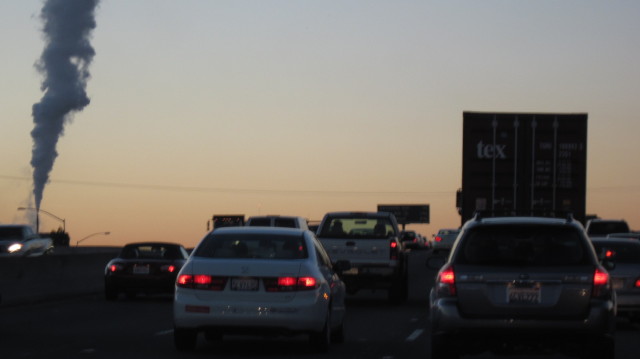
"content": "\u003cp>\u003cstrong>by Angela Hart, \u003ca href=\"http://sfpublicpress.org/\" target=\"_blank\">SF Public Press\u003c/a>\u003c/strong>\u003c/p>\n\u003cp>Bay Area planning officials say efforts to encourage dense development will reduce greenhouse gas emissions from vehicles.\u003c/p>\n\u003cfigure id=\"attachment_103888\" class=\"wp-caption alignright\" style=\"max-width: 300px\">\u003cimg class=\"size-medium wp-image-103888\" src=\"http://ww2.kqed.org/news/wp-content/uploads/sites/10/2013/07/traffic-emissions-1-300x168.jpg\" alt=\"Craig Miller/KQED\" width=\"300\" height=\"168\">\u003cfigcaption class=\"wp-caption-text\">Craig Miller/KQED\u003c/figcaption>\u003c/figure>\n\u003cp>But what they rarely mention publicly is that their goal, a 15 percent per capita reduction of carbon dioxide from cars and light trucks by 2035, actually represents an overall emissions increase.\u003c/p>\n\u003cp>Essentially, it’s a math trick: The per capita figure hides a predicted regional population growth of 28 percent. That means total passenger vehicle emissions regionwide would actually rise by 9.1 percent — an indication that regional planning is not helping California’s efforts to become a model in combating climate change.\u003c/p>\n\u003cp>Senate President Pro Tem Darrell Steinberg said the decision by state regulators to present greenhouse gas emissions on a per-person basis instead of overall contradicts the spirit of his signature climate bill, the Sustainable Communities and Climate Protection Act of 2008.\u003c/p>\n\u003cp>[ad fullwidth]\u003c/p>\n\u003cp>Steinberg said the law was supposed to help reduce carbon emissions by getting people out of their cars. It requires regional agencies to develop ways to limit suburban sprawl and expand public transit in compact transit villages and the urban centers of San Francisco, Oakland and San Jose.\u003c/p>\n\u003cp>“The per capita approach is something that we’re going to have to look at,” Steinberg said. “Ultimately the imperative is to improve the climate and reduce greenhouse gases.” But he did say better regional planning would at least slow the growth of emissions and improve quality of life. \u003c!--more-->Steinberg’s bill was intended to complement Gov. Arnold Schwarzenegger’s vaunted 2006 Global Warming Solutions Act, which calls on the state to reduce greenhouse gas emissions from all sources to 1990 levels by 2020, and more in future decades.\u003c/p>\n\u003cp>Plan Bay Area, the first of 18 regional strategies to help local governments implement climate-friendly “smart growth,” or high-density development close to transit lines, will be finalized in July. Ezra Rapport, executive director of the Association of Bay Area Governments, acknowledged that the plan “is not going to reduce emissions” overall.\u003c/p>\n\u003cp>“But we’re trying to make sure that growth occurs in neighborhoods that have good access to transportation,” he said. “That way we’re part of the solution that reduces greenhouse gas emissions in the future.”\u003c/p>\n\u003cp>\u003cstrong>CONSENSUS CALCULATIONS\u003c/strong>\u003c/p>\n\u003cp>In settling on the per capita metric, state air-quality officials acknowledged that it would not yield as far-reaching results as they originally had hoped for, but that more aggressive goals might not be achievable with current levels of government funding, local zoning laws, existing land ownership patterns and expectations for economic growth.\u003c/p>\n\u003cp>In May 2009, a 19-member panel of volunteer stakeholders convened a roundtable meeting at the headquarters of the California Environmental Protection Agency in Sacramento to review the rules, as the law required.\u003c/p>\n\u003cp>At the table were local elected officials and planners, private groups, including the powerful pro-industry Bay Area Council, and transportation and environmental organizations, including the Natural Resources Defense Council.\u003c/p>\n\u003cp>After nine months of sometimes heated negotiations, the panel unanimously agreed to let regulators track greenhouse gas reductions from cars and light trucks across California, using one of two “relative” measures instead of gauging total annual emissions.\u003c/p>\n\u003cp>The other relative measure they considered for regional emissions reporting was to assess progress against hypothetical “business as usual” scenarios — what economists think might happen over the next 20 years without the policy. That measure, also called the “baseline” projection, is what the California Air Resources Board uses most often in public outreach to claim that pollution from vehicles and light trucks will decline.\u003c/p>\n\u003cp>What they often neglect to say is that total emissions will rise compared with actual, measured emissions. For the state, that means a big difference: comparing the 2035 goal with economists’ business-as-usual estimate, emissions will fall by 9.9 percent. But compared with the actual emissions in 2005, before the climate legislation was passed, emissions will have risen 18.2 percent by 2035.\u003c/p>\n\u003cp>Yet it is the regional “per capita” figures and statewide comparisons with “business as usual” that get repeated year after year in news stories.\u003c/p>\n\u003cp>Both methodologies make it hard to measure progress against the total reductions required by the Global Warming Solutions Act, which uses absolute emissions targets.\u003c/p>\n\u003cp>Allowing emissions to grow in the transportation sector presents a challenge to the state’s overall climate change goals. Other strategies — energy efficiency, alternative fuels, changes in automobile engines and the cap-and-trade carbon market — will have to make steeper cuts to make up the difference.\u003c/p>\n\u003cp>Dave Clegern, a spokesman for the Air Resources Board who works on climate change issues, acknowledged that despite the per capita reductions, the Sustainable Communities Strategy will not prevent an increase in total carbon emissions from passenger vehicles through 2035.\u003c/p>\n\u003cp>“In some parts of the state, greenhouse gases will go up, but you have to look at how much they would go up if it were business as usual, without this law,” Clegern said. “Increases might be 18 percent, but it would have been 40 or 50 percent without the program.”\u003c/p>\n\u003cp>Overall transportation accounts for about 38 percent of statewide emissions, with cars and light trucks making up a smaller slice of the overall pie — 9.5 percent.\u003c/p>\n\u003cp>Clegern said the possible carbon savings from passenger vehicles represented a small “sliver” of the state’s reduction goals. According to the latest Air Resources Board figures, that would be 5 million metric tons of carbon dioxide, out of the total 126 million goal.\u003c/p>\n\u003cp>He noted that the per capita standard allows each part of the state to use uniform measures of progress. Planners from across the state’s 18 regions are looking to the 166-page Plan Bay Area’s goals and methods to set their own policies.\u003c/p>\n\u003cp>\u003cstrong>ECONOMIC PRESSURES\u003c/strong>\u003c/p>\n\u003cp>\u003cimg class=\"alignright size-medium wp-image-103890\" src=\"http://ww2.kqed.org/news/wp-content/uploads/sites/10/2013/07/SFPubPress-logo-300x115.jpg\" alt=\"SFPubPress-logo\" width=\"300\" height=\"115\">Some environmental advocates who participated in the meetings said that persuading business and government leaders to limit the growth of emissions at all was a step forward. Officials emphasized that regional plans must be re-evaluated every four years, so the metric can be revisited.\u003c/p>\n\u003cp>“The most important point is that these are real, meaningful targets,” said Amanda Eaken, deputy director of the Sustainable Communities, Energy and Transportation Program at the Natural Resources Defense Council. “This was the first time that the state has done anything like this. We’re realizing that the greenhouse gas reduction we can achieve is probably greater than we’d originally thought.”\u003c/p>\n\u003cp>The stakeholders at the 2009 meeting in Sacramento agreed that with state population expected to grow by 12.8 million people between 2005 and 2035, overall emissions would have to grow substantially. The Bay Area alone is expected to grow by 2.1 million, to a total of 9 million.\u003c/p>\n\u003cp>State air officials said setting absolute carbon reduction targets could deter economic growth. It should be possible to design cities that can still develop while fighting vehicle emissions, said Daniel Sperling, a member of the Air Resources Board and director of the Institute for Transportation Studies at UC Davis.\u003c/p>\n\u003cp>“We decided that the best metric to measure reductions was per capita because it would not penalize growth,” Sperling said. “Emissions are going to be lower than what they’d otherwise be. It’s a starting point that puts the state on the right trajectory to create a policy framework that’s never existed before.”\u003c/p>\n\u003cp>A final draft of Plan Bay Area was expected to be released in mid-July. A March draft of the plan uses the term “per capita” liberally.\u003c/p>\n\u003cp>The Association of Bay Area Governments and the Metropolitan Transportation Commission, the two agencies leading the process, have published dozens of press releases and newspaper opinion pieces citing the 15 percent per capita goal.\u003c/p>\n\u003cp>But the popular understanding of the plan seems murky — often the “per capita” caveat gets dropped. In late May, a San Jose Mercury News op-ed piece by local environmental and civic activists stated incorrectly: “This regional transportation and land-use plan must reduce greenhouse gases 15 percent by 2035.”\u003c/p>\n\u003cp>\u003cstrong>UNDERFUNDED PLANS\u003c/strong>\u003c/p>\n\u003cp>Elisa Barbour, a planning doctoral student at UC Berkeley, said the problem with Plan Bay Area is that the lack of financial incentives for cities makes the policy weak. Each city controls its own development, so incentives must be available for cities to concentrate development in compact, walkable and transit-friendly neighborhoods. And the regional agencies need the authority to mandate standards for things like environmentally friendly zoning laws, she argued.\u003c/p>\n\u003cp>The 2008 law that set the process in motion, Barbour said, “calls for a more efficient land use and transportation pattern to reduce greenhouse gases. But it’s not clear that the process is actually on track to achieving those goals.”\u003c/p>\n\u003cp>Plan Bay Area sets aside money for cities to help developers build new housing and jobs near BART, Caltrain and local transit lines.\u003c/p>\n\u003cp>“The focus of the plan is transportation and land use, so it’s fair to say that it is a very modest bill in terms of climate change,” said Rebecca Long, a legislative analyst at the Metropolitan Transportation Commission.\u003c/p>\n\u003cp>According to the plan, Bay Area cities and counties will receive $800 million in grant funding through 2016 from the Metropolitan Transportation Commission. Sixty of the region’s 101 cities and all nine counties have applied and are developing 169 “priority development areas,” where growth is supposed to concentrate.\u003c/p>\n\u003cp>Steve Heminger, executive director of the Metropolitan Transportation Commission, said the dissolution of all 400 state redevelopment agencies and recent federal transportation cuts have “crippled” his agency, so there is little money or political power to fully carry out the plan. The agency distributes toll, gas tax and other revenues for transportation projects.\u003c/p>\n\u003cp>“What the law did was require us to adopt a strategy,” Heminger said. “We’ve done that.”\u003c/p>\n\u003cp>Steinberg’s office said the 2008 law must be strengthened. Without real teeth, the senator said, the effort to redesign cities to encourage people to drive less could fail.\u003c/p>\n\u003cp>“Climate change was not only important, it was crucial,” Steinberg said. “We were able to make the transportation and land-use part successful because we had the added element of climate change in the mix.”\u003c/p>\n\u003cp>Regional planners project that the Bay Area will need 660,000 additional homes and 1.1 million more jobs to support the anticipated population growth.\u003c/p>\n\u003cp>Kip Lipper, Steinberg’s chief policy adviser for energy, natural resources and the environment, said more important than reducing greenhouse gases in California is developing effective land-use planning that actually works.\u003c/p>\n\u003cp>[ad floatright]\u003c/p>\n\u003cp>Steinberg said local governments could do a better job of setting bolder goals. “The work is never done,” he said.\u003c/p>\n\n",
"disqusIdentifier": "103764 http://ww2.kqed.org/news/?p=103764",
"disqusUrl": "https://ww2.kqed.org/news/2013/07/16/bay-area-climate-change-plan-wont-actually-reduce-emissions/",
"stats": {
"hasVideo": false,
"hasChartOrMap": false,
"hasAudio": false,
"hasPolis": false,
"wordCount": 1868,
"hasGoogleForm": false,
"hasGallery": false,
"hasHearkenModule": false,
"iframeSrcs": [],
"paragraphCount": 48
},
"modified": 1374078203,
"excerpt": null,
"headData": {
"twImgId": "",
"twTitle": "",
"ogTitle": "",
"ogImgId": "",
"twDescription": "",
"description": "by Angela Hart, SF Public Press Bay Area planning officials say efforts to encourage dense development will reduce greenhouse gas emissions from vehicles. But what they rarely mention publicly is that their goal, a 15 percent per capita reduction of carbon dioxide from cars and light trucks by 2035, actually represents an overall emissions increase.",
"title": "Bay Area Climate Change Plan Won't Actually Reduce Emissions | KQED",
"ogDescription": "",
"schema": {
"@context": "https://schema.org",
"@type": "NewsArticle",
"headline": "Bay Area Climate Change Plan Won't Actually Reduce Emissions",
"datePublished": "2013-07-16T13:08:46-07:00",
"dateModified": "2013-07-17T09:23:23-07:00",
"image": "https://cdn.kqed.org/wp-content/uploads/2020/02/KQED-OG-Image@1x.png",
"isAccessibleForFree": "True",
"publisher": {
"@type": "NewsMediaOrganization",
"@id": "https://www.kqed.org/#organization",
"name": "KQED",
"logo": "https://cdn.kqed.org/wp-content/uploads/2020/02/KQED-OG-Image@1x.png",
"url": "https://www.kqed.org",
"sameAs": [
"https://www.facebook.com/KQED",
"https://twitter.com/KQED",
"https://www.instagram.com/kqed/",
"https://www.tiktok.com/@kqedofficial",
"https://www.linkedin.com/company/kqed",
"https://www.youtube.com/channel/UCeC0IOo7i1P_61zVUWbJ4nw"
]
}
}
},
"guestAuthors": [],
"slug": "bay-area-climate-change-plan-wont-actually-reduce-emissions",
"status": "publish",
"customPermalink": "2013/07/16/103764/",
"path": "/news/103764/bay-area-climate-change-plan-wont-actually-reduce-emissions",
"audioTrackLength": null,
"parsedContent": [
{
"type": "contentString",
"content": "\u003cdiv class=\"post-body\">\u003cp>\u003cp>\u003cstrong>by Angela Hart, \u003ca href=\"http://sfpublicpress.org/\" target=\"_blank\">SF Public Press\u003c/a>\u003c/strong>\u003c/p>\n\u003cp>Bay Area planning officials say efforts to encourage dense development will reduce greenhouse gas emissions from vehicles.\u003c/p>\n\u003cfigure id=\"attachment_103888\" class=\"wp-caption alignright\" style=\"max-width: 300px\">\u003cimg class=\"size-medium wp-image-103888\" src=\"http://ww2.kqed.org/news/wp-content/uploads/sites/10/2013/07/traffic-emissions-1-300x168.jpg\" alt=\"Craig Miller/KQED\" width=\"300\" height=\"168\">\u003cfigcaption class=\"wp-caption-text\">Craig Miller/KQED\u003c/figcaption>\u003c/figure>\n\u003cp>But what they rarely mention publicly is that their goal, a 15 percent per capita reduction of carbon dioxide from cars and light trucks by 2035, actually represents an overall emissions increase.\u003c/p>\n\u003cp>Essentially, it’s a math trick: The per capita figure hides a predicted regional population growth of 28 percent. That means total passenger vehicle emissions regionwide would actually rise by 9.1 percent — an indication that regional planning is not helping California’s efforts to become a model in combating climate change.\u003c/p>\n\u003cp>Senate President Pro Tem Darrell Steinberg said the decision by state regulators to present greenhouse gas emissions on a per-person basis instead of overall contradicts the spirit of his signature climate bill, the Sustainable Communities and Climate Protection Act of 2008.\u003c/p>\n\u003cp>\u003c/p>\u003c/div>",
"attributes": {
"named": {},
"numeric": []
}
},
{
"type": "component",
"content": "",
"name": "ad",
"attributes": {
"named": {
"label": "fullwidth"
},
"numeric": [
"fullwidth"
]
}
},
{
"type": "contentString",
"content": "\u003cdiv class=\"post-body\">\u003cp>\u003c/p>\n\u003cp>Steinberg said the law was supposed to help reduce carbon emissions by getting people out of their cars. It requires regional agencies to develop ways to limit suburban sprawl and expand public transit in compact transit villages and the urban centers of San Francisco, Oakland and San Jose.\u003c/p>\n\u003cp>“The per capita approach is something that we’re going to have to look at,” Steinberg said. “Ultimately the imperative is to improve the climate and reduce greenhouse gases.” But he did say better regional planning would at least slow the growth of emissions and improve quality of life. \u003c!--more-->Steinberg’s bill was intended to complement Gov. Arnold Schwarzenegger’s vaunted 2006 Global Warming Solutions Act, which calls on the state to reduce greenhouse gas emissions from all sources to 1990 levels by 2020, and more in future decades.\u003c/p>\n\u003cp>Plan Bay Area, the first of 18 regional strategies to help local governments implement climate-friendly “smart growth,” or high-density development close to transit lines, will be finalized in July. Ezra Rapport, executive director of the Association of Bay Area Governments, acknowledged that the plan “is not going to reduce emissions” overall.\u003c/p>\n\u003cp>“But we’re trying to make sure that growth occurs in neighborhoods that have good access to transportation,” he said. “That way we’re part of the solution that reduces greenhouse gas emissions in the future.”\u003c/p>\n\u003cp>\u003cstrong>CONSENSUS CALCULATIONS\u003c/strong>\u003c/p>\n\u003cp>In settling on the per capita metric, state air-quality officials acknowledged that it would not yield as far-reaching results as they originally had hoped for, but that more aggressive goals might not be achievable with current levels of government funding, local zoning laws, existing land ownership patterns and expectations for economic growth.\u003c/p>\n\u003cp>In May 2009, a 19-member panel of volunteer stakeholders convened a roundtable meeting at the headquarters of the California Environmental Protection Agency in Sacramento to review the rules, as the law required.\u003c/p>\n\u003cp>At the table were local elected officials and planners, private groups, including the powerful pro-industry Bay Area Council, and transportation and environmental organizations, including the Natural Resources Defense Council.\u003c/p>\n\u003cp>After nine months of sometimes heated negotiations, the panel unanimously agreed to let regulators track greenhouse gas reductions from cars and light trucks across California, using one of two “relative” measures instead of gauging total annual emissions.\u003c/p>\n\u003cp>The other relative measure they considered for regional emissions reporting was to assess progress against hypothetical “business as usual” scenarios — what economists think might happen over the next 20 years without the policy. That measure, also called the “baseline” projection, is what the California Air Resources Board uses most often in public outreach to claim that pollution from vehicles and light trucks will decline.\u003c/p>\n\u003cp>What they often neglect to say is that total emissions will rise compared with actual, measured emissions. For the state, that means a big difference: comparing the 2035 goal with economists’ business-as-usual estimate, emissions will fall by 9.9 percent. But compared with the actual emissions in 2005, before the climate legislation was passed, emissions will have risen 18.2 percent by 2035.\u003c/p>\n\u003cp>Yet it is the regional “per capita” figures and statewide comparisons with “business as usual” that get repeated year after year in news stories.\u003c/p>\n\u003cp>Both methodologies make it hard to measure progress against the total reductions required by the Global Warming Solutions Act, which uses absolute emissions targets.\u003c/p>\n\u003cp>Allowing emissions to grow in the transportation sector presents a challenge to the state’s overall climate change goals. Other strategies — energy efficiency, alternative fuels, changes in automobile engines and the cap-and-trade carbon market — will have to make steeper cuts to make up the difference.\u003c/p>\n\u003cp>Dave Clegern, a spokesman for the Air Resources Board who works on climate change issues, acknowledged that despite the per capita reductions, the Sustainable Communities Strategy will not prevent an increase in total carbon emissions from passenger vehicles through 2035.\u003c/p>\n\u003cp>“In some parts of the state, greenhouse gases will go up, but you have to look at how much they would go up if it were business as usual, without this law,” Clegern said. “Increases might be 18 percent, but it would have been 40 or 50 percent without the program.”\u003c/p>\n\u003cp>Overall transportation accounts for about 38 percent of statewide emissions, with cars and light trucks making up a smaller slice of the overall pie — 9.5 percent.\u003c/p>\n\u003cp>Clegern said the possible carbon savings from passenger vehicles represented a small “sliver” of the state’s reduction goals. According to the latest Air Resources Board figures, that would be 5 million metric tons of carbon dioxide, out of the total 126 million goal.\u003c/p>\n\u003cp>He noted that the per capita standard allows each part of the state to use uniform measures of progress. Planners from across the state’s 18 regions are looking to the 166-page Plan Bay Area’s goals and methods to set their own policies.\u003c/p>\n\u003cp>\u003cstrong>ECONOMIC PRESSURES\u003c/strong>\u003c/p>\n\u003cp>\u003cimg class=\"alignright size-medium wp-image-103890\" src=\"http://ww2.kqed.org/news/wp-content/uploads/sites/10/2013/07/SFPubPress-logo-300x115.jpg\" alt=\"SFPubPress-logo\" width=\"300\" height=\"115\">Some environmental advocates who participated in the meetings said that persuading business and government leaders to limit the growth of emissions at all was a step forward. Officials emphasized that regional plans must be re-evaluated every four years, so the metric can be revisited.\u003c/p>\n\u003cp>“The most important point is that these are real, meaningful targets,” said Amanda Eaken, deputy director of the Sustainable Communities, Energy and Transportation Program at the Natural Resources Defense Council. “This was the first time that the state has done anything like this. We’re realizing that the greenhouse gas reduction we can achieve is probably greater than we’d originally thought.”\u003c/p>\n\u003cp>The stakeholders at the 2009 meeting in Sacramento agreed that with state population expected to grow by 12.8 million people between 2005 and 2035, overall emissions would have to grow substantially. The Bay Area alone is expected to grow by 2.1 million, to a total of 9 million.\u003c/p>\n\u003cp>State air officials said setting absolute carbon reduction targets could deter economic growth. It should be possible to design cities that can still develop while fighting vehicle emissions, said Daniel Sperling, a member of the Air Resources Board and director of the Institute for Transportation Studies at UC Davis.\u003c/p>\n\u003cp>“We decided that the best metric to measure reductions was per capita because it would not penalize growth,” Sperling said. “Emissions are going to be lower than what they’d otherwise be. It’s a starting point that puts the state on the right trajectory to create a policy framework that’s never existed before.”\u003c/p>\n\u003cp>A final draft of Plan Bay Area was expected to be released in mid-July. A March draft of the plan uses the term “per capita” liberally.\u003c/p>\n\u003cp>The Association of Bay Area Governments and the Metropolitan Transportation Commission, the two agencies leading the process, have published dozens of press releases and newspaper opinion pieces citing the 15 percent per capita goal.\u003c/p>\n\u003cp>But the popular understanding of the plan seems murky — often the “per capita” caveat gets dropped. In late May, a San Jose Mercury News op-ed piece by local environmental and civic activists stated incorrectly: “This regional transportation and land-use plan must reduce greenhouse gases 15 percent by 2035.”\u003c/p>\n\u003cp>\u003cstrong>UNDERFUNDED PLANS\u003c/strong>\u003c/p>\n\u003cp>Elisa Barbour, a planning doctoral student at UC Berkeley, said the problem with Plan Bay Area is that the lack of financial incentives for cities makes the policy weak. Each city controls its own development, so incentives must be available for cities to concentrate development in compact, walkable and transit-friendly neighborhoods. And the regional agencies need the authority to mandate standards for things like environmentally friendly zoning laws, she argued.\u003c/p>\n\u003cp>The 2008 law that set the process in motion, Barbour said, “calls for a more efficient land use and transportation pattern to reduce greenhouse gases. But it’s not clear that the process is actually on track to achieving those goals.”\u003c/p>\n\u003cp>Plan Bay Area sets aside money for cities to help developers build new housing and jobs near BART, Caltrain and local transit lines.\u003c/p>\n\u003cp>“The focus of the plan is transportation and land use, so it’s fair to say that it is a very modest bill in terms of climate change,” said Rebecca Long, a legislative analyst at the Metropolitan Transportation Commission.\u003c/p>\n\u003cp>According to the plan, Bay Area cities and counties will receive $800 million in grant funding through 2016 from the Metropolitan Transportation Commission. Sixty of the region’s 101 cities and all nine counties have applied and are developing 169 “priority development areas,” where growth is supposed to concentrate.\u003c/p>\n\u003cp>Steve Heminger, executive director of the Metropolitan Transportation Commission, said the dissolution of all 400 state redevelopment agencies and recent federal transportation cuts have “crippled” his agency, so there is little money or political power to fully carry out the plan. The agency distributes toll, gas tax and other revenues for transportation projects.\u003c/p>\n\u003cp>“What the law did was require us to adopt a strategy,” Heminger said. “We’ve done that.”\u003c/p>\n\u003cp>Steinberg’s office said the 2008 law must be strengthened. Without real teeth, the senator said, the effort to redesign cities to encourage people to drive less could fail.\u003c/p>\n\u003cp>“Climate change was not only important, it was crucial,” Steinberg said. “We were able to make the transportation and land-use part successful because we had the added element of climate change in the mix.”\u003c/p>\n\u003cp>Regional planners project that the Bay Area will need 660,000 additional homes and 1.1 million more jobs to support the anticipated population growth.\u003c/p>\n\u003cp>Kip Lipper, Steinberg’s chief policy adviser for energy, natural resources and the environment, said more important than reducing greenhouse gases in California is developing effective land-use planning that actually works.\u003c/p>\n\u003cp>\u003c/p>\u003c/div>",
"attributes": {
"named": {},
"numeric": []
}
},
{
"type": "component",
"content": "",
"name": "ad",
"attributes": {
"named": {
"label": "floatright"
},
"numeric": [
"floatright"
]
}
},
{
"type": "contentString",
"content": "\u003cdiv class=\"post-body\">\u003cp>\u003c/p>\n\u003cp>Steinberg said local governments could do a better job of setting bolder goals. “The work is never done,” he said.\u003c/p>\n\n\u003c/div>\u003c/p>",
"attributes": {
"named": {},
"numeric": []
}
}
],
"link": "/news/103764/bay-area-climate-change-plan-wont-actually-reduce-emissions",
"authors": [
"236"
],
"programs": [
"news_6944"
],
"categories": [
"news_19906",
"news_356"
],
"tags": [
"news_255"
],
"featImg": "news_103888",
"label": "news_6944"
},
"news_101091": {
"type": "posts",
"id": "news_101091",
"meta": {
"index": "posts_1716263798",
"site": "news",
"id": "101091",
"score": null,
"sort": [
1372181759000
]
},
"guestAuthors": [],
"slug": "watch-live-obama-climate-change-speech-1055-a-m",
"title": "Obama Announces Climate Change Plan",
"publishDate": 1372181759,
"format": "aside",
"headTitle": "Obama Announces Climate Change Plan | KQED",
"labelTerm": {
"term": 6944,
"site": "news"
},
"content": "\u003cp>WASHINGTON (AP) — President Barack Obama declared the debate over climate change and its causes obsolete Tuesday as he announced a wide-ranging plan to tackle pollution and prepare communities for global warming.\u003c/p>\n\u003cfigure id=\"attachment_101117\" class=\"wp-caption alignleft\" style=\"max-width: 320px\">\u003ca href=\"http://ww2.kqed.org/news/wp-content/uploads/sites/10/2013/06/Keystone1.jpg\">\u003cimg loading=\"lazy\" decoding=\"async\" class=\"size-full wp-image-101117\" src=\"http://ww2.kqed.org/news/wp-content/uploads/sites/10/2013/06/Keystone1.jpg\" alt=\"Nurses attending the National Nurses United conference took to the Golden Gate Bridge on June 20 to protest the Keystone XL Pipeline. from going forward. (Deborah Svoboda / KQED)\" width=\"320\" height=\"225\">\u003c/a>\u003cfigcaption class=\"wp-caption-text\">Nurses attending the National Nurses United conference took to the Golden Gate Bridge on June 20 to protest the Keystone XL Pipeline. from going forward. (Deborah Svoboda / KQED)\u003c/figcaption>\u003c/figure>\n\u003cp>In a major speech at Georgetown University, Obama warned Americans of the deep and disastrous effects of climate change, urging them to take action before it’s too late.\u003c/p>\n\u003cp>“As a president, as a father and as an American, I’m here to say we need to act,” Obama said.\u003c/p>\n\u003cp>Obama announced he was directing his administration to launch the first-ever federal regulations on heat-trapping gases emitted by new and existing power plants — “to put an end to the limitless dumping of carbon pollution.”\u003c/p>\n\u003cp>Other aspects of the plan will boost renewable energy production on federal lands, increase efficiency standards and prepare communities to deal with higher temperatures.\u003c/p>\n\u003cp>[ad fullwidth]\u003c/p>\n\u003cp>Even before Obama unveiled his plan Tuesday, Republican critics in Congress were lambasting it as a job-killer that would threaten the economic recovery. Obama dismissed those critics, noting the same arguments have been used in the past when the U.S. has taken other steps to protect the environment. \u003c!--more-->\u003c/p>\n\u003cp>“That’s what they said every time,” Obama said. “And every time, they’ve been wrong.”\u003c/p>\n\u003caside class=\"pullquote alignleft\">\u003ca href=\"http://www.salon.com/2013/06/25/did_obama_just_kill_keystone_xl/singleton/\" target=\"_blank\" rel=\"noopener\">Did Obama just kill Keystone XL?\u003c/a> (Salon)\u003c/aside>\n\u003cp>He touted America’s strengths — research, technology and innovation — as factors that make the U.S. uniquely poised to take on the challenges of global warming.\u003c/p>\n\u003cp>Obama also offered a rare insight into his administration’s deliberations on Keystone XL, an oil pipeline whose potential approval has sparked an intense fight between environmental activists and energy producers.\u003c/p>\n\u003cp>The White House has insisted the State Department is making the decision independently, but Obama said Tuesday he’s instructing the department to approve it only if the project won’t increase overall, net emissions of greenhouse gases.\u003c/p>\n\u003cp>“Allowing the Keystone pipeline to be built requires a finding that doing so would be in our nation’s interests,” Obama said. “Our national interest would be served only if this project does not significantly exacerbate the problem of carbon pollution.”\u003c/p>\n\u003cp>\u003c!--more-->\u003c/p>\n\u003cp>KQED Science live-tweeted the event …\u003c/p>\n\u003cp>\u003ciframe loading=\"lazy\" style=\"border: 1px solid #000\" src=\"http://embed.scribblelive.com/Embed/v5.aspx?Id=132135&ThemeId=6104\" frameborder=\"0\" width=\"640\" height=\"700\">\u003c/iframe>\u003c/p>\n\u003cp> \u003c/p>\n\u003cp>From the White House, here is the President’s Climate Action Plan …\u003c/p>\n\u003cp style=\"margin: 12px auto 6px auto;font-family: Helvetica,Arial,Sans-serif;font-style: normal;font-variant: normal;font-weight: normal;font-size: 14px;line-height: normal\">\u003ca title=\"View President’s Climate Action Plan on Scribd\" href=\"http://www.scribd.com/doc/149882710\">President’s Climate Action Plan\u003c/a>\u003c/p>\n\u003cp>\u003c/p>\n\u003cp>\u003ciframe loading=\"lazy\" src=\"http://www.scribd.com/embeds/149882710/content?start_page=1&view_mode=scroll&show_recommendations=true\" frameborder=\"0\" scrolling=\"no\" width=\"100%\" height=\"600\">\u003c/iframe>\u003c/p>\n\n",
"blocks": [],
"excerpt": null,
"status": "publish",
"parent": 0,
"modified": 1726003591,
"stats": {
"hasAudio": false,
"hasVideo": false,
"hasChartOrMap": true,
"iframeSrcs": [
"http://embed.scribblelive.com/Embed/v5.aspx",
"http://www.scribd.com/embeds/149882710/content"
],
"hasGoogleForm": false,
"hasGallery": false,
"hasHearkenModule": false,
"hasPolis": false,
"paragraphCount": 18,
"wordCount": 434
},
"headData": {
"title": "Obama Announces Climate Change Plan | KQED",
"description": "WASHINGTON (AP) — President Barack Obama declared the debate over climate change and its causes obsolete Tuesday as he announced a wide-ranging plan to tackle pollution and prepare communities for global warming. In a major speech at Georgetown University, Obama warned Americans of the deep and disastrous effects of climate change, urging them to take action before it’s too late. “As a president, as a father and as an American, I’m here to say we need to act,” Obama said. Obama announced he was directing his administration to launch the first-ever federal regulations on heat-trapping gases emitted by new and",
"ogTitle": "",
"ogDescription": "",
"ogImgId": "",
"twTitle": "",
"twDescription": "",
"twImgId": "",
"schema": {
"@context": "https://schema.org",
"@type": "NewsArticle",
"headline": "Obama Announces Climate Change Plan",
"datePublished": "2013-06-25T10:35:59-07:00",
"dateModified": "2024-09-10T14:26:31-07:00",
"image": "https://cdn.kqed.org/wp-content/uploads/2020/02/KQED-OG-Image@1x.png",
"isAccessibleForFree": "True",
"publisher": {
"@type": "NewsMediaOrganization",
"@id": "https://www.kqed.org/#organization",
"name": "KQED",
"logo": "https://cdn.kqed.org/wp-content/uploads/2020/02/KQED-OG-Image@1x.png",
"url": "https://www.kqed.org",
"sameAs": [
"https://www.facebook.com/KQED",
"https://twitter.com/KQED",
"https://www.instagram.com/kqed/",
"https://www.tiktok.com/@kqedofficial",
"https://www.linkedin.com/company/kqed",
"https://www.youtube.com/channel/UCeC0IOo7i1P_61zVUWbJ4nw"
]
}
}
},
"sticky": false,
"customPermalink": "2013/06/25/obama-climate-change-speech-live/",
"path": "/news/101091/watch-live-obama-climate-change-speech-1055-a-m",
"audioTrackLength": null,
"parsedContent": [
{
"type": "contentString",
"content": "\u003cdiv class=\"post-body\">\u003cp>\u003cp>WASHINGTON (AP) — President Barack Obama declared the debate over climate change and its causes obsolete Tuesday as he announced a wide-ranging plan to tackle pollution and prepare communities for global warming.\u003c/p>\n\u003cfigure id=\"attachment_101117\" class=\"wp-caption alignleft\" style=\"max-width: 320px\">\u003ca href=\"http://ww2.kqed.org/news/wp-content/uploads/sites/10/2013/06/Keystone1.jpg\">\u003cimg loading=\"lazy\" decoding=\"async\" class=\"size-full wp-image-101117\" src=\"http://ww2.kqed.org/news/wp-content/uploads/sites/10/2013/06/Keystone1.jpg\" alt=\"Nurses attending the National Nurses United conference took to the Golden Gate Bridge on June 20 to protest the Keystone XL Pipeline. from going forward. (Deborah Svoboda / KQED)\" width=\"320\" height=\"225\">\u003c/a>\u003cfigcaption class=\"wp-caption-text\">Nurses attending the National Nurses United conference took to the Golden Gate Bridge on June 20 to protest the Keystone XL Pipeline. from going forward. (Deborah Svoboda / KQED)\u003c/figcaption>\u003c/figure>\n\u003cp>In a major speech at Georgetown University, Obama warned Americans of the deep and disastrous effects of climate change, urging them to take action before it’s too late.\u003c/p>\n\u003cp>“As a president, as a father and as an American, I’m here to say we need to act,” Obama said.\u003c/p>\n\u003cp>Obama announced he was directing his administration to launch the first-ever federal regulations on heat-trapping gases emitted by new and existing power plants — “to put an end to the limitless dumping of carbon pollution.”\u003c/p>\n\u003cp>Other aspects of the plan will boost renewable energy production on federal lands, increase efficiency standards and prepare communities to deal with higher temperatures.\u003c/p>\n\u003cp>\u003c/p>\u003c/div>",
"attributes": {
"named": {},
"numeric": []
}
},
{
"type": "component",
"content": "",
"name": "ad",
"attributes": {
"named": {
"label": "fullwidth"
},
"numeric": [
"fullwidth"
]
}
},
{
"type": "contentString",
"content": "\u003cdiv class=\"post-body\">\u003cp>\u003c/p>\n\u003cp>Even before Obama unveiled his plan Tuesday, Republican critics in Congress were lambasting it as a job-killer that would threaten the economic recovery. Obama dismissed those critics, noting the same arguments have been used in the past when the U.S. has taken other steps to protect the environment. \u003c!--more-->\u003c/p>\n\u003cp>“That’s what they said every time,” Obama said. “And every time, they’ve been wrong.”\u003c/p>\n\u003caside class=\"pullquote alignleft\">\u003ca href=\"http://www.salon.com/2013/06/25/did_obama_just_kill_keystone_xl/singleton/\" target=\"_blank\" rel=\"noopener\">Did Obama just kill Keystone XL?\u003c/a> (Salon)\u003c/aside>\n\u003cp>He touted America’s strengths — research, technology and innovation — as factors that make the U.S. uniquely poised to take on the challenges of global warming.\u003c/p>\n\u003cp>Obama also offered a rare insight into his administration’s deliberations on Keystone XL, an oil pipeline whose potential approval has sparked an intense fight between environmental activists and energy producers.\u003c/p>\n\u003cp>The White House has insisted the State Department is making the decision independently, but Obama said Tuesday he’s instructing the department to approve it only if the project won’t increase overall, net emissions of greenhouse gases.\u003c/p>\n\u003cp>“Allowing the Keystone pipeline to be built requires a finding that doing so would be in our nation’s interests,” Obama said. “Our national interest would be served only if this project does not significantly exacerbate the problem of carbon pollution.”\u003c/p>\n\u003cp>\u003c!--more-->\u003c/p>\n\u003cp>KQED Science live-tweeted the event …\u003c/p>\n\u003cp>\u003ciframe loading=\"lazy\" style=\"border: 1px solid #000\" src=\"http://embed.scribblelive.com/Embed/v5.aspx?Id=132135&ThemeId=6104\" frameborder=\"0\" width=\"640\" height=\"700\">\u003c/iframe>\u003c/p>\n\u003cp> \u003c/p>\n\u003cp>From the White House, here is the President’s Climate Action Plan …\u003c/p>\n\u003cp style=\"margin: 12px auto 6px auto;font-family: Helvetica,Arial,Sans-serif;font-style: normal;font-variant: normal;font-weight: normal;font-size: 14px;line-height: normal\">\u003ca title=\"View President’s Climate Action Plan on Scribd\" href=\"http://www.scribd.com/doc/149882710\">President’s Climate Action Plan\u003c/a>\u003c/p>\n\u003cp>\u003c/p>\n\u003cp>\u003ciframe loading=\"lazy\" src=\"http://www.scribd.com/embeds/149882710/content?start_page=1&view_mode=scroll&show_recommendations=true\" frameborder=\"0\" scrolling=\"no\" width=\"100%\" height=\"600\">\u003c/iframe>\u003c/p>\n\n\u003c/div>\u003c/p>",
"attributes": {
"named": {},
"numeric": []
}
}
],
"link": "/news/101091/watch-live-obama-climate-change-speech-1055-a-m",
"authors": [
"237"
],
"programs": [
"news_6944"
],
"categories": [
"news_34165",
"news_19906",
"news_8"
],
"tags": [
"news_335",
"news_255"
],
"featImg": "news_101117",
"label": "news_6944"
},
"news_98015": {
"type": "posts",
"id": "news_98015",
"meta": {
"index": "posts_1716263798",
"site": "news",
"id": "98015",
"score": null,
"sort": [
1369409620000
]
},
"guestAuthors": [],
"slug": "browns-budget-move-has-green-groups-seeing-red",
"title": "Governor's Budget Move on Cap-and-Trade Angers Environmentalists",
"publishDate": 1369409620,
"format": "aside",
"headTitle": "Governor’s Budget Move on Cap-and-Trade Angers Environmentalists | KQED",
"labelTerm": {
"term": 6944,
"site": "news"
},
"content": "\u003cp>Governor Jerry Brown has spent a lot of energy focusing on the dangers of climate change lately. Speaking to a group of scientists Thursday,\u003ca href=\"http://www.mercurynews.com/california-budget/ci_23309303/enviromentalists-question-whether-gov-jerry-browns-actions-match\"> he warned, “it’s over” in five years\u003c/a>, unless the world steps up efforts to reduce the carbon dioxide emissions that are warming the atmosphere.\u003c/p>\n\u003cfigure id=\"attachment_98022\" class=\"wp-caption alignleft\" style=\"max-width: 300px\">\u003cimg loading=\"lazy\" decoding=\"async\" class=\"size-medium wp-image-98022\" src=\"http://ww2.kqed.org/news/wp-content/uploads/sites/10/2013/05/captradepic-300x225.jpg\" alt=\"Craig Miller/KQED\" width=\"300\" height=\"225\">\u003cfigcaption class=\"wp-caption-text\">Craig Miller/KQED\u003c/figcaption>\u003c/figure>\n\u003cp>But while Brown is preaching action on climate change, his \u003ca href=\"http://www.californiareport.org/archive/R201305240850/b\">proposal\u003c/a> to shift revenue from California’s cap-and-trade auctions has environmental groups seeing red.\u003c/p>\n\u003cp>California is the first state to try and limit greenhouse gas emissions \u003ca href=\"http://science.kqed.org/quest/audio/cap-and-trade-101-how-californias-carbon-market-works/\">through a cap-and-trade system\u003c/a>. The state Air Resources Board has held three carbon allowance auctions so far, generating nearly $260 million in state revenue. By law, that money is supposed to go toward programs aimed at reducing greenhouse gases and improving the air. A portion of the revenue is also supposed to be funneled to poorer, heavily-polluted communities.\u003c/p>\n\u003cp>\u003c!--more-->\u003c/p>\n\u003cp>But the Brown Administration says the state needs more time to design and develop these efforts, so the governor’s revised budget proposes taking all the revenue and loaning it to the general fund, which pays for broader government spending. That would essentially delay any spending on the emission-lowering programs for at least another year.\u003c/p>\n\u003cp>[ad fullwidth]\u003c/p>\n\u003cp>Mari Rose Taruc, the state organizing director for the Asian Pacific Environmental Network, said she was, “shocked and upset” when she got the news. “[The programs are] ready. AB 32 has been on the books for seven years now. Of course there are programs that are ready.”\u003c/p>\n\u003cp>Taruc’s group is one of several that has been meeting with the state to put together a plan on how to spend the cap-and-trade revenue. The Greenlining Institute, another environmental justice group, was also in those meetings. Legal council Ryan Young said the suggestions include, “low-income solar programs, increased access to transit, affordable transit-oriented development, as well as community greening, like urban forestry.”\u003c/p>\n\u003cfigure id=\"attachment_69484\" class=\"wp-caption alignright\" style=\"max-width: 300px\">\u003ca href=\"http://ww2.kqed.org/news/2012/07/03/gov-jerry-brown-asks-for-more-time-on-ca-pensions/jerry-brown-7/\" rel=\"attachment wp-att-69484\">\u003cimg loading=\"lazy\" decoding=\"async\" class=\"size-full wp-image-69484 \" src=\"http://ww2.kqed.org/news/wp-content/uploads/sites/10/2012/07/jerry-brown.jpg\" alt=\"jerry-brown\" width=\"300\" height=\"300\">\u003c/a>\u003cfigcaption class=\"wp-caption-text\">Gov. Jerry Brown (Max Whittaker/Getty Images)\u003c/figcaption>\u003c/figure>\n\u003cp>Those suggestions are all listed in the state’s \u003ca href=\"http://www.arb.ca.gov/cc/capandtrade/auctionproceeds/final_investment_plan.pdf\">new cap-and-trade investment plan\u003c/a>. But Air Resources Board spokesman Dave Clegern said the blueprint needs improvement. “We have a variety of options for spending money. It’s a pot of money, so there are a lot of people who want a piece of it,” he said, adding, “we want to make sure that money goes where it will have the biggest impact on the programs and the goals of AB 32, which is greenhouse gas emission reduction.”\u003c/p>\n\u003cp>Technically, by loaning the cap-and-trade money to the general fund, the state would still be complying with the requirements on how to spend it, since the money would eventually go toward those efforts when it’s repaid.\u003c/p>\n\u003cp>The state loans money from one fund to another all the time. But usually, the government is borrowing from special funds that are running a surplus so the loan doesn’t interfere with the fund’s main goal. Jason Sisney of the Legislative Analysts’ Office called the cap-and-trade proposal “unusual.”\u003c/p>\n\u003cp>‘The cap-and-trade auction revenues are a new source,” he explained. “ And the governor’s plan, as I understand it, is to borrow all of those monies, for at least the next year.” In fact, the $500 million Brown wants to borrow is about twice as much money as the auctions have raised so far.\u003c/p>\n\u003cp>Meanwhile, the LAO warns that delaying the environmental spending may interfere with the goal of reducing greenhouse gases to 1990 levels by 2020. But Clegern insisted that won’t be a problem. “The goal here is to reduce greenhouse gas emissions,” he said. “We will do that. The proceeds give us an extra tool with which to further that effort.”\u003c/p>\n\u003cp>Under California’s plan, the cap-and-trade system only accounts for about 20 percent of those emissions reductions. The rest are supposed to come from energy efficiency projects, better fuel standards, and more renewable energy.\u003c/p>\n\u003cp>\u003c/p>\n\u003cp>The ground has shifted since Brown announced his budget last week. \u003ca href=\"http://www.lao.ca.gov/reports/2013/bud/may-revise/overview-may-revise-051713.pdf\">The LAO says the governor’s tax estimates are too low\u003c/a>, and predicts the state will take in about $3 billion more than the administration is estimating. Environmental groups argue that extra revenue takes away the governor’s justification for delaying the cap-and-trade spending.\u003cbr>\n\u003ciframe loading=\"lazy\" src=\"https://w.soundcloud.com/player/?url=http%3A%2F%2Fapi.soundcloud.com%2Ftracks%2F93709613\" frameborder=\"no\" scrolling=\"no\" width=\"100%\" height=\"166\">\u003c/iframe>\u003c/p>\n\n",
"blocks": [],
"excerpt": null,
"status": "publish",
"parent": 0,
"modified": 1726003595,
"stats": {
"hasAudio": true,
"hasVideo": false,
"hasChartOrMap": false,
"iframeSrcs": [],
"hasGoogleForm": false,
"hasGallery": false,
"hasHearkenModule": false,
"hasPolis": false,
"paragraphCount": 16,
"wordCount": 760
},
"headData": {
"title": "Governor's Budget Move on Cap-and-Trade Angers Environmentalists | KQED",
"description": "Governor Jerry Brown has spent a lot of energy focusing on the dangers of climate change lately. Speaking to a group of scientists Thursday, he warned, “it's over" in five years, unless the world steps up efforts to reduce the carbon dioxide emissions that are warming the atmosphere. But while Brown is preaching action on climate change, his proposal to shift revenue from California’s cap-and-trade auctions has environmental groups seeing red. California is the first state to try and limit greenhouse gas emissions through a cap-and-trade system. The state Air Resources Board has held three carbon allowance auctions so far,",
"ogTitle": "",
"ogDescription": "",
"ogImgId": "",
"twTitle": "",
"twDescription": "",
"twImgId": "",
"schema": {
"@context": "https://schema.org",
"@type": "NewsArticle",
"headline": "Governor's Budget Move on Cap-and-Trade Angers Environmentalists",
"datePublished": "2013-05-24T08:33:40-07:00",
"dateModified": "2024-09-10T14:26:35-07:00",
"image": "https://cdn.kqed.org/wp-content/uploads/2020/02/KQED-OG-Image@1x.png",
"isAccessibleForFree": "True",
"publisher": {
"@type": "NewsMediaOrganization",
"@id": "https://www.kqed.org/#organization",
"name": "KQED",
"logo": "https://cdn.kqed.org/wp-content/uploads/2020/02/KQED-OG-Image@1x.png",
"url": "https://www.kqed.org",
"sameAs": [
"https://www.facebook.com/KQED",
"https://twitter.com/KQED",
"https://www.instagram.com/kqed/",
"https://www.tiktok.com/@kqedofficial",
"https://www.linkedin.com/company/kqed",
"https://www.youtube.com/channel/UCeC0IOo7i1P_61zVUWbJ4nw"
]
}
}
},
"sticky": false,
"customPermalink": "2013/05/23/98015/",
"path": "/news/98015/browns-budget-move-has-green-groups-seeing-red",
"audioTrackLength": null,
"parsedContent": [
{
"type": "contentString",
"content": "\u003cdiv class=\"post-body\">\u003cp>\u003cp>Governor Jerry Brown has spent a lot of energy focusing on the dangers of climate change lately. Speaking to a group of scientists Thursday,\u003ca href=\"http://www.mercurynews.com/california-budget/ci_23309303/enviromentalists-question-whether-gov-jerry-browns-actions-match\"> he warned, “it’s over” in five years\u003c/a>, unless the world steps up efforts to reduce the carbon dioxide emissions that are warming the atmosphere.\u003c/p>\n\u003cfigure id=\"attachment_98022\" class=\"wp-caption alignleft\" style=\"max-width: 300px\">\u003cimg loading=\"lazy\" decoding=\"async\" class=\"size-medium wp-image-98022\" src=\"http://ww2.kqed.org/news/wp-content/uploads/sites/10/2013/05/captradepic-300x225.jpg\" alt=\"Craig Miller/KQED\" width=\"300\" height=\"225\">\u003cfigcaption class=\"wp-caption-text\">Craig Miller/KQED\u003c/figcaption>\u003c/figure>\n\u003cp>But while Brown is preaching action on climate change, his \u003ca href=\"http://www.californiareport.org/archive/R201305240850/b\">proposal\u003c/a> to shift revenue from California’s cap-and-trade auctions has environmental groups seeing red.\u003c/p>\n\u003cp>California is the first state to try and limit greenhouse gas emissions \u003ca href=\"http://science.kqed.org/quest/audio/cap-and-trade-101-how-californias-carbon-market-works/\">through a cap-and-trade system\u003c/a>. The state Air Resources Board has held three carbon allowance auctions so far, generating nearly $260 million in state revenue. By law, that money is supposed to go toward programs aimed at reducing greenhouse gases and improving the air. A portion of the revenue is also supposed to be funneled to poorer, heavily-polluted communities.\u003c/p>\n\u003cp>\u003c!--more-->\u003c/p>\n\u003cp>But the Brown Administration says the state needs more time to design and develop these efforts, so the governor’s revised budget proposes taking all the revenue and loaning it to the general fund, which pays for broader government spending. That would essentially delay any spending on the emission-lowering programs for at least another year.\u003c/p>\n\u003cp>\u003c/p>\u003c/div>",
"attributes": {
"named": {},
"numeric": []
}
},
{
"type": "component",
"content": "",
"name": "ad",
"attributes": {
"named": {
"label": "fullwidth"
},
"numeric": [
"fullwidth"
]
}
},
{
"type": "contentString",
"content": "\u003cdiv class=\"post-body\">\u003cp>\u003c/p>\n\u003cp>Mari Rose Taruc, the state organizing director for the Asian Pacific Environmental Network, said she was, “shocked and upset” when she got the news. “[The programs are] ready. AB 32 has been on the books for seven years now. Of course there are programs that are ready.”\u003c/p>\n\u003cp>Taruc’s group is one of several that has been meeting with the state to put together a plan on how to spend the cap-and-trade revenue. The Greenlining Institute, another environmental justice group, was also in those meetings. Legal council Ryan Young said the suggestions include, “low-income solar programs, increased access to transit, affordable transit-oriented development, as well as community greening, like urban forestry.”\u003c/p>\n\u003cfigure id=\"attachment_69484\" class=\"wp-caption alignright\" style=\"max-width: 300px\">\u003ca href=\"http://ww2.kqed.org/news/2012/07/03/gov-jerry-brown-asks-for-more-time-on-ca-pensions/jerry-brown-7/\" rel=\"attachment wp-att-69484\">\u003cimg loading=\"lazy\" decoding=\"async\" class=\"size-full wp-image-69484 \" src=\"http://ww2.kqed.org/news/wp-content/uploads/sites/10/2012/07/jerry-brown.jpg\" alt=\"jerry-brown\" width=\"300\" height=\"300\">\u003c/a>\u003cfigcaption class=\"wp-caption-text\">Gov. Jerry Brown (Max Whittaker/Getty Images)\u003c/figcaption>\u003c/figure>\n\u003cp>Those suggestions are all listed in the state’s \u003ca href=\"http://www.arb.ca.gov/cc/capandtrade/auctionproceeds/final_investment_plan.pdf\">new cap-and-trade investment plan\u003c/a>. But Air Resources Board spokesman Dave Clegern said the blueprint needs improvement. “We have a variety of options for spending money. It’s a pot of money, so there are a lot of people who want a piece of it,” he said, adding, “we want to make sure that money goes where it will have the biggest impact on the programs and the goals of AB 32, which is greenhouse gas emission reduction.”\u003c/p>\n\u003cp>Technically, by loaning the cap-and-trade money to the general fund, the state would still be complying with the requirements on how to spend it, since the money would eventually go toward those efforts when it’s repaid.\u003c/p>\n\u003cp>The state loans money from one fund to another all the time. But usually, the government is borrowing from special funds that are running a surplus so the loan doesn’t interfere with the fund’s main goal. Jason Sisney of the Legislative Analysts’ Office called the cap-and-trade proposal “unusual.”\u003c/p>\n\u003cp>‘The cap-and-trade auction revenues are a new source,” he explained. “ And the governor’s plan, as I understand it, is to borrow all of those monies, for at least the next year.” In fact, the $500 million Brown wants to borrow is about twice as much money as the auctions have raised so far.\u003c/p>\n\u003cp>Meanwhile, the LAO warns that delaying the environmental spending may interfere with the goal of reducing greenhouse gases to 1990 levels by 2020. But Clegern insisted that won’t be a problem. “The goal here is to reduce greenhouse gas emissions,” he said. “We will do that. The proceeds give us an extra tool with which to further that effort.”\u003c/p>\n\u003cp>Under California’s plan, the cap-and-trade system only accounts for about 20 percent of those emissions reductions. The rest are supposed to come from energy efficiency projects, better fuel standards, and more renewable energy.\u003c/p>\n\u003cp>\u003c/p>\n\u003cp>The ground has shifted since Brown announced his budget last week. \u003ca href=\"http://www.lao.ca.gov/reports/2013/bud/may-revise/overview-may-revise-051713.pdf\">The LAO says the governor’s tax estimates are too low\u003c/a>, and predicts the state will take in about $3 billion more than the administration is estimating. Environmental groups argue that extra revenue takes away the governor’s justification for delaying the cap-and-trade spending.\u003cbr>\n\u003ciframe loading=\"lazy\" src=\"https://w.soundcloud.com/player/?url=http%3A%2F%2Fapi.soundcloud.com%2Ftracks%2F93709613\" frameborder=\"no\" scrolling=\"no\" width=\"100%\" height=\"166\">\u003c/iframe>\u003c/p>\n\n\u003c/div>\u003c/p>",
"attributes": {
"named": {},
"numeric": []
}
}
],
"link": "/news/98015/browns-budget-move-has-green-groups-seeing-red",
"authors": [
"256"
],
"programs": [
"news_6944"
],
"categories": [
"news_34165",
"news_19906",
"news_13"
],
"tags": [
"news_402",
"news_782",
"news_255",
"news_30",
"news_70"
],
"label": "news_6944"
},
"news_94396": {
"type": "posts",
"id": "news_94396",
"meta": {
"index": "posts_1716263798",
"site": "news",
"id": "94396",
"score": null,
"sort": [
1366143566000
]
},
"guestAuthors": [],
"slug": "new-lawsuit-opposes-californias-cap-and-trade-carbon-market",
"title": "New Lawsuit Opposes California's Cap-and-Trade Carbon Market",
"publishDate": 1366143566,
"format": "aside",
"headTitle": "New Lawsuit Opposes California’s Cap-and-Trade Carbon Market | KQED",
"labelTerm": {
"term": 6944,
"site": "news"
},
"content": "\u003cp>California’s quest to reduce global warming hit another obstacle on Tuesday. A conservative legal group filed suit to block California’s new cap-and-trade carbon market.\u003c/p>\n\u003cfigure id=\"attachment_62854\" class=\"wp-caption alignleft\" style=\"max-width: 300px\">\u003ca href=\"http://ww2.kqed.org/news/2012/04/20/report-finds-fewer-unhealthy-air-days-in-california/smokestack/\" rel=\"attachment wp-att-62854\">\u003cimg loading=\"lazy\" decoding=\"async\" class=\"size-medium wp-image-62854\" src=\"http://ww2.kqed.org/news/wp-content/uploads/sites/10/2012/04/smokestack-300x224.jpg\" alt=\"(Craig Miller/Climate Watch)\" width=\"300\" height=\"224\">\u003c/a>\u003cfigcaption class=\"wp-caption-text\">(Craig Miller/Climate Watch) \u003ccite>(Craig Miller/KQED)\u003c/cite>\u003c/figcaption>\u003c/figure>\n\u003cp>The Pacific Legal Foundation alleged that the market’s charge for carbon emissions violates California law because it constitutes a tax, and taxes in California require approval by a two-third majority in both houses of the state Legislature.\u003c/p>\n\u003cp>“California’s cap and trade regulation was developed and is being implemented in full accord with all state laws,” Dave Clegern of the California Air Resources Board (abbreviated as both CARB and ARB) said in an email response to the lawsuit. “ARB will continue moving forward with this important program to fight climate change and develop a clean energy future for California.”\u003c/p>\n\u003cp>The cap-and-trade market is the centerpiece of California’s effort to reduce emissions of gases that cause global warming. It launched Nov. 14.\u003c/p>\n\u003cp>Cap and trade functions like a stock exchange for greenhouse gas emissions . Businesses, including oil refiners and manufacturers, have to buy permits for each ton of carbon they emit and can then resell these permits.\u003c/p>\n\u003cp>[ad fullwidth]\u003c/p>\n\u003cp>The California Chamber of Commerce has \u003ca href=\"http://ww2.kqed.org/news/2012/11/13/calif-chamber-of-commerce-sues-to-invalidate-cap-and-trade-auctions/\">also sued \u003c/a>to block the cap-and-trade program.\u003c/p>\n\u003cp>Both lawsuits challenge the way \u003ca href=\"http://www.arb.ca.gov/cc/ab32/ab32.htm\">the law\u003c/a> behind the program is being implemented.\u003c/p>\n\u003cp>They say ARB had no authority to auction off carbon allowances, raising billions of dollars for the state.\u003c/p>\n\u003cp>“PLF’s lawsuit holds CARB’s feet to the fire because CARB cannot be allowed to siphon billions of dollars from California taxpayers in violation of the California Constitution,” said Ted Hadzi-Antich, a lawyer for the foundation, in a press release. “CARB must obey the law, just as the rest of us are required to do.”\u003c/p>\n\u003cp>Based in Sacramento, the \u003ca href=\"www.pacificlegal.or\">Pacific Legal Foundation\u003c/a> frequently challenges government regulations. For example, it sought to remove wildlife from endangered species lists.\u003c/p>\n\u003cp style=\"margin: 12px auto 6px auto;font-family: Helvetica,Arial,Sans-serif;font-style: normal;font-variant: normal;font-weight: normal;font-size: 14px;line-height: normal\">\u003ca title=\"View Pacific Legal Foundation Lawsuit Against California's Cap and Trade on Scribd\" href=\"http://www.scribd.com/doc/136323644/Pacific-Legal-Foundation-Lawsuit-Against-California-s-Cap-and-Trade\">Pacific Legal Foundation Lawsuit Against California’s Cap and Trade\u003c/a>\u003c/p>\n\u003cp>\u003c/p>\n\u003cp>\u003ciframe loading=\"lazy\" src=\"http://www.scribd.com/embeds/136323644/content?start_page=1&view_mode=scroll\" frameborder=\"0\" scrolling=\"no\" width=\"100%\" height=\"600\">\u003c/iframe>\u003c/p>\n\n",
"blocks": [],
"excerpt": null,
"status": "publish",
"parent": 0,
"modified": 1727906308,
"stats": {
"hasAudio": false,
"hasVideo": false,
"hasChartOrMap": true,
"iframeSrcs": [
"http://www.scribd.com/embeds/136323644/content"
],
"hasGoogleForm": false,
"hasGallery": false,
"hasHearkenModule": false,
"hasPolis": false,
"paragraphCount": 13,
"wordCount": 349
},
"headData": {
"title": "New Lawsuit Opposes California's Cap-and-Trade Carbon Market | KQED",
"description": "California's quest to reduce global warming hit another obstacle on Tuesday. A conservative legal group filed suit to block California's new cap-and-trade carbon market. The Pacific Legal Foundation alleged that the market's charge for carbon emissions violates California law because it constitutes a tax, and taxes in California require approval by a two-third majority in both houses of the state Legislature. “California’s cap and trade regulation was developed and is being implemented in full accord with all state laws," Dave Clegern of the California Air Resources Board (abbreviated as both CARB and ARB) said in an email response to the",
"ogTitle": "",
"ogDescription": "",
"ogImgId": "",
"twTitle": "",
"twDescription": "",
"twImgId": "",
"schema": {
"@context": "https://schema.org",
"@type": "NewsArticle",
"headline": "New Lawsuit Opposes California's Cap-and-Trade Carbon Market",
"datePublished": "2013-04-16T13:19:26-07:00",
"dateModified": "2024-10-02T14:58:28-07:00",
"image": "https://cdn.kqed.org/wp-content/uploads/2020/02/KQED-OG-Image@1x.png",
"isAccessibleForFree": "True",
"publisher": {
"@type": "NewsMediaOrganization",
"@id": "https://www.kqed.org/#organization",
"name": "KQED",
"logo": "https://cdn.kqed.org/wp-content/uploads/2020/02/KQED-OG-Image@1x.png",
"url": "https://www.kqed.org",
"sameAs": [
"https://www.facebook.com/KQED",
"https://twitter.com/KQED",
"https://www.instagram.com/kqed/",
"https://www.tiktok.com/@kqedofficial",
"https://www.linkedin.com/company/kqed",
"https://www.youtube.com/channel/UCeC0IOo7i1P_61zVUWbJ4nw"
]
}
}
},
"sticky": false,
"path": "/news/94396/new-lawsuit-opposes-californias-cap-and-trade-carbon-market",
"audioTrackLength": null,
"parsedContent": [
{
"type": "contentString",
"content": "\u003cdiv class=\"post-body\">\u003cp>\u003cp>California’s quest to reduce global warming hit another obstacle on Tuesday. A conservative legal group filed suit to block California’s new cap-and-trade carbon market.\u003c/p>\n\u003cfigure id=\"attachment_62854\" class=\"wp-caption alignleft\" style=\"max-width: 300px\">\u003ca href=\"http://ww2.kqed.org/news/2012/04/20/report-finds-fewer-unhealthy-air-days-in-california/smokestack/\" rel=\"attachment wp-att-62854\">\u003cimg loading=\"lazy\" decoding=\"async\" class=\"size-medium wp-image-62854\" src=\"http://ww2.kqed.org/news/wp-content/uploads/sites/10/2012/04/smokestack-300x224.jpg\" alt=\"(Craig Miller/Climate Watch)\" width=\"300\" height=\"224\">\u003c/a>\u003cfigcaption class=\"wp-caption-text\">(Craig Miller/Climate Watch) \u003ccite>(Craig Miller/KQED)\u003c/cite>\u003c/figcaption>\u003c/figure>\n\u003cp>The Pacific Legal Foundation alleged that the market’s charge for carbon emissions violates California law because it constitutes a tax, and taxes in California require approval by a two-third majority in both houses of the state Legislature.\u003c/p>\n\u003cp>“California’s cap and trade regulation was developed and is being implemented in full accord with all state laws,” Dave Clegern of the California Air Resources Board (abbreviated as both CARB and ARB) said in an email response to the lawsuit. “ARB will continue moving forward with this important program to fight climate change and develop a clean energy future for California.”\u003c/p>\n\u003cp>The cap-and-trade market is the centerpiece of California’s effort to reduce emissions of gases that cause global warming. It launched Nov. 14.\u003c/p>\n\u003cp>Cap and trade functions like a stock exchange for greenhouse gas emissions . Businesses, including oil refiners and manufacturers, have to buy permits for each ton of carbon they emit and can then resell these permits.\u003c/p>\n\u003cp>\u003c/p>\u003c/div>",
"attributes": {
"named": {},
"numeric": []
}
},
{
"type": "component",
"content": "",
"name": "ad",
"attributes": {
"named": {
"label": "fullwidth"
},
"numeric": [
"fullwidth"
]
}
},
{
"type": "contentString",
"content": "\u003cdiv class=\"post-body\">\u003cp>\u003c/p>\n\u003cp>The California Chamber of Commerce has \u003ca href=\"http://ww2.kqed.org/news/2012/11/13/calif-chamber-of-commerce-sues-to-invalidate-cap-and-trade-auctions/\">also sued \u003c/a>to block the cap-and-trade program.\u003c/p>\n\u003cp>Both lawsuits challenge the way \u003ca href=\"http://www.arb.ca.gov/cc/ab32/ab32.htm\">the law\u003c/a> behind the program is being implemented.\u003c/p>\n\u003cp>They say ARB had no authority to auction off carbon allowances, raising billions of dollars for the state.\u003c/p>\n\u003cp>“PLF’s lawsuit holds CARB’s feet to the fire because CARB cannot be allowed to siphon billions of dollars from California taxpayers in violation of the California Constitution,” said Ted Hadzi-Antich, a lawyer for the foundation, in a press release. “CARB must obey the law, just as the rest of us are required to do.”\u003c/p>\n\u003cp>Based in Sacramento, the \u003ca href=\"www.pacificlegal.or\">Pacific Legal Foundation\u003c/a> frequently challenges government regulations. For example, it sought to remove wildlife from endangered species lists.\u003c/p>\n\u003cp style=\"margin: 12px auto 6px auto;font-family: Helvetica,Arial,Sans-serif;font-style: normal;font-variant: normal;font-weight: normal;font-size: 14px;line-height: normal\">\u003ca title=\"View Pacific Legal Foundation Lawsuit Against California's Cap and Trade on Scribd\" href=\"http://www.scribd.com/doc/136323644/Pacific-Legal-Foundation-Lawsuit-Against-California-s-Cap-and-Trade\">Pacific Legal Foundation Lawsuit Against California’s Cap and Trade\u003c/a>\u003c/p>\n\u003cp>\u003c/p>\n\u003cp>\u003ciframe loading=\"lazy\" src=\"http://www.scribd.com/embeds/136323644/content?start_page=1&view_mode=scroll\" frameborder=\"0\" scrolling=\"no\" width=\"100%\" height=\"600\">\u003c/iframe>\u003c/p>\n\n\u003c/div>\u003c/p>",
"attributes": {
"named": {},
"numeric": []
}
}
],
"link": "/news/94396/new-lawsuit-opposes-californias-cap-and-trade-carbon-market",
"authors": [
"1367"
],
"programs": [
"news_6944"
],
"categories": [
"news_34165",
"news_19906",
"news_8"
],
"tags": [
"news_18538",
"news_782",
"news_255",
"news_328",
"news_4249"
],
"label": "news_6944"
},
"news_89703": {
"type": "posts",
"id": "news_89703",
"meta": {
"index": "posts_1716263798",
"site": "news",
"id": "89703",
"score": null,
"sort": [
1361308944000
]
},
"guestAuthors": [],
"slug": "what-does-al-gore-think-about-fracking",
"title": "Interview: Al Gore on Fracking",
"publishDate": 1361308944,
"format": "aside",
"headTitle": "Interview: Al Gore on Fracking | KQED",
"labelTerm": {
"term": 6944,
"site": "news"
},
"content": "\u003cp>Last week on KQED’s Forum program, \u003ca href=\"http://www.kqed.org/a/forum/R201302121000\" target=\"_blank\" rel=\"noopener\">Al Gore spoke with host Michael Krasny\u003c/a> about his new book and a bunch of other topics. One subject that perked our interest because we’ve been \u003ca href=\"http://ww2.kqed.org/news/tag/fracking/\" target=\"_blank\" rel=\"noopener\">covering it\u003c/a>: fracking. As KQED Science’s Lauren Sommer explains …\u003c/p>\n\u003cblockquote>\u003cp>Fracking is an oil-extraction technique in which millions of gallons of water, mixed with sand and chemicals, are injected underground at high pressure. That cracks the rocks, letting the oil out. Around the country, hydraulic fracturing has led to record levels of oil and gas production.\u003c/p>\u003c/blockquote>\n\u003cp>And as Forum’s Amanda Stupi recently wrote in her post “\u003ca href=\"http://ww2.kqed.org/news/2012/12/24/what-to-pay-attention-to-as-the-california-fracking-debate-heats-up/\" target=\"_blank\" rel=\"noopener\">What to Pay Attention to as the California Fracking Debate Heats Up\u003c/a>” …\u003c/p>\n\u003cblockquote>\u003cp>While fracking has been big news for a while in Pennsylvania, North Dakota and elsewhere in the country, it has yet to become a popular topic of dinner conversation in California. That’s likely going to change.\u003c/p>\u003c/blockquote>\n\u003cfigure id=\"attachment_83253\" class=\"wp-caption alignright\" style=\"max-width: 300px\">\u003ca href=\"http://ww2.kqed.org/news/wp-content/uploads/sites/10/2012/12/fracking.jpg\">\u003cimg loading=\"lazy\" decoding=\"async\" class=\"size-medium wp-image-83253\" src=\"http://ww2.kqed.org/news/wp-content/uploads/sites/10/2012/12/fracking-300x203.jpg\" alt=\"Workers change the pipes in a fracking operation in Waynesburg, PA. (Mladen Antonov/AFP/Getty Images)\" width=\"300\" height=\"203\">\u003c/a>\u003cfigcaption class=\"wp-caption-text\">Workers change the pipes in a fracking operation in Waynesburg, PA. (Mladen Antonov/AFP/Getty Images) \u003ccite>(Mladen Antonov/AFP/Getty Images)\u003c/cite>\u003c/figcaption>\u003c/figure>\n\u003cp>Why? Because the federal Bureau of Land Management has opened up 18,000 acres in Monterey, Fresno and San Benito Counties to oil leases. But the oil deep in what’s called the \u003ca href=\"https://www.google.com/search?q=monterey+shal\" target=\"_blank\" rel=\"noopener\">Monterey Shale\u003c/a> is notoriously tough to extract. “Most if it is locked inside the shale rock,” Lauren Sommer reports. “But recently, oil companies have gotten a lot better at getting oil out of shale thanks to hydraulic fracturing.”\u003c/p>\n\u003cp>California’s Division of Oil, Gas and Geothermal Resources (DOGGR) is now \u003ca href=\"http://ww2.kqed.org/news/2012/12/18/calif-regulators-release-draft-fracking-regulations/\" target=\"_blank\" rel=\"noopener\">drafting regulations around fracking\u003c/a>. But many environmentalists are just dead-set against the technique, worrying about water contamination and other negative effects. \u003c!--more-->So let’s hear what former Vice President Al Gore — one of the world’s most influential advocates on climate change and other environmental issues — has to say.\u003c/p>\n\u003cblockquote>\u003cp>\u003cstrong>Forum host Michael Krasny\u003c/strong>: What do you think about the anticipated fracking expansion in California?\u003c/p>\n\u003cp>\u003cstrong>Al Gore\u003c/strong>: I’m concerned about it. It has pluses and minuses. Advocates have long pointed out that natural gas has only 50 percent of the CO2 content when it’s burned compared to coal. But a lot of it leaks in the fracking process. And when the methane leaks into the atmosphere, each molecule has 70 times the potential warming effect compared to CO2 over a 10-20 year period, and then it lessens somewhat. But that means not very much needs to leak to wipe out the advantage.\u003c/p>\n\u003cp>And then there are the water requirements. Six million gallons on average for each new fracking well. And the water that’s used is mixed with very toxic chemicals, and that sometimes pollutes the groundwater. The industry claims it doesn’t, but there are too many examples that shows that it does — often when they re-inject the poisoned fracking water back deep into the earth.\u003c/p>\n\u003cp>These and other issues are ones that I think are deserving of careful exploration.\u003c/p>\n\u003cp>People often say fracking is an issue that requires the classic question: is the glass half-full or half-empty?\u003c/p>\n\u003cp>Well, the Earth’s atmosphere is completely full. And we’re going to have to make a shift to renewable energy sources. We have the ability to do that. The report came out recently that last year the largest new additions to electricity production in the U.S. came from wind — 42 percent of all new energy production from wind. In Australia, wind energy, a report says, is now cheaper than electricity from a new coal plant or a new gas plant. And solar photovoltaic energy is spreading far more rapidly than anyone thought was possible. In 2010 the world’s cumulative investments in renewable energy for the first time exceeded the world’s investments in fossil fuel energy.\u003c/p>\n\u003cp>Now the fracking wave over the last two years has put [non-renewables] out in front again, but it is inexorable that we will shift to renewable energy. Part of the problem with speeding up this transition, though, is that we provide massive subsidies to coal and oil, and on a global basis it amounts to about $500 billion a year. We ought to save money buy stopping those subsidies to the dirty carbon fuels.\u003c/p>\u003c/blockquote>\n\u003cp>I asked Lauren Sommer to comment on one part of what Gore said: his contention that there have been “too many examples” of groundwater being contaminated by the fracking process.\u003c/p>\n\u003cp>[ad fullwidth]\u003c/p>\n\u003cp>“Groundwater contamination has been one of the most controversial questions in the fracking debate,” Sommer says. “While there have been documented cases of methane seeping into groundwater, linking it directly to fracking activity has been trickier. The EPA is still investigating one of the most high- profile cases in Pavillion, Wyo., where early results showed that fracking chemicals could be seeping into the groundwater there.”\u003c/p>\n\u003cp>ProPublica has \u003ca href=\"http://www.propublica.org/article/new-study-fluids-from-marcellus-shale-likely-seeping-into-pa-drinking-water\" target=\"_blank\" rel=\"noopener\">reported on the water contamination issue\u003c/a>, as related to fracking in Pa. From an article about studies on the potential effects on drinking water from fracking in the \u003ca href=\"https://www.google.com/search?q=marcellus+shale\" target=\"_blank\" rel=\"noopener\">Marcellus Shale\u003c/a> …\u003c/p>\n\u003cblockquote>\u003cp>New research has concluded that salty, mineral-rich fluids deep beneath Pennsylvania’s natural gas fields are likely seeping upward thousands of feet into drinking water supplies.\u003c/p>\n\u003cp>Though the fluids were natural and not the byproduct of drilling or hydraulic fracturing, the finding further stokes the red-hot controversy over fracking in the Marcellus Shale, suggesting that drilling waste and chemicals could migrate in ways previously thought to be impossible…\u003c/p>\n\u003cp>The study, conducted by scientists at Duke University and California State Polytechnic University at Pomona and released today in the Proceedings of the National Academy of Sciences, tested drinking water wells and aquifers across Northeastern Pennsylvania. Researchers found that, in some cases, the water had mixed with brine that closely matched brine thought to be from the Marcellus Shale or areas close to it.\u003c/p>\n\u003cp>No drilling chemicals were detected in the water, and there was no correlation between where the natural brine was detected and where drilling takes place.\u003c/p>\n\u003cp>Still, the brine’s presence – and the finding that it moved over thousands of vertical feet — contradicts the oft-repeated notion that deeply buried rock layers will always seal in material injected underground through drilling, mining, or underground disposal. \u003ca href=\"http://www.propublica.org/article/new-study-fluids-from-marcellus-shale-likely-seeping-into-pa-drinking-water\" target=\"_blank\" rel=\"noopener\">Full article\u003c/a>\u003c/p>\n\u003cp> \u003c/p>\u003c/blockquote>\n\u003cp>Meanwhile, says KQED Science Senior Editor Craig Miller, the problem with fracking may have less to do with the specific process and more with the fact that it’s enabled more drilling in general …\u003c/p>\n\u003cblockquote>\u003cp>While the term “fracking” makes for great poster plays at demonstrations, it’s just one phase of a well’s development,” he says. “The biggest threat to water quality may be simply the enormous new boom in drilling that fracking techniques (and horizontal drilling) have enabled. Thousands of new wells (and more reworked old wells) mean a lot more “straws” being stuck through underground rock formations. Each of those straws represents a chance that somebody might cut corners on making sure the well is properly sealed off from the surrounding aquifer. It’s the reason that regulators keep harping on ‘well casing management.’ \u003c/p>\n\u003cp>Fracking comes with its own concerns, of course, like seismic risk, air pollution from arrays of diesel generators, and the disposal of huge quantities of waste water back into the ground.\u003c/p>\u003c/blockquote>\n\u003cp>[ad floatright]\u003c/p>\n\u003cp>You can listen to Gore’s \u003ca href=\"http://www.kqed.org/a/forum/R201302121000\" target=\"_blank\" rel=\"noopener\">complete Forum appearance\u003c/a> \u003c/p>\n\n",
"blocks": [],
"excerpt": null,
"status": "publish",
"parent": 0,
"modified": 1726003601,
"stats": {
"hasAudio": false,
"hasVideo": false,
"hasChartOrMap": false,
"iframeSrcs": [],
"hasGoogleForm": false,
"hasGallery": false,
"hasHearkenModule": false,
"hasPolis": false,
"paragraphCount": 27,
"wordCount": 1269
},
"headData": {
"title": "Interview: Al Gore on Fracking | KQED",
"description": "Last week on KQED's Forum program, Al Gore spoke with host Michael Krasny about his new book and a bunch of other topics. One subject that perked our interest because we've been covering it: fracking. As KQED Science's Lauren Sommer explains ... Fracking is an oil-extraction technique in which millions of gallons of water, mixed with sand and chemicals, are injected underground at high pressure. That cracks the rocks, letting the oil out. Around the country, hydraulic fracturing has led to record levels of oil and gas production. And as Forum's Amanda Stupi recently wrote in her post "What to",
"ogTitle": "",
"ogDescription": "",
"ogImgId": "",
"twTitle": "",
"twDescription": "",
"twImgId": "",
"schema": {
"@context": "https://schema.org",
"@type": "NewsArticle",
"headline": "Interview: Al Gore on Fracking",
"datePublished": "2013-02-19T13:22:24-08:00",
"dateModified": "2024-09-10T14:26:41-07:00",
"image": "https://cdn.kqed.org/wp-content/uploads/2020/02/KQED-OG-Image@1x.png",
"isAccessibleForFree": "True",
"publisher": {
"@type": "NewsMediaOrganization",
"@id": "https://www.kqed.org/#organization",
"name": "KQED",
"logo": "https://cdn.kqed.org/wp-content/uploads/2020/02/KQED-OG-Image@1x.png",
"url": "https://www.kqed.org",
"sameAs": [
"https://www.facebook.com/KQED",
"https://twitter.com/KQED",
"https://www.instagram.com/kqed/",
"https://www.tiktok.com/@kqedofficial",
"https://www.linkedin.com/company/kqed",
"https://www.youtube.com/channel/UCeC0IOo7i1P_61zVUWbJ4nw"
]
}
}
},
"sticky": false,
"customPermalink": "Al+Gore+Fracking/",
"templateType": "standard",
"featuredImageType": "standard",
"excludeFromSiteSearch": "Include",
"articleAge": "0",
"path": "/news/89703/what-does-al-gore-think-about-fracking",
"audioTrackLength": null,
"parsedContent": [
{
"type": "contentString",
"content": "\u003cdiv class=\"post-body\">\u003cp>\u003cp>Last week on KQED’s Forum program, \u003ca href=\"http://www.kqed.org/a/forum/R201302121000\" target=\"_blank\" rel=\"noopener\">Al Gore spoke with host Michael Krasny\u003c/a> about his new book and a bunch of other topics. One subject that perked our interest because we’ve been \u003ca href=\"http://ww2.kqed.org/news/tag/fracking/\" target=\"_blank\" rel=\"noopener\">covering it\u003c/a>: fracking. As KQED Science’s Lauren Sommer explains …\u003c/p>\n\u003cblockquote>\u003cp>Fracking is an oil-extraction technique in which millions of gallons of water, mixed with sand and chemicals, are injected underground at high pressure. That cracks the rocks, letting the oil out. Around the country, hydraulic fracturing has led to record levels of oil and gas production.\u003c/p>\u003c/blockquote>\n\u003cp>And as Forum’s Amanda Stupi recently wrote in her post “\u003ca href=\"http://ww2.kqed.org/news/2012/12/24/what-to-pay-attention-to-as-the-california-fracking-debate-heats-up/\" target=\"_blank\" rel=\"noopener\">What to Pay Attention to as the California Fracking Debate Heats Up\u003c/a>” …\u003c/p>\n\u003cblockquote>\u003cp>While fracking has been big news for a while in Pennsylvania, North Dakota and elsewhere in the country, it has yet to become a popular topic of dinner conversation in California. That’s likely going to change.\u003c/p>\u003c/blockquote>\n\u003cfigure id=\"attachment_83253\" class=\"wp-caption alignright\" style=\"max-width: 300px\">\u003ca href=\"http://ww2.kqed.org/news/wp-content/uploads/sites/10/2012/12/fracking.jpg\">\u003cimg loading=\"lazy\" decoding=\"async\" class=\"size-medium wp-image-83253\" src=\"http://ww2.kqed.org/news/wp-content/uploads/sites/10/2012/12/fracking-300x203.jpg\" alt=\"Workers change the pipes in a fracking operation in Waynesburg, PA. (Mladen Antonov/AFP/Getty Images)\" width=\"300\" height=\"203\">\u003c/a>\u003cfigcaption class=\"wp-caption-text\">Workers change the pipes in a fracking operation in Waynesburg, PA. (Mladen Antonov/AFP/Getty Images) \u003ccite>(Mladen Antonov/AFP/Getty Images)\u003c/cite>\u003c/figcaption>\u003c/figure>\n\u003cp>Why? Because the federal Bureau of Land Management has opened up 18,000 acres in Monterey, Fresno and San Benito Counties to oil leases. But the oil deep in what’s called the \u003ca href=\"https://www.google.com/search?q=monterey+shal\" target=\"_blank\" rel=\"noopener\">Monterey Shale\u003c/a> is notoriously tough to extract. “Most if it is locked inside the shale rock,” Lauren Sommer reports. “But recently, oil companies have gotten a lot better at getting oil out of shale thanks to hydraulic fracturing.”\u003c/p>\n\u003cp>California’s Division of Oil, Gas and Geothermal Resources (DOGGR) is now \u003ca href=\"http://ww2.kqed.org/news/2012/12/18/calif-regulators-release-draft-fracking-regulations/\" target=\"_blank\" rel=\"noopener\">drafting regulations around fracking\u003c/a>. But many environmentalists are just dead-set against the technique, worrying about water contamination and other negative effects. \u003c!--more-->So let’s hear what former Vice President Al Gore — one of the world’s most influential advocates on climate change and other environmental issues — has to say.\u003c/p>\n\u003cblockquote>\u003cp>\u003cstrong>Forum host Michael Krasny\u003c/strong>: What do you think about the anticipated fracking expansion in California?\u003c/p>\n\u003cp>\u003cstrong>Al Gore\u003c/strong>: I’m concerned about it. It has pluses and minuses. Advocates have long pointed out that natural gas has only 50 percent of the CO2 content when it’s burned compared to coal. But a lot of it leaks in the fracking process. And when the methane leaks into the atmosphere, each molecule has 70 times the potential warming effect compared to CO2 over a 10-20 year period, and then it lessens somewhat. But that means not very much needs to leak to wipe out the advantage.\u003c/p>\n\u003cp>And then there are the water requirements. Six million gallons on average for each new fracking well. And the water that’s used is mixed with very toxic chemicals, and that sometimes pollutes the groundwater. The industry claims it doesn’t, but there are too many examples that shows that it does — often when they re-inject the poisoned fracking water back deep into the earth.\u003c/p>\n\u003cp>These and other issues are ones that I think are deserving of careful exploration.\u003c/p>\n\u003cp>People often say fracking is an issue that requires the classic question: is the glass half-full or half-empty?\u003c/p>\n\u003cp>Well, the Earth’s atmosphere is completely full. And we’re going to have to make a shift to renewable energy sources. We have the ability to do that. The report came out recently that last year the largest new additions to electricity production in the U.S. came from wind — 42 percent of all new energy production from wind. In Australia, wind energy, a report says, is now cheaper than electricity from a new coal plant or a new gas plant. And solar photovoltaic energy is spreading far more rapidly than anyone thought was possible. In 2010 the world’s cumulative investments in renewable energy for the first time exceeded the world’s investments in fossil fuel energy.\u003c/p>\n\u003cp>Now the fracking wave over the last two years has put [non-renewables] out in front again, but it is inexorable that we will shift to renewable energy. Part of the problem with speeding up this transition, though, is that we provide massive subsidies to coal and oil, and on a global basis it amounts to about $500 billion a year. We ought to save money buy stopping those subsidies to the dirty carbon fuels.\u003c/p>\u003c/blockquote>\n\u003cp>I asked Lauren Sommer to comment on one part of what Gore said: his contention that there have been “too many examples” of groundwater being contaminated by the fracking process.\u003c/p>\n\u003cp>\u003c/p>\u003c/div>",
"attributes": {
"named": {},
"numeric": []
}
},
{
"type": "component",
"content": "",
"name": "ad",
"attributes": {
"named": {
"label": "fullwidth"
},
"numeric": [
"fullwidth"
]
}
},
{
"type": "contentString",
"content": "\u003cdiv class=\"post-body\">\u003cp>\u003c/p>\n\u003cp>“Groundwater contamination has been one of the most controversial questions in the fracking debate,” Sommer says. “While there have been documented cases of methane seeping into groundwater, linking it directly to fracking activity has been trickier. The EPA is still investigating one of the most high- profile cases in Pavillion, Wyo., where early results showed that fracking chemicals could be seeping into the groundwater there.”\u003c/p>\n\u003cp>ProPublica has \u003ca href=\"http://www.propublica.org/article/new-study-fluids-from-marcellus-shale-likely-seeping-into-pa-drinking-water\" target=\"_blank\" rel=\"noopener\">reported on the water contamination issue\u003c/a>, as related to fracking in Pa. From an article about studies on the potential effects on drinking water from fracking in the \u003ca href=\"https://www.google.com/search?q=marcellus+shale\" target=\"_blank\" rel=\"noopener\">Marcellus Shale\u003c/a> …\u003c/p>\n\u003cblockquote>\u003cp>New research has concluded that salty, mineral-rich fluids deep beneath Pennsylvania’s natural gas fields are likely seeping upward thousands of feet into drinking water supplies.\u003c/p>\n\u003cp>Though the fluids were natural and not the byproduct of drilling or hydraulic fracturing, the finding further stokes the red-hot controversy over fracking in the Marcellus Shale, suggesting that drilling waste and chemicals could migrate in ways previously thought to be impossible…\u003c/p>\n\u003cp>The study, conducted by scientists at Duke University and California State Polytechnic University at Pomona and released today in the Proceedings of the National Academy of Sciences, tested drinking water wells and aquifers across Northeastern Pennsylvania. Researchers found that, in some cases, the water had mixed with brine that closely matched brine thought to be from the Marcellus Shale or areas close to it.\u003c/p>\n\u003cp>No drilling chemicals were detected in the water, and there was no correlation between where the natural brine was detected and where drilling takes place.\u003c/p>\n\u003cp>Still, the brine’s presence – and the finding that it moved over thousands of vertical feet — contradicts the oft-repeated notion that deeply buried rock layers will always seal in material injected underground through drilling, mining, or underground disposal. \u003ca href=\"http://www.propublica.org/article/new-study-fluids-from-marcellus-shale-likely-seeping-into-pa-drinking-water\" target=\"_blank\" rel=\"noopener\">Full article\u003c/a>\u003c/p>\n\u003cp> \u003c/p>\u003c/blockquote>\n\u003cp>Meanwhile, says KQED Science Senior Editor Craig Miller, the problem with fracking may have less to do with the specific process and more with the fact that it’s enabled more drilling in general …\u003c/p>\n\u003cblockquote>\u003cp>While the term “fracking” makes for great poster plays at demonstrations, it’s just one phase of a well’s development,” he says. “The biggest threat to water quality may be simply the enormous new boom in drilling that fracking techniques (and horizontal drilling) have enabled. Thousands of new wells (and more reworked old wells) mean a lot more “straws” being stuck through underground rock formations. Each of those straws represents a chance that somebody might cut corners on making sure the well is properly sealed off from the surrounding aquifer. It’s the reason that regulators keep harping on ‘well casing management.’ \u003c/p>\n\u003cp>Fracking comes with its own concerns, of course, like seismic risk, air pollution from arrays of diesel generators, and the disposal of huge quantities of waste water back into the ground.\u003c/p>\u003c/blockquote>\n\u003cp>\u003c/p>\u003c/div>",
"attributes": {
"named": {},
"numeric": []
}
},
{
"type": "component",
"content": "",
"name": "ad",
"attributes": {
"named": {
"label": "floatright"
},
"numeric": [
"floatright"
]
}
},
{
"type": "contentString",
"content": "\u003cdiv class=\"post-body\">\u003cp>\u003c/p>\n\u003cp>You can listen to Gore’s \u003ca href=\"http://www.kqed.org/a/forum/R201302121000\" target=\"_blank\" rel=\"noopener\">complete Forum appearance\u003c/a> \u003c/p>\n\n\u003c/div>\u003c/p>",
"attributes": {
"named": {},
"numeric": []
}
}
],
"link": "/news/89703/what-does-al-gore-think-about-fracking",
"authors": [
"80"
],
"programs": [
"news_6944"
],
"categories": [
"news_34165",
"news_1758",
"news_19906"
],
"tags": [
"news_255",
"news_3605"
],
"label": "news_6944"
},
"news_82052": {
"type": "posts",
"id": "news_82052",
"meta": {
"index": "posts_1716263798",
"site": "news",
"id": "82052",
"score": null,
"sort": [
1354732256000
]
},
"guestAuthors": [],
"slug": "nasas-hansen-californias-cap-trade-doomed-to-fail",
"title": "NASA's Hansen: California's Cap & Trade Doomed to Fail",
"publishDate": 1354732256,
"format": "aside",
"headTitle": "NASA’s Hansen: California’s Cap & Trade Doomed to Fail | KQED",
"labelTerm": {
"term": 6944,
"site": "news"
},
"content": "\u003cfigure id=\"attachment_82094\" class=\"wp-caption alignright\" style=\"max-width: 275px\">\u003ca href=\"http://ww2.kqed.org/news/wp-content/uploads/sites/10/2012/12/JHansen_NASA.jpg\">\u003cimg loading=\"lazy\" decoding=\"async\" class=\"size-full wp-image-82094\" title=\"JHansen_NASA\" src=\"http://ww2.kqed.org/news/wp-content/uploads/sites/10/2012/12/JHansen_NASA.jpg\" alt=\"\" width=\"275\" height=\"183\">\u003c/a>\u003cfigcaption class=\"wp-caption-text\">Climate scientist James Hansen: no fan of cap-and-trade. (Photo: NASA)\u003c/figcaption>\u003c/figure>\n\u003cp>As climatologists go, \u003ca title=\"Columbia - Hansen\" href=\"http://www.columbia.edu/~jeh1/\">James Hansen\u003c/a> is a legend. In 1988, he was already warning Congress about the dangers of global warming.\u003c/p>\n\u003cp>The scientist normally speaks in measured tones, but he evoked nervous laughter from the crowd at the Commonwealth Club of California last night when asked by \u003ca title=\"Climate One - main\" href=\"http://www.climate-one.org/\">Climate One\u003c/a> host Greg Dalton why he didn’t favor \u003ca title=\"QSci - Cap & Trade\" href=\"http://science.kqed.org/quest/series/capandtrade/\">California’s cap-and-trade program\u003c/a> to control greenhouse gas emissions. Hansen’s response: “Because it’s half-assed.”\u003c/p>\n\u003cp>Based on other statements from the climate pioneer, including an interview to be aired on KQED on December 24, it’s pretty clear that Hansen was taking aim at cap-and-trade as a concept — but he made clear that there are features of California’s program that he thinks will make it specifically ineffective. \u003c!--more-->\u003c/p>\n\u003cp>Hansen said California “is a leader and really has people who understand this and want to do something about it, so I’m very disappointed when they choose a half-baked system like cap-and-trade, with offsets.” Offsets allow industry to comply with the regulation partially by funding carbon-reduction projects elsewhere, rather than cleaning up their own operations.” The comment drew applause from the audience of about 180 in San Francisco. “That’s been tried in Europe and it didn’t do much,” Hansen told the audience. “What you want is a system which is very simple.”\u003c/p>\n\u003cp>Hansen, who \u003ca title=\"GISS - Hansen\" href=\"http://www.giss.nasa.gov/staff/jhansen.html\">heads NASA’s Goddard Institute for Space Studies\u003c/a> at Columbia University, favors “putting a price on carbon” in the form of an outright tax or “fee” on fossil fuel combustion, with proceeds distributed to taxpayers to stimulate the economy and help offset increases in energy prices. In fact, Hansen even has a price in mind: $10 per metric ton of carbon emissions, to start, escalating at $10 per year. That just happens to be within a few cents of the price established at California’s first auction of carbon pollution permits, held last month. But when asked by Dalton if cap-and-trade didn’t have some “certainty” of lower emissions built into it, Hansen snorted and said, “It’s certain that it won’t be effective. That’s what’s certain.”\u003c/p>\n\u003cp>[ad fullwidth]\u003c/p>\n\u003cp>California’s program is the result of years of study and public input. It was authorized by the 2006 climate law still known by its legislative shorthand, AB 32.\u003c/p>\n\u003cp>Other notable moments from the ClimateOne program:\u003c/p>\n\u003cp>Hansen said that corporate executives whose actions knowingly contribute to global warming should be “tried for crimes against humanity.”\u003c/p>\n\u003cp>On Hansen’s penchant for getting himself arrested at protests: “I think peaceful disobedience is one way to draw attention. I’m not suggesting that young scientists do that and get an arrest record but when you’re my age, it’s fine.”\u003c/p>\n\u003cp>Hansen appeared at the Commonwealth Club of California to accept the second annual Stephen Schneider award, given to scientists who are judged to be outstanding communicators of climate science. The first award went to \u003ca title=\"CW - blog post\" href=\"http://blogs.kqed.org/climatewatch/2011/12/07/communicating-climate-science-a-little-song-dance-cant-hurt/\">Penn State’s Richard Alley\u003c/a>, who has hosted a series of PBS documentaries on Earth’s changing climate.\u003c/p>\n\u003cp>\u003c/p>\n\u003cp>There’s more background on \u003ca href=\"http://science.kqed.org/quest/series/capandtrade/\">California’s cap-and-trade program\u003c/a> on the KQED Science special coverage page.\u003c/p>\n\n",
"blocks": [],
"excerpt": null,
"status": "publish",
"parent": 0,
"modified": 1727906311,
"stats": {
"hasAudio": false,
"hasVideo": false,
"hasChartOrMap": false,
"iframeSrcs": [],
"hasGoogleForm": false,
"hasGallery": false,
"hasHearkenModule": false,
"hasPolis": false,
"paragraphCount": 13,
"wordCount": 594
},
"headData": {
"title": "NASA's Hansen: California's Cap & Trade Doomed to Fail | KQED",
"description": "As climatologists go, James Hansen is a legend. In 1988, he was already warning Congress about the dangers of global warming. The scientist normally speaks in measured tones, but he evoked nervous laughter from the crowd at the Commonwealth Club of California last night when asked by Climate One host Greg Dalton why he didn't favor California's cap-and-trade program to control greenhouse gas emissions. Hansen's response: "Because it's half-assed." Based on other statements from the climate pioneer, including an interview to be aired on KQED on December 24, it's pretty clear that Hansen was taking aim at cap-and-trade as a",
"ogTitle": "",
"ogDescription": "",
"ogImgId": "",
"twTitle": "",
"twDescription": "",
"twImgId": "",
"schema": {
"@context": "https://schema.org",
"@type": "NewsArticle",
"headline": "NASA's Hansen: California's Cap & Trade Doomed to Fail",
"datePublished": "2012-12-05T10:30:56-08:00",
"dateModified": "2024-10-02T14:58:31-07:00",
"image": "https://cdn.kqed.org/wp-content/uploads/2020/02/KQED-OG-Image@1x.png",
"isAccessibleForFree": "True",
"publisher": {
"@type": "NewsMediaOrganization",
"@id": "https://www.kqed.org/#organization",
"name": "KQED",
"logo": "https://cdn.kqed.org/wp-content/uploads/2020/02/KQED-OG-Image@1x.png",
"url": "https://www.kqed.org",
"sameAs": [
"https://www.facebook.com/KQED",
"https://twitter.com/KQED",
"https://www.instagram.com/kqed/",
"https://www.tiktok.com/@kqedofficial",
"https://www.linkedin.com/company/kqed",
"https://www.youtube.com/channel/UCeC0IOo7i1P_61zVUWbJ4nw"
]
}
}
},
"sticky": false,
"path": "/news/82052/nasas-hansen-californias-cap-trade-doomed-to-fail",
"audioTrackLength": null,
"parsedContent": [
{
"type": "contentString",
"content": "\u003cdiv class=\"post-body\">\u003cp>\u003cfigure id=\"attachment_82094\" class=\"wp-caption alignright\" style=\"max-width: 275px\">\u003ca href=\"http://ww2.kqed.org/news/wp-content/uploads/sites/10/2012/12/JHansen_NASA.jpg\">\u003cimg loading=\"lazy\" decoding=\"async\" class=\"size-full wp-image-82094\" title=\"JHansen_NASA\" src=\"http://ww2.kqed.org/news/wp-content/uploads/sites/10/2012/12/JHansen_NASA.jpg\" alt=\"\" width=\"275\" height=\"183\">\u003c/a>\u003cfigcaption class=\"wp-caption-text\">Climate scientist James Hansen: no fan of cap-and-trade. (Photo: NASA)\u003c/figcaption>\u003c/figure>\n\u003cp>As climatologists go, \u003ca title=\"Columbia - Hansen\" href=\"http://www.columbia.edu/~jeh1/\">James Hansen\u003c/a> is a legend. In 1988, he was already warning Congress about the dangers of global warming.\u003c/p>\n\u003cp>The scientist normally speaks in measured tones, but he evoked nervous laughter from the crowd at the Commonwealth Club of California last night when asked by \u003ca title=\"Climate One - main\" href=\"http://www.climate-one.org/\">Climate One\u003c/a> host Greg Dalton why he didn’t favor \u003ca title=\"QSci - Cap & Trade\" href=\"http://science.kqed.org/quest/series/capandtrade/\">California’s cap-and-trade program\u003c/a> to control greenhouse gas emissions. Hansen’s response: “Because it’s half-assed.”\u003c/p>\n\u003cp>Based on other statements from the climate pioneer, including an interview to be aired on KQED on December 24, it’s pretty clear that Hansen was taking aim at cap-and-trade as a concept — but he made clear that there are features of California’s program that he thinks will make it specifically ineffective. \u003c!--more-->\u003c/p>\n\u003cp>Hansen said California “is a leader and really has people who understand this and want to do something about it, so I’m very disappointed when they choose a half-baked system like cap-and-trade, with offsets.” Offsets allow industry to comply with the regulation partially by funding carbon-reduction projects elsewhere, rather than cleaning up their own operations.” The comment drew applause from the audience of about 180 in San Francisco. “That’s been tried in Europe and it didn’t do much,” Hansen told the audience. “What you want is a system which is very simple.”\u003c/p>\n\u003cp>Hansen, who \u003ca title=\"GISS - Hansen\" href=\"http://www.giss.nasa.gov/staff/jhansen.html\">heads NASA’s Goddard Institute for Space Studies\u003c/a> at Columbia University, favors “putting a price on carbon” in the form of an outright tax or “fee” on fossil fuel combustion, with proceeds distributed to taxpayers to stimulate the economy and help offset increases in energy prices. In fact, Hansen even has a price in mind: $10 per metric ton of carbon emissions, to start, escalating at $10 per year. That just happens to be within a few cents of the price established at California’s first auction of carbon pollution permits, held last month. But when asked by Dalton if cap-and-trade didn’t have some “certainty” of lower emissions built into it, Hansen snorted and said, “It’s certain that it won’t be effective. That’s what’s certain.”\u003c/p>\n\u003cp>\u003c/p>\u003c/div>",
"attributes": {
"named": {},
"numeric": []
}
},
{
"type": "component",
"content": "",
"name": "ad",
"attributes": {
"named": {
"label": "fullwidth"
},
"numeric": [
"fullwidth"
]
}
},
{
"type": "contentString",
"content": "\u003cdiv class=\"post-body\">\u003cp>\u003c/p>\n\u003cp>California’s program is the result of years of study and public input. It was authorized by the 2006 climate law still known by its legislative shorthand, AB 32.\u003c/p>\n\u003cp>Other notable moments from the ClimateOne program:\u003c/p>\n\u003cp>Hansen said that corporate executives whose actions knowingly contribute to global warming should be “tried for crimes against humanity.”\u003c/p>\n\u003cp>On Hansen’s penchant for getting himself arrested at protests: “I think peaceful disobedience is one way to draw attention. I’m not suggesting that young scientists do that and get an arrest record but when you’re my age, it’s fine.”\u003c/p>\n\u003cp>Hansen appeared at the Commonwealth Club of California to accept the second annual Stephen Schneider award, given to scientists who are judged to be outstanding communicators of climate science. The first award went to \u003ca title=\"CW - blog post\" href=\"http://blogs.kqed.org/climatewatch/2011/12/07/communicating-climate-science-a-little-song-dance-cant-hurt/\">Penn State’s Richard Alley\u003c/a>, who has hosted a series of PBS documentaries on Earth’s changing climate.\u003c/p>\n\u003cp>\u003c/p>\n\u003cp>There’s more background on \u003ca href=\"http://science.kqed.org/quest/series/capandtrade/\">California’s cap-and-trade program\u003c/a> on the KQED Science special coverage page.\u003c/p>\n\n\u003c/div>\u003c/p>",
"attributes": {
"named": {},
"numeric": []
}
}
],
"link": "/news/82052/nasas-hansen-californias-cap-trade-doomed-to-fail",
"authors": [
"221"
],
"programs": [
"news_6944"
],
"categories": [
"news_34165",
"news_356"
],
"tags": [
"news_255",
"news_328"
],
"label": "news_6944"
},
"news_79720": {
"type": "posts",
"id": "news_79720",
"meta": {
"index": "posts_1716263798",
"site": "news",
"id": "79720",
"score": null,
"sort": [
1352244928000
]
},
"guestAuthors": [],
"slug": "sandy-type-storm-could-short-circuit-silicon-valley",
"title": "How a Sandy-Type Storm Could Short-Circuit Silicon Valley",
"publishDate": 1352244928,
"format": "aside",
"headTitle": "How a Sandy-Type Storm Could Short-Circuit Silicon Valley | KQED",
"labelTerm": {
"term": 6944,
"site": "news"
},
"content": "\u003cp>First the good news: The Bay Area has plans in place for a storm as big and bad as Sandy.\u003c/p>\n\u003cfigure id=\"attachment_79776\" class=\"wp-caption alignleft\" style=\"max-width: 248px\">\u003ca href=\"http://ww2.kqed.org/news/wp-content/uploads/sites/10/2012/11/hurricane-sandy.jpg\">\u003cimg loading=\"lazy\" decoding=\"async\" class=\"size-full wp-image-79776\" title=\"hurricane sandy\" src=\"http://ww2.kqed.org/news/wp-content/uploads/sites/10/2012/11/hurricane-sandy.jpg\" alt=\"\" width=\"248\" height=\"140\">\u003c/a>\u003cfigcaption class=\"wp-caption-text\">Could this image from Atlantic City, New Jersey on Oct. 29, 2012 show the Bay Area's future? (Mario Tama/Getty Images)\u003c/figcaption>\u003c/figure>\n\u003cp>Now the bad news: Planning is about as far as it goes. We haven’t built new levees or seawalls, moved electrical equipment higher up, or relocated much of anything out of the flood plain.\u003c/p>\n\u003cp>So if you’d like to know how a storm like Sandy would affect the Bay Area, just look at New York, New Jersey and the other mid-Atlantic states that may be struggling to rebuild for years to come.\u003c/p>\n\u003cp>Not only could tens of thousands lose their homes, businesses could close, said Jeffrey Mount, a geology professor and founding director of the Center for Watershed Sciences at the University of California, Davis, speaking on \u003ca href=\"http://www.kqed.org/a/forum/R201211050900\">\u003cstrong>KQED’s Forum\u003c/strong>\u003c/a> Wednesday. “Think Oracle, Cisco, Intuit, Lockheed Martin, Google, Facebook – suddenly they find themselves out of business.”\u003c!--more-->\u003c/p>\n\u003cp>What made Sandy so awful was the combination of a tropical storm with heavy rain, high tides and surging waves. Rain pouring into creeks and rivers met ocean water flooding in the opposite direction to put miles of coast under water.\u003c/p>\n\u003cp>[ad fullwidth]\u003c/p>\n\u003cp>The same thing could happen here, Mount warned. For example an El Nino year of heavy rain could coincide with a Pineapple Express storm in the winter when tides are at their highest, said Mount.\u003c/p>\n\u003cp>“The business community does not register this well because they keep thinking we’re talking in the abstract, that we’re talking about climate change, and somewhere out in the future this is going to be a problem. We’ll deal with it later. No it’s here now. That risk is here today.”\u003c/p>\n\u003cp>\u003ciframe loading=\"lazy\" src=\"http://www.youtube.com/embed/-gstw44DeSI?rel=0\" frameborder=\"0\" width=\"560\" height=\"315\">\u003c/iframe>\u003c/p>\n\u003cp>Could the folks who wired the world really have their heads in the sand? We called Cisco and Google right away to see what they would say, and will update this post as soon as we hear back.\u003c/p>\n\u003cp>(Update on Nov. 7, 2012: Cisco responded with an email saying the company has “Incident Management Teams made up of a practiced group of cross-functional representatives that coordinate Cisco’s internal and external response to an incident – in place to respond to issues such as flooding or other natural disasters.” We asked for more specifics about such preparations as moving electrical equipment to the second floor. We have not heard from Google and are reaching out to more of the firms Mount mentioned.)\u003c/p>\n\u003cp>On the Forum show, Joe LaClair, chief planner with the San Francisco Bay Conservation and Development Commission, said these companies are not completely ignoring the problem.\u003c/p>\n\u003cp>They have “engaged with us” in regional planning meetings, he said.\u003c/p>\n\u003cblockquote>\u003cp>But I think it’s important to note that business leaders operate on a fairly short strategic time horizon. Many focus on the quarter, the year, maybe five years out. So it’s hard to get their attention when you talk about sea level rises that may cause problems in 40 or 50 years. But I think these near-term storm threats are real, they’re hear now, and they fit better into those strategic planning time frames that most businesses deal with.\u003c/p>\u003c/blockquote>\n\u003cp>The San Francisco Bay itself is somewhat sheltered, he added. “In the bay, there can be high storm winds, but they don’t generate the wave height and storm surges of the same height that we just saw in New York.”\u003c/p>\n\u003cp>Potentially worse for the Bay Area are rising tides, Mount said. “What is going to happen to us is not so much these big storms, but increasing intensity and duration of tides. The tides will progressively get higher and higher and higher with time. What we would think of a king tide, which are a really biggest tides, is actually going to be a very common tide within a few decades.”\u003c/p>\n\u003cp>That’s because water levels are rising as the oceans warm and the ice caps melt.\u003c/p>\n\u003cp>A caller to the show asked how high above current sea level the tides might get.\u003c/p>\n\u003cp>“Our coastal defenses in the Bay are not as high as they need to be,” Mount said. “Storm surge with wind-driven waves could go as high as the 15 to 16-foot contour here in the Bay Area.”\u003c/p>\n\u003cp>To visualize how much of the Bay Area would go under water as the sea rises to various levels, Mount recommended the \u003ca href=\"http://www.csc.noaa.gov/slr/viewer/#\">\u003cstrong>Sea Level Rise Viewer\u003c/strong>\u003c/a> created by the National Oceanic and Atmospheric Administration.\u003c/p>\n\u003cp>Even one foot of sea level rise could put Oakland International Airport underwater, according to this viewer. And \u003ca href=\"http://www.bcdc.ca.gov/planning/climate_change/SLRfactSheet.shtml\">\u003cstrong>BCDC website\u003c/strong>\u003c/a> warns that “the California Climate Action Team’s sea level rise projections, ranging from 10-17 inches at mid-century and 31-69 inches at the end of the century, currently provide the best available sea level rise projections for the West Coast.”\u003c/p>\n\u003cp>Another caller asked if upgrading building codes would help.\u003c/p>\n\u003cp>“Building codes get you one building at a time,” LaClair responded. “But because we can’t be sure properties are going to experience a renovation during the time the threat occurs, then we also need to think of our entire shoreline as a system and provide defenses that way.”\u003c/p>\n\u003cp>Another caller reminded listeners to take responsibility for their own safety by keeping food supplies on hand and fuel tanks as full as possible. The San Francisco Office of Emergency Services offers tips on the website \u003ca href=\"http://72hours.org/make_plan.html\">\u003cstrong>72hours.org\u003c/strong>.\u003c/a>\u003c/p>\n\u003cp>\u003c/p>\n\u003cp>As an indication of how slowly public and private organizations are moving, Mount pointed to past experience. “We had a big flood back in 1997 in the Central Valley. It’s been 15 years since that, and we haven’t done anything about it except get a plan together. So, these things take decades to respond to; unless there’s a sense of urgency, things don’t get going.”\u003c/p>\n\n",
"blocks": [],
"excerpt": null,
"status": "publish",
"parent": 0,
"modified": 1726003607,
"stats": {
"hasAudio": false,
"hasVideo": true,
"hasChartOrMap": false,
"iframeSrcs": [],
"hasGoogleForm": false,
"hasGallery": false,
"hasHearkenModule": false,
"hasPolis": false,
"paragraphCount": 26,
"wordCount": 1035
},
"headData": {
"title": "How a Sandy-Type Storm Could Short-Circuit Silicon Valley | KQED",
"description": "First the good news: The Bay Area has plans in place for a storm as big and bad as Sandy. Now the bad news: Planning is about as far as it goes. We haven't built new levees or seawalls, moved electrical equipment higher up, or relocated much of anything out of the flood plain. So if you'd like to know how a storm like Sandy would affect the Bay Area, just look at New York, New Jersey and the other mid-Atlantic states that may be struggling to rebuild for years to come. Not only could tens of thousands lose their",
"ogTitle": "",
"ogDescription": "",
"ogImgId": "",
"twTitle": "",
"twDescription": "",
"twImgId": "",
"schema": {
"@context": "https://schema.org",
"@type": "NewsArticle",
"headline": "How a Sandy-Type Storm Could Short-Circuit Silicon Valley",
"datePublished": "2012-11-06T15:35:28-08:00",
"dateModified": "2024-09-10T14:26:47-07:00",
"image": "https://cdn.kqed.org/wp-content/uploads/2020/02/KQED-OG-Image@1x.png",
"isAccessibleForFree": "True",
"publisher": {
"@type": "NewsMediaOrganization",
"@id": "https://www.kqed.org/#organization",
"name": "KQED",
"logo": "https://cdn.kqed.org/wp-content/uploads/2020/02/KQED-OG-Image@1x.png",
"url": "https://www.kqed.org",
"sameAs": [
"https://www.facebook.com/KQED",
"https://twitter.com/KQED",
"https://www.instagram.com/kqed/",
"https://www.tiktok.com/@kqedofficial",
"https://www.linkedin.com/company/kqed",
"https://www.youtube.com/channel/UCeC0IOo7i1P_61zVUWbJ4nw"
]
}
}
},
"sticky": false,
"path": "/news/79720/sandy-type-storm-could-short-circuit-silicon-valley",
"audioTrackLength": null,
"parsedContent": [
{
"type": "contentString",
"content": "\u003cdiv class=\"post-body\">\u003cp>\u003cp>First the good news: The Bay Area has plans in place for a storm as big and bad as Sandy.\u003c/p>\n\u003cfigure id=\"attachment_79776\" class=\"wp-caption alignleft\" style=\"max-width: 248px\">\u003ca href=\"http://ww2.kqed.org/news/wp-content/uploads/sites/10/2012/11/hurricane-sandy.jpg\">\u003cimg loading=\"lazy\" decoding=\"async\" class=\"size-full wp-image-79776\" title=\"hurricane sandy\" src=\"http://ww2.kqed.org/news/wp-content/uploads/sites/10/2012/11/hurricane-sandy.jpg\" alt=\"\" width=\"248\" height=\"140\">\u003c/a>\u003cfigcaption class=\"wp-caption-text\">Could this image from Atlantic City, New Jersey on Oct. 29, 2012 show the Bay Area's future? (Mario Tama/Getty Images)\u003c/figcaption>\u003c/figure>\n\u003cp>Now the bad news: Planning is about as far as it goes. We haven’t built new levees or seawalls, moved electrical equipment higher up, or relocated much of anything out of the flood plain.\u003c/p>\n\u003cp>So if you’d like to know how a storm like Sandy would affect the Bay Area, just look at New York, New Jersey and the other mid-Atlantic states that may be struggling to rebuild for years to come.\u003c/p>\n\u003cp>Not only could tens of thousands lose their homes, businesses could close, said Jeffrey Mount, a geology professor and founding director of the Center for Watershed Sciences at the University of California, Davis, speaking on \u003ca href=\"http://www.kqed.org/a/forum/R201211050900\">\u003cstrong>KQED’s Forum\u003c/strong>\u003c/a> Wednesday. “Think Oracle, Cisco, Intuit, Lockheed Martin, Google, Facebook – suddenly they find themselves out of business.”\u003c!--more-->\u003c/p>\n\u003cp>What made Sandy so awful was the combination of a tropical storm with heavy rain, high tides and surging waves. Rain pouring into creeks and rivers met ocean water flooding in the opposite direction to put miles of coast under water.\u003c/p>\n\u003cp>\u003c/p>\u003c/div>",
"attributes": {
"named": {},
"numeric": []
}
},
{
"type": "component",
"content": "",
"name": "ad",
"attributes": {
"named": {
"label": "fullwidth"
},
"numeric": [
"fullwidth"
]
}
},
{
"type": "contentString",
"content": "\u003cdiv class=\"post-body\">\u003cp>\u003c/p>\n\u003cp>The same thing could happen here, Mount warned. For example an El Nino year of heavy rain could coincide with a Pineapple Express storm in the winter when tides are at their highest, said Mount.\u003c/p>\n\u003cp>“The business community does not register this well because they keep thinking we’re talking in the abstract, that we’re talking about climate change, and somewhere out in the future this is going to be a problem. We’ll deal with it later. No it’s here now. That risk is here today.”\u003c/p>\n\u003cp>\u003ciframe loading=\"lazy\" src=\"http://www.youtube.com/embed/-gstw44DeSI?rel=0\" frameborder=\"0\" width=\"560\" height=\"315\">\u003c/iframe>\u003c/p>\n\u003cp>Could the folks who wired the world really have their heads in the sand? We called Cisco and Google right away to see what they would say, and will update this post as soon as we hear back.\u003c/p>\n\u003cp>(Update on Nov. 7, 2012: Cisco responded with an email saying the company has “Incident Management Teams made up of a practiced group of cross-functional representatives that coordinate Cisco’s internal and external response to an incident – in place to respond to issues such as flooding or other natural disasters.” We asked for more specifics about such preparations as moving electrical equipment to the second floor. We have not heard from Google and are reaching out to more of the firms Mount mentioned.)\u003c/p>\n\u003cp>On the Forum show, Joe LaClair, chief planner with the San Francisco Bay Conservation and Development Commission, said these companies are not completely ignoring the problem.\u003c/p>\n\u003cp>They have “engaged with us” in regional planning meetings, he said.\u003c/p>\n\u003cblockquote>\u003cp>But I think it’s important to note that business leaders operate on a fairly short strategic time horizon. Many focus on the quarter, the year, maybe five years out. So it’s hard to get their attention when you talk about sea level rises that may cause problems in 40 or 50 years. But I think these near-term storm threats are real, they’re hear now, and they fit better into those strategic planning time frames that most businesses deal with.\u003c/p>\u003c/blockquote>\n\u003cp>The San Francisco Bay itself is somewhat sheltered, he added. “In the bay, there can be high storm winds, but they don’t generate the wave height and storm surges of the same height that we just saw in New York.”\u003c/p>\n\u003cp>Potentially worse for the Bay Area are rising tides, Mount said. “What is going to happen to us is not so much these big storms, but increasing intensity and duration of tides. The tides will progressively get higher and higher and higher with time. What we would think of a king tide, which are a really biggest tides, is actually going to be a very common tide within a few decades.”\u003c/p>\n\u003cp>That’s because water levels are rising as the oceans warm and the ice caps melt.\u003c/p>\n\u003cp>A caller to the show asked how high above current sea level the tides might get.\u003c/p>\n\u003cp>“Our coastal defenses in the Bay are not as high as they need to be,” Mount said. “Storm surge with wind-driven waves could go as high as the 15 to 16-foot contour here in the Bay Area.”\u003c/p>\n\u003cp>To visualize how much of the Bay Area would go under water as the sea rises to various levels, Mount recommended the \u003ca href=\"http://www.csc.noaa.gov/slr/viewer/#\">\u003cstrong>Sea Level Rise Viewer\u003c/strong>\u003c/a> created by the National Oceanic and Atmospheric Administration.\u003c/p>\n\u003cp>Even one foot of sea level rise could put Oakland International Airport underwater, according to this viewer. And \u003ca href=\"http://www.bcdc.ca.gov/planning/climate_change/SLRfactSheet.shtml\">\u003cstrong>BCDC website\u003c/strong>\u003c/a> warns that “the California Climate Action Team’s sea level rise projections, ranging from 10-17 inches at mid-century and 31-69 inches at the end of the century, currently provide the best available sea level rise projections for the West Coast.”\u003c/p>\n\u003cp>Another caller asked if upgrading building codes would help.\u003c/p>\n\u003cp>“Building codes get you one building at a time,” LaClair responded. “But because we can’t be sure properties are going to experience a renovation during the time the threat occurs, then we also need to think of our entire shoreline as a system and provide defenses that way.”\u003c/p>\n\u003cp>Another caller reminded listeners to take responsibility for their own safety by keeping food supplies on hand and fuel tanks as full as possible. The San Francisco Office of Emergency Services offers tips on the website \u003ca href=\"http://72hours.org/make_plan.html\">\u003cstrong>72hours.org\u003c/strong>.\u003c/a>\u003c/p>\n\u003cp>\u003c/p>\n\u003cp>As an indication of how slowly public and private organizations are moving, Mount pointed to past experience. “We had a big flood back in 1997 in the Central Valley. It’s been 15 years since that, and we haven’t done anything about it except get a plan together. So, these things take decades to respond to; unless there’s a sense of urgency, things don’t get going.”\u003c/p>\n\n\u003c/div>\u003c/p>",
"attributes": {
"named": {},
"numeric": []
}
}
],
"link": "/news/79720/sandy-type-storm-could-short-circuit-silicon-valley",
"authors": [
"1367"
],
"programs": [
"news_6944"
],
"categories": [
"news_34165",
"news_19906",
"news_8"
],
"tags": [
"news_1386",
"news_255",
"news_3431",
"news_3429",
"news_3400",
"news_3430",
"news_1083"
],
"label": "news_6944"
},
"news_76799": {
"type": "posts",
"id": "news_76799",
"meta": {
"index": "posts_1716263798",
"site": "news",
"id": "76799",
"score": null,
"sort": [
1348702239000
]
},
"guestAuthors": [],
"slug": "scientists-grapple-with-local-impacts-of-globally-acidifying-seas",
"title": "Climate Change: Can Marine Life Adapt to More Acidic Seas?",
"publishDate": 1348702239,
"format": "aside",
"headTitle": "Climate Change: Can Marine Life Adapt to More Acidic Seas? | KQED",
"labelTerm": {
"term": 6944,
"site": "news"
},
"content": "\u003cfigure id=\"attachment_76803\" class=\"wp-caption alignright\" style=\"max-width: 300px\">\u003ca href=\"http://ww2.kqed.org/news/wp-content/uploads/sites/10/2012/09/musselbed.jpg\">\u003cimg loading=\"lazy\" decoding=\"async\" class=\"size-full wp-image-76803\" title=\"SONY DSC\" src=\"http://ww2.kqed.org/news/wp-content/uploads/sites/10/2012/09/musselbed.jpg\" alt=\"\" width=\"300\" height=\"229\">\u003c/a>\u003cfigcaption class=\"wp-caption-text\">Scientists are concerned about the future of marine speices on the California coast, like this mussel bed.\u003c/figcaption>\u003c/figure>\n\u003cp>Marine scientists from around the world are gathering in Monterey this week to discuss what is sometimes a little-noticed climate change problem: \u003ca href=\"http://www.whoi.edu/main/topic/ocean-acidification\">ocean acidification\u003c/a>.\u003c/p>\n\u003cp>The oceans have become about 30 percent more acidic since the start of the Industrial Revolution – the result of soaking up carbon dioxide from the atmosphere. Today, oceans absorb about a million tons of carbon an hour.\u003c/p>\n\u003cp>Scientists are projecting even larger changes over the next century – potentially double today’s acidity. So the big question in the field is: can marine life adapt?\u003c/p>\n\u003cp>\u003cstrong>The Problem\u003c/strong>\u003c/p>\n\u003cp>Changing pH levels are trouble for animals with shells. That’s because they use molecules in the water – carbonate ions – to make those shells. As water becomes more acidic, there’s less carbonate for organisms to use.\u003c/p>\n\u003cp>[ad fullwidth]\u003c/p>\n\u003cp>In studies of mussels, oysters and urchins, scientists see similar effects when they’re grown in more acidic water: \u003ca href=\"https://www.whoi.edu/oceanus/viewArticle.do?id=52990\">slower growth and weaker shells\u003c/a>. They’re particularly sensitive when they’re young larvae.\u003c/p>\n\u003cp>It’s already a concern for the West Coast shellfish industry, but scientists say ocean acidification could affect the entire food web. Some organisms at the base of the food chain are at risk, like pteropods, a small marine snail that’s a food source for young salmon. Coral reefs are also a big concern. They build their slow-growing skeletons with the same material in seawater. \u003c!--more-->\u003cstrong>\u003c/strong>\u003c/p>\n\u003cp>\u003cstrong>Winners and Losers\u003c/strong>\u003c/p>\n\u003caside class=\"pullquote alignleft\">\u003ca href=\"http://science.kqed.org/quest/audio/west-coast-a-test-bed-for-ocean-acidification/\">\u003cstrong>KQED Science: West Coast a Test Bed for Ocean Acidification\u003c/strong>\u003c/a>\u003c/aside>\n\u003cp>It’s not all bad news. In some cases, marine organisms may benefit from more acidity. David Hutchins, a professor of Biological Sciences at the University of Southern California, has been studying \u003ca href=\"http://earthobservatory.nasa.gov/Features/Phytoplankton/\">phytoplankton\u003c/a>, the tiny organisms at the bottom of the food chain. “We don’t have fish, we don’t have whales, we don’t have anything else without them,” he says.\u003c/p>\n\u003cp>One group of phytoplankton plays a big role in the marine food web by processing nitrogen from the atmosphere (an ingredient essential for life). Hutchins says these phytoplankton could be winners in a more acidic future. In studies, they do better and produce more nitrogen for the entire food web.\u003c/p>\n\u003cp>On the flip side, though, are phytoplankton that cause major problems off the West Coast – the harmful algal blooms known as \u003ca href=\"http://science.kqed.org/quest/2011/10/03/red-tide-rising/\">red tides\u003c/a>. These phytoplankton produce a toxin called domoic acid that accumulates in the food chain. Algal blooms have shut down the shellfish industry and sickened sea lions, who often show up on Northern California beaches with seizures.\u003c/p>\n\u003cp>In more acidic water, “our research suggests many of these red tide organisms are producing more toxins,” says Hutchins, potentially creating more harmful blooms. “A problem that does $100 million dollars a year in damage today may get worse in the future.”\u003c/p>\n\u003cp>\u003cstrong>Studying Adaptation\u003c/strong>\u003c/p>\n\u003cp>While marine life has adapted to changing acidity in the past, scientists say it’s the unprecedented rate of change today that’s the concern. Organisms may not be able to evolve fast enough.\u003c/p>\n\u003cp>The unique ocean conditions off the West Coast could give scientists a window into how that happens. Marine life here is blasted with acidic water every year through seasonal upwelling. It happens when wind patterns in the spring and summer drive surface water offshore, drawing acidic water up from the deep.\u003c/p>\n\u003cp>A collaborative group of scientists is using this naturally occurring experiment to see if marine life here has adapted. They’re studying California mussels and purple sea urchins from up and down the coast to see if they’ve developed genetic adaptations that help them in more acidic water. (\u003ca href=\"http://science.kqed.org/quest/audio/west-coast-a-test-bed-for-ocean-acidification/\">Check out this KQED Science feature\u003c/a> story for more).\u003c/p>\n\u003cp>Scientists at this week’s \u003ca href=\"http://www.highco2-iii.org/main.cfm?cid=2259\">Third International Symposium on the Ocean in a High-CO2 World\u003c/a> are still sorting out these questions, made even more complicated by raising temperatures and existing problems like pollution and overfishing.\u003c/p>\n\u003cp>Policymakers are just starting to grapple with ocean acidification. Washington State has \u003ca href=\"http://www.governor.wa.gov/news/news-view.asp?pressRelease=1884&newsType=1\">convened a blue ribbon panel\u003c/a> that will make recommendations on both science and policy. But the global scope of the problem will be a challenge.\u003c/p>\n\u003cp>“You can’t put a shield over certain ecosystems to protect them,” says UC Santa Cruz scientist Greg Rau, who is pushing marine scientists to study more hands-on options. “Could we do some genetic engineering? Could we do some selective breeding that would sort of speed up the evolutionary process that would allow at least some organisms to survive?” Rau says.\u003c/p>\n\u003cp>\u003c/p>\n\u003cp>Learn more about a ocean acidification in this \u003ca href=\"http://science.kqed.org/quest/audio/west-coast-a-test-bed-for-ocean-acidification/\">audio report from KQED Science\u003c/a>:\u003c/p>\n\n",
"blocks": [],
"excerpt": null,
"status": "publish",
"parent": 0,
"modified": 1726003611,
"stats": {
"hasAudio": false,
"hasVideo": false,
"hasChartOrMap": false,
"iframeSrcs": [],
"hasGoogleForm": false,
"hasGallery": false,
"hasHearkenModule": false,
"hasPolis": false,
"paragraphCount": 22,
"wordCount": 800
},
"headData": {
"title": "Climate Change: Can Marine Life Adapt to More Acidic Seas? | KQED",
"description": "Marine scientists from around the world are gathering in Monterey this week to discuss what is sometimes a little-noticed climate change problem: ocean acidification. The oceans have become about 30 percent more acidic since the start of the Industrial Revolution – the result of soaking up carbon dioxide from the atmosphere. Today, oceans absorb about a million tons of carbon an hour. Scientists are projecting even larger changes over the next century – potentially double today’s acidity. So the big question in the field is: can marine life adapt? The Problem Changing pH levels are trouble for animals with shells.",
"ogTitle": "",
"ogDescription": "",
"ogImgId": "",
"twTitle": "",
"twDescription": "",
"twImgId": "",
"schema": {
"@context": "https://schema.org",
"@type": "NewsArticle",
"headline": "Climate Change: Can Marine Life Adapt to More Acidic Seas?",
"datePublished": "2012-09-26T16:30:39-07:00",
"dateModified": "2024-09-10T14:26:51-07:00",
"image": "https://cdn.kqed.org/wp-content/uploads/2020/02/KQED-OG-Image@1x.png",
"isAccessibleForFree": "True",
"publisher": {
"@type": "NewsMediaOrganization",
"@id": "https://www.kqed.org/#organization",
"name": "KQED",
"logo": "https://cdn.kqed.org/wp-content/uploads/2020/02/KQED-OG-Image@1x.png",
"url": "https://www.kqed.org",
"sameAs": [
"https://www.facebook.com/KQED",
"https://twitter.com/KQED",
"https://www.instagram.com/kqed/",
"https://www.tiktok.com/@kqedofficial",
"https://www.linkedin.com/company/kqed",
"https://www.youtube.com/channel/UCeC0IOo7i1P_61zVUWbJ4nw"
]
}
}
},
"sticky": false,
"templateType": "standard",
"featuredImageType": "standard",
"excludeFromSiteSearch": "Include",
"articleAge": "0",
"path": "/news/76799/scientists-grapple-with-local-impacts-of-globally-acidifying-seas",
"audioTrackLength": null,
"parsedContent": [
{
"type": "contentString",
"content": "\u003cdiv class=\"post-body\">\u003cp>\u003cfigure id=\"attachment_76803\" class=\"wp-caption alignright\" style=\"max-width: 300px\">\u003ca href=\"http://ww2.kqed.org/news/wp-content/uploads/sites/10/2012/09/musselbed.jpg\">\u003cimg loading=\"lazy\" decoding=\"async\" class=\"size-full wp-image-76803\" title=\"SONY DSC\" src=\"http://ww2.kqed.org/news/wp-content/uploads/sites/10/2012/09/musselbed.jpg\" alt=\"\" width=\"300\" height=\"229\">\u003c/a>\u003cfigcaption class=\"wp-caption-text\">Scientists are concerned about the future of marine speices on the California coast, like this mussel bed.\u003c/figcaption>\u003c/figure>\n\u003cp>Marine scientists from around the world are gathering in Monterey this week to discuss what is sometimes a little-noticed climate change problem: \u003ca href=\"http://www.whoi.edu/main/topic/ocean-acidification\">ocean acidification\u003c/a>.\u003c/p>\n\u003cp>The oceans have become about 30 percent more acidic since the start of the Industrial Revolution – the result of soaking up carbon dioxide from the atmosphere. Today, oceans absorb about a million tons of carbon an hour.\u003c/p>\n\u003cp>Scientists are projecting even larger changes over the next century – potentially double today’s acidity. So the big question in the field is: can marine life adapt?\u003c/p>\n\u003cp>\u003cstrong>The Problem\u003c/strong>\u003c/p>\n\u003cp>Changing pH levels are trouble for animals with shells. That’s because they use molecules in the water – carbonate ions – to make those shells. As water becomes more acidic, there’s less carbonate for organisms to use.\u003c/p>\n\u003cp>\u003c/p>\u003c/div>",
"attributes": {
"named": {},
"numeric": []
}
},
{
"type": "component",
"content": "",
"name": "ad",
"attributes": {
"named": {
"label": "fullwidth"
},
"numeric": [
"fullwidth"
]
}
},
{
"type": "contentString",
"content": "\u003cdiv class=\"post-body\">\u003cp>\u003c/p>\n\u003cp>In studies of mussels, oysters and urchins, scientists see similar effects when they’re grown in more acidic water: \u003ca href=\"https://www.whoi.edu/oceanus/viewArticle.do?id=52990\">slower growth and weaker shells\u003c/a>. They’re particularly sensitive when they’re young larvae.\u003c/p>\n\u003cp>It’s already a concern for the West Coast shellfish industry, but scientists say ocean acidification could affect the entire food web. Some organisms at the base of the food chain are at risk, like pteropods, a small marine snail that’s a food source for young salmon. Coral reefs are also a big concern. They build their slow-growing skeletons with the same material in seawater. \u003c!--more-->\u003cstrong>\u003c/strong>\u003c/p>\n\u003cp>\u003cstrong>Winners and Losers\u003c/strong>\u003c/p>\n\u003caside class=\"pullquote alignleft\">\u003ca href=\"http://science.kqed.org/quest/audio/west-coast-a-test-bed-for-ocean-acidification/\">\u003cstrong>KQED Science: West Coast a Test Bed for Ocean Acidification\u003c/strong>\u003c/a>\u003c/aside>\n\u003cp>It’s not all bad news. In some cases, marine organisms may benefit from more acidity. David Hutchins, a professor of Biological Sciences at the University of Southern California, has been studying \u003ca href=\"http://earthobservatory.nasa.gov/Features/Phytoplankton/\">phytoplankton\u003c/a>, the tiny organisms at the bottom of the food chain. “We don’t have fish, we don’t have whales, we don’t have anything else without them,” he says.\u003c/p>\n\u003cp>One group of phytoplankton plays a big role in the marine food web by processing nitrogen from the atmosphere (an ingredient essential for life). Hutchins says these phytoplankton could be winners in a more acidic future. In studies, they do better and produce more nitrogen for the entire food web.\u003c/p>\n\u003cp>On the flip side, though, are phytoplankton that cause major problems off the West Coast – the harmful algal blooms known as \u003ca href=\"http://science.kqed.org/quest/2011/10/03/red-tide-rising/\">red tides\u003c/a>. These phytoplankton produce a toxin called domoic acid that accumulates in the food chain. Algal blooms have shut down the shellfish industry and sickened sea lions, who often show up on Northern California beaches with seizures.\u003c/p>\n\u003cp>In more acidic water, “our research suggests many of these red tide organisms are producing more toxins,” says Hutchins, potentially creating more harmful blooms. “A problem that does $100 million dollars a year in damage today may get worse in the future.”\u003c/p>\n\u003cp>\u003cstrong>Studying Adaptation\u003c/strong>\u003c/p>\n\u003cp>While marine life has adapted to changing acidity in the past, scientists say it’s the unprecedented rate of change today that’s the concern. Organisms may not be able to evolve fast enough.\u003c/p>\n\u003cp>The unique ocean conditions off the West Coast could give scientists a window into how that happens. Marine life here is blasted with acidic water every year through seasonal upwelling. It happens when wind patterns in the spring and summer drive surface water offshore, drawing acidic water up from the deep.\u003c/p>\n\u003cp>A collaborative group of scientists is using this naturally occurring experiment to see if marine life here has adapted. They’re studying California mussels and purple sea urchins from up and down the coast to see if they’ve developed genetic adaptations that help them in more acidic water. (\u003ca href=\"http://science.kqed.org/quest/audio/west-coast-a-test-bed-for-ocean-acidification/\">Check out this KQED Science feature\u003c/a> story for more).\u003c/p>\n\u003cp>Scientists at this week’s \u003ca href=\"http://www.highco2-iii.org/main.cfm?cid=2259\">Third International Symposium on the Ocean in a High-CO2 World\u003c/a> are still sorting out these questions, made even more complicated by raising temperatures and existing problems like pollution and overfishing.\u003c/p>\n\u003cp>Policymakers are just starting to grapple with ocean acidification. Washington State has \u003ca href=\"http://www.governor.wa.gov/news/news-view.asp?pressRelease=1884&newsType=1\">convened a blue ribbon panel\u003c/a> that will make recommendations on both science and policy. But the global scope of the problem will be a challenge.\u003c/p>\n\u003cp>“You can’t put a shield over certain ecosystems to protect them,” says UC Santa Cruz scientist Greg Rau, who is pushing marine scientists to study more hands-on options. “Could we do some genetic engineering? Could we do some selective breeding that would sort of speed up the evolutionary process that would allow at least some organisms to survive?” Rau says.\u003c/p>\n\u003cp>\u003c/p>\n\u003cp>Learn more about a ocean acidification in this \u003ca href=\"http://science.kqed.org/quest/audio/west-coast-a-test-bed-for-ocean-acidification/\">audio report from KQED Science\u003c/a>:\u003c/p>\n\n\u003c/div>\u003c/p>",
"attributes": {
"named": {},
"numeric": []
}
}
],
"link": "/news/76799/scientists-grapple-with-local-impacts-of-globally-acidifying-seas",
"authors": [
"239"
],
"programs": [
"news_6944"
],
"categories": [
"news_34165",
"news_19906"
],
"tags": [
"news_255",
"news_22531",
"news_3187"
],
"featImg": "news_76803",
"label": "news_6944"
},
"news_64968": {
"type": "posts",
"id": "news_64968",
"meta": {
"index": "posts_1716263798",
"site": "news",
"id": "64968",
"score": null,
"sort": [
1336676258000
]
},
"guestAuthors": [],
"slug": "remembering-life-aboard-coast-guard-icebreakers",
"title": "Remembering Life Aboard Coast Guard Icebreakers",
"publishDate": 1336676258,
"format": "aside",
"headTitle": "Remembering Life Aboard Coast Guard Icebreakers | KQED",
"labelTerm": {
"term": 6944,
"site": "news"
},
"content": "\u003cfigure id=\"attachment_64969\" class=\"wp-caption alignright\" style=\"max-width: 300px\">\u003ca href=\"http://ww2.kqed.org/news/wp-content/uploads/sites/10/2012/05/coastguardicebreaker.jpg\">\u003cimg loading=\"lazy\" decoding=\"async\" src=\"http://ww2.kqed.org/news/wp-content/uploads/sites/10/2012/05/coastguardicebreaker-300x225.jpg\" alt=\"\" title=\"coastguardicebreaker\" width=\"300\" height=\"225\" class=\"size-medium wp-image-64969\">\u003c/a>\u003cfigcaption class=\"wp-caption-text\">The retired Coast Guard icebreaker Glacier prepares for its final voyage. (Craig Miller/Climate Watch)\u003c/figcaption>\u003c/figure>\n\u003cp>On Monday Climate Watch Senior Editor Craig Miller \u003ca href=\"http://blogs.kqed.org/climatewatch/2012/05/07/iconic-icebreaker-makes-last-voyage-to-scrapyard/\">wrote about a Coast Guard icebreaker ship, the \u003cem>Glacier\u003c/em>, that’s headed to the scrapyard\u003c/a>…\u003c/p>\n\u003cblockquote>\u003cp>Glaciers are slipping away everywhere. It was tough to see this one go.\u003c/p>\n\u003cp>I’m talking about a ship, not an actual river of ice. This morning I watched the retired Coast Guard icebreaker \u003cem>Glacier\u003c/em> cast off on what is likely to be its final voyage, from a Vallejo dry dock to a scrapyard in Brownsville, Texas. It seemed like a poignant moment, given the decline of the \u003ca title=\"USCG - History\" href=\"http://www.uscg.mil/history/webcutters/icebreaker_photo_index.asp\">U.S. icebreaker fleet\u003c/a>. Just as Arctic seas are opening up to unprecedented shipping activity, the Coast Guard is left with \u003ca title=\"USCG - Healy\" href=\"http://www.uscg.mil/pacarea/cgcHealy/\">just one icebreaker\u003c/a> in working order. Icebreakers are important research platforms and could play a vital role in responding to oil spills from offshore drilling in far northern waters. \u003ca href=\"http://blogs.kqed.org/climatewatch/2012/05/07/iconic-icebreaker-makes-last-voyage-to-scrapyard/\">Full post\u003c/a>\u003c/p>\u003c/blockquote>\n\u003cp>Since that post went up, about a dozen former crew members of the \u003cem>Glacier\u003c/em> and other icebreakers have managed to find it and post comments reminiscing about their duty. Take a look in this \u003ca href=\"http://storify.com/kqednews/remembering-coast-guard-icebreakers\">Storify\u003c/a>…\u003c/p>\n\u003cp>\u003c!--more-->\u003c/p>\n\u003cp>http://storify.com/kqednews/remembering-coast-guard-icebreakers\u003c/p>\n\u003cp>[ad fullwidth]\u003c/p>\u003cp>\u003c/p>\n",
"blocks": [],
"excerpt": null,
"status": "publish",
"parent": 0,
"modified": 1726003615,
"stats": {
"hasAudio": false,
"hasVideo": false,
"hasChartOrMap": false,
"iframeSrcs": [],
"hasGoogleForm": false,
"hasGallery": false,
"hasHearkenModule": false,
"hasPolis": false,
"paragraphCount": 7,
"wordCount": 207
},
"headData": {
"title": "Remembering Life Aboard Coast Guard Icebreakers | KQED",
"description": "On Monday Climate Watch Senior Editor Craig Miller wrote about a Coast Guard icebreaker ship, the Glacier, that's headed to the scrapyard... Glaciers are slipping away everywhere. It was tough to see this one go. I’m talking about a ship, not an actual river of ice. This morning I watched the retired Coast Guard icebreaker Glacier cast off on what is likely to be its final voyage, from a Vallejo dry dock to a scrapyard in Brownsville, Texas. It seemed like a poignant moment, given the decline of the U.S. icebreaker fleet. Just as Arctic seas are opening up to",
"ogTitle": "",
"ogDescription": "",
"ogImgId": "",
"twTitle": "",
"twDescription": "",
"twImgId": "",
"schema": {
"@context": "https://schema.org",
"@type": "NewsArticle",
"headline": "Remembering Life Aboard Coast Guard Icebreakers",
"datePublished": "2012-05-10T11:57:38-07:00",
"dateModified": "2024-09-10T14:26:55-07:00",
"image": "https://cdn.kqed.org/wp-content/uploads/2020/02/KQED-OG-Image@1x.png",
"isAccessibleForFree": "True",
"publisher": {
"@type": "NewsMediaOrganization",
"@id": "https://www.kqed.org/#organization",
"name": "KQED",
"logo": "https://cdn.kqed.org/wp-content/uploads/2020/02/KQED-OG-Image@1x.png",
"url": "https://www.kqed.org",
"sameAs": [
"https://www.facebook.com/KQED",
"https://twitter.com/KQED",
"https://www.instagram.com/kqed/",
"https://www.tiktok.com/@kqedofficial",
"https://www.linkedin.com/company/kqed",
"https://www.youtube.com/channel/UCeC0IOo7i1P_61zVUWbJ4nw"
]
}
}
},
"sticky": false,
"path": "/news/64968/remembering-life-aboard-coast-guard-icebreakers",
"audioTrackLength": null,
"parsedContent": [
{
"type": "contentString",
"content": "\u003cdiv class=\"post-body\">\u003cp>\u003cfigure id=\"attachment_64969\" class=\"wp-caption alignright\" style=\"max-width: 300px\">\u003ca href=\"http://ww2.kqed.org/news/wp-content/uploads/sites/10/2012/05/coastguardicebreaker.jpg\">\u003cimg loading=\"lazy\" decoding=\"async\" src=\"http://ww2.kqed.org/news/wp-content/uploads/sites/10/2012/05/coastguardicebreaker-300x225.jpg\" alt=\"\" title=\"coastguardicebreaker\" width=\"300\" height=\"225\" class=\"size-medium wp-image-64969\">\u003c/a>\u003cfigcaption class=\"wp-caption-text\">The retired Coast Guard icebreaker Glacier prepares for its final voyage. (Craig Miller/Climate Watch)\u003c/figcaption>\u003c/figure>\n\u003cp>On Monday Climate Watch Senior Editor Craig Miller \u003ca href=\"http://blogs.kqed.org/climatewatch/2012/05/07/iconic-icebreaker-makes-last-voyage-to-scrapyard/\">wrote about a Coast Guard icebreaker ship, the \u003cem>Glacier\u003c/em>, that’s headed to the scrapyard\u003c/a>…\u003c/p>\n\u003cblockquote>\u003cp>Glaciers are slipping away everywhere. It was tough to see this one go.\u003c/p>\n\u003cp>I’m talking about a ship, not an actual river of ice. This morning I watched the retired Coast Guard icebreaker \u003cem>Glacier\u003c/em> cast off on what is likely to be its final voyage, from a Vallejo dry dock to a scrapyard in Brownsville, Texas. It seemed like a poignant moment, given the decline of the \u003ca title=\"USCG - History\" href=\"http://www.uscg.mil/history/webcutters/icebreaker_photo_index.asp\">U.S. icebreaker fleet\u003c/a>. Just as Arctic seas are opening up to unprecedented shipping activity, the Coast Guard is left with \u003ca title=\"USCG - Healy\" href=\"http://www.uscg.mil/pacarea/cgcHealy/\">just one icebreaker\u003c/a> in working order. Icebreakers are important research platforms and could play a vital role in responding to oil spills from offshore drilling in far northern waters. \u003ca href=\"http://blogs.kqed.org/climatewatch/2012/05/07/iconic-icebreaker-makes-last-voyage-to-scrapyard/\">Full post\u003c/a>\u003c/p>\u003c/blockquote>\n\u003cp>Since that post went up, about a dozen former crew members of the \u003cem>Glacier\u003c/em> and other icebreakers have managed to find it and post comments reminiscing about their duty. Take a look in this \u003ca href=\"http://storify.com/kqednews/remembering-coast-guard-icebreakers\">Storify\u003c/a>…\u003c/p>\n\u003cp>\u003c!--more-->\u003c/p>\n\u003cp>http://storify.com/kqednews/remembering-coast-guard-icebreakers\u003c/p>\n\u003cp>\u003c/p>\u003c/div>",
"attributes": {
"named": {},
"numeric": []
}
},
{
"type": "component",
"content": "",
"name": "ad",
"attributes": {
"named": {
"label": "fullwidth"
},
"numeric": [
"fullwidth"
]
}
},
{
"type": "contentString",
"content": "\u003cdiv class=\"post-body\">\u003cp>\u003c/p>\u003cp>\u003c/p>\n\u003c/div>\u003c/p>",
"attributes": {
"named": {},
"numeric": []
}
}
],
"link": "/news/64968/remembering-life-aboard-coast-guard-icebreakers",
"authors": [
"80"
],
"programs": [
"news_6944"
],
"categories": [
"news_34165",
"news_19906",
"news_8"
],
"tags": [
"news_255",
"news_80"
],
"label": "news_6944"
},
"news_62666": {
"type": "posts",
"id": "news_62666",
"meta": {
"index": "posts_1716263798",
"site": "news",
"id": "62666",
"score": null,
"sort": [
1336085810000
]
},
"guestAuthors": [],
"slug": "is-climate-change-real-for-the-thousandth-time-yes",
"title": "Is Climate Change Real? For the Thousandth Time, Yes",
"publishDate": 1336085810,
"format": "aside",
"headTitle": "Is Climate Change Real? For the Thousandth Time, Yes | KQED",
"labelTerm": {
"term": 6944,
"site": "news"
},
"content": "\u003cfigure id=\"attachment_64393\" class=\"wp-caption alignright\" style=\"max-width: 300px\">\u003ca href=\"http://ww2.kqed.org/news/wp-content/uploads/sites/10/2012/05/snow120119-300x225.jpg\">\u003cimg loading=\"lazy\" decoding=\"async\" src=\"http://ww2.kqed.org/news/wp-content/uploads/sites/10/2012/05/snow120119-300x225.jpg\" alt=\"\" title=\"snow120119-300x225\" width=\"300\" height=\"225\" class=\"size-full wp-image-64393\">\u003c/a>\u003cfigcaption class=\"wp-caption-text\">In January of this year, snow was still sparse at high elevations in the Sierra Nevada. (Molly Samuel/Climate Watch)\u003c/figcaption>\u003c/figure>\n\u003cp>From PBS NewsHour yesterday, a \u003ca href=\"http://www.pbs.org/newshour/bb/climate-change/jan-june12/teachclimate_05-02.html\">story about the difficulties teachers confront when discussing climate science in the face of both skeptical\u003c/a> parents and hostile state laws.\u003c/p>\n\u003cp>From the report:\u003c/p>\n\u003cblockquote>\u003cp>CHERYL MANNING, high school science teacher: They hear it on the news. They see it in the newspaper. They hear their parents talking about it. There are people who say that climate — the climate may be changing, but it’s not our fault, or the climate isn’t changing at all; this is a natural cycle. There are all sorts of things that the kids hear. They want clarification.\u003c/p>\n\u003cp>HARI SREENIVASAN, PBS NewsHour: In fact, in a recent survey by the National Science Teachers Association, teachers say they’re facing skepticism about climate science; 82 percent of science teachers say they faced it from students, and 54 percent say they faced it from parents….\u003c/p>\n\u003cp>SUSAN BUHR, outreach director, Cooperative Institute for Research in Environmental Sciences: Teachers in science classes are always going to want to talk about the science. And, increasingly, it’s difficult for them to do so because of resistance from parents or from students to hearing about the evidence of climate science and climate change.\u003c/p>\u003c/blockquote>\n\u003cp>“Polls say 97 percent of working climate scientists now see global warming as a serious risk” according to a \u003ca href=\"http://www.nytimes.com/2012/05/01/science/earth/clouds-effect-on-climate-change-is-last-bastion-for-dissenters.html?\">recent article in the New York Times\u003c/a>. But 42 percent of respondents in a March Gallup poll said the “seriousness of global warming” was “generally exaggerated.” And while 61 percent said the effects of global warming were “already happening” in 2007, that number has now dropped to 52 percent.\u003c/p>\n\u003cp>Recently, I asked Craig Miller, Senior Editor of \u003ca href=\"http://blogs.kqed.org/climatewatch/\">KQED’s Climate Watch\u003c/a>, to go back to basics and review, once again, the evidence, that shows the earth is warming, and what the likely effects of that will be… \u003c!--more-->\u003c/p>\n\u003cp>\u003cstrong>BROOKS\u003c/strong>: So what are the organizations that say climate change is real?\u003c/p>\n\u003cp>[ad fullwidth]\u003c/p>\n\u003cp>\u003cstrong>MILLER\u003c/strong>: Virtually ever major, credible scientific organization in the world. It’s not just the UN’s Intergovernmental Panel on Climate Change. Organizations like the National Academy of Sciences, the American Geophysical Union, the American Association for the Advancement of Science. And that’s echoed in most countries around the world. All of the most credible, most prestigious scientific organizations accept the fundamental findings of the IPCC.\u003c/p>\n\u003cp>The last comprehensive report from the IPCC, based on research, came out in 2007. And at that time, they said in this report, which is known as AR-4, that there is “very high confidence” that the net effect of human activities since 1750 has been one of warming.\u003c/p>\n\u003cp>Scientists are very careful, unusually careful, about how they put things. But then they say “very likely,” or “very high confidence,” they’re talking 90%.\u003c/p>\n\u003cp>\u003cstrong>BROOKS\u003c/strong>: So it’s not 100%?\u003c/p>\n\u003cp>\u003cstrong>MILLER\u003c/strong>: In the realm of science; there’s virtually never 100% certainty about anything. You know, as someone once pointed out, gravity is a theory.\u003c/p>\n\u003cp>\u003cstrong>BROOKS\u003c/strong>: Gravity is testable, though…\u003c/p>\n\u003caside class=\"pullquote alignleft\">Virtually every major credible scientific organization in the world says climate change is real.\u003c/aside>\n\u003cp>\u003cstrong>MILLER\u003c/strong>: You’re right. You can’t drop a couple of balls off of the Leaning Tower of Pisa to prove climate change. That’s why we have to rely on mathematical models to try to figure out where this is all going. And that’s difficult.\u003c/p>\n\u003cp>But it’s not impossible, as some people like to paint it. You know, the people doing the models are not inept. Over the past nearly four years, Climate Watch has interviewed a lot of scientists, attended conferences, read academic papers. To me, as what you might call an informed observer, the vast preponderance of scientific evidence supports this notion that the Earth is warming and that human activity is a significant cause.\u003c/p>\n\u003cp>\u003cstrong>BROOKS\u003c/strong>: Are there legitimate debunkers of this proposition?\u003c/p>\n\u003cp>\u003cstrong>MILLER\u003c/strong>: Certainly there are legitimate scientists on the other side of the question. If you take, for example, a guy by the name of \u003ca title=\"Wiki - John Christy\" href=\"http://en.wikipedia.org/wiki/John_Christy\">John Christy\u003c/a> from the University of Alabama, who is very strongly identified with climate change skeptics. That doesn’t mean that his work is invalidated.\u003c/p>\n\u003cp>He came out recently with a study that basically \u003ca title=\"CW - blog post\" href=\"http://blogs.kqed.org/climatewatch/2012/02/15/the-case-of-the-disappearing-sierra-snowfall/\">refuted the idea that there’s been an observable shrinkage in the snow pack\u003c/a> of the Sierra Nevada. And we talked to other scientists who do believe in anthropogenic or human-induced global warming and do believe that the Sierra snow pack is going to be shrinking, who thought that this study was sound.\u003c/p>\n\u003cp>But that’s one study in a sea of studies. And you have look at the preponderance of the evidence and not at any one particular study, not any particular year, not even any particular ten years, because even a 10-year trend does not necessarily constitute climate change.\u003c/p>\n\u003cp>\u003cstrong>BROOKS\u003c/strong>: What are some of the metrics scientists have looked at to come to the conclusion that human-caused climate change is real?\u003c/p>\n\u003cp>\u003cstrong>MILLER\u003c/strong>: They study temperature records. There have been tidal gauges in place for a long time, looking at sea-level rise, and also augmented now by satellite data that measure with greater accuracy the rate of the rise. They’ve looked at things like ice cores from Greenland and elsewhere which gives us sort of a reverse chronological story of what the climate has done. And you can actually pull one of those ice cores and see the amount of C02 that was in the atmosphere at the time. And what they’ve found is what looks to be a pretty convincing relationship between the amount of carbon dioxide in the atmosphere and the behavior of the Earth’s climate.\u003c/p>\n\u003cp>\u003cstrong>BROOKS\u003c/strong>: But there are some who refute that evidence?\u003c/p>\n\u003cp>\u003cstrong>MILLER\u003c/strong>: Absolutely. We’ll get people frequently commenting on our blog who will say the sea level is not rising and that there’s been no warming for the past ten years.\u003c/p>\n\u003cp>As I already pointed out, ten years of anything does not constitute a definitive pattern; it’s just too short a time span. It’s this idea of cherry-picking data, which both sides accuse the other of doing.\u003c/p>\n\u003cp>You have to look at the Earth’s climate over time as a really big, complicated jigsaw puzzle. And clearly there are pieces missing. And there are pieces sitting off to the side that aren’t missing, but we don’t quite know how they fit into the puzzle yet. But still, you see enough of the picture to know what’s going on.\u003c/p>\n\u003cp>The science has yielded at least — as Stanford’s Chris Field of the IPCC puts it — a blurry picture of the future. And the blurry picture is enough to know the general direction we’re heading, even without knowing all of the specifics.\u003c/p>\n\u003cp>\u003cstrong>BROOKS\u003c/strong>: Are there former critics who now acknowledge the reality of climate change?\u003c/p>\n\u003cp>\u003cstrong>MILLER\u003c/strong>: Richard Muller would be a good example of that. He’s the physicist over at UC Berkeley who was identified with the skeptic camp for a long time. He wasn’t buying a lot of climate change theory.\u003c/p>\n\u003cp>He launched a temperature-data audit because he wasn’t convinced that the temperature data being used by the IPCC and NOAA and others was accurate, that there were fundamental issues – they were getting bad data, garbage in, garbage out.\u003c/p>\n\u003cp>So he went back and did an audit of the program, and when called to Capitol Hill to testify before a mostly-Republican committee, they were very disappointed to hear him say well, actually they’re right. We’ve gone back and the work we’ve done to try to verify the data shows that actually they’re using good data, and warming does appear to be happening.\u003c/p>\n\u003cp>\u003cstrong>BROOKS\u003c/strong>: What do the polls say about the public’s belief?\u003c/p>\n\u003cp>\u003cstrong>MILLER\u003c/strong>: Well, there’s a certain ebb and flow to the polling, and I think it’s influenced by a lot of things. Some people try to oversimplify the reasons for why people think the way they do about climate change. But a recent poll that we saw found the highest percentage of people who are accepting that climate change is real. The pendulum was, in other words, swinging back towards more people accepting the prevailing climate science, to 62%.\u003c/p>\n\u003cp>That was the number for the fall of 2011, which, which is the highest it had been since the fall of 2009. And, and then they went on to ask them for reasons for their views, the two biggest factors cited had to do with the weather. Warmer temperatures and general weather changes. About half of the people who were polled said one or the other of those two things.\u003c/p>\n\u003cp>That’s a clear example of “the tyranny of the present,” which is a major factor in the public response to climate change. People tend to believe whatever it is that they’re seeing around them right now, or have observed in the recent past.\u003c/p>\n\u003cp>You know, if it’s an unusually warm winter, you get more people thinking that the Earth is warming. If you have an unusual cold, snowy winter — and by the way, snow can be very confusing on this point because more snow very often is an artifact of warming — but you have an unusually and snowy winter, then ewer people believe in global warming, and you see the signs start to go out in the snow banks, you know, “what global warming?” and that sort of thing. The public has a very short memory.\u003c/p>\n\u003cp>There are many other reasons that influence people’s views on global warming. Some are ideological. Some are religious. Some are economic. People that have a personal economic stake in or perceive that their ox would be gored by the necessary policy responses to global warming often oppose them and tend to not believe in the concept. Basically, people tend to believe what they want to believe.\u003c/p>\n\u003cp>\u003cstrong>BROOKS\u003c/strong>: So is there a concerted campaign to debunk climate change theory?\u003c/p>\n\u003cp>\u003cstrong>MILLER\u003c/strong>: Yes, and very well documented. There’s a very determined and well-funded attempt to forestall action on climate change by casting doubt on the science. This is a time-honored tradition in our country; think of the \u003ca href=\"https://www.google.com/search?q=tobacco+institut\">Tobacco Institute\u003c/a>. It’s a page from that playbook, basically.\u003c/p>\n\u003cp>\u003cstrong>BROOKS\u003c/strong>: So what’s going to happen as a result of global warming?\u003c/p>\n\u003cp>\u003cstrong>MILLER\u003c/strong>: I can tell you that there are a certain amount of impacts already baked in, no pun intended. Because, even if we didn’t burn one more lump of coal, scientists say there’s still a warming trend that would probably continue for hundreds of years.\u003c/p>\n\u003cp>It was determined that the worst impacts of global warming could probably be avoided if we could prevent global average temperatures rising by more than 2 degrees Celsius or 3 ½ degrees Fahrenheit.\u003c/p>\n\u003cp>And so a bunch of governments came up with this idea to agree to trying to prevent temperatures from rising more than 2 degrees. So this is kind of the new tack now.\u003c/p>\n\u003cp>Unfortunately, there’s no evidence that any policies being put in place can actually achieve this. And there’s some concern now from people like Jim Hansen, a somewhat controversial figure because he’s, you know, kind of crossed that line from scientist to activist. But he’s a smart guy with a lot of smart people working for him. He’s expressed concern of late that even if we were able to stop the temperature rise at 2 degrees, it wouldn’t be sufficient to avoid some of these severe outcomes.\u003c/p>\n\u003cp>\u003cstrong>BROOKS\u003c/strong>: Such as?\u003c/p>\n\u003cp>\u003cstrong>MILLER\u003c/strong>: Depends on where you are. In California, for example, the most I think significant impacts will be in terms of availability of water. I do think that the snow pack will shrink; the melt will come earlier in the spring. Run-off will occur sooner and in greater pulses. So we won’t get the nice even distribution from the so-called frozen reservoir that we’ve enjoyed in past years.\u003c/p>\n\u003cp>And there’s going to be problems with how to get the water where it’s needed when it’s needed. Most fire ecologists and climatologists, I think, agree that the severity of wildfires is going to be an issue.\u003c/p>\n\u003cp>But a big effect would be rising sea levels which, again, there’s a range of predictions of how much the sea will rise between now and, say, 2050 or the end of this century. But the planning parameter is 16 inches by 2050 and 55 inches by the end of the century, both of which are significant. And these estimates don’t seem to go down with the addition of more data. They seem to go up.\u003c/p>\n\u003cp>So much depends on how rapidly the polar ice melts. It’s hard to predict that. But a certain amount of sea level rise is due to simple thermal expansion. If you heat up a molecule of water, it gets bigger. And more severe weather events push those bigger molecules farther and farther inland during high tides and storm events.\u003c/p>\n\u003cp>So I think it’s clear there will be more coastal erosion than there has been in the past. And more inundation of low-lying coastal and Bay land areas.\u003c/p>\n\u003cp>\u003cstrong>BROOKS\u003c/strong>: Are the severe weather events such as the tornadoes we’ve been experiencing connected to climate change?\u003c/p>\n\u003cp>\u003cstrong>MILLER\u003c/strong>: In my opinion the thing that’s finally going to convince people that something is going on is severe weather. That might not be the biggest factor in California, but I think it’s going to be the biggest factor throughout most of the country and the world.\u003c/p>\n\u003cp>And by severe weather, I’m including things like prolonged severe droughts–if you look at what we recently saw in Texas, for example. I think already people are looking around and realizing that something is going on. And that’s why you’re starting to see the polling numbers move.\u003c/p>\n\u003cp>As far as the direct linkage between tornadoes and climate change, some severe weather events are more easily linked than others. The state of the science right now has made a pretty strong link between heavy precipitation events and global warming.\u003c/p>\n\u003cp>But with tornadoes, the last time we interviewed Jane Lubchenko, the head of NOAA, she was saying and I’ve since had that kind of reconfirmed that tornadoes actually are one thing that there isn’t a very clear link to.\u003c/p>\n\u003cp>But \u003ca href=\"https://www.google.com/search?q=hurrican+irene\">Hurricane Irene\u003c/a> from 2011 may be a glimpse of the future. We’ve always measured hurricane strength by wind speed. And I think what we’re seeing is the new signature of hurricanes, which is not wind speed but precipitation. It’s the amount of sheer water in them. You know, as the oceans have warmed, there’s more water vapor in the atmosphere. And it’s waiting to fall out in these major storm events. And there were places along the hurricane path where they, along the track of that storm, which saw like a foot of rain in a day.\u003c/p>\n\u003cp>I think that’s a change that we’re going to be observing more and more. You know, in 2011 there were about a dozen weather-related disasters in the United States alone that cost more than $1 billion in damage. You can bet the insurance industry is taking a look at this. The insurance industry does not deny that the climate is changing. And doesn’t particularly deny the reasons why, either. And they’re paying close attention to this because it’s potentially going to be a huge cost for them.\u003c/p>\n\u003cp>\u003cstrong>BROOKS\u003c/strong>: So what’s the stumbling block to getting more people to believe this is real?\u003c/p>\n\u003cp>\u003cstrong>MILLER\u003c/strong>: Part of the problem is that scientists are notoriously poor communicators and they need to do better. Just recently I was watching Jane Lubchenko testify on Capitol Hill. And California Republican Dana Rohrabacher rolls out this GAO study where they had found that a large percentage of NOAA’s weather data stations around the country were in sub-optimal locations, and that might be affecting the quality of the data we’re getting from them. And she really didn’t have an answer for it. She gave a very poor answer when confronted with it.\u003c/p>\n\u003cp>[ad floatright]\u003c/p>\n\u003cp>There are substantial efforts underway right now inside organizations like the \u003ca href=\"http://www.aaas.org/\">American Association for the Advancement of Science\u003c/a> to train young scientists coming up, grad students, and the people who are going to be the scientific leaders of tomorrow, to be better communicators. Because they’re realizing how very important this is.\u003c/p>\n\n",
"blocks": [],
"excerpt": null,
"status": "publish",
"parent": 0,
"modified": 1726003617,
"stats": {
"hasAudio": false,
"hasVideo": false,
"hasChartOrMap": false,
"iframeSrcs": [],
"hasGoogleForm": false,
"hasGallery": false,
"hasHearkenModule": false,
"hasPolis": false,
"paragraphCount": 62,
"wordCount": 2925
},
"headData": {
"title": "Is Climate Change Real? For the Thousandth Time, Yes | KQED",
"description": "From PBS NewsHour yesterday, a story about the difficulties teachers confront when discussing climate science in the face of both skeptical parents and hostile state laws. From the report: CHERYL MANNING, high school science teacher: They hear it on the news. They see it in the newspaper. They hear their parents talking about it. There are people who say that climate -- the climate may be changing, but it's not our fault, or the climate isn't changing at all; this is a natural cycle. There are all sorts of things that the kids hear. They want clarification. HARI SREENIVASAN, PBS",
"ogTitle": "",
"ogDescription": "",
"ogImgId": "",
"twTitle": "",
"twDescription": "",
"twImgId": "",
"schema": {
"@context": "https://schema.org",
"@type": "NewsArticle",
"headline": "Is Climate Change Real? For the Thousandth Time, Yes",
"datePublished": "2012-05-03T15:56:50-07:00",
"dateModified": "2024-09-10T14:26:57-07:00",
"image": "https://cdn.kqed.org/wp-content/uploads/2020/02/KQED-OG-Image@1x.png",
"isAccessibleForFree": "True",
"publisher": {
"@type": "NewsMediaOrganization",
"@id": "https://www.kqed.org/#organization",
"name": "KQED",
"logo": "https://cdn.kqed.org/wp-content/uploads/2020/02/KQED-OG-Image@1x.png",
"url": "https://www.kqed.org",
"sameAs": [
"https://www.facebook.com/KQED",
"https://twitter.com/KQED",
"https://www.instagram.com/kqed/",
"https://www.tiktok.com/@kqedofficial",
"https://www.linkedin.com/company/kqed",
"https://www.youtube.com/channel/UCeC0IOo7i1P_61zVUWbJ4nw"
]
}
}
},
"sticky": false,
"path": "/news/62666/is-climate-change-real-for-the-thousandth-time-yes",
"audioTrackLength": null,
"parsedContent": [
{
"type": "contentString",
"content": "\u003cdiv class=\"post-body\">\u003cp>\u003cfigure id=\"attachment_64393\" class=\"wp-caption alignright\" style=\"max-width: 300px\">\u003ca href=\"http://ww2.kqed.org/news/wp-content/uploads/sites/10/2012/05/snow120119-300x225.jpg\">\u003cimg loading=\"lazy\" decoding=\"async\" src=\"http://ww2.kqed.org/news/wp-content/uploads/sites/10/2012/05/snow120119-300x225.jpg\" alt=\"\" title=\"snow120119-300x225\" width=\"300\" height=\"225\" class=\"size-full wp-image-64393\">\u003c/a>\u003cfigcaption class=\"wp-caption-text\">In January of this year, snow was still sparse at high elevations in the Sierra Nevada. (Molly Samuel/Climate Watch)\u003c/figcaption>\u003c/figure>\n\u003cp>From PBS NewsHour yesterday, a \u003ca href=\"http://www.pbs.org/newshour/bb/climate-change/jan-june12/teachclimate_05-02.html\">story about the difficulties teachers confront when discussing climate science in the face of both skeptical\u003c/a> parents and hostile state laws.\u003c/p>\n\u003cp>From the report:\u003c/p>\n\u003cblockquote>\u003cp>CHERYL MANNING, high school science teacher: They hear it on the news. They see it in the newspaper. They hear their parents talking about it. There are people who say that climate — the climate may be changing, but it’s not our fault, or the climate isn’t changing at all; this is a natural cycle. There are all sorts of things that the kids hear. They want clarification.\u003c/p>\n\u003cp>HARI SREENIVASAN, PBS NewsHour: In fact, in a recent survey by the National Science Teachers Association, teachers say they’re facing skepticism about climate science; 82 percent of science teachers say they faced it from students, and 54 percent say they faced it from parents….\u003c/p>\n\u003cp>SUSAN BUHR, outreach director, Cooperative Institute for Research in Environmental Sciences: Teachers in science classes are always going to want to talk about the science. And, increasingly, it’s difficult for them to do so because of resistance from parents or from students to hearing about the evidence of climate science and climate change.\u003c/p>\u003c/blockquote>\n\u003cp>“Polls say 97 percent of working climate scientists now see global warming as a serious risk” according to a \u003ca href=\"http://www.nytimes.com/2012/05/01/science/earth/clouds-effect-on-climate-change-is-last-bastion-for-dissenters.html?\">recent article in the New York Times\u003c/a>. But 42 percent of respondents in a March Gallup poll said the “seriousness of global warming” was “generally exaggerated.” And while 61 percent said the effects of global warming were “already happening” in 2007, that number has now dropped to 52 percent.\u003c/p>\n\u003cp>Recently, I asked Craig Miller, Senior Editor of \u003ca href=\"http://blogs.kqed.org/climatewatch/\">KQED’s Climate Watch\u003c/a>, to go back to basics and review, once again, the evidence, that shows the earth is warming, and what the likely effects of that will be… \u003c!--more-->\u003c/p>\n\u003cp>\u003cstrong>BROOKS\u003c/strong>: So what are the organizations that say climate change is real?\u003c/p>\n\u003cp>\u003c/p>\u003c/div>",
"attributes": {
"named": {},
"numeric": []
}
},
{
"type": "component",
"content": "",
"name": "ad",
"attributes": {
"named": {
"label": "fullwidth"
},
"numeric": [
"fullwidth"
]
}
},
{
"type": "contentString",
"content": "\u003cdiv class=\"post-body\">\u003cp>\u003c/p>\n\u003cp>\u003cstrong>MILLER\u003c/strong>: Virtually ever major, credible scientific organization in the world. It’s not just the UN’s Intergovernmental Panel on Climate Change. Organizations like the National Academy of Sciences, the American Geophysical Union, the American Association for the Advancement of Science. And that’s echoed in most countries around the world. All of the most credible, most prestigious scientific organizations accept the fundamental findings of the IPCC.\u003c/p>\n\u003cp>The last comprehensive report from the IPCC, based on research, came out in 2007. And at that time, they said in this report, which is known as AR-4, that there is “very high confidence” that the net effect of human activities since 1750 has been one of warming.\u003c/p>\n\u003cp>Scientists are very careful, unusually careful, about how they put things. But then they say “very likely,” or “very high confidence,” they’re talking 90%.\u003c/p>\n\u003cp>\u003cstrong>BROOKS\u003c/strong>: So it’s not 100%?\u003c/p>\n\u003cp>\u003cstrong>MILLER\u003c/strong>: In the realm of science; there’s virtually never 100% certainty about anything. You know, as someone once pointed out, gravity is a theory.\u003c/p>\n\u003cp>\u003cstrong>BROOKS\u003c/strong>: Gravity is testable, though…\u003c/p>\n\u003caside class=\"pullquote alignleft\">Virtually every major credible scientific organization in the world says climate change is real.\u003c/aside>\n\u003cp>\u003cstrong>MILLER\u003c/strong>: You’re right. You can’t drop a couple of balls off of the Leaning Tower of Pisa to prove climate change. That’s why we have to rely on mathematical models to try to figure out where this is all going. And that’s difficult.\u003c/p>\n\u003cp>But it’s not impossible, as some people like to paint it. You know, the people doing the models are not inept. Over the past nearly four years, Climate Watch has interviewed a lot of scientists, attended conferences, read academic papers. To me, as what you might call an informed observer, the vast preponderance of scientific evidence supports this notion that the Earth is warming and that human activity is a significant cause.\u003c/p>\n\u003cp>\u003cstrong>BROOKS\u003c/strong>: Are there legitimate debunkers of this proposition?\u003c/p>\n\u003cp>\u003cstrong>MILLER\u003c/strong>: Certainly there are legitimate scientists on the other side of the question. If you take, for example, a guy by the name of \u003ca title=\"Wiki - John Christy\" href=\"http://en.wikipedia.org/wiki/John_Christy\">John Christy\u003c/a> from the University of Alabama, who is very strongly identified with climate change skeptics. That doesn’t mean that his work is invalidated.\u003c/p>\n\u003cp>He came out recently with a study that basically \u003ca title=\"CW - blog post\" href=\"http://blogs.kqed.org/climatewatch/2012/02/15/the-case-of-the-disappearing-sierra-snowfall/\">refuted the idea that there’s been an observable shrinkage in the snow pack\u003c/a> of the Sierra Nevada. And we talked to other scientists who do believe in anthropogenic or human-induced global warming and do believe that the Sierra snow pack is going to be shrinking, who thought that this study was sound.\u003c/p>\n\u003cp>But that’s one study in a sea of studies. And you have look at the preponderance of the evidence and not at any one particular study, not any particular year, not even any particular ten years, because even a 10-year trend does not necessarily constitute climate change.\u003c/p>\n\u003cp>\u003cstrong>BROOKS\u003c/strong>: What are some of the metrics scientists have looked at to come to the conclusion that human-caused climate change is real?\u003c/p>\n\u003cp>\u003cstrong>MILLER\u003c/strong>: They study temperature records. There have been tidal gauges in place for a long time, looking at sea-level rise, and also augmented now by satellite data that measure with greater accuracy the rate of the rise. They’ve looked at things like ice cores from Greenland and elsewhere which gives us sort of a reverse chronological story of what the climate has done. And you can actually pull one of those ice cores and see the amount of C02 that was in the atmosphere at the time. And what they’ve found is what looks to be a pretty convincing relationship between the amount of carbon dioxide in the atmosphere and the behavior of the Earth’s climate.\u003c/p>\n\u003cp>\u003cstrong>BROOKS\u003c/strong>: But there are some who refute that evidence?\u003c/p>\n\u003cp>\u003cstrong>MILLER\u003c/strong>: Absolutely. We’ll get people frequently commenting on our blog who will say the sea level is not rising and that there’s been no warming for the past ten years.\u003c/p>\n\u003cp>As I already pointed out, ten years of anything does not constitute a definitive pattern; it’s just too short a time span. It’s this idea of cherry-picking data, which both sides accuse the other of doing.\u003c/p>\n\u003cp>You have to look at the Earth’s climate over time as a really big, complicated jigsaw puzzle. And clearly there are pieces missing. And there are pieces sitting off to the side that aren’t missing, but we don’t quite know how they fit into the puzzle yet. But still, you see enough of the picture to know what’s going on.\u003c/p>\n\u003cp>The science has yielded at least — as Stanford’s Chris Field of the IPCC puts it — a blurry picture of the future. And the blurry picture is enough to know the general direction we’re heading, even without knowing all of the specifics.\u003c/p>\n\u003cp>\u003cstrong>BROOKS\u003c/strong>: Are there former critics who now acknowledge the reality of climate change?\u003c/p>\n\u003cp>\u003cstrong>MILLER\u003c/strong>: Richard Muller would be a good example of that. He’s the physicist over at UC Berkeley who was identified with the skeptic camp for a long time. He wasn’t buying a lot of climate change theory.\u003c/p>\n\u003cp>He launched a temperature-data audit because he wasn’t convinced that the temperature data being used by the IPCC and NOAA and others was accurate, that there were fundamental issues – they were getting bad data, garbage in, garbage out.\u003c/p>\n\u003cp>So he went back and did an audit of the program, and when called to Capitol Hill to testify before a mostly-Republican committee, they were very disappointed to hear him say well, actually they’re right. We’ve gone back and the work we’ve done to try to verify the data shows that actually they’re using good data, and warming does appear to be happening.\u003c/p>\n\u003cp>\u003cstrong>BROOKS\u003c/strong>: What do the polls say about the public’s belief?\u003c/p>\n\u003cp>\u003cstrong>MILLER\u003c/strong>: Well, there’s a certain ebb and flow to the polling, and I think it’s influenced by a lot of things. Some people try to oversimplify the reasons for why people think the way they do about climate change. But a recent poll that we saw found the highest percentage of people who are accepting that climate change is real. The pendulum was, in other words, swinging back towards more people accepting the prevailing climate science, to 62%.\u003c/p>\n\u003cp>That was the number for the fall of 2011, which, which is the highest it had been since the fall of 2009. And, and then they went on to ask them for reasons for their views, the two biggest factors cited had to do with the weather. Warmer temperatures and general weather changes. About half of the people who were polled said one or the other of those two things.\u003c/p>\n\u003cp>That’s a clear example of “the tyranny of the present,” which is a major factor in the public response to climate change. People tend to believe whatever it is that they’re seeing around them right now, or have observed in the recent past.\u003c/p>\n\u003cp>You know, if it’s an unusually warm winter, you get more people thinking that the Earth is warming. If you have an unusual cold, snowy winter — and by the way, snow can be very confusing on this point because more snow very often is an artifact of warming — but you have an unusually and snowy winter, then ewer people believe in global warming, and you see the signs start to go out in the snow banks, you know, “what global warming?” and that sort of thing. The public has a very short memory.\u003c/p>\n\u003cp>There are many other reasons that influence people’s views on global warming. Some are ideological. Some are religious. Some are economic. People that have a personal economic stake in or perceive that their ox would be gored by the necessary policy responses to global warming often oppose them and tend to not believe in the concept. Basically, people tend to believe what they want to believe.\u003c/p>\n\u003cp>\u003cstrong>BROOKS\u003c/strong>: So is there a concerted campaign to debunk climate change theory?\u003c/p>\n\u003cp>\u003cstrong>MILLER\u003c/strong>: Yes, and very well documented. There’s a very determined and well-funded attempt to forestall action on climate change by casting doubt on the science. This is a time-honored tradition in our country; think of the \u003ca href=\"https://www.google.com/search?q=tobacco+institut\">Tobacco Institute\u003c/a>. It’s a page from that playbook, basically.\u003c/p>\n\u003cp>\u003cstrong>BROOKS\u003c/strong>: So what’s going to happen as a result of global warming?\u003c/p>\n\u003cp>\u003cstrong>MILLER\u003c/strong>: I can tell you that there are a certain amount of impacts already baked in, no pun intended. Because, even if we didn’t burn one more lump of coal, scientists say there’s still a warming trend that would probably continue for hundreds of years.\u003c/p>\n\u003cp>It was determined that the worst impacts of global warming could probably be avoided if we could prevent global average temperatures rising by more than 2 degrees Celsius or 3 ½ degrees Fahrenheit.\u003c/p>\n\u003cp>And so a bunch of governments came up with this idea to agree to trying to prevent temperatures from rising more than 2 degrees. So this is kind of the new tack now.\u003c/p>\n\u003cp>Unfortunately, there’s no evidence that any policies being put in place can actually achieve this. And there’s some concern now from people like Jim Hansen, a somewhat controversial figure because he’s, you know, kind of crossed that line from scientist to activist. But he’s a smart guy with a lot of smart people working for him. He’s expressed concern of late that even if we were able to stop the temperature rise at 2 degrees, it wouldn’t be sufficient to avoid some of these severe outcomes.\u003c/p>\n\u003cp>\u003cstrong>BROOKS\u003c/strong>: Such as?\u003c/p>\n\u003cp>\u003cstrong>MILLER\u003c/strong>: Depends on where you are. In California, for example, the most I think significant impacts will be in terms of availability of water. I do think that the snow pack will shrink; the melt will come earlier in the spring. Run-off will occur sooner and in greater pulses. So we won’t get the nice even distribution from the so-called frozen reservoir that we’ve enjoyed in past years.\u003c/p>\n\u003cp>And there’s going to be problems with how to get the water where it’s needed when it’s needed. Most fire ecologists and climatologists, I think, agree that the severity of wildfires is going to be an issue.\u003c/p>\n\u003cp>But a big effect would be rising sea levels which, again, there’s a range of predictions of how much the sea will rise between now and, say, 2050 or the end of this century. But the planning parameter is 16 inches by 2050 and 55 inches by the end of the century, both of which are significant. And these estimates don’t seem to go down with the addition of more data. They seem to go up.\u003c/p>\n\u003cp>So much depends on how rapidly the polar ice melts. It’s hard to predict that. But a certain amount of sea level rise is due to simple thermal expansion. If you heat up a molecule of water, it gets bigger. And more severe weather events push those bigger molecules farther and farther inland during high tides and storm events.\u003c/p>\n\u003cp>So I think it’s clear there will be more coastal erosion than there has been in the past. And more inundation of low-lying coastal and Bay land areas.\u003c/p>\n\u003cp>\u003cstrong>BROOKS\u003c/strong>: Are the severe weather events such as the tornadoes we’ve been experiencing connected to climate change?\u003c/p>\n\u003cp>\u003cstrong>MILLER\u003c/strong>: In my opinion the thing that’s finally going to convince people that something is going on is severe weather. That might not be the biggest factor in California, but I think it’s going to be the biggest factor throughout most of the country and the world.\u003c/p>\n\u003cp>And by severe weather, I’m including things like prolonged severe droughts–if you look at what we recently saw in Texas, for example. I think already people are looking around and realizing that something is going on. And that’s why you’re starting to see the polling numbers move.\u003c/p>\n\u003cp>As far as the direct linkage between tornadoes and climate change, some severe weather events are more easily linked than others. The state of the science right now has made a pretty strong link between heavy precipitation events and global warming.\u003c/p>\n\u003cp>But with tornadoes, the last time we interviewed Jane Lubchenko, the head of NOAA, she was saying and I’ve since had that kind of reconfirmed that tornadoes actually are one thing that there isn’t a very clear link to.\u003c/p>\n\u003cp>But \u003ca href=\"https://www.google.com/search?q=hurrican+irene\">Hurricane Irene\u003c/a> from 2011 may be a glimpse of the future. We’ve always measured hurricane strength by wind speed. And I think what we’re seeing is the new signature of hurricanes, which is not wind speed but precipitation. It’s the amount of sheer water in them. You know, as the oceans have warmed, there’s more water vapor in the atmosphere. And it’s waiting to fall out in these major storm events. And there were places along the hurricane path where they, along the track of that storm, which saw like a foot of rain in a day.\u003c/p>\n\u003cp>I think that’s a change that we’re going to be observing more and more. You know, in 2011 there were about a dozen weather-related disasters in the United States alone that cost more than $1 billion in damage. You can bet the insurance industry is taking a look at this. The insurance industry does not deny that the climate is changing. And doesn’t particularly deny the reasons why, either. And they’re paying close attention to this because it’s potentially going to be a huge cost for them.\u003c/p>\n\u003cp>\u003cstrong>BROOKS\u003c/strong>: So what’s the stumbling block to getting more people to believe this is real?\u003c/p>\n\u003cp>\u003cstrong>MILLER\u003c/strong>: Part of the problem is that scientists are notoriously poor communicators and they need to do better. Just recently I was watching Jane Lubchenko testify on Capitol Hill. And California Republican Dana Rohrabacher rolls out this GAO study where they had found that a large percentage of NOAA’s weather data stations around the country were in sub-optimal locations, and that might be affecting the quality of the data we’re getting from them. And she really didn’t have an answer for it. She gave a very poor answer when confronted with it.\u003c/p>\n\u003cp>\u003c/p>\u003c/div>",
"attributes": {
"named": {},
"numeric": []
}
},
{
"type": "component",
"content": "",
"name": "ad",
"attributes": {
"named": {
"label": "floatright"
},
"numeric": [
"floatright"
]
}
},
{
"type": "contentString",
"content": "\u003cdiv class=\"post-body\">\u003cp>\u003c/p>\n\u003cp>There are substantial efforts underway right now inside organizations like the \u003ca href=\"http://www.aaas.org/\">American Association for the Advancement of Science\u003c/a> to train young scientists coming up, grad students, and the people who are going to be the scientific leaders of tomorrow, to be better communicators. Because they’re realizing how very important this is.\u003c/p>\n\n\u003c/div>\u003c/p>",
"attributes": {
"named": {},
"numeric": []
}
}
],
"link": "/news/62666/is-climate-change-real-for-the-thousandth-time-yes",
"authors": [
"80"
],
"programs": [
"news_6944"
],
"categories": [
"news_34165",
"news_19906",
"news_356"
],
"tags": [
"news_255"
],
"label": "news_6944"
}
},
"podcastsReducer": {
"isFetching": false,
"fetchFailed": false,
"hasFetched": false,
"podcasts": {}
},
"radioProgramsReducer": {
"isFetching": false,
"fetchFailed": false,
"hasFetched": false,
"radioPrograms": {}
},
"radioSearchSegmentsReducer": {},
"programsReducer": {
"all-things-considered": {
"id": "all-things-considered",
"title": "All Things Considered",
"info": "Every weekday, \u003cem>All Things Considered\u003c/em> hosts Robert Siegel, Audie Cornish, Ari Shapiro, and Kelly McEvers present the program's trademark mix of news, interviews, commentaries, reviews, and offbeat features. Michel Martin hosts on the weekends.",
"airtime": "MON-FRI 1pm-2pm, 4:30pm-6:30pm\u003cbr />SAT-SUN 5pm-6pm",
"imageSrc": "https://cdn.kqed.org/wp-content/uploads/2024/04/All-Things-Considered-Podcast-Tile-360x360-1.jpg",
"officialWebsiteLink": "https://www.npr.org/programs/all-things-considered/",
"meta": {
"site": "news",
"source": "npr"
},
"link": "/radio/program/all-things-considered"
},
"american-suburb-podcast": {
"id": "american-suburb-podcast",
"title": "American Suburb: The Podcast",
"tagline": "The flip side of gentrification, told through one town",
"info": "Gentrification is changing cities across America, forcing people from neighborhoods they have long called home. Call them the displaced. Now those priced out of the Bay Area are looking for a better life in an unlikely place. American Suburb follows this migration to one California town along the Delta, 45 miles from San Francisco. But is this once sleepy suburb ready for them?",
"imageSrc": "https://cdn.kqed.org/wp-content/uploads/2024/04/American-Suburb-Podcast-Tile-703x703-1.jpg",
"officialWebsiteLink": "/news/series/american-suburb-podcast",
"meta": {
"site": "news",
"source": "kqed",
"order": 19
},
"link": "/news/series/american-suburb-podcast/",
"subscribe": {
"npr": "https://rpb3r.app.goo.gl/RBrW",
"apple": "https://itunes.apple.com/WebObjects/MZStore.woa/wa/viewPodcast?mt=2&id=1287748328",
"tuneIn": "https://tunein.com/radio/American-Suburb-p1086805/",
"rss": "https://ww2.kqed.org/news/series/american-suburb-podcast/feed/podcast",
"google": "https://podcasts.google.com/feed/aHR0cHM6Ly9mZWVkcy5tZWdhcGhvbmUuZm0vS1FJTkMzMDExODgxNjA5"
}
},
"baycurious": {
"id": "baycurious",
"title": "Bay Curious",
"tagline": "Exploring the Bay Area, one question at a time",
"info": "KQED’s new podcast, Bay Curious, gets to the bottom of the mysteries — both profound and peculiar — that give the Bay Area its unique identity. And we’ll do it with your help! You ask the questions. You decide what Bay Curious investigates. And you join us on the journey to find the answers.",
"imageSrc": "https://cdn.kqed.org/wp-content/uploads/2024/04/Bay-Curious-Podcast-Tile-703x703-1.jpg",
"imageAlt": "KQED Bay Curious",
"officialWebsiteLink": "/news/series/baycurious",
"meta": {
"site": "news",
"source": "kqed",
"order": 3
},
"link": "/podcasts/baycurious",
"subscribe": {
"apple": "https://podcasts.apple.com/us/podcast/bay-curious/id1172473406",
"npr": "https://www.npr.org/podcasts/500557090/bay-curious",
"rss": "https://ww2.kqed.org/news/category/bay-curious-podcast/feed/podcast",
"amazon": "https://music.amazon.com/podcasts/9a90d476-aa04-455d-9a4c-0871ed6216d4/bay-curious",
"stitcher": "https://www.stitcher.com/podcast/kqed/bay-curious",
"spotify": "https://open.spotify.com/show/6O76IdmhixfijmhTZLIJ8k"
}
},
"bbc-world-service": {
"id": "bbc-world-service",
"title": "BBC World Service",
"info": "The day's top stories from BBC News compiled twice daily in the week, once at weekends.",
"airtime": "MON-FRI 9pm-10pm, TUE-FRI 1am-2am",
"imageSrc": "https://cdn.kqed.org/wp-content/uploads/2024/04/BBC-World-Service-Podcast-Tile-360x360-1.jpg",
"officialWebsiteLink": "https://www.bbc.co.uk/sounds/play/live:bbc_world_service",
"meta": {
"site": "news",
"source": "BBC World Service"
},
"link": "/radio/program/bbc-world-service",
"subscribe": {
"apple": "https://itunes.apple.com/us/podcast/global-news-podcast/id135067274?mt=2",
"tuneIn": "https://tunein.com/radio/BBC-World-Service-p455581/",
"rss": "https://podcasts.files.bbci.co.uk/p02nq0gn.rss"
}
},
"californiareport": {
"id": "californiareport",
"title": "The California Report",
"tagline": "California, day by day",
"info": "KQED’s statewide radio news program providing daily coverage of issues, trends and public policy decisions.",
"imageSrc": "https://cdn.kqed.org/wp-content/uploads/2024/04/The-California-Report-Podcast-Tile-703x703-1.jpg",
"imageAlt": "KQED The California Report",
"officialWebsiteLink": "/californiareport",
"meta": {
"site": "news",
"source": "kqed",
"order": 8
},
"link": "/californiareport",
"subscribe": {
"apple": "https://podcasts.apple.com/us/podcast/kqeds-the-california-report/id79681292",
"amazon": "https://music.amazon.com/podcasts/26099305-72af-4542-9dde-ac1807fe36d5/kqed-s-the-california-report",
"npr": "https://www.npr.org/podcasts/432285393/the-california-report",
"stitcher": "https://www.stitcher.com/podcast/kqedfm-kqeds-the-california-report-podcast-8838",
"rss": "https://ww2.kqed.org/news/tag/tcram/feed/podcast"
}
},
"californiareportmagazine": {
"id": "californiareportmagazine",
"title": "The California Report Magazine",
"tagline": "Your state, your stories",
"info": "Every week, The California Report Magazine takes you on a road trip for the ears: to visit the places and meet the people who make California unique. The in-depth storytelling podcast from the California Report.",
"airtime": "FRI 4:30pm-5pm, 6:30pm-7pm, 11pm-11:30pm",
"imageSrc": "https://cdn.kqed.org/wp-content/uploads/2024/04/The-California-Report-Magazine-Podcast-Tile-703x703-1.jpg",
"imageAlt": "KQED The California Report Magazine",
"officialWebsiteLink": "/californiareportmagazine",
"meta": {
"site": "news",
"source": "kqed",
"order": 10
},
"link": "/californiareportmagazine",
"subscribe": {
"apple": "https://podcasts.apple.com/us/podcast/the-california-report-magazine/id1314750545",
"google": "https://podcasts.google.com/feed/aHR0cHM6Ly9mZWVkcy5tZWdhcGhvbmUuZm0vS1FJTkM3NjkwNjk1OTAz",
"npr": "https://www.npr.org/podcasts/564733126/the-california-report-magazine",
"stitcher": "https://www.stitcher.com/podcast/kqed/the-california-report-magazine",
"rss": "https://ww2.kqed.org/news/tag/tcrmag/feed/podcast"
}
},
"city-arts": {
"id": "city-arts",
"title": "City Arts & Lectures",
"info": "A one-hour radio program to hear celebrated writers, artists and thinkers address contemporary ideas and values, often discussing the creative process. Please note: tapes or transcripts are not available",
"imageSrc": "https://ww2.kqed.org/radio/wp-content/uploads/sites/50/2018/05/cityartsandlecture-300x300.jpg",
"officialWebsiteLink": "https://www.cityarts.net/",
"airtime": "SUN 1pm-2pm, TUE 10pm, WED 1am",
"meta": {
"site": "news",
"source": "City Arts & Lectures"
},
"link": "https://www.cityarts.net",
"subscribe": {
"tuneIn": "https://tunein.com/radio/City-Arts-and-Lectures-p692/",
"rss": "https://www.cityarts.net/feed/"
}
},
"closealltabs": {
"id": "closealltabs",
"title": "Close All Tabs",
"tagline": "Your irreverent guide to the trends redefining our world",
"info": "Close All Tabs breaks down how digital culture shapes our world through thoughtful insights and irreverent humor.",
"imageSrc": "https://cdn.kqed.org/wp-content/uploads/2025/02/CAT_2_Tile-scaled.jpg",
"imageAlt": "KQED Close All Tabs",
"officialWebsiteLink": "/podcasts/closealltabs",
"meta": {
"site": "news",
"source": "kqed",
"order": 1
},
"link": "/podcasts/closealltabs",
"subscribe": {
"apple": "https://podcasts.apple.com/us/podcast/close-all-tabs/id214663465",
"rss": "https://feeds.megaphone.fm/KQINC6993880386",
"amazon": "https://music.amazon.com/podcasts/92d9d4ac-67a3-4eed-b10a-fb45d45b1ef2/close-all-tabs",
"spotify": "https://open.spotify.com/show/6LAJFHnGK1pYXYzv6SIol6?si=deb0cae19813417c"
}
},
"code-switch-life-kit": {
"id": "code-switch-life-kit",
"title": "Code Switch / Life Kit",
"info": "\u003cem>Code Switch\u003c/em>, which listeners will hear in the first part of the hour, has fearless and much-needed conversations about race. Hosted by journalists of color, the show tackles the subject of race head-on, exploring how it impacts every part of society — from politics and pop culture to history, sports and more.\u003cbr />\u003cbr />\u003cem>Life Kit\u003c/em>, which will be in the second part of the hour, guides you through spaces and feelings no one prepares you for — from finances to mental health, from workplace microaggressions to imposter syndrome, from relationships to parenting. The show features experts with real world experience and shares their knowledge. Because everyone needs a little help being human.\u003cbr />\u003cbr />\u003ca href=\"https://www.npr.org/podcasts/510312/codeswitch\">\u003cem>Code Switch\u003c/em> offical site and podcast\u003c/a>\u003cbr />\u003ca href=\"https://www.npr.org/lifekit\">\u003cem>Life Kit\u003c/em> offical site and podcast\u003c/a>\u003cbr />",
"airtime": "SUN 9pm-10pm",
"imageSrc": "https://cdn.kqed.org/wp-content/uploads/2024/04/Code-Switch-Life-Kit-Podcast-Tile-360x360-1.jpg",
"meta": {
"site": "radio",
"source": "npr"
},
"link": "/radio/program/code-switch-life-kit",
"subscribe": {
"apple": "https://podcasts.apple.com/podcast/1112190608?mt=2&at=11l79Y&ct=nprdirectory",
"google": "https://podcasts.google.com/feed/aHR0cHM6Ly93d3cubnByLm9yZy9yc3MvcG9kY2FzdC5waHA_aWQ9NTEwMzEy",
"spotify": "https://open.spotify.com/show/3bExJ9JQpkwNhoHvaIIuyV",
"rss": "https://feeds.npr.org/510312/podcast.xml"
}
},
"commonwealth-club": {
"id": "commonwealth-club",
"title": "Commonwealth Club of California Podcast",
"info": "The Commonwealth Club of California is the nation's oldest and largest public affairs forum. As a non-partisan forum, The Club brings to the public airwaves diverse viewpoints on important topics. The Club's weekly radio broadcast - the oldest in the U.S., dating back to 1924 - is carried across the nation on public radio stations and is now podcasting. Our website archive features audio of our recent programs, as well as selected speeches from our long and distinguished history. This podcast feed is usually updated twice a week and is always un-edited.",
"airtime": "THU 10pm, FRI 1am",
"imageSrc": "https://cdn.kqed.org/wp-content/uploads/2024/04/Commonwealth-Club-Podcast-Tile-360x360-1.jpg",
"officialWebsiteLink": "https://www.commonwealthclub.org/podcasts",
"meta": {
"site": "news",
"source": "Commonwealth Club of California"
},
"link": "/radio/program/commonwealth-club",
"subscribe": {
"apple": "https://itunes.apple.com/us/podcast/commonwealth-club-of-california-podcast/id976334034?mt=2",
"google": "https://podcasts.google.com/feed/aHR0cDovL3d3dy5jb21tb253ZWFsdGhjbHViLm9yZy9hdWRpby9wb2RjYXN0L3dlZWtseS54bWw",
"tuneIn": "https://tunein.com/radio/Commonwealth-Club-of-California-p1060/"
}
},
"forum": {
"id": "forum",
"title": "Forum",
"tagline": "The conversation starts here",
"info": "KQED’s live call-in program discussing local, state, national and international issues, as well as in-depth interviews.",
"airtime": "MON-FRI 9am-11am, 10pm-11pm",
"imageSrc": "https://cdn.kqed.org/wp-content/uploads/2024/04/Forum-Podcast-Tile-703x703-1.jpg",
"imageAlt": "KQED Forum with Mina Kim and Alexis Madrigal",
"officialWebsiteLink": "/forum",
"meta": {
"site": "news",
"source": "kqed",
"order": 9
},
"link": "/forum",
"subscribe": {
"apple": "https://podcasts.apple.com/us/podcast/kqeds-forum/id73329719",
"google": "https://podcasts.google.com/feed/aHR0cHM6Ly9mZWVkcy5tZWdhcGhvbmUuZm0vS1FJTkM5NTU3MzgxNjMz",
"npr": "https://www.npr.org/podcasts/432307980/forum",
"stitcher": "https://www.stitcher.com/podcast/kqedfm-kqeds-forum-podcast",
"rss": "https://feeds.megaphone.fm/KQINC9557381633"
}
},
"freakonomics-radio": {
"id": "freakonomics-radio",
"title": "Freakonomics Radio",
"info": "Freakonomics Radio is a one-hour award-winning podcast and public-radio project hosted by Stephen Dubner, with co-author Steve Levitt as a regular guest. It is produced in partnership with WNYC.",
"imageSrc": "https://ww2.kqed.org/news/wp-content/uploads/sites/10/2018/05/freakonomicsRadio.png",
"officialWebsiteLink": "http://freakonomics.com/",
"airtime": "SUN 1am-2am, SAT 3pm-4pm",
"meta": {
"site": "radio",
"source": "WNYC"
},
"link": "/radio/program/freakonomics-radio",
"subscribe": {
"npr": "https://rpb3r.app.goo.gl/4s8b",
"apple": "https://itunes.apple.com/us/podcast/freakonomics-radio/id354668519",
"tuneIn": "https://tunein.com/podcasts/WNYC-Podcasts/Freakonomics-Radio-p272293/",
"rss": "https://feeds.feedburner.com/freakonomicsradio"
}
},
"fresh-air": {
"id": "fresh-air",
"title": "Fresh Air",
"info": "Hosted by Terry Gross, \u003cem>Fresh Air from WHYY\u003c/em> is the Peabody Award-winning weekday magazine of contemporary arts and issues. One of public radio's most popular programs, Fresh Air features intimate conversations with today's biggest luminaries.",
"airtime": "MON-FRI 7pm-8pm",
"imageSrc": "https://cdn.kqed.org/wp-content/uploads/2024/04/Fresh-Air-Podcast-Tile-360x360-1.jpg",
"officialWebsiteLink": "https://www.npr.org/programs/fresh-air/",
"meta": {
"site": "radio",
"source": "npr"
},
"link": "/radio/program/fresh-air",
"subscribe": {
"npr": "https://rpb3r.app.goo.gl/4s8b",
"apple": "https://itunes.apple.com/WebObjects/MZStore.woa/wa/viewPodcast?s=143441&mt=2&id=214089682&at=11l79Y&ct=nprdirectory",
"tuneIn": "https://tunein.com/radio/Fresh-Air-p17/",
"rss": "https://feeds.npr.org/381444908/podcast.xml"
}
},
"here-and-now": {
"id": "here-and-now",
"title": "Here & Now",
"info": "A live production of NPR and WBUR Boston, in collaboration with stations across the country, Here & Now reflects the fluid world of news as it's happening in the middle of the day, with timely, in-depth news, interviews and conversation. Hosted by Robin Young, Jeremy Hobson and Tonya Mosley.",
"airtime": "MON-THU 11am-12pm",
"imageSrc": "https://cdn.kqed.org/wp-content/uploads/2024/04/Here-And-Now-Podcast-Tile-360x360-1.jpg",
"officialWebsiteLink": "http://www.wbur.org/hereandnow",
"meta": {
"site": "news",
"source": "npr"
},
"link": "/radio/program/here-and-now",
"subsdcribe": {
"apple": "https://itunes.apple.com/WebObjects/MZStore.woa/wa/viewPodcast?mt=2&id=426698661",
"tuneIn": "https://tunein.com/radio/Here--Now-p211/",
"rss": "https://feeds.npr.org/510051/podcast.xml"
}
},
"hidden-brain": {
"id": "hidden-brain",
"title": "Hidden Brain",
"info": "Shankar Vedantam uses science and storytelling to reveal the unconscious patterns that drive human behavior, shape our choices and direct our relationships.",
"imageSrc": "https://ww2.kqed.org/radio/wp-content/uploads/sites/50/2018/05/hiddenbrain.jpg",
"officialWebsiteLink": "https://www.npr.org/series/423302056/hidden-brain",
"airtime": "SUN 7pm-8pm",
"meta": {
"site": "news",
"source": "NPR"
},
"link": "/radio/program/hidden-brain",
"subscribe": {
"apple": "https://itunes.apple.com/us/podcast/hidden-brain/id1028908750?mt=2",
"tuneIn": "https://tunein.com/podcasts/Science-Podcasts/Hidden-Brain-p787503/",
"rss": "https://feeds.npr.org/510308/podcast.xml"
}
},
"how-i-built-this": {
"id": "how-i-built-this",
"title": "How I Built This with Guy Raz",
"info": "Guy Raz dives into the stories behind some of the world's best known companies. How I Built This weaves a narrative journey about innovators, entrepreneurs and idealists—and the movements they built.",
"imageSrc": "https://ww2.kqed.org/news/wp-content/uploads/sites/10/2018/05/howIBuiltThis.png",
"officialWebsiteLink": "https://www.npr.org/podcasts/510313/how-i-built-this",
"airtime": "SUN 7:30pm-8pm",
"meta": {
"site": "news",
"source": "npr"
},
"link": "/radio/program/how-i-built-this",
"subscribe": {
"npr": "https://rpb3r.app.goo.gl/3zxy",
"apple": "https://itunes.apple.com/us/podcast/how-i-built-this-with-guy-raz/id1150510297?mt=2",
"tuneIn": "https://tunein.com/podcasts/Arts--Culture-Podcasts/How-I-Built-This-p910896/",
"rss": "https://feeds.npr.org/510313/podcast.xml"
}
},
"hyphenacion": {
"id": "hyphenacion",
"title": "Hyphenación",
"tagline": "Where conversation and cultura meet",
"info": "What kind of no sabo word is Hyphenación? For us, it’s about living within a hyphenation. Like being a third-gen Mexican-American from the Texas border now living that Bay Area Chicano life. Like Xorje! Each week we bring together a couple of hyphenated Latinos to talk all about personal life choices: family, careers, relationships, belonging … everything is on the table. ",
"imageSrc": "https://cdn.kqed.org/wp-content/uploads/2025/03/Hyphenacion_FinalAssets_PodcastTile.png",
"imageAlt": "KQED Hyphenación",
"officialWebsiteLink": "/podcasts/hyphenacion",
"meta": {
"site": "news",
"source": "kqed",
"order": 15
},
"link": "/podcasts/hyphenacion",
"subscribe": {
"apple": "https://podcasts.apple.com/us/podcast/hyphenaci%C3%B3n/id1191591838",
"spotify": "https://open.spotify.com/show/2p3Fifq96nw9BPcmFdIq0o?si=39209f7b25774f38",
"youtube": "https://www.youtube.com/c/kqedarts",
"amazon": "https://music.amazon.com/podcasts/6c3dd23c-93fb-4aab-97ba-1725fa6315f1/hyphenaci%C3%B3n",
"rss": "https://feeds.megaphone.fm/KQINC2275451163"
}
},
"jerrybrown": {
"id": "jerrybrown",
"title": "The Political Mind of Jerry Brown",
"tagline": "Lessons from a lifetime in politics",
"info": "The Political Mind of Jerry Brown brings listeners the wisdom of the former Governor, Mayor, and presidential candidate. Scott Shafer interviewed Brown for more than 40 hours, covering the former governor's life and half-century in the political game – and Brown has some lessons he'd like to share. ",
"imageSrc": "https://cdn.kqed.org/wp-content/uploads/2024/04/The-Political-Mind-of-Jerry-Brown-Podcast-Tile-703x703-1.jpg",
"imageAlt": "KQED The Political Mind of Jerry Brown",
"officialWebsiteLink": "/podcasts/jerrybrown",
"meta": {
"site": "news",
"source": "kqed",
"order": 18
},
"link": "/podcasts/jerrybrown",
"subscribe": {
"npr": "https://www.npr.org/podcasts/790253322/the-political-mind-of-jerry-brown",
"apple": "https://itunes.apple.com/us/podcast/id1492194549",
"rss": "https://ww2.kqed.org/news/series/jerrybrown/feed/podcast/",
"tuneIn": "http://tun.in/pjGcK",
"stitcher": "https://www.stitcher.com/podcast/kqed/the-political-mind-of-jerry-brown",
"spotify": "https://open.spotify.com/show/54C1dmuyFyKMFttY6X2j6r?si=K8SgRCoISNK6ZbjpXrX5-w",
"amazon": "https://music.amazon.com/podcasts/44420f75-3b0e-4301-ab3b-16da6b09e543/the-political-mind-of-jerry-brown"
}
},
"latino-usa": {
"id": "latino-usa",
"title": "Latino USA",
"airtime": "MON 1am-2am, SUN 6pm-7pm",
"info": "Latino USA, the radio journal of news and culture, is the only national, English-language radio program produced from a Latino perspective.",
"imageSrc": "https://ww2.kqed.org/radio/wp-content/uploads/sites/50/2018/04/latinoUsa.jpg",
"officialWebsiteLink": "http://latinousa.org/",
"meta": {
"site": "news",
"source": "npr"
},
"link": "/radio/program/latino-usa",
"subscribe": {
"npr": "https://rpb3r.app.goo.gl/xtTd",
"apple": "https://itunes.apple.com/WebObjects/MZStore.woa/wa/viewPodcast?s=143441&mt=2&id=79681317&at=11l79Y&ct=nprdirectory",
"tuneIn": "https://tunein.com/radio/Latino-USA-p621/",
"rss": "https://feeds.npr.org/510016/podcast.xml"
}
},
"marketplace": {
"id": "marketplace",
"title": "Marketplace",
"info": "Our flagship program, helmed by Kai Ryssdal, examines what the day in money delivered, through stories, conversations, newsworthy numbers and more. Updated Monday through Friday at about 3:30 p.m. PT.",
"airtime": "MON-FRI 4pm-4:30pm, MON-WED 6:30pm-7pm",
"imageSrc": "https://cdn.kqed.org/wp-content/uploads/2024/04/Marketplace-Podcast-Tile-360x360-1.jpg",
"officialWebsiteLink": "https://www.marketplace.org/",
"meta": {
"site": "news",
"source": "American Public Media"
},
"link": "/radio/program/marketplace",
"subscribe": {
"apple": "https://itunes.apple.com/WebObjects/MZStore.woa/wa/viewPodcast?s=143441&mt=2&id=201853034&at=11l79Y&ct=nprdirectory",
"tuneIn": "https://tunein.com/radio/APM-Marketplace-p88/",
"rss": "https://feeds.publicradio.org/public_feeds/marketplace-pm/rss/rss"
}
},
"masters-of-scale": {
"id": "masters-of-scale",
"title": "Masters of Scale",
"info": "Masters of Scale is an original podcast in which LinkedIn co-founder and Greylock Partner Reid Hoffman sets out to describe and prove theories that explain how great entrepreneurs take their companies from zero to a gazillion in ingenious fashion.",
"airtime": "Every other Wednesday June 12 through October 16 at 8pm (repeats Thursdays at 2am)",
"imageSrc": "https://cdn.kqed.org/wp-content/uploads/2024/04/Masters-of-Scale-Podcast-Tile-360x360-1.jpg",
"officialWebsiteLink": "https://mastersofscale.com/",
"meta": {
"site": "radio",
"source": "WaitWhat"
},
"link": "/radio/program/masters-of-scale",
"subscribe": {
"apple": "http://mastersofscale.app.link/",
"rss": "https://rss.art19.com/masters-of-scale"
}
},
"mindshift": {
"id": "mindshift",
"title": "MindShift",
"tagline": "A podcast about the future of learning and how we raise our kids",
"info": "The MindShift podcast explores the innovations in education that are shaping how kids learn. Hosts Ki Sung and Katrina Schwartz introduce listeners to educators, researchers, parents and students who are developing effective ways to improve how kids learn. We cover topics like how fed-up administrators are developing surprising tactics to deal with classroom disruptions; how listening to podcasts are helping kids develop reading skills; the consequences of overparenting; and why interdisciplinary learning can engage students on all ends of the traditional achievement spectrum. This podcast is part of the MindShift education site, a division of KQED News. KQED is an NPR/PBS member station based in San Francisco. You can also visit the MindShift website for episodes and supplemental blog posts or tweet us \u003ca href=\"https://twitter.com/MindShiftKQED\">@MindShiftKQED\u003c/a> or visit us at \u003ca href=\"/mindshift\">MindShift.KQED.org\u003c/a>",
"imageSrc": "https://cdn.kqed.org/wp-content/uploads/2024/04/Mindshift-Podcast-Tile-703x703-1.jpg",
"imageAlt": "KQED MindShift: How We Will Learn",
"officialWebsiteLink": "/mindshift/",
"meta": {
"site": "news",
"source": "kqed",
"order": 12
},
"link": "/podcasts/mindshift",
"subscribe": {
"apple": "https://podcasts.apple.com/us/podcast/mindshift-podcast/id1078765985",
"google": "https://podcasts.google.com/feed/aHR0cHM6Ly9mZWVkcy5tZWdhcGhvbmUuZm0vS1FJTkM1NzY0NjAwNDI5",
"npr": "https://www.npr.org/podcasts/464615685/mind-shift-podcast",
"stitcher": "https://www.stitcher.com/podcast/kqed/stories-teachers-share",
"spotify": "https://open.spotify.com/show/0MxSpNYZKNprFLCl7eEtyx"
}
},
"morning-edition": {
"id": "morning-edition",
"title": "Morning Edition",
"info": "\u003cem>Morning Edition\u003c/em> takes listeners around the country and the world with multi-faceted stories and commentaries every weekday. Hosts Steve Inskeep, David Greene and Rachel Martin bring you the latest breaking news and features to prepare you for the day.",
"airtime": "MON-FRI 3am-9am",
"imageSrc": "https://cdn.kqed.org/wp-content/uploads/2024/04/Morning-Edition-Podcast-Tile-360x360-1.jpg",
"officialWebsiteLink": "https://www.npr.org/programs/morning-edition/",
"meta": {
"site": "news",
"source": "npr"
},
"link": "/radio/program/morning-edition"
},
"onourwatch": {
"id": "onourwatch",
"title": "On Our Watch",
"tagline": "Deeply-reported investigative journalism",
"info": "For decades, the process for how police police themselves has been inconsistent – if not opaque. In some states, like California, these proceedings were completely hidden. After a new police transparency law unsealed scores of internal affairs files, our reporters set out to examine these cases and the shadow world of police discipline. On Our Watch brings listeners into the rooms where officers are questioned and witnesses are interrogated to find out who this system is really protecting. Is it the officers, or the public they've sworn to serve?",
"imageSrc": "https://cdn.kqed.org/wp-content/uploads/2024/04/On-Our-Watch-Podcast-Tile-703x703-1.jpg",
"imageAlt": "On Our Watch from NPR and KQED",
"officialWebsiteLink": "/podcasts/onourwatch",
"meta": {
"site": "news",
"source": "kqed",
"order": 11
},
"link": "/podcasts/onourwatch",
"subscribe": {
"apple": "https://podcasts.apple.com/podcast/id1567098962",
"google": "https://podcasts.google.com/feed/aHR0cHM6Ly9mZWVkcy5ucHIub3JnLzUxMDM2MC9wb2RjYXN0LnhtbD9zYz1nb29nbGVwb2RjYXN0cw",
"npr": "https://rpb3r.app.goo.gl/onourwatch",
"spotify": "https://open.spotify.com/show/0OLWoyizopu6tY1XiuX70x",
"tuneIn": "https://tunein.com/radio/On-Our-Watch-p1436229/",
"stitcher": "https://www.stitcher.com/show/on-our-watch",
"rss": "https://feeds.npr.org/510360/podcast.xml"
}
},
"on-the-media": {
"id": "on-the-media",
"title": "On The Media",
"info": "Our weekly podcast explores how the media 'sausage' is made, casts an incisive eye on fluctuations in the marketplace of ideas, and examines threats to the freedom of information and expression in America and abroad. For one hour a week, the show tries to lift the veil from the process of \"making media,\" especially news media, because it's through that lens that we see the world and the world sees us",
"airtime": "SUN 2pm-3pm, MON 12am-1am",
"imageSrc": "https://ww2.kqed.org/radio/wp-content/uploads/sites/50/2018/04/onTheMedia.png",
"officialWebsiteLink": "https://www.wnycstudios.org/shows/otm",
"meta": {
"site": "news",
"source": "wnyc"
},
"link": "/radio/program/on-the-media",
"subscribe": {
"apple": "https://itunes.apple.com/us/podcast/on-the-media/id73330715?mt=2",
"tuneIn": "https://tunein.com/radio/On-the-Media-p69/",
"rss": "http://feeds.wnyc.org/onthemedia"
}
},
"pbs-newshour": {
"id": "pbs-newshour",
"title": "PBS NewsHour",
"info": "Analysis, background reports and updates from the PBS NewsHour putting today's news in context.",
"airtime": "MON-FRI 3pm-4pm",
"imageSrc": "https://cdn.kqed.org/wp-content/uploads/2024/04/PBS-News-Hour-Podcast-Tile-360x360-1.jpg",
"officialWebsiteLink": "https://www.pbs.org/newshour/",
"meta": {
"site": "news",
"source": "pbs"
},
"link": "/radio/program/pbs-newshour",
"subscribe": {
"apple": "https://itunes.apple.com/us/podcast/pbs-newshour-full-show/id394432287?mt=2",
"tuneIn": "https://tunein.com/radio/PBS-NewsHour---Full-Show-p425698/",
"rss": "https://www.pbs.org/newshour/feeds/rss/podcasts/show"
}
},
"perspectives": {
"id": "perspectives",
"title": "Perspectives",
"tagline": "KQED's series of daily listener commentaries since 1991",
"info": "KQED's series of daily listener commentaries since 1991.",
"imageSrc": "https://cdn.kqed.org/wp-content/uploads/2025/01/Perspectives_Tile_Final.jpg",
"imageAlt": "KQED Perspectives",
"officialWebsiteLink": "/perspectives/",
"meta": {
"site": "radio",
"source": "kqed",
"order": 14
},
"link": "/perspectives",
"subscribe": {
"apple": "https://podcasts.apple.com/us/podcast/id73801135",
"npr": "https://www.npr.org/podcasts/432309616/perspectives",
"rss": "https://ww2.kqed.org/perspectives/category/perspectives/feed/",
"google": "https://podcasts.google.com/feed/aHR0cHM6Ly93dzIua3FlZC5vcmcvcGVyc3BlY3RpdmVzL2NhdGVnb3J5L3BlcnNwZWN0aXZlcy9mZWVkLw"
}
},
"planet-money": {
"id": "planet-money",
"title": "Planet Money",
"info": "The economy explained. Imagine you could call up a friend and say, Meet me at the bar and tell me what's going on with the economy. Now imagine that's actually a fun evening.",
"airtime": "SUN 3pm-4pm",
"imageSrc": "https://ww2.kqed.org/radio/wp-content/uploads/sites/50/2018/04/planetmoney.jpg",
"officialWebsiteLink": "https://www.npr.org/sections/money/",
"meta": {
"site": "news",
"source": "npr"
},
"link": "/radio/program/planet-money",
"subscribe": {
"npr": "https://rpb3r.app.goo.gl/M4f5",
"apple": "https://itunes.apple.com/us/podcast/planet-money/id290783428?mt=2",
"tuneIn": "https://tunein.com/podcasts/Business--Economics-Podcasts/Planet-Money-p164680/",
"rss": "https://feeds.npr.org/510289/podcast.xml"
}
},
"politicalbreakdown": {
"id": "politicalbreakdown",
"title": "Political Breakdown",
"tagline": "Politics from a personal perspective",
"info": "Political Breakdown is a new series that explores the political intersection of California and the nation. Each week hosts Scott Shafer and Marisa Lagos are joined with a new special guest to unpack politics -- with personality — and offer an insider’s glimpse at how politics happens.",
"airtime": "THU 6:30pm-7pm",
"imageSrc": "https://cdn.kqed.org/wp-content/uploads/2024/04/Political-Breakdown-2024-Podcast-Tile-703x703-1.jpg",
"imageAlt": "KQED Political Breakdown",
"officialWebsiteLink": "/podcasts/politicalbreakdown",
"meta": {
"site": "radio",
"source": "kqed",
"order": 5
},
"link": "/podcasts/politicalbreakdown",
"subscribe": {
"apple": "https://podcasts.apple.com/us/podcast/political-breakdown/id1327641087",
"amazon": "https://music.amazon.com/podcasts/e0c2d153-ad36-4c8d-901d-f1da6a724824/political-breakdown",
"npr": "https://www.npr.org/podcasts/572155894/political-breakdown",
"stitcher": "https://www.stitcher.com/podcast/kqed/political-breakdown",
"spotify": "https://open.spotify.com/show/07RVyIjIdk2WDuVehvBMoN",
"rss": "https://ww2.kqed.org/news/tag/political-breakdown/feed/podcast"
}
},
"possible": {
"id": "possible",
"title": "Possible",
"info": "Possible is hosted by entrepreneur Reid Hoffman and writer Aria Finger. Together in Possible, Hoffman and Finger lead enlightening discussions about building a brighter collective future. The show features interviews with visionary guests like Trevor Noah, Sam Altman and Janette Sadik-Khan. Possible paints an optimistic portrait of the world we can create through science, policy, business, art and our shared humanity. It asks: What if everything goes right for once? How can we get there? Each episode also includes a short fiction story generated by advanced AI GPT-4, serving as a thought-provoking springboard to speculate how humanity could leverage technology for good.",
"airtime": "SUN 2pm",
"imageSrc": "https://cdn.kqed.org/wp-content/uploads/2024/04/Possible-Podcast-Tile-360x360-1.jpg",
"officialWebsiteLink": "https://www.possible.fm/",
"meta": {
"site": "news",
"source": "Possible"
},
"link": "/radio/program/possible",
"subscribe": {
"apple": "https://podcasts.apple.com/us/podcast/possible/id1677184070",
"spotify": "https://open.spotify.com/show/730YpdUSNlMyPQwNnyjp4k"
}
},
"pri-the-world": {
"id": "pri-the-world",
"title": "PRI's The World: Latest Edition",
"info": "Each weekday, host Marco Werman and his team of producers bring you the world's most interesting stories in an hour of radio that reminds us just how small our planet really is.",
"airtime": "MON-FRI 2pm-3pm",
"imageSrc": "https://cdn.kqed.org/wp-content/uploads/2024/04/The-World-Podcast-Tile-360x360-1.jpg",
"officialWebsiteLink": "https://www.pri.org/programs/the-world",
"meta": {
"site": "news",
"source": "PRI"
},
"link": "/radio/program/pri-the-world",
"subscribe": {
"apple": "https://itunes.apple.com/us/podcast/pris-the-world-latest-edition/id278196007?mt=2",
"tuneIn": "https://tunein.com/podcasts/News--Politics-Podcasts/PRIs-The-World-p24/",
"rss": "http://feeds.feedburner.com/pri/theworld"
}
},
"radiolab": {
"id": "radiolab",
"title": "Radiolab",
"info": "A two-time Peabody Award-winner, Radiolab is an investigation told through sounds and stories, and centered around one big idea. In the Radiolab world, information sounds like music and science and culture collide. Hosted by Jad Abumrad and Robert Krulwich, the show is designed for listeners who demand skepticism, but appreciate wonder. WNYC Studios is the producer of other leading podcasts including Freakonomics Radio, Death, Sex & Money, On the Media and many more.",
"airtime": "SUN 12am-1am, SAT 2pm-3pm",
"imageSrc": "https://ww2.kqed.org/radio/wp-content/uploads/sites/50/2018/04/radiolab1400.png",
"officialWebsiteLink": "https://www.wnycstudios.org/shows/radiolab/",
"meta": {
"site": "science",
"source": "WNYC"
},
"link": "/radio/program/radiolab",
"subscribe": {
"apple": "https://itunes.apple.com/us/podcast/radiolab/id152249110?mt=2",
"tuneIn": "https://tunein.com/radio/RadioLab-p68032/",
"rss": "https://feeds.wnyc.org/radiolab"
}
},
"reveal": {
"id": "reveal",
"title": "Reveal",
"info": "Created by The Center for Investigative Reporting and PRX, Reveal is public radios first one-hour weekly radio show and podcast dedicated to investigative reporting. Credible, fact based and without a partisan agenda, Reveal combines the power and artistry of driveway moment storytelling with data-rich reporting on critically important issues. The result is stories that inform and inspire, arming our listeners with information to right injustices, hold the powerful accountable and improve lives.Reveal is hosted by Al Letson and showcases the award-winning work of CIR and newsrooms large and small across the nation. In a radio and podcast market crowded with choices, Reveal focuses on important and often surprising stories that illuminate the world for our listeners.",
"airtime": "SAT 4pm-5pm",
"imageSrc": "https://ww2.kqed.org/radio/wp-content/uploads/sites/50/2018/04/reveal300px.png",
"officialWebsiteLink": "https://www.revealnews.org/episodes/",
"meta": {
"site": "news",
"source": "npr"
},
"link": "/radio/program/reveal",
"subscribe": {
"apple": "https://itunes.apple.com/us/podcast/reveal/id886009669",
"tuneIn": "https://tunein.com/radio/Reveal-p679597/",
"rss": "http://feeds.revealradio.org/revealpodcast"
}
},
"rightnowish": {
"id": "rightnowish",
"title": "Rightnowish",
"tagline": "Art is where you find it",
"info": "Rightnowish digs into life in the Bay Area right now… ish. Journalist Pendarvis Harshaw takes us to galleries painted on the sides of liquor stores in West Oakland. We'll dance in warehouses in the Bayview, make smoothies with kids in South Berkeley, and listen to classical music in a 1984 Cutlass Supreme in Richmond. Every week, Pen talks to movers and shakers about how the Bay Area shapes what they create, and how they shape the place we call home.",
"imageSrc": "https://cdn.kqed.org/wp-content/uploads/2024/04/Rightnowish-Podcast-Tile-500x500-1.jpg",
"imageAlt": "KQED Rightnowish with Pendarvis Harshaw",
"officialWebsiteLink": "/podcasts/rightnowish",
"meta": {
"site": "arts",
"source": "kqed",
"order": 16
},
"link": "/podcasts/rightnowish",
"subscribe": {
"npr": "https://www.npr.org/podcasts/721590300/rightnowish",
"rss": "https://ww2.kqed.org/arts/programs/rightnowish/feed/podcast",
"apple": "https://podcasts.apple.com/us/podcast/rightnowish/id1482187648",
"stitcher": "https://www.stitcher.com/podcast/kqed/rightnowish",
"google": "https://podcasts.google.com/feed/aHR0cHM6Ly9mZWVkcy5tZWdhcGhvbmUuZm0vS1FJTkMxMjU5MTY3NDc4",
"spotify": "https://open.spotify.com/show/7kEJuafTzTVan7B78ttz1I"
}
},
"science-friday": {
"id": "science-friday",
"title": "Science Friday",
"info": "Science Friday is a weekly science talk show, broadcast live over public radio stations nationwide. Each week, the show focuses on science topics that are in the news and tries to bring an educated, balanced discussion to bear on the scientific issues at hand. Panels of expert guests join host Ira Flatow, a veteran science journalist, to discuss science and to take questions from listeners during the call-in portion of the program.",
"airtime": "FRI 11am-1pm",
"imageSrc": "https://cdn.kqed.org/wp-content/uploads/2024/04/Science-Friday-Podcast-Tile-360x360-1.jpg",
"officialWebsiteLink": "https://www.wnycstudios.org/shows/science-friday",
"meta": {
"site": "news",
"source": "npr"
},
"link": "/radio/program/science-friday",
"subscribe": {
"apple": "https://itunes.apple.com/WebObjects/MZStore.woa/wa/viewPodcast?s=143441&mt=2&id=73329284&at=11l79Y&ct=nprdirectory",
"tuneIn": "https://tunein.com/radio/Science-Friday-p394/",
"rss": "http://feeds.wnyc.org/science-friday"
}
},
"snap-judgment": {
"id": "snap-judgment",
"title": "Snap Judgment",
"tagline": "Real stories with killer beats",
"info": "The Snap Judgment radio show and podcast mixes real stories with killer beats to produce cinematic, dramatic radio. Snap's musical brand of storytelling dares listeners to see the world through the eyes of another. This is storytelling... with a BEAT!! Snap first aired on public radio stations nationwide in July 2010. Today, Snap Judgment airs on over 450 public radio stations and is brought to the airwaves by KQED & PRX.",
"airtime": "SAT 1pm-2pm, 9pm-10pm",
"imageSrc": "https://cdn.kqed.org/wp-content/uploads/2024/05/Snap-Judgment-Podcast-Tile-703x703-1.jpg",
"imageAlt": "KQED Snap Judgment",
"officialWebsiteLink": "https://snapjudgment.org",
"meta": {
"site": "arts",
"source": "kqed",
"order": 4
},
"link": "https://snapjudgment.org",
"subscribe": {
"apple": "https://podcasts.apple.com/us/podcast/snap-judgment/id283657561",
"npr": "https://www.npr.org/podcasts/449018144/snap-judgment",
"stitcher": "https://www.pandora.com/podcast/snap-judgment/PC:241?source=stitcher-sunset",
"spotify": "https://open.spotify.com/show/3Cct7ZWmxHNAtLgBTqjC5v",
"rss": "https://snap.feed.snapjudgment.org/"
}
},
"soldout": {
"id": "soldout",
"title": "SOLD OUT: Rethinking Housing in America",
"tagline": "A new future for housing",
"info": "Sold Out: Rethinking Housing in America",
"imageSrc": "https://cdn.kqed.org/wp-content/uploads/2024/04/Sold-Out-Podcast-Tile-703x703-1.jpg",
"imageAlt": "KQED Sold Out: Rethinking Housing in America",
"officialWebsiteLink": "/podcasts/soldout",
"meta": {
"site": "news",
"source": "kqed",
"order": 13
},
"link": "/podcasts/soldout",
"subscribe": {
"npr": "https://www.npr.org/podcasts/911586047/s-o-l-d-o-u-t-a-new-future-for-housing",
"apple": "https://podcasts.apple.com/us/podcast/introducing-sold-out-rethinking-housing-in-america/id1531354937",
"rss": "https://feeds.megaphone.fm/soldout",
"spotify": "https://open.spotify.com/show/38dTBSk2ISFoPiyYNoKn1X",
"stitcher": "https://www.stitcher.com/podcast/kqed/sold-out-rethinking-housing-in-america",
"tunein": "https://tunein.com/radio/SOLD-OUT-Rethinking-Housing-in-America-p1365871/"
}
},
"spooked": {
"id": "spooked",
"title": "Spooked",
"tagline": "True-life supernatural stories",
"info": "",
"imageSrc": "https://cdn.kqed.org/wp-content/uploads/2024/10/Spooked-Podcast-Tile-703x703-1.jpg",
"imageAlt": "KQED Spooked",
"officialWebsiteLink": "https://spookedpodcast.org/",
"meta": {
"site": "news",
"source": "kqed",
"order": 7
},
"link": "https://spookedpodcast.org/",
"subscribe": {
"apple": "https://podcasts.apple.com/us/podcast/spooked/id1279361017",
"npr": "https://www.npr.org/podcasts/549547848/snap-judgment-presents-spooked",
"spotify": "https://open.spotify.com/show/76571Rfl3m7PLJQZKQIGCT",
"rss": "https://feeds.simplecast.com/TBotaapn"
}
},
"tech-nation": {
"id": "tech-nation",
"title": "Tech Nation Radio Podcast",
"info": "Tech Nation is a weekly public radio program, hosted by Dr. Moira Gunn. Founded in 1993, it has grown from a simple interview show to a multi-faceted production, featuring conversations with noted technology and science leaders, and a weekly science and technology-related commentary.",
"airtime": "FRI 10pm",
"imageSrc": "https://cdn.kqed.org/wp-content/uploads/2024/04/Tech-Nation-Radio-Podcast-Tile-360x360-1.jpg",
"officialWebsiteLink": "http://technation.podomatic.com/",
"meta": {
"site": "science",
"source": "Tech Nation Media"
},
"link": "/radio/program/tech-nation",
"subscribe": {
"rss": "https://technation.podomatic.com/rss2.xml"
}
},
"ted-radio-hour": {
"id": "ted-radio-hour",
"title": "TED Radio Hour",
"info": "The TED Radio Hour is a journey through fascinating ideas, astonishing inventions, fresh approaches to old problems, and new ways to think and create.",
"airtime": "SUN 3pm-4pm, SAT 10pm-11pm",
"imageSrc": "https://ww2.kqed.org/radio/wp-content/uploads/sites/50/2018/04/tedRadioHour.jpg",
"officialWebsiteLink": "https://www.npr.org/programs/ted-radio-hour/?showDate=2018-06-22",
"meta": {
"site": "news",
"source": "npr"
},
"link": "/radio/program/ted-radio-hour",
"subscribe": {
"npr": "https://rpb3r.app.goo.gl/8vsS",
"apple": "https://itunes.apple.com/WebObjects/MZStore.woa/wa/viewPodcast?s=143441&mt=2&id=523121474&at=11l79Y&ct=nprdirectory",
"tuneIn": "https://tunein.com/radio/TED-Radio-Hour-p418021/",
"rss": "https://feeds.npr.org/510298/podcast.xml"
}
},
"thebay": {
"id": "thebay",
"title": "The Bay",
"tagline": "Local news to keep you rooted",
"info": "Host Devin Katayama walks you through the biggest story of the day with reporters and newsmakers.",
"imageSrc": "https://cdn.kqed.org/wp-content/uploads/2024/04/The-Bay-Podcast-Tile-703x703-1.jpg",
"imageAlt": "KQED The Bay",
"officialWebsiteLink": "/podcasts/thebay",
"meta": {
"site": "radio",
"source": "kqed",
"order": 2
},
"link": "/podcasts/thebay",
"subscribe": {
"apple": "https://podcasts.apple.com/us/podcast/the-bay/id1350043452",
"amazon": "https://music.amazon.com/podcasts/d800ea4c-7a2c-42f2-b861-edaf78a5db0b/the-bay",
"npr": "https://www.npr.org/podcasts/586725995/the-bay",
"stitcher": "https://www.stitcher.com/podcast/kqed/the-bay",
"spotify": "https://open.spotify.com/show/4BIKBKIujizLHlIlBNaAqQ",
"rss": "https://feeds.megaphone.fm/KQINC8259786327"
}
},
"thelatest": {
"id": "thelatest",
"title": "The Latest",
"tagline": "Trusted local news in real time",
"info": "",
"imageSrc": "https://cdn.kqed.org/wp-content/uploads/2025/05/The-Latest-2025-Podcast-Tile-703x703-1.jpg",
"imageAlt": "KQED The Latest",
"officialWebsiteLink": "/thelatest",
"meta": {
"site": "news",
"source": "kqed",
"order": 6
},
"link": "/thelatest",
"subscribe": {
"apple": "https://podcasts.apple.com/us/podcast/the-latest-from-kqed/id1197721799",
"npr": "https://www.npr.org/podcasts/1257949365/the-latest-from-k-q-e-d",
"spotify": "https://open.spotify.com/show/5KIIXMgM9GTi5AepwOYvIZ?si=bd3053fec7244dba",
"rss": "https://feeds.megaphone.fm/KQINC9137121918"
}
},
"theleap": {
"id": "theleap",
"title": "The Leap",
"tagline": "What if you closed your eyes, and jumped?",
"info": "Stories about people making dramatic, risky changes, told by award-winning public radio reporter Judy Campbell.",
"imageSrc": "https://cdn.kqed.org/wp-content/uploads/2024/04/The-Leap-Podcast-Tile-703x703-1.jpg",
"imageAlt": "KQED The Leap",
"officialWebsiteLink": "/podcasts/theleap",
"meta": {
"site": "news",
"source": "kqed",
"order": 17
},
"link": "/podcasts/theleap",
"subscribe": {
"apple": "https://podcasts.apple.com/us/podcast/the-leap/id1046668171",
"npr": "https://www.npr.org/podcasts/447248267/the-leap",
"stitcher": "https://www.stitcher.com/podcast/kqed/the-leap",
"spotify": "https://open.spotify.com/show/3sSlVHHzU0ytLwuGs1SD1U",
"rss": "https://ww2.kqed.org/news/programs/the-leap/feed/podcast"
}
},
"the-moth-radio-hour": {
"id": "the-moth-radio-hour",
"title": "The Moth Radio Hour",
"info": "Since its launch in 1997, The Moth has presented thousands of true stories, told live and without notes, to standing-room-only crowds worldwide. Moth storytellers stand alone, under a spotlight, with only a microphone and a roomful of strangers. The storyteller and the audience embark on a high-wire act of shared experience which is both terrifying and exhilarating. Since 2008, The Moth podcast has featured many of our favorite stories told live on Moth stages around the country. For information on all of our programs and live events, visit themoth.org.",
"airtime": "SAT 8pm-9pm and SUN 11am-12pm",
"imageSrc": "https://ww2.kqed.org/radio/wp-content/uploads/sites/50/2018/04/theMoth.jpg",
"officialWebsiteLink": "https://themoth.org/",
"meta": {
"site": "arts",
"source": "prx"
},
"link": "/radio/program/the-moth-radio-hour",
"subscribe": {
"apple": "https://itunes.apple.com/us/podcast/the-moth-podcast/id275699983?mt=2",
"tuneIn": "https://tunein.com/radio/The-Moth-p273888/",
"rss": "http://feeds.themoth.org/themothpodcast"
}
},
"the-new-yorker-radio-hour": {
"id": "the-new-yorker-radio-hour",
"title": "The New Yorker Radio Hour",
"info": "The New Yorker Radio Hour is a weekly program presented by the magazine's editor, David Remnick, and produced by WNYC Studios and The New Yorker. Each episode features a diverse mix of interviews, profiles, storytelling, and an occasional burst of humor inspired by the magazine, and shaped by its writers, artists, and editors. This isn't a radio version of a magazine, but something all its own, reflecting the rich possibilities of audio storytelling and conversation. Theme music for the show was composed and performed by Merrill Garbus of tUnE-YArDs.",
"airtime": "SAT 10am-11am",
"imageSrc": "https://cdn.kqed.org/wp-content/uploads/2024/04/The-New-Yorker-Podcast-Tile-360x360-1.jpg",
"officialWebsiteLink": "https://www.wnycstudios.org/shows/tnyradiohour",
"meta": {
"site": "arts",
"source": "WNYC"
},
"link": "/radio/program/the-new-yorker-radio-hour",
"subscribe": {
"apple": "https://itunes.apple.com/us/podcast/id1050430296",
"tuneIn": "https://tunein.com/podcasts/WNYC-Podcasts/New-Yorker-Radio-Hour-p803804/",
"rss": "https://feeds.feedburner.com/newyorkerradiohour"
}
},
"the-sam-sanders-show": {
"id": "the-sam-sanders-show",
"title": "The Sam Sanders Show",
"info": "One of public radio's most dynamic voices, Sam Sanders helped launch The NPR Politics Podcast and hosted NPR's hit show It's Been A Minute. Now, the award-winning host returns with something brand new, The Sam Sanders Show. Every week, Sam Sanders and friends dig into the culture that shapes our lives: what's driving the biggest trends, how artists really think, and even the memes you can't stop scrolling past. Sam is beloved for his way of unpacking the world and bringing you up close to fresh currents and engaging conversations. The Sam Sanders Show is smart, funny and always a good time.",
"airtime": "FRI 12-1pm AND SAT 11am-12pm",
"imageSrc": "https://cdn.kqed.org/wp-content/uploads/2025/11/The-Sam-Sanders-Show-Podcast-Tile-400x400-1.jpg",
"officialWebsiteLink": "https://www.kcrw.com/shows/the-sam-sanders-show/latest",
"meta": {
"site": "arts",
"source": "KCRW"
},
"link": "https://www.kcrw.com/shows/the-sam-sanders-show/latest",
"subscribe": {
"rss": "https://feed.cdnstream1.com/zjb/feed/download/ac/28/59/ac28594c-e1d0-4231-8728-61865cdc80e8.xml"
}
},
"the-splendid-table": {
"id": "the-splendid-table",
"title": "The Splendid Table",
"info": "\u003cem>The Splendid Table\u003c/em> hosts our nation's conversations about cooking, sustainability and food culture.",
"imageSrc": "https://cdn.kqed.org/wp-content/uploads/2024/04/The-Splendid-Table-Podcast-Tile-360x360-1.jpg",
"officialWebsiteLink": "https://www.splendidtable.org/",
"airtime": "SUN 10-11 pm",
"meta": {
"site": "radio",
"source": "npr"
},
"link": "/radio/program/the-splendid-table"
},
"this-american-life": {
"id": "this-american-life",
"title": "This American Life",
"info": "This American Life is a weekly public radio show, heard by 2.2 million people on more than 500 stations. Another 2.5 million people download the weekly podcast. It is hosted by Ira Glass, produced in collaboration with Chicago Public Media, delivered to stations by PRX The Public Radio Exchange, and has won all of the major broadcasting awards.",
"airtime": "SAT 12pm-1pm, 7pm-8pm",
"imageSrc": "https://ww2.kqed.org/radio/wp-content/uploads/sites/50/2018/04/thisAmericanLife.png",
"officialWebsiteLink": "https://www.thisamericanlife.org/",
"meta": {
"site": "news",
"source": "wbez"
},
"link": "/radio/program/this-american-life",
"subscribe": {
"apple": "https://itunes.apple.com/WebObjects/MZStore.woa/wa/viewPodcast?s=143441&mt=2&id=201671138&at=11l79Y&ct=nprdirectory",
"rss": "https://www.thisamericanlife.org/podcast/rss.xml"
}
},
"tinydeskradio": {
"id": "tinydeskradio",
"title": "Tiny Desk Radio",
"info": "We're bringing the best of Tiny Desk to the airwaves, only on public radio.",
"airtime": "SUN 8pm and SAT 9pm",
"imageSrc": "https://cdn.kqed.org/wp-content/uploads/2025/04/300x300-For-Member-Station-Logo-Tiny-Desk-Radio-@2x.png",
"officialWebsiteLink": "https://www.npr.org/series/g-s1-52030/tiny-desk-radio",
"meta": {
"site": "news",
"source": "npr"
},
"link": "/radio/program/tinydeskradio",
"subscribe": {
"rss": "https://feeds.npr.org/g-s1-52030/rss.xml"
}
},
"wait-wait-dont-tell-me": {
"id": "wait-wait-dont-tell-me",
"title": "Wait Wait... Don't Tell Me!",
"info": "Peter Sagal and Bill Kurtis host the weekly NPR News quiz show alongside some of the best and brightest news and entertainment personalities.",
"airtime": "SUN 10am-11am, SAT 11am-12pm, SAT 6pm-7pm",
"imageSrc": "https://cdn.kqed.org/wp-content/uploads/2024/04/Wait-Wait-Podcast-Tile-300x300-1.jpg",
"officialWebsiteLink": "https://www.npr.org/programs/wait-wait-dont-tell-me/",
"meta": {
"site": "news",
"source": "npr"
},
"link": "/radio/program/wait-wait-dont-tell-me",
"subscribe": {
"npr": "https://rpb3r.app.goo.gl/Xogv",
"apple": "https://itunes.apple.com/WebObjects/MZStore.woa/wa/viewPodcast?s=143441&mt=2&id=121493804&at=11l79Y&ct=nprdirectory",
"tuneIn": "https://tunein.com/radio/Wait-Wait-Dont-Tell-Me-p46/",
"rss": "https://feeds.npr.org/344098539/podcast.xml"
}
},
"weekend-edition-saturday": {
"id": "weekend-edition-saturday",
"title": "Weekend Edition Saturday",
"info": "Weekend Edition Saturday wraps up the week's news and offers a mix of analysis and features on a wide range of topics, including arts, sports, entertainment, and human interest stories. The two-hour program is hosted by NPR's Peabody Award-winning Scott Simon.",
"airtime": "SAT 5am-10am",
"imageSrc": "https://cdn.kqed.org/wp-content/uploads/2024/04/Weekend-Edition-Podcast-Tile-360x360-1.jpg",
"officialWebsiteLink": "https://www.npr.org/programs/weekend-edition-saturday/",
"meta": {
"site": "news",
"source": "npr"
},
"link": "/radio/program/weekend-edition-saturday"
},
"weekend-edition-sunday": {
"id": "weekend-edition-sunday",
"title": "Weekend Edition Sunday",
"info": "Weekend Edition Sunday features interviews with newsmakers, artists, scientists, politicians, musicians, writers, theologians and historians. The program has covered news events from Nelson Mandela's 1990 release from a South African prison to the capture of Saddam Hussein.",
"airtime": "SUN 5am-10am",
"imageSrc": "https://cdn.kqed.org/wp-content/uploads/2024/04/Weekend-Edition-Podcast-Tile-360x360-1.jpg",
"officialWebsiteLink": "https://www.npr.org/programs/weekend-edition-sunday/",
"meta": {
"site": "news",
"source": "npr"
},
"link": "/radio/program/weekend-edition-sunday"
}
},
"racesReducer": {},
"racesGenElectionReducer": {},
"racesGenElection2026Reducer": {},
"radioSchedulesReducer": {},
"listsReducer": {
"posts/news?tag=climate-change": {
"isFetching": false,
"latestQuery": {
"from": 552,
"size": 12
},
"vitalsOnly": false,
"totalRequested": 12,
"isLoading": false,
"isLoadingMore": true,
"total": {
"value": 578,
"relation": "eq"
},
"items": [
"news_105538",
"news_104561",
"news_103764",
"news_101091",
"news_98015",
"news_94396",
"news_89703",
"news_82052",
"news_79720",
"news_76799",
"news_64968",
"news_62666"
],
"complete": true
}
},
"recallGuideReducer": {
"intros": {},
"policy": {},
"candidates": {}
},
"savedArticleReducer": {
"articles": [],
"status": {}
},
"newslettersReducer": {
"isFetching": false,
"fetchFailed": false,
"hasFetched": false,
"newsletters": {},
"isSubscribing": false,
"isUnsubscribing": false,
"subscribedNewsletters": {}
},
"termsReducer": {
"about": {
"name": "About",
"type": "terms",
"id": "about",
"slug": "about",
"link": "/about",
"taxonomy": "site"
},
"arts": {
"name": "Arts & Culture",
"grouping": [
"arts",
"pop",
"trulyca"
],
"description": "KQED Arts provides daily in-depth coverage of the Bay Area's music, art, film, performing arts, literature and arts news, as well as cultural commentary and criticism.",
"type": "terms",
"id": "arts",
"slug": "arts",
"link": "/arts",
"taxonomy": "site"
},
"artschool": {
"name": "Art School",
"parent": "arts",
"type": "terms",
"id": "artschool",
"slug": "artschool",
"link": "/artschool",
"taxonomy": "site"
},
"bayareabites": {
"name": "KQED food",
"grouping": [
"food",
"bayareabites",
"checkplease"
],
"parent": "food",
"type": "terms",
"id": "bayareabites",
"slug": "bayareabites",
"link": "/food",
"taxonomy": "site"
},
"bayareahiphop": {
"name": "Bay Area Hiphop",
"type": "terms",
"id": "bayareahiphop",
"slug": "bayareahiphop",
"link": "/bayareahiphop",
"taxonomy": "site"
},
"campaign21": {
"name": "Campaign 21",
"type": "terms",
"id": "campaign21",
"slug": "campaign21",
"link": "/campaign21",
"taxonomy": "site"
},
"careers": {
"name": "Careers",
"type": "terms",
"id": "careers",
"slug": "careers",
"link": "/careers",
"taxonomy": "site"
},
"checkplease": {
"name": "KQED food",
"grouping": [
"food",
"bayareabites",
"checkplease"
],
"parent": "food",
"type": "terms",
"id": "checkplease",
"slug": "checkplease",
"link": "/food",
"taxonomy": "site"
},
"education": {
"name": "Education",
"grouping": [
"education"
],
"type": "terms",
"id": "education",
"slug": "education",
"link": "/education",
"taxonomy": "site"
},
"elections": {
"name": "Elections",
"type": "terms",
"id": "elections",
"slug": "elections",
"link": "/elections",
"taxonomy": "site"
},
"events": {
"name": "Events",
"type": "terms",
"id": "events",
"slug": "events",
"link": "/events",
"taxonomy": "site"
},
"event": {
"name": "Event",
"alias": "events",
"type": "terms",
"id": "event",
"slug": "event",
"link": "/event",
"taxonomy": "site"
},
"filmschoolshorts": {
"name": "Film School Shorts",
"type": "terms",
"id": "filmschoolshorts",
"slug": "filmschoolshorts",
"link": "/filmschoolshorts",
"taxonomy": "site"
},
"food": {
"name": "KQED food",
"grouping": [
"food",
"bayareabites",
"checkplease"
],
"type": "terms",
"id": "food",
"slug": "food",
"link": "/food",
"taxonomy": "site"
},
"forum": {
"name": "Forum",
"relatedContentQuery": "posts/forum?",
"parent": "news",
"type": "terms",
"id": "forum",
"slug": "forum",
"link": "/forum",
"taxonomy": "site"
},
"futureofyou": {
"name": "Future of You",
"grouping": [
"science",
"futureofyou"
],
"parent": "science",
"type": "terms",
"id": "futureofyou",
"slug": "futureofyou",
"link": "/futureofyou",
"taxonomy": "site"
},
"jpepinheart": {
"name": "KQED food",
"relatedContentQuery": "posts/food,bayareabites,checkplease",
"parent": "food",
"type": "terms",
"id": "jpepinheart",
"slug": "jpepinheart",
"link": "/food",
"taxonomy": "site"
},
"liveblog": {
"name": "Live Blog",
"type": "terms",
"id": "liveblog",
"slug": "liveblog",
"link": "/liveblog",
"taxonomy": "site"
},
"livetv": {
"name": "Live TV",
"parent": "tv",
"type": "terms",
"id": "livetv",
"slug": "livetv",
"link": "/livetv",
"taxonomy": "site"
},
"lowdown": {
"name": "The Lowdown",
"relatedContentQuery": "posts/lowdown?",
"parent": "news",
"type": "terms",
"id": "lowdown",
"slug": "lowdown",
"link": "/lowdown",
"taxonomy": "site"
},
"mindshift": {
"name": "Mindshift",
"parent": "news",
"description": "MindShift explores the future of education by highlighting the innovative – and sometimes counterintuitive – ways educators and parents are helping all children succeed.",
"type": "terms",
"id": "mindshift",
"slug": "mindshift",
"link": "/mindshift",
"taxonomy": "site"
},
"news": {
"name": "News",
"grouping": [
"news",
"forum"
],
"type": "terms",
"id": "news",
"slug": "news",
"link": "/news",
"taxonomy": "site"
},
"newsletters": {
"name": "newsletters",
"type": "terms",
"id": "newsletters",
"slug": "newsletters",
"link": "/newsletters",
"taxonomy": "site"
},
"perspectives": {
"name": "Perspectives",
"parent": "radio",
"type": "terms",
"id": "perspectives",
"slug": "perspectives",
"link": "/perspectives",
"taxonomy": "site"
},
"podcasts": {
"name": "Podcasts",
"type": "terms",
"id": "podcasts",
"slug": "podcasts",
"link": "/podcasts",
"taxonomy": "site"
},
"pop": {
"name": "Pop",
"parent": "arts",
"type": "terms",
"id": "pop",
"slug": "pop",
"link": "/pop",
"taxonomy": "site"
},
"pressroom": {
"name": "Pressroom",
"type": "terms",
"id": "pressroom",
"slug": "pressroom",
"link": "/pressroom",
"taxonomy": "site"
},
"quest": {
"name": "Quest",
"parent": "science",
"type": "terms",
"id": "quest",
"slug": "quest",
"link": "/quest",
"taxonomy": "site"
},
"radio": {
"name": "Radio",
"grouping": [
"forum",
"perspectives"
],
"description": "Listen to KQED Public Radio – home of Forum and The California Report – on 88.5 FM in San Francisco, 89.3 FM in Sacramento, 88.3 FM in Santa Rosa and 88.1 FM in Martinez.",
"type": "terms",
"id": "radio",
"slug": "radio",
"link": "/radio",
"taxonomy": "site"
},
"root": {
"name": "KQED",
"image": "https://ww2.kqed.org/app/uploads/2020/02/KQED-OG-Image@1x.png",
"imageWidth": 1200,
"imageHeight": 630,
"headData": {
"title": "KQED | News, Radio, Podcasts, TV | Public Media for Northern California",
"description": "KQED provides public radio, television, and independent reporting on issues that matter to the Bay Area. We’re the NPR and PBS member station for Northern California."
},
"type": "terms",
"id": "root",
"slug": "root",
"link": "/root",
"taxonomy": "site"
},
"science": {
"name": "Science",
"grouping": [
"science",
"futureofyou"
],
"description": "KQED Science brings you award-winning science and environment coverage from the Bay Area and beyond.",
"type": "terms",
"id": "science",
"slug": "science",
"link": "/science",
"taxonomy": "site"
},
"stateofhealth": {
"name": "State of Health",
"parent": "science",
"type": "terms",
"id": "stateofhealth",
"slug": "stateofhealth",
"link": "/stateofhealth",
"taxonomy": "site"
},
"support": {
"name": "Support",
"type": "terms",
"id": "support",
"slug": "support",
"link": "/support",
"taxonomy": "site"
},
"thedolist": {
"name": "The Do List",
"parent": "arts",
"type": "terms",
"id": "thedolist",
"slug": "thedolist",
"link": "/thedolist",
"taxonomy": "site"
},
"trulyca": {
"name": "Truly CA",
"grouping": [
"arts",
"pop",
"trulyca"
],
"parent": "arts",
"type": "terms",
"id": "trulyca",
"slug": "trulyca",
"link": "/trulyca",
"taxonomy": "site"
},
"tv": {
"name": "TV",
"type": "terms",
"id": "tv",
"slug": "tv",
"link": "/tv",
"taxonomy": "site"
},
"voterguide": {
"name": "Voter Guide",
"parent": "elections",
"alias": "elections",
"type": "terms",
"id": "voterguide",
"slug": "voterguide",
"link": "/voterguide",
"taxonomy": "site"
},
"guiaelectoral": {
"name": "Guia Electoral",
"parent": "elections",
"alias": "elections",
"type": "terms",
"id": "guiaelectoral",
"slug": "guiaelectoral",
"link": "/guiaelectoral",
"taxonomy": "site"
},
"news_tag_climate-change": {
"isLoading": true
},
"news_255": {
"type": "terms",
"id": "news_255",
"meta": {
"index": "terms_1716263798",
"site": "news",
"id": "255",
"found": true
},
"relationships": {},
"featImg": null,
"name": "climate change",
"description": null,
"taxonomy": "tag",
"headData": {
"twImgId": null,
"twTitle": null,
"ogTitle": null,
"ogImgId": null,
"twDescription": null,
"description": null,
"title": "climate change Archives | KQED News",
"ogDescription": null
},
"ttid": 263,
"slug": "climate-change",
"isLoading": false,
"link": "/news/tag/climate-change"
},
"news_6944": {
"type": "terms",
"id": "news_6944",
"meta": {
"index": "terms_1716263798",
"site": "news",
"id": "6944",
"found": true
},
"relationships": {},
"featImg": "https://ww2.kqed.org/app/uploads/sites/10/2014/10/News-Fix-Logo-Web-Banners-04.png",
"name": "News Fix",
"description": null,
"taxonomy": "program",
"headData": {
"twImgId": null,
"twTitle": null,
"ogTitle": null,
"ogImgId": null,
"twDescription": null,
"description": "The News Fix is a daily news podcast from KQED that breaks down the latest headlines and provides in-depth analysis of the stories that matter to the Bay Area.",
"title": "News Fix - Daily Dose of Bay Area News | KQED",
"ogDescription": null
},
"ttid": 6968,
"slug": "news-fix",
"isLoading": false,
"link": "/news/program/news-fix"
},
"news_19906": {
"type": "terms",
"id": "news_19906",
"meta": {
"index": "terms_1716263798",
"site": "news",
"id": "19906",
"found": true
},
"relationships": {},
"featImg": null,
"name": "Environment",
"description": null,
"taxonomy": "category",
"headData": {
"twImgId": null,
"twTitle": null,
"ogTitle": null,
"ogImgId": null,
"twDescription": null,
"description": null,
"title": "Environment Archives | KQED News",
"ogDescription": null
},
"ttid": 19923,
"slug": "environment",
"isLoading": false,
"link": "/news/category/environment"
},
"news_356": {
"type": "terms",
"id": "news_356",
"meta": {
"index": "terms_1716263798",
"site": "news",
"id": "356",
"found": true
},
"relationships": {},
"featImg": null,
"name": "Science",
"description": null,
"taxonomy": "category",
"headData": {
"twImgId": null,
"twTitle": null,
"ogTitle": null,
"ogImgId": null,
"twDescription": null,
"description": null,
"title": "Science Archives | KQED News",
"ogDescription": null
},
"ttid": 364,
"slug": "science",
"isLoading": false,
"link": "/news/category/science"
},
"news_424": {
"type": "terms",
"id": "news_424",
"meta": {
"index": "terms_1716263798",
"site": "news",
"id": "424",
"found": true
},
"relationships": {},
"featImg": null,
"name": "Chevron",
"description": null,
"taxonomy": "tag",
"headData": {
"twImgId": null,
"twTitle": null,
"ogTitle": null,
"ogImgId": null,
"twDescription": null,
"description": null,
"title": "Chevron Archives | KQED News",
"ogDescription": null
},
"ttid": 433,
"slug": "chevron",
"isLoading": false,
"link": "/news/tag/chevron"
},
"news_579": {
"type": "terms",
"id": "news_579",
"meta": {
"index": "terms_1716263798",
"site": "news",
"id": "579",
"found": true
},
"relationships": {},
"featImg": null,
"name": "Richmond",
"description": null,
"taxonomy": "tag",
"headData": {
"twImgId": null,
"twTitle": null,
"ogTitle": null,
"ogImgId": null,
"twDescription": null,
"description": null,
"title": "Richmond Archives | KQED News",
"ogDescription": null
},
"ttid": 2717,
"slug": "richmond",
"isLoading": false,
"link": "/news/tag/richmond"
},
"news_4276": {
"type": "terms",
"id": "news_4276",
"meta": {
"index": "terms_1716263798",
"site": "news",
"id": "4276",
"found": true
},
"relationships": {},
"featImg": null,
"name": "richmond refinery",
"description": null,
"taxonomy": "tag",
"headData": {
"twImgId": null,
"twTitle": null,
"ogTitle": null,
"ogImgId": null,
"twDescription": null,
"description": null,
"title": "richmond refinery Archives | KQED News",
"ogDescription": null
},
"ttid": 4295,
"slug": "richmond-refinery",
"isLoading": false,
"link": "/news/tag/richmond-refinery"
},
"news_13": {
"type": "terms",
"id": "news_13",
"meta": {
"index": "terms_1716263798",
"site": "news",
"id": "13",
"found": true
},
"relationships": {},
"name": "Politics",
"slug": "politics",
"taxonomy": "category",
"description": null,
"featImg": null,
"headData": {
"title": "Politics | KQED News",
"description": null,
"ogTitle": null,
"ogDescription": null,
"ogImgId": null,
"twTitle": null,
"twDescription": null,
"twImgId": null
},
"ttid": 13,
"isLoading": false,
"link": "/news/category/politics"
},
"news_93": {
"type": "terms",
"id": "news_93",
"meta": {
"index": "terms_1716263798",
"site": "news",
"id": "93",
"found": true
},
"relationships": {},
"featImg": null,
"name": "Google",
"description": null,
"taxonomy": "tag",
"headData": {
"twImgId": null,
"twTitle": null,
"ogTitle": null,
"ogImgId": null,
"twDescription": null,
"description": null,
"title": "Google Archives | KQED News",
"ogDescription": null
},
"ttid": 96,
"slug": "google",
"isLoading": false,
"link": "/news/tag/google"
},
"news_34165": {
"type": "terms",
"id": "news_34165",
"meta": {
"index": "terms_1716263798",
"site": "news",
"id": "34165",
"found": true
},
"relationships": {},
"name": "Climate",
"slug": "climate",
"taxonomy": "category",
"description": null,
"featImg": null,
"headData": {
"title": "Climate Archives | KQED News",
"description": null,
"ogTitle": null,
"ogDescription": null,
"ogImgId": null,
"twTitle": null,
"twDescription": null,
"twImgId": null
},
"ttid": 34182,
"isLoading": false,
"link": "/news/category/climate"
},
"news_8": {
"type": "terms",
"id": "news_8",
"meta": {
"index": "terms_1716263798",
"site": "news",
"id": "8",
"found": true
},
"relationships": {},
"featImg": null,
"name": "News",
"description": null,
"taxonomy": "category",
"headData": {
"twImgId": null,
"twTitle": null,
"ogTitle": null,
"ogImgId": null,
"twDescription": null,
"description": null,
"title": "News Archives | KQED News",
"ogDescription": null
},
"ttid": 8,
"slug": "news",
"isLoading": false,
"link": "/news/category/news"
},
"news_335": {
"type": "terms",
"id": "news_335",
"meta": {
"index": "terms_1716263798",
"site": "news",
"id": "335",
"found": true
},
"relationships": {},
"featImg": null,
"name": "Barack Obama",
"description": null,
"taxonomy": "tag",
"headData": {
"twImgId": null,
"twTitle": null,
"ogTitle": null,
"ogImgId": null,
"twDescription": null,
"description": null,
"title": "Barack Obama Archives | KQED News",
"ogDescription": null
},
"ttid": 343,
"slug": "barack-obama",
"isLoading": false,
"link": "/news/tag/barack-obama"
},
"news_402": {
"type": "terms",
"id": "news_402",
"meta": {
"index": "terms_1716263798",
"site": "news",
"id": "402",
"found": true
},
"relationships": {},
"featImg": null,
"name": "California budget",
"description": null,
"taxonomy": "tag",
"headData": {
"twImgId": null,
"twTitle": null,
"ogTitle": null,
"ogImgId": null,
"twDescription": null,
"description": null,
"title": "California budget Archives | KQED News",
"ogDescription": null
},
"ttid": 410,
"slug": "california-budget",
"isLoading": false,
"link": "/news/tag/california-budget"
},
"news_782": {
"type": "terms",
"id": "news_782",
"meta": {
"index": "terms_1716263798",
"site": "news",
"id": "782",
"found": true
},
"relationships": {},
"featImg": null,
"name": "cap and trade",
"description": null,
"taxonomy": "tag",
"headData": {
"twImgId": null,
"twTitle": null,
"ogTitle": null,
"ogImgId": null,
"twDescription": null,
"description": null,
"title": "cap and trade Archives | KQED News",
"ogDescription": null
},
"ttid": 791,
"slug": "cap-and-trade",
"isLoading": false,
"link": "/news/tag/cap-and-trade"
},
"news_30": {
"type": "terms",
"id": "news_30",
"meta": {
"index": "terms_1716263798",
"site": "news",
"id": "30",
"found": true
},
"relationships": {},
"featImg": null,
"name": "Jerry Brown",
"description": null,
"taxonomy": "tag",
"headData": {
"twImgId": null,
"twTitle": null,
"ogTitle": null,
"ogImgId": null,
"twDescription": null,
"description": null,
"title": "Jerry Brown Archives | KQED News",
"ogDescription": null
},
"ttid": 30,
"slug": "jerry-brown",
"isLoading": false,
"link": "/news/tag/jerry-brown"
},
"news_70": {
"type": "terms",
"id": "news_70",
"meta": {
"index": "terms_1716263798",
"site": "news",
"id": "70",
"found": true
},
"relationships": {},
"featImg": null,
"name": "state budget",
"description": null,
"taxonomy": "tag",
"headData": {
"twImgId": null,
"twTitle": null,
"ogTitle": null,
"ogImgId": null,
"twDescription": null,
"description": null,
"title": "state budget Archives | KQED News",
"ogDescription": null
},
"ttid": 71,
"slug": "state-budget",
"isLoading": false,
"link": "/news/tag/state-budget"
},
"news_18538": {
"type": "terms",
"id": "news_18538",
"meta": {
"index": "terms_1716263798",
"site": "news",
"id": "18538",
"found": true
},
"relationships": {},
"featImg": null,
"name": "California",
"description": null,
"taxonomy": "tag",
"headData": {
"twImgId": null,
"twTitle": null,
"ogTitle": null,
"ogImgId": null,
"twDescription": null,
"description": null,
"title": "California Archives | KQED News",
"ogDescription": null
},
"ttid": 31,
"slug": "california",
"isLoading": false,
"link": "/news/tag/california"
},
"news_328": {
"type": "terms",
"id": "news_328",
"meta": {
"index": "terms_1716263798",
"site": "news",
"id": "328",
"found": true
},
"relationships": {},
"featImg": null,
"name": "global warming",
"description": null,
"taxonomy": "tag",
"headData": {
"twImgId": null,
"twTitle": null,
"ogTitle": null,
"ogImgId": null,
"twDescription": null,
"description": null,
"title": "global warming Archives | KQED News",
"ogDescription": null
},
"ttid": 336,
"slug": "global-warming",
"isLoading": false,
"link": "/news/tag/global-warming"
},
"news_4249": {
"type": "terms",
"id": "news_4249",
"meta": {
"index": "terms_1716263798",
"site": "news",
"id": "4249",
"found": true
},
"relationships": {},
"name": "Pacific Legal Foundation",
"slug": "pacific-legal-foundation",
"taxonomy": "tag",
"description": null,
"featImg": null,
"headData": {
"title": "Pacific Legal Foundation | KQED News",
"description": null,
"ogTitle": null,
"ogDescription": null,
"ogImgId": null,
"twTitle": null,
"twDescription": null,
"twImgId": null,
"metaRobotsNoIndex": "noindex"
},
"ttid": 4268,
"isLoading": false,
"link": "/news/tag/pacific-legal-foundation"
},
"news_1758": {
"type": "terms",
"id": "news_1758",
"meta": {
"index": "terms_1716263798",
"site": "news",
"id": "1758",
"found": true
},
"relationships": {},
"featImg": null,
"name": "Economy",
"description": null,
"taxonomy": "category",
"headData": {
"twImgId": null,
"twTitle": null,
"ogTitle": null,
"ogImgId": null,
"twDescription": null,
"description": "Full coverage of the economy",
"title": "Economy Archives | KQED News",
"ogDescription": null
},
"ttid": 2648,
"slug": "economy",
"isLoading": false,
"link": "/news/category/economy"
},
"news_3605": {
"type": "terms",
"id": "news_3605",
"meta": {
"index": "terms_1716263798",
"site": "news",
"id": "3605",
"found": true
},
"relationships": {},
"featImg": null,
"name": "fracking",
"description": null,
"taxonomy": "tag",
"headData": {
"twImgId": null,
"twTitle": null,
"ogTitle": null,
"ogImgId": null,
"twDescription": null,
"description": null,
"title": "fracking Archives | KQED News",
"ogDescription": null
},
"ttid": 3623,
"slug": "fracking",
"isLoading": false,
"link": "/news/tag/fracking"
},
"news_1386": {
"type": "terms",
"id": "news_1386",
"meta": {
"index": "terms_1716263798",
"site": "news",
"id": "1386",
"found": true
},
"relationships": {},
"featImg": null,
"name": "Bay Area",
"description": null,
"taxonomy": "tag",
"headData": {
"twImgId": null,
"twTitle": null,
"ogTitle": null,
"ogImgId": null,
"twDescription": null,
"description": null,
"title": "Bay Area Archives | KQED News",
"ogDescription": null
},
"ttid": 1398,
"slug": "bay-area",
"isLoading": false,
"link": "/news/tag/bay-area"
},
"news_3431": {
"type": "terms",
"id": "news_3431",
"meta": {
"index": "terms_1716263798",
"site": "news",
"id": "3431",
"found": true
},
"relationships": {},
"name": "Flooding",
"slug": "flooding",
"taxonomy": "tag",
"description": null,
"featImg": null,
"headData": {
"title": "Flooding | KQED News",
"description": null,
"ogTitle": null,
"ogDescription": null,
"ogImgId": null,
"twTitle": null,
"twDescription": null,
"twImgId": null
},
"ttid": 3449,
"isLoading": false,
"link": "/news/tag/flooding"
},
"news_3429": {
"type": "terms",
"id": "news_3429",
"meta": {
"index": "terms_1716263798",
"site": "news",
"id": "3429",
"found": true
},
"relationships": {},
"name": "Hurricane Sandy",
"slug": "hurricane-sandy",
"taxonomy": "tag",
"description": null,
"featImg": null,
"headData": {
"title": "Hurricane Sandy | KQED News",
"description": null,
"ogTitle": null,
"ogDescription": null,
"ogImgId": null,
"twTitle": null,
"twDescription": null,
"twImgId": null,
"metaRobotsNoIndex": "noindex"
},
"ttid": 3447,
"isLoading": false,
"link": "/news/tag/hurricane-sandy"
},
"news_3400": {
"type": "terms",
"id": "news_3400",
"meta": {
"index": "terms_1716263798",
"site": "news",
"id": "3400",
"found": true
},
"relationships": {},
"name": "Sandy",
"slug": "sandy",
"taxonomy": "tag",
"description": null,
"featImg": null,
"headData": {
"title": "Sandy | KQED News",
"description": null,
"ogTitle": null,
"ogDescription": null,
"ogImgId": null,
"twTitle": null,
"twDescription": null,
"twImgId": null,
"metaRobotsNoIndex": "noindex"
},
"ttid": 3418,
"isLoading": false,
"link": "/news/tag/sandy"
},
"news_3430": {
"type": "terms",
"id": "news_3430",
"meta": {
"index": "terms_1716263798",
"site": "news",
"id": "3430",
"found": true
},
"relationships": {},
"featImg": null,
"name": "sea levels",
"description": null,
"taxonomy": "tag",
"headData": {
"twImgId": null,
"twTitle": null,
"ogTitle": null,
"ogImgId": null,
"twDescription": null,
"description": null,
"title": "sea levels Archives | KQED News",
"ogDescription": null
},
"ttid": 3448,
"slug": "sea-levels",
"isLoading": false,
"link": "/news/tag/sea-levels"
},
"news_1083": {
"type": "terms",
"id": "news_1083",
"meta": {
"index": "terms_1716263798",
"site": "news",
"id": "1083",
"found": true
},
"relationships": {},
"featImg": null,
"name": "storm",
"description": null,
"taxonomy": "tag",
"headData": {
"twImgId": null,
"twTitle": null,
"ogTitle": null,
"ogImgId": null,
"twDescription": null,
"description": null,
"title": "storm Archives | KQED News",
"ogDescription": null
},
"ttid": 1094,
"slug": "storm",
"isLoading": false,
"link": "/news/tag/storm"
},
"news_22531": {
"type": "terms",
"id": "news_22531",
"meta": {
"index": "terms_1716263798",
"site": "news",
"id": "22531",
"found": true
},
"relationships": {},
"featImg": null,
"name": "oceans",
"description": null,
"taxonomy": "tag",
"headData": {
"twImgId": null,
"twTitle": null,
"ogTitle": null,
"ogImgId": null,
"twDescription": null,
"description": null,
"title": "oceans Archives | KQED News",
"ogDescription": null
},
"ttid": 22548,
"slug": "oceans",
"isLoading": false,
"link": "/news/tag/oceans"
},
"news_3187": {
"type": "terms",
"id": "news_3187",
"meta": {
"index": "terms_1716263798",
"site": "news",
"id": "3187",
"found": true
},
"relationships": {},
"featImg": null,
"name": "science",
"description": null,
"taxonomy": "tag",
"headData": {
"twImgId": null,
"twTitle": null,
"ogTitle": null,
"ogImgId": null,
"twDescription": null,
"description": null,
"title": "science Archives | KQED News",
"ogDescription": null
},
"ttid": 3205,
"slug": "science-2",
"isLoading": false,
"link": "/news/tag/science-2"
},
"news_80": {
"type": "terms",
"id": "news_80",
"meta": {
"index": "terms_1716263798",
"site": "news",
"id": "80",
"found": true
},
"relationships": {},
"featImg": null,
"name": "Military",
"description": null,
"taxonomy": "tag",
"headData": {
"twImgId": null,
"twTitle": null,
"ogTitle": null,
"ogImgId": null,
"twDescription": null,
"description": null,
"title": "Military Archives | KQED News",
"ogDescription": null
},
"ttid": 81,
"slug": "military",
"isLoading": false,
"link": "/news/tag/military"
}
},
"userPermissionsReducer": {
"wpLoggedIn": false
},
"eventsReducer": {},
"fssReducer": {},
"tvDailyScheduleReducer": {},
"tvWeeklyScheduleReducer": {},
"tvPrimetimeScheduleReducer": {},
"tvMonthlyScheduleReducer": {},
"userAccountReducer": {
"user": {
"email": null,
"emailStatus": "EMAIL_UNVALIDATED",
"loggedStatus": "LOGGED_OUT",
"loggingChecked": false,
"articles": [],
"firstName": null,
"lastName": null,
"phoneNumber": null,
"fetchingMembership": false,
"membershipError": false,
"memberships": [
{
"id": null,
"startDate": null,
"firstName": null,
"lastName": null,
"familyNumber": null,
"memberNumber": null,
"memberSince": null,
"expirationDate": null,
"pfsEligible": false,
"isSustaining": false,
"membershipLevel": "Prospect",
"membershipStatus": "Non Member",
"lastGiftDate": null,
"renewalDate": null,
"lastDonationAmount": null
}
]
},
"authModal": {
"isOpen": false,
"view": "LANDING_VIEW"
},
"error": null
},
"youthMediaReducer": {},
"checkPleaseReducer": {
"filterData": {
"region": {
"key": "Restaurant Region",
"filters": [
"Any Region"
]
},
"cuisine": {
"key": "Restaurant Cuisine",
"filters": [
"Any Cuisine"
]
}
},
"restaurantDataById": {},
"restaurantIdsSorted": [],
"error": null
},
"userAgentReducer": {
"userAgent": "Mozilla/5.0 AppleWebKit/537.36 (KHTML, like Gecko; compatible; ClaudeBot/1.0; +claudebot@anthropic.com)",
"isBot": true
},
"requestOutcomesReducer": {
"notFound": []
}
}