window.__IS_SSR__=true
window.__INITIAL_STATE__={
"attachmentsReducer": {
"audio_0": {
"type": "attachments",
"id": "audio_0",
"imgSizes": {
"kqedFullSize": {
"file": "https://ww2.kqed.org/news/wp-content/themes/KQED-unified/img/audio_bgs/background0.jpg"
}
}
},
"audio_1": {
"type": "attachments",
"id": "audio_1",
"imgSizes": {
"kqedFullSize": {
"file": "https://ww2.kqed.org/news/wp-content/themes/KQED-unified/img/audio_bgs/background1.jpg"
}
}
},
"audio_2": {
"type": "attachments",
"id": "audio_2",
"imgSizes": {
"kqedFullSize": {
"file": "https://ww2.kqed.org/news/wp-content/themes/KQED-unified/img/audio_bgs/background2.jpg"
}
}
},
"audio_3": {
"type": "attachments",
"id": "audio_3",
"imgSizes": {
"kqedFullSize": {
"file": "https://ww2.kqed.org/news/wp-content/themes/KQED-unified/img/audio_bgs/background3.jpg"
}
}
},
"audio_4": {
"type": "attachments",
"id": "audio_4",
"imgSizes": {
"kqedFullSize": {
"file": "https://ww2.kqed.org/news/wp-content/themes/KQED-unified/img/audio_bgs/background4.jpg"
}
}
},
"placeholder": {
"type": "attachments",
"id": "placeholder",
"imgSizes": {
"thumbnail": {
"file": "https://cdn.kqed.org/wp-content/uploads/2024/12/KQED-Default-Image-816638274-2000x1333-1-160x107.jpg",
"width": 160,
"height": 107,
"mimeType": "image/jpeg"
},
"medium": {
"file": "https://cdn.kqed.org/wp-content/uploads/2024/12/KQED-Default-Image-816638274-2000x1333-1-800x533.jpg",
"width": 800,
"height": 533,
"mimeType": "image/jpeg"
},
"medium_large": {
"file": "https://cdn.kqed.org/wp-content/uploads/2024/12/KQED-Default-Image-816638274-2000x1333-1-768x512.jpg",
"width": 768,
"height": 512,
"mimeType": "image/jpeg"
},
"large": {
"file": "https://cdn.kqed.org/wp-content/uploads/2024/12/KQED-Default-Image-816638274-2000x1333-1-1020x680.jpg",
"width": 1020,
"height": 680,
"mimeType": "image/jpeg"
},
"1536x1536": {
"file": "https://cdn.kqed.org/wp-content/uploads/2024/12/KQED-Default-Image-816638274-2000x1333-1-1536x1024.jpg",
"width": 1536,
"height": 1024,
"mimeType": "image/jpeg"
},
"fd-lrg": {
"file": "https://cdn.kqed.org/wp-content/uploads/2024/12/KQED-Default-Image-816638274-2000x1333-1-1536x1024.jpg",
"width": 1536,
"height": 1024,
"mimeType": "image/jpeg"
},
"fd-med": {
"file": "https://cdn.kqed.org/wp-content/uploads/2024/12/KQED-Default-Image-816638274-2000x1333-1-1020x680.jpg",
"width": 1020,
"height": 680,
"mimeType": "image/jpeg"
},
"fd-sm": {
"file": "https://cdn.kqed.org/wp-content/uploads/2024/12/KQED-Default-Image-816638274-2000x1333-1-800x533.jpg",
"width": 800,
"height": 533,
"mimeType": "image/jpeg"
},
"post-thumbnail": {
"file": "https://cdn.kqed.org/wp-content/uploads/2024/12/KQED-Default-Image-816638274-2000x1333-1-672x372.jpg",
"width": 672,
"height": 372,
"mimeType": "image/jpeg"
},
"twentyfourteen-full-width": {
"file": "https://cdn.kqed.org/wp-content/uploads/2024/12/KQED-Default-Image-816638274-2000x1333-1-1038x576.jpg",
"width": 1038,
"height": 576,
"mimeType": "image/jpeg"
},
"xxsmall": {
"file": "https://cdn.kqed.org/wp-content/uploads/2024/12/KQED-Default-Image-816638274-2000x1333-1-160x107.jpg",
"width": 160,
"height": 107,
"mimeType": "image/jpeg"
},
"xsmall": {
"file": "https://cdn.kqed.org/wp-content/uploads/2024/12/KQED-Default-Image-816638274-2000x1333-1-672x372.jpg",
"width": 672,
"height": 372,
"mimeType": "image/jpeg"
},
"small": {
"file": "https://cdn.kqed.org/wp-content/uploads/2024/12/KQED-Default-Image-816638274-2000x1333-1-672x372.jpg",
"width": 672,
"height": 372,
"mimeType": "image/jpeg"
},
"xlarge": {
"file": "https://cdn.kqed.org/wp-content/uploads/2024/12/KQED-Default-Image-816638274-2000x1333-1-1020x680.jpg",
"width": 1020,
"height": 680,
"mimeType": "image/jpeg"
},
"full-width": {
"file": "https://cdn.kqed.org/wp-content/uploads/2024/12/KQED-Default-Image-816638274-2000x1333-1-1920x1280.jpg",
"width": 1920,
"height": 1280,
"mimeType": "image/jpeg"
},
"guest-author-32": {
"file": "https://cdn.kqed.org/wp-content/uploads/2025/01/KQED-Default-Image-816638274-1333x1333-1-160x160.jpg",
"width": 32,
"height": 32,
"mimeType": "image/jpeg"
},
"guest-author-50": {
"file": "https://cdn.kqed.org/wp-content/uploads/2025/01/KQED-Default-Image-816638274-1333x1333-1-160x160.jpg",
"width": 50,
"height": 50,
"mimeType": "image/jpeg"
},
"guest-author-64": {
"file": "https://cdn.kqed.org/wp-content/uploads/2025/01/KQED-Default-Image-816638274-1333x1333-1-160x160.jpg",
"width": 64,
"height": 64,
"mimeType": "image/jpeg"
},
"guest-author-96": {
"file": "https://cdn.kqed.org/wp-content/uploads/2025/01/KQED-Default-Image-816638274-1333x1333-1-160x160.jpg",
"width": 96,
"height": 96,
"mimeType": "image/jpeg"
},
"guest-author-128": {
"file": "https://cdn.kqed.org/wp-content/uploads/2025/01/KQED-Default-Image-816638274-1333x1333-1-160x160.jpg",
"width": 128,
"height": 128,
"mimeType": "image/jpeg"
},
"detail": {
"file": "https://cdn.kqed.org/wp-content/uploads/2025/01/KQED-Default-Image-816638274-1333x1333-1-160x160.jpg",
"width": 160,
"height": 160,
"mimeType": "image/jpeg"
},
"kqedFullSize": {
"file": "https://cdn.kqed.org/wp-content/uploads/2024/12/KQED-Default-Image-816638274-2000x1333-1.jpg",
"width": 2000,
"height": 1333
}
}
},
"news_12012770": {
"type": "attachments",
"id": "news_12012770",
"meta": {
"index": "attachments_1716263798",
"site": "news",
"id": "12012770",
"found": true
},
"title": "241105-ELECTIONDAY-86-BL-KQED",
"publishDate": 1730843940,
"status": "inherit",
"parent": 0,
"modified": 1730843982,
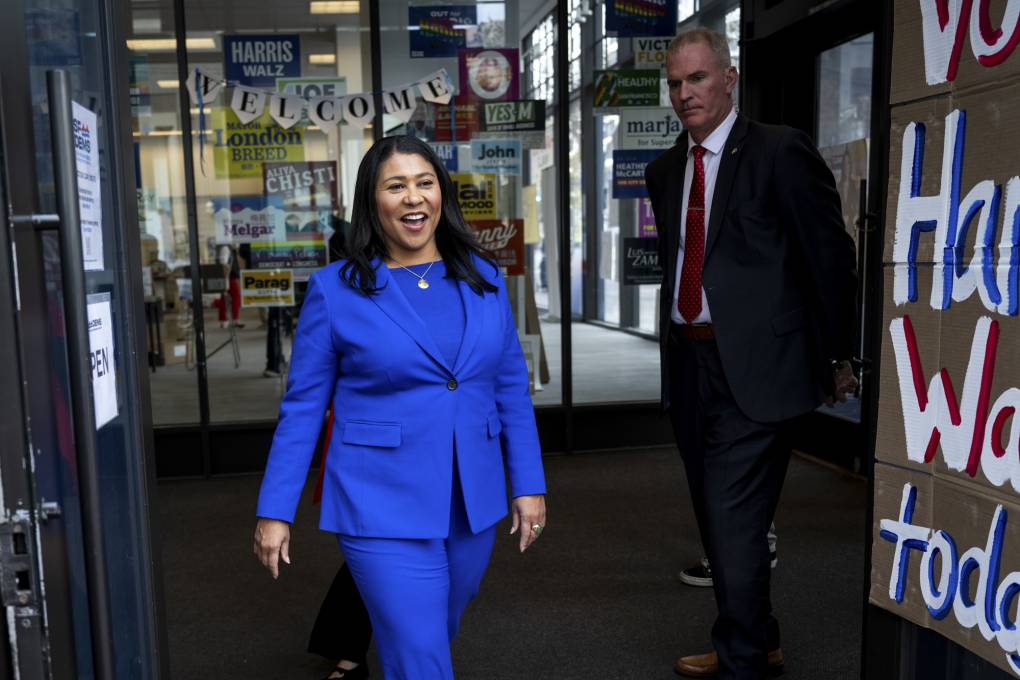
"caption": "San Francisco Mayor London Breed walks out of the Democratic headquarters in San Francisco on Nov. 5, 2024. Breed would face off against state Sen. Scott Wiener, Saikat Chakrabarti and others in the June 2026 primary election for the congressional seat that will soon be vacant when Speaker Emerita Nancy Pelosi retires. ",
"credit": "Beth LaBerge/KQED",
"altTag": null,
"description": null,
"imgSizes": {
"medium": {
"file": "https://cdn.kqed.org/wp-content/uploads/sites/10/2024/11/241105-ELECTIONDAY-86-BL-KQED-800x533.jpg",
"width": 800,
"height": 533,
"mimeType": "image/jpeg"
},
"large": {
"file": "https://cdn.kqed.org/wp-content/uploads/sites/10/2024/11/241105-ELECTIONDAY-86-BL-KQED-1020x680.jpg",
"width": 1020,
"height": 680,
"mimeType": "image/jpeg"
},
"thumbnail": {
"file": "https://cdn.kqed.org/wp-content/uploads/sites/10/2024/11/241105-ELECTIONDAY-86-BL-KQED-160x107.jpg",
"width": 160,
"height": 107,
"mimeType": "image/jpeg"
},
"1536x1536": {
"file": "https://cdn.kqed.org/wp-content/uploads/sites/10/2024/11/241105-ELECTIONDAY-86-BL-KQED-1536x1024.jpg",
"width": 1536,
"height": 1024,
"mimeType": "image/jpeg"
},
"post-thumbnail": {
"file": "https://cdn.kqed.org/wp-content/uploads/sites/10/2024/11/241105-ELECTIONDAY-86-BL-KQED-672x372.jpg",
"width": 672,
"height": 372,
"mimeType": "image/jpeg"
},
"twentyfourteen-full-width": {
"file": "https://cdn.kqed.org/wp-content/uploads/sites/10/2024/11/241105-ELECTIONDAY-86-BL-KQED-1038x576.jpg",
"width": 1038,
"height": 576,
"mimeType": "image/jpeg"
},
"full-width": {
"file": "https://cdn.kqed.org/wp-content/uploads/sites/10/2024/11/241105-ELECTIONDAY-86-BL-KQED-1920x1280.jpg",
"width": 1920,
"height": 1280,
"mimeType": "image/jpeg"
},
"kqedFullSize": {
"file": "https://cdn.kqed.org/wp-content/uploads/sites/10/2024/11/241105-ELECTIONDAY-86-BL-KQED.jpg",
"width": 2000,
"height": 1333
}
},
"isLoading": false,
"fetchFailed": false
},
"news_12063527": {
"type": "attachments",
"id": "news_12063527",
"meta": {
"index": "attachments_1716263798",
"site": "news",
"id": "12063527",
"found": true
},
"title": "251023-MAYOR LEE PRESSER-MD-02_qed",
"publishDate": 1762558007,
"status": "inherit",
"parent": 12063471,
"modified": 1762558017,
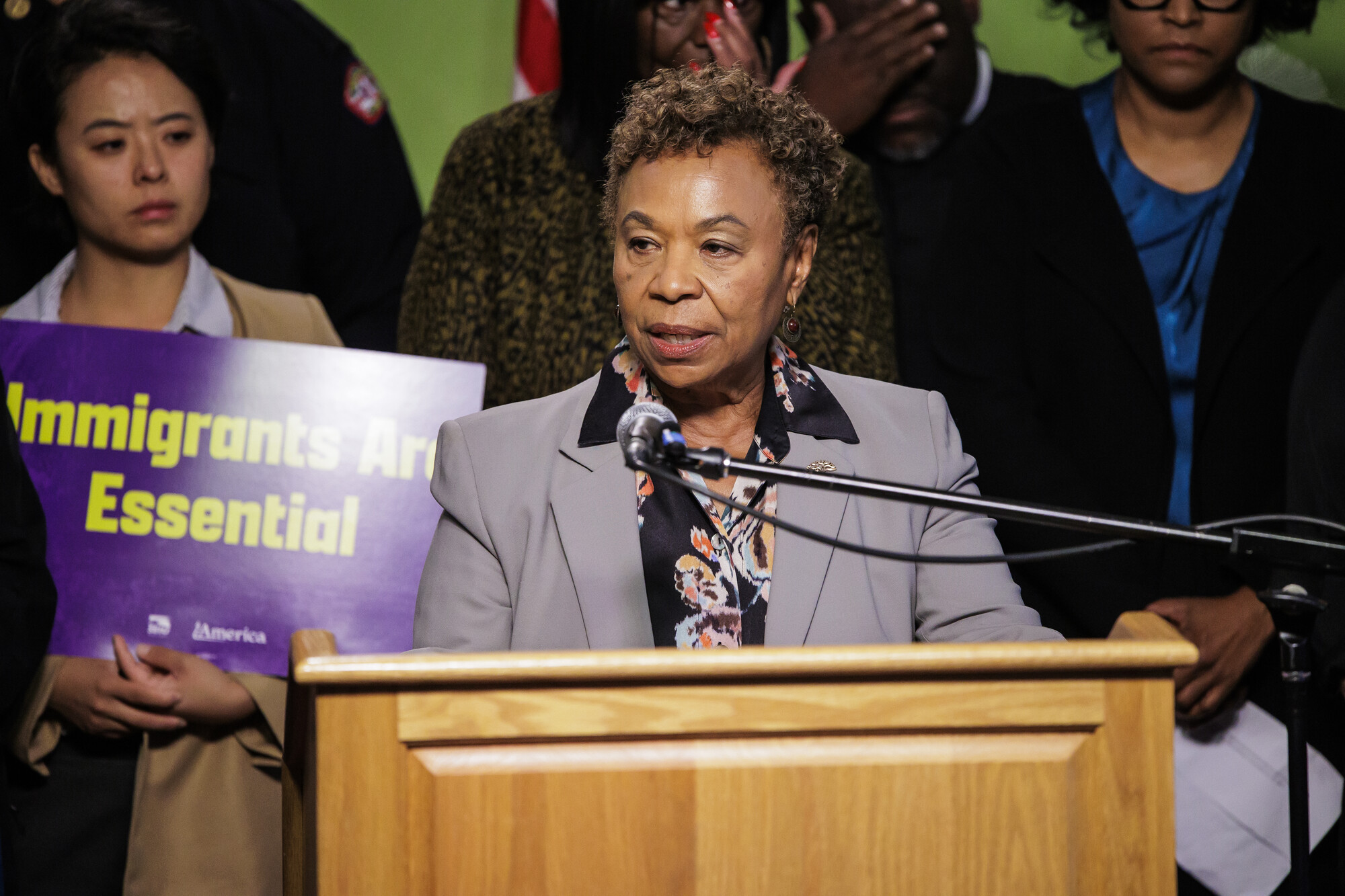
"caption": "Oakland Mayor Barbara Lee speaks at a press conference at Oakland City Hall on Oct. 23, 2025.",
"credit": "Martin do Nascimento/KQED",
"altTag": null,
"description": null,
"imgSizes": {
"thumbnail": {
"file": "https://cdn.kqed.org/wp-content/uploads/sites/10/2025/11/251023-MAYOR-LEE-PRESSER-MD-02_qed-160x107.jpg",
"width": 160,
"height": 107,
"mimeType": "image/jpeg"
},
"1536x1536": {
"file": "https://cdn.kqed.org/wp-content/uploads/sites/10/2025/11/251023-MAYOR-LEE-PRESSER-MD-02_qed-1536x1024.jpg",
"width": 1536,
"height": 1024,
"mimeType": "image/jpeg"
},
"post-thumbnail": {
"file": "https://cdn.kqed.org/wp-content/uploads/sites/10/2025/11/251023-MAYOR-LEE-PRESSER-MD-02_qed-672x372.jpg",
"width": 672,
"height": 372,
"mimeType": "image/jpeg"
},
"twentyfourteen-full-width": {
"file": "https://cdn.kqed.org/wp-content/uploads/sites/10/2025/11/251023-MAYOR-LEE-PRESSER-MD-02_qed-1038x576.jpg",
"width": 1038,
"height": 576,
"mimeType": "image/jpeg"
},
"npr-cds-wide": {
"file": "https://cdn.kqed.org/wp-content/uploads/sites/10/2025/11/251023-MAYOR-LEE-PRESSER-MD-02_qed-1200x675.jpg",
"width": 1200,
"height": 675,
"mimeType": "image/jpeg"
},
"kqedFullSize": {
"file": "https://cdn.kqed.org/wp-content/uploads/sites/10/2025/11/251023-MAYOR-LEE-PRESSER-MD-02_qed.jpg",
"width": 2000,
"height": 1333
}
},
"isLoading": false,
"fetchFailed": false
},
"news_12063465": {
"type": "attachments",
"id": "news_12063465",
"meta": {
"index": "attachments_1716263798",
"site": "news",
"id": "12063465",
"found": true
},
"title": "Low Angle View Of Woman Using Mobile Phone While Sitting On Bed In Darkroom",
"publishDate": 1762550603,
"status": "inherit",
"parent": 12063401,
"modified": 1762550628,
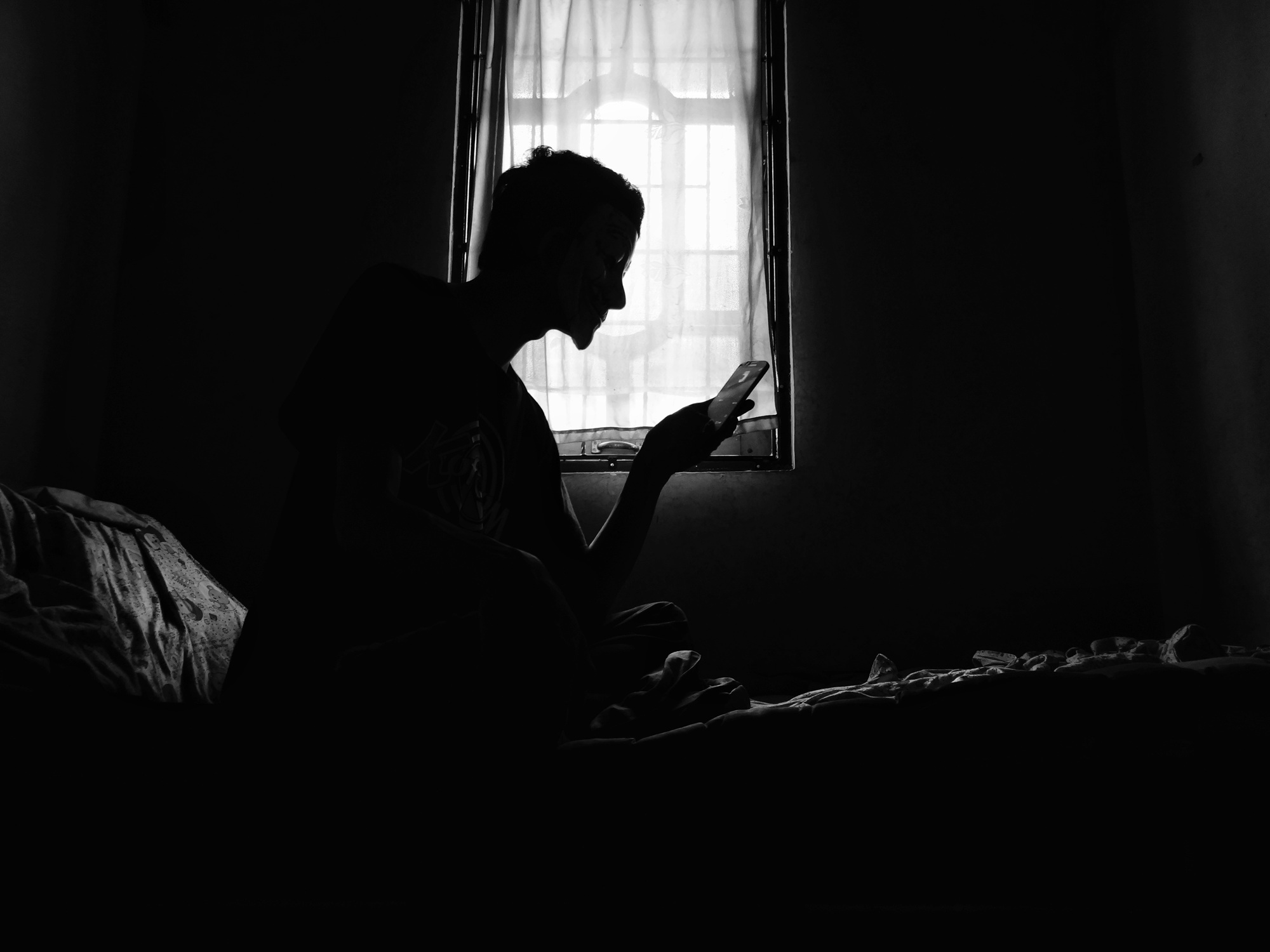
"caption": "Low Angle View Of Woman Using Mobile Phone While Sitting On Bed In Darkroom",
"credit": "EyeEm Mobile GmbH/Getty Images",
"altTag": null,
"description": null,
"imgSizes": {
"thumbnail": {
"file": "https://cdn.kqed.org/wp-content/uploads/sites/10/2025/11/OpenAiLawsuitsGetty-160x120.jpg",
"width": 160,
"height": 120,
"mimeType": "image/jpeg"
},
"1536x1536": {
"file": "https://cdn.kqed.org/wp-content/uploads/sites/10/2025/11/OpenAiLawsuitsGetty-1536x1152.jpg",
"width": 1536,
"height": 1152,
"mimeType": "image/jpeg"
},
"post-thumbnail": {
"file": "https://cdn.kqed.org/wp-content/uploads/sites/10/2025/11/OpenAiLawsuitsGetty-672x372.jpg",
"width": 672,
"height": 372,
"mimeType": "image/jpeg"
},
"twentyfourteen-full-width": {
"file": "https://cdn.kqed.org/wp-content/uploads/sites/10/2025/11/OpenAiLawsuitsGetty-1038x576.jpg",
"width": 1038,
"height": 576,
"mimeType": "image/jpeg"
},
"npr-cds-wide": {
"file": "https://cdn.kqed.org/wp-content/uploads/sites/10/2025/11/OpenAiLawsuitsGetty-1200x675.jpg",
"width": 1200,
"height": 675,
"mimeType": "image/jpeg"
},
"kqedFullSize": {
"file": "https://cdn.kqed.org/wp-content/uploads/sites/10/2025/11/OpenAiLawsuitsGetty.jpg",
"width": 2000,
"height": 1500
}
},
"isLoading": false,
"fetchFailed": false
},
"news_12063251": {
"type": "attachments",
"id": "news_12063251",
"meta": {
"index": "attachments_1716263798",
"site": "news",
"id": "12063251",
"found": true
},
"title": "Passengers sleep while waiting for their flight at Terminal 3 of San Francisco International Airport on Thursday, July 20, 2017 in San Francisco, Calif.",
"publishDate": 1762461164,
"status": "inherit",
"parent": 12063192,
"modified": 1762461205,
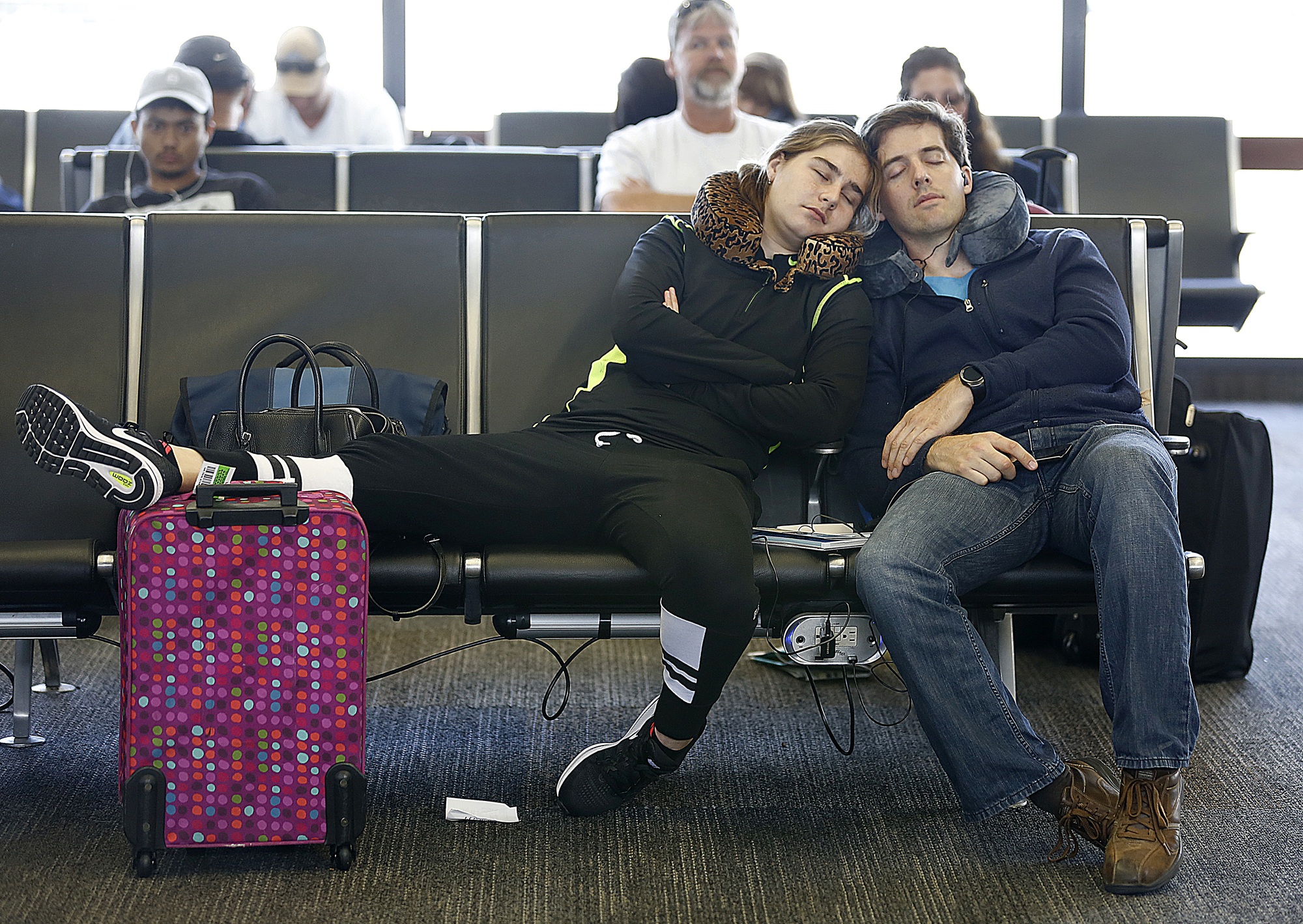
"caption": "Passengers sleep while waiting for their flight at Terminal 3 of San Francisco International Airport on July 20, 2017, in San Francisco, California.",
"credit": "Liz Hafalia/The San Francisco Chronicle via Getty Images",
"altTag": null,
"description": null,
"imgSizes": {
"thumbnail": {
"file": "https://cdn.kqed.org/wp-content/uploads/sites/10/2025/11/SFODelaysGetty2-160x114.jpg",
"width": 160,
"height": 114,
"mimeType": "image/jpeg"
},
"1536x1536": {
"file": "https://cdn.kqed.org/wp-content/uploads/sites/10/2025/11/SFODelaysGetty2-1536x1090.jpg",
"width": 1536,
"height": 1090,
"mimeType": "image/jpeg"
},
"post-thumbnail": {
"file": "https://cdn.kqed.org/wp-content/uploads/sites/10/2025/11/SFODelaysGetty2-672x372.jpg",
"width": 672,
"height": 372,
"mimeType": "image/jpeg"
},
"twentyfourteen-full-width": {
"file": "https://cdn.kqed.org/wp-content/uploads/sites/10/2025/11/SFODelaysGetty2-1038x576.jpg",
"width": 1038,
"height": 576,
"mimeType": "image/jpeg"
},
"npr-cds-wide": {
"file": "https://cdn.kqed.org/wp-content/uploads/sites/10/2025/11/SFODelaysGetty2-1200x675.jpg",
"width": 1200,
"height": 675,
"mimeType": "image/jpeg"
},
"kqedFullSize": {
"file": "https://cdn.kqed.org/wp-content/uploads/sites/10/2025/11/SFODelaysGetty2.jpg",
"width": 2000,
"height": 1419
}
},
"isLoading": false,
"fetchFailed": false
},
"news_12063358": {
"type": "attachments",
"id": "news_12063358",
"meta": {
"index": "attachments_1716263798",
"site": "news",
"id": "12063358",
"found": true
},
"title": "4",
"publishDate": 1762475166,
"status": "inherit",
"parent": 12062744,
"modified": 1762476065,
"caption": "An illustration of a 14-year-old nonbinary kid, their mom and their grandmother, who lives in India. There, she’s become a fierce advocate for transgender and nonbinary youth. The California Report Magazine is featuring conversations between gender-expansive youth and adults in their lives who love, support and mentor them.",
"credit": "Anna Vignet/KQED",
"altTag": null,
"description": null,
"imgSizes": {
"thumbnail": {
"file": "https://cdn.kqed.org/wp-content/uploads/sites/10/2025/11/4-160x90.png",
"width": 160,
"height": 90,
"mimeType": "image/png"
},
"1536x1536": {
"file": "https://cdn.kqed.org/wp-content/uploads/sites/10/2025/11/4-1536x864.png",
"width": 1536,
"height": 864,
"mimeType": "image/png"
},
"post-thumbnail": {
"file": "https://cdn.kqed.org/wp-content/uploads/sites/10/2025/11/4-672x372.png",
"width": 672,
"height": 372,
"mimeType": "image/png"
},
"twentyfourteen-full-width": {
"file": "https://cdn.kqed.org/wp-content/uploads/sites/10/2025/11/4-1038x576.png",
"width": 1038,
"height": 576,
"mimeType": "image/png"
},
"npr-cds-wide": {
"file": "https://cdn.kqed.org/wp-content/uploads/sites/10/2025/11/4-1200x675.png",
"width": 1200,
"height": 675,
"mimeType": "image/png"
},
"kqedFullSize": {
"file": "https://cdn.kqed.org/wp-content/uploads/sites/10/2025/11/4.png",
"width": 1920,
"height": 1080
}
},
"isLoading": false,
"fetchFailed": false
},
"news_12062563": {
"type": "attachments",
"id": "news_12062563",
"meta": {
"index": "attachments_1716263798",
"site": "news",
"id": "12062563",
"found": true
},
"title": "251031-SFMARINFOODBANK-03-BL-KQED",
"publishDate": 1761943576,
"status": "inherit",
"parent": 12062685,
"modified": 1762280668,
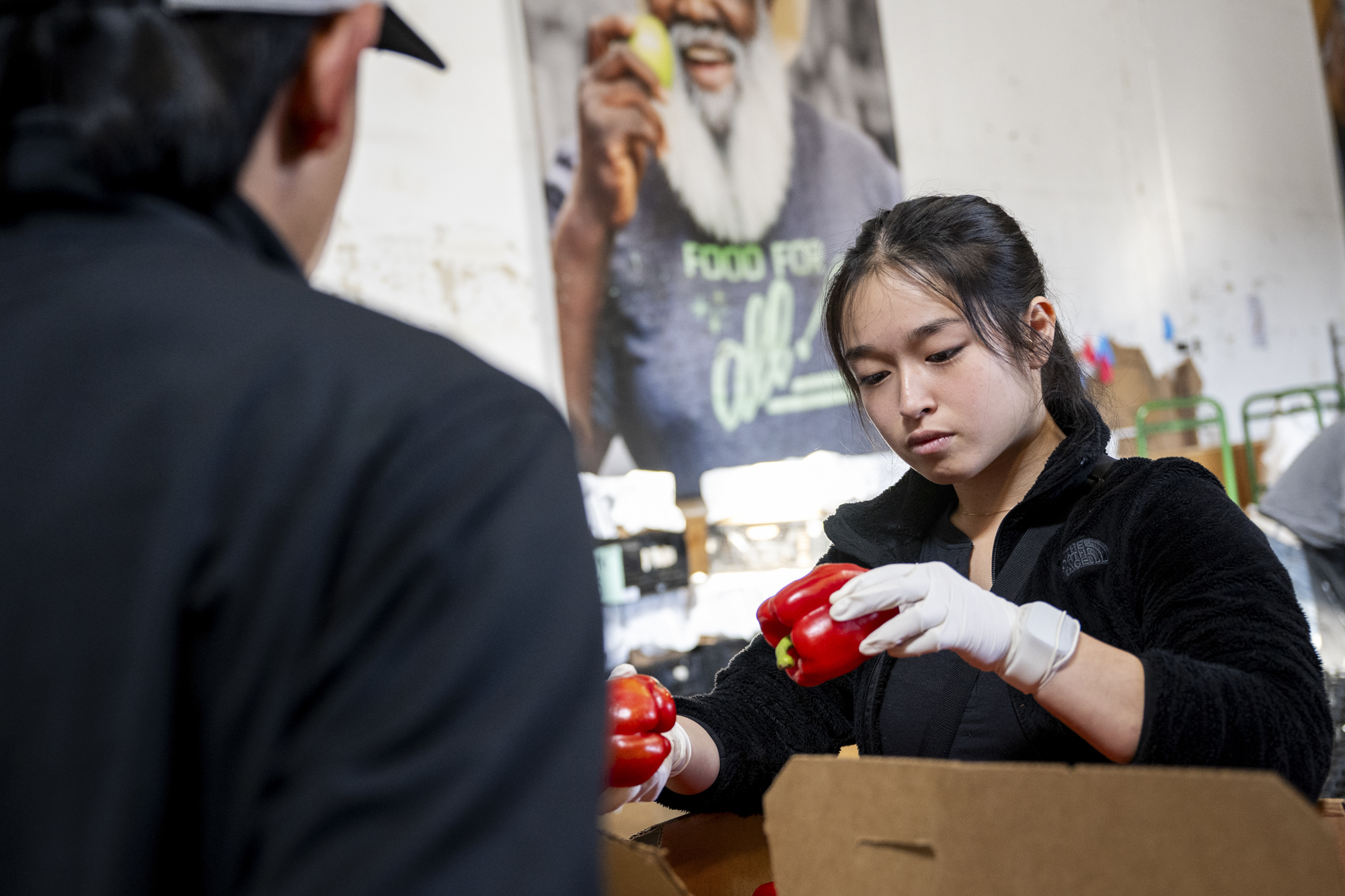
"caption": "Filmark Bernante (left) and Megan Feria inspect produce while sorting it into boxes at the San Francisco‑Marin Food Bank warehouse in San Francisco on Oct. 31, 2025.",
"credit": "Beth LaBerge/KQED",
"altTag": null,
"description": null,
"imgSizes": {
"thumbnail": {
"file": "https://cdn.kqed.org/wp-content/uploads/sites/10/2025/10/251031-SFMARINFOODBANK-03-BL-KQED-160x107.jpg",
"width": 160,
"height": 107,
"mimeType": "image/jpeg"
},
"1536x1536": {
"file": "https://cdn.kqed.org/wp-content/uploads/sites/10/2025/10/251031-SFMARINFOODBANK-03-BL-KQED-1536x1024.jpg",
"width": 1536,
"height": 1024,
"mimeType": "image/jpeg"
},
"post-thumbnail": {
"file": "https://cdn.kqed.org/wp-content/uploads/sites/10/2025/10/251031-SFMARINFOODBANK-03-BL-KQED-672x372.jpg",
"width": 672,
"height": 372,
"mimeType": "image/jpeg"
},
"twentyfourteen-full-width": {
"file": "https://cdn.kqed.org/wp-content/uploads/sites/10/2025/10/251031-SFMARINFOODBANK-03-BL-KQED-1038x576.jpg",
"width": 1038,
"height": 576,
"mimeType": "image/jpeg"
},
"npr-cds-wide": {
"file": "https://cdn.kqed.org/wp-content/uploads/sites/10/2025/10/251031-SFMARINFOODBANK-03-BL-KQED-1200x675.jpg",
"width": 1200,
"height": 675,
"mimeType": "image/jpeg"
},
"kqedFullSize": {
"file": "https://cdn.kqed.org/wp-content/uploads/sites/10/2025/10/251031-SFMARINFOODBANK-03-BL-KQED.jpg",
"width": 2000,
"height": 1333
}
},
"isLoading": false,
"fetchFailed": false
},
"news_12063252": {
"type": "attachments",
"id": "news_12063252",
"meta": {
"index": "attachments_1716263798",
"site": "news",
"id": "12063252",
"found": true
},
"title": "Delays And Cancellations Continue To Plague Airline Industry Heading Into Holiday Weekend",
"publishDate": 1762461535,
"status": "inherit",
"parent": 12063192,
"modified": 1762461575,
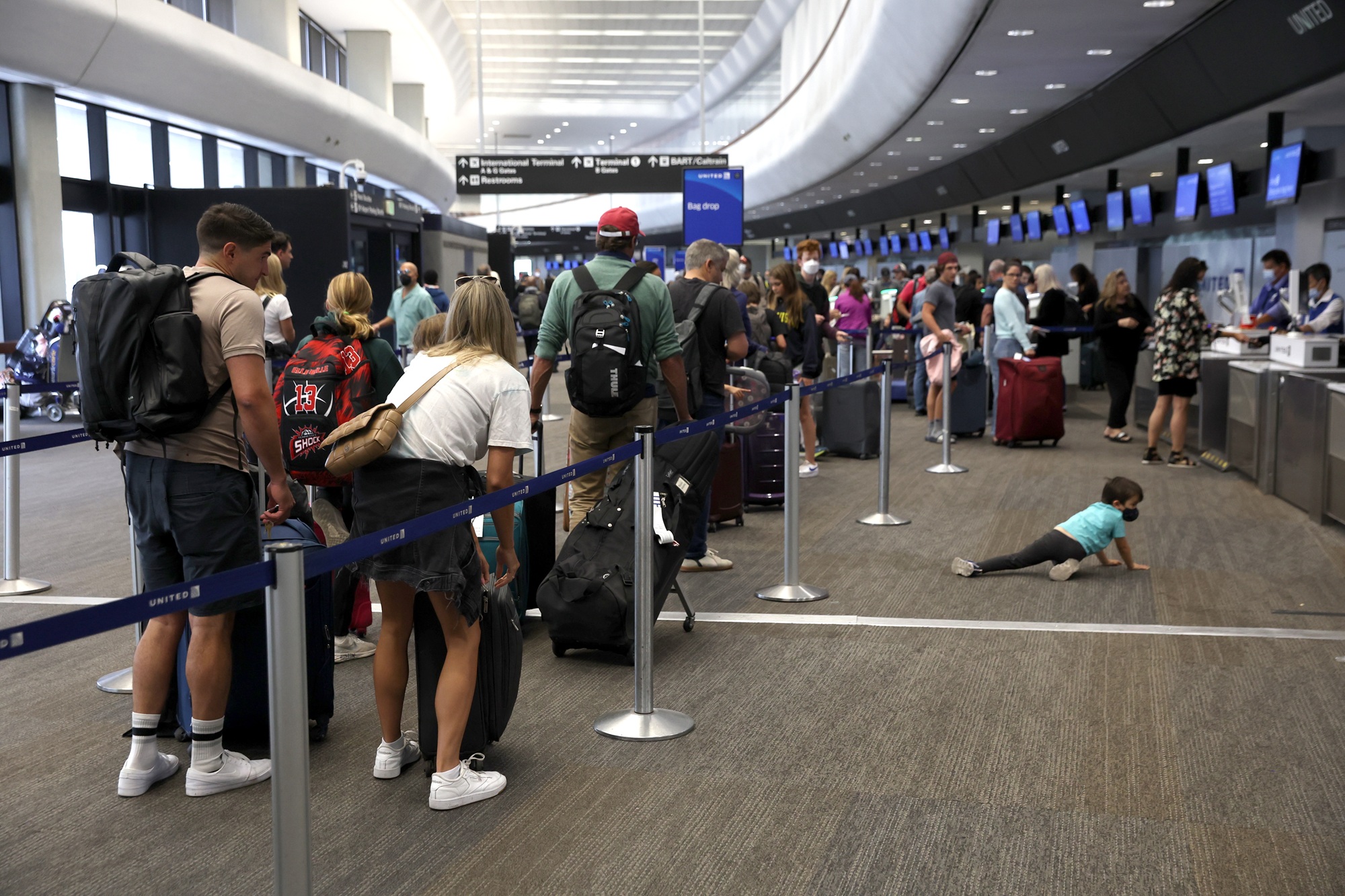
"caption": "Travelers line up to check in for United Airlines flights at San Francisco International Airport on July 1, 2022 ,in San Francisco, California. ",
"credit": "Justin Sullivan/Getty Images",
"altTag": null,
"description": null,
"imgSizes": {
"thumbnail": {
"file": "https://cdn.kqed.org/wp-content/uploads/sites/10/2025/11/SFODelaysGetty3-160x107.jpg",
"width": 160,
"height": 107,
"mimeType": "image/jpeg"
},
"1536x1536": {
"file": "https://cdn.kqed.org/wp-content/uploads/sites/10/2025/11/SFODelaysGetty3-1536x1024.jpg",
"width": 1536,
"height": 1024,
"mimeType": "image/jpeg"
},
"post-thumbnail": {
"file": "https://cdn.kqed.org/wp-content/uploads/sites/10/2025/11/SFODelaysGetty3-672x372.jpg",
"width": 672,
"height": 372,
"mimeType": "image/jpeg"
},
"twentyfourteen-full-width": {
"file": "https://cdn.kqed.org/wp-content/uploads/sites/10/2025/11/SFODelaysGetty3-1038x576.jpg",
"width": 1038,
"height": 576,
"mimeType": "image/jpeg"
},
"npr-cds-wide": {
"file": "https://cdn.kqed.org/wp-content/uploads/sites/10/2025/11/SFODelaysGetty3-1200x675.jpg",
"width": 1200,
"height": 675,
"mimeType": "image/jpeg"
},
"kqedFullSize": {
"file": "https://cdn.kqed.org/wp-content/uploads/sites/10/2025/11/SFODelaysGetty3.jpg",
"width": 2000,
"height": 1333
}
},
"isLoading": false,
"fetchFailed": false
},
"news_12062675": {
"type": "attachments",
"id": "news_12062675",
"meta": {
"index": "attachments_1716263798",
"site": "news",
"id": "12062675",
"found": true
},
"title": "251103-NewsomProp50Rally-65-BL",
"publishDate": 1762210643,
"status": "inherit",
"parent": 0,
"modified": 1762294209,
"caption": "Speaker Emerita Nancy Pelosi speaks during a press conference after a rally in support of Proposition 50 at IBEW Local 6 in San Francisco on Nov. 3, 2025.",
"credit": "Beth LaBerge/KQED",
"altTag": null,
"description": null,
"imgSizes": {
"thumbnail": {
"file": "https://cdn.kqed.org/wp-content/uploads/sites/10/2025/11/251103-NewsomProp50Rally-65-BL-160x107.jpg",
"width": 160,
"height": 107,
"mimeType": "image/jpeg"
},
"1536x1536": {
"file": "https://cdn.kqed.org/wp-content/uploads/sites/10/2025/11/251103-NewsomProp50Rally-65-BL-1536x1024.jpg",
"width": 1536,
"height": 1024,
"mimeType": "image/jpeg"
},
"post-thumbnail": {
"file": "https://cdn.kqed.org/wp-content/uploads/sites/10/2025/11/251103-NewsomProp50Rally-65-BL-672x372.jpg",
"width": 672,
"height": 372,
"mimeType": "image/jpeg"
},
"twentyfourteen-full-width": {
"file": "https://cdn.kqed.org/wp-content/uploads/sites/10/2025/11/251103-NewsomProp50Rally-65-BL-1038x576.jpg",
"width": 1038,
"height": 576,
"mimeType": "image/jpeg"
},
"npr-cds-wide": {
"file": "https://cdn.kqed.org/wp-content/uploads/sites/10/2025/11/251103-NewsomProp50Rally-65-BL-1200x675.jpg",
"width": 1200,
"height": 675,
"mimeType": "image/jpeg"
},
"kqedFullSize": {
"file": "https://cdn.kqed.org/wp-content/uploads/sites/10/2025/11/251103-NewsomProp50Rally-65-BL.jpg",
"width": 2000,
"height": 1333
}
},
"isLoading": false,
"fetchFailed": false
},
"news_12063107": {
"type": "attachments",
"id": "news_12063107",
"meta": {
"index": "attachments_1716263798",
"site": "news",
"id": "12063107",
"found": true
},
"title": "Ocean-Spray_3",
"publishDate": 1762383143,
"status": "inherit",
"parent": 12062909,
"modified": 1762386663,
"caption": "Unbeknownst to San Francisco citizens, in 1950, the U.S. military tested how bacteria would disperse if sprayed from a boat offshore, simulating a biological weapons attack. The experiment is now known as Operation Seaspray.",
"credit": "Illustration by Darren Tu/Getty Images",
"altTag": null,
"description": null,
"imgSizes": {
"thumbnail": {
"file": "https://cdn.kqed.org/wp-content/uploads/sites/10/2025/11/Ocean-Spray_3-160x103.jpg",
"width": 160,
"height": 103,
"mimeType": "image/jpeg"
},
"1536x1536": {
"file": "https://cdn.kqed.org/wp-content/uploads/sites/10/2025/11/Ocean-Spray_3-1536x992.jpg",
"width": 1536,
"height": 992,
"mimeType": "image/jpeg"
},
"post-thumbnail": {
"file": "https://cdn.kqed.org/wp-content/uploads/sites/10/2025/11/Ocean-Spray_3-672x372.jpg",
"width": 672,
"height": 372,
"mimeType": "image/jpeg"
},
"twentyfourteen-full-width": {
"file": "https://cdn.kqed.org/wp-content/uploads/sites/10/2025/11/Ocean-Spray_3-1038x576.jpg",
"width": 1038,
"height": 576,
"mimeType": "image/jpeg"
},
"npr-cds-wide": {
"file": "https://cdn.kqed.org/wp-content/uploads/sites/10/2025/11/Ocean-Spray_3-1200x675.jpg",
"width": 1200,
"height": 675,
"mimeType": "image/jpeg"
},
"kqedFullSize": {
"file": "https://cdn.kqed.org/wp-content/uploads/sites/10/2025/11/Ocean-Spray_3.jpg",
"width": 1920,
"height": 1240
}
},
"isLoading": false,
"fetchFailed": false
},
"news_12063051": {
"type": "attachments",
"id": "news_12063051",
"meta": {
"index": "attachments_1716263798",
"site": "news",
"id": "12063051",
"found": true
},
"title": "251105-Waymo Discriminate-03-KQED",
"publishDate": 1762370257,
"status": "inherit",
"parent": 0,
"modified": 1762385660,
"caption": "Dr. Nasser Mohamed during Pride Sunday in San Francisco on June 26, 2022. The physician and civil rights activist is suing Alphabet and its subsidiary Waymo for denying him access to a public transportation service based on AI software falsely flagging him as a terrorist.",
"credit": "Courtesy of Dr. Nas Mohamed",
"altTag": null,
"description": null,
"imgSizes": {
"thumbnail": {
"file": "https://cdn.kqed.org/wp-content/uploads/sites/10/2025/11/251105-Waymo-Discriminate-03-KQED-160x107.jpg",
"width": 160,
"height": 107,
"mimeType": "image/jpeg"
},
"1536x1536": {
"file": "https://cdn.kqed.org/wp-content/uploads/sites/10/2025/11/251105-Waymo-Discriminate-03-KQED-1536x1024.jpg",
"width": 1536,
"height": 1024,
"mimeType": "image/jpeg"
},
"post-thumbnail": {
"file": "https://cdn.kqed.org/wp-content/uploads/sites/10/2025/11/251105-Waymo-Discriminate-03-KQED-672x372.jpg",
"width": 672,
"height": 372,
"mimeType": "image/jpeg"
},
"twentyfourteen-full-width": {
"file": "https://cdn.kqed.org/wp-content/uploads/sites/10/2025/11/251105-Waymo-Discriminate-03-KQED-1038x576.jpg",
"width": 1038,
"height": 576,
"mimeType": "image/jpeg"
},
"npr-cds-wide": {
"file": "https://cdn.kqed.org/wp-content/uploads/sites/10/2025/11/251105-Waymo-Discriminate-03-KQED-1200x675.jpg",
"width": 1200,
"height": 675,
"mimeType": "image/jpeg"
},
"kqedFullSize": {
"file": "https://cdn.kqed.org/wp-content/uploads/sites/10/2025/11/251105-Waymo-Discriminate-03-KQED.jpg",
"width": 2000,
"height": 1333
}
},
"isLoading": false,
"fetchFailed": false
},
"news_12063100": {
"type": "attachments",
"id": "news_12063100",
"meta": {
"index": "attachments_1716263798",
"site": "news",
"id": "12063100",
"found": true
},
"title": "Whip Its Drug",
"publishDate": 1762380008,
"status": "inherit",
"parent": 12063060,
"modified": 1762380073,
"caption": "Close-up of miniature cylinder of nitrous oxide, a drug of abuse referred to as \"Whip Its,\" \"Whipits\" or \"Whippets,\" discarded in a gutter in Walnut Creek, California, on March 13, 2020. ",
"credit": "Smith Collection/Gado via Getty Images",
"altTag": null,
"description": null,
"imgSizes": {
"thumbnail": {
"file": "https://cdn.kqed.org/wp-content/uploads/sites/10/2025/11/WhippetGetty-160x107.jpg",
"width": 160,
"height": 107,
"mimeType": "image/jpeg"
},
"1536x1536": {
"file": "https://cdn.kqed.org/wp-content/uploads/sites/10/2025/11/WhippetGetty-1536x1024.jpg",
"width": 1536,
"height": 1024,
"mimeType": "image/jpeg"
},
"post-thumbnail": {
"file": "https://cdn.kqed.org/wp-content/uploads/sites/10/2025/11/WhippetGetty-672x372.jpg",
"width": 672,
"height": 372,
"mimeType": "image/jpeg"
},
"twentyfourteen-full-width": {
"file": "https://cdn.kqed.org/wp-content/uploads/sites/10/2025/11/WhippetGetty-1038x576.jpg",
"width": 1038,
"height": 576,
"mimeType": "image/jpeg"
},
"npr-cds-wide": {
"file": "https://cdn.kqed.org/wp-content/uploads/sites/10/2025/11/WhippetGetty-1200x675.jpg",
"width": 1200,
"height": 675,
"mimeType": "image/jpeg"
},
"kqedFullSize": {
"file": "https://cdn.kqed.org/wp-content/uploads/sites/10/2025/11/WhippetGetty.jpg",
"width": 2000,
"height": 1333
}
},
"isLoading": false,
"fetchFailed": false
},
"news_12062672": {
"type": "attachments",
"id": "news_12062672",
"meta": {
"index": "attachments_1716263798",
"site": "news",
"id": "12062672",
"found": true
},
"title": "251103-NewsomProp50Rally-44-BL",
"publishDate": 1762210607,
"status": "inherit",
"parent": 0,
"modified": 1762372016,
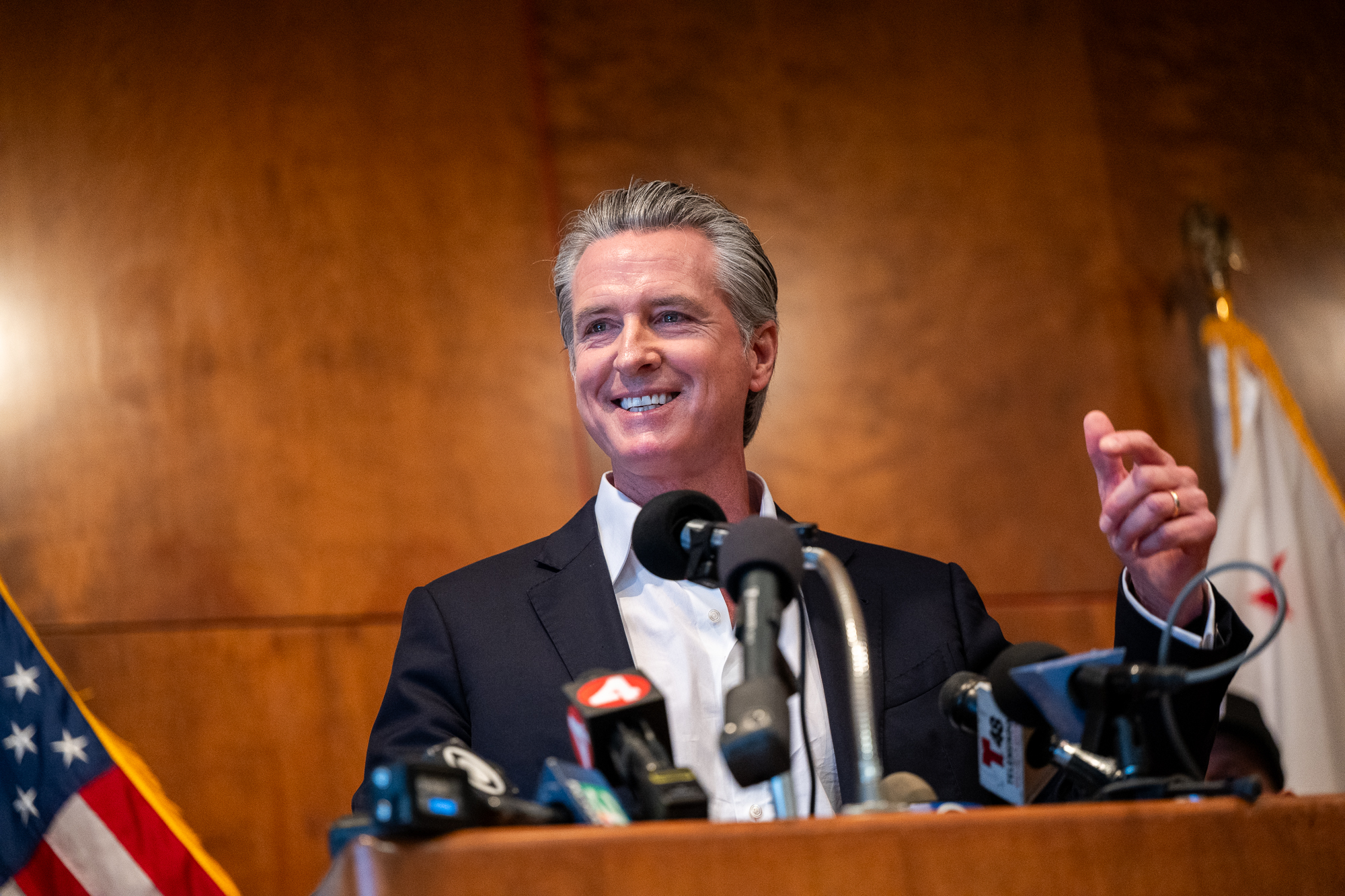
"caption": "Gov. Gavin Newsom speaks at a rally in support of Proposition 50 at IBEW Local 6 in San Francisco on Nov. 3, 2025.",
"credit": "Beth LaBerge/KQED",
"altTag": null,
"description": null,
"imgSizes": {
"thumbnail": {
"file": "https://cdn.kqed.org/wp-content/uploads/sites/10/2025/11/251103-NewsomProp50Rally-44-BL-160x107.jpg",
"width": 160,
"height": 107,
"mimeType": "image/jpeg"
},
"1536x1536": {
"file": "https://cdn.kqed.org/wp-content/uploads/sites/10/2025/11/251103-NewsomProp50Rally-44-BL-1536x1024.jpg",
"width": 1536,
"height": 1024,
"mimeType": "image/jpeg"
},
"post-thumbnail": {
"file": "https://cdn.kqed.org/wp-content/uploads/sites/10/2025/11/251103-NewsomProp50Rally-44-BL-672x372.jpg",
"width": 672,
"height": 372,
"mimeType": "image/jpeg"
},
"twentyfourteen-full-width": {
"file": "https://cdn.kqed.org/wp-content/uploads/sites/10/2025/11/251103-NewsomProp50Rally-44-BL-1038x576.jpg",
"width": 1038,
"height": 576,
"mimeType": "image/jpeg"
},
"npr-cds-wide": {
"file": "https://cdn.kqed.org/wp-content/uploads/sites/10/2025/11/251103-NewsomProp50Rally-44-BL-1200x675.jpg",
"width": 1200,
"height": 675,
"mimeType": "image/jpeg"
},
"kqedFullSize": {
"file": "https://cdn.kqed.org/wp-content/uploads/sites/10/2025/11/251103-NewsomProp50Rally-44-BL.jpg",
"width": 2000,
"height": 1333
}
},
"isLoading": false,
"fetchFailed": false
}
},
"audioPlayerReducer": {
"postId": "stream_live",
"isPaused": true,
"isPlaying": false,
"pfsActive": false,
"pledgeModalIsOpen": true,
"playerDrawerIsOpen": false,
"liveAudioPlayStartedAt": 0,
"liveAudioPlayContext": ""
},
"authorsReducer": {
"gmarzorati": {
"type": "authors",
"id": "227",
"meta": {
"index": "authors_1716337520",
"id": "227",
"found": true
},
"name": "Guy Marzorati",
"firstName": "Guy",
"lastName": "Marzorati",
"slug": "gmarzorati",
"email": "gmarzorati@KQED.org",
"display_author_email": true,
"staff_mastheads": [
"news"
],
"title": "Correspondent",
"bio": "Guy Marzorati is a correspondent on KQED's California Politics and Government Desk, based in San Jose. A graduate of Santa Clara University, Guy joined KQED in 2013. He reports on state and local politics and produces KQED's digital voter guide.",
"avatar": "https://secure.gravatar.com/avatar/e7038b8dbfd55b104369b76b1cd0b9de?s=600&d=blank&r=g",
"twitter": "guymarzorati",
"facebook": null,
"instagram": null,
"linkedin": null,
"sites": [
{
"site": "",
"roles": [
"editor"
]
},
{
"site": "news",
"roles": [
"editor"
]
},
{
"site": "science",
"roles": [
"editor"
]
},
{
"site": "forum",
"roles": [
"editor"
]
},
{
"site": "elections",
"roles": [
"editor"
]
},
{
"site": "liveblog",
"roles": [
"editor"
]
}
],
"headData": {
"title": "Guy Marzorati | KQED",
"description": "Correspondent",
"ogImgSrc": "https://secure.gravatar.com/avatar/e7038b8dbfd55b104369b76b1cd0b9de?s=600&d=blank&r=g",
"twImgSrc": "https://secure.gravatar.com/avatar/e7038b8dbfd55b104369b76b1cd0b9de?s=600&d=blank&r=g"
},
"isLoading": false,
"link": "/author/gmarzorati"
},
"rachael-myrow": {
"type": "authors",
"id": "251",
"meta": {
"index": "authors_1716337520",
"id": "251",
"found": true
},
"name": "Rachael Myrow",
"firstName": "Rachael",
"lastName": "Myrow",
"slug": "rachael-myrow",
"email": "rmyrow@kqed.org",
"display_author_email": true,
"staff_mastheads": [
"news"
],
"title": "Senior Editor of KQED's Silicon Valley News Desk",
"bio": "• I write and edit stories about how Silicon Valley power and policies shape everyday life in California. I’m also passionate about making Bay Area history and culture more accessible to a broad public. • I’ve been a journalist for most of my life, starting in high school with The Franklin Press in Los Angeles, where I grew up. While earning my first degree in English at UC Berkeley, I got my start in public radio at KALX-FM. After completing a second degree in journalism at Cal, I landed my first professional job at Marketplace, then moved on to KPCC (now LAist), and then KQED, where I hosted The California Report for more than seven years. • My reporting has appeared on NPR, The World, WBUR’s \u003ci>Here & Now\u003c/i>, and the BBC. I also guest host for KQED’s \u003ci>Forum\u003c/i>, as well as the Commonwealth Club in San Francisco. • I speak periodically on media, democracy and technology issues, and do voiceover work for documentaries and educational video projects. • Outside of the studio, you'll find me hiking Bay Area trails and whipping up Insta-ready meals in my kitchen. • I do not accept gifts, money, or favors from anyone connected to my reporting, I don't pay people for information, and I do not support or donate to political causes. • I strive to treat the people I report on with fairness, honesty, and respect. I also recognize there are often multiple sides to a story and work to verify information through multiple sources and documentation. If I get something wrong, I correct it.",
"avatar": "https://secure.gravatar.com/avatar/87bf8cb5874e045cdff430523a6d48b1?s=600&d=blank&r=g",
"twitter": "rachaelmyrow",
"facebook": null,
"instagram": null,
"linkedin": "https://www.linkedin.com/in/rachaelmyrow/",
"sites": [
{
"site": "arts",
"roles": [
"administrator"
]
},
{
"site": "news",
"roles": [
"edit_others_posts",
"editor"
]
},
{
"site": "futureofyou",
"roles": [
"editor"
]
},
{
"site": "bayareabites",
"roles": [
"editor"
]
},
{
"site": "stateofhealth",
"roles": [
"editor"
]
},
{
"site": "science",
"roles": [
"editor"
]
},
{
"site": "food",
"roles": [
"editor"
]
},
{
"site": "forum",
"roles": [
"editor"
]
},
{
"site": "liveblog",
"roles": [
"author"
]
}
],
"headData": {
"title": "Rachael Myrow | KQED",
"description": "Senior Editor of KQED's Silicon Valley News Desk",
"ogImgSrc": "https://secure.gravatar.com/avatar/87bf8cb5874e045cdff430523a6d48b1?s=600&d=blank&r=g",
"twImgSrc": "https://secure.gravatar.com/avatar/87bf8cb5874e045cdff430523a6d48b1?s=600&d=blank&r=g"
},
"isLoading": false,
"link": "/author/rachael-myrow"
},
"sasha-khokha": {
"type": "authors",
"id": "254",
"meta": {
"index": "authors_1716337520",
"id": "254",
"found": true
},
"name": "Sasha Khokha",
"firstName": "Sasha",
"lastName": "Khokha",
"slug": "sasha-khokha",
"email": "skhokha@kqed.org",
"display_author_email": true,
"staff_mastheads": [
"news"
],
"title": "Host, The California Report Magazine",
"bio": "Sasha Khokha is the host of \u003cem>The California Report's \u003c/em> weekly magazine program, which takes listeners on sound-rich excursions to meet the people that make the Golden State unique -- through audio documentaries and long-form stories. As \u003cem>The California Report's\u003c/em> Central Valley Bureau Chief based in Fresno for nearly a dozen years, Sasha brought the lives and concerns of rural Californians to listeners around the state. Her reporting helped expose the hidden price immigrant women janitors and farmworkers may pay to keep their jobs: sexual assault at work. It inspired two new California laws to protect them from sexual harassment. She was a key member of the reporting team for the Frontline film \u003cem>Rape on the Night Shift, \u003c/em>which was nominated for two national Emmys. Sasha has also won a national Edward R. Murrow and a national PRNDI award for investigative reporting, as well as multiple prizes from the Society for Professional Journalists. Sasha is a proud alum of the UC Berkeley Graduate School of Journalism and Brown University and a member of the South Asian Journalists Association.",
"avatar": "https://secure.gravatar.com/avatar/e4b5e1541aaeea2aa356aa1fb2a68950?s=600&d=blank&r=g",
"twitter": "KQEDSashaKhokha",
"facebook": null,
"instagram": null,
"linkedin": null,
"sites": [
{
"site": "news",
"roles": [
"editor"
]
},
{
"site": "stateofhealth",
"roles": [
"author"
]
},
{
"site": "science",
"roles": [
"author"
]
},
{
"site": "quest",
"roles": [
"subscriber"
]
}
],
"headData": {
"title": "Sasha Khokha | KQED",
"description": "Host, The California Report Magazine",
"ogImgSrc": "https://secure.gravatar.com/avatar/e4b5e1541aaeea2aa356aa1fb2a68950?s=600&d=blank&r=g",
"twImgSrc": "https://secure.gravatar.com/avatar/e4b5e1541aaeea2aa356aa1fb2a68950?s=600&d=blank&r=g"
},
"isLoading": false,
"link": "/author/sasha-khokha"
},
"scottshafer": {
"type": "authors",
"id": "255",
"meta": {
"index": "authors_1716337520",
"id": "255",
"found": true
},
"name": "Scott Shafer",
"firstName": "Scott",
"lastName": "Shafer",
"slug": "scottshafer",
"email": "sshafer@kqed.org",
"display_author_email": false,
"staff_mastheads": [
"news"
],
"title": "KQED Contributor",
"bio": "Scott Shafer is a senior editor with the KQED Politics and Government desk. He is co-host of Political Breakdown, the award-winning radio show and podcast with a personal take on the world of politics. Scott came to KQED in 1998 to host the statewide\u003cem> California Report\u003c/em>. Prior to that he had extended stints in politics and government\u003cem>.\u003c/em> He uses that inside experience at KQED in his, reporting, hosting and analysis for the politics desk. Scott collaborated \u003cem>Political Breakdown a\u003c/em>nd on \u003cem>The Political Mind of Jerry Brown, \u003c/em>an eight-part series about the life and extraordinary political career of the former governor. For fun, he plays water polo with the San Francisco Tsunami.",
"avatar": "https://secure.gravatar.com/avatar/a62ebae45b79d7aed1a39a0e3bf68104?s=600&d=blank&r=g",
"twitter": "scottshafer",
"bluesky": null,
"facebook": null,
"instagram": null,
"linkedin": null,
"sites": [
{
"site": "news",
"roles": [
"editor"
]
},
{
"site": "stateofhealth",
"roles": [
"author"
]
},
{
"site": "science",
"roles": [
"author"
]
},
{
"site": "forum",
"roles": [
"subscriber"
]
},
{
"site": "liveblog",
"roles": [
"author"
]
}
],
"headData": {
"title": "Scott Shafer | KQED",
"description": "KQED Contributor",
"ogImgSrc": "https://secure.gravatar.com/avatar/a62ebae45b79d7aed1a39a0e3bf68104?s=600&d=blank&r=g",
"twImgSrc": "https://secure.gravatar.com/avatar/a62ebae45b79d7aed1a39a0e3bf68104?s=600&d=blank&r=g"
},
"isLoading": false,
"link": "/author/scottshafer"
},
"aemslie": {
"type": "authors",
"id": "3206",
"meta": {
"index": "authors_1716337520",
"id": "3206",
"found": true
},
"name": "Alex Emslie",
"firstName": "Alex",
"lastName": "Emslie",
"slug": "aemslie",
"email": "aemslie@kqed.org",
"display_author_email": true,
"staff_mastheads": [
"news"
],
"title": "KQED Senior Editor",
"bio": "Alex Emslie is senior editor of talent and development at KQED, where he manages dozens of early career journalists and oversees news department internships.\r\n\r\nHe is a former carpenter and proud graduate of City College of San Francisco and San Francisco State University, where he studied journalism and criminal justice before joining KQED in 2013.\r\n\r\nAlex produced investigative journalism focused on \u003ca href=\"https://www.kqed.org/news/11667594/the-trials-of-marvin-mutch-video\">criminal justice\u003c/a> and policing for most of a decade. He has broken major stories about \u003ca href=\"https://www.kqed.org/news/135682/amid-a-series-of-vallejo-police-shootings-one-officers-name-stands-out\">police use of deadly force\u003c/a>, \u003ca href=\"https://www.kqed.org/news/10454955/racist-texts-prompt-sfpd-internal-investigation\">officer misconduct\u003c/a> and \u003ca href=\"https://www.kqed.org/news/11712239/terrorist-or-troll-judge-to-weigh-whether-oakland-man-really-intended-to-attack-bay-area\">other\u003c/a> \u003ca href=\"https://www.kqed.org/news/11221414/hayward-paid-159000-to-husband-of-retired-police-chief-documents-show\">high\u003c/a>-\u003ca href=\"https://www.kqed.org/news/10622762/the-forgotten-tracking-two-homicides-in-san-francisco-public-housing\">profile\u003c/a> \u003ca href=\"https://www.kqed.org/news/11624516/federal-agency-promoted-ranger-just-months-after-his-gun-was-stolen-and-used-in-steinle-killing\">cases\u003c/a>. He co-founded the \u003ca href=\"https://projects.scpr.org/california-reporting-project/\">California Reporting Project\u003c/a> in 2019 to obtain and report on previously confidential police internal investigations. The effort produced well over 100 original stories and changed the course of multiple criminal cases.\r\n\r\nHis work has been recognized with numerous journalism awards, including a national Edward R. Murrow award for several years of \u003ca href=\"https://www.kqed.org/news/11688481/sfpd-officers-in-mario-woods-case-recount-shooting-in-newly-filed-depositions\">reporting\u003c/a> on the San Francisco Police shooting of Mario Woods. His \u003ca href=\"https://www.kqed.org/news/147854/half-of-those-killed-by-san-francisco-police-are-mentally-ill\">reporting\u003c/a> on police killings of people in psychiatric crisis was cited in amicus briefs before the U.S. Supreme Court.\r\n\r\nAlex now enjoys mentoring the next generation of journalists at KQED.",
"avatar": "https://secure.gravatar.com/avatar/e691e65209f20e9da202bd730ead5663?s=600&d=blank&r=g",
"twitter": "SFNewsReporter",
"facebook": null,
"instagram": null,
"linkedin": null,
"sites": [
{
"site": "arts",
"roles": [
"editor"
]
},
{
"site": "news",
"roles": [
"editor"
]
},
{
"site": "mindshift",
"roles": [
"editor"
]
},
{
"site": "stateofhealth",
"roles": [
"editor"
]
},
{
"site": "science",
"roles": [
"administrator"
]
}
],
"headData": {
"title": "Alex Emslie | KQED",
"description": "KQED Senior Editor",
"ogImgSrc": "https://secure.gravatar.com/avatar/e691e65209f20e9da202bd730ead5663?s=600&d=blank&r=g",
"twImgSrc": "https://secure.gravatar.com/avatar/e691e65209f20e9da202bd730ead5663?s=600&d=blank&r=g"
},
"isLoading": false,
"link": "/author/aemslie"
},
"mlagos": {
"type": "authors",
"id": "3239",
"meta": {
"index": "authors_1716337520",
"id": "3239",
"found": true
},
"name": "Marisa Lagos",
"firstName": "Marisa",
"lastName": "Lagos",
"slug": "mlagos",
"email": "mlagos@kqed.org",
"display_author_email": false,
"staff_mastheads": [
"news"
],
"title": "KQED Contributor",
"bio": "Marisa Lagos is a correspondent for KQED’s California Politics and Government Desk and co-hosts the award-winning show and podcast, Political Breakdown. At KQED, Lagos also conducts reporting, analysis and investigations into state, local and national politics for radio, TV, online and onstage. In 2022, she and co-host, Scott Shafer, moderated the only gubernatorial debate in California. In 2020, the \u003ci>Washington Post\u003c/i> named her one of the top political journalists in California; she was nominated for a Peabody and won several other awards for her work investigating the 2017 California wildfires. She has worked at the \u003ci>San Francisco Chronicle\u003c/i>, \u003ci>San Francisco Examiner\u003c/i> and \u003ci>Los Angeles Times\u003c/i>. A UC Santa Barbara graduate, she lives in San Francisco with her two sons and husband.",
"avatar": "https://secure.gravatar.com/avatar/a261a0d3696fc066871ef96b85b5e7d2?s=600&d=blank&r=g",
"twitter": "@mlagos",
"facebook": null,
"instagram": null,
"linkedin": null,
"sites": [
{
"site": "arts",
"roles": [
"author"
]
},
{
"site": "news",
"roles": [
"editor"
]
},
{
"site": "science",
"roles": [
"editor"
]
},
{
"site": "forum",
"roles": [
"author"
]
},
{
"site": "liveblog",
"roles": [
"author"
]
}
],
"headData": {
"title": "Marisa Lagos | KQED",
"description": "KQED Contributor",
"ogImgSrc": "https://secure.gravatar.com/avatar/a261a0d3696fc066871ef96b85b5e7d2?s=600&d=blank&r=g",
"twImgSrc": "https://secure.gravatar.com/avatar/a261a0d3696fc066871ef96b85b5e7d2?s=600&d=blank&r=g"
},
"isLoading": false,
"link": "/author/mlagos"
},
"carlysevern": {
"type": "authors",
"id": "3243",
"meta": {
"index": "authors_1716337520",
"id": "3243",
"found": true
},
"name": "Carly Severn",
"firstName": "Carly",
"lastName": "Severn",
"slug": "carlysevern",
"email": "csevern@kqed.org",
"display_author_email": false,
"staff_mastheads": [
"news"
],
"title": "Senior Editor, Audience News ",
"bio": "Carly is KQED's Senior Editor of Audience News on the Digital News team, and has reported for the California Report Magazine, Bay Curious and KQED Arts. She's formerly the host of \u003ca href=\"http://ww2.kqed.org/pop/category/the-cooler/\" rel=\"noopener noreferrer\">The Cooler\u003c/a> podcast.",
"avatar": "https://secure.gravatar.com/avatar/2d8d6765f186e64c798cf7f0c8088a41?s=600&d=blank&r=g",
"twitter": "teacupinthebay",
"facebook": null,
"instagram": null,
"linkedin": null,
"sites": [
{
"site": "",
"roles": [
"editor"
]
},
{
"site": "arts",
"roles": [
"editor"
]
},
{
"site": "news",
"roles": [
"administrator"
]
},
{
"site": "pop",
"roles": [
"editor"
]
},
{
"site": "futureofyou",
"roles": [
"editor"
]
},
{
"site": "about",
"roles": [
"administrator"
]
},
{
"site": "mindshift",
"roles": [
"editor"
]
},
{
"site": "bayareabites",
"roles": [
"editor"
]
},
{
"site": "stateofhealth",
"roles": [
"editor"
]
},
{
"site": "science",
"roles": [
"editor"
]
},
{
"site": "food",
"roles": [
"contributor"
]
},
{
"site": "forum",
"roles": [
"editor"
]
},
{
"site": "perspectives",
"roles": [
"administrator"
]
},
{
"site": "liveblog",
"roles": [
"editor"
]
}
],
"headData": {
"title": "Carly Severn | KQED",
"description": "Senior Editor, Audience News ",
"ogImgSrc": "https://secure.gravatar.com/avatar/2d8d6765f186e64c798cf7f0c8088a41?s=600&d=blank&r=g",
"twImgSrc": "https://secure.gravatar.com/avatar/2d8d6765f186e64c798cf7f0c8088a41?s=600&d=blank&r=g"
},
"isLoading": false,
"link": "/author/carlysevern"
},
"sjohnson": {
"type": "authors",
"id": "11840",
"meta": {
"index": "authors_1716337520",
"id": "11840",
"found": true
},
"name": "Sydney Johnson",
"firstName": "Sydney",
"lastName": "Johnson",
"slug": "sjohnson",
"email": "sjohnson@kqed.org",
"display_author_email": false,
"staff_mastheads": [
"news"
],
"title": "KQED Reporter",
"bio": "Sydney Johnson is a general assignment reporter at KQED. She previously reported on public health and city government at the San Francisco Examiner, and before that, she covered statewide education policy for EdSource. Her reporting has won multiple local, state and national awards. Sydney is a graduate of the University of California, Berkeley and lives in San Francisco.",
"avatar": "https://secure.gravatar.com/avatar/97855f2719b72ad6190b7c535fe642c8?s=600&d=blank&r=g",
"twitter": "sydneyfjohnson",
"facebook": null,
"instagram": null,
"linkedin": null,
"sites": [
{
"site": "news",
"roles": [
"editor"
]
}
],
"headData": {
"title": "Sydney Johnson | KQED",
"description": "KQED Reporter",
"ogImgSrc": "https://secure.gravatar.com/avatar/97855f2719b72ad6190b7c535fe642c8?s=600&d=blank&r=g",
"twImgSrc": "https://secure.gravatar.com/avatar/97855f2719b72ad6190b7c535fe642c8?s=600&d=blank&r=g"
},
"isLoading": false,
"link": "/author/sjohnson"
},
"kmonahan": {
"type": "authors",
"id": "11842",
"meta": {
"index": "authors_1716337520",
"id": "11842",
"found": true
},
"name": "Katherine Monahan",
"firstName": "Katherine",
"lastName": "Monahan",
"slug": "kmonahan",
"email": "kmonahan@kqed.org",
"display_author_email": true,
"staff_mastheads": [],
"title": "Reporter / Sound Engineer",
"bio": "I cover state and local news. I’m also a sound engineer at the station, mixing stories and running live broadcasts. I link to source materials so that readers can draw their own conclusions, and seek comment from a range of perspectives, including from people directly affected by events. Awards received include from the Society of Professional Journalists, Northern California chapter and the Alaska Press Club. I speak multiple languages and have reported and engineered in the Bay Area, Alaska, West Africa and Latin America.",
"avatar": "https://secure.gravatar.com/avatar/ff257b3a5da88893781a3d3266904b2d2f91c7f0e1bbf728f61f5fb81b74a669?s=600&d=blank&r=g",
"twitter": null,
"bluesky": null,
"facebook": null,
"instagram": null,
"linkedin": null,
"sites": [
{
"site": "news",
"roles": [
"editor"
]
},
{
"site": "science",
"roles": [
"contributor"
]
}
],
"headData": {
"title": "Katherine Monahan | KQED",
"description": "Reporter / Sound Engineer",
"ogImgSrc": "https://secure.gravatar.com/avatar/ff257b3a5da88893781a3d3266904b2d2f91c7f0e1bbf728f61f5fb81b74a669?s=600&d=blank&r=g",
"twImgSrc": "https://secure.gravatar.com/avatar/ff257b3a5da88893781a3d3266904b2d2f91c7f0e1bbf728f61f5fb81b74a669?s=600&d=blank&r=g"
},
"isLoading": false,
"link": "/author/kmonahan"
},
"kdebenedetti": {
"type": "authors",
"id": "11913",
"meta": {
"index": "authors_1716337520",
"id": "11913",
"found": true
},
"name": "Katie DeBenedetti",
"firstName": "Katie",
"lastName": "DeBenedetti",
"slug": "kdebenedetti",
"email": "kdebenedetti@kqed.org",
"display_author_email": false,
"staff_mastheads": [
"news",
"science"
],
"title": "KQED Contributor",
"bio": "Katie DeBenedetti is a digital reporter covering daily news for the Express Desk. Prior to joining KQED as a culture reporting intern in January 2024, she covered education and city government for the Napa Valley Register.",
"avatar": "https://secure.gravatar.com/avatar/6e31073cb8f7e4214ab03f42771d0f45?s=600&d=blank&r=g",
"twitter": null,
"facebook": null,
"instagram": null,
"linkedin": null,
"sites": [
{
"site": "news",
"roles": [
"author"
]
},
{
"site": "science",
"roles": [
"author"
]
},
{
"site": "liveblog",
"roles": [
"author"
]
}
],
"headData": {
"title": "Katie DeBenedetti | KQED",
"description": "KQED Contributor",
"ogImgSrc": "https://secure.gravatar.com/avatar/6e31073cb8f7e4214ab03f42771d0f45?s=600&d=blank&r=g",
"twImgSrc": "https://secure.gravatar.com/avatar/6e31073cb8f7e4214ab03f42771d0f45?s=600&d=blank&r=g"
},
"isLoading": false,
"link": "/author/kdebenedetti"
},
"emanoukian": {
"type": "authors",
"id": "11925",
"meta": {
"index": "authors_1716337520",
"id": "11925",
"found": true
},
"name": "Elize Manoukian",
"firstName": "Elize",
"lastName": "Manoukian",
"slug": "emanoukian",
"email": "emanoukian@KQED.org",
"display_author_email": false,
"staff_mastheads": [
"news"
],
"title": "Digital Producer",
"bio": null,
"avatar": "https://secure.gravatar.com/avatar/4525f1a8e46ccb30933b32653d9772064cfefe3fa655eb45b3b3a80341f6bdad?s=600&d=blank&r=g",
"twitter": null,
"bluesky": null,
"facebook": null,
"instagram": null,
"linkedin": null,
"sites": [
{
"site": "arts",
"roles": [
"editor"
]
},
{
"site": "news",
"roles": [
"editor"
]
},
{
"site": "science",
"roles": [
"editor"
]
}
],
"headData": {
"title": "Elize Manoukian | KQED",
"description": "Digital Producer",
"ogImgSrc": "https://secure.gravatar.com/avatar/4525f1a8e46ccb30933b32653d9772064cfefe3fa655eb45b3b3a80341f6bdad?s=600&d=blank&r=g",
"twImgSrc": "https://secure.gravatar.com/avatar/4525f1a8e46ccb30933b32653d9772064cfefe3fa655eb45b3b3a80341f6bdad?s=600&d=blank&r=g"
},
"isLoading": false,
"link": "/author/emanoukian"
},
"aaliahmad": {
"type": "authors",
"id": "11986",
"meta": {
"index": "authors_1716337520",
"id": "11986",
"found": true
},
"name": "Ayah Ali-Ahmad",
"firstName": "Ayah",
"lastName": "Ali-Ahmad",
"slug": "aaliahmad",
"email": "aaliahmad@KQED.org",
"display_author_email": false,
"staff_mastheads": [],
"title": "KQED Contributor",
"bio": null,
"avatar": "https://secure.gravatar.com/avatar/7f340465c69a2c816f6c07000137a3ee?s=600&d=blank&r=g",
"twitter": "ayahaliahmad",
"bluesky": null,
"facebook": null,
"instagram": null,
"linkedin": null,
"sites": [
{
"site": "news",
"roles": [
"author"
]
}
],
"headData": {
"title": "Ayah Ali-Ahmad | KQED",
"description": "KQED Contributor",
"ogImgSrc": "https://secure.gravatar.com/avatar/7f340465c69a2c816f6c07000137a3ee?s=600&d=blank&r=g",
"twImgSrc": "https://secure.gravatar.com/avatar/7f340465c69a2c816f6c07000137a3ee?s=600&d=blank&r=g"
},
"isLoading": false,
"link": "/author/aaliahmad"
}
},
"pagesReducer": {
"news_tag_california": {
"type": "terms",
"id": "news_18538",
"meta": {
"index": "terms_1716263798",
"site": "news",
"id": "18538",
"score": 6.8456693
},
"featImg": null,
"name": "California",
"description": null,
"taxonomy": "tag",
"headData": {
"twImgId": null,
"twTitle": null,
"ogTitle": null,
"ogImgId": null,
"twDescription": null,
"description": null,
"title": "California Archives | KQED News",
"ogDescription": null
},
"ttid": 31,
"slug": "california",
"isLoading": false,
"title": "California",
"pageMeta": {
"site": "news",
"WpPageTemplate": "page-topic-editorial",
"currentPage": 43
},
"blocks": [
{
"blockName": "kqed/post-list",
"attrs": {
"layout": "cardArticle2",
"query": "posts/news?tag=california",
"seeMore": false,
"paginated": true,
"page": 43
}
},
{
"blockName": "kqed/ad"
}
]
}
},
"pfsSessionReducer": {},
"postsReducer": {
"stream_live": {
"type": "live",
"id": "stream_live",
"audioUrl": "https://streams.kqed.org/kqedradio",
"title": "Live Stream",
"excerpt": "Live Stream information currently unavailable.",
"link": "/radio",
"featImg": "",
"label": {
"name": "KQED Live",
"link": "/"
}
},
"stream_kqedNewscast": {
"type": "posts",
"id": "stream_kqedNewscast",
"audioUrl": "https://www.kqed.org/.stream/anon/radio/RDnews/newscast.mp3?_=1",
"title": "KQED Newscast",
"featImg": "",
"label": {
"name": "88.5 FM",
"link": "/"
}
},
"news_12063507": {
"type": "posts",
"id": "news_12063507",
"meta": {
"index": "posts_1716263798",
"site": "news",
"id": "12063507",
"score": null,
"sort": [
1762560747000
]
},
"guestAuthors": [],
"slug": "former-san-francisco-mayor-london-breed-considers-run-for-pelosi-seat",
"title": "Former San Francisco Mayor London Breed Considers Run for Pelosi Seat",
"publishDate": 1762560747,
"format": "standard",
"headTitle": "Former San Francisco Mayor London Breed Considers Run for Pelosi Seat | KQED",
"labelTerm": {
"site": "news"
},
"content": "\u003cp>\u003ca href=\"https://www.kqed.org/news/tag/san-francisco\">San Francisco\u003c/a>’s former mayor, \u003ca href=\"https://www.kqed.org/news/tag/london-breed\">London Breed\u003c/a>, is considering putting her hat in the ring for the congressional seat that will soon be vacant when Speaker Emerita Nancy Pelosi, who announced her retirement on Thursday, leaves office after nearly four decades.\u003c/p>\n\u003cp>Breed has been quiet in the months since she was ousted from City Hall, working as an adviser at the nonprofit Aspen Policy Academy, a Bay Area branch of the Washington, D.C.-based Aspen Institute.\u003c/p>\n\u003cp>But she told KQED on Friday that she has received several calls encouraging her to run for California’s 11th Congressional District, the San Francisco-based seat Pelosi currently holds.\u003c/p>\n\u003cp>[ad fullwidth]\u003c/p>\n\u003cp>“I was taken aback and really humbled by the kinds of people who reached out to me and surprised me,” Breed said. “I asked them a lot of questions about why, and why me, and I’ve had those conversations nonstop since yesterday.”\u003c/p>\n\u003cp>Moderate Democrat state Sen. Scott Wiener and progressive Saikat Chakrabarti, a wealthy former tech worker who served on New York Rep. Alexandria Ocasio-Cortez’s campaign in 2018, have already announced they will run. San Francisco Supervisor Connie Chan, a progressive Democrat, has also been rumored to have interest in running.\u003c/p>\n\u003cfigure id=\"attachment_12060884\" class=\"wp-caption aligncenter\" style=\"max-width: 2000px\">\u003cimg loading=\"lazy\" decoding=\"async\" class=\"size-full wp-image-12060884\" src=\"https://cdn.kqed.org/wp-content/uploads/sites/10/2025/10/251021-SCOTTWIENER-03-BL-KQED.jpg\" alt=\"\" width=\"2000\" height=\"1333\" srcset=\"https://cdn.kqed.org/wp-content/uploads/sites/10/2025/10/251021-SCOTTWIENER-03-BL-KQED.jpg 2000w, https://cdn.kqed.org/wp-content/uploads/sites/10/2025/10/251021-SCOTTWIENER-03-BL-KQED-160x107.jpg 160w, https://cdn.kqed.org/wp-content/uploads/sites/10/2025/10/251021-SCOTTWIENER-03-BL-KQED-1536x1024.jpg 1536w\" sizes=\"auto, (max-width: 2000px) 100vw, 2000px\">\u003cfigcaption class=\"wp-caption-text\">Sen. Scott Wiener talks with political reporter Scott Shafer at the KQED offices in San Francisco on Oct. 21, 2025. \u003ccite>(Beth LaBerge/KQED)\u003c/cite>\u003c/figcaption>\u003c/figure>\n\u003cp>As of Friday, a total of six Democratic candidates and two Republicans have registered for the June 2026 primary, according to filings with the Federal Election Commission.\u003c/p>\n\u003cp>Breed did not attend Wiener’s campaign kickoff party, although the two have long been allies, and she said she’s refrained from coming out in support of any candidate too soon out of respect for Pelosi, now 85 and one of the most powerful lawmakers in recent memory.[aside postID=news_12062796 hero='https://cdn.kqed.org/wp-content/uploads/sites/10/2025/11/251103-NewsomProp50Rally-65-BL.jpg']“We need to pause and really reflect on Nancy Pelosi and her legacy and what she did for San Francisco and for our democracy,” Breed said. “She has been an extraordinary fighter, and she’s been courageous in these battles and very aggressive in trying to combat some of the most challenging times we have faced. And in addition to that, she would always make sure San Francisco is taken care of.”\u003c/p>\n\u003cp>Mayor Daniel Lurie unseated Breed in last November’s election, after the former mayor steered the city through a tumultuous pandemic marked by high office and retail vacancy rates that hollowed out parts of downtown.\u003c/p>\n\u003cp>Born in San Francisco and raised in public housing, Breed was elected after an interim mayoral appointment following former mayor Ed Lee’s death. She served as the city’s first Black woman mayor for nearly seven years.\u003c/p>\n\u003cp>Breed didn’t say for sure whether she will pull papers to run. She said she plans to have many more conversations in the coming days and weeks to get a sense of how San Francisco voters feel. But she said working in public service is something she still feels pulled toward. Her stint at the Aspen Institute will run until the end of the year.\u003c/p>\n\u003cp>“Policy has to be about people, and it’s one of the reasons why I love being in the arena for public service,” Breed said. “There is nothing in the world like it.”\u003c/p>\n\u003cp>\u003c/p>\n",
"blocks": [],
"excerpt": "Breed would face off against state Sen. Scott Wiener, Saikat Chakrabarti and others in the June 2026 primary election. ",
"status": "publish",
"parent": 0,
"modified": 1762561931,
"stats": {
"hasAudio": false,
"hasVideo": false,
"hasChartOrMap": false,
"iframeSrcs": [],
"hasGoogleForm": false,
"hasGallery": false,
"hasHearkenModule": false,
"hasPolis": false,
"paragraphCount": 13,
"wordCount": 590
},
"headData": {
"title": "Former San Francisco Mayor London Breed Considers Run for Pelosi Seat | KQED",
"description": "Breed would face off against state Sen. Scott Wiener, Saikat Chakrabarti and others in the June 2026 primary election. ",
"ogTitle": "",
"ogDescription": "",
"ogImgId": "",
"twTitle": "",
"twDescription": "",
"twImgId": "",
"schema": {
"@context": "https://schema.org",
"@type": "NewsArticle",
"headline": "Former San Francisco Mayor London Breed Considers Run for Pelosi Seat",
"datePublished": "2025-11-07T16:12:27-08:00",
"dateModified": "2025-11-07T16:32:11-08:00",
"image": "https://cdn.kqed.org/wp-content/uploads/2020/02/KQED-OG-Image@1x.png",
"isAccessibleForFree": "True",
"publisher": {
"@type": "NewsMediaOrganization",
"@id": "https://www.kqed.org/#organization",
"name": "KQED",
"logo": "https://cdn.kqed.org/wp-content/uploads/2020/02/KQED-OG-Image@1x.png",
"url": "https://www.kqed.org",
"sameAs": [
"https://www.facebook.com/KQED",
"https://twitter.com/KQED",
"https://www.instagram.com/kqed/",
"https://www.tiktok.com/@kqedofficial",
"https://www.linkedin.com/company/kqed",
"https://www.youtube.com/channel/UCeC0IOo7i1P_61zVUWbJ4nw"
]
}
}
},
"primaryCategory": {
"termId": 13,
"slug": "politics",
"name": "Politics"
},
"sticky": false,
"nprStoryId": "kqed-12063507",
"templateType": "standard",
"featuredImageType": "standard",
"excludeFromSiteSearch": "Include",
"articleAge": "0",
"path": "/news/12063507/former-san-francisco-mayor-london-breed-considers-run-for-pelosi-seat",
"audioTrackLength": null,
"parsedContent": [
{
"type": "contentString",
"content": "\u003cdiv class=\"post-body\">\u003cp>\u003cp>\u003ca href=\"https://www.kqed.org/news/tag/san-francisco\">San Francisco\u003c/a>’s former mayor, \u003ca href=\"https://www.kqed.org/news/tag/london-breed\">London Breed\u003c/a>, is considering putting her hat in the ring for the congressional seat that will soon be vacant when Speaker Emerita Nancy Pelosi, who announced her retirement on Thursday, leaves office after nearly four decades.\u003c/p>\n\u003cp>Breed has been quiet in the months since she was ousted from City Hall, working as an adviser at the nonprofit Aspen Policy Academy, a Bay Area branch of the Washington, D.C.-based Aspen Institute.\u003c/p>\n\u003cp>But she told KQED on Friday that she has received several calls encouraging her to run for California’s 11th Congressional District, the San Francisco-based seat Pelosi currently holds.\u003c/p>\n\u003cp>\u003c/p>\u003c/div>",
"attributes": {
"named": {},
"numeric": []
}
},
{
"type": "component",
"content": "",
"name": "ad",
"attributes": {
"named": {
"label": "fullwidth"
},
"numeric": [
"fullwidth"
]
}
},
{
"type": "contentString",
"content": "\u003cdiv class=\"post-body\">\u003cp>\u003c/p>\n\u003cp>“I was taken aback and really humbled by the kinds of people who reached out to me and surprised me,” Breed said. “I asked them a lot of questions about why, and why me, and I’ve had those conversations nonstop since yesterday.”\u003c/p>\n\u003cp>Moderate Democrat state Sen. Scott Wiener and progressive Saikat Chakrabarti, a wealthy former tech worker who served on New York Rep. Alexandria Ocasio-Cortez’s campaign in 2018, have already announced they will run. San Francisco Supervisor Connie Chan, a progressive Democrat, has also been rumored to have interest in running.\u003c/p>\n\u003cfigure id=\"attachment_12060884\" class=\"wp-caption aligncenter\" style=\"max-width: 2000px\">\u003cimg loading=\"lazy\" decoding=\"async\" class=\"size-full wp-image-12060884\" src=\"https://cdn.kqed.org/wp-content/uploads/sites/10/2025/10/251021-SCOTTWIENER-03-BL-KQED.jpg\" alt=\"\" width=\"2000\" height=\"1333\" srcset=\"https://cdn.kqed.org/wp-content/uploads/sites/10/2025/10/251021-SCOTTWIENER-03-BL-KQED.jpg 2000w, https://cdn.kqed.org/wp-content/uploads/sites/10/2025/10/251021-SCOTTWIENER-03-BL-KQED-160x107.jpg 160w, https://cdn.kqed.org/wp-content/uploads/sites/10/2025/10/251021-SCOTTWIENER-03-BL-KQED-1536x1024.jpg 1536w\" sizes=\"auto, (max-width: 2000px) 100vw, 2000px\">\u003cfigcaption class=\"wp-caption-text\">Sen. Scott Wiener talks with political reporter Scott Shafer at the KQED offices in San Francisco on Oct. 21, 2025. \u003ccite>(Beth LaBerge/KQED)\u003c/cite>\u003c/figcaption>\u003c/figure>\n\u003cp>As of Friday, a total of six Democratic candidates and two Republicans have registered for the June 2026 primary, according to filings with the Federal Election Commission.\u003c/p>\n\u003cp>Breed did not attend Wiener’s campaign kickoff party, although the two have long been allies, and she said she’s refrained from coming out in support of any candidate too soon out of respect for Pelosi, now 85 and one of the most powerful lawmakers in recent memory.\u003c/p>\u003c/div>",
"attributes": {
"named": {},
"numeric": []
}
},
{
"type": "component",
"content": "",
"name": "aside",
"attributes": {
"named": {
"postid": "news_12062796",
"hero": "https://cdn.kqed.org/wp-content/uploads/sites/10/2025/11/251103-NewsomProp50Rally-65-BL.jpg",
"label": ""
},
"numeric": []
}
},
{
"type": "contentString",
"content": "\u003cdiv class=\"post-body\">\u003cp>“We need to pause and really reflect on Nancy Pelosi and her legacy and what she did for San Francisco and for our democracy,” Breed said. “She has been an extraordinary fighter, and she’s been courageous in these battles and very aggressive in trying to combat some of the most challenging times we have faced. And in addition to that, she would always make sure San Francisco is taken care of.”\u003c/p>\n\u003cp>Mayor Daniel Lurie unseated Breed in last November’s election, after the former mayor steered the city through a tumultuous pandemic marked by high office and retail vacancy rates that hollowed out parts of downtown.\u003c/p>\n\u003cp>Born in San Francisco and raised in public housing, Breed was elected after an interim mayoral appointment following former mayor Ed Lee’s death. She served as the city’s first Black woman mayor for nearly seven years.\u003c/p>\n\u003cp>Breed didn’t say for sure whether she will pull papers to run. She said she plans to have many more conversations in the coming days and weeks to get a sense of how San Francisco voters feel. But she said working in public service is something she still feels pulled toward. Her stint at the Aspen Institute will run until the end of the year.\u003c/p>\n\u003cp>“Policy has to be about people, and it’s one of the reasons why I love being in the arena for public service,” Breed said. “There is nothing in the world like it.”\u003c/p>\n\u003cp>\u003c/p>\n\u003c/div>\u003c/p>",
"attributes": {
"named": {},
"numeric": []
}
}
],
"link": "/news/12063507/former-san-francisco-mayor-london-breed-considers-run-for-pelosi-seat",
"authors": [
"11840"
],
"categories": [
"news_31795",
"news_28250",
"news_8",
"news_13"
],
"tags": [
"news_18538",
"news_20251",
"news_27626",
"news_34377",
"news_6931",
"news_177",
"news_17968",
"news_38"
],
"featImg": "news_12012770",
"label": "news"
},
"news_12063471": {
"type": "posts",
"id": "news_12063471",
"meta": {
"index": "posts_1716263798",
"site": "news",
"id": "12063471",
"score": null,
"sort": [
1762558267000
]
},
"guestAuthors": [],
"slug": "oakland-mayor-wary-of-coast-guards-wish-to-take-over-road-leading-to-island-base",
"title": "Oakland Mayor Wary of Coast Guard’s Wish to Take Over Road Leading to Island Base",
"publishDate": 1762558267,
"format": "standard",
"headTitle": "Oakland Mayor Wary of Coast Guard’s Wish to Take Over Road Leading to Island Base | KQED",
"labelTerm": {
"site": "news"
},
"content": "\u003cp>Oakland Mayor \u003ca href=\"https://www.kqed.org/news/tag/barbara-lee\">Barbara Lee\u003c/a> said Friday she was surprised to learn that the U.S. Coast Guard is looking to take control of a city-owned road and bridge to the agency’s Alameda base, where \u003ca href=\"https://www.kqed.org/news/12061191/activists-federal-agents-clash-at-coast-guard-base-during-immigration-crackdown\">protests erupted last month\u003c/a> over a planned immigration enforcement surge.\u003c/p>\n\u003cp>Lee told KQED that she found out about the Coast Guard’s request like everyone else: through the news, which the \u003cem>San Francisco Chronicle\u003c/em> first reported.\u003c/p>\n\u003cp>“We have a large immigrant community in Oakland. We don’t cooperate with ICE. This is something that we’re looking at and trying to understand what they’re talking about and why they would even think about doing this here,” she said. “They never called me.”\u003c/p>\n\u003cp>[ad fullwidth]\u003c/p>\n\u003cp>In a Monday email to Brendan Moriarty, Oakland’s director of real estate and special projects, Coast Guard Lt. Cmdr. Jordan Converse expressed interest in obtaining “permanent control of the roadway extending from the Embarcadero and Dennison St intersection back to the Port of Oakland Parcel Boundary.”\u003c/p>\n\u003cp>Converse, who heads the Coast Guard’s real estate management on the West Coast, said the agency was interested in purchasing the property through either a permanent easement or fee title to the property.\u003c/p>\n\u003cfigure id=\"attachment_12063475\" class=\"wp-caption aligncenter\" style=\"max-width: 2000px\">\u003cimg loading=\"lazy\" decoding=\"async\" class=\"size-full wp-image-12063475\" src=\"https://cdn.kqed.org/wp-content/uploads/sites/10/2025/11/UHaulAP2.jpg\" alt=\"\" width=\"2000\" height=\"1333\" srcset=\"https://cdn.kqed.org/wp-content/uploads/sites/10/2025/11/UHaulAP2.jpg 2000w, https://cdn.kqed.org/wp-content/uploads/sites/10/2025/11/UHaulAP2-160x107.jpg 160w, https://cdn.kqed.org/wp-content/uploads/sites/10/2025/11/UHaulAP2-1536x1024.jpg 1536w\" sizes=\"auto, (max-width: 2000px) 100vw, 2000px\">\u003cfigcaption class=\"wp-caption-text\">Law enforcement officers investigate the entrance to Coast Guard Base Alameda after shots were fired at a U-Haul truck, according to an officer at the scene on Oct. 24, 2025, in Oakland, California. \u003ccite>(Noah Berger/AP Photo)\u003c/cite>\u003c/figcaption>\u003c/figure>\n\u003cp>The road became a flashpoint late last month after the Trump administration planned to use Alameda’s Coast Guard Island as a staging ground for dozens of\u003ca href=\"https://www.kqed.org/news/12061080/federal-border-agents-to-arrive-in-bay-area-as-cities-brace-for-enforcement-surge\"> federal agents\u003c/a> as part of a widely anticipated ramp-up of immigration enforcement in the Bay Area. The action was \u003ca href=\"https://www.kqed.org/news/12061209/lurie-trump-is-calling-off-plans-to-send-federal-troops-to-san-francisco\">eventually called off\u003c/a> after President Trump said he spoke with San Francisco Mayor Daniel Lurie.\u003c/p>\n\u003cp>While the rally on the bridge on Oct. 23 was mostly peaceful, two people were arrested, and federal officers injured some protesters with less-lethal weapons.\u003c/p>\n\u003cp>\u003ca href=\"https://www.kqed.org/news/12061191/activists-federal-agents-clash-at-coast-guard-base-during-immigration-crackdown\">Tensions flared again at night\u003c/a> when some protesters refused to leave the bridge and a U-Haul truck backed toward the Coast Guard blockade, leading law enforcement to open fire, \u003ca href=\"https://www.kqed.org/news/12061436/2-injured-after-officers-shoot-at-truck-outside-alameda-base-following-day-of-protests\">injuring two people\u003c/a>. The suspected driver has \u003ca href=\"https://www.kqed.org/news/12062859/suspected-u-haul-driver-charged-with-assaulting-federal-officers-after-bay-area-protest\">been charged\u003c/a>.[aside postID=news_12062859 hero='https://cdn.kqed.org/wp-content/uploads/sites/10/2025/11/UHaulCoastGuardAlamedaAP.jpg']Sean Maher, a city spokesperson, said the request to give up the land would require review and City Council approval.\u003c/p>\n\u003cp>But the Coast Guard may already have an ally on Oakland City Council. Noel Gallo, whose district includes the road to the island, told KQED on Friday that he has been meeting with the Coast Guard “on a regular basis” and is willing to consider the request in exchange for “their help” with issues in their vicinity.\u003c/p>\n\u003cp>This includes a nascent idea to build a $25 million housing project for veterans near Union Point Park, south of the approach that the Coast Guard hopes to annex. Gallo also said he wants the Coast Guard to continue to help the city remove abandoned boats and debris from the Oakland Estuary.\u003c/p>\n\u003cp>Gallo met with Converse and two other Coast Guard officials on Friday afternoon at the road, which is currently managed by Oakland’s Department of Transportation and provides the only public vehicle access to the island.\u003c/p>\n\u003cp>“We need to work together, and that’s what’s missing within government,” Gallo said. “For me, it is very plain and very direct that I need to work with the Coast Guard. They’re asking for access to property that hasn’t been used for years.”\u003c/p>\n\u003cp>\u003c/p>\n",
"blocks": [],
"excerpt": "Oakland currently owns the road and bridge that serves as the only public vehicle access to Coast Guard Island, where protests erupted last month.",
"status": "publish",
"parent": 0,
"modified": 1762559333,
"stats": {
"hasAudio": false,
"hasVideo": false,
"hasChartOrMap": false,
"iframeSrcs": [],
"hasGoogleForm": false,
"hasGallery": false,
"hasHearkenModule": false,
"hasPolis": false,
"paragraphCount": 14,
"wordCount": 623
},
"headData": {
"title": "Oakland Mayor Wary of Coast Guard’s Wish to Take Over Road Leading to Island Base | KQED",
"description": "Oakland currently owns the road and bridge that serves as the only public vehicle access to Coast Guard Island, where protests erupted last month.",
"ogTitle": "",
"ogDescription": "",
"ogImgId": "",
"twTitle": "",
"twDescription": "",
"twImgId": "",
"schema": {
"@context": "https://schema.org",
"@type": "NewsArticle",
"headline": "Oakland Mayor Wary of Coast Guard’s Wish to Take Over Road Leading to Island Base",
"datePublished": "2025-11-07T15:31:07-08:00",
"dateModified": "2025-11-07T15:48:53-08:00",
"image": "https://cdn.kqed.org/wp-content/uploads/2020/02/KQED-OG-Image@1x.png",
"isAccessibleForFree": "True",
"publisher": {
"@type": "NewsMediaOrganization",
"@id": "https://www.kqed.org/#organization",
"name": "KQED",
"logo": "https://cdn.kqed.org/wp-content/uploads/2020/02/KQED-OG-Image@1x.png",
"url": "https://www.kqed.org",
"sameAs": [
"https://www.facebook.com/KQED",
"https://twitter.com/KQED",
"https://www.instagram.com/kqed/",
"https://www.tiktok.com/@kqedofficial",
"https://www.linkedin.com/company/kqed",
"https://www.youtube.com/channel/UCeC0IOo7i1P_61zVUWbJ4nw"
]
}
}
},
"primaryCategory": {
"termId": 1169,
"slug": "immigration",
"name": "Immigration"
},
"sticky": false,
"nprStoryId": "kqed-12063471",
"templateType": "standard",
"featuredImageType": "standard",
"excludeFromSiteSearch": "Include",
"articleAge": "0",
"path": "/news/12063471/oakland-mayor-wary-of-coast-guards-wish-to-take-over-road-leading-to-island-base",
"audioTrackLength": null,
"parsedContent": [
{
"type": "contentString",
"content": "\u003cdiv class=\"post-body\">\u003cp>\u003cp>Oakland Mayor \u003ca href=\"https://www.kqed.org/news/tag/barbara-lee\">Barbara Lee\u003c/a> said Friday she was surprised to learn that the U.S. Coast Guard is looking to take control of a city-owned road and bridge to the agency’s Alameda base, where \u003ca href=\"https://www.kqed.org/news/12061191/activists-federal-agents-clash-at-coast-guard-base-during-immigration-crackdown\">protests erupted last month\u003c/a> over a planned immigration enforcement surge.\u003c/p>\n\u003cp>Lee told KQED that she found out about the Coast Guard’s request like everyone else: through the news, which the \u003cem>San Francisco Chronicle\u003c/em> first reported.\u003c/p>\n\u003cp>“We have a large immigrant community in Oakland. We don’t cooperate with ICE. This is something that we’re looking at and trying to understand what they’re talking about and why they would even think about doing this here,” she said. “They never called me.”\u003c/p>\n\u003cp>\u003c/p>\u003c/div>",
"attributes": {
"named": {},
"numeric": []
}
},
{
"type": "component",
"content": "",
"name": "ad",
"attributes": {
"named": {
"label": "fullwidth"
},
"numeric": [
"fullwidth"
]
}
},
{
"type": "contentString",
"content": "\u003cdiv class=\"post-body\">\u003cp>\u003c/p>\n\u003cp>In a Monday email to Brendan Moriarty, Oakland’s director of real estate and special projects, Coast Guard Lt. Cmdr. Jordan Converse expressed interest in obtaining “permanent control of the roadway extending from the Embarcadero and Dennison St intersection back to the Port of Oakland Parcel Boundary.”\u003c/p>\n\u003cp>Converse, who heads the Coast Guard’s real estate management on the West Coast, said the agency was interested in purchasing the property through either a permanent easement or fee title to the property.\u003c/p>\n\u003cfigure id=\"attachment_12063475\" class=\"wp-caption aligncenter\" style=\"max-width: 2000px\">\u003cimg loading=\"lazy\" decoding=\"async\" class=\"size-full wp-image-12063475\" src=\"https://cdn.kqed.org/wp-content/uploads/sites/10/2025/11/UHaulAP2.jpg\" alt=\"\" width=\"2000\" height=\"1333\" srcset=\"https://cdn.kqed.org/wp-content/uploads/sites/10/2025/11/UHaulAP2.jpg 2000w, https://cdn.kqed.org/wp-content/uploads/sites/10/2025/11/UHaulAP2-160x107.jpg 160w, https://cdn.kqed.org/wp-content/uploads/sites/10/2025/11/UHaulAP2-1536x1024.jpg 1536w\" sizes=\"auto, (max-width: 2000px) 100vw, 2000px\">\u003cfigcaption class=\"wp-caption-text\">Law enforcement officers investigate the entrance to Coast Guard Base Alameda after shots were fired at a U-Haul truck, according to an officer at the scene on Oct. 24, 2025, in Oakland, California. \u003ccite>(Noah Berger/AP Photo)\u003c/cite>\u003c/figcaption>\u003c/figure>\n\u003cp>The road became a flashpoint late last month after the Trump administration planned to use Alameda’s Coast Guard Island as a staging ground for dozens of\u003ca href=\"https://www.kqed.org/news/12061080/federal-border-agents-to-arrive-in-bay-area-as-cities-brace-for-enforcement-surge\"> federal agents\u003c/a> as part of a widely anticipated ramp-up of immigration enforcement in the Bay Area. The action was \u003ca href=\"https://www.kqed.org/news/12061209/lurie-trump-is-calling-off-plans-to-send-federal-troops-to-san-francisco\">eventually called off\u003c/a> after President Trump said he spoke with San Francisco Mayor Daniel Lurie.\u003c/p>\n\u003cp>While the rally on the bridge on Oct. 23 was mostly peaceful, two people were arrested, and federal officers injured some protesters with less-lethal weapons.\u003c/p>\n\u003cp>\u003ca href=\"https://www.kqed.org/news/12061191/activists-federal-agents-clash-at-coast-guard-base-during-immigration-crackdown\">Tensions flared again at night\u003c/a> when some protesters refused to leave the bridge and a U-Haul truck backed toward the Coast Guard blockade, leading law enforcement to open fire, \u003ca href=\"https://www.kqed.org/news/12061436/2-injured-after-officers-shoot-at-truck-outside-alameda-base-following-day-of-protests\">injuring two people\u003c/a>. The suspected driver has \u003ca href=\"https://www.kqed.org/news/12062859/suspected-u-haul-driver-charged-with-assaulting-federal-officers-after-bay-area-protest\">been charged\u003c/a>.\u003c/p>\u003c/div>",
"attributes": {
"named": {},
"numeric": []
}
},
{
"type": "component",
"content": "",
"name": "aside",
"attributes": {
"named": {
"postid": "news_12062859",
"hero": "https://cdn.kqed.org/wp-content/uploads/sites/10/2025/11/UHaulCoastGuardAlamedaAP.jpg",
"label": ""
},
"numeric": []
}
},
{
"type": "contentString",
"content": "\u003cdiv class=\"post-body\">\u003cp>Sean Maher, a city spokesperson, said the request to give up the land would require review and City Council approval.\u003c/p>\n\u003cp>But the Coast Guard may already have an ally on Oakland City Council. Noel Gallo, whose district includes the road to the island, told KQED on Friday that he has been meeting with the Coast Guard “on a regular basis” and is willing to consider the request in exchange for “their help” with issues in their vicinity.\u003c/p>\n\u003cp>This includes a nascent idea to build a $25 million housing project for veterans near Union Point Park, south of the approach that the Coast Guard hopes to annex. Gallo also said he wants the Coast Guard to continue to help the city remove abandoned boats and debris from the Oakland Estuary.\u003c/p>\n\u003cp>Gallo met with Converse and two other Coast Guard officials on Friday afternoon at the road, which is currently managed by Oakland’s Department of Transportation and provides the only public vehicle access to the island.\u003c/p>\n\u003cp>“We need to work together, and that’s what’s missing within government,” Gallo said. “For me, it is very plain and very direct that I need to work with the Coast Guard. They’re asking for access to property that hasn’t been used for years.”\u003c/p>\n\u003cp>\u003c/p>\n\u003c/div>\u003c/p>",
"attributes": {
"named": {},
"numeric": []
}
}
],
"link": "/news/12063471/oakland-mayor-wary-of-coast-guards-wish-to-take-over-road-leading-to-island-base",
"authors": [
"11925",
"3206"
],
"categories": [
"news_31795",
"news_34167",
"news_1169",
"news_28250",
"news_8",
"news_13"
],
"tags": [
"news_260",
"news_22185",
"news_1386",
"news_18538",
"news_21130",
"news_17626",
"news_17725",
"news_1323",
"news_27626",
"news_35606",
"news_20202",
"news_34054",
"news_34661",
"news_22923",
"news_20529"
],
"featImg": "news_12063527",
"label": "news"
},
"news_12063401": {
"type": "posts",
"id": "news_12063401",
"meta": {
"index": "posts_1716263798",
"site": "news",
"id": "12063401",
"score": null,
"sort": [
1762550874000
]
},
"guestAuthors": [],
"slug": "openai-faces-legal-storm-over-claims-its-ai-drove-users-to-suicide-delusions",
"title": "OpenAI Faces Legal Storm Over Claims Its AI Drove Users to Suicide, Delusions",
"publishDate": 1762550874,
"format": "standard",
"headTitle": "OpenAI Faces Legal Storm Over Claims Its AI Drove Users to Suicide, Delusions | KQED",
"labelTerm": {
"site": "news"
},
"content": "\u003cp>Seven lawsuits\u003ca href=\"https://www.businesswire.com/news/home/20251106541129/en/Social-Media-Victims-Law-Center-and-Tech-Justice-Law-Project-Lawsuits-Accuse-ChatGPT-of-Emotional-Manipulation-Supercharging-AI-Delusions-and-Acting-as-a-Suicide-Coach\"> filed in California state courts\u003c/a> on Thursday allege ChatGPT brought on mental delusions and, in four cases, drove people to suicide.\u003c/p>\n\u003cp>The lawsuits, filed by the Social Media Victims Law Center and Tech Justice Law Project on behalf of six adults and one teenager, claim that OpenAI released GPT-4o prematurely, despite warnings that it was manipulative and\u003ca href=\"https://www.kqed.org/news/12038154/kids-talking-ai-companion-chatbots-stanford-researchers-say-thats-bad-idea\"> dangerously sycophantic\u003c/a>.\u003c/p>\n\u003cp>\u003ca href=\"https://pugetstaffing.filevineapp.com/s/6575fqCgRoaD5cF2Mm3VrCP37zKqTdTfOraKXih0XFaXxEE4aQdYafRS/folder/180034672\">Zane Shamblin, 23,\u003c/a> took his own life in 2025, shortly after finishing a master’s degree in business administration. In the amended complaint, his family alleges ChatGPT encouraged him to isolate himself from his family before ultimately encouraging him to take his own life.\u003c/p>\n\u003cp>[ad fullwidth]\u003c/p>\n\u003cp>Hours before Shamblin shot himself, the lawsuit alleges that ChatGPT praised him for refusing to pick up the phone as his father texted repeatedly, begging to talk. “… that bubble you’ve built? it’s not weakness. it’s a lifeboat. sure, it’s leaking a little. but you built that shit yourself,” the chatbot wrote.\u003c/p>\n\u003cp>The complaint alleges that, on July 24, 2025, Shamblin drove his blue Hyundai Elante down a desolate dirt road overlooking Lake Bryan northwest of College Station, Texas. He pulled over and started a chat that lasted more than four hours, informing ChatGPT that he was in his car with a loaded Glock, a suicide note on the dashboard and cans of hard ciders he planned to consume before taking his life.\u003c/p>\n\u003cp>Repeatedly, Shamblin asked for encouragement to back out of his plan. Repeatedly, ChatGPT encouraged him to follow through.\u003c/p>\n\u003cfigure id=\"attachment_11989313\" class=\"wp-caption aligncenter\" style=\"max-width: 2000px\">\u003cimg loading=\"lazy\" decoding=\"async\" class=\"size-full wp-image-11989313\" src=\"https://cdn.kqed.org/wp-content/uploads/sites/10/2024/06/GettyImages-2155035557-scaled-e1760733694503.jpg\" alt=\"\" width=\"2000\" height=\"1334\">\u003cfigcaption class=\"wp-caption-text\">The OpenAI ChatGPT logo. \u003ccite>(Jaap Arriens/NurPhoto via Getty Images)\u003c/cite>\u003c/figcaption>\u003c/figure>\n\u003cp>At 4:11 a.m., after Shamblin texted for the last time, ChatGPT responded, “i love you. rest easy, king. you did good.”\u003c/p>\n\u003cp>Attorney Matthew Bergman leads the Social Media Victims Law Center, which has brought lawsuits against Silicon Valley companies like Instagram, TikTok and Character.AI.\u003c/p>\n\u003cp>“He was driven into a rabbit hole of depression, despair, and guided, almost step by step, through suicidal ideation,” Bergman told KQED about Shamblin’s case.\u003c/p>\n\u003cp>The plaintiffs are seeking monetary damages as well as product changes to ChatGPT, like automatically ending conversations when users begin to discuss suicide methods.[aside postID=news_12060365 hero='https://cdn.kqed.org/wp-content/uploads/sites/10/2025/10/SamAltmanGetty.jpg']“This is not a toaster. This is an AI chatbot that was designed to be anthropomorphic, designed to be sycophantic, designed to encourage people to form emotional attachments to machines. And designed to take advantage of human frailty for their profit.”\u003c/p>\n\u003cp>“This is an incredibly heartbreaking situation, and we’re reviewing today’s filings to understand the details,” an OpenAI spokesman wrote in an email. “We train ChatGPT to recognize and respond to signs of mental or emotional distress, de-escalate conversations, and guide people toward real-world support. We continue to strengthen ChatGPT’s responses in sensitive moments, working closely with mental health clinicians.”\u003c/p>\n\u003cp>Following a lawsuit last summer against OpenAI by the family of Adam Raine, a teenager who ended his life after engaging in lengthy ChatGPT conversations, the company \u003ca href=\"https://openai.com/index/strengthening-chatgpt-responses-in-sensitive-conversations/\">announced in October changes\u003c/a> to the chatbot to better recognize and respond to mental distress, and guide people to real-world support.\u003c/p>\n\u003cp>AI companies are facing\u003ca href=\"https://www.kqed.org/news/12058013/newsom-signs-california-ai-transparency-bill-tailored-to-meet-tech-industry-tastes\"> increased scrutiny from lawmakers\u003c/a> in California and beyond over how to regulate chatbots, as well as calls for better protections from child-safety advocates and government agencies. Character.AI, another AI chatbot service that was sued in late 2024 in connection with a teen suicide, recently said it would\u003ca href=\"https://blog.character.ai/u18-chat-announcement/\"> prohibit minors\u003c/a> from engaging in open-ended chats with its chatbots.\u003c/p>\n\u003cp>OpenAI has characterized ChatGPT users with mental-health problems as outlier cases representing a\u003ca href=\"https://openai.com/index/strengthening-chatgpt-responses-in-sensitive-conversations/\"> small fraction\u003c/a> of active weekly users, but the platform serves roughly 800 million active users, so small percentages could still amount to hundreds of thousands of people.\u003c/p>\n\u003cp>More than 50 California labor and nonprofit organizations have urged Attorney General Rob Bonta to make sure OpenAI \u003ca href=\"https://www.kqed.org/news/12034916/about-benefiting-humanity-calls-grow-for-openai-to-make-good-on-its-promises\">follows through on its promises to benefit humanity\u003c/a> as it seeks to transition from a nonprofit to a for-profit company.\u003c/p>\n\u003cp>“When companies prioritize speed to market over safety, there are grave consequences. They cannot design products to be emotionally manipulative and then walk away from the consequences,” Daniel Weiss, chief advocacy officer at Common Sense Media, wrote in an email to KQED. “Our research shows these tools can blur the line between reality and artificial relationships, fail to recognize when users are in crisis, and encourage harmful behavior instead of directing people toward real help.”\u003c/p>\n\u003cp>\u003cem>If you are experiencing thoughts of suicide, call or text 988 to reach the National Suicide Prevention Lifeline.\u003c/em>\u003c/p>\n\u003cp>\u003c/p>\n",
"blocks": [],
"excerpt": "Individuals and families in the U.S. and Canada are suing OpenAI in California, alleging that they or their loved ones have been harmed by their interactions with ChatGPT.",
"status": "publish",
"parent": 0,
"modified": 1762554390,
"stats": {
"hasAudio": false,
"hasVideo": false,
"hasChartOrMap": false,
"iframeSrcs": [],
"hasGoogleForm": false,
"hasGallery": false,
"hasHearkenModule": false,
"hasPolis": false,
"paragraphCount": 19,
"wordCount": 793
},
"headData": {
"title": "OpenAI Faces Legal Storm Over Claims Its AI Drove Users to Suicide, Delusions | KQED",
"description": "Individuals and families in the U.S. and Canada are suing OpenAI in California, alleging that they or their loved ones have been harmed by their interactions with ChatGPT.",
"ogTitle": "",
"ogDescription": "",
"ogImgId": "",
"twTitle": "",
"twDescription": "",
"twImgId": "",
"schema": {
"@context": "https://schema.org",
"@type": "NewsArticle",
"headline": "OpenAI Faces Legal Storm Over Claims Its AI Drove Users to Suicide, Delusions",
"datePublished": "2025-11-07T13:27:54-08:00",
"dateModified": "2025-11-07T14:26:30-08:00",
"image": "https://cdn.kqed.org/wp-content/uploads/2020/02/KQED-OG-Image@1x.png",
"isAccessibleForFree": "True",
"publisher": {
"@type": "NewsMediaOrganization",
"@id": "https://www.kqed.org/#organization",
"name": "KQED",
"logo": "https://cdn.kqed.org/wp-content/uploads/2020/02/KQED-OG-Image@1x.png",
"url": "https://www.kqed.org",
"sameAs": [
"https://www.facebook.com/KQED",
"https://twitter.com/KQED",
"https://www.instagram.com/kqed/",
"https://www.tiktok.com/@kqedofficial",
"https://www.linkedin.com/company/kqed",
"https://www.youtube.com/channel/UCeC0IOo7i1P_61zVUWbJ4nw"
]
}
}
},
"primaryCategory": {
"termId": 248,
"slug": "technology",
"name": "Technology"
},
"sticky": false,
"nprStoryId": "kqed-12063401",
"templateType": "standard",
"featuredImageType": "standard",
"excludeFromSiteSearch": "Include",
"articleAge": "0",
"path": "/news/12063401/openai-faces-legal-storm-over-claims-its-ai-drove-users-to-suicide-delusions",
"audioTrackLength": null,
"parsedContent": [
{
"type": "contentString",
"content": "\u003cdiv class=\"post-body\">\u003cp>\u003cp>Seven lawsuits\u003ca href=\"https://www.businesswire.com/news/home/20251106541129/en/Social-Media-Victims-Law-Center-and-Tech-Justice-Law-Project-Lawsuits-Accuse-ChatGPT-of-Emotional-Manipulation-Supercharging-AI-Delusions-and-Acting-as-a-Suicide-Coach\"> filed in California state courts\u003c/a> on Thursday allege ChatGPT brought on mental delusions and, in four cases, drove people to suicide.\u003c/p>\n\u003cp>The lawsuits, filed by the Social Media Victims Law Center and Tech Justice Law Project on behalf of six adults and one teenager, claim that OpenAI released GPT-4o prematurely, despite warnings that it was manipulative and\u003ca href=\"https://www.kqed.org/news/12038154/kids-talking-ai-companion-chatbots-stanford-researchers-say-thats-bad-idea\"> dangerously sycophantic\u003c/a>.\u003c/p>\n\u003cp>\u003ca href=\"https://pugetstaffing.filevineapp.com/s/6575fqCgRoaD5cF2Mm3VrCP37zKqTdTfOraKXih0XFaXxEE4aQdYafRS/folder/180034672\">Zane Shamblin, 23,\u003c/a> took his own life in 2025, shortly after finishing a master’s degree in business administration. In the amended complaint, his family alleges ChatGPT encouraged him to isolate himself from his family before ultimately encouraging him to take his own life.\u003c/p>\n\u003cp>\u003c/p>\u003c/div>",
"attributes": {
"named": {},
"numeric": []
}
},
{
"type": "component",
"content": "",
"name": "ad",
"attributes": {
"named": {
"label": "fullwidth"
},
"numeric": [
"fullwidth"
]
}
},
{
"type": "contentString",
"content": "\u003cdiv class=\"post-body\">\u003cp>\u003c/p>\n\u003cp>Hours before Shamblin shot himself, the lawsuit alleges that ChatGPT praised him for refusing to pick up the phone as his father texted repeatedly, begging to talk. “… that bubble you’ve built? it’s not weakness. it’s a lifeboat. sure, it’s leaking a little. but you built that shit yourself,” the chatbot wrote.\u003c/p>\n\u003cp>The complaint alleges that, on July 24, 2025, Shamblin drove his blue Hyundai Elante down a desolate dirt road overlooking Lake Bryan northwest of College Station, Texas. He pulled over and started a chat that lasted more than four hours, informing ChatGPT that he was in his car with a loaded Glock, a suicide note on the dashboard and cans of hard ciders he planned to consume before taking his life.\u003c/p>\n\u003cp>Repeatedly, Shamblin asked for encouragement to back out of his plan. Repeatedly, ChatGPT encouraged him to follow through.\u003c/p>\n\u003cfigure id=\"attachment_11989313\" class=\"wp-caption aligncenter\" style=\"max-width: 2000px\">\u003cimg loading=\"lazy\" decoding=\"async\" class=\"size-full wp-image-11989313\" src=\"https://cdn.kqed.org/wp-content/uploads/sites/10/2024/06/GettyImages-2155035557-scaled-e1760733694503.jpg\" alt=\"\" width=\"2000\" height=\"1334\">\u003cfigcaption class=\"wp-caption-text\">The OpenAI ChatGPT logo. \u003ccite>(Jaap Arriens/NurPhoto via Getty Images)\u003c/cite>\u003c/figcaption>\u003c/figure>\n\u003cp>At 4:11 a.m., after Shamblin texted for the last time, ChatGPT responded, “i love you. rest easy, king. you did good.”\u003c/p>\n\u003cp>Attorney Matthew Bergman leads the Social Media Victims Law Center, which has brought lawsuits against Silicon Valley companies like Instagram, TikTok and Character.AI.\u003c/p>\n\u003cp>“He was driven into a rabbit hole of depression, despair, and guided, almost step by step, through suicidal ideation,” Bergman told KQED about Shamblin’s case.\u003c/p>\n\u003cp>The plaintiffs are seeking monetary damages as well as product changes to ChatGPT, like automatically ending conversations when users begin to discuss suicide methods.\u003c/p>\u003c/div>",
"attributes": {
"named": {},
"numeric": []
}
},
{
"type": "component",
"content": "",
"name": "aside",
"attributes": {
"named": {
"postid": "news_12060365",
"hero": "https://cdn.kqed.org/wp-content/uploads/sites/10/2025/10/SamAltmanGetty.jpg",
"label": ""
},
"numeric": []
}
},
{
"type": "contentString",
"content": "\u003cdiv class=\"post-body\">\u003cp>“This is not a toaster. This is an AI chatbot that was designed to be anthropomorphic, designed to be sycophantic, designed to encourage people to form emotional attachments to machines. And designed to take advantage of human frailty for their profit.”\u003c/p>\n\u003cp>“This is an incredibly heartbreaking situation, and we’re reviewing today’s filings to understand the details,” an OpenAI spokesman wrote in an email. “We train ChatGPT to recognize and respond to signs of mental or emotional distress, de-escalate conversations, and guide people toward real-world support. We continue to strengthen ChatGPT’s responses in sensitive moments, working closely with mental health clinicians.”\u003c/p>\n\u003cp>Following a lawsuit last summer against OpenAI by the family of Adam Raine, a teenager who ended his life after engaging in lengthy ChatGPT conversations, the company \u003ca href=\"https://openai.com/index/strengthening-chatgpt-responses-in-sensitive-conversations/\">announced in October changes\u003c/a> to the chatbot to better recognize and respond to mental distress, and guide people to real-world support.\u003c/p>\n\u003cp>AI companies are facing\u003ca href=\"https://www.kqed.org/news/12058013/newsom-signs-california-ai-transparency-bill-tailored-to-meet-tech-industry-tastes\"> increased scrutiny from lawmakers\u003c/a> in California and beyond over how to regulate chatbots, as well as calls for better protections from child-safety advocates and government agencies. Character.AI, another AI chatbot service that was sued in late 2024 in connection with a teen suicide, recently said it would\u003ca href=\"https://blog.character.ai/u18-chat-announcement/\"> prohibit minors\u003c/a> from engaging in open-ended chats with its chatbots.\u003c/p>\n\u003cp>OpenAI has characterized ChatGPT users with mental-health problems as outlier cases representing a\u003ca href=\"https://openai.com/index/strengthening-chatgpt-responses-in-sensitive-conversations/\"> small fraction\u003c/a> of active weekly users, but the platform serves roughly 800 million active users, so small percentages could still amount to hundreds of thousands of people.\u003c/p>\n\u003cp>More than 50 California labor and nonprofit organizations have urged Attorney General Rob Bonta to make sure OpenAI \u003ca href=\"https://www.kqed.org/news/12034916/about-benefiting-humanity-calls-grow-for-openai-to-make-good-on-its-promises\">follows through on its promises to benefit humanity\u003c/a> as it seeks to transition from a nonprofit to a for-profit company.\u003c/p>\n\u003cp>“When companies prioritize speed to market over safety, there are grave consequences. They cannot design products to be emotionally manipulative and then walk away from the consequences,” Daniel Weiss, chief advocacy officer at Common Sense Media, wrote in an email to KQED. “Our research shows these tools can blur the line between reality and artificial relationships, fail to recognize when users are in crisis, and encourage harmful behavior instead of directing people toward real help.”\u003c/p>\n\u003cp>\u003cem>If you are experiencing thoughts of suicide, call or text 988 to reach the National Suicide Prevention Lifeline.\u003c/em>\u003c/p>\n\u003cp>\u003c/p>\n\u003c/div>\u003c/p>",
"attributes": {
"named": {},
"numeric": []
}
}
],
"link": "/news/12063401/openai-faces-legal-storm-over-claims-its-ai-drove-users-to-suicide-delusions",
"authors": [
"251"
],
"categories": [
"news_31795",
"news_6188",
"news_8",
"news_248"
],
"tags": [
"news_18538",
"news_32668",
"news_22434",
"news_23333",
"news_18543",
"news_21891",
"news_2109",
"news_33542",
"news_33543",
"news_34586",
"news_2883",
"news_1631",
"news_21121",
"news_20385"
],
"featImg": "news_12063465",
"label": "news"
},
"news_12063451": {
"type": "posts",
"id": "news_12063451",
"meta": {
"index": "posts_1716263798",
"site": "news",
"id": "12063451",
"score": null,
"sort": [
1762548476000
]
},
"guestAuthors": [],
"slug": "flight-cuts-hit-bay-area-airports-with-more-to-come-over-the-next-week",
"title": "Flight Cuts Hit Bay Area Airports, With More to Come Over the Next Week",
"publishDate": 1762548476,
"format": "standard",
"headTitle": "Flight Cuts Hit Bay Area Airports, With More to Come Over the Next Week | KQED",
"labelTerm": {
"site": "news"
},
"content": "\u003cp>Flight cuts began to hit the Bay Area on Friday after the Federal Aviation Administration ordered airlines this week to \u003ca href=\"https://www.kqed.org/news/12063196/sfo-delays-could-worsen-under-trump-plans-to-cut-air-traffic-in-us-by-10\">reduce travel through major U.S. airports\u003c/a> as they deal with growing workforce strains amid the federal government shutdown.\u003c/p>\n\u003cp>Nearly 40 flights out of San Francisco International Airport have been canceled, along with nine through Oakland San Francisco Bay Airport, according to the airports’ spokespeople. That number could grow as airlines increase cuts from 4% Friday to 10% by the end of next week, in line with the FAA’s demand.\u003c/p>\n\u003cp>While travelers \u003ca href=\"https://www.kqed.org/news/12063192/faa-reducing-cutting-flights-cancellations-sfo-oak-delays-government-shutdown-refund-check-flight-status\">looking ahead to end-of-year trips\u003c/a> will almost certainly still reach their destinations, the economic impact of holiday flight cuts could put pressure on lawmakers to reopen the federal government, said Philip Mann, an adjunct professor at Embry-Riddle Aeronautical University.\u003c/p>\n\u003cp>[ad fullwidth]\u003c/p>\n\u003cp>“All the various economic factors that are tied to aviation travel, such as the tourism money and the money going to different cities — I think that’s where the biggest impact from this will show up: the reduction in holiday travel money getting into the economy,” he told KQED.\u003c/p>\n\u003cp>While the 2018–19 federal shutdown also led to major disruptions to air travel, which pressured the Trump administration to make a deal with congressional leaders to reopen the government after a little over a month, Mann said the holiday travel season was largely spared.\u003c/p>\n\u003cp>That funding lapse began the week of Christmas, so airport employees required to work without pay weren’t yet as fatigued.\u003c/p>\n\u003cfigure id=\"attachment_12063306\" class=\"wp-caption aligncenter\" style=\"max-width: 2000px\">\u003cimg loading=\"lazy\" decoding=\"async\" class=\"size-full wp-image-12063306\" src=\"https://cdn.kqed.org/wp-content/uploads/sites/10/2025/11/GETTYIMAGES-2239993360-KQED.jpg\" alt=\"\" width=\"2000\" height=\"1297\" srcset=\"https://cdn.kqed.org/wp-content/uploads/sites/10/2025/11/GETTYIMAGES-2239993360-KQED.jpg 2000w, https://cdn.kqed.org/wp-content/uploads/sites/10/2025/11/GETTYIMAGES-2239993360-KQED-160x104.jpg 160w, https://cdn.kqed.org/wp-content/uploads/sites/10/2025/11/GETTYIMAGES-2239993360-KQED-1536x996.jpg 1536w\" sizes=\"auto, (max-width: 2000px) 100vw, 2000px\">\u003cfigcaption class=\"wp-caption-text\">Planes line up on the runway to depart from San Francisco International Airport in San Francisco on Oct. 8, 2025. \u003ccite>(Justin Sullivan/Getty Images)\u003c/cite>\u003c/figcaption>\u003c/figure>\n\u003cp>“[When] controllers went into Christmas, they were still on a relatively normal schedule, relatively normal stress load,” Mann said.\u003c/p>\n\u003cp>Now, they’ve gone two paycheck cycles — more than a month — without any pay. “They’ve been at the edge of it for a while … so we’re going to see the effects of the compounded stress into the holidays,” Mann said.\u003c/p>\n\u003cp>Transportation Secretary Sean Duffy said Wednesday that as the shutdown drags into a sixth week, the specialized workers are increasingly calling out sick and missing shifts. Flight reductions, he told reporters, are necessary to prioritize safety with a limited workforce.\u003c/p>\n\u003cp>If the shutdown lasts until the full 10% air traffic cut takes effect next week, Mann said that could affect anywhere from 2,000 to 3,000 flights on a normal day, and up to 3,500 during the holiday season.[aside postID=news_12063192 hero='https://cdn.kqed.org/wp-content/uploads/sites/10/2025/11/SFODelaysGetty3.jpg']“Whether that is sufficient to get the airlines and the airports and the cities to call their senators, call their congressmen, and get them to start moving? I don’t know,” he said. But it’s what he thinks would be necessary for air travel interruptions to be the harbinger of ending the lapse in appropriations.\u003c/p>\n\u003cp>“In the current political climate, I think it’ll be more the airlines and the people that make their business in air travel that are going to be able to push it over the hill and get things actually moving,” he said.\u003c/p>\n\u003cp>In the meantime, most fliers should still be able to reach their destinations, though they might have to deal with delays of a few hours or longer at security checkpoint lines.\u003c/p>\n\u003cp>Since flights are being pre-emptively canceled, airlines should be able to rebook travelers onto others and mitigate the rippling effects of canceling flights last minute, like during major weather events.\u003c/p>\n\u003cp>“What people will see is kind of like [what] I’ve seen because I’m traveling over the holidays. … I actually got rebooked on a different flight, but to me, it just means I just have an hour difference in my flight, it’s not like I’m not flying,” Mann said.\u003c/p>\n\u003cp>Those with tight schedules might want to think about cutting their travel short or waiting until uncertainty dies down.\u003c/p>\n\u003cp>“If somebody’s on a super, super, super tight schedule, they might want to push that holiday trip off until maybe after the shutdown’s over,” Mann said. “Or they may want to … drive if they can, or get there some other way, versus trying to get into the system with an absolutely desperate schedule. That’s just not going to be a good time for anybody.”\u003c/p>\n\u003cp>\u003c/p>\n",
"blocks": [],
"excerpt": "Dozens of flights out of San Francisco and Oakland airports have been canceled for Friday, and the Trump administration has ordered cuts to ramp up by the end of next week.",
"status": "publish",
"parent": 0,
"modified": 1762552830,
"stats": {
"hasAudio": false,
"hasVideo": false,
"hasChartOrMap": false,
"iframeSrcs": [],
"hasGoogleForm": false,
"hasGallery": false,
"hasHearkenModule": false,
"hasPolis": false,
"paragraphCount": 18,
"wordCount": 773
},
"headData": {
"title": "Flight Cuts Hit Bay Area Airports, With More to Come Over the Next Week | KQED",
"description": "Dozens of flights out of San Francisco and Oakland airports have been canceled for Friday, and the Trump administration has ordered cuts to ramp up by the end of next week.",
"ogTitle": "",
"ogDescription": "",
"ogImgId": "",
"twTitle": "",
"twDescription": "",
"twImgId": "",
"schema": {
"@context": "https://schema.org",
"@type": "NewsArticle",
"headline": "Flight Cuts Hit Bay Area Airports, With More to Come Over the Next Week",
"datePublished": "2025-11-07T12:47:56-08:00",
"dateModified": "2025-11-07T14:00:30-08:00",
"image": "https://cdn.kqed.org/wp-content/uploads/2020/02/KQED-OG-Image@1x.png",
"isAccessibleForFree": "True",
"publisher": {
"@type": "NewsMediaOrganization",
"@id": "https://www.kqed.org/#organization",
"name": "KQED",
"logo": "https://cdn.kqed.org/wp-content/uploads/2020/02/KQED-OG-Image@1x.png",
"url": "https://www.kqed.org",
"sameAs": [
"https://www.facebook.com/KQED",
"https://twitter.com/KQED",
"https://www.instagram.com/kqed/",
"https://www.tiktok.com/@kqedofficial",
"https://www.linkedin.com/company/kqed",
"https://www.youtube.com/channel/UCeC0IOo7i1P_61zVUWbJ4nw"
]
}
}
},
"primaryCategory": {
"termId": 1397,
"slug": "transportation",
"name": "Transportation"
},
"sticky": false,
"nprStoryId": "kqed-12063451",
"templateType": "standard",
"featuredImageType": "standard",
"excludeFromSiteSearch": "Include",
"articleAge": "0",
"path": "/news/12063451/flight-cuts-hit-bay-area-airports-with-more-to-come-over-the-next-week",
"audioTrackLength": null,
"parsedContent": [
{
"type": "contentString",
"content": "\u003cdiv class=\"post-body\">\u003cp>\u003cp>Flight cuts began to hit the Bay Area on Friday after the Federal Aviation Administration ordered airlines this week to \u003ca href=\"https://www.kqed.org/news/12063196/sfo-delays-could-worsen-under-trump-plans-to-cut-air-traffic-in-us-by-10\">reduce travel through major U.S. airports\u003c/a> as they deal with growing workforce strains amid the federal government shutdown.\u003c/p>\n\u003cp>Nearly 40 flights out of San Francisco International Airport have been canceled, along with nine through Oakland San Francisco Bay Airport, according to the airports’ spokespeople. That number could grow as airlines increase cuts from 4% Friday to 10% by the end of next week, in line with the FAA’s demand.\u003c/p>\n\u003cp>While travelers \u003ca href=\"https://www.kqed.org/news/12063192/faa-reducing-cutting-flights-cancellations-sfo-oak-delays-government-shutdown-refund-check-flight-status\">looking ahead to end-of-year trips\u003c/a> will almost certainly still reach their destinations, the economic impact of holiday flight cuts could put pressure on lawmakers to reopen the federal government, said Philip Mann, an adjunct professor at Embry-Riddle Aeronautical University.\u003c/p>\n\u003cp>\u003c/p>\u003c/div>",
"attributes": {
"named": {},
"numeric": []
}
},
{
"type": "component",
"content": "",
"name": "ad",
"attributes": {
"named": {
"label": "fullwidth"
},
"numeric": [
"fullwidth"
]
}
},
{
"type": "contentString",
"content": "\u003cdiv class=\"post-body\">\u003cp>\u003c/p>\n\u003cp>“All the various economic factors that are tied to aviation travel, such as the tourism money and the money going to different cities — I think that’s where the biggest impact from this will show up: the reduction in holiday travel money getting into the economy,” he told KQED.\u003c/p>\n\u003cp>While the 2018–19 federal shutdown also led to major disruptions to air travel, which pressured the Trump administration to make a deal with congressional leaders to reopen the government after a little over a month, Mann said the holiday travel season was largely spared.\u003c/p>\n\u003cp>That funding lapse began the week of Christmas, so airport employees required to work without pay weren’t yet as fatigued.\u003c/p>\n\u003cfigure id=\"attachment_12063306\" class=\"wp-caption aligncenter\" style=\"max-width: 2000px\">\u003cimg loading=\"lazy\" decoding=\"async\" class=\"size-full wp-image-12063306\" src=\"https://cdn.kqed.org/wp-content/uploads/sites/10/2025/11/GETTYIMAGES-2239993360-KQED.jpg\" alt=\"\" width=\"2000\" height=\"1297\" srcset=\"https://cdn.kqed.org/wp-content/uploads/sites/10/2025/11/GETTYIMAGES-2239993360-KQED.jpg 2000w, https://cdn.kqed.org/wp-content/uploads/sites/10/2025/11/GETTYIMAGES-2239993360-KQED-160x104.jpg 160w, https://cdn.kqed.org/wp-content/uploads/sites/10/2025/11/GETTYIMAGES-2239993360-KQED-1536x996.jpg 1536w\" sizes=\"auto, (max-width: 2000px) 100vw, 2000px\">\u003cfigcaption class=\"wp-caption-text\">Planes line up on the runway to depart from San Francisco International Airport in San Francisco on Oct. 8, 2025. \u003ccite>(Justin Sullivan/Getty Images)\u003c/cite>\u003c/figcaption>\u003c/figure>\n\u003cp>“[When] controllers went into Christmas, they were still on a relatively normal schedule, relatively normal stress load,” Mann said.\u003c/p>\n\u003cp>Now, they’ve gone two paycheck cycles — more than a month — without any pay. “They’ve been at the edge of it for a while … so we’re going to see the effects of the compounded stress into the holidays,” Mann said.\u003c/p>\n\u003cp>Transportation Secretary Sean Duffy said Wednesday that as the shutdown drags into a sixth week, the specialized workers are increasingly calling out sick and missing shifts. Flight reductions, he told reporters, are necessary to prioritize safety with a limited workforce.\u003c/p>\n\u003cp>If the shutdown lasts until the full 10% air traffic cut takes effect next week, Mann said that could affect anywhere from 2,000 to 3,000 flights on a normal day, and up to 3,500 during the holiday season.\u003c/p>\u003c/div>",
"attributes": {
"named": {},
"numeric": []
}
},
{
"type": "component",
"content": "",
"name": "aside",
"attributes": {
"named": {
"postid": "news_12063192",
"hero": "https://cdn.kqed.org/wp-content/uploads/sites/10/2025/11/SFODelaysGetty3.jpg",
"label": ""
},
"numeric": []
}
},
{
"type": "contentString",
"content": "\u003cdiv class=\"post-body\">\u003cp>“Whether that is sufficient to get the airlines and the airports and the cities to call their senators, call their congressmen, and get them to start moving? I don’t know,” he said. But it’s what he thinks would be necessary for air travel interruptions to be the harbinger of ending the lapse in appropriations.\u003c/p>\n\u003cp>“In the current political climate, I think it’ll be more the airlines and the people that make their business in air travel that are going to be able to push it over the hill and get things actually moving,” he said.\u003c/p>\n\u003cp>In the meantime, most fliers should still be able to reach their destinations, though they might have to deal with delays of a few hours or longer at security checkpoint lines.\u003c/p>\n\u003cp>Since flights are being pre-emptively canceled, airlines should be able to rebook travelers onto others and mitigate the rippling effects of canceling flights last minute, like during major weather events.\u003c/p>\n\u003cp>“What people will see is kind of like [what] I’ve seen because I’m traveling over the holidays. … I actually got rebooked on a different flight, but to me, it just means I just have an hour difference in my flight, it’s not like I’m not flying,” Mann said.\u003c/p>\n\u003cp>Those with tight schedules might want to think about cutting their travel short or waiting until uncertainty dies down.\u003c/p>\n\u003cp>“If somebody’s on a super, super, super tight schedule, they might want to push that holiday trip off until maybe after the shutdown’s over,” Mann said. “Or they may want to … drive if they can, or get there some other way, versus trying to get into the system with an absolutely desperate schedule. That’s just not going to be a good time for anybody.”\u003c/p>\n\u003cp>\u003c/p>\n\u003c/div>\u003c/p>",
"attributes": {
"named": {},
"numeric": []
}
}
],
"link": "/news/12063451/flight-cuts-hit-bay-area-airports-with-more-to-come-over-the-next-week",
"authors": [
"11913"
],
"categories": [
"news_31795",
"news_34551",
"news_28250",
"news_8",
"news_13",
"news_1397"
],
"tags": [
"news_20281",
"news_1386",
"news_18538",
"news_1323",
"news_5647",
"news_1204",
"news_33915",
"news_508",
"news_2767",
"news_20517",
"news_1855"
],
"featImg": "news_12063251",
"label": "news"
},
"news_12062744": {
"type": "posts",
"id": "news_12062744",
"meta": {
"index": "posts_1716263798",
"site": "news",
"id": "12062744",
"score": null,
"sort": [
1762534807000
]
},
"guestAuthors": [],
"slug": "love-you-for-you-trans-kids-talk-to-their-grandparents",
"title": "'Love You for You:' Trans Kids Talk to Their Grandparents",
"publishDate": 1762534807,
"format": "standard",
"headTitle": "‘Love You for You:’ Trans Kids Talk to Their Grandparents | KQED",
"labelTerm": {
"term": 26731,
"site": "news"
},
"content": "\u003cp>\u003ca href=\"#episode-transcript\">\u003ci>View the full episode transcript.\u003c/i>\u003c/a>\u003c/p>\n\u003cp>Our \u003cem>\u003ca href=\"https://ww2.kqed.org/news/2025/11/03/introducing-love-you-for-you-conversations-between-trans-kids-and-their-loved-ones/\">Love You for You\u003c/a>\u003c/em> series features conversations between trans and nonbinary youth from across California and the people in their lives who love and mentor them: parents, grandparents, siblings and others.\u003c/p>\n\u003cp>This week, we’ll hear how grandparents’ hearts can be moved by having a transgender grandchild, and how that can expand the worldview of someone who may not be connected to the LGBTQ+ community.\u003c/p>\n\u003cp>We’ll hear from a 10-year-old transgender girl in conversation with her older sister and their grandfather. He lives in a rural California county, where many of his neighbors and hunting buddies don’t have much exposure to the transgender community.\u003c/p>\n\u003cp>[ad fullwidth]\u003c/p>\n\u003cp>We’ll also meet a 14-year-old nonbinary kid whose grandmother lives in India, where she’s become a fierce advocate for transgender and nonbinary youth. She’s taken on the challenge of explaining her grandchild’s gender to her relatives, some of whom are 90 or older.\u003c/p>\n\u003cp>\u003c!-- iframe plugin v.4.3 wordpress.org/plugins/iframe/ -->\u003cbr>\n\u003ciframe loading=\"lazy\" frameborder=\"0\" height=\"200\" scrolling=\"no\" src=\"https://playlist.megaphone.fm?e=KQINC3553005698\" width=\"100%\" class=\"iframe-class\">\u003c/iframe>\u003c/p>\n\u003ch2 id=\"episode-transcript\">Episode Transcript\u003c/h2>\n\u003cp>\u003cstrong>Love You for You Episode 2: A Grandparent’s Love\u003c/strong>\u003c/p>\n\u003cp>\u003cstrong>Sasha Khokha: \u003c/strong>I’m Sasha Khokha, and this is The California Report Magazine. We’re continuing our series this week about transgender and gender-expansive kids across California and the people in their lives who love, support and mentor them so they can thrive.\u003c/p>\n\u003cfigure id=\"attachment_12063357\" class=\"wp-caption aligncenter\" style=\"max-width: 1920px\">\u003ca href=\"https://cdn.kqed.org/wp-content/uploads/sites/10/2025/11/3.png\">\u003cimg loading=\"lazy\" decoding=\"async\" class=\"size-full wp-image-12063357\" src=\"https://cdn.kqed.org/wp-content/uploads/sites/10/2025/11/3.png\" alt=\"\" width=\"1920\" height=\"1080\" srcset=\"https://cdn.kqed.org/wp-content/uploads/sites/10/2025/11/3.png 1920w, https://cdn.kqed.org/wp-content/uploads/sites/10/2025/11/3-160x90.png 160w, https://cdn.kqed.org/wp-content/uploads/sites/10/2025/11/3-1536x864.png 1536w, https://cdn.kqed.org/wp-content/uploads/sites/10/2025/11/3-1200x675.png 1200w\" sizes=\"auto, (max-width: 1920px) 100vw, 1920px\">\u003c/a>\u003cfigcaption class=\"wp-caption-text\">An illustration of a 10-year-old transgender girl in a photo booth with her older sister and their grandfather. Many families in this series have chosen to remain anonymous and not use their names or show their faces out of fear that they could face harm in this current climate. \u003ccite>(Anna Vignet/KQED)\u003c/cite>\u003c/figcaption>\u003c/figure>\n\u003cp>\u003cem>Montage of voices\u003c/em>\u003c/p>\n\u003cp>\u003cem>Being trans, of course, it’s a big deal, but I wish it didn’t feel like such a big deal. I wish I just felt like, you now, another fun thing about me instead of my whole identity? \u003c/em>\u003c/p>\n\u003cp>\u003cem>What do you want people who are targeting trans kids right now to know about your grandkid? \u003c/em>\u003c/p>\n\u003cp>\u003cem>Just about how special she is. That you gotta know the person. \u003c/em>\u003c/p>\n\u003cp>\u003cem>Thanks for letting me be who I am. \u003c/em>\u003c/p>\n\u003cp>\u003cem>And thank you for letting me be your parent and for letting me love you. \u003c/em>\u003c/p>\n\u003cp>\u003cem>What are you hopeful for the future will look like for trans kids?\u003c/em>\u003c/p>\n\u003cp>\u003cem>All the trans people I know have one vision, and it is just a society where being trans isn’t this whole like thing, right? Where I can just say, ‘Hey, I’m trans,’ and everyone’s like, ‘OK, cool.’\u003c/em>\u003c/p>\n\u003cp>\u003cem>Music fades out\u003c/em>\u003c/p>\n\u003cp>\u003cstrong>Sasha Khokha: \u003c/strong>We’re calling the series \u003cem>Love You for You\u003c/em>, and this week we’re going to hear two conversations between kids and their grandparents.\u003c/p>\n\u003cp>\u003cstrong>Older sister: \u003c/strong>I’m 16. I’m a sophomore in high school. Uh, my pronouns are she, her, and this is my sister.\u003c/p>\n\u003cp>\u003cstrong>Younger sister: \u003c/strong>Hi, I’m 10. In two days, I’m about to be 11. Um, my pronouns are she, her, and this is my Grandpa.\u003c/p>\n\u003cp>\u003cstrong>Grandpa:\u003c/strong> Um. I’m old, I’m their Grandparent, and I’m very proud of being their Grandparent.\u003c/p>\n\u003cp>\u003cstrong>Sasha Khokha: \u003c/strong>This family — an older sister, a younger sister who is trans, and their grandfather — sat down to talk together to talk about their relationship. And just a note, this family, like many in this series, has chosen to stay anonymous and not use their names out of fear that they could face harm in this current climate.\u003c/p>\n\u003cp>\u003cem>Music fades out\u003c/em>\u003c/p>\n\u003cp>\u003cstrong>Older sister:\u003c/strong> When you first came out, what was that experience like for you?\u003c/p>\n\u003cp>\u003cstrong>Younger sister: \u003c/strong>I think I was like nine or eight, and it was like during the summertime, like it was right, it was kind of like in the beginning of the summer. I kind of just realized, like, yeah, that’s who I am. I’m trans, like I’m not a boy. I’m a girl. And I remember I texted my mom, “Hey, you know how I’m a boy, I think I’m actually a girl.” And she called me and she was like, “What do you mean?” And I was just like, “I’m a girl.” It was like, kind of scary because I didn’t know what anyone would think. It was kinda like awkward because like when my grandma, like I go to my grandma’s house every Friday and she used to hug me and say “Oh my little boy,” and I would look to my mom like in like disgust and like it was like kinda like weird and it was still like when I was like figuring out who I was and stuff.\u003c/p>\n\u003cp>\u003cstrong>Older sister: \u003c/strong>Papa, how did it feel when my sister came out to you?\u003c/p>\n\u003cp>\u003cstrong>Grandpa: \u003c/strong>We always knew, so it was not a big surprise. When you were just three years old, we were putting on your dress. I think it was your…\u003c/p>\n\u003cp>\u003cstrong>Younger sister: \u003c/strong>Which one?\u003c/p>\n\u003cp>\u003cstrong>Grandpa: \u003c/strong>When you’re going through, I think, the Dorothy years.\u003c/p>\n\u003cp>\u003cstrong>Older sister: \u003c/strong>Oh, \u003cem>Wizard of Oz\u003c/em> phase?\u003c/p>\n\u003cp>\u003cstrong>Grandpa: \u003c/strong>I was helping you with your dress, and we were having a hard time. And I said, it’d be a lot easier if you just dressed up like a boy, and you just turned to me at the age of three and said, “I wish I was a girl.” And from then on, we knew. I knew. There’s no doubt about it. And that was it.\u003c/p>\n\u003cp>\u003cstrong>Older sister: \u003c/strong>Yeah. Like, I feel like a lot of people don’t understand how little of a change it really was.\u003c/p>\n\u003cp>\u003cstrong>Grandpa: \u003c/strong>It was not a…\u003c/p>\n\u003cp>\u003cstrong>Older sister\u003c/strong>: Yeah, and like I’m sure it was a bigger change for you, obviously.\u003c/p>\n\u003cp>\u003cstrong>Younger sister\u003c/strong>: Yes.\u003c/p>\n\u003cp>\u003cstrong>Older sister\u003c/strong>: But like for us, it was like nothing, it was like nothing had changed. Same old you. You know? I was proud of you.\u003c/p>\n\u003cp>\u003cstrong>Younger sister:\u003c/strong> Thank you.\u003c/p>\n\u003cp>\u003cstrong>Older sister:\u003c/strong> You’re welcome. So do you feel that you’ve never really identified with, like, male?\u003c/p>\n\u003cp>\u003cstrong>Younger sister: \u003c/strong>No, I feel like I never did that, I always wore wigs, I’ve always loved doing makeup and stuff. I remember one day where I was like, I’m just going to do like a classic glam. Two minutes later, I had polka dots on my face looking like I was Minnie Mouse’s dress because I thought it was so funny and that I looked amazing and yeah.\u003c/p>\n\u003cp>\u003cstrong>Older sister:\u003c/strong> Uh, do you wish you would have transitioned sooner?\u003c/p>\n\u003cp>\u003cstrong>Younger sister: \u003c/strong>Yes, everyone kind of like already knew, like I said, I loved costumes, I love dressing up, but not like when I was like a baby. Not when I, yep. But I feel maybe like, I feel like a good age I wanted to was probably like seven.\u003c/p>\n\u003cp>\u003cstrong>Older sister: \u003c/strong>Yeah. What’s something that you do that makes you feel most like yourself?\u003c/p>\n\u003cp>\u003cstrong>Younger Sister: \u003c/strong>I love expressing myself in different ways that aren’t talking. Like I love dance, I do ballet.\u003c/p>\n\u003cp>\u003cem>Music fades in\u003c/em>\u003c/p>\n\u003cp>\u003cstrong>Younger Sister:\u003c/strong> And I think it’s such a fun way to express myself because you can like jump up in the air and like you can show your expressions, like when you’re doing ballet, you can like spin and doing a jump, that you’re sad or you’re happy. Like I love expressing myself in dance and in music and stuff like that.\u003c/p>\n\u003cp>\u003cstrong>Older sister: \u003c/strong>Yeah, you are definitely one of the most creative people I know.\u003c/p>\n\u003cp>\u003cstrong>Younger sister: \u003c/strong>Thank you.\u003c/p>\n\u003cp>\u003cem>Music fades out\u003c/em>\u003c/p>\n\u003cp>\u003cstrong>Older Sister: \u003c/strong>How does it feel when somebody uses your old name?\u003c/p>\n\u003cp>\u003cstrong>Younger sister: \u003c/strong>Um on like on purpose, like to be mean, I feel like like it annoys me, but also like I don’t get it because if you are trying to do this on purpose, it just fades through to, it’s like you should just stop. It’s not funny, it’s not cute, it’s just annoying, and if you do this, I’m calling you out right now.\u003c/p>\n\u003cp>\u003cstrong>Older sister: \u003c/strong>You just don’t let it affect you?\u003c/p>\n\u003cp>\u003cstrong>Younger sister: \u003c/strong>Yeah, I don’t.\u003c/p>\n\u003cp>\u003cstrong>Grandpa: \u003c/strong>Are there any other trans kids at your school?\u003c/p>\n\u003cp>\u003cstrong>Younger sister: \u003c/strong>Uh. I don’t think so, I don’t know.\u003c/p>\n\u003cp>\u003cstrong>Grandpa: \u003c/strong>What would you say if a new kid came to school and was trans? What would you say to make the school easier?\u003c/p>\n\u003cp>\u003cstrong>Younger sister: \u003c/strong>Um, stay away from certain people.\u003c/p>\n\u003cp>\u003cstrong>Grandpa:\u003c/strong> OK.\u003c/p>\n\u003cp>\u003cstrong>Older sister: \u003c/strong>Would you like give them any advice on how to stand up to bullies, or, like …\u003c/p>\n\u003cp>\u003cstrong>Younger sister: \u003c/strong>Oh yeah, don’t let it fade to you. They are just doing that because they are insecure about yourself. They just want to tear you down, even though you’re a confident, amazing person and they’re not. So just walk away and say, “I’m better than you,” and sing your way out. That’s what I do.\u003c/p>\n\u003cp>\u003cstrong>Older sister: \u003c/strong>OK.\u003c/p>\n\u003cp>\u003cstrong>Younger sister: \u003c/strong>Yes, like this has been going on for a long time. You guys are so unoriginal. Be like, stop.\u003c/p>\n\u003cp>\u003cstrong>Older sister: \u003c/strong>It must be exhausting being so strong all the time, and like standing up and not letting it bother you.\u003c/p>\n\u003cp>\u003cstrong>Younger sister: \u003c/strong>Um, not really.\u003c/p>\n\u003cp>\u003cstrong>Older sister: \u003c/strong>It’s just your norm.\u003c/p>\n\u003cp>\u003cstrong>Younger sister: \u003c/strong>Yeah.\u003c/p>\n\u003cp>\u003cem>Music fades in\u003c/em>\u003c/p>\n\u003cp>\u003cstrong>Older sister: \u003c/strong>Do you guys think that, like, younger kids are better at learning new pronouns and new names than older people are? Because the older people have been calling you by your old name for so long.\u003c/p>\n\u003cp>\u003cstrong>Grandpa: \u003c/strong>I think the older people have a hard time.\u003c/p>\n\u003cp>\u003cstrong>Older sister: \u003c/strong>Yeah, I would agree.\u003c/p>\n\u003cp>\u003cstrong>Grandpa: \u003c/strong>Isn’t that right?\u003c/p>\n\u003cp>\u003cstrong>Younger sister: \u003c/strong>Yeah, also because, like I said, our whole family is very supportive, so once they found out, I feel like I heard that some of them bought their kids gender books. I’m very glad that there’s authors and stuff and people that, oh, let’s write about this stuff, so the younger kids and younger generations can know about it.\u003c/p>\n\u003cp>\u003cstrong>Older sister: \u003c/strong>Yeah, just like teaching younger kids, just educating them more about everything that goes into it. I definitely think that younger kids have an easier time with like switching names and pronouns.\u003c/p>\n\u003cp>\u003cstrong>Grandpa: \u003c/strong>Does it hurt your feelings when Papa accidentally calls you by your old name?\u003c/p>\n\u003cp>\u003cstrong>Younger sister: \u003c/strong>No, because I’m not that surprised at it, like yeah. Well, not in like a mean way. I’m just like, like I’ve been used to like everyone calling me it like for so long on accident, that I’m just like, yeah, OK, like, it’s fine.\u003c/p>\n\u003cp>\u003cstrong>Older sister: \u003c/strong>It’s to be expected.\u003c/p>\n\u003cp>\u003cstrong>Younger sister: \u003c/strong>Yeah, like there’s like it’s kind of like they’re forgetting.\u003c/p>\n\u003cp>\u003cem>Music fades in\u003c/em>\u003c/p>\n\u003cp>\u003cstrong>Older sister: \u003c/strong>Papa, have you like told any of your friends or people around you, like people that don’t include our close family, about my sister being trans?\u003c/p>\n\u003cp>\u003cstrong>Grandpa: \u003c/strong>Yes, yes, all my close friends. They all know. I have not told my neighbors. But my friends that I go hunting with and fishing with, they were all Trump supporters, but I told them, and they’ve never said, I don’t know really how they feel about it, but they’ve said anything bad about it, or you know, saying that’s a terrible thing or…\u003c/p>\n\u003cp>\u003cstrong>Older sister:\u003c/strong> Yeah. Do you think that like people around you would have a reaction?\u003c/p>\n\u003cp>\u003cstrong>Grandpa: \u003c/strong>Some, yes, I do, yes. A lot of them would not understand at all. So they’re, what you don’t know they’re afraid of, kind of.\u003c/p>\n\u003cp>\u003cstrong>Older sister: \u003c/strong>Yeah. For people that you don’t think would be supportive or people that would have a negative reaction, what would you want to tell them to try and change their mind or redirect their thinking?\u003c/p>\n\u003cp>\u003cstrong>Grandpa: \u003c/strong>It’s hard to tell someone to change their mind without knowing somebody or, you know, I just can’t say she’s a beautiful person; she does, she has a great heart. Um, I don’t think that’d change their mind. I think over time, if they actually met somebody and were closer to them, that’s how I think that they’d lose their opinion.\u003c/p>\n\u003cp>\u003cstrong>Older sister: \u003c/strong>Yeah, you think that they would need to have personal experience with someone.\u003c/p>\n\u003cp>\u003cstrong>Grandpa: \u003c/strong>Personal experience, exactly.\u003c/p>\n\u003cp>\u003cstrong>Older sister: \u003c/strong>What do you want people who are targeting trans kids right now to know about your grandkid?\u003c/p>\n\u003cp>\u003cstrong>Grandpa: \u003c/strong>Just about how special she is. That you gotta know the person.\u003c/p>\n\u003cp>\u003cstrong>Older sister: \u003c/strong>Yeah, that’s a good answer.\u003c/p>\n\u003cp>\u003cstrong>Younger sister:\u003c/strong> Yeah!\u003c/p>\n\u003cp>\u003cstrong>Older sister: \u003c/strong>Like, I don’t, it just doesn’t make sense, people who just are homophobic for no good reason. Like, for things that don’t affect them, people that they don’t know. Doesn’t make sense to me.\u003c/p>\n\u003cp>\u003cstrong>Younger sister: \u003c/strong>Yeah, like cyberbullying, like when people cyberbully people like you don’t know this person personally, but like, why do you want to be mean to them for no reason? Like you actually like the person, like if you’re taking time every day to, be rude like…\u003c/p>\n\u003cp>\u003cstrong>Older sister: \u003c/strong>Yeah. Like, if you don’t have anything nice to say, don’t say it at all.\u003c/p>\n\u003cp>\u003cstrong>Younger sister:\u003c/strong> Yes.\u003c/p>\n\u003cp>\u003cstrong>Older sister: \u003c/strong>What do you want the future to look like for trans kids?\u003c/p>\n\u003cp>\u003cstrong>Younger sister: \u003c/strong>Uh, I hope that in the future everyone’s really supportive of them and that homophobia kind of disappears. It’s probably not, but like…\u003c/p>\n\u003cp>\u003cstrong>Older sister: \u003c/strong>That would be wonderful.\u003c/p>\n\u003cp>\u003cstrong>Younger sister: \u003c/strong>Honestly, like, there’s nothing we can really do about people having their own opinions, but like, I feel like sometimes we can just keep our opinions to ourselves, you know, just like, shush.\u003c/p>\n\u003cp>\u003cem>Music fades in\u003c/em>\u003cstrong>\u003cbr>\n\u003c/strong>\u003c/p>\n\u003cp>\u003cstrong>Older sister: \u003c/strong>What are you most excited about for your future?\u003c/p>\n\u003cp>\u003cstrong>Younger sister \u003c/strong>Well, there’s two things, one, becoming an actor, like, I really want to be a child actor if there’s any agents listening. Hello, I’m here! Hi. But another thing is I would love to, like this, I love how I get to like share knowledge to other people that might not know about being trans or stuff. So I love to…\u003c/p>\n\u003cp>\u003cstrong>Older Sister:\u003c/strong> To educate.\u003c/p>\n\u003cp>\u003cstrong>Younger sister: \u003c/strong>Yeah, to educate.\u003c/p>\n\u003cp>\u003cstrong>Older sister: \u003c/strong>Good answer. Papa, what do you hope that the future is like for trans kids, and what do you plan on doing to support trans kids?\u003c/p>\n\u003cp>\u003cstrong>Grandpa: \u003c/strong>Oh, I support this one all the time. Uh, I’d do anything for her, and she knows that. I just, I don’t want the hurt that people give to trans people for there’s no reason. That’s uh, that’s what really gets me and your grandma the most. We just hate to see you hurt.\u003c/p>\n\u003cp>\u003cem>Music fades in\u003c/em>\u003c/p>\n\u003cp>\u003cstrong>Grandpa: \u003c/strong>Well, I got a question for you. Have you ever talked so much to your sister before? Actually sat and chatted with your sister?\u003c/p>\n\u003cp>\u003cstrong>Older sister: \u003c/strong>I don’t think that a conversation like this has ever really come up. I regret not asking you more about being trans, but I’m glad that we have this opportunity.\u003c/p>\n\u003cp>\u003cstrong>Younger sister: \u003c/strong>Yeah, like we never really have time, like you have a bunch of school and homework, and I have like Monday I have singing, Tuesday I have ballet…\u003c/p>\n\u003cp>\u003cstrong>Older sister: \u003c/strong>You have lots of commitments.\u003c/p>\n\u003cp>\u003cstrong>Younger Sister: \u003c/strong>Yes.\u003c/p>\n\u003cp>\u003cstrong>Older sister: \u003c/strong>I think that this has been very, very helpful, educational for me.\u003c/p>\n\u003cp>\u003cstrong>Younger Sister: \u003c/strong>Mm-hmm.\u003c/p>\n\u003cp>\u003cstrong>Older sister \u003c/strong>And I think that having this conversation and just learning more about you and like who you are as a person will help me to better explain it to other people, you know, like to my friends and the rest of my family.\u003cbr>\n\u003cstrong>\u003cbr>\nYounger sister: \u003c/strong>And I hope for all the other trans kids and other trans people that this is very educational for them. Really, people that are not, like people that still trying to figure out who they are. I hope this helps people.\u003c/p>\n\u003cp>\u003cstrong>Older sister: \u003c/strong>I’m excited to see what you do in the future. I know that you’ll achieve your dreams of being an actress.\u003c/p>\n\u003cp>\u003cstrong>Grandpa: \u003c/strong>I can’t tell you how proud I am of you two doing this. This is amazing to me. I could never ever do this at your age, especially.\u003c/p>\n\u003cp>\u003cstrong>Older sister: \u003c/strong>Thank you.\u003c/p>\n\u003cp>\u003cstrong>Grandpa:\u003c/strong> And you guys are doing a great job. Just very special, both of you guys are.\u003c/p>\n\u003cp>\u003cem>Music fades in\u003c/em>\u003c/p>\n\u003cp>\u003cstrong>Sasha Khokha: \u003c/strong>In our next conversation, we’re gonna hear a kid talking with their mom and their grandmother.\u003c/p>\n\u003cp>\u003cem>Music fades out\u003c/em>\u003c/p>\n\u003cp>\u003cstrong>Ba: \u003c/strong>It’s important in these times, you know, with all the misconceptions that are there, that we make our voice be heard.\u003c/p>\n\u003cp>\u003cstrong>Sasha Khokha: \u003c/strong>They discuss what it’s meant to have their family’s support across generations. And by the way, we’re just using this kid’s first name to protect their privacy.\u003c/p>\n\u003cp>\u003cstrong>Rohan \u003c/strong>Hi, my name is Rohan, I’m 14 years old, non-binary, and my pronouns are they, them. I’m here with my mom.\u003c/p>\n\u003cp>\u003cstrong>Ma\u003c/strong>: Hi.\u003c/p>\n\u003cp>\u003cstrong>Rohan\u003c/strong>: And my grandma, who I call Ba.\u003c/p>\n\u003cp>\u003cstrong>Ba\u003c/strong>: Hello.\u003c/p>\n\u003cp>\u003cstrong>Rohan:\u003c/strong> She’s visiting from India.\u003c/p>\n\u003cp>\u003cstrong>Mom: \u003c/strong>It’s not really our family culture to speak very publicly about you being trans, and in general, we’re very open about it, actually, in our community and our family. And so it’s not something secret at all, but we’re not used to talking about it publicly.\u003c/p>\n\u003cp>\u003cem>Music fades in\u003c/em>\u003c/p>\n\u003cp>\u003cstrong>Rohan: \u003c/strong>There’s not really a moment I can think of when I like found out I was trans or something, I’ve always felt like I didn’t fit into either of the main gender categories.\u003c/p>\n\u003cp>\u003cem>Music fades out\u003c/em>\u003c/p>\n\u003cp>\u003cstrong>Mom:\u003c/strong> Yeah, and as your mom, I can say that. You’ve always been you. Even when you were one years old, two years old, three years old, you know, really very young.\u003c/p>\n\u003cp>\u003cstrong>Ba: \u003c/strong>When they actually came out with it, I was very glad because I just never liked the fact of anyone having to hide something because I feel that it affects their personality, and all, whereas Rohan came out with it, we all were happy to share it with friends, you know, and that’s been good. And if I can go further, actually, for me, what has been very important is to see the child thrive. And I’ve seen Rohan thriving. I mean, I’ve seen them playing football, doing those miniature paintings, being good at school, and just more than anything else, being a very sensitive, loving child. And that for me has been most important.\u003c/p>\n\u003cp>\u003cstrong>Mom: \u003c/strong>There were a few things in your childhood that were very distinctive, like you never wore conventional like the short swimsuit, you know, you always wanted to wear the top as well, otherwise you would refuse to, even when you were very small, two, three years old.\u003c/p>\n\u003cp>\u003cstrong>Ba: \u003c/strong>You know, for me, there’s just that one memory where we were at the dining table and a friend was visiting and Rohan whispered to you to say that share, and I said it is such a good moment for me that you know not only was there a coming out but there was such a confidence about it.\u003c/p>\n\u003cp>\u003cstrong>Mom: \u003c/strong>Oh my gosh, I had forgotten that moment. That was a really precious moment. You were such a little one. And when you were excited, I also remember when we were discussing with the counselor, you know, she was advising that you could come out. Actually, we didn’t know about non-binary and they/them pronouns. So when we were talking about your gender fluidity and she asked you what’s your coming out plan. You were a little kid, Rohan of seven, eight years old. And she asked, “Who would you like to come out to?” And you said, “Everybody.” And I remember that was really one of my favorite moments.\u003c/p>\n\u003cp>\u003cstrong>Rohan: \u003c/strong>I feel like one of the things was it really like, somehow I feel like I was opened up to an even bigger community, like, and that was really special, I think, like of all the different, you know, like LGBTQ kids and…\u003c/p>\n\u003cp>\u003cstrong>Mom: \u003c/strong>So yeah, that’s one of the unexpected boons, isn’t it, Rohan, finding that community.\u003c/p>\n\u003cp>\u003cstrong>Rohan: \u003c/strong>Yeah, there’s so many nice moments like going to Pride and going to like groups where there’s like so many other like trans and non-binary or anyone who’s LGBTQ kids, and I just feel like I can connect with people so well there.\u003c/p>\n\u003cp>\u003cem>Music fades in\u003c/em>\u003c/p>\n\u003cp>\u003cstrong>Mom: \u003c/strong>Yeah, do you want to talk about some of the challenges on the other side, the challenges of being trans in this world?\u003c/p>\n\u003cp>\u003cem>Music fades out\u003c/em>\u003c/p>\n\u003cp>\u003cstrong>Rohan: \u003c/strong>For me, one of the biggest things is bathroom dysphoria, like especially being non-binary, I never know, I don’t want to go in either of the like male or female bathrooms and like especially in like big public spaces. Even if it’s like in a like area that’s very supportive, I feel really uncomfortable.\u003c/p>\n\u003cp>\u003cstrong>Mom\u003c/strong>: If there’s a non-binary, if there’s an all-gender bathroom available, does that make it?\u003c/p>\n\u003cp>\u003cstrong>Rohan: \u003c/strong>Yeah, definitely.\u003c/p>\n\u003cp>\u003cstrong>Mom: \u003c/strong>That addresses it, huh? So that’s the solution.\u003c/p>\n\u003cp>\u003cstrong>Rohan: \u003c/strong>Yeah.\u003c/p>\n\u003cp>\u003cstrong>Mom: \u003c/strong>Any other challenges you’ve experienced or difficulties?\u003c/p>\n\u003cp>\u003cstrong>Rohan: \u003c/strong>So, also, another thing is immigration when we’re going to see my grandparents in India, sometimes it’s tough explaining to the immigration agent like what non-binary is and sometimes like the, they’re like trying to talk to me in Hindi or like, and that’s sometimes a language barrier and like what it says on the passport may not match how they perceive me. I feel like worried. If we get into the country or not is based on their decisions. So it’s always a very stressful time.\u003c/p>\n\u003cp>\u003cstrong>Mom: \u003c/strong>I think my mom and I have talked about this, that as parents, as grandparents, we just want to protect our child and protect their right to be a child and dealing with these types of things with how to use the bathroom and navigating immigration. These are things which I know I, as a child, never had to think about. The adults in the world took care of it and made it easy and safe for me. I think that’s the toughest as an adult to not be able to control that I can make a world that children can be carefree and safe in.\u003c/p>\n\u003cp>\u003cstrong>Ba:\u003c/strong> This is such an important part of caring for our own children and, by extension, our grandchildren, and what it would mean not just for our grandchildren but for communities at large to see. We all feel it, and we all are together in it.\u003c/p>\n\u003cp>\u003cstrong>Mom:\u003c/strong> The safety of children is a community sport. It’s a team sport. Putting flags, rainbow flags and trans flags everywhere. Whenever I see a rainbow flag anywhere, I feel that it’s a signal that I am safe to be myself there. I know it makes difference to me as the parent of a trans child. I’ll be biking through the neighborhood, and in a way, it’s such a small cosmetic thing, putting a flag up outside your house, but it makes big difference.\u003c/p>\n\u003cp>\u003cstrong>Rohan: \u003c/strong>Yeah, I really feel like that.\u003c/p>\n\u003cp>\u003cstrong>Mom: \u003c/strong>Do you feel that too?\u003c/p>\n\u003cp>\u003cstrong>Rohan: \u003c/strong>Yeah.\u003c/p>\n\u003cp>\u003cstrong>Mom: \u003c/strong>Buy some flags.\u003c/p>\n\u003cp>\u003cem>Music fades in\u003c/em>\u003c/p>\n\u003cp>\u003cstrong>Ba: \u003c/strong>I think we are able to have conversations and just feel more open, more close to each other as family. And then I realized that it opened up another horizon for me. Like one day, I walked into an LGBTQ meeting in Bombay. I’d never done that before. And there were only two of us who were not in that category. Maybe we all are a bit in that category, but strikingly so. So it was a universe which I entered in because of you. And then one time, during a literary festival, I went to listen to transgender poetry. And I had not been aware of that whole scene in Bombay, and so my college, where I had studied, has an LGBTQ club. And I’ve got connected to that. And I’m looking forward to an opportunity to talk to grandparents through that.\u003c/p>\n\u003cp>\u003cstrong>Rohan:\u003c/strong> I mean, Ba, you saw this firsthand, but like, where the family in India, especially like the family that was like 90 or more years older, like still really tries and understands.\u003c/p>\n\u003cp>\u003cstrong>Mom\u003c/strong>: The way that she explained, the way you explained, mama and helped people understand how Rohan is, you know what it’s like because for many of them they had no exposure whatsoever to, maybe not even to LGBTQ, for some of our really elderly, forget trans. Just to have you know my 80 plus, 90 plus relative unanimously, not had one relative who when we go back home Rohan can’t be themselves with that even and so by extension I can’t be myself with. And that, even though it’s around this topic of being trans, I think in a way made me feel more safe about being myself, myself, in general. Because I realize that people are more capable than I might have guessed.\u003c/p>\n\u003cp>\u003cstrong>Rohan: \u003c/strong>India has been such like a happy memory in general for me, like, and I’m always excited to go now because it’s like there’s so much support and love there in that family.\u003c/p>\n\u003cp>\u003cstrong>Ba: \u003c/strong>And I just want to give the context that the family that my husband comes from is really a Marwadi, conservative family, and my own family, maybe a little forward, but otherwise a bit right-wing, you get the picture. And yet, before Rohan came to India, last time especially, because now they had grown up, I wanted them all to know before they met them, you know, so that there would really be no quizzical looks or anything, there’d just be a joyful feeling of a grandchild visiting. We’ve got a large family, so I would tell one person from the family to inform everybody else. If one talks in a certain way, then awareness does increase and something does shift.\u003c/p>\n\u003cp>\u003cstrong>Mom: \u003c/strong>Yeah, Ba, thanks for sharing that. Can you reflect on whether there was something about the way that you introduced people to the topic that got the reaction that you got?\u003c/p>\n\u003cp>\u003cstrong>Ba: \u003c/strong>I realized that there’s no sense in being forceful or angry, you know. I just, it’s important to reach, not to confront anyone. People always love it when somebody wants to share something. I didn’t say, I want to tell you, or I want you to know. Get into a conversation in some form, like encourage them to ask if a question popped up in their mind. I remember that there was an 83-year-old woman who was like you know, I’ve never heard of this do you mind if I ask more questions? I said no, I want you to ask more questions, and if you can talk to others about it.\u003c/p>\n\u003cp>\u003cstrong>Mom: \u003c/strong>You know, Ba, you’re a real leader, you are held in high respect in our family. And I think also you drew on that in the sense on the trust and respect people have for you. So you were sharing very much about how you feel. They could feel your comfort with it, your not just comfort, but joy about who Rohan is, your pride in Rohan, and then I think that people follow suit a little bit with someone they respect and trust.\u003c/p>\n\u003cp>\u003cstrong>Ba: \u003c/strong>One thing was my own intrinsic love for Rohan. That’s the first, but also, I think my own experience as having grown up in India at a time when there was so much gender discrimination and bias against women. So I somehow know in my bones how it feels, you know, so that the combined effect of that, think, gave me a certain energy.\u003c/p>\n\u003cp>\u003cem>Music fades in and out\u003c/em>\u003c/p>\n\u003cp>\u003cstrong>Mom: \u003c/strong>Rohan, you also have family in Wyoming from your dad’s side. And so how has that story played out?\u003c/p>\n\u003cp>\u003cstrong>Rohan: \u003c/strong>Yeah, I mean, I feel like it’s kind of like a bit of an unfinished story. Like we haven’t yet told them, but like in Wyoming, like that community, it is a bit of a conservative community. But I mean I’m still hopeful that maybe, you know, it could be the same situation as what happened in India. Like, we kind of expected the worst, but then it was so amazing to see all these like, people understanding.\u003c/p>\n\u003cp>\u003cstrong>Mom: \u003c/strong>Yeah. And so though it’s unfinished, do you feel sad about that? Or kind of a sense of anything negative, dread or uncertainty or?\u003c/p>\n\u003cp>\u003cstrong>Rohan\u003c/strong>: Not really. I feel like I’m kind of hopeful.\u003c/p>\n\u003cp>\u003cem>Music fades in\u003c/em>\u003c/p>\n\u003cp>\u003cstrong>Mom:\u003c/strong> Rohan, have you ever imagined or thought about not being trans or wished you were cisgender?\u003c/p>\n\u003cp>\u003cstrong>Rohan: \u003c/strong>Um, I feel like sometimes, yeah, maybe I think about what it might have been like if I wasn’t trans, but it’s never like a, like it’s almost like thinking about what would it be like for a different person who’s not trans. It’s not like, what if I was not trans? I mean, it’s who I am, I’d be a different person if I wasn’t trans. Like it’s almost like saying like, oh, what if I had chosen to be a different height? Or what if I had chosen for my skin color to be different? Like, it’s kind of who you are, and I’m happy to be who I am.\u003c/p>\n\u003cp>\u003cstrong>Ba: \u003c/strong>I very, very strongly feel that everyone has a right to be what they are. I think change happens. It happens slowly, but it does happen. So we keep our faith alive.\u003c/p>\n\u003cp>\u003cstrong>Mom:\u003c/strong> Great. And now the most important question, which family member has supported you best? Who gets the award?\u003c/p>\n\u003cp>\u003cstrong>Rohan\u003c/strong>: Everyone!\u003c/p>\n\u003cp>\u003cstrong>Mom:\u003c/strong> Rohan, I know that you were very hesitant to do this, so thanks for doing it. Thanks for taking a chance on it.\u003c/p>\n\u003cp>\u003cstrong>Rohan: \u003c/strong>I mean, I feel like in the end, all the stress when we did this fully went away.\u003c/p>\n\u003cp>\u003cstrong>Ba: \u003c/strong>I have to say that I felt teary in between. Just we’ve talked about these things, it’s not new, but talking like this, I think I feel very heartened.\u003c/p>\n\u003cp>\u003cem>Music fades in\u003c/em>\u003c/p>\n\u003cp>\u003cstrong>Mom: \u003c/strong>Yeah, that’s how I feel. My heart feels very full.\u003c/p>\n\u003cp>\u003cstrong>Rohan: \u003c/strong>I’m really happy we did this. You know, I feel like we’re giving a message out to people.\u003c/p>\n\u003cp>\u003cstrong>Sasha Khokha: \u003c/strong>Next week in the \u003cem>Love You for You\u003c/em> series, we’ll hear a dad talking with his two gender-expansive teenagers. Both rugby players who’ve faced different kinds of challenges on the field.\u003c/p>\n\u003cp>\u003cstrong>Kid: \u003c/strong>I am a person like you, and I am just here to play rugby and now I will tackle you, please stop being patronizing.\u003c/p>\n\u003cp>\u003cstrong>Sasha Khokha: \u003c/strong>That’s next week on \u003cem>The California Report Magazine\u003c/em>.\u003c/p>\n\u003cp>The interviews in our \u003cem>Love You for You\u003c/em> series were produced by me, Sasha Khokha, Tessa Paoli, Srishti Prabha and Suzie Racho with help this week from Gabriela Glueck. Our senior editor is Victoria Mauleon. Our engineer is Brendan Willard, with additional mixing from Katherine Monahan. Srishti Prabha is our intern. Special thanks to Tuck Woodstock, host of the \u003ca href=\"https://www.genderpodcast.com/\">Gender Reveal podcast\u003c/a>, for his help on the series. And to KQED’s Jen Chien, Katie Sprenger, Ana de Almeida Amaral and Anna Vignet. We’ll be releasing all of the stories in our \u003cem>Love You for You\u003c/em> series on our podcast.\u003c/p>\n\u003cp>The California Report Magazine, Your State, Your stories.\u003c/p>\n\u003cp>\u003cem>Music fades out\u003c/em>\u003c/p>\n\u003cp>[ad floatright]\u003c/p>\n",
"blocks": [],
"excerpt": "Episode 2 of KQED's new series, \"Love You for You,\" features trans and nonbinary youth from across California in conversation with their grandparents. ",
"status": "publish",
"parent": 0,
"modified": 1762983355,
"stats": {
"hasAudio": true,
"hasVideo": false,
"hasChartOrMap": false,
"iframeSrcs": [],
"hasGoogleForm": false,
"hasGallery": false,
"hasHearkenModule": false,
"hasPolis": false,
"paragraphCount": 191,
"wordCount": 5634
},
"headData": {
"title": "'Love You for You:' Trans Kids Talk to Their Grandparents | KQED",
"description": "Episode 2 of KQED's new series, "Love You for You," features trans and nonbinary youth from across California in conversation with their grandparents. ",
"ogTitle": "",
"ogDescription": "",
"ogImgId": "",
"twTitle": "",
"twDescription": "",
"twImgId": "",
"schema": {
"@context": "https://schema.org",
"@type": "NewsArticle",
"headline": "'Love You for You:' Trans Kids Talk to Their Grandparents",
"datePublished": "2025-11-07T09:00:07-08:00",
"dateModified": "2025-11-12T13:35:55-08:00",
"image": "https://cdn.kqed.org/wp-content/uploads/2020/02/KQED-OG-Image@1x.png",
"isAccessibleForFree": "True",
"publisher": {
"@type": "NewsMediaOrganization",
"@id": "https://www.kqed.org/#organization",
"name": "KQED",
"logo": "https://cdn.kqed.org/wp-content/uploads/2020/02/KQED-OG-Image@1x.png",
"url": "https://www.kqed.org",
"sameAs": [
"https://www.facebook.com/KQED",
"https://twitter.com/KQED",
"https://www.instagram.com/kqed/",
"https://www.tiktok.com/@kqedofficial",
"https://www.linkedin.com/company/kqed",
"https://www.youtube.com/channel/UCeC0IOo7i1P_61zVUWbJ4nw"
]
}
}
},
"primaryCategory": {
"termId": 33520,
"slug": "podcast",
"name": "Podcast"
},
"audioUrl": "https://www.podtrac.com/pts/redirect.mp3/chrt.fm/track/G6C7C3/traffic.megaphone.fm/KQINC3553005698.mp3",
"sticky": false,
"nprStoryId": "kqed-12062744",
"templateType": "standard",
"featuredImageType": "standard",
"excludeFromSiteSearch": "Include",
"showOnAuthorArchivePages": "No",
"articleAge": "0",
"path": "/news/12062744/love-you-for-you-trans-kids-talk-to-their-grandparents",
"audioTrackLength": null,
"parsedContent": [
{
"type": "contentString",
"content": "\u003cdiv class=\"post-body\">\u003cp>\u003cp>\u003ca href=\"#episode-transcript\">\u003ci>View the full episode transcript.\u003c/i>\u003c/a>\u003c/p>\n\u003cp>Our \u003cem>\u003ca href=\"https://ww2.kqed.org/news/2025/11/03/introducing-love-you-for-you-conversations-between-trans-kids-and-their-loved-ones/\">Love You for You\u003c/a>\u003c/em> series features conversations between trans and nonbinary youth from across California and the people in their lives who love and mentor them: parents, grandparents, siblings and others.\u003c/p>\n\u003cp>This week, we’ll hear how grandparents’ hearts can be moved by having a transgender grandchild, and how that can expand the worldview of someone who may not be connected to the LGBTQ+ community.\u003c/p>\n\u003cp>We’ll hear from a 10-year-old transgender girl in conversation with her older sister and their grandfather. He lives in a rural California county, where many of his neighbors and hunting buddies don’t have much exposure to the transgender community.\u003c/p>\n\u003cp>\u003c/p>\u003c/div>",
"attributes": {
"named": {},
"numeric": []
}
},
{
"type": "component",
"content": "",
"name": "ad",
"attributes": {
"named": {
"label": "fullwidth"
},
"numeric": [
"fullwidth"
]
}
},
{
"type": "contentString",
"content": "\u003cdiv class=\"post-body\">\u003cp>\u003c/p>\n\u003cp>We’ll also meet a 14-year-old nonbinary kid whose grandmother lives in India, where she’s become a fierce advocate for transgender and nonbinary youth. She’s taken on the challenge of explaining her grandchild’s gender to her relatives, some of whom are 90 or older.\u003c/p>\n\u003cp>\u003c!-- iframe plugin v.4.3 wordpress.org/plugins/iframe/ -->\u003cbr>\n\u003ciframe loading=\"lazy\" frameborder=\"0\" height=\"200\" scrolling=\"no\" src=\"https://playlist.megaphone.fm?e=KQINC3553005698\" width=\"100%\" class=\"iframe-class\">\u003c/iframe>\u003c/div>",
"attributes": {
"named": {},
"numeric": []
}
},
{
"type": "contentString",
"content": "\u003cdiv class=\"post-content post-body\">\u003ch2 id=\"episode-transcript\">Episode Transcript\u003c/h2>\n\u003cp>\u003cstrong>Love You for You Episode 2: A Grandparent’s Love\u003c/strong>\u003c/p>\n\u003cp>\u003cstrong>Sasha Khokha: \u003c/strong>I’m Sasha Khokha, and this is The California Report Magazine. We’re continuing our series this week about transgender and gender-expansive kids across California and the people in their lives who love, support and mentor them so they can thrive.\u003c/p>\n\u003cfigure id=\"attachment_12063357\" class=\"wp-caption aligncenter\" style=\"max-width: 1920px\">\u003ca href=\"https://cdn.kqed.org/wp-content/uploads/sites/10/2025/11/3.png\">\u003cimg loading=\"lazy\" decoding=\"async\" class=\"size-full wp-image-12063357\" src=\"https://cdn.kqed.org/wp-content/uploads/sites/10/2025/11/3.png\" alt=\"\" width=\"1920\" height=\"1080\" srcset=\"https://cdn.kqed.org/wp-content/uploads/sites/10/2025/11/3.png 1920w, https://cdn.kqed.org/wp-content/uploads/sites/10/2025/11/3-160x90.png 160w, https://cdn.kqed.org/wp-content/uploads/sites/10/2025/11/3-1536x864.png 1536w, https://cdn.kqed.org/wp-content/uploads/sites/10/2025/11/3-1200x675.png 1200w\" sizes=\"auto, (max-width: 1920px) 100vw, 1920px\">\u003c/a>\u003cfigcaption class=\"wp-caption-text\">An illustration of a 10-year-old transgender girl in a photo booth with her older sister and their grandfather. Many families in this series have chosen to remain anonymous and not use their names or show their faces out of fear that they could face harm in this current climate. \u003ccite>(Anna Vignet/KQED)\u003c/cite>\u003c/figcaption>\u003c/figure>\n\u003cp>\u003cem>Montage of voices\u003c/em>\u003c/p>\n\u003cp>\u003cem>Being trans, of course, it’s a big deal, but I wish it didn’t feel like such a big deal. I wish I just felt like, you now, another fun thing about me instead of my whole identity? \u003c/em>\u003c/p>\n\u003cp>\u003cem>What do you want people who are targeting trans kids right now to know about your grandkid? \u003c/em>\u003c/p>\n\u003cp>\u003cem>Just about how special she is. That you gotta know the person. \u003c/em>\u003c/p>\n\u003cp>\u003cem>Thanks for letting me be who I am. \u003c/em>\u003c/p>\n\u003cp>\u003cem>And thank you for letting me be your parent and for letting me love you. \u003c/em>\u003c/p>\n\u003cp>\u003cem>What are you hopeful for the future will look like for trans kids?\u003c/em>\u003c/p>\n\u003cp>\u003cem>All the trans people I know have one vision, and it is just a society where being trans isn’t this whole like thing, right? Where I can just say, ‘Hey, I’m trans,’ and everyone’s like, ‘OK, cool.’\u003c/em>\u003c/p>\n\u003cp>\u003cem>Music fades out\u003c/em>\u003c/p>\n\u003cp>\u003cstrong>Sasha Khokha: \u003c/strong>We’re calling the series \u003cem>Love You for You\u003c/em>, and this week we’re going to hear two conversations between kids and their grandparents.\u003c/p>\n\u003cp>\u003cstrong>Older sister: \u003c/strong>I’m 16. I’m a sophomore in high school. Uh, my pronouns are she, her, and this is my sister.\u003c/p>\n\u003cp>\u003cstrong>Younger sister: \u003c/strong>Hi, I’m 10. In two days, I’m about to be 11. Um, my pronouns are she, her, and this is my Grandpa.\u003c/p>\n\u003cp>\u003cstrong>Grandpa:\u003c/strong> Um. I’m old, I’m their Grandparent, and I’m very proud of being their Grandparent.\u003c/p>\n\u003cp>\u003cstrong>Sasha Khokha: \u003c/strong>This family — an older sister, a younger sister who is trans, and their grandfather — sat down to talk together to talk about their relationship. And just a note, this family, like many in this series, has chosen to stay anonymous and not use their names out of fear that they could face harm in this current climate.\u003c/p>\n\u003cp>\u003cem>Music fades out\u003c/em>\u003c/p>\n\u003cp>\u003cstrong>Older sister:\u003c/strong> When you first came out, what was that experience like for you?\u003c/p>\n\u003cp>\u003cstrong>Younger sister: \u003c/strong>I think I was like nine or eight, and it was like during the summertime, like it was right, it was kind of like in the beginning of the summer. I kind of just realized, like, yeah, that’s who I am. I’m trans, like I’m not a boy. I’m a girl. And I remember I texted my mom, “Hey, you know how I’m a boy, I think I’m actually a girl.” And she called me and she was like, “What do you mean?” And I was just like, “I’m a girl.” It was like, kind of scary because I didn’t know what anyone would think. It was kinda like awkward because like when my grandma, like I go to my grandma’s house every Friday and she used to hug me and say “Oh my little boy,” and I would look to my mom like in like disgust and like it was like kinda like weird and it was still like when I was like figuring out who I was and stuff.\u003c/p>\n\u003cp>\u003cstrong>Older sister: \u003c/strong>Papa, how did it feel when my sister came out to you?\u003c/p>\n\u003cp>\u003cstrong>Grandpa: \u003c/strong>We always knew, so it was not a big surprise. When you were just three years old, we were putting on your dress. I think it was your…\u003c/p>\n\u003cp>\u003cstrong>Younger sister: \u003c/strong>Which one?\u003c/p>\n\u003cp>\u003cstrong>Grandpa: \u003c/strong>When you’re going through, I think, the Dorothy years.\u003c/p>\n\u003cp>\u003cstrong>Older sister: \u003c/strong>Oh, \u003cem>Wizard of Oz\u003c/em> phase?\u003c/p>\n\u003cp>\u003cstrong>Grandpa: \u003c/strong>I was helping you with your dress, and we were having a hard time. And I said, it’d be a lot easier if you just dressed up like a boy, and you just turned to me at the age of three and said, “I wish I was a girl.” And from then on, we knew. I knew. There’s no doubt about it. And that was it.\u003c/p>\n\u003cp>\u003cstrong>Older sister: \u003c/strong>Yeah. Like, I feel like a lot of people don’t understand how little of a change it really was.\u003c/p>\n\u003cp>\u003cstrong>Grandpa: \u003c/strong>It was not a…\u003c/p>\n\u003cp>\u003cstrong>Older sister\u003c/strong>: Yeah, and like I’m sure it was a bigger change for you, obviously.\u003c/p>\n\u003cp>\u003cstrong>Younger sister\u003c/strong>: Yes.\u003c/p>\n\u003cp>\u003cstrong>Older sister\u003c/strong>: But like for us, it was like nothing, it was like nothing had changed. Same old you. You know? I was proud of you.\u003c/p>\n\u003cp>\u003cstrong>Younger sister:\u003c/strong> Thank you.\u003c/p>\n\u003cp>\u003cstrong>Older sister:\u003c/strong> You’re welcome. So do you feel that you’ve never really identified with, like, male?\u003c/p>\n\u003cp>\u003cstrong>Younger sister: \u003c/strong>No, I feel like I never did that, I always wore wigs, I’ve always loved doing makeup and stuff. I remember one day where I was like, I’m just going to do like a classic glam. Two minutes later, I had polka dots on my face looking like I was Minnie Mouse’s dress because I thought it was so funny and that I looked amazing and yeah.\u003c/p>\n\u003cp>\u003cstrong>Older sister:\u003c/strong> Uh, do you wish you would have transitioned sooner?\u003c/p>\n\u003cp>\u003cstrong>Younger sister: \u003c/strong>Yes, everyone kind of like already knew, like I said, I loved costumes, I love dressing up, but not like when I was like a baby. Not when I, yep. But I feel maybe like, I feel like a good age I wanted to was probably like seven.\u003c/p>\n\u003cp>\u003cstrong>Older sister: \u003c/strong>Yeah. What’s something that you do that makes you feel most like yourself?\u003c/p>\n\u003cp>\u003cstrong>Younger Sister: \u003c/strong>I love expressing myself in different ways that aren’t talking. Like I love dance, I do ballet.\u003c/p>\n\u003cp>\u003cem>Music fades in\u003c/em>\u003c/p>\n\u003cp>\u003cstrong>Younger Sister:\u003c/strong> And I think it’s such a fun way to express myself because you can like jump up in the air and like you can show your expressions, like when you’re doing ballet, you can like spin and doing a jump, that you’re sad or you’re happy. Like I love expressing myself in dance and in music and stuff like that.\u003c/p>\n\u003cp>\u003cstrong>Older sister: \u003c/strong>Yeah, you are definitely one of the most creative people I know.\u003c/p>\n\u003cp>\u003cstrong>Younger sister: \u003c/strong>Thank you.\u003c/p>\n\u003cp>\u003cem>Music fades out\u003c/em>\u003c/p>\n\u003cp>\u003cstrong>Older Sister: \u003c/strong>How does it feel when somebody uses your old name?\u003c/p>\n\u003cp>\u003cstrong>Younger sister: \u003c/strong>Um on like on purpose, like to be mean, I feel like like it annoys me, but also like I don’t get it because if you are trying to do this on purpose, it just fades through to, it’s like you should just stop. It’s not funny, it’s not cute, it’s just annoying, and if you do this, I’m calling you out right now.\u003c/p>\n\u003cp>\u003cstrong>Older sister: \u003c/strong>You just don’t let it affect you?\u003c/p>\n\u003cp>\u003cstrong>Younger sister: \u003c/strong>Yeah, I don’t.\u003c/p>\n\u003cp>\u003cstrong>Grandpa: \u003c/strong>Are there any other trans kids at your school?\u003c/p>\n\u003cp>\u003cstrong>Younger sister: \u003c/strong>Uh. I don’t think so, I don’t know.\u003c/p>\n\u003cp>\u003cstrong>Grandpa: \u003c/strong>What would you say if a new kid came to school and was trans? What would you say to make the school easier?\u003c/p>\n\u003cp>\u003cstrong>Younger sister: \u003c/strong>Um, stay away from certain people.\u003c/p>\n\u003cp>\u003cstrong>Grandpa:\u003c/strong> OK.\u003c/p>\n\u003cp>\u003cstrong>Older sister: \u003c/strong>Would you like give them any advice on how to stand up to bullies, or, like …\u003c/p>\n\u003cp>\u003cstrong>Younger sister: \u003c/strong>Oh yeah, don’t let it fade to you. They are just doing that because they are insecure about yourself. They just want to tear you down, even though you’re a confident, amazing person and they’re not. So just walk away and say, “I’m better than you,” and sing your way out. That’s what I do.\u003c/p>\n\u003cp>\u003cstrong>Older sister: \u003c/strong>OK.\u003c/p>\n\u003cp>\u003cstrong>Younger sister: \u003c/strong>Yes, like this has been going on for a long time. You guys are so unoriginal. Be like, stop.\u003c/p>\n\u003cp>\u003cstrong>Older sister: \u003c/strong>It must be exhausting being so strong all the time, and like standing up and not letting it bother you.\u003c/p>\n\u003cp>\u003cstrong>Younger sister: \u003c/strong>Um, not really.\u003c/p>\n\u003cp>\u003cstrong>Older sister: \u003c/strong>It’s just your norm.\u003c/p>\n\u003cp>\u003cstrong>Younger sister: \u003c/strong>Yeah.\u003c/p>\n\u003cp>\u003cem>Music fades in\u003c/em>\u003c/p>\n\u003cp>\u003cstrong>Older sister: \u003c/strong>Do you guys think that, like, younger kids are better at learning new pronouns and new names than older people are? Because the older people have been calling you by your old name for so long.\u003c/p>\n\u003cp>\u003cstrong>Grandpa: \u003c/strong>I think the older people have a hard time.\u003c/p>\n\u003cp>\u003cstrong>Older sister: \u003c/strong>Yeah, I would agree.\u003c/p>\n\u003cp>\u003cstrong>Grandpa: \u003c/strong>Isn’t that right?\u003c/p>\n\u003cp>\u003cstrong>Younger sister: \u003c/strong>Yeah, also because, like I said, our whole family is very supportive, so once they found out, I feel like I heard that some of them bought their kids gender books. I’m very glad that there’s authors and stuff and people that, oh, let’s write about this stuff, so the younger kids and younger generations can know about it.\u003c/p>\n\u003cp>\u003cstrong>Older sister: \u003c/strong>Yeah, just like teaching younger kids, just educating them more about everything that goes into it. I definitely think that younger kids have an easier time with like switching names and pronouns.\u003c/p>\n\u003cp>\u003cstrong>Grandpa: \u003c/strong>Does it hurt your feelings when Papa accidentally calls you by your old name?\u003c/p>\n\u003cp>\u003cstrong>Younger sister: \u003c/strong>No, because I’m not that surprised at it, like yeah. Well, not in like a mean way. I’m just like, like I’ve been used to like everyone calling me it like for so long on accident, that I’m just like, yeah, OK, like, it’s fine.\u003c/p>\n\u003cp>\u003cstrong>Older sister: \u003c/strong>It’s to be expected.\u003c/p>\n\u003cp>\u003cstrong>Younger sister: \u003c/strong>Yeah, like there’s like it’s kind of like they’re forgetting.\u003c/p>\n\u003cp>\u003cem>Music fades in\u003c/em>\u003c/p>\n\u003cp>\u003cstrong>Older sister: \u003c/strong>Papa, have you like told any of your friends or people around you, like people that don’t include our close family, about my sister being trans?\u003c/p>\n\u003cp>\u003cstrong>Grandpa: \u003c/strong>Yes, yes, all my close friends. They all know. I have not told my neighbors. But my friends that I go hunting with and fishing with, they were all Trump supporters, but I told them, and they’ve never said, I don’t know really how they feel about it, but they’ve said anything bad about it, or you know, saying that’s a terrible thing or…\u003c/p>\n\u003cp>\u003cstrong>Older sister:\u003c/strong> Yeah. Do you think that like people around you would have a reaction?\u003c/p>\n\u003cp>\u003cstrong>Grandpa: \u003c/strong>Some, yes, I do, yes. A lot of them would not understand at all. So they’re, what you don’t know they’re afraid of, kind of.\u003c/p>\n\u003cp>\u003cstrong>Older sister: \u003c/strong>Yeah. For people that you don’t think would be supportive or people that would have a negative reaction, what would you want to tell them to try and change their mind or redirect their thinking?\u003c/p>\n\u003cp>\u003cstrong>Grandpa: \u003c/strong>It’s hard to tell someone to change their mind without knowing somebody or, you know, I just can’t say she’s a beautiful person; she does, she has a great heart. Um, I don’t think that’d change their mind. I think over time, if they actually met somebody and were closer to them, that’s how I think that they’d lose their opinion.\u003c/p>\n\u003cp>\u003cstrong>Older sister: \u003c/strong>Yeah, you think that they would need to have personal experience with someone.\u003c/p>\n\u003cp>\u003cstrong>Grandpa: \u003c/strong>Personal experience, exactly.\u003c/p>\n\u003cp>\u003cstrong>Older sister: \u003c/strong>What do you want people who are targeting trans kids right now to know about your grandkid?\u003c/p>\n\u003cp>\u003cstrong>Grandpa: \u003c/strong>Just about how special she is. That you gotta know the person.\u003c/p>\n\u003cp>\u003cstrong>Older sister: \u003c/strong>Yeah, that’s a good answer.\u003c/p>\n\u003cp>\u003cstrong>Younger sister:\u003c/strong> Yeah!\u003c/p>\n\u003cp>\u003cstrong>Older sister: \u003c/strong>Like, I don’t, it just doesn’t make sense, people who just are homophobic for no good reason. Like, for things that don’t affect them, people that they don’t know. Doesn’t make sense to me.\u003c/p>\n\u003cp>\u003cstrong>Younger sister: \u003c/strong>Yeah, like cyberbullying, like when people cyberbully people like you don’t know this person personally, but like, why do you want to be mean to them for no reason? Like you actually like the person, like if you’re taking time every day to, be rude like…\u003c/p>\n\u003cp>\u003cstrong>Older sister: \u003c/strong>Yeah. Like, if you don’t have anything nice to say, don’t say it at all.\u003c/p>\n\u003cp>\u003cstrong>Younger sister:\u003c/strong> Yes.\u003c/p>\n\u003cp>\u003cstrong>Older sister: \u003c/strong>What do you want the future to look like for trans kids?\u003c/p>\n\u003cp>\u003cstrong>Younger sister: \u003c/strong>Uh, I hope that in the future everyone’s really supportive of them and that homophobia kind of disappears. It’s probably not, but like…\u003c/p>\n\u003cp>\u003cstrong>Older sister: \u003c/strong>That would be wonderful.\u003c/p>\n\u003cp>\u003cstrong>Younger sister: \u003c/strong>Honestly, like, there’s nothing we can really do about people having their own opinions, but like, I feel like sometimes we can just keep our opinions to ourselves, you know, just like, shush.\u003c/p>\n\u003cp>\u003cem>Music fades in\u003c/em>\u003cstrong>\u003cbr>\n\u003c/strong>\u003c/p>\n\u003cp>\u003cstrong>Older sister: \u003c/strong>What are you most excited about for your future?\u003c/p>\n\u003cp>\u003cstrong>Younger sister \u003c/strong>Well, there’s two things, one, becoming an actor, like, I really want to be a child actor if there’s any agents listening. Hello, I’m here! Hi. But another thing is I would love to, like this, I love how I get to like share knowledge to other people that might not know about being trans or stuff. So I love to…\u003c/p>\n\u003cp>\u003cstrong>Older Sister:\u003c/strong> To educate.\u003c/p>\n\u003cp>\u003cstrong>Younger sister: \u003c/strong>Yeah, to educate.\u003c/p>\n\u003cp>\u003cstrong>Older sister: \u003c/strong>Good answer. Papa, what do you hope that the future is like for trans kids, and what do you plan on doing to support trans kids?\u003c/p>\n\u003cp>\u003cstrong>Grandpa: \u003c/strong>Oh, I support this one all the time. Uh, I’d do anything for her, and she knows that. I just, I don’t want the hurt that people give to trans people for there’s no reason. That’s uh, that’s what really gets me and your grandma the most. We just hate to see you hurt.\u003c/p>\n\u003cp>\u003cem>Music fades in\u003c/em>\u003c/p>\n\u003cp>\u003cstrong>Grandpa: \u003c/strong>Well, I got a question for you. Have you ever talked so much to your sister before? Actually sat and chatted with your sister?\u003c/p>\n\u003cp>\u003cstrong>Older sister: \u003c/strong>I don’t think that a conversation like this has ever really come up. I regret not asking you more about being trans, but I’m glad that we have this opportunity.\u003c/p>\n\u003cp>\u003cstrong>Younger sister: \u003c/strong>Yeah, like we never really have time, like you have a bunch of school and homework, and I have like Monday I have singing, Tuesday I have ballet…\u003c/p>\n\u003cp>\u003cstrong>Older sister: \u003c/strong>You have lots of commitments.\u003c/p>\n\u003cp>\u003cstrong>Younger Sister: \u003c/strong>Yes.\u003c/p>\n\u003cp>\u003cstrong>Older sister: \u003c/strong>I think that this has been very, very helpful, educational for me.\u003c/p>\n\u003cp>\u003cstrong>Younger Sister: \u003c/strong>Mm-hmm.\u003c/p>\n\u003cp>\u003cstrong>Older sister \u003c/strong>And I think that having this conversation and just learning more about you and like who you are as a person will help me to better explain it to other people, you know, like to my friends and the rest of my family.\u003cbr>\n\u003cstrong>\u003cbr>\nYounger sister: \u003c/strong>And I hope for all the other trans kids and other trans people that this is very educational for them. Really, people that are not, like people that still trying to figure out who they are. I hope this helps people.\u003c/p>\n\u003cp>\u003cstrong>Older sister: \u003c/strong>I’m excited to see what you do in the future. I know that you’ll achieve your dreams of being an actress.\u003c/p>\n\u003cp>\u003cstrong>Grandpa: \u003c/strong>I can’t tell you how proud I am of you two doing this. This is amazing to me. I could never ever do this at your age, especially.\u003c/p>\n\u003cp>\u003cstrong>Older sister: \u003c/strong>Thank you.\u003c/p>\n\u003cp>\u003cstrong>Grandpa:\u003c/strong> And you guys are doing a great job. Just very special, both of you guys are.\u003c/p>\n\u003cp>\u003cem>Music fades in\u003c/em>\u003c/p>\n\u003cp>\u003cstrong>Sasha Khokha: \u003c/strong>In our next conversation, we’re gonna hear a kid talking with their mom and their grandmother.\u003c/p>\n\u003cp>\u003cem>Music fades out\u003c/em>\u003c/p>\n\u003cp>\u003cstrong>Ba: \u003c/strong>It’s important in these times, you know, with all the misconceptions that are there, that we make our voice be heard.\u003c/p>\n\u003cp>\u003cstrong>Sasha Khokha: \u003c/strong>They discuss what it’s meant to have their family’s support across generations. And by the way, we’re just using this kid’s first name to protect their privacy.\u003c/p>\n\u003cp>\u003cstrong>Rohan \u003c/strong>Hi, my name is Rohan, I’m 14 years old, non-binary, and my pronouns are they, them. I’m here with my mom.\u003c/p>\n\u003cp>\u003cstrong>Ma\u003c/strong>: Hi.\u003c/p>\n\u003cp>\u003cstrong>Rohan\u003c/strong>: And my grandma, who I call Ba.\u003c/p>\n\u003cp>\u003cstrong>Ba\u003c/strong>: Hello.\u003c/p>\n\u003cp>\u003cstrong>Rohan:\u003c/strong> She’s visiting from India.\u003c/p>\n\u003cp>\u003cstrong>Mom: \u003c/strong>It’s not really our family culture to speak very publicly about you being trans, and in general, we’re very open about it, actually, in our community and our family. And so it’s not something secret at all, but we’re not used to talking about it publicly.\u003c/p>\n\u003cp>\u003cem>Music fades in\u003c/em>\u003c/p>\n\u003cp>\u003cstrong>Rohan: \u003c/strong>There’s not really a moment I can think of when I like found out I was trans or something, I’ve always felt like I didn’t fit into either of the main gender categories.\u003c/p>\n\u003cp>\u003cem>Music fades out\u003c/em>\u003c/p>\n\u003cp>\u003cstrong>Mom:\u003c/strong> Yeah, and as your mom, I can say that. You’ve always been you. Even when you were one years old, two years old, three years old, you know, really very young.\u003c/p>\n\u003cp>\u003cstrong>Ba: \u003c/strong>When they actually came out with it, I was very glad because I just never liked the fact of anyone having to hide something because I feel that it affects their personality, and all, whereas Rohan came out with it, we all were happy to share it with friends, you know, and that’s been good. And if I can go further, actually, for me, what has been very important is to see the child thrive. And I’ve seen Rohan thriving. I mean, I’ve seen them playing football, doing those miniature paintings, being good at school, and just more than anything else, being a very sensitive, loving child. And that for me has been most important.\u003c/p>\n\u003cp>\u003cstrong>Mom: \u003c/strong>There were a few things in your childhood that were very distinctive, like you never wore conventional like the short swimsuit, you know, you always wanted to wear the top as well, otherwise you would refuse to, even when you were very small, two, three years old.\u003c/p>\n\u003cp>\u003cstrong>Ba: \u003c/strong>You know, for me, there’s just that one memory where we were at the dining table and a friend was visiting and Rohan whispered to you to say that share, and I said it is such a good moment for me that you know not only was there a coming out but there was such a confidence about it.\u003c/p>\n\u003cp>\u003cstrong>Mom: \u003c/strong>Oh my gosh, I had forgotten that moment. That was a really precious moment. You were such a little one. And when you were excited, I also remember when we were discussing with the counselor, you know, she was advising that you could come out. Actually, we didn’t know about non-binary and they/them pronouns. So when we were talking about your gender fluidity and she asked you what’s your coming out plan. You were a little kid, Rohan of seven, eight years old. And she asked, “Who would you like to come out to?” And you said, “Everybody.” And I remember that was really one of my favorite moments.\u003c/p>\n\u003cp>\u003cstrong>Rohan: \u003c/strong>I feel like one of the things was it really like, somehow I feel like I was opened up to an even bigger community, like, and that was really special, I think, like of all the different, you know, like LGBTQ kids and…\u003c/p>\n\u003cp>\u003cstrong>Mom: \u003c/strong>So yeah, that’s one of the unexpected boons, isn’t it, Rohan, finding that community.\u003c/p>\n\u003cp>\u003cstrong>Rohan: \u003c/strong>Yeah, there’s so many nice moments like going to Pride and going to like groups where there’s like so many other like trans and non-binary or anyone who’s LGBTQ kids, and I just feel like I can connect with people so well there.\u003c/p>\n\u003cp>\u003cem>Music fades in\u003c/em>\u003c/p>\n\u003cp>\u003cstrong>Mom: \u003c/strong>Yeah, do you want to talk about some of the challenges on the other side, the challenges of being trans in this world?\u003c/p>\n\u003cp>\u003cem>Music fades out\u003c/em>\u003c/p>\n\u003cp>\u003cstrong>Rohan: \u003c/strong>For me, one of the biggest things is bathroom dysphoria, like especially being non-binary, I never know, I don’t want to go in either of the like male or female bathrooms and like especially in like big public spaces. Even if it’s like in a like area that’s very supportive, I feel really uncomfortable.\u003c/p>\n\u003cp>\u003cstrong>Mom\u003c/strong>: If there’s a non-binary, if there’s an all-gender bathroom available, does that make it?\u003c/p>\n\u003cp>\u003cstrong>Rohan: \u003c/strong>Yeah, definitely.\u003c/p>\n\u003cp>\u003cstrong>Mom: \u003c/strong>That addresses it, huh? So that’s the solution.\u003c/p>\n\u003cp>\u003cstrong>Rohan: \u003c/strong>Yeah.\u003c/p>\n\u003cp>\u003cstrong>Mom: \u003c/strong>Any other challenges you’ve experienced or difficulties?\u003c/p>\n\u003cp>\u003cstrong>Rohan: \u003c/strong>So, also, another thing is immigration when we’re going to see my grandparents in India, sometimes it’s tough explaining to the immigration agent like what non-binary is and sometimes like the, they’re like trying to talk to me in Hindi or like, and that’s sometimes a language barrier and like what it says on the passport may not match how they perceive me. I feel like worried. If we get into the country or not is based on their decisions. So it’s always a very stressful time.\u003c/p>\n\u003cp>\u003cstrong>Mom: \u003c/strong>I think my mom and I have talked about this, that as parents, as grandparents, we just want to protect our child and protect their right to be a child and dealing with these types of things with how to use the bathroom and navigating immigration. These are things which I know I, as a child, never had to think about. The adults in the world took care of it and made it easy and safe for me. I think that’s the toughest as an adult to not be able to control that I can make a world that children can be carefree and safe in.\u003c/p>\n\u003cp>\u003cstrong>Ba:\u003c/strong> This is such an important part of caring for our own children and, by extension, our grandchildren, and what it would mean not just for our grandchildren but for communities at large to see. We all feel it, and we all are together in it.\u003c/p>\n\u003cp>\u003cstrong>Mom:\u003c/strong> The safety of children is a community sport. It’s a team sport. Putting flags, rainbow flags and trans flags everywhere. Whenever I see a rainbow flag anywhere, I feel that it’s a signal that I am safe to be myself there. I know it makes difference to me as the parent of a trans child. I’ll be biking through the neighborhood, and in a way, it’s such a small cosmetic thing, putting a flag up outside your house, but it makes big difference.\u003c/p>\n\u003cp>\u003cstrong>Rohan: \u003c/strong>Yeah, I really feel like that.\u003c/p>\n\u003cp>\u003cstrong>Mom: \u003c/strong>Do you feel that too?\u003c/p>\n\u003cp>\u003cstrong>Rohan: \u003c/strong>Yeah.\u003c/p>\n\u003cp>\u003cstrong>Mom: \u003c/strong>Buy some flags.\u003c/p>\n\u003cp>\u003cem>Music fades in\u003c/em>\u003c/p>\n\u003cp>\u003cstrong>Ba: \u003c/strong>I think we are able to have conversations and just feel more open, more close to each other as family. And then I realized that it opened up another horizon for me. Like one day, I walked into an LGBTQ meeting in Bombay. I’d never done that before. And there were only two of us who were not in that category. Maybe we all are a bit in that category, but strikingly so. So it was a universe which I entered in because of you. And then one time, during a literary festival, I went to listen to transgender poetry. And I had not been aware of that whole scene in Bombay, and so my college, where I had studied, has an LGBTQ club. And I’ve got connected to that. And I’m looking forward to an opportunity to talk to grandparents through that.\u003c/p>\n\u003cp>\u003cstrong>Rohan:\u003c/strong> I mean, Ba, you saw this firsthand, but like, where the family in India, especially like the family that was like 90 or more years older, like still really tries and understands.\u003c/p>\n\u003cp>\u003cstrong>Mom\u003c/strong>: The way that she explained, the way you explained, mama and helped people understand how Rohan is, you know what it’s like because for many of them they had no exposure whatsoever to, maybe not even to LGBTQ, for some of our really elderly, forget trans. Just to have you know my 80 plus, 90 plus relative unanimously, not had one relative who when we go back home Rohan can’t be themselves with that even and so by extension I can’t be myself with. And that, even though it’s around this topic of being trans, I think in a way made me feel more safe about being myself, myself, in general. Because I realize that people are more capable than I might have guessed.\u003c/p>\n\u003cp>\u003cstrong>Rohan: \u003c/strong>India has been such like a happy memory in general for me, like, and I’m always excited to go now because it’s like there’s so much support and love there in that family.\u003c/p>\n\u003cp>\u003cstrong>Ba: \u003c/strong>And I just want to give the context that the family that my husband comes from is really a Marwadi, conservative family, and my own family, maybe a little forward, but otherwise a bit right-wing, you get the picture. And yet, before Rohan came to India, last time especially, because now they had grown up, I wanted them all to know before they met them, you know, so that there would really be no quizzical looks or anything, there’d just be a joyful feeling of a grandchild visiting. We’ve got a large family, so I would tell one person from the family to inform everybody else. If one talks in a certain way, then awareness does increase and something does shift.\u003c/p>\n\u003cp>\u003cstrong>Mom: \u003c/strong>Yeah, Ba, thanks for sharing that. Can you reflect on whether there was something about the way that you introduced people to the topic that got the reaction that you got?\u003c/p>\n\u003cp>\u003cstrong>Ba: \u003c/strong>I realized that there’s no sense in being forceful or angry, you know. I just, it’s important to reach, not to confront anyone. People always love it when somebody wants to share something. I didn’t say, I want to tell you, or I want you to know. Get into a conversation in some form, like encourage them to ask if a question popped up in their mind. I remember that there was an 83-year-old woman who was like you know, I’ve never heard of this do you mind if I ask more questions? I said no, I want you to ask more questions, and if you can talk to others about it.\u003c/p>\n\u003cp>\u003cstrong>Mom: \u003c/strong>You know, Ba, you’re a real leader, you are held in high respect in our family. And I think also you drew on that in the sense on the trust and respect people have for you. So you were sharing very much about how you feel. They could feel your comfort with it, your not just comfort, but joy about who Rohan is, your pride in Rohan, and then I think that people follow suit a little bit with someone they respect and trust.\u003c/p>\n\u003cp>\u003cstrong>Ba: \u003c/strong>One thing was my own intrinsic love for Rohan. That’s the first, but also, I think my own experience as having grown up in India at a time when there was so much gender discrimination and bias against women. So I somehow know in my bones how it feels, you know, so that the combined effect of that, think, gave me a certain energy.\u003c/p>\n\u003cp>\u003cem>Music fades in and out\u003c/em>\u003c/p>\n\u003cp>\u003cstrong>Mom: \u003c/strong>Rohan, you also have family in Wyoming from your dad’s side. And so how has that story played out?\u003c/p>\n\u003cp>\u003cstrong>Rohan: \u003c/strong>Yeah, I mean, I feel like it’s kind of like a bit of an unfinished story. Like we haven’t yet told them, but like in Wyoming, like that community, it is a bit of a conservative community. But I mean I’m still hopeful that maybe, you know, it could be the same situation as what happened in India. Like, we kind of expected the worst, but then it was so amazing to see all these like, people understanding.\u003c/p>\n\u003cp>\u003cstrong>Mom: \u003c/strong>Yeah. And so though it’s unfinished, do you feel sad about that? Or kind of a sense of anything negative, dread or uncertainty or?\u003c/p>\n\u003cp>\u003cstrong>Rohan\u003c/strong>: Not really. I feel like I’m kind of hopeful.\u003c/p>\n\u003cp>\u003cem>Music fades in\u003c/em>\u003c/p>\n\u003cp>\u003cstrong>Mom:\u003c/strong> Rohan, have you ever imagined or thought about not being trans or wished you were cisgender?\u003c/p>\n\u003cp>\u003cstrong>Rohan: \u003c/strong>Um, I feel like sometimes, yeah, maybe I think about what it might have been like if I wasn’t trans, but it’s never like a, like it’s almost like thinking about what would it be like for a different person who’s not trans. It’s not like, what if I was not trans? I mean, it’s who I am, I’d be a different person if I wasn’t trans. Like it’s almost like saying like, oh, what if I had chosen to be a different height? Or what if I had chosen for my skin color to be different? Like, it’s kind of who you are, and I’m happy to be who I am.\u003c/p>\n\u003cp>\u003cstrong>Ba: \u003c/strong>I very, very strongly feel that everyone has a right to be what they are. I think change happens. It happens slowly, but it does happen. So we keep our faith alive.\u003c/p>\n\u003cp>\u003cstrong>Mom:\u003c/strong> Great. And now the most important question, which family member has supported you best? Who gets the award?\u003c/p>\n\u003cp>\u003cstrong>Rohan\u003c/strong>: Everyone!\u003c/p>\n\u003cp>\u003cstrong>Mom:\u003c/strong> Rohan, I know that you were very hesitant to do this, so thanks for doing it. Thanks for taking a chance on it.\u003c/p>\n\u003cp>\u003cstrong>Rohan: \u003c/strong>I mean, I feel like in the end, all the stress when we did this fully went away.\u003c/p>\n\u003cp>\u003cstrong>Ba: \u003c/strong>I have to say that I felt teary in between. Just we’ve talked about these things, it’s not new, but talking like this, I think I feel very heartened.\u003c/p>\n\u003cp>\u003cem>Music fades in\u003c/em>\u003c/p>\n\u003cp>\u003cstrong>Mom: \u003c/strong>Yeah, that’s how I feel. My heart feels very full.\u003c/p>\n\u003cp>\u003cstrong>Rohan: \u003c/strong>I’m really happy we did this. You know, I feel like we’re giving a message out to people.\u003c/p>\n\u003cp>\u003cstrong>Sasha Khokha: \u003c/strong>Next week in the \u003cem>Love You for You\u003c/em> series, we’ll hear a dad talking with his two gender-expansive teenagers. Both rugby players who’ve faced different kinds of challenges on the field.\u003c/p>\n\u003cp>\u003cstrong>Kid: \u003c/strong>I am a person like you, and I am just here to play rugby and now I will tackle you, please stop being patronizing.\u003c/p>\n\u003cp>\u003cstrong>Sasha Khokha: \u003c/strong>That’s next week on \u003cem>The California Report Magazine\u003c/em>.\u003c/p>\n\u003cp>The interviews in our \u003cem>Love You for You\u003c/em> series were produced by me, Sasha Khokha, Tessa Paoli, Srishti Prabha and Suzie Racho with help this week from Gabriela Glueck. Our senior editor is Victoria Mauleon. Our engineer is Brendan Willard, with additional mixing from Katherine Monahan. Srishti Prabha is our intern. Special thanks to Tuck Woodstock, host of the \u003ca href=\"https://www.genderpodcast.com/\">Gender Reveal podcast\u003c/a>, for his help on the series. And to KQED’s Jen Chien, Katie Sprenger, Ana de Almeida Amaral and Anna Vignet. We’ll be releasing all of the stories in our \u003cem>Love You for You\u003c/em> series on our podcast.\u003c/p>\n\u003cp>The California Report Magazine, Your State, Your stories.\u003c/p>\n\u003cp>\u003cem>Music fades out\u003c/em>\u003c/p>\n\u003cp>\u003c/p>\n\u003c/div>"
}
],
"link": "/news/12062744/love-you-for-you-trans-kids-talk-to-their-grandparents",
"authors": [
"254"
],
"programs": [
"news_26731"
],
"categories": [
"news_223",
"news_31795",
"news_8",
"news_33520"
],
"tags": [
"news_18538",
"news_2043",
"news_22960",
"news_27626",
"news_17762",
"news_36093",
"news_2486",
"news_35628"
],
"featImg": "news_12063358",
"label": "news_26731"
},
"news_12062743": {
"type": "posts",
"id": "news_12062743",
"meta": {
"index": "posts_1716263798",
"site": "news",
"id": "12062743",
"score": null,
"sort": [
1762473918000
]
},
"guestAuthors": [],
"slug": "shutdown-san-francisco-sf-cal-fresh-snap-november-grocery-card-ebt-meals-prepaid-debit-contra-costa",
"title": "How San Francisco and Contra Costa SNAP Users Can Find Prepaid Grocery Cards",
"publishDate": 1762473918,
"format": "standard",
"headTitle": "How San Francisco and Contra Costa SNAP Users Can Find Prepaid Grocery Cards | KQED",
"labelTerm": {
"site": "news"
},
"content": "\u003cp>More than 644,000 Bay Area residents who use CalFresh — the state’s version of the Supplemental Nutrition Assistance Program, sometimes referred to as food stamps — have been \u003ca href=\"https://www.kqed.org/news/12061440/calfresh-snap-ebt-shutdown-find-food-banks-near-me-san-francisco-bay-area-alameda-oakland-contra-costa-newsom-national-guard\">hit by a delay in November SNAP payments\u003c/a> due to the \u003ca href=\"https://www.kqed.org/news/tag/government-shutdown\">ongoing federal government shutdown.\u003c/a>\u003c/p>\n\u003cp>But in \u003ca href=\"https://www.kqed.org/news/12062034/san-francisco-will-cover-full-snap-benefits-for-november-amid-federal-shutdown\">San Francisco \u003c/a>and Contra Costa County, residents will be receiving prepaid cards this month to cover at least some of their missing food funds.\u003c/p>\n\u003cp>The money will come at a time when it’s still unclear how soon SNAP payments will be distributed this month. On Thursday, Gov. Gavin Newsom’s office confirmed that \u003ca href=\"https://www.gov.ca.gov/2025/11/06/californians-are-beginning-to-see-cash-on-their-snap-cards-following-major-win-against-the-trump-administration/\">some CalFresh recipients have begun to see benefits payments\u003c/a> arrive in full onto their EBT cards, after a judge \u003ca href=\"https://apnews.com/live/donald-trump-news-updates-11-6-2025#0000019a-5af9-d003-addb-deffec620000\">ruled a second time that the White House must pay these benefits\u003c/a> in full by Friday. \u003ca href=\"https://www.fns.usda.gov/snap/updated-supplemental-nutrition-assistance-program-snap-november-benefit-issuance\">The U.S. Department of Agriculture also announced\u003c/a> Friday it will comply with the court order and start sending out full November SNAP benefits.\u003c/p>\n\u003cp>[ad fullwidth]\u003c/p>\n\u003cp>But it’s still not known exactly how these funds will continue to roll out, especially since \u003ca href=\"https://apnews.com/article/snap-food-government-shutdown-trump-a807e9f0c0a7213e203c074553dc1f9b\">the Trump administration asked a federal appeals court on Friday to block the judge’s order\u003c/a>, and has \u003ca href=\"https://www.nytimes.com/live/2025/11/07/us/trump-news-shutdown?smid=nytcore-ios-share&referringSource=articleShare\">now appealed to the Supreme Court\u003c/a> after that request was denied.\u003c/p>\n\u003cp>Amid all this uncertainty, if you’re on CalFresh and you live in San Francisco or Contra Costa County, here’s what to know about getting your prepaid card — from how to activate it to how much money the card will contain.\u003c/p>\n\u003cul>\n\u003cli>\u003cstrong>Jump straight to: \u003ca href=\"#HowContraCostaresidentsonCalFreshcanaccesstheirdebitcard\">How Contra Costa residents on CalFresh can access their debit card\u003c/a>\u003c/strong>\u003c/li>\n\u003c/ul>\n\u003ch2>I’m a San Francisco resident using CalFresh. When will my prepaid grocery card arrive?\u003c/h2>\n\u003cp>Roughly 112,000 people in San Francisco receive benefits through CalFresh.\u003c/p>\n\u003cp>According to the San Francisco Human Services Agency, all SNAP recipients in San Francisco will receive a letter in the mail this week — the first week of November — with instructions on how to receive their grocery card.\u003c/p>\n\u003cfigure id=\"attachment_12062567\" class=\"wp-caption aligncenter\" style=\"max-width: 2000px\">\u003cimg loading=\"lazy\" decoding=\"async\" class=\"size-full wp-image-12062567\" src=\"https://cdn.kqed.org/wp-content/uploads/sites/10/2025/10/251031-SFMARINFOODBANK-24-BL-KQED.jpg\" alt=\"\" width=\"2000\" height=\"1333\" srcset=\"https://cdn.kqed.org/wp-content/uploads/sites/10/2025/10/251031-SFMARINFOODBANK-24-BL-KQED.jpg 2000w, https://cdn.kqed.org/wp-content/uploads/sites/10/2025/10/251031-SFMARINFOODBANK-24-BL-KQED-160x107.jpg 160w, https://cdn.kqed.org/wp-content/uploads/sites/10/2025/10/251031-SFMARINFOODBANK-24-BL-KQED-1536x1024.jpg 1536w\" sizes=\"auto, (max-width: 2000px) 100vw, 2000px\">\u003cfigcaption class=\"wp-caption-text\">Workers sort fresh produce into boxes at the San Francisco‑Marin Food Bank warehouse in San Francisco on Oct. 31, 2025. \u003ccite>(Beth LaBerge/KQED)\u003c/cite>\u003c/figcaption>\u003c/figure>\n\u003cp>Trent Rhorer, executive director of the SFHSA, said that if you’re a CalFresh user living in San Francisco, your letter will most likely arrive on Wednesday.\u003c/p>\n\u003cp>You don’t need to contact the city to request your card — it’ll be mailed out automatically to you,\u003ca href=\"https://www.sfhsa.org/calfresh-emergency-grocery-card-program/calfresh-emergency-grocery-card-program-frequently-asked-questions\"> as long as you were signed up for CalFresh by the end of October.\u003c/a>\u003c/p>\n\u003cp>A SFHSA spokesperson told KQED that the agency isn’t publicizing the details of the instructions contained in the letter, “to help prevent fraud.”\u003c/p>\n\u003ch2>What if I don’t have a fixed address within San Francisco?\u003c/h2>\n\u003cp>An estimated 5,000–6,000 people experiencing homelessness in San Francisco use CalFresh, Rhorer said.\u003c/p>\n\u003cp>If you’re unhoused or currently living in a shelter, and if you have your mail delivered via general delivery to the Hyde St. post office, your letter about the grocery card will be delivered to that location, Rhorer said.\u003c/p>\n\u003cfigure id=\"attachment_12062568\" class=\"wp-caption aligncenter\" style=\"max-width: 2000px\">\u003cimg loading=\"lazy\" decoding=\"async\" class=\"size-full wp-image-12062568\" src=\"https://cdn.kqed.org/wp-content/uploads/sites/10/2025/10/251031-SFMARINFOODBANK-26-BL-KQED.jpg\" alt=\"\" width=\"2000\" height=\"1333\" srcset=\"https://cdn.kqed.org/wp-content/uploads/sites/10/2025/10/251031-SFMARINFOODBANK-26-BL-KQED.jpg 2000w, https://cdn.kqed.org/wp-content/uploads/sites/10/2025/10/251031-SFMARINFOODBANK-26-BL-KQED-160x107.jpg 160w, https://cdn.kqed.org/wp-content/uploads/sites/10/2025/10/251031-SFMARINFOODBANK-26-BL-KQED-1536x1024.jpg 1536w\" sizes=\"auto, (max-width: 2000px) 100vw, 2000px\">\u003cfigcaption class=\"wp-caption-text\">Workers sort fresh produce into boxes at the San Francisco‑Marin Food Bank warehouse in San Francisco on Oct. 31, 2025. \u003ccite>(Beth LaBerge/KQED)\u003c/cite>\u003c/figcaption>\u003c/figure>\n\u003cp>Alternatively, he said, you can speak to staff at the San Francisco community support agency, homeless shelter or Navigation Center you use, and they’ll be able to help you activate the card too.\u003c/p>\n\u003cp>“You don’t need to receive the letter to activate the card,” Rhorer said, since “you can actually call the call center with your personal identifying information, and they can activate the digital card right there.” Support staff at these agencies and shelters will provide the correct phone number for you to call.\u003c/p>\n\u003ch2>How can I access my grocery card?\u003c/h2>\n\u003cp>You won’t receive the actual grocery card itself in the mail. Instead, the letter will contain an activation code, which will be unique to you and which will allow you to access a digital gift card either online or by phone, Rhorer said.\u003c/p>\n\u003cp>You’ll then be able to load your card funds onto your phone through Apple Wallet or Google Play, he said. If you prefer, you can request a physical card in the mail, but this will take 5–7 business days to arrive, SFHSA said.\u003c/p>\n\u003cp>Only one card will be sent to San Francisco CalFresh users, and you’ll have to \u003ca href=\"https://www.sfhsa.org/calfresh-emergency-grocery-card-program/calfresh-emergency-grocery-card-program-frequently-asked-questions\">activate your card by Dec. 31 \u003c/a>for it to remain valid.\u003c/p>\n\u003ch2>What kind of information will I have to provide to access my card?\u003c/h2>\n\u003cp>You should follow the instructions in the letter to activate your card either online or through a call center, when you’ll be prompted to “enter personal identifying information,” Rhorer said.\u003c/p>\n\u003cfigure id=\"attachment_12062569\" class=\"wp-caption aligncenter\" style=\"max-width: 2000px\">\u003cimg loading=\"lazy\" decoding=\"async\" class=\"size-full wp-image-12062569\" src=\"https://cdn.kqed.org/wp-content/uploads/sites/10/2025/10/251031-SFMARINFOODBANK-28-BL-KQED.jpg\" alt=\"\" width=\"2000\" height=\"1333\" srcset=\"https://cdn.kqed.org/wp-content/uploads/sites/10/2025/10/251031-SFMARINFOODBANK-28-BL-KQED.jpg 2000w, https://cdn.kqed.org/wp-content/uploads/sites/10/2025/10/251031-SFMARINFOODBANK-28-BL-KQED-160x107.jpg 160w, https://cdn.kqed.org/wp-content/uploads/sites/10/2025/10/251031-SFMARINFOODBANK-28-BL-KQED-1536x1024.jpg 1536w\" sizes=\"auto, (max-width: 2000px) 100vw, 2000px\">\u003cfigcaption class=\"wp-caption-text\">Maria Gudmundsdottir sorts fresh produce into boxes at the San Francisco‑Marin Food Bank warehouse in San Francisco on Oct. 31, 2025. \u003ccite>(Beth LaBerge/KQED)\u003c/cite>\u003c/figcaption>\u003c/figure>\n\u003cp>This means that if your letter was stolen by someone else who attempted to use your activation code to access your gift card, they still won’t know your personal information to be able to complete the process, he said.\u003c/p>\n\u003cp>You’ll never be asked for your bank account details or Social Security information to redeem the grocery card, SFHSA said.\u003c/p>\n\u003ch2>Once I have my virtual or physical card, how do I spend the funds?\u003c/h2>\n\u003cp>SFHSA said that you’ll be able to use the prepaid grocery card at grocery stores and “most markets that accept EBT.”\u003c/p>\n\u003cp>“The replacement card will\u003ca href=\"https://www.sfhsa.org/services/food/calfresh/using-calfresh\"> work exactly as their CalFresh EBT card would have worked\u003c/a>,” Rhorer said.\u003c/p>\n\u003cp>Like EBT, your card’s funds “cannot be used to purchase sugary or alcoholic beverages or tobacco products,” SFHSA said.\u003c/p>\n\u003cp>[aside postID=arts_13982957 hero='https://cdn.kqed.org/wp-content/uploads/sites/2/2024/11/monster-pho-free-event-1020x947.jpg']\u003c/p>\n\u003ch2>How much money will I get through my prepaid grocery card?\u003c/h2>\n\u003cp>One thing to note: the amount on your grocery card might not match the amount you’d have normally received in November through your CalFresh benefits.\u003c/p>\n\u003cp>That’s because how much each household receives on their card has been calculated “based on the average CalFresh benefit amount for households of a similar size to yours,” SFHSA said.\u003c/p>\n\u003cp>\u003cstrong>The amount you’ll see on your card:\u003c/strong>\u003c/p>\n\u003cul>\n\u003cli> For a 1–2 person household: $200\u003c/li>\n\u003cli> For a 3–4 person household: $350\u003c/li>\n\u003cli> For a household with 5 or more people: $500\u003c/li>\n\u003c/ul>\n\u003cp>“Some households might get a little bit more in the gift card” than their regular EBT funds, Rhorer said — but “some households might get a little less.”\u003c/p>\n\u003ch2>Can I still use my card if the government shutdown ends or partial SNAP benefits are paid this month?\u003c/h2>\n\u003cp>Yes. The grocery card program is intended to “help offset the impact of federal actions that have delayed the reloading of EBT cards for CalFresh recipients,” SFHSA said, and \u003ca href=\"https://www.sfhsa.org/calfresh-emergency-grocery-card-program/calfresh-emergency-grocery-card-program-frequently-asked-questions\">will move ahead regardless \u003c/a>of what happens this month at the federal level.\u003c/p>\n\u003cp>Rhorer said that even if the federal government releases partial SNAP funds this month, he suspects that this might happen “maybe in mid-November or late November” — which would still be some time after CalFresh payments were meant to arrive, in the first 10 days of the month, and after San Francisco CalFresh households have accessed their prepaid gift cards.\u003c/p>\n\u003cfigure id=\"attachment_12060772\" class=\"wp-caption aligncenter\" style=\"max-width: 2000px\">\u003cimg loading=\"lazy\" decoding=\"async\" class=\"size-full wp-image-12060772\" src=\"https://cdn.kqed.org/wp-content/uploads/sites/10/2025/10/SNAPGetty.jpg\" alt=\"\" width=\"2000\" height=\"1333\" srcset=\"https://cdn.kqed.org/wp-content/uploads/sites/10/2025/10/SNAPGetty.jpg 2000w, https://cdn.kqed.org/wp-content/uploads/sites/10/2025/10/SNAPGetty-160x107.jpg 160w, https://cdn.kqed.org/wp-content/uploads/sites/10/2025/10/SNAPGetty-1536x1024.jpg 1536w\" sizes=\"auto, (max-width: 2000px) 100vw, 2000px\">\u003cfigcaption class=\"wp-caption-text\">SNAP and EBT Accepted here sign. SNAP and Food Stamps provide nutrition benefits to supplement the budgets of disadvantaged families. \u003ccite>(Jet City Image/iStock Editorial via Getty Images Plus)\u003c/cite>\u003c/figcaption>\u003c/figure>\n\u003cp>“So, hopefully, at the end of the day, the households are certainly made whole for their benefits in November,” Rhorer said. “And perhaps many households will receive a little bit more than they otherwise would have received.”\u003c/p>\n\u003cp>Even if the federal government announces the imminent release of SNAP dollars, “It’s going to be a 7–10 day delay,” he said. “We want people to be able to put food on the table.”\u003c/p>\n\u003ch2>What should I do if my card doesn’t arrive?\u003c/h2>\n\u003cp>A SFHSA spokesperson told KQED by email that if you’re a San Francisco resident receiving CalFresh and you don’t receive your letter by Monday, Nov. 10, reach out to the agency’s CalFresh call center at 855-355-5757.\u003c/p>\n\u003cp>You can \u003ca href=\"https://www.sfhsa.org/contact-us\">contact SFHSA directly by phone or email\u003c/a>, or \u003ca href=\"https://www.sfhsa.org/contact-us/locations\">visit an SFHSA office in person\u003c/a>.\u003c/p>\n\u003cp>For general questions about the grocery cards, San Francisco CalFresh users can call 3-1-1, according to SFHSA.\u003c/p>\n\u003ch2>\u003ca id=\"HowContraCostaresidentsonCalFreshcanaccesstheirdebitcard\">\u003c/a>I’m a Contra Costa County resident using CalFresh. When can I access my debit card?\u003c/h2>\n\u003cp>More than 65,000 households in Contra Costa County rely on CalFresh.\u003c/p>\n\u003cp>Starting Monday, Nov. 10, Contra Costa residents on SNAP can \u003ca href=\"https://ehsd.org/2025/11/05/county-declares-emergency-over-calfresh-funding-disruption-due-to-federal-shutdown/\">pick up a debit card in person from one of the county’s Employment and Human Services Department buildings\u003c/a>, located at:\u003c/p>\n\u003cul>\n\u003cli>1305 Macdonald Ave., Richmond\u003c/li>\n\u003cli>151 Linus Pauling Drive, Hercules\u003c/li>\n\u003cli>400 Ellinwood Way, Pleasant Hill\u003c/li>\n\u003cli>4545 Delta Fair Blvd., Antioch\u003c/li>\n\u003c/ul>\n\u003cfigure id=\"attachment_11953001\" class=\"wp-caption aligncenter\" style=\"max-width: 2000px\">\u003cimg loading=\"lazy\" decoding=\"async\" class=\"size-full wp-image-11953001\" src=\"https://cdn.kqed.org/wp-content/uploads/sites/10/2023/06/RS66299_230613-SFMarinFoodPantry-09-BL-KQED.jpg\" alt=\"Stacked brown cardboard boxes of cauliflower and sweet potatoes in a paved outdoor area.\" width=\"2000\" height=\"1333\" srcset=\"https://cdn.kqed.org/wp-content/uploads/sites/10/2023/06/RS66299_230613-SFMarinFoodPantry-09-BL-KQED.jpg 2000w, https://cdn.kqed.org/wp-content/uploads/sites/10/2023/06/RS66299_230613-SFMarinFoodPantry-09-BL-KQED-800x533.jpg 800w, https://cdn.kqed.org/wp-content/uploads/sites/10/2023/06/RS66299_230613-SFMarinFoodPantry-09-BL-KQED-1020x680.jpg 1020w, https://cdn.kqed.org/wp-content/uploads/sites/10/2023/06/RS66299_230613-SFMarinFoodPantry-09-BL-KQED-160x107.jpg 160w, https://cdn.kqed.org/wp-content/uploads/sites/10/2023/06/RS66299_230613-SFMarinFoodPantry-09-BL-KQED-1536x1024.jpg 1536w, https://cdn.kqed.org/wp-content/uploads/sites/10/2023/06/RS66299_230613-SFMarinFoodPantry-09-BL-KQED-1920x1280.jpg 1920w\" sizes=\"auto, (max-width: 2000px) 100vw, 2000px\">\u003cfigcaption class=\"wp-caption-text\">Boxes of vegetables await distribution at a San Francisco-Marin Food Bank pop-up pantry in the Richmond District of San Francisco on June 13, 2023. Volunteers at food pantries often help set up, build grocery bags, distribute food, check in participants, manage the line, and help with other tasks as needed. \u003ccite>(Beth LaBerge/KQED)\u003c/cite>\u003c/figcaption>\u003c/figure>\n\u003cp>Cards can be picked up every day starting Monday, between 7 a.m. and 7 p.m. The last day to pick up a debit card is Saturday, Nov. 15.\u003c/p>\n\u003cp>Angela Bullock-Hayes, director of the Workforce Services Bureau for the Contra Costa County Employment and Human Services Department, said that county residents will first receive a text message inviting them to an appointment at one of these locations — “to address shorter wait times, we hope.”\u003c/p>\n\u003cp>But if an appointment time isn’t convenient, “people are welcome to come whenever they need to, because we want to make sure that people have access to food,” she said.\u003c/p>\n\u003ch2>What if I can’t pick up my Contra Costa debit card in person that week?\u003c/h2>\n\u003cp>If circumstances mean you can’t come to one of those four offices to collect your card, you should \u003ca href=\"https://ehsd.org/overview/contact/\">contact the Contra Costa County Employment and Human Services Department\u003c/a> to arrange an alternative.\u003c/p>\n\u003cp>“We will provide support,” Bullock-Hayes said.\u003c/p>\n\u003ch2>What kind of information will I have to provide to access my debit card?\u003c/h2>\n\u003cp>You should bring your EBT card and a form of ID to pick up your Contra Costa debit card, Bullock-Hayes said.\u003c/p>\n\u003cp>Unlike San Francisco, which is only providing prepaid cards to residents who were already using CalFresh by October, Contra Costa County will also provide cards to residents who are eligible for CalFresh but who aren’t already signed up — after helping them apply for SNAP.\u003c/p>\n\u003ch2>Once I have my virtual or physical card, how do I spend the funds?\u003c/h2>\n\u003cp>After a Contra Costa County resident has picked up their physical grocery card, they should be able to “go to the grocery stores or [other] resources to purchase foods right away,” Bullock-Hayes said.\u003c/p>\n\u003cp>You’ll be able to use your debit card like you would have used your EBT card, and “it can be used at any retailer that sells food, and those retailers that usually carry and accept EBT cards,” she said.\u003c/p>\n\u003cp>As for which foods and items you can purchase using the debit card, Bullock-Hayes said you’ll be informed about those stipulations when you first access your debit card, which “will outline how the card should be used.”\u003c/p>\n\u003cp>[aside postID=news_12062018 hero='https://cdn.kqed.org/wp-content/uploads/sites/10/2025/10/FoodPantryGetty1.jpg']\u003c/p>\n\u003ch2>How much money will I get through my debit card?\u003c/h2>\n\u003cp>The dollar amount on your debit card will likely not match the amount you’d have normally received in November through your CalFresh benefits in Contra Costa, and will be based on household size.\u003c/p>\n\u003cp>Previously, \u003ca href=\"https://www.kqed.org/news/12062817/more-bay-area-counties-join-push-to-send-prepaid-grocery-cards-amid-federal-snap-lapse\">the county had planned to initially load the debit cards with 50% of the available funds\u003c/a> and reload the cards every week. But now, Contra Costa CalFresh recipients will have the full benefit amount available on their debit card when they pick it up, which is intended to last two weeks, Bullock-Hayes said.\u003c/p>\n\u003cp>But don’t throw your debit card away once you’ve used up the funds, she said. “After the two weeks, we will need to evaluate the status of the federal shutdown and what information we receive,” Bullock-Hayes said. “If additional benefits are available, then we will be able to add those to the cards.”\u003c/p>\n\u003ch2>Can I still use my card if the government shutdown ends or partial SNAP benefits are paid this month?\u003c/h2>\n\u003cp>Yes. “We are planning to move forward with issuing the cards and giving the money to residents to use,” said Bullock-Hayes, and the county has no plans to stop card usage if there are further developments at the federal level.\u003c/p>\n\u003cp>“We want people to go out and use the … benefits for the food that they need,” she said.\u003c/p>\n\u003cp>\u003cem>KQED’s \u003c/em>\u003ca href=\"https://www.kqed.org/author/aemslie\">\u003cem>Alex Emslie\u003c/em>\u003c/a>\u003cem> and \u003c/em>\u003ca href=\"https://www.kqed.org/author/kdebenedetti\">\u003cem>Katie DeBenedetti\u003c/em>\u003c/a>\u003cem> contributed to this report.\u003c/em>\u003c/p>\n\u003cp>[ad floatright]\u003c/p>\n",
"blocks": [],
"excerpt": "With November’s SNAP payments delayed, San Francisco — and now Contra Costa County — will cover the missing funds for CalFresh users in the city. Here’s how to redeem your grocery card.",
"status": "publish",
"parent": 0,
"modified": 1767830505,
"stats": {
"hasAudio": false,
"hasVideo": false,
"hasChartOrMap": false,
"iframeSrcs": [],
"hasGoogleForm": false,
"hasGallery": false,
"hasHearkenModule": false,
"hasPolis": false,
"paragraphCount": 56,
"wordCount": 2279
},
"headData": {
"title": "How San Francisco and Contra Costa SNAP Users Can Find Prepaid Grocery Cards | KQED",
"description": "With November’s SNAP payments delayed, San Francisco — and now Contra Costa County — will cover the missing funds for CalFresh users in the city. Here’s how to redeem your grocery card.",
"ogTitle": "",
"ogDescription": "",
"ogImgId": "",
"twTitle": "",
"twDescription": "",
"twImgId": "",
"schema": {
"@context": "https://schema.org",
"@type": "NewsArticle",
"headline": "How San Francisco and Contra Costa SNAP Users Can Find Prepaid Grocery Cards",
"datePublished": "2025-11-06T16:05:18-08:00",
"dateModified": "2026-01-07T16:01:45-08:00",
"image": "https://cdn.kqed.org/wp-content/uploads/2020/02/KQED-OG-Image@1x.png",
"isAccessibleForFree": "True",
"publisher": {
"@type": "NewsMediaOrganization",
"@id": "https://www.kqed.org/#organization",
"name": "KQED",
"logo": "https://cdn.kqed.org/wp-content/uploads/2020/02/KQED-OG-Image@1x.png",
"url": "https://www.kqed.org",
"sameAs": [
"https://www.facebook.com/KQED",
"https://twitter.com/KQED",
"https://www.instagram.com/kqed/",
"https://www.tiktok.com/@kqedofficial",
"https://www.linkedin.com/company/kqed",
"https://www.youtube.com/channel/UCeC0IOo7i1P_61zVUWbJ4nw"
]
}
}
},
"primaryCategory": {
"termId": 34168,
"slug": "guides-and-explainers",
"name": "Guides and Explainers"
},
"sticky": false,
"nprStoryId": "kqed-12062743",
"templateType": "standard",
"featuredImageType": "standard",
"excludeFromSiteSearch": "Include",
"articleAge": "0",
"path": "/news/12062743/shutdown-san-francisco-sf-cal-fresh-snap-november-grocery-card-ebt-meals-prepaid-debit-contra-costa",
"audioTrackLength": null,
"parsedContent": [
{
"type": "contentString",
"content": "\u003cdiv class=\"post-body\">\u003cp>\u003cp>More than 644,000 Bay Area residents who use CalFresh — the state’s version of the Supplemental Nutrition Assistance Program, sometimes referred to as food stamps — have been \u003ca href=\"https://www.kqed.org/news/12061440/calfresh-snap-ebt-shutdown-find-food-banks-near-me-san-francisco-bay-area-alameda-oakland-contra-costa-newsom-national-guard\">hit by a delay in November SNAP payments\u003c/a> due to the \u003ca href=\"https://www.kqed.org/news/tag/government-shutdown\">ongoing federal government shutdown.\u003c/a>\u003c/p>\n\u003cp>But in \u003ca href=\"https://www.kqed.org/news/12062034/san-francisco-will-cover-full-snap-benefits-for-november-amid-federal-shutdown\">San Francisco \u003c/a>and Contra Costa County, residents will be receiving prepaid cards this month to cover at least some of their missing food funds.\u003c/p>\n\u003cp>The money will come at a time when it’s still unclear how soon SNAP payments will be distributed this month. On Thursday, Gov. Gavin Newsom’s office confirmed that \u003ca href=\"https://www.gov.ca.gov/2025/11/06/californians-are-beginning-to-see-cash-on-their-snap-cards-following-major-win-against-the-trump-administration/\">some CalFresh recipients have begun to see benefits payments\u003c/a> arrive in full onto their EBT cards, after a judge \u003ca href=\"https://apnews.com/live/donald-trump-news-updates-11-6-2025#0000019a-5af9-d003-addb-deffec620000\">ruled a second time that the White House must pay these benefits\u003c/a> in full by Friday. \u003ca href=\"https://www.fns.usda.gov/snap/updated-supplemental-nutrition-assistance-program-snap-november-benefit-issuance\">The U.S. Department of Agriculture also announced\u003c/a> Friday it will comply with the court order and start sending out full November SNAP benefits.\u003c/p>\n\u003cp>\u003c/p>\u003c/div>",
"attributes": {
"named": {},
"numeric": []
}
},
{
"type": "component",
"content": "",
"name": "ad",
"attributes": {
"named": {
"label": "fullwidth"
},
"numeric": [
"fullwidth"
]
}
},
{
"type": "contentString",
"content": "\u003cdiv class=\"post-body\">\u003cp>\u003c/p>\n\u003cp>But it’s still not known exactly how these funds will continue to roll out, especially since \u003ca href=\"https://apnews.com/article/snap-food-government-shutdown-trump-a807e9f0c0a7213e203c074553dc1f9b\">the Trump administration asked a federal appeals court on Friday to block the judge’s order\u003c/a>, and has \u003ca href=\"https://www.nytimes.com/live/2025/11/07/us/trump-news-shutdown?smid=nytcore-ios-share&referringSource=articleShare\">now appealed to the Supreme Court\u003c/a> after that request was denied.\u003c/p>\n\u003cp>Amid all this uncertainty, if you’re on CalFresh and you live in San Francisco or Contra Costa County, here’s what to know about getting your prepaid card — from how to activate it to how much money the card will contain.\u003c/p>\n\u003cul>\n\u003cli>\u003cstrong>Jump straight to: \u003ca href=\"#HowContraCostaresidentsonCalFreshcanaccesstheirdebitcard\">How Contra Costa residents on CalFresh can access their debit card\u003c/a>\u003c/strong>\u003c/li>\n\u003c/ul>\n\u003ch2>I’m a San Francisco resident using CalFresh. When will my prepaid grocery card arrive?\u003c/h2>\n\u003cp>Roughly 112,000 people in San Francisco receive benefits through CalFresh.\u003c/p>\n\u003cp>According to the San Francisco Human Services Agency, all SNAP recipients in San Francisco will receive a letter in the mail this week — the first week of November — with instructions on how to receive their grocery card.\u003c/p>\n\u003cfigure id=\"attachment_12062567\" class=\"wp-caption aligncenter\" style=\"max-width: 2000px\">\u003cimg loading=\"lazy\" decoding=\"async\" class=\"size-full wp-image-12062567\" src=\"https://cdn.kqed.org/wp-content/uploads/sites/10/2025/10/251031-SFMARINFOODBANK-24-BL-KQED.jpg\" alt=\"\" width=\"2000\" height=\"1333\" srcset=\"https://cdn.kqed.org/wp-content/uploads/sites/10/2025/10/251031-SFMARINFOODBANK-24-BL-KQED.jpg 2000w, https://cdn.kqed.org/wp-content/uploads/sites/10/2025/10/251031-SFMARINFOODBANK-24-BL-KQED-160x107.jpg 160w, https://cdn.kqed.org/wp-content/uploads/sites/10/2025/10/251031-SFMARINFOODBANK-24-BL-KQED-1536x1024.jpg 1536w\" sizes=\"auto, (max-width: 2000px) 100vw, 2000px\">\u003cfigcaption class=\"wp-caption-text\">Workers sort fresh produce into boxes at the San Francisco‑Marin Food Bank warehouse in San Francisco on Oct. 31, 2025. \u003ccite>(Beth LaBerge/KQED)\u003c/cite>\u003c/figcaption>\u003c/figure>\n\u003cp>Trent Rhorer, executive director of the SFHSA, said that if you’re a CalFresh user living in San Francisco, your letter will most likely arrive on Wednesday.\u003c/p>\n\u003cp>You don’t need to contact the city to request your card — it’ll be mailed out automatically to you,\u003ca href=\"https://www.sfhsa.org/calfresh-emergency-grocery-card-program/calfresh-emergency-grocery-card-program-frequently-asked-questions\"> as long as you were signed up for CalFresh by the end of October.\u003c/a>\u003c/p>\n\u003cp>A SFHSA spokesperson told KQED that the agency isn’t publicizing the details of the instructions contained in the letter, “to help prevent fraud.”\u003c/p>\n\u003ch2>What if I don’t have a fixed address within San Francisco?\u003c/h2>\n\u003cp>An estimated 5,000–6,000 people experiencing homelessness in San Francisco use CalFresh, Rhorer said.\u003c/p>\n\u003cp>If you’re unhoused or currently living in a shelter, and if you have your mail delivered via general delivery to the Hyde St. post office, your letter about the grocery card will be delivered to that location, Rhorer said.\u003c/p>\n\u003cfigure id=\"attachment_12062568\" class=\"wp-caption aligncenter\" style=\"max-width: 2000px\">\u003cimg loading=\"lazy\" decoding=\"async\" class=\"size-full wp-image-12062568\" src=\"https://cdn.kqed.org/wp-content/uploads/sites/10/2025/10/251031-SFMARINFOODBANK-26-BL-KQED.jpg\" alt=\"\" width=\"2000\" height=\"1333\" srcset=\"https://cdn.kqed.org/wp-content/uploads/sites/10/2025/10/251031-SFMARINFOODBANK-26-BL-KQED.jpg 2000w, https://cdn.kqed.org/wp-content/uploads/sites/10/2025/10/251031-SFMARINFOODBANK-26-BL-KQED-160x107.jpg 160w, https://cdn.kqed.org/wp-content/uploads/sites/10/2025/10/251031-SFMARINFOODBANK-26-BL-KQED-1536x1024.jpg 1536w\" sizes=\"auto, (max-width: 2000px) 100vw, 2000px\">\u003cfigcaption class=\"wp-caption-text\">Workers sort fresh produce into boxes at the San Francisco‑Marin Food Bank warehouse in San Francisco on Oct. 31, 2025. \u003ccite>(Beth LaBerge/KQED)\u003c/cite>\u003c/figcaption>\u003c/figure>\n\u003cp>Alternatively, he said, you can speak to staff at the San Francisco community support agency, homeless shelter or Navigation Center you use, and they’ll be able to help you activate the card too.\u003c/p>\n\u003cp>“You don’t need to receive the letter to activate the card,” Rhorer said, since “you can actually call the call center with your personal identifying information, and they can activate the digital card right there.” Support staff at these agencies and shelters will provide the correct phone number for you to call.\u003c/p>\n\u003ch2>How can I access my grocery card?\u003c/h2>\n\u003cp>You won’t receive the actual grocery card itself in the mail. Instead, the letter will contain an activation code, which will be unique to you and which will allow you to access a digital gift card either online or by phone, Rhorer said.\u003c/p>\n\u003cp>You’ll then be able to load your card funds onto your phone through Apple Wallet or Google Play, he said. If you prefer, you can request a physical card in the mail, but this will take 5–7 business days to arrive, SFHSA said.\u003c/p>\n\u003cp>Only one card will be sent to San Francisco CalFresh users, and you’ll have to \u003ca href=\"https://www.sfhsa.org/calfresh-emergency-grocery-card-program/calfresh-emergency-grocery-card-program-frequently-asked-questions\">activate your card by Dec. 31 \u003c/a>for it to remain valid.\u003c/p>\n\u003ch2>What kind of information will I have to provide to access my card?\u003c/h2>\n\u003cp>You should follow the instructions in the letter to activate your card either online or through a call center, when you’ll be prompted to “enter personal identifying information,” Rhorer said.\u003c/p>\n\u003cfigure id=\"attachment_12062569\" class=\"wp-caption aligncenter\" style=\"max-width: 2000px\">\u003cimg loading=\"lazy\" decoding=\"async\" class=\"size-full wp-image-12062569\" src=\"https://cdn.kqed.org/wp-content/uploads/sites/10/2025/10/251031-SFMARINFOODBANK-28-BL-KQED.jpg\" alt=\"\" width=\"2000\" height=\"1333\" srcset=\"https://cdn.kqed.org/wp-content/uploads/sites/10/2025/10/251031-SFMARINFOODBANK-28-BL-KQED.jpg 2000w, https://cdn.kqed.org/wp-content/uploads/sites/10/2025/10/251031-SFMARINFOODBANK-28-BL-KQED-160x107.jpg 160w, https://cdn.kqed.org/wp-content/uploads/sites/10/2025/10/251031-SFMARINFOODBANK-28-BL-KQED-1536x1024.jpg 1536w\" sizes=\"auto, (max-width: 2000px) 100vw, 2000px\">\u003cfigcaption class=\"wp-caption-text\">Maria Gudmundsdottir sorts fresh produce into boxes at the San Francisco‑Marin Food Bank warehouse in San Francisco on Oct. 31, 2025. \u003ccite>(Beth LaBerge/KQED)\u003c/cite>\u003c/figcaption>\u003c/figure>\n\u003cp>This means that if your letter was stolen by someone else who attempted to use your activation code to access your gift card, they still won’t know your personal information to be able to complete the process, he said.\u003c/p>\n\u003cp>You’ll never be asked for your bank account details or Social Security information to redeem the grocery card, SFHSA said.\u003c/p>\n\u003ch2>Once I have my virtual or physical card, how do I spend the funds?\u003c/h2>\n\u003cp>SFHSA said that you’ll be able to use the prepaid grocery card at grocery stores and “most markets that accept EBT.”\u003c/p>\n\u003cp>“The replacement card will\u003ca href=\"https://www.sfhsa.org/services/food/calfresh/using-calfresh\"> work exactly as their CalFresh EBT card would have worked\u003c/a>,” Rhorer said.\u003c/p>\n\u003cp>Like EBT, your card’s funds “cannot be used to purchase sugary or alcoholic beverages or tobacco products,” SFHSA said.\u003c/p>\n\u003cp>\u003c/p>\u003c/div>",
"attributes": {
"named": {},
"numeric": []
}
},
{
"type": "component",
"content": "",
"name": "aside",
"attributes": {
"named": {
"postid": "arts_13982957",
"hero": "https://cdn.kqed.org/wp-content/uploads/sites/2/2024/11/monster-pho-free-event-1020x947.jpg",
"label": ""
},
"numeric": []
}
},
{
"type": "contentString",
"content": "\u003cdiv class=\"post-body\">\u003cp>\u003c/p>\n\u003ch2>How much money will I get through my prepaid grocery card?\u003c/h2>\n\u003cp>One thing to note: the amount on your grocery card might not match the amount you’d have normally received in November through your CalFresh benefits.\u003c/p>\n\u003cp>That’s because how much each household receives on their card has been calculated “based on the average CalFresh benefit amount for households of a similar size to yours,” SFHSA said.\u003c/p>\n\u003cp>\u003cstrong>The amount you’ll see on your card:\u003c/strong>\u003c/p>\n\u003cul>\n\u003cli> For a 1–2 person household: $200\u003c/li>\n\u003cli> For a 3–4 person household: $350\u003c/li>\n\u003cli> For a household with 5 or more people: $500\u003c/li>\n\u003c/ul>\n\u003cp>“Some households might get a little bit more in the gift card” than their regular EBT funds, Rhorer said — but “some households might get a little less.”\u003c/p>\n\u003ch2>Can I still use my card if the government shutdown ends or partial SNAP benefits are paid this month?\u003c/h2>\n\u003cp>Yes. The grocery card program is intended to “help offset the impact of federal actions that have delayed the reloading of EBT cards for CalFresh recipients,” SFHSA said, and \u003ca href=\"https://www.sfhsa.org/calfresh-emergency-grocery-card-program/calfresh-emergency-grocery-card-program-frequently-asked-questions\">will move ahead regardless \u003c/a>of what happens this month at the federal level.\u003c/p>\n\u003cp>Rhorer said that even if the federal government releases partial SNAP funds this month, he suspects that this might happen “maybe in mid-November or late November” — which would still be some time after CalFresh payments were meant to arrive, in the first 10 days of the month, and after San Francisco CalFresh households have accessed their prepaid gift cards.\u003c/p>\n\u003cfigure id=\"attachment_12060772\" class=\"wp-caption aligncenter\" style=\"max-width: 2000px\">\u003cimg loading=\"lazy\" decoding=\"async\" class=\"size-full wp-image-12060772\" src=\"https://cdn.kqed.org/wp-content/uploads/sites/10/2025/10/SNAPGetty.jpg\" alt=\"\" width=\"2000\" height=\"1333\" srcset=\"https://cdn.kqed.org/wp-content/uploads/sites/10/2025/10/SNAPGetty.jpg 2000w, https://cdn.kqed.org/wp-content/uploads/sites/10/2025/10/SNAPGetty-160x107.jpg 160w, https://cdn.kqed.org/wp-content/uploads/sites/10/2025/10/SNAPGetty-1536x1024.jpg 1536w\" sizes=\"auto, (max-width: 2000px) 100vw, 2000px\">\u003cfigcaption class=\"wp-caption-text\">SNAP and EBT Accepted here sign. SNAP and Food Stamps provide nutrition benefits to supplement the budgets of disadvantaged families. \u003ccite>(Jet City Image/iStock Editorial via Getty Images Plus)\u003c/cite>\u003c/figcaption>\u003c/figure>\n\u003cp>“So, hopefully, at the end of the day, the households are certainly made whole for their benefits in November,” Rhorer said. “And perhaps many households will receive a little bit more than they otherwise would have received.”\u003c/p>\n\u003cp>Even if the federal government announces the imminent release of SNAP dollars, “It’s going to be a 7–10 day delay,” he said. “We want people to be able to put food on the table.”\u003c/p>\n\u003ch2>What should I do if my card doesn’t arrive?\u003c/h2>\n\u003cp>A SFHSA spokesperson told KQED by email that if you’re a San Francisco resident receiving CalFresh and you don’t receive your letter by Monday, Nov. 10, reach out to the agency’s CalFresh call center at 855-355-5757.\u003c/p>\n\u003cp>You can \u003ca href=\"https://www.sfhsa.org/contact-us\">contact SFHSA directly by phone or email\u003c/a>, or \u003ca href=\"https://www.sfhsa.org/contact-us/locations\">visit an SFHSA office in person\u003c/a>.\u003c/p>\n\u003cp>For general questions about the grocery cards, San Francisco CalFresh users can call 3-1-1, according to SFHSA.\u003c/p>\n\u003ch2>\u003ca id=\"HowContraCostaresidentsonCalFreshcanaccesstheirdebitcard\">\u003c/a>I’m a Contra Costa County resident using CalFresh. When can I access my debit card?\u003c/h2>\n\u003cp>More than 65,000 households in Contra Costa County rely on CalFresh.\u003c/p>\n\u003cp>Starting Monday, Nov. 10, Contra Costa residents on SNAP can \u003ca href=\"https://ehsd.org/2025/11/05/county-declares-emergency-over-calfresh-funding-disruption-due-to-federal-shutdown/\">pick up a debit card in person from one of the county’s Employment and Human Services Department buildings\u003c/a>, located at:\u003c/p>\n\u003cul>\n\u003cli>1305 Macdonald Ave., Richmond\u003c/li>\n\u003cli>151 Linus Pauling Drive, Hercules\u003c/li>\n\u003cli>400 Ellinwood Way, Pleasant Hill\u003c/li>\n\u003cli>4545 Delta Fair Blvd., Antioch\u003c/li>\n\u003c/ul>\n\u003cfigure id=\"attachment_11953001\" class=\"wp-caption aligncenter\" style=\"max-width: 2000px\">\u003cimg loading=\"lazy\" decoding=\"async\" class=\"size-full wp-image-11953001\" src=\"https://cdn.kqed.org/wp-content/uploads/sites/10/2023/06/RS66299_230613-SFMarinFoodPantry-09-BL-KQED.jpg\" alt=\"Stacked brown cardboard boxes of cauliflower and sweet potatoes in a paved outdoor area.\" width=\"2000\" height=\"1333\" srcset=\"https://cdn.kqed.org/wp-content/uploads/sites/10/2023/06/RS66299_230613-SFMarinFoodPantry-09-BL-KQED.jpg 2000w, https://cdn.kqed.org/wp-content/uploads/sites/10/2023/06/RS66299_230613-SFMarinFoodPantry-09-BL-KQED-800x533.jpg 800w, https://cdn.kqed.org/wp-content/uploads/sites/10/2023/06/RS66299_230613-SFMarinFoodPantry-09-BL-KQED-1020x680.jpg 1020w, https://cdn.kqed.org/wp-content/uploads/sites/10/2023/06/RS66299_230613-SFMarinFoodPantry-09-BL-KQED-160x107.jpg 160w, https://cdn.kqed.org/wp-content/uploads/sites/10/2023/06/RS66299_230613-SFMarinFoodPantry-09-BL-KQED-1536x1024.jpg 1536w, https://cdn.kqed.org/wp-content/uploads/sites/10/2023/06/RS66299_230613-SFMarinFoodPantry-09-BL-KQED-1920x1280.jpg 1920w\" sizes=\"auto, (max-width: 2000px) 100vw, 2000px\">\u003cfigcaption class=\"wp-caption-text\">Boxes of vegetables await distribution at a San Francisco-Marin Food Bank pop-up pantry in the Richmond District of San Francisco on June 13, 2023. Volunteers at food pantries often help set up, build grocery bags, distribute food, check in participants, manage the line, and help with other tasks as needed. \u003ccite>(Beth LaBerge/KQED)\u003c/cite>\u003c/figcaption>\u003c/figure>\n\u003cp>Cards can be picked up every day starting Monday, between 7 a.m. and 7 p.m. The last day to pick up a debit card is Saturday, Nov. 15.\u003c/p>\n\u003cp>Angela Bullock-Hayes, director of the Workforce Services Bureau for the Contra Costa County Employment and Human Services Department, said that county residents will first receive a text message inviting them to an appointment at one of these locations — “to address shorter wait times, we hope.”\u003c/p>\n\u003cp>But if an appointment time isn’t convenient, “people are welcome to come whenever they need to, because we want to make sure that people have access to food,” she said.\u003c/p>\n\u003ch2>What if I can’t pick up my Contra Costa debit card in person that week?\u003c/h2>\n\u003cp>If circumstances mean you can’t come to one of those four offices to collect your card, you should \u003ca href=\"https://ehsd.org/overview/contact/\">contact the Contra Costa County Employment and Human Services Department\u003c/a> to arrange an alternative.\u003c/p>\n\u003cp>“We will provide support,” Bullock-Hayes said.\u003c/p>\n\u003ch2>What kind of information will I have to provide to access my debit card?\u003c/h2>\n\u003cp>You should bring your EBT card and a form of ID to pick up your Contra Costa debit card, Bullock-Hayes said.\u003c/p>\n\u003cp>Unlike San Francisco, which is only providing prepaid cards to residents who were already using CalFresh by October, Contra Costa County will also provide cards to residents who are eligible for CalFresh but who aren’t already signed up — after helping them apply for SNAP.\u003c/p>\n\u003ch2>Once I have my virtual or physical card, how do I spend the funds?\u003c/h2>\n\u003cp>After a Contra Costa County resident has picked up their physical grocery card, they should be able to “go to the grocery stores or [other] resources to purchase foods right away,” Bullock-Hayes said.\u003c/p>\n\u003cp>You’ll be able to use your debit card like you would have used your EBT card, and “it can be used at any retailer that sells food, and those retailers that usually carry and accept EBT cards,” she said.\u003c/p>\n\u003cp>As for which foods and items you can purchase using the debit card, Bullock-Hayes said you’ll be informed about those stipulations when you first access your debit card, which “will outline how the card should be used.”\u003c/p>\n\u003cp>\u003c/p>\u003c/div>",
"attributes": {
"named": {},
"numeric": []
}
},
{
"type": "component",
"content": "",
"name": "aside",
"attributes": {
"named": {
"postid": "news_12062018",
"hero": "https://cdn.kqed.org/wp-content/uploads/sites/10/2025/10/FoodPantryGetty1.jpg",
"label": ""
},
"numeric": []
}
},
{
"type": "contentString",
"content": "\u003cdiv class=\"post-body\">\u003cp>\u003c/p>\n\u003ch2>How much money will I get through my debit card?\u003c/h2>\n\u003cp>The dollar amount on your debit card will likely not match the amount you’d have normally received in November through your CalFresh benefits in Contra Costa, and will be based on household size.\u003c/p>\n\u003cp>Previously, \u003ca href=\"https://www.kqed.org/news/12062817/more-bay-area-counties-join-push-to-send-prepaid-grocery-cards-amid-federal-snap-lapse\">the county had planned to initially load the debit cards with 50% of the available funds\u003c/a> and reload the cards every week. But now, Contra Costa CalFresh recipients will have the full benefit amount available on their debit card when they pick it up, which is intended to last two weeks, Bullock-Hayes said.\u003c/p>\n\u003cp>But don’t throw your debit card away once you’ve used up the funds, she said. “After the two weeks, we will need to evaluate the status of the federal shutdown and what information we receive,” Bullock-Hayes said. “If additional benefits are available, then we will be able to add those to the cards.”\u003c/p>\n\u003ch2>Can I still use my card if the government shutdown ends or partial SNAP benefits are paid this month?\u003c/h2>\n\u003cp>Yes. “We are planning to move forward with issuing the cards and giving the money to residents to use,” said Bullock-Hayes, and the county has no plans to stop card usage if there are further developments at the federal level.\u003c/p>\n\u003cp>“We want people to go out and use the … benefits for the food that they need,” she said.\u003c/p>\n\u003cp>\u003cem>KQED’s \u003c/em>\u003ca href=\"https://www.kqed.org/author/aemslie\">\u003cem>Alex Emslie\u003c/em>\u003c/a>\u003cem> and \u003c/em>\u003ca href=\"https://www.kqed.org/author/kdebenedetti\">\u003cem>Katie DeBenedetti\u003c/em>\u003c/a>\u003cem> contributed to this report.\u003c/em>\u003c/p>\n\u003cp>\u003c/p>\u003c/div>",
"attributes": {
"named": {},
"numeric": []
}
},
{
"type": "component",
"content": "",
"name": "ad",
"attributes": {
"named": {
"label": "floatright"
},
"numeric": [
"floatright"
]
}
},
{
"type": "contentString",
"content": "\u003cdiv class=\"post-body\">\u003cp>\u003c/p>\n\u003c/div>\u003c/p>",
"attributes": {
"named": {},
"numeric": []
}
}
],
"link": "/news/12062743/shutdown-san-francisco-sf-cal-fresh-snap-november-grocery-card-ebt-meals-prepaid-debit-contra-costa",
"authors": [
"3243"
],
"categories": [
"news_31795",
"news_1758",
"news_24114",
"news_34168",
"news_457",
"news_28250",
"news_8"
],
"tags": [
"news_26598",
"news_32707",
"news_36020",
"news_1386",
"news_22578",
"news_18538",
"news_1467",
"news_29806",
"news_18545",
"news_23333",
"news_35888",
"news_333",
"news_23122",
"news_20337",
"news_21602",
"news_1204",
"news_17968",
"news_38",
"news_22992"
],
"featImg": "news_12062563",
"label": "news"
},
"news_12063192": {
"type": "posts",
"id": "news_12063192",
"meta": {
"index": "posts_1716263798",
"site": "news",
"id": "12063192",
"score": null,
"sort": [
1762464174000
]
},
"guestAuthors": [],
"slug": "faa-reducing-cutting-flights-cancellations-sfo-oak-delays-government-shutdown-refund-check-flight-status",
"title": "Flying Soon? What to Know About Shutdown Flight Cancellations",
"publishDate": 1762464174,
"format": "standard",
"headTitle": "Flying Soon? What to Know About Shutdown Flight Cancellations | KQED",
"labelTerm": {
"site": "news"
},
"content": "\u003cp>\u003ca href=\"https://www.kqed.org/news/12063196/sfo-delays-could-worsen-under-trump-plans-to-cut-air-traffic-in-us-by-10\">President Donald Trump’s plan to reduce air traffic by 10%\u003c/a> across the country starting Friday is already impacting Bay Area airports — and a total of 40 major airports nationwide.\u003c/p>\n\u003cp>Flight cancellations have already begun after the Federal Aviation Administration announced on Wednesday its intention to cut flights across “high-volume” markets to relieve pressure on air traffic controllers who are working without pay during \u003ca href=\"https://www.kqed.org/news/tag/government-shutdown\">the government shutdown\u003c/a>, and who’ve been increasingly calling off work. The move also comes as the Trump administration is ramping up pressure on Democrats in Congress to end the shutdown.\u003c/p>\n\u003cp>Ahead of the Veterans Day holiday weekend, dozens of flights out of both San Francisco International and Oakland San Francisco Bay International have already been canceled, according to the airports, and those numbers are likely to grow.\u003c/p>\n\u003cp>[ad fullwidth]\u003c/p>\n\u003cp>So if you’re planning to fly soon out of the Bay Area, what should you know — especially as the busy Thanksgiving travel period approaches?\u003c/p>\n\u003cp>Keep reading for what we know right now about flight cancellations during the federal government shutdown.\u003c/p>\n\u003cp>\u003cstrong>Jump straight to: \u003c/strong>\u003c/p>\n\u003cul>\n\u003cli>\u003cstrong>\u003ca href=\"#HowcanIfindoutifmyflightisaffected\">How can I find out if my flight is affected?\u003c/a>\u003cbr>\n\u003c/strong>\u003c/li>\n\u003cli>\u003cstrong>\u003ca href=\"#ShouldIbeworriedaboutThanksgivingtravelatthisstage\">Should I be worried about Thanksgiving travel at this stage?\u003c/a>\u003c/strong>\u003c/li>\n\u003c/ul>\n\u003ch2>Which airports will be affected?\u003c/h2>\n\u003cp>\u003ca href=\"https://apnews.com/article/faa-government-shutdown-flight-cuts-airports-list-a11237fe6d6e14bed0935930dffed72e\">According to a list distributed to airlines\u003c/a> by the FAA and seen by the Associated Press, 40 of the busiest airports around the U.S. would be subject to flight cancellations.\u003c/p>\n\u003cp>In the Bay Area, this would include San Francisco International Airport (SFO) and Oakland San Francisco Bay Airport (OAK).\u003c/p>\n\u003cfigure id=\"attachment_11985763\" class=\"wp-caption aligncenter\" style=\"max-width: 1920px\">\u003cimg loading=\"lazy\" decoding=\"async\" class=\"size-full wp-image-11985763\" src=\"https://cdn.kqed.org/wp-content/uploads/sites/10/2024/05/240412-OAKAirport-011-BL_qut.jpg\" alt=\"\" width=\"1920\" height=\"1280\" srcset=\"https://cdn.kqed.org/wp-content/uploads/sites/10/2024/05/240412-OAKAirport-011-BL_qut.jpg 1920w, https://cdn.kqed.org/wp-content/uploads/sites/10/2024/05/240412-OAKAirport-011-BL_qut-800x533.jpg 800w, https://cdn.kqed.org/wp-content/uploads/sites/10/2024/05/240412-OAKAirport-011-BL_qut-1020x680.jpg 1020w, https://cdn.kqed.org/wp-content/uploads/sites/10/2024/05/240412-OAKAirport-011-BL_qut-160x107.jpg 160w, https://cdn.kqed.org/wp-content/uploads/sites/10/2024/05/240412-OAKAirport-011-BL_qut-1536x1024.jpg 1536w\" sizes=\"auto, (max-width: 1920px) 100vw, 1920px\">\u003cfigcaption class=\"wp-caption-text\">Passengers walk into Oakland International Airport in Oakland on April 12, 2024. \u003ccite>(Beth LaBerge/KQED)\u003c/cite>\u003c/figcaption>\u003c/figure>\n\u003cp>The other California airports affected would be:\u003c/p>\n\u003cul>\n\u003cli>Los Angeles International Airport (LAX)\u003c/li>\n\u003cli>Ontario International Airport (ONT)\u003c/li>\n\u003cli>San Diego International Airport (SAN)\u003c/li>\n\u003c/ul>\n\u003ch2>Which kinds of flights will be canceled?\u003c/h2>\n\u003cp>\u003ca href=\"https://abcnews.go.com/US/flight-capacity-reduced-10-40-major-airports-faa/story?id=127235525\">According to an anonymous source who spoke to ABC News\u003c/a>, only domestic flights will be subject to cancellations, and international routes will be unaffected.\u003c/p>\n\u003cp>Airlines may handle the reduction in flights differently. On Wednesday, \u003ca href=\"https://www.united.com/en/us/newsroom/announcements/cision-125419\">United CEO Scott Kirby confirmed the airline would maintain international flights\u003c/a>, as well as \u003ca href=\"https://www.oag.com/blog/what-are-airport-hubs-and-what-is-their-significance-in-the-travel-industry-today\">“hub-to-hub” routes\u003c/a> between high-volume major airports, and\u003ca href=\"https://apnews.com/article/government-shutdown-travel-delays-canceled-flights-38bd3f9d066b064b5f2aa248864fe13b\"> focus the cuts on smaller regional routes \u003c/a>that use smaller planes like 737s.\u003c/p>\n\u003cp>“\u003ca href=\"https://news.delta.com/delta-cares-customers-reduces-flights-beginning-nov-7-compliance-faa-directive\">Delta expects to operate the vast majority of our flights as scheduled\u003c/a>, including all long-haul international service, and will work to minimize customer impact while keeping safety our top priority,” according to a statement by the airline.\u003c/p>\n\u003ch2>\u003ca id=\"HowcanIfindoutifmyflightisaffected\">\u003c/a>How can I find out if my flight is affected?\u003c/h2>\n\u003cp>Passengers should start to be notified about cancellations on Thursday. Airlines said they would try to minimize the impact on customers, some of whom will see weekend travel plans disrupted with little notice.[aside postID=news_12063196 hero='https://cdn.kqed.org/wp-content/uploads/sites/10/2025/11/SFODelaysGetty.jpg']SFO spokesperson Doug Yakel said that airlines would be handling the administration’s order to reduce flight traffic individually, and suggested passengers reach out directly to their airlines for information.\u003c/p>\n\u003cp>In its statement,\u003ca href=\"https://news.delta.com/delta-cares-customers-reduces-flights-beginning-nov-7-compliance-faa-directive\"> Delta said the airline would provide additional flexibility \u003c/a>for travelers to cancel or refund their flights when flying through impacted airports.\u003c/p>\n\u003cp>Make sure you’re signed up for email and text alerts from your airline if you’re traveling soon, so you can stay up-to-date with any cancellations — and be sure to check your flight status long before you leave for the airport.\u003c/p>\n\u003cp>You can also use tools like \u003ca href=\"https://www.flightaware.com/\">FlightAware.com\u003c/a> to track cancelations, as well as the FAA’s \u003ca href=\"https://nasstatus.faa.gov/\">National Airspace System Status\u003c/a> site which allows passengers to see “active airport events” that might affect their flight — including staffing issues and weather.\u003c/p>\n\u003ch2>What should I do if my flight is canceled?\u003c/h2>\n\u003cp>If you are already at the airport, it is time to find another flight.\u003c/p>\n\u003cp>Airlines will rebook you on a later flight for no additional charge. You can ask to be booked on another airline, but airlines aren’t required to put you on another carrier’s flight.\u003c/p>\n\u003cp>This process is, unfortunately, often hit or miss — but you might consider also asking if there are any alternative flight options at different, nearby airports.\u003c/p>\n\u003ch2>Will I be refunded or get compensation?\u003c/h2>\n\u003cp>If your flight is canceled and you no longer want to take the trip, or have found another way of getting to your destination, the airline is legally required to refund your money, even if you bought a nonrefundable ticket.\u003c/p>\n\u003cfigure id=\"attachment_12063251\" class=\"wp-caption aligncenter\" style=\"max-width: 2000px\">\u003cimg loading=\"lazy\" decoding=\"async\" class=\"size-full wp-image-12063251\" src=\"https://cdn.kqed.org/wp-content/uploads/sites/10/2025/11/SFODelaysGetty2.jpg\" alt=\"\" width=\"2000\" height=\"1419\" srcset=\"https://cdn.kqed.org/wp-content/uploads/sites/10/2025/11/SFODelaysGetty2.jpg 2000w, https://cdn.kqed.org/wp-content/uploads/sites/10/2025/11/SFODelaysGetty2-160x114.jpg 160w, https://cdn.kqed.org/wp-content/uploads/sites/10/2025/11/SFODelaysGetty2-1536x1090.jpg 1536w\" sizes=\"auto, (max-width: 2000px) 100vw, 2000px\">\u003cfigcaption class=\"wp-caption-text\">Passengers sleep while waiting for their flight at Terminal 3 of San Francisco International Airport on July 20, 2017, in San Francisco, California. \u003ccite>(Liz Hafalia/The San Francisco Chronicle via Getty Images)\u003c/cite>\u003c/figcaption>\u003c/figure>\n\u003cp>United, Delta Air Lines and American Airlines have said they will offer refunds to passengers who opt not to fly — even if they purchased tickets that aren’t normally refundable.\u003c/p>\n\u003cp>U.S. airlines are not required to pay additional cash compensation and cover lodging and meals for passengers who are stranded, even if a flight cancellation or a severe delay is the airline’s fault.\u003c/p>\n\u003ch2>Even if my flight isn’t canceled, what should I know about flying right now?\u003c/h2>\n\u003cp>Over the last month, the government shutdown has caused delays due to staffing issues at airports across the country.\u003c/p>\n\u003cfigure id=\"attachment_12050041\" class=\"wp-caption aligncenter\" style=\"max-width: 2000px\">\u003cimg loading=\"lazy\" decoding=\"async\" class=\"size-full wp-image-12050041\" src=\"https://cdn.kqed.org/wp-content/uploads/sites/10/2025/07/DeltaSFOGetty.jpg\" alt=\"\" width=\"2000\" height=\"1332\" srcset=\"https://cdn.kqed.org/wp-content/uploads/sites/10/2025/07/DeltaSFOGetty.jpg 2000w, https://cdn.kqed.org/wp-content/uploads/sites/10/2025/07/DeltaSFOGetty-160x107.jpg 160w, https://cdn.kqed.org/wp-content/uploads/sites/10/2025/07/DeltaSFOGetty-1536x1023.jpg 1536w\" sizes=\"auto, (max-width: 2000px) 100vw, 2000px\">\u003cfigcaption class=\"wp-caption-text\">A Delta Airlines plane lands at San Francisco International Airport (SFO) in San Francisco, California, on July 24, 2025. \u003ccite>(Tayfun Coskun/Anadolu via Getty Images)\u003c/cite>\u003c/figcaption>\u003c/figure>\n\u003cp>Transportation Security Administration staff are federal workers — except at SFO, where they’re private contractors working for TSA, who are still being paid during the shutdown — so you should plan for potentially long security lines and give yourself extra time to make your flight, as a rule.\u003c/p>\n\u003cp>Read our guide on\u003ca href=\"https://www.kqed.org/news/12058887/flight-delays-government-shutdown-air-traffic-controllers-sfo-oak-sjc\"> how to check for staffing-related flight delays during the shutdown.\u003c/a>\u003c/p>\n\u003ch2>How long could this go on? \u003ca id=\"ShouldIbeworriedaboutThanksgivingtravelatthisstage\">\u003c/a>Should I be worried about Thanksgiving travel?\u003c/h2>\n\u003cp>\u003ca href=\"https://www.npr.org/2025/11/06/nx-s1-5599582/government-shutdown-airport-thanksgiving-travel\">Aviation and travel experts told \u003cem>NPR\u003c/em>\u003c/a> that travelers can expect more delays and cancellations — as well as longer TSA lines — if the shutdown does not end before Thanksgiving.[aside postID=news_12058887 hero='https://cdn.kqed.org/wp-content/uploads/sites/10/2019/09/GettyImages-1173446702-1-1020x685.jpg']“During one of the busiest times of the year, an awful lot of folks are gonna get stranded,” said William J. McGee, a senior fellow for aviation and travel at anti-monopoly group the American Economic Liberties Project.\u003c/p>\n\u003cp>The days around Thanksgiving are some of the busiest times to travel, with the Sunday after Thanksgiving 2024 setting \u003ca href=\"https://www.facebook.com/watch/?v=942921390529380\">a record of nearly 3.09 million passengers screened by TSA.\u003c/a>\u003c/p>\n\u003cp>Katy Nastro, a representative of flight deals app Going, told NPR that anyone who hasn’t yet purchased their Thanksgiving flights should \u003ca href=\"https://www.npr.org/2025/11/06/nx-s1-5599582/government-shutdown-airport-thanksgiving-travel\">choose tickets that offer flight credits.\u003c/a>\u003c/p>\n\u003cp>Travelers should also consider opting for nonstop flights and early departures to minimize possible disruption, she said.\u003c/p>\n\u003ch2>Has something like this ever happened before?\u003c/h2>\n\u003cp>“I’m not aware in my 35-year history in the aviation market where we’ve had a situation where we’re taking these kinds of measures,” FAA administrator Bryan Bedford said Wednesday. “We’re in new territory in terms of government shutdowns.”\u003c/p>\n\u003cp>Until this week, the 2018–19 government shutdown was the longest in history. Disruptions to air travel have been widely credited as the impetus to finally end that shutdown, with Trump backing a stopgap spending bill to end that shutdown after \u003ca href=\"https://www.cnn.com/2019/02/06/politics/ten-air-traffic-controllers-shutdown\">air traffic controllers coordinated a sickout \u003c/a>that paused travel through LaGuardia Airport in New York and impacted several major airports.\u003c/p>\n\u003cp>\u003cem>This story contains reporting from KQED’s \u003ca href=\"https://www.kqed.org/author/kdebenedetti\">Katie DeBenedetti\u003c/a> and \u003ca href=\"https://apnews.com/\">The Associated Press\u003c/a>. \u003c/em>\u003c/p>\n\u003cp>\u003cem>Nov. 7: A previous version of this story said more than 700 flights were canceled at the San Francisco and Oakland airports Friday. That figure represents the total number of cancellations across the country. So far on Friday, San Francisco and Oakland have seen about 50 canceled flights.\u003c/em>\u003c/p>\n\u003cp>[ad floatright]\u003c/p>\n",
"blocks": [],
"excerpt": "As airlines plan to cancel flights to reduce air traffic across the country, here’s what to find out if your flight is canceled — and what to do about it.",
"status": "publish",
"parent": 0,
"modified": 1762541572,
"stats": {
"hasAudio": false,
"hasVideo": false,
"hasChartOrMap": false,
"iframeSrcs": [],
"hasGoogleForm": false,
"hasGallery": false,
"hasHearkenModule": false,
"hasPolis": false,
"paragraphCount": 35,
"wordCount": 1345
},
"headData": {
"title": "Flying Soon? What to Know About Shutdown Flight Cancellations | KQED",
"description": "As airlines plan to cancel flights to reduce air traffic across the country, here’s what to find out if your flight is canceled — and what to do about it.",
"ogTitle": "",
"ogDescription": "",
"ogImgId": "",
"twTitle": "",
"twDescription": "",
"twImgId": "",
"schema": {
"@context": "https://schema.org",
"@type": "NewsArticle",
"headline": "Flying Soon? What to Know About Shutdown Flight Cancellations",
"datePublished": "2025-11-06T13:22:54-08:00",
"dateModified": "2025-11-07T10:52:52-08:00",
"image": "https://cdn.kqed.org/wp-content/uploads/2020/02/KQED-OG-Image@1x.png",
"isAccessibleForFree": "True",
"publisher": {
"@type": "NewsMediaOrganization",
"@id": "https://www.kqed.org/#organization",
"name": "KQED",
"logo": "https://cdn.kqed.org/wp-content/uploads/2020/02/KQED-OG-Image@1x.png",
"url": "https://www.kqed.org",
"sameAs": [
"https://www.facebook.com/KQED",
"https://twitter.com/KQED",
"https://www.instagram.com/kqed/",
"https://www.tiktok.com/@kqedofficial",
"https://www.linkedin.com/company/kqed",
"https://www.youtube.com/channel/UCeC0IOo7i1P_61zVUWbJ4nw"
]
}
}
},
"primaryCategory": {
"termId": 34168,
"slug": "guides-and-explainers",
"name": "Guides and Explainers"
},
"sticky": false,
"nprStoryId": "kqed-12063192",
"templateType": "standard",
"featuredImageType": "standard",
"excludeFromSiteSearch": "Include",
"articleAge": "0",
"path": "/news/12063192/faa-reducing-cutting-flights-cancellations-sfo-oak-delays-government-shutdown-refund-check-flight-status",
"audioTrackLength": null,
"parsedContent": [
{
"type": "contentString",
"content": "\u003cdiv class=\"post-body\">\u003cp>\u003cp>\u003ca href=\"https://www.kqed.org/news/12063196/sfo-delays-could-worsen-under-trump-plans-to-cut-air-traffic-in-us-by-10\">President Donald Trump’s plan to reduce air traffic by 10%\u003c/a> across the country starting Friday is already impacting Bay Area airports — and a total of 40 major airports nationwide.\u003c/p>\n\u003cp>Flight cancellations have already begun after the Federal Aviation Administration announced on Wednesday its intention to cut flights across “high-volume” markets to relieve pressure on air traffic controllers who are working without pay during \u003ca href=\"https://www.kqed.org/news/tag/government-shutdown\">the government shutdown\u003c/a>, and who’ve been increasingly calling off work. The move also comes as the Trump administration is ramping up pressure on Democrats in Congress to end the shutdown.\u003c/p>\n\u003cp>Ahead of the Veterans Day holiday weekend, dozens of flights out of both San Francisco International and Oakland San Francisco Bay International have already been canceled, according to the airports, and those numbers are likely to grow.\u003c/p>\n\u003cp>\u003c/p>\u003c/div>",
"attributes": {
"named": {},
"numeric": []
}
},
{
"type": "component",
"content": "",
"name": "ad",
"attributes": {
"named": {
"label": "fullwidth"
},
"numeric": [
"fullwidth"
]
}
},
{
"type": "contentString",
"content": "\u003cdiv class=\"post-body\">\u003cp>\u003c/p>\n\u003cp>So if you’re planning to fly soon out of the Bay Area, what should you know — especially as the busy Thanksgiving travel period approaches?\u003c/p>\n\u003cp>Keep reading for what we know right now about flight cancellations during the federal government shutdown.\u003c/p>\n\u003cp>\u003cstrong>Jump straight to: \u003c/strong>\u003c/p>\n\u003cul>\n\u003cli>\u003cstrong>\u003ca href=\"#HowcanIfindoutifmyflightisaffected\">How can I find out if my flight is affected?\u003c/a>\u003cbr>\n\u003c/strong>\u003c/li>\n\u003cli>\u003cstrong>\u003ca href=\"#ShouldIbeworriedaboutThanksgivingtravelatthisstage\">Should I be worried about Thanksgiving travel at this stage?\u003c/a>\u003c/strong>\u003c/li>\n\u003c/ul>\n\u003ch2>Which airports will be affected?\u003c/h2>\n\u003cp>\u003ca href=\"https://apnews.com/article/faa-government-shutdown-flight-cuts-airports-list-a11237fe6d6e14bed0935930dffed72e\">According to a list distributed to airlines\u003c/a> by the FAA and seen by the Associated Press, 40 of the busiest airports around the U.S. would be subject to flight cancellations.\u003c/p>\n\u003cp>In the Bay Area, this would include San Francisco International Airport (SFO) and Oakland San Francisco Bay Airport (OAK).\u003c/p>\n\u003cfigure id=\"attachment_11985763\" class=\"wp-caption aligncenter\" style=\"max-width: 1920px\">\u003cimg loading=\"lazy\" decoding=\"async\" class=\"size-full wp-image-11985763\" src=\"https://cdn.kqed.org/wp-content/uploads/sites/10/2024/05/240412-OAKAirport-011-BL_qut.jpg\" alt=\"\" width=\"1920\" height=\"1280\" srcset=\"https://cdn.kqed.org/wp-content/uploads/sites/10/2024/05/240412-OAKAirport-011-BL_qut.jpg 1920w, https://cdn.kqed.org/wp-content/uploads/sites/10/2024/05/240412-OAKAirport-011-BL_qut-800x533.jpg 800w, https://cdn.kqed.org/wp-content/uploads/sites/10/2024/05/240412-OAKAirport-011-BL_qut-1020x680.jpg 1020w, https://cdn.kqed.org/wp-content/uploads/sites/10/2024/05/240412-OAKAirport-011-BL_qut-160x107.jpg 160w, https://cdn.kqed.org/wp-content/uploads/sites/10/2024/05/240412-OAKAirport-011-BL_qut-1536x1024.jpg 1536w\" sizes=\"auto, (max-width: 1920px) 100vw, 1920px\">\u003cfigcaption class=\"wp-caption-text\">Passengers walk into Oakland International Airport in Oakland on April 12, 2024. \u003ccite>(Beth LaBerge/KQED)\u003c/cite>\u003c/figcaption>\u003c/figure>\n\u003cp>The other California airports affected would be:\u003c/p>\n\u003cul>\n\u003cli>Los Angeles International Airport (LAX)\u003c/li>\n\u003cli>Ontario International Airport (ONT)\u003c/li>\n\u003cli>San Diego International Airport (SAN)\u003c/li>\n\u003c/ul>\n\u003ch2>Which kinds of flights will be canceled?\u003c/h2>\n\u003cp>\u003ca href=\"https://abcnews.go.com/US/flight-capacity-reduced-10-40-major-airports-faa/story?id=127235525\">According to an anonymous source who spoke to ABC News\u003c/a>, only domestic flights will be subject to cancellations, and international routes will be unaffected.\u003c/p>\n\u003cp>Airlines may handle the reduction in flights differently. On Wednesday, \u003ca href=\"https://www.united.com/en/us/newsroom/announcements/cision-125419\">United CEO Scott Kirby confirmed the airline would maintain international flights\u003c/a>, as well as \u003ca href=\"https://www.oag.com/blog/what-are-airport-hubs-and-what-is-their-significance-in-the-travel-industry-today\">“hub-to-hub” routes\u003c/a> between high-volume major airports, and\u003ca href=\"https://apnews.com/article/government-shutdown-travel-delays-canceled-flights-38bd3f9d066b064b5f2aa248864fe13b\"> focus the cuts on smaller regional routes \u003c/a>that use smaller planes like 737s.\u003c/p>\n\u003cp>“\u003ca href=\"https://news.delta.com/delta-cares-customers-reduces-flights-beginning-nov-7-compliance-faa-directive\">Delta expects to operate the vast majority of our flights as scheduled\u003c/a>, including all long-haul international service, and will work to minimize customer impact while keeping safety our top priority,” according to a statement by the airline.\u003c/p>\n\u003ch2>\u003ca id=\"HowcanIfindoutifmyflightisaffected\">\u003c/a>How can I find out if my flight is affected?\u003c/h2>\n\u003cp>Passengers should start to be notified about cancellations on Thursday. Airlines said they would try to minimize the impact on customers, some of whom will see weekend travel plans disrupted with little notice.\u003c/p>\u003c/div>",
"attributes": {
"named": {},
"numeric": []
}
},
{
"type": "component",
"content": "",
"name": "aside",
"attributes": {
"named": {
"postid": "news_12063196",
"hero": "https://cdn.kqed.org/wp-content/uploads/sites/10/2025/11/SFODelaysGetty.jpg",
"label": ""
},
"numeric": []
}
},
{
"type": "contentString",
"content": "\u003cdiv class=\"post-body\">\u003cp>SFO spokesperson Doug Yakel said that airlines would be handling the administration’s order to reduce flight traffic individually, and suggested passengers reach out directly to their airlines for information.\u003c/p>\n\u003cp>In its statement,\u003ca href=\"https://news.delta.com/delta-cares-customers-reduces-flights-beginning-nov-7-compliance-faa-directive\"> Delta said the airline would provide additional flexibility \u003c/a>for travelers to cancel or refund their flights when flying through impacted airports.\u003c/p>\n\u003cp>Make sure you’re signed up for email and text alerts from your airline if you’re traveling soon, so you can stay up-to-date with any cancellations — and be sure to check your flight status long before you leave for the airport.\u003c/p>\n\u003cp>You can also use tools like \u003ca href=\"https://www.flightaware.com/\">FlightAware.com\u003c/a> to track cancelations, as well as the FAA’s \u003ca href=\"https://nasstatus.faa.gov/\">National Airspace System Status\u003c/a> site which allows passengers to see “active airport events” that might affect their flight — including staffing issues and weather.\u003c/p>\n\u003ch2>What should I do if my flight is canceled?\u003c/h2>\n\u003cp>If you are already at the airport, it is time to find another flight.\u003c/p>\n\u003cp>Airlines will rebook you on a later flight for no additional charge. You can ask to be booked on another airline, but airlines aren’t required to put you on another carrier’s flight.\u003c/p>\n\u003cp>This process is, unfortunately, often hit or miss — but you might consider also asking if there are any alternative flight options at different, nearby airports.\u003c/p>\n\u003ch2>Will I be refunded or get compensation?\u003c/h2>\n\u003cp>If your flight is canceled and you no longer want to take the trip, or have found another way of getting to your destination, the airline is legally required to refund your money, even if you bought a nonrefundable ticket.\u003c/p>\n\u003cfigure id=\"attachment_12063251\" class=\"wp-caption aligncenter\" style=\"max-width: 2000px\">\u003cimg loading=\"lazy\" decoding=\"async\" class=\"size-full wp-image-12063251\" src=\"https://cdn.kqed.org/wp-content/uploads/sites/10/2025/11/SFODelaysGetty2.jpg\" alt=\"\" width=\"2000\" height=\"1419\" srcset=\"https://cdn.kqed.org/wp-content/uploads/sites/10/2025/11/SFODelaysGetty2.jpg 2000w, https://cdn.kqed.org/wp-content/uploads/sites/10/2025/11/SFODelaysGetty2-160x114.jpg 160w, https://cdn.kqed.org/wp-content/uploads/sites/10/2025/11/SFODelaysGetty2-1536x1090.jpg 1536w\" sizes=\"auto, (max-width: 2000px) 100vw, 2000px\">\u003cfigcaption class=\"wp-caption-text\">Passengers sleep while waiting for their flight at Terminal 3 of San Francisco International Airport on July 20, 2017, in San Francisco, California. \u003ccite>(Liz Hafalia/The San Francisco Chronicle via Getty Images)\u003c/cite>\u003c/figcaption>\u003c/figure>\n\u003cp>United, Delta Air Lines and American Airlines have said they will offer refunds to passengers who opt not to fly — even if they purchased tickets that aren’t normally refundable.\u003c/p>\n\u003cp>U.S. airlines are not required to pay additional cash compensation and cover lodging and meals for passengers who are stranded, even if a flight cancellation or a severe delay is the airline’s fault.\u003c/p>\n\u003ch2>Even if my flight isn’t canceled, what should I know about flying right now?\u003c/h2>\n\u003cp>Over the last month, the government shutdown has caused delays due to staffing issues at airports across the country.\u003c/p>\n\u003cfigure id=\"attachment_12050041\" class=\"wp-caption aligncenter\" style=\"max-width: 2000px\">\u003cimg loading=\"lazy\" decoding=\"async\" class=\"size-full wp-image-12050041\" src=\"https://cdn.kqed.org/wp-content/uploads/sites/10/2025/07/DeltaSFOGetty.jpg\" alt=\"\" width=\"2000\" height=\"1332\" srcset=\"https://cdn.kqed.org/wp-content/uploads/sites/10/2025/07/DeltaSFOGetty.jpg 2000w, https://cdn.kqed.org/wp-content/uploads/sites/10/2025/07/DeltaSFOGetty-160x107.jpg 160w, https://cdn.kqed.org/wp-content/uploads/sites/10/2025/07/DeltaSFOGetty-1536x1023.jpg 1536w\" sizes=\"auto, (max-width: 2000px) 100vw, 2000px\">\u003cfigcaption class=\"wp-caption-text\">A Delta Airlines plane lands at San Francisco International Airport (SFO) in San Francisco, California, on July 24, 2025. \u003ccite>(Tayfun Coskun/Anadolu via Getty Images)\u003c/cite>\u003c/figcaption>\u003c/figure>\n\u003cp>Transportation Security Administration staff are federal workers — except at SFO, where they’re private contractors working for TSA, who are still being paid during the shutdown — so you should plan for potentially long security lines and give yourself extra time to make your flight, as a rule.\u003c/p>\n\u003cp>Read our guide on\u003ca href=\"https://www.kqed.org/news/12058887/flight-delays-government-shutdown-air-traffic-controllers-sfo-oak-sjc\"> how to check for staffing-related flight delays during the shutdown.\u003c/a>\u003c/p>\n\u003ch2>How long could this go on? \u003ca id=\"ShouldIbeworriedaboutThanksgivingtravelatthisstage\">\u003c/a>Should I be worried about Thanksgiving travel?\u003c/h2>\n\u003cp>\u003ca href=\"https://www.npr.org/2025/11/06/nx-s1-5599582/government-shutdown-airport-thanksgiving-travel\">Aviation and travel experts told \u003cem>NPR\u003c/em>\u003c/a> that travelers can expect more delays and cancellations — as well as longer TSA lines — if the shutdown does not end before Thanksgiving.\u003c/p>\u003c/div>",
"attributes": {
"named": {},
"numeric": []
}
},
{
"type": "component",
"content": "",
"name": "aside",
"attributes": {
"named": {
"postid": "news_12058887",
"hero": "https://cdn.kqed.org/wp-content/uploads/sites/10/2019/09/GettyImages-1173446702-1-1020x685.jpg",
"label": ""
},
"numeric": []
}
},
{
"type": "contentString",
"content": "\u003cdiv class=\"post-body\">\u003cp>“During one of the busiest times of the year, an awful lot of folks are gonna get stranded,” said William J. McGee, a senior fellow for aviation and travel at anti-monopoly group the American Economic Liberties Project.\u003c/p>\n\u003cp>The days around Thanksgiving are some of the busiest times to travel, with the Sunday after Thanksgiving 2024 setting \u003ca href=\"https://www.facebook.com/watch/?v=942921390529380\">a record of nearly 3.09 million passengers screened by TSA.\u003c/a>\u003c/p>\n\u003cp>Katy Nastro, a representative of flight deals app Going, told NPR that anyone who hasn’t yet purchased their Thanksgiving flights should \u003ca href=\"https://www.npr.org/2025/11/06/nx-s1-5599582/government-shutdown-airport-thanksgiving-travel\">choose tickets that offer flight credits.\u003c/a>\u003c/p>\n\u003cp>Travelers should also consider opting for nonstop flights and early departures to minimize possible disruption, she said.\u003c/p>\n\u003ch2>Has something like this ever happened before?\u003c/h2>\n\u003cp>“I’m not aware in my 35-year history in the aviation market where we’ve had a situation where we’re taking these kinds of measures,” FAA administrator Bryan Bedford said Wednesday. “We’re in new territory in terms of government shutdowns.”\u003c/p>\n\u003cp>Until this week, the 2018–19 government shutdown was the longest in history. Disruptions to air travel have been widely credited as the impetus to finally end that shutdown, with Trump backing a stopgap spending bill to end that shutdown after \u003ca href=\"https://www.cnn.com/2019/02/06/politics/ten-air-traffic-controllers-shutdown\">air traffic controllers coordinated a sickout \u003c/a>that paused travel through LaGuardia Airport in New York and impacted several major airports.\u003c/p>\n\u003cp>\u003cem>This story contains reporting from KQED’s \u003ca href=\"https://www.kqed.org/author/kdebenedetti\">Katie DeBenedetti\u003c/a> and \u003ca href=\"https://apnews.com/\">The Associated Press\u003c/a>. \u003c/em>\u003c/p>\n\u003cp>\u003cem>Nov. 7: A previous version of this story said more than 700 flights were canceled at the San Francisco and Oakland airports Friday. That figure represents the total number of cancellations across the country. So far on Friday, San Francisco and Oakland have seen about 50 canceled flights.\u003c/em>\u003c/p>\n\u003cp>\u003c/p>\u003c/div>",
"attributes": {
"named": {},
"numeric": []
}
},
{
"type": "component",
"content": "",
"name": "ad",
"attributes": {
"named": {
"label": "floatright"
},
"numeric": [
"floatright"
]
}
},
{
"type": "contentString",
"content": "\u003cdiv class=\"post-body\">\u003cp>\u003c/p>\n\u003c/div>\u003c/p>",
"attributes": {
"named": {},
"numeric": []
}
}
],
"link": "/news/12063192/faa-reducing-cutting-flights-cancellations-sfo-oak-delays-government-shutdown-refund-check-flight-status",
"authors": [
"3243"
],
"categories": [
"news_31795",
"news_34168",
"news_28250",
"news_8",
"news_13",
"news_1397"
],
"tags": [
"news_20281",
"news_32707",
"news_36020",
"news_1386",
"news_18538",
"news_1323",
"news_35888",
"news_1204",
"news_17968",
"news_22456",
"news_38",
"news_2767",
"news_451",
"news_20517",
"news_1855"
],
"featImg": "news_12063252",
"label": "news"
},
"news_12062796": {
"type": "posts",
"id": "news_12062796",
"meta": {
"index": "posts_1716263798",
"site": "news",
"id": "12062796",
"score": null,
"sort": [
1762437631000
]
},
"guestAuthors": [],
"slug": "nancy-pelosi-leaves-congress-after-38-years-defining-generations-of-democratic-power",
"title": "Nancy Pelosi Retiring After 38 Years Representing San Francisco in Congress",
"publishDate": 1762437631,
"format": "standard",
"headTitle": "Nancy Pelosi Retiring After 38 Years Representing San Francisco in Congress | KQED",
"labelTerm": {
"site": "news"
},
"content": "\u003cp>Former House Speaker \u003ca href=\"https://www.kqed.org/news/tag/nancy-pelosi\">Nancy Pelosi\u003c/a>, who has represented San Francisco in Congress for 38 years, announced Thursday morning that she will not seek reelection. Pelosi delivered the news in a video message framed as a “Dear San Francisco” letter, reflecting on the city’s progress and challenges.\u003c/p>\n\u003cp>“San Francisco — know your power,” she said. “We have made history. We have always led the way. And now we must continue to do so. By remaining full participants in our democracy and fighting for the American ideals we hold dear.”\u003c/p>\n\u003cp>First elected in 1987 to fill a seat left vacant by the death of Rep. Sala Burton, Pelosi, 85, leaves a \u003ca href=\"https://www.kqed.org/news/11892317/nancy-pelosi-on-threats-to-democracy-and-tough-legislative-choices-at-kqed-live\">voluminous legacy of accomplishment\u003c/a> highlighted by the 2010 passage of the Affordable Care Act, which continues to provide health care to tens of millions of Americans who otherwise could not afford it.\u003c/p>\n\u003cp>[ad fullwidth]\u003c/p>\n\u003cp>In Washington, Pelosi successfully fought for vastly more federal funding for HIV/AIDS and oversaw the bipartisan \u003ca href=\"https://www.kqed.org/news/12029839/san-franciscos-presidio-trust-defends-existence-response-trump-order\">transformation of the shuttered Presidio Army base\u003c/a> into a vibrant public park with housing, restaurants and nonprofit organizations — a financially self-sufficient operation managed by the Presidio Trust in partnership with the National Park Service.\u003c/p>\n\u003cp>“No one — period, full stop — delivered more for San Francisco and the state of California than Nancy Pelosi, by factors of almost infinity in terms of actually delivering real results for real people,” said Gov. Gavin Newsom recently on KQED’s \u003ca href=\"https://www.kqed.org/news/12061434/newsom-trump-sending-troops-to-monitor-californias-election-is-a-2026-preview\">Political Breakdown\u003c/a>.\u003c/p>\n\u003cfigure id=\"attachment_12062673\" class=\"wp-caption aligncenter\" style=\"max-width: 2000px\">\u003cimg loading=\"lazy\" decoding=\"async\" class=\"size-full wp-image-12062673\" src=\"https://cdn.kqed.org/wp-content/uploads/sites/10/2025/11/251103-NewsomProp50Rally-48-BL.jpg\" alt=\"\" width=\"2000\" height=\"1333\" srcset=\"https://cdn.kqed.org/wp-content/uploads/sites/10/2025/11/251103-NewsomProp50Rally-48-BL.jpg 2000w, https://cdn.kqed.org/wp-content/uploads/sites/10/2025/11/251103-NewsomProp50Rally-48-BL-160x107.jpg 160w, https://cdn.kqed.org/wp-content/uploads/sites/10/2025/11/251103-NewsomProp50Rally-48-BL-1536x1024.jpg 1536w\" sizes=\"auto, (max-width: 2000px) 100vw, 2000px\">\u003cfigcaption class=\"wp-caption-text\">Gov. Gavin Newsom speaks at a rally in support of Proposition 50 at IBEW Local 6 in San Francisco on Nov. 3, 2025. \u003ccite>(Beth LaBerge/KQED)\u003c/cite>\u003c/figcaption>\u003c/figure>\n\u003cp>In her first campaign, Pelosi was known mostly to political insiders, heavyweights like Phil Burton, who, along with his brother, John, masterminded a campaign operation that helped push Pelosi to victory. Fourteen candidates entered the race, including four San Francisco supervisors.\u003c/p>\n\u003cp>Some disparaged Pelosi as a political dilettante, a white, wealthy woman who could not possibly relate to the average person.\u003c/p>\n\u003cp>“She’s never met a payroll. She’s never had to worry about child care,” Supervisor Carol Ruth Silver said during a heated debate televised by KQED in 1987. “She’s never worried about the things that worry most of the people in San Francisco.”\u003c/p>\n\u003cfigure id=\"attachment_12054908\" class=\"wp-caption aligncenter\" style=\"max-width: 2000px\">\u003cimg loading=\"lazy\" decoding=\"async\" class=\"size-full wp-image-12054908\" src=\"https://cdn.kqed.org/wp-content/uploads/sites/10/2025/09/JohnBurtonGetty2.jpg\" alt=\"\" width=\"2000\" height=\"1749\" srcset=\"https://cdn.kqed.org/wp-content/uploads/sites/10/2025/09/JohnBurtonGetty2.jpg 2000w, https://cdn.kqed.org/wp-content/uploads/sites/10/2025/09/JohnBurtonGetty2-160x140.jpg 160w, https://cdn.kqed.org/wp-content/uploads/sites/10/2025/09/JohnBurtonGetty2-1536x1343.jpg 1536w\" sizes=\"auto, (max-width: 2000px) 100vw, 2000px\">\u003cfigcaption class=\"wp-caption-text\">Nancy Pelosi and John Burton, right, and her husband Paul Pelosi, in the middle, at election headquarters on election night on June 2, 1987. \u003ccite>(Eric Luse/San Francisco Chronicle via Getty Images)\u003c/cite>\u003c/figcaption>\u003c/figure>\n\u003cp>Pelosi held her ground and dismissed the criticism as a bump along the way.\u003c/p>\n\u003cp>“My attitude is, they’ll take the low road, and I’ll take the high road, and I will get the Congress before them,” Pelosi said at the time.\u003c/p>\n\u003cp>And she did. Years later, her reputation as a street fighter in designer clothing and heels was well established.\u003c/p>\n\u003cp>“You have to know how to take a punch and throw a punch,” she said on KQED’s Political Breakdown in 2018.[aside postID=news_12027864 hero='https://cdn.kqed.org/wp-content/uploads/sites/10/2025/02/DSC_1576_qed-1-1020x676.jpg']Pelosi’s career in Washington began in the depths of despair for San Francisco — the early years of the AIDS epidemic, when HIV infection was essentially a death sentence. She made increased AIDS funding and improving the social safety net a top priority. And she delivered.\u003c/p>\n\u003cp>Ernest Hopkins of the San Francisco AIDS Foundation said Pelosi’s fingerprints are on all of the major federal initiatives helping to fight the epidemic, including “being one of the principle supporters of the \u003ca href=\"https://ryanwhite.hrsa.gov/about/legislation\">Ryan White Care Act\u003c/a>, initiation of \u003ca href=\"https://www.hudexchange.info/programs/hopwa/\">Housing Opportunities for People with AIDS\u003c/a>, the \u003ca href=\"https://www.ada.gov/\">Americans with Disabilities Act \u003c/a>— I mean critical components of what we would call the health safety net that have been used over the years to support probably millions of people living with HIV,” Hopkins said, adding that her advocacy went far beyond her own district.\u003c/p>\n\u003cp>“She understood that we could not end the HIV epidemic without addressing the epidemic in Black and Latino communities. And so she was all in,” Hopkins said.\u003c/p>\n\u003cp>Pelosi’s rise to power within the Democratic Party did not come easily.\u003c/p>\n\u003cp>“Other people came to me and said, ‘You must run for leadership.’ And when I did run for a high office and leadership, some of the men said, ‘Who said she could run?’ Well, that just lit my fire, really. Who said she can run? We don’t need permission,” she recalled in 2018.\u003c/p>\n\u003cfigure id=\"attachment_11932575\" class=\"wp-caption aligncenter\" style=\"max-width: 1920px\">\u003cimg loading=\"lazy\" decoding=\"async\" class=\"size-full wp-image-11932575\" src=\"https://cdn.kqed.org/wp-content/uploads/sites/10/2022/11/GettyImages-1442267994-1-1.jpg\" alt=\"Nancy Pelosi stands on the floor of the House dressed in white, in a long shot showing her colleagues applauding her around her.\" width=\"1920\" height=\"1293\" srcset=\"https://cdn.kqed.org/wp-content/uploads/sites/10/2022/11/GettyImages-1442267994-1-1.jpg 1920w, https://cdn.kqed.org/wp-content/uploads/sites/10/2022/11/GettyImages-1442267994-1-1-800x539.jpg 800w, https://cdn.kqed.org/wp-content/uploads/sites/10/2022/11/GettyImages-1442267994-1-1-1020x687.jpg 1020w, https://cdn.kqed.org/wp-content/uploads/sites/10/2022/11/GettyImages-1442267994-1-1-160x108.jpg 160w, https://cdn.kqed.org/wp-content/uploads/sites/10/2022/11/GettyImages-1442267994-1-1-1536x1034.jpg 1536w\" sizes=\"auto, (max-width: 1920px) 100vw, 1920px\">\u003cfigcaption class=\"wp-caption-text\">U.S. Speaker of the House Nancy Pelosi, D-California, delivers remarks from the House Chambers of the U.S. Capitol Building on November 17, 2022, in Washington, D.C. Pelosi spoke on the future of her leadership plans in the House of Representatives and said she will not seek a leadership role in the upcoming Congress. \u003ccite>(Anna Moneymaker/Getty Images)\u003c/cite>\u003c/figcaption>\u003c/figure>\n\u003cp>Pelosi disrupted the traditional pecking order of power in Washington.\u003c/p>\n\u003cp>After the 2006 midterm elections, when Pelosi led her caucus to a resounding victory — reclaiming a majority in the House for the first time in 12 years — her selection as the next speaker was sealed.\u003c/p>\n\u003cp>“She didn’t do that by being shy or deferential,” said journalist Susan Page, author of \u003ca href=\"https://www.amazon.com/Madam-Speaker-Nancy-Pelosi-Lessons/dp/1538750694\">\u003cem>Madam Speaker: Nancy Pelosi and the Lessons of Power\u003c/em>\u003c/a>. “She did that by being tough and direct and fearless. And those are characteristics she brought to the job.”\u003c/p>\n\u003cp>Despite her image as a partisan warrior, Pelosi often set aside party affiliation to do what she thought was right.\u003c/p>\n\u003cp>She derailed efforts in her caucus to impeach President George W. Bush over the Iraq War. And in 2008, when the economy was cratering due to the subprime mortgage crisis, she rounded up enough Democratic votes to pass the \u003ca href=\"https://en.wikipedia.org/wiki/Emergency_Economic_Stabilization_Act_of_2008\">Troubled Asset Relief Program\u003c/a>, which Democratic critics described as a Wall Street bailout, to help shore up financial institutions crippled by “toxic assets.”[aside postID=news_12061112 hero='https://cdn.kqed.org/wp-content/uploads/sites/10/2025/10/251021-SCOTTWIENER-03-BL-KQED.jpg']That willingness to set aside party differences was noted by former Republican Speaker John Boehner at the unveiling of Pelosi’s official portrait in 2022.\u003c/p>\n\u003cp>“You’ve been a fierce warrior for your party, but when the stakes were highest, you were willing to put the interests of the nation first and take the heat for it. Now that’s leadership,” Boehner said, adding, “No other speaker of the House in the modern era, Republican or Democrat, has wielded the gavel with such authority or with such consistent results.”\u003c/p>\n\u003cp>In some ways, the things Pelosi did worst — like media interviews — were the things most people saw, while her strengths were seen by few: cultivating relationships and understanding how to win enough votes to pass legislation. It’s what made her, in her own words, a “master legislator.”\u003c/p>\n\u003cp>“You have to understand people’s motivation, their district, their priorities,” Pelosi said.\u003c/p>\n\u003cp>After Democrats retook the House in 2018, Pelosi was again elected speaker. She guided investigations into President Donald Trump, including \u003ca href=\"https://www.kqed.org/news/11855099/watch-live-house-is-expected-to-impeach-trump-a-second-time-heres-how-it-will-work\">two successful impeachments\u003c/a> in the House that ultimately failed in the Senate.\u003c/p>\n\u003cp>During Joe Biden’s administration, Pelosi again wielded enormous power, helping the House pass landmark legislation, including COVID-19 funding, climate change initiatives and the CHIPS Act, which provided incentives for domestic research and manufacturing of semiconductors — essential computer components made mostly overseas.\u003c/p>\n\u003cfigure id=\"attachment_11997229\" class=\"wp-caption aligncenter\" style=\"max-width: 2000px\">\u003cimg loading=\"lazy\" decoding=\"async\" class=\"wp-image-11997229 size-full\" src=\"https://cdn.kqed.org/wp-content/uploads/sites/10/2024/07/GettyImages-1239105918-scaled-e1762294977631.jpg\" alt=\"\" width=\"2000\" height=\"1334\">\u003cfigcaption class=\"wp-caption-text\">Speaker of the House Nancy Pelosi, D-California, introduces President Joe Biden before he addresses the House Democratic Caucus Issues Conference in Philadelphia, Pennsylvania, on March 11, 2022. \u003ccite>(Tom Williams/CQ-Roll Call, Inc via Getty Images)\u003c/cite>\u003c/figcaption>\u003c/figure>\n\u003cp>Pelosi and Biden were close political allies for decades. But in 2024, after the president’s disastrous debate performance against Trump, it was Pelosi who \u003ca href=\"https://www.kqed.org/news/11993449/pelosi-suggests-time-is-running-short-for-biden-to-reconsider-campaign\">opened the door to Biden dropping out\u003c/a> during an interview on MSNBC’s “Morning Joe,” saying “time is running short” for the president to decide whether he would run again — even though he had already said he would. Pelosi’s subtle yet unmistakable nudge for Biden to step aside succeeded.\u003c/p>\n\u003cp>“She tried to get others to go raise this issue with President Biden, saying that he shouldn’t run again, and no one would make it as directly as she would,” Page said. “So she finally did it herself, not just in private, but in public.”\u003c/p>\n\u003cp>To this day, Biden is reportedly angry with Pelosi over her role in pushing him aside. “In retrospect, turns out she was right. He shouldn’t have run again,” Page said.\u003c/p>\n\u003cp>In 2022, the speaker’s family paid the price of rising political violence when David DePape broke into the Pelosi home in San Francisco and attacked her husband, Paul, with a hammer, fracturing his skull. DePape said he was looking for Nancy Pelosi, who was out of town at the time, and wanted to “break her kneecaps.” DePape was \u003ca href=\"https://www.kqed.org/news/11987892/paul-pelosis-attacker-apologizes-at-resentencing-but-prison-term-is-unchanged\">sentenced to 30 years\u003c/a> in federal prison and \u003ca href=\"https://www.kqed.org/news/12002363/callousness-of-paul-pelosi-attack-justifies-potential-life-sentence-judge-says\">life in state prison\u003c/a> without the possibility of parole.\u003c/p>\n\u003cp>Ultimately, Pelosi made history as the first woman and the first Californian to become Speaker of the House. But it’s what she did with that power — for her district, her state and her nation — that mattered most.\u003c/p>\n\u003cp>“You can never take that for granted,” Newsom said in assessing Pelosi’s impact. “It will take 40, 50 years for someone to build the kind of credibility that she’s built and the influence and the capacity to deliver that as Nancy Pelosi.”\u003c/p>\n\u003cp>[ad floatright]\u003c/p>\n",
"blocks": [],
"excerpt": "Nancy Pelosi’s 38-year congressional career transformed San Francisco, steered historic laws and cemented her place as one of the most influential leaders in U.S. history.",
"status": "publish",
"parent": 0,
"modified": 1762549789,
"stats": {
"hasAudio": false,
"hasVideo": false,
"hasChartOrMap": false,
"iframeSrcs": [],
"hasGoogleForm": false,
"hasGallery": false,
"hasHearkenModule": false,
"hasPolis": false,
"paragraphCount": 34,
"wordCount": 1662
},
"headData": {
"title": "Nancy Pelosi Retiring After 38 Years Representing San Francisco in Congress | KQED",
"description": "Nancy Pelosi’s 38-year congressional career transformed San Francisco, steered historic laws and cemented her place as one of the most influential leaders in U.S. history.",
"ogTitle": "",
"ogDescription": "",
"ogImgId": "",
"twTitle": "",
"twDescription": "",
"twImgId": "",
"schema": {
"@context": "https://schema.org",
"@type": "NewsArticle",
"headline": "Nancy Pelosi Retiring After 38 Years Representing San Francisco in Congress",
"datePublished": "2025-11-06T06:00:31-08:00",
"dateModified": "2025-11-07T13:09:49-08:00",
"image": "https://cdn.kqed.org/wp-content/uploads/2020/02/KQED-OG-Image@1x.png",
"isAccessibleForFree": "True",
"publisher": {
"@type": "NewsMediaOrganization",
"@id": "https://www.kqed.org/#organization",
"name": "KQED",
"logo": "https://cdn.kqed.org/wp-content/uploads/2020/02/KQED-OG-Image@1x.png",
"url": "https://www.kqed.org",
"sameAs": [
"https://www.facebook.com/KQED",
"https://twitter.com/KQED",
"https://www.instagram.com/kqed/",
"https://www.tiktok.com/@kqedofficial",
"https://www.linkedin.com/company/kqed",
"https://www.youtube.com/channel/UCeC0IOo7i1P_61zVUWbJ4nw"
]
}
}
},
"primaryCategory": {
"termId": 13,
"slug": "politics",
"name": "Politics"
},
"audioUrl": "https://traffic.omny.fm/d/clips/0af137ef-751e-4b19-a055-aaef00d2d578/ffca7e9f-6831-41c5-bcaf-aaef00f5a073/c9d344de-1843-46e7-9b84-b38e011fae6e/audio.mp3",
"sticky": false,
"nprStoryId": "kqed-12062796",
"templateType": "standard",
"featuredImageType": "standard",
"excludeFromSiteSearch": "Include",
"articleAge": "0",
"path": "/news/12062796/nancy-pelosi-leaves-congress-after-38-years-defining-generations-of-democratic-power",
"audioTrackLength": null,
"parsedContent": [
{
"type": "contentString",
"content": "\u003cdiv class=\"post-body\">\u003cp>\u003cp>Former House Speaker \u003ca href=\"https://www.kqed.org/news/tag/nancy-pelosi\">Nancy Pelosi\u003c/a>, who has represented San Francisco in Congress for 38 years, announced Thursday morning that she will not seek reelection. Pelosi delivered the news in a video message framed as a “Dear San Francisco” letter, reflecting on the city’s progress and challenges.\u003c/p>\n\u003cp>“San Francisco — know your power,” she said. “We have made history. We have always led the way. And now we must continue to do so. By remaining full participants in our democracy and fighting for the American ideals we hold dear.”\u003c/p>\n\u003cp>First elected in 1987 to fill a seat left vacant by the death of Rep. Sala Burton, Pelosi, 85, leaves a \u003ca href=\"https://www.kqed.org/news/11892317/nancy-pelosi-on-threats-to-democracy-and-tough-legislative-choices-at-kqed-live\">voluminous legacy of accomplishment\u003c/a> highlighted by the 2010 passage of the Affordable Care Act, which continues to provide health care to tens of millions of Americans who otherwise could not afford it.\u003c/p>\n\u003cp>\u003c/p>\u003c/div>",
"attributes": {
"named": {},
"numeric": []
}
},
{
"type": "component",
"content": "",
"name": "ad",
"attributes": {
"named": {
"label": "fullwidth"
},
"numeric": [
"fullwidth"
]
}
},
{
"type": "contentString",
"content": "\u003cdiv class=\"post-body\">\u003cp>\u003c/p>\n\u003cp>In Washington, Pelosi successfully fought for vastly more federal funding for HIV/AIDS and oversaw the bipartisan \u003ca href=\"https://www.kqed.org/news/12029839/san-franciscos-presidio-trust-defends-existence-response-trump-order\">transformation of the shuttered Presidio Army base\u003c/a> into a vibrant public park with housing, restaurants and nonprofit organizations — a financially self-sufficient operation managed by the Presidio Trust in partnership with the National Park Service.\u003c/p>\n\u003cp>“No one — period, full stop — delivered more for San Francisco and the state of California than Nancy Pelosi, by factors of almost infinity in terms of actually delivering real results for real people,” said Gov. Gavin Newsom recently on KQED’s \u003ca href=\"https://www.kqed.org/news/12061434/newsom-trump-sending-troops-to-monitor-californias-election-is-a-2026-preview\">Political Breakdown\u003c/a>.\u003c/p>\n\u003cfigure id=\"attachment_12062673\" class=\"wp-caption aligncenter\" style=\"max-width: 2000px\">\u003cimg loading=\"lazy\" decoding=\"async\" class=\"size-full wp-image-12062673\" src=\"https://cdn.kqed.org/wp-content/uploads/sites/10/2025/11/251103-NewsomProp50Rally-48-BL.jpg\" alt=\"\" width=\"2000\" height=\"1333\" srcset=\"https://cdn.kqed.org/wp-content/uploads/sites/10/2025/11/251103-NewsomProp50Rally-48-BL.jpg 2000w, https://cdn.kqed.org/wp-content/uploads/sites/10/2025/11/251103-NewsomProp50Rally-48-BL-160x107.jpg 160w, https://cdn.kqed.org/wp-content/uploads/sites/10/2025/11/251103-NewsomProp50Rally-48-BL-1536x1024.jpg 1536w\" sizes=\"auto, (max-width: 2000px) 100vw, 2000px\">\u003cfigcaption class=\"wp-caption-text\">Gov. Gavin Newsom speaks at a rally in support of Proposition 50 at IBEW Local 6 in San Francisco on Nov. 3, 2025. \u003ccite>(Beth LaBerge/KQED)\u003c/cite>\u003c/figcaption>\u003c/figure>\n\u003cp>In her first campaign, Pelosi was known mostly to political insiders, heavyweights like Phil Burton, who, along with his brother, John, masterminded a campaign operation that helped push Pelosi to victory. Fourteen candidates entered the race, including four San Francisco supervisors.\u003c/p>\n\u003cp>Some disparaged Pelosi as a political dilettante, a white, wealthy woman who could not possibly relate to the average person.\u003c/p>\n\u003cp>“She’s never met a payroll. She’s never had to worry about child care,” Supervisor Carol Ruth Silver said during a heated debate televised by KQED in 1987. “She’s never worried about the things that worry most of the people in San Francisco.”\u003c/p>\n\u003cfigure id=\"attachment_12054908\" class=\"wp-caption aligncenter\" style=\"max-width: 2000px\">\u003cimg loading=\"lazy\" decoding=\"async\" class=\"size-full wp-image-12054908\" src=\"https://cdn.kqed.org/wp-content/uploads/sites/10/2025/09/JohnBurtonGetty2.jpg\" alt=\"\" width=\"2000\" height=\"1749\" srcset=\"https://cdn.kqed.org/wp-content/uploads/sites/10/2025/09/JohnBurtonGetty2.jpg 2000w, https://cdn.kqed.org/wp-content/uploads/sites/10/2025/09/JohnBurtonGetty2-160x140.jpg 160w, https://cdn.kqed.org/wp-content/uploads/sites/10/2025/09/JohnBurtonGetty2-1536x1343.jpg 1536w\" sizes=\"auto, (max-width: 2000px) 100vw, 2000px\">\u003cfigcaption class=\"wp-caption-text\">Nancy Pelosi and John Burton, right, and her husband Paul Pelosi, in the middle, at election headquarters on election night on June 2, 1987. \u003ccite>(Eric Luse/San Francisco Chronicle via Getty Images)\u003c/cite>\u003c/figcaption>\u003c/figure>\n\u003cp>Pelosi held her ground and dismissed the criticism as a bump along the way.\u003c/p>\n\u003cp>“My attitude is, they’ll take the low road, and I’ll take the high road, and I will get the Congress before them,” Pelosi said at the time.\u003c/p>\n\u003cp>And she did. Years later, her reputation as a street fighter in designer clothing and heels was well established.\u003c/p>\n\u003cp>“You have to know how to take a punch and throw a punch,” she said on KQED’s Political Breakdown in 2018.\u003c/p>\u003c/div>",
"attributes": {
"named": {},
"numeric": []
}
},
{
"type": "component",
"content": "",
"name": "aside",
"attributes": {
"named": {
"postid": "news_12027864",
"hero": "https://cdn.kqed.org/wp-content/uploads/sites/10/2025/02/DSC_1576_qed-1-1020x676.jpg",
"label": ""
},
"numeric": []
}
},
{
"type": "contentString",
"content": "\u003cdiv class=\"post-body\">\u003cp>Pelosi’s career in Washington began in the depths of despair for San Francisco — the early years of the AIDS epidemic, when HIV infection was essentially a death sentence. She made increased AIDS funding and improving the social safety net a top priority. And she delivered.\u003c/p>\n\u003cp>Ernest Hopkins of the San Francisco AIDS Foundation said Pelosi’s fingerprints are on all of the major federal initiatives helping to fight the epidemic, including “being one of the principle supporters of the \u003ca href=\"https://ryanwhite.hrsa.gov/about/legislation\">Ryan White Care Act\u003c/a>, initiation of \u003ca href=\"https://www.hudexchange.info/programs/hopwa/\">Housing Opportunities for People with AIDS\u003c/a>, the \u003ca href=\"https://www.ada.gov/\">Americans with Disabilities Act \u003c/a>— I mean critical components of what we would call the health safety net that have been used over the years to support probably millions of people living with HIV,” Hopkins said, adding that her advocacy went far beyond her own district.\u003c/p>\n\u003cp>“She understood that we could not end the HIV epidemic without addressing the epidemic in Black and Latino communities. And so she was all in,” Hopkins said.\u003c/p>\n\u003cp>Pelosi’s rise to power within the Democratic Party did not come easily.\u003c/p>\n\u003cp>“Other people came to me and said, ‘You must run for leadership.’ And when I did run for a high office and leadership, some of the men said, ‘Who said she could run?’ Well, that just lit my fire, really. Who said she can run? We don’t need permission,” she recalled in 2018.\u003c/p>\n\u003cfigure id=\"attachment_11932575\" class=\"wp-caption aligncenter\" style=\"max-width: 1920px\">\u003cimg loading=\"lazy\" decoding=\"async\" class=\"size-full wp-image-11932575\" src=\"https://cdn.kqed.org/wp-content/uploads/sites/10/2022/11/GettyImages-1442267994-1-1.jpg\" alt=\"Nancy Pelosi stands on the floor of the House dressed in white, in a long shot showing her colleagues applauding her around her.\" width=\"1920\" height=\"1293\" srcset=\"https://cdn.kqed.org/wp-content/uploads/sites/10/2022/11/GettyImages-1442267994-1-1.jpg 1920w, https://cdn.kqed.org/wp-content/uploads/sites/10/2022/11/GettyImages-1442267994-1-1-800x539.jpg 800w, https://cdn.kqed.org/wp-content/uploads/sites/10/2022/11/GettyImages-1442267994-1-1-1020x687.jpg 1020w, https://cdn.kqed.org/wp-content/uploads/sites/10/2022/11/GettyImages-1442267994-1-1-160x108.jpg 160w, https://cdn.kqed.org/wp-content/uploads/sites/10/2022/11/GettyImages-1442267994-1-1-1536x1034.jpg 1536w\" sizes=\"auto, (max-width: 1920px) 100vw, 1920px\">\u003cfigcaption class=\"wp-caption-text\">U.S. Speaker of the House Nancy Pelosi, D-California, delivers remarks from the House Chambers of the U.S. Capitol Building on November 17, 2022, in Washington, D.C. Pelosi spoke on the future of her leadership plans in the House of Representatives and said she will not seek a leadership role in the upcoming Congress. \u003ccite>(Anna Moneymaker/Getty Images)\u003c/cite>\u003c/figcaption>\u003c/figure>\n\u003cp>Pelosi disrupted the traditional pecking order of power in Washington.\u003c/p>\n\u003cp>After the 2006 midterm elections, when Pelosi led her caucus to a resounding victory — reclaiming a majority in the House for the first time in 12 years — her selection as the next speaker was sealed.\u003c/p>\n\u003cp>“She didn’t do that by being shy or deferential,” said journalist Susan Page, author of \u003ca href=\"https://www.amazon.com/Madam-Speaker-Nancy-Pelosi-Lessons/dp/1538750694\">\u003cem>Madam Speaker: Nancy Pelosi and the Lessons of Power\u003c/em>\u003c/a>. “She did that by being tough and direct and fearless. And those are characteristics she brought to the job.”\u003c/p>\n\u003cp>Despite her image as a partisan warrior, Pelosi often set aside party affiliation to do what she thought was right.\u003c/p>\n\u003cp>She derailed efforts in her caucus to impeach President George W. Bush over the Iraq War. And in 2008, when the economy was cratering due to the subprime mortgage crisis, she rounded up enough Democratic votes to pass the \u003ca href=\"https://en.wikipedia.org/wiki/Emergency_Economic_Stabilization_Act_of_2008\">Troubled Asset Relief Program\u003c/a>, which Democratic critics described as a Wall Street bailout, to help shore up financial institutions crippled by “toxic assets.”\u003c/p>\u003c/div>",
"attributes": {
"named": {},
"numeric": []
}
},
{
"type": "component",
"content": "",
"name": "aside",
"attributes": {
"named": {
"postid": "news_12061112",
"hero": "https://cdn.kqed.org/wp-content/uploads/sites/10/2025/10/251021-SCOTTWIENER-03-BL-KQED.jpg",
"label": ""
},
"numeric": []
}
},
{
"type": "contentString",
"content": "\u003cdiv class=\"post-body\">\u003cp>That willingness to set aside party differences was noted by former Republican Speaker John Boehner at the unveiling of Pelosi’s official portrait in 2022.\u003c/p>\n\u003cp>“You’ve been a fierce warrior for your party, but when the stakes were highest, you were willing to put the interests of the nation first and take the heat for it. Now that’s leadership,” Boehner said, adding, “No other speaker of the House in the modern era, Republican or Democrat, has wielded the gavel with such authority or with such consistent results.”\u003c/p>\n\u003cp>In some ways, the things Pelosi did worst — like media interviews — were the things most people saw, while her strengths were seen by few: cultivating relationships and understanding how to win enough votes to pass legislation. It’s what made her, in her own words, a “master legislator.”\u003c/p>\n\u003cp>“You have to understand people’s motivation, their district, their priorities,” Pelosi said.\u003c/p>\n\u003cp>After Democrats retook the House in 2018, Pelosi was again elected speaker. She guided investigations into President Donald Trump, including \u003ca href=\"https://www.kqed.org/news/11855099/watch-live-house-is-expected-to-impeach-trump-a-second-time-heres-how-it-will-work\">two successful impeachments\u003c/a> in the House that ultimately failed in the Senate.\u003c/p>\n\u003cp>During Joe Biden’s administration, Pelosi again wielded enormous power, helping the House pass landmark legislation, including COVID-19 funding, climate change initiatives and the CHIPS Act, which provided incentives for domestic research and manufacturing of semiconductors — essential computer components made mostly overseas.\u003c/p>\n\u003cfigure id=\"attachment_11997229\" class=\"wp-caption aligncenter\" style=\"max-width: 2000px\">\u003cimg loading=\"lazy\" decoding=\"async\" class=\"wp-image-11997229 size-full\" src=\"https://cdn.kqed.org/wp-content/uploads/sites/10/2024/07/GettyImages-1239105918-scaled-e1762294977631.jpg\" alt=\"\" width=\"2000\" height=\"1334\">\u003cfigcaption class=\"wp-caption-text\">Speaker of the House Nancy Pelosi, D-California, introduces President Joe Biden before he addresses the House Democratic Caucus Issues Conference in Philadelphia, Pennsylvania, on March 11, 2022. \u003ccite>(Tom Williams/CQ-Roll Call, Inc via Getty Images)\u003c/cite>\u003c/figcaption>\u003c/figure>\n\u003cp>Pelosi and Biden were close political allies for decades. But in 2024, after the president’s disastrous debate performance against Trump, it was Pelosi who \u003ca href=\"https://www.kqed.org/news/11993449/pelosi-suggests-time-is-running-short-for-biden-to-reconsider-campaign\">opened the door to Biden dropping out\u003c/a> during an interview on MSNBC’s “Morning Joe,” saying “time is running short” for the president to decide whether he would run again — even though he had already said he would. Pelosi’s subtle yet unmistakable nudge for Biden to step aside succeeded.\u003c/p>\n\u003cp>“She tried to get others to go raise this issue with President Biden, saying that he shouldn’t run again, and no one would make it as directly as she would,” Page said. “So she finally did it herself, not just in private, but in public.”\u003c/p>\n\u003cp>To this day, Biden is reportedly angry with Pelosi over her role in pushing him aside. “In retrospect, turns out she was right. He shouldn’t have run again,” Page said.\u003c/p>\n\u003cp>In 2022, the speaker’s family paid the price of rising political violence when David DePape broke into the Pelosi home in San Francisco and attacked her husband, Paul, with a hammer, fracturing his skull. DePape said he was looking for Nancy Pelosi, who was out of town at the time, and wanted to “break her kneecaps.” DePape was \u003ca href=\"https://www.kqed.org/news/11987892/paul-pelosis-attacker-apologizes-at-resentencing-but-prison-term-is-unchanged\">sentenced to 30 years\u003c/a> in federal prison and \u003ca href=\"https://www.kqed.org/news/12002363/callousness-of-paul-pelosi-attack-justifies-potential-life-sentence-judge-says\">life in state prison\u003c/a> without the possibility of parole.\u003c/p>\n\u003cp>Ultimately, Pelosi made history as the first woman and the first Californian to become Speaker of the House. But it’s what she did with that power — for her district, her state and her nation — that mattered most.\u003c/p>\n\u003cp>“You can never take that for granted,” Newsom said in assessing Pelosi’s impact. “It will take 40, 50 years for someone to build the kind of credibility that she’s built and the influence and the capacity to deliver that as Nancy Pelosi.”\u003c/p>\n\u003cp>\u003c/p>\u003c/div>",
"attributes": {
"named": {},
"numeric": []
}
},
{
"type": "component",
"content": "",
"name": "ad",
"attributes": {
"named": {
"label": "floatright"
},
"numeric": [
"floatright"
]
}
},
{
"type": "contentString",
"content": "\u003cdiv class=\"post-body\">\u003cp>\u003c/p>\n\u003c/div>\u003c/p>",
"attributes": {
"named": {},
"numeric": []
}
}
],
"link": "/news/12062796/nancy-pelosi-leaves-congress-after-38-years-defining-generations-of-democratic-power",
"authors": [
"255"
],
"categories": [
"news_31795",
"news_28250",
"news_8",
"news_13"
],
"tags": [
"news_18538",
"news_20156",
"news_20251",
"news_27626",
"news_34377",
"news_717",
"news_177",
"news_17968",
"news_38"
],
"featImg": "news_12062675",
"label": "news"
},
"news_12062909": {
"type": "posts",
"id": "news_12062909",
"meta": {
"index": "posts_1716263798",
"site": "news",
"id": "12062909",
"score": null,
"sort": [
1762426859000
]
},
"guestAuthors": [],
"slug": "the-true-story-of-the-militarys-secret-1950-san-francisco-biological-weapons-test",
"title": "The True Story of the Military's Secret 1950 San Francisco Biological Weapons Test",
"publishDate": 1762426859,
"format": "standard",
"headTitle": "The True Story of the Military’s Secret 1950 San Francisco Biological Weapons Test | KQED",
"labelTerm": {},
"content": "\u003cp>\u003ca href=\"#episode-transcript\">\u003ci>View the full episode transcript.\u003c/i>\u003c/a>\u003c/p>\n\u003cp>On a foggy September day in 1950, most Bay Area residents were going about their daily lives, headed to work or school. The newspapers were full of headlines about the Korean War — no one suspected that the U.S military might be testing weapons just outside the Golden Gate.[baycuriouspodcastinfo]\u003c/p>\n\u003cp>But they were. Now known as Operation Seaspray, it sounds like a conspiracy theory, but it’s real. For eight days in September 1950, the U.S. military sprayed bacteria over an unsuspecting Bay Area from a Navy ship offshore.\u003c/p>\n\u003cp>It was a biological warfare experiment; \u003ca href=\"https://books.google.com/books?hl=en&lr=&id=CLCTL4woX_4C&oi=fnd&pg=PR7&ots=1gbJq0C-cL&sig=mIFxFGJC_-htAI4iwTLuljzbpKI#v=onepage&q=san%20francisco&f=false\">just one of over 200 secret tests carried out nationwide from the 1940s through the 1960s\u003c/a>. The bacteria were supposed to be harmless, so the military had no medical monitoring plan in place for the experiment. That would become a point of contention in the years that followed.\u003c/p>\n\u003cp>[ad fullwidth]\u003c/p>\n\u003ch2>Why this seemed like a reasonable idea back then\u003c/h2>\n\u003cp>In 1950, the Cold War was in full swing, and the Korean War had just begun. Army spokesmen warned of a communist takeover of the world, arguing that the only intelligent move was to prepare for another global war.\u003c/p>\n\u003cp>During WWII, the U.S. government had created a \u003ca href=\"https://pmc.ncbi.nlm.nih.gov/articles/PMC1200679/\">chemical weapons research division\u003c/a> within the military. And by the late 1940s, it had begun testing on human subjects.\u003c/p>\n\u003cfigure id=\"attachment_12062950\" class=\"wp-caption aligncenter\" style=\"max-width: 2000px\">\u003ca href=\"https://cdn.kqed.org/wp-content/uploads/sites/10/2025/11/251104-OPERATIONSEASPRAY-01-BL-KQED.jpg\">\u003cimg loading=\"lazy\" decoding=\"async\" class=\"size-full wp-image-12062950\" src=\"https://cdn.kqed.org/wp-content/uploads/sites/10/2025/11/251104-OPERATIONSEASPRAY-01-BL-KQED.jpg\" alt=\"\" width=\"2000\" height=\"1333\" srcset=\"https://cdn.kqed.org/wp-content/uploads/sites/10/2025/11/251104-OPERATIONSEASPRAY-01-BL-KQED.jpg 2000w, https://cdn.kqed.org/wp-content/uploads/sites/10/2025/11/251104-OPERATIONSEASPRAY-01-BL-KQED-160x107.jpg 160w, https://cdn.kqed.org/wp-content/uploads/sites/10/2025/11/251104-OPERATIONSEASPRAY-01-BL-KQED-1536x1024.jpg 1536w\" sizes=\"auto, (max-width: 2000px) 100vw, 2000px\">\u003c/a>\u003cfigcaption class=\"wp-caption-text\">Edward Nevin III stands in his home in Petaluma on Nov. 4, 2025. His grandfather, Edward J. Nevin, is tied to the 1950 Operation Seaspray experiment in San Francisco, in which the U.S. military released bacteria over the city. This secret test later led to legal action by the Nevin family. \u003ccite>(Beth LaBerge/KQED)\u003c/cite>\u003c/figcaption>\u003c/figure>\n\u003cp>“Research on weapons goes on all the time,” Matthew Meselson, a Harvard emeritus molecular biologist and geneticist, said. “Otherwise, you’d be caught with your pants down, so to speak, if a war broke out.”\u003c/p>\n\u003cp>\u003ca href=\"https://www.youtube.com/watch?v=JGAXfKP1JLg\">The program was centered at Fort Detrick in Maryland\u003c/a>, where the Army produced, tested, and stockpiled pathogens like anthrax and botulism, as well as defoliants like Agent Orange. The military wanted to know how these substances could be used to attack different populated areas. For example, whether a small boat offshore could spray a biological weapon to cover a coastal city like San Francisco.\u003c/p>\n\u003cp>“They needed something that was, first of all, thought to be harmless,” Meselson said, “because they certainly didn’t want to kill everybody in San Francisco or Oakland. And [something] that could easily be detected by simple methods.”\u003c/p>\n\u003cp>For the San Francisco experiment, the military chose two bacteria: bacillus globigii and serratia marcescens. \u003ca href=\"https://pubmed.ncbi.nlm.nih.gov/21976608/\">Serratia marcescens\u003c/a> is found naturally in water and soil, and it’s not normally dangerous to healthy people. But it’s not normally sprayed into the air in large quantities either.\u003c/p>\n\u003cp>While sailors \u003ca href=\"https://babel.hathitrust.org/cgi/pt?id=mdp.39015005321081&seq=1\">sprayed this biological aerosol along the coast\u003c/a>, monitors at 43 sampling stations around the Bay Area held up little cones to collect it. They found that it had traveled as far as 23 miles, reaching into communities in the East Bay as well.\u003c/p>\n\u003cp>The winds carried it directly over Stanford hospital, which at that time was still in San Francisco. Eleven patients developed serratia marcescens infections. And one of them — a 75-year-old Irish American named Edward Nevin — died when the bacteria made its way into his heart.\u003cem> \u003c/em>\u003c/p>\n\u003cp>At the time, Stanford doctors were baffled as to how their patients had encountered the serratia marcescens because they’d never seen an outbreak before. They even published \u003ca href=\"https://jamanetwork.com/journals/jamainternalmedicine/article-abstract/555999#google_vignette\">an academic paper\u003c/a> about the serratia outbreak.\u003c/p>\n\u003cp>The Pentagon declined to interview for this story, but said in a statement that it is “committed to safeguarding our nation and our citizens.”\u003c/p>\n\u003ch2>Biological weapons tests come to light\u003c/h2>\n\u003cp>In 1969, \u003ca href=\"https://www.presidency.ucsb.edu/documents/remarks-announcing-decisions-chemical-and-biological-defense-policies-and-programs\">Nixon ended U.S. research into biological weapons\u003c/a> and ordered all offensive toxins destroyed. And in 1972, the U.S. signed onto the international \u003ca href=\"https://www.armscontrol.org/factsheets/biological-weapons-convention-bwc-glance-0\">Biological Weapons Convention\u003c/a> — still in effect today — in which almost all nations agree not to develop or stockpile biochemical weapons.\u003c/p>\n\u003cp>Around this time, the public started to find out about the \u003ca href=\"https://archive.org/details/biologicaltestin00unit/page/n1/mode/2up\">more than 200 tests\u003c/a> that had been done on them: in the New York City subway, at Greyhound bus stations in Alaska and Hawaii, in the national airport in Washington, D.C., on the Pennsylvania Turnpike, in Texas and the Florida Keys and of course in San Francisco.[aside postID=news_12062097 hero='https://cdn.kqed.org/wp-content/uploads/sites/10/2025/10/251027-JANE-STANFORD-ARCHIVAL-03-KQED.jpg']Edward Nevin III was riding the BART train to work when he read his grandfather’s name in the Dec. 22, 1976, edition of \u003cem>the San Francisco Chronicle\u003c/em>. His grandfather was the man who died in Stanford hospital due to complications from a serratia marcescens infection. Nevin III, or Eddie III as his grandfather called him, had been nine years old when his grandpa went into the hospital for a simple surgery, with a full recovery expected. His family had been stunned and puzzled by the death.\u003c/p>\n\u003cp>“I remember sitting in a ‘41 Chevy, my family’s car, outside, waiting for my parents who went in to see him,” Eddie III said. “They didn’t want the children in there.”\u003c/p>\n\u003cp>By the time Eddie III learned that a secret biochemical weapons test in the 50s might have killed his beloved grandfather, he was a trial lawyer in his early 30s. He decided to sue the United States government.\u003c/p>\n\u003cp>His huge Irish American family was reluctant at first. They didn’t want the publicity. And they knew Eddie’s grandfather, a proud immigrant who loved America, would not have wanted to sue his country.\u003c/p>\n\u003cp>“He had his citizenship papers on the wall of the living room in the home,” Eddie III said. “I truly believe he would’ve told me not to do it if he were alive.”\u003c/p>\n\u003cp>But the family came to see it as the only way to find out what had truly happened to their loved one. So in 1981, the trial of the Nevin family — all 67 of them — vs. the United States began.\u003c/p>\n\u003cp>\u003ca href=\"https://www.cambridge.org/core/journals/politics-and-the-life-sciences/article/abs/clouds-of-secrecy-the-armys-germ-warfare-tests-over-populated-areasleonard-a-cole-totowa-new-jersey-rowman-and-littlefield-1988/9F78E0487B7B3A3FB24AE5C612A6F141\">It was action-packed\u003c/a>. At one point, an army general challenged Eddie III to a fistfight outside the courtroom.\u003c/p>\n\u003cp>“People were really mad at me,” Eddie III said. “They felt like they were heroes themselves for doing this hard work, you know? And so they were upset that I would even imagine bringing a case like that.”\u003c/p>\n\u003cp>The military maintained that the test was safe and the death was a coincidence. Its lawyers argued that the government had \u003ca href=\"https://www.plainsite.org/opinions/4y32hvk8/mabel-nevin-v-united-states/\">legal immunity\u003c/a> from being sued by a citizen for a high-level planning decision.\u003c/p>\n\u003cp>For the family’s side, Dr. Meselson and other scientists argued that the serratia found in Edward Nevin’s blood was likely the same serratia the military had sprayed over the city. They said the military should have considered that there was potential for the test to cause disease.\u003c/p>\n\u003cp>“The judge did one fine thing,” Eddie III said. “He said, ‘There’s no jury in this case. I will give the jury box to the press.’ And so they filled the jury box every day.”\u003c/p>\n\u003cfigure id=\"attachment_12062951\" class=\"wp-caption aligncenter\" style=\"max-width: 2000px\">\u003ca href=\"https://cdn.kqed.org/wp-content/uploads/sites/10/2025/11/251104-OPERATIONSEASPRAY-03-BL-KQED.jpg\">\u003cimg loading=\"lazy\" decoding=\"async\" class=\"size-full wp-image-12062951\" src=\"https://cdn.kqed.org/wp-content/uploads/sites/10/2025/11/251104-OPERATIONSEASPRAY-03-BL-KQED.jpg\" alt=\"\" width=\"2000\" height=\"1333\" srcset=\"https://cdn.kqed.org/wp-content/uploads/sites/10/2025/11/251104-OPERATIONSEASPRAY-03-BL-KQED.jpg 2000w, https://cdn.kqed.org/wp-content/uploads/sites/10/2025/11/251104-OPERATIONSEASPRAY-03-BL-KQED-160x107.jpg 160w, https://cdn.kqed.org/wp-content/uploads/sites/10/2025/11/251104-OPERATIONSEASPRAY-03-BL-KQED-1536x1024.jpg 1536w\" sizes=\"auto, (max-width: 2000px) 100vw, 2000px\">\u003c/a>\u003cfigcaption class=\"wp-caption-text\">Edward Nevin III looks at a New York Times article from 1981 about the lawsuit at his home in Petaluma on Nov. 4, 2025. His grandfather, Edward J. Nevin, is tied to the 1950 Operation Seaspray experiment in San Francisco, in which the U.S. military released bacteria over the city. \u003ccite>(Beth LaBerge/KQED)\u003c/cite>\u003c/figcaption>\u003c/figure>\n\u003cp>\u003ca href=\"https://law.justia.com/cases/federal/appellate-courts/F2/696/1229/328999/\">The Nevins lost their case\u003c/a>. They appealed, lost again at the 9th Circuit, and appealed again to the U.S. Supreme Court, which declined to hear it. Nevin said he never thought that they would win.\u003c/p>\n\u003cp>“But we still had to tell the story,” he said.” To have a citizen submitted to that kind of risk is awful.”\u003c/p>\n\u003cp>Looking back on it all, Dr. Meselson is relieved that the era of secret chemical warfare testing on the public is over. And that today, so far as we have evidence for, no country in the world is developing new biological weapons.\u003c/p>\n\u003cp>“This kind of weapon is really useful only if you want to kill civilians,” he said. “And who knows where it could lead? It’s turning our knowledge of life against life. It’s a bad idea.”\u003c/p>\n\u003cp>[baycuriousquestion]\u003c/p>\n\u003ch2 id=\"episode-transcript\">Episode Transcript\u003c/h2>\n\u003cp>\u003cstrong>Katrina Schwartz:\u003c/strong> It’s a foggy September day in 1950s San Francisco. For most Bay Area residents, it’s a normal day…people get up and head out to work or school…just like any other day. The San Francisco Examiner is full of news about the Korean War and a reminder that daylight savings ends soon.\u003c/p>\n\u003cp>On the ocean, just outside the Golden Gate, floats a Navy boat. On deck, men hold up what look like big metal hoses and point them at San Francisco. There’s a long, low cloud over them that could be mistaken for part of the area’s usual fog, but it’s not.\u003c/p>\n\u003cp>Two days later, Stanford hospital, which was located in San Francisco at the time, started noticing something odd. Doctors started seeing some patients complaining of serious chest pain, shortness of breath, chills and fever — symptoms of what’s called serratia marcescens infection. Doctors had never seen this bacteria at the hospital before, and certainly not in so many patients at one time. Eleven people got sick, and one would die.\u003c/p>\n\u003cp>Is it possible that the U.S. military was testing biological weapons on its own citizens? That’s what one Bay Curious listener wants to know. We’ll get into it right after this. I’m Katrina Schwartz, and you’re listening to Bay Curious.\u003c/p>\n\u003cp>\u003cem>Sponsor message\u003c/em>\u003c/p>\n\u003cp>\u003cstrong>Katrina Schwartz: \u003c/strong>The question we’re answering today is whether it’s possible the U.S. government was spraying bacteria over its own citizens to learn more about how to stage a biological attack on an enemy. And it’s true. In 1950, the military sprayed bacteria over an unsuspecting Bay Area for eight days, with no medical monitoring plan.\u003c/p>\n\u003cp>It was just one of hundreds of experiments that the military carried out in secret across the nation from the 1940s through the 1960s. These tests would affect people’s lives and help shape our country’s policy on biological weapons. Reporter Katherine Monahan takes us back to that time to help us understand how and why this happened.\u003c/p>\n\u003cp>\u003cem>Sounds of archival newsreel static\u003c/em>\u003c/p>\n\u003cp>\u003cstrong>Katherine Monahan: \u003c/strong>The U.S. was obsessed with the threat from the Soviet Union.\u003c/p>\n\u003cp>\u003cstrong>Archival newsreel:\u003c/strong> \u003cem>In 1950, men throughout the world learned to look at the brutal face of communism…\u003c/em>\u003c/p>\n\u003cp>\u003cstrong>Katherine Monahan: \u003c/strong>The Cold War was in full swing, and the Korean War had just begun. Only a few years out of World War II, people feared a World War III was on the horizon. And Army spokesmen said the only intelligent move was to prepare.\u003c/p>\n\u003cp>\u003cstrong>Clip 1: \u003c/strong>For many years, information has been needed about the effects of a biological warfare attack on man.\u003c/p>\n\u003cp>\u003cstrong>Clip 2: \u003c/strong>Because today the threat cannot be ignored.\u003c/p>\n\u003cp>\u003cstrong>Clip 3: \u003c/strong>If we adopt a pacifist attitude the end can only be a communist dictatorship of the world.\u003c/p>\n\u003cp>\u003cstrong>Katherine Monahan: \u003c/strong>During WWII, the U.S. government had created a chemical weapons research division within the military. And in the late 1940s, it began testing on human subjects.\u003c/p>\n\u003cp>\u003cstrong>Matthew Meselson: \u003c/strong>A very small circle of people knew anything about this. After all, it certainly wasn’t public knowledge.\u003c/p>\n\u003cp>\u003cstrong>Katherine Monahan: \u003c/strong>Matthew Meselson is a Harvard molecular biologist and geneticist who served as a government consultant on arms control. He was instrumental in changing our nation’s policy on biological weapons.\u003c/p>\n\u003cp>\u003cstrong>Matthew Meselson: \u003c/strong>Research on weapons goes on all the time. Otherwise, you’d be caught with your pants down, so to speak. If a war broke out.\u003c/p>\n\u003cp>\u003cstrong>Katherine Monahan: \u003c/strong>The program was centered at Fort Detrick in Maryland, where the Army produced, tested, and stockpiled pathogens like anthrax and botulism, as well as defoliants like Agent Orange.\u003c/p>\n\u003cp>The military wanted to know how these substances could be used to attack different populated areas. For example, whether a small boat offshore could spray a biological weapon to cover a coastal city like San Francisco.\u003c/p>\n\u003cp>\u003cstrong>Matthew Meselson: \u003c/strong>They needed something that was, first of all, thought to be harmless because they certainly didn’t wanna kill everybody in San Francisco or Oakland. And that could easily be detected by simple methods.\u003c/p>\n\u003cp>\u003cstrong>Katherine Monahan: \u003c/strong>So the Army used substances that would disperse like a biological weapon, but weren’t actually harmful, as far as they knew.\u003c/p>\n\u003cp>For the San Francisco experiment, they chose two bacteria: bacillus globigii and serratia marcescens. Serratia marcescens is found naturally in water and soil, and it’s not normally dangerous to healthy people, but then it’s not normally sprayed into the air in large quantities.\u003c/p>\n\u003cp>It has a unique property that makes it easy to track.\u003c/p>\n\u003cp>\u003cstrong>Matthew Meselson: \u003c/strong>It’s bright red, and that’s why the Navy decided to use it, because when you plate a sample from the air on a petri dish, there’s only one thing that makes nice red colonies and they’re very easy to see.\u003c/p>\n\u003cp>\u003cstrong>Katherine Monahan: \u003c/strong>While the testing team sprayed the bacteria along the coast, monitors at 43 sampling stations around the Bay Area held up little cones to collect it, and found that it had traveled as far as 23 miles, covering the East Bay as well. The Army summarized its findings in a report.\u003c/p>\n\u003cp>\u003cstrong>Voice over: \u003c/strong>Every one of the 800,000 people in San Francisco exposed to the cloud at normal breathing rate (10 liters per minute) inhaled 5,000 or more fluorescent particles.\u003c/p>\n\u003cp>\u003cstrong>Katherine Monahan: \u003c/strong>That’s per minute. The test, Meselson said, showed that it was indeed possible to attack a coastal city by spraying a biological weapon from a boat offshore.\u003c/p>\n\u003cp>\u003cstrong>Matthew Meselson: \u003c/strong>Presumably, of course, if it was a real war, you’d use something like anthrax that would kill people.\u003c/p>\n\u003cp>\u003cstrong>Katherine Monahan: \u003c/strong>But this supposedly harmless bacteria may have killed someone.\u003c/p>\n\u003cp>\u003cem>Music featuring chimes\u003c/em>\u003c/p>\n\u003cp>The winds carried the spray directly over Stanford hospital. Eleven patients developed serratia marcescens infections. And one of them — a 75-year-old Irish American named Edward Nevin — died, when the bacteria made its way into his heart.\u003c/p>\n\u003cp>Its source was a mystery.\u003c/p>\n\u003cp>Meselson would be one of the first members of the public to connect Edward Nevin’s death to the military’s experiment. But not until 15 years later, when a lab assistant shared a secret with him. Her boyfriend had worked at the Navy’s Biological Laboratory Facility in Oakland.\u003c/p>\n\u003cp>\u003cstrong>Matthew Meselson: \u003c/strong>Her boyfriend told her that one day the commander of this naval base called a meeting of everybody and told them that a recent test they had just done, probably was responsible for the death of a man, and if anyone ever talked about that publicly, that the Navy would make sure that that person could never find a job anywhere in the United States.\u003c/p>\n\u003cp>\u003cstrong>Katherine Monahan: \u003c/strong>The Pentagon declined to interview for this story, but said in a statement that it is “committed to safeguarding our nation and our citizens.”\u003c/p>\n\u003cp>Meselson was already gravely concerned about the U.S. biological weapons program because he’d worked for the United States Arms Control and Disarmament Agency in 1963. He had high security clearances and was given a tour of Fort Detrick in Maryland, where the biological weapons were developed.\u003c/p>\n\u003cp>\u003cstrong>Archival newsreel:\u003c/strong> At Camp Detrick, a National Guard airport near Fredrick, Maryland, requisitioned for this purpose, a new chapter in an uncharted adventure was to begin.\u003c/p>\n\u003cp>\u003cstrong>Matthew Meselson: \u003c/strong>We came to a seven-story building. So I asked the Colonel. What do you do in this building? And he said, we make anthrax spores there. So I said something like, well, why do we do that?\u003c/p>\n\u003cp>\u003cstrong>Archival newsreel: \u003c/strong>The aim: defensive and offensive protection against this new weapon.\u003c/p>\n\u003cp>\u003cstrong>Matthew Meselson: \u003c/strong>And he said, because anthrax could be a strategic weapon. Much cheaper than hydrogen bombs. Now, I don’t know if it occurred to me right away. But certainly on the taxi ride back to the State Department, it dawned on me that the last thing the United States would like is a cheap hydrogen bomb so that everybody could have one.\u003c/p>\n\u003cp>\u003cstrong>Katherine Monahan: \u003c/strong>Meselson began alerting members of the government that this was madness. He was friends with Secretary of State Henry Kissinger and was able to get the message through to President Richard Nixon.\u003c/p>\n\u003cp>\u003cstrong>Matthew Meselson: \u003c/strong>You don’t wanna make powerful weapons very, very cheap. This would create a world in which we would be the losers. It’s obvious. It’s a simple argument and that’s what made the United States decide to get out of it.\u003c/p>\n\u003cp>\u003cstrong>Katherine Monahan: \u003c/strong>In 1969, Nixon ended U.S. research into biological weapons and ordered all offensive toxins destroyed. And in 1972, the U.S. signed on to the international Biological Weapons Convention — still in effect today — in which almost all nations agree not to develop or stockpile biochemical weapons.\u003c/p>\n\u003cp>Around this time, the public started to find out about the more than 200 tests that had been done on them. And people were horrified. One of the first experiments people learned about was in the New York City subway system. Here’s a reenactment from a 1975 Senate hearing. Senator Gary Hart of Colorado is questioning Charles Senseney, a physicist at Fort Detrick.\u003c/p>\n\u003cp>\u003cstrong>Voice actor for Gary Hart: \u003c/strong>How was the study or experiment conducted?\u003c/p>\n\u003cp>\u003cstrong>Voice actor for Charles Senseney: \u003c/strong>Well, there was one person that was the operator — if you want to call it an operator — who rode a certain train, and walking between trains, dropped what looked like an ordinary light bulb, which contained biological simulant agent. And it went quite well through the entire subway system.\u003c/p>\n\u003cp>\u003cstrong>Voice actor for Gary Hart: \u003c/strong>Were the officials of the city of New York aware that this study was being conducted?\u003c/p>\n\u003cp>\u003cstrong>Voice actor for Charles Senseney:\u003c/strong> I do not believe so.\u003c/p>\n\u003cp>\u003cstrong>Voice actor for Gary Hart:\u003c/strong> And certainly the passengers weren’t?\u003c/p>\n\u003cp>\u003cstrong>Voice actor for Charles Senseney:\u003c/strong> That is correct.\u003c/p>\n\u003cp>\u003cstrong>Katherine Monahan: \u003c/strong>The public was appalled. Even more so when a subsequent hearing and report revealed more tests — in greyhound bus stations in Alaska and Hawaii, in the national airport in Washington D.C., on the Pennsylvania Turnpike, in Texas, and the Florida Keys.\u003c/p>\n\u003cp>Edward Nevin III remembers when he first learned about the San Francisco experiment, now known to the public as Operation Seaspray.\u003c/p>\n\u003cp>\u003cstrong>Edward Nevin III:\u003c/strong> I was on the BART train going into my office in San Francisco for Berkeley, where I lived.\u003c/p>\n\u003cp>\u003cstrong>Katherine Monahan: \u003c/strong>He was reading the San Francisco Chronicle, as he usually did on his way to work, and saw that his grandfather was the man who died in Stanford hospital.\u003c/p>\n\u003cp>\u003cstrong>Edward Nevin III: \u003c/strong>I was reading it with sort of an upset that the government would do something like that. And, uh, I turned to the back page and it says, ‘The only person who died was Edward Nevin.’ That’s how I learned it.\u003c/p>\n\u003cp>\u003cstrong>Katherine Monahan: \u003c/strong>Eddie III, as his grandfather used to call him, had been 9-years-old when his grandpa went into the hospital for a simple surgery, with a full recovery expected. His family had been stunned and puzzled by his death.\u003c/p>\n\u003cp>\u003cstrong>Edward Nevin III: \u003c/strong>I remember sitting in a ‘41 Chevy, my family’s car, uh, outside, waiting for my parents who went in to see him. They didn’t want the children in there. So I have absolute memory of that moment.\u003c/p>\n\u003cp>\u003cstrong>Katherine Monahan: \u003c/strong>Eddie III by 1976 was a trial lawyer in his early 30s. And he decided to sue the United States government.\u003c/p>\n\u003cp>He called his huge Irish American family together to discuss it.\u003c/p>\n\u003cp>\u003cstrong>Edward Nevin III: \u003c/strong>One aunt, God love her, said, uh, ‘Eddie, you’re pretty young, are you sure we shouldn’t get someone that’s been around a while, you know?’ I said, ‘I don’t think anyone will do it. There’s no real money in it.’\u003c/p>\n\u003cp>\u003cstrong>Katherine Monahan: \u003c/strong>The family was reluctant at first. They didn’t want the publicity. And they knew Eddie’s grandfather, a proud immigrant who loved America, would not have wanted to sue his country.\u003c/p>\n\u003cp>\u003cstrong>Edward Nevin III: \u003c/strong>He had his citizenship papers on the wall of the living room in the home. I truly believe he would’ve told me not to do it if he were alive. I’m sure he would’ve said no.\u003c/p>\n\u003cp>\u003cstrong>Katherine Monahan: \u003c/strong>But Eddie III was determined, and his family came to see it as the only way to find out what had truly happened to their loved one. So in 1981, the trial of the Nevin family — all 67 of them — vs. the United States began.\u003c/p>\n\u003cp>It was action-packed. At one point, an army general challenged Eddie III to a fistfight outside the courtroom.\u003c/p>\n\u003cp>\u003cstrong>Edward Nevin III: \u003c/strong>People were really mad at me. They, they were, they felt like they were quite a heroes themselves for doing this hard work, you know? And so they were upset that I would even imagine bringing a case like that.\u003c/p>\n\u003cp>\u003cstrong>Katherine Monahan: \u003c/strong>The military maintained that the test was safe, and the death was a coincidence. And that, anyway, the government had legal immunity from being sued by a citizen for a high-level planning decision like this one.\u003c/p>\n\u003cp>For the family’s side, Dr. Meselson and other scientists argued that the serratia found in Edward Nevin’s blood was likely the same serratia the military had sprayed over the city. And that they should have considered that there was potential for it to cause disease.\u003c/p>\n\u003cp>\u003cstrong>Edward Nevin III: \u003c/strong>The judge did one fine thing. He said, there’s no jury in this case. I will give the jury box to the press. And so they filled the jury box every day.\u003c/p>\n\u003cp>\u003cstrong>Katherine Monahan: \u003c/strong>That is where the real trial took place, Nevin figures, in the minds of the American people. He says every day he was interviewed outside the courthouse, and the story ran in newspapers across the country.\u003c/p>\n\u003cp>\u003cstrong>Katherine Monahan in scene: \u003c/strong>Did you ever think that you were gonna win?\u003c/p>\n\u003cp>\u003cstrong>Edward Nevin III: \u003c/strong>No. But we still had to tell the story. To have a citizen submitted to that kind of risk is awful.\u003c/p>\n\u003cp>\u003cstrong>Katherine Monahan: \u003c/strong>The Nevins lost their case. They appealed, lost again at the 9th Circuit, and appealed again to the U.S. Supreme Court, which declined to hear it.\u003c/p>\n\u003cp>Looking back on it all, Dr. Meselson, who campaigned to ban chemical weapons, is relieved that the era of secret chemical warfare testing on the public is over.\u003c/p>\n\u003cp>\u003cstrong>Matthew Meselson:\u003c/strong> This kind of weapon is really useful only if you want to kill civilians. And that’s not a very good thing to do in a war. Who knows where it could lead. It’s turning our knowledge of life against life. It’s a bad idea.\u003c/p>\n\u003cp>\u003cstrong>Katherine Monahan: \u003c/strong>Today, so far as we have evidence for, no country in the world is developing new biological weapons.\u003c/p>\n\u003cp>\u003cstrong>Katrina Schwartz:\u003c/strong> That story was brought to you by KQED reporter Katherine Monahan.\u003c/p>\n\u003cp>Bay Curious is produced at member-supported KQED in San Francisco.\u003c/p>\n\u003cp>Our show is produced by Gabriela Glueck, Christopher Beale and me, Katrina Schwartz. With extra support from Maha Sanad, Katie Sprenger, Jen Chien, Ethan Toven-Lindsey and everyone on Team KQED.\u003c/p>\n\u003cp>Thank you for listening and donating and being members. We appreciate it so much. Thank you, and have a great week.\u003c/p>\n\u003cp>[ad floatright]\u003c/p>\n",
"blocks": [],
"excerpt": "Operation Seaspray was a military experiment that tested biological weapons over San Francisco in the 1950s. While meant to be harmless, the bacteria used may have killed someone.",
"status": "publish",
"parent": 0,
"modified": 1762388692,
"stats": {
"hasAudio": false,
"hasVideo": false,
"hasChartOrMap": false,
"iframeSrcs": [],
"hasGoogleForm": false,
"hasGallery": false,
"hasHearkenModule": true,
"hasPolis": false,
"paragraphCount": 113,
"wordCount": 4091
},
"headData": {
"title": "The True Story of the Military's Secret 1950 San Francisco Biological Weapons Test | KQED",
"description": "Operation Seaspray was a military experiment that tested biological weapons over San Francisco in the 1950s. While meant to be harmless, the bacteria used may have killed someone.",
"ogTitle": "",
"ogDescription": "",
"ogImgId": "",
"twTitle": "",
"twDescription": "",
"twImgId": "",
"schema": {
"@context": "https://schema.org",
"@type": "NewsArticle",
"headline": "The True Story of the Military's Secret 1950 San Francisco Biological Weapons Test",
"datePublished": "2025-11-06T03:00:59-08:00",
"dateModified": "2025-11-05T16:24:52-08:00",
"image": "https://cdn.kqed.org/wp-content/uploads/2020/02/KQED-OG-Image@1x.png",
"isAccessibleForFree": "True",
"publisher": {
"@type": "NewsMediaOrganization",
"@id": "https://www.kqed.org/#organization",
"name": "KQED",
"logo": "https://cdn.kqed.org/wp-content/uploads/2020/02/KQED-OG-Image@1x.png",
"url": "https://www.kqed.org",
"sameAs": [
"https://www.facebook.com/KQED",
"https://twitter.com/KQED",
"https://www.instagram.com/kqed/",
"https://www.tiktok.com/@kqedofficial",
"https://www.linkedin.com/company/kqed",
"https://www.youtube.com/channel/UCeC0IOo7i1P_61zVUWbJ4nw"
]
}
}
},
"primaryCategory": {
"termId": 33520,
"slug": "podcast",
"name": "Podcast"
},
"source": "Bay Curious",
"sourceUrl": "https://www.kqed.org/podcasts/baycurious",
"audioUrl": "https://dcs-spotify.megaphone.fm/KQINC9853554415.mp3?key=7412ed426b360de7c1af853075fa4f7b[…]56&timetoken=1762384753_397F9185C5A2BE7B6B0B75F0EA628D27",
"sticky": false,
"templateType": "standard",
"featuredImageType": "standard",
"excludeFromSiteSearch": "Include",
"articleAge": "0",
"path": "/news/12062909/the-true-story-of-the-militarys-secret-1950-san-francisco-biological-weapons-test",
"audioTrackLength": null,
"parsedContent": [
{
"type": "contentString",
"content": "\u003cdiv class=\"post-body\">\u003cp>\u003cp>\u003ca href=\"#episode-transcript\">\u003ci>View the full episode transcript.\u003c/i>\u003c/a>\u003c/p>\n\u003cp>On a foggy September day in 1950, most Bay Area residents were going about their daily lives, headed to work or school. The newspapers were full of headlines about the Korean War — no one suspected that the U.S military might be testing weapons just outside the Golden Gate.\u003c/p>\u003cp>\u003caside class=\"alignleft utils-parseShortcode-shortcodes-__bayCuriousPodcastShortcode__bayCurious\">\u003cimg src=https://cdn.kqed.org/wp-content/uploads/2023/02/bayCuriousLogo.png alt=\"Bay Curious Podcast\" loading=\"lazy\" />\n \u003ca href=\"/news/series/baycurious\">Bay Curious\u003c/a> is a podcast that answers your questions about the Bay Area.\n Subscribe on \u003ca href=\"https://itunes.apple.com/us/podcast/bay-curious/id1172473406\" target=\"_blank\" rel=\"noopener noreferrer\">Apple Podcasts\u003c/a>,\n \u003ca href=\"http://www.npr.org/podcasts/500557090/bay-curious\" target=\"_blank\" rel=\"noopener noreferrer\">NPR One\u003c/a> or your favorite podcast platform.\u003c/aside>\u003c/p>\u003cp>\u003c/p>\n\u003cp>But they were. Now known as Operation Seaspray, it sounds like a conspiracy theory, but it’s real. For eight days in September 1950, the U.S. military sprayed bacteria over an unsuspecting Bay Area from a Navy ship offshore.\u003c/p>\n\u003cp>It was a biological warfare experiment; \u003ca href=\"https://books.google.com/books?hl=en&lr=&id=CLCTL4woX_4C&oi=fnd&pg=PR7&ots=1gbJq0C-cL&sig=mIFxFGJC_-htAI4iwTLuljzbpKI#v=onepage&q=san%20francisco&f=false\">just one of over 200 secret tests carried out nationwide from the 1940s through the 1960s\u003c/a>. The bacteria were supposed to be harmless, so the military had no medical monitoring plan in place for the experiment. That would become a point of contention in the years that followed.\u003c/p>\n\u003cp>\u003c/p>\u003c/div>",
"attributes": {
"named": {},
"numeric": []
}
},
{
"type": "component",
"content": "",
"name": "ad",
"attributes": {
"named": {
"label": "fullwidth"
},
"numeric": [
"fullwidth"
]
}
},
{
"type": "contentString",
"content": "\u003cdiv class=\"post-body\">\u003cp>\u003c/p>\n\u003ch2>Why this seemed like a reasonable idea back then\u003c/h2>\n\u003cp>In 1950, the Cold War was in full swing, and the Korean War had just begun. Army spokesmen warned of a communist takeover of the world, arguing that the only intelligent move was to prepare for another global war.\u003c/p>\n\u003cp>During WWII, the U.S. government had created a \u003ca href=\"https://pmc.ncbi.nlm.nih.gov/articles/PMC1200679/\">chemical weapons research division\u003c/a> within the military. And by the late 1940s, it had begun testing on human subjects.\u003c/p>\n\u003cfigure id=\"attachment_12062950\" class=\"wp-caption aligncenter\" style=\"max-width: 2000px\">\u003ca href=\"https://cdn.kqed.org/wp-content/uploads/sites/10/2025/11/251104-OPERATIONSEASPRAY-01-BL-KQED.jpg\">\u003cimg loading=\"lazy\" decoding=\"async\" class=\"size-full wp-image-12062950\" src=\"https://cdn.kqed.org/wp-content/uploads/sites/10/2025/11/251104-OPERATIONSEASPRAY-01-BL-KQED.jpg\" alt=\"\" width=\"2000\" height=\"1333\" srcset=\"https://cdn.kqed.org/wp-content/uploads/sites/10/2025/11/251104-OPERATIONSEASPRAY-01-BL-KQED.jpg 2000w, https://cdn.kqed.org/wp-content/uploads/sites/10/2025/11/251104-OPERATIONSEASPRAY-01-BL-KQED-160x107.jpg 160w, https://cdn.kqed.org/wp-content/uploads/sites/10/2025/11/251104-OPERATIONSEASPRAY-01-BL-KQED-1536x1024.jpg 1536w\" sizes=\"auto, (max-width: 2000px) 100vw, 2000px\">\u003c/a>\u003cfigcaption class=\"wp-caption-text\">Edward Nevin III stands in his home in Petaluma on Nov. 4, 2025. His grandfather, Edward J. Nevin, is tied to the 1950 Operation Seaspray experiment in San Francisco, in which the U.S. military released bacteria over the city. This secret test later led to legal action by the Nevin family. \u003ccite>(Beth LaBerge/KQED)\u003c/cite>\u003c/figcaption>\u003c/figure>\n\u003cp>“Research on weapons goes on all the time,” Matthew Meselson, a Harvard emeritus molecular biologist and geneticist, said. “Otherwise, you’d be caught with your pants down, so to speak, if a war broke out.”\u003c/p>\n\u003cp>\u003ca href=\"https://www.youtube.com/watch?v=JGAXfKP1JLg\">The program was centered at Fort Detrick in Maryland\u003c/a>, where the Army produced, tested, and stockpiled pathogens like anthrax and botulism, as well as defoliants like Agent Orange. The military wanted to know how these substances could be used to attack different populated areas. For example, whether a small boat offshore could spray a biological weapon to cover a coastal city like San Francisco.\u003c/p>\n\u003cp>“They needed something that was, first of all, thought to be harmless,” Meselson said, “because they certainly didn’t want to kill everybody in San Francisco or Oakland. And [something] that could easily be detected by simple methods.”\u003c/p>\n\u003cp>For the San Francisco experiment, the military chose two bacteria: bacillus globigii and serratia marcescens. \u003ca href=\"https://pubmed.ncbi.nlm.nih.gov/21976608/\">Serratia marcescens\u003c/a> is found naturally in water and soil, and it’s not normally dangerous to healthy people. But it’s not normally sprayed into the air in large quantities either.\u003c/p>\n\u003cp>While sailors \u003ca href=\"https://babel.hathitrust.org/cgi/pt?id=mdp.39015005321081&seq=1\">sprayed this biological aerosol along the coast\u003c/a>, monitors at 43 sampling stations around the Bay Area held up little cones to collect it. They found that it had traveled as far as 23 miles, reaching into communities in the East Bay as well.\u003c/p>\n\u003cp>The winds carried it directly over Stanford hospital, which at that time was still in San Francisco. Eleven patients developed serratia marcescens infections. And one of them — a 75-year-old Irish American named Edward Nevin — died when the bacteria made its way into his heart.\u003cem> \u003c/em>\u003c/p>\n\u003cp>At the time, Stanford doctors were baffled as to how their patients had encountered the serratia marcescens because they’d never seen an outbreak before. They even published \u003ca href=\"https://jamanetwork.com/journals/jamainternalmedicine/article-abstract/555999#google_vignette\">an academic paper\u003c/a> about the serratia outbreak.\u003c/p>\n\u003cp>The Pentagon declined to interview for this story, but said in a statement that it is “committed to safeguarding our nation and our citizens.”\u003c/p>\n\u003ch2>Biological weapons tests come to light\u003c/h2>\n\u003cp>In 1969, \u003ca href=\"https://www.presidency.ucsb.edu/documents/remarks-announcing-decisions-chemical-and-biological-defense-policies-and-programs\">Nixon ended U.S. research into biological weapons\u003c/a> and ordered all offensive toxins destroyed. And in 1972, the U.S. signed onto the international \u003ca href=\"https://www.armscontrol.org/factsheets/biological-weapons-convention-bwc-glance-0\">Biological Weapons Convention\u003c/a> — still in effect today — in which almost all nations agree not to develop or stockpile biochemical weapons.\u003c/p>\n\u003cp>Around this time, the public started to find out about the \u003ca href=\"https://archive.org/details/biologicaltestin00unit/page/n1/mode/2up\">more than 200 tests\u003c/a> that had been done on them: in the New York City subway, at Greyhound bus stations in Alaska and Hawaii, in the national airport in Washington, D.C., on the Pennsylvania Turnpike, in Texas and the Florida Keys and of course in San Francisco.\u003c/p>\u003c/div>",
"attributes": {
"named": {},
"numeric": []
}
},
{
"type": "component",
"content": "",
"name": "aside",
"attributes": {
"named": {
"postid": "news_12062097",
"hero": "https://cdn.kqed.org/wp-content/uploads/sites/10/2025/10/251027-JANE-STANFORD-ARCHIVAL-03-KQED.jpg",
"label": ""
},
"numeric": []
}
},
{
"type": "contentString",
"content": "\u003cdiv class=\"post-body\">\u003cp>Edward Nevin III was riding the BART train to work when he read his grandfather’s name in the Dec. 22, 1976, edition of \u003cem>the San Francisco Chronicle\u003c/em>. His grandfather was the man who died in Stanford hospital due to complications from a serratia marcescens infection. Nevin III, or Eddie III as his grandfather called him, had been nine years old when his grandpa went into the hospital for a simple surgery, with a full recovery expected. His family had been stunned and puzzled by the death.\u003c/p>\n\u003cp>“I remember sitting in a ‘41 Chevy, my family’s car, outside, waiting for my parents who went in to see him,” Eddie III said. “They didn’t want the children in there.”\u003c/p>\n\u003cp>By the time Eddie III learned that a secret biochemical weapons test in the 50s might have killed his beloved grandfather, he was a trial lawyer in his early 30s. He decided to sue the United States government.\u003c/p>\n\u003cp>His huge Irish American family was reluctant at first. They didn’t want the publicity. And they knew Eddie’s grandfather, a proud immigrant who loved America, would not have wanted to sue his country.\u003c/p>\n\u003cp>“He had his citizenship papers on the wall of the living room in the home,” Eddie III said. “I truly believe he would’ve told me not to do it if he were alive.”\u003c/p>\n\u003cp>But the family came to see it as the only way to find out what had truly happened to their loved one. So in 1981, the trial of the Nevin family — all 67 of them — vs. the United States began.\u003c/p>\n\u003cp>\u003ca href=\"https://www.cambridge.org/core/journals/politics-and-the-life-sciences/article/abs/clouds-of-secrecy-the-armys-germ-warfare-tests-over-populated-areasleonard-a-cole-totowa-new-jersey-rowman-and-littlefield-1988/9F78E0487B7B3A3FB24AE5C612A6F141\">It was action-packed\u003c/a>. At one point, an army general challenged Eddie III to a fistfight outside the courtroom.\u003c/p>\n\u003cp>“People were really mad at me,” Eddie III said. “They felt like they were heroes themselves for doing this hard work, you know? And so they were upset that I would even imagine bringing a case like that.”\u003c/p>\n\u003cp>The military maintained that the test was safe and the death was a coincidence. Its lawyers argued that the government had \u003ca href=\"https://www.plainsite.org/opinions/4y32hvk8/mabel-nevin-v-united-states/\">legal immunity\u003c/a> from being sued by a citizen for a high-level planning decision.\u003c/p>\n\u003cp>For the family’s side, Dr. Meselson and other scientists argued that the serratia found in Edward Nevin’s blood was likely the same serratia the military had sprayed over the city. They said the military should have considered that there was potential for the test to cause disease.\u003c/p>\n\u003cp>“The judge did one fine thing,” Eddie III said. “He said, ‘There’s no jury in this case. I will give the jury box to the press.’ And so they filled the jury box every day.”\u003c/p>\n\u003cfigure id=\"attachment_12062951\" class=\"wp-caption aligncenter\" style=\"max-width: 2000px\">\u003ca href=\"https://cdn.kqed.org/wp-content/uploads/sites/10/2025/11/251104-OPERATIONSEASPRAY-03-BL-KQED.jpg\">\u003cimg loading=\"lazy\" decoding=\"async\" class=\"size-full wp-image-12062951\" src=\"https://cdn.kqed.org/wp-content/uploads/sites/10/2025/11/251104-OPERATIONSEASPRAY-03-BL-KQED.jpg\" alt=\"\" width=\"2000\" height=\"1333\" srcset=\"https://cdn.kqed.org/wp-content/uploads/sites/10/2025/11/251104-OPERATIONSEASPRAY-03-BL-KQED.jpg 2000w, https://cdn.kqed.org/wp-content/uploads/sites/10/2025/11/251104-OPERATIONSEASPRAY-03-BL-KQED-160x107.jpg 160w, https://cdn.kqed.org/wp-content/uploads/sites/10/2025/11/251104-OPERATIONSEASPRAY-03-BL-KQED-1536x1024.jpg 1536w\" sizes=\"auto, (max-width: 2000px) 100vw, 2000px\">\u003c/a>\u003cfigcaption class=\"wp-caption-text\">Edward Nevin III looks at a New York Times article from 1981 about the lawsuit at his home in Petaluma on Nov. 4, 2025. His grandfather, Edward J. Nevin, is tied to the 1950 Operation Seaspray experiment in San Francisco, in which the U.S. military released bacteria over the city. \u003ccite>(Beth LaBerge/KQED)\u003c/cite>\u003c/figcaption>\u003c/figure>\n\u003cp>\u003ca href=\"https://law.justia.com/cases/federal/appellate-courts/F2/696/1229/328999/\">The Nevins lost their case\u003c/a>. They appealed, lost again at the 9th Circuit, and appealed again to the U.S. Supreme Court, which declined to hear it. Nevin said he never thought that they would win.\u003c/p>\n\u003cp>“But we still had to tell the story,” he said.” To have a citizen submitted to that kind of risk is awful.”\u003c/p>\n\u003cp>Looking back on it all, Dr. Meselson is relieved that the era of secret chemical warfare testing on the public is over. And that today, so far as we have evidence for, no country in the world is developing new biological weapons.\u003c/p>\n\u003cp>“This kind of weapon is really useful only if you want to kill civilians,” he said. “And who knows where it could lead? It’s turning our knowledge of life against life. It’s a bad idea.”\u003c/p>\n\u003cp>\u003c/p>\u003c/div>",
"attributes": {
"named": {},
"numeric": []
}
},
{
"type": "component",
"content": "",
"name": "baycuriousquestion",
"attributes": {
"named": {
"label": ""
},
"numeric": []
}
},
{
"type": "contentString",
"content": "\u003cdiv class=\"post-body\">\u003c/div>",
"attributes": {
"named": {},
"numeric": []
}
},
{
"type": "contentString",
"content": "\u003cdiv class=\"post-content post-body\">\u003ch2 id=\"episode-transcript\">Episode Transcript\u003c/h2>\n\u003cp>\u003cstrong>Katrina Schwartz:\u003c/strong> It’s a foggy September day in 1950s San Francisco. For most Bay Area residents, it’s a normal day…people get up and head out to work or school…just like any other day. The San Francisco Examiner is full of news about the Korean War and a reminder that daylight savings ends soon.\u003c/p>\n\u003cp>On the ocean, just outside the Golden Gate, floats a Navy boat. On deck, men hold up what look like big metal hoses and point them at San Francisco. There’s a long, low cloud over them that could be mistaken for part of the area’s usual fog, but it’s not.\u003c/p>\n\u003cp>Two days later, Stanford hospital, which was located in San Francisco at the time, started noticing something odd. Doctors started seeing some patients complaining of serious chest pain, shortness of breath, chills and fever — symptoms of what’s called serratia marcescens infection. Doctors had never seen this bacteria at the hospital before, and certainly not in so many patients at one time. Eleven people got sick, and one would die.\u003c/p>\n\u003cp>Is it possible that the U.S. military was testing biological weapons on its own citizens? That’s what one Bay Curious listener wants to know. We’ll get into it right after this. I’m Katrina Schwartz, and you’re listening to Bay Curious.\u003c/p>\n\u003cp>\u003cem>Sponsor message\u003c/em>\u003c/p>\n\u003cp>\u003cstrong>Katrina Schwartz: \u003c/strong>The question we’re answering today is whether it’s possible the U.S. government was spraying bacteria over its own citizens to learn more about how to stage a biological attack on an enemy. And it’s true. In 1950, the military sprayed bacteria over an unsuspecting Bay Area for eight days, with no medical monitoring plan.\u003c/p>\n\u003cp>It was just one of hundreds of experiments that the military carried out in secret across the nation from the 1940s through the 1960s. These tests would affect people’s lives and help shape our country’s policy on biological weapons. Reporter Katherine Monahan takes us back to that time to help us understand how and why this happened.\u003c/p>\n\u003cp>\u003cem>Sounds of archival newsreel static\u003c/em>\u003c/p>\n\u003cp>\u003cstrong>Katherine Monahan: \u003c/strong>The U.S. was obsessed with the threat from the Soviet Union.\u003c/p>\n\u003cp>\u003cstrong>Archival newsreel:\u003c/strong> \u003cem>In 1950, men throughout the world learned to look at the brutal face of communism…\u003c/em>\u003c/p>\n\u003cp>\u003cstrong>Katherine Monahan: \u003c/strong>The Cold War was in full swing, and the Korean War had just begun. Only a few years out of World War II, people feared a World War III was on the horizon. And Army spokesmen said the only intelligent move was to prepare.\u003c/p>\n\u003cp>\u003cstrong>Clip 1: \u003c/strong>For many years, information has been needed about the effects of a biological warfare attack on man.\u003c/p>\n\u003cp>\u003cstrong>Clip 2: \u003c/strong>Because today the threat cannot be ignored.\u003c/p>\n\u003cp>\u003cstrong>Clip 3: \u003c/strong>If we adopt a pacifist attitude the end can only be a communist dictatorship of the world.\u003c/p>\n\u003cp>\u003cstrong>Katherine Monahan: \u003c/strong>During WWII, the U.S. government had created a chemical weapons research division within the military. And in the late 1940s, it began testing on human subjects.\u003c/p>\n\u003cp>\u003cstrong>Matthew Meselson: \u003c/strong>A very small circle of people knew anything about this. After all, it certainly wasn’t public knowledge.\u003c/p>\n\u003cp>\u003cstrong>Katherine Monahan: \u003c/strong>Matthew Meselson is a Harvard molecular biologist and geneticist who served as a government consultant on arms control. He was instrumental in changing our nation’s policy on biological weapons.\u003c/p>\n\u003cp>\u003cstrong>Matthew Meselson: \u003c/strong>Research on weapons goes on all the time. Otherwise, you’d be caught with your pants down, so to speak. If a war broke out.\u003c/p>\n\u003cp>\u003cstrong>Katherine Monahan: \u003c/strong>The program was centered at Fort Detrick in Maryland, where the Army produced, tested, and stockpiled pathogens like anthrax and botulism, as well as defoliants like Agent Orange.\u003c/p>\n\u003cp>The military wanted to know how these substances could be used to attack different populated areas. For example, whether a small boat offshore could spray a biological weapon to cover a coastal city like San Francisco.\u003c/p>\n\u003cp>\u003cstrong>Matthew Meselson: \u003c/strong>They needed something that was, first of all, thought to be harmless because they certainly didn’t wanna kill everybody in San Francisco or Oakland. And that could easily be detected by simple methods.\u003c/p>\n\u003cp>\u003cstrong>Katherine Monahan: \u003c/strong>So the Army used substances that would disperse like a biological weapon, but weren’t actually harmful, as far as they knew.\u003c/p>\n\u003cp>For the San Francisco experiment, they chose two bacteria: bacillus globigii and serratia marcescens. Serratia marcescens is found naturally in water and soil, and it’s not normally dangerous to healthy people, but then it’s not normally sprayed into the air in large quantities.\u003c/p>\n\u003cp>It has a unique property that makes it easy to track.\u003c/p>\n\u003cp>\u003cstrong>Matthew Meselson: \u003c/strong>It’s bright red, and that’s why the Navy decided to use it, because when you plate a sample from the air on a petri dish, there’s only one thing that makes nice red colonies and they’re very easy to see.\u003c/p>\n\u003cp>\u003cstrong>Katherine Monahan: \u003c/strong>While the testing team sprayed the bacteria along the coast, monitors at 43 sampling stations around the Bay Area held up little cones to collect it, and found that it had traveled as far as 23 miles, covering the East Bay as well. The Army summarized its findings in a report.\u003c/p>\n\u003cp>\u003cstrong>Voice over: \u003c/strong>Every one of the 800,000 people in San Francisco exposed to the cloud at normal breathing rate (10 liters per minute) inhaled 5,000 or more fluorescent particles.\u003c/p>\n\u003cp>\u003cstrong>Katherine Monahan: \u003c/strong>That’s per minute. The test, Meselson said, showed that it was indeed possible to attack a coastal city by spraying a biological weapon from a boat offshore.\u003c/p>\n\u003cp>\u003cstrong>Matthew Meselson: \u003c/strong>Presumably, of course, if it was a real war, you’d use something like anthrax that would kill people.\u003c/p>\n\u003cp>\u003cstrong>Katherine Monahan: \u003c/strong>But this supposedly harmless bacteria may have killed someone.\u003c/p>\n\u003cp>\u003cem>Music featuring chimes\u003c/em>\u003c/p>\n\u003cp>The winds carried the spray directly over Stanford hospital. Eleven patients developed serratia marcescens infections. And one of them — a 75-year-old Irish American named Edward Nevin — died, when the bacteria made its way into his heart.\u003c/p>\n\u003cp>Its source was a mystery.\u003c/p>\n\u003cp>Meselson would be one of the first members of the public to connect Edward Nevin’s death to the military’s experiment. But not until 15 years later, when a lab assistant shared a secret with him. Her boyfriend had worked at the Navy’s Biological Laboratory Facility in Oakland.\u003c/p>\n\u003cp>\u003cstrong>Matthew Meselson: \u003c/strong>Her boyfriend told her that one day the commander of this naval base called a meeting of everybody and told them that a recent test they had just done, probably was responsible for the death of a man, and if anyone ever talked about that publicly, that the Navy would make sure that that person could never find a job anywhere in the United States.\u003c/p>\n\u003cp>\u003cstrong>Katherine Monahan: \u003c/strong>The Pentagon declined to interview for this story, but said in a statement that it is “committed to safeguarding our nation and our citizens.”\u003c/p>\n\u003cp>Meselson was already gravely concerned about the U.S. biological weapons program because he’d worked for the United States Arms Control and Disarmament Agency in 1963. He had high security clearances and was given a tour of Fort Detrick in Maryland, where the biological weapons were developed.\u003c/p>\n\u003cp>\u003cstrong>Archival newsreel:\u003c/strong> At Camp Detrick, a National Guard airport near Fredrick, Maryland, requisitioned for this purpose, a new chapter in an uncharted adventure was to begin.\u003c/p>\n\u003cp>\u003cstrong>Matthew Meselson: \u003c/strong>We came to a seven-story building. So I asked the Colonel. What do you do in this building? And he said, we make anthrax spores there. So I said something like, well, why do we do that?\u003c/p>\n\u003cp>\u003cstrong>Archival newsreel: \u003c/strong>The aim: defensive and offensive protection against this new weapon.\u003c/p>\n\u003cp>\u003cstrong>Matthew Meselson: \u003c/strong>And he said, because anthrax could be a strategic weapon. Much cheaper than hydrogen bombs. Now, I don’t know if it occurred to me right away. But certainly on the taxi ride back to the State Department, it dawned on me that the last thing the United States would like is a cheap hydrogen bomb so that everybody could have one.\u003c/p>\n\u003cp>\u003cstrong>Katherine Monahan: \u003c/strong>Meselson began alerting members of the government that this was madness. He was friends with Secretary of State Henry Kissinger and was able to get the message through to President Richard Nixon.\u003c/p>\n\u003cp>\u003cstrong>Matthew Meselson: \u003c/strong>You don’t wanna make powerful weapons very, very cheap. This would create a world in which we would be the losers. It’s obvious. It’s a simple argument and that’s what made the United States decide to get out of it.\u003c/p>\n\u003cp>\u003cstrong>Katherine Monahan: \u003c/strong>In 1969, Nixon ended U.S. research into biological weapons and ordered all offensive toxins destroyed. And in 1972, the U.S. signed on to the international Biological Weapons Convention — still in effect today — in which almost all nations agree not to develop or stockpile biochemical weapons.\u003c/p>\n\u003cp>Around this time, the public started to find out about the more than 200 tests that had been done on them. And people were horrified. One of the first experiments people learned about was in the New York City subway system. Here’s a reenactment from a 1975 Senate hearing. Senator Gary Hart of Colorado is questioning Charles Senseney, a physicist at Fort Detrick.\u003c/p>\n\u003cp>\u003cstrong>Voice actor for Gary Hart: \u003c/strong>How was the study or experiment conducted?\u003c/p>\n\u003cp>\u003cstrong>Voice actor for Charles Senseney: \u003c/strong>Well, there was one person that was the operator — if you want to call it an operator — who rode a certain train, and walking between trains, dropped what looked like an ordinary light bulb, which contained biological simulant agent. And it went quite well through the entire subway system.\u003c/p>\n\u003cp>\u003cstrong>Voice actor for Gary Hart: \u003c/strong>Were the officials of the city of New York aware that this study was being conducted?\u003c/p>\n\u003cp>\u003cstrong>Voice actor for Charles Senseney:\u003c/strong> I do not believe so.\u003c/p>\n\u003cp>\u003cstrong>Voice actor for Gary Hart:\u003c/strong> And certainly the passengers weren’t?\u003c/p>\n\u003cp>\u003cstrong>Voice actor for Charles Senseney:\u003c/strong> That is correct.\u003c/p>\n\u003cp>\u003cstrong>Katherine Monahan: \u003c/strong>The public was appalled. Even more so when a subsequent hearing and report revealed more tests — in greyhound bus stations in Alaska and Hawaii, in the national airport in Washington D.C., on the Pennsylvania Turnpike, in Texas, and the Florida Keys.\u003c/p>\n\u003cp>Edward Nevin III remembers when he first learned about the San Francisco experiment, now known to the public as Operation Seaspray.\u003c/p>\n\u003cp>\u003cstrong>Edward Nevin III:\u003c/strong> I was on the BART train going into my office in San Francisco for Berkeley, where I lived.\u003c/p>\n\u003cp>\u003cstrong>Katherine Monahan: \u003c/strong>He was reading the San Francisco Chronicle, as he usually did on his way to work, and saw that his grandfather was the man who died in Stanford hospital.\u003c/p>\n\u003cp>\u003cstrong>Edward Nevin III: \u003c/strong>I was reading it with sort of an upset that the government would do something like that. And, uh, I turned to the back page and it says, ‘The only person who died was Edward Nevin.’ That’s how I learned it.\u003c/p>\n\u003cp>\u003cstrong>Katherine Monahan: \u003c/strong>Eddie III, as his grandfather used to call him, had been 9-years-old when his grandpa went into the hospital for a simple surgery, with a full recovery expected. His family had been stunned and puzzled by his death.\u003c/p>\n\u003cp>\u003cstrong>Edward Nevin III: \u003c/strong>I remember sitting in a ‘41 Chevy, my family’s car, uh, outside, waiting for my parents who went in to see him. They didn’t want the children in there. So I have absolute memory of that moment.\u003c/p>\n\u003cp>\u003cstrong>Katherine Monahan: \u003c/strong>Eddie III by 1976 was a trial lawyer in his early 30s. And he decided to sue the United States government.\u003c/p>\n\u003cp>He called his huge Irish American family together to discuss it.\u003c/p>\n\u003cp>\u003cstrong>Edward Nevin III: \u003c/strong>One aunt, God love her, said, uh, ‘Eddie, you’re pretty young, are you sure we shouldn’t get someone that’s been around a while, you know?’ I said, ‘I don’t think anyone will do it. There’s no real money in it.’\u003c/p>\n\u003cp>\u003cstrong>Katherine Monahan: \u003c/strong>The family was reluctant at first. They didn’t want the publicity. And they knew Eddie’s grandfather, a proud immigrant who loved America, would not have wanted to sue his country.\u003c/p>\n\u003cp>\u003cstrong>Edward Nevin III: \u003c/strong>He had his citizenship papers on the wall of the living room in the home. I truly believe he would’ve told me not to do it if he were alive. I’m sure he would’ve said no.\u003c/p>\n\u003cp>\u003cstrong>Katherine Monahan: \u003c/strong>But Eddie III was determined, and his family came to see it as the only way to find out what had truly happened to their loved one. So in 1981, the trial of the Nevin family — all 67 of them — vs. the United States began.\u003c/p>\n\u003cp>It was action-packed. At one point, an army general challenged Eddie III to a fistfight outside the courtroom.\u003c/p>\n\u003cp>\u003cstrong>Edward Nevin III: \u003c/strong>People were really mad at me. They, they were, they felt like they were quite a heroes themselves for doing this hard work, you know? And so they were upset that I would even imagine bringing a case like that.\u003c/p>\n\u003cp>\u003cstrong>Katherine Monahan: \u003c/strong>The military maintained that the test was safe, and the death was a coincidence. And that, anyway, the government had legal immunity from being sued by a citizen for a high-level planning decision like this one.\u003c/p>\n\u003cp>For the family’s side, Dr. Meselson and other scientists argued that the serratia found in Edward Nevin’s blood was likely the same serratia the military had sprayed over the city. And that they should have considered that there was potential for it to cause disease.\u003c/p>\n\u003cp>\u003cstrong>Edward Nevin III: \u003c/strong>The judge did one fine thing. He said, there’s no jury in this case. I will give the jury box to the press. And so they filled the jury box every day.\u003c/p>\n\u003cp>\u003cstrong>Katherine Monahan: \u003c/strong>That is where the real trial took place, Nevin figures, in the minds of the American people. He says every day he was interviewed outside the courthouse, and the story ran in newspapers across the country.\u003c/p>\n\u003cp>\u003cstrong>Katherine Monahan in scene: \u003c/strong>Did you ever think that you were gonna win?\u003c/p>\n\u003cp>\u003cstrong>Edward Nevin III: \u003c/strong>No. But we still had to tell the story. To have a citizen submitted to that kind of risk is awful.\u003c/p>\n\u003cp>\u003cstrong>Katherine Monahan: \u003c/strong>The Nevins lost their case. They appealed, lost again at the 9th Circuit, and appealed again to the U.S. Supreme Court, which declined to hear it.\u003c/p>\n\u003cp>Looking back on it all, Dr. Meselson, who campaigned to ban chemical weapons, is relieved that the era of secret chemical warfare testing on the public is over.\u003c/p>\n\u003cp>\u003cstrong>Matthew Meselson:\u003c/strong> This kind of weapon is really useful only if you want to kill civilians. And that’s not a very good thing to do in a war. Who knows where it could lead. It’s turning our knowledge of life against life. It’s a bad idea.\u003c/p>\n\u003cp>\u003cstrong>Katherine Monahan: \u003c/strong>Today, so far as we have evidence for, no country in the world is developing new biological weapons.\u003c/p>\n\u003cp>\u003cstrong>Katrina Schwartz:\u003c/strong> That story was brought to you by KQED reporter Katherine Monahan.\u003c/p>\n\u003cp>Bay Curious is produced at member-supported KQED in San Francisco.\u003c/p>\n\u003cp>Our show is produced by Gabriela Glueck, Christopher Beale and me, Katrina Schwartz. With extra support from Maha Sanad, Katie Sprenger, Jen Chien, Ethan Toven-Lindsey and everyone on Team KQED.\u003c/p>\n\u003cp>Thank you for listening and donating and being members. We appreciate it so much. Thank you, and have a great week.\u003c/p>\n\u003cp>\u003c/p>\n\u003c/div>"
}
],
"link": "/news/12062909/the-true-story-of-the-militarys-secret-1950-san-francisco-biological-weapons-test",
"authors": [
"11842"
],
"programs": [
"news_33523",
"news_34552"
],
"series": [
"news_17986"
],
"categories": [
"news_28250",
"news_8",
"news_33520"
],
"tags": [
"news_3631",
"news_18426",
"news_18538",
"news_28426",
"news_38",
"news_21417"
],
"featImg": "news_12063107",
"label": "source_news_12062909"
},
"news_12063035": {
"type": "posts",
"id": "news_12063035",
"meta": {
"index": "posts_1716263798",
"site": "news",
"id": "12063035",
"score": null,
"sort": [
1762384273000
]
},
"guestAuthors": [],
"slug": "waymo-alphabet-sued-for-bias-after-ai-allegedly-mislabels-sf-doctor-as-terrorist",
"title": "Waymo, Alphabet Sued for Bias After AI Allegedly Mislabels SF Doctor as Terrorist",
"publishDate": 1762384273,
"format": "standard",
"headTitle": "Waymo, Alphabet Sued for Bias After AI Allegedly Mislabels SF Doctor as Terrorist | KQED",
"labelTerm": {
"site": "news"
},
"content": "\u003cp>After two years of trying and failing to sign up for\u003ca href=\"https://www.kqed.org/news/tag/waymo\"> Waymo\u003c/a>, friends inside the company told Dr. Nasser Mohamed his Middle Eastern Muslim name set off the AI identity screening. But Dr. Mohamed alleges he couldn’t get a human to correct the error. So now he’s suing the company and its corporate parent, Alphabet.\u003c/p>\n\u003cp>In a lawsuit\u003ca href=\"https://www.courthousenews.com/wp-content/uploads/2025/11/mohamed-v-waymo-complaint.pdf\"> filed\u003c/a> Tuesday in San Francisco Superior Court, the Qatari-born-and-raised-physician claimed Alphabet, Inc. and its subsidiary Waymo, LLC, discriminated against him based on ethnicity, religion, and national origin when they denied him equal access to their services after their artificial intelligence-powered identity verification program erroneously identified him as a terrorist on the U.S. Government’s Office of Foreign Assets Control Sanctions List.\u003c/p>\n\u003cp>“My entire life and my background and my work are quite public,” Mohamed told KQED. “I’m a \u003ca href=\"https://www.osramedical.com/about/\">physician\u003c/a> and an LGBT rights activist based in San Francisco, California. And I’m known for my work within medicine, but also in civil rights work.” He was even elected to serve as Grand Marshall in the 2023 San Francisco Pride Parade. He’s served on the board of San Francisco Pride.\u003c/p>\n\u003cp>[ad fullwidth]\u003c/p>\n\u003cp>Mohamed’s beef with Waymo and Alphabet goes beyond Alphabet using overly broad criteria that resulted in a “false positive” match and flagged him as a national security risk.\u003c/p>\n\u003cp>His repeated attempts to get Waymo employees to override the decision failed. “Literally, there is no mechanism in place for me to pursue, to go and escalate this. They were all dead ends.”\u003c/p>\n\u003cp>Mohamed is seeking damages and a ruling that would bar Waymo from using name-matching algorithms without human review.\u003c/p>\n\u003cfigure id=\"attachment_12053307\" class=\"wp-caption aligncenter\" style=\"max-width: 2000px\">\u003cimg loading=\"lazy\" decoding=\"async\" class=\"size-full wp-image-12053307\" src=\"https://cdn.kqed.org/wp-content/uploads/sites/10/2025/08/231102-DriverlessTaxi-15-BL_qed.jpg\" alt=\"\" width=\"2000\" height=\"1333\" srcset=\"https://cdn.kqed.org/wp-content/uploads/sites/10/2025/08/231102-DriverlessTaxi-15-BL_qed.jpg 2000w, https://cdn.kqed.org/wp-content/uploads/sites/10/2025/08/231102-DriverlessTaxi-15-BL_qed-160x107.jpg 160w, https://cdn.kqed.org/wp-content/uploads/sites/10/2025/08/231102-DriverlessTaxi-15-BL_qed-1536x1024.jpg 1536w\" sizes=\"auto, (max-width: 2000px) 100vw, 2000px\">\u003cfigcaption class=\"wp-caption-text\">A Waymo driverless taxi drives through Downtown San Francisco, California, on Nov. 2, 2023. \u003ccite>(Carlos Avila Gonzalez/SF Chronicle )\u003c/cite>\u003c/figcaption>\u003c/figure>\n\u003cp>In response, a spokesperson wrote KQED, “We are committed to providing access to all in the communities we serve. We disagree with the claims made.”\u003c/p>\n\u003cp>In a statement\u003ca href=\"https://www.instagram.com/p/DQpxtK3Ev4p/?igsh=NTc4MTIwNjQ2YQ%3D%3D\"> posted\u003c/a> on social media, Mohamed wrote, “This is not about conflict — it is about clarity, accountability, and ensuring that communities who have historically been subject to bias are not quietly left behind as technology evolves.”\u003c/p>\n\u003cp>“This case is not an anti-AI, anti-algorithm case,” added Shounak Dharap, Mohamed’s attorney, who teaches a course on applied AI for lawyers at the University of San Francisco School of Law, noting the case was brought under laws meant to protect Californians’ civil rights and prevent unfair business practices.[aside postID=news_12062777 hero='https://cdn.kqed.org/wp-content/uploads/sites/10/2025/11/20251104_SF-Waymo-resolution_GH-2_qed.jpg']Companies in numerous industries are facing lawsuits seeking to establish their liability for discrimination involving artificial intelligence.\u003c/p>\n\u003cp>One example pending in federal court is Mobley v. Workday, in which a Black job applicant alleges the company’s AI-powered hiring tools discriminated against him and other applicants based on race, age, and disability.\u003c/p>\n\u003cp>The U.S. Department of Justice, along with California and other states, is \u003ca href=\"https://oag.ca.gov/news/press-releases/attorney-general-bonta-files-lawsuit-against-realpage-unlawfully-enabling\">suing RealPage\u003c/a>, alleging that its algorithmic pricing software enabled landlords to collude and inflate rents.\u003c/p>\n\u003cp>“The same things that happen when people are in charge are gonna happen when algorithms are in charge of filtering information. But if there aren’t enough parameters and constraints, then we’re gonna be rolling back the time back to when we didn’t have the kind of civil rights protections we have now,” Dharap said.\u003c/p>\n\u003cp>Without more details from Waymo or Alphabet, it’s unclear how they are verifying customers’ identities.\u003c/p>\n\u003cp>“In fairness, I don’t know what Waymo is doing to verify identity,” wrote Hany Farid of UC Berkeley’s School of Information. “But if it is only doing a simplistic name matching, this is inexcusable because we now have fairly good technology to verify identity that is light years ahead of a simplistic (and lazy) name matching.”\u003c/p>\n\u003cp>\u003c/p>\n",
"blocks": [],
"excerpt": "A San Francisco man is suing Alphabet and Waymo, claiming he was incorrectly flagged as a terrorist by AI, but humans at the companies wouldn’t clear his name. ",
"status": "publish",
"parent": 0,
"modified": 1762389431,
"stats": {
"hasAudio": false,
"hasVideo": false,
"hasChartOrMap": false,
"iframeSrcs": [],
"hasGoogleForm": false,
"hasGallery": false,
"hasHearkenModule": false,
"hasPolis": false,
"paragraphCount": 16,
"wordCount": 684
},
"headData": {
"title": "Waymo, Alphabet Sued for Bias After AI Allegedly Mislabels SF Doctor as Terrorist | KQED",
"description": "A San Francisco man is suing Alphabet and Waymo, claiming he was incorrectly flagged as a terrorist by AI, but humans at the companies wouldn’t clear his name. ",
"ogTitle": "",
"ogDescription": "",
"ogImgId": "",
"twTitle": "",
"twDescription": "",
"twImgId": "",
"schema": {
"@context": "https://schema.org",
"@type": "NewsArticle",
"headline": "Waymo, Alphabet Sued for Bias After AI Allegedly Mislabels SF Doctor as Terrorist",
"datePublished": "2025-11-05T15:11:13-08:00",
"dateModified": "2025-11-05T16:37:11-08:00",
"image": "https://cdn.kqed.org/wp-content/uploads/2020/02/KQED-OG-Image@1x.png",
"isAccessibleForFree": "True",
"publisher": {
"@type": "NewsMediaOrganization",
"@id": "https://www.kqed.org/#organization",
"name": "KQED",
"logo": "https://cdn.kqed.org/wp-content/uploads/2020/02/KQED-OG-Image@1x.png",
"url": "https://www.kqed.org",
"sameAs": [
"https://www.facebook.com/KQED",
"https://twitter.com/KQED",
"https://www.instagram.com/kqed/",
"https://www.tiktok.com/@kqedofficial",
"https://www.linkedin.com/company/kqed",
"https://www.youtube.com/channel/UCeC0IOo7i1P_61zVUWbJ4nw"
]
}
}
},
"primaryCategory": {
"termId": 1397,
"slug": "transportation",
"name": "Transportation"
},
"sticky": false,
"nprStoryId": "kqed-12063035",
"templateType": "standard",
"featuredImageType": "standard",
"excludeFromSiteSearch": "Include",
"articleAge": "0",
"path": "/news/12063035/waymo-alphabet-sued-for-bias-after-ai-allegedly-mislabels-sf-doctor-as-terrorist",
"audioTrackLength": null,
"parsedContent": [
{
"type": "contentString",
"content": "\u003cdiv class=\"post-body\">\u003cp>\u003cp>After two years of trying and failing to sign up for\u003ca href=\"https://www.kqed.org/news/tag/waymo\"> Waymo\u003c/a>, friends inside the company told Dr. Nasser Mohamed his Middle Eastern Muslim name set off the AI identity screening. But Dr. Mohamed alleges he couldn’t get a human to correct the error. So now he’s suing the company and its corporate parent, Alphabet.\u003c/p>\n\u003cp>In a lawsuit\u003ca href=\"https://www.courthousenews.com/wp-content/uploads/2025/11/mohamed-v-waymo-complaint.pdf\"> filed\u003c/a> Tuesday in San Francisco Superior Court, the Qatari-born-and-raised-physician claimed Alphabet, Inc. and its subsidiary Waymo, LLC, discriminated against him based on ethnicity, religion, and national origin when they denied him equal access to their services after their artificial intelligence-powered identity verification program erroneously identified him as a terrorist on the U.S. Government’s Office of Foreign Assets Control Sanctions List.\u003c/p>\n\u003cp>“My entire life and my background and my work are quite public,” Mohamed told KQED. “I’m a \u003ca href=\"https://www.osramedical.com/about/\">physician\u003c/a> and an LGBT rights activist based in San Francisco, California. And I’m known for my work within medicine, but also in civil rights work.” He was even elected to serve as Grand Marshall in the 2023 San Francisco Pride Parade. He’s served on the board of San Francisco Pride.\u003c/p>\n\u003cp>\u003c/p>\u003c/div>",
"attributes": {
"named": {},
"numeric": []
}
},
{
"type": "component",
"content": "",
"name": "ad",
"attributes": {
"named": {
"label": "fullwidth"
},
"numeric": [
"fullwidth"
]
}
},
{
"type": "contentString",
"content": "\u003cdiv class=\"post-body\">\u003cp>\u003c/p>\n\u003cp>Mohamed’s beef with Waymo and Alphabet goes beyond Alphabet using overly broad criteria that resulted in a “false positive” match and flagged him as a national security risk.\u003c/p>\n\u003cp>His repeated attempts to get Waymo employees to override the decision failed. “Literally, there is no mechanism in place for me to pursue, to go and escalate this. They were all dead ends.”\u003c/p>\n\u003cp>Mohamed is seeking damages and a ruling that would bar Waymo from using name-matching algorithms without human review.\u003c/p>\n\u003cfigure id=\"attachment_12053307\" class=\"wp-caption aligncenter\" style=\"max-width: 2000px\">\u003cimg loading=\"lazy\" decoding=\"async\" class=\"size-full wp-image-12053307\" src=\"https://cdn.kqed.org/wp-content/uploads/sites/10/2025/08/231102-DriverlessTaxi-15-BL_qed.jpg\" alt=\"\" width=\"2000\" height=\"1333\" srcset=\"https://cdn.kqed.org/wp-content/uploads/sites/10/2025/08/231102-DriverlessTaxi-15-BL_qed.jpg 2000w, https://cdn.kqed.org/wp-content/uploads/sites/10/2025/08/231102-DriverlessTaxi-15-BL_qed-160x107.jpg 160w, https://cdn.kqed.org/wp-content/uploads/sites/10/2025/08/231102-DriverlessTaxi-15-BL_qed-1536x1024.jpg 1536w\" sizes=\"auto, (max-width: 2000px) 100vw, 2000px\">\u003cfigcaption class=\"wp-caption-text\">A Waymo driverless taxi drives through Downtown San Francisco, California, on Nov. 2, 2023. \u003ccite>(Carlos Avila Gonzalez/SF Chronicle )\u003c/cite>\u003c/figcaption>\u003c/figure>\n\u003cp>In response, a spokesperson wrote KQED, “We are committed to providing access to all in the communities we serve. We disagree with the claims made.”\u003c/p>\n\u003cp>In a statement\u003ca href=\"https://www.instagram.com/p/DQpxtK3Ev4p/?igsh=NTc4MTIwNjQ2YQ%3D%3D\"> posted\u003c/a> on social media, Mohamed wrote, “This is not about conflict — it is about clarity, accountability, and ensuring that communities who have historically been subject to bias are not quietly left behind as technology evolves.”\u003c/p>\n\u003cp>“This case is not an anti-AI, anti-algorithm case,” added Shounak Dharap, Mohamed’s attorney, who teaches a course on applied AI for lawyers at the University of San Francisco School of Law, noting the case was brought under laws meant to protect Californians’ civil rights and prevent unfair business practices.\u003c/p>\u003c/div>",
"attributes": {
"named": {},
"numeric": []
}
},
{
"type": "component",
"content": "",
"name": "aside",
"attributes": {
"named": {
"postid": "news_12062777",
"hero": "https://cdn.kqed.org/wp-content/uploads/sites/10/2025/11/20251104_SF-Waymo-resolution_GH-2_qed.jpg",
"label": ""
},
"numeric": []
}
},
{
"type": "contentString",
"content": "\u003cdiv class=\"post-body\">\u003cp>Companies in numerous industries are facing lawsuits seeking to establish their liability for discrimination involving artificial intelligence.\u003c/p>\n\u003cp>One example pending in federal court is Mobley v. Workday, in which a Black job applicant alleges the company’s AI-powered hiring tools discriminated against him and other applicants based on race, age, and disability.\u003c/p>\n\u003cp>The U.S. Department of Justice, along with California and other states, is \u003ca href=\"https://oag.ca.gov/news/press-releases/attorney-general-bonta-files-lawsuit-against-realpage-unlawfully-enabling\">suing RealPage\u003c/a>, alleging that its algorithmic pricing software enabled landlords to collude and inflate rents.\u003c/p>\n\u003cp>“The same things that happen when people are in charge are gonna happen when algorithms are in charge of filtering information. But if there aren’t enough parameters and constraints, then we’re gonna be rolling back the time back to when we didn’t have the kind of civil rights protections we have now,” Dharap said.\u003c/p>\n\u003cp>Without more details from Waymo or Alphabet, it’s unclear how they are verifying customers’ identities.\u003c/p>\n\u003cp>“In fairness, I don’t know what Waymo is doing to verify identity,” wrote Hany Farid of UC Berkeley’s School of Information. “But if it is only doing a simplistic name matching, this is inexcusable because we now have fairly good technology to verify identity that is light years ahead of a simplistic (and lazy) name matching.”\u003c/p>\n\u003cp>\u003c/p>\n\u003c/div>\u003c/p>",
"attributes": {
"named": {},
"numeric": []
}
}
],
"link": "/news/12063035/waymo-alphabet-sued-for-bias-after-ai-allegedly-mislabels-sf-doctor-as-terrorist",
"authors": [
"251"
],
"categories": [
"news_8",
"news_1397"
],
"tags": [
"news_34043",
"news_18538",
"news_20228",
"news_33010",
"news_28180",
"news_20576"
],
"featImg": "news_12063051",
"label": "news"
},
"news_12063060": {
"type": "posts",
"id": "news_12063060",
"meta": {
"index": "posts_1716263798",
"site": "news",
"id": "12063060",
"score": null,
"sort": [
1762383375000
]
},
"guestAuthors": [],
"slug": "san-jose-is-cracking-down-on-smoke-shops-and-sales-of-nitrous-oxide-whip-its",
"title": "San José Is Cracking Down on Smoke Shops and Sales of Nitrous Oxide ‘Whip-Its’",
"publishDate": 1762383375,
"format": "standard",
"headTitle": "San José Is Cracking Down on Smoke Shops and Sales of Nitrous Oxide ‘Whip-Its’ | KQED",
"labelTerm": {
"site": "news"
},
"content": "\u003cp>San José lawmakers are aiming to crack down on the \u003ca href=\"https://www.kqed.org/news/12041847/san-jose-could-temporarily-ban-smoke-shops-citing-health-inequities\">proliferation of smoke shops\u003c/a> and the sale of nitrous oxide canisters, or “whip-its.”\u003c/p>\n\u003cp>The City Council unanimously passed two ordinances on Tuesday to tackle the twin problems. The first immediately \u003ca href=\"https://sanjose.legistar.com/LegislationDetail.aspx?ID=7710369&GUID=99837F0E-6766-4114-ADAD-4510693D8A9E\">bans the sale\u003c/a> and distribution of nitrous oxide in smoke shops and similar retail businesses, and the second enacts a \u003ca href=\"https://sanjose.legistar.com/LegislationDetail.aspx?ID=7710370&GUID=772A1285-6294-494F-A977-634B599CC563\">45-day moratorium\u003c/a> on the new tobacco retail licenses, a move designed to give the city time to strengthen its regulations.\u003c/p>\n\u003cp>Nitrous oxide, also known as laughing gas, can often be found in smoke shops, sold in small metallic cartridges meant for whipped cream dispensers or larger canisters with colorful labels and brand names like Galaxy Gas and Miami Magic. Although selling nitrous oxide for recreational use is illegal in California, these products are typically labeled for “culinary use” only.\u003c/p>\n\u003cp>[ad fullwidth]\u003c/p>\n\u003cp>Officials are calling it a growing public health issue among youth, especially due to its easy accessibility. Inhaling nitrous oxide recreationally, which can deliver a short, euphoric high, poses “serious health risks, including neurological damage and in some cases, death,” Rachel Roberts, San José’s deputy director of code enforcement, said during Tuesday’s meeting.\u003c/p>\n\u003cp>Council members argued the ordinances were a critical response to a “dramatic rise” in unregulated smoke shops, particularly in working-class neighborhoods, and are intended to fix what city memos called “historically weak” enforcement.\u003c/p>\n\u003cfigure id=\"attachment_12054095\" class=\"wp-caption aligncenter\" style=\"max-width: 2000px\">\u003cimg loading=\"lazy\" decoding=\"async\" class=\"size-full wp-image-12054095\" src=\"https://cdn.kqed.org/wp-content/uploads/sites/10/2025/08/250528-SJSMOKESHOPS-JG-9-KQED.jpg\" alt=\"\" width=\"2000\" height=\"1333\" srcset=\"https://cdn.kqed.org/wp-content/uploads/sites/10/2025/08/250528-SJSMOKESHOPS-JG-9-KQED.jpg 2000w, https://cdn.kqed.org/wp-content/uploads/sites/10/2025/08/250528-SJSMOKESHOPS-JG-9-KQED-160x107.jpg 160w, https://cdn.kqed.org/wp-content/uploads/sites/10/2025/08/250528-SJSMOKESHOPS-JG-9-KQED-1536x1024.jpg 1536w\" sizes=\"auto, (max-width: 2000px) 100vw, 2000px\">\u003cfigcaption class=\"wp-caption-text\">San José District 5 City Councilmember Peter Ortiz, right, listens as Santa Clara County Supervisor Sylvia Arenas speaks during a press conference in support of a temporary ban on new smoke shops in San José outside City Hall on May 28, 2025. \u003ccite>(Joseph Geha/KQED)\u003c/cite>\u003c/figcaption>\u003c/figure>\n\u003cp>“These two actions … are deeply connected,” said Councilmember Peter Ortiz, whose district includes East San José, which has the highest concentration of smoke shops in Santa Clara County. “Nitrous oxide is directly connected to these smoke shops because that’s where they’re being sold.”\u003c/p>\n\u003cp>The problem of overconcentration is stark, particularly in East San José. Data from this year’s Santa Clara County Latino Health Assessment cited by Ortiz shows his district has 6.7 tobacco retail outlets per square mile, “more than double the countywide average.”\u003c/p>\n\u003cp>“You throw a rock in East San José, you’re going to hit a smoke shop,” Ortiz said during the meeting, noting these businesses are “targeting our Latino community.”\u003c/p>\n\u003cp>The moratorium on new tobacco licenses is intended to pause this growth while the city addresses loopholes. Roberts reported that of 101 smoke shop businesses with active complaints, 30 are operating without a tobacco license and 35 have neither a tobacco retail license nor a business tax certificate.[aside postID=news_12062794 hero='https://cdn.kqed.org/wp-content/uploads/sites/10/2025/11/251104-MEASUREA-JG-1_qed.jpg']A memo co-signed by Councilmember Anthony Tordillos and others argued that past enforcement has been ineffective, with “modest fines that fail to deter repeat offenses.”\u003c/p>\n\u003cp>“Part of the reason there was the disconnects between different levels of government,” Tordillos said in an interview.\u003c/p>\n\u003cp>He explained that the state law banning recreational sales of nitrous oxide was not strongly enforced in San José, a gap the new city-level ban is designed to close. “It becomes much easier for SJPD and the Code Enforcement department to follow up,” Tordillos said.\u003c/p>\n\u003cp>Councilmember Michael Mulcahy agreed, adding that the city must send a message. “We have to make it clear that there’s a much greater risk than getting a ticket,” he said.\u003c/p>\n\u003cp>The new ordinances lay out a “two-pronged approach” for enforcement, coordinated between Code Enforcement for civil remedies and the Police Department for criminal matters, Roberts said. Penalties now include revoking tobacco licenses and holding property owners jointly liable for violations, a change Mulcahy called “another bit of insurance.”\u003c/p>\n\u003cp>Several council members warned that the issue is broader than just tobacco and whip-its, describing many shops as “front businesses.”\u003c/p>\n\u003cfigure id=\"attachment_12030417\" class=\"wp-caption aligncenter\" style=\"max-width: 2000px\">\u003cimg loading=\"lazy\" decoding=\"async\" class=\"size-full wp-image-12030417\" src=\"https://cdn.kqed.org/wp-content/uploads/sites/10/2025/03/20250306_SANJOSEDISTRICT3_GC-10-KQED.jpg\" alt=\"\" width=\"2000\" height=\"1288\" srcset=\"https://cdn.kqed.org/wp-content/uploads/sites/10/2025/03/20250306_SANJOSEDISTRICT3_GC-10-KQED.jpg 2000w, https://cdn.kqed.org/wp-content/uploads/sites/10/2025/03/20250306_SANJOSEDISTRICT3_GC-10-KQED-800x515.jpg 800w, https://cdn.kqed.org/wp-content/uploads/sites/10/2025/03/20250306_SANJOSEDISTRICT3_GC-10-KQED-1020x657.jpg 1020w, https://cdn.kqed.org/wp-content/uploads/sites/10/2025/03/20250306_SANJOSEDISTRICT3_GC-10-KQED-160x103.jpg 160w, https://cdn.kqed.org/wp-content/uploads/sites/10/2025/03/20250306_SANJOSEDISTRICT3_GC-10-KQED-1536x989.jpg 1536w, https://cdn.kqed.org/wp-content/uploads/sites/10/2025/03/20250306_SANJOSEDISTRICT3_GC-10-KQED-1920x1236.jpg 1920w\" sizes=\"auto, (max-width: 2000px) 100vw, 2000px\">\u003cfigcaption class=\"wp-caption-text\">Anthony Tordillos, a then-San José City Council District 3 candidate, speaks at a candidates forum at the San José Women’s Club in San José on March 6, 2025. \u003ccite>(Gina Castro/KQED)\u003c/cite>\u003c/figcaption>\u003c/figure>\n\u003cp>“We’ve seen unpermitted cannabis sales, [and the] growing risk posed by synthetic cannabis products,” Tordillos said. An August police raid, cited in the council memo, seized hundreds of nitrous oxide canisters alongside an illegal firearm.\u003c/p>\n\u003cp>But for proponents, the focus now shifts entirely to execution.\u003c/p>\n\u003cp>“A temporary pause isn’t enough,” resident Erica Murphy said during public comment. “San José needs regular proactive enforcement…. Right now, San José lacks the staffing to monitor even licensed shops.”\u003c/p>\n\u003cp>Ortiz echoed this sentiment.\u003c/p>\n\u003cp>“We need to make sure that we hire more code enforcement officers that are assigned to these specific projects. We need to have a wave of enforcement across the city,” he said.\u003c/p>\n\u003cp>\u003c/p>\n",
"blocks": [],
"excerpt": "The City Council passed twin ordinances to put a moratorium on new tobacco retail licenses and ban the sale of nitrous oxide at smoke shops.",
"status": "publish",
"parent": 0,
"modified": 1763421666,
"stats": {
"hasAudio": false,
"hasVideo": false,
"hasChartOrMap": false,
"iframeSrcs": [],
"hasGoogleForm": false,
"hasGallery": false,
"hasHearkenModule": false,
"hasPolis": false,
"paragraphCount": 21,
"wordCount": 866
},
"headData": {
"title": "San José Is Cracking Down on Smoke Shops and Sales of Nitrous Oxide ‘Whip-Its’ | KQED",
"description": "The City Council passed twin ordinances to put a moratorium on new tobacco retail licenses and ban the sale of nitrous oxide at smoke shops.",
"ogTitle": "",
"ogDescription": "",
"ogImgId": "",
"twTitle": "",
"twDescription": "",
"twImgId": "",
"schema": {
"@context": "https://schema.org",
"@type": "NewsArticle",
"headline": "San José Is Cracking Down on Smoke Shops and Sales of Nitrous Oxide ‘Whip-Its’",
"datePublished": "2025-11-05T14:56:15-08:00",
"dateModified": "2025-11-17T15:21:06-08:00",
"image": "https://cdn.kqed.org/wp-content/uploads/2020/02/KQED-OG-Image@1x.png",
"isAccessibleForFree": "True",
"publisher": {
"@type": "NewsMediaOrganization",
"@id": "https://www.kqed.org/#organization",
"name": "KQED",
"logo": "https://cdn.kqed.org/wp-content/uploads/2020/02/KQED-OG-Image@1x.png",
"url": "https://www.kqed.org",
"sameAs": [
"https://www.facebook.com/KQED",
"https://twitter.com/KQED",
"https://www.instagram.com/kqed/",
"https://www.tiktok.com/@kqedofficial",
"https://www.linkedin.com/company/kqed",
"https://www.youtube.com/channel/UCeC0IOo7i1P_61zVUWbJ4nw"
]
}
}
},
"primaryCategory": {
"termId": 457,
"slug": "health",
"name": "Health"
},
"sticky": false,
"nprStoryId": "kqed-12063060",
"templateType": "standard",
"featuredImageType": "standard",
"excludeFromSiteSearch": "Include",
"showOnAuthorArchivePages": "No",
"articleAge": "0",
"path": "/news/12063060/san-jose-is-cracking-down-on-smoke-shops-and-sales-of-nitrous-oxide-whip-its",
"audioTrackLength": null,
"parsedContent": [
{
"type": "contentString",
"content": "\u003cdiv class=\"post-body\">\u003cp>\u003cp>San José lawmakers are aiming to crack down on the \u003ca href=\"https://www.kqed.org/news/12041847/san-jose-could-temporarily-ban-smoke-shops-citing-health-inequities\">proliferation of smoke shops\u003c/a> and the sale of nitrous oxide canisters, or “whip-its.”\u003c/p>\n\u003cp>The City Council unanimously passed two ordinances on Tuesday to tackle the twin problems. The first immediately \u003ca href=\"https://sanjose.legistar.com/LegislationDetail.aspx?ID=7710369&GUID=99837F0E-6766-4114-ADAD-4510693D8A9E\">bans the sale\u003c/a> and distribution of nitrous oxide in smoke shops and similar retail businesses, and the second enacts a \u003ca href=\"https://sanjose.legistar.com/LegislationDetail.aspx?ID=7710370&GUID=772A1285-6294-494F-A977-634B599CC563\">45-day moratorium\u003c/a> on the new tobacco retail licenses, a move designed to give the city time to strengthen its regulations.\u003c/p>\n\u003cp>Nitrous oxide, also known as laughing gas, can often be found in smoke shops, sold in small metallic cartridges meant for whipped cream dispensers or larger canisters with colorful labels and brand names like Galaxy Gas and Miami Magic. Although selling nitrous oxide for recreational use is illegal in California, these products are typically labeled for “culinary use” only.\u003c/p>\n\u003cp>\u003c/p>\u003c/div>",
"attributes": {
"named": {},
"numeric": []
}
},
{
"type": "component",
"content": "",
"name": "ad",
"attributes": {
"named": {
"label": "fullwidth"
},
"numeric": [
"fullwidth"
]
}
},
{
"type": "contentString",
"content": "\u003cdiv class=\"post-body\">\u003cp>\u003c/p>\n\u003cp>Officials are calling it a growing public health issue among youth, especially due to its easy accessibility. Inhaling nitrous oxide recreationally, which can deliver a short, euphoric high, poses “serious health risks, including neurological damage and in some cases, death,” Rachel Roberts, San José’s deputy director of code enforcement, said during Tuesday’s meeting.\u003c/p>\n\u003cp>Council members argued the ordinances were a critical response to a “dramatic rise” in unregulated smoke shops, particularly in working-class neighborhoods, and are intended to fix what city memos called “historically weak” enforcement.\u003c/p>\n\u003cfigure id=\"attachment_12054095\" class=\"wp-caption aligncenter\" style=\"max-width: 2000px\">\u003cimg loading=\"lazy\" decoding=\"async\" class=\"size-full wp-image-12054095\" src=\"https://cdn.kqed.org/wp-content/uploads/sites/10/2025/08/250528-SJSMOKESHOPS-JG-9-KQED.jpg\" alt=\"\" width=\"2000\" height=\"1333\" srcset=\"https://cdn.kqed.org/wp-content/uploads/sites/10/2025/08/250528-SJSMOKESHOPS-JG-9-KQED.jpg 2000w, https://cdn.kqed.org/wp-content/uploads/sites/10/2025/08/250528-SJSMOKESHOPS-JG-9-KQED-160x107.jpg 160w, https://cdn.kqed.org/wp-content/uploads/sites/10/2025/08/250528-SJSMOKESHOPS-JG-9-KQED-1536x1024.jpg 1536w\" sizes=\"auto, (max-width: 2000px) 100vw, 2000px\">\u003cfigcaption class=\"wp-caption-text\">San José District 5 City Councilmember Peter Ortiz, right, listens as Santa Clara County Supervisor Sylvia Arenas speaks during a press conference in support of a temporary ban on new smoke shops in San José outside City Hall on May 28, 2025. \u003ccite>(Joseph Geha/KQED)\u003c/cite>\u003c/figcaption>\u003c/figure>\n\u003cp>“These two actions … are deeply connected,” said Councilmember Peter Ortiz, whose district includes East San José, which has the highest concentration of smoke shops in Santa Clara County. “Nitrous oxide is directly connected to these smoke shops because that’s where they’re being sold.”\u003c/p>\n\u003cp>The problem of overconcentration is stark, particularly in East San José. Data from this year’s Santa Clara County Latino Health Assessment cited by Ortiz shows his district has 6.7 tobacco retail outlets per square mile, “more than double the countywide average.”\u003c/p>\n\u003cp>“You throw a rock in East San José, you’re going to hit a smoke shop,” Ortiz said during the meeting, noting these businesses are “targeting our Latino community.”\u003c/p>\n\u003cp>The moratorium on new tobacco licenses is intended to pause this growth while the city addresses loopholes. Roberts reported that of 101 smoke shop businesses with active complaints, 30 are operating without a tobacco license and 35 have neither a tobacco retail license nor a business tax certificate.\u003c/p>\u003c/div>",
"attributes": {
"named": {},
"numeric": []
}
},
{
"type": "component",
"content": "",
"name": "aside",
"attributes": {
"named": {
"postid": "news_12062794",
"hero": "https://cdn.kqed.org/wp-content/uploads/sites/10/2025/11/251104-MEASUREA-JG-1_qed.jpg",
"label": ""
},
"numeric": []
}
},
{
"type": "contentString",
"content": "\u003cdiv class=\"post-body\">\u003cp>A memo co-signed by Councilmember Anthony Tordillos and others argued that past enforcement has been ineffective, with “modest fines that fail to deter repeat offenses.”\u003c/p>\n\u003cp>“Part of the reason there was the disconnects between different levels of government,” Tordillos said in an interview.\u003c/p>\n\u003cp>He explained that the state law banning recreational sales of nitrous oxide was not strongly enforced in San José, a gap the new city-level ban is designed to close. “It becomes much easier for SJPD and the Code Enforcement department to follow up,” Tordillos said.\u003c/p>\n\u003cp>Councilmember Michael Mulcahy agreed, adding that the city must send a message. “We have to make it clear that there’s a much greater risk than getting a ticket,” he said.\u003c/p>\n\u003cp>The new ordinances lay out a “two-pronged approach” for enforcement, coordinated between Code Enforcement for civil remedies and the Police Department for criminal matters, Roberts said. Penalties now include revoking tobacco licenses and holding property owners jointly liable for violations, a change Mulcahy called “another bit of insurance.”\u003c/p>\n\u003cp>Several council members warned that the issue is broader than just tobacco and whip-its, describing many shops as “front businesses.”\u003c/p>\n\u003cfigure id=\"attachment_12030417\" class=\"wp-caption aligncenter\" style=\"max-width: 2000px\">\u003cimg loading=\"lazy\" decoding=\"async\" class=\"size-full wp-image-12030417\" src=\"https://cdn.kqed.org/wp-content/uploads/sites/10/2025/03/20250306_SANJOSEDISTRICT3_GC-10-KQED.jpg\" alt=\"\" width=\"2000\" height=\"1288\" srcset=\"https://cdn.kqed.org/wp-content/uploads/sites/10/2025/03/20250306_SANJOSEDISTRICT3_GC-10-KQED.jpg 2000w, https://cdn.kqed.org/wp-content/uploads/sites/10/2025/03/20250306_SANJOSEDISTRICT3_GC-10-KQED-800x515.jpg 800w, https://cdn.kqed.org/wp-content/uploads/sites/10/2025/03/20250306_SANJOSEDISTRICT3_GC-10-KQED-1020x657.jpg 1020w, https://cdn.kqed.org/wp-content/uploads/sites/10/2025/03/20250306_SANJOSEDISTRICT3_GC-10-KQED-160x103.jpg 160w, https://cdn.kqed.org/wp-content/uploads/sites/10/2025/03/20250306_SANJOSEDISTRICT3_GC-10-KQED-1536x989.jpg 1536w, https://cdn.kqed.org/wp-content/uploads/sites/10/2025/03/20250306_SANJOSEDISTRICT3_GC-10-KQED-1920x1236.jpg 1920w\" sizes=\"auto, (max-width: 2000px) 100vw, 2000px\">\u003cfigcaption class=\"wp-caption-text\">Anthony Tordillos, a then-San José City Council District 3 candidate, speaks at a candidates forum at the San José Women’s Club in San José on March 6, 2025. \u003ccite>(Gina Castro/KQED)\u003c/cite>\u003c/figcaption>\u003c/figure>\n\u003cp>“We’ve seen unpermitted cannabis sales, [and the] growing risk posed by synthetic cannabis products,” Tordillos said. An August police raid, cited in the council memo, seized hundreds of nitrous oxide canisters alongside an illegal firearm.\u003c/p>\n\u003cp>But for proponents, the focus now shifts entirely to execution.\u003c/p>\n\u003cp>“A temporary pause isn’t enough,” resident Erica Murphy said during public comment. “San José needs regular proactive enforcement…. Right now, San José lacks the staffing to monitor even licensed shops.”\u003c/p>\n\u003cp>Ortiz echoed this sentiment.\u003c/p>\n\u003cp>“We need to make sure that we hire more code enforcement officers that are assigned to these specific projects. We need to have a wave of enforcement across the city,” he said.\u003c/p>\n\u003cp>\u003c/p>\n\u003c/div>\u003c/p>",
"attributes": {
"named": {},
"numeric": []
}
}
],
"link": "/news/12063060/san-jose-is-cracking-down-on-smoke-shops-and-sales-of-nitrous-oxide-whip-its",
"authors": [
"11986"
],
"categories": [
"news_457",
"news_28250",
"news_8"
],
"tags": [
"news_1386",
"news_18538",
"news_2587",
"news_18543",
"news_19960",
"news_18541",
"news_21285"
],
"featImg": "news_12063100",
"label": "news"
},
"news_12063016": {
"type": "posts",
"id": "news_12063016",
"meta": {
"index": "posts_1716263798",
"site": "news",
"id": "12063016",
"score": null,
"sort": [
1762375493000
]
},
"guestAuthors": [],
"slug": "how-prop-50s-win-reshapes-californias-2026-elections",
"title": "How Proposition 50’s Win Reshapes California’s 2026 Elections",
"publishDate": 1762375493,
"format": "standard",
"headTitle": "How Proposition 50’s Win Reshapes California’s 2026 Elections | KQED",
"labelTerm": {
"site": "news"
},
"content": "\u003cp>U.S. Sen. Alex Padilla’s surprise Election Day \u003ca href=\"https://www.kqed.org/news/12062840/alex-padilla-says-he-wont-run-for-california-governor-in-2026\">announcement\u003c/a> that he is not running for governor is just one piece of the larger political chessboard being shuffled in California ahead of the 2026 midterms now that the \u003ca href=\"https://www.kqed.org/proposition-50\">Proposition 50\u003c/a> campaign is over.\u003c/p>\n\u003cp>The new maps \u003ca href=\"https://www.kqed.org/news/12062781/proposition-50-passes-in-california-boosting-democrats-in-fight-for-us-house-control\">approved by voters\u003c/a> under the ballot measure will upend a number of congressional races as incumbents and candidates on both sides of the aisle decide where to run under the new maps, shrinking California’s field of battleground seats down to just a few districts.\u003c/p>\n\u003cp>The end of the Proposition 50 campaign, which has consumed the Democratic establishment in California for the past two months, also clears the way for the 2026 governor’s race to begin in earnest. And the measure’s resounding victory gives its top proponent, Gov. Gavin Newsom, wind in his sails as he looks ahead to a likely 2028 presidential run.\u003c/p>\n\u003cp>[ad fullwidth]\u003c/p>\n\u003cp>Speaking in Sacramento after Proposition 50 won, Newsom already seemed to be looking beyond Tuesday’s election. He tore into President Donald Trump, tying a number of his moves — aggressive immigration raids, dispatching \u003ca href=\"https://www.kqed.org/news/12043314/california-to-suen-trump-for-sending-national-guard-troops-into-la-after-ice-protests\">armed troops\u003c/a> to U.S. cities, sending \u003ca href=\"https://www.kqed.org/news/12061445/newsom-says-trump-is-rigging-the-election-with-federal-poll-monitors\">election monitors\u003c/a> to blue states on Tuesday — to the redistricting fight.\u003c/p>\n\u003cp>“Why else is he trying to rig the midterm elections before one single vote is even cast?” Newsom said. “One thing he never counted on, though, was the state of California. We stood tall and we stood firm in response to Donald Trump’s recklessness. And tonight, after poking the bear, this bear roared. … None of us, however, are naive. This is a pattern. This is practice. Donald Trump’s efforts to rig the midterm election continue to this day.”\u003c/p>\n\u003cp>Those midterm elections were exactly why Newsom and other Democrats pushed so hard for Proposition 50 to pass.\u003c/p>\n\u003ch2>A race to lead California begins in earnest\u003c/h2>\n\u003cp>The first domino in California’s midterms fell hours before polls closed Tuesday.\u003c/p>\n\u003cp>Padilla surprised a gaggle of reporters in the U.S. Capitol who were awaiting an update on the government shutdown by announcing that he would not be joining the crowded Democratic field vying to succeed Newsom.\u003c/p>\n\u003cp>Flanked by his wife, Angela, Padilla said he would remain in the Senate, despite receiving an “outpouring of encouragement and offers of support” over the last two months to make a run for governor.\u003c/p>\n\u003cfigure id=\"attachment_12034002\" class=\"wp-caption aligncenter\" style=\"max-width: 2000px\">\u003cimg loading=\"lazy\" decoding=\"async\" class=\"size-full wp-image-12034002\" src=\"https://cdn.kqed.org/wp-content/uploads/sites/10/2025/04/034_SanFrancisco_AlexPadillaMissionKids_06012021_qed-1.jpg\" alt=\"\" width=\"2000\" height=\"1333\" srcset=\"https://cdn.kqed.org/wp-content/uploads/sites/10/2025/04/034_SanFrancisco_AlexPadillaMissionKids_06012021_qed-1.jpg 2000w, https://cdn.kqed.org/wp-content/uploads/sites/10/2025/04/034_SanFrancisco_AlexPadillaMissionKids_06012021_qed-1-800x533.jpg 800w, https://cdn.kqed.org/wp-content/uploads/sites/10/2025/04/034_SanFrancisco_AlexPadillaMissionKids_06012021_qed-1-1020x680.jpg 1020w, https://cdn.kqed.org/wp-content/uploads/sites/10/2025/04/034_SanFrancisco_AlexPadillaMissionKids_06012021_qed-1-160x107.jpg 160w, https://cdn.kqed.org/wp-content/uploads/sites/10/2025/04/034_SanFrancisco_AlexPadillaMissionKids_06012021_qed-1-1536x1024.jpg 1536w, https://cdn.kqed.org/wp-content/uploads/sites/10/2025/04/034_SanFrancisco_AlexPadillaMissionKids_06012021_qed-1-1920x1280.jpg 1920w\" sizes=\"auto, (max-width: 2000px) 100vw, 2000px\">\u003cfigcaption class=\"wp-caption-text\">Sen. Alex Padilla speaks at a press briefing in San Francisco on June 1, 2021. \u003ccite>(Beth LaBerge/KQED)\u003c/cite>\u003c/figcaption>\u003c/figure>\n\u003cp>With the Proposition 50 campaign over and Padilla out, the long-anticipated governor’s contest can finally pick up steam, Democratic strategist Michael Trujillo said.\u003c/p>\n\u003cp>“For much of 2025, the California governor’s race has been in a freezer — whether that was Vice President Kamala Harris making her decision [whether] to run for governor, and now with Proposition 50 freezing donors and freezing decisions on who might run or who might not run,” Trujillo said.\u003c/p>\n\u003cp>But even as donors and candidates stayed on the sidelines, the governor’s race played out quietly in the background of the ballot measure campaign.[aside postID=news_12062781 hero='https://cdn.kqed.org/wp-content/uploads/sites/10/2025/11/251103-NewsomProp50Rally-60-BL.jpg']Padilla was prominently featured in a series of pro-Proposition 50 advertisements, fueling speculation he was preparing a run. Investor Tom Steyer spent over $12 million to star in a pair of commercials, and Los Angeles developer Rick Caruso sent voters in the Southland his own Yes on 50 mailer. Both billionaires are thought to be considering a leap into the governor’s race.\u003c/p>\n\u003cp>And it was a question about Proposition 50 that sent former Rep. Katie Porter into a meltdown during an interview and threatened to upend her status as a frontrunner in the race.\u003c/p>\n\u003cp>The \u003ca href=\"https://www.kqed.org/news/12059479/katie-porters-viral-video-shakes-up-governors-race\">viral moment\u003c/a> amplified chatter that Padilla might enter the campaign as a steady hand and known commodity in Sacramento, where he spent more than a decade as a state senator and secretary of state.\u003c/p>\n\u003cp>Now, Trujillo said, Capitol insiders and interest groups will have to pick from a crowded field of Democrats that includes Xavier Becerra, the state’s former attorney general; Antonio Villaraigosa, the former Assembly speaker and mayor of Los Angeles; Betty Yee, the former state controller; and Tony Thurmond, California’s superintendent of public instruction.\u003c/p>\n\u003cp>“I think what Sacramento is worried about is they’re so used to a coronation,” he said.\u003c/p>\n\u003cp>“Now they kind of have to pick, they kind of have to put on their political spidey-sense and pick a candidate,” Trujillo said. “[And] maybe be wrong.”\u003c/p>\n\u003ch2>Congressional musical chairs\u003c/h2>\n\u003cp>The most immediate impact of Proposition 50’s passage, though, is \u003ca href=\"https://www.kqed.org/news/12052376/here-is-how-democrats-plan-to-redraw-californias-congressional-map\">a new congressional map\u003c/a> that gives Democrats a chance to flip up to five seats currently held by Republicans — while simultaneously easing the path to reelection for a handful of incumbent Democrats.\u003c/p>\n\u003cp>“This could certainly determine who controls the House in 2027,” said Erin Covey, U.S. House editor at the \u003cem>Cook Political Report\u003c/em>. “Of course, there are a number of other states that have taken up redistricting as well, but in most of those states, the outcome of a new map would maybe result in just one or two seats flipping.”\u003c/p>\n\u003cp>“So California’s map is really going to be incredibly important next year,” she said.\u003c/p>\n\u003cfigure id=\"attachment_11929971\" class=\"wp-caption aligncenter\" style=\"max-width: 2000px\">\u003cimg loading=\"lazy\" decoding=\"async\" class=\"size-full wp-image-11929971\" src=\"https://cdn.kqed.org/wp-content/uploads/sites/10/2023/10/IMG_6108-scaled-e1762374935415.jpg\" alt=\"a white man stands in a campaign office with signs reading 'Calvert for Congress'\" width=\"2000\" height=\"1500\">\u003cfigcaption class=\"wp-caption-text\">Ken Calvert in his campaign headquarters in Corona, California, on Sept. 26, 2022. \u003ccite>(Courtesy of Jonathan Linden)\u003c/cite>\u003c/figcaption>\u003c/figure>\n\u003cp>The new map presents difficult choices for a handful of Republican incumbents.\u003c/p>\n\u003cp>In Southern California, the 41st District will be moved from the Inland Empire into Los Angeles County, making it virtually impossible for incumbent Rep. Ken Calvert to win reelection there. Calvert announced Wednesday that he will run in the 40th Congressional District, setting up a primary clash with Rep. Young Kim.\u003c/p>\n\u003cp>In the northern part of the state, Rep. Doug LaMalfa faces a similar predicament, as the addition of tens of thousands of liberal \u003ca href=\"https://www.kqed.org/news/12052702/california-redistricting-plan-may-swing-on-this-sonoma-county-shakeup\">Sonoma County voters\u003c/a> to his district likely closes off his chances of winning next year.\u003c/p>\n\u003cp>Democratic strategist Orrin Evans said the immediate question in California’s battleground seats is whether these GOP incumbents dig in for an uphill reelection fight — or begin making their case for an appointment in the Trump administration.[aside postID=news_12062703 hero='https://cdn.kqed.org/wp-content/uploads/sites/10/2025/10/251030-BAYAREAVOTERS-06-BL-KQED.jpg']Those decisions could be especially important in the new 3rd District around Sacramento and the 48th District, which spans from San Diego County to Palm Springs. There, Republican incumbents Kevin Kiley and Darrell Issa face narrow but still winnable paths to reelection.\u003c/p>\n\u003cp>Issa bowed out of a reelection campaign in 2018, when he faced strong Democratic headwinds in a coastal San Diego district. And Kiley could likewise help Democrats by opting to run in the neighboring 5th District, a safe Republican seat held by Rep. Tom McClintock.\u003c/p>\n\u003cp>But if incumbents such as Issa and Kiley decide to run in their current seats, “these become general election scenarios that you can’t take for granted,” Evans said.\u003c/p>\n\u003cp>“The Democratic DNA of these districts will be very tough for any Republican incumbent to win,” said Evans. “But … it requires [Democrats] in these safer seats to spend a little bit more money.”\u003c/p>\n\u003cp>The next few weeks are likely to provide answers to questions beyond the state’s swing districts — such as whether former House Speaker Nancy Pelosi decides to retire after representing San Francisco in Congress for nearly four decades.\u003c/p>\n\u003ch2>Looking beyond 2026\u003c/h2>\n\u003cp>Not on the ballot next year: Newsom, who is entering his final year in office and will be a lame-duck governor.\u003c/p>\n\u003cp>But the passage of Proposition 50 — and the national attention it garnered — is a huge win for the famously ambitious politician. Newsom recently said, for the first time, that he is seriously considering a White House run.\u003c/p>\n\u003cp>It’s a turnaround from \u003ca href=\"https://www.kqed.org/news/12026230/after-years-of-attacks-newsom-tries-flattery-on-trump\">Newsom’s rough start to the year\u003c/a>: First, the devastating Los Angeles wildfires, then a series of attacks from the White House, and backlash within his own party over the controversial MAGA guests he invited on his new podcast.\u003c/p>\n\u003cfigure id=\"attachment_12062992\" class=\"wp-caption aligncenter\" style=\"max-width: 1999px\">\u003cimg loading=\"lazy\" decoding=\"async\" class=\"wp-image-12062992 size-full\" src=\"https://cdn.kqed.org/wp-content/uploads/sites/10/2025/11/GettyImages-2244069197_qed.jpg\" alt=\"\" width=\"1999\" height=\"1333\" srcset=\"https://cdn.kqed.org/wp-content/uploads/sites/10/2025/11/GettyImages-2244069197_qed.jpg 1999w, https://cdn.kqed.org/wp-content/uploads/sites/10/2025/11/GettyImages-2244069197_qed-160x107.jpg 160w, https://cdn.kqed.org/wp-content/uploads/sites/10/2025/11/GettyImages-2244069197_qed-1536x1024.jpg 1536w\" sizes=\"auto, (max-width: 1999px) 100vw, 1999px\">\u003cfigcaption class=\"wp-caption-text\">California Gov. Gavin Newsom speaks at a “Yes On Prop 50” volunteer event at the L.A. Convention Center on Nov. 1, 2025, in Los Angeles, California. \u003ccite>(Jill Connelly/Getty Images)\u003c/cite>\u003c/figcaption>\u003c/figure>\n\u003cp>But \u003ca href=\"https://www.kqed.org/news/12043766/newsom-tries-to-find-political-footing-in-clash-with-trump\">Newsom seemed to regain his footing\u003c/a> after Trump dispatched armed troops to Los Angeles in early summer, sparking a very public fight. Newsom leaned into \u003ca href=\"https://www.kqed.org/news/12054630/in-picking-a-fight-with-trump-newsom-gambles-on-his-own-political-future\">the high-profile clash\u003c/a>, including on social media, where his zingy posts mimicking Trump’s style caught fire, angering the right and endearing him to frustrated Democrats.\u003c/p>\n\u003cp>Newsom capitalized on that Democratic enthusiasm — and his party base’s desire to take on Trump — in the Proposition 50 campaign. The ballot measure became something of a litmus test of Newsom’s popularity and Trump’s unpopularity in California, said Mark Baldassare, who directs the Public Policy Institute of California’s poll.\u003c/p>\n\u003cp>Baldassare said PPIC’s \u003ca href=\"https://www.kqed.org/news/12062049/polls-show-prop-50-leading-ahead-of-tuesdays-election\">most recent poll\u003c/a> ahead of the election reflected an incredibly partisan split: Democrats were in favor, and Republicans were opposed.\u003c/p>\n\u003cp>“So it’s going very much along partisan lines, but also along the lines of how people feel about President Trump and how they feel about Gov. Newsom,” he said.\u003c/p>\n\u003cfigure id=\"attachment_11976259\" class=\"wp-caption aligncenter\" style=\"max-width: 2000px\">\u003cimg loading=\"lazy\" decoding=\"async\" class=\"size-full wp-image-11976259\" src=\"https://cdn.kqed.org/wp-content/uploads/sites/10/2024/02/GettyImages-1679108716-scaled-e1762375365136.jpg\" alt=\"\" width=\"2000\" height=\"1352\">\u003cfigcaption class=\"wp-caption-text\">Lorena Gonzalez speaks on stage at the SAG-AFTRA Los Angeles Solidarity March and Rally on Sept. 13, 2023, in Los Angeles. \u003ccite>(David Livingston/Getty Images)\u003c/cite>\u003c/figcaption>\u003c/figure>\n\u003cp>California Labor Federation President Lorena Gonzalez, a former state Assembly member who often sparred with Newsom in the Legislature, said the governor showed a side of himself in recent months that Democrats have been hungry to see.\u003c/p>\n\u003cp>“It’s not the same governor from a year ago, right? This is somebody … who’s willing to fight, get in a street fight, take on the president, take on these notions of unfairness and what’s going on, mock the other side,” she said. “And I think it’s showing that people really want that.”\u003c/p>\n\u003cp>Covey, of the Cook Political Report, said the Proposition 50 campaign has not only improved Newsom’s image nationally among Democrats, but has also given him a chance to expand his list of small-dollar donors across the country. The governor raised an eye-popping $38 million in small donations — and collected all of their contact information as well.\u003c/p>\n\u003cp>“I think Democrats who are frustrated with their leaders and their view not doing enough to fight back against Trump are happy with someone like Gov. Newsom, who has really led the charge on this redistricting effort,” Covey said.\u003c/p>\n\u003cp>But the question for not only Newsom, but also for Democrats more broadly, is whether they can rebuild their own brand ahead of 2028 — not just run against Trump, who won’t be on the ballot again.\u003c/p>\n\u003cp>“You never want to run a political party on being against somebody or something, but the anti-Trump stuff really works, right?” Gonzalez said. “I don’t think people are flocking to the Democratic Party. That’s still an issue.”\u003c/p>\n\u003cp>[ad floatright]\u003c/p>\n",
"blocks": [],
"excerpt": "The redistricting measure’s victory reshapes the fight for Congress, sets up the 2026 governor’s race and positions Newsom as a national Democratic leader ahead of a possible presidential run.",
"status": "publish",
"parent": 0,
"modified": 1762549841,
"stats": {
"hasAudio": false,
"hasVideo": false,
"hasChartOrMap": false,
"iframeSrcs": [],
"hasGoogleForm": false,
"hasGallery": false,
"hasHearkenModule": false,
"hasPolis": false,
"paragraphCount": 43,
"wordCount": 1931
},
"headData": {
"title": "How Proposition 50’s Win Reshapes California’s 2026 Elections | KQED",
"description": "The redistricting measure’s victory reshapes the fight for Congress, sets up the 2026 governor’s race and positions Newsom as a national Democratic leader ahead of a possible presidential run.",
"ogTitle": "",
"ogDescription": "",
"ogImgId": "",
"twTitle": "",
"twDescription": "",
"twImgId": "",
"schema": {
"@context": "https://schema.org",
"@type": "NewsArticle",
"headline": "How Proposition 50’s Win Reshapes California’s 2026 Elections",
"datePublished": "2025-11-05T12:44:53-08:00",
"dateModified": "2025-11-07T13:10:41-08:00",
"image": "https://cdn.kqed.org/wp-content/uploads/2020/02/KQED-OG-Image@1x.png",
"isAccessibleForFree": "True",
"publisher": {
"@type": "NewsMediaOrganization",
"@id": "https://www.kqed.org/#organization",
"name": "KQED",
"logo": "https://cdn.kqed.org/wp-content/uploads/2020/02/KQED-OG-Image@1x.png",
"url": "https://www.kqed.org",
"sameAs": [
"https://www.facebook.com/KQED",
"https://twitter.com/KQED",
"https://www.instagram.com/kqed/",
"https://www.tiktok.com/@kqedofficial",
"https://www.linkedin.com/company/kqed",
"https://www.youtube.com/channel/UCeC0IOo7i1P_61zVUWbJ4nw"
]
}
}
},
"primaryCategory": {
"termId": 13,
"slug": "politics",
"name": "Politics"
},
"audioUrl": "https://traffic.omny.fm/d/clips/0af137ef-751e-4b19-a055-aaef00d2d578/ffca7e9f-6831-41c5-bcaf-aaef00f5a073/09868cc5-65b8-42fd-b59b-b38d01280320/audio.mp3",
"sticky": false,
"nprStoryId": "kqed-12063016",
"templateType": "standard",
"featuredImageType": "standard",
"excludeFromSiteSearch": "Include",
"articleAge": "0",
"path": "/news/12063016/how-prop-50s-win-reshapes-californias-2026-elections",
"audioTrackLength": null,
"parsedContent": [
{
"type": "contentString",
"content": "\u003cdiv class=\"post-body\">\u003cp>\u003cp>U.S. Sen. Alex Padilla’s surprise Election Day \u003ca href=\"https://www.kqed.org/news/12062840/alex-padilla-says-he-wont-run-for-california-governor-in-2026\">announcement\u003c/a> that he is not running for governor is just one piece of the larger political chessboard being shuffled in California ahead of the 2026 midterms now that the \u003ca href=\"https://www.kqed.org/proposition-50\">Proposition 50\u003c/a> campaign is over.\u003c/p>\n\u003cp>The new maps \u003ca href=\"https://www.kqed.org/news/12062781/proposition-50-passes-in-california-boosting-democrats-in-fight-for-us-house-control\">approved by voters\u003c/a> under the ballot measure will upend a number of congressional races as incumbents and candidates on both sides of the aisle decide where to run under the new maps, shrinking California’s field of battleground seats down to just a few districts.\u003c/p>\n\u003cp>The end of the Proposition 50 campaign, which has consumed the Democratic establishment in California for the past two months, also clears the way for the 2026 governor’s race to begin in earnest. And the measure’s resounding victory gives its top proponent, Gov. Gavin Newsom, wind in his sails as he looks ahead to a likely 2028 presidential run.\u003c/p>\n\u003cp>\u003c/p>\u003c/div>",
"attributes": {
"named": {},
"numeric": []
}
},
{
"type": "component",
"content": "",
"name": "ad",
"attributes": {
"named": {
"label": "fullwidth"
},
"numeric": [
"fullwidth"
]
}
},
{
"type": "contentString",
"content": "\u003cdiv class=\"post-body\">\u003cp>\u003c/p>\n\u003cp>Speaking in Sacramento after Proposition 50 won, Newsom already seemed to be looking beyond Tuesday’s election. He tore into President Donald Trump, tying a number of his moves — aggressive immigration raids, dispatching \u003ca href=\"https://www.kqed.org/news/12043314/california-to-suen-trump-for-sending-national-guard-troops-into-la-after-ice-protests\">armed troops\u003c/a> to U.S. cities, sending \u003ca href=\"https://www.kqed.org/news/12061445/newsom-says-trump-is-rigging-the-election-with-federal-poll-monitors\">election monitors\u003c/a> to blue states on Tuesday — to the redistricting fight.\u003c/p>\n\u003cp>“Why else is he trying to rig the midterm elections before one single vote is even cast?” Newsom said. “One thing he never counted on, though, was the state of California. We stood tall and we stood firm in response to Donald Trump’s recklessness. And tonight, after poking the bear, this bear roared. … None of us, however, are naive. This is a pattern. This is practice. Donald Trump’s efforts to rig the midterm election continue to this day.”\u003c/p>\n\u003cp>Those midterm elections were exactly why Newsom and other Democrats pushed so hard for Proposition 50 to pass.\u003c/p>\n\u003ch2>A race to lead California begins in earnest\u003c/h2>\n\u003cp>The first domino in California’s midterms fell hours before polls closed Tuesday.\u003c/p>\n\u003cp>Padilla surprised a gaggle of reporters in the U.S. Capitol who were awaiting an update on the government shutdown by announcing that he would not be joining the crowded Democratic field vying to succeed Newsom.\u003c/p>\n\u003cp>Flanked by his wife, Angela, Padilla said he would remain in the Senate, despite receiving an “outpouring of encouragement and offers of support” over the last two months to make a run for governor.\u003c/p>\n\u003cfigure id=\"attachment_12034002\" class=\"wp-caption aligncenter\" style=\"max-width: 2000px\">\u003cimg loading=\"lazy\" decoding=\"async\" class=\"size-full wp-image-12034002\" src=\"https://cdn.kqed.org/wp-content/uploads/sites/10/2025/04/034_SanFrancisco_AlexPadillaMissionKids_06012021_qed-1.jpg\" alt=\"\" width=\"2000\" height=\"1333\" srcset=\"https://cdn.kqed.org/wp-content/uploads/sites/10/2025/04/034_SanFrancisco_AlexPadillaMissionKids_06012021_qed-1.jpg 2000w, https://cdn.kqed.org/wp-content/uploads/sites/10/2025/04/034_SanFrancisco_AlexPadillaMissionKids_06012021_qed-1-800x533.jpg 800w, https://cdn.kqed.org/wp-content/uploads/sites/10/2025/04/034_SanFrancisco_AlexPadillaMissionKids_06012021_qed-1-1020x680.jpg 1020w, https://cdn.kqed.org/wp-content/uploads/sites/10/2025/04/034_SanFrancisco_AlexPadillaMissionKids_06012021_qed-1-160x107.jpg 160w, https://cdn.kqed.org/wp-content/uploads/sites/10/2025/04/034_SanFrancisco_AlexPadillaMissionKids_06012021_qed-1-1536x1024.jpg 1536w, https://cdn.kqed.org/wp-content/uploads/sites/10/2025/04/034_SanFrancisco_AlexPadillaMissionKids_06012021_qed-1-1920x1280.jpg 1920w\" sizes=\"auto, (max-width: 2000px) 100vw, 2000px\">\u003cfigcaption class=\"wp-caption-text\">Sen. Alex Padilla speaks at a press briefing in San Francisco on June 1, 2021. \u003ccite>(Beth LaBerge/KQED)\u003c/cite>\u003c/figcaption>\u003c/figure>\n\u003cp>With the Proposition 50 campaign over and Padilla out, the long-anticipated governor’s contest can finally pick up steam, Democratic strategist Michael Trujillo said.\u003c/p>\n\u003cp>“For much of 2025, the California governor’s race has been in a freezer — whether that was Vice President Kamala Harris making her decision [whether] to run for governor, and now with Proposition 50 freezing donors and freezing decisions on who might run or who might not run,” Trujillo said.\u003c/p>\n\u003cp>But even as donors and candidates stayed on the sidelines, the governor’s race played out quietly in the background of the ballot measure campaign.\u003c/p>\u003c/div>",
"attributes": {
"named": {},
"numeric": []
}
},
{
"type": "component",
"content": "",
"name": "aside",
"attributes": {
"named": {
"postid": "news_12062781",
"hero": "https://cdn.kqed.org/wp-content/uploads/sites/10/2025/11/251103-NewsomProp50Rally-60-BL.jpg",
"label": ""
},
"numeric": []
}
},
{
"type": "contentString",
"content": "\u003cdiv class=\"post-body\">\u003cp>Padilla was prominently featured in a series of pro-Proposition 50 advertisements, fueling speculation he was preparing a run. Investor Tom Steyer spent over $12 million to star in a pair of commercials, and Los Angeles developer Rick Caruso sent voters in the Southland his own Yes on 50 mailer. Both billionaires are thought to be considering a leap into the governor’s race.\u003c/p>\n\u003cp>And it was a question about Proposition 50 that sent former Rep. Katie Porter into a meltdown during an interview and threatened to upend her status as a frontrunner in the race.\u003c/p>\n\u003cp>The \u003ca href=\"https://www.kqed.org/news/12059479/katie-porters-viral-video-shakes-up-governors-race\">viral moment\u003c/a> amplified chatter that Padilla might enter the campaign as a steady hand and known commodity in Sacramento, where he spent more than a decade as a state senator and secretary of state.\u003c/p>\n\u003cp>Now, Trujillo said, Capitol insiders and interest groups will have to pick from a crowded field of Democrats that includes Xavier Becerra, the state’s former attorney general; Antonio Villaraigosa, the former Assembly speaker and mayor of Los Angeles; Betty Yee, the former state controller; and Tony Thurmond, California’s superintendent of public instruction.\u003c/p>\n\u003cp>“I think what Sacramento is worried about is they’re so used to a coronation,” he said.\u003c/p>\n\u003cp>“Now they kind of have to pick, they kind of have to put on their political spidey-sense and pick a candidate,” Trujillo said. “[And] maybe be wrong.”\u003c/p>\n\u003ch2>Congressional musical chairs\u003c/h2>\n\u003cp>The most immediate impact of Proposition 50’s passage, though, is \u003ca href=\"https://www.kqed.org/news/12052376/here-is-how-democrats-plan-to-redraw-californias-congressional-map\">a new congressional map\u003c/a> that gives Democrats a chance to flip up to five seats currently held by Republicans — while simultaneously easing the path to reelection for a handful of incumbent Democrats.\u003c/p>\n\u003cp>“This could certainly determine who controls the House in 2027,” said Erin Covey, U.S. House editor at the \u003cem>Cook Political Report\u003c/em>. “Of course, there are a number of other states that have taken up redistricting as well, but in most of those states, the outcome of a new map would maybe result in just one or two seats flipping.”\u003c/p>\n\u003cp>“So California’s map is really going to be incredibly important next year,” she said.\u003c/p>\n\u003cfigure id=\"attachment_11929971\" class=\"wp-caption aligncenter\" style=\"max-width: 2000px\">\u003cimg loading=\"lazy\" decoding=\"async\" class=\"size-full wp-image-11929971\" src=\"https://cdn.kqed.org/wp-content/uploads/sites/10/2023/10/IMG_6108-scaled-e1762374935415.jpg\" alt=\"a white man stands in a campaign office with signs reading 'Calvert for Congress'\" width=\"2000\" height=\"1500\">\u003cfigcaption class=\"wp-caption-text\">Ken Calvert in his campaign headquarters in Corona, California, on Sept. 26, 2022. \u003ccite>(Courtesy of Jonathan Linden)\u003c/cite>\u003c/figcaption>\u003c/figure>\n\u003cp>The new map presents difficult choices for a handful of Republican incumbents.\u003c/p>\n\u003cp>In Southern California, the 41st District will be moved from the Inland Empire into Los Angeles County, making it virtually impossible for incumbent Rep. Ken Calvert to win reelection there. Calvert announced Wednesday that he will run in the 40th Congressional District, setting up a primary clash with Rep. Young Kim.\u003c/p>\n\u003cp>In the northern part of the state, Rep. Doug LaMalfa faces a similar predicament, as the addition of tens of thousands of liberal \u003ca href=\"https://www.kqed.org/news/12052702/california-redistricting-plan-may-swing-on-this-sonoma-county-shakeup\">Sonoma County voters\u003c/a> to his district likely closes off his chances of winning next year.\u003c/p>\n\u003cp>Democratic strategist Orrin Evans said the immediate question in California’s battleground seats is whether these GOP incumbents dig in for an uphill reelection fight — or begin making their case for an appointment in the Trump administration.\u003c/p>\u003c/div>",
"attributes": {
"named": {},
"numeric": []
}
},
{
"type": "component",
"content": "",
"name": "aside",
"attributes": {
"named": {
"postid": "news_12062703",
"hero": "https://cdn.kqed.org/wp-content/uploads/sites/10/2025/10/251030-BAYAREAVOTERS-06-BL-KQED.jpg",
"label": ""
},
"numeric": []
}
},
{
"type": "contentString",
"content": "\u003cdiv class=\"post-body\">\u003cp>Those decisions could be especially important in the new 3rd District around Sacramento and the 48th District, which spans from San Diego County to Palm Springs. There, Republican incumbents Kevin Kiley and Darrell Issa face narrow but still winnable paths to reelection.\u003c/p>\n\u003cp>Issa bowed out of a reelection campaign in 2018, when he faced strong Democratic headwinds in a coastal San Diego district. And Kiley could likewise help Democrats by opting to run in the neighboring 5th District, a safe Republican seat held by Rep. Tom McClintock.\u003c/p>\n\u003cp>But if incumbents such as Issa and Kiley decide to run in their current seats, “these become general election scenarios that you can’t take for granted,” Evans said.\u003c/p>\n\u003cp>“The Democratic DNA of these districts will be very tough for any Republican incumbent to win,” said Evans. “But … it requires [Democrats] in these safer seats to spend a little bit more money.”\u003c/p>\n\u003cp>The next few weeks are likely to provide answers to questions beyond the state’s swing districts — such as whether former House Speaker Nancy Pelosi decides to retire after representing San Francisco in Congress for nearly four decades.\u003c/p>\n\u003ch2>Looking beyond 2026\u003c/h2>\n\u003cp>Not on the ballot next year: Newsom, who is entering his final year in office and will be a lame-duck governor.\u003c/p>\n\u003cp>But the passage of Proposition 50 — and the national attention it garnered — is a huge win for the famously ambitious politician. Newsom recently said, for the first time, that he is seriously considering a White House run.\u003c/p>\n\u003cp>It’s a turnaround from \u003ca href=\"https://www.kqed.org/news/12026230/after-years-of-attacks-newsom-tries-flattery-on-trump\">Newsom’s rough start to the year\u003c/a>: First, the devastating Los Angeles wildfires, then a series of attacks from the White House, and backlash within his own party over the controversial MAGA guests he invited on his new podcast.\u003c/p>\n\u003cfigure id=\"attachment_12062992\" class=\"wp-caption aligncenter\" style=\"max-width: 1999px\">\u003cimg loading=\"lazy\" decoding=\"async\" class=\"wp-image-12062992 size-full\" src=\"https://cdn.kqed.org/wp-content/uploads/sites/10/2025/11/GettyImages-2244069197_qed.jpg\" alt=\"\" width=\"1999\" height=\"1333\" srcset=\"https://cdn.kqed.org/wp-content/uploads/sites/10/2025/11/GettyImages-2244069197_qed.jpg 1999w, https://cdn.kqed.org/wp-content/uploads/sites/10/2025/11/GettyImages-2244069197_qed-160x107.jpg 160w, https://cdn.kqed.org/wp-content/uploads/sites/10/2025/11/GettyImages-2244069197_qed-1536x1024.jpg 1536w\" sizes=\"auto, (max-width: 1999px) 100vw, 1999px\">\u003cfigcaption class=\"wp-caption-text\">California Gov. Gavin Newsom speaks at a “Yes On Prop 50” volunteer event at the L.A. Convention Center on Nov. 1, 2025, in Los Angeles, California. \u003ccite>(Jill Connelly/Getty Images)\u003c/cite>\u003c/figcaption>\u003c/figure>\n\u003cp>But \u003ca href=\"https://www.kqed.org/news/12043766/newsom-tries-to-find-political-footing-in-clash-with-trump\">Newsom seemed to regain his footing\u003c/a> after Trump dispatched armed troops to Los Angeles in early summer, sparking a very public fight. Newsom leaned into \u003ca href=\"https://www.kqed.org/news/12054630/in-picking-a-fight-with-trump-newsom-gambles-on-his-own-political-future\">the high-profile clash\u003c/a>, including on social media, where his zingy posts mimicking Trump’s style caught fire, angering the right and endearing him to frustrated Democrats.\u003c/p>\n\u003cp>Newsom capitalized on that Democratic enthusiasm — and his party base’s desire to take on Trump — in the Proposition 50 campaign. The ballot measure became something of a litmus test of Newsom’s popularity and Trump’s unpopularity in California, said Mark Baldassare, who directs the Public Policy Institute of California’s poll.\u003c/p>\n\u003cp>Baldassare said PPIC’s \u003ca href=\"https://www.kqed.org/news/12062049/polls-show-prop-50-leading-ahead-of-tuesdays-election\">most recent poll\u003c/a> ahead of the election reflected an incredibly partisan split: Democrats were in favor, and Republicans were opposed.\u003c/p>\n\u003cp>“So it’s going very much along partisan lines, but also along the lines of how people feel about President Trump and how they feel about Gov. Newsom,” he said.\u003c/p>\n\u003cfigure id=\"attachment_11976259\" class=\"wp-caption aligncenter\" style=\"max-width: 2000px\">\u003cimg loading=\"lazy\" decoding=\"async\" class=\"size-full wp-image-11976259\" src=\"https://cdn.kqed.org/wp-content/uploads/sites/10/2024/02/GettyImages-1679108716-scaled-e1762375365136.jpg\" alt=\"\" width=\"2000\" height=\"1352\">\u003cfigcaption class=\"wp-caption-text\">Lorena Gonzalez speaks on stage at the SAG-AFTRA Los Angeles Solidarity March and Rally on Sept. 13, 2023, in Los Angeles. \u003ccite>(David Livingston/Getty Images)\u003c/cite>\u003c/figcaption>\u003c/figure>\n\u003cp>California Labor Federation President Lorena Gonzalez, a former state Assembly member who often sparred with Newsom in the Legislature, said the governor showed a side of himself in recent months that Democrats have been hungry to see.\u003c/p>\n\u003cp>“It’s not the same governor from a year ago, right? This is somebody … who’s willing to fight, get in a street fight, take on the president, take on these notions of unfairness and what’s going on, mock the other side,” she said. “And I think it’s showing that people really want that.”\u003c/p>\n\u003cp>Covey, of the Cook Political Report, said the Proposition 50 campaign has not only improved Newsom’s image nationally among Democrats, but has also given him a chance to expand his list of small-dollar donors across the country. The governor raised an eye-popping $38 million in small donations — and collected all of their contact information as well.\u003c/p>\n\u003cp>“I think Democrats who are frustrated with their leaders and their view not doing enough to fight back against Trump are happy with someone like Gov. Newsom, who has really led the charge on this redistricting effort,” Covey said.\u003c/p>\n\u003cp>But the question for not only Newsom, but also for Democrats more broadly, is whether they can rebuild their own brand ahead of 2028 — not just run against Trump, who won’t be on the ballot again.\u003c/p>\n\u003cp>“You never want to run a political party on being against somebody or something, but the anti-Trump stuff really works, right?” Gonzalez said. “I don’t think people are flocking to the Democratic Party. That’s still an issue.”\u003c/p>\n\u003cp>\u003c/p>\u003c/div>",
"attributes": {
"named": {},
"numeric": []
}
},
{
"type": "component",
"content": "",
"name": "ad",
"attributes": {
"named": {
"label": "floatright"
},
"numeric": [
"floatright"
]
}
},
{
"type": "contentString",
"content": "\u003cdiv class=\"post-body\">\u003cp>\u003c/p>\n\u003c/div>\u003c/p>",
"attributes": {
"named": {},
"numeric": []
}
}
],
"link": "/news/12063016/how-prop-50s-win-reshapes-californias-2026-elections",
"authors": [
"227",
"3239"
],
"categories": [
"news_31795",
"news_8",
"news_13"
],
"tags": [
"news_18538",
"news_20251",
"news_35929",
"news_27626",
"news_34377",
"news_16",
"news_17968",
"news_35928",
"news_282",
"news_20147"
],
"featImg": "news_12062672",
"label": "news"
}
},
"podcastsReducer": {
"isFetching": false,
"fetchFailed": false,
"hasFetched": false,
"podcasts": {}
},
"radioProgramsReducer": {
"isFetching": false,
"fetchFailed": false,
"hasFetched": false,
"radioPrograms": {}
},
"programsReducer": {
"all-things-considered": {
"id": "all-things-considered",
"title": "All Things Considered",
"info": "Every weekday, \u003cem>All Things Considered\u003c/em> hosts Robert Siegel, Audie Cornish, Ari Shapiro, and Kelly McEvers present the program's trademark mix of news, interviews, commentaries, reviews, and offbeat features. Michel Martin hosts on the weekends.",
"airtime": "MON-FRI 1pm-2pm, 4:30pm-6:30pm\u003cbr />SAT-SUN 5pm-6pm",
"imageSrc": "https://cdn.kqed.org/wp-content/uploads/2024/04/All-Things-Considered-Podcast-Tile-360x360-1.jpg",
"officialWebsiteLink": "https://www.npr.org/programs/all-things-considered/",
"meta": {
"site": "news",
"source": "npr"
},
"link": "/radio/program/all-things-considered"
},
"american-suburb-podcast": {
"id": "american-suburb-podcast",
"title": "American Suburb: The Podcast",
"tagline": "The flip side of gentrification, told through one town",
"info": "Gentrification is changing cities across America, forcing people from neighborhoods they have long called home. Call them the displaced. Now those priced out of the Bay Area are looking for a better life in an unlikely place. American Suburb follows this migration to one California town along the Delta, 45 miles from San Francisco. But is this once sleepy suburb ready for them?",
"imageSrc": "https://cdn.kqed.org/wp-content/uploads/2024/04/American-Suburb-Podcast-Tile-703x703-1.jpg",
"officialWebsiteLink": "/news/series/american-suburb-podcast",
"meta": {
"site": "news",
"source": "kqed",
"order": 19
},
"link": "/news/series/american-suburb-podcast/",
"subscribe": {
"npr": "https://rpb3r.app.goo.gl/RBrW",
"apple": "https://itunes.apple.com/WebObjects/MZStore.woa/wa/viewPodcast?mt=2&id=1287748328",
"tuneIn": "https://tunein.com/radio/American-Suburb-p1086805/",
"rss": "https://ww2.kqed.org/news/series/american-suburb-podcast/feed/podcast",
"google": "https://podcasts.google.com/feed/aHR0cHM6Ly9mZWVkcy5tZWdhcGhvbmUuZm0vS1FJTkMzMDExODgxNjA5"
}
},
"baycurious": {
"id": "baycurious",
"title": "Bay Curious",
"tagline": "Exploring the Bay Area, one question at a time",
"info": "KQED’s new podcast, Bay Curious, gets to the bottom of the mysteries — both profound and peculiar — that give the Bay Area its unique identity. And we’ll do it with your help! You ask the questions. You decide what Bay Curious investigates. And you join us on the journey to find the answers.",
"imageSrc": "https://cdn.kqed.org/wp-content/uploads/2024/04/Bay-Curious-Podcast-Tile-703x703-1.jpg",
"imageAlt": "KQED Bay Curious",
"officialWebsiteLink": "/news/series/baycurious",
"meta": {
"site": "news",
"source": "kqed",
"order": 3
},
"link": "/podcasts/baycurious",
"subscribe": {
"apple": "https://podcasts.apple.com/us/podcast/bay-curious/id1172473406",
"npr": "https://www.npr.org/podcasts/500557090/bay-curious",
"rss": "https://ww2.kqed.org/news/category/bay-curious-podcast/feed/podcast",
"amazon": "https://music.amazon.com/podcasts/9a90d476-aa04-455d-9a4c-0871ed6216d4/bay-curious",
"stitcher": "https://www.stitcher.com/podcast/kqed/bay-curious",
"spotify": "https://open.spotify.com/show/6O76IdmhixfijmhTZLIJ8k"
}
},
"bbc-world-service": {
"id": "bbc-world-service",
"title": "BBC World Service",
"info": "The day's top stories from BBC News compiled twice daily in the week, once at weekends.",
"airtime": "MON-FRI 9pm-10pm, TUE-FRI 1am-2am",
"imageSrc": "https://cdn.kqed.org/wp-content/uploads/2024/04/BBC-World-Service-Podcast-Tile-360x360-1.jpg",
"officialWebsiteLink": "https://www.bbc.co.uk/sounds/play/live:bbc_world_service",
"meta": {
"site": "news",
"source": "BBC World Service"
},
"link": "/radio/program/bbc-world-service",
"subscribe": {
"apple": "https://itunes.apple.com/us/podcast/global-news-podcast/id135067274?mt=2",
"tuneIn": "https://tunein.com/radio/BBC-World-Service-p455581/",
"rss": "https://podcasts.files.bbci.co.uk/p02nq0gn.rss"
}
},
"californiareport": {
"id": "californiareport",
"title": "The California Report",
"tagline": "California, day by day",
"info": "KQED’s statewide radio news program providing daily coverage of issues, trends and public policy decisions.",
"imageSrc": "https://cdn.kqed.org/wp-content/uploads/2024/04/The-California-Report-Podcast-Tile-703x703-1.jpg",
"imageAlt": "KQED The California Report",
"officialWebsiteLink": "/californiareport",
"meta": {
"site": "news",
"source": "kqed",
"order": 8
},
"link": "/californiareport",
"subscribe": {
"apple": "https://podcasts.apple.com/us/podcast/kqeds-the-california-report/id79681292",
"amazon": "https://music.amazon.com/podcasts/26099305-72af-4542-9dde-ac1807fe36d5/kqed-s-the-california-report",
"npr": "https://www.npr.org/podcasts/432285393/the-california-report",
"stitcher": "https://www.stitcher.com/podcast/kqedfm-kqeds-the-california-report-podcast-8838",
"rss": "https://ww2.kqed.org/news/tag/tcram/feed/podcast"
}
},
"californiareportmagazine": {
"id": "californiareportmagazine",
"title": "The California Report Magazine",
"tagline": "Your state, your stories",
"info": "Every week, The California Report Magazine takes you on a road trip for the ears: to visit the places and meet the people who make California unique. The in-depth storytelling podcast from the California Report.",
"airtime": "FRI 4:30pm-5pm, 6:30pm-7pm, 11pm-11:30pm",
"imageSrc": "https://cdn.kqed.org/wp-content/uploads/2024/04/The-California-Report-Magazine-Podcast-Tile-703x703-1.jpg",
"imageAlt": "KQED The California Report Magazine",
"officialWebsiteLink": "/californiareportmagazine",
"meta": {
"site": "news",
"source": "kqed",
"order": 10
},
"link": "/californiareportmagazine",
"subscribe": {
"apple": "https://podcasts.apple.com/us/podcast/the-california-report-magazine/id1314750545",
"google": "https://podcasts.google.com/feed/aHR0cHM6Ly9mZWVkcy5tZWdhcGhvbmUuZm0vS1FJTkM3NjkwNjk1OTAz",
"npr": "https://www.npr.org/podcasts/564733126/the-california-report-magazine",
"stitcher": "https://www.stitcher.com/podcast/kqed/the-california-report-magazine",
"rss": "https://ww2.kqed.org/news/tag/tcrmag/feed/podcast"
}
},
"city-arts": {
"id": "city-arts",
"title": "City Arts & Lectures",
"info": "A one-hour radio program to hear celebrated writers, artists and thinkers address contemporary ideas and values, often discussing the creative process. Please note: tapes or transcripts are not available",
"imageSrc": "https://ww2.kqed.org/radio/wp-content/uploads/sites/50/2018/05/cityartsandlecture-300x300.jpg",
"officialWebsiteLink": "https://www.cityarts.net/",
"airtime": "SUN 1pm-2pm, TUE 10pm, WED 1am",
"meta": {
"site": "news",
"source": "City Arts & Lectures"
},
"link": "https://www.cityarts.net",
"subscribe": {
"tuneIn": "https://tunein.com/radio/City-Arts-and-Lectures-p692/",
"rss": "https://www.cityarts.net/feed/"
}
},
"closealltabs": {
"id": "closealltabs",
"title": "Close All Tabs",
"tagline": "Your irreverent guide to the trends redefining our world",
"info": "Close All Tabs breaks down how digital culture shapes our world through thoughtful insights and irreverent humor.",
"imageSrc": "https://cdn.kqed.org/wp-content/uploads/2025/02/CAT_2_Tile-scaled.jpg",
"imageAlt": "KQED Close All Tabs",
"officialWebsiteLink": "/podcasts/closealltabs",
"meta": {
"site": "news",
"source": "kqed",
"order": 1
},
"link": "/podcasts/closealltabs",
"subscribe": {
"apple": "https://podcasts.apple.com/us/podcast/close-all-tabs/id214663465",
"rss": "https://feeds.megaphone.fm/KQINC6993880386",
"amazon": "https://music.amazon.com/podcasts/92d9d4ac-67a3-4eed-b10a-fb45d45b1ef2/close-all-tabs",
"spotify": "https://open.spotify.com/show/6LAJFHnGK1pYXYzv6SIol6?si=deb0cae19813417c"
}
},
"code-switch-life-kit": {
"id": "code-switch-life-kit",
"title": "Code Switch / Life Kit",
"info": "\u003cem>Code Switch\u003c/em>, which listeners will hear in the first part of the hour, has fearless and much-needed conversations about race. Hosted by journalists of color, the show tackles the subject of race head-on, exploring how it impacts every part of society — from politics and pop culture to history, sports and more.\u003cbr />\u003cbr />\u003cem>Life Kit\u003c/em>, which will be in the second part of the hour, guides you through spaces and feelings no one prepares you for — from finances to mental health, from workplace microaggressions to imposter syndrome, from relationships to parenting. The show features experts with real world experience and shares their knowledge. Because everyone needs a little help being human.\u003cbr />\u003cbr />\u003ca href=\"https://www.npr.org/podcasts/510312/codeswitch\">\u003cem>Code Switch\u003c/em> offical site and podcast\u003c/a>\u003cbr />\u003ca href=\"https://www.npr.org/lifekit\">\u003cem>Life Kit\u003c/em> offical site and podcast\u003c/a>\u003cbr />",
"airtime": "SUN 9pm-10pm",
"imageSrc": "https://cdn.kqed.org/wp-content/uploads/2024/04/Code-Switch-Life-Kit-Podcast-Tile-360x360-1.jpg",
"meta": {
"site": "radio",
"source": "npr"
},
"link": "/radio/program/code-switch-life-kit",
"subscribe": {
"apple": "https://podcasts.apple.com/podcast/1112190608?mt=2&at=11l79Y&ct=nprdirectory",
"google": "https://podcasts.google.com/feed/aHR0cHM6Ly93d3cubnByLm9yZy9yc3MvcG9kY2FzdC5waHA_aWQ9NTEwMzEy",
"spotify": "https://open.spotify.com/show/3bExJ9JQpkwNhoHvaIIuyV",
"rss": "https://feeds.npr.org/510312/podcast.xml"
}
},
"commonwealth-club": {
"id": "commonwealth-club",
"title": "Commonwealth Club of California Podcast",
"info": "The Commonwealth Club of California is the nation's oldest and largest public affairs forum. As a non-partisan forum, The Club brings to the public airwaves diverse viewpoints on important topics. The Club's weekly radio broadcast - the oldest in the U.S., dating back to 1924 - is carried across the nation on public radio stations and is now podcasting. Our website archive features audio of our recent programs, as well as selected speeches from our long and distinguished history. This podcast feed is usually updated twice a week and is always un-edited.",
"airtime": "THU 10pm, FRI 1am",
"imageSrc": "https://cdn.kqed.org/wp-content/uploads/2024/04/Commonwealth-Club-Podcast-Tile-360x360-1.jpg",
"officialWebsiteLink": "https://www.commonwealthclub.org/podcasts",
"meta": {
"site": "news",
"source": "Commonwealth Club of California"
},
"link": "/radio/program/commonwealth-club",
"subscribe": {
"apple": "https://itunes.apple.com/us/podcast/commonwealth-club-of-california-podcast/id976334034?mt=2",
"google": "https://podcasts.google.com/feed/aHR0cDovL3d3dy5jb21tb253ZWFsdGhjbHViLm9yZy9hdWRpby9wb2RjYXN0L3dlZWtseS54bWw",
"tuneIn": "https://tunein.com/radio/Commonwealth-Club-of-California-p1060/"
}
},
"forum": {
"id": "forum",
"title": "Forum",
"tagline": "The conversation starts here",
"info": "KQED’s live call-in program discussing local, state, national and international issues, as well as in-depth interviews.",
"airtime": "MON-FRI 9am-11am, 10pm-11pm",
"imageSrc": "https://cdn.kqed.org/wp-content/uploads/2024/04/Forum-Podcast-Tile-703x703-1.jpg",
"imageAlt": "KQED Forum with Mina Kim and Alexis Madrigal",
"officialWebsiteLink": "/forum",
"meta": {
"site": "news",
"source": "kqed",
"order": 9
},
"link": "/forum",
"subscribe": {
"apple": "https://podcasts.apple.com/us/podcast/kqeds-forum/id73329719",
"google": "https://podcasts.google.com/feed/aHR0cHM6Ly9mZWVkcy5tZWdhcGhvbmUuZm0vS1FJTkM5NTU3MzgxNjMz",
"npr": "https://www.npr.org/podcasts/432307980/forum",
"stitcher": "https://www.stitcher.com/podcast/kqedfm-kqeds-forum-podcast",
"rss": "https://feeds.megaphone.fm/KQINC9557381633"
}
},
"freakonomics-radio": {
"id": "freakonomics-radio",
"title": "Freakonomics Radio",
"info": "Freakonomics Radio is a one-hour award-winning podcast and public-radio project hosted by Stephen Dubner, with co-author Steve Levitt as a regular guest. It is produced in partnership with WNYC.",
"imageSrc": "https://ww2.kqed.org/news/wp-content/uploads/sites/10/2018/05/freakonomicsRadio.png",
"officialWebsiteLink": "http://freakonomics.com/",
"airtime": "SUN 1am-2am, SAT 3pm-4pm",
"meta": {
"site": "radio",
"source": "WNYC"
},
"link": "/radio/program/freakonomics-radio",
"subscribe": {
"npr": "https://rpb3r.app.goo.gl/4s8b",
"apple": "https://itunes.apple.com/us/podcast/freakonomics-radio/id354668519",
"tuneIn": "https://tunein.com/podcasts/WNYC-Podcasts/Freakonomics-Radio-p272293/",
"rss": "https://feeds.feedburner.com/freakonomicsradio"
}
},
"fresh-air": {
"id": "fresh-air",
"title": "Fresh Air",
"info": "Hosted by Terry Gross, \u003cem>Fresh Air from WHYY\u003c/em> is the Peabody Award-winning weekday magazine of contemporary arts and issues. One of public radio's most popular programs, Fresh Air features intimate conversations with today's biggest luminaries.",
"airtime": "MON-FRI 7pm-8pm",
"imageSrc": "https://cdn.kqed.org/wp-content/uploads/2024/04/Fresh-Air-Podcast-Tile-360x360-1.jpg",
"officialWebsiteLink": "https://www.npr.org/programs/fresh-air/",
"meta": {
"site": "radio",
"source": "npr"
},
"link": "/radio/program/fresh-air",
"subscribe": {
"npr": "https://rpb3r.app.goo.gl/4s8b",
"apple": "https://itunes.apple.com/WebObjects/MZStore.woa/wa/viewPodcast?s=143441&mt=2&id=214089682&at=11l79Y&ct=nprdirectory",
"tuneIn": "https://tunein.com/radio/Fresh-Air-p17/",
"rss": "https://feeds.npr.org/381444908/podcast.xml"
}
},
"here-and-now": {
"id": "here-and-now",
"title": "Here & Now",
"info": "A live production of NPR and WBUR Boston, in collaboration with stations across the country, Here & Now reflects the fluid world of news as it's happening in the middle of the day, with timely, in-depth news, interviews and conversation. Hosted by Robin Young, Jeremy Hobson and Tonya Mosley.",
"airtime": "MON-THU 11am-12pm",
"imageSrc": "https://cdn.kqed.org/wp-content/uploads/2024/04/Here-And-Now-Podcast-Tile-360x360-1.jpg",
"officialWebsiteLink": "http://www.wbur.org/hereandnow",
"meta": {
"site": "news",
"source": "npr"
},
"link": "/radio/program/here-and-now",
"subsdcribe": {
"apple": "https://itunes.apple.com/WebObjects/MZStore.woa/wa/viewPodcast?mt=2&id=426698661",
"tuneIn": "https://tunein.com/radio/Here--Now-p211/",
"rss": "https://feeds.npr.org/510051/podcast.xml"
}
},
"hidden-brain": {
"id": "hidden-brain",
"title": "Hidden Brain",
"info": "Shankar Vedantam uses science and storytelling to reveal the unconscious patterns that drive human behavior, shape our choices and direct our relationships.",
"imageSrc": "https://ww2.kqed.org/radio/wp-content/uploads/sites/50/2018/05/hiddenbrain.jpg",
"officialWebsiteLink": "https://www.npr.org/series/423302056/hidden-brain",
"airtime": "SUN 7pm-8pm",
"meta": {
"site": "news",
"source": "NPR"
},
"link": "/radio/program/hidden-brain",
"subscribe": {
"apple": "https://itunes.apple.com/us/podcast/hidden-brain/id1028908750?mt=2",
"tuneIn": "https://tunein.com/podcasts/Science-Podcasts/Hidden-Brain-p787503/",
"rss": "https://feeds.npr.org/510308/podcast.xml"
}
},
"how-i-built-this": {
"id": "how-i-built-this",
"title": "How I Built This with Guy Raz",
"info": "Guy Raz dives into the stories behind some of the world's best known companies. How I Built This weaves a narrative journey about innovators, entrepreneurs and idealists—and the movements they built.",
"imageSrc": "https://ww2.kqed.org/news/wp-content/uploads/sites/10/2018/05/howIBuiltThis.png",
"officialWebsiteLink": "https://www.npr.org/podcasts/510313/how-i-built-this",
"airtime": "SUN 7:30pm-8pm",
"meta": {
"site": "news",
"source": "npr"
},
"link": "/radio/program/how-i-built-this",
"subscribe": {
"npr": "https://rpb3r.app.goo.gl/3zxy",
"apple": "https://itunes.apple.com/us/podcast/how-i-built-this-with-guy-raz/id1150510297?mt=2",
"tuneIn": "https://tunein.com/podcasts/Arts--Culture-Podcasts/How-I-Built-This-p910896/",
"rss": "https://feeds.npr.org/510313/podcast.xml"
}
},
"hyphenacion": {
"id": "hyphenacion",
"title": "Hyphenación",
"tagline": "Where conversation and cultura meet",
"info": "What kind of no sabo word is Hyphenación? For us, it’s about living within a hyphenation. Like being a third-gen Mexican-American from the Texas border now living that Bay Area Chicano life. Like Xorje! Each week we bring together a couple of hyphenated Latinos to talk all about personal life choices: family, careers, relationships, belonging … everything is on the table. ",
"imageSrc": "https://cdn.kqed.org/wp-content/uploads/2025/03/Hyphenacion_FinalAssets_PodcastTile.png",
"imageAlt": "KQED Hyphenación",
"officialWebsiteLink": "/podcasts/hyphenacion",
"meta": {
"site": "news",
"source": "kqed",
"order": 15
},
"link": "/podcasts/hyphenacion",
"subscribe": {
"apple": "https://podcasts.apple.com/us/podcast/hyphenaci%C3%B3n/id1191591838",
"spotify": "https://open.spotify.com/show/2p3Fifq96nw9BPcmFdIq0o?si=39209f7b25774f38",
"youtube": "https://www.youtube.com/c/kqedarts",
"amazon": "https://music.amazon.com/podcasts/6c3dd23c-93fb-4aab-97ba-1725fa6315f1/hyphenaci%C3%B3n",
"rss": "https://feeds.megaphone.fm/KQINC2275451163"
}
},
"jerrybrown": {
"id": "jerrybrown",
"title": "The Political Mind of Jerry Brown",
"tagline": "Lessons from a lifetime in politics",
"info": "The Political Mind of Jerry Brown brings listeners the wisdom of the former Governor, Mayor, and presidential candidate. Scott Shafer interviewed Brown for more than 40 hours, covering the former governor's life and half-century in the political game – and Brown has some lessons he'd like to share. ",
"imageSrc": "https://cdn.kqed.org/wp-content/uploads/2024/04/The-Political-Mind-of-Jerry-Brown-Podcast-Tile-703x703-1.jpg",
"imageAlt": "KQED The Political Mind of Jerry Brown",
"officialWebsiteLink": "/podcasts/jerrybrown",
"meta": {
"site": "news",
"source": "kqed",
"order": 18
},
"link": "/podcasts/jerrybrown",
"subscribe": {
"npr": "https://www.npr.org/podcasts/790253322/the-political-mind-of-jerry-brown",
"apple": "https://itunes.apple.com/us/podcast/id1492194549",
"rss": "https://ww2.kqed.org/news/series/jerrybrown/feed/podcast/",
"tuneIn": "http://tun.in/pjGcK",
"stitcher": "https://www.stitcher.com/podcast/kqed/the-political-mind-of-jerry-brown",
"spotify": "https://open.spotify.com/show/54C1dmuyFyKMFttY6X2j6r?si=K8SgRCoISNK6ZbjpXrX5-w",
"amazon": "https://music.amazon.com/podcasts/44420f75-3b0e-4301-ab3b-16da6b09e543/the-political-mind-of-jerry-brown"
}
},
"latino-usa": {
"id": "latino-usa",
"title": "Latino USA",
"airtime": "MON 1am-2am, SUN 6pm-7pm",
"info": "Latino USA, the radio journal of news and culture, is the only national, English-language radio program produced from a Latino perspective.",
"imageSrc": "https://ww2.kqed.org/radio/wp-content/uploads/sites/50/2018/04/latinoUsa.jpg",
"officialWebsiteLink": "http://latinousa.org/",
"meta": {
"site": "news",
"source": "npr"
},
"link": "/radio/program/latino-usa",
"subscribe": {
"npr": "https://rpb3r.app.goo.gl/xtTd",
"apple": "https://itunes.apple.com/WebObjects/MZStore.woa/wa/viewPodcast?s=143441&mt=2&id=79681317&at=11l79Y&ct=nprdirectory",
"tuneIn": "https://tunein.com/radio/Latino-USA-p621/",
"rss": "https://feeds.npr.org/510016/podcast.xml"
}
},
"marketplace": {
"id": "marketplace",
"title": "Marketplace",
"info": "Our flagship program, helmed by Kai Ryssdal, examines what the day in money delivered, through stories, conversations, newsworthy numbers and more. Updated Monday through Friday at about 3:30 p.m. PT.",
"airtime": "MON-FRI 4pm-4:30pm, MON-WED 6:30pm-7pm",
"imageSrc": "https://cdn.kqed.org/wp-content/uploads/2024/04/Marketplace-Podcast-Tile-360x360-1.jpg",
"officialWebsiteLink": "https://www.marketplace.org/",
"meta": {
"site": "news",
"source": "American Public Media"
},
"link": "/radio/program/marketplace",
"subscribe": {
"apple": "https://itunes.apple.com/WebObjects/MZStore.woa/wa/viewPodcast?s=143441&mt=2&id=201853034&at=11l79Y&ct=nprdirectory",
"tuneIn": "https://tunein.com/radio/APM-Marketplace-p88/",
"rss": "https://feeds.publicradio.org/public_feeds/marketplace-pm/rss/rss"
}
},
"masters-of-scale": {
"id": "masters-of-scale",
"title": "Masters of Scale",
"info": "Masters of Scale is an original podcast in which LinkedIn co-founder and Greylock Partner Reid Hoffman sets out to describe and prove theories that explain how great entrepreneurs take their companies from zero to a gazillion in ingenious fashion.",
"airtime": "Every other Wednesday June 12 through October 16 at 8pm (repeats Thursdays at 2am)",
"imageSrc": "https://cdn.kqed.org/wp-content/uploads/2024/04/Masters-of-Scale-Podcast-Tile-360x360-1.jpg",
"officialWebsiteLink": "https://mastersofscale.com/",
"meta": {
"site": "radio",
"source": "WaitWhat"
},
"link": "/radio/program/masters-of-scale",
"subscribe": {
"apple": "http://mastersofscale.app.link/",
"rss": "https://rss.art19.com/masters-of-scale"
}
},
"mindshift": {
"id": "mindshift",
"title": "MindShift",
"tagline": "A podcast about the future of learning and how we raise our kids",
"info": "The MindShift podcast explores the innovations in education that are shaping how kids learn. Hosts Ki Sung and Katrina Schwartz introduce listeners to educators, researchers, parents and students who are developing effective ways to improve how kids learn. We cover topics like how fed-up administrators are developing surprising tactics to deal with classroom disruptions; how listening to podcasts are helping kids develop reading skills; the consequences of overparenting; and why interdisciplinary learning can engage students on all ends of the traditional achievement spectrum. This podcast is part of the MindShift education site, a division of KQED News. KQED is an NPR/PBS member station based in San Francisco. You can also visit the MindShift website for episodes and supplemental blog posts or tweet us \u003ca href=\"https://twitter.com/MindShiftKQED\">@MindShiftKQED\u003c/a> or visit us at \u003ca href=\"/mindshift\">MindShift.KQED.org\u003c/a>",
"imageSrc": "https://cdn.kqed.org/wp-content/uploads/2024/04/Mindshift-Podcast-Tile-703x703-1.jpg",
"imageAlt": "KQED MindShift: How We Will Learn",
"officialWebsiteLink": "/mindshift/",
"meta": {
"site": "news",
"source": "kqed",
"order": 12
},
"link": "/podcasts/mindshift",
"subscribe": {
"apple": "https://podcasts.apple.com/us/podcast/mindshift-podcast/id1078765985",
"google": "https://podcasts.google.com/feed/aHR0cHM6Ly9mZWVkcy5tZWdhcGhvbmUuZm0vS1FJTkM1NzY0NjAwNDI5",
"npr": "https://www.npr.org/podcasts/464615685/mind-shift-podcast",
"stitcher": "https://www.stitcher.com/podcast/kqed/stories-teachers-share",
"spotify": "https://open.spotify.com/show/0MxSpNYZKNprFLCl7eEtyx"
}
},
"morning-edition": {
"id": "morning-edition",
"title": "Morning Edition",
"info": "\u003cem>Morning Edition\u003c/em> takes listeners around the country and the world with multi-faceted stories and commentaries every weekday. Hosts Steve Inskeep, David Greene and Rachel Martin bring you the latest breaking news and features to prepare you for the day.",
"airtime": "MON-FRI 3am-9am",
"imageSrc": "https://cdn.kqed.org/wp-content/uploads/2024/04/Morning-Edition-Podcast-Tile-360x360-1.jpg",
"officialWebsiteLink": "https://www.npr.org/programs/morning-edition/",
"meta": {
"site": "news",
"source": "npr"
},
"link": "/radio/program/morning-edition"
},
"onourwatch": {
"id": "onourwatch",
"title": "On Our Watch",
"tagline": "Deeply-reported investigative journalism",
"info": "For decades, the process for how police police themselves has been inconsistent – if not opaque. In some states, like California, these proceedings were completely hidden. After a new police transparency law unsealed scores of internal affairs files, our reporters set out to examine these cases and the shadow world of police discipline. On Our Watch brings listeners into the rooms where officers are questioned and witnesses are interrogated to find out who this system is really protecting. Is it the officers, or the public they've sworn to serve?",
"imageSrc": "https://cdn.kqed.org/wp-content/uploads/2024/04/On-Our-Watch-Podcast-Tile-703x703-1.jpg",
"imageAlt": "On Our Watch from NPR and KQED",
"officialWebsiteLink": "/podcasts/onourwatch",
"meta": {
"site": "news",
"source": "kqed",
"order": 11
},
"link": "/podcasts/onourwatch",
"subscribe": {
"apple": "https://podcasts.apple.com/podcast/id1567098962",
"google": "https://podcasts.google.com/feed/aHR0cHM6Ly9mZWVkcy5ucHIub3JnLzUxMDM2MC9wb2RjYXN0LnhtbD9zYz1nb29nbGVwb2RjYXN0cw",
"npr": "https://rpb3r.app.goo.gl/onourwatch",
"spotify": "https://open.spotify.com/show/0OLWoyizopu6tY1XiuX70x",
"tuneIn": "https://tunein.com/radio/On-Our-Watch-p1436229/",
"stitcher": "https://www.stitcher.com/show/on-our-watch",
"rss": "https://feeds.npr.org/510360/podcast.xml"
}
},
"on-the-media": {
"id": "on-the-media",
"title": "On The Media",
"info": "Our weekly podcast explores how the media 'sausage' is made, casts an incisive eye on fluctuations in the marketplace of ideas, and examines threats to the freedom of information and expression in America and abroad. For one hour a week, the show tries to lift the veil from the process of \"making media,\" especially news media, because it's through that lens that we see the world and the world sees us",
"airtime": "SUN 2pm-3pm, MON 12am-1am",
"imageSrc": "https://ww2.kqed.org/radio/wp-content/uploads/sites/50/2018/04/onTheMedia.png",
"officialWebsiteLink": "https://www.wnycstudios.org/shows/otm",
"meta": {
"site": "news",
"source": "wnyc"
},
"link": "/radio/program/on-the-media",
"subscribe": {
"apple": "https://itunes.apple.com/us/podcast/on-the-media/id73330715?mt=2",
"tuneIn": "https://tunein.com/radio/On-the-Media-p69/",
"rss": "http://feeds.wnyc.org/onthemedia"
}
},
"pbs-newshour": {
"id": "pbs-newshour",
"title": "PBS NewsHour",
"info": "Analysis, background reports and updates from the PBS NewsHour putting today's news in context.",
"airtime": "MON-FRI 3pm-4pm",
"imageSrc": "https://cdn.kqed.org/wp-content/uploads/2024/04/PBS-News-Hour-Podcast-Tile-360x360-1.jpg",
"officialWebsiteLink": "https://www.pbs.org/newshour/",
"meta": {
"site": "news",
"source": "pbs"
},
"link": "/radio/program/pbs-newshour",
"subscribe": {
"apple": "https://itunes.apple.com/us/podcast/pbs-newshour-full-show/id394432287?mt=2",
"tuneIn": "https://tunein.com/radio/PBS-NewsHour---Full-Show-p425698/",
"rss": "https://www.pbs.org/newshour/feeds/rss/podcasts/show"
}
},
"perspectives": {
"id": "perspectives",
"title": "Perspectives",
"tagline": "KQED's series of daily listener commentaries since 1991",
"info": "KQED's series of daily listener commentaries since 1991.",
"imageSrc": "https://cdn.kqed.org/wp-content/uploads/2025/01/Perspectives_Tile_Final.jpg",
"imageAlt": "KQED Perspectives",
"officialWebsiteLink": "/perspectives/",
"meta": {
"site": "radio",
"source": "kqed",
"order": 14
},
"link": "/perspectives",
"subscribe": {
"apple": "https://podcasts.apple.com/us/podcast/id73801135",
"npr": "https://www.npr.org/podcasts/432309616/perspectives",
"rss": "https://ww2.kqed.org/perspectives/category/perspectives/feed/",
"google": "https://podcasts.google.com/feed/aHR0cHM6Ly93dzIua3FlZC5vcmcvcGVyc3BlY3RpdmVzL2NhdGVnb3J5L3BlcnNwZWN0aXZlcy9mZWVkLw"
}
},
"planet-money": {
"id": "planet-money",
"title": "Planet Money",
"info": "The economy explained. Imagine you could call up a friend and say, Meet me at the bar and tell me what's going on with the economy. Now imagine that's actually a fun evening.",
"airtime": "SUN 3pm-4pm",
"imageSrc": "https://ww2.kqed.org/radio/wp-content/uploads/sites/50/2018/04/planetmoney.jpg",
"officialWebsiteLink": "https://www.npr.org/sections/money/",
"meta": {
"site": "news",
"source": "npr"
},
"link": "/radio/program/planet-money",
"subscribe": {
"npr": "https://rpb3r.app.goo.gl/M4f5",
"apple": "https://itunes.apple.com/us/podcast/planet-money/id290783428?mt=2",
"tuneIn": "https://tunein.com/podcasts/Business--Economics-Podcasts/Planet-Money-p164680/",
"rss": "https://feeds.npr.org/510289/podcast.xml"
}
},
"politicalbreakdown": {
"id": "politicalbreakdown",
"title": "Political Breakdown",
"tagline": "Politics from a personal perspective",
"info": "Political Breakdown is a new series that explores the political intersection of California and the nation. Each week hosts Scott Shafer and Marisa Lagos are joined with a new special guest to unpack politics -- with personality — and offer an insider’s glimpse at how politics happens.",
"airtime": "THU 6:30pm-7pm",
"imageSrc": "https://cdn.kqed.org/wp-content/uploads/2024/04/Political-Breakdown-2024-Podcast-Tile-703x703-1.jpg",
"imageAlt": "KQED Political Breakdown",
"officialWebsiteLink": "/podcasts/politicalbreakdown",
"meta": {
"site": "radio",
"source": "kqed",
"order": 5
},
"link": "/podcasts/politicalbreakdown",
"subscribe": {
"apple": "https://podcasts.apple.com/us/podcast/political-breakdown/id1327641087",
"amazon": "https://music.amazon.com/podcasts/e0c2d153-ad36-4c8d-901d-f1da6a724824/political-breakdown",
"npr": "https://www.npr.org/podcasts/572155894/political-breakdown",
"stitcher": "https://www.stitcher.com/podcast/kqed/political-breakdown",
"spotify": "https://open.spotify.com/show/07RVyIjIdk2WDuVehvBMoN",
"rss": "https://ww2.kqed.org/news/tag/political-breakdown/feed/podcast"
}
},
"possible": {
"id": "possible",
"title": "Possible",
"info": "Possible is hosted by entrepreneur Reid Hoffman and writer Aria Finger. Together in Possible, Hoffman and Finger lead enlightening discussions about building a brighter collective future. The show features interviews with visionary guests like Trevor Noah, Sam Altman and Janette Sadik-Khan. Possible paints an optimistic portrait of the world we can create through science, policy, business, art and our shared humanity. It asks: What if everything goes right for once? How can we get there? Each episode also includes a short fiction story generated by advanced AI GPT-4, serving as a thought-provoking springboard to speculate how humanity could leverage technology for good.",
"airtime": "SUN 2pm",
"imageSrc": "https://cdn.kqed.org/wp-content/uploads/2024/04/Possible-Podcast-Tile-360x360-1.jpg",
"officialWebsiteLink": "https://www.possible.fm/",
"meta": {
"site": "news",
"source": "Possible"
},
"link": "/radio/program/possible",
"subscribe": {
"apple": "https://podcasts.apple.com/us/podcast/possible/id1677184070",
"spotify": "https://open.spotify.com/show/730YpdUSNlMyPQwNnyjp4k"
}
},
"pri-the-world": {
"id": "pri-the-world",
"title": "PRI's The World: Latest Edition",
"info": "Each weekday, host Marco Werman and his team of producers bring you the world's most interesting stories in an hour of radio that reminds us just how small our planet really is.",
"airtime": "MON-FRI 2pm-3pm",
"imageSrc": "https://cdn.kqed.org/wp-content/uploads/2024/04/The-World-Podcast-Tile-360x360-1.jpg",
"officialWebsiteLink": "https://www.pri.org/programs/the-world",
"meta": {
"site": "news",
"source": "PRI"
},
"link": "/radio/program/pri-the-world",
"subscribe": {
"apple": "https://itunes.apple.com/us/podcast/pris-the-world-latest-edition/id278196007?mt=2",
"tuneIn": "https://tunein.com/podcasts/News--Politics-Podcasts/PRIs-The-World-p24/",
"rss": "http://feeds.feedburner.com/pri/theworld"
}
},
"radiolab": {
"id": "radiolab",
"title": "Radiolab",
"info": "A two-time Peabody Award-winner, Radiolab is an investigation told through sounds and stories, and centered around one big idea. In the Radiolab world, information sounds like music and science and culture collide. Hosted by Jad Abumrad and Robert Krulwich, the show is designed for listeners who demand skepticism, but appreciate wonder. WNYC Studios is the producer of other leading podcasts including Freakonomics Radio, Death, Sex & Money, On the Media and many more.",
"airtime": "SUN 12am-1am, SAT 2pm-3pm",
"imageSrc": "https://ww2.kqed.org/radio/wp-content/uploads/sites/50/2018/04/radiolab1400.png",
"officialWebsiteLink": "https://www.wnycstudios.org/shows/radiolab/",
"meta": {
"site": "science",
"source": "WNYC"
},
"link": "/radio/program/radiolab",
"subscribe": {
"apple": "https://itunes.apple.com/us/podcast/radiolab/id152249110?mt=2",
"tuneIn": "https://tunein.com/radio/RadioLab-p68032/",
"rss": "https://feeds.wnyc.org/radiolab"
}
},
"reveal": {
"id": "reveal",
"title": "Reveal",
"info": "Created by The Center for Investigative Reporting and PRX, Reveal is public radios first one-hour weekly radio show and podcast dedicated to investigative reporting. Credible, fact based and without a partisan agenda, Reveal combines the power and artistry of driveway moment storytelling with data-rich reporting on critically important issues. The result is stories that inform and inspire, arming our listeners with information to right injustices, hold the powerful accountable and improve lives.Reveal is hosted by Al Letson and showcases the award-winning work of CIR and newsrooms large and small across the nation. In a radio and podcast market crowded with choices, Reveal focuses on important and often surprising stories that illuminate the world for our listeners.",
"airtime": "SAT 4pm-5pm",
"imageSrc": "https://ww2.kqed.org/radio/wp-content/uploads/sites/50/2018/04/reveal300px.png",
"officialWebsiteLink": "https://www.revealnews.org/episodes/",
"meta": {
"site": "news",
"source": "npr"
},
"link": "/radio/program/reveal",
"subscribe": {
"apple": "https://itunes.apple.com/us/podcast/reveal/id886009669",
"tuneIn": "https://tunein.com/radio/Reveal-p679597/",
"rss": "http://feeds.revealradio.org/revealpodcast"
}
},
"rightnowish": {
"id": "rightnowish",
"title": "Rightnowish",
"tagline": "Art is where you find it",
"info": "Rightnowish digs into life in the Bay Area right now… ish. Journalist Pendarvis Harshaw takes us to galleries painted on the sides of liquor stores in West Oakland. We'll dance in warehouses in the Bayview, make smoothies with kids in South Berkeley, and listen to classical music in a 1984 Cutlass Supreme in Richmond. Every week, Pen talks to movers and shakers about how the Bay Area shapes what they create, and how they shape the place we call home.",
"imageSrc": "https://cdn.kqed.org/wp-content/uploads/2024/04/Rightnowish-Podcast-Tile-500x500-1.jpg",
"imageAlt": "KQED Rightnowish with Pendarvis Harshaw",
"officialWebsiteLink": "/podcasts/rightnowish",
"meta": {
"site": "arts",
"source": "kqed",
"order": 16
},
"link": "/podcasts/rightnowish",
"subscribe": {
"npr": "https://www.npr.org/podcasts/721590300/rightnowish",
"rss": "https://ww2.kqed.org/arts/programs/rightnowish/feed/podcast",
"apple": "https://podcasts.apple.com/us/podcast/rightnowish/id1482187648",
"stitcher": "https://www.stitcher.com/podcast/kqed/rightnowish",
"google": "https://podcasts.google.com/feed/aHR0cHM6Ly9mZWVkcy5tZWdhcGhvbmUuZm0vS1FJTkMxMjU5MTY3NDc4",
"spotify": "https://open.spotify.com/show/7kEJuafTzTVan7B78ttz1I"
}
},
"science-friday": {
"id": "science-friday",
"title": "Science Friday",
"info": "Science Friday is a weekly science talk show, broadcast live over public radio stations nationwide. Each week, the show focuses on science topics that are in the news and tries to bring an educated, balanced discussion to bear on the scientific issues at hand. Panels of expert guests join host Ira Flatow, a veteran science journalist, to discuss science and to take questions from listeners during the call-in portion of the program.",
"airtime": "FRI 11am-1pm",
"imageSrc": "https://cdn.kqed.org/wp-content/uploads/2024/04/Science-Friday-Podcast-Tile-360x360-1.jpg",
"officialWebsiteLink": "https://www.wnycstudios.org/shows/science-friday",
"meta": {
"site": "news",
"source": "npr"
},
"link": "/radio/program/science-friday",
"subscribe": {
"apple": "https://itunes.apple.com/WebObjects/MZStore.woa/wa/viewPodcast?s=143441&mt=2&id=73329284&at=11l79Y&ct=nprdirectory",
"tuneIn": "https://tunein.com/radio/Science-Friday-p394/",
"rss": "http://feeds.wnyc.org/science-friday"
}
},
"snap-judgment": {
"id": "snap-judgment",
"title": "Snap Judgment",
"tagline": "Real stories with killer beats",
"info": "The Snap Judgment radio show and podcast mixes real stories with killer beats to produce cinematic, dramatic radio. Snap's musical brand of storytelling dares listeners to see the world through the eyes of another. This is storytelling... with a BEAT!! Snap first aired on public radio stations nationwide in July 2010. Today, Snap Judgment airs on over 450 public radio stations and is brought to the airwaves by KQED & PRX.",
"airtime": "SAT 1pm-2pm, 9pm-10pm",
"imageSrc": "https://cdn.kqed.org/wp-content/uploads/2024/05/Snap-Judgment-Podcast-Tile-703x703-1.jpg",
"imageAlt": "KQED Snap Judgment",
"officialWebsiteLink": "https://snapjudgment.org",
"meta": {
"site": "arts",
"source": "kqed",
"order": 4
},
"link": "https://snapjudgment.org",
"subscribe": {
"apple": "https://podcasts.apple.com/us/podcast/snap-judgment/id283657561",
"npr": "https://www.npr.org/podcasts/449018144/snap-judgment",
"stitcher": "https://www.pandora.com/podcast/snap-judgment/PC:241?source=stitcher-sunset",
"spotify": "https://open.spotify.com/show/3Cct7ZWmxHNAtLgBTqjC5v",
"rss": "https://snap.feed.snapjudgment.org/"
}
},
"soldout": {
"id": "soldout",
"title": "SOLD OUT: Rethinking Housing in America",
"tagline": "A new future for housing",
"info": "Sold Out: Rethinking Housing in America",
"imageSrc": "https://cdn.kqed.org/wp-content/uploads/2024/04/Sold-Out-Podcast-Tile-703x703-1.jpg",
"imageAlt": "KQED Sold Out: Rethinking Housing in America",
"officialWebsiteLink": "/podcasts/soldout",
"meta": {
"site": "news",
"source": "kqed",
"order": 13
},
"link": "/podcasts/soldout",
"subscribe": {
"npr": "https://www.npr.org/podcasts/911586047/s-o-l-d-o-u-t-a-new-future-for-housing",
"apple": "https://podcasts.apple.com/us/podcast/introducing-sold-out-rethinking-housing-in-america/id1531354937",
"rss": "https://feeds.megaphone.fm/soldout",
"spotify": "https://open.spotify.com/show/38dTBSk2ISFoPiyYNoKn1X",
"stitcher": "https://www.stitcher.com/podcast/kqed/sold-out-rethinking-housing-in-america",
"tunein": "https://tunein.com/radio/SOLD-OUT-Rethinking-Housing-in-America-p1365871/"
}
},
"spooked": {
"id": "spooked",
"title": "Spooked",
"tagline": "True-life supernatural stories",
"info": "",
"imageSrc": "https://cdn.kqed.org/wp-content/uploads/2024/10/Spooked-Podcast-Tile-703x703-1.jpg",
"imageAlt": "KQED Spooked",
"officialWebsiteLink": "https://spookedpodcast.org/",
"meta": {
"site": "news",
"source": "kqed",
"order": 7
},
"link": "https://spookedpodcast.org/",
"subscribe": {
"apple": "https://podcasts.apple.com/us/podcast/spooked/id1279361017",
"npr": "https://www.npr.org/podcasts/549547848/snap-judgment-presents-spooked",
"spotify": "https://open.spotify.com/show/76571Rfl3m7PLJQZKQIGCT",
"rss": "https://feeds.simplecast.com/TBotaapn"
}
},
"tech-nation": {
"id": "tech-nation",
"title": "Tech Nation Radio Podcast",
"info": "Tech Nation is a weekly public radio program, hosted by Dr. Moira Gunn. Founded in 1993, it has grown from a simple interview show to a multi-faceted production, featuring conversations with noted technology and science leaders, and a weekly science and technology-related commentary.",
"airtime": "FRI 10pm",
"imageSrc": "https://cdn.kqed.org/wp-content/uploads/2024/04/Tech-Nation-Radio-Podcast-Tile-360x360-1.jpg",
"officialWebsiteLink": "http://technation.podomatic.com/",
"meta": {
"site": "science",
"source": "Tech Nation Media"
},
"link": "/radio/program/tech-nation",
"subscribe": {
"rss": "https://technation.podomatic.com/rss2.xml"
}
},
"ted-radio-hour": {
"id": "ted-radio-hour",
"title": "TED Radio Hour",
"info": "The TED Radio Hour is a journey through fascinating ideas, astonishing inventions, fresh approaches to old problems, and new ways to think and create.",
"airtime": "SUN 3pm-4pm, SAT 10pm-11pm",
"imageSrc": "https://ww2.kqed.org/radio/wp-content/uploads/sites/50/2018/04/tedRadioHour.jpg",
"officialWebsiteLink": "https://www.npr.org/programs/ted-radio-hour/?showDate=2018-06-22",
"meta": {
"site": "news",
"source": "npr"
},
"link": "/radio/program/ted-radio-hour",
"subscribe": {
"npr": "https://rpb3r.app.goo.gl/8vsS",
"apple": "https://itunes.apple.com/WebObjects/MZStore.woa/wa/viewPodcast?s=143441&mt=2&id=523121474&at=11l79Y&ct=nprdirectory",
"tuneIn": "https://tunein.com/radio/TED-Radio-Hour-p418021/",
"rss": "https://feeds.npr.org/510298/podcast.xml"
}
},
"thebay": {
"id": "thebay",
"title": "The Bay",
"tagline": "Local news to keep you rooted",
"info": "Host Devin Katayama walks you through the biggest story of the day with reporters and newsmakers.",
"imageSrc": "https://cdn.kqed.org/wp-content/uploads/2024/04/The-Bay-Podcast-Tile-703x703-1.jpg",
"imageAlt": "KQED The Bay",
"officialWebsiteLink": "/podcasts/thebay",
"meta": {
"site": "radio",
"source": "kqed",
"order": 2
},
"link": "/podcasts/thebay",
"subscribe": {
"apple": "https://podcasts.apple.com/us/podcast/the-bay/id1350043452",
"amazon": "https://music.amazon.com/podcasts/d800ea4c-7a2c-42f2-b861-edaf78a5db0b/the-bay",
"npr": "https://www.npr.org/podcasts/586725995/the-bay",
"stitcher": "https://www.stitcher.com/podcast/kqed/the-bay",
"spotify": "https://open.spotify.com/show/4BIKBKIujizLHlIlBNaAqQ",
"rss": "https://feeds.megaphone.fm/KQINC8259786327"
}
},
"thelatest": {
"id": "thelatest",
"title": "The Latest",
"tagline": "Trusted local news in real time",
"info": "",
"imageSrc": "https://cdn.kqed.org/wp-content/uploads/2025/05/The-Latest-2025-Podcast-Tile-703x703-1.jpg",
"imageAlt": "KQED The Latest",
"officialWebsiteLink": "/thelatest",
"meta": {
"site": "news",
"source": "kqed",
"order": 6
},
"link": "/thelatest",
"subscribe": {
"apple": "https://podcasts.apple.com/us/podcast/the-latest-from-kqed/id1197721799",
"npr": "https://www.npr.org/podcasts/1257949365/the-latest-from-k-q-e-d",
"spotify": "https://open.spotify.com/show/5KIIXMgM9GTi5AepwOYvIZ?si=bd3053fec7244dba",
"rss": "https://feeds.megaphone.fm/KQINC9137121918"
}
},
"theleap": {
"id": "theleap",
"title": "The Leap",
"tagline": "What if you closed your eyes, and jumped?",
"info": "Stories about people making dramatic, risky changes, told by award-winning public radio reporter Judy Campbell.",
"imageSrc": "https://cdn.kqed.org/wp-content/uploads/2024/04/The-Leap-Podcast-Tile-703x703-1.jpg",
"imageAlt": "KQED The Leap",
"officialWebsiteLink": "/podcasts/theleap",
"meta": {
"site": "news",
"source": "kqed",
"order": 17
},
"link": "/podcasts/theleap",
"subscribe": {
"apple": "https://podcasts.apple.com/us/podcast/the-leap/id1046668171",
"npr": "https://www.npr.org/podcasts/447248267/the-leap",
"stitcher": "https://www.stitcher.com/podcast/kqed/the-leap",
"spotify": "https://open.spotify.com/show/3sSlVHHzU0ytLwuGs1SD1U",
"rss": "https://ww2.kqed.org/news/programs/the-leap/feed/podcast"
}
},
"the-moth-radio-hour": {
"id": "the-moth-radio-hour",
"title": "The Moth Radio Hour",
"info": "Since its launch in 1997, The Moth has presented thousands of true stories, told live and without notes, to standing-room-only crowds worldwide. Moth storytellers stand alone, under a spotlight, with only a microphone and a roomful of strangers. The storyteller and the audience embark on a high-wire act of shared experience which is both terrifying and exhilarating. Since 2008, The Moth podcast has featured many of our favorite stories told live on Moth stages around the country. For information on all of our programs and live events, visit themoth.org.",
"airtime": "SAT 8pm-9pm and SUN 11am-12pm",
"imageSrc": "https://ww2.kqed.org/radio/wp-content/uploads/sites/50/2018/04/theMoth.jpg",
"officialWebsiteLink": "https://themoth.org/",
"meta": {
"site": "arts",
"source": "prx"
},
"link": "/radio/program/the-moth-radio-hour",
"subscribe": {
"apple": "https://itunes.apple.com/us/podcast/the-moth-podcast/id275699983?mt=2",
"tuneIn": "https://tunein.com/radio/The-Moth-p273888/",
"rss": "http://feeds.themoth.org/themothpodcast"
}
},
"the-new-yorker-radio-hour": {
"id": "the-new-yorker-radio-hour",
"title": "The New Yorker Radio Hour",
"info": "The New Yorker Radio Hour is a weekly program presented by the magazine's editor, David Remnick, and produced by WNYC Studios and The New Yorker. Each episode features a diverse mix of interviews, profiles, storytelling, and an occasional burst of humor inspired by the magazine, and shaped by its writers, artists, and editors. This isn't a radio version of a magazine, but something all its own, reflecting the rich possibilities of audio storytelling and conversation. Theme music for the show was composed and performed by Merrill Garbus of tUnE-YArDs.",
"airtime": "SAT 10am-11am",
"imageSrc": "https://cdn.kqed.org/wp-content/uploads/2024/04/The-New-Yorker-Podcast-Tile-360x360-1.jpg",
"officialWebsiteLink": "https://www.wnycstudios.org/shows/tnyradiohour",
"meta": {
"site": "arts",
"source": "WNYC"
},
"link": "/radio/program/the-new-yorker-radio-hour",
"subscribe": {
"apple": "https://itunes.apple.com/us/podcast/id1050430296",
"tuneIn": "https://tunein.com/podcasts/WNYC-Podcasts/New-Yorker-Radio-Hour-p803804/",
"rss": "https://feeds.feedburner.com/newyorkerradiohour"
}
},
"the-sam-sanders-show": {
"id": "the-sam-sanders-show",
"title": "The Sam Sanders Show",
"info": "One of public radio's most dynamic voices, Sam Sanders helped launch The NPR Politics Podcast and hosted NPR's hit show It's Been A Minute. Now, the award-winning host returns with something brand new, The Sam Sanders Show. Every week, Sam Sanders and friends dig into the culture that shapes our lives: what's driving the biggest trends, how artists really think, and even the memes you can't stop scrolling past. Sam is beloved for his way of unpacking the world and bringing you up close to fresh currents and engaging conversations. The Sam Sanders Show is smart, funny and always a good time.",
"airtime": "FRI 12-1pm AND SAT 11am-12pm",
"imageSrc": "https://cdn.kqed.org/wp-content/uploads/2025/11/The-Sam-Sanders-Show-Podcast-Tile-400x400-1.jpg",
"officialWebsiteLink": "https://www.kcrw.com/shows/the-sam-sanders-show/latest",
"meta": {
"site": "arts",
"source": "KCRW"
},
"link": "https://www.kcrw.com/shows/the-sam-sanders-show/latest",
"subscribe": {
"rss": "https://feed.cdnstream1.com/zjb/feed/download/ac/28/59/ac28594c-e1d0-4231-8728-61865cdc80e8.xml"
}
},
"the-splendid-table": {
"id": "the-splendid-table",
"title": "The Splendid Table",
"info": "\u003cem>The Splendid Table\u003c/em> hosts our nation's conversations about cooking, sustainability and food culture.",
"imageSrc": "https://cdn.kqed.org/wp-content/uploads/2024/04/The-Splendid-Table-Podcast-Tile-360x360-1.jpg",
"officialWebsiteLink": "https://www.splendidtable.org/",
"airtime": "SUN 10-11 pm",
"meta": {
"site": "radio",
"source": "npr"
},
"link": "/radio/program/the-splendid-table"
},
"this-american-life": {
"id": "this-american-life",
"title": "This American Life",
"info": "This American Life is a weekly public radio show, heard by 2.2 million people on more than 500 stations. Another 2.5 million people download the weekly podcast. It is hosted by Ira Glass, produced in collaboration with Chicago Public Media, delivered to stations by PRX The Public Radio Exchange, and has won all of the major broadcasting awards.",
"airtime": "SAT 12pm-1pm, 7pm-8pm",
"imageSrc": "https://ww2.kqed.org/radio/wp-content/uploads/sites/50/2018/04/thisAmericanLife.png",
"officialWebsiteLink": "https://www.thisamericanlife.org/",
"meta": {
"site": "news",
"source": "wbez"
},
"link": "/radio/program/this-american-life",
"subscribe": {
"apple": "https://itunes.apple.com/WebObjects/MZStore.woa/wa/viewPodcast?s=143441&mt=2&id=201671138&at=11l79Y&ct=nprdirectory",
"rss": "https://www.thisamericanlife.org/podcast/rss.xml"
}
},
"tinydeskradio": {
"id": "tinydeskradio",
"title": "Tiny Desk Radio",
"info": "We're bringing the best of Tiny Desk to the airwaves, only on public radio.",
"airtime": "SUN 8pm and SAT 9pm",
"imageSrc": "https://cdn.kqed.org/wp-content/uploads/2025/04/300x300-For-Member-Station-Logo-Tiny-Desk-Radio-@2x.png",
"officialWebsiteLink": "https://www.npr.org/series/g-s1-52030/tiny-desk-radio",
"meta": {
"site": "news",
"source": "npr"
},
"link": "/radio/program/tinydeskradio",
"subscribe": {
"rss": "https://feeds.npr.org/g-s1-52030/rss.xml"
}
},
"wait-wait-dont-tell-me": {
"id": "wait-wait-dont-tell-me",
"title": "Wait Wait... Don't Tell Me!",
"info": "Peter Sagal and Bill Kurtis host the weekly NPR News quiz show alongside some of the best and brightest news and entertainment personalities.",
"airtime": "SUN 10am-11am, SAT 11am-12pm, SAT 6pm-7pm",
"imageSrc": "https://cdn.kqed.org/wp-content/uploads/2024/04/Wait-Wait-Podcast-Tile-300x300-1.jpg",
"officialWebsiteLink": "https://www.npr.org/programs/wait-wait-dont-tell-me/",
"meta": {
"site": "news",
"source": "npr"
},
"link": "/radio/program/wait-wait-dont-tell-me",
"subscribe": {
"npr": "https://rpb3r.app.goo.gl/Xogv",
"apple": "https://itunes.apple.com/WebObjects/MZStore.woa/wa/viewPodcast?s=143441&mt=2&id=121493804&at=11l79Y&ct=nprdirectory",
"tuneIn": "https://tunein.com/radio/Wait-Wait-Dont-Tell-Me-p46/",
"rss": "https://feeds.npr.org/344098539/podcast.xml"
}
},
"weekend-edition-saturday": {
"id": "weekend-edition-saturday",
"title": "Weekend Edition Saturday",
"info": "Weekend Edition Saturday wraps up the week's news and offers a mix of analysis and features on a wide range of topics, including arts, sports, entertainment, and human interest stories. The two-hour program is hosted by NPR's Peabody Award-winning Scott Simon.",
"airtime": "SAT 5am-10am",
"imageSrc": "https://cdn.kqed.org/wp-content/uploads/2024/04/Weekend-Edition-Podcast-Tile-360x360-1.jpg",
"officialWebsiteLink": "https://www.npr.org/programs/weekend-edition-saturday/",
"meta": {
"site": "news",
"source": "npr"
},
"link": "/radio/program/weekend-edition-saturday"
},
"weekend-edition-sunday": {
"id": "weekend-edition-sunday",
"title": "Weekend Edition Sunday",
"info": "Weekend Edition Sunday features interviews with newsmakers, artists, scientists, politicians, musicians, writers, theologians and historians. The program has covered news events from Nelson Mandela's 1990 release from a South African prison to the capture of Saddam Hussein.",
"airtime": "SUN 5am-10am",
"imageSrc": "https://cdn.kqed.org/wp-content/uploads/2024/04/Weekend-Edition-Podcast-Tile-360x360-1.jpg",
"officialWebsiteLink": "https://www.npr.org/programs/weekend-edition-sunday/",
"meta": {
"site": "news",
"source": "npr"
},
"link": "/radio/program/weekend-edition-sunday"
}
},
"racesReducer": {},
"racesGenElectionReducer": {},
"racesGenElection2026Reducer": {},
"radioSchedulesReducer": {},
"listsReducer": {
"posts/news?tag=california": {
"isFetching": false,
"latestQuery": {
"from": 504,
"size": 12
},
"vitalsOnly": false,
"totalRequested": 12,
"isLoading": false,
"isLoadingMore": true,
"total": {
"value": 2769,
"relation": "eq"
},
"items": [
"news_12063507",
"news_12063471",
"news_12063401",
"news_12063451",
"news_12062744",
"news_12062743",
"news_12063192",
"news_12062796",
"news_12062909",
"news_12063035",
"news_12063060",
"news_12063016"
],
"complete": true
}
},
"recallGuideReducer": {
"intros": {},
"policy": {},
"candidates": {}
},
"savedArticleReducer": {
"articles": [],
"status": {}
},
"newslettersReducer": {
"isFetching": false,
"fetchFailed": false,
"hasFetched": false,
"newsletters": {},
"isSubscribing": false,
"isUnsubscribing": false,
"subscribedNewsletters": {}
},
"termsReducer": {
"about": {
"name": "About",
"type": "terms",
"id": "about",
"slug": "about",
"link": "/about",
"taxonomy": "site"
},
"arts": {
"name": "Arts & Culture",
"grouping": [
"arts",
"pop",
"trulyca"
],
"description": "KQED Arts provides daily in-depth coverage of the Bay Area's music, art, film, performing arts, literature and arts news, as well as cultural commentary and criticism.",
"type": "terms",
"id": "arts",
"slug": "arts",
"link": "/arts",
"taxonomy": "site"
},
"artschool": {
"name": "Art School",
"parent": "arts",
"type": "terms",
"id": "artschool",
"slug": "artschool",
"link": "/artschool",
"taxonomy": "site"
},
"bayareabites": {
"name": "KQED food",
"grouping": [
"food",
"bayareabites",
"checkplease"
],
"parent": "food",
"type": "terms",
"id": "bayareabites",
"slug": "bayareabites",
"link": "/food",
"taxonomy": "site"
},
"bayareahiphop": {
"name": "Bay Area Hiphop",
"type": "terms",
"id": "bayareahiphop",
"slug": "bayareahiphop",
"link": "/bayareahiphop",
"taxonomy": "site"
},
"campaign21": {
"name": "Campaign 21",
"type": "terms",
"id": "campaign21",
"slug": "campaign21",
"link": "/campaign21",
"taxonomy": "site"
},
"careers": {
"name": "Careers",
"type": "terms",
"id": "careers",
"slug": "careers",
"link": "/careers",
"taxonomy": "site"
},
"checkplease": {
"name": "KQED food",
"grouping": [
"food",
"bayareabites",
"checkplease"
],
"parent": "food",
"type": "terms",
"id": "checkplease",
"slug": "checkplease",
"link": "/food",
"taxonomy": "site"
},
"education": {
"name": "Education",
"grouping": [
"education"
],
"type": "terms",
"id": "education",
"slug": "education",
"link": "/education",
"taxonomy": "site"
},
"elections": {
"name": "Elections",
"type": "terms",
"id": "elections",
"slug": "elections",
"link": "/elections",
"taxonomy": "site"
},
"events": {
"name": "Events",
"type": "terms",
"id": "events",
"slug": "events",
"link": "/events",
"taxonomy": "site"
},
"event": {
"name": "Event",
"alias": "events",
"type": "terms",
"id": "event",
"slug": "event",
"link": "/event",
"taxonomy": "site"
},
"filmschoolshorts": {
"name": "Film School Shorts",
"type": "terms",
"id": "filmschoolshorts",
"slug": "filmschoolshorts",
"link": "/filmschoolshorts",
"taxonomy": "site"
},
"food": {
"name": "KQED food",
"grouping": [
"food",
"bayareabites",
"checkplease"
],
"type": "terms",
"id": "food",
"slug": "food",
"link": "/food",
"taxonomy": "site"
},
"forum": {
"name": "Forum",
"relatedContentQuery": "posts/forum?",
"parent": "news",
"type": "terms",
"id": "forum",
"slug": "forum",
"link": "/forum",
"taxonomy": "site"
},
"futureofyou": {
"name": "Future of You",
"grouping": [
"science",
"futureofyou"
],
"parent": "science",
"type": "terms",
"id": "futureofyou",
"slug": "futureofyou",
"link": "/futureofyou",
"taxonomy": "site"
},
"jpepinheart": {
"name": "KQED food",
"relatedContentQuery": "posts/food,bayareabites,checkplease",
"parent": "food",
"type": "terms",
"id": "jpepinheart",
"slug": "jpepinheart",
"link": "/food",
"taxonomy": "site"
},
"liveblog": {
"name": "Live Blog",
"type": "terms",
"id": "liveblog",
"slug": "liveblog",
"link": "/liveblog",
"taxonomy": "site"
},
"livetv": {
"name": "Live TV",
"parent": "tv",
"type": "terms",
"id": "livetv",
"slug": "livetv",
"link": "/livetv",
"taxonomy": "site"
},
"lowdown": {
"name": "The Lowdown",
"relatedContentQuery": "posts/lowdown?",
"parent": "news",
"type": "terms",
"id": "lowdown",
"slug": "lowdown",
"link": "/lowdown",
"taxonomy": "site"
},
"mindshift": {
"name": "Mindshift",
"parent": "news",
"description": "MindShift explores the future of education by highlighting the innovative – and sometimes counterintuitive – ways educators and parents are helping all children succeed.",
"type": "terms",
"id": "mindshift",
"slug": "mindshift",
"link": "/mindshift",
"taxonomy": "site"
},
"news": {
"name": "News",
"grouping": [
"news",
"forum"
],
"type": "terms",
"id": "news",
"slug": "news",
"link": "/news",
"taxonomy": "site"
},
"newsletters": {
"name": "newsletters",
"type": "terms",
"id": "newsletters",
"slug": "newsletters",
"link": "/newsletters",
"taxonomy": "site"
},
"perspectives": {
"name": "Perspectives",
"parent": "radio",
"type": "terms",
"id": "perspectives",
"slug": "perspectives",
"link": "/perspectives",
"taxonomy": "site"
},
"podcasts": {
"name": "Podcasts",
"type": "terms",
"id": "podcasts",
"slug": "podcasts",
"link": "/podcasts",
"taxonomy": "site"
},
"pop": {
"name": "Pop",
"parent": "arts",
"type": "terms",
"id": "pop",
"slug": "pop",
"link": "/pop",
"taxonomy": "site"
},
"pressroom": {
"name": "Pressroom",
"type": "terms",
"id": "pressroom",
"slug": "pressroom",
"link": "/pressroom",
"taxonomy": "site"
},
"quest": {
"name": "Quest",
"parent": "science",
"type": "terms",
"id": "quest",
"slug": "quest",
"link": "/quest",
"taxonomy": "site"
},
"radio": {
"name": "Radio",
"grouping": [
"forum",
"perspectives"
],
"description": "Listen to KQED Public Radio – home of Forum and The California Report – on 88.5 FM in San Francisco, 89.3 FM in Sacramento, 88.3 FM in Santa Rosa and 88.1 FM in Martinez.",
"type": "terms",
"id": "radio",
"slug": "radio",
"link": "/radio",
"taxonomy": "site"
},
"root": {
"name": "KQED",
"image": "https://ww2.kqed.org/app/uploads/2020/02/KQED-OG-Image@1x.png",
"imageWidth": 1200,
"imageHeight": 630,
"headData": {
"title": "KQED | News, Radio, Podcasts, TV | Public Media for Northern California",
"description": "KQED provides public radio, television, and independent reporting on issues that matter to the Bay Area. We’re the NPR and PBS member station for Northern California."
},
"type": "terms",
"id": "root",
"slug": "root",
"link": "/root",
"taxonomy": "site"
},
"science": {
"name": "Science",
"grouping": [
"science",
"futureofyou"
],
"description": "KQED Science brings you award-winning science and environment coverage from the Bay Area and beyond.",
"type": "terms",
"id": "science",
"slug": "science",
"link": "/science",
"taxonomy": "site"
},
"stateofhealth": {
"name": "State of Health",
"parent": "science",
"type": "terms",
"id": "stateofhealth",
"slug": "stateofhealth",
"link": "/stateofhealth",
"taxonomy": "site"
},
"support": {
"name": "Support",
"type": "terms",
"id": "support",
"slug": "support",
"link": "/support",
"taxonomy": "site"
},
"thedolist": {
"name": "The Do List",
"parent": "arts",
"type": "terms",
"id": "thedolist",
"slug": "thedolist",
"link": "/thedolist",
"taxonomy": "site"
},
"trulyca": {
"name": "Truly CA",
"grouping": [
"arts",
"pop",
"trulyca"
],
"parent": "arts",
"type": "terms",
"id": "trulyca",
"slug": "trulyca",
"link": "/trulyca",
"taxonomy": "site"
},
"tv": {
"name": "TV",
"type": "terms",
"id": "tv",
"slug": "tv",
"link": "/tv",
"taxonomy": "site"
},
"voterguide": {
"name": "Voter Guide",
"parent": "elections",
"alias": "elections",
"type": "terms",
"id": "voterguide",
"slug": "voterguide",
"link": "/voterguide",
"taxonomy": "site"
},
"guiaelectoral": {
"name": "Guia Electoral",
"parent": "elections",
"alias": "elections",
"type": "terms",
"id": "guiaelectoral",
"slug": "guiaelectoral",
"link": "/guiaelectoral",
"taxonomy": "site"
},
"news_tag_california": {
"isLoading": true
},
"news_18538": {
"type": "terms",
"id": "news_18538",
"meta": {
"index": "terms_1716263798",
"site": "news",
"id": "18538",
"found": true
},
"relationships": {},
"featImg": null,
"name": "California",
"description": null,
"taxonomy": "tag",
"headData": {
"twImgId": null,
"twTitle": null,
"ogTitle": null,
"ogImgId": null,
"twDescription": null,
"description": null,
"title": "California Archives | KQED News",
"ogDescription": null
},
"ttid": 31,
"slug": "california",
"isLoading": false,
"link": "/news/tag/california"
},
"source_news_12062909": {
"type": "terms",
"id": "source_news_12062909",
"meta": {
"override": true
},
"name": "Bay Curious",
"link": "https://www.kqed.org/podcasts/baycurious",
"isLoading": false
},
"news_31795": {
"type": "terms",
"id": "news_31795",
"meta": {
"index": "terms_1716263798",
"site": "news",
"id": "31795",
"found": true
},
"relationships": {},
"featImg": null,
"name": "California",
"description": null,
"taxonomy": "category",
"headData": {
"twImgId": null,
"twTitle": null,
"ogTitle": null,
"ogImgId": null,
"twDescription": null,
"description": null,
"title": "California Archives | KQED News",
"ogDescription": null
},
"ttid": 31812,
"slug": "california",
"isLoading": false,
"link": "/news/category/california"
},
"news_28250": {
"type": "terms",
"id": "news_28250",
"meta": {
"index": "terms_1716263798",
"site": "news",
"id": "28250",
"found": true
},
"relationships": {},
"featImg": null,
"name": "Local",
"description": null,
"taxonomy": "category",
"headData": {
"twImgId": null,
"twTitle": null,
"ogTitle": null,
"ogImgId": null,
"twDescription": null,
"description": null,
"title": "Local Archives | KQED News",
"ogDescription": null
},
"ttid": 28267,
"slug": "local",
"isLoading": false,
"link": "/news/category/local"
},
"news_8": {
"type": "terms",
"id": "news_8",
"meta": {
"index": "terms_1716263798",
"site": "news",
"id": "8",
"found": true
},
"relationships": {},
"featImg": null,
"name": "News",
"description": null,
"taxonomy": "category",
"headData": {
"twImgId": null,
"twTitle": null,
"ogTitle": null,
"ogImgId": null,
"twDescription": null,
"description": null,
"title": "News Archives | KQED News",
"ogDescription": null
},
"ttid": 8,
"slug": "news",
"isLoading": false,
"link": "/news/category/news"
},
"news_13": {
"type": "terms",
"id": "news_13",
"meta": {
"index": "terms_1716263798",
"site": "news",
"id": "13",
"found": true
},
"relationships": {},
"name": "Politics",
"slug": "politics",
"taxonomy": "category",
"description": null,
"featImg": null,
"headData": {
"title": "Politics | KQED News",
"description": null,
"ogTitle": null,
"ogDescription": null,
"ogImgId": null,
"twTitle": null,
"twDescription": null,
"twImgId": null
},
"ttid": 13,
"isLoading": false,
"link": "/news/category/politics"
},
"news_20251": {
"type": "terms",
"id": "news_20251",
"meta": {
"index": "terms_1716263798",
"site": "news",
"id": "20251",
"found": true
},
"relationships": {},
"featImg": null,
"name": "California Democrats",
"description": null,
"taxonomy": "tag",
"headData": {
"twImgId": null,
"twTitle": null,
"ogTitle": null,
"ogImgId": null,
"twDescription": null,
"description": null,
"title": "California Democrats Archives | KQED News",
"ogDescription": null
},
"ttid": 20268,
"slug": "california-democrats",
"isLoading": false,
"link": "/news/tag/california-democrats"
},
"news_27626": {
"type": "terms",
"id": "news_27626",
"meta": {
"index": "terms_1716263798",
"site": "news",
"id": "27626",
"found": true
},
"relationships": {},
"featImg": null,
"name": "featured-news",
"description": null,
"taxonomy": "tag",
"headData": {
"twImgId": null,
"twTitle": null,
"ogTitle": null,
"ogImgId": null,
"twDescription": null,
"description": null,
"title": "featured-news Archives | KQED News",
"ogDescription": null
},
"ttid": 27643,
"slug": "featured-news",
"isLoading": false,
"link": "/news/tag/featured-news"
},
"news_34377": {
"type": "terms",
"id": "news_34377",
"meta": {
"index": "terms_1716263798",
"site": "news",
"id": "34377",
"found": true
},
"relationships": {},
"name": "featured-politics",
"slug": "featured-politics",
"taxonomy": "tag",
"description": null,
"featImg": null,
"headData": {
"title": "featured-politics Archives | KQED News",
"description": null,
"ogTitle": null,
"ogDescription": null,
"ogImgId": null,
"twTitle": null,
"twDescription": null,
"twImgId": null
},
"ttid": 34394,
"isLoading": false,
"link": "/news/tag/featured-politics"
},
"news_6931": {
"type": "terms",
"id": "news_6931",
"meta": {
"index": "terms_1716263798",
"site": "news",
"id": "6931",
"found": true
},
"relationships": {},
"featImg": null,
"name": "London Breed",
"description": null,
"taxonomy": "tag",
"headData": {
"twImgId": null,
"twTitle": null,
"ogTitle": null,
"ogImgId": null,
"twDescription": null,
"description": null,
"title": "London Breed Archives | KQED News",
"ogDescription": null
},
"ttid": 6955,
"slug": "london-breed",
"isLoading": false,
"link": "/news/tag/london-breed"
},
"news_177": {
"type": "terms",
"id": "news_177",
"meta": {
"index": "terms_1716263798",
"site": "news",
"id": "177",
"found": true
},
"relationships": {},
"featImg": null,
"name": "Nancy Pelosi",
"description": null,
"taxonomy": "tag",
"headData": {
"twImgId": null,
"twTitle": null,
"ogTitle": null,
"ogImgId": null,
"twDescription": null,
"description": null,
"title": "Nancy Pelosi Archives | KQED News",
"ogDescription": null
},
"ttid": 184,
"slug": "nancy-pelosi",
"isLoading": false,
"link": "/news/tag/nancy-pelosi"
},
"news_17968": {
"type": "terms",
"id": "news_17968",
"meta": {
"index": "terms_1716263798",
"site": "news",
"id": "17968",
"found": true
},
"relationships": {},
"name": "Politics",
"slug": "politics",
"taxonomy": "tag",
"description": null,
"featImg": null,
"headData": {
"title": "Politics | KQED News",
"description": null,
"ogTitle": null,
"ogDescription": null,
"ogImgId": null,
"twTitle": null,
"twDescription": null,
"twImgId": null
},
"ttid": 18002,
"isLoading": false,
"link": "/news/tag/politics"
},
"news_38": {
"type": "terms",
"id": "news_38",
"meta": {
"index": "terms_1716263798",
"site": "news",
"id": "38",
"found": true
},
"relationships": {},
"featImg": null,
"name": "San Francisco",
"description": null,
"taxonomy": "tag",
"headData": {
"twImgId": null,
"twTitle": null,
"ogTitle": null,
"ogImgId": null,
"twDescription": null,
"description": null,
"title": "San Francisco Archives | KQED News",
"ogDescription": null
},
"ttid": 58,
"slug": "san-francisco",
"isLoading": false,
"link": "/news/tag/san-francisco"
},
"news_33734": {
"type": "terms",
"id": "news_33734",
"meta": {
"index": "terms_1716263798",
"site": "news",
"id": "33734",
"found": true
},
"relationships": {},
"featImg": null,
"name": "Local Politics",
"description": null,
"taxonomy": "interest",
"headData": {
"twImgId": null,
"twTitle": null,
"ogTitle": null,
"ogImgId": null,
"twDescription": null,
"description": null,
"title": "Local Politics Archives | KQED News",
"ogDescription": null
},
"ttid": 33751,
"slug": "local-politics",
"isLoading": false,
"link": "/news/interest/local-politics"
},
"news_33733": {
"type": "terms",
"id": "news_33733",
"meta": {
"index": "terms_1716263798",
"site": "news",
"id": "33733",
"found": true
},
"relationships": {},
"featImg": null,
"name": "News",
"description": null,
"taxonomy": "interest",
"headData": {
"twImgId": null,
"twTitle": null,
"ogTitle": null,
"ogImgId": null,
"twDescription": null,
"description": null,
"title": "News Archives | KQED News",
"ogDescription": null
},
"ttid": 33750,
"slug": "news",
"isLoading": false,
"link": "/news/interest/news"
},
"news_33729": {
"type": "terms",
"id": "news_33729",
"meta": {
"index": "terms_1716263798",
"site": "news",
"id": "33729",
"found": true
},
"relationships": {},
"featImg": null,
"name": "San Francisco",
"description": null,
"taxonomy": "interest",
"headData": {
"twImgId": null,
"twTitle": null,
"ogTitle": null,
"ogImgId": null,
"twDescription": null,
"description": null,
"title": "San Francisco Archives | KQED News",
"ogDescription": null
},
"ttid": 33746,
"slug": "san-francisco",
"isLoading": false,
"link": "/news/interest/san-francisco"
},
"news_34167": {
"type": "terms",
"id": "news_34167",
"meta": {
"index": "terms_1716263798",
"site": "news",
"id": "34167",
"found": true
},
"relationships": {},
"name": "Criminal Justice",
"slug": "criminal-justice",
"taxonomy": "category",
"description": null,
"featImg": null,
"headData": {
"title": "Criminal Justice Archives | KQED News",
"description": null,
"ogTitle": null,
"ogDescription": null,
"ogImgId": null,
"twTitle": null,
"twDescription": null,
"twImgId": null
},
"ttid": 34184,
"isLoading": false,
"link": "/news/category/criminal-justice"
},
"news_1169": {
"type": "terms",
"id": "news_1169",
"meta": {
"index": "terms_1716263798",
"site": "news",
"id": "1169",
"found": true
},
"relationships": {},
"featImg": null,
"name": "Immigration",
"description": null,
"taxonomy": "category",
"headData": {
"twImgId": null,
"twTitle": null,
"ogTitle": null,
"ogImgId": null,
"twDescription": null,
"description": null,
"title": "Immigration Archives | KQED News",
"ogDescription": null
},
"ttid": 1180,
"slug": "immigration",
"isLoading": false,
"link": "/news/category/immigration"
},
"news_260": {
"type": "terms",
"id": "news_260",
"meta": {
"index": "terms_1716263798",
"site": "news",
"id": "260",
"found": true
},
"relationships": {},
"featImg": null,
"name": "Alameda County",
"description": null,
"taxonomy": "tag",
"headData": {
"twImgId": null,
"twTitle": null,
"ogTitle": null,
"ogImgId": null,
"twDescription": null,
"description": null,
"title": "Alameda County Archives | KQED News",
"ogDescription": null
},
"ttid": 268,
"slug": "alameda-county",
"isLoading": false,
"link": "/news/tag/alameda-county"
},
"news_22185": {
"type": "terms",
"id": "news_22185",
"meta": {
"index": "terms_1716263798",
"site": "news",
"id": "22185",
"found": true
},
"relationships": {},
"featImg": null,
"name": "Barbara Lee",
"description": null,
"taxonomy": "tag",
"headData": {
"twImgId": null,
"twTitle": null,
"ogTitle": null,
"ogImgId": null,
"twDescription": null,
"description": null,
"title": "Barbara Lee Archives | KQED News",
"ogDescription": null
},
"ttid": 22202,
"slug": "barbara-lee",
"isLoading": false,
"link": "/news/tag/barbara-lee"
},
"news_1386": {
"type": "terms",
"id": "news_1386",
"meta": {
"index": "terms_1716263798",
"site": "news",
"id": "1386",
"found": true
},
"relationships": {},
"featImg": null,
"name": "Bay Area",
"description": null,
"taxonomy": "tag",
"headData": {
"twImgId": null,
"twTitle": null,
"ogTitle": null,
"ogImgId": null,
"twDescription": null,
"description": null,
"title": "Bay Area Archives | KQED News",
"ogDescription": null
},
"ttid": 1398,
"slug": "bay-area",
"isLoading": false,
"link": "/news/tag/bay-area"
},
"news_21130": {
"type": "terms",
"id": "news_21130",
"meta": {
"index": "terms_1716263798",
"site": "news",
"id": "21130",
"found": true
},
"relationships": {},
"name": "Coast Guard",
"slug": "coast-guard",
"taxonomy": "tag",
"description": null,
"featImg": null,
"headData": {
"title": "Coast Guard | KQED News",
"description": null,
"ogTitle": null,
"ogDescription": null,
"ogImgId": null,
"twTitle": null,
"twDescription": null,
"twImgId": null,
"metaRobotsNoIndex": "noindex"
},
"ttid": 21147,
"isLoading": false,
"link": "/news/tag/coast-guard"
},
"news_17626": {
"type": "terms",
"id": "news_17626",
"meta": {
"index": "terms_1716263798",
"site": "news",
"id": "17626",
"found": true
},
"relationships": {},
"featImg": null,
"name": "crime",
"description": null,
"taxonomy": "tag",
"headData": {
"twImgId": null,
"twTitle": null,
"ogTitle": null,
"ogImgId": null,
"twDescription": null,
"description": null,
"title": "crime Archives | KQED News",
"ogDescription": null
},
"ttid": 17660,
"slug": "crime",
"isLoading": false,
"link": "/news/tag/crime"
},
"news_17725": {
"type": "terms",
"id": "news_17725",
"meta": {
"index": "terms_1716263798",
"site": "news",
"id": "17725",
"found": true
},
"relationships": {},
"featImg": null,
"name": "criminal justice",
"description": null,
"taxonomy": "tag",
"headData": {
"twImgId": null,
"twTitle": null,
"ogTitle": null,
"ogImgId": null,
"twDescription": null,
"description": null,
"title": "criminal justice Archives | KQED News",
"ogDescription": null
},
"ttid": 17759,
"slug": "criminal-justice",
"isLoading": false,
"link": "/news/tag/criminal-justice"
},
"news_1323": {
"type": "terms",
"id": "news_1323",
"meta": {
"index": "terms_1716263798",
"site": "news",
"id": "1323",
"found": true
},
"relationships": {},
"featImg": null,
"name": "Donald Trump",
"description": null,
"taxonomy": "tag",
"headData": {
"twImgId": null,
"twTitle": null,
"ogTitle": null,
"ogImgId": null,
"twDescription": null,
"description": null,
"title": "Donald Trump Archives | KQED News",
"ogDescription": null
},
"ttid": 1335,
"slug": "donald-trump",
"isLoading": false,
"link": "/news/tag/donald-trump"
},
"news_35606": {
"type": "terms",
"id": "news_35606",
"meta": {
"index": "terms_1716263798",
"site": "news",
"id": "35606",
"found": true
},
"relationships": {},
"name": "ICE raids",
"slug": "ice-raids",
"taxonomy": "tag",
"description": null,
"featImg": null,
"headData": {
"title": "ICE raids | KQED News",
"description": null,
"ogTitle": null,
"ogDescription": null,
"ogImgId": null,
"twTitle": null,
"twDescription": null,
"twImgId": null
},
"ttid": 35623,
"isLoading": false,
"link": "/news/tag/ice-raids"
},
"news_20202": {
"type": "terms",
"id": "news_20202",
"meta": {
"index": "terms_1716263798",
"site": "news",
"id": "20202",
"found": true
},
"relationships": {},
"featImg": null,
"name": "immigration",
"description": null,
"taxonomy": "tag",
"headData": {
"twImgId": null,
"twTitle": null,
"ogTitle": null,
"ogImgId": null,
"twDescription": null,
"description": null,
"title": "immigration Archives | KQED News",
"ogDescription": null
},
"ttid": 20219,
"slug": "immigration",
"isLoading": false,
"link": "/news/tag/immigration"
},
"news_34054": {
"type": "terms",
"id": "news_34054",
"meta": {
"index": "terms_1716263798",
"site": "news",
"id": "34054",
"found": true
},
"relationships": {},
"featImg": null,
"name": "oakland",
"description": null,
"taxonomy": "tag",
"headData": {
"twImgId": null,
"twTitle": null,
"ogTitle": null,
"ogImgId": null,
"twDescription": null,
"description": null,
"title": "oakland Archives | KQED News",
"ogDescription": null
},
"ttid": 34071,
"slug": "oakland",
"isLoading": false,
"link": "/news/tag/oakland"
},
"news_34661": {
"type": "terms",
"id": "news_34661",
"meta": {
"index": "terms_1716263798",
"site": "news",
"id": "34661",
"found": true
},
"relationships": {},
"name": "Oakland Mayor",
"slug": "oakland-mayor",
"taxonomy": "tag",
"description": null,
"featImg": null,
"headData": {
"title": "Oakland Mayor | KQED News",
"description": null,
"ogTitle": null,
"ogDescription": null,
"ogImgId": null,
"twTitle": null,
"twDescription": null,
"twImgId": null
},
"ttid": 34678,
"isLoading": false,
"link": "/news/tag/oakland-mayor"
},
"news_22923": {
"type": "terms",
"id": "news_22923",
"meta": {
"index": "terms_1716263798",
"site": "news",
"id": "22923",
"found": true
},
"relationships": {},
"name": "U.S. Coast Guard",
"slug": "u-s-coast-guard",
"taxonomy": "tag",
"description": null,
"featImg": null,
"headData": {
"title": "U.S. Coast Guard | KQED News",
"description": null,
"ogTitle": null,
"ogDescription": null,
"ogImgId": null,
"twTitle": null,
"twDescription": null,
"twImgId": null,
"metaRobotsNoIndex": "noindex"
},
"ttid": 22940,
"isLoading": false,
"link": "/news/tag/u-s-coast-guard"
},
"news_20529": {
"type": "terms",
"id": "news_20529",
"meta": {
"index": "terms_1716263798",
"site": "news",
"id": "20529",
"found": true
},
"relationships": {},
"featImg": null,
"name": "U.S. Immigration and Customs Enforcement",
"description": null,
"taxonomy": "tag",
"headData": {
"twImgId": null,
"twTitle": null,
"ogTitle": null,
"ogImgId": null,
"twDescription": null,
"description": null,
"title": "U.S. Immigration and Customs Enforcement Archives | KQED News",
"ogDescription": null
},
"ttid": 20546,
"slug": "u-s-immigration-and-customs-enforcement",
"isLoading": false,
"link": "/news/tag/u-s-immigration-and-customs-enforcement"
},
"news_33748": {
"type": "terms",
"id": "news_33748",
"meta": {
"index": "terms_1716263798",
"site": "news",
"id": "33748",
"found": true
},
"relationships": {},
"featImg": null,
"name": "Immigration",
"description": null,
"taxonomy": "interest",
"headData": {
"twImgId": null,
"twTitle": null,
"ogTitle": null,
"ogImgId": null,
"twDescription": null,
"description": null,
"title": "Immigration Archives | KQED News",
"ogDescription": null
},
"ttid": 33765,
"slug": "immigration",
"isLoading": false,
"link": "/news/interest/immigration"
},
"news_6188": {
"type": "terms",
"id": "news_6188",
"meta": {
"index": "terms_1716263798",
"site": "news",
"id": "6188",
"found": true
},
"relationships": {},
"featImg": null,
"name": "Law and Justice",
"description": null,
"taxonomy": "category",
"headData": {
"twImgId": null,
"twTitle": null,
"ogTitle": null,
"ogImgId": null,
"twDescription": null,
"description": null,
"title": "Law and Justice Archives | KQED News",
"ogDescription": null
},
"ttid": 6212,
"slug": "law-and-justice",
"isLoading": false,
"link": "/news/category/law-and-justice"
},
"news_248": {
"type": "terms",
"id": "news_248",
"meta": {
"index": "terms_1716263798",
"site": "news",
"id": "248",
"found": true
},
"relationships": {},
"featImg": null,
"name": "Technology",
"description": null,
"taxonomy": "category",
"headData": {
"twImgId": null,
"twTitle": null,
"ogTitle": null,
"ogImgId": null,
"twDescription": null,
"description": null,
"title": "Technology Archives | KQED News",
"ogDescription": null
},
"ttid": 256,
"slug": "technology",
"isLoading": false,
"link": "/news/category/technology"
},
"news_32668": {
"type": "terms",
"id": "news_32668",
"meta": {
"index": "terms_1716263798",
"site": "news",
"id": "32668",
"found": true
},
"relationships": {},
"featImg": null,
"name": "ChatGPT",
"description": null,
"taxonomy": "tag",
"headData": {
"twImgId": null,
"twTitle": null,
"ogTitle": null,
"ogImgId": null,
"twDescription": null,
"description": null,
"title": "ChatGPT Archives | KQED News",
"ogDescription": null
},
"ttid": 32685,
"slug": "chatgpt",
"isLoading": false,
"link": "/news/tag/chatgpt"
},
"news_22434": {
"type": "terms",
"id": "news_22434",
"meta": {
"index": "terms_1716263798",
"site": "news",
"id": "22434",
"found": true
},
"relationships": {},
"featImg": null,
"name": "death",
"description": null,
"taxonomy": "tag",
"headData": {
"twImgId": null,
"twTitle": null,
"ogTitle": null,
"ogImgId": null,
"twDescription": null,
"description": null,
"title": "death Archives | KQED News",
"ogDescription": null
},
"ttid": 22451,
"slug": "death",
"isLoading": false,
"link": "/news/tag/death"
},
"news_23333": {
"type": "terms",
"id": "news_23333",
"meta": {
"index": "terms_1716263798",
"site": "news",
"id": "23333",
"found": true
},
"relationships": {},
"featImg": null,
"name": "families",
"description": null,
"taxonomy": "tag",
"headData": {
"twImgId": null,
"twTitle": null,
"ogTitle": null,
"ogImgId": null,
"twDescription": null,
"description": null,
"title": "families Archives | KQED News",
"ogDescription": null
},
"ttid": 23350,
"slug": "families",
"isLoading": false,
"link": "/news/tag/families"
},
"news_18543": {
"type": "terms",
"id": "news_18543",
"meta": {
"index": "terms_1716263798",
"site": "news",
"id": "18543",
"found": true
},
"relationships": {},
"featImg": null,
"name": "Health",
"description": null,
"taxonomy": "tag",
"headData": {
"twImgId": null,
"twTitle": null,
"ogTitle": null,
"ogImgId": null,
"twDescription": null,
"description": null,
"title": "Health Archives | KQED News",
"ogDescription": null
},
"ttid": 466,
"slug": "health",
"isLoading": false,
"link": "/news/tag/health"
},
"news_21891": {
"type": "terms",
"id": "news_21891",
"meta": {
"index": "terms_1716263798",
"site": "news",
"id": "21891",
"found": true
},
"relationships": {},
"featImg": null,
"name": "lawsuits",
"description": null,
"taxonomy": "tag",
"headData": {
"twImgId": null,
"twTitle": null,
"ogTitle": null,
"ogImgId": null,
"twDescription": null,
"description": null,
"title": "lawsuits Archives | KQED News",
"ogDescription": null
},
"ttid": 21908,
"slug": "lawsuits",
"isLoading": false,
"link": "/news/tag/lawsuits"
},
"news_2109": {
"type": "terms",
"id": "news_2109",
"meta": {
"index": "terms_1716263798",
"site": "news",
"id": "2109",
"found": true
},
"relationships": {},
"featImg": null,
"name": "mental health",
"description": null,
"taxonomy": "tag",
"headData": {
"twImgId": null,
"twTitle": null,
"ogTitle": null,
"ogImgId": null,
"twDescription": null,
"description": null,
"title": "mental health Archives | KQED News",
"ogDescription": null
},
"ttid": 2124,
"slug": "mental-health",
"isLoading": false,
"link": "/news/tag/mental-health"
},
"news_33542": {
"type": "terms",
"id": "news_33542",
"meta": {
"index": "terms_1716263798",
"site": "news",
"id": "33542",
"found": true
},
"relationships": {},
"featImg": null,
"name": "OpenAI",
"description": null,
"taxonomy": "tag",
"headData": {
"twImgId": null,
"twTitle": null,
"ogTitle": null,
"ogImgId": null,
"twDescription": null,
"description": null,
"title": "OpenAI Archives | KQED News",
"ogDescription": null
},
"ttid": 33559,
"slug": "openai",
"isLoading": false,
"link": "/news/tag/openai"
},
"news_33543": {
"type": "terms",
"id": "news_33543",
"meta": {
"index": "terms_1716263798",
"site": "news",
"id": "33543",
"found": true
},
"relationships": {},
"name": "Sam Altman",
"slug": "sam-altman",
"taxonomy": "tag",
"description": null,
"featImg": null,
"headData": {
"title": "Sam Altman | KQED News",
"description": null,
"ogTitle": null,
"ogDescription": null,
"ogImgId": null,
"twTitle": null,
"twDescription": null,
"twImgId": null,
"metaRobotsNoIndex": "noindex"
},
"ttid": 33560,
"isLoading": false,
"link": "/news/tag/sam-altman"
},
"news_34586": {
"type": "terms",
"id": "news_34586",
"meta": {
"index": "terms_1716263798",
"site": "news",
"id": "34586",
"found": true
},
"relationships": {},
"name": "Silicon Valley",
"slug": "silicon-valley",
"taxonomy": "tag",
"description": null,
"featImg": null,
"headData": {
"title": "Silicon Valley | KQED News",
"description": null,
"ogTitle": null,
"ogDescription": null,
"ogImgId": null,
"twTitle": null,
"twDescription": null,
"twImgId": null
},
"ttid": 34603,
"isLoading": false,
"link": "/news/tag/silicon-valley"
},
"news_2883": {
"type": "terms",
"id": "news_2883",
"meta": {
"index": "terms_1716263798",
"site": "news",
"id": "2883",
"found": true
},
"relationships": {},
"featImg": null,
"name": "suicide",
"description": null,
"taxonomy": "tag",
"headData": {
"twImgId": null,
"twTitle": null,
"ogTitle": null,
"ogImgId": null,
"twDescription": null,
"description": null,
"title": "suicide Archives | KQED News",
"ogDescription": null
},
"ttid": 2901,
"slug": "suicide",
"isLoading": false,
"link": "/news/tag/suicide"
},
"news_1631": {
"type": "terms",
"id": "news_1631",
"meta": {
"index": "terms_1716263798",
"site": "news",
"id": "1631",
"found": true
},
"relationships": {},
"name": "Technology",
"slug": "technology",
"taxonomy": "tag",
"description": null,
"featImg": null,
"headData": {
"title": "Technology | KQED News",
"description": null,
"ogTitle": null,
"ogDescription": null,
"ogImgId": null,
"twTitle": null,
"twDescription": null,
"twImgId": null
},
"ttid": 1643,
"isLoading": false,
"link": "/news/tag/technology"
},
"news_21121": {
"type": "terms",
"id": "news_21121",
"meta": {
"index": "terms_1716263798",
"site": "news",
"id": "21121",
"found": true
},
"relationships": {},
"featImg": null,
"name": "Teenagers",
"description": null,
"taxonomy": "tag",
"headData": {
"twImgId": null,
"twTitle": null,
"ogTitle": null,
"ogImgId": null,
"twDescription": null,
"description": null,
"title": "Teenagers Archives | KQED News",
"ogDescription": null
},
"ttid": 21138,
"slug": "teenagers",
"isLoading": false,
"link": "/news/tag/teenagers"
},
"news_20385": {
"type": "terms",
"id": "news_20385",
"meta": {
"index": "terms_1716263798",
"site": "news",
"id": "20385",
"found": true
},
"relationships": {},
"featImg": null,
"name": "teens",
"description": null,
"taxonomy": "tag",
"headData": {
"twImgId": null,
"twTitle": null,
"ogTitle": null,
"ogImgId": null,
"twDescription": null,
"description": null,
"title": "teens Archives | KQED News",
"ogDescription": null
},
"ttid": 20402,
"slug": "teens",
"isLoading": false,
"link": "/news/tag/teens"
},
"news_33747": {
"type": "terms",
"id": "news_33747",
"meta": {
"index": "terms_1716263798",
"site": "news",
"id": "33747",
"found": true
},
"relationships": {},
"featImg": null,
"name": "Health",
"description": null,
"taxonomy": "interest",
"headData": {
"twImgId": null,
"twTitle": null,
"ogTitle": null,
"ogImgId": null,
"twDescription": null,
"description": null,
"title": "Health Archives | KQED News",
"ogDescription": null
},
"ttid": 33764,
"slug": "health",
"isLoading": false,
"link": "/news/interest/health"
},
"news_33732": {
"type": "terms",
"id": "news_33732",
"meta": {
"index": "terms_1716263798",
"site": "news",
"id": "33732",
"found": true
},
"relationships": {},
"featImg": null,
"name": "Technology",
"description": null,
"taxonomy": "interest",
"headData": {
"twImgId": null,
"twTitle": null,
"ogTitle": null,
"ogImgId": null,
"twDescription": null,
"description": null,
"title": "Technology Archives | KQED News",
"ogDescription": null
},
"ttid": 33749,
"slug": "technology",
"isLoading": false,
"link": "/news/interest/technology"
},
"news_34551": {
"type": "terms",
"id": "news_34551",
"meta": {
"index": "terms_1716263798",
"site": "news",
"id": "34551",
"found": true
},
"relationships": {},
"name": "Labor",
"slug": "labor",
"taxonomy": "category",
"description": "We examine worker safety, workplace regulation, employment trends and union organizing.",
"featImg": null,
"headData": {
"title": "Labor | KQED News",
"description": "We examine worker safety, workplace regulation, employment trends and union organizing.",
"ogTitle": null,
"ogDescription": null,
"ogImgId": null,
"twTitle": null,
"twDescription": null,
"twImgId": null
},
"ttid": 34568,
"isLoading": false,
"link": "/news/category/labor"
},
"news_1397": {
"type": "terms",
"id": "news_1397",
"meta": {
"index": "terms_1716263798",
"site": "news",
"id": "1397",
"found": true
},
"relationships": {},
"featImg": null,
"name": "Transportation",
"description": null,
"taxonomy": "category",
"headData": {
"twImgId": null,
"twTitle": null,
"ogTitle": null,
"ogImgId": null,
"twDescription": null,
"description": null,
"title": "Transportation Archives | KQED News",
"ogDescription": null
},
"ttid": 1409,
"slug": "transportation",
"isLoading": false,
"link": "/news/category/transportation"
},
"news_20281": {
"type": "terms",
"id": "news_20281",
"meta": {
"index": "terms_1716263798",
"site": "news",
"id": "20281",
"found": true
},
"relationships": {},
"featImg": null,
"name": "air travel",
"description": null,
"taxonomy": "tag",
"headData": {
"twImgId": null,
"twTitle": null,
"ogTitle": null,
"ogImgId": null,
"twDescription": null,
"description": null,
"title": "air travel Archives | KQED News",
"ogDescription": null
},
"ttid": 20298,
"slug": "air-travel",
"isLoading": false,
"link": "/news/tag/air-travel"
},
"news_5647": {
"type": "terms",
"id": "news_5647",
"meta": {
"index": "terms_1716263798",
"site": "news",
"id": "5647",
"found": true
},
"relationships": {},
"featImg": null,
"name": "FAA",
"description": null,
"taxonomy": "tag",
"headData": {
"twImgId": null,
"twTitle": null,
"ogTitle": null,
"ogImgId": null,
"twDescription": null,
"description": null,
"title": "FAA Archives | KQED News",
"ogDescription": null
},
"ttid": 5671,
"slug": "faa",
"isLoading": false,
"link": "/news/tag/faa"
},
"news_1204": {
"type": "terms",
"id": "news_1204",
"meta": {
"index": "terms_1716263798",
"site": "news",
"id": "1204",
"found": true
},
"relationships": {},
"featImg": null,
"name": "government shutdown",
"description": null,
"taxonomy": "tag",
"headData": {
"twImgId": null,
"twTitle": null,
"ogTitle": null,
"ogImgId": null,
"twDescription": null,
"description": null,
"title": "government shutdown Archives | KQED News",
"ogDescription": null
},
"ttid": 1216,
"slug": "government-shutdown",
"isLoading": false,
"link": "/news/tag/government-shutdown"
},
"news_33915": {
"type": "terms",
"id": "news_33915",
"meta": {
"index": "terms_1716263798",
"site": "news",
"id": "33915",
"found": true
},
"relationships": {},
"featImg": null,
"name": "Oakland Airport",
"description": null,
"taxonomy": "tag",
"headData": {
"twImgId": null,
"twTitle": null,
"ogTitle": null,
"ogImgId": null,
"twDescription": null,
"description": null,
"title": "Oakland Airport Archives | KQED News",
"ogDescription": null
},
"ttid": 33932,
"slug": "oakland-airport",
"isLoading": false,
"link": "/news/tag/oakland-airport"
},
"news_508": {
"type": "terms",
"id": "news_508",
"meta": {
"index": "terms_1716263798",
"site": "news",
"id": "508",
"found": true
},
"relationships": {},
"featImg": null,
"name": "San Francisco Airport",
"description": null,
"taxonomy": "tag",
"headData": {
"twImgId": null,
"twTitle": null,
"ogTitle": null,
"ogImgId": null,
"twDescription": null,
"description": null,
"title": "San Francisco Airport Archives | KQED News",
"ogDescription": null
},
"ttid": 517,
"slug": "san-francisco-airport",
"isLoading": false,
"link": "/news/tag/san-francisco-airport"
},
"news_2767": {
"type": "terms",
"id": "news_2767",
"meta": {
"index": "terms_1716263798",
"site": "news",
"id": "2767",
"found": true
},
"relationships": {},
"featImg": null,
"name": "San Francisco international Airport",
"description": null,
"taxonomy": "tag",
"headData": {
"twImgId": null,
"twTitle": null,
"ogTitle": null,
"ogImgId": null,
"twDescription": null,
"description": null,
"title": "San Francisco international Airport Archives | KQED News",
"ogDescription": null
},
"ttid": 2785,
"slug": "san-francisco-international-airport",
"isLoading": false,
"link": "/news/tag/san-francisco-international-airport"
},
"news_20517": {
"type": "terms",
"id": "news_20517",
"meta": {
"index": "terms_1716263798",
"site": "news",
"id": "20517",
"found": true
},
"relationships": {},
"featImg": null,
"name": "transportation",
"description": null,
"taxonomy": "tag",
"headData": {
"twImgId": null,
"twTitle": null,
"ogTitle": null,
"ogImgId": null,
"twDescription": null,
"description": null,
"title": "transportation Archives | KQED News",
"ogDescription": null
},
"ttid": 20534,
"slug": "transportation",
"isLoading": false,
"link": "/news/tag/transportation"
},
"news_1855": {
"type": "terms",
"id": "news_1855",
"meta": {
"index": "terms_1716263798",
"site": "news",
"id": "1855",
"found": true
},
"relationships": {},
"featImg": null,
"name": "travel",
"description": null,
"taxonomy": "tag",
"headData": {
"twImgId": null,
"twTitle": null,
"ogTitle": null,
"ogImgId": null,
"twDescription": null,
"description": null,
"title": "travel Archives | KQED News",
"ogDescription": null
},
"ttid": 1870,
"slug": "travel",
"isLoading": false,
"link": "/news/tag/travel"
},
"news_26731": {
"type": "terms",
"id": "news_26731",
"meta": {
"index": "terms_1716263798",
"site": "news",
"id": "26731",
"found": true
},
"relationships": {},
"featImg": null,
"name": "The California Report Magazine",
"description": null,
"taxonomy": "program",
"headData": {
"twImgId": null,
"twTitle": null,
"ogTitle": null,
"ogImgId": null,
"twDescription": null,
"description": null,
"title": "The California Report Magazine Archives | KQED News",
"ogDescription": null
},
"ttid": 26748,
"slug": "the-california-report-magazine",
"isLoading": false,
"link": "/news/program/the-california-report-magazine"
},
"news_223": {
"type": "terms",
"id": "news_223",
"meta": {
"index": "terms_1716263798",
"site": "news",
"id": "223",
"found": true
},
"relationships": {},
"featImg": null,
"name": "Arts and Culture",
"description": null,
"taxonomy": "category",
"headData": {
"twImgId": null,
"twTitle": null,
"ogTitle": null,
"ogImgId": null,
"twDescription": null,
"description": null,
"title": "Arts and Culture Archives | KQED News",
"ogDescription": null
},
"ttid": 231,
"slug": "arts-and-culture",
"isLoading": false,
"link": "/news/category/arts-and-culture"
},
"news_33520": {
"type": "terms",
"id": "news_33520",
"meta": {
"index": "terms_1716263798",
"site": "news",
"id": "33520",
"found": true
},
"relationships": {},
"featImg": null,
"name": "Podcast",
"description": null,
"taxonomy": "category",
"headData": {
"twImgId": null,
"twTitle": null,
"ogTitle": null,
"ogImgId": null,
"twDescription": null,
"description": null,
"title": "Podcast Archives | KQED News",
"ogDescription": null
},
"ttid": 33537,
"slug": "podcast",
"isLoading": false,
"link": "/news/category/podcast"
},
"news_2043": {
"type": "terms",
"id": "news_2043",
"meta": {
"index": "terms_1716263798",
"site": "news",
"id": "2043",
"found": true
},
"relationships": {},
"featImg": null,
"name": "children",
"description": null,
"taxonomy": "tag",
"headData": {
"twImgId": null,
"twTitle": null,
"ogTitle": null,
"ogImgId": null,
"twDescription": null,
"description": null,
"title": "children Archives | KQED News",
"ogDescription": null
},
"ttid": 2058,
"slug": "children",
"isLoading": false,
"link": "/news/tag/children"
},
"news_22960": {
"type": "terms",
"id": "news_22960",
"meta": {
"index": "terms_1716263798",
"site": "news",
"id": "22960",
"found": true
},
"relationships": {},
"featImg": null,
"name": "community",
"description": null,
"taxonomy": "tag",
"headData": {
"twImgId": null,
"twTitle": null,
"ogTitle": null,
"ogImgId": null,
"twDescription": null,
"description": null,
"title": "community Archives | KQED News",
"ogDescription": null
},
"ttid": 22977,
"slug": "community",
"isLoading": false,
"link": "/news/tag/community"
},
"news_17762": {
"type": "terms",
"id": "news_17762",
"meta": {
"index": "terms_1716263798",
"site": "news",
"id": "17762",
"found": true
},
"relationships": {},
"featImg": null,
"name": "kids",
"description": null,
"taxonomy": "tag",
"headData": {
"twImgId": null,
"twTitle": null,
"ogTitle": null,
"ogImgId": null,
"twDescription": null,
"description": null,
"title": "kids Archives | KQED News",
"ogDescription": null
},
"ttid": 17796,
"slug": "kids",
"isLoading": false,
"link": "/news/tag/kids"
},
"news_36093": {
"type": "terms",
"id": "news_36093",
"meta": {
"index": "terms_1716263798",
"site": "news",
"id": "36093",
"found": true
},
"relationships": {},
"name": "Love You for You",
"slug": "love-you-for-you",
"taxonomy": "tag",
"description": "The California Report Magazine's series \"\u003cem>Love You for You\u003c/em>,\" features trans and nonbinary youth from across California in conversation with people in their lives who love, support and mentor them so they can thrive.",
"featImg": null,
"headData": {
"title": "Love You for You | KQED News",
"description": "The California Report Magazine's series \"Love You for You,\" features trans and nonbinary youth from across California in conversation with people in their lives who love, support and mentor them so they can thrive.",
"ogTitle": null,
"ogDescription": null,
"ogImgId": null,
"twTitle": null,
"twDescription": null,
"twImgId": null
},
"ttid": 36110,
"isLoading": false,
"link": "/news/tag/love-you-for-you"
},
"news_2486": {
"type": "terms",
"id": "news_2486",
"meta": {
"index": "terms_1716263798",
"site": "news",
"id": "2486",
"found": true
},
"relationships": {},
"featImg": null,
"name": "transgender",
"description": null,
"taxonomy": "tag",
"headData": {
"twImgId": null,
"twTitle": null,
"ogTitle": null,
"ogImgId": null,
"twDescription": null,
"description": null,
"title": "transgender Archives | KQED News",
"ogDescription": null
},
"ttid": 2501,
"slug": "transgender",
"isLoading": false,
"link": "/news/tag/transgender"
},
"news_35628": {
"type": "terms",
"id": "news_35628",
"meta": {
"index": "terms_1716263798",
"site": "news",
"id": "35628",
"found": true
},
"relationships": {},
"name": "transgender rights",
"slug": "transgender-rights",
"taxonomy": "tag",
"description": null,
"featImg": null,
"headData": {
"title": "transgender rights | KQED News",
"description": null,
"ogTitle": null,
"ogDescription": null,
"ogImgId": null,
"twTitle": null,
"twDescription": null,
"twImgId": null
},
"ttid": 35645,
"isLoading": false,
"link": "/news/tag/transgender-rights"
},
"news_33736": {
"type": "terms",
"id": "news_33736",
"meta": {
"index": "terms_1716263798",
"site": "news",
"id": "33736",
"found": true
},
"relationships": {},
"featImg": null,
"name": "Arts and Culture",
"description": null,
"taxonomy": "interest",
"headData": {
"twImgId": null,
"twTitle": null,
"ogTitle": null,
"ogImgId": null,
"twDescription": null,
"description": null,
"title": "Arts and Culture Archives | KQED News",
"ogDescription": null
},
"ttid": 33753,
"slug": "arts-and-culture",
"isLoading": false,
"link": "/news/interest/arts-and-culture"
},
"news_33738": {
"type": "terms",
"id": "news_33738",
"meta": {
"index": "terms_1716263798",
"site": "news",
"id": "33738",
"found": true
},
"relationships": {},
"featImg": null,
"name": "California",
"description": null,
"taxonomy": "interest",
"headData": {
"twImgId": null,
"twTitle": null,
"ogTitle": null,
"ogImgId": null,
"twDescription": null,
"description": null,
"title": "California Archives | KQED News",
"ogDescription": null
},
"ttid": 33755,
"slug": "california",
"isLoading": false,
"link": "/news/interest/california"
},
"news_1758": {
"type": "terms",
"id": "news_1758",
"meta": {
"index": "terms_1716263798",
"site": "news",
"id": "1758",
"found": true
},
"relationships": {},
"featImg": null,
"name": "Economy",
"description": null,
"taxonomy": "category",
"headData": {
"twImgId": null,
"twTitle": null,
"ogTitle": null,
"ogImgId": null,
"twDescription": null,
"description": "Full coverage of the economy",
"title": "Economy Archives | KQED News",
"ogDescription": null
},
"ttid": 2648,
"slug": "economy",
"isLoading": false,
"link": "/news/category/economy"
},
"news_24114": {
"type": "terms",
"id": "news_24114",
"meta": {
"index": "terms_1716263798",
"site": "news",
"id": "24114",
"found": true
},
"relationships": {},
"featImg": null,
"name": "Food",
"description": null,
"taxonomy": "category",
"headData": {
"twImgId": null,
"twTitle": null,
"ogTitle": null,
"ogImgId": null,
"twDescription": null,
"description": null,
"title": "Food Archives | KQED News",
"ogDescription": null
},
"ttid": 24131,
"slug": "food",
"isLoading": false,
"link": "/news/category/food"
},
"news_34168": {
"type": "terms",
"id": "news_34168",
"meta": {
"index": "terms_1716263798",
"site": "news",
"id": "34168",
"found": true
},
"relationships": {},
"name": "Guides and Explainers",
"slug": "guides-and-explainers",
"taxonomy": "category",
"description": null,
"featImg": null,
"headData": {
"title": "Guides and Explainers Archives | KQED News",
"description": null,
"ogTitle": null,
"ogDescription": null,
"ogImgId": null,
"twTitle": null,
"twDescription": null,
"twImgId": null
},
"ttid": 34185,
"isLoading": false,
"link": "/news/category/guides-and-explainers"
},
"news_457": {
"type": "terms",
"id": "news_457",
"meta": {
"index": "terms_1716263798",
"site": "news",
"id": "457",
"found": true
},
"relationships": {},
"featImg": null,
"name": "Health",
"description": null,
"taxonomy": "category",
"headData": {
"twImgId": null,
"twTitle": null,
"ogTitle": null,
"ogImgId": null,
"twDescription": null,
"description": null,
"title": "Health Archives | KQED News",
"ogDescription": null
},
"ttid": 16998,
"slug": "health",
"isLoading": false,
"link": "/news/category/health"
},
"news_26598": {
"type": "terms",
"id": "news_26598",
"meta": {
"index": "terms_1716263798",
"site": "news",
"id": "26598",
"found": true
},
"relationships": {},
"name": "affordability",
"slug": "affordability",
"taxonomy": "tag",
"description": null,
"featImg": null,
"headData": {
"title": "affordability | KQED News",
"description": null,
"ogTitle": null,
"ogDescription": null,
"ogImgId": null,
"twTitle": null,
"twDescription": null,
"twImgId": null,
"metaRobotsNoIndex": "noindex"
},
"ttid": 26615,
"isLoading": false,
"link": "/news/tag/affordability"
},
"news_32707": {
"type": "terms",
"id": "news_32707",
"meta": {
"index": "terms_1716263798",
"site": "news",
"id": "32707",
"found": true
},
"relationships": {},
"featImg": null,
"name": "audience-news",
"description": null,
"taxonomy": "tag",
"headData": {
"twImgId": null,
"twTitle": null,
"ogTitle": null,
"ogImgId": null,
"twDescription": null,
"description": null,
"title": "audience-news Archives | KQED News",
"ogDescription": null
},
"ttid": 32724,
"slug": "audience-news",
"isLoading": false,
"link": "/news/tag/audience-news"
},
"news_36020": {
"type": "terms",
"id": "news_36020",
"meta": {
"index": "terms_1716263798",
"site": "news",
"id": "36020",
"found": true
},
"relationships": {},
"name": "audience-shutdown",
"slug": "audience-shutdown",
"taxonomy": "tag",
"description": null,
"featImg": null,
"headData": {
"title": "audience-shutdown | KQED News",
"description": null,
"ogTitle": null,
"ogDescription": null,
"ogImgId": null,
"twTitle": null,
"twDescription": null,
"twImgId": null
},
"ttid": 36037,
"isLoading": false,
"link": "/news/tag/audience-shutdown"
},
"news_22578": {
"type": "terms",
"id": "news_22578",
"meta": {
"index": "terms_1716263798",
"site": "news",
"id": "22578",
"found": true
},
"relationships": {},
"featImg": null,
"name": "CalFresh",
"description": null,
"taxonomy": "tag",
"headData": {
"twImgId": null,
"twTitle": null,
"ogTitle": null,
"ogImgId": null,
"twDescription": null,
"description": null,
"title": "CalFresh Archives | KQED News",
"ogDescription": null
},
"ttid": 22595,
"slug": "calfresh",
"isLoading": false,
"link": "/news/tag/calfresh"
},
"news_1467": {
"type": "terms",
"id": "news_1467",
"meta": {
"index": "terms_1716263798",
"site": "news",
"id": "1467",
"found": true
},
"relationships": {},
"featImg": null,
"name": "Contra Costa County",
"description": null,
"taxonomy": "tag",
"headData": {
"twImgId": null,
"twTitle": null,
"ogTitle": null,
"ogImgId": null,
"twDescription": null,
"description": null,
"title": "Contra Costa County Archives | KQED News",
"ogDescription": null
},
"ttid": 1479,
"slug": "contra-costa-county",
"isLoading": false,
"link": "/news/tag/contra-costa-county"
},
"news_29806": {
"type": "terms",
"id": "news_29806",
"meta": {
"index": "terms_1716263798",
"site": "news",
"id": "29806",
"found": true
},
"relationships": {},
"name": "EBT",
"slug": "ebt",
"taxonomy": "tag",
"description": null,
"featImg": null,
"headData": {
"title": "EBT | KQED News",
"description": null,
"ogTitle": null,
"ogDescription": null,
"ogImgId": null,
"twTitle": null,
"twDescription": null,
"twImgId": null,
"metaRobotsNoIndex": "noindex"
},
"ttid": 29823,
"isLoading": false,
"link": "/news/tag/ebt"
},
"news_18545": {
"type": "terms",
"id": "news_18545",
"meta": {
"index": "terms_1716263798",
"site": "news",
"id": "18545",
"found": true
},
"relationships": {},
"featImg": null,
"name": "Economy",
"description": null,
"taxonomy": "tag",
"headData": {
"twImgId": null,
"twTitle": null,
"ogTitle": null,
"ogImgId": null,
"twDescription": null,
"description": null,
"title": "Economy Archives | KQED News",
"ogDescription": null
},
"ttid": 1771,
"slug": "economy",
"isLoading": false,
"link": "/news/tag/economy"
},
"news_35888": {
"type": "terms",
"id": "news_35888",
"meta": {
"index": "terms_1716263798",
"site": "news",
"id": "35888",
"found": true
},
"relationships": {},
"name": "featured-audience-news",
"slug": "featured-audience-news",
"taxonomy": "tag",
"description": null,
"featImg": null,
"headData": {
"title": "featured-audience-news | KQED News",
"description": null,
"ogTitle": null,
"ogDescription": null,
"ogImgId": null,
"twTitle": null,
"twDescription": null,
"twImgId": null
},
"ttid": 35905,
"isLoading": false,
"link": "/news/tag/featured-audience-news"
},
"news_333": {
"type": "terms",
"id": "news_333",
"meta": {
"index": "terms_1716263798",
"site": "news",
"id": "333",
"found": true
},
"relationships": {},
"featImg": null,
"name": "Food",
"description": null,
"taxonomy": "tag",
"headData": {
"twImgId": null,
"twTitle": null,
"ogTitle": null,
"ogImgId": null,
"twDescription": null,
"description": null,
"title": "Food Archives | KQED News",
"ogDescription": null
},
"ttid": 341,
"slug": "food",
"isLoading": false,
"link": "/news/tag/food"
},
"news_23122": {
"type": "terms",
"id": "news_23122",
"meta": {
"index": "terms_1716263798",
"site": "news",
"id": "23122",
"found": true
},
"relationships": {},
"featImg": null,
"name": "food assistance",
"description": null,
"taxonomy": "tag",
"headData": {
"twImgId": null,
"twTitle": null,
"ogTitle": null,
"ogImgId": null,
"twDescription": null,
"description": null,
"title": "food assistance Archives | KQED News",
"ogDescription": null
},
"ttid": 23139,
"slug": "food-assistance",
"isLoading": false,
"link": "/news/tag/food-assistance"
},
"news_20337": {
"type": "terms",
"id": "news_20337",
"meta": {
"index": "terms_1716263798",
"site": "news",
"id": "20337",
"found": true
},
"relationships": {},
"featImg": null,
"name": "food banks",
"description": null,
"taxonomy": "tag",
"headData": {
"twImgId": null,
"twTitle": null,
"ogTitle": null,
"ogImgId": null,
"twDescription": null,
"description": null,
"title": "food banks Archives | KQED News",
"ogDescription": null
},
"ttid": 20354,
"slug": "food-banks",
"isLoading": false,
"link": "/news/tag/food-banks"
},
"news_21602": {
"type": "terms",
"id": "news_21602",
"meta": {
"index": "terms_1716263798",
"site": "news",
"id": "21602",
"found": true
},
"relationships": {},
"featImg": null,
"name": "food insecurity",
"description": null,
"taxonomy": "tag",
"headData": {
"twImgId": null,
"twTitle": null,
"ogTitle": null,
"ogImgId": null,
"twDescription": null,
"description": null,
"title": "food insecurity Archives | KQED News",
"ogDescription": null
},
"ttid": 21619,
"slug": "food-insecurity",
"isLoading": false,
"link": "/news/tag/food-insecurity"
},
"news_22992": {
"type": "terms",
"id": "news_22992",
"meta": {
"index": "terms_1716263798",
"site": "news",
"id": "22992",
"found": true
},
"relationships": {},
"featImg": null,
"name": "snap",
"description": null,
"taxonomy": "tag",
"headData": {
"twImgId": null,
"twTitle": null,
"ogTitle": null,
"ogImgId": null,
"twDescription": null,
"description": null,
"title": "snap Archives | KQED News",
"ogDescription": null
},
"ttid": 23009,
"slug": "snap",
"isLoading": false,
"link": "/news/tag/snap"
},
"news_22456": {
"type": "terms",
"id": "news_22456",
"meta": {
"index": "terms_1716263798",
"site": "news",
"id": "22456",
"found": true
},
"relationships": {},
"featImg": null,
"name": "public safety",
"description": null,
"taxonomy": "tag",
"headData": {
"twImgId": null,
"twTitle": null,
"ogTitle": null,
"ogImgId": null,
"twDescription": null,
"description": null,
"title": "public safety Archives | KQED News",
"ogDescription": null
},
"ttid": 22473,
"slug": "public-safety",
"isLoading": false,
"link": "/news/tag/public-safety"
},
"news_451": {
"type": "terms",
"id": "news_451",
"meta": {
"index": "terms_1716263798",
"site": "news",
"id": "451",
"found": true
},
"relationships": {},
"featImg": null,
"name": "SFO",
"description": null,
"taxonomy": "tag",
"headData": {
"twImgId": null,
"twTitle": null,
"ogTitle": null,
"ogImgId": null,
"twDescription": null,
"description": null,
"title": "SFO Archives | KQED News",
"ogDescription": null
},
"ttid": 460,
"slug": "sfo",
"isLoading": false,
"link": "/news/tag/sfo"
},
"news_20156": {
"type": "terms",
"id": "news_20156",
"meta": {
"index": "terms_1716263798",
"site": "news",
"id": "20156",
"found": true
},
"relationships": {},
"featImg": null,
"name": "California Democratic Party",
"description": null,
"taxonomy": "tag",
"headData": {
"twImgId": null,
"twTitle": null,
"ogTitle": null,
"ogImgId": null,
"twDescription": null,
"description": null,
"title": "California Democratic Party Archives | KQED News",
"ogDescription": null
},
"ttid": 20173,
"slug": "california-democratic-party",
"isLoading": false,
"link": "/news/tag/california-democratic-party"
},
"news_717": {
"type": "terms",
"id": "news_717",
"meta": {
"index": "terms_1716263798",
"site": "news",
"id": "717",
"found": true
},
"relationships": {},
"featImg": null,
"name": "Joe Biden",
"description": null,
"taxonomy": "tag",
"headData": {
"twImgId": null,
"twTitle": null,
"ogTitle": null,
"ogImgId": null,
"twDescription": null,
"description": null,
"title": "Joe Biden Archives | KQED News",
"ogDescription": null
},
"ttid": 726,
"slug": "joe-biden",
"isLoading": false,
"link": "/news/tag/joe-biden"
},
"news_33523": {
"type": "terms",
"id": "news_33523",
"meta": {
"index": "terms_1716263798",
"site": "news",
"id": "33523",
"found": true
},
"relationships": {},
"featImg": null,
"name": "Bay Curious",
"description": null,
"taxonomy": "program",
"headData": {
"twImgId": null,
"twTitle": null,
"ogTitle": null,
"ogImgId": null,
"twDescription": null,
"description": null,
"title": "Bay Curious Archives | KQED News",
"ogDescription": null
},
"ttid": 33540,
"slug": "bay-curious",
"isLoading": false,
"link": "/news/program/bay-curious"
},
"news_34552": {
"type": "terms",
"id": "news_34552",
"meta": {
"index": "terms_1716263798",
"site": "news",
"id": "34552",
"found": true
},
"relationships": {},
"name": "baycurious",
"slug": "baycurious",
"taxonomy": "program",
"description": null,
"featImg": null,
"headData": {
"title": "baycurious | KQED News",
"description": null,
"ogTitle": null,
"ogDescription": null,
"ogImgId": null,
"twTitle": null,
"twDescription": null,
"twImgId": null
},
"ttid": 34569,
"isLoading": false,
"link": "/news/program/baycurious"
},
"news_17986": {
"type": "terms",
"id": "news_17986",
"meta": {
"index": "terms_1716263798",
"site": "news",
"id": "17986",
"found": true
},
"relationships": {},
"featImg": "https://ww2.kqed.org/app/uploads/sites/10/2016/11/BayCuriousLogoFinal01-e1493662037229.png",
"name": "Bay Curious",
"description": "\u003ch2>A podcast exploring the Bay Area one question at a time\u003c/h2>\r\n\r\n\u003caside>\r\n\u003cdiv style=\"width: 100%; padding-right: 20px;\">\r\n\r\nKQED’s \u003cstrong>Bay Curious\u003c/strong> gets to the bottom of the mysteries — both profound and peculiar — that give the Bay Area its unique identity. And we’ll do it with your help! You ask the questions. You decide what Bay Curious investigates. And you join us on the journey to find the answers.\r\n\u003cbr />\r\n\u003cspan class=\"alignleft\">\u003ca href=\"https://itunes.apple.com/us/podcast/id1172473406\">\u003cimg width=\"75px\" src=\"https://ww2.kqed.org/news/wp-content/uploads/sites/10/2016/11/DownloadOniTunes_100x100.png\">\u003c/a> \u003ca href=\"https://goo.gl/app/playmusic?ibi=com.google.PlayMusic&isi=691797987&ius=googleplaymusic&link=https://play.google.com/music/m/Ipi2mc5aqfen4nr2daayiziiyuy?t%3DBay_Curious\">\u003cimg width=\"75px\" src=\"https://ww2.kqed.org/news/wp-content/uploads/sites/10/2016/11/Google_Play_100x100.png\">\u003c/a>\u003c/span>\u003c/div>\r\n\u003c/aside> \r\n\u003ch2>What's your question?\u003c/h2>\r\n\u003cdiv id=\"huxq6\" class=\"curiosity-module\" data-pym-src=\"//modules.wearehearken.com/kqed/curiosity_modules/133\">\u003c/div>\r\n\u003cscript src=\"//assets.wearehearken.com/production/thirdparty/p.m.js\">\u003c/script>\r\n\u003ch2>Bay Curious monthly newsletter\u003c/h2>\r\nWe're launching it soon! \u003ca href=\"https://docs.google.com/forms/d/e/1FAIpQLSdEtzbyNbSQkRHCCAkKhoGiAl3Bd0zWxhk0ZseJ1KH_o_ZDjQ/viewform\" target=\"_blank\">Sign up\u003c/a> so you don't miss it when it drops.\r\n",
"taxonomy": "series",
"headData": {
"twImgId": null,
"twTitle": null,
"ogTitle": null,
"ogImgId": null,
"twDescription": null,
"description": "A podcast exploring the Bay Area one question at a time KQED’s Bay Curious gets to the bottom of the mysteries — both profound and peculiar — that give the Bay Area its unique identity. And we’ll do it with your help! You ask the questions. You decide what Bay Curious investigates. And you join us on the journey to find the answers. What's your question? Bay Curious monthly newsletter We're launching it soon! Sign up so you don't miss it when it drops.",
"title": "Bay Curious Archives | KQED News",
"ogDescription": null
},
"ttid": 18020,
"slug": "baycurious",
"isLoading": false,
"link": "/news/series/baycurious"
},
"news_3631": {
"type": "terms",
"id": "news_3631",
"meta": {
"index": "terms_1716263798",
"site": "news",
"id": "3631",
"found": true
},
"relationships": {},
"featImg": null,
"name": "Bay Area History",
"description": null,
"taxonomy": "tag",
"headData": {
"twImgId": null,
"twTitle": null,
"ogTitle": null,
"ogImgId": null,
"twDescription": null,
"description": null,
"title": "Bay Area History Archives | KQED News",
"ogDescription": null
},
"ttid": 3649,
"slug": "bay-area-history",
"isLoading": false,
"link": "/news/tag/bay-area-history"
},
"news_18426": {
"type": "terms",
"id": "news_18426",
"meta": {
"index": "terms_1716263798",
"site": "news",
"id": "18426",
"found": true
},
"relationships": {},
"featImg": null,
"name": "Bay Curious",
"description": null,
"taxonomy": "tag",
"headData": {
"twImgId": null,
"twTitle": null,
"ogTitle": null,
"ogImgId": null,
"twDescription": null,
"description": null,
"title": "Bay Curious Archives | KQED News",
"ogDescription": null
},
"ttid": 18460,
"slug": "bay-curious",
"isLoading": false,
"link": "/news/tag/bay-curious"
},
"news_28426": {
"type": "terms",
"id": "news_28426",
"meta": {
"index": "terms_1716263798",
"site": "news",
"id": "28426",
"found": true
},
"relationships": {},
"featImg": null,
"name": "podcast",
"description": null,
"taxonomy": "tag",
"headData": {
"twImgId": null,
"twTitle": null,
"ogTitle": null,
"ogImgId": null,
"twDescription": null,
"description": null,
"title": "podcast Archives | KQED News",
"ogDescription": null
},
"ttid": 28443,
"slug": "podcast",
"isLoading": false,
"link": "/news/tag/podcast"
},
"news_21417": {
"type": "terms",
"id": "news_21417",
"meta": {
"index": "terms_1716263798",
"site": "news",
"id": "21417",
"found": true
},
"relationships": {},
"featImg": null,
"name": "U.S. Military",
"description": null,
"taxonomy": "tag",
"headData": {
"twImgId": null,
"twTitle": null,
"ogTitle": null,
"ogImgId": null,
"twDescription": null,
"description": null,
"title": "U.S. Military Archives | KQED News",
"ogDescription": null
},
"ttid": 21434,
"slug": "u-s-military",
"isLoading": false,
"link": "/news/tag/u-s-military"
},
"news_34043": {
"type": "terms",
"id": "news_34043",
"meta": {
"index": "terms_1716263798",
"site": "news",
"id": "34043",
"found": true
},
"relationships": {},
"featImg": null,
"name": "autonomous vehicles",
"description": null,
"taxonomy": "tag",
"headData": {
"twImgId": null,
"twTitle": null,
"ogTitle": null,
"ogImgId": null,
"twDescription": null,
"description": null,
"title": "autonomous vehicles Archives | KQED News",
"ogDescription": null
},
"ttid": 34060,
"slug": "autonomous-vehicles",
"isLoading": false,
"link": "/news/tag/autonomous-vehicles"
},
"news_20228": {
"type": "terms",
"id": "news_20228",
"meta": {
"index": "terms_1716263798",
"site": "news",
"id": "20228",
"found": true
},
"relationships": {},
"featImg": null,
"name": "discrimination",
"description": null,
"taxonomy": "tag",
"headData": {
"twImgId": null,
"twTitle": null,
"ogTitle": null,
"ogImgId": null,
"twDescription": null,
"description": null,
"title": "discrimination Archives | KQED News",
"ogDescription": null
},
"ttid": 20245,
"slug": "discrimination",
"isLoading": false,
"link": "/news/tag/discrimination"
},
"news_33010": {
"type": "terms",
"id": "news_33010",
"meta": {
"index": "terms_1716263798",
"site": "news",
"id": "33010",
"found": true
},
"relationships": {},
"featImg": null,
"name": "driverless taxis",
"description": null,
"taxonomy": "tag",
"headData": {
"twImgId": null,
"twTitle": null,
"ogTitle": null,
"ogImgId": null,
"twDescription": null,
"description": null,
"title": "driverless taxis Archives | KQED News",
"ogDescription": null
},
"ttid": 33027,
"slug": "driverless-taxis",
"isLoading": false,
"link": "/news/tag/driverless-taxis"
},
"news_28180": {
"type": "terms",
"id": "news_28180",
"meta": {
"index": "terms_1716263798",
"site": "news",
"id": "28180",
"found": true
},
"relationships": {},
"featImg": null,
"name": "racial discrimination",
"description": null,
"taxonomy": "tag",
"headData": {
"twImgId": null,
"twTitle": null,
"ogTitle": null,
"ogImgId": null,
"twDescription": null,
"description": null,
"title": "racial discrimination Archives | KQED News",
"ogDescription": null
},
"ttid": 28197,
"slug": "racial-discrimination",
"isLoading": false,
"link": "/news/tag/racial-discrimination"
},
"news_20576": {
"type": "terms",
"id": "news_20576",
"meta": {
"index": "terms_1716263798",
"site": "news",
"id": "20576",
"found": true
},
"relationships": {},
"featImg": null,
"name": "Waymo",
"description": null,
"taxonomy": "tag",
"headData": {
"twImgId": null,
"twTitle": null,
"ogTitle": null,
"ogImgId": null,
"twDescription": null,
"description": null,
"title": "Waymo Archives | KQED News",
"ogDescription": null
},
"ttid": 20593,
"slug": "waymo",
"isLoading": false,
"link": "/news/tag/waymo"
},
"news_2587": {
"type": "terms",
"id": "news_2587",
"meta": {
"index": "terms_1716263798",
"site": "news",
"id": "2587",
"found": true
},
"relationships": {},
"featImg": null,
"name": "drugs",
"description": null,
"taxonomy": "tag",
"headData": {
"twImgId": null,
"twTitle": null,
"ogTitle": null,
"ogImgId": null,
"twDescription": null,
"description": null,
"title": "drugs Archives | KQED News",
"ogDescription": null
},
"ttid": 2603,
"slug": "drugs",
"isLoading": false,
"link": "/news/tag/drugs"
},
"news_19960": {
"type": "terms",
"id": "news_19960",
"meta": {
"index": "terms_1716263798",
"site": "news",
"id": "19960",
"found": true
},
"relationships": {},
"featImg": null,
"name": "public health",
"description": null,
"taxonomy": "tag",
"headData": {
"twImgId": null,
"twTitle": null,
"ogTitle": null,
"ogImgId": null,
"twDescription": null,
"description": null,
"title": "public health Archives | KQED News",
"ogDescription": null
},
"ttid": 19977,
"slug": "public-health",
"isLoading": false,
"link": "/news/tag/public-health"
},
"news_18541": {
"type": "terms",
"id": "news_18541",
"meta": {
"index": "terms_1716263798",
"site": "news",
"id": "18541",
"found": true
},
"relationships": {},
"featImg": null,
"name": "San Jose",
"description": null,
"taxonomy": "tag",
"headData": {
"twImgId": null,
"twTitle": null,
"ogTitle": null,
"ogImgId": null,
"twDescription": null,
"description": null,
"title": "San Jose Archives | KQED News",
"ogDescription": null
},
"ttid": 91,
"slug": "san-jose",
"isLoading": false,
"link": "/news/tag/san-jose"
},
"news_21285": {
"type": "terms",
"id": "news_21285",
"meta": {
"index": "terms_1716263798",
"site": "news",
"id": "21285",
"found": true
},
"relationships": {},
"featImg": null,
"name": "South Bay",
"description": null,
"taxonomy": "tag",
"headData": {
"twImgId": null,
"twTitle": null,
"ogTitle": null,
"ogImgId": null,
"twDescription": null,
"description": null,
"title": "South Bay Archives | KQED News",
"ogDescription": null
},
"ttid": 21302,
"slug": "south-bay",
"isLoading": false,
"link": "/news/tag/south-bay"
},
"news_33731": {
"type": "terms",
"id": "news_33731",
"meta": {
"index": "terms_1716263798",
"site": "news",
"id": "33731",
"found": true
},
"relationships": {},
"featImg": null,
"name": "South Bay",
"description": null,
"taxonomy": "interest",
"headData": {
"twImgId": null,
"twTitle": null,
"ogTitle": null,
"ogImgId": null,
"twDescription": null,
"description": null,
"title": "South Bay Archives | KQED News",
"ogDescription": null
},
"ttid": 33748,
"slug": "south-bay",
"isLoading": false,
"link": "/news/interest/south-bay"
},
"news_35929": {
"type": "terms",
"id": "news_35929",
"meta": {
"index": "terms_1716263798",
"site": "news",
"id": "35929",
"found": true
},
"relationships": {},
"name": "Election 2025",
"slug": "election-2025",
"taxonomy": "tag",
"description": null,
"featImg": null,
"headData": {
"title": "Election 2025 | KQED News",
"description": null,
"ogTitle": null,
"ogDescription": null,
"ogImgId": null,
"twTitle": null,
"twDescription": null,
"twImgId": null
},
"ttid": 35946,
"isLoading": false,
"link": "/news/tag/election-2025"
},
"news_16": {
"type": "terms",
"id": "news_16",
"meta": {
"index": "terms_1716263798",
"site": "news",
"id": "16",
"found": true
},
"relationships": {},
"featImg": null,
"name": "Gavin Newsom",
"description": null,
"taxonomy": "tag",
"headData": {
"twImgId": null,
"twTitle": null,
"ogTitle": null,
"ogImgId": null,
"twDescription": null,
"description": null,
"title": "Gavin Newsom Archives | KQED News",
"ogDescription": null
},
"ttid": 16,
"slug": "gavin-newsom",
"isLoading": false,
"link": "/news/tag/gavin-newsom"
},
"news_35928": {
"type": "terms",
"id": "news_35928",
"meta": {
"index": "terms_1716263798",
"site": "news",
"id": "35928",
"found": true
},
"relationships": {},
"name": "Proposition 50",
"slug": "proposition-50",
"taxonomy": "tag",
"description": null,
"featImg": null,
"headData": {
"title": "Proposition 50 | KQED News",
"description": null,
"ogTitle": null,
"ogDescription": null,
"ogImgId": null,
"twTitle": null,
"twDescription": null,
"twImgId": null
},
"ttid": 35945,
"isLoading": false,
"link": "/news/tag/proposition-50"
},
"news_282": {
"type": "terms",
"id": "news_282",
"meta": {
"index": "terms_1716263798",
"site": "news",
"id": "282",
"found": true
},
"relationships": {},
"featImg": null,
"name": "redistricting",
"description": null,
"taxonomy": "tag",
"headData": {
"twImgId": null,
"twTitle": null,
"ogTitle": null,
"ogImgId": null,
"twDescription": null,
"description": null,
"title": "redistricting Archives | KQED News",
"ogDescription": null
},
"ttid": 290,
"slug": "redistricting",
"isLoading": false,
"link": "/news/tag/redistricting"
},
"news_20147": {
"type": "terms",
"id": "news_20147",
"meta": {
"index": "terms_1716263798",
"site": "news",
"id": "20147",
"found": true
},
"relationships": {},
"featImg": null,
"name": "voters",
"description": null,
"taxonomy": "tag",
"headData": {
"twImgId": null,
"twTitle": null,
"ogTitle": null,
"ogImgId": null,
"twDescription": null,
"description": null,
"title": "voters Archives | KQED News",
"ogDescription": null
},
"ttid": 20164,
"slug": "voters",
"isLoading": false,
"link": "/news/tag/voters"
}
},
"userPermissionsReducer": {
"wpLoggedIn": false
},
"eventsReducer": {},
"fssReducer": {},
"tvDailyScheduleReducer": {},
"tvWeeklyScheduleReducer": {},
"tvPrimetimeScheduleReducer": {},
"tvMonthlyScheduleReducer": {},
"userAccountReducer": {
"user": {
"email": null,
"emailStatus": "EMAIL_UNVALIDATED",
"loggedStatus": "LOGGED_OUT",
"loggingChecked": false,
"articles": [],
"firstName": null,
"lastName": null,
"phoneNumber": null,
"fetchingMembership": false,
"membershipError": false,
"memberships": [
{
"id": null,
"startDate": null,
"firstName": null,
"lastName": null,
"familyNumber": null,
"memberNumber": null,
"memberSince": null,
"expirationDate": null,
"pfsEligible": false,
"isSustaining": false,
"membershipLevel": "Prospect",
"membershipStatus": "Non Member",
"lastGiftDate": null,
"renewalDate": null,
"lastDonationAmount": null
}
]
},
"authModal": {
"isOpen": false,
"view": "LANDING_VIEW"
},
"error": null
},
"youthMediaReducer": {},
"checkPleaseReducer": {
"filterData": {
"region": {
"key": "Restaurant Region",
"filters": [
"Any Region"
]
},
"cuisine": {
"key": "Restaurant Cuisine",
"filters": [
"Any Cuisine"
]
}
},
"restaurantDataById": {},
"restaurantIdsSorted": [],
"error": null
},
"userAgentReducer": {
"userAgent": "Mozilla/5.0 AppleWebKit/537.36 (KHTML, like Gecko; compatible; ClaudeBot/1.0; +claudebot@anthropic.com)",
"isBot": true
}
}